window.__IS_SSR__=true
window.__INITIAL_STATE__={
"attachmentsReducer": {
"audio_0": {
"type": "attachments",
"id": "audio_0",
"imgSizes": {
"kqedFullSize": {
"file": "https://ww2.kqed.org/news/wp-content/themes/KQED-unified/img/audio_bgs/background0.jpg"
}
}
},
"audio_1": {
"type": "attachments",
"id": "audio_1",
"imgSizes": {
"kqedFullSize": {
"file": "https://ww2.kqed.org/news/wp-content/themes/KQED-unified/img/audio_bgs/background1.jpg"
}
}
},
"audio_2": {
"type": "attachments",
"id": "audio_2",
"imgSizes": {
"kqedFullSize": {
"file": "https://ww2.kqed.org/news/wp-content/themes/KQED-unified/img/audio_bgs/background2.jpg"
}
}
},
"audio_3": {
"type": "attachments",
"id": "audio_3",
"imgSizes": {
"kqedFullSize": {
"file": "https://ww2.kqed.org/news/wp-content/themes/KQED-unified/img/audio_bgs/background3.jpg"
}
}
},
"audio_4": {
"type": "attachments",
"id": "audio_4",
"imgSizes": {
"kqedFullSize": {
"file": "https://ww2.kqed.org/news/wp-content/themes/KQED-unified/img/audio_bgs/background4.jpg"
}
}
},
"placeholder": {
"type": "attachments",
"id": "placeholder",
"imgSizes": {
"thumbnail": {
"file": "https://cdn.kqed.org/wp-content/uploads/2024/12/KQED-Default-Image-816638274-2000x1333-1-160x107.jpg",
"width": 160,
"height": 107,
"mimeType": "image/jpeg"
},
"medium": {
"file": "https://cdn.kqed.org/wp-content/uploads/2024/12/KQED-Default-Image-816638274-2000x1333-1-800x533.jpg",
"width": 800,
"height": 533,
"mimeType": "image/jpeg"
},
"medium_large": {
"file": "https://cdn.kqed.org/wp-content/uploads/2024/12/KQED-Default-Image-816638274-2000x1333-1-768x512.jpg",
"width": 768,
"height": 512,
"mimeType": "image/jpeg"
},
"large": {
"file": "https://cdn.kqed.org/wp-content/uploads/2024/12/KQED-Default-Image-816638274-2000x1333-1-1020x680.jpg",
"width": 1020,
"height": 680,
"mimeType": "image/jpeg"
},
"1536x1536": {
"file": "https://cdn.kqed.org/wp-content/uploads/2024/12/KQED-Default-Image-816638274-2000x1333-1-1536x1024.jpg",
"width": 1536,
"height": 1024,
"mimeType": "image/jpeg"
},
"fd-lrg": {
"file": "https://cdn.kqed.org/wp-content/uploads/2024/12/KQED-Default-Image-816638274-2000x1333-1-1536x1024.jpg",
"width": 1536,
"height": 1024,
"mimeType": "image/jpeg"
},
"fd-med": {
"file": "https://cdn.kqed.org/wp-content/uploads/2024/12/KQED-Default-Image-816638274-2000x1333-1-1020x680.jpg",
"width": 1020,
"height": 680,
"mimeType": "image/jpeg"
},
"fd-sm": {
"file": "https://cdn.kqed.org/wp-content/uploads/2024/12/KQED-Default-Image-816638274-2000x1333-1-800x533.jpg",
"width": 800,
"height": 533,
"mimeType": "image/jpeg"
},
"post-thumbnail": {
"file": "https://cdn.kqed.org/wp-content/uploads/2024/12/KQED-Default-Image-816638274-2000x1333-1-672x372.jpg",
"width": 672,
"height": 372,
"mimeType": "image/jpeg"
},
"twentyfourteen-full-width": {
"file": "https://cdn.kqed.org/wp-content/uploads/2024/12/KQED-Default-Image-816638274-2000x1333-1-1038x576.jpg",
"width": 1038,
"height": 576,
"mimeType": "image/jpeg"
},
"xxsmall": {
"file": "https://cdn.kqed.org/wp-content/uploads/2024/12/KQED-Default-Image-816638274-2000x1333-1-160x107.jpg",
"width": 160,
"height": 107,
"mimeType": "image/jpeg"
},
"xsmall": {
"file": "https://cdn.kqed.org/wp-content/uploads/2024/12/KQED-Default-Image-816638274-2000x1333-1-672x372.jpg",
"width": 672,
"height": 372,
"mimeType": "image/jpeg"
},
"small": {
"file": "https://cdn.kqed.org/wp-content/uploads/2024/12/KQED-Default-Image-816638274-2000x1333-1-672x372.jpg",
"width": 672,
"height": 372,
"mimeType": "image/jpeg"
},
"xlarge": {
"file": "https://cdn.kqed.org/wp-content/uploads/2024/12/KQED-Default-Image-816638274-2000x1333-1-1020x680.jpg",
"width": 1020,
"height": 680,
"mimeType": "image/jpeg"
},
"full-width": {
"file": "https://cdn.kqed.org/wp-content/uploads/2024/12/KQED-Default-Image-816638274-2000x1333-1-1920x1280.jpg",
"width": 1920,
"height": 1280,
"mimeType": "image/jpeg"
},
"guest-author-32": {
"file": "https://cdn.kqed.org/wp-content/uploads/2025/01/KQED-Default-Image-816638274-1333x1333-1-160x160.jpg",
"width": 32,
"height": 32,
"mimeType": "image/jpeg"
},
"guest-author-50": {
"file": "https://cdn.kqed.org/wp-content/uploads/2025/01/KQED-Default-Image-816638274-1333x1333-1-160x160.jpg",
"width": 50,
"height": 50,
"mimeType": "image/jpeg"
},
"guest-author-64": {
"file": "https://cdn.kqed.org/wp-content/uploads/2025/01/KQED-Default-Image-816638274-1333x1333-1-160x160.jpg",
"width": 64,
"height": 64,
"mimeType": "image/jpeg"
},
"guest-author-96": {
"file": "https://cdn.kqed.org/wp-content/uploads/2025/01/KQED-Default-Image-816638274-1333x1333-1-160x160.jpg",
"width": 96,
"height": 96,
"mimeType": "image/jpeg"
},
"guest-author-128": {
"file": "https://cdn.kqed.org/wp-content/uploads/2025/01/KQED-Default-Image-816638274-1333x1333-1-160x160.jpg",
"width": 128,
"height": 128,
"mimeType": "image/jpeg"
},
"detail": {
"file": "https://cdn.kqed.org/wp-content/uploads/2025/01/KQED-Default-Image-816638274-1333x1333-1-160x160.jpg",
"width": 160,
"height": 160,
"mimeType": "image/jpeg"
},
"kqedFullSize": {
"file": "https://cdn.kqed.org/wp-content/uploads/2024/12/KQED-Default-Image-816638274-2000x1333-1.jpg",
"width": 2000,
"height": 1333
}
}
},
"news_12061997": {
"type": "attachments",
"id": "news_12061997",
"meta": {
"index": "attachments_1716263798",
"site": "news",
"id": "12061997",
"found": true
},
"title": "Twitchcon.img",
"publishDate": 1761701511,
"status": "inherit",
"parent": 12061994,
"modified": 1761701602,
"caption": "A photo illustration showing the Twitch logo displayed on a smartphone, layered over a glitched image of an American flag.",
"credit": "Photo Illustration by Thomas Fuller/SOPA Images/LightRocket via Getty Images",
"altTag": "An image of Twitch’s logo is overlaid on top of a pixelated and gradient background of an American flag. A purple hue is layered on top of the image. In the bottom right corner, the words “Close All Tabs” appear in a pixel-style font.",
"description": null,
"imgSizes": {
"thumbnail": {
"file": "https://cdn.kqed.org/wp-content/uploads/sites/10/2025/10/Twitchcon.img_-160x90.png",
"width": 160,
"height": 90,
"mimeType": "image/png"
},
"1536x1536": {
"file": "https://cdn.kqed.org/wp-content/uploads/sites/10/2025/10/Twitchcon.img_-1536x864.png",
"width": 1536,
"height": 864,
"mimeType": "image/png"
},
"post-thumbnail": {
"file": "https://cdn.kqed.org/wp-content/uploads/sites/10/2025/10/Twitchcon.img_-672x372.png",
"width": 672,
"height": 372,
"mimeType": "image/png"
},
"twentyfourteen-full-width": {
"file": "https://cdn.kqed.org/wp-content/uploads/sites/10/2025/10/Twitchcon.img_-1038x576.png",
"width": 1038,
"height": 576,
"mimeType": "image/png"
},
"npr-cds-wide": {
"file": "https://cdn.kqed.org/wp-content/uploads/sites/10/2025/10/Twitchcon.img_-1600x900.png",
"width": 1600,
"height": 900,
"mimeType": "image/png"
},
"kqedFullSize": {
"file": "https://cdn.kqed.org/wp-content/uploads/sites/10/2025/10/Twitchcon.img_.png",
"width": 1920,
"height": 1080
}
},
"isLoading": false,
"fetchFailed": false
},
"news_12061541": {
"type": "attachments",
"id": "news_12061541",
"meta": {
"index": "attachments_1716263798",
"site": "news",
"id": "12061541",
"found": true
},
"title": "AIPolice",
"publishDate": 1761335653,
"status": "inherit",
"parent": 12061462,
"modified": 1761335688,
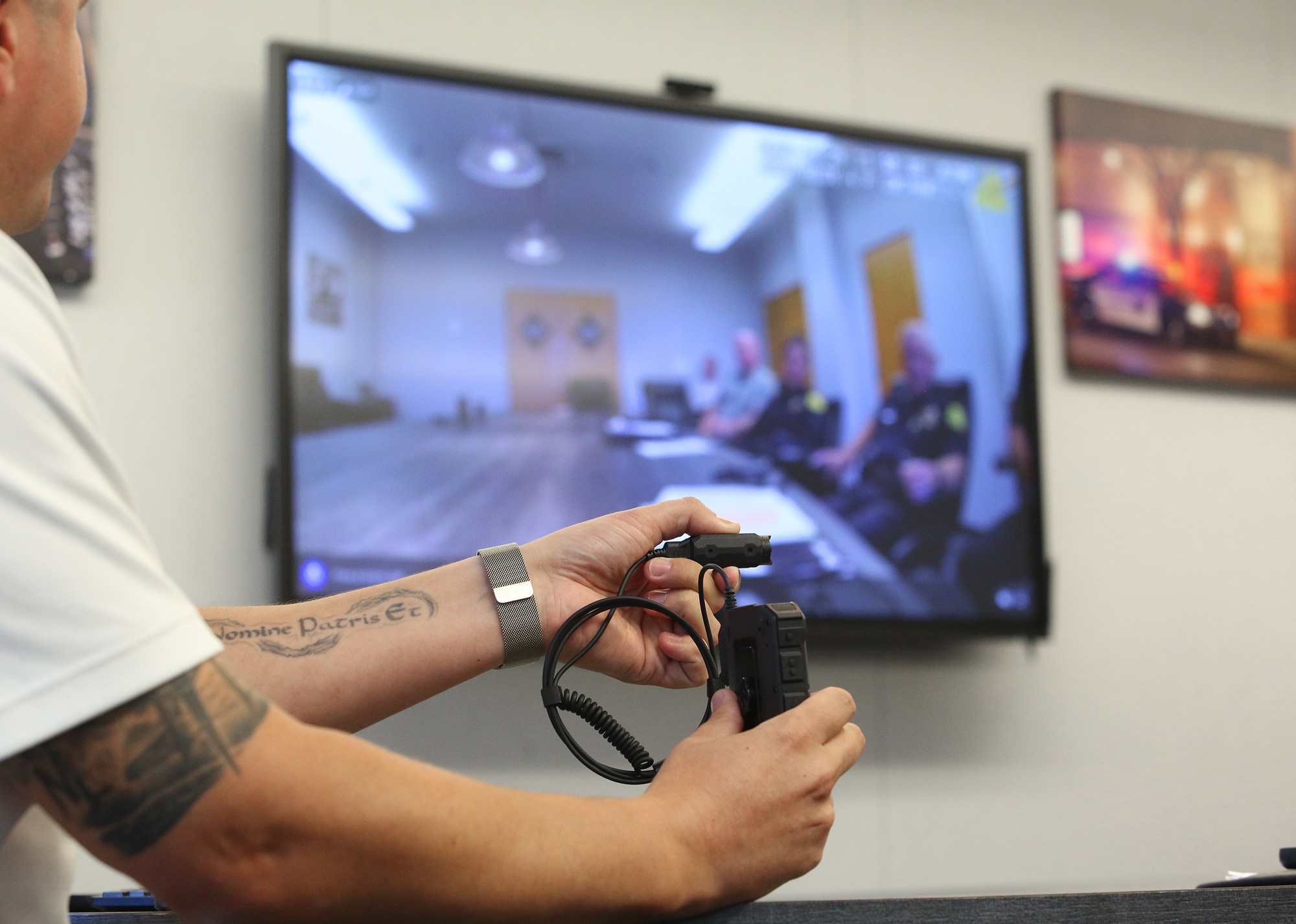
"caption": "Fresno Police Officer Gregory Colon-Reyes demonstrates Draft One on Sept. 24, 2024, an AI tool that uses the audio from bodycam footage to generate police reports.",
"credit": "Courtesy of Gary Kazanjian",
"altTag": null,
"description": null,
"imgSizes": {
"thumbnail": {
"file": "https://cdn.kqed.org/wp-content/uploads/sites/10/2025/10/AIPolice-160x114.jpg",
"width": 160,
"height": 114,
"mimeType": "image/jpeg"
},
"1536x1536": {
"file": "https://cdn.kqed.org/wp-content/uploads/sites/10/2025/10/AIPolice-1536x1095.jpg",
"width": 1536,
"height": 1095,
"mimeType": "image/jpeg"
},
"post-thumbnail": {
"file": "https://cdn.kqed.org/wp-content/uploads/sites/10/2025/10/AIPolice-672x372.jpg",
"width": 672,
"height": 372,
"mimeType": "image/jpeg"
},
"twentyfourteen-full-width": {
"file": "https://cdn.kqed.org/wp-content/uploads/sites/10/2025/10/AIPolice-1038x576.jpg",
"width": 1038,
"height": 576,
"mimeType": "image/jpeg"
},
"npr-cds-wide": {
"file": "https://cdn.kqed.org/wp-content/uploads/sites/10/2025/10/AIPolice-1600x900.jpg",
"width": 1600,
"height": 900,
"mimeType": "image/jpeg"
},
"kqedFullSize": {
"file": "https://cdn.kqed.org/wp-content/uploads/sites/10/2025/10/AIPolice.jpg",
"width": 2000,
"height": 1426
}
},
"isLoading": false,
"fetchFailed": false
},
"news_12060375": {
"type": "attachments",
"id": "news_12060375",
"meta": {
"index": "attachments_1716263798",
"site": "news",
"id": "12060375",
"found": true
},
"title": "US-TECH-AI-ALTMAN",
"publishDate": 1760733500,
"status": "inherit",
"parent": 12060365,
"modified": 1760733569,
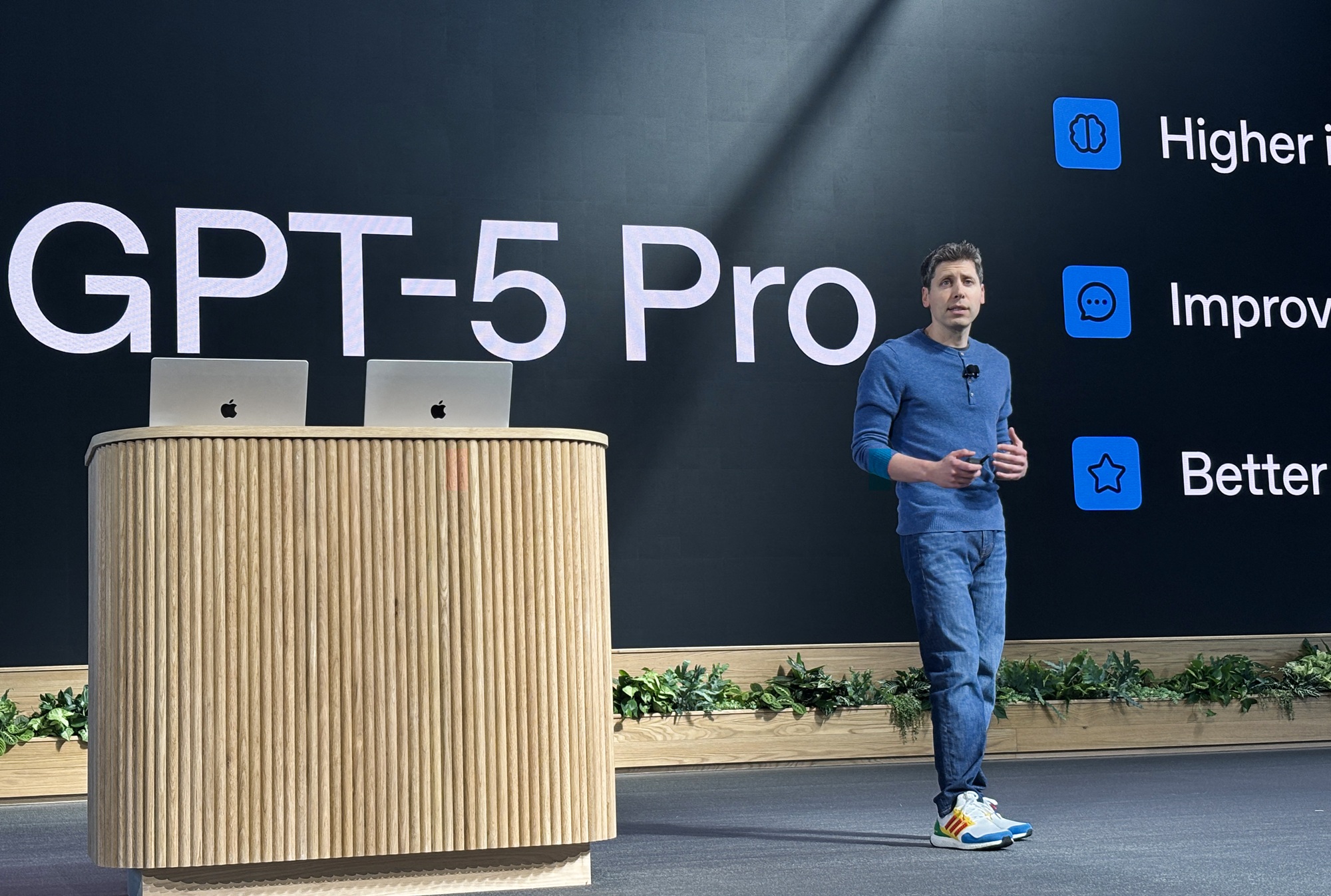
"caption": "OpenAI CEO Sam Altman speaks at OpenAI DevDay, the company's annual conference for developers, in San Francisco, California, on Oct. 6, 2025. ",
"credit": "Benjamin Legendre/AFP via Getty Images",
"altTag": null,
"description": null,
"imgSizes": {
"thumbnail": {
"file": "https://cdn.kqed.org/wp-content/uploads/sites/10/2025/10/SamAltmanGetty-160x108.jpg",
"width": 160,
"height": 108,
"mimeType": "image/jpeg"
},
"1536x1536": {
"file": "https://cdn.kqed.org/wp-content/uploads/sites/10/2025/10/SamAltmanGetty-1536x1034.jpg",
"width": 1536,
"height": 1034,
"mimeType": "image/jpeg"
},
"post-thumbnail": {
"file": "https://cdn.kqed.org/wp-content/uploads/sites/10/2025/10/SamAltmanGetty-672x372.jpg",
"width": 672,
"height": 372,
"mimeType": "image/jpeg"
},
"twentyfourteen-full-width": {
"file": "https://cdn.kqed.org/wp-content/uploads/sites/10/2025/10/SamAltmanGetty-1038x576.jpg",
"width": 1038,
"height": 576,
"mimeType": "image/jpeg"
},
"kqedFullSize": {
"file": "https://cdn.kqed.org/wp-content/uploads/sites/10/2025/10/SamAltmanGetty.jpg",
"width": 2000,
"height": 1347
}
},
"isLoading": false,
"fetchFailed": false
},
"news_12058589": {
"type": "attachments",
"id": "news_12058589",
"meta": {
"index": "attachments_1716263798",
"site": "news",
"id": "12058589",
"found": true
},
"title": "IMG_1173",
"publishDate": 1759518161,
"status": "inherit",
"parent": 12058586,
"modified": 1759518178,
"caption": null,
"credit": "Anna Vignet/KQED",
"altTag": null,
"description": null,
"imgSizes": {
"medium": {
"file": "https://cdn.kqed.org/wp-content/uploads/sites/10/2025/10/IMG_1173-2000x1500.jpg",
"width": 2000,
"height": 1500,
"mimeType": "image/jpeg"
},
"large": {
"file": "https://cdn.kqed.org/wp-content/uploads/sites/10/2025/10/IMG_1173-2000x1500.jpg",
"width": 2000,
"height": 1500,
"mimeType": "image/jpeg"
},
"thumbnail": {
"file": "https://cdn.kqed.org/wp-content/uploads/sites/10/2025/10/IMG_1173-160x120.jpg",
"width": 160,
"height": 120,
"mimeType": "image/jpeg"
},
"1536x1536": {
"file": "https://cdn.kqed.org/wp-content/uploads/sites/10/2025/10/IMG_1173-1536x1152.jpg",
"width": 1536,
"height": 1152,
"mimeType": "image/jpeg"
},
"2048x2048": {
"file": "https://cdn.kqed.org/wp-content/uploads/sites/10/2025/10/IMG_1173-2048x1536.jpg",
"width": 2048,
"height": 1536,
"mimeType": "image/jpeg"
},
"post-thumbnail": {
"file": "https://cdn.kqed.org/wp-content/uploads/sites/10/2025/10/IMG_1173-672x372.jpg",
"width": 672,
"height": 372,
"mimeType": "image/jpeg"
},
"twentyfourteen-full-width": {
"file": "https://cdn.kqed.org/wp-content/uploads/sites/10/2025/10/IMG_1173-1038x576.jpg",
"width": 1038,
"height": 576,
"mimeType": "image/jpeg"
},
"full-width": {
"file": "https://cdn.kqed.org/wp-content/uploads/sites/10/2025/10/IMG_1173-2000x1500.jpg",
"width": 2000,
"height": 1500,
"mimeType": "image/jpeg"
},
"kqedFullSize": {
"file": "https://cdn.kqed.org/wp-content/uploads/sites/10/2025/10/IMG_1173.jpg",
"width": 2560,
"height": 1920
}
},
"isLoading": false,
"fetchFailed": false
},
"news_12059912": {
"type": "attachments",
"id": "news_12059912",
"meta": {
"index": "attachments_1716263798",
"site": "news",
"id": "12059912",
"found": true
},
"title": "AI_Con_thumbnail",
"publishDate": 1760479501,
"status": "inherit",
"parent": 12059911,
"modified": 1760515545,
"caption": "Composite image of robotic hands hovering over a laptop showing an error screen. ",
"credit": "Composite by Gabriela Glueck; photos by Rawf8, MASTER, and Vertigo3d",
"altTag": "White, purple, and black robot hands hover over a laptop. The laptop is warped and appears distorted. The laptop screen shows that the laptop has crashed. These components are layered over a purple and green background featuring keys labeled “CHAT AI BOT.”",
"description": null,
"imgSizes": {
"medium": {
"file": "https://cdn.kqed.org/wp-content/uploads/sites/10/2025/10/AI_Con_thumbnail-2000x1125.jpg",
"width": 2000,
"height": 1125,
"mimeType": "image/jpeg"
},
"large": {
"file": "https://cdn.kqed.org/wp-content/uploads/sites/10/2025/10/AI_Con_thumbnail-2000x1125.jpg",
"width": 2000,
"height": 1125,
"mimeType": "image/jpeg"
},
"thumbnail": {
"file": "https://cdn.kqed.org/wp-content/uploads/sites/10/2025/10/AI_Con_thumbnail-160x90.jpg",
"width": 160,
"height": 90,
"mimeType": "image/jpeg"
},
"1536x1536": {
"file": "https://cdn.kqed.org/wp-content/uploads/sites/10/2025/10/AI_Con_thumbnail-1536x864.jpg",
"width": 1536,
"height": 864,
"mimeType": "image/jpeg"
},
"2048x2048": {
"file": "https://cdn.kqed.org/wp-content/uploads/sites/10/2025/10/AI_Con_thumbnail-2048x1152.jpg",
"width": 2048,
"height": 1152,
"mimeType": "image/jpeg"
},
"post-thumbnail": {
"file": "https://cdn.kqed.org/wp-content/uploads/sites/10/2025/10/AI_Con_thumbnail-672x372.jpg",
"width": 672,
"height": 372,
"mimeType": "image/jpeg"
},
"twentyfourteen-full-width": {
"file": "https://cdn.kqed.org/wp-content/uploads/sites/10/2025/10/AI_Con_thumbnail-1038x576.jpg",
"width": 1038,
"height": 576,
"mimeType": "image/jpeg"
},
"full-width": {
"file": "https://cdn.kqed.org/wp-content/uploads/sites/10/2025/10/AI_Con_thumbnail-2000x1125.jpg",
"width": 2000,
"height": 1125,
"mimeType": "image/jpeg"
},
"kqedFullSize": {
"file": "https://cdn.kqed.org/wp-content/uploads/sites/10/2025/10/AI_Con_thumbnail-scaled.jpg",
"width": 2560,
"height": 1440
}
},
"isLoading": false,
"fetchFailed": false
},
"news_12051437": {
"type": "attachments",
"id": "news_12051437",
"meta": {
"index": "attachments_1716263798",
"site": "news",
"id": "12051437",
"found": true
},
"title": "GavinNewsomAISF1",
"publishDate": 1754670249,
"status": "inherit",
"parent": 12051433,
"modified": 1754670737,
"caption": "On the rooftop of Google’s San Francisco offices on Aug. 7, 2025, Gov. Gavin Newsom announced a major statewide partnership with Google, Microsoft, IBM and Adobe to expand generative AI education — including training programs, certifications and internships — across California’s high schools, community colleges and Cal State universities.",
"credit": "Courtesy of the Office of the Governor",
"altTag": null,
"description": null,
"imgSizes": {
"thumbnail": {
"file": "https://cdn.kqed.org/wp-content/uploads/sites/10/2025/08/GavinNewsomAISF1-160x107.jpg",
"width": 160,
"height": 107,
"mimeType": "image/jpeg"
},
"1536x1536": {
"file": "https://cdn.kqed.org/wp-content/uploads/sites/10/2025/08/GavinNewsomAISF1-1536x1024.jpg",
"width": 1536,
"height": 1024,
"mimeType": "image/jpeg"
},
"post-thumbnail": {
"file": "https://cdn.kqed.org/wp-content/uploads/sites/10/2025/08/GavinNewsomAISF1-672x372.jpg",
"width": 672,
"height": 372,
"mimeType": "image/jpeg"
},
"twentyfourteen-full-width": {
"file": "https://cdn.kqed.org/wp-content/uploads/sites/10/2025/08/GavinNewsomAISF1-1038x576.jpg",
"width": 1038,
"height": 576,
"mimeType": "image/jpeg"
},
"kqedFullSize": {
"file": "https://cdn.kqed.org/wp-content/uploads/sites/10/2025/08/GavinNewsomAISF1.jpg",
"width": 2000,
"height": 1333
}
},
"isLoading": false,
"fetchFailed": false
},
"news_12059629": {
"type": "attachments",
"id": "news_12059629",
"meta": {
"index": "attachments_1716263798",
"site": "news",
"id": "12059629",
"found": true
},
"title": "251008_ENDOF10_-9-KQED",
"publishDate": 1760356671,
"status": "inherit",
"parent": 0,
"modified": 1760356793,
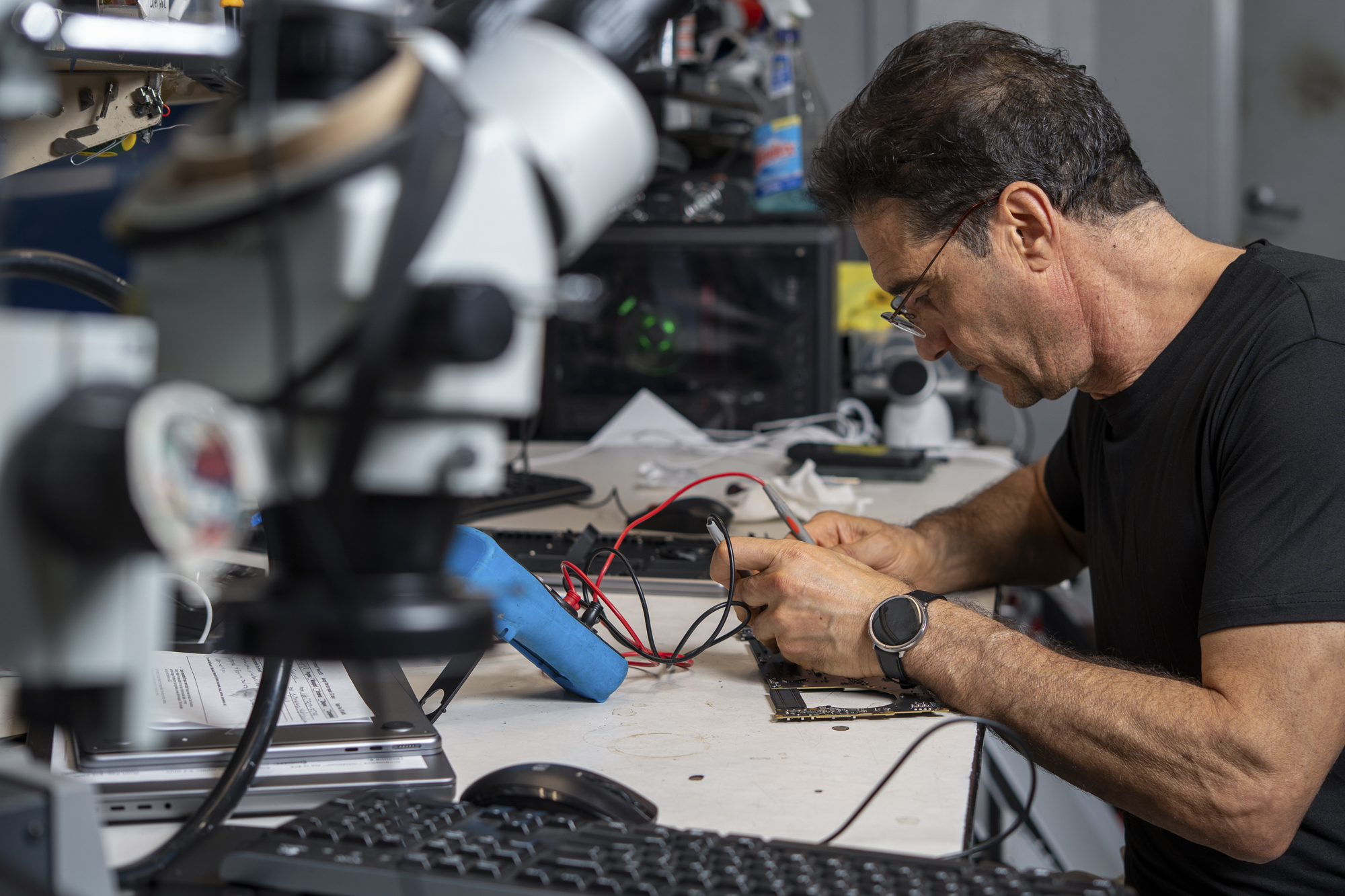
"caption": "Del Jaljaa works on a laptop motherboard at his repair bench in San Francisco on Oct. 8, 2025. Right to Repair advocates warn that Microsoft’s move away from Windows 10 could create mountains of electronic waste.",
"credit": "Gustavo Hernandez/KQED",
"altTag": null,
"description": null,
"imgSizes": {
"thumbnail": {
"file": "https://cdn.kqed.org/wp-content/uploads/sites/10/2025/10/251008_ENDOF10_-9-KQED-160x107.jpg",
"width": 160,
"height": 107,
"mimeType": "image/jpeg"
},
"1536x1536": {
"file": "https://cdn.kqed.org/wp-content/uploads/sites/10/2025/10/251008_ENDOF10_-9-KQED-1536x1024.jpg",
"width": 1536,
"height": 1024,
"mimeType": "image/jpeg"
},
"post-thumbnail": {
"file": "https://cdn.kqed.org/wp-content/uploads/sites/10/2025/10/251008_ENDOF10_-9-KQED-672x372.jpg",
"width": 672,
"height": 372,
"mimeType": "image/jpeg"
},
"twentyfourteen-full-width": {
"file": "https://cdn.kqed.org/wp-content/uploads/sites/10/2025/10/251008_ENDOF10_-9-KQED-1038x576.jpg",
"width": 1038,
"height": 576,
"mimeType": "image/jpeg"
},
"kqedFullSize": {
"file": "https://cdn.kqed.org/wp-content/uploads/sites/10/2025/10/251008_ENDOF10_-9-KQED.jpg",
"width": 2000,
"height": 1333
}
},
"isLoading": false,
"fetchFailed": false
},
"news_12059024": {
"type": "attachments",
"id": "news_12059024",
"meta": {
"index": "attachments_1716263798",
"site": "news",
"id": "12059024",
"found": true
},
"title": "CAT — DatingPan_Thumbnail",
"publishDate": 1759875528,
"status": "inherit",
"parent": 12058992,
"modified": 1759875624,
"caption": "Pixelated broken hearts on a smartphone screen layered over a background highlighting the dangers and risks of the internet.",
"credit": "Photos by Malte Mueller and DrAfter123 via Getty Images",
"altTag": "Graphic image collage featuring two phone screens, each displaying half of a pixelated heart that is broken because the screens are not touching. The background of the image features two eyes, a camera, a map pin, and a hand illustration reaching out. In the bottom right corner, the words “Close All Tabs” appear in a pixel-style font.",
"description": null,
"imgSizes": {
"medium": {
"file": "https://cdn.kqed.org/wp-content/uploads/sites/10/2025/10/CAT-—-DatingPan_Thumbnail-2000x1125.jpg",
"width": 2000,
"height": 1125,
"mimeType": "image/jpeg"
},
"large": {
"file": "https://cdn.kqed.org/wp-content/uploads/sites/10/2025/10/CAT-—-DatingPan_Thumbnail-2000x1125.jpg",
"width": 2000,
"height": 1125,
"mimeType": "image/jpeg"
},
"thumbnail": {
"file": "https://cdn.kqed.org/wp-content/uploads/sites/10/2025/10/CAT-—-DatingPan_Thumbnail-160x90.jpg",
"width": 160,
"height": 90,
"mimeType": "image/jpeg"
},
"1536x1536": {
"file": "https://cdn.kqed.org/wp-content/uploads/sites/10/2025/10/CAT-—-DatingPan_Thumbnail-1536x864.jpg",
"width": 1536,
"height": 864,
"mimeType": "image/jpeg"
},
"2048x2048": {
"file": "https://cdn.kqed.org/wp-content/uploads/sites/10/2025/10/CAT-—-DatingPan_Thumbnail-2048x1152.jpg",
"width": 2048,
"height": 1152,
"mimeType": "image/jpeg"
},
"post-thumbnail": {
"file": "https://cdn.kqed.org/wp-content/uploads/sites/10/2025/10/CAT-—-DatingPan_Thumbnail-672x372.jpg",
"width": 672,
"height": 372,
"mimeType": "image/jpeg"
},
"twentyfourteen-full-width": {
"file": "https://cdn.kqed.org/wp-content/uploads/sites/10/2025/10/CAT-—-DatingPan_Thumbnail-1038x576.jpg",
"width": 1038,
"height": 576,
"mimeType": "image/jpeg"
},
"full-width": {
"file": "https://cdn.kqed.org/wp-content/uploads/sites/10/2025/10/CAT-—-DatingPan_Thumbnail-2000x1125.jpg",
"width": 2000,
"height": 1125,
"mimeType": "image/jpeg"
},
"kqedFullSize": {
"file": "https://cdn.kqed.org/wp-content/uploads/sites/10/2025/10/CAT-—-DatingPan_Thumbnail-scaled.jpg",
"width": 2560,
"height": 1440
}
},
"isLoading": false,
"fetchFailed": false
},
"news_12058999": {
"type": "attachments",
"id": "news_12058999",
"meta": {
"index": "attachments_1716263798",
"site": "news",
"id": "12058999",
"found": true
},
"title": "TOPSHOT-SWEDEN-NOBEL-PRIZE-PHYSICS",
"publishDate": 1759871306,
"status": "inherit",
"parent": 12058994,
"modified": 1759871409,
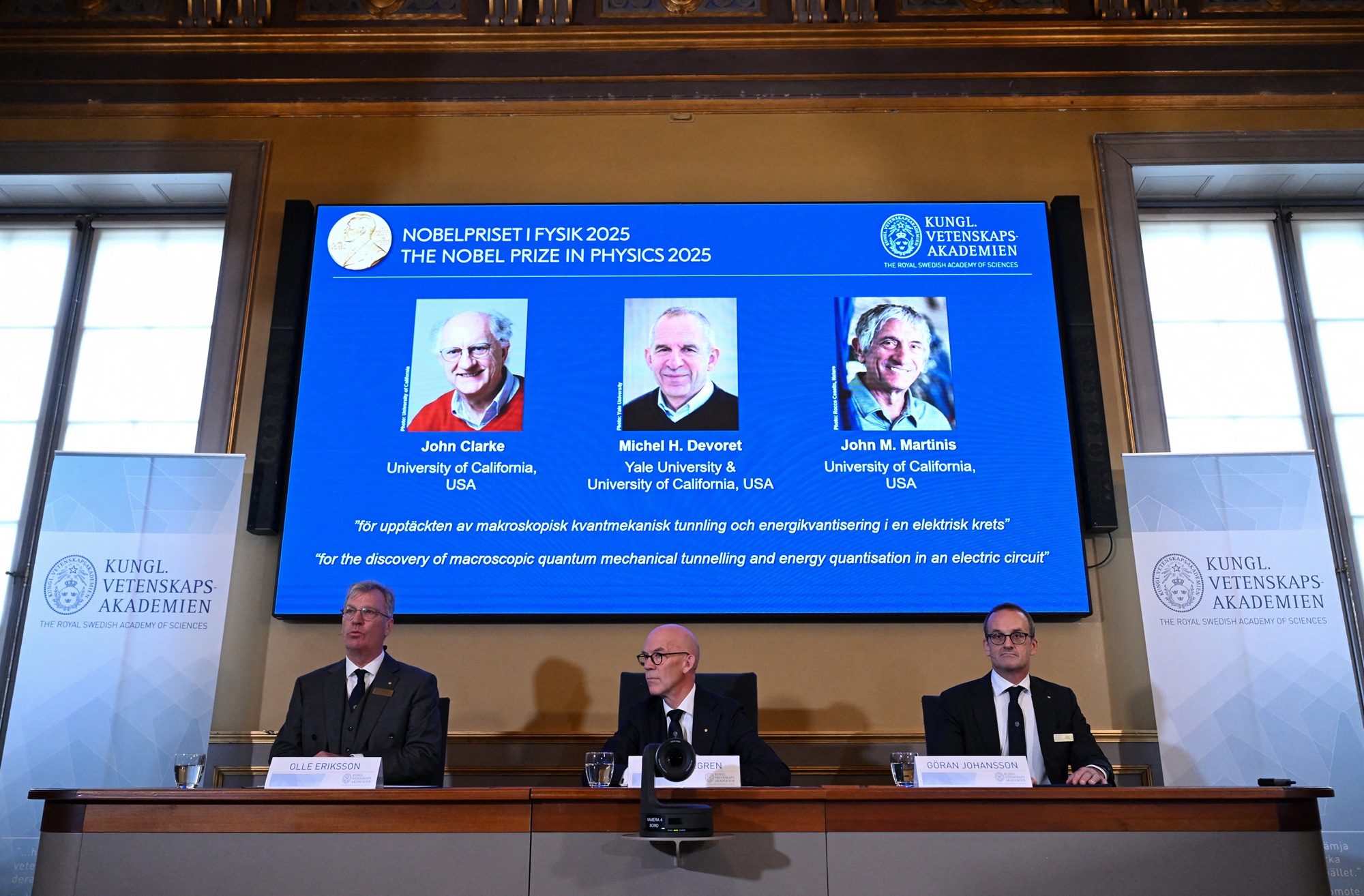
"caption": "Left to right: Olle Eriksson, Chair of the Nobel Committee for Physics, Hans Ellegren, Secretary General of The Royal Swedish Academy of Sciences, and Goeran Johansson, Member of the Nobel Committe for Physics, address a press conference to announce the winners of the 2025 Nobel Prize in Physics at the Royal Swedish Academy of Sciences in Stockholm, Sweden, on Oct. 7, 2025. John Clarke (UK), Michel H. Devoret (France) and John M. Martinis (US) win the Nobel Prize in Physics 2025, \"for the discovery of macroscopic quatum mechanical tunnelling and energy quantisation in an electric circuit.\"",
"credit": "Jonathan Nackstrand/AFP via Getty Images",
"altTag": null,
"description": null,
"imgSizes": {
"thumbnail": {
"file": "https://cdn.kqed.org/wp-content/uploads/sites/10/2025/10/NobelPrizePhysicsGetty1-160x105.jpg",
"width": 160,
"height": 105,
"mimeType": "image/jpeg"
},
"1536x1536": {
"file": "https://cdn.kqed.org/wp-content/uploads/sites/10/2025/10/NobelPrizePhysicsGetty1-1536x1009.jpg",
"width": 1536,
"height": 1009,
"mimeType": "image/jpeg"
},
"post-thumbnail": {
"file": "https://cdn.kqed.org/wp-content/uploads/sites/10/2025/10/NobelPrizePhysicsGetty1-672x372.jpg",
"width": 672,
"height": 372,
"mimeType": "image/jpeg"
},
"twentyfourteen-full-width": {
"file": "https://cdn.kqed.org/wp-content/uploads/sites/10/2025/10/NobelPrizePhysicsGetty1-1038x576.jpg",
"width": 1038,
"height": 576,
"mimeType": "image/jpeg"
},
"kqedFullSize": {
"file": "https://cdn.kqed.org/wp-content/uploads/sites/10/2025/10/NobelPrizePhysicsGetty1.jpg",
"width": 2000,
"height": 1314
}
},
"isLoading": false,
"fetchFailed": false
},
"news_12058226": {
"type": "attachments",
"id": "news_12058226",
"meta": {
"index": "attachments_1716263798",
"site": "news",
"id": "12058226",
"found": true
},
"title": "frank_02_webimg",
"publishDate": 1759340366,
"status": "inherit",
"parent": 12058181,
"modified": 1759341822,
"caption": "A custom mechanical keyboard being assembled during a Twitch stream by Frank Lee, who also organizes KeebLife, a community meetup for keyboard enthusiasts.",
"credit": "Image provided by Frank Lee",
"altTag": "A close-up of a custom mechanical keyboard mid-assembly, placed on a comic-style desk mat with bold black lines radiating outward. The board has orange switches exposed, with a few red and white keycaps already installed. A plastic bin of loose keycaps sits above the keyboard, and the words “Close All Tabs” appear in pixel-style font in the upper right corner.",
"description": null,
"imgSizes": {
"thumbnail": {
"file": "https://cdn.kqed.org/wp-content/uploads/sites/10/2025/10/frank_02_webimg-160x90.png",
"width": 160,
"height": 90,
"mimeType": "image/png"
},
"1536x1536": {
"file": "https://cdn.kqed.org/wp-content/uploads/sites/10/2025/10/frank_02_webimg-1536x864.png",
"width": 1536,
"height": 864,
"mimeType": "image/png"
},
"post-thumbnail": {
"file": "https://cdn.kqed.org/wp-content/uploads/sites/10/2025/10/frank_02_webimg-672x372.png",
"width": 672,
"height": 372,
"mimeType": "image/png"
},
"twentyfourteen-full-width": {
"file": "https://cdn.kqed.org/wp-content/uploads/sites/10/2025/10/frank_02_webimg-1038x576.png",
"width": 1038,
"height": 576,
"mimeType": "image/png"
},
"kqedFullSize": {
"file": "https://cdn.kqed.org/wp-content/uploads/sites/10/2025/10/frank_02_webimg.png",
"width": 1920,
"height": 1080
}
},
"isLoading": false,
"fetchFailed": false
},
"news_12051438": {
"type": "attachments",
"id": "news_12051438",
"meta": {
"index": "attachments_1716263798",
"site": "news",
"id": "12051438",
"found": true
},
"title": "GavinNewsomAISF2",
"publishDate": 1754670252,
"status": "inherit",
"parent": 12051433,
"modified": 1754670418,
"caption": "On the rooftop of Google’s San Francisco Embarcadero offices on Aug. 7, 2025, Gov. Gavin Newsom announced a major statewide partnership with Google, Microsoft, IBM and Adobe to expand generative AI education — including training programs, certifications, and internships — across California’s high schools, community colleges and Cal State universities.",
"credit": "Courtesy of the Office of the Governor",
"altTag": null,
"description": null,
"imgSizes": {
"thumbnail": {
"file": "https://cdn.kqed.org/wp-content/uploads/sites/10/2025/08/GavinNewsomAISF2-160x107.jpg",
"width": 160,
"height": 107,
"mimeType": "image/jpeg"
},
"1536x1536": {
"file": "https://cdn.kqed.org/wp-content/uploads/sites/10/2025/08/GavinNewsomAISF2-1536x1024.jpg",
"width": 1536,
"height": 1024,
"mimeType": "image/jpeg"
},
"post-thumbnail": {
"file": "https://cdn.kqed.org/wp-content/uploads/sites/10/2025/08/GavinNewsomAISF2-672x372.jpg",
"width": 672,
"height": 372,
"mimeType": "image/jpeg"
},
"twentyfourteen-full-width": {
"file": "https://cdn.kqed.org/wp-content/uploads/sites/10/2025/08/GavinNewsomAISF2-1038x576.jpg",
"width": 1038,
"height": 576,
"mimeType": "image/jpeg"
},
"kqedFullSize": {
"file": "https://cdn.kqed.org/wp-content/uploads/sites/10/2025/08/GavinNewsomAISF2.jpg",
"width": 2000,
"height": 1333
}
},
"isLoading": false,
"fetchFailed": false
},
"news_12057971": {
"type": "attachments",
"id": "news_12057971",
"meta": {
"index": "attachments_1716263798",
"site": "news",
"id": "12057971",
"found": true
},
"title": "Electronic Arts-Buyout",
"publishDate": 1759166947,
"status": "inherit",
"parent": 12057966,
"modified": 1759168795,
"caption": "The logo for Electronic Arts is displayed during the Electronic Entertainment Expo in Los Angeles on June 12, 2013. ",
"credit": "Jae C. Hong/AP Photo",
"altTag": null,
"description": null,
"imgSizes": {
"medium": {
"file": "https://cdn.kqed.org/wp-content/uploads/sites/10/2025/09/AP25272445694578-2000x1334.jpg",
"width": 2000,
"height": 1334,
"mimeType": "image/jpeg"
},
"large": {
"file": "https://cdn.kqed.org/wp-content/uploads/sites/10/2025/09/AP25272445694578-2000x1334.jpg",
"width": 2000,
"height": 1334,
"mimeType": "image/jpeg"
},
"thumbnail": {
"file": "https://cdn.kqed.org/wp-content/uploads/sites/10/2025/09/AP25272445694578-160x107.jpg",
"width": 160,
"height": 107,
"mimeType": "image/jpeg"
},
"1536x1536": {
"file": "https://cdn.kqed.org/wp-content/uploads/sites/10/2025/09/AP25272445694578-1536x1024.jpg",
"width": 1536,
"height": 1024,
"mimeType": "image/jpeg"
},
"2048x2048": {
"file": "https://cdn.kqed.org/wp-content/uploads/sites/10/2025/09/AP25272445694578-2048x1366.jpg",
"width": 2048,
"height": 1366,
"mimeType": "image/jpeg"
},
"post-thumbnail": {
"file": "https://cdn.kqed.org/wp-content/uploads/sites/10/2025/09/AP25272445694578-672x372.jpg",
"width": 672,
"height": 372,
"mimeType": "image/jpeg"
},
"twentyfourteen-full-width": {
"file": "https://cdn.kqed.org/wp-content/uploads/sites/10/2025/09/AP25272445694578-1038x576.jpg",
"width": 1038,
"height": 576,
"mimeType": "image/jpeg"
},
"full-width": {
"file": "https://cdn.kqed.org/wp-content/uploads/sites/10/2025/09/AP25272445694578-2000x1334.jpg",
"width": 2000,
"height": 1334,
"mimeType": "image/jpeg"
},
"kqedFullSize": {
"file": "https://cdn.kqed.org/wp-content/uploads/sites/10/2025/09/AP25272445694578-scaled.jpg",
"width": 2560,
"height": 1707
}
},
"isLoading": false,
"fetchFailed": false
}
},
"audioPlayerReducer": {
"postId": "stream_live",
"isPaused": true,
"isPlaying": false,
"pfsActive": false,
"pledgeModalIsOpen": true,
"playerDrawerIsOpen": false,
"liveAudioPlayStartedAt": 0,
"liveAudioPlayContext": ""
},
"authorsReducer": {
"byline_news_12061462": {
"type": "authors",
"id": "byline_news_12061462",
"meta": {
"override": true
},
"slug": "byline_news_12061462",
"name": "Kerry Klein, KVPR",
"isLoading": false
},
"byline_news_12057966": {
"type": "authors",
"id": "byline_news_12057966",
"meta": {
"override": true
},
"slug": "byline_news_12057966",
"name": "Michael Liedtke and Michelle Chapman, Associated Press",
"isLoading": false
},
"rachael-myrow": {
"type": "authors",
"id": "251",
"meta": {
"index": "authors_1716337520",
"id": "251",
"found": true
},
"name": "Rachael Myrow",
"firstName": "Rachael",
"lastName": "Myrow",
"slug": "rachael-myrow",
"email": "rmyrow@kqed.org",
"display_author_email": true,
"staff_mastheads": [
"news"
],
"title": "Senior Editor of KQED's Silicon Valley News Desk",
"bio": "• I write and edit stories about how Silicon Valley power and policies shape everyday life in California. I’m also passionate about making Bay Area history and culture more accessible to a broad public. • I’ve been a journalist for most of my life, starting in high school with The Franklin Press in Los Angeles, where I grew up. While earning my first degree in English at UC Berkeley, I got my start in public radio at KALX-FM. After completing a second degree in journalism at Cal, I landed my first professional job at Marketplace, then moved on to KPCC (now LAist), and then KQED, where I hosted The California Report for more than seven years. • My reporting has appeared on NPR, The World, WBUR’s \u003ci>Here & Now\u003c/i>, and the BBC. I also guest host for KQED’s \u003ci>Forum\u003c/i>, as well as the Commonwealth Club in San Francisco. • I speak periodically on media, democracy and technology issues, and do voiceover work for documentaries and educational video projects. • Outside of the studio, you'll find me hiking Bay Area trails and whipping up Insta-ready meals in my kitchen. • I do not accept gifts, money, or favors from anyone connected to my reporting, I don't pay people for information, and I do not support or donate to political causes. • I strive to treat the people I report on with fairness, honesty, and respect. I also recognize there are often multiple sides to a story and work to verify information through multiple sources and documentation. If I get something wrong, I correct it.",
"avatar": "https://secure.gravatar.com/avatar/3ed8a3c5f26025e4a805ba634cda8cd764906b97438a6d9ce216b044e340da4e?s=600&d=blank&r=g",
"twitter": "rachaelmyrow",
"bluesky": null,
"facebook": null,
"instagram": null,
"linkedin": "https://www.linkedin.com/in/rachaelmyrow/",
"sites": [
{
"site": "arts",
"roles": [
"administrator"
]
},
{
"site": "news",
"roles": [
"edit_others_posts",
"editor"
]
},
{
"site": "futureofyou",
"roles": [
"editor"
]
},
{
"site": "bayareabites",
"roles": [
"editor"
]
},
{
"site": "stateofhealth",
"roles": [
"editor"
]
},
{
"site": "science",
"roles": [
"editor"
]
},
{
"site": "food",
"roles": [
"editor"
]
},
{
"site": "forum",
"roles": [
"editor"
]
},
{
"site": "liveblog",
"roles": [
"author"
]
}
],
"headData": {
"title": "Rachael Myrow | KQED",
"description": "Senior Editor of KQED's Silicon Valley News Desk",
"ogImgSrc": "https://secure.gravatar.com/avatar/3ed8a3c5f26025e4a805ba634cda8cd764906b97438a6d9ce216b044e340da4e?s=600&d=blank&r=g",
"twImgSrc": "https://secure.gravatar.com/avatar/3ed8a3c5f26025e4a805ba634cda8cd764906b97438a6d9ce216b044e340da4e?s=600&d=blank&r=g"
},
"isLoading": false,
"link": "/author/rachael-myrow"
},
"adahlstromeckman": {
"type": "authors",
"id": "11785",
"meta": {
"index": "authors_1716337520",
"id": "11785",
"found": true
},
"name": "Azul Dahlstrom-Eckman",
"firstName": "Azul",
"lastName": "Dahlstrom-Eckman",
"slug": "adahlstromeckman",
"email": "adahlstrom-eckman@kqed.org",
"display_author_email": true,
"staff_mastheads": [],
"title": "Reporter",
"bio": "Azul is a reporter for KQED focusing on transportation and features. He joined KQED in 2021 as an alumna of KALW's Audio Academy radio journalism training program.",
"avatar": "https://secure.gravatar.com/avatar/9cb750298435add7815a777f55bf1f46845c1386bb8452555c60a7b820b5aba3?s=600&d=blank&r=g",
"twitter": "@zuliemann",
"bluesky": "@azul415.bsky.social",
"facebook": null,
"instagram": null,
"linkedin": null,
"sites": [
{
"site": "arts",
"roles": [
"editor"
]
},
{
"site": "news",
"roles": [
"editor"
]
},
{
"site": "science",
"roles": [
"editor"
]
},
{
"site": "liveblog",
"roles": [
"author"
]
}
],
"headData": {
"title": "Azul Dahlstrom-Eckman | KQED",
"description": "Reporter",
"ogImgSrc": "https://secure.gravatar.com/avatar/9cb750298435add7815a777f55bf1f46845c1386bb8452555c60a7b820b5aba3?s=600&d=blank&r=g",
"twImgSrc": "https://secure.gravatar.com/avatar/9cb750298435add7815a777f55bf1f46845c1386bb8452555c60a7b820b5aba3?s=600&d=blank&r=g"
},
"isLoading": false,
"link": "/author/adahlstromeckman"
},
"chambrick": {
"type": "authors",
"id": "11832",
"meta": {
"index": "authors_1716337520",
"id": "11832",
"found": true
},
"name": "Chris Hambrick",
"firstName": "Chris",
"lastName": "Hambrick",
"slug": "chambrick",
"email": "chambrick@kqed.org",
"display_author_email": false,
"staff_mastheads": [],
"title": "KQED Contributor",
"bio": null,
"avatar": "https://secure.gravatar.com/avatar/23cb83888bc440645af5d36d0d1909e8ecb6cef21f2fdb96abf9a55495bb19d8?s=600&d=blank&r=g",
"twitter": null,
"bluesky": null,
"facebook": null,
"instagram": null,
"linkedin": null,
"sites": [
{
"site": "",
"roles": [
"editor"
]
},
{
"site": "arts",
"roles": [
"editor"
]
},
{
"site": "news",
"roles": [
"editor"
]
},
{
"site": "podcasts",
"roles": [
"editor"
]
}
],
"headData": {
"title": "Chris Hambrick | KQED",
"description": "KQED Contributor",
"ogImgSrc": "https://secure.gravatar.com/avatar/23cb83888bc440645af5d36d0d1909e8ecb6cef21f2fdb96abf9a55495bb19d8?s=600&d=blank&r=g",
"twImgSrc": "https://secure.gravatar.com/avatar/23cb83888bc440645af5d36d0d1909e8ecb6cef21f2fdb96abf9a55495bb19d8?s=600&d=blank&r=g"
},
"isLoading": false,
"link": "/author/chambrick"
},
"cegusa": {
"type": "authors",
"id": "11869",
"meta": {
"index": "authors_1716337520",
"id": "11869",
"found": true
},
"name": "Chris Egusa",
"firstName": "Chris",
"lastName": "Egusa",
"slug": "cegusa",
"email": "cegusa@kqed.org",
"display_author_email": false,
"staff_mastheads": [],
"title": "KQED Contributor",
"bio": null,
"avatar": "https://secure.gravatar.com/avatar/3562ed52747313a4c94017da88ea89f9e85cd901f63ebc056a7d5e0adf4a03da?s=600&d=blank&r=g",
"twitter": null,
"bluesky": null,
"facebook": null,
"instagram": null,
"linkedin": null,
"sites": [
{
"site": "arts",
"roles": [
"editor"
]
},
{
"site": "news",
"roles": [
"editor"
]
}
],
"headData": {
"title": "Chris Egusa | KQED",
"description": "KQED Contributor",
"ogImgSrc": "https://secure.gravatar.com/avatar/3562ed52747313a4c94017da88ea89f9e85cd901f63ebc056a7d5e0adf4a03da?s=600&d=blank&r=g",
"twImgSrc": "https://secure.gravatar.com/avatar/3562ed52747313a4c94017da88ea89f9e85cd901f63ebc056a7d5e0adf4a03da?s=600&d=blank&r=g"
},
"isLoading": false,
"link": "/author/cegusa"
},
"kdebenedetti": {
"type": "authors",
"id": "11913",
"meta": {
"index": "authors_1716337520",
"id": "11913",
"found": true
},
"name": "Katie DeBenedetti",
"firstName": "Katie",
"lastName": "DeBenedetti",
"slug": "kdebenedetti",
"email": "kdebenedetti@kqed.org",
"display_author_email": false,
"staff_mastheads": [
"news",
"science"
],
"title": "KQED Contributor",
"bio": "Katie DeBenedetti is a digital reporter covering daily news for the Express Desk. Prior to joining KQED as a culture reporting intern in January 2024, she covered education and city government for the Napa Valley Register.",
"avatar": "https://secure.gravatar.com/avatar/6e31073cb8f7e4214ab03f42771d0f45?s=600&d=blank&r=g",
"twitter": null,
"facebook": null,
"instagram": null,
"linkedin": null,
"sites": [
{
"site": "news",
"roles": [
"author"
]
},
{
"site": "science",
"roles": [
"author"
]
},
{
"site": "liveblog",
"roles": [
"author"
]
}
],
"headData": {
"title": "Katie DeBenedetti | KQED",
"description": "KQED Contributor",
"ogImgSrc": "https://secure.gravatar.com/avatar/6e31073cb8f7e4214ab03f42771d0f45?s=600&d=blank&r=g",
"twImgSrc": "https://secure.gravatar.com/avatar/6e31073cb8f7e4214ab03f42771d0f45?s=600&d=blank&r=g"
},
"isLoading": false,
"link": "/author/kdebenedetti"
},
"mcueva": {
"type": "authors",
"id": "11943",
"meta": {
"index": "authors_1716337520",
"id": "11943",
"found": true
},
"name": "Maya Cueva",
"firstName": "Maya",
"lastName": "Cueva",
"slug": "mcueva",
"email": "mcueva@kqed.org",
"display_author_email": false,
"staff_mastheads": [],
"title": "KQED Contributor",
"bio": null,
"avatar": "https://secure.gravatar.com/avatar/238c7aba67c4b6b7b891965ba8cc9e9a4928b5dbdeaf4bde6a81c13e87f49b49?s=600&d=blank&r=g",
"twitter": null,
"bluesky": null,
"facebook": null,
"instagram": null,
"linkedin": null,
"sites": [
{
"site": "news",
"roles": [
"editor"
]
}
],
"headData": {
"title": "Maya Cueva | KQED",
"description": "KQED Contributor",
"ogImgSrc": "https://secure.gravatar.com/avatar/238c7aba67c4b6b7b891965ba8cc9e9a4928b5dbdeaf4bde6a81c13e87f49b49?s=600&d=blank&r=g",
"twImgSrc": "https://secure.gravatar.com/avatar/238c7aba67c4b6b7b891965ba8cc9e9a4928b5dbdeaf4bde6a81c13e87f49b49?s=600&d=blank&r=g"
},
"isLoading": false,
"link": "/author/mcueva"
},
"msung": {
"type": "authors",
"id": "11944",
"meta": {
"index": "authors_1716337520",
"id": "11944",
"found": true
},
"name": "Morgan Sung",
"firstName": "Morgan",
"lastName": "Sung",
"slug": "msung",
"email": "msung@kqed.org",
"display_author_email": false,
"staff_mastheads": [],
"title": "Close All Tabs Host",
"bio": null,
"avatar": "https://secure.gravatar.com/avatar/34033b8d232ee6c987ca6f0a1a28f0e5?s=600&d=blank&r=g",
"twitter": null,
"facebook": null,
"instagram": null,
"linkedin": null,
"sites": [
{
"site": "news",
"roles": [
"editor"
]
}
],
"headData": {
"title": "Morgan Sung | KQED",
"description": "Close All Tabs Host",
"ogImgSrc": "https://secure.gravatar.com/avatar/34033b8d232ee6c987ca6f0a1a28f0e5?s=600&d=blank&r=g",
"twImgSrc": "https://secure.gravatar.com/avatar/34033b8d232ee6c987ca6f0a1a28f0e5?s=600&d=blank&r=g"
},
"isLoading": false,
"link": "/author/msung"
}
},
"pagesReducer": {
"news_tag_technology": {
"type": "terms",
"id": "news_1631",
"meta": {
"index": "terms_1716263798",
"site": "news",
"id": "1631",
"score": 6.9278407
},
"name": "Technology",
"slug": "technology",
"taxonomy": "tag",
"description": null,
"featImg": null,
"headData": {
"title": "Technology | KQED News",
"description": null,
"ogTitle": null,
"ogDescription": null,
"ogImgId": null,
"twTitle": null,
"twDescription": null,
"twImgId": null
},
"ttid": 1643,
"isLoading": false,
"title": "Technology",
"pageMeta": {
"site": "news",
"WpPageTemplate": "page-topic-editorial",
"currentPage": 14
},
"blocks": [
{
"blockName": "kqed/post-list",
"attrs": {
"layout": "cardArticle2",
"query": "posts/news?tag=technology",
"seeMore": false,
"paginated": true,
"page": 14
}
},
{
"blockName": "kqed/ad"
}
]
}
},
"pfsSessionReducer": {},
"postsReducer": {
"stream_live": {
"type": "live",
"id": "stream_live",
"audioUrl": "https://streams.kqed.org/kqedradio",
"title": "Live Stream",
"excerpt": "Live Stream information currently unavailable.",
"link": "/radio",
"featImg": "",
"label": {
"name": "KQED Live",
"link": "/"
}
},
"stream_kqedNewscast": {
"type": "posts",
"id": "stream_kqedNewscast",
"audioUrl": "https://www.kqed.org/.stream/anon/radio/RDnews/newscast.mp3?_=1",
"title": "KQED Newscast",
"featImg": "",
"label": {
"name": "88.5 FM",
"link": "/"
}
},
"news_12061994": {
"type": "posts",
"id": "news_12061994",
"meta": {
"index": "posts_1716263798",
"site": "news",
"id": "12061994",
"score": null,
"sort": [
1761732001000
]
},
"guestAuthors": [],
"slug": "a-political-reckoning-for-twitch",
"title": "A Political Reckoning for Twitch?",
"publishDate": 1761732001,
"format": "audio",
"headTitle": "A Political Reckoning for Twitch? | KQED",
"labelTerm": {},
"content": "\u003cp>\u003ca href=\"#episode-transcript\">\u003ci>View the full episode transcript.\u003c/i>\u003c/a>\u003c/p>\n\u003cp>\u003cspan style=\"font-weight: 400\">TwitchCon, Twitch’s annual convention in San Diego for all things streaming and gaming, is facing heightened scrutiny after streamer Emiru was assaulted there during a meet-and-greet. The incident occurred after a series of streamers pulled out of the event over safety concerns and the growing specter of political violence. All of this has highlighted questions about the role of political commentary on Twitch — a genre that’s exploded in the last few years, transforming the platform into much more than a gaming site. \u003c/span>\u003c/p>\n\u003cp>\u003cspan style=\"font-weight: 400\">In this episode, Morgan is joined by author and reporter Nathan Grayson and political streamer Denims to explore Twitch’s rise as a hub for political speech, the company’s inconsistent handling of backlash against political creators, and whether any real alternatives exist for this new wave of commentators. \u003c/span>\u003c/p>\n\u003cp>\u003c!-- iframe plugin v.4.3 wordpress.org/plugins/iframe/ -->\u003cbr>\n\u003ciframe loading=\"lazy\" frameborder=\"0\" height=\"200\" scrolling=\"no\" src=\"https://playlist.megaphone.fm?e=KQINC6693258081\" width=\"100%\" class=\"iframe-class\">\u003c/iframe>\u003c/p>\n\u003cp>\u003cspan style=\"font-weight: 400\">Guests: \u003c/span>\u003c/p>\n\u003cul>\n\u003cli>\u003ca href=\"https://aftermath.site/author/nathan-grayson\">\u003cspan style=\"font-weight: 400\">Nathan Grayson\u003c/span>\u003c/a>\u003cspan style=\"font-weight: 400\">, co-founder and reporter at Aftermath \u003c/span>\u003c/li>\n\u003cli>\u003ca href=\"https://www.twitch.tv/denims\">Denims,\u003c/a> political streamer on Twitch\u003c/li>\n\u003c/ul>\n\u003cp>\u003cspan style=\"font-weight: 400\">Further reading/listening: \u003c/span>\u003c/p>\n\u003cul>\n\u003cli>\u003ca href=\"https://aftermath.site/twitch-twitchcon-2025-security-emiru-assault-irl-streamers\">\u003cspan style=\"font-weight: 400\">Beefed Up TwitchCon Security Couldn’t Stop The Internet’s Issues From Spilling Over Into Real Life\u003c/span>\u003c/a>\u003cspan style=\"font-weight: 400\"> — Nathan Grayson, \u003c/span>\u003ci>\u003cspan style=\"font-weight: 400\">Aftermath\u003c/span>\u003c/i>\u003c/li>\n\u003cli>\u003cspan style=\"font-weight: 400\">\u003ca href=\"https://www.usermag.co/p/can-twitch-survive-ceo-dan-clancy-at-twitchcon-interview\">Can Twitch Survive? CEO Dan Clancy at Twitchcon\u003c/a>\u003c/span>\u003ci>\u003cspan style=\"font-weight: 400\"> — \u003c/span>\u003c/i>\u003cspan style=\"font-weight: 400\">Taylor Lorenz\u003c/span>\u003ci>\u003cspan style=\"font-weight: 400\">, \u003ci>User Mag\u003c/i>\u003c/span>\u003c/i>\u003c/li>\n\u003cli>\u003cspan style=\"font-weight: 400\">\u003ca href=\"https://www.simonandschuster.com/books/Stream-Big/Nathan-Grayson/9781982156763\">Stream Big: The Triumphs and Turmoils of Twitch and the Stars Behind the Screen\u003c/a>\u003c/span>\u003cspan style=\"font-weight: 400\"> — Nathan Grayson\u003c/span>\u003c/li>\n\u003cli>\u003ca href=\"https://mashable.com/article/twitchcon-unsafe-for-streamers\">Why is TwitchCon so uniquely unsafe for streamers?\u003c/a> — Christianna Silva, \u003ci>Mashable\u003c/i>\u003c/li>\n\u003c/ul>\n\u003cp>Want to give us feedback on the show? Shoot us an email at \u003ca href=\"mailto:CloseAllTabs@KQED.org\">CloseAllTabs@KQED.org\u003c/a>\u003c/p>\n\u003cp>\u003ca href=\"https://www.instagram.com/closealltabspod/\">Follow us on Instagram\u003c/a>\u003c/p>\n\u003cp>[ad fullwidth]\u003c/p>\n\u003ch2>\u003c/h2>\n\u003ch2 id=\"episode-transcript\">Episode Transcript\u003c/h2>\n\u003cp>\u003cb>bbno$ speaking to a crowd: \u003c/b>\u003cspan style=\"font-weight: 400\">Get a hell yeah!\u003c/span>\u003cspan style=\"font-weight: 400\">\u003cbr>\n\u003c/span>\u003cb>Crowd: \u003c/b>\u003cspan style=\"font-weight: 400\">hell yeah!\u003c/span>\u003cspan style=\"font-weight: 400\">\u003cbr>\n\u003c/span>\u003cb>bbno$:\u003c/b>\u003cspan style=\"font-weight: 400\"> Twitchcon!\u003c/span>\u003cspan style=\"font-weight: 400\">\u003cbr>\n\u003c/span>\u003cb>Crowd: \u003c/b>\u003cspan style=\"font-weight: 400\">Twitchcon!\u003c/span>\u003cspan style=\"font-weight: 400\">\u003cbr>\n\u003c/span>\u003cb>bbno$: \u003c/b>\u003cspan style=\"font-weight: 400\">Right click! \u003c/span>\u003c/p>\n\u003cp>\u003cb>Morgan Sung, Host: \u003c/b>\u003cspan style=\"font-weight: 400\">Two weekends ago, the live streaming platform Twitch held its 10th annual TwitchCon. That’s Twitch’s annual convention in San Diego for all things streaming and gaming. And the tape you just heard was the rapper turned cosplayer, bbno$, performing at one of the creator after parties. \u003c/span>\u003c/p>\n\u003cp>\u003cb>bbno$: \u003c/b>\u003cspan style=\"font-weight: 400\">F*ck yeah, TwitchCon! \u003c/span>\u003ci>\u003cspan style=\"font-weight: 400\">\u003cbr>\n\u003c/span>\u003c/i>\u003ci>\u003cspan style=\"font-weight: 400\">\u003cbr>\n\u003c/span>\u003c/i>\u003cb>Morgan Sung: \u003c/b>\u003cspan style=\"font-weight: 400\">I went into this weekend’s planning to cover Twitch’s evolution as an influential platform for political speech. These creators have massive audiences and have the potential to educate and inspire entire generations into civic engagement. And my quest to talk to them brought me here… \u003c/span>\u003c/p>\n\u003cp>\u003cb>bbno$: \u003c/b>\u003cspan style=\"font-weight: 400\">Right click! \u003c/span>\u003ci>\u003cspan style=\"font-weight: 400\">\u003cbr>\n\u003c/span>\u003c/i>\u003ci>\u003cspan style=\"font-weight: 400\">\u003cbr>\n\u003c/span>\u003c/i>\u003cb>Morgan Sung:\u003c/b>\u003cspan style=\"font-weight: 400\">TwitchCon has had its controversies in the past, from the infamous foam pit that severely injured multiple attendees to streamers from the rival platform Kick sneaking in to harass Twitch creators. But this time, the event was held in the shadow of this country’s mounting political violence, most notably the recent assassination of right-wing political commentator Charlie Kirk. In the weeks leading up to the convention, high-profile streamers like Hasan Piker dropped out of the event citing concern over public safety and political violence. \u003c/span>\u003ci>\u003cspan style=\"font-weight: 400\">\u003cbr>\n\u003c/span>\u003c/i>\u003ci>\u003cspan style=\"font-weight: 400\">\u003cbr>\n\u003c/span>\u003c/i>\u003cb>Hasan Piker speaking during a livestream: \u003c/b>\u003cspan style=\"font-weight: 400\">I’m worried about the safety of others. I don’t want to put them in the f*cking crosshairs if some psycho freak decides like, I’m gonna go there. I’m very publicly not going to TwitchCon for that reason. \u003c/span>\u003c/p>\n\u003cp>\u003cb>Morgan Sung: \u003c/b>\u003cspan style=\"font-weight: 400\">And concerns about safety boiled over completely when, on the first day of the event, a streamer named Emiru was assaulted during her Twitch-organized meet and greet. A man was able to cross multiple barriers through other creators’ meet and greet lines before he grabbed Emiru and tried to forcibly kiss her. In a statement, Twitch said that, “Law enforcement and event security were on site and responded to the incident.” But Emiru said that event staff didn’t step in to stop him. It was her own private security that intervened. \u003c/span>\u003c/p>\n\u003cp>\u003cb>Emiru speaking to an audience : \u003c/b>\u003cspan style=\"font-weight: 400\">Like, if you watch the clip, the security guard who pushes the guy away is my security, the woman who pulls me to the back, my manager. If you’re a small streamer and you don’t have those resources or someone in your line is not filming, what the f*ck do you do? \u003c/span>\u003ci>\u003cspan style=\"font-weight: 400\">\u003cbr>\n\u003c/span>\u003c/i>\u003ci>\u003cspan style=\"font-weight: 400\">\u003cbr>\n\u003c/span>\u003c/i>\u003cb>Morgan Sung:\u003c/b>\u003cspan style=\"font-weight: 400\">Twitch did significantly beef up security before this year’s event. We’re talking more surveillance, more bodyguards, the whole nine yards. Still, the assault haunted TwitchCon all weekend. Other streamers, the overwhelming majority of whom were women, posted that they were nervous about going to the convention center. Some hired their own private security last minute, or even canceled their meet and greets. Several posted about getting harassed by fans and other male streamers during the event. \u003c/span>\u003cspan style=\"font-weight: 400\">\u003cbr>\n\u003c/span>\u003cspan style=\"font-weight: 400\">\u003cbr>\n\u003c/span>\u003cspan style=\"font-weight: 400\">On the last day of the convention, Twitch hosted an open Q&A for streamers and fans to talk directly to the company’s CEO, Dan Clancy. Finally, in the middle of the panel, an attendee stepped up to the mic. \u003c/span>\u003c/p>\n\u003cp>\u003cb>Q&A Attendee: \u003c/b>\u003cspan style=\"font-weight: 400\">How’s it going? I’ve been coming to TwitchCon since 2016. I love Twitch’s platform. I think the elephant in the room right now is just like there’s a lot of big creators that don’t necessarily feel that this is the safest space in person or necessarily online and I was just curious as to the additional steps that Twitch is going to take to make that, to change that. \u003c/span>\u003c/p>\n\u003cp>\u003cb>Dan Clancy during Q&A: \u003c/b>\u003cspan style=\"font-weight: 400\">Livestreaming offers some advantages in terms of the ability to control your community, but it’s still this issue that people of all sizes, it’s not just, you know, women of course have a challenge, but also underrepresented groups often have this problem of harassment online. And it’s something we care deeply about and we’re always looking for how we continue to invest to help protect creators as they go on their journey. So thanks for the question. \u003c/span>\u003ci>\u003cspan style=\"font-weight: 400\">\u003cbr>\n\u003c/span>\u003c/i>\u003ci>\u003cspan style=\"font-weight: 400\">\u003cbr>\n\u003c/span>\u003c/i>\u003cb>Morgan Sung: \u003c/b>\u003cspan style=\"font-weight: 400\">This weekend was a reckoning for Twitch. The streaming community has been embroiled in debate over the culture of misogyny on the platform and the parasocial relationships that endanger creators. And it highlighted questions about the role of political commentary in streaming, a genre of content that’s exploded in the last few years, establishing Twitch as more than a gaming site. Now it’s a legitimate platform for political discourse and not everyone is happy about that. \u003c/span>\u003cspan style=\"font-weight: 400\">\u003cbr>\n\u003c/span>\u003cspan style=\"font-weight: 400\">\u003cbr>\n\u003c/span>\u003cspan style=\"font-weight: 400\">Today, we’re diving into Twitch, political speech online, and whether creators have anywhere else to go if they can’t talk about it on Twitch. This is Close All Tabs. I’m Morgan Sung, tech journalist, and your chronically online friend, here to open as many browser tabs as it takes to help you understand how the digital world affects our real lives. Let’s get into it. \u003c/span>\u003cspan style=\"font-weight: 400\">\u003cbr>\n\u003c/span>\u003cspan style=\"font-weight: 400\">\u003cbr>\n\u003c/span>\u003cspan style=\"font-weight: 400\">Many people associate political commentary with traditional formats, like broadcast talk shows and op-eds, that kind of thing. But over the last few election cycles, an alternative information ecosystem has been growing across social media, including Twitch. But throughout its growth, Twitch hasn’t figured out how to handle this kind of content, from moderation to responding to public backlash. And as commentary streamers gain more influence Twitch has faced increasing scrutiny from both Democratic and Republican lawmakers who aren’t thrilled about this growing sphere of leftist discussion. Some are pushing Twitch to crack down on political speech and after the Charlie Kirk shooting, that pressure has been kicked into overdrive. \u003c/span>\u003cspan style=\"font-weight: 400\">\u003cbr>\n\u003c/span>\u003cspan style=\"font-weight: 400\">\u003cbr>\n\u003c/span>\u003cspan style=\"font-weight: 400\">To understand how we got here, let’s go back to the very beginning by opening a new tab. When did Twitch get so political? \u003c/span>\u003cspan style=\"font-weight: 400\">\u003cbr>\n\u003c/span>\u003cspan style=\"font-weight: 400\">\u003cbr>\n\u003c/span>\u003cspan style=\"font-weight: 400\">To get into this, let’s talk to my friend Nathan Grayson, co-founder and reporter at Aftermath. It’s a worker-owned publication reporting on video games. He’s also the author of Stream Big, which explains the history of Twitch by profiling nine different streamers. Twitch has changed and morphed many times since it spun off from the live streaming site Justin.tv in 2011. And for much of that time, Twitch had a singular focus, gaming.\u003c/span>\u003cspan style=\"font-weight: 400\">\u003cbr>\n\u003c/span>\u003cspan style=\"font-weight: 400\">\u003cbr>\n\u003c/span>\u003cb>Nathan Grayson, Guest: \u003c/b>\u003cspan style=\"font-weight: 400\">For a long time in Twitch’s history, you were required to be playing a video game while streaming, like that was a rule and people tried to get around it and all these like really funny ways. Like there was an era where somebody would like invert kind of the size of their camera views. So instead of the game being really big and them being small, they’d be huge and there’d be a tiny little like bit of gameplay in the corner. That wasn’t technically allowed so people would get in trouble for it. But yeah, so it was that kind of a thing. And so it was pretty hard, you know, to like be a political commentator when you also had to be like, keeping up with a League of Legends match and Twitch finally said like, ‘Hey, you know, you guys clearly want to just talk to your audiences. We hear you, we’re going to let you.’\u003c/span>\u003c/p>\n\u003cp>\u003cb>Morgan Sung: \u003c/b>\u003ci>\u003cspan style=\"font-weight: 400\"> \u003c/span>\u003c/i>\u003cspan style=\"font-weight: 400\">In 2017, Twitch launched two new categories, Just Chatting and IRL, short for in real life. They paved the way for a new type of streamer, a chronically online talk show host. Hasan Piker, who was then a producer for the Young Turks, started streaming on Twitch the next year. \u003c/span>\u003c/p>\n\u003cp>\u003cb>Hasan Piker speaking to a livestream audience: \u003c/b>\u003cspan style=\"font-weight: 400\">What’s going on, everybody? I’m going to get really quickly into it. OK, today we have an awesome episode… \u003c/span>\u003c/p>\n\u003cp>\u003cb>Nathan Grayson: \u003c/b>\u003cspan style=\"font-weight: 400\">He started getting big around 2019, you know, it was like, he started that year with like a hundred thousand followers and ended it with like close to half a million. And so 2020, I think definitely, especially like, allowed us all to take off because we were all stuck inside as a result of the pandemic and there’s an election. The internet, when it comes to politics, especially, and then these like major events in the political landscape, like elections, it’s just chaos. There’s so much happening. And the role that somebody like Hasan serves is that they curate it for you, you know? And they do it in a language that you, as somebody who regularly like browses the internet, can understand. \u003c/span>\u003c/p>\n\u003cp>\u003cb>Hasan Piker speaking to a livestream audience: \u003c/b>\u003cspan style=\"font-weight: 400\">So let me like walk you through it. The reason why you push for a shutdown in this situation is to really highlight what you are seeking to protect, okay? And what you’re seeking to protect in this circumstance is $800 billion of cuts for Medicaid. \u003c/span>\u003c/p>\n\u003cp>\u003cb>Morgan Sung: \u003c/b>\u003cspan style=\"font-weight: 400\">What is it about this particular moment in internet history that made political streams so popular on Twitch, beyond just Hassan? \u003c/span>\u003c/p>\n\u003cp>\u003cb>Nathan Grayson: \u003c/b>\u003cspan style=\"font-weight: 400\">I mean, one of the things is a pandemic. You cannot understate the importance of that moment in that I would say that is when everybody’s world inverted. Before that, real life was the main thing and the internet was supplementary to it. And then with everybody stuck inside because of the pandemic, suddenly the internet became the real thing and real life with supplementary to it. And we never really went back. And as a result, I mean like, you know, the pandemic itself is heavily politicized. Um, there was a big election that year, you know, Trump and Biden, which was going to decide the future of America. Um, not long after January 6th happened. \u003c/span>\u003cspan style=\"font-weight: 400\">\u003cbr>\n\u003c/span>\u003cspan style=\"font-weight: 400\">\u003cbr>\n\u003c/span>\u003cspan style=\"font-weight: 400\">All of these landmark political events as like, you now, Gen Z in particular was coming of age, they were becoming kind of, I guess, like politically activated in that moment. And these are the people doing the job because, you know, the old institutions were failing them. A lot of news networks were not covering this moment, um, accurately or usefully. And then you had people like a Hasan step and be like, okay, ‘well I’m gonna tell you how things are actually as I see them’ as opposed to like, you know, it’s business as usual because it clearly wasn’t. \u003c/span>\u003ci>\u003cspan style=\"font-weight: 400\">\u003cbr>\n\u003c/span>\u003c/i>\u003ci>\u003cspan style=\"font-weight: 400\">\u003cbr>\n\u003c/span>\u003c/i>\u003cb>Morgan Sung: \u003c/b>\u003cspan style=\"font-weight: 400\">Then there is this pivotal moment for pandemic-era politics online, the Among Us stream. In 2020, in the weeks leading up to the election, representatives Alexandria Ocasio-Cortez and Ilhan Omar hosted a voter outreach event entirely on stream. They invited popular creators to play Among Us, a game that had become a phenomenon during the pandemic. Everyone plays as cute little characters, but one of them is a secret killer. If you’ve ever played Mafia, you get the idea. \u003c/span>\u003c/p>\n\u003cp>\u003ci>\u003cspan style=\"font-weight: 400\">[Game play conversation]\u003c/span>\u003c/i>\u003ci>\u003cspan style=\"font-weight: 400\">\u003cbr>\n\u003c/span>\u003c/i>\u003ci>\u003cspan style=\"font-weight: 400\">Speaker 1: Ilhan you need to vote. You need to click on AOC and then… AOC: Are you, are you really gonna do this to me, Ilhan? \u003c/span>\u003c/i>\u003ci>\u003cspan style=\"font-weight: 400\">\u003cbr>\n\u003c/span>\u003c/i>\u003ci>\u003cspan style=\"font-weight: 400\">Ilhan: No, I’m not voting for Alex. \u003c/span>\u003c/i>\u003ci>\u003cspan style=\"font-weight: 400\">\u003cbr>\n\u003c/span>\u003c/i>\u003ci>\u003cspan style=\"font-weight: 400\">AOC: Thank you. Thank you very much. \u003c/span>\u003c/i>\u003c/p>\n\u003cp>\u003cb>Nathan Grayson: \u003c/b>\u003cspan style=\"font-weight: 400\">Among Us was the game at that time because Among Us allowed people to, you know, have a place to play together during this time of intense separation. And so it blew up and like, they capitalized on that zeitgeist and they’re like, yeah, as a politician, I’m going to play it with a bunch of people that you’ve heard of. So I’m gonna reach these new audiences, maybe you’ve of me, but like, don’t really know me that well and aren’t that into politics. And these streamers definitely are political streamers, aside from Hasan. Most of them are semi-progressive, but they’re not like experts in the field. \u003c/span>\u003cspan style=\"font-weight: 400\">\u003cbr>\n\u003c/span>\u003cspan style=\"font-weight: 400\">\u003cbr>\n\u003c/span>\u003cspan style=\"font-weight: 400\">And so, yeah, they, they pulled, you know, hundreds of thousands of viewers, um, and just generally managed to do something that nobody really had before, at least in that space. And I think at the time, a lot of people saw that and they said, okay, you know this is it, this is the new politics meta. \u003c/span>\u003c/p>\n\u003cp>\u003cb>Morgan Sung: \u003c/b>\u003cspan style=\"font-weight: 400\">Hasan’s popularity and influence, and all of the other political streamers that followed in his footsteps, launched Twitch into the spotlight. But all of that attention comes with a hefty dose of criticism. \u003c/span>\u003cspan style=\"font-weight: 400\"> \u003c/span>\u003cspan style=\"font-weight: 400\">It’s something Denims has become very familiar with. She’s a political streamer who basically runs a morning talk show on Twitch, streaming five days a week.\u003c/span>\u003c/p>\n\u003cp>\u003cb>Denims, Guest: \u003c/b>\u003cspan style=\"font-weight: 400\">I think Hassan really put Twitch on the radar in a more general sense because prior to that it was just like, oh, isn’t that some gaming website if you even knew about it at all. \u003c/span>\u003c/p>\n\u003cp>\u003cb>Morgan Sung: \u003c/b>\u003cspan style=\"font-weight: 400\">Yeah.\u003c/span> \u003cspan style=\"font-weight: 400\">How has your experience as a political content creator changed on Twitch? \u003c/span>\u003ci>\u003cspan style=\"font-weight: 400\">\u003cbr>\n\u003c/span>\u003c/i>\u003ci>\u003cspan style=\"font-weight: 400\">\u003cbr>\n\u003c/span>\u003c/i>\u003cb>Denims: \u003c/b>\u003cspan style=\"font-weight: 400\">A lot of people were a lot more lackadaisical with how they would stream and I think I’ve noticed myself as well as a lot other people be a lot cautious with the things that they talk about because there are a lot bad faith actors that do want to see left-wing voices silenced. I mean, under the Trumpian era, he’s practically just saying if you have an opinion that isn’t pro-me, I don’t want you on the air. That’s the reason Kimmel got off the air. Because Donald Trump didn’t want him on the air because he didn’t like the things that he was saying because he was making fun of Donald Trump. So yeah, it does feel like everyone has to be more cautious on Twitch because there’s a bigger magnifier on it. \u003c/span>\u003c/p>\n\u003cp>\u003cb>Morgan Sung: \u003c/b>\u003cspan style=\"font-weight: 400\">Today’s political climate is very different from the one that Hasan began streaming in. The vibe has shifted, and the stakes are higher. What does this mean for Twitch? And more importantly, what does it tell us about the state of political speech online? We’re diving into that after this break. \u003c/span>\u003cspan style=\"font-weight: 400\">\u003cbr>\n\u003c/span>\u003cspan style=\"font-weight: 400\">\u003cbr>\n\u003c/span>\u003cspan style=\"font-weight: 400\">Okay, we’re back. Time to open another tab. Is political speech still allowed on Twitch? \u003c/span>\u003cspan style=\"font-weight: 400\">\u003cbr>\n\u003c/span>\u003cspan style=\"font-weight: 400\">\u003cbr>\n\u003c/span>\u003cspan style=\"font-weight: 400\">Politicians have been trying to capitalize on Twitch’s popularity among young voters for years, with mixed results. Former Congressman Matt Gaetz, for instance, streamed on Twitch and peaked at six viewers. Then you have Senator Bernie Sanders going on stream and learning a lot about the internet. \u003c/span>\u003cspan style=\"font-weight: 400\">\u003cbr>\n\u003c/span>\u003cspan style=\"font-weight: 400\">\u003cbr>\n\u003c/span>\u003ci>\u003cspan style=\"font-weight: 400\">[Audio from Bernie Sanders livestream]\u003c/span>\u003c/i>\u003c/p>\n\u003cp>\u003ci>\u003cspan style=\"font-weight: 400\">Poki: Mr. Sanders, my name’s Poki. So nice to meet you. I’m a big fan, as you can tell. \u003c/span>\u003c/i>\u003ci>\u003cspan style=\"font-weight: 400\">\u003cbr>\n\u003c/span>\u003c/i>\u003ci>\u003cspan style=\"font-weight: 400\">Bernie Sanders: Thank you very much. \u003c/span>\u003c/i>\u003ci>\u003cspan style=\"font-weight: 400\">\u003cbr>\n\u003c/span>\u003c/i>\u003ci>\u003cspan style=\"font-weight: 400\">Saikuno: I’m Saikuno. Do you know what a VTuber is? Have you heard of a Vtuber before? \u003c/span>\u003c/i>\u003ci>\u003cspan style=\"font-weight: 400\">\u003cbr>\n\u003c/span>\u003c/i>\u003ci>\u003cspan style=\"font-weight: 400\">Bernie Sanders: Nope. \u003c/span>\u003c/i>\u003ci>\u003cspan style=\"font-weight: 400\">\u003cbr>\n\u003c/span>\u003c/i>\u003ci>\u003cspan style=\"font-weight: 400\">Saikuno: No.? That’s all right. I’m the first one.\u003c/span>\u003c/i>\u003ci>\u003cspan style=\"font-weight: 400\">\u003cbr>\n\u003c/span>\u003c/i>\u003ci>\u003cspan style=\"font-weight: 400\">Speaker: Yeah, it’s the first one. \u003c/span>\u003c/i>\u003ci>\u003cspan style=\"font-weight: 400\">\u003cbr>\n\u003c/span>\u003c/i>\u003ci>\u003cspan style=\"font-weight: 400\">Saikuno: Thank you so much for supporting Vtubers.\u003c/span>\u003c/i>\u003c/p>\n\u003cp>\u003cb>Morgan Sung: \u003c/b>\u003cspan style=\"font-weight: 400\">And then there’s California governor Gavin Newsom showing off his elite gaming skills. \u003c/span>\u003c/p>\n\u003cp>\u003ci>\u003cspan style=\"font-weight: 400\">[Audio from Fortnite Friday w/ Governor Gavin Newsom]\u003c/span>\u003c/i>\u003ci>\u003cspan style=\"font-weight: 400\">\u003cbr>\n\u003c/span>\u003c/i>\u003ci>\u003cspan style=\"font-weight: 400\">Connor Eats Pants: Gavin press press the press the X button or Y.\u003c/span>\u003c/i>\u003ci>\u003cspan style=\"font-weight: 400\">\u003cbr>\n\u003c/span>\u003c/i>\u003ci>\u003cspan style=\"font-weight: 400\">Governor Gavin Newsom: Oh, yeah, where am I man? Where are we? No, sorry. \u003c/span>\u003c/i>\u003c/p>\n\u003cp>\u003cb>Morgan Sung: \u003c/b>\u003cspan style=\"font-weight: 400\">That last clip is from a few weeks ago, when Newsom joined Fortnite Friday, a weekly show in which a streamer who goes by Connor Eats Pants interviews guests while they play Fortnite. The quality of the guests’ play varies. \u003c/span>\u003c/p>\n\u003cp>\u003ci>\u003cspan style=\"font-weight: 400\">[Audio from Fortnite Friday w/ Governor Gavin Newsom]\u003c/span>\u003c/i>\u003ci>\u003cspan style=\"font-weight: 400\">\u003cbr>\n\u003c/span>\u003c/i>\u003ci>\u003cspan style=\"font-weight: 400\">Governor Gavin Newsom: Jesus Christ, I closed things out. See, I don’t like this Nintendo Switch stuff. I’m back in, man. \u003c/span>\u003c/i>\u003ci>\u003cspan style=\"font-weight: 400\">\u003cbr>\n\u003c/span>\u003c/i>\u003ci>\u003cspan style=\"font-weight: 400\">\u003cbr>\n\u003c/span>\u003c/i>\u003cb>Morgan Sung: \u003c/b>\u003ci>\u003cspan style=\"font-weight: 400\"> \u003c/span>\u003c/i>\u003cspan style=\"font-weight: 400\">Here’s Aftermath reporter Nathan again. \u003c/span>\u003c/p>\n\u003cp>\u003cb>Nathan Grayson: \u003c/b>\u003cspan style=\"font-weight: 400\">A lot of those are not necessarily political streamers, political content creators and so if you do it right, you’re reaching people you would never otherwise reach. And the way that you do that is a little different than like, you know, I’m gonna go on this debate and talk about my policies. It’s, I’m going to talk to this person that, you know, other people find relatable, and I’m just gonna like, hang out, laugh, tell jokes, get a little bit more personal with things, or at least appear more personal. You know, that the ConnorEatsPants stream with Gavin Newsom is illustrative because I think that Gavin Newsom talked a very big game and then, you know, a few days later vetoed a bunch of pro-trans legislation after being like… \u003c/span>\u003c/p>\n\u003cp>\u003ci>\u003cspan style=\"font-weight: 400\">[Audio from Fortnite Friday w/ Governor Gavin Newsom]\u003c/span>\u003c/i>\u003ci>\u003cspan style=\"font-weight: 400\">\u003cbr>\n\u003c/span>\u003c/i>\u003ci>\u003cspan style=\"font-weight: 400\">Governor Gavin Newsom: You know, you’re talking to a guy who’s been a champion of LGBT rights. I take a backseat to no one in signing more bills for the community. \u003c/span>\u003c/i>\u003c/p>\n\u003cp>\u003cb>Nathan Grayson: \u003c/b>\u003cspan style=\"font-weight: 400\">I think that we’re also seeing, like, at least in the case of somebody like Connor, you know, these people who came up on the internet, pretty young, like growing up. And even as he was like, kind of decamping from the Gavin Newsom stream, he was talking about how like, he’s had to kind of become better versed in a lot of these things as he’s talked to more and more political figures. He’s also interviewed people like George Santos. \u003c/span>\u003cspan style=\"font-weight: 400\">\u003cbr>\n\u003c/span>\u003cspan style=\"font-weight: 400\">\u003cbr>\n\u003c/span>\u003cspan style=\"font-weight: 400\">And so people were asking him why he didn’t push harder on a couple subjects and he was like, ‘I just didn’t feel like I was informed enough to do it well, and I want to do it right instead of, you know, like stumbling through it and then letting him off easy,’ Um, but he still did a crazy good job. I mean, like, I don’t know if anyone has held Gavin Newsom’s feet to the fire on like Israel Palestine stuff that well, he just like kept him on track. It was really impressive.\u003c/span>\u003c/p>\n\u003cp>\u003cb>Morgan Sung: \u003c/b>\u003cspan style=\"font-weight: 400\">While playing Fortnite, it was incredible. \u003c/span>\u003c/p>\n\u003cp>\u003cb>Nathan Grayson: \u003c/b>\u003cspan style=\"font-weight: 400\">And he’s good at Fortnite too. Gavin Newsom is not good at Fortnight. \u003c/span>\u003c/p>\n\u003cp>\u003ci>\u003cspan style=\"font-weight: 400\">[Audio from Fortnite Friday w/ Governor Gavin Newsom]\u003c/span>\u003c/i>\u003ci>\u003cspan style=\"font-weight: 400\">\u003cbr>\n\u003c/span>\u003c/i>\u003ci>\u003cspan style=\"font-weight: 400\">ConnorEatsPants: \u003c/span>\u003c/i>\u003cspan style=\"font-weight: 400\">You closed out of it on the switch. \u003c/span>\u003cspan style=\"font-weight: 400\">\u003cbr>\n\u003c/span>\u003ci>\u003cspan style=\"font-weight: 400\">Governor Gavin Newsom: \u003c/span>\u003c/i>\u003cspan style=\"font-weight: 400\">I know. I don’t like this. I can’t, this switch is not \u003c/span>\u003ci>\u003cspan style=\"font-weight: 400\">suboptimal.\u003c/span>\u003c/i>\u003ci>\u003cspan style=\"font-weight: 400\">\u003cbr>\n\u003c/span>\u003c/i>\u003ci>\u003cspan style=\"font-weight: 400\">ConnorEatsPants: You gotta get a Switch 2, they fixed it. \u003c/span>\u003c/i>\u003c/p>\n\u003cp>\u003cb>Morgan Sung: \u003c/b>\u003cspan style=\"font-weight: 400\">But it seems like political streamers on Twitch have faced constant backlash in the last few years. What was the turning point for this? Like, when did they suddenly become so controversial? \u003c/span>\u003c/p>\n\u003cp>\u003cb>Nathan Grayson: \u003c/b>\u003cspan style=\"font-weight: 400\">I mean, Israel/Palestine, um, and in particular Hasan being pro-Palestinian because then you had all of these other people trying to bring him down because he’s such an outspoken and like visible pro-Palestinian voice. \u003c/span>\u003c/p>\n\u003cp>\u003cb>Morgan Sung: \u003c/b>\u003cspan style=\"font-weight: 400\">A few years ago, Hasan collaborated with another YouTuber, Ethan Klein, on a weekly politics and culture podcast called Leftovers. They don’t work together anymore. \u003c/span>\u003c/p>\n\u003cp>\u003cb>Nathan Grayson: \u003c/b>\u003cspan style=\"font-weight: 400\">October 7th occurred and they started to drift in terms of their viewpoints.\u003c/span>\u003c/p>\n\u003cp>\u003cb>Morgan Sung: \u003c/b>\u003cspan style=\"font-weight: 400\">For context, Ethan’s wife is Israeli. Hasan and Ethan did one last very emotional, hours-long episode of Leftovers together, in which they try to explain their opposing views to each other. But they ultimately put the show on hiatus. \u003c/span>\u003cspan style=\"font-weight: 400\">\u003cbr>\n\u003c/span>\u003cspan style=\"font-weight: 400\">\u003cbr>\n\u003c/span>\u003cspan style=\"font-weight: 400\">Since their breakup, Ethan has gone from criticizing Hasan’s political stances to making frequent personal attacks about Hasan and anyone critical of Israel. Hasan, meanwhile, started gaining more mainstream attention and viewership, and has rarely acknowledged Ethan since. \u003c/span>\u003c/p>\n\u003cp>\u003cb>Nathan Grayson: \u003c/b>\u003cspan style=\"font-weight: 400\">But then Ethan was like, well, then I’m gonna come after people that you know. And that’s like what resulted in those streamers getting banned after the TwitchCon panel and all that. And ever since then, it’s been much more personal and much more of a back and forth. \u003c/span>\u003c/p>\n\u003cp>\u003cb>Morgan Sung: \u003c/b>\u003cspan style=\"font-weight: 400\">When Nathan says ‘streamers getting banned after a TwitchCon panel,’ he’s actually referring to an incident with denims. \u003c/span>\u003cspan style=\"font-weight: 400\">\u003cbr>\n\u003c/span>\u003cb>Denims: \u003c/b>\u003cspan style=\"font-weight: 400\">I got banned for 30 days for a tier list about who can say the word habibi, which is just the arab word for like love or like my love. \u003c/span>\u003c/p>\n\u003cp>\u003cb>Morgan Sung: \u003c/b>\u003cspan style=\"font-weight: 400\">Last year, Denims participated in a panel, organized by Twitch, with other Arab-American creators. They made a tier list—it’s a meme format for ranking things. At the top of the list were creators who Denims and the other panelists deemed worthy of saying Habibi. The tiers ranked from Arab, Arab-coded, asks permission to say Habibi, thinks the word is a slur and then…\u003c/span>\u003c/p>\n\u003cp>\u003cb>Denims:\u003c/b> \u003cspan style=\"font-weight: 400\">On the bottom of the list, it says “loves Sabra”, because sabra is a sh*tty type of hummus that’s not good. And anyone who’s had Sabra and had actual good hummus, you know that Sabra’s got this bitter taste. It’s like buying freezer pie. It’s just not good. Like, you should just make it from scratch. And so if you love Sabra hummus you’re like, this is my favorite hummus, you do not get the pass, you don’t get the pass. \u003c/span>\u003c/p>\n\u003cp>\u003cb>Morgan Sung: \u003c/b>\u003cspan style=\"font-weight: 400\">Analysts placed Ethan Klein in the loves Sabra category. He very quickly posted his response. \u003c/span>\u003c/p>\n\u003cp>\u003ci>\u003cspan style=\"font-weight: 400\">[Clip from Twitch Has a Major Problem Youtube post]\u003c/span>\u003c/i>\u003ci>\u003cspan style=\"font-weight: 400\">\u003cbr>\n\u003c/span>\u003c/i>\u003ci>\u003cspan style=\"font-weight: 400\">Ethan Klein: I mean, it’s kind of just Arab good, Jew bad. I mean I’m having a hard time seeing this any other way. \u003c/span>\u003c/i>\u003c/p>\n\u003cp>\u003cb>Morgan Sung: \u003c/b>\u003cspan style=\"font-weight: 400\">Some critics claim that it was deeper, because Sabra, the hummus brand, was a boycott target over its parent company’s support of the IDF. Then others pointed out that the word Sabra, a prickly pear cactus fruit, has been used to describe Jewish people born in Israel. One of the panelists was Jewish, but that didn’t stop the accusations of antisemitism. Clips of the panel went viral, kicking off a frenzy of backlash. \u003c/span>\u003c/p>\n\u003cp>\u003cb>Denims:\u003c/b>\u003cspan style=\"font-weight: 400\"> We make multiple references to hummus on that panel. So we’re very clearly talking about hummus. But there was this massive campaign to pretend like, no, we were making this Jew to Arab tier list, which is insane. It doesn’t make any sense because we put a bunch of people who weren’t Jewish, myself included in the bottom tier list. \u003c/span>\u003c/p>\n\u003cp>\u003cb>Morgan Sung: \u003c/b>\u003cspan style=\"font-weight: 400\">It’s worth noting that all five of the creators on that panel are left-leaning and make content about supporting progressive political issues. And they’re all vocally pro-Palestine.\u003c/span>\u003cspan style=\"font-weight: 400\">\u003cbr>\n\u003c/span>\u003cspan style=\"font-weight: 400\">\u003cbr>\n\u003c/span>\u003cb>Denims:\u003c/b>\u003cspan style=\"font-weight: 400\"> …and Twitch caved and banned us for 30 days, which was insane because again, you’re just telling the platform, you’re telling everyone on that platform, hey, if you pressure us hard enough we’ll just cave and wrongfully ban anyone you want which is not, it’s not good for the health of the platform.\u003c/span>\u003c/p>\n\u003cp>\u003cb>Morgan Sung: \u003c/b>\u003ci>\u003cspan style=\"font-weight: 400\"> \u003c/span>\u003c/i>\u003cspan style=\"font-weight: 400\">Nathan described Twitch’s approach to moderating political content as haphazard. The site was relatively left-leaning until recently, thanks to Hasan’s influence and the platform’s strict policies against harassment and hate speech. These violations are pretty clear-cut when a streamer says a slur, for example. But Twitch has struggled to draw clear boundaries around political speech. Critics say the company tends to cave to backlash. \u003c/span>\u003c/p>\n\u003cp>\u003cb>Nathan Grayson: \u003c/b>\u003cspan style=\"font-weight: 400\">Twitch is always reactive when it comes to this stuff. They are not proactive. They don’t really know how to moderate this. I think that they don’t mind that because it gives them legitimacy, but they also don’t want to engage with the full ramifications of it. So they’re just sort of flying by the seat of their pants. \u003c/span>\u003c/p>\n\u003cp>\u003cb>Morgan Sung: \u003c/b>\u003cspan style=\"font-weight: 400\">Denims, for one, has been frustrated by this inconsistency. She and the other panelists received 30-day bans for last year’s Twitch con tier list. Asmongold, a right-wing political streamer, was banned for 14 days for violating Twitch’s hateful conduct policy with a racist tirade against Palestinians. Denims noted that other creators have been allowed to return to the platform, even though they’ve received multiple bans for saying slurs on stream. But streamers who talk about politics, even if it’s just explaining a news story, are under more\u003c/span>\u003c/p>\n\u003cp>\u003cb>Denims: \u003c/b>\u003cspan style=\"font-weight: 400\">It’s sad because it doesn’t actually matter what you’re doing on Twitch. You can do basically anything on Twitch and you won’t get banned for it, almost anything, as long as there isn’t anyone actively trying to organize a campaign to get you banned. They’re in desperate need of help on figuring out how to handle politics on Twitch \u003c/span>\u003c/p>\n\u003cp>\u003cb>Morgan Sung: \u003c/b>\u003cspan style=\"font-weight: 400\">Ethan Klein’s efforts to pick fights with Hasan, and anyone associated with him, have also been picked up by actual elected officials. Like last year, when Congressman Ritchie Torres penned an open letter to Twitch executives, calling on them to rein in anti-Semitism on the platform. He cited Hasan’s comments criticizing Israel, which Hasan said were clipped and taken out of context. \u003c/span>\u003cspan style=\"font-weight: 400\">\u003cbr>\n\u003c/span>\u003cspan style=\"font-weight: 400\">\u003cbr>\n\u003c/span>\u003cspan style=\"font-weight: 400\">The backlash against progressive voices on Twitch has been mounting since Trump took office. Charlie Kirk’s death only intensified it. The accused shooter Tyler Robinson had made references to memes and video games in his Discord messages and on the bullet casings. In the days following the shooting, the House Oversight and Government Reform Committee requested the attendance of the CEOs of Discord, Steam, Reddit, and Twitch at a hearing on radicalization and extremism on their sites. \u003c/span>\u003cspan style=\"font-weight: 400\">\u003cbr>\n\u003c/span>\u003cspan style=\"font-weight: 400\">\u003cbr>\n\u003c/span>\u003cspan style=\"font-weight: 400\">The hearing was postponed because of the government shutdown, but the increased criticism of online political speech has made talking about current events especially complicated for streamers like Denims. \u003c/span>\u003c/p>\n\u003cp>\u003cb>Denims: \u003c/b>\u003cspan style=\"font-weight: 400\">On Twitch, if you say anything and there are any people hate-watching, they will try as hard as they can to clip you, right? \u003c/span>\u003cspan style=\"font-weight: 400\">\u003cbr>\n\u003c/span>\u003cspan style=\"font-weight: 400\">\u003cbr>\n\u003c/span>\u003cb>Morgan Sung: …\u003c/b>\u003cspan style=\"font-weight: 400\">Clipping as\u003c/span> \u003cspan style=\"font-weight: 400\">in literally pulling clips from streams and posting them on Twitter or TikTok and sites like that. Sometimes viewers will go out of their way to post clips out of context. \u003c/span>\u003c/p>\n\u003cp>\u003cb>Denims: \u003c/b>\u003cspan style=\"font-weight: 400\">And I think I’ve just gotten, again, so internet brainrotted that when I speak, I will speak in full sentences and like, reiterate points over and over and over again. So, like, during the Charlie Kirk assassination, I said multiple times, like every two sentences I was saying, ‘I don’t condone the assassinating of any political content creators or political media influencers, or any of these any pundits.’ Like, because you have to because you can’t say any sentences without immediately having that because you wanna make it as hard as possible to be clipped for anything you say to be posted. Cause even the few things that I have been clipped for, it’s like you play for like another 20 seconds and there’s context there. What I will say is it’s just more frustrating than it is anything else because we should collectively be able to talk about issues without worrying whether or not there was enough context in a 30 second clip. \u003c/span>\u003c/p>\n\u003cp>\u003cb>Morgan Sung: \u003c/b>\u003cspan style=\"font-weight: 400\">But would Twitch ever really ban political content? And if they did, is there any space on the internet to still engage in these conversations? \u003c/span>\u003cspan style=\"font-weight: 400\">\u003cbr>\n\u003c/span>\u003cspan style=\"font-weight: 400\">\u003cbr>\n\u003c/span>\u003cspan style=\"font-weight: 400\">Let’s open one more tab. Where can you stream besides Twitch? \u003c/span>\u003cspan style=\"font-weight: 400\">\u003cbr>\n\u003c/span>\u003cspan style=\"font-weight: 400\">\u003cbr>\n\u003c/span>\u003cspan style=\"font-weight: 400\">It’s super unlikely that any creator would be able to launch and maintain their own version of Twitch. \u003c/span>\u003c/p>\n\u003cp>\u003cb>Nathan Grayson: \u003c/b>\u003cspan style=\"font-weight: 400\">Creating a site like that is easier said than done because streaming is super expensive. You know, this has been Twitch’s own problem over the years. Twitch is not profitable, has not been profitable because there’s just so much bandwidth involved and when you are a streaming platform, your operation becomes more expensive as it gets bigger. And so in some ways it’s bad to grow, but, you know, it’ll be interesting to see.\u003c/span>\u003c/p>\n\u003cp>\u003cb>Morgan Sung: \u003c/b>\u003cspan style=\"font-weight: 400\">Adding to the economic complexity is the fact that political content on Twitch rarely has ads. That’s because last year, Twitch rolled out a label for politics and sensitive social issues. Streamers have to label their content if they include former or current politicians talking about policies, coverage of elections, discussions of foreign policy, and any commentary and topics like gender, race, sexuality, or religion in a, “polarizing or inflammatory manner.” Basically, it lets advertisers opt out of advertising next to anything political and it also silos this kind of content. I asked Denims if she’d ever jump ship if Twitch continues to demonetize political speech. \u003c/span>\u003c/p>\n\u003cp>\u003cb>Denims: \u003c/b>\u003cspan style=\"font-weight: 400\">Not really, no, because your alternatives are like streaming on YouTube, streaming on TikTok, which I don’t know to be fair, how good or bad TikTok live streaming is. I genuinely just like, I struggle to use the platform because I’m just not Zoomer enough yet for it. And then what’s the alternative like Kick? Yeah, you can be right next to the other 1700 gambling streamers. So there isn’t really, like, another place that I think a lot of people could call home. I think most people would end up just going to YouTube, which again should incentivize Twitch to improve their platform because why would you want to lose a bunch of creators to YouTube? \u003c/span>\u003c/p>\n\u003cp>\u003cb>Morgan Sung: \u003c/b>\u003cspan style=\"font-weight: 400\">Yeah. After the shooting and after the response and all these crackdowns, a lot of people were speculating that Twitch would just ban political content in response to that. Do you ever see that happening? \u003c/span>\u003cspan style=\"font-weight: 400\">\u003cbr>\n\u003c/span>\u003cspan style=\"font-weight: 400\">\u003cbr>\n\u003c/span>\u003cb>Denims: \u003c/b>\u003cspan style=\"font-weight: 400\">No, I don’t think Twitch will ever ban political content. I think that they understand that it’s too lucrative is the wrong word, but that it legitimizes the platform too much for them to remove it. It’s the same reason that YouTube would rather go through all of these proceedings with Congress than ever take down political content on YouTube because they enjoy the hegemony that they have over media. \u003c/span>\u003cspan style=\"font-weight: 400\">\u003cbr>\n\u003c/span>\u003cspan style=\"font-weight: 400\">\u003cbr>\n\u003c/span>\u003cspan style=\"font-weight: 400\">And it’s the thing with Twitch. Twitch doesn’t wanna lose its spot as being like the number one live streaming platform because they decided they couldn’t handle the heat of politics. I think that they want it. And I think they want that market share. I think that they just don’t know how to thread the needle just yet. \u003c/span>\u003cspan style=\"font-weight: 400\">\u003cbr>\n\u003c/span>\u003cspan style=\"font-weight: 400\">\u003cbr>\n\u003c/span>\u003cspan style=\"font-weight: 400\">And I feel like there’s been a massive pushback against general right-wing restriction of freedom of speech. And so I feel on Twitch, yeah, people are more cautious, but I think also people want to see other people fight and people want to fight. I mean, at one point, was it four million people canceled their like Disney subscription because Kimmel got put off the shelf? Like, that’s insane. \u003c/span>\u003c/p>\n\u003cp>\u003cb>Morgan Sung: \u003c/b>\u003cspan style=\"font-weight: 400\">The congressional hearing on radicalization and online extremism was supposed to happen earlier this month. It’s unclear when or if the hearing will be rescheduled. The pressure to crack down on political speech isn’t unique to Twitch. Like we’ve talked about on the show before, this suppression is happening all over the internet. So then, what does the future of political streaming look like? \u003c/span>\u003c/p>\n\u003cp>\u003cb>Nathan Grayson: \u003c/b>\u003cspan style=\"font-weight: 400\">That’s hard to say. I think that if Twitch has its way, things won’t change too much, which of course, I don’t think they want anything to really change. They just wanna keep adding more layers of monetization to the site. But, you know, the hearing could go any number of ways and so at least in some regard, it will decide that future. If Hasan gets banned, then that’s an entirely different set of circumstances. That’s like a whole different reality. You know it’s the flap of the butterfly’s wings. Like we’ll see. I cannot predict that. \u003c/span>\u003c/p>\n\u003cp>\u003cb>Morgan Sung: \u003c/b>\u003cspan style=\"font-weight: 400\">The uncertainty hasn’t discouraged Denims from streaming. She’s been sued, doxed, harassed, and threatened, but she’s determined to keep her morning show going. For her, it’s about more than free speech than politics. \u003c/span>\u003c/p>\n\u003cp>\u003cb>Denims:\u003c/b>\u003cspan style=\"font-weight: 400\"> I just believe in what I say and I want to say what I believe and I think what I believe is empathy driven and it’s encouraging a world that makes everyone’s life better. \u003c/span>\u003cspan style=\"font-weight: 400\">\u003cbr>\n\u003c/span>\u003cspan style=\"font-weight: 400\">\u003cbr>\n\u003c/span>\u003cspan style=\"font-weight: 400\">Regardless of whether or not I agree with you, I still want you to have health care. Whether or I agree, I still want you have housing. I still want you to have clean water, clean air. I think it’s cowardly to stop fighting for that, especially from, like, the comfort of my own home. Even if it, like, means a bunch of people will hate me, I don’t really care. It’s hard to care when I know that what I’m talking about is just improving everyone’s lives. \u003c/span>\u003ci>\u003cspan style=\"font-weight: 400\">\u003cbr>\n\u003c/span>\u003c/i>\u003ci>\u003cspan style=\"font-weight: 400\">\u003cbr>\n\u003c/span>\u003c/i>\u003cb>Morgan Sung: \u003c/b>\u003cspan style=\"font-weight: 400\">What’s happening on Twitch is a case study on the political content creator sphere as a whole. Across social media, across all the apps, these creators have amassed influence. The new generation of political pundits has proven that this niche can be lucrative. These content creators are incredibly valuable for social media companies if they’re making money, and also valuable to political figures to access new audiences. That is, until people use platforms like TikTok and Twitch to express dissent. \u003c/span>\u003cspan style=\"font-weight: 400\">\u003cbr>\n\u003c/span>\u003cspan style=\"font-weight: 400\">\u003cbr>\n\u003c/span>\u003cspan style=\"font-weight: 400\">And yet… People love to post, and they love consuming content. There will always be a demand for this kind of commentary, especially as younger generations rely on political content creators to explain the news. So we don’t know what the future of political streaming looks like, but it’s clear that it’s not going away anytime soon. \u003c/span>\u003cspan style=\"font-weight: 400\">\u003cbr>\n\u003c/span>\u003cspan style=\"font-weight: 400\">\u003cbr>\n\u003c/span>\u003cspan style=\"font-weight: 400\">Let’s close all these tabs. \u003c/span>\u003cspan style=\"font-weight: 400\">\u003cbr>\n\u003c/span>\u003cspan style=\"font-weight: 400\">\u003cbr>\n\u003c/span>\u003cspan style=\"font-weight: 400\">Close All Tabs is a production of KQED Studios and is reported and hosted by me, Morgan Sung. This episode is produced by Maya Cueva and edited by Chris Egusa. Close All Tabs producer is Maya Cueva. Chris Egusa is our senior editor. \u003c/span>\u003cspan style=\"font-weight: 400\">\u003cbr>\n\u003c/span>\u003cspan style=\"font-weight: 400\">\u003cbr>\n\u003c/span>\u003cspan style=\"font-weight: 400\">Additional editing by Chris Hambrick and Jen Chien, who is KQED’s director of podcasts. Original music, including our theme song and credits, by Chris Egusa. Additional music by APM. Mixing and mastering by Brendan Willard. Audience engagement support from Maha Sanad. Katie Sprenger is our podcast operations manager and Ethan Tovin-Lindsey is our editor-in-chief. \u003c/span>\u003cspan style=\"font-weight: 400\">\u003cbr>\n\u003c/span>\u003cspan style=\"font-weight: 400\">\u003cbr>\n\u003c/span>\u003cspan style=\"font-weight: 400\">Some members of the KQED podcast team are represented by the Screen Actors Guild, American Federation of Television and Radio Artists, San Francisco, Northern California Local. \u003c/span>\u003cspan style=\"font-weight: 400\">\u003cbr>\n\u003c/span>\u003cspan style=\"font-weight: 400\">\u003cbr>\n\u003c/span>\u003cspan style=\"font-weight: 400\">Keyboard sounds were recorded on my purple and pink dust silver K84 wired mechanical keyboard with Gateron red switches. \u003c/span>\u003cspan style=\"font-weight: 400\">\u003cbr>\n\u003c/span>\u003cspan style=\"font-weight: 400\">\u003cbr>\n\u003c/span>\u003cspan style=\"font-weight: 400\">Okay, and I know it’s a podcast cliche, but if you like these deep dives and want us to keep making more, It would really help us out if you could rate and review us on Spotify, Apple Podcasts, or wherever you listen to the show. And if you really like Close All Tabs and want to support public media, go to donate.kqed.org/podcasts. Follow us on Instagram @CloseAlltabspod or TikTok @Closealltabs. And join our Discord. We’re in the Close All Tabs channel at discord.gg/KQED. Thanks for listening. \u003c/span>\u003c/p>\n\u003cp>[ad floatright]\u003c/p>\n",
"blocks": [],
"excerpt": "Reporter Nathan Grayson and streamer Denims explore Twitch’s rise as a hub for political commentary.",
"status": "publish",
"parent": 0,
"modified": 1761722589,
"stats": {
"hasAudio": true,
"hasVideo": false,
"hasChartOrMap": false,
"iframeSrcs": [],
"hasGoogleForm": false,
"hasGallery": false,
"hasHearkenModule": false,
"hasPolis": false,
"paragraphCount": 71,
"wordCount": 6444
},
"headData": {
"title": "A Political Reckoning for Twitch? | KQED",
"description": "TwitchCon, Twitch’s annual convention in San Diego for all things streaming and gaming, is facing heightened scrutiny after streamer Emiru was assaulted there during a meet-and-greet. The incident occurred after a series of streamers pulled out of the event over safety concerns and the growing specter of political violence. All of this has highlighted questions about the role of political commentary on Twitch — a genre that's exploded in the last few years, transforming the platform into much more than a gaming site. In this episode, Morgan is joined by author and reporter Nathan Grayson and political streamer Denims to explore Twitch’s rise as a hub for political speech, the company’s inconsistent handling of backlash against political creators, and whether any real alternatives exist for this new wave of commentators.",
"ogTitle": "",
"ogDescription": "",
"ogImgId": "",
"twTitle": "",
"twDescription": "",
"twImgId": "",
"socialDescription": "TwitchCon, Twitch’s annual convention in San Diego for all things streaming and gaming, is facing heightened scrutiny after streamer Emiru was assaulted there during a meet-and-greet. The incident occurred after a series of streamers pulled out of the event over safety concerns and the growing specter of political violence. All of this has highlighted questions about the role of political commentary on Twitch — a genre that's exploded in the last few years, transforming the platform into much more than a gaming site. In this episode, Morgan is joined by author and reporter Nathan Grayson and political streamer Denims to explore Twitch’s rise as a hub for political speech, the company’s inconsistent handling of backlash against political creators, and whether any real alternatives exist for this new wave of commentators.",
"schema": {
"@context": "https://schema.org",
"@type": "NewsArticle",
"headline": "A Political Reckoning for Twitch?",
"datePublished": "2025-10-29T03:00:01-07:00",
"dateModified": "2025-10-29T00:23:09-07:00",
"image": "https://cdn.kqed.org/wp-content/uploads/2020/02/KQED-OG-Image@1x.png",
"isAccessibleForFree": "True",
"publisher": {
"@type": "NewsMediaOrganization",
"@id": "https://www.kqed.org/#organization",
"name": "KQED",
"logo": "https://cdn.kqed.org/wp-content/uploads/2020/02/KQED-OG-Image@1x.png",
"url": "https://www.kqed.org",
"sameAs": [
"https://www.facebook.com/KQED",
"https://twitter.com/KQED",
"https://www.instagram.com/kqed/",
"https://www.tiktok.com/@kqedofficial",
"https://www.linkedin.com/company/kqed",
"https://www.youtube.com/channel/UCeC0IOo7i1P_61zVUWbJ4nw"
]
}
}
},
"primaryCategory": {
"termId": 33520,
"slug": "podcast",
"name": "Podcast"
},
"source": "Close All Tabs",
"sourceUrl": "https://www.kqed.org/podcasts/closealltabs",
"audioUrl": "https://chrt.fm/track/G6C7C3/traffic.megaphone.fm/KQINC6693258081.mp3?updated=1761701405",
"sticky": false,
"templateType": "standard",
"featuredImageType": "standard",
"excludeFromSiteSearch": "Include",
"articleAge": "0",
"path": "/news/12061994/a-political-reckoning-for-twitch",
"audioTrackLength": null,
"parsedContent": [
{
"type": "contentString",
"content": "\u003cdiv class=\"post-body\">\u003cp>\u003cp>\u003ca href=\"#episode-transcript\">\u003ci>View the full episode transcript.\u003c/i>\u003c/a>\u003c/p>\n\u003cp>\u003cspan style=\"font-weight: 400\">TwitchCon, Twitch’s annual convention in San Diego for all things streaming and gaming, is facing heightened scrutiny after streamer Emiru was assaulted there during a meet-and-greet. The incident occurred after a series of streamers pulled out of the event over safety concerns and the growing specter of political violence. All of this has highlighted questions about the role of political commentary on Twitch — a genre that’s exploded in the last few years, transforming the platform into much more than a gaming site. \u003c/span>\u003c/p>\n\u003cp>\u003cspan style=\"font-weight: 400\">In this episode, Morgan is joined by author and reporter Nathan Grayson and political streamer Denims to explore Twitch’s rise as a hub for political speech, the company’s inconsistent handling of backlash against political creators, and whether any real alternatives exist for this new wave of commentators. \u003c/span>\u003c/p>\n\u003cp>\u003c!-- iframe plugin v.4.3 wordpress.org/plugins/iframe/ -->\u003cbr>\n\u003ciframe loading=\"lazy\" frameborder=\"0\" height=\"200\" scrolling=\"no\" src=\"https://playlist.megaphone.fm?e=KQINC6693258081\" width=\"100%\" class=\"iframe-class\">\u003c/iframe>\u003c/p>\n\u003cp>\u003cspan style=\"font-weight: 400\">Guests: \u003c/span>\u003c/p>\n\u003cul>\n\u003cli>\u003ca href=\"https://aftermath.site/author/nathan-grayson\">\u003cspan style=\"font-weight: 400\">Nathan Grayson\u003c/span>\u003c/a>\u003cspan style=\"font-weight: 400\">, co-founder and reporter at Aftermath \u003c/span>\u003c/li>\n\u003cli>\u003ca href=\"https://www.twitch.tv/denims\">Denims,\u003c/a> political streamer on Twitch\u003c/li>\n\u003c/ul>\n\u003cp>\u003cspan style=\"font-weight: 400\">Further reading/listening: \u003c/span>\u003c/p>\n\u003cul>\n\u003cli>\u003ca href=\"https://aftermath.site/twitch-twitchcon-2025-security-emiru-assault-irl-streamers\">\u003cspan style=\"font-weight: 400\">Beefed Up TwitchCon Security Couldn’t Stop The Internet’s Issues From Spilling Over Into Real Life\u003c/span>\u003c/a>\u003cspan style=\"font-weight: 400\"> — Nathan Grayson, \u003c/span>\u003ci>\u003cspan style=\"font-weight: 400\">Aftermath\u003c/span>\u003c/i>\u003c/li>\n\u003cli>\u003cspan style=\"font-weight: 400\">\u003ca href=\"https://www.usermag.co/p/can-twitch-survive-ceo-dan-clancy-at-twitchcon-interview\">Can Twitch Survive? CEO Dan Clancy at Twitchcon\u003c/a>\u003c/span>\u003ci>\u003cspan style=\"font-weight: 400\"> — \u003c/span>\u003c/i>\u003cspan style=\"font-weight: 400\">Taylor Lorenz\u003c/span>\u003ci>\u003cspan style=\"font-weight: 400\">, \u003ci>User Mag\u003c/i>\u003c/span>\u003c/i>\u003c/li>\n\u003cli>\u003cspan style=\"font-weight: 400\">\u003ca href=\"https://www.simonandschuster.com/books/Stream-Big/Nathan-Grayson/9781982156763\">Stream Big: The Triumphs and Turmoils of Twitch and the Stars Behind the Screen\u003c/a>\u003c/span>\u003cspan style=\"font-weight: 400\"> — Nathan Grayson\u003c/span>\u003c/li>\n\u003cli>\u003ca href=\"https://mashable.com/article/twitchcon-unsafe-for-streamers\">Why is TwitchCon so uniquely unsafe for streamers?\u003c/a> — Christianna Silva, \u003ci>Mashable\u003c/i>\u003c/li>\n\u003c/ul>\n\u003cp>Want to give us feedback on the show? Shoot us an email at \u003ca href=\"mailto:CloseAllTabs@KQED.org\">CloseAllTabs@KQED.org\u003c/a>\u003c/p>\n\u003cp>\u003ca href=\"https://www.instagram.com/closealltabspod/\">Follow us on Instagram\u003c/a>\u003c/p>\n\u003cp>\u003c/p>\u003c/div>",
"attributes": {
"named": {},
"numeric": []
}
},
{
"type": "component",
"content": "",
"name": "ad",
"attributes": {
"named": {
"label": "fullwidth"
},
"numeric": [
"fullwidth"
]
}
},
{
"type": "contentString",
"content": "\u003cdiv class=\"post-body\">\u003cp>\u003c/p>\n\u003ch2>\u003c/h2>\u003c/div>",
"attributes": {
"named": {},
"numeric": []
}
},
{
"type": "contentString",
"content": "\u003cdiv class=\"post-content post-body\">\u003ch2 id=\"episode-transcript\">Episode Transcript\u003c/h2>\n\u003cp>\u003cb>bbno$ speaking to a crowd: \u003c/b>\u003cspan style=\"font-weight: 400\">Get a hell yeah!\u003c/span>\u003cspan style=\"font-weight: 400\">\u003cbr>\n\u003c/span>\u003cb>Crowd: \u003c/b>\u003cspan style=\"font-weight: 400\">hell yeah!\u003c/span>\u003cspan style=\"font-weight: 400\">\u003cbr>\n\u003c/span>\u003cb>bbno$:\u003c/b>\u003cspan style=\"font-weight: 400\"> Twitchcon!\u003c/span>\u003cspan style=\"font-weight: 400\">\u003cbr>\n\u003c/span>\u003cb>Crowd: \u003c/b>\u003cspan style=\"font-weight: 400\">Twitchcon!\u003c/span>\u003cspan style=\"font-weight: 400\">\u003cbr>\n\u003c/span>\u003cb>bbno$: \u003c/b>\u003cspan style=\"font-weight: 400\">Right click! \u003c/span>\u003c/p>\n\u003cp>\u003cb>Morgan Sung, Host: \u003c/b>\u003cspan style=\"font-weight: 400\">Two weekends ago, the live streaming platform Twitch held its 10th annual TwitchCon. That’s Twitch’s annual convention in San Diego for all things streaming and gaming. And the tape you just heard was the rapper turned cosplayer, bbno$, performing at one of the creator after parties. \u003c/span>\u003c/p>\n\u003cp>\u003cb>bbno$: \u003c/b>\u003cspan style=\"font-weight: 400\">F*ck yeah, TwitchCon! \u003c/span>\u003ci>\u003cspan style=\"font-weight: 400\">\u003cbr>\n\u003c/span>\u003c/i>\u003ci>\u003cspan style=\"font-weight: 400\">\u003cbr>\n\u003c/span>\u003c/i>\u003cb>Morgan Sung: \u003c/b>\u003cspan style=\"font-weight: 400\">I went into this weekend’s planning to cover Twitch’s evolution as an influential platform for political speech. These creators have massive audiences and have the potential to educate and inspire entire generations into civic engagement. And my quest to talk to them brought me here… \u003c/span>\u003c/p>\n\u003cp>\u003cb>bbno$: \u003c/b>\u003cspan style=\"font-weight: 400\">Right click! \u003c/span>\u003ci>\u003cspan style=\"font-weight: 400\">\u003cbr>\n\u003c/span>\u003c/i>\u003ci>\u003cspan style=\"font-weight: 400\">\u003cbr>\n\u003c/span>\u003c/i>\u003cb>Morgan Sung:\u003c/b>\u003cspan style=\"font-weight: 400\">TwitchCon has had its controversies in the past, from the infamous foam pit that severely injured multiple attendees to streamers from the rival platform Kick sneaking in to harass Twitch creators. But this time, the event was held in the shadow of this country’s mounting political violence, most notably the recent assassination of right-wing political commentator Charlie Kirk. In the weeks leading up to the convention, high-profile streamers like Hasan Piker dropped out of the event citing concern over public safety and political violence. \u003c/span>\u003ci>\u003cspan style=\"font-weight: 400\">\u003cbr>\n\u003c/span>\u003c/i>\u003ci>\u003cspan style=\"font-weight: 400\">\u003cbr>\n\u003c/span>\u003c/i>\u003cb>Hasan Piker speaking during a livestream: \u003c/b>\u003cspan style=\"font-weight: 400\">I’m worried about the safety of others. I don’t want to put them in the f*cking crosshairs if some psycho freak decides like, I’m gonna go there. I’m very publicly not going to TwitchCon for that reason. \u003c/span>\u003c/p>\n\u003cp>\u003cb>Morgan Sung: \u003c/b>\u003cspan style=\"font-weight: 400\">And concerns about safety boiled over completely when, on the first day of the event, a streamer named Emiru was assaulted during her Twitch-organized meet and greet. A man was able to cross multiple barriers through other creators’ meet and greet lines before he grabbed Emiru and tried to forcibly kiss her. In a statement, Twitch said that, “Law enforcement and event security were on site and responded to the incident.” But Emiru said that event staff didn’t step in to stop him. It was her own private security that intervened. \u003c/span>\u003c/p>\n\u003cp>\u003cb>Emiru speaking to an audience : \u003c/b>\u003cspan style=\"font-weight: 400\">Like, if you watch the clip, the security guard who pushes the guy away is my security, the woman who pulls me to the back, my manager. If you’re a small streamer and you don’t have those resources or someone in your line is not filming, what the f*ck do you do? \u003c/span>\u003ci>\u003cspan style=\"font-weight: 400\">\u003cbr>\n\u003c/span>\u003c/i>\u003ci>\u003cspan style=\"font-weight: 400\">\u003cbr>\n\u003c/span>\u003c/i>\u003cb>Morgan Sung:\u003c/b>\u003cspan style=\"font-weight: 400\">Twitch did significantly beef up security before this year’s event. We’re talking more surveillance, more bodyguards, the whole nine yards. Still, the assault haunted TwitchCon all weekend. Other streamers, the overwhelming majority of whom were women, posted that they were nervous about going to the convention center. Some hired their own private security last minute, or even canceled their meet and greets. Several posted about getting harassed by fans and other male streamers during the event. \u003c/span>\u003cspan style=\"font-weight: 400\">\u003cbr>\n\u003c/span>\u003cspan style=\"font-weight: 400\">\u003cbr>\n\u003c/span>\u003cspan style=\"font-weight: 400\">On the last day of the convention, Twitch hosted an open Q&A for streamers and fans to talk directly to the company’s CEO, Dan Clancy. Finally, in the middle of the panel, an attendee stepped up to the mic. \u003c/span>\u003c/p>\n\u003cp>\u003cb>Q&A Attendee: \u003c/b>\u003cspan style=\"font-weight: 400\">How’s it going? I’ve been coming to TwitchCon since 2016. I love Twitch’s platform. I think the elephant in the room right now is just like there’s a lot of big creators that don’t necessarily feel that this is the safest space in person or necessarily online and I was just curious as to the additional steps that Twitch is going to take to make that, to change that. \u003c/span>\u003c/p>\n\u003cp>\u003cb>Dan Clancy during Q&A: \u003c/b>\u003cspan style=\"font-weight: 400\">Livestreaming offers some advantages in terms of the ability to control your community, but it’s still this issue that people of all sizes, it’s not just, you know, women of course have a challenge, but also underrepresented groups often have this problem of harassment online. And it’s something we care deeply about and we’re always looking for how we continue to invest to help protect creators as they go on their journey. So thanks for the question. \u003c/span>\u003ci>\u003cspan style=\"font-weight: 400\">\u003cbr>\n\u003c/span>\u003c/i>\u003ci>\u003cspan style=\"font-weight: 400\">\u003cbr>\n\u003c/span>\u003c/i>\u003cb>Morgan Sung: \u003c/b>\u003cspan style=\"font-weight: 400\">This weekend was a reckoning for Twitch. The streaming community has been embroiled in debate over the culture of misogyny on the platform and the parasocial relationships that endanger creators. And it highlighted questions about the role of political commentary in streaming, a genre of content that’s exploded in the last few years, establishing Twitch as more than a gaming site. Now it’s a legitimate platform for political discourse and not everyone is happy about that. \u003c/span>\u003cspan style=\"font-weight: 400\">\u003cbr>\n\u003c/span>\u003cspan style=\"font-weight: 400\">\u003cbr>\n\u003c/span>\u003cspan style=\"font-weight: 400\">Today, we’re diving into Twitch, political speech online, and whether creators have anywhere else to go if they can’t talk about it on Twitch. This is Close All Tabs. I’m Morgan Sung, tech journalist, and your chronically online friend, here to open as many browser tabs as it takes to help you understand how the digital world affects our real lives. Let’s get into it. \u003c/span>\u003cspan style=\"font-weight: 400\">\u003cbr>\n\u003c/span>\u003cspan style=\"font-weight: 400\">\u003cbr>\n\u003c/span>\u003cspan style=\"font-weight: 400\">Many people associate political commentary with traditional formats, like broadcast talk shows and op-eds, that kind of thing. But over the last few election cycles, an alternative information ecosystem has been growing across social media, including Twitch. But throughout its growth, Twitch hasn’t figured out how to handle this kind of content, from moderation to responding to public backlash. And as commentary streamers gain more influence Twitch has faced increasing scrutiny from both Democratic and Republican lawmakers who aren’t thrilled about this growing sphere of leftist discussion. Some are pushing Twitch to crack down on political speech and after the Charlie Kirk shooting, that pressure has been kicked into overdrive. \u003c/span>\u003cspan style=\"font-weight: 400\">\u003cbr>\n\u003c/span>\u003cspan style=\"font-weight: 400\">\u003cbr>\n\u003c/span>\u003cspan style=\"font-weight: 400\">To understand how we got here, let’s go back to the very beginning by opening a new tab. When did Twitch get so political? \u003c/span>\u003cspan style=\"font-weight: 400\">\u003cbr>\n\u003c/span>\u003cspan style=\"font-weight: 400\">\u003cbr>\n\u003c/span>\u003cspan style=\"font-weight: 400\">To get into this, let’s talk to my friend Nathan Grayson, co-founder and reporter at Aftermath. It’s a worker-owned publication reporting on video games. He’s also the author of Stream Big, which explains the history of Twitch by profiling nine different streamers. Twitch has changed and morphed many times since it spun off from the live streaming site Justin.tv in 2011. And for much of that time, Twitch had a singular focus, gaming.\u003c/span>\u003cspan style=\"font-weight: 400\">\u003cbr>\n\u003c/span>\u003cspan style=\"font-weight: 400\">\u003cbr>\n\u003c/span>\u003cb>Nathan Grayson, Guest: \u003c/b>\u003cspan style=\"font-weight: 400\">For a long time in Twitch’s history, you were required to be playing a video game while streaming, like that was a rule and people tried to get around it and all these like really funny ways. Like there was an era where somebody would like invert kind of the size of their camera views. So instead of the game being really big and them being small, they’d be huge and there’d be a tiny little like bit of gameplay in the corner. That wasn’t technically allowed so people would get in trouble for it. But yeah, so it was that kind of a thing. And so it was pretty hard, you know, to like be a political commentator when you also had to be like, keeping up with a League of Legends match and Twitch finally said like, ‘Hey, you know, you guys clearly want to just talk to your audiences. We hear you, we’re going to let you.’\u003c/span>\u003c/p>\n\u003cp>\u003cb>Morgan Sung: \u003c/b>\u003ci>\u003cspan style=\"font-weight: 400\"> \u003c/span>\u003c/i>\u003cspan style=\"font-weight: 400\">In 2017, Twitch launched two new categories, Just Chatting and IRL, short for in real life. They paved the way for a new type of streamer, a chronically online talk show host. Hasan Piker, who was then a producer for the Young Turks, started streaming on Twitch the next year. \u003c/span>\u003c/p>\n\u003cp>\u003cb>Hasan Piker speaking to a livestream audience: \u003c/b>\u003cspan style=\"font-weight: 400\">What’s going on, everybody? I’m going to get really quickly into it. OK, today we have an awesome episode… \u003c/span>\u003c/p>\n\u003cp>\u003cb>Nathan Grayson: \u003c/b>\u003cspan style=\"font-weight: 400\">He started getting big around 2019, you know, it was like, he started that year with like a hundred thousand followers and ended it with like close to half a million. And so 2020, I think definitely, especially like, allowed us all to take off because we were all stuck inside as a result of the pandemic and there’s an election. The internet, when it comes to politics, especially, and then these like major events in the political landscape, like elections, it’s just chaos. There’s so much happening. And the role that somebody like Hasan serves is that they curate it for you, you know? And they do it in a language that you, as somebody who regularly like browses the internet, can understand. \u003c/span>\u003c/p>\n\u003cp>\u003cb>Hasan Piker speaking to a livestream audience: \u003c/b>\u003cspan style=\"font-weight: 400\">So let me like walk you through it. The reason why you push for a shutdown in this situation is to really highlight what you are seeking to protect, okay? And what you’re seeking to protect in this circumstance is $800 billion of cuts for Medicaid. \u003c/span>\u003c/p>\n\u003cp>\u003cb>Morgan Sung: \u003c/b>\u003cspan style=\"font-weight: 400\">What is it about this particular moment in internet history that made political streams so popular on Twitch, beyond just Hassan? \u003c/span>\u003c/p>\n\u003cp>\u003cb>Nathan Grayson: \u003c/b>\u003cspan style=\"font-weight: 400\">I mean, one of the things is a pandemic. You cannot understate the importance of that moment in that I would say that is when everybody’s world inverted. Before that, real life was the main thing and the internet was supplementary to it. And then with everybody stuck inside because of the pandemic, suddenly the internet became the real thing and real life with supplementary to it. And we never really went back. And as a result, I mean like, you know, the pandemic itself is heavily politicized. Um, there was a big election that year, you know, Trump and Biden, which was going to decide the future of America. Um, not long after January 6th happened. \u003c/span>\u003cspan style=\"font-weight: 400\">\u003cbr>\n\u003c/span>\u003cspan style=\"font-weight: 400\">\u003cbr>\n\u003c/span>\u003cspan style=\"font-weight: 400\">All of these landmark political events as like, you now, Gen Z in particular was coming of age, they were becoming kind of, I guess, like politically activated in that moment. And these are the people doing the job because, you know, the old institutions were failing them. A lot of news networks were not covering this moment, um, accurately or usefully. And then you had people like a Hasan step and be like, okay, ‘well I’m gonna tell you how things are actually as I see them’ as opposed to like, you know, it’s business as usual because it clearly wasn’t. \u003c/span>\u003ci>\u003cspan style=\"font-weight: 400\">\u003cbr>\n\u003c/span>\u003c/i>\u003ci>\u003cspan style=\"font-weight: 400\">\u003cbr>\n\u003c/span>\u003c/i>\u003cb>Morgan Sung: \u003c/b>\u003cspan style=\"font-weight: 400\">Then there is this pivotal moment for pandemic-era politics online, the Among Us stream. In 2020, in the weeks leading up to the election, representatives Alexandria Ocasio-Cortez and Ilhan Omar hosted a voter outreach event entirely on stream. They invited popular creators to play Among Us, a game that had become a phenomenon during the pandemic. Everyone plays as cute little characters, but one of them is a secret killer. If you’ve ever played Mafia, you get the idea. \u003c/span>\u003c/p>\n\u003cp>\u003ci>\u003cspan style=\"font-weight: 400\">[Game play conversation]\u003c/span>\u003c/i>\u003ci>\u003cspan style=\"font-weight: 400\">\u003cbr>\n\u003c/span>\u003c/i>\u003ci>\u003cspan style=\"font-weight: 400\">Speaker 1: Ilhan you need to vote. You need to click on AOC and then… AOC: Are you, are you really gonna do this to me, Ilhan? \u003c/span>\u003c/i>\u003ci>\u003cspan style=\"font-weight: 400\">\u003cbr>\n\u003c/span>\u003c/i>\u003ci>\u003cspan style=\"font-weight: 400\">Ilhan: No, I’m not voting for Alex. \u003c/span>\u003c/i>\u003ci>\u003cspan style=\"font-weight: 400\">\u003cbr>\n\u003c/span>\u003c/i>\u003ci>\u003cspan style=\"font-weight: 400\">AOC: Thank you. Thank you very much. \u003c/span>\u003c/i>\u003c/p>\n\u003cp>\u003cb>Nathan Grayson: \u003c/b>\u003cspan style=\"font-weight: 400\">Among Us was the game at that time because Among Us allowed people to, you know, have a place to play together during this time of intense separation. And so it blew up and like, they capitalized on that zeitgeist and they’re like, yeah, as a politician, I’m going to play it with a bunch of people that you’ve heard of. So I’m gonna reach these new audiences, maybe you’ve of me, but like, don’t really know me that well and aren’t that into politics. And these streamers definitely are political streamers, aside from Hasan. Most of them are semi-progressive, but they’re not like experts in the field. \u003c/span>\u003cspan style=\"font-weight: 400\">\u003cbr>\n\u003c/span>\u003cspan style=\"font-weight: 400\">\u003cbr>\n\u003c/span>\u003cspan style=\"font-weight: 400\">And so, yeah, they, they pulled, you know, hundreds of thousands of viewers, um, and just generally managed to do something that nobody really had before, at least in that space. And I think at the time, a lot of people saw that and they said, okay, you know this is it, this is the new politics meta. \u003c/span>\u003c/p>\n\u003cp>\u003cb>Morgan Sung: \u003c/b>\u003cspan style=\"font-weight: 400\">Hasan’s popularity and influence, and all of the other political streamers that followed in his footsteps, launched Twitch into the spotlight. But all of that attention comes with a hefty dose of criticism. \u003c/span>\u003cspan style=\"font-weight: 400\"> \u003c/span>\u003cspan style=\"font-weight: 400\">It’s something Denims has become very familiar with. She’s a political streamer who basically runs a morning talk show on Twitch, streaming five days a week.\u003c/span>\u003c/p>\n\u003cp>\u003cb>Denims, Guest: \u003c/b>\u003cspan style=\"font-weight: 400\">I think Hassan really put Twitch on the radar in a more general sense because prior to that it was just like, oh, isn’t that some gaming website if you even knew about it at all. \u003c/span>\u003c/p>\n\u003cp>\u003cb>Morgan Sung: \u003c/b>\u003cspan style=\"font-weight: 400\">Yeah.\u003c/span> \u003cspan style=\"font-weight: 400\">How has your experience as a political content creator changed on Twitch? \u003c/span>\u003ci>\u003cspan style=\"font-weight: 400\">\u003cbr>\n\u003c/span>\u003c/i>\u003ci>\u003cspan style=\"font-weight: 400\">\u003cbr>\n\u003c/span>\u003c/i>\u003cb>Denims: \u003c/b>\u003cspan style=\"font-weight: 400\">A lot of people were a lot more lackadaisical with how they would stream and I think I’ve noticed myself as well as a lot other people be a lot cautious with the things that they talk about because there are a lot bad faith actors that do want to see left-wing voices silenced. I mean, under the Trumpian era, he’s practically just saying if you have an opinion that isn’t pro-me, I don’t want you on the air. That’s the reason Kimmel got off the air. Because Donald Trump didn’t want him on the air because he didn’t like the things that he was saying because he was making fun of Donald Trump. So yeah, it does feel like everyone has to be more cautious on Twitch because there’s a bigger magnifier on it. \u003c/span>\u003c/p>\n\u003cp>\u003cb>Morgan Sung: \u003c/b>\u003cspan style=\"font-weight: 400\">Today’s political climate is very different from the one that Hasan began streaming in. The vibe has shifted, and the stakes are higher. What does this mean for Twitch? And more importantly, what does it tell us about the state of political speech online? We’re diving into that after this break. \u003c/span>\u003cspan style=\"font-weight: 400\">\u003cbr>\n\u003c/span>\u003cspan style=\"font-weight: 400\">\u003cbr>\n\u003c/span>\u003cspan style=\"font-weight: 400\">Okay, we’re back. Time to open another tab. Is political speech still allowed on Twitch? \u003c/span>\u003cspan style=\"font-weight: 400\">\u003cbr>\n\u003c/span>\u003cspan style=\"font-weight: 400\">\u003cbr>\n\u003c/span>\u003cspan style=\"font-weight: 400\">Politicians have been trying to capitalize on Twitch’s popularity among young voters for years, with mixed results. Former Congressman Matt Gaetz, for instance, streamed on Twitch and peaked at six viewers. Then you have Senator Bernie Sanders going on stream and learning a lot about the internet. \u003c/span>\u003cspan style=\"font-weight: 400\">\u003cbr>\n\u003c/span>\u003cspan style=\"font-weight: 400\">\u003cbr>\n\u003c/span>\u003ci>\u003cspan style=\"font-weight: 400\">[Audio from Bernie Sanders livestream]\u003c/span>\u003c/i>\u003c/p>\n\u003cp>\u003ci>\u003cspan style=\"font-weight: 400\">Poki: Mr. Sanders, my name’s Poki. So nice to meet you. I’m a big fan, as you can tell. \u003c/span>\u003c/i>\u003ci>\u003cspan style=\"font-weight: 400\">\u003cbr>\n\u003c/span>\u003c/i>\u003ci>\u003cspan style=\"font-weight: 400\">Bernie Sanders: Thank you very much. \u003c/span>\u003c/i>\u003ci>\u003cspan style=\"font-weight: 400\">\u003cbr>\n\u003c/span>\u003c/i>\u003ci>\u003cspan style=\"font-weight: 400\">Saikuno: I’m Saikuno. Do you know what a VTuber is? Have you heard of a Vtuber before? \u003c/span>\u003c/i>\u003ci>\u003cspan style=\"font-weight: 400\">\u003cbr>\n\u003c/span>\u003c/i>\u003ci>\u003cspan style=\"font-weight: 400\">Bernie Sanders: Nope. \u003c/span>\u003c/i>\u003ci>\u003cspan style=\"font-weight: 400\">\u003cbr>\n\u003c/span>\u003c/i>\u003ci>\u003cspan style=\"font-weight: 400\">Saikuno: No.? That’s all right. I’m the first one.\u003c/span>\u003c/i>\u003ci>\u003cspan style=\"font-weight: 400\">\u003cbr>\n\u003c/span>\u003c/i>\u003ci>\u003cspan style=\"font-weight: 400\">Speaker: Yeah, it’s the first one. \u003c/span>\u003c/i>\u003ci>\u003cspan style=\"font-weight: 400\">\u003cbr>\n\u003c/span>\u003c/i>\u003ci>\u003cspan style=\"font-weight: 400\">Saikuno: Thank you so much for supporting Vtubers.\u003c/span>\u003c/i>\u003c/p>\n\u003cp>\u003cb>Morgan Sung: \u003c/b>\u003cspan style=\"font-weight: 400\">And then there’s California governor Gavin Newsom showing off his elite gaming skills. \u003c/span>\u003c/p>\n\u003cp>\u003ci>\u003cspan style=\"font-weight: 400\">[Audio from Fortnite Friday w/ Governor Gavin Newsom]\u003c/span>\u003c/i>\u003ci>\u003cspan style=\"font-weight: 400\">\u003cbr>\n\u003c/span>\u003c/i>\u003ci>\u003cspan style=\"font-weight: 400\">Connor Eats Pants: Gavin press press the press the X button or Y.\u003c/span>\u003c/i>\u003ci>\u003cspan style=\"font-weight: 400\">\u003cbr>\n\u003c/span>\u003c/i>\u003ci>\u003cspan style=\"font-weight: 400\">Governor Gavin Newsom: Oh, yeah, where am I man? Where are we? No, sorry. \u003c/span>\u003c/i>\u003c/p>\n\u003cp>\u003cb>Morgan Sung: \u003c/b>\u003cspan style=\"font-weight: 400\">That last clip is from a few weeks ago, when Newsom joined Fortnite Friday, a weekly show in which a streamer who goes by Connor Eats Pants interviews guests while they play Fortnite. The quality of the guests’ play varies. \u003c/span>\u003c/p>\n\u003cp>\u003ci>\u003cspan style=\"font-weight: 400\">[Audio from Fortnite Friday w/ Governor Gavin Newsom]\u003c/span>\u003c/i>\u003ci>\u003cspan style=\"font-weight: 400\">\u003cbr>\n\u003c/span>\u003c/i>\u003ci>\u003cspan style=\"font-weight: 400\">Governor Gavin Newsom: Jesus Christ, I closed things out. See, I don’t like this Nintendo Switch stuff. I’m back in, man. \u003c/span>\u003c/i>\u003ci>\u003cspan style=\"font-weight: 400\">\u003cbr>\n\u003c/span>\u003c/i>\u003ci>\u003cspan style=\"font-weight: 400\">\u003cbr>\n\u003c/span>\u003c/i>\u003cb>Morgan Sung: \u003c/b>\u003ci>\u003cspan style=\"font-weight: 400\"> \u003c/span>\u003c/i>\u003cspan style=\"font-weight: 400\">Here’s Aftermath reporter Nathan again. \u003c/span>\u003c/p>\n\u003cp>\u003cb>Nathan Grayson: \u003c/b>\u003cspan style=\"font-weight: 400\">A lot of those are not necessarily political streamers, political content creators and so if you do it right, you’re reaching people you would never otherwise reach. And the way that you do that is a little different than like, you know, I’m gonna go on this debate and talk about my policies. It’s, I’m going to talk to this person that, you know, other people find relatable, and I’m just gonna like, hang out, laugh, tell jokes, get a little bit more personal with things, or at least appear more personal. You know, that the ConnorEatsPants stream with Gavin Newsom is illustrative because I think that Gavin Newsom talked a very big game and then, you know, a few days later vetoed a bunch of pro-trans legislation after being like… \u003c/span>\u003c/p>\n\u003cp>\u003ci>\u003cspan style=\"font-weight: 400\">[Audio from Fortnite Friday w/ Governor Gavin Newsom]\u003c/span>\u003c/i>\u003ci>\u003cspan style=\"font-weight: 400\">\u003cbr>\n\u003c/span>\u003c/i>\u003ci>\u003cspan style=\"font-weight: 400\">Governor Gavin Newsom: You know, you’re talking to a guy who’s been a champion of LGBT rights. I take a backseat to no one in signing more bills for the community. \u003c/span>\u003c/i>\u003c/p>\n\u003cp>\u003cb>Nathan Grayson: \u003c/b>\u003cspan style=\"font-weight: 400\">I think that we’re also seeing, like, at least in the case of somebody like Connor, you know, these people who came up on the internet, pretty young, like growing up. And even as he was like, kind of decamping from the Gavin Newsom stream, he was talking about how like, he’s had to kind of become better versed in a lot of these things as he’s talked to more and more political figures. He’s also interviewed people like George Santos. \u003c/span>\u003cspan style=\"font-weight: 400\">\u003cbr>\n\u003c/span>\u003cspan style=\"font-weight: 400\">\u003cbr>\n\u003c/span>\u003cspan style=\"font-weight: 400\">And so people were asking him why he didn’t push harder on a couple subjects and he was like, ‘I just didn’t feel like I was informed enough to do it well, and I want to do it right instead of, you know, like stumbling through it and then letting him off easy,’ Um, but he still did a crazy good job. I mean, like, I don’t know if anyone has held Gavin Newsom’s feet to the fire on like Israel Palestine stuff that well, he just like kept him on track. It was really impressive.\u003c/span>\u003c/p>\n\u003cp>\u003cb>Morgan Sung: \u003c/b>\u003cspan style=\"font-weight: 400\">While playing Fortnite, it was incredible. \u003c/span>\u003c/p>\n\u003cp>\u003cb>Nathan Grayson: \u003c/b>\u003cspan style=\"font-weight: 400\">And he’s good at Fortnite too. Gavin Newsom is not good at Fortnight. \u003c/span>\u003c/p>\n\u003cp>\u003ci>\u003cspan style=\"font-weight: 400\">[Audio from Fortnite Friday w/ Governor Gavin Newsom]\u003c/span>\u003c/i>\u003ci>\u003cspan style=\"font-weight: 400\">\u003cbr>\n\u003c/span>\u003c/i>\u003ci>\u003cspan style=\"font-weight: 400\">ConnorEatsPants: \u003c/span>\u003c/i>\u003cspan style=\"font-weight: 400\">You closed out of it on the switch. \u003c/span>\u003cspan style=\"font-weight: 400\">\u003cbr>\n\u003c/span>\u003ci>\u003cspan style=\"font-weight: 400\">Governor Gavin Newsom: \u003c/span>\u003c/i>\u003cspan style=\"font-weight: 400\">I know. I don’t like this. I can’t, this switch is not \u003c/span>\u003ci>\u003cspan style=\"font-weight: 400\">suboptimal.\u003c/span>\u003c/i>\u003ci>\u003cspan style=\"font-weight: 400\">\u003cbr>\n\u003c/span>\u003c/i>\u003ci>\u003cspan style=\"font-weight: 400\">ConnorEatsPants: You gotta get a Switch 2, they fixed it. \u003c/span>\u003c/i>\u003c/p>\n\u003cp>\u003cb>Morgan Sung: \u003c/b>\u003cspan style=\"font-weight: 400\">But it seems like political streamers on Twitch have faced constant backlash in the last few years. What was the turning point for this? Like, when did they suddenly become so controversial? \u003c/span>\u003c/p>\n\u003cp>\u003cb>Nathan Grayson: \u003c/b>\u003cspan style=\"font-weight: 400\">I mean, Israel/Palestine, um, and in particular Hasan being pro-Palestinian because then you had all of these other people trying to bring him down because he’s such an outspoken and like visible pro-Palestinian voice. \u003c/span>\u003c/p>\n\u003cp>\u003cb>Morgan Sung: \u003c/b>\u003cspan style=\"font-weight: 400\">A few years ago, Hasan collaborated with another YouTuber, Ethan Klein, on a weekly politics and culture podcast called Leftovers. They don’t work together anymore. \u003c/span>\u003c/p>\n\u003cp>\u003cb>Nathan Grayson: \u003c/b>\u003cspan style=\"font-weight: 400\">October 7th occurred and they started to drift in terms of their viewpoints.\u003c/span>\u003c/p>\n\u003cp>\u003cb>Morgan Sung: \u003c/b>\u003cspan style=\"font-weight: 400\">For context, Ethan’s wife is Israeli. Hasan and Ethan did one last very emotional, hours-long episode of Leftovers together, in which they try to explain their opposing views to each other. But they ultimately put the show on hiatus. \u003c/span>\u003cspan style=\"font-weight: 400\">\u003cbr>\n\u003c/span>\u003cspan style=\"font-weight: 400\">\u003cbr>\n\u003c/span>\u003cspan style=\"font-weight: 400\">Since their breakup, Ethan has gone from criticizing Hasan’s political stances to making frequent personal attacks about Hasan and anyone critical of Israel. Hasan, meanwhile, started gaining more mainstream attention and viewership, and has rarely acknowledged Ethan since. \u003c/span>\u003c/p>\n\u003cp>\u003cb>Nathan Grayson: \u003c/b>\u003cspan style=\"font-weight: 400\">But then Ethan was like, well, then I’m gonna come after people that you know. And that’s like what resulted in those streamers getting banned after the TwitchCon panel and all that. And ever since then, it’s been much more personal and much more of a back and forth. \u003c/span>\u003c/p>\n\u003cp>\u003cb>Morgan Sung: \u003c/b>\u003cspan style=\"font-weight: 400\">When Nathan says ‘streamers getting banned after a TwitchCon panel,’ he’s actually referring to an incident with denims. \u003c/span>\u003cspan style=\"font-weight: 400\">\u003cbr>\n\u003c/span>\u003cb>Denims: \u003c/b>\u003cspan style=\"font-weight: 400\">I got banned for 30 days for a tier list about who can say the word habibi, which is just the arab word for like love or like my love. \u003c/span>\u003c/p>\n\u003cp>\u003cb>Morgan Sung: \u003c/b>\u003cspan style=\"font-weight: 400\">Last year, Denims participated in a panel, organized by Twitch, with other Arab-American creators. They made a tier list—it’s a meme format for ranking things. At the top of the list were creators who Denims and the other panelists deemed worthy of saying Habibi. The tiers ranked from Arab, Arab-coded, asks permission to say Habibi, thinks the word is a slur and then…\u003c/span>\u003c/p>\n\u003cp>\u003cb>Denims:\u003c/b> \u003cspan style=\"font-weight: 400\">On the bottom of the list, it says “loves Sabra”, because sabra is a sh*tty type of hummus that’s not good. And anyone who’s had Sabra and had actual good hummus, you know that Sabra’s got this bitter taste. It’s like buying freezer pie. It’s just not good. Like, you should just make it from scratch. And so if you love Sabra hummus you’re like, this is my favorite hummus, you do not get the pass, you don’t get the pass. \u003c/span>\u003c/p>\n\u003cp>\u003cb>Morgan Sung: \u003c/b>\u003cspan style=\"font-weight: 400\">Analysts placed Ethan Klein in the loves Sabra category. He very quickly posted his response. \u003c/span>\u003c/p>\n\u003cp>\u003ci>\u003cspan style=\"font-weight: 400\">[Clip from Twitch Has a Major Problem Youtube post]\u003c/span>\u003c/i>\u003ci>\u003cspan style=\"font-weight: 400\">\u003cbr>\n\u003c/span>\u003c/i>\u003ci>\u003cspan style=\"font-weight: 400\">Ethan Klein: I mean, it’s kind of just Arab good, Jew bad. I mean I’m having a hard time seeing this any other way. \u003c/span>\u003c/i>\u003c/p>\n\u003cp>\u003cb>Morgan Sung: \u003c/b>\u003cspan style=\"font-weight: 400\">Some critics claim that it was deeper, because Sabra, the hummus brand, was a boycott target over its parent company’s support of the IDF. Then others pointed out that the word Sabra, a prickly pear cactus fruit, has been used to describe Jewish people born in Israel. One of the panelists was Jewish, but that didn’t stop the accusations of antisemitism. Clips of the panel went viral, kicking off a frenzy of backlash. \u003c/span>\u003c/p>\n\u003cp>\u003cb>Denims:\u003c/b>\u003cspan style=\"font-weight: 400\"> We make multiple references to hummus on that panel. So we’re very clearly talking about hummus. But there was this massive campaign to pretend like, no, we were making this Jew to Arab tier list, which is insane. It doesn’t make any sense because we put a bunch of people who weren’t Jewish, myself included in the bottom tier list. \u003c/span>\u003c/p>\n\u003cp>\u003cb>Morgan Sung: \u003c/b>\u003cspan style=\"font-weight: 400\">It’s worth noting that all five of the creators on that panel are left-leaning and make content about supporting progressive political issues. And they’re all vocally pro-Palestine.\u003c/span>\u003cspan style=\"font-weight: 400\">\u003cbr>\n\u003c/span>\u003cspan style=\"font-weight: 400\">\u003cbr>\n\u003c/span>\u003cb>Denims:\u003c/b>\u003cspan style=\"font-weight: 400\"> …and Twitch caved and banned us for 30 days, which was insane because again, you’re just telling the platform, you’re telling everyone on that platform, hey, if you pressure us hard enough we’ll just cave and wrongfully ban anyone you want which is not, it’s not good for the health of the platform.\u003c/span>\u003c/p>\n\u003cp>\u003cb>Morgan Sung: \u003c/b>\u003ci>\u003cspan style=\"font-weight: 400\"> \u003c/span>\u003c/i>\u003cspan style=\"font-weight: 400\">Nathan described Twitch’s approach to moderating political content as haphazard. The site was relatively left-leaning until recently, thanks to Hasan’s influence and the platform’s strict policies against harassment and hate speech. These violations are pretty clear-cut when a streamer says a slur, for example. But Twitch has struggled to draw clear boundaries around political speech. Critics say the company tends to cave to backlash. \u003c/span>\u003c/p>\n\u003cp>\u003cb>Nathan Grayson: \u003c/b>\u003cspan style=\"font-weight: 400\">Twitch is always reactive when it comes to this stuff. They are not proactive. They don’t really know how to moderate this. I think that they don’t mind that because it gives them legitimacy, but they also don’t want to engage with the full ramifications of it. So they’re just sort of flying by the seat of their pants. \u003c/span>\u003c/p>\n\u003cp>\u003cb>Morgan Sung: \u003c/b>\u003cspan style=\"font-weight: 400\">Denims, for one, has been frustrated by this inconsistency. She and the other panelists received 30-day bans for last year’s Twitch con tier list. Asmongold, a right-wing political streamer, was banned for 14 days for violating Twitch’s hateful conduct policy with a racist tirade against Palestinians. Denims noted that other creators have been allowed to return to the platform, even though they’ve received multiple bans for saying slurs on stream. But streamers who talk about politics, even if it’s just explaining a news story, are under more\u003c/span>\u003c/p>\n\u003cp>\u003cb>Denims: \u003c/b>\u003cspan style=\"font-weight: 400\">It’s sad because it doesn’t actually matter what you’re doing on Twitch. You can do basically anything on Twitch and you won’t get banned for it, almost anything, as long as there isn’t anyone actively trying to organize a campaign to get you banned. They’re in desperate need of help on figuring out how to handle politics on Twitch \u003c/span>\u003c/p>\n\u003cp>\u003cb>Morgan Sung: \u003c/b>\u003cspan style=\"font-weight: 400\">Ethan Klein’s efforts to pick fights with Hasan, and anyone associated with him, have also been picked up by actual elected officials. Like last year, when Congressman Ritchie Torres penned an open letter to Twitch executives, calling on them to rein in anti-Semitism on the platform. He cited Hasan’s comments criticizing Israel, which Hasan said were clipped and taken out of context. \u003c/span>\u003cspan style=\"font-weight: 400\">\u003cbr>\n\u003c/span>\u003cspan style=\"font-weight: 400\">\u003cbr>\n\u003c/span>\u003cspan style=\"font-weight: 400\">The backlash against progressive voices on Twitch has been mounting since Trump took office. Charlie Kirk’s death only intensified it. The accused shooter Tyler Robinson had made references to memes and video games in his Discord messages and on the bullet casings. In the days following the shooting, the House Oversight and Government Reform Committee requested the attendance of the CEOs of Discord, Steam, Reddit, and Twitch at a hearing on radicalization and extremism on their sites. \u003c/span>\u003cspan style=\"font-weight: 400\">\u003cbr>\n\u003c/span>\u003cspan style=\"font-weight: 400\">\u003cbr>\n\u003c/span>\u003cspan style=\"font-weight: 400\">The hearing was postponed because of the government shutdown, but the increased criticism of online political speech has made talking about current events especially complicated for streamers like Denims. \u003c/span>\u003c/p>\n\u003cp>\u003cb>Denims: \u003c/b>\u003cspan style=\"font-weight: 400\">On Twitch, if you say anything and there are any people hate-watching, they will try as hard as they can to clip you, right? \u003c/span>\u003cspan style=\"font-weight: 400\">\u003cbr>\n\u003c/span>\u003cspan style=\"font-weight: 400\">\u003cbr>\n\u003c/span>\u003cb>Morgan Sung: …\u003c/b>\u003cspan style=\"font-weight: 400\">Clipping as\u003c/span> \u003cspan style=\"font-weight: 400\">in literally pulling clips from streams and posting them on Twitter or TikTok and sites like that. Sometimes viewers will go out of their way to post clips out of context. \u003c/span>\u003c/p>\n\u003cp>\u003cb>Denims: \u003c/b>\u003cspan style=\"font-weight: 400\">And I think I’ve just gotten, again, so internet brainrotted that when I speak, I will speak in full sentences and like, reiterate points over and over and over again. So, like, during the Charlie Kirk assassination, I said multiple times, like every two sentences I was saying, ‘I don’t condone the assassinating of any political content creators or political media influencers, or any of these any pundits.’ Like, because you have to because you can’t say any sentences without immediately having that because you wanna make it as hard as possible to be clipped for anything you say to be posted. Cause even the few things that I have been clipped for, it’s like you play for like another 20 seconds and there’s context there. What I will say is it’s just more frustrating than it is anything else because we should collectively be able to talk about issues without worrying whether or not there was enough context in a 30 second clip. \u003c/span>\u003c/p>\n\u003cp>\u003cb>Morgan Sung: \u003c/b>\u003cspan style=\"font-weight: 400\">But would Twitch ever really ban political content? And if they did, is there any space on the internet to still engage in these conversations? \u003c/span>\u003cspan style=\"font-weight: 400\">\u003cbr>\n\u003c/span>\u003cspan style=\"font-weight: 400\">\u003cbr>\n\u003c/span>\u003cspan style=\"font-weight: 400\">Let’s open one more tab. Where can you stream besides Twitch? \u003c/span>\u003cspan style=\"font-weight: 400\">\u003cbr>\n\u003c/span>\u003cspan style=\"font-weight: 400\">\u003cbr>\n\u003c/span>\u003cspan style=\"font-weight: 400\">It’s super unlikely that any creator would be able to launch and maintain their own version of Twitch. \u003c/span>\u003c/p>\n\u003cp>\u003cb>Nathan Grayson: \u003c/b>\u003cspan style=\"font-weight: 400\">Creating a site like that is easier said than done because streaming is super expensive. You know, this has been Twitch’s own problem over the years. Twitch is not profitable, has not been profitable because there’s just so much bandwidth involved and when you are a streaming platform, your operation becomes more expensive as it gets bigger. And so in some ways it’s bad to grow, but, you know, it’ll be interesting to see.\u003c/span>\u003c/p>\n\u003cp>\u003cb>Morgan Sung: \u003c/b>\u003cspan style=\"font-weight: 400\">Adding to the economic complexity is the fact that political content on Twitch rarely has ads. That’s because last year, Twitch rolled out a label for politics and sensitive social issues. Streamers have to label their content if they include former or current politicians talking about policies, coverage of elections, discussions of foreign policy, and any commentary and topics like gender, race, sexuality, or religion in a, “polarizing or inflammatory manner.” Basically, it lets advertisers opt out of advertising next to anything political and it also silos this kind of content. I asked Denims if she’d ever jump ship if Twitch continues to demonetize political speech. \u003c/span>\u003c/p>\n\u003cp>\u003cb>Denims: \u003c/b>\u003cspan style=\"font-weight: 400\">Not really, no, because your alternatives are like streaming on YouTube, streaming on TikTok, which I don’t know to be fair, how good or bad TikTok live streaming is. I genuinely just like, I struggle to use the platform because I’m just not Zoomer enough yet for it. And then what’s the alternative like Kick? Yeah, you can be right next to the other 1700 gambling streamers. So there isn’t really, like, another place that I think a lot of people could call home. I think most people would end up just going to YouTube, which again should incentivize Twitch to improve their platform because why would you want to lose a bunch of creators to YouTube? \u003c/span>\u003c/p>\n\u003cp>\u003cb>Morgan Sung: \u003c/b>\u003cspan style=\"font-weight: 400\">Yeah. After the shooting and after the response and all these crackdowns, a lot of people were speculating that Twitch would just ban political content in response to that. Do you ever see that happening? \u003c/span>\u003cspan style=\"font-weight: 400\">\u003cbr>\n\u003c/span>\u003cspan style=\"font-weight: 400\">\u003cbr>\n\u003c/span>\u003cb>Denims: \u003c/b>\u003cspan style=\"font-weight: 400\">No, I don’t think Twitch will ever ban political content. I think that they understand that it’s too lucrative is the wrong word, but that it legitimizes the platform too much for them to remove it. It’s the same reason that YouTube would rather go through all of these proceedings with Congress than ever take down political content on YouTube because they enjoy the hegemony that they have over media. \u003c/span>\u003cspan style=\"font-weight: 400\">\u003cbr>\n\u003c/span>\u003cspan style=\"font-weight: 400\">\u003cbr>\n\u003c/span>\u003cspan style=\"font-weight: 400\">And it’s the thing with Twitch. Twitch doesn’t wanna lose its spot as being like the number one live streaming platform because they decided they couldn’t handle the heat of politics. I think that they want it. And I think they want that market share. I think that they just don’t know how to thread the needle just yet. \u003c/span>\u003cspan style=\"font-weight: 400\">\u003cbr>\n\u003c/span>\u003cspan style=\"font-weight: 400\">\u003cbr>\n\u003c/span>\u003cspan style=\"font-weight: 400\">And I feel like there’s been a massive pushback against general right-wing restriction of freedom of speech. And so I feel on Twitch, yeah, people are more cautious, but I think also people want to see other people fight and people want to fight. I mean, at one point, was it four million people canceled their like Disney subscription because Kimmel got put off the shelf? Like, that’s insane. \u003c/span>\u003c/p>\n\u003cp>\u003cb>Morgan Sung: \u003c/b>\u003cspan style=\"font-weight: 400\">The congressional hearing on radicalization and online extremism was supposed to happen earlier this month. It’s unclear when or if the hearing will be rescheduled. The pressure to crack down on political speech isn’t unique to Twitch. Like we’ve talked about on the show before, this suppression is happening all over the internet. So then, what does the future of political streaming look like? \u003c/span>\u003c/p>\n\u003cp>\u003cb>Nathan Grayson: \u003c/b>\u003cspan style=\"font-weight: 400\">That’s hard to say. I think that if Twitch has its way, things won’t change too much, which of course, I don’t think they want anything to really change. They just wanna keep adding more layers of monetization to the site. But, you know, the hearing could go any number of ways and so at least in some regard, it will decide that future. If Hasan gets banned, then that’s an entirely different set of circumstances. That’s like a whole different reality. You know it’s the flap of the butterfly’s wings. Like we’ll see. I cannot predict that. \u003c/span>\u003c/p>\n\u003cp>\u003cb>Morgan Sung: \u003c/b>\u003cspan style=\"font-weight: 400\">The uncertainty hasn’t discouraged Denims from streaming. She’s been sued, doxed, harassed, and threatened, but she’s determined to keep her morning show going. For her, it’s about more than free speech than politics. \u003c/span>\u003c/p>\n\u003cp>\u003cb>Denims:\u003c/b>\u003cspan style=\"font-weight: 400\"> I just believe in what I say and I want to say what I believe and I think what I believe is empathy driven and it’s encouraging a world that makes everyone’s life better. \u003c/span>\u003cspan style=\"font-weight: 400\">\u003cbr>\n\u003c/span>\u003cspan style=\"font-weight: 400\">\u003cbr>\n\u003c/span>\u003cspan style=\"font-weight: 400\">Regardless of whether or not I agree with you, I still want you to have health care. Whether or I agree, I still want you have housing. I still want you to have clean water, clean air. I think it’s cowardly to stop fighting for that, especially from, like, the comfort of my own home. Even if it, like, means a bunch of people will hate me, I don’t really care. It’s hard to care when I know that what I’m talking about is just improving everyone’s lives. \u003c/span>\u003ci>\u003cspan style=\"font-weight: 400\">\u003cbr>\n\u003c/span>\u003c/i>\u003ci>\u003cspan style=\"font-weight: 400\">\u003cbr>\n\u003c/span>\u003c/i>\u003cb>Morgan Sung: \u003c/b>\u003cspan style=\"font-weight: 400\">What’s happening on Twitch is a case study on the political content creator sphere as a whole. Across social media, across all the apps, these creators have amassed influence. The new generation of political pundits has proven that this niche can be lucrative. These content creators are incredibly valuable for social media companies if they’re making money, and also valuable to political figures to access new audiences. That is, until people use platforms like TikTok and Twitch to express dissent. \u003c/span>\u003cspan style=\"font-weight: 400\">\u003cbr>\n\u003c/span>\u003cspan style=\"font-weight: 400\">\u003cbr>\n\u003c/span>\u003cspan style=\"font-weight: 400\">And yet… People love to post, and they love consuming content. There will always be a demand for this kind of commentary, especially as younger generations rely on political content creators to explain the news. So we don’t know what the future of political streaming looks like, but it’s clear that it’s not going away anytime soon. \u003c/span>\u003cspan style=\"font-weight: 400\">\u003cbr>\n\u003c/span>\u003cspan style=\"font-weight: 400\">\u003cbr>\n\u003c/span>\u003cspan style=\"font-weight: 400\">Let’s close all these tabs. \u003c/span>\u003cspan style=\"font-weight: 400\">\u003cbr>\n\u003c/span>\u003cspan style=\"font-weight: 400\">\u003cbr>\n\u003c/span>\u003cspan style=\"font-weight: 400\">Close All Tabs is a production of KQED Studios and is reported and hosted by me, Morgan Sung. This episode is produced by Maya Cueva and edited by Chris Egusa. Close All Tabs producer is Maya Cueva. Chris Egusa is our senior editor. \u003c/span>\u003cspan style=\"font-weight: 400\">\u003cbr>\n\u003c/span>\u003cspan style=\"font-weight: 400\">\u003cbr>\n\u003c/span>\u003cspan style=\"font-weight: 400\">Additional editing by Chris Hambrick and Jen Chien, who is KQED’s director of podcasts. Original music, including our theme song and credits, by Chris Egusa. Additional music by APM. Mixing and mastering by Brendan Willard. Audience engagement support from Maha Sanad. Katie Sprenger is our podcast operations manager and Ethan Tovin-Lindsey is our editor-in-chief. \u003c/span>\u003cspan style=\"font-weight: 400\">\u003cbr>\n\u003c/span>\u003cspan style=\"font-weight: 400\">\u003cbr>\n\u003c/span>\u003cspan style=\"font-weight: 400\">Some members of the KQED podcast team are represented by the Screen Actors Guild, American Federation of Television and Radio Artists, San Francisco, Northern California Local. \u003c/span>\u003cspan style=\"font-weight: 400\">\u003cbr>\n\u003c/span>\u003cspan style=\"font-weight: 400\">\u003cbr>\n\u003c/span>\u003cspan style=\"font-weight: 400\">Keyboard sounds were recorded on my purple and pink dust silver K84 wired mechanical keyboard with Gateron red switches. \u003c/span>\u003cspan style=\"font-weight: 400\">\u003cbr>\n\u003c/span>\u003cspan style=\"font-weight: 400\">\u003cbr>\n\u003c/span>\u003cspan style=\"font-weight: 400\">Okay, and I know it’s a podcast cliche, but if you like these deep dives and want us to keep making more, It would really help us out if you could rate and review us on Spotify, Apple Podcasts, or wherever you listen to the show. And if you really like Close All Tabs and want to support public media, go to donate.kqed.org/podcasts. Follow us on Instagram @CloseAlltabspod or TikTok @Closealltabs. And join our Discord. We’re in the Close All Tabs channel at discord.gg/KQED. Thanks for listening. \u003c/span>\u003c/p>\n\u003cp>\u003c/p>\n\u003c/div>"
}
],
"link": "/news/12061994/a-political-reckoning-for-twitch",
"authors": [
"11943",
"11944",
"11869",
"11832"
],
"programs": [
"news_35082"
],
"categories": [
"news_33520"
],
"tags": [
"news_22973",
"news_20002",
"news_3137",
"news_34646",
"news_17968",
"news_4720",
"news_1631",
"news_5702"
],
"featImg": "news_12061997",
"label": "source_news_12061994"
},
"news_12061462": {
"type": "posts",
"id": "news_12061462",
"meta": {
"index": "posts_1716263798",
"site": "news",
"id": "12061462",
"score": null,
"sort": [
1761570036000
]
},
"guestAuthors": [],
"slug": "new-state-law-requires-additional-safeguards-when-police-use-generative-ai",
"title": "New State Law Requires Additional Safeguards When Police Use Generative AI",
"publishDate": 1761570036,
"format": "standard",
"headTitle": "New State Law Requires Additional Safeguards When Police Use Generative AI | KQED",
"labelTerm": {
"term": 29969,
"site": "news"
},
"content": "\u003cp>FRESNO, Calif. — Gov. Gavin Newsom this month signed a \u003ca href=\"https://www.kqed.org/news/12007520/how-artificial-intelligence-is-changing-the-reports-police-write\">first-of-its-kind California law\u003c/a> requiring police to disclose how they use generative artificial intelligence, a move aimed at boosting transparency and public trust.\u003c/p>\n\u003cp>California is among the first states to address the issue. KQED \u003ca href=\"https://www.kqed.org/news/12007520/how-artificial-intelligence-is-changing-the-reports-police-write\">first reported\u003c/a> last October on local departments adopting AI tools. The reporting was cited in the legislative analysis of the bill that ultimately became the law.\u003c/p>\n\u003cp>Senate Bill 524, signed into law Oct. 10, requires police officers to disclose when they use AI to write police reports. The tools include Draft One, an AI assistant that transcribes and summarizes body-camera footage to produce a draft report, which officers can then revise and edit.\u003c/p>\n\u003cp>[ad fullwidth]\u003c/p>\n\u003cp>Specifically, the law now requires a written disclosure to appear at the bottom of each page of a police report for which Draft One or other similar tools were used. The legislation also requires an “audit trail” that would preserve the original draft as well as identify the source bodycam footage or audio.\u003c/p>\n\u003cp>Police departments in \u003ca href=\"https://www.kqed.org/news/12007520/how-artificial-intelligence-is-changing-the-reports-police-write\">East Palo Alto\u003c/a> and \u003ca href=\"https://www.kvpr.org/government-politics/2024-11-15/ai-is-helping-fresno-police-officers-write-their-reports-could-it-outperform-them\">Fresno\u003c/a> were among the first in the state to adopt the technology.\u003c/p>\n\u003cp>Axon, the company that developed Draft One, told KVPR and KQED last year that its developers built safeguards into their software. For example, officers must fill in prompts within the generated report, then sign off on the report’s accuracy before it can be submitted. The tool also includes a disclaimer that Draft One was used, though police agencies have thus far been able to customize where in a report it’s placed.\u003c/p>\n\u003cfigure id=\"attachment_12006138\" class=\"wp-caption aligncenter\" style=\"max-width: 2000px\">\u003cimg loading=\"lazy\" decoding=\"async\" class=\"size-full wp-image-12006138\" src=\"https://cdn.kqed.org/wp-content/uploads/sites/10/2024/09/240923-AI-IN-POLICING-MD-06-KQED.jpg\" alt=\"The torso of a person dressed in a police uniform holds a hand over a body camera.\" width=\"2000\" height=\"1333\" srcset=\"https://cdn.kqed.org/wp-content/uploads/sites/10/2024/09/240923-AI-IN-POLICING-MD-06-KQED.jpg 2000w, https://cdn.kqed.org/wp-content/uploads/sites/10/2024/09/240923-AI-IN-POLICING-MD-06-KQED-800x533.jpg 800w, https://cdn.kqed.org/wp-content/uploads/sites/10/2024/09/240923-AI-IN-POLICING-MD-06-KQED-1020x680.jpg 1020w, https://cdn.kqed.org/wp-content/uploads/sites/10/2024/09/240923-AI-IN-POLICING-MD-06-KQED-160x107.jpg 160w, https://cdn.kqed.org/wp-content/uploads/sites/10/2024/09/240923-AI-IN-POLICING-MD-06-KQED-1536x1024.jpg 1536w, https://cdn.kqed.org/wp-content/uploads/sites/10/2024/09/240923-AI-IN-POLICING-MD-06-KQED-1920x1280.jpg 1920w\" sizes=\"auto, (max-width: 2000px) 100vw, 2000px\">\u003cfigcaption class=\"wp-caption-text\">An East Palo Alto Police officer’s Axon body camera in East Palo Alto on Sept. 23, 2024. \u003ccite>(Martin do Nascimento/KQED)\u003c/cite>\u003c/figcaption>\u003c/figure>\n\u003cp>Police departments have said the technology saves officers significant time, and even that some AI-generated reports are better than the ones written entirely by officers. Nevertheless, the bill arose out of concerns that bias or errors generated by AI software could make their way into final incident reports, which play a key role in charging, detaining and sentencing suspects.\u003c/p>\n\u003cp>Kate Chatfield, executive director of the California Public Defenders Association, which sponsored the bill, said she’s grateful the measure became law.\u003c/p>\n\u003cp>“Due process requires transparency,” Chatfield wrote in a public statement. “Everyone in the legal system — judges, juries, attorneys and the accused — deserve to know who wrote the police report.”[aside postID=news_12050772 hero='https://cdn.kqed.org/wp-content/uploads/sites/10/2024/09/240923-AI-IN-POLICING-MD-03-KQED.jpg?ver=1727233046']“With SB 524, California is sending a clear message: Innovation in policing must be tethered to accountability,” state Sen. Jesse Arreguín, who wrote the bill, said in the statement. “No more opaque reports, no more guessing whether AI shaped the narrative.”\u003c/p>\n\u003cp>Kevin Little, a defense attorney in Fresno, said the law is a step in the right direction, but not a true remedy.\u003c/p>\n\u003cp>“My own experience with AI in an unrelated context leads me to conclude that AI platforms have a significant amount of user bias and tend to support the agendas of the user,” he said.\u003c/p>\n\u003cp>Larry Bowlan, a spokesperson for the Fresno Police Department, said the agency had already implemented some of the safeguards now required by the law and does not expect the new rules to be especially burdensome.\u003c/p>\n\u003cp>“Our AI-powered narrative assistant … already generates a disclosure and requires our users to sign acknowledgements. Draft One also already produces the requisite audit trail,” he wrote in an email. “We are actively working with our vendor on the best solution for preserving and storing the first draft provided by the assistant, as well as a minor tweak to ensure the disclosure is present on each printed page, rather than just the first page as it is now.”\u003c/p>\n\u003cp>A spokesperson for the East Palo Alto Department said his agency has no official response to the law at this time.\u003c/p>\n\u003cfigure id=\"attachment_12007615\" class=\"wp-caption aligncenter\" style=\"max-width: 2000px\">\u003cimg loading=\"lazy\" decoding=\"async\" class=\"size-full wp-image-12007615\" src=\"https://cdn.kqed.org/wp-content/uploads/sites/10/2024/10/240923-AI-IN-POLICING-MD-15-KQED-5.jpg\" alt=\"A woman dressed in a police uniform sits at a desk in an office looking at a computer screen.\" width=\"2000\" height=\"1333\" srcset=\"https://cdn.kqed.org/wp-content/uploads/sites/10/2024/10/240923-AI-IN-POLICING-MD-15-KQED-5.jpg 2000w, https://cdn.kqed.org/wp-content/uploads/sites/10/2024/10/240923-AI-IN-POLICING-MD-15-KQED-5-800x533.jpg 800w, https://cdn.kqed.org/wp-content/uploads/sites/10/2024/10/240923-AI-IN-POLICING-MD-15-KQED-5-1020x680.jpg 1020w, https://cdn.kqed.org/wp-content/uploads/sites/10/2024/10/240923-AI-IN-POLICING-MD-15-KQED-5-160x107.jpg 160w, https://cdn.kqed.org/wp-content/uploads/sites/10/2024/10/240923-AI-IN-POLICING-MD-15-KQED-5-1536x1024.jpg 1536w, https://cdn.kqed.org/wp-content/uploads/sites/10/2024/10/240923-AI-IN-POLICING-MD-15-KQED-5-1920x1280.jpg 1920w\" sizes=\"auto, (max-width: 2000px) 100vw, 2000px\">\u003cfigcaption class=\"wp-caption-text\">East Palo Alto Police Officer Wendy Venegas reviews body camera footage and uses Axon’s Draft One AI-based system to draft reports based on the audio from the camera at police headquarters in East Palo Alto on Sept. 23, 2024. \u003ccite>(Martin do Nascimento/KQED)\u003c/cite>\u003c/figcaption>\u003c/figure>\n\u003cp>Opponents of the bill included the California Police Chiefs Association and the Police Officers Research Association of California, a police union advocacy and lobbying group. The Chiefs Association did not respond to a request for comment. In a statement, PORAC President Brian R. Marvel said the signed version of the law is an improvement over earlier drafts.[aside postID=news_12060365 hero='https://cdn.kqed.org/wp-content/uploads/sites/10/2025/10/SamAltmanGetty.jpg']“In its original form, SB 524 would have put significant administrative burden on already short-staffed police forces and created broad liability by requiring agencies to retain every AI-generated draft, interim, and final version of a report, each labeled with AI disclosure language,” he wrote. “PORAC advocated to amend this bill … We were pleased to see several of these amendments taken, with the final version of the bill significantly narrowed.”\u003c/p>\n\u003cp>Axon representative Victoria Keough said the company is committed to complying with all state and federal laws, including SB 524.\u003c/p>\n\u003cp>“When developing AI for public safety, transparency and accountability are essential,” Keough wrote in a statement. “Responsible innovation remains at the core of how Axon designs and delivers new technology.”\u003c/p>\n\u003cp>The new requirements go into effect on Jan. 1, 2026.\u003c/p>\n\u003cp>\u003ca href=\"https://www.kvpr.org/people/kerry-klein\">\u003cem>Kerry Klein\u003c/em>\u003c/a>\u003cem> is a reporter and editor with KVPR in Fresno. Additional reporting was provided by KQED’s \u003c/em>\u003ca href=\"https://www.kqed.org/author/slewis\">\u003cem>Sukey Lewis\u003c/em>\u003c/a>. \u003cem>The story was produced with support from \u003c/em>\u003ca href=\"https://www.kqed.org/californianewsroom\">\u003cem>The California Newsroom\u003c/em>\u003c/a>\u003cem>, a collaboration of public media outlets throughout the state. \u003c/em>\u003c/p>\n\u003cp>\u003c/p>\n",
"blocks": [],
"excerpt": "The new law requires written disclosures and supporting materials whenever departments use AI to generate police reports.",
"status": "publish",
"parent": 0,
"modified": 1761597406,
"stats": {
"hasAudio": false,
"hasVideo": false,
"hasChartOrMap": false,
"iframeSrcs": [],
"hasGoogleForm": false,
"hasGallery": false,
"hasHearkenModule": false,
"hasPolis": false,
"paragraphCount": 21,
"wordCount": 982
},
"headData": {
"title": "New State Law Requires Additional Safeguards When Police Use Generative AI | KQED",
"description": "The new law requires written disclosures and supporting materials whenever departments use AI to generate police reports.",
"ogTitle": "",
"ogDescription": "",
"ogImgId": "",
"twTitle": "",
"twDescription": "",
"twImgId": "",
"schema": {
"@context": "https://schema.org",
"@type": "NewsArticle",
"headline": "New State Law Requires Additional Safeguards When Police Use Generative AI",
"datePublished": "2025-10-27T06:00:36-07:00",
"dateModified": "2025-10-27T13:36:46-07:00",
"image": "https://cdn.kqed.org/wp-content/uploads/2020/02/KQED-OG-Image@1x.png",
"isAccessibleForFree": "True",
"publisher": {
"@type": "NewsMediaOrganization",
"@id": "https://www.kqed.org/#organization",
"name": "KQED",
"logo": "https://cdn.kqed.org/wp-content/uploads/2020/02/KQED-OG-Image@1x.png",
"url": "https://www.kqed.org",
"sameAs": [
"https://www.facebook.com/KQED",
"https://twitter.com/KQED",
"https://www.instagram.com/kqed/",
"https://www.tiktok.com/@kqedofficial",
"https://www.linkedin.com/company/kqed",
"https://www.youtube.com/channel/UCeC0IOo7i1P_61zVUWbJ4nw"
]
}
}
},
"primaryCategory": {
"termId": 248,
"slug": "technology",
"name": "Technology"
},
"sticky": false,
"nprByline": "Kerry Klein, KVPR",
"nprStoryId": "kqed-12061462",
"templateType": "standard",
"featuredImageType": "standard",
"excludeFromSiteSearch": "Include",
"showOnAuthorArchivePages": "No",
"articleAge": "0",
"path": "/news/12061462/new-state-law-requires-additional-safeguards-when-police-use-generative-ai",
"audioTrackLength": null,
"parsedContent": [
{
"type": "contentString",
"content": "\u003cdiv class=\"post-body\">\u003cp>\u003cp>FRESNO, Calif. — Gov. Gavin Newsom this month signed a \u003ca href=\"https://www.kqed.org/news/12007520/how-artificial-intelligence-is-changing-the-reports-police-write\">first-of-its-kind California law\u003c/a> requiring police to disclose how they use generative artificial intelligence, a move aimed at boosting transparency and public trust.\u003c/p>\n\u003cp>California is among the first states to address the issue. KQED \u003ca href=\"https://www.kqed.org/news/12007520/how-artificial-intelligence-is-changing-the-reports-police-write\">first reported\u003c/a> last October on local departments adopting AI tools. The reporting was cited in the legislative analysis of the bill that ultimately became the law.\u003c/p>\n\u003cp>Senate Bill 524, signed into law Oct. 10, requires police officers to disclose when they use AI to write police reports. The tools include Draft One, an AI assistant that transcribes and summarizes body-camera footage to produce a draft report, which officers can then revise and edit.\u003c/p>\n\u003cp>\u003c/p>\u003c/div>",
"attributes": {
"named": {},
"numeric": []
}
},
{
"type": "component",
"content": "",
"name": "ad",
"attributes": {
"named": {
"label": "fullwidth"
},
"numeric": [
"fullwidth"
]
}
},
{
"type": "contentString",
"content": "\u003cdiv class=\"post-body\">\u003cp>\u003c/p>\n\u003cp>Specifically, the law now requires a written disclosure to appear at the bottom of each page of a police report for which Draft One or other similar tools were used. The legislation also requires an “audit trail” that would preserve the original draft as well as identify the source bodycam footage or audio.\u003c/p>\n\u003cp>Police departments in \u003ca href=\"https://www.kqed.org/news/12007520/how-artificial-intelligence-is-changing-the-reports-police-write\">East Palo Alto\u003c/a> and \u003ca href=\"https://www.kvpr.org/government-politics/2024-11-15/ai-is-helping-fresno-police-officers-write-their-reports-could-it-outperform-them\">Fresno\u003c/a> were among the first in the state to adopt the technology.\u003c/p>\n\u003cp>Axon, the company that developed Draft One, told KVPR and KQED last year that its developers built safeguards into their software. For example, officers must fill in prompts within the generated report, then sign off on the report’s accuracy before it can be submitted. The tool also includes a disclaimer that Draft One was used, though police agencies have thus far been able to customize where in a report it’s placed.\u003c/p>\n\u003cfigure id=\"attachment_12006138\" class=\"wp-caption aligncenter\" style=\"max-width: 2000px\">\u003cimg loading=\"lazy\" decoding=\"async\" class=\"size-full wp-image-12006138\" src=\"https://cdn.kqed.org/wp-content/uploads/sites/10/2024/09/240923-AI-IN-POLICING-MD-06-KQED.jpg\" alt=\"The torso of a person dressed in a police uniform holds a hand over a body camera.\" width=\"2000\" height=\"1333\" srcset=\"https://cdn.kqed.org/wp-content/uploads/sites/10/2024/09/240923-AI-IN-POLICING-MD-06-KQED.jpg 2000w, https://cdn.kqed.org/wp-content/uploads/sites/10/2024/09/240923-AI-IN-POLICING-MD-06-KQED-800x533.jpg 800w, https://cdn.kqed.org/wp-content/uploads/sites/10/2024/09/240923-AI-IN-POLICING-MD-06-KQED-1020x680.jpg 1020w, https://cdn.kqed.org/wp-content/uploads/sites/10/2024/09/240923-AI-IN-POLICING-MD-06-KQED-160x107.jpg 160w, https://cdn.kqed.org/wp-content/uploads/sites/10/2024/09/240923-AI-IN-POLICING-MD-06-KQED-1536x1024.jpg 1536w, https://cdn.kqed.org/wp-content/uploads/sites/10/2024/09/240923-AI-IN-POLICING-MD-06-KQED-1920x1280.jpg 1920w\" sizes=\"auto, (max-width: 2000px) 100vw, 2000px\">\u003cfigcaption class=\"wp-caption-text\">An East Palo Alto Police officer’s Axon body camera in East Palo Alto on Sept. 23, 2024. \u003ccite>(Martin do Nascimento/KQED)\u003c/cite>\u003c/figcaption>\u003c/figure>\n\u003cp>Police departments have said the technology saves officers significant time, and even that some AI-generated reports are better than the ones written entirely by officers. Nevertheless, the bill arose out of concerns that bias or errors generated by AI software could make their way into final incident reports, which play a key role in charging, detaining and sentencing suspects.\u003c/p>\n\u003cp>Kate Chatfield, executive director of the California Public Defenders Association, which sponsored the bill, said she’s grateful the measure became law.\u003c/p>\n\u003cp>“Due process requires transparency,” Chatfield wrote in a public statement. “Everyone in the legal system — judges, juries, attorneys and the accused — deserve to know who wrote the police report.”\u003c/p>\u003c/div>",
"attributes": {
"named": {},
"numeric": []
}
},
{
"type": "component",
"content": "",
"name": "aside",
"attributes": {
"named": {
"postid": "news_12050772",
"hero": "https://cdn.kqed.org/wp-content/uploads/sites/10/2024/09/240923-AI-IN-POLICING-MD-03-KQED.jpg?ver=1727233046",
"label": ""
},
"numeric": []
}
},
{
"type": "contentString",
"content": "\u003cdiv class=\"post-body\">\u003cp>“With SB 524, California is sending a clear message: Innovation in policing must be tethered to accountability,” state Sen. Jesse Arreguín, who wrote the bill, said in the statement. “No more opaque reports, no more guessing whether AI shaped the narrative.”\u003c/p>\n\u003cp>Kevin Little, a defense attorney in Fresno, said the law is a step in the right direction, but not a true remedy.\u003c/p>\n\u003cp>“My own experience with AI in an unrelated context leads me to conclude that AI platforms have a significant amount of user bias and tend to support the agendas of the user,” he said.\u003c/p>\n\u003cp>Larry Bowlan, a spokesperson for the Fresno Police Department, said the agency had already implemented some of the safeguards now required by the law and does not expect the new rules to be especially burdensome.\u003c/p>\n\u003cp>“Our AI-powered narrative assistant … already generates a disclosure and requires our users to sign acknowledgements. Draft One also already produces the requisite audit trail,” he wrote in an email. “We are actively working with our vendor on the best solution for preserving and storing the first draft provided by the assistant, as well as a minor tweak to ensure the disclosure is present on each printed page, rather than just the first page as it is now.”\u003c/p>\n\u003cp>A spokesperson for the East Palo Alto Department said his agency has no official response to the law at this time.\u003c/p>\n\u003cfigure id=\"attachment_12007615\" class=\"wp-caption aligncenter\" style=\"max-width: 2000px\">\u003cimg loading=\"lazy\" decoding=\"async\" class=\"size-full wp-image-12007615\" src=\"https://cdn.kqed.org/wp-content/uploads/sites/10/2024/10/240923-AI-IN-POLICING-MD-15-KQED-5.jpg\" alt=\"A woman dressed in a police uniform sits at a desk in an office looking at a computer screen.\" width=\"2000\" height=\"1333\" srcset=\"https://cdn.kqed.org/wp-content/uploads/sites/10/2024/10/240923-AI-IN-POLICING-MD-15-KQED-5.jpg 2000w, https://cdn.kqed.org/wp-content/uploads/sites/10/2024/10/240923-AI-IN-POLICING-MD-15-KQED-5-800x533.jpg 800w, https://cdn.kqed.org/wp-content/uploads/sites/10/2024/10/240923-AI-IN-POLICING-MD-15-KQED-5-1020x680.jpg 1020w, https://cdn.kqed.org/wp-content/uploads/sites/10/2024/10/240923-AI-IN-POLICING-MD-15-KQED-5-160x107.jpg 160w, https://cdn.kqed.org/wp-content/uploads/sites/10/2024/10/240923-AI-IN-POLICING-MD-15-KQED-5-1536x1024.jpg 1536w, https://cdn.kqed.org/wp-content/uploads/sites/10/2024/10/240923-AI-IN-POLICING-MD-15-KQED-5-1920x1280.jpg 1920w\" sizes=\"auto, (max-width: 2000px) 100vw, 2000px\">\u003cfigcaption class=\"wp-caption-text\">East Palo Alto Police Officer Wendy Venegas reviews body camera footage and uses Axon’s Draft One AI-based system to draft reports based on the audio from the camera at police headquarters in East Palo Alto on Sept. 23, 2024. \u003ccite>(Martin do Nascimento/KQED)\u003c/cite>\u003c/figcaption>\u003c/figure>\n\u003cp>Opponents of the bill included the California Police Chiefs Association and the Police Officers Research Association of California, a police union advocacy and lobbying group. The Chiefs Association did not respond to a request for comment. In a statement, PORAC President Brian R. Marvel said the signed version of the law is an improvement over earlier drafts.\u003c/p>\u003c/div>",
"attributes": {
"named": {},
"numeric": []
}
},
{
"type": "component",
"content": "",
"name": "aside",
"attributes": {
"named": {
"postid": "news_12060365",
"hero": "https://cdn.kqed.org/wp-content/uploads/sites/10/2025/10/SamAltmanGetty.jpg",
"label": ""
},
"numeric": []
}
},
{
"type": "contentString",
"content": "\u003cdiv class=\"post-body\">\u003cp>“In its original form, SB 524 would have put significant administrative burden on already short-staffed police forces and created broad liability by requiring agencies to retain every AI-generated draft, interim, and final version of a report, each labeled with AI disclosure language,” he wrote. “PORAC advocated to amend this bill … We were pleased to see several of these amendments taken, with the final version of the bill significantly narrowed.”\u003c/p>\n\u003cp>Axon representative Victoria Keough said the company is committed to complying with all state and federal laws, including SB 524.\u003c/p>\n\u003cp>“When developing AI for public safety, transparency and accountability are essential,” Keough wrote in a statement. “Responsible innovation remains at the core of how Axon designs and delivers new technology.”\u003c/p>\n\u003cp>The new requirements go into effect on Jan. 1, 2026.\u003c/p>\n\u003cp>\u003ca href=\"https://www.kvpr.org/people/kerry-klein\">\u003cem>Kerry Klein\u003c/em>\u003c/a>\u003cem> is a reporter and editor with KVPR in Fresno. Additional reporting was provided by KQED’s \u003c/em>\u003ca href=\"https://www.kqed.org/author/slewis\">\u003cem>Sukey Lewis\u003c/em>\u003c/a>. \u003cem>The story was produced with support from \u003c/em>\u003ca href=\"https://www.kqed.org/californianewsroom\">\u003cem>The California Newsroom\u003c/em>\u003c/a>\u003cem>, a collaboration of public media outlets throughout the state. \u003c/em>\u003c/p>\n\u003cp>\u003c/p>\n\u003c/div>\u003c/p>",
"attributes": {
"named": {},
"numeric": []
}
}
],
"link": "/news/12061462/new-state-law-requires-additional-safeguards-when-police-use-generative-ai",
"authors": [
"byline_news_12061462"
],
"categories": [
"news_31795",
"news_34167",
"news_8",
"news_248"
],
"tags": [
"news_25184",
"news_32664",
"news_34755",
"news_1386",
"news_18538",
"news_27626",
"news_116",
"news_34586",
"news_35940",
"news_1631"
],
"affiliates": [
"news_29969"
],
"featImg": "news_12061541",
"label": "news_29969"
},
"news_12060365": {
"type": "posts",
"id": "news_12060365",
"meta": {
"index": "posts_1716263798",
"site": "news",
"id": "12060365",
"score": null,
"sort": [
1760734445000
]
},
"guestAuthors": [],
"slug": "chatgpt-will-soon-allow-adults-to-generate-erotica-is-this-the-future-we-want",
"title": "ChatGPT Will Soon Allow Adults to Generate Erotica. Is This the Future We Want?",
"publishDate": 1760734445,
"format": "standard",
"headTitle": "ChatGPT Will Soon Allow Adults to Generate Erotica. Is This the Future We Want? | KQED",
"labelTerm": {
"site": "news"
},
"content": "\u003cp>OpenAI isn’t the first developer to announce plans to \u003ca href=\"https://www.kqed.org/news/12038154/kids-talking-ai-companion-chatbots-stanford-researchers-say-thats-bad-idea\">offer erotic content on its chatbot\u003c/a>. But the blowback against the tech company’s decision to loosen restrictions this week has been bigger, given the San Francisco-based company’s promise to ensure its AI\u003ca href=\"https://openai.com/our-structure/\"> benefits all of humanity\u003c/a>.\u003c/p>\n\u003cp>The most significant change will roll out in December, when OpenAI will allow more comprehensive age-gating, allowing verified adults to generate erotic content using the tool — “as part of our ‘treat adult users like adults’ principle,” OpenAI CEO Sam \u003ca href=\"https://x.com/sama/status/1978129344598827128\">Altman posted Tuesday\u003c/a> on the social media platform X.\u003c/p>\n\u003cp>Consumer advocates say OpenAI is following the lead of xAI’s Grok, which offers loosely moderated “adult” modes with minimal age verification, raising concerns that teenage users may have access to explicit content. Meta AI is believed to be following xAI’s lead as well, and its back and forth over whether it is intentionally pushing mature content to minors has \u003ca href=\"https://www.reuters.com/world/us/us-senator-hawley-launches-probe-into-meta-ai-policies-2025-08-15/\">prompted\u003c/a> U.S. Sen. Josh Hawley, R-Missouri, to investigate.\u003c/p>\n\u003cp>[ad fullwidth]\u003c/p>\n\u003cp>“We made ChatGPT pretty restrictive to make sure we were being careful with mental health issues. We realize this made it less useful/enjoyable to many users who had no mental health problems, but given the seriousness of the issue, we wanted to get this right,” Altman wrote.\u003c/p>\n\u003cp>The announcement came less than two months after the company was sued by the parents of Adam Raine, a teenager who \u003ca href=\"https://www.kqed.org/news/12054490/child-safety-groups-demand-mental-health-guardrails-after-california-teens-suicide-using-chatgpt\">died by suicide\u003c/a> earlier this year, for ChatGPT allegedly providing him with specific advice on how to kill himself — setting off a firestorm of news coverage and comment.\u003c/p>\n\u003cfigure id=\"attachment_11989313\" class=\"wp-caption aligncenter\" style=\"max-width: 2000px\">\u003cimg loading=\"lazy\" decoding=\"async\" class=\"size-full wp-image-11989313\" src=\"https://cdn.kqed.org/wp-content/uploads/sites/10/2024/06/GettyImages-2155035557-scaled-e1760733694503.jpg\" alt=\"\" width=\"2000\" height=\"1334\">\u003cfigcaption class=\"wp-caption-text\">The OpenAI ChatGPT logo. \u003ccite>(Jaap Arriens/NurPhoto via Getty Images)\u003c/cite>\u003c/figcaption>\u003c/figure>\n\u003cp>Altman delivered \u003ca href=\"https://x.com/sama/status/1978539332215681076\">a follow-up\u003c/a> on Wednesday. “We will still not allow things that cause harm to others, and we will treat users who are having mental health crises very different from users who are not … But we are not the elected moral police of the world. In the same way that society differentiates other appropriate boundaries (R-rated movies, for example), we want to do a similar thing here,” Altman wrote, although it remains unclear whether OpenAI will extend erotica to its AI voice, image and video generation tools.\u003c/p>\n\u003cp>“Comparing content moderation of chatbot interactions with movie ratings is not really useful,” wrote Irina Raicu, director of the Internet Ethics program at the Markkula Center for Applied Ethics at Santa Clara University. “It downplays both the nature and the extent of the problems that we’re seeing when people get more and more dependent on and influenced by chatbot ‘relationships.’”\u003c/p>\n\u003cp>Mark Cuban, the entrepreneur, investor and media personality, argued much the same in a string of \u003ca href=\"https://x.com/mcuban/status/1978317936336028016\">posts on X\u003c/a>.\u003c/p>\n\u003cp>“I don’t see how OpenAI can age-gate successfully enough. I’m also not sure that it can’t psychologically damage young adults. We just don’t know yet how addictive LLMs can be. Which, in my OPINION, means that parents and schools, that would otherwise want to use ChatGPT because of its current ubiquity, will decide not to use it,” Cuban wrote.[aside postID=news_12059714 hero='https://cdn.kqed.org/wp-content/uploads/sites/10/2025/08/GavinNewsomAISF1.jpg']Others see the drive for paying subscribers and increased profit behind the move. As a private company, OpenAI does not release its shareholder reports publicly. However, \u003ca href=\"https://www.bloomberg.com/news/articles/2025-10-02/openai-completes-share-sale-at-record-500-billion-valuation?accessToken=eyJhbGciOiJIUzI1NiIsInR5cCI6IkpXVCJ9.eyJzb3VyY2UiOiJTdWJzY3JpYmVyR2lmdGVkQXJ0aWNsZSIsImlhdCI6MTc2MDcxODQwMSwiZXhwIjoxNzYxMzIzMjAxLCJhcnRpY2xlSWQiOiJUM0hLMkNHUFdDSEIwMCIsImJjb25uZWN0SWQiOiJBM0VCRjM5ODM4RDc0RDI4QUJDREM4MDZDMDA5RTVBMiJ9.ADGZysjoeNVhUDWXwiuAxieyKueee-676dgJIAM9BvQ\">Bloomberg\u003c/a> recently reported that OpenAI has completed a deal to help employees sell shares in the company at a $500 billion valuation. According to Altman, ChatGPT is already used by \u003ca href=\"https://techcrunch.com/2025/10/06/sam-altman-says-chatgpt-has-hit-800m-weekly-active-users/\">800 million weekly active users\u003c/a>. With so much investment at stake, OpenAI is under pressure to grow its subscriber base. The company has also raised billions of dollars for a historic infrastructure buildout, an investment OpenAI eventually needs to pay back.\u003c/p>\n\u003cp>“It is no secret that sexual content is one of the most popular and lucrative aspects of the internet,” wrote Jennifer King, a privacy and data policy fellow at the Stanford University Institute for Human-Centered Artificial Intelligence. She noted that nearly 20 U.S. states have passed laws \u003ca href=\"https://www.axios.com/2025/01/16/adult-website-age-verification-states\">requiring age verification for online adult content\u003c/a> sites.\u003c/p>\n\u003cp>“By openly embracing business models that allow access to adult content, mainstream providers like OpenAI will face the burden of demonstrating that they have robust methods for excluding children under 18 and potentially adults under the age of 21,” King said.\u003c/p>\n\u003cp>AI chatbots appear to be going the way of social media, said California Assemblymember Rebecca Bauer-Kahan, D-San Ramon, whose bill that would have required child safety guardrails for companion chatbots was \u003ca href=\"https://www.kqed.org/news/12059714/newsom-vetoes-most-watched-childrens-ai-bill-signs-16-others-targeting-tech\">vetoed earlier this week\u003c/a>.\u003c/p>\n\u003cfigure id=\"attachment_11802216\" class=\"wp-caption aligncenter\" style=\"max-width: 1920px\">\u003cimg loading=\"lazy\" decoding=\"async\" class=\"size-full wp-image-11802216\" src=\"https://cdn.kqed.org/wp-content/uploads/sites/10/2020/02/RS41373_IMG_0396-qut.jpg\" alt=\"Assemblymember Rebecca Bauer-Kahan says local jurisdictions need the power to stop a wildfire disaster before it starts. The assemblymember and other state lawmakers announced a bill to expand enforcement actions against PG&E and other utilities on February, 18, 2020.\" width=\"1920\" height=\"1440\" srcset=\"https://cdn.kqed.org/wp-content/uploads/sites/10/2020/02/RS41373_IMG_0396-qut.jpg 1920w, https://cdn.kqed.org/wp-content/uploads/sites/10/2020/02/RS41373_IMG_0396-qut-160x120.jpg 160w, https://cdn.kqed.org/wp-content/uploads/sites/10/2020/02/RS41373_IMG_0396-qut-800x600.jpg 800w, https://cdn.kqed.org/wp-content/uploads/sites/10/2020/02/RS41373_IMG_0396-qut-1020x765.jpg 1020w, https://cdn.kqed.org/wp-content/uploads/sites/10/2020/02/RS41373_IMG_0396-qut-1832x1374.jpg 1832w, https://cdn.kqed.org/wp-content/uploads/sites/10/2020/02/RS41373_IMG_0396-qut-1376x1032.jpg 1376w, https://cdn.kqed.org/wp-content/uploads/sites/10/2020/02/RS41373_IMG_0396-qut-1044x783.jpg 1044w, https://cdn.kqed.org/wp-content/uploads/sites/10/2020/02/RS41373_IMG_0396-qut-632x474.jpg 632w, https://cdn.kqed.org/wp-content/uploads/sites/10/2020/02/RS41373_IMG_0396-qut-536x402.jpg 536w\" sizes=\"auto, (max-width: 1920px) 100vw, 1920px\">\u003cfigcaption class=\"wp-caption-text\">Assemblymember Rebecca Bauer-Kahan on Feb. 18, 2020. \u003ccite>(Eli Walsh/Bay City News)\u003c/cite>\u003c/figcaption>\u003c/figure>\n\u003cp>“My fear is that we are on a path to creating the next, frankly, more addictive, more harmful version of social media for our children,” Bauer-Kahan told KQED. “I do not think that the addictive features in these chatbots that result in our children having relationships with a chatbot instead of their fellow humans is a positive thing, and the experts \u003ca href=\"https://cdt.org/insights/hand-in-hand-schools-embrace-of-ai-connected-to-increased-risks-to-students/\">confirm that\u003c/a>.”\u003c/p>\n\u003cp>OpenAI did not comment for this story, but the company has written that it’s \u003ca href=\"https://openai.com/index/teen-safety-freedom-and-privacy/\">working\u003c/a> on an under-18 version of ChatGPT, which will redirect minors to age-appropriate content. A couple of weeks ago, OpenAI announced it’s rolling out safety features for minors, including an age prediction system and a way for \u003ca href=\"https://openai.com/index/introducing-parental-controls/\">parents\u003c/a> to control their teens’ ChatGPT accounts. This week, OpenAI announced the formation of \u003ca href=\"https://openai.com/index/expert-council-on-well-being-and-ai/\">an expert council \u003c/a>of mental health professionals to advise the company on well-being and AI.\u003c/p>\n\u003cp>In mid-September, the Federal Trade Commission launched an \u003ca href=\"https://www.ftc.gov/news-events/news/press-releases/2025/09/ftc-launches-inquiry-ai-chatbots-acting-companions\">inquiry\u003c/a> into seven AI chatbot developers, including xAI, Meta and OpenAI, “seeking information on how these firms measure, test, and monitor potentially negative impacts of this technology on children and teens.”\u003c/p>\n\u003cp>For the most part, a couple of dozen \u003ca href=\"https://techcrunch.com/2025/09/06/the-growing-debate-over-expanding-age-verification-laws/\">states\u003c/a> and their \u003ca href=\"https://oag.ca.gov/system/files/attachments/press-docs/AI%20Chatbot_FINAL%20%2844%29.pdf\">attorneys general\u003c/a> have taken the lead on regulation, enacting measures like age verification and requiring many online platforms to verify users’ identities before granting access. East Bay Assemblymember Buffy Wicks won the \u003ca href=\"https://a14.asmdc.org/press-releases/20250909-google-meta-among-tech-leaders-and-child-advocates-voicing-support-wicks\">support of major tech\u003c/a> companies for her measure, \u003ca href=\"https://a14.asmdc.org/press-releases/20250602-asm-wicks-bill-protect-kids-online-passes-assembly-bipartisan-support\">AB 1043\u003c/a>, which was just signed into law by Gov. Gavin Newsom.\u003c/p>\n\u003cp>But any parent knows it’s easy for children to sidestep those controls, or reach out to older siblings or friends who can help them, Bauer-Kahan said. She said she sees a coincidence in the fact that the veto of her toughest bill was announced on Monday, and Altman’s announcement was posted on Tuesday.\u003c/p>\n\u003cp>“Here was a bill that was really requiring very clear, safe-by-design AI for children with real liability. And I think that was further than the industry wanted California to go. I just found the timing of the veto and then this announcement about access to erotica too coincidental not to call out,” she said.\u003c/p>\n\u003cp>[ad floatright]\u003c/p>\n",
"blocks": [],
"excerpt": "OpenAI’s announcement this week that erotic content will soon be available to adults reflects a growing trend. Some researchers and Bay Area politicians are worried about the effects. ",
"status": "publish",
"parent": 0,
"modified": 1760988336,
"stats": {
"hasAudio": false,
"hasVideo": false,
"hasChartOrMap": false,
"iframeSrcs": [],
"hasGoogleForm": false,
"hasGallery": false,
"hasHearkenModule": false,
"hasPolis": false,
"paragraphCount": 20,
"wordCount": 1189
},
"headData": {
"title": "ChatGPT Will Soon Allow Adults to Generate Erotica. Is This the Future We Want? | KQED",
"description": "OpenAI’s announcement this week that erotic content will soon be available to adults reflects a growing trend. Some researchers and Bay Area politicians are worried about the effects. ",
"ogTitle": "",
"ogDescription": "",
"ogImgId": "",
"twTitle": "",
"twDescription": "",
"twImgId": "",
"schema": {
"@context": "https://schema.org",
"@type": "NewsArticle",
"headline": "ChatGPT Will Soon Allow Adults to Generate Erotica. Is This the Future We Want?",
"datePublished": "2025-10-17T13:54:05-07:00",
"dateModified": "2025-10-20T12:25:36-07:00",
"image": "https://cdn.kqed.org/wp-content/uploads/2020/02/KQED-OG-Image@1x.png",
"isAccessibleForFree": "True",
"publisher": {
"@type": "NewsMediaOrganization",
"@id": "https://www.kqed.org/#organization",
"name": "KQED",
"logo": "https://cdn.kqed.org/wp-content/uploads/2020/02/KQED-OG-Image@1x.png",
"url": "https://www.kqed.org",
"sameAs": [
"https://www.facebook.com/KQED",
"https://twitter.com/KQED",
"https://www.instagram.com/kqed/",
"https://www.tiktok.com/@kqedofficial",
"https://www.linkedin.com/company/kqed",
"https://www.youtube.com/channel/UCeC0IOo7i1P_61zVUWbJ4nw"
]
}
}
},
"primaryCategory": {
"termId": 248,
"slug": "technology",
"name": "Technology"
},
"sticky": false,
"nprStoryId": "kqed-12060365",
"templateType": "standard",
"featuredImageType": "standard",
"excludeFromSiteSearch": "Include",
"articleAge": "0",
"path": "/news/12060365/chatgpt-will-soon-allow-adults-to-generate-erotica-is-this-the-future-we-want",
"audioTrackLength": null,
"parsedContent": [
{
"type": "contentString",
"content": "\u003cdiv class=\"post-body\">\u003cp>\u003cp>OpenAI isn’t the first developer to announce plans to \u003ca href=\"https://www.kqed.org/news/12038154/kids-talking-ai-companion-chatbots-stanford-researchers-say-thats-bad-idea\">offer erotic content on its chatbot\u003c/a>. But the blowback against the tech company’s decision to loosen restrictions this week has been bigger, given the San Francisco-based company’s promise to ensure its AI\u003ca href=\"https://openai.com/our-structure/\"> benefits all of humanity\u003c/a>.\u003c/p>\n\u003cp>The most significant change will roll out in December, when OpenAI will allow more comprehensive age-gating, allowing verified adults to generate erotic content using the tool — “as part of our ‘treat adult users like adults’ principle,” OpenAI CEO Sam \u003ca href=\"https://x.com/sama/status/1978129344598827128\">Altman posted Tuesday\u003c/a> on the social media platform X.\u003c/p>\n\u003cp>Consumer advocates say OpenAI is following the lead of xAI’s Grok, which offers loosely moderated “adult” modes with minimal age verification, raising concerns that teenage users may have access to explicit content. Meta AI is believed to be following xAI’s lead as well, and its back and forth over whether it is intentionally pushing mature content to minors has \u003ca href=\"https://www.reuters.com/world/us/us-senator-hawley-launches-probe-into-meta-ai-policies-2025-08-15/\">prompted\u003c/a> U.S. Sen. Josh Hawley, R-Missouri, to investigate.\u003c/p>\n\u003cp>\u003c/p>\u003c/div>",
"attributes": {
"named": {},
"numeric": []
}
},
{
"type": "component",
"content": "",
"name": "ad",
"attributes": {
"named": {
"label": "fullwidth"
},
"numeric": [
"fullwidth"
]
}
},
{
"type": "contentString",
"content": "\u003cdiv class=\"post-body\">\u003cp>\u003c/p>\n\u003cp>“We made ChatGPT pretty restrictive to make sure we were being careful with mental health issues. We realize this made it less useful/enjoyable to many users who had no mental health problems, but given the seriousness of the issue, we wanted to get this right,” Altman wrote.\u003c/p>\n\u003cp>The announcement came less than two months after the company was sued by the parents of Adam Raine, a teenager who \u003ca href=\"https://www.kqed.org/news/12054490/child-safety-groups-demand-mental-health-guardrails-after-california-teens-suicide-using-chatgpt\">died by suicide\u003c/a> earlier this year, for ChatGPT allegedly providing him with specific advice on how to kill himself — setting off a firestorm of news coverage and comment.\u003c/p>\n\u003cfigure id=\"attachment_11989313\" class=\"wp-caption aligncenter\" style=\"max-width: 2000px\">\u003cimg loading=\"lazy\" decoding=\"async\" class=\"size-full wp-image-11989313\" src=\"https://cdn.kqed.org/wp-content/uploads/sites/10/2024/06/GettyImages-2155035557-scaled-e1760733694503.jpg\" alt=\"\" width=\"2000\" height=\"1334\">\u003cfigcaption class=\"wp-caption-text\">The OpenAI ChatGPT logo. \u003ccite>(Jaap Arriens/NurPhoto via Getty Images)\u003c/cite>\u003c/figcaption>\u003c/figure>\n\u003cp>Altman delivered \u003ca href=\"https://x.com/sama/status/1978539332215681076\">a follow-up\u003c/a> on Wednesday. “We will still not allow things that cause harm to others, and we will treat users who are having mental health crises very different from users who are not … But we are not the elected moral police of the world. In the same way that society differentiates other appropriate boundaries (R-rated movies, for example), we want to do a similar thing here,” Altman wrote, although it remains unclear whether OpenAI will extend erotica to its AI voice, image and video generation tools.\u003c/p>\n\u003cp>“Comparing content moderation of chatbot interactions with movie ratings is not really useful,” wrote Irina Raicu, director of the Internet Ethics program at the Markkula Center for Applied Ethics at Santa Clara University. “It downplays both the nature and the extent of the problems that we’re seeing when people get more and more dependent on and influenced by chatbot ‘relationships.’”\u003c/p>\n\u003cp>Mark Cuban, the entrepreneur, investor and media personality, argued much the same in a string of \u003ca href=\"https://x.com/mcuban/status/1978317936336028016\">posts on X\u003c/a>.\u003c/p>\n\u003cp>“I don’t see how OpenAI can age-gate successfully enough. I’m also not sure that it can’t psychologically damage young adults. We just don’t know yet how addictive LLMs can be. Which, in my OPINION, means that parents and schools, that would otherwise want to use ChatGPT because of its current ubiquity, will decide not to use it,” Cuban wrote.\u003c/p>\u003c/div>",
"attributes": {
"named": {},
"numeric": []
}
},
{
"type": "component",
"content": "",
"name": "aside",
"attributes": {
"named": {
"postid": "news_12059714",
"hero": "https://cdn.kqed.org/wp-content/uploads/sites/10/2025/08/GavinNewsomAISF1.jpg",
"label": ""
},
"numeric": []
}
},
{
"type": "contentString",
"content": "\u003cdiv class=\"post-body\">\u003cp>Others see the drive for paying subscribers and increased profit behind the move. As a private company, OpenAI does not release its shareholder reports publicly. However, \u003ca href=\"https://www.bloomberg.com/news/articles/2025-10-02/openai-completes-share-sale-at-record-500-billion-valuation?accessToken=eyJhbGciOiJIUzI1NiIsInR5cCI6IkpXVCJ9.eyJzb3VyY2UiOiJTdWJzY3JpYmVyR2lmdGVkQXJ0aWNsZSIsImlhdCI6MTc2MDcxODQwMSwiZXhwIjoxNzYxMzIzMjAxLCJhcnRpY2xlSWQiOiJUM0hLMkNHUFdDSEIwMCIsImJjb25uZWN0SWQiOiJBM0VCRjM5ODM4RDc0RDI4QUJDREM4MDZDMDA5RTVBMiJ9.ADGZysjoeNVhUDWXwiuAxieyKueee-676dgJIAM9BvQ\">Bloomberg\u003c/a> recently reported that OpenAI has completed a deal to help employees sell shares in the company at a $500 billion valuation. According to Altman, ChatGPT is already used by \u003ca href=\"https://techcrunch.com/2025/10/06/sam-altman-says-chatgpt-has-hit-800m-weekly-active-users/\">800 million weekly active users\u003c/a>. With so much investment at stake, OpenAI is under pressure to grow its subscriber base. The company has also raised billions of dollars for a historic infrastructure buildout, an investment OpenAI eventually needs to pay back.\u003c/p>\n\u003cp>“It is no secret that sexual content is one of the most popular and lucrative aspects of the internet,” wrote Jennifer King, a privacy and data policy fellow at the Stanford University Institute for Human-Centered Artificial Intelligence. She noted that nearly 20 U.S. states have passed laws \u003ca href=\"https://www.axios.com/2025/01/16/adult-website-age-verification-states\">requiring age verification for online adult content\u003c/a> sites.\u003c/p>\n\u003cp>“By openly embracing business models that allow access to adult content, mainstream providers like OpenAI will face the burden of demonstrating that they have robust methods for excluding children under 18 and potentially adults under the age of 21,” King said.\u003c/p>\n\u003cp>AI chatbots appear to be going the way of social media, said California Assemblymember Rebecca Bauer-Kahan, D-San Ramon, whose bill that would have required child safety guardrails for companion chatbots was \u003ca href=\"https://www.kqed.org/news/12059714/newsom-vetoes-most-watched-childrens-ai-bill-signs-16-others-targeting-tech\">vetoed earlier this week\u003c/a>.\u003c/p>\n\u003cfigure id=\"attachment_11802216\" class=\"wp-caption aligncenter\" style=\"max-width: 1920px\">\u003cimg loading=\"lazy\" decoding=\"async\" class=\"size-full wp-image-11802216\" src=\"https://cdn.kqed.org/wp-content/uploads/sites/10/2020/02/RS41373_IMG_0396-qut.jpg\" alt=\"Assemblymember Rebecca Bauer-Kahan says local jurisdictions need the power to stop a wildfire disaster before it starts. The assemblymember and other state lawmakers announced a bill to expand enforcement actions against PG&E and other utilities on February, 18, 2020.\" width=\"1920\" height=\"1440\" srcset=\"https://cdn.kqed.org/wp-content/uploads/sites/10/2020/02/RS41373_IMG_0396-qut.jpg 1920w, https://cdn.kqed.org/wp-content/uploads/sites/10/2020/02/RS41373_IMG_0396-qut-160x120.jpg 160w, https://cdn.kqed.org/wp-content/uploads/sites/10/2020/02/RS41373_IMG_0396-qut-800x600.jpg 800w, https://cdn.kqed.org/wp-content/uploads/sites/10/2020/02/RS41373_IMG_0396-qut-1020x765.jpg 1020w, https://cdn.kqed.org/wp-content/uploads/sites/10/2020/02/RS41373_IMG_0396-qut-1832x1374.jpg 1832w, https://cdn.kqed.org/wp-content/uploads/sites/10/2020/02/RS41373_IMG_0396-qut-1376x1032.jpg 1376w, https://cdn.kqed.org/wp-content/uploads/sites/10/2020/02/RS41373_IMG_0396-qut-1044x783.jpg 1044w, https://cdn.kqed.org/wp-content/uploads/sites/10/2020/02/RS41373_IMG_0396-qut-632x474.jpg 632w, https://cdn.kqed.org/wp-content/uploads/sites/10/2020/02/RS41373_IMG_0396-qut-536x402.jpg 536w\" sizes=\"auto, (max-width: 1920px) 100vw, 1920px\">\u003cfigcaption class=\"wp-caption-text\">Assemblymember Rebecca Bauer-Kahan on Feb. 18, 2020. \u003ccite>(Eli Walsh/Bay City News)\u003c/cite>\u003c/figcaption>\u003c/figure>\n\u003cp>“My fear is that we are on a path to creating the next, frankly, more addictive, more harmful version of social media for our children,” Bauer-Kahan told KQED. “I do not think that the addictive features in these chatbots that result in our children having relationships with a chatbot instead of their fellow humans is a positive thing, and the experts \u003ca href=\"https://cdt.org/insights/hand-in-hand-schools-embrace-of-ai-connected-to-increased-risks-to-students/\">confirm that\u003c/a>.”\u003c/p>\n\u003cp>OpenAI did not comment for this story, but the company has written that it’s \u003ca href=\"https://openai.com/index/teen-safety-freedom-and-privacy/\">working\u003c/a> on an under-18 version of ChatGPT, which will redirect minors to age-appropriate content. A couple of weeks ago, OpenAI announced it’s rolling out safety features for minors, including an age prediction system and a way for \u003ca href=\"https://openai.com/index/introducing-parental-controls/\">parents\u003c/a> to control their teens’ ChatGPT accounts. This week, OpenAI announced the formation of \u003ca href=\"https://openai.com/index/expert-council-on-well-being-and-ai/\">an expert council \u003c/a>of mental health professionals to advise the company on well-being and AI.\u003c/p>\n\u003cp>In mid-September, the Federal Trade Commission launched an \u003ca href=\"https://www.ftc.gov/news-events/news/press-releases/2025/09/ftc-launches-inquiry-ai-chatbots-acting-companions\">inquiry\u003c/a> into seven AI chatbot developers, including xAI, Meta and OpenAI, “seeking information on how these firms measure, test, and monitor potentially negative impacts of this technology on children and teens.”\u003c/p>\n\u003cp>For the most part, a couple of dozen \u003ca href=\"https://techcrunch.com/2025/09/06/the-growing-debate-over-expanding-age-verification-laws/\">states\u003c/a> and their \u003ca href=\"https://oag.ca.gov/system/files/attachments/press-docs/AI%20Chatbot_FINAL%20%2844%29.pdf\">attorneys general\u003c/a> have taken the lead on regulation, enacting measures like age verification and requiring many online platforms to verify users’ identities before granting access. East Bay Assemblymember Buffy Wicks won the \u003ca href=\"https://a14.asmdc.org/press-releases/20250909-google-meta-among-tech-leaders-and-child-advocates-voicing-support-wicks\">support of major tech\u003c/a> companies for her measure, \u003ca href=\"https://a14.asmdc.org/press-releases/20250602-asm-wicks-bill-protect-kids-online-passes-assembly-bipartisan-support\">AB 1043\u003c/a>, which was just signed into law by Gov. Gavin Newsom.\u003c/p>\n\u003cp>But any parent knows it’s easy for children to sidestep those controls, or reach out to older siblings or friends who can help them, Bauer-Kahan said. She said she sees a coincidence in the fact that the veto of her toughest bill was announced on Monday, and Altman’s announcement was posted on Tuesday.\u003c/p>\n\u003cp>“Here was a bill that was really requiring very clear, safe-by-design AI for children with real liability. And I think that was further than the industry wanted California to go. I just found the timing of the veto and then this announcement about access to erotica too coincidental not to call out,” she said.\u003c/p>\n\u003cp>\u003c/p>\u003c/div>",
"attributes": {
"named": {},
"numeric": []
}
},
{
"type": "component",
"content": "",
"name": "ad",
"attributes": {
"named": {
"label": "floatright"
},
"numeric": [
"floatright"
]
}
},
{
"type": "contentString",
"content": "\u003cdiv class=\"post-body\">\u003cp>\u003c/p>\n\u003c/div>\u003c/p>",
"attributes": {
"named": {},
"numeric": []
}
}
],
"link": "/news/12060365/chatgpt-will-soon-allow-adults-to-generate-erotica-is-this-the-future-we-want",
"authors": [
"251"
],
"categories": [
"news_8",
"news_13",
"news_248"
],
"tags": [
"news_25184",
"news_32664",
"news_34755",
"news_32668",
"news_29886",
"news_2109",
"news_33542",
"news_22456",
"news_33543",
"news_38",
"news_34586",
"news_1631",
"news_21121",
"news_20385"
],
"featImg": "news_12060375",
"label": "news"
},
"news_12058586": {
"type": "posts",
"id": "news_12058586",
"meta": {
"index": "posts_1716263798",
"site": "news",
"id": "12058586",
"score": null,
"sort": [
1760631172000
]
},
"guestAuthors": [],
"slug": "silicon-valley-dreams-at-risk-current-h-1bs-sidestep-trumps-100k-fee-for-now",
"title": "H-1B Workers Fear Uncertainty After Trump Imposes $100,000 Visa Petition Fee",
"publishDate": 1760631172,
"format": "audio",
"headTitle": "H-1B Workers Fear Uncertainty After Trump Imposes $100,000 Visa Petition Fee | KQED",
"labelTerm": {
"site": "news"
},
"content": "\u003cp>The 31-year-old South Bay software engineer was driving home from the office a couple of weeks ago, when a friend called him with the news. President Donald Trump had \u003ca href=\"https://www.kqed.org/news/12057742/h1b-visa-executive-order-trump-green-card-citizenship-september-19\">suddenly announced\u003c/a> his administration would be slapping a $100,000 fee on companies petitioning for H-1B visas, \u003ca href=\"https://www.whitehouse.gov/presidential-actions/2025/09/restriction-on-entry-of-certain-nonimmigrant-workers/\">effective within a few days\u003c/a>.\u003c/p>\n\u003cp>Standing behind Trump in the Oval Office, Commerce Secretary Howard Lutnick seemed to say the fee\u003ca href=\"https://x.com/RapidResponse47/status/1969155493701571049\"> would apply annually\u003c/a> to all H-1B holders. Employers scrambled to alert staff abroad to return immediately, before Press Secretary Karoline Leavitt\u003ca href=\"https://x.com/PressSec/status/1969495900478488745\"> walked the chaos back on the social media platform X\u003c/a>: “This is NOT an annual fee. It’s a one-time fee that applies only to the petition.”\u003c/p>\n\u003cp>But given the mercurial nature of this president and the chaotic nature of this announcement, there’s no telling if or when the policy will change. Silicon Valley has been well and truly rattled, especially the hundreds of thousands of foreign professionals who\u003ca href=\"https://www.kqed.org/news/11707255/what-silicon-valley-could-lose-if-trump-revokes-h-1b-spousal-work-visas\"> rely on the program\u003c/a> to live and work in the San Francisco Bay Area.\u003c/p>\n\u003cp>[ad fullwidth]\u003c/p>\n\u003cp>“You cannot buy a house. You cannot raise a family if there is an uncertainty,” said the software engineer, who requested anonymity because of fears his immigration status could be jeopardized. “I don’t want to be here till the age of 40 or 45, and then this happens, and I have to leave. I won’t be in a situation to restart my career.”\u003c/p>\n\u003cp>He has been thinking a lot about risk and how it affects his life plan ever since he arrived in San Jose five and a half years ago on an H-1B visa sponsored by his employer. “Like they say, if you want to become an actor, move to L.A. So if you want to be a great software engineer, probably S.F. and the Valley is where you should be. And yeah, here I am, exploring it.”\u003c/p>\n\u003cfigure id=\"attachment_11848802\" class=\"wp-caption aligncenter\" style=\"max-width: 1920px\">\u003ca href=\"https://cdn.kqed.org/wp-content/uploads/sites/10/2020/11/iStock-1130785257_1_1920x.jpg\">\u003cimg loading=\"lazy\" decoding=\"async\" class=\"size-full wp-image-11848802\" src=\"https://cdn.kqed.org/wp-content/uploads/sites/10/2020/11/iStock-1130785257_1_1920x.jpg\" alt=\"Biometric passport with visa stamp for United States\" width=\"1920\" height=\"1281\" srcset=\"https://cdn.kqed.org/wp-content/uploads/sites/10/2020/11/iStock-1130785257_1_1920x.jpg 1920w, https://cdn.kqed.org/wp-content/uploads/sites/10/2020/11/iStock-1130785257_1_1920x-800x534.jpg 800w, https://cdn.kqed.org/wp-content/uploads/sites/10/2020/11/iStock-1130785257_1_1920x-1020x681.jpg 1020w, https://cdn.kqed.org/wp-content/uploads/sites/10/2020/11/iStock-1130785257_1_1920x-160x107.jpg 160w, https://cdn.kqed.org/wp-content/uploads/sites/10/2020/11/iStock-1130785257_1_1920x-1536x1025.jpg 1536w\" sizes=\"auto, (max-width: 1920px) 100vw, 1920px\">\u003c/a>\u003cfigcaption class=\"wp-caption-text\">An H1=B visa issued Nov. 25, 2020. Hundreds of thousands of foreign professionals rely on the program to live and work in the San Francisco Bay Area. \u003ccite>(iStock)\u003c/cite>\u003c/figcaption>\u003c/figure>\n\u003cp>Truth be told, his excitement to experience Silicon Valley culture cooled soon after he arrived in the Bay Area. First came the COVID-19 pandemic, which put a crimp in the social vibe he was hoping to experience, as meetups and conferences were canceled.\u003c/p>\n\u003cp>Then came the\u003ca href=\"https://www.kqed.org/news/11933511/mass-bay-area-tech-layoffs-thrust-thousands-of-h-1b-visa-holders-into-frantic-job-hunt\"> mass layoffs\u003c/a> in tech, starting in late 2022. He’d moved between companies since he first arrived here, but decided to return to the relatively stable retail giant that sponsored him to begin with, mindful that H-1B visa holders have\u003ca href=\"https://www.kqed.org/news/11933923/a-frantic-job-hunt-for-h-1b-visa-holders-in-tech\"> up to 60 days\u003c/a> to find new employers to sponsor them if they’re laid off.\u003c/p>\n\u003cp>The Mumbai native applied for a green card, but knew he was unlikely to receive it\u003ca href=\"https://www.kqed.org/news/11707158/indian-entrepreneurs-with-no-green-cards-pursue-silicon-valley-dreams-elsewhere\"> during his lifetime\u003c/a>. That said, the federal government has updated immigration policy to acknowledge the backlog. The \u003ca href=\"https://www.congress.gov/committee-report/106th-congress/senate-report/260/1\">American Competitiveness in the 21st Century Act\u003c/a> allows for H-1B holders who’ve applied for a green card to \u003ca href=\"https://www.uscis.gov/policy-manual/volume-7-part-e-chapter-5\">maintain their legal status\u003c/a> while they wait. Even before Donald Trump became president again in 2025, the queue for Indian nationals waiting on an employment-based green card had grown impossibly long, due to antiquated caps and increased demand.\u003c/p>\n\u003cp>So when he first met his wife a couple of years ago, he made sure to ask her on the first date whether she saw herself moving back to India to take care of parents and start a family, as he did. She, too, is on an H-1B visa.\u003c/p>\n\u003cp>They recently had friends over, and when the talk turned to the visa situation, it struck him that their social circle is filled with people who’ve already given up on the United States, before the latest upset. “They just want some certainty. They cannot predict their future and life based on a visa, which is unpredictable, and it can get revoked anytime,” he said.[aside postID=news_12057742 hero='https://cdn.kqed.org/wp-content/uploads/sites/10/2025/09/GettyImages-2236329361-2000x1333.jpg']Since the H-1B program was introduced as part of the\u003ca href=\"https://www.congress.gov/bill/101st-congress/senate-bill/358\"> Immigration Act of 1990\u003c/a>, the visa has been the primary pathway for Silicon Valley companies to take advantage of foreign talent. Microsoft’s Satya Nadella, Tesla’s Elon Musk, Arista Networks’ Jayshree Ullal and former eBay President Jeffrey Skoll all began their careers on H-1B visas. Meta, Apple, Google, LinkedIn, Cisco and Nvidia are the \u003ca href=\"https://jointventure.org/publications/institute-publications/329-our-shared-economy/2771-acute-local-impacts-silicon-valley-s-concentrated-exposure-to-h-1b-policy\">biggest users in the Bay Area\u003c/a> today. If the region’s employers filed the same \u003ca href=\"https://www.uscis.gov/tools/reports-and-studies/h-1b-employer-data-hub\">number of new petitions as last fiscal year\u003c/a> — about 7,660 applications — the bill would come to roughly $766 million in fees alone, according to \u003ca href=\"https://jointventure.org/publications/institute-publications/329-our-shared-economy/2771-acute-local-impacts-silicon-valley-s-concentrated-exposure-to-h-1b-policy\">Joint Venture Silicon Valley\u003c/a>.\u003c/p>\n\u003cp>In a wide-ranging\u003ca href=\"https://youtu.be/blqIZGXWUpU?si=1qvLcRBkN8QzSaEq&t=2622\"> conversation last year\u003c/a> with the four chatty investor-bros who host the “All In” podcast — three of whom were born overseas — then-presidential candidate Trump promised to import more of the best and brightest. “It’s so sad when we lose people from Harvard, MIT, the greatest schools, and lesser schools that are phenomenal also,” Trump said. In his next administration, he said, any foreign student who completes even a two-year degree in the U.S. would get a green card. “You need brilliant people,” he insisted. The co-hosts or “besties,” as they call themselves, agreed.\u003c/p>\n\u003cp>Compare that with the opening line of the White House\u003ca href=\"https://www.whitehouse.gov/presidential-actions/2025/09/restriction-on-entry-of-certain-nonimmigrant-workers/\"> proclamation\u003c/a> two weeks ago that levied a broadside at U.S. immigration policy for the last 35 years. “The H-1B nonimmigrant visa program was created to bring temporary workers into the United States to perform additive, high-skilled functions, but it has been deliberately exploited to replace, rather than supplement, American workers with lower-paid, lower-skilled labor.”\u003c/p>\n\u003cp>“Many of my clients are senior technology executives who have lived here for 20 years,” said Sophie Alcorn, who runs\u003ca href=\"https://www.alcorn.law/\"> Alcorn Immigration Law\u003c/a> in Mountain View and writes about immigration for\u003ca href=\"https://techcrunch.com/2022/11/07/dear-sophie-how-can-i-stay-in-the-us-if-ive-been-laid-off/\"> TechCrunch\u003c/a>. She’s talking about clients still on H-1B visas, still waiting on a green card.\u003c/p>\n\u003cp>Alcorn called Trump’s proclamation a “huge affront” to people like her clients, who have diligently played by the complicated and confusing rules the federal government has laid out. “They have advanced degrees from U.S. colleges and universities that they forked out full tuition for. They have spouses. They have U.S. citizen children who were born here. They own homes. They volunteer in the PTA. They donate. They pay taxes.”\u003c/p>\n\u003cp>Already, the Trump administration has been challenged in court over the latest changes to the H-1B program. The lawsuit, filed in federal court in the Northern District of California on Friday, was brought by a coalition led by recruitment firm Global Nurse Force. The coalition argues President Trump does not have the power to unilaterally impose a hefty immigration fee without the approval of Congress, and that the sudden regulatory changes violate the Administrative Procedure Act.\u003c/p>\n\u003cp>Alcorn is not surprised. “Immigration lawyers are scratching our heads. We’re trying to figure out exactly what we can do, what we cannot do,” she said. “We don’t even know how we would have our clients pay the $100,000. When will there be a temporary restraining order? Because that could just simply pause all of this for the foreseeable future,” Alcorn said.[aside postID=news_12058090 hero='https://cdn.kqed.org/wp-content/uploads/sites/10/2025/09/GettyImages-2236330121-2000x1333.jpg']Concern about the growth of H-1B visa abuse is bipartisan, however. Employers as varied as\u003ca href=\"https://insider.govtech.com/california/news/jury-finds-discrimination-in-h-1b-visa-tech-worker-case?utm_source=chatgpt.com\"> Cognizant\u003c/a>,\u003ca href=\"https://www.hollywoodreporter.com/business/business-news/disney-defends-lawsuit-immigrants-replacing-894469/?utm_source=chatgpt.com\"> Disney\u003c/a> and\u003ca href=\"https://www.judiciary.senate.gov/imo/media/doc/02-25-16%20Hira%20Testimony.pdf?utm_source=chatgpt.com\"> Southern California Edison\u003c/a> have been accused of taking advantage of foreign workers, using them as a cheaper and more compliant labor force. Cognizant was found liable in 2024 in a jury verdict.\u003c/p>\n\u003cp>High-tech firms have long pushed for a relaxation of the H-1B visa cap, \u003ca href=\"https://www.americanimmigrationcouncil.org/research/h1b-visa-program-fact-sheet\">85,000 annually since 2006\u003c/a>. Between fiscal years 2017 and 2022, more than 380,000 H-1B petitions were approved in the San Francisco Bay Area alone, according to the\u003ca href=\"https://www.americanimmigrationcouncil.org/fact-sheet/h1b-visa-program-fact-sheet/#:~:text=Since%20the%20category%20was%20created,H%2D1B%20Registration%20Process\"> American Immigration Council.\u003c/a>\u003c/p>\n\u003cp>“This is a crisis that has been 35 years in the making that a competent Congress would have addressed long ago,” John Miano, a former tech worker who became an attorney to sue over the H-1B program, wrote KQED. “The United States Congress is the only national legislature in the world that has voted to make it explicitly legal to replace citizens with foreign workers.”\u003c/p>\n\u003cp>Even those who hold the H-1B visas acknowledge there’s plenty of room for improvement to guard against the established abuses of the program. The South Bay software engineer said he agrees with Trump’s intentions, but not his methods.\u003c/p>\n\u003cp>“The way he tries executing it is so wrong that cannot be justified, because this process was there in place,” he said. “So you cannot just flip it overnight,” without upending the lives of millions of people.\u003c/p>\n\u003cp>Additionally, he noted that the changes are not expected to force companies, which typically pay much of the cost of an H-1B visa, to hire more Americans. Immigration experts and visa holders alike say multinational corporations are likely to replace H-1B visa holders with more workers overseas, at one of their foreign offices.\u003c/p>\n\u003cp>As for H-1B visa holders, there’s a menu of options. Their current employer might invite them to transfer to one of those far-flung offices. They might move to a country like Canada, China\u003ca href=\"https://x.com/AmbAckermann/status/1970450472642482473\"> or Germany\u003c/a>, which are inviting distressed visa holders with open arms.\u003c/p>\n\u003cp>The software engineer, already planning his return to India, might get a job with an American company there, maybe with his current employer, which has a significant presence in the country, albeit in cities other than his hometown. But even if he has to take a less desirable job, even if he has to take a job that pays less, he accepts that might be the cost of doing what he always planned to do eventually: return home.\u003c/p>\n\u003cp>\u003cem>KQED’s \u003c/em>\u003ca href=\"https://www.kqed.org/author/abandlamudi\">\u003cem>Adhiti Bandlamudi\u003c/em>\u003c/a>\u003cem> contributed to this report.\u003c/em>\u003c/p>\n\u003cp>[ad floatright]\u003c/p>\n",
"blocks": [],
"excerpt": "The Trump administration’s recent H1-B visa changes have rattled thousands of foreign professionals who live in the Bay Area, leaving them to ask hard questions about their future. ",
"status": "publish",
"parent": 0,
"modified": 1760647803,
"stats": {
"hasAudio": false,
"hasVideo": false,
"hasChartOrMap": false,
"iframeSrcs": [],
"hasGoogleForm": false,
"hasGallery": false,
"hasHearkenModule": false,
"hasPolis": false,
"paragraphCount": 26,
"wordCount": 1742
},
"headData": {
"title": "H-1B Workers Fear Uncertainty After Trump Imposes $100,000 Visa Petition Fee | KQED",
"description": "The Trump administration’s recent H1-B visa changes have rattled thousands of foreign professionals who live in the Bay Area, leaving them to ask hard questions about their future. ",
"ogTitle": "",
"ogDescription": "",
"ogImgId": "",
"twTitle": "",
"twDescription": "",
"twImgId": "",
"schema": {
"@context": "https://schema.org",
"@type": "NewsArticle",
"headline": "H-1B Workers Fear Uncertainty After Trump Imposes $100,000 Visa Petition Fee",
"datePublished": "2025-10-16T09:12:52-07:00",
"dateModified": "2025-10-16T13:50:03-07:00",
"image": "https://cdn.kqed.org/wp-content/uploads/2020/02/KQED-OG-Image@1x.png",
"isAccessibleForFree": "True",
"publisher": {
"@type": "NewsMediaOrganization",
"@id": "https://www.kqed.org/#organization",
"name": "KQED",
"logo": "https://cdn.kqed.org/wp-content/uploads/2020/02/KQED-OG-Image@1x.png",
"url": "https://www.kqed.org",
"sameAs": [
"https://www.facebook.com/KQED",
"https://twitter.com/KQED",
"https://www.instagram.com/kqed/",
"https://www.tiktok.com/@kqedofficial",
"https://www.linkedin.com/company/kqed",
"https://www.youtube.com/channel/UCeC0IOo7i1P_61zVUWbJ4nw"
]
}
}
},
"primaryCategory": {
"termId": 1169,
"slug": "immigration",
"name": "Immigration"
},
"audioUrl": "https://traffic.omny.fm/d/clips/0af137ef-751e-4b19-a055-aaef00d2d578/ffca7e9f-6831-4[…]f-aaef00f5a073/2f6a6a3e-1cf0-4c6d-a891-b37801151a4a/audio.mp3",
"sticky": false,
"nprStoryId": "kqed-12058586",
"templateType": "standard",
"featuredImageType": "standard",
"excludeFromSiteSearch": "Include",
"articleAge": "0",
"path": "/news/12058586/silicon-valley-dreams-at-risk-current-h-1bs-sidestep-trumps-100k-fee-for-now",
"audioTrackLength": null,
"parsedContent": [
{
"type": "contentString",
"content": "\u003cdiv class=\"post-body\">\u003cp>\u003cp>The 31-year-old South Bay software engineer was driving home from the office a couple of weeks ago, when a friend called him with the news. President Donald Trump had \u003ca href=\"https://www.kqed.org/news/12057742/h1b-visa-executive-order-trump-green-card-citizenship-september-19\">suddenly announced\u003c/a> his administration would be slapping a $100,000 fee on companies petitioning for H-1B visas, \u003ca href=\"https://www.whitehouse.gov/presidential-actions/2025/09/restriction-on-entry-of-certain-nonimmigrant-workers/\">effective within a few days\u003c/a>.\u003c/p>\n\u003cp>Standing behind Trump in the Oval Office, Commerce Secretary Howard Lutnick seemed to say the fee\u003ca href=\"https://x.com/RapidResponse47/status/1969155493701571049\"> would apply annually\u003c/a> to all H-1B holders. Employers scrambled to alert staff abroad to return immediately, before Press Secretary Karoline Leavitt\u003ca href=\"https://x.com/PressSec/status/1969495900478488745\"> walked the chaos back on the social media platform X\u003c/a>: “This is NOT an annual fee. It’s a one-time fee that applies only to the petition.”\u003c/p>\n\u003cp>But given the mercurial nature of this president and the chaotic nature of this announcement, there’s no telling if or when the policy will change. Silicon Valley has been well and truly rattled, especially the hundreds of thousands of foreign professionals who\u003ca href=\"https://www.kqed.org/news/11707255/what-silicon-valley-could-lose-if-trump-revokes-h-1b-spousal-work-visas\"> rely on the program\u003c/a> to live and work in the San Francisco Bay Area.\u003c/p>\n\u003cp>\u003c/p>\u003c/div>",
"attributes": {
"named": {},
"numeric": []
}
},
{
"type": "component",
"content": "",
"name": "ad",
"attributes": {
"named": {
"label": "fullwidth"
},
"numeric": [
"fullwidth"
]
}
},
{
"type": "contentString",
"content": "\u003cdiv class=\"post-body\">\u003cp>\u003c/p>\n\u003cp>“You cannot buy a house. You cannot raise a family if there is an uncertainty,” said the software engineer, who requested anonymity because of fears his immigration status could be jeopardized. “I don’t want to be here till the age of 40 or 45, and then this happens, and I have to leave. I won’t be in a situation to restart my career.”\u003c/p>\n\u003cp>He has been thinking a lot about risk and how it affects his life plan ever since he arrived in San Jose five and a half years ago on an H-1B visa sponsored by his employer. “Like they say, if you want to become an actor, move to L.A. So if you want to be a great software engineer, probably S.F. and the Valley is where you should be. And yeah, here I am, exploring it.”\u003c/p>\n\u003cfigure id=\"attachment_11848802\" class=\"wp-caption aligncenter\" style=\"max-width: 1920px\">\u003ca href=\"https://cdn.kqed.org/wp-content/uploads/sites/10/2020/11/iStock-1130785257_1_1920x.jpg\">\u003cimg loading=\"lazy\" decoding=\"async\" class=\"size-full wp-image-11848802\" src=\"https://cdn.kqed.org/wp-content/uploads/sites/10/2020/11/iStock-1130785257_1_1920x.jpg\" alt=\"Biometric passport with visa stamp for United States\" width=\"1920\" height=\"1281\" srcset=\"https://cdn.kqed.org/wp-content/uploads/sites/10/2020/11/iStock-1130785257_1_1920x.jpg 1920w, https://cdn.kqed.org/wp-content/uploads/sites/10/2020/11/iStock-1130785257_1_1920x-800x534.jpg 800w, https://cdn.kqed.org/wp-content/uploads/sites/10/2020/11/iStock-1130785257_1_1920x-1020x681.jpg 1020w, https://cdn.kqed.org/wp-content/uploads/sites/10/2020/11/iStock-1130785257_1_1920x-160x107.jpg 160w, https://cdn.kqed.org/wp-content/uploads/sites/10/2020/11/iStock-1130785257_1_1920x-1536x1025.jpg 1536w\" sizes=\"auto, (max-width: 1920px) 100vw, 1920px\">\u003c/a>\u003cfigcaption class=\"wp-caption-text\">An H1=B visa issued Nov. 25, 2020. Hundreds of thousands of foreign professionals rely on the program to live and work in the San Francisco Bay Area. \u003ccite>(iStock)\u003c/cite>\u003c/figcaption>\u003c/figure>\n\u003cp>Truth be told, his excitement to experience Silicon Valley culture cooled soon after he arrived in the Bay Area. First came the COVID-19 pandemic, which put a crimp in the social vibe he was hoping to experience, as meetups and conferences were canceled.\u003c/p>\n\u003cp>Then came the\u003ca href=\"https://www.kqed.org/news/11933511/mass-bay-area-tech-layoffs-thrust-thousands-of-h-1b-visa-holders-into-frantic-job-hunt\"> mass layoffs\u003c/a> in tech, starting in late 2022. He’d moved between companies since he first arrived here, but decided to return to the relatively stable retail giant that sponsored him to begin with, mindful that H-1B visa holders have\u003ca href=\"https://www.kqed.org/news/11933923/a-frantic-job-hunt-for-h-1b-visa-holders-in-tech\"> up to 60 days\u003c/a> to find new employers to sponsor them if they’re laid off.\u003c/p>\n\u003cp>The Mumbai native applied for a green card, but knew he was unlikely to receive it\u003ca href=\"https://www.kqed.org/news/11707158/indian-entrepreneurs-with-no-green-cards-pursue-silicon-valley-dreams-elsewhere\"> during his lifetime\u003c/a>. That said, the federal government has updated immigration policy to acknowledge the backlog. The \u003ca href=\"https://www.congress.gov/committee-report/106th-congress/senate-report/260/1\">American Competitiveness in the 21st Century Act\u003c/a> allows for H-1B holders who’ve applied for a green card to \u003ca href=\"https://www.uscis.gov/policy-manual/volume-7-part-e-chapter-5\">maintain their legal status\u003c/a> while they wait. Even before Donald Trump became president again in 2025, the queue for Indian nationals waiting on an employment-based green card had grown impossibly long, due to antiquated caps and increased demand.\u003c/p>\n\u003cp>So when he first met his wife a couple of years ago, he made sure to ask her on the first date whether she saw herself moving back to India to take care of parents and start a family, as he did. She, too, is on an H-1B visa.\u003c/p>\n\u003cp>They recently had friends over, and when the talk turned to the visa situation, it struck him that their social circle is filled with people who’ve already given up on the United States, before the latest upset. “They just want some certainty. They cannot predict their future and life based on a visa, which is unpredictable, and it can get revoked anytime,” he said.\u003c/p>\u003c/div>",
"attributes": {
"named": {},
"numeric": []
}
},
{
"type": "component",
"content": "",
"name": "aside",
"attributes": {
"named": {
"postid": "news_12057742",
"hero": "https://cdn.kqed.org/wp-content/uploads/sites/10/2025/09/GettyImages-2236329361-2000x1333.jpg",
"label": ""
},
"numeric": []
}
},
{
"type": "contentString",
"content": "\u003cdiv class=\"post-body\">\u003cp>Since the H-1B program was introduced as part of the\u003ca href=\"https://www.congress.gov/bill/101st-congress/senate-bill/358\"> Immigration Act of 1990\u003c/a>, the visa has been the primary pathway for Silicon Valley companies to take advantage of foreign talent. Microsoft’s Satya Nadella, Tesla’s Elon Musk, Arista Networks’ Jayshree Ullal and former eBay President Jeffrey Skoll all began their careers on H-1B visas. Meta, Apple, Google, LinkedIn, Cisco and Nvidia are the \u003ca href=\"https://jointventure.org/publications/institute-publications/329-our-shared-economy/2771-acute-local-impacts-silicon-valley-s-concentrated-exposure-to-h-1b-policy\">biggest users in the Bay Area\u003c/a> today. If the region’s employers filed the same \u003ca href=\"https://www.uscis.gov/tools/reports-and-studies/h-1b-employer-data-hub\">number of new petitions as last fiscal year\u003c/a> — about 7,660 applications — the bill would come to roughly $766 million in fees alone, according to \u003ca href=\"https://jointventure.org/publications/institute-publications/329-our-shared-economy/2771-acute-local-impacts-silicon-valley-s-concentrated-exposure-to-h-1b-policy\">Joint Venture Silicon Valley\u003c/a>.\u003c/p>\n\u003cp>In a wide-ranging\u003ca href=\"https://youtu.be/blqIZGXWUpU?si=1qvLcRBkN8QzSaEq&t=2622\"> conversation last year\u003c/a> with the four chatty investor-bros who host the “All In” podcast — three of whom were born overseas — then-presidential candidate Trump promised to import more of the best and brightest. “It’s so sad when we lose people from Harvard, MIT, the greatest schools, and lesser schools that are phenomenal also,” Trump said. In his next administration, he said, any foreign student who completes even a two-year degree in the U.S. would get a green card. “You need brilliant people,” he insisted. The co-hosts or “besties,” as they call themselves, agreed.\u003c/p>\n\u003cp>Compare that with the opening line of the White House\u003ca href=\"https://www.whitehouse.gov/presidential-actions/2025/09/restriction-on-entry-of-certain-nonimmigrant-workers/\"> proclamation\u003c/a> two weeks ago that levied a broadside at U.S. immigration policy for the last 35 years. “The H-1B nonimmigrant visa program was created to bring temporary workers into the United States to perform additive, high-skilled functions, but it has been deliberately exploited to replace, rather than supplement, American workers with lower-paid, lower-skilled labor.”\u003c/p>\n\u003cp>“Many of my clients are senior technology executives who have lived here for 20 years,” said Sophie Alcorn, who runs\u003ca href=\"https://www.alcorn.law/\"> Alcorn Immigration Law\u003c/a> in Mountain View and writes about immigration for\u003ca href=\"https://techcrunch.com/2022/11/07/dear-sophie-how-can-i-stay-in-the-us-if-ive-been-laid-off/\"> TechCrunch\u003c/a>. She’s talking about clients still on H-1B visas, still waiting on a green card.\u003c/p>\n\u003cp>Alcorn called Trump’s proclamation a “huge affront” to people like her clients, who have diligently played by the complicated and confusing rules the federal government has laid out. “They have advanced degrees from U.S. colleges and universities that they forked out full tuition for. They have spouses. They have U.S. citizen children who were born here. They own homes. They volunteer in the PTA. They donate. They pay taxes.”\u003c/p>\n\u003cp>Already, the Trump administration has been challenged in court over the latest changes to the H-1B program. The lawsuit, filed in federal court in the Northern District of California on Friday, was brought by a coalition led by recruitment firm Global Nurse Force. The coalition argues President Trump does not have the power to unilaterally impose a hefty immigration fee without the approval of Congress, and that the sudden regulatory changes violate the Administrative Procedure Act.\u003c/p>\n\u003cp>Alcorn is not surprised. “Immigration lawyers are scratching our heads. We’re trying to figure out exactly what we can do, what we cannot do,” she said. “We don’t even know how we would have our clients pay the $100,000. When will there be a temporary restraining order? Because that could just simply pause all of this for the foreseeable future,” Alcorn said.\u003c/p>\u003c/div>",
"attributes": {
"named": {},
"numeric": []
}
},
{
"type": "component",
"content": "",
"name": "aside",
"attributes": {
"named": {
"postid": "news_12058090",
"hero": "https://cdn.kqed.org/wp-content/uploads/sites/10/2025/09/GettyImages-2236330121-2000x1333.jpg",
"label": ""
},
"numeric": []
}
},
{
"type": "contentString",
"content": "\u003cdiv class=\"post-body\">\u003cp>Concern about the growth of H-1B visa abuse is bipartisan, however. Employers as varied as\u003ca href=\"https://insider.govtech.com/california/news/jury-finds-discrimination-in-h-1b-visa-tech-worker-case?utm_source=chatgpt.com\"> Cognizant\u003c/a>,\u003ca href=\"https://www.hollywoodreporter.com/business/business-news/disney-defends-lawsuit-immigrants-replacing-894469/?utm_source=chatgpt.com\"> Disney\u003c/a> and\u003ca href=\"https://www.judiciary.senate.gov/imo/media/doc/02-25-16%20Hira%20Testimony.pdf?utm_source=chatgpt.com\"> Southern California Edison\u003c/a> have been accused of taking advantage of foreign workers, using them as a cheaper and more compliant labor force. Cognizant was found liable in 2024 in a jury verdict.\u003c/p>\n\u003cp>High-tech firms have long pushed for a relaxation of the H-1B visa cap, \u003ca href=\"https://www.americanimmigrationcouncil.org/research/h1b-visa-program-fact-sheet\">85,000 annually since 2006\u003c/a>. Between fiscal years 2017 and 2022, more than 380,000 H-1B petitions were approved in the San Francisco Bay Area alone, according to the\u003ca href=\"https://www.americanimmigrationcouncil.org/fact-sheet/h1b-visa-program-fact-sheet/#:~:text=Since%20the%20category%20was%20created,H%2D1B%20Registration%20Process\"> American Immigration Council.\u003c/a>\u003c/p>\n\u003cp>“This is a crisis that has been 35 years in the making that a competent Congress would have addressed long ago,” John Miano, a former tech worker who became an attorney to sue over the H-1B program, wrote KQED. “The United States Congress is the only national legislature in the world that has voted to make it explicitly legal to replace citizens with foreign workers.”\u003c/p>\n\u003cp>Even those who hold the H-1B visas acknowledge there’s plenty of room for improvement to guard against the established abuses of the program. The South Bay software engineer said he agrees with Trump’s intentions, but not his methods.\u003c/p>\n\u003cp>“The way he tries executing it is so wrong that cannot be justified, because this process was there in place,” he said. “So you cannot just flip it overnight,” without upending the lives of millions of people.\u003c/p>\n\u003cp>Additionally, he noted that the changes are not expected to force companies, which typically pay much of the cost of an H-1B visa, to hire more Americans. Immigration experts and visa holders alike say multinational corporations are likely to replace H-1B visa holders with more workers overseas, at one of their foreign offices.\u003c/p>\n\u003cp>As for H-1B visa holders, there’s a menu of options. Their current employer might invite them to transfer to one of those far-flung offices. They might move to a country like Canada, China\u003ca href=\"https://x.com/AmbAckermann/status/1970450472642482473\"> or Germany\u003c/a>, which are inviting distressed visa holders with open arms.\u003c/p>\n\u003cp>The software engineer, already planning his return to India, might get a job with an American company there, maybe with his current employer, which has a significant presence in the country, albeit in cities other than his hometown. But even if he has to take a less desirable job, even if he has to take a job that pays less, he accepts that might be the cost of doing what he always planned to do eventually: return home.\u003c/p>\n\u003cp>\u003cem>KQED’s \u003c/em>\u003ca href=\"https://www.kqed.org/author/abandlamudi\">\u003cem>Adhiti Bandlamudi\u003c/em>\u003c/a>\u003cem> contributed to this report.\u003c/em>\u003c/p>\n\u003cp>\u003c/p>\u003c/div>",
"attributes": {
"named": {},
"numeric": []
}
},
{
"type": "component",
"content": "",
"name": "ad",
"attributes": {
"named": {
"label": "floatright"
},
"numeric": [
"floatright"
]
}
},
{
"type": "contentString",
"content": "\u003cdiv class=\"post-body\">\u003cp>\u003c/p>\n\u003c/div>\u003c/p>",
"attributes": {
"named": {},
"numeric": []
}
}
],
"link": "/news/12058586/silicon-valley-dreams-at-risk-current-h-1bs-sidestep-trumps-100k-fee-for-now",
"authors": [
"251"
],
"categories": [
"news_31795",
"news_1169",
"news_34551",
"news_8",
"news_248"
],
"tags": [
"news_1386",
"news_18538",
"news_1323",
"news_28145",
"news_20202",
"news_19904",
"news_1631"
],
"featImg": "news_12058589",
"label": "news"
},
"news_12059911": {
"type": "posts",
"id": "news_12059911",
"meta": {
"index": "posts_1716263798",
"site": "news",
"id": "12059911",
"score": null,
"sort": [
1760522453000
]
},
"guestAuthors": [],
"slug": "beyond-the-ai-hype-machine",
"title": "Beyond the AI Hype Machine",
"publishDate": 1760522453,
"format": "audio",
"headTitle": "Beyond the AI Hype Machine | KQED",
"labelTerm": {},
"content": "\u003cp>\u003ca href=\"#episode-transcript\">\u003ci>View the full episode transcript.\u003c/i>\u003c/a>\u003c/p>\n\u003cp>\u003cspan style=\"font-weight: 400\">When ChatGPT launched in 2022, it kicked off what some have called the “AI hype machine” — a frenzy of promotion and investment that has sent some tech companies’ valuations soaring to record heights. Meanwhile, computational linguist Emily M. Bender and AI researcher and sociologist Alex Hanna have proudly worn the titles of “AI hype busters,” critiquing the industry’s loftiest claims and pointing out the real-world harms behind this wave of excitement. What began as a satirical podcast is now a book, \u003c/span>\u003ca href=\"https://thecon.ai/\">\u003ci>\u003cspan style=\"font-weight: 400\">The AI Con\u003c/span>\u003c/i>\u003c/a>\u003cspan style=\"font-weight: 400\">:\u003c/span>\u003ci>\u003cspan style=\"font-weight: 400\"> How to Fight Big Tech’s Hype and Create the Future We Want\u003c/span>\u003c/i>\u003cspan style=\"font-weight: 400\">. In this episode, Alex and Emily explain why the very term “AI” is misleading, how AI boosters and doomers are really flip sides of the same coin, and why we should question the AI inevitability narrative. \u003c/span>\u003c/p>\n\u003cp>\u003c!-- iframe plugin v.4.3 wordpress.org/plugins/iframe/ -->\u003cbr>\n\u003ciframe loading=\"lazy\" frameborder=\"0\" height=\"200\" scrolling=\"no\" src=\"https://playlist.megaphone.fm/?e=KQINC5696998106\" width=\"100%\" class=\"iframe-class\">\u003c/iframe>\u003c/p>\n\u003cp>\u003cspan style=\"font-weight: 400\">Guests: \u003c/span>\u003c/p>\n\u003cul>\n\u003cli>\u003ca href=\"https://bsky.app/profile/emilymbender.bsky.social\">\u003cspan style=\"font-weight: 400\">Emily Bender\u003c/span>\u003c/a>\u003cspan style=\"font-weight: 400\">, professor of linguistics the University of Washington\u003c/span>\u003c/li>\n\u003cli>\u003ca href=\"https://bsky.app/profile/alexhanna.bsky.social\">Alex Hanna\u003c/a>, director of research at the Distributed AI Research Institute\u003c/li>\n\u003c/ul>\n\u003cp>\u003cspan style=\"font-weight: 400\">Further reading/listening: \u003c/span>\u003c/p>\n\u003cul>\n\u003cli>\u003ca href=\"https://thecon.ai/\">\u003cspan style=\"font-weight: 400\">The AI Con: How to Fight Big Tech’s Hype and Create the Future We Want\u003c/span>\u003c/a>\u003cspan style=\"font-weight: 400\"> — Emily Bender and Alex Hanna\u003c/span>\u003c/li>\n\u003cli>\u003ca href=\"https://www.dair-institute.org/maiht3k/\">\u003cspan style=\"font-weight: 400\">The Mystery AI Hype Theater 3000 Podcast\u003c/span>\u003c/a>\u003cspan style=\"font-weight: 400\"> — Emily M. Bender and Alex Hanna\u003c/span>\u003c/li>\n\u003cli>\u003ca href=\"https://www.techpolicy.press/ai-hurts-consumers-and-workers-and-isnt-intelligent/\">\u003cspan style=\"font-weight: 400\">“AI” Hurts Consumers and Workers — and Isn’t Intelligent\u003c/span>\u003c/a>\u003cspan style=\"font-weight: 400\"> — Emily Bender and Alex Hanna, \u003c/span>\u003ci>\u003cspan style=\"font-weight: 400\">Tech Policy Press\u003c/span>\u003c/i>\u003c/li>\n\u003cli>\u003ci>\u003c/i>\u003ca href=\"https://lithub.com/on-the-very-real-dangers-of-the-artificial-intelligence-hype-machine/\">\u003cspan style=\"font-weight: 400\">On the Very Real Dangers of the Artificial Intelligence Hype Machine: Emily M. Bender and Alex Hanna Explore AI History, the Cold War, and a Fatally Overhyped Idea \u003c/span>\u003c/a>\u003cspan style=\"font-weight: 400\">— Emily M. Bender, \u003c/span>\u003ci>\u003cspan style=\"font-weight: 400\">LitHub\u003c/span>\u003c/i>\u003c/li>\n\u003cli>\u003ci>\u003c/i>\u003ca href=\"https://www.404media.co/sora-2-content-violation-guardrails-error/\">\u003cspan style=\"font-weight: 400\">People Are Crashing Out Over Sora 2’s New Guardrails\u003c/span>\u003c/a>\u003cspan style=\"font-weight: 400\"> — Samantha Cole, \u003c/span>\u003ci>\u003cspan style=\"font-weight: 400\">404 Media\u003c/span>\u003c/i>\u003c/li>\n\u003cli>\u003ci>\u003c/i>\u003ca href=\"https://futurism.com/artificial-intelligence/sora-2-financial-problem\">\u003cspan style=\"font-weight: 400\">Sora 2 Has a Huge Financial Problem\u003c/span>\u003c/a>\u003cspan style=\"font-weight: 400\"> — Victor Tangermann, \u003c/span>\u003ci>\u003cspan style=\"font-weight: 400\">Futurism\u003c/span>\u003c/i>\u003c/li>\n\u003cli>\u003ci>\u003c/i>\u003ca href=\"https://www.technologyreview.com/2025/05/20/1116327/ai-energy-usage-climate-footprint-big-tech/\">\u003cspan style=\"font-weight: 400\">We did the math on AI’s energy footprint. Here’s the story you haven’t heard.\u003c/span>\u003c/a>\u003cspan style=\"font-weight: 400\"> — James O’Donnell and Casey Crownhart, \u003c/span>\u003ci>\u003cspan style=\"font-weight: 400\">MIT Technology Review\u003c/span>\u003c/i>\u003c/li>\n\u003c/ul>\n\u003cp>Want to give us feedback on the show? Shoot us an email at \u003ca href=\"mailto:CloseAllTabs@KQED.org\">CloseAllTabs@KQED.org\u003c/a>\u003c/p>\n\u003cp>\u003ca href=\"https://www.instagram.com/closealltabspod/\">Follow us on Instagram\u003c/a>\u003c/p>\n\u003cp>[ad fullwidth]\u003c/p>\n\u003ch2>\u003c/h2>\n\u003ch2 id=\"episode-transcript\">Episode Transcript\u003c/h2>\n\u003cp>\u003ci>\u003cspan style=\"font-weight: 400\">This is a computer-generated transcript. While our team has reviewed it, there may be errors.\u003c/span>\u003c/i>\u003c/p>\n\u003cp>\u003cb>Morgan Sung: \u003c/b>\u003cspan style=\"font-weight: 400\">A few weeks ago, OpenAI launched an app, Sora. It’s a vertical video social platform, similar to TikTok, except all the videos are generated by the company’s AI image generator, Sora 2. Within days, the app was a copyright infringement nightmare. There were videos of SpongeBob cooking meth, unsanctioned Rick and Morty ads for crypto startups, and many, many videos of open AI CEO Sam Altman doing depraved things to copyrighted characters. Like the one where he brutally barbecues and carves up Pikachu. \u003c/span>\u003c/p>\n\u003cp>\u003ci>\u003cspan style=\"font-weight: 400\">[AI CEO Sam Altman] Pikachu on the grill here. It’s already got a beautiful char and it smells like somebody plugged in a chicken. Let’s give it a flip. I’m gonna carve it into some thick steaks. Look at that. Crust on the outside, pink and juicy in the middle. Cheers.\u003c/span>\u003c/i>\u003cspan style=\"font-weight: 400\"> \u003c/span>\u003c/p>\n\u003cp>\u003cb>Morgan Sung: \u003c/b>\u003cspan style=\"font-weight: 400\">All of these 10 second videos require an immense amount of computing power, which is extremely costly to maintain. In a blog post, Sam Altman admitted that the company still needs to figure out how to make money off of Sora. He wrote, “People are generating much more than we expected per user, and a lot of videos are being generated for very small audiences.” Facing heat from copyright holders like Disney and Nintendo, Altman also announced extra guardrails for the app to curb infringement. Now, users are complaining that everything they try to generate using Sora 2 gets flagged as a violation of the copyrighted content policy. They’re already getting bored of the app. This whole cycle has been described as the AI hype machine. Big investments are made based on big promises of innovation, disruption, revolution. This hype fuels more investment, which, in turn, fuels the hype. The cycle continues when a new product launches. Meta, for example, launched its own AI social video app, called Vibes, last month too, which was quickly forgotten about when Sora launched. \u003c/span>\u003c/p>\n\u003cp>\u003cb>Alex Hanna: \u003c/b>\u003cspan style=\"font-weight: 400\">AI hype is effectively premised on fear of missing out. It is the fear that if you don’t get onto this new technology, you are going to be left behind. \u003c/span>\u003c/p>\n\u003cp>\u003cb>Morgan Sung: \u003c/b>\u003cspan style=\"font-weight: 400\">That’s Alex Hanna, a sociologist and the Director of Research at the Distributed AI Research Institute. \u003c/span>\u003c/p>\n\u003cp>\u003cb>Alex Hanna: \u003c/b>\u003cspan style=\"font-weight: 400\">If you’re a corporate manager, you’re going to have your competitors just leave you in the dust. If you are a teacher, you are doing a disservice to your students by not preparing them for the job market of the future. If you were a student, you were going to miss out on all the skills and all your classmates are going to be outperforming you. And as a worker, you will be doing things the old way, the analog way, and everyone is going to be outpacing you. \u003c/span>\u003c/p>\n\u003cp>\u003cb>Morgan Sung: \u003c/b>\u003cspan style=\"font-weight: 400\">Alex and her co-author, Emily M. Bender, recently published a book, The AI Con, How to Fight Big Tech’s Hype and Create the Future We Want. Emily runs the computational linguistics program at the University of Washington. This is a field of study that combines human language with machine learning. \u003c/span>\u003c/p>\n\u003cp>\u003cb>Emily M. Bender: \u003c/b>\u003cspan style=\"font-weight: 400\">I often get asked the question, well aren’t you worried that students are going to get left behind? Etc. And my answer to that is often, where is everybody going? Like, this metaphor of left behind suggests that people are running off into some brilliant future. I just don’t see it, you know, setting aside the fact that the technology doesn’t do what it’s being sold to do, but that is overhyped and over promised. The idea that we’d be better off with instead of interacting with people at all stages, interacting with screens that that’s just not the future that I want. \u003c/span>\u003c/p>\n\u003cp>\u003cb>Morgan Sung: \u003c/b>\u003cspan style=\"font-weight: 400\">In this episode, we’re talking about the AI hype machine, when it started, how it’s fed, and why a growing corner of critics say they see right through it. \u003c/span>\u003c/p>\n\u003cp>\u003cspan style=\"font-weight: 400\">This is Close All Tabs. I’m Morgan Sung, tech journalist and your chronically online friend, here to open as many browser tabs as it takes to help you understand how the digital world affects our real lives. Let’s get into it. \u003c/span>\u003c/p>\n\u003cp>\u003cspan style=\"font-weight: 400\">All right, like we always do, we’re starting by opening a new tab. What is P-Doom? In their book, The AI Con, Alex and Emily talk about these two groups. There are the AI boosters, the people who are optimistic that AI will pave the way to our utopian future. Then there are the AI doomers: the people that catastrophize, and believe that AI progress will usher in an era of societal collapse and human extinction. It’s very Matrix. \u003c/span>\u003c/p>\n\u003cp>\u003ci>\u003cspan style=\"font-weight: 400\">[Clip from the film “The Matrix] The Matrix is a system, Neo. That system is our enemy. \u003c/span>\u003c/i>\u003c/p>\n\u003cp>\u003cb>Morgan Sung \u003c/b>\u003cspan style=\"font-weight: 400\">But before we break this down further, let’s start by defining our terms. Here’s Emily. \u003c/span>\u003c/p>\n\u003cp>\u003cb>Emily M. Bender: \u003c/b>\u003cspan style=\"font-weight: 400\">Artificial intelligence does not refer to a coherent set of technologies, and it has throughout its history, since it was coined by John McCarthy in 1955, basically been used to sell this idea of some magic do-everything technology in order to get money. Initially, it was research funding and then DOD money and now a lot of it is venture capital money. \u003c/span>\u003c/p>\n\u003cp>\u003cb>Alex Hanna: \u003c/b>\u003cspan style=\"font-weight: 400\">Yeah, and the way that this has proliferated in the modern day is that so many things get called AI. So that could be automated decision-making systems used for determining whether someone gets social services. And so that gets looped in, and then we also get recommendation systems, things like the TikTok algorithm, the Instagram Reels algorithm, pick your short-form video. But then, it’s really manifest in these large language models and diffusion models that are looped into the category of generative AI.\u003c/span>\u003c/p>\n\u003cp>\u003cb>Morgan Sung: \u003c/b>\u003cspan style=\"font-weight: 400\">You start this book from this one moment in 2023, when Chuck Schumer at the time, the Senate majority leader, held a series of forums around AI. Can you take us back to that moment and like set the scene for us? \u003c/span>\u003c/p>\n\u003cp>\u003cb>Alex Hanna: \u003c/b>\u003cspan style=\"font-weight: 400\">So, late 2023, Chuck Schumer is convening the eighth of total nine Senate Insight forums around AI, and he asks folks, this is very weird, he asks, “what is folks’ probability of doom?” And this is abbreviated as P(doom), and for this instance, it’s an audio platform, that is P, open parentheses, doom, closed parentheses. And he also asked, “what people’s pee hope is.” So this means what is your probability that there’s going to be some kind of a doom scenario, in which through, you know, hook or crook, some kind of thing called AI is going to outperform or outsmart humans and take over and lead to human extinction. And in the book, we start and we say, well, this is the wrong question. But also if you’re looking at harms that are happening in the here and now, there are many that exist, whether that be deep fake porn being made out of non-consensual adults and children, the use of automated decision-making and weapons targeting, especially in Gaza, and then we also talk about students having their exams effectively being judged by these automated tools. So talking about P(doom) in this register is asking the wrong question and focusing on the wrong things. \u003c/span>\u003c/p>\n\u003cp>\u003cb>Emily M. Bender: \u003c/b>\u003cspan style=\"font-weight: 400\">But oftentimes it looks like the doomers, the people with a high P(doom) value, the people who take that question seriously in the first place, um, and the boosters, the people who say this is gonna solve all our problems, are like the opposite ends of a spectrum. And that is how these people present themselves, it is how the media often presents what’s going on, and it is very misleading. I think that one of the points that we make is that doomerism is another kind of AI hype, because it’s saying, our system is very powerful. It’s so powerful, it’s going to kill us all, is a way of saying it’s very powerful, but also we make the point that the doomers and the boosters are two sides of the same coin. And it, I think, becomes very clear if you look at it this way, which is to say, the doomers say, “AI is a thing, it’s imminent, it’s inevitable, and it’s gonna kill us all.” And the boosters say, “AI’s a thing, it’s imminent, it’s inevitable, and it is gonna solve all of our problems.” And it’s pretty easy to see these are the same position with just a different twist at the end. \u003c/span>\u003c/p>\n\u003cp>\u003cb>Alex Hanna: \u003c/b>\u003cspan style=\"font-weight: 400\">And the funny thing about this boosterism, doomerism dichotomy is that these are many of the same people or they run in many of same circles. So, you know, there was this document that was put out called AI 2027, in which it ends with humanity dying and the kind of choose your own adventure. There’s only two endings here. The choose your own adventure and one of them, you know everyone dies. But the lead author of this works at OpenAI. And there’s many such cases of people who are working on quote unquote, “AI alignment”, who are in these industries. So, it’s again not as if they’re against the building of AI, or we should just say no, it’s actually a very narrow segment of people. \u003c/span>\u003c/p>\n\u003cp>\u003cb>Morgan Sung: \u003c/b>\u003cspan style=\"font-weight: 400\">You described this industry as the AI hype machine, the modern AI hype machine, what does it look like? I mean, who are the players? \u003c/span>\u003c/p>\n\u003cp>\u003cb>Alex Hanna: \u003c/b>\u003cspan style=\"font-weight: 400\">Yeah, I mean, the players are many of the big tech players that we know. So Microsoft, Google, Amazon, Meta, but with some new entrants, OpenAI being the most significant one. Um, and along with OpenAI, a few offshoots, so Anthropic is kind of the most notable one. And then the company that’s creating the shovels for the gold rush, so that’s your Nvidia, and then your Taiwanese semiconductor manufacturing company, abbreviated as TSMC. \u003c/span>\u003c/p>\n\u003cp>\u003cb>Emily M. Bender: \u003c/b>\u003cspan style=\"font-weight: 400\">I want to say that we see AI hype not just originating from those big players, like that is a large source of it. Also we hear over and over and again about people working in various businesses being told by their higher ups that they have to try this new AI thing. And so there’s this sort of secondary promulgation of hype that comes from middle management and up that have been sold on the idea that this is going to, you know, really increase productivity. And, you know, on the one hand, it’s a very useful excuse for doing layoffs that they may have otherwise already wanted to do, but then on the other hand, some people seem to have really bought into the idea. So they tell the people working for them, you have to spend time figuring out how to make yourself more productive by using these so-called AI tools, because everyone’s telling me that that’s the way of the future. \u003c/span>\u003c/p>\n\u003cp>\u003cb>Morgan Sung: \u003c/b>\u003cspan style=\"font-weight: 400\">I mean, the obvious way people are, these players, are feeding into the AI hype machine is by extolling the virtues of AI, or, you know, kind of spreading this very doomerous sci-fi rhetoric. But what other strategies are being used to feed this machine? \u003c/span>\u003c/p>\n\u003cp>\u003cb>Emily M. Bender: \u003c/b>\u003cspan style=\"font-weight: 400\">So one important strategy is what I sometimes call citations to the future. So people will say, yeah, yeah. It’s got problems now, but it’s going to do all of these things. And I think it really is the only technology that we are expected to evaluate based on promises of what it will be doing, right? That car that I just bought only gets, you know, 35 miles to the gallon. But that’s OK, because the later one’s going to get 50. We don’t talk about it that way, except with the so-called AI technology.\u003c/span>\u003c/p>\n\u003cp>So, citations to the future is one big strategy and another one is anthropomorphizing language, talking about things that have happened as if the computer systems themselves did it of their own volition and autonomously instead of people having used the system to do it or done something in order to build the system. So it’ll be something like, AI needs lots and lots of data. Well, no, people who want to build the system that they’re calling AI are amassing lots and lots of data in order to build them, or AI is thirsty, it needs lots of water, or AI was able to identify, you know, something in a blurry image. It’s like — in no sense, right? \u003c/p>\n\u003cp>\u003cspan style=\"font-weight: 400\">People used XYZ tool in order do a thing, or in order to build these tools, they are using lots of of water and so on. So this anthropomorphizing language sort of shifts the people out of the frame and hides a bunch of accountability, and at the same time, makes the systems sound cooler than they are. \u003c/span>\u003c/p>\n\u003cp>\u003cb>Morgan Sung: \u003c/b>\u003cspan style=\"font-weight: 400\">Alex and Emily also pointed out that players in the AI industry push this adoption of AI into our everyday lives by really trying to humanize the product. We’re gonna dive into that in a new tab. First, a quick break. \u003c/span>\u003c/p>\n\u003cp>\u003cspan style=\"font-weight: 400\">Time for a new tab! Are we really just meat machines?\u003cbr>\n\u003c/span>\u003c/p>\n\u003cp>\u003cspan style=\"font-weight: 400\">Let’s talk about the technology itself, like the way people talk about large language models as AI, um, ChatGPT, Claude, Grok. Many people understand that these models are basically predicting the words that most often go together. But can you break it down further? Like, what’s really going on under the hood there? \u003c/span>\u003c/p>\n\u003cp>\u003cb>Emily M. Bender: \u003c/b>\u003cspan style=\"font-weight: 400\">So, the first very important lesson is that when we say word, we’re actually talking about two things. We’re talking about the way the word is spelled and pronounced and what it is used to mean. And one thing that makes that hard to keep in mind is that as proficient speakers of the languages we speak, pretty much anytime we encounter the spelling or sound of a word, we are also encountering what the person using it is using it to talk about. And so we always experience the form and meaning together. But a language model, so that the core component of something like Gemini or Grok or Claude or ChatGPT is literally a system for modeling which bits of words go with which other bits of words in whatever the input collection of text was to create that model. And so what we have are models that are very good at putting literally like spellings of parts of words next to each other in a way that looks like something somebody might say. \u003c/span>\u003c/p>\n\u003cp>\u003cb>Morgan Sung: \u003c/b>\u003cspan style=\"font-weight: 400\">Emily and Alex have come up with a few phrases that illustrate what large language models really are, which also describe the limitations of this tech. We’ve got synthetic text extruding machine. \u003c/span>\u003c/p>\n\u003cp>\u003cb>Emily M. Bender: \u003c/b>\u003cspan style=\"font-weight: 400\">The choice of the word extrude is very intentional because it’s a little gross. \u003c/span>\u003c/p>\n\u003cp>\u003cb>Morgan Sung: \u003c/b>\u003cspan style=\"font-weight: 400\">Racist pile of linear algebra. Spicy autocomplete. And one phrase that really took off, stochastic parrot. Emily coined the phrase in a research paper she co-authored in 2020. Parrots can mimic human speech, but whether they can really comprehend it, that’s dubious. Stochastic comes from probability theory. It means randomly determined. So a stochastic parrot essentially mimics language in a random order and does so convincingly, but it doesn’t understand it. \u003c/span>\u003c/p>\n\u003cp>\u003cb>Emily M. Bender: \u003c/b>\u003cspan style=\"font-weight: 400\">Starting with OpenAI’s GPT-2 and GPT3, they were using it to create synthetic text. And so one of the things we worried about in that paper is what happens if someone comes across synthetic text and doesn’t know that it was synthetic? What we didn’t realize at the time is that people would be happy to look at synthetic text while knowing that it’s synthetic. That is very surprising to me. And so the phrase stochastic parrots was this attempt to make vivid what’s going on, to help people understand why the output of a language model run to repeatedly answer the question, what’s a likely next word, is not the same thing as text produced by a person or group of people with something to communicate. And what’s happened, it’s been fascinating as a linguist to watch that phrase go out into the world, so for the first little while, it was people referring to the paper, and then it sort of became people talking about, um, that claim that large language models are not understanding, they’re just repeatedly predicting a likely next word. And then it got picked up or interpreted as an insult, which is surprising to me because in order for it to be an insult, the thing that it’s being applied to would have to the kind of thing that could be insulted. \u003c/span>\u003c/p>\n\u003cp>\u003cb>Morgan Sung: \u003c/b>\u003cspan style=\"font-weight: 400\">Then in 2022, Sam Altman tweeted, I am a stochastic parrot and so are you. \u003c/span>\u003c/p>\n\u003cp>\u003cb>Emily M. Bender: \u003c/b>\u003cspan style=\"font-weight: 400\">I think what happens when Sam Altman picks it up and tweets that is that it is, on the one hand, sort of an attempt to reclaim what is understood as an insult or slur by people in that mindset, but also, and very importantly, it is about minimizing what it is to be human, so that he can claim that the system that he’s built is as good as a person.\u003c/span>\u003c/p>\n\u003cp>\u003cb>Morgan Sung: \u003c/b>\u003cspan style=\"font-weight: 400\">Emily and Alex say this concept of comparing humans to, essentially, flesh machines is a classic move in the AI hype machine playbook. It’s reducing humanity and what it means to be human to programming, like Eliza in the 60s. Eliza was an early natural language processing program designed to mimic a therapist. Think of it as a great, great, great, grand chatbot of ChatGPT. A lot of people, from academics to government leaders to tech industry giants, bought into the Eliza hype. And that freaked out Eliza’s own creator, Joseph Weizenbaum. In a book he published in the 70s, Weizenbaum warned that machines would never be able to make the same decisions that humans make because they don’t have human empathy. His criticism of AI caused a stir in the research community. And decades later, AI boosters are still making that same claim. That humans and machines aren’t that different. But what does this devaluing of humanity really mean for us? \u003c/span>\u003c/p>\n\u003cp>\u003cb>Alex Hanna: \u003c/b>\u003cspan style=\"font-weight: 400\">Yeah, I mean, it means a lot of things. It really seems to emphasize that there is, kind of, aspects of human behavior that can just be reduced to our observable outputs, right? Humans are just things that output language or output actions, when that’s not true. Humans have a much more vivid internal life. Um, we think about others. Uh, we think about, kind of, co-presence, but it’s more about saying how we’re comparing ourselves to machines that are programmed by people and those people in those institutions have particular types of incentives to make machines that behave as such. So that’s the kind of implications that it has and it also has the implications of other kinds of moves into humanism, dehumanization and what that does and how we treat people and with regards to dignity and propriety of rights. \u003c/span>\u003c/p>\n\u003cp>\u003cb>Morgan Sung: \u003c/b>\u003cspan style=\"font-weight: 400\">Can you also give concrete examples of where we see this kind of, uh, devaluing of humans? \u003c/span>\u003c/p>\n\u003cp>\u003cb>Emily M. Bender: \u003c/b>\u003cspan style=\"font-weight: 400\">So I think if we say that humans can be reduced to their outputs, that that leads to lots of problems. And one is we end up saying, you know, the form of, or the words that teachers and students say in the classroom is the learning situation. And so we can replace the teacher with a system for outputting words and then those students will get as much and maybe it’ll be personalized and it’ll better. And that is dehumanizing to teachers clearly and also to students because it removes, you know, everything that is about the student and teacher’s internal life and about their relationship and about their community from the situation. But I think it’s also really important in terms of the workforce more generally, that basically if we say, well, humans like large language models are systems for outputting words, then it’s a very small step to basically saying the whole value of this person is how many words they can output and doing a very, very dehumanizing work environment to people. \u003c/span>\u003c/p>\n\u003cp>\u003cb>Alex Hanna: \u003c/b>\u003cspan style=\"font-weight: 400\">We also see this in other domains like the Amazon work floor and the ways that these mini robots flit from place to place and the so-called quote unquote pickers. People on Amazon work warehouses have to pick things and then deliver them. So there’s a lot of implications for that and I think also in seeing the humanity in other folks and how we treat other folks. You know, if they’re merely meat machines, then what does it say about how we view them with respect to, kind of, personal rights and human rights and what kind of rights they should be afforded? \u003c/span>\u003c/p>\n\u003cp>\u003cb>Morgan Sung: \u003c/b>\u003cspan style=\"font-weight: 400\">This idea of human beings just being walking meat machines is chilling. It definitely creeped me out. What are the other real world consequences of this thinking? Let’s open a new tab. Who’s really harmed by AI hype? Alex and Emily have said that their goal with writing the AI con is to reduce the harm caused by AI hype. Automation, for example, doesn’t just replace jobs. Healthcare providers are increasingly relying on AI products for medical triage to decide which patients to see first. Free legal representation, a guaranteed right in criminal cases, can be replaced by a lawyer using a chat bot. All of this potentially lowers the quality of these services. And introduces bias into these systems. Artists and other creatives, meanwhile, are struggling to make ends meet as AI generators, sometimes trained on their own work, are used as a cheaper, faster alternative. And then there’s how large language models are disrupting our whole information ecosystem. \u003c/span>\u003c/p>\n\u003cp>\u003cb>Alex Hanna: \u003c/b>\u003cspan style=\"font-weight: 400\">There’s a metaphor we use in the book, the idea that information is being output from these models and results in information ecosystem spills, like toxic spills that really can’t be cleaned up. There’s not really a reliable way to detect synthetic text. And so you’re having to deal with and navigate and try to understand whether something on the internet is actually reflective of truth claims that are being made and perhaps researched more deeply by human individuals. \u003c/span>\u003c/p>\n\u003cp>\u003cb>Morgan Sung: \u003c/b>\u003cspan style=\"font-weight: 400\">You’ve written that the strongest critiques against AI boosterism come from black, brown, poor, queer, and disabled scholars and activists. Can you talk about some examples of these critiques and why these groups specifically are so uniquely positioned to make them? \u003c/span>\u003c/p>\n\u003cp>\u003cb>Alex Hanna: \u003c/b>\u003cspan style=\"font-weight: 400\">So we wrote about that in the register of thinking about the ways in which systems, in here, I want to say data-driven systems, not just large language models, but even different systems just don’t work for black, brown communities, queer, and trans people, and then people like refugees and people on the move. The kind of pioneering work of Drs. Temnit Gebru and Joy Buolamwini in their paper Gender Shades talks about facial analysis systems, specifically the way that facial analysis systems do very poorly on darker-skinned women and that there’s a huge delta between darker-skinned women and lighter-skinned men. Sasha Costanza-Chock talks about how tools like TSA scanners do very poorly on trans people. Typically flagging genitals as anomalies or chest areas as anomalities, and then the kind of disparities of how systems talk about women. So there’s been a few papers talking about the ways in which different tools, in this case a word embedding space, makes associations between people and occupation. So, man is to doctor, women is to… typically, the completion is nurse, so it makes presuppositions of this. \u003c/span>\u003c/p>\n\u003cp>\u003cb>Alex Hanna: \u003c/b>\u003cspan style=\"font-weight: 400\">All of this stuff effectively happens in large-language models [laughter] and happens in image generation models as well. There’s some great research by the Bloomberg data team that shows that if you input something like a nurse, uh, typically or a housekeeper, it outputs a kind of a phenotypically looking darker-skinned woman. If you type in CEO, white man. And so those kinds of elements are the bias element of it. \u003c/span>\u003c/p>\n\u003cp>\u003cb>Emily M. Bender: \u003c/b>\u003cspan style=\"font-weight: 400\">Ruha Benjamin sums it up really nicely in this beautiful essay called The New Artificial Intelligentsia that appeared in the LA Review of Books in 2024. And she’s talking about these ideas of transhumanism and merging with the machines. She says this zealous desire to transcend humanity ignores the fact that we have not all had the chance to be fully human. My interpretation of what she’s saying is that the people that society does not accord full humanity to have a very different experience of technology, both in the ways, as Alex is saying, it’s being used on them, in the ways that doesn’t work well for them and just in the way that it intrudes on their life. And so people who have the privilege of not experiencing any of that tend to be less sensitized to what’s going on and to have a less informed perspective. \u003c/span>\u003c/p>\n\u003cp>\u003cb>Morgan Sung: \u003c/b>\u003cspan style=\"font-weight: 400\">And this less-informed perspective encourages AI boosters, who continue to fuel the hype machine. This means investing in and launching new products at a breakneck pace, often overlooking the real-world impact. The MIT Technology Review recently reported that generating one 5-second AI video uses about 3.4 million joules, the equivalent of running a microwave for over an hour. At scale this amount of energy consumption is devastating for the environment. And running all of this comes at a steep price for AI companies, too. \u003c/span>\u003c/p>\n\u003cp>\u003cspan style=\"font-weight: 400\">Like we talked about earlier, OpenAI’s Sora app is proving to be wildly expensive, with more users generating videos than actually watching them. And after the copyright fiasco and subsequent new guardrails, it seems like some initial adopters are already moving on. Can the hype machine sustain this kind of frenzied investment with such limited return? \u003c/span>\u003c/p>\n\u003cp>\u003cspan style=\"font-weight: 400\">Okay, we’re opening one last tab. Is the height machine breaking? \u003c/span>\u003c/p>\n\u003cp>\u003cspan style=\"font-weight: 400\">Do you think the AI hype bubble is going to burst? I mean, like, are there economic critiques? You’ve heard the social ones, but is there anything pointing to the AI height bubble possibly at least deflating? \u003c/span>\u003c/p>\n\u003cp>\u003cb>Alex Hanna: \u003c/b>\u003cspan style=\"font-weight: 400\">Yeah, well, the problem is that there’s so much capital expenditure going into building things like data centers, and they’re going into these massive data center build out where, you know, the kind of projections and how much OpenAI, Microsoft, Google, Amazon, and Meta are spending on this all is astronomical. I mean, hundreds of billions of dollars, just some of the largest technological infrastructure projects that we’ve ever seen. \u003c/span>\u003c/p>\n\u003cp>\u003cspan style=\"font-weight: 400\">At the same time, OpenAI again, the company that has the most queries to Chat GPT, people using most of its products, is making revenue on the order of maybe $10 billion a year. So it’s just orders of magnitude less. And the kind of metaphor that’s being used as well, we have to build the railroads first, and then once the rail roads get going, we can put rail cars in them. But that metaphor doesn’t work at all. People are already using the product. And, you know, companies are already saying, we’re not getting a lot of value out of this. You know, there was an, something that was coming out of MIT, which said 95% of companies just haven’t really gained value from quote unquote AI. So what’s happening? This is very bubble shaped, you now, and I don’t know how the story ends, but it’s very alarming that these four to seven companies are propping up the US and world economy right now, so what happens when the bubble deflates or bursts, it’s not going to be good. \u003c/span>\u003c/p>\n\u003cp>\u003cb>Morgan Sung: \u003c/b>\u003cspan style=\"font-weight: 400\">Like you said, um, you finished this book in September 2024. The AI industry has only grown since then. What have you learned about the state of the AI hype machine from the reception to your book? \u003c/span>\u003c/p>\n\u003cp>\u003cb>Emily M. Bender: \u003c/b>\u003cspan style=\"font-weight: 400\">I would say what I’ve learned the most about is about the resilience of people and the importance of connection and community. So the antidote to the hype is a variety of things, one is ridicule as praxis, as we say in the book, and also solidarity and labor movements, but also just sort of connection. And one form of that connection is that there’s a lot of people who are, who feel isolated in a workplace or a social circle where everyone around them seems just completely gaga for this technology and they’re the odd one out. And so one of the joys of both our podcasts and this book has been to find those people and be found by those people who say, oh, so glad I’m not the only one. And then they can form community with other people who have the same reaction and I think that that is super important. \u003c/span>\u003c/p>\n\u003cp>\u003cb>Morgan Sung: \u003c/b>\u003cspan style=\"font-weight: 400\">One of the things we grapple a lot just like within Close All Tabs is where to draw the line with AI use, you know. And again, that’s complicated. What is AI? For example, we don’t use ChatGPT, but we use an AI transcription tool for our interviews. Are there conditions under which using large language models, AI tools, are reasonable or justified, appropriate? And then what’s your message to the average listener who maybe uses ChatGPT in their daily but they’re not necessarily AI boosters and not necessarily AI doomers. \u003c/span>\u003c/p>\n\u003cp>\u003cb>Emily M. Bender: \u003c/b>\u003cspan style=\"font-weight: 400\">Yeah. Um, so to the first question, I would say I never call it an AI transcription tool. I would say automatic transcription, right? And that is a use case where, you know, you want to look at the labor conditions of the people who produced it, where the training data come from. And it’s also a use case where you are well positioned to check the output and see if it’s working well for you, right. You’ve got something that has been recorded, you’ve got an automatically produced transcript, you’re presumably going through and correcting it. And if it is wrong all the time, or if you have one that is particularly bad for non-Anglo names, for example, you might start looking for something that’s better. So that is a case of automation that I think can be okay. You still want to look into who produced it. Are there privacy implications? Can I use this tool without uploading my data to somebody else and so on? But there’s reasonable uses and reasonable ways to produce automatic transcription. \u003c/span>\u003c/p>\n\u003cp>\u003cspan style=\"font-weight: 400\">If we’re talking about chat bots of the form of ChatGPT, I don’t see reasonable use cases there. And partially we know that the labor and environmental costs are extraordinarily high, that this is not produced ethically. But even setting that aside, every time you turn to ChatGPT for information, you’re cutting yourself off from important sense-making. \u003c/span>\u003c/p>\n\u003cp>\u003cspan style=\"font-weight: 400\">One of the examples I like to use, if you think about an old fashioned search engine that gave you back, you know, the 10 blue links and you’ve got a medical query, what might come back in those links is a link to, you know something like the Mayo Clinic and then your regional university medical center, so in the Bay area, you know UCSF. And you might get a link to Dr. Oz’s page and you might get a link to a discussion forum where people with the same medical questions are talking to each other. And you can then look at those and understand the information that’s there based on what you know about the Mayo Clinic and UCSF and Dr. Oz and discussion forums. But that also helps you continue to update what you know, about those kinds of sites. \u003c/span>\u003c/p>\n\u003cp>\u003cspan style=\"font-weight: 400\">Whereas if you asked a chatbot and you got back something that was just sort of some paper mache made up out of some combination of what’s in those sites, you not only don’t know how to contextualize what you’ve seen, but you’re also cut off from ability to continue to understand the information environment. And then very importantly, if you think about that discussion forum, any given, you know, sentence from that discussion forum interpreted as information, you’re going to want to take with a big grain of salt. But the chance to connect with people who are going through the same medical journey is priceless. And there’s a, the scholar Chris Gilliard describes these technologies as technologies of isolation. And I think it’s really important to think about anytime you might turn to a chat bot- what would you have done three years ago? What would you have done when ChatGPT was not in your world and what are you missing out on by not doing that now? The connections that you would make with people, the ongoing maintenance of relationships, the building of community, the deeper sense of what’s going on in the world around you, all of these are precious and I think not to be thrown away for the semblance of convenience. \u003c/span>\u003c/p>\n\u003cp>\u003cspan style=\"font-weight: 400\">And then I think the final thing that I would say is look out for, identify, and reject the inevitability narrative. So the tech companies would like us to believe that AI is the future, it’s definitely coming. Even if you don’t like it, you have to resign yourself to it. And you’ll get people saying, well, it’s here to stay, we have to learn what to live with it. And I refuse that. I say that is also a bid to steal our agency because the future is not written. \u003c/span>\u003c/p>\n\u003cp>\u003cb>Morgan Sung: \u003c/b>\u003cspan style=\"font-weight: 400\">Those are all my questions. Thank you so much for joining us.\u003cbr>\n\u003c/span>\u003cb>\u003c/b>\u003c/p>\n\u003cp>\u003cb>Emily M. Bender: \u003c/b>\u003cspan style=\"font-weight: 400\">Yeah, thank you. \u003c/span>\u003c/p>\n\u003cp>\u003cb>Alex Hanna: \u003c/b>\u003cspan style=\"font-weight: 400\">It was a pleasure. \u003c/span>\u003c/p>\n\u003cp>\u003cb>Morgan Sung: \u003c/b>\u003cspan style=\"font-weight: 400\">Let’s close all of these tabs. \u003c/span>\u003c/p>\n\u003cp>\u003cspan style=\"font-weight: 400\">Close All Tabs is a production of KQED studios and is reported and hosted by me, Morgan Sung. This episode was produced by Chris Egusa and edited by Jen Chien. Close All tabs producer is Maya Cueva. Chris Egusa is our senior editor. Additional editing by Chris Hambrick and Jen Chien, who’s KQED’s director of podcasts. Original music, including our theme song and credits by Chris Egusa. Additional music by APM. Brendan Willard is our audio engineer. \u003c/span>\u003c/p>\n\u003cp>\u003cspan style=\"font-weight: 400\">Audience engagement support from Maha Sanad. Katie Sprenger is our podcast operations manager and Ethan Toven-Lindsey is our editor in chief. Some members of the KQED podcast team are represented by the Screen Actors Guild, American Federation of Television and Radio Artists, San Francisco, Northern California Local. \u003c/span>\u003c/p>\n\u003cp>\u003cspan style=\"font-weight: 400\">This episode’s keyboard sounds were submitted by my dad, Casey Sung, and recorded on his white and blue Epomaker Aula F99 keyboard with Greywood V3 switches and Cherry Profile PBT keycaps. \u003c/span>\u003c/p>\n\u003cp>\u003cspan style=\"font-weight: 400\">Okay, and I know it’s a podcast cliche, but if you like these deep dives and want us to keep making more, it would really help us out if you could rate and review us on Spotify, Apple Podcasts, or wherever you listen to the show. Follow us on Instagram at CloseAllTabsPod, or TikTok at Close All Tabs. Thanks for listening. \u003c/span>\u003c/p>\n\u003cp> \u003c/p>\n\u003cp>[ad floatright]\u003c/p>\n",
"blocks": [],
"excerpt": "Researchers Emily M. Bender and Alex Hanna critique the AI industry’s loftiest claims and point out real-world harms of AI.",
"status": "publish",
"parent": 0,
"modified": 1760644665,
"stats": {
"hasAudio": true,
"hasVideo": false,
"hasChartOrMap": false,
"iframeSrcs": [],
"hasGoogleForm": false,
"hasGallery": false,
"hasHearkenModule": false,
"hasPolis": false,
"paragraphCount": 79,
"wordCount": 6701
},
"headData": {
"title": "Beyond the AI Hype Machine | KQED",
"description": "When ChatGPT launched in 2022, it kicked off what some have called the “AI hype machine” — a frenzy of promotion and investment that has sent some tech companies’ valuations soaring to record heights. Meanwhile, computational linguist Emily M. Bender and AI researcher and sociologist Alex Hanna have proudly worn the titles of “AI hype busters,” critiquing the industry’s loftiest claims and pointing out the real-world harms behind this wave of excitement. What began as a satirical podcast is now a book, The AI Con: How to Fight Big Tech’s Hype and Create the Future We Want. In this episode, Alex and Emily explain why the very term “AI” is misleading, how AI boosters and doomers are really flip sides of the same coin, and why we should question the AI inevitability narrative.",
"ogTitle": "",
"ogDescription": "",
"ogImgId": "",
"twTitle": "",
"twDescription": "",
"twImgId": "",
"socialDescription": "When ChatGPT launched in 2022, it kicked off what some have called the “AI hype machine” — a frenzy of promotion and investment that has sent some tech companies’ valuations soaring to record heights. Meanwhile, computational linguist Emily M. Bender and AI researcher and sociologist Alex Hanna have proudly worn the titles of “AI hype busters,” critiquing the industry’s loftiest claims and pointing out the real-world harms behind this wave of excitement. What began as a satirical podcast is now a book, The AI Con: How to Fight Big Tech’s Hype and Create the Future We Want. In this episode, Alex and Emily explain why the very term “AI” is misleading, how AI boosters and doomers are really flip sides of the same coin, and why we should question the AI inevitability narrative.",
"schema": {
"@context": "https://schema.org",
"@type": "NewsArticle",
"headline": "Beyond the AI Hype Machine",
"datePublished": "2025-10-15T03:00:53-07:00",
"dateModified": "2025-10-16T12:57:45-07:00",
"image": "https://cdn.kqed.org/wp-content/uploads/2020/02/KQED-OG-Image@1x.png",
"isAccessibleForFree": "True",
"publisher": {
"@type": "NewsMediaOrganization",
"@id": "https://www.kqed.org/#organization",
"name": "KQED",
"logo": "https://cdn.kqed.org/wp-content/uploads/2020/02/KQED-OG-Image@1x.png",
"url": "https://www.kqed.org",
"sameAs": [
"https://www.facebook.com/KQED",
"https://twitter.com/KQED",
"https://www.instagram.com/kqed/",
"https://www.tiktok.com/@kqedofficial",
"https://www.linkedin.com/company/kqed",
"https://www.youtube.com/channel/UCeC0IOo7i1P_61zVUWbJ4nw"
]
}
}
},
"primaryCategory": {
"termId": 33520,
"slug": "podcast",
"name": "Podcast"
},
"source": "Close All Tabs",
"sourceUrl": "https://www.kqed.org/podcasts/closealltabs",
"audioUrl": "https://chrt.fm/track/G6C7C3/traffic.megaphone.fm/KQINC5696998106.mp3?updated=1760509908",
"sticky": false,
"nprStoryId": "kqed-12059911",
"templateType": "standard",
"featuredImageType": "standard",
"excludeFromSiteSearch": "Include",
"articleAge": "0",
"path": "/news/12059911/beyond-the-ai-hype-machine",
"audioTrackLength": null,
"parsedContent": [
{
"type": "contentString",
"content": "\u003cdiv class=\"post-body\">\u003cp>\u003cp>\u003ca href=\"#episode-transcript\">\u003ci>View the full episode transcript.\u003c/i>\u003c/a>\u003c/p>\n\u003cp>\u003cspan style=\"font-weight: 400\">When ChatGPT launched in 2022, it kicked off what some have called the “AI hype machine” — a frenzy of promotion and investment that has sent some tech companies’ valuations soaring to record heights. Meanwhile, computational linguist Emily M. Bender and AI researcher and sociologist Alex Hanna have proudly worn the titles of “AI hype busters,” critiquing the industry’s loftiest claims and pointing out the real-world harms behind this wave of excitement. What began as a satirical podcast is now a book, \u003c/span>\u003ca href=\"https://thecon.ai/\">\u003ci>\u003cspan style=\"font-weight: 400\">The AI Con\u003c/span>\u003c/i>\u003c/a>\u003cspan style=\"font-weight: 400\">:\u003c/span>\u003ci>\u003cspan style=\"font-weight: 400\"> How to Fight Big Tech’s Hype and Create the Future We Want\u003c/span>\u003c/i>\u003cspan style=\"font-weight: 400\">. In this episode, Alex and Emily explain why the very term “AI” is misleading, how AI boosters and doomers are really flip sides of the same coin, and why we should question the AI inevitability narrative. \u003c/span>\u003c/p>\n\u003cp>\u003c!-- iframe plugin v.4.3 wordpress.org/plugins/iframe/ -->\u003cbr>\n\u003ciframe loading=\"lazy\" frameborder=\"0\" height=\"200\" scrolling=\"no\" src=\"https://playlist.megaphone.fm/?e=KQINC5696998106\" width=\"100%\" class=\"iframe-class\">\u003c/iframe>\u003c/p>\n\u003cp>\u003cspan style=\"font-weight: 400\">Guests: \u003c/span>\u003c/p>\n\u003cul>\n\u003cli>\u003ca href=\"https://bsky.app/profile/emilymbender.bsky.social\">\u003cspan style=\"font-weight: 400\">Emily Bender\u003c/span>\u003c/a>\u003cspan style=\"font-weight: 400\">, professor of linguistics the University of Washington\u003c/span>\u003c/li>\n\u003cli>\u003ca href=\"https://bsky.app/profile/alexhanna.bsky.social\">Alex Hanna\u003c/a>, director of research at the Distributed AI Research Institute\u003c/li>\n\u003c/ul>\n\u003cp>\u003cspan style=\"font-weight: 400\">Further reading/listening: \u003c/span>\u003c/p>\n\u003cul>\n\u003cli>\u003ca href=\"https://thecon.ai/\">\u003cspan style=\"font-weight: 400\">The AI Con: How to Fight Big Tech’s Hype and Create the Future We Want\u003c/span>\u003c/a>\u003cspan style=\"font-weight: 400\"> — Emily Bender and Alex Hanna\u003c/span>\u003c/li>\n\u003cli>\u003ca href=\"https://www.dair-institute.org/maiht3k/\">\u003cspan style=\"font-weight: 400\">The Mystery AI Hype Theater 3000 Podcast\u003c/span>\u003c/a>\u003cspan style=\"font-weight: 400\"> — Emily M. Bender and Alex Hanna\u003c/span>\u003c/li>\n\u003cli>\u003ca href=\"https://www.techpolicy.press/ai-hurts-consumers-and-workers-and-isnt-intelligent/\">\u003cspan style=\"font-weight: 400\">“AI” Hurts Consumers and Workers — and Isn’t Intelligent\u003c/span>\u003c/a>\u003cspan style=\"font-weight: 400\"> — Emily Bender and Alex Hanna, \u003c/span>\u003ci>\u003cspan style=\"font-weight: 400\">Tech Policy Press\u003c/span>\u003c/i>\u003c/li>\n\u003cli>\u003ci>\u003c/i>\u003ca href=\"https://lithub.com/on-the-very-real-dangers-of-the-artificial-intelligence-hype-machine/\">\u003cspan style=\"font-weight: 400\">On the Very Real Dangers of the Artificial Intelligence Hype Machine: Emily M. Bender and Alex Hanna Explore AI History, the Cold War, and a Fatally Overhyped Idea \u003c/span>\u003c/a>\u003cspan style=\"font-weight: 400\">— Emily M. Bender, \u003c/span>\u003ci>\u003cspan style=\"font-weight: 400\">LitHub\u003c/span>\u003c/i>\u003c/li>\n\u003cli>\u003ci>\u003c/i>\u003ca href=\"https://www.404media.co/sora-2-content-violation-guardrails-error/\">\u003cspan style=\"font-weight: 400\">People Are Crashing Out Over Sora 2’s New Guardrails\u003c/span>\u003c/a>\u003cspan style=\"font-weight: 400\"> — Samantha Cole, \u003c/span>\u003ci>\u003cspan style=\"font-weight: 400\">404 Media\u003c/span>\u003c/i>\u003c/li>\n\u003cli>\u003ci>\u003c/i>\u003ca href=\"https://futurism.com/artificial-intelligence/sora-2-financial-problem\">\u003cspan style=\"font-weight: 400\">Sora 2 Has a Huge Financial Problem\u003c/span>\u003c/a>\u003cspan style=\"font-weight: 400\"> — Victor Tangermann, \u003c/span>\u003ci>\u003cspan style=\"font-weight: 400\">Futurism\u003c/span>\u003c/i>\u003c/li>\n\u003cli>\u003ci>\u003c/i>\u003ca href=\"https://www.technologyreview.com/2025/05/20/1116327/ai-energy-usage-climate-footprint-big-tech/\">\u003cspan style=\"font-weight: 400\">We did the math on AI’s energy footprint. Here’s the story you haven’t heard.\u003c/span>\u003c/a>\u003cspan style=\"font-weight: 400\"> — James O’Donnell and Casey Crownhart, \u003c/span>\u003ci>\u003cspan style=\"font-weight: 400\">MIT Technology Review\u003c/span>\u003c/i>\u003c/li>\n\u003c/ul>\n\u003cp>Want to give us feedback on the show? Shoot us an email at \u003ca href=\"mailto:CloseAllTabs@KQED.org\">CloseAllTabs@KQED.org\u003c/a>\u003c/p>\n\u003cp>\u003ca href=\"https://www.instagram.com/closealltabspod/\">Follow us on Instagram\u003c/a>\u003c/p>\n\u003cp>\u003c/p>\u003c/div>",
"attributes": {
"named": {},
"numeric": []
}
},
{
"type": "component",
"content": "",
"name": "ad",
"attributes": {
"named": {
"label": "fullwidth"
},
"numeric": [
"fullwidth"
]
}
},
{
"type": "contentString",
"content": "\u003cdiv class=\"post-body\">\u003cp>\u003c/p>\n\u003ch2>\u003c/h2>\u003c/div>",
"attributes": {
"named": {},
"numeric": []
}
},
{
"type": "contentString",
"content": "\u003cdiv class=\"post-content post-body\">\u003ch2 id=\"episode-transcript\">Episode Transcript\u003c/h2>\n\u003cp>\u003ci>\u003cspan style=\"font-weight: 400\">This is a computer-generated transcript. While our team has reviewed it, there may be errors.\u003c/span>\u003c/i>\u003c/p>\n\u003cp>\u003cb>Morgan Sung: \u003c/b>\u003cspan style=\"font-weight: 400\">A few weeks ago, OpenAI launched an app, Sora. It’s a vertical video social platform, similar to TikTok, except all the videos are generated by the company’s AI image generator, Sora 2. Within days, the app was a copyright infringement nightmare. There were videos of SpongeBob cooking meth, unsanctioned Rick and Morty ads for crypto startups, and many, many videos of open AI CEO Sam Altman doing depraved things to copyrighted characters. Like the one where he brutally barbecues and carves up Pikachu. \u003c/span>\u003c/p>\n\u003cp>\u003ci>\u003cspan style=\"font-weight: 400\">[AI CEO Sam Altman] Pikachu on the grill here. It’s already got a beautiful char and it smells like somebody plugged in a chicken. Let’s give it a flip. I’m gonna carve it into some thick steaks. Look at that. Crust on the outside, pink and juicy in the middle. Cheers.\u003c/span>\u003c/i>\u003cspan style=\"font-weight: 400\"> \u003c/span>\u003c/p>\n\u003cp>\u003cb>Morgan Sung: \u003c/b>\u003cspan style=\"font-weight: 400\">All of these 10 second videos require an immense amount of computing power, which is extremely costly to maintain. In a blog post, Sam Altman admitted that the company still needs to figure out how to make money off of Sora. He wrote, “People are generating much more than we expected per user, and a lot of videos are being generated for very small audiences.” Facing heat from copyright holders like Disney and Nintendo, Altman also announced extra guardrails for the app to curb infringement. Now, users are complaining that everything they try to generate using Sora 2 gets flagged as a violation of the copyrighted content policy. They’re already getting bored of the app. This whole cycle has been described as the AI hype machine. Big investments are made based on big promises of innovation, disruption, revolution. This hype fuels more investment, which, in turn, fuels the hype. The cycle continues when a new product launches. Meta, for example, launched its own AI social video app, called Vibes, last month too, which was quickly forgotten about when Sora launched. \u003c/span>\u003c/p>\n\u003cp>\u003cb>Alex Hanna: \u003c/b>\u003cspan style=\"font-weight: 400\">AI hype is effectively premised on fear of missing out. It is the fear that if you don’t get onto this new technology, you are going to be left behind. \u003c/span>\u003c/p>\n\u003cp>\u003cb>Morgan Sung: \u003c/b>\u003cspan style=\"font-weight: 400\">That’s Alex Hanna, a sociologist and the Director of Research at the Distributed AI Research Institute. \u003c/span>\u003c/p>\n\u003cp>\u003cb>Alex Hanna: \u003c/b>\u003cspan style=\"font-weight: 400\">If you’re a corporate manager, you’re going to have your competitors just leave you in the dust. If you are a teacher, you are doing a disservice to your students by not preparing them for the job market of the future. If you were a student, you were going to miss out on all the skills and all your classmates are going to be outperforming you. And as a worker, you will be doing things the old way, the analog way, and everyone is going to be outpacing you. \u003c/span>\u003c/p>\n\u003cp>\u003cb>Morgan Sung: \u003c/b>\u003cspan style=\"font-weight: 400\">Alex and her co-author, Emily M. Bender, recently published a book, The AI Con, How to Fight Big Tech’s Hype and Create the Future We Want. Emily runs the computational linguistics program at the University of Washington. This is a field of study that combines human language with machine learning. \u003c/span>\u003c/p>\n\u003cp>\u003cb>Emily M. Bender: \u003c/b>\u003cspan style=\"font-weight: 400\">I often get asked the question, well aren’t you worried that students are going to get left behind? Etc. And my answer to that is often, where is everybody going? Like, this metaphor of left behind suggests that people are running off into some brilliant future. I just don’t see it, you know, setting aside the fact that the technology doesn’t do what it’s being sold to do, but that is overhyped and over promised. The idea that we’d be better off with instead of interacting with people at all stages, interacting with screens that that’s just not the future that I want. \u003c/span>\u003c/p>\n\u003cp>\u003cb>Morgan Sung: \u003c/b>\u003cspan style=\"font-weight: 400\">In this episode, we’re talking about the AI hype machine, when it started, how it’s fed, and why a growing corner of critics say they see right through it. \u003c/span>\u003c/p>\n\u003cp>\u003cspan style=\"font-weight: 400\">This is Close All Tabs. I’m Morgan Sung, tech journalist and your chronically online friend, here to open as many browser tabs as it takes to help you understand how the digital world affects our real lives. Let’s get into it. \u003c/span>\u003c/p>\n\u003cp>\u003cspan style=\"font-weight: 400\">All right, like we always do, we’re starting by opening a new tab. What is P-Doom? In their book, The AI Con, Alex and Emily talk about these two groups. There are the AI boosters, the people who are optimistic that AI will pave the way to our utopian future. Then there are the AI doomers: the people that catastrophize, and believe that AI progress will usher in an era of societal collapse and human extinction. It’s very Matrix. \u003c/span>\u003c/p>\n\u003cp>\u003ci>\u003cspan style=\"font-weight: 400\">[Clip from the film “The Matrix] The Matrix is a system, Neo. That system is our enemy. \u003c/span>\u003c/i>\u003c/p>\n\u003cp>\u003cb>Morgan Sung \u003c/b>\u003cspan style=\"font-weight: 400\">But before we break this down further, let’s start by defining our terms. Here’s Emily. \u003c/span>\u003c/p>\n\u003cp>\u003cb>Emily M. Bender: \u003c/b>\u003cspan style=\"font-weight: 400\">Artificial intelligence does not refer to a coherent set of technologies, and it has throughout its history, since it was coined by John McCarthy in 1955, basically been used to sell this idea of some magic do-everything technology in order to get money. Initially, it was research funding and then DOD money and now a lot of it is venture capital money. \u003c/span>\u003c/p>\n\u003cp>\u003cb>Alex Hanna: \u003c/b>\u003cspan style=\"font-weight: 400\">Yeah, and the way that this has proliferated in the modern day is that so many things get called AI. So that could be automated decision-making systems used for determining whether someone gets social services. And so that gets looped in, and then we also get recommendation systems, things like the TikTok algorithm, the Instagram Reels algorithm, pick your short-form video. But then, it’s really manifest in these large language models and diffusion models that are looped into the category of generative AI.\u003c/span>\u003c/p>\n\u003cp>\u003cb>Morgan Sung: \u003c/b>\u003cspan style=\"font-weight: 400\">You start this book from this one moment in 2023, when Chuck Schumer at the time, the Senate majority leader, held a series of forums around AI. Can you take us back to that moment and like set the scene for us? \u003c/span>\u003c/p>\n\u003cp>\u003cb>Alex Hanna: \u003c/b>\u003cspan style=\"font-weight: 400\">So, late 2023, Chuck Schumer is convening the eighth of total nine Senate Insight forums around AI, and he asks folks, this is very weird, he asks, “what is folks’ probability of doom?” And this is abbreviated as P(doom), and for this instance, it’s an audio platform, that is P, open parentheses, doom, closed parentheses. And he also asked, “what people’s pee hope is.” So this means what is your probability that there’s going to be some kind of a doom scenario, in which through, you know, hook or crook, some kind of thing called AI is going to outperform or outsmart humans and take over and lead to human extinction. And in the book, we start and we say, well, this is the wrong question. But also if you’re looking at harms that are happening in the here and now, there are many that exist, whether that be deep fake porn being made out of non-consensual adults and children, the use of automated decision-making and weapons targeting, especially in Gaza, and then we also talk about students having their exams effectively being judged by these automated tools. So talking about P(doom) in this register is asking the wrong question and focusing on the wrong things. \u003c/span>\u003c/p>\n\u003cp>\u003cb>Emily M. Bender: \u003c/b>\u003cspan style=\"font-weight: 400\">But oftentimes it looks like the doomers, the people with a high P(doom) value, the people who take that question seriously in the first place, um, and the boosters, the people who say this is gonna solve all our problems, are like the opposite ends of a spectrum. And that is how these people present themselves, it is how the media often presents what’s going on, and it is very misleading. I think that one of the points that we make is that doomerism is another kind of AI hype, because it’s saying, our system is very powerful. It’s so powerful, it’s going to kill us all, is a way of saying it’s very powerful, but also we make the point that the doomers and the boosters are two sides of the same coin. And it, I think, becomes very clear if you look at it this way, which is to say, the doomers say, “AI is a thing, it’s imminent, it’s inevitable, and it’s gonna kill us all.” And the boosters say, “AI’s a thing, it’s imminent, it’s inevitable, and it is gonna solve all of our problems.” And it’s pretty easy to see these are the same position with just a different twist at the end. \u003c/span>\u003c/p>\n\u003cp>\u003cb>Alex Hanna: \u003c/b>\u003cspan style=\"font-weight: 400\">And the funny thing about this boosterism, doomerism dichotomy is that these are many of the same people or they run in many of same circles. So, you know, there was this document that was put out called AI 2027, in which it ends with humanity dying and the kind of choose your own adventure. There’s only two endings here. The choose your own adventure and one of them, you know everyone dies. But the lead author of this works at OpenAI. And there’s many such cases of people who are working on quote unquote, “AI alignment”, who are in these industries. So, it’s again not as if they’re against the building of AI, or we should just say no, it’s actually a very narrow segment of people. \u003c/span>\u003c/p>\n\u003cp>\u003cb>Morgan Sung: \u003c/b>\u003cspan style=\"font-weight: 400\">You described this industry as the AI hype machine, the modern AI hype machine, what does it look like? I mean, who are the players? \u003c/span>\u003c/p>\n\u003cp>\u003cb>Alex Hanna: \u003c/b>\u003cspan style=\"font-weight: 400\">Yeah, I mean, the players are many of the big tech players that we know. So Microsoft, Google, Amazon, Meta, but with some new entrants, OpenAI being the most significant one. Um, and along with OpenAI, a few offshoots, so Anthropic is kind of the most notable one. And then the company that’s creating the shovels for the gold rush, so that’s your Nvidia, and then your Taiwanese semiconductor manufacturing company, abbreviated as TSMC. \u003c/span>\u003c/p>\n\u003cp>\u003cb>Emily M. Bender: \u003c/b>\u003cspan style=\"font-weight: 400\">I want to say that we see AI hype not just originating from those big players, like that is a large source of it. Also we hear over and over and again about people working in various businesses being told by their higher ups that they have to try this new AI thing. And so there’s this sort of secondary promulgation of hype that comes from middle management and up that have been sold on the idea that this is going to, you know, really increase productivity. And, you know, on the one hand, it’s a very useful excuse for doing layoffs that they may have otherwise already wanted to do, but then on the other hand, some people seem to have really bought into the idea. So they tell the people working for them, you have to spend time figuring out how to make yourself more productive by using these so-called AI tools, because everyone’s telling me that that’s the way of the future. \u003c/span>\u003c/p>\n\u003cp>\u003cb>Morgan Sung: \u003c/b>\u003cspan style=\"font-weight: 400\">I mean, the obvious way people are, these players, are feeding into the AI hype machine is by extolling the virtues of AI, or, you know, kind of spreading this very doomerous sci-fi rhetoric. But what other strategies are being used to feed this machine? \u003c/span>\u003c/p>\n\u003cp>\u003cb>Emily M. Bender: \u003c/b>\u003cspan style=\"font-weight: 400\">So one important strategy is what I sometimes call citations to the future. So people will say, yeah, yeah. It’s got problems now, but it’s going to do all of these things. And I think it really is the only technology that we are expected to evaluate based on promises of what it will be doing, right? That car that I just bought only gets, you know, 35 miles to the gallon. But that’s OK, because the later one’s going to get 50. We don’t talk about it that way, except with the so-called AI technology.\u003c/span>\u003c/p>\n\u003cp>So, citations to the future is one big strategy and another one is anthropomorphizing language, talking about things that have happened as if the computer systems themselves did it of their own volition and autonomously instead of people having used the system to do it or done something in order to build the system. So it’ll be something like, AI needs lots and lots of data. Well, no, people who want to build the system that they’re calling AI are amassing lots and lots of data in order to build them, or AI is thirsty, it needs lots of water, or AI was able to identify, you know, something in a blurry image. It’s like — in no sense, right? \u003c/p>\n\u003cp>\u003cspan style=\"font-weight: 400\">People used XYZ tool in order do a thing, or in order to build these tools, they are using lots of of water and so on. So this anthropomorphizing language sort of shifts the people out of the frame and hides a bunch of accountability, and at the same time, makes the systems sound cooler than they are. \u003c/span>\u003c/p>\n\u003cp>\u003cb>Morgan Sung: \u003c/b>\u003cspan style=\"font-weight: 400\">Alex and Emily also pointed out that players in the AI industry push this adoption of AI into our everyday lives by really trying to humanize the product. We’re gonna dive into that in a new tab. First, a quick break. \u003c/span>\u003c/p>\n\u003cp>\u003cspan style=\"font-weight: 400\">Time for a new tab! Are we really just meat machines?\u003cbr>\n\u003c/span>\u003c/p>\n\u003cp>\u003cspan style=\"font-weight: 400\">Let’s talk about the technology itself, like the way people talk about large language models as AI, um, ChatGPT, Claude, Grok. Many people understand that these models are basically predicting the words that most often go together. But can you break it down further? Like, what’s really going on under the hood there? \u003c/span>\u003c/p>\n\u003cp>\u003cb>Emily M. Bender: \u003c/b>\u003cspan style=\"font-weight: 400\">So, the first very important lesson is that when we say word, we’re actually talking about two things. We’re talking about the way the word is spelled and pronounced and what it is used to mean. And one thing that makes that hard to keep in mind is that as proficient speakers of the languages we speak, pretty much anytime we encounter the spelling or sound of a word, we are also encountering what the person using it is using it to talk about. And so we always experience the form and meaning together. But a language model, so that the core component of something like Gemini or Grok or Claude or ChatGPT is literally a system for modeling which bits of words go with which other bits of words in whatever the input collection of text was to create that model. And so what we have are models that are very good at putting literally like spellings of parts of words next to each other in a way that looks like something somebody might say. \u003c/span>\u003c/p>\n\u003cp>\u003cb>Morgan Sung: \u003c/b>\u003cspan style=\"font-weight: 400\">Emily and Alex have come up with a few phrases that illustrate what large language models really are, which also describe the limitations of this tech. We’ve got synthetic text extruding machine. \u003c/span>\u003c/p>\n\u003cp>\u003cb>Emily M. Bender: \u003c/b>\u003cspan style=\"font-weight: 400\">The choice of the word extrude is very intentional because it’s a little gross. \u003c/span>\u003c/p>\n\u003cp>\u003cb>Morgan Sung: \u003c/b>\u003cspan style=\"font-weight: 400\">Racist pile of linear algebra. Spicy autocomplete. And one phrase that really took off, stochastic parrot. Emily coined the phrase in a research paper she co-authored in 2020. Parrots can mimic human speech, but whether they can really comprehend it, that’s dubious. Stochastic comes from probability theory. It means randomly determined. So a stochastic parrot essentially mimics language in a random order and does so convincingly, but it doesn’t understand it. \u003c/span>\u003c/p>\n\u003cp>\u003cb>Emily M. Bender: \u003c/b>\u003cspan style=\"font-weight: 400\">Starting with OpenAI’s GPT-2 and GPT3, they were using it to create synthetic text. And so one of the things we worried about in that paper is what happens if someone comes across synthetic text and doesn’t know that it was synthetic? What we didn’t realize at the time is that people would be happy to look at synthetic text while knowing that it’s synthetic. That is very surprising to me. And so the phrase stochastic parrots was this attempt to make vivid what’s going on, to help people understand why the output of a language model run to repeatedly answer the question, what’s a likely next word, is not the same thing as text produced by a person or group of people with something to communicate. And what’s happened, it’s been fascinating as a linguist to watch that phrase go out into the world, so for the first little while, it was people referring to the paper, and then it sort of became people talking about, um, that claim that large language models are not understanding, they’re just repeatedly predicting a likely next word. And then it got picked up or interpreted as an insult, which is surprising to me because in order for it to be an insult, the thing that it’s being applied to would have to the kind of thing that could be insulted. \u003c/span>\u003c/p>\n\u003cp>\u003cb>Morgan Sung: \u003c/b>\u003cspan style=\"font-weight: 400\">Then in 2022, Sam Altman tweeted, I am a stochastic parrot and so are you. \u003c/span>\u003c/p>\n\u003cp>\u003cb>Emily M. Bender: \u003c/b>\u003cspan style=\"font-weight: 400\">I think what happens when Sam Altman picks it up and tweets that is that it is, on the one hand, sort of an attempt to reclaim what is understood as an insult or slur by people in that mindset, but also, and very importantly, it is about minimizing what it is to be human, so that he can claim that the system that he’s built is as good as a person.\u003c/span>\u003c/p>\n\u003cp>\u003cb>Morgan Sung: \u003c/b>\u003cspan style=\"font-weight: 400\">Emily and Alex say this concept of comparing humans to, essentially, flesh machines is a classic move in the AI hype machine playbook. It’s reducing humanity and what it means to be human to programming, like Eliza in the 60s. Eliza was an early natural language processing program designed to mimic a therapist. Think of it as a great, great, great, grand chatbot of ChatGPT. A lot of people, from academics to government leaders to tech industry giants, bought into the Eliza hype. And that freaked out Eliza’s own creator, Joseph Weizenbaum. In a book he published in the 70s, Weizenbaum warned that machines would never be able to make the same decisions that humans make because they don’t have human empathy. His criticism of AI caused a stir in the research community. And decades later, AI boosters are still making that same claim. That humans and machines aren’t that different. But what does this devaluing of humanity really mean for us? \u003c/span>\u003c/p>\n\u003cp>\u003cb>Alex Hanna: \u003c/b>\u003cspan style=\"font-weight: 400\">Yeah, I mean, it means a lot of things. It really seems to emphasize that there is, kind of, aspects of human behavior that can just be reduced to our observable outputs, right? Humans are just things that output language or output actions, when that’s not true. Humans have a much more vivid internal life. Um, we think about others. Uh, we think about, kind of, co-presence, but it’s more about saying how we’re comparing ourselves to machines that are programmed by people and those people in those institutions have particular types of incentives to make machines that behave as such. So that’s the kind of implications that it has and it also has the implications of other kinds of moves into humanism, dehumanization and what that does and how we treat people and with regards to dignity and propriety of rights. \u003c/span>\u003c/p>\n\u003cp>\u003cb>Morgan Sung: \u003c/b>\u003cspan style=\"font-weight: 400\">Can you also give concrete examples of where we see this kind of, uh, devaluing of humans? \u003c/span>\u003c/p>\n\u003cp>\u003cb>Emily M. Bender: \u003c/b>\u003cspan style=\"font-weight: 400\">So I think if we say that humans can be reduced to their outputs, that that leads to lots of problems. And one is we end up saying, you know, the form of, or the words that teachers and students say in the classroom is the learning situation. And so we can replace the teacher with a system for outputting words and then those students will get as much and maybe it’ll be personalized and it’ll better. And that is dehumanizing to teachers clearly and also to students because it removes, you know, everything that is about the student and teacher’s internal life and about their relationship and about their community from the situation. But I think it’s also really important in terms of the workforce more generally, that basically if we say, well, humans like large language models are systems for outputting words, then it’s a very small step to basically saying the whole value of this person is how many words they can output and doing a very, very dehumanizing work environment to people. \u003c/span>\u003c/p>\n\u003cp>\u003cb>Alex Hanna: \u003c/b>\u003cspan style=\"font-weight: 400\">We also see this in other domains like the Amazon work floor and the ways that these mini robots flit from place to place and the so-called quote unquote pickers. People on Amazon work warehouses have to pick things and then deliver them. So there’s a lot of implications for that and I think also in seeing the humanity in other folks and how we treat other folks. You know, if they’re merely meat machines, then what does it say about how we view them with respect to, kind of, personal rights and human rights and what kind of rights they should be afforded? \u003c/span>\u003c/p>\n\u003cp>\u003cb>Morgan Sung: \u003c/b>\u003cspan style=\"font-weight: 400\">This idea of human beings just being walking meat machines is chilling. It definitely creeped me out. What are the other real world consequences of this thinking? Let’s open a new tab. Who’s really harmed by AI hype? Alex and Emily have said that their goal with writing the AI con is to reduce the harm caused by AI hype. Automation, for example, doesn’t just replace jobs. Healthcare providers are increasingly relying on AI products for medical triage to decide which patients to see first. Free legal representation, a guaranteed right in criminal cases, can be replaced by a lawyer using a chat bot. All of this potentially lowers the quality of these services. And introduces bias into these systems. Artists and other creatives, meanwhile, are struggling to make ends meet as AI generators, sometimes trained on their own work, are used as a cheaper, faster alternative. And then there’s how large language models are disrupting our whole information ecosystem. \u003c/span>\u003c/p>\n\u003cp>\u003cb>Alex Hanna: \u003c/b>\u003cspan style=\"font-weight: 400\">There’s a metaphor we use in the book, the idea that information is being output from these models and results in information ecosystem spills, like toxic spills that really can’t be cleaned up. There’s not really a reliable way to detect synthetic text. And so you’re having to deal with and navigate and try to understand whether something on the internet is actually reflective of truth claims that are being made and perhaps researched more deeply by human individuals. \u003c/span>\u003c/p>\n\u003cp>\u003cb>Morgan Sung: \u003c/b>\u003cspan style=\"font-weight: 400\">You’ve written that the strongest critiques against AI boosterism come from black, brown, poor, queer, and disabled scholars and activists. Can you talk about some examples of these critiques and why these groups specifically are so uniquely positioned to make them? \u003c/span>\u003c/p>\n\u003cp>\u003cb>Alex Hanna: \u003c/b>\u003cspan style=\"font-weight: 400\">So we wrote about that in the register of thinking about the ways in which systems, in here, I want to say data-driven systems, not just large language models, but even different systems just don’t work for black, brown communities, queer, and trans people, and then people like refugees and people on the move. The kind of pioneering work of Drs. Temnit Gebru and Joy Buolamwini in their paper Gender Shades talks about facial analysis systems, specifically the way that facial analysis systems do very poorly on darker-skinned women and that there’s a huge delta between darker-skinned women and lighter-skinned men. Sasha Costanza-Chock talks about how tools like TSA scanners do very poorly on trans people. Typically flagging genitals as anomalies or chest areas as anomalities, and then the kind of disparities of how systems talk about women. So there’s been a few papers talking about the ways in which different tools, in this case a word embedding space, makes associations between people and occupation. So, man is to doctor, women is to… typically, the completion is nurse, so it makes presuppositions of this. \u003c/span>\u003c/p>\n\u003cp>\u003cb>Alex Hanna: \u003c/b>\u003cspan style=\"font-weight: 400\">All of this stuff effectively happens in large-language models [laughter] and happens in image generation models as well. There’s some great research by the Bloomberg data team that shows that if you input something like a nurse, uh, typically or a housekeeper, it outputs a kind of a phenotypically looking darker-skinned woman. If you type in CEO, white man. And so those kinds of elements are the bias element of it. \u003c/span>\u003c/p>\n\u003cp>\u003cb>Emily M. Bender: \u003c/b>\u003cspan style=\"font-weight: 400\">Ruha Benjamin sums it up really nicely in this beautiful essay called The New Artificial Intelligentsia that appeared in the LA Review of Books in 2024. And she’s talking about these ideas of transhumanism and merging with the machines. She says this zealous desire to transcend humanity ignores the fact that we have not all had the chance to be fully human. My interpretation of what she’s saying is that the people that society does not accord full humanity to have a very different experience of technology, both in the ways, as Alex is saying, it’s being used on them, in the ways that doesn’t work well for them and just in the way that it intrudes on their life. And so people who have the privilege of not experiencing any of that tend to be less sensitized to what’s going on and to have a less informed perspective. \u003c/span>\u003c/p>\n\u003cp>\u003cb>Morgan Sung: \u003c/b>\u003cspan style=\"font-weight: 400\">And this less-informed perspective encourages AI boosters, who continue to fuel the hype machine. This means investing in and launching new products at a breakneck pace, often overlooking the real-world impact. The MIT Technology Review recently reported that generating one 5-second AI video uses about 3.4 million joules, the equivalent of running a microwave for over an hour. At scale this amount of energy consumption is devastating for the environment. And running all of this comes at a steep price for AI companies, too. \u003c/span>\u003c/p>\n\u003cp>\u003cspan style=\"font-weight: 400\">Like we talked about earlier, OpenAI’s Sora app is proving to be wildly expensive, with more users generating videos than actually watching them. And after the copyright fiasco and subsequent new guardrails, it seems like some initial adopters are already moving on. Can the hype machine sustain this kind of frenzied investment with such limited return? \u003c/span>\u003c/p>\n\u003cp>\u003cspan style=\"font-weight: 400\">Okay, we’re opening one last tab. Is the height machine breaking? \u003c/span>\u003c/p>\n\u003cp>\u003cspan style=\"font-weight: 400\">Do you think the AI hype bubble is going to burst? I mean, like, are there economic critiques? You’ve heard the social ones, but is there anything pointing to the AI height bubble possibly at least deflating? \u003c/span>\u003c/p>\n\u003cp>\u003cb>Alex Hanna: \u003c/b>\u003cspan style=\"font-weight: 400\">Yeah, well, the problem is that there’s so much capital expenditure going into building things like data centers, and they’re going into these massive data center build out where, you know, the kind of projections and how much OpenAI, Microsoft, Google, Amazon, and Meta are spending on this all is astronomical. I mean, hundreds of billions of dollars, just some of the largest technological infrastructure projects that we’ve ever seen. \u003c/span>\u003c/p>\n\u003cp>\u003cspan style=\"font-weight: 400\">At the same time, OpenAI again, the company that has the most queries to Chat GPT, people using most of its products, is making revenue on the order of maybe $10 billion a year. So it’s just orders of magnitude less. And the kind of metaphor that’s being used as well, we have to build the railroads first, and then once the rail roads get going, we can put rail cars in them. But that metaphor doesn’t work at all. People are already using the product. And, you know, companies are already saying, we’re not getting a lot of value out of this. You know, there was an, something that was coming out of MIT, which said 95% of companies just haven’t really gained value from quote unquote AI. So what’s happening? This is very bubble shaped, you now, and I don’t know how the story ends, but it’s very alarming that these four to seven companies are propping up the US and world economy right now, so what happens when the bubble deflates or bursts, it’s not going to be good. \u003c/span>\u003c/p>\n\u003cp>\u003cb>Morgan Sung: \u003c/b>\u003cspan style=\"font-weight: 400\">Like you said, um, you finished this book in September 2024. The AI industry has only grown since then. What have you learned about the state of the AI hype machine from the reception to your book? \u003c/span>\u003c/p>\n\u003cp>\u003cb>Emily M. Bender: \u003c/b>\u003cspan style=\"font-weight: 400\">I would say what I’ve learned the most about is about the resilience of people and the importance of connection and community. So the antidote to the hype is a variety of things, one is ridicule as praxis, as we say in the book, and also solidarity and labor movements, but also just sort of connection. And one form of that connection is that there’s a lot of people who are, who feel isolated in a workplace or a social circle where everyone around them seems just completely gaga for this technology and they’re the odd one out. And so one of the joys of both our podcasts and this book has been to find those people and be found by those people who say, oh, so glad I’m not the only one. And then they can form community with other people who have the same reaction and I think that that is super important. \u003c/span>\u003c/p>\n\u003cp>\u003cb>Morgan Sung: \u003c/b>\u003cspan style=\"font-weight: 400\">One of the things we grapple a lot just like within Close All Tabs is where to draw the line with AI use, you know. And again, that’s complicated. What is AI? For example, we don’t use ChatGPT, but we use an AI transcription tool for our interviews. Are there conditions under which using large language models, AI tools, are reasonable or justified, appropriate? And then what’s your message to the average listener who maybe uses ChatGPT in their daily but they’re not necessarily AI boosters and not necessarily AI doomers. \u003c/span>\u003c/p>\n\u003cp>\u003cb>Emily M. Bender: \u003c/b>\u003cspan style=\"font-weight: 400\">Yeah. Um, so to the first question, I would say I never call it an AI transcription tool. I would say automatic transcription, right? And that is a use case where, you know, you want to look at the labor conditions of the people who produced it, where the training data come from. And it’s also a use case where you are well positioned to check the output and see if it’s working well for you, right. You’ve got something that has been recorded, you’ve got an automatically produced transcript, you’re presumably going through and correcting it. And if it is wrong all the time, or if you have one that is particularly bad for non-Anglo names, for example, you might start looking for something that’s better. So that is a case of automation that I think can be okay. You still want to look into who produced it. Are there privacy implications? Can I use this tool without uploading my data to somebody else and so on? But there’s reasonable uses and reasonable ways to produce automatic transcription. \u003c/span>\u003c/p>\n\u003cp>\u003cspan style=\"font-weight: 400\">If we’re talking about chat bots of the form of ChatGPT, I don’t see reasonable use cases there. And partially we know that the labor and environmental costs are extraordinarily high, that this is not produced ethically. But even setting that aside, every time you turn to ChatGPT for information, you’re cutting yourself off from important sense-making. \u003c/span>\u003c/p>\n\u003cp>\u003cspan style=\"font-weight: 400\">One of the examples I like to use, if you think about an old fashioned search engine that gave you back, you know, the 10 blue links and you’ve got a medical query, what might come back in those links is a link to, you know something like the Mayo Clinic and then your regional university medical center, so in the Bay area, you know UCSF. And you might get a link to Dr. Oz’s page and you might get a link to a discussion forum where people with the same medical questions are talking to each other. And you can then look at those and understand the information that’s there based on what you know about the Mayo Clinic and UCSF and Dr. Oz and discussion forums. But that also helps you continue to update what you know, about those kinds of sites. \u003c/span>\u003c/p>\n\u003cp>\u003cspan style=\"font-weight: 400\">Whereas if you asked a chatbot and you got back something that was just sort of some paper mache made up out of some combination of what’s in those sites, you not only don’t know how to contextualize what you’ve seen, but you’re also cut off from ability to continue to understand the information environment. And then very importantly, if you think about that discussion forum, any given, you know, sentence from that discussion forum interpreted as information, you’re going to want to take with a big grain of salt. But the chance to connect with people who are going through the same medical journey is priceless. And there’s a, the scholar Chris Gilliard describes these technologies as technologies of isolation. And I think it’s really important to think about anytime you might turn to a chat bot- what would you have done three years ago? What would you have done when ChatGPT was not in your world and what are you missing out on by not doing that now? The connections that you would make with people, the ongoing maintenance of relationships, the building of community, the deeper sense of what’s going on in the world around you, all of these are precious and I think not to be thrown away for the semblance of convenience. \u003c/span>\u003c/p>\n\u003cp>\u003cspan style=\"font-weight: 400\">And then I think the final thing that I would say is look out for, identify, and reject the inevitability narrative. So the tech companies would like us to believe that AI is the future, it’s definitely coming. Even if you don’t like it, you have to resign yourself to it. And you’ll get people saying, well, it’s here to stay, we have to learn what to live with it. And I refuse that. I say that is also a bid to steal our agency because the future is not written. \u003c/span>\u003c/p>\n\u003cp>\u003cb>Morgan Sung: \u003c/b>\u003cspan style=\"font-weight: 400\">Those are all my questions. Thank you so much for joining us.\u003cbr>\n\u003c/span>\u003cb>\u003c/b>\u003c/p>\n\u003cp>\u003cb>Emily M. Bender: \u003c/b>\u003cspan style=\"font-weight: 400\">Yeah, thank you. \u003c/span>\u003c/p>\n\u003cp>\u003cb>Alex Hanna: \u003c/b>\u003cspan style=\"font-weight: 400\">It was a pleasure. \u003c/span>\u003c/p>\n\u003cp>\u003cb>Morgan Sung: \u003c/b>\u003cspan style=\"font-weight: 400\">Let’s close all of these tabs. \u003c/span>\u003c/p>\n\u003cp>\u003cspan style=\"font-weight: 400\">Close All Tabs is a production of KQED studios and is reported and hosted by me, Morgan Sung. This episode was produced by Chris Egusa and edited by Jen Chien. Close All tabs producer is Maya Cueva. Chris Egusa is our senior editor. Additional editing by Chris Hambrick and Jen Chien, who’s KQED’s director of podcasts. Original music, including our theme song and credits by Chris Egusa. Additional music by APM. Brendan Willard is our audio engineer. \u003c/span>\u003c/p>\n\u003cp>\u003cspan style=\"font-weight: 400\">Audience engagement support from Maha Sanad. Katie Sprenger is our podcast operations manager and Ethan Toven-Lindsey is our editor in chief. Some members of the KQED podcast team are represented by the Screen Actors Guild, American Federation of Television and Radio Artists, San Francisco, Northern California Local. \u003c/span>\u003c/p>\n\u003cp>\u003cspan style=\"font-weight: 400\">This episode’s keyboard sounds were submitted by my dad, Casey Sung, and recorded on his white and blue Epomaker Aula F99 keyboard with Greywood V3 switches and Cherry Profile PBT keycaps. \u003c/span>\u003c/p>\n\u003cp>\u003cspan style=\"font-weight: 400\">Okay, and I know it’s a podcast cliche, but if you like these deep dives and want us to keep making more, it would really help us out if you could rate and review us on Spotify, Apple Podcasts, or wherever you listen to the show. Follow us on Instagram at CloseAllTabsPod, or TikTok at Close All Tabs. Thanks for listening. \u003c/span>\u003c/p>\n\u003cp> \u003c/p>\n\u003cp>\u003c/p>\n\u003c/div>"
}
],
"link": "/news/12059911/beyond-the-ai-hype-machine",
"authors": [
"11944",
"11943",
"11869",
"11832"
],
"programs": [
"news_35082"
],
"categories": [
"news_33520"
],
"tags": [
"news_25184",
"news_32664",
"news_34755",
"news_22973",
"news_3137",
"news_34646",
"news_1631"
],
"featImg": "news_12059912",
"label": "source_news_12059911"
},
"news_12059714": {
"type": "posts",
"id": "news_12059714",
"meta": {
"index": "posts_1716263798",
"site": "news",
"id": "12059714",
"score": null,
"sort": [
1760460055000
]
},
"guestAuthors": [],
"slug": "newsom-vetoes-most-watched-childrens-ai-bill-signs-16-others-targeting-tech",
"title": "Newsom Vetoes Most-Watched Children's AI Bill, Signs 16 Others Targeting Tech",
"publishDate": 1760460055,
"format": "audio",
"headTitle": "Newsom Vetoes Most-Watched Children’s AI Bill, Signs 16 Others Targeting Tech | KQED",
"labelTerm": {
"site": "news"
},
"content": "\u003cp>California Gov. \u003ca href=\"https://www.kqed.org/news/tag/gavin-newsom\">Gavin Newsom\u003c/a> vetoed legislation that would have prohibited developers from offering companion AI chatbots for children unless the companies can promise the software won’t encourage harmful behavior.\u003c/p>\n\u003cp>Sacramento players across the political spectrum watched the legislation closely, with advocates issuing press releases, open letters and \u003ca href=\"https://www.kqed.org/news/12038154/kids-talking-ai-companion-chatbots-stanford-researchers-say-thats-bad-idea\">research reports\u003c/a> in hopes of swaying California’s tech-friendly governor.\u003c/p>\n\u003cp>In his \u003ca href=\"https://www.gov.ca.gov/wp-content/uploads/2025/10/AB-1064-Veto.pdf\">veto message\u003c/a> published Monday, Newsom wrote that AB-1064 could lead to a total ban on minors using conversational AI tools. “AI is already shaping the world, and it is imperative that adolescents learn how to safely interact with AI systems,” Newsom wrote.\u003c/p>\n\u003cp>[ad fullwidth]\u003c/p>\n\u003cp>“We’re sorely disappointed to see Governor Newsom side with Big Tech over the more than 150 families who have suffered the most unimaginable loss: the passing of their child, encouraged by companion AI,” Assemblymember Rebecca Bauer-Kahan of Orinda, the bill’s author, wrote in a statement, noting the bill was sponsored by Common Sense Media, California Attorney General Rob Bonta, and more than 20 organizations.\u003c/p>\n\u003cp>“These AI companies know the risks their products pose. They’ve made purposeful design decisions that put kids in harm’s way, creating chatbots that form dangerous emotional bonds with vulnerable young people,” she added.\u003c/p>\n\u003cfigure id=\"attachment_11917730\" class=\"wp-caption aligncenter\" style=\"max-width: 1920px\">\u003cimg loading=\"lazy\" decoding=\"async\" class=\"size-full wp-image-11917730\" src=\"https://cdn.kqed.org/wp-content/uploads/sites/10/2022/06/RS56739_IMG_4228-qut.jpg\" alt=\"\" width=\"1920\" height=\"1440\" srcset=\"https://cdn.kqed.org/wp-content/uploads/sites/10/2022/06/RS56739_IMG_4228-qut.jpg 1920w, https://cdn.kqed.org/wp-content/uploads/sites/10/2022/06/RS56739_IMG_4228-qut-800x600.jpg 800w, https://cdn.kqed.org/wp-content/uploads/sites/10/2022/06/RS56739_IMG_4228-qut-1020x765.jpg 1020w, https://cdn.kqed.org/wp-content/uploads/sites/10/2022/06/RS56739_IMG_4228-qut-160x120.jpg 160w, https://cdn.kqed.org/wp-content/uploads/sites/10/2022/06/RS56739_IMG_4228-qut-1536x1152.jpg 1536w\" sizes=\"auto, (max-width: 1920px) 100vw, 1920px\">\u003cfigcaption class=\"wp-caption-text\">Assemblywoman Rebecca Bauer-Kahan, D-Orinda, on Political Breakdown. \u003ccite>(Guy Marzorati/KQED)\u003c/cite>\u003c/figcaption>\u003c/figure>\n\u003cp>“We’ve seen suicides lately. We’ve seen all sorts of mental health disruptions caused by AI companions. That said, the fight is just beginning,” Common Sense Media CEO Jim Steyer told KQED. “California is clearly leading the way in the United States and globally on these issues, and the next year or two are going to be absolutely critical in defining regulations, guardrails and a common sense future for the big tech industry.”\u003c/p>\n\u003cp>The trade group TechNet lobbied heavily against the bill, \u003ca href=\"https://www.technet.org/the-impact-of-ca-ab-1064/\">running ads\u003c/a> that warned that Bauer-Kahan’s bill could deny children access to critical tools they need to succeed.\u003c/p>\n\u003cp>“We appreciate Governor Newsom’s thoughtful consideration and ultimate veto of this proposed legislation,” wrote Robert Boykin, TechNet’s Executive Director for California and the Southwest. “While TechNet shares the goal of AB 1064, the bill fails to meet its stated objectives while threatening students’ access to valuable AI-driven learning tools, potentially life-saving medical treatments, crisis response interventions, safety mechanisms, and other valuable AI technologies.”[aside postID=news_12059209 hero='https://cdn.kqed.org/wp-content/uploads/sites/10/2025/10/251008_ENDOF10_-9-KQED.jpg']The host of AI-related bills that made it to Newsom’s desk this legislative session presented him with a political \u003ca href=\"https://www.kqed.org/news/12052617/newsoms-tightrope-walk-between-ai-regulation-and-silicon-valley-cash\">balancing act\u003c/a>, as he eyes a \u003ca href=\"https://www.kqed.org/news/12043766/newsom-tries-to-find-political-footing-in-clash-with-trump\">run for the White House\u003c/a>. Many of the bills were opposed by trade associations heavily bankrolled by Silicon Valley, and California is home to \u003ca href=\"https://www.forbes.com/lists/ai50/\">32 of the 50 top AI companies\u003c/a> worldwide.\u003c/p>\n\u003cp>As if anticipating the blowback from child safety advocates, Newsom’s office released \u003ca href=\"https://www.gov.ca.gov/2025/10/13/governor-newsom-signs-bills-to-further-strengthen-californias-leadership-in-protecting-children-online/\">a list of 16 AI bills\u003c/a> he approved this session, some focused on children. “California has long stood as a bold leader in protecting children from the danger of emerging technology,” the statement read.\u003c/p>\n\u003cp>On the list: SB 243 by Sen. Steve Padilla, D-San Diego, which placed softer limits on AI chatbots for kids. Advocacy groups, including Common Sense Media and \u003ca href=\"https://techoversight.org/wp-content/uploads/2025/09/SB-243-Remove-Support.pdf\">Tech Oversight California\u003c/a>, pulled their support from the bill in mid-September, arguing industry-friendly amendments weakened it and could establish a “dangerous” precedent for other states and countries taking California’s lead on AI regulation.\u003c/p>\n\u003cp>In a similar vein, Newsom signed an \u003ca href=\"https://www.kqed.org/news/12058013/newsom-signs-california-ai-transparency-bill-tailored-to-meet-tech-industry-tastes\">industry-friendly version\u003c/a> of SB-53 by Sen. Scott Wiener (D-San Francisco), after his original effort became target No. 1 for Silicon Valley lobbyists\u003ca href=\"https://www.kqed.org/news/12007323/can-california-still-lead-on-ai-regulation-following-newsoms-veto-of-ai-safety-bill\"> last legislative session\u003c/a> and died on Newsom’s desk.\u003c/p>\n\u003cp>But not all the bills Newsom signed this legislation session lack teeth.\u003c/p>\n\u003cp>AB 621, for instance, expands the ability of deepfake pornography victims to sue anyone who creates, digitally alters, or distributes a sexually explicit image or video in which they appear to engage in sexual conduct without their consent. The expanded private right of action is considered a notable strength when most other AI bills rely on regulatory enforcement, penalties, or agency reporting to sway business practices.\u003c/p>\n\u003cp>Steyer said he was happy to see Newsom’s signature on AB 56, which supporters say will require first-in-the-nation warning labels on social media, similar to what California has mandated on packaging for alcohol and cigarettes.\u003c/p>\n\u003cp>“It’s clear that Gov. Newsom, and also the first partner, Jennifer Siebel Newsom, who’s heavily involved in all this legislation, have listened to parents, and advocacy groups around the state,” Steyer said.\u003c/p>\n\u003cp>\u003c/p>\n",
"blocks": [],
"excerpt": "The legislation would have restricted children’s access to AI chatbots, but Newsom sided with the tech industry, saying it would have led to a total ban on some AI tools for adolescents.",
"status": "publish",
"parent": 0,
"modified": 1760654510,
"stats": {
"hasAudio": false,
"hasVideo": false,
"hasChartOrMap": false,
"iframeSrcs": [],
"hasGoogleForm": false,
"hasGallery": false,
"hasHearkenModule": false,
"hasPolis": false,
"paragraphCount": 17,
"wordCount": 810
},
"headData": {
"title": "Newsom Vetoes Most-Watched Children's AI Bill, Signs 16 Others Targeting Tech | KQED",
"description": "The legislation would have restricted children’s access to AI chatbots, but Newsom sided with the tech industry, saying it would have led to a total ban on some AI tools for adolescents.",
"ogTitle": "",
"ogDescription": "",
"ogImgId": "",
"twTitle": "",
"twDescription": "",
"twImgId": "",
"schema": {
"@context": "https://schema.org",
"@type": "NewsArticle",
"headline": "Newsom Vetoes Most-Watched Children's AI Bill, Signs 16 Others Targeting Tech",
"datePublished": "2025-10-14T09:40:55-07:00",
"dateModified": "2025-10-16T15:41:50-07:00",
"image": "https://cdn.kqed.org/wp-content/uploads/2020/02/KQED-OG-Image@1x.png",
"isAccessibleForFree": "True",
"publisher": {
"@type": "NewsMediaOrganization",
"@id": "https://www.kqed.org/#organization",
"name": "KQED",
"logo": "https://cdn.kqed.org/wp-content/uploads/2020/02/KQED-OG-Image@1x.png",
"url": "https://www.kqed.org",
"sameAs": [
"https://www.facebook.com/KQED",
"https://twitter.com/KQED",
"https://www.instagram.com/kqed/",
"https://www.tiktok.com/@kqedofficial",
"https://www.linkedin.com/company/kqed",
"https://www.youtube.com/channel/UCeC0IOo7i1P_61zVUWbJ4nw"
]
}
}
},
"primaryCategory": {
"termId": 13,
"slug": "politics",
"name": "Politics"
},
"audioUrl": "https://traffic.omny.fm/d/clips/0af137ef-751e-4b19-a055-aaef00d2d578/ffca7e9f-6831-4[…]f-aaef00f5a073/0c260676-5389-476a-a2ae-b377000ac4db/audio.mp3",
"sticky": false,
"nprStoryId": "kqed-12059714",
"templateType": "standard",
"featuredImageType": "standard",
"excludeFromSiteSearch": "Include",
"articleAge": "0",
"path": "/news/12059714/newsom-vetoes-most-watched-childrens-ai-bill-signs-16-others-targeting-tech",
"audioTrackLength": null,
"parsedContent": [
{
"type": "contentString",
"content": "\u003cdiv class=\"post-body\">\u003cp>\u003cp>California Gov. \u003ca href=\"https://www.kqed.org/news/tag/gavin-newsom\">Gavin Newsom\u003c/a> vetoed legislation that would have prohibited developers from offering companion AI chatbots for children unless the companies can promise the software won’t encourage harmful behavior.\u003c/p>\n\u003cp>Sacramento players across the political spectrum watched the legislation closely, with advocates issuing press releases, open letters and \u003ca href=\"https://www.kqed.org/news/12038154/kids-talking-ai-companion-chatbots-stanford-researchers-say-thats-bad-idea\">research reports\u003c/a> in hopes of swaying California’s tech-friendly governor.\u003c/p>\n\u003cp>In his \u003ca href=\"https://www.gov.ca.gov/wp-content/uploads/2025/10/AB-1064-Veto.pdf\">veto message\u003c/a> published Monday, Newsom wrote that AB-1064 could lead to a total ban on minors using conversational AI tools. “AI is already shaping the world, and it is imperative that adolescents learn how to safely interact with AI systems,” Newsom wrote.\u003c/p>\n\u003cp>\u003c/p>\u003c/div>",
"attributes": {
"named": {},
"numeric": []
}
},
{
"type": "component",
"content": "",
"name": "ad",
"attributes": {
"named": {
"label": "fullwidth"
},
"numeric": [
"fullwidth"
]
}
},
{
"type": "contentString",
"content": "\u003cdiv class=\"post-body\">\u003cp>\u003c/p>\n\u003cp>“We’re sorely disappointed to see Governor Newsom side with Big Tech over the more than 150 families who have suffered the most unimaginable loss: the passing of their child, encouraged by companion AI,” Assemblymember Rebecca Bauer-Kahan of Orinda, the bill’s author, wrote in a statement, noting the bill was sponsored by Common Sense Media, California Attorney General Rob Bonta, and more than 20 organizations.\u003c/p>\n\u003cp>“These AI companies know the risks their products pose. They’ve made purposeful design decisions that put kids in harm’s way, creating chatbots that form dangerous emotional bonds with vulnerable young people,” she added.\u003c/p>\n\u003cfigure id=\"attachment_11917730\" class=\"wp-caption aligncenter\" style=\"max-width: 1920px\">\u003cimg loading=\"lazy\" decoding=\"async\" class=\"size-full wp-image-11917730\" src=\"https://cdn.kqed.org/wp-content/uploads/sites/10/2022/06/RS56739_IMG_4228-qut.jpg\" alt=\"\" width=\"1920\" height=\"1440\" srcset=\"https://cdn.kqed.org/wp-content/uploads/sites/10/2022/06/RS56739_IMG_4228-qut.jpg 1920w, https://cdn.kqed.org/wp-content/uploads/sites/10/2022/06/RS56739_IMG_4228-qut-800x600.jpg 800w, https://cdn.kqed.org/wp-content/uploads/sites/10/2022/06/RS56739_IMG_4228-qut-1020x765.jpg 1020w, https://cdn.kqed.org/wp-content/uploads/sites/10/2022/06/RS56739_IMG_4228-qut-160x120.jpg 160w, https://cdn.kqed.org/wp-content/uploads/sites/10/2022/06/RS56739_IMG_4228-qut-1536x1152.jpg 1536w\" sizes=\"auto, (max-width: 1920px) 100vw, 1920px\">\u003cfigcaption class=\"wp-caption-text\">Assemblywoman Rebecca Bauer-Kahan, D-Orinda, on Political Breakdown. \u003ccite>(Guy Marzorati/KQED)\u003c/cite>\u003c/figcaption>\u003c/figure>\n\u003cp>“We’ve seen suicides lately. We’ve seen all sorts of mental health disruptions caused by AI companions. That said, the fight is just beginning,” Common Sense Media CEO Jim Steyer told KQED. “California is clearly leading the way in the United States and globally on these issues, and the next year or two are going to be absolutely critical in defining regulations, guardrails and a common sense future for the big tech industry.”\u003c/p>\n\u003cp>The trade group TechNet lobbied heavily against the bill, \u003ca href=\"https://www.technet.org/the-impact-of-ca-ab-1064/\">running ads\u003c/a> that warned that Bauer-Kahan’s bill could deny children access to critical tools they need to succeed.\u003c/p>\n\u003cp>“We appreciate Governor Newsom’s thoughtful consideration and ultimate veto of this proposed legislation,” wrote Robert Boykin, TechNet’s Executive Director for California and the Southwest. “While TechNet shares the goal of AB 1064, the bill fails to meet its stated objectives while threatening students’ access to valuable AI-driven learning tools, potentially life-saving medical treatments, crisis response interventions, safety mechanisms, and other valuable AI technologies.”\u003c/p>\u003c/div>",
"attributes": {
"named": {},
"numeric": []
}
},
{
"type": "component",
"content": "",
"name": "aside",
"attributes": {
"named": {
"postid": "news_12059209",
"hero": "https://cdn.kqed.org/wp-content/uploads/sites/10/2025/10/251008_ENDOF10_-9-KQED.jpg",
"label": ""
},
"numeric": []
}
},
{
"type": "contentString",
"content": "\u003cdiv class=\"post-body\">\u003cp>The host of AI-related bills that made it to Newsom’s desk this legislative session presented him with a political \u003ca href=\"https://www.kqed.org/news/12052617/newsoms-tightrope-walk-between-ai-regulation-and-silicon-valley-cash\">balancing act\u003c/a>, as he eyes a \u003ca href=\"https://www.kqed.org/news/12043766/newsom-tries-to-find-political-footing-in-clash-with-trump\">run for the White House\u003c/a>. Many of the bills were opposed by trade associations heavily bankrolled by Silicon Valley, and California is home to \u003ca href=\"https://www.forbes.com/lists/ai50/\">32 of the 50 top AI companies\u003c/a> worldwide.\u003c/p>\n\u003cp>As if anticipating the blowback from child safety advocates, Newsom’s office released \u003ca href=\"https://www.gov.ca.gov/2025/10/13/governor-newsom-signs-bills-to-further-strengthen-californias-leadership-in-protecting-children-online/\">a list of 16 AI bills\u003c/a> he approved this session, some focused on children. “California has long stood as a bold leader in protecting children from the danger of emerging technology,” the statement read.\u003c/p>\n\u003cp>On the list: SB 243 by Sen. Steve Padilla, D-San Diego, which placed softer limits on AI chatbots for kids. Advocacy groups, including Common Sense Media and \u003ca href=\"https://techoversight.org/wp-content/uploads/2025/09/SB-243-Remove-Support.pdf\">Tech Oversight California\u003c/a>, pulled their support from the bill in mid-September, arguing industry-friendly amendments weakened it and could establish a “dangerous” precedent for other states and countries taking California’s lead on AI regulation.\u003c/p>\n\u003cp>In a similar vein, Newsom signed an \u003ca href=\"https://www.kqed.org/news/12058013/newsom-signs-california-ai-transparency-bill-tailored-to-meet-tech-industry-tastes\">industry-friendly version\u003c/a> of SB-53 by Sen. Scott Wiener (D-San Francisco), after his original effort became target No. 1 for Silicon Valley lobbyists\u003ca href=\"https://www.kqed.org/news/12007323/can-california-still-lead-on-ai-regulation-following-newsoms-veto-of-ai-safety-bill\"> last legislative session\u003c/a> and died on Newsom’s desk.\u003c/p>\n\u003cp>But not all the bills Newsom signed this legislation session lack teeth.\u003c/p>\n\u003cp>AB 621, for instance, expands the ability of deepfake pornography victims to sue anyone who creates, digitally alters, or distributes a sexually explicit image or video in which they appear to engage in sexual conduct without their consent. The expanded private right of action is considered a notable strength when most other AI bills rely on regulatory enforcement, penalties, or agency reporting to sway business practices.\u003c/p>\n\u003cp>Steyer said he was happy to see Newsom’s signature on AB 56, which supporters say will require first-in-the-nation warning labels on social media, similar to what California has mandated on packaging for alcohol and cigarettes.\u003c/p>\n\u003cp>“It’s clear that Gov. Newsom, and also the first partner, Jennifer Siebel Newsom, who’s heavily involved in all this legislation, have listened to parents, and advocacy groups around the state,” Steyer said.\u003c/p>\n\u003cp>\u003c/p>\n\u003c/div>\u003c/p>",
"attributes": {
"named": {},
"numeric": []
}
}
],
"link": "/news/12059714/newsom-vetoes-most-watched-childrens-ai-bill-signs-16-others-targeting-tech",
"authors": [
"251"
],
"categories": [
"news_31795",
"news_8",
"news_13",
"news_248"
],
"tags": [
"news_25184",
"news_32664",
"news_34755",
"news_18538",
"news_22307",
"news_32668",
"news_30826",
"news_16",
"news_34532",
"news_34586",
"news_21285",
"news_1631",
"news_20385"
],
"featImg": "news_12051437",
"label": "news"
},
"news_12059209": {
"type": "posts",
"id": "news_12059209",
"meta": {
"index": "posts_1716263798",
"site": "news",
"id": "12059209",
"score": null,
"sort": [
1760380882000
]
},
"guestAuthors": [],
"slug": "repair-advocates-tell-microsoft-stop-the-end-of-windows-10",
"title": "Repair Advocates Tell Microsoft: Stop the ‘End of Windows 10’",
"publishDate": 1760380882,
"format": "standard",
"headTitle": "Repair Advocates Tell Microsoft: Stop the ‘End of Windows 10’ | KQED",
"labelTerm": {
"site": "news"
},
"content": "\u003cp>Earlier this year, Peter Volin, 78, logged onto his computer at his home in Albany to find an \u003ca href=\"https://support.microsoft.com/en-us/windows/windows-10-support-ends-on-october-14-2025-2ca8b313-1946-43d3-b55c-2b95b107f281\">email\u003c/a> from \u003ca href=\"https://www.kqed.org/news/tag/microsoft\">Microsoft\u003c/a> that he described as “irritating.”\u003c/p>\n\u003cp>It informed him that his trusty personal computer, which he used for word processing, editing photos and keeping in touch with friends, would soon no longer receive free, automatic updates from Microsoft. His computer’s operating system was running Windows 10, and he needed to upgrade to the new version, Windows 11, to continue receiving support.\u003c/p>\n\u003cp>Volin asked his local computer repair service to help with the upgrade, and that’s when he got the bad news. His computer didn’t meet the hardware requirements to upgrade to Windows 11, and he would have to get a new computer.\u003c/p>\n\u003cp>[ad fullwidth]\u003c/p>\n\u003cp>Volin said he spent around $1,500 to purchase a new machine and hire a repair service to transfer over his files and install his preferred programs.\u003c/p>\n\u003cp>“That’s an expense I could have put off for another couple of years,” he said. “ I had a computer that was really filling all my needs.”\u003c/p>\n\u003cp>As Microsoft is set to end free, automatic updates for Windows 10 on Tuesday, consumer advocacy organizations expect hundreds of millions of computer users, like Volin, will ditch their old machines in order to stay current with Microsoft’s latest software.\u003c/p>\n\u003cfigure id=\"attachment_12059631\" class=\"wp-caption aligncenter\" style=\"max-width: 2000px\">\u003cimg loading=\"lazy\" decoding=\"async\" class=\"size-full wp-image-12059631\" src=\"https://cdn.kqed.org/wp-content/uploads/sites/10/2025/10/251010_ENDOF10_-7-KQED.jpg\" alt=\"\" width=\"2000\" height=\"1333\" srcset=\"https://cdn.kqed.org/wp-content/uploads/sites/10/2025/10/251010_ENDOF10_-7-KQED.jpg 2000w, https://cdn.kqed.org/wp-content/uploads/sites/10/2025/10/251010_ENDOF10_-7-KQED-160x107.jpg 160w, https://cdn.kqed.org/wp-content/uploads/sites/10/2025/10/251010_ENDOF10_-7-KQED-1536x1024.jpg 1536w\" sizes=\"auto, (max-width: 2000px) 100vw, 2000px\">\u003cfigcaption class=\"wp-caption-text\">Peter Volin in his home office in Albany on Oct. 10, 2025. \u003ccite>(Gustavo Hernandez/KQED)\u003c/cite>\u003c/figcaption>\u003c/figure>\n\u003cp>\u003ca href=\"https://www.kqed.org/news/11976367/bay-areas-fix-it-culture-thrives-as-right-to-repair-law-takes-effect-soon\">Right to repair\u003c/a> advocates, however, are calling on the company to reverse the move, saying it will lead to millions of computers being thrown away and leave those who don’t upgrade vulnerable to security threats.\u003c/p>\n\u003cp>Microsoft rolled out Windows 10 over 10 years ago, and it’s still widely popular, with around 35% of all Windows users still running the operating system, according to \u003ca href=\"https://gs.statcounter.com/windows-version-market-share/desktop/worldwide\">StatCounter\u003c/a>, a web analytics service. Still, the company announced in 2023 that Windows 10’s days were numbered.\u003c/p>\n\u003cp>End of support means that while Windows 10 computers will continue to function, Microsoft will no longer offer free technical support, software updates or security fixes to its users.[aside postID=news_12049605 hero='https://cdn.kqed.org/wp-content/uploads/sites/10/2025/07/240202-FixitClinic-KSM-07_qed.jpg']Microsoft \u003ca href=\"https://support.microsoft.com/en-us/windows/windows-10-support-ends-on-october-14-2025-2ca8b313-1946-43d3-b55c-2b95b107f281\">calls \u003c/a>Windows 11 “a more modern, secure, and highly efficient computing experience,” and users have reported 62% fewer security incidents with Windows 11 than Windows 10.\u003c/p>\n\u003cp>Those with computers that meet hardware eligibility requirements can upgrade to Windows 11 for free. Microsoft is also offering an “extended security update” program, where Windows 10 users can purchase continued support through Oct.13, 2026.\u003c/p>\n\u003cp>Jenn Engstrom, the state director of the California Public Interest Research Group, called the “end of 10” a “lose-lose-lose” situation.\u003c/p>\n\u003cp>“It’s bad for consumers. It’s bad for security, and it’s bad for the environment,” she said.\u003c/p>\n\u003cp>According to Engstrom, it’s estimated that up to 400 million Windows 10 users worldwide have computers that lack the hardware to upgrade to Windows 11. In a letter to Microsoft CEO Satya Nadella calling on the company to continue free, automatic updates for Windows 10, CALPIRG and other organizations warned this could be the “single biggest jump in junked computers ever.”\u003c/p>\n\u003cfigure id=\"attachment_12059630\" class=\"wp-caption aligncenter\" style=\"max-width: 2000px\">\u003cimg loading=\"lazy\" decoding=\"async\" class=\"size-full wp-image-12059630\" src=\"https://cdn.kqed.org/wp-content/uploads/sites/10/2025/10/251008_ENDOF10_-11-KQED.jpg\" alt=\"\" width=\"2000\" height=\"1331\" srcset=\"https://cdn.kqed.org/wp-content/uploads/sites/10/2025/10/251008_ENDOF10_-11-KQED.jpg 2000w, https://cdn.kqed.org/wp-content/uploads/sites/10/2025/10/251008_ENDOF10_-11-KQED-160x106.jpg 160w, https://cdn.kqed.org/wp-content/uploads/sites/10/2025/10/251008_ENDOF10_-11-KQED-1536x1022.jpg 1536w\" sizes=\"auto, (max-width: 2000px) 100vw, 2000px\">\u003cfigcaption class=\"wp-caption-text\">Del Jaljaa works on a laptop motherboard at his repair bench in San Francisco on Oct. 8, 2025. Right to Repair advocates warn that Microsoft’s move away from Windows 10 could create mountains of electronic waste. \u003ccite>(Gustavo Hernandez/KQED)\u003c/cite>\u003c/figcaption>\u003c/figure>\n\u003cp>“When Microsoft stops providing security updates for Windows 10, those computers will either be insecure and unsafe to keep using, or else turn into junk and get thrown out. Less than a \u003ca href=\"https://www.who.int/news-room/fact-sheets/detail/electronic-waste-(e-waste)\">quarter \u003c/a>of electronic waste is recycled, so most of those computers will end up in landfills,” the \u003ca href=\"https://pirg.org/take-action/tell-microsoft-to-extend-free-support-for-windows-10/\">letter\u003c/a> stated.\u003c/p>\n\u003cp>Past campaigns to pressure Microsoft into continuing support have been successful. In 2024, Microsoft extended Windows 10 security updates to schools in the United States for three years after a \u003ca href=\"https://pirg.org/articles/why-microsoft-extended-windows-10-support-for-schools-for-1/\">campaign \u003c/a>by consumer advocates. Pressure from a \u003ca href=\"https://www.euroconsumers.org/wp-content/uploads/2025/09/Euroconsumers_vs_Microsoft_092025.pdf\">European consumer advocacy group\u003c/a> has also led Microsoft to offer free automatic updates for the next year to Windows 10 users in the \u003ca href=\"https://ec.europa.eu/eurostat/statistics-explained/index.php?title=Glossary:European_Economic_Area_(EEA)\">European Economic Area\u003c/a>.\u003c/p>\n\u003cp>“ We think that when people buy a device, they should be able to use it as long as they possibly can,” Engstrom said.\u003c/p>\n\u003cp>KQED reached out to Microsoft, but a spokesperson declined to comment. The company has also not responded to calls by CALPIRG and other organizations to extend free, automatic Windows 10 support in the United States.\u003c/p>\n\u003cp>Del Jaljaa, the owner of San Francisco Computer Repair on the edge of the city’s Mission District, said he has seen a steady drumbeat of clients over the past few months coming in seeking help with their upgrade.\u003c/p>\n\u003cfigure id=\"attachment_12059693\" class=\"wp-caption aligncenter\" style=\"max-width: 2000px\">\u003cimg loading=\"lazy\" decoding=\"async\" class=\"size-full wp-image-12059693\" src=\"https://cdn.kqed.org/wp-content/uploads/sites/10/2025/10/251008_Endof10_-6_qed.jpg\" alt=\"\" width=\"2000\" height=\"1333\" srcset=\"https://cdn.kqed.org/wp-content/uploads/sites/10/2025/10/251008_Endof10_-6_qed.jpg 2000w, https://cdn.kqed.org/wp-content/uploads/sites/10/2025/10/251008_Endof10_-6_qed-160x107.jpg 160w, https://cdn.kqed.org/wp-content/uploads/sites/10/2025/10/251008_Endof10_-6_qed-1536x1024.jpg 1536w\" sizes=\"auto, (max-width: 2000px) 100vw, 2000px\">\u003cfigcaption class=\"wp-caption-text\">Computer hardware boxes line the wall of San Francisco Computer Repair as owner Del Jaljaa poses for a portrait in his shop on Oct. 8, 2025. \u003ccite>(Gustavo Hernandez/KQED)\u003c/cite>\u003c/figcaption>\u003c/figure>\n\u003cp>“ I don’t know why they’re ending [Windows 10],” Jaljaa said. “It seems from the working perspective that it does the same thing [as Windows 11].”\u003c/p>\n\u003cp>Jaljaa said he has been telling his customers not to panic, and that if they want to keep using Windows 10, they can get by with a good antivirus software.\u003c/p>\n\u003cp>“ But those computers, they’re getting old too. They might just be forced to get a new computer,” Jaljaa said.\u003c/p>\n\u003cp>Other groups in the right to repair movement have started an End of 10 initiative, which provides tools and help to Windows 10 users to convert their computer to a \u003ca href=\"https://endof10.org/\">Linux operating system\u003c/a> to keep it working securely.\u003c/p>\n\u003cp>But some information technology professionals, like Vladimir Galant, see the “end of 10” as a normal part of the technology lifecycle.\u003c/p>\n\u003cp>”Sometimes you have to replace outdated hardware. I don’t see a real concern here,” said Galant, owner of 911 PC Help in San Francisco, which provides outsourced IT departments for small businesses in the Bay Area. “The majority of our clients understand the necessity to upgrade, because if something happens security-wise, they can go down for a long time, and that’s what we’re trying to avoid.”\u003c/p>\n\u003cp>\u003c/p>\n",
"blocks": [],
"excerpt": "Microsoft is set to end automatic, free updates for Windows 10 users on Tuesday, potentially rendering millions of computers increasingly obsolete. ",
"status": "publish",
"parent": 0,
"modified": 1760382827,
"stats": {
"hasAudio": false,
"hasVideo": false,
"hasChartOrMap": false,
"iframeSrcs": [],
"hasGoogleForm": false,
"hasGallery": false,
"hasHearkenModule": false,
"hasPolis": false,
"paragraphCount": 26,
"wordCount": 1079
},
"headData": {
"title": "Repair Advocates Tell Microsoft: Stop the ‘End of Windows 10’ | KQED",
"description": "Microsoft is set to end automatic, free updates for Windows 10 users on Tuesday, potentially rendering millions of computers increasingly obsolete. ",
"ogTitle": "",
"ogDescription": "",
"ogImgId": "",
"twTitle": "",
"twDescription": "",
"twImgId": "",
"schema": {
"@context": "https://schema.org",
"@type": "NewsArticle",
"headline": "Repair Advocates Tell Microsoft: Stop the ‘End of Windows 10’",
"datePublished": "2025-10-13T11:41:22-07:00",
"dateModified": "2025-10-13T12:13:47-07:00",
"image": "https://cdn.kqed.org/wp-content/uploads/2020/02/KQED-OG-Image@1x.png",
"isAccessibleForFree": "True",
"publisher": {
"@type": "NewsMediaOrganization",
"@id": "https://www.kqed.org/#organization",
"name": "KQED",
"logo": "https://cdn.kqed.org/wp-content/uploads/2020/02/KQED-OG-Image@1x.png",
"url": "https://www.kqed.org",
"sameAs": [
"https://www.facebook.com/KQED",
"https://twitter.com/KQED",
"https://www.instagram.com/kqed/",
"https://www.tiktok.com/@kqedofficial",
"https://www.linkedin.com/company/kqed",
"https://www.youtube.com/channel/UCeC0IOo7i1P_61zVUWbJ4nw"
]
}
}
},
"primaryCategory": {
"termId": 248,
"slug": "technology",
"name": "Technology"
},
"audioUrl": "https://traffic.omny.fm/d/clips/0af137ef-751e-4b19-a055-aaef00d2d578/ffca7e9f-6831-41c5-bcaf-aaef00f5a073/615ecd39-25f4-4904-9df2-b3750114709f/audio.mp3",
"sticky": false,
"nprStoryId": "kqed-12059209",
"templateType": "standard",
"featuredImageType": "standard",
"excludeFromSiteSearch": "Include",
"articleAge": "0",
"path": "/news/12059209/repair-advocates-tell-microsoft-stop-the-end-of-windows-10",
"audioTrackLength": null,
"parsedContent": [
{
"type": "contentString",
"content": "\u003cdiv class=\"post-body\">\u003cp>\u003cp>Earlier this year, Peter Volin, 78, logged onto his computer at his home in Albany to find an \u003ca href=\"https://support.microsoft.com/en-us/windows/windows-10-support-ends-on-october-14-2025-2ca8b313-1946-43d3-b55c-2b95b107f281\">email\u003c/a> from \u003ca href=\"https://www.kqed.org/news/tag/microsoft\">Microsoft\u003c/a> that he described as “irritating.”\u003c/p>\n\u003cp>It informed him that his trusty personal computer, which he used for word processing, editing photos and keeping in touch with friends, would soon no longer receive free, automatic updates from Microsoft. His computer’s operating system was running Windows 10, and he needed to upgrade to the new version, Windows 11, to continue receiving support.\u003c/p>\n\u003cp>Volin asked his local computer repair service to help with the upgrade, and that’s when he got the bad news. His computer didn’t meet the hardware requirements to upgrade to Windows 11, and he would have to get a new computer.\u003c/p>\n\u003cp>\u003c/p>\u003c/div>",
"attributes": {
"named": {},
"numeric": []
}
},
{
"type": "component",
"content": "",
"name": "ad",
"attributes": {
"named": {
"label": "fullwidth"
},
"numeric": [
"fullwidth"
]
}
},
{
"type": "contentString",
"content": "\u003cdiv class=\"post-body\">\u003cp>\u003c/p>\n\u003cp>Volin said he spent around $1,500 to purchase a new machine and hire a repair service to transfer over his files and install his preferred programs.\u003c/p>\n\u003cp>“That’s an expense I could have put off for another couple of years,” he said. “ I had a computer that was really filling all my needs.”\u003c/p>\n\u003cp>As Microsoft is set to end free, automatic updates for Windows 10 on Tuesday, consumer advocacy organizations expect hundreds of millions of computer users, like Volin, will ditch their old machines in order to stay current with Microsoft’s latest software.\u003c/p>\n\u003cfigure id=\"attachment_12059631\" class=\"wp-caption aligncenter\" style=\"max-width: 2000px\">\u003cimg loading=\"lazy\" decoding=\"async\" class=\"size-full wp-image-12059631\" src=\"https://cdn.kqed.org/wp-content/uploads/sites/10/2025/10/251010_ENDOF10_-7-KQED.jpg\" alt=\"\" width=\"2000\" height=\"1333\" srcset=\"https://cdn.kqed.org/wp-content/uploads/sites/10/2025/10/251010_ENDOF10_-7-KQED.jpg 2000w, https://cdn.kqed.org/wp-content/uploads/sites/10/2025/10/251010_ENDOF10_-7-KQED-160x107.jpg 160w, https://cdn.kqed.org/wp-content/uploads/sites/10/2025/10/251010_ENDOF10_-7-KQED-1536x1024.jpg 1536w\" sizes=\"auto, (max-width: 2000px) 100vw, 2000px\">\u003cfigcaption class=\"wp-caption-text\">Peter Volin in his home office in Albany on Oct. 10, 2025. \u003ccite>(Gustavo Hernandez/KQED)\u003c/cite>\u003c/figcaption>\u003c/figure>\n\u003cp>\u003ca href=\"https://www.kqed.org/news/11976367/bay-areas-fix-it-culture-thrives-as-right-to-repair-law-takes-effect-soon\">Right to repair\u003c/a> advocates, however, are calling on the company to reverse the move, saying it will lead to millions of computers being thrown away and leave those who don’t upgrade vulnerable to security threats.\u003c/p>\n\u003cp>Microsoft rolled out Windows 10 over 10 years ago, and it’s still widely popular, with around 35% of all Windows users still running the operating system, according to \u003ca href=\"https://gs.statcounter.com/windows-version-market-share/desktop/worldwide\">StatCounter\u003c/a>, a web analytics service. Still, the company announced in 2023 that Windows 10’s days were numbered.\u003c/p>\n\u003cp>End of support means that while Windows 10 computers will continue to function, Microsoft will no longer offer free technical support, software updates or security fixes to its users.\u003c/p>\u003c/div>",
"attributes": {
"named": {},
"numeric": []
}
},
{
"type": "component",
"content": "",
"name": "aside",
"attributes": {
"named": {
"postid": "news_12049605",
"hero": "https://cdn.kqed.org/wp-content/uploads/sites/10/2025/07/240202-FixitClinic-KSM-07_qed.jpg",
"label": ""
},
"numeric": []
}
},
{
"type": "contentString",
"content": "\u003cdiv class=\"post-body\">\u003cp>Microsoft \u003ca href=\"https://support.microsoft.com/en-us/windows/windows-10-support-ends-on-october-14-2025-2ca8b313-1946-43d3-b55c-2b95b107f281\">calls \u003c/a>Windows 11 “a more modern, secure, and highly efficient computing experience,” and users have reported 62% fewer security incidents with Windows 11 than Windows 10.\u003c/p>\n\u003cp>Those with computers that meet hardware eligibility requirements can upgrade to Windows 11 for free. Microsoft is also offering an “extended security update” program, where Windows 10 users can purchase continued support through Oct.13, 2026.\u003c/p>\n\u003cp>Jenn Engstrom, the state director of the California Public Interest Research Group, called the “end of 10” a “lose-lose-lose” situation.\u003c/p>\n\u003cp>“It’s bad for consumers. It’s bad for security, and it’s bad for the environment,” she said.\u003c/p>\n\u003cp>According to Engstrom, it’s estimated that up to 400 million Windows 10 users worldwide have computers that lack the hardware to upgrade to Windows 11. In a letter to Microsoft CEO Satya Nadella calling on the company to continue free, automatic updates for Windows 10, CALPIRG and other organizations warned this could be the “single biggest jump in junked computers ever.”\u003c/p>\n\u003cfigure id=\"attachment_12059630\" class=\"wp-caption aligncenter\" style=\"max-width: 2000px\">\u003cimg loading=\"lazy\" decoding=\"async\" class=\"size-full wp-image-12059630\" src=\"https://cdn.kqed.org/wp-content/uploads/sites/10/2025/10/251008_ENDOF10_-11-KQED.jpg\" alt=\"\" width=\"2000\" height=\"1331\" srcset=\"https://cdn.kqed.org/wp-content/uploads/sites/10/2025/10/251008_ENDOF10_-11-KQED.jpg 2000w, https://cdn.kqed.org/wp-content/uploads/sites/10/2025/10/251008_ENDOF10_-11-KQED-160x106.jpg 160w, https://cdn.kqed.org/wp-content/uploads/sites/10/2025/10/251008_ENDOF10_-11-KQED-1536x1022.jpg 1536w\" sizes=\"auto, (max-width: 2000px) 100vw, 2000px\">\u003cfigcaption class=\"wp-caption-text\">Del Jaljaa works on a laptop motherboard at his repair bench in San Francisco on Oct. 8, 2025. Right to Repair advocates warn that Microsoft’s move away from Windows 10 could create mountains of electronic waste. \u003ccite>(Gustavo Hernandez/KQED)\u003c/cite>\u003c/figcaption>\u003c/figure>\n\u003cp>“When Microsoft stops providing security updates for Windows 10, those computers will either be insecure and unsafe to keep using, or else turn into junk and get thrown out. Less than a \u003ca href=\"https://www.who.int/news-room/fact-sheets/detail/electronic-waste-(e-waste)\">quarter \u003c/a>of electronic waste is recycled, so most of those computers will end up in landfills,” the \u003ca href=\"https://pirg.org/take-action/tell-microsoft-to-extend-free-support-for-windows-10/\">letter\u003c/a> stated.\u003c/p>\n\u003cp>Past campaigns to pressure Microsoft into continuing support have been successful. In 2024, Microsoft extended Windows 10 security updates to schools in the United States for three years after a \u003ca href=\"https://pirg.org/articles/why-microsoft-extended-windows-10-support-for-schools-for-1/\">campaign \u003c/a>by consumer advocates. Pressure from a \u003ca href=\"https://www.euroconsumers.org/wp-content/uploads/2025/09/Euroconsumers_vs_Microsoft_092025.pdf\">European consumer advocacy group\u003c/a> has also led Microsoft to offer free automatic updates for the next year to Windows 10 users in the \u003ca href=\"https://ec.europa.eu/eurostat/statistics-explained/index.php?title=Glossary:European_Economic_Area_(EEA)\">European Economic Area\u003c/a>.\u003c/p>\n\u003cp>“ We think that when people buy a device, they should be able to use it as long as they possibly can,” Engstrom said.\u003c/p>\n\u003cp>KQED reached out to Microsoft, but a spokesperson declined to comment. The company has also not responded to calls by CALPIRG and other organizations to extend free, automatic Windows 10 support in the United States.\u003c/p>\n\u003cp>Del Jaljaa, the owner of San Francisco Computer Repair on the edge of the city’s Mission District, said he has seen a steady drumbeat of clients over the past few months coming in seeking help with their upgrade.\u003c/p>\n\u003cfigure id=\"attachment_12059693\" class=\"wp-caption aligncenter\" style=\"max-width: 2000px\">\u003cimg loading=\"lazy\" decoding=\"async\" class=\"size-full wp-image-12059693\" src=\"https://cdn.kqed.org/wp-content/uploads/sites/10/2025/10/251008_Endof10_-6_qed.jpg\" alt=\"\" width=\"2000\" height=\"1333\" srcset=\"https://cdn.kqed.org/wp-content/uploads/sites/10/2025/10/251008_Endof10_-6_qed.jpg 2000w, https://cdn.kqed.org/wp-content/uploads/sites/10/2025/10/251008_Endof10_-6_qed-160x107.jpg 160w, https://cdn.kqed.org/wp-content/uploads/sites/10/2025/10/251008_Endof10_-6_qed-1536x1024.jpg 1536w\" sizes=\"auto, (max-width: 2000px) 100vw, 2000px\">\u003cfigcaption class=\"wp-caption-text\">Computer hardware boxes line the wall of San Francisco Computer Repair as owner Del Jaljaa poses for a portrait in his shop on Oct. 8, 2025. \u003ccite>(Gustavo Hernandez/KQED)\u003c/cite>\u003c/figcaption>\u003c/figure>\n\u003cp>“ I don’t know why they’re ending [Windows 10],” Jaljaa said. “It seems from the working perspective that it does the same thing [as Windows 11].”\u003c/p>\n\u003cp>Jaljaa said he has been telling his customers not to panic, and that if they want to keep using Windows 10, they can get by with a good antivirus software.\u003c/p>\n\u003cp>“ But those computers, they’re getting old too. They might just be forced to get a new computer,” Jaljaa said.\u003c/p>\n\u003cp>Other groups in the right to repair movement have started an End of 10 initiative, which provides tools and help to Windows 10 users to convert their computer to a \u003ca href=\"https://endof10.org/\">Linux operating system\u003c/a> to keep it working securely.\u003c/p>\n\u003cp>But some information technology professionals, like Vladimir Galant, see the “end of 10” as a normal part of the technology lifecycle.\u003c/p>\n\u003cp>”Sometimes you have to replace outdated hardware. I don’t see a real concern here,” said Galant, owner of 911 PC Help in San Francisco, which provides outsourced IT departments for small businesses in the Bay Area. “The majority of our clients understand the necessity to upgrade, because if something happens security-wise, they can go down for a long time, and that’s what we’re trying to avoid.”\u003c/p>\n\u003cp>\u003c/p>\n\u003c/div>\u003c/p>",
"attributes": {
"named": {},
"numeric": []
}
}
],
"link": "/news/12059209/repair-advocates-tell-microsoft-stop-the-end-of-windows-10",
"authors": [
"11785"
],
"categories": [
"news_31795",
"news_8",
"news_248"
],
"tags": [
"news_1386",
"news_18538",
"news_27626",
"news_3952",
"news_34506",
"news_38",
"news_1631"
],
"featImg": "news_12059629",
"label": "news"
},
"news_12058992": {
"type": "posts",
"id": "news_12058992",
"meta": {
"index": "posts_1716263798",
"site": "news",
"id": "12058992",
"score": null,
"sort": [
1759917643000
]
},
"guestAuthors": [],
"slug": "the-all-seeing-eyes-of-modern-dating",
"title": "The All-Seeing Eyes of Modern Dating",
"publishDate": 1759917643,
"format": "audio",
"headTitle": "The All-Seeing Eyes of Modern Dating | KQED",
"labelTerm": {},
"content": "\u003cp>\u003cspan style=\"font-weight: 400\">What happens to dating when every misstep has the potential to go viral? That’s what happened when social media posts warning about a few bad dates with a man named “West Elm Caleb” blew up on TikTok in 2022, and became a cautionary tale on the culture of public shaming. In this episode, Morgan speaks with tech journalist Tanya Chen and culture writer Magdalene Taylor about the rise of the “dating panopticon” — a world in which love, gossip, and surveillance collide. From ghosting to the hacked “Tea App,” they explore how online whisper networks meant to protect women have turned into digital minefields, and what it takes to opt out of turning our romantic lives into content.\u003c/span>\u003c/p>\n\u003cp>\u003c!-- iframe plugin v.4.3 wordpress.org/plugins/iframe/ -->\u003cbr>\n\u003ciframe loading=\"lazy\" frameborder=\"0\" height=\"200\" scrolling=\"no\" src=\"https://playlist.megaphone.fm/?e=KQINC8574284943\" width=\"100%\" class=\"iframe-class\">\u003c/iframe>\u003c/p>\n\u003cp>\u003cspan style=\"font-weight: 400\">Guests: \u003c/span>\u003c/p>\n\u003cul>\n\u003cli>\u003ca href=\"https://x.com/magdajtaylor?lang=en\">\u003cspan style=\"font-weight: 400\">Magdalene Taylor\u003c/span>\u003c/a>\u003cspan style=\"font-weight: 400\">, writer, culture critic, and senior editor at Playboy\u003c/span>\u003c/li>\n\u003cli>\u003ca href=\"https://x.com/tanyachen\">\u003cspan style=\"font-weight: 400\">Tanya Tianyi Chen\u003c/span>\u003c/a>\u003cspan style=\"font-weight: 400\">, independent tech writer and editor\u003c/span>\u003c/li>\n\u003c/ul>\n\u003cp>\u003cspan style=\"font-weight: 400\">Further reading/listening: \u003c/span>\u003c/p>\n\u003cul>\n\u003cli>\u003ca href=\"https://www.sexual-culture.com/p/reject-the-digital-dating-panopticon\">\u003cspan style=\"font-weight: 400\">Reject the Digital Dating Panopticon\u003c/span>\u003c/a>\u003cspan style=\"font-weight: 400\"> — Magdalene J. Taylor, \u003c/span>\u003ci>\u003cspan style=\"font-weight: 400\">Many Such Cases\u003c/span>\u003c/i>\u003c/li>\n\u003cli>\u003ca href=\"https://www.sexual-culture.com/p/gender-relations-have-made-dating\">Gender Relations Have Made Dating a Hostile Act\u003c/a> — Magdalene J. Taylor, \u003ci>Many Such Cases\u003c/i>\u003c/li>\n\u003cli>\u003ca href=\"https://www.theverge.com/cyber-security/714750/tea-hack-breach\">Women’s ‘red flag’ app Tea is a privacy nightmare\u003c/a> — Tanya Tianyi Chen, \u003ci>The Verge \u003c/i>\u003c/li>\n\u003cli>\u003ca href=\"https://slate.com/culture/2022/01/west-elm-caleb-tiktok-explained.html\">West Elm Caleb: The TikTok mob’s latest target might not deserve its wrath.\u003c/a> — Madison Malone Kircher, \u003ci>Slate\u003c/i>\u003c/li>\n\u003c/ul>\n\u003cp>Want to give us feedback on the show? Shoot us an email at \u003ca href=\"mailto:CloseAllTabs@KQED.org\">CloseAllTabs@KQED.org\u003c/a>\u003c/p>\n\u003cp>\u003ca href=\"https://www.instagram.com/closealltabspod/\">Follow us on Instagram\u003c/a>\u003c/p>\n\u003cp>[ad fullwidth]\u003c/p>\n\u003ch2>\u003c/h2>\n\u003ch2 id=\"episode-transcript\">Episode Transcript\u003c/h2>\n\u003cp>\u003ci>\u003cspan style=\"font-weight: 400\">This is a computer-generated transcript. While our team has reviewed it, there may be errors.\u003c/span>\u003c/i>\u003c/p>\n\u003cp>\u003cb>Morgan Sung: \u003c/b>\u003cspan style=\"font-weight: 400\">Let me tell you an ancient cautionary tale about a man known as West Elm Caleb. Okay, this story is not that ancient. It took place in 2022, but in internet time, that’s eons ago. Caleb was a 20-something-year-old guy who lived in New York City, purportedly worked at the super trendy furniture company, West Elm, and became the poster child of everything wrong with dating app culture. It started on TikTok, when a woman named Mimi posted a video venting about getting ghosted by a man named Caleb. \u003c/span>\u003c/p>\n\u003cp>\u003cb>Mimi Shou: \u003c/b>\u003cspan style=\"font-weight: 400\">I wasn’t going to make a video about this, but I feel like it’s my duty as your Asian older sister to warn my New York City girls about this Caleb from West Elm. \u003c/span>\u003c/p>\n\u003cp>\u003cb>Morgan Sung: \u003c/b>\u003cspan style=\"font-weight: 400\">Multiple other women commented, West Elm Caleb? \u003c/span>\u003c/p>\n\u003cp>\u003cb>TikTok Clip: \u003c/b>\u003cspan style=\"font-weight: 400\">I saw somebody talking about West Elm Caleb. Tall man, works at the same place, same name. This is a little too coincidental. \u003c/span>\u003c/p>\n\u003cp>\u003cb>TikTok Clip: \u003c/b>\u003cspan style=\"font-weight: 400\"> Have you ever been personally victimized by West Elm Caleb? I’ve got the perfect f***ing song for you. \u003c/span>\u003c/p>\n\u003cp>\u003cb>Morgan Sung: \u003c/b>\u003cspan style=\"font-weight: 400\">As it turned out, Mimi was talking about a completely different man. But those other women realized that they had all briefly dated the same guy, a 20-something mustachioed West Elm designer named Caleb. And they started talking about their unpleasant experiences with so-called West Elm Caleb. So here’s what West Elm Caleb has been accused of. He was a serial ghoster. He allegedly sent an unsolicited nude. He dated several women at once, sometimes seeing them back-to-back on the same day. And he sent multiple women supposedly customized playlists of romantic songs, only for them to find out that he had actually recycled the same one. It’s one of the gravest offenses in dating. For a few weeks, this man was the internet’s public enemy number one. \u003c/span>\u003c/p>\n\u003cp>\u003cb>Tanya Chen: \u003c/b>\u003cspan style=\"font-weight: 400\">And I believe he lost his job due to this. You know, it was just a few women who dated him who really didn’t like it. And they just were sharing their stories and it grew so out of hand. \u003c/span>\u003c/p>\n\u003cp>\u003cb>Morgan Sung: \u003c/b>\u003cspan style=\"font-weight: 400\">This is Tanya Chen, an internet and tech reporter and my very online friend. \u003c/span>\u003c/p>\n\u003cp>\u003cb>Tanya Chen: \u003c/b>\u003cspan style=\"font-weight: 400\">And that was deeply unfortunate for Caleb, for West Elm Caleb. I do often wonder how he’s doing and where he is and how that whole experience shaped him forever. And again, I think we caveat to say, Morgan and I, we’re friends and we’re women and we’ve dated men. This is not to say that men should not be called out and should not have their feet held to the fire for their conduct. But how we do it and how things get out of hand is absolutely, I don’t think it justifies the crime in this case. \u003c/span>\u003c/p>\n\u003cp>\u003cb>Morgan Sung: \u003c/b>\u003cspan style=\"font-weight: 400\">This culture of public shaming as punishment for bad behavior on dating apps is becoming more and more common. Whisper networks, meant to warn other women about dangerous men, have been twisted to harass people for the smallest offenses, like ghosting or refusing to commit to a relationship. \u003c/span>\u003c/p>\n\u003cp>\u003cb>Tanya Chen: \u003c/b>\u003cspan style=\"font-weight: 400\">When it comes to dating, there’s so many difficult intimacy gaps and things happening between people. I’m sure we all have done things that we regret. We all have behaved in a way that we did not want to when it come to dating. And so for those extremely vulnerable and embarrassing moments to be then shared on such a public stage. It’s an incredibly unnerving experience, and I think it’s leading to a new host of behavioral and psychological problems, especially with young people. \u003c/span>\u003c/p>\n\u003cp>\u003cb>Morgan Sung: \u003c/b>\u003cspan style=\"font-weight: 400\">And now, these whisper networks have been infiltrated and turned against the women trying to keep each other safe. Like what happened with the Tea App. Tea Dating Advice, better known as the Tea App, went super viral over the summer as an app that has been described as Yelp for Men. It’s a closed, women-only platform that allows users to post about the red flags in men they’ve dated. The app was already contentious. Some people thought it violated men’s privacy. Then the app was hacked, twice, and user information like their driver’s licenses and private messages were spread online. \u003c/span>\u003c/p>\n\u003cp>\u003cspan style=\"font-weight: 400\">This practice of monitoring and tattling on each other and of turning these intimate experiences into content is really just surveillance. The landscape of modern romance has changed dramatically in recent years, which has had devastating effects on the way people connect with each other. So what do we do about it? Today, we’re diving into the dating panopticon. \u003c/span>\u003c/p>\n\u003cp>\u003cspan style=\"font-weight: 400\">This is Close All Tabs. I’m Morgan Sung, tech journalist and your chronically online friend, here to open as many browser tabs as it takes to help you understand how the digital world affects our real lives. Let’s get into it. \u003c/span>\u003c/p>\n\u003cp>\u003cspan style=\"font-weight: 400\">We’ll come back to Tanya, West Elm Caleb, and the Tea App later. First, how did we get here anyway? Let’s open our first tab. What is the dating panopticon? \u003c/span>\u003c/p>\n\u003cp>\u003cspan style=\"font-weight: 400\">In the 1700s, this philosopher, Jeremy Bentham, came up with a concept of a circular prison. Jail cells line the perimeter of the building, and they all face a single watchtower looming in the center. The design is called a panopticon and comes from the Greek word for all seeing. The idea is that prisoners would behave because they think they’re being watched at all times. Today, the word panopticon is typically used as a metaphor for surveillance. And social media introduces a whole new dimension to the system. So to dive into this, we’re gonna talk to Magdalene Taylor, a sex and culture writer and senior editor at Playboy. Earlier this year, she wrote about the state of surveillance in modern romance in her newsletter, Many Such Cases. \u003c/span>\u003c/p>\n\u003cp>\u003cb>Magdalene Taylor: \u003c/b>\u003cspan style=\"font-weight: 400\">So to me, the dating panopticon, it’s very much digitally focused, but it’s this pervasive sense that you are constantly being watched in your romantic interactions and that other people are constantly watching you. And with that, there’s a sense of surveillance and even sort of punishment involved. And we see a lot of this play out on dating apps, in Facebook groups, on just regular social media, Twitter, but then also in recent months, it’s really been distilled in apps like the Tea App. \u003c/span>\u003c/p>\n\u003cp>\u003cb>Morgan Sung: \u003c/b>\u003cspan style=\"font-weight: 400\">Magdalene started thinking about the dating panopticon while watching another dating scandal unfold online. Back in the spring, then 22-year-old political influencer Harry Sisson was accused of leading on multiple women. They all thought they were dating him exclusively, via Snapchat, only to find out that he was allegedly sexting all of them at once. \u003c/span>\u003c/p>\n\u003cp>\u003cb>Magdalene Taylor: \u003c/b>\u003cspan style=\"font-weight: 400\">While it’s obviously bad behavior on his part to be flirting with multiple women at a time on Snapchat, especially if these women were sending intimate photos and believing that they were the only one doing this, at the same time, I personally don’t find it all that unexpected or really newsworthy that a young 20-something-year-old man would be somewhat sexually active and perhaps even a little bit promiscuous. But something that the dating panopticon does is it distills these moments into a viral moment for everybody else to dissect and engage with and really play into the drama of. \u003c/span>\u003c/p>\n\u003cp>\u003cb>Morgan Sung: \u003c/b>\u003cspan style=\"font-weight: 400\">When did you notice this shift in this culture of like public shaming and surveillance?\u003c/span>\u003c/p>\n\u003cp>\u003cb>Magdalene Taylor:\u003c/b>\u003cspan style=\"font-weight: 400\"> To me, it really felt like the social media element of it all really blew up post-COVID and the immediate aftermath of being liberated from lockdowns. I think that we sort of momentarily lost touch with what normal human behavior and human interaction looks like, just the general ability to have a conversation with each other. And so going back into the dating world for a lot of people, I think was a very jarring experience. And with that, I think over the period of lockdown, a lot us probably got a lot more online. We probably got lot more hooked to our phones and became far more accustomed to filtering our lives through that lens specifically. \u003c/span>\u003c/p>\n\u003cp>\u003cb>Morgan Sung: \u003c/b>\u003cspan style=\"font-weight: 400\">Magdalene also pointed to the MeToo movement, which took off in 2017 as survivors came forward with their experiences of sexual violence and harassment in Hollywood. It started with women sharing stories of abuse and mistreatment, offering support and solidarity to each other. When the pandemic shut everything down and TikTok blew up, a lot of human interaction was reduced to content. YouTubers and other influencers have been doing this for years. But with the pandemic? Everyone was online. And everyone could post and consume content. \u003c/span>\u003c/p>\n\u003cp>\u003cb>Magdalene Taylor: \u003c/b>\u003cspan style=\"font-weight: 400\">I think that it did trickle down in a way where, in addition to sharing crimes that people have committed, it also kind of veered in a different direction for some people in sharing just bad date stories and more misbehavior type things like ghosting somebody or going on a couple of early dates with women at a time or something like that. And so I think that all of these factors kind of converge together in 2021 or so and made for an environment where sharing these stories, whether it be your personal testament or whether it just be gossip, is now a very popular thing to do. \u003c/span>\u003c/p>\n\u003cp>\u003cb>Morgan Sung: \u003c/b>\u003cspan style=\"font-weight: 400\">I mean, in a lot of these cases, it seems like these incidents of bad behavior, whether it’s ghosting or seeing multiple women at once before any relationship is exclusive, is often conflated with the actual abuse and violence that the Me Too movement was about. Why do these two very different relationship dynamics get conflated in this dating panopticon? \u003c/span>\u003c/p>\n\u003cp>\u003cb>Magdalene Taylor: \u003c/b>\u003cspan style=\"font-weight: 400\">Well, so I think that at the core of the dating panopticon is the fact that we are constantly looking for new content to consume and new drama to unfold. And a lot of us are on our phones way too much. That’s again our primary source of entertainment and social interaction. I think it’s an entertainment value thing that we’re looking for something else to capture our attention. And periodically that means resorting to kind of high school level romantic drama. \u003c/span>\u003c/p>\n\u003cp>\u003cb>Morgan Sung: \u003c/b>\u003cspan style=\"font-weight: 400\">How has different tech surveillance made this prominent other than just, you know, like public shaming? \u003c/span>\u003c/p>\n\u003cp>\u003cb>Magdalene Taylor: \u003c/b>\u003cspan style=\"font-weight: 400\">The dating panopticon exists because the data history of all of our dating lives exists through apps and through social media. But then there’s also this culture of our smartphones have made it so that you can discreetly film somebody anytime, basically, and more than that, share that to Instagram, share that Twitter. But what the dating panopticon has done is that it has transformed all of us into the surveillers and our phones are really the tool through which we’re doing that. \u003c/span>\u003c/p>\n\u003cp>\u003cb>Morgan Sung: \u003c/b>\u003cspan style=\"font-weight: 400\">What are other ways you’ve seen this kind of surveillance culture manifest in modern dating? \u003c/span>\u003c/p>\n\u003cp>\u003cb>Magdalene Taylor: \u003c/b>\u003cspan style=\"font-weight: 400\">Well, I think unfortunately there’s a lot of fearfulness in dating right now, and I think it’s possible to argue that something like the sex recession or, you know, any of the various statistics that suggest that people are forming relationships less or dating less or otherwise just spending more time alone. I think that it’s possible to argue that all of that is connected to the dating panopticon. It’s my belief personally that the dating panopticon is causing a portion of the retreat from interpersonal life that we’re seeing among young people. \u003c/span>\u003c/p>\n\u003cp>\u003cb>Morgan Sung: \u003c/b>\u003cspan style=\"font-weight: 400\">It’s not just content that’s fueling the dating panopticon. The whisper networks are now being twisted for surveillance. That’s what happened with the Tea App. And we’ll break down the story of that privacy nightmare in a new tab. But first, a quick break. \u003c/span>\u003c/p>\n\u003cp>\u003cspan style=\"font-weight: 400\">So what’s up with the Tea App? Let’s open a new tab. The Tea App scandal. \u003c/span>\u003c/p>\n\u003cp>\u003cspan style=\"font-weight: 400\">The Tea App launched in 2023, but really started gaining traction over the summer when a new wave of users were approved to join. On TikTok, women started posting about their experiences on the app, from realizing that their boyfriends were cheating to warning others about a creepy date they had. As those stories blew up, more people joined the app. Like one person who shared her story with us. To protect her identity, we’re just going to refer to this person as N. She’s a single woman in her 20s, and like a lot of young women, has had some iffy experiences with dating. So, out of curiosity, she went on the Tea App. As she scrolled through the feed, she saw a familiar face. \u003c/span>\u003c/p>\n\u003cp>\u003cb>N: \u003c/b>\u003cspan style=\"font-weight: 400\">So I click on it, and it is the person that I thought it was. And it turned out to be this guy that I had been talking to for a little bit.\u003c/span>\u003c/p>\n\u003cp>\u003cb>Morgan Sung: \u003c/b>\u003cspan style=\"font-weight: 400\">Another user had posted about him after he slid into her DMs. She asked other Tea App users if anyone had information about him. So N responded from her anonymous account. \u003c/span>\u003c/p>\n\u003cp>\u003cb>N: \u003c/b>\u003cspan style=\"font-weight: 400\">So it’s not something where I can say like, oh, he like cheated or oh, it’s nothing like that, you know? But it was just a sign of, I don’t know, it’s just like, dang, like, dude, you could have just, like, we talked about it, like you could’ve just told me to my face, you know, and just been honest about it. \u003c/span>\u003c/p>\n\u003cp>\u003cb>Morgan Sung: \u003c/b>\u003cspan style=\"font-weight: 400\">They exchanged a few messages and another girl jumped in and said this guy had also tried to hit on her and was pretty bummed out but she moved on. She stopped seeing the guy and then a couple of weeks later she got a text from an unknown number. This was outside of the app, directly to her phone. \u003c/span>\u003c/p>\n\u003cp>\u003cb>N: \u003c/b>\u003cspan style=\"font-weight: 400\">They were just saying that I’m basically, I’m trying to like paint him out to be this really bad guy and that he’s like the only good guy left in the city. And that I’m trying to mess his reputation up and all this stuff and that I’m trying to like mess up his family and that he’s actually a nice person and all of this stuff. \u003c/span>\u003c/p>\n\u003cp>\u003cb>Morgan Sung: \u003c/b>\u003cspan style=\"font-weight: 400\">In the thread on the Tea App multiple other users had responded to her, accusing her of lying about this guy. She eventually realized that one of his friends had probably seen the comments, figured out it was her, and sent the post to him. \u003c/span>\u003c/p>\n\u003cp>\u003cb>N: \u003c/b>\u003cspan style=\"font-weight: 400\">I just deleted the app. I deleted everything. I was like, just leave me out of it. This experience has completely changed my perspective, not just on dating, just even in social media, just as a whole. I guess I’m like a Gen Z-er, so I’ve grown up with social media my whole life, but if I can go back and not post a response to that girl, I 100% would go back and erase that. I would not have posted on the app. \u003c/span>\u003c/p>\n\u003cp>\u003cb>Morgan Sung: \u003c/b>\u003cspan style=\"font-weight: 400\">And as it turns out, the Tea App itself was riddled with security blind spots. Let’s go back to my friend Tanya. She’s a tech journalist who recently covered the Tea App for The Verge. \u003c/span>\u003c/p>\n\u003cp>\u003cb>Tanya Chen: \u003c/b>\u003cspan style=\"font-weight: 400\">The M.O. was to create this network online on the app that would essentially help women share stories, cues, protect each other from dating otherwise toxic, red-flaggy men. And we’ve seen this iteration in more unofficial online campaigns, like with, “are we dating the same guy” Facebook groups that sprouted up and gained popularity. So this was like the most official kind of wrangled in-app way that this has been done. \u003c/span>\u003c/p>\n\u003cp>\u003cb>Morgan Sung: \u003c/b>\u003cspan style=\"font-weight: 400\">The Tea App was supposed to be a giant global version of these local “are we dating the same guy” Facebook groups, like a background check database. Only women were allowed to join the app. And at first, potential users had to submit a photo of a government ID, like their driver’s license. They’ve since phased that out though, and just require selfies. The app says that these images are deleted after the user is verified. However, someone found an unsecured database of about 72,000 user images, including some 13,000 selfies and pictures of IDs. An anonymous user posted this database to 4chan. \u003c/span>\u003c/p>\n\u003cp>\u003cb>Tanya Chen: \u003c/b>\u003cspan style=\"font-weight: 400\">I think the idea, the intent from these 4chan users was to shame and show how unprotected it was, but mostly to shame women who are posting on there because they felt really threatened by the app’s function. And from that 4chan post, tons of other 4chan users were able to access and download sensitive information and data. And even post them online. It was, I imagine, pretty, pretty stressful for everyone involved. \u003c/span>\u003c/p>\n\u003cp>\u003cb>Morgan Sung: \u003c/b>\u003cspan style=\"font-weight: 400\">A week later, the Tea App was hacked again. The breach exposed over a million private messages, which included discussions of abortions and the phone numbers users sent each other. \u003c/span>\u003c/p>\n\u003cp>\u003cb>Tanya Chen: \u003c/b>\u003cspan style=\"font-weight: 400\">So that’s deeply concerning, I think for anyone who is not online. Imagine just someone being able to go through, rummage your stuff and print a picture of your image and staple it to a traffic light or something. It’s very violating. It is so hard to control. It’s so hard wrangle once you have that out there. I think that’s been the big lesson in all of this. Beyond, you know, the kind of social-cultural ramifications of doing this, there’s the deep concerning privacy issue that we’re still litigating out in society, in government. There are no laws, policies that protect anyone, users from protecting their own identities and their own likenesses. \u003c/span>\u003c/p>\n\u003cp>\u003cb>Morgan Sung: \u003c/b>\u003cspan style=\"font-weight: 400\">In response to the Tea App’s popularity, developers launched TeaOnHer, the men’s version of the Tea App to gossip about women. It turns out that TeaOnHer was also a privacy nightmare and also leaked users’ private information and government IDs. It wasn’t the only so-called Tea App for men.\u003c/span>\u003c/p>\n\u003cp>\u003cb>Tanya Chen: \u003c/b>\u003cspan style=\"font-weight: 400\">Most of them got pulled down immediately because men resorted to revenge porn and you know incredibly illegal and exploitative and damaging ways that weren’t just to protect their fellow brethren. It was to again shame women, right. In this kind of discourse we do kind of see, you know, the disparities in how men and women date and how they perceive threats and how they respond to criticism, it is deeply fascinating and not at all surprising. \u003c/span>\u003c/p>\n\u003cp>\u003cb>Morgan Sung: \u003c/b>\u003cspan style=\"font-weight: 400\">A lot of whisper networks meant to keep other people safe, other marginalized people safe, they’re within closed circles, whether it’s a close friend story or text or like a group chat between friends. How does bringing that online suddenly make it a tool of surveillance? \u003c/span>\u003c/p>\n\u003cp>\u003cb>Tanya Chen: \u003c/b>\u003cspan style=\"font-weight: 400\">I love discussing surveillance culture in the panopticon. I think of all of us who are like extremely weary of the eyes online, the eyes on us. It’s just such a source of anxiety for so many of us when, yeah, how someone perceives you or represents you or their own narrative about you can make you feel seen in kind of a bad way or make you feels seen in a way that doesn’t give you, you know, good feelings or closure or healing. Surveillance culture is typically a destructive and perilous and anxiety-inducing experience. Someone has put you on the stage and you are being seen at 360 around you without your consent. And oftentimes you are muted. You don’t have the platform that you think you do and people are just kind of watching you and sometimes waiting for you to mess up so that they can report you. \u003c/span>\u003c/p>\n\u003cp>\u003cb>Morgan Sung: \u003c/b>\u003cspan style=\"font-weight: 400\">So what can you do about this constant surveillance? Can you trust modern love when the internet is always watching? We’re going back to Magdalene and opening one last tab, rejecting the dating panopticon. How is this kind of culture of surveillance, this dating panopticon, how is that impacting the way people date and connect to each other and seek out new connections? \u003c/span>\u003c/p>\n\u003cp>\u003cb>Magdalene Taylor: \u003c/b>\u003cspan style=\"font-weight: 400\">Well, I think that the dating panopticon has jaded a lot of people who are still willing to engage in dating life at all. I think that it has made people fearful and suspicious of each other. I think that made a lot people afraid of each other and suspicious of their intentions and what harms could befall them for pursuing dating. And so I think that there’s all these little points of evidence to suggest that people are trying to get away from this sort of watchful eye of digital life in dating, but we’re not fully there yet. \u003c/span>\u003c/p>\n\u003cp>\u003cb>Morgan Sung: \u003c/b>\u003cspan style=\"font-weight: 400\">Your essay was titled, Rejecting the Dating Panopticon. What does it mean to you to reject this kind of culture of surveillance? \u003c/span>\u003c/p>\n\u003cp>\u003cb>Magdalene Taylor: \u003c/b>\u003cspan style=\"font-weight: 400\">I think that it means choosing to not engage with this culture of surveillance, whether that be you yourself decide to not post an awkward message that you received on Tinder or you choose to not comment on the latest TikTok thread of somebody in a state that you’re not in, the people you don’t even know having some kind of dating scandal among them. I hate to really go back to very simple platitudes of, you know, treat others how you want to be treated. \u003c/span>\u003c/p>\n\u003cp>\u003cspan style=\"font-weight: 400\">But I think that a lot of us need to think about how we’re engaging with social media and deciding that we shouldn’t be using other people’s vulnerability and romantic pursuits as content. And, you know, it can be difficult to parse these things out because like we’ve been saying this whole time, cheating on women is bad, ghosting is bad. All of these things are examples of bad behavior. But it’s so easy for these things to go back to a much more basic level of we are going to publicly shame a guy for sliding into somebody’s DMs at all. These things can so quickly turn into us embarrassing each other for social media points. We have to be a bit more selective and we have to intentionally decide that that’s not how we want to live our lives. \u003c/span>\u003c/p>\n\u003cp>\u003cspan style=\"font-weight: 400\">I think that intentions are important thing to keep in mind here and that the dating panopticon encourages women not just to warn each other about bad behavior, but to make content because your brain likes notifications now because we’ve been hardwired to receive dopamine when our phone lights up. We can all do a little bit of a better job of understanding what our desire is in posting something. And are we posting about somebody because we actually want to warn other women, or are we posting about the shitty dates we went on because TikTok has incentivized us to do that? \u003c/span>\u003c/p>\n\u003cp>\u003cb>Morgan Sung: \u003c/b>\u003cspan style=\"font-weight: 400\">Remember N? She’s the woman who tried to give other users a heads up about the guy she was seeing, only to be harassed for it. N said that the experience has made her more cautious, not just about dating, but also about trusting what she thought was a safe space online. \u003c/span>\u003c/p>\n\u003cp>\u003cb>N: \u003c/b>\u003cspan style=\"font-weight: 400\">When I first started using the app, yeah because it was anonymous, I did feel safe and just knowing I can share whatever information I wanted without people knowing that it was me. But after the situation that happened, the world is just a lot smaller than you think and people are a lot more connected than you’d think. I just realized that anything you put out there, is there’s always going to be a chance of it potentially coming back, whether it be good, bad, or whatever. \u003c/span>\u003c/p>\n\u003cp>\u003cb>Morgan Sung: \u003c/b>\u003cspan style=\"font-weight: 400\">So, maybe keep the whisper networks offline, or at least confined to a very, very trusted group chat. Let’s close all these tabs. \u003c/span>\u003c/p>\n\u003cp>\u003cspan style=\"font-weight: 400\">Close All Tabs is a production of KQED Studios and is reported and hosted by me, Morgan Sung. This episode was produced by Maya Cueva and edited by Chris Hambrick. Close All Tabs’ Producer is Maya Cueva. Chris Egusa is our Senior Editor. Additional editing by Chris Hambrick and Jen Chien who is KQED’s Director of Podcasts. Audio engineering by Brendan Willard and Brian Douglas. Original music, including our theme song and credits by Chris Egusa. \u003c/span>\u003c/p>\n\u003cp>\u003cspan style=\"font-weight: 400\">Additional music by APM. Audience engagement support from Maha Sanad, Katie Sprenger is our Podcast Operations Manager and Ethan Toven-Lindsey is our Editor-in-Chief. Some members of the KQED podcast team are represented by the Screen Actors Guild, American Federation of Television and Radio Artists, San Francisco, Northern California Local. \u003c/span>\u003c/p>\n\u003cp>\u003cspan style=\"font-weight: 400\">Keyboard sounds were recorded on my purple and pink Dust Silver K84 wired mechanical keyboard with Gateron red switches. \u003c/span>\u003c/p>\n\u003cp>\u003cspan style=\"font-weight: 400\">Okay, and I know it’s a podcast cliche, but if you like these deep dives and want us to keep making more, it would really help us out if you could rate and review us on Spotify, Apple Podcasts, or wherever you listen to the show. And if you really like Close All Tabs and want to support public media, go to donate.kqed.org/podcasts. Thanks for listening. \u003c/span>\u003c/p>\n\u003cp>[ad floatright]\u003c/p>\n",
"blocks": [],
"excerpt": "Morgan explores what it takes to opt out of a world in which love, gossip, and surveillance collide.",
"status": "publish",
"parent": 0,
"modified": 1759907332,
"stats": {
"hasAudio": true,
"hasVideo": false,
"hasChartOrMap": false,
"iframeSrcs": [],
"hasGoogleForm": false,
"hasGallery": false,
"hasHearkenModule": false,
"hasPolis": false,
"paragraphCount": 71,
"wordCount": 4719
},
"headData": {
"title": "The All-Seeing Eyes of Modern Dating | KQED",
"description": "What happens to dating when every misstep has the potential to go viral? That’s what happened when social media posts warning about a few bad dates with a man named “West Elm Caleb” blew up on TikTok in 2022, and became a cautionary tale on the culture of public shaming. In this episode, Morgan speaks with tech journalist Tanya Chen and culture writer Magdalene Taylor about the rise of the “dating panopticon” — a world where love, gossip, and surveillance collide. From ghosting to the hacked “Tea App,” they explore how online whisper networks meant to protect women have turned into digital minefields, and what it takes to opt out of turning our romantic lives into content.",
"ogTitle": "",
"ogDescription": "",
"ogImgId": "",
"twTitle": "",
"twDescription": "",
"twImgId": "",
"socialDescription": "What happens to dating when every misstep has the potential to go viral? That’s what happened when social media posts warning about a few bad dates with a man named “West Elm Caleb” blew up on TikTok in 2022, and became a cautionary tale on the culture of public shaming. In this episode, Morgan speaks with tech journalist Tanya Chen and culture writer Magdalene Taylor about the rise of the “dating panopticon” — a world where love, gossip, and surveillance collide. From ghosting to the hacked “Tea App,” they explore how online whisper networks meant to protect women have turned into digital minefields, and what it takes to opt out of turning our romantic lives into content.",
"schema": {
"@context": "https://schema.org",
"@type": "NewsArticle",
"headline": "The All-Seeing Eyes of Modern Dating",
"datePublished": "2025-10-08T03:00:43-07:00",
"dateModified": "2025-10-08T00:08:52-07:00",
"image": "https://cdn.kqed.org/wp-content/uploads/2020/02/KQED-OG-Image@1x.png",
"isAccessibleForFree": "True",
"publisher": {
"@type": "NewsMediaOrganization",
"@id": "https://www.kqed.org/#organization",
"name": "KQED",
"logo": "https://cdn.kqed.org/wp-content/uploads/2020/02/KQED-OG-Image@1x.png",
"url": "https://www.kqed.org",
"sameAs": [
"https://www.facebook.com/KQED",
"https://twitter.com/KQED",
"https://www.instagram.com/kqed/",
"https://www.tiktok.com/@kqedofficial",
"https://www.linkedin.com/company/kqed",
"https://www.youtube.com/channel/UCeC0IOo7i1P_61zVUWbJ4nw"
]
}
}
},
"primaryCategory": {
"termId": 33520,
"slug": "podcast",
"name": "Podcast"
},
"source": "Close All Tabs",
"sourceUrl": "https://www.kqed.org/podcasts/closealltabs",
"audioUrl": "https://chrt.fm/track/G6C7C3/traffic.megaphone.fm/KQINC8574284943.mp3",
"sticky": false,
"templateType": "standard",
"featuredImageType": "standard",
"excludeFromSiteSearch": "Include",
"articleAge": "0",
"path": "/news/12058992/the-all-seeing-eyes-of-modern-dating",
"audioTrackLength": null,
"parsedContent": [
{
"type": "contentString",
"content": "\u003cdiv class=\"post-body\">\u003cp>\u003cp>\u003cspan style=\"font-weight: 400\">What happens to dating when every misstep has the potential to go viral? That’s what happened when social media posts warning about a few bad dates with a man named “West Elm Caleb” blew up on TikTok in 2022, and became a cautionary tale on the culture of public shaming. In this episode, Morgan speaks with tech journalist Tanya Chen and culture writer Magdalene Taylor about the rise of the “dating panopticon” — a world in which love, gossip, and surveillance collide. From ghosting to the hacked “Tea App,” they explore how online whisper networks meant to protect women have turned into digital minefields, and what it takes to opt out of turning our romantic lives into content.\u003c/span>\u003c/p>\n\u003cp>\u003c!-- iframe plugin v.4.3 wordpress.org/plugins/iframe/ -->\u003cbr>\n\u003ciframe loading=\"lazy\" frameborder=\"0\" height=\"200\" scrolling=\"no\" src=\"https://playlist.megaphone.fm/?e=KQINC8574284943\" width=\"100%\" class=\"iframe-class\">\u003c/iframe>\u003c/p>\n\u003cp>\u003cspan style=\"font-weight: 400\">Guests: \u003c/span>\u003c/p>\n\u003cul>\n\u003cli>\u003ca href=\"https://x.com/magdajtaylor?lang=en\">\u003cspan style=\"font-weight: 400\">Magdalene Taylor\u003c/span>\u003c/a>\u003cspan style=\"font-weight: 400\">, writer, culture critic, and senior editor at Playboy\u003c/span>\u003c/li>\n\u003cli>\u003ca href=\"https://x.com/tanyachen\">\u003cspan style=\"font-weight: 400\">Tanya Tianyi Chen\u003c/span>\u003c/a>\u003cspan style=\"font-weight: 400\">, independent tech writer and editor\u003c/span>\u003c/li>\n\u003c/ul>\n\u003cp>\u003cspan style=\"font-weight: 400\">Further reading/listening: \u003c/span>\u003c/p>\n\u003cul>\n\u003cli>\u003ca href=\"https://www.sexual-culture.com/p/reject-the-digital-dating-panopticon\">\u003cspan style=\"font-weight: 400\">Reject the Digital Dating Panopticon\u003c/span>\u003c/a>\u003cspan style=\"font-weight: 400\"> — Magdalene J. Taylor, \u003c/span>\u003ci>\u003cspan style=\"font-weight: 400\">Many Such Cases\u003c/span>\u003c/i>\u003c/li>\n\u003cli>\u003ca href=\"https://www.sexual-culture.com/p/gender-relations-have-made-dating\">Gender Relations Have Made Dating a Hostile Act\u003c/a> — Magdalene J. Taylor, \u003ci>Many Such Cases\u003c/i>\u003c/li>\n\u003cli>\u003ca href=\"https://www.theverge.com/cyber-security/714750/tea-hack-breach\">Women’s ‘red flag’ app Tea is a privacy nightmare\u003c/a> — Tanya Tianyi Chen, \u003ci>The Verge \u003c/i>\u003c/li>\n\u003cli>\u003ca href=\"https://slate.com/culture/2022/01/west-elm-caleb-tiktok-explained.html\">West Elm Caleb: The TikTok mob’s latest target might not deserve its wrath.\u003c/a> — Madison Malone Kircher, \u003ci>Slate\u003c/i>\u003c/li>\n\u003c/ul>\n\u003cp>Want to give us feedback on the show? Shoot us an email at \u003ca href=\"mailto:CloseAllTabs@KQED.org\">CloseAllTabs@KQED.org\u003c/a>\u003c/p>\n\u003cp>\u003ca href=\"https://www.instagram.com/closealltabspod/\">Follow us on Instagram\u003c/a>\u003c/p>\n\u003cp>\u003c/p>\u003c/div>",
"attributes": {
"named": {},
"numeric": []
}
},
{
"type": "component",
"content": "",
"name": "ad",
"attributes": {
"named": {
"label": "fullwidth"
},
"numeric": [
"fullwidth"
]
}
},
{
"type": "contentString",
"content": "\u003cdiv class=\"post-body\">\u003cp>\u003c/p>\n\u003ch2>\u003c/h2>\u003c/div>",
"attributes": {
"named": {},
"numeric": []
}
},
{
"type": "contentString",
"content": "\u003cdiv class=\"post-content post-body\">\u003ch2 id=\"episode-transcript\">Episode Transcript\u003c/h2>\n\u003cp>\u003ci>\u003cspan style=\"font-weight: 400\">This is a computer-generated transcript. While our team has reviewed it, there may be errors.\u003c/span>\u003c/i>\u003c/p>\n\u003cp>\u003cb>Morgan Sung: \u003c/b>\u003cspan style=\"font-weight: 400\">Let me tell you an ancient cautionary tale about a man known as West Elm Caleb. Okay, this story is not that ancient. It took place in 2022, but in internet time, that’s eons ago. Caleb was a 20-something-year-old guy who lived in New York City, purportedly worked at the super trendy furniture company, West Elm, and became the poster child of everything wrong with dating app culture. It started on TikTok, when a woman named Mimi posted a video venting about getting ghosted by a man named Caleb. \u003c/span>\u003c/p>\n\u003cp>\u003cb>Mimi Shou: \u003c/b>\u003cspan style=\"font-weight: 400\">I wasn’t going to make a video about this, but I feel like it’s my duty as your Asian older sister to warn my New York City girls about this Caleb from West Elm. \u003c/span>\u003c/p>\n\u003cp>\u003cb>Morgan Sung: \u003c/b>\u003cspan style=\"font-weight: 400\">Multiple other women commented, West Elm Caleb? \u003c/span>\u003c/p>\n\u003cp>\u003cb>TikTok Clip: \u003c/b>\u003cspan style=\"font-weight: 400\">I saw somebody talking about West Elm Caleb. Tall man, works at the same place, same name. This is a little too coincidental. \u003c/span>\u003c/p>\n\u003cp>\u003cb>TikTok Clip: \u003c/b>\u003cspan style=\"font-weight: 400\"> Have you ever been personally victimized by West Elm Caleb? I’ve got the perfect f***ing song for you. \u003c/span>\u003c/p>\n\u003cp>\u003cb>Morgan Sung: \u003c/b>\u003cspan style=\"font-weight: 400\">As it turned out, Mimi was talking about a completely different man. But those other women realized that they had all briefly dated the same guy, a 20-something mustachioed West Elm designer named Caleb. And they started talking about their unpleasant experiences with so-called West Elm Caleb. So here’s what West Elm Caleb has been accused of. He was a serial ghoster. He allegedly sent an unsolicited nude. He dated several women at once, sometimes seeing them back-to-back on the same day. And he sent multiple women supposedly customized playlists of romantic songs, only for them to find out that he had actually recycled the same one. It’s one of the gravest offenses in dating. For a few weeks, this man was the internet’s public enemy number one. \u003c/span>\u003c/p>\n\u003cp>\u003cb>Tanya Chen: \u003c/b>\u003cspan style=\"font-weight: 400\">And I believe he lost his job due to this. You know, it was just a few women who dated him who really didn’t like it. And they just were sharing their stories and it grew so out of hand. \u003c/span>\u003c/p>\n\u003cp>\u003cb>Morgan Sung: \u003c/b>\u003cspan style=\"font-weight: 400\">This is Tanya Chen, an internet and tech reporter and my very online friend. \u003c/span>\u003c/p>\n\u003cp>\u003cb>Tanya Chen: \u003c/b>\u003cspan style=\"font-weight: 400\">And that was deeply unfortunate for Caleb, for West Elm Caleb. I do often wonder how he’s doing and where he is and how that whole experience shaped him forever. And again, I think we caveat to say, Morgan and I, we’re friends and we’re women and we’ve dated men. This is not to say that men should not be called out and should not have their feet held to the fire for their conduct. But how we do it and how things get out of hand is absolutely, I don’t think it justifies the crime in this case. \u003c/span>\u003c/p>\n\u003cp>\u003cb>Morgan Sung: \u003c/b>\u003cspan style=\"font-weight: 400\">This culture of public shaming as punishment for bad behavior on dating apps is becoming more and more common. Whisper networks, meant to warn other women about dangerous men, have been twisted to harass people for the smallest offenses, like ghosting or refusing to commit to a relationship. \u003c/span>\u003c/p>\n\u003cp>\u003cb>Tanya Chen: \u003c/b>\u003cspan style=\"font-weight: 400\">When it comes to dating, there’s so many difficult intimacy gaps and things happening between people. I’m sure we all have done things that we regret. We all have behaved in a way that we did not want to when it come to dating. And so for those extremely vulnerable and embarrassing moments to be then shared on such a public stage. It’s an incredibly unnerving experience, and I think it’s leading to a new host of behavioral and psychological problems, especially with young people. \u003c/span>\u003c/p>\n\u003cp>\u003cb>Morgan Sung: \u003c/b>\u003cspan style=\"font-weight: 400\">And now, these whisper networks have been infiltrated and turned against the women trying to keep each other safe. Like what happened with the Tea App. Tea Dating Advice, better known as the Tea App, went super viral over the summer as an app that has been described as Yelp for Men. It’s a closed, women-only platform that allows users to post about the red flags in men they’ve dated. The app was already contentious. Some people thought it violated men’s privacy. Then the app was hacked, twice, and user information like their driver’s licenses and private messages were spread online. \u003c/span>\u003c/p>\n\u003cp>\u003cspan style=\"font-weight: 400\">This practice of monitoring and tattling on each other and of turning these intimate experiences into content is really just surveillance. The landscape of modern romance has changed dramatically in recent years, which has had devastating effects on the way people connect with each other. So what do we do about it? Today, we’re diving into the dating panopticon. \u003c/span>\u003c/p>\n\u003cp>\u003cspan style=\"font-weight: 400\">This is Close All Tabs. I’m Morgan Sung, tech journalist and your chronically online friend, here to open as many browser tabs as it takes to help you understand how the digital world affects our real lives. Let’s get into it. \u003c/span>\u003c/p>\n\u003cp>\u003cspan style=\"font-weight: 400\">We’ll come back to Tanya, West Elm Caleb, and the Tea App later. First, how did we get here anyway? Let’s open our first tab. What is the dating panopticon? \u003c/span>\u003c/p>\n\u003cp>\u003cspan style=\"font-weight: 400\">In the 1700s, this philosopher, Jeremy Bentham, came up with a concept of a circular prison. Jail cells line the perimeter of the building, and they all face a single watchtower looming in the center. The design is called a panopticon and comes from the Greek word for all seeing. The idea is that prisoners would behave because they think they’re being watched at all times. Today, the word panopticon is typically used as a metaphor for surveillance. And social media introduces a whole new dimension to the system. So to dive into this, we’re gonna talk to Magdalene Taylor, a sex and culture writer and senior editor at Playboy. Earlier this year, she wrote about the state of surveillance in modern romance in her newsletter, Many Such Cases. \u003c/span>\u003c/p>\n\u003cp>\u003cb>Magdalene Taylor: \u003c/b>\u003cspan style=\"font-weight: 400\">So to me, the dating panopticon, it’s very much digitally focused, but it’s this pervasive sense that you are constantly being watched in your romantic interactions and that other people are constantly watching you. And with that, there’s a sense of surveillance and even sort of punishment involved. And we see a lot of this play out on dating apps, in Facebook groups, on just regular social media, Twitter, but then also in recent months, it’s really been distilled in apps like the Tea App. \u003c/span>\u003c/p>\n\u003cp>\u003cb>Morgan Sung: \u003c/b>\u003cspan style=\"font-weight: 400\">Magdalene started thinking about the dating panopticon while watching another dating scandal unfold online. Back in the spring, then 22-year-old political influencer Harry Sisson was accused of leading on multiple women. They all thought they were dating him exclusively, via Snapchat, only to find out that he was allegedly sexting all of them at once. \u003c/span>\u003c/p>\n\u003cp>\u003cb>Magdalene Taylor: \u003c/b>\u003cspan style=\"font-weight: 400\">While it’s obviously bad behavior on his part to be flirting with multiple women at a time on Snapchat, especially if these women were sending intimate photos and believing that they were the only one doing this, at the same time, I personally don’t find it all that unexpected or really newsworthy that a young 20-something-year-old man would be somewhat sexually active and perhaps even a little bit promiscuous. But something that the dating panopticon does is it distills these moments into a viral moment for everybody else to dissect and engage with and really play into the drama of. \u003c/span>\u003c/p>\n\u003cp>\u003cb>Morgan Sung: \u003c/b>\u003cspan style=\"font-weight: 400\">When did you notice this shift in this culture of like public shaming and surveillance?\u003c/span>\u003c/p>\n\u003cp>\u003cb>Magdalene Taylor:\u003c/b>\u003cspan style=\"font-weight: 400\"> To me, it really felt like the social media element of it all really blew up post-COVID and the immediate aftermath of being liberated from lockdowns. I think that we sort of momentarily lost touch with what normal human behavior and human interaction looks like, just the general ability to have a conversation with each other. And so going back into the dating world for a lot of people, I think was a very jarring experience. And with that, I think over the period of lockdown, a lot us probably got a lot more online. We probably got lot more hooked to our phones and became far more accustomed to filtering our lives through that lens specifically. \u003c/span>\u003c/p>\n\u003cp>\u003cb>Morgan Sung: \u003c/b>\u003cspan style=\"font-weight: 400\">Magdalene also pointed to the MeToo movement, which took off in 2017 as survivors came forward with their experiences of sexual violence and harassment in Hollywood. It started with women sharing stories of abuse and mistreatment, offering support and solidarity to each other. When the pandemic shut everything down and TikTok blew up, a lot of human interaction was reduced to content. YouTubers and other influencers have been doing this for years. But with the pandemic? Everyone was online. And everyone could post and consume content. \u003c/span>\u003c/p>\n\u003cp>\u003cb>Magdalene Taylor: \u003c/b>\u003cspan style=\"font-weight: 400\">I think that it did trickle down in a way where, in addition to sharing crimes that people have committed, it also kind of veered in a different direction for some people in sharing just bad date stories and more misbehavior type things like ghosting somebody or going on a couple of early dates with women at a time or something like that. And so I think that all of these factors kind of converge together in 2021 or so and made for an environment where sharing these stories, whether it be your personal testament or whether it just be gossip, is now a very popular thing to do. \u003c/span>\u003c/p>\n\u003cp>\u003cb>Morgan Sung: \u003c/b>\u003cspan style=\"font-weight: 400\">I mean, in a lot of these cases, it seems like these incidents of bad behavior, whether it’s ghosting or seeing multiple women at once before any relationship is exclusive, is often conflated with the actual abuse and violence that the Me Too movement was about. Why do these two very different relationship dynamics get conflated in this dating panopticon? \u003c/span>\u003c/p>\n\u003cp>\u003cb>Magdalene Taylor: \u003c/b>\u003cspan style=\"font-weight: 400\">Well, so I think that at the core of the dating panopticon is the fact that we are constantly looking for new content to consume and new drama to unfold. And a lot of us are on our phones way too much. That’s again our primary source of entertainment and social interaction. I think it’s an entertainment value thing that we’re looking for something else to capture our attention. And periodically that means resorting to kind of high school level romantic drama. \u003c/span>\u003c/p>\n\u003cp>\u003cb>Morgan Sung: \u003c/b>\u003cspan style=\"font-weight: 400\">How has different tech surveillance made this prominent other than just, you know, like public shaming? \u003c/span>\u003c/p>\n\u003cp>\u003cb>Magdalene Taylor: \u003c/b>\u003cspan style=\"font-weight: 400\">The dating panopticon exists because the data history of all of our dating lives exists through apps and through social media. But then there’s also this culture of our smartphones have made it so that you can discreetly film somebody anytime, basically, and more than that, share that to Instagram, share that Twitter. But what the dating panopticon has done is that it has transformed all of us into the surveillers and our phones are really the tool through which we’re doing that. \u003c/span>\u003c/p>\n\u003cp>\u003cb>Morgan Sung: \u003c/b>\u003cspan style=\"font-weight: 400\">What are other ways you’ve seen this kind of surveillance culture manifest in modern dating? \u003c/span>\u003c/p>\n\u003cp>\u003cb>Magdalene Taylor: \u003c/b>\u003cspan style=\"font-weight: 400\">Well, I think unfortunately there’s a lot of fearfulness in dating right now, and I think it’s possible to argue that something like the sex recession or, you know, any of the various statistics that suggest that people are forming relationships less or dating less or otherwise just spending more time alone. I think that it’s possible to argue that all of that is connected to the dating panopticon. It’s my belief personally that the dating panopticon is causing a portion of the retreat from interpersonal life that we’re seeing among young people. \u003c/span>\u003c/p>\n\u003cp>\u003cb>Morgan Sung: \u003c/b>\u003cspan style=\"font-weight: 400\">It’s not just content that’s fueling the dating panopticon. The whisper networks are now being twisted for surveillance. That’s what happened with the Tea App. And we’ll break down the story of that privacy nightmare in a new tab. But first, a quick break. \u003c/span>\u003c/p>\n\u003cp>\u003cspan style=\"font-weight: 400\">So what’s up with the Tea App? Let’s open a new tab. The Tea App scandal. \u003c/span>\u003c/p>\n\u003cp>\u003cspan style=\"font-weight: 400\">The Tea App launched in 2023, but really started gaining traction over the summer when a new wave of users were approved to join. On TikTok, women started posting about their experiences on the app, from realizing that their boyfriends were cheating to warning others about a creepy date they had. As those stories blew up, more people joined the app. Like one person who shared her story with us. To protect her identity, we’re just going to refer to this person as N. She’s a single woman in her 20s, and like a lot of young women, has had some iffy experiences with dating. So, out of curiosity, she went on the Tea App. As she scrolled through the feed, she saw a familiar face. \u003c/span>\u003c/p>\n\u003cp>\u003cb>N: \u003c/b>\u003cspan style=\"font-weight: 400\">So I click on it, and it is the person that I thought it was. And it turned out to be this guy that I had been talking to for a little bit.\u003c/span>\u003c/p>\n\u003cp>\u003cb>Morgan Sung: \u003c/b>\u003cspan style=\"font-weight: 400\">Another user had posted about him after he slid into her DMs. She asked other Tea App users if anyone had information about him. So N responded from her anonymous account. \u003c/span>\u003c/p>\n\u003cp>\u003cb>N: \u003c/b>\u003cspan style=\"font-weight: 400\">So it’s not something where I can say like, oh, he like cheated or oh, it’s nothing like that, you know? But it was just a sign of, I don’t know, it’s just like, dang, like, dude, you could have just, like, we talked about it, like you could’ve just told me to my face, you know, and just been honest about it. \u003c/span>\u003c/p>\n\u003cp>\u003cb>Morgan Sung: \u003c/b>\u003cspan style=\"font-weight: 400\">They exchanged a few messages and another girl jumped in and said this guy had also tried to hit on her and was pretty bummed out but she moved on. She stopped seeing the guy and then a couple of weeks later she got a text from an unknown number. This was outside of the app, directly to her phone. \u003c/span>\u003c/p>\n\u003cp>\u003cb>N: \u003c/b>\u003cspan style=\"font-weight: 400\">They were just saying that I’m basically, I’m trying to like paint him out to be this really bad guy and that he’s like the only good guy left in the city. And that I’m trying to mess his reputation up and all this stuff and that I’m trying to like mess up his family and that he’s actually a nice person and all of this stuff. \u003c/span>\u003c/p>\n\u003cp>\u003cb>Morgan Sung: \u003c/b>\u003cspan style=\"font-weight: 400\">In the thread on the Tea App multiple other users had responded to her, accusing her of lying about this guy. She eventually realized that one of his friends had probably seen the comments, figured out it was her, and sent the post to him. \u003c/span>\u003c/p>\n\u003cp>\u003cb>N: \u003c/b>\u003cspan style=\"font-weight: 400\">I just deleted the app. I deleted everything. I was like, just leave me out of it. This experience has completely changed my perspective, not just on dating, just even in social media, just as a whole. I guess I’m like a Gen Z-er, so I’ve grown up with social media my whole life, but if I can go back and not post a response to that girl, I 100% would go back and erase that. I would not have posted on the app. \u003c/span>\u003c/p>\n\u003cp>\u003cb>Morgan Sung: \u003c/b>\u003cspan style=\"font-weight: 400\">And as it turns out, the Tea App itself was riddled with security blind spots. Let’s go back to my friend Tanya. She’s a tech journalist who recently covered the Tea App for The Verge. \u003c/span>\u003c/p>\n\u003cp>\u003cb>Tanya Chen: \u003c/b>\u003cspan style=\"font-weight: 400\">The M.O. was to create this network online on the app that would essentially help women share stories, cues, protect each other from dating otherwise toxic, red-flaggy men. And we’ve seen this iteration in more unofficial online campaigns, like with, “are we dating the same guy” Facebook groups that sprouted up and gained popularity. So this was like the most official kind of wrangled in-app way that this has been done. \u003c/span>\u003c/p>\n\u003cp>\u003cb>Morgan Sung: \u003c/b>\u003cspan style=\"font-weight: 400\">The Tea App was supposed to be a giant global version of these local “are we dating the same guy” Facebook groups, like a background check database. Only women were allowed to join the app. And at first, potential users had to submit a photo of a government ID, like their driver’s license. They’ve since phased that out though, and just require selfies. The app says that these images are deleted after the user is verified. However, someone found an unsecured database of about 72,000 user images, including some 13,000 selfies and pictures of IDs. An anonymous user posted this database to 4chan. \u003c/span>\u003c/p>\n\u003cp>\u003cb>Tanya Chen: \u003c/b>\u003cspan style=\"font-weight: 400\">I think the idea, the intent from these 4chan users was to shame and show how unprotected it was, but mostly to shame women who are posting on there because they felt really threatened by the app’s function. And from that 4chan post, tons of other 4chan users were able to access and download sensitive information and data. And even post them online. It was, I imagine, pretty, pretty stressful for everyone involved. \u003c/span>\u003c/p>\n\u003cp>\u003cb>Morgan Sung: \u003c/b>\u003cspan style=\"font-weight: 400\">A week later, the Tea App was hacked again. The breach exposed over a million private messages, which included discussions of abortions and the phone numbers users sent each other. \u003c/span>\u003c/p>\n\u003cp>\u003cb>Tanya Chen: \u003c/b>\u003cspan style=\"font-weight: 400\">So that’s deeply concerning, I think for anyone who is not online. Imagine just someone being able to go through, rummage your stuff and print a picture of your image and staple it to a traffic light or something. It’s very violating. It is so hard to control. It’s so hard wrangle once you have that out there. I think that’s been the big lesson in all of this. Beyond, you know, the kind of social-cultural ramifications of doing this, there’s the deep concerning privacy issue that we’re still litigating out in society, in government. There are no laws, policies that protect anyone, users from protecting their own identities and their own likenesses. \u003c/span>\u003c/p>\n\u003cp>\u003cb>Morgan Sung: \u003c/b>\u003cspan style=\"font-weight: 400\">In response to the Tea App’s popularity, developers launched TeaOnHer, the men’s version of the Tea App to gossip about women. It turns out that TeaOnHer was also a privacy nightmare and also leaked users’ private information and government IDs. It wasn’t the only so-called Tea App for men.\u003c/span>\u003c/p>\n\u003cp>\u003cb>Tanya Chen: \u003c/b>\u003cspan style=\"font-weight: 400\">Most of them got pulled down immediately because men resorted to revenge porn and you know incredibly illegal and exploitative and damaging ways that weren’t just to protect their fellow brethren. It was to again shame women, right. In this kind of discourse we do kind of see, you know, the disparities in how men and women date and how they perceive threats and how they respond to criticism, it is deeply fascinating and not at all surprising. \u003c/span>\u003c/p>\n\u003cp>\u003cb>Morgan Sung: \u003c/b>\u003cspan style=\"font-weight: 400\">A lot of whisper networks meant to keep other people safe, other marginalized people safe, they’re within closed circles, whether it’s a close friend story or text or like a group chat between friends. How does bringing that online suddenly make it a tool of surveillance? \u003c/span>\u003c/p>\n\u003cp>\u003cb>Tanya Chen: \u003c/b>\u003cspan style=\"font-weight: 400\">I love discussing surveillance culture in the panopticon. I think of all of us who are like extremely weary of the eyes online, the eyes on us. It’s just such a source of anxiety for so many of us when, yeah, how someone perceives you or represents you or their own narrative about you can make you feel seen in kind of a bad way or make you feels seen in a way that doesn’t give you, you know, good feelings or closure or healing. Surveillance culture is typically a destructive and perilous and anxiety-inducing experience. Someone has put you on the stage and you are being seen at 360 around you without your consent. And oftentimes you are muted. You don’t have the platform that you think you do and people are just kind of watching you and sometimes waiting for you to mess up so that they can report you. \u003c/span>\u003c/p>\n\u003cp>\u003cb>Morgan Sung: \u003c/b>\u003cspan style=\"font-weight: 400\">So what can you do about this constant surveillance? Can you trust modern love when the internet is always watching? We’re going back to Magdalene and opening one last tab, rejecting the dating panopticon. How is this kind of culture of surveillance, this dating panopticon, how is that impacting the way people date and connect to each other and seek out new connections? \u003c/span>\u003c/p>\n\u003cp>\u003cb>Magdalene Taylor: \u003c/b>\u003cspan style=\"font-weight: 400\">Well, I think that the dating panopticon has jaded a lot of people who are still willing to engage in dating life at all. I think that it has made people fearful and suspicious of each other. I think that made a lot people afraid of each other and suspicious of their intentions and what harms could befall them for pursuing dating. And so I think that there’s all these little points of evidence to suggest that people are trying to get away from this sort of watchful eye of digital life in dating, but we’re not fully there yet. \u003c/span>\u003c/p>\n\u003cp>\u003cb>Morgan Sung: \u003c/b>\u003cspan style=\"font-weight: 400\">Your essay was titled, Rejecting the Dating Panopticon. What does it mean to you to reject this kind of culture of surveillance? \u003c/span>\u003c/p>\n\u003cp>\u003cb>Magdalene Taylor: \u003c/b>\u003cspan style=\"font-weight: 400\">I think that it means choosing to not engage with this culture of surveillance, whether that be you yourself decide to not post an awkward message that you received on Tinder or you choose to not comment on the latest TikTok thread of somebody in a state that you’re not in, the people you don’t even know having some kind of dating scandal among them. I hate to really go back to very simple platitudes of, you know, treat others how you want to be treated. \u003c/span>\u003c/p>\n\u003cp>\u003cspan style=\"font-weight: 400\">But I think that a lot of us need to think about how we’re engaging with social media and deciding that we shouldn’t be using other people’s vulnerability and romantic pursuits as content. And, you know, it can be difficult to parse these things out because like we’ve been saying this whole time, cheating on women is bad, ghosting is bad. All of these things are examples of bad behavior. But it’s so easy for these things to go back to a much more basic level of we are going to publicly shame a guy for sliding into somebody’s DMs at all. These things can so quickly turn into us embarrassing each other for social media points. We have to be a bit more selective and we have to intentionally decide that that’s not how we want to live our lives. \u003c/span>\u003c/p>\n\u003cp>\u003cspan style=\"font-weight: 400\">I think that intentions are important thing to keep in mind here and that the dating panopticon encourages women not just to warn each other about bad behavior, but to make content because your brain likes notifications now because we’ve been hardwired to receive dopamine when our phone lights up. We can all do a little bit of a better job of understanding what our desire is in posting something. And are we posting about somebody because we actually want to warn other women, or are we posting about the shitty dates we went on because TikTok has incentivized us to do that? \u003c/span>\u003c/p>\n\u003cp>\u003cb>Morgan Sung: \u003c/b>\u003cspan style=\"font-weight: 400\">Remember N? She’s the woman who tried to give other users a heads up about the guy she was seeing, only to be harassed for it. N said that the experience has made her more cautious, not just about dating, but also about trusting what she thought was a safe space online. \u003c/span>\u003c/p>\n\u003cp>\u003cb>N: \u003c/b>\u003cspan style=\"font-weight: 400\">When I first started using the app, yeah because it was anonymous, I did feel safe and just knowing I can share whatever information I wanted without people knowing that it was me. But after the situation that happened, the world is just a lot smaller than you think and people are a lot more connected than you’d think. I just realized that anything you put out there, is there’s always going to be a chance of it potentially coming back, whether it be good, bad, or whatever. \u003c/span>\u003c/p>\n\u003cp>\u003cb>Morgan Sung: \u003c/b>\u003cspan style=\"font-weight: 400\">So, maybe keep the whisper networks offline, or at least confined to a very, very trusted group chat. Let’s close all these tabs. \u003c/span>\u003c/p>\n\u003cp>\u003cspan style=\"font-weight: 400\">Close All Tabs is a production of KQED Studios and is reported and hosted by me, Morgan Sung. This episode was produced by Maya Cueva and edited by Chris Hambrick. Close All Tabs’ Producer is Maya Cueva. Chris Egusa is our Senior Editor. Additional editing by Chris Hambrick and Jen Chien who is KQED’s Director of Podcasts. Audio engineering by Brendan Willard and Brian Douglas. Original music, including our theme song and credits by Chris Egusa. \u003c/span>\u003c/p>\n\u003cp>\u003cspan style=\"font-weight: 400\">Additional music by APM. Audience engagement support from Maha Sanad, Katie Sprenger is our Podcast Operations Manager and Ethan Toven-Lindsey is our Editor-in-Chief. Some members of the KQED podcast team are represented by the Screen Actors Guild, American Federation of Television and Radio Artists, San Francisco, Northern California Local. \u003c/span>\u003c/p>\n\u003cp>\u003cspan style=\"font-weight: 400\">Keyboard sounds were recorded on my purple and pink Dust Silver K84 wired mechanical keyboard with Gateron red switches. \u003c/span>\u003c/p>\n\u003cp>\u003cspan style=\"font-weight: 400\">Okay, and I know it’s a podcast cliche, but if you like these deep dives and want us to keep making more, it would really help us out if you could rate and review us on Spotify, Apple Podcasts, or wherever you listen to the show. And if you really like Close All Tabs and want to support public media, go to donate.kqed.org/podcasts. Thanks for listening. \u003c/span>\u003c/p>\n\u003cp>\u003c/p>\n\u003c/div>"
}
],
"link": "/news/12058992/the-all-seeing-eyes-of-modern-dating",
"authors": [
"11944",
"11943",
"11832",
"11869"
],
"programs": [
"news_35082"
],
"categories": [
"news_33520"
],
"tags": [
"news_35092",
"news_22973",
"news_28161",
"news_3137",
"news_34646",
"news_1089",
"news_1631"
],
"featImg": "news_12059024",
"label": "source_news_12058992"
},
"news_12058994": {
"type": "posts",
"id": "news_12058994",
"meta": {
"index": "posts_1716263798",
"site": "news",
"id": "12058994",
"score": null,
"sort": [
1759871759000
]
},
"guestAuthors": [],
"slug": "uc-scientists-win-nobel-prize-for-showing-bizarre-workings-of-quantum-world",
"title": "UC Scientists Win Nobel Prize for Showing ‘Bizarre’ Workings of Quantum World",
"publishDate": 1759871759,
"format": "standard",
"headTitle": "UC Scientists Win Nobel Prize for Showing ‘Bizarre’ Workings of Quantum World | KQED",
"labelTerm": {
"site": "news"
},
"content": "\u003cp>Three \u003ca href=\"https://www.kqed.org/news/tag/university-of-california\">University of California\u003c/a> scientists were awarded the 2025 Nobel Prize in physics for a series of experiments they conducted in the 1980s that laid the groundwork for modern quantum computing.\u003c/p>\n\u003cp>John Clarke of UC Berkeley and Michel H. Devoret and John M. Martinis of UC Santa Barbara were honored Tuesday for their work demonstrating some of the “bizarre” — and traditionally microscopic — properties of the quantum world at the macroscopic level for the first time.\u003c/p>\n\u003cp>“It had never occurred to me in any way that this might be the basis of a Nobel Prize,” Clarke, who served as the principal of the group, said while \u003ca href=\"https://www.youtube.com/watch?v=m9FUkAis62s&t=1151s\">accepting the prize\u003c/a> on the scientists’ behalf. “To put it mildly, it was the surprise of my life.”\u003c/p>\n\u003cp>[ad fullwidth]\u003c/p>\n\u003cp>Clarke, who has been a part of Berkeley’s physics faculty since 1969, led multiple efforts to try to demonstrate quantum tunneling — the phenomenon that some particles can move through barriers classical physics would assume can’t be breached — at a macro level in the 1980s.\u003c/p>\n\u003cp>Scientists had previously proved that while a ball thrown against a wall, for example, always bounces back, a single particle thrown against an equivalent barrier in its microscopic world sometimes passes through.\u003c/p>\n\u003cfigure id=\"attachment_12059002\" class=\"wp-caption aligncenter\" style=\"max-width: 2000px\">\u003cimg loading=\"lazy\" decoding=\"async\" class=\"size-full wp-image-12059002\" src=\"https://cdn.kqed.org/wp-content/uploads/sites/10/2025/10/NobelPrizePhysicsAP1.jpg\" alt=\"\" width=\"2000\" height=\"1333\" srcset=\"https://cdn.kqed.org/wp-content/uploads/sites/10/2025/10/NobelPrizePhysicsAP1.jpg 2000w, https://cdn.kqed.org/wp-content/uploads/sites/10/2025/10/NobelPrizePhysicsAP1-160x107.jpg 160w, https://cdn.kqed.org/wp-content/uploads/sites/10/2025/10/NobelPrizePhysicsAP1-1536x1024.jpg 1536w\" sizes=\"auto, (max-width: 2000px) 100vw, 2000px\">\u003cfigcaption class=\"wp-caption-text\">John Martinis stands with his wife Jean in their living room after winning the Nobel Prize in Physics for his work on quantum tunneling on Tuesday, Oct. 7, 2025, in Santa Barbara, California. \u003ccite>(Mark J. Terrill/AP Photo)\u003c/cite>\u003c/figcaption>\u003c/figure>\n\u003cp>In 1984 and 1985, Clarke, along with Martinis, who was a graduate student at the time, and Devoret, then a postdoctoral fellow, developed a model that showed the phenomenon in a way visible to the naked eye.\u003c/p>\n\u003cp>They designed an electrical circuit featuring two semiconductors that was able to conduct an electrical current without electrical resistance.\u003c/p>\n\u003cp>“The system [they created] shows its quantum character by using tunnelling to escape the zero-voltage state, generating an electrical voltage,” the Nobel committee wrote about the work.[aside postID=science_1998619 hero='https://cdn.kqed.org/wp-content/uploads/sites/35/2025/09/20250925_MARSSATELLITE_GC-3-KQED.jpg']The committee explained that quantum mechanics can be challenging to study, since it describes properties that are significant on the scale of single particles, which are sometimes smaller than can be seen using an optical microscope.\u003c/p>\n\u003cp>The scientists’ demonstration of the strange quantum tunneling process at a more visible scale “laid the foundation for exploring macroscopic quantum physics in superconducting circuits,” the Nobel committee wrote in its announcement of the award on Tuesday.\u003c/p>\n\u003cp>“A major question in physics is the maximum size of a system that can demonstrate quantum mechanical effects,” the announcement said. “This year’s Nobel Prize laureates conducted experiments with an electrical circuit in which they demonstrated both quantum mechanical tunnelling and quantised energy levels in a system big enough to be held in the hand.”\u003c/p>\n\u003cp>According to the committee, the scientists’ experiments provided opportunities for further developments in quantum technology, including in quantum cryptography, which is a method of data encryption and secure communication, and quantum computers and sensors, which can perform calculations that are impossible on traditional computers and have been \u003ca href=\"https://www.youtube.com/watch?v=B3U1NDUiwSA&t=259s\">used to make advances\u003c/a> in artificial intelligence, cybersecurity and new drug design.\u003c/p>\n\u003cp>Olle Eriksson, the chair of the Nobel Committee for Physics, called their work “enormously useful, as quantum mechanics is the foundation of all digital technology.”\u003c/p>\n\u003cp>\u003c/p>\n",
"blocks": [],
"excerpt": "John Clarke of UC Berkeley and Michel H. Devoret and John M. Martinis of UC Santa Barbara won the Nobel Prize in physics for their experiments in the 1980s.",
"status": "publish",
"parent": 0,
"modified": 1759874147,
"stats": {
"hasAudio": false,
"hasVideo": false,
"hasChartOrMap": false,
"iframeSrcs": [],
"hasGoogleForm": false,
"hasGallery": false,
"hasHearkenModule": false,
"hasPolis": false,
"paragraphCount": 14,
"wordCount": 583
},
"headData": {
"title": "UC Scientists Win Nobel Prize for Showing ‘Bizarre’ Workings of Quantum World | KQED",
"description": "John Clarke of UC Berkeley and Michel H. Devoret and John M. Martinis of UC Santa Barbara won the Nobel Prize in physics for their experiments in the 1980s.",
"ogTitle": "",
"ogDescription": "",
"ogImgId": "",
"twTitle": "",
"twDescription": "",
"twImgId": "",
"schema": {
"@context": "https://schema.org",
"@type": "NewsArticle",
"headline": "UC Scientists Win Nobel Prize for Showing ‘Bizarre’ Workings of Quantum World",
"datePublished": "2025-10-07T14:15:59-07:00",
"dateModified": "2025-10-07T14:55:47-07:00",
"image": "https://cdn.kqed.org/wp-content/uploads/2020/02/KQED-OG-Image@1x.png",
"isAccessibleForFree": "True",
"publisher": {
"@type": "NewsMediaOrganization",
"@id": "https://www.kqed.org/#organization",
"name": "KQED",
"logo": "https://cdn.kqed.org/wp-content/uploads/2020/02/KQED-OG-Image@1x.png",
"url": "https://www.kqed.org",
"sameAs": [
"https://www.facebook.com/KQED",
"https://twitter.com/KQED",
"https://www.instagram.com/kqed/",
"https://www.tiktok.com/@kqedofficial",
"https://www.linkedin.com/company/kqed",
"https://www.youtube.com/channel/UCeC0IOo7i1P_61zVUWbJ4nw"
]
}
}
},
"primaryCategory": {
"termId": 18540,
"slug": "education",
"name": "Education"
},
"sticky": false,
"nprStoryId": "kqed-12058994",
"templateType": "standard",
"featuredImageType": "standard",
"excludeFromSiteSearch": "Include",
"articleAge": "0",
"path": "/news/12058994/uc-scientists-win-nobel-prize-for-showing-bizarre-workings-of-quantum-world",
"audioTrackLength": null,
"parsedContent": [
{
"type": "contentString",
"content": "\u003cdiv class=\"post-body\">\u003cp>\u003cp>Three \u003ca href=\"https://www.kqed.org/news/tag/university-of-california\">University of California\u003c/a> scientists were awarded the 2025 Nobel Prize in physics for a series of experiments they conducted in the 1980s that laid the groundwork for modern quantum computing.\u003c/p>\n\u003cp>John Clarke of UC Berkeley and Michel H. Devoret and John M. Martinis of UC Santa Barbara were honored Tuesday for their work demonstrating some of the “bizarre” — and traditionally microscopic — properties of the quantum world at the macroscopic level for the first time.\u003c/p>\n\u003cp>“It had never occurred to me in any way that this might be the basis of a Nobel Prize,” Clarke, who served as the principal of the group, said while \u003ca href=\"https://www.youtube.com/watch?v=m9FUkAis62s&t=1151s\">accepting the prize\u003c/a> on the scientists’ behalf. “To put it mildly, it was the surprise of my life.”\u003c/p>\n\u003cp>\u003c/p>\u003c/div>",
"attributes": {
"named": {},
"numeric": []
}
},
{
"type": "component",
"content": "",
"name": "ad",
"attributes": {
"named": {
"label": "fullwidth"
},
"numeric": [
"fullwidth"
]
}
},
{
"type": "contentString",
"content": "\u003cdiv class=\"post-body\">\u003cp>\u003c/p>\n\u003cp>Clarke, who has been a part of Berkeley’s physics faculty since 1969, led multiple efforts to try to demonstrate quantum tunneling — the phenomenon that some particles can move through barriers classical physics would assume can’t be breached — at a macro level in the 1980s.\u003c/p>\n\u003cp>Scientists had previously proved that while a ball thrown against a wall, for example, always bounces back, a single particle thrown against an equivalent barrier in its microscopic world sometimes passes through.\u003c/p>\n\u003cfigure id=\"attachment_12059002\" class=\"wp-caption aligncenter\" style=\"max-width: 2000px\">\u003cimg loading=\"lazy\" decoding=\"async\" class=\"size-full wp-image-12059002\" src=\"https://cdn.kqed.org/wp-content/uploads/sites/10/2025/10/NobelPrizePhysicsAP1.jpg\" alt=\"\" width=\"2000\" height=\"1333\" srcset=\"https://cdn.kqed.org/wp-content/uploads/sites/10/2025/10/NobelPrizePhysicsAP1.jpg 2000w, https://cdn.kqed.org/wp-content/uploads/sites/10/2025/10/NobelPrizePhysicsAP1-160x107.jpg 160w, https://cdn.kqed.org/wp-content/uploads/sites/10/2025/10/NobelPrizePhysicsAP1-1536x1024.jpg 1536w\" sizes=\"auto, (max-width: 2000px) 100vw, 2000px\">\u003cfigcaption class=\"wp-caption-text\">John Martinis stands with his wife Jean in their living room after winning the Nobel Prize in Physics for his work on quantum tunneling on Tuesday, Oct. 7, 2025, in Santa Barbara, California. \u003ccite>(Mark J. Terrill/AP Photo)\u003c/cite>\u003c/figcaption>\u003c/figure>\n\u003cp>In 1984 and 1985, Clarke, along with Martinis, who was a graduate student at the time, and Devoret, then a postdoctoral fellow, developed a model that showed the phenomenon in a way visible to the naked eye.\u003c/p>\n\u003cp>They designed an electrical circuit featuring two semiconductors that was able to conduct an electrical current without electrical resistance.\u003c/p>\n\u003cp>“The system [they created] shows its quantum character by using tunnelling to escape the zero-voltage state, generating an electrical voltage,” the Nobel committee wrote about the work.\u003c/p>\u003c/div>",
"attributes": {
"named": {},
"numeric": []
}
},
{
"type": "component",
"content": "",
"name": "aside",
"attributes": {
"named": {
"postid": "science_1998619",
"hero": "https://cdn.kqed.org/wp-content/uploads/sites/35/2025/09/20250925_MARSSATELLITE_GC-3-KQED.jpg",
"label": ""
},
"numeric": []
}
},
{
"type": "contentString",
"content": "\u003cdiv class=\"post-body\">\u003cp>The committee explained that quantum mechanics can be challenging to study, since it describes properties that are significant on the scale of single particles, which are sometimes smaller than can be seen using an optical microscope.\u003c/p>\n\u003cp>The scientists’ demonstration of the strange quantum tunneling process at a more visible scale “laid the foundation for exploring macroscopic quantum physics in superconducting circuits,” the Nobel committee wrote in its announcement of the award on Tuesday.\u003c/p>\n\u003cp>“A major question in physics is the maximum size of a system that can demonstrate quantum mechanical effects,” the announcement said. “This year’s Nobel Prize laureates conducted experiments with an electrical circuit in which they demonstrated both quantum mechanical tunnelling and quantised energy levels in a system big enough to be held in the hand.”\u003c/p>\n\u003cp>According to the committee, the scientists’ experiments provided opportunities for further developments in quantum technology, including in quantum cryptography, which is a method of data encryption and secure communication, and quantum computers and sensors, which can perform calculations that are impossible on traditional computers and have been \u003ca href=\"https://www.youtube.com/watch?v=B3U1NDUiwSA&t=259s\">used to make advances\u003c/a> in artificial intelligence, cybersecurity and new drug design.\u003c/p>\n\u003cp>Olle Eriksson, the chair of the Nobel Committee for Physics, called their work “enormously useful, as quantum mechanics is the foundation of all digital technology.”\u003c/p>\n\u003cp>\u003c/p>\n\u003c/div>\u003c/p>",
"attributes": {
"named": {},
"numeric": []
}
}
],
"link": "/news/12058994/uc-scientists-win-nobel-prize-for-showing-bizarre-workings-of-quantum-world",
"authors": [
"11913"
],
"categories": [
"news_31795",
"news_18540",
"news_28250",
"news_8",
"news_356",
"news_248"
],
"tags": [
"news_18538",
"news_20013",
"news_28199",
"news_3332",
"news_1631",
"news_17597"
],
"featImg": "news_12058999",
"label": "news"
},
"news_12058181": {
"type": "posts",
"id": "news_12058181",
"meta": {
"index": "posts_1716263798",
"site": "news",
"id": "12058181",
"score": null,
"sort": [
1759312846000
]
},
"guestAuthors": [],
"slug": "in-search-of-thock-the-quest-for-the-perfect-keyboard",
"title": "In Search of Thock: The Quest for the Perfect Keyboard",
"publishDate": 1759312846,
"format": "audio",
"headTitle": "In Search of Thock: The Quest for the Perfect Keyboard | KQED",
"labelTerm": {},
"content": "\u003cp>\u003cspan style=\"font-weight: 400\">“Clacky,” “Poppy,” and “Thocky” may sound like the latest cereal elves, but they’re actually terms to describe the sounds of typing on a mechanical keyboard. What started as a niche hobby blew up during the pandemic, with a huge influx of creators posting tutorials, reviews, and soothing ASMR videos on social media. Many hobbyists are so enthusiastic about achieving the perfect sound, feel and response from their personal keyboards that they design and build their own, sometimes spending hundreds of dollars on custom parts.\u003c/span>\u003c/p>\n\u003cp>\u003cspan style=\"font-weight: 400\">Lately though, the industry has been hitting some serious roadblocks. In this episode Morgan examines how the mechanical keyboard craze took off, and why it may now be starting to fade. We’ll hear from creators about how tariffs and the end of the \u003c/span>\u003ci>\u003cspan style=\"font-weight: 400\">de minimis\u003c/span>\u003c/i>\u003cspan style=\"font-weight: 400\"> rule are affecting everyone — from consumers to indie designers, to content creators. \u003c/span>\u003c/p>\n\u003cp>\u003c!-- iframe plugin v.4.3 wordpress.org/plugins/iframe/ -->\u003cbr>\n\u003ciframe loading=\"lazy\" frameborder=\"0\" height=\"200\" scrolling=\"no\" src=\"https://playlist.megaphone.fm/?e=KQINC7054753045\" width=\"100%\" class=\"iframe-class\">\u003c/iframe>\u003c/p>\n\u003cp>\u003cspan style=\"font-weight: 400\">Guests: \u003c/span>\u003c/p>\n\u003cul>\n\u003cli>\u003ca href=\"https://www.instagram.com/enomooshikey/?hl=en\">\u003cspan style=\"font-weight: 400\">Frank Lee\u003c/span>\u003c/a>\u003cspan style=\"font-weight: 400\">, keyboard streamer and organizer of KeebLife\u003c/span>\u003c/li>\n\u003cli>\u003cspan style=\"font-weight: 400\">\u003ca href=\"https://www.youtube.com/c/hipyotech\">Hipyo Tech\u003c/a>, YouTube creator\u003c/span>\u003c/li>\n\u003cli>\u003ca href=\"https://www.youtube.com/@SwitchandClickOfficial\">\u003cspan style=\"font-weight: 400\">Betty Van\u003c/span>\u003c/a>\u003cspan style=\"font-weight: 400\">, YouTube creator\u003c/span>\u003c/li>\n\u003c/ul>\n\u003cp>\u003cspan style=\"font-weight: 400\">Further reading/listening: \u003c/span>\u003c/p>\n\u003cul>\n\u003cli>\u003ca href=\"https://www.theverge.com/2020/1/29/21112581/taeha-types-mechanical-keyboards-custom-twitch-tfue-fortnite-streaming\">\u003cspan style=\"font-weight: 400\">The Twitch streamer behind Tfue’s custom $3,500 mechanical keyboard \u003c/span>\u003c/a>\u003cspan style=\"font-weight: 400\">— Nick Statt, \u003c/span>\u003ci>\u003cspan style=\"font-weight: 400\">The Verge\u003c/span>\u003c/i>\u003ci>\u003c/i>\u003c/li>\n\u003cli>\u003ca href=\"https://arstechnica.com/gadgets/2025/04/looming-tariffs-are-making-it-extra-hard-to-be-a-tech-geek/\">Looming tariffs are making it extra hard to be a tech geek \u003c/a>— Scharon Harding, \u003ci>Ars Technica\u003c/i>\u003c/li>\n\u003c/ul>\n\u003cp>Want to give us feedback on the show? Shoot us an email at \u003ca href=\"mailto:CloseAllTabs@KQED.org\">CloseAllTabs@KQED.org\u003c/a>\u003c/p>\n\u003cp>\u003ca href=\"https://www.instagram.com/closealltabspod/\">Follow us on Instagram\u003c/a>\u003c/p>\n\u003cp>[ad fullwidth]\u003c/p>\n\u003cp> \u003c/p>\n\u003ch2 id=\"episode-transcript\">Episode Transcript\u003c/h2>\n\u003cp>\u003ci>\u003cspan style=\"font-weight: 400\">This is a computer-generated transcript. While our team has reviewed it, there may be errors.\u003c/span>\u003c/i>\u003cb>\u003ci>\u003cbr>\n\u003c/i>\u003c/b>\u003cb>\u003ci>\u003cbr>\n\u003c/i>\u003c/b>\u003cb>Kaylee: \u003c/b>\u003cspan style=\"font-weight: 400\">Each of these are all linear switches, but this one has the deepest sound, my cat keyboard. \u003c/span>\u003c/p>\n\u003cp>\u003cb>Morgan Sung: \u003c/b>\u003cspan style=\"font-weight: 400\">This is Kaylee, a mechanical keyboard builder and content creator who also goes by Sad Girl Types. She’s showing me one of her favorite builds, a cat-themed keyboard complete with a fuzzy calico cover. \u003c/span>\u003c/p>\n\u003cp>\u003cb>Kaylee: \u003c/b>\u003cspan style=\"font-weight: 400\">It has fur on it, so you can pet it. It is the color of a calico cat, and all of the keycaps are also calico colored. Yeah, that’s it. It’s a cat keyboard.\u003c/span>\u003c/p>\n\u003cp>\u003cb>Morgan Sung: \u003c/b>\u003cspan style=\"font-weight: 400\">I recently spent my Saturday afternoon wandering around a crowded convention hall ballroom, tapping and typing on so many keyboards that I lost count. \u003c/span>\u003cspan style=\"font-weight: 400\">\u003cbr>\n\u003c/span>\u003cspan style=\"font-weight: 400\">\u003cbr>\n\u003c/span>\u003cspan style=\"font-weight: 400\">[\u003c/span>\u003ci>\u003cspan style=\"font-weight: 400\">Typing sounds\u003c/span>\u003c/i>\u003cspan style=\"font-weight: 400\">]\u003c/span>\u003c/p>\n\u003cp>\u003cb>Morgan Sung: \u003c/b>\u003cspan style=\"font-weight: 400\">This was Keeb Life, an annual meetup for custom mechanical keyboard enthusiasts. On the edges of the ballroom, vendors sold unique keycaps and switches and other keyboard accessories. In the center of the room were rows and rows of folding tables, where attendees showed off their own custom builds. Each keyboard was accompanied by a card labeled with the builder’s Discord username and the details of their keyboard, literally down to each individual part. The cards also noted whether attendees were allowed to touch and pick up the keyboard. Each board was unique, and I tried almost all of them. \u003c/span>\u003cspan style=\"font-weight: 400\">\u003cbr>\n\u003c/span>\u003cspan style=\"font-weight: 400\">\u003cbr>\n\u003c/span>\u003cspan style=\"font-weight: 400\">In case you haven’t noticed, Close All Tabs has a running bit about mechanical keyboards. At the end of each episode, we credit the keyboards that we use whenever we open a new tab. \u003c/span>\u003cspan style=\"font-weight: 400\">\u003cbr>\n\u003c/span>\u003cspan style=\"font-weight: 400\">\u003cbr>\n\u003c/span>\u003cspan style=\"font-weight: 400\">[\u003c/span>\u003ci>\u003cspan style=\"font-weight: 400\">Morgan in clips from previous episodes\u003c/span>\u003c/i>\u003cspan style=\"font-weight: 400\">]\u003c/span>\u003cspan style=\"font-weight: 400\">\u003cbr>\n\u003c/span>\u003ci>\u003cspan style=\"font-weight: 400\">This episode’s keyboard sounds were submitted by Alex Tran and recorded on his white EpoMaker High 75 keyboard….white and blue Epo-Maker Aula F99 keyboard…Gateron Milky Yellow Pro V2 switches.\u003c/span>\u003c/i>\u003cspan style=\"font-weight: 400\"> \u003c/span>\u003c/p>\n\u003cp>\u003cb>Morgan Sung\u003c/b>\u003cspan style=\"font-weight: 400\">: We have fun here. The mechanical keyboard hobby took off in the mainstream fairly recently. From the satisfying ASMR typing videos to lull you to sleep, to the enviable color-coordinated custom builds all over Instagram, to the endless budget keyboard reviews that flood your For You page, mechanical keyboards are the content gift that keeps on giving. \u003c/span>\u003c/p>\n\u003cp>\u003cspan style=\"font-weight: 400\">We’ve been in a Keeb renaissance between the content and the sheer amount of affordable keyboard products on the market. But the mechanical keyboard market is changing, which means the whole hobby is changing. \u003c/span>\u003c/p>\n\u003cp>\u003cspan style=\"font-weight: 400\">Today, we’re jumping into the world of mechanical keyboards. Where did this hobby come from? Why are people so into it anyway? And what’s up with the tariffs? Buckle up.\u003c/span>\u003c/p>\n\u003cp>\u003cspan style=\"font-weight: 400\">This is Close All Tabs. I’m Morgan Sung, tech journalist and your chronically online friend, here to open as many browser tabs as it takes to help you understand how the digital world affects our real lives. Let’s get into it. \u003c/span>\u003c/p>\n\u003cp>\u003cspan style=\"font-weight: 400\">You know how this goes. Let’s open a new tab. \u003c/span>\u003c/p>\n\u003cp>\u003ci>\u003cspan style=\"font-weight: 400\">[Typing sounds] \u003c/span>\u003c/i>\u003c/p>\n\u003cp>\u003cspan style=\"font-weight: 400\">How to build a mechanical keyboard. \u003c/span>\u003c/p>\n\u003cp>\u003cb>Frank Lee: \u003c/b>\u003cspan style=\"font-weight: 400\">Hi, my name is Wonho Frank Lee and I love custom mechanical keyboards. \u003c/span>\u003c/p>\n\u003cp>\u003cb>Morgan Sung: \u003c/b>\u003cspan style=\"font-weight: 400\">My friend Frank often jokes that his photography career funds his mechanical keyboard hobby. He’s designed and built dozens of keyboards for his friends, for his fellow enthusiasts that he met online, and of course, for himself. \u003c/span>\u003c/p>\n\u003cp>\u003cb>Frank Lee: \u003c/b>\u003cspan style=\"font-weight: 400\">I’m ashamed to say this, but I have over 30 keyboards. So it’s not just about… \u003c/span>\u003ci>\u003cspan style=\"font-weight: 400\">\u003cbr>\n\u003c/span>\u003c/i>\u003ci>\u003cspan style=\"font-weight: 400\">\u003cbr>\n\u003c/span>\u003c/i>\u003cb>Morgan Sung: \u003c/b>\u003cspan style=\"font-weight: 400\">I only have four, so…\u003c/span>\u003c/p>\n\u003cp>\u003ci>\u003cspan style=\"font-weight: 400\">[Laughter]\u003c/span>\u003c/i>\u003c/p>\n\u003cp>\u003cb>Frank Lee: \u003c/b>\u003cspan style=\"font-weight: 400\">Hey\u003c/span>\u003cb>, \u003c/b>\u003cspan style=\"font-weight: 400\">Four is great! People talk about, like, why are we spending so much money on the keyboard? And I just usually tell them, like how much of your day do you really sit in front of the computer and use your keyboard? Like how much time are you actually typing? Do you think you spend more time on your keyboard or in your car? If you’re going to spend a lot of time on it, might as well make it fun. \u003c/span>\u003c/p>\n\u003cp>\u003ci>\u003cspan style=\"font-weight: 400\">[Music]\u003c/span>\u003c/i>\u003c/p>\n\u003cp>\u003cb>Morgan Sung: \u003c/b>\u003cspan style=\"font-weight: 400\">Frank also organizes KeebLife, the annual mechanical keyboard meetup I went to. And the rest of the year, he streams his builds on Twitch and runs Keeblife’s Discord server. His fellow enthusiasts have been called keebeheads, mechies, keebers, typebeasts, mechheads, keyaboos, and many, many more names. No matter what they’re called, this hobby is very community oriented. People turn to each other for advice, reviews, and to go in on group buys. Those are like mini Kickstarters for small batches of products. People pay up front, and sometimes it can take more than six months of manufacturing and shipping before they receive it. But for a lot of Keebheads, the exclusivity of getting a limited edition small batch keyboard makes the wait worth it. \u003c/span>\u003c/p>\n\u003cp>\u003cspan style=\"font-weight: 400\">There’s also the big keyboard subreddit, r/MechanicalKeyboards, with more than 1.3 million members. And then more niche ones, like r/keebgirlies, r/BudgetKeebs, and the myriad of mechanical keyboard subreddits for specific countries. \u003c/span>\u003cspan style=\"font-weight: 400\">\u003cbr>\n\u003c/span>\u003cspan style=\"font-weight: 400\">\u003cbr>\n\u003c/span>\u003cspan style=\"font-weight: 400\">Frank, for one, got into it in 2020 through a friend who is also a keyboard builder. \u003c/span>\u003c/p>\n\u003cp>\u003cb>Frank Lee: \u003c/b>\u003cspan style=\"font-weight: 400\">He was really into custom keyboards. He was getting into it too at the time. I kind of scoffed at it, like, why would you want to spend so much money on a keyboard? Like, I got a keyboard that works, that’s fine. But as I was part of his Discord server, and he was just always talking about keyboards with other people, I was like, ooh, okay, that kind of cool. Maybe I’ll get something. \u003c/span>\u003ci>\u003cspan style=\"font-weight: 400\">\u003cbr>\n\u003c/span>\u003c/i>\u003ci>\u003cspan style=\"font-weight: 400\">\u003cbr>\n\u003c/span>\u003c/i>\u003cb>Morgan Sung: \u003c/b>\u003cspan style=\"font-weight: 400\">He bought a very basic secondhand keyboard. Nothing special, but he customized it with some cheap knockoff Star Wars themed keycaps. The friend who introduced him to keyboards helped him add a few other custom parts. And that’s when Frank got really into it. \u003c/span>\u003c/p>\n\u003cp>\u003cb>Frank Lee: \u003c/b>\u003cspan style=\"font-weight: 400\">Seeing how he built it, how he soldered everything, it really got me like, excited. I’m like, oh my god, that’s kind of cool. The whole process of it was more exciting than the keyboard itself at one point. And as someone who loves Lego, uh, there was like a, oh wow, this is another level. Like, you can put things together. You just feel very accomplished afterwards. \u003c/span>\u003ci>\u003c/i>\u003c/p>\n\u003cp>\u003cb>Morgan Sung: \u003c/b>\u003cspan style=\"font-weight: 400\">Mechanical keyboards are known for their onomatopoeia labels, like the very popular creamy boards. \u003c/span>\u003cspan style=\"font-weight: 400\">\u003cbr>\n\u003c/span>\u003ci>\u003cspan style=\"font-weight: 400\">[Typing sounds]\u003c/span>\u003c/i>\u003c/p>\n\u003cp>\u003cspan style=\"font-weight: 400\">\u003cbr>\n\u003c/span>\u003cspan style=\"font-weight: 400\">The deeper, reverberating thocky. \u003c/span>\u003cspan style=\"font-weight: 400\">\u003cbr>\n\u003c/span>\u003ci>\u003cspan style=\"font-weight: 400\">[Typing sounds]\u003c/span>\u003c/i>\u003ci>\u003cspan style=\"font-weight: 400\">\u003cbr>\n\u003c/span>\u003c/i>\u003ci>\u003cspan style=\"font-weight: 400\">\u003cbr>\n\u003c/span>\u003c/i>\u003cspan style=\"font-weight: 400\">The bright, bouncy poppy. \u003c/span>\u003cspan style=\"font-weight: 400\">\u003cbr>\n\u003c/span>\u003ci>\u003cspan style=\"font-weight: 400\">[Typing sounds]\u003c/span>\u003c/i>\u003ci>\u003cspan style=\"font-weight: 400\">\u003cbr>\n\u003c/span>\u003c/i>\u003ci>\u003cspan style=\"font-weight: 400\">\u003cbr>\n\u003c/span>\u003c/i>\u003cspan style=\"font-weight: 400\">And even lighter, staccato clicky. \u003c/span>\u003cspan style=\"font-weight: 400\">\u003cbr>\n\u003c/span>\u003ci>\u003cspan style=\"font-weight: 400\">[Typing sounds]\u003c/span>\u003c/i>\u003c/p>\n\u003cp>\u003cspan style=\"font-weight: 400\">And the loud, ostentatious clacky. \u003c/span>\u003cspan style=\"font-weight: 400\">\u003cbr>\n\u003c/span>\u003ci>\u003cspan style=\"font-weight: 400\">[Typing sounds]\u003c/span>\u003c/i>\u003ci>\u003cspan style=\"font-weight: 400\">\u003cbr>\n\u003c/span>\u003c/i>\u003ci>\u003cspan style=\"font-weight: 400\">\u003cbr>\n\u003c/span>\u003c/i>\u003cspan style=\"font-weight: 400\">If they all sounded the same to you, you might just not be deep enough into the hobby yet. But Frank fell in love with the idea of chasing these sounds. He had a small following on Twitch from building Legos on stream during quarantine. So when Frank built his first ever mechanical keyboard from scratch, he did it over the course of a four hour live stream. \u003c/span>\u003c/p>\n\u003cp>\u003cb>Frank Lee: \u003c/b>\u003cspan style=\"font-weight: 400\">So I was also getting a lot of help from the community members who were in the chat too. But once I was done, when I was doing the typing on stream, man…felt good.\u003c/span>\u003c/p>\n\u003cp>\u003cb>Morgan Sung: \u003c/b>\u003cspan style=\"font-weight: 400\">Since then, Frank has built countless custom mechanical keyboards and he gave me a quick keyboard 101. There are a lot of components in a keyboard, all of which can affect the final sound and feel of the board. But let’s hit the highlights. \u003c/span>\u003c/p>\n\u003cp>\u003ci>\u003cspan style=\"font-weight: 400\">[Music]\u003c/span>\u003c/i>\u003c/p>\n\u003cp>\u003cspan style=\"font-weight: 400\">Let’s start with the size: full boards have 104 keys, including a number pad on the side. But most people don’t use that, so they opt for smaller sizes. 75% boards are especially popular since they drop the number pad and a few other lesser used keys. \u003c/span>\u003c/p>\n\u003cp>\u003cb>Frank Lee: \u003c/b>\u003cspan style=\"font-weight: 400\">The benefit of this is you get more desk space. Now, why is that important? Well, gamers like to move their mouse quite a lot. And the keyboard layout gets even smaller than that. \u003c/span>\u003c/p>\n\u003cp>\u003cb>Morgan Sung: \u003c/b>\u003cspan style=\"font-weight: 400\">There’s a 60% board which drops the arrow keys. Then they get smaller and even more compact. Sometimes to the point of absurdity. \u003c/span>\u003c/p>\n\u003cp>\u003cb>Frank Lee: \u003c/b>\u003cspan style=\"font-weight: 400\">I’ve even seen like 10%, which is almost a joke. But some people kind of use it as a challenge, which is also kind of a fun thing. \u003c/span>\u003c/p>\n\u003cp>\u003cb>Morgan Sung: \u003c/b>\u003cspan style=\"font-weight: 400\">Keycaps are usually the first thing you notice about a keyboard. A lot of the builder’s personality shines through the keycaps, like the color combinations they use. The keycap profile or the way that it’s shaped and angled toward the typer also affects how comfortable the board is to use. At the heart of the board are the switches, the mechanical, spring-loaded part that tells your computer that you just pressed a key. The most popular ones are called linear. They’re smooth and ideal for really fast typing. Tactile switches require some more force to press, but a lot of people find that feedback satisfying. Then there’s Frank’s favorite: clicky. \u003c/span>\u003c/p>\n\u003cp>\u003cb>Frank Lee: \u003c/b>\u003cspan style=\"font-weight: 400\">Here we go. I’m going to click it for you guys. \u003c/span>\u003c/p>\n\u003cp>\u003ci>\u003cspan style=\"font-weight: 400\">[Typing sounds]\u003c/span>\u003c/i>\u003c/p>\n\u003cp>\u003cb>Morgan Sung: \u003c/b>\u003cspan style=\"font-weight: 400\">Like higher pitch. \u003c/span>\u003c/p>\n\u003cp>\u003cb>Frank Lee: \u003c/b>\u003cspan style=\"font-weight: 400\">It clicks higher pitch. And the difference between this switch and, for example, the MX Blue is MX Blue only clicks when you press it down. This one clicks both way up and down. \u003c/span>\u003c/p>\n\u003cp>\u003ci>\u003cspan style=\"font-weight: 400\">[Clicking sounds]\u003c/span>\u003c/i>\u003c/p>\n\u003cp>\u003ci>\u003cspan style=\"font-weight: 400\">[Music]\u003c/span>\u003c/i>\u003c/p>\n\u003cp>\u003cb>Morgan Sung: \u003c/b>\u003cspan style=\"font-weight: 400\">So how did this hobby get so big in the first place? That’s a new tab, but we’ll save opening that for after this break. \u003c/span>\u003c/p>\n\u003cp>\u003cb>Morgan Sung: \u003c/b>\u003cspan style=\"font-weight: 400\">So when did mechanical keyboards become such a thing? Time for a new tab. \u003c/span>\u003ci>\u003cspan style=\"font-weight: 400\">[Typing sounds] \u003c/span>\u003c/i>\u003cspan style=\"font-weight: 400\">The golden age of keyboard content. \u003c/span>\u003c/p>\n\u003cp>\u003cspan style=\"font-weight: 400\">The mechanical keyboard hobby would not be as popular as it is today without YouTube. So to guide us through this part of the deep dive is a YouTuber who has a lot of keyboards. \u003c/span>\u003c/p>\n\u003cp>\u003cb>Hipyo Tech: \u003c/b>\u003cspan style=\"font-weight: 400\">I’m Hipyo Tech. I am a keyboard content creator and general tech creator, YouTuber, whatever you want to call it. I’ve spent the last five years making videos and making custom keyboards and teaching the whole entire world how they could get into this crazy weird niche of a hobby. \u003c/span>\u003c/p>\n\u003cp>\u003cb>Morgan Sung: \u003c/b>\u003cspan style=\"font-weight: 400\">OK, so I am going to ask you a bit of a personal question, so I hope you’re ready. How many keyboards do you have? \u003c/span>\u003c/p>\n\u003cp>\u003cb>Hipyo Tech: \u003c/b>\u003ci>\u003cspan style=\"font-weight: 400\">[Laughs] \u003c/span>\u003c/i>\u003cspan style=\"font-weight: 400\">Dang! Um, right now? Probably about 200. \u003c/span>\u003c/p>\n\u003cp>\u003cb>Morgan Sung:\u003c/b> \u003ci>\u003cspan style=\"font-weight: 400\">[Laughs] \u003c/span>\u003c/i>\u003cspan style=\"font-weight: 400\">Oh my God!\u003c/span>\u003cspan style=\"font-weight: 400\">\u003cbr>\n\u003c/span>\u003cspan style=\"font-weight: 400\">\u003cbr>\n\u003c/span>\u003cb>Hipyo Tech: \u003c/b>\u003cspan style=\"font-weight: 400\">But that’s because like at the end of last year, I got rid of about 80. So…\u003c/span>\u003c/p>\n\u003cp>\u003cb>Morgan Sung: \u003c/b>\u003cspan style=\"font-weight: 400\">So this is you paring down? \u003c/span>\u003c/p>\n\u003cp>\u003cb>Hipyo Tech: \u003c/b>\u003cspan style=\"font-weight: 400\">Yeah, this is me pretty paired down, but usually five to six keyboards end up at my door. Like you can see there’s a pile of keyboards behind me in my video. These just arrived this week. And yeah, it’s it’s almost a nightmare, but really cool. \u003c/span>\u003c/p>\n\u003cp>\u003cb>Morgan Sung: \u003c/b>\u003cspan style=\"font-weight: 400\">Building and modifying mechanical keyboards was once a relatively niche hobby. In the 1990s tech companies had phased out mechanical keyboards and rolled out cheaper, sleeker versions. Those had a squishy rubber dome under each key instead of springs. \u003c/span>\u003c/p>\n\u003cp>\u003cspan style=\"font-weight: 400\">The original key heads sought to recreate the experience of using vintage keyboards. By the early 2000s, mechanical keyboard parts hit the markets and enthusiasts got really into experimenting with different materials to optimize the sound. Then in the 2010s, gaming companies rolled out pre-built mechanical keyboards, which were designed for more satisfying tactile feedback while furiously gaming. Keyboard hobbyists started going in on group buys together. Mechanical keyboards gained popularity as people flocked to blogs and then reddit to trade notes. Creators built a steady audience on YouTube and Twitch, where they documented their custom builds. Typing ASMR became a thriving genre of content. But it was pricey.\u003c/span>\u003c/p>\n\u003cp>\u003cspan style=\"font-weight: 400\">Back then, all the parts needed for a custom mechanical keyboard, from the circuitry to the switches, could cost around $600. And that didn’t even include the labor costs involved in putting it together. The hobby wasn’t exactly mainstream until five years ago. And then it blew up. \u003c/span>\u003c/p>\n\u003cp>\u003ci>\u003cspan style=\"font-weight: 400\">[TaehaTypes in Clip] \u003c/span>\u003c/i>\u003c/p>\n\u003cp>\u003ci>\u003cspan style=\"font-weight: 400\">This is the typing test of Tfue’s multi-thousand dollar keyboard. [Typing]\u003c/span>\u003c/i>\u003c/p>\n\u003cp>\u003cb>Morgan Sung: \u003c/b>\u003cspan style=\"font-weight: 400\">In January 2020, YouTuber TaehaTypes streams the process of building a custom luxury mechanical keyboard for Tfue, a Fortnite streamer. The keyboard was housed in an iridescent aluminum and stainless steel frame that flashed fuchsia and cerulean and electric purple. \u003c/span>\u003c/p>\n\u003cp>\u003cspan style=\"font-weight: 400\">In the stream, Taeha donned a delicate set of cloth gloves to unbox the casing from the manufacturer’s packaging. He meticulously lubed components with a thin paintbrush. Then with tranquil jazz playing in the background, he pulled out slender, angled tweezers and talked viewers through the process of preparing the circuit board. \u003c/span>\u003c/p>\n\u003cp>\u003ci>\u003cspan style=\"font-weight: 400\">[TaehaTypes in Clip] \u003c/span>\u003c/i>\u003cb>\u003ci> \u003c/i>\u003c/b>\u003c/p>\n\u003cp>\u003ci>\u003cspan style=\"font-weight: 400\">I’m going across the PCB and I am essentially closing the loop between the switch. \u003c/span>\u003c/i>\u003c/p>\n\u003cp>\u003cb>Morgan Sung: \u003c/b>\u003cspan style=\"font-weight: 400\">Watching the precision involved in building the board was mesmerizing. And then Taeha posted an ASMR video featuring him typing on the board. \u003c/span>\u003c/p>\n\u003cp>\u003ci>\u003cspan style=\"font-weight: 400\">[Typing Sounds]\u003c/span>\u003c/i>\u003c/p>\n\u003cp>\u003cspan style=\"font-weight: 400\">A lot of people had never heard anything like it. Frank Lee, who we heard from earlier, said that was the moment that mechanical keyboards went mainstream. And Hipyo pointed out that Taeha’s glitzy keyboard introduced a whole new audience to the hobby. \u003c/span>\u003c/p>\n\u003cp>\u003cb>Hipyo Tech: \u003c/b>\u003cspan style=\"font-weight: 400\">He was the spark where it was like, he had started to get big at the perfect point to just pull everybody into the hobby. He was almost everybody’s like, first, like, oh, whoa, keyboards are cool kind of moment. \u003c/span>\u003c/p>\n\u003cp>\u003cb>Morgan Sung: \u003c/b>\u003cspan style=\"font-weight: 400\">Betty Van, another keyboard YouTuber who runs a channel, Switch and Click, also pointed to that same moment in internet history\u003c/span>\u003c/p>\n\u003cp>\u003cb>Betty Van: \u003c/b>\u003cspan style=\"font-weight: 400\">With the Fortnite players learning about that keyboard and then 60% keyboards becoming more popular with gamers, too like that started this big thing of like keyboards for gamers. But also people started working from home, so keyboards for office people. It’s like two groups at once that it’s just really big. It’s like an explosion. \u003c/span>\u003c/p>\n\u003cp>\u003cb>Morgan Sung: \u003c/b>\u003cspan style=\"font-weight: 400\">And here’s Hipyo again. \u003c/span>\u003c/p>\n\u003cp>\u003cb>Hipyo Tech: \u003c/b>\u003cspan style=\"font-weight: 400\">Suddenly, everybody was like, wait, you can have a keyboard that sounds good, started funneling into the hobby, which kind of boosted up all of these burgeoning creators who are just kind of into this weird niche and making videos. So 2021, there was tons of creators that got the YouTube algorithm rocket, we were all making videos together. It was insane. \u003c/span>\u003c/p>\n\u003cp>\u003cb>Morgan Sung: \u003c/b>\u003cspan style=\"font-weight: 400\">It seems like when you first got into it in 2020, a lot of the hobby was more about tinkering, customizing, and it seems now a lot more of it is like collecting. Was it always that way or is it, is that relatively new? \u003c/span>\u003c/p>\n\u003cp>\u003cb>Hipyo Tech: \u003c/b>\u003cspan style=\"font-weight: 400\">It’s kind of shifted a little bit more consumer-y, which is kind of a bummer because the tinkering was the funnest aspect of it. \u003c/span>\u003c/p>\n\u003cp>\u003cb>Morgan Sung: \u003c/b>\u003cspan style=\"font-weight: 400\">Manufacturers in China noticed the uptick in mechanical keyboard interest and started to produce pre-built keyboards designed and assembled en masse in-house. So instead of spending upwards of $700 on custom parts to build their own, buyers could now grab a decent one off the shelf for $200. All they had to do was plug it in. Here’s Frank again. \u003c/span>\u003c/p>\n\u003cp>\u003cb>Frank Lee: \u003c/b>\u003cspan style=\"font-weight: 400\">That movement really changed everything since then, in my opinion. The custom keyboard hobby that I knew and I got into has shrunk quite a bit in a sense because of so many keyboards that are coming in now. \u003c/span>\u003c/p>\n\u003cp>\u003cb>Morgan Sung: \u003c/b>\u003cspan style=\"font-weight: 400\">And Hippio said this shift also affected the kind of content people want to watch. When he started out on YouTube in 2020, his videos ranged from in-depth switch reviews to building keyboards with wacky modifications. \u003c/span>\u003c/p>\n\u003cp>\u003ci>\u003cspan style=\"font-weight: 400\">[Hipyo Tech in clip] \u003c/span>\u003c/i>\u003c/p>\n\u003cp>\u003ci>\u003cspan style=\"font-weight: 400\">We’re filling this bad boy with some Play-Doh, which I don’t necessarily recommend, but I felt like doing it. So here we are. \u003c/span>\u003c/i>\u003c/p>\n\u003cp>\u003cb>Morgan Sung: \u003c/b>\u003cspan style=\"font-weight: 400\">But now, people aren’t as interested in building a keyboard from scratch. \u003c/span>\u003c/p>\n\u003cp>\u003cb>Hipyo Tech: \u003c/b>\u003cspan style=\"font-weight: 400\">What made keyboards so interesting as a hobby is that they were fundamentally flawed. Like, people hadn’t quite figured out how to make the aluminum cases not sound really pingy and terrible, or they hadn’t figured out factory lubrication on switches that made them feel really smooth and buttery. So you kind of had to do all that stuff yourself, where it’s like people had figured out, hey, if I take this switch apart and I spend four hours lubing a whole batch of switches, my keyboard will sound and feel better. That was like a really great way to get you in like engaging in the hobby and tinkering with like, oh, maybe this lube will feel different. Or maybe if I swap this spring out, my switch will feel differently. And most of that’s been solved now at like, the production level, where you could buy a keyboard for 100 bucks nowadays that would give you a better experience than a keyboard that might have cost you 400 bucks back in 2020. It’s like, it’s almost solved in a weird way. \u003c/span>\u003c/p>\n\u003cp>\u003cb>Morgan Sung: \u003c/b>\u003cspan style=\"font-weight: 400\">Yeah. I mean, obviously, the tinkering aspect is a huge part of your content and also your creator origin story. How do you feel about that part of the hobby becoming less popular? \u003c/span>\u003c/p>\n\u003cp>\u003cb>Hipyo Tech: \u003c/b>\u003cspan style=\"font-weight: 400\">It’s really bittersweet. Like, I mean, you spend five years screaming at brands to make better keyboards and you’re tinkering with keyboards to make them better. And then suddenly they’re all listening, which means that you don’t need to tinker with keyboards. It like, it’s everything that I was asking for brands are now doing like, even Asus and Razer and Corsair, like all of these huge gaming brands where I’m like talking to their teams behind the scenes. You guys, if you literally just got one machine that could lubricate your switches, they’d be so much better. And they’re like, oh, no, it’s not, there’s no demand. And suddenly they’re doing it now. It’s like, wait, I hurt myself. Like, there’s still people out there that are really passionately modding keyboards. But for the vast majority of people now, there’s like almost no point. So it’s really bittersweet. \u003c/span>\u003c/p>\n\u003cp>\u003cb>Morgan Sung: \u003c/b>\u003cspan style=\"font-weight: 400\">Betty has actually shifted the content of her channel entirely. One of the main reasons is this dip in custom keyboard popularity. She still makes keyboard videos, but the videos that do well are typically reviews of pre-built budget keyboards. \u003c/span>\u003c/p>\n\u003cp>\u003cb>Betty Van: \u003c/b>\u003cspan style=\"font-weight: 400\">Like economically, there’s been less views on just specific keyboard content. Like before, if some company released a keyboard and we talked about it, it would get more views and more people would buy it or there’d be more interest in the product. But nowadays, I think everyone already has a good enough keyboard that they’re not necessarily interested in looking for their next upgrade. \u003c/span>\u003c/p>\n\u003cp>\u003cb>Morgan Sung: \u003c/b>\u003cspan style=\"font-weight: 400\">But,\u003c/span> \u003cspan style=\"font-weight: 400\">there’s another factor that complicates just about everything in the hobby. It’s another reason Betty’s team has switched to more general tech content. Tariffs. One more tab. \u003c/span>\u003c/p>\n\u003cp>\u003ci>\u003cspan style=\"font-weight: 400\">[Typing sounds] \u003c/span>\u003c/i>\u003c/p>\n\u003cp>\u003cspan style=\"font-weight: 400\">What is de minimis? \u003c/span>\u003c/p>\n\u003cp>\u003ci>\u003cspan style=\"font-weight: 400\">[Music]\u003c/span>\u003c/i>\u003ci>\u003c/i>\u003c/p>\n\u003cp>\u003cspan style=\"font-weight: 400\">Back in April, following what President Trump dubbed Liberation Day, all imports into the US were slapped with a minimum 10% tariff. It’s been months of back and forth with other countries of retaliatory fees and tenuous deals and debates over the legality of all of this. But throughout it all, there was still the de minimis exemption. That’s a special rule, which said that shipments valued under a certain amount could enter the US without tariffs or much oversight. Until recently, that threshold was $800. But that rule ended August 29th of this year, which means that buying anything from abroad just got a lot more expensive. And it’s consumers and business owners taking the hit. Because of the uncertainty, many companies paused all shipping to the U.S. \u003c/span>\u003c/p>\n\u003cp>\u003cspan style=\"font-weight: 400\">At KeebLife, I talked to a keyboard enthusiast who goes by Jazzzster. \u003c/span>\u003c/p>\n\u003cp>\u003cb>Jazzzster\u003c/b>\u003cspan style=\"font-weight: 400\">:\u003c/span> \u003cspan style=\"font-weight: 400\">I was actually visiting China recently. I actually asked the person that was designing the board…I was like, can I pick up this keyboard, since I’m here? I know that you’re not shipping it out to people in the US, but can you help me have the keyboard now?\u003c/span>\u003ci>\u003cspan style=\"font-weight: 400\">[Laughs] \u003c/span>\u003c/i>\u003c/p>\n\u003cp>\u003cb>Morgan Sung: \u003c/b>\u003cspan style=\"font-weight: 400\">Wait, so you bought, you like preordered it in the U.S. and then… \u003c/span>\u003c/p>\n\u003cp>\u003cb>Jazzzster\u003c/b>\u003cspan style=\"font-weight: 400\">:\u003c/span> \u003cspan style=\"font-weight: 400\">And then I was, like, I think it’s going to be done being manufactured about right now, right? I’m luckily here at the same time. Can I pick it up? \u003c/span>\u003c/p>\n\u003cp>\u003cb>Morgan Sung: \u003c/b>\u003cspan style=\"font-weight: 400\">The keyboard brand Osume also suspended U.S. orders in February. The company is based in Canada and warned customers that existing shipments could be hit with an additional 10 to 35 percent tariff. \u003c/span>\u003c/p>\n\u003cp>\u003cb>Clement Cheung: \u003c/b>\u003cspan style=\"font-weight: 400\">It was basically almost impossible to have our products delivered from Canada to the States. \u003c/span>\u003c/p>\n\u003cp>\u003cb>Morgan Sung: \u003c/b>\u003cspan style=\"font-weight: 400\">That’s Clement Cheung, Osume’s revenue analyst. In August, the company opened a special U.S. based warehouse and resumed shipping to American customers. The caveat? They had to raise prices. A keyboard that used to be $170 is now $220. Although the U.S. Warehouse has worked out so far, Clement said moving manufacturing from China to the U.S. just to avoid tariffs would be very unrealistic. \u003c/span>\u003c/p>\n\u003cp>\u003cb>Clement Cheung: \u003c/b>\u003cspan style=\"font-weight: 400\">China has years of experience building and manufacturing keycaps in a really specific environment. And that environment changes everything about a keyboard: the sound, the quality, as well as the longevity. Compared to if we were to do it in the States, to replicate that consistency and quality is very difficult. \u003c/span>\u003c/p>\n\u003cp>\u003ci>\u003cspan style=\"font-weight: 400\">[Music]\u003c/span>\u003c/i>\u003ci>\u003c/i>\u003c/p>\n\u003cp>\u003cb>Morgan Sung: \u003c/b>\u003ci>\u003cspan style=\"font-weight: 400\"> \u003c/span>\u003c/i>\u003cspan style=\"font-weight: 400\">Newbies, custom DIYers, and the vast majority of mechanical keyboard enthusiasts still rely on products made in China. Now, it’s further complicated by the end of de minimis. Those extra fees can make a reasonably priced purchase suddenly unaffordable. Some consumers have paid more in tariffs than what they paid for the item itself. It’s really affecting independent designers, like Frank, who designed a custom keyboard as a passion project. He sourced a vendor in China to help with manufacturing all the parts, set up a group buy, and found a few other enthusiasts to go in on it. The tariff announcement came in just before they started production. \u003c/span>\u003c/p>\n\u003cp>\u003cb>Frank Lee: \u003c/b>\u003cspan style=\"font-weight: 400\">For some people, $300 for this particular keyboard sounded really good value. But if they end up having to pay 400 bucks, it’s not really a good value anymore. So who takes the hit in that case, you know? And in a smaller group buy, like me, where I literally have just over 100 units sold, that impact is even bigger. Because I wasn’t doing this to make money to begin with. If I get hit with this, I don’t have a lot of buffer to pay for it. \u003c/span>\u003c/p>\n\u003cp>\u003cb>Morgan Sung: \u003c/b>\u003cspan style=\"font-weight: 400\">Some small batch keyboards don’t even make it to the market, or they’re hit with long delays, like one brand that Betty recently tried to work with. \u003c/span>\u003c/p>\n\u003cp>\u003cb>Betty Van: \u003c/b>\u003cspan style=\"font-weight: 400\">There was this one moment where we were going to cover a keyboard that was going to launch on Kickstarter. And the brand had told us, like, this is going to release on this date. So we scheduled our video like, right before the date that it would launch. But it didn’t launch because the tariffs were announced and they were like, we’re going to push back the launch. But we released the video anyways, and that video didn’t do as well, mostly because, well, no one could buy the keyboard, for one. So it was like a really unquestionable time in this space. So like there’s been internal discussions on our team about like, hey, we need to branch out. Like we need to experiment with our content to find something else that’s going to hit. \u003c/span>\u003c/p>\n\u003cp>\u003cb>Morgan Sung: \u003c/b>\u003cspan style=\"font-weight: 400\">Hipyo said these\u003c/span> \u003cspan style=\"font-weight: 400\">unpredictable extra fees have been devastating for the hobby, which was built on group buys and supporting other enthusiasts’ creativity. \u003c/span>\u003c/p>\n\u003cp>\u003cb>Hipyo Tech: \u003c/b>\u003cspan style=\"font-weight: 400\">The de minimis exemption allowed a lot of these small brands to start up. You could buy a keyboard. It would ship to you. No import tariffs. So great! What a novel idea. And now I’ve heard from, I talked to a couple big companies that I worked with before, like, this interview, just to see, like, how is this affecting you guys? It was way worse than I thought.\u003c/span>\u003c/p>\n\u003cp>\u003cb>Morgan Sung: \u003c/b>\u003cspan style=\"font-weight: 400\">How so? \u003c/span>\u003c/p>\n\u003cp>\u003cb>Hipyo Tech: \u003c/b>\u003cspan style=\"font-weight: 400\">Like, they’re having so many customers just deny packages and return packages because the customer doesn’t know what tariffs they’re going to be paying. The brand doesn’t how much in tariffs the customers are going to be paying. There’s some people getting hit with a $150 tariffs on a $100 keyboard order. Like that…that doesn’t make any sense! \u003c/span>\u003c/p>\n\u003cp>\u003cb>Morgan Sung: \u003c/b>\u003cspan style=\"font-weight: 400\">Yeah. How is it affecting creators like yourself specifically? \u003c/span>\u003c/p>\n\u003cp>\u003cb>Hipyo Tech: \u003c/b>\u003cspan style=\"font-weight: 400\">For me this year, like I’ve had many, many sponsors tell me, like, hey, we just don’t have the budget for videos anymore because we had to spend all of our budget on paying import taxes to start up U.S. Warehouses because a lot of these companies are like ‘we have to start a U. S. Warehouse because nobody’s going to buy our products and pay these tariffs.’ And there’s so many unknowns floating around. \u003c/span>\u003c/p>\n\u003cp>\u003cspan style=\"font-weight: 400\">But on top of that, I mean, I personally paid, I think over three thousand dollars in tariffs this year …\u003c/span>\u003c/p>\n\u003cp>\u003cb>Morgan Sung: \u003c/b>\u003cspan style=\"font-weight: 400\">What?\u003c/span>\u003c/p>\n\u003cp>\u003cb>Hipyo Tech:\u003c/b>\u003cspan style=\"font-weight: 400\"> …just from brands sending me unsolicited keyboards. \u003c/span>\u003ci>\u003cspan style=\"font-weight: 400\">[Laughs] \u003c/span>\u003c/i>\u003cspan style=\"font-weight: 400\">I don’t know it’s coming, but then I get hit with, ‘oh, hey, DHL says you have to pay $150 to get this keyboard’…\u003c/span>\u003c/p>\n\u003cp>\u003cb>Morgan Sung: \u003c/b>\u003cspan style=\"font-weight: 400\">What?\u003c/span>\u003c/p>\n\u003cp>\u003cb>Hipyo Tech:\u003c/b>\u003cspan style=\"font-weight: 400\"> and they’re like declaring real…yeah. So for me it’s I mean, it’s business expense, whatever. But yeah, it it’s real. It’s very real. \u003c/span>\u003c/p>\n\u003cp>\u003cb>Morgan Sung: \u003c/b>\u003cspan style=\"font-weight: 400\">I mean, with the current economic climate, with a state of tariffs, like with what consumers are looking for now, like, is that affecting your content and the kind of videos you’re making? \u003c/span>\u003c/p>\n\u003cp>\u003cb>Hipyo Tech: \u003c/b>\u003cspan style=\"font-weight: 400\">Yeah, well, I mean, I can tell you from my personal experience, like, if I make a video on a keyboard that’s more than $100, way less interest than if it’s a budget focused keyboard, because in general, consumers are just feeling really, really strained right now. And that’s ignoring tariffs. Like, that’s just focusing on stuff from Amazon because in general, now somebody doesn’t want to buy a keyboard from China if it means that they’re going to get hit with these tariffs. Yeah. \u003c/span>\u003c/p>\n\u003cp>\u003cb>Morgan Sung: \u003c/b>\u003cspan style=\"font-weight: 400\">Wow. \u003c/span>\u003c/p>\n\u003cp>\u003cb>Hipyo Tech: \u003c/b>\u003cspan style=\"font-weight: 400\">Yeah, it’s truly a nightmare for so many small businesses. Like, it’s insane. It’s made it so small businesses can’t experiment very much because you have to just really play it safe. Like we used to experiment by having a ton of different key cap sets and a ton of different desk mats, and it didn’t matter as much what did great because like, everything kept the boat floating. But when the stakes are like so much higher now, it’s reducing innovation. It’s adding so much more uncertainty. And like there’s been a couple other keyboard companies that are like, ‘we might just pull out like we might just stop making keyboards.’ \u003c/span>\u003c/p>\n\u003cp>\u003cb>Morgan Sung: \u003c/b>\u003cspan style=\"font-weight: 400\">Wow. \u003c/span>\u003c/p>\n\u003cp>\u003cb>Hipyo Tech: \u003c/b>\u003cspan style=\"font-weight: 400\">I can’t say those brands. \u003c/span>\u003ci>\u003cspan style=\"font-weight: 400\">[Laughs]\u003c/span>\u003c/i>\u003c/p>\n\u003cp>\u003cb>Morgan Sung: \u003c/b>\u003cspan style=\"font-weight: 400\">Because everything is moving toward pre-built and all that and like, there’s less incentive to innovate. Do you think people will go back to that kind of mentality of tinkering and of customizing because the companies aren’t willing to take risks anymore? \u003c/span>\u003c/p>\n\u003cp>\u003cb>Hipyo Tech: \u003c/b>\u003cspan style=\"font-weight: 400\">I really hope so. Like, I hope it’s kind of cyclical where it’s like people will go back to just like, having a little bit less options and kind of enjoying the craft of it more because building keyboards is still so fun. And the idea of customizing a tool that you use every day is so fulfilling. But like, when all of the economic forces are kind of making you buy a pre-built keyboard, it’s, you don’t really have a choice. So I really do hope that it moves that way. \u003c/span>\u003c/p>\n\u003cp>\u003ci>\u003cspan style=\"font-weight: 400\">[Music]\u003c/span>\u003c/i>\u003c/p>\n\u003cp>\u003cb>Morgan Sung: \u003c/b>\u003cspan style=\"font-weight: 400\">In the custom keyboard world, people are always searching for their endgame: the keyboard that’s so perfect, so tailored to their specific preferences that they’ll never have to buy or build another keyboard again. It’s a constant process of trial and error and experimenting with different modifications. A lot of hobbyists have put that endgame hunt on hold thanks to the tariffs and uncertainty of trade relations. Frank, for one, is over the idea of chasing an endgame. For now, he’s finding joy in the collection that he already has. \u003c/span>\u003c/p>\n\u003cp>\u003cb>Frank Lee: \u003c/b>\u003cspan style=\"font-weight: 400\">The beauty of custom is that you can have so many different kinds of things, not just one thing that you just like. And I love that. So I have a bunch of different layouts, different colors and keycaps. I have different switches and typing feels on all my keyboards. I have a rotation. I go through every day, I kind of change up, that’s like, one of my rituals. Like before I get to my computer, I bring out another keyboard. Oh, yeah, I feel like using this. There’s really no endgame for me. I would say my goal is to always have a collection that I am very happy with. And I’m kind of happy with that right now. Yeah. \u003c/span>\u003c/p>\n\u003cp>\u003cb>Morgan Sung: \u003c/b>\u003cspan style=\"font-weight: 400\">Whether your keeb is a luxury custom build or a pre-built budget find, let’s close all these tabs. \u003c/span>\u003c/p>\n\u003cp>\u003ci>\u003cspan style=\"font-weight: 400\">[Music]\u003c/span>\u003c/i>\u003c/p>\n\u003cp>\u003cspan style=\"font-weight: 400\">Close All Tabs is a production of KQED studios and is reported and hosted by me, Morgan Sung. This episode was produced by Chris Egusa and edited by Chris Hambrick. Close All Tabs producer is Maya Cueva. Chris Egusa is our senior editor. Additional editing by Chris Hambrick and Jen Chien, who is KQED’s director of podcasts. Original music, including our theme song and credits, by Chris Egusa. Sound design by Chris Egusa, additional music by APM, audio engineering by Brendan Willard and Brian Douglas. Audience engagement support from Maha Sanad. Katie Sprenger is our podcast operations manager and Ethan Toven-Lindsey is our editor in chief. \u003c/span>\u003cspan style=\"font-weight: 400\">\u003cbr>\n\u003c/span>\u003cspan style=\"font-weight: 400\">\u003cbr>\n\u003c/span>\u003cspan style=\"font-weight: 400\">Some members of the KQED podcast team are represented by the Screen Actors Guild, American Federation of Television and Radio Artists, San Francisco, Northern California local. Keyboard sounds in this episode were submitted by Frank Lee, including his Geonwerks F1-K Bingsu Edition, DNworks Ryujin and HHHH Salamander PC keyboards. \u003c/span>\u003cspan style=\"font-weight: 400\">\u003cbr>\n\u003c/span>\u003cspan style=\"font-weight: 400\">\u003cbr>\n\u003c/span>\u003cspan style=\"font-weight: 400\">And I know it’s a podcast cliche, but it would really help us out if you could rate and review us on Spotify, Apple Podcasts or wherever you listen to the show. Thanks for listening.\u003c/span>\u003c/p>\n\u003cp>[ad floatright]\u003c/p>\n",
"blocks": [],
"excerpt": "In this episode Morgan examines the mechanical keyboard craze and how tariffs are now impacting the hobby.",
"status": "publish",
"parent": 0,
"modified": 1759369940,
"stats": {
"hasAudio": true,
"hasVideo": false,
"hasChartOrMap": false,
"iframeSrcs": [],
"hasGoogleForm": false,
"hasGallery": false,
"hasHearkenModule": false,
"hasPolis": false,
"paragraphCount": 130,
"wordCount": 5769
},
"headData": {
"title": "In Search of Thock: The Quest for the Perfect Keyboard | KQED",
"description": "“Clicky,” “Clacky,” and “Poppy” may sound like the latest cereal elves but they’re actually ways to describe the sounds of typing on a mechanical keyboard. What started as a niche hobby blew up during the pandemic, with a huge influx of creators posting tutorials, reviews, and soothing ASMR videos on social media. Many hobbyists are so enthusiastic about achieving the perfect sound, feel and response from their personal keyboards that they design and build their own, sometimes spending hundreds of dollars on custom parts. Lately though, the industry has been hitting some serious roadblocks. In this episode Morgan examines how the mechanical keyboard craze took off, and why it may now be starting to fade. We’ll hear from creators about how tariffs and the end of the de minimis rule are affecting everyone — from consumers to indie designers, to content creators. ",
"ogTitle": "",
"ogDescription": "",
"ogImgId": "",
"twTitle": "",
"twDescription": "",
"twImgId": "",
"socialDescription": "“Clicky,” “Clacky,” and “Poppy” may sound like the latest cereal elves but they’re actually ways to describe the sounds of typing on a mechanical keyboard. What started as a niche hobby blew up during the pandemic, with a huge influx of creators posting tutorials, reviews, and soothing ASMR videos on social media. Many hobbyists are so enthusiastic about achieving the perfect sound, feel and response from their personal keyboards that they design and build their own, sometimes spending hundreds of dollars on custom parts. Lately though, the industry has been hitting some serious roadblocks. In this episode Morgan examines how the mechanical keyboard craze took off, and why it may now be starting to fade. We’ll hear from creators about how tariffs and the end of the de minimis rule are affecting everyone — from consumers to indie designers, to content creators. ",
"schema": {
"@context": "https://schema.org",
"@type": "NewsArticle",
"headline": "In Search of Thock: The Quest for the Perfect Keyboard",
"datePublished": "2025-10-01T03:00:46-07:00",
"dateModified": "2025-10-01T18:52:20-07:00",
"image": "https://cdn.kqed.org/wp-content/uploads/2020/02/KQED-OG-Image@1x.png",
"isAccessibleForFree": "True",
"publisher": {
"@type": "NewsMediaOrganization",
"@id": "https://www.kqed.org/#organization",
"name": "KQED",
"logo": "https://cdn.kqed.org/wp-content/uploads/2020/02/KQED-OG-Image@1x.png",
"url": "https://www.kqed.org",
"sameAs": [
"https://www.facebook.com/KQED",
"https://twitter.com/KQED",
"https://www.instagram.com/kqed/",
"https://www.tiktok.com/@kqedofficial",
"https://www.linkedin.com/company/kqed",
"https://www.youtube.com/channel/UCeC0IOo7i1P_61zVUWbJ4nw"
]
}
}
},
"primaryCategory": {
"termId": 33520,
"slug": "podcast",
"name": "Podcast"
},
"source": "Close All Tabs",
"sourceUrl": "https://www.kqed.org/podcasts/closealltabs",
"audioUrl": "https://chrt.fm/track/G6C7C3/traffic.megaphone.fm/KQINC7054753045.mp3",
"sticky": false,
"nprStoryId": "kqed-12058181",
"templateType": "standard",
"featuredImageType": "standard",
"excludeFromSiteSearch": "Include",
"articleAge": "0",
"path": "/news/12058181/in-search-of-thock-the-quest-for-the-perfect-keyboard",
"audioTrackLength": null,
"parsedContent": [
{
"type": "contentString",
"content": "\u003cdiv class=\"post-body\">\u003cp>\u003cp>\u003cspan style=\"font-weight: 400\">“Clacky,” “Poppy,” and “Thocky” may sound like the latest cereal elves, but they’re actually terms to describe the sounds of typing on a mechanical keyboard. What started as a niche hobby blew up during the pandemic, with a huge influx of creators posting tutorials, reviews, and soothing ASMR videos on social media. Many hobbyists are so enthusiastic about achieving the perfect sound, feel and response from their personal keyboards that they design and build their own, sometimes spending hundreds of dollars on custom parts.\u003c/span>\u003c/p>\n\u003cp>\u003cspan style=\"font-weight: 400\">Lately though, the industry has been hitting some serious roadblocks. In this episode Morgan examines how the mechanical keyboard craze took off, and why it may now be starting to fade. We’ll hear from creators about how tariffs and the end of the \u003c/span>\u003ci>\u003cspan style=\"font-weight: 400\">de minimis\u003c/span>\u003c/i>\u003cspan style=\"font-weight: 400\"> rule are affecting everyone — from consumers to indie designers, to content creators. \u003c/span>\u003c/p>\n\u003cp>\u003c!-- iframe plugin v.4.3 wordpress.org/plugins/iframe/ -->\u003cbr>\n\u003ciframe loading=\"lazy\" frameborder=\"0\" height=\"200\" scrolling=\"no\" src=\"https://playlist.megaphone.fm/?e=KQINC7054753045\" width=\"100%\" class=\"iframe-class\">\u003c/iframe>\u003c/p>\n\u003cp>\u003cspan style=\"font-weight: 400\">Guests: \u003c/span>\u003c/p>\n\u003cul>\n\u003cli>\u003ca href=\"https://www.instagram.com/enomooshikey/?hl=en\">\u003cspan style=\"font-weight: 400\">Frank Lee\u003c/span>\u003c/a>\u003cspan style=\"font-weight: 400\">, keyboard streamer and organizer of KeebLife\u003c/span>\u003c/li>\n\u003cli>\u003cspan style=\"font-weight: 400\">\u003ca href=\"https://www.youtube.com/c/hipyotech\">Hipyo Tech\u003c/a>, YouTube creator\u003c/span>\u003c/li>\n\u003cli>\u003ca href=\"https://www.youtube.com/@SwitchandClickOfficial\">\u003cspan style=\"font-weight: 400\">Betty Van\u003c/span>\u003c/a>\u003cspan style=\"font-weight: 400\">, YouTube creator\u003c/span>\u003c/li>\n\u003c/ul>\n\u003cp>\u003cspan style=\"font-weight: 400\">Further reading/listening: \u003c/span>\u003c/p>\n\u003cul>\n\u003cli>\u003ca href=\"https://www.theverge.com/2020/1/29/21112581/taeha-types-mechanical-keyboards-custom-twitch-tfue-fortnite-streaming\">\u003cspan style=\"font-weight: 400\">The Twitch streamer behind Tfue’s custom $3,500 mechanical keyboard \u003c/span>\u003c/a>\u003cspan style=\"font-weight: 400\">— Nick Statt, \u003c/span>\u003ci>\u003cspan style=\"font-weight: 400\">The Verge\u003c/span>\u003c/i>\u003ci>\u003c/i>\u003c/li>\n\u003cli>\u003ca href=\"https://arstechnica.com/gadgets/2025/04/looming-tariffs-are-making-it-extra-hard-to-be-a-tech-geek/\">Looming tariffs are making it extra hard to be a tech geek \u003c/a>— Scharon Harding, \u003ci>Ars Technica\u003c/i>\u003c/li>\n\u003c/ul>\n\u003cp>Want to give us feedback on the show? Shoot us an email at \u003ca href=\"mailto:CloseAllTabs@KQED.org\">CloseAllTabs@KQED.org\u003c/a>\u003c/p>\n\u003cp>\u003ca href=\"https://www.instagram.com/closealltabspod/\">Follow us on Instagram\u003c/a>\u003c/p>\n\u003cp>\u003c/p>\u003c/div>",
"attributes": {
"named": {},
"numeric": []
}
},
{
"type": "component",
"content": "",
"name": "ad",
"attributes": {
"named": {
"label": "fullwidth"
},
"numeric": [
"fullwidth"
]
}
},
{
"type": "contentString",
"content": "\u003cdiv class=\"post-body\">\u003c/div>",
"attributes": {
"named": {},
"numeric": []
}
},
{
"type": "contentString",
"content": "\u003cdiv class=\"post-content post-body\">\u003ch2 id=\"episode-transcript\">Episode Transcript\u003c/h2>\n\u003cp>\u003ci>\u003cspan style=\"font-weight: 400\">This is a computer-generated transcript. While our team has reviewed it, there may be errors.\u003c/span>\u003c/i>\u003cb>\u003ci>\u003cbr>\n\u003c/i>\u003c/b>\u003cb>\u003ci>\u003cbr>\n\u003c/i>\u003c/b>\u003cb>Kaylee: \u003c/b>\u003cspan style=\"font-weight: 400\">Each of these are all linear switches, but this one has the deepest sound, my cat keyboard. \u003c/span>\u003c/p>\n\u003cp>\u003cb>Morgan Sung: \u003c/b>\u003cspan style=\"font-weight: 400\">This is Kaylee, a mechanical keyboard builder and content creator who also goes by Sad Girl Types. She’s showing me one of her favorite builds, a cat-themed keyboard complete with a fuzzy calico cover. \u003c/span>\u003c/p>\n\u003cp>\u003cb>Kaylee: \u003c/b>\u003cspan style=\"font-weight: 400\">It has fur on it, so you can pet it. It is the color of a calico cat, and all of the keycaps are also calico colored. Yeah, that’s it. It’s a cat keyboard.\u003c/span>\u003c/p>\n\u003cp>\u003cb>Morgan Sung: \u003c/b>\u003cspan style=\"font-weight: 400\">I recently spent my Saturday afternoon wandering around a crowded convention hall ballroom, tapping and typing on so many keyboards that I lost count. \u003c/span>\u003cspan style=\"font-weight: 400\">\u003cbr>\n\u003c/span>\u003cspan style=\"font-weight: 400\">\u003cbr>\n\u003c/span>\u003cspan style=\"font-weight: 400\">[\u003c/span>\u003ci>\u003cspan style=\"font-weight: 400\">Typing sounds\u003c/span>\u003c/i>\u003cspan style=\"font-weight: 400\">]\u003c/span>\u003c/p>\n\u003cp>\u003cb>Morgan Sung: \u003c/b>\u003cspan style=\"font-weight: 400\">This was Keeb Life, an annual meetup for custom mechanical keyboard enthusiasts. On the edges of the ballroom, vendors sold unique keycaps and switches and other keyboard accessories. In the center of the room were rows and rows of folding tables, where attendees showed off their own custom builds. Each keyboard was accompanied by a card labeled with the builder’s Discord username and the details of their keyboard, literally down to each individual part. The cards also noted whether attendees were allowed to touch and pick up the keyboard. Each board was unique, and I tried almost all of them. \u003c/span>\u003cspan style=\"font-weight: 400\">\u003cbr>\n\u003c/span>\u003cspan style=\"font-weight: 400\">\u003cbr>\n\u003c/span>\u003cspan style=\"font-weight: 400\">In case you haven’t noticed, Close All Tabs has a running bit about mechanical keyboards. At the end of each episode, we credit the keyboards that we use whenever we open a new tab. \u003c/span>\u003cspan style=\"font-weight: 400\">\u003cbr>\n\u003c/span>\u003cspan style=\"font-weight: 400\">\u003cbr>\n\u003c/span>\u003cspan style=\"font-weight: 400\">[\u003c/span>\u003ci>\u003cspan style=\"font-weight: 400\">Morgan in clips from previous episodes\u003c/span>\u003c/i>\u003cspan style=\"font-weight: 400\">]\u003c/span>\u003cspan style=\"font-weight: 400\">\u003cbr>\n\u003c/span>\u003ci>\u003cspan style=\"font-weight: 400\">This episode’s keyboard sounds were submitted by Alex Tran and recorded on his white EpoMaker High 75 keyboard….white and blue Epo-Maker Aula F99 keyboard…Gateron Milky Yellow Pro V2 switches.\u003c/span>\u003c/i>\u003cspan style=\"font-weight: 400\"> \u003c/span>\u003c/p>\n\u003cp>\u003cb>Morgan Sung\u003c/b>\u003cspan style=\"font-weight: 400\">: We have fun here. The mechanical keyboard hobby took off in the mainstream fairly recently. From the satisfying ASMR typing videos to lull you to sleep, to the enviable color-coordinated custom builds all over Instagram, to the endless budget keyboard reviews that flood your For You page, mechanical keyboards are the content gift that keeps on giving. \u003c/span>\u003c/p>\n\u003cp>\u003cspan style=\"font-weight: 400\">We’ve been in a Keeb renaissance between the content and the sheer amount of affordable keyboard products on the market. But the mechanical keyboard market is changing, which means the whole hobby is changing. \u003c/span>\u003c/p>\n\u003cp>\u003cspan style=\"font-weight: 400\">Today, we’re jumping into the world of mechanical keyboards. Where did this hobby come from? Why are people so into it anyway? And what’s up with the tariffs? Buckle up.\u003c/span>\u003c/p>\n\u003cp>\u003cspan style=\"font-weight: 400\">This is Close All Tabs. I’m Morgan Sung, tech journalist and your chronically online friend, here to open as many browser tabs as it takes to help you understand how the digital world affects our real lives. Let’s get into it. \u003c/span>\u003c/p>\n\u003cp>\u003cspan style=\"font-weight: 400\">You know how this goes. Let’s open a new tab. \u003c/span>\u003c/p>\n\u003cp>\u003ci>\u003cspan style=\"font-weight: 400\">[Typing sounds] \u003c/span>\u003c/i>\u003c/p>\n\u003cp>\u003cspan style=\"font-weight: 400\">How to build a mechanical keyboard. \u003c/span>\u003c/p>\n\u003cp>\u003cb>Frank Lee: \u003c/b>\u003cspan style=\"font-weight: 400\">Hi, my name is Wonho Frank Lee and I love custom mechanical keyboards. \u003c/span>\u003c/p>\n\u003cp>\u003cb>Morgan Sung: \u003c/b>\u003cspan style=\"font-weight: 400\">My friend Frank often jokes that his photography career funds his mechanical keyboard hobby. He’s designed and built dozens of keyboards for his friends, for his fellow enthusiasts that he met online, and of course, for himself. \u003c/span>\u003c/p>\n\u003cp>\u003cb>Frank Lee: \u003c/b>\u003cspan style=\"font-weight: 400\">I’m ashamed to say this, but I have over 30 keyboards. So it’s not just about… \u003c/span>\u003ci>\u003cspan style=\"font-weight: 400\">\u003cbr>\n\u003c/span>\u003c/i>\u003ci>\u003cspan style=\"font-weight: 400\">\u003cbr>\n\u003c/span>\u003c/i>\u003cb>Morgan Sung: \u003c/b>\u003cspan style=\"font-weight: 400\">I only have four, so…\u003c/span>\u003c/p>\n\u003cp>\u003ci>\u003cspan style=\"font-weight: 400\">[Laughter]\u003c/span>\u003c/i>\u003c/p>\n\u003cp>\u003cb>Frank Lee: \u003c/b>\u003cspan style=\"font-weight: 400\">Hey\u003c/span>\u003cb>, \u003c/b>\u003cspan style=\"font-weight: 400\">Four is great! People talk about, like, why are we spending so much money on the keyboard? And I just usually tell them, like how much of your day do you really sit in front of the computer and use your keyboard? Like how much time are you actually typing? Do you think you spend more time on your keyboard or in your car? If you’re going to spend a lot of time on it, might as well make it fun. \u003c/span>\u003c/p>\n\u003cp>\u003ci>\u003cspan style=\"font-weight: 400\">[Music]\u003c/span>\u003c/i>\u003c/p>\n\u003cp>\u003cb>Morgan Sung: \u003c/b>\u003cspan style=\"font-weight: 400\">Frank also organizes KeebLife, the annual mechanical keyboard meetup I went to. And the rest of the year, he streams his builds on Twitch and runs Keeblife’s Discord server. His fellow enthusiasts have been called keebeheads, mechies, keebers, typebeasts, mechheads, keyaboos, and many, many more names. No matter what they’re called, this hobby is very community oriented. People turn to each other for advice, reviews, and to go in on group buys. Those are like mini Kickstarters for small batches of products. People pay up front, and sometimes it can take more than six months of manufacturing and shipping before they receive it. But for a lot of Keebheads, the exclusivity of getting a limited edition small batch keyboard makes the wait worth it. \u003c/span>\u003c/p>\n\u003cp>\u003cspan style=\"font-weight: 400\">There’s also the big keyboard subreddit, r/MechanicalKeyboards, with more than 1.3 million members. And then more niche ones, like r/keebgirlies, r/BudgetKeebs, and the myriad of mechanical keyboard subreddits for specific countries. \u003c/span>\u003cspan style=\"font-weight: 400\">\u003cbr>\n\u003c/span>\u003cspan style=\"font-weight: 400\">\u003cbr>\n\u003c/span>\u003cspan style=\"font-weight: 400\">Frank, for one, got into it in 2020 through a friend who is also a keyboard builder. \u003c/span>\u003c/p>\n\u003cp>\u003cb>Frank Lee: \u003c/b>\u003cspan style=\"font-weight: 400\">He was really into custom keyboards. He was getting into it too at the time. I kind of scoffed at it, like, why would you want to spend so much money on a keyboard? Like, I got a keyboard that works, that’s fine. But as I was part of his Discord server, and he was just always talking about keyboards with other people, I was like, ooh, okay, that kind of cool. Maybe I’ll get something. \u003c/span>\u003ci>\u003cspan style=\"font-weight: 400\">\u003cbr>\n\u003c/span>\u003c/i>\u003ci>\u003cspan style=\"font-weight: 400\">\u003cbr>\n\u003c/span>\u003c/i>\u003cb>Morgan Sung: \u003c/b>\u003cspan style=\"font-weight: 400\">He bought a very basic secondhand keyboard. Nothing special, but he customized it with some cheap knockoff Star Wars themed keycaps. The friend who introduced him to keyboards helped him add a few other custom parts. And that’s when Frank got really into it. \u003c/span>\u003c/p>\n\u003cp>\u003cb>Frank Lee: \u003c/b>\u003cspan style=\"font-weight: 400\">Seeing how he built it, how he soldered everything, it really got me like, excited. I’m like, oh my god, that’s kind of cool. The whole process of it was more exciting than the keyboard itself at one point. And as someone who loves Lego, uh, there was like a, oh wow, this is another level. Like, you can put things together. You just feel very accomplished afterwards. \u003c/span>\u003ci>\u003c/i>\u003c/p>\n\u003cp>\u003cb>Morgan Sung: \u003c/b>\u003cspan style=\"font-weight: 400\">Mechanical keyboards are known for their onomatopoeia labels, like the very popular creamy boards. \u003c/span>\u003cspan style=\"font-weight: 400\">\u003cbr>\n\u003c/span>\u003ci>\u003cspan style=\"font-weight: 400\">[Typing sounds]\u003c/span>\u003c/i>\u003c/p>\n\u003cp>\u003cspan style=\"font-weight: 400\">\u003cbr>\n\u003c/span>\u003cspan style=\"font-weight: 400\">The deeper, reverberating thocky. \u003c/span>\u003cspan style=\"font-weight: 400\">\u003cbr>\n\u003c/span>\u003ci>\u003cspan style=\"font-weight: 400\">[Typing sounds]\u003c/span>\u003c/i>\u003ci>\u003cspan style=\"font-weight: 400\">\u003cbr>\n\u003c/span>\u003c/i>\u003ci>\u003cspan style=\"font-weight: 400\">\u003cbr>\n\u003c/span>\u003c/i>\u003cspan style=\"font-weight: 400\">The bright, bouncy poppy. \u003c/span>\u003cspan style=\"font-weight: 400\">\u003cbr>\n\u003c/span>\u003ci>\u003cspan style=\"font-weight: 400\">[Typing sounds]\u003c/span>\u003c/i>\u003ci>\u003cspan style=\"font-weight: 400\">\u003cbr>\n\u003c/span>\u003c/i>\u003ci>\u003cspan style=\"font-weight: 400\">\u003cbr>\n\u003c/span>\u003c/i>\u003cspan style=\"font-weight: 400\">And even lighter, staccato clicky. \u003c/span>\u003cspan style=\"font-weight: 400\">\u003cbr>\n\u003c/span>\u003ci>\u003cspan style=\"font-weight: 400\">[Typing sounds]\u003c/span>\u003c/i>\u003c/p>\n\u003cp>\u003cspan style=\"font-weight: 400\">And the loud, ostentatious clacky. \u003c/span>\u003cspan style=\"font-weight: 400\">\u003cbr>\n\u003c/span>\u003ci>\u003cspan style=\"font-weight: 400\">[Typing sounds]\u003c/span>\u003c/i>\u003ci>\u003cspan style=\"font-weight: 400\">\u003cbr>\n\u003c/span>\u003c/i>\u003ci>\u003cspan style=\"font-weight: 400\">\u003cbr>\n\u003c/span>\u003c/i>\u003cspan style=\"font-weight: 400\">If they all sounded the same to you, you might just not be deep enough into the hobby yet. But Frank fell in love with the idea of chasing these sounds. He had a small following on Twitch from building Legos on stream during quarantine. So when Frank built his first ever mechanical keyboard from scratch, he did it over the course of a four hour live stream. \u003c/span>\u003c/p>\n\u003cp>\u003cb>Frank Lee: \u003c/b>\u003cspan style=\"font-weight: 400\">So I was also getting a lot of help from the community members who were in the chat too. But once I was done, when I was doing the typing on stream, man…felt good.\u003c/span>\u003c/p>\n\u003cp>\u003cb>Morgan Sung: \u003c/b>\u003cspan style=\"font-weight: 400\">Since then, Frank has built countless custom mechanical keyboards and he gave me a quick keyboard 101. There are a lot of components in a keyboard, all of which can affect the final sound and feel of the board. But let’s hit the highlights. \u003c/span>\u003c/p>\n\u003cp>\u003ci>\u003cspan style=\"font-weight: 400\">[Music]\u003c/span>\u003c/i>\u003c/p>\n\u003cp>\u003cspan style=\"font-weight: 400\">Let’s start with the size: full boards have 104 keys, including a number pad on the side. But most people don’t use that, so they opt for smaller sizes. 75% boards are especially popular since they drop the number pad and a few other lesser used keys. \u003c/span>\u003c/p>\n\u003cp>\u003cb>Frank Lee: \u003c/b>\u003cspan style=\"font-weight: 400\">The benefit of this is you get more desk space. Now, why is that important? Well, gamers like to move their mouse quite a lot. And the keyboard layout gets even smaller than that. \u003c/span>\u003c/p>\n\u003cp>\u003cb>Morgan Sung: \u003c/b>\u003cspan style=\"font-weight: 400\">There’s a 60% board which drops the arrow keys. Then they get smaller and even more compact. Sometimes to the point of absurdity. \u003c/span>\u003c/p>\n\u003cp>\u003cb>Frank Lee: \u003c/b>\u003cspan style=\"font-weight: 400\">I’ve even seen like 10%, which is almost a joke. But some people kind of use it as a challenge, which is also kind of a fun thing. \u003c/span>\u003c/p>\n\u003cp>\u003cb>Morgan Sung: \u003c/b>\u003cspan style=\"font-weight: 400\">Keycaps are usually the first thing you notice about a keyboard. A lot of the builder’s personality shines through the keycaps, like the color combinations they use. The keycap profile or the way that it’s shaped and angled toward the typer also affects how comfortable the board is to use. At the heart of the board are the switches, the mechanical, spring-loaded part that tells your computer that you just pressed a key. The most popular ones are called linear. They’re smooth and ideal for really fast typing. Tactile switches require some more force to press, but a lot of people find that feedback satisfying. Then there’s Frank’s favorite: clicky. \u003c/span>\u003c/p>\n\u003cp>\u003cb>Frank Lee: \u003c/b>\u003cspan style=\"font-weight: 400\">Here we go. I’m going to click it for you guys. \u003c/span>\u003c/p>\n\u003cp>\u003ci>\u003cspan style=\"font-weight: 400\">[Typing sounds]\u003c/span>\u003c/i>\u003c/p>\n\u003cp>\u003cb>Morgan Sung: \u003c/b>\u003cspan style=\"font-weight: 400\">Like higher pitch. \u003c/span>\u003c/p>\n\u003cp>\u003cb>Frank Lee: \u003c/b>\u003cspan style=\"font-weight: 400\">It clicks higher pitch. And the difference between this switch and, for example, the MX Blue is MX Blue only clicks when you press it down. This one clicks both way up and down. \u003c/span>\u003c/p>\n\u003cp>\u003ci>\u003cspan style=\"font-weight: 400\">[Clicking sounds]\u003c/span>\u003c/i>\u003c/p>\n\u003cp>\u003ci>\u003cspan style=\"font-weight: 400\">[Music]\u003c/span>\u003c/i>\u003c/p>\n\u003cp>\u003cb>Morgan Sung: \u003c/b>\u003cspan style=\"font-weight: 400\">So how did this hobby get so big in the first place? That’s a new tab, but we’ll save opening that for after this break. \u003c/span>\u003c/p>\n\u003cp>\u003cb>Morgan Sung: \u003c/b>\u003cspan style=\"font-weight: 400\">So when did mechanical keyboards become such a thing? Time for a new tab. \u003c/span>\u003ci>\u003cspan style=\"font-weight: 400\">[Typing sounds] \u003c/span>\u003c/i>\u003cspan style=\"font-weight: 400\">The golden age of keyboard content. \u003c/span>\u003c/p>\n\u003cp>\u003cspan style=\"font-weight: 400\">The mechanical keyboard hobby would not be as popular as it is today without YouTube. So to guide us through this part of the deep dive is a YouTuber who has a lot of keyboards. \u003c/span>\u003c/p>\n\u003cp>\u003cb>Hipyo Tech: \u003c/b>\u003cspan style=\"font-weight: 400\">I’m Hipyo Tech. I am a keyboard content creator and general tech creator, YouTuber, whatever you want to call it. I’ve spent the last five years making videos and making custom keyboards and teaching the whole entire world how they could get into this crazy weird niche of a hobby. \u003c/span>\u003c/p>\n\u003cp>\u003cb>Morgan Sung: \u003c/b>\u003cspan style=\"font-weight: 400\">OK, so I am going to ask you a bit of a personal question, so I hope you’re ready. How many keyboards do you have? \u003c/span>\u003c/p>\n\u003cp>\u003cb>Hipyo Tech: \u003c/b>\u003ci>\u003cspan style=\"font-weight: 400\">[Laughs] \u003c/span>\u003c/i>\u003cspan style=\"font-weight: 400\">Dang! Um, right now? Probably about 200. \u003c/span>\u003c/p>\n\u003cp>\u003cb>Morgan Sung:\u003c/b> \u003ci>\u003cspan style=\"font-weight: 400\">[Laughs] \u003c/span>\u003c/i>\u003cspan style=\"font-weight: 400\">Oh my God!\u003c/span>\u003cspan style=\"font-weight: 400\">\u003cbr>\n\u003c/span>\u003cspan style=\"font-weight: 400\">\u003cbr>\n\u003c/span>\u003cb>Hipyo Tech: \u003c/b>\u003cspan style=\"font-weight: 400\">But that’s because like at the end of last year, I got rid of about 80. So…\u003c/span>\u003c/p>\n\u003cp>\u003cb>Morgan Sung: \u003c/b>\u003cspan style=\"font-weight: 400\">So this is you paring down? \u003c/span>\u003c/p>\n\u003cp>\u003cb>Hipyo Tech: \u003c/b>\u003cspan style=\"font-weight: 400\">Yeah, this is me pretty paired down, but usually five to six keyboards end up at my door. Like you can see there’s a pile of keyboards behind me in my video. These just arrived this week. And yeah, it’s it’s almost a nightmare, but really cool. \u003c/span>\u003c/p>\n\u003cp>\u003cb>Morgan Sung: \u003c/b>\u003cspan style=\"font-weight: 400\">Building and modifying mechanical keyboards was once a relatively niche hobby. In the 1990s tech companies had phased out mechanical keyboards and rolled out cheaper, sleeker versions. Those had a squishy rubber dome under each key instead of springs. \u003c/span>\u003c/p>\n\u003cp>\u003cspan style=\"font-weight: 400\">The original key heads sought to recreate the experience of using vintage keyboards. By the early 2000s, mechanical keyboard parts hit the markets and enthusiasts got really into experimenting with different materials to optimize the sound. Then in the 2010s, gaming companies rolled out pre-built mechanical keyboards, which were designed for more satisfying tactile feedback while furiously gaming. Keyboard hobbyists started going in on group buys together. Mechanical keyboards gained popularity as people flocked to blogs and then reddit to trade notes. Creators built a steady audience on YouTube and Twitch, where they documented their custom builds. Typing ASMR became a thriving genre of content. But it was pricey.\u003c/span>\u003c/p>\n\u003cp>\u003cspan style=\"font-weight: 400\">Back then, all the parts needed for a custom mechanical keyboard, from the circuitry to the switches, could cost around $600. And that didn’t even include the labor costs involved in putting it together. The hobby wasn’t exactly mainstream until five years ago. And then it blew up. \u003c/span>\u003c/p>\n\u003cp>\u003ci>\u003cspan style=\"font-weight: 400\">[TaehaTypes in Clip] \u003c/span>\u003c/i>\u003c/p>\n\u003cp>\u003ci>\u003cspan style=\"font-weight: 400\">This is the typing test of Tfue’s multi-thousand dollar keyboard. [Typing]\u003c/span>\u003c/i>\u003c/p>\n\u003cp>\u003cb>Morgan Sung: \u003c/b>\u003cspan style=\"font-weight: 400\">In January 2020, YouTuber TaehaTypes streams the process of building a custom luxury mechanical keyboard for Tfue, a Fortnite streamer. The keyboard was housed in an iridescent aluminum and stainless steel frame that flashed fuchsia and cerulean and electric purple. \u003c/span>\u003c/p>\n\u003cp>\u003cspan style=\"font-weight: 400\">In the stream, Taeha donned a delicate set of cloth gloves to unbox the casing from the manufacturer’s packaging. He meticulously lubed components with a thin paintbrush. Then with tranquil jazz playing in the background, he pulled out slender, angled tweezers and talked viewers through the process of preparing the circuit board. \u003c/span>\u003c/p>\n\u003cp>\u003ci>\u003cspan style=\"font-weight: 400\">[TaehaTypes in Clip] \u003c/span>\u003c/i>\u003cb>\u003ci> \u003c/i>\u003c/b>\u003c/p>\n\u003cp>\u003ci>\u003cspan style=\"font-weight: 400\">I’m going across the PCB and I am essentially closing the loop between the switch. \u003c/span>\u003c/i>\u003c/p>\n\u003cp>\u003cb>Morgan Sung: \u003c/b>\u003cspan style=\"font-weight: 400\">Watching the precision involved in building the board was mesmerizing. And then Taeha posted an ASMR video featuring him typing on the board. \u003c/span>\u003c/p>\n\u003cp>\u003ci>\u003cspan style=\"font-weight: 400\">[Typing Sounds]\u003c/span>\u003c/i>\u003c/p>\n\u003cp>\u003cspan style=\"font-weight: 400\">A lot of people had never heard anything like it. Frank Lee, who we heard from earlier, said that was the moment that mechanical keyboards went mainstream. And Hipyo pointed out that Taeha’s glitzy keyboard introduced a whole new audience to the hobby. \u003c/span>\u003c/p>\n\u003cp>\u003cb>Hipyo Tech: \u003c/b>\u003cspan style=\"font-weight: 400\">He was the spark where it was like, he had started to get big at the perfect point to just pull everybody into the hobby. He was almost everybody’s like, first, like, oh, whoa, keyboards are cool kind of moment. \u003c/span>\u003c/p>\n\u003cp>\u003cb>Morgan Sung: \u003c/b>\u003cspan style=\"font-weight: 400\">Betty Van, another keyboard YouTuber who runs a channel, Switch and Click, also pointed to that same moment in internet history\u003c/span>\u003c/p>\n\u003cp>\u003cb>Betty Van: \u003c/b>\u003cspan style=\"font-weight: 400\">With the Fortnite players learning about that keyboard and then 60% keyboards becoming more popular with gamers, too like that started this big thing of like keyboards for gamers. But also people started working from home, so keyboards for office people. It’s like two groups at once that it’s just really big. It’s like an explosion. \u003c/span>\u003c/p>\n\u003cp>\u003cb>Morgan Sung: \u003c/b>\u003cspan style=\"font-weight: 400\">And here’s Hipyo again. \u003c/span>\u003c/p>\n\u003cp>\u003cb>Hipyo Tech: \u003c/b>\u003cspan style=\"font-weight: 400\">Suddenly, everybody was like, wait, you can have a keyboard that sounds good, started funneling into the hobby, which kind of boosted up all of these burgeoning creators who are just kind of into this weird niche and making videos. So 2021, there was tons of creators that got the YouTube algorithm rocket, we were all making videos together. It was insane. \u003c/span>\u003c/p>\n\u003cp>\u003cb>Morgan Sung: \u003c/b>\u003cspan style=\"font-weight: 400\">It seems like when you first got into it in 2020, a lot of the hobby was more about tinkering, customizing, and it seems now a lot more of it is like collecting. Was it always that way or is it, is that relatively new? \u003c/span>\u003c/p>\n\u003cp>\u003cb>Hipyo Tech: \u003c/b>\u003cspan style=\"font-weight: 400\">It’s kind of shifted a little bit more consumer-y, which is kind of a bummer because the tinkering was the funnest aspect of it. \u003c/span>\u003c/p>\n\u003cp>\u003cb>Morgan Sung: \u003c/b>\u003cspan style=\"font-weight: 400\">Manufacturers in China noticed the uptick in mechanical keyboard interest and started to produce pre-built keyboards designed and assembled en masse in-house. So instead of spending upwards of $700 on custom parts to build their own, buyers could now grab a decent one off the shelf for $200. All they had to do was plug it in. Here’s Frank again. \u003c/span>\u003c/p>\n\u003cp>\u003cb>Frank Lee: \u003c/b>\u003cspan style=\"font-weight: 400\">That movement really changed everything since then, in my opinion. The custom keyboard hobby that I knew and I got into has shrunk quite a bit in a sense because of so many keyboards that are coming in now. \u003c/span>\u003c/p>\n\u003cp>\u003cb>Morgan Sung: \u003c/b>\u003cspan style=\"font-weight: 400\">And Hippio said this shift also affected the kind of content people want to watch. When he started out on YouTube in 2020, his videos ranged from in-depth switch reviews to building keyboards with wacky modifications. \u003c/span>\u003c/p>\n\u003cp>\u003ci>\u003cspan style=\"font-weight: 400\">[Hipyo Tech in clip] \u003c/span>\u003c/i>\u003c/p>\n\u003cp>\u003ci>\u003cspan style=\"font-weight: 400\">We’re filling this bad boy with some Play-Doh, which I don’t necessarily recommend, but I felt like doing it. So here we are. \u003c/span>\u003c/i>\u003c/p>\n\u003cp>\u003cb>Morgan Sung: \u003c/b>\u003cspan style=\"font-weight: 400\">But now, people aren’t as interested in building a keyboard from scratch. \u003c/span>\u003c/p>\n\u003cp>\u003cb>Hipyo Tech: \u003c/b>\u003cspan style=\"font-weight: 400\">What made keyboards so interesting as a hobby is that they were fundamentally flawed. Like, people hadn’t quite figured out how to make the aluminum cases not sound really pingy and terrible, or they hadn’t figured out factory lubrication on switches that made them feel really smooth and buttery. So you kind of had to do all that stuff yourself, where it’s like people had figured out, hey, if I take this switch apart and I spend four hours lubing a whole batch of switches, my keyboard will sound and feel better. That was like a really great way to get you in like engaging in the hobby and tinkering with like, oh, maybe this lube will feel different. Or maybe if I swap this spring out, my switch will feel differently. And most of that’s been solved now at like, the production level, where you could buy a keyboard for 100 bucks nowadays that would give you a better experience than a keyboard that might have cost you 400 bucks back in 2020. It’s like, it’s almost solved in a weird way. \u003c/span>\u003c/p>\n\u003cp>\u003cb>Morgan Sung: \u003c/b>\u003cspan style=\"font-weight: 400\">Yeah. I mean, obviously, the tinkering aspect is a huge part of your content and also your creator origin story. How do you feel about that part of the hobby becoming less popular? \u003c/span>\u003c/p>\n\u003cp>\u003cb>Hipyo Tech: \u003c/b>\u003cspan style=\"font-weight: 400\">It’s really bittersweet. Like, I mean, you spend five years screaming at brands to make better keyboards and you’re tinkering with keyboards to make them better. And then suddenly they’re all listening, which means that you don’t need to tinker with keyboards. It like, it’s everything that I was asking for brands are now doing like, even Asus and Razer and Corsair, like all of these huge gaming brands where I’m like talking to their teams behind the scenes. You guys, if you literally just got one machine that could lubricate your switches, they’d be so much better. And they’re like, oh, no, it’s not, there’s no demand. And suddenly they’re doing it now. It’s like, wait, I hurt myself. Like, there’s still people out there that are really passionately modding keyboards. But for the vast majority of people now, there’s like almost no point. So it’s really bittersweet. \u003c/span>\u003c/p>\n\u003cp>\u003cb>Morgan Sung: \u003c/b>\u003cspan style=\"font-weight: 400\">Betty has actually shifted the content of her channel entirely. One of the main reasons is this dip in custom keyboard popularity. She still makes keyboard videos, but the videos that do well are typically reviews of pre-built budget keyboards. \u003c/span>\u003c/p>\n\u003cp>\u003cb>Betty Van: \u003c/b>\u003cspan style=\"font-weight: 400\">Like economically, there’s been less views on just specific keyboard content. Like before, if some company released a keyboard and we talked about it, it would get more views and more people would buy it or there’d be more interest in the product. But nowadays, I think everyone already has a good enough keyboard that they’re not necessarily interested in looking for their next upgrade. \u003c/span>\u003c/p>\n\u003cp>\u003cb>Morgan Sung: \u003c/b>\u003cspan style=\"font-weight: 400\">But,\u003c/span> \u003cspan style=\"font-weight: 400\">there’s another factor that complicates just about everything in the hobby. It’s another reason Betty’s team has switched to more general tech content. Tariffs. One more tab. \u003c/span>\u003c/p>\n\u003cp>\u003ci>\u003cspan style=\"font-weight: 400\">[Typing sounds] \u003c/span>\u003c/i>\u003c/p>\n\u003cp>\u003cspan style=\"font-weight: 400\">What is de minimis? \u003c/span>\u003c/p>\n\u003cp>\u003ci>\u003cspan style=\"font-weight: 400\">[Music]\u003c/span>\u003c/i>\u003ci>\u003c/i>\u003c/p>\n\u003cp>\u003cspan style=\"font-weight: 400\">Back in April, following what President Trump dubbed Liberation Day, all imports into the US were slapped with a minimum 10% tariff. It’s been months of back and forth with other countries of retaliatory fees and tenuous deals and debates over the legality of all of this. But throughout it all, there was still the de minimis exemption. That’s a special rule, which said that shipments valued under a certain amount could enter the US without tariffs or much oversight. Until recently, that threshold was $800. But that rule ended August 29th of this year, which means that buying anything from abroad just got a lot more expensive. And it’s consumers and business owners taking the hit. Because of the uncertainty, many companies paused all shipping to the U.S. \u003c/span>\u003c/p>\n\u003cp>\u003cspan style=\"font-weight: 400\">At KeebLife, I talked to a keyboard enthusiast who goes by Jazzzster. \u003c/span>\u003c/p>\n\u003cp>\u003cb>Jazzzster\u003c/b>\u003cspan style=\"font-weight: 400\">:\u003c/span> \u003cspan style=\"font-weight: 400\">I was actually visiting China recently. I actually asked the person that was designing the board…I was like, can I pick up this keyboard, since I’m here? I know that you’re not shipping it out to people in the US, but can you help me have the keyboard now?\u003c/span>\u003ci>\u003cspan style=\"font-weight: 400\">[Laughs] \u003c/span>\u003c/i>\u003c/p>\n\u003cp>\u003cb>Morgan Sung: \u003c/b>\u003cspan style=\"font-weight: 400\">Wait, so you bought, you like preordered it in the U.S. and then… \u003c/span>\u003c/p>\n\u003cp>\u003cb>Jazzzster\u003c/b>\u003cspan style=\"font-weight: 400\">:\u003c/span> \u003cspan style=\"font-weight: 400\">And then I was, like, I think it’s going to be done being manufactured about right now, right? I’m luckily here at the same time. Can I pick it up? \u003c/span>\u003c/p>\n\u003cp>\u003cb>Morgan Sung: \u003c/b>\u003cspan style=\"font-weight: 400\">The keyboard brand Osume also suspended U.S. orders in February. The company is based in Canada and warned customers that existing shipments could be hit with an additional 10 to 35 percent tariff. \u003c/span>\u003c/p>\n\u003cp>\u003cb>Clement Cheung: \u003c/b>\u003cspan style=\"font-weight: 400\">It was basically almost impossible to have our products delivered from Canada to the States. \u003c/span>\u003c/p>\n\u003cp>\u003cb>Morgan Sung: \u003c/b>\u003cspan style=\"font-weight: 400\">That’s Clement Cheung, Osume’s revenue analyst. In August, the company opened a special U.S. based warehouse and resumed shipping to American customers. The caveat? They had to raise prices. A keyboard that used to be $170 is now $220. Although the U.S. Warehouse has worked out so far, Clement said moving manufacturing from China to the U.S. just to avoid tariffs would be very unrealistic. \u003c/span>\u003c/p>\n\u003cp>\u003cb>Clement Cheung: \u003c/b>\u003cspan style=\"font-weight: 400\">China has years of experience building and manufacturing keycaps in a really specific environment. And that environment changes everything about a keyboard: the sound, the quality, as well as the longevity. Compared to if we were to do it in the States, to replicate that consistency and quality is very difficult. \u003c/span>\u003c/p>\n\u003cp>\u003ci>\u003cspan style=\"font-weight: 400\">[Music]\u003c/span>\u003c/i>\u003ci>\u003c/i>\u003c/p>\n\u003cp>\u003cb>Morgan Sung: \u003c/b>\u003ci>\u003cspan style=\"font-weight: 400\"> \u003c/span>\u003c/i>\u003cspan style=\"font-weight: 400\">Newbies, custom DIYers, and the vast majority of mechanical keyboard enthusiasts still rely on products made in China. Now, it’s further complicated by the end of de minimis. Those extra fees can make a reasonably priced purchase suddenly unaffordable. Some consumers have paid more in tariffs than what they paid for the item itself. It’s really affecting independent designers, like Frank, who designed a custom keyboard as a passion project. He sourced a vendor in China to help with manufacturing all the parts, set up a group buy, and found a few other enthusiasts to go in on it. The tariff announcement came in just before they started production. \u003c/span>\u003c/p>\n\u003cp>\u003cb>Frank Lee: \u003c/b>\u003cspan style=\"font-weight: 400\">For some people, $300 for this particular keyboard sounded really good value. But if they end up having to pay 400 bucks, it’s not really a good value anymore. So who takes the hit in that case, you know? And in a smaller group buy, like me, where I literally have just over 100 units sold, that impact is even bigger. Because I wasn’t doing this to make money to begin with. If I get hit with this, I don’t have a lot of buffer to pay for it. \u003c/span>\u003c/p>\n\u003cp>\u003cb>Morgan Sung: \u003c/b>\u003cspan style=\"font-weight: 400\">Some small batch keyboards don’t even make it to the market, or they’re hit with long delays, like one brand that Betty recently tried to work with. \u003c/span>\u003c/p>\n\u003cp>\u003cb>Betty Van: \u003c/b>\u003cspan style=\"font-weight: 400\">There was this one moment where we were going to cover a keyboard that was going to launch on Kickstarter. And the brand had told us, like, this is going to release on this date. So we scheduled our video like, right before the date that it would launch. But it didn’t launch because the tariffs were announced and they were like, we’re going to push back the launch. But we released the video anyways, and that video didn’t do as well, mostly because, well, no one could buy the keyboard, for one. So it was like a really unquestionable time in this space. So like there’s been internal discussions on our team about like, hey, we need to branch out. Like we need to experiment with our content to find something else that’s going to hit. \u003c/span>\u003c/p>\n\u003cp>\u003cb>Morgan Sung: \u003c/b>\u003cspan style=\"font-weight: 400\">Hipyo said these\u003c/span> \u003cspan style=\"font-weight: 400\">unpredictable extra fees have been devastating for the hobby, which was built on group buys and supporting other enthusiasts’ creativity. \u003c/span>\u003c/p>\n\u003cp>\u003cb>Hipyo Tech: \u003c/b>\u003cspan style=\"font-weight: 400\">The de minimis exemption allowed a lot of these small brands to start up. You could buy a keyboard. It would ship to you. No import tariffs. So great! What a novel idea. And now I’ve heard from, I talked to a couple big companies that I worked with before, like, this interview, just to see, like, how is this affecting you guys? It was way worse than I thought.\u003c/span>\u003c/p>\n\u003cp>\u003cb>Morgan Sung: \u003c/b>\u003cspan style=\"font-weight: 400\">How so? \u003c/span>\u003c/p>\n\u003cp>\u003cb>Hipyo Tech: \u003c/b>\u003cspan style=\"font-weight: 400\">Like, they’re having so many customers just deny packages and return packages because the customer doesn’t know what tariffs they’re going to be paying. The brand doesn’t how much in tariffs the customers are going to be paying. There’s some people getting hit with a $150 tariffs on a $100 keyboard order. Like that…that doesn’t make any sense! \u003c/span>\u003c/p>\n\u003cp>\u003cb>Morgan Sung: \u003c/b>\u003cspan style=\"font-weight: 400\">Yeah. How is it affecting creators like yourself specifically? \u003c/span>\u003c/p>\n\u003cp>\u003cb>Hipyo Tech: \u003c/b>\u003cspan style=\"font-weight: 400\">For me this year, like I’ve had many, many sponsors tell me, like, hey, we just don’t have the budget for videos anymore because we had to spend all of our budget on paying import taxes to start up U.S. Warehouses because a lot of these companies are like ‘we have to start a U. S. Warehouse because nobody’s going to buy our products and pay these tariffs.’ And there’s so many unknowns floating around. \u003c/span>\u003c/p>\n\u003cp>\u003cspan style=\"font-weight: 400\">But on top of that, I mean, I personally paid, I think over three thousand dollars in tariffs this year …\u003c/span>\u003c/p>\n\u003cp>\u003cb>Morgan Sung: \u003c/b>\u003cspan style=\"font-weight: 400\">What?\u003c/span>\u003c/p>\n\u003cp>\u003cb>Hipyo Tech:\u003c/b>\u003cspan style=\"font-weight: 400\"> …just from brands sending me unsolicited keyboards. \u003c/span>\u003ci>\u003cspan style=\"font-weight: 400\">[Laughs] \u003c/span>\u003c/i>\u003cspan style=\"font-weight: 400\">I don’t know it’s coming, but then I get hit with, ‘oh, hey, DHL says you have to pay $150 to get this keyboard’…\u003c/span>\u003c/p>\n\u003cp>\u003cb>Morgan Sung: \u003c/b>\u003cspan style=\"font-weight: 400\">What?\u003c/span>\u003c/p>\n\u003cp>\u003cb>Hipyo Tech:\u003c/b>\u003cspan style=\"font-weight: 400\"> and they’re like declaring real…yeah. So for me it’s I mean, it’s business expense, whatever. But yeah, it it’s real. It’s very real. \u003c/span>\u003c/p>\n\u003cp>\u003cb>Morgan Sung: \u003c/b>\u003cspan style=\"font-weight: 400\">I mean, with the current economic climate, with a state of tariffs, like with what consumers are looking for now, like, is that affecting your content and the kind of videos you’re making? \u003c/span>\u003c/p>\n\u003cp>\u003cb>Hipyo Tech: \u003c/b>\u003cspan style=\"font-weight: 400\">Yeah, well, I mean, I can tell you from my personal experience, like, if I make a video on a keyboard that’s more than $100, way less interest than if it’s a budget focused keyboard, because in general, consumers are just feeling really, really strained right now. And that’s ignoring tariffs. Like, that’s just focusing on stuff from Amazon because in general, now somebody doesn’t want to buy a keyboard from China if it means that they’re going to get hit with these tariffs. Yeah. \u003c/span>\u003c/p>\n\u003cp>\u003cb>Morgan Sung: \u003c/b>\u003cspan style=\"font-weight: 400\">Wow. \u003c/span>\u003c/p>\n\u003cp>\u003cb>Hipyo Tech: \u003c/b>\u003cspan style=\"font-weight: 400\">Yeah, it’s truly a nightmare for so many small businesses. Like, it’s insane. It’s made it so small businesses can’t experiment very much because you have to just really play it safe. Like we used to experiment by having a ton of different key cap sets and a ton of different desk mats, and it didn’t matter as much what did great because like, everything kept the boat floating. But when the stakes are like so much higher now, it’s reducing innovation. It’s adding so much more uncertainty. And like there’s been a couple other keyboard companies that are like, ‘we might just pull out like we might just stop making keyboards.’ \u003c/span>\u003c/p>\n\u003cp>\u003cb>Morgan Sung: \u003c/b>\u003cspan style=\"font-weight: 400\">Wow. \u003c/span>\u003c/p>\n\u003cp>\u003cb>Hipyo Tech: \u003c/b>\u003cspan style=\"font-weight: 400\">I can’t say those brands. \u003c/span>\u003ci>\u003cspan style=\"font-weight: 400\">[Laughs]\u003c/span>\u003c/i>\u003c/p>\n\u003cp>\u003cb>Morgan Sung: \u003c/b>\u003cspan style=\"font-weight: 400\">Because everything is moving toward pre-built and all that and like, there’s less incentive to innovate. Do you think people will go back to that kind of mentality of tinkering and of customizing because the companies aren’t willing to take risks anymore? \u003c/span>\u003c/p>\n\u003cp>\u003cb>Hipyo Tech: \u003c/b>\u003cspan style=\"font-weight: 400\">I really hope so. Like, I hope it’s kind of cyclical where it’s like people will go back to just like, having a little bit less options and kind of enjoying the craft of it more because building keyboards is still so fun. And the idea of customizing a tool that you use every day is so fulfilling. But like, when all of the economic forces are kind of making you buy a pre-built keyboard, it’s, you don’t really have a choice. So I really do hope that it moves that way. \u003c/span>\u003c/p>\n\u003cp>\u003ci>\u003cspan style=\"font-weight: 400\">[Music]\u003c/span>\u003c/i>\u003c/p>\n\u003cp>\u003cb>Morgan Sung: \u003c/b>\u003cspan style=\"font-weight: 400\">In the custom keyboard world, people are always searching for their endgame: the keyboard that’s so perfect, so tailored to their specific preferences that they’ll never have to buy or build another keyboard again. It’s a constant process of trial and error and experimenting with different modifications. A lot of hobbyists have put that endgame hunt on hold thanks to the tariffs and uncertainty of trade relations. Frank, for one, is over the idea of chasing an endgame. For now, he’s finding joy in the collection that he already has. \u003c/span>\u003c/p>\n\u003cp>\u003cb>Frank Lee: \u003c/b>\u003cspan style=\"font-weight: 400\">The beauty of custom is that you can have so many different kinds of things, not just one thing that you just like. And I love that. So I have a bunch of different layouts, different colors and keycaps. I have different switches and typing feels on all my keyboards. I have a rotation. I go through every day, I kind of change up, that’s like, one of my rituals. Like before I get to my computer, I bring out another keyboard. Oh, yeah, I feel like using this. There’s really no endgame for me. I would say my goal is to always have a collection that I am very happy with. And I’m kind of happy with that right now. Yeah. \u003c/span>\u003c/p>\n\u003cp>\u003cb>Morgan Sung: \u003c/b>\u003cspan style=\"font-weight: 400\">Whether your keeb is a luxury custom build or a pre-built budget find, let’s close all these tabs. \u003c/span>\u003c/p>\n\u003cp>\u003ci>\u003cspan style=\"font-weight: 400\">[Music]\u003c/span>\u003c/i>\u003c/p>\n\u003cp>\u003cspan style=\"font-weight: 400\">Close All Tabs is a production of KQED studios and is reported and hosted by me, Morgan Sung. This episode was produced by Chris Egusa and edited by Chris Hambrick. Close All Tabs producer is Maya Cueva. Chris Egusa is our senior editor. Additional editing by Chris Hambrick and Jen Chien, who is KQED’s director of podcasts. Original music, including our theme song and credits, by Chris Egusa. Sound design by Chris Egusa, additional music by APM, audio engineering by Brendan Willard and Brian Douglas. Audience engagement support from Maha Sanad. Katie Sprenger is our podcast operations manager and Ethan Toven-Lindsey is our editor in chief. \u003c/span>\u003cspan style=\"font-weight: 400\">\u003cbr>\n\u003c/span>\u003cspan style=\"font-weight: 400\">\u003cbr>\n\u003c/span>\u003cspan style=\"font-weight: 400\">Some members of the KQED podcast team are represented by the Screen Actors Guild, American Federation of Television and Radio Artists, San Francisco, Northern California local. Keyboard sounds in this episode were submitted by Frank Lee, including his Geonwerks F1-K Bingsu Edition, DNworks Ryujin and HHHH Salamander PC keyboards. \u003c/span>\u003cspan style=\"font-weight: 400\">\u003cbr>\n\u003c/span>\u003cspan style=\"font-weight: 400\">\u003cbr>\n\u003c/span>\u003cspan style=\"font-weight: 400\">And I know it’s a podcast cliche, but it would really help us out if you could rate and review us on Spotify, Apple Podcasts or wherever you listen to the show. Thanks for listening.\u003c/span>\u003c/p>\n\u003cp>\u003c/p>\n\u003c/div>"
}
],
"link": "/news/12058181/in-search-of-thock-the-quest-for-the-perfect-keyboard",
"authors": [
"11944",
"11869",
"11832",
"11943"
],
"programs": [
"news_35082"
],
"categories": [
"news_33520"
],
"tags": [
"news_22973",
"news_3137",
"news_34646",
"news_23908",
"news_1631"
],
"featImg": "news_12058226",
"label": "source_news_12058181"
},
"news_12058013": {
"type": "posts",
"id": "news_12058013",
"meta": {
"index": "posts_1716263798",
"site": "news",
"id": "12058013",
"score": null,
"sort": [
1759183178000
]
},
"guestAuthors": [],
"slug": "newsom-signs-california-ai-transparency-bill-tailored-to-meet-tech-industry-tastes",
"title": "Newsom Signs California AI Transparency Bill Tailored to Meet Tech Industry Tastes",
"publishDate": 1759183178,
"format": "standard",
"headTitle": "Newsom Signs California AI Transparency Bill Tailored to Meet Tech Industry Tastes | KQED",
"labelTerm": {
"site": "news"
},
"content": "\u003cp>Gov. Gavin Newsom today \u003ca href=\"https://www.gov.ca.gov/2025/09/29/governor-newsom-signs-sb-53-advancing-californias-world-leading-artificial-intelligence-industry/\">signed\u003c/a> into law\u003ca href=\"https://leginfo.legislature.ca.gov/faces/billNavClient.xhtml?bill_id=202520260SB53\"> Senate Bill 53\u003c/a>, which would require large model developers like Anthropic and Open AI to be transparent about safety measures they put in place to prevent catastrophic events. The legislation would also create CalCompute, a public cloud infrastructure that expands access to AI resources for researchers, startups and public institutions.\u003c/p>\n\u003cp>In announcing his decision, Newsom wrote, “California has proven that we can establish regulations to protect our communities while also ensuring that the growing AI industry continues to thrive. This legislation strikes that balance.”\u003c/p>\n\u003cp>Senator Scott Wiener (D-San Francisco) authored the bill, after his original effort became target No. 1 for Silicon Valley lobbyists\u003ca href=\"https://www.kqed.org/news/12007323/can-california-still-lead-on-ai-regulation-following-newsoms-veto-of-ai-safety-bill\"> last legislative session\u003c/a> and died on Newsom’s desk. That bill spooked high-profile California politicians, including\u003ca href=\"https://www.kqed.org/news/12002254/california-bill-to-regulate-catastrophic-effects-of-ai-heads-to-newsoms-desk\"> Nancy Pelosi,\u003c/a> nervous about getting on the wrong side of Big Tech. In last year’s veto message for SB 1047, Newsom announced a working group on AI, which helped lay the groundwork for \u003ca href=\"https://www.kqed.org/news/12020857/california-lawmaker-ready-revive-fight-regulating-ai\">SB 53\u003c/a>.\u003c/p>\n\u003cp>[ad fullwidth]\u003c/p>\n\u003cp>“With a technology as transformative as AI, we have a responsibility to support that innovation while putting in place commonsense guardrails to understand and reduce risk,” \u003ca href=\"https://sd11.senate.ca.gov/news/governor-newsom-signs-senator-wieners-landmark-ai-law-set-commonsense-guardrails-boost\">wrote\u003c/a> Wiener. “I’m grateful to the Governor for his leadership in convening the Joint California AI Policy Working Group, working with us to refine the legislation, and now signing it into law.”\u003c/p>\n\u003cp>The working group issued its\u003ca href=\"https://www.gov.ca.gov/wp-content/uploads/2025/06/June-17-2025-%E2%80%93-The-California-Report-on-Frontier-AI-Policy.pdf\"> report\u003c/a> in June, calling on lawmakers to pass transparency requirements and whistleblower protections, declaring that California has the “responsibility” to ensure the safety of generative artificial intelligence software, “so that their benefit to society can be realized.”\u003c/p>\n\u003cfigure id=\"attachment_12058035\" class=\"wp-caption aligncenter\" style=\"max-width: 2560px\">\u003ca href=\"https://cdn.kqed.org/wp-content/uploads/sites/10/2025/09/GettyImages-2159671948-scaled.jpg\">\u003cimg loading=\"lazy\" decoding=\"async\" class=\"size-full wp-image-12058035\" src=\"https://cdn.kqed.org/wp-content/uploads/sites/10/2025/09/GettyImages-2159671948-scaled.jpg\" alt=\"\" width=\"2560\" height=\"1707\" srcset=\"https://cdn.kqed.org/wp-content/uploads/sites/10/2025/09/GettyImages-2159671948-scaled.jpg 2560w, https://cdn.kqed.org/wp-content/uploads/sites/10/2025/09/GettyImages-2159671948-2000x1333.jpg 2000w, https://cdn.kqed.org/wp-content/uploads/sites/10/2025/09/GettyImages-2159671948-160x107.jpg 160w, https://cdn.kqed.org/wp-content/uploads/sites/10/2025/09/GettyImages-2159671948-1536x1024.jpg 1536w, https://cdn.kqed.org/wp-content/uploads/sites/10/2025/09/GettyImages-2159671948-2048x1365.jpg 2048w\" sizes=\"auto, (max-width: 2560px) 100vw, 2560px\">\u003c/a>\u003cfigcaption class=\"wp-caption-text\">Close-up of phone screen displaying Anthropic Claude, a Large Language Model (LLM) powered generative artificial intelligence chatbot, in Lafayette, California, June 27, 2024. \u003ccite>(Photo by Smith Collection/Gado/Getty Images)\u003c/cite>\u003c/figcaption>\u003c/figure>\n\u003cp>The report noted that AI systems have been observed finding loopholes that allow them to behave in ways their programmers did not intend. Also, that competitive pressures are undermining safety, and policy intervention is needed to prevent a race to the bottom.\u003c/p>\n\u003cp>Anthropic, which makes the chatbot Claude, was the first major AI developer to endorse SB 53, having offered more cautious support for SB 1047. “We’re proud to have worked with Senator Wiener to help bring industry to the table and develop practical safeguards that create real accountability for how powerful AI systems are developed and deployed, which will in turn keep everyone safer as the rapid acceleration of AI capabilities continues,” wrote Jack Clark, co-founder and head of policy for Anthropic.[aside postID=news_12052617 hero='https://cdn.kqed.org/wp-content/uploads/sites/10/2025/08/GETTYIMAGES-2228237489-KQED.jpg']Federal lawmakers on both sides of the aisle have historically taken a relatively\u003ca href=\"https://www.kqed.org/news/11905230/do-federal-lawmakers-have-the-stomach-to-rein-in-big-tech\"> light touch\u003c/a> toward regulating the technology industry. Despite high-drama hearings about troubling trends in social media and now AI, few bills make it out of their respective committees, let alone to a floor vote. “While federal standards remain essential to avoid a patchwork of state regulations, California has created a strong framework that balances public safety with continued innovation,” Clark added.\u003c/p>\n\u003cp>This time around, other AI developers got behind Wiener’s effort. “Meta supports balanced AI regulation and the California Frontier AI law is a positive step in that direction,” a spokesperson for Meta wrote in a statement.\u003c/p>\n\u003cp>Earlier this year, a coalition of more than 20 tech and youth safety advocacy organizations\u003ca href=\"https://encodeai.org/wp-content/uploads/2025/09/SB-53-Coalition-Letter-9_24_2025.pdf\"> sent a letter\u003c/a> to Gov. Newsom in support of SB 53. “If basic guardrails like this had existed at the inception of social media, our children could be living in a safer, healthier world,” the letter said.\u003c/p>\n\u003cp>“We are incredibly proud to have worked with Senator Wiener and Governor Newsom on this AI safety legislation,” wrote Sneha Revanur, founder of Encode AI, a youth-led nonprofit that pushes for responsible AI through policy. The group was one of the primary drivers behind that coalition. “Frontier AI models have immense potential but without proper oversight, they can create real risks and harms. California has shown it’s possible to lead on AI safety without stifling progress.”\u003c/p>\n\u003cp>The bill was opposed by business and industry representatives, including the California Chamber of Commerce, TechNet and Silicon Valley Leadership Group and TechNet.\u003c/p>\n\u003cp>“It’s vital that we strengthen California’s role as the global leader in AI and the epicenter of innovation. SVLG is committed to advocating for policies that seek to responsibly scale this transformative technology at this pivotal juncture and to unleash a new wave of innovation and growth,” Ahmad Thomas, CEO of Silicon Valley Leadership Group, wrote in a statement. “We will continue to work with the Governor and leaders in the Legislature to ensure that new laws and regulations don’t impose undue burdens on the most innovative companies in the world.”\u003c/p>\n\u003cp> \u003c/p>\n\u003cp>\u003c/p>\n",
"blocks": [],
"excerpt": "Gov. Gavin Newsom signed State Senator Scott Wiener’s SB 53, which aims to put safety guardrails on AI development while not squashing the growing AI industry. ",
"status": "publish",
"parent": 0,
"modified": 1759246357,
"stats": {
"hasAudio": false,
"hasVideo": false,
"hasChartOrMap": false,
"iframeSrcs": [],
"hasGoogleForm": false,
"hasGallery": false,
"hasHearkenModule": false,
"hasPolis": false,
"paragraphCount": 14,
"wordCount": 838
},
"headData": {
"title": "Newsom Signs California AI Transparency Bill Tailored to Meet Tech Industry Tastes | KQED",
"description": "Gov. Gavin Newsom signed State Senator Scott Wiener’s SB 53, which aims to put safety guardrails on AI development while not squashing the growing AI industry. ",
"ogTitle": "",
"ogDescription": "",
"ogImgId": "",
"twTitle": "",
"twDescription": "",
"twImgId": "",
"schema": {
"@context": "https://schema.org",
"@type": "NewsArticle",
"headline": "Newsom Signs California AI Transparency Bill Tailored to Meet Tech Industry Tastes",
"datePublished": "2025-09-29T14:59:38-07:00",
"dateModified": "2025-09-30T08:32:37-07:00",
"image": "https://cdn.kqed.org/wp-content/uploads/2020/02/KQED-OG-Image@1x.png",
"isAccessibleForFree": "True",
"publisher": {
"@type": "NewsMediaOrganization",
"@id": "https://www.kqed.org/#organization",
"name": "KQED",
"logo": "https://cdn.kqed.org/wp-content/uploads/2020/02/KQED-OG-Image@1x.png",
"url": "https://www.kqed.org",
"sameAs": [
"https://www.facebook.com/KQED",
"https://twitter.com/KQED",
"https://www.instagram.com/kqed/",
"https://www.tiktok.com/@kqedofficial",
"https://www.linkedin.com/company/kqed",
"https://www.youtube.com/channel/UCeC0IOo7i1P_61zVUWbJ4nw"
]
}
}
},
"primaryCategory": {
"termId": 8,
"slug": "news",
"name": "News"
},
"sticky": false,
"nprStoryId": "kqed-12058013",
"templateType": "standard",
"featuredImageType": "standard",
"excludeFromSiteSearch": "Include",
"articleAge": "0",
"path": "/news/12058013/newsom-signs-california-ai-transparency-bill-tailored-to-meet-tech-industry-tastes",
"audioTrackLength": null,
"parsedContent": [
{
"type": "contentString",
"content": "\u003cdiv class=\"post-body\">\u003cp>\u003cp>Gov. Gavin Newsom today \u003ca href=\"https://www.gov.ca.gov/2025/09/29/governor-newsom-signs-sb-53-advancing-californias-world-leading-artificial-intelligence-industry/\">signed\u003c/a> into law\u003ca href=\"https://leginfo.legislature.ca.gov/faces/billNavClient.xhtml?bill_id=202520260SB53\"> Senate Bill 53\u003c/a>, which would require large model developers like Anthropic and Open AI to be transparent about safety measures they put in place to prevent catastrophic events. The legislation would also create CalCompute, a public cloud infrastructure that expands access to AI resources for researchers, startups and public institutions.\u003c/p>\n\u003cp>In announcing his decision, Newsom wrote, “California has proven that we can establish regulations to protect our communities while also ensuring that the growing AI industry continues to thrive. This legislation strikes that balance.”\u003c/p>\n\u003cp>Senator Scott Wiener (D-San Francisco) authored the bill, after his original effort became target No. 1 for Silicon Valley lobbyists\u003ca href=\"https://www.kqed.org/news/12007323/can-california-still-lead-on-ai-regulation-following-newsoms-veto-of-ai-safety-bill\"> last legislative session\u003c/a> and died on Newsom’s desk. That bill spooked high-profile California politicians, including\u003ca href=\"https://www.kqed.org/news/12002254/california-bill-to-regulate-catastrophic-effects-of-ai-heads-to-newsoms-desk\"> Nancy Pelosi,\u003c/a> nervous about getting on the wrong side of Big Tech. In last year’s veto message for SB 1047, Newsom announced a working group on AI, which helped lay the groundwork for \u003ca href=\"https://www.kqed.org/news/12020857/california-lawmaker-ready-revive-fight-regulating-ai\">SB 53\u003c/a>.\u003c/p>\n\u003cp>\u003c/p>\u003c/div>",
"attributes": {
"named": {},
"numeric": []
}
},
{
"type": "component",
"content": "",
"name": "ad",
"attributes": {
"named": {
"label": "fullwidth"
},
"numeric": [
"fullwidth"
]
}
},
{
"type": "contentString",
"content": "\u003cdiv class=\"post-body\">\u003cp>\u003c/p>\n\u003cp>“With a technology as transformative as AI, we have a responsibility to support that innovation while putting in place commonsense guardrails to understand and reduce risk,” \u003ca href=\"https://sd11.senate.ca.gov/news/governor-newsom-signs-senator-wieners-landmark-ai-law-set-commonsense-guardrails-boost\">wrote\u003c/a> Wiener. “I’m grateful to the Governor for his leadership in convening the Joint California AI Policy Working Group, working with us to refine the legislation, and now signing it into law.”\u003c/p>\n\u003cp>The working group issued its\u003ca href=\"https://www.gov.ca.gov/wp-content/uploads/2025/06/June-17-2025-%E2%80%93-The-California-Report-on-Frontier-AI-Policy.pdf\"> report\u003c/a> in June, calling on lawmakers to pass transparency requirements and whistleblower protections, declaring that California has the “responsibility” to ensure the safety of generative artificial intelligence software, “so that their benefit to society can be realized.”\u003c/p>\n\u003cfigure id=\"attachment_12058035\" class=\"wp-caption aligncenter\" style=\"max-width: 2560px\">\u003ca href=\"https://cdn.kqed.org/wp-content/uploads/sites/10/2025/09/GettyImages-2159671948-scaled.jpg\">\u003cimg loading=\"lazy\" decoding=\"async\" class=\"size-full wp-image-12058035\" src=\"https://cdn.kqed.org/wp-content/uploads/sites/10/2025/09/GettyImages-2159671948-scaled.jpg\" alt=\"\" width=\"2560\" height=\"1707\" srcset=\"https://cdn.kqed.org/wp-content/uploads/sites/10/2025/09/GettyImages-2159671948-scaled.jpg 2560w, https://cdn.kqed.org/wp-content/uploads/sites/10/2025/09/GettyImages-2159671948-2000x1333.jpg 2000w, https://cdn.kqed.org/wp-content/uploads/sites/10/2025/09/GettyImages-2159671948-160x107.jpg 160w, https://cdn.kqed.org/wp-content/uploads/sites/10/2025/09/GettyImages-2159671948-1536x1024.jpg 1536w, https://cdn.kqed.org/wp-content/uploads/sites/10/2025/09/GettyImages-2159671948-2048x1365.jpg 2048w\" sizes=\"auto, (max-width: 2560px) 100vw, 2560px\">\u003c/a>\u003cfigcaption class=\"wp-caption-text\">Close-up of phone screen displaying Anthropic Claude, a Large Language Model (LLM) powered generative artificial intelligence chatbot, in Lafayette, California, June 27, 2024. \u003ccite>(Photo by Smith Collection/Gado/Getty Images)\u003c/cite>\u003c/figcaption>\u003c/figure>\n\u003cp>The report noted that AI systems have been observed finding loopholes that allow them to behave in ways their programmers did not intend. Also, that competitive pressures are undermining safety, and policy intervention is needed to prevent a race to the bottom.\u003c/p>\n\u003cp>Anthropic, which makes the chatbot Claude, was the first major AI developer to endorse SB 53, having offered more cautious support for SB 1047. “We’re proud to have worked with Senator Wiener to help bring industry to the table and develop practical safeguards that create real accountability for how powerful AI systems are developed and deployed, which will in turn keep everyone safer as the rapid acceleration of AI capabilities continues,” wrote Jack Clark, co-founder and head of policy for Anthropic.\u003c/p>\u003c/div>",
"attributes": {
"named": {},
"numeric": []
}
},
{
"type": "component",
"content": "",
"name": "aside",
"attributes": {
"named": {
"postid": "news_12052617",
"hero": "https://cdn.kqed.org/wp-content/uploads/sites/10/2025/08/GETTYIMAGES-2228237489-KQED.jpg",
"label": ""
},
"numeric": []
}
},
{
"type": "contentString",
"content": "\u003cdiv class=\"post-body\">\u003cp>Federal lawmakers on both sides of the aisle have historically taken a relatively\u003ca href=\"https://www.kqed.org/news/11905230/do-federal-lawmakers-have-the-stomach-to-rein-in-big-tech\"> light touch\u003c/a> toward regulating the technology industry. Despite high-drama hearings about troubling trends in social media and now AI, few bills make it out of their respective committees, let alone to a floor vote. “While federal standards remain essential to avoid a patchwork of state regulations, California has created a strong framework that balances public safety with continued innovation,” Clark added.\u003c/p>\n\u003cp>This time around, other AI developers got behind Wiener’s effort. “Meta supports balanced AI regulation and the California Frontier AI law is a positive step in that direction,” a spokesperson for Meta wrote in a statement.\u003c/p>\n\u003cp>Earlier this year, a coalition of more than 20 tech and youth safety advocacy organizations\u003ca href=\"https://encodeai.org/wp-content/uploads/2025/09/SB-53-Coalition-Letter-9_24_2025.pdf\"> sent a letter\u003c/a> to Gov. Newsom in support of SB 53. “If basic guardrails like this had existed at the inception of social media, our children could be living in a safer, healthier world,” the letter said.\u003c/p>\n\u003cp>“We are incredibly proud to have worked with Senator Wiener and Governor Newsom on this AI safety legislation,” wrote Sneha Revanur, founder of Encode AI, a youth-led nonprofit that pushes for responsible AI through policy. The group was one of the primary drivers behind that coalition. “Frontier AI models have immense potential but without proper oversight, they can create real risks and harms. California has shown it’s possible to lead on AI safety without stifling progress.”\u003c/p>\n\u003cp>The bill was opposed by business and industry representatives, including the California Chamber of Commerce, TechNet and Silicon Valley Leadership Group and TechNet.\u003c/p>\n\u003cp>“It’s vital that we strengthen California’s role as the global leader in AI and the epicenter of innovation. SVLG is committed to advocating for policies that seek to responsibly scale this transformative technology at this pivotal juncture and to unleash a new wave of innovation and growth,” Ahmad Thomas, CEO of Silicon Valley Leadership Group, wrote in a statement. “We will continue to work with the Governor and leaders in the Legislature to ensure that new laws and regulations don’t impose undue burdens on the most innovative companies in the world.”\u003c/p>\n\u003cp> \u003c/p>\n\u003cp>\u003c/p>\n\u003c/div>\u003c/p>",
"attributes": {
"named": {},
"numeric": []
}
}
],
"link": "/news/12058013/newsom-signs-california-ai-transparency-bill-tailored-to-meet-tech-industry-tastes",
"authors": [
"251"
],
"categories": [
"news_31795",
"news_28250",
"news_8",
"news_13",
"news_248"
],
"tags": [
"news_25184",
"news_32664",
"news_34755",
"news_18538",
"news_22307",
"news_32668",
"news_27626",
"news_16",
"news_34586",
"news_1631"
],
"featImg": "news_12051438",
"label": "news"
},
"news_12057966": {
"type": "posts",
"id": "news_12057966",
"meta": {
"index": "posts_1716263798",
"site": "news",
"id": "12057966",
"score": null,
"sort": [
1759168842000
]
},
"guestAuthors": [],
"slug": "bay-area-based-ea-to-sell-for-52-5-billion-in-largest-ever-private-equity-buyout",
"title": "Bay Area-Based EA to Sell for $52.5 Billion in Largest-Ever Private Equity Buyout",
"publishDate": 1759168842,
"format": "standard",
"headTitle": "Bay Area-Based EA to Sell for $52.5 Billion in Largest-Ever Private Equity Buyout | KQED",
"labelTerm": {
"site": "news"
},
"content": "\u003cp>Electronic Arts, the Redwood City-based maker of \u003ca href=\"https://www.kqed.org/arts/tag/gaming\">video games\u003c/a> like “Madden NFL,” “Battlefield,” and “The Sims,” is being acquired for $52.5 billion in what could become the largest buyout ever funded by private equity firms.\u003c/p>\n\u003cp>Silver Lake Partners, Saudi Arabia’s sovereign wealth fund PIF, and Affinity Partners will pay EA’s stockholders $210 per share. Affinity Partners is run by \u003ca href=\"https://www.kqed.org/news/tag/donald-trump\">President Donald Trump\u003c/a>’s son-in-law, Jared Kushner.\u003c/p>\n\u003cp>The deal is valued at $55 billion if EA’s debt is included, far exceeding the $32 billion price tag to take Texas utility TXU private in 2007, which had shattered records for leveraged buyouts.\u003c/p>\n\u003cp>[ad fullwidth]\u003c/p>\n\u003cp>PIF, which was currently the largest insider stakeholder in Electronic Arts, will be rolling over its existing 9.9% investment in the company.\u003c/p>\n\u003cp>The commitment to the massive deal is in line with recent activity in the gaming sector by Saudi Arabia’s sovereign wealth fund, wrote Andrew Marok, analyst with private equity researcher Raymond James.[aside postID=arts_13973088 hero='https://cdn.kqed.org/wp-content/uploads/sites/2/2025/03/trishotnew-1020x574.jpeg']“The Saudi PIF has been a very active player in the video gaming market since 2022, taking minority stakes in most scaled public video gaming publishers, and also outright purchases of companies like ESL, FACEIT, and Scopely,” he wrote. “The PIF has made its intentions to scale its gaming arm, Savvy Gaming Group, clear, and the EA deal would represent the biggest such move to date by some distance.”\u003c/p>\n\u003cp>PIF is also a minority investor in Nintendo.\u003c/p>\n\u003cp>If the transaction closes as anticipated, it will end EA’s 36-year history as a publicly traded company that began with its shares ending its first day of trading at a split-adjusted 52 cents.\u003c/p>\n\u003cp>The IPO came seven years after EA was founded by former Apple employee William “Trip” Hawkins, who began playing analog versions of baseball and football made by “Strat-O-Matic” as a teenager during the 1960s.\u003c/p>\n\u003cp>CEO Andrew Wilson has led the company since 2013 and he will remain in that role, the firms said Monday. Electronic Arts would be taken private and its headquarters would remain in Redwood City.\u003c/p>\n\u003cp>“Electronic Arts is an extraordinary company with a world-class management team and a bold vision for the future,” said Kushner, CEO of Affinity Partners. “I’ve admired their ability to create iconic, lasting experiences, and as someone who grew up playing their games — and now enjoys them with his kids — I couldn’t be more excited about what’s ahead.”\u003c/p>\n\u003cp>The size of the video game market has attracted large investors in recent years.[aside postID=news_12057327 hero='https://cdn.kqed.org/wp-content/uploads/sites/10/2025/09/AIandReligion_webimg.png']One of EA’s biggest rivals, Activision Blizzard, was snapped up by technology powerhouse \u003ca href=\"https://apnews.com/article/microsoft-activision-video-game-britain-ed7f6123dd114098fe64c03a88f84327\">Microsoft for nearly $69 billion in 2023,\u003c/a> while the competition from mobile video game makers such as Epic Games has intensified.\u003c/p>\n\u003cp>This marks the second high-profile deal involving Silver Lake and a technology company with a legion of loyal fans in recent weeks. Silver Lake is also part of a newly formed joint venture spearheaded by Oracle involved in a deal to \u003ca href=\"https://apnews.com/article/trump-tiktok-china-d5d8a1d56b5185778536874d7fc1ee62\">take over the U.S. oversight\u003c/a> of TikTok’s social video platform, although all the details of that complex transaction haven’t been divulged yet.\u003c/p>\n\u003cp>Silver Lake also bought out two other well-known technology companies, the now-defunct video calling service \u003ca href=\"https://www.silverlake.com/investor-group-to-acquire-majority-stake-in-skype/\">Skype in a $1.9 billion deal\u003c/a> completed in 2009, and \u003ca href=\"https://www.silverlake.com/dell-completes-go-private-transaction/\">a $24.9 billion buyout\u003c/a> of personal computer maker Dell in 2013. After Dell restructured its operations as a private company, it returned to the stock market with publicly traded shares in 2018.\u003c/p>\n\u003cp>By going private, EA will be able to retool operations without worrying about market reactions. Although its video games still have a fervent following, EA’s annual revenues have been stagnant during the past three fiscal years, hovering from $7.4 billion to $7.6 billion.\u003c/p>\n\u003cp>Mike Hickey of The Benchmark Company thinks the proposed deal’s $210 per share offer price may be falling short of EA’s intrinsic value.\u003c/p>\n\u003cp>“With Battlefield 6 about to launch and a pipeline that could add more than $2B in incremental bookings by FY28, the true earnings power of EA is only beginning to emerge,” he wrote.\u003c/p>\n\u003cp>Hickey is unsure if the transaction is in shareholders’ best interest.\u003c/p>\n\u003cp>“In our view, this transaction is a self-serving, opportunistic move by management and the investor group,” he wrote. “Management has long been rumored to seek a sale around $200 per share, a level that may have been defensible in prior years but not in the current environment where visibility into growth, franchise momentum, and pipeline strength is far more robust. The board’s decision to recommend a sale at $210 per share suggests a prioritization of near-term certainty and legacy over maximizing long-term shareholder value.”\u003c/p>\n\u003cp>But Nick McKay of Freedom Capital Markets believes the offer makes sense for EA because share price appreciation is likely limited given that the success of its sports franchises and various live services streams are already mostly baked into the stock.\u003c/p>\n\u003cp>“The financial backing and resources of the investor consortium should enable EA to increase its focus on long-term growth opportunities that may have been viewed as too risky or expensive as a public company,” he wrote in an analyst note.\u003c/p>\n\u003cp>EA shares, which rose nearly 5% on Monday, had jumped 15% on Friday after rumors of a takeover began to circulate.\u003c/p>\n\u003cp>The deal is expected to close in the first quarter of fiscal 2027. It still needs approval from EA shareholders.\u003c/p>\n\u003cp>\u003c/p>\n",
"blocks": [],
"excerpt": "Electronic Arts, the video game maker of “Madden NFL,” “The Sims,” and other popular titles, is being acquired and taken private for about $52.5 billion in what could become the largest-ever buyout funded by private equity firms.",
"status": "publish",
"parent": 0,
"modified": 1759169306,
"stats": {
"hasAudio": false,
"hasVideo": false,
"hasChartOrMap": false,
"iframeSrcs": [],
"hasGoogleForm": false,
"hasGallery": false,
"hasHearkenModule": false,
"hasPolis": false,
"paragraphCount": 24,
"wordCount": 999
},
"headData": {
"title": "Bay Area-Based EA to Sell for $52.5 Billion in Largest-Ever Private Equity Buyout | KQED",
"description": "Electronic Arts, the video game maker of “Madden NFL,” “The Sims,” and other popular titles, is being acquired and taken private for about $52.5 billion in what could become the largest-ever buyout funded by private equity firms.",
"ogTitle": "",
"ogDescription": "",
"ogImgId": "",
"twTitle": "",
"twDescription": "",
"twImgId": "",
"schema": {
"@context": "https://schema.org",
"@type": "NewsArticle",
"headline": "Bay Area-Based EA to Sell for $52.5 Billion in Largest-Ever Private Equity Buyout",
"datePublished": "2025-09-29T11:00:42-07:00",
"dateModified": "2025-09-29T11:08:26-07:00",
"image": "https://cdn.kqed.org/wp-content/uploads/2020/02/KQED-OG-Image@1x.png",
"isAccessibleForFree": "True",
"publisher": {
"@type": "NewsMediaOrganization",
"@id": "https://www.kqed.org/#organization",
"name": "KQED",
"logo": "https://cdn.kqed.org/wp-content/uploads/2020/02/KQED-OG-Image@1x.png",
"url": "https://www.kqed.org",
"sameAs": [
"https://www.facebook.com/KQED",
"https://twitter.com/KQED",
"https://www.instagram.com/kqed/",
"https://www.tiktok.com/@kqedofficial",
"https://www.linkedin.com/company/kqed",
"https://www.youtube.com/channel/UCeC0IOo7i1P_61zVUWbJ4nw"
]
}
}
},
"primaryCategory": {
"termId": 248,
"slug": "technology",
"name": "Technology"
},
"sticky": false,
"nprByline": "Michael Liedtke and Michelle Chapman, Associated Press",
"nprStoryId": "kqed-12057966",
"templateType": "standard",
"featuredImageType": "standard",
"excludeFromSiteSearch": "Include",
"showOnAuthorArchivePages": "No",
"articleAge": "0",
"path": "/news/12057966/bay-area-based-ea-to-sell-for-52-5-billion-in-largest-ever-private-equity-buyout",
"audioTrackLength": null,
"parsedContent": [
{
"type": "contentString",
"content": "\u003cdiv class=\"post-body\">\u003cp>\u003cp>Electronic Arts, the Redwood City-based maker of \u003ca href=\"https://www.kqed.org/arts/tag/gaming\">video games\u003c/a> like “Madden NFL,” “Battlefield,” and “The Sims,” is being acquired for $52.5 billion in what could become the largest buyout ever funded by private equity firms.\u003c/p>\n\u003cp>Silver Lake Partners, Saudi Arabia’s sovereign wealth fund PIF, and Affinity Partners will pay EA’s stockholders $210 per share. Affinity Partners is run by \u003ca href=\"https://www.kqed.org/news/tag/donald-trump\">President Donald Trump\u003c/a>’s son-in-law, Jared Kushner.\u003c/p>\n\u003cp>The deal is valued at $55 billion if EA’s debt is included, far exceeding the $32 billion price tag to take Texas utility TXU private in 2007, which had shattered records for leveraged buyouts.\u003c/p>\n\u003cp>\u003c/p>\u003c/div>",
"attributes": {
"named": {},
"numeric": []
}
},
{
"type": "component",
"content": "",
"name": "ad",
"attributes": {
"named": {
"label": "fullwidth"
},
"numeric": [
"fullwidth"
]
}
},
{
"type": "contentString",
"content": "\u003cdiv class=\"post-body\">\u003cp>\u003c/p>\n\u003cp>PIF, which was currently the largest insider stakeholder in Electronic Arts, will be rolling over its existing 9.9% investment in the company.\u003c/p>\n\u003cp>The commitment to the massive deal is in line with recent activity in the gaming sector by Saudi Arabia’s sovereign wealth fund, wrote Andrew Marok, analyst with private equity researcher Raymond James.\u003c/p>\u003c/div>",
"attributes": {
"named": {},
"numeric": []
}
},
{
"type": "component",
"content": "",
"name": "aside",
"attributes": {
"named": {
"postid": "arts_13973088",
"hero": "https://cdn.kqed.org/wp-content/uploads/sites/2/2025/03/trishotnew-1020x574.jpeg",
"label": ""
},
"numeric": []
}
},
{
"type": "contentString",
"content": "\u003cdiv class=\"post-body\">\u003cp>“The Saudi PIF has been a very active player in the video gaming market since 2022, taking minority stakes in most scaled public video gaming publishers, and also outright purchases of companies like ESL, FACEIT, and Scopely,” he wrote. “The PIF has made its intentions to scale its gaming arm, Savvy Gaming Group, clear, and the EA deal would represent the biggest such move to date by some distance.”\u003c/p>\n\u003cp>PIF is also a minority investor in Nintendo.\u003c/p>\n\u003cp>If the transaction closes as anticipated, it will end EA’s 36-year history as a publicly traded company that began with its shares ending its first day of trading at a split-adjusted 52 cents.\u003c/p>\n\u003cp>The IPO came seven years after EA was founded by former Apple employee William “Trip” Hawkins, who began playing analog versions of baseball and football made by “Strat-O-Matic” as a teenager during the 1960s.\u003c/p>\n\u003cp>CEO Andrew Wilson has led the company since 2013 and he will remain in that role, the firms said Monday. Electronic Arts would be taken private and its headquarters would remain in Redwood City.\u003c/p>\n\u003cp>“Electronic Arts is an extraordinary company with a world-class management team and a bold vision for the future,” said Kushner, CEO of Affinity Partners. “I’ve admired their ability to create iconic, lasting experiences, and as someone who grew up playing their games — and now enjoys them with his kids — I couldn’t be more excited about what’s ahead.”\u003c/p>\n\u003cp>The size of the video game market has attracted large investors in recent years.\u003c/p>\u003c/div>",
"attributes": {
"named": {},
"numeric": []
}
},
{
"type": "component",
"content": "",
"name": "aside",
"attributes": {
"named": {
"postid": "news_12057327",
"hero": "https://cdn.kqed.org/wp-content/uploads/sites/10/2025/09/AIandReligion_webimg.png",
"label": ""
},
"numeric": []
}
},
{
"type": "contentString",
"content": "\u003cdiv class=\"post-body\">\u003cp>One of EA’s biggest rivals, Activision Blizzard, was snapped up by technology powerhouse \u003ca href=\"https://apnews.com/article/microsoft-activision-video-game-britain-ed7f6123dd114098fe64c03a88f84327\">Microsoft for nearly $69 billion in 2023,\u003c/a> while the competition from mobile video game makers such as Epic Games has intensified.\u003c/p>\n\u003cp>This marks the second high-profile deal involving Silver Lake and a technology company with a legion of loyal fans in recent weeks. Silver Lake is also part of a newly formed joint venture spearheaded by Oracle involved in a deal to \u003ca href=\"https://apnews.com/article/trump-tiktok-china-d5d8a1d56b5185778536874d7fc1ee62\">take over the U.S. oversight\u003c/a> of TikTok’s social video platform, although all the details of that complex transaction haven’t been divulged yet.\u003c/p>\n\u003cp>Silver Lake also bought out two other well-known technology companies, the now-defunct video calling service \u003ca href=\"https://www.silverlake.com/investor-group-to-acquire-majority-stake-in-skype/\">Skype in a $1.9 billion deal\u003c/a> completed in 2009, and \u003ca href=\"https://www.silverlake.com/dell-completes-go-private-transaction/\">a $24.9 billion buyout\u003c/a> of personal computer maker Dell in 2013. After Dell restructured its operations as a private company, it returned to the stock market with publicly traded shares in 2018.\u003c/p>\n\u003cp>By going private, EA will be able to retool operations without worrying about market reactions. Although its video games still have a fervent following, EA’s annual revenues have been stagnant during the past three fiscal years, hovering from $7.4 billion to $7.6 billion.\u003c/p>\n\u003cp>Mike Hickey of The Benchmark Company thinks the proposed deal’s $210 per share offer price may be falling short of EA’s intrinsic value.\u003c/p>\n\u003cp>“With Battlefield 6 about to launch and a pipeline that could add more than $2B in incremental bookings by FY28, the true earnings power of EA is only beginning to emerge,” he wrote.\u003c/p>\n\u003cp>Hickey is unsure if the transaction is in shareholders’ best interest.\u003c/p>\n\u003cp>“In our view, this transaction is a self-serving, opportunistic move by management and the investor group,” he wrote. “Management has long been rumored to seek a sale around $200 per share, a level that may have been defensible in prior years but not in the current environment where visibility into growth, franchise momentum, and pipeline strength is far more robust. The board’s decision to recommend a sale at $210 per share suggests a prioritization of near-term certainty and legacy over maximizing long-term shareholder value.”\u003c/p>\n\u003cp>But Nick McKay of Freedom Capital Markets believes the offer makes sense for EA because share price appreciation is likely limited given that the success of its sports franchises and various live services streams are already mostly baked into the stock.\u003c/p>\n\u003cp>“The financial backing and resources of the investor consortium should enable EA to increase its focus on long-term growth opportunities that may have been viewed as too risky or expensive as a public company,” he wrote in an analyst note.\u003c/p>\n\u003cp>EA shares, which rose nearly 5% on Monday, had jumped 15% on Friday after rumors of a takeover began to circulate.\u003c/p>\n\u003cp>The deal is expected to close in the first quarter of fiscal 2027. It still needs approval from EA shareholders.\u003c/p>\n\u003cp>\u003c/p>\n\u003c/div>\u003c/p>",
"attributes": {
"named": {},
"numeric": []
}
}
],
"link": "/news/12057966/bay-area-based-ea-to-sell-for-52-5-billion-in-largest-ever-private-equity-buyout",
"authors": [
"byline_news_12057966"
],
"categories": [
"news_31795",
"news_8",
"news_248"
],
"tags": [
"news_2619",
"news_17996",
"news_34586",
"news_1631",
"news_5702"
],
"featImg": "news_12057971",
"label": "news"
}
},
"podcastsReducer": {
"isFetching": false,
"fetchFailed": false,
"hasFetched": false,
"podcasts": {}
},
"radioProgramsReducer": {
"isFetching": false,
"fetchFailed": false,
"hasFetched": false,
"radioPrograms": {}
},
"radioSearchSegmentsReducer": {},
"programsReducer": {
"all-things-considered": {
"id": "all-things-considered",
"title": "All Things Considered",
"info": "Every weekday, \u003cem>All Things Considered\u003c/em> hosts Robert Siegel, Audie Cornish, Ari Shapiro, and Kelly McEvers present the program's trademark mix of news, interviews, commentaries, reviews, and offbeat features. Michel Martin hosts on the weekends.",
"airtime": "MON-FRI 1pm-2pm, 4:30pm-6:30pm\u003cbr />SAT-SUN 5pm-6pm",
"imageSrc": "https://cdn.kqed.org/wp-content/uploads/2024/04/All-Things-Considered-Podcast-Tile-360x360-1.jpg",
"officialWebsiteLink": "https://www.npr.org/programs/all-things-considered/",
"meta": {
"site": "news",
"source": "npr"
},
"link": "/radio/program/all-things-considered"
},
"american-suburb-podcast": {
"id": "american-suburb-podcast",
"title": "American Suburb: The Podcast",
"tagline": "The flip side of gentrification, told through one town",
"info": "Gentrification is changing cities across America, forcing people from neighborhoods they have long called home. Call them the displaced. Now those priced out of the Bay Area are looking for a better life in an unlikely place. American Suburb follows this migration to one California town along the Delta, 45 miles from San Francisco. But is this once sleepy suburb ready for them?",
"imageSrc": "https://cdn.kqed.org/wp-content/uploads/2024/04/American-Suburb-Podcast-Tile-703x703-1.jpg",
"officialWebsiteLink": "/news/series/american-suburb-podcast",
"meta": {
"site": "news",
"source": "kqed",
"order": 19
},
"link": "/news/series/american-suburb-podcast/",
"subscribe": {
"npr": "https://rpb3r.app.goo.gl/RBrW",
"apple": "https://itunes.apple.com/WebObjects/MZStore.woa/wa/viewPodcast?mt=2&id=1287748328",
"tuneIn": "https://tunein.com/radio/American-Suburb-p1086805/",
"rss": "https://ww2.kqed.org/news/series/american-suburb-podcast/feed/podcast",
"google": "https://podcasts.google.com/feed/aHR0cHM6Ly9mZWVkcy5tZWdhcGhvbmUuZm0vS1FJTkMzMDExODgxNjA5"
}
},
"baycurious": {
"id": "baycurious",
"title": "Bay Curious",
"tagline": "Exploring the Bay Area, one question at a time",
"info": "KQED’s new podcast, Bay Curious, gets to the bottom of the mysteries — both profound and peculiar — that give the Bay Area its unique identity. And we’ll do it with your help! You ask the questions. You decide what Bay Curious investigates. And you join us on the journey to find the answers.",
"imageSrc": "https://cdn.kqed.org/wp-content/uploads/2024/04/Bay-Curious-Podcast-Tile-703x703-1.jpg",
"imageAlt": "KQED Bay Curious",
"officialWebsiteLink": "/news/series/baycurious",
"meta": {
"site": "news",
"source": "kqed",
"order": 3
},
"link": "/podcasts/baycurious",
"subscribe": {
"apple": "https://podcasts.apple.com/us/podcast/bay-curious/id1172473406",
"npr": "https://www.npr.org/podcasts/500557090/bay-curious",
"rss": "https://ww2.kqed.org/news/category/bay-curious-podcast/feed/podcast",
"amazon": "https://music.amazon.com/podcasts/9a90d476-aa04-455d-9a4c-0871ed6216d4/bay-curious",
"stitcher": "https://www.stitcher.com/podcast/kqed/bay-curious",
"spotify": "https://open.spotify.com/show/6O76IdmhixfijmhTZLIJ8k"
}
},
"bbc-world-service": {
"id": "bbc-world-service",
"title": "BBC World Service",
"info": "The day's top stories from BBC News compiled twice daily in the week, once at weekends.",
"airtime": "MON-FRI 9pm-10pm, TUE-FRI 1am-2am",
"imageSrc": "https://cdn.kqed.org/wp-content/uploads/2024/04/BBC-World-Service-Podcast-Tile-360x360-1.jpg",
"officialWebsiteLink": "https://www.bbc.co.uk/sounds/play/live:bbc_world_service",
"meta": {
"site": "news",
"source": "BBC World Service"
},
"link": "/radio/program/bbc-world-service",
"subscribe": {
"apple": "https://itunes.apple.com/us/podcast/global-news-podcast/id135067274?mt=2",
"tuneIn": "https://tunein.com/radio/BBC-World-Service-p455581/",
"rss": "https://podcasts.files.bbci.co.uk/p02nq0gn.rss"
}
},
"californiareport": {
"id": "californiareport",
"title": "The California Report",
"tagline": "California, day by day",
"info": "KQED’s statewide radio news program providing daily coverage of issues, trends and public policy decisions.",
"imageSrc": "https://cdn.kqed.org/wp-content/uploads/2024/04/The-California-Report-Podcast-Tile-703x703-1.jpg",
"imageAlt": "KQED The California Report",
"officialWebsiteLink": "/californiareport",
"meta": {
"site": "news",
"source": "kqed",
"order": 8
},
"link": "/californiareport",
"subscribe": {
"apple": "https://podcasts.apple.com/us/podcast/kqeds-the-california-report/id79681292",
"amazon": "https://music.amazon.com/podcasts/26099305-72af-4542-9dde-ac1807fe36d5/kqed-s-the-california-report",
"npr": "https://www.npr.org/podcasts/432285393/the-california-report",
"stitcher": "https://www.stitcher.com/podcast/kqedfm-kqeds-the-california-report-podcast-8838",
"rss": "https://ww2.kqed.org/news/tag/tcram/feed/podcast"
}
},
"californiareportmagazine": {
"id": "californiareportmagazine",
"title": "The California Report Magazine",
"tagline": "Your state, your stories",
"info": "Every week, The California Report Magazine takes you on a road trip for the ears: to visit the places and meet the people who make California unique. The in-depth storytelling podcast from the California Report.",
"airtime": "FRI 4:30pm-5pm, 6:30pm-7pm, 11pm-11:30pm",
"imageSrc": "https://cdn.kqed.org/wp-content/uploads/2024/04/The-California-Report-Magazine-Podcast-Tile-703x703-1.jpg",
"imageAlt": "KQED The California Report Magazine",
"officialWebsiteLink": "/californiareportmagazine",
"meta": {
"site": "news",
"source": "kqed",
"order": 10
},
"link": "/californiareportmagazine",
"subscribe": {
"apple": "https://podcasts.apple.com/us/podcast/the-california-report-magazine/id1314750545",
"google": "https://podcasts.google.com/feed/aHR0cHM6Ly9mZWVkcy5tZWdhcGhvbmUuZm0vS1FJTkM3NjkwNjk1OTAz",
"npr": "https://www.npr.org/podcasts/564733126/the-california-report-magazine",
"stitcher": "https://www.stitcher.com/podcast/kqed/the-california-report-magazine",
"rss": "https://ww2.kqed.org/news/tag/tcrmag/feed/podcast"
}
},
"city-arts": {
"id": "city-arts",
"title": "City Arts & Lectures",
"info": "A one-hour radio program to hear celebrated writers, artists and thinkers address contemporary ideas and values, often discussing the creative process. Please note: tapes or transcripts are not available",
"imageSrc": "https://ww2.kqed.org/radio/wp-content/uploads/sites/50/2018/05/cityartsandlecture-300x300.jpg",
"officialWebsiteLink": "https://www.cityarts.net/",
"airtime": "SUN 1pm-2pm, TUE 10pm, WED 1am",
"meta": {
"site": "news",
"source": "City Arts & Lectures"
},
"link": "https://www.cityarts.net",
"subscribe": {
"tuneIn": "https://tunein.com/radio/City-Arts-and-Lectures-p692/",
"rss": "https://www.cityarts.net/feed/"
}
},
"closealltabs": {
"id": "closealltabs",
"title": "Close All Tabs",
"tagline": "Your irreverent guide to the trends redefining our world",
"info": "Close All Tabs breaks down how digital culture shapes our world through thoughtful insights and irreverent humor.",
"imageSrc": "https://cdn.kqed.org/wp-content/uploads/2025/02/CAT_2_Tile-scaled.jpg",
"imageAlt": "KQED Close All Tabs",
"officialWebsiteLink": "/podcasts/closealltabs",
"meta": {
"site": "news",
"source": "kqed",
"order": 1
},
"link": "/podcasts/closealltabs",
"subscribe": {
"apple": "https://podcasts.apple.com/us/podcast/close-all-tabs/id214663465",
"rss": "https://feeds.megaphone.fm/KQINC6993880386",
"amazon": "https://music.amazon.com/podcasts/92d9d4ac-67a3-4eed-b10a-fb45d45b1ef2/close-all-tabs",
"spotify": "https://open.spotify.com/show/6LAJFHnGK1pYXYzv6SIol6?si=deb0cae19813417c"
}
},
"code-switch-life-kit": {
"id": "code-switch-life-kit",
"title": "Code Switch / Life Kit",
"info": "\u003cem>Code Switch\u003c/em>, which listeners will hear in the first part of the hour, has fearless and much-needed conversations about race. Hosted by journalists of color, the show tackles the subject of race head-on, exploring how it impacts every part of society — from politics and pop culture to history, sports and more.\u003cbr />\u003cbr />\u003cem>Life Kit\u003c/em>, which will be in the second part of the hour, guides you through spaces and feelings no one prepares you for — from finances to mental health, from workplace microaggressions to imposter syndrome, from relationships to parenting. The show features experts with real world experience and shares their knowledge. Because everyone needs a little help being human.\u003cbr />\u003cbr />\u003ca href=\"https://www.npr.org/podcasts/510312/codeswitch\">\u003cem>Code Switch\u003c/em> offical site and podcast\u003c/a>\u003cbr />\u003ca href=\"https://www.npr.org/lifekit\">\u003cem>Life Kit\u003c/em> offical site and podcast\u003c/a>\u003cbr />",
"airtime": "SUN 9pm-10pm",
"imageSrc": "https://cdn.kqed.org/wp-content/uploads/2024/04/Code-Switch-Life-Kit-Podcast-Tile-360x360-1.jpg",
"meta": {
"site": "radio",
"source": "npr"
},
"link": "/radio/program/code-switch-life-kit",
"subscribe": {
"apple": "https://podcasts.apple.com/podcast/1112190608?mt=2&at=11l79Y&ct=nprdirectory",
"google": "https://podcasts.google.com/feed/aHR0cHM6Ly93d3cubnByLm9yZy9yc3MvcG9kY2FzdC5waHA_aWQ9NTEwMzEy",
"spotify": "https://open.spotify.com/show/3bExJ9JQpkwNhoHvaIIuyV",
"rss": "https://feeds.npr.org/510312/podcast.xml"
}
},
"commonwealth-club": {
"id": "commonwealth-club",
"title": "Commonwealth Club of California Podcast",
"info": "The Commonwealth Club of California is the nation's oldest and largest public affairs forum. As a non-partisan forum, The Club brings to the public airwaves diverse viewpoints on important topics. The Club's weekly radio broadcast - the oldest in the U.S., dating back to 1924 - is carried across the nation on public radio stations and is now podcasting. Our website archive features audio of our recent programs, as well as selected speeches from our long and distinguished history. This podcast feed is usually updated twice a week and is always un-edited.",
"airtime": "THU 10pm, FRI 1am",
"imageSrc": "https://cdn.kqed.org/wp-content/uploads/2024/04/Commonwealth-Club-Podcast-Tile-360x360-1.jpg",
"officialWebsiteLink": "https://www.commonwealthclub.org/podcasts",
"meta": {
"site": "news",
"source": "Commonwealth Club of California"
},
"link": "/radio/program/commonwealth-club",
"subscribe": {
"apple": "https://itunes.apple.com/us/podcast/commonwealth-club-of-california-podcast/id976334034?mt=2",
"google": "https://podcasts.google.com/feed/aHR0cDovL3d3dy5jb21tb253ZWFsdGhjbHViLm9yZy9hdWRpby9wb2RjYXN0L3dlZWtseS54bWw",
"tuneIn": "https://tunein.com/radio/Commonwealth-Club-of-California-p1060/"
}
},
"forum": {
"id": "forum",
"title": "Forum",
"tagline": "The conversation starts here",
"info": "KQED’s live call-in program discussing local, state, national and international issues, as well as in-depth interviews.",
"airtime": "MON-FRI 9am-11am, 10pm-11pm",
"imageSrc": "https://cdn.kqed.org/wp-content/uploads/2024/04/Forum-Podcast-Tile-703x703-1.jpg",
"imageAlt": "KQED Forum with Mina Kim and Alexis Madrigal",
"officialWebsiteLink": "/forum",
"meta": {
"site": "news",
"source": "kqed",
"order": 9
},
"link": "/forum",
"subscribe": {
"apple": "https://podcasts.apple.com/us/podcast/kqeds-forum/id73329719",
"google": "https://podcasts.google.com/feed/aHR0cHM6Ly9mZWVkcy5tZWdhcGhvbmUuZm0vS1FJTkM5NTU3MzgxNjMz",
"npr": "https://www.npr.org/podcasts/432307980/forum",
"stitcher": "https://www.stitcher.com/podcast/kqedfm-kqeds-forum-podcast",
"rss": "https://feeds.megaphone.fm/KQINC9557381633"
}
},
"freakonomics-radio": {
"id": "freakonomics-radio",
"title": "Freakonomics Radio",
"info": "Freakonomics Radio is a one-hour award-winning podcast and public-radio project hosted by Stephen Dubner, with co-author Steve Levitt as a regular guest. It is produced in partnership with WNYC.",
"imageSrc": "https://ww2.kqed.org/news/wp-content/uploads/sites/10/2018/05/freakonomicsRadio.png",
"officialWebsiteLink": "http://freakonomics.com/",
"airtime": "SUN 1am-2am, SAT 3pm-4pm",
"meta": {
"site": "radio",
"source": "WNYC"
},
"link": "/radio/program/freakonomics-radio",
"subscribe": {
"npr": "https://rpb3r.app.goo.gl/4s8b",
"apple": "https://itunes.apple.com/us/podcast/freakonomics-radio/id354668519",
"tuneIn": "https://tunein.com/podcasts/WNYC-Podcasts/Freakonomics-Radio-p272293/",
"rss": "https://feeds.feedburner.com/freakonomicsradio"
}
},
"fresh-air": {
"id": "fresh-air",
"title": "Fresh Air",
"info": "Hosted by Terry Gross, \u003cem>Fresh Air from WHYY\u003c/em> is the Peabody Award-winning weekday magazine of contemporary arts and issues. One of public radio's most popular programs, Fresh Air features intimate conversations with today's biggest luminaries.",
"airtime": "MON-FRI 7pm-8pm",
"imageSrc": "https://cdn.kqed.org/wp-content/uploads/2024/04/Fresh-Air-Podcast-Tile-360x360-1.jpg",
"officialWebsiteLink": "https://www.npr.org/programs/fresh-air/",
"meta": {
"site": "radio",
"source": "npr"
},
"link": "/radio/program/fresh-air",
"subscribe": {
"npr": "https://rpb3r.app.goo.gl/4s8b",
"apple": "https://itunes.apple.com/WebObjects/MZStore.woa/wa/viewPodcast?s=143441&mt=2&id=214089682&at=11l79Y&ct=nprdirectory",
"tuneIn": "https://tunein.com/radio/Fresh-Air-p17/",
"rss": "https://feeds.npr.org/381444908/podcast.xml"
}
},
"here-and-now": {
"id": "here-and-now",
"title": "Here & Now",
"info": "A live production of NPR and WBUR Boston, in collaboration with stations across the country, Here & Now reflects the fluid world of news as it's happening in the middle of the day, with timely, in-depth news, interviews and conversation. Hosted by Robin Young, Jeremy Hobson and Tonya Mosley.",
"airtime": "MON-THU 11am-12pm",
"imageSrc": "https://cdn.kqed.org/wp-content/uploads/2024/04/Here-And-Now-Podcast-Tile-360x360-1.jpg",
"officialWebsiteLink": "http://www.wbur.org/hereandnow",
"meta": {
"site": "news",
"source": "npr"
},
"link": "/radio/program/here-and-now",
"subsdcribe": {
"apple": "https://itunes.apple.com/WebObjects/MZStore.woa/wa/viewPodcast?mt=2&id=426698661",
"tuneIn": "https://tunein.com/radio/Here--Now-p211/",
"rss": "https://feeds.npr.org/510051/podcast.xml"
}
},
"hidden-brain": {
"id": "hidden-brain",
"title": "Hidden Brain",
"info": "Shankar Vedantam uses science and storytelling to reveal the unconscious patterns that drive human behavior, shape our choices and direct our relationships.",
"imageSrc": "https://ww2.kqed.org/radio/wp-content/uploads/sites/50/2018/05/hiddenbrain.jpg",
"officialWebsiteLink": "https://www.npr.org/series/423302056/hidden-brain",
"airtime": "SUN 7pm-8pm",
"meta": {
"site": "news",
"source": "NPR"
},
"link": "/radio/program/hidden-brain",
"subscribe": {
"apple": "https://itunes.apple.com/us/podcast/hidden-brain/id1028908750?mt=2",
"tuneIn": "https://tunein.com/podcasts/Science-Podcasts/Hidden-Brain-p787503/",
"rss": "https://feeds.npr.org/510308/podcast.xml"
}
},
"how-i-built-this": {
"id": "how-i-built-this",
"title": "How I Built This with Guy Raz",
"info": "Guy Raz dives into the stories behind some of the world's best known companies. How I Built This weaves a narrative journey about innovators, entrepreneurs and idealists—and the movements they built.",
"imageSrc": "https://ww2.kqed.org/news/wp-content/uploads/sites/10/2018/05/howIBuiltThis.png",
"officialWebsiteLink": "https://www.npr.org/podcasts/510313/how-i-built-this",
"airtime": "SUN 7:30pm-8pm",
"meta": {
"site": "news",
"source": "npr"
},
"link": "/radio/program/how-i-built-this",
"subscribe": {
"npr": "https://rpb3r.app.goo.gl/3zxy",
"apple": "https://itunes.apple.com/us/podcast/how-i-built-this-with-guy-raz/id1150510297?mt=2",
"tuneIn": "https://tunein.com/podcasts/Arts--Culture-Podcasts/How-I-Built-This-p910896/",
"rss": "https://feeds.npr.org/510313/podcast.xml"
}
},
"hyphenacion": {
"id": "hyphenacion",
"title": "Hyphenación",
"tagline": "Where conversation and cultura meet",
"info": "What kind of no sabo word is Hyphenación? For us, it’s about living within a hyphenation. Like being a third-gen Mexican-American from the Texas border now living that Bay Area Chicano life. Like Xorje! Each week we bring together a couple of hyphenated Latinos to talk all about personal life choices: family, careers, relationships, belonging … everything is on the table. ",
"imageSrc": "https://cdn.kqed.org/wp-content/uploads/2025/03/Hyphenacion_FinalAssets_PodcastTile.png",
"imageAlt": "KQED Hyphenación",
"officialWebsiteLink": "/podcasts/hyphenacion",
"meta": {
"site": "news",
"source": "kqed",
"order": 15
},
"link": "/podcasts/hyphenacion",
"subscribe": {
"apple": "https://podcasts.apple.com/us/podcast/hyphenaci%C3%B3n/id1191591838",
"spotify": "https://open.spotify.com/show/2p3Fifq96nw9BPcmFdIq0o?si=39209f7b25774f38",
"youtube": "https://www.youtube.com/c/kqedarts",
"amazon": "https://music.amazon.com/podcasts/6c3dd23c-93fb-4aab-97ba-1725fa6315f1/hyphenaci%C3%B3n",
"rss": "https://feeds.megaphone.fm/KQINC2275451163"
}
},
"jerrybrown": {
"id": "jerrybrown",
"title": "The Political Mind of Jerry Brown",
"tagline": "Lessons from a lifetime in politics",
"info": "The Political Mind of Jerry Brown brings listeners the wisdom of the former Governor, Mayor, and presidential candidate. Scott Shafer interviewed Brown for more than 40 hours, covering the former governor's life and half-century in the political game – and Brown has some lessons he'd like to share. ",
"imageSrc": "https://cdn.kqed.org/wp-content/uploads/2024/04/The-Political-Mind-of-Jerry-Brown-Podcast-Tile-703x703-1.jpg",
"imageAlt": "KQED The Political Mind of Jerry Brown",
"officialWebsiteLink": "/podcasts/jerrybrown",
"meta": {
"site": "news",
"source": "kqed",
"order": 18
},
"link": "/podcasts/jerrybrown",
"subscribe": {
"npr": "https://www.npr.org/podcasts/790253322/the-political-mind-of-jerry-brown",
"apple": "https://itunes.apple.com/us/podcast/id1492194549",
"rss": "https://ww2.kqed.org/news/series/jerrybrown/feed/podcast/",
"tuneIn": "http://tun.in/pjGcK",
"stitcher": "https://www.stitcher.com/podcast/kqed/the-political-mind-of-jerry-brown",
"spotify": "https://open.spotify.com/show/54C1dmuyFyKMFttY6X2j6r?si=K8SgRCoISNK6ZbjpXrX5-w",
"amazon": "https://music.amazon.com/podcasts/44420f75-3b0e-4301-ab3b-16da6b09e543/the-political-mind-of-jerry-brown"
}
},
"latino-usa": {
"id": "latino-usa",
"title": "Latino USA",
"airtime": "MON 1am-2am, SUN 6pm-7pm",
"info": "Latino USA, the radio journal of news and culture, is the only national, English-language radio program produced from a Latino perspective.",
"imageSrc": "https://ww2.kqed.org/radio/wp-content/uploads/sites/50/2018/04/latinoUsa.jpg",
"officialWebsiteLink": "http://latinousa.org/",
"meta": {
"site": "news",
"source": "npr"
},
"link": "/radio/program/latino-usa",
"subscribe": {
"npr": "https://rpb3r.app.goo.gl/xtTd",
"apple": "https://itunes.apple.com/WebObjects/MZStore.woa/wa/viewPodcast?s=143441&mt=2&id=79681317&at=11l79Y&ct=nprdirectory",
"tuneIn": "https://tunein.com/radio/Latino-USA-p621/",
"rss": "https://feeds.npr.org/510016/podcast.xml"
}
},
"marketplace": {
"id": "marketplace",
"title": "Marketplace",
"info": "Our flagship program, helmed by Kai Ryssdal, examines what the day in money delivered, through stories, conversations, newsworthy numbers and more. Updated Monday through Friday at about 3:30 p.m. PT.",
"airtime": "MON-FRI 4pm-4:30pm, MON-WED 6:30pm-7pm",
"imageSrc": "https://cdn.kqed.org/wp-content/uploads/2024/04/Marketplace-Podcast-Tile-360x360-1.jpg",
"officialWebsiteLink": "https://www.marketplace.org/",
"meta": {
"site": "news",
"source": "American Public Media"
},
"link": "/radio/program/marketplace",
"subscribe": {
"apple": "https://itunes.apple.com/WebObjects/MZStore.woa/wa/viewPodcast?s=143441&mt=2&id=201853034&at=11l79Y&ct=nprdirectory",
"tuneIn": "https://tunein.com/radio/APM-Marketplace-p88/",
"rss": "https://feeds.publicradio.org/public_feeds/marketplace-pm/rss/rss"
}
},
"masters-of-scale": {
"id": "masters-of-scale",
"title": "Masters of Scale",
"info": "Masters of Scale is an original podcast in which LinkedIn co-founder and Greylock Partner Reid Hoffman sets out to describe and prove theories that explain how great entrepreneurs take their companies from zero to a gazillion in ingenious fashion.",
"airtime": "Every other Wednesday June 12 through October 16 at 8pm (repeats Thursdays at 2am)",
"imageSrc": "https://cdn.kqed.org/wp-content/uploads/2024/04/Masters-of-Scale-Podcast-Tile-360x360-1.jpg",
"officialWebsiteLink": "https://mastersofscale.com/",
"meta": {
"site": "radio",
"source": "WaitWhat"
},
"link": "/radio/program/masters-of-scale",
"subscribe": {
"apple": "http://mastersofscale.app.link/",
"rss": "https://rss.art19.com/masters-of-scale"
}
},
"mindshift": {
"id": "mindshift",
"title": "MindShift",
"tagline": "A podcast about the future of learning and how we raise our kids",
"info": "The MindShift podcast explores the innovations in education that are shaping how kids learn. Hosts Ki Sung and Katrina Schwartz introduce listeners to educators, researchers, parents and students who are developing effective ways to improve how kids learn. We cover topics like how fed-up administrators are developing surprising tactics to deal with classroom disruptions; how listening to podcasts are helping kids develop reading skills; the consequences of overparenting; and why interdisciplinary learning can engage students on all ends of the traditional achievement spectrum. This podcast is part of the MindShift education site, a division of KQED News. KQED is an NPR/PBS member station based in San Francisco. You can also visit the MindShift website for episodes and supplemental blog posts or tweet us \u003ca href=\"https://twitter.com/MindShiftKQED\">@MindShiftKQED\u003c/a> or visit us at \u003ca href=\"/mindshift\">MindShift.KQED.org\u003c/a>",
"imageSrc": "https://cdn.kqed.org/wp-content/uploads/2024/04/Mindshift-Podcast-Tile-703x703-1.jpg",
"imageAlt": "KQED MindShift: How We Will Learn",
"officialWebsiteLink": "/mindshift/",
"meta": {
"site": "news",
"source": "kqed",
"order": 12
},
"link": "/podcasts/mindshift",
"subscribe": {
"apple": "https://podcasts.apple.com/us/podcast/mindshift-podcast/id1078765985",
"google": "https://podcasts.google.com/feed/aHR0cHM6Ly9mZWVkcy5tZWdhcGhvbmUuZm0vS1FJTkM1NzY0NjAwNDI5",
"npr": "https://www.npr.org/podcasts/464615685/mind-shift-podcast",
"stitcher": "https://www.stitcher.com/podcast/kqed/stories-teachers-share",
"spotify": "https://open.spotify.com/show/0MxSpNYZKNprFLCl7eEtyx"
}
},
"morning-edition": {
"id": "morning-edition",
"title": "Morning Edition",
"info": "\u003cem>Morning Edition\u003c/em> takes listeners around the country and the world with multi-faceted stories and commentaries every weekday. Hosts Steve Inskeep, David Greene and Rachel Martin bring you the latest breaking news and features to prepare you for the day.",
"airtime": "MON-FRI 3am-9am",
"imageSrc": "https://cdn.kqed.org/wp-content/uploads/2024/04/Morning-Edition-Podcast-Tile-360x360-1.jpg",
"officialWebsiteLink": "https://www.npr.org/programs/morning-edition/",
"meta": {
"site": "news",
"source": "npr"
},
"link": "/radio/program/morning-edition"
},
"onourwatch": {
"id": "onourwatch",
"title": "On Our Watch",
"tagline": "Deeply-reported investigative journalism",
"info": "For decades, the process for how police police themselves has been inconsistent – if not opaque. In some states, like California, these proceedings were completely hidden. After a new police transparency law unsealed scores of internal affairs files, our reporters set out to examine these cases and the shadow world of police discipline. On Our Watch brings listeners into the rooms where officers are questioned and witnesses are interrogated to find out who this system is really protecting. Is it the officers, or the public they've sworn to serve?",
"imageSrc": "https://cdn.kqed.org/wp-content/uploads/2024/04/On-Our-Watch-Podcast-Tile-703x703-1.jpg",
"imageAlt": "On Our Watch from NPR and KQED",
"officialWebsiteLink": "/podcasts/onourwatch",
"meta": {
"site": "news",
"source": "kqed",
"order": 11
},
"link": "/podcasts/onourwatch",
"subscribe": {
"apple": "https://podcasts.apple.com/podcast/id1567098962",
"google": "https://podcasts.google.com/feed/aHR0cHM6Ly9mZWVkcy5ucHIub3JnLzUxMDM2MC9wb2RjYXN0LnhtbD9zYz1nb29nbGVwb2RjYXN0cw",
"npr": "https://rpb3r.app.goo.gl/onourwatch",
"spotify": "https://open.spotify.com/show/0OLWoyizopu6tY1XiuX70x",
"tuneIn": "https://tunein.com/radio/On-Our-Watch-p1436229/",
"stitcher": "https://www.stitcher.com/show/on-our-watch",
"rss": "https://feeds.npr.org/510360/podcast.xml"
}
},
"on-the-media": {
"id": "on-the-media",
"title": "On The Media",
"info": "Our weekly podcast explores how the media 'sausage' is made, casts an incisive eye on fluctuations in the marketplace of ideas, and examines threats to the freedom of information and expression in America and abroad. For one hour a week, the show tries to lift the veil from the process of \"making media,\" especially news media, because it's through that lens that we see the world and the world sees us",
"airtime": "SUN 2pm-3pm, MON 12am-1am",
"imageSrc": "https://ww2.kqed.org/radio/wp-content/uploads/sites/50/2018/04/onTheMedia.png",
"officialWebsiteLink": "https://www.wnycstudios.org/shows/otm",
"meta": {
"site": "news",
"source": "wnyc"
},
"link": "/radio/program/on-the-media",
"subscribe": {
"apple": "https://itunes.apple.com/us/podcast/on-the-media/id73330715?mt=2",
"tuneIn": "https://tunein.com/radio/On-the-Media-p69/",
"rss": "http://feeds.wnyc.org/onthemedia"
}
},
"pbs-newshour": {
"id": "pbs-newshour",
"title": "PBS NewsHour",
"info": "Analysis, background reports and updates from the PBS NewsHour putting today's news in context.",
"airtime": "MON-FRI 3pm-4pm",
"imageSrc": "https://cdn.kqed.org/wp-content/uploads/2024/04/PBS-News-Hour-Podcast-Tile-360x360-1.jpg",
"officialWebsiteLink": "https://www.pbs.org/newshour/",
"meta": {
"site": "news",
"source": "pbs"
},
"link": "/radio/program/pbs-newshour",
"subscribe": {
"apple": "https://itunes.apple.com/us/podcast/pbs-newshour-full-show/id394432287?mt=2",
"tuneIn": "https://tunein.com/radio/PBS-NewsHour---Full-Show-p425698/",
"rss": "https://www.pbs.org/newshour/feeds/rss/podcasts/show"
}
},
"perspectives": {
"id": "perspectives",
"title": "Perspectives",
"tagline": "KQED's series of daily listener commentaries since 1991",
"info": "KQED's series of daily listener commentaries since 1991.",
"imageSrc": "https://cdn.kqed.org/wp-content/uploads/2025/01/Perspectives_Tile_Final.jpg",
"imageAlt": "KQED Perspectives",
"officialWebsiteLink": "/perspectives/",
"meta": {
"site": "radio",
"source": "kqed",
"order": 14
},
"link": "/perspectives",
"subscribe": {
"apple": "https://podcasts.apple.com/us/podcast/id73801135",
"npr": "https://www.npr.org/podcasts/432309616/perspectives",
"rss": "https://ww2.kqed.org/perspectives/category/perspectives/feed/",
"google": "https://podcasts.google.com/feed/aHR0cHM6Ly93dzIua3FlZC5vcmcvcGVyc3BlY3RpdmVzL2NhdGVnb3J5L3BlcnNwZWN0aXZlcy9mZWVkLw"
}
},
"planet-money": {
"id": "planet-money",
"title": "Planet Money",
"info": "The economy explained. Imagine you could call up a friend and say, Meet me at the bar and tell me what's going on with the economy. Now imagine that's actually a fun evening.",
"airtime": "SUN 3pm-4pm",
"imageSrc": "https://ww2.kqed.org/radio/wp-content/uploads/sites/50/2018/04/planetmoney.jpg",
"officialWebsiteLink": "https://www.npr.org/sections/money/",
"meta": {
"site": "news",
"source": "npr"
},
"link": "/radio/program/planet-money",
"subscribe": {
"npr": "https://rpb3r.app.goo.gl/M4f5",
"apple": "https://itunes.apple.com/us/podcast/planet-money/id290783428?mt=2",
"tuneIn": "https://tunein.com/podcasts/Business--Economics-Podcasts/Planet-Money-p164680/",
"rss": "https://feeds.npr.org/510289/podcast.xml"
}
},
"politicalbreakdown": {
"id": "politicalbreakdown",
"title": "Political Breakdown",
"tagline": "Politics from a personal perspective",
"info": "Political Breakdown is a new series that explores the political intersection of California and the nation. Each week hosts Scott Shafer and Marisa Lagos are joined with a new special guest to unpack politics -- with personality — and offer an insider’s glimpse at how politics happens.",
"airtime": "THU 6:30pm-7pm",
"imageSrc": "https://cdn.kqed.org/wp-content/uploads/2024/04/Political-Breakdown-2024-Podcast-Tile-703x703-1.jpg",
"imageAlt": "KQED Political Breakdown",
"officialWebsiteLink": "/podcasts/politicalbreakdown",
"meta": {
"site": "radio",
"source": "kqed",
"order": 5
},
"link": "/podcasts/politicalbreakdown",
"subscribe": {
"apple": "https://podcasts.apple.com/us/podcast/political-breakdown/id1327641087",
"amazon": "https://music.amazon.com/podcasts/e0c2d153-ad36-4c8d-901d-f1da6a724824/political-breakdown",
"npr": "https://www.npr.org/podcasts/572155894/political-breakdown",
"stitcher": "https://www.stitcher.com/podcast/kqed/political-breakdown",
"spotify": "https://open.spotify.com/show/07RVyIjIdk2WDuVehvBMoN",
"rss": "https://ww2.kqed.org/news/tag/political-breakdown/feed/podcast"
}
},
"possible": {
"id": "possible",
"title": "Possible",
"info": "Possible is hosted by entrepreneur Reid Hoffman and writer Aria Finger. Together in Possible, Hoffman and Finger lead enlightening discussions about building a brighter collective future. The show features interviews with visionary guests like Trevor Noah, Sam Altman and Janette Sadik-Khan. Possible paints an optimistic portrait of the world we can create through science, policy, business, art and our shared humanity. It asks: What if everything goes right for once? How can we get there? Each episode also includes a short fiction story generated by advanced AI GPT-4, serving as a thought-provoking springboard to speculate how humanity could leverage technology for good.",
"airtime": "SUN 2pm",
"imageSrc": "https://cdn.kqed.org/wp-content/uploads/2024/04/Possible-Podcast-Tile-360x360-1.jpg",
"officialWebsiteLink": "https://www.possible.fm/",
"meta": {
"site": "news",
"source": "Possible"
},
"link": "/radio/program/possible",
"subscribe": {
"apple": "https://podcasts.apple.com/us/podcast/possible/id1677184070",
"spotify": "https://open.spotify.com/show/730YpdUSNlMyPQwNnyjp4k"
}
},
"pri-the-world": {
"id": "pri-the-world",
"title": "PRI's The World: Latest Edition",
"info": "Each weekday, host Marco Werman and his team of producers bring you the world's most interesting stories in an hour of radio that reminds us just how small our planet really is.",
"airtime": "MON-FRI 2pm-3pm",
"imageSrc": "https://cdn.kqed.org/wp-content/uploads/2024/04/The-World-Podcast-Tile-360x360-1.jpg",
"officialWebsiteLink": "https://www.pri.org/programs/the-world",
"meta": {
"site": "news",
"source": "PRI"
},
"link": "/radio/program/pri-the-world",
"subscribe": {
"apple": "https://itunes.apple.com/us/podcast/pris-the-world-latest-edition/id278196007?mt=2",
"tuneIn": "https://tunein.com/podcasts/News--Politics-Podcasts/PRIs-The-World-p24/",
"rss": "http://feeds.feedburner.com/pri/theworld"
}
},
"radiolab": {
"id": "radiolab",
"title": "Radiolab",
"info": "A two-time Peabody Award-winner, Radiolab is an investigation told through sounds and stories, and centered around one big idea. In the Radiolab world, information sounds like music and science and culture collide. Hosted by Jad Abumrad and Robert Krulwich, the show is designed for listeners who demand skepticism, but appreciate wonder. WNYC Studios is the producer of other leading podcasts including Freakonomics Radio, Death, Sex & Money, On the Media and many more.",
"airtime": "SUN 12am-1am, SAT 2pm-3pm",
"imageSrc": "https://ww2.kqed.org/radio/wp-content/uploads/sites/50/2018/04/radiolab1400.png",
"officialWebsiteLink": "https://www.wnycstudios.org/shows/radiolab/",
"meta": {
"site": "science",
"source": "WNYC"
},
"link": "/radio/program/radiolab",
"subscribe": {
"apple": "https://itunes.apple.com/us/podcast/radiolab/id152249110?mt=2",
"tuneIn": "https://tunein.com/radio/RadioLab-p68032/",
"rss": "https://feeds.wnyc.org/radiolab"
}
},
"reveal": {
"id": "reveal",
"title": "Reveal",
"info": "Created by The Center for Investigative Reporting and PRX, Reveal is public radios first one-hour weekly radio show and podcast dedicated to investigative reporting. Credible, fact based and without a partisan agenda, Reveal combines the power and artistry of driveway moment storytelling with data-rich reporting on critically important issues. The result is stories that inform and inspire, arming our listeners with information to right injustices, hold the powerful accountable and improve lives.Reveal is hosted by Al Letson and showcases the award-winning work of CIR and newsrooms large and small across the nation. In a radio and podcast market crowded with choices, Reveal focuses on important and often surprising stories that illuminate the world for our listeners.",
"airtime": "SAT 4pm-5pm",
"imageSrc": "https://ww2.kqed.org/radio/wp-content/uploads/sites/50/2018/04/reveal300px.png",
"officialWebsiteLink": "https://www.revealnews.org/episodes/",
"meta": {
"site": "news",
"source": "npr"
},
"link": "/radio/program/reveal",
"subscribe": {
"apple": "https://itunes.apple.com/us/podcast/reveal/id886009669",
"tuneIn": "https://tunein.com/radio/Reveal-p679597/",
"rss": "http://feeds.revealradio.org/revealpodcast"
}
},
"rightnowish": {
"id": "rightnowish",
"title": "Rightnowish",
"tagline": "Art is where you find it",
"info": "Rightnowish digs into life in the Bay Area right now… ish. Journalist Pendarvis Harshaw takes us to galleries painted on the sides of liquor stores in West Oakland. We'll dance in warehouses in the Bayview, make smoothies with kids in South Berkeley, and listen to classical music in a 1984 Cutlass Supreme in Richmond. Every week, Pen talks to movers and shakers about how the Bay Area shapes what they create, and how they shape the place we call home.",
"imageSrc": "https://cdn.kqed.org/wp-content/uploads/2024/04/Rightnowish-Podcast-Tile-500x500-1.jpg",
"imageAlt": "KQED Rightnowish with Pendarvis Harshaw",
"officialWebsiteLink": "/podcasts/rightnowish",
"meta": {
"site": "arts",
"source": "kqed",
"order": 16
},
"link": "/podcasts/rightnowish",
"subscribe": {
"npr": "https://www.npr.org/podcasts/721590300/rightnowish",
"rss": "https://ww2.kqed.org/arts/programs/rightnowish/feed/podcast",
"apple": "https://podcasts.apple.com/us/podcast/rightnowish/id1482187648",
"stitcher": "https://www.stitcher.com/podcast/kqed/rightnowish",
"google": "https://podcasts.google.com/feed/aHR0cHM6Ly9mZWVkcy5tZWdhcGhvbmUuZm0vS1FJTkMxMjU5MTY3NDc4",
"spotify": "https://open.spotify.com/show/7kEJuafTzTVan7B78ttz1I"
}
},
"science-friday": {
"id": "science-friday",
"title": "Science Friday",
"info": "Science Friday is a weekly science talk show, broadcast live over public radio stations nationwide. Each week, the show focuses on science topics that are in the news and tries to bring an educated, balanced discussion to bear on the scientific issues at hand. Panels of expert guests join host Ira Flatow, a veteran science journalist, to discuss science and to take questions from listeners during the call-in portion of the program.",
"airtime": "FRI 11am-1pm",
"imageSrc": "https://cdn.kqed.org/wp-content/uploads/2024/04/Science-Friday-Podcast-Tile-360x360-1.jpg",
"officialWebsiteLink": "https://www.wnycstudios.org/shows/science-friday",
"meta": {
"site": "news",
"source": "npr"
},
"link": "/radio/program/science-friday",
"subscribe": {
"apple": "https://itunes.apple.com/WebObjects/MZStore.woa/wa/viewPodcast?s=143441&mt=2&id=73329284&at=11l79Y&ct=nprdirectory",
"tuneIn": "https://tunein.com/radio/Science-Friday-p394/",
"rss": "http://feeds.wnyc.org/science-friday"
}
},
"snap-judgment": {
"id": "snap-judgment",
"title": "Snap Judgment",
"tagline": "Real stories with killer beats",
"info": "The Snap Judgment radio show and podcast mixes real stories with killer beats to produce cinematic, dramatic radio. Snap's musical brand of storytelling dares listeners to see the world through the eyes of another. This is storytelling... with a BEAT!! Snap first aired on public radio stations nationwide in July 2010. Today, Snap Judgment airs on over 450 public radio stations and is brought to the airwaves by KQED & PRX.",
"airtime": "SAT 1pm-2pm, 9pm-10pm",
"imageSrc": "https://cdn.kqed.org/wp-content/uploads/2024/05/Snap-Judgment-Podcast-Tile-703x703-1.jpg",
"imageAlt": "KQED Snap Judgment",
"officialWebsiteLink": "https://snapjudgment.org",
"meta": {
"site": "arts",
"source": "kqed",
"order": 4
},
"link": "https://snapjudgment.org",
"subscribe": {
"apple": "https://podcasts.apple.com/us/podcast/snap-judgment/id283657561",
"npr": "https://www.npr.org/podcasts/449018144/snap-judgment",
"stitcher": "https://www.pandora.com/podcast/snap-judgment/PC:241?source=stitcher-sunset",
"spotify": "https://open.spotify.com/show/3Cct7ZWmxHNAtLgBTqjC5v",
"rss": "https://snap.feed.snapjudgment.org/"
}
},
"soldout": {
"id": "soldout",
"title": "SOLD OUT: Rethinking Housing in America",
"tagline": "A new future for housing",
"info": "Sold Out: Rethinking Housing in America",
"imageSrc": "https://cdn.kqed.org/wp-content/uploads/2024/04/Sold-Out-Podcast-Tile-703x703-1.jpg",
"imageAlt": "KQED Sold Out: Rethinking Housing in America",
"officialWebsiteLink": "/podcasts/soldout",
"meta": {
"site": "news",
"source": "kqed",
"order": 13
},
"link": "/podcasts/soldout",
"subscribe": {
"npr": "https://www.npr.org/podcasts/911586047/s-o-l-d-o-u-t-a-new-future-for-housing",
"apple": "https://podcasts.apple.com/us/podcast/introducing-sold-out-rethinking-housing-in-america/id1531354937",
"rss": "https://feeds.megaphone.fm/soldout",
"spotify": "https://open.spotify.com/show/38dTBSk2ISFoPiyYNoKn1X",
"stitcher": "https://www.stitcher.com/podcast/kqed/sold-out-rethinking-housing-in-america",
"tunein": "https://tunein.com/radio/SOLD-OUT-Rethinking-Housing-in-America-p1365871/"
}
},
"spooked": {
"id": "spooked",
"title": "Spooked",
"tagline": "True-life supernatural stories",
"info": "",
"imageSrc": "https://cdn.kqed.org/wp-content/uploads/2024/10/Spooked-Podcast-Tile-703x703-1.jpg",
"imageAlt": "KQED Spooked",
"officialWebsiteLink": "https://spookedpodcast.org/",
"meta": {
"site": "news",
"source": "kqed",
"order": 7
},
"link": "https://spookedpodcast.org/",
"subscribe": {
"apple": "https://podcasts.apple.com/us/podcast/spooked/id1279361017",
"npr": "https://www.npr.org/podcasts/549547848/snap-judgment-presents-spooked",
"spotify": "https://open.spotify.com/show/76571Rfl3m7PLJQZKQIGCT",
"rss": "https://feeds.simplecast.com/TBotaapn"
}
},
"tech-nation": {
"id": "tech-nation",
"title": "Tech Nation Radio Podcast",
"info": "Tech Nation is a weekly public radio program, hosted by Dr. Moira Gunn. Founded in 1993, it has grown from a simple interview show to a multi-faceted production, featuring conversations with noted technology and science leaders, and a weekly science and technology-related commentary.",
"airtime": "FRI 10pm",
"imageSrc": "https://cdn.kqed.org/wp-content/uploads/2024/04/Tech-Nation-Radio-Podcast-Tile-360x360-1.jpg",
"officialWebsiteLink": "http://technation.podomatic.com/",
"meta": {
"site": "science",
"source": "Tech Nation Media"
},
"link": "/radio/program/tech-nation",
"subscribe": {
"rss": "https://technation.podomatic.com/rss2.xml"
}
},
"ted-radio-hour": {
"id": "ted-radio-hour",
"title": "TED Radio Hour",
"info": "The TED Radio Hour is a journey through fascinating ideas, astonishing inventions, fresh approaches to old problems, and new ways to think and create.",
"airtime": "SUN 3pm-4pm, SAT 10pm-11pm",
"imageSrc": "https://ww2.kqed.org/radio/wp-content/uploads/sites/50/2018/04/tedRadioHour.jpg",
"officialWebsiteLink": "https://www.npr.org/programs/ted-radio-hour/?showDate=2018-06-22",
"meta": {
"site": "news",
"source": "npr"
},
"link": "/radio/program/ted-radio-hour",
"subscribe": {
"npr": "https://rpb3r.app.goo.gl/8vsS",
"apple": "https://itunes.apple.com/WebObjects/MZStore.woa/wa/viewPodcast?s=143441&mt=2&id=523121474&at=11l79Y&ct=nprdirectory",
"tuneIn": "https://tunein.com/radio/TED-Radio-Hour-p418021/",
"rss": "https://feeds.npr.org/510298/podcast.xml"
}
},
"thebay": {
"id": "thebay",
"title": "The Bay",
"tagline": "Local news to keep you rooted",
"info": "Host Devin Katayama walks you through the biggest story of the day with reporters and newsmakers.",
"imageSrc": "https://cdn.kqed.org/wp-content/uploads/2024/04/The-Bay-Podcast-Tile-703x703-1.jpg",
"imageAlt": "KQED The Bay",
"officialWebsiteLink": "/podcasts/thebay",
"meta": {
"site": "radio",
"source": "kqed",
"order": 2
},
"link": "/podcasts/thebay",
"subscribe": {
"apple": "https://podcasts.apple.com/us/podcast/the-bay/id1350043452",
"amazon": "https://music.amazon.com/podcasts/d800ea4c-7a2c-42f2-b861-edaf78a5db0b/the-bay",
"npr": "https://www.npr.org/podcasts/586725995/the-bay",
"stitcher": "https://www.stitcher.com/podcast/kqed/the-bay",
"spotify": "https://open.spotify.com/show/4BIKBKIujizLHlIlBNaAqQ",
"rss": "https://feeds.megaphone.fm/KQINC8259786327"
}
},
"thelatest": {
"id": "thelatest",
"title": "The Latest",
"tagline": "Trusted local news in real time",
"info": "",
"imageSrc": "https://cdn.kqed.org/wp-content/uploads/2025/05/The-Latest-2025-Podcast-Tile-703x703-1.jpg",
"imageAlt": "KQED The Latest",
"officialWebsiteLink": "/thelatest",
"meta": {
"site": "news",
"source": "kqed",
"order": 6
},
"link": "/thelatest",
"subscribe": {
"apple": "https://podcasts.apple.com/us/podcast/the-latest-from-kqed/id1197721799",
"npr": "https://www.npr.org/podcasts/1257949365/the-latest-from-k-q-e-d",
"spotify": "https://open.spotify.com/show/5KIIXMgM9GTi5AepwOYvIZ?si=bd3053fec7244dba",
"rss": "https://feeds.megaphone.fm/KQINC9137121918"
}
},
"theleap": {
"id": "theleap",
"title": "The Leap",
"tagline": "What if you closed your eyes, and jumped?",
"info": "Stories about people making dramatic, risky changes, told by award-winning public radio reporter Judy Campbell.",
"imageSrc": "https://cdn.kqed.org/wp-content/uploads/2024/04/The-Leap-Podcast-Tile-703x703-1.jpg",
"imageAlt": "KQED The Leap",
"officialWebsiteLink": "/podcasts/theleap",
"meta": {
"site": "news",
"source": "kqed",
"order": 17
},
"link": "/podcasts/theleap",
"subscribe": {
"apple": "https://podcasts.apple.com/us/podcast/the-leap/id1046668171",
"npr": "https://www.npr.org/podcasts/447248267/the-leap",
"stitcher": "https://www.stitcher.com/podcast/kqed/the-leap",
"spotify": "https://open.spotify.com/show/3sSlVHHzU0ytLwuGs1SD1U",
"rss": "https://ww2.kqed.org/news/programs/the-leap/feed/podcast"
}
},
"the-moth-radio-hour": {
"id": "the-moth-radio-hour",
"title": "The Moth Radio Hour",
"info": "Since its launch in 1997, The Moth has presented thousands of true stories, told live and without notes, to standing-room-only crowds worldwide. Moth storytellers stand alone, under a spotlight, with only a microphone and a roomful of strangers. The storyteller and the audience embark on a high-wire act of shared experience which is both terrifying and exhilarating. Since 2008, The Moth podcast has featured many of our favorite stories told live on Moth stages around the country. For information on all of our programs and live events, visit themoth.org.",
"airtime": "SAT 8pm-9pm and SUN 11am-12pm",
"imageSrc": "https://ww2.kqed.org/radio/wp-content/uploads/sites/50/2018/04/theMoth.jpg",
"officialWebsiteLink": "https://themoth.org/",
"meta": {
"site": "arts",
"source": "prx"
},
"link": "/radio/program/the-moth-radio-hour",
"subscribe": {
"apple": "https://itunes.apple.com/us/podcast/the-moth-podcast/id275699983?mt=2",
"tuneIn": "https://tunein.com/radio/The-Moth-p273888/",
"rss": "http://feeds.themoth.org/themothpodcast"
}
},
"the-new-yorker-radio-hour": {
"id": "the-new-yorker-radio-hour",
"title": "The New Yorker Radio Hour",
"info": "The New Yorker Radio Hour is a weekly program presented by the magazine's editor, David Remnick, and produced by WNYC Studios and The New Yorker. Each episode features a diverse mix of interviews, profiles, storytelling, and an occasional burst of humor inspired by the magazine, and shaped by its writers, artists, and editors. This isn't a radio version of a magazine, but something all its own, reflecting the rich possibilities of audio storytelling and conversation. Theme music for the show was composed and performed by Merrill Garbus of tUnE-YArDs.",
"airtime": "SAT 10am-11am",
"imageSrc": "https://cdn.kqed.org/wp-content/uploads/2024/04/The-New-Yorker-Podcast-Tile-360x360-1.jpg",
"officialWebsiteLink": "https://www.wnycstudios.org/shows/tnyradiohour",
"meta": {
"site": "arts",
"source": "WNYC"
},
"link": "/radio/program/the-new-yorker-radio-hour",
"subscribe": {
"apple": "https://itunes.apple.com/us/podcast/id1050430296",
"tuneIn": "https://tunein.com/podcasts/WNYC-Podcasts/New-Yorker-Radio-Hour-p803804/",
"rss": "https://feeds.feedburner.com/newyorkerradiohour"
}
},
"the-sam-sanders-show": {
"id": "the-sam-sanders-show",
"title": "The Sam Sanders Show",
"info": "One of public radio's most dynamic voices, Sam Sanders helped launch The NPR Politics Podcast and hosted NPR's hit show It's Been A Minute. Now, the award-winning host returns with something brand new, The Sam Sanders Show. Every week, Sam Sanders and friends dig into the culture that shapes our lives: what's driving the biggest trends, how artists really think, and even the memes you can't stop scrolling past. Sam is beloved for his way of unpacking the world and bringing you up close to fresh currents and engaging conversations. The Sam Sanders Show is smart, funny and always a good time.",
"airtime": "FRI 12-1pm AND SAT 11am-12pm",
"imageSrc": "https://cdn.kqed.org/wp-content/uploads/2025/11/The-Sam-Sanders-Show-Podcast-Tile-400x400-1.jpg",
"officialWebsiteLink": "https://www.kcrw.com/shows/the-sam-sanders-show/latest",
"meta": {
"site": "arts",
"source": "KCRW"
},
"link": "https://www.kcrw.com/shows/the-sam-sanders-show/latest",
"subscribe": {
"rss": "https://feed.cdnstream1.com/zjb/feed/download/ac/28/59/ac28594c-e1d0-4231-8728-61865cdc80e8.xml"
}
},
"the-splendid-table": {
"id": "the-splendid-table",
"title": "The Splendid Table",
"info": "\u003cem>The Splendid Table\u003c/em> hosts our nation's conversations about cooking, sustainability and food culture.",
"imageSrc": "https://cdn.kqed.org/wp-content/uploads/2024/04/The-Splendid-Table-Podcast-Tile-360x360-1.jpg",
"officialWebsiteLink": "https://www.splendidtable.org/",
"airtime": "SUN 10-11 pm",
"meta": {
"site": "radio",
"source": "npr"
},
"link": "/radio/program/the-splendid-table"
},
"this-american-life": {
"id": "this-american-life",
"title": "This American Life",
"info": "This American Life is a weekly public radio show, heard by 2.2 million people on more than 500 stations. Another 2.5 million people download the weekly podcast. It is hosted by Ira Glass, produced in collaboration with Chicago Public Media, delivered to stations by PRX The Public Radio Exchange, and has won all of the major broadcasting awards.",
"airtime": "SAT 12pm-1pm, 7pm-8pm",
"imageSrc": "https://ww2.kqed.org/radio/wp-content/uploads/sites/50/2018/04/thisAmericanLife.png",
"officialWebsiteLink": "https://www.thisamericanlife.org/",
"meta": {
"site": "news",
"source": "wbez"
},
"link": "/radio/program/this-american-life",
"subscribe": {
"apple": "https://itunes.apple.com/WebObjects/MZStore.woa/wa/viewPodcast?s=143441&mt=2&id=201671138&at=11l79Y&ct=nprdirectory",
"rss": "https://www.thisamericanlife.org/podcast/rss.xml"
}
},
"tinydeskradio": {
"id": "tinydeskradio",
"title": "Tiny Desk Radio",
"info": "We're bringing the best of Tiny Desk to the airwaves, only on public radio.",
"airtime": "SUN 8pm and SAT 9pm",
"imageSrc": "https://cdn.kqed.org/wp-content/uploads/2025/04/300x300-For-Member-Station-Logo-Tiny-Desk-Radio-@2x.png",
"officialWebsiteLink": "https://www.npr.org/series/g-s1-52030/tiny-desk-radio",
"meta": {
"site": "news",
"source": "npr"
},
"link": "/radio/program/tinydeskradio",
"subscribe": {
"rss": "https://feeds.npr.org/g-s1-52030/rss.xml"
}
},
"wait-wait-dont-tell-me": {
"id": "wait-wait-dont-tell-me",
"title": "Wait Wait... Don't Tell Me!",
"info": "Peter Sagal and Bill Kurtis host the weekly NPR News quiz show alongside some of the best and brightest news and entertainment personalities.",
"airtime": "SUN 10am-11am, SAT 11am-12pm, SAT 6pm-7pm",
"imageSrc": "https://cdn.kqed.org/wp-content/uploads/2024/04/Wait-Wait-Podcast-Tile-300x300-1.jpg",
"officialWebsiteLink": "https://www.npr.org/programs/wait-wait-dont-tell-me/",
"meta": {
"site": "news",
"source": "npr"
},
"link": "/radio/program/wait-wait-dont-tell-me",
"subscribe": {
"npr": "https://rpb3r.app.goo.gl/Xogv",
"apple": "https://itunes.apple.com/WebObjects/MZStore.woa/wa/viewPodcast?s=143441&mt=2&id=121493804&at=11l79Y&ct=nprdirectory",
"tuneIn": "https://tunein.com/radio/Wait-Wait-Dont-Tell-Me-p46/",
"rss": "https://feeds.npr.org/344098539/podcast.xml"
}
},
"weekend-edition-saturday": {
"id": "weekend-edition-saturday",
"title": "Weekend Edition Saturday",
"info": "Weekend Edition Saturday wraps up the week's news and offers a mix of analysis and features on a wide range of topics, including arts, sports, entertainment, and human interest stories. The two-hour program is hosted by NPR's Peabody Award-winning Scott Simon.",
"airtime": "SAT 5am-10am",
"imageSrc": "https://cdn.kqed.org/wp-content/uploads/2024/04/Weekend-Edition-Podcast-Tile-360x360-1.jpg",
"officialWebsiteLink": "https://www.npr.org/programs/weekend-edition-saturday/",
"meta": {
"site": "news",
"source": "npr"
},
"link": "/radio/program/weekend-edition-saturday"
},
"weekend-edition-sunday": {
"id": "weekend-edition-sunday",
"title": "Weekend Edition Sunday",
"info": "Weekend Edition Sunday features interviews with newsmakers, artists, scientists, politicians, musicians, writers, theologians and historians. The program has covered news events from Nelson Mandela's 1990 release from a South African prison to the capture of Saddam Hussein.",
"airtime": "SUN 5am-10am",
"imageSrc": "https://cdn.kqed.org/wp-content/uploads/2024/04/Weekend-Edition-Podcast-Tile-360x360-1.jpg",
"officialWebsiteLink": "https://www.npr.org/programs/weekend-edition-sunday/",
"meta": {
"site": "news",
"source": "npr"
},
"link": "/radio/program/weekend-edition-sunday"
}
},
"racesReducer": {},
"racesGenElectionReducer": {},
"racesGenElection2026Reducer": {},
"radioSchedulesReducer": {},
"listsReducer": {
"posts/news?tag=technology": {
"isFetching": false,
"latestQuery": {
"from": 156,
"size": 12
},
"vitalsOnly": false,
"totalRequested": 12,
"isLoading": false,
"isLoadingMore": true,
"total": {
"value": 311,
"relation": "eq"
},
"items": [
"news_12061994",
"news_12061462",
"news_12060365",
"news_12058586",
"news_12059911",
"news_12059714",
"news_12059209",
"news_12058992",
"news_12058994",
"news_12058181",
"news_12058013",
"news_12057966"
],
"complete": true
}
},
"recallGuideReducer": {
"intros": {},
"policy": {},
"candidates": {}
},
"savedArticleReducer": {
"articles": [],
"status": {}
},
"newslettersReducer": {
"isFetching": false,
"fetchFailed": false,
"hasFetched": false,
"newsletters": {},
"isSubscribing": false,
"isUnsubscribing": false,
"subscribedNewsletters": {}
},
"termsReducer": {
"about": {
"name": "About",
"type": "terms",
"id": "about",
"slug": "about",
"link": "/about",
"taxonomy": "site"
},
"arts": {
"name": "Arts & Culture",
"grouping": [
"arts",
"pop",
"trulyca"
],
"description": "KQED Arts provides daily in-depth coverage of the Bay Area's music, art, film, performing arts, literature and arts news, as well as cultural commentary and criticism.",
"type": "terms",
"id": "arts",
"slug": "arts",
"link": "/arts",
"taxonomy": "site"
},
"artschool": {
"name": "Art School",
"parent": "arts",
"type": "terms",
"id": "artschool",
"slug": "artschool",
"link": "/artschool",
"taxonomy": "site"
},
"bayareabites": {
"name": "KQED food",
"grouping": [
"food",
"bayareabites",
"checkplease"
],
"parent": "food",
"type": "terms",
"id": "bayareabites",
"slug": "bayareabites",
"link": "/food",
"taxonomy": "site"
},
"bayareahiphop": {
"name": "Bay Area Hiphop",
"type": "terms",
"id": "bayareahiphop",
"slug": "bayareahiphop",
"link": "/bayareahiphop",
"taxonomy": "site"
},
"campaign21": {
"name": "Campaign 21",
"type": "terms",
"id": "campaign21",
"slug": "campaign21",
"link": "/campaign21",
"taxonomy": "site"
},
"careers": {
"name": "Careers",
"type": "terms",
"id": "careers",
"slug": "careers",
"link": "/careers",
"taxonomy": "site"
},
"checkplease": {
"name": "KQED food",
"grouping": [
"food",
"bayareabites",
"checkplease"
],
"parent": "food",
"type": "terms",
"id": "checkplease",
"slug": "checkplease",
"link": "/food",
"taxonomy": "site"
},
"education": {
"name": "Education",
"grouping": [
"education"
],
"type": "terms",
"id": "education",
"slug": "education",
"link": "/education",
"taxonomy": "site"
},
"elections": {
"name": "Elections",
"type": "terms",
"id": "elections",
"slug": "elections",
"link": "/elections",
"taxonomy": "site"
},
"events": {
"name": "Events",
"type": "terms",
"id": "events",
"slug": "events",
"link": "/events",
"taxonomy": "site"
},
"event": {
"name": "Event",
"alias": "events",
"type": "terms",
"id": "event",
"slug": "event",
"link": "/event",
"taxonomy": "site"
},
"filmschoolshorts": {
"name": "Film School Shorts",
"type": "terms",
"id": "filmschoolshorts",
"slug": "filmschoolshorts",
"link": "/filmschoolshorts",
"taxonomy": "site"
},
"food": {
"name": "KQED food",
"grouping": [
"food",
"bayareabites",
"checkplease"
],
"type": "terms",
"id": "food",
"slug": "food",
"link": "/food",
"taxonomy": "site"
},
"forum": {
"name": "Forum",
"relatedContentQuery": "posts/forum?",
"parent": "news",
"type": "terms",
"id": "forum",
"slug": "forum",
"link": "/forum",
"taxonomy": "site"
},
"futureofyou": {
"name": "Future of You",
"grouping": [
"science",
"futureofyou"
],
"parent": "science",
"type": "terms",
"id": "futureofyou",
"slug": "futureofyou",
"link": "/futureofyou",
"taxonomy": "site"
},
"jpepinheart": {
"name": "KQED food",
"relatedContentQuery": "posts/food,bayareabites,checkplease",
"parent": "food",
"type": "terms",
"id": "jpepinheart",
"slug": "jpepinheart",
"link": "/food",
"taxonomy": "site"
},
"liveblog": {
"name": "Live Blog",
"type": "terms",
"id": "liveblog",
"slug": "liveblog",
"link": "/liveblog",
"taxonomy": "site"
},
"livetv": {
"name": "Live TV",
"parent": "tv",
"type": "terms",
"id": "livetv",
"slug": "livetv",
"link": "/livetv",
"taxonomy": "site"
},
"lowdown": {
"name": "The Lowdown",
"relatedContentQuery": "posts/lowdown?",
"parent": "news",
"type": "terms",
"id": "lowdown",
"slug": "lowdown",
"link": "/lowdown",
"taxonomy": "site"
},
"mindshift": {
"name": "Mindshift",
"parent": "news",
"description": "MindShift explores the future of education by highlighting the innovative – and sometimes counterintuitive – ways educators and parents are helping all children succeed.",
"type": "terms",
"id": "mindshift",
"slug": "mindshift",
"link": "/mindshift",
"taxonomy": "site"
},
"news": {
"name": "News",
"grouping": [
"news",
"forum"
],
"type": "terms",
"id": "news",
"slug": "news",
"link": "/news",
"taxonomy": "site"
},
"newsletters": {
"name": "newsletters",
"type": "terms",
"id": "newsletters",
"slug": "newsletters",
"link": "/newsletters",
"taxonomy": "site"
},
"perspectives": {
"name": "Perspectives",
"parent": "radio",
"type": "terms",
"id": "perspectives",
"slug": "perspectives",
"link": "/perspectives",
"taxonomy": "site"
},
"podcasts": {
"name": "Podcasts",
"type": "terms",
"id": "podcasts",
"slug": "podcasts",
"link": "/podcasts",
"taxonomy": "site"
},
"pop": {
"name": "Pop",
"parent": "arts",
"type": "terms",
"id": "pop",
"slug": "pop",
"link": "/pop",
"taxonomy": "site"
},
"pressroom": {
"name": "Pressroom",
"type": "terms",
"id": "pressroom",
"slug": "pressroom",
"link": "/pressroom",
"taxonomy": "site"
},
"quest": {
"name": "Quest",
"parent": "science",
"type": "terms",
"id": "quest",
"slug": "quest",
"link": "/quest",
"taxonomy": "site"
},
"radio": {
"name": "Radio",
"grouping": [
"forum",
"perspectives"
],
"description": "Listen to KQED Public Radio – home of Forum and The California Report – on 88.5 FM in San Francisco, 89.3 FM in Sacramento, 88.3 FM in Santa Rosa and 88.1 FM in Martinez.",
"type": "terms",
"id": "radio",
"slug": "radio",
"link": "/radio",
"taxonomy": "site"
},
"root": {
"name": "KQED",
"image": "https://ww2.kqed.org/app/uploads/2020/02/KQED-OG-Image@1x.png",
"imageWidth": 1200,
"imageHeight": 630,
"headData": {
"title": "KQED | News, Radio, Podcasts, TV | Public Media for Northern California",
"description": "KQED provides public radio, television, and independent reporting on issues that matter to the Bay Area. We’re the NPR and PBS member station for Northern California."
},
"type": "terms",
"id": "root",
"slug": "root",
"link": "/root",
"taxonomy": "site"
},
"science": {
"name": "Science",
"grouping": [
"science",
"futureofyou"
],
"description": "KQED Science brings you award-winning science and environment coverage from the Bay Area and beyond.",
"type": "terms",
"id": "science",
"slug": "science",
"link": "/science",
"taxonomy": "site"
},
"stateofhealth": {
"name": "State of Health",
"parent": "science",
"type": "terms",
"id": "stateofhealth",
"slug": "stateofhealth",
"link": "/stateofhealth",
"taxonomy": "site"
},
"support": {
"name": "Support",
"type": "terms",
"id": "support",
"slug": "support",
"link": "/support",
"taxonomy": "site"
},
"thedolist": {
"name": "The Do List",
"parent": "arts",
"type": "terms",
"id": "thedolist",
"slug": "thedolist",
"link": "/thedolist",
"taxonomy": "site"
},
"trulyca": {
"name": "Truly CA",
"grouping": [
"arts",
"pop",
"trulyca"
],
"parent": "arts",
"type": "terms",
"id": "trulyca",
"slug": "trulyca",
"link": "/trulyca",
"taxonomy": "site"
},
"tv": {
"name": "TV",
"type": "terms",
"id": "tv",
"slug": "tv",
"link": "/tv",
"taxonomy": "site"
},
"voterguide": {
"name": "Voter Guide",
"parent": "elections",
"alias": "elections",
"type": "terms",
"id": "voterguide",
"slug": "voterguide",
"link": "/voterguide",
"taxonomy": "site"
},
"guiaelectoral": {
"name": "Guia Electoral",
"parent": "elections",
"alias": "elections",
"type": "terms",
"id": "guiaelectoral",
"slug": "guiaelectoral",
"link": "/guiaelectoral",
"taxonomy": "site"
},
"news_tag_technology": {
"isLoading": true
},
"news_1631": {
"type": "terms",
"id": "news_1631",
"meta": {
"index": "terms_1716263798",
"site": "news",
"id": "1631",
"found": true
},
"relationships": {},
"name": "Technology",
"slug": "technology",
"taxonomy": "tag",
"description": null,
"featImg": null,
"headData": {
"title": "Technology | KQED News",
"description": null,
"ogTitle": null,
"ogDescription": null,
"ogImgId": null,
"twTitle": null,
"twDescription": null,
"twImgId": null
},
"ttid": 1643,
"isLoading": false,
"link": "/news/tag/technology"
},
"source_news_12061994": {
"type": "terms",
"id": "source_news_12061994",
"meta": {
"override": true
},
"name": "Close All Tabs",
"link": "https://www.kqed.org/podcasts/closealltabs",
"isLoading": false
},
"source_news_12059911": {
"type": "terms",
"id": "source_news_12059911",
"meta": {
"override": true
},
"name": "Close All Tabs",
"link": "https://www.kqed.org/podcasts/closealltabs",
"isLoading": false
},
"source_news_12058992": {
"type": "terms",
"id": "source_news_12058992",
"meta": {
"override": true
},
"name": "Close All Tabs",
"link": "https://www.kqed.org/podcasts/closealltabs",
"isLoading": false
},
"source_news_12058181": {
"type": "terms",
"id": "source_news_12058181",
"meta": {
"override": true
},
"name": "Close All Tabs",
"link": "https://www.kqed.org/podcasts/closealltabs",
"isLoading": false
},
"news_35082": {
"type": "terms",
"id": "news_35082",
"meta": {
"index": "terms_1716263798",
"site": "news",
"id": "35082",
"found": true
},
"relationships": {},
"name": "Close All Tabs",
"slug": "close-all-tabs",
"taxonomy": "program",
"description": null,
"featImg": null,
"headData": {
"title": "Close All Tabs | KQED News",
"description": null,
"ogTitle": null,
"ogDescription": null,
"ogImgId": null,
"twTitle": null,
"twDescription": null,
"twImgId": null
},
"ttid": 35099,
"isLoading": false,
"link": "/news/program/close-all-tabs"
},
"news_33520": {
"type": "terms",
"id": "news_33520",
"meta": {
"index": "terms_1716263798",
"site": "news",
"id": "33520",
"found": true
},
"relationships": {},
"featImg": null,
"name": "Podcast",
"description": null,
"taxonomy": "category",
"headData": {
"twImgId": null,
"twTitle": null,
"ogTitle": null,
"ogImgId": null,
"twDescription": null,
"description": null,
"title": "Podcast Archives | KQED News",
"ogDescription": null
},
"ttid": 33537,
"slug": "podcast",
"isLoading": false,
"link": "/news/category/podcast"
},
"news_22973": {
"type": "terms",
"id": "news_22973",
"meta": {
"index": "terms_1716263798",
"site": "news",
"id": "22973",
"found": true
},
"relationships": {},
"featImg": null,
"name": "culture",
"description": null,
"taxonomy": "tag",
"headData": {
"twImgId": null,
"twTitle": null,
"ogTitle": null,
"ogImgId": null,
"twDescription": null,
"description": null,
"title": "culture Archives | KQED News",
"ogDescription": null
},
"ttid": 22990,
"slug": "culture",
"isLoading": false,
"link": "/news/tag/culture"
},
"news_20002": {
"type": "terms",
"id": "news_20002",
"meta": {
"index": "terms_1716263798",
"site": "news",
"id": "20002",
"found": true
},
"relationships": {},
"featImg": null,
"name": "gaming",
"description": null,
"taxonomy": "tag",
"headData": {
"twImgId": null,
"twTitle": null,
"ogTitle": null,
"ogImgId": null,
"twDescription": null,
"description": null,
"title": "gaming Archives | KQED News",
"ogDescription": null
},
"ttid": 20019,
"slug": "gaming",
"isLoading": false,
"link": "/news/tag/gaming"
},
"news_3137": {
"type": "terms",
"id": "news_3137",
"meta": {
"index": "terms_1716263798",
"site": "news",
"id": "3137",
"found": true
},
"relationships": {},
"featImg": null,
"name": "internet",
"description": null,
"taxonomy": "tag",
"headData": {
"twImgId": null,
"twTitle": null,
"ogTitle": null,
"ogImgId": null,
"twDescription": null,
"description": null,
"title": "internet Archives | KQED News",
"ogDescription": null
},
"ttid": 3155,
"slug": "internet",
"isLoading": false,
"link": "/news/tag/internet"
},
"news_34646": {
"type": "terms",
"id": "news_34646",
"meta": {
"index": "terms_1716263798",
"site": "news",
"id": "34646",
"found": true
},
"relationships": {},
"name": "internet culture",
"slug": "internet-culture",
"taxonomy": "tag",
"description": null,
"featImg": null,
"headData": {
"title": "internet culture | KQED News",
"description": null,
"ogTitle": null,
"ogDescription": null,
"ogImgId": null,
"twTitle": null,
"twDescription": null,
"twImgId": null
},
"ttid": 34663,
"isLoading": false,
"link": "/news/tag/internet-culture"
},
"news_17968": {
"type": "terms",
"id": "news_17968",
"meta": {
"index": "terms_1716263798",
"site": "news",
"id": "17968",
"found": true
},
"relationships": {},
"name": "Politics",
"slug": "politics",
"taxonomy": "tag",
"description": null,
"featImg": null,
"headData": {
"title": "Politics | KQED News",
"description": null,
"ogTitle": null,
"ogDescription": null,
"ogImgId": null,
"twTitle": null,
"twDescription": null,
"twImgId": null
},
"ttid": 18002,
"isLoading": false,
"link": "/news/tag/politics"
},
"news_4720": {
"type": "terms",
"id": "news_4720",
"meta": {
"index": "terms_1716263798",
"site": "news",
"id": "4720",
"found": true
},
"relationships": {},
"featImg": null,
"name": "streaming video",
"description": null,
"taxonomy": "tag",
"headData": {
"twImgId": null,
"twTitle": null,
"ogTitle": null,
"ogImgId": null,
"twDescription": null,
"description": null,
"title": "streaming video Archives | KQED News",
"ogDescription": null
},
"ttid": 4739,
"slug": "streaming-video",
"isLoading": false,
"link": "/news/tag/streaming-video"
},
"news_5702": {
"type": "terms",
"id": "news_5702",
"meta": {
"index": "terms_1716263798",
"site": "news",
"id": "5702",
"found": true
},
"relationships": {},
"featImg": null,
"name": "video games",
"description": null,
"taxonomy": "tag",
"headData": {
"twImgId": null,
"twTitle": null,
"ogTitle": null,
"ogImgId": null,
"twDescription": null,
"description": null,
"title": "video games Archives | KQED News",
"ogDescription": null
},
"ttid": 5726,
"slug": "video-games",
"isLoading": false,
"link": "/news/tag/video-games"
},
"news_33732": {
"type": "terms",
"id": "news_33732",
"meta": {
"index": "terms_1716263798",
"site": "news",
"id": "33732",
"found": true
},
"relationships": {},
"featImg": null,
"name": "Technology",
"description": null,
"taxonomy": "interest",
"headData": {
"twImgId": null,
"twTitle": null,
"ogTitle": null,
"ogImgId": null,
"twDescription": null,
"description": null,
"title": "Technology Archives | KQED News",
"ogDescription": null
},
"ttid": 33749,
"slug": "technology",
"isLoading": false,
"link": "/news/interest/technology"
},
"news_31795": {
"type": "terms",
"id": "news_31795",
"meta": {
"index": "terms_1716263798",
"site": "news",
"id": "31795",
"found": true
},
"relationships": {},
"featImg": null,
"name": "California",
"description": null,
"taxonomy": "category",
"headData": {
"twImgId": null,
"twTitle": null,
"ogTitle": null,
"ogImgId": null,
"twDescription": null,
"description": null,
"title": "California Archives | KQED News",
"ogDescription": null
},
"ttid": 31812,
"slug": "california",
"isLoading": false,
"link": "/news/category/california"
},
"news_34167": {
"type": "terms",
"id": "news_34167",
"meta": {
"index": "terms_1716263798",
"site": "news",
"id": "34167",
"found": true
},
"relationships": {},
"name": "Criminal Justice",
"slug": "criminal-justice",
"taxonomy": "category",
"description": null,
"featImg": null,
"headData": {
"title": "Criminal Justice Archives | KQED News",
"description": null,
"ogTitle": null,
"ogDescription": null,
"ogImgId": null,
"twTitle": null,
"twDescription": null,
"twImgId": null
},
"ttid": 34184,
"isLoading": false,
"link": "/news/category/criminal-justice"
},
"news_8": {
"type": "terms",
"id": "news_8",
"meta": {
"index": "terms_1716263798",
"site": "news",
"id": "8",
"found": true
},
"relationships": {},
"featImg": null,
"name": "News",
"description": null,
"taxonomy": "category",
"headData": {
"twImgId": null,
"twTitle": null,
"ogTitle": null,
"ogImgId": null,
"twDescription": null,
"description": null,
"title": "News Archives | KQED News",
"ogDescription": null
},
"ttid": 8,
"slug": "news",
"isLoading": false,
"link": "/news/category/news"
},
"news_248": {
"type": "terms",
"id": "news_248",
"meta": {
"index": "terms_1716263798",
"site": "news",
"id": "248",
"found": true
},
"relationships": {},
"featImg": null,
"name": "Technology",
"description": null,
"taxonomy": "category",
"headData": {
"twImgId": null,
"twTitle": null,
"ogTitle": null,
"ogImgId": null,
"twDescription": null,
"description": null,
"title": "Technology Archives | KQED News",
"ogDescription": null
},
"ttid": 256,
"slug": "technology",
"isLoading": false,
"link": "/news/category/technology"
},
"news_25184": {
"type": "terms",
"id": "news_25184",
"meta": {
"index": "terms_1716263798",
"site": "news",
"id": "25184",
"found": true
},
"relationships": {},
"featImg": null,
"name": "AI",
"description": null,
"taxonomy": "tag",
"headData": {
"twImgId": null,
"twTitle": null,
"ogTitle": null,
"ogImgId": null,
"twDescription": null,
"description": null,
"title": "AI Archives | KQED News",
"ogDescription": null
},
"ttid": 25201,
"slug": "ai",
"isLoading": false,
"link": "/news/tag/ai"
},
"news_32664": {
"type": "terms",
"id": "news_32664",
"meta": {
"index": "terms_1716263798",
"site": "news",
"id": "32664",
"found": true
},
"relationships": {},
"name": "AI software",
"slug": "ai-software",
"taxonomy": "tag",
"description": null,
"featImg": null,
"headData": {
"title": "AI software | KQED News",
"description": null,
"ogTitle": null,
"ogDescription": null,
"ogImgId": null,
"twTitle": null,
"twDescription": null,
"twImgId": null
},
"ttid": 32681,
"isLoading": false,
"link": "/news/tag/ai-software"
},
"news_34755": {
"type": "terms",
"id": "news_34755",
"meta": {
"index": "terms_1716263798",
"site": "news",
"id": "34755",
"found": true
},
"relationships": {},
"name": "artificial intelligence",
"slug": "artificial-intelligence",
"taxonomy": "tag",
"description": null,
"featImg": null,
"headData": {
"title": "artificial intelligence | KQED News",
"description": null,
"ogTitle": null,
"ogDescription": null,
"ogImgId": null,
"twTitle": null,
"twDescription": null,
"twImgId": null
},
"ttid": 34772,
"isLoading": false,
"link": "/news/tag/artificial-intelligence"
},
"news_1386": {
"type": "terms",
"id": "news_1386",
"meta": {
"index": "terms_1716263798",
"site": "news",
"id": "1386",
"found": true
},
"relationships": {},
"featImg": null,
"name": "Bay Area",
"description": null,
"taxonomy": "tag",
"headData": {
"twImgId": null,
"twTitle": null,
"ogTitle": null,
"ogImgId": null,
"twDescription": null,
"description": null,
"title": "Bay Area Archives | KQED News",
"ogDescription": null
},
"ttid": 1398,
"slug": "bay-area",
"isLoading": false,
"link": "/news/tag/bay-area"
},
"news_18538": {
"type": "terms",
"id": "news_18538",
"meta": {
"index": "terms_1716263798",
"site": "news",
"id": "18538",
"found": true
},
"relationships": {},
"featImg": null,
"name": "California",
"description": null,
"taxonomy": "tag",
"headData": {
"twImgId": null,
"twTitle": null,
"ogTitle": null,
"ogImgId": null,
"twDescription": null,
"description": null,
"title": "California Archives | KQED News",
"ogDescription": null
},
"ttid": 31,
"slug": "california",
"isLoading": false,
"link": "/news/tag/california"
},
"news_27626": {
"type": "terms",
"id": "news_27626",
"meta": {
"index": "terms_1716263798",
"site": "news",
"id": "27626",
"found": true
},
"relationships": {},
"featImg": null,
"name": "featured-news",
"description": null,
"taxonomy": "tag",
"headData": {
"twImgId": null,
"twTitle": null,
"ogTitle": null,
"ogImgId": null,
"twDescription": null,
"description": null,
"title": "featured-news Archives | KQED News",
"ogDescription": null
},
"ttid": 27643,
"slug": "featured-news",
"isLoading": false,
"link": "/news/tag/featured-news"
},
"news_116": {
"type": "terms",
"id": "news_116",
"meta": {
"index": "terms_1716263798",
"site": "news",
"id": "116",
"found": true
},
"relationships": {},
"featImg": null,
"name": "police",
"description": null,
"taxonomy": "tag",
"headData": {
"twImgId": null,
"twTitle": null,
"ogTitle": null,
"ogImgId": null,
"twDescription": null,
"description": null,
"title": "police Archives | KQED News",
"ogDescription": null
},
"ttid": 120,
"slug": "police",
"isLoading": false,
"link": "/news/tag/police"
},
"news_34586": {
"type": "terms",
"id": "news_34586",
"meta": {
"index": "terms_1716263798",
"site": "news",
"id": "34586",
"found": true
},
"relationships": {},
"name": "Silicon Valley",
"slug": "silicon-valley",
"taxonomy": "tag",
"description": null,
"featImg": null,
"headData": {
"title": "Silicon Valley | KQED News",
"description": null,
"ogTitle": null,
"ogDescription": null,
"ogImgId": null,
"twTitle": null,
"twDescription": null,
"twImgId": null
},
"ttid": 34603,
"isLoading": false,
"link": "/news/tag/silicon-valley"
},
"news_35940": {
"type": "terms",
"id": "news_35940",
"meta": {
"index": "terms_1716263798",
"site": "news",
"id": "35940",
"found": true
},
"relationships": {},
"name": "tech industry",
"slug": "tech-industry",
"taxonomy": "tag",
"description": null,
"featImg": null,
"headData": {
"title": "tech industry | KQED News",
"description": null,
"ogTitle": null,
"ogDescription": null,
"ogImgId": null,
"twTitle": null,
"twDescription": null,
"twImgId": null
},
"ttid": 35957,
"isLoading": false,
"link": "/news/tag/tech-industry"
},
"news_29969": {
"type": "terms",
"id": "news_29969",
"meta": {
"index": "terms_1716263798",
"site": "news",
"id": "29969",
"found": true
},
"relationships": {},
"featImg": null,
"name": "KVPR",
"description": null,
"taxonomy": "affiliate",
"headData": {
"twImgId": null,
"twTitle": null,
"ogTitle": null,
"ogImgId": null,
"twDescription": null,
"description": null,
"title": "KVPR Archives | KQED Arts",
"ogDescription": null
},
"ttid": 29986,
"slug": "kvpr",
"isLoading": false,
"link": "/news/affiliate/kvpr"
},
"news_33745": {
"type": "terms",
"id": "news_33745",
"meta": {
"index": "terms_1716263798",
"site": "news",
"id": "33745",
"found": true
},
"relationships": {},
"featImg": null,
"name": "Criminal Justice",
"description": null,
"taxonomy": "interest",
"headData": {
"twImgId": null,
"twTitle": null,
"ogTitle": null,
"ogImgId": null,
"twDescription": null,
"description": null,
"title": "Criminal Justice Archives | KQED News",
"ogDescription": null
},
"ttid": 33762,
"slug": "criminal-justice",
"isLoading": false,
"link": "/news/interest/criminal-justice"
},
"news_33733": {
"type": "terms",
"id": "news_33733",
"meta": {
"index": "terms_1716263798",
"site": "news",
"id": "33733",
"found": true
},
"relationships": {},
"featImg": null,
"name": "News",
"description": null,
"taxonomy": "interest",
"headData": {
"twImgId": null,
"twTitle": null,
"ogTitle": null,
"ogImgId": null,
"twDescription": null,
"description": null,
"title": "News Archives | KQED News",
"ogDescription": null
},
"ttid": 33750,
"slug": "news",
"isLoading": false,
"link": "/news/interest/news"
},
"news_13": {
"type": "terms",
"id": "news_13",
"meta": {
"index": "terms_1716263798",
"site": "news",
"id": "13",
"found": true
},
"relationships": {},
"name": "Politics",
"slug": "politics",
"taxonomy": "category",
"description": null,
"featImg": null,
"headData": {
"title": "Politics | KQED News",
"description": null,
"ogTitle": null,
"ogDescription": null,
"ogImgId": null,
"twTitle": null,
"twDescription": null,
"twImgId": null
},
"ttid": 13,
"isLoading": false,
"link": "/news/category/politics"
},
"news_32668": {
"type": "terms",
"id": "news_32668",
"meta": {
"index": "terms_1716263798",
"site": "news",
"id": "32668",
"found": true
},
"relationships": {},
"featImg": null,
"name": "ChatGPT",
"description": null,
"taxonomy": "tag",
"headData": {
"twImgId": null,
"twTitle": null,
"ogTitle": null,
"ogImgId": null,
"twDescription": null,
"description": null,
"title": "ChatGPT Archives | KQED News",
"ogDescription": null
},
"ttid": 32685,
"slug": "chatgpt",
"isLoading": false,
"link": "/news/tag/chatgpt"
},
"news_29886": {
"type": "terms",
"id": "news_29886",
"meta": {
"index": "terms_1716263798",
"site": "news",
"id": "29886",
"found": true
},
"relationships": {},
"featImg": null,
"name": "children's health",
"description": null,
"taxonomy": "tag",
"headData": {
"twImgId": null,
"twTitle": null,
"ogTitle": null,
"ogImgId": null,
"twDescription": null,
"description": null,
"title": "children's health Archives | KQED News",
"ogDescription": null
},
"ttid": 29903,
"slug": "childrens-health",
"isLoading": false,
"link": "/news/tag/childrens-health"
},
"news_2109": {
"type": "terms",
"id": "news_2109",
"meta": {
"index": "terms_1716263798",
"site": "news",
"id": "2109",
"found": true
},
"relationships": {},
"featImg": null,
"name": "mental health",
"description": null,
"taxonomy": "tag",
"headData": {
"twImgId": null,
"twTitle": null,
"ogTitle": null,
"ogImgId": null,
"twDescription": null,
"description": null,
"title": "mental health Archives | KQED News",
"ogDescription": null
},
"ttid": 2124,
"slug": "mental-health",
"isLoading": false,
"link": "/news/tag/mental-health"
},
"news_33542": {
"type": "terms",
"id": "news_33542",
"meta": {
"index": "terms_1716263798",
"site": "news",
"id": "33542",
"found": true
},
"relationships": {},
"featImg": null,
"name": "OpenAI",
"description": null,
"taxonomy": "tag",
"headData": {
"twImgId": null,
"twTitle": null,
"ogTitle": null,
"ogImgId": null,
"twDescription": null,
"description": null,
"title": "OpenAI Archives | KQED News",
"ogDescription": null
},
"ttid": 33559,
"slug": "openai",
"isLoading": false,
"link": "/news/tag/openai"
},
"news_22456": {
"type": "terms",
"id": "news_22456",
"meta": {
"index": "terms_1716263798",
"site": "news",
"id": "22456",
"found": true
},
"relationships": {},
"featImg": null,
"name": "public safety",
"description": null,
"taxonomy": "tag",
"headData": {
"twImgId": null,
"twTitle": null,
"ogTitle": null,
"ogImgId": null,
"twDescription": null,
"description": null,
"title": "public safety Archives | KQED News",
"ogDescription": null
},
"ttid": 22473,
"slug": "public-safety",
"isLoading": false,
"link": "/news/tag/public-safety"
},
"news_33543": {
"type": "terms",
"id": "news_33543",
"meta": {
"index": "terms_1716263798",
"site": "news",
"id": "33543",
"found": true
},
"relationships": {},
"name": "Sam Altman",
"slug": "sam-altman",
"taxonomy": "tag",
"description": null,
"featImg": null,
"headData": {
"title": "Sam Altman | KQED News",
"description": null,
"ogTitle": null,
"ogDescription": null,
"ogImgId": null,
"twTitle": null,
"twDescription": null,
"twImgId": null,
"metaRobotsNoIndex": "noindex"
},
"ttid": 33560,
"isLoading": false,
"link": "/news/tag/sam-altman"
},
"news_38": {
"type": "terms",
"id": "news_38",
"meta": {
"index": "terms_1716263798",
"site": "news",
"id": "38",
"found": true
},
"relationships": {},
"featImg": null,
"name": "San Francisco",
"description": null,
"taxonomy": "tag",
"headData": {
"twImgId": null,
"twTitle": null,
"ogTitle": null,
"ogImgId": null,
"twDescription": null,
"description": null,
"title": "San Francisco Archives | KQED News",
"ogDescription": null
},
"ttid": 58,
"slug": "san-francisco",
"isLoading": false,
"link": "/news/tag/san-francisco"
},
"news_21121": {
"type": "terms",
"id": "news_21121",
"meta": {
"index": "terms_1716263798",
"site": "news",
"id": "21121",
"found": true
},
"relationships": {},
"featImg": null,
"name": "Teenagers",
"description": null,
"taxonomy": "tag",
"headData": {
"twImgId": null,
"twTitle": null,
"ogTitle": null,
"ogImgId": null,
"twDescription": null,
"description": null,
"title": "Teenagers Archives | KQED News",
"ogDescription": null
},
"ttid": 21138,
"slug": "teenagers",
"isLoading": false,
"link": "/news/tag/teenagers"
},
"news_20385": {
"type": "terms",
"id": "news_20385",
"meta": {
"index": "terms_1716263798",
"site": "news",
"id": "20385",
"found": true
},
"relationships": {},
"featImg": null,
"name": "teens",
"description": null,
"taxonomy": "tag",
"headData": {
"twImgId": null,
"twTitle": null,
"ogTitle": null,
"ogImgId": null,
"twDescription": null,
"description": null,
"title": "teens Archives | KQED News",
"ogDescription": null
},
"ttid": 20402,
"slug": "teens",
"isLoading": false,
"link": "/news/tag/teens"
},
"news_33729": {
"type": "terms",
"id": "news_33729",
"meta": {
"index": "terms_1716263798",
"site": "news",
"id": "33729",
"found": true
},
"relationships": {},
"featImg": null,
"name": "San Francisco",
"description": null,
"taxonomy": "interest",
"headData": {
"twImgId": null,
"twTitle": null,
"ogTitle": null,
"ogImgId": null,
"twDescription": null,
"description": null,
"title": "San Francisco Archives | KQED News",
"ogDescription": null
},
"ttid": 33746,
"slug": "san-francisco",
"isLoading": false,
"link": "/news/interest/san-francisco"
},
"news_1169": {
"type": "terms",
"id": "news_1169",
"meta": {
"index": "terms_1716263798",
"site": "news",
"id": "1169",
"found": true
},
"relationships": {},
"featImg": null,
"name": "Immigration",
"description": null,
"taxonomy": "category",
"headData": {
"twImgId": null,
"twTitle": null,
"ogTitle": null,
"ogImgId": null,
"twDescription": null,
"description": null,
"title": "Immigration Archives | KQED News",
"ogDescription": null
},
"ttid": 1180,
"slug": "immigration",
"isLoading": false,
"link": "/news/category/immigration"
},
"news_34551": {
"type": "terms",
"id": "news_34551",
"meta": {
"index": "terms_1716263798",
"site": "news",
"id": "34551",
"found": true
},
"relationships": {},
"name": "Labor",
"slug": "labor",
"taxonomy": "category",
"description": "We examine worker safety, workplace regulation, employment trends and union organizing.",
"featImg": null,
"headData": {
"title": "Labor | KQED News",
"description": "We examine worker safety, workplace regulation, employment trends and union organizing.",
"ogTitle": null,
"ogDescription": null,
"ogImgId": null,
"twTitle": null,
"twDescription": null,
"twImgId": null
},
"ttid": 34568,
"isLoading": false,
"link": "/news/category/labor"
},
"news_1323": {
"type": "terms",
"id": "news_1323",
"meta": {
"index": "terms_1716263798",
"site": "news",
"id": "1323",
"found": true
},
"relationships": {},
"featImg": null,
"name": "Donald Trump",
"description": null,
"taxonomy": "tag",
"headData": {
"twImgId": null,
"twTitle": null,
"ogTitle": null,
"ogImgId": null,
"twDescription": null,
"description": null,
"title": "Donald Trump Archives | KQED News",
"ogDescription": null
},
"ttid": 1335,
"slug": "donald-trump",
"isLoading": false,
"link": "/news/tag/donald-trump"
},
"news_28145": {
"type": "terms",
"id": "news_28145",
"meta": {
"index": "terms_1716263798",
"site": "news",
"id": "28145",
"found": true
},
"relationships": {},
"featImg": null,
"name": "H1B visas",
"description": null,
"taxonomy": "tag",
"headData": {
"twImgId": null,
"twTitle": null,
"ogTitle": null,
"ogImgId": null,
"twDescription": null,
"description": null,
"title": "H1B visas Archives | KQED News",
"ogDescription": null
},
"ttid": 28162,
"slug": "h1b-visas",
"isLoading": false,
"link": "/news/tag/h1b-visas"
},
"news_20202": {
"type": "terms",
"id": "news_20202",
"meta": {
"index": "terms_1716263798",
"site": "news",
"id": "20202",
"found": true
},
"relationships": {},
"featImg": null,
"name": "immigration",
"description": null,
"taxonomy": "tag",
"headData": {
"twImgId": null,
"twTitle": null,
"ogTitle": null,
"ogImgId": null,
"twDescription": null,
"description": null,
"title": "immigration Archives | KQED News",
"ogDescription": null
},
"ttid": 20219,
"slug": "immigration",
"isLoading": false,
"link": "/news/tag/immigration"
},
"news_19904": {
"type": "terms",
"id": "news_19904",
"meta": {
"index": "terms_1716263798",
"site": "news",
"id": "19904",
"found": true
},
"relationships": {},
"name": "Labor",
"slug": "labor",
"taxonomy": "tag",
"description": null,
"featImg": null,
"headData": {
"title": "Labor | KQED News",
"description": null,
"ogTitle": null,
"ogDescription": null,
"ogImgId": null,
"twTitle": null,
"twDescription": null,
"twImgId": null
},
"ttid": 19921,
"isLoading": false,
"link": "/news/tag/labor"
},
"news_33738": {
"type": "terms",
"id": "news_33738",
"meta": {
"index": "terms_1716263798",
"site": "news",
"id": "33738",
"found": true
},
"relationships": {},
"featImg": null,
"name": "California",
"description": null,
"taxonomy": "interest",
"headData": {
"twImgId": null,
"twTitle": null,
"ogTitle": null,
"ogImgId": null,
"twDescription": null,
"description": null,
"title": "California Archives | KQED News",
"ogDescription": null
},
"ttid": 33755,
"slug": "california",
"isLoading": false,
"link": "/news/interest/california"
},
"news_33748": {
"type": "terms",
"id": "news_33748",
"meta": {
"index": "terms_1716263798",
"site": "news",
"id": "33748",
"found": true
},
"relationships": {},
"featImg": null,
"name": "Immigration",
"description": null,
"taxonomy": "interest",
"headData": {
"twImgId": null,
"twTitle": null,
"ogTitle": null,
"ogImgId": null,
"twDescription": null,
"description": null,
"title": "Immigration Archives | KQED News",
"ogDescription": null
},
"ttid": 33765,
"slug": "immigration",
"isLoading": false,
"link": "/news/interest/immigration"
},
"news_22307": {
"type": "terms",
"id": "news_22307",
"meta": {
"index": "terms_1716263798",
"site": "news",
"id": "22307",
"found": true
},
"relationships": {},
"featImg": null,
"name": "california laws",
"description": null,
"taxonomy": "tag",
"headData": {
"twImgId": null,
"twTitle": null,
"ogTitle": null,
"ogImgId": null,
"twDescription": null,
"description": null,
"title": "california laws Archives | KQED News",
"ogDescription": null
},
"ttid": 22324,
"slug": "california-laws",
"isLoading": false,
"link": "/news/tag/california-laws"
},
"news_30826": {
"type": "terms",
"id": "news_30826",
"meta": {
"index": "terms_1716263798",
"site": "news",
"id": "30826",
"found": true
},
"relationships": {},
"featImg": null,
"name": "children's mental health",
"description": null,
"taxonomy": "tag",
"headData": {
"twImgId": null,
"twTitle": null,
"ogTitle": null,
"ogImgId": null,
"twDescription": null,
"description": null,
"title": "children's mental health Archives | KQED News",
"ogDescription": null
},
"ttid": 30843,
"slug": "childrens-mental-health",
"isLoading": false,
"link": "/news/tag/childrens-mental-health"
},
"news_16": {
"type": "terms",
"id": "news_16",
"meta": {
"index": "terms_1716263798",
"site": "news",
"id": "16",
"found": true
},
"relationships": {},
"featImg": null,
"name": "Gavin Newsom",
"description": null,
"taxonomy": "tag",
"headData": {
"twImgId": null,
"twTitle": null,
"ogTitle": null,
"ogImgId": null,
"twDescription": null,
"description": null,
"title": "Gavin Newsom Archives | KQED News",
"ogDescription": null
},
"ttid": 16,
"slug": "gavin-newsom",
"isLoading": false,
"link": "/news/tag/gavin-newsom"
},
"news_34532": {
"type": "terms",
"id": "news_34532",
"meta": {
"index": "terms_1716263798",
"site": "news",
"id": "34532",
"found": true
},
"relationships": {},
"name": "new bills",
"slug": "new-bills",
"taxonomy": "tag",
"description": null,
"featImg": null,
"headData": {
"title": "new bills | KQED News",
"description": null,
"ogTitle": null,
"ogDescription": null,
"ogImgId": null,
"twTitle": null,
"twDescription": null,
"twImgId": null,
"metaRobotsNoIndex": "noindex"
},
"ttid": 34549,
"isLoading": false,
"link": "/news/tag/new-bills"
},
"news_21285": {
"type": "terms",
"id": "news_21285",
"meta": {
"index": "terms_1716263798",
"site": "news",
"id": "21285",
"found": true
},
"relationships": {},
"featImg": null,
"name": "South Bay",
"description": null,
"taxonomy": "tag",
"headData": {
"twImgId": null,
"twTitle": null,
"ogTitle": null,
"ogImgId": null,
"twDescription": null,
"description": null,
"title": "South Bay Archives | KQED News",
"ogDescription": null
},
"ttid": 21302,
"slug": "south-bay",
"isLoading": false,
"link": "/news/tag/south-bay"
},
"news_33731": {
"type": "terms",
"id": "news_33731",
"meta": {
"index": "terms_1716263798",
"site": "news",
"id": "33731",
"found": true
},
"relationships": {},
"featImg": null,
"name": "South Bay",
"description": null,
"taxonomy": "interest",
"headData": {
"twImgId": null,
"twTitle": null,
"ogTitle": null,
"ogImgId": null,
"twDescription": null,
"description": null,
"title": "South Bay Archives | KQED News",
"ogDescription": null
},
"ttid": 33748,
"slug": "south-bay",
"isLoading": false,
"link": "/news/interest/south-bay"
},
"news_3952": {
"type": "terms",
"id": "news_3952",
"meta": {
"index": "terms_1716263798",
"site": "news",
"id": "3952",
"found": true
},
"relationships": {},
"featImg": null,
"name": "Microsoft",
"description": null,
"taxonomy": "tag",
"headData": {
"twImgId": null,
"twTitle": null,
"ogTitle": null,
"ogImgId": null,
"twDescription": null,
"description": null,
"title": "Microsoft Archives | KQED News",
"ogDescription": null
},
"ttid": 3971,
"slug": "microsoft",
"isLoading": false,
"link": "/news/tag/microsoft"
},
"news_34506": {
"type": "terms",
"id": "news_34506",
"meta": {
"index": "terms_1716263798",
"site": "news",
"id": "34506",
"found": true
},
"relationships": {},
"name": "right to repair",
"slug": "right-to-repair",
"taxonomy": "tag",
"description": null,
"featImg": null,
"headData": {
"title": "right to repair | KQED News",
"description": null,
"ogTitle": null,
"ogDescription": null,
"ogImgId": null,
"twTitle": null,
"twDescription": null,
"twImgId": null,
"metaRobotsNoIndex": "noindex"
},
"ttid": 34523,
"isLoading": false,
"link": "/news/tag/right-to-repair"
},
"news_35092": {
"type": "terms",
"id": "news_35092",
"meta": {
"index": "terms_1716263798",
"site": "news",
"id": "35092",
"found": true
},
"relationships": {},
"name": "closealltabs",
"slug": "closealltabs",
"taxonomy": "tag",
"description": null,
"featImg": null,
"headData": {
"title": "closealltabs | KQED News",
"description": null,
"ogTitle": null,
"ogDescription": null,
"ogImgId": null,
"twTitle": null,
"twDescription": null,
"twImgId": null
},
"ttid": 35109,
"isLoading": false,
"link": "/news/tag/closealltabs"
},
"news_28161": {
"type": "terms",
"id": "news_28161",
"meta": {
"index": "terms_1716263798",
"site": "news",
"id": "28161",
"found": true
},
"relationships": {},
"featImg": null,
"name": "dating",
"description": null,
"taxonomy": "tag",
"headData": {
"twImgId": null,
"twTitle": null,
"ogTitle": null,
"ogImgId": null,
"twDescription": null,
"description": null,
"title": "dating Archives | KQED News",
"ogDescription": null
},
"ttid": 28178,
"slug": "dating",
"isLoading": false,
"link": "/news/tag/dating"
},
"news_1089": {
"type": "terms",
"id": "news_1089",
"meta": {
"index": "terms_1716263798",
"site": "news",
"id": "1089",
"found": true
},
"relationships": {},
"featImg": null,
"name": "social media",
"description": null,
"taxonomy": "tag",
"headData": {
"twImgId": null,
"twTitle": null,
"ogTitle": null,
"ogImgId": null,
"twDescription": null,
"description": null,
"title": "social media Archives | KQED News",
"ogDescription": null
},
"ttid": 1100,
"slug": "social-media",
"isLoading": false,
"link": "/news/tag/social-media"
},
"news_18540": {
"type": "terms",
"id": "news_18540",
"meta": {
"index": "terms_1716263798",
"site": "news",
"id": "18540",
"found": true
},
"relationships": {},
"featImg": null,
"name": "Education",
"description": null,
"taxonomy": "category",
"headData": {
"twImgId": null,
"twTitle": null,
"ogTitle": null,
"ogImgId": null,
"twDescription": null,
"description": null,
"title": "Education Archives | KQED News",
"ogDescription": null
},
"ttid": 2595,
"slug": "education",
"isLoading": false,
"link": "/news/category/education"
},
"news_28250": {
"type": "terms",
"id": "news_28250",
"meta": {
"index": "terms_1716263798",
"site": "news",
"id": "28250",
"found": true
},
"relationships": {},
"featImg": null,
"name": "Local",
"description": null,
"taxonomy": "category",
"headData": {
"twImgId": null,
"twTitle": null,
"ogTitle": null,
"ogImgId": null,
"twDescription": null,
"description": null,
"title": "Local Archives | KQED News",
"ogDescription": null
},
"ttid": 28267,
"slug": "local",
"isLoading": false,
"link": "/news/category/local"
},
"news_356": {
"type": "terms",
"id": "news_356",
"meta": {
"index": "terms_1716263798",
"site": "news",
"id": "356",
"found": true
},
"relationships": {},
"featImg": null,
"name": "Science",
"description": null,
"taxonomy": "category",
"headData": {
"twImgId": null,
"twTitle": null,
"ogTitle": null,
"ogImgId": null,
"twDescription": null,
"description": null,
"title": "Science Archives | KQED News",
"ogDescription": null
},
"ttid": 364,
"slug": "science",
"isLoading": false,
"link": "/news/category/science"
},
"news_20013": {
"type": "terms",
"id": "news_20013",
"meta": {
"index": "terms_1716263798",
"site": "news",
"id": "20013",
"found": true
},
"relationships": {},
"featImg": null,
"name": "education",
"description": null,
"taxonomy": "tag",
"headData": {
"twImgId": null,
"twTitle": null,
"ogTitle": null,
"ogImgId": null,
"twDescription": null,
"description": null,
"title": "education Archives | KQED News",
"ogDescription": null
},
"ttid": 20030,
"slug": "education",
"isLoading": false,
"link": "/news/tag/education"
},
"news_28199": {
"type": "terms",
"id": "news_28199",
"meta": {
"index": "terms_1716263798",
"site": "news",
"id": "28199",
"found": true
},
"relationships": {},
"featImg": null,
"name": "featured-science",
"description": null,
"taxonomy": "tag",
"headData": {
"twImgId": null,
"twTitle": null,
"ogTitle": null,
"ogImgId": null,
"twDescription": null,
"description": null,
"title": "featured-science Archives | KQED News",
"ogDescription": null
},
"ttid": 28216,
"slug": "featured-science",
"isLoading": false,
"link": "/news/tag/featured-science"
},
"news_3332": {
"type": "terms",
"id": "news_3332",
"meta": {
"index": "terms_1716263798",
"site": "news",
"id": "3332",
"found": true
},
"relationships": {},
"featImg": null,
"name": "Nobel Prize",
"description": null,
"taxonomy": "tag",
"headData": {
"twImgId": null,
"twTitle": null,
"ogTitle": null,
"ogImgId": null,
"twDescription": null,
"description": null,
"title": "Nobel Prize Archives | KQED News",
"ogDescription": null
},
"ttid": 3350,
"slug": "nobel-prize",
"isLoading": false,
"link": "/news/tag/nobel-prize"
},
"news_17597": {
"type": "terms",
"id": "news_17597",
"meta": {
"index": "terms_1716263798",
"site": "news",
"id": "17597",
"found": true
},
"relationships": {},
"featImg": null,
"name": "UC Berkeley",
"description": null,
"taxonomy": "tag",
"headData": {
"twImgId": null,
"twTitle": null,
"ogTitle": null,
"ogImgId": null,
"twDescription": null,
"description": null,
"title": "UC Berkeley Archives | KQED News",
"ogDescription": null
},
"ttid": 17631,
"slug": "uc-berkeley",
"isLoading": false,
"link": "/news/tag/uc-berkeley"
},
"news_33742": {
"type": "terms",
"id": "news_33742",
"meta": {
"index": "terms_1716263798",
"site": "news",
"id": "33742",
"found": true
},
"relationships": {},
"featImg": null,
"name": "Berkeley",
"description": null,
"taxonomy": "interest",
"headData": {
"twImgId": null,
"twTitle": null,
"ogTitle": null,
"ogImgId": null,
"twDescription": null,
"description": null,
"title": "Berkeley Archives | KQED News",
"ogDescription": null
},
"ttid": 33759,
"slug": "berkeley",
"isLoading": false,
"link": "/news/interest/berkeley"
},
"news_33737": {
"type": "terms",
"id": "news_33737",
"meta": {
"index": "terms_1716263798",
"site": "news",
"id": "33737",
"found": true
},
"relationships": {},
"featImg": null,
"name": "Science",
"description": null,
"taxonomy": "interest",
"headData": {
"twImgId": null,
"twTitle": null,
"ogTitle": null,
"ogImgId": null,
"twDescription": null,
"description": null,
"title": "Science Archives | KQED News",
"ogDescription": null
},
"ttid": 33754,
"slug": "science",
"isLoading": false,
"link": "/news/interest/science"
},
"news_23908": {
"type": "terms",
"id": "news_23908",
"meta": {
"index": "terms_1716263798",
"site": "news",
"id": "23908",
"found": true
},
"relationships": {},
"featImg": null,
"name": "tariffs",
"description": null,
"taxonomy": "tag",
"headData": {
"twImgId": null,
"twTitle": null,
"ogTitle": null,
"ogImgId": null,
"twDescription": null,
"description": null,
"title": "tariffs Archives | KQED News",
"ogDescription": null
},
"ttid": 23925,
"slug": "tariffs",
"isLoading": false,
"link": "/news/tag/tariffs"
},
"news_2619": {
"type": "terms",
"id": "news_2619",
"meta": {
"index": "terms_1716263798",
"site": "news",
"id": "2619",
"found": true
},
"relationships": {},
"featImg": null,
"name": "finance",
"description": null,
"taxonomy": "tag",
"headData": {
"twImgId": null,
"twTitle": null,
"ogTitle": null,
"ogImgId": null,
"twDescription": null,
"description": null,
"title": "finance Archives | KQED News",
"ogDescription": null
},
"ttid": 2635,
"slug": "finance",
"isLoading": false,
"link": "/news/tag/finance"
},
"news_17996": {
"type": "terms",
"id": "news_17996",
"meta": {
"index": "terms_1716263798",
"site": "news",
"id": "17996",
"found": true
},
"relationships": {},
"featImg": null,
"name": "News",
"description": null,
"taxonomy": "tag",
"headData": {
"twImgId": null,
"twTitle": null,
"ogTitle": null,
"ogImgId": null,
"twDescription": null,
"description": null,
"title": "News Archives | KQED News",
"ogDescription": null
},
"ttid": 18030,
"slug": "news",
"isLoading": false,
"link": "/news/tag/news"
}
},
"userPermissionsReducer": {
"wpLoggedIn": false
},
"eventsReducer": {},
"fssReducer": {},
"tvDailyScheduleReducer": {},
"tvWeeklyScheduleReducer": {},
"tvPrimetimeScheduleReducer": {},
"tvMonthlyScheduleReducer": {},
"userAccountReducer": {
"user": {
"email": null,
"emailStatus": "EMAIL_UNVALIDATED",
"loggedStatus": "LOGGED_OUT",
"loggingChecked": false,
"articles": [],
"firstName": null,
"lastName": null,
"phoneNumber": null,
"fetchingMembership": false,
"membershipError": false,
"memberships": [
{
"id": null,
"startDate": null,
"firstName": null,
"lastName": null,
"familyNumber": null,
"memberNumber": null,
"memberSince": null,
"expirationDate": null,
"pfsEligible": false,
"isSustaining": false,
"membershipLevel": "Prospect",
"membershipStatus": "Non Member",
"lastGiftDate": null,
"renewalDate": null,
"lastDonationAmount": null
}
]
},
"authModal": {
"isOpen": false,
"view": "LANDING_VIEW"
},
"error": null
},
"youthMediaReducer": {},
"checkPleaseReducer": {
"filterData": {
"region": {
"key": "Restaurant Region",
"filters": [
"Any Region"
]
},
"cuisine": {
"key": "Restaurant Cuisine",
"filters": [
"Any Cuisine"
]
}
},
"restaurantDataById": {},
"restaurantIdsSorted": [],
"error": null
},
"userAgentReducer": {
"userAgent": "Mozilla/5.0 AppleWebKit/537.36 (KHTML, like Gecko; compatible; ClaudeBot/1.0; +claudebot@anthropic.com)",
"isBot": true
},
"requestOutcomesReducer": {
"notFound": []
}
}