window.__IS_SSR__=true
window.__INITIAL_STATE__={
"attachmentsReducer": {
"audio_0": {
"type": "attachments",
"id": "audio_0",
"imgSizes": {
"kqedFullSize": {
"file": "https://ww2.kqed.org/news/wp-content/themes/KQED-unified/img/audio_bgs/background0.jpg"
}
}
},
"audio_1": {
"type": "attachments",
"id": "audio_1",
"imgSizes": {
"kqedFullSize": {
"file": "https://ww2.kqed.org/news/wp-content/themes/KQED-unified/img/audio_bgs/background1.jpg"
}
}
},
"audio_2": {
"type": "attachments",
"id": "audio_2",
"imgSizes": {
"kqedFullSize": {
"file": "https://ww2.kqed.org/news/wp-content/themes/KQED-unified/img/audio_bgs/background2.jpg"
}
}
},
"audio_3": {
"type": "attachments",
"id": "audio_3",
"imgSizes": {
"kqedFullSize": {
"file": "https://ww2.kqed.org/news/wp-content/themes/KQED-unified/img/audio_bgs/background3.jpg"
}
}
},
"audio_4": {
"type": "attachments",
"id": "audio_4",
"imgSizes": {
"kqedFullSize": {
"file": "https://ww2.kqed.org/news/wp-content/themes/KQED-unified/img/audio_bgs/background4.jpg"
}
}
},
"placeholder": {
"type": "attachments",
"id": "placeholder",
"imgSizes": {
"thumbnail": {
"file": "https://cdn.kqed.org/wp-content/uploads/2024/12/KQED-Default-Image-816638274-2000x1333-1-160x107.jpg",
"width": 160,
"height": 107,
"mimeType": "image/jpeg"
},
"medium": {
"file": "https://cdn.kqed.org/wp-content/uploads/2024/12/KQED-Default-Image-816638274-2000x1333-1-800x533.jpg",
"width": 800,
"height": 533,
"mimeType": "image/jpeg"
},
"medium_large": {
"file": "https://cdn.kqed.org/wp-content/uploads/2024/12/KQED-Default-Image-816638274-2000x1333-1-768x512.jpg",
"width": 768,
"height": 512,
"mimeType": "image/jpeg"
},
"large": {
"file": "https://cdn.kqed.org/wp-content/uploads/2024/12/KQED-Default-Image-816638274-2000x1333-1-1020x680.jpg",
"width": 1020,
"height": 680,
"mimeType": "image/jpeg"
},
"1536x1536": {
"file": "https://cdn.kqed.org/wp-content/uploads/2024/12/KQED-Default-Image-816638274-2000x1333-1-1536x1024.jpg",
"width": 1536,
"height": 1024,
"mimeType": "image/jpeg"
},
"fd-lrg": {
"file": "https://cdn.kqed.org/wp-content/uploads/2024/12/KQED-Default-Image-816638274-2000x1333-1-1536x1024.jpg",
"width": 1536,
"height": 1024,
"mimeType": "image/jpeg"
},
"fd-med": {
"file": "https://cdn.kqed.org/wp-content/uploads/2024/12/KQED-Default-Image-816638274-2000x1333-1-1020x680.jpg",
"width": 1020,
"height": 680,
"mimeType": "image/jpeg"
},
"fd-sm": {
"file": "https://cdn.kqed.org/wp-content/uploads/2024/12/KQED-Default-Image-816638274-2000x1333-1-800x533.jpg",
"width": 800,
"height": 533,
"mimeType": "image/jpeg"
},
"post-thumbnail": {
"file": "https://cdn.kqed.org/wp-content/uploads/2024/12/KQED-Default-Image-816638274-2000x1333-1-672x372.jpg",
"width": 672,
"height": 372,
"mimeType": "image/jpeg"
},
"twentyfourteen-full-width": {
"file": "https://cdn.kqed.org/wp-content/uploads/2024/12/KQED-Default-Image-816638274-2000x1333-1-1038x576.jpg",
"width": 1038,
"height": 576,
"mimeType": "image/jpeg"
},
"xxsmall": {
"file": "https://cdn.kqed.org/wp-content/uploads/2024/12/KQED-Default-Image-816638274-2000x1333-1-160x107.jpg",
"width": 160,
"height": 107,
"mimeType": "image/jpeg"
},
"xsmall": {
"file": "https://cdn.kqed.org/wp-content/uploads/2024/12/KQED-Default-Image-816638274-2000x1333-1-672x372.jpg",
"width": 672,
"height": 372,
"mimeType": "image/jpeg"
},
"small": {
"file": "https://cdn.kqed.org/wp-content/uploads/2024/12/KQED-Default-Image-816638274-2000x1333-1-672x372.jpg",
"width": 672,
"height": 372,
"mimeType": "image/jpeg"
},
"xlarge": {
"file": "https://cdn.kqed.org/wp-content/uploads/2024/12/KQED-Default-Image-816638274-2000x1333-1-1020x680.jpg",
"width": 1020,
"height": 680,
"mimeType": "image/jpeg"
},
"full-width": {
"file": "https://cdn.kqed.org/wp-content/uploads/2024/12/KQED-Default-Image-816638274-2000x1333-1-1920x1280.jpg",
"width": 1920,
"height": 1280,
"mimeType": "image/jpeg"
},
"guest-author-32": {
"file": "https://cdn.kqed.org/wp-content/uploads/2025/01/KQED-Default-Image-816638274-1333x1333-1-160x160.jpg",
"width": 32,
"height": 32,
"mimeType": "image/jpeg"
},
"guest-author-50": {
"file": "https://cdn.kqed.org/wp-content/uploads/2025/01/KQED-Default-Image-816638274-1333x1333-1-160x160.jpg",
"width": 50,
"height": 50,
"mimeType": "image/jpeg"
},
"guest-author-64": {
"file": "https://cdn.kqed.org/wp-content/uploads/2025/01/KQED-Default-Image-816638274-1333x1333-1-160x160.jpg",
"width": 64,
"height": 64,
"mimeType": "image/jpeg"
},
"guest-author-96": {
"file": "https://cdn.kqed.org/wp-content/uploads/2025/01/KQED-Default-Image-816638274-1333x1333-1-160x160.jpg",
"width": 96,
"height": 96,
"mimeType": "image/jpeg"
},
"guest-author-128": {
"file": "https://cdn.kqed.org/wp-content/uploads/2025/01/KQED-Default-Image-816638274-1333x1333-1-160x160.jpg",
"width": 128,
"height": 128,
"mimeType": "image/jpeg"
},
"detail": {
"file": "https://cdn.kqed.org/wp-content/uploads/2025/01/KQED-Default-Image-816638274-1333x1333-1-160x160.jpg",
"width": 160,
"height": 160,
"mimeType": "image/jpeg"
},
"kqedFullSize": {
"file": "https://cdn.kqed.org/wp-content/uploads/2024/12/KQED-Default-Image-816638274-2000x1333-1.jpg",
"width": 2000,
"height": 1333
}
}
},
"news_12073622": {
"type": "attachments",
"id": "news_12073622",
"meta": {
"index": "attachments_1716263798",
"site": "news",
"id": "12073622",
"found": true
},
"title": "Heavy Snow in Truckee, California",
"publishDate": 1771364859,
"status": "inherit",
"parent": 12073593,
"modified": 1771364884,
"caption": "A view of trucks piled up during heavy snow near Donner Pass in Truckee, California, on Dec. 24, 2025. A major storm system passing throughout Northern California is bringing significant disruptions to travel, including what officials called the worst conditions over Donner Pass in years.",
"credit": "Tayfun Coskun/Anadolu via Getty Images",
"altTag": null,
"description": null,
"imgSizes": {
"thumbnail": {
"file": "https://cdn.kqed.org/wp-content/uploads/sites/10/2026/02/DonnerPassGetty-160x120.jpg",
"width": 160,
"height": 120,
"mimeType": "image/jpeg"
},
"1536x1536": {
"file": "https://cdn.kqed.org/wp-content/uploads/sites/10/2026/02/DonnerPassGetty-1536x1150.jpg",
"width": 1536,
"height": 1150,
"mimeType": "image/jpeg"
},
"post-thumbnail": {
"file": "https://cdn.kqed.org/wp-content/uploads/sites/10/2026/02/DonnerPassGetty-672x372.jpg",
"width": 672,
"height": 372,
"mimeType": "image/jpeg"
},
"twentyfourteen-full-width": {
"file": "https://cdn.kqed.org/wp-content/uploads/sites/10/2026/02/DonnerPassGetty-1038x576.jpg",
"width": 1038,
"height": 576,
"mimeType": "image/jpeg"
},
"npr-cds-wide": {
"file": "https://cdn.kqed.org/wp-content/uploads/sites/10/2026/02/DonnerPassGetty-1200x675.jpg",
"width": 1200,
"height": 675,
"mimeType": "image/jpeg"
},
"kqedFullSize": {
"file": "https://cdn.kqed.org/wp-content/uploads/sites/10/2026/02/DonnerPassGetty.jpg",
"width": 2000,
"height": 1498
}
},
"isLoading": false,
"fetchFailed": false
},
"news_12073400": {
"type": "attachments",
"id": "news_12073400",
"meta": {
"index": "attachments_1716263798",
"site": "news",
"id": "12073400",
"found": true
},
"title": "B - Peter Grubb Hut_resized",
"publishDate": 1770941870,
"status": "inherit",
"parent": 12073376,
"modified": 1770941913,
"caption": "The Peter Grubb hut, one of the more primitive cabin options available to travelers from the Bay Area. ",
"credit": "Courtesy of Hipcamp/Sierra Club",
"altTag": null,
"description": null,
"imgSizes": {
"thumbnail": {
"file": "https://cdn.kqed.org/wp-content/uploads/sites/10/2026/02/B-Peter-Grubb-Hut_resized-160x106.jpg",
"width": 160,
"height": 106,
"mimeType": "image/jpeg"
},
"1536x1536": {
"file": "https://cdn.kqed.org/wp-content/uploads/sites/10/2026/02/B-Peter-Grubb-Hut_resized-1536x1018.jpg",
"width": 1536,
"height": 1018,
"mimeType": "image/jpeg"
},
"post-thumbnail": {
"file": "https://cdn.kqed.org/wp-content/uploads/sites/10/2026/02/B-Peter-Grubb-Hut_resized-672x372.jpg",
"width": 672,
"height": 372,
"mimeType": "image/jpeg"
},
"twentyfourteen-full-width": {
"file": "https://cdn.kqed.org/wp-content/uploads/sites/10/2026/02/B-Peter-Grubb-Hut_resized-1038x576.jpg",
"width": 1038,
"height": 576,
"mimeType": "image/jpeg"
},
"npr-cds-wide": {
"file": "https://cdn.kqed.org/wp-content/uploads/sites/10/2026/02/B-Peter-Grubb-Hut_resized-1200x675.jpg",
"width": 1200,
"height": 675,
"mimeType": "image/jpeg"
},
"kqedFullSize": {
"file": "https://cdn.kqed.org/wp-content/uploads/sites/10/2026/02/B-Peter-Grubb-Hut_resized.jpg",
"width": 2000,
"height": 1326
}
},
"isLoading": false,
"fetchFailed": false
},
"news_11977823": {
"type": "attachments",
"id": "news_11977823",
"meta": {
"index": "attachments_1716263798",
"site": "news",
"id": "11977823",
"found": true
},
"title": "Blizzard Conditions, And Snow Of Up To 12 Feet Expected In California's Sierra Nevada",
"publishDate": 1709334975,
"status": "inherit",
"parent": 11977803,
"modified": 1770923621,
"caption": "A snowplow operates as snow falls north of Lake Tahoe in the Sierra Nevada mountains during a powerful winter storm on March 1, 2024, in Truckee, Nevada County.",
"credit": "Mario Tama/Getty Images",
"altTag": "A snowplow clears snow as a car approaches on a snow-covered highway.",
"description": null,
"imgSizes": {
"medium": {
"file": "https://cdn.kqed.org/wp-content/uploads/sites/10/2024/03/GettyImages-2051128708-800x512.jpg",
"width": 800,
"height": 512,
"mimeType": "image/jpeg"
},
"large": {
"file": "https://cdn.kqed.org/wp-content/uploads/sites/10/2024/03/GettyImages-2051128708-1020x652.jpg",
"width": 1020,
"height": 652,
"mimeType": "image/jpeg"
},
"thumbnail": {
"file": "https://cdn.kqed.org/wp-content/uploads/sites/10/2024/03/GettyImages-2051128708-160x102.jpg",
"width": 160,
"height": 102,
"mimeType": "image/jpeg"
},
"post-thumbnail": {
"file": "https://cdn.kqed.org/wp-content/uploads/sites/10/2024/03/GettyImages-2051128708-672x372.jpg",
"width": 672,
"height": 372,
"mimeType": "image/jpeg"
},
"twentyfourteen-full-width": {
"file": "https://cdn.kqed.org/wp-content/uploads/sites/10/2024/03/GettyImages-2051128708-1024x576.jpg",
"width": 1024,
"height": 576,
"mimeType": "image/jpeg"
},
"kqedFullSize": {
"file": "https://cdn.kqed.org/wp-content/uploads/sites/10/2024/03/GettyImages-2051128708.jpg",
"width": 1024,
"height": 655
}
},
"isLoading": false,
"fetchFailed": false
},
"news_11972594": {
"type": "attachments",
"id": "news_11972594",
"meta": {
"index": "attachments_1716263798",
"site": "news",
"id": "11972594",
"found": true
},
"title": "Alpine skiing above Lake Tahoe on the Nevada California border, USA",
"publishDate": 1705110888,
"status": "inherit",
"parent": 11972590,
"modified": 1772646510,
"caption": "People ski across a slope above Lake Tahoe on the Nevada-California border.",
"credit": "via Getty Images",
"altTag": "an aerial view of three people skiing across a slope of a mountain with a lake in the background",
"description": null,
"imgSizes": {
"medium": {
"file": "https://cdn.kqed.org/wp-content/uploads/sites/10/2024/01/GettyImages-1358858502-800x398.jpg",
"width": 800,
"height": 398,
"mimeType": "image/jpeg"
},
"large": {
"file": "https://cdn.kqed.org/wp-content/uploads/sites/10/2024/01/GettyImages-1358858502-1020x507.jpg",
"width": 1020,
"height": 507,
"mimeType": "image/jpeg"
},
"thumbnail": {
"file": "https://cdn.kqed.org/wp-content/uploads/sites/10/2024/01/GettyImages-1358858502-160x80.jpg",
"width": 160,
"height": 80,
"mimeType": "image/jpeg"
},
"1536x1536": {
"file": "https://cdn.kqed.org/wp-content/uploads/sites/10/2024/01/GettyImages-1358858502-1536x764.jpg",
"width": 1536,
"height": 764,
"mimeType": "image/jpeg"
},
"2048x2048": {
"file": "https://cdn.kqed.org/wp-content/uploads/sites/10/2024/01/GettyImages-1358858502-2048x1019.jpg",
"width": 2048,
"height": 1019,
"mimeType": "image/jpeg"
},
"post-thumbnail": {
"file": "https://cdn.kqed.org/wp-content/uploads/sites/10/2024/01/GettyImages-1358858502-672x372.jpg",
"width": 672,
"height": 372,
"mimeType": "image/jpeg"
},
"twentyfourteen-full-width": {
"file": "https://cdn.kqed.org/wp-content/uploads/sites/10/2024/01/GettyImages-1358858502-1038x576.jpg",
"width": 1038,
"height": 576,
"mimeType": "image/jpeg"
},
"full-width": {
"file": "https://cdn.kqed.org/wp-content/uploads/sites/10/2024/01/GettyImages-1358858502-1920x955.jpg",
"width": 1920,
"height": 955,
"mimeType": "image/jpeg"
},
"kqedFullSize": {
"file": "https://cdn.kqed.org/wp-content/uploads/sites/10/2024/01/GettyImages-1358858502-scaled.jpg",
"width": 2560,
"height": 1273
}
},
"isLoading": false,
"fetchFailed": false
},
"news_11977565": {
"type": "attachments",
"id": "news_11977565",
"meta": {
"index": "attachments_1716263798",
"site": "news",
"id": "11977565",
"found": true
},
"title": "snow-forecast-weather-tahoe",
"publishDate": 1709219114,
"status": "inherit",
"parent": 11977564,
"modified": 1738267690,
"caption": "A fast-moving storm drops several inches of fresh snow along Highway 50 near Echo Summit on Feb. 8, 2024, in South Lake Tahoe. ",
"credit": "George Rose/Getty Images",
"altTag": "A view of a black truck driving along a snowy road.",
"description": null,
"imgSizes": {
"medium": {
"file": "https://cdn.kqed.org/wp-content/uploads/sites/10/2024/02/GettyImages-2013486739-1020x765-1-800x600.jpg",
"width": 800,
"height": 600,
"mimeType": "image/jpeg"
},
"thumbnail": {
"file": "https://cdn.kqed.org/wp-content/uploads/sites/10/2024/02/GettyImages-2013486739-1020x765-1-160x120.jpg",
"width": 160,
"height": 120,
"mimeType": "image/jpeg"
},
"post-thumbnail": {
"file": "https://cdn.kqed.org/wp-content/uploads/sites/10/2024/02/GettyImages-2013486739-1020x765-1-672x372.jpg",
"width": 672,
"height": 372,
"mimeType": "image/jpeg"
},
"twentyfourteen-full-width": {
"file": "https://cdn.kqed.org/wp-content/uploads/sites/10/2024/02/GettyImages-2013486739-1020x765-1-1020x576.jpg",
"width": 1020,
"height": 576,
"mimeType": "image/jpeg"
},
"kqedFullSize": {
"file": "https://cdn.kqed.org/wp-content/uploads/sites/10/2024/02/GettyImages-2013486739-1020x765-1.jpg",
"width": 1020,
"height": 765
}
},
"isLoading": false,
"fetchFailed": false
},
"news_12064950": {
"type": "attachments",
"id": "news_12064950",
"meta": {
"index": "attachments_1716263798",
"site": "news",
"id": "12064950",
"found": true
},
"title": "Sugar Bowl 2 johnjackson3_2-5-2025_ME",
"publishDate": 1763674177,
"status": "inherit",
"parent": 12064944,
"modified": 1763674439,
"caption": "What are the options for Bay Area skiers or snowboarders who still want all the convenience of a resort without breaking the bank on a pass?",
"credit": "Courtesy of Sugar Bowl Resort",
"altTag": null,
"description": null,
"imgSizes": {
"thumbnail": {
"file": "https://cdn.kqed.org/wp-content/uploads/sites/10/2025/11/Sugar-Bowl-2-johnjackson3_2-5-2025_ME-160x107.png",
"width": 160,
"height": 107,
"mimeType": "image/png"
},
"1536x1536": {
"file": "https://cdn.kqed.org/wp-content/uploads/sites/10/2025/11/Sugar-Bowl-2-johnjackson3_2-5-2025_ME-1536x1024.png",
"width": 1536,
"height": 1024,
"mimeType": "image/png"
},
"post-thumbnail": {
"file": "https://cdn.kqed.org/wp-content/uploads/sites/10/2025/11/Sugar-Bowl-2-johnjackson3_2-5-2025_ME-672x372.png",
"width": 672,
"height": 372,
"mimeType": "image/png"
},
"twentyfourteen-full-width": {
"file": "https://cdn.kqed.org/wp-content/uploads/sites/10/2025/11/Sugar-Bowl-2-johnjackson3_2-5-2025_ME-1038x576.png",
"width": 1038,
"height": 576,
"mimeType": "image/png"
},
"npr-cds-wide": {
"file": "https://cdn.kqed.org/wp-content/uploads/sites/10/2025/11/Sugar-Bowl-2-johnjackson3_2-5-2025_ME-1200x675.png",
"width": 1200,
"height": 675,
"mimeType": "image/png"
},
"kqedFullSize": {
"file": "https://cdn.kqed.org/wp-content/uploads/sites/10/2025/11/Sugar-Bowl-2-johnjackson3_2-5-2025_ME.png",
"width": 1920,
"height": 1280
}
},
"isLoading": false,
"fetchFailed": false
},
"news_12049397": {
"type": "attachments",
"id": "news_12049397",
"meta": {
"index": "attachments_1716263798",
"site": "news",
"id": "12049397",
"found": true
},
"title": "Lake Tahoe Boat Capsize",
"publishDate": 1753303329,
"status": "inherit",
"parent": 12049362,
"modified": 1753306559,
"caption": "Visitors along the lake at D.L. Bliss State Park after a weekend incident in which a boat capsized, killing several people, on June 23, 2025, in Lake Tahoe, California.",
"credit": "Brooke Hess-Homeier/AP Photo",
"altTag": null,
"description": null,
"imgSizes": {
"thumbnail": {
"file": "https://cdn.kqed.org/wp-content/uploads/sites/10/2025/07/LakeTahoeDLBlissStateParkAP-160x107.jpg",
"width": 160,
"height": 107,
"mimeType": "image/jpeg"
},
"1536x1536": {
"file": "https://cdn.kqed.org/wp-content/uploads/sites/10/2025/07/LakeTahoeDLBlissStateParkAP-1536x1024.jpg",
"width": 1536,
"height": 1024,
"mimeType": "image/jpeg"
},
"post-thumbnail": {
"file": "https://cdn.kqed.org/wp-content/uploads/sites/10/2025/07/LakeTahoeDLBlissStateParkAP-672x372.jpg",
"width": 672,
"height": 372,
"mimeType": "image/jpeg"
},
"twentyfourteen-full-width": {
"file": "https://cdn.kqed.org/wp-content/uploads/sites/10/2025/07/LakeTahoeDLBlissStateParkAP-1038x576.jpg",
"width": 1038,
"height": 576,
"mimeType": "image/jpeg"
},
"kqedFullSize": {
"file": "https://cdn.kqed.org/wp-content/uploads/sites/10/2025/07/LakeTahoeDLBlissStateParkAP.jpg",
"width": 2000,
"height": 1333
}
},
"isLoading": false,
"fetchFailed": false
},
"news_12001795": {
"type": "attachments",
"id": "news_12001795",
"meta": {
"index": "attachments_1716263798",
"site": "news",
"id": "12001795",
"found": true
},
"title": "PalisadesTahoe",
"publishDate": 1724526295,
"status": "inherit",
"parent": 12001792,
"modified": 1724526580,
"caption": "A view from the Base Camp at Palisades Tahoe at over 8000 feet on Saturday, Aug. 24, 2024.",
"credit": "Courtesy of Palisades Tahoe via X",
"altTag": null,
"description": null,
"imgSizes": {
"medium": {
"file": "https://cdn.kqed.org/wp-content/uploads/sites/10/2024/08/PalisadesTahoe-800x502.png",
"width": 800,
"height": 502,
"mimeType": "image/png"
},
"large": {
"file": "https://cdn.kqed.org/wp-content/uploads/sites/10/2024/08/PalisadesTahoe-1020x640.png",
"width": 1020,
"height": 640,
"mimeType": "image/png"
},
"thumbnail": {
"file": "https://cdn.kqed.org/wp-content/uploads/sites/10/2024/08/PalisadesTahoe-160x100.png",
"width": 160,
"height": 100,
"mimeType": "image/png"
},
"post-thumbnail": {
"file": "https://cdn.kqed.org/wp-content/uploads/sites/10/2024/08/PalisadesTahoe-672x372.png",
"width": 672,
"height": 372,
"mimeType": "image/png"
},
"twentyfourteen-full-width": {
"file": "https://cdn.kqed.org/wp-content/uploads/sites/10/2024/08/PalisadesTahoe-1036x576.png",
"width": 1036,
"height": 576,
"mimeType": "image/png"
},
"kqedFullSize": {
"file": "https://cdn.kqed.org/wp-content/uploads/sites/10/2024/08/PalisadesTahoe.png",
"width": 1036,
"height": 650
}
},
"isLoading": false,
"fetchFailed": false
},
"news_11992970": {
"type": "attachments",
"id": "news_11992970",
"meta": {
"index": "attachments_1716263798",
"site": "news",
"id": "11992970",
"found": true
},
"title": "California Wildfires",
"publishDate": 1720040462,
"status": "inherit",
"parent": 11992911,
"modified": 1720633889,
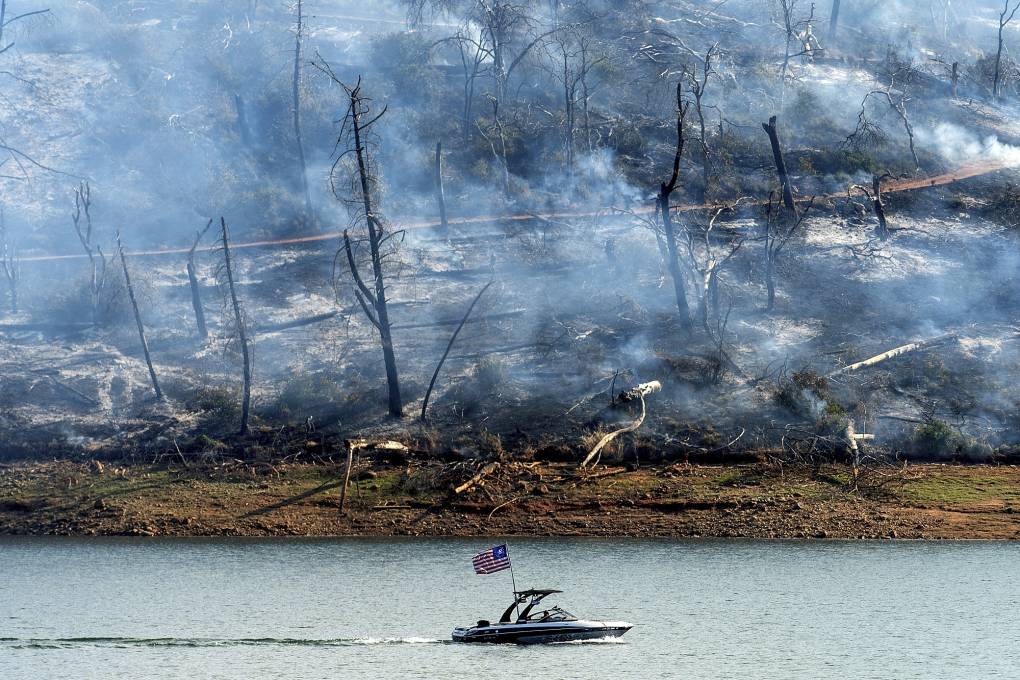
"caption": "A boat crosses Lake Oroville with a smoldering hillside behind as the Thompson Fire burns in Oroville, Butte County, on Wednesday, July 3, 2024. An extended heat wave blanketing Northern California has resulted in red flag fire warnings and power shutoffs. ",
"credit": "Noah Berger/AP Photo",
"altTag": null,
"description": null,
"imgSizes": {
"medium": {
"file": "https://cdn.kqed.org/wp-content/uploads/sites/10/2024/07/ThompsonFireOrovilleAP1-800x533.jpg",
"width": 800,
"height": 533,
"mimeType": "image/jpeg"
},
"large": {
"file": "https://cdn.kqed.org/wp-content/uploads/sites/10/2024/07/ThompsonFireOrovilleAP1-1020x680.jpg",
"width": 1020,
"height": 680,
"mimeType": "image/jpeg"
},
"thumbnail": {
"file": "https://cdn.kqed.org/wp-content/uploads/sites/10/2024/07/ThompsonFireOrovilleAP1-160x107.jpg",
"width": 160,
"height": 107,
"mimeType": "image/jpeg"
},
"1536x1536": {
"file": "https://cdn.kqed.org/wp-content/uploads/sites/10/2024/07/ThompsonFireOrovilleAP1-1536x1024.jpg",
"width": 1536,
"height": 1024,
"mimeType": "image/jpeg"
},
"post-thumbnail": {
"file": "https://cdn.kqed.org/wp-content/uploads/sites/10/2024/07/ThompsonFireOrovilleAP1-672x372.jpg",
"width": 672,
"height": 372,
"mimeType": "image/jpeg"
},
"twentyfourteen-full-width": {
"file": "https://cdn.kqed.org/wp-content/uploads/sites/10/2024/07/ThompsonFireOrovilleAP1-1038x576.jpg",
"width": 1038,
"height": 576,
"mimeType": "image/jpeg"
},
"full-width": {
"file": "https://cdn.kqed.org/wp-content/uploads/sites/10/2024/07/ThompsonFireOrovilleAP1-1920x1280.jpg",
"width": 1920,
"height": 1280,
"mimeType": "image/jpeg"
},
"kqedFullSize": {
"file": "https://cdn.kqed.org/wp-content/uploads/sites/10/2024/07/ThompsonFireOrovilleAP1.jpg",
"width": 2000,
"height": 1333
}
},
"isLoading": false,
"fetchFailed": false
},
"news_11977888": {
"type": "attachments",
"id": "news_11977888",
"meta": {
"index": "attachments_1716263798",
"site": "news",
"id": "11977888",
"found": true
},
"parent": 11977887,
"imgSizes": {
"twentyfourteen-full-width": {
"file": "https://cdn.kqed.org/wp-content/uploads/sites/10/2024/03/GettyImages-2053478673-1024x576.jpg",
"width": 1024,
"mimeType": "image/jpeg",
"height": 576
},
"thumbnail": {
"file": "https://cdn.kqed.org/wp-content/uploads/sites/10/2024/03/GettyImages-2053478673-160x113.jpg",
"width": 160,
"mimeType": "image/jpeg",
"height": 113
},
"post-thumbnail": {
"file": "https://cdn.kqed.org/wp-content/uploads/sites/10/2024/03/GettyImages-2053478673-672x372.jpg",
"width": 672,
"mimeType": "image/jpeg",
"height": 372
},
"kqedFullSize": {
"file": "https://cdn.kqed.org/wp-content/uploads/sites/10/2024/03/GettyImages-2053478673.jpg",
"width": 1024,
"height": 723
},
"large": {
"file": "https://cdn.kqed.org/wp-content/uploads/sites/10/2024/03/GettyImages-2053478673-1020x720.jpg",
"width": 1020,
"mimeType": "image/jpeg",
"height": 720
},
"medium": {
"file": "https://cdn.kqed.org/wp-content/uploads/sites/10/2024/03/GettyImages-2053478673-800x565.jpg",
"width": 800,
"mimeType": "image/jpeg",
"height": 565
}
},
"publishDate": 1709411627,
"modified": 1709411675,
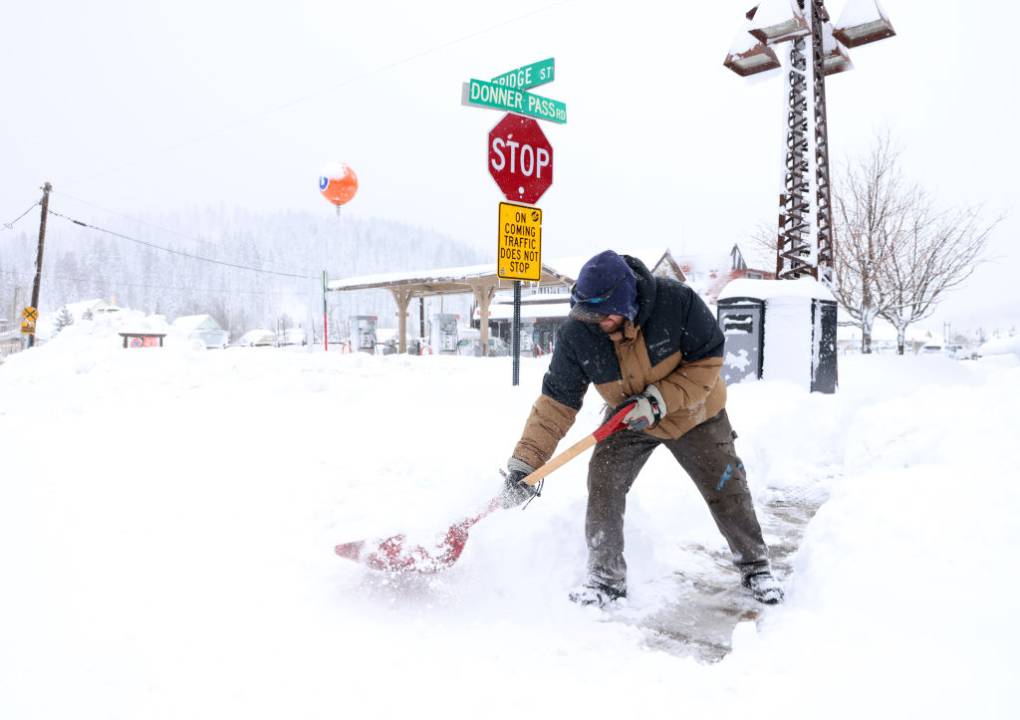
"caption": "Employee Juan Manuel clears snow from in front of Bar of America in downtown Truckee, Nevada County, on Saturday, March 2, 2024.",
"description": null,
"title": "Sierra Nevada Blizzard",
"credit": "Jane Tyska/Digital First Media/East Bay Times via Getty Images",
"status": "inherit",
"altTag": null,
"isLoading": false,
"fetchFailed": false
},
"news_11972325": {
"type": "attachments",
"id": "news_11972325",
"meta": {
"index": "attachments_1716263798",
"site": "news",
"id": "11972325",
"found": true
},
"parent": 11972320,
"imgSizes": {
"twentyfourteen-full-width": {
"file": "https://cdn.kqed.org/wp-content/uploads/sites/10/2024/01/AP24010799079370-1038x576.jpg",
"width": 1038,
"mimeType": "image/jpeg",
"height": 576
},
"thumbnail": {
"file": "https://cdn.kqed.org/wp-content/uploads/sites/10/2024/01/AP24010799079370-160x106.jpg",
"width": 160,
"mimeType": "image/jpeg",
"height": 106
},
"post-thumbnail": {
"file": "https://cdn.kqed.org/wp-content/uploads/sites/10/2024/01/AP24010799079370-672x372.jpg",
"width": 672,
"mimeType": "image/jpeg",
"height": 372
},
"kqedFullSize": {
"file": "https://cdn.kqed.org/wp-content/uploads/sites/10/2024/01/AP24010799079370-scaled.jpg",
"width": 2560,
"height": 1703
},
"2048x2048": {
"file": "https://cdn.kqed.org/wp-content/uploads/sites/10/2024/01/AP24010799079370-2048x1362.jpg",
"width": 2048,
"mimeType": "image/jpeg",
"height": 1362
},
"large": {
"file": "https://cdn.kqed.org/wp-content/uploads/sites/10/2024/01/AP24010799079370-1020x678.jpg",
"width": 1020,
"mimeType": "image/jpeg",
"height": 678
},
"1536x1536": {
"file": "https://cdn.kqed.org/wp-content/uploads/sites/10/2024/01/AP24010799079370-1536x1022.jpg",
"width": 1536,
"mimeType": "image/jpeg",
"height": 1022
},
"full-width": {
"file": "https://cdn.kqed.org/wp-content/uploads/sites/10/2024/01/AP24010799079370-1920x1277.jpg",
"width": 1920,
"mimeType": "image/jpeg",
"height": 1277
},
"medium": {
"file": "https://cdn.kqed.org/wp-content/uploads/sites/10/2024/01/AP24010799079370-800x532.jpg",
"width": 800,
"mimeType": "image/jpeg",
"height": 532
}
},
"publishDate": 1704999519,
"modified": 1705001384,
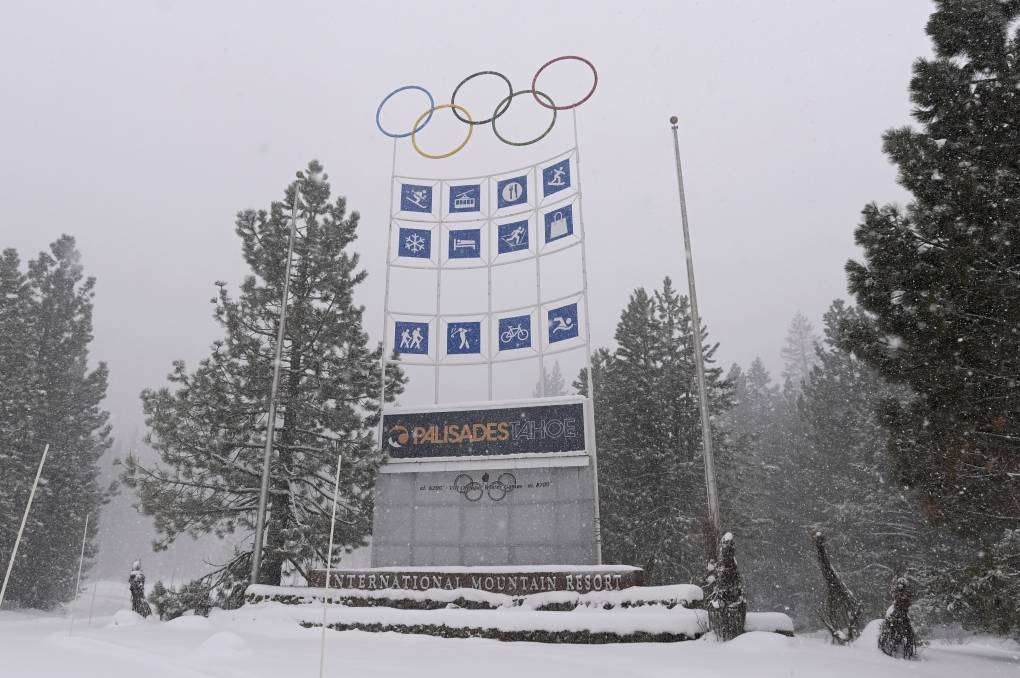
"caption": "The entrance to Palisades Tahoe is shown on Wednesday, Jan. 10, 2024. An avalanche roared through a section of expert trails at the California ski resort on Wednesday, killing one skier and injuring others.",
"description": null,
"title": "California-Avalanche",
"credit": "Andy Barron/AP Photo",
"status": "inherit",
"altTag": "Palisades' sign with the Olympic logo is seen in very snowy, stormy weather.",
"isLoading": false,
"fetchFailed": false
},
"news_11972301": {
"type": "attachments",
"id": "news_11972301",
"meta": {
"index": "attachments_1716263798",
"site": "news",
"id": "11972301",
"found": true
},
"parent": 11972210,
"imgSizes": {
"twentyfourteen-full-width": {
"file": "https://cdn.kqed.org/wp-content/uploads/sites/10/2024/01/AP24010799066572-1024x576.jpg",
"width": 1024,
"mimeType": "image/jpeg",
"height": 576
},
"thumbnail": {
"file": "https://cdn.kqed.org/wp-content/uploads/sites/10/2024/01/AP24010799066572-160x107.jpg",
"width": 160,
"mimeType": "image/jpeg",
"height": 107
},
"post-thumbnail": {
"file": "https://cdn.kqed.org/wp-content/uploads/sites/10/2024/01/AP24010799066572-672x372.jpg",
"width": 672,
"mimeType": "image/jpeg",
"height": 372
},
"kqedFullSize": {
"file": "https://cdn.kqed.org/wp-content/uploads/sites/10/2024/01/AP24010799066572.jpg",
"width": 1024,
"height": 687
},
"large": {
"file": "https://cdn.kqed.org/wp-content/uploads/sites/10/2024/01/AP24010799066572-1020x684.jpg",
"width": 1020,
"mimeType": "image/jpeg",
"height": 684
},
"medium": {
"file": "https://cdn.kqed.org/wp-content/uploads/sites/10/2024/01/AP24010799066572-800x537.jpg",
"width": 800,
"mimeType": "image/jpeg",
"height": 537
}
},
"publishDate": 1704948927,
"modified": 1704949415,
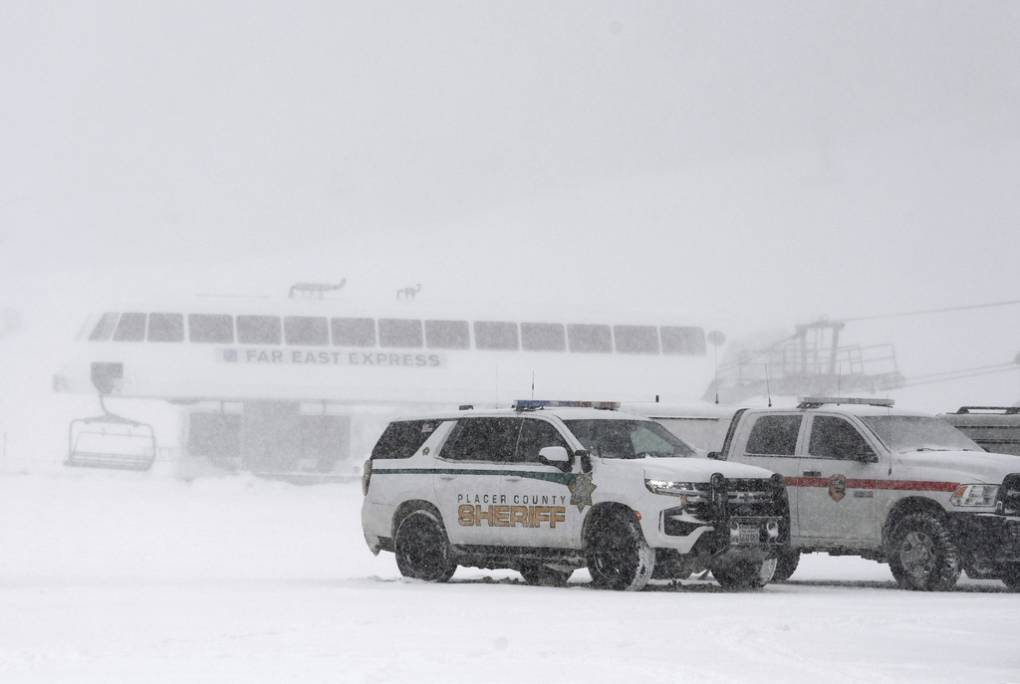
"caption": "Placer County Sheriff vehicles are parked near a ski lift at Palisades Tahoe, where an avalanche killed one person on the morning of Jan. 10, 2024.",
"description": null,
"title": "California Avalanche",
"credit": "Andy Barron/AP",
"status": "inherit",
"altTag": "Several police cars parked in front of a ski lift with snow falling all around.",
"isLoading": false,
"fetchFailed": false
}
},
"audioPlayerReducer": {
"postId": "stream_live",
"isPaused": true,
"isPlaying": false,
"pfsActive": false,
"pledgeModalIsOpen": true,
"playerDrawerIsOpen": false,
"liveAudioPlayStartedAt": 0,
"liveAudioPlayContext": ""
},
"authorsReducer": {
"byline_news_12001792": {
"type": "authors",
"id": "byline_news_12001792",
"meta": {
"override": true
},
"slug": "byline_news_12001792",
"name": "The Associated Press",
"isLoading": false
},
"byline_news_11972320": {
"type": "authors",
"id": "byline_news_11972320",
"meta": {
"override": true
},
"slug": "byline_news_11972320",
"name": "The Associated Press",
"isLoading": false
},
"kqed": {
"type": "authors",
"id": "236",
"meta": {
"index": "authors_1716337520",
"id": "236",
"found": true
},
"name": "KQED News Staff",
"firstName": "KQED News Staff",
"lastName": null,
"slug": "kqed",
"email": "faq@kqed.org",
"display_author_email": false,
"staff_mastheads": [],
"title": null,
"bio": null,
"avatar": "https://secure.gravatar.com/avatar/ef0e801a68c4c54afa9180db14084167?s=600&d=blank&r=g",
"twitter": null,
"facebook": null,
"instagram": null,
"linkedin": null,
"sites": [
{
"site": "arts",
"roles": [
"contributor"
]
},
{
"site": "news",
"roles": [
"editor"
]
},
{
"site": "futureofyou",
"roles": [
"author"
]
}
],
"headData": {
"title": "KQED News Staff | KQED",
"description": null,
"ogImgSrc": "https://secure.gravatar.com/avatar/ef0e801a68c4c54afa9180db14084167?s=600&d=blank&r=g",
"twImgSrc": "https://secure.gravatar.com/avatar/ef0e801a68c4c54afa9180db14084167?s=600&d=blank&r=g"
},
"isLoading": false,
"link": "/author/kqed"
},
"kqednewsstaffandwires": {
"type": "authors",
"id": "237",
"meta": {
"index": "authors_1716337520",
"id": "237",
"found": true
},
"name": "KQED News Staff and Wires",
"firstName": "KQED News Staff and Wires",
"lastName": null,
"slug": "kqednewsstaffandwires",
"email": "onlinenewsstaff@kqed.org",
"display_author_email": false,
"staff_mastheads": [],
"title": null,
"bio": null,
"avatar": "https://secure.gravatar.com/avatar/72295af8ebbfbd19a4948f5271285664?s=600&d=blank&r=g",
"twitter": null,
"facebook": null,
"instagram": null,
"linkedin": null,
"sites": [
{
"site": "arts",
"roles": [
"contributor"
]
},
{
"site": "news",
"roles": [
"contributor"
]
},
{
"site": "lowdown",
"roles": [
"author"
]
},
{
"site": "stateofhealth",
"roles": [
"contributor"
]
},
{
"site": "food",
"roles": [
"author"
]
}
],
"headData": {
"title": "KQED News Staff and Wires | KQED",
"description": null,
"ogImgSrc": "https://secure.gravatar.com/avatar/72295af8ebbfbd19a4948f5271285664?s=600&d=blank&r=g",
"twImgSrc": "https://secure.gravatar.com/avatar/72295af8ebbfbd19a4948f5271285664?s=600&d=blank&r=g"
},
"isLoading": false,
"link": "/author/kqednewsstaffandwires"
},
"kdomara": {
"type": "authors",
"id": "1459",
"meta": {
"index": "authors_1716337520",
"id": "1459",
"found": true
},
"name": "Kelly O'Mara",
"firstName": "Kelly",
"lastName": "O'Mara",
"slug": "kdomara",
"email": "komara@kqed.org",
"display_author_email": false,
"staff_mastheads": [
"news"
],
"title": "KQED Contributor",
"bio": "Kelly O'Mara is a writer and reporter in the San Francisco Bay Area. She writes about food, health, sports, travel, business and California news. Her work has appeared on KQED, online for Outside Magazine, epsnW, VICE and in Competitor Magazine, among others. Follow Kelly on Twitter \u003ca href=\"https://twitter.com/kellydomara\">@kellydomara\u003c/a>.",
"avatar": "https://secure.gravatar.com/avatar/768fec7412028b72f13bdd0f5f9d8186?s=600&d=blank&r=g",
"twitter": null,
"facebook": null,
"instagram": null,
"linkedin": null,
"sites": [
{
"site": "arts",
"roles": []
},
{
"site": "news",
"roles": []
},
{
"site": "bayareabites",
"roles": []
},
{
"site": "stateofhealth",
"roles": []
},
{
"site": "science",
"roles": []
},
{
"site": "checkplease",
"roles": [
"editor"
]
},
{
"site": "food",
"roles": []
},
{
"site": "forum",
"roles": [
"editor"
]
},
{
"site": "liveblog",
"roles": [
"editor"
]
}
],
"headData": {
"title": "Kelly O'Mara | KQED",
"description": "KQED Contributor",
"ogImgSrc": "https://secure.gravatar.com/avatar/768fec7412028b72f13bdd0f5f9d8186?s=600&d=blank&r=g",
"twImgSrc": "https://secure.gravatar.com/avatar/768fec7412028b72f13bdd0f5f9d8186?s=600&d=blank&r=g"
},
"isLoading": false,
"link": "/author/kdomara"
},
"carlysevern": {
"type": "authors",
"id": "3243",
"meta": {
"index": "authors_1716337520",
"id": "3243",
"found": true
},
"name": "Carly Severn",
"firstName": "Carly",
"lastName": "Severn",
"slug": "carlysevern",
"email": "csevern@kqed.org",
"display_author_email": false,
"staff_mastheads": [
"news"
],
"title": "Senior Editor, Audience News ",
"bio": "Carly is KQED's Senior Editor of Audience News on the Digital News team, and has reported for the California Report Magazine, Bay Curious and KQED Arts. She's formerly the host of \u003ca href=\"http://ww2.kqed.org/pop/category/the-cooler/\" rel=\"noopener noreferrer\">The Cooler\u003c/a> podcast.",
"avatar": "https://secure.gravatar.com/avatar/54037bf5c128fe678f0ef26cec97a93f2e7f220a22d7285703328f12c42c1b1d?s=600&d=blank&r=g",
"twitter": "teacupinthebay",
"bluesky": null,
"facebook": null,
"instagram": null,
"linkedin": null,
"sites": [
{
"site": "",
"roles": [
"editor"
]
},
{
"site": "arts",
"roles": [
"editor"
]
},
{
"site": "news",
"roles": [
"administrator"
]
},
{
"site": "pop",
"roles": [
"editor"
]
},
{
"site": "futureofyou",
"roles": [
"editor"
]
},
{
"site": "about",
"roles": [
"administrator"
]
},
{
"site": "mindshift",
"roles": [
"editor"
]
},
{
"site": "bayareabites",
"roles": [
"editor"
]
},
{
"site": "stateofhealth",
"roles": [
"editor"
]
},
{
"site": "science",
"roles": [
"editor"
]
},
{
"site": "food",
"roles": [
"contributor"
]
},
{
"site": "forum",
"roles": [
"editor"
]
},
{
"site": "perspectives",
"roles": [
"administrator"
]
},
{
"site": "liveblog",
"roles": [
"editor"
]
}
],
"headData": {
"title": "Carly Severn | KQED",
"description": "Senior Editor, Audience News ",
"ogImgSrc": "https://secure.gravatar.com/avatar/54037bf5c128fe678f0ef26cec97a93f2e7f220a22d7285703328f12c42c1b1d?s=600&d=blank&r=g",
"twImgSrc": "https://secure.gravatar.com/avatar/54037bf5c128fe678f0ef26cec97a93f2e7f220a22d7285703328f12c42c1b1d?s=600&d=blank&r=g"
},
"isLoading": false,
"link": "/author/carlysevern"
},
"kevinstark": {
"type": "authors",
"id": "11608",
"meta": {
"index": "authors_1716337520",
"id": "11608",
"found": true
},
"name": "Kevin Stark",
"firstName": "Kevin",
"lastName": "Stark",
"slug": "kevinstark",
"email": "kstark@kqed.org",
"display_author_email": true,
"staff_mastheads": [
"science"
],
"title": "Senior Editor",
"bio": "Kevin is a senior editor for KQED Science, managing the station's health and climate desks. His journalism career began in the Pacific Northwest, and he later became a lead reporter for the San Francisco Public Press. His work has appeared in Pacific Standard magazine, the Energy News Network, the Center for Investigative Reporting's Reveal and WBEZ in Chicago. Kevin joined KQED in 2019, and has covered issues related to energy, wildfire, climate change and the environment.",
"avatar": "https://secure.gravatar.com/avatar/365aaa4b597d3a8374f67504ff0facd323d7906e8eb4be0a7efd2427408e802c?s=600&d=blank&r=g",
"twitter": "starkkev",
"bluesky": null,
"facebook": null,
"instagram": null,
"linkedin": null,
"sites": [
{
"site": "",
"roles": [
"editor"
]
},
{
"site": "news",
"roles": [
"editor"
]
},
{
"site": "science",
"roles": [
"administrator"
]
}
],
"headData": {
"title": "Kevin Stark | KQED",
"description": "Senior Editor",
"ogImgSrc": "https://secure.gravatar.com/avatar/365aaa4b597d3a8374f67504ff0facd323d7906e8eb4be0a7efd2427408e802c?s=600&d=blank&r=g",
"twImgSrc": "https://secure.gravatar.com/avatar/365aaa4b597d3a8374f67504ff0facd323d7906e8eb4be0a7efd2427408e802c?s=600&d=blank&r=g"
},
"isLoading": false,
"link": "/author/kevinstark"
},
"kdebenedetti": {
"type": "authors",
"id": "11913",
"meta": {
"index": "authors_1716337520",
"id": "11913",
"found": true
},
"name": "Katie DeBenedetti",
"firstName": "Katie",
"lastName": "DeBenedetti",
"slug": "kdebenedetti",
"email": "kdebenedetti@kqed.org",
"display_author_email": false,
"staff_mastheads": [
"news",
"science"
],
"title": "KQED Contributor",
"bio": "Katie DeBenedetti is a digital reporter covering daily news for the Express Desk. Prior to joining KQED as a culture reporting intern in January 2024, she covered education and city government for the Napa Valley Register.",
"avatar": "https://secure.gravatar.com/avatar/6e31073cb8f7e4214ab03f42771d0f45?s=600&d=blank&r=g",
"twitter": null,
"facebook": null,
"instagram": null,
"linkedin": null,
"sites": [
{
"site": "news",
"roles": [
"author"
]
},
{
"site": "science",
"roles": [
"author"
]
},
{
"site": "liveblog",
"roles": [
"author"
]
}
],
"headData": {
"title": "Katie DeBenedetti | KQED",
"description": "KQED Contributor",
"ogImgSrc": "https://secure.gravatar.com/avatar/6e31073cb8f7e4214ab03f42771d0f45?s=600&d=blank&r=g",
"twImgSrc": "https://secure.gravatar.com/avatar/6e31073cb8f7e4214ab03f42771d0f45?s=600&d=blank&r=g"
},
"isLoading": false,
"link": "/author/kdebenedetti"
},
"bkrans": {
"type": "authors",
"id": "11923",
"meta": {
"index": "authors_1716337520",
"id": "11923",
"found": true
},
"name": "Brian Krans",
"firstName": "Brian",
"lastName": "Krans",
"slug": "bkrans",
"email": "bkrans@kqed.org",
"display_author_email": false,
"staff_mastheads": [
"news"
],
"title": "KQED Contributing Reporter",
"bio": "Brian Krans is an award-winning local news and investigative reporter who has been proudly working as a general assignment reporter for KQED since August 2023. He lives in Richmond, where he also reports on air pollution for Richmondside. He is also a founding member of the Vallejo Sun.",
"avatar": "https://secure.gravatar.com/avatar/71fa91f931774612559f7640390b53d9c2840ff72b20f195a25239aab2d9fbb9?s=600&d=blank&r=g",
"twitter": "citizenkrans",
"bluesky": null,
"facebook": null,
"instagram": null,
"linkedin": null,
"sites": [
{
"site": "news",
"roles": [
"editor"
]
}
],
"headData": {
"title": "Brian Krans | KQED",
"description": "KQED Contributing Reporter",
"ogImgSrc": "https://secure.gravatar.com/avatar/71fa91f931774612559f7640390b53d9c2840ff72b20f195a25239aab2d9fbb9?s=600&d=blank&r=g",
"twImgSrc": "https://secure.gravatar.com/avatar/71fa91f931774612559f7640390b53d9c2840ff72b20f195a25239aab2d9fbb9?s=600&d=blank&r=g"
},
"isLoading": false,
"link": "/author/bkrans"
},
"sarahwright": {
"type": "authors",
"id": "11956",
"meta": {
"index": "authors_1716337520",
"id": "11956",
"found": true
},
"name": "Sarah Wright",
"firstName": "Sarah",
"lastName": "Wright",
"slug": "sarahwright",
"email": "swright@kqed.org",
"display_author_email": true,
"staff_mastheads": [],
"title": "Outdoors Engagement Reporter",
"bio": "Sarah Wright is KQED's Outdoors Engagement Reporter. Originally from Lake Tahoe, she completed a thru-hike of the Pacific Crest Trail in 2019 and was a U.S. Fulbright Program grantee to Argentina in 2023. Her journalism has appeared in The Guardian, The San Francisco Standard, The Palo Alto Weekly and the Half Moon Bay Review.",
"avatar": "https://secure.gravatar.com/avatar/c161a3d6441865cba25e6db4fa561099ad665799e9432e34da2b84d7e371524c?s=600&d=blank&r=g",
"twitter": null,
"bluesky": null,
"facebook": null,
"instagram": null,
"linkedin": null,
"sites": [
{
"site": "arts",
"roles": [
"editor"
]
},
{
"site": "news",
"roles": [
"editor"
]
},
{
"site": "science",
"roles": [
"contributor",
"author"
]
},
{
"site": "forum",
"roles": [
"editor"
]
}
],
"headData": {
"title": "Sarah Wright | KQED",
"description": "Outdoors Engagement Reporter",
"ogImgSrc": "https://secure.gravatar.com/avatar/c161a3d6441865cba25e6db4fa561099ad665799e9432e34da2b84d7e371524c?s=600&d=blank&r=g",
"twImgSrc": "https://secure.gravatar.com/avatar/c161a3d6441865cba25e6db4fa561099ad665799e9432e34da2b84d7e371524c?s=600&d=blank&r=g"
},
"isLoading": false,
"link": "/author/sarahwright"
}
},
"pagesReducer": {
"news_tag_tahoe": {
"type": "terms",
"id": "news_29871",
"meta": {
"index": "terms_1716263798",
"site": "news",
"id": "29871",
"score": 9.105345
},
"featImg": null,
"name": "tahoe",
"description": null,
"taxonomy": "tag",
"headData": {
"twImgId": null,
"twTitle": null,
"ogTitle": null,
"ogImgId": null,
"twDescription": null,
"description": null,
"title": "tahoe Archives | KQED News",
"ogDescription": null
},
"ttid": 29888,
"slug": "tahoe",
"isLoading": false,
"title": "tahoe",
"pageMeta": {
"site": "news",
"WpPageTemplate": "page-topic-editorial",
"currentPage": 2
},
"blocks": [
{
"blockName": "kqed/post-list",
"attrs": {
"layout": "cardArticle2",
"query": "posts/news?tag=tahoe",
"seeMore": false,
"paginated": true,
"page": 2
}
},
{
"blockName": "kqed/ad"
}
]
}
},
"pfsSessionReducer": {},
"postsReducer": {
"stream_live": {
"type": "live",
"id": "stream_live",
"audioUrl": "https://streams.kqed.org/kqedradio",
"title": "Live Stream",
"excerpt": "Live Stream information currently unavailable.",
"link": "/radio",
"featImg": "",
"label": {
"name": "KQED Live",
"link": "/"
}
},
"stream_kqedNewscast": {
"type": "posts",
"id": "stream_kqedNewscast",
"audioUrl": "https://www.kqed.org/.stream/anon/radio/RDnews/newscast.mp3?_=1",
"title": "KQED Newscast",
"featImg": "",
"label": {
"name": "88.5 FM",
"link": "/"
}
},
"news_12073593": {
"type": "posts",
"id": "news_12073593",
"meta": {
"index": "posts_1716263798",
"site": "news",
"id": "12073593",
"score": null,
"sort": [
1771364904000
]
},
"guestAuthors": [],
"slug": "heavy-rain-and-snow-shut-down-roads-across-bay-area-and-sierra-nevada",
"title": "Heavy Rain and Snow Shut Down Roads Across Bay Area and Sierra Nevada",
"publishDate": 1771364904,
"format": "standard",
"headTitle": "Heavy Rain and Snow Shut Down Roads Across Bay Area and Sierra Nevada | KQED",
"labelTerm": {
"site": "news"
},
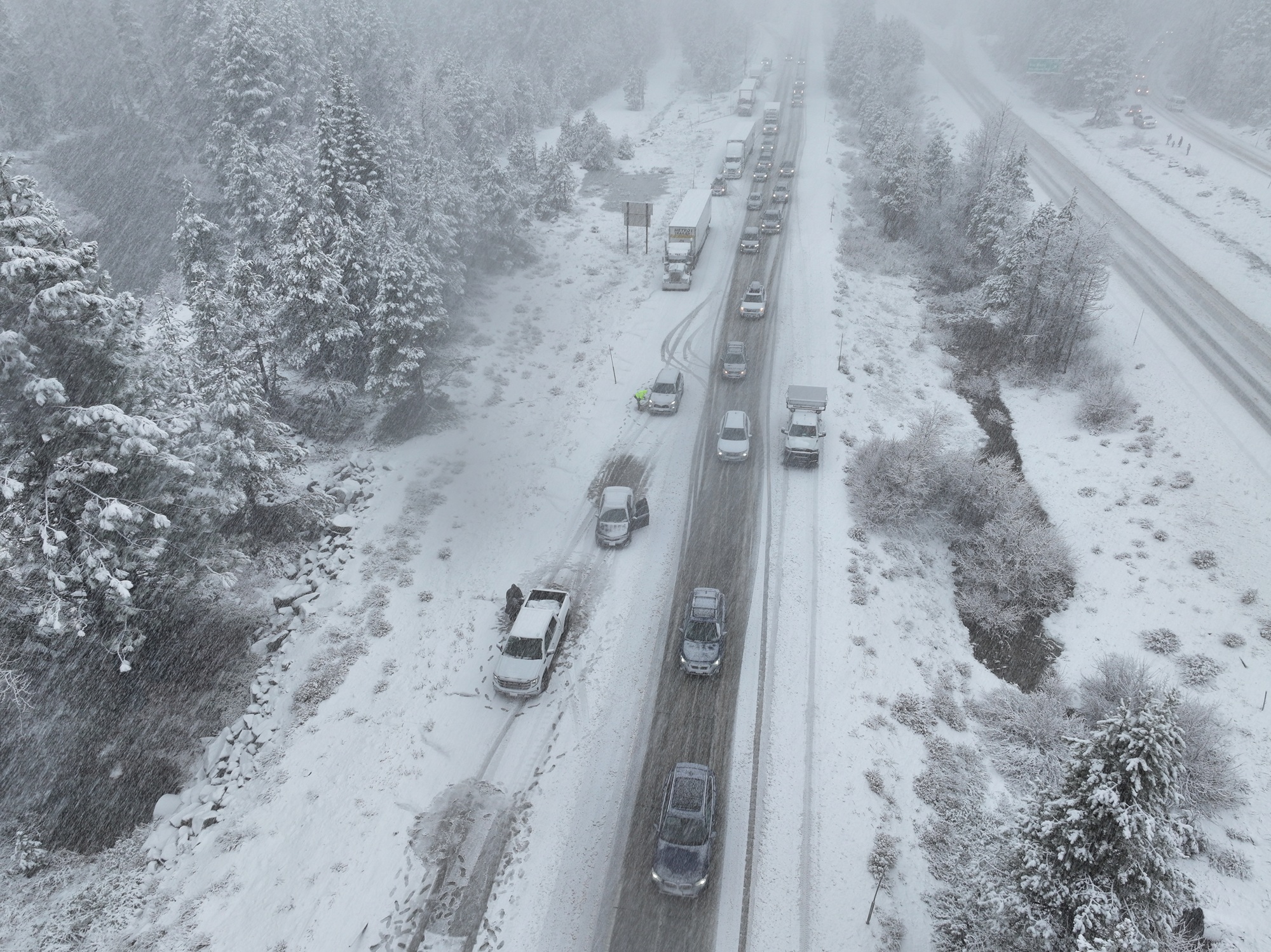
"content": "\u003cp>The \u003ca href=\"https://www.kqed.org/science/2000043/winter-is-coming-storms-soak-bay-area-next-week-drop-2-feet-of-fresh-snow-on-tahoe\">major storm system\u003c/a> passing through Northern California after weeks of dry weather shut down roads across the Bay Area and in the Sierra Nevada on Tuesday morning.\u003c/p>\n\u003cp>As the area braces for more steady rainfall throughout the day, highways in the East Bay and North Bay were flooded in parts, and access to Lake Tahoe was cut off due to inches of rain and snow collected since Monday.\u003c/p>\n\u003cp>The weather \u003ca href=\"https://511.org/alerts/critical\">suspended Golden Gate Ferry\u003c/a> operations to Angel Island, and travel to Tiburon has been rerouted via bus. Trips from San Francisco to Sausalito were suspended until 12:10 p.m. After that, early afternoon travel will be via bus.\u003c/p>\n\u003cp>[ad fullwidth]\u003c/p>\n\u003cp>In Oakland, Interstate 880 northbound was backed up as the offramp on Broadway flooded, according to the Metropolitan Transportation Commission’s \u003ca href=\"https://511.org/\">511 website\u003c/a>. Interstate 580 was also affected by flooding: in the eastbound direction, the right lane and shoulder were closed due to flooding near Grand Avenue, and westbound, the right lane was closed east of 35th Avenue.\u003c/p>\n\u003cul>\n\u003cli style=\"list-style-type: none;\">\n\u003cul>\n\u003cli>\u003cstrong>\u003ca href=\"#Tips\">Jump straight to: Tips for safe driving in the rain and snow\u003c/a>\u003c/strong>\u003c/li>\n\u003c/ul>\n\u003c/li>\n\u003c/ul>\n\u003cp>The city has gotten more than an inch and a half of rain in the last 48 hours, according to the National Weather Service.\u003c/p>\n\u003cp>Farther northeast in Solano County, where there’s also been more than an inch of rainfall since midday Sunday, flooding affected lanes of Highway 38 headed east in Vallejo and Interstate 80 westbound in Fairfield.\u003c/p>\n\u003cfigure id=\"attachment_10366486\" class=\"wp-caption aligncenter\" style=\"max-width: 2000px\">\u003cimg loading=\"lazy\" decoding=\"async\" class=\"size-full wp-image-10366486\" src=\"https://cdn.kqed.org/wp-content/uploads/sites/10/2014/12/459889850-e1771364269475.jpg\" alt=\"\" width=\"2000\" height=\"1360\">\u003cfigcaption class=\"wp-caption-text\">A motorist drives through a flooded intersection on Dec. 3, 2014, in Mill Valley, California. \u003ccite>(Justin Sullivan/Getty Images)\u003c/cite>\u003c/figcaption>\u003c/figure>\n\u003cp>In Sonoma County, where back-to-back storms in December and early January brought \u003ca href=\"https://www.kqed.org/news/12068281/bay-area-braces-for-storm-that-could-become-a-rare-bomb-cyclone-ahead-of-holiday-travel\">significant flooding\u003c/a>, Green Valley Road in Sebastopol was shut down on Tuesday due to flood conditions. In a livestream operated by the county to \u003ca href=\"https://www.youtube.com/watch?v=mcQJUHnWAVA\">show flooding conditions\u003c/a>, water was streaming over the roadway near Sullivan Road and pooling heavily on Tuesday afternoon.\u003c/p>\n\u003cp>“The section between Thomas Road and Sullivan Road is currently closed due to flooding from the recent storm,” county spokesperson Diana Callaway said via email. She said the roadway would reopen when water levels receded, but did not give a time estimate.\u003c/p>\n\u003cp>“Motorists are advised to use alternate routes and avoid driving through flooded areas due to potential debris and water-related hazards,” she said.[aside postID=news_12068981 hero='https://cdn.kqed.org/wp-content/uploads/sites/10/2026/01/Hwy116Getty.jpg']Parts of the county have collected more than 2 inches of rain since Sunday, the NWS reported, and county officials urged residents to limit unnecessary travel and turn around if they come across flooded roadways.\u003c/p>\n\u003cp>In Monterey County, a nearly 7-mile stretch of Highway 1 was closed as crews cleared mud and debris from the roadway after a slide late Monday evening. The Regent’s Slide area in Big Sur — where there were major mudslides in 2023 and 2024 — \u003ca href=\"https://www.kqed.org/news/12069761/californias-highway-1-fully-opens-through-big-sur-years-after-major-landslides\">just reopened in January\u003c/a> after three years of damage repairs.\u003c/p>\n\u003cp>“Crews continue to clear mud from the roadway at Regent’s Slide,” Caltrans said in a post on the social media platform X.\u003c/p>\n\u003cp>As for the mountains, UC Berkeley’s Central Sierra Snow Lab said it best: “It. Is. Dumping,” the lab \u003ca href=\"https://x.com/UCB_CSSL\">posted on X on Tuesday\u003c/a>.\u003c/p>\n\u003cp>Reaching the Sierra won’t be easy — or advised — after Interstate 80 shut down from Colfax in Placer County to the Nevada state line due to snowfall. The Sierra Snow Lab, which is located near Donner Summit, about 50 miles east of Colfax along I-80, reported 28 inches of snow overnight Monday, and predicted another 2-3 feet by Wednesday night.\u003c/p>\n\u003cp>“Anecdotally, the combination of low visibility, intense snowfall, and high winds have created the worst conditions since Feb 2023,” the Berkeley lab said via social media.\u003c/p>\n\u003cfigure id=\"attachment_11980519\" class=\"wp-caption aligncenter\" style=\"max-width: 1920px\">\u003cimg loading=\"lazy\" decoding=\"async\" class=\"size-full wp-image-11980519\" src=\"https://cdn.kqed.org/wp-content/uploads/sites/10/2024/02/GettyImages-1244621245_qut.jpg\" alt=\"\" width=\"1920\" height=\"1280\" srcset=\"https://cdn.kqed.org/wp-content/uploads/sites/10/2024/02/GettyImages-1244621245_qut.jpg 1920w, https://cdn.kqed.org/wp-content/uploads/sites/10/2024/02/GettyImages-1244621245_qut-800x533.jpg 800w, https://cdn.kqed.org/wp-content/uploads/sites/10/2024/02/GettyImages-1244621245_qut-1020x680.jpg 1020w, https://cdn.kqed.org/wp-content/uploads/sites/10/2024/02/GettyImages-1244621245_qut-160x107.jpg 160w, https://cdn.kqed.org/wp-content/uploads/sites/10/2024/02/GettyImages-1244621245_qut-1536x1024.jpg 1536w\" sizes=\"auto, (max-width: 1920px) 100vw, 1920px\">\u003cfigcaption class=\"wp-caption-text\">Snow blanketed South Lake Tahoe in California on Nov. 8, 2022. \u003ccite>(Tayfun Coskun/Anadolu Agency via Getty Images)\u003c/cite>\u003c/figcaption>\u003c/figure>\n\u003cp>Highway 50 to South Lake Tahoe was also closed in El Dorado County, from Pointview Drive in Placerville to Meyers, due to multiple spinouts, and Highway 89 in El Dorado County was closed at Emerald Bay State Park in South Lake.\u003c/p>\n\u003cp>The National Weather Service said that travel throughout the Sierra is “highly discouraged” throughout the day and into the night, as periods of whiteout conditions are likely.\u003c/p>\n\u003cp>Across Northern California, more rain and snow are expected throughout the day, and scattered showers could continue into the rest of the week.\u003c/p>\n\u003cp>In the Sierra, the National Weather Service is forecasting up to 8 feet of snow on peaks above 3,500 feet, while 1-2 feet could accumulate at lower elevations. Some snowfall is predicted at elevations as low as 1,000 feet in the Sierra and Shasta County.\u003c/p>\n\u003ch2>\u003cstrong>\u003ca id=\"Tips\">\u003c/a>Driving safely in rain and strong winds\u003c/strong>\u003c/h2>\n\u003cp>During storms like this, officials typically urge residents to limit unnecessary travel and stay home if at all possible during weather events like these, citing the potential dangers presented by downed trees and power lines in addition to flooding.\u003c/p>\n\u003cp>\u003cstrong>How should I change my driving style during rain and winds?\u003c/strong>\u003c/p>\n\u003cp>If you must drive, do it much more slowly and cautiously than usual, while:\u003c/p>\n\u003cul>\n\u003cli>Using your headlights\u003c/li>\n\u003cli>Turning off cruise control\u003c/li>\n\u003cli>Maintaining a firm grip on the steering wheel\u003c/li>\n\u003cli>Leaving twice as much space between your vehicle and the one in front of it (wet roads might mean it takes longer to stop)\u003c/li>\n\u003cli>Staying alert for debris on the road.\u003c/li>\n\u003c/ul>\n\u003cp>\u003cstrong>What do I do if my car begins to hydroplane on a wet road?\u003c/strong>\u003c/p>\n\u003cul>\n\u003cli>First off, remain calm — and don’t slam on the brakes\u003c/li>\n\u003cli>Ease off the gas\u003c/li>\n\u003cli>Steer in the direction you want to go …\u003c/li>\n\u003cli>… and very lightly pump the brakes until you regain traction.\u003c/li>\n\u003c/ul>\n\u003cp>\u003cstrong>What if I approach a flooded road?\u003c/strong>\u003c/p>\n\u003cp>Always turn around rather than driving through a flooded area — as little as 6 inches of water is enough to disable or stall a small car, while 12 inches can sweep away a vehicle. Don’t assume you know the depth of a pool of water or the conditions of the road underneath it, especially at night.\u003c/p>\n\u003cp>If floodwaters begin to rise around your car, abandon the car and move to higher ground on foot. According to the California Department of Water Resources, more people become trapped and die in their vehicles than anywhere else during a flood.\u003c/p>\n\u003ch2>\u003cstrong>Driving safely in snowy conditions\u003c/strong>\u003c/h2>\n\u003cp>Be sure to take weather warnings for the Sierra Nevada seriously, as winter storms can sometimes make travel virtually impossible — and genuinely dangerous. \u003ca href=\"https://www.kqed.org/news/11937204/lake-tahoe-weather-forecast-road-conditions-snow-chains#snowroadclosures\">Read more on how to check the weather forecast and travel warnings.\u003c/a>\u003c/p>\n\u003cfigure id=\"attachment_11937339\" class=\"wp-caption aligncenter\" style=\"max-width: 1920px\">\u003ca href=\"https://cdn.kqed.org/wp-content/uploads/sites/10/2023/01/RS61930_GettyImages-1244621487-qut.jpg\">\u003cimg loading=\"lazy\" decoding=\"async\" class=\"size-full wp-image-11937339\" src=\"https://cdn.kqed.org/wp-content/uploads/sites/10/2023/01/RS61930_GettyImages-1244621487-qut.jpg\" alt=\"\" width=\"1920\" height=\"1280\" srcset=\"https://cdn.kqed.org/wp-content/uploads/sites/10/2023/01/RS61930_GettyImages-1244621487-qut.jpg 1920w, https://cdn.kqed.org/wp-content/uploads/sites/10/2023/01/RS61930_GettyImages-1244621487-qut-800x533.jpg 800w, https://cdn.kqed.org/wp-content/uploads/sites/10/2023/01/RS61930_GettyImages-1244621487-qut-1020x680.jpg 1020w, https://cdn.kqed.org/wp-content/uploads/sites/10/2023/01/RS61930_GettyImages-1244621487-qut-160x107.jpg 160w, https://cdn.kqed.org/wp-content/uploads/sites/10/2023/01/RS61930_GettyImages-1244621487-qut-1536x1024.jpg 1536w\" sizes=\"auto, (max-width: 1920px) 100vw, 1920px\">\u003c/a>\u003cfigcaption class=\"wp-caption-text\">A snowplow clears debris from the road to Stateline, Nevada on Nov. 8, 2022. A winter Storm warning in is effect for Lake Tahoe and the Sierra Nevada. \u003ccite>(Tayfun Coskun/Anadolu Agency via Getty Images)\u003c/cite>\u003c/figcaption>\u003c/figure>\n\u003cp>If you must drive in these conditions:\u003c/p>\n\u003cp>\u003cstrong>Carry chains\u003c/strong>\u003c/p>\n\u003cp>In addition to making sure your vehicle’s in good working order (including brakes, wipers and heater), you’ll need to carry chains, which are fitted onto the tires of a vehicle’s drive wheels to offer more traction on snowy and icy roads. \u003ca href=\"https://www.kqed.org/news/11937204/lake-tahoe-weather-forecast-road-conditions-snow-chains#chaincontroltahoe\">Read more about when chain control is declared in the Tahoe region and how to fit chains onto your car.\u003c/a>\u003c/p>\n\u003cp>\u003cstrong>Fuel up\u003c/strong>\u003c/p>\n\u003cp>Make sure you also have as much fuel as possible at all times, as you could be delayed or even held on the road, which will burn up the fuel in your tank. Gaining elevation as you ascend into the mountains will also use more gas.\u003c/p>\n\u003cp>\u003cstrong>Use Caltrans’ QuickMap \u003c/strong>\u003c/p>\n\u003cp>Caltrans’ \u003ca href=\"https://quickmap.dot.ca.gov/QM/app.htm\">QuickMap app (available on the App Store and Google Play)\u003c/a>, and also in \u003ca href=\"https://quickmap.dot.ca.gov/\">web form,\u003c/a> will show you the latest road conditions and travel information, including chain controls, snowplows on the roads and closures.\u003c/p>\n\u003cp>\u003cstrong>Pack for getting stuck\u003c/strong>\u003c/p>\n\u003cp>Make sure your vehicles contains emergency items including:\u003c/p>\n\u003cul>\n\u003cli>Food and water\u003c/li>\n\u003cli>Warm blankets\u003c/li>\n\u003cli>Extra clothing\u003c/li>\n\u003cli>A shovel, in case you need to dig your vehicle out of snow\u003c/li>\n\u003cli>An ice scraper.\u003c/li>\n\u003c/ul>\n\u003cp>\u003cstrong>Take it slow\u003c/strong>\u003c/p>\n\u003cp>You’ll see the words “Ice and snow, take it slow” on road signs in Tahoe, and you should heed the advice — especially in areas with chain control, which is in effect for a reason.\u003c/p>\n\u003cp>Leave far more braking distance between you and the car ahead than you normally would. If cars behind you are clearly trying to go much faster than you, pull over when it’s safe to do so, and let them pass. Read \u003ca href=\"https://dot.ca.gov/travel/winter-driving-tips\">Caltrans’ list of winter driving tips\u003c/a>.\u003c/p>\n\u003cp>\u003cstrong>Know how to correct a skid\u003c/strong>\u003c/p>\n\u003cp>There are \u003ca href=\"https://www.youtube.com/results?search_query=how+to+get+out+of+skid\">many video tutorials online demonstrating how to control and correct a skid\u003c/a>. It’s a good idea to watch a few of them so you can see what the advice for correcting a skid — \u003ca href=\"https://www.aarp.org/auto/driver-safety/the-car-skids-what-you-should-do/\">take your feet off the pedals and turn into the direction you want to go\u003c/a> — looks like in action.\u003c/p>\n\u003cp>Be aware of the ice risk especially posed by roads that are shaded by the sun — and also on \u003ca href=\"https://www.forbes.com/sites/marshallshepherd/2017/12/19/the-science-of-why-bridges-ice-before-roads/?sh=194a49857cd0\">bridges, which freeze faster than the road before and after them\u003c/a> owing to the air underneath.\u003c/p>\n\u003cp>\u003cem>This story contains reporting by KQED’s \u003c/em>\u003ca href=\"https://www.kqed.org/author/ccabreralomeli\">\u003cem>Carlos Cabrera-Lomelí\u003c/em>\u003c/a>\u003cem> and \u003c/em>\u003ca href=\"https://www.kqed.org/author/esilvers\">\u003cem>Emma Silvers\u003c/em>\u003c/a>\u003cem>.\u003c/em>\u003c/p>\n\u003cp>[ad floatright]\u003c/p>\n",
"blocks": [],
"excerpt": "A major storm system passing through Northern California is bringing significant disruptions to travel, including what officials called the worst conditions over Donner Pass in years.",
"status": "publish",
"parent": 0,
"modified": 1771377514,
"stats": {
"hasAudio": false,
"hasVideo": false,
"hasChartOrMap": false,
"iframeSrcs": [],
"hasGoogleForm": false,
"hasGallery": false,
"hasHearkenModule": false,
"hasPolis": false,
"paragraphCount": 44,
"wordCount": 1562
},
"headData": {
"title": "Heavy Rain and Snow Shut Down Roads Across Bay Area and Sierra Nevada | KQED",
"description": "A major storm system passing through Northern California is bringing significant disruptions to travel, including what officials called the worst conditions over Donner Pass in years.",
"ogTitle": "",
"ogDescription": "",
"ogImgId": "",
"twTitle": "",
"twDescription": "",
"twImgId": "",
"schema": {
"@context": "https://schema.org",
"@type": "NewsArticle",
"headline": "Heavy Rain and Snow Shut Down Roads Across Bay Area and Sierra Nevada",
"datePublished": "2026-02-17T13:48:24-08:00",
"dateModified": "2026-02-17T17:18:34-08:00",
"image": "https://cdn.kqed.org/wp-content/uploads/2020/02/KQED-OG-Image@1x.png",
"isAccessibleForFree": "True",
"publisher": {
"@type": "NewsMediaOrganization",
"@id": "https://www.kqed.org/#organization",
"name": "KQED",
"logo": "https://cdn.kqed.org/wp-content/uploads/2020/02/KQED-OG-Image@1x.png",
"url": "https://www.kqed.org",
"sameAs": [
"https://www.facebook.com/KQED",
"https://twitter.com/KQED",
"https://www.instagram.com/kqed/",
"https://www.tiktok.com/@kqedofficial",
"https://www.linkedin.com/company/kqed",
"https://www.youtube.com/channel/UCeC0IOo7i1P_61zVUWbJ4nw"
]
}
}
},
"primaryCategory": {
"termId": 34165,
"slug": "climate",
"name": "Climate"
},
"sticky": false,
"nprStoryId": "kqed-12073593",
"templateType": "standard",
"featuredImageType": "standard",
"excludeFromSiteSearch": "Include",
"articleAge": "0",
"path": "/news/12073593/heavy-rain-and-snow-shut-down-roads-across-bay-area-and-sierra-nevada",
"audioTrackLength": null,
"parsedContent": [
{
"type": "contentString",
"content": "\u003cdiv class=\"post-body\">\u003cp>\u003cp>The \u003ca href=\"https://www.kqed.org/science/2000043/winter-is-coming-storms-soak-bay-area-next-week-drop-2-feet-of-fresh-snow-on-tahoe\">major storm system\u003c/a> passing through Northern California after weeks of dry weather shut down roads across the Bay Area and in the Sierra Nevada on Tuesday morning.\u003c/p>\n\u003cp>As the area braces for more steady rainfall throughout the day, highways in the East Bay and North Bay were flooded in parts, and access to Lake Tahoe was cut off due to inches of rain and snow collected since Monday.\u003c/p>\n\u003cp>The weather \u003ca href=\"https://511.org/alerts/critical\">suspended Golden Gate Ferry\u003c/a> operations to Angel Island, and travel to Tiburon has been rerouted via bus. Trips from San Francisco to Sausalito were suspended until 12:10 p.m. After that, early afternoon travel will be via bus.\u003c/p>\n\u003cp>\u003c/p>\u003c/div>",
"attributes": {
"named": {},
"numeric": []
}
},
{
"type": "component",
"content": "",
"name": "ad",
"attributes": {
"named": {
"label": "fullwidth"
},
"numeric": [
"fullwidth"
]
}
},
{
"type": "contentString",
"content": "\u003cdiv class=\"post-body\">\u003cp>\u003c/p>\n\u003cp>In Oakland, Interstate 880 northbound was backed up as the offramp on Broadway flooded, according to the Metropolitan Transportation Commission’s \u003ca href=\"https://511.org/\">511 website\u003c/a>. Interstate 580 was also affected by flooding: in the eastbound direction, the right lane and shoulder were closed due to flooding near Grand Avenue, and westbound, the right lane was closed east of 35th Avenue.\u003c/p>\n\u003cul>\n\u003cli style=\"list-style-type: none;\">\n\u003cul>\n\u003cli>\u003cstrong>\u003ca href=\"#Tips\">Jump straight to: Tips for safe driving in the rain and snow\u003c/a>\u003c/strong>\u003c/li>\n\u003c/ul>\n\u003c/li>\n\u003c/ul>\n\u003cp>The city has gotten more than an inch and a half of rain in the last 48 hours, according to the National Weather Service.\u003c/p>\n\u003cp>Farther northeast in Solano County, where there’s also been more than an inch of rainfall since midday Sunday, flooding affected lanes of Highway 38 headed east in Vallejo and Interstate 80 westbound in Fairfield.\u003c/p>\n\u003cfigure id=\"attachment_10366486\" class=\"wp-caption aligncenter\" style=\"max-width: 2000px\">\u003cimg loading=\"lazy\" decoding=\"async\" class=\"size-full wp-image-10366486\" src=\"https://cdn.kqed.org/wp-content/uploads/sites/10/2014/12/459889850-e1771364269475.jpg\" alt=\"\" width=\"2000\" height=\"1360\">\u003cfigcaption class=\"wp-caption-text\">A motorist drives through a flooded intersection on Dec. 3, 2014, in Mill Valley, California. \u003ccite>(Justin Sullivan/Getty Images)\u003c/cite>\u003c/figcaption>\u003c/figure>\n\u003cp>In Sonoma County, where back-to-back storms in December and early January brought \u003ca href=\"https://www.kqed.org/news/12068281/bay-area-braces-for-storm-that-could-become-a-rare-bomb-cyclone-ahead-of-holiday-travel\">significant flooding\u003c/a>, Green Valley Road in Sebastopol was shut down on Tuesday due to flood conditions. In a livestream operated by the county to \u003ca href=\"https://www.youtube.com/watch?v=mcQJUHnWAVA\">show flooding conditions\u003c/a>, water was streaming over the roadway near Sullivan Road and pooling heavily on Tuesday afternoon.\u003c/p>\n\u003cp>“The section between Thomas Road and Sullivan Road is currently closed due to flooding from the recent storm,” county spokesperson Diana Callaway said via email. She said the roadway would reopen when water levels receded, but did not give a time estimate.\u003c/p>\n\u003cp>“Motorists are advised to use alternate routes and avoid driving through flooded areas due to potential debris and water-related hazards,” she said.\u003c/p>\u003c/div>",
"attributes": {
"named": {},
"numeric": []
}
},
{
"type": "component",
"content": "",
"name": "aside",
"attributes": {
"named": {
"postid": "news_12068981",
"hero": "https://cdn.kqed.org/wp-content/uploads/sites/10/2026/01/Hwy116Getty.jpg",
"label": ""
},
"numeric": []
}
},
{
"type": "contentString",
"content": "\u003cdiv class=\"post-body\">\u003cp>Parts of the county have collected more than 2 inches of rain since Sunday, the NWS reported, and county officials urged residents to limit unnecessary travel and turn around if they come across flooded roadways.\u003c/p>\n\u003cp>In Monterey County, a nearly 7-mile stretch of Highway 1 was closed as crews cleared mud and debris from the roadway after a slide late Monday evening. The Regent’s Slide area in Big Sur — where there were major mudslides in 2023 and 2024 — \u003ca href=\"https://www.kqed.org/news/12069761/californias-highway-1-fully-opens-through-big-sur-years-after-major-landslides\">just reopened in January\u003c/a> after three years of damage repairs.\u003c/p>\n\u003cp>“Crews continue to clear mud from the roadway at Regent’s Slide,” Caltrans said in a post on the social media platform X.\u003c/p>\n\u003cp>As for the mountains, UC Berkeley’s Central Sierra Snow Lab said it best: “It. Is. Dumping,” the lab \u003ca href=\"https://x.com/UCB_CSSL\">posted on X on Tuesday\u003c/a>.\u003c/p>\n\u003cp>Reaching the Sierra won’t be easy — or advised — after Interstate 80 shut down from Colfax in Placer County to the Nevada state line due to snowfall. The Sierra Snow Lab, which is located near Donner Summit, about 50 miles east of Colfax along I-80, reported 28 inches of snow overnight Monday, and predicted another 2-3 feet by Wednesday night.\u003c/p>\n\u003cp>“Anecdotally, the combination of low visibility, intense snowfall, and high winds have created the worst conditions since Feb 2023,” the Berkeley lab said via social media.\u003c/p>\n\u003cfigure id=\"attachment_11980519\" class=\"wp-caption aligncenter\" style=\"max-width: 1920px\">\u003cimg loading=\"lazy\" decoding=\"async\" class=\"size-full wp-image-11980519\" src=\"https://cdn.kqed.org/wp-content/uploads/sites/10/2024/02/GettyImages-1244621245_qut.jpg\" alt=\"\" width=\"1920\" height=\"1280\" srcset=\"https://cdn.kqed.org/wp-content/uploads/sites/10/2024/02/GettyImages-1244621245_qut.jpg 1920w, https://cdn.kqed.org/wp-content/uploads/sites/10/2024/02/GettyImages-1244621245_qut-800x533.jpg 800w, https://cdn.kqed.org/wp-content/uploads/sites/10/2024/02/GettyImages-1244621245_qut-1020x680.jpg 1020w, https://cdn.kqed.org/wp-content/uploads/sites/10/2024/02/GettyImages-1244621245_qut-160x107.jpg 160w, https://cdn.kqed.org/wp-content/uploads/sites/10/2024/02/GettyImages-1244621245_qut-1536x1024.jpg 1536w\" sizes=\"auto, (max-width: 1920px) 100vw, 1920px\">\u003cfigcaption class=\"wp-caption-text\">Snow blanketed South Lake Tahoe in California on Nov. 8, 2022. \u003ccite>(Tayfun Coskun/Anadolu Agency via Getty Images)\u003c/cite>\u003c/figcaption>\u003c/figure>\n\u003cp>Highway 50 to South Lake Tahoe was also closed in El Dorado County, from Pointview Drive in Placerville to Meyers, due to multiple spinouts, and Highway 89 in El Dorado County was closed at Emerald Bay State Park in South Lake.\u003c/p>\n\u003cp>The National Weather Service said that travel throughout the Sierra is “highly discouraged” throughout the day and into the night, as periods of whiteout conditions are likely.\u003c/p>\n\u003cp>Across Northern California, more rain and snow are expected throughout the day, and scattered showers could continue into the rest of the week.\u003c/p>\n\u003cp>In the Sierra, the National Weather Service is forecasting up to 8 feet of snow on peaks above 3,500 feet, while 1-2 feet could accumulate at lower elevations. Some snowfall is predicted at elevations as low as 1,000 feet in the Sierra and Shasta County.\u003c/p>\n\u003ch2>\u003cstrong>\u003ca id=\"Tips\">\u003c/a>Driving safely in rain and strong winds\u003c/strong>\u003c/h2>\n\u003cp>During storms like this, officials typically urge residents to limit unnecessary travel and stay home if at all possible during weather events like these, citing the potential dangers presented by downed trees and power lines in addition to flooding.\u003c/p>\n\u003cp>\u003cstrong>How should I change my driving style during rain and winds?\u003c/strong>\u003c/p>\n\u003cp>If you must drive, do it much more slowly and cautiously than usual, while:\u003c/p>\n\u003cul>\n\u003cli>Using your headlights\u003c/li>\n\u003cli>Turning off cruise control\u003c/li>\n\u003cli>Maintaining a firm grip on the steering wheel\u003c/li>\n\u003cli>Leaving twice as much space between your vehicle and the one in front of it (wet roads might mean it takes longer to stop)\u003c/li>\n\u003cli>Staying alert for debris on the road.\u003c/li>\n\u003c/ul>\n\u003cp>\u003cstrong>What do I do if my car begins to hydroplane on a wet road?\u003c/strong>\u003c/p>\n\u003cul>\n\u003cli>First off, remain calm — and don’t slam on the brakes\u003c/li>\n\u003cli>Ease off the gas\u003c/li>\n\u003cli>Steer in the direction you want to go …\u003c/li>\n\u003cli>… and very lightly pump the brakes until you regain traction.\u003c/li>\n\u003c/ul>\n\u003cp>\u003cstrong>What if I approach a flooded road?\u003c/strong>\u003c/p>\n\u003cp>Always turn around rather than driving through a flooded area — as little as 6 inches of water is enough to disable or stall a small car, while 12 inches can sweep away a vehicle. Don’t assume you know the depth of a pool of water or the conditions of the road underneath it, especially at night.\u003c/p>\n\u003cp>If floodwaters begin to rise around your car, abandon the car and move to higher ground on foot. According to the California Department of Water Resources, more people become trapped and die in their vehicles than anywhere else during a flood.\u003c/p>\n\u003ch2>\u003cstrong>Driving safely in snowy conditions\u003c/strong>\u003c/h2>\n\u003cp>Be sure to take weather warnings for the Sierra Nevada seriously, as winter storms can sometimes make travel virtually impossible — and genuinely dangerous. \u003ca href=\"https://www.kqed.org/news/11937204/lake-tahoe-weather-forecast-road-conditions-snow-chains#snowroadclosures\">Read more on how to check the weather forecast and travel warnings.\u003c/a>\u003c/p>\n\u003cfigure id=\"attachment_11937339\" class=\"wp-caption aligncenter\" style=\"max-width: 1920px\">\u003ca href=\"https://cdn.kqed.org/wp-content/uploads/sites/10/2023/01/RS61930_GettyImages-1244621487-qut.jpg\">\u003cimg loading=\"lazy\" decoding=\"async\" class=\"size-full wp-image-11937339\" src=\"https://cdn.kqed.org/wp-content/uploads/sites/10/2023/01/RS61930_GettyImages-1244621487-qut.jpg\" alt=\"\" width=\"1920\" height=\"1280\" srcset=\"https://cdn.kqed.org/wp-content/uploads/sites/10/2023/01/RS61930_GettyImages-1244621487-qut.jpg 1920w, https://cdn.kqed.org/wp-content/uploads/sites/10/2023/01/RS61930_GettyImages-1244621487-qut-800x533.jpg 800w, https://cdn.kqed.org/wp-content/uploads/sites/10/2023/01/RS61930_GettyImages-1244621487-qut-1020x680.jpg 1020w, https://cdn.kqed.org/wp-content/uploads/sites/10/2023/01/RS61930_GettyImages-1244621487-qut-160x107.jpg 160w, https://cdn.kqed.org/wp-content/uploads/sites/10/2023/01/RS61930_GettyImages-1244621487-qut-1536x1024.jpg 1536w\" sizes=\"auto, (max-width: 1920px) 100vw, 1920px\">\u003c/a>\u003cfigcaption class=\"wp-caption-text\">A snowplow clears debris from the road to Stateline, Nevada on Nov. 8, 2022. A winter Storm warning in is effect for Lake Tahoe and the Sierra Nevada. \u003ccite>(Tayfun Coskun/Anadolu Agency via Getty Images)\u003c/cite>\u003c/figcaption>\u003c/figure>\n\u003cp>If you must drive in these conditions:\u003c/p>\n\u003cp>\u003cstrong>Carry chains\u003c/strong>\u003c/p>\n\u003cp>In addition to making sure your vehicle’s in good working order (including brakes, wipers and heater), you’ll need to carry chains, which are fitted onto the tires of a vehicle’s drive wheels to offer more traction on snowy and icy roads. \u003ca href=\"https://www.kqed.org/news/11937204/lake-tahoe-weather-forecast-road-conditions-snow-chains#chaincontroltahoe\">Read more about when chain control is declared in the Tahoe region and how to fit chains onto your car.\u003c/a>\u003c/p>\n\u003cp>\u003cstrong>Fuel up\u003c/strong>\u003c/p>\n\u003cp>Make sure you also have as much fuel as possible at all times, as you could be delayed or even held on the road, which will burn up the fuel in your tank. Gaining elevation as you ascend into the mountains will also use more gas.\u003c/p>\n\u003cp>\u003cstrong>Use Caltrans’ QuickMap \u003c/strong>\u003c/p>\n\u003cp>Caltrans’ \u003ca href=\"https://quickmap.dot.ca.gov/QM/app.htm\">QuickMap app (available on the App Store and Google Play)\u003c/a>, and also in \u003ca href=\"https://quickmap.dot.ca.gov/\">web form,\u003c/a> will show you the latest road conditions and travel information, including chain controls, snowplows on the roads and closures.\u003c/p>\n\u003cp>\u003cstrong>Pack for getting stuck\u003c/strong>\u003c/p>\n\u003cp>Make sure your vehicles contains emergency items including:\u003c/p>\n\u003cul>\n\u003cli>Food and water\u003c/li>\n\u003cli>Warm blankets\u003c/li>\n\u003cli>Extra clothing\u003c/li>\n\u003cli>A shovel, in case you need to dig your vehicle out of snow\u003c/li>\n\u003cli>An ice scraper.\u003c/li>\n\u003c/ul>\n\u003cp>\u003cstrong>Take it slow\u003c/strong>\u003c/p>\n\u003cp>You’ll see the words “Ice and snow, take it slow” on road signs in Tahoe, and you should heed the advice — especially in areas with chain control, which is in effect for a reason.\u003c/p>\n\u003cp>Leave far more braking distance between you and the car ahead than you normally would. If cars behind you are clearly trying to go much faster than you, pull over when it’s safe to do so, and let them pass. Read \u003ca href=\"https://dot.ca.gov/travel/winter-driving-tips\">Caltrans’ list of winter driving tips\u003c/a>.\u003c/p>\n\u003cp>\u003cstrong>Know how to correct a skid\u003c/strong>\u003c/p>\n\u003cp>There are \u003ca href=\"https://www.youtube.com/results?search_query=how+to+get+out+of+skid\">many video tutorials online demonstrating how to control and correct a skid\u003c/a>. It’s a good idea to watch a few of them so you can see what the advice for correcting a skid — \u003ca href=\"https://www.aarp.org/auto/driver-safety/the-car-skids-what-you-should-do/\">take your feet off the pedals and turn into the direction you want to go\u003c/a> — looks like in action.\u003c/p>\n\u003cp>Be aware of the ice risk especially posed by roads that are shaded by the sun — and also on \u003ca href=\"https://www.forbes.com/sites/marshallshepherd/2017/12/19/the-science-of-why-bridges-ice-before-roads/?sh=194a49857cd0\">bridges, which freeze faster than the road before and after them\u003c/a> owing to the air underneath.\u003c/p>\n\u003cp>\u003cem>This story contains reporting by KQED’s \u003c/em>\u003ca href=\"https://www.kqed.org/author/ccabreralomeli\">\u003cem>Carlos Cabrera-Lomelí\u003c/em>\u003c/a>\u003cem> and \u003c/em>\u003ca href=\"https://www.kqed.org/author/esilvers\">\u003cem>Emma Silvers\u003c/em>\u003c/a>\u003cem>.\u003c/em>\u003c/p>\n\u003cp>\u003c/p>\u003c/div>",
"attributes": {
"named": {},
"numeric": []
}
},
{
"type": "component",
"content": "",
"name": "ad",
"attributes": {
"named": {
"label": "floatright"
},
"numeric": [
"floatright"
]
}
},
{
"type": "contentString",
"content": "\u003cdiv class=\"post-body\">\u003cp>\u003c/p>\n\u003c/div>\u003c/p>",
"attributes": {
"named": {},
"numeric": []
}
}
],
"link": "/news/12073593/heavy-rain-and-snow-shut-down-roads-across-bay-area-and-sierra-nevada",
"authors": [
"11913",
"3243"
],
"categories": [
"news_31795",
"news_34165",
"news_8"
],
"tags": [
"news_32707",
"news_1386",
"news_34945",
"news_19204",
"news_27626",
"news_1430",
"news_465",
"news_30125",
"news_4747",
"news_466",
"news_29871",
"news_3"
],
"featImg": "news_12073622",
"label": "news"
},
"news_12073376": {
"type": "posts",
"id": "news_12073376",
"meta": {
"index": "posts_1716263798",
"site": "news",
"id": "12073376",
"score": null,
"sort": [
1771243229000
]
},
"guestAuthors": [],
"slug": "winter-cabins-to-rent-near-san-francisco-bay-area-tahoe-mendocino-sonoma",
"title": "How to Do a Cozy Winter Cabin Getaway Near the Bay Area — on a Budget",
"publishDate": 1771243229,
"format": "standard",
"headTitle": "How to Do a Cozy Winter Cabin Getaway Near the Bay Area — on a Budget | KQED",
"labelTerm": {
"site": "news"
},
"content": "\u003cp>At this time of year, when the holidays have passed, but \u003ca href=\"https://www.kqed.org/news/12069084/bay-area-faces-first-ever-extreme-cold-warning-as-temperatures-plunge-overnight\">cold weather still endures\u003c/a>, you may be craving a cozy cabin getaway.\u003c/p>\n\u003cp>However, one look at Airbnb and VRBO prices often reveals that your average “winter wonderland cabin” \u003ca href=\"https://www.kqed.org/news/12064955/is-it-possible-to-ski-tahoe-without-spending-a-fortune\">might not be in your budget\u003c/a>.\u003c/p>\n\u003cp>But here’s the deal: If you’re willing to embrace adventure and rough it in a more primitive-style lodging, you’ll find some pretty unique, scenic \u003cem>and \u003c/em>affordable options when it comes to winter cabins. All it takes is a little bit of preparation and willingness to go off the beaten path.\u003c/p>\n\u003cp>[ad fullwidth]\u003c/p>\n\u003cp>Whether you’re seeking an adventurous outing to the Sierra Nevada backcountry or an unplugged retreat in Wine Country, we did the research on lower-cost winter cabins so you don’t have to.\u003c/p>\n\u003cp>Just be aware: Most of these cabins have no electricity and few amenities — including cell service — which is, of course, part of the point. So roll up with your most intrepid friends and any luxuries you might want with you, and embrace the quiet of a cozy weekend away.\u003c/p>\n\u003cp>\u003cstrong>Jump straight to:\u003c/strong>\u003c/p>\n\u003cul>\n\u003cli>\u003cstrong>\u003ca href=\"#Agetawayintheredwoods\">A getaway in the redwoods\u003c/a>\u003c/strong>\u003c/li>\n\u003cli>\u003cstrong>\u003ca href=\"#AsummitstayinTahoe\">A summit stay in Tahoe\u003c/a>\u003c/strong>\u003c/li>\n\u003cli>\u003cstrong>\u003ca href=\"#Anoceansidehostel\">An oceanside hostel\u003c/a>\u003c/strong>\u003c/li>\n\u003c/ul>\n\u003ch2>Soak in Sonoma County with a lakeside retreat\u003c/h2>\n\u003cp>If you’re looking for a still-accessible, slightly off-the-grid experience, \u003ca href=\"https://parks.sonomacounty.ca.gov/visit/find-a-park/spring-lake-regional-park\">Spring Lake Regional Park\u003c/a> in Sonoma County might be the spot.\u003c/p>\n\u003cp>Located along Spring Lake in Santa Rosa, the park has \u003ca href=\"https://parks.sonomacounty.ca.gov/play/camping/cabins\">three cabins\u003c/a> — one of which is fully wheelchair accessible — for a winter escape that’ll get you out of your house and in nature without \u003cem>too \u003c/em>much adventure.\u003c/p>\n\u003cp>Sarah Campbell, spokesperson for Sonoma County Regional Parks, said its proximity to the city of Santa Rosa makes it easy to visit without much advanced planning.\u003c/p>\n\u003cfigure id=\"attachment_12073401\" class=\"wp-caption aligncenter\" style=\"max-width: 2000px\">\u003cimg loading=\"lazy\" decoding=\"async\" class=\"size-full wp-image-12073401\" src=\"https://cdn.kqed.org/wp-content/uploads/sites/10/2026/02/Spring-Lake-cabin-with-campfire_resized.jpg\" alt=\"\" width=\"2000\" height=\"1334\" srcset=\"https://cdn.kqed.org/wp-content/uploads/sites/10/2026/02/Spring-Lake-cabin-with-campfire_resized.jpg 2000w, https://cdn.kqed.org/wp-content/uploads/sites/10/2026/02/Spring-Lake-cabin-with-campfire_resized-160x107.jpg 160w, https://cdn.kqed.org/wp-content/uploads/sites/10/2026/02/Spring-Lake-cabin-with-campfire_resized-1536x1025.jpg 1536w\" sizes=\"auto, (max-width: 2000px) 100vw, 2000px\">\u003cfigcaption class=\"wp-caption-text\">A cabin for rent at Sonoma’s Spring Lake. \u003ccite>(Courtesy of Sonoma County Regional Parks)\u003c/cite>\u003c/figcaption>\u003c/figure>\n\u003cp>“It’s a great overnight because you get your groceries on the way, it doesn’t take long to get there, and you’ve got all that time to spend in the park enjoying, relaxing, or doing whatever activity that you’re choosing to do,” she said. “Just because it is so centrally located.”\u003c/p>\n\u003cp>The cabins are “minimal” on the inside, Campbell said, with bunk beds and basic mattresses, a porch, barbecue, fire pit and picnic table so you can feel like you’re camping — don’t forget a sleeping bag and pillow — but still have a roof over your head. Plus, campground showers and potable water are accessible nearby.\u003c/p>\n\u003cp>While it can rain quite a bit in the winter here, temperatures are mild – helpful in these unheated cabins. Plus, there’s plenty to keep you occupied nearby, from the \u003ca href=\"https://parks.sonomacounty.ca.gov/visit/environmental-discovery-center\">Environmental Discovery Center\u003c/a> open on weekends to ample fishing and birdwatching along the lake, lagoon and \u003ca href=\"https://parks.sonomacounty.ca.gov/visit/find-a-park/spring-lake-regional-park\">Spring Creek Trail\u003c/a>, which is paved and circumnavigates the lake for a mostly flat 2.3 miles. For kids, the Howard Park playground is a short walk away from the cabins, Campbell noted.\u003c/p>\n\u003cp>If you’re looking for even more adventure, the park also abuts \u003ca href=\"https://www.parks.ca.gov/?page_id=480\">Trione-Annadel State Park\u003c/a>, where you can get lost in 45 miles of trails — but be aware, it can get muddy in the winter and spring.\u003c/p>\n\u003cp>\u003cstrong>Reservations: \u003c/strong>Cabin rentals are typically $82 per night in the winter, accommodating up to 8 people and two vehicles per site. \u003ca href=\"https://secure.sonomacountyparks.org/spring-lake/cabins/\">Reservations can be made here\u003c/a>. Discounts are available for Sonoma County residents.\u003c/p>\n\u003ch2>\u003ca id=\"Agetawayintheredwoods\">\u003c/a>Relax in the redwoods — inside a state park\u003c/h2>\n\u003cp>Several nearby state parks, including \u003ca href=\"https://www.parks.ca.gov/?page_id=438\">Hendy Woods\u003c/a> and \u003ca href=\"https://www.parks.ca.gov/?page_id=469\">Samuel P. Taylor\u003c/a>, have idyllic cabins nestled in the redwoods. The catch? They get booked up quickly, so it may be hard to snag a weekend reservation.\u003c/p>\n\u003cp>But if you can take a day off during the week itself — or even just go out for a quick overnight stay — these spots are worth it for the cozy atmosphere alone.\u003c/p>\n\u003cp>At Mendocino County’s Hendy Woods State Park, \u003ca href=\"https://www.kqed.org/news/12044161/bay-area-camping-alternatives-glamping-yurts-cabins-big-sur#B\">the four cabins \u003c/a>are located inside the two main campgrounds between the two groves of old-growth redwood trees, where you can meander among ancient giants, some as big as 300 feet tall. [aside postID=news_12044161 hero='https://cdn.kqed.org/wp-content/uploads/sites/10/2025/06/inntown-3-2000x1333.jpg']There are five miles of trails throughout the park, including the accessible \u003ca href=\"https://www.alltrails.com/trail/us/california/hendy-woods-discovery-trail\">1.4-mile Discovery Trail\u003c/a>, which is an easy stroll that tours you through the main grove.\u003c/p>\n\u003cp>Closer to San Francisco, Marin County’s \u003ca href=\"https://www.parks.ca.gov/?page_id=28538\">Samuel P. Taylor\u003c/a> State Park boasts four cabins, each accommodating five people. This park’s location makes it the perfect quick overnight to get away from the city, especially if you’re planning to explore nearby \u003ca href=\"https://www.nps.gov/pore/index.htm\">Point Reyes National Seashore\u003c/a> for the day.\u003c/p>\n\u003cp>Some of the cabins at both state parks have electricity, covered porches and even small heaters – but every spot is different, so be sure to check your reservation ahead of time. At both state parks, potable water, showers and bathrooms are available in the campgrounds. Bring sleeping bags \u003cem>and \u003c/em>sleeping pads (as no mattresses are provided), and any kitchen supplies you might want for cooking.\u003c/p>\n\u003cp>\u003cstrong>Reservations: \u003c/strong>Cabin rentals at Hendy Woods and Samuel P. Taylor range from $35 to $100 per night and can be made at \u003ca href=\"http://reservecalifornia.com\">ReserveCalifornia.com\u003c/a>. Be aware that most cabin sites are booked up on weekends, so consider a midweek reservation if you can swing it.\u003c/p>\n\u003ch2>\u003ca id=\"AsummitstayinTahoe\">\u003c/a>Explore the snow at Tahoe’s front and backcountry cabins\u003c/h2>\n\u003cp>If your cabin adventure is incomplete without the lure of snow, look no further than the Sierra Club lodges around Tahoe’s Donner Summit.\u003c/p>\n\u003cp>The most accessible option here is the \u003ca href=\"https://www.clairtappaanlodge.com/rustic-accommodations/\">Clair Tappaan Lodge\u003c/a>, located in Norden just off Highway 80 near Boreal Resort, Donner Ski Ranch and Sugar Bowl Resorts. This bunk-style lodge, which dates from the 1930s, offers communal dining and a rustic feel, plus options for bagged lunches if you’re heading to the slopes for the day.\u003c/p>\n\u003cp>But you don’t have to be a resort skier to get the most out of the stay — the lodge rents snowshoes, cross-country skis and sleds for any snowy outing. What’s more, there’s a quiet library to unwind after a long day in the cold, said Andrew Parkhill, the lodge’s general manager.\u003c/p>\n\u003cfigure id=\"attachment_12073403\" class=\"wp-caption aligncenter\" style=\"max-width: 2000px\">\u003cimg loading=\"lazy\" decoding=\"async\" class=\"size-full wp-image-12073403\" src=\"https://cdn.kqed.org/wp-content/uploads/sites/10/2026/02/A-Peter-Grubb-Hut_resized.jpg\" alt=\"\" width=\"2000\" height=\"1500\" srcset=\"https://cdn.kqed.org/wp-content/uploads/sites/10/2026/02/A-Peter-Grubb-Hut_resized.jpg 2000w, https://cdn.kqed.org/wp-content/uploads/sites/10/2026/02/A-Peter-Grubb-Hut_resized-160x120.jpg 160w, https://cdn.kqed.org/wp-content/uploads/sites/10/2026/02/A-Peter-Grubb-Hut_resized-1536x1152.jpg 1536w\" sizes=\"auto, (max-width: 2000px) 100vw, 2000px\">\u003cfigcaption class=\"wp-caption-text\">The Peter Grubb hut, one of the Sierra Club’s primitive huts in Tahoe’s backcountry. \u003ccite>(Courtesy of Hipcamp/Sierra Club)\u003c/cite>\u003c/figcaption>\u003c/figure>\n\u003cp>“It’s really a great option for people that are looking to do something different and be in the mountains, sharing the camaraderie of what the mountains bring,” Parkhill said. “Whether that’s a beautiful view, or watching the snow fall or having a great day on the hill — be it snowshoeing, cross-country skiing or downhill skiing — and just coming back and talking about it.”\u003c/p>\n\u003cp>Seeking even more adventure? The Sierra Club also has primitive huts in Tahoe’s backcountry that are accessible only by snowshoe or cross-country ski. Perhaps the easiest to get to is the \u003ca href=\"https://www.clairtappaanlodge.com/peter-grubb-hut/\">Peter Grubb Hut\u003c/a>, which is around a 3-mile hike from I-80. But before you book, make sure you’re seriously prepared: not only are these huts unstaffed, with not much in the way of amenities, but they also require expertise in traveling on snow to get there.\u003c/p>\n\u003cp>But if you’re ready for the challenge, the juice may be worth the squeeze. Akin to \u003ca href=\"https://www.kqed.org/news/12064291/winter-camping-reservations-where-to-go-campsites-near-san-francisco-bay-area\">winter backpacking\u003c/a> — just with an added roof over your head — the reward for your trek is a remote ski lodge with a wood-burning stove, an outhouse and all the new adventure friends you’ll meet once you get there.\u003c/p>\n\u003cp>\u003cstrong>Reservations: \u003c/strong>The huts and lodge can be booked on the \u003ca href=\"https://www.clairtappaanlodge.com/\">Clair Tappaan Lodge website\u003c/a> or, starting this week, on \u003ca href=\"https://www.hipcamp.com/en-US/collections/camping/sierra-club\">Hipcamp.com\u003c/a>. Spots are $82 per person per night in the lodge and $55 in the Peter Grubb or any other backcountry hut.\u003c/p>\n\u003ch2>\u003ca id=\"Anoceansidehostel\">\u003c/a>Overlook the ocean from a unique hostel\u003c/h2>\n\u003cp>Looking for a getaway with ocean vibes and views? While the Bay Area’s two lighthouse hostels aren’t your \u003cem>typical \u003c/em>cabin experiences, they’re utterly unique and charming in their own way — and will surely get you out of your midwinter funk.\u003c/p>\n\u003cp>Run by the same hostel company, \u003ca href=\"https://www.hiusa.org/find-hostels/california/montara-8800-cabrillo-highway?gad_source=1&gad_campaignid=22190084370&gbraid=0AAAAAD_KR8q7YVstFKkpxfqmGLgokowzr&gclid=Cj0KCQiA1JLLBhCDARIsAAVfy7gIEvHEEAjVxrZR7Sbp-aWB2A2dZhh1SHje2b8sZP7tzsO1WXe_m7QaAm2BEALw_wcB\">HI Point Montara Lighthouse\u003c/a> and \u003ca href=\"https://www.hiusa.org/find-hostels/california/pescadero-210-pigeonpoint-road?gad_source=1&gad_campaignid=22190084370&gbraid=0AAAAAD_KR8q7YVstFKkpxfqmGLgokowzr&gclid=Cj0KCQiA1JLLBhCDARIsAAVfy7iRwKyt79cmrwHQm_0935emLrvvb7eO3_NzoGkEvl9tAbOzHFZrCrUaAgSfEALw_wcB\">HI Pigeon Point Lighthouse\u003c/a> not only have their own grounds to explore, but are close to some of the Bay Area’s wildest stretches of coastline.[aside postID=news_12066608 hero='https://cdn.kqed.org/wp-content/uploads/sites/10/2025/12/251209-SNOWY-TAHOE-CS-KQED.jpg']The \u003ca href=\"https://www.hiusa.org/find-hostels/california/montara-8800-cabrillo-highway?gad_source=1&gad_campaignid=22190084370&gbraid=0AAAAAD_KR8q7YVstFKkpxfqmGLgokowzr&gclid=Cj0KCQiA1JLLBhCDARIsAAVfy7gIEvHEEAjVxrZR7Sbp-aWB2A2dZhh1SHje2b8sZP7tzsO1WXe_m7QaAm2BEALw_wcB\">Montara location\u003c/a> is less than a half an hour south of the city, overlooking the Pacific Ocean. Across Highway 1 is \u003ca href=\"https://www.alltrails.com/trail/us/california/montara-mountain-north-peak-loop-trail\">Montara Mountain\u003c/a>, a steep but superb local hike.\u003c/p>\n\u003cp>Beaches flank the entire area, and just to the south is \u003ca href=\"https://www.yelp.com/biz/seal-cove-cypress-tree-tunnel-moss-beach\">the famed cypress tree tunnel\u003c/a> and \u003ca href=\"https://www.smcgov.org/parks/fitzgerald-marine-reserve\">Fitzgerald Marine Reserve\u003c/a>, the ideal winter tidepooling spot. (\u003ca href=\"https://www.smcgov.org/parks/news/be-know-you-go-tide-pooling\">Just be sure to read the rules before you go\u003c/a> to keep yourself — and all the local wildlife — safe.\u003c/p>\n\u003cp>Farther south, near the rural coastal town of Pescadero, is the \u003ca href=\"https://www.hiusa.org/find-hostels/california/pescadero-210-pigeonpoint-road?gad_source=1&gad_campaignid=22190084370&gbraid=0AAAAAD_KR8q7YVstFKkpxfqmGLgokowzr&gclid=Cj0KCQiA1JLLBhCDARIsAAVfy7iRwKyt79cmrwHQm_0935emLrvvb7eO3_NzoGkEvl9tAbOzHFZrCrUaAgSfEALw_wcB\">Pigeon Point Lighthouse\u003c/a> location. Be aware: Construction at the lighthouse is currently underway, making this location a bit less serene at the moment during the daytime hours.\u003c/p>\n\u003cp>But it has its own allure, the highlight of which is a cliffside hot tub and daily guided hikes of the state park. You’re also close by to the elephant seal overlook at \u003ca href=\"https://www.parks.ca.gov/?page_id=523\">Año Nuevo State Park\u003c/a> and Pescadero’s quaint downtown, where a stop at \u003ca href=\"https://www.normsmarket.com/\">Arcangeli’s\u003c/a> for artichoke bread and \u003ca href=\"https://www.harleyfarms.com/\">Harley Farms\u003c/a> to see the dairy goats are must-dos.\u003c/p>\n\u003cp>\u003cstrong>Reservations: \u003c/strong>Book a private or shared room \u003ca href=\"https://www.hiusa.org/\">online\u003c/a> for $50 per person in shared dorms. In general, private rooms do not include kitchen access. Shared rooms grant access to common kitchen and living areas.\u003c/p>\n\u003cp>[ad floatright]\u003c/p>\n",
"blocks": [],
"excerpt": "If you’re down for adventure — and to bring your own bedding — these primitive cabins offer a wallet-friendly winter getaway.",
"status": "publish",
"parent": 0,
"modified": 1771287010,
"stats": {
"hasAudio": false,
"hasVideo": false,
"hasChartOrMap": false,
"iframeSrcs": [],
"hasGoogleForm": false,
"hasGallery": false,
"hasHearkenModule": false,
"hasPolis": false,
"paragraphCount": 35,
"wordCount": 1706
},
"headData": {
"title": "How to Do a Cozy Winter Cabin Getaway Near the Bay Area — on a Budget | KQED",
"description": "If you’re down for adventure — and to bring your own bedding — these primitive cabins offer a wallet-friendly winter getaway.",
"ogTitle": "",
"ogDescription": "",
"ogImgId": "",
"twTitle": "",
"twDescription": "",
"twImgId": "",
"schema": {
"@context": "https://schema.org",
"@type": "NewsArticle",
"headline": "How to Do a Cozy Winter Cabin Getaway Near the Bay Area — on a Budget",
"datePublished": "2026-02-16T04:00:29-08:00",
"dateModified": "2026-02-16T16:10:10-08:00",
"image": "https://cdn.kqed.org/wp-content/uploads/2020/02/KQED-OG-Image@1x.png",
"isAccessibleForFree": "True",
"publisher": {
"@type": "NewsMediaOrganization",
"@id": "https://www.kqed.org/#organization",
"name": "KQED",
"logo": "https://cdn.kqed.org/wp-content/uploads/2020/02/KQED-OG-Image@1x.png",
"url": "https://www.kqed.org",
"sameAs": [
"https://www.facebook.com/KQED",
"https://twitter.com/KQED",
"https://www.instagram.com/kqed/",
"https://www.tiktok.com/@kqedofficial",
"https://www.linkedin.com/company/kqed",
"https://www.youtube.com/channel/UCeC0IOo7i1P_61zVUWbJ4nw"
]
}
}
},
"primaryCategory": {
"termId": 34168,
"slug": "guides-and-explainers",
"name": "Guides and Explainers"
},
"sticky": false,
"nprStoryId": "kqed-12073376",
"templateType": "standard",
"featuredImageType": "standard",
"excludeFromSiteSearch": "Include",
"articleAge": "0",
"path": "/news/12073376/winter-cabins-to-rent-near-san-francisco-bay-area-tahoe-mendocino-sonoma",
"audioTrackLength": null,
"parsedContent": [
{
"type": "contentString",
"content": "\u003cdiv class=\"post-body\">\u003cp>\u003cp>At this time of year, when the holidays have passed, but \u003ca href=\"https://www.kqed.org/news/12069084/bay-area-faces-first-ever-extreme-cold-warning-as-temperatures-plunge-overnight\">cold weather still endures\u003c/a>, you may be craving a cozy cabin getaway.\u003c/p>\n\u003cp>However, one look at Airbnb and VRBO prices often reveals that your average “winter wonderland cabin” \u003ca href=\"https://www.kqed.org/news/12064955/is-it-possible-to-ski-tahoe-without-spending-a-fortune\">might not be in your budget\u003c/a>.\u003c/p>\n\u003cp>But here’s the deal: If you’re willing to embrace adventure and rough it in a more primitive-style lodging, you’ll find some pretty unique, scenic \u003cem>and \u003c/em>affordable options when it comes to winter cabins. All it takes is a little bit of preparation and willingness to go off the beaten path.\u003c/p>\n\u003cp>\u003c/p>\u003c/div>",
"attributes": {
"named": {},
"numeric": []
}
},
{
"type": "component",
"content": "",
"name": "ad",
"attributes": {
"named": {
"label": "fullwidth"
},
"numeric": [
"fullwidth"
]
}
},
{
"type": "contentString",
"content": "\u003cdiv class=\"post-body\">\u003cp>\u003c/p>\n\u003cp>Whether you’re seeking an adventurous outing to the Sierra Nevada backcountry or an unplugged retreat in Wine Country, we did the research on lower-cost winter cabins so you don’t have to.\u003c/p>\n\u003cp>Just be aware: Most of these cabins have no electricity and few amenities — including cell service — which is, of course, part of the point. So roll up with your most intrepid friends and any luxuries you might want with you, and embrace the quiet of a cozy weekend away.\u003c/p>\n\u003cp>\u003cstrong>Jump straight to:\u003c/strong>\u003c/p>\n\u003cul>\n\u003cli>\u003cstrong>\u003ca href=\"#Agetawayintheredwoods\">A getaway in the redwoods\u003c/a>\u003c/strong>\u003c/li>\n\u003cli>\u003cstrong>\u003ca href=\"#AsummitstayinTahoe\">A summit stay in Tahoe\u003c/a>\u003c/strong>\u003c/li>\n\u003cli>\u003cstrong>\u003ca href=\"#Anoceansidehostel\">An oceanside hostel\u003c/a>\u003c/strong>\u003c/li>\n\u003c/ul>\n\u003ch2>Soak in Sonoma County with a lakeside retreat\u003c/h2>\n\u003cp>If you’re looking for a still-accessible, slightly off-the-grid experience, \u003ca href=\"https://parks.sonomacounty.ca.gov/visit/find-a-park/spring-lake-regional-park\">Spring Lake Regional Park\u003c/a> in Sonoma County might be the spot.\u003c/p>\n\u003cp>Located along Spring Lake in Santa Rosa, the park has \u003ca href=\"https://parks.sonomacounty.ca.gov/play/camping/cabins\">three cabins\u003c/a> — one of which is fully wheelchair accessible — for a winter escape that’ll get you out of your house and in nature without \u003cem>too \u003c/em>much adventure.\u003c/p>\n\u003cp>Sarah Campbell, spokesperson for Sonoma County Regional Parks, said its proximity to the city of Santa Rosa makes it easy to visit without much advanced planning.\u003c/p>\n\u003cfigure id=\"attachment_12073401\" class=\"wp-caption aligncenter\" style=\"max-width: 2000px\">\u003cimg loading=\"lazy\" decoding=\"async\" class=\"size-full wp-image-12073401\" src=\"https://cdn.kqed.org/wp-content/uploads/sites/10/2026/02/Spring-Lake-cabin-with-campfire_resized.jpg\" alt=\"\" width=\"2000\" height=\"1334\" srcset=\"https://cdn.kqed.org/wp-content/uploads/sites/10/2026/02/Spring-Lake-cabin-with-campfire_resized.jpg 2000w, https://cdn.kqed.org/wp-content/uploads/sites/10/2026/02/Spring-Lake-cabin-with-campfire_resized-160x107.jpg 160w, https://cdn.kqed.org/wp-content/uploads/sites/10/2026/02/Spring-Lake-cabin-with-campfire_resized-1536x1025.jpg 1536w\" sizes=\"auto, (max-width: 2000px) 100vw, 2000px\">\u003cfigcaption class=\"wp-caption-text\">A cabin for rent at Sonoma’s Spring Lake. \u003ccite>(Courtesy of Sonoma County Regional Parks)\u003c/cite>\u003c/figcaption>\u003c/figure>\n\u003cp>“It’s a great overnight because you get your groceries on the way, it doesn’t take long to get there, and you’ve got all that time to spend in the park enjoying, relaxing, or doing whatever activity that you’re choosing to do,” she said. “Just because it is so centrally located.”\u003c/p>\n\u003cp>The cabins are “minimal” on the inside, Campbell said, with bunk beds and basic mattresses, a porch, barbecue, fire pit and picnic table so you can feel like you’re camping — don’t forget a sleeping bag and pillow — but still have a roof over your head. Plus, campground showers and potable water are accessible nearby.\u003c/p>\n\u003cp>While it can rain quite a bit in the winter here, temperatures are mild – helpful in these unheated cabins. Plus, there’s plenty to keep you occupied nearby, from the \u003ca href=\"https://parks.sonomacounty.ca.gov/visit/environmental-discovery-center\">Environmental Discovery Center\u003c/a> open on weekends to ample fishing and birdwatching along the lake, lagoon and \u003ca href=\"https://parks.sonomacounty.ca.gov/visit/find-a-park/spring-lake-regional-park\">Spring Creek Trail\u003c/a>, which is paved and circumnavigates the lake for a mostly flat 2.3 miles. For kids, the Howard Park playground is a short walk away from the cabins, Campbell noted.\u003c/p>\n\u003cp>If you’re looking for even more adventure, the park also abuts \u003ca href=\"https://www.parks.ca.gov/?page_id=480\">Trione-Annadel State Park\u003c/a>, where you can get lost in 45 miles of trails — but be aware, it can get muddy in the winter and spring.\u003c/p>\n\u003cp>\u003cstrong>Reservations: \u003c/strong>Cabin rentals are typically $82 per night in the winter, accommodating up to 8 people and two vehicles per site. \u003ca href=\"https://secure.sonomacountyparks.org/spring-lake/cabins/\">Reservations can be made here\u003c/a>. Discounts are available for Sonoma County residents.\u003c/p>\n\u003ch2>\u003ca id=\"Agetawayintheredwoods\">\u003c/a>Relax in the redwoods — inside a state park\u003c/h2>\n\u003cp>Several nearby state parks, including \u003ca href=\"https://www.parks.ca.gov/?page_id=438\">Hendy Woods\u003c/a> and \u003ca href=\"https://www.parks.ca.gov/?page_id=469\">Samuel P. Taylor\u003c/a>, have idyllic cabins nestled in the redwoods. The catch? They get booked up quickly, so it may be hard to snag a weekend reservation.\u003c/p>\n\u003cp>But if you can take a day off during the week itself — or even just go out for a quick overnight stay — these spots are worth it for the cozy atmosphere alone.\u003c/p>\n\u003cp>At Mendocino County’s Hendy Woods State Park, \u003ca href=\"https://www.kqed.org/news/12044161/bay-area-camping-alternatives-glamping-yurts-cabins-big-sur#B\">the four cabins \u003c/a>are located inside the two main campgrounds between the two groves of old-growth redwood trees, where you can meander among ancient giants, some as big as 300 feet tall. \u003c/p>\u003c/div>",
"attributes": {
"named": {},
"numeric": []
}
},
{
"type": "component",
"content": "",
"name": "aside",
"attributes": {
"named": {
"postid": "news_12044161",
"hero": "https://cdn.kqed.org/wp-content/uploads/sites/10/2025/06/inntown-3-2000x1333.jpg",
"label": ""
},
"numeric": []
}
},
{
"type": "contentString",
"content": "\u003cdiv class=\"post-body\">\u003cp>There are five miles of trails throughout the park, including the accessible \u003ca href=\"https://www.alltrails.com/trail/us/california/hendy-woods-discovery-trail\">1.4-mile Discovery Trail\u003c/a>, which is an easy stroll that tours you through the main grove.\u003c/p>\n\u003cp>Closer to San Francisco, Marin County’s \u003ca href=\"https://www.parks.ca.gov/?page_id=28538\">Samuel P. Taylor\u003c/a> State Park boasts four cabins, each accommodating five people. This park’s location makes it the perfect quick overnight to get away from the city, especially if you’re planning to explore nearby \u003ca href=\"https://www.nps.gov/pore/index.htm\">Point Reyes National Seashore\u003c/a> for the day.\u003c/p>\n\u003cp>Some of the cabins at both state parks have electricity, covered porches and even small heaters – but every spot is different, so be sure to check your reservation ahead of time. At both state parks, potable water, showers and bathrooms are available in the campgrounds. Bring sleeping bags \u003cem>and \u003c/em>sleeping pads (as no mattresses are provided), and any kitchen supplies you might want for cooking.\u003c/p>\n\u003cp>\u003cstrong>Reservations: \u003c/strong>Cabin rentals at Hendy Woods and Samuel P. Taylor range from $35 to $100 per night and can be made at \u003ca href=\"http://reservecalifornia.com\">ReserveCalifornia.com\u003c/a>. Be aware that most cabin sites are booked up on weekends, so consider a midweek reservation if you can swing it.\u003c/p>\n\u003ch2>\u003ca id=\"AsummitstayinTahoe\">\u003c/a>Explore the snow at Tahoe’s front and backcountry cabins\u003c/h2>\n\u003cp>If your cabin adventure is incomplete without the lure of snow, look no further than the Sierra Club lodges around Tahoe’s Donner Summit.\u003c/p>\n\u003cp>The most accessible option here is the \u003ca href=\"https://www.clairtappaanlodge.com/rustic-accommodations/\">Clair Tappaan Lodge\u003c/a>, located in Norden just off Highway 80 near Boreal Resort, Donner Ski Ranch and Sugar Bowl Resorts. This bunk-style lodge, which dates from the 1930s, offers communal dining and a rustic feel, plus options for bagged lunches if you’re heading to the slopes for the day.\u003c/p>\n\u003cp>But you don’t have to be a resort skier to get the most out of the stay — the lodge rents snowshoes, cross-country skis and sleds for any snowy outing. What’s more, there’s a quiet library to unwind after a long day in the cold, said Andrew Parkhill, the lodge’s general manager.\u003c/p>\n\u003cfigure id=\"attachment_12073403\" class=\"wp-caption aligncenter\" style=\"max-width: 2000px\">\u003cimg loading=\"lazy\" decoding=\"async\" class=\"size-full wp-image-12073403\" src=\"https://cdn.kqed.org/wp-content/uploads/sites/10/2026/02/A-Peter-Grubb-Hut_resized.jpg\" alt=\"\" width=\"2000\" height=\"1500\" srcset=\"https://cdn.kqed.org/wp-content/uploads/sites/10/2026/02/A-Peter-Grubb-Hut_resized.jpg 2000w, https://cdn.kqed.org/wp-content/uploads/sites/10/2026/02/A-Peter-Grubb-Hut_resized-160x120.jpg 160w, https://cdn.kqed.org/wp-content/uploads/sites/10/2026/02/A-Peter-Grubb-Hut_resized-1536x1152.jpg 1536w\" sizes=\"auto, (max-width: 2000px) 100vw, 2000px\">\u003cfigcaption class=\"wp-caption-text\">The Peter Grubb hut, one of the Sierra Club’s primitive huts in Tahoe’s backcountry. \u003ccite>(Courtesy of Hipcamp/Sierra Club)\u003c/cite>\u003c/figcaption>\u003c/figure>\n\u003cp>“It’s really a great option for people that are looking to do something different and be in the mountains, sharing the camaraderie of what the mountains bring,” Parkhill said. “Whether that’s a beautiful view, or watching the snow fall or having a great day on the hill — be it snowshoeing, cross-country skiing or downhill skiing — and just coming back and talking about it.”\u003c/p>\n\u003cp>Seeking even more adventure? The Sierra Club also has primitive huts in Tahoe’s backcountry that are accessible only by snowshoe or cross-country ski. Perhaps the easiest to get to is the \u003ca href=\"https://www.clairtappaanlodge.com/peter-grubb-hut/\">Peter Grubb Hut\u003c/a>, which is around a 3-mile hike from I-80. But before you book, make sure you’re seriously prepared: not only are these huts unstaffed, with not much in the way of amenities, but they also require expertise in traveling on snow to get there.\u003c/p>\n\u003cp>But if you’re ready for the challenge, the juice may be worth the squeeze. Akin to \u003ca href=\"https://www.kqed.org/news/12064291/winter-camping-reservations-where-to-go-campsites-near-san-francisco-bay-area\">winter backpacking\u003c/a> — just with an added roof over your head — the reward for your trek is a remote ski lodge with a wood-burning stove, an outhouse and all the new adventure friends you’ll meet once you get there.\u003c/p>\n\u003cp>\u003cstrong>Reservations: \u003c/strong>The huts and lodge can be booked on the \u003ca href=\"https://www.clairtappaanlodge.com/\">Clair Tappaan Lodge website\u003c/a> or, starting this week, on \u003ca href=\"https://www.hipcamp.com/en-US/collections/camping/sierra-club\">Hipcamp.com\u003c/a>. Spots are $82 per person per night in the lodge and $55 in the Peter Grubb or any other backcountry hut.\u003c/p>\n\u003ch2>\u003ca id=\"Anoceansidehostel\">\u003c/a>Overlook the ocean from a unique hostel\u003c/h2>\n\u003cp>Looking for a getaway with ocean vibes and views? While the Bay Area’s two lighthouse hostels aren’t your \u003cem>typical \u003c/em>cabin experiences, they’re utterly unique and charming in their own way — and will surely get you out of your midwinter funk.\u003c/p>\n\u003cp>Run by the same hostel company, \u003ca href=\"https://www.hiusa.org/find-hostels/california/montara-8800-cabrillo-highway?gad_source=1&gad_campaignid=22190084370&gbraid=0AAAAAD_KR8q7YVstFKkpxfqmGLgokowzr&gclid=Cj0KCQiA1JLLBhCDARIsAAVfy7gIEvHEEAjVxrZR7Sbp-aWB2A2dZhh1SHje2b8sZP7tzsO1WXe_m7QaAm2BEALw_wcB\">HI Point Montara Lighthouse\u003c/a> and \u003ca href=\"https://www.hiusa.org/find-hostels/california/pescadero-210-pigeonpoint-road?gad_source=1&gad_campaignid=22190084370&gbraid=0AAAAAD_KR8q7YVstFKkpxfqmGLgokowzr&gclid=Cj0KCQiA1JLLBhCDARIsAAVfy7iRwKyt79cmrwHQm_0935emLrvvb7eO3_NzoGkEvl9tAbOzHFZrCrUaAgSfEALw_wcB\">HI Pigeon Point Lighthouse\u003c/a> not only have their own grounds to explore, but are close to some of the Bay Area’s wildest stretches of coastline.\u003c/p>\u003c/div>",
"attributes": {
"named": {},
"numeric": []
}
},
{
"type": "component",
"content": "",
"name": "aside",
"attributes": {
"named": {
"postid": "news_12066608",
"hero": "https://cdn.kqed.org/wp-content/uploads/sites/10/2025/12/251209-SNOWY-TAHOE-CS-KQED.jpg",
"label": ""
},
"numeric": []
}
},
{
"type": "contentString",
"content": "\u003cdiv class=\"post-body\">\u003cp>The \u003ca href=\"https://www.hiusa.org/find-hostels/california/montara-8800-cabrillo-highway?gad_source=1&gad_campaignid=22190084370&gbraid=0AAAAAD_KR8q7YVstFKkpxfqmGLgokowzr&gclid=Cj0KCQiA1JLLBhCDARIsAAVfy7gIEvHEEAjVxrZR7Sbp-aWB2A2dZhh1SHje2b8sZP7tzsO1WXe_m7QaAm2BEALw_wcB\">Montara location\u003c/a> is less than a half an hour south of the city, overlooking the Pacific Ocean. Across Highway 1 is \u003ca href=\"https://www.alltrails.com/trail/us/california/montara-mountain-north-peak-loop-trail\">Montara Mountain\u003c/a>, a steep but superb local hike.\u003c/p>\n\u003cp>Beaches flank the entire area, and just to the south is \u003ca href=\"https://www.yelp.com/biz/seal-cove-cypress-tree-tunnel-moss-beach\">the famed cypress tree tunnel\u003c/a> and \u003ca href=\"https://www.smcgov.org/parks/fitzgerald-marine-reserve\">Fitzgerald Marine Reserve\u003c/a>, the ideal winter tidepooling spot. (\u003ca href=\"https://www.smcgov.org/parks/news/be-know-you-go-tide-pooling\">Just be sure to read the rules before you go\u003c/a> to keep yourself — and all the local wildlife — safe.\u003c/p>\n\u003cp>Farther south, near the rural coastal town of Pescadero, is the \u003ca href=\"https://www.hiusa.org/find-hostels/california/pescadero-210-pigeonpoint-road?gad_source=1&gad_campaignid=22190084370&gbraid=0AAAAAD_KR8q7YVstFKkpxfqmGLgokowzr&gclid=Cj0KCQiA1JLLBhCDARIsAAVfy7iRwKyt79cmrwHQm_0935emLrvvb7eO3_NzoGkEvl9tAbOzHFZrCrUaAgSfEALw_wcB\">Pigeon Point Lighthouse\u003c/a> location. Be aware: Construction at the lighthouse is currently underway, making this location a bit less serene at the moment during the daytime hours.\u003c/p>\n\u003cp>But it has its own allure, the highlight of which is a cliffside hot tub and daily guided hikes of the state park. You’re also close by to the elephant seal overlook at \u003ca href=\"https://www.parks.ca.gov/?page_id=523\">Año Nuevo State Park\u003c/a> and Pescadero’s quaint downtown, where a stop at \u003ca href=\"https://www.normsmarket.com/\">Arcangeli’s\u003c/a> for artichoke bread and \u003ca href=\"https://www.harleyfarms.com/\">Harley Farms\u003c/a> to see the dairy goats are must-dos.\u003c/p>\n\u003cp>\u003cstrong>Reservations: \u003c/strong>Book a private or shared room \u003ca href=\"https://www.hiusa.org/\">online\u003c/a> for $50 per person in shared dorms. In general, private rooms do not include kitchen access. Shared rooms grant access to common kitchen and living areas.\u003c/p>\n\u003cp>\u003c/p>\u003c/div>",
"attributes": {
"named": {},
"numeric": []
}
},
{
"type": "component",
"content": "",
"name": "ad",
"attributes": {
"named": {
"label": "floatright"
},
"numeric": [
"floatright"
]
}
},
{
"type": "contentString",
"content": "\u003cdiv class=\"post-body\">\u003cp>\u003c/p>\n\u003c/div>\u003c/p>",
"attributes": {
"named": {},
"numeric": []
}
}
],
"link": "/news/12073376/winter-cabins-to-rent-near-san-francisco-bay-area-tahoe-mendocino-sonoma",
"authors": [
"11956"
],
"categories": [
"news_31795",
"news_34168",
"news_8"
],
"tags": [
"news_26598",
"news_32707",
"news_24345",
"news_35888",
"news_27626",
"news_1430",
"news_21176",
"news_4747",
"news_4981",
"news_29871",
"news_1855",
"news_3868"
],
"featImg": "news_12073400",
"label": "news"
},
"news_12073187": {
"type": "posts",
"id": "news_12073187",
"meta": {
"index": "posts_1716263798",
"site": "news",
"id": "12073187",
"score": null,
"sort": [
1770923204000
]
},
"guestAuthors": [],
"slug": "tahoe-weather-snow-storms-donner-pass-forecast-caltrans-cameras-presidents-day",
"title": "Going to Tahoe Over the 2026 Presidents Day Weekend? What to Know About Snow, Fog and Travel Windows",
"publishDate": 1770923204,
"format": "standard",
"headTitle": "Going to Tahoe Over the 2026 Presidents Day Weekend? What to Know About Snow, Fog and Travel Windows | KQED",
"labelTerm": {
"site": "news"
},
"content": "\u003cp>After a dry start to the winter, Tahoe is \u003cem>finally \u003c/em>getting some more \u003ca href=\"https://www.kqed.org/science/1999949/californias-snowpack-is-shrinking-but-winter-isnt-over-yet\">much-needed snow\u003c/a> — and just in time for the Presidents Day holiday weekend.\u003c/p>\n\u003cp>But before you head up over Donner Pass or to South Lake Tahoe, be aware that conditions this weekend \u003ca href=\"https://www.kqed.org/science/1999982/winter-is-so-back-storms-are-on-the-way-for-the-bay-area-and-sierra-nevada\">might get a little dicey\u003c/a> — with snowstorms potentially lasting more than a week.\u003c/p>\n\u003cp>Not only is the Bay Area expected to see a few inches of rain, but snow is already falling on the Sierra with more on the way on Sunday at lower-than-normal altitudes. All of which spells hazardous driving conditions that could start as low as 5,500 feet, just past Emigrant Gap on Donner Pass.\u003c/p>\n\u003cp>[ad fullwidth]\u003c/p>\n\u003cp>But the more worrisome news for Tahoe travelers comes later in the weekend, when a second — potentially stronger — storm could bear down on the region on Saturday.\u003c/p>\n\u003cp>And while it might bring a Valentine’s Day gift of powder for skiers and snowboarders, it could also make travel for those getting home from Tahoe on Sunday, Monday and Tuesday quite difficult, Caltrans spokesperson John O’Connell said.\u003c/p>\n\u003cp>https://twitter.com/NWSSacramento/status/2022000075061481540\u003c/p>\n\u003cp>If you’re one of those traveling to the mountains for the three-day weekend, keep reading for what to know about safety on the roads.\u003c/p>\n\u003ch2>When will travel around Tahoe be hardest over the Presidents Day weekend?\u003c/h2>\n\u003cp>“The weather will be worse on the back half of the weekend,” O’Connell said. “If you’re planning on heading back Monday, be prepared, because it’s gonna be a long haul for sure.”\u003c/p>\n\u003cp>That second storm, O’Connell said, could also be colder than the first. That would push the snow level down in altitude, meaning more of your route could have snowy and icy conditions, which could also bring longer chain controls and heavier traffic — on top of the already anticipated overload of holiday weekend travelers.\u003c/p>\n\u003cfigure id=\"attachment_11937340\" class=\"wp-caption aligncenter\" style=\"max-width: 1920px\">\u003cimg loading=\"lazy\" decoding=\"async\" class=\"wp-image-11937340 size-full\" src=\"https://cdn.kqed.org/wp-content/uploads/sites/10/2023/01/RS61931_GettyImages-1244621387-qut.jpg\" alt=\"Snow blanked road with a Hazardous Conditions Ahead sign.\" width=\"1920\" height=\"1280\" srcset=\"https://cdn.kqed.org/wp-content/uploads/sites/10/2023/01/RS61931_GettyImages-1244621387-qut.jpg 1920w, https://cdn.kqed.org/wp-content/uploads/sites/10/2023/01/RS61931_GettyImages-1244621387-qut-800x533.jpg 800w, https://cdn.kqed.org/wp-content/uploads/sites/10/2023/01/RS61931_GettyImages-1244621387-qut-1020x680.jpg 1020w, https://cdn.kqed.org/wp-content/uploads/sites/10/2023/01/RS61931_GettyImages-1244621387-qut-160x107.jpg 160w, https://cdn.kqed.org/wp-content/uploads/sites/10/2023/01/RS61931_GettyImages-1244621387-qut-1536x1024.jpg 1536w\" sizes=\"auto, (max-width: 1920px) 100vw, 1920px\">\u003cfigcaption class=\"wp-caption-text\">Snow blankets South Lake Tahoe on Nov. 8, 2022. \u003ccite>(Tayfun Coskun/Anadolu Agency via Getty Images)\u003c/cite>\u003c/figcaption>\u003c/figure>\n\u003cp>“Monday could be a \u003cem>really \u003c/em>rough day coming back from the Sierra,” O’Connell said.\u003c/p>\n\u003cp>He said heading up early Friday morning is overall the best bet for travelers.\u003c/p>\n\u003cp>https://twitter.com/CaltransDist3/status/2021379859881263238\u003c/p>\n\u003cp>You might even consider hitting the road early on Saturday, too, when there could be a clear window with less traffic.\u003c/p>\n\u003cp>For anyone heading home during the bigger storm later in the weekend, O’Connell recommends “being patient — because it’s going to be a very long drive.”\u003c/p>\n\u003ch2>Prepare for the worst\u003c/h2>\n\u003cp>Make sure to pack emergency supplies like food, water, warm clothes, phone chargers, and carry a full tank of gas — or charge on an electric vehicle — and chains, O’Connell said.\u003c/p>\n\u003cp>\u003ca href=\"https://www.kqed.org/news/11937204/lake-tahoe-weather-forecast-road-conditions-snow-chains#snowroadclosures\">\u003cstrong>Read our full guide on what to know and bring (including everything you need to know about chain installation) on a snowy Tahoe drive\u003c/strong>\u003c/a>\u003cstrong>.\u003c/strong>\u003c/p>\n\u003cfigure id=\"attachment_11933784\" class=\"wp-caption aligncenter\" style=\"max-width: 1920px\">\u003cimg loading=\"lazy\" decoding=\"async\" class=\"size-full wp-image-11933784\" src=\"https://cdn.kqed.org/wp-content/uploads/sites/10/2022/12/Tahoe-screenshot.png\" alt=\"A screenshot of trucks driving through the snowy conditions on the road.\" width=\"1920\" height=\"1230\" srcset=\"https://cdn.kqed.org/wp-content/uploads/sites/10/2022/12/Tahoe-screenshot.png 1920w, https://cdn.kqed.org/wp-content/uploads/sites/10/2022/12/Tahoe-screenshot-800x513.png 800w, https://cdn.kqed.org/wp-content/uploads/sites/10/2022/12/Tahoe-screenshot-1020x653.png 1020w, https://cdn.kqed.org/wp-content/uploads/sites/10/2022/12/Tahoe-screenshot-160x103.png 160w, https://cdn.kqed.org/wp-content/uploads/sites/10/2022/12/Tahoe-screenshot-1536x984.png 1536w\" sizes=\"auto, (max-width: 1920px) 100vw, 1920px\">\u003cfigcaption class=\"wp-caption-text\">A screenshot of trucks driving through the snowy conditions on Interstate 80 at Donner Summit on Dec. 1, 2022. \u003ccite>(Courtesy of Caltrans)\u003c/cite>\u003c/figcaption>\u003c/figure>\n\u003cp>“If the snow is heavy and we have spinouts, then we have to hold traffic, and you’re sitting there for a while,” he said. “Just make sure you’re prepared for that.”\u003c/p>\n\u003cp>Especially given the heavier storm later in the weekend, don’t forget shovels and ice scrapers for your car — you don’t want to get snowed in at the ski resort parking lot, on your driveway or outside your hotel.\u003c/p>\n\u003ch2>Check the weather (then check again)\u003c/h2>\n\u003cp>The best way to know what conditions are like — and whether roads are even open is online — by checking the \u003ca href=\"https://x.com/NWSSacramento\">NWS Sacramento\u003c/a> and \u003ca href=\"https://x.com/NWSReno\">NWS Reno\u003c/a> X accounts and using \u003ca href=\"https://quickmap.dot.ca.gov/\">Caltrans’ QuickMap\u003c/a> app to get real-time road conditions and closures.\u003c/p>\n\u003cp>\u003ca href=\"https://www.kqed.org/news/11937204/lake-tahoe-weather-forecast-road-conditions-snow-chains#snowroadclosures\">Familiarize yourself with QuickMap now\u003c/a>, at home, to make sure you have all the right filters toggled. And be sure to check the app before setting off on your travels and — if it’s safe to do so — during your journey, as conditions and chain requirements can develop fast in the Tahoe area.\u003c/p>\n\u003cfigure id=\"attachment_11937375\" class=\"wp-caption aligncenter\" style=\"max-width: 1920px\">\u003cimg loading=\"lazy\" decoding=\"async\" class=\"size-full wp-image-11937375\" src=\"https://cdn.kqed.org/wp-content/uploads/sites/10/2023/01/QuickMap.jpg\" alt=\"\" width=\"1920\" height=\"1280\" srcset=\"https://cdn.kqed.org/wp-content/uploads/sites/10/2023/01/QuickMap.jpg 1920w, https://cdn.kqed.org/wp-content/uploads/sites/10/2023/01/QuickMap-800x533.jpg 800w, https://cdn.kqed.org/wp-content/uploads/sites/10/2023/01/QuickMap-1020x680.jpg 1020w, https://cdn.kqed.org/wp-content/uploads/sites/10/2023/01/QuickMap-160x107.jpg 160w, https://cdn.kqed.org/wp-content/uploads/sites/10/2023/01/QuickMap-1536x1024.jpg 1536w\" sizes=\"auto, (max-width: 1920px) 100vw, 1920px\">\u003cfigcaption class=\"wp-caption-text\">Caltrans’s QuickMap app, showing chain controls, snow plows and more \u003ccite>(Courtesy of Caltrans)\u003c/cite>\u003c/figcaption>\u003c/figure>\n\u003cp>Don’t let warm, sunny and dry conditions in the Bay Area lull you into a false sense of security about the weather you’ll encounter up in the mountains.\u003c/p>\n\u003cp>The Department of Transportation also makes its network of road cameras available for you to monitor road conditions in real time. \u003ca href=\"https://cwwp2.dot.ca.gov/vm/iframemap.htm\">Use the map\u003c/a> to find the area you want, and click/tap on the camera icons to open the live road cam.\u003c/p>\n\u003cp>\u003ca href=\"https://x.com/CaltransDist3\">Caltrans’ social media\u003c/a> and the \u003ca href=\"https://x.com/CHP_Truckee\">Truckee California Highway Patrol accounts\u003c/a> are also updated frequently and are useful to find out about any chain control. And don’t forget that the very resort you’re visiting might have its own delays in opening or hazardous road conditions. You can check their social media accounts or websites for the \u003ca href=\"https://blog.palisadestahoe.com/category/operations/\">latest operations information. \u003c/a>\u003c/p>\n\u003ch2>Don’t forget about fog\u003c/h2>\n\u003cp>Remember: Snow might not be the only hazard on the road.\u003c/p>\n\u003cp>This winter has also seen an abundance of \u003ca href=\"https://www.kqed.org/news/11902941/regular-ol-bay-area-fog-or-tule-fog\">tule fog\u003c/a> — a \u003ca href=\"https://www.weather.gov/safety/fog-radiation\">low radiation fog\u003c/a> that forms from the ground up, pronounced “too-lee” — \u003ca href=\"https://www.kqed.org/news/12066736/bay-area-stuck-with-unusually-cold-weather-thanks-to-this-naturally-occurring-culprit\">plaguing Central Valley and Bay Area residents\u003c/a> alike.\u003c/p>\n\u003cp>https://twitter.com/NWSSacramento/status/2021928536488260033\u003c/p>\n\u003cp>While O’Connell said he doesn’t expect the fog to be too heavy this weekend due to winds, “fog can kind of come out of nowhere,” he said, so it can be helpful to brush up on your \u003ca href=\"https://dot.ca.gov/caltrans-near-me/district-3/d3-news/d3-news-release-23-137\">safe fog driving tips: \u003c/a>\u003c/p>\n\u003cul>\n\u003cli>Drive slower to make sure you can stop in time for unexpected hazards\u003c/li>\n\u003cli>Drive with headlights on — \u003ca href=\"https://www.firestonecompleteautocare.com/blog/driving/driving-in-fog-high-beams-low-beams/\">low beams only\u003c/a>\u003c/li>\n\u003cli>Be extra careful in intersections, and roll down your window to hear if necessary\u003c/li>\n\u003cli>Use your windshield wipers and defrost setting to clear away moisture\u003c/li>\n\u003cli>Pay attention to the white lines on the road — those are called “\u003ca href=\"https://x.com/CaltransD2/status/1209518928499625985\">fog lines\u003c/a>” and can help keep you in the roadway\u003c/li>\n\u003c/ul>\n\u003cp>\u003cem>KQED’s \u003c/em>\u003ca href=\"https://www.kqed.org/author/carlysevern\">\u003cem>Carly Severn\u003c/em>\u003c/a>\u003cem> contributed to this report.\u003c/em>\u003c/p>\n\u003cp>\u003c/p>\n",
"blocks": [],
"excerpt": "This weekend’s forecast shows rough roads ahead for Tahoe travelers.",
"status": "publish",
"parent": 0,
"modified": 1770924661,
"stats": {
"hasAudio": false,
"hasVideo": false,
"hasChartOrMap": false,
"iframeSrcs": [],
"hasGoogleForm": false,
"hasGallery": false,
"hasHearkenModule": false,
"hasPolis": false,
"paragraphCount": 27,
"wordCount": 1051
},
"headData": {
"title": "Going to Tahoe Over the 2026 Presidents Day Weekend? What to Know About Snow, Fog and Travel Windows | KQED",
"description": "This weekend’s forecast shows rough roads ahead for Tahoe travelers.",
"ogTitle": "",
"ogDescription": "",
"ogImgId": "",
"twTitle": "",
"twDescription": "",
"twImgId": "",
"schema": {
"@context": "https://schema.org",
"@type": "NewsArticle",
"headline": "Going to Tahoe Over the 2026 Presidents Day Weekend? What to Know About Snow, Fog and Travel Windows",
"datePublished": "2026-02-12T11:06:44-08:00",
"dateModified": "2026-02-12T11:31:01-08:00",
"image": "https://cdn.kqed.org/wp-content/uploads/2020/02/KQED-OG-Image@1x.png",
"isAccessibleForFree": "True",
"publisher": {
"@type": "NewsMediaOrganization",
"@id": "https://www.kqed.org/#organization",
"name": "KQED",
"logo": "https://cdn.kqed.org/wp-content/uploads/2020/02/KQED-OG-Image@1x.png",
"url": "https://www.kqed.org",
"sameAs": [
"https://www.facebook.com/KQED",
"https://twitter.com/KQED",
"https://www.instagram.com/kqed/",
"https://www.tiktok.com/@kqedofficial",
"https://www.linkedin.com/company/kqed",
"https://www.youtube.com/channel/UCeC0IOo7i1P_61zVUWbJ4nw"
]
}
}
},
"primaryCategory": {
"termId": 34168,
"slug": "guides-and-explainers",
"name": "Guides and Explainers"
},
"sticky": false,
"nprStoryId": "kqed-12073187",
"templateType": "standard",
"featuredImageType": "standard",
"excludeFromSiteSearch": "Include",
"articleAge": "0",
"path": "/news/12073187/tahoe-weather-snow-storms-donner-pass-forecast-caltrans-cameras-presidents-day",
"audioTrackLength": null,
"parsedContent": [
{
"type": "contentString",
"content": "\u003cdiv class=\"post-body\">\u003cp>\u003cp>After a dry start to the winter, Tahoe is \u003cem>finally \u003c/em>getting some more \u003ca href=\"https://www.kqed.org/science/1999949/californias-snowpack-is-shrinking-but-winter-isnt-over-yet\">much-needed snow\u003c/a> — and just in time for the Presidents Day holiday weekend.\u003c/p>\n\u003cp>But before you head up over Donner Pass or to South Lake Tahoe, be aware that conditions this weekend \u003ca href=\"https://www.kqed.org/science/1999982/winter-is-so-back-storms-are-on-the-way-for-the-bay-area-and-sierra-nevada\">might get a little dicey\u003c/a> — with snowstorms potentially lasting more than a week.\u003c/p>\n\u003cp>Not only is the Bay Area expected to see a few inches of rain, but snow is already falling on the Sierra with more on the way on Sunday at lower-than-normal altitudes. All of which spells hazardous driving conditions that could start as low as 5,500 feet, just past Emigrant Gap on Donner Pass.\u003c/p>\n\u003cp>\u003c/p>\u003c/div>",
"attributes": {
"named": {},
"numeric": []
}
},
{
"type": "component",
"content": "",
"name": "ad",
"attributes": {
"named": {
"label": "fullwidth"
},
"numeric": [
"fullwidth"
]
}
},
{
"type": "contentString",
"content": "\u003cdiv class=\"post-body\">\u003cp>\u003c/p>\n\u003cp>But the more worrisome news for Tahoe travelers comes later in the weekend, when a second — potentially stronger — storm could bear down on the region on Saturday.\u003c/p>\n\u003cp>And while it might bring a Valentine’s Day gift of powder for skiers and snowboarders, it could also make travel for those getting home from Tahoe on Sunday, Monday and Tuesday quite difficult, Caltrans spokesperson John O’Connell said.\u003c/p>\u003c/p>\u003c/div>",
"attributes": {
"named": {},
"numeric": []
}
},
{
"type": "component",
"content": "",
"name": "singleTwitterStatus",
"attributes": {
"named": {
"id": "2022000075061481540"
},
"numeric": []
}
},
{
"type": "contentString",
"content": "\u003cdiv class=\"post-body\">\u003cp>\n\u003cp>If you’re one of those traveling to the mountains for the three-day weekend, keep reading for what to know about safety on the roads.\u003c/p>\n\u003ch2>When will travel around Tahoe be hardest over the Presidents Day weekend?\u003c/h2>\n\u003cp>“The weather will be worse on the back half of the weekend,” O’Connell said. “If you’re planning on heading back Monday, be prepared, because it’s gonna be a long haul for sure.”\u003c/p>\n\u003cp>That second storm, O’Connell said, could also be colder than the first. That would push the snow level down in altitude, meaning more of your route could have snowy and icy conditions, which could also bring longer chain controls and heavier traffic — on top of the already anticipated overload of holiday weekend travelers.\u003c/p>\n\u003cfigure id=\"attachment_11937340\" class=\"wp-caption aligncenter\" style=\"max-width: 1920px\">\u003cimg loading=\"lazy\" decoding=\"async\" class=\"wp-image-11937340 size-full\" src=\"https://cdn.kqed.org/wp-content/uploads/sites/10/2023/01/RS61931_GettyImages-1244621387-qut.jpg\" alt=\"Snow blanked road with a Hazardous Conditions Ahead sign.\" width=\"1920\" height=\"1280\" srcset=\"https://cdn.kqed.org/wp-content/uploads/sites/10/2023/01/RS61931_GettyImages-1244621387-qut.jpg 1920w, https://cdn.kqed.org/wp-content/uploads/sites/10/2023/01/RS61931_GettyImages-1244621387-qut-800x533.jpg 800w, https://cdn.kqed.org/wp-content/uploads/sites/10/2023/01/RS61931_GettyImages-1244621387-qut-1020x680.jpg 1020w, https://cdn.kqed.org/wp-content/uploads/sites/10/2023/01/RS61931_GettyImages-1244621387-qut-160x107.jpg 160w, https://cdn.kqed.org/wp-content/uploads/sites/10/2023/01/RS61931_GettyImages-1244621387-qut-1536x1024.jpg 1536w\" sizes=\"auto, (max-width: 1920px) 100vw, 1920px\">\u003cfigcaption class=\"wp-caption-text\">Snow blankets South Lake Tahoe on Nov. 8, 2022. \u003ccite>(Tayfun Coskun/Anadolu Agency via Getty Images)\u003c/cite>\u003c/figcaption>\u003c/figure>\n\u003cp>“Monday could be a \u003cem>really \u003c/em>rough day coming back from the Sierra,” O’Connell said.\u003c/p>\n\u003cp>He said heading up early Friday morning is overall the best bet for travelers.\u003c/p>\u003c/p>\u003c/div>",
"attributes": {
"named": {},
"numeric": []
}
},
{
"type": "component",
"content": "",
"name": "singleTwitterStatus",
"attributes": {
"named": {
"id": "2021379859881263238"
},
"numeric": []
}
},
{
"type": "contentString",
"content": "\u003cdiv class=\"post-body\">\u003cp>\n\u003cp>You might even consider hitting the road early on Saturday, too, when there could be a clear window with less traffic.\u003c/p>\n\u003cp>For anyone heading home during the bigger storm later in the weekend, O’Connell recommends “being patient — because it’s going to be a very long drive.”\u003c/p>\n\u003ch2>Prepare for the worst\u003c/h2>\n\u003cp>Make sure to pack emergency supplies like food, water, warm clothes, phone chargers, and carry a full tank of gas — or charge on an electric vehicle — and chains, O’Connell said.\u003c/p>\n\u003cp>\u003ca href=\"https://www.kqed.org/news/11937204/lake-tahoe-weather-forecast-road-conditions-snow-chains#snowroadclosures\">\u003cstrong>Read our full guide on what to know and bring (including everything you need to know about chain installation) on a snowy Tahoe drive\u003c/strong>\u003c/a>\u003cstrong>.\u003c/strong>\u003c/p>\n\u003cfigure id=\"attachment_11933784\" class=\"wp-caption aligncenter\" style=\"max-width: 1920px\">\u003cimg loading=\"lazy\" decoding=\"async\" class=\"size-full wp-image-11933784\" src=\"https://cdn.kqed.org/wp-content/uploads/sites/10/2022/12/Tahoe-screenshot.png\" alt=\"A screenshot of trucks driving through the snowy conditions on the road.\" width=\"1920\" height=\"1230\" srcset=\"https://cdn.kqed.org/wp-content/uploads/sites/10/2022/12/Tahoe-screenshot.png 1920w, https://cdn.kqed.org/wp-content/uploads/sites/10/2022/12/Tahoe-screenshot-800x513.png 800w, https://cdn.kqed.org/wp-content/uploads/sites/10/2022/12/Tahoe-screenshot-1020x653.png 1020w, https://cdn.kqed.org/wp-content/uploads/sites/10/2022/12/Tahoe-screenshot-160x103.png 160w, https://cdn.kqed.org/wp-content/uploads/sites/10/2022/12/Tahoe-screenshot-1536x984.png 1536w\" sizes=\"auto, (max-width: 1920px) 100vw, 1920px\">\u003cfigcaption class=\"wp-caption-text\">A screenshot of trucks driving through the snowy conditions on Interstate 80 at Donner Summit on Dec. 1, 2022. \u003ccite>(Courtesy of Caltrans)\u003c/cite>\u003c/figcaption>\u003c/figure>\n\u003cp>“If the snow is heavy and we have spinouts, then we have to hold traffic, and you’re sitting there for a while,” he said. “Just make sure you’re prepared for that.”\u003c/p>\n\u003cp>Especially given the heavier storm later in the weekend, don’t forget shovels and ice scrapers for your car — you don’t want to get snowed in at the ski resort parking lot, on your driveway or outside your hotel.\u003c/p>\n\u003ch2>Check the weather (then check again)\u003c/h2>\n\u003cp>The best way to know what conditions are like — and whether roads are even open is online — by checking the \u003ca href=\"https://x.com/NWSSacramento\">NWS Sacramento\u003c/a> and \u003ca href=\"https://x.com/NWSReno\">NWS Reno\u003c/a> X accounts and using \u003ca href=\"https://quickmap.dot.ca.gov/\">Caltrans’ QuickMap\u003c/a> app to get real-time road conditions and closures.\u003c/p>\n\u003cp>\u003ca href=\"https://www.kqed.org/news/11937204/lake-tahoe-weather-forecast-road-conditions-snow-chains#snowroadclosures\">Familiarize yourself with QuickMap now\u003c/a>, at home, to make sure you have all the right filters toggled. And be sure to check the app before setting off on your travels and — if it’s safe to do so — during your journey, as conditions and chain requirements can develop fast in the Tahoe area.\u003c/p>\n\u003cfigure id=\"attachment_11937375\" class=\"wp-caption aligncenter\" style=\"max-width: 1920px\">\u003cimg loading=\"lazy\" decoding=\"async\" class=\"size-full wp-image-11937375\" src=\"https://cdn.kqed.org/wp-content/uploads/sites/10/2023/01/QuickMap.jpg\" alt=\"\" width=\"1920\" height=\"1280\" srcset=\"https://cdn.kqed.org/wp-content/uploads/sites/10/2023/01/QuickMap.jpg 1920w, https://cdn.kqed.org/wp-content/uploads/sites/10/2023/01/QuickMap-800x533.jpg 800w, https://cdn.kqed.org/wp-content/uploads/sites/10/2023/01/QuickMap-1020x680.jpg 1020w, https://cdn.kqed.org/wp-content/uploads/sites/10/2023/01/QuickMap-160x107.jpg 160w, https://cdn.kqed.org/wp-content/uploads/sites/10/2023/01/QuickMap-1536x1024.jpg 1536w\" sizes=\"auto, (max-width: 1920px) 100vw, 1920px\">\u003cfigcaption class=\"wp-caption-text\">Caltrans’s QuickMap app, showing chain controls, snow plows and more \u003ccite>(Courtesy of Caltrans)\u003c/cite>\u003c/figcaption>\u003c/figure>\n\u003cp>Don’t let warm, sunny and dry conditions in the Bay Area lull you into a false sense of security about the weather you’ll encounter up in the mountains.\u003c/p>\n\u003cp>The Department of Transportation also makes its network of road cameras available for you to monitor road conditions in real time. \u003ca href=\"https://cwwp2.dot.ca.gov/vm/iframemap.htm\">Use the map\u003c/a> to find the area you want, and click/tap on the camera icons to open the live road cam.\u003c/p>\n\u003cp>\u003ca href=\"https://x.com/CaltransDist3\">Caltrans’ social media\u003c/a> and the \u003ca href=\"https://x.com/CHP_Truckee\">Truckee California Highway Patrol accounts\u003c/a> are also updated frequently and are useful to find out about any chain control. And don’t forget that the very resort you’re visiting might have its own delays in opening or hazardous road conditions. You can check their social media accounts or websites for the \u003ca href=\"https://blog.palisadestahoe.com/category/operations/\">latest operations information. \u003c/a>\u003c/p>\n\u003ch2>Don’t forget about fog\u003c/h2>\n\u003cp>Remember: Snow might not be the only hazard on the road.\u003c/p>\n\u003cp>This winter has also seen an abundance of \u003ca href=\"https://www.kqed.org/news/11902941/regular-ol-bay-area-fog-or-tule-fog\">tule fog\u003c/a> — a \u003ca href=\"https://www.weather.gov/safety/fog-radiation\">low radiation fog\u003c/a> that forms from the ground up, pronounced “too-lee” — \u003ca href=\"https://www.kqed.org/news/12066736/bay-area-stuck-with-unusually-cold-weather-thanks-to-this-naturally-occurring-culprit\">plaguing Central Valley and Bay Area residents\u003c/a> alike.\u003c/p>\u003c/p>\u003c/div>",
"attributes": {
"named": {},
"numeric": []
}
},
{
"type": "component",
"content": "",
"name": "singleTwitterStatus",
"attributes": {
"named": {
"id": "2021928536488260033"
},
"numeric": []
}
},
{
"type": "contentString",
"content": "\u003cdiv class=\"post-body\">\u003cp>\n\u003cp>While O’Connell said he doesn’t expect the fog to be too heavy this weekend due to winds, “fog can kind of come out of nowhere,” he said, so it can be helpful to brush up on your \u003ca href=\"https://dot.ca.gov/caltrans-near-me/district-3/d3-news/d3-news-release-23-137\">safe fog driving tips: \u003c/a>\u003c/p>\n\u003cul>\n\u003cli>Drive slower to make sure you can stop in time for unexpected hazards\u003c/li>\n\u003cli>Drive with headlights on — \u003ca href=\"https://www.firestonecompleteautocare.com/blog/driving/driving-in-fog-high-beams-low-beams/\">low beams only\u003c/a>\u003c/li>\n\u003cli>Be extra careful in intersections, and roll down your window to hear if necessary\u003c/li>\n\u003cli>Use your windshield wipers and defrost setting to clear away moisture\u003c/li>\n\u003cli>Pay attention to the white lines on the road — those are called “\u003ca href=\"https://x.com/CaltransD2/status/1209518928499625985\">fog lines\u003c/a>” and can help keep you in the roadway\u003c/li>\n\u003c/ul>\n\u003cp>\u003cem>KQED’s \u003c/em>\u003ca href=\"https://www.kqed.org/author/carlysevern\">\u003cem>Carly Severn\u003c/em>\u003c/a>\u003cem> contributed to this report.\u003c/em>\u003c/p>\n\u003cp>\u003c/p>\n\u003c/div>\u003c/p>",
"attributes": {
"named": {},
"numeric": []
}
}
],
"link": "/news/12073187/tahoe-weather-snow-storms-donner-pass-forecast-caltrans-cameras-presidents-day",
"authors": [
"11956"
],
"categories": [
"news_31795",
"news_34168",
"news_8"
],
"tags": [
"news_32707",
"news_18538",
"news_27081",
"news_35888",
"news_28495",
"news_870",
"news_4747",
"news_466",
"news_29871",
"news_1855",
"news_3"
],
"featImg": "news_11977823",
"label": "news"
},
"news_11972590": {
"type": "posts",
"id": "news_11972590",
"meta": {
"index": "posts_1716263798",
"site": "news",
"id": "11972590",
"score": null,
"sort": [
1766793031000
]
},
"guestAuthors": [],
"slug": "with-tahoe-winter-storm-warning-this-weekend-what-to-know-about-avalanche-risk",
"title": "How to Stay Safe From Avalanches During Tahoe's Winter Storm",
"publishDate": 1766793031,
"format": "standard",
"headTitle": "How to Stay Safe From Avalanches During Tahoe’s Winter Storm | KQED",
"labelTerm": {
"site": "news"
},
"content": "\u003cp>As a \u003ca href=\"https://www.kqed.org/news/12068281/bay-area-braces-for-storm-that-could-become-a-rare-bomb-cyclone-ahead-of-holiday-travel\">series of winter storms\u003c/a> head toward the Sierra this weekend, \u003ca href=\"https://www.sierraavalanchecenter.org/forecasts/avalanche/central-sierra-nevada#/central-sierra-nevada\">an avalanche watch\u003c/a> has been issued for the region’s backcountry starting Friday and lasting into Saturday morning.\u003c/p>\n\u003cp>The Sierra Avalanche Center has, in particular, has rated the danger for Saturday as “high,” saying that “you could easily trigger a large avalanche today if you venture into avalanche terrain.” Updates to the avalanche watch beyond Saturday morning are likely given that high danger may persist through the weekend.[aside postID=news_11937204 hero='https://cdn.kqed.org/wp-content/uploads/sites/10/2024/02/GettyImages-2013486739-1020x765-1.jpg']“We expect the chances for natural avalanches to decrease once the period of high intensity snowfall this morning comes to an end,” the Center wrote. “At the same time, the chance of a skier, snowboarder, or snowmobiler triggering an avalanche remains elevated all day long.”\u003c/p>\n\u003cp>An avalanche has \u003ca href=\"https://www.sfgate.com/bayarea/article/mammoth-avalanche-injures-two-21263091.php\">already caused injuries\u003c/a> at Mammoth Mountain in the Eastern Sierras. But avalanches within resort boundaries remain incredibly rare—especially fatal ones.\u003c/p>\n\u003cp>According to the Colorado Avalanche Information Center, which keeps \u003ca href=\"https://avalanche.state.co.us/accidents/us\">detailed yearly records\u003c/a>, only eight people have \u003ca href=\"https://avalanche.state.co.us/accidents/statistics-and-reporting#lg=lightbox-media-gallery-accidents-us&slide=us-fatalities-activity-decade\">died in the last decade\u003c/a> from avalanches within resort boundaries (known as “inbounds”). That’s out of the 248 who have died in total — most being people who were exploring the backcountry or ducking under barriers to go out of bounds at resorts.\u003c/p>\n\u003cul>\n\u003cli>\u003cstrong>Jump straight to: \u003ca href=\"#avalanche\">What to do if you’re caught in an avalanche\u003c/a>\u003c/strong>\u003c/li>\n\u003c/ul>\n\u003cp>If you’re planning on heading up to the mountains this winter, keep reading for what to know about avalanches — why they happen, how to prepare for the worst, and what to do if you’re caught in an avalanche yourself.\u003c/p>\n\u003ch2>How to be prepared for avalanches\u003c/h2>\n\u003cp>If you’re venturing into the backcountry — which means beyond the boundaries of a ski resort — then you need to take \u003ca href=\"https://avalanche.org/avalanche-courses/\">an avalanche safety course\u003c/a>. This will give you far more detail in understanding avalanche conditions and rescue protocols.\u003c/p>\n\u003cp>If you’re planning to stay primarily in a resort or mountain park, then you should still know the basics — many of which you can learn through the National Avalanche Center’s \u003ca href=\"https://avalanche.org/avalanche-education/\">free course videos and educational materials on avalanches\u003c/a>.\u003c/p>\n\u003cp>The most important rule is not to venture into closed areas of the resort and not to “duck” under out-of-bounds ropes. Pay attention to any alerts or warnings.\u003c/p>\n\u003cp>\u003ca href=\"https://www.sierraavalanchecenter.org/sac-daily-flow-user-guide\">The Sierra Avalanche Center has also created a daily flow guide\u003c/a> for a simple way to understand the best practices when skiing and snowboarding in the Sierra. This includes:\u003c/p>\n\u003cul>\n\u003cli>Skiing with other people and knowing their abilities in advance\u003c/li>\n\u003cli>Knowing the conditions and avalanche risk before you go\u003c/li>\n\u003cli>Having a safety and rescue plan and bringing avalanche equipment.\u003c/li>\n\u003c/ul>\n\u003ch2>How do I know what the avalanche conditions are?\u003c/h2>\n\u003cp>Check, check, check the forecasts.\u003c/p>\n\u003cp>The Sierra Avalanche Center, along with a number of avalanche experts and offices around the West, puts out \u003ca href=\"https://www.sierraavalanchecenter.org/forecasts/#/central-sierra-nevada\">daily forecasts with predicted avalanche dangers\u003c/a> and conditions to watch out for. They also put out \u003ca href=\"https://www.sierraavalanchecenter.org/state-of-the-snowpack/current\">weekly overall updates on the state of the snowpack\u003c/a>.\u003c/p>\n\u003cp>However, \u003ca href=\"https://www.sierraavalanchecenter.org/how-to-read-avalanche-advisory\">reading an avalanche advisory\u003c/a> in detail does require some background knowledge. If you plan to stay within the resorts, then the “bottom line” information (which is listed at the top) supplied in the advisory forecasts should give you the main takeaways.\u003c/p>\n\u003cp>A good rule is to pay attention to the warning signs that an avalanche could happen when you’re out in the snow. According to \u003ca href=\"https://www.sierraavalanchecenter.org/sac-daily-flow-user-guide\">the Sierra Avalanche Center’s daily flow guide\u003c/a>, these include:\u003c/p>\n\u003cul>\n\u003cli>Recent avalanche activity in the area\u003c/li>\n\u003cli>Signs of instability in the snowpack\u003c/li>\n\u003cli>Recent “loading” (i.e., storms)\u003c/li>\n\u003cli>Rapid warming or weather changes\u003c/li>\n\u003cli>Terrain with a slope greater than 30 degrees\u003c/li>\n\u003cli>Terrain or hillsides that match the advisory warnings.\u003c/li>\n\u003c/ul>\n\u003cp>[ad fullwidth]\u003c/p>\n\u003ch2>How do avalanches happen?\u003c/h2>\n\u003cp>There are \u003ca href=\"https://www.sierraavalanchecenter.org/avalanche-problems\">different kinds of avalanches\u003c/a> that come with different kinds of warning signs and frequency. The two main kinds are dry-loose or sluff avalanches — which are made up of soft snow that collects as it moves — and slab avalanches, which occur when a cohesive layer of snow breaks and moves as a slab downhill. The Palisades avalanches this week were believed to be slab avalanches.\u003c/p>\n\u003cp>\u003ca href=\"https://www.kqed.org/quest/19193/the-science-of-snow\">The science of how snow layers form and break\u003c/a> is complicated, but in essence, avalanches occur when there’s a surface bed of snow at the bottom, with a weaker layer of snow on top — and then new snow on top of that weaker layer. This creates \u003ca href=\"https://www.sierraavalanchecenter.org/anticipate-conditions\">conditions\u003c/a> where the weaker layer can collapse, and the mass of snow on top can fracture and slide. While this can happen naturally, human activity almost always triggers avalanches, causing the weaker layer to collapse.\u003c/p>\n\u003cp>Things that can affect the likelihood of an avalanche occurring are, \u003ca href=\"https://www.fs.usda.gov/Internet/FSE_DOCUMENTS/stelprdb5444915.pdf\">according to the National Snow and Ice Data Center (PDF)\u003c/a>: The instability of the snowpack, the recent weather and snowfall, and the terrain. Avalanches are most likely immediately after a large storm when there has been significant snowfall. Heavy wind that quickly blows in large amounts of snow on top of an existing layer can also cause dangerous conditions. Slight melting and refreezing each night can stabilize the snowpack — but extended periods of out-of-the-ordinary weather changes can cause instability. Even whether or not a slope faces the sun, and the steepness of that slope, can affect the probability of an avalanche.\u003c/p>\n\u003cp>Within resorts, ski patrols monitor these conditions and conduct avalanche controls — deliberately setting off small avalanches to keep the potential for larger ones from building up. In the backcountry, it’s important to be aware of all these changing variables since you won’t have ski patrols around to do it for you.\u003c/p>\n\u003ch2>What is avalanche equipment?\u003c/h2>\n\u003cp>In the backcountry, avalanche equipment includes:\u003c/p>\n\u003cul>\n\u003cli>An avalanche beacon and receiver\u003c/li>\n\u003cli>A probe to stick in the ground to locate someone trapped\u003c/li>\n\u003cli>A shovel to dig someone out.\u003c/li>\n\u003c/ul>\n\u003cp>Many jackets and ski pants also now come with \u003ca href=\"https://recco.com/technology/\">a RECCO reflector\u003c/a> built in. This small transmitter looks like a label or tag on your coat, pants, helmet or backpack, which transmits to receivers operated by patrols or rescue crews. This is not considered a replacement for an avalanche beacon, but it can augment rescue efforts and is an easy add-on to have inbounds at a resort.\u003c/p>\n\u003ch2>\u003ca id=\"avalanche\">\u003c/a>What should I do if I get caught in an avalanche?\u003c/h2>\n\u003cp>First and foremost, try to get off the slab or out of the oncoming avalanche track. This is, of course, not always easy to accomplish since avalanches can travel between 60 mph and 80 mph.\u003c/p>\n\u003cp>The Sierra Avalanche Center \u003ca href=\"https://www.sierraavalanchecenter.org/FAQ\">recommends two techniques for escaping the path of an avalanche\u003c/a>:\u003c/p>\n\u003cul>\n\u003cli>If you’re skiing or snowboarding, try to head straight downhill to build up some speed, and then angle off to the side to get off the slab.\u003c/li>\n\u003cli>If you’re snowmobiling, use the momentum and power to your advantage and continue in the direction you’re going to try to get out of dangerous snow.\u003c/li>\n\u003c/ul>\n\u003cp>The reason people die in avalanches is because the carbon dioxide in the area around their mouth, where they are buried, builds up. If they’re rescued within the first 15 minutes, there is a nearly 93% survival rate, according to stats published by \u003ca href=\"https://www.sierraavalanchecenter.org/avalanche-victim-resuscitation\">the American Avalanche Association\u003c/a> — but it drops drastically with every additional minute. This is why it’s crucial to take steps to increase the likelihood that you can be found and rescued quickly.\u003c/p>\n\u003cul>\n\u003cli>If you get caught in an avalanche and can’t escape, you can try to grab onto a tree. But you’ll have to do this very quickly because avalanches pick up speed within seconds — and getting carried at speed into a tree or boulder is a common source of fatal trauma in an avalanche.\u003c/li>\n\u003cli>If you can’t escape or grab onto a tree, then you need to “swim.” Because people are likely to sink in the avalanche debris, it’s important to swim hard to try and keep yourself near the surface.\u003c/li>\n\u003cli>Clear a space for air in front of your mouth as the avalanche slows down just before it comes to rest. This will give you slightly longer before the carbon dioxide builds up.\u003c/li>\n\u003cli>Push a hand up (or your best guess of what “up” is) because any clues will help people find you faster.\u003c/li>\n\u003cli>Remember: All of these things must be done while the debris and snow are still moving — because once the snow stops, it will instantly be too thick and heavy for you to move.\u003c/li>\n\u003c/ul>\n\u003cp>If you see someone caught in an avalanche, do not try to ski or snowmobile over to them while it is occurring — no matter how strong your instinct is to reach them to help out. Instead, you are likely to get caught in the avalanche yourself. You should try to note their starting position and where they end up, and then immediately start searching for them after the avalanche stops.\u003c/p>\n\u003cp>\u003cem>This story, originally published in 2024, contains additional reporting by KQED’s Carly Severn and Sarah Wright.\u003c/em>\u003c/p>\n\u003cp>[ad floatright]\u003c/p>\n",
"blocks": [],
"excerpt": "As a series of winter storms head toward the Sierra, an avalanche watch has been issued for the region's backcountry. Here's what to know about avalanche risks and your safety on the mountain.",
"status": "publish",
"parent": 0,
"modified": 1766792599,
"stats": {
"hasAudio": false,
"hasVideo": false,
"hasChartOrMap": false,
"iframeSrcs": [],
"hasGoogleForm": false,
"hasGallery": false,
"hasHearkenModule": false,
"hasPolis": false,
"paragraphCount": 26,
"wordCount": 1571
},
"headData": {
"title": "Avalanche Risk in Tahoe: What to Know Amid Winter Storm | KQED",
"description": "Stay safe during Lake Tahoe's winter storm and avalanche risks. Learn about the latest warnings and how to protect yourself in hazardous conditions.",
"ogTitle": "",
"ogDescription": "",
"ogImgId": "",
"twTitle": "",
"twDescription": "",
"twImgId": "",
"socialTitle": "Avalanche Risk in Tahoe: What to Know Amid Winter Storm | KQED",
"socialDescription": "Stay safe during Lake Tahoe's winter storm and avalanche risks. Learn about the latest warnings and how to protect yourself in hazardous conditions.",
"schema": {
"@context": "https://schema.org",
"@type": "NewsArticle",
"headline": "How to Stay Safe From Avalanches During Tahoe's Winter Storm",
"datePublished": "2025-12-26T15:50:31-08:00",
"dateModified": "2025-12-26T15:43:19-08:00",
"image": "https://cdn.kqed.org/wp-content/uploads/2020/02/KQED-OG-Image@1x.png",
"isAccessibleForFree": "True",
"publisher": {
"@type": "NewsMediaOrganization",
"@id": "https://www.kqed.org/#organization",
"name": "KQED",
"logo": "https://cdn.kqed.org/wp-content/uploads/2020/02/KQED-OG-Image@1x.png",
"url": "https://www.kqed.org",
"sameAs": [
"https://www.facebook.com/KQED",
"https://twitter.com/KQED",
"https://www.instagram.com/kqed/",
"https://www.tiktok.com/@kqedofficial",
"https://www.linkedin.com/company/kqed",
"https://www.youtube.com/channel/UCeC0IOo7i1P_61zVUWbJ4nw"
]
}
}
},
"primaryCategory": {
"termId": 8,
"slug": "news",
"name": "News"
},
"sticky": false,
"templateType": "standard",
"featuredImageType": "standard",
"excludeFromSiteSearch": "Include",
"articleAge": "0",
"path": "/news/11972590/with-tahoe-winter-storm-warning-this-weekend-what-to-know-about-avalanche-risk",
"audioTrackLength": null,
"parsedContent": [
{
"type": "contentString",
"content": "\u003cdiv class=\"post-body\">\u003cp>\u003cp>As a \u003ca href=\"https://www.kqed.org/news/12068281/bay-area-braces-for-storm-that-could-become-a-rare-bomb-cyclone-ahead-of-holiday-travel\">series of winter storms\u003c/a> head toward the Sierra this weekend, \u003ca href=\"https://www.sierraavalanchecenter.org/forecasts/avalanche/central-sierra-nevada#/central-sierra-nevada\">an avalanche watch\u003c/a> has been issued for the region’s backcountry starting Friday and lasting into Saturday morning.\u003c/p>\n\u003cp>The Sierra Avalanche Center has, in particular, has rated the danger for Saturday as “high,” saying that “you could easily trigger a large avalanche today if you venture into avalanche terrain.” Updates to the avalanche watch beyond Saturday morning are likely given that high danger may persist through the weekend.\u003c/p>\u003c/div>",
"attributes": {
"named": {},
"numeric": []
}
},
{
"type": "component",
"content": "",
"name": "aside",
"attributes": {
"named": {
"postid": "news_11937204",
"hero": "https://cdn.kqed.org/wp-content/uploads/sites/10/2024/02/GettyImages-2013486739-1020x765-1.jpg",
"label": ""
},
"numeric": []
}
},
{
"type": "contentString",
"content": "\u003cdiv class=\"post-body\">\u003cp>“We expect the chances for natural avalanches to decrease once the period of high intensity snowfall this morning comes to an end,” the Center wrote. “At the same time, the chance of a skier, snowboarder, or snowmobiler triggering an avalanche remains elevated all day long.”\u003c/p>\n\u003cp>An avalanche has \u003ca href=\"https://www.sfgate.com/bayarea/article/mammoth-avalanche-injures-two-21263091.php\">already caused injuries\u003c/a> at Mammoth Mountain in the Eastern Sierras. But avalanches within resort boundaries remain incredibly rare—especially fatal ones.\u003c/p>\n\u003cp>According to the Colorado Avalanche Information Center, which keeps \u003ca href=\"https://avalanche.state.co.us/accidents/us\">detailed yearly records\u003c/a>, only eight people have \u003ca href=\"https://avalanche.state.co.us/accidents/statistics-and-reporting#lg=lightbox-media-gallery-accidents-us&slide=us-fatalities-activity-decade\">died in the last decade\u003c/a> from avalanches within resort boundaries (known as “inbounds”). That’s out of the 248 who have died in total — most being people who were exploring the backcountry or ducking under barriers to go out of bounds at resorts.\u003c/p>\n\u003cul>\n\u003cli>\u003cstrong>Jump straight to: \u003ca href=\"#avalanche\">What to do if you’re caught in an avalanche\u003c/a>\u003c/strong>\u003c/li>\n\u003c/ul>\n\u003cp>If you’re planning on heading up to the mountains this winter, keep reading for what to know about avalanches — why they happen, how to prepare for the worst, and what to do if you’re caught in an avalanche yourself.\u003c/p>\n\u003ch2>How to be prepared for avalanches\u003c/h2>\n\u003cp>If you’re venturing into the backcountry — which means beyond the boundaries of a ski resort — then you need to take \u003ca href=\"https://avalanche.org/avalanche-courses/\">an avalanche safety course\u003c/a>. This will give you far more detail in understanding avalanche conditions and rescue protocols.\u003c/p>\n\u003cp>If you’re planning to stay primarily in a resort or mountain park, then you should still know the basics — many of which you can learn through the National Avalanche Center’s \u003ca href=\"https://avalanche.org/avalanche-education/\">free course videos and educational materials on avalanches\u003c/a>.\u003c/p>\n\u003cp>The most important rule is not to venture into closed areas of the resort and not to “duck” under out-of-bounds ropes. Pay attention to any alerts or warnings.\u003c/p>\n\u003cp>\u003ca href=\"https://www.sierraavalanchecenter.org/sac-daily-flow-user-guide\">The Sierra Avalanche Center has also created a daily flow guide\u003c/a> for a simple way to understand the best practices when skiing and snowboarding in the Sierra. This includes:\u003c/p>\n\u003cul>\n\u003cli>Skiing with other people and knowing their abilities in advance\u003c/li>\n\u003cli>Knowing the conditions and avalanche risk before you go\u003c/li>\n\u003cli>Having a safety and rescue plan and bringing avalanche equipment.\u003c/li>\n\u003c/ul>\n\u003ch2>How do I know what the avalanche conditions are?\u003c/h2>\n\u003cp>Check, check, check the forecasts.\u003c/p>\n\u003cp>The Sierra Avalanche Center, along with a number of avalanche experts and offices around the West, puts out \u003ca href=\"https://www.sierraavalanchecenter.org/forecasts/#/central-sierra-nevada\">daily forecasts with predicted avalanche dangers\u003c/a> and conditions to watch out for. They also put out \u003ca href=\"https://www.sierraavalanchecenter.org/state-of-the-snowpack/current\">weekly overall updates on the state of the snowpack\u003c/a>.\u003c/p>\n\u003cp>However, \u003ca href=\"https://www.sierraavalanchecenter.org/how-to-read-avalanche-advisory\">reading an avalanche advisory\u003c/a> in detail does require some background knowledge. If you plan to stay within the resorts, then the “bottom line” information (which is listed at the top) supplied in the advisory forecasts should give you the main takeaways.\u003c/p>\n\u003cp>A good rule is to pay attention to the warning signs that an avalanche could happen when you’re out in the snow. According to \u003ca href=\"https://www.sierraavalanchecenter.org/sac-daily-flow-user-guide\">the Sierra Avalanche Center’s daily flow guide\u003c/a>, these include:\u003c/p>\n\u003cul>\n\u003cli>Recent avalanche activity in the area\u003c/li>\n\u003cli>Signs of instability in the snowpack\u003c/li>\n\u003cli>Recent “loading” (i.e., storms)\u003c/li>\n\u003cli>Rapid warming or weather changes\u003c/li>\n\u003cli>Terrain with a slope greater than 30 degrees\u003c/li>\n\u003cli>Terrain or hillsides that match the advisory warnings.\u003c/li>\n\u003c/ul>\n\u003cp>\u003c/p>\u003c/div>",
"attributes": {
"named": {},
"numeric": []
}
},
{
"type": "component",
"content": "",
"name": "ad",
"attributes": {
"named": {
"label": "fullwidth"
},
"numeric": [
"fullwidth"
]
}
},
{
"type": "contentString",
"content": "\u003cdiv class=\"post-body\">\u003cp>\u003c/p>\n\u003ch2>How do avalanches happen?\u003c/h2>\n\u003cp>There are \u003ca href=\"https://www.sierraavalanchecenter.org/avalanche-problems\">different kinds of avalanches\u003c/a> that come with different kinds of warning signs and frequency. The two main kinds are dry-loose or sluff avalanches — which are made up of soft snow that collects as it moves — and slab avalanches, which occur when a cohesive layer of snow breaks and moves as a slab downhill. The Palisades avalanches this week were believed to be slab avalanches.\u003c/p>\n\u003cp>\u003ca href=\"https://www.kqed.org/quest/19193/the-science-of-snow\">The science of how snow layers form and break\u003c/a> is complicated, but in essence, avalanches occur when there’s a surface bed of snow at the bottom, with a weaker layer of snow on top — and then new snow on top of that weaker layer. This creates \u003ca href=\"https://www.sierraavalanchecenter.org/anticipate-conditions\">conditions\u003c/a> where the weaker layer can collapse, and the mass of snow on top can fracture and slide. While this can happen naturally, human activity almost always triggers avalanches, causing the weaker layer to collapse.\u003c/p>\n\u003cp>Things that can affect the likelihood of an avalanche occurring are, \u003ca href=\"https://www.fs.usda.gov/Internet/FSE_DOCUMENTS/stelprdb5444915.pdf\">according to the National Snow and Ice Data Center (PDF)\u003c/a>: The instability of the snowpack, the recent weather and snowfall, and the terrain. Avalanches are most likely immediately after a large storm when there has been significant snowfall. Heavy wind that quickly blows in large amounts of snow on top of an existing layer can also cause dangerous conditions. Slight melting and refreezing each night can stabilize the snowpack — but extended periods of out-of-the-ordinary weather changes can cause instability. Even whether or not a slope faces the sun, and the steepness of that slope, can affect the probability of an avalanche.\u003c/p>\n\u003cp>Within resorts, ski patrols monitor these conditions and conduct avalanche controls — deliberately setting off small avalanches to keep the potential for larger ones from building up. In the backcountry, it’s important to be aware of all these changing variables since you won’t have ski patrols around to do it for you.\u003c/p>\n\u003ch2>What is avalanche equipment?\u003c/h2>\n\u003cp>In the backcountry, avalanche equipment includes:\u003c/p>\n\u003cul>\n\u003cli>An avalanche beacon and receiver\u003c/li>\n\u003cli>A probe to stick in the ground to locate someone trapped\u003c/li>\n\u003cli>A shovel to dig someone out.\u003c/li>\n\u003c/ul>\n\u003cp>Many jackets and ski pants also now come with \u003ca href=\"https://recco.com/technology/\">a RECCO reflector\u003c/a> built in. This small transmitter looks like a label or tag on your coat, pants, helmet or backpack, which transmits to receivers operated by patrols or rescue crews. This is not considered a replacement for an avalanche beacon, but it can augment rescue efforts and is an easy add-on to have inbounds at a resort.\u003c/p>\n\u003ch2>\u003ca id=\"avalanche\">\u003c/a>What should I do if I get caught in an avalanche?\u003c/h2>\n\u003cp>First and foremost, try to get off the slab or out of the oncoming avalanche track. This is, of course, not always easy to accomplish since avalanches can travel between 60 mph and 80 mph.\u003c/p>\n\u003cp>The Sierra Avalanche Center \u003ca href=\"https://www.sierraavalanchecenter.org/FAQ\">recommends two techniques for escaping the path of an avalanche\u003c/a>:\u003c/p>\n\u003cul>\n\u003cli>If you’re skiing or snowboarding, try to head straight downhill to build up some speed, and then angle off to the side to get off the slab.\u003c/li>\n\u003cli>If you’re snowmobiling, use the momentum and power to your advantage and continue in the direction you’re going to try to get out of dangerous snow.\u003c/li>\n\u003c/ul>\n\u003cp>The reason people die in avalanches is because the carbon dioxide in the area around their mouth, where they are buried, builds up. If they’re rescued within the first 15 minutes, there is a nearly 93% survival rate, according to stats published by \u003ca href=\"https://www.sierraavalanchecenter.org/avalanche-victim-resuscitation\">the American Avalanche Association\u003c/a> — but it drops drastically with every additional minute. This is why it’s crucial to take steps to increase the likelihood that you can be found and rescued quickly.\u003c/p>\n\u003cul>\n\u003cli>If you get caught in an avalanche and can’t escape, you can try to grab onto a tree. But you’ll have to do this very quickly because avalanches pick up speed within seconds — and getting carried at speed into a tree or boulder is a common source of fatal trauma in an avalanche.\u003c/li>\n\u003cli>If you can’t escape or grab onto a tree, then you need to “swim.” Because people are likely to sink in the avalanche debris, it’s important to swim hard to try and keep yourself near the surface.\u003c/li>\n\u003cli>Clear a space for air in front of your mouth as the avalanche slows down just before it comes to rest. This will give you slightly longer before the carbon dioxide builds up.\u003c/li>\n\u003cli>Push a hand up (or your best guess of what “up” is) because any clues will help people find you faster.\u003c/li>\n\u003cli>Remember: All of these things must be done while the debris and snow are still moving — because once the snow stops, it will instantly be too thick and heavy for you to move.\u003c/li>\n\u003c/ul>\n\u003cp>If you see someone caught in an avalanche, do not try to ski or snowmobile over to them while it is occurring — no matter how strong your instinct is to reach them to help out. Instead, you are likely to get caught in the avalanche yourself. You should try to note their starting position and where they end up, and then immediately start searching for them after the avalanche stops.\u003c/p>\n\u003cp>\u003cem>This story, originally published in 2024, contains additional reporting by KQED’s Carly Severn and Sarah Wright.\u003c/em>\u003c/p>\n\u003cp>\u003c/p>\u003c/div>",
"attributes": {
"named": {},
"numeric": []
}
},
{
"type": "component",
"content": "",
"name": "ad",
"attributes": {
"named": {
"label": "floatright"
},
"numeric": [
"floatright"
]
}
},
{
"type": "contentString",
"content": "\u003cdiv class=\"post-body\">\u003cp>\u003c/p>\n\u003c/div>\u003c/p>",
"attributes": {
"named": {},
"numeric": []
}
}
],
"link": "/news/11972590/with-tahoe-winter-storm-warning-this-weekend-what-to-know-about-avalanche-risk",
"authors": [
"1459"
],
"categories": [
"news_34165",
"news_8"
],
"tags": [
"news_32707",
"news_33721",
"news_18538",
"news_20023",
"news_467",
"news_29871"
],
"featImg": "news_11972594",
"label": "news"
},
"news_11937204": {
"type": "posts",
"id": "news_11937204",
"meta": {
"index": "posts_1716263798",
"site": "news",
"id": "11937204",
"score": null,
"sort": [
1766431596000
]
},
"guestAuthors": [],
"slug": "lake-tahoe-weather-forecast-road-conditions-snow-chains",
"title": "Lake Tahoe Travel: Weather, Road Conditions & Snow Chain Rules",
"publishDate": 1766431596,
"format": "image",
"headTitle": "Lake Tahoe Travel: Weather, Road Conditions & Snow Chain Rules | KQED",
"labelTerm": {
"site": "news"
},
"content": "\u003cp>The \u003ca href=\"https://www.kqed.org/news/tag/lake-tahoe\">Lake Tahoe\u003c/a> region is one of the most beautiful places on earth, especially in winter. It’s no wonder that so many of us in the Bay Area want to drive up there at this time of year.\u003c/p>\n\u003cp>But if you are planning on heading up to Tahoe this week or next to enjoy the snow, it’s important to stay up-to-date with the weather, as the National Weather Service issued a \u003ca href=\"https://forecast.weather.gov/showsigwx.php?warnzone=CAZ072&warncounty=CAC017&firewxzone=CAZ272&local_place1=South%20Lake%20Tahoe%20CA&product1=Winter+Storm+Watch&lat=38.9481&lon=-119.968\">winter storm watch\u003c/a> expected to last through Friday morning that could affect your travel plans.\u003c/p>\n\u003cp>The National Weather Service’s Sacramento office says that areas at and above 8,000 feet — including at Donner Summit near the Donner Pass area of I-80 — up to 10 inches of snow could accumulate on Monday alone. The NWS is also forecasting gusts of ridgetop wind up to 100 miles per hour and 1 to 2 feet of snow accumulation at lake level and 2 to 4 feet at high elevations by Friday morning.\u003c/p>\n\u003cp>[ad fullwidth]\u003c/p>\n\u003cp>Most importantly, the NWS is warning that now through Tuesday afternoon is the best window for safe travel.\u003c/p>\n\u003cp>https://x.com/NWSSacramento/status/2003169874047275083\u003c/p>\n\u003cp>This type of weather can increase the chances of slick and snow-covered roads, \u003ca href=\"#chaincontroltahoe\">chain control \u003c/a>and downed tree branches. Conditions like these in the Sierra have not only frequently caused travel delays and road closures in the past but also impacted operations at Tahoe ski resorts (for example, high winds causing lift closures.) After heavy snowfall, it may also take many hours for roads to be plowed and for \u003ca href=\"#chaincontroltahoe\">chain control to be lifted\u003c/a>, making travel potentially slow and difficult even after an active storm window has passed.\u003c/p>\n\u003cp>Jump straight to \u003ca href=\"#snowroadclosures\">where to find the up-to-date snow forecasts and road closures\u003c/a> in Tahoe, \u003ca href=\"#chaincontroltahoe\">details on chain control\u003c/a> and \u003ca href=\"#canceltahoe\">advice for canceling or rescheduling a Tahoe trip.\u003c/a>\u003c/p>\n\u003cfigure id=\"attachment_11937340\" class=\"wp-caption alignnone\" style=\"max-width: 1920px\">\u003cimg loading=\"lazy\" decoding=\"async\" class=\"size-full wp-image-11937340\" src=\"https://cdn.kqed.org/wp-content/uploads/sites/10/2023/01/RS61931_GettyImages-1244621387-qut.jpg\" alt=\"Snow blanked road with a Hazardous Conditions Ahead sign.\" width=\"1920\" height=\"1280\" srcset=\"https://cdn.kqed.org/wp-content/uploads/sites/10/2023/01/RS61931_GettyImages-1244621387-qut.jpg 1920w, https://cdn.kqed.org/wp-content/uploads/sites/10/2023/01/RS61931_GettyImages-1244621387-qut-800x533.jpg 800w, https://cdn.kqed.org/wp-content/uploads/sites/10/2023/01/RS61931_GettyImages-1244621387-qut-1020x680.jpg 1020w, https://cdn.kqed.org/wp-content/uploads/sites/10/2023/01/RS61931_GettyImages-1244621387-qut-160x107.jpg 160w, https://cdn.kqed.org/wp-content/uploads/sites/10/2023/01/RS61931_GettyImages-1244621387-qut-1536x1024.jpg 1536w\" sizes=\"auto, (max-width: 1920px) 100vw, 1920px\">\u003cfigcaption class=\"wp-caption-text\">Snow blankets South Lake Tahoe on Nov. 8, 2022, with a winter storm warning in effect for Lake Tahoe and the Nevada mountains. \u003ccite>(Tayfun Coskun/Anadolu Agency via Getty Images)\u003c/cite>\u003c/figcaption>\u003c/figure>\n\u003cp>Even without weather events like this in the forecast, traveling in the mountains of Tahoe in winter is a serious business at the best of times — especially if you’ve never lived somewhere with frequent snowfall and don’t have a ton of experience with winter driving just yet. And nobody wants their trip marked by delays, car trouble, road closures or even a serious accident on these winter roads.\u003c/p>\n\u003cp>If you’re hoping to drive to the Lake Tahoe region this winter — \u003cem>after\u003c/em> this latest storm, that is — and want to make sure you’re as prepared as possible for a safe journey, keep reading for our guide on what to know about traveling to Tahoe.\u003c/p>\n\u003cp>\u003cstrong>Jump straight to:\u003c/strong>\u003c/p>\n\u003cul>\n\u003cli>\u003cstrong>\u003ca href=\"#snowroadclosures\">Most accurate ways to monitor snow forecasts and road closures\u003c/a>\u003c/strong>\u003c/li>\n\u003cli>\u003cstrong>\u003ca href=\"#canceltahoe\">When should I cancel my Tahoe trip?\u003c/a>\u003c/strong>\u003c/li>\n\u003cli>\u003cstrong>\u003ca href=\"#chaincontroltahoe\">Does chain control apply to me?\u003c/a>\u003c/strong>\u003c/li>\n\u003cli>\u003cstrong>\u003ca href=\"#rentalcarchains\">What to know about rental cars and chains in Tahoe\u003c/a>\u003c/strong>\u003c/li>\n\u003cli>\u003cstrong>\u003ca href=\"#safetodrivetahoe\">How to be a safer driver on winter mountain roads\u003c/a>\u003c/strong>\u003c/li>\n\u003c/ul>\n\u003ch2>Why it’s so important to know how to drive safely to Tahoe\u003c/h2>\n\u003cp>\u003ca href=\"https://dot.ca.gov/travel/winter-driving-tips\">Caltrans’ own winter driving guidance\u003c/a> articulates just how variable winter mountain driving can be, noting that it can be “a pleasant adventure or it can be frustrating, tiring and sometimes even hazardous.” This is not an exaggeration, and driving to and around Tahoe during the winter should always be something you truly come prepared for, rather than hoping for the best.\u003c/p>\n\u003cp>Most folks in the Tahoe region completely understand why people from out of town want to visit this beautiful part of California in winter, says Steve Nelson, public information officer for Caltrans District 3, which covers the region. But “the No. 1 problem by far,” he says, “is that motorists head out the door without being prepared for the conditions.”\u003c/p>\n\u003cfigure id=\"attachment_11937339\" class=\"wp-caption alignnone\" style=\"max-width: 1920px\">\u003cimg loading=\"lazy\" decoding=\"async\" class=\"wp-image-11937339 size-full\" src=\"https://ww2.kqed.org/app/uploads/sites/10/2023/01/RS61930_GettyImages-1244621487-qut.jpg\" alt=\"A mostly white photo, of a two-lane road covered in white and gray snow, penned in by snowy embankments on both sides with conifers, and an orange truck with bright yellow headlights clearing the road on the left side, facing the camera.\" width=\"1920\" height=\"1280\" srcset=\"https://cdn.kqed.org/wp-content/uploads/sites/10/2023/01/RS61930_GettyImages-1244621487-qut.jpg 1920w, https://cdn.kqed.org/wp-content/uploads/sites/10/2023/01/RS61930_GettyImages-1244621487-qut-800x533.jpg 800w, https://cdn.kqed.org/wp-content/uploads/sites/10/2023/01/RS61930_GettyImages-1244621487-qut-1020x680.jpg 1020w, https://cdn.kqed.org/wp-content/uploads/sites/10/2023/01/RS61930_GettyImages-1244621487-qut-160x107.jpg 160w, https://cdn.kqed.org/wp-content/uploads/sites/10/2023/01/RS61930_GettyImages-1244621487-qut-1536x1024.jpg 1536w\" sizes=\"auto, (max-width: 1920px) 100vw, 1920px\">\u003cfigcaption class=\"wp-caption-text\">A snowplow is seen as snow blankets Route 237 in Stateline, Nevada, on Nov. 8, 2022. \u003ccite>(Tayfun Coskun/Anadolu Agency via Getty Images)\u003c/cite>\u003c/figcaption>\u003c/figure>\n\u003cp>And a storm in the Tahoe area is no joke, especially on roads at such high elevation — well over 7,000 feet on both the Donner Pass on Interstate 80 and Echo Summit on Highway 50. “And when you’re talking about 4 to 6 feet of snow, and people that have never driven in it before, it can get pretty, pretty gnarly,” says Nelson.\u003c/p>\n\u003ch2>\u003ca id=\"snowroadclosures\">\u003c/a>How to check the weather and road conditions\u003c/h2>\n\u003cp>Weather predictions can evolve and change on a dime, and a storm can suddenly switch gears and arrive sooner (or later) than first forecast.\u003c/p>\n\u003cp>This is why it’s important not just to \u003cem>keep\u003c/em> checking the weather forecast for the area of Tahoe you’re visiting, but to make sure you’re getting information that’s as reliable as possible. During periods of extreme weather, officials will urge you not to travel for any nonessential reasons, and stay off the roads whenever possible. You should always heed these advisories.\u003c/p>\n\u003cp>\u003cstrong>Trust the experts (not a quick Google search)\u003c/strong>\u003c/p>\n\u003cp>The National Weather Service’s Reno office offers \u003ca href=\"https://forecast.weather.gov/MapClick.php?zoneid=CAZ072\">an online Lake Tahoe weather report\u003c/a> you can consult. The National Weather Service’s presences on X, formerly known as Twitter, are also frequently updated sources of information about Tahoe weather, and you don’t have to have an X account to see their tweets. Check:\u003c/p>\n\u003cul>\n\u003cli>\u003ca href=\"https://twitter.com/NWSSacramento\">@NWSSacramento on X \u003c/a>\u003c/li>\n\u003cli>\u003ca href=\"https://twitter.com/NWSReno\">@NWSReno on X\u003c/a>\u003c/li>\n\u003c/ul>\n\u003cp>Caltrans’ X accounts also provide frequent forecasts, warnings and updates specifically geared to road travel. Check:\u003c/p>\n\u003cul>\n\u003cli>\u003ca href=\"https://twitter.com/CaltransDist3\">@CaltransDist3 on X \u003c/a>(serving Butte, Colusa, El Dorado, Glenn, Nevada, Placer, Sacramento, Sierra, Sutter, Yolo and Yuba counties)\u003c/li>\n\u003cli>\u003ca href=\"https://twitter.com/CaltransDist10\">@CaltransDist10 on X\u003c/a> (serving Alpine, Amador, Calaveras, Mariposa, Merced, San Joaquin, Stanislaus and Tuolumne counties)\u003c/li>\n\u003c/ul>\n\u003cp>Nelson says that while these X accounts are very frequently updated and get a lot of inquiries from the public, drivers need to remember that they’re “not a 24/7 resource” and should be realistic about using these accounts as a source of real-time help. (“A lot of times we’ll get messages in the middle of the night saying, ‘Hey, can I get up to Tahoe?,’ and we’re not monitoring [X] at three in the morning,” says Nelson.)\u003c/p>\n\u003cp>https://twitter.com/CaltransDist3/status/1611459599516991488\u003c/p>\n\u003cp>California Highway Patrol Truckee provides updates on road travel around the I-80 corridor \u003ca href=\"https://twitter.com/CHP_Truckee\">on X (@CHP_Truckee\u003c/a>) and\u003ca href=\"https://www.instagram.com/chp_truckee/?hl=en\"> on Instagram (@chp_truckee)\u003c/a>.\u003c/p>\n\u003cp>The Department of Transportation also makes their network of road cameras available for you to monitor road conditions in real time. \u003ca href=\"https://cwwp2.dot.ca.gov/vm/iframemap.htm\">Use the map to find the area you want, and click/tap on the camera icons to open the live road cam.\u003c/a>\u003c/p>\n\u003cp>You can find subscription-only weather forecasting services as well, like \u003ca href=\"https://opensnow.com/\">Open Snow\u003c/a> (which offers a free seven-day trial). These paid services often promise to give a greater degree of granularity around forecasts and longer-range predictions.\u003c/p>\n\u003cp>If you’re heading up to Tahoe for winter sports, consider also checking the website and social media of any resort you’re hoping to visit, as they will almost certainly be featuring weather reports and predictions. For example, Heavenly in South Lake Tahoe has an X account (\u003ca href=\"https://twitter.com/hvconditions?lang=en\">@HVconditions\u003c/a>), which gives status reports on mountain operations and weather forecasts — with a focus on when there’s a risk of wind holds for chairlifts and terrain closures.\u003c/p>\n\u003cp>Remember: A resort warning you that weather might affect their operations is a good sign it’s the kind of weather you should take seriously when it comes to travel.\u003c/p>\n\u003cp>\u003cstrong>Use Caltrans’ QuickMap \u003c/strong>\u003c/p>\n\u003cp>Nelson says that the best way to stay on top of current road conditions in the Tahoe area is to use \u003ca href=\"https://quickmap.dot.ca.gov/\">Caltrans’ own QuickMap site\u003c/a>, or \u003ca href=\"https://quickmap.dot.ca.gov/QM/app.htm\">the QuickMap app (available on the App Store and Google Play)\u003c/a>. If you prefer not to download the app, you can view a \u003ca href=\"http://quickmap.dot.ca.gov/mindex.html\">mobile-friendly version of the QuickMap website\u003c/a> (and even add a shortcut to your mobile home screen).\u003c/p>\n\u003cp>This map uses Caltrans’ own data to show you the latest road conditions and travel information, so you can be prepared ahead of time.\u003c/p>\n\u003cfigure id=\"attachment_11937375\" class=\"wp-caption alignnone\" style=\"max-width: 1920px\">\u003cimg loading=\"lazy\" decoding=\"async\" class=\"wp-image-11937375 size-full\" src=\"https://ww2.kqed.org/app/uploads/sites/10/2023/01/QuickMap.jpg\" alt='A screenshot of a graphical interface, with light green indicated earth, some blue indicating waterways, and a yellow line across it clustered with icons, as well as a blue-and-red award-shaped sign saying \"80\" to indicate the highway number.' width=\"1920\" height=\"1280\" srcset=\"https://cdn.kqed.org/wp-content/uploads/sites/10/2023/01/QuickMap.jpg 1920w, https://cdn.kqed.org/wp-content/uploads/sites/10/2023/01/QuickMap-800x533.jpg 800w, https://cdn.kqed.org/wp-content/uploads/sites/10/2023/01/QuickMap-1020x680.jpg 1020w, https://cdn.kqed.org/wp-content/uploads/sites/10/2023/01/QuickMap-160x107.jpg 160w, https://cdn.kqed.org/wp-content/uploads/sites/10/2023/01/QuickMap-1536x1024.jpg 1536w\" sizes=\"auto, (max-width: 1920px) 100vw, 1920px\">\u003cfigcaption class=\"wp-caption-text\">Caltrans’ QuickMap app, showing chain controls, snowplows and more. \u003ccite>(Courtesy Caltrans)\u003c/cite>\u003c/figcaption>\u003c/figure>\n\u003cp>When first using QuickMap, be sure to hit “Options” on either the website or the app, and select all the options you want to see on the map, including:\u003c/p>\n\u003cul>\n\u003cli>Full closures\u003c/li>\n\u003cli>CHP incidents\u003c/li>\n\u003cli>Highway information\u003c/li>\n\u003cli>Chain controls\u003c/li>\n\u003cli>Snowplows\u003c/li>\n\u003c/ul>\n\u003cp>Once you’ve done this, you’ll be able to either select the location “Tahoe” under “Locations,” or swipe and zoom over to your desired area on the map, just as you would using Google Maps. You can then tap on the icons you see on the map, to learn more about what they mean. This is especially important when it comes to chain controls, which often apply to different kinds of vehicles.\u003c/p>\n\u003cp>Use QuickMap before setting off on your travels and — if it’s safe to do so — during your journey, as conditions and chain requirements can develop fast in the Tahoe area. Don’t let warm, sunny and dry conditions in the Bay Area lull you into a false sense of security about the weather you’ll encounter up in the mountains.\u003c/p>\n\u003cp>\u003ca id=\"canceltahoe\">\u003c/a>\u003cstrong>Know when it’s safe to travel — and be prepared to delay a trip\u003c/strong>\u003c/p>\n\u003cp>It’s always frustrating when plans change. But delaying, postponing or even canceling a trip to Tahoe is often the safest thing to do when weather means you’ll be battling hazardous conditions to get there.\u003c/p>\n\u003cp>Nelson says that during the fierce storms over the New Year of 2023, “it was nonstop” for Caltrans and the California Highway Patrol, rescuing stranded motorists on Interstate 80 and Highway 50. He notes that often, it’s the fact that people have travel plans they don’t want to cancel or lose money on that convinces folks to attempt the drive to Tahoe despite bad weather, with little to no winter driving experience.\u003c/p>\n\u003cp>“They desperately want to get up to Tahoe and they don’t really care what’s going on outside,” he says. “So that’s when we run into problems.”\u003c/p>\n\u003cp>Remember, even if you’re secure in your own mountain driving abilities, not everyone on the road is — and bad weather can mean accidents between vehicles that can cause traffic jams, delays and even road closures. This is just another reason to consider delaying or canceling a planned Tahoe trip because of weather: Do you \u003cem>really\u003c/em> want to be stuck on I-80 for seven hours? At the least, you might consider delaying your travel until weather passes to have a better chance of a smoother journey.\u003c/p>\n\u003cfigure id=\"attachment_11937335\" class=\"wp-caption alignnone\" style=\"max-width: 800px\">\u003cimg loading=\"lazy\" decoding=\"async\" class=\"size-medium wp-image-11937335\" src=\"https://ww2.kqed.org/app/uploads/sites/10/2023/01/TAHOEDRIVING-800x533.jpg\" alt=\"A photo of a road taken from inside a car, with banks of snow on either side, one car up ahead and a bright blue sky and pine trees.\" width=\"800\" height=\"533\" srcset=\"https://cdn.kqed.org/wp-content/uploads/sites/10/2023/01/TAHOEDRIVING-800x533.jpg 800w, https://cdn.kqed.org/wp-content/uploads/sites/10/2023/01/TAHOEDRIVING-1020x680.jpg 1020w, https://cdn.kqed.org/wp-content/uploads/sites/10/2023/01/TAHOEDRIVING-160x107.jpg 160w, https://cdn.kqed.org/wp-content/uploads/sites/10/2023/01/TAHOEDRIVING-1536x1024.jpg 1536w, https://cdn.kqed.org/wp-content/uploads/sites/10/2023/01/TAHOEDRIVING.jpg 1920w\" sizes=\"auto, (max-width: 800px) 100vw, 800px\">\u003cfigcaption class=\"wp-caption-text\">Driving to Tahoe in winter is serious business, with weather and road conditions that can change quickly. \u003ccite>(Courtesy of Gabe Farthing)\u003c/cite>\u003c/figcaption>\u003c/figure>\n\u003cp>If you’re traveling to Tahoe for winter sports, remember, too, that just because it’s snowing, or has recently snowed, a ski resort is not necessarily operational and does not necessarily have all their terrain open. High winds frequently mean that resort chairlifts can be placed on wind hold or closed for the day, especially on the upper mountain. Sometimes, strong storms mean loss of power to the resorts, and equipment like chairlifts can get iced over and become nonoperational. In short: You could battle the worst weather and road conditions to make it to the resort of your choice, only to find that the resort isn’t even \u003cem>able\u003c/em> to open.\u003c/p>\n\u003cp>If the worst happens, and you realize you need to change your trip, don’t assume you’ll lose all your money from postponing. While hotels and ski resorts often won’t let you outright \u003cem>cancel\u003c/em> your prepaid purchases due to weather, you might find you can change the date itself free of charge.\u003c/p>\n\u003cp>Consider calling the hotel or resort directly, being prepared to be patient and courteous (and mindful that you might be one of many folks making the same call) and ask them what’s possible.\u003c/p>\n\u003ch2>\u003ca id=\"chaincontroltahoe\">\u003c/a>Chain control: Do I have the right vehicle for Tahoe?\u003c/h2>\n\u003cp>\u003cstrong>Know exactly what ‘chain control’ means\u003c/strong>\u003c/p>\n\u003cp>Chain control is a reality of traveling to and around the Tahoe region, and you shouldn’t travel to Tahoe without knowing about it.\u003c/p>\n\u003cp>“Chains” is a catchall term for a traction device that’s fitted onto the tires of a vehicle’s drive wheels and gives that vehicle more traction on snowy and icy roads. These can look like link-type chains, or what’s called alternative traction devices (ATD), which can include cable chains, textile snow chains, wheel-hub-attached chains and automatic tire chains.\u003c/p>\n\u003cp>Different kinds of chains are best for different types of vehicles, and you can purchase your own chains for your vehicle or rent them for your trip. \u003ca href=\"https://dot.ca.gov/-/media/dot-media/documents/chainrequire-a11y.pdf\">Read more about the kinds of chains you can use on your vehicle (PDF).\u003c/a>\u003c/p>\n\u003cp>\u003ca href=\"https://dot.ca.gov/travel/winter-driving-tips/chain-controls\">California has three levels of chain requirements (“R”)\u003c/a>. R1 applies to the heaviest vehicles, like trucks. R2 is the chain requirement that applies most to drivers of passenger cars headed up to Tahoe. (R3 chain control requires chains on \u003cem>all\u003c/em> vehicles, even those with AWD and snow tires, although it’s more likely a road would be closed outright before R3 chain controls were implemented.)\u003c/p>\n\u003cp>\u003cstrong>How do I know if I need chains?\u003c/strong>\u003c/p>\n\u003cp>R2 chain control means that unless your vehicle has all-wheel drive (AWD, also known as four-wheel drive) and snow-tread tires on all four wheels, you need to use chains on your vehicle.\u003c/p>\n\u003cp>This means that if you have AWD but no snow-tread tires, you need to install chains on your car in a chain control area.\u003c/p>\n\u003cp>Less commonly, if you have snow-tread tires but no AWD, you also need to use chains.\u003c/p>\n\u003cp>Caltrans says that you’ll usually have “about a mile” between “Chains Required” signs and any chain control checkpoint to install your chains. You can be cited and fined by the California Highway Patrol for not observing chain controls in Tahoe. \u003ca href=\"https://dot.ca.gov/travel/winter-driving-tips/chain-controls\">Read more from Caltrans about chain control requirements.\u003c/a>\u003c/p>\n\u003cp>\u003cstrong>Don’t assume your AWD vehicle has the right tires\u003c/strong>\u003c/p>\n\u003cp>“All-wheel drive is useless if you don’t have the right tires,” says Nelson. So how do you know whether your vehicle has snow-tread tires?\u003c/p>\n\u003cp>They’ll say “mud and snow” on the tires themselves, usually marked as “M + S.” You might also see a snowflake symbol on the sidewall.\u003c/p>\n\u003cfigure id=\"attachment_11937287\" class=\"wp-caption alignnone\" style=\"max-width: 1920px\">\u003cimg loading=\"lazy\" decoding=\"async\" class=\"size-full wp-image-11937287\" src=\"https://ww2.kqed.org/app/uploads/sites/10/2023/01/M-and-S-tires.jpg\" alt=\"A closeup photo of a car tire, with markings on it.\" width=\"1920\" height=\"1280\" srcset=\"https://cdn.kqed.org/wp-content/uploads/sites/10/2023/01/M-and-S-tires.jpg 1920w, https://cdn.kqed.org/wp-content/uploads/sites/10/2023/01/M-and-S-tires-800x533.jpg 800w, https://cdn.kqed.org/wp-content/uploads/sites/10/2023/01/M-and-S-tires-1020x680.jpg 1020w, https://cdn.kqed.org/wp-content/uploads/sites/10/2023/01/M-and-S-tires-160x107.jpg 160w, https://cdn.kqed.org/wp-content/uploads/sites/10/2023/01/M-and-S-tires-1536x1024.jpg 1536w\" sizes=\"auto, (max-width: 1920px) 100vw, 1920px\">\u003cfigcaption class=\"wp-caption-text\">Wondering if your car has snow-tread tires? Look for ‘M + S’ and the snowflake icon on your tire’s sidewall. \u003ccite>(Carly Severn/KQED)\u003c/cite>\u003c/figcaption>\u003c/figure>\n\u003cp>\u003cstrong>Even if you have AWD and snow-tread tires, you should still carry chains\u003c/strong>\u003c/p>\n\u003cp>Caltrans makes it clear: Even if you’re driving an AWD vehicle, you must still \u003cem>carry\u003c/em> chains in chain control areas. This is because \u003ca href=\"https://dot.ca.gov/travel/winter-driving-tips/chain-controls\">the highest R3 chain control requirement technically requires all vehicles, regardless of AWD or tires, to use chains\u003c/a>.\u003c/p>\n\u003cp>You may be asked to show these chains in your vehicle at a checkpoint. For that reason, it’s a good idea to have them clearly visible in your car so a Caltrans worker can see they’re present.\u003c/p>\n\u003cp>\u003ca id=\"rentalcarchains\">\u003c/a>\u003cstrong>Rental cars might not let you use chains\u003c/strong>\u003c/p>\n\u003cp>It’s totally understandable to want to rent a vehicle to travel up to Tahoe — maybe you’re flying into a nearby airport like Sacramento or Reno, or you need a car that carries a larger party for your trip.\u003c/p>\n\u003cp>But there’s one thing you absolutely must know about: Many rental car companies will not allow you to fit chains or other traction devices on the tires of your rental car. And if you’ve rented a car that doesn’t have mud and snow tires — even if it has AWD — and you hit an area where R2 chain control is in effect, a Caltrans chains checkpoint \u003cem>will\u003c/em> make you turn around.\u003c/p>\n\u003cp>This is something that happens “pretty frequently,” confirms Nelson, who says he and his Caltrans colleagues see drivers of rental cars without mud and snow tires “basically pleading, begging” to be allowed through a Tahoe chain control checkpoint without chains.\u003c/p>\n\u003cp>“It’s not going to matter,” says Nelson. “We’re going to turn them around, because it’s a safety factor for us.”\u003c/p>\n\u003cp>Always check directly with your rental car company about their chain installation policy. Some rental companies will also let you filter results for cars on their site by whether they have mud and snow tires, before you book.\u003c/p>\n\u003cp>\u003cstrong>How do I know whether chain control is in effect where I’m traveling?\u003c/strong>\u003c/p>\n\u003cp>If chain control is in effect in an area, you’ll see signs on the road indicating this. They’ll either look like permanent black signs on the side of the road, flipped around so they’re facing oncoming traffic, or illuminated signs over the highway. On lower-elevation areas of roads like I-80, Highway 50 and Highway 88, you may also see illuminated road signs giving you the heads-up about chain controls up ahead.\u003c/p>\n\u003cp>You can see chain control areas marked on \u003ca href=\"https://quickmap.dot.ca.gov/\">Caltrans’ QuickMap site or app\u003c/a>, or call the Caltrans Highway Information Network at (800) 427-7623.\u003c/p>\n\u003cp>Certain roads may also have a Caltrans checkpoint at the start of a chain control area, staffed by Caltrans workers. At these checkpoints, Caltrans staff will manually verify whether you have the required vehicle and tires to go through the checkpoint.\u003c/p>\n\u003cp>If you don’t have AWD and snow-tread tires, they’ll ask you to pull over or turn around to install chains on your vehicle. If you aren’t carrying chains, you \u003cem>will\u003c/em> be asked to turn around and leave the area the way you came.\u003c/p>\n\u003cp>Even if there’s no checkpoint, or road authority staff present in a chain control area, you still need to pull over safely and install your chains, if your vehicle needs them. You might hit a checkpoint further up the road, or have a Caltrans staffer or California Highway Patrol officer pull you over if you don’t have chains in a chain control area, where you can be fined.\u003c/p>\n\u003cp>Whether you’re having someone fit your chains for you, or installing them yourself, you must only pull over to the right and fit your chains in an area where it’s safe, which will almost certainly be in a designated chain installation area off the side of the road. You must not block the road to fit your chains, or risk your safety (or that of others) when installing your chains. \u003cstrong>\u003ca href=\"#chaincontroltahoe\">Jump to more information about installing chains in chain control areas. \u003c/a>\u003c/strong>\u003c/p>\n\u003cp>https://twitter.com/CaltransDist3/status/1611399433434042371\u003c/p>\n\u003cp>\u003cstrong>How do I know which chains I should buy or rent for my vehicle?\u003c/strong>\u003c/p>\n\u003cp>Check your vehicle’s manual for any information about which chain-style traction devices are recommended (or even prohibited, as with certain vehicles). The exact chains or other traction devices you buy will also depend on your tires’ size. You can find your tire size on the sidewall of your tires, which will start with a “P.”\u003c/p>\n\u003cp>You can also find \u003ca href=\"https://www.etrailer.com/faq-snow-tire-chain-comparison.aspx\">guides like this online with advice on buying and fitting snow chains\u003c/a>.\u003c/p>\n\u003cp>You can buy chains up in the Tahoe region, and in fact you’ll see several businesses along major entry roads to the Lake Tahoe area advertising their chains. Buying chains in Tahoe when you need them might well be more expensive than purchasing them back in the Bay Area, especially during periods of strong weather and frequent chain control.\u003c/p>\n\u003cp>\u003cstrong>Option 1 for chain installation: Pay someone to fit your chains for you\u003c/strong>\u003c/p>\n\u003cp>At chain control checkpoints, you’ll very often see chain installers who can do it for you — for a price.\u003c/p>\n\u003cp>These installers aren’t Caltrans employees, says Nelson, but they’re contracted and permitted through the agency. A usual price for this would be $40 to install chains, and $20 to remove them at the point where chain control ends, but “sometimes they’ll raise their rates depending on the need,” advises Nelson.\u003c/p>\n\u003cp>Caltrans makes clear that these independent chain installers are not allowed to sell or rent chains to you — only fit or remove ones you already have. The agency also recommends that if you pay an installer to fit your chains, you should get a receipt and “jot the installer’s badge number on it,” which they say “may help with any misunderstandings later.”\u003c/p>\n\u003cp>But remember, not all areas where chain control is in effect will have contracted installers on hand to fit your chains for you. That’s why it’s a good idea to opt for the second option …\u003c/p>\n\u003cp>\u003cstrong>Option 2 for chain installation: Learn how to do it yourself (recommended)\u003c/strong>\u003c/p>\n\u003cp>“If you can [fit your chains] yourself, you’re going to save some time and some money,” says Nelson.\u003c/p>\n\u003cp>You can find \u003ca href=\"https://www.youtube.com/results?search_query=how+to+fit+snow+chains\">many YouTube video tutorials that demonstrate how to install your vehicle’s chains\u003c/a>. Installing chains is definitely easier with more than two people on hand, but it’s a very useful skill to know how to do it solo, too.\u003c/p>\n\u003cp>If you’ve never installed chains before, you \u003cem>will\u003c/em> find it tricky and time-consuming the first few times you practice. This is why it’s a really good idea to do several of these “practice rounds” at home on your own street or driveway. “You definitely don’t want your first time putting chains on to be actually up on the mountain,” warns Nelson.\u003c/p>\n\u003cp>Remember, you could very well find yourself installing chains for real at a chain control checkpoint in the dark, or when it’s very cold, or actively snowing or raining. Consider packing a headlamp (or a flashlight for someone else to hold), and fingerless gloves to allow you to maneuver the chain links.\u003c/p>\n\u003cp>For true realism, also consider practicing installing your chains at home at night, or even when it’s raining — because that could well be the environment in which you’re doing this for real in the mountains, at much higher elevation and in the freezing cold.\u003c/p>\n\u003cfigure id=\"attachment_11937341\" class=\"wp-caption alignnone\" style=\"max-width: 1920px\">\u003cimg loading=\"lazy\" decoding=\"async\" class=\"wp-image-11937341 size-full\" src=\"https://ww2.kqed.org/app/uploads/sites/10/2023/01/RS61932_GettyImages-1244611410-qut.jpg\" alt=\"A peachy pink sky, with a low, blue line of clouds, taken from the side of a snowy road overlooking a valley full of conifers and snow.\" width=\"1920\" height=\"1280\" srcset=\"https://cdn.kqed.org/wp-content/uploads/sites/10/2023/01/RS61932_GettyImages-1244611410-qut.jpg 1920w, https://cdn.kqed.org/wp-content/uploads/sites/10/2023/01/RS61932_GettyImages-1244611410-qut-800x533.jpg 800w, https://cdn.kqed.org/wp-content/uploads/sites/10/2023/01/RS61932_GettyImages-1244611410-qut-1020x680.jpg 1020w, https://cdn.kqed.org/wp-content/uploads/sites/10/2023/01/RS61932_GettyImages-1244611410-qut-160x107.jpg 160w, https://cdn.kqed.org/wp-content/uploads/sites/10/2023/01/RS61932_GettyImages-1244611410-qut-1536x1024.jpg 1536w\" sizes=\"auto, (max-width: 1920px) 100vw, 1920px\">\u003cfigcaption class=\"wp-caption-text\">Sunrise view as snow blankets South Lake Tahoe on Nov. 8, 2022. \u003ccite>(Tayfun Coskun/Anadolu Agency via Getty Images)\u003c/cite>\u003c/figcaption>\u003c/figure>\n\u003ch2>\u003ca id=\"safetodrivetahoe\">\u003c/a>Advice for safer driving in Tahoe in the winter\u003c/h2>\n\u003cp>\u003cstrong>Preparing yourself and your vehicle for a winter journey\u003c/strong>\u003c/p>\n\u003cp>You’ll need to prepare more for a winter journey in Tahoe than you usually would for travel outside the mountains. In addition to making sure your vehicle’s in good working order (brakes, wipers, heater, etc.), you’ll need to carry chains (see above).\u003c/p>\n\u003cp>Make sure you also have as much fuel as possible at all times. Not only could gas become more expensive as you approach the mountains, but you could be delayed or even held on the road, which will burn up the fuel in your tank. Gaining elevation as you ascend into the mountains will also use more gas. Running out of gas at the best of times is no fun — running out of gas at 7,000 feet of elevation in a freezing blizzard is way worse.\u003c/p>\n\u003cp>Since winter travel brings with it the possibility of delays, or even being stuck on a road when it’s closed due to weather, it’s also a good idea to have the following items in your car:\u003c/p>\n\u003cul>\n\u003cli>Food and water\u003c/li>\n\u003cli>Warm blankets\u003c/li>\n\u003cli>Extra clothing\u003c/li>\n\u003cli>A shovel, in case you need to dig your vehicle out of snow\u003c/li>\n\u003cli>An ice scraper\u003c/li>\n\u003c/ul>\n\u003cp>[ad fullwidth]\u003c/p>\n\u003cp>\u003cstrong>Don’t always follow Google Maps and co.\u003c/strong>\u003c/p>\n\u003cp>Strong weather can mean more traffic, and navigation apps like Google Maps, Apple Maps and Waze can sometimes suggest alternative routes to save you time, or “shortcuts.”\u003c/p>\n\u003cp>In the mountains, and especially during or just after bad weather, you should be very wary of taking these shortcuts. That’s because your navigation app very well might not account for weather or road conditions on the side roads it’s recommending, and you could find yourself on a steep, unplowed road that’s not safe for your particular vehicle to drive in winter conditions.\u003c/p>\n\u003cp>If in doubt, stick to the main, plowed roads, even if there’s traffic.\u003c/p>\n\u003cp>\u003cstrong>Take it slow\u003c/strong>\u003c/p>\n\u003cp>You’ll see the words “Ice and snow, take it slow” on road signs in Tahoe, and you should heed the advice — especially in areas with chain control, which is in effect for a reason.\u003c/p>\n\u003cp>“It is tricky driving in snow and ice, but I’ll tell you, if people actually drove the speed limit in chain controls, they’d have no issues on Interstate 80,” says Nelson. “It’s 30 miles an hour. And on Highway 50, it’s 25 miles an hour in chain checkpoint areas.”\u003c/p>\n\u003cp>If you adhere to the speed limits, says Nelson, “then you’re fine. It’s the people that still try to drive 55, 60 miles an hour in snow. That’s when problems start.”\u003c/p>\n\u003cp>Leave far more braking distance between you and the car ahead than you normally would. If cars behind you are clearly trying to go much faster than you, that’s their issue. Pull over only when it’s safe to do so, and let them pass.\u003c/p>\n\u003cfigure id=\"attachment_11933784\" class=\"wp-caption alignnone\" style=\"max-width: 1920px\">\u003cimg loading=\"lazy\" decoding=\"async\" class=\"size-full wp-image-11933784\" src=\"https://ww2.kqed.org/app/uploads/sites/10/2022/12/Tahoe-screenshot.png\" alt=\"A screenshot of trucks driving through the snowy conditions on the road.\" width=\"1920\" height=\"1230\" srcset=\"https://cdn.kqed.org/wp-content/uploads/sites/10/2022/12/Tahoe-screenshot.png 1920w, https://cdn.kqed.org/wp-content/uploads/sites/10/2022/12/Tahoe-screenshot-800x513.png 800w, https://cdn.kqed.org/wp-content/uploads/sites/10/2022/12/Tahoe-screenshot-1020x653.png 1020w, https://cdn.kqed.org/wp-content/uploads/sites/10/2022/12/Tahoe-screenshot-160x103.png 160w, https://cdn.kqed.org/wp-content/uploads/sites/10/2022/12/Tahoe-screenshot-1536x984.png 1536w\" sizes=\"auto, (max-width: 1920px) 100vw, 1920px\">\u003cfigcaption class=\"wp-caption-text\">A screenshot of trucks driving through the snowy conditions on Interstate 80 at Donner Summit on Dec. 1, 2022. \u003ccite>(Courtesy of Caltrans)\u003c/cite>\u003c/figcaption>\u003c/figure>\n\u003cp>\u003cstrong>Know how to drive safer on winter mountain roads\u003c/strong>\u003c/p>\n\u003cp>\u003ca href=\"https://dot.ca.gov/travel/winter-driving-tips\">Caltrans has a list of winter driving tips\u003c/a> you’d be wise to read before making your journey to Tahoe.\u003c/p>\n\u003cp>In addition to taking it slow and steady, be aware of the risk of ice in areas of the road that are shaded by the sun — and also on \u003ca href=\"https://www.forbes.com/sites/marshallshepherd/2017/12/19/the-science-of-why-bridges-ice-before-roads/?sh=194a49857cd0\">bridges, which freeze faster that the road before and after them\u003c/a> owing to the air underneath.\u003c/p>\n\u003cp>\u003ca href=\"https://www.youtube.com/watch?v=ssgAWdMfqz0\">Watch for the flashing amber lights of snow removal equipment\u003c/a> on the road, such as snowplows or salt brine trucks, and give them a wide berth.\u003c/p>\n\u003cp>Know what you’d do if your vehicle did hit a patch of ice and go into a skid. There are \u003ca href=\"https://www.youtube.com/results?search_query=how+to+get+out+of+skid\">many video tutorials online demonstrating how to control and correct a skid\u003c/a>. It’s a good idea to watch a few of them so you can see what the advice for correcting a skid — \u003ca href=\"https://www.aarp.org/auto/driver-safety/the-car-skids-what-you-should-do/\">take your feet off the pedals and turn into the direction you want to go\u003c/a> — looks like in action.\u003c/p>\n\u003cp>\u003cstrong>Remember, when you finally reach the Tahoe area …\u003c/strong>\u003c/p>\n\u003cp>… you might be glad you brought the shovel mentioned above if you wake up at your hotel or accommodation to find your car has accumulated several feet of snow overnight. (Hotels will often provide shovels, too, but they’ll be shared among many guests trying to do the same thing.)\u003c/p>\n\u003cp>Be sure to brush as much of the snow off the top of your vehicle as you can before leaving a parking lot. If you don’t, a large sheet of snow can later fall off your car — either blocking your own windshield, or falling onto the road (or the car) behind you and causing a potential hazard to other motorists. Caltrans suggests you could even bring a broom in your car for this purpose, if snow is forecast during your stay. At the very least, it’s a courtesy to your fellow motorists — at the most, you’ll avoid causing a potentially serious accident.\u003c/p>\n\u003cp>\u003cstrong>Finally, remember: You don’t have to \u003cem>drive\u003c/em> to go to Tahoe\u003c/strong>\u003c/p>\n\u003cp>If all of this advice about winter driving is making you reconsider driving up to Tahoe, but you still really want to visit the mountains, you should know there are several public and private options for traveling to Tahoe other than driving.\u003c/p>\n\u003cp>These include:\u003c/p>\n\u003cul>\n\u003cli>\u003ca href=\"https://shop.sportsbasement.com/products/sbskibus\">The Sports Basement Ski Bus\u003c/a>\u003c/li>\n\u003cli>\u003ca href=\"https://www.tahoeskitrips.net/browse-trips/teen-family\">Tahoe Ski Bus\u003c/a>\u003c/li>\n\u003cli>\u003ca href=\"https://www.amtrak.com/stations/tru\">Amtrak to Truckee\u003c/a>\u003c/li>\n\u003cli>\u003ca href=\"https://www.greyhound.com/en-us/bus-stations-in-truckee\">Greyhound to Truckee\u003c/a>\u003c/li>\n\u003c/ul>\n\u003cp>Several hotels offer shuttles (sometimes free, sometimes paid) to the resorts, and many resorts also offer shuttles to different locations and parking lots.\u003c/p>\n\u003cp>\u003cem>An earlier version of this story was originally published on Nov. 22.\u003c/em>\u003c/p>\n\u003cp>[ad floatright]\u003c/p>\n",
"blocks": [],
"excerpt": "Winter mountain travel in Tahoe is a serious business, especially if you don't have a ton of experience. From chain control to weather forecasts and road conditions, here's what to know about safe Tahoe travel from the Bay Area.",
"status": "publish",
"parent": 0,
"modified": 1766431863,
"stats": {
"hasAudio": false,
"hasVideo": false,
"hasChartOrMap": false,
"iframeSrcs": [],
"hasGoogleForm": false,
"hasGallery": false,
"hasHearkenModule": false,
"hasPolis": false,
"paragraphCount": 110,
"wordCount": 4877
},
"headData": {
"title": "Snowy Tahoe Trip: Chain Control & Winter Driving Tips | KQED",
"description": "Traveling to Tahoe this winter? Get essential advice on chain control, snow forecasts, road closures, and how to stay safe while driving in the mountains.",
"ogTitle": "",
"ogDescription": "",
"ogImgId": "",
"twTitle": "",
"twDescription": "",
"twImgId": "",
"socialTitle": "Snowy Tahoe Trip: Chain Control & Winter Driving Tips | KQED",
"socialDescription": "Traveling to Tahoe this winter? Get essential advice on chain control, snow forecasts, road closures, and how to stay safe while driving in the mountains.",
"schema": {
"@context": "https://schema.org",
"@type": "NewsArticle",
"headline": "Lake Tahoe Travel: Weather, Road Conditions & Snow Chain Rules",
"datePublished": "2025-12-22T11:26:36-08:00",
"dateModified": "2025-12-22T11:31:03-08:00",
"image": "https://cdn.kqed.org/wp-content/uploads/2020/02/KQED-OG-Image@1x.png",
"isAccessibleForFree": "True",
"publisher": {
"@type": "NewsMediaOrganization",
"@id": "https://www.kqed.org/#organization",
"name": "KQED",
"logo": "https://cdn.kqed.org/wp-content/uploads/2020/02/KQED-OG-Image@1x.png",
"url": "https://www.kqed.org",
"sameAs": [
"https://www.facebook.com/KQED",
"https://twitter.com/KQED",
"https://www.instagram.com/kqed/",
"https://www.tiktok.com/@kqedofficial",
"https://www.linkedin.com/company/kqed",
"https://www.youtube.com/channel/UCeC0IOo7i1P_61zVUWbJ4nw"
]
}
}
},
"primaryCategory": {
"termId": 34165,
"slug": "climate",
"name": "Climate"
},
"sticky": false,
"templateType": "standard",
"featuredImageType": "standard",
"excludeFromSiteSearch": "Include",
"articleAge": "0",
"path": "/news/11937204/lake-tahoe-weather-forecast-road-conditions-snow-chains",
"audioTrackLength": null,
"parsedContent": [
{
"type": "contentString",
"content": "\u003cdiv class=\"post-body\">\u003cp>\u003cp>The \u003ca href=\"https://www.kqed.org/news/tag/lake-tahoe\">Lake Tahoe\u003c/a> region is one of the most beautiful places on earth, especially in winter. It’s no wonder that so many of us in the Bay Area want to drive up there at this time of year.\u003c/p>\n\u003cp>But if you are planning on heading up to Tahoe this week or next to enjoy the snow, it’s important to stay up-to-date with the weather, as the National Weather Service issued a \u003ca href=\"https://forecast.weather.gov/showsigwx.php?warnzone=CAZ072&warncounty=CAC017&firewxzone=CAZ272&local_place1=South%20Lake%20Tahoe%20CA&product1=Winter+Storm+Watch&lat=38.9481&lon=-119.968\">winter storm watch\u003c/a> expected to last through Friday morning that could affect your travel plans.\u003c/p>\n\u003cp>The National Weather Service’s Sacramento office says that areas at and above 8,000 feet — including at Donner Summit near the Donner Pass area of I-80 — up to 10 inches of snow could accumulate on Monday alone. The NWS is also forecasting gusts of ridgetop wind up to 100 miles per hour and 1 to 2 feet of snow accumulation at lake level and 2 to 4 feet at high elevations by Friday morning.\u003c/p>\n\u003cp>\u003c/p>\u003c/div>",
"attributes": {
"named": {},
"numeric": []
}
},
{
"type": "component",
"content": "",
"name": "ad",
"attributes": {
"named": {
"label": "fullwidth"
},
"numeric": [
"fullwidth"
]
}
},
{
"type": "contentString",
"content": "\u003cdiv class=\"post-body\">\u003cp>\u003c/p>\n\u003cp>Most importantly, the NWS is warning that now through Tuesday afternoon is the best window for safe travel.\u003c/p>\u003c/p>\u003c/div>",
"attributes": {
"named": {},
"numeric": []
}
},
{
"type": "component",
"content": "",
"name": "singleTwitterStatus",
"attributes": {
"named": {
"id": "2003169874047275083"
},
"numeric": []
}
},
{
"type": "contentString",
"content": "\u003cdiv class=\"post-body\">\u003cp>\n\u003cp>This type of weather can increase the chances of slick and snow-covered roads, \u003ca href=\"#chaincontroltahoe\">chain control \u003c/a>and downed tree branches. Conditions like these in the Sierra have not only frequently caused travel delays and road closures in the past but also impacted operations at Tahoe ski resorts (for example, high winds causing lift closures.) After heavy snowfall, it may also take many hours for roads to be plowed and for \u003ca href=\"#chaincontroltahoe\">chain control to be lifted\u003c/a>, making travel potentially slow and difficult even after an active storm window has passed.\u003c/p>\n\u003cp>Jump straight to \u003ca href=\"#snowroadclosures\">where to find the up-to-date snow forecasts and road closures\u003c/a> in Tahoe, \u003ca href=\"#chaincontroltahoe\">details on chain control\u003c/a> and \u003ca href=\"#canceltahoe\">advice for canceling or rescheduling a Tahoe trip.\u003c/a>\u003c/p>\n\u003cfigure id=\"attachment_11937340\" class=\"wp-caption alignnone\" style=\"max-width: 1920px\">\u003cimg loading=\"lazy\" decoding=\"async\" class=\"size-full wp-image-11937340\" src=\"https://cdn.kqed.org/wp-content/uploads/sites/10/2023/01/RS61931_GettyImages-1244621387-qut.jpg\" alt=\"Snow blanked road with a Hazardous Conditions Ahead sign.\" width=\"1920\" height=\"1280\" srcset=\"https://cdn.kqed.org/wp-content/uploads/sites/10/2023/01/RS61931_GettyImages-1244621387-qut.jpg 1920w, https://cdn.kqed.org/wp-content/uploads/sites/10/2023/01/RS61931_GettyImages-1244621387-qut-800x533.jpg 800w, https://cdn.kqed.org/wp-content/uploads/sites/10/2023/01/RS61931_GettyImages-1244621387-qut-1020x680.jpg 1020w, https://cdn.kqed.org/wp-content/uploads/sites/10/2023/01/RS61931_GettyImages-1244621387-qut-160x107.jpg 160w, https://cdn.kqed.org/wp-content/uploads/sites/10/2023/01/RS61931_GettyImages-1244621387-qut-1536x1024.jpg 1536w\" sizes=\"auto, (max-width: 1920px) 100vw, 1920px\">\u003cfigcaption class=\"wp-caption-text\">Snow blankets South Lake Tahoe on Nov. 8, 2022, with a winter storm warning in effect for Lake Tahoe and the Nevada mountains. \u003ccite>(Tayfun Coskun/Anadolu Agency via Getty Images)\u003c/cite>\u003c/figcaption>\u003c/figure>\n\u003cp>Even without weather events like this in the forecast, traveling in the mountains of Tahoe in winter is a serious business at the best of times — especially if you’ve never lived somewhere with frequent snowfall and don’t have a ton of experience with winter driving just yet. And nobody wants their trip marked by delays, car trouble, road closures or even a serious accident on these winter roads.\u003c/p>\n\u003cp>If you’re hoping to drive to the Lake Tahoe region this winter — \u003cem>after\u003c/em> this latest storm, that is — and want to make sure you’re as prepared as possible for a safe journey, keep reading for our guide on what to know about traveling to Tahoe.\u003c/p>\n\u003cp>\u003cstrong>Jump straight to:\u003c/strong>\u003c/p>\n\u003cul>\n\u003cli>\u003cstrong>\u003ca href=\"#snowroadclosures\">Most accurate ways to monitor snow forecasts and road closures\u003c/a>\u003c/strong>\u003c/li>\n\u003cli>\u003cstrong>\u003ca href=\"#canceltahoe\">When should I cancel my Tahoe trip?\u003c/a>\u003c/strong>\u003c/li>\n\u003cli>\u003cstrong>\u003ca href=\"#chaincontroltahoe\">Does chain control apply to me?\u003c/a>\u003c/strong>\u003c/li>\n\u003cli>\u003cstrong>\u003ca href=\"#rentalcarchains\">What to know about rental cars and chains in Tahoe\u003c/a>\u003c/strong>\u003c/li>\n\u003cli>\u003cstrong>\u003ca href=\"#safetodrivetahoe\">How to be a safer driver on winter mountain roads\u003c/a>\u003c/strong>\u003c/li>\n\u003c/ul>\n\u003ch2>Why it’s so important to know how to drive safely to Tahoe\u003c/h2>\n\u003cp>\u003ca href=\"https://dot.ca.gov/travel/winter-driving-tips\">Caltrans’ own winter driving guidance\u003c/a> articulates just how variable winter mountain driving can be, noting that it can be “a pleasant adventure or it can be frustrating, tiring and sometimes even hazardous.” This is not an exaggeration, and driving to and around Tahoe during the winter should always be something you truly come prepared for, rather than hoping for the best.\u003c/p>\n\u003cp>Most folks in the Tahoe region completely understand why people from out of town want to visit this beautiful part of California in winter, says Steve Nelson, public information officer for Caltrans District 3, which covers the region. But “the No. 1 problem by far,” he says, “is that motorists head out the door without being prepared for the conditions.”\u003c/p>\n\u003cfigure id=\"attachment_11937339\" class=\"wp-caption alignnone\" style=\"max-width: 1920px\">\u003cimg loading=\"lazy\" decoding=\"async\" class=\"wp-image-11937339 size-full\" src=\"https://ww2.kqed.org/app/uploads/sites/10/2023/01/RS61930_GettyImages-1244621487-qut.jpg\" alt=\"A mostly white photo, of a two-lane road covered in white and gray snow, penned in by snowy embankments on both sides with conifers, and an orange truck with bright yellow headlights clearing the road on the left side, facing the camera.\" width=\"1920\" height=\"1280\" srcset=\"https://cdn.kqed.org/wp-content/uploads/sites/10/2023/01/RS61930_GettyImages-1244621487-qut.jpg 1920w, https://cdn.kqed.org/wp-content/uploads/sites/10/2023/01/RS61930_GettyImages-1244621487-qut-800x533.jpg 800w, https://cdn.kqed.org/wp-content/uploads/sites/10/2023/01/RS61930_GettyImages-1244621487-qut-1020x680.jpg 1020w, https://cdn.kqed.org/wp-content/uploads/sites/10/2023/01/RS61930_GettyImages-1244621487-qut-160x107.jpg 160w, https://cdn.kqed.org/wp-content/uploads/sites/10/2023/01/RS61930_GettyImages-1244621487-qut-1536x1024.jpg 1536w\" sizes=\"auto, (max-width: 1920px) 100vw, 1920px\">\u003cfigcaption class=\"wp-caption-text\">A snowplow is seen as snow blankets Route 237 in Stateline, Nevada, on Nov. 8, 2022. \u003ccite>(Tayfun Coskun/Anadolu Agency via Getty Images)\u003c/cite>\u003c/figcaption>\u003c/figure>\n\u003cp>And a storm in the Tahoe area is no joke, especially on roads at such high elevation — well over 7,000 feet on both the Donner Pass on Interstate 80 and Echo Summit on Highway 50. “And when you’re talking about 4 to 6 feet of snow, and people that have never driven in it before, it can get pretty, pretty gnarly,” says Nelson.\u003c/p>\n\u003ch2>\u003ca id=\"snowroadclosures\">\u003c/a>How to check the weather and road conditions\u003c/h2>\n\u003cp>Weather predictions can evolve and change on a dime, and a storm can suddenly switch gears and arrive sooner (or later) than first forecast.\u003c/p>\n\u003cp>This is why it’s important not just to \u003cem>keep\u003c/em> checking the weather forecast for the area of Tahoe you’re visiting, but to make sure you’re getting information that’s as reliable as possible. During periods of extreme weather, officials will urge you not to travel for any nonessential reasons, and stay off the roads whenever possible. You should always heed these advisories.\u003c/p>\n\u003cp>\u003cstrong>Trust the experts (not a quick Google search)\u003c/strong>\u003c/p>\n\u003cp>The National Weather Service’s Reno office offers \u003ca href=\"https://forecast.weather.gov/MapClick.php?zoneid=CAZ072\">an online Lake Tahoe weather report\u003c/a> you can consult. The National Weather Service’s presences on X, formerly known as Twitter, are also frequently updated sources of information about Tahoe weather, and you don’t have to have an X account to see their tweets. Check:\u003c/p>\n\u003cul>\n\u003cli>\u003ca href=\"https://twitter.com/NWSSacramento\">@NWSSacramento on X \u003c/a>\u003c/li>\n\u003cli>\u003ca href=\"https://twitter.com/NWSReno\">@NWSReno on X\u003c/a>\u003c/li>\n\u003c/ul>\n\u003cp>Caltrans’ X accounts also provide frequent forecasts, warnings and updates specifically geared to road travel. Check:\u003c/p>\n\u003cul>\n\u003cli>\u003ca href=\"https://twitter.com/CaltransDist3\">@CaltransDist3 on X \u003c/a>(serving Butte, Colusa, El Dorado, Glenn, Nevada, Placer, Sacramento, Sierra, Sutter, Yolo and Yuba counties)\u003c/li>\n\u003cli>\u003ca href=\"https://twitter.com/CaltransDist10\">@CaltransDist10 on X\u003c/a> (serving Alpine, Amador, Calaveras, Mariposa, Merced, San Joaquin, Stanislaus and Tuolumne counties)\u003c/li>\n\u003c/ul>\n\u003cp>Nelson says that while these X accounts are very frequently updated and get a lot of inquiries from the public, drivers need to remember that they’re “not a 24/7 resource” and should be realistic about using these accounts as a source of real-time help. (“A lot of times we’ll get messages in the middle of the night saying, ‘Hey, can I get up to Tahoe?,’ and we’re not monitoring [X] at three in the morning,” says Nelson.)\u003c/p>\u003c/p>\u003c/div>",
"attributes": {
"named": {},
"numeric": []
}
},
{
"type": "component",
"content": "",
"name": "singleTwitterStatus",
"attributes": {
"named": {
"id": "1611459599516991488"
},
"numeric": []
}
},
{
"type": "contentString",
"content": "\u003cdiv class=\"post-body\">\u003cp>\n\u003cp>California Highway Patrol Truckee provides updates on road travel around the I-80 corridor \u003ca href=\"https://twitter.com/CHP_Truckee\">on X (@CHP_Truckee\u003c/a>) and\u003ca href=\"https://www.instagram.com/chp_truckee/?hl=en\"> on Instagram (@chp_truckee)\u003c/a>.\u003c/p>\n\u003cp>The Department of Transportation also makes their network of road cameras available for you to monitor road conditions in real time. \u003ca href=\"https://cwwp2.dot.ca.gov/vm/iframemap.htm\">Use the map to find the area you want, and click/tap on the camera icons to open the live road cam.\u003c/a>\u003c/p>\n\u003cp>You can find subscription-only weather forecasting services as well, like \u003ca href=\"https://opensnow.com/\">Open Snow\u003c/a> (which offers a free seven-day trial). These paid services often promise to give a greater degree of granularity around forecasts and longer-range predictions.\u003c/p>\n\u003cp>If you’re heading up to Tahoe for winter sports, consider also checking the website and social media of any resort you’re hoping to visit, as they will almost certainly be featuring weather reports and predictions. For example, Heavenly in South Lake Tahoe has an X account (\u003ca href=\"https://twitter.com/hvconditions?lang=en\">@HVconditions\u003c/a>), which gives status reports on mountain operations and weather forecasts — with a focus on when there’s a risk of wind holds for chairlifts and terrain closures.\u003c/p>\n\u003cp>Remember: A resort warning you that weather might affect their operations is a good sign it’s the kind of weather you should take seriously when it comes to travel.\u003c/p>\n\u003cp>\u003cstrong>Use Caltrans’ QuickMap \u003c/strong>\u003c/p>\n\u003cp>Nelson says that the best way to stay on top of current road conditions in the Tahoe area is to use \u003ca href=\"https://quickmap.dot.ca.gov/\">Caltrans’ own QuickMap site\u003c/a>, or \u003ca href=\"https://quickmap.dot.ca.gov/QM/app.htm\">the QuickMap app (available on the App Store and Google Play)\u003c/a>. If you prefer not to download the app, you can view a \u003ca href=\"http://quickmap.dot.ca.gov/mindex.html\">mobile-friendly version of the QuickMap website\u003c/a> (and even add a shortcut to your mobile home screen).\u003c/p>\n\u003cp>This map uses Caltrans’ own data to show you the latest road conditions and travel information, so you can be prepared ahead of time.\u003c/p>\n\u003cfigure id=\"attachment_11937375\" class=\"wp-caption alignnone\" style=\"max-width: 1920px\">\u003cimg loading=\"lazy\" decoding=\"async\" class=\"wp-image-11937375 size-full\" src=\"https://ww2.kqed.org/app/uploads/sites/10/2023/01/QuickMap.jpg\" alt='A screenshot of a graphical interface, with light green indicated earth, some blue indicating waterways, and a yellow line across it clustered with icons, as well as a blue-and-red award-shaped sign saying \"80\" to indicate the highway number.' width=\"1920\" height=\"1280\" srcset=\"https://cdn.kqed.org/wp-content/uploads/sites/10/2023/01/QuickMap.jpg 1920w, https://cdn.kqed.org/wp-content/uploads/sites/10/2023/01/QuickMap-800x533.jpg 800w, https://cdn.kqed.org/wp-content/uploads/sites/10/2023/01/QuickMap-1020x680.jpg 1020w, https://cdn.kqed.org/wp-content/uploads/sites/10/2023/01/QuickMap-160x107.jpg 160w, https://cdn.kqed.org/wp-content/uploads/sites/10/2023/01/QuickMap-1536x1024.jpg 1536w\" sizes=\"auto, (max-width: 1920px) 100vw, 1920px\">\u003cfigcaption class=\"wp-caption-text\">Caltrans’ QuickMap app, showing chain controls, snowplows and more. \u003ccite>(Courtesy Caltrans)\u003c/cite>\u003c/figcaption>\u003c/figure>\n\u003cp>When first using QuickMap, be sure to hit “Options” on either the website or the app, and select all the options you want to see on the map, including:\u003c/p>\n\u003cul>\n\u003cli>Full closures\u003c/li>\n\u003cli>CHP incidents\u003c/li>\n\u003cli>Highway information\u003c/li>\n\u003cli>Chain controls\u003c/li>\n\u003cli>Snowplows\u003c/li>\n\u003c/ul>\n\u003cp>Once you’ve done this, you’ll be able to either select the location “Tahoe” under “Locations,” or swipe and zoom over to your desired area on the map, just as you would using Google Maps. You can then tap on the icons you see on the map, to learn more about what they mean. This is especially important when it comes to chain controls, which often apply to different kinds of vehicles.\u003c/p>\n\u003cp>Use QuickMap before setting off on your travels and — if it’s safe to do so — during your journey, as conditions and chain requirements can develop fast in the Tahoe area. Don’t let warm, sunny and dry conditions in the Bay Area lull you into a false sense of security about the weather you’ll encounter up in the mountains.\u003c/p>\n\u003cp>\u003ca id=\"canceltahoe\">\u003c/a>\u003cstrong>Know when it’s safe to travel — and be prepared to delay a trip\u003c/strong>\u003c/p>\n\u003cp>It’s always frustrating when plans change. But delaying, postponing or even canceling a trip to Tahoe is often the safest thing to do when weather means you’ll be battling hazardous conditions to get there.\u003c/p>\n\u003cp>Nelson says that during the fierce storms over the New Year of 2023, “it was nonstop” for Caltrans and the California Highway Patrol, rescuing stranded motorists on Interstate 80 and Highway 50. He notes that often, it’s the fact that people have travel plans they don’t want to cancel or lose money on that convinces folks to attempt the drive to Tahoe despite bad weather, with little to no winter driving experience.\u003c/p>\n\u003cp>“They desperately want to get up to Tahoe and they don’t really care what’s going on outside,” he says. “So that’s when we run into problems.”\u003c/p>\n\u003cp>Remember, even if you’re secure in your own mountain driving abilities, not everyone on the road is — and bad weather can mean accidents between vehicles that can cause traffic jams, delays and even road closures. This is just another reason to consider delaying or canceling a planned Tahoe trip because of weather: Do you \u003cem>really\u003c/em> want to be stuck on I-80 for seven hours? At the least, you might consider delaying your travel until weather passes to have a better chance of a smoother journey.\u003c/p>\n\u003cfigure id=\"attachment_11937335\" class=\"wp-caption alignnone\" style=\"max-width: 800px\">\u003cimg loading=\"lazy\" decoding=\"async\" class=\"size-medium wp-image-11937335\" src=\"https://ww2.kqed.org/app/uploads/sites/10/2023/01/TAHOEDRIVING-800x533.jpg\" alt=\"A photo of a road taken from inside a car, with banks of snow on either side, one car up ahead and a bright blue sky and pine trees.\" width=\"800\" height=\"533\" srcset=\"https://cdn.kqed.org/wp-content/uploads/sites/10/2023/01/TAHOEDRIVING-800x533.jpg 800w, https://cdn.kqed.org/wp-content/uploads/sites/10/2023/01/TAHOEDRIVING-1020x680.jpg 1020w, https://cdn.kqed.org/wp-content/uploads/sites/10/2023/01/TAHOEDRIVING-160x107.jpg 160w, https://cdn.kqed.org/wp-content/uploads/sites/10/2023/01/TAHOEDRIVING-1536x1024.jpg 1536w, https://cdn.kqed.org/wp-content/uploads/sites/10/2023/01/TAHOEDRIVING.jpg 1920w\" sizes=\"auto, (max-width: 800px) 100vw, 800px\">\u003cfigcaption class=\"wp-caption-text\">Driving to Tahoe in winter is serious business, with weather and road conditions that can change quickly. \u003ccite>(Courtesy of Gabe Farthing)\u003c/cite>\u003c/figcaption>\u003c/figure>\n\u003cp>If you’re traveling to Tahoe for winter sports, remember, too, that just because it’s snowing, or has recently snowed, a ski resort is not necessarily operational and does not necessarily have all their terrain open. High winds frequently mean that resort chairlifts can be placed on wind hold or closed for the day, especially on the upper mountain. Sometimes, strong storms mean loss of power to the resorts, and equipment like chairlifts can get iced over and become nonoperational. In short: You could battle the worst weather and road conditions to make it to the resort of your choice, only to find that the resort isn’t even \u003cem>able\u003c/em> to open.\u003c/p>\n\u003cp>If the worst happens, and you realize you need to change your trip, don’t assume you’ll lose all your money from postponing. While hotels and ski resorts often won’t let you outright \u003cem>cancel\u003c/em> your prepaid purchases due to weather, you might find you can change the date itself free of charge.\u003c/p>\n\u003cp>Consider calling the hotel or resort directly, being prepared to be patient and courteous (and mindful that you might be one of many folks making the same call) and ask them what’s possible.\u003c/p>\n\u003ch2>\u003ca id=\"chaincontroltahoe\">\u003c/a>Chain control: Do I have the right vehicle for Tahoe?\u003c/h2>\n\u003cp>\u003cstrong>Know exactly what ‘chain control’ means\u003c/strong>\u003c/p>\n\u003cp>Chain control is a reality of traveling to and around the Tahoe region, and you shouldn’t travel to Tahoe without knowing about it.\u003c/p>\n\u003cp>“Chains” is a catchall term for a traction device that’s fitted onto the tires of a vehicle’s drive wheels and gives that vehicle more traction on snowy and icy roads. These can look like link-type chains, or what’s called alternative traction devices (ATD), which can include cable chains, textile snow chains, wheel-hub-attached chains and automatic tire chains.\u003c/p>\n\u003cp>Different kinds of chains are best for different types of vehicles, and you can purchase your own chains for your vehicle or rent them for your trip. \u003ca href=\"https://dot.ca.gov/-/media/dot-media/documents/chainrequire-a11y.pdf\">Read more about the kinds of chains you can use on your vehicle (PDF).\u003c/a>\u003c/p>\n\u003cp>\u003ca href=\"https://dot.ca.gov/travel/winter-driving-tips/chain-controls\">California has three levels of chain requirements (“R”)\u003c/a>. R1 applies to the heaviest vehicles, like trucks. R2 is the chain requirement that applies most to drivers of passenger cars headed up to Tahoe. (R3 chain control requires chains on \u003cem>all\u003c/em> vehicles, even those with AWD and snow tires, although it’s more likely a road would be closed outright before R3 chain controls were implemented.)\u003c/p>\n\u003cp>\u003cstrong>How do I know if I need chains?\u003c/strong>\u003c/p>\n\u003cp>R2 chain control means that unless your vehicle has all-wheel drive (AWD, also known as four-wheel drive) and snow-tread tires on all four wheels, you need to use chains on your vehicle.\u003c/p>\n\u003cp>This means that if you have AWD but no snow-tread tires, you need to install chains on your car in a chain control area.\u003c/p>\n\u003cp>Less commonly, if you have snow-tread tires but no AWD, you also need to use chains.\u003c/p>\n\u003cp>Caltrans says that you’ll usually have “about a mile” between “Chains Required” signs and any chain control checkpoint to install your chains. You can be cited and fined by the California Highway Patrol for not observing chain controls in Tahoe. \u003ca href=\"https://dot.ca.gov/travel/winter-driving-tips/chain-controls\">Read more from Caltrans about chain control requirements.\u003c/a>\u003c/p>\n\u003cp>\u003cstrong>Don’t assume your AWD vehicle has the right tires\u003c/strong>\u003c/p>\n\u003cp>“All-wheel drive is useless if you don’t have the right tires,” says Nelson. So how do you know whether your vehicle has snow-tread tires?\u003c/p>\n\u003cp>They’ll say “mud and snow” on the tires themselves, usually marked as “M + S.” You might also see a snowflake symbol on the sidewall.\u003c/p>\n\u003cfigure id=\"attachment_11937287\" class=\"wp-caption alignnone\" style=\"max-width: 1920px\">\u003cimg loading=\"lazy\" decoding=\"async\" class=\"size-full wp-image-11937287\" src=\"https://ww2.kqed.org/app/uploads/sites/10/2023/01/M-and-S-tires.jpg\" alt=\"A closeup photo of a car tire, with markings on it.\" width=\"1920\" height=\"1280\" srcset=\"https://cdn.kqed.org/wp-content/uploads/sites/10/2023/01/M-and-S-tires.jpg 1920w, https://cdn.kqed.org/wp-content/uploads/sites/10/2023/01/M-and-S-tires-800x533.jpg 800w, https://cdn.kqed.org/wp-content/uploads/sites/10/2023/01/M-and-S-tires-1020x680.jpg 1020w, https://cdn.kqed.org/wp-content/uploads/sites/10/2023/01/M-and-S-tires-160x107.jpg 160w, https://cdn.kqed.org/wp-content/uploads/sites/10/2023/01/M-and-S-tires-1536x1024.jpg 1536w\" sizes=\"auto, (max-width: 1920px) 100vw, 1920px\">\u003cfigcaption class=\"wp-caption-text\">Wondering if your car has snow-tread tires? Look for ‘M + S’ and the snowflake icon on your tire’s sidewall. \u003ccite>(Carly Severn/KQED)\u003c/cite>\u003c/figcaption>\u003c/figure>\n\u003cp>\u003cstrong>Even if you have AWD and snow-tread tires, you should still carry chains\u003c/strong>\u003c/p>\n\u003cp>Caltrans makes it clear: Even if you’re driving an AWD vehicle, you must still \u003cem>carry\u003c/em> chains in chain control areas. This is because \u003ca href=\"https://dot.ca.gov/travel/winter-driving-tips/chain-controls\">the highest R3 chain control requirement technically requires all vehicles, regardless of AWD or tires, to use chains\u003c/a>.\u003c/p>\n\u003cp>You may be asked to show these chains in your vehicle at a checkpoint. For that reason, it’s a good idea to have them clearly visible in your car so a Caltrans worker can see they’re present.\u003c/p>\n\u003cp>\u003ca id=\"rentalcarchains\">\u003c/a>\u003cstrong>Rental cars might not let you use chains\u003c/strong>\u003c/p>\n\u003cp>It’s totally understandable to want to rent a vehicle to travel up to Tahoe — maybe you’re flying into a nearby airport like Sacramento or Reno, or you need a car that carries a larger party for your trip.\u003c/p>\n\u003cp>But there’s one thing you absolutely must know about: Many rental car companies will not allow you to fit chains or other traction devices on the tires of your rental car. And if you’ve rented a car that doesn’t have mud and snow tires — even if it has AWD — and you hit an area where R2 chain control is in effect, a Caltrans chains checkpoint \u003cem>will\u003c/em> make you turn around.\u003c/p>\n\u003cp>This is something that happens “pretty frequently,” confirms Nelson, who says he and his Caltrans colleagues see drivers of rental cars without mud and snow tires “basically pleading, begging” to be allowed through a Tahoe chain control checkpoint without chains.\u003c/p>\n\u003cp>“It’s not going to matter,” says Nelson. “We’re going to turn them around, because it’s a safety factor for us.”\u003c/p>\n\u003cp>Always check directly with your rental car company about their chain installation policy. Some rental companies will also let you filter results for cars on their site by whether they have mud and snow tires, before you book.\u003c/p>\n\u003cp>\u003cstrong>How do I know whether chain control is in effect where I’m traveling?\u003c/strong>\u003c/p>\n\u003cp>If chain control is in effect in an area, you’ll see signs on the road indicating this. They’ll either look like permanent black signs on the side of the road, flipped around so they’re facing oncoming traffic, or illuminated signs over the highway. On lower-elevation areas of roads like I-80, Highway 50 and Highway 88, you may also see illuminated road signs giving you the heads-up about chain controls up ahead.\u003c/p>\n\u003cp>You can see chain control areas marked on \u003ca href=\"https://quickmap.dot.ca.gov/\">Caltrans’ QuickMap site or app\u003c/a>, or call the Caltrans Highway Information Network at (800) 427-7623.\u003c/p>\n\u003cp>Certain roads may also have a Caltrans checkpoint at the start of a chain control area, staffed by Caltrans workers. At these checkpoints, Caltrans staff will manually verify whether you have the required vehicle and tires to go through the checkpoint.\u003c/p>\n\u003cp>If you don’t have AWD and snow-tread tires, they’ll ask you to pull over or turn around to install chains on your vehicle. If you aren’t carrying chains, you \u003cem>will\u003c/em> be asked to turn around and leave the area the way you came.\u003c/p>\n\u003cp>Even if there’s no checkpoint, or road authority staff present in a chain control area, you still need to pull over safely and install your chains, if your vehicle needs them. You might hit a checkpoint further up the road, or have a Caltrans staffer or California Highway Patrol officer pull you over if you don’t have chains in a chain control area, where you can be fined.\u003c/p>\n\u003cp>Whether you’re having someone fit your chains for you, or installing them yourself, you must only pull over to the right and fit your chains in an area where it’s safe, which will almost certainly be in a designated chain installation area off the side of the road. You must not block the road to fit your chains, or risk your safety (or that of others) when installing your chains. \u003cstrong>\u003ca href=\"#chaincontroltahoe\">Jump to more information about installing chains in chain control areas. \u003c/a>\u003c/strong>\u003c/p>\u003c/p>\u003c/div>",
"attributes": {
"named": {},
"numeric": []
}
},
{
"type": "component",
"content": "",
"name": "singleTwitterStatus",
"attributes": {
"named": {
"id": "1611399433434042371"
},
"numeric": []
}
},
{
"type": "contentString",
"content": "\u003cdiv class=\"post-body\">\u003cp>\n\u003cp>\u003cstrong>How do I know which chains I should buy or rent for my vehicle?\u003c/strong>\u003c/p>\n\u003cp>Check your vehicle’s manual for any information about which chain-style traction devices are recommended (or even prohibited, as with certain vehicles). The exact chains or other traction devices you buy will also depend on your tires’ size. You can find your tire size on the sidewall of your tires, which will start with a “P.”\u003c/p>\n\u003cp>You can also find \u003ca href=\"https://www.etrailer.com/faq-snow-tire-chain-comparison.aspx\">guides like this online with advice on buying and fitting snow chains\u003c/a>.\u003c/p>\n\u003cp>You can buy chains up in the Tahoe region, and in fact you’ll see several businesses along major entry roads to the Lake Tahoe area advertising their chains. Buying chains in Tahoe when you need them might well be more expensive than purchasing them back in the Bay Area, especially during periods of strong weather and frequent chain control.\u003c/p>\n\u003cp>\u003cstrong>Option 1 for chain installation: Pay someone to fit your chains for you\u003c/strong>\u003c/p>\n\u003cp>At chain control checkpoints, you’ll very often see chain installers who can do it for you — for a price.\u003c/p>\n\u003cp>These installers aren’t Caltrans employees, says Nelson, but they’re contracted and permitted through the agency. A usual price for this would be $40 to install chains, and $20 to remove them at the point where chain control ends, but “sometimes they’ll raise their rates depending on the need,” advises Nelson.\u003c/p>\n\u003cp>Caltrans makes clear that these independent chain installers are not allowed to sell or rent chains to you — only fit or remove ones you already have. The agency also recommends that if you pay an installer to fit your chains, you should get a receipt and “jot the installer’s badge number on it,” which they say “may help with any misunderstandings later.”\u003c/p>\n\u003cp>But remember, not all areas where chain control is in effect will have contracted installers on hand to fit your chains for you. That’s why it’s a good idea to opt for the second option …\u003c/p>\n\u003cp>\u003cstrong>Option 2 for chain installation: Learn how to do it yourself (recommended)\u003c/strong>\u003c/p>\n\u003cp>“If you can [fit your chains] yourself, you’re going to save some time and some money,” says Nelson.\u003c/p>\n\u003cp>You can find \u003ca href=\"https://www.youtube.com/results?search_query=how+to+fit+snow+chains\">many YouTube video tutorials that demonstrate how to install your vehicle’s chains\u003c/a>. Installing chains is definitely easier with more than two people on hand, but it’s a very useful skill to know how to do it solo, too.\u003c/p>\n\u003cp>If you’ve never installed chains before, you \u003cem>will\u003c/em> find it tricky and time-consuming the first few times you practice. This is why it’s a really good idea to do several of these “practice rounds” at home on your own street or driveway. “You definitely don’t want your first time putting chains on to be actually up on the mountain,” warns Nelson.\u003c/p>\n\u003cp>Remember, you could very well find yourself installing chains for real at a chain control checkpoint in the dark, or when it’s very cold, or actively snowing or raining. Consider packing a headlamp (or a flashlight for someone else to hold), and fingerless gloves to allow you to maneuver the chain links.\u003c/p>\n\u003cp>For true realism, also consider practicing installing your chains at home at night, or even when it’s raining — because that could well be the environment in which you’re doing this for real in the mountains, at much higher elevation and in the freezing cold.\u003c/p>\n\u003cfigure id=\"attachment_11937341\" class=\"wp-caption alignnone\" style=\"max-width: 1920px\">\u003cimg loading=\"lazy\" decoding=\"async\" class=\"wp-image-11937341 size-full\" src=\"https://ww2.kqed.org/app/uploads/sites/10/2023/01/RS61932_GettyImages-1244611410-qut.jpg\" alt=\"A peachy pink sky, with a low, blue line of clouds, taken from the side of a snowy road overlooking a valley full of conifers and snow.\" width=\"1920\" height=\"1280\" srcset=\"https://cdn.kqed.org/wp-content/uploads/sites/10/2023/01/RS61932_GettyImages-1244611410-qut.jpg 1920w, https://cdn.kqed.org/wp-content/uploads/sites/10/2023/01/RS61932_GettyImages-1244611410-qut-800x533.jpg 800w, https://cdn.kqed.org/wp-content/uploads/sites/10/2023/01/RS61932_GettyImages-1244611410-qut-1020x680.jpg 1020w, https://cdn.kqed.org/wp-content/uploads/sites/10/2023/01/RS61932_GettyImages-1244611410-qut-160x107.jpg 160w, https://cdn.kqed.org/wp-content/uploads/sites/10/2023/01/RS61932_GettyImages-1244611410-qut-1536x1024.jpg 1536w\" sizes=\"auto, (max-width: 1920px) 100vw, 1920px\">\u003cfigcaption class=\"wp-caption-text\">Sunrise view as snow blankets South Lake Tahoe on Nov. 8, 2022. \u003ccite>(Tayfun Coskun/Anadolu Agency via Getty Images)\u003c/cite>\u003c/figcaption>\u003c/figure>\n\u003ch2>\u003ca id=\"safetodrivetahoe\">\u003c/a>Advice for safer driving in Tahoe in the winter\u003c/h2>\n\u003cp>\u003cstrong>Preparing yourself and your vehicle for a winter journey\u003c/strong>\u003c/p>\n\u003cp>You’ll need to prepare more for a winter journey in Tahoe than you usually would for travel outside the mountains. In addition to making sure your vehicle’s in good working order (brakes, wipers, heater, etc.), you’ll need to carry chains (see above).\u003c/p>\n\u003cp>Make sure you also have as much fuel as possible at all times. Not only could gas become more expensive as you approach the mountains, but you could be delayed or even held on the road, which will burn up the fuel in your tank. Gaining elevation as you ascend into the mountains will also use more gas. Running out of gas at the best of times is no fun — running out of gas at 7,000 feet of elevation in a freezing blizzard is way worse.\u003c/p>\n\u003cp>Since winter travel brings with it the possibility of delays, or even being stuck on a road when it’s closed due to weather, it’s also a good idea to have the following items in your car:\u003c/p>\n\u003cul>\n\u003cli>Food and water\u003c/li>\n\u003cli>Warm blankets\u003c/li>\n\u003cli>Extra clothing\u003c/li>\n\u003cli>A shovel, in case you need to dig your vehicle out of snow\u003c/li>\n\u003cli>An ice scraper\u003c/li>\n\u003c/ul>\n\u003cp>\u003c/p>\u003c/div>",
"attributes": {
"named": {},
"numeric": []
}
},
{
"type": "component",
"content": "",
"name": "ad",
"attributes": {
"named": {
"label": "fullwidth"
},
"numeric": [
"fullwidth"
]
}
},
{
"type": "contentString",
"content": "\u003cdiv class=\"post-body\">\u003cp>\u003c/p>\n\u003cp>\u003cstrong>Don’t always follow Google Maps and co.\u003c/strong>\u003c/p>\n\u003cp>Strong weather can mean more traffic, and navigation apps like Google Maps, Apple Maps and Waze can sometimes suggest alternative routes to save you time, or “shortcuts.”\u003c/p>\n\u003cp>In the mountains, and especially during or just after bad weather, you should be very wary of taking these shortcuts. That’s because your navigation app very well might not account for weather or road conditions on the side roads it’s recommending, and you could find yourself on a steep, unplowed road that’s not safe for your particular vehicle to drive in winter conditions.\u003c/p>\n\u003cp>If in doubt, stick to the main, plowed roads, even if there’s traffic.\u003c/p>\n\u003cp>\u003cstrong>Take it slow\u003c/strong>\u003c/p>\n\u003cp>You’ll see the words “Ice and snow, take it slow” on road signs in Tahoe, and you should heed the advice — especially in areas with chain control, which is in effect for a reason.\u003c/p>\n\u003cp>“It is tricky driving in snow and ice, but I’ll tell you, if people actually drove the speed limit in chain controls, they’d have no issues on Interstate 80,” says Nelson. “It’s 30 miles an hour. And on Highway 50, it’s 25 miles an hour in chain checkpoint areas.”\u003c/p>\n\u003cp>If you adhere to the speed limits, says Nelson, “then you’re fine. It’s the people that still try to drive 55, 60 miles an hour in snow. That’s when problems start.”\u003c/p>\n\u003cp>Leave far more braking distance between you and the car ahead than you normally would. If cars behind you are clearly trying to go much faster than you, that’s their issue. Pull over only when it’s safe to do so, and let them pass.\u003c/p>\n\u003cfigure id=\"attachment_11933784\" class=\"wp-caption alignnone\" style=\"max-width: 1920px\">\u003cimg loading=\"lazy\" decoding=\"async\" class=\"size-full wp-image-11933784\" src=\"https://ww2.kqed.org/app/uploads/sites/10/2022/12/Tahoe-screenshot.png\" alt=\"A screenshot of trucks driving through the snowy conditions on the road.\" width=\"1920\" height=\"1230\" srcset=\"https://cdn.kqed.org/wp-content/uploads/sites/10/2022/12/Tahoe-screenshot.png 1920w, https://cdn.kqed.org/wp-content/uploads/sites/10/2022/12/Tahoe-screenshot-800x513.png 800w, https://cdn.kqed.org/wp-content/uploads/sites/10/2022/12/Tahoe-screenshot-1020x653.png 1020w, https://cdn.kqed.org/wp-content/uploads/sites/10/2022/12/Tahoe-screenshot-160x103.png 160w, https://cdn.kqed.org/wp-content/uploads/sites/10/2022/12/Tahoe-screenshot-1536x984.png 1536w\" sizes=\"auto, (max-width: 1920px) 100vw, 1920px\">\u003cfigcaption class=\"wp-caption-text\">A screenshot of trucks driving through the snowy conditions on Interstate 80 at Donner Summit on Dec. 1, 2022. \u003ccite>(Courtesy of Caltrans)\u003c/cite>\u003c/figcaption>\u003c/figure>\n\u003cp>\u003cstrong>Know how to drive safer on winter mountain roads\u003c/strong>\u003c/p>\n\u003cp>\u003ca href=\"https://dot.ca.gov/travel/winter-driving-tips\">Caltrans has a list of winter driving tips\u003c/a> you’d be wise to read before making your journey to Tahoe.\u003c/p>\n\u003cp>In addition to taking it slow and steady, be aware of the risk of ice in areas of the road that are shaded by the sun — and also on \u003ca href=\"https://www.forbes.com/sites/marshallshepherd/2017/12/19/the-science-of-why-bridges-ice-before-roads/?sh=194a49857cd0\">bridges, which freeze faster that the road before and after them\u003c/a> owing to the air underneath.\u003c/p>\n\u003cp>\u003ca href=\"https://www.youtube.com/watch?v=ssgAWdMfqz0\">Watch for the flashing amber lights of snow removal equipment\u003c/a> on the road, such as snowplows or salt brine trucks, and give them a wide berth.\u003c/p>\n\u003cp>Know what you’d do if your vehicle did hit a patch of ice and go into a skid. There are \u003ca href=\"https://www.youtube.com/results?search_query=how+to+get+out+of+skid\">many video tutorials online demonstrating how to control and correct a skid\u003c/a>. It’s a good idea to watch a few of them so you can see what the advice for correcting a skid — \u003ca href=\"https://www.aarp.org/auto/driver-safety/the-car-skids-what-you-should-do/\">take your feet off the pedals and turn into the direction you want to go\u003c/a> — looks like in action.\u003c/p>\n\u003cp>\u003cstrong>Remember, when you finally reach the Tahoe area …\u003c/strong>\u003c/p>\n\u003cp>… you might be glad you brought the shovel mentioned above if you wake up at your hotel or accommodation to find your car has accumulated several feet of snow overnight. (Hotels will often provide shovels, too, but they’ll be shared among many guests trying to do the same thing.)\u003c/p>\n\u003cp>Be sure to brush as much of the snow off the top of your vehicle as you can before leaving a parking lot. If you don’t, a large sheet of snow can later fall off your car — either blocking your own windshield, or falling onto the road (or the car) behind you and causing a potential hazard to other motorists. Caltrans suggests you could even bring a broom in your car for this purpose, if snow is forecast during your stay. At the very least, it’s a courtesy to your fellow motorists — at the most, you’ll avoid causing a potentially serious accident.\u003c/p>\n\u003cp>\u003cstrong>Finally, remember: You don’t have to \u003cem>drive\u003c/em> to go to Tahoe\u003c/strong>\u003c/p>\n\u003cp>If all of this advice about winter driving is making you reconsider driving up to Tahoe, but you still really want to visit the mountains, you should know there are several public and private options for traveling to Tahoe other than driving.\u003c/p>\n\u003cp>These include:\u003c/p>\n\u003cul>\n\u003cli>\u003ca href=\"https://shop.sportsbasement.com/products/sbskibus\">The Sports Basement Ski Bus\u003c/a>\u003c/li>\n\u003cli>\u003ca href=\"https://www.tahoeskitrips.net/browse-trips/teen-family\">Tahoe Ski Bus\u003c/a>\u003c/li>\n\u003cli>\u003ca href=\"https://www.amtrak.com/stations/tru\">Amtrak to Truckee\u003c/a>\u003c/li>\n\u003cli>\u003ca href=\"https://www.greyhound.com/en-us/bus-stations-in-truckee\">Greyhound to Truckee\u003c/a>\u003c/li>\n\u003c/ul>\n\u003cp>Several hotels offer shuttles (sometimes free, sometimes paid) to the resorts, and many resorts also offer shuttles to different locations and parking lots.\u003c/p>\n\u003cp>\u003cem>An earlier version of this story was originally published on Nov. 22.\u003c/em>\u003c/p>\n\u003cp>\u003c/p>\u003c/div>",
"attributes": {
"named": {},
"numeric": []
}
},
{
"type": "component",
"content": "",
"name": "ad",
"attributes": {
"named": {
"label": "floatright"
},
"numeric": [
"floatright"
]
}
},
{
"type": "contentString",
"content": "\u003cdiv class=\"post-body\">\u003cp>\u003c/p>\n\u003c/div>\u003c/p>",
"attributes": {
"named": {},
"numeric": []
}
}
],
"link": "/news/11937204/lake-tahoe-weather-forecast-road-conditions-snow-chains",
"authors": [
"3243",
"11956"
],
"categories": [
"news_31795",
"news_34165",
"news_19906",
"news_8"
],
"tags": [
"news_20061",
"news_32707",
"news_943",
"news_1202",
"news_1430",
"news_466",
"news_29871",
"news_3"
],
"featImg": "news_11977565",
"label": "news"
},
"news_12064955": {
"type": "posts",
"id": "news_12064955",
"meta": {
"index": "posts_1716263798",
"site": "news",
"id": "12064955",
"score": null,
"sort": [
1763812852000
]
},
"guestAuthors": [],
"slug": "is-it-possible-to-ski-tahoe-without-spending-a-fortune",
"title": "Is it Possible to Ski Tahoe Without Spending a Fortune?",
"publishDate": 1763812852,
"format": "standard",
"headTitle": "Is it Possible to Ski Tahoe Without Spending a Fortune? | KQED",
"labelTerm": {
"site": "news"
},
"content": "\u003cp>If you’ve spent any time around the \u003ca href=\"https://www.kqed.org/news/tag/tahoe\">Tahoe\u003c/a> region in the last few years, you’ll know: Skiing and snowboarding have gotten \u003cem>really \u003c/em>expensive. And a huge part of those costs are the resort passes themselves, which offer access to the mountain.\u003c/p>\n\u003cp>As ski season rapidly approaches, companies like \u003ca href=\"https://www.ikonpass.com/en/shop-passes/ikon-pass\">Ikon\u003c/a> and \u003ca href=\"https://www.epicpass.com/pass-results/passes.aspx?ef_id=Cj0KCQiAq7HIBhDoARIsAOATDxD4QLmZDRZiFd723Lspb1wUR7E057a7jaLrYfjfJgLaZPtaQsiPPmUaAmYnEALw_wcB:G:s&s_kwcid=AL!11600!3!780941002272!e!!g!!epic%20pass%20tahoe!22264120545!180590021732&CMPID=PPC&gad_source=1&gad_campaignid=22264120545&gbraid=0AAAAADQhkiBbM5W5bM1u7D0uZyVqkuxW3&gclid=Cj0KCQiAq7HIBhDoARIsAOATDxD4QLmZDRZiFd723Lspb1wUR7E057a7jaLrYfjfJgLaZPtaQsiPPmUaAmYnEALw_wcB\">Epic\u003c/a> — which represent the biggest resorts in the Lake Tahoe region — will be ending their multi-resort pass sales around early to mid-December. For the 2025–26 season, a full Ikon pass offering unlimited access at 18 resorts worldwide, including Palisades Tahoe and Sierra-at-Tahoe, is a steep $1,519. The Epic Pass, which includes unrestricted access to 42 resorts, including Tahoe’s Heavenly, Northstar and Kirkwood, is $1,185. And both Ikon and Epic’s pass prices have increased with each passing year.\u003c/p>\n\u003cp>The costs of these passes have driven many skiers and snowboarders into the backcountry, outside of the resorts’ boundaries. But backcountry skiing, while free of pass costs, also requires \u003ca href=\"https://www.kqed.org/news/11972590/with-tahoe-winter-storm-warning-this-weekend-what-to-know-about-avalanche-risk\">a considerable degree of navigation and safety knowledge, including avalanche training\u003c/a>.\u003c/p>\n\u003cp>[ad fullwidth]\u003c/p>\n\u003cp>So, what are the options for Bay Area skiers or snowboarders who still want all the convenience of a resort without breaking the bank on a pass, or battling the crowds and traffic of the larger Tahoe destinations?\u003c/p>\n\u003cp>Keep reading for our alternatives to the major resort passes on offer this winter. And remember: If you’re thinking about any of these options, you’re better off buying sooner rather than later, as some resorts sell out of season passes — or raise their prices further as the season looms closer.\u003c/p>\n\u003cp>\u003cstrong>Jump straight to:\u003c/strong>\u003c/p>\n\u003cul>\n\u003cli>\u003cstrong>\u003ca href=\"#Findalearntoskiprogramthatincludespasscosts\">Find a learn-to-ski program that includes pass costs\u003c/a>\u003c/strong>\u003c/li>\n\u003cli>\u003cstrong>\u003ca href=\"#Discoveralternativepassesforresortsfurtherafield\">Discover ‘alternative’ passes for resorts further afield\u003c/a>\u003c/strong>\u003c/li>\n\u003cli>\u003cstrong>\u003ca href=\"#Howtogetdiscountsonthebigresortpasses\">How to get discounts on the big resort passes\u003c/a>\u003c/strong>\u003c/li>\n\u003c/ul>\n\u003ch2>Find cheaper passes — and a different vibe — at Tahoe’s independent resorts\u003c/h2>\n\u003cp>Luckily for Bay Area residents, Tahoe has a wealth of ski resorts — each with its own charm and strengths. So you might consider buying a season pass to a mountain that’s independent of the big companies like Vail.\u003c/p>\n\u003cp>For high-level skiers, \u003ca href=\"https://www.sugarbowl.com/home\">Sugar Bowl Ski Resort\u003c/a> near Donner Pass, \u003ca href=\"https://skirose.com/\">Mt. Rose Ski Tahoe\u003c/a> on the way to Reno, \u003ca href=\"https://www.diamondpeak.com/?utm_source=google&utm_medium=sem&utm_campaign=Google-IVGID-DP-Evergreen-SEM-25/26&utm_id=RSA&utm_term=Evergreen&utm_content=paidmedia&utm_source=google&utm_medium=sem&utm_campaign=Google-IVGID-DP-Evergreen-SEM-25/26&utm_id=RSA&utm_term=Evergreen&utm_content=paidmedia&gad_source=1&gad_campaignid=23138431652&gbraid=0AAAABALTMWiQcCU1eh1-QKGgmoGcgjdx1&gclid=Cj0KCQiAq7HIBhDoARIsAOATDxBFYqTWKi8qH5Zbyw8ma893nO65uFPJFFpWW9XtWPdEtnUF3DyEJagaAvHsEALw_wcB\">Diamond Peak Ski Resort\u003c/a> in Incline Village and \u003ca href=\"https://skihomewood.com/\">Homewood Mountain Resort\u003c/a> on the lake’s West Shore — reopening this year after being closed last season — are all great options.\u003c/p>\n\u003cp>Jon Slaughter, director of marketing for Sugar Bowl, said lots of skiers choose his mountain because it’s among the closest to the Bay Area — reducing the travel time for commuters significantly. And being near the top of Donner Summit has another perk: Lots of snowfall, bringing an average of around 500 inches per year.\u003c/p>\n\u003cfigure id=\"attachment_12064952\" class=\"wp-caption aligncenter\" style=\"max-width: 1920px\">\u003cimg loading=\"lazy\" decoding=\"async\" class=\"size-full wp-image-12064952\" src=\"https://cdn.kqed.org/wp-content/uploads/sites/10/2025/11/Sugar-Bowl-1-barta_g_DSC1224.png\" alt=\"\" width=\"1920\" height=\"1280\" srcset=\"https://cdn.kqed.org/wp-content/uploads/sites/10/2025/11/Sugar-Bowl-1-barta_g_DSC1224.png 1920w, https://cdn.kqed.org/wp-content/uploads/sites/10/2025/11/Sugar-Bowl-1-barta_g_DSC1224-160x107.png 160w, https://cdn.kqed.org/wp-content/uploads/sites/10/2025/11/Sugar-Bowl-1-barta_g_DSC1224-1536x1024.png 1536w\" sizes=\"auto, (max-width: 1920px) 100vw, 1920px\">\u003cfigcaption class=\"wp-caption-text\">Sugar Bowl is among the closest ski resorts to the Bay Area, reducing the travel time for commuters significantly. \u003ccite>(Courtesy of Sugar Bowl Resort)\u003c/cite>\u003c/figcaption>\u003c/figure>\n\u003cp>“Storms basically push up against the crest of the Sierra, and before they dump over, they just dump snow right on Sugar Bowl,” he said.\u003c/p>\n\u003cp>Slaughter also lauded the resort’s diverse terrain options and advanced areas that are sectioned off so skiers of all levels have something to enjoy.\u003c/p>\n\u003cp>“I have two 10-year-olds and I’m happy to just let them go ski wherever, and I’m not worried about it,” he said.\u003c/p>\n\u003cp>A \u003ca href=\"https://shop.sugarbowl.com/s/season-pass\">full adult season pass\u003c/a> at Sugar Bowl this year still goes for $1,400, exceeding even the costs of the Epic Pass. But the resort also offers discounted passes, including a $600 option that only allows for midweek skiing, a midweek three-day pass option for $300, and an anytime three-pack pass for $600.\u003c/p>\n\u003cp>Another plus of Sugar Bowl? The mountain is independently owned by the local community, creating a “spirit” that is felt across the mountain, Slaughter said. “There’s just a different feeling when you’re here versus some of the other resorts in the area,” he said.[aside postID=news_11937204 hero='https://cdn.kqed.org/wp-content/uploads/sites/10/2024/02/GettyImages-2013486739-1020x765-1-672x372.jpg']That’s also the case for Diamond Peak in Incline Village, which is owned and managed by the Incline Village General Improvement District: essentially the town’s government and utility wrapped into one.\u003c/p>\n\u003cp>The community-owned resort is celebrating its 60th anniversary this year, and all its events — including the annual \u003ca href=\"https://www.diamondpeak.com/event/dummy-downhill/\">Dummy Downhill\u003c/a> and \u003ca href=\"https://www.diamondpeak.com/event/ullr-fest/\">Ullr Fest\u003c/a> — will be “retro” themed in honor of the anniversary, Paul Raymore, Diamond Peak’s marketing and communications manager, said.\u003c/p>\n\u003cp>A full adult season pass to Diamond Peak is $733, and passholders can also get a trio of \u003ca href=\"https://www.diamondpeak.com/tickets-passes-rentals/season-passes/reciprocal-partners/\">bonus days to 50 similarly sized resorts\u003c/a> nationwide. They also sell a three-day pass and a $1,300 transferable pass for large families or businesses for their employees, as well as a \u003ca href=\"https://www.diamondpeak.com/tickets-passes-rentals/special-offers/\">Parent Interchangeable Lift Ticket\u003c/a> for parents of young kids who may want to take turns on the slopes versus the lodge for the day. In honor of this year’s anniversary, \u003ca href=\"https://www.diamondpeak.com/event/60th-anniversary-60-days/\">$60 lift tickets\u003c/a> will also be available on select days.\u003c/p>\n\u003cp>Raymore said Diamond Peak’s layout, which funnels all skiers down to the main base lodge, makes it great for families or groups with differing skill levels since it’s “almost impossible to get lost,” by allowing folks “to ski potentially different runs, but all meet up at the bottom.”\u003c/p>\n\u003cp>And unlike the major resorts full of local and traveling passholders, “the lift lines at Diamond Peak never get out of hand,” he said. “If you are able to come midweek, non-holiday, it’s almost like a private ski resort experience.”\u003c/p>\n\u003cp>Want an even smaller, even more “local” Tahoe experience? Try an adult pass at \u003ca href=\"https://www.tahoedonner.com/skiseasonpasses/?gad_source=1&gad_campaignid=23138916203&gbraid=0AAAAADpsX2kvwb1UE-ORFwkCE4g_Hf5vu&gclid=Cj0KCQiAq7HIBhDoARIsAOATDxBI25iih3z9PaKfW6kcQ260Vd93xWsTuPkOS1OCjHlhGXQfe3JKSX0aApxhEALw_wcB\">Tahoe Donner \u003c/a>($408), \u003ca href=\"https://www.donnerskiranch.com/\">Donner Ski Ranch\u003c/a> ($600), \u003ca href=\"https://www.skisodasprings.com/\">Soda Springs\u003c/a> ($340), or \u003ca href=\"https://www.skytavern.org/\">Sky Tavern \u003c/a>($275).\u003c/p>\n\u003ch2>\u003ca id=\"Findalearntoskiprogramthatincludespasscosts\">\u003c/a>Enroll in a learn-to-ski program that includes a pass\u003c/h2>\n\u003cp>While Palisades Tahoe will be teeming with Ikon Pass holders this winter, its sister mountain, Alpine Meadows, has far fewer crowds — and also offers a unique opportunity for anyone still learning to ski who wants to get as many days in as possible this year.\u003c/p>\n\u003cp>The \u003ca href=\"https://www.palisadestahoe.com/plan-your-visit/snowboard-ski-lessons/camps-clinics-and-seasonal-programs/perfect-progression-program\">Perfect Progression Program\u003c/a> is for first-timer adults and costs $799 for three half-day beginner ski or snowboard lessons, which include beginner lift tickets, rentals and lunch. But the real kicker is this: Upon completion of your three lessons, you’ll get a \u003cem>full \u003c/em>season pass to use across both Alpine and Palisades — plus half off additional group lessons all season long. The only way to enroll in this under-the-radar program is to call the resort at 1-800-403-0206.\u003c/p>\n\u003cfigure id=\"attachment_12064962\" class=\"wp-caption aligncenter\" style=\"max-width: 1920px\">\u003cimg loading=\"lazy\" decoding=\"async\" class=\"size-full wp-image-12064962\" src=\"https://cdn.kqed.org/wp-content/uploads/sites/10/2025/11/Dodge-Ridge-1.png\" alt=\"\" width=\"1920\" height=\"1280\" srcset=\"https://cdn.kqed.org/wp-content/uploads/sites/10/2025/11/Dodge-Ridge-1.png 1920w, https://cdn.kqed.org/wp-content/uploads/sites/10/2025/11/Dodge-Ridge-1-160x107.png 160w, https://cdn.kqed.org/wp-content/uploads/sites/10/2025/11/Dodge-Ridge-1-1536x1024.png 1536w\" sizes=\"auto, (max-width: 1920px) 100vw, 1920px\">\u003cfigcaption class=\"wp-caption-text\">Dodge Ridge Mountain Resort is one of the smaller Central Sierra resorts offered on the Cali Pass. \u003ccite>(Courtesy of Dodge Ridge Mountain Resort)\u003c/cite>\u003c/figcaption>\u003c/figure>\n\u003cp>Patrick Lacey, spokesperson for Palisades Tahoe, said the program is intended to get brand-new skiers and snowboarders on the right track from the very beginning — while avoiding the risks of injury, both physical and emotional.\u003c/p>\n\u003cp>“You never teach your significant other how to ski,” Lacey said. “That either ends up in a divorce or a breakup. And you can avoid a medical bill in the future if you are skiing and riding the correct way.”\u003c/p>\n\u003cp>Boreal offers a similar program, called “\u003ca href=\"https://www.rideboreal.com/lessons/group-lessons/take-3-ride-free/\">Take 3 Ride Free\u003c/a>,” which offers new skiers and snowboarders three beginner lessons, including rentals and lift tickets for three days, along with a free season pass upon completion of the final lesson. The cost of Boreal’s program is $419.\u003c/p>\n\u003cp>Boreal’s is the deal recommended by Tim Pham, founder of \u003ca href=\"https://www.snowpals.org/\">SnowPals\u003c/a>, a platform that connects Bay Area skiers and snow enthusiasts who want to share rides, ski leases or days out on the mountain.\u003c/p>\n\u003cp>“Boreal is so easy to get to,” Pham said. “It’s like, the first resort that you see when you get off 80, and is great on a powder day.”\u003c/p>\n\u003ch2>\u003ca id=\"Discoveralternativepassesforresortsfurtherafield\">\u003c/a>Discover further-flung resorts (and lower prices) with an ‘alternative’ ski pass bundle\u003c/h2>\n\u003cp>If you’re the type of skier who thrives at a small local resort, Pham also recommends the \u003ca href=\"https://www.powderalliance.com/\">Powder Alliance\u003c/a>, \u003ca href=\"https://www.indyskipass.com/\">Indy Pass\u003c/a> or \u003ca href=\"https://www.thecalipass.com/\">Cali Pass\u003c/a>. The $789 adult Cali Pass gives you unlimited access to several Central Sierra resorts — \u003ca href=\"https://www.bearvalley.com/\">Bear Valley Mountain Resort\u003c/a>, \u003ca href=\"https://dodgeridge.com/\">Dodge Ridge Mountain Resort\u003c/a> and \u003ca href=\"https://www.skichinapeak.com/\">China Peak Mountain Resort\u003c/a> — plus \u003ca href=\"https://www.mthigh.com/site\">Mountain High Resorts\u003c/a> in Southern California. Plus, you get three days each at 14 more small resorts around the West, including Sierra-at-Tahoe.\u003c/p>\n\u003cp>While some of the partner resorts are more tailored toward beginners, “these resorts have expert runs too,” Pham said. “They may not have a double black diamond, but they have pretty challenging terrain too.”\u003c/p>\n\u003cfigure id=\"attachment_12064963\" class=\"wp-caption aligncenter\" style=\"max-width: 1920px\">\u003cimg loading=\"lazy\" decoding=\"async\" class=\"size-full wp-image-12064963\" src=\"https://cdn.kqed.org/wp-content/uploads/sites/10/2025/11/Bear-Valley-1.png\" alt=\"\" width=\"1920\" height=\"1280\" srcset=\"https://cdn.kqed.org/wp-content/uploads/sites/10/2025/11/Bear-Valley-1.png 1920w, https://cdn.kqed.org/wp-content/uploads/sites/10/2025/11/Bear-Valley-1-160x107.png 160w, https://cdn.kqed.org/wp-content/uploads/sites/10/2025/11/Bear-Valley-1-1536x1024.png 1536w\" sizes=\"auto, (max-width: 1920px) 100vw, 1920px\">\u003cfigcaption class=\"wp-caption-text\">Bear Valley Mountain Resort is one of the smaller Central Sierra resorts offered on the Cali Pass. \u003ccite>(Courtesy of Bear Valley Mountain Resort)\u003c/cite>\u003c/figcaption>\u003c/figure>\n\u003cp>John McColly, vice president of sales and marketing for the Cali Pass, said the idea grew out of the older \u003ca href=\"https://www.powderalliance.com/\">Powder Alliance\u003c/a>.\u003c/p>\n\u003cp>“We were all friends” at the smaller resorts, McColly said. “We said, ‘Hey, we need to come up with something to battle these big multi-mega passes that are starting to pop up.’”\u003c/p>\n\u003cp>McColly said the Cali Pass is ideal for beginners and experts alike looking for skiing that’s accessible and affordable, “people that want to enjoy the mountain, to get up, get away from the crowds, experience amazing powder and a real skiing experience without all the frills, the fluff.”[aside postID=news_11972590 hero='https://cdn.kqed.org/wp-content/uploads/sites/10/2024/01/GettyImages-1358858502-1020x507.jpg']The \u003ca href=\"https://mountaincollective.com/\">Mountain Collective\u003c/a> is another pass bundle that’s less popular than Ikon or Epic. For $729, it offers just two days at each resort, included but without any blackout dates.\u003c/p>\n\u003cp>This pass is likely best for travelers who want to go to a new destination each weekend they ski and don’t balk at hours spent on the road to do so.\u003c/p>\n\u003cp>Sugar Bowl is the only Tahoe resort on the Mountain Collective pass, but Slaughter said if you buy a Sugar Bowl pass, it also includes 50% off at any Mountain Collective resort — so you could visit locations like Sun Valley in Idaho or Alta in Utah for a discounted weekend away.\u003c/p>\n\u003cp>Skiers “don’t have to buy anything extra for that,” he said. “That’s just a perk of being at Sugar Bowl.”\u003c/p>\n\u003cp>Just like the major passes, however, these ones also rise in price the longer you wait, and are at risk of selling out before the season starts.\u003c/p>\n\u003ch2>\u003ca id=\"Howtogetdiscountsonthebigresortpasses\">\u003c/a>Dig into the big resorts’ discounted passes\u003c/h2>\n\u003cp>If you’re dead set on getting to visit Tahoe’s largest and busiest resorts, you can always get a limited version of an Ikon or Epic pass.\u003c/p>\n\u003cp>Both companies offer discounted passes that exclude “peak dates” like during the Christmas and New Year’s holidays, Martin Luther King Jr. Day and Presidents Day. Epic’s “\u003ca href=\"https://www.epicpass.com/Passes/Epic-Local-Pass.aspx\">Local Pass\u003c/a>” is currently going for $920, while Ikon’s “\u003ca href=\"https://www.ikonpass.com/en/shop-passes/ikon-base-pass\">Base Pass\u003c/a>” version is $1,099.\u003c/p>\n\u003cfigure id=\"attachment_12064965\" class=\"wp-caption aligncenter\" style=\"max-width: 1920px\">\u003cimg loading=\"lazy\" decoding=\"async\" class=\"size-full wp-image-12064965\" src=\"https://cdn.kqed.org/wp-content/uploads/sites/10/2025/11/Bear-Valley-2.png\" alt=\"\" width=\"1920\" height=\"1279\" srcset=\"https://cdn.kqed.org/wp-content/uploads/sites/10/2025/11/Bear-Valley-2.png 1920w, https://cdn.kqed.org/wp-content/uploads/sites/10/2025/11/Bear-Valley-2-160x107.png 160w, https://cdn.kqed.org/wp-content/uploads/sites/10/2025/11/Bear-Valley-2-1536x1023.png 1536w\" sizes=\"auto, (max-width: 1920px) 100vw, 1920px\">\u003cfigcaption class=\"wp-caption-text\">Bear Valley Mountain Resort is one of the smaller Central Sierra resorts offered on the Cali Pass. \u003ccite>(Courtesy of Bear Valley Mountain Resort)\u003c/cite>\u003c/figcaption>\u003c/figure>\n\u003cp>While you may miss out on some three-day weekend skiing with these options, they can be ideal for anyone already deterred by crowds and traffic, or who don’t have a traditional 9–5 weekday workweek.\u003c/p>\n\u003cp>Plus, you can always purchase those highly coveted holiday weekend tickets at a discounted rate if you change your mind.\u003c/p>\n\u003cp>Perhaps most useful to Bay Area residents, this year, Epic is selling a “\u003ca href=\"https://www.epicpass.com/Passes/Tahoe-Value-Pass.aspx\">Tahoe Value Pass\u003c/a>” for $649 that allows access to Heavenly except on holidays, and Northstar and Kirkwood outside of Saturdays and holidays. But you’ll have to make a decision quickly, because Epic is ending pass sales on Dec. 4.\u003c/p>\n\u003ch2>Don’t want to commit to a pass? Make some friends and share Buddy Passes\u003c/h2>\n\u003cp>By joining a group like Pham’s Snow Pals, you can find like-minded skiers who may be willing to share their “Buddy Passes” that come with their own passes.\u003c/p>\n\u003cp>Buddy tickets typically grant around 25% off on day rates to non-passholders. Snow Pals requires a one-time $20 membership fee, but once you’re in, you’ll have access to a message board full of Bay Area residents looking for ski companions and willing to share their access.\u003c/p>\n\u003cp>“Skiing is an expensive sport, so we tried to get people together to ride share and also share lodging to cut down the cost,” Pham said.\u003c/p>\n\u003cp>“That’s the benefit of joining a group — you benefit from the discount.”\u003c/p>\n\u003cp>[ad floatright]\u003c/p>\n",
"blocks": [],
"excerpt": null,
"status": "publish",
"parent": 0,
"modified": 1763681332,
"stats": {
"hasAudio": false,
"hasVideo": false,
"hasChartOrMap": false,
"iframeSrcs": [],
"hasGoogleForm": false,
"hasGallery": false,
"hasHearkenModule": false,
"hasPolis": false,
"paragraphCount": 46,
"wordCount": 2227
},
"headData": {
"title": "Is it Possible to Ski Tahoe Without Spending a Fortune? | KQED",
"description": "If you’ve spent any time around the Tahoe region in the last few years, you’ll know: Skiing and snowboarding have gotten really expensive. And a huge part of those costs are the resort passes themselves, which offer access to the mountain. As ski season rapidly approaches, companies like Ikon and Epic — which represent the",
"ogTitle": "",
"ogDescription": "",
"ogImgId": "",
"twTitle": "",
"twDescription": "",
"twImgId": "",
"schema": {
"@context": "https://schema.org",
"@type": "NewsArticle",
"headline": "Is it Possible to Ski Tahoe Without Spending a Fortune?",
"datePublished": "2025-11-22T04:00:52-08:00",
"dateModified": "2025-11-20T15:28:52-08:00",
"image": "https://cdn.kqed.org/wp-content/uploads/2020/02/KQED-OG-Image@1x.png",
"isAccessibleForFree": "True",
"publisher": {
"@type": "NewsMediaOrganization",
"@id": "https://www.kqed.org/#organization",
"name": "KQED",
"logo": "https://cdn.kqed.org/wp-content/uploads/2020/02/KQED-OG-Image@1x.png",
"url": "https://www.kqed.org",
"sameAs": [
"https://www.facebook.com/KQED",
"https://twitter.com/KQED",
"https://www.instagram.com/kqed/",
"https://www.tiktok.com/@kqedofficial",
"https://www.linkedin.com/company/kqed",
"https://www.youtube.com/channel/UCeC0IOo7i1P_61zVUWbJ4nw"
]
}
}
},
"primaryCategory": {
"termId": 34168,
"slug": "guides-and-explainers",
"name": "Guides and Explainers"
},
"sticky": false,
"templateType": "standard",
"featuredImageType": "standard",
"excludeFromSiteSearch": "Include",
"articleAge": "0",
"path": "/news/12064955/is-it-possible-to-ski-tahoe-without-spending-a-fortune",
"audioTrackLength": null,
"parsedContent": [
{
"type": "contentString",
"content": "\u003cdiv class=\"post-body\">\u003cp>\u003cp>If you’ve spent any time around the \u003ca href=\"https://www.kqed.org/news/tag/tahoe\">Tahoe\u003c/a> region in the last few years, you’ll know: Skiing and snowboarding have gotten \u003cem>really \u003c/em>expensive. And a huge part of those costs are the resort passes themselves, which offer access to the mountain.\u003c/p>\n\u003cp>As ski season rapidly approaches, companies like \u003ca href=\"https://www.ikonpass.com/en/shop-passes/ikon-pass\">Ikon\u003c/a> and \u003ca href=\"https://www.epicpass.com/pass-results/passes.aspx?ef_id=Cj0KCQiAq7HIBhDoARIsAOATDxD4QLmZDRZiFd723Lspb1wUR7E057a7jaLrYfjfJgLaZPtaQsiPPmUaAmYnEALw_wcB:G:s&s_kwcid=AL!11600!3!780941002272!e!!g!!epic%20pass%20tahoe!22264120545!180590021732&CMPID=PPC&gad_source=1&gad_campaignid=22264120545&gbraid=0AAAAADQhkiBbM5W5bM1u7D0uZyVqkuxW3&gclid=Cj0KCQiAq7HIBhDoARIsAOATDxD4QLmZDRZiFd723Lspb1wUR7E057a7jaLrYfjfJgLaZPtaQsiPPmUaAmYnEALw_wcB\">Epic\u003c/a> — which represent the biggest resorts in the Lake Tahoe region — will be ending their multi-resort pass sales around early to mid-December. For the 2025–26 season, a full Ikon pass offering unlimited access at 18 resorts worldwide, including Palisades Tahoe and Sierra-at-Tahoe, is a steep $1,519. The Epic Pass, which includes unrestricted access to 42 resorts, including Tahoe’s Heavenly, Northstar and Kirkwood, is $1,185. And both Ikon and Epic’s pass prices have increased with each passing year.\u003c/p>\n\u003cp>The costs of these passes have driven many skiers and snowboarders into the backcountry, outside of the resorts’ boundaries. But backcountry skiing, while free of pass costs, also requires \u003ca href=\"https://www.kqed.org/news/11972590/with-tahoe-winter-storm-warning-this-weekend-what-to-know-about-avalanche-risk\">a considerable degree of navigation and safety knowledge, including avalanche training\u003c/a>.\u003c/p>\n\u003cp>\u003c/p>\u003c/div>",
"attributes": {
"named": {},
"numeric": []
}
},
{
"type": "component",
"content": "",
"name": "ad",
"attributes": {
"named": {
"label": "fullwidth"
},
"numeric": [
"fullwidth"
]
}
},
{
"type": "contentString",
"content": "\u003cdiv class=\"post-body\">\u003cp>\u003c/p>\n\u003cp>So, what are the options for Bay Area skiers or snowboarders who still want all the convenience of a resort without breaking the bank on a pass, or battling the crowds and traffic of the larger Tahoe destinations?\u003c/p>\n\u003cp>Keep reading for our alternatives to the major resort passes on offer this winter. And remember: If you’re thinking about any of these options, you’re better off buying sooner rather than later, as some resorts sell out of season passes — or raise their prices further as the season looms closer.\u003c/p>\n\u003cp>\u003cstrong>Jump straight to:\u003c/strong>\u003c/p>\n\u003cul>\n\u003cli>\u003cstrong>\u003ca href=\"#Findalearntoskiprogramthatincludespasscosts\">Find a learn-to-ski program that includes pass costs\u003c/a>\u003c/strong>\u003c/li>\n\u003cli>\u003cstrong>\u003ca href=\"#Discoveralternativepassesforresortsfurtherafield\">Discover ‘alternative’ passes for resorts further afield\u003c/a>\u003c/strong>\u003c/li>\n\u003cli>\u003cstrong>\u003ca href=\"#Howtogetdiscountsonthebigresortpasses\">How to get discounts on the big resort passes\u003c/a>\u003c/strong>\u003c/li>\n\u003c/ul>\n\u003ch2>Find cheaper passes — and a different vibe — at Tahoe’s independent resorts\u003c/h2>\n\u003cp>Luckily for Bay Area residents, Tahoe has a wealth of ski resorts — each with its own charm and strengths. So you might consider buying a season pass to a mountain that’s independent of the big companies like Vail.\u003c/p>\n\u003cp>For high-level skiers, \u003ca href=\"https://www.sugarbowl.com/home\">Sugar Bowl Ski Resort\u003c/a> near Donner Pass, \u003ca href=\"https://skirose.com/\">Mt. Rose Ski Tahoe\u003c/a> on the way to Reno, \u003ca href=\"https://www.diamondpeak.com/?utm_source=google&utm_medium=sem&utm_campaign=Google-IVGID-DP-Evergreen-SEM-25/26&utm_id=RSA&utm_term=Evergreen&utm_content=paidmedia&utm_source=google&utm_medium=sem&utm_campaign=Google-IVGID-DP-Evergreen-SEM-25/26&utm_id=RSA&utm_term=Evergreen&utm_content=paidmedia&gad_source=1&gad_campaignid=23138431652&gbraid=0AAAABALTMWiQcCU1eh1-QKGgmoGcgjdx1&gclid=Cj0KCQiAq7HIBhDoARIsAOATDxBFYqTWKi8qH5Zbyw8ma893nO65uFPJFFpWW9XtWPdEtnUF3DyEJagaAvHsEALw_wcB\">Diamond Peak Ski Resort\u003c/a> in Incline Village and \u003ca href=\"https://skihomewood.com/\">Homewood Mountain Resort\u003c/a> on the lake’s West Shore — reopening this year after being closed last season — are all great options.\u003c/p>\n\u003cp>Jon Slaughter, director of marketing for Sugar Bowl, said lots of skiers choose his mountain because it’s among the closest to the Bay Area — reducing the travel time for commuters significantly. And being near the top of Donner Summit has another perk: Lots of snowfall, bringing an average of around 500 inches per year.\u003c/p>\n\u003cfigure id=\"attachment_12064952\" class=\"wp-caption aligncenter\" style=\"max-width: 1920px\">\u003cimg loading=\"lazy\" decoding=\"async\" class=\"size-full wp-image-12064952\" src=\"https://cdn.kqed.org/wp-content/uploads/sites/10/2025/11/Sugar-Bowl-1-barta_g_DSC1224.png\" alt=\"\" width=\"1920\" height=\"1280\" srcset=\"https://cdn.kqed.org/wp-content/uploads/sites/10/2025/11/Sugar-Bowl-1-barta_g_DSC1224.png 1920w, https://cdn.kqed.org/wp-content/uploads/sites/10/2025/11/Sugar-Bowl-1-barta_g_DSC1224-160x107.png 160w, https://cdn.kqed.org/wp-content/uploads/sites/10/2025/11/Sugar-Bowl-1-barta_g_DSC1224-1536x1024.png 1536w\" sizes=\"auto, (max-width: 1920px) 100vw, 1920px\">\u003cfigcaption class=\"wp-caption-text\">Sugar Bowl is among the closest ski resorts to the Bay Area, reducing the travel time for commuters significantly. \u003ccite>(Courtesy of Sugar Bowl Resort)\u003c/cite>\u003c/figcaption>\u003c/figure>\n\u003cp>“Storms basically push up against the crest of the Sierra, and before they dump over, they just dump snow right on Sugar Bowl,” he said.\u003c/p>\n\u003cp>Slaughter also lauded the resort’s diverse terrain options and advanced areas that are sectioned off so skiers of all levels have something to enjoy.\u003c/p>\n\u003cp>“I have two 10-year-olds and I’m happy to just let them go ski wherever, and I’m not worried about it,” he said.\u003c/p>\n\u003cp>A \u003ca href=\"https://shop.sugarbowl.com/s/season-pass\">full adult season pass\u003c/a> at Sugar Bowl this year still goes for $1,400, exceeding even the costs of the Epic Pass. But the resort also offers discounted passes, including a $600 option that only allows for midweek skiing, a midweek three-day pass option for $300, and an anytime three-pack pass for $600.\u003c/p>\n\u003cp>Another plus of Sugar Bowl? The mountain is independently owned by the local community, creating a “spirit” that is felt across the mountain, Slaughter said. “There’s just a different feeling when you’re here versus some of the other resorts in the area,” he said.\u003c/p>\u003c/div>",
"attributes": {
"named": {},
"numeric": []
}
},
{
"type": "component",
"content": "",
"name": "aside",
"attributes": {
"named": {
"postid": "news_11937204",
"hero": "https://cdn.kqed.org/wp-content/uploads/sites/10/2024/02/GettyImages-2013486739-1020x765-1-672x372.jpg",
"label": ""
},
"numeric": []
}
},
{
"type": "contentString",
"content": "\u003cdiv class=\"post-body\">\u003cp>That’s also the case for Diamond Peak in Incline Village, which is owned and managed by the Incline Village General Improvement District: essentially the town’s government and utility wrapped into one.\u003c/p>\n\u003cp>The community-owned resort is celebrating its 60th anniversary this year, and all its events — including the annual \u003ca href=\"https://www.diamondpeak.com/event/dummy-downhill/\">Dummy Downhill\u003c/a> and \u003ca href=\"https://www.diamondpeak.com/event/ullr-fest/\">Ullr Fest\u003c/a> — will be “retro” themed in honor of the anniversary, Paul Raymore, Diamond Peak’s marketing and communications manager, said.\u003c/p>\n\u003cp>A full adult season pass to Diamond Peak is $733, and passholders can also get a trio of \u003ca href=\"https://www.diamondpeak.com/tickets-passes-rentals/season-passes/reciprocal-partners/\">bonus days to 50 similarly sized resorts\u003c/a> nationwide. They also sell a three-day pass and a $1,300 transferable pass for large families or businesses for their employees, as well as a \u003ca href=\"https://www.diamondpeak.com/tickets-passes-rentals/special-offers/\">Parent Interchangeable Lift Ticket\u003c/a> for parents of young kids who may want to take turns on the slopes versus the lodge for the day. In honor of this year’s anniversary, \u003ca href=\"https://www.diamondpeak.com/event/60th-anniversary-60-days/\">$60 lift tickets\u003c/a> will also be available on select days.\u003c/p>\n\u003cp>Raymore said Diamond Peak’s layout, which funnels all skiers down to the main base lodge, makes it great for families or groups with differing skill levels since it’s “almost impossible to get lost,” by allowing folks “to ski potentially different runs, but all meet up at the bottom.”\u003c/p>\n\u003cp>And unlike the major resorts full of local and traveling passholders, “the lift lines at Diamond Peak never get out of hand,” he said. “If you are able to come midweek, non-holiday, it’s almost like a private ski resort experience.”\u003c/p>\n\u003cp>Want an even smaller, even more “local” Tahoe experience? Try an adult pass at \u003ca href=\"https://www.tahoedonner.com/skiseasonpasses/?gad_source=1&gad_campaignid=23138916203&gbraid=0AAAAADpsX2kvwb1UE-ORFwkCE4g_Hf5vu&gclid=Cj0KCQiAq7HIBhDoARIsAOATDxBI25iih3z9PaKfW6kcQ260Vd93xWsTuPkOS1OCjHlhGXQfe3JKSX0aApxhEALw_wcB\">Tahoe Donner \u003c/a>($408), \u003ca href=\"https://www.donnerskiranch.com/\">Donner Ski Ranch\u003c/a> ($600), \u003ca href=\"https://www.skisodasprings.com/\">Soda Springs\u003c/a> ($340), or \u003ca href=\"https://www.skytavern.org/\">Sky Tavern \u003c/a>($275).\u003c/p>\n\u003ch2>\u003ca id=\"Findalearntoskiprogramthatincludespasscosts\">\u003c/a>Enroll in a learn-to-ski program that includes a pass\u003c/h2>\n\u003cp>While Palisades Tahoe will be teeming with Ikon Pass holders this winter, its sister mountain, Alpine Meadows, has far fewer crowds — and also offers a unique opportunity for anyone still learning to ski who wants to get as many days in as possible this year.\u003c/p>\n\u003cp>The \u003ca href=\"https://www.palisadestahoe.com/plan-your-visit/snowboard-ski-lessons/camps-clinics-and-seasonal-programs/perfect-progression-program\">Perfect Progression Program\u003c/a> is for first-timer adults and costs $799 for three half-day beginner ski or snowboard lessons, which include beginner lift tickets, rentals and lunch. But the real kicker is this: Upon completion of your three lessons, you’ll get a \u003cem>full \u003c/em>season pass to use across both Alpine and Palisades — plus half off additional group lessons all season long. The only way to enroll in this under-the-radar program is to call the resort at 1-800-403-0206.\u003c/p>\n\u003cfigure id=\"attachment_12064962\" class=\"wp-caption aligncenter\" style=\"max-width: 1920px\">\u003cimg loading=\"lazy\" decoding=\"async\" class=\"size-full wp-image-12064962\" src=\"https://cdn.kqed.org/wp-content/uploads/sites/10/2025/11/Dodge-Ridge-1.png\" alt=\"\" width=\"1920\" height=\"1280\" srcset=\"https://cdn.kqed.org/wp-content/uploads/sites/10/2025/11/Dodge-Ridge-1.png 1920w, https://cdn.kqed.org/wp-content/uploads/sites/10/2025/11/Dodge-Ridge-1-160x107.png 160w, https://cdn.kqed.org/wp-content/uploads/sites/10/2025/11/Dodge-Ridge-1-1536x1024.png 1536w\" sizes=\"auto, (max-width: 1920px) 100vw, 1920px\">\u003cfigcaption class=\"wp-caption-text\">Dodge Ridge Mountain Resort is one of the smaller Central Sierra resorts offered on the Cali Pass. \u003ccite>(Courtesy of Dodge Ridge Mountain Resort)\u003c/cite>\u003c/figcaption>\u003c/figure>\n\u003cp>Patrick Lacey, spokesperson for Palisades Tahoe, said the program is intended to get brand-new skiers and snowboarders on the right track from the very beginning — while avoiding the risks of injury, both physical and emotional.\u003c/p>\n\u003cp>“You never teach your significant other how to ski,” Lacey said. “That either ends up in a divorce or a breakup. And you can avoid a medical bill in the future if you are skiing and riding the correct way.”\u003c/p>\n\u003cp>Boreal offers a similar program, called “\u003ca href=\"https://www.rideboreal.com/lessons/group-lessons/take-3-ride-free/\">Take 3 Ride Free\u003c/a>,” which offers new skiers and snowboarders three beginner lessons, including rentals and lift tickets for three days, along with a free season pass upon completion of the final lesson. The cost of Boreal’s program is $419.\u003c/p>\n\u003cp>Boreal’s is the deal recommended by Tim Pham, founder of \u003ca href=\"https://www.snowpals.org/\">SnowPals\u003c/a>, a platform that connects Bay Area skiers and snow enthusiasts who want to share rides, ski leases or days out on the mountain.\u003c/p>\n\u003cp>“Boreal is so easy to get to,” Pham said. “It’s like, the first resort that you see when you get off 80, and is great on a powder day.”\u003c/p>\n\u003ch2>\u003ca id=\"Discoveralternativepassesforresortsfurtherafield\">\u003c/a>Discover further-flung resorts (and lower prices) with an ‘alternative’ ski pass bundle\u003c/h2>\n\u003cp>If you’re the type of skier who thrives at a small local resort, Pham also recommends the \u003ca href=\"https://www.powderalliance.com/\">Powder Alliance\u003c/a>, \u003ca href=\"https://www.indyskipass.com/\">Indy Pass\u003c/a> or \u003ca href=\"https://www.thecalipass.com/\">Cali Pass\u003c/a>. The $789 adult Cali Pass gives you unlimited access to several Central Sierra resorts — \u003ca href=\"https://www.bearvalley.com/\">Bear Valley Mountain Resort\u003c/a>, \u003ca href=\"https://dodgeridge.com/\">Dodge Ridge Mountain Resort\u003c/a> and \u003ca href=\"https://www.skichinapeak.com/\">China Peak Mountain Resort\u003c/a> — plus \u003ca href=\"https://www.mthigh.com/site\">Mountain High Resorts\u003c/a> in Southern California. Plus, you get three days each at 14 more small resorts around the West, including Sierra-at-Tahoe.\u003c/p>\n\u003cp>While some of the partner resorts are more tailored toward beginners, “these resorts have expert runs too,” Pham said. “They may not have a double black diamond, but they have pretty challenging terrain too.”\u003c/p>\n\u003cfigure id=\"attachment_12064963\" class=\"wp-caption aligncenter\" style=\"max-width: 1920px\">\u003cimg loading=\"lazy\" decoding=\"async\" class=\"size-full wp-image-12064963\" src=\"https://cdn.kqed.org/wp-content/uploads/sites/10/2025/11/Bear-Valley-1.png\" alt=\"\" width=\"1920\" height=\"1280\" srcset=\"https://cdn.kqed.org/wp-content/uploads/sites/10/2025/11/Bear-Valley-1.png 1920w, https://cdn.kqed.org/wp-content/uploads/sites/10/2025/11/Bear-Valley-1-160x107.png 160w, https://cdn.kqed.org/wp-content/uploads/sites/10/2025/11/Bear-Valley-1-1536x1024.png 1536w\" sizes=\"auto, (max-width: 1920px) 100vw, 1920px\">\u003cfigcaption class=\"wp-caption-text\">Bear Valley Mountain Resort is one of the smaller Central Sierra resorts offered on the Cali Pass. \u003ccite>(Courtesy of Bear Valley Mountain Resort)\u003c/cite>\u003c/figcaption>\u003c/figure>\n\u003cp>John McColly, vice president of sales and marketing for the Cali Pass, said the idea grew out of the older \u003ca href=\"https://www.powderalliance.com/\">Powder Alliance\u003c/a>.\u003c/p>\n\u003cp>“We were all friends” at the smaller resorts, McColly said. “We said, ‘Hey, we need to come up with something to battle these big multi-mega passes that are starting to pop up.’”\u003c/p>\n\u003cp>McColly said the Cali Pass is ideal for beginners and experts alike looking for skiing that’s accessible and affordable, “people that want to enjoy the mountain, to get up, get away from the crowds, experience amazing powder and a real skiing experience without all the frills, the fluff.”\u003c/p>\u003c/div>",
"attributes": {
"named": {},
"numeric": []
}
},
{
"type": "component",
"content": "",
"name": "aside",
"attributes": {
"named": {
"postid": "news_11972590",
"hero": "https://cdn.kqed.org/wp-content/uploads/sites/10/2024/01/GettyImages-1358858502-1020x507.jpg",
"label": ""
},
"numeric": []
}
},
{
"type": "contentString",
"content": "\u003cdiv class=\"post-body\">\u003cp>The \u003ca href=\"https://mountaincollective.com/\">Mountain Collective\u003c/a> is another pass bundle that’s less popular than Ikon or Epic. For $729, it offers just two days at each resort, included but without any blackout dates.\u003c/p>\n\u003cp>This pass is likely best for travelers who want to go to a new destination each weekend they ski and don’t balk at hours spent on the road to do so.\u003c/p>\n\u003cp>Sugar Bowl is the only Tahoe resort on the Mountain Collective pass, but Slaughter said if you buy a Sugar Bowl pass, it also includes 50% off at any Mountain Collective resort — so you could visit locations like Sun Valley in Idaho or Alta in Utah for a discounted weekend away.\u003c/p>\n\u003cp>Skiers “don’t have to buy anything extra for that,” he said. “That’s just a perk of being at Sugar Bowl.”\u003c/p>\n\u003cp>Just like the major passes, however, these ones also rise in price the longer you wait, and are at risk of selling out before the season starts.\u003c/p>\n\u003ch2>\u003ca id=\"Howtogetdiscountsonthebigresortpasses\">\u003c/a>Dig into the big resorts’ discounted passes\u003c/h2>\n\u003cp>If you’re dead set on getting to visit Tahoe’s largest and busiest resorts, you can always get a limited version of an Ikon or Epic pass.\u003c/p>\n\u003cp>Both companies offer discounted passes that exclude “peak dates” like during the Christmas and New Year’s holidays, Martin Luther King Jr. Day and Presidents Day. Epic’s “\u003ca href=\"https://www.epicpass.com/Passes/Epic-Local-Pass.aspx\">Local Pass\u003c/a>” is currently going for $920, while Ikon’s “\u003ca href=\"https://www.ikonpass.com/en/shop-passes/ikon-base-pass\">Base Pass\u003c/a>” version is $1,099.\u003c/p>\n\u003cfigure id=\"attachment_12064965\" class=\"wp-caption aligncenter\" style=\"max-width: 1920px\">\u003cimg loading=\"lazy\" decoding=\"async\" class=\"size-full wp-image-12064965\" src=\"https://cdn.kqed.org/wp-content/uploads/sites/10/2025/11/Bear-Valley-2.png\" alt=\"\" width=\"1920\" height=\"1279\" srcset=\"https://cdn.kqed.org/wp-content/uploads/sites/10/2025/11/Bear-Valley-2.png 1920w, https://cdn.kqed.org/wp-content/uploads/sites/10/2025/11/Bear-Valley-2-160x107.png 160w, https://cdn.kqed.org/wp-content/uploads/sites/10/2025/11/Bear-Valley-2-1536x1023.png 1536w\" sizes=\"auto, (max-width: 1920px) 100vw, 1920px\">\u003cfigcaption class=\"wp-caption-text\">Bear Valley Mountain Resort is one of the smaller Central Sierra resorts offered on the Cali Pass. \u003ccite>(Courtesy of Bear Valley Mountain Resort)\u003c/cite>\u003c/figcaption>\u003c/figure>\n\u003cp>While you may miss out on some three-day weekend skiing with these options, they can be ideal for anyone already deterred by crowds and traffic, or who don’t have a traditional 9–5 weekday workweek.\u003c/p>\n\u003cp>Plus, you can always purchase those highly coveted holiday weekend tickets at a discounted rate if you change your mind.\u003c/p>\n\u003cp>Perhaps most useful to Bay Area residents, this year, Epic is selling a “\u003ca href=\"https://www.epicpass.com/Passes/Tahoe-Value-Pass.aspx\">Tahoe Value Pass\u003c/a>” for $649 that allows access to Heavenly except on holidays, and Northstar and Kirkwood outside of Saturdays and holidays. But you’ll have to make a decision quickly, because Epic is ending pass sales on Dec. 4.\u003c/p>\n\u003ch2>Don’t want to commit to a pass? Make some friends and share Buddy Passes\u003c/h2>\n\u003cp>By joining a group like Pham’s Snow Pals, you can find like-minded skiers who may be willing to share their “Buddy Passes” that come with their own passes.\u003c/p>\n\u003cp>Buddy tickets typically grant around 25% off on day rates to non-passholders. Snow Pals requires a one-time $20 membership fee, but once you’re in, you’ll have access to a message board full of Bay Area residents looking for ski companions and willing to share their access.\u003c/p>\n\u003cp>“Skiing is an expensive sport, so we tried to get people together to ride share and also share lodging to cut down the cost,” Pham said.\u003c/p>\n\u003cp>“That’s the benefit of joining a group — you benefit from the discount.”\u003c/p>\n\u003cp>\u003c/p>\u003c/div>",
"attributes": {
"named": {},
"numeric": []
}
},
{
"type": "component",
"content": "",
"name": "ad",
"attributes": {
"named": {
"label": "floatright"
},
"numeric": [
"floatright"
]
}
},
{
"type": "contentString",
"content": "\u003cdiv class=\"post-body\">\u003cp>\u003c/p>\n\u003c/div>\u003c/p>",
"attributes": {
"named": {},
"numeric": []
}
}
],
"link": "/news/12064955/is-it-possible-to-ski-tahoe-without-spending-a-fortune",
"authors": [
"11956"
],
"categories": [
"news_31795",
"news_34168",
"news_8",
"news_10"
],
"tags": [
"news_32707",
"news_1386",
"news_18538",
"news_35888",
"news_27626",
"news_1430",
"news_466",
"news_34078",
"news_29871",
"news_1855"
],
"featImg": "news_12064950",
"label": "news"
},
"news_12049362": {
"type": "posts",
"id": "news_12049362",
"meta": {
"index": "posts_1716263798",
"site": "news",
"id": "12049362",
"score": null,
"sort": [
1753306341000
]
},
"guestAuthors": [],
"slug": "lake-tahoe-boat-accident-report-shows-8-who-died-werent-wearing-life-jackets",
"title": "Lake Tahoe Boat Accident Report Shows 8 Who Died Weren’t Wearing Life Jackets",
"publishDate": 1753306341,
"format": "standard",
"headTitle": "Lake Tahoe Boat Accident Report Shows 8 Who Died Weren’t Wearing Life Jackets | KQED",
"labelTerm": {
"site": "news"
},
"content": "\u003cp>Federal investigators are piecing together more details about the Lake Tahoe \u003ca href=\"https://www.kqed.org/news/12045531/lake-tahoe-boat-accidents-7th-victim-is-found-by-divers-1-person-still-missing\">boating accident\u003c/a> that killed \u003ca href=\"https://www.kqed.org/news/12045712/sf-tech-executive-family-were-celebrating-on-lake-tahoe-before-deadly-boat-accident\">eight vacationers\u003c/a> during a fast-moving storm in June, according to a preliminary report published Wednesday.\u003c/p>\n\u003cp>None of the victims who died were wearing life jackets when the vessel capsized as 8-foot waves crashed along Tahoe’s west shore that afternoon, the National Transportation Safety Board found.\u003c/p>\n\u003cp>Two survivors were rescued from the water. According to the agency’s report, one of them was wearing a flotation device, and the other was clinging to one.\u003c/p>\n\u003cp>[ad fullwidth]\u003c/p>\n\u003cp>Terry Pickles, 73, had taken his boat, named Over the Moon, out on the lake on June 21 during a weekend celebrating the 71st birthday of his wife, Paula Bozinovich. The couple from Redwood City were joined by their son, Josh Pickles, 37, a San Francisco-based DoorDash executive, along with family and friends from around Northern California and upstate New York.\u003c/p>\n\u003cp>The powerboat launched from Tahoe City midmorning with four boaters aboard and traveled to two marinas nearby, according to the NTSB report. At the second, it picked up six more passengers.\u003c/p>\n\u003cfigure id=\"attachment_12049406\" class=\"wp-caption aligncenter\" style=\"max-width: 1433px\">\u003cimg loading=\"lazy\" decoding=\"async\" class=\"size-full wp-image-12049406\" src=\"https://cdn.kqed.org/wp-content/uploads/sites/10/2025/07/TahoeBoatAccident.jpg\" alt=\"\" width=\"1433\" height=\"733\" srcset=\"https://cdn.kqed.org/wp-content/uploads/sites/10/2025/07/TahoeBoatAccident.jpg 1433w, https://cdn.kqed.org/wp-content/uploads/sites/10/2025/07/TahoeBoatAccident-160x82.jpg 160w\" sizes=\"auto, (max-width: 1433px) 100vw, 1433px\">\u003cfigcaption class=\"wp-caption-text\">A photo of the boat, Over the Moon, after the accident. The vessel capsized with 10 people aboard while on the western side of Lake Tahoe near the D.L. Bliss State Park in California. Eight people died, and two were injured. \u003ccite>(Courtesy of the National Transportation Safety Board)\u003c/cite>\u003c/figcaption>\u003c/figure>\n\u003cp>Once all 10 passengers had boarded the 28-foot-long Chris-Craft vessel, built in 2023, the group traveled about 10 nautical miles south along the west shore of the lake to Emerald Bay, an outcove at the southwest tip of the lake known for its blue-green waters and breathtaking views.\u003c/p>\n\u003cp>The NTSB found that the boat anchored in the area for more than an hour in the early afternoon, enjoying fairly mild weather conditions — “clear skies, light southerly winds, and an air temperature of 54°F.”\u003c/p>\n\u003cp>The report notes that local forecasts for the day had predicted a slight chance of thunderstorms, but the National Weather Service hadn’t issued any marine warnings.\u003c/p>\n\u003cp>Around 2 p.m., though, clouds began to roll into the area and wind speeds increased.[aside postID=news_12045712 hero='https://cdn.kqed.org/wp-content/uploads/sites/10/2025/06/LakeTahoeAP.jpg']The NTSB found that Terry Pickles decided to return to the marina where he’d picked up passengers that morning, but turned back to Emerald Bay shortly after, stopped by increasingly strong winds, rain and waves.\u003c/p>\n\u003cp>About 10 minutes later, the report said he made another attempt to leave the inlet.\u003c/p>\n\u003cp>A survivor told NTSB investigators that as the boat made its way north from Emerald Bay, 2- to 3-foot waves hit against the sides of Over the Moon, and marble-sized hail began collecting on the deck.\u003c/p>\n\u003cp>As whitecaps increased, rising to 8 to 10 feet, “she recalled that a few of these waves broke over the sides and bow, and about an inch of water accumulated on the boat deck,” the report said.\u003c/p>\n\u003cp>Just before 3 p.m., nearby winds reached about 40 mph and snow began to fall.\u003c/p>\n\u003cp>Around that time, as Over the Moon sat 50 to 100 yards from shore, its engine stopped and it shifted sideways, parallel to the waves. Some of the passengers tried to bail out the water as a large wave crashed over the boat, bringing on more water.\u003c/p>\n\u003cp>At this point, one of the survivors put on a personal flotation device and passed out others to the rest of the group, though none of the others immediately put them on. Shortly after, the report said, the boat rolled over, dumping the passengers into the lake.\u003c/p>\n\u003cp>According to the report, no distress calls were made from the water.\u003c/p>\n\u003cfigure id=\"attachment_12045575\" class=\"wp-caption aligncenter\" style=\"max-width: 2000px\">\u003cimg loading=\"lazy\" decoding=\"async\" class=\"size-full wp-image-12045575\" src=\"https://cdn.kqed.org/wp-content/uploads/sites/10/2025/06/Side-by-side-Featured.jpg\" alt=\"\" width=\"2000\" height=\"1333\" srcset=\"https://cdn.kqed.org/wp-content/uploads/sites/10/2025/06/Side-by-side-Featured.jpg 2000w, https://cdn.kqed.org/wp-content/uploads/sites/10/2025/06/Side-by-side-Featured-160x107.jpg 160w, https://cdn.kqed.org/wp-content/uploads/sites/10/2025/06/Side-by-side-Featured-1536x1024.jpg 1536w\" sizes=\"auto, (max-width: 2000px) 100vw, 2000px\">\u003cfigcaption class=\"wp-caption-text\">The Coast Guard and local partner agencies responded to a capsized vessel in the vicinity of D.L. Bliss State Park at Lake Tahoe on June 21, 2025. \u003ccite>(Photo courtesy of U.S. Coast Guard Pacific Southwest Public Affairs)\u003c/cite>\u003c/figcaption>\u003c/figure>\n\u003cp>A group of nearby hikers saw Over the Moon capsize and called 911 just before 3 p.m. As the local sheriff’s department and other agencies responded, another hiker and a California State Parks lifeguard helped the two survivors using flotation devices out of the water.\u003c/p>\n\u003cp>“Six of the recovered people (one of whom was the operator) were pronounced deceased on scene, some following CPR efforts,” the report reads. “None of the six were wearing [personal flotation devices].”\u003c/p>\n\u003cp>The bodies of the other two boaters were recovered at the bottom of the lake in the area near the accident the following day, along with four personal flotation devices and a life ring.\u003c/p>\n\u003cp>Toxicology tests conducted on the victims are pending results, according to the NTSB.\u003c/p>\n\u003cp>The microburst storm, which weather experts say rolled in quickly and spurred winds and waves that picked up speed as they spread south across the lake, cleared not long after. Snow stopped just after 4 p.m., and the area was covered in cloudless skies by 5:30 p.m.\u003c/p>\n\u003cp>The investigation of what the U.S. Coast Guard has declared a “major marine casualty” is ongoing, and the El Dorado County Sheriff’s Office is conducting a parallel investigation.\u003c/p>\n\u003cp>\u003c/p>\n",
"blocks": [],
"excerpt": "According to the National Transportation Safety Board, which is investigating the boat accident during a sudden June storm, the two survivors were using flotation devices when rescued.\r\n",
"status": "publish",
"parent": 0,
"modified": 1753307583,
"stats": {
"hasAudio": false,
"hasVideo": false,
"hasChartOrMap": false,
"iframeSrcs": [],
"hasGoogleForm": false,
"hasGallery": false,
"hasHearkenModule": false,
"hasPolis": false,
"paragraphCount": 24,
"wordCount": 894
},
"headData": {
"title": "Lake Tahoe Boat Accident Report Shows 8 Who Died Weren’t Wearing Life Jackets | KQED",
"description": "According to the National Transportation Safety Board, which is investigating the boat accident during a sudden June storm, the two survivors were using flotation devices when rescued.\r\n",
"ogTitle": "",
"ogDescription": "",
"ogImgId": "",
"twTitle": "",
"twDescription": "",
"twImgId": "",
"schema": {
"@context": "https://schema.org",
"@type": "NewsArticle",
"headline": "Lake Tahoe Boat Accident Report Shows 8 Who Died Weren’t Wearing Life Jackets",
"datePublished": "2025-07-23T14:32:21-07:00",
"dateModified": "2025-07-23T14:53:03-07:00",
"image": "https://cdn.kqed.org/wp-content/uploads/2020/02/KQED-OG-Image@1x.png",
"isAccessibleForFree": "True",
"publisher": {
"@type": "NewsMediaOrganization",
"@id": "https://www.kqed.org/#organization",
"name": "KQED",
"logo": "https://cdn.kqed.org/wp-content/uploads/2020/02/KQED-OG-Image@1x.png",
"url": "https://www.kqed.org",
"sameAs": [
"https://www.facebook.com/KQED",
"https://twitter.com/KQED",
"https://www.instagram.com/kqed/",
"https://www.tiktok.com/@kqedofficial",
"https://www.linkedin.com/company/kqed",
"https://www.youtube.com/channel/UCeC0IOo7i1P_61zVUWbJ4nw"
]
}
}
},
"primaryCategory": {
"termId": 8,
"slug": "news",
"name": "News"
},
"sticky": false,
"nprStoryId": "kqed-12049362",
"templateType": "standard",
"featuredImageType": "standard",
"excludeFromSiteSearch": "Include",
"articleAge": "0",
"path": "/news/12049362/lake-tahoe-boat-accident-report-shows-8-who-died-werent-wearing-life-jackets",
"audioTrackLength": null,
"parsedContent": [
{
"type": "contentString",
"content": "\u003cdiv class=\"post-body\">\u003cp>\u003cp>Federal investigators are piecing together more details about the Lake Tahoe \u003ca href=\"https://www.kqed.org/news/12045531/lake-tahoe-boat-accidents-7th-victim-is-found-by-divers-1-person-still-missing\">boating accident\u003c/a> that killed \u003ca href=\"https://www.kqed.org/news/12045712/sf-tech-executive-family-were-celebrating-on-lake-tahoe-before-deadly-boat-accident\">eight vacationers\u003c/a> during a fast-moving storm in June, according to a preliminary report published Wednesday.\u003c/p>\n\u003cp>None of the victims who died were wearing life jackets when the vessel capsized as 8-foot waves crashed along Tahoe’s west shore that afternoon, the National Transportation Safety Board found.\u003c/p>\n\u003cp>Two survivors were rescued from the water. According to the agency’s report, one of them was wearing a flotation device, and the other was clinging to one.\u003c/p>\n\u003cp>\u003c/p>\u003c/div>",
"attributes": {
"named": {},
"numeric": []
}
},
{
"type": "component",
"content": "",
"name": "ad",
"attributes": {
"named": {
"label": "fullwidth"
},
"numeric": [
"fullwidth"
]
}
},
{
"type": "contentString",
"content": "\u003cdiv class=\"post-body\">\u003cp>\u003c/p>\n\u003cp>Terry Pickles, 73, had taken his boat, named Over the Moon, out on the lake on June 21 during a weekend celebrating the 71st birthday of his wife, Paula Bozinovich. The couple from Redwood City were joined by their son, Josh Pickles, 37, a San Francisco-based DoorDash executive, along with family and friends from around Northern California and upstate New York.\u003c/p>\n\u003cp>The powerboat launched from Tahoe City midmorning with four boaters aboard and traveled to two marinas nearby, according to the NTSB report. At the second, it picked up six more passengers.\u003c/p>\n\u003cfigure id=\"attachment_12049406\" class=\"wp-caption aligncenter\" style=\"max-width: 1433px\">\u003cimg loading=\"lazy\" decoding=\"async\" class=\"size-full wp-image-12049406\" src=\"https://cdn.kqed.org/wp-content/uploads/sites/10/2025/07/TahoeBoatAccident.jpg\" alt=\"\" width=\"1433\" height=\"733\" srcset=\"https://cdn.kqed.org/wp-content/uploads/sites/10/2025/07/TahoeBoatAccident.jpg 1433w, https://cdn.kqed.org/wp-content/uploads/sites/10/2025/07/TahoeBoatAccident-160x82.jpg 160w\" sizes=\"auto, (max-width: 1433px) 100vw, 1433px\">\u003cfigcaption class=\"wp-caption-text\">A photo of the boat, Over the Moon, after the accident. The vessel capsized with 10 people aboard while on the western side of Lake Tahoe near the D.L. Bliss State Park in California. Eight people died, and two were injured. \u003ccite>(Courtesy of the National Transportation Safety Board)\u003c/cite>\u003c/figcaption>\u003c/figure>\n\u003cp>Once all 10 passengers had boarded the 28-foot-long Chris-Craft vessel, built in 2023, the group traveled about 10 nautical miles south along the west shore of the lake to Emerald Bay, an outcove at the southwest tip of the lake known for its blue-green waters and breathtaking views.\u003c/p>\n\u003cp>The NTSB found that the boat anchored in the area for more than an hour in the early afternoon, enjoying fairly mild weather conditions — “clear skies, light southerly winds, and an air temperature of 54°F.”\u003c/p>\n\u003cp>The report notes that local forecasts for the day had predicted a slight chance of thunderstorms, but the National Weather Service hadn’t issued any marine warnings.\u003c/p>\n\u003cp>Around 2 p.m., though, clouds began to roll into the area and wind speeds increased.\u003c/p>\u003c/div>",
"attributes": {
"named": {},
"numeric": []
}
},
{
"type": "component",
"content": "",
"name": "aside",
"attributes": {
"named": {
"postid": "news_12045712",
"hero": "https://cdn.kqed.org/wp-content/uploads/sites/10/2025/06/LakeTahoeAP.jpg",
"label": ""
},
"numeric": []
}
},
{
"type": "contentString",
"content": "\u003cdiv class=\"post-body\">\u003cp>The NTSB found that Terry Pickles decided to return to the marina where he’d picked up passengers that morning, but turned back to Emerald Bay shortly after, stopped by increasingly strong winds, rain and waves.\u003c/p>\n\u003cp>About 10 minutes later, the report said he made another attempt to leave the inlet.\u003c/p>\n\u003cp>A survivor told NTSB investigators that as the boat made its way north from Emerald Bay, 2- to 3-foot waves hit against the sides of Over the Moon, and marble-sized hail began collecting on the deck.\u003c/p>\n\u003cp>As whitecaps increased, rising to 8 to 10 feet, “she recalled that a few of these waves broke over the sides and bow, and about an inch of water accumulated on the boat deck,” the report said.\u003c/p>\n\u003cp>Just before 3 p.m., nearby winds reached about 40 mph and snow began to fall.\u003c/p>\n\u003cp>Around that time, as Over the Moon sat 50 to 100 yards from shore, its engine stopped and it shifted sideways, parallel to the waves. Some of the passengers tried to bail out the water as a large wave crashed over the boat, bringing on more water.\u003c/p>\n\u003cp>At this point, one of the survivors put on a personal flotation device and passed out others to the rest of the group, though none of the others immediately put them on. Shortly after, the report said, the boat rolled over, dumping the passengers into the lake.\u003c/p>\n\u003cp>According to the report, no distress calls were made from the water.\u003c/p>\n\u003cfigure id=\"attachment_12045575\" class=\"wp-caption aligncenter\" style=\"max-width: 2000px\">\u003cimg loading=\"lazy\" decoding=\"async\" class=\"size-full wp-image-12045575\" src=\"https://cdn.kqed.org/wp-content/uploads/sites/10/2025/06/Side-by-side-Featured.jpg\" alt=\"\" width=\"2000\" height=\"1333\" srcset=\"https://cdn.kqed.org/wp-content/uploads/sites/10/2025/06/Side-by-side-Featured.jpg 2000w, https://cdn.kqed.org/wp-content/uploads/sites/10/2025/06/Side-by-side-Featured-160x107.jpg 160w, https://cdn.kqed.org/wp-content/uploads/sites/10/2025/06/Side-by-side-Featured-1536x1024.jpg 1536w\" sizes=\"auto, (max-width: 2000px) 100vw, 2000px\">\u003cfigcaption class=\"wp-caption-text\">The Coast Guard and local partner agencies responded to a capsized vessel in the vicinity of D.L. Bliss State Park at Lake Tahoe on June 21, 2025. \u003ccite>(Photo courtesy of U.S. Coast Guard Pacific Southwest Public Affairs)\u003c/cite>\u003c/figcaption>\u003c/figure>\n\u003cp>A group of nearby hikers saw Over the Moon capsize and called 911 just before 3 p.m. As the local sheriff’s department and other agencies responded, another hiker and a California State Parks lifeguard helped the two survivors using flotation devices out of the water.\u003c/p>\n\u003cp>“Six of the recovered people (one of whom was the operator) were pronounced deceased on scene, some following CPR efforts,” the report reads. “None of the six were wearing [personal flotation devices].”\u003c/p>\n\u003cp>The bodies of the other two boaters were recovered at the bottom of the lake in the area near the accident the following day, along with four personal flotation devices and a life ring.\u003c/p>\n\u003cp>Toxicology tests conducted on the victims are pending results, according to the NTSB.\u003c/p>\n\u003cp>The microburst storm, which weather experts say rolled in quickly and spurred winds and waves that picked up speed as they spread south across the lake, cleared not long after. Snow stopped just after 4 p.m., and the area was covered in cloudless skies by 5:30 p.m.\u003c/p>\n\u003cp>The investigation of what the U.S. Coast Guard has declared a “major marine casualty” is ongoing, and the El Dorado County Sheriff’s Office is conducting a parallel investigation.\u003c/p>\n\u003cp>\u003c/p>\n\u003c/div>\u003c/p>",
"attributes": {
"named": {},
"numeric": []
}
}
],
"link": "/news/12049362/lake-tahoe-boat-accident-report-shows-8-who-died-werent-wearing-life-jackets",
"authors": [
"11913"
],
"categories": [
"news_31795",
"news_8"
],
"tags": [
"news_19204",
"news_255",
"news_22434",
"news_1430",
"news_30125",
"news_25259",
"news_1083",
"news_35370",
"news_29871"
],
"featImg": "news_12049397",
"label": "news"
},
"news_12001792": {
"type": "posts",
"id": "news_12001792",
"meta": {
"index": "posts_1716263798",
"site": "news",
"id": "12001792",
"score": null,
"sort": [
1724527012000
]
},
"guestAuthors": [],
"slug": "unusually-early-cold-storm-dusts-sierra-nevada-peaks-with-rare-august-snow",
"title": "Unusually Early Cold Storm Dusts Sierra Nevada Peaks With Rare August Snow",
"publishDate": 1724527012,
"format": "standard",
"headTitle": "Unusually Early Cold Storm Dusts Sierra Nevada Peaks With Rare August Snow | KQED",
"labelTerm": {
"site": "news"
},
"content": "\u003cp>An unusually cold weather system Saturday brought snow to Washington state’s Mount Rainier and was forecast to bring a dusting to California’s Sierra Nevada.\u003c/p>\n\u003cp>The cold system from the Gulf of Alaska interrupted the West Coast’s summer, dropping down through the Pacific Northwest into Northern California. The National Weather Service on Saturday posted a photo of a white-covered peak from Rainier.\u003c/p>\n\u003cp>In California, light snow was seen at the Palisades Tahoe base camp at 8200 feet. It’s possible in the Sierra Nevada, mostly around Tioga Pass and higher elevations of Yosemite National Park, the National Weather Service said.\u003c/p>\n\u003cp>[ad fullwidth]\u003c/p>\n\u003cp>August snow has not occurred in those locations since 2003, forecasters said.\u003c/p>\n\u003cp>Tioga Pass rises to more than 9,900 feet and serves as the eastern entryway to Yosemite. But it is usually closed much of each year by winter snow that can take one or two months to clear.\u003c/p>\n\u003cp>https://twitter.com/KQEDnews/status/1827416329084924345\u003c/p>\n\u003cp>“While this snow will not stay around very long, roads near Tioga Pass could be slick and any campers and hikers should prepare for winter conditions,” the weather service wrote.\u003c/p>\n\u003cp>While the start of ski season is at least several months away, the hint of winter was welcomed by resorts.\u003c/p>\n\u003cp>“It’s a cool and blustery August day here at Palisades Tahoe, as a storm that could bring our first snowfall of the season moves in this afternoon!” the resort said in a social media post Friday.\u003c/p>\n\u003cp>The “anomalous cool conditions” will spread over much of the western U.S. by Sunday morning, according to the National Weather Service’s Weather Prediction Center in College Park, Maryland.\u003c/p>\n\u003cp>Despite the expected precipitation, forecasters also warned of fire danger because of gusty winds associated with the passage of the cold front.\u003c/p>\n\u003cp>At the same time, a flash flood watch was issued for the burn scar of California’s largest wildfire so far this year from Friday morning through Saturday morning.\u003c/p>\n\u003cp>https://twitter.com/NWSSacramento/status/1827345116367089944\u003c/p>\n\u003cp>The Park Fire roared across more than 671 square miles after it erupted in late July near the Central Valley city of Chico and climbed up the western slope of the Sierra.\u003c/p>\n\u003cp>The fire became California’s fourth-largest on record, but it has been substantially tamed recently. Islands of vegetation continue to burn within its existing perimeter, but evacuation orders have been canceled.\u003c/p>\n\u003cp>California’s wildfire season got off to an intense start amid extreme July heat. Blazes fed on dried-out vegetation that grew during back-to-back wet years. Fire activity has recently fallen into a relative lull.\u003c/p>\n\u003cp>Forecasts call for a rapid return of summer heat as the cold front departs.\u003c/p>\n\u003cp>\u003c/p>\n",
"blocks": [],
"excerpt": "Despite the expected precipitation, forecasters also warned of fire danger because of gusty winds associated with the passage of the cold front.",
"status": "publish",
"parent": 0,
"modified": 1724527013,
"stats": {
"hasAudio": false,
"hasVideo": false,
"hasChartOrMap": false,
"iframeSrcs": [],
"hasGoogleForm": false,
"hasGallery": false,
"hasHearkenModule": false,
"hasPolis": false,
"paragraphCount": 17,
"wordCount": 465
},
"headData": {
"title": "Unusually Early Cold Storm Dusts Sierra Nevada Peaks With Rare August Snow | KQED",
"description": "Despite the expected precipitation, forecasters also warned of fire danger because of gusty winds associated with the passage of the cold front.",
"ogTitle": "",
"ogDescription": "",
"ogImgId": "",
"twTitle": "",
"twDescription": "",
"twImgId": "",
"schema": {
"@context": "https://schema.org",
"@type": "NewsArticle",
"headline": "Unusually Early Cold Storm Dusts Sierra Nevada Peaks With Rare August Snow",
"datePublished": "2024-08-24T12:16:52-07:00",
"dateModified": "2024-08-24T12:16:53-07:00",
"image": "https://cdn.kqed.org/wp-content/uploads/2020/02/KQED-OG-Image@1x.png",
"isAccessibleForFree": "True",
"publisher": {
"@type": "NewsMediaOrganization",
"@id": "https://www.kqed.org/#organization",
"name": "KQED",
"logo": "https://cdn.kqed.org/wp-content/uploads/2020/02/KQED-OG-Image@1x.png",
"url": "https://www.kqed.org",
"sameAs": [
"https://www.facebook.com/KQED",
"https://twitter.com/KQED",
"https://www.instagram.com/kqed/",
"https://www.tiktok.com/@kqedofficial",
"https://www.linkedin.com/company/kqed",
"https://www.youtube.com/channel/UCeC0IOo7i1P_61zVUWbJ4nw"
]
}
}
},
"sticky": false,
"nprByline": "The Associated Press",
"nprStoryId": "kqed-12001792",
"excludeFromSiteSearch": "Include",
"showOnAuthorArchivePages": "No",
"articleAge": "0",
"path": "/news/12001792/unusually-early-cold-storm-dusts-sierra-nevada-peaks-with-rare-august-snow",
"audioTrackLength": null,
"parsedContent": [
{
"type": "contentString",
"content": "\u003cdiv class=\"post-body\">\u003cp>\u003cp>An unusually cold weather system Saturday brought snow to Washington state’s Mount Rainier and was forecast to bring a dusting to California’s Sierra Nevada.\u003c/p>\n\u003cp>The cold system from the Gulf of Alaska interrupted the West Coast’s summer, dropping down through the Pacific Northwest into Northern California. The National Weather Service on Saturday posted a photo of a white-covered peak from Rainier.\u003c/p>\n\u003cp>In California, light snow was seen at the Palisades Tahoe base camp at 8200 feet. It’s possible in the Sierra Nevada, mostly around Tioga Pass and higher elevations of Yosemite National Park, the National Weather Service said.\u003c/p>\n\u003cp>\u003c/p>\u003c/div>",
"attributes": {
"named": {},
"numeric": []
}
},
{
"type": "component",
"content": "",
"name": "ad",
"attributes": {
"named": {
"label": "fullwidth"
},
"numeric": [
"fullwidth"
]
}
},
{
"type": "contentString",
"content": "\u003cdiv class=\"post-body\">\u003cp>\u003c/p>\n\u003cp>August snow has not occurred in those locations since 2003, forecasters said.\u003c/p>\n\u003cp>Tioga Pass rises to more than 9,900 feet and serves as the eastern entryway to Yosemite. But it is usually closed much of each year by winter snow that can take one or two months to clear.\u003c/p>\u003c/p>\u003c/div>",
"attributes": {
"named": {},
"numeric": []
}
},
{
"type": "component",
"content": "",
"name": "singleTwitterStatus",
"attributes": {
"named": {
"id": "1827416329084924345"
},
"numeric": []
}
},
{
"type": "contentString",
"content": "\u003cdiv class=\"post-body\">\u003cp>\n\u003cp>“While this snow will not stay around very long, roads near Tioga Pass could be slick and any campers and hikers should prepare for winter conditions,” the weather service wrote.\u003c/p>\n\u003cp>While the start of ski season is at least several months away, the hint of winter was welcomed by resorts.\u003c/p>\n\u003cp>“It’s a cool and blustery August day here at Palisades Tahoe, as a storm that could bring our first snowfall of the season moves in this afternoon!” the resort said in a social media post Friday.\u003c/p>\n\u003cp>The “anomalous cool conditions” will spread over much of the western U.S. by Sunday morning, according to the National Weather Service’s Weather Prediction Center in College Park, Maryland.\u003c/p>\n\u003cp>Despite the expected precipitation, forecasters also warned of fire danger because of gusty winds associated with the passage of the cold front.\u003c/p>\n\u003cp>At the same time, a flash flood watch was issued for the burn scar of California’s largest wildfire so far this year from Friday morning through Saturday morning.\u003c/p>\u003c/p>\u003c/div>",
"attributes": {
"named": {},
"numeric": []
}
},
{
"type": "component",
"content": "",
"name": "singleTwitterStatus",
"attributes": {
"named": {
"id": "1827345116367089944"
},
"numeric": []
}
},
{
"type": "contentString",
"content": "\u003cdiv class=\"post-body\">\u003cp>\n\u003cp>The Park Fire roared across more than 671 square miles after it erupted in late July near the Central Valley city of Chico and climbed up the western slope of the Sierra.\u003c/p>\n\u003cp>The fire became California’s fourth-largest on record, but it has been substantially tamed recently. Islands of vegetation continue to burn within its existing perimeter, but evacuation orders have been canceled.\u003c/p>\n\u003cp>California’s wildfire season got off to an intense start amid extreme July heat. Blazes fed on dried-out vegetation that grew during back-to-back wet years. Fire activity has recently fallen into a relative lull.\u003c/p>\n\u003cp>Forecasts call for a rapid return of summer heat as the cold front departs.\u003c/p>\n\u003cp>\u003c/p>\n\u003c/div>\u003c/p>",
"attributes": {
"named": {},
"numeric": []
}
}
],
"link": "/news/12001792/unusually-early-cold-storm-dusts-sierra-nevada-peaks-with-rare-august-snow",
"authors": [
"byline_news_12001792"
],
"categories": [
"news_31795",
"news_34165",
"news_8"
],
"tags": [
"news_27081",
"news_4747",
"news_466",
"news_29871"
],
"featImg": "news_12001795",
"label": "news"
},
"news_11993386": {
"type": "posts",
"id": "news_11993386",
"meta": {
"index": "posts_1716263798",
"site": "news",
"id": "11993386",
"score": null,
"sort": [
1720632612000
]
},
"guestAuthors": [],
"slug": "california-heat-turned-brush-into-prime-fuel-for-fires-forests-will-be-next",
"title": "California Heat Turned Brush Into Prime Fuel for Fires. Forests Will Be Next",
"publishDate": 1720632612,
"format": "standard",
"headTitle": "California Heat Turned Brush Into Prime Fuel for Fires. Forests Will Be Next | KQED",
"labelTerm": {
"site": "news"
},
"content": "\u003cp>After two wet winters in a row, summer heat has turned California’s tremendously thick layer of grass and shrubs into fuel for \u003ca href=\"https://www.kqed.org/wildfires\">many of the wildfires\u003c/a> that are burning across the state.\u003c/p>\n\u003cp>All of that vegetation baked to a crisp under a record-shattering heat wave that stretched on for days and is \u003ca href=\"https://www.kqed.org/news/11993179/bay-areas-extreme-heat-wave-is-easing-but-only-briefly\">set to dial up again\u003c/a> across Northern California after a slight cooldown on Tuesday.\u003c/p>\n\u003cp>“There’s a lot of vegetation, and with the heat and the wind that we’ve been seeing, it’s dried out significantly,” Chelsea Burkett, a public information officer with Cal Fire’s Santa Clara Unit, told KQED. “There’s always potential for a fire to start and to spread easily in the type of vegetation we’re seeing\u003cem>.\u003c/em>”\u003c/p>\n\u003cp>The heat shot above 110 degrees in many cities, especially in the Central Valley, and Redding hit a record at 119 degrees.\u003c/p>\n\u003cp>[ad fullwidth]\u003c/p>\n\u003cp>Dead brush on the ground across Northern California is “becoming critically flammable,” according to the \u003ca href=\"https://fsapps.nwcg.gov/psp/npsg/forecast/#/outlooks?forecastDay=2015-07-07&forecastInView=2015-07-07&state=sideBySide&gaccId=4\">latest forecast from the National Interagency Fire Center\u003c/a>, and “the heat wave will flip the switch in terms of flammability in the live woody fuels across the lower and some mid-elevations.”\u003c/p>\n\u003cp>That means the heat dried out some of California’s forests enough that they are now primed to burn, edging the state beyond an active grass fire season as wildfires rip through the Klamath and Tahoe national forests.\u003c/p>\n\u003cp>Many dozens of other smaller fires have ignited and then were quickly suppressed during the past week by some of the 7,000-plus firefighters working across the state, supported by a near-constant deployment of helicopters and planes.\u003c/p>\n\u003cp>At least 1,197 fires have started across Northern California and 2,396 in Southern California this summer, according to the latest \u003ca href=\"https://www.nifc.gov/nicc-files/sitreprt.pdf\">tally from the National Interagency Fire Center (PDF)\u003c/a>.\u003c/p>\n\u003cp>After keeping the Royal Fire from running away across Placer County in the Tahoe National Forest near Sugar Bowl with a steady barrage of water and retardant released from planes, officials cleared an area of the dense forest to drop firefighters in using helicopters on Tuesday.\u003c/p>\n\u003cp>These crews are wielding chainsaws and other hand tools to hack lines around the fire, which is currently 15% contained but only a few hundred acres in size.\u003c/p>\n\u003cp>In California’s far north, the Shelly Fire continues to churn through the dense Marble Mountain Wilderness near the Pacific Crest Trail and Shelly Lake.\u003c/p>\n\u003cp>That blaze has consumed more than 8,285 acres and is burning in the vicinity of the communities of Etna and Greenview, threatening more than 4,200 homes and buildings in a situation that Chris Christofferson, forest supervisor for the Klamath National Forest, called “gravely serious” \u003ca href=\"https://www.facebook.com/watch/live/?ref=watch_permalink&v=773527387999135\">during a community town hall on Monday night.\u003c/a>\u003c/p>\n\u003cp>“I have seen a number of communities like this be threatened by wildfire, whether it was Quincy, or destroyed by wildfire, Greenville and Paradise,” Christofferson said. “And so when I look at this, I am very concerned.”\u003c/p>\n\u003cp>Fire officials have ordered bulldozers and hand crews to construct a series of pockets, fire breaks they hope will keep it from threatening the rural communities nearby.\u003c/p>\n\u003cp>“Some of you are probably in an evacuation zone; I am too. Please heed the warnings,” Siskiyou County Supervisor Ray Haupt said at the town hall. “I’ve lost six friends in recent years in Siskiyou County because they refused to go. These fires are nothing to mess around with. I can help you rebuild homes, but I can’t bring friends back to life.”\u003c/p>\n\u003cp>\u003c/p>\n",
"blocks": [],
"excerpt": "A long-running heat wave dried out some of California’s forests and primed them to burn, pushing the state past an active grass fire season.",
"status": "publish",
"parent": 0,
"modified": 1727905160,
"stats": {
"hasAudio": false,
"hasVideo": false,
"hasChartOrMap": false,
"iframeSrcs": [],
"hasGoogleForm": false,
"hasGallery": false,
"hasHearkenModule": false,
"hasPolis": false,
"paragraphCount": 17,
"wordCount": 616
},
"headData": {
"title": "California Heat Turned Brush Into Prime Fuel for Fires. Forests Will Be Next | KQED",
"description": "A long-running heat wave dried out some of California’s forests and primed them to burn, pushing the state past an active grass fire season.",
"ogTitle": "",
"ogDescription": "",
"ogImgId": "",
"twTitle": "",
"twDescription": "",
"twImgId": "",
"schema": {
"@context": "https://schema.org",
"@type": "NewsArticle",
"headline": "California Heat Turned Brush Into Prime Fuel for Fires. Forests Will Be Next",
"datePublished": "2024-07-10T10:30:12-07:00",
"dateModified": "2024-10-02T14:39:20-07:00",
"image": "https://cdn.kqed.org/wp-content/uploads/2020/02/KQED-OG-Image@1x.png",
"isAccessibleForFree": "True",
"publisher": {
"@type": "NewsMediaOrganization",
"@id": "https://www.kqed.org/#organization",
"name": "KQED",
"logo": "https://cdn.kqed.org/wp-content/uploads/2020/02/KQED-OG-Image@1x.png",
"url": "https://www.kqed.org",
"sameAs": [
"https://www.facebook.com/KQED",
"https://twitter.com/KQED",
"https://www.instagram.com/kqed/",
"https://www.tiktok.com/@kqedofficial",
"https://www.linkedin.com/company/kqed",
"https://www.youtube.com/channel/UCeC0IOo7i1P_61zVUWbJ4nw"
]
}
}
},
"sticky": false,
"nprStoryId": "kqed-11993386",
"excludeFromSiteSearch": "Include",
"showOnAuthorArchivePages": "No",
"articleAge": "0",
"path": "/news/11993386/california-heat-turned-brush-into-prime-fuel-for-fires-forests-will-be-next",
"audioTrackLength": null,
"parsedContent": [
{
"type": "contentString",
"content": "\u003cdiv class=\"post-body\">\u003cp>\u003cp>After two wet winters in a row, summer heat has turned California’s tremendously thick layer of grass and shrubs into fuel for \u003ca href=\"https://www.kqed.org/wildfires\">many of the wildfires\u003c/a> that are burning across the state.\u003c/p>\n\u003cp>All of that vegetation baked to a crisp under a record-shattering heat wave that stretched on for days and is \u003ca href=\"https://www.kqed.org/news/11993179/bay-areas-extreme-heat-wave-is-easing-but-only-briefly\">set to dial up again\u003c/a> across Northern California after a slight cooldown on Tuesday.\u003c/p>\n\u003cp>“There’s a lot of vegetation, and with the heat and the wind that we’ve been seeing, it’s dried out significantly,” Chelsea Burkett, a public information officer with Cal Fire’s Santa Clara Unit, told KQED. “There’s always potential for a fire to start and to spread easily in the type of vegetation we’re seeing\u003cem>.\u003c/em>”\u003c/p>\n\u003cp>The heat shot above 110 degrees in many cities, especially in the Central Valley, and Redding hit a record at 119 degrees.\u003c/p>\n\u003cp>\u003c/p>\u003c/div>",
"attributes": {
"named": {},
"numeric": []
}
},
{
"type": "component",
"content": "",
"name": "ad",
"attributes": {
"named": {
"label": "fullwidth"
},
"numeric": [
"fullwidth"
]
}
},
{
"type": "contentString",
"content": "\u003cdiv class=\"post-body\">\u003cp>\u003c/p>\n\u003cp>Dead brush on the ground across Northern California is “becoming critically flammable,” according to the \u003ca href=\"https://fsapps.nwcg.gov/psp/npsg/forecast/#/outlooks?forecastDay=2015-07-07&forecastInView=2015-07-07&state=sideBySide&gaccId=4\">latest forecast from the National Interagency Fire Center\u003c/a>, and “the heat wave will flip the switch in terms of flammability in the live woody fuels across the lower and some mid-elevations.”\u003c/p>\n\u003cp>That means the heat dried out some of California’s forests enough that they are now primed to burn, edging the state beyond an active grass fire season as wildfires rip through the Klamath and Tahoe national forests.\u003c/p>\n\u003cp>Many dozens of other smaller fires have ignited and then were quickly suppressed during the past week by some of the 7,000-plus firefighters working across the state, supported by a near-constant deployment of helicopters and planes.\u003c/p>\n\u003cp>At least 1,197 fires have started across Northern California and 2,396 in Southern California this summer, according to the latest \u003ca href=\"https://www.nifc.gov/nicc-files/sitreprt.pdf\">tally from the National Interagency Fire Center (PDF)\u003c/a>.\u003c/p>\n\u003cp>After keeping the Royal Fire from running away across Placer County in the Tahoe National Forest near Sugar Bowl with a steady barrage of water and retardant released from planes, officials cleared an area of the dense forest to drop firefighters in using helicopters on Tuesday.\u003c/p>\n\u003cp>These crews are wielding chainsaws and other hand tools to hack lines around the fire, which is currently 15% contained but only a few hundred acres in size.\u003c/p>\n\u003cp>In California’s far north, the Shelly Fire continues to churn through the dense Marble Mountain Wilderness near the Pacific Crest Trail and Shelly Lake.\u003c/p>\n\u003cp>That blaze has consumed more than 8,285 acres and is burning in the vicinity of the communities of Etna and Greenview, threatening more than 4,200 homes and buildings in a situation that Chris Christofferson, forest supervisor for the Klamath National Forest, called “gravely serious” \u003ca href=\"https://www.facebook.com/watch/live/?ref=watch_permalink&v=773527387999135\">during a community town hall on Monday night.\u003c/a>\u003c/p>\n\u003cp>“I have seen a number of communities like this be threatened by wildfire, whether it was Quincy, or destroyed by wildfire, Greenville and Paradise,” Christofferson said. “And so when I look at this, I am very concerned.”\u003c/p>\n\u003cp>Fire officials have ordered bulldozers and hand crews to construct a series of pockets, fire breaks they hope will keep it from threatening the rural communities nearby.\u003c/p>\n\u003cp>“Some of you are probably in an evacuation zone; I am too. Please heed the warnings,” Siskiyou County Supervisor Ray Haupt said at the town hall. “I’ve lost six friends in recent years in Siskiyou County because they refused to go. These fires are nothing to mess around with. I can help you rebuild homes, but I can’t bring friends back to life.”\u003c/p>\n\u003cp>\u003c/p>\n\u003c/div>\u003c/p>",
"attributes": {
"named": {},
"numeric": []
}
}
],
"link": "/news/11993386/california-heat-turned-brush-into-prime-fuel-for-fires-forests-will-be-next",
"authors": [
"11608",
"11923"
],
"categories": [
"news_34165",
"news_8",
"news_356"
],
"tags": [
"news_1386",
"news_18538",
"news_19204",
"news_28199",
"news_18578",
"news_5930",
"news_29871",
"news_3",
"news_4463"
],
"featImg": "news_11992970",
"label": "news"
},
"news_11977887": {
"type": "posts",
"id": "news_11977887",
"meta": {
"index": "posts_1716263798",
"site": "news",
"id": "11977887",
"score": null,
"sort": [
1709413245000
]
},
"parent": 0,
"labelTerm": {
"site": "news"
},
"blocks": [],
"publishDate": 1709413245,
"format": "standard",
"title": "Severe Bay Area Storm Brings Road Closures and Blizzard Conditions to the Sierra Nevada",
"headTitle": "Severe Bay Area Storm Brings Road Closures and Blizzard Conditions to the Sierra Nevada | KQED",
"content": "\u003cp>\u003cem>Updated 5 p.m. Saturday\u003c/em>\u003c/p>\n\u003cp>A major storm ripping through the Sierra Nevada mountains has shut down Interstate 80 in both directions and closed ski resorts for the day in the Lake Tahoe area. PG&E is reporting power outages affecting thousands of customers.\u003c/p>\n\u003cp>Interstate 80 has been partially closed since 5 p.m. Friday and remained closed late Saturday between Colfax, Placer County, and the Nevada state line “due to spinouts.” The California Highway Patrol is advising travelers to completely avoid mountain travel.\u003c/p>\n\u003cp>https://twitter.com/NWSSacramento/status/1763953581223256430\u003c/p>\n\u003cp>The National Weather Service’s Sacramento office said they project snowfall totals of over 12 feet at higher elevations from the storm, which is expected to last through Sunday morning. Wind gusts of 60 to 80 miles per hour are also expected over the mountains. This, combined with rapidly falling snow, means there will be near-zero visibility for travelers in the area today.\u003c/p>\n\u003cp>NWS Sacramento meteorologist Sarah Purdue said on Saturday mountain travel is “extremely dangerous right now,” and highly discouraged any travel until the blizzard warning expires Sunday morning.\u003c/p>\n\u003cfigure id=\"attachment_11977893\" class=\"wp-caption alignnone\" style=\"max-width: 1024px\">\u003cimg loading=\"lazy\" decoding=\"async\" class=\"size-full wp-image-11977893\" src=\"https://cdn.kqed.org/wp-content/uploads/sites/10/2024/03/GettyImages-2053478681.jpg\" alt=\"\" width=\"1024\" height=\"688\" srcset=\"https://cdn.kqed.org/wp-content/uploads/sites/10/2024/03/GettyImages-2053478681.jpg 1024w, https://cdn.kqed.org/wp-content/uploads/sites/10/2024/03/GettyImages-2053478681-800x538.jpg 800w, https://cdn.kqed.org/wp-content/uploads/sites/10/2024/03/GettyImages-2053478681-1020x685.jpg 1020w, https://cdn.kqed.org/wp-content/uploads/sites/10/2024/03/GettyImages-2053478681-160x108.jpg 160w\" sizes=\"(max-width: 1024px) 100vw, 1024px\">\u003cfigcaption class=\"wp-caption-text\">People walk along Donner Pass Road as snow continues to fall in downtown Truckee on Saturday, March 2, 2024. \u003ccite>(Jane Tyska/Digital First Media/East Bay Times via Getty Images)\u003c/cite>\u003c/figcaption>\u003c/figure>\n\u003cp>But Purdue said there’s a second storm on the way, primarily affecting the Sierra.\u003c/p>\n\u003cp>“It’ll be less impactful than this current system,” said Purdue. “But between the limited recovery time between this system and the next — and expecting 1 to 2 feet of snow, potentially at elevations above 5000 feet — it could just put a hamper on recovery efforts and clean up.”\u003c/p>\n\u003cfigure id=\"attachment_11977894\" class=\"wp-caption alignnone\" style=\"max-width: 1024px\">\u003cimg loading=\"lazy\" decoding=\"async\" class=\"size-full wp-image-11977894\" src=\"https://cdn.kqed.org/wp-content/uploads/sites/10/2024/03/GettyImages-2046558140.jpg\" alt=\"\" width=\"1024\" height=\"683\" srcset=\"https://cdn.kqed.org/wp-content/uploads/sites/10/2024/03/GettyImages-2046558140.jpg 1024w, https://cdn.kqed.org/wp-content/uploads/sites/10/2024/03/GettyImages-2046558140-800x534.jpg 800w, https://cdn.kqed.org/wp-content/uploads/sites/10/2024/03/GettyImages-2046558140-1020x680.jpg 1020w, https://cdn.kqed.org/wp-content/uploads/sites/10/2024/03/GettyImages-2046558140-160x107.jpg 160w\" sizes=\"(max-width: 1024px) 100vw, 1024px\">\u003cfigcaption class=\"wp-caption-text\">A group waits at a bus stop for an ‘out of service’ bus pull up as a blizzard hits Mammoth Lakes in the Eastern Sierra Nevadas on March 2, 2024. \u003ccite>(DAVID SWANSON/AFP via Getty Images)\u003c/cite>\u003c/figcaption>\u003c/figure>\n\u003cp>Several ski resorts in the Tahoe area decided to close Saturday, including Sugar Bowl, Boreal, Sierra and Kirkwood, although Heavenly had \u003ca href=\"https://www.skiheavenly.com/the-mountain/mountain-conditions/terrain-and-lift-status.aspx\">a few lifts open\u003c/a>. Yosemite National Park also \u003ca href=\"https://www.nps.gov/yose/index.htm\">remained closed\u003c/a> through at least noon Sunday.\u003c/p>\n\u003cp>Patrick Lacey, PR manager for Palisades Tahoe told KQED the ski resort made the decision to close for the day after it received 2 to 4 feet of snow overnight, with at least another foot expected. Lacey also said 190 mile-per-hour wind gusts were recorded last night at the summit.\u003c/p>\n\u003cp>https://twitter.com/UCB_CSSL/status/1763971737639932075\u003c/p>\n\u003cp>PG&E said it has mobilized more than \u003ca href=\"https://www.pgecurrents.com/articles/3931-pg-e-responding-significant-winter-storm\">6,500 personnel and over 450 crews\u003c/a> and reports that as of Saturday evening there were \u003ca href=\"https://pgealerts.alerts.pge.com/?_gl=1*t6422z*_gcl_au*ODEyMDgyNjY1LjE3MDk0MDcxODg.\">230 outages affecting 11,299 customers\u003c/a> throughout \u003ca href=\"https://pgealerts.alerts.pge.com/outage-tools/outage-map/\">Northern California and the Sierras\u003c/a>.\u003c/p>\n\u003cp>In the Bay Area, more rain showers and strong westerly winds were expected, with a \u003ca href=\"https://www.weather.gov/mtr/\">high surf advisory\u003c/a> in effect through 4 p.m. Saturday, and also a frost advisory issued for late Saturday through Sunday morning in the North Bay, including overnight lows in the 40s. Caltrans had a high wind advisory in effect for the San Francisco-Oakland Bay Bridge on Saturday afternoon.\u003c/p>\n\u003cp>https://twitter.com/NWSBayArea/status/1763963379872678352\u003c/p>\n\u003cp> \u003c/p>\n\u003cp>On Friday evening, \u003ca href=\"https://twitter.com/Sarah_Stierch/status/1763752483019759739\">\u003cem>The Mendocino Voice\u003c/em> reported\u003c/a> that a U.S. Postal Service office in Leggett, Mendocino County, was struck by lightning, causing the building to burn down. No injuries have been reported.\u003c/p>\n\u003cp>\u003cem>KQED’s Lakshmi Sarah, Azul Dahlstrom-Eckman, Natalia Navarro and Attila Pelit contributed to this story.\u003c/em>\u003c/p>\n\u003cp>[ad fullwidth]\u003c/p>\n\u003cp>\u003c/p>\n",
"stats": {
"hasVideo": false,
"hasChartOrMap": false,
"hasAudio": false,
"hasPolis": false,
"wordCount": 582,
"hasGoogleForm": false,
"hasGallery": false,
"hasHearkenModule": false,
"iframeSrcs": [],
"paragraphCount": 15
},
"modified": 1709428050,
"excerpt": "Wind, rain, snow, thunderstorms and frost combine for cold weekend weather in the region. Interstate 80 shut both ways for a 50-mile stretch, and many Tahoe resorts also remained closed late Saturday. ",
"headData": {
"twImgId": "",
"twTitle": "",
"ogTitle": "",
"ogImgId": "",
"twDescription": "",
"description": "Wind, rain, snow, thunderstorms and frost combine for cold weekend weather in the region. Interstate 80 shut both ways for a 50-mile stretch, and many Tahoe resorts also remained closed late Saturday. ",
"title": "Severe Bay Area Storm Brings Road Closures and Blizzard Conditions to the Sierra Nevada | KQED",
"ogDescription": "",
"schema": {
"@context": "https://schema.org",
"@type": "NewsArticle",
"headline": "Severe Bay Area Storm Brings Road Closures and Blizzard Conditions to the Sierra Nevada",
"datePublished": "2024-03-02T13:00:45-08:00",
"dateModified": "2024-03-02T17:07:30-08:00",
"image": "https://cdn.kqed.org/wp-content/uploads/2020/02/KQED-OG-Image@1x.png",
"isAccessibleForFree": "True",
"publisher": {
"@type": "NewsMediaOrganization",
"@id": "https://www.kqed.org/#organization",
"name": "KQED",
"logo": "https://cdn.kqed.org/wp-content/uploads/2020/02/KQED-OG-Image@1x.png",
"url": "https://www.kqed.org",
"sameAs": [
"https://www.facebook.com/KQED",
"https://twitter.com/KQED",
"https://www.instagram.com/kqed/",
"https://www.tiktok.com/@kqedofficial",
"https://www.linkedin.com/company/kqed",
"https://www.youtube.com/channel/UCeC0IOo7i1P_61zVUWbJ4nw"
]
}
}
},
"guestAuthors": [],
"slug": "severe-bay-area-storm-brings-road-closures-and-blizzard-conditions-to-the-sierra-nevada",
"status": "publish",
"excludeFromSiteSearch": "Include",
"sticky": false,
"articleAge": "0",
"path": "/news/11977887/severe-bay-area-storm-brings-road-closures-and-blizzard-conditions-to-the-sierra-nevada",
"audioTrackLength": null,
"parsedContent": [
{
"type": "contentString",
"content": "\u003cdiv class=\"post-body\">\u003cp>\u003cp>\u003cem>Updated 5 p.m. Saturday\u003c/em>\u003c/p>\n\u003cp>A major storm ripping through the Sierra Nevada mountains has shut down Interstate 80 in both directions and closed ski resorts for the day in the Lake Tahoe area. PG&E is reporting power outages affecting thousands of customers.\u003c/p>\n\u003cp>Interstate 80 has been partially closed since 5 p.m. Friday and remained closed late Saturday between Colfax, Placer County, and the Nevada state line “due to spinouts.” The California Highway Patrol is advising travelers to completely avoid mountain travel.\u003c/p>\u003c/p>\u003c/div>",
"attributes": {
"named": {},
"numeric": []
}
},
{
"type": "component",
"content": "",
"name": "singleTwitterStatus",
"attributes": {
"named": {
"id": "1763953581223256430"
},
"numeric": []
}
},
{
"type": "contentString",
"content": "\u003cdiv class=\"post-body\">\u003cp>\n\u003cp>The National Weather Service’s Sacramento office said they project snowfall totals of over 12 feet at higher elevations from the storm, which is expected to last through Sunday morning. Wind gusts of 60 to 80 miles per hour are also expected over the mountains. This, combined with rapidly falling snow, means there will be near-zero visibility for travelers in the area today.\u003c/p>\n\u003cp>NWS Sacramento meteorologist Sarah Purdue said on Saturday mountain travel is “extremely dangerous right now,” and highly discouraged any travel until the blizzard warning expires Sunday morning.\u003c/p>\n\u003cfigure id=\"attachment_11977893\" class=\"wp-caption alignnone\" style=\"max-width: 1024px\">\u003cimg loading=\"lazy\" decoding=\"async\" class=\"size-full wp-image-11977893\" src=\"https://cdn.kqed.org/wp-content/uploads/sites/10/2024/03/GettyImages-2053478681.jpg\" alt=\"\" width=\"1024\" height=\"688\" srcset=\"https://cdn.kqed.org/wp-content/uploads/sites/10/2024/03/GettyImages-2053478681.jpg 1024w, https://cdn.kqed.org/wp-content/uploads/sites/10/2024/03/GettyImages-2053478681-800x538.jpg 800w, https://cdn.kqed.org/wp-content/uploads/sites/10/2024/03/GettyImages-2053478681-1020x685.jpg 1020w, https://cdn.kqed.org/wp-content/uploads/sites/10/2024/03/GettyImages-2053478681-160x108.jpg 160w\" sizes=\"(max-width: 1024px) 100vw, 1024px\">\u003cfigcaption class=\"wp-caption-text\">People walk along Donner Pass Road as snow continues to fall in downtown Truckee on Saturday, March 2, 2024. \u003ccite>(Jane Tyska/Digital First Media/East Bay Times via Getty Images)\u003c/cite>\u003c/figcaption>\u003c/figure>\n\u003cp>But Purdue said there’s a second storm on the way, primarily affecting the Sierra.\u003c/p>\n\u003cp>“It’ll be less impactful than this current system,” said Purdue. “But between the limited recovery time between this system and the next — and expecting 1 to 2 feet of snow, potentially at elevations above 5000 feet — it could just put a hamper on recovery efforts and clean up.”\u003c/p>\n\u003cfigure id=\"attachment_11977894\" class=\"wp-caption alignnone\" style=\"max-width: 1024px\">\u003cimg loading=\"lazy\" decoding=\"async\" class=\"size-full wp-image-11977894\" src=\"https://cdn.kqed.org/wp-content/uploads/sites/10/2024/03/GettyImages-2046558140.jpg\" alt=\"\" width=\"1024\" height=\"683\" srcset=\"https://cdn.kqed.org/wp-content/uploads/sites/10/2024/03/GettyImages-2046558140.jpg 1024w, https://cdn.kqed.org/wp-content/uploads/sites/10/2024/03/GettyImages-2046558140-800x534.jpg 800w, https://cdn.kqed.org/wp-content/uploads/sites/10/2024/03/GettyImages-2046558140-1020x680.jpg 1020w, https://cdn.kqed.org/wp-content/uploads/sites/10/2024/03/GettyImages-2046558140-160x107.jpg 160w\" sizes=\"(max-width: 1024px) 100vw, 1024px\">\u003cfigcaption class=\"wp-caption-text\">A group waits at a bus stop for an ‘out of service’ bus pull up as a blizzard hits Mammoth Lakes in the Eastern Sierra Nevadas on March 2, 2024. \u003ccite>(DAVID SWANSON/AFP via Getty Images)\u003c/cite>\u003c/figcaption>\u003c/figure>\n\u003cp>Several ski resorts in the Tahoe area decided to close Saturday, including Sugar Bowl, Boreal, Sierra and Kirkwood, although Heavenly had \u003ca href=\"https://www.skiheavenly.com/the-mountain/mountain-conditions/terrain-and-lift-status.aspx\">a few lifts open\u003c/a>. Yosemite National Park also \u003ca href=\"https://www.nps.gov/yose/index.htm\">remained closed\u003c/a> through at least noon Sunday.\u003c/p>\n\u003cp>Patrick Lacey, PR manager for Palisades Tahoe told KQED the ski resort made the decision to close for the day after it received 2 to 4 feet of snow overnight, with at least another foot expected. Lacey also said 190 mile-per-hour wind gusts were recorded last night at the summit.\u003c/p>\u003c/p>\u003c/div>",
"attributes": {
"named": {},
"numeric": []
}
},
{
"type": "component",
"content": "",
"name": "singleTwitterStatus",
"attributes": {
"named": {
"id": "1763971737639932075"
},
"numeric": []
}
},
{
"type": "contentString",
"content": "\u003cdiv class=\"post-body\">\u003cp>\n\u003cp>PG&E said it has mobilized more than \u003ca href=\"https://www.pgecurrents.com/articles/3931-pg-e-responding-significant-winter-storm\">6,500 personnel and over 450 crews\u003c/a> and reports that as of Saturday evening there were \u003ca href=\"https://pgealerts.alerts.pge.com/?_gl=1*t6422z*_gcl_au*ODEyMDgyNjY1LjE3MDk0MDcxODg.\">230 outages affecting 11,299 customers\u003c/a> throughout \u003ca href=\"https://pgealerts.alerts.pge.com/outage-tools/outage-map/\">Northern California and the Sierras\u003c/a>.\u003c/p>\n\u003cp>In the Bay Area, more rain showers and strong westerly winds were expected, with a \u003ca href=\"https://www.weather.gov/mtr/\">high surf advisory\u003c/a> in effect through 4 p.m. Saturday, and also a frost advisory issued for late Saturday through Sunday morning in the North Bay, including overnight lows in the 40s. Caltrans had a high wind advisory in effect for the San Francisco-Oakland Bay Bridge on Saturday afternoon.\u003c/p>\u003c/p>\u003c/div>",
"attributes": {
"named": {},
"numeric": []
}
},
{
"type": "component",
"content": "",
"name": "singleTwitterStatus",
"attributes": {
"named": {
"id": "1763963379872678352"
},
"numeric": []
}
},
{
"type": "contentString",
"content": "\u003cdiv class=\"post-body\">\u003cp>\n\u003cp> \u003c/p>\n\u003cp>On Friday evening, \u003ca href=\"https://twitter.com/Sarah_Stierch/status/1763752483019759739\">\u003cem>The Mendocino Voice\u003c/em> reported\u003c/a> that a U.S. Postal Service office in Leggett, Mendocino County, was struck by lightning, causing the building to burn down. No injuries have been reported.\u003c/p>\n\u003cp>\u003cem>KQED’s Lakshmi Sarah, Azul Dahlstrom-Eckman, Natalia Navarro and Attila Pelit contributed to this story.\u003c/em>\u003c/p>\n\u003cp>\u003c/p>\u003c/div>",
"attributes": {
"named": {},
"numeric": []
}
},
{
"type": "component",
"content": "",
"name": "ad",
"attributes": {
"named": {
"label": "fullwidth"
},
"numeric": [
"fullwidth"
]
}
},
{
"type": "contentString",
"content": "\u003cdiv class=\"post-body\">\u003cp>\u003c/p>\n\u003cp>\u003c/p>\n\u003c/div>\u003c/p>",
"attributes": {
"named": {},
"numeric": []
}
}
],
"link": "/news/11977887/severe-bay-area-storm-brings-road-closures-and-blizzard-conditions-to-the-sierra-nevada",
"authors": [
"236"
],
"categories": [
"news_8"
],
"tags": [
"news_1386",
"news_27626",
"news_33871",
"news_466",
"news_467",
"news_1083",
"news_29871",
"news_3"
],
"featImg": "news_11977888",
"label": "news"
},
"news_11972320": {
"type": "posts",
"id": "news_11972320",
"meta": {
"index": "posts_1716263798",
"site": "news",
"id": "11972320",
"score": null,
"sort": [
1705003250000
]
},
"guestAuthors": [],
"slug": "palisades-tahoe-ski-resort-reopens-in-wake-of-deadly-avalanche",
"title": "Palisades Tahoe Ski Resort Reopens in Wake of Deadly Avalanche",
"publishDate": 1705003250,
"format": "standard",
"headTitle": "Palisades Tahoe Ski Resort Reopens in Wake of Deadly Avalanche | KQED",
"labelTerm": {
"site": "news"
},
"content": "\u003cp>Palisades Tahoe reopened Thursday, a day after \u003ca href=\"https://apnews.com/article/avalanche-california-ski-resort-482ec822c87a9ed5829001f8ac887a3b\">an avalanche roared down a steep section of the mountain\u003c/a>, killing a 66-year-old skier in the first U.S. avalanche death of the winter.\u003c/p>\n\u003cp>Palisades Tahoe’s iconic KT-22 lift, which serves the area where the snowslide hit, was to remain closed while crews worked to clear a road to enable snowcats and snowmobiles to enter the section of mostly expert runs.\u003c/p>\n\u003cp>[aside postID=news_11972210 hero='https://cdn.kqed.org/wp-content/uploads/sites/10/2024/01/AP24010799066572-1020x684.jpg']Other lifts were to open later on what would be a “rigorous snow safety day,” the resort said in a statement. Lift openings at adjoining Alpine Meadows were also expected to be delayed to allow staff to assess all terrain.\u003c/p>\n\u003cp>A storm had blanketed the area Wednesday when the avalanche hit around 9:30 a.m., sweeping up four people and killing one. The debris field spanned about 150 feet wide, 450 feet long and 10 feet deep, the sheriff’s office said.\u003c/p>\n\u003cp>Palisades, the site of the 1960 Winter Olympics, is on the western side of Lake Tahoe, about 40 miles from Reno, Nevada.\u003c/p>\n\u003cp>The Placer County Sheriff’s Office identified the person killed as Kenneth Kidd, 66, a resident of nearby Truckee and Point Reyes. One person suffered a lower leg injury and two others were treated for unspecified injuries and released, officials said.\u003c/p>\n\u003cp>The death was the first U.S. avalanche fatality of the season, according to the Colorado Avalanche Information Center.\u003c/p>\n\u003cp>[ad fullwidth]\u003c/p>\n\u003cp>The Sierra Avalanche Center’s forecast for the central Sierra backcountry predicted continuing dangerous avalanche conditions on Thursday.\u003c/p>\n\u003cp>“New snow and high winds have loaded existing weak layers in our snowpack,” the forecast said.\u003c/p>\n\u003cp>The KT-22 lift opened for the first time this season just 30 minutes before the avalanche. The resort’s website said it received 1–3 inches of snow on Tuesday, and Wednesday was to begin with snow showers followed by heavy snow with strong gusts. The resort said 14 inches fell Wednesday.\u003c/p>\n\u003cp>[pullquote align=\"right\" size=\"medium\" citation=\"Michael Gross, vice president of mountain operations, Palisades Tahoe\"]‘You know we’ve got decades worth of weather data that we’re always resourcing or referencing. … There’s a variety of things that go into play and the people that are doing the work are truly experts in their field.’[/pullquote]On Monday, the website noted its plans to open KT-22 and another lift on Wednesday: “A lot of work goes into prepping these two lifts, even with the help of more than two feet of recent snowfall up top,” the post said. It characterized the existing snow as light in density.\u003c/p>\n\u003cp>Michael Gross, vice president of mountain operations, said before deeming an area safe to open, the team evaluates the conditions relying on their expertise and historical data.\u003c/p>\n\u003cp>“You know we’ve got decades worth of weather data that we’re always resourcing or referencing, so looking at current forecasts, looking at all different models, looking at wind speed, snow density, wind direction,” Gross told reporters on Wednesday. “There’s a variety of things that go into play, and the people that are doing the work are truly experts in their field. Most of them have been working at it 10 to 20 years, some of them upwards of 50 years, just doing forecasting.”\u003c/p>\n\u003cp>A \u003ca href=\"https://apnews.com/article/4390e0cf5176a2a3189e31243a95c7dd\">2020 avalanche at Alpine Meadows\u003c/a> killed one skier and seriously injured another a day after a major storm. Another avalanche at the resort in March 1982 killed seven people, including several employees.\u003c/p>\n\u003cp>\u003c/p>\n",
"blocks": [],
"excerpt": "Palisades Tahoe and Alpine Meadows ski resorts are reopening with a focus on safety a day after an avalanche killed a skier.",
"status": "publish",
"parent": 0,
"modified": 1721154610,
"stats": {
"hasAudio": false,
"hasVideo": false,
"hasChartOrMap": false,
"iframeSrcs": [],
"hasGoogleForm": false,
"hasGallery": false,
"hasHearkenModule": false,
"hasPolis": false,
"paragraphCount": 16,
"wordCount": 626
},
"headData": {
"title": "Palisades Tahoe Ski Resort Reopens in Wake of Deadly Avalanche | KQED",
"description": "Palisades Tahoe and Alpine Meadows ski resorts are reopening with a focus on safety a day after an avalanche killed a skier.",
"ogTitle": "",
"ogDescription": "",
"ogImgId": "",
"twTitle": "",
"twDescription": "",
"twImgId": "",
"schema": {
"@context": "https://schema.org",
"@type": "NewsArticle",
"headline": "Palisades Tahoe Ski Resort Reopens in Wake of Deadly Avalanche",
"datePublished": "2024-01-11T12:00:50-08:00",
"dateModified": "2024-07-16T11:30:10-07:00",
"image": "https://cdn.kqed.org/wp-content/uploads/2020/02/KQED-OG-Image@1x.png",
"isAccessibleForFree": "True",
"publisher": {
"@type": "NewsMediaOrganization",
"@id": "https://www.kqed.org/#organization",
"name": "KQED",
"logo": "https://cdn.kqed.org/wp-content/uploads/2020/02/KQED-OG-Image@1x.png",
"url": "https://www.kqed.org",
"sameAs": [
"https://www.facebook.com/KQED",
"https://twitter.com/KQED",
"https://www.instagram.com/kqed/",
"https://www.tiktok.com/@kqedofficial",
"https://www.linkedin.com/company/kqed",
"https://www.youtube.com/channel/UCeC0IOo7i1P_61zVUWbJ4nw"
]
}
}
},
"sticky": false,
"nprByline": "The Associated Press",
"excludeFromSiteSearch": "Include",
"showOnAuthorArchivePages": "No",
"articleAge": "0",
"path": "/news/11972320/palisades-tahoe-ski-resort-reopens-in-wake-of-deadly-avalanche",
"audioTrackLength": null,
"parsedContent": [
{
"type": "contentString",
"content": "\u003cdiv class=\"post-body\">\u003cp>\u003cp>Palisades Tahoe reopened Thursday, a day after \u003ca href=\"https://apnews.com/article/avalanche-california-ski-resort-482ec822c87a9ed5829001f8ac887a3b\">an avalanche roared down a steep section of the mountain\u003c/a>, killing a 66-year-old skier in the first U.S. avalanche death of the winter.\u003c/p>\n\u003cp>Palisades Tahoe’s iconic KT-22 lift, which serves the area where the snowslide hit, was to remain closed while crews worked to clear a road to enable snowcats and snowmobiles to enter the section of mostly expert runs.\u003c/p>\n\u003cp>\u003c/p>\u003c/div>",
"attributes": {
"named": {},
"numeric": []
}
},
{
"type": "component",
"content": "",
"name": "aside",
"attributes": {
"named": {
"postid": "news_11972210",
"hero": "https://cdn.kqed.org/wp-content/uploads/sites/10/2024/01/AP24010799066572-1020x684.jpg",
"label": ""
},
"numeric": []
}
},
{
"type": "contentString",
"content": "\u003cdiv class=\"post-body\">\u003cp>Other lifts were to open later on what would be a “rigorous snow safety day,” the resort said in a statement. Lift openings at adjoining Alpine Meadows were also expected to be delayed to allow staff to assess all terrain.\u003c/p>\n\u003cp>A storm had blanketed the area Wednesday when the avalanche hit around 9:30 a.m., sweeping up four people and killing one. The debris field spanned about 150 feet wide, 450 feet long and 10 feet deep, the sheriff’s office said.\u003c/p>\n\u003cp>Palisades, the site of the 1960 Winter Olympics, is on the western side of Lake Tahoe, about 40 miles from Reno, Nevada.\u003c/p>\n\u003cp>The Placer County Sheriff’s Office identified the person killed as Kenneth Kidd, 66, a resident of nearby Truckee and Point Reyes. One person suffered a lower leg injury and two others were treated for unspecified injuries and released, officials said.\u003c/p>\n\u003cp>The death was the first U.S. avalanche fatality of the season, according to the Colorado Avalanche Information Center.\u003c/p>\n\u003cp>\u003c/p>\u003c/div>",
"attributes": {
"named": {},
"numeric": []
}
},
{
"type": "component",
"content": "",
"name": "ad",
"attributes": {
"named": {
"label": "fullwidth"
},
"numeric": [
"fullwidth"
]
}
},
{
"type": "contentString",
"content": "\u003cdiv class=\"post-body\">\u003cp>\u003c/p>\n\u003cp>The Sierra Avalanche Center’s forecast for the central Sierra backcountry predicted continuing dangerous avalanche conditions on Thursday.\u003c/p>\n\u003cp>“New snow and high winds have loaded existing weak layers in our snowpack,” the forecast said.\u003c/p>\n\u003cp>The KT-22 lift opened for the first time this season just 30 minutes before the avalanche. The resort’s website said it received 1–3 inches of snow on Tuesday, and Wednesday was to begin with snow showers followed by heavy snow with strong gusts. The resort said 14 inches fell Wednesday.\u003c/p>\n\u003cp>\u003c/p>\u003c/div>",
"attributes": {
"named": {},
"numeric": []
}
},
{
"type": "component",
"content": "‘You know we’ve got decades worth of weather data that we’re always resourcing or referencing. … There’s a variety of things that go into play and the people that are doing the work are truly experts in their field.’",
"name": "pullquote",
"attributes": {
"named": {
"align": "right",
"size": "medium",
"citation": "Michael Gross, vice president of mountain operations, Palisades Tahoe",
"label": ""
},
"numeric": []
}
},
{
"type": "contentString",
"content": "\u003cdiv class=\"post-body\">\u003cp>On Monday, the website noted its plans to open KT-22 and another lift on Wednesday: “A lot of work goes into prepping these two lifts, even with the help of more than two feet of recent snowfall up top,” the post said. It characterized the existing snow as light in density.\u003c/p>\n\u003cp>Michael Gross, vice president of mountain operations, said before deeming an area safe to open, the team evaluates the conditions relying on their expertise and historical data.\u003c/p>\n\u003cp>“You know we’ve got decades worth of weather data that we’re always resourcing or referencing, so looking at current forecasts, looking at all different models, looking at wind speed, snow density, wind direction,” Gross told reporters on Wednesday. “There’s a variety of things that go into play, and the people that are doing the work are truly experts in their field. Most of them have been working at it 10 to 20 years, some of them upwards of 50 years, just doing forecasting.”\u003c/p>\n\u003cp>A \u003ca href=\"https://apnews.com/article/4390e0cf5176a2a3189e31243a95c7dd\">2020 avalanche at Alpine Meadows\u003c/a> killed one skier and seriously injured another a day after a major storm. Another avalanche at the resort in March 1982 killed seven people, including several employees.\u003c/p>\n\u003cp>\u003c/p>\n\u003c/div>\u003c/p>",
"attributes": {
"named": {},
"numeric": []
}
}
],
"link": "/news/11972320/palisades-tahoe-ski-resort-reopens-in-wake-of-deadly-avalanche",
"authors": [
"byline_news_11972320"
],
"categories": [
"news_8"
],
"tags": [
"news_33721",
"news_27626",
"news_29871"
],
"featImg": "news_11972325",
"label": "news"
},
"news_11972210": {
"type": "posts",
"id": "news_11972210",
"meta": {
"index": "posts_1716263798",
"site": "news",
"id": "11972210",
"score": null,
"sort": [
1704924664000
]
},
"guestAuthors": [],
"slug": "1-fatality-after-avalanche-hits-palisades-ski-resort-near-lake-tahoe",
"title": "1 Killed in Avalanche at Palisades Ski Resort Near Lake Tahoe",
"publishDate": 1704924664,
"format": "standard",
"headTitle": "1 Killed in Avalanche at Palisades Ski Resort Near Lake Tahoe | KQED",
"labelTerm": {
"site": "news"
},
"content": "\u003cp>\u003ci>Updated 6 p.m. Wednesday\u003c/i>\u003c/p>\n\u003cp>The Placer County Sheriff’s Office said \u003ca href=\"https://www.facebook.com/PlacerSheriff/videos/901634908327788\">in a press conference at 2:30 p.m. on Wednesday\u003c/a> there was one fatality and one injury after an avalanche roared through a section of expert trails at Palisades ski resort near Lake Tahoe on Wednesday, forcing Palisades Tahoe to close only 30 minutes after it opened.\u003c/p>\n\u003cp>The sheriff’s office have \u003ca href=\"https://www.facebook.com/PlacerSheriff\">identified\u003c/a> the deceased victim of the avalanche as 66-year-old Kenneth Kidd, a resident of both Point Reyes and the Truckee Tahoe area.\u003c/p>\n\u003cp>“At this point in time at the sheriff’s office we are able to confirm that one male has passed away as a result of the avalanche. … There was also one other individual who sustained minor, non life-threatening injuries. … At this point in time all search efforts have concluded and we have come to the conclusion … that there is nobody else up on the mountain,” said Sgt. David Smith, PIO of the Placer County Sheriff’s Office.\u003c/p>\n\u003cp>[pullquote align=\"right\" size=\"medium\" citation=\"Dee Byrne, president and COO, Palisades Tahoe\"]‘Our hearts and condolences go out to the victim, the victim’s family, and everybody else who was involved in the incident.’[/pullquote]Palisades Tahoe President and COO Dee Byrne said it was still a “dynamic situation” and that an investigation was underway.\u003c/p>\n\u003cp>“This is a very sad day for my team. … We’ll be working with our agencies, our partners, and providing information and updates as we learn more. Our hearts and condolences go out to the victim, the victim’s family, and everybody else who was involved in the incident,” said Byrne at the press conference.\u003c/p>\n\u003cp>Both victims were “guests from outside the area,” said Michael Gross, vice president of mountain operations at Palisades Tahoe. He said two other people were also involved, neither of whom were buried or injured by the avalanche.\u003c/p>\n\u003cp>The avalanche occurred around 9:30 a.m. on steep slopes under the KT-22 lift, which serves “black diamond” runs for skilled skiers and snowboarders. Palisades Tahoe said in a statement on X, formerly Twitter, that its search teams were checking an area called GS Gully and that both sides of the mountain at the resort would be closed for the rest of the day.\u003c/p>\n\u003cp>The avalanche happened as a powerful storm was expected to bring as much as 2 feet of snow to the highest elevations by early Thursday.\u003c/p>\n\u003cp>Palisades, the site of the 1960 Winter Olympics, is on the western side of Lake Tahoe, about 40 miles from Reno, Nevada. The National Weather Service in Reno said 2 inches could fall per hour on Wednesday around the lake.\u003c/p>\n\u003cp>A 110 mph gust was recorded Tuesday afternoon at the summit of Alpine Meadows, the adjoining resort, the weather service said.\u003c/p>\n\u003cp>Dan Lavely, 67, of Reno, a season pass holder at Palisades, skied mostly at Alpine Meadows on Monday when there was very little snow and the KT-22 lift was closed.\u003c/p>\n\u003cp>“They didn’t have enough snow to open the lift, it wasn’t even running. … Today was supposed to be the first day they opened KT-22,” he said.\u003c/p>\n\u003cblockquote class=\"twitter-tweet\" data-width=\"500\" data-dnt=\"true\">\n\u003cp lang=\"en\" dir=\"ltr\">* \u003c/p>\n\u003cp>We are identifying the victim of todays avalanche as 66 year old Kenneth Kidd who is a resident of both Point Reyes and the Truckee area. Our heart felt condolences go out to the family and friends of Mr. Kidd. \u003ca href=\"https://t.co/auZVl22w5a\">pic.twitter.com/auZVl22w5a\u003c/a>\u003c/p>\n\u003cp>— Placer Sheriff (@PlacerSheriff) \u003ca href=\"https://twitter.com/PlacerSheriff/status/1745260974624620907?ref_src=twsrc%5Etfw\">January 11, 2024\u003c/a>\u003c/p>\u003c/blockquote>\n\u003cp>\u003cscript async src=\"https://platform.twitter.com/widgets.js\" charset=\"utf-8\">\u003c/script>\u003c/p>\n\u003cp>The steep run along the side of the lift is where the grand slalom was held during the 1960 Olympics, he said.\u003c/p>\n\u003cp>“Really good skiers love it because it’s really steep,” he said. “I remember when I was really young, I was skiing around there. I fell over and slid like two-thirds of the way down the mountain. There was no way to stop because it’s just so steep.”\u003c/p>\n\u003cp>Lavely doubted many people were on the mountain at the time of Wednesday’s avalanche because of the early hour, the lack of snow and the high winds.\u003c/p>\n\u003cp>“But there are powder hounds” who “like to ski in this type of storm,” he said.\u003c/p>\n\u003cp>A 2020 avalanche at Alpine Meadows killed one skier and seriously injured another a day after a major storm. Another avalanche at Alpine Meadows in March 1982 killed seven people, including several employees of the ski resort.\u003c/p>\n\u003cp>\u003cem>Associated Press writers Christopher Weber, Stefanie Dazio, Scott Sonner and KQED news staff contributed to this report.\u003c/em>\u003c/p>\n\u003cp>[ad fullwidth]\u003c/p>\n\u003cp>\u003c/p>\n",
"blocks": [],
"excerpt": "Placer County Sheriff's Office said in a press release there was one fatality and one injury following the avalanche, with no further missing persons reported. ",
"status": "publish",
"parent": 0,
"modified": 1721130535,
"stats": {
"hasAudio": false,
"hasVideo": false,
"hasChartOrMap": false,
"iframeSrcs": [],
"hasGoogleForm": false,
"hasGallery": false,
"hasHearkenModule": false,
"hasPolis": false,
"paragraphCount": 24,
"wordCount": 789
},
"headData": {
"title": "1 Killed in Avalanche at Palisades Ski Resort Near Lake Tahoe | KQED",
"description": "Placer County Sheriff's Office said in a press release there was one fatality and one injury following the avalanche, with no further missing persons reported. ",
"ogTitle": "",
"ogDescription": "",
"ogImgId": "",
"twTitle": "",
"twDescription": "",
"twImgId": "",
"schema": {
"@context": "https://schema.org",
"@type": "NewsArticle",
"headline": "1 Killed in Avalanche at Palisades Ski Resort Near Lake Tahoe",
"datePublished": "2024-01-10T14:11:04-08:00",
"dateModified": "2024-07-16T04:48:55-07:00",
"image": "https://cdn.kqed.org/wp-content/uploads/2020/02/KQED-OG-Image@1x.png",
"isAccessibleForFree": "True",
"publisher": {
"@type": "NewsMediaOrganization",
"@id": "https://www.kqed.org/#organization",
"name": "KQED",
"logo": "https://cdn.kqed.org/wp-content/uploads/2020/02/KQED-OG-Image@1x.png",
"url": "https://www.kqed.org",
"sameAs": [
"https://www.facebook.com/KQED",
"https://twitter.com/KQED",
"https://www.instagram.com/kqed/",
"https://www.tiktok.com/@kqedofficial",
"https://www.linkedin.com/company/kqed",
"https://www.youtube.com/channel/UCeC0IOo7i1P_61zVUWbJ4nw"
]
}
}
},
"sticky": false,
"WpOldSlug": "searches-underway-after-avalanche-hits-palisades-ski-resort-near-lake-tahoe",
"excludeFromSiteSearch": "Include",
"showOnAuthorArchivePages": "No",
"articleAge": "0",
"path": "/news/11972210/1-fatality-after-avalanche-hits-palisades-ski-resort-near-lake-tahoe",
"audioTrackLength": null,
"parsedContent": [
{
"type": "contentString",
"content": "\u003cdiv class=\"post-body\">\u003cp>\u003cp>\u003ci>Updated 6 p.m. Wednesday\u003c/i>\u003c/p>\n\u003cp>The Placer County Sheriff’s Office said \u003ca href=\"https://www.facebook.com/PlacerSheriff/videos/901634908327788\">in a press conference at 2:30 p.m. on Wednesday\u003c/a> there was one fatality and one injury after an avalanche roared through a section of expert trails at Palisades ski resort near Lake Tahoe on Wednesday, forcing Palisades Tahoe to close only 30 minutes after it opened.\u003c/p>\n\u003cp>The sheriff’s office have \u003ca href=\"https://www.facebook.com/PlacerSheriff\">identified\u003c/a> the deceased victim of the avalanche as 66-year-old Kenneth Kidd, a resident of both Point Reyes and the Truckee Tahoe area.\u003c/p>\n\u003cp>“At this point in time at the sheriff’s office we are able to confirm that one male has passed away as a result of the avalanche. … There was also one other individual who sustained minor, non life-threatening injuries. … At this point in time all search efforts have concluded and we have come to the conclusion … that there is nobody else up on the mountain,” said Sgt. David Smith, PIO of the Placer County Sheriff’s Office.\u003c/p>\n\u003cp>\u003c/p>\u003c/div>",
"attributes": {
"named": {},
"numeric": []
}
},
{
"type": "component",
"content": "‘Our hearts and condolences go out to the victim, the victim’s family, and everybody else who was involved in the incident.’",
"name": "pullquote",
"attributes": {
"named": {
"align": "right",
"size": "medium",
"citation": "Dee Byrne, president and COO, Palisades Tahoe",
"label": ""
},
"numeric": []
}
},
{
"type": "contentString",
"content": "\u003cdiv class=\"post-body\">\u003cp>Palisades Tahoe President and COO Dee Byrne said it was still a “dynamic situation” and that an investigation was underway.\u003c/p>\n\u003cp>“This is a very sad day for my team. … We’ll be working with our agencies, our partners, and providing information and updates as we learn more. Our hearts and condolences go out to the victim, the victim’s family, and everybody else who was involved in the incident,” said Byrne at the press conference.\u003c/p>\n\u003cp>Both victims were “guests from outside the area,” said Michael Gross, vice president of mountain operations at Palisades Tahoe. He said two other people were also involved, neither of whom were buried or injured by the avalanche.\u003c/p>\n\u003cp>The avalanche occurred around 9:30 a.m. on steep slopes under the KT-22 lift, which serves “black diamond” runs for skilled skiers and snowboarders. Palisades Tahoe said in a statement on X, formerly Twitter, that its search teams were checking an area called GS Gully and that both sides of the mountain at the resort would be closed for the rest of the day.\u003c/p>\n\u003cp>The avalanche happened as a powerful storm was expected to bring as much as 2 feet of snow to the highest elevations by early Thursday.\u003c/p>\n\u003cp>Palisades, the site of the 1960 Winter Olympics, is on the western side of Lake Tahoe, about 40 miles from Reno, Nevada. The National Weather Service in Reno said 2 inches could fall per hour on Wednesday around the lake.\u003c/p>\n\u003cp>A 110 mph gust was recorded Tuesday afternoon at the summit of Alpine Meadows, the adjoining resort, the weather service said.\u003c/p>\n\u003cp>Dan Lavely, 67, of Reno, a season pass holder at Palisades, skied mostly at Alpine Meadows on Monday when there was very little snow and the KT-22 lift was closed.\u003c/p>\n\u003cp>“They didn’t have enough snow to open the lift, it wasn’t even running. … Today was supposed to be the first day they opened KT-22,” he said.\u003c/p>\n\u003cblockquote class=\"twitter-tweet\" data-width=\"500\" data-dnt=\"true\">\n\u003cp lang=\"en\" dir=\"ltr\">* \u003c/p>\n\u003cp>We are identifying the victim of todays avalanche as 66 year old Kenneth Kidd who is a resident of both Point Reyes and the Truckee area. Our heart felt condolences go out to the family and friends of Mr. Kidd. \u003ca href=\"https://t.co/auZVl22w5a\">pic.twitter.com/auZVl22w5a\u003c/a>\u003c/p>\n\u003cp>— Placer Sheriff (@PlacerSheriff) \u003ca href=\"https://twitter.com/PlacerSheriff/status/1745260974624620907?ref_src=twsrc%5Etfw\">January 11, 2024\u003c/a>\u003c/p>\u003c/blockquote>\n\u003cp>\u003cscript async src=\"https://platform.twitter.com/widgets.js\" charset=\"utf-8\">\u003c/script>\u003c/p>\n\u003cp>The steep run along the side of the lift is where the grand slalom was held during the 1960 Olympics, he said.\u003c/p>\n\u003cp>“Really good skiers love it because it’s really steep,” he said. “I remember when I was really young, I was skiing around there. I fell over and slid like two-thirds of the way down the mountain. There was no way to stop because it’s just so steep.”\u003c/p>\n\u003cp>Lavely doubted many people were on the mountain at the time of Wednesday’s avalanche because of the early hour, the lack of snow and the high winds.\u003c/p>\n\u003cp>“But there are powder hounds” who “like to ski in this type of storm,” he said.\u003c/p>\n\u003cp>A 2020 avalanche at Alpine Meadows killed one skier and seriously injured another a day after a major storm. Another avalanche at Alpine Meadows in March 1982 killed seven people, including several employees of the ski resort.\u003c/p>\n\u003cp>\u003cem>Associated Press writers Christopher Weber, Stefanie Dazio, Scott Sonner and KQED news staff contributed to this report.\u003c/em>\u003c/p>\n\u003cp>\u003c/p>\u003c/div>",
"attributes": {
"named": {},
"numeric": []
}
},
{
"type": "component",
"content": "",
"name": "ad",
"attributes": {
"named": {
"label": "fullwidth"
},
"numeric": [
"fullwidth"
]
}
},
{
"type": "contentString",
"content": "\u003cdiv class=\"post-body\">\u003cp>\u003c/p>\n\u003cp>\u003c/p>\n\u003c/div>\u003c/p>",
"attributes": {
"named": {},
"numeric": []
}
}
],
"link": "/news/11972210/1-fatality-after-avalanche-hits-palisades-ski-resort-near-lake-tahoe",
"authors": [
"237"
],
"categories": [
"news_8"
],
"tags": [
"news_33721",
"news_27626",
"news_29871"
],
"featImg": "news_11972301",
"label": "news"
}
},
"podcastsReducer": {
"isFetching": false,
"fetchFailed": false,
"hasFetched": false,
"podcasts": {}
},
"radioProgramsReducer": {
"isFetching": false,
"fetchFailed": false,
"hasFetched": false,
"radioPrograms": {}
},
"radioSearchSegmentsReducer": {},
"programsReducer": {
"all-things-considered": {
"id": "all-things-considered",
"title": "All Things Considered",
"info": "Every weekday, \u003cem>All Things Considered\u003c/em> hosts Robert Siegel, Audie Cornish, Ari Shapiro, and Kelly McEvers present the program's trademark mix of news, interviews, commentaries, reviews, and offbeat features. Michel Martin hosts on the weekends.",
"airtime": "MON-FRI 1pm-2pm, 4:30pm-6:30pm\u003cbr />SAT-SUN 5pm-6pm",
"imageSrc": "https://cdn.kqed.org/wp-content/uploads/2024/04/All-Things-Considered-Podcast-Tile-360x360-1.jpg",
"officialWebsiteLink": "https://www.npr.org/programs/all-things-considered/",
"meta": {
"site": "news",
"source": "npr"
},
"link": "/radio/program/all-things-considered"
},
"american-suburb-podcast": {
"id": "american-suburb-podcast",
"title": "American Suburb: The Podcast",
"tagline": "The flip side of gentrification, told through one town",
"info": "Gentrification is changing cities across America, forcing people from neighborhoods they have long called home. Call them the displaced. Now those priced out of the Bay Area are looking for a better life in an unlikely place. American Suburb follows this migration to one California town along the Delta, 45 miles from San Francisco. But is this once sleepy suburb ready for them?",
"imageSrc": "https://cdn.kqed.org/wp-content/uploads/2024/04/American-Suburb-Podcast-Tile-703x703-1.jpg",
"officialWebsiteLink": "/news/series/american-suburb-podcast",
"meta": {
"site": "news",
"source": "kqed",
"order": 19
},
"link": "/news/series/american-suburb-podcast/",
"subscribe": {
"npr": "https://rpb3r.app.goo.gl/RBrW",
"apple": "https://itunes.apple.com/WebObjects/MZStore.woa/wa/viewPodcast?mt=2&id=1287748328",
"tuneIn": "https://tunein.com/radio/American-Suburb-p1086805/",
"rss": "https://ww2.kqed.org/news/series/american-suburb-podcast/feed/podcast",
"google": "https://podcasts.google.com/feed/aHR0cHM6Ly9mZWVkcy5tZWdhcGhvbmUuZm0vS1FJTkMzMDExODgxNjA5"
}
},
"baycurious": {
"id": "baycurious",
"title": "Bay Curious",
"tagline": "Exploring the Bay Area, one question at a time",
"info": "KQED’s new podcast, Bay Curious, gets to the bottom of the mysteries — both profound and peculiar — that give the Bay Area its unique identity. And we’ll do it with your help! You ask the questions. You decide what Bay Curious investigates. And you join us on the journey to find the answers.",
"imageSrc": "https://cdn.kqed.org/wp-content/uploads/2024/04/Bay-Curious-Podcast-Tile-703x703-1.jpg",
"imageAlt": "KQED Bay Curious",
"officialWebsiteLink": "/news/series/baycurious",
"meta": {
"site": "news",
"source": "kqed",
"order": 3
},
"link": "/podcasts/baycurious",
"subscribe": {
"apple": "https://podcasts.apple.com/us/podcast/bay-curious/id1172473406",
"npr": "https://www.npr.org/podcasts/500557090/bay-curious",
"rss": "https://ww2.kqed.org/news/category/bay-curious-podcast/feed/podcast",
"amazon": "https://music.amazon.com/podcasts/9a90d476-aa04-455d-9a4c-0871ed6216d4/bay-curious",
"stitcher": "https://www.stitcher.com/podcast/kqed/bay-curious",
"spotify": "https://open.spotify.com/show/6O76IdmhixfijmhTZLIJ8k"
}
},
"bbc-world-service": {
"id": "bbc-world-service",
"title": "BBC World Service",
"info": "The day's top stories from BBC News compiled twice daily in the week, once at weekends.",
"airtime": "MON-FRI 9pm-10pm, TUE-FRI 1am-2am",
"imageSrc": "https://cdn.kqed.org/wp-content/uploads/2024/04/BBC-World-Service-Podcast-Tile-360x360-1.jpg",
"officialWebsiteLink": "https://www.bbc.co.uk/sounds/play/live:bbc_world_service",
"meta": {
"site": "news",
"source": "BBC World Service"
},
"link": "/radio/program/bbc-world-service",
"subscribe": {
"apple": "https://itunes.apple.com/us/podcast/global-news-podcast/id135067274?mt=2",
"tuneIn": "https://tunein.com/radio/BBC-World-Service-p455581/",
"rss": "https://podcasts.files.bbci.co.uk/p02nq0gn.rss"
}
},
"californiareport": {
"id": "californiareport",
"title": "The California Report",
"tagline": "California, day by day",
"info": "KQED’s statewide radio news program providing daily coverage of issues, trends and public policy decisions.",
"imageSrc": "https://cdn.kqed.org/wp-content/uploads/2024/04/The-California-Report-Podcast-Tile-703x703-1.jpg",
"imageAlt": "KQED The California Report",
"officialWebsiteLink": "/californiareport",
"meta": {
"site": "news",
"source": "kqed",
"order": 8
},
"link": "/californiareport",
"subscribe": {
"apple": "https://podcasts.apple.com/us/podcast/kqeds-the-california-report/id79681292",
"amazon": "https://music.amazon.com/podcasts/26099305-72af-4542-9dde-ac1807fe36d5/kqed-s-the-california-report",
"npr": "https://www.npr.org/podcasts/432285393/the-california-report",
"stitcher": "https://www.stitcher.com/podcast/kqedfm-kqeds-the-california-report-podcast-8838",
"rss": "https://ww2.kqed.org/news/tag/tcram/feed/podcast"
}
},
"californiareportmagazine": {
"id": "californiareportmagazine",
"title": "The California Report Magazine",
"tagline": "Your state, your stories",
"info": "Every week, The California Report Magazine takes you on a road trip for the ears: to visit the places and meet the people who make California unique. The in-depth storytelling podcast from the California Report.",
"airtime": "FRI 4:30pm-5pm, 6:30pm-7pm, 11pm-11:30pm",
"imageSrc": "https://cdn.kqed.org/wp-content/uploads/2024/04/The-California-Report-Magazine-Podcast-Tile-703x703-1.jpg",
"imageAlt": "KQED The California Report Magazine",
"officialWebsiteLink": "/californiareportmagazine",
"meta": {
"site": "news",
"source": "kqed",
"order": 10
},
"link": "/californiareportmagazine",
"subscribe": {
"apple": "https://podcasts.apple.com/us/podcast/the-california-report-magazine/id1314750545",
"google": "https://podcasts.google.com/feed/aHR0cHM6Ly9mZWVkcy5tZWdhcGhvbmUuZm0vS1FJTkM3NjkwNjk1OTAz",
"npr": "https://www.npr.org/podcasts/564733126/the-california-report-magazine",
"stitcher": "https://www.stitcher.com/podcast/kqed/the-california-report-magazine",
"rss": "https://ww2.kqed.org/news/tag/tcrmag/feed/podcast"
}
},
"city-arts": {
"id": "city-arts",
"title": "City Arts & Lectures",
"info": "A one-hour radio program to hear celebrated writers, artists and thinkers address contemporary ideas and values, often discussing the creative process. Please note: tapes or transcripts are not available",
"imageSrc": "https://ww2.kqed.org/radio/wp-content/uploads/sites/50/2018/05/cityartsandlecture-300x300.jpg",
"officialWebsiteLink": "https://www.cityarts.net/",
"airtime": "SUN 1pm-2pm, TUE 10pm, WED 1am",
"meta": {
"site": "news",
"source": "City Arts & Lectures"
},
"link": "https://www.cityarts.net",
"subscribe": {
"tuneIn": "https://tunein.com/radio/City-Arts-and-Lectures-p692/",
"rss": "https://www.cityarts.net/feed/"
}
},
"closealltabs": {
"id": "closealltabs",
"title": "Close All Tabs",
"tagline": "Your irreverent guide to the trends redefining our world",
"info": "Close All Tabs breaks down how digital culture shapes our world through thoughtful insights and irreverent humor.",
"imageSrc": "https://cdn.kqed.org/wp-content/uploads/2025/02/CAT_2_Tile-scaled.jpg",
"imageAlt": "KQED Close All Tabs",
"officialWebsiteLink": "/podcasts/closealltabs",
"meta": {
"site": "news",
"source": "kqed",
"order": 1
},
"link": "/podcasts/closealltabs",
"subscribe": {
"apple": "https://podcasts.apple.com/us/podcast/close-all-tabs/id214663465",
"rss": "https://feeds.megaphone.fm/KQINC6993880386",
"amazon": "https://music.amazon.com/podcasts/92d9d4ac-67a3-4eed-b10a-fb45d45b1ef2/close-all-tabs",
"spotify": "https://open.spotify.com/show/6LAJFHnGK1pYXYzv6SIol6?si=deb0cae19813417c"
}
},
"code-switch-life-kit": {
"id": "code-switch-life-kit",
"title": "Code Switch / Life Kit",
"info": "\u003cem>Code Switch\u003c/em>, which listeners will hear in the first part of the hour, has fearless and much-needed conversations about race. Hosted by journalists of color, the show tackles the subject of race head-on, exploring how it impacts every part of society — from politics and pop culture to history, sports and more.\u003cbr />\u003cbr />\u003cem>Life Kit\u003c/em>, which will be in the second part of the hour, guides you through spaces and feelings no one prepares you for — from finances to mental health, from workplace microaggressions to imposter syndrome, from relationships to parenting. The show features experts with real world experience and shares their knowledge. Because everyone needs a little help being human.\u003cbr />\u003cbr />\u003ca href=\"https://www.npr.org/podcasts/510312/codeswitch\">\u003cem>Code Switch\u003c/em> offical site and podcast\u003c/a>\u003cbr />\u003ca href=\"https://www.npr.org/lifekit\">\u003cem>Life Kit\u003c/em> offical site and podcast\u003c/a>\u003cbr />",
"airtime": "SUN 9pm-10pm",
"imageSrc": "https://cdn.kqed.org/wp-content/uploads/2024/04/Code-Switch-Life-Kit-Podcast-Tile-360x360-1.jpg",
"meta": {
"site": "radio",
"source": "npr"
},
"link": "/radio/program/code-switch-life-kit",
"subscribe": {
"apple": "https://podcasts.apple.com/podcast/1112190608?mt=2&at=11l79Y&ct=nprdirectory",
"google": "https://podcasts.google.com/feed/aHR0cHM6Ly93d3cubnByLm9yZy9yc3MvcG9kY2FzdC5waHA_aWQ9NTEwMzEy",
"spotify": "https://open.spotify.com/show/3bExJ9JQpkwNhoHvaIIuyV",
"rss": "https://feeds.npr.org/510312/podcast.xml"
}
},
"commonwealth-club": {
"id": "commonwealth-club",
"title": "Commonwealth Club of California Podcast",
"info": "The Commonwealth Club of California is the nation's oldest and largest public affairs forum. As a non-partisan forum, The Club brings to the public airwaves diverse viewpoints on important topics. The Club's weekly radio broadcast - the oldest in the U.S., dating back to 1924 - is carried across the nation on public radio stations and is now podcasting. Our website archive features audio of our recent programs, as well as selected speeches from our long and distinguished history. This podcast feed is usually updated twice a week and is always un-edited.",
"airtime": "THU 10pm, FRI 1am",
"imageSrc": "https://cdn.kqed.org/wp-content/uploads/2024/04/Commonwealth-Club-Podcast-Tile-360x360-1.jpg",
"officialWebsiteLink": "https://www.commonwealthclub.org/podcasts",
"meta": {
"site": "news",
"source": "Commonwealth Club of California"
},
"link": "/radio/program/commonwealth-club",
"subscribe": {
"apple": "https://itunes.apple.com/us/podcast/commonwealth-club-of-california-podcast/id976334034?mt=2",
"google": "https://podcasts.google.com/feed/aHR0cDovL3d3dy5jb21tb253ZWFsdGhjbHViLm9yZy9hdWRpby9wb2RjYXN0L3dlZWtseS54bWw",
"tuneIn": "https://tunein.com/radio/Commonwealth-Club-of-California-p1060/"
}
},
"forum": {
"id": "forum",
"title": "Forum",
"tagline": "The conversation starts here",
"info": "KQED’s live call-in program discussing local, state, national and international issues, as well as in-depth interviews.",
"airtime": "MON-FRI 9am-11am, 10pm-11pm",
"imageSrc": "https://cdn.kqed.org/wp-content/uploads/2024/04/Forum-Podcast-Tile-703x703-1.jpg",
"imageAlt": "KQED Forum with Mina Kim and Alexis Madrigal",
"officialWebsiteLink": "/forum",
"meta": {
"site": "news",
"source": "kqed",
"order": 9
},
"link": "/forum",
"subscribe": {
"apple": "https://podcasts.apple.com/us/podcast/kqeds-forum/id73329719",
"google": "https://podcasts.google.com/feed/aHR0cHM6Ly9mZWVkcy5tZWdhcGhvbmUuZm0vS1FJTkM5NTU3MzgxNjMz",
"npr": "https://www.npr.org/podcasts/432307980/forum",
"stitcher": "https://www.stitcher.com/podcast/kqedfm-kqeds-forum-podcast",
"rss": "https://feeds.megaphone.fm/KQINC9557381633"
}
},
"freakonomics-radio": {
"id": "freakonomics-radio",
"title": "Freakonomics Radio",
"info": "Freakonomics Radio is a one-hour award-winning podcast and public-radio project hosted by Stephen Dubner, with co-author Steve Levitt as a regular guest. It is produced in partnership with WNYC.",
"imageSrc": "https://ww2.kqed.org/news/wp-content/uploads/sites/10/2018/05/freakonomicsRadio.png",
"officialWebsiteLink": "http://freakonomics.com/",
"airtime": "SUN 1am-2am, SAT 3pm-4pm",
"meta": {
"site": "radio",
"source": "WNYC"
},
"link": "/radio/program/freakonomics-radio",
"subscribe": {
"npr": "https://rpb3r.app.goo.gl/4s8b",
"apple": "https://itunes.apple.com/us/podcast/freakonomics-radio/id354668519",
"tuneIn": "https://tunein.com/podcasts/WNYC-Podcasts/Freakonomics-Radio-p272293/",
"rss": "https://feeds.feedburner.com/freakonomicsradio"
}
},
"fresh-air": {
"id": "fresh-air",
"title": "Fresh Air",
"info": "Hosted by Terry Gross, \u003cem>Fresh Air from WHYY\u003c/em> is the Peabody Award-winning weekday magazine of contemporary arts and issues. One of public radio's most popular programs, Fresh Air features intimate conversations with today's biggest luminaries.",
"airtime": "MON-FRI 7pm-8pm",
"imageSrc": "https://cdn.kqed.org/wp-content/uploads/2024/04/Fresh-Air-Podcast-Tile-360x360-1.jpg",
"officialWebsiteLink": "https://www.npr.org/programs/fresh-air/",
"meta": {
"site": "radio",
"source": "npr"
},
"link": "/radio/program/fresh-air",
"subscribe": {
"npr": "https://rpb3r.app.goo.gl/4s8b",
"apple": "https://itunes.apple.com/WebObjects/MZStore.woa/wa/viewPodcast?s=143441&mt=2&id=214089682&at=11l79Y&ct=nprdirectory",
"tuneIn": "https://tunein.com/radio/Fresh-Air-p17/",
"rss": "https://feeds.npr.org/381444908/podcast.xml"
}
},
"here-and-now": {
"id": "here-and-now",
"title": "Here & Now",
"info": "A live production of NPR and WBUR Boston, in collaboration with stations across the country, Here & Now reflects the fluid world of news as it's happening in the middle of the day, with timely, in-depth news, interviews and conversation. Hosted by Robin Young, Jeremy Hobson and Tonya Mosley.",
"airtime": "MON-THU 11am-12pm",
"imageSrc": "https://cdn.kqed.org/wp-content/uploads/2024/04/Here-And-Now-Podcast-Tile-360x360-1.jpg",
"officialWebsiteLink": "http://www.wbur.org/hereandnow",
"meta": {
"site": "news",
"source": "npr"
},
"link": "/radio/program/here-and-now",
"subsdcribe": {
"apple": "https://itunes.apple.com/WebObjects/MZStore.woa/wa/viewPodcast?mt=2&id=426698661",
"tuneIn": "https://tunein.com/radio/Here--Now-p211/",
"rss": "https://feeds.npr.org/510051/podcast.xml"
}
},
"hidden-brain": {
"id": "hidden-brain",
"title": "Hidden Brain",
"info": "Shankar Vedantam uses science and storytelling to reveal the unconscious patterns that drive human behavior, shape our choices and direct our relationships.",
"imageSrc": "https://ww2.kqed.org/radio/wp-content/uploads/sites/50/2018/05/hiddenbrain.jpg",
"officialWebsiteLink": "https://www.npr.org/series/423302056/hidden-brain",
"airtime": "SUN 7pm-8pm",
"meta": {
"site": "news",
"source": "NPR"
},
"link": "/radio/program/hidden-brain",
"subscribe": {
"apple": "https://itunes.apple.com/us/podcast/hidden-brain/id1028908750?mt=2",
"tuneIn": "https://tunein.com/podcasts/Science-Podcasts/Hidden-Brain-p787503/",
"rss": "https://feeds.npr.org/510308/podcast.xml"
}
},
"how-i-built-this": {
"id": "how-i-built-this",
"title": "How I Built This with Guy Raz",
"info": "Guy Raz dives into the stories behind some of the world's best known companies. How I Built This weaves a narrative journey about innovators, entrepreneurs and idealists—and the movements they built.",
"imageSrc": "https://ww2.kqed.org/news/wp-content/uploads/sites/10/2018/05/howIBuiltThis.png",
"officialWebsiteLink": "https://www.npr.org/podcasts/510313/how-i-built-this",
"airtime": "SUN 7:30pm-8pm",
"meta": {
"site": "news",
"source": "npr"
},
"link": "/radio/program/how-i-built-this",
"subscribe": {
"npr": "https://rpb3r.app.goo.gl/3zxy",
"apple": "https://itunes.apple.com/us/podcast/how-i-built-this-with-guy-raz/id1150510297?mt=2",
"tuneIn": "https://tunein.com/podcasts/Arts--Culture-Podcasts/How-I-Built-This-p910896/",
"rss": "https://feeds.npr.org/510313/podcast.xml"
}
},
"hyphenacion": {
"id": "hyphenacion",
"title": "Hyphenación",
"tagline": "Where conversation and cultura meet",
"info": "What kind of no sabo word is Hyphenación? For us, it’s about living within a hyphenation. Like being a third-gen Mexican-American from the Texas border now living that Bay Area Chicano life. Like Xorje! Each week we bring together a couple of hyphenated Latinos to talk all about personal life choices: family, careers, relationships, belonging … everything is on the table. ",
"imageSrc": "https://cdn.kqed.org/wp-content/uploads/2025/03/Hyphenacion_FinalAssets_PodcastTile.png",
"imageAlt": "KQED Hyphenación",
"officialWebsiteLink": "/podcasts/hyphenacion",
"meta": {
"site": "news",
"source": "kqed",
"order": 15
},
"link": "/podcasts/hyphenacion",
"subscribe": {
"apple": "https://podcasts.apple.com/us/podcast/hyphenaci%C3%B3n/id1191591838",
"spotify": "https://open.spotify.com/show/2p3Fifq96nw9BPcmFdIq0o?si=39209f7b25774f38",
"youtube": "https://www.youtube.com/c/kqedarts",
"amazon": "https://music.amazon.com/podcasts/6c3dd23c-93fb-4aab-97ba-1725fa6315f1/hyphenaci%C3%B3n",
"rss": "https://feeds.megaphone.fm/KQINC2275451163"
}
},
"jerrybrown": {
"id": "jerrybrown",
"title": "The Political Mind of Jerry Brown",
"tagline": "Lessons from a lifetime in politics",
"info": "The Political Mind of Jerry Brown brings listeners the wisdom of the former Governor, Mayor, and presidential candidate. Scott Shafer interviewed Brown for more than 40 hours, covering the former governor's life and half-century in the political game – and Brown has some lessons he'd like to share. ",
"imageSrc": "https://cdn.kqed.org/wp-content/uploads/2024/04/The-Political-Mind-of-Jerry-Brown-Podcast-Tile-703x703-1.jpg",
"imageAlt": "KQED The Political Mind of Jerry Brown",
"officialWebsiteLink": "/podcasts/jerrybrown",
"meta": {
"site": "news",
"source": "kqed",
"order": 18
},
"link": "/podcasts/jerrybrown",
"subscribe": {
"npr": "https://www.npr.org/podcasts/790253322/the-political-mind-of-jerry-brown",
"apple": "https://itunes.apple.com/us/podcast/id1492194549",
"rss": "https://ww2.kqed.org/news/series/jerrybrown/feed/podcast/",
"tuneIn": "http://tun.in/pjGcK",
"stitcher": "https://www.stitcher.com/podcast/kqed/the-political-mind-of-jerry-brown",
"spotify": "https://open.spotify.com/show/54C1dmuyFyKMFttY6X2j6r?si=K8SgRCoISNK6ZbjpXrX5-w",
"amazon": "https://music.amazon.com/podcasts/44420f75-3b0e-4301-ab3b-16da6b09e543/the-political-mind-of-jerry-brown"
}
},
"latino-usa": {
"id": "latino-usa",
"title": "Latino USA",
"airtime": "MON 1am-2am, SUN 6pm-7pm",
"info": "Latino USA, the radio journal of news and culture, is the only national, English-language radio program produced from a Latino perspective.",
"imageSrc": "https://ww2.kqed.org/radio/wp-content/uploads/sites/50/2018/04/latinoUsa.jpg",
"officialWebsiteLink": "http://latinousa.org/",
"meta": {
"site": "news",
"source": "npr"
},
"link": "/radio/program/latino-usa",
"subscribe": {
"npr": "https://rpb3r.app.goo.gl/xtTd",
"apple": "https://itunes.apple.com/WebObjects/MZStore.woa/wa/viewPodcast?s=143441&mt=2&id=79681317&at=11l79Y&ct=nprdirectory",
"tuneIn": "https://tunein.com/radio/Latino-USA-p621/",
"rss": "https://feeds.npr.org/510016/podcast.xml"
}
},
"marketplace": {
"id": "marketplace",
"title": "Marketplace",
"info": "Our flagship program, helmed by Kai Ryssdal, examines what the day in money delivered, through stories, conversations, newsworthy numbers and more. Updated Monday through Friday at about 3:30 p.m. PT.",
"airtime": "MON-FRI 4pm-4:30pm, MON-WED 6:30pm-7pm",
"imageSrc": "https://cdn.kqed.org/wp-content/uploads/2024/04/Marketplace-Podcast-Tile-360x360-1.jpg",
"officialWebsiteLink": "https://www.marketplace.org/",
"meta": {
"site": "news",
"source": "American Public Media"
},
"link": "/radio/program/marketplace",
"subscribe": {
"apple": "https://itunes.apple.com/WebObjects/MZStore.woa/wa/viewPodcast?s=143441&mt=2&id=201853034&at=11l79Y&ct=nprdirectory",
"tuneIn": "https://tunein.com/radio/APM-Marketplace-p88/",
"rss": "https://feeds.publicradio.org/public_feeds/marketplace-pm/rss/rss"
}
},
"masters-of-scale": {
"id": "masters-of-scale",
"title": "Masters of Scale",
"info": "Masters of Scale is an original podcast in which LinkedIn co-founder and Greylock Partner Reid Hoffman sets out to describe and prove theories that explain how great entrepreneurs take their companies from zero to a gazillion in ingenious fashion.",
"airtime": "Every other Wednesday June 12 through October 16 at 8pm (repeats Thursdays at 2am)",
"imageSrc": "https://cdn.kqed.org/wp-content/uploads/2024/04/Masters-of-Scale-Podcast-Tile-360x360-1.jpg",
"officialWebsiteLink": "https://mastersofscale.com/",
"meta": {
"site": "radio",
"source": "WaitWhat"
},
"link": "/radio/program/masters-of-scale",
"subscribe": {
"apple": "http://mastersofscale.app.link/",
"rss": "https://rss.art19.com/masters-of-scale"
}
},
"mindshift": {
"id": "mindshift",
"title": "MindShift",
"tagline": "A podcast about the future of learning and how we raise our kids",
"info": "The MindShift podcast explores the innovations in education that are shaping how kids learn. Hosts Ki Sung and Katrina Schwartz introduce listeners to educators, researchers, parents and students who are developing effective ways to improve how kids learn. We cover topics like how fed-up administrators are developing surprising tactics to deal with classroom disruptions; how listening to podcasts are helping kids develop reading skills; the consequences of overparenting; and why interdisciplinary learning can engage students on all ends of the traditional achievement spectrum. This podcast is part of the MindShift education site, a division of KQED News. KQED is an NPR/PBS member station based in San Francisco. You can also visit the MindShift website for episodes and supplemental blog posts or tweet us \u003ca href=\"https://twitter.com/MindShiftKQED\">@MindShiftKQED\u003c/a> or visit us at \u003ca href=\"/mindshift\">MindShift.KQED.org\u003c/a>",
"imageSrc": "https://cdn.kqed.org/wp-content/uploads/2024/04/Mindshift-Podcast-Tile-703x703-1.jpg",
"imageAlt": "KQED MindShift: How We Will Learn",
"officialWebsiteLink": "/mindshift/",
"meta": {
"site": "news",
"source": "kqed",
"order": 12
},
"link": "/podcasts/mindshift",
"subscribe": {
"apple": "https://podcasts.apple.com/us/podcast/mindshift-podcast/id1078765985",
"google": "https://podcasts.google.com/feed/aHR0cHM6Ly9mZWVkcy5tZWdhcGhvbmUuZm0vS1FJTkM1NzY0NjAwNDI5",
"npr": "https://www.npr.org/podcasts/464615685/mind-shift-podcast",
"stitcher": "https://www.stitcher.com/podcast/kqed/stories-teachers-share",
"spotify": "https://open.spotify.com/show/0MxSpNYZKNprFLCl7eEtyx"
}
},
"morning-edition": {
"id": "morning-edition",
"title": "Morning Edition",
"info": "\u003cem>Morning Edition\u003c/em> takes listeners around the country and the world with multi-faceted stories and commentaries every weekday. Hosts Steve Inskeep, David Greene and Rachel Martin bring you the latest breaking news and features to prepare you for the day.",
"airtime": "MON-FRI 3am-9am",
"imageSrc": "https://cdn.kqed.org/wp-content/uploads/2024/04/Morning-Edition-Podcast-Tile-360x360-1.jpg",
"officialWebsiteLink": "https://www.npr.org/programs/morning-edition/",
"meta": {
"site": "news",
"source": "npr"
},
"link": "/radio/program/morning-edition"
},
"onourwatch": {
"id": "onourwatch",
"title": "On Our Watch",
"tagline": "Deeply-reported investigative journalism",
"info": "For decades, the process for how police police themselves has been inconsistent – if not opaque. In some states, like California, these proceedings were completely hidden. After a new police transparency law unsealed scores of internal affairs files, our reporters set out to examine these cases and the shadow world of police discipline. On Our Watch brings listeners into the rooms where officers are questioned and witnesses are interrogated to find out who this system is really protecting. Is it the officers, or the public they've sworn to serve?",
"imageSrc": "https://cdn.kqed.org/wp-content/uploads/2024/04/On-Our-Watch-Podcast-Tile-703x703-1.jpg",
"imageAlt": "On Our Watch from NPR and KQED",
"officialWebsiteLink": "/podcasts/onourwatch",
"meta": {
"site": "news",
"source": "kqed",
"order": 11
},
"link": "/podcasts/onourwatch",
"subscribe": {
"apple": "https://podcasts.apple.com/podcast/id1567098962",
"google": "https://podcasts.google.com/feed/aHR0cHM6Ly9mZWVkcy5ucHIub3JnLzUxMDM2MC9wb2RjYXN0LnhtbD9zYz1nb29nbGVwb2RjYXN0cw",
"npr": "https://rpb3r.app.goo.gl/onourwatch",
"spotify": "https://open.spotify.com/show/0OLWoyizopu6tY1XiuX70x",
"tuneIn": "https://tunein.com/radio/On-Our-Watch-p1436229/",
"stitcher": "https://www.stitcher.com/show/on-our-watch",
"rss": "https://feeds.npr.org/510360/podcast.xml"
}
},
"on-the-media": {
"id": "on-the-media",
"title": "On The Media",
"info": "Our weekly podcast explores how the media 'sausage' is made, casts an incisive eye on fluctuations in the marketplace of ideas, and examines threats to the freedom of information and expression in America and abroad. For one hour a week, the show tries to lift the veil from the process of \"making media,\" especially news media, because it's through that lens that we see the world and the world sees us",
"airtime": "SUN 2pm-3pm, MON 12am-1am",
"imageSrc": "https://ww2.kqed.org/radio/wp-content/uploads/sites/50/2018/04/onTheMedia.png",
"officialWebsiteLink": "https://www.wnycstudios.org/shows/otm",
"meta": {
"site": "news",
"source": "wnyc"
},
"link": "/radio/program/on-the-media",
"subscribe": {
"apple": "https://itunes.apple.com/us/podcast/on-the-media/id73330715?mt=2",
"tuneIn": "https://tunein.com/radio/On-the-Media-p69/",
"rss": "http://feeds.wnyc.org/onthemedia"
}
},
"pbs-newshour": {
"id": "pbs-newshour",
"title": "PBS NewsHour",
"info": "Analysis, background reports and updates from the PBS NewsHour putting today's news in context.",
"airtime": "MON-FRI 3pm-4pm",
"imageSrc": "https://cdn.kqed.org/wp-content/uploads/2024/04/PBS-News-Hour-Podcast-Tile-360x360-1.jpg",
"officialWebsiteLink": "https://www.pbs.org/newshour/",
"meta": {
"site": "news",
"source": "pbs"
},
"link": "/radio/program/pbs-newshour",
"subscribe": {
"apple": "https://itunes.apple.com/us/podcast/pbs-newshour-full-show/id394432287?mt=2",
"tuneIn": "https://tunein.com/radio/PBS-NewsHour---Full-Show-p425698/",
"rss": "https://www.pbs.org/newshour/feeds/rss/podcasts/show"
}
},
"perspectives": {
"id": "perspectives",
"title": "Perspectives",
"tagline": "KQED's series of daily listener commentaries since 1991",
"info": "KQED's series of daily listener commentaries since 1991.",
"imageSrc": "https://cdn.kqed.org/wp-content/uploads/2025/01/Perspectives_Tile_Final.jpg",
"imageAlt": "KQED Perspectives",
"officialWebsiteLink": "/perspectives/",
"meta": {
"site": "radio",
"source": "kqed",
"order": 14
},
"link": "/perspectives",
"subscribe": {
"apple": "https://podcasts.apple.com/us/podcast/id73801135",
"npr": "https://www.npr.org/podcasts/432309616/perspectives",
"rss": "https://ww2.kqed.org/perspectives/category/perspectives/feed/",
"google": "https://podcasts.google.com/feed/aHR0cHM6Ly93dzIua3FlZC5vcmcvcGVyc3BlY3RpdmVzL2NhdGVnb3J5L3BlcnNwZWN0aXZlcy9mZWVkLw"
}
},
"planet-money": {
"id": "planet-money",
"title": "Planet Money",
"info": "The economy explained. Imagine you could call up a friend and say, Meet me at the bar and tell me what's going on with the economy. Now imagine that's actually a fun evening.",
"airtime": "SUN 3pm-4pm",
"imageSrc": "https://ww2.kqed.org/radio/wp-content/uploads/sites/50/2018/04/planetmoney.jpg",
"officialWebsiteLink": "https://www.npr.org/sections/money/",
"meta": {
"site": "news",
"source": "npr"
},
"link": "/radio/program/planet-money",
"subscribe": {
"npr": "https://rpb3r.app.goo.gl/M4f5",
"apple": "https://itunes.apple.com/us/podcast/planet-money/id290783428?mt=2",
"tuneIn": "https://tunein.com/podcasts/Business--Economics-Podcasts/Planet-Money-p164680/",
"rss": "https://feeds.npr.org/510289/podcast.xml"
}
},
"politicalbreakdown": {
"id": "politicalbreakdown",
"title": "Political Breakdown",
"tagline": "Politics from a personal perspective",
"info": "Political Breakdown is a new series that explores the political intersection of California and the nation. Each week hosts Scott Shafer and Marisa Lagos are joined with a new special guest to unpack politics -- with personality — and offer an insider’s glimpse at how politics happens.",
"airtime": "THU 6:30pm-7pm",
"imageSrc": "https://cdn.kqed.org/wp-content/uploads/2024/04/Political-Breakdown-2024-Podcast-Tile-703x703-1.jpg",
"imageAlt": "KQED Political Breakdown",
"officialWebsiteLink": "/podcasts/politicalbreakdown",
"meta": {
"site": "radio",
"source": "kqed",
"order": 5
},
"link": "/podcasts/politicalbreakdown",
"subscribe": {
"apple": "https://podcasts.apple.com/us/podcast/political-breakdown/id1327641087",
"amazon": "https://music.amazon.com/podcasts/e0c2d153-ad36-4c8d-901d-f1da6a724824/political-breakdown",
"npr": "https://www.npr.org/podcasts/572155894/political-breakdown",
"stitcher": "https://www.stitcher.com/podcast/kqed/political-breakdown",
"spotify": "https://open.spotify.com/show/07RVyIjIdk2WDuVehvBMoN",
"rss": "https://ww2.kqed.org/news/tag/political-breakdown/feed/podcast"
}
},
"possible": {
"id": "possible",
"title": "Possible",
"info": "Possible is hosted by entrepreneur Reid Hoffman and writer Aria Finger. Together in Possible, Hoffman and Finger lead enlightening discussions about building a brighter collective future. The show features interviews with visionary guests like Trevor Noah, Sam Altman and Janette Sadik-Khan. Possible paints an optimistic portrait of the world we can create through science, policy, business, art and our shared humanity. It asks: What if everything goes right for once? How can we get there? Each episode also includes a short fiction story generated by advanced AI GPT-4, serving as a thought-provoking springboard to speculate how humanity could leverage technology for good.",
"airtime": "SUN 2pm",
"imageSrc": "https://cdn.kqed.org/wp-content/uploads/2024/04/Possible-Podcast-Tile-360x360-1.jpg",
"officialWebsiteLink": "https://www.possible.fm/",
"meta": {
"site": "news",
"source": "Possible"
},
"link": "/radio/program/possible",
"subscribe": {
"apple": "https://podcasts.apple.com/us/podcast/possible/id1677184070",
"spotify": "https://open.spotify.com/show/730YpdUSNlMyPQwNnyjp4k"
}
},
"pri-the-world": {
"id": "pri-the-world",
"title": "PRI's The World: Latest Edition",
"info": "Each weekday, host Marco Werman and his team of producers bring you the world's most interesting stories in an hour of radio that reminds us just how small our planet really is.",
"airtime": "MON-FRI 2pm-3pm",
"imageSrc": "https://cdn.kqed.org/wp-content/uploads/2024/04/The-World-Podcast-Tile-360x360-1.jpg",
"officialWebsiteLink": "https://www.pri.org/programs/the-world",
"meta": {
"site": "news",
"source": "PRI"
},
"link": "/radio/program/pri-the-world",
"subscribe": {
"apple": "https://itunes.apple.com/us/podcast/pris-the-world-latest-edition/id278196007?mt=2",
"tuneIn": "https://tunein.com/podcasts/News--Politics-Podcasts/PRIs-The-World-p24/",
"rss": "http://feeds.feedburner.com/pri/theworld"
}
},
"radiolab": {
"id": "radiolab",
"title": "Radiolab",
"info": "A two-time Peabody Award-winner, Radiolab is an investigation told through sounds and stories, and centered around one big idea. In the Radiolab world, information sounds like music and science and culture collide. Hosted by Jad Abumrad and Robert Krulwich, the show is designed for listeners who demand skepticism, but appreciate wonder. WNYC Studios is the producer of other leading podcasts including Freakonomics Radio, Death, Sex & Money, On the Media and many more.",
"airtime": "SUN 12am-1am, SAT 2pm-3pm",
"imageSrc": "https://ww2.kqed.org/radio/wp-content/uploads/sites/50/2018/04/radiolab1400.png",
"officialWebsiteLink": "https://www.wnycstudios.org/shows/radiolab/",
"meta": {
"site": "science",
"source": "WNYC"
},
"link": "/radio/program/radiolab",
"subscribe": {
"apple": "https://itunes.apple.com/us/podcast/radiolab/id152249110?mt=2",
"tuneIn": "https://tunein.com/radio/RadioLab-p68032/",
"rss": "https://feeds.wnyc.org/radiolab"
}
},
"reveal": {
"id": "reveal",
"title": "Reveal",
"info": "Created by The Center for Investigative Reporting and PRX, Reveal is public radios first one-hour weekly radio show and podcast dedicated to investigative reporting. Credible, fact based and without a partisan agenda, Reveal combines the power and artistry of driveway moment storytelling with data-rich reporting on critically important issues. The result is stories that inform and inspire, arming our listeners with information to right injustices, hold the powerful accountable and improve lives.Reveal is hosted by Al Letson and showcases the award-winning work of CIR and newsrooms large and small across the nation. In a radio and podcast market crowded with choices, Reveal focuses on important and often surprising stories that illuminate the world for our listeners.",
"airtime": "SAT 4pm-5pm",
"imageSrc": "https://ww2.kqed.org/radio/wp-content/uploads/sites/50/2018/04/reveal300px.png",
"officialWebsiteLink": "https://www.revealnews.org/episodes/",
"meta": {
"site": "news",
"source": "npr"
},
"link": "/radio/program/reveal",
"subscribe": {
"apple": "https://itunes.apple.com/us/podcast/reveal/id886009669",
"tuneIn": "https://tunein.com/radio/Reveal-p679597/",
"rss": "http://feeds.revealradio.org/revealpodcast"
}
},
"rightnowish": {
"id": "rightnowish",
"title": "Rightnowish",
"tagline": "Art is where you find it",
"info": "Rightnowish digs into life in the Bay Area right now… ish. Journalist Pendarvis Harshaw takes us to galleries painted on the sides of liquor stores in West Oakland. We'll dance in warehouses in the Bayview, make smoothies with kids in South Berkeley, and listen to classical music in a 1984 Cutlass Supreme in Richmond. Every week, Pen talks to movers and shakers about how the Bay Area shapes what they create, and how they shape the place we call home.",
"imageSrc": "https://cdn.kqed.org/wp-content/uploads/2024/04/Rightnowish-Podcast-Tile-500x500-1.jpg",
"imageAlt": "KQED Rightnowish with Pendarvis Harshaw",
"officialWebsiteLink": "/podcasts/rightnowish",
"meta": {
"site": "arts",
"source": "kqed",
"order": 16
},
"link": "/podcasts/rightnowish",
"subscribe": {
"npr": "https://www.npr.org/podcasts/721590300/rightnowish",
"rss": "https://ww2.kqed.org/arts/programs/rightnowish/feed/podcast",
"apple": "https://podcasts.apple.com/us/podcast/rightnowish/id1482187648",
"stitcher": "https://www.stitcher.com/podcast/kqed/rightnowish",
"google": "https://podcasts.google.com/feed/aHR0cHM6Ly9mZWVkcy5tZWdhcGhvbmUuZm0vS1FJTkMxMjU5MTY3NDc4",
"spotify": "https://open.spotify.com/show/7kEJuafTzTVan7B78ttz1I"
}
},
"science-friday": {
"id": "science-friday",
"title": "Science Friday",
"info": "Science Friday is a weekly science talk show, broadcast live over public radio stations nationwide. Each week, the show focuses on science topics that are in the news and tries to bring an educated, balanced discussion to bear on the scientific issues at hand. Panels of expert guests join host Ira Flatow, a veteran science journalist, to discuss science and to take questions from listeners during the call-in portion of the program.",
"airtime": "FRI 11am-1pm",
"imageSrc": "https://cdn.kqed.org/wp-content/uploads/2024/04/Science-Friday-Podcast-Tile-360x360-1.jpg",
"officialWebsiteLink": "https://www.wnycstudios.org/shows/science-friday",
"meta": {
"site": "news",
"source": "npr"
},
"link": "/radio/program/science-friday",
"subscribe": {
"apple": "https://itunes.apple.com/WebObjects/MZStore.woa/wa/viewPodcast?s=143441&mt=2&id=73329284&at=11l79Y&ct=nprdirectory",
"tuneIn": "https://tunein.com/radio/Science-Friday-p394/",
"rss": "http://feeds.wnyc.org/science-friday"
}
},
"snap-judgment": {
"id": "snap-judgment",
"title": "Snap Judgment",
"tagline": "Real stories with killer beats",
"info": "The Snap Judgment radio show and podcast mixes real stories with killer beats to produce cinematic, dramatic radio. Snap's musical brand of storytelling dares listeners to see the world through the eyes of another. This is storytelling... with a BEAT!! Snap first aired on public radio stations nationwide in July 2010. Today, Snap Judgment airs on over 450 public radio stations and is brought to the airwaves by KQED & PRX.",
"airtime": "SAT 1pm-2pm, 9pm-10pm",
"imageSrc": "https://cdn.kqed.org/wp-content/uploads/2024/05/Snap-Judgment-Podcast-Tile-703x703-1.jpg",
"imageAlt": "KQED Snap Judgment",
"officialWebsiteLink": "https://snapjudgment.org",
"meta": {
"site": "arts",
"source": "kqed",
"order": 4
},
"link": "https://snapjudgment.org",
"subscribe": {
"apple": "https://podcasts.apple.com/us/podcast/snap-judgment/id283657561",
"npr": "https://www.npr.org/podcasts/449018144/snap-judgment",
"stitcher": "https://www.pandora.com/podcast/snap-judgment/PC:241?source=stitcher-sunset",
"spotify": "https://open.spotify.com/show/3Cct7ZWmxHNAtLgBTqjC5v",
"rss": "https://snap.feed.snapjudgment.org/"
}
},
"soldout": {
"id": "soldout",
"title": "SOLD OUT: Rethinking Housing in America",
"tagline": "A new future for housing",
"info": "Sold Out: Rethinking Housing in America",
"imageSrc": "https://cdn.kqed.org/wp-content/uploads/2024/04/Sold-Out-Podcast-Tile-703x703-1.jpg",
"imageAlt": "KQED Sold Out: Rethinking Housing in America",
"officialWebsiteLink": "/podcasts/soldout",
"meta": {
"site": "news",
"source": "kqed",
"order": 13
},
"link": "/podcasts/soldout",
"subscribe": {
"npr": "https://www.npr.org/podcasts/911586047/s-o-l-d-o-u-t-a-new-future-for-housing",
"apple": "https://podcasts.apple.com/us/podcast/introducing-sold-out-rethinking-housing-in-america/id1531354937",
"rss": "https://feeds.megaphone.fm/soldout",
"spotify": "https://open.spotify.com/show/38dTBSk2ISFoPiyYNoKn1X",
"stitcher": "https://www.stitcher.com/podcast/kqed/sold-out-rethinking-housing-in-america",
"tunein": "https://tunein.com/radio/SOLD-OUT-Rethinking-Housing-in-America-p1365871/"
}
},
"spooked": {
"id": "spooked",
"title": "Spooked",
"tagline": "True-life supernatural stories",
"info": "",
"imageSrc": "https://cdn.kqed.org/wp-content/uploads/2024/10/Spooked-Podcast-Tile-703x703-1.jpg",
"imageAlt": "KQED Spooked",
"officialWebsiteLink": "https://spookedpodcast.org/",
"meta": {
"site": "news",
"source": "kqed",
"order": 7
},
"link": "https://spookedpodcast.org/",
"subscribe": {
"apple": "https://podcasts.apple.com/us/podcast/spooked/id1279361017",
"npr": "https://www.npr.org/podcasts/549547848/snap-judgment-presents-spooked",
"spotify": "https://open.spotify.com/show/76571Rfl3m7PLJQZKQIGCT",
"rss": "https://feeds.simplecast.com/TBotaapn"
}
},
"tech-nation": {
"id": "tech-nation",
"title": "Tech Nation Radio Podcast",
"info": "Tech Nation is a weekly public radio program, hosted by Dr. Moira Gunn. Founded in 1993, it has grown from a simple interview show to a multi-faceted production, featuring conversations with noted technology and science leaders, and a weekly science and technology-related commentary.",
"airtime": "FRI 10pm",
"imageSrc": "https://cdn.kqed.org/wp-content/uploads/2024/04/Tech-Nation-Radio-Podcast-Tile-360x360-1.jpg",
"officialWebsiteLink": "http://technation.podomatic.com/",
"meta": {
"site": "science",
"source": "Tech Nation Media"
},
"link": "/radio/program/tech-nation",
"subscribe": {
"rss": "https://technation.podomatic.com/rss2.xml"
}
},
"ted-radio-hour": {
"id": "ted-radio-hour",
"title": "TED Radio Hour",
"info": "The TED Radio Hour is a journey through fascinating ideas, astonishing inventions, fresh approaches to old problems, and new ways to think and create.",
"airtime": "SUN 3pm-4pm, SAT 10pm-11pm",
"imageSrc": "https://ww2.kqed.org/radio/wp-content/uploads/sites/50/2018/04/tedRadioHour.jpg",
"officialWebsiteLink": "https://www.npr.org/programs/ted-radio-hour/?showDate=2018-06-22",
"meta": {
"site": "news",
"source": "npr"
},
"link": "/radio/program/ted-radio-hour",
"subscribe": {
"npr": "https://rpb3r.app.goo.gl/8vsS",
"apple": "https://itunes.apple.com/WebObjects/MZStore.woa/wa/viewPodcast?s=143441&mt=2&id=523121474&at=11l79Y&ct=nprdirectory",
"tuneIn": "https://tunein.com/radio/TED-Radio-Hour-p418021/",
"rss": "https://feeds.npr.org/510298/podcast.xml"
}
},
"thebay": {
"id": "thebay",
"title": "The Bay",
"tagline": "Local news to keep you rooted",
"info": "Host Devin Katayama walks you through the biggest story of the day with reporters and newsmakers.",
"imageSrc": "https://cdn.kqed.org/wp-content/uploads/2024/04/The-Bay-Podcast-Tile-703x703-1.jpg",
"imageAlt": "KQED The Bay",
"officialWebsiteLink": "/podcasts/thebay",
"meta": {
"site": "radio",
"source": "kqed",
"order": 2
},
"link": "/podcasts/thebay",
"subscribe": {
"apple": "https://podcasts.apple.com/us/podcast/the-bay/id1350043452",
"amazon": "https://music.amazon.com/podcasts/d800ea4c-7a2c-42f2-b861-edaf78a5db0b/the-bay",
"npr": "https://www.npr.org/podcasts/586725995/the-bay",
"stitcher": "https://www.stitcher.com/podcast/kqed/the-bay",
"spotify": "https://open.spotify.com/show/4BIKBKIujizLHlIlBNaAqQ",
"rss": "https://feeds.megaphone.fm/KQINC8259786327"
}
},
"thelatest": {
"id": "thelatest",
"title": "The Latest",
"tagline": "Trusted local news in real time",
"info": "",
"imageSrc": "https://cdn.kqed.org/wp-content/uploads/2025/05/The-Latest-2025-Podcast-Tile-703x703-1.jpg",
"imageAlt": "KQED The Latest",
"officialWebsiteLink": "/thelatest",
"meta": {
"site": "news",
"source": "kqed",
"order": 6
},
"link": "/thelatest",
"subscribe": {
"apple": "https://podcasts.apple.com/us/podcast/the-latest-from-kqed/id1197721799",
"npr": "https://www.npr.org/podcasts/1257949365/the-latest-from-k-q-e-d",
"spotify": "https://open.spotify.com/show/5KIIXMgM9GTi5AepwOYvIZ?si=bd3053fec7244dba",
"rss": "https://feeds.megaphone.fm/KQINC9137121918"
}
},
"theleap": {
"id": "theleap",
"title": "The Leap",
"tagline": "What if you closed your eyes, and jumped?",
"info": "Stories about people making dramatic, risky changes, told by award-winning public radio reporter Judy Campbell.",
"imageSrc": "https://cdn.kqed.org/wp-content/uploads/2024/04/The-Leap-Podcast-Tile-703x703-1.jpg",
"imageAlt": "KQED The Leap",
"officialWebsiteLink": "/podcasts/theleap",
"meta": {
"site": "news",
"source": "kqed",
"order": 17
},
"link": "/podcasts/theleap",
"subscribe": {
"apple": "https://podcasts.apple.com/us/podcast/the-leap/id1046668171",
"npr": "https://www.npr.org/podcasts/447248267/the-leap",
"stitcher": "https://www.stitcher.com/podcast/kqed/the-leap",
"spotify": "https://open.spotify.com/show/3sSlVHHzU0ytLwuGs1SD1U",
"rss": "https://ww2.kqed.org/news/programs/the-leap/feed/podcast"
}
},
"the-moth-radio-hour": {
"id": "the-moth-radio-hour",
"title": "The Moth Radio Hour",
"info": "Since its launch in 1997, The Moth has presented thousands of true stories, told live and without notes, to standing-room-only crowds worldwide. Moth storytellers stand alone, under a spotlight, with only a microphone and a roomful of strangers. The storyteller and the audience embark on a high-wire act of shared experience which is both terrifying and exhilarating. Since 2008, The Moth podcast has featured many of our favorite stories told live on Moth stages around the country. For information on all of our programs and live events, visit themoth.org.",
"airtime": "SAT 8pm-9pm and SUN 11am-12pm",
"imageSrc": "https://ww2.kqed.org/radio/wp-content/uploads/sites/50/2018/04/theMoth.jpg",
"officialWebsiteLink": "https://themoth.org/",
"meta": {
"site": "arts",
"source": "prx"
},
"link": "/radio/program/the-moth-radio-hour",
"subscribe": {
"apple": "https://itunes.apple.com/us/podcast/the-moth-podcast/id275699983?mt=2",
"tuneIn": "https://tunein.com/radio/The-Moth-p273888/",
"rss": "http://feeds.themoth.org/themothpodcast"
}
},
"the-new-yorker-radio-hour": {
"id": "the-new-yorker-radio-hour",
"title": "The New Yorker Radio Hour",
"info": "The New Yorker Radio Hour is a weekly program presented by the magazine's editor, David Remnick, and produced by WNYC Studios and The New Yorker. Each episode features a diverse mix of interviews, profiles, storytelling, and an occasional burst of humor inspired by the magazine, and shaped by its writers, artists, and editors. This isn't a radio version of a magazine, but something all its own, reflecting the rich possibilities of audio storytelling and conversation. Theme music for the show was composed and performed by Merrill Garbus of tUnE-YArDs.",
"airtime": "SAT 10am-11am",
"imageSrc": "https://cdn.kqed.org/wp-content/uploads/2024/04/The-New-Yorker-Podcast-Tile-360x360-1.jpg",
"officialWebsiteLink": "https://www.wnycstudios.org/shows/tnyradiohour",
"meta": {
"site": "arts",
"source": "WNYC"
},
"link": "/radio/program/the-new-yorker-radio-hour",
"subscribe": {
"apple": "https://itunes.apple.com/us/podcast/id1050430296",
"tuneIn": "https://tunein.com/podcasts/WNYC-Podcasts/New-Yorker-Radio-Hour-p803804/",
"rss": "https://feeds.feedburner.com/newyorkerradiohour"
}
},
"the-sam-sanders-show": {
"id": "the-sam-sanders-show",
"title": "The Sam Sanders Show",
"info": "One of public radio's most dynamic voices, Sam Sanders helped launch The NPR Politics Podcast and hosted NPR's hit show It's Been A Minute. Now, the award-winning host returns with something brand new, The Sam Sanders Show. Every week, Sam Sanders and friends dig into the culture that shapes our lives: what's driving the biggest trends, how artists really think, and even the memes you can't stop scrolling past. Sam is beloved for his way of unpacking the world and bringing you up close to fresh currents and engaging conversations. The Sam Sanders Show is smart, funny and always a good time.",
"airtime": "FRI 12-1pm AND SAT 11am-12pm",
"imageSrc": "https://cdn.kqed.org/wp-content/uploads/2025/11/The-Sam-Sanders-Show-Podcast-Tile-400x400-1.jpg",
"officialWebsiteLink": "https://www.kcrw.com/shows/the-sam-sanders-show/latest",
"meta": {
"site": "arts",
"source": "KCRW"
},
"link": "https://www.kcrw.com/shows/the-sam-sanders-show/latest",
"subscribe": {
"rss": "https://feed.cdnstream1.com/zjb/feed/download/ac/28/59/ac28594c-e1d0-4231-8728-61865cdc80e8.xml"
}
},
"the-splendid-table": {
"id": "the-splendid-table",
"title": "The Splendid Table",
"info": "\u003cem>The Splendid Table\u003c/em> hosts our nation's conversations about cooking, sustainability and food culture.",
"imageSrc": "https://cdn.kqed.org/wp-content/uploads/2024/04/The-Splendid-Table-Podcast-Tile-360x360-1.jpg",
"officialWebsiteLink": "https://www.splendidtable.org/",
"airtime": "SUN 10-11 pm",
"meta": {
"site": "radio",
"source": "npr"
},
"link": "/radio/program/the-splendid-table"
},
"this-american-life": {
"id": "this-american-life",
"title": "This American Life",
"info": "This American Life is a weekly public radio show, heard by 2.2 million people on more than 500 stations. Another 2.5 million people download the weekly podcast. It is hosted by Ira Glass, produced in collaboration with Chicago Public Media, delivered to stations by PRX The Public Radio Exchange, and has won all of the major broadcasting awards.",
"airtime": "SAT 12pm-1pm, 7pm-8pm",
"imageSrc": "https://ww2.kqed.org/radio/wp-content/uploads/sites/50/2018/04/thisAmericanLife.png",
"officialWebsiteLink": "https://www.thisamericanlife.org/",
"meta": {
"site": "news",
"source": "wbez"
},
"link": "/radio/program/this-american-life",
"subscribe": {
"apple": "https://itunes.apple.com/WebObjects/MZStore.woa/wa/viewPodcast?s=143441&mt=2&id=201671138&at=11l79Y&ct=nprdirectory",
"rss": "https://www.thisamericanlife.org/podcast/rss.xml"
}
},
"tinydeskradio": {
"id": "tinydeskradio",
"title": "Tiny Desk Radio",
"info": "We're bringing the best of Tiny Desk to the airwaves, only on public radio.",
"airtime": "SUN 8pm and SAT 9pm",
"imageSrc": "https://cdn.kqed.org/wp-content/uploads/2025/04/300x300-For-Member-Station-Logo-Tiny-Desk-Radio-@2x.png",
"officialWebsiteLink": "https://www.npr.org/series/g-s1-52030/tiny-desk-radio",
"meta": {
"site": "news",
"source": "npr"
},
"link": "/radio/program/tinydeskradio",
"subscribe": {
"rss": "https://feeds.npr.org/g-s1-52030/rss.xml"
}
},
"wait-wait-dont-tell-me": {
"id": "wait-wait-dont-tell-me",
"title": "Wait Wait... Don't Tell Me!",
"info": "Peter Sagal and Bill Kurtis host the weekly NPR News quiz show alongside some of the best and brightest news and entertainment personalities.",
"airtime": "SUN 10am-11am, SAT 11am-12pm, SAT 6pm-7pm",
"imageSrc": "https://cdn.kqed.org/wp-content/uploads/2024/04/Wait-Wait-Podcast-Tile-300x300-1.jpg",
"officialWebsiteLink": "https://www.npr.org/programs/wait-wait-dont-tell-me/",
"meta": {
"site": "news",
"source": "npr"
},
"link": "/radio/program/wait-wait-dont-tell-me",
"subscribe": {
"npr": "https://rpb3r.app.goo.gl/Xogv",
"apple": "https://itunes.apple.com/WebObjects/MZStore.woa/wa/viewPodcast?s=143441&mt=2&id=121493804&at=11l79Y&ct=nprdirectory",
"tuneIn": "https://tunein.com/radio/Wait-Wait-Dont-Tell-Me-p46/",
"rss": "https://feeds.npr.org/344098539/podcast.xml"
}
},
"weekend-edition-saturday": {
"id": "weekend-edition-saturday",
"title": "Weekend Edition Saturday",
"info": "Weekend Edition Saturday wraps up the week's news and offers a mix of analysis and features on a wide range of topics, including arts, sports, entertainment, and human interest stories. The two-hour program is hosted by NPR's Peabody Award-winning Scott Simon.",
"airtime": "SAT 5am-10am",
"imageSrc": "https://cdn.kqed.org/wp-content/uploads/2024/04/Weekend-Edition-Podcast-Tile-360x360-1.jpg",
"officialWebsiteLink": "https://www.npr.org/programs/weekend-edition-saturday/",
"meta": {
"site": "news",
"source": "npr"
},
"link": "/radio/program/weekend-edition-saturday"
},
"weekend-edition-sunday": {
"id": "weekend-edition-sunday",
"title": "Weekend Edition Sunday",
"info": "Weekend Edition Sunday features interviews with newsmakers, artists, scientists, politicians, musicians, writers, theologians and historians. The program has covered news events from Nelson Mandela's 1990 release from a South African prison to the capture of Saddam Hussein.",
"airtime": "SUN 5am-10am",
"imageSrc": "https://cdn.kqed.org/wp-content/uploads/2024/04/Weekend-Edition-Podcast-Tile-360x360-1.jpg",
"officialWebsiteLink": "https://www.npr.org/programs/weekend-edition-sunday/",
"meta": {
"site": "news",
"source": "npr"
},
"link": "/radio/program/weekend-edition-sunday"
}
},
"racesReducer": {},
"racesGenElectionReducer": {},
"racesGenElection2026Reducer": {},
"racesGenElection2026PresidentialReducer": {},
"radioSchedulesReducer": {},
"listsReducer": {
"posts/news?tag=tahoe": {
"isFetching": false,
"latestQuery": {
"from": 12,
"size": 12
},
"vitalsOnly": false,
"totalRequested": 12,
"isLoading": false,
"isLoadingMore": true,
"total": {
"value": 28,
"relation": "eq"
},
"items": [
"news_12073593",
"news_12073376",
"news_12073187",
"news_11972590",
"news_11937204",
"news_12064955",
"news_12049362",
"news_12001792",
"news_11993386",
"news_11977887",
"news_11972320",
"news_11972210"
],
"complete": true
}
},
"recallGuideReducer": {
"intros": {},
"policy": {},
"candidates": {}
},
"savedArticleReducer": {
"articles": [],
"status": {}
},
"newslettersReducer": {
"isFetching": false,
"fetchFailed": false,
"hasFetched": false,
"newsletters": {},
"isSubscribing": false,
"isUnsubscribing": false,
"subscribedNewsletters": {}
},
"termsReducer": {
"about": {
"name": "About",
"type": "terms",
"id": "about",
"slug": "about",
"link": "/about",
"taxonomy": "site"
},
"arts": {
"name": "Arts & Culture",
"grouping": [
"arts",
"pop",
"trulyca"
],
"description": "KQED Arts provides daily in-depth coverage of the Bay Area's music, art, film, performing arts, literature and arts news, as well as cultural commentary and criticism.",
"type": "terms",
"id": "arts",
"slug": "arts",
"link": "/arts",
"taxonomy": "site"
},
"artschool": {
"name": "Art School",
"parent": "arts",
"type": "terms",
"id": "artschool",
"slug": "artschool",
"link": "/artschool",
"taxonomy": "site"
},
"bayareabites": {
"name": "KQED food",
"grouping": [
"food",
"bayareabites",
"checkplease"
],
"parent": "food",
"type": "terms",
"id": "bayareabites",
"slug": "bayareabites",
"link": "/food",
"taxonomy": "site"
},
"bayareahiphop": {
"name": "Bay Area Hiphop",
"type": "terms",
"id": "bayareahiphop",
"slug": "bayareahiphop",
"link": "/bayareahiphop",
"taxonomy": "site"
},
"campaign21": {
"name": "Campaign 21",
"type": "terms",
"id": "campaign21",
"slug": "campaign21",
"link": "/campaign21",
"taxonomy": "site"
},
"careers": {
"name": "Careers",
"type": "terms",
"id": "careers",
"slug": "careers",
"link": "/careers",
"taxonomy": "site"
},
"checkplease": {
"name": "KQED food",
"grouping": [
"food",
"bayareabites",
"checkplease"
],
"parent": "food",
"type": "terms",
"id": "checkplease",
"slug": "checkplease",
"link": "/food",
"taxonomy": "site"
},
"education": {
"name": "Education",
"grouping": [
"education"
],
"type": "terms",
"id": "education",
"slug": "education",
"link": "/education",
"taxonomy": "site"
},
"elections": {
"name": "Elections",
"type": "terms",
"id": "elections",
"slug": "elections",
"link": "/elections",
"taxonomy": "site"
},
"events": {
"name": "Events",
"type": "terms",
"id": "events",
"slug": "events",
"link": "/events",
"taxonomy": "site"
},
"event": {
"name": "Event",
"alias": "events",
"type": "terms",
"id": "event",
"slug": "event",
"link": "/event",
"taxonomy": "site"
},
"filmschoolshorts": {
"name": "Film School Shorts",
"type": "terms",
"id": "filmschoolshorts",
"slug": "filmschoolshorts",
"link": "/filmschoolshorts",
"taxonomy": "site"
},
"food": {
"name": "KQED food",
"grouping": [
"food",
"bayareabites",
"checkplease"
],
"type": "terms",
"id": "food",
"slug": "food",
"link": "/food",
"taxonomy": "site"
},
"forum": {
"name": "Forum",
"relatedContentQuery": "posts/forum?",
"parent": "news",
"type": "terms",
"id": "forum",
"slug": "forum",
"link": "/forum",
"taxonomy": "site"
},
"futureofyou": {
"name": "Future of You",
"grouping": [
"science",
"futureofyou"
],
"parent": "science",
"type": "terms",
"id": "futureofyou",
"slug": "futureofyou",
"link": "/futureofyou",
"taxonomy": "site"
},
"jpepinheart": {
"name": "KQED food",
"relatedContentQuery": "posts/food,bayareabites,checkplease",
"parent": "food",
"type": "terms",
"id": "jpepinheart",
"slug": "jpepinheart",
"link": "/food",
"taxonomy": "site"
},
"liveblog": {
"name": "Live Blog",
"type": "terms",
"id": "liveblog",
"slug": "liveblog",
"link": "/liveblog",
"taxonomy": "site"
},
"livetv": {
"name": "Live TV",
"parent": "tv",
"type": "terms",
"id": "livetv",
"slug": "livetv",
"link": "/livetv",
"taxonomy": "site"
},
"lowdown": {
"name": "The Lowdown",
"relatedContentQuery": "posts/lowdown?",
"parent": "news",
"type": "terms",
"id": "lowdown",
"slug": "lowdown",
"link": "/lowdown",
"taxonomy": "site"
},
"mindshift": {
"name": "Mindshift",
"parent": "news",
"description": "MindShift explores the future of education by highlighting the innovative – and sometimes counterintuitive – ways educators and parents are helping all children succeed.",
"type": "terms",
"id": "mindshift",
"slug": "mindshift",
"link": "/mindshift",
"taxonomy": "site"
},
"news": {
"name": "News",
"grouping": [
"news",
"forum"
],
"type": "terms",
"id": "news",
"slug": "news",
"link": "/news",
"taxonomy": "site"
},
"newsletters": {
"name": "newsletters",
"type": "terms",
"id": "newsletters",
"slug": "newsletters",
"link": "/newsletters",
"taxonomy": "site"
},
"perspectives": {
"name": "Perspectives",
"parent": "radio",
"type": "terms",
"id": "perspectives",
"slug": "perspectives",
"link": "/perspectives",
"taxonomy": "site"
},
"podcasts": {
"name": "Podcasts",
"type": "terms",
"id": "podcasts",
"slug": "podcasts",
"link": "/podcasts",
"taxonomy": "site"
},
"pop": {
"name": "Pop",
"parent": "arts",
"type": "terms",
"id": "pop",
"slug": "pop",
"link": "/pop",
"taxonomy": "site"
},
"pressroom": {
"name": "Pressroom",
"type": "terms",
"id": "pressroom",
"slug": "pressroom",
"link": "/pressroom",
"taxonomy": "site"
},
"quest": {
"name": "Quest",
"parent": "science",
"type": "terms",
"id": "quest",
"slug": "quest",
"link": "/quest",
"taxonomy": "site"
},
"radio": {
"name": "Radio",
"grouping": [
"forum",
"perspectives"
],
"description": "Listen to KQED Public Radio – home of Forum and The California Report – on 88.5 FM in San Francisco, 89.3 FM in Sacramento, 88.3 FM in Santa Rosa and 88.1 FM in Martinez.",
"type": "terms",
"id": "radio",
"slug": "radio",
"link": "/radio",
"taxonomy": "site"
},
"root": {
"name": "KQED",
"image": "https://ww2.kqed.org/app/uploads/2020/02/KQED-OG-Image@1x.png",
"imageWidth": 1200,
"imageHeight": 630,
"headData": {
"title": "KQED | News, Radio, Podcasts, TV | Public Media for Northern California",
"description": "KQED provides public radio, television, and independent reporting on issues that matter to the Bay Area. We’re the NPR and PBS member station for Northern California."
},
"type": "terms",
"id": "root",
"slug": "root",
"link": "/root",
"taxonomy": "site"
},
"science": {
"name": "Science",
"grouping": [
"science",
"futureofyou"
],
"description": "KQED Science brings you award-winning science and environment coverage from the Bay Area and beyond.",
"type": "terms",
"id": "science",
"slug": "science",
"link": "/science",
"taxonomy": "site"
},
"stateofhealth": {
"name": "State of Health",
"parent": "science",
"type": "terms",
"id": "stateofhealth",
"slug": "stateofhealth",
"link": "/stateofhealth",
"taxonomy": "site"
},
"support": {
"name": "Support",
"type": "terms",
"id": "support",
"slug": "support",
"link": "/support",
"taxonomy": "site"
},
"thedolist": {
"name": "The Do List",
"parent": "arts",
"type": "terms",
"id": "thedolist",
"slug": "thedolist",
"link": "/thedolist",
"taxonomy": "site"
},
"trulyca": {
"name": "Truly CA",
"grouping": [
"arts",
"pop",
"trulyca"
],
"parent": "arts",
"type": "terms",
"id": "trulyca",
"slug": "trulyca",
"link": "/trulyca",
"taxonomy": "site"
},
"tv": {
"name": "TV",
"type": "terms",
"id": "tv",
"slug": "tv",
"link": "/tv",
"taxonomy": "site"
},
"voterguide": {
"name": "Voter Guide",
"parent": "elections",
"alias": "elections",
"type": "terms",
"id": "voterguide",
"slug": "voterguide",
"link": "/voterguide",
"taxonomy": "site"
},
"guiaelectoral": {
"name": "Guia Electoral",
"parent": "elections",
"alias": "elections",
"type": "terms",
"id": "guiaelectoral",
"slug": "guiaelectoral",
"link": "/guiaelectoral",
"taxonomy": "site"
},
"news_tag_tahoe": {
"isLoading": true
},
"news_29871": {
"type": "terms",
"id": "news_29871",
"meta": {
"index": "terms_1716263798",
"site": "news",
"id": "29871",
"found": true
},
"relationships": {},
"featImg": null,
"name": "tahoe",
"description": null,
"taxonomy": "tag",
"headData": {
"twImgId": null,
"twTitle": null,
"ogTitle": null,
"ogImgId": null,
"twDescription": null,
"description": null,
"title": "tahoe Archives | KQED News",
"ogDescription": null
},
"ttid": 29888,
"slug": "tahoe",
"isLoading": false,
"link": "/news/tag/tahoe"
},
"news_31795": {
"type": "terms",
"id": "news_31795",
"meta": {
"index": "terms_1716263798",
"site": "news",
"id": "31795",
"found": true
},
"relationships": {},
"featImg": null,
"name": "California",
"description": null,
"taxonomy": "category",
"headData": {
"twImgId": null,
"twTitle": null,
"ogTitle": null,
"ogImgId": null,
"twDescription": null,
"description": null,
"title": "California Archives | KQED News",
"ogDescription": null
},
"ttid": 31812,
"slug": "california",
"isLoading": false,
"link": "/news/category/california"
},
"news_34165": {
"type": "terms",
"id": "news_34165",
"meta": {
"index": "terms_1716263798",
"site": "news",
"id": "34165",
"found": true
},
"relationships": {},
"name": "Climate",
"slug": "climate",
"taxonomy": "category",
"description": null,
"featImg": null,
"headData": {
"title": "Climate Archives | KQED News",
"description": null,
"ogTitle": null,
"ogDescription": null,
"ogImgId": null,
"twTitle": null,
"twDescription": null,
"twImgId": null
},
"ttid": 34182,
"isLoading": false,
"link": "/news/category/climate"
},
"news_8": {
"type": "terms",
"id": "news_8",
"meta": {
"index": "terms_1716263798",
"site": "news",
"id": "8",
"found": true
},
"relationships": {},
"featImg": null,
"name": "News",
"description": null,
"taxonomy": "category",
"headData": {
"twImgId": null,
"twTitle": null,
"ogTitle": null,
"ogImgId": null,
"twDescription": null,
"description": null,
"title": "News Archives | KQED News",
"ogDescription": null
},
"ttid": 8,
"slug": "news",
"isLoading": false,
"link": "/news/category/news"
},
"news_32707": {
"type": "terms",
"id": "news_32707",
"meta": {
"index": "terms_1716263798",
"site": "news",
"id": "32707",
"found": true
},
"relationships": {},
"featImg": null,
"name": "audience-news",
"description": null,
"taxonomy": "tag",
"headData": {
"twImgId": null,
"twTitle": null,
"ogTitle": null,
"ogImgId": null,
"twDescription": null,
"description": null,
"title": "audience-news Archives | KQED News",
"ogDescription": null
},
"ttid": 32724,
"slug": "audience-news",
"isLoading": false,
"link": "/news/tag/audience-news"
},
"news_1386": {
"type": "terms",
"id": "news_1386",
"meta": {
"index": "terms_1716263798",
"site": "news",
"id": "1386",
"found": true
},
"relationships": {},
"featImg": null,
"name": "Bay Area",
"description": null,
"taxonomy": "tag",
"headData": {
"twImgId": null,
"twTitle": null,
"ogTitle": null,
"ogImgId": null,
"twDescription": null,
"description": null,
"title": "Bay Area Archives | KQED News",
"ogDescription": null
},
"ttid": 1398,
"slug": "bay-area",
"isLoading": false,
"link": "/news/tag/bay-area"
},
"news_34945": {
"type": "terms",
"id": "news_34945",
"meta": {
"index": "terms_1716263798",
"site": "news",
"id": "34945",
"found": true
},
"relationships": {},
"name": "bay area weather",
"slug": "bay-area-weather",
"taxonomy": "tag",
"description": null,
"featImg": null,
"headData": {
"title": "bay area weather | KQED News",
"description": null,
"ogTitle": null,
"ogDescription": null,
"ogImgId": null,
"twTitle": null,
"twDescription": null,
"twImgId": null
},
"ttid": 34962,
"isLoading": false,
"link": "/news/tag/bay-area-weather"
},
"news_19204": {
"type": "terms",
"id": "news_19204",
"meta": {
"index": "terms_1716263798",
"site": "news",
"id": "19204",
"found": true
},
"relationships": {},
"featImg": null,
"name": "climate",
"description": null,
"taxonomy": "tag",
"headData": {
"twImgId": null,
"twTitle": null,
"ogTitle": null,
"ogImgId": null,
"twDescription": null,
"description": null,
"title": "climate Archives | KQED News",
"ogDescription": null
},
"ttid": 19221,
"slug": "climate",
"isLoading": false,
"link": "/news/tag/climate"
},
"news_27626": {
"type": "terms",
"id": "news_27626",
"meta": {
"index": "terms_1716263798",
"site": "news",
"id": "27626",
"found": true
},
"relationships": {},
"featImg": null,
"name": "featured-news",
"description": null,
"taxonomy": "tag",
"headData": {
"twImgId": null,
"twTitle": null,
"ogTitle": null,
"ogImgId": null,
"twDescription": null,
"description": null,
"title": "featured-news Archives | KQED News",
"ogDescription": null
},
"ttid": 27643,
"slug": "featured-news",
"isLoading": false,
"link": "/news/tag/featured-news"
},
"news_1430": {
"type": "terms",
"id": "news_1430",
"meta": {
"index": "terms_1716263798",
"site": "news",
"id": "1430",
"found": true
},
"relationships": {},
"featImg": null,
"name": "Lake Tahoe",
"description": null,
"taxonomy": "tag",
"headData": {
"twImgId": null,
"twTitle": null,
"ogTitle": null,
"ogImgId": null,
"twDescription": null,
"description": null,
"title": "Lake Tahoe Archives | KQED News",
"ogDescription": null
},
"ttid": 1442,
"slug": "lake-tahoe",
"isLoading": false,
"link": "/news/tag/lake-tahoe"
},
"news_465": {
"type": "terms",
"id": "news_465",
"meta": {
"index": "terms_1716263798",
"site": "news",
"id": "465",
"found": true
},
"relationships": {},
"featImg": null,
"name": "rain",
"description": null,
"taxonomy": "tag",
"headData": {
"twImgId": null,
"twTitle": null,
"ogTitle": null,
"ogImgId": null,
"twDescription": null,
"description": null,
"title": "rain Archives | KQED News",
"ogDescription": null
},
"ttid": 474,
"slug": "rain",
"isLoading": false,
"link": "/news/tag/rain"
},
"news_30125": {
"type": "terms",
"id": "news_30125",
"meta": {
"index": "terms_1716263798",
"site": "news",
"id": "30125",
"found": true
},
"relationships": {},
"featImg": null,
"name": "rain storm",
"description": null,
"taxonomy": "tag",
"headData": {
"twImgId": null,
"twTitle": null,
"ogTitle": null,
"ogImgId": null,
"twDescription": null,
"description": null,
"title": "rain storm Archives | KQED News",
"ogDescription": null
},
"ttid": 30142,
"slug": "rain-storm",
"isLoading": false,
"link": "/news/tag/rain-storm"
},
"news_4747": {
"type": "terms",
"id": "news_4747",
"meta": {
"index": "terms_1716263798",
"site": "news",
"id": "4747",
"found": true
},
"relationships": {},
"featImg": null,
"name": "Sierra Nevada",
"description": null,
"taxonomy": "tag",
"headData": {
"twImgId": null,
"twTitle": null,
"ogTitle": null,
"ogImgId": null,
"twDescription": null,
"description": null,
"title": "Sierra Nevada Archives | KQED News",
"ogDescription": null
},
"ttid": 4766,
"slug": "sierra-nevada",
"isLoading": false,
"link": "/news/tag/sierra-nevada"
},
"news_466": {
"type": "terms",
"id": "news_466",
"meta": {
"index": "terms_1716263798",
"site": "news",
"id": "466",
"found": true
},
"relationships": {},
"featImg": null,
"name": "snow",
"description": null,
"taxonomy": "tag",
"headData": {
"twImgId": null,
"twTitle": null,
"ogTitle": null,
"ogImgId": null,
"twDescription": null,
"description": null,
"title": "snow Archives | KQED News",
"ogDescription": null
},
"ttid": 475,
"slug": "snow",
"isLoading": false,
"link": "/news/tag/snow"
},
"news_3": {
"type": "terms",
"id": "news_3",
"meta": {
"index": "terms_1716263798",
"site": "news",
"id": "3",
"found": true
},
"relationships": {},
"featImg": null,
"name": "weather",
"description": null,
"taxonomy": "tag",
"headData": {
"twImgId": null,
"twTitle": null,
"ogTitle": null,
"ogImgId": null,
"twDescription": null,
"description": null,
"title": "weather Archives | KQED News",
"ogDescription": null
},
"ttid": 3,
"slug": "weather",
"isLoading": false,
"link": "/news/tag/weather"
},
"news_33738": {
"type": "terms",
"id": "news_33738",
"meta": {
"index": "terms_1716263798",
"site": "news",
"id": "33738",
"found": true
},
"relationships": {},
"featImg": null,
"name": "California",
"description": null,
"taxonomy": "interest",
"headData": {
"twImgId": null,
"twTitle": null,
"ogTitle": null,
"ogImgId": null,
"twDescription": null,
"description": null,
"title": "California Archives | KQED News",
"ogDescription": null
},
"ttid": 33755,
"slug": "california",
"isLoading": false,
"link": "/news/interest/california"
},
"news_33750": {
"type": "terms",
"id": "news_33750",
"meta": {
"index": "terms_1716263798",
"site": "news",
"id": "33750",
"found": true
},
"relationships": {},
"featImg": null,
"name": "Climate",
"description": null,
"taxonomy": "interest",
"headData": {
"twImgId": null,
"twTitle": null,
"ogTitle": null,
"ogImgId": null,
"twDescription": null,
"description": null,
"title": "Climate Archives | KQED News",
"ogDescription": null
},
"ttid": 33767,
"slug": "climate",
"isLoading": false,
"link": "/news/interest/climate"
},
"news_33733": {
"type": "terms",
"id": "news_33733",
"meta": {
"index": "terms_1716263798",
"site": "news",
"id": "33733",
"found": true
},
"relationships": {},
"featImg": null,
"name": "News",
"description": null,
"taxonomy": "interest",
"headData": {
"twImgId": null,
"twTitle": null,
"ogTitle": null,
"ogImgId": null,
"twDescription": null,
"description": null,
"title": "News Archives | KQED News",
"ogDescription": null
},
"ttid": 33750,
"slug": "news",
"isLoading": false,
"link": "/news/interest/news"
},
"news_34168": {
"type": "terms",
"id": "news_34168",
"meta": {
"index": "terms_1716263798",
"site": "news",
"id": "34168",
"found": true
},
"relationships": {},
"name": "Guides and Explainers",
"slug": "guides-and-explainers",
"taxonomy": "category",
"description": null,
"featImg": null,
"headData": {
"title": "Guides and Explainers Archives | KQED News",
"description": null,
"ogTitle": null,
"ogDescription": null,
"ogImgId": null,
"twTitle": null,
"twDescription": null,
"twImgId": null
},
"ttid": 34185,
"isLoading": false,
"link": "/news/category/guides-and-explainers"
},
"news_26598": {
"type": "terms",
"id": "news_26598",
"meta": {
"index": "terms_1716263798",
"site": "news",
"id": "26598",
"found": true
},
"relationships": {},
"name": "affordability",
"slug": "affordability",
"taxonomy": "tag",
"description": null,
"featImg": null,
"headData": {
"title": "affordability | KQED News",
"description": null,
"ogTitle": null,
"ogDescription": null,
"ogImgId": null,
"twTitle": null,
"twDescription": null,
"twImgId": null,
"metaRobotsNoIndex": "noindex"
},
"ttid": 26615,
"isLoading": false,
"link": "/news/tag/affordability"
},
"news_24345": {
"type": "terms",
"id": "news_24345",
"meta": {
"index": "terms_1716263798",
"site": "news",
"id": "24345",
"found": true
},
"relationships": {},
"featImg": null,
"name": "California State Parks",
"description": null,
"taxonomy": "tag",
"headData": {
"twImgId": null,
"twTitle": null,
"ogTitle": null,
"ogImgId": null,
"twDescription": null,
"description": null,
"title": "California State Parks Archives | KQED News",
"ogDescription": null
},
"ttid": 24362,
"slug": "california-state-parks",
"isLoading": false,
"link": "/news/tag/california-state-parks"
},
"news_35888": {
"type": "terms",
"id": "news_35888",
"meta": {
"index": "terms_1716263798",
"site": "news",
"id": "35888",
"found": true
},
"relationships": {},
"name": "featured-audience-news",
"slug": "featured-audience-news",
"taxonomy": "tag",
"description": null,
"featImg": null,
"headData": {
"title": "featured-audience-news | KQED News",
"description": null,
"ogTitle": null,
"ogDescription": null,
"ogImgId": null,
"twTitle": null,
"twDescription": null,
"twImgId": null
},
"ttid": 35905,
"isLoading": false,
"link": "/news/tag/featured-audience-news"
},
"news_21176": {
"type": "terms",
"id": "news_21176",
"meta": {
"index": "terms_1716263798",
"site": "news",
"id": "21176",
"found": true
},
"relationships": {},
"featImg": null,
"name": "redwoods",
"description": null,
"taxonomy": "tag",
"headData": {
"twImgId": null,
"twTitle": null,
"ogTitle": null,
"ogImgId": null,
"twDescription": null,
"description": null,
"title": "redwoods Archives | KQED News",
"ogDescription": null
},
"ttid": 21193,
"slug": "redwoods",
"isLoading": false,
"link": "/news/tag/redwoods"
},
"news_4981": {
"type": "terms",
"id": "news_4981",
"meta": {
"index": "terms_1716263798",
"site": "news",
"id": "4981",
"found": true
},
"relationships": {},
"featImg": null,
"name": "Sonoma County",
"description": null,
"taxonomy": "tag",
"headData": {
"twImgId": null,
"twTitle": null,
"ogTitle": null,
"ogImgId": null,
"twDescription": null,
"description": null,
"title": "Sonoma County Archives | KQED News",
"ogDescription": null
},
"ttid": 5000,
"slug": "sonoma-county",
"isLoading": false,
"link": "/news/tag/sonoma-county"
},
"news_1855": {
"type": "terms",
"id": "news_1855",
"meta": {
"index": "terms_1716263798",
"site": "news",
"id": "1855",
"found": true
},
"relationships": {},
"featImg": null,
"name": "travel",
"description": null,
"taxonomy": "tag",
"headData": {
"twImgId": null,
"twTitle": null,
"ogTitle": null,
"ogImgId": null,
"twDescription": null,
"description": null,
"title": "travel Archives | KQED News",
"ogDescription": null
},
"ttid": 1870,
"slug": "travel",
"isLoading": false,
"link": "/news/tag/travel"
},
"news_3868": {
"type": "terms",
"id": "news_3868",
"meta": {
"index": "terms_1716263798",
"site": "news",
"id": "3868",
"found": true
},
"relationships": {},
"featImg": null,
"name": "winter",
"description": null,
"taxonomy": "tag",
"headData": {
"twImgId": null,
"twTitle": null,
"ogTitle": null,
"ogImgId": null,
"twDescription": null,
"description": null,
"title": "winter Archives | KQED News",
"ogDescription": null
},
"ttid": 3887,
"slug": "winter",
"isLoading": false,
"link": "/news/tag/winter"
},
"news_33749": {
"type": "terms",
"id": "news_33749",
"meta": {
"index": "terms_1716263798",
"site": "news",
"id": "33749",
"found": true
},
"relationships": {},
"featImg": null,
"name": "Entertainment",
"description": null,
"taxonomy": "interest",
"headData": {
"twImgId": null,
"twTitle": null,
"ogTitle": null,
"ogImgId": null,
"twDescription": null,
"description": null,
"title": "Entertainment Archives | KQED News",
"ogDescription": null
},
"ttid": 33766,
"slug": "entertainment",
"isLoading": false,
"link": "/news/interest/entertainment"
},
"news_18538": {
"type": "terms",
"id": "news_18538",
"meta": {
"index": "terms_1716263798",
"site": "news",
"id": "18538",
"found": true
},
"relationships": {},
"featImg": null,
"name": "California",
"description": null,
"taxonomy": "tag",
"headData": {
"twImgId": null,
"twTitle": null,
"ogTitle": null,
"ogImgId": null,
"twDescription": null,
"description": null,
"title": "California Archives | KQED News",
"ogDescription": null
},
"ttid": 31,
"slug": "california",
"isLoading": false,
"link": "/news/tag/california"
},
"news_27081": {
"type": "terms",
"id": "news_27081",
"meta": {
"index": "terms_1716263798",
"site": "news",
"id": "27081",
"found": true
},
"relationships": {},
"featImg": null,
"name": "cold weather",
"description": null,
"taxonomy": "tag",
"headData": {
"twImgId": null,
"twTitle": null,
"ogTitle": null,
"ogImgId": null,
"twDescription": null,
"description": null,
"title": "cold weather Archives | KQED News",
"ogDescription": null
},
"ttid": 27098,
"slug": "cold-weather",
"isLoading": false,
"link": "/news/tag/cold-weather"
},
"news_28495": {
"type": "terms",
"id": "news_28495",
"meta": {
"index": "terms_1716263798",
"site": "news",
"id": "28495",
"found": true
},
"relationships": {},
"name": "holiday weekend",
"slug": "holiday-weekend",
"taxonomy": "tag",
"description": null,
"featImg": null,
"headData": {
"title": "holiday weekend | KQED News",
"description": null,
"ogTitle": null,
"ogDescription": null,
"ogImgId": null,
"twTitle": null,
"twDescription": null,
"twImgId": null,
"metaRobotsNoIndex": "noindex"
},
"ttid": 28512,
"isLoading": false,
"link": "/news/tag/holiday-weekend"
},
"news_870": {
"type": "terms",
"id": "news_870",
"meta": {
"index": "terms_1716263798",
"site": "news",
"id": "870",
"found": true
},
"relationships": {},
"name": "Presidents Day",
"slug": "presidents-day",
"taxonomy": "tag",
"description": null,
"featImg": null,
"headData": {
"title": "Presidents Day | KQED News",
"description": null,
"ogTitle": null,
"ogDescription": null,
"ogImgId": null,
"twTitle": null,
"twDescription": null,
"twImgId": null,
"metaRobotsNoIndex": "noindex"
},
"ttid": 880,
"isLoading": false,
"link": "/news/tag/presidents-day"
},
"news_33721": {
"type": "terms",
"id": "news_33721",
"meta": {
"index": "terms_1716263798",
"site": "news",
"id": "33721",
"found": true
},
"relationships": {},
"featImg": null,
"name": "avalanche",
"description": null,
"taxonomy": "tag",
"headData": {
"twImgId": null,
"twTitle": null,
"ogTitle": null,
"ogImgId": null,
"twDescription": null,
"description": null,
"title": "avalanche Archives | KQED News",
"ogDescription": null
},
"ttid": 33738,
"slug": "avalanche",
"isLoading": false,
"link": "/news/tag/avalanche"
},
"news_20023": {
"type": "terms",
"id": "news_20023",
"meta": {
"index": "terms_1716263798",
"site": "news",
"id": "20023",
"found": true
},
"relationships": {},
"featImg": null,
"name": "environment",
"description": null,
"taxonomy": "tag",
"headData": {
"twImgId": null,
"twTitle": null,
"ogTitle": null,
"ogImgId": null,
"twDescription": null,
"description": null,
"title": "environment Archives | KQED News",
"ogDescription": null
},
"ttid": 20040,
"slug": "environment",
"isLoading": false,
"link": "/news/tag/environment"
},
"news_467": {
"type": "terms",
"id": "news_467",
"meta": {
"index": "terms_1716263798",
"site": "news",
"id": "467",
"found": true
},
"relationships": {},
"featImg": null,
"name": "snowpack",
"description": null,
"taxonomy": "tag",
"headData": {
"twImgId": null,
"twTitle": null,
"ogTitle": null,
"ogImgId": null,
"twDescription": null,
"description": null,
"title": "snowpack Archives | KQED News",
"ogDescription": null
},
"ttid": 476,
"slug": "snowpack",
"isLoading": false,
"link": "/news/tag/snowpack"
},
"news_19906": {
"type": "terms",
"id": "news_19906",
"meta": {
"index": "terms_1716263798",
"site": "news",
"id": "19906",
"found": true
},
"relationships": {},
"featImg": null,
"name": "Environment",
"description": null,
"taxonomy": "category",
"headData": {
"twImgId": null,
"twTitle": null,
"ogTitle": null,
"ogImgId": null,
"twDescription": null,
"description": null,
"title": "Environment Archives | KQED News",
"ogDescription": null
},
"ttid": 19923,
"slug": "environment",
"isLoading": false,
"link": "/news/category/environment"
},
"news_20061": {
"type": "terms",
"id": "news_20061",
"meta": {
"index": "terms_1716263798",
"site": "news",
"id": "20061",
"found": true
},
"relationships": {},
"featImg": null,
"name": "Atmospheric River",
"description": null,
"taxonomy": "tag",
"headData": {
"twImgId": null,
"twTitle": null,
"ogTitle": null,
"ogImgId": null,
"twDescription": null,
"description": null,
"title": "Atmospheric River Archives | KQED News",
"ogDescription": null
},
"ttid": 20078,
"slug": "atmospheric-river",
"isLoading": false,
"link": "/news/tag/atmospheric-river"
},
"news_943": {
"type": "terms",
"id": "news_943",
"meta": {
"index": "terms_1716263798",
"site": "news",
"id": "943",
"found": true
},
"relationships": {},
"featImg": null,
"name": "Caltrans",
"description": null,
"taxonomy": "tag",
"headData": {
"twImgId": null,
"twTitle": null,
"ogTitle": null,
"ogImgId": null,
"twDescription": null,
"description": null,
"title": "Caltrans Archives | KQED News",
"ogDescription": null
},
"ttid": 953,
"slug": "caltrans",
"isLoading": false,
"link": "/news/tag/caltrans"
},
"news_1202": {
"type": "terms",
"id": "news_1202",
"meta": {
"index": "terms_1716263798",
"site": "news",
"id": "1202",
"found": true
},
"relationships": {},
"featImg": null,
"name": "cars",
"description": null,
"taxonomy": "tag",
"headData": {
"twImgId": null,
"twTitle": null,
"ogTitle": null,
"ogImgId": null,
"twDescription": null,
"description": null,
"title": "cars Archives | KQED News",
"ogDescription": null
},
"ttid": 1214,
"slug": "cars",
"isLoading": false,
"link": "/news/tag/cars"
},
"news_10": {
"type": "terms",
"id": "news_10",
"meta": {
"index": "terms_1716263798",
"site": "news",
"id": "10",
"found": true
},
"relationships": {},
"featImg": null,
"name": "Sports",
"description": null,
"taxonomy": "category",
"headData": {
"twImgId": null,
"twTitle": null,
"ogTitle": null,
"ogImgId": null,
"twDescription": null,
"description": null,
"title": "Sports Archives | KQED News",
"ogDescription": null
},
"ttid": 10,
"slug": "sports",
"isLoading": false,
"link": "/news/category/sports"
},
"news_34078": {
"type": "terms",
"id": "news_34078",
"meta": {
"index": "terms_1716263798",
"site": "news",
"id": "34078",
"found": true
},
"relationships": {},
"featImg": null,
"name": "sports",
"description": null,
"taxonomy": "tag",
"headData": {
"twImgId": null,
"twTitle": null,
"ogTitle": null,
"ogImgId": null,
"twDescription": null,
"description": null,
"title": "sports Archives | KQED News",
"ogDescription": null
},
"ttid": 34095,
"slug": "sports",
"isLoading": false,
"link": "/news/tag/sports"
},
"news_255": {
"type": "terms",
"id": "news_255",
"meta": {
"index": "terms_1716263798",
"site": "news",
"id": "255",
"found": true
},
"relationships": {},
"featImg": null,
"name": "climate change",
"description": null,
"taxonomy": "tag",
"headData": {
"twImgId": null,
"twTitle": null,
"ogTitle": null,
"ogImgId": null,
"twDescription": null,
"description": null,
"title": "climate change Archives | KQED News",
"ogDescription": null
},
"ttid": 263,
"slug": "climate-change",
"isLoading": false,
"link": "/news/tag/climate-change"
},
"news_22434": {
"type": "terms",
"id": "news_22434",
"meta": {
"index": "terms_1716263798",
"site": "news",
"id": "22434",
"found": true
},
"relationships": {},
"featImg": null,
"name": "death",
"description": null,
"taxonomy": "tag",
"headData": {
"twImgId": null,
"twTitle": null,
"ogTitle": null,
"ogImgId": null,
"twDescription": null,
"description": null,
"title": "death Archives | KQED News",
"ogDescription": null
},
"ttid": 22451,
"slug": "death",
"isLoading": false,
"link": "/news/tag/death"
},
"news_25259": {
"type": "terms",
"id": "news_25259",
"meta": {
"index": "terms_1716263798",
"site": "news",
"id": "25259",
"found": true
},
"relationships": {},
"featImg": null,
"name": "South Lake Tahoe",
"description": null,
"taxonomy": "tag",
"headData": {
"twImgId": null,
"twTitle": null,
"ogTitle": null,
"ogImgId": null,
"twDescription": null,
"description": null,
"title": "South Lake Tahoe Archives | KQED News",
"ogDescription": null
},
"ttid": 25276,
"slug": "south-lake-tahoe",
"isLoading": false,
"link": "/news/tag/south-lake-tahoe"
},
"news_1083": {
"type": "terms",
"id": "news_1083",
"meta": {
"index": "terms_1716263798",
"site": "news",
"id": "1083",
"found": true
},
"relationships": {},
"featImg": null,
"name": "storm",
"description": null,
"taxonomy": "tag",
"headData": {
"twImgId": null,
"twTitle": null,
"ogTitle": null,
"ogImgId": null,
"twDescription": null,
"description": null,
"title": "storm Archives | KQED News",
"ogDescription": null
},
"ttid": 1094,
"slug": "storm",
"isLoading": false,
"link": "/news/tag/storm"
},
"news_35370": {
"type": "terms",
"id": "news_35370",
"meta": {
"index": "terms_1716263798",
"site": "news",
"id": "35370",
"found": true
},
"relationships": {},
"name": "storms",
"slug": "storms",
"taxonomy": "tag",
"description": null,
"featImg": null,
"headData": {
"title": "storms | KQED News",
"description": null,
"ogTitle": null,
"ogDescription": null,
"ogImgId": null,
"twTitle": null,
"twDescription": null,
"twImgId": null
},
"ttid": 35387,
"isLoading": false,
"link": "/news/tag/storms"
},
"news_356": {
"type": "terms",
"id": "news_356",
"meta": {
"index": "terms_1716263798",
"site": "news",
"id": "356",
"found": true
},
"relationships": {},
"featImg": null,
"name": "Science",
"description": null,
"taxonomy": "category",
"headData": {
"twImgId": null,
"twTitle": null,
"ogTitle": null,
"ogImgId": null,
"twDescription": null,
"description": null,
"title": "Science Archives | KQED News",
"ogDescription": null
},
"ttid": 364,
"slug": "science",
"isLoading": false,
"link": "/news/category/science"
},
"news_28199": {
"type": "terms",
"id": "news_28199",
"meta": {
"index": "terms_1716263798",
"site": "news",
"id": "28199",
"found": true
},
"relationships": {},
"featImg": null,
"name": "featured-science",
"description": null,
"taxonomy": "tag",
"headData": {
"twImgId": null,
"twTitle": null,
"ogTitle": null,
"ogImgId": null,
"twDescription": null,
"description": null,
"title": "featured-science Archives | KQED News",
"ogDescription": null
},
"ttid": 28216,
"slug": "featured-science",
"isLoading": false,
"link": "/news/tag/featured-science"
},
"news_18578": {
"type": "terms",
"id": "news_18578",
"meta": {
"index": "terms_1716263798",
"site": "news",
"id": "18578",
"found": true
},
"relationships": {},
"featImg": null,
"name": "heat wave",
"description": null,
"taxonomy": "tag",
"headData": {
"twImgId": null,
"twTitle": null,
"ogTitle": null,
"ogImgId": null,
"twDescription": null,
"description": null,
"title": "heat wave Archives | KQED News",
"ogDescription": null
},
"ttid": 18595,
"slug": "heat-wave",
"isLoading": false,
"link": "/news/tag/heat-wave"
},
"news_5930": {
"type": "terms",
"id": "news_5930",
"meta": {
"index": "terms_1716263798",
"site": "news",
"id": "5930",
"found": true
},
"relationships": {},
"featImg": null,
"name": "Northern California",
"description": null,
"taxonomy": "tag",
"headData": {
"twImgId": null,
"twTitle": null,
"ogTitle": null,
"ogImgId": null,
"twDescription": null,
"description": null,
"title": "Northern California Archives | KQED News",
"ogDescription": null
},
"ttid": 5954,
"slug": "northern-california",
"isLoading": false,
"link": "/news/tag/northern-california"
},
"news_4463": {
"type": "terms",
"id": "news_4463",
"meta": {
"index": "terms_1716263798",
"site": "news",
"id": "4463",
"found": true
},
"relationships": {},
"featImg": null,
"name": "wildfires",
"description": null,
"taxonomy": "tag",
"headData": {
"twImgId": null,
"twTitle": null,
"ogTitle": null,
"ogImgId": null,
"twDescription": null,
"description": null,
"title": "wildfires Archives | KQED News",
"ogDescription": null
},
"ttid": 4482,
"slug": "wildfires",
"isLoading": false,
"link": "/news/tag/wildfires"
}
},
"userPermissionsReducer": {
"wpLoggedIn": false
},
"eventsReducer": {},
"fssReducer": {},
"tvDailyScheduleReducer": {},
"tvWeeklyScheduleReducer": {},
"tvPrimetimeScheduleReducer": {},
"tvMonthlyScheduleReducer": {},
"userAccountReducer": {
"user": {
"email": null,
"emailStatus": "EMAIL_UNVALIDATED",
"loggedStatus": "LOGGED_OUT",
"loggingChecked": false,
"articles": [],
"firstName": null,
"lastName": null,
"phoneNumber": null,
"fetchingMembership": false,
"membershipError": false,
"memberships": [
{
"id": null,
"startDate": null,
"firstName": null,
"lastName": null,
"familyNumber": null,
"memberNumber": null,
"memberSince": null,
"expirationDate": null,
"pfsEligible": false,
"isSustaining": false,
"membershipLevel": "Prospect",
"membershipStatus": "Non Member",
"lastGiftDate": null,
"renewalDate": null,
"lastDonationAmount": null
}
]
},
"authModal": {
"isOpen": false,
"view": "LANDING_VIEW"
},
"error": null
},
"youthMediaReducer": {},
"checkPleaseReducer": {
"filterData": {
"region": {
"key": "Restaurant Region",
"filters": [
"Any Region"
]
},
"cuisine": {
"key": "Restaurant Cuisine",
"filters": [
"Any Cuisine"
]
}
},
"restaurantDataById": {},
"restaurantIdsSorted": [],
"error": null
},
"userAgentReducer": {
"userAgent": "Mozilla/5.0 AppleWebKit/537.36 (KHTML, like Gecko; compatible; ClaudeBot/1.0; +claudebot@anthropic.com)",
"isBot": true
},
"requestOutcomesReducer": {
"notFound": []
}
}