window.__IS_SSR__=true
window.__INITIAL_STATE__={
"attachmentsReducer": {
"audio_0": {
"type": "attachments",
"id": "audio_0",
"imgSizes": {
"kqedFullSize": {
"file": "https://ww2.kqed.org/news/wp-content/themes/KQED-unified/img/audio_bgs/background0.jpg"
}
}
},
"audio_1": {
"type": "attachments",
"id": "audio_1",
"imgSizes": {
"kqedFullSize": {
"file": "https://ww2.kqed.org/news/wp-content/themes/KQED-unified/img/audio_bgs/background1.jpg"
}
}
},
"audio_2": {
"type": "attachments",
"id": "audio_2",
"imgSizes": {
"kqedFullSize": {
"file": "https://ww2.kqed.org/news/wp-content/themes/KQED-unified/img/audio_bgs/background2.jpg"
}
}
},
"audio_3": {
"type": "attachments",
"id": "audio_3",
"imgSizes": {
"kqedFullSize": {
"file": "https://ww2.kqed.org/news/wp-content/themes/KQED-unified/img/audio_bgs/background3.jpg"
}
}
},
"audio_4": {
"type": "attachments",
"id": "audio_4",
"imgSizes": {
"kqedFullSize": {
"file": "https://ww2.kqed.org/news/wp-content/themes/KQED-unified/img/audio_bgs/background4.jpg"
}
}
},
"placeholder": {
"type": "attachments",
"id": "placeholder",
"imgSizes": {
"thumbnail": {
"file": "https://cdn.kqed.org/wp-content/uploads/2024/12/KQED-Default-Image-816638274-2000x1333-1-160x107.jpg",
"width": 160,
"height": 107,
"mimeType": "image/jpeg"
},
"medium": {
"file": "https://cdn.kqed.org/wp-content/uploads/2024/12/KQED-Default-Image-816638274-2000x1333-1-800x533.jpg",
"width": 800,
"height": 533,
"mimeType": "image/jpeg"
},
"medium_large": {
"file": "https://cdn.kqed.org/wp-content/uploads/2024/12/KQED-Default-Image-816638274-2000x1333-1-768x512.jpg",
"width": 768,
"height": 512,
"mimeType": "image/jpeg"
},
"large": {
"file": "https://cdn.kqed.org/wp-content/uploads/2024/12/KQED-Default-Image-816638274-2000x1333-1-1020x680.jpg",
"width": 1020,
"height": 680,
"mimeType": "image/jpeg"
},
"1536x1536": {
"file": "https://cdn.kqed.org/wp-content/uploads/2024/12/KQED-Default-Image-816638274-2000x1333-1-1536x1024.jpg",
"width": 1536,
"height": 1024,
"mimeType": "image/jpeg"
},
"fd-lrg": {
"file": "https://cdn.kqed.org/wp-content/uploads/2024/12/KQED-Default-Image-816638274-2000x1333-1-1536x1024.jpg",
"width": 1536,
"height": 1024,
"mimeType": "image/jpeg"
},
"fd-med": {
"file": "https://cdn.kqed.org/wp-content/uploads/2024/12/KQED-Default-Image-816638274-2000x1333-1-1020x680.jpg",
"width": 1020,
"height": 680,
"mimeType": "image/jpeg"
},
"fd-sm": {
"file": "https://cdn.kqed.org/wp-content/uploads/2024/12/KQED-Default-Image-816638274-2000x1333-1-800x533.jpg",
"width": 800,
"height": 533,
"mimeType": "image/jpeg"
},
"post-thumbnail": {
"file": "https://cdn.kqed.org/wp-content/uploads/2024/12/KQED-Default-Image-816638274-2000x1333-1-672x372.jpg",
"width": 672,
"height": 372,
"mimeType": "image/jpeg"
},
"twentyfourteen-full-width": {
"file": "https://cdn.kqed.org/wp-content/uploads/2024/12/KQED-Default-Image-816638274-2000x1333-1-1038x576.jpg",
"width": 1038,
"height": 576,
"mimeType": "image/jpeg"
},
"xxsmall": {
"file": "https://cdn.kqed.org/wp-content/uploads/2024/12/KQED-Default-Image-816638274-2000x1333-1-160x107.jpg",
"width": 160,
"height": 107,
"mimeType": "image/jpeg"
},
"xsmall": {
"file": "https://cdn.kqed.org/wp-content/uploads/2024/12/KQED-Default-Image-816638274-2000x1333-1-672x372.jpg",
"width": 672,
"height": 372,
"mimeType": "image/jpeg"
},
"small": {
"file": "https://cdn.kqed.org/wp-content/uploads/2024/12/KQED-Default-Image-816638274-2000x1333-1-672x372.jpg",
"width": 672,
"height": 372,
"mimeType": "image/jpeg"
},
"xlarge": {
"file": "https://cdn.kqed.org/wp-content/uploads/2024/12/KQED-Default-Image-816638274-2000x1333-1-1020x680.jpg",
"width": 1020,
"height": 680,
"mimeType": "image/jpeg"
},
"full-width": {
"file": "https://cdn.kqed.org/wp-content/uploads/2024/12/KQED-Default-Image-816638274-2000x1333-1-1920x1280.jpg",
"width": 1920,
"height": 1280,
"mimeType": "image/jpeg"
},
"guest-author-32": {
"file": "https://cdn.kqed.org/wp-content/uploads/2025/01/KQED-Default-Image-816638274-1333x1333-1-160x160.jpg",
"width": 32,
"height": 32,
"mimeType": "image/jpeg"
},
"guest-author-50": {
"file": "https://cdn.kqed.org/wp-content/uploads/2025/01/KQED-Default-Image-816638274-1333x1333-1-160x160.jpg",
"width": 50,
"height": 50,
"mimeType": "image/jpeg"
},
"guest-author-64": {
"file": "https://cdn.kqed.org/wp-content/uploads/2025/01/KQED-Default-Image-816638274-1333x1333-1-160x160.jpg",
"width": 64,
"height": 64,
"mimeType": "image/jpeg"
},
"guest-author-96": {
"file": "https://cdn.kqed.org/wp-content/uploads/2025/01/KQED-Default-Image-816638274-1333x1333-1-160x160.jpg",
"width": 96,
"height": 96,
"mimeType": "image/jpeg"
},
"guest-author-128": {
"file": "https://cdn.kqed.org/wp-content/uploads/2025/01/KQED-Default-Image-816638274-1333x1333-1-160x160.jpg",
"width": 128,
"height": 128,
"mimeType": "image/jpeg"
},
"detail": {
"file": "https://cdn.kqed.org/wp-content/uploads/2025/01/KQED-Default-Image-816638274-1333x1333-1-160x160.jpg",
"width": 160,
"height": 160,
"mimeType": "image/jpeg"
},
"kqedFullSize": {
"file": "https://cdn.kqed.org/wp-content/uploads/2024/12/KQED-Default-Image-816638274-2000x1333-1.jpg",
"width": 2000,
"height": 1333
}
}
},
"news_11989941": {
"type": "attachments",
"id": "news_11989941",
"meta": {
"index": "attachments_1716263798",
"site": "news",
"id": "11989941",
"found": true
},
"title": "240409-MAHAN HOMELESS-JG-01_qut",
"publishDate": 1718216228,
"status": "inherit",
"parent": 11989926,
"modified": 1718216259,
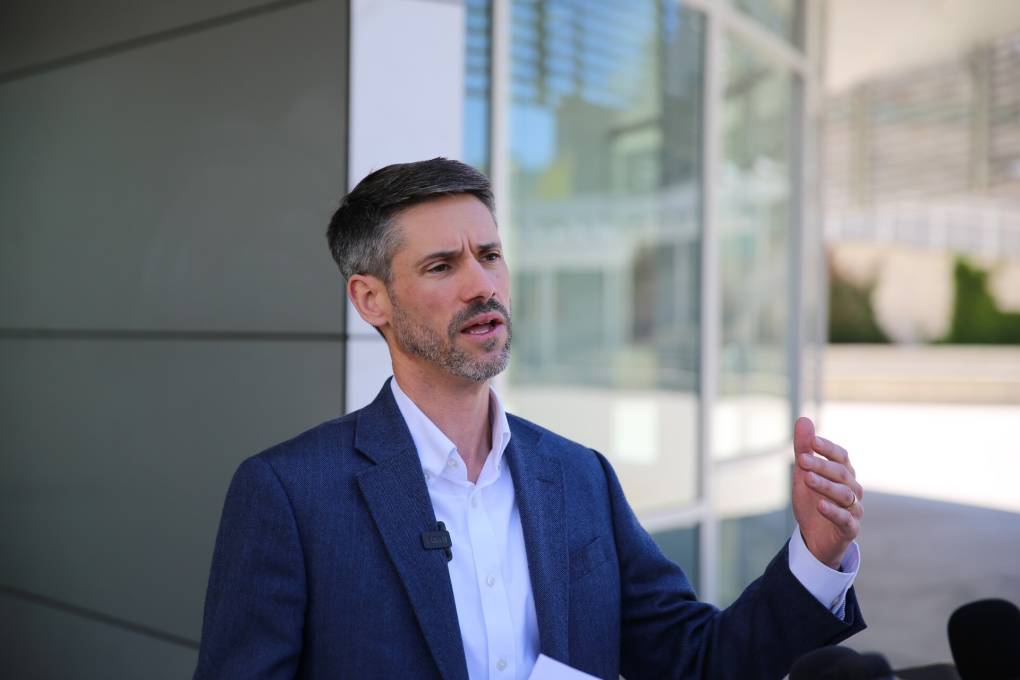
"caption": "San José Mayor Matt Mahan speaks about a state audit of spending on homelessness outside City Hall on April 9, 2024.",
"credit": "Joseph Geha/KQED",
"altTag": null,
"description": null,
"imgSizes": {
"medium": {
"file": "https://cdn.kqed.org/wp-content/uploads/sites/10/2024/06/240409-MAHAN-HOMELESS-JG-01_qut-800x533.jpg",
"width": 800,
"height": 533,
"mimeType": "image/jpeg"
},
"large": {
"file": "https://cdn.kqed.org/wp-content/uploads/sites/10/2024/06/240409-MAHAN-HOMELESS-JG-01_qut-1020x680.jpg",
"width": 1020,
"height": 680,
"mimeType": "image/jpeg"
},
"thumbnail": {
"file": "https://cdn.kqed.org/wp-content/uploads/sites/10/2024/06/240409-MAHAN-HOMELESS-JG-01_qut-160x107.jpg",
"width": 160,
"height": 107,
"mimeType": "image/jpeg"
},
"1536x1536": {
"file": "https://cdn.kqed.org/wp-content/uploads/sites/10/2024/06/240409-MAHAN-HOMELESS-JG-01_qut-1536x1024.jpg",
"width": 1536,
"height": 1024,
"mimeType": "image/jpeg"
},
"post-thumbnail": {
"file": "https://cdn.kqed.org/wp-content/uploads/sites/10/2024/06/240409-MAHAN-HOMELESS-JG-01_qut-672x372.jpg",
"width": 672,
"height": 372,
"mimeType": "image/jpeg"
},
"twentyfourteen-full-width": {
"file": "https://cdn.kqed.org/wp-content/uploads/sites/10/2024/06/240409-MAHAN-HOMELESS-JG-01_qut-1038x576.jpg",
"width": 1038,
"height": 576,
"mimeType": "image/jpeg"
},
"kqedFullSize": {
"file": "https://cdn.kqed.org/wp-content/uploads/sites/10/2024/06/240409-MAHAN-HOMELESS-JG-01_qut.jpg",
"width": 1920,
"height": 1280
}
},
"isLoading": false,
"fetchFailed": false
},
"news_11988812": {
"type": "attachments",
"id": "news_11988812",
"meta": {
"index": "attachments_1716263798",
"site": "news",
"id": "11988812",
"found": true
},
"title": "IMG_7876_qut",
"publishDate": 1717453713,
"status": "inherit",
"parent": 11988728,
"modified": 1717454965,
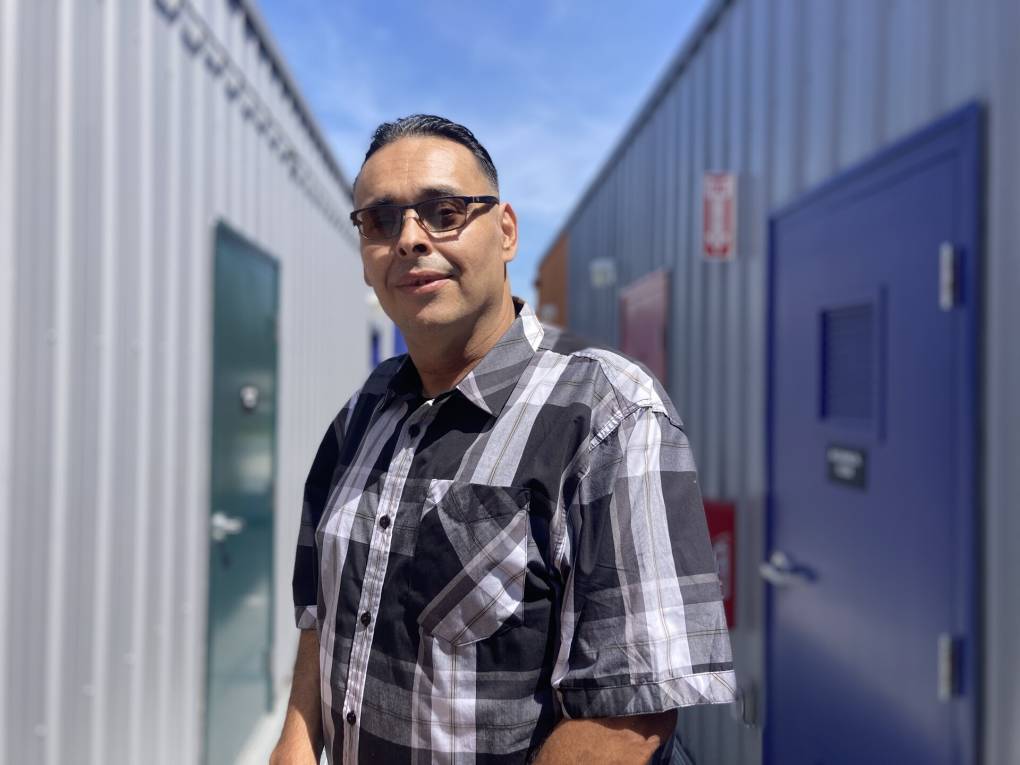
"caption": "Carlos Ruben Jacobo, 48, poses for a portrait at the Guadalupe Emergency Interim Housing site in San José on April 10, 2024. Jacobo, who had been unhoused, was initially reluctant to accept a room because he'd heard bad things about other kinds of shelters. But now he says it feels like home.",
"credit": "Vanessa Rancaño/KQED",
"altTag": "A young man with sunglasses and a plaid shirt poses for a photo standing in a walkway between two rows of grey tiny houses.",
"description": null,
"imgSizes": {
"medium": {
"file": "https://cdn.kqed.org/wp-content/uploads/sites/10/2024/06/IMG_7876_qut-800x600.jpg",
"width": 800,
"height": 600,
"mimeType": "image/jpeg"
},
"large": {
"file": "https://cdn.kqed.org/wp-content/uploads/sites/10/2024/06/IMG_7876_qut-1020x765.jpg",
"width": 1020,
"height": 765,
"mimeType": "image/jpeg"
},
"thumbnail": {
"file": "https://cdn.kqed.org/wp-content/uploads/sites/10/2024/06/IMG_7876_qut-160x120.jpg",
"width": 160,
"height": 120,
"mimeType": "image/jpeg"
},
"1536x1536": {
"file": "https://cdn.kqed.org/wp-content/uploads/sites/10/2024/06/IMG_7876_qut-1536x1152.jpg",
"width": 1536,
"height": 1152,
"mimeType": "image/jpeg"
},
"post-thumbnail": {
"file": "https://cdn.kqed.org/wp-content/uploads/sites/10/2024/06/IMG_7876_qut-672x372.jpg",
"width": 672,
"height": 372,
"mimeType": "image/jpeg"
},
"twentyfourteen-full-width": {
"file": "https://cdn.kqed.org/wp-content/uploads/sites/10/2024/06/IMG_7876_qut-1038x576.jpg",
"width": 1038,
"height": 576,
"mimeType": "image/jpeg"
},
"kqedFullSize": {
"file": "https://cdn.kqed.org/wp-content/uploads/sites/10/2024/06/IMG_7876_qut.jpg",
"width": 1920,
"height": 1440
}
},
"isLoading": false,
"fetchFailed": false
},
"news_11984097": {
"type": "attachments",
"id": "news_11984097",
"meta": {
"index": "attachments_1716263798",
"site": "news",
"id": "11984097",
"found": true
},
"title": "SAN JOSE LICENSE PLATE READERS-11-KQED",
"publishDate": 1714086991,
"status": "inherit",
"parent": 11983813,
"modified": 1766004900,
"caption": "A Flock Safety worker holds up a new automated license plate reader that was being installed in East San José on April 23, 2024.",
"credit": "Joseph Geha/KQED",
"altTag": "A man with a fluorescent yellow coat holds a black machine.",
"description": null,
"imgSizes": {
"medium": {
"file": "https://cdn.kqed.org/wp-content/uploads/sites/10/2024/04/SAN-JOSE-LICENSE-PLATE-READERS-11-KQED-800x533.jpg",
"width": 800,
"height": 533,
"mimeType": "image/jpeg"
},
"large": {
"file": "https://cdn.kqed.org/wp-content/uploads/sites/10/2024/04/SAN-JOSE-LICENSE-PLATE-READERS-11-KQED-1020x680.jpg",
"width": 1020,
"height": 680,
"mimeType": "image/jpeg"
},
"thumbnail": {
"file": "https://cdn.kqed.org/wp-content/uploads/sites/10/2024/04/SAN-JOSE-LICENSE-PLATE-READERS-11-KQED-160x107.jpg",
"width": 160,
"height": 107,
"mimeType": "image/jpeg"
},
"1536x1536": {
"file": "https://cdn.kqed.org/wp-content/uploads/sites/10/2024/04/SAN-JOSE-LICENSE-PLATE-READERS-11-KQED-1536x1024.jpg",
"width": 1536,
"height": 1024,
"mimeType": "image/jpeg"
},
"post-thumbnail": {
"file": "https://cdn.kqed.org/wp-content/uploads/sites/10/2024/04/SAN-JOSE-LICENSE-PLATE-READERS-11-KQED-672x372.jpg",
"width": 672,
"height": 372,
"mimeType": "image/jpeg"
},
"twentyfourteen-full-width": {
"file": "https://cdn.kqed.org/wp-content/uploads/sites/10/2024/04/SAN-JOSE-LICENSE-PLATE-READERS-11-KQED-1038x576.jpg",
"width": 1038,
"height": 576,
"mimeType": "image/jpeg"
},
"full-width": {
"file": "https://cdn.kqed.org/wp-content/uploads/sites/10/2024/04/SAN-JOSE-LICENSE-PLATE-READERS-11-KQED-1920x1280.jpg",
"width": 1920,
"height": 1280,
"mimeType": "image/jpeg"
},
"kqedFullSize": {
"file": "https://cdn.kqed.org/wp-content/uploads/sites/10/2024/04/SAN-JOSE-LICENSE-PLATE-READERS-11-KQED.jpg",
"width": 2000,
"height": 1333
}
},
"isLoading": false,
"fetchFailed": false
},
"news_11979492": {
"type": "attachments",
"id": "news_11979492",
"meta": {
"index": "attachments_1716263798",
"site": "news",
"id": "11979492",
"found": true
},
"parent": 11979482,
"imgSizes": {
"twentyfourteen-full-width": {
"file": "https://cdn.kqed.org/wp-content/uploads/sites/10/2024/03/GettyImages-1246023661-1024x576.jpg",
"width": 1024,
"mimeType": "image/jpeg",
"height": 576
},
"thumbnail": {
"file": "https://cdn.kqed.org/wp-content/uploads/sites/10/2024/03/GettyImages-1246023661-160x107.jpg",
"width": 160,
"mimeType": "image/jpeg",
"height": 107
},
"post-thumbnail": {
"file": "https://cdn.kqed.org/wp-content/uploads/sites/10/2024/03/GettyImages-1246023661-672x372.jpg",
"width": 672,
"mimeType": "image/jpeg",
"height": 372
},
"kqedFullSize": {
"file": "https://cdn.kqed.org/wp-content/uploads/sites/10/2024/03/GettyImages-1246023661.jpg",
"width": 1024,
"height": 683
},
"large": {
"file": "https://cdn.kqed.org/wp-content/uploads/sites/10/2024/03/GettyImages-1246023661-1020x680.jpg",
"width": 1020,
"mimeType": "image/jpeg",
"height": 680
},
"medium": {
"file": "https://cdn.kqed.org/wp-content/uploads/sites/10/2024/03/GettyImages-1246023661-800x534.jpg",
"width": 800,
"mimeType": "image/jpeg",
"height": 534
}
},
"publishDate": 1710452024,
"modified": 1710452183,
"caption": "San José Mayor Matt Mahan speaks during a press conference on Jan. 4, 2023, in San José.",
"description": null,
"title": "Bay Area Storm",
"credit": "Dai Sugano/MediaNews Group/The Mercury News via Getty Images",
"status": "inherit",
"altTag": "A middle-aged white man with a hat that reads \"SJFD\" speaks at a press conference outdoors, with two blurred men behind him.",
"isLoading": false,
"fetchFailed": false
},
"news_11967417": {
"type": "attachments",
"id": "news_11967417",
"meta": {
"index": "attachments_1716263798",
"site": "news",
"id": "11967417",
"found": true
},
"parent": 11967395,
"imgSizes": {
"thumbnail": {
"file": "https://ww2.kqed.org/app/uploads/sites/10/2023/11/mahan-3-160x89.jpeg",
"width": 160,
"mimeType": "image/jpeg",
"height": 89
},
"post-thumbnail": {
"file": "https://ww2.kqed.org/app/uploads/sites/10/2023/11/mahan-3-672x372.jpeg",
"width": 672,
"mimeType": "image/jpeg",
"height": 372
},
"kqedFullSize": {
"file": "https://ww2.kqed.org/app/uploads/sites/10/2023/11/mahan-3.jpeg",
"width": 1038,
"height": 576
},
"large": {
"file": "https://ww2.kqed.org/app/uploads/sites/10/2023/11/mahan-3-1020x566.jpeg",
"width": 1020,
"mimeType": "image/jpeg",
"height": 566
},
"medium": {
"file": "https://ww2.kqed.org/app/uploads/sites/10/2023/11/mahan-3-800x444.jpeg",
"width": 800,
"mimeType": "image/jpeg",
"height": 444
}
},
"publishDate": 1700076784,
"modified": 1700077789,
"caption": "Matt Mahan, then a San José mayoral candidate, high-fives a campaign staffer at his campaign headquarters on Election Day, Nov. 8, 2022.",
"description": null,
"title": "mahan",
"credit": "Beth LaBerge/KQED",
"status": "inherit",
"altTag": "A bearded white man in a maroon sweater high-fives someone.",
"isLoading": false,
"fetchFailed": false
},
"news_11962830": {
"type": "attachments",
"id": "news_11962830",
"meta": {
"index": "attachments_1716263798",
"site": "news",
"id": "11962830",
"found": true
},
"parent": 11962814,
"imgSizes": {
"twentyfourteen-full-width": {
"file": "https://ww2.kqed.org/app/uploads/sites/10/2023/09/025_KQED_MattMahanSanJose_11082022-qut-1038x576.jpg",
"width": 1038,
"mimeType": "image/jpeg",
"height": 576
},
"thumbnail": {
"file": "https://ww2.kqed.org/app/uploads/sites/10/2023/09/025_KQED_MattMahanSanJose_11082022-qut-160x107.jpg",
"width": 160,
"mimeType": "image/jpeg",
"height": 107
},
"post-thumbnail": {
"file": "https://ww2.kqed.org/app/uploads/sites/10/2023/09/025_KQED_MattMahanSanJose_11082022-qut-672x372.jpg",
"width": 672,
"mimeType": "image/jpeg",
"height": 372
},
"kqedFullSize": {
"file": "https://ww2.kqed.org/app/uploads/sites/10/2023/09/025_KQED_MattMahanSanJose_11082022-qut.jpg",
"width": 1920,
"height": 1280
},
"large": {
"file": "https://ww2.kqed.org/app/uploads/sites/10/2023/09/025_KQED_MattMahanSanJose_11082022-qut-1020x680.jpg",
"width": 1020,
"mimeType": "image/jpeg",
"height": 680
},
"1536x1536": {
"file": "https://ww2.kqed.org/app/uploads/sites/10/2023/09/025_KQED_MattMahanSanJose_11082022-qut-1536x1024.jpg",
"width": 1536,
"mimeType": "image/jpeg",
"height": 1024
},
"medium": {
"file": "https://ww2.kqed.org/app/uploads/sites/10/2023/09/025_KQED_MattMahanSanJose_11082022-qut-800x533.jpg",
"width": 800,
"mimeType": "image/jpeg",
"height": 533
}
},
"publishDate": 1695944622,
"modified": 1695944656,
"caption": "San Jose Mayor Matt Mahan, pictured at his campaign headquarters on Election Day, Nov. 8, 2022.",
"description": null,
"title": "025_KQED_MattMahanSanJose_11082022-qut",
"credit": "Beth LaBerge/KQED",
"status": "inherit",
"altTag": null,
"isLoading": false,
"fetchFailed": false
},
"news_11957563": {
"type": "attachments",
"id": "news_11957563",
"meta": {
"index": "attachments_1716263798",
"site": "news",
"id": "11957563",
"found": true
},
"parent": 0,
"imgSizes": {
"twentyfourteen-full-width": {
"file": "https://ww2.kqed.org/app/uploads/sites/10/2023/08/RS67526_20230801-SJCityHall-01-JYKQED-1038x576.jpg",
"width": 1038,
"mimeType": "image/jpeg",
"height": 576
},
"thumbnail": {
"file": "https://ww2.kqed.org/app/uploads/sites/10/2023/08/RS67526_20230801-SJCityHall-01-JYKQED-160x107.jpg",
"width": 160,
"mimeType": "image/jpeg",
"height": 107
},
"post-thumbnail": {
"file": "https://ww2.kqed.org/app/uploads/sites/10/2023/08/RS67526_20230801-SJCityHall-01-JYKQED-672x372.jpg",
"width": 672,
"mimeType": "image/jpeg",
"height": 372
},
"kqedFullSize": {
"file": "https://ww2.kqed.org/app/uploads/sites/10/2023/08/RS67526_20230801-SJCityHall-01-JYKQED.jpg",
"width": 2000,
"height": 1333
},
"large": {
"file": "https://ww2.kqed.org/app/uploads/sites/10/2023/08/RS67526_20230801-SJCityHall-01-JYKQED-1020x680.jpg",
"width": 1020,
"mimeType": "image/jpeg",
"height": 680
},
"1536x1536": {
"file": "https://ww2.kqed.org/app/uploads/sites/10/2023/08/RS67526_20230801-SJCityHall-01-JYKQED-1536x1024.jpg",
"width": 1536,
"mimeType": "image/jpeg",
"height": 1024
},
"full-width": {
"file": "https://ww2.kqed.org/app/uploads/sites/10/2023/08/RS67526_20230801-SJCityHall-01-JYKQED-1920x1280.jpg",
"width": 1920,
"mimeType": "image/jpeg",
"height": 1280
},
"medium": {
"file": "https://ww2.kqed.org/app/uploads/sites/10/2023/08/RS67526_20230801-SJCityHall-01-JYKQED-800x533.jpg",
"width": 800,
"mimeType": "image/jpeg",
"height": 533
}
},
"publishDate": 1691431355,
"modified": 1692146238,
"caption": "City Hall in San José on Aug. 1, 2023.",
"description": null,
"title": "City Hall in San Jose, Calif., on Tuesday, August 1, 2023.",
"credit": "Juliana Yamada/KQED",
"status": "inherit",
"altTag": "A sign on a building reading \"San Jose City Hall.\"",
"isLoading": false,
"fetchFailed": false
},
"news_11958215": {
"type": "attachments",
"id": "news_11958215",
"meta": {
"index": "attachments_1716263798",
"site": "news",
"id": "11958215",
"found": true
},
"parent": 0,
"imgSizes": {
"twentyfourteen-full-width": {
"file": "https://ww2.kqed.org/app/uploads/sites/10/2023/08/RS67550_20230801-SJCityHall-28-JY-KQED-1038x576.jpg",
"width": 1038,
"mimeType": "image/jpeg",
"height": 576
},
"thumbnail": {
"file": "https://ww2.kqed.org/app/uploads/sites/10/2023/08/RS67550_20230801-SJCityHall-28-JY-KQED-160x107.jpg",
"width": 160,
"mimeType": "image/jpeg",
"height": 107
},
"post-thumbnail": {
"file": "https://ww2.kqed.org/app/uploads/sites/10/2023/08/RS67550_20230801-SJCityHall-28-JY-KQED-672x372.jpg",
"width": 672,
"mimeType": "image/jpeg",
"height": 372
},
"kqedFullSize": {
"file": "https://ww2.kqed.org/app/uploads/sites/10/2023/08/RS67550_20230801-SJCityHall-28-JY-KQED.jpg",
"width": 2000,
"height": 1333
},
"large": {
"file": "https://ww2.kqed.org/app/uploads/sites/10/2023/08/RS67550_20230801-SJCityHall-28-JY-KQED-1020x680.jpg",
"width": 1020,
"mimeType": "image/jpeg",
"height": 680
},
"1536x1536": {
"file": "https://ww2.kqed.org/app/uploads/sites/10/2023/08/RS67550_20230801-SJCityHall-28-JY-KQED-1536x1024.jpg",
"width": 1536,
"mimeType": "image/jpeg",
"height": 1024
},
"full-width": {
"file": "https://ww2.kqed.org/app/uploads/sites/10/2023/08/RS67550_20230801-SJCityHall-28-JY-KQED-1920x1280.jpg",
"width": 1920,
"mimeType": "image/jpeg",
"height": 1280
},
"medium": {
"file": "https://ww2.kqed.org/app/uploads/sites/10/2023/08/RS67550_20230801-SJCityHall-28-JY-KQED-800x533.jpg",
"width": 800,
"mimeType": "image/jpeg",
"height": 533
}
},
"publishDate": 1692054119,
"modified": 1692060420,
"caption": "The San José City Hall in San José.",
"description": null,
"title": "City Hall in San Jose, Calif., on Tuesday, August 1, 2023.",
"credit": "Juliana Yamada/KQED",
"status": "inherit",
"altTag": "A large tall office building.",
"isLoading": false,
"fetchFailed": false
},
"news_11955262": {
"type": "attachments",
"id": "news_11955262",
"meta": {
"index": "attachments_1716263798",
"site": "news",
"id": "11955262",
"found": true
},
"parent": 0,
"imgSizes": {
"twentyfourteen-full-width": {
"file": "https://ww2.kqed.org/app/uploads/sites/10/2023/07/SJC-Rally-1-1038x576.png",
"width": 1038,
"mimeType": "image/png",
"height": 576
},
"thumbnail": {
"file": "https://ww2.kqed.org/app/uploads/sites/10/2023/07/SJC-Rally-1-160x96.png",
"width": 160,
"mimeType": "image/png",
"height": 96
},
"post-thumbnail": {
"file": "https://ww2.kqed.org/app/uploads/sites/10/2023/07/SJC-Rally-1-672x372.png",
"width": 672,
"mimeType": "image/png",
"height": 372
},
"kqedFullSize": {
"file": "https://ww2.kqed.org/app/uploads/sites/10/2023/07/SJC-Rally-1.png",
"width": 1796,
"height": 1076
},
"large": {
"file": "https://ww2.kqed.org/app/uploads/sites/10/2023/07/SJC-Rally-1-1020x611.png",
"width": 1020,
"mimeType": "image/png",
"height": 611
},
"1536x1536": {
"file": "https://ww2.kqed.org/app/uploads/sites/10/2023/07/SJC-Rally-1-1536x920.png",
"width": 1536,
"mimeType": "image/png",
"height": 920
},
"medium": {
"file": "https://ww2.kqed.org/app/uploads/sites/10/2023/07/SJC-Rally-1-800x479.png",
"width": 800,
"mimeType": "image/png",
"height": 479
}
},
"publishDate": 1688845733,
"modified": 1689015392,
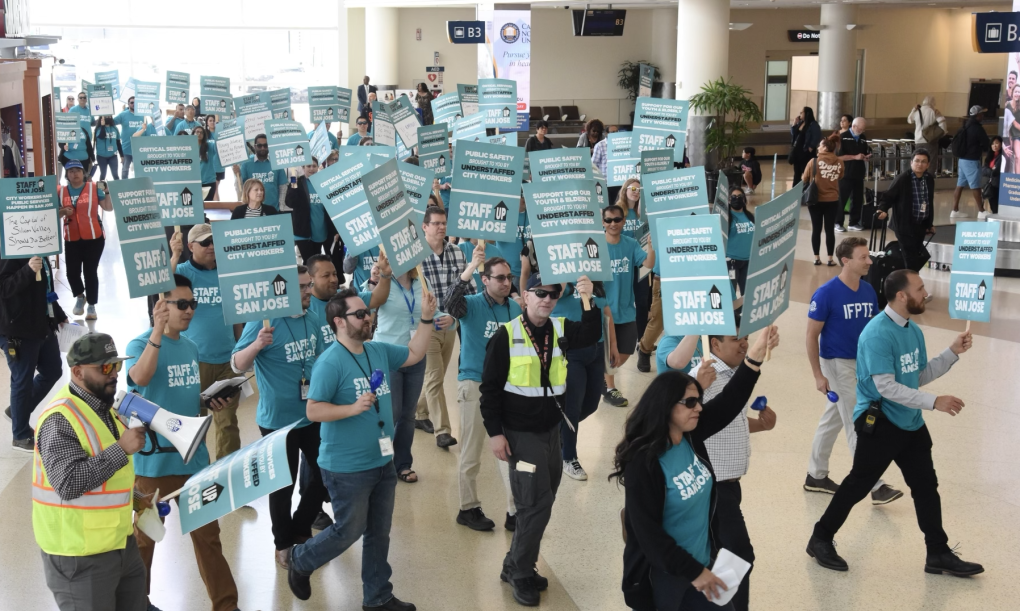
"caption": "Workers rallied at major city worksites including City Hall, San José Mineta International Airport, Happy Hollow Park and Zoo and other locations during actions in June. Image from rally on June 13, 2023.",
"description": null,
"title": "SJC Rally 1",
"credit": "Courtesy of Staff Up San Jose Union Coalition",
"status": "inherit",
"altTag": "Protestors holding signs and chanting inside City Hall in San José.",
"isLoading": false,
"fetchFailed": false
},
"news_11953070": {
"type": "attachments",
"id": "news_11953070",
"meta": {
"index": "attachments_1716263798",
"site": "news",
"id": "11953070",
"found": true
},
"title": "Tents line Fulton Street near City Hall on April 5, 2020.",
"publishDate": 1686863978,
"status": "inherit",
"parent": 11954718,
"modified": 1718058833,
"caption": "Tents line Fulton Street near City Hall on April 5, 2020.",
"credit": "Beth LaBerge/KQED",
"altTag": "Three tents line a public street with San Francisco's City Hall building shining as the sun comes up in the early morning hours. Rows of trees line a path toward the city building.",
"description": "Tents line Fulton Street near City Hall on April 5, 2020. In June, budget battles are underway in the Bay Area's two largest cities, with Mayors London Breed in San Francisco and Matt Mahan in San José pushing for more voter-approved homelessness dollars to go toward temporary housing.",
"imgSizes": {
"medium": {
"file": "https://cdn.kqed.org/wp-content/uploads/sites/10/2023/06/RS43040_011_KQED_SanFrancisco_TentEncampments_05052020-qut-800x533.jpg",
"width": 800,
"height": 533,
"mimeType": "image/jpeg"
},
"large": {
"file": "https://cdn.kqed.org/wp-content/uploads/sites/10/2023/06/RS43040_011_KQED_SanFrancisco_TentEncampments_05052020-qut-1020x680.jpg",
"width": 1020,
"height": 680,
"mimeType": "image/jpeg"
},
"thumbnail": {
"file": "https://cdn.kqed.org/wp-content/uploads/sites/10/2023/06/RS43040_011_KQED_SanFrancisco_TentEncampments_05052020-qut-160x107.jpg",
"width": 160,
"height": 107,
"mimeType": "image/jpeg"
},
"1536x1536": {
"file": "https://cdn.kqed.org/wp-content/uploads/sites/10/2023/06/RS43040_011_KQED_SanFrancisco_TentEncampments_05052020-qut-1536x1024.jpg",
"width": 1536,
"height": 1024,
"mimeType": "image/jpeg"
},
"post-thumbnail": {
"file": "https://cdn.kqed.org/wp-content/uploads/sites/10/2023/06/RS43040_011_KQED_SanFrancisco_TentEncampments_05052020-qut-672x372.jpg",
"width": 672,
"height": 372,
"mimeType": "image/jpeg"
},
"twentyfourteen-full-width": {
"file": "https://cdn.kqed.org/wp-content/uploads/sites/10/2023/06/RS43040_011_KQED_SanFrancisco_TentEncampments_05052020-qut-1038x576.jpg",
"width": 1038,
"height": 576,
"mimeType": "image/jpeg"
},
"kqedFullSize": {
"file": "https://cdn.kqed.org/wp-content/uploads/sites/10/2023/06/RS43040_011_KQED_SanFrancisco_TentEncampments_05052020-qut.jpg",
"width": 1920,
"height": 1280
}
},
"isLoading": false,
"fetchFailed": false
},
"news_11950516": {
"type": "attachments",
"id": "news_11950516",
"meta": {
"index": "attachments_1716263798",
"site": "news",
"id": "11950516",
"found": true
},
"parent": 0,
"imgSizes": {
"twentyfourteen-full-width": {
"file": "https://ww2.kqed.org/app/uploads/sites/10/2023/05/RS62437_007_KQED_SanJoseInterimHousing_01302023-qut-1038x576.jpg",
"width": 1038,
"mimeType": "image/jpeg",
"height": 576
},
"thumbnail": {
"file": "https://ww2.kqed.org/app/uploads/sites/10/2023/05/RS62437_007_KQED_SanJoseInterimHousing_01302023-qut-160x107.jpg",
"width": 160,
"mimeType": "image/jpeg",
"height": 107
},
"post-thumbnail": {
"file": "https://ww2.kqed.org/app/uploads/sites/10/2023/05/RS62437_007_KQED_SanJoseInterimHousing_01302023-qut-672x372.jpg",
"width": 672,
"mimeType": "image/jpeg",
"height": 372
},
"kqedFullSize": {
"file": "https://ww2.kqed.org/app/uploads/sites/10/2023/05/RS62437_007_KQED_SanJoseInterimHousing_01302023-qut.jpg",
"width": 1920,
"height": 1280
},
"large": {
"file": "https://ww2.kqed.org/app/uploads/sites/10/2023/05/RS62437_007_KQED_SanJoseInterimHousing_01302023-qut-1020x680.jpg",
"width": 1020,
"mimeType": "image/jpeg",
"height": 680
},
"1536x1536": {
"file": "https://ww2.kqed.org/app/uploads/sites/10/2023/05/RS62437_007_KQED_SanJoseInterimHousing_01302023-qut-1536x1024.jpg",
"width": 1536,
"mimeType": "image/jpeg",
"height": 1024
},
"medium": {
"file": "https://ww2.kqed.org/app/uploads/sites/10/2023/05/RS62437_007_KQED_SanJoseInterimHousing_01302023-qut-800x533.jpg",
"width": 800,
"mimeType": "image/jpeg",
"height": 533
}
},
"publishDate": 1684884223,
"modified": 1686771174,
"caption": "Shipping containers converted to homes line the perimiter of Evans Lane housing, an interim housing facility located on city-owned land, in San José on Jan. 30, 2023.",
"description": null,
"title": "RS62437_007_KQED_SanJoseInterimHousing_01302023-qut",
"credit": "Beth LaBerge/KQED",
"status": "inherit",
"altTag": "Neat rows of shipping containers have been converted into housing with white windows. An outdoor courtyard with gray picnic benches and sun umbrellas decorate the front.",
"isLoading": false,
"fetchFailed": false
}
},
"audioPlayerReducer": {
"postId": "stream_live",
"isPaused": true,
"isPlaying": false,
"pfsActive": false,
"pledgeModalIsOpen": true,
"playerDrawerIsOpen": false,
"liveAudioPlayStartedAt": 0,
"liveAudioPlayContext": ""
},
"authorsReducer": {
"gmarzorati": {
"type": "authors",
"id": "227",
"meta": {
"index": "authors_1716337520",
"id": "227",
"found": true
},
"name": "Guy Marzorati",
"firstName": "Guy",
"lastName": "Marzorati",
"slug": "gmarzorati",
"email": "gmarzorati@KQED.org",
"display_author_email": true,
"staff_mastheads": [
"news"
],
"title": "Correspondent",
"bio": "Guy Marzorati is a correspondent on KQED's California Politics and Government Desk, based in San Jose. A graduate of Santa Clara University, Guy joined KQED in 2013. He reports on state and local politics and produces KQED's digital voter guide.",
"avatar": "https://secure.gravatar.com/avatar/e7038b8dbfd55b104369b76b1cd0b9de?s=600&d=blank&r=g",
"twitter": "guymarzorati",
"facebook": null,
"instagram": null,
"linkedin": null,
"sites": [
{
"site": "",
"roles": [
"editor"
]
},
{
"site": "news",
"roles": [
"editor"
]
},
{
"site": "science",
"roles": [
"editor"
]
},
{
"site": "forum",
"roles": [
"editor"
]
},
{
"site": "elections",
"roles": [
"editor"
]
},
{
"site": "liveblog",
"roles": [
"editor"
]
}
],
"headData": {
"title": "Guy Marzorati | KQED",
"description": "Correspondent",
"ogImgSrc": "https://secure.gravatar.com/avatar/e7038b8dbfd55b104369b76b1cd0b9de?s=600&d=blank&r=g",
"twImgSrc": "https://secure.gravatar.com/avatar/e7038b8dbfd55b104369b76b1cd0b9de?s=600&d=blank&r=g"
},
"isLoading": false,
"link": "/author/gmarzorati"
},
"scottshafer": {
"type": "authors",
"id": "255",
"meta": {
"index": "authors_1716337520",
"id": "255",
"found": true
},
"name": "Scott Shafer",
"firstName": "Scott",
"lastName": "Shafer",
"slug": "scottshafer",
"email": "sshafer@kqed.org",
"display_author_email": false,
"staff_mastheads": [
"news"
],
"title": "KQED Contributor",
"bio": "Scott Shafer is a senior editor with the KQED Politics and Government desk. He is co-host of Political Breakdown, the award-winning radio show and podcast with a personal take on the world of politics. Scott came to KQED in 1998 to host the statewide\u003cem> California Report\u003c/em>. Prior to that he had extended stints in politics and government\u003cem>.\u003c/em> He uses that inside experience at KQED in his, reporting, hosting and analysis for the politics desk. Scott collaborated \u003cem>Political Breakdown a\u003c/em>nd on \u003cem>The Political Mind of Jerry Brown, \u003c/em>an eight-part series about the life and extraordinary political career of the former governor. For fun, he plays water polo with the San Francisco Tsunami.",
"avatar": "https://secure.gravatar.com/avatar/a62ebae45b79d7aed1a39a0e3bf68104?s=600&d=blank&r=g",
"twitter": "scottshafer",
"bluesky": null,
"facebook": null,
"instagram": null,
"linkedin": null,
"sites": [
{
"site": "news",
"roles": [
"editor"
]
},
{
"site": "stateofhealth",
"roles": [
"author"
]
},
{
"site": "science",
"roles": [
"author"
]
},
{
"site": "forum",
"roles": [
"subscriber"
]
},
{
"site": "liveblog",
"roles": [
"author"
]
}
],
"headData": {
"title": "Scott Shafer | KQED",
"description": "KQED Contributor",
"ogImgSrc": "https://secure.gravatar.com/avatar/a62ebae45b79d7aed1a39a0e3bf68104?s=600&d=blank&r=g",
"twImgSrc": "https://secure.gravatar.com/avatar/a62ebae45b79d7aed1a39a0e3bf68104?s=600&d=blank&r=g"
},
"isLoading": false,
"link": "/author/scottshafer"
},
"mlagos": {
"type": "authors",
"id": "3239",
"meta": {
"index": "authors_1716337520",
"id": "3239",
"found": true
},
"name": "Marisa Lagos",
"firstName": "Marisa",
"lastName": "Lagos",
"slug": "mlagos",
"email": "mlagos@kqed.org",
"display_author_email": false,
"staff_mastheads": [
"news"
],
"title": "KQED Contributor",
"bio": "Marisa Lagos is a correspondent for KQED’s California Politics and Government Desk and co-hosts the award-winning show and podcast, Political Breakdown. At KQED, Lagos also conducts reporting, analysis and investigations into state, local and national politics for radio, TV, online and onstage. In 2022, she and co-host, Scott Shafer, moderated the only gubernatorial debate in California. In 2020, the \u003ci>Washington Post\u003c/i> named her one of the top political journalists in California; she was nominated for a Peabody and won several other awards for her work investigating the 2017 California wildfires. She has worked at the \u003ci>San Francisco Chronicle\u003c/i>, \u003ci>San Francisco Examiner\u003c/i> and \u003ci>Los Angeles Times\u003c/i>. A UC Santa Barbara graduate, she lives in San Francisco with her two sons and husband.",
"avatar": "https://secure.gravatar.com/avatar/a261a0d3696fc066871ef96b85b5e7d2?s=600&d=blank&r=g",
"twitter": "@mlagos",
"facebook": null,
"instagram": null,
"linkedin": null,
"sites": [
{
"site": "arts",
"roles": [
"author"
]
},
{
"site": "news",
"roles": [
"editor"
]
},
{
"site": "science",
"roles": [
"editor"
]
},
{
"site": "forum",
"roles": [
"author"
]
},
{
"site": "liveblog",
"roles": [
"author"
]
}
],
"headData": {
"title": "Marisa Lagos | KQED",
"description": "KQED Contributor",
"ogImgSrc": "https://secure.gravatar.com/avatar/a261a0d3696fc066871ef96b85b5e7d2?s=600&d=blank&r=g",
"twImgSrc": "https://secure.gravatar.com/avatar/a261a0d3696fc066871ef96b85b5e7d2?s=600&d=blank&r=g"
},
"isLoading": false,
"link": "/author/mlagos"
},
"vrancano": {
"type": "authors",
"id": "11276",
"meta": {
"index": "authors_1716337520",
"id": "11276",
"found": true
},
"name": "Vanessa Rancaño",
"firstName": "Vanessa",
"lastName": "Rancaño",
"slug": "vrancano",
"email": "vrancano@kqed.org",
"display_author_email": false,
"staff_mastheads": [
"news"
],
"title": "Reporter",
"bio": "Vanessa Rancaño is a features reporter for KQED. She’s also covered homelessness and education for the station and reported from the Central Valley. Her work has aired across public radio, from flagship national news shows to longform narrative podcasts. Before taking up a mic, she worked as a freelance print journalist. She’s been recognized with a number of national and regional awards. Vanessa grew up in California's Central Valley. She's a former NPR Kroc Fellow, and a graduate of the UC Berkeley Graduate School of Journalism.",
"avatar": "https://secure.gravatar.com/avatar/b3a383dfb0e7ee1c17568f2cf067904ab654d6e3de9743fc661f3c788ade1bed?s=600&d=blank&r=g",
"twitter": "vanessarancano",
"bluesky": null,
"facebook": null,
"instagram": null,
"linkedin": null,
"sites": [
{
"site": "arts",
"roles": [
"editor"
]
},
{
"site": "news",
"roles": [
"editor"
]
},
{
"site": "liveblog",
"roles": [
"contributor"
]
}
],
"headData": {
"title": "Vanessa Rancaño | KQED",
"description": "Reporter",
"ogImgSrc": "https://secure.gravatar.com/avatar/b3a383dfb0e7ee1c17568f2cf067904ab654d6e3de9743fc661f3c788ade1bed?s=600&d=blank&r=g",
"twImgSrc": "https://secure.gravatar.com/avatar/b3a383dfb0e7ee1c17568f2cf067904ab654d6e3de9743fc661f3c788ade1bed?s=600&d=blank&r=g"
},
"isLoading": false,
"link": "/author/vrancano"
},
"jrodriguez": {
"type": "authors",
"id": "11690",
"meta": {
"index": "authors_1716337520",
"id": "11690",
"found": true
},
"name": "Joe Fitzgerald Rodriguez",
"firstName": "Joe",
"lastName": "Fitzgerald Rodriguez",
"slug": "jrodriguez",
"email": "jrodriguez@kqed.org",
"display_author_email": true,
"staff_mastheads": [
"news"
],
"title": "Reporter and Producer",
"bio": "Joe Fitzgerald Rodriguez is a reporter and digital producer for KQED covering politics. Joe most recently wrote for the \u003cem>San Francisco Examiner\u003c/em> as a political columnist covering The City. He was raised in San Francisco and has spent his reporting career in his beloved, foggy, city by the bay. Joe was 12-years-old when he conducted his first interview in journalism, grilling former San Francisco Mayor Willie Brown for the Marina Middle School newspaper, \u003cem>The Penguin Press, \u003c/em>and he continues to report on the San Francisco Bay Area to this day.",
"avatar": "https://secure.gravatar.com/avatar/2247beb0564c1e9c62228d5649d2edac?s=600&d=blank&r=g",
"twitter": "FitztheReporter",
"facebook": null,
"instagram": "https://www.instagram.com/fitzthereporter/",
"linkedin": null,
"sites": [
{
"site": "",
"roles": [
"editor"
]
},
{
"site": "arts",
"roles": [
"editor"
]
},
{
"site": "news",
"roles": [
"editor"
]
},
{
"site": "science",
"roles": [
"editor"
]
},
{
"site": "elections",
"roles": [
"editor"
]
},
{
"site": "liveblog",
"roles": [
"editor"
]
}
],
"headData": {
"title": "Joe Fitzgerald Rodriguez | KQED",
"description": "Reporter and Producer",
"ogImgSrc": "https://secure.gravatar.com/avatar/2247beb0564c1e9c62228d5649d2edac?s=600&d=blank&r=g",
"twImgSrc": "https://secure.gravatar.com/avatar/2247beb0564c1e9c62228d5649d2edac?s=600&d=blank&r=g"
},
"isLoading": false,
"link": "/author/jrodriguez"
},
"adahlstromeckman": {
"type": "authors",
"id": "11785",
"meta": {
"index": "authors_1716337520",
"id": "11785",
"found": true
},
"name": "Azul Dahlstrom-Eckman",
"firstName": "Azul",
"lastName": "Dahlstrom-Eckman",
"slug": "adahlstromeckman",
"email": "adahlstrom-eckman@kqed.org",
"display_author_email": true,
"staff_mastheads": [],
"title": "Reporter",
"bio": "Azul is a reporter for KQED focusing on transportation and features. He joined KQED in 2021 as an alumna of KALW's Audio Academy radio journalism training program.",
"avatar": "https://secure.gravatar.com/avatar/9cb750298435add7815a777f55bf1f46845c1386bb8452555c60a7b820b5aba3?s=600&d=blank&r=g",
"twitter": "@zuliemann",
"bluesky": "@azul415.bsky.social",
"facebook": null,
"instagram": null,
"linkedin": null,
"sites": [
{
"site": "arts",
"roles": [
"editor"
]
},
{
"site": "news",
"roles": [
"editor"
]
},
{
"site": "science",
"roles": [
"editor"
]
},
{
"site": "liveblog",
"roles": [
"author"
]
}
],
"headData": {
"title": "Azul Dahlstrom-Eckman | KQED",
"description": "Reporter",
"ogImgSrc": "https://secure.gravatar.com/avatar/9cb750298435add7815a777f55bf1f46845c1386bb8452555c60a7b820b5aba3?s=600&d=blank&r=g",
"twImgSrc": "https://secure.gravatar.com/avatar/9cb750298435add7815a777f55bf1f46845c1386bb8452555c60a7b820b5aba3?s=600&d=blank&r=g"
},
"isLoading": false,
"link": "/author/adahlstromeckman"
},
"jgeha": {
"type": "authors",
"id": "11906",
"meta": {
"index": "authors_1716337520",
"id": "11906",
"found": true
},
"name": "Joseph Geha",
"firstName": "Joseph",
"lastName": "Geha",
"slug": "jgeha",
"email": "jgeha@kqed.org",
"display_author_email": false,
"staff_mastheads": [
"news",
"science"
],
"title": "KQED Contributor",
"bio": null,
"avatar": "https://secure.gravatar.com/avatar/ea84d2b6dd93d6369d453edf19dd583f117cd1759d2d9c9c92f9de77017354fe?s=600&d=blank&r=g",
"twitter": null,
"bluesky": null,
"facebook": null,
"instagram": null,
"linkedin": null,
"sites": [
{
"site": "news",
"roles": [
"editor"
]
},
{
"site": "liveblog",
"roles": [
"author"
]
}
],
"headData": {
"title": "Joseph Geha | KQED",
"description": "KQED Contributor",
"ogImgSrc": "https://secure.gravatar.com/avatar/ea84d2b6dd93d6369d453edf19dd583f117cd1759d2d9c9c92f9de77017354fe?s=600&d=blank&r=g",
"twImgSrc": "https://secure.gravatar.com/avatar/ea84d2b6dd93d6369d453edf19dd583f117cd1759d2d9c9c92f9de77017354fe?s=600&d=blank&r=g"
},
"isLoading": false,
"link": "/author/jgeha"
}
},
"pagesReducer": {
"news_tag_matt-mahan": {
"type": "terms",
"id": "news_31197",
"meta": {
"index": "terms_1716263798",
"site": "news",
"id": "31197",
"score": 9.892343
},
"name": "Matt Mahan",
"slug": "matt-mahan",
"taxonomy": "tag",
"description": null,
"featImg": null,
"headData": {
"title": "Matt Mahan | KQED News",
"description": null,
"ogTitle": null,
"ogDescription": null,
"ogImgId": null,
"twTitle": null,
"twDescription": null,
"twImgId": null
},
"ttid": 31214,
"isLoading": false,
"title": "Matt Mahan",
"pageMeta": {
"site": "news",
"WpPageTemplate": "page-topic-editorial",
"currentPage": 4
},
"blocks": [
{
"blockName": "kqed/post-list",
"attrs": {
"layout": "cardArticle2",
"query": "posts/news?tag=matt-mahan",
"seeMore": false,
"paginated": true,
"page": 4
}
},
{
"blockName": "kqed/ad"
}
]
}
},
"pfsSessionReducer": {},
"postsReducer": {
"stream_live": {
"type": "live",
"id": "stream_live",
"audioUrl": "https://streams.kqed.org/kqedradio",
"title": "Live Stream",
"excerpt": "Live Stream information currently unavailable.",
"link": "/radio",
"featImg": "",
"label": {
"name": "KQED Live",
"link": "/"
}
},
"stream_kqedNewscast": {
"type": "posts",
"id": "stream_kqedNewscast",
"audioUrl": "https://www.kqed.org/.stream/anon/radio/RDnews/newscast.mp3?_=1",
"title": "KQED Newscast",
"featImg": "",
"label": {
"name": "88.5 FM",
"link": "/"
}
},
"news_11989926": {
"type": "posts",
"id": "news_11989926",
"meta": {
"index": "posts_1716263798",
"site": "news",
"id": "11989926",
"score": null,
"sort": [
1718216587000
]
},
"guestAuthors": [],
"slug": "san-jose-council-approves-budget-with-historic-shift-in-unhoused-spending",
"title": "San José Council Approves Budget, with 'Historic' Shift in Unhoused Spending",
"publishDate": 1718216587,
"format": "standard",
"headTitle": "San José Council Approves Budget, with ‘Historic’ Shift in Unhoused Spending | KQED",
"labelTerm": {
"site": "news"
},
"content": "\u003cp>San José’s City Council approved a budget on Tuesday with a landmark shift in unhoused spending — delivering a signature victory to Mayor Matt Mahan in his \u003ca href=\"https://www.kqed.org/news/11979482/san-jose-mayor-matt-mahan-calls-for-urgent-action-on-homelessness-in-city-budget-plan\">effort to change the city’s strategy\u003c/a> for reducing its unsheltered population.\u003c/p>\n\u003cp>Most of the earmarked unhoused funding in the $5.3 billion spending plan will now be spent on constructing interim housing and establishing sanctioned lots for residents to live in RVs or tents — instead of building affordable apartments. Mahan \u003ca href=\"https://www.kqed.org/news/11952913/san-jose-council-approves-modest-shift-toward-temporary-homeless-housing\">failed to pass a similar spending pivot in last year’s budget\u003c/a>. But a year later, with the same council, he secured a unanimous vote.\u003c/p>\n\u003cp>“This is the most strategic investment we’ve ever made in ending unsheltered homelessness, this era of encampments we’ve been plagued with in San José,” Mahan told KQED after the vote.\u003c/p>\n\u003cp>Affordable housing advocates expressed feeling whiplash. In 2020, San José voters approved Measure E, a tax on the transfer of real estate valued at $2 million or more.\u003c/p>\n\u003cp>[ad fullwidth]\u003c/p>\n\u003cp>Although the funding was technically unrestricted, the council initially earmarked 90% of the tax revenue for building new affordable housing. Now, 65% of Measure E revenue, projected at $30.7 million in the coming year, will go toward interim housing and shelter. Just a quarter, or $12 million, will go toward affordable housing.\u003c/p>\n\u003cp>“It’s historic, and it’s devastating,” said Jennifer Loving, CEO of Destination: Home, a South Bay housing nonprofit. “Even worse, I think we did this in three years, maybe four [since the passage of Measure E]? We got here fast.”\u003c/p>\n\u003cp>Across California, big-city mayors have shifted\u003ca href=\"https://www.kqed.org/news/11953006/sf-san-jose-mayors-push-to-fund-shelters-as-pressure-builds-on-encampments\"> their focus toward housing unsheltered residents\u003c/a> who are visibly experiencing homelessness on sidewalks and along local waterways — often at the expense of building new affordable units. Few have been as deliberate in this approach as Mahan, who won \u003ca href=\"https://www.kqed.org/liveblog/election-2024#matt-mahan-sails-to-second-term-as-mayor-of-san-jose\">two elections in the span of 16 months\u003c/a> with a call to focus city dollars on short-term solutions to unsheltered living.\u003c/p>\n\u003cp>In his first year in office, \u003ca href=\"https://www.kqed.org/news/11949797/in-controversial-plan-san-jose-mayor-seeks-to-use-homelessness-dollars-to-build-more-temporary-shelters-instead-of-permanent-housing\">Mahan’s calls for a seismic shift in city unhoused spending\u003c/a> were met with organized resistance from housing advocates and local progressives. The council rejected his Measure E proposal last June and \u003ca href=\"https://www.kqed.org/news/11952913/san-jose-council-approves-modest-shift-toward-temporary-homeless-housing\">instead approved a modest increase in funding for temporary housing\u003c/a>.\u003c/p>\n\u003cp>As mayor, Mahan initiates the budget process but has only one vote on the final spending plan, and any change to Measure E spending requires an eight-vote supermajority.\u003c/p>\n\u003cp>A turning point in the debate came in January.\u003c/p>\n\u003cp>The San Francisco Bay Regional Water Quality Control Board rejected a piece of San José’s stormwater permit for the third time, decreeing that the city was not doing enough to prevent trash and human waste from encampments from entering local waterways. Mahan argued that a pivot toward funding shelter was necessary to avoid potential lawsuits or fines.[aside postID=news_11988728 hero='https://cdn.kqed.org/wp-content/uploads/sites/10/2024/06/IMG_7876_qut-1020x765.jpg']A new water permit was only recently accepted “when we laid out very clearly through the budget process what we were going to do to get people out of unmanaged encampments near our waterways,” Mahan said Tuesday. “They wanted to see that plan.”\u003c/p>\n\u003cp>The city manager estimated that compliance with the permit would cost nearly $27 million in the fiscal year beginning July 1: to abate existing encampments, establish managed encampments (known as safe sleeping sites) and maintain police patrols along the Coyote Creek and Guadalupe River trails.\u003c/p>\n\u003cp>“It was a surprise that we had to deal with immediately because it’s critical we obtain a stormwater permit and then we avoid any future penalties,” Councilmember Pam Foley said. “The pressure on us was really from the stormwater permit, and that was an unexpected expense.”\u003c/p>\n\u003cp>Further supporting Mahan’s case was the council’s commitment to fund the operation of its temporary housing units, known as emergency interim housing, through the general fund. As the program expands, so too does the cost to the city, which could reach $70 million by 2029.\u003c/p>\n\u003cp>Across the entire budget, the shortfall facing the council was a manageable $4.5 million. However, the council needed to solve for a $50 million shortfall when taking into account the needed stormwater investments and several programs with funding set to expire.\u003c/p>\n\u003cp>Although a recent uptick in local sales tax revenue led city analysts to brighten their projections and increase funding for affordable housing, critics of the plan said cuts still fell disproportionately on those programs. Funding for the construction of rental housing will be $23.6 million less than under the previous Measure E spending formula. Advocates argue the funding loss will leave approved projects stuck in limbo.\u003c/p>\n\u003cp>“This was the mayor’s campaign promise, he’s been able to change Measure E,” Loving said. “It’s not rooted in policy or research or data that this is an effective strategy in the absence of affordable housing.”\u003c/p>\n\u003cp>Councilmember Peter Ortiz offered the sharpest critiques, saying the stormwater issue “twisted our arms and forced us to cough up funding to implement this plan.”\u003c/p>\n\u003cp>“The current strategy of prioritizing EIHs [emergency interim housing] over affordable housing isn’t ending the crisis of homelessness, it’s hiding it,” Ortiz said. “Let’s call it what it is, it is a bridge to nowhere.”\u003c/p>\n\u003cp>Ortiz co-authored an amendment to reinstate Measure E’s previous emphasis on affordable housing when the council enters next year’s budget planning.\u003c/p>\n\u003cp>\u003c/p>\n",
"blocks": [],
"excerpt": "Mayor Matt Mahan celebrated a win for his plan to reduce the number of people living without shelter, while affordable housing advocates blasted the changes to Measure E.",
"status": "publish",
"parent": 0,
"modified": 1740516491,
"stats": {
"hasAudio": false,
"hasVideo": false,
"hasChartOrMap": false,
"iframeSrcs": [],
"hasGoogleForm": false,
"hasGallery": false,
"hasHearkenModule": false,
"hasPolis": false,
"paragraphCount": 22,
"wordCount": 956
},
"headData": {
"title": "San José Council Approves Budget, with 'Historic' Shift in Unhoused Spending | KQED",
"description": "Mayor Matt Mahan celebrated a win for his plan to reduce the number of people living without shelter, while affordable housing advocates blasted the changes to Measure E.",
"ogTitle": "",
"ogDescription": "",
"ogImgId": "",
"twTitle": "",
"twDescription": "",
"twImgId": "",
"schema": {
"@context": "https://schema.org",
"@type": "NewsArticle",
"headline": "San José Council Approves Budget, with 'Historic' Shift in Unhoused Spending",
"datePublished": "2024-06-12T11:23:07-07:00",
"dateModified": "2025-02-25T12:48:11-08:00",
"image": "https://cdn.kqed.org/wp-content/uploads/2020/02/KQED-OG-Image@1x.png",
"isAccessibleForFree": "True",
"publisher": {
"@type": "NewsMediaOrganization",
"@id": "https://www.kqed.org/#organization",
"name": "KQED",
"logo": "https://cdn.kqed.org/wp-content/uploads/2020/02/KQED-OG-Image@1x.png",
"url": "https://www.kqed.org",
"sameAs": [
"https://www.facebook.com/KQED",
"https://twitter.com/KQED",
"https://www.instagram.com/kqed/",
"https://www.tiktok.com/@kqedofficial",
"https://www.linkedin.com/company/kqed",
"https://www.youtube.com/channel/UCeC0IOo7i1P_61zVUWbJ4nw"
]
}
}
},
"sticky": false,
"nprStoryId": "kqed-11989926",
"excludeFromSiteSearch": "Include",
"articleAge": "0",
"path": "/news/11989926/san-jose-council-approves-budget-with-historic-shift-in-unhoused-spending",
"audioTrackLength": null,
"parsedContent": [
{
"type": "contentString",
"content": "\u003cdiv class=\"post-body\">\u003cp>\u003cp>San José’s City Council approved a budget on Tuesday with a landmark shift in unhoused spending — delivering a signature victory to Mayor Matt Mahan in his \u003ca href=\"https://www.kqed.org/news/11979482/san-jose-mayor-matt-mahan-calls-for-urgent-action-on-homelessness-in-city-budget-plan\">effort to change the city’s strategy\u003c/a> for reducing its unsheltered population.\u003c/p>\n\u003cp>Most of the earmarked unhoused funding in the $5.3 billion spending plan will now be spent on constructing interim housing and establishing sanctioned lots for residents to live in RVs or tents — instead of building affordable apartments. Mahan \u003ca href=\"https://www.kqed.org/news/11952913/san-jose-council-approves-modest-shift-toward-temporary-homeless-housing\">failed to pass a similar spending pivot in last year’s budget\u003c/a>. But a year later, with the same council, he secured a unanimous vote.\u003c/p>\n\u003cp>“This is the most strategic investment we’ve ever made in ending unsheltered homelessness, this era of encampments we’ve been plagued with in San José,” Mahan told KQED after the vote.\u003c/p>\n\u003cp>Affordable housing advocates expressed feeling whiplash. In 2020, San José voters approved Measure E, a tax on the transfer of real estate valued at $2 million or more.\u003c/p>\n\u003cp>\u003c/p>\u003c/div>",
"attributes": {
"named": {},
"numeric": []
}
},
{
"type": "component",
"content": "",
"name": "ad",
"attributes": {
"named": {
"label": "fullwidth"
},
"numeric": [
"fullwidth"
]
}
},
{
"type": "contentString",
"content": "\u003cdiv class=\"post-body\">\u003cp>\u003c/p>\n\u003cp>Although the funding was technically unrestricted, the council initially earmarked 90% of the tax revenue for building new affordable housing. Now, 65% of Measure E revenue, projected at $30.7 million in the coming year, will go toward interim housing and shelter. Just a quarter, or $12 million, will go toward affordable housing.\u003c/p>\n\u003cp>“It’s historic, and it’s devastating,” said Jennifer Loving, CEO of Destination: Home, a South Bay housing nonprofit. “Even worse, I think we did this in three years, maybe four [since the passage of Measure E]? We got here fast.”\u003c/p>\n\u003cp>Across California, big-city mayors have shifted\u003ca href=\"https://www.kqed.org/news/11953006/sf-san-jose-mayors-push-to-fund-shelters-as-pressure-builds-on-encampments\"> their focus toward housing unsheltered residents\u003c/a> who are visibly experiencing homelessness on sidewalks and along local waterways — often at the expense of building new affordable units. Few have been as deliberate in this approach as Mahan, who won \u003ca href=\"https://www.kqed.org/liveblog/election-2024#matt-mahan-sails-to-second-term-as-mayor-of-san-jose\">two elections in the span of 16 months\u003c/a> with a call to focus city dollars on short-term solutions to unsheltered living.\u003c/p>\n\u003cp>In his first year in office, \u003ca href=\"https://www.kqed.org/news/11949797/in-controversial-plan-san-jose-mayor-seeks-to-use-homelessness-dollars-to-build-more-temporary-shelters-instead-of-permanent-housing\">Mahan’s calls for a seismic shift in city unhoused spending\u003c/a> were met with organized resistance from housing advocates and local progressives. The council rejected his Measure E proposal last June and \u003ca href=\"https://www.kqed.org/news/11952913/san-jose-council-approves-modest-shift-toward-temporary-homeless-housing\">instead approved a modest increase in funding for temporary housing\u003c/a>.\u003c/p>\n\u003cp>As mayor, Mahan initiates the budget process but has only one vote on the final spending plan, and any change to Measure E spending requires an eight-vote supermajority.\u003c/p>\n\u003cp>A turning point in the debate came in January.\u003c/p>\n\u003cp>The San Francisco Bay Regional Water Quality Control Board rejected a piece of San José’s stormwater permit for the third time, decreeing that the city was not doing enough to prevent trash and human waste from encampments from entering local waterways. Mahan argued that a pivot toward funding shelter was necessary to avoid potential lawsuits or fines.\u003c/p>\u003c/div>",
"attributes": {
"named": {},
"numeric": []
}
},
{
"type": "component",
"content": "",
"name": "aside",
"attributes": {
"named": {
"postid": "news_11988728",
"hero": "https://cdn.kqed.org/wp-content/uploads/sites/10/2024/06/IMG_7876_qut-1020x765.jpg",
"label": ""
},
"numeric": []
}
},
{
"type": "contentString",
"content": "\u003cdiv class=\"post-body\">\u003cp>A new water permit was only recently accepted “when we laid out very clearly through the budget process what we were going to do to get people out of unmanaged encampments near our waterways,” Mahan said Tuesday. “They wanted to see that plan.”\u003c/p>\n\u003cp>The city manager estimated that compliance with the permit would cost nearly $27 million in the fiscal year beginning July 1: to abate existing encampments, establish managed encampments (known as safe sleeping sites) and maintain police patrols along the Coyote Creek and Guadalupe River trails.\u003c/p>\n\u003cp>“It was a surprise that we had to deal with immediately because it’s critical we obtain a stormwater permit and then we avoid any future penalties,” Councilmember Pam Foley said. “The pressure on us was really from the stormwater permit, and that was an unexpected expense.”\u003c/p>\n\u003cp>Further supporting Mahan’s case was the council’s commitment to fund the operation of its temporary housing units, known as emergency interim housing, through the general fund. As the program expands, so too does the cost to the city, which could reach $70 million by 2029.\u003c/p>\n\u003cp>Across the entire budget, the shortfall facing the council was a manageable $4.5 million. However, the council needed to solve for a $50 million shortfall when taking into account the needed stormwater investments and several programs with funding set to expire.\u003c/p>\n\u003cp>Although a recent uptick in local sales tax revenue led city analysts to brighten their projections and increase funding for affordable housing, critics of the plan said cuts still fell disproportionately on those programs. Funding for the construction of rental housing will be $23.6 million less than under the previous Measure E spending formula. Advocates argue the funding loss will leave approved projects stuck in limbo.\u003c/p>\n\u003cp>“This was the mayor’s campaign promise, he’s been able to change Measure E,” Loving said. “It’s not rooted in policy or research or data that this is an effective strategy in the absence of affordable housing.”\u003c/p>\n\u003cp>Councilmember Peter Ortiz offered the sharpest critiques, saying the stormwater issue “twisted our arms and forced us to cough up funding to implement this plan.”\u003c/p>\n\u003cp>“The current strategy of prioritizing EIHs [emergency interim housing] over affordable housing isn’t ending the crisis of homelessness, it’s hiding it,” Ortiz said. “Let’s call it what it is, it is a bridge to nowhere.”\u003c/p>\n\u003cp>Ortiz co-authored an amendment to reinstate Measure E’s previous emphasis on affordable housing when the council enters next year’s budget planning.\u003c/p>\n\u003cp>\u003c/p>\n\u003c/div>\u003c/p>",
"attributes": {
"named": {},
"numeric": []
}
}
],
"link": "/news/11989926/san-jose-council-approves-budget-with-historic-shift-in-unhoused-spending",
"authors": [
"227"
],
"categories": [
"news_6266",
"news_8"
],
"tags": [
"news_3921",
"news_4020",
"news_1775",
"news_31197",
"news_17968",
"news_18541",
"news_29607"
],
"featImg": "news_11989941",
"label": "news"
},
"news_11988728": {
"type": "posts",
"id": "news_11988728",
"meta": {
"index": "posts_1716263798",
"site": "news",
"id": "11988728",
"score": null,
"sort": [
1717498824000
]
},
"guestAuthors": [],
"slug": "should-california-double-down-on-building-tiny-homes-for-people-experiencing-homelessness",
"title": "Should California Double Down on Building Tiny Homes for People Experiencing Homelessness?",
"publishDate": 1717498824,
"format": "standard",
"headTitle": "Should California Double Down on Building Tiny Homes for People Experiencing Homelessness? | KQED",
"labelTerm": {
"term": 72,
"site": "news"
},
"content": "\u003cp>When 48-year-old Carlos Ruben Jacobo was living on the streets, he preferred to sleep in the park than take a bed at one of San José’s group shelters.\u003c/p>\n\u003cp>“There were just too many horror stories for me to go there — staff robbing you, people robbing you,” he said. “Bad people there.”\u003c/p>\n\u003cp>So, when a caseworker offered him a spot at one of the city’s newest tiny home villages, he was skeptical.\u003c/p>\n\u003cp>He changed his mind when he learned he’d get his own room with a bathroom and air conditioning, and when he saw photos of the colorful shipping container-like buildings arranged around a courtyard with shaded tables, gated dog runs and a communal kitchen that offered three free meals a day.\u003c/p>\n\u003cp>“Once I got in here, I [felt] safe,” he said. “It really feels like home.”\u003c/p>\n\u003cp>[ad fullwidth]\u003c/p>\n\u003cp>Jacobo is one of more than 1,600 people who’ve lived in a tiny home in San José — a city that has embraced this type of temporary housing more aggressively than nearly any other in the state. There’s no statewide data tallying the homes — the term has become shorthand for everything from rudimentary sheds to multi-story modular housing — but cities across California, from \u003ca href=\"https://app.powerbi.com/view?r=eyJrIjoiMzVmZDBjYTctNjQ0OS00ZDE3LTg2ODAtNGM2MjkwMDgzODY1IiwidCI6IjBiYWU1NDliLTUyZDgtNGEzYi1hYTE5LWQ1MDY2MmIzMDg5NyIsImMiOjZ9&pageName=ReportSection\">Los Angeles\u003c/a> to Sacramento to \u003ca href=\"https://www.oaklandca.gov/news/city-of-oakland-opens-100-bed-cabin-shelter-program-at-wood-street\">Oakland\u003c/a>, have each added scores of them in recent years.\u003c/p>\n\u003cp>Last year, Gov. Gavin Newsom signaled his support for the approach when \u003ca href=\"https://www.kqed.org/news/11987494/newsom-promised-1200-tiny-homes-for-unhoused-californians-but-a-year-later-none-have-opened\">he promised\u003c/a> to distribute 1,200 more to select cities, including San José. Supporters have heralded the individual accommodations as a \u003ca href=\"https://www.kqed.org/news/11943746/newsom-will-mobilize-national-guard-to-deliver-1200-tiny-homes-to-address-homelessness-crisis\">faster, cheaper, and more humane\u003c/a> way to whisk people off the streets.\u003c/p>\n\u003cp>At a moment when unsheltered homelessness in California has reached epidemic proportions, and the devastating mental and \u003ca href=\"https://www.healthaffairs.org/doi/full/10.1377/hlthaff.2023.01039\">physical consequences\u003c/a> of living outdoors have never been more clear, tiny homes offer an alternative to group shelters.\u003c/p>\n\u003cp>Now lawmakers are considering a plan to expedite their construction. A \u003ca href=\"https://leginfo.legislature.ca.gov/faces/billTextClient.xhtml?bill_id=202320240SB1395\">proposed state law\u003c/a>, SB 1395, would make it easier to build tiny home villages by clearing some of the red tape that slows new projects.\u003c/p>\n\u003cp>“We’ve seen this dramatic increase in people dying on our streets,” said state Sen. Josh Becker (D-Menlo Park), who introduced the bill. “We have to get people off the streets. This is an extremely cost effective way to do that.”\u003c/p>\n\u003cfigure id=\"attachment_11988811\" class=\"wp-caption alignnone\" style=\"max-width: 1920px\">\u003ca href=\"https://cdn.kqed.org/wp-content/uploads/sites/10/2024/06/006_KQED_SanJoseInterimHousing_01302023_qut.jpg\">\u003cimg loading=\"lazy\" decoding=\"async\" class=\"size-full wp-image-11988811\" src=\"https://cdn.kqed.org/wp-content/uploads/sites/10/2024/06/006_KQED_SanJoseInterimHousing_01302023_qut.jpg\" alt=\"A site with multiple grey tiny homes.\" width=\"1920\" height=\"1280\" srcset=\"https://cdn.kqed.org/wp-content/uploads/sites/10/2024/06/006_KQED_SanJoseInterimHousing_01302023_qut.jpg 1920w, https://cdn.kqed.org/wp-content/uploads/sites/10/2024/06/006_KQED_SanJoseInterimHousing_01302023_qut-800x533.jpg 800w, https://cdn.kqed.org/wp-content/uploads/sites/10/2024/06/006_KQED_SanJoseInterimHousing_01302023_qut-1020x680.jpg 1020w, https://cdn.kqed.org/wp-content/uploads/sites/10/2024/06/006_KQED_SanJoseInterimHousing_01302023_qut-160x107.jpg 160w, https://cdn.kqed.org/wp-content/uploads/sites/10/2024/06/006_KQED_SanJoseInterimHousing_01302023_qut-1536x1024.jpg 1536w\" sizes=\"(max-width: 1920px) 100vw, 1920px\">\u003c/a>\u003cfigcaption class=\"wp-caption-text\">Shipping containers converted to homes line the perimeter of Evans Lane housing, an interim housing facility located on city-owned land, in San Jose on Jan. 30, 2023. \u003ccite>(Beth LaBerge/KQED)\u003c/cite>\u003c/figcaption>\u003c/figure>\n\u003cp>But there are longstanding concerns surrounding the model. Data around outcomes is mixed, with rates of success at getting people into permanent homes varying from city to city and site to site. And skeptics are wary that tiny homes risk normalizing substandard housing, arguing they do nothing to either prevent homelessness or solve it.\u003c/p>\n\u003cp>Meanwhile, \u003ca href=\"https://www.kqed.org/news/11982237/california-audit-questions-state-homelessness-spending-san-jose\">a recent state audit\u003c/a> blasted the Newsom administration, along with local governments, for failing to track whether the $24 billion spent on reducing homelessness in recent years is actually working — calling into question whether tiny homes like the one where Jacobo lives are worth their cost.\u003c/p>\n\u003cp>“If half of American renters can’t pay their rent, is a tiny home the answer?” said Jennifer Loving, CEO of Destination Home, a Silicon Valley organization, \u003ca href=\"https://www.jchs.harvard.edu/americas-rental-housing-2024\">referring to a recent report\u003c/a> from Harvard University’s Joint Center for Housing Studies. “It’s better than somebody being on the streets, but it’s not an answer to homelessness.”\u003c/p>\n\u003ch2>\u003cstrong>The promise\u003c/strong>\u003c/h2>\n\u003cp>The tiny home village where Jacobo lives in San José, called the Guadalupe Emergency Interim Housing site, employs many of the field’s best practices, gleaned from \u003ca href=\"https://www.pdx.edu/homelessness/sites/homelessness.web.wdt.pdx.edu/files/2022-04/PSU%20HRAC%20Village%20Research%20%26%20How-To%20Guide%20-%2004%204%202022%20copy%202.pdf\">studies of existing sites\u003c/a> and \u003ca href=\"https://endhomelessness.org/wp-content/uploads/2022/12/DOC__ReimaginingInterimHousing_StagesActionAreas_FINAL.pdf\">focus groups\u003c/a> with people who’ve experienced homelessness.\u003c/p>\n\u003cp>The 96-room village was designed with input from formerly unhoused people who told developers it should be colorful, dog friendly and free of curfews or limits on how long people can live there. Case managers help clients track down documents, access benefits, and find jobs and housing. Many residents are enrolled in an employment training program run by Goodwill of Silicon Valley.\u003c/p>\n\u003cp>“That is the model that is going to be the most successful anywhere,” said Jocelyn Michelsen, associate vice president of LifeMoves, the nonprofit that operates the site and others across the city.\u003c/p>\n\u003cfigure id=\"attachment_11988815\" class=\"wp-caption alignnone\" style=\"max-width: 1920px\">\u003ca href=\"https://cdn.kqed.org/wp-content/uploads/sites/10/2024/06/IMG_7886_qut.jpg\">\u003cimg loading=\"lazy\" decoding=\"async\" class=\"wp-image-11988815 size-full\" src=\"https://cdn.kqed.org/wp-content/uploads/sites/10/2024/06/IMG_7886_qut.jpg\" alt=\"A young man with sunglasses and a plaid shirt poses for a photo, with a housing complex in the background.\" width=\"1920\" height=\"1440\" srcset=\"https://cdn.kqed.org/wp-content/uploads/sites/10/2024/06/IMG_7886_qut.jpg 1920w, https://cdn.kqed.org/wp-content/uploads/sites/10/2024/06/IMG_7886_qut-800x600.jpg 800w, https://cdn.kqed.org/wp-content/uploads/sites/10/2024/06/IMG_7886_qut-1020x765.jpg 1020w, https://cdn.kqed.org/wp-content/uploads/sites/10/2024/06/IMG_7886_qut-160x120.jpg 160w, https://cdn.kqed.org/wp-content/uploads/sites/10/2024/06/IMG_7886_qut-1536x1152.jpg 1536w\" sizes=\"(max-width: 1920px) 100vw, 1920px\">\u003c/a>\u003cfigcaption class=\"wp-caption-text\">Carlos Ruben Jacobo at the Guadalupe Emergency Interim Housing site in San José on April 10, 2024. \u003ccite>(Vanessa Rancano/KQED)\u003c/cite>\u003c/figcaption>\u003c/figure>\n\u003cp>Jacobo has been in his tiny home for about a year, longer than what Michelsen said is the typical stay of around nine months. Here, he plans to take advantage of job training he hopes will prepare him to work as a security guard. In the meantime, Jacobo said his city-assigned case manager is helping him apply for housing.\u003c/p>\n\u003cp>“I’m nervous because it’s a new journey,” he said. “But I’m excited at the same time because I want financial independence.”\u003c/p>\n\u003cp>San José Mayor Matt Mahan credits the city’s tiny homes with \u003ca href=\"https://news.santaclaracounty.gov/news-release/county-santa-clara-and-city-san-jose-release-preliminary-results-2023-point-time\">reducing unsheltered homelessness by 10%\u003c/a> from 2022 to 2023, even as it \u003ca href=\"https://www.ppic.org/blog/an-update-on-homelessness-in-california/#:~:text=Among%20the%2029%20CoCs%20reporting,was%2012.8%25%20higher%20in%202023.\">increased by roughly the same amount\u003c/a> statewide and nationally over that period.\u003c/p>\n\u003cp>The city doesn’t keep tabs on how often people accept offers of shelter at tiny home sites, but a city spokesperson said there’s a waitlist. And other research has demonstrated that people are more likely to accept offers of shelter at tiny homes, motels, or similar accommodations when residents get an individual room and the privacy it affords.\u003c/p>\n\u003cfigure id=\"attachment_11988816\" class=\"wp-caption alignnone\" style=\"max-width: 1920px\">\u003ca href=\"https://cdn.kqed.org/wp-content/uploads/sites/10/2024/06/002_Oakland_LakeviewVillageTinyHomes_11032021_qut.jpg\">\u003cimg loading=\"lazy\" decoding=\"async\" class=\"size-full wp-image-11988816\" src=\"https://cdn.kqed.org/wp-content/uploads/sites/10/2024/06/002_Oakland_LakeviewVillageTinyHomes_11032021_qut.jpg\" alt=\"A row of small white houses on an semi-developed site, with a larger apartment building in the background.\" width=\"1920\" height=\"1280\" srcset=\"https://cdn.kqed.org/wp-content/uploads/sites/10/2024/06/002_Oakland_LakeviewVillageTinyHomes_11032021_qut.jpg 1920w, https://cdn.kqed.org/wp-content/uploads/sites/10/2024/06/002_Oakland_LakeviewVillageTinyHomes_11032021_qut-800x533.jpg 800w, https://cdn.kqed.org/wp-content/uploads/sites/10/2024/06/002_Oakland_LakeviewVillageTinyHomes_11032021_qut-1020x680.jpg 1020w, https://cdn.kqed.org/wp-content/uploads/sites/10/2024/06/002_Oakland_LakeviewVillageTinyHomes_11032021_qut-160x107.jpg 160w, https://cdn.kqed.org/wp-content/uploads/sites/10/2024/06/002_Oakland_LakeviewVillageTinyHomes_11032021_qut-1536x1024.jpg 1536w\" sizes=\"(max-width: 1920px) 100vw, 1920px\">\u003c/a>\u003cfigcaption class=\"wp-caption-text\">Rows of tiny homes line Lakeview Village, a community that can house 71 people in Oakland near Lake Merritt on Nov. 3, 2021. The tiny home community will provide transitional housing for unhoused people in the area. \u003ccite>(Beth LaBerge/KQED)\u003c/cite>\u003c/figcaption>\u003c/figure>\n\u003cp>\u003ca href=\"https://www.abtglobal.com/prk\">One study\u003c/a> noted that it enabled some to get health care treatment for the first time since becoming unhoused. Another found that motel or hotel rooms lowered the mortality rate among residents, including from overdoses, and reduced interpersonal conflicts, police responses and \u003ca href=\"https://jamanetwork.com/journals/jamanetworkopen/fullarticle/2794705\">hospital stays.\u003c/a>\u003c/p>\n\u003cp>But enhanced privacy comes with a higher price tag. Pallet, a leading producer of tiny homes that has sold over 1,900 units in California over the past four years, has seen increasing interest from cities in units with ensuite bathrooms, according to CEO Amy King. But, she noted, individual plumbing hikes prices significantly.[aside label=\"more housing coverage\" tag=\"affordable-housing\"]“[Cities] are not following through with purchases of those unit types, with us or other vendors, at scale,” she said.\u003c/p>\n\u003cp>In San José, each new tiny home costs between $75,000 and $175,000 to build, according to Mackenzie Mossing, Mahan’s chief policy officer. The price tags vary depending on unit size and whether bathrooms are private or shared, among other factors. That’s significantly more than new congregate shelters in the Bay Area, which \u003ca href=\"https://www.allhomeca.org/2023/03/20/strengthening-interim-housing/\">average around $43,000\u003c/a> per bed.\u003c/p>\n\u003cp>But while they are often more costly to build, they can be less costly to operate than traditional shelters. San José’s tiny homes range from just over $10,000 to nearly $29,000 per bed annually. By comparison, most of the local congregate shelters cost the county between around $17,000 and $35,000 per bed each year.\u003c/p>\n\u003ch2>\u003cstrong>Different sites, disparate outcomes\u003c/strong>\u003c/h2>\n\u003cp>When it comes to how likely residents are to move out of these communities and into permanent homes, the data is inconclusive: Figures vary dramatically across cities and even across different tiny home sites within the same city.\u003c/p>\n\u003cp>As part of a \u003ca href=\"https://www.bcsh.ca.gov/calich/landscape_assessment/\">state-commissioned study\u003c/a> released last year, UC Berkeley Terner Center researcher Ryan Finnigan visited tiny home sites across the state, surveyed service providers and talked to people experiencing homelessness. He found some tiny house communities offer robust services, while others are understaffed; their reputations varied accordingly.\u003c/p>\n\u003cp>“There’s just such variation in the model,” Finnigan said. “Sometimes people have just heard bad things.”\u003c/p>\n\u003cp>In Oakland, John Janosko has few good things to say about the Wood Street Community Cabins, where he lived for almost a year. He said the shared bathroom facilities were frequently broken, and while he was grateful for free meals, he said the site provided paltry services.\u003c/p>\n\u003cp>A spokesperson for the city pointed out the site was designed with input from future residents and said officials are working with the nonprofit that manages the program to address concerns.\u003c/p>\n\u003cp>“I’ve seen everyone’s mental state, their emotional state, their spiritual state, their physical state deteriorate,” Janosko said of his fellow residents, who he lived with in an encampment before moving into the cabins. “There’s nothing here to keep them … afloat.”\u003c/p>\n\u003cfigure id=\"attachment_11988818\" class=\"wp-caption alignnone\" style=\"max-width: 1920px\">\u003ca href=\"https://cdn.kqed.org/wp-content/uploads/sites/10/2024/06/005_KQED_WoodStreet_12162022_qut.jpg\">\u003cimg loading=\"lazy\" decoding=\"async\" class=\"size-full wp-image-11988818\" src=\"https://cdn.kqed.org/wp-content/uploads/sites/10/2024/06/005_KQED_WoodStreet_12162022_qut.jpg\" alt=\"A tiny home being transported on a trailer by a tow truck.\" width=\"1920\" height=\"1280\" srcset=\"https://cdn.kqed.org/wp-content/uploads/sites/10/2024/06/005_KQED_WoodStreet_12162022_qut.jpg 1920w, https://cdn.kqed.org/wp-content/uploads/sites/10/2024/06/005_KQED_WoodStreet_12162022_qut-800x533.jpg 800w, https://cdn.kqed.org/wp-content/uploads/sites/10/2024/06/005_KQED_WoodStreet_12162022_qut-1020x680.jpg 1020w, https://cdn.kqed.org/wp-content/uploads/sites/10/2024/06/005_KQED_WoodStreet_12162022_qut-160x107.jpg 160w, https://cdn.kqed.org/wp-content/uploads/sites/10/2024/06/005_KQED_WoodStreet_12162022_qut-1536x1024.jpg 1536w\" sizes=\"(max-width: 1920px) 100vw, 1920px\">\u003c/a>\u003cfigcaption class=\"wp-caption-text\">A tiny home is trucked into the Wood Street Cabin Community, a planned 100-bed shelter program on the second portion of the Game Changer lot located at 2601 Wood Street, in Oakland on Dec. 16, 2022. \u003ccite>(Beth LaBerge/KQED)\u003c/cite>\u003c/figcaption>\u003c/figure>\n\u003cp>Oakland got a \u003ca href=\"https://www.mercurynews.com/2023/03/11/oakland-nabs-1-million-in-homelessness-funds-to-fix-poor-outcomes-at-tiny-homes/\">$1 million grant last year\u003c/a> for one of its cabin community sites to quickly transition its residents to permanent housing after an \u003ca href=\"https://www.oaklandauditor.com/wp-content/uploads/2022/09/20220919_Performance-Audit_The-City-of-Oaklands-Homelessness-Services_Final.pdf\">audit\u003c/a> found that fewer than one in three residents left the sites for a permanent home. That’s an improvement over group shelters serving single adults in Oakland — though some years, only modestly. During the same time period, the proportion of people leaving group shelters for permanent housing ranged from a high of 24% in fiscal year 2018 to a low of 7% in fiscal year 2019.\u003c/p>\n\u003cp>Janosko said more support would make a difference. “These villages, they need people supporting them 24 hours a day, wraparound services,” he said.\u003c/p>\n\u003cp>Still, even at San José’s Guadalupe site, the outcomes are not much better. Since the site opened a year ago, only about 30% of residents who have left the facility moved into permanent housing. Over a quarter returned to homelessness.\u003c/p>\n\u003cp>And since 2020, across San José’s six city-funded tiny home communities, the percentage of people who ended up in permanent homes varies widely, from a low of 18% at the Felipe Avenue site, to a high of 77% at its tiny home village for families, called Evans Lane.\u003c/p>\n\u003cfigure id=\"attachment_11988819\" class=\"wp-caption alignnone\" style=\"max-width: 1920px\">\u003ca href=\"https://cdn.kqed.org/wp-content/uploads/sites/10/2024/06/010_KQED_SanJoseInterimHousing_01302023_qut.jpg\">\u003cimg loading=\"lazy\" decoding=\"async\" class=\"size-full wp-image-11988819\" src=\"https://cdn.kqed.org/wp-content/uploads/sites/10/2024/06/010_KQED_SanJoseInterimHousing_01302023_qut.jpg\" alt=\"A row of grey tiny homes, with a child's red and yellow push car sitting in the walkway.\" width=\"1920\" height=\"1280\" srcset=\"https://cdn.kqed.org/wp-content/uploads/sites/10/2024/06/010_KQED_SanJoseInterimHousing_01302023_qut.jpg 1920w, https://cdn.kqed.org/wp-content/uploads/sites/10/2024/06/010_KQED_SanJoseInterimHousing_01302023_qut-800x533.jpg 800w, https://cdn.kqed.org/wp-content/uploads/sites/10/2024/06/010_KQED_SanJoseInterimHousing_01302023_qut-1020x680.jpg 1020w, https://cdn.kqed.org/wp-content/uploads/sites/10/2024/06/010_KQED_SanJoseInterimHousing_01302023_qut-160x107.jpg 160w, https://cdn.kqed.org/wp-content/uploads/sites/10/2024/06/010_KQED_SanJoseInterimHousing_01302023_qut-1536x1024.jpg 1536w\" sizes=\"(max-width: 1920px) 100vw, 1920px\">\u003c/a>\u003cfigcaption class=\"wp-caption-text\">Shipping containers converted to homes line the perimeter of Evans Lane housing, an interim housing facility located on city-owned land, in San José on Jan. 30, 2023. \u003ccite>(Beth LaBerge/KQED)\u003c/cite>\u003c/figcaption>\u003c/figure>\n\u003cp>City staff point out that the site with the worst outcomes requires people to leave after four months, unlike the others, where people can stay longer.\u003c/p>\n\u003cp>If there isn’t an affordable home for residents to move to, service providers say many simply return to the streets. But it’s not just about the availability of housing, it’s also how to pay for it.\u003c/p>\n\u003cp>\u003ca href=\"https://destinationhomesv.org/documents/2024/02/2023-year-end-progress-report.pdf/\">Three out of four people\u003c/a> who leave temporary housing in Santa Clara County for permanent homes do so using federal vouchers for subsidized rent. But those vouchers are scarce: The waiting list in Santa Clara County has around 37,000 people on it. The county housing authority estimates it’s able to serve about one in six eligible residents.\u003c/p>\n\u003cp>“Even if the tiny home facility is amazing, it’s hard for [residents] to move into housing if there’s no housing to move into,” Finnigan said, adding that success “depends as much on the availability of permanent housing as it does on what the shelter does.”\u003c/p>\n\u003ch2>\u003cstrong>Doubling down on tiny homes \u003c/strong>\u003c/h2>\n\u003cp>Despite the varying outcomes across tiny home sites in San José, Mayor Mahan is on track to more than double the number of tiny home beds in the city. As he does, he’s coming under fire for pushing to use money earmarked for permanent affordable housing to pay for the temporary units. The city’s \u003ca href=\"https://www.sanjoseca.gov/home/showpublisheddocument/111495/638504154810170000\">most recent budget proposal\u003c/a> could divert the entirety of its \u003ca href=\"https://www.sanjoseca.gov/your-government/departments-offices/housing/resource-library/housing-investment-plans-and-policy/measure-e-real-property-transfer-tax\">Measure E fund\u003c/a> away from new housing construction.\u003c/p>\n\u003cp>Consuelo Hernandez, director of the Santa Clara County Office of Supportive Housing, is bracing for the impact. Without a strong investment in new affordable housing, she said, “We are just putting people in these little boxes with no plan. … People need an exit strategy.”\u003c/p>\n\u003cp>Shifting funds toward temporary solutions has also meant less money for prevention efforts. The county \u003ca href=\"https://osh.sccgov.org/sites/g/files/exjcpb671/files/documents/2023-year-end-progress-report.pdf\">saw a spike in the number of new people\u003c/a> falling into homelessness last year, and some observers note that trend corresponded with a decision by city leaders to fund more temporary housing.\u003c/p>\n\u003cfigure id=\"attachment_11988820\" class=\"wp-caption alignnone\" style=\"max-width: 1920px\">\u003ca href=\"https://cdn.kqed.org/wp-content/uploads/sites/10/2024/06/013_KQED_SanJoseInterimHousing_01302023_qut.jpg\">\u003cimg loading=\"lazy\" decoding=\"async\" class=\"size-full wp-image-11988820\" src=\"https://cdn.kqed.org/wp-content/uploads/sites/10/2024/06/013_KQED_SanJoseInterimHousing_01302023_qut.jpg\" alt=\"A woman wearing sunglasses stands outside the door of a grey tiny home.\" width=\"1920\" height=\"1280\" srcset=\"https://cdn.kqed.org/wp-content/uploads/sites/10/2024/06/013_KQED_SanJoseInterimHousing_01302023_qut.jpg 1920w, https://cdn.kqed.org/wp-content/uploads/sites/10/2024/06/013_KQED_SanJoseInterimHousing_01302023_qut-800x533.jpg 800w, https://cdn.kqed.org/wp-content/uploads/sites/10/2024/06/013_KQED_SanJoseInterimHousing_01302023_qut-1020x680.jpg 1020w, https://cdn.kqed.org/wp-content/uploads/sites/10/2024/06/013_KQED_SanJoseInterimHousing_01302023_qut-160x107.jpg 160w, https://cdn.kqed.org/wp-content/uploads/sites/10/2024/06/013_KQED_SanJoseInterimHousing_01302023_qut-1536x1024.jpg 1536w\" sizes=\"(max-width: 1920px) 100vw, 1920px\">\u003c/a>\u003cfigcaption class=\"wp-caption-text\">Amanda Mora stands outside of her temporary home at Evans Lane housing, an interim housing facility located on city-owned land, in San José on Jan. 30, 2023. \u003ccite>(Beth LaBerge/KQED)\u003c/cite>\u003c/figcaption>\u003c/figure>\n\u003cp>Still, Mahan wants other cities to follow his lead. He’s co-sponsoring SB 1395, the state bill that would help clear the way for more tiny home projects. The bill would ensure such projects are eligible for streamlined zoning under the Shelter Crisis Act, which allows for expedited development, and free up state money for this type of housing.\u003c/p>\n\u003cp>Mahan argues the change is needed to accelerate the time it takes to develop the projects, which has stretched from around four months to about a year, he said, ever since emergency provisions that expedited development during the pandemic were dropped.\u003c/p>\n\u003cp>To remedy this, the City Council last year backed him in \u003ca href=\"https://sanjose.legistar.com/LegislationDetail.aspx?ID=6378017&GUID=E71DE1F2-BA21-4419-8CA2-8E2B84D78C48\">declaring a shelter emergency\u003c/a> that tweaked land-use rules and building codes, changes expected to shrink construction time significantly.\u003c/p>\n\u003cp>Under the loosened rules in San José, \u003ca href=\"https://sanjose.legistar.com/View.ashx?M=F&ID=12367591&GUID=BB074D4B-D265-4ED4-95EF-BF2F3EDAFC6B\">sites aren’t required to have running water\u003c/a>, just mobile showers and portable toilets.\u003c/p>\n\u003cp>That raises concerns for some observers.\u003c/p>\n\u003cp>“These are meant to be really short-term emergency spaces where folks quickly move into permanent housing,” Finnigan, of the Terner Center, said. But given the reality that people may spend months or even years living in them, “There’s a real need to make the spaces where people are living for much longer than a couple of months dignified and healthy and stable and safe.”\u003c/p>\n\u003cp>Sen. Becker points out that any tiny house is subject to state building codes, and is an improvement over the status quo.\u003c/p>\n\u003cp>The bill passed out of the Senate earlier this month with broad support.\u003c/p>\n\u003cp>“We can’t wait for that to solve the problem,” Becker said. “Sometimes you get in this area where you have the perfect get in the way of the great.”\u003c/p>\n\u003cp>\u003cem>Correction (June 4): The original version of this story stated that since 2020, only about 30% of residents who have left the Guadalupe Emergency Interim Housing site have moved into permanent housing. That is incorrect, as the site only opened about a year ago. In that time 26% of residents exited to homelessness, not nearly 40%. \u003c/em>\u003c/p>\n\u003cp>[ad floatright]\u003c/p>\n\u003cp>\u003cem>Correction (June 13): The original version of this story misspelled Ryan Finnigan’s surname. It is Finnigan, not Finnegan. \u003c/em>\u003c/p>\n\n",
"blocks": [],
"excerpt": "With unsheltered homelessness in California reaching epidemic proportions, lawmakers are considering legislation that would make it easier to build tiny home villages by clearing some of the red tape that slows new projects.",
"status": "publish",
"parent": 0,
"modified": 1718297177,
"stats": {
"hasAudio": false,
"hasVideo": false,
"hasChartOrMap": false,
"iframeSrcs": [],
"hasGoogleForm": false,
"hasGallery": false,
"hasHearkenModule": false,
"hasPolis": false,
"paragraphCount": 54,
"wordCount": 2555
},
"headData": {
"title": "Should California Double Down on Building Tiny Homes for People Experiencing Homelessness? | KQED",
"description": "With unsheltered homelessness in California reaching epidemic proportions, lawmakers are considering legislation that would make it easier to build tiny home villages by clearing some of the red tape that slows new projects.",
"ogTitle": "",
"ogDescription": "",
"ogImgId": "",
"twTitle": "",
"twDescription": "",
"twImgId": "",
"schema": {
"@context": "https://schema.org",
"@type": "NewsArticle",
"headline": "Should California Double Down on Building Tiny Homes for People Experiencing Homelessness?",
"datePublished": "2024-06-04T04:00:24-07:00",
"dateModified": "2024-06-13T09:46:17-07:00",
"image": "https://cdn.kqed.org/wp-content/uploads/2020/02/KQED-OG-Image@1x.png",
"isAccessibleForFree": "True",
"publisher": {
"@type": "NewsMediaOrganization",
"@id": "https://www.kqed.org/#organization",
"name": "KQED",
"logo": "https://cdn.kqed.org/wp-content/uploads/2020/02/KQED-OG-Image@1x.png",
"url": "https://www.kqed.org",
"sameAs": [
"https://www.facebook.com/KQED",
"https://twitter.com/KQED",
"https://www.instagram.com/kqed/",
"https://www.tiktok.com/@kqedofficial",
"https://www.linkedin.com/company/kqed",
"https://www.youtube.com/channel/UCeC0IOo7i1P_61zVUWbJ4nw"
]
}
}
},
"audioUrl": "https://traffic.omny.fm/d/clips/0af137ef-751e-4b19-a055-aaef00d2d578/ffca7e9f-6831-41c5-bcaf-aaef00f5a073/daf6dc85-e364-44ea-9b55-b1850103ed90/audio.mp3",
"sticky": false,
"nprStoryId": "kqed-11988728",
"excludeFromSiteSearch": "Include",
"articleAge": "0",
"path": "/news/11988728/should-california-double-down-on-building-tiny-homes-for-people-experiencing-homelessness",
"audioTrackLength": null,
"parsedContent": [
{
"type": "contentString",
"content": "\u003cdiv class=\"post-body\">\u003cp>\u003cp>When 48-year-old Carlos Ruben Jacobo was living on the streets, he preferred to sleep in the park than take a bed at one of San José’s group shelters.\u003c/p>\n\u003cp>“There were just too many horror stories for me to go there — staff robbing you, people robbing you,” he said. “Bad people there.”\u003c/p>\n\u003cp>So, when a caseworker offered him a spot at one of the city’s newest tiny home villages, he was skeptical.\u003c/p>\n\u003cp>He changed his mind when he learned he’d get his own room with a bathroom and air conditioning, and when he saw photos of the colorful shipping container-like buildings arranged around a courtyard with shaded tables, gated dog runs and a communal kitchen that offered three free meals a day.\u003c/p>\n\u003cp>“Once I got in here, I [felt] safe,” he said. “It really feels like home.”\u003c/p>\n\u003cp>\u003c/p>\u003c/div>",
"attributes": {
"named": {},
"numeric": []
}
},
{
"type": "component",
"content": "",
"name": "ad",
"attributes": {
"named": {
"label": "fullwidth"
},
"numeric": [
"fullwidth"
]
}
},
{
"type": "contentString",
"content": "\u003cdiv class=\"post-body\">\u003cp>\u003c/p>\n\u003cp>Jacobo is one of more than 1,600 people who’ve lived in a tiny home in San José — a city that has embraced this type of temporary housing more aggressively than nearly any other in the state. There’s no statewide data tallying the homes — the term has become shorthand for everything from rudimentary sheds to multi-story modular housing — but cities across California, from \u003ca href=\"https://app.powerbi.com/view?r=eyJrIjoiMzVmZDBjYTctNjQ0OS00ZDE3LTg2ODAtNGM2MjkwMDgzODY1IiwidCI6IjBiYWU1NDliLTUyZDgtNGEzYi1hYTE5LWQ1MDY2MmIzMDg5NyIsImMiOjZ9&pageName=ReportSection\">Los Angeles\u003c/a> to Sacramento to \u003ca href=\"https://www.oaklandca.gov/news/city-of-oakland-opens-100-bed-cabin-shelter-program-at-wood-street\">Oakland\u003c/a>, have each added scores of them in recent years.\u003c/p>\n\u003cp>Last year, Gov. Gavin Newsom signaled his support for the approach when \u003ca href=\"https://www.kqed.org/news/11987494/newsom-promised-1200-tiny-homes-for-unhoused-californians-but-a-year-later-none-have-opened\">he promised\u003c/a> to distribute 1,200 more to select cities, including San José. Supporters have heralded the individual accommodations as a \u003ca href=\"https://www.kqed.org/news/11943746/newsom-will-mobilize-national-guard-to-deliver-1200-tiny-homes-to-address-homelessness-crisis\">faster, cheaper, and more humane\u003c/a> way to whisk people off the streets.\u003c/p>\n\u003cp>At a moment when unsheltered homelessness in California has reached epidemic proportions, and the devastating mental and \u003ca href=\"https://www.healthaffairs.org/doi/full/10.1377/hlthaff.2023.01039\">physical consequences\u003c/a> of living outdoors have never been more clear, tiny homes offer an alternative to group shelters.\u003c/p>\n\u003cp>Now lawmakers are considering a plan to expedite their construction. A \u003ca href=\"https://leginfo.legislature.ca.gov/faces/billTextClient.xhtml?bill_id=202320240SB1395\">proposed state law\u003c/a>, SB 1395, would make it easier to build tiny home villages by clearing some of the red tape that slows new projects.\u003c/p>\n\u003cp>“We’ve seen this dramatic increase in people dying on our streets,” said state Sen. Josh Becker (D-Menlo Park), who introduced the bill. “We have to get people off the streets. This is an extremely cost effective way to do that.”\u003c/p>\n\u003cfigure id=\"attachment_11988811\" class=\"wp-caption alignnone\" style=\"max-width: 1920px\">\u003ca href=\"https://cdn.kqed.org/wp-content/uploads/sites/10/2024/06/006_KQED_SanJoseInterimHousing_01302023_qut.jpg\">\u003cimg loading=\"lazy\" decoding=\"async\" class=\"size-full wp-image-11988811\" src=\"https://cdn.kqed.org/wp-content/uploads/sites/10/2024/06/006_KQED_SanJoseInterimHousing_01302023_qut.jpg\" alt=\"A site with multiple grey tiny homes.\" width=\"1920\" height=\"1280\" srcset=\"https://cdn.kqed.org/wp-content/uploads/sites/10/2024/06/006_KQED_SanJoseInterimHousing_01302023_qut.jpg 1920w, https://cdn.kqed.org/wp-content/uploads/sites/10/2024/06/006_KQED_SanJoseInterimHousing_01302023_qut-800x533.jpg 800w, https://cdn.kqed.org/wp-content/uploads/sites/10/2024/06/006_KQED_SanJoseInterimHousing_01302023_qut-1020x680.jpg 1020w, https://cdn.kqed.org/wp-content/uploads/sites/10/2024/06/006_KQED_SanJoseInterimHousing_01302023_qut-160x107.jpg 160w, https://cdn.kqed.org/wp-content/uploads/sites/10/2024/06/006_KQED_SanJoseInterimHousing_01302023_qut-1536x1024.jpg 1536w\" sizes=\"(max-width: 1920px) 100vw, 1920px\">\u003c/a>\u003cfigcaption class=\"wp-caption-text\">Shipping containers converted to homes line the perimeter of Evans Lane housing, an interim housing facility located on city-owned land, in San Jose on Jan. 30, 2023. \u003ccite>(Beth LaBerge/KQED)\u003c/cite>\u003c/figcaption>\u003c/figure>\n\u003cp>But there are longstanding concerns surrounding the model. Data around outcomes is mixed, with rates of success at getting people into permanent homes varying from city to city and site to site. And skeptics are wary that tiny homes risk normalizing substandard housing, arguing they do nothing to either prevent homelessness or solve it.\u003c/p>\n\u003cp>Meanwhile, \u003ca href=\"https://www.kqed.org/news/11982237/california-audit-questions-state-homelessness-spending-san-jose\">a recent state audit\u003c/a> blasted the Newsom administration, along with local governments, for failing to track whether the $24 billion spent on reducing homelessness in recent years is actually working — calling into question whether tiny homes like the one where Jacobo lives are worth their cost.\u003c/p>\n\u003cp>“If half of American renters can’t pay their rent, is a tiny home the answer?” said Jennifer Loving, CEO of Destination Home, a Silicon Valley organization, \u003ca href=\"https://www.jchs.harvard.edu/americas-rental-housing-2024\">referring to a recent report\u003c/a> from Harvard University’s Joint Center for Housing Studies. “It’s better than somebody being on the streets, but it’s not an answer to homelessness.”\u003c/p>\n\u003ch2>\u003cstrong>The promise\u003c/strong>\u003c/h2>\n\u003cp>The tiny home village where Jacobo lives in San José, called the Guadalupe Emergency Interim Housing site, employs many of the field’s best practices, gleaned from \u003ca href=\"https://www.pdx.edu/homelessness/sites/homelessness.web.wdt.pdx.edu/files/2022-04/PSU%20HRAC%20Village%20Research%20%26%20How-To%20Guide%20-%2004%204%202022%20copy%202.pdf\">studies of existing sites\u003c/a> and \u003ca href=\"https://endhomelessness.org/wp-content/uploads/2022/12/DOC__ReimaginingInterimHousing_StagesActionAreas_FINAL.pdf\">focus groups\u003c/a> with people who’ve experienced homelessness.\u003c/p>\n\u003cp>The 96-room village was designed with input from formerly unhoused people who told developers it should be colorful, dog friendly and free of curfews or limits on how long people can live there. Case managers help clients track down documents, access benefits, and find jobs and housing. Many residents are enrolled in an employment training program run by Goodwill of Silicon Valley.\u003c/p>\n\u003cp>“That is the model that is going to be the most successful anywhere,” said Jocelyn Michelsen, associate vice president of LifeMoves, the nonprofit that operates the site and others across the city.\u003c/p>\n\u003cfigure id=\"attachment_11988815\" class=\"wp-caption alignnone\" style=\"max-width: 1920px\">\u003ca href=\"https://cdn.kqed.org/wp-content/uploads/sites/10/2024/06/IMG_7886_qut.jpg\">\u003cimg loading=\"lazy\" decoding=\"async\" class=\"wp-image-11988815 size-full\" src=\"https://cdn.kqed.org/wp-content/uploads/sites/10/2024/06/IMG_7886_qut.jpg\" alt=\"A young man with sunglasses and a plaid shirt poses for a photo, with a housing complex in the background.\" width=\"1920\" height=\"1440\" srcset=\"https://cdn.kqed.org/wp-content/uploads/sites/10/2024/06/IMG_7886_qut.jpg 1920w, https://cdn.kqed.org/wp-content/uploads/sites/10/2024/06/IMG_7886_qut-800x600.jpg 800w, https://cdn.kqed.org/wp-content/uploads/sites/10/2024/06/IMG_7886_qut-1020x765.jpg 1020w, https://cdn.kqed.org/wp-content/uploads/sites/10/2024/06/IMG_7886_qut-160x120.jpg 160w, https://cdn.kqed.org/wp-content/uploads/sites/10/2024/06/IMG_7886_qut-1536x1152.jpg 1536w\" sizes=\"(max-width: 1920px) 100vw, 1920px\">\u003c/a>\u003cfigcaption class=\"wp-caption-text\">Carlos Ruben Jacobo at the Guadalupe Emergency Interim Housing site in San José on April 10, 2024. \u003ccite>(Vanessa Rancano/KQED)\u003c/cite>\u003c/figcaption>\u003c/figure>\n\u003cp>Jacobo has been in his tiny home for about a year, longer than what Michelsen said is the typical stay of around nine months. Here, he plans to take advantage of job training he hopes will prepare him to work as a security guard. In the meantime, Jacobo said his city-assigned case manager is helping him apply for housing.\u003c/p>\n\u003cp>“I’m nervous because it’s a new journey,” he said. “But I’m excited at the same time because I want financial independence.”\u003c/p>\n\u003cp>San José Mayor Matt Mahan credits the city’s tiny homes with \u003ca href=\"https://news.santaclaracounty.gov/news-release/county-santa-clara-and-city-san-jose-release-preliminary-results-2023-point-time\">reducing unsheltered homelessness by 10%\u003c/a> from 2022 to 2023, even as it \u003ca href=\"https://www.ppic.org/blog/an-update-on-homelessness-in-california/#:~:text=Among%20the%2029%20CoCs%20reporting,was%2012.8%25%20higher%20in%202023.\">increased by roughly the same amount\u003c/a> statewide and nationally over that period.\u003c/p>\n\u003cp>The city doesn’t keep tabs on how often people accept offers of shelter at tiny home sites, but a city spokesperson said there’s a waitlist. And other research has demonstrated that people are more likely to accept offers of shelter at tiny homes, motels, or similar accommodations when residents get an individual room and the privacy it affords.\u003c/p>\n\u003cfigure id=\"attachment_11988816\" class=\"wp-caption alignnone\" style=\"max-width: 1920px\">\u003ca href=\"https://cdn.kqed.org/wp-content/uploads/sites/10/2024/06/002_Oakland_LakeviewVillageTinyHomes_11032021_qut.jpg\">\u003cimg loading=\"lazy\" decoding=\"async\" class=\"size-full wp-image-11988816\" src=\"https://cdn.kqed.org/wp-content/uploads/sites/10/2024/06/002_Oakland_LakeviewVillageTinyHomes_11032021_qut.jpg\" alt=\"A row of small white houses on an semi-developed site, with a larger apartment building in the background.\" width=\"1920\" height=\"1280\" srcset=\"https://cdn.kqed.org/wp-content/uploads/sites/10/2024/06/002_Oakland_LakeviewVillageTinyHomes_11032021_qut.jpg 1920w, https://cdn.kqed.org/wp-content/uploads/sites/10/2024/06/002_Oakland_LakeviewVillageTinyHomes_11032021_qut-800x533.jpg 800w, https://cdn.kqed.org/wp-content/uploads/sites/10/2024/06/002_Oakland_LakeviewVillageTinyHomes_11032021_qut-1020x680.jpg 1020w, https://cdn.kqed.org/wp-content/uploads/sites/10/2024/06/002_Oakland_LakeviewVillageTinyHomes_11032021_qut-160x107.jpg 160w, https://cdn.kqed.org/wp-content/uploads/sites/10/2024/06/002_Oakland_LakeviewVillageTinyHomes_11032021_qut-1536x1024.jpg 1536w\" sizes=\"(max-width: 1920px) 100vw, 1920px\">\u003c/a>\u003cfigcaption class=\"wp-caption-text\">Rows of tiny homes line Lakeview Village, a community that can house 71 people in Oakland near Lake Merritt on Nov. 3, 2021. The tiny home community will provide transitional housing for unhoused people in the area. \u003ccite>(Beth LaBerge/KQED)\u003c/cite>\u003c/figcaption>\u003c/figure>\n\u003cp>\u003ca href=\"https://www.abtglobal.com/prk\">One study\u003c/a> noted that it enabled some to get health care treatment for the first time since becoming unhoused. Another found that motel or hotel rooms lowered the mortality rate among residents, including from overdoses, and reduced interpersonal conflicts, police responses and \u003ca href=\"https://jamanetwork.com/journals/jamanetworkopen/fullarticle/2794705\">hospital stays.\u003c/a>\u003c/p>\n\u003cp>But enhanced privacy comes with a higher price tag. Pallet, a leading producer of tiny homes that has sold over 1,900 units in California over the past four years, has seen increasing interest from cities in units with ensuite bathrooms, according to CEO Amy King. But, she noted, individual plumbing hikes prices significantly.\u003c/p>\u003c/div>",
"attributes": {
"named": {},
"numeric": []
}
},
{
"type": "component",
"content": "",
"name": "aside",
"attributes": {
"named": {
"label": "more housing coverage ",
"tag": "affordable-housing"
},
"numeric": []
}
},
{
"type": "contentString",
"content": "\u003cdiv class=\"post-body\">\u003cp>“[Cities] are not following through with purchases of those unit types, with us or other vendors, at scale,” she said.\u003c/p>\n\u003cp>In San José, each new tiny home costs between $75,000 and $175,000 to build, according to Mackenzie Mossing, Mahan’s chief policy officer. The price tags vary depending on unit size and whether bathrooms are private or shared, among other factors. That’s significantly more than new congregate shelters in the Bay Area, which \u003ca href=\"https://www.allhomeca.org/2023/03/20/strengthening-interim-housing/\">average around $43,000\u003c/a> per bed.\u003c/p>\n\u003cp>But while they are often more costly to build, they can be less costly to operate than traditional shelters. San José’s tiny homes range from just over $10,000 to nearly $29,000 per bed annually. By comparison, most of the local congregate shelters cost the county between around $17,000 and $35,000 per bed each year.\u003c/p>\n\u003ch2>\u003cstrong>Different sites, disparate outcomes\u003c/strong>\u003c/h2>\n\u003cp>When it comes to how likely residents are to move out of these communities and into permanent homes, the data is inconclusive: Figures vary dramatically across cities and even across different tiny home sites within the same city.\u003c/p>\n\u003cp>As part of a \u003ca href=\"https://www.bcsh.ca.gov/calich/landscape_assessment/\">state-commissioned study\u003c/a> released last year, UC Berkeley Terner Center researcher Ryan Finnigan visited tiny home sites across the state, surveyed service providers and talked to people experiencing homelessness. He found some tiny house communities offer robust services, while others are understaffed; their reputations varied accordingly.\u003c/p>\n\u003cp>“There’s just such variation in the model,” Finnigan said. “Sometimes people have just heard bad things.”\u003c/p>\n\u003cp>In Oakland, John Janosko has few good things to say about the Wood Street Community Cabins, where he lived for almost a year. He said the shared bathroom facilities were frequently broken, and while he was grateful for free meals, he said the site provided paltry services.\u003c/p>\n\u003cp>A spokesperson for the city pointed out the site was designed with input from future residents and said officials are working with the nonprofit that manages the program to address concerns.\u003c/p>\n\u003cp>“I’ve seen everyone’s mental state, their emotional state, their spiritual state, their physical state deteriorate,” Janosko said of his fellow residents, who he lived with in an encampment before moving into the cabins. “There’s nothing here to keep them … afloat.”\u003c/p>\n\u003cfigure id=\"attachment_11988818\" class=\"wp-caption alignnone\" style=\"max-width: 1920px\">\u003ca href=\"https://cdn.kqed.org/wp-content/uploads/sites/10/2024/06/005_KQED_WoodStreet_12162022_qut.jpg\">\u003cimg loading=\"lazy\" decoding=\"async\" class=\"size-full wp-image-11988818\" src=\"https://cdn.kqed.org/wp-content/uploads/sites/10/2024/06/005_KQED_WoodStreet_12162022_qut.jpg\" alt=\"A tiny home being transported on a trailer by a tow truck.\" width=\"1920\" height=\"1280\" srcset=\"https://cdn.kqed.org/wp-content/uploads/sites/10/2024/06/005_KQED_WoodStreet_12162022_qut.jpg 1920w, https://cdn.kqed.org/wp-content/uploads/sites/10/2024/06/005_KQED_WoodStreet_12162022_qut-800x533.jpg 800w, https://cdn.kqed.org/wp-content/uploads/sites/10/2024/06/005_KQED_WoodStreet_12162022_qut-1020x680.jpg 1020w, https://cdn.kqed.org/wp-content/uploads/sites/10/2024/06/005_KQED_WoodStreet_12162022_qut-160x107.jpg 160w, https://cdn.kqed.org/wp-content/uploads/sites/10/2024/06/005_KQED_WoodStreet_12162022_qut-1536x1024.jpg 1536w\" sizes=\"(max-width: 1920px) 100vw, 1920px\">\u003c/a>\u003cfigcaption class=\"wp-caption-text\">A tiny home is trucked into the Wood Street Cabin Community, a planned 100-bed shelter program on the second portion of the Game Changer lot located at 2601 Wood Street, in Oakland on Dec. 16, 2022. \u003ccite>(Beth LaBerge/KQED)\u003c/cite>\u003c/figcaption>\u003c/figure>\n\u003cp>Oakland got a \u003ca href=\"https://www.mercurynews.com/2023/03/11/oakland-nabs-1-million-in-homelessness-funds-to-fix-poor-outcomes-at-tiny-homes/\">$1 million grant last year\u003c/a> for one of its cabin community sites to quickly transition its residents to permanent housing after an \u003ca href=\"https://www.oaklandauditor.com/wp-content/uploads/2022/09/20220919_Performance-Audit_The-City-of-Oaklands-Homelessness-Services_Final.pdf\">audit\u003c/a> found that fewer than one in three residents left the sites for a permanent home. That’s an improvement over group shelters serving single adults in Oakland — though some years, only modestly. During the same time period, the proportion of people leaving group shelters for permanent housing ranged from a high of 24% in fiscal year 2018 to a low of 7% in fiscal year 2019.\u003c/p>\n\u003cp>Janosko said more support would make a difference. “These villages, they need people supporting them 24 hours a day, wraparound services,” he said.\u003c/p>\n\u003cp>Still, even at San José’s Guadalupe site, the outcomes are not much better. Since the site opened a year ago, only about 30% of residents who have left the facility moved into permanent housing. Over a quarter returned to homelessness.\u003c/p>\n\u003cp>And since 2020, across San José’s six city-funded tiny home communities, the percentage of people who ended up in permanent homes varies widely, from a low of 18% at the Felipe Avenue site, to a high of 77% at its tiny home village for families, called Evans Lane.\u003c/p>\n\u003cfigure id=\"attachment_11988819\" class=\"wp-caption alignnone\" style=\"max-width: 1920px\">\u003ca href=\"https://cdn.kqed.org/wp-content/uploads/sites/10/2024/06/010_KQED_SanJoseInterimHousing_01302023_qut.jpg\">\u003cimg loading=\"lazy\" decoding=\"async\" class=\"size-full wp-image-11988819\" src=\"https://cdn.kqed.org/wp-content/uploads/sites/10/2024/06/010_KQED_SanJoseInterimHousing_01302023_qut.jpg\" alt=\"A row of grey tiny homes, with a child's red and yellow push car sitting in the walkway.\" width=\"1920\" height=\"1280\" srcset=\"https://cdn.kqed.org/wp-content/uploads/sites/10/2024/06/010_KQED_SanJoseInterimHousing_01302023_qut.jpg 1920w, https://cdn.kqed.org/wp-content/uploads/sites/10/2024/06/010_KQED_SanJoseInterimHousing_01302023_qut-800x533.jpg 800w, https://cdn.kqed.org/wp-content/uploads/sites/10/2024/06/010_KQED_SanJoseInterimHousing_01302023_qut-1020x680.jpg 1020w, https://cdn.kqed.org/wp-content/uploads/sites/10/2024/06/010_KQED_SanJoseInterimHousing_01302023_qut-160x107.jpg 160w, https://cdn.kqed.org/wp-content/uploads/sites/10/2024/06/010_KQED_SanJoseInterimHousing_01302023_qut-1536x1024.jpg 1536w\" sizes=\"(max-width: 1920px) 100vw, 1920px\">\u003c/a>\u003cfigcaption class=\"wp-caption-text\">Shipping containers converted to homes line the perimeter of Evans Lane housing, an interim housing facility located on city-owned land, in San José on Jan. 30, 2023. \u003ccite>(Beth LaBerge/KQED)\u003c/cite>\u003c/figcaption>\u003c/figure>\n\u003cp>City staff point out that the site with the worst outcomes requires people to leave after four months, unlike the others, where people can stay longer.\u003c/p>\n\u003cp>If there isn’t an affordable home for residents to move to, service providers say many simply return to the streets. But it’s not just about the availability of housing, it’s also how to pay for it.\u003c/p>\n\u003cp>\u003ca href=\"https://destinationhomesv.org/documents/2024/02/2023-year-end-progress-report.pdf/\">Three out of four people\u003c/a> who leave temporary housing in Santa Clara County for permanent homes do so using federal vouchers for subsidized rent. But those vouchers are scarce: The waiting list in Santa Clara County has around 37,000 people on it. The county housing authority estimates it’s able to serve about one in six eligible residents.\u003c/p>\n\u003cp>“Even if the tiny home facility is amazing, it’s hard for [residents] to move into housing if there’s no housing to move into,” Finnigan said, adding that success “depends as much on the availability of permanent housing as it does on what the shelter does.”\u003c/p>\n\u003ch2>\u003cstrong>Doubling down on tiny homes \u003c/strong>\u003c/h2>\n\u003cp>Despite the varying outcomes across tiny home sites in San José, Mayor Mahan is on track to more than double the number of tiny home beds in the city. As he does, he’s coming under fire for pushing to use money earmarked for permanent affordable housing to pay for the temporary units. The city’s \u003ca href=\"https://www.sanjoseca.gov/home/showpublisheddocument/111495/638504154810170000\">most recent budget proposal\u003c/a> could divert the entirety of its \u003ca href=\"https://www.sanjoseca.gov/your-government/departments-offices/housing/resource-library/housing-investment-plans-and-policy/measure-e-real-property-transfer-tax\">Measure E fund\u003c/a> away from new housing construction.\u003c/p>\n\u003cp>Consuelo Hernandez, director of the Santa Clara County Office of Supportive Housing, is bracing for the impact. Without a strong investment in new affordable housing, she said, “We are just putting people in these little boxes with no plan. … People need an exit strategy.”\u003c/p>\n\u003cp>Shifting funds toward temporary solutions has also meant less money for prevention efforts. The county \u003ca href=\"https://osh.sccgov.org/sites/g/files/exjcpb671/files/documents/2023-year-end-progress-report.pdf\">saw a spike in the number of new people\u003c/a> falling into homelessness last year, and some observers note that trend corresponded with a decision by city leaders to fund more temporary housing.\u003c/p>\n\u003cfigure id=\"attachment_11988820\" class=\"wp-caption alignnone\" style=\"max-width: 1920px\">\u003ca href=\"https://cdn.kqed.org/wp-content/uploads/sites/10/2024/06/013_KQED_SanJoseInterimHousing_01302023_qut.jpg\">\u003cimg loading=\"lazy\" decoding=\"async\" class=\"size-full wp-image-11988820\" src=\"https://cdn.kqed.org/wp-content/uploads/sites/10/2024/06/013_KQED_SanJoseInterimHousing_01302023_qut.jpg\" alt=\"A woman wearing sunglasses stands outside the door of a grey tiny home.\" width=\"1920\" height=\"1280\" srcset=\"https://cdn.kqed.org/wp-content/uploads/sites/10/2024/06/013_KQED_SanJoseInterimHousing_01302023_qut.jpg 1920w, https://cdn.kqed.org/wp-content/uploads/sites/10/2024/06/013_KQED_SanJoseInterimHousing_01302023_qut-800x533.jpg 800w, https://cdn.kqed.org/wp-content/uploads/sites/10/2024/06/013_KQED_SanJoseInterimHousing_01302023_qut-1020x680.jpg 1020w, https://cdn.kqed.org/wp-content/uploads/sites/10/2024/06/013_KQED_SanJoseInterimHousing_01302023_qut-160x107.jpg 160w, https://cdn.kqed.org/wp-content/uploads/sites/10/2024/06/013_KQED_SanJoseInterimHousing_01302023_qut-1536x1024.jpg 1536w\" sizes=\"(max-width: 1920px) 100vw, 1920px\">\u003c/a>\u003cfigcaption class=\"wp-caption-text\">Amanda Mora stands outside of her temporary home at Evans Lane housing, an interim housing facility located on city-owned land, in San José on Jan. 30, 2023. \u003ccite>(Beth LaBerge/KQED)\u003c/cite>\u003c/figcaption>\u003c/figure>\n\u003cp>Still, Mahan wants other cities to follow his lead. He’s co-sponsoring SB 1395, the state bill that would help clear the way for more tiny home projects. The bill would ensure such projects are eligible for streamlined zoning under the Shelter Crisis Act, which allows for expedited development, and free up state money for this type of housing.\u003c/p>\n\u003cp>Mahan argues the change is needed to accelerate the time it takes to develop the projects, which has stretched from around four months to about a year, he said, ever since emergency provisions that expedited development during the pandemic were dropped.\u003c/p>\n\u003cp>To remedy this, the City Council last year backed him in \u003ca href=\"https://sanjose.legistar.com/LegislationDetail.aspx?ID=6378017&GUID=E71DE1F2-BA21-4419-8CA2-8E2B84D78C48\">declaring a shelter emergency\u003c/a> that tweaked land-use rules and building codes, changes expected to shrink construction time significantly.\u003c/p>\n\u003cp>Under the loosened rules in San José, \u003ca href=\"https://sanjose.legistar.com/View.ashx?M=F&ID=12367591&GUID=BB074D4B-D265-4ED4-95EF-BF2F3EDAFC6B\">sites aren’t required to have running water\u003c/a>, just mobile showers and portable toilets.\u003c/p>\n\u003cp>That raises concerns for some observers.\u003c/p>\n\u003cp>“These are meant to be really short-term emergency spaces where folks quickly move into permanent housing,” Finnigan, of the Terner Center, said. But given the reality that people may spend months or even years living in them, “There’s a real need to make the spaces where people are living for much longer than a couple of months dignified and healthy and stable and safe.”\u003c/p>\n\u003cp>Sen. Becker points out that any tiny house is subject to state building codes, and is an improvement over the status quo.\u003c/p>\n\u003cp>The bill passed out of the Senate earlier this month with broad support.\u003c/p>\n\u003cp>“We can’t wait for that to solve the problem,” Becker said. “Sometimes you get in this area where you have the perfect get in the way of the great.”\u003c/p>\n\u003cp>\u003cem>Correction (June 4): The original version of this story stated that since 2020, only about 30% of residents who have left the Guadalupe Emergency Interim Housing site have moved into permanent housing. That is incorrect, as the site only opened about a year ago. In that time 26% of residents exited to homelessness, not nearly 40%. \u003c/em>\u003c/p>\n\u003cp>\u003c/p>\u003c/div>",
"attributes": {
"named": {},
"numeric": []
}
},
{
"type": "component",
"content": "",
"name": "ad",
"attributes": {
"named": {
"label": "floatright"
},
"numeric": [
"floatright"
]
}
},
{
"type": "contentString",
"content": "\u003cdiv class=\"post-body\">\u003cp>\u003c/p>\n\u003cp>\u003cem>Correction (June 13): The original version of this story misspelled Ryan Finnigan’s surname. It is Finnigan, not Finnegan. \u003c/em>\u003c/p>\n\n\u003c/div>\u003c/p>",
"attributes": {
"named": {},
"numeric": []
}
}
],
"link": "/news/11988728/should-california-double-down-on-building-tiny-homes-for-people-experiencing-homelessness",
"authors": [
"11276"
],
"programs": [
"news_72"
],
"categories": [
"news_6266",
"news_8"
],
"tags": [
"news_3921",
"news_27626",
"news_1775",
"news_31197",
"news_18541",
"news_22864"
],
"featImg": "news_11988812",
"label": "news_72"
},
"news_11983813": {
"type": "posts",
"id": "news_11983813",
"meta": {
"index": "posts_1716263798",
"site": "news",
"id": "11983813",
"score": null,
"sort": [
1714141802000
]
},
"guestAuthors": [],
"slug": "san-jose-adding-hundreds-of-license-plate-readers-amid-privacy-and-efficacy-concerns",
"title": "San José Adding Hundreds of License Plate Readers Amid Privacy and Efficacy Concerns",
"publishDate": 1714141802,
"format": "standard",
"headTitle": "San José Adding Hundreds of License Plate Readers Amid Privacy and Efficacy Concerns | KQED",
"labelTerm": {
"site": "news"
},
"content": "\u003cp>In an effort to address crime, San José is rapidly blanketing the city with hundreds of automated license plate readers.\u003c/p>\n\u003cp>Mayor Matt Mahan helped install the city’s 235th device this week and said San José aims to have 500 up and running by the summer. Leaders say the ALPRs from Atlanta-based Flock Safety are a critical support for investigators.\u003c/p>\n\u003cp>“It has already proven an incredible tool for our thinly staffed police department,” Mahan said Tuesday during a press conference in East San José where a new ALPR was being installed.\u003c/p>\n\u003cp>He said the network of cameras in 2023 alone helped recover $2 million worth of stolen vehicles and led to the arrests of nearly 200 people suspected of crimes.\u003c/p>\n\u003cp>Acting Police Chief Paul Joseph said the ALPRs have been invaluable.\u003c/p>\n\u003cp>[ad fullwidth]\u003c/p>\n\u003cp>“These cameras make a difference by helping to identify and apprehend suspects, curbing criminal activity and providing crime victims with a feeling of closure and justice,” Joseph said.\u003c/p>\n\u003cp>However, some privacy advocates and residents say the cameras aren’t actually effective at reducing crime and instead create massive logs about the movements of locals and visitors. They worry about the amount of data police are keeping, the length of time it’s retained, and how it is shared across law enforcement agencies.\u003c/p>\n\u003cp>“Complicated issues like safety deserve really well thought out and focused solutions,” said Nick Hidalgo, a staff attorney for the American Civil Liberties Union of Northern California.\u003c/p>\n\u003cp>“Installing hundreds of expensive devices that effectively turn San José into a surveillance city is like using a bazooka instead of a fly swatter. It’s expensive, unnecessary, ineffective and does a lot more harm than good.”\u003c/p>\n\u003cp>The Flock devices capture not only license plates but also a car’s make and model and other characteristics like customizations or bumper stickers. Flock’s software pings police when a car matching a “hotlist” crosses the path of the cameras, and police can also search the data logs for specific cars and plates.\u003c/p>\n\u003cp>Officials say the cameras do not have facial recognition features, nor do they photograph inside a car. City officials said they are proud of the data privacy protections San José follows and noted that the data, under state law requirements, is only shared with other California law enforcement agencies and is prohibited from being used for immigration enforcement.\u003c/p>\n\u003cp>Danny Garza, a 65-year resident of East San José’s Plata Arroyo neighborhood, trusted the police to handle the information securely and said he and others have requested cameras be put up in the area for years.\u003c/p>\n\u003cp>“We’re asking that these license plate readers help protect layer upon layer of community gains,” Garza said. “All we’re interested in is community safety. We’ve had shootings in the past, and they’ve gotten away. Nobody knows where they went.”\u003c/p>\n\u003cp>Though police leaders say the technology is effective and has helped capture people suspected of car theft, rape, and homicide, among other crimes, the department declined to use a specific metric to measure the success of the program over time.\u003c/p>\n\u003cfigure id=\"attachment_11984099\" class=\"wp-caption alignnone\" style=\"max-width: 2000px\">\u003cimg loading=\"lazy\" decoding=\"async\" class=\"size-full wp-image-11984099\" src=\"https://cdn.kqed.org/wp-content/uploads/sites/10/2024/04/San-Jose-License-Plate-Readers-08.jpg\" alt=\"A white middle aged man speaks into microphones wearing a blue suit and a white collared shirt with no tie.\" width=\"2000\" height=\"1333\" srcset=\"https://cdn.kqed.org/wp-content/uploads/sites/10/2024/04/San-Jose-License-Plate-Readers-08.jpg 2000w, https://cdn.kqed.org/wp-content/uploads/sites/10/2024/04/San-Jose-License-Plate-Readers-08-800x533.jpg 800w, https://cdn.kqed.org/wp-content/uploads/sites/10/2024/04/San-Jose-License-Plate-Readers-08-1020x680.jpg 1020w, https://cdn.kqed.org/wp-content/uploads/sites/10/2024/04/San-Jose-License-Plate-Readers-08-160x107.jpg 160w, https://cdn.kqed.org/wp-content/uploads/sites/10/2024/04/San-Jose-License-Plate-Readers-08-1536x1024.jpg 1536w, https://cdn.kqed.org/wp-content/uploads/sites/10/2024/04/San-Jose-License-Plate-Readers-08-1920x1280.jpg 1920w\" sizes=\"(max-width: 2000px) 100vw, 2000px\">\u003cfigcaption class=\"wp-caption-text\">San José Mayor Matt Mahan during a press conference in East San José where a new ALPR was being installed on Tuesday, April 23, 2024. \u003ccite>(Joseph Geha/KQED)\u003c/cite>\u003c/figcaption>\u003c/figure>\n\u003cp>“We like to measure our success in terms of usefulness in our pursuit of public safety by solving and reducing crime,” Sgt. Jorge Garibay, a department spokesperson, told KQED in an email.\u003c/p>\n\u003cp>“Crime trends fluctuate, as do crime types. What most of these have in common is a mode of transportation to and from the scene of crime. When that mode is a vehicle, ALPR success is achieved when a hit has been broadcasted and officers have a tangible lead to follow up on.”\u003c/p>\n\u003cp>The cameras installed to date — 241 of them as of this writing — are already amassing huge troves of data about the cars driving in San José. The current camera network has detected nearly 3 million unique cars per month, according to the city’s Flock portal.\u003c/p>\n\u003cp>In just an 18-day period in December 2022, the city’s cameras captured nearly 16 million total scans, which can include multiple scans of the same vehicle in different locations, according to police. The total scans will only increase as the city’s arsenal of cameras more than doubles.\u003c/p>\n\u003cp>“It casts a net over the entire community, tracking where drivers go and allowing law enforcement to, if they chose, create maps of where drivers work, live, worship, seek medical care, and travel,” said Hidalgo of ACLU Northern California.\u003c/p>\n\u003cp>His research into San José’s ALPR program from 2022 showed that more than 99.99% of the plates scanned do not match any hotlists for police. If the car or plate is not implicated in an investigation, the SJPD then keeps every plate scanned for a year before purging it.\u003c/p>\n\u003cp>Many law enforcement agencies using similar Flock systems purge license plate data every 30 days.\u003c/p>\n\u003cp>Hidalgo said it’s not just invasive that police track that much data on people who aren’t suspected of any crimes, but by keeping it for a year, the city puts the data at further risk for misuse or to be inadvertently disclosed in a data breach.\u003c/p>\n\u003cp>Joseph, the police chief, said the department keeps the data for one year based on the recommendation of the city attorney’s office, indicating the law requires it.\u003c/p>\n\u003cp>[aside label=\"Related Stories\" postID=\"news_11983106,news_11983119,news_11966615\"]Albert Gehami, San José’s privacy officer, said the city is aware other agencies do not keep similar data for as long as San José does.\u003c/p>\n\u003cp>“When it has nothing to do with an investigation, a year is excessive,” Gehami said of the data. “Police departments up and down, everyone that we speak to, [say] there is no need for that information. It is strictly what our attorney’s office has decided is the current interpretation.”\u003c/p>\n\u003cp>City Attorney Nora Frimann said the retention period has been in place for more than a decade, going back to when the police department trialed other license plate reader technology and before the state required cities to have formal ALPR policies in place.\u003c/p>\n\u003cp>“It just made sense to keep it for a year,” Frimann said. However, she noted the retention time is a policy question that the city council can change if it sees fit. “As a city, we can revisit the time frame,” she said.\u003c/p>\n\u003cp>The extra time San José police choose to keep the data also costs the city more money.\u003c/p>\n\u003cp>San José police could not immediately provide total cost estimates for the program but noted that each camera costs the city about $2,500 per year to lease from Flock, along with a $350 one-time fee.\u003c/p>\n\u003cp>Flock’s head of policy and communication, Josh Thomas, said San José pays an extra $300 per camera each year for the longer data retention periods.\u003c/p>\n\u003cp>[ad floatright]\u003c/p>\n",
"blocks": [],
"excerpt": "The city’s cameras scan millions of license plates per month and helped recover $2 million in stolen vehicles last year. However, privacy advocates say they don’t help reduce crime.",
"status": "publish",
"parent": 0,
"modified": 1729027240,
"stats": {
"hasAudio": false,
"hasVideo": false,
"hasChartOrMap": false,
"iframeSrcs": [],
"hasGoogleForm": false,
"hasGallery": false,
"hasHearkenModule": false,
"hasPolis": false,
"paragraphCount": 32,
"wordCount": 1220
},
"headData": {
"title": "San José Adding Hundreds of License Plate Readers Amid Privacy and Efficacy Concerns | KQED",
"description": "The city’s cameras scan millions of license plates per month and helped recover $2 million in stolen vehicles last year. However, privacy advocates say they don’t help reduce crime.",
"ogTitle": "",
"ogDescription": "",
"ogImgId": "",
"twTitle": "",
"twDescription": "",
"twImgId": "",
"schema": {
"@context": "https://schema.org",
"@type": "NewsArticle",
"headline": "San José Adding Hundreds of License Plate Readers Amid Privacy and Efficacy Concerns",
"datePublished": "2024-04-26T07:30:02-07:00",
"dateModified": "2024-10-15T14:20:40-07:00",
"image": "https://cdn.kqed.org/wp-content/uploads/2020/02/KQED-OG-Image@1x.png",
"isAccessibleForFree": "True",
"publisher": {
"@type": "NewsMediaOrganization",
"@id": "https://www.kqed.org/#organization",
"name": "KQED",
"logo": "https://cdn.kqed.org/wp-content/uploads/2020/02/KQED-OG-Image@1x.png",
"url": "https://www.kqed.org",
"sameAs": [
"https://www.facebook.com/KQED",
"https://twitter.com/KQED",
"https://www.instagram.com/kqed/",
"https://www.tiktok.com/@kqedofficial",
"https://www.linkedin.com/company/kqed",
"https://www.youtube.com/channel/UCeC0IOo7i1P_61zVUWbJ4nw"
]
}
}
},
"sticky": false,
"excludeFromSiteSearch": "Include",
"articleAge": "0",
"path": "/news/11983813/san-jose-adding-hundreds-of-license-plate-readers-amid-privacy-and-efficacy-concerns",
"audioTrackLength": null,
"parsedContent": [
{
"type": "contentString",
"content": "\u003cdiv class=\"post-body\">\u003cp>\u003cp>In an effort to address crime, San José is rapidly blanketing the city with hundreds of automated license plate readers.\u003c/p>\n\u003cp>Mayor Matt Mahan helped install the city’s 235th device this week and said San José aims to have 500 up and running by the summer. Leaders say the ALPRs from Atlanta-based Flock Safety are a critical support for investigators.\u003c/p>\n\u003cp>“It has already proven an incredible tool for our thinly staffed police department,” Mahan said Tuesday during a press conference in East San José where a new ALPR was being installed.\u003c/p>\n\u003cp>He said the network of cameras in 2023 alone helped recover $2 million worth of stolen vehicles and led to the arrests of nearly 200 people suspected of crimes.\u003c/p>\n\u003cp>Acting Police Chief Paul Joseph said the ALPRs have been invaluable.\u003c/p>\n\u003cp>\u003c/p>\u003c/div>",
"attributes": {
"named": {},
"numeric": []
}
},
{
"type": "component",
"content": "",
"name": "ad",
"attributes": {
"named": {
"label": "fullwidth"
},
"numeric": [
"fullwidth"
]
}
},
{
"type": "contentString",
"content": "\u003cdiv class=\"post-body\">\u003cp>\u003c/p>\n\u003cp>“These cameras make a difference by helping to identify and apprehend suspects, curbing criminal activity and providing crime victims with a feeling of closure and justice,” Joseph said.\u003c/p>\n\u003cp>However, some privacy advocates and residents say the cameras aren’t actually effective at reducing crime and instead create massive logs about the movements of locals and visitors. They worry about the amount of data police are keeping, the length of time it’s retained, and how it is shared across law enforcement agencies.\u003c/p>\n\u003cp>“Complicated issues like safety deserve really well thought out and focused solutions,” said Nick Hidalgo, a staff attorney for the American Civil Liberties Union of Northern California.\u003c/p>\n\u003cp>“Installing hundreds of expensive devices that effectively turn San José into a surveillance city is like using a bazooka instead of a fly swatter. It’s expensive, unnecessary, ineffective and does a lot more harm than good.”\u003c/p>\n\u003cp>The Flock devices capture not only license plates but also a car’s make and model and other characteristics like customizations or bumper stickers. Flock’s software pings police when a car matching a “hotlist” crosses the path of the cameras, and police can also search the data logs for specific cars and plates.\u003c/p>\n\u003cp>Officials say the cameras do not have facial recognition features, nor do they photograph inside a car. City officials said they are proud of the data privacy protections San José follows and noted that the data, under state law requirements, is only shared with other California law enforcement agencies and is prohibited from being used for immigration enforcement.\u003c/p>\n\u003cp>Danny Garza, a 65-year resident of East San José’s Plata Arroyo neighborhood, trusted the police to handle the information securely and said he and others have requested cameras be put up in the area for years.\u003c/p>\n\u003cp>“We’re asking that these license plate readers help protect layer upon layer of community gains,” Garza said. “All we’re interested in is community safety. We’ve had shootings in the past, and they’ve gotten away. Nobody knows where they went.”\u003c/p>\n\u003cp>Though police leaders say the technology is effective and has helped capture people suspected of car theft, rape, and homicide, among other crimes, the department declined to use a specific metric to measure the success of the program over time.\u003c/p>\n\u003cfigure id=\"attachment_11984099\" class=\"wp-caption alignnone\" style=\"max-width: 2000px\">\u003cimg loading=\"lazy\" decoding=\"async\" class=\"size-full wp-image-11984099\" src=\"https://cdn.kqed.org/wp-content/uploads/sites/10/2024/04/San-Jose-License-Plate-Readers-08.jpg\" alt=\"A white middle aged man speaks into microphones wearing a blue suit and a white collared shirt with no tie.\" width=\"2000\" height=\"1333\" srcset=\"https://cdn.kqed.org/wp-content/uploads/sites/10/2024/04/San-Jose-License-Plate-Readers-08.jpg 2000w, https://cdn.kqed.org/wp-content/uploads/sites/10/2024/04/San-Jose-License-Plate-Readers-08-800x533.jpg 800w, https://cdn.kqed.org/wp-content/uploads/sites/10/2024/04/San-Jose-License-Plate-Readers-08-1020x680.jpg 1020w, https://cdn.kqed.org/wp-content/uploads/sites/10/2024/04/San-Jose-License-Plate-Readers-08-160x107.jpg 160w, https://cdn.kqed.org/wp-content/uploads/sites/10/2024/04/San-Jose-License-Plate-Readers-08-1536x1024.jpg 1536w, https://cdn.kqed.org/wp-content/uploads/sites/10/2024/04/San-Jose-License-Plate-Readers-08-1920x1280.jpg 1920w\" sizes=\"(max-width: 2000px) 100vw, 2000px\">\u003cfigcaption class=\"wp-caption-text\">San José Mayor Matt Mahan during a press conference in East San José where a new ALPR was being installed on Tuesday, April 23, 2024. \u003ccite>(Joseph Geha/KQED)\u003c/cite>\u003c/figcaption>\u003c/figure>\n\u003cp>“We like to measure our success in terms of usefulness in our pursuit of public safety by solving and reducing crime,” Sgt. Jorge Garibay, a department spokesperson, told KQED in an email.\u003c/p>\n\u003cp>“Crime trends fluctuate, as do crime types. What most of these have in common is a mode of transportation to and from the scene of crime. When that mode is a vehicle, ALPR success is achieved when a hit has been broadcasted and officers have a tangible lead to follow up on.”\u003c/p>\n\u003cp>The cameras installed to date — 241 of them as of this writing — are already amassing huge troves of data about the cars driving in San José. The current camera network has detected nearly 3 million unique cars per month, according to the city’s Flock portal.\u003c/p>\n\u003cp>In just an 18-day period in December 2022, the city’s cameras captured nearly 16 million total scans, which can include multiple scans of the same vehicle in different locations, according to police. The total scans will only increase as the city’s arsenal of cameras more than doubles.\u003c/p>\n\u003cp>“It casts a net over the entire community, tracking where drivers go and allowing law enforcement to, if they chose, create maps of where drivers work, live, worship, seek medical care, and travel,” said Hidalgo of ACLU Northern California.\u003c/p>\n\u003cp>His research into San José’s ALPR program from 2022 showed that more than 99.99% of the plates scanned do not match any hotlists for police. If the car or plate is not implicated in an investigation, the SJPD then keeps every plate scanned for a year before purging it.\u003c/p>\n\u003cp>Many law enforcement agencies using similar Flock systems purge license plate data every 30 days.\u003c/p>\n\u003cp>Hidalgo said it’s not just invasive that police track that much data on people who aren’t suspected of any crimes, but by keeping it for a year, the city puts the data at further risk for misuse or to be inadvertently disclosed in a data breach.\u003c/p>\n\u003cp>Joseph, the police chief, said the department keeps the data for one year based on the recommendation of the city attorney’s office, indicating the law requires it.\u003c/p>\n\u003cp>\u003c/p>\u003c/div>",
"attributes": {
"named": {},
"numeric": []
}
},
{
"type": "component",
"content": "",
"name": "aside",
"attributes": {
"named": {
"label": "Related Stories ",
"postid": "news_11983106,news_11983119,news_11966615"
},
"numeric": []
}
},
{
"type": "contentString",
"content": "\u003cdiv class=\"post-body\">\u003cp>Albert Gehami, San José’s privacy officer, said the city is aware other agencies do not keep similar data for as long as San José does.\u003c/p>\n\u003cp>“When it has nothing to do with an investigation, a year is excessive,” Gehami said of the data. “Police departments up and down, everyone that we speak to, [say] there is no need for that information. It is strictly what our attorney’s office has decided is the current interpretation.”\u003c/p>\n\u003cp>City Attorney Nora Frimann said the retention period has been in place for more than a decade, going back to when the police department trialed other license plate reader technology and before the state required cities to have formal ALPR policies in place.\u003c/p>\n\u003cp>“It just made sense to keep it for a year,” Frimann said. However, she noted the retention time is a policy question that the city council can change if it sees fit. “As a city, we can revisit the time frame,” she said.\u003c/p>\n\u003cp>The extra time San José police choose to keep the data also costs the city more money.\u003c/p>\n\u003cp>San José police could not immediately provide total cost estimates for the program but noted that each camera costs the city about $2,500 per year to lease from Flock, along with a $350 one-time fee.\u003c/p>\n\u003cp>Flock’s head of policy and communication, Josh Thomas, said San José pays an extra $300 per camera each year for the longer data retention periods.\u003c/p>\n\u003cp>\u003c/p>\u003c/div>",
"attributes": {
"named": {},
"numeric": []
}
},
{
"type": "component",
"content": "",
"name": "ad",
"attributes": {
"named": {
"label": "floatright"
},
"numeric": [
"floatright"
]
}
},
{
"type": "contentString",
"content": "\u003cdiv class=\"post-body\">\u003cp>\u003c/p>\n\u003c/div>\u003c/p>",
"attributes": {
"named": {},
"numeric": []
}
}
],
"link": "/news/11983813/san-jose-adding-hundreds-of-license-plate-readers-amid-privacy-and-efficacy-concerns",
"authors": [
"11906"
],
"categories": [
"news_31795",
"news_8",
"news_248"
],
"tags": [
"news_18538",
"news_27626",
"news_16",
"news_31197",
"news_18541",
"news_667",
"news_21285",
"news_1631",
"news_20517"
],
"featImg": "news_11984097",
"label": "news"
},
"news_11979482": {
"type": "posts",
"id": "news_11979482",
"meta": {
"index": "posts_1716263798",
"site": "news",
"id": "11979482",
"score": null,
"sort": [
1710453652000
]
},
"parent": 0,
"labelTerm": {
"site": "news"
},
"blocks": [],
"publishDate": 1710453652,
"format": "standard",
"title": "San José Mayor Matt Mahan Calls For 'Urgent Action' on Homelessness in City Budget Plan",
"headTitle": "San José Mayor Matt Mahan Calls For ‘Urgent Action’ on Homelessness in City Budget Plan | KQED",
"content": "\u003cp>Days after \u003ca href=\"https://www.kqed.org/liveblog/election-2024#matt-mahan-sails-to-second-term-as-mayor-of-san-jose\">winning reelection to a four-year term beginning next year\u003c/a>, San José Mayor Matt Mahan doubled down on his push to spend more city dollars to move residents experiencing homelessness into temporary housing and shelter — potentially at the cost of funding permanent affordable housing.\u003c/p>\n\u003cp>The budget plan unveiled by Mahan on Wednesday is likely to breathe new life into the debate over the best approach to reducing homelessness in San José. That fight was central to budget discussions last year when the council \u003ca href=\"https://www.kqed.org/news/11952913/san-jose-council-approves-modest-shift-toward-temporary-homeless-housing\">agreed to shift some funds from building apartments to standing up\u003c/a> interim housing facilities.\u003c/p>\n\u003cp>Under San José’s governance structure, the mayor has one vote on ordinances before the council but has broader powers in the budget process to shape city spending. Mahan’s budget proposal, which lays out his spending vision, will go before the council for a vote next week.\u003c/p>\n\u003cp>Compared to other large cities around the Bay Area, San José is in good fiscal shape. City analysts projected a small $3.4 million deficit in the budget year beginning on July 1. But Mahan and the council could face some complications: the city manager said an urgent $25 million cleanup of homeless encampments is needed to avoid fines from water regulators, and many city programs that were funded on a one-time basis last year, to the tune of $23.5 million, are not included in this year’s base budget.\u003c/p>\n\u003cp>[ad fullwidth]\u003c/p>\n\u003cp>Mahan sat down with KQED’s Politics & Government Correspondent Guy Marzorati to discuss his spending plan.\u003c/p>\n\u003cp>\u003cem>This interview has been edited for length and clarity. \u003c/em>\u003c/p>\n\u003cp>\u003cstrong>Guy Marzorati: It seemed like the budget was more or less balanced, and then the city manager said there has to be immediate action taken at a cost of potentially up to $25 million to reduce pollutants coming from encampments into waterways. What has to be done now, and what’s at stake for the city in this? \u003c/strong>\u003c/p>\n\u003cp>\u003cstrong>Matt Mahan: \u003c/strong>Well, there’s a lot at stake, Guy. The regional board [San Francisco Bay Regional Water Quality Control Board] has told us that we are not on track to being compliant with the requirements of our stormwater permit. This is serious business. This is about whether or not we’re complying with the nation’s Clean Water Act. If we are found over time to be out of compliance, the board can actually fine us up to $60,000 per day per pollutant found in the waterway. And what they pointed to in this latest rejection of our plan was the encampments along the waterways.\u003c/p>\n\u003cp>Our own independent analysis shows that about 90% of the trash and biowaste going into the waterways is due to unmanaged encampments. And so essentially, the water board is going to force us to do what I think is the right thing. It will not be easy. It will not be cheap. But, I frankly welcome the accountability because we have got to do a better job of providing safe, managed alternatives to encampments for the homeless residents in our community. And this, I hope, is the push that we needed, that our county, water district and other partners needed to scale up basic, dignified shelter and require that people come indoors.\u003c/p>\n\u003cp>\u003cstrong>In this budget proposal, you are putting forward a potential shift within a pot of money dedicated to reducing homelessness — the Measure E transfer tax — from paying for permanent housing to interim housing and shelter. This \u003c/strong>\u003ca href=\"https://www.kqed.org/news/11953006/sf-san-jose-mayors-push-to-fund-shelters-as-pressure-builds-on-encampments\">\u003cstrong>was a huge debate in the budget process last year\u003c/strong>\u003c/a>\u003cstrong>. From a policy perspective, but then also maybe from a tactical or political perspective, how are you approaching this differently this year?\u003c/strong>\u003c/p>\n\u003cp>What I’m trying to do is give the council a genuine choice. There are different ways to fund the urgent action we need on homelessness. If the council prefers to reduce service levels in other departments and cut other city programs, depending on what those are, that may be something I can support and maybe the direction that we collectively go in.\u003c/p>\n\u003cp>[pullquote align=\"right\" size=\"medium\" citation=\"San José Mayor Matt Mahan\"]‘There are a lot of other things we need to put money into, but I think that we have to treat the homelessness crisis truly as a crisis and take emergency action.’[/pullquote]The alternative, as I pointed out last year, is to take the dollars we already have for addressing homelessness and use them in more efficient and scalable ways. And don’t get me wrong, these trade-offs aren’t easy. We need more affordable housing. We need more money for prevention. There are a lot of other things we need to put money into, but I think that we have to treat the homelessness crisis truly as a crisis and take emergency action. We have to scale up basic, dignified shelter and get people indoors.\u003c/p>\n\u003cp>I suppose the third option would be raising revenue, but frankly, for most forms of new revenue, you have to go to the voters, and the community already feels that they’re overtaxed and maybe not getting as much impact and the outcomes they want for the dollars that they’re already sending government.\u003c/p>\n\u003cp>\u003cstrong>You’re also proposing a safe sleeping site in this budget, known in some forms as a managed encampment. I wonder if that’s an implicit acknowledgment that interim housing, which you and other supporters have referred to as “quick-build,” is maybe not getting built quickly enough? \u003c/strong>\u003c/p>\n\u003cp>Well, it’s a lot quicker than what we were doing. So what we’ve been spending most of our money on is brand new apartment buildings, which unfortunately take $1 million a door of public subsidy and over five years to build. So that’s about as slow as it gets. Then we pivoted to these modular units, but they still take a year easily, sometimes longer. And when you’re all in with the site development, utility hookups, parking, common space, it can easily be $100,000 a door.\u003c/p>\n\u003cfigure id=\"attachment_11979494\" class=\"wp-caption alignright\" style=\"max-width: 1920px\">\u003cimg loading=\"lazy\" decoding=\"async\" class=\"size-full wp-image-11979494\" src=\"https://cdn.kqed.org/wp-content/uploads/sites/10/2024/03/231219-Homeless-Deaths-Data-MD-11_qut.jpg\" alt=\"A white middle-aged man stands in a moment of silence with mural behind him outdoors under a tent.\" width=\"1920\" height=\"1280\" srcset=\"https://cdn.kqed.org/wp-content/uploads/sites/10/2024/03/231219-Homeless-Deaths-Data-MD-11_qut.jpg 1920w, https://cdn.kqed.org/wp-content/uploads/sites/10/2024/03/231219-Homeless-Deaths-Data-MD-11_qut-800x533.jpg 800w, https://cdn.kqed.org/wp-content/uploads/sites/10/2024/03/231219-Homeless-Deaths-Data-MD-11_qut-1020x680.jpg 1020w, https://cdn.kqed.org/wp-content/uploads/sites/10/2024/03/231219-Homeless-Deaths-Data-MD-11_qut-160x107.jpg 160w, https://cdn.kqed.org/wp-content/uploads/sites/10/2024/03/231219-Homeless-Deaths-Data-MD-11_qut-1536x1024.jpg 1536w\" sizes=\"(max-width: 1920px) 100vw, 1920px\">\u003cfigcaption class=\"wp-caption-text\">San José Mayor Matt Mahan attends a memorial at the Home First offices in San José commemorating the 201 unhoused people who died in Santa Clara County in 2023 on Dec. 19, 2023. \u003ccite>(Martin do Nascimento/KQED)\u003c/cite>\u003c/figcaption>\u003c/figure>\n\u003cp>And when you look at the scale of the crisis, if we’re going to truly treat this as an emergency and say, ‘We need to triage the situation, get people stabilized, give people access to services, including basic sanitation, a safe place to sleep at night,’ [then] we need solutions that are on the scale of thousands of people.\u003c/p>\n\u003cp>The truth is, we need more scalable forms of shelter. And we have to look at things like safe sleeping and safe parking. We cannot let the perfect be the enemy of the good.\u003c/p>\n\u003cp>\u003cstrong>When it comes to safe sleeping sites or sanctioned encampments, won’t you face the same challenges in finding sites that you do for interim housing?\u003c/strong>\u003c/p>\n\u003cp>Well, we will. I think the reality is that we don’t have a choice if we’re going to come into compliance with the Clean Water Act and retain our stormwater permit and not face what would be crippling fines and liability; we are going to have to find places for people to go as we move folks away from the waterways.\u003c/p>\n\u003cp>We have two choices. As a community, we can either simply say, you can’t live along the waterways and good luck, and you’ll end up in neighborhoods and parks, commercial districts, industrial districts, wherever else. Or we can take responsibility for providing basic, dignified shelter, safe places to sleep with some very basic services like sanitation and security. And hopefully, over time, we can scale the case management and behavioral health services in partnership with the county.\u003c/p>\n\u003cp>\u003cstrong>There’s an interesting proposal in this budget around city parks. You want to potentially go to the ballot in November and ask voters to let the city lease park land for retail or commercial establishments in order to bring in new revenue. What’s an example of what this could potentially look like in San José? \u003c/strong>\u003c/p>\n\u003cp>Yes, well, I want to study it. I think it’s something for us to look at. Our parks, as I point out in the budget message, have a deferred maintenance backlog that runs into the hundreds of millions of dollars. We hear from people that they want parks to be cleaner, to have more amenities and that they feel they’ve been underinvested in.\u003c/p>\n\u003cp>[aside label=\"Related Stories\" postID=\"forum_2010101904386,news_11977258,forum_2010101904706\"]As we just pointed out, we’re in a budget crunch this year, particularly because of what we need to do around our stormwater permit. And so, we need to look at other ways of providing amenities, activating our parks and funding their long-term maintenance. When you go to New York, you visit Bryant Park, that has long-term commercial leases and commercial uses, but it also adds to the vibrancy of the park. It’s beloved; it’s heavily utilized.\u003c/p>\n\u003cp>I think, particularly for downtown urban parks near large venues in our entertainment district in the downtown — having private operators run a restaurant a cafe, adding amenities and being able to charge a reasonable rate to the public to be able to operate added amenities is a way to activate the space, make our parks more interesting for folks and then fund their operations and maintenance.\u003c/p>\n\u003cp>[ad floatright]\u003c/p>\n",
"stats": {
"hasVideo": false,
"hasChartOrMap": false,
"hasAudio": false,
"hasPolis": false,
"wordCount": 1640,
"hasGoogleForm": false,
"hasGallery": false,
"hasHearkenModule": false,
"iframeSrcs": [],
"paragraphCount": 26
},
"modified": 1710457337,
"excerpt": "Mahan discusses the budget proposal he unveiled on Wednesday, doubling down on shifting funding toward temporary housing and shelter.",
"headData": {
"twImgId": "",
"twTitle": "",
"ogTitle": "",
"ogImgId": "",
"twDescription": "",
"description": "Mahan discusses the budget proposal he unveiled on Wednesday, doubling down on shifting funding toward temporary housing and shelter.",
"title": "San José Mayor Matt Mahan Calls For 'Urgent Action' on Homelessness in City Budget Plan | KQED",
"ogDescription": "",
"schema": {
"@context": "https://schema.org",
"@type": "NewsArticle",
"headline": "San José Mayor Matt Mahan Calls For 'Urgent Action' on Homelessness in City Budget Plan",
"datePublished": "2024-03-14T15:00:52-07:00",
"dateModified": "2024-03-14T16:02:17-07:00",
"image": "https://cdn.kqed.org/wp-content/uploads/2020/02/KQED-OG-Image@1x.png",
"isAccessibleForFree": "True",
"publisher": {
"@type": "NewsMediaOrganization",
"@id": "https://www.kqed.org/#organization",
"name": "KQED",
"logo": "https://cdn.kqed.org/wp-content/uploads/2020/02/KQED-OG-Image@1x.png",
"url": "https://www.kqed.org",
"sameAs": [
"https://www.facebook.com/KQED",
"https://twitter.com/KQED",
"https://www.instagram.com/kqed/",
"https://www.tiktok.com/@kqedofficial",
"https://www.linkedin.com/company/kqed",
"https://www.youtube.com/channel/UCeC0IOo7i1P_61zVUWbJ4nw"
]
}
}
},
"guestAuthors": [],
"slug": "san-jose-mayor-matt-mahan-calls-for-urgent-action-on-homelessness-in-city-budget-plan",
"status": "publish",
"excludeFromSiteSearch": "Include",
"sticky": false,
"articleAge": "0",
"path": "/news/11979482/san-jose-mayor-matt-mahan-calls-for-urgent-action-on-homelessness-in-city-budget-plan",
"audioTrackLength": null,
"parsedContent": [
{
"type": "contentString",
"content": "\u003cdiv class=\"post-body\">\u003cp>\u003cp>Days after \u003ca href=\"https://www.kqed.org/liveblog/election-2024#matt-mahan-sails-to-second-term-as-mayor-of-san-jose\">winning reelection to a four-year term beginning next year\u003c/a>, San José Mayor Matt Mahan doubled down on his push to spend more city dollars to move residents experiencing homelessness into temporary housing and shelter — potentially at the cost of funding permanent affordable housing.\u003c/p>\n\u003cp>The budget plan unveiled by Mahan on Wednesday is likely to breathe new life into the debate over the best approach to reducing homelessness in San José. That fight was central to budget discussions last year when the council \u003ca href=\"https://www.kqed.org/news/11952913/san-jose-council-approves-modest-shift-toward-temporary-homeless-housing\">agreed to shift some funds from building apartments to standing up\u003c/a> interim housing facilities.\u003c/p>\n\u003cp>Under San José’s governance structure, the mayor has one vote on ordinances before the council but has broader powers in the budget process to shape city spending. Mahan’s budget proposal, which lays out his spending vision, will go before the council for a vote next week.\u003c/p>\n\u003cp>Compared to other large cities around the Bay Area, San José is in good fiscal shape. City analysts projected a small $3.4 million deficit in the budget year beginning on July 1. But Mahan and the council could face some complications: the city manager said an urgent $25 million cleanup of homeless encampments is needed to avoid fines from water regulators, and many city programs that were funded on a one-time basis last year, to the tune of $23.5 million, are not included in this year’s base budget.\u003c/p>\n\u003cp>\u003c/p>\u003c/div>",
"attributes": {
"named": {},
"numeric": []
}
},
{
"type": "component",
"content": "",
"name": "ad",
"attributes": {
"named": {
"label": "fullwidth"
},
"numeric": [
"fullwidth"
]
}
},
{
"type": "contentString",
"content": "\u003cdiv class=\"post-body\">\u003cp>\u003c/p>\n\u003cp>Mahan sat down with KQED’s Politics & Government Correspondent Guy Marzorati to discuss his spending plan.\u003c/p>\n\u003cp>\u003cem>This interview has been edited for length and clarity. \u003c/em>\u003c/p>\n\u003cp>\u003cstrong>Guy Marzorati: It seemed like the budget was more or less balanced, and then the city manager said there has to be immediate action taken at a cost of potentially up to $25 million to reduce pollutants coming from encampments into waterways. What has to be done now, and what’s at stake for the city in this? \u003c/strong>\u003c/p>\n\u003cp>\u003cstrong>Matt Mahan: \u003c/strong>Well, there’s a lot at stake, Guy. The regional board [San Francisco Bay Regional Water Quality Control Board] has told us that we are not on track to being compliant with the requirements of our stormwater permit. This is serious business. This is about whether or not we’re complying with the nation’s Clean Water Act. If we are found over time to be out of compliance, the board can actually fine us up to $60,000 per day per pollutant found in the waterway. And what they pointed to in this latest rejection of our plan was the encampments along the waterways.\u003c/p>\n\u003cp>Our own independent analysis shows that about 90% of the trash and biowaste going into the waterways is due to unmanaged encampments. And so essentially, the water board is going to force us to do what I think is the right thing. It will not be easy. It will not be cheap. But, I frankly welcome the accountability because we have got to do a better job of providing safe, managed alternatives to encampments for the homeless residents in our community. And this, I hope, is the push that we needed, that our county, water district and other partners needed to scale up basic, dignified shelter and require that people come indoors.\u003c/p>\n\u003cp>\u003cstrong>In this budget proposal, you are putting forward a potential shift within a pot of money dedicated to reducing homelessness — the Measure E transfer tax — from paying for permanent housing to interim housing and shelter. This \u003c/strong>\u003ca href=\"https://www.kqed.org/news/11953006/sf-san-jose-mayors-push-to-fund-shelters-as-pressure-builds-on-encampments\">\u003cstrong>was a huge debate in the budget process last year\u003c/strong>\u003c/a>\u003cstrong>. From a policy perspective, but then also maybe from a tactical or political perspective, how are you approaching this differently this year?\u003c/strong>\u003c/p>\n\u003cp>What I’m trying to do is give the council a genuine choice. There are different ways to fund the urgent action we need on homelessness. If the council prefers to reduce service levels in other departments and cut other city programs, depending on what those are, that may be something I can support and maybe the direction that we collectively go in.\u003c/p>\n\u003cp>\u003c/p>\u003c/div>",
"attributes": {
"named": {},
"numeric": []
}
},
{
"type": "component",
"content": "‘There are a lot of other things we need to put money into, but I think that we have to treat the homelessness crisis truly as a crisis and take emergency action.’",
"name": "pullquote",
"attributes": {
"named": {
"align": "right",
"size": "medium",
"citation": "San José Mayor Matt Mahan",
"label": ""
},
"numeric": []
}
},
{
"type": "contentString",
"content": "\u003cdiv class=\"post-body\">\u003cp>The alternative, as I pointed out last year, is to take the dollars we already have for addressing homelessness and use them in more efficient and scalable ways. And don’t get me wrong, these trade-offs aren’t easy. We need more affordable housing. We need more money for prevention. There are a lot of other things we need to put money into, but I think that we have to treat the homelessness crisis truly as a crisis and take emergency action. We have to scale up basic, dignified shelter and get people indoors.\u003c/p>\n\u003cp>I suppose the third option would be raising revenue, but frankly, for most forms of new revenue, you have to go to the voters, and the community already feels that they’re overtaxed and maybe not getting as much impact and the outcomes they want for the dollars that they’re already sending government.\u003c/p>\n\u003cp>\u003cstrong>You’re also proposing a safe sleeping site in this budget, known in some forms as a managed encampment. I wonder if that’s an implicit acknowledgment that interim housing, which you and other supporters have referred to as “quick-build,” is maybe not getting built quickly enough? \u003c/strong>\u003c/p>\n\u003cp>Well, it’s a lot quicker than what we were doing. So what we’ve been spending most of our money on is brand new apartment buildings, which unfortunately take $1 million a door of public subsidy and over five years to build. So that’s about as slow as it gets. Then we pivoted to these modular units, but they still take a year easily, sometimes longer. And when you’re all in with the site development, utility hookups, parking, common space, it can easily be $100,000 a door.\u003c/p>\n\u003cfigure id=\"attachment_11979494\" class=\"wp-caption alignright\" style=\"max-width: 1920px\">\u003cimg loading=\"lazy\" decoding=\"async\" class=\"size-full wp-image-11979494\" src=\"https://cdn.kqed.org/wp-content/uploads/sites/10/2024/03/231219-Homeless-Deaths-Data-MD-11_qut.jpg\" alt=\"A white middle-aged man stands in a moment of silence with mural behind him outdoors under a tent.\" width=\"1920\" height=\"1280\" srcset=\"https://cdn.kqed.org/wp-content/uploads/sites/10/2024/03/231219-Homeless-Deaths-Data-MD-11_qut.jpg 1920w, https://cdn.kqed.org/wp-content/uploads/sites/10/2024/03/231219-Homeless-Deaths-Data-MD-11_qut-800x533.jpg 800w, https://cdn.kqed.org/wp-content/uploads/sites/10/2024/03/231219-Homeless-Deaths-Data-MD-11_qut-1020x680.jpg 1020w, https://cdn.kqed.org/wp-content/uploads/sites/10/2024/03/231219-Homeless-Deaths-Data-MD-11_qut-160x107.jpg 160w, https://cdn.kqed.org/wp-content/uploads/sites/10/2024/03/231219-Homeless-Deaths-Data-MD-11_qut-1536x1024.jpg 1536w\" sizes=\"(max-width: 1920px) 100vw, 1920px\">\u003cfigcaption class=\"wp-caption-text\">San José Mayor Matt Mahan attends a memorial at the Home First offices in San José commemorating the 201 unhoused people who died in Santa Clara County in 2023 on Dec. 19, 2023. \u003ccite>(Martin do Nascimento/KQED)\u003c/cite>\u003c/figcaption>\u003c/figure>\n\u003cp>And when you look at the scale of the crisis, if we’re going to truly treat this as an emergency and say, ‘We need to triage the situation, get people stabilized, give people access to services, including basic sanitation, a safe place to sleep at night,’ [then] we need solutions that are on the scale of thousands of people.\u003c/p>\n\u003cp>The truth is, we need more scalable forms of shelter. And we have to look at things like safe sleeping and safe parking. We cannot let the perfect be the enemy of the good.\u003c/p>\n\u003cp>\u003cstrong>When it comes to safe sleeping sites or sanctioned encampments, won’t you face the same challenges in finding sites that you do for interim housing?\u003c/strong>\u003c/p>\n\u003cp>Well, we will. I think the reality is that we don’t have a choice if we’re going to come into compliance with the Clean Water Act and retain our stormwater permit and not face what would be crippling fines and liability; we are going to have to find places for people to go as we move folks away from the waterways.\u003c/p>\n\u003cp>We have two choices. As a community, we can either simply say, you can’t live along the waterways and good luck, and you’ll end up in neighborhoods and parks, commercial districts, industrial districts, wherever else. Or we can take responsibility for providing basic, dignified shelter, safe places to sleep with some very basic services like sanitation and security. And hopefully, over time, we can scale the case management and behavioral health services in partnership with the county.\u003c/p>\n\u003cp>\u003cstrong>There’s an interesting proposal in this budget around city parks. You want to potentially go to the ballot in November and ask voters to let the city lease park land for retail or commercial establishments in order to bring in new revenue. What’s an example of what this could potentially look like in San José? \u003c/strong>\u003c/p>\n\u003cp>Yes, well, I want to study it. I think it’s something for us to look at. Our parks, as I point out in the budget message, have a deferred maintenance backlog that runs into the hundreds of millions of dollars. We hear from people that they want parks to be cleaner, to have more amenities and that they feel they’ve been underinvested in.\u003c/p>\n\u003cp>\u003c/p>\u003c/div>",
"attributes": {
"named": {},
"numeric": []
}
},
{
"type": "component",
"content": "",
"name": "aside",
"attributes": {
"named": {
"label": "Related Stories ",
"postid": "forum_2010101904386,news_11977258,forum_2010101904706"
},
"numeric": []
}
},
{
"type": "contentString",
"content": "\u003cdiv class=\"post-body\">\u003cp>As we just pointed out, we’re in a budget crunch this year, particularly because of what we need to do around our stormwater permit. And so, we need to look at other ways of providing amenities, activating our parks and funding their long-term maintenance. When you go to New York, you visit Bryant Park, that has long-term commercial leases and commercial uses, but it also adds to the vibrancy of the park. It’s beloved; it’s heavily utilized.\u003c/p>\n\u003cp>I think, particularly for downtown urban parks near large venues in our entertainment district in the downtown — having private operators run a restaurant a cafe, adding amenities and being able to charge a reasonable rate to the public to be able to operate added amenities is a way to activate the space, make our parks more interesting for folks and then fund their operations and maintenance.\u003c/p>\n\u003cp>\u003c/p>\u003c/div>",
"attributes": {
"named": {},
"numeric": []
}
},
{
"type": "component",
"content": "",
"name": "ad",
"attributes": {
"named": {
"label": "floatright"
},
"numeric": [
"floatright"
]
}
},
{
"type": "contentString",
"content": "\u003cdiv class=\"post-body\">\u003cp>\u003c/p>\n\u003c/div>\u003c/p>",
"attributes": {
"named": {},
"numeric": []
}
}
],
"link": "/news/11979482/san-jose-mayor-matt-mahan-calls-for-urgent-action-on-homelessness-in-city-budget-plan",
"authors": [
"227"
],
"categories": [
"news_6266",
"news_8",
"news_13"
],
"tags": [
"news_4020",
"news_1775",
"news_31197",
"news_18541"
],
"featImg": "news_11979492",
"label": "news"
},
"news_11967395": {
"type": "posts",
"id": "news_11967395",
"meta": {
"index": "posts_1716263798",
"site": "news",
"id": "11967395",
"score": null,
"sort": [
1700085649000
]
},
"guestAuthors": [],
"slug": "san-jose-labor-groups-dont-like-mayor-matt-mahan-so-why-does-his-re-election-seem-assured",
"title": "San José Labor Groups Don't Like Mayor Matt Mahan. So Why Does His Reelection Seem Assured?",
"publishDate": 1700085649,
"format": "standard",
"headTitle": "San José Labor Groups Don’t Like Mayor Matt Mahan. So Why Does His Reelection Seem Assured? | KQED",
"labelTerm": {
"site": "news"
},
"content": "\u003cp>San José Mayor \u003ca href=\"https://www.kqed.org/news/11962814/matt-mahan-on-zuckerbergs-advice-and-homeless-housing-in-san-jose\">Matt Mahan’s first year in office\u003c/a> has been marked by a series of confrontations with his opponents, chiefly the city’s powerful labor unions.\u003c/p>\n\u003cp>Those groups denounced Mahan’s proposal to hold special elections to fill vacant City Council seats, \u003ca href=\"https://www.kqed.org/news/11952913/san-jose-council-approves-modest-shift-toward-temporary-homeless-housing\">decried his plan to redirect affordable housing funding toward homeless shelters\u003c/a>, and \u003ca href=\"https://www.kqed.org/news/11958290/san-jose-city-council-approves-agreements-with-unions-to-avoid-strike\">castigated his vote against raises\u003c/a> for city employees.\u003c/p>\n\u003cp>But now it seems increasingly likely that they could let Mahan waltz into a second term in office.\u003c/p>\n\u003cp>With just over three weeks until the deadline to file, no high-profile candidate has stepped forward to challenge Mahan in the March 5 mayoral election.\u003c/p>\n\u003cp>San José’s recent mayoral contests have typically pitted a progressive candidate supported by labor unions against a more moderate candidate supported by the business community. But at this point, few local labor-aligned politicians have the name recognition to quickly stand up a campaign — and changes to the election calendar have truncated the timeline to raise money and orchestrate a citywide campaign.\u003c/p>\n\u003cp>[ad fullwidth]\u003c/p>\n\u003cp>Some political observers in the city think Mahan’s opponents are forfeiting their best opportunity to halt the mayor’s political rise.\u003c/p>\n\u003cp>“I think, for me, it would be easier to put up a challenge against Matt because he’s only two years in,” said Lan Diep, a former city council member. “It’s tougher once he’s had another four years under his belt because he will have a longer record, he’ll have done more for the community, he’ll have built deeper ties to neighborhoods all across the city.”\u003c/p>\n\u003cp>Many progressives hoped Santa Clara County Supervisor Cindy Chavez, a household name in the South Bay labor movement, would seek a rematch against Mahan after \u003ca href=\"https://www.kqed.org/news/11932432/cindy-chavez-concedes-race-for-san-jose-mayor-to-matt-mahan\">losing last year’s tightly-contested mayoral election\u003c/a>. But earlier this month, Chavez told her supporters she would not make a third run for San José’s top job.\u003c/p>\n\u003cp>Prospective candidates still have until Dec. 8 to launch a campaign, and Jean Cohen, executive officer of the South Bay Labor Council, said she expects someone to challenge Mahan on the ballot.\u003c/p>\n\u003cp>[aside label=\"related coverage\" tag=\"matt-mahan\"]“I think because there is so much dissatisfaction, there is a great desire to ensure a public dialog occurs as voters determine who they want to select as mayor next year,” Cohen said.\u003c/p>\n\u003cp>But the window to launch an effective challenge is closing. Voting will begin in early February, giving any new candidates less than a month after the holidays to make their case to voters.\u003c/p>\n\u003cp>That compressed election calendar is partly of labor’s own making.\u003c/p>\n\u003cp>Last year, in an effort to boost turnout in future mayoral elections, unions in the city successfully pushed a ballot measure that moved future races for San José mayor to align with presidential elections. But labor leaders didn’t expect the beneficiary of those changes to be Mahan, who will be back on the ballot just two years after his initial upset victory and could then have the opportunity to run for a second four-year term in 2028.\u003c/p>\n\u003cp>Adding to the time pressure is California’s early primary in presidential election years. While a labor-backed candidate could be bolstered by outside spending from union super PACs, South Bay political strategist Brian Parvizshahi said few candidates have the connections to raise the $1 million to $2 million he estimates they’ll need before March.\u003c/p>\n\u003cp>“Fundraising started in August, and traditionally, this season right now is the hardest time to raise any type of funds,” Parvizshahi said. “So it is a very short turnaround time for any candidate that would run for office.”\u003c/p>\n\u003cp>For his part, Mahan returns to voters after a year as something of a happy warrior who has often eschewed compromise and sought to draw clear contrasts with his opponents.\u003c/p>\n\u003cp>“When I go back before voters, the message is that we are following through on my promise of being more focused,” Mahan said. “That was the number one thing I ran on — was that we were going to focus on reducing unsheltered homelessness, making the city safer and making the city cleaner.”\u003c/p>\n\u003cp>“So I’m not really running a campaign so much as focusing on solving problems and doing my day job, which is getting San José back on track,” he added.\u003c/p>\n\u003cp>But a \u003ca href=\"https://sanjose.legistar.com/View.ashx?M=F&ID=12403808&GUID=A44BACA2-6E84-405C-A658-6E1B925214BC\">dashboard of statistics\u003c/a> piloted by Mahan in late October showed mixed results on his top priorities. The report highlighted new public safety investments, such as license-plate readers, and showcased survey data showing that most residents feel safe. But it also showed that San José’s police department continues to be plagued with a high vacancy rate, particularly in field patrol and traffic enforcement units.\u003c/p>\n\u003cp>Mahan has touted a decrease in the number of unhoused people on San José streets. And the city’s most recent annual \u003ca href=\"https://news.santaclaracounty.gov/news-release/county-santa-clara-and-city-san-jose-release-preliminary-results-2023-point-time\">point-in-time homeless survey\u003c/a>, released in May, shows that city programs to prevent homelessness appear to be working: Roughly 95% of households receiving aid to avoid homelessness retained their housing a year later. And a similar share of households who moved from the streets into permanent or temporary shelters remained housed.\u003c/p>\n\u003cp>But that count reflects work done before Mahan took office in January. And the mayor’s push to open new temporary shelters has moved painfully slow. To date, Mahan has only reached about 30% of his goal to create 1,000 new shelter spaces in 2023 — and is only about halfway toward his related goal of opening 1,000 temporary housing units by the end of the year.\u003c/p>\n\u003cp>But without a tough reelection fight, as appears increasingly likely, Mahan can turn his attention to toppling the labor-backed majority on the council, said Diep, the former city council member. Competitive seats in the North San José and Evergreen neighborhoods are up for grabs, and labor groups are eyeing an opportunity to win the District 6 seat in Willow Glen, currently held by termed-out Councilmember Dev Davis, a moderate.\u003c/p>\n\u003cp>[ad floatright]\u003c/p>\n\u003cp>“This election is going to be about picking up allies so he can finally get around to doing the things that the voters have sort of put him there to do,” Diep said.\u003c/p>\n\n",
"blocks": [],
"excerpt": "City labor leaders have been outspokenly critical of the mayor, but with less than a month until the filing deadline, no high-profile candidate has stepped up to challenge him in the March 5 election.",
"status": "publish",
"parent": 0,
"modified": 1721135042,
"stats": {
"hasAudio": false,
"hasVideo": false,
"hasChartOrMap": false,
"iframeSrcs": [],
"hasGoogleForm": false,
"hasGallery": false,
"hasHearkenModule": false,
"hasPolis": false,
"paragraphCount": 25,
"wordCount": 1085
},
"headData": {
"title": "San José Labor Groups Don't Like Mayor Matt Mahan. So Why Does His Reelection Seem Assured? | KQED",
"description": "City labor leaders have been outspokenly critical of the mayor, but with less than a month until the filing deadline, no high-profile candidate has stepped up to challenge him in the March 5 election.",
"ogTitle": "",
"ogDescription": "",
"ogImgId": "",
"twTitle": "",
"twDescription": "",
"twImgId": "",
"schema": {
"@context": "https://schema.org",
"@type": "NewsArticle",
"headline": "San José Labor Groups Don't Like Mayor Matt Mahan. So Why Does His Reelection Seem Assured?",
"datePublished": "2023-11-15T14:00:49-08:00",
"dateModified": "2024-07-16T06:04:02-07:00",
"image": "https://cdn.kqed.org/wp-content/uploads/2020/02/KQED-OG-Image@1x.png",
"isAccessibleForFree": "True",
"publisher": {
"@type": "NewsMediaOrganization",
"@id": "https://www.kqed.org/#organization",
"name": "KQED",
"logo": "https://cdn.kqed.org/wp-content/uploads/2020/02/KQED-OG-Image@1x.png",
"url": "https://www.kqed.org",
"sameAs": [
"https://www.facebook.com/KQED",
"https://twitter.com/KQED",
"https://www.instagram.com/kqed/",
"https://www.tiktok.com/@kqedofficial",
"https://www.linkedin.com/company/kqed",
"https://www.youtube.com/channel/UCeC0IOo7i1P_61zVUWbJ4nw"
]
}
}
},
"sticky": false,
"excludeFromSiteSearch": "Include",
"articleAge": "0",
"path": "/news/11967395/san-jose-labor-groups-dont-like-mayor-matt-mahan-so-why-does-his-re-election-seem-assured",
"audioTrackLength": null,
"parsedContent": [
{
"type": "contentString",
"content": "\u003cdiv class=\"post-body\">\u003cp>\u003cp>San José Mayor \u003ca href=\"https://www.kqed.org/news/11962814/matt-mahan-on-zuckerbergs-advice-and-homeless-housing-in-san-jose\">Matt Mahan’s first year in office\u003c/a> has been marked by a series of confrontations with his opponents, chiefly the city’s powerful labor unions.\u003c/p>\n\u003cp>Those groups denounced Mahan’s proposal to hold special elections to fill vacant City Council seats, \u003ca href=\"https://www.kqed.org/news/11952913/san-jose-council-approves-modest-shift-toward-temporary-homeless-housing\">decried his plan to redirect affordable housing funding toward homeless shelters\u003c/a>, and \u003ca href=\"https://www.kqed.org/news/11958290/san-jose-city-council-approves-agreements-with-unions-to-avoid-strike\">castigated his vote against raises\u003c/a> for city employees.\u003c/p>\n\u003cp>But now it seems increasingly likely that they could let Mahan waltz into a second term in office.\u003c/p>\n\u003cp>With just over three weeks until the deadline to file, no high-profile candidate has stepped forward to challenge Mahan in the March 5 mayoral election.\u003c/p>\n\u003cp>San José’s recent mayoral contests have typically pitted a progressive candidate supported by labor unions against a more moderate candidate supported by the business community. But at this point, few local labor-aligned politicians have the name recognition to quickly stand up a campaign — and changes to the election calendar have truncated the timeline to raise money and orchestrate a citywide campaign.\u003c/p>\n\u003cp>\u003c/p>\u003c/div>",
"attributes": {
"named": {},
"numeric": []
}
},
{
"type": "component",
"content": "",
"name": "ad",
"attributes": {
"named": {
"label": "fullwidth"
},
"numeric": [
"fullwidth"
]
}
},
{
"type": "contentString",
"content": "\u003cdiv class=\"post-body\">\u003cp>\u003c/p>\n\u003cp>Some political observers in the city think Mahan’s opponents are forfeiting their best opportunity to halt the mayor’s political rise.\u003c/p>\n\u003cp>“I think, for me, it would be easier to put up a challenge against Matt because he’s only two years in,” said Lan Diep, a former city council member. “It’s tougher once he’s had another four years under his belt because he will have a longer record, he’ll have done more for the community, he’ll have built deeper ties to neighborhoods all across the city.”\u003c/p>\n\u003cp>Many progressives hoped Santa Clara County Supervisor Cindy Chavez, a household name in the South Bay labor movement, would seek a rematch against Mahan after \u003ca href=\"https://www.kqed.org/news/11932432/cindy-chavez-concedes-race-for-san-jose-mayor-to-matt-mahan\">losing last year’s tightly-contested mayoral election\u003c/a>. But earlier this month, Chavez told her supporters she would not make a third run for San José’s top job.\u003c/p>\n\u003cp>Prospective candidates still have until Dec. 8 to launch a campaign, and Jean Cohen, executive officer of the South Bay Labor Council, said she expects someone to challenge Mahan on the ballot.\u003c/p>\n\u003cp>\u003c/p>\u003c/div>",
"attributes": {
"named": {},
"numeric": []
}
},
{
"type": "component",
"content": "",
"name": "aside",
"attributes": {
"named": {
"label": "related coverage ",
"tag": "matt-mahan"
},
"numeric": []
}
},
{
"type": "contentString",
"content": "\u003cdiv class=\"post-body\">\u003cp>“I think because there is so much dissatisfaction, there is a great desire to ensure a public dialog occurs as voters determine who they want to select as mayor next year,” Cohen said.\u003c/p>\n\u003cp>But the window to launch an effective challenge is closing. Voting will begin in early February, giving any new candidates less than a month after the holidays to make their case to voters.\u003c/p>\n\u003cp>That compressed election calendar is partly of labor’s own making.\u003c/p>\n\u003cp>Last year, in an effort to boost turnout in future mayoral elections, unions in the city successfully pushed a ballot measure that moved future races for San José mayor to align with presidential elections. But labor leaders didn’t expect the beneficiary of those changes to be Mahan, who will be back on the ballot just two years after his initial upset victory and could then have the opportunity to run for a second four-year term in 2028.\u003c/p>\n\u003cp>Adding to the time pressure is California’s early primary in presidential election years. While a labor-backed candidate could be bolstered by outside spending from union super PACs, South Bay political strategist Brian Parvizshahi said few candidates have the connections to raise the $1 million to $2 million he estimates they’ll need before March.\u003c/p>\n\u003cp>“Fundraising started in August, and traditionally, this season right now is the hardest time to raise any type of funds,” Parvizshahi said. “So it is a very short turnaround time for any candidate that would run for office.”\u003c/p>\n\u003cp>For his part, Mahan returns to voters after a year as something of a happy warrior who has often eschewed compromise and sought to draw clear contrasts with his opponents.\u003c/p>\n\u003cp>“When I go back before voters, the message is that we are following through on my promise of being more focused,” Mahan said. “That was the number one thing I ran on — was that we were going to focus on reducing unsheltered homelessness, making the city safer and making the city cleaner.”\u003c/p>\n\u003cp>“So I’m not really running a campaign so much as focusing on solving problems and doing my day job, which is getting San José back on track,” he added.\u003c/p>\n\u003cp>But a \u003ca href=\"https://sanjose.legistar.com/View.ashx?M=F&ID=12403808&GUID=A44BACA2-6E84-405C-A658-6E1B925214BC\">dashboard of statistics\u003c/a> piloted by Mahan in late October showed mixed results on his top priorities. The report highlighted new public safety investments, such as license-plate readers, and showcased survey data showing that most residents feel safe. But it also showed that San José’s police department continues to be plagued with a high vacancy rate, particularly in field patrol and traffic enforcement units.\u003c/p>\n\u003cp>Mahan has touted a decrease in the number of unhoused people on San José streets. And the city’s most recent annual \u003ca href=\"https://news.santaclaracounty.gov/news-release/county-santa-clara-and-city-san-jose-release-preliminary-results-2023-point-time\">point-in-time homeless survey\u003c/a>, released in May, shows that city programs to prevent homelessness appear to be working: Roughly 95% of households receiving aid to avoid homelessness retained their housing a year later. And a similar share of households who moved from the streets into permanent or temporary shelters remained housed.\u003c/p>\n\u003cp>But that count reflects work done before Mahan took office in January. And the mayor’s push to open new temporary shelters has moved painfully slow. To date, Mahan has only reached about 30% of his goal to create 1,000 new shelter spaces in 2023 — and is only about halfway toward his related goal of opening 1,000 temporary housing units by the end of the year.\u003c/p>\n\u003cp>But without a tough reelection fight, as appears increasingly likely, Mahan can turn his attention to toppling the labor-backed majority on the council, said Diep, the former city council member. Competitive seats in the North San José and Evergreen neighborhoods are up for grabs, and labor groups are eyeing an opportunity to win the District 6 seat in Willow Glen, currently held by termed-out Councilmember Dev Davis, a moderate.\u003c/p>\n\u003cp>\u003c/p>\u003c/div>",
"attributes": {
"named": {},
"numeric": []
}
},
{
"type": "component",
"content": "",
"name": "ad",
"attributes": {
"named": {
"label": "floatright"
},
"numeric": [
"floatright"
]
}
},
{
"type": "contentString",
"content": "\u003cdiv class=\"post-body\">\u003cp>\u003c/p>\n\u003cp>“This election is going to be about picking up allies so he can finally get around to doing the things that the voters have sort of put him there to do,” Diep said.\u003c/p>\n\n\u003c/div>\u003c/p>",
"attributes": {
"named": {},
"numeric": []
}
}
],
"link": "/news/11967395/san-jose-labor-groups-dont-like-mayor-matt-mahan-so-why-does-his-re-election-seem-assured",
"authors": [
"227"
],
"categories": [
"news_8",
"news_13"
],
"tags": [
"news_32839",
"news_27626",
"news_20482",
"news_31197",
"news_17968",
"news_18541"
],
"featImg": "news_11967417",
"label": "news"
},
"news_11962814": {
"type": "posts",
"id": "news_11962814",
"meta": {
"index": "posts_1716263798",
"site": "news",
"id": "11962814",
"score": null,
"sort": [
1695951023000
]
},
"parent": 0,
"labelTerm": {},
"blocks": [],
"publishDate": 1695951023,
"format": "audio",
"title": "Matt Mahan on Zuckerberg's Advice and Homeless Housing in San José",
"headTitle": "Matt Mahan on Zuckerberg’s Advice and Homeless Housing in San José | KQED",
"content": "\u003cp>\u003ca href=\"#episode-transcript\">\u003ci>\u003cspan style=\"font-weight: 400\">View the full episode transcript. \u003c/span>\u003c/i>\u003c/a>\u003c/p>\n\u003cp>Scott and Marisa discuss the Republican presidential primary debate in California and preview this weekend’s GOP state party convention. Then, San José Mayor Matt Mahan joins to discuss his childhood in Watsonville, the career advice he got from Mark Zuckerberg and his efforts to build temporary housing for people experiencing homelessness in San José.\u003c/p>\n\u003ch2 id=\"episode-transcript\">Episode Transcript\u003c/h2>\n\u003cp> \u003c/p>\n\u003cp>\u003cstrong>Scott Shafer:\u003c/strong> Hey everybody, from KQED Public Radio, it’s Political Breakdown, I’m Scott Shafer.\u003c/p>\n\u003cp>\u003cstrong>Marisa Lagos\u003c/strong>: And I’m Marisa Lagos. On today’s show, Matt Mahan ran for mayor of San Jose as an outsider. Now he’s very much on the inside, dealing with all the issues that big mayors are facing.\u003c/p>\n\u003cp>[ad fullwidth]\u003c/p>\n\u003cp>\u003cstrong>Scott Shafer:\u003c/strong> Like addressing the city’s large unhoused population, balancing a budget at a time when revenues are down, and how to recover from the lingering effects of the pandemic. We’re going to talk with him about all of that, as well as growing up in Watsonville. I didn’t know that’s where he grew up. And sharing a dorm room with nobody but Mark Zuckerberg.\u003c/p>\n\u003cp>\u003cstrong>Marisa Lagos:\u003c/strong> I don’t know if they were in the room together.\u003c/p>\n\u003cp>\u003cstrong>Scott Shafer:\u003c/strong> Well, the dorm building. They did hang out together.\u003c/p>\n\u003cp>\u003cstrong>Marisa Lagos:\u003c/strong> And now he’s mayor, so who won that?\u003c/p>\n\u003cp>\u003cstrong>Scott Shafer\u003c/strong>: \u003cem>[laughs]\u003c/em> But let’s before we get to that, Marissa said last night at the Reagan Library in Simi Valley. Seven of the Republican candidates for president not named Donald Trump faced off for a debate, if you can call it that. It was really kind of a mud wrestling, shouting match.\u003c/p>\n\u003cp>\u003cstrong>Marisa Lagos:\u003c/strong> It was pretty awful. Not only is it, it does feel a little bit like, why are we even watching this, given Trump’s just ginormous lead in the polls. But you know what could happen between now and even the primaries. But yeah, it was like I thought I got excited for a moment. I was like, Oh, these candidates are actually going to go after the former president. And the only thing they really dinged him on was not being there.\u003c/p>\n\u003cp>\u003cstrong>Scott Shafer:\u003c/strong> Donald Duck, that was a good line.\u003c/p>\n\u003cp>\u003cstrong>Marisa Lagos:\u003c/strong> Not getting found guilty of fraud by a judge that very day. You know, it’s like it’s just like it’s a time warp. It’s very weird.\u003c/p>\n\u003cp>\u003cstrong>Scott Shafer:\u003c/strong> Yeah. And no mention of the shutdown, which were like, now, what, 72, 48? How many hours is it? You know, no mention of that whatsoever.\u003c/p>\n\u003cp>\u003cstrong>Marisa Lagos:\u003c/strong> But you know who talked about all of that? Governor Gavin Newsom who was randomly there.\u003c/p>\n\u003cp>\u003cstrong>Scott Shafer:\u003c/strong> Yeah he was in the spin room. Well he claims that the I mean I’m sure it’s true the Biden administration or the campaign asked him to go down there and be in the spin room. And then he was on with Sean Hannity, who apparently he’ll be joining November 30th for a debate with DeSantis. We’ll see if that actually happens.\u003c/p>\n\u003cp>\u003cstrong>Marisa Lagos:\u003c/strong> Yeah, interesting that Newsom told Elex Michaelson down in L.A. that essentially, like he was kind of trolling DeSantis to ask for that. And he feels like, you know, DeSantis is running for president and he’s like, why is he swinging down at me? But yeah, we’ll see. I was a little skeptical until last night that that debate would actually happen. But both of them said so on live TV. So it feels like maybe there stuck there.\u003c/p>\n\u003cp>\u003cstrong>Scott Shafer:\u003c/strong> Well, that’ll be lively, but hopefully with only two of them, they won’t be constantly talking over each other and we might actually hear some stuff. But, you know, the one thing that I did find interesting in that debate was the questions from the Univision reporter, which were like so out of left field and so completely different about LGBTQ rights and gun violence.\u003c/p>\n\u003cp>\u003cstrong>Marisa Lagos:\u003c/strong> Immigration.\u003c/p>\n\u003cp>\u003cstrong>Scott Shafer:\u003c/strong> Immigration, DOCA. Now, of course, they didn’t answer hardly any of those questions, but the fact that they were asked on Fox Business, I thought was fantastic.\u003c/p>\n\u003cp>\u003cstrong>Marisa Lagos:\u003c/strong> Yeah, it was it was a it was a weird debate. But yeah, I do think it’s fascinating seeing Newsom really come out as this like sort of top tier surrogate for Biden. You know, obviously, he’s said a million times he’s not running next year, but he’s certainly relishing this role. And I think it’s interesting that he is sort of, you know, being put out there. I think the Biden administration’s like, great, we don’t have to be at this stuff. But, you know, this weekend, Donald Trump will be appearing in California. He is speaking Friday at the GOP convention in Anaheim. I’m going to be there. And we’ll also hear from DeSantis and South Carolina Senator Tim Scott, Vivek Ramaswamy, the tech entrepreneur who really took the most punches, I think, on Wednesday night.\u003c/p>\n\u003cp>\u003cstrong>Scott Shafer:\u003c/strong> And Tik Tok social influencer, according to Nikki Haley Yeah. I mean, it’s you know, Trump is going to suck up a lot of the oxygen, of course. What are you going to be looking for? Because there is also, in addition to the candidates, there’s this big platform fight over abortion and same-sex marriage.\u003c/p>\n\u003cp>\u003cstrong>Marisa Lagos:\u003c/strong> Yeah. I mean, I think that this really illustrates the kind of debate within the Republican Party of like how much do we kind of go to the base and how much are do we need to widen our message, given how poorly we’ve done in a lot of these elections since 2022, around abortion, since, you know, Dobbs and all that, you know, Roe v Wade was overturned. So I’ll definitely be watching that fight, although the truth is, nobody really cares about a party platform. If you recall, the national GOP doesn’t even have one anymore. They just gave up on that. I think what’s going to be interesting is if anybody is even willing to talk about the government shutdown, I know I might have to file some stories on that.\u003c/p>\n\u003cp>\u003cstrong>Scott Shafer:\u003c/strong> Well that’s a story if they won’t.\u003c/p>\n\u003cp>\u003cstrong>Marisa Lagos:\u003c/strong> Yeah, I think it might be like pulling teeth because I would be surprised if any of them actually bring it up in their remarks. And I think that, you know, a lot of the delegates will also sort of not want to talk about that.\u003c/p>\n\u003cp>\u003cstrong>Scott Shafer:\u003c/strong> Yeah, I mean, it’s not going to look good because obviously there’s no question that this will happen because of those 20 or so Republicans in the House, the right wingers who are just aren’t going to vote for any kind of spending without huge spending cuts. So I just don’t think that’s going to happen. All right. We’re going to take a short break. Before we do, I want to tell you, we’ve got an upcoming live event here at KQED, a conversation. And I will have with Speaker Emerita Nancy Pelosi, if you’d like to submit a question for her. We’ll tell you how to do that later in the show. All right. When we return, we’ll be joined by San Jose Mayor Matt Mahan. You’re listening to Political Breakdown from KQED Public Radio.\u003c/p>\n\u003cp>\u003cstrong>Scott Shafer:\u003c/strong> And welcome back to Political Breakdown. I’m Scott Shafer here with Marisa Lagos. And joining us here in the studio is Matt Mahan. The former tech executive was elected mayor of San Jose last year, running as something of an outsider coming from the private sector. But he’s here to talk about running California’s third biggest city. Mayor Mahan, welcome to Political Breakdown.\u003c/p>\n\u003cp>\u003cstrong>Matt Mahan:\u003c/strong> Thanks for having me.\u003c/p>\n\u003cp>\u003cstrong>Scott Shafer:\u003c/strong> Thanks for coming in. Well you know, I don’t know if you’re a fan of the show, but we like to talk about people’s bios, like where you came from. And we know you were born in Watsonville or you grew up in Watsonville, which is an agricultural place. Tell us, you know, what was it like growing up there?\u003c/p>\n\u003cp>\u003cstrong>Matt Mahan:\u003c/strong> Sure. And believe it or not, I was actually born in San Francisco, but we moved down.\u003c/p>\n\u003cp>\u003cstrong>Scott Shafer:\u003c/strong> That’s why I corrected myself.\u003c/p>\n\u003cp>\u003cstrong>Matt Mahan:\u003c/strong> Yeah you’re right, good catch. We moved out to Watsonville when I was about a year old, and I grew up in a little farming town on the Central Coast. Strawberry capital of the world. Driscoll berries, Martinelli’s apple cider. And it was a great place as a kid. I grew up running around the creek in the orchards, but also didn’t have a ton of economic opportunity. Our local high school at a higher dropout rate than graduation rate. We had a very high unemployment rate, quite a bit of crime actually, in the nineties. And when it was time for high school, my mom encouraged me to look at other options. She had grown up in San Jose. I ended up applying to a Catholic school in San Jose called Bellarmine an all boys Jesuit school. I got in, but we couldn’t afford the tuition and they made me a great deal. They said that if I came over in the summers and worked on the maintenance crew, they would forgive my tuition.\u003c/p>\n\u003cp>\u003cstrong>Marisa Lagos:\u003c/strong> I got to ask you, I read that and as somebody who’s not doesn’t have a lot of experience in Jesuit system, it actually struck me as kind of weird, like like you’re coming in as a more low income kid, working class kid, and you’re being told you have to work your way with these guys. And I also wonder if it could be sort of insulting to the maintenance crew. Correct me if I’m wrong, but I don’t know. Was there anything kind of weird about that, that it made you feel more distant from, you know, the rest of your peers?\u003c/p>\n\u003cp>\u003cstrong>Matt Mahan:\u003c/strong> So I will say the school has since discontinued the work study program, but I did not see it as as punitive or other-ising. I grew up out in the country, was used to being outside, using my hands, you know, would mow lawns and do little maintenance projects to earn side money growing up. So I saw it as an opportunity. I loved it. I loved Bellarmine It was it was a really strong sense of community that really believed in educating the whole person. And it opened doors that I didn’t know existed growing up in a little farming town.\u003c/p>\n\u003cp>\u003cstrong>Marisa Lagos:\u003c/strong> And you probably had more respect for the maintenance crew and the folks doing that at the school.\u003c/p>\n\u003cp>\u003cstrong>Matt Mahan:\u003c/strong> I came to campus first day. All my friends were the maintenance crew. I was working on my Spanish and I’m still in touch with some of them, actually, believe it or not.\u003c/p>\n\u003cp>\u003cstrong>Scott Shafer:\u003c/strong> And I think that school has three alumni that are were mayor, right?\u003c/p>\n\u003cp>\u003cstrong>Matt Mahan:\u003c/strong> I believe that’s correct.\u003c/p>\n\u003cp>\u003cstrong>Scott Shafer:\u003c/strong> Sam Liccardo, was it McEnery, Tom McEnery, yeah I thought I read that. And your mom was a Catholic school teacher, too?\u003c/p>\n\u003cp>\u003cstrong>Matt Mahan:\u003c/strong> Yeah down in Salinas. All girls Catholic school.\u003c/p>\n\u003cp>\u003cstrong>Scott Shafer:\u003c/strong> She sort of encouraged you to, to get out of, out of town?\u003c/p>\n\u003cp>\u003cstrong>Matt Mahan:\u003c/strong> Yeah, we all. We were all commuters. I mean, I think that’s the way it is in a lot of small towns is that for for economic opportunity you end up traveling. My bus ride was about 2 hours each way. I had to go over the Santa Cruz mountains every day. So it was about 4 hours a day on the bus.\u003c/p>\n\u003cp>\u003cstrong>Marisa Lagos:\u003c/strong> That’s rough. Well, your dad was a mail carrier. I wonder, I think in a union, I’m sure. Like, what did that impact? I mean, do you remember talking about that? Like, was politics something you talked about? Do you feel like his job and his union membership has at all impacted the way you’ve kind of viewed politics?\u003c/p>\n\u003cp>\u003cstrong>Matt Mahan:\u003c/strong> Yeah, absolutely. We talked about politics, religion, all those things you weren’t supposed to talk about at the dinner table. That’s what we talked about every night. I mean, we had access to health care because my dad was in a union, we were in a working class neighborhood. And my dad’s job was it was a good job. It was a job that allowed us to, even though we were pretty much paycheck to paycheck, it allowed us to get by. So certainly was part of my political consciousness. Also, just reading the local newspaper, you’ll appreciate this as folks and in the media world, I became very politically engaged by reading the Register Pajaronian down in Watsonville and then later the San Jose Mercury News. I had a lot of time on the bus and I would read the paper front page to back page.\u003c/p>\n\u003cp>\u003cstrong>Marisa Lagos:\u003c/strong> And the Merc was an amazing paper.\u003c/p>\n\u003cp>\u003cstrong>Matt Mahan:\u003c/strong> Yeah, yeah, it still still has a lot to recommend it. But yeah, I used to love reading the paper and trying to understand how how we can make things better.\u003c/p>\n\u003cp>\u003cstrong>Scott Shafer:\u003c/strong> We are going to get to your college and also to your, you know, time as mayor and the city council and all that. But I have to ask, you were growing up in Watsonville and I wonder where you were when the Loma Prieta earthquake happened because it was centered right down there in Aptos. You remember that day?\u003c/p>\n\u003cp>\u003cstrong>Matt Mahan:\u003c/strong> I do, very well. I was seven years old. I have two younger sisters reached two years apart and we were home. I think the I believe the World Series was just starting. I was just getting into baseball at that age. I remember my sisters and I were sitting down coloring at the table. I think my mom had just given us a snack and gone out into the backyard. And I will never forget getting my sisters and going out to the doorway as they. Teach you to do as a kid and looking out at my mom in the backyard and literally seen the earth undulating, it was it was terrifying, but kind of amazing at the same time.\u003c/p>\n\u003cp>\u003cstrong>Scott Shafer:\u003c/strong> I bet you pay attention to earthquake drills now that you’re mayor.\u003c/p>\n\u003cp>\u003cstrong>Matt Mahan:\u003c/strong> Absolutely.\u003c/p>\n\u003cp>\u003cstrong>Marisa Lagos:\u003c/strong> That’s amazing. So you end up going to this college prep school in San Jose and then end up at Harvard. We read that you were in the same dorms as Mark Zuckerberg. So are you guys like, you know, going to like keg parties together? I mean, does that happen at Harvard? I don’t know. You’re both kind of overachievers.\u003c/p>\n\u003cp>\u003cstrong>Matt Mahan:\u003c/strong> We were more likely to be the guys going to grab a burrito at 10:00 at night down the street. But, yeah, I got to know Mark and many other amazing people in undergrad, very different from from where I came from, but was just a very energizing place. Everybody was, you know, had had some project they were working on. Mark’s just happened to be truly globally transformative.\u003c/p>\n\u003cp>\u003cstrong>Scott Shafer:\u003c/strong> And you had a chance, I think, to work with him. He could have invited you to join him and you decided not to. Any regrets about that?\u003c/p>\n\u003cp>\u003cstrong>Matt Mahan:\u003c/strong> Well, I think, you know, that was really actually a little bit later, interestingly. So I came back and I don’t mean to go out of order here, but after college, I spent a year in South America and then came back through a program called Teach for America. I wanted to be back home near my parents, who are who are starting to age and I was teaching at East Side San Jose and kind of figuring out what to do next. I was thinking maybe I’d go to law school and I ended up having dinner with Mark Zuckerberg and he asked me why I wanted to go to law school. I said, I want change the world. I want to make the world a better place. And he said, If you want to change the world, don’t be a lawyer. Go into tech. Build something, do something different. And so I did end up joining a startup that was one of the first applications on the Facebook platform.\u003c/p>\n\u003cp>\u003cstrong>Marisa Lagos:\u003c/strong> I want to ask you a little bit about your time at Harvard, though, before we move on, because, I mean, you must be the guest with the most written about you as a college student that I’ve ever read. We found an old Crimson Tide article because you were really involved in student government and you were pretty outspoken about how your kind of political orthodoxy changed at Harvard, but also kind of pushing back. You know, we found this quote where you talked about how a lot of Harvard students are going to go on to these lucrative careers and kind of never do anything about the underlying structures around them. So talk about your political awakening there and what did you take away from that experience?\u003c/p>\n\u003cp>\u003cstrong>Matt Mahan:\u003c/strong> Yeah, you know, I wrote my senior thesis on liberal arts education and this question of of why, why get college education. And I just had this feeling that there was a prescribed path for most of us at Harvard and that you were going to go be a lawyer, a doctor, a consultant, an investment banker or whatever, whatever it might be. And I just wasn’t comfortable with that. It’s why I ended up spending the year in South America and then coming back and being a teacher and frankly, bouncing around a bit in my early career because I’ve always been interested in how you can organize people to create change, create more opportunity, create a better future. And that’s probably why tech ended up appealing to me. It was because people were building new things. They were creative. They were using their imagination to ask, you know, why not? Why can’t we do something differently? And so that was something that, frankly, for me, it was a little missing at Harvard in some ways, as amazing as it was, could be a little prescribed, a little stifling. And I wanted to do something different.\u003c/p>\n\u003cp>\u003cstrong>Scott Shafer:\u003c/strong> So as you said, you were in South America, I think Bolivia for a while. You taught with Teach for America and then you decided to go into the private sector. You went in on an app called Causes, I think, with Sean Parker, then Brigade, which all had kind of a do-gooder democratic bent to them, fair to say. What did you learn from that experience that you think you, you know, use now either at city council or as mayor?\u003c/p>\n\u003cp>\u003cstrong>Matt Mahan:\u003c/strong> Well, you know, what I thought most about during those years of building both of those platforms was really about how to apply something that we’ve done for all of human history offline, which is essentially organizing community organizing. I’d taken a class from Marshall Ganz in college, which was very impactful, and Robert Putnam, the author of Bowling Alone. And I was also thinking about community and social capital and what does it take to build capacity at the grassroots level for people to create a better future? And then had this new opportunity, this digital overlay. I ran one of the first, maybe the first political campaigns on the Facebook platform when I was in college. And so I’ve also thought about how do we create scale around participation? How do we help people to break out of this, this anomie we have in modernity, where we feel very small compared to the problems in our community. And I think the answer to that is collective action is to plug into something bigger than oneself. And technology makes that possible to scale that wasn’t before available to us. And I’ve tried to bring that directly into government. Again, not to skip ahead, but everything we’ve done both in the campaign and now governing, has been about creating opportunities for civic participation at scale. How do we get our community directly involved.\u003c/p>\n\u003cp>\u003cstrong>Marisa Lagos:\u003c/strong> I wonder as somebody who has straddled these worlds and you know who I think even in the tech industry came at it from a slightly different view. What do you think when you see people who have, you know, made been very successful in business who, you know, promise they’re going to come in and fix government, that they’re going to run it like the private sector? As somebody who’s covered government for a long time. It always makes me a little nervous because, you know, you know, being on the city council and as mayor, they are not the same thing.\u003c/p>\n\u003cp>\u003cstrong>Matt Mahan:\u003c/strong> No, they’re not. There are some fundamental differences in government. We have to serve everyone. We should strive to serve everyone equally well and deliver equitable outcomes.\u003c/p>\n\u003cp>\u003cstrong>Scott Shafer:\u003c/strong> You have to serve more people when the economy turns down, with less money.\u003c/p>\n\u003cp>\u003cstrong>Matt Mahan:\u003c/strong> That’s right, we’re in way more lines of business than any any company would ever choose to be in. And even when we knock it out of the park, it’s not like we have a big profit margin and we can invest in more R&D. There are a number of differences. That being said, I think there is something about the innovation economy we have here in the Bay Area and the way that technology companies have pushed themselves to be highly iterative, to be data driven, to set objective measures of success and be less ideological about how to deliver the outcome that I find very compelling and think government can benefit from. When I was in the private sector and we had 18 months of runway before the company was literally out of business, it was very focusing, and we had to prioritize. We had to be honest about what was working and what wasn’t. And I think we could use more of that culture in government today.\u003c/p>\n\u003cp>\u003cstrong>Scott Shafer:\u003c/strong> You ran as an outsider, especially when you ran for mayor, even though you were on the city council, you were not the choice of labor and of course you won. What was that transition like? You know, kind of running in some ways, I would say, against the city council. But, you know, I don’t think you had endorsements from the city council. Now you’re one of them. What did you have to do to kind of, you know, make make amends, if that’s the right phrase?\u003c/p>\n\u003cp>\u003cstrong>Matt Mahan:\u003c/strong> Yeah, I don’t know if it was so much about making amends, but I’ve I’ve tried to be very consistent with my colleagues about why I ran and what I’m hoping to achieve while in office. And I believe there’s a lot of common ground because we all knock on the same doors. We all serve the same constituents. And while I certainly wasn’t the insider pick, I didn’t have a lot of endorsements. I was outspent by something like $3 million. I think at the end of the day, my colleagues and I, for the most part, want to see the same change. I think where we differ is sometimes around how to get there, and this is my own perspective on it, but I’m willing to push harder and maybe make folks a little less comfortable because I feel that on a few issues, like homelessness in particular, I just feel a great sense of urgency to deliver better outcomes. And I think we really have to question if what we’re doing today is working. And I think in some cases it’s not.\u003c/p>\n\u003cp>\u003cstrong>Marisa Lagos:\u003c/strong> Well, you also, though, are governing in a system that does not give you the kind of power that, say, London Breed might have in San Francisco. You know, it’s not a strong mayor system. You’re basically one of 11 votes on the city council. Would you like to change that? Do you think that that would benefit San Jose?\u003c/p>\n\u003cp>\u003cstrong>Matt Mahan:\u003c/strong> You know, I don’t think that there’s actually a that the structure is what prevents us from creating change. There are days when I would like to see a greater alignment of responsibility with accountability. Certainly, I think there would be advantages to strengthening the role. But at the end of the day, what we really need are a systems for accountability, whether or not that is concentrated with the mayor’s office and why I might prefer to have more power, certainly, I think that what would actually create a better governance model is the performance management dashboards that I’m that I’ve put in the budget and that we’re bringing forward. As mayor, I do get to lead the budget process, I run the communications for the city and we will be bringing forward dashboards that take our top few priorities. And that’s been a big priority of mine, is focus taking us from 42 stated priorities and our roadmap down to four.\u003c/p>\n\u003cp>\u003cstrong>Marisa Lagos:\u003c/strong> Which are?\u003c/p>\n\u003cp>\u003cstrong>Matt Mahan:\u003c/strong> Which are reducing homelessness, reducing crime, cleaning up the city and being an easier place to invest, and then creating objective measures for how well we are achieving those things. Identifying every dollar in the budget, how we are programing our solutions for those outcomes, and then measuring the performance of those programs and policies. That can create a system of accountability and the feedback loop we need, whether or not the mayor has more executive authority.\u003c/p>\n\u003cp>\u003cstrong>Scott Shafer:\u003c/strong> If you’re just joining us, you’re listening to Political Breakdown from KQED. I’m Scott Shafer here with Marisa Lagos. We’re talking with San Jose Mayor Matt Mahan. This is a fundraising period for KQED. For more information on how to support KQED, go to KQED.org. I’m wondering if those assessments, I know you haven’t been there that long, but have those assessments, have you learned already do you have some indications of things that maybe just aren’t working? Or is it too soon really to say?\u003c/p>\n\u003cp>\u003cstrong>Matt Mahan:\u003c/strong> Well, the big debate, as you’ve probably followed, has been around our approach to homelessness, our use of Measure E funding. One bright spot that I’m very proud of and I think my predecessor, Sam Liccardo, deserves a lot of credit here, has been the success of our quick build interim housing units. We’ve seen an 11% decline in unsheltered homelessness year over year and it corresponds, it tracks quite closely to our expansion of interim housing, these quick build communities where people get their own room, in many cases their own in-suite bathroom and most importantly on site services. We get people into a safe, stable environment as an alternative to encampments and connect them to the supportive services that can really transform their lives. And it seems to be working, and I think we should be doubling down on that and other programs that are working, such as paying homeless individuals to clean up the city. We’re seeing that program work as well.\u003c/p>\n\u003cp>\u003cstrong>Marisa Lagos:\u003c/strong> I mean, this has been a big debate down there, right? Your push really to take some of the money that has been earmarked for permanent housing and move it into more urgent, temporary solutions. I mean, before we go into the details, just talk about your thinking on that, because I think a lot of people would say, yeah, we need to do both. But there is as you’ve run up against, a limited amount of money and resources to do this, right?\u003c/p>\n\u003cp>\u003cstrong>Matt Mahan:\u003c/strong> Yeah, certainly we need to do both. But they’re on two very different timeframes. We have a crisis today. We have thousands of people living outside in terrible conditions. We literally had 246 people die on our streets in Santa Clara County last year. It’s unfair and inhumane for those who have no alternative to these encampments. Right now for our interim sites, we have a waiting list hundreds of people long to get in to an interim site just to get into shelter. People who want shelter and we have nowhere to offer them to go. It’s also unfair to the broader community and it doesn’t even make sense fiscally. It costs us over $65,000 per year to keep someone in an unsheltered, unmanaged condition, a tent encampment. That’s the impact on emergency rooms and 911 response.\u003c/p>\n\u003cp>So I think for moral reasons, for fiscal reasons, for the benefit of the whole community, we have to be willing to acknowledge that the long run solution of building more workforce housing, more affordable housing is important but insufficient for ending this era of encampments. And I’ve simply argued that we’d be more pragmatic. We could end street homelessness in a matter of a year or two if we were truly focused on it. When the 1906 earthquake occurred here and San Franciscans woke up and found that over 5000 of their neighbors had lost their homes, there were emergency earthquake cottages built in a matter of weeks.\u003c/p>\n\u003cp>\u003cstrong>Scott Shafer:\u003c/strong> In Golden Gate Park.\u003c/p>\n\u003cp>\u003cstrong>Marisa Lagos:\u003c/strong> Some of them are still standing.\u003c/p>\n\u003cp>\u003cstrong>Matt Mahan:\u003c/strong> And some are still standing today. And I think we’re going to need to get back to that sense of urgency and pragmatism.\u003c/p>\n\u003cp>\u003cstrong>Scott Shafer:\u003c/strong> All big cities in California and really around the country are dealing with encampments, certainly here in San Francisco. And the idea of banning them or dismantling them and moving people out has been controversial. There’ve been court decisions that have made it harder to do that. You’ve proposed one in San Jose. Tell us about that, where it stands and what kind of pushback, if any, you’re getting on that.\u003c/p>\n\u003cp>\u003cstrong>Matt Mahan:\u003c/strong> Well, I think we need to stop the blame game. We spent a lot of time blaming different levels of government, blaming judges, blaming the. Homeless. And the truth is, the Martin v. Boise decision, as an example, is not an impediment to us ending the era of encampments. What is the lack of shelter that we have to offer people? City of Boston, for example, has very comparable levels of homelessness per capita as we have in our large cities on the West Coast, but has a place for most people to be. And so there are unsheltered homelessness rate is down around 3%. Most big cities on the West Coast easily 60, 70% unsheltered.\u003c/p>\n\u003cp>So we are going to have to agree to scale up safe managed places for people to go. I don’t believe it’s one size fits all. Certainly for some people, a first stop might need to be a mental health hospital or a drug treatment center, but we need to have a safe indoor place for everyone in our state. And then we need to compel people to come indoors. And the good news is the vast majority of people who are outside are very willing to come inside if we offer them a safe place to go.\u003c/p>\n\u003cp>\u003cstrong>Marisa Lagos:\u003c/strong> So what’s the hurdle? I know you had set a goal of having 1000 temporary housing units opened by the end of this year, another goal of moving a thousand people into shelter by the end of the year. Is it NIMBYism? Is it money? Like, what are the challenges?\u003c/p>\n\u003cp>\u003cstrong>Matt Mahan:\u003c/strong> Mostly political will. Right now, we’re having a discussion with our transit agency, VTA, and working with them to scope a potential site, 17 acres of empty land next to one of their maintenance yards.\u003c/p>\n\u003cp>\u003cstrong>Marisa Lagos:\u003c/strong> Employees have pushed back, right?\u003c/p>\n\u003cp>\u003cstrong>Matt Mahan:\u003c/strong> Certainly, but everyone pushes back initially. The great news is what we’ve seen with these interim sites is that they actually make neighborhoods better off. We’ve seen calls for service for crime and blight go down. When we get people indoors. It’s common sense, but it’s not always people’s first reaction.\u003c/p>\n\u003cp>\u003cstrong>Marisa Lagos:\u003c/strong> So how do you convince them, like, what’s that conversation?\u003c/p>\n\u003cp>\u003cstrong>Matt Mahan:\u003c/strong> I’m doing a lot of town hall meetings. I was in the maintenance bay with about 150 VTA employees just a couple of weeks ago. And, you know, the interesting thing was, while the vast majority said, we don’t want this and I understand that, I hear that in every neighborhood, as we talked through it and we shared the experience we’ve had and as I was walking out, I had a number of individual employees come up to me and say, you know, we’re just worried about our safety. We understand, we don’t want it. But if you have to do it to end homelessness, we understand, just keep us safe and say, okay, I can work with that. That’s reasonable. It’s reasonable to have doubts. It’s reasonable to have fear. But we have to do something differently. We have to take some risks. We have to try new things. We have to be willing to collectively sacrifice if we want to solve this homelessness crisis and in the long run, we are all going to be better off.\u003c/p>\n\u003cp>\u003cstrong>Marisa Lagos:\u003c/strong> And a lot of people already have homeless folks in their neighborhoods, right. And they’re not getting services.\u003c/p>\n\u003cp>\u003cstrong>Matt Mahan:\u003c/strong> That’s correct, they’re already there.\u003c/p>\n\u003cp>\u003cstrong>Scott Shafer:\u003c/strong> Short on time. Real quick, complicated topic. AI it’s really booming in San Francisco. Do you share the concerns a lot of people have that it’s, you know, needs to be regulated or how do you how do you think about that?\u003c/p>\n\u003cp>\u003cstrong>Matt Mahan:\u003c/strong> Well, any new technology marries opportunity with risk. And I appreciate that we were the first big city in the country to issue guidelines around the use of generative. I remember a lot of conversations about how to spur innovation, including making City Hall a sandbox for civic innovators who want to build new civic applications will be much more conversation in the years ahead. But on balance, I think it’s a huge opportunity.\u003c/p>\n\u003cp>\u003cstrong>Scott Shafer:\u003c/strong> And you see a lot of opportunity for San Jose itself in terms of jobs?\u003c/p>\n\u003cp>\u003cstrong>Matt Mahan:\u003c/strong> In terms of jobs, in terms of better delivery in city services. Absolutely. I think it’s the next frontier. It’s the most significant new technology platform and is likely to be transformative in many spaces.\u003c/p>\n\u003cp>\u003cstrong>Scott Shafer:\u003c/strong> All right, Matt Mahan is the mayor of San Jose, thanks so much for coming in.\u003c/p>\n\u003cp>\u003cstrong>Matt Mahan:\u003c/strong> Thanks for having me.\u003c/p>\n\u003cp>\u003cstrong>Scott Shafer:\u003c/strong> Really appreciate it. That’s it for this edition of Political Breakdown, it’s a production of KQED Public Radio. Before we let you go, we wanted to let you know about a special event happening here. October 10th. Marisa and I are going to be interviewing Congresswoman Nancy Pelosi on stage, the speaker emerita here at KQED in San Francisco.\u003c/p>\n\u003cp>\u003cstrong>Marisa Lagos:\u003c/strong> The event is actually sold out, but you can stream it live. And we want to know your questions. What do you want to ask former Speaker Pelosi? Shoot us an email. I’m at MLagos@KQED.org.\u003c/p>\n\u003cp>[ad floatright]\u003c/p>\n\u003cp>\u003cstrong>Scott Shafer:\u003c/strong> And I’m SShafer@KQED.org For today, our producer is Guy Marzorati and our engineers are Jim Bennett, Brian Douglas and Christopher Beale. I’m Scott Shafer. Thanks for listening. We’ll see you next time, everybody.\u003c/p>\n\n",
"stats": {
"hasVideo": false,
"hasChartOrMap": false,
"hasAudio": false,
"hasPolis": false,
"wordCount": 6305,
"hasGoogleForm": false,
"hasGallery": false,
"hasHearkenModule": false,
"iframeSrcs": [],
"paragraphCount": 97
},
"modified": 1700874501,
"excerpt": "Plus, previewing this weekend's California Republican Party convention. ",
"headData": {
"twImgId": "",
"twTitle": "",
"ogTitle": "",
"ogImgId": "",
"twDescription": "",
"description": "Plus, previewing this weekend's California Republican Party convention. ",
"title": "Matt Mahan on Zuckerberg's Advice and Homeless Housing in San José | KQED",
"ogDescription": "",
"schema": {
"@context": "https://schema.org",
"@type": "NewsArticle",
"headline": "Matt Mahan on Zuckerberg's Advice and Homeless Housing in San José",
"datePublished": "2023-09-28T18:30:23-07:00",
"dateModified": "2023-11-24T17:08:21-08:00",
"image": "https://cdn.kqed.org/wp-content/uploads/2020/02/KQED-OG-Image@1x.png",
"isAccessibleForFree": "True",
"publisher": {
"@type": "NewsMediaOrganization",
"@id": "https://www.kqed.org/#organization",
"name": "KQED",
"logo": "https://cdn.kqed.org/wp-content/uploads/2020/02/KQED-OG-Image@1x.png",
"url": "https://www.kqed.org",
"sameAs": [
"https://www.facebook.com/KQED",
"https://twitter.com/KQED",
"https://www.instagram.com/kqed/",
"https://www.tiktok.com/@kqedofficial",
"https://www.linkedin.com/company/kqed",
"https://www.youtube.com/channel/UCeC0IOo7i1P_61zVUWbJ4nw"
]
}
}
},
"guestAuthors": [],
"slug": "matt-mahan-on-zuckerbergs-advice-and-homeless-housing-in-san-jose",
"status": "publish",
"audioUrl": "https://www.podtrac.com/pts/redirect.mp3/chrt.fm/track/G6C7C3/traffic.megaphone.fm/KQINC3066583764.mp3",
"excludeFromSiteSearch": "Include",
"source": "Political Breakdown",
"articleAge": "0",
"path": "/news/11962814/matt-mahan-on-zuckerbergs-advice-and-homeless-housing-in-san-jose",
"audioDuration": 1886000,
"audioTrackLength": null,
"parsedContent": [
{
"type": "contentString",
"content": "\u003cdiv class=\"post-body\">\u003cp>\u003cp>\u003ca href=\"#episode-transcript\">\u003ci>\u003cspan style=\"font-weight: 400\">View the full episode transcript. \u003c/span>\u003c/i>\u003c/a>\u003c/p>\n\u003cp>Scott and Marisa discuss the Republican presidential primary debate in California and preview this weekend’s GOP state party convention. Then, San José Mayor Matt Mahan joins to discuss his childhood in Watsonville, the career advice he got from Mark Zuckerberg and his efforts to build temporary housing for people experiencing homelessness in San José.\u003c/div>",
"attributes": {
"named": {},
"numeric": []
}
},
{
"type": "contentString",
"content": "\u003cdiv class=\"post-content post-body\">\u003ch2 id=\"episode-transcript\">Episode Transcript\u003c/h2>\n\u003cp> \u003c/p>\n\u003cp>\u003cstrong>Scott Shafer:\u003c/strong> Hey everybody, from KQED Public Radio, it’s Political Breakdown, I’m Scott Shafer.\u003c/p>\n\u003cp>\u003cstrong>Marisa Lagos\u003c/strong>: And I’m Marisa Lagos. On today’s show, Matt Mahan ran for mayor of San Jose as an outsider. Now he’s very much on the inside, dealing with all the issues that big mayors are facing.\u003c/p>\n\u003cp>\u003c/p>\n\u003cp>\u003cstrong>Scott Shafer:\u003c/strong> Like addressing the city’s large unhoused population, balancing a budget at a time when revenues are down, and how to recover from the lingering effects of the pandemic. We’re going to talk with him about all of that, as well as growing up in Watsonville. I didn’t know that’s where he grew up. And sharing a dorm room with nobody but Mark Zuckerberg.\u003c/p>\n\u003cp>\u003cstrong>Marisa Lagos:\u003c/strong> I don’t know if they were in the room together.\u003c/p>\n\u003cp>\u003cstrong>Scott Shafer:\u003c/strong> Well, the dorm building. They did hang out together.\u003c/p>\n\u003cp>\u003cstrong>Marisa Lagos:\u003c/strong> And now he’s mayor, so who won that?\u003c/p>\n\u003cp>\u003cstrong>Scott Shafer\u003c/strong>: \u003cem>[laughs]\u003c/em> But let’s before we get to that, Marissa said last night at the Reagan Library in Simi Valley. Seven of the Republican candidates for president not named Donald Trump faced off for a debate, if you can call it that. It was really kind of a mud wrestling, shouting match.\u003c/p>\n\u003cp>\u003cstrong>Marisa Lagos:\u003c/strong> It was pretty awful. Not only is it, it does feel a little bit like, why are we even watching this, given Trump’s just ginormous lead in the polls. But you know what could happen between now and even the primaries. But yeah, it was like I thought I got excited for a moment. I was like, Oh, these candidates are actually going to go after the former president. And the only thing they really dinged him on was not being there.\u003c/p>\n\u003cp>\u003cstrong>Scott Shafer:\u003c/strong> Donald Duck, that was a good line.\u003c/p>\n\u003cp>\u003cstrong>Marisa Lagos:\u003c/strong> Not getting found guilty of fraud by a judge that very day. You know, it’s like it’s just like it’s a time warp. It’s very weird.\u003c/p>\n\u003cp>\u003cstrong>Scott Shafer:\u003c/strong> Yeah. And no mention of the shutdown, which were like, now, what, 72, 48? How many hours is it? You know, no mention of that whatsoever.\u003c/p>\n\u003cp>\u003cstrong>Marisa Lagos:\u003c/strong> But you know who talked about all of that? Governor Gavin Newsom who was randomly there.\u003c/p>\n\u003cp>\u003cstrong>Scott Shafer:\u003c/strong> Yeah he was in the spin room. Well he claims that the I mean I’m sure it’s true the Biden administration or the campaign asked him to go down there and be in the spin room. And then he was on with Sean Hannity, who apparently he’ll be joining November 30th for a debate with DeSantis. We’ll see if that actually happens.\u003c/p>\n\u003cp>\u003cstrong>Marisa Lagos:\u003c/strong> Yeah, interesting that Newsom told Elex Michaelson down in L.A. that essentially, like he was kind of trolling DeSantis to ask for that. And he feels like, you know, DeSantis is running for president and he’s like, why is he swinging down at me? But yeah, we’ll see. I was a little skeptical until last night that that debate would actually happen. But both of them said so on live TV. So it feels like maybe there stuck there.\u003c/p>\n\u003cp>\u003cstrong>Scott Shafer:\u003c/strong> Well, that’ll be lively, but hopefully with only two of them, they won’t be constantly talking over each other and we might actually hear some stuff. But, you know, the one thing that I did find interesting in that debate was the questions from the Univision reporter, which were like so out of left field and so completely different about LGBTQ rights and gun violence.\u003c/p>\n\u003cp>\u003cstrong>Marisa Lagos:\u003c/strong> Immigration.\u003c/p>\n\u003cp>\u003cstrong>Scott Shafer:\u003c/strong> Immigration, DOCA. Now, of course, they didn’t answer hardly any of those questions, but the fact that they were asked on Fox Business, I thought was fantastic.\u003c/p>\n\u003cp>\u003cstrong>Marisa Lagos:\u003c/strong> Yeah, it was it was a it was a weird debate. But yeah, I do think it’s fascinating seeing Newsom really come out as this like sort of top tier surrogate for Biden. You know, obviously, he’s said a million times he’s not running next year, but he’s certainly relishing this role. And I think it’s interesting that he is sort of, you know, being put out there. I think the Biden administration’s like, great, we don’t have to be at this stuff. But, you know, this weekend, Donald Trump will be appearing in California. He is speaking Friday at the GOP convention in Anaheim. I’m going to be there. And we’ll also hear from DeSantis and South Carolina Senator Tim Scott, Vivek Ramaswamy, the tech entrepreneur who really took the most punches, I think, on Wednesday night.\u003c/p>\n\u003cp>\u003cstrong>Scott Shafer:\u003c/strong> And Tik Tok social influencer, according to Nikki Haley Yeah. I mean, it’s you know, Trump is going to suck up a lot of the oxygen, of course. What are you going to be looking for? Because there is also, in addition to the candidates, there’s this big platform fight over abortion and same-sex marriage.\u003c/p>\n\u003cp>\u003cstrong>Marisa Lagos:\u003c/strong> Yeah. I mean, I think that this really illustrates the kind of debate within the Republican Party of like how much do we kind of go to the base and how much are do we need to widen our message, given how poorly we’ve done in a lot of these elections since 2022, around abortion, since, you know, Dobbs and all that, you know, Roe v Wade was overturned. So I’ll definitely be watching that fight, although the truth is, nobody really cares about a party platform. If you recall, the national GOP doesn’t even have one anymore. They just gave up on that. I think what’s going to be interesting is if anybody is even willing to talk about the government shutdown, I know I might have to file some stories on that.\u003c/p>\n\u003cp>\u003cstrong>Scott Shafer:\u003c/strong> Well that’s a story if they won’t.\u003c/p>\n\u003cp>\u003cstrong>Marisa Lagos:\u003c/strong> Yeah, I think it might be like pulling teeth because I would be surprised if any of them actually bring it up in their remarks. And I think that, you know, a lot of the delegates will also sort of not want to talk about that.\u003c/p>\n\u003cp>\u003cstrong>Scott Shafer:\u003c/strong> Yeah, I mean, it’s not going to look good because obviously there’s no question that this will happen because of those 20 or so Republicans in the House, the right wingers who are just aren’t going to vote for any kind of spending without huge spending cuts. So I just don’t think that’s going to happen. All right. We’re going to take a short break. Before we do, I want to tell you, we’ve got an upcoming live event here at KQED, a conversation. And I will have with Speaker Emerita Nancy Pelosi, if you’d like to submit a question for her. We’ll tell you how to do that later in the show. All right. When we return, we’ll be joined by San Jose Mayor Matt Mahan. You’re listening to Political Breakdown from KQED Public Radio.\u003c/p>\n\u003cp>\u003cstrong>Scott Shafer:\u003c/strong> And welcome back to Political Breakdown. I’m Scott Shafer here with Marisa Lagos. And joining us here in the studio is Matt Mahan. The former tech executive was elected mayor of San Jose last year, running as something of an outsider coming from the private sector. But he’s here to talk about running California’s third biggest city. Mayor Mahan, welcome to Political Breakdown.\u003c/p>\n\u003cp>\u003cstrong>Matt Mahan:\u003c/strong> Thanks for having me.\u003c/p>\n\u003cp>\u003cstrong>Scott Shafer:\u003c/strong> Thanks for coming in. Well you know, I don’t know if you’re a fan of the show, but we like to talk about people’s bios, like where you came from. And we know you were born in Watsonville or you grew up in Watsonville, which is an agricultural place. Tell us, you know, what was it like growing up there?\u003c/p>\n\u003cp>\u003cstrong>Matt Mahan:\u003c/strong> Sure. And believe it or not, I was actually born in San Francisco, but we moved down.\u003c/p>\n\u003cp>\u003cstrong>Scott Shafer:\u003c/strong> That’s why I corrected myself.\u003c/p>\n\u003cp>\u003cstrong>Matt Mahan:\u003c/strong> Yeah you’re right, good catch. We moved out to Watsonville when I was about a year old, and I grew up in a little farming town on the Central Coast. Strawberry capital of the world. Driscoll berries, Martinelli’s apple cider. And it was a great place as a kid. I grew up running around the creek in the orchards, but also didn’t have a ton of economic opportunity. Our local high school at a higher dropout rate than graduation rate. We had a very high unemployment rate, quite a bit of crime actually, in the nineties. And when it was time for high school, my mom encouraged me to look at other options. She had grown up in San Jose. I ended up applying to a Catholic school in San Jose called Bellarmine an all boys Jesuit school. I got in, but we couldn’t afford the tuition and they made me a great deal. They said that if I came over in the summers and worked on the maintenance crew, they would forgive my tuition.\u003c/p>\n\u003cp>\u003cstrong>Marisa Lagos:\u003c/strong> I got to ask you, I read that and as somebody who’s not doesn’t have a lot of experience in Jesuit system, it actually struck me as kind of weird, like like you’re coming in as a more low income kid, working class kid, and you’re being told you have to work your way with these guys. And I also wonder if it could be sort of insulting to the maintenance crew. Correct me if I’m wrong, but I don’t know. Was there anything kind of weird about that, that it made you feel more distant from, you know, the rest of your peers?\u003c/p>\n\u003cp>\u003cstrong>Matt Mahan:\u003c/strong> So I will say the school has since discontinued the work study program, but I did not see it as as punitive or other-ising. I grew up out in the country, was used to being outside, using my hands, you know, would mow lawns and do little maintenance projects to earn side money growing up. So I saw it as an opportunity. I loved it. I loved Bellarmine It was it was a really strong sense of community that really believed in educating the whole person. And it opened doors that I didn’t know existed growing up in a little farming town.\u003c/p>\n\u003cp>\u003cstrong>Marisa Lagos:\u003c/strong> And you probably had more respect for the maintenance crew and the folks doing that at the school.\u003c/p>\n\u003cp>\u003cstrong>Matt Mahan:\u003c/strong> I came to campus first day. All my friends were the maintenance crew. I was working on my Spanish and I’m still in touch with some of them, actually, believe it or not.\u003c/p>\n\u003cp>\u003cstrong>Scott Shafer:\u003c/strong> And I think that school has three alumni that are were mayor, right?\u003c/p>\n\u003cp>\u003cstrong>Matt Mahan:\u003c/strong> I believe that’s correct.\u003c/p>\n\u003cp>\u003cstrong>Scott Shafer:\u003c/strong> Sam Liccardo, was it McEnery, Tom McEnery, yeah I thought I read that. And your mom was a Catholic school teacher, too?\u003c/p>\n\u003cp>\u003cstrong>Matt Mahan:\u003c/strong> Yeah down in Salinas. All girls Catholic school.\u003c/p>\n\u003cp>\u003cstrong>Scott Shafer:\u003c/strong> She sort of encouraged you to, to get out of, out of town?\u003c/p>\n\u003cp>\u003cstrong>Matt Mahan:\u003c/strong> Yeah, we all. We were all commuters. I mean, I think that’s the way it is in a lot of small towns is that for for economic opportunity you end up traveling. My bus ride was about 2 hours each way. I had to go over the Santa Cruz mountains every day. So it was about 4 hours a day on the bus.\u003c/p>\n\u003cp>\u003cstrong>Marisa Lagos:\u003c/strong> That’s rough. Well, your dad was a mail carrier. I wonder, I think in a union, I’m sure. Like, what did that impact? I mean, do you remember talking about that? Like, was politics something you talked about? Do you feel like his job and his union membership has at all impacted the way you’ve kind of viewed politics?\u003c/p>\n\u003cp>\u003cstrong>Matt Mahan:\u003c/strong> Yeah, absolutely. We talked about politics, religion, all those things you weren’t supposed to talk about at the dinner table. That’s what we talked about every night. I mean, we had access to health care because my dad was in a union, we were in a working class neighborhood. And my dad’s job was it was a good job. It was a job that allowed us to, even though we were pretty much paycheck to paycheck, it allowed us to get by. So certainly was part of my political consciousness. Also, just reading the local newspaper, you’ll appreciate this as folks and in the media world, I became very politically engaged by reading the Register Pajaronian down in Watsonville and then later the San Jose Mercury News. I had a lot of time on the bus and I would read the paper front page to back page.\u003c/p>\n\u003cp>\u003cstrong>Marisa Lagos:\u003c/strong> And the Merc was an amazing paper.\u003c/p>\n\u003cp>\u003cstrong>Matt Mahan:\u003c/strong> Yeah, yeah, it still still has a lot to recommend it. But yeah, I used to love reading the paper and trying to understand how how we can make things better.\u003c/p>\n\u003cp>\u003cstrong>Scott Shafer:\u003c/strong> We are going to get to your college and also to your, you know, time as mayor and the city council and all that. But I have to ask, you were growing up in Watsonville and I wonder where you were when the Loma Prieta earthquake happened because it was centered right down there in Aptos. You remember that day?\u003c/p>\n\u003cp>\u003cstrong>Matt Mahan:\u003c/strong> I do, very well. I was seven years old. I have two younger sisters reached two years apart and we were home. I think the I believe the World Series was just starting. I was just getting into baseball at that age. I remember my sisters and I were sitting down coloring at the table. I think my mom had just given us a snack and gone out into the backyard. And I will never forget getting my sisters and going out to the doorway as they. Teach you to do as a kid and looking out at my mom in the backyard and literally seen the earth undulating, it was it was terrifying, but kind of amazing at the same time.\u003c/p>\n\u003cp>\u003cstrong>Scott Shafer:\u003c/strong> I bet you pay attention to earthquake drills now that you’re mayor.\u003c/p>\n\u003cp>\u003cstrong>Matt Mahan:\u003c/strong> Absolutely.\u003c/p>\n\u003cp>\u003cstrong>Marisa Lagos:\u003c/strong> That’s amazing. So you end up going to this college prep school in San Jose and then end up at Harvard. We read that you were in the same dorms as Mark Zuckerberg. So are you guys like, you know, going to like keg parties together? I mean, does that happen at Harvard? I don’t know. You’re both kind of overachievers.\u003c/p>\n\u003cp>\u003cstrong>Matt Mahan:\u003c/strong> We were more likely to be the guys going to grab a burrito at 10:00 at night down the street. But, yeah, I got to know Mark and many other amazing people in undergrad, very different from from where I came from, but was just a very energizing place. Everybody was, you know, had had some project they were working on. Mark’s just happened to be truly globally transformative.\u003c/p>\n\u003cp>\u003cstrong>Scott Shafer:\u003c/strong> And you had a chance, I think, to work with him. He could have invited you to join him and you decided not to. Any regrets about that?\u003c/p>\n\u003cp>\u003cstrong>Matt Mahan:\u003c/strong> Well, I think, you know, that was really actually a little bit later, interestingly. So I came back and I don’t mean to go out of order here, but after college, I spent a year in South America and then came back through a program called Teach for America. I wanted to be back home near my parents, who are who are starting to age and I was teaching at East Side San Jose and kind of figuring out what to do next. I was thinking maybe I’d go to law school and I ended up having dinner with Mark Zuckerberg and he asked me why I wanted to go to law school. I said, I want change the world. I want to make the world a better place. And he said, If you want to change the world, don’t be a lawyer. Go into tech. Build something, do something different. And so I did end up joining a startup that was one of the first applications on the Facebook platform.\u003c/p>\n\u003cp>\u003cstrong>Marisa Lagos:\u003c/strong> I want to ask you a little bit about your time at Harvard, though, before we move on, because, I mean, you must be the guest with the most written about you as a college student that I’ve ever read. We found an old Crimson Tide article because you were really involved in student government and you were pretty outspoken about how your kind of political orthodoxy changed at Harvard, but also kind of pushing back. You know, we found this quote where you talked about how a lot of Harvard students are going to go on to these lucrative careers and kind of never do anything about the underlying structures around them. So talk about your political awakening there and what did you take away from that experience?\u003c/p>\n\u003cp>\u003cstrong>Matt Mahan:\u003c/strong> Yeah, you know, I wrote my senior thesis on liberal arts education and this question of of why, why get college education. And I just had this feeling that there was a prescribed path for most of us at Harvard and that you were going to go be a lawyer, a doctor, a consultant, an investment banker or whatever, whatever it might be. And I just wasn’t comfortable with that. It’s why I ended up spending the year in South America and then coming back and being a teacher and frankly, bouncing around a bit in my early career because I’ve always been interested in how you can organize people to create change, create more opportunity, create a better future. And that’s probably why tech ended up appealing to me. It was because people were building new things. They were creative. They were using their imagination to ask, you know, why not? Why can’t we do something differently? And so that was something that, frankly, for me, it was a little missing at Harvard in some ways, as amazing as it was, could be a little prescribed, a little stifling. And I wanted to do something different.\u003c/p>\n\u003cp>\u003cstrong>Scott Shafer:\u003c/strong> So as you said, you were in South America, I think Bolivia for a while. You taught with Teach for America and then you decided to go into the private sector. You went in on an app called Causes, I think, with Sean Parker, then Brigade, which all had kind of a do-gooder democratic bent to them, fair to say. What did you learn from that experience that you think you, you know, use now either at city council or as mayor?\u003c/p>\n\u003cp>\u003cstrong>Matt Mahan:\u003c/strong> Well, you know, what I thought most about during those years of building both of those platforms was really about how to apply something that we’ve done for all of human history offline, which is essentially organizing community organizing. I’d taken a class from Marshall Ganz in college, which was very impactful, and Robert Putnam, the author of Bowling Alone. And I was also thinking about community and social capital and what does it take to build capacity at the grassroots level for people to create a better future? And then had this new opportunity, this digital overlay. I ran one of the first, maybe the first political campaigns on the Facebook platform when I was in college. And so I’ve also thought about how do we create scale around participation? How do we help people to break out of this, this anomie we have in modernity, where we feel very small compared to the problems in our community. And I think the answer to that is collective action is to plug into something bigger than oneself. And technology makes that possible to scale that wasn’t before available to us. And I’ve tried to bring that directly into government. Again, not to skip ahead, but everything we’ve done both in the campaign and now governing, has been about creating opportunities for civic participation at scale. How do we get our community directly involved.\u003c/p>\n\u003cp>\u003cstrong>Marisa Lagos:\u003c/strong> I wonder as somebody who has straddled these worlds and you know who I think even in the tech industry came at it from a slightly different view. What do you think when you see people who have, you know, made been very successful in business who, you know, promise they’re going to come in and fix government, that they’re going to run it like the private sector? As somebody who’s covered government for a long time. It always makes me a little nervous because, you know, you know, being on the city council and as mayor, they are not the same thing.\u003c/p>\n\u003cp>\u003cstrong>Matt Mahan:\u003c/strong> No, they’re not. There are some fundamental differences in government. We have to serve everyone. We should strive to serve everyone equally well and deliver equitable outcomes.\u003c/p>\n\u003cp>\u003cstrong>Scott Shafer:\u003c/strong> You have to serve more people when the economy turns down, with less money.\u003c/p>\n\u003cp>\u003cstrong>Matt Mahan:\u003c/strong> That’s right, we’re in way more lines of business than any any company would ever choose to be in. And even when we knock it out of the park, it’s not like we have a big profit margin and we can invest in more R&D. There are a number of differences. That being said, I think there is something about the innovation economy we have here in the Bay Area and the way that technology companies have pushed themselves to be highly iterative, to be data driven, to set objective measures of success and be less ideological about how to deliver the outcome that I find very compelling and think government can benefit from. When I was in the private sector and we had 18 months of runway before the company was literally out of business, it was very focusing, and we had to prioritize. We had to be honest about what was working and what wasn’t. And I think we could use more of that culture in government today.\u003c/p>\n\u003cp>\u003cstrong>Scott Shafer:\u003c/strong> You ran as an outsider, especially when you ran for mayor, even though you were on the city council, you were not the choice of labor and of course you won. What was that transition like? You know, kind of running in some ways, I would say, against the city council. But, you know, I don’t think you had endorsements from the city council. Now you’re one of them. What did you have to do to kind of, you know, make make amends, if that’s the right phrase?\u003c/p>\n\u003cp>\u003cstrong>Matt Mahan:\u003c/strong> Yeah, I don’t know if it was so much about making amends, but I’ve I’ve tried to be very consistent with my colleagues about why I ran and what I’m hoping to achieve while in office. And I believe there’s a lot of common ground because we all knock on the same doors. We all serve the same constituents. And while I certainly wasn’t the insider pick, I didn’t have a lot of endorsements. I was outspent by something like $3 million. I think at the end of the day, my colleagues and I, for the most part, want to see the same change. I think where we differ is sometimes around how to get there, and this is my own perspective on it, but I’m willing to push harder and maybe make folks a little less comfortable because I feel that on a few issues, like homelessness in particular, I just feel a great sense of urgency to deliver better outcomes. And I think we really have to question if what we’re doing today is working. And I think in some cases it’s not.\u003c/p>\n\u003cp>\u003cstrong>Marisa Lagos:\u003c/strong> Well, you also, though, are governing in a system that does not give you the kind of power that, say, London Breed might have in San Francisco. You know, it’s not a strong mayor system. You’re basically one of 11 votes on the city council. Would you like to change that? Do you think that that would benefit San Jose?\u003c/p>\n\u003cp>\u003cstrong>Matt Mahan:\u003c/strong> You know, I don’t think that there’s actually a that the structure is what prevents us from creating change. There are days when I would like to see a greater alignment of responsibility with accountability. Certainly, I think there would be advantages to strengthening the role. But at the end of the day, what we really need are a systems for accountability, whether or not that is concentrated with the mayor’s office and why I might prefer to have more power, certainly, I think that what would actually create a better governance model is the performance management dashboards that I’m that I’ve put in the budget and that we’re bringing forward. As mayor, I do get to lead the budget process, I run the communications for the city and we will be bringing forward dashboards that take our top few priorities. And that’s been a big priority of mine, is focus taking us from 42 stated priorities and our roadmap down to four.\u003c/p>\n\u003cp>\u003cstrong>Marisa Lagos:\u003c/strong> Which are?\u003c/p>\n\u003cp>\u003cstrong>Matt Mahan:\u003c/strong> Which are reducing homelessness, reducing crime, cleaning up the city and being an easier place to invest, and then creating objective measures for how well we are achieving those things. Identifying every dollar in the budget, how we are programing our solutions for those outcomes, and then measuring the performance of those programs and policies. That can create a system of accountability and the feedback loop we need, whether or not the mayor has more executive authority.\u003c/p>\n\u003cp>\u003cstrong>Scott Shafer:\u003c/strong> If you’re just joining us, you’re listening to Political Breakdown from KQED. I’m Scott Shafer here with Marisa Lagos. We’re talking with San Jose Mayor Matt Mahan. This is a fundraising period for KQED. For more information on how to support KQED, go to KQED.org. I’m wondering if those assessments, I know you haven’t been there that long, but have those assessments, have you learned already do you have some indications of things that maybe just aren’t working? Or is it too soon really to say?\u003c/p>\n\u003cp>\u003cstrong>Matt Mahan:\u003c/strong> Well, the big debate, as you’ve probably followed, has been around our approach to homelessness, our use of Measure E funding. One bright spot that I’m very proud of and I think my predecessor, Sam Liccardo, deserves a lot of credit here, has been the success of our quick build interim housing units. We’ve seen an 11% decline in unsheltered homelessness year over year and it corresponds, it tracks quite closely to our expansion of interim housing, these quick build communities where people get their own room, in many cases their own in-suite bathroom and most importantly on site services. We get people into a safe, stable environment as an alternative to encampments and connect them to the supportive services that can really transform their lives. And it seems to be working, and I think we should be doubling down on that and other programs that are working, such as paying homeless individuals to clean up the city. We’re seeing that program work as well.\u003c/p>\n\u003cp>\u003cstrong>Marisa Lagos:\u003c/strong> I mean, this has been a big debate down there, right? Your push really to take some of the money that has been earmarked for permanent housing and move it into more urgent, temporary solutions. I mean, before we go into the details, just talk about your thinking on that, because I think a lot of people would say, yeah, we need to do both. But there is as you’ve run up against, a limited amount of money and resources to do this, right?\u003c/p>\n\u003cp>\u003cstrong>Matt Mahan:\u003c/strong> Yeah, certainly we need to do both. But they’re on two very different timeframes. We have a crisis today. We have thousands of people living outside in terrible conditions. We literally had 246 people die on our streets in Santa Clara County last year. It’s unfair and inhumane for those who have no alternative to these encampments. Right now for our interim sites, we have a waiting list hundreds of people long to get in to an interim site just to get into shelter. People who want shelter and we have nowhere to offer them to go. It’s also unfair to the broader community and it doesn’t even make sense fiscally. It costs us over $65,000 per year to keep someone in an unsheltered, unmanaged condition, a tent encampment. That’s the impact on emergency rooms and 911 response.\u003c/p>\n\u003cp>So I think for moral reasons, for fiscal reasons, for the benefit of the whole community, we have to be willing to acknowledge that the long run solution of building more workforce housing, more affordable housing is important but insufficient for ending this era of encampments. And I’ve simply argued that we’d be more pragmatic. We could end street homelessness in a matter of a year or two if we were truly focused on it. When the 1906 earthquake occurred here and San Franciscans woke up and found that over 5000 of their neighbors had lost their homes, there were emergency earthquake cottages built in a matter of weeks.\u003c/p>\n\u003cp>\u003cstrong>Scott Shafer:\u003c/strong> In Golden Gate Park.\u003c/p>\n\u003cp>\u003cstrong>Marisa Lagos:\u003c/strong> Some of them are still standing.\u003c/p>\n\u003cp>\u003cstrong>Matt Mahan:\u003c/strong> And some are still standing today. And I think we’re going to need to get back to that sense of urgency and pragmatism.\u003c/p>\n\u003cp>\u003cstrong>Scott Shafer:\u003c/strong> All big cities in California and really around the country are dealing with encampments, certainly here in San Francisco. And the idea of banning them or dismantling them and moving people out has been controversial. There’ve been court decisions that have made it harder to do that. You’ve proposed one in San Jose. Tell us about that, where it stands and what kind of pushback, if any, you’re getting on that.\u003c/p>\n\u003cp>\u003cstrong>Matt Mahan:\u003c/strong> Well, I think we need to stop the blame game. We spent a lot of time blaming different levels of government, blaming judges, blaming the. Homeless. And the truth is, the Martin v. Boise decision, as an example, is not an impediment to us ending the era of encampments. What is the lack of shelter that we have to offer people? City of Boston, for example, has very comparable levels of homelessness per capita as we have in our large cities on the West Coast, but has a place for most people to be. And so there are unsheltered homelessness rate is down around 3%. Most big cities on the West Coast easily 60, 70% unsheltered.\u003c/p>\n\u003cp>So we are going to have to agree to scale up safe managed places for people to go. I don’t believe it’s one size fits all. Certainly for some people, a first stop might need to be a mental health hospital or a drug treatment center, but we need to have a safe indoor place for everyone in our state. And then we need to compel people to come indoors. And the good news is the vast majority of people who are outside are very willing to come inside if we offer them a safe place to go.\u003c/p>\n\u003cp>\u003cstrong>Marisa Lagos:\u003c/strong> So what’s the hurdle? I know you had set a goal of having 1000 temporary housing units opened by the end of this year, another goal of moving a thousand people into shelter by the end of the year. Is it NIMBYism? Is it money? Like, what are the challenges?\u003c/p>\n\u003cp>\u003cstrong>Matt Mahan:\u003c/strong> Mostly political will. Right now, we’re having a discussion with our transit agency, VTA, and working with them to scope a potential site, 17 acres of empty land next to one of their maintenance yards.\u003c/p>\n\u003cp>\u003cstrong>Marisa Lagos:\u003c/strong> Employees have pushed back, right?\u003c/p>\n\u003cp>\u003cstrong>Matt Mahan:\u003c/strong> Certainly, but everyone pushes back initially. The great news is what we’ve seen with these interim sites is that they actually make neighborhoods better off. We’ve seen calls for service for crime and blight go down. When we get people indoors. It’s common sense, but it’s not always people’s first reaction.\u003c/p>\n\u003cp>\u003cstrong>Marisa Lagos:\u003c/strong> So how do you convince them, like, what’s that conversation?\u003c/p>\n\u003cp>\u003cstrong>Matt Mahan:\u003c/strong> I’m doing a lot of town hall meetings. I was in the maintenance bay with about 150 VTA employees just a couple of weeks ago. And, you know, the interesting thing was, while the vast majority said, we don’t want this and I understand that, I hear that in every neighborhood, as we talked through it and we shared the experience we’ve had and as I was walking out, I had a number of individual employees come up to me and say, you know, we’re just worried about our safety. We understand, we don’t want it. But if you have to do it to end homelessness, we understand, just keep us safe and say, okay, I can work with that. That’s reasonable. It’s reasonable to have doubts. It’s reasonable to have fear. But we have to do something differently. We have to take some risks. We have to try new things. We have to be willing to collectively sacrifice if we want to solve this homelessness crisis and in the long run, we are all going to be better off.\u003c/p>\n\u003cp>\u003cstrong>Marisa Lagos:\u003c/strong> And a lot of people already have homeless folks in their neighborhoods, right. And they’re not getting services.\u003c/p>\n\u003cp>\u003cstrong>Matt Mahan:\u003c/strong> That’s correct, they’re already there.\u003c/p>\n\u003cp>\u003cstrong>Scott Shafer:\u003c/strong> Short on time. Real quick, complicated topic. AI it’s really booming in San Francisco. Do you share the concerns a lot of people have that it’s, you know, needs to be regulated or how do you how do you think about that?\u003c/p>\n\u003cp>\u003cstrong>Matt Mahan:\u003c/strong> Well, any new technology marries opportunity with risk. And I appreciate that we were the first big city in the country to issue guidelines around the use of generative. I remember a lot of conversations about how to spur innovation, including making City Hall a sandbox for civic innovators who want to build new civic applications will be much more conversation in the years ahead. But on balance, I think it’s a huge opportunity.\u003c/p>\n\u003cp>\u003cstrong>Scott Shafer:\u003c/strong> And you see a lot of opportunity for San Jose itself in terms of jobs?\u003c/p>\n\u003cp>\u003cstrong>Matt Mahan:\u003c/strong> In terms of jobs, in terms of better delivery in city services. Absolutely. I think it’s the next frontier. It’s the most significant new technology platform and is likely to be transformative in many spaces.\u003c/p>\n\u003cp>\u003cstrong>Scott Shafer:\u003c/strong> All right, Matt Mahan is the mayor of San Jose, thanks so much for coming in.\u003c/p>\n\u003cp>\u003cstrong>Matt Mahan:\u003c/strong> Thanks for having me.\u003c/p>\n\u003cp>\u003cstrong>Scott Shafer:\u003c/strong> Really appreciate it. That’s it for this edition of Political Breakdown, it’s a production of KQED Public Radio. Before we let you go, we wanted to let you know about a special event happening here. October 10th. Marisa and I are going to be interviewing Congresswoman Nancy Pelosi on stage, the speaker emerita here at KQED in San Francisco.\u003c/p>\n\u003cp>\u003cstrong>Marisa Lagos:\u003c/strong> The event is actually sold out, but you can stream it live. And we want to know your questions. What do you want to ask former Speaker Pelosi? Shoot us an email. I’m at MLagos@KQED.org.\u003c/p>\n\u003cp>\u003c/p>\n\u003cp>\u003cstrong>Scott Shafer:\u003c/strong> And I’m SShafer@KQED.org For today, our producer is Guy Marzorati and our engineers are Jim Bennett, Brian Douglas and Christopher Beale. I’m Scott Shafer. Thanks for listening. We’ll see you next time, everybody.\u003c/p>\n\n\u003c/div>"
}
],
"link": "/news/11962814/matt-mahan-on-zuckerbergs-advice-and-homeless-housing-in-san-jose",
"authors": [
"255",
"3239"
],
"programs": [
"news_33544"
],
"categories": [
"news_8",
"news_33520"
],
"tags": [
"news_31197",
"news_22235",
"news_18541"
],
"featImg": "news_11962830",
"label": "source_news_11962814"
},
"news_11960949": {
"type": "posts",
"id": "news_11960949",
"meta": {
"index": "posts_1716263798",
"site": "news",
"id": "11960949",
"score": null,
"sort": [
1694632241000
]
},
"parent": 0,
"labelTerm": {
"site": "news"
},
"blocks": [],
"publishDate": 1694632241,
"format": "standard",
"title": "San José City Council Approves Budget Trims to Fund Worker Raises",
"headTitle": "San José City Council Approves Budget Trims to Fund Worker Raises | KQED",
"content": "\u003cp>The San José City Council on Tuesday gave its final approval \u003ca href=\"https://www.kqed.org/news/11958290/san-jose-city-council-approves-agreements-with-unions-to-avoid-strike\">to raises for thousands of municipal employees\u003c/a>, finding trims in the city budget to pay for the wage increases.\u003c/p>\n\u003cp>The vote brought a close to a contentious bargaining process that \u003ca href=\"https://www.kqed.org/news/11958216/san-jose-city-worker-strike-on-hold-after-agreement\">nearly resulted in a historic strike by city workers\u003c/a> last month. Council members acknowledged that the pay hikes for city employees could lead to growing budget shortfalls in the years ahead, but approved an agreement that avoids large cuts to city services in the current fiscal year.\u003c/p>\n\u003cp>“What we did here collectively as a council was push beyond our comfort zone,” said Councilmember David Cohen, who co-authored the budget agreement. “But it’s important, I believe, that our employees feel valued and are compensated as well as possible. We knew that whatever final agreement we came to, we would be dealing with budget cuts in the year ahead.”\u003c/p>\n\u003cp>[ad fullwidth]\u003c/p>\n\u003cp>Under the agreement, members of MEF-AFSCME Local 101 and IFPTE Local 21, which represent workers including city planners, code inspectors and librarians, will receive raises of at least 14.5% over three years.\u003c/p>\n\u003cp>That deal, along with a handful of smaller agreements with other bargaining units, will cost the city $13.8 million from the general fund in the current fiscal year. As a result, the council was forced to \u003ca href=\"https://www.kqed.org/news/11957368/san-jose-budget-deep-dive-setting-dollars-aside\">rebalance the city budget passed in June\u003c/a>.[pullquote size=\"medium\" align=\"right\" citation=\"Councilmember David Cohen\"]‘I believe that our employees feel valued and are compensated as well as possible. We knew that whatever final agreement we came to, we would be dealing with budget cuts in the year ahead.’[/pullquote]Mayor Matt Mahan was the lone vote against the agreement, arguing that the raises “are not within our projection or in line with our revenue.”\u003c/p>\n\u003cp>“We need to be very honest with ourselves and our community that we’re looking at some offsets that are not too painful this year, but if the projections hold and we don’t get lucky, it could be very painful over the next couple of years,” he added.\u003c/p>\n\u003cp>In the current fiscal year, the shortfall will largely be filled by tapping reserves, although the council also approved $2.8 million in cuts. These include reductions in funding for outdoor event programs Viva CalleSJ and Viva Parks SJ. To avoid larger cuts, Council members agreed to trim $100,000 each from their office budgets — and $200,000 from Mahan’s office.\u003c/p>\n\u003cp>“I’ve seen what some would do with this money and I fail to see how hiring content creators for our offices would help the families of our district,” said Councilmember Peter Ortiz. “I don’t think we need more IG reels and TikTok videos.”[aside postID=news_11960306 hero='https://ww2.kqed.org/app/uploads/sites/10/2023/09/230906-850-SINGLETON-RD-MD-07-KQED-1020x680.jpg']A recommendation by city staff to enact larger cuts to the Parks, Recreation & Neighborhood Services department drew criticism from dozens of residents and workers at Tuesday’s meeting. Speakers urged the city to maintain funding for Viva CalleSJ, an outdoor event in which streets are closed for walking, biking and vendors, along with Viva Parks — which brings free arts and entertainment programming to city parks.\u003c/p>\n\u003cp>“It’s really disheartening having to fight so hard to make a livable wage and to be able to live here in the city that I call my home,” said Jeremy Corrales, a city parks employee. “But it’s even more discouraging knowing that we’re trying to cut programming that enriches the lives of residents here in San José.”\u003c/p>\n\u003cp>The city estimates that each Viva CalleSJ event, the most recent of which was held this past weekend in Japantown and Tamien Park, attracts 100,000 people and generates $1 million in economic activity.[pullquote size=\"medium\" align=\"right\" citation=\"Councilmember Pat Foley\"]‘This year, it’s easy because it’s $2.8 million that we’re trying to make up the deficit. But next year, I acknowledge that it’s going to be more difficult than that.’[/pullquote]The deal approved by the Council maintains the city staffing necessary for the events, but will require the Parks, Recreation and Neighborhood Services department to raise roughly $350,000 through sponsorships and grants to pay for the non-personnel costs to maintain a third yearly Viva CalleSJ event.\u003c/p>\n\u003cp>Most Council members viewed the budget maneuvering as a worthwhile cost to avoid a labor stoppage. The unions representing roughly 4,500 city employees \u003ca href=\"https://www.kqed.org/news/11957679/4500-san-jose-city-workers-are-about-to-go-on-strike\">nearly hit the picket lines to protest wages\u003c/a>, which they argued were not competitive with neighboring cities.\u003c/p>\n\u003cp>Throughout the negotiations and again on Tuesday, union members targeted their ire at Mahan, accusing the mayor of exaggerating the severity of cuts needed to balance the budget in future years as a result of the new contracts.\u003c/p>\n\u003cp>Councilmember Pat Foley, who helped forge the final agreement, said approving the contracts was critical, but echoed some of Mahan’s concerns.\u003c/p>\n\u003cp>“This year, it’s easy because it’s $2.8 million that we’re trying to make up the deficit,” Foley said. “But next year, I acknowledge that it’s going to be more difficult than that.”\u003c/p>\n\u003cp>\u003c/p>\n",
"stats": {
"hasVideo": false,
"hasChartOrMap": false,
"hasAudio": false,
"hasPolis": false,
"wordCount": 916,
"hasGoogleForm": false,
"hasGallery": false,
"hasHearkenModule": false,
"iframeSrcs": [],
"paragraphCount": 16
},
"modified": 1694631850,
"excerpt": "Under the agreement, workers including city planners, code inspectors and librarians, will receive raises of at least 14.5% over the next 3 years.",
"headData": {
"twImgId": "",
"twTitle": "",
"ogTitle": "",
"ogImgId": "",
"twDescription": "",
"description": "Under the agreement, workers including city planners, code inspectors and librarians, will receive raises of at least 14.5% over the next 3 years.",
"title": "San José City Council Approves Budget Trims to Fund Worker Raises | KQED",
"ogDescription": "",
"schema": {
"@context": "https://schema.org",
"@type": "NewsArticle",
"headline": "San José City Council Approves Budget Trims to Fund Worker Raises",
"datePublished": "2023-09-13T12:10:41-07:00",
"dateModified": "2023-09-13T12:04:10-07:00",
"image": "https://cdn.kqed.org/wp-content/uploads/2020/02/KQED-OG-Image@1x.png",
"isAccessibleForFree": "True",
"publisher": {
"@type": "NewsMediaOrganization",
"@id": "https://www.kqed.org/#organization",
"name": "KQED",
"logo": "https://cdn.kqed.org/wp-content/uploads/2020/02/KQED-OG-Image@1x.png",
"url": "https://www.kqed.org",
"sameAs": [
"https://www.facebook.com/KQED",
"https://twitter.com/KQED",
"https://www.instagram.com/kqed/",
"https://www.tiktok.com/@kqedofficial",
"https://www.linkedin.com/company/kqed",
"https://www.youtube.com/channel/UCeC0IOo7i1P_61zVUWbJ4nw"
]
}
}
},
"guestAuthors": [],
"slug": "san-jose-city-council-approves-budget-trims-to-fund-worker-raises",
"status": "publish",
"excludeFromSiteSearch": "Include",
"articleAge": "0",
"path": "/news/11960949/san-jose-city-council-approves-budget-trims-to-fund-worker-raises",
"audioTrackLength": null,
"parsedContent": [
{
"type": "contentString",
"content": "\u003cdiv class=\"post-body\">\u003cp>\u003cp>The San José City Council on Tuesday gave its final approval \u003ca href=\"https://www.kqed.org/news/11958290/san-jose-city-council-approves-agreements-with-unions-to-avoid-strike\">to raises for thousands of municipal employees\u003c/a>, finding trims in the city budget to pay for the wage increases.\u003c/p>\n\u003cp>The vote brought a close to a contentious bargaining process that \u003ca href=\"https://www.kqed.org/news/11958216/san-jose-city-worker-strike-on-hold-after-agreement\">nearly resulted in a historic strike by city workers\u003c/a> last month. Council members acknowledged that the pay hikes for city employees could lead to growing budget shortfalls in the years ahead, but approved an agreement that avoids large cuts to city services in the current fiscal year.\u003c/p>\n\u003cp>“What we did here collectively as a council was push beyond our comfort zone,” said Councilmember David Cohen, who co-authored the budget agreement. “But it’s important, I believe, that our employees feel valued and are compensated as well as possible. We knew that whatever final agreement we came to, we would be dealing with budget cuts in the year ahead.”\u003c/p>\n\u003cp>\u003c/p>\u003c/div>",
"attributes": {
"named": {},
"numeric": []
}
},
{
"type": "component",
"content": "",
"name": "ad",
"attributes": {
"named": {
"label": "fullwidth"
},
"numeric": [
"fullwidth"
]
}
},
{
"type": "contentString",
"content": "\u003cdiv class=\"post-body\">\u003cp>\u003c/p>\n\u003cp>Under the agreement, members of MEF-AFSCME Local 101 and IFPTE Local 21, which represent workers including city planners, code inspectors and librarians, will receive raises of at least 14.5% over three years.\u003c/p>\n\u003cp>That deal, along with a handful of smaller agreements with other bargaining units, will cost the city $13.8 million from the general fund in the current fiscal year. As a result, the council was forced to \u003ca href=\"https://www.kqed.org/news/11957368/san-jose-budget-deep-dive-setting-dollars-aside\">rebalance the city budget passed in June\u003c/a>.\u003c/p>\u003c/div>",
"attributes": {
"named": {},
"numeric": []
}
},
{
"type": "component",
"content": "‘I believe that our employees feel valued and are compensated as well as possible. We knew that whatever final agreement we came to, we would be dealing with budget cuts in the year ahead.’",
"name": "pullquote",
"attributes": {
"named": {
"size": "medium",
"align": "right",
"citation": "Councilmember David Cohen",
"label": ""
},
"numeric": []
}
},
{
"type": "contentString",
"content": "\u003cdiv class=\"post-body\">\u003cp>Mayor Matt Mahan was the lone vote against the agreement, arguing that the raises “are not within our projection or in line with our revenue.”\u003c/p>\n\u003cp>“We need to be very honest with ourselves and our community that we’re looking at some offsets that are not too painful this year, but if the projections hold and we don’t get lucky, it could be very painful over the next couple of years,” he added.\u003c/p>\n\u003cp>In the current fiscal year, the shortfall will largely be filled by tapping reserves, although the council also approved $2.8 million in cuts. These include reductions in funding for outdoor event programs Viva CalleSJ and Viva Parks SJ. To avoid larger cuts, Council members agreed to trim $100,000 each from their office budgets — and $200,000 from Mahan’s office.\u003c/p>\n\u003cp>“I’ve seen what some would do with this money and I fail to see how hiring content creators for our offices would help the families of our district,” said Councilmember Peter Ortiz. “I don’t think we need more IG reels and TikTok videos.”\u003c/p>\u003c/div>",
"attributes": {
"named": {},
"numeric": []
}
},
{
"type": "component",
"content": "",
"name": "aside",
"attributes": {
"named": {
"postid": "news_11960306",
"hero": "https://ww2.kqed.org/app/uploads/sites/10/2023/09/230906-850-SINGLETON-RD-MD-07-KQED-1020x680.jpg",
"label": ""
},
"numeric": []
}
},
{
"type": "contentString",
"content": "\u003cdiv class=\"post-body\">\u003cp>A recommendation by city staff to enact larger cuts to the Parks, Recreation & Neighborhood Services department drew criticism from dozens of residents and workers at Tuesday’s meeting. Speakers urged the city to maintain funding for Viva CalleSJ, an outdoor event in which streets are closed for walking, biking and vendors, along with Viva Parks — which brings free arts and entertainment programming to city parks.\u003c/p>\n\u003cp>“It’s really disheartening having to fight so hard to make a livable wage and to be able to live here in the city that I call my home,” said Jeremy Corrales, a city parks employee. “But it’s even more discouraging knowing that we’re trying to cut programming that enriches the lives of residents here in San José.”\u003c/p>\n\u003cp>The city estimates that each Viva CalleSJ event, the most recent of which was held this past weekend in Japantown and Tamien Park, attracts 100,000 people and generates $1 million in economic activity.\u003c/p>\u003c/div>",
"attributes": {
"named": {},
"numeric": []
}
},
{
"type": "component",
"content": "‘This year, it’s easy because it’s $2.8 million that we’re trying to make up the deficit. But next year, I acknowledge that it’s going to be more difficult than that.’",
"name": "pullquote",
"attributes": {
"named": {
"size": "medium",
"align": "right",
"citation": "Councilmember Pat Foley",
"label": ""
},
"numeric": []
}
},
{
"type": "contentString",
"content": "\u003cdiv class=\"post-body\">\u003cp>The deal approved by the Council maintains the city staffing necessary for the events, but will require the Parks, Recreation and Neighborhood Services department to raise roughly $350,000 through sponsorships and grants to pay for the non-personnel costs to maintain a third yearly Viva CalleSJ event.\u003c/p>\n\u003cp>Most Council members viewed the budget maneuvering as a worthwhile cost to avoid a labor stoppage. The unions representing roughly 4,500 city employees \u003ca href=\"https://www.kqed.org/news/11957679/4500-san-jose-city-workers-are-about-to-go-on-strike\">nearly hit the picket lines to protest wages\u003c/a>, which they argued were not competitive with neighboring cities.\u003c/p>\n\u003cp>Throughout the negotiations and again on Tuesday, union members targeted their ire at Mahan, accusing the mayor of exaggerating the severity of cuts needed to balance the budget in future years as a result of the new contracts.\u003c/p>\n\u003cp>Councilmember Pat Foley, who helped forge the final agreement, said approving the contracts was critical, but echoed some of Mahan’s concerns.\u003c/p>\n\u003cp>“This year, it’s easy because it’s $2.8 million that we’re trying to make up the deficit,” Foley said. “But next year, I acknowledge that it’s going to be more difficult than that.”\u003c/p>\n\u003cp>\u003c/p>\n\u003c/div>\u003c/p>",
"attributes": {
"named": {},
"numeric": []
}
}
],
"link": "/news/11960949/san-jose-city-council-approves-budget-trims-to-fund-worker-raises",
"authors": [
"227"
],
"categories": [
"news_8"
],
"tags": [
"news_32983",
"news_27626",
"news_31197",
"news_18541"
],
"featImg": "news_11957563",
"label": "news"
},
"news_11958290": {
"type": "posts",
"id": "news_11958290",
"meta": {
"index": "posts_1716263798",
"site": "news",
"id": "11958290",
"score": null,
"sort": [
1692146453000
]
},
"guestAuthors": [],
"slug": "san-jose-city-council-approves-agreements-with-unions-to-avoid-strike",
"title": "San José City Council Approves Agreements With Unions to Avoid Strike",
"publishDate": 1692146453,
"format": "standard",
"headTitle": "San José City Council Approves Agreements With Unions to Avoid Strike | KQED",
"labelTerm": {
"site": "news"
},
"content": "\u003cp>The San José City Council on Tuesday approved agreements with two unions representing nearly 4,500 city workers, \u003ca href=\"https://www.kqed.org/news/11957602/san-joses-looming-city-worker-strike-would-be-largest-in-42-years\">averting a historic strike that threatened to disrupt\u003c/a> basic city services.\u003c/p>\n\u003cp>The vote follows the announcement of a deal reached late Monday, hours before a \u003ca href=\"https://www.kqed.org/news/11957679/4500-san-jose-city-workers-are-about-to-go-on-strike\">scheduled work stoppage\u003c/a> that would have been the city’s largest in more than 40 years — potentially shuttering libraries and community centers and also delaying permitting and inspections. The council’s approval came despite objections from Mayor Matt Mahan, who blasted the pact as irresponsible and predicted it would lead to painful budget cuts.[pullquote size=\"medium\" align=\"right\" citation=\"Michael Jun, housing development officer, San José\"]‘Workers have power, our labor has power. I’m really glad we came to an agreement and the city came back to the table and listened to our needs.’[/pullquote]Union leaders cheered the deal, which will give employees an immediate 6% raise.\u003c/p>\n\u003cp>“Workers have power, our labor has power,” said Michael Jun, a development officer with the city’s Housing Department. “I’m really glad we came to an agreement and the city came back to the table and listened to our needs.”\u003c/p>\n\u003cp>The three-year contract also includes a 5% wage hike in the fiscal year beginning July 2024 and a pay increase of at least 3.5% in July 2025. The final year raise will increase to 4% if city budget analysts project a surplus of at least $10 million in 2025, according to a bulletin sent to union members and shared with KQED.\u003c/p>\n\u003cp>[ad fullwidth]\u003c/p>\n\u003cp>City workers represented by MEF-AFSCME Local 101 and IFPTE Local 21 will also receive eight weeks of paid family leave, up from one week, along with eight hours of new personal leave and a lump sum payment. Union leaders said they did not secure their desired outcome on callback pay — a bonus for extra work performed on short notice.\u003c/p>\n\u003cp>But the key sticking point throughout months of negotiations was wages. Workers represented by the unions maintained that wages in San José are not keeping pace with other municipalities, leading to employee turnover. Mahan argued that an overly generous wage offer would result in layoffs or service cuts down the road.\u003c/p>\n\u003cp>“Our unions did their job,” Mahan said. “But our council did not do its job. Our leaders were elected to represent the people, and the needs of the people took a back seat. The reality is, we are gambling with the services people rely on.”[pullquote size=\"medium\" align=\"right\" citation=\"San José Mayor Matt Mahon\"]‘Our unions did their job. But our council did not do its job. Our leaders were elected to represent the people, and the needs of the people took a back seat.’[/pullquote]Mahan supported a 5% raise in the current fiscal year and said the council must now amend \u003ca href=\"https://www.kqed.org/news/11957368/san-jose-budget-deep-dive-setting-dollars-aside\">the spending plan it passed in June\u003c/a> to account for the new raises.\u003c/p>\n\u003cp>“The council will have to reopen the balanced budget that we just passed and find a few million dollars to cut,” said Mahan, who implied the raises could lead the city back into the kind of fiscal problems it experienced last decade.\u003c/p>\n\u003cp>“We have seen this movie before, so I am frustrated with where we are,” he said.\u003c/p>\n\u003cp>But Councilmember Pam Foley said she voted for the contract along with eight other council members in order to aid workers and avert a work stoppage, even if it means cuts down the road.\u003c/p>\n\u003cp>“It’s just really important that we have labor peace right now,” Foley said.\u003c/p>\n\u003cp>“We really depend on Public Works, Department of Transportation, Parks and Rec — all of those staff to help make life easier for residents,” Foley added. “If they’re not happy, it makes it very difficult for them to do their job and my staff to do their job to take care of our residents.”[aside label='More Around San José' tag='san-jose']It was Foley and Councilmember David Cohen who pushed for the council to return from summer recess on Aug. 1, a week earlier than scheduled, in an attempt to break the gridlock in negotiations. Last week, the unions announced that 99% of members had \u003ca href=\"https://www.kqed.org/news/11958216/san-jose-city-worker-strike-on-hold-after-agreement\">supported a strike vote\u003c/a>, and the two sides returned to the bargaining table repeatedly in recent days as a potential strike drew near.\u003c/p>\n\u003cp>The deal falls roughly in between the two sides’ last public offer: The union previously asked for an 18% wage hike over three years, while the city had offered 12%.\u003c/p>\n\u003cp>A spokesman for MEF-AFSCME Local 101 said union members would vote on the contract beginning on Aug. 22. The council is expected to debate how to rebalance the current fiscal year budget in September.\u003c/p>\n\u003cp>\u003c/p>\n",
"blocks": [],
"excerpt": "City workers win raises while San José Mayor Matt Mahan blasts deal as a gamble.",
"status": "publish",
"parent": 0,
"modified": 1729884129,
"stats": {
"hasAudio": false,
"hasVideo": false,
"hasChartOrMap": false,
"iframeSrcs": [],
"hasGoogleForm": false,
"hasGallery": false,
"hasHearkenModule": false,
"hasPolis": false,
"paragraphCount": 16,
"wordCount": 827
},
"headData": {
"title": "San José City Council Approves Agreements With Unions to Avoid Strike | KQED",
"description": "City workers win raises while San José Mayor Matt Mahan blasts deal as a gamble.",
"ogTitle": "",
"ogDescription": "",
"ogImgId": "",
"twTitle": "",
"twDescription": "",
"twImgId": "",
"schema": {
"@context": "https://schema.org",
"@type": "NewsArticle",
"headline": "San José City Council Approves Agreements With Unions to Avoid Strike",
"datePublished": "2023-08-15T17:40:53-07:00",
"dateModified": "2024-10-25T12:22:09-07:00",
"image": "https://cdn.kqed.org/wp-content/uploads/2020/02/KQED-OG-Image@1x.png",
"isAccessibleForFree": "True",
"publisher": {
"@type": "NewsMediaOrganization",
"@id": "https://www.kqed.org/#organization",
"name": "KQED",
"logo": "https://cdn.kqed.org/wp-content/uploads/2020/02/KQED-OG-Image@1x.png",
"url": "https://www.kqed.org",
"sameAs": [
"https://www.facebook.com/KQED",
"https://twitter.com/KQED",
"https://www.instagram.com/kqed/",
"https://www.tiktok.com/@kqedofficial",
"https://www.linkedin.com/company/kqed",
"https://www.youtube.com/channel/UCeC0IOo7i1P_61zVUWbJ4nw"
]
}
}
},
"sticky": false,
"excludeFromSiteSearch": "Include",
"articleAge": "0",
"path": "/news/11958290/san-jose-city-council-approves-agreements-with-unions-to-avoid-strike",
"audioTrackLength": null,
"parsedContent": [
{
"type": "contentString",
"content": "\u003cdiv class=\"post-body\">\u003cp>\u003cp>The San José City Council on Tuesday approved agreements with two unions representing nearly 4,500 city workers, \u003ca href=\"https://www.kqed.org/news/11957602/san-joses-looming-city-worker-strike-would-be-largest-in-42-years\">averting a historic strike that threatened to disrupt\u003c/a> basic city services.\u003c/p>\n\u003cp>The vote follows the announcement of a deal reached late Monday, hours before a \u003ca href=\"https://www.kqed.org/news/11957679/4500-san-jose-city-workers-are-about-to-go-on-strike\">scheduled work stoppage\u003c/a> that would have been the city’s largest in more than 40 years — potentially shuttering libraries and community centers and also delaying permitting and inspections. The council’s approval came despite objections from Mayor Matt Mahan, who blasted the pact as irresponsible and predicted it would lead to painful budget cuts.\u003c/p>\u003c/div>",
"attributes": {
"named": {},
"numeric": []
}
},
{
"type": "component",
"content": "‘Workers have power, our labor has power. I’m really glad we came to an agreement and the city came back to the table and listened to our needs.’",
"name": "pullquote",
"attributes": {
"named": {
"size": "medium",
"align": "right",
"citation": "Michael Jun, housing development officer, San José",
"label": ""
},
"numeric": []
}
},
{
"type": "contentString",
"content": "\u003cdiv class=\"post-body\">\u003cp>Union leaders cheered the deal, which will give employees an immediate 6% raise.\u003c/p>\n\u003cp>“Workers have power, our labor has power,” said Michael Jun, a development officer with the city’s Housing Department. “I’m really glad we came to an agreement and the city came back to the table and listened to our needs.”\u003c/p>\n\u003cp>The three-year contract also includes a 5% wage hike in the fiscal year beginning July 2024 and a pay increase of at least 3.5% in July 2025. The final year raise will increase to 4% if city budget analysts project a surplus of at least $10 million in 2025, according to a bulletin sent to union members and shared with KQED.\u003c/p>\n\u003cp>\u003c/p>\u003c/div>",
"attributes": {
"named": {},
"numeric": []
}
},
{
"type": "component",
"content": "",
"name": "ad",
"attributes": {
"named": {
"label": "fullwidth"
},
"numeric": [
"fullwidth"
]
}
},
{
"type": "contentString",
"content": "\u003cdiv class=\"post-body\">\u003cp>\u003c/p>\n\u003cp>City workers represented by MEF-AFSCME Local 101 and IFPTE Local 21 will also receive eight weeks of paid family leave, up from one week, along with eight hours of new personal leave and a lump sum payment. Union leaders said they did not secure their desired outcome on callback pay — a bonus for extra work performed on short notice.\u003c/p>\n\u003cp>But the key sticking point throughout months of negotiations was wages. Workers represented by the unions maintained that wages in San José are not keeping pace with other municipalities, leading to employee turnover. Mahan argued that an overly generous wage offer would result in layoffs or service cuts down the road.\u003c/p>\n\u003cp>“Our unions did their job,” Mahan said. “But our council did not do its job. Our leaders were elected to represent the people, and the needs of the people took a back seat. The reality is, we are gambling with the services people rely on.”\u003c/p>\u003c/div>",
"attributes": {
"named": {},
"numeric": []
}
},
{
"type": "component",
"content": "‘Our unions did their job. But our council did not do its job. Our leaders were elected to represent the people, and the needs of the people took a back seat.’",
"name": "pullquote",
"attributes": {
"named": {
"size": "medium",
"align": "right",
"citation": "San José Mayor Matt Mahon",
"label": ""
},
"numeric": []
}
},
{
"type": "contentString",
"content": "\u003cdiv class=\"post-body\">\u003cp>Mahan supported a 5% raise in the current fiscal year and said the council must now amend \u003ca href=\"https://www.kqed.org/news/11957368/san-jose-budget-deep-dive-setting-dollars-aside\">the spending plan it passed in June\u003c/a> to account for the new raises.\u003c/p>\n\u003cp>“The council will have to reopen the balanced budget that we just passed and find a few million dollars to cut,” said Mahan, who implied the raises could lead the city back into the kind of fiscal problems it experienced last decade.\u003c/p>\n\u003cp>“We have seen this movie before, so I am frustrated with where we are,” he said.\u003c/p>\n\u003cp>But Councilmember Pam Foley said she voted for the contract along with eight other council members in order to aid workers and avert a work stoppage, even if it means cuts down the road.\u003c/p>\n\u003cp>“It’s just really important that we have labor peace right now,” Foley said.\u003c/p>\n\u003cp>“We really depend on Public Works, Department of Transportation, Parks and Rec — all of those staff to help make life easier for residents,” Foley added. “If they’re not happy, it makes it very difficult for them to do their job and my staff to do their job to take care of our residents.”\u003c/p>\u003c/div>",
"attributes": {
"named": {},
"numeric": []
}
},
{
"type": "component",
"content": "",
"name": "aside",
"attributes": {
"named": {
"label": "More Around San José ",
"tag": "san-jose"
},
"numeric": []
}
},
{
"type": "contentString",
"content": "\u003cdiv class=\"post-body\">\u003cp>It was Foley and Councilmember David Cohen who pushed for the council to return from summer recess on Aug. 1, a week earlier than scheduled, in an attempt to break the gridlock in negotiations. Last week, the unions announced that 99% of members had \u003ca href=\"https://www.kqed.org/news/11958216/san-jose-city-worker-strike-on-hold-after-agreement\">supported a strike vote\u003c/a>, and the two sides returned to the bargaining table repeatedly in recent days as a potential strike drew near.\u003c/p>\n\u003cp>The deal falls roughly in between the two sides’ last public offer: The union previously asked for an 18% wage hike over three years, while the city had offered 12%.\u003c/p>\n\u003cp>A spokesman for MEF-AFSCME Local 101 said union members would vote on the contract beginning on Aug. 22. The council is expected to debate how to rebalance the current fiscal year budget in September.\u003c/p>\n\u003cp>\u003c/p>\n\u003c/div>\u003c/p>",
"attributes": {
"named": {},
"numeric": []
}
}
],
"link": "/news/11958290/san-jose-city-council-approves-agreements-with-unions-to-avoid-strike",
"authors": [
"227"
],
"categories": [
"news_34551",
"news_8",
"news_13"
],
"tags": [
"news_27626",
"news_19904",
"news_31197",
"news_18541",
"news_32925",
"news_32963"
],
"featImg": "news_11957563",
"label": "news"
},
"news_11958216": {
"type": "posts",
"id": "news_11958216",
"meta": {
"index": "posts_1716263798",
"site": "news",
"id": "11958216",
"score": null,
"sort": [
1692060437000
]
},
"parent": 0,
"labelTerm": {
"site": "news"
},
"blocks": [],
"publishDate": 1692060437,
"format": "standard",
"title": "San José City Worker Strike on Hold After Agreement",
"headTitle": "San José City Worker Strike on Hold After Agreement | KQED",
"content": "\u003cp>Two unions representing nearly 4,500 San José city workers have reached an agreement with the city to potentially \u003ca href=\"https://www.kqed.org/news/11957602/san-joses-looming-city-worker-strike-would-be-largest-in-42-years\">avert a historic strike\u003c/a>.\u003c/p>\n\u003cp>The conceptual agreement, confirmed by both sides late Monday, came hours before a scheduled work stoppage that would have been the city’s largest in more than 40 years — potentially shuttering libraries and community centers and delaying permitting and inspections.\u003c/p>\n\u003cp>Neither side shared details of the terms of the pact, which will be reviewed and potentially approved by the city council on Tuesday. Officials with the unions MEF-AFSCME Local 101 and IFPTE Local 21 said they are pausing the strike, which would have begun on Tuesday morning.[aside postID=news_11957086,news_11957602]In guidance sent to union members and shared with KQED, union leaders advised workers to “go to work as normal tomorrow.”\u003c/p>\n\u003cp>The announcement comes after months of bargaining, largely over employee pay. Workers represented by the unions argued that wages in San José are not keeping pace with other municipalities, leading to employee turnover.\u003c/p>\n\u003cp>“It feels good, overall it feels good,” David Nerhood, a financial analyst with the department of transportation and a member of the IFPTE Local 21 bargaining team, told KQED.\u003c/p>\n\u003cp>“We did quite a bit of work over the weekend and then today was a long haul,” Nerhood added. “I’m pleased where things are at this point in the proceedings and I’m hopeful it continues towards the resolution we’re all after.”\u003c/p>\n\u003cp>A statement from the city manager’s office said all city services “will be open and take place as normally scheduled on Tuesday.”\u003c/p>\n\u003cp>San José City Manager Jennifer Maguire’s office has led negotiations, while the city council has set the parameters of the city’s offers in closed session meetings. The council can now approve the contract on a majority vote.\u003c/p>\n\u003cp>“While I support substantial raises for our workers, I will be paying close attention to the budget office’s projected fiscal impact before voting on the proposal,” Mayor Matt Mahan said, in a statement. “Signing up for tens of millions of dollars in projected deficits and, therefore, likely future service cuts and layoffs wouldn’t be fair to city workers or residents. I won’t vote for something today that’s going to hurt us tomorrow.”\u003c/p>\n\u003cp>[ad fullwidth]\u003c/p>\n\u003cp>\u003c/p>\n",
"stats": {
"hasVideo": false,
"hasChartOrMap": false,
"hasAudio": false,
"hasPolis": false,
"wordCount": 411,
"hasGoogleForm": false,
"hasGallery": false,
"hasHearkenModule": false,
"iframeSrcs": [],
"paragraphCount": 11
},
"modified": 1692122315,
"excerpt": "Union officials said late Monday a planned work stoppage is on pause after they agreed with the city on 'conceptual terms.'\r\n",
"headData": {
"twImgId": "",
"twTitle": "",
"ogTitle": "",
"ogImgId": "",
"twDescription": "",
"description": "Union officials said late Monday a planned work stoppage is on pause after they agreed with the city on 'conceptual terms.'\r\n",
"title": "San José City Worker Strike on Hold After Agreement | KQED",
"ogDescription": "",
"schema": {
"@context": "https://schema.org",
"@type": "NewsArticle",
"headline": "San José City Worker Strike on Hold After Agreement",
"datePublished": "2023-08-14T17:47:17-07:00",
"dateModified": "2023-08-15T10:58:35-07:00",
"image": "https://cdn.kqed.org/wp-content/uploads/2020/02/KQED-OG-Image@1x.png",
"isAccessibleForFree": "True",
"publisher": {
"@type": "NewsMediaOrganization",
"@id": "https://www.kqed.org/#organization",
"name": "KQED",
"logo": "https://cdn.kqed.org/wp-content/uploads/2020/02/KQED-OG-Image@1x.png",
"url": "https://www.kqed.org",
"sameAs": [
"https://www.facebook.com/KQED",
"https://twitter.com/KQED",
"https://www.instagram.com/kqed/",
"https://www.tiktok.com/@kqedofficial",
"https://www.linkedin.com/company/kqed",
"https://www.youtube.com/channel/UCeC0IOo7i1P_61zVUWbJ4nw"
]
}
}
},
"guestAuthors": [],
"slug": "san-jose-city-worker-strike-on-hold-after-agreement",
"status": "publish",
"excludeFromSiteSearch": "Include",
"articleAge": "0",
"path": "/news/11958216/san-jose-city-worker-strike-on-hold-after-agreement",
"audioTrackLength": null,
"parsedContent": [
{
"type": "contentString",
"content": "\u003cdiv class=\"post-body\">\u003cp>\u003cp>Two unions representing nearly 4,500 San José city workers have reached an agreement with the city to potentially \u003ca href=\"https://www.kqed.org/news/11957602/san-joses-looming-city-worker-strike-would-be-largest-in-42-years\">avert a historic strike\u003c/a>.\u003c/p>\n\u003cp>The conceptual agreement, confirmed by both sides late Monday, came hours before a scheduled work stoppage that would have been the city’s largest in more than 40 years — potentially shuttering libraries and community centers and delaying permitting and inspections.\u003c/p>\n\u003cp>Neither side shared details of the terms of the pact, which will be reviewed and potentially approved by the city council on Tuesday. Officials with the unions MEF-AFSCME Local 101 and IFPTE Local 21 said they are pausing the strike, which would have begun on Tuesday morning.\u003c/p>\u003c/div>",
"attributes": {
"named": {},
"numeric": []
}
},
{
"type": "component",
"content": "",
"name": "aside",
"attributes": {
"named": {
"postid": "news_11957086,news_11957602",
"label": ""
},
"numeric": []
}
},
{
"type": "contentString",
"content": "\u003cdiv class=\"post-body\">\u003cp>In guidance sent to union members and shared with KQED, union leaders advised workers to “go to work as normal tomorrow.”\u003c/p>\n\u003cp>The announcement comes after months of bargaining, largely over employee pay. Workers represented by the unions argued that wages in San José are not keeping pace with other municipalities, leading to employee turnover.\u003c/p>\n\u003cp>“It feels good, overall it feels good,” David Nerhood, a financial analyst with the department of transportation and a member of the IFPTE Local 21 bargaining team, told KQED.\u003c/p>\n\u003cp>“We did quite a bit of work over the weekend and then today was a long haul,” Nerhood added. “I’m pleased where things are at this point in the proceedings and I’m hopeful it continues towards the resolution we’re all after.”\u003c/p>\n\u003cp>A statement from the city manager’s office said all city services “will be open and take place as normally scheduled on Tuesday.”\u003c/p>\n\u003cp>San José City Manager Jennifer Maguire’s office has led negotiations, while the city council has set the parameters of the city’s offers in closed session meetings. The council can now approve the contract on a majority vote.\u003c/p>\n\u003cp>“While I support substantial raises for our workers, I will be paying close attention to the budget office’s projected fiscal impact before voting on the proposal,” Mayor Matt Mahan said, in a statement. “Signing up for tens of millions of dollars in projected deficits and, therefore, likely future service cuts and layoffs wouldn’t be fair to city workers or residents. I won’t vote for something today that’s going to hurt us tomorrow.”\u003c/p>\n\u003cp>\u003c/p>\u003c/div>",
"attributes": {
"named": {},
"numeric": []
}
},
{
"type": "component",
"content": "",
"name": "ad",
"attributes": {
"named": {
"label": "fullwidth"
},
"numeric": [
"fullwidth"
]
}
},
{
"type": "contentString",
"content": "\u003cdiv class=\"post-body\">\u003cp>\u003c/p>\n\u003cp>\u003c/p>\n\u003c/div>\u003c/p>",
"attributes": {
"named": {},
"numeric": []
}
}
],
"link": "/news/11958216/san-jose-city-worker-strike-on-hold-after-agreement",
"authors": [
"227"
],
"categories": [
"news_28250",
"news_8",
"news_13"
],
"tags": [
"news_27626",
"news_32900",
"news_31197",
"news_32899",
"news_18541",
"news_32925",
"news_33023"
],
"featImg": "news_11958215",
"label": "news"
},
"news_11955267": {
"type": "posts",
"id": "news_11955267",
"meta": {
"index": "posts_1716263798",
"site": "news",
"id": "11955267",
"score": null,
"sort": [
1688853645000
]
},
"guestAuthors": [],
"slug": "san-jose-city-workers-threaten-strike-as-negotiations-head-to-mediation",
"title": "San José City Workers Threaten Strike as Negotiations Head to Mediation",
"publishDate": 1688853645,
"format": "standard",
"headTitle": "San José City Workers Threaten Strike as Negotiations Head to Mediation | KQED",
"labelTerm": {
"site": "news"
},
"content": "\u003cp>\u003cem>\u003ca href=\"#correction\">This story contains a correction.\u003c/a>\u003c/em>\u003c/p>\n\u003cp>A coalition of over 4,000 workers for the city of San José are threatening to go on strike if the city does not meet their demands for higher wages, increased paid parental leave and other benefit enhancements.\u003c/p>\n\u003cp>\u003ca href=\"https://www.mef101.org/\">MEF-AFSCME Local 101\u003c/a> and \u003ca href=\"https://ifpte21.org/\">IFPTE Local 21\u003c/a>, which represent a wide array of city workers from airport personnel to architects, have been in contract negotiations with the city since mid-March. But the unions declared an impasse late last month, after all parties made their last, best and final offers, and failed to come to an agreement. The unions’ contracts expired on June 30.\u003c/p>\n\u003cp>Sticking points in the talks center on pay raises that the unions argue are needed to reverse what they call an “employee staffing and retention crisis.” San José reports it currently has a 13.3% vacancy rate with 860 positions unfilled.\u003c/p>\n\u003cp>Union officials refer to San José as a “training ground” where people gain skills working for the city and then quickly leave for neighboring municipalities that can pay more or offer better benefits.\u003c/p>\n\u003cp>[ad fullwidth]\u003c/p>\n\u003cp>“I was contacted by three local agencies and was told, ‘Hey, our application process is opening soon, you should apply,’” said Nick Rovetto, referring to his time as a community service officer for the city. “If an employee is contacted by another agency, or if they see another agency is offering a significantly higher pay rate, lower workload or better work environment, it’s difficult to overlook that enticement.”\u003c/p>\n\u003cp>Rovetto now works as a building code enforcement officer for the city. He’s also vice president of MEF-AFSCME Local 101. He says understaffing is severely affecting his work.\u003c/p>\n\u003cp>“Whether it be remodeling or just building a project in general, going through the building division … you’re looking at a process that’s going to take at least a year’s time, and that’s just to get a permit to initiate building,” said Rovetto. “When San José was not experiencing the severe recruitment and retention issues it’s currently experiencing, the entire process could be completed in approximately three to five months.”\u003c/p>\n\u003cp>San José Mayor Matt Mahan disputes that the city is not an “employer of choice.”[pullquote align=\"right\" size=\"medium\" citation=\"Nick Rovetto, vice president, MEF-AFSCME Local 101\"]‘I know city of San José employees that are living in vehicles because they cannot afford rent in this immediate area and they can’t afford to commute hours to get to their homes.’[/pullquote]“It’s simply not true that San José is less competitive,” said Mahan. “If you look at the city of Santa Clara, which has very strong tax revenue and the ability to pay more than the city of San José for many roles, their current vacancy rate is nearly 17%. Ours is closer to 13%.”\u003c/p>\n\u003cp>The unions are asking for wage increases over the next three years, including 7% in the first year, 6% in the second year and 5% in the third year.\u003c/p>\n\u003cp>The city is offering 2% less: 5% in the first year, 4% in the second year and 3% in the third year. The unions also want eight weeks of paid parental leave, while the city is offering four.\u003c/p>\n\u003cp>A \u003ca href=\"https://www.sanjoseca.gov/home/showpublisheddocument/99612/638233850042430000\">wage increase comparison survey\u003c/a> from the city of San José of 16 other comparable cities and counties shows that San José’s proposal would make MEF worker wage increases slightly above average for the first year and slightly below average for the second.\u003c/p>\n\u003cp>A similar survey for proposed IFPTE wage increases shows the raises would be slightly above average for the first two years. Survey results for both unions for the third year are still largely incomplete.\u003c/p>\n\u003cp>Still, in a statement on their website, MEF refutes the accuracy of the survey, saying “the City fails to point out what every staff person working for the City already knows, that in most cases, those agencies pay much more than San José to begin with.”\u003c/p>\n\u003cblockquote class=\"twitter-tweet\" data-width=\"550\" data-dnt=\"true\">\n\u003cp lang=\"en\" dir=\"ltr\">Urgent staffing crisis in San Jose! Vital public service positions remain vacant leaving crucial services unattended. The city can only recruit so many positions at once but has priority for a speech writer for \u003ca href=\"https://twitter.com/MattMahanSJ?ref_src=twsrc%5Etfw\">@MattMahanSJ\u003c/a> paying 129k. Sacrificing essential staff for this, Matt? \u003ca href=\"https://t.co/HfaeNIImSS\">pic.twitter.com/HfaeNIImSS\u003c/a>\u003c/p>\n\u003cp>— MEF-AFSCME (@sjmef101) \u003ca href=\"https://twitter.com/sjmef101/status/1677487044652838912?ref_src=twsrc%5Etfw\">July 8, 2023\u003c/a>\u003c/p>\u003c/blockquote>\n\u003cp>\u003cscript async src=\"https://platform.twitter.com/widgets.js\" charset=\"utf-8\">\u003c/script>\u003c/p>\n\u003cp>San José has not seen a government employee strike since 2007, when city building inspectors staged a nearly two-week strike.\u003c/p>\n\u003cp>“A strike could not only impact summer travel, it would impact the ability of 911 and fire response times, and the ability for parks to be cleaned up and libraries to operate,” said Jean Cohen, executive officer of the South Bay Labor Council. “It’s a big deal to go on strike, and we’d like to see the mayor take it equally as seriously so we can avoid one.”\u003c/p>\n\u003cp>MEF Vice President Rovetto admits that the 2% difference in wages currently stalling the contract negotiations likely won’t be enough to improve staffing and retention at the city.\u003c/p>\n\u003cp>“I do not believe that 2% is going to be the thing that stops employees from leaving, but I think it is going to be a huge step forward to addressing this problem,” said Rovetto, who adds that he has co-workers who sleep in their cars because they can neither afford to live in the city where they work nor commute back to their home on a daily basis.\u003c/p>\n\u003cp>The next step in negotiations is for both unions to enter into mediation with the city, assisted by the Public Employment Relations Board. Mediation is scheduled for July 12 with MEF and July 14 with IFPTE members.\u003c/p>\n\u003cp>“I certainly hope that our labor partners are willing to come to mediation with an open mind, and that the city’s offer is fair and is balancing the needs of both our employees, our residents and our taxpayers,” said Mahan.\u003c/p>\n\u003cp>But on the same day that MEF enters mediation, they are also planning a “strike school” to prepare members to strike if needed.\u003c/p>\n\u003cp>A union official says nearly 1,000 union members have signed a petition indicating they are ready to strike.\u003c/p>\n\u003cp>“I do believe our members are at the point where that 2% is something they are more than willing to fight for,” said Rovetto. “I can only speak from my understanding of conversations that I’ve had with members, but I think [striking] is something that is a very realistic possibility if 2% is that sticking point.”\u003c/p>\n\u003cp>\u003cem>\u003ca id=\"correction\">\u003c/a>July 16: An earlier version of this story stated San José had not had a government employee strike in over two decades. This story has been corrected to reflect that there was a \u003ca href=\"https://www.mercurynews.com/2007/12/11/deal-ends-san-jose-inspectors-strike/?clearUserState=true?\">strike in 2007\u003c/a>.\u003c/em>\u003c/p>\n\u003cp>[ad floatright]\u003c/p>\n",
"blocks": [],
"excerpt": "Sticking points are pay raises that the unions argue are needed to reverse what they call an 'employee staffing and retention crisis.'",
"status": "publish",
"parent": 0,
"modified": 1740699847,
"stats": {
"hasAudio": false,
"hasVideo": false,
"hasChartOrMap": false,
"iframeSrcs": [],
"hasGoogleForm": false,
"hasGallery": false,
"hasHearkenModule": false,
"hasPolis": false,
"paragraphCount": 28,
"wordCount": 1194
},
"headData": {
"title": "San José City Workers Threaten Strike as Negotiations Head to Mediation | KQED",
"description": "Sticking points are pay raises that the unions argue are needed to reverse what they call an 'employee staffing and retention crisis.'",
"ogTitle": "",
"ogDescription": "",
"ogImgId": "",
"twTitle": "",
"twDescription": "",
"twImgId": "",
"schema": {
"@context": "https://schema.org",
"@type": "NewsArticle",
"headline": "San José City Workers Threaten Strike as Negotiations Head to Mediation",
"datePublished": "2023-07-08T15:00:45-07:00",
"dateModified": "2025-02-27T15:44:07-08:00",
"image": "https://cdn.kqed.org/wp-content/uploads/2020/02/KQED-OG-Image@1x.png",
"isAccessibleForFree": "True",
"publisher": {
"@type": "NewsMediaOrganization",
"@id": "https://www.kqed.org/#organization",
"name": "KQED",
"logo": "https://cdn.kqed.org/wp-content/uploads/2020/02/KQED-OG-Image@1x.png",
"url": "https://www.kqed.org",
"sameAs": [
"https://www.facebook.com/KQED",
"https://twitter.com/KQED",
"https://www.instagram.com/kqed/",
"https://www.tiktok.com/@kqedofficial",
"https://www.linkedin.com/company/kqed",
"https://www.youtube.com/channel/UCeC0IOo7i1P_61zVUWbJ4nw"
]
}
}
},
"sticky": false,
"excludeFromSiteSearch": "Include",
"articleAge": "0",
"path": "/news/11955267/san-jose-city-workers-threaten-strike-as-negotiations-head-to-mediation",
"audioTrackLength": null,
"parsedContent": [
{
"type": "contentString",
"content": "\u003cdiv class=\"post-body\">\u003cp>\u003cp>\u003cem>\u003ca href=\"#correction\">This story contains a correction.\u003c/a>\u003c/em>\u003c/p>\n\u003cp>A coalition of over 4,000 workers for the city of San José are threatening to go on strike if the city does not meet their demands for higher wages, increased paid parental leave and other benefit enhancements.\u003c/p>\n\u003cp>\u003ca href=\"https://www.mef101.org/\">MEF-AFSCME Local 101\u003c/a> and \u003ca href=\"https://ifpte21.org/\">IFPTE Local 21\u003c/a>, which represent a wide array of city workers from airport personnel to architects, have been in contract negotiations with the city since mid-March. But the unions declared an impasse late last month, after all parties made their last, best and final offers, and failed to come to an agreement. The unions’ contracts expired on June 30.\u003c/p>\n\u003cp>Sticking points in the talks center on pay raises that the unions argue are needed to reverse what they call an “employee staffing and retention crisis.” San José reports it currently has a 13.3% vacancy rate with 860 positions unfilled.\u003c/p>\n\u003cp>Union officials refer to San José as a “training ground” where people gain skills working for the city and then quickly leave for neighboring municipalities that can pay more or offer better benefits.\u003c/p>\n\u003cp>\u003c/p>\u003c/div>",
"attributes": {
"named": {},
"numeric": []
}
},
{
"type": "component",
"content": "",
"name": "ad",
"attributes": {
"named": {
"label": "fullwidth"
},
"numeric": [
"fullwidth"
]
}
},
{
"type": "contentString",
"content": "\u003cdiv class=\"post-body\">\u003cp>\u003c/p>\n\u003cp>“I was contacted by three local agencies and was told, ‘Hey, our application process is opening soon, you should apply,’” said Nick Rovetto, referring to his time as a community service officer for the city. “If an employee is contacted by another agency, or if they see another agency is offering a significantly higher pay rate, lower workload or better work environment, it’s difficult to overlook that enticement.”\u003c/p>\n\u003cp>Rovetto now works as a building code enforcement officer for the city. He’s also vice president of MEF-AFSCME Local 101. He says understaffing is severely affecting his work.\u003c/p>\n\u003cp>“Whether it be remodeling or just building a project in general, going through the building division … you’re looking at a process that’s going to take at least a year’s time, and that’s just to get a permit to initiate building,” said Rovetto. “When San José was not experiencing the severe recruitment and retention issues it’s currently experiencing, the entire process could be completed in approximately three to five months.”\u003c/p>\n\u003cp>San José Mayor Matt Mahan disputes that the city is not an “employer of choice.”\u003c/p>\u003c/div>",
"attributes": {
"named": {},
"numeric": []
}
},
{
"type": "component",
"content": "‘I know city of San José employees that are living in vehicles because they cannot afford rent in this immediate area and they can’t afford to commute hours to get to their homes.’",
"name": "pullquote",
"attributes": {
"named": {
"align": "right",
"size": "medium",
"citation": "Nick Rovetto, vice president, MEF-AFSCME Local 101",
"label": ""
},
"numeric": []
}
},
{
"type": "contentString",
"content": "\u003cdiv class=\"post-body\">\u003cp>“It’s simply not true that San José is less competitive,” said Mahan. “If you look at the city of Santa Clara, which has very strong tax revenue and the ability to pay more than the city of San José for many roles, their current vacancy rate is nearly 17%. Ours is closer to 13%.”\u003c/p>\n\u003cp>The unions are asking for wage increases over the next three years, including 7% in the first year, 6% in the second year and 5% in the third year.\u003c/p>\n\u003cp>The city is offering 2% less: 5% in the first year, 4% in the second year and 3% in the third year. The unions also want eight weeks of paid parental leave, while the city is offering four.\u003c/p>\n\u003cp>A \u003ca href=\"https://www.sanjoseca.gov/home/showpublisheddocument/99612/638233850042430000\">wage increase comparison survey\u003c/a> from the city of San José of 16 other comparable cities and counties shows that San José’s proposal would make MEF worker wage increases slightly above average for the first year and slightly below average for the second.\u003c/p>\n\u003cp>A similar survey for proposed IFPTE wage increases shows the raises would be slightly above average for the first two years. Survey results for both unions for the third year are still largely incomplete.\u003c/p>\n\u003cp>Still, in a statement on their website, MEF refutes the accuracy of the survey, saying “the City fails to point out what every staff person working for the City already knows, that in most cases, those agencies pay much more than San José to begin with.”\u003c/p>\n\u003cblockquote class=\"twitter-tweet\" data-width=\"550\" data-dnt=\"true\">\n\u003cp lang=\"en\" dir=\"ltr\">Urgent staffing crisis in San Jose! Vital public service positions remain vacant leaving crucial services unattended. The city can only recruit so many positions at once but has priority for a speech writer for \u003ca href=\"https://twitter.com/MattMahanSJ?ref_src=twsrc%5Etfw\">@MattMahanSJ\u003c/a> paying 129k. Sacrificing essential staff for this, Matt? \u003ca href=\"https://t.co/HfaeNIImSS\">pic.twitter.com/HfaeNIImSS\u003c/a>\u003c/p>\n\u003cp>— MEF-AFSCME (@sjmef101) \u003ca href=\"https://twitter.com/sjmef101/status/1677487044652838912?ref_src=twsrc%5Etfw\">July 8, 2023\u003c/a>\u003c/p>\u003c/blockquote>\n\u003cp>\u003cscript async src=\"https://platform.twitter.com/widgets.js\" charset=\"utf-8\">\u003c/script>\u003c/p>\n\u003cp>San José has not seen a government employee strike since 2007, when city building inspectors staged a nearly two-week strike.\u003c/p>\n\u003cp>“A strike could not only impact summer travel, it would impact the ability of 911 and fire response times, and the ability for parks to be cleaned up and libraries to operate,” said Jean Cohen, executive officer of the South Bay Labor Council. “It’s a big deal to go on strike, and we’d like to see the mayor take it equally as seriously so we can avoid one.”\u003c/p>\n\u003cp>MEF Vice President Rovetto admits that the 2% difference in wages currently stalling the contract negotiations likely won’t be enough to improve staffing and retention at the city.\u003c/p>\n\u003cp>“I do not believe that 2% is going to be the thing that stops employees from leaving, but I think it is going to be a huge step forward to addressing this problem,” said Rovetto, who adds that he has co-workers who sleep in their cars because they can neither afford to live in the city where they work nor commute back to their home on a daily basis.\u003c/p>\n\u003cp>The next step in negotiations is for both unions to enter into mediation with the city, assisted by the Public Employment Relations Board. Mediation is scheduled for July 12 with MEF and July 14 with IFPTE members.\u003c/p>\n\u003cp>“I certainly hope that our labor partners are willing to come to mediation with an open mind, and that the city’s offer is fair and is balancing the needs of both our employees, our residents and our taxpayers,” said Mahan.\u003c/p>\n\u003cp>But on the same day that MEF enters mediation, they are also planning a “strike school” to prepare members to strike if needed.\u003c/p>\n\u003cp>A union official says nearly 1,000 union members have signed a petition indicating they are ready to strike.\u003c/p>\n\u003cp>“I do believe our members are at the point where that 2% is something they are more than willing to fight for,” said Rovetto. “I can only speak from my understanding of conversations that I’ve had with members, but I think [striking] is something that is a very realistic possibility if 2% is that sticking point.”\u003c/p>\n\u003cp>\u003cem>\u003ca id=\"correction\">\u003c/a>July 16: An earlier version of this story stated San José had not had a government employee strike in over two decades. This story has been corrected to reflect that there was a \u003ca href=\"https://www.mercurynews.com/2007/12/11/deal-ends-san-jose-inspectors-strike/?clearUserState=true?\">strike in 2007\u003c/a>.\u003c/em>\u003c/p>\n\u003cp>\u003c/p>\u003c/div>",
"attributes": {
"named": {},
"numeric": []
}
},
{
"type": "component",
"content": "",
"name": "ad",
"attributes": {
"named": {
"label": "floatright"
},
"numeric": [
"floatright"
]
}
},
{
"type": "contentString",
"content": "\u003cdiv class=\"post-body\">\u003cp>\u003c/p>\n\u003c/div>\u003c/p>",
"attributes": {
"named": {},
"numeric": []
}
}
],
"link": "/news/11955267/san-jose-city-workers-threaten-strike-as-negotiations-head-to-mediation",
"authors": [
"11785"
],
"categories": [
"news_8"
],
"tags": [
"news_27626",
"news_32900",
"news_31197",
"news_32899",
"news_18541",
"news_794"
],
"featImg": "news_11955262",
"label": "news"
},
"news_11953006": {
"type": "posts",
"id": "news_11953006",
"meta": {
"index": "posts_1716263798",
"site": "news",
"id": "11953006",
"score": null,
"sort": [
1686925837000
]
},
"guestAuthors": [],
"slug": "sf-san-jose-mayors-push-to-fund-shelters-as-pressure-builds-on-encampments",
"title": "SF, San José Mayors Push to Fund Shelters as Pressure Builds on Encampments",
"publishDate": 1686925837,
"format": "standard",
"headTitle": "SF, San José Mayors Push to Fund Shelters as Pressure Builds on Encampments | KQED",
"labelTerm": {
"site": "news"
},
"content": "\u003cp>A growing number of California mayors are pushing for a realignment of homelessness spending \u003ca href=\"https://www.kqed.org/news/11952913/san-jose-council-approves-modest-shift-toward-temporary-homeless-housing\">toward shelters and temporary housing\u003c/a> in the face of political pressure to clear encampments and deliver visible reductions of people experiencing homelessness.\u003c/p>\n\u003cp>But that shift has a trade-off: In a world of limited and often dwindling local dollars, more money for short-term solutions means less funding for permanent housing.\u003c/p>\n\u003cp>This dynamic has led to pitched budget battles this month in the Bay Area’s two largest cities, with Mayors London Breed in San Francisco and Matt Mahan in San José pushing for more voter-approved homelessness dollars to go toward temporary housing.\u003c/p>\n\u003cp>\u003cspan style=\"font-weight: 400\">[ad fullwidth]\u003c/span>\u003c/p>\n\u003cp>The mayors are grappling with the legal reality that making housing available is a prerequisite for clearing tents — and they are bolstered by advancements in the quality of temporary shelters they can offer residents living on the street.\u003c/p>\n\u003cp>“We certainly need housing at all levels of affordability that will require public subsidy — not disagreeing with any of that,” said Mahan, who was dealt a setback this week \u003ca href=\"https://www.kqed.org/news/11952913/san-jose-council-approves-modest-shift-toward-temporary-homeless-housing\">when his homelessness spending plan was voted down\u003c/a> by the city council.\u003c/p>\n\u003cp>\u003cspan style=\"font-weight: 400\">[pullquote size=\"medium\" align=\"right\" citation=\"San Francisco Mayor London Breed\"]‘The goal is to shift it towards what the needs are. And so that includes housing, it includes shelter because we need to immediately get people into a place to help decide where they belong.’[/pullquote]\u003c/span>\u003c/p>\n\u003cp>“But as long as we have thousands of people living and literally dying on our streets, I think we have to lean into the faster-to-deploy, more cost-effective solutions for getting people into a safe, managed environment with the privacy and stability that they need to take advantage of supportive services,” he said.\u003c/p>\n\u003cp>The pressures driving this pivot are familiar to mayors across the state and the nation. Thousands of unsheltered residents are suffering and dying on city sidewalks, and \u003ca href=\"https://www.ppic.org/blog/homeless-populations-are-rising-around-california/\">homelessness in California has risen since the pandemic at a higher rate than elsewhere in the country\u003c/a>.\u003c/p>\n\u003cp>For Breed, the shift is a political response to worsening street conditions. In her budget reveal at the end of May, she proposed a controversial move to help fund temporary shelters for unhoused adults by reallocating funding meant to build housing for families and young adults.\u003c/p>\n\u003cp>“The goal is to shift it towards what the needs are. And so that includes housing, it includes shelter because we need to immediately get people into a place to help decide where they belong,” Breed said.\u003c/p>\n\u003cfigure id=\"attachment_11953071\" class=\"wp-caption aligncenter\" style=\"max-width: 1920px\">\u003cimg loading=\"lazy\" decoding=\"async\" class=\"size-full wp-image-11953071\" src=\"https://ww2.kqed.org/app/uploads/sites/10/2023/06/RS52736_023_SanFrancisco_OmicronPressConference_12012021-qut.jpg\" alt=\"A woman with brown hair and a light blue dress stands with her hands folded in front of her. She is looking toward the left. She is standing in front of San Francisco's City Hall building listening to a speech.\" width=\"1920\" height=\"1278\" srcset=\"https://cdn.kqed.org/wp-content/uploads/sites/10/2023/06/RS52736_023_SanFrancisco_OmicronPressConference_12012021-qut.jpg 1920w, https://cdn.kqed.org/wp-content/uploads/sites/10/2023/06/RS52736_023_SanFrancisco_OmicronPressConference_12012021-qut-800x533.jpg 800w, https://cdn.kqed.org/wp-content/uploads/sites/10/2023/06/RS52736_023_SanFrancisco_OmicronPressConference_12012021-qut-1020x679.jpg 1020w, https://cdn.kqed.org/wp-content/uploads/sites/10/2023/06/RS52736_023_SanFrancisco_OmicronPressConference_12012021-qut-160x107.jpg 160w, https://cdn.kqed.org/wp-content/uploads/sites/10/2023/06/RS52736_023_SanFrancisco_OmicronPressConference_12012021-qut-1536x1022.jpg 1536w\" sizes=\"auto, (max-width: 1920px) 100vw, 1920px\">\u003cfigcaption class=\"wp-caption-text\">Mayor London Breed at San Francisco City Hall on Dec. 1, 2021. \u003ccite>(Beth LaBerge/KQED)\u003c/cite>\u003c/figcaption>\u003c/figure>\n\u003cp>In Los Angeles, Mayor Karen Bass defeated a more pro-shelter opponent in last year’s mayoral election. But she has turned to temporary units and hotels as a way to ameliorate street homelessness.\u003c/p>\n\u003cp>In Sacramento, city officials are scrambling to implement a voter-approved measure requiring a certain level of shelter capacity. And hours after San José’s vote, the city council in San Diego approved \u003ca href=\"https://www.sandiegouniontribune.com/news/homelessness/story/2023-06-13/study-shows-san-diego-falls-far-short-of-shelter-beds-needed-to-house-homeless-people\">an encampment ban that will necessitate an expansion of shelter beds\u003c/a>.\u003c/p>\n\u003cp>“We are seeing interest in the quick-build, particularly, because I think to really address the dangerous encampments, to try to do it as quickly as possible, you need this kind of mid-term or interim approach,” said Michael Lane, state policy director at SPUR, a Bay Area think tank.\u003c/p>\n\u003cp>“I think that’s why you’re seeing some of these fights at the local level, because that is a relatively new development over the past few years to really say, yes, we need all of this,” he said.\u003c/p>\n\u003cp>Lane shares in the consensus that cities need investments in permanent as well as temporary housing. But debates in San José and San Francisco have centered on limited pools of tax dollars dedicated to reducing homelessness.\u003cspan style=\"font-weight: 400\">[aside postID=news_11952870 hero='https://ww2.kqed.org/app/uploads/sites/10/2021/02/RS41773_007_KQED_HousingSanFrancisco_02102020_2898-qut-1020x680.jpg']\u003c/span>In that context, a dollar spent paying for an affordable apartment complex can’t be used for a shelter bed. And then, there’s the politics: Both Mahan and Breed are up for reelection next year and face “tremendous pressure” to ensure their city streets are clear of homelessness, Lane said.\u003c/p>\n\u003cp>On Tuesday, Mahan’s homelessness spending plan ran into heavy opposition from members of the city council, who \u003ca href=\"https://www.kqed.org/news/11952913/san-jose-council-approves-modest-shift-toward-temporary-homeless-housing\">instead opted to approve a more modest reallocation toward temporary beds\u003c/a>. Nevertheless, Mahan said that conversations with fellow mayors have led him to believe a broader “rebalancing” of homelessness spending priorities is underway.\u003c/p>\n\u003cp>“I believe this is a trend across the state,” he said. “I suspect that we will see federal, state and county sources shift toward the solutions that are faster and more cost-effective and help us scale solutions.”\u003c/p>\n\u003cp>Also informing the mayors’ moves: the changing nature of shelter beds and the length of time people can stay in them.\u003c/p>\n\u003cp>San José has opened six interim housing sites that bear little resemblance to traditional congregate shelters. Instead of a cot in a large room, residents of the city’s emergency interim housing units can stay for months — and sometimes longer — in a prefabricated apartment, often with a private bathroom and on-site supportive services. When Breed announced her homelessness funding plan in May, she did so at the site of a tiny-home village on Gough Street.\u003c/p>\n\u003ch2>\u003cstrong>San Francisco mayor looks to redirect money for youth\u003c/strong>\u003c/h2>\n\u003cp>In San Francisco, the permanent housing funds that Breed wants to tap come from a hard-fought pot of money intended for youth and families.\u003c/p>\n\u003cp>The 2018 ballot measure known as Proposition C, the Our City, Our Home tax, got just under a two-thirds majority vote to pass, opening it up to legal challenge — even after the effort got major financial backing from Salesforce CEO Marc Benioff. The measure eventually won out, and it taxes businesses making more than $50 million to raise an expected $300 million annually, half of which was earmarked for permanent housing by voter mandate.\u003c/p>\n\u003cp>Facing a $780 million budget shortfall over the next two years, however, Breed’s new budget proposes the city reallocate roughly $60 million of Proposition C funding over the next two years — money that was intended to build permanent homes for young people age 18–24 who are experiencing homelessness, or families with children.\u003c/p>\n\u003cp>Now, that funding may pay for the expansion of hours at two city homeless shelters, add 350 slots for temporary rental assistance and 75 units of supportive housing for adults, maintain the operation of a program helping people who live in oversize RVs to repair their vehicles, and to help fund a Bayview small-cabin shelter site.\u003c/p>\n\u003cp>Sherilyn Adams, executive director of Larkin Street Youth Services, a service provider focused on unhoused youth, said the city already under-spends on young people as well as “transitional age youth,” who are between 18 and 25.[pullquote size=\"medium\" align=\"right\" citation=\"Sherilyn Adams, executive director, Larkin Street Youth Services\"]‘The reason there are people living outside is because we have insufficient housing stock for young people. That only gets worse if we don’t bring on any new interventions.’[/pullquote]There were roughly 1,100 people under 25 years old living on San Francisco’s streets during the last point-in-time count.\u003c/p>\n\u003cp>“The reason there are people living outside is because we have insufficient housing stock for young people. That only gets worse if we don’t bring on any new interventions” like building more housing, Adams said.\u003c/p>\n\u003cp>On \u003ca href=\"https://www.kqed.org/forum/2010101893348/s-f-mayor-london-breed-on-how-to-prevent-an-economic-doom-loop-and-her-new-budget\">KQED’s Forum in early June\u003c/a>, Breed defended her budget reallocation, saying there aren’t any sites in San Francisco that have been identified yet to build housing for transitional-age youth. But Adams said that’s an easily fixable problem.\u003c/p>\n\u003cp>“Not having a building identified for transition-aged youth, so that they could allocate or use the existing Prop. C funds, does not mean that there’s not young people sleeping outside. It means you didn’t find a building. Unallocated is not the same as unneeded,” Adams said.\u003c/p>\n\u003ch2>\u003cstrong>Legal and national pressures on mayors \u003c/strong>\u003c/h2>\n\u003cp>Part of the push for California mayors to favor shelters over permanent housing is the result of legal constraints. The \u003ca href=\"https://www.vox.com/23748522/tent-encampments-martin-boise-homelessness-housing\">2018 Martin v. City of Boise federal appeals court decision\u003c/a> bars locales from clearing out tent encampments if they don’t have enough shelter to offer.\u003c/p>\n\u003cp>San Francisco doesn’t have enough shelter placements for the number of people experiencing homelessness in the city, which in December prompted U.S. Magistrate Judge Donna M. Ryu to place an \u003ca href=\"https://www.kqed.org/news/11950967/advocates-for-unhoused-san-franciscans-say-encampment-sweeps-continue-despite-court-order-call-on-judge-to-rein-city-in\">injunction against encampment sweeps\u003c/a>.\u003cspan style=\"font-weight: 400\">[pullquote size=\"medium\" align=\"right\" citation=\"Eric Tars, legal director, National Homelessness Law Center\"]‘When you have that increased street homelessness, in particular, you get this pressure for increased short-term, quick-fix kind of solutions. People want folks out of sight, out of mind.’[/pullquote]\u003c/span>Building more temporary shelters, then, is a pathway to gain the legal go-ahead to conduct more encampment sweeps.\u003c/p>\n\u003cp>So while California is home to 30% of the U.S. unhoused population, the shift in funding allocation to favor temporary shelter is a national one.\u003c/p>\n\u003cp>Eric Tars, legal director of the National Homelessness Law Center, said in addition to the push being seen in Democratic California cities, many red states are contemplating the adoption of model legislation to put more funding toward short-term housing.\u003c/p>\n\u003cp>“When you have that increased street homelessness, in particular, you get this pressure for increased short-term, quick-fix kind of solutions. People want folks out of sight, out of mind. And so our elected officials are under pressure to kind of get those quick results,” Tars said.\u003c/p>\n\u003cp>While he doesn’t think shelters are unnecessary — far from it — he does think the budget reallocations are shortsighted, and will actually increase homelessness rates in the long term.\u003c/p>\n\u003ch2>\u003cstrong>Budget challenges ahead sharpen the debate\u003c/strong>\u003c/h2>\n\u003cp>Advocates involved in homelessness policy expect the tug-of-war between permanent and temporary housing to intensify — infusing future debates over shrinking local budgets and any attempts to bolster city coffers with new tax or bond money.\u003c/p>\n\u003cp>In San Francisco, long-term budget projections are far from rosy. The Mayor’s Office confirmed its budget proposal still has structural deficits that will remain in future years and has large amounts of deficits plugged by one-time funding sources. The San Francisco Board of Supervisors is expected to debate the budget with the mayor throughout June and put forward a compromise budget proposal by July.\u003c/p>\n\u003cfigure id=\"attachment_11953073\" class=\"wp-caption aligncenter\" style=\"max-width: 1920px\">\u003cimg loading=\"lazy\" decoding=\"async\" class=\"size-full wp-image-11953073\" src=\"https://ww2.kqed.org/app/uploads/sites/10/2023/06/RS61499_IMG_4613-qut.jpg\" alt='A man with a beard wearing a suit and tie stands behind a podium labeled, \"San José Capital of Silicon Valley.\" He is surrounded by people holding various signs. Some read, \"Protect our Democracy.\"' width=\"1920\" height=\"1182\" srcset=\"https://cdn.kqed.org/wp-content/uploads/sites/10/2023/06/RS61499_IMG_4613-qut.jpg 1920w, https://cdn.kqed.org/wp-content/uploads/sites/10/2023/06/RS61499_IMG_4613-qut-800x493.jpg 800w, https://cdn.kqed.org/wp-content/uploads/sites/10/2023/06/RS61499_IMG_4613-qut-1020x628.jpg 1020w, https://cdn.kqed.org/wp-content/uploads/sites/10/2023/06/RS61499_IMG_4613-qut-160x99.jpg 160w, https://cdn.kqed.org/wp-content/uploads/sites/10/2023/06/RS61499_IMG_4613-qut-1536x946.jpg 1536w\" sizes=\"auto, (max-width: 1920px) 100vw, 1920px\">\u003cfigcaption class=\"wp-caption-text\">San José Mayor Matt Mahan said that conversations with fellow mayors have led him to believe a broader ‘rebalancing’ of homelessness spending priorities is underway. ‘I believe this is a trend across the state,’ he said. ‘I suspect that we will see federal, state and county sources shift toward the solutions that are faster and more cost-effective and help us scale solutions.’ \u003ccite>(Guy Marzorati/KQED)\u003c/cite>\u003c/figcaption>\u003c/figure>\n\u003cp>The debate over homelessness spending in San José hinged on money created by Measure E, a voter-approved tax on expensive home sales in the city. Mahan proposed spending $40 million in Measure E funds on short-term solutions such as prefabricated homes and parking lots for RV dwellers. When that plan was voted down, he joined a council majority to support putting $29 million toward those interim programs — leaving the largest share of city homelessness dollars for permanent housing.\u003cspan style=\"font-weight: 400\">[aside label='More Stories on the Unhoused Community' tag='unhoused']\u003c/span>David Low, director of policy and communications for the nonprofit Destination: Home, said those funds are vital for the half-dozen permanent affordable housing projects awaiting Measure E funding next year.\u003c/p>\n\u003cp>“We have affordable housing projects ready to go, and without that funding, we will see further delays, increased costs, at a time we can afford neither, or the very serious risk that some of these projects will all fall apart together,” said Low, a former senior adviser to San José’s previous mayor, Sam Liccardo. “So it’s that real-world trade-off and that real-world opportunity we have to build more affordable housing that we don’t want to lose.”\u003c/p>\n\u003cp>Those trade-offs are likely to dominate future budget discussions across the region and state, particularly as cities grapple with diminished general fund resources, said Lane, with SPUR.\u003c/p>\n\u003cp>The push and pull between permanent and temporary housing will animate discussions about state housing aid from the Legislature and Gov. Gavin Newsom. And the fight could be a key factor in determining the shape of a regional housing bond that could go before Bay Area voters next year.\u003c/p>\n\u003cp>“To show that we actually have a way that we can move people from off the streets ultimately into permanent affordable housing … interim and mid-term types of solutions have to be a key part of that,” Lane said. “And I think that the voters will expect to see that as well.”\u003c/p>\n\u003cp>Tomiquia Moss, CEO of the nonprofit All Home, sees the injection of new revenue as an opportunity to break the growing homelessness policy binary. Her organization works with elected officials, businesses and nonprofits across the Bay Area to promote regional strategies to reduce homelessness. At the core is a belief in concurrent investments in both temporary and permanent housing, in addition to aid for renters.\u003c/p>\n\u003cp>Tax and bond measures are no easy lift, particularly across a nine-county region. But Moss, who previously worked for Mayors Ed Lee in San Francisco and Libby Schaaf in Oakland, said such an initiative could unlock that full portfolio of solutions — and unite the factions of homelessness spending around a single cause.\u003c/p>\n\u003cp>“That, to me, is where you are growing the pie,” Moss added. “You are not robbing Peter to pay Paul. You are increasing resources for the entire region.”\u003c/p>\n\u003cp>[ad floatright]\u003c/p>\n",
"blocks": [],
"excerpt": "San José Mayor Matt Mahan and San Francisco’s London Breed are pushing to divert money from permanent affordable housing plans to temporary ones to aid the unhoused.",
"status": "publish",
"parent": 0,
"modified": 1740530027,
"stats": {
"hasAudio": false,
"hasVideo": false,
"hasChartOrMap": false,
"iframeSrcs": [],
"hasGoogleForm": false,
"hasGallery": false,
"hasHearkenModule": false,
"hasPolis": false,
"paragraphCount": 45,
"wordCount": 2393
},
"headData": {
"title": "SF, San José Mayors Push to Fund Shelters as Pressure Builds on Encampments | KQED",
"description": "San José Mayor Matt Mahan and San Francisco’s London Breed are pushing to divert money from permanent affordable housing plans to temporary ones to aid the unhoused.",
"ogTitle": "",
"ogDescription": "",
"ogImgId": "",
"twTitle": "",
"twDescription": "",
"twImgId": "",
"schema": {
"@context": "https://schema.org",
"@type": "NewsArticle",
"headline": "SF, San José Mayors Push to Fund Shelters as Pressure Builds on Encampments",
"datePublished": "2023-06-16T07:30:37-07:00",
"dateModified": "2025-02-25T16:33:47-08:00",
"image": "https://cdn.kqed.org/wp-content/uploads/2020/02/KQED-OG-Image@1x.png",
"isAccessibleForFree": "True",
"publisher": {
"@type": "NewsMediaOrganization",
"@id": "https://www.kqed.org/#organization",
"name": "KQED",
"logo": "https://cdn.kqed.org/wp-content/uploads/2020/02/KQED-OG-Image@1x.png",
"url": "https://www.kqed.org",
"sameAs": [
"https://www.facebook.com/KQED",
"https://twitter.com/KQED",
"https://www.instagram.com/kqed/",
"https://www.tiktok.com/@kqedofficial",
"https://www.linkedin.com/company/kqed",
"https://www.youtube.com/channel/UCeC0IOo7i1P_61zVUWbJ4nw"
]
}
}
},
"sticky": false,
"excludeFromSiteSearch": "Include",
"articleAge": "0",
"path": "/news/11953006/sf-san-jose-mayors-push-to-fund-shelters-as-pressure-builds-on-encampments",
"audioTrackLength": null,
"parsedContent": [
{
"type": "contentString",
"content": "\u003cdiv class=\"post-body\">\u003cp>\u003cp>A growing number of California mayors are pushing for a realignment of homelessness spending \u003ca href=\"https://www.kqed.org/news/11952913/san-jose-council-approves-modest-shift-toward-temporary-homeless-housing\">toward shelters and temporary housing\u003c/a> in the face of political pressure to clear encampments and deliver visible reductions of people experiencing homelessness.\u003c/p>\n\u003cp>But that shift has a trade-off: In a world of limited and often dwindling local dollars, more money for short-term solutions means less funding for permanent housing.\u003c/p>\n\u003cp>This dynamic has led to pitched budget battles this month in the Bay Area’s two largest cities, with Mayors London Breed in San Francisco and Matt Mahan in San José pushing for more voter-approved homelessness dollars to go toward temporary housing.\u003c/p>\n\u003cp>\u003cspan style=\"font-weight: 400\">\u003c/p>\u003c/div>",
"attributes": {
"named": {},
"numeric": []
}
},
{
"type": "component",
"content": "",
"name": "ad",
"attributes": {
"named": {
"label": "fullwidth"
},
"numeric": [
"fullwidth"
]
}
},
{
"type": "contentString",
"content": "\u003cdiv class=\"post-body\">\u003cp>\u003c/span>\u003c/p>\n\u003cp>The mayors are grappling with the legal reality that making housing available is a prerequisite for clearing tents — and they are bolstered by advancements in the quality of temporary shelters they can offer residents living on the street.\u003c/p>\n\u003cp>“We certainly need housing at all levels of affordability that will require public subsidy — not disagreeing with any of that,” said Mahan, who was dealt a setback this week \u003ca href=\"https://www.kqed.org/news/11952913/san-jose-council-approves-modest-shift-toward-temporary-homeless-housing\">when his homelessness spending plan was voted down\u003c/a> by the city council.\u003c/p>\n\u003cp>\u003cspan style=\"font-weight: 400\">\u003c/p>\u003c/div>",
"attributes": {
"named": {},
"numeric": []
}
},
{
"type": "component",
"content": "‘The goal is to shift it towards what the needs are. And so that includes housing, it includes shelter because we need to immediately get people into a place to help decide where they belong.’",
"name": "pullquote",
"attributes": {
"named": {
"size": "medium",
"align": "right",
"citation": "San Francisco Mayor London Breed",
"label": ""
},
"numeric": []
}
},
{
"type": "contentString",
"content": "\u003cdiv class=\"post-body\">\u003cp>\u003c/span>\u003c/p>\n\u003cp>“But as long as we have thousands of people living and literally dying on our streets, I think we have to lean into the faster-to-deploy, more cost-effective solutions for getting people into a safe, managed environment with the privacy and stability that they need to take advantage of supportive services,” he said.\u003c/p>\n\u003cp>The pressures driving this pivot are familiar to mayors across the state and the nation. Thousands of unsheltered residents are suffering and dying on city sidewalks, and \u003ca href=\"https://www.ppic.org/blog/homeless-populations-are-rising-around-california/\">homelessness in California has risen since the pandemic at a higher rate than elsewhere in the country\u003c/a>.\u003c/p>\n\u003cp>For Breed, the shift is a political response to worsening street conditions. In her budget reveal at the end of May, she proposed a controversial move to help fund temporary shelters for unhoused adults by reallocating funding meant to build housing for families and young adults.\u003c/p>\n\u003cp>“The goal is to shift it towards what the needs are. And so that includes housing, it includes shelter because we need to immediately get people into a place to help decide where they belong,” Breed said.\u003c/p>\n\u003cfigure id=\"attachment_11953071\" class=\"wp-caption aligncenter\" style=\"max-width: 1920px\">\u003cimg loading=\"lazy\" decoding=\"async\" class=\"size-full wp-image-11953071\" src=\"https://ww2.kqed.org/app/uploads/sites/10/2023/06/RS52736_023_SanFrancisco_OmicronPressConference_12012021-qut.jpg\" alt=\"A woman with brown hair and a light blue dress stands with her hands folded in front of her. She is looking toward the left. She is standing in front of San Francisco's City Hall building listening to a speech.\" width=\"1920\" height=\"1278\" srcset=\"https://cdn.kqed.org/wp-content/uploads/sites/10/2023/06/RS52736_023_SanFrancisco_OmicronPressConference_12012021-qut.jpg 1920w, https://cdn.kqed.org/wp-content/uploads/sites/10/2023/06/RS52736_023_SanFrancisco_OmicronPressConference_12012021-qut-800x533.jpg 800w, https://cdn.kqed.org/wp-content/uploads/sites/10/2023/06/RS52736_023_SanFrancisco_OmicronPressConference_12012021-qut-1020x679.jpg 1020w, https://cdn.kqed.org/wp-content/uploads/sites/10/2023/06/RS52736_023_SanFrancisco_OmicronPressConference_12012021-qut-160x107.jpg 160w, https://cdn.kqed.org/wp-content/uploads/sites/10/2023/06/RS52736_023_SanFrancisco_OmicronPressConference_12012021-qut-1536x1022.jpg 1536w\" sizes=\"auto, (max-width: 1920px) 100vw, 1920px\">\u003cfigcaption class=\"wp-caption-text\">Mayor London Breed at San Francisco City Hall on Dec. 1, 2021. \u003ccite>(Beth LaBerge/KQED)\u003c/cite>\u003c/figcaption>\u003c/figure>\n\u003cp>In Los Angeles, Mayor Karen Bass defeated a more pro-shelter opponent in last year’s mayoral election. But she has turned to temporary units and hotels as a way to ameliorate street homelessness.\u003c/p>\n\u003cp>In Sacramento, city officials are scrambling to implement a voter-approved measure requiring a certain level of shelter capacity. And hours after San José’s vote, the city council in San Diego approved \u003ca href=\"https://www.sandiegouniontribune.com/news/homelessness/story/2023-06-13/study-shows-san-diego-falls-far-short-of-shelter-beds-needed-to-house-homeless-people\">an encampment ban that will necessitate an expansion of shelter beds\u003c/a>.\u003c/p>\n\u003cp>“We are seeing interest in the quick-build, particularly, because I think to really address the dangerous encampments, to try to do it as quickly as possible, you need this kind of mid-term or interim approach,” said Michael Lane, state policy director at SPUR, a Bay Area think tank.\u003c/p>\n\u003cp>“I think that’s why you’re seeing some of these fights at the local level, because that is a relatively new development over the past few years to really say, yes, we need all of this,” he said.\u003c/p>\n\u003cp>Lane shares in the consensus that cities need investments in permanent as well as temporary housing. But debates in San José and San Francisco have centered on limited pools of tax dollars dedicated to reducing homelessness.\u003cspan style=\"font-weight: 400\">\u003c/p>\u003c/div>",
"attributes": {
"named": {},
"numeric": []
}
},
{
"type": "component",
"content": "",
"name": "aside",
"attributes": {
"named": {
"postid": "news_11952870",
"hero": "https://ww2.kqed.org/app/uploads/sites/10/2021/02/RS41773_007_KQED_HousingSanFrancisco_02102020_2898-qut-1020x680.jpg",
"label": ""
},
"numeric": []
}
},
{
"type": "contentString",
"content": "\u003cdiv class=\"post-body\">\u003cp>\u003c/span>In that context, a dollar spent paying for an affordable apartment complex can’t be used for a shelter bed. And then, there’s the politics: Both Mahan and Breed are up for reelection next year and face “tremendous pressure” to ensure their city streets are clear of homelessness, Lane said.\u003c/p>\n\u003cp>On Tuesday, Mahan’s homelessness spending plan ran into heavy opposition from members of the city council, who \u003ca href=\"https://www.kqed.org/news/11952913/san-jose-council-approves-modest-shift-toward-temporary-homeless-housing\">instead opted to approve a more modest reallocation toward temporary beds\u003c/a>. Nevertheless, Mahan said that conversations with fellow mayors have led him to believe a broader “rebalancing” of homelessness spending priorities is underway.\u003c/p>\n\u003cp>“I believe this is a trend across the state,” he said. “I suspect that we will see federal, state and county sources shift toward the solutions that are faster and more cost-effective and help us scale solutions.”\u003c/p>\n\u003cp>Also informing the mayors’ moves: the changing nature of shelter beds and the length of time people can stay in them.\u003c/p>\n\u003cp>San José has opened six interim housing sites that bear little resemblance to traditional congregate shelters. Instead of a cot in a large room, residents of the city’s emergency interim housing units can stay for months — and sometimes longer — in a prefabricated apartment, often with a private bathroom and on-site supportive services. When Breed announced her homelessness funding plan in May, she did so at the site of a tiny-home village on Gough Street.\u003c/p>\n\u003ch2>\u003cstrong>San Francisco mayor looks to redirect money for youth\u003c/strong>\u003c/h2>\n\u003cp>In San Francisco, the permanent housing funds that Breed wants to tap come from a hard-fought pot of money intended for youth and families.\u003c/p>\n\u003cp>The 2018 ballot measure known as Proposition C, the Our City, Our Home tax, got just under a two-thirds majority vote to pass, opening it up to legal challenge — even after the effort got major financial backing from Salesforce CEO Marc Benioff. The measure eventually won out, and it taxes businesses making more than $50 million to raise an expected $300 million annually, half of which was earmarked for permanent housing by voter mandate.\u003c/p>\n\u003cp>Facing a $780 million budget shortfall over the next two years, however, Breed’s new budget proposes the city reallocate roughly $60 million of Proposition C funding over the next two years — money that was intended to build permanent homes for young people age 18–24 who are experiencing homelessness, or families with children.\u003c/p>\n\u003cp>Now, that funding may pay for the expansion of hours at two city homeless shelters, add 350 slots for temporary rental assistance and 75 units of supportive housing for adults, maintain the operation of a program helping people who live in oversize RVs to repair their vehicles, and to help fund a Bayview small-cabin shelter site.\u003c/p>\n\u003cp>Sherilyn Adams, executive director of Larkin Street Youth Services, a service provider focused on unhoused youth, said the city already under-spends on young people as well as “transitional age youth,” who are between 18 and 25.\u003c/p>\u003c/div>",
"attributes": {
"named": {},
"numeric": []
}
},
{
"type": "component",
"content": "‘The reason there are people living outside is because we have insufficient housing stock for young people. That only gets worse if we don’t bring on any new interventions.’",
"name": "pullquote",
"attributes": {
"named": {
"size": "medium",
"align": "right",
"citation": "Sherilyn Adams, executive director, Larkin Street Youth Services",
"label": ""
},
"numeric": []
}
},
{
"type": "contentString",
"content": "\u003cdiv class=\"post-body\">\u003cp>There were roughly 1,100 people under 25 years old living on San Francisco’s streets during the last point-in-time count.\u003c/p>\n\u003cp>“The reason there are people living outside is because we have insufficient housing stock for young people. That only gets worse if we don’t bring on any new interventions” like building more housing, Adams said.\u003c/p>\n\u003cp>On \u003ca href=\"https://www.kqed.org/forum/2010101893348/s-f-mayor-london-breed-on-how-to-prevent-an-economic-doom-loop-and-her-new-budget\">KQED’s Forum in early June\u003c/a>, Breed defended her budget reallocation, saying there aren’t any sites in San Francisco that have been identified yet to build housing for transitional-age youth. But Adams said that’s an easily fixable problem.\u003c/p>\n\u003cp>“Not having a building identified for transition-aged youth, so that they could allocate or use the existing Prop. C funds, does not mean that there’s not young people sleeping outside. It means you didn’t find a building. Unallocated is not the same as unneeded,” Adams said.\u003c/p>\n\u003ch2>\u003cstrong>Legal and national pressures on mayors \u003c/strong>\u003c/h2>\n\u003cp>Part of the push for California mayors to favor shelters over permanent housing is the result of legal constraints. The \u003ca href=\"https://www.vox.com/23748522/tent-encampments-martin-boise-homelessness-housing\">2018 Martin v. City of Boise federal appeals court decision\u003c/a> bars locales from clearing out tent encampments if they don’t have enough shelter to offer.\u003c/p>\n\u003cp>San Francisco doesn’t have enough shelter placements for the number of people experiencing homelessness in the city, which in December prompted U.S. Magistrate Judge Donna M. Ryu to place an \u003ca href=\"https://www.kqed.org/news/11950967/advocates-for-unhoused-san-franciscans-say-encampment-sweeps-continue-despite-court-order-call-on-judge-to-rein-city-in\">injunction against encampment sweeps\u003c/a>.\u003cspan style=\"font-weight: 400\">\u003c/p>\u003c/div>",
"attributes": {
"named": {},
"numeric": []
}
},
{
"type": "component",
"content": "‘When you have that increased street homelessness, in particular, you get this pressure for increased short-term, quick-fix kind of solutions. People want folks out of sight, out of mind.’",
"name": "pullquote",
"attributes": {
"named": {
"size": "medium",
"align": "right",
"citation": "Eric Tars, legal director, National Homelessness Law Center",
"label": ""
},
"numeric": []
}
},
{
"type": "contentString",
"content": "\u003cdiv class=\"post-body\">\u003cp>\u003c/span>Building more temporary shelters, then, is a pathway to gain the legal go-ahead to conduct more encampment sweeps.\u003c/p>\n\u003cp>So while California is home to 30% of the U.S. unhoused population, the shift in funding allocation to favor temporary shelter is a national one.\u003c/p>\n\u003cp>Eric Tars, legal director of the National Homelessness Law Center, said in addition to the push being seen in Democratic California cities, many red states are contemplating the adoption of model legislation to put more funding toward short-term housing.\u003c/p>\n\u003cp>“When you have that increased street homelessness, in particular, you get this pressure for increased short-term, quick-fix kind of solutions. People want folks out of sight, out of mind. And so our elected officials are under pressure to kind of get those quick results,” Tars said.\u003c/p>\n\u003cp>While he doesn’t think shelters are unnecessary — far from it — he does think the budget reallocations are shortsighted, and will actually increase homelessness rates in the long term.\u003c/p>\n\u003ch2>\u003cstrong>Budget challenges ahead sharpen the debate\u003c/strong>\u003c/h2>\n\u003cp>Advocates involved in homelessness policy expect the tug-of-war between permanent and temporary housing to intensify — infusing future debates over shrinking local budgets and any attempts to bolster city coffers with new tax or bond money.\u003c/p>\n\u003cp>In San Francisco, long-term budget projections are far from rosy. The Mayor’s Office confirmed its budget proposal still has structural deficits that will remain in future years and has large amounts of deficits plugged by one-time funding sources. The San Francisco Board of Supervisors is expected to debate the budget with the mayor throughout June and put forward a compromise budget proposal by July.\u003c/p>\n\u003cfigure id=\"attachment_11953073\" class=\"wp-caption aligncenter\" style=\"max-width: 1920px\">\u003cimg loading=\"lazy\" decoding=\"async\" class=\"size-full wp-image-11953073\" src=\"https://ww2.kqed.org/app/uploads/sites/10/2023/06/RS61499_IMG_4613-qut.jpg\" alt='A man with a beard wearing a suit and tie stands behind a podium labeled, \"San José Capital of Silicon Valley.\" He is surrounded by people holding various signs. Some read, \"Protect our Democracy.\"' width=\"1920\" height=\"1182\" srcset=\"https://cdn.kqed.org/wp-content/uploads/sites/10/2023/06/RS61499_IMG_4613-qut.jpg 1920w, https://cdn.kqed.org/wp-content/uploads/sites/10/2023/06/RS61499_IMG_4613-qut-800x493.jpg 800w, https://cdn.kqed.org/wp-content/uploads/sites/10/2023/06/RS61499_IMG_4613-qut-1020x628.jpg 1020w, https://cdn.kqed.org/wp-content/uploads/sites/10/2023/06/RS61499_IMG_4613-qut-160x99.jpg 160w, https://cdn.kqed.org/wp-content/uploads/sites/10/2023/06/RS61499_IMG_4613-qut-1536x946.jpg 1536w\" sizes=\"auto, (max-width: 1920px) 100vw, 1920px\">\u003cfigcaption class=\"wp-caption-text\">San José Mayor Matt Mahan said that conversations with fellow mayors have led him to believe a broader ‘rebalancing’ of homelessness spending priorities is underway. ‘I believe this is a trend across the state,’ he said. ‘I suspect that we will see federal, state and county sources shift toward the solutions that are faster and more cost-effective and help us scale solutions.’ \u003ccite>(Guy Marzorati/KQED)\u003c/cite>\u003c/figcaption>\u003c/figure>\n\u003cp>The debate over homelessness spending in San José hinged on money created by Measure E, a voter-approved tax on expensive home sales in the city. Mahan proposed spending $40 million in Measure E funds on short-term solutions such as prefabricated homes and parking lots for RV dwellers. When that plan was voted down, he joined a council majority to support putting $29 million toward those interim programs — leaving the largest share of city homelessness dollars for permanent housing.\u003cspan style=\"font-weight: 400\">\u003c/p>\u003c/div>",
"attributes": {
"named": {},
"numeric": []
}
},
{
"type": "component",
"content": "",
"name": "aside",
"attributes": {
"named": {
"label": "More Stories on the Unhoused Community ",
"tag": "unhoused"
},
"numeric": []
}
},
{
"type": "contentString",
"content": "\u003cdiv class=\"post-body\">\u003cp>\u003c/span>David Low, director of policy and communications for the nonprofit Destination: Home, said those funds are vital for the half-dozen permanent affordable housing projects awaiting Measure E funding next year.\u003c/p>\n\u003cp>“We have affordable housing projects ready to go, and without that funding, we will see further delays, increased costs, at a time we can afford neither, or the very serious risk that some of these projects will all fall apart together,” said Low, a former senior adviser to San José’s previous mayor, Sam Liccardo. “So it’s that real-world trade-off and that real-world opportunity we have to build more affordable housing that we don’t want to lose.”\u003c/p>\n\u003cp>Those trade-offs are likely to dominate future budget discussions across the region and state, particularly as cities grapple with diminished general fund resources, said Lane, with SPUR.\u003c/p>\n\u003cp>The push and pull between permanent and temporary housing will animate discussions about state housing aid from the Legislature and Gov. Gavin Newsom. And the fight could be a key factor in determining the shape of a regional housing bond that could go before Bay Area voters next year.\u003c/p>\n\u003cp>“To show that we actually have a way that we can move people from off the streets ultimately into permanent affordable housing … interim and mid-term types of solutions have to be a key part of that,” Lane said. “And I think that the voters will expect to see that as well.”\u003c/p>\n\u003cp>Tomiquia Moss, CEO of the nonprofit All Home, sees the injection of new revenue as an opportunity to break the growing homelessness policy binary. Her organization works with elected officials, businesses and nonprofits across the Bay Area to promote regional strategies to reduce homelessness. At the core is a belief in concurrent investments in both temporary and permanent housing, in addition to aid for renters.\u003c/p>\n\u003cp>Tax and bond measures are no easy lift, particularly across a nine-county region. But Moss, who previously worked for Mayors Ed Lee in San Francisco and Libby Schaaf in Oakland, said such an initiative could unlock that full portfolio of solutions — and unite the factions of homelessness spending around a single cause.\u003c/p>\n\u003cp>“That, to me, is where you are growing the pie,” Moss added. “You are not robbing Peter to pay Paul. You are increasing resources for the entire region.”\u003c/p>\n\u003cp>\u003c/p>\u003c/div>",
"attributes": {
"named": {},
"numeric": []
}
},
{
"type": "component",
"content": "",
"name": "ad",
"attributes": {
"named": {
"label": "floatright"
},
"numeric": [
"floatright"
]
}
},
{
"type": "contentString",
"content": "\u003cdiv class=\"post-body\">\u003cp>\u003c/p>\n\u003c/div>\u003c/p>",
"attributes": {
"named": {},
"numeric": []
}
}
],
"link": "/news/11953006/sf-san-jose-mayors-push-to-fund-shelters-as-pressure-builds-on-encampments",
"authors": [
"227",
"11690"
],
"categories": [
"news_6266",
"news_8",
"news_13"
],
"tags": [
"news_18538",
"news_16",
"news_21214",
"news_4020",
"news_1775",
"news_6931",
"news_31197",
"news_17968",
"news_38",
"news_18541",
"news_29607"
],
"featImg": "news_11953070",
"label": "news"
},
"news_11952913": {
"type": "posts",
"id": "news_11952913",
"meta": {
"index": "posts_1716263798",
"site": "news",
"id": "11952913",
"score": null,
"sort": [
1686770103000
]
},
"guestAuthors": [],
"slug": "san-jose-council-approves-modest-shift-toward-temporary-homeless-housing",
"title": "San José Council Approves Modest Shift Toward Temporary Homeless Housing",
"publishDate": 1686770103,
"format": "standard",
"headTitle": "San José Council Approves Modest Shift Toward Temporary Homeless Housing | KQED",
"labelTerm": {
"site": "news"
},
"content": "\u003cp>San José’s city council approved a budget Tuesday that aims to reduce street homelessness by \u003ca href=\"https://www.kqed.org/news/11942734/emergency-calls-complaints-are-down-near-san-joses-temporary-housing-sites-so-why-are-they-still-so-politically-risky\">shifting millions of dollars from permanent to temporary housing\u003c/a> — though the council rejected a larger pivot toward shelter funding advocated by Mayor Matt Mahan.\u003c/p>\n\u003cp>The final vote on the city’s $5.2 billion spending plan for the fiscal year beginning July 1 \u003ca href=\"https://www.kqed.org/news/11949797/in-controversial-plan-san-jose-mayor-seeks-to-use-homelessness-dollars-to-build-more-temporary-shelters-instead-of-permanent-housing\">came after weeks of debate over homelessness spending\u003c/a>. Mahan, who campaigned on a promise of reducing encampments, used this budget to argue that more prefabricated housing was needed to move the city’s 4,411 unsheltered residents off the streets.\u003c/p>\n\u003cp>But many of his colleagues on the council feared that pulling money away from the construction of permanent housing would lead to affordable apartment projects dying on the vine.\u003c/p>\n\u003cp>[pullquote size=\"medium\" align=\"right\" citation=\"Dontae Lartigue, founder and CEO, Razing the Bar\"]‘The problem is we’re not investing in the people that call San José their home, that were born here in this city and they can’t afford to live here.’[/pullquote]At the heart of the debate was how to spend $87 million in dedicated homelessness dollars left over from the current and previous fiscal years. Those funds were created through the passage of Measure E, an initiative passed by voters in 2020 that levies a tax on home sales of $2 million or more.\u003c/p>\n\u003cp>The compromise reached after hours of negotiation on the council dais will put one-quarter of the unspent homelessness dollars, roughly $22 million, toward developing and operating temporary housing and shelter.\u003c/p>\n\u003cp>[ad fullwidth]\u003c/p>\n\u003cp>“We still have the full commitment to the low-income affordable housing that I think the voters wanted us to have,” said Councilmember David Cohen, who brokered the final deal, in an interview after the vote. “But it’s clear also that the residents in San José want swift and meaningful action for people who are unsheltered on the streets, and supporting interim housing is going to help us get there.”\u003c/p>\n\u003cp>In all, the spending approved Tuesday allocates $93.2 million to build permanent affordable housing across a variety of income levels, $29.1 million for temporary housing and $7.4 million on aid and assistance for renters.\u003c/p>\n\u003cp>Mahan’s plan, which would have put $33 million in unspent Measure E funds toward short-term housing, was voted down by the council. While the mayor was able to find consensus around the idea that unhoused residents need faster, cheaper exit ramps out of encampments and creek beds, he couldn’t build a coalition to support anything more than a modest redirection of funds toward temporary units.\u003c/p>\n\u003cfigure id=\"attachment_11952937\" class=\"wp-caption aligncenter\" style=\"max-width: 800px\">\u003ca href=\"https://ww2.kqed.org/app/uploads/sites/10/2023/06/RS59960_025_KQED_MattMahanSanJose_11082022-qut.jpg\">\u003cimg loading=\"lazy\" decoding=\"async\" class=\"size-medium wp-image-11952937\" src=\"https://ww2.kqed.org/app/uploads/sites/10/2023/06/RS59960_025_KQED_MattMahanSanJose_11082022-qut-800x533.jpg\" alt=\"A white man with a maroon sweater smiles as he looks past the camera. He has salt and pepper hair and is standing outdoors with trees behind him.\" width=\"800\" height=\"533\" srcset=\"https://cdn.kqed.org/wp-content/uploads/sites/10/2023/06/RS59960_025_KQED_MattMahanSanJose_11082022-qut-800x533.jpg 800w, https://cdn.kqed.org/wp-content/uploads/sites/10/2023/06/RS59960_025_KQED_MattMahanSanJose_11082022-qut-1020x680.jpg 1020w, https://cdn.kqed.org/wp-content/uploads/sites/10/2023/06/RS59960_025_KQED_MattMahanSanJose_11082022-qut-160x107.jpg 160w, https://cdn.kqed.org/wp-content/uploads/sites/10/2023/06/RS59960_025_KQED_MattMahanSanJose_11082022-qut-1536x1024.jpg 1536w, https://cdn.kqed.org/wp-content/uploads/sites/10/2023/06/RS59960_025_KQED_MattMahanSanJose_11082022-qut.jpg 1920w\" sizes=\"(max-width: 800px) 100vw, 800px\">\u003c/a>\u003cfigcaption class=\"wp-caption-text\">San José Mayor Matt Mahan in San José on Nov. 8, 2022. \u003ccite>(Beth LaBerge/KQED)\u003c/cite>\u003c/figcaption>\u003c/figure>\n\u003cp>“Certainly disappointed it wasn’t more and I think we’ll be back to this conversation next year,” Mahan said. “But I think it’s certainly a move in the right direction.”\u003c/p>\n\u003cp>[aside postID=\"news_11949797,news_11942734\" label=\"Related Posts\"]Fierce pushback from the council and housing advocates has forced Mahan to pare back his proposals throughout the spring. Earlier this month, the mayor jettisoned \u003ca href=\"https://www.kqed.org/news/11949797/in-controversial-plan-san-jose-mayor-seeks-to-use-homelessness-dollars-to-build-more-temporary-shelters-instead-of-permanent-housing\">a plan that would have eliminated future Measure E funding\u003c/a> for permanent housing. Tuesday’s agreement distributes homelessness dollars in the upcoming 2023–24 fiscal year under the existing formula, putting roughly three-quarters of the $50 million in expected revenue toward constructing affordable housing.\u003c/p>\n\u003cp>Councilmember Peter Ortiz, who represents East San José, said the mayor’s shelter strategy was being driven by short-term politics.\u003c/p>\n\u003cp>“We should not be considering quick wins that lack the investment necessary to impact lasting change,” Ortiz said. “It’s not the city council’s job to complete campaign promises or to help officials get reelected.”\u003c/p>\n\u003cfigure id=\"attachment_11949856\" class=\"wp-caption aligncenter\" style=\"max-width: 800px\">\u003ca href=\"https://ww2.kqed.org/app/uploads/sites/10/2023/05/RS62452_022_KQED_SanJoseInterimHousing_01302023-qut.jpg\">\u003cimg loading=\"lazy\" decoding=\"async\" class=\"size-medium wp-image-11949856\" src=\"https://ww2.kqed.org/app/uploads/sites/10/2023/05/RS62452_022_KQED_SanJoseInterimHousing_01302023-qut-800x533.jpg\" alt=\"A bunk bed with black frame and mattresses covered in navy sheets is inside a small shipping container that was converted into temporary housing. A yellow door and a sink are seen just behind the bunk bed.\" width=\"800\" height=\"533\" srcset=\"https://cdn.kqed.org/wp-content/uploads/sites/10/2023/05/RS62452_022_KQED_SanJoseInterimHousing_01302023-qut-800x533.jpg 800w, https://cdn.kqed.org/wp-content/uploads/sites/10/2023/05/RS62452_022_KQED_SanJoseInterimHousing_01302023-qut-1020x680.jpg 1020w, https://cdn.kqed.org/wp-content/uploads/sites/10/2023/05/RS62452_022_KQED_SanJoseInterimHousing_01302023-qut-160x107.jpg 160w, https://cdn.kqed.org/wp-content/uploads/sites/10/2023/05/RS62452_022_KQED_SanJoseInterimHousing_01302023-qut-1536x1024.jpg 1536w, https://cdn.kqed.org/wp-content/uploads/sites/10/2023/05/RS62452_022_KQED_SanJoseInterimHousing_01302023-qut.jpg 1920w\" sizes=\"(max-width: 800px) 100vw, 800px\">\u003c/a>\u003cfigcaption class=\"wp-caption-text\">The interior of a family home at Evans Lane, an interim housing facility located on city-owned land in San José, on Jan. 30, 2023. \u003ccite>(Beth LaBerge/KQED)\u003c/cite>\u003c/figcaption>\u003c/figure>\n\u003cp>Tuesday’s vote doesn’t answer the longer-term question of how to pay for all the homeless housing San José leaders are hoping to build. The city currently operates six interim housing sites with 628 beds, and is planning for many more. An analysis from San José’s budget director found that costs for temporary housing will begin to outpace dedicated funding by the end of the decade.\u003c/p>\n\u003cp>“Over the long haul, we’re going to have to dip into the general fund, unless we have a good economy and money keeps on coming in or we find alternative sources of funding,” said Councilmember Rosemary Kamei.\u003c/p>\n\u003cp>Thus far, the slowing economy has had less impact on San José’s budget compared to the Bay Area’s other large cities. San José is entering the new fiscal year with a modest projected surplus of $35 million. Most of that windfall — $18.8 million — will be socked away for the next fiscal year, when city analysts project a deficit of that amount.\u003c/p>\n\u003cp>Mahan has had no problem getting approval for his other top spending priority: hiring more officers in the San José Police Department, in hopes of lowering response times to 911 calls.\u003c/p>\n\u003cp>His request has created 31 new positions, including 17 officers, two sergeants and one lieutenant with a projected start date of February 2025. Six new community service officers, who typically respond to lower-priority calls such as petty theft and vandalism, will be assigned to downtown.\u003c/p>\n\u003cp>Residents who turned out to Tuesday’s meeting largely focused their comments on homelessness spending. That followed more than five hours of public comment on Measure E plans on Monday evening.\u003c/p>\n\u003cp>Dontae Lartigue, who runs Razing the Bar, a nonprofit providing mentoring for transitional-age youth, told the council that he’s benefited from living in subsidized housing for the last 11 years.\u003c/p>\n\u003cp>“The problem is we’re not investing in the people that call San José their home, that were born here in this city and they can’t afford to live here,” Lartigue said. “If we stop investing in permanent supportive housing and try to divert funds into interim housing, we’re going to run into big problems.”\u003c/p>\n\u003cp>San José resident Jenice Condie urged the council to get behind Mahan’s reallocation and give him an opportunity to realize a top campaign promise.\u003c/p>\n\u003cp>[ad floatright]\u003c/p>\n\u003cp>“If it doesn’t work, we can always vote him out next time,” she said.\u003c/p>\n\n",
"blocks": [],
"excerpt": "The council rejected Mayor Matt Mahan's plan to move even more money from permanent housing to shelter funding in the city budget.",
"status": "publish",
"parent": 0,
"modified": 1729884144,
"stats": {
"hasAudio": false,
"hasVideo": false,
"hasChartOrMap": false,
"iframeSrcs": [],
"hasGoogleForm": false,
"hasGallery": false,
"hasHearkenModule": false,
"hasPolis": false,
"paragraphCount": 24,
"wordCount": 1124
},
"headData": {
"title": "San José Council Approves Modest Shift Toward Temporary Homeless Housing | KQED",
"description": "The council rejected Mayor Matt Mahan's plan to move even more money from permanent housing to shelter funding in the city budget.",
"ogTitle": "",
"ogDescription": "",
"ogImgId": "",
"twTitle": "",
"twDescription": "",
"twImgId": "",
"schema": {
"@context": "https://schema.org",
"@type": "NewsArticle",
"headline": "San José Council Approves Modest Shift Toward Temporary Homeless Housing",
"datePublished": "2023-06-14T12:15:03-07:00",
"dateModified": "2024-10-25T12:22:24-07:00",
"image": "https://cdn.kqed.org/wp-content/uploads/2020/02/KQED-OG-Image@1x.png",
"isAccessibleForFree": "True",
"publisher": {
"@type": "NewsMediaOrganization",
"@id": "https://www.kqed.org/#organization",
"name": "KQED",
"logo": "https://cdn.kqed.org/wp-content/uploads/2020/02/KQED-OG-Image@1x.png",
"url": "https://www.kqed.org",
"sameAs": [
"https://www.facebook.com/KQED",
"https://twitter.com/KQED",
"https://www.instagram.com/kqed/",
"https://www.tiktok.com/@kqedofficial",
"https://www.linkedin.com/company/kqed",
"https://www.youtube.com/channel/UCeC0IOo7i1P_61zVUWbJ4nw"
]
}
}
},
"sticky": false,
"excludeFromSiteSearch": "Include",
"articleAge": "0",
"path": "/news/11952913/san-jose-council-approves-modest-shift-toward-temporary-homeless-housing",
"audioTrackLength": null,
"parsedContent": [
{
"type": "contentString",
"content": "\u003cdiv class=\"post-body\">\u003cp>\u003cp>San José’s city council approved a budget Tuesday that aims to reduce street homelessness by \u003ca href=\"https://www.kqed.org/news/11942734/emergency-calls-complaints-are-down-near-san-joses-temporary-housing-sites-so-why-are-they-still-so-politically-risky\">shifting millions of dollars from permanent to temporary housing\u003c/a> — though the council rejected a larger pivot toward shelter funding advocated by Mayor Matt Mahan.\u003c/p>\n\u003cp>The final vote on the city’s $5.2 billion spending plan for the fiscal year beginning July 1 \u003ca href=\"https://www.kqed.org/news/11949797/in-controversial-plan-san-jose-mayor-seeks-to-use-homelessness-dollars-to-build-more-temporary-shelters-instead-of-permanent-housing\">came after weeks of debate over homelessness spending\u003c/a>. Mahan, who campaigned on a promise of reducing encampments, used this budget to argue that more prefabricated housing was needed to move the city’s 4,411 unsheltered residents off the streets.\u003c/p>\n\u003cp>But many of his colleagues on the council feared that pulling money away from the construction of permanent housing would lead to affordable apartment projects dying on the vine.\u003c/p>\n\u003cp>\u003c/p>\u003c/div>",
"attributes": {
"named": {},
"numeric": []
}
},
{
"type": "component",
"content": "‘The problem is we’re not investing in the people that call San José their home, that were born here in this city and they can’t afford to live here.’",
"name": "pullquote",
"attributes": {
"named": {
"size": "medium",
"align": "right",
"citation": "Dontae Lartigue, founder and CEO, Razing the Bar",
"label": ""
},
"numeric": []
}
},
{
"type": "contentString",
"content": "\u003cdiv class=\"post-body\">\u003cp>At the heart of the debate was how to spend $87 million in dedicated homelessness dollars left over from the current and previous fiscal years. Those funds were created through the passage of Measure E, an initiative passed by voters in 2020 that levies a tax on home sales of $2 million or more.\u003c/p>\n\u003cp>The compromise reached after hours of negotiation on the council dais will put one-quarter of the unspent homelessness dollars, roughly $22 million, toward developing and operating temporary housing and shelter.\u003c/p>\n\u003cp>\u003c/p>\u003c/div>",
"attributes": {
"named": {},
"numeric": []
}
},
{
"type": "component",
"content": "",
"name": "ad",
"attributes": {
"named": {
"label": "fullwidth"
},
"numeric": [
"fullwidth"
]
}
},
{
"type": "contentString",
"content": "\u003cdiv class=\"post-body\">\u003cp>\u003c/p>\n\u003cp>“We still have the full commitment to the low-income affordable housing that I think the voters wanted us to have,” said Councilmember David Cohen, who brokered the final deal, in an interview after the vote. “But it’s clear also that the residents in San José want swift and meaningful action for people who are unsheltered on the streets, and supporting interim housing is going to help us get there.”\u003c/p>\n\u003cp>In all, the spending approved Tuesday allocates $93.2 million to build permanent affordable housing across a variety of income levels, $29.1 million for temporary housing and $7.4 million on aid and assistance for renters.\u003c/p>\n\u003cp>Mahan’s plan, which would have put $33 million in unspent Measure E funds toward short-term housing, was voted down by the council. While the mayor was able to find consensus around the idea that unhoused residents need faster, cheaper exit ramps out of encampments and creek beds, he couldn’t build a coalition to support anything more than a modest redirection of funds toward temporary units.\u003c/p>\n\u003cfigure id=\"attachment_11952937\" class=\"wp-caption aligncenter\" style=\"max-width: 800px\">\u003ca href=\"https://ww2.kqed.org/app/uploads/sites/10/2023/06/RS59960_025_KQED_MattMahanSanJose_11082022-qut.jpg\">\u003cimg loading=\"lazy\" decoding=\"async\" class=\"size-medium wp-image-11952937\" src=\"https://ww2.kqed.org/app/uploads/sites/10/2023/06/RS59960_025_KQED_MattMahanSanJose_11082022-qut-800x533.jpg\" alt=\"A white man with a maroon sweater smiles as he looks past the camera. He has salt and pepper hair and is standing outdoors with trees behind him.\" width=\"800\" height=\"533\" srcset=\"https://cdn.kqed.org/wp-content/uploads/sites/10/2023/06/RS59960_025_KQED_MattMahanSanJose_11082022-qut-800x533.jpg 800w, https://cdn.kqed.org/wp-content/uploads/sites/10/2023/06/RS59960_025_KQED_MattMahanSanJose_11082022-qut-1020x680.jpg 1020w, https://cdn.kqed.org/wp-content/uploads/sites/10/2023/06/RS59960_025_KQED_MattMahanSanJose_11082022-qut-160x107.jpg 160w, https://cdn.kqed.org/wp-content/uploads/sites/10/2023/06/RS59960_025_KQED_MattMahanSanJose_11082022-qut-1536x1024.jpg 1536w, https://cdn.kqed.org/wp-content/uploads/sites/10/2023/06/RS59960_025_KQED_MattMahanSanJose_11082022-qut.jpg 1920w\" sizes=\"(max-width: 800px) 100vw, 800px\">\u003c/a>\u003cfigcaption class=\"wp-caption-text\">San José Mayor Matt Mahan in San José on Nov. 8, 2022. \u003ccite>(Beth LaBerge/KQED)\u003c/cite>\u003c/figcaption>\u003c/figure>\n\u003cp>“Certainly disappointed it wasn’t more and I think we’ll be back to this conversation next year,” Mahan said. “But I think it’s certainly a move in the right direction.”\u003c/p>\n\u003cp>\u003c/p>\u003c/div>",
"attributes": {
"named": {},
"numeric": []
}
},
{
"type": "component",
"content": "",
"name": "aside",
"attributes": {
"named": {
"postid": "news_11949797,news_11942734",
"label": "Related Posts "
},
"numeric": []
}
},
{
"type": "contentString",
"content": "\u003cdiv class=\"post-body\">\u003cp>Fierce pushback from the council and housing advocates has forced Mahan to pare back his proposals throughout the spring. Earlier this month, the mayor jettisoned \u003ca href=\"https://www.kqed.org/news/11949797/in-controversial-plan-san-jose-mayor-seeks-to-use-homelessness-dollars-to-build-more-temporary-shelters-instead-of-permanent-housing\">a plan that would have eliminated future Measure E funding\u003c/a> for permanent housing. Tuesday’s agreement distributes homelessness dollars in the upcoming 2023–24 fiscal year under the existing formula, putting roughly three-quarters of the $50 million in expected revenue toward constructing affordable housing.\u003c/p>\n\u003cp>Councilmember Peter Ortiz, who represents East San José, said the mayor’s shelter strategy was being driven by short-term politics.\u003c/p>\n\u003cp>“We should not be considering quick wins that lack the investment necessary to impact lasting change,” Ortiz said. “It’s not the city council’s job to complete campaign promises or to help officials get reelected.”\u003c/p>\n\u003cfigure id=\"attachment_11949856\" class=\"wp-caption aligncenter\" style=\"max-width: 800px\">\u003ca href=\"https://ww2.kqed.org/app/uploads/sites/10/2023/05/RS62452_022_KQED_SanJoseInterimHousing_01302023-qut.jpg\">\u003cimg loading=\"lazy\" decoding=\"async\" class=\"size-medium wp-image-11949856\" src=\"https://ww2.kqed.org/app/uploads/sites/10/2023/05/RS62452_022_KQED_SanJoseInterimHousing_01302023-qut-800x533.jpg\" alt=\"A bunk bed with black frame and mattresses covered in navy sheets is inside a small shipping container that was converted into temporary housing. A yellow door and a sink are seen just behind the bunk bed.\" width=\"800\" height=\"533\" srcset=\"https://cdn.kqed.org/wp-content/uploads/sites/10/2023/05/RS62452_022_KQED_SanJoseInterimHousing_01302023-qut-800x533.jpg 800w, https://cdn.kqed.org/wp-content/uploads/sites/10/2023/05/RS62452_022_KQED_SanJoseInterimHousing_01302023-qut-1020x680.jpg 1020w, https://cdn.kqed.org/wp-content/uploads/sites/10/2023/05/RS62452_022_KQED_SanJoseInterimHousing_01302023-qut-160x107.jpg 160w, https://cdn.kqed.org/wp-content/uploads/sites/10/2023/05/RS62452_022_KQED_SanJoseInterimHousing_01302023-qut-1536x1024.jpg 1536w, https://cdn.kqed.org/wp-content/uploads/sites/10/2023/05/RS62452_022_KQED_SanJoseInterimHousing_01302023-qut.jpg 1920w\" sizes=\"(max-width: 800px) 100vw, 800px\">\u003c/a>\u003cfigcaption class=\"wp-caption-text\">The interior of a family home at Evans Lane, an interim housing facility located on city-owned land in San José, on Jan. 30, 2023. \u003ccite>(Beth LaBerge/KQED)\u003c/cite>\u003c/figcaption>\u003c/figure>\n\u003cp>Tuesday’s vote doesn’t answer the longer-term question of how to pay for all the homeless housing San José leaders are hoping to build. The city currently operates six interim housing sites with 628 beds, and is planning for many more. An analysis from San José’s budget director found that costs for temporary housing will begin to outpace dedicated funding by the end of the decade.\u003c/p>\n\u003cp>“Over the long haul, we’re going to have to dip into the general fund, unless we have a good economy and money keeps on coming in or we find alternative sources of funding,” said Councilmember Rosemary Kamei.\u003c/p>\n\u003cp>Thus far, the slowing economy has had less impact on San José’s budget compared to the Bay Area’s other large cities. San José is entering the new fiscal year with a modest projected surplus of $35 million. Most of that windfall — $18.8 million — will be socked away for the next fiscal year, when city analysts project a deficit of that amount.\u003c/p>\n\u003cp>Mahan has had no problem getting approval for his other top spending priority: hiring more officers in the San José Police Department, in hopes of lowering response times to 911 calls.\u003c/p>\n\u003cp>His request has created 31 new positions, including 17 officers, two sergeants and one lieutenant with a projected start date of February 2025. Six new community service officers, who typically respond to lower-priority calls such as petty theft and vandalism, will be assigned to downtown.\u003c/p>\n\u003cp>Residents who turned out to Tuesday’s meeting largely focused their comments on homelessness spending. That followed more than five hours of public comment on Measure E plans on Monday evening.\u003c/p>\n\u003cp>Dontae Lartigue, who runs Razing the Bar, a nonprofit providing mentoring for transitional-age youth, told the council that he’s benefited from living in subsidized housing for the last 11 years.\u003c/p>\n\u003cp>“The problem is we’re not investing in the people that call San José their home, that were born here in this city and they can’t afford to live here,” Lartigue said. “If we stop investing in permanent supportive housing and try to divert funds into interim housing, we’re going to run into big problems.”\u003c/p>\n\u003cp>San José resident Jenice Condie urged the council to get behind Mahan’s reallocation and give him an opportunity to realize a top campaign promise.\u003c/p>\n\u003cp>\u003c/p>\u003c/div>",
"attributes": {
"named": {},
"numeric": []
}
},
{
"type": "component",
"content": "",
"name": "ad",
"attributes": {
"named": {
"label": "floatright"
},
"numeric": [
"floatright"
]
}
},
{
"type": "contentString",
"content": "\u003cdiv class=\"post-body\">\u003cp>\u003c/p>\n\u003cp>“If it doesn’t work, we can always vote him out next time,” she said.\u003c/p>\n\n\u003c/div>\u003c/p>",
"attributes": {
"named": {},
"numeric": []
}
}
],
"link": "/news/11952913/san-jose-council-approves-modest-shift-toward-temporary-homeless-housing",
"authors": [
"227"
],
"categories": [
"news_6266",
"news_8"
],
"tags": [
"news_27626",
"news_4020",
"news_1775",
"news_31197",
"news_18541"
],
"featImg": "news_11950516",
"label": "news"
}
},
"podcastsReducer": {
"isFetching": false,
"fetchFailed": false,
"hasFetched": false,
"podcasts": {}
},
"radioProgramsReducer": {
"isFetching": false,
"fetchFailed": false,
"hasFetched": false,
"radioPrograms": {}
},
"radioSearchSegmentsReducer": {},
"programsReducer": {
"all-things-considered": {
"id": "all-things-considered",
"title": "All Things Considered",
"info": "Every weekday, \u003cem>All Things Considered\u003c/em> hosts Robert Siegel, Audie Cornish, Ari Shapiro, and Kelly McEvers present the program's trademark mix of news, interviews, commentaries, reviews, and offbeat features. Michel Martin hosts on the weekends.",
"airtime": "MON-FRI 1pm-2pm, 4:30pm-6:30pm\u003cbr />SAT-SUN 5pm-6pm",
"imageSrc": "https://cdn.kqed.org/wp-content/uploads/2024/04/All-Things-Considered-Podcast-Tile-360x360-1.jpg",
"officialWebsiteLink": "https://www.npr.org/programs/all-things-considered/",
"meta": {
"site": "news",
"source": "npr"
},
"link": "/radio/program/all-things-considered"
},
"american-suburb-podcast": {
"id": "american-suburb-podcast",
"title": "American Suburb: The Podcast",
"tagline": "The flip side of gentrification, told through one town",
"info": "Gentrification is changing cities across America, forcing people from neighborhoods they have long called home. Call them the displaced. Now those priced out of the Bay Area are looking for a better life in an unlikely place. American Suburb follows this migration to one California town along the Delta, 45 miles from San Francisco. But is this once sleepy suburb ready for them?",
"imageSrc": "https://cdn.kqed.org/wp-content/uploads/2024/04/American-Suburb-Podcast-Tile-703x703-1.jpg",
"officialWebsiteLink": "/news/series/american-suburb-podcast",
"meta": {
"site": "news",
"source": "kqed",
"order": 19
},
"link": "/news/series/american-suburb-podcast/",
"subscribe": {
"npr": "https://rpb3r.app.goo.gl/RBrW",
"apple": "https://itunes.apple.com/WebObjects/MZStore.woa/wa/viewPodcast?mt=2&id=1287748328",
"tuneIn": "https://tunein.com/radio/American-Suburb-p1086805/",
"rss": "https://ww2.kqed.org/news/series/american-suburb-podcast/feed/podcast",
"google": "https://podcasts.google.com/feed/aHR0cHM6Ly9mZWVkcy5tZWdhcGhvbmUuZm0vS1FJTkMzMDExODgxNjA5"
}
},
"baycurious": {
"id": "baycurious",
"title": "Bay Curious",
"tagline": "Exploring the Bay Area, one question at a time",
"info": "KQED’s new podcast, Bay Curious, gets to the bottom of the mysteries — both profound and peculiar — that give the Bay Area its unique identity. And we’ll do it with your help! You ask the questions. You decide what Bay Curious investigates. And you join us on the journey to find the answers.",
"imageSrc": "https://cdn.kqed.org/wp-content/uploads/2024/04/Bay-Curious-Podcast-Tile-703x703-1.jpg",
"imageAlt": "KQED Bay Curious",
"officialWebsiteLink": "/news/series/baycurious",
"meta": {
"site": "news",
"source": "kqed",
"order": 3
},
"link": "/podcasts/baycurious",
"subscribe": {
"apple": "https://podcasts.apple.com/us/podcast/bay-curious/id1172473406",
"npr": "https://www.npr.org/podcasts/500557090/bay-curious",
"rss": "https://ww2.kqed.org/news/category/bay-curious-podcast/feed/podcast",
"amazon": "https://music.amazon.com/podcasts/9a90d476-aa04-455d-9a4c-0871ed6216d4/bay-curious",
"stitcher": "https://www.stitcher.com/podcast/kqed/bay-curious",
"spotify": "https://open.spotify.com/show/6O76IdmhixfijmhTZLIJ8k"
}
},
"bbc-world-service": {
"id": "bbc-world-service",
"title": "BBC World Service",
"info": "The day's top stories from BBC News compiled twice daily in the week, once at weekends.",
"airtime": "MON-FRI 9pm-10pm, TUE-FRI 1am-2am",
"imageSrc": "https://cdn.kqed.org/wp-content/uploads/2024/04/BBC-World-Service-Podcast-Tile-360x360-1.jpg",
"officialWebsiteLink": "https://www.bbc.co.uk/sounds/play/live:bbc_world_service",
"meta": {
"site": "news",
"source": "BBC World Service"
},
"link": "/radio/program/bbc-world-service",
"subscribe": {
"apple": "https://itunes.apple.com/us/podcast/global-news-podcast/id135067274?mt=2",
"tuneIn": "https://tunein.com/radio/BBC-World-Service-p455581/",
"rss": "https://podcasts.files.bbci.co.uk/p02nq0gn.rss"
}
},
"californiareport": {
"id": "californiareport",
"title": "The California Report",
"tagline": "California, day by day",
"info": "KQED’s statewide radio news program providing daily coverage of issues, trends and public policy decisions.",
"imageSrc": "https://cdn.kqed.org/wp-content/uploads/2024/04/The-California-Report-Podcast-Tile-703x703-1.jpg",
"imageAlt": "KQED The California Report",
"officialWebsiteLink": "/californiareport",
"meta": {
"site": "news",
"source": "kqed",
"order": 8
},
"link": "/californiareport",
"subscribe": {
"apple": "https://podcasts.apple.com/us/podcast/kqeds-the-california-report/id79681292",
"amazon": "https://music.amazon.com/podcasts/26099305-72af-4542-9dde-ac1807fe36d5/kqed-s-the-california-report",
"npr": "https://www.npr.org/podcasts/432285393/the-california-report",
"stitcher": "https://www.stitcher.com/podcast/kqedfm-kqeds-the-california-report-podcast-8838",
"rss": "https://ww2.kqed.org/news/tag/tcram/feed/podcast"
}
},
"californiareportmagazine": {
"id": "californiareportmagazine",
"title": "The California Report Magazine",
"tagline": "Your state, your stories",
"info": "Every week, The California Report Magazine takes you on a road trip for the ears: to visit the places and meet the people who make California unique. The in-depth storytelling podcast from the California Report.",
"airtime": "FRI 4:30pm-5pm, 6:30pm-7pm, 11pm-11:30pm",
"imageSrc": "https://cdn.kqed.org/wp-content/uploads/2024/04/The-California-Report-Magazine-Podcast-Tile-703x703-1.jpg",
"imageAlt": "KQED The California Report Magazine",
"officialWebsiteLink": "/californiareportmagazine",
"meta": {
"site": "news",
"source": "kqed",
"order": 10
},
"link": "/californiareportmagazine",
"subscribe": {
"apple": "https://podcasts.apple.com/us/podcast/the-california-report-magazine/id1314750545",
"google": "https://podcasts.google.com/feed/aHR0cHM6Ly9mZWVkcy5tZWdhcGhvbmUuZm0vS1FJTkM3NjkwNjk1OTAz",
"npr": "https://www.npr.org/podcasts/564733126/the-california-report-magazine",
"stitcher": "https://www.stitcher.com/podcast/kqed/the-california-report-magazine",
"rss": "https://ww2.kqed.org/news/tag/tcrmag/feed/podcast"
}
},
"city-arts": {
"id": "city-arts",
"title": "City Arts & Lectures",
"info": "A one-hour radio program to hear celebrated writers, artists and thinkers address contemporary ideas and values, often discussing the creative process. Please note: tapes or transcripts are not available",
"imageSrc": "https://ww2.kqed.org/radio/wp-content/uploads/sites/50/2018/05/cityartsandlecture-300x300.jpg",
"officialWebsiteLink": "https://www.cityarts.net/",
"airtime": "SUN 1pm-2pm, TUE 10pm, WED 1am",
"meta": {
"site": "news",
"source": "City Arts & Lectures"
},
"link": "https://www.cityarts.net",
"subscribe": {
"tuneIn": "https://tunein.com/radio/City-Arts-and-Lectures-p692/",
"rss": "https://www.cityarts.net/feed/"
}
},
"closealltabs": {
"id": "closealltabs",
"title": "Close All Tabs",
"tagline": "Your irreverent guide to the trends redefining our world",
"info": "Close All Tabs breaks down how digital culture shapes our world through thoughtful insights and irreverent humor.",
"imageSrc": "https://cdn.kqed.org/wp-content/uploads/2025/02/CAT_2_Tile-scaled.jpg",
"imageAlt": "KQED Close All Tabs",
"officialWebsiteLink": "/podcasts/closealltabs",
"meta": {
"site": "news",
"source": "kqed",
"order": 1
},
"link": "/podcasts/closealltabs",
"subscribe": {
"apple": "https://podcasts.apple.com/us/podcast/close-all-tabs/id214663465",
"rss": "https://feeds.megaphone.fm/KQINC6993880386",
"amazon": "https://music.amazon.com/podcasts/92d9d4ac-67a3-4eed-b10a-fb45d45b1ef2/close-all-tabs",
"spotify": "https://open.spotify.com/show/6LAJFHnGK1pYXYzv6SIol6?si=deb0cae19813417c"
}
},
"code-switch-life-kit": {
"id": "code-switch-life-kit",
"title": "Code Switch / Life Kit",
"info": "\u003cem>Code Switch\u003c/em>, which listeners will hear in the first part of the hour, has fearless and much-needed conversations about race. Hosted by journalists of color, the show tackles the subject of race head-on, exploring how it impacts every part of society — from politics and pop culture to history, sports and more.\u003cbr />\u003cbr />\u003cem>Life Kit\u003c/em>, which will be in the second part of the hour, guides you through spaces and feelings no one prepares you for — from finances to mental health, from workplace microaggressions to imposter syndrome, from relationships to parenting. The show features experts with real world experience and shares their knowledge. Because everyone needs a little help being human.\u003cbr />\u003cbr />\u003ca href=\"https://www.npr.org/podcasts/510312/codeswitch\">\u003cem>Code Switch\u003c/em> offical site and podcast\u003c/a>\u003cbr />\u003ca href=\"https://www.npr.org/lifekit\">\u003cem>Life Kit\u003c/em> offical site and podcast\u003c/a>\u003cbr />",
"airtime": "SUN 9pm-10pm",
"imageSrc": "https://cdn.kqed.org/wp-content/uploads/2024/04/Code-Switch-Life-Kit-Podcast-Tile-360x360-1.jpg",
"meta": {
"site": "radio",
"source": "npr"
},
"link": "/radio/program/code-switch-life-kit",
"subscribe": {
"apple": "https://podcasts.apple.com/podcast/1112190608?mt=2&at=11l79Y&ct=nprdirectory",
"google": "https://podcasts.google.com/feed/aHR0cHM6Ly93d3cubnByLm9yZy9yc3MvcG9kY2FzdC5waHA_aWQ9NTEwMzEy",
"spotify": "https://open.spotify.com/show/3bExJ9JQpkwNhoHvaIIuyV",
"rss": "https://feeds.npr.org/510312/podcast.xml"
}
},
"commonwealth-club": {
"id": "commonwealth-club",
"title": "Commonwealth Club of California Podcast",
"info": "The Commonwealth Club of California is the nation's oldest and largest public affairs forum. As a non-partisan forum, The Club brings to the public airwaves diverse viewpoints on important topics. The Club's weekly radio broadcast - the oldest in the U.S., dating back to 1924 - is carried across the nation on public radio stations and is now podcasting. Our website archive features audio of our recent programs, as well as selected speeches from our long and distinguished history. This podcast feed is usually updated twice a week and is always un-edited.",
"airtime": "THU 10pm, FRI 1am",
"imageSrc": "https://cdn.kqed.org/wp-content/uploads/2024/04/Commonwealth-Club-Podcast-Tile-360x360-1.jpg",
"officialWebsiteLink": "https://www.commonwealthclub.org/podcasts",
"meta": {
"site": "news",
"source": "Commonwealth Club of California"
},
"link": "/radio/program/commonwealth-club",
"subscribe": {
"apple": "https://itunes.apple.com/us/podcast/commonwealth-club-of-california-podcast/id976334034?mt=2",
"google": "https://podcasts.google.com/feed/aHR0cDovL3d3dy5jb21tb253ZWFsdGhjbHViLm9yZy9hdWRpby9wb2RjYXN0L3dlZWtseS54bWw",
"tuneIn": "https://tunein.com/radio/Commonwealth-Club-of-California-p1060/"
}
},
"forum": {
"id": "forum",
"title": "Forum",
"tagline": "The conversation starts here",
"info": "KQED’s live call-in program discussing local, state, national and international issues, as well as in-depth interviews.",
"airtime": "MON-FRI 9am-11am, 10pm-11pm",
"imageSrc": "https://cdn.kqed.org/wp-content/uploads/2024/04/Forum-Podcast-Tile-703x703-1.jpg",
"imageAlt": "KQED Forum with Mina Kim and Alexis Madrigal",
"officialWebsiteLink": "/forum",
"meta": {
"site": "news",
"source": "kqed",
"order": 9
},
"link": "/forum",
"subscribe": {
"apple": "https://podcasts.apple.com/us/podcast/kqeds-forum/id73329719",
"google": "https://podcasts.google.com/feed/aHR0cHM6Ly9mZWVkcy5tZWdhcGhvbmUuZm0vS1FJTkM5NTU3MzgxNjMz",
"npr": "https://www.npr.org/podcasts/432307980/forum",
"stitcher": "https://www.stitcher.com/podcast/kqedfm-kqeds-forum-podcast",
"rss": "https://feeds.megaphone.fm/KQINC9557381633"
}
},
"freakonomics-radio": {
"id": "freakonomics-radio",
"title": "Freakonomics Radio",
"info": "Freakonomics Radio is a one-hour award-winning podcast and public-radio project hosted by Stephen Dubner, with co-author Steve Levitt as a regular guest. It is produced in partnership with WNYC.",
"imageSrc": "https://ww2.kqed.org/news/wp-content/uploads/sites/10/2018/05/freakonomicsRadio.png",
"officialWebsiteLink": "http://freakonomics.com/",
"airtime": "SUN 1am-2am, SAT 3pm-4pm",
"meta": {
"site": "radio",
"source": "WNYC"
},
"link": "/radio/program/freakonomics-radio",
"subscribe": {
"npr": "https://rpb3r.app.goo.gl/4s8b",
"apple": "https://itunes.apple.com/us/podcast/freakonomics-radio/id354668519",
"tuneIn": "https://tunein.com/podcasts/WNYC-Podcasts/Freakonomics-Radio-p272293/",
"rss": "https://feeds.feedburner.com/freakonomicsradio"
}
},
"fresh-air": {
"id": "fresh-air",
"title": "Fresh Air",
"info": "Hosted by Terry Gross, \u003cem>Fresh Air from WHYY\u003c/em> is the Peabody Award-winning weekday magazine of contemporary arts and issues. One of public radio's most popular programs, Fresh Air features intimate conversations with today's biggest luminaries.",
"airtime": "MON-FRI 7pm-8pm",
"imageSrc": "https://cdn.kqed.org/wp-content/uploads/2024/04/Fresh-Air-Podcast-Tile-360x360-1.jpg",
"officialWebsiteLink": "https://www.npr.org/programs/fresh-air/",
"meta": {
"site": "radio",
"source": "npr"
},
"link": "/radio/program/fresh-air",
"subscribe": {
"npr": "https://rpb3r.app.goo.gl/4s8b",
"apple": "https://itunes.apple.com/WebObjects/MZStore.woa/wa/viewPodcast?s=143441&mt=2&id=214089682&at=11l79Y&ct=nprdirectory",
"tuneIn": "https://tunein.com/radio/Fresh-Air-p17/",
"rss": "https://feeds.npr.org/381444908/podcast.xml"
}
},
"here-and-now": {
"id": "here-and-now",
"title": "Here & Now",
"info": "A live production of NPR and WBUR Boston, in collaboration with stations across the country, Here & Now reflects the fluid world of news as it's happening in the middle of the day, with timely, in-depth news, interviews and conversation. Hosted by Robin Young, Jeremy Hobson and Tonya Mosley.",
"airtime": "MON-THU 11am-12pm",
"imageSrc": "https://cdn.kqed.org/wp-content/uploads/2024/04/Here-And-Now-Podcast-Tile-360x360-1.jpg",
"officialWebsiteLink": "http://www.wbur.org/hereandnow",
"meta": {
"site": "news",
"source": "npr"
},
"link": "/radio/program/here-and-now",
"subsdcribe": {
"apple": "https://itunes.apple.com/WebObjects/MZStore.woa/wa/viewPodcast?mt=2&id=426698661",
"tuneIn": "https://tunein.com/radio/Here--Now-p211/",
"rss": "https://feeds.npr.org/510051/podcast.xml"
}
},
"hidden-brain": {
"id": "hidden-brain",
"title": "Hidden Brain",
"info": "Shankar Vedantam uses science and storytelling to reveal the unconscious patterns that drive human behavior, shape our choices and direct our relationships.",
"imageSrc": "https://ww2.kqed.org/radio/wp-content/uploads/sites/50/2018/05/hiddenbrain.jpg",
"officialWebsiteLink": "https://www.npr.org/series/423302056/hidden-brain",
"airtime": "SUN 7pm-8pm",
"meta": {
"site": "news",
"source": "NPR"
},
"link": "/radio/program/hidden-brain",
"subscribe": {
"apple": "https://itunes.apple.com/us/podcast/hidden-brain/id1028908750?mt=2",
"tuneIn": "https://tunein.com/podcasts/Science-Podcasts/Hidden-Brain-p787503/",
"rss": "https://feeds.npr.org/510308/podcast.xml"
}
},
"how-i-built-this": {
"id": "how-i-built-this",
"title": "How I Built This with Guy Raz",
"info": "Guy Raz dives into the stories behind some of the world's best known companies. How I Built This weaves a narrative journey about innovators, entrepreneurs and idealists—and the movements they built.",
"imageSrc": "https://ww2.kqed.org/news/wp-content/uploads/sites/10/2018/05/howIBuiltThis.png",
"officialWebsiteLink": "https://www.npr.org/podcasts/510313/how-i-built-this",
"airtime": "SUN 7:30pm-8pm",
"meta": {
"site": "news",
"source": "npr"
},
"link": "/radio/program/how-i-built-this",
"subscribe": {
"npr": "https://rpb3r.app.goo.gl/3zxy",
"apple": "https://itunes.apple.com/us/podcast/how-i-built-this-with-guy-raz/id1150510297?mt=2",
"tuneIn": "https://tunein.com/podcasts/Arts--Culture-Podcasts/How-I-Built-This-p910896/",
"rss": "https://feeds.npr.org/510313/podcast.xml"
}
},
"hyphenacion": {
"id": "hyphenacion",
"title": "Hyphenación",
"tagline": "Where conversation and cultura meet",
"info": "What kind of no sabo word is Hyphenación? For us, it’s about living within a hyphenation. Like being a third-gen Mexican-American from the Texas border now living that Bay Area Chicano life. Like Xorje! Each week we bring together a couple of hyphenated Latinos to talk all about personal life choices: family, careers, relationships, belonging … everything is on the table. ",
"imageSrc": "https://cdn.kqed.org/wp-content/uploads/2025/03/Hyphenacion_FinalAssets_PodcastTile.png",
"imageAlt": "KQED Hyphenación",
"officialWebsiteLink": "/podcasts/hyphenacion",
"meta": {
"site": "news",
"source": "kqed",
"order": 15
},
"link": "/podcasts/hyphenacion",
"subscribe": {
"apple": "https://podcasts.apple.com/us/podcast/hyphenaci%C3%B3n/id1191591838",
"spotify": "https://open.spotify.com/show/2p3Fifq96nw9BPcmFdIq0o?si=39209f7b25774f38",
"youtube": "https://www.youtube.com/c/kqedarts",
"amazon": "https://music.amazon.com/podcasts/6c3dd23c-93fb-4aab-97ba-1725fa6315f1/hyphenaci%C3%B3n",
"rss": "https://feeds.megaphone.fm/KQINC2275451163"
}
},
"jerrybrown": {
"id": "jerrybrown",
"title": "The Political Mind of Jerry Brown",
"tagline": "Lessons from a lifetime in politics",
"info": "The Political Mind of Jerry Brown brings listeners the wisdom of the former Governor, Mayor, and presidential candidate. Scott Shafer interviewed Brown for more than 40 hours, covering the former governor's life and half-century in the political game – and Brown has some lessons he'd like to share. ",
"imageSrc": "https://cdn.kqed.org/wp-content/uploads/2024/04/The-Political-Mind-of-Jerry-Brown-Podcast-Tile-703x703-1.jpg",
"imageAlt": "KQED The Political Mind of Jerry Brown",
"officialWebsiteLink": "/podcasts/jerrybrown",
"meta": {
"site": "news",
"source": "kqed",
"order": 18
},
"link": "/podcasts/jerrybrown",
"subscribe": {
"npr": "https://www.npr.org/podcasts/790253322/the-political-mind-of-jerry-brown",
"apple": "https://itunes.apple.com/us/podcast/id1492194549",
"rss": "https://ww2.kqed.org/news/series/jerrybrown/feed/podcast/",
"tuneIn": "http://tun.in/pjGcK",
"stitcher": "https://www.stitcher.com/podcast/kqed/the-political-mind-of-jerry-brown",
"spotify": "https://open.spotify.com/show/54C1dmuyFyKMFttY6X2j6r?si=K8SgRCoISNK6ZbjpXrX5-w",
"amazon": "https://music.amazon.com/podcasts/44420f75-3b0e-4301-ab3b-16da6b09e543/the-political-mind-of-jerry-brown"
}
},
"latino-usa": {
"id": "latino-usa",
"title": "Latino USA",
"airtime": "MON 1am-2am, SUN 6pm-7pm",
"info": "Latino USA, the radio journal of news and culture, is the only national, English-language radio program produced from a Latino perspective.",
"imageSrc": "https://ww2.kqed.org/radio/wp-content/uploads/sites/50/2018/04/latinoUsa.jpg",
"officialWebsiteLink": "http://latinousa.org/",
"meta": {
"site": "news",
"source": "npr"
},
"link": "/radio/program/latino-usa",
"subscribe": {
"npr": "https://rpb3r.app.goo.gl/xtTd",
"apple": "https://itunes.apple.com/WebObjects/MZStore.woa/wa/viewPodcast?s=143441&mt=2&id=79681317&at=11l79Y&ct=nprdirectory",
"tuneIn": "https://tunein.com/radio/Latino-USA-p621/",
"rss": "https://feeds.npr.org/510016/podcast.xml"
}
},
"marketplace": {
"id": "marketplace",
"title": "Marketplace",
"info": "Our flagship program, helmed by Kai Ryssdal, examines what the day in money delivered, through stories, conversations, newsworthy numbers and more. Updated Monday through Friday at about 3:30 p.m. PT.",
"airtime": "MON-FRI 4pm-4:30pm, MON-WED 6:30pm-7pm",
"imageSrc": "https://cdn.kqed.org/wp-content/uploads/2024/04/Marketplace-Podcast-Tile-360x360-1.jpg",
"officialWebsiteLink": "https://www.marketplace.org/",
"meta": {
"site": "news",
"source": "American Public Media"
},
"link": "/radio/program/marketplace",
"subscribe": {
"apple": "https://itunes.apple.com/WebObjects/MZStore.woa/wa/viewPodcast?s=143441&mt=2&id=201853034&at=11l79Y&ct=nprdirectory",
"tuneIn": "https://tunein.com/radio/APM-Marketplace-p88/",
"rss": "https://feeds.publicradio.org/public_feeds/marketplace-pm/rss/rss"
}
},
"masters-of-scale": {
"id": "masters-of-scale",
"title": "Masters of Scale",
"info": "Masters of Scale is an original podcast in which LinkedIn co-founder and Greylock Partner Reid Hoffman sets out to describe and prove theories that explain how great entrepreneurs take their companies from zero to a gazillion in ingenious fashion.",
"airtime": "Every other Wednesday June 12 through October 16 at 8pm (repeats Thursdays at 2am)",
"imageSrc": "https://cdn.kqed.org/wp-content/uploads/2024/04/Masters-of-Scale-Podcast-Tile-360x360-1.jpg",
"officialWebsiteLink": "https://mastersofscale.com/",
"meta": {
"site": "radio",
"source": "WaitWhat"
},
"link": "/radio/program/masters-of-scale",
"subscribe": {
"apple": "http://mastersofscale.app.link/",
"rss": "https://rss.art19.com/masters-of-scale"
}
},
"mindshift": {
"id": "mindshift",
"title": "MindShift",
"tagline": "A podcast about the future of learning and how we raise our kids",
"info": "The MindShift podcast explores the innovations in education that are shaping how kids learn. Hosts Ki Sung and Katrina Schwartz introduce listeners to educators, researchers, parents and students who are developing effective ways to improve how kids learn. We cover topics like how fed-up administrators are developing surprising tactics to deal with classroom disruptions; how listening to podcasts are helping kids develop reading skills; the consequences of overparenting; and why interdisciplinary learning can engage students on all ends of the traditional achievement spectrum. This podcast is part of the MindShift education site, a division of KQED News. KQED is an NPR/PBS member station based in San Francisco. You can also visit the MindShift website for episodes and supplemental blog posts or tweet us \u003ca href=\"https://twitter.com/MindShiftKQED\">@MindShiftKQED\u003c/a> or visit us at \u003ca href=\"/mindshift\">MindShift.KQED.org\u003c/a>",
"imageSrc": "https://cdn.kqed.org/wp-content/uploads/2024/04/Mindshift-Podcast-Tile-703x703-1.jpg",
"imageAlt": "KQED MindShift: How We Will Learn",
"officialWebsiteLink": "/mindshift/",
"meta": {
"site": "news",
"source": "kqed",
"order": 12
},
"link": "/podcasts/mindshift",
"subscribe": {
"apple": "https://podcasts.apple.com/us/podcast/mindshift-podcast/id1078765985",
"google": "https://podcasts.google.com/feed/aHR0cHM6Ly9mZWVkcy5tZWdhcGhvbmUuZm0vS1FJTkM1NzY0NjAwNDI5",
"npr": "https://www.npr.org/podcasts/464615685/mind-shift-podcast",
"stitcher": "https://www.stitcher.com/podcast/kqed/stories-teachers-share",
"spotify": "https://open.spotify.com/show/0MxSpNYZKNprFLCl7eEtyx"
}
},
"morning-edition": {
"id": "morning-edition",
"title": "Morning Edition",
"info": "\u003cem>Morning Edition\u003c/em> takes listeners around the country and the world with multi-faceted stories and commentaries every weekday. Hosts Steve Inskeep, David Greene and Rachel Martin bring you the latest breaking news and features to prepare you for the day.",
"airtime": "MON-FRI 3am-9am",
"imageSrc": "https://cdn.kqed.org/wp-content/uploads/2024/04/Morning-Edition-Podcast-Tile-360x360-1.jpg",
"officialWebsiteLink": "https://www.npr.org/programs/morning-edition/",
"meta": {
"site": "news",
"source": "npr"
},
"link": "/radio/program/morning-edition"
},
"onourwatch": {
"id": "onourwatch",
"title": "On Our Watch",
"tagline": "Deeply-reported investigative journalism",
"info": "For decades, the process for how police police themselves has been inconsistent – if not opaque. In some states, like California, these proceedings were completely hidden. After a new police transparency law unsealed scores of internal affairs files, our reporters set out to examine these cases and the shadow world of police discipline. On Our Watch brings listeners into the rooms where officers are questioned and witnesses are interrogated to find out who this system is really protecting. Is it the officers, or the public they've sworn to serve?",
"imageSrc": "https://cdn.kqed.org/wp-content/uploads/2024/04/On-Our-Watch-Podcast-Tile-703x703-1.jpg",
"imageAlt": "On Our Watch from NPR and KQED",
"officialWebsiteLink": "/podcasts/onourwatch",
"meta": {
"site": "news",
"source": "kqed",
"order": 11
},
"link": "/podcasts/onourwatch",
"subscribe": {
"apple": "https://podcasts.apple.com/podcast/id1567098962",
"google": "https://podcasts.google.com/feed/aHR0cHM6Ly9mZWVkcy5ucHIub3JnLzUxMDM2MC9wb2RjYXN0LnhtbD9zYz1nb29nbGVwb2RjYXN0cw",
"npr": "https://rpb3r.app.goo.gl/onourwatch",
"spotify": "https://open.spotify.com/show/0OLWoyizopu6tY1XiuX70x",
"tuneIn": "https://tunein.com/radio/On-Our-Watch-p1436229/",
"stitcher": "https://www.stitcher.com/show/on-our-watch",
"rss": "https://feeds.npr.org/510360/podcast.xml"
}
},
"on-the-media": {
"id": "on-the-media",
"title": "On The Media",
"info": "Our weekly podcast explores how the media 'sausage' is made, casts an incisive eye on fluctuations in the marketplace of ideas, and examines threats to the freedom of information and expression in America and abroad. For one hour a week, the show tries to lift the veil from the process of \"making media,\" especially news media, because it's through that lens that we see the world and the world sees us",
"airtime": "SUN 2pm-3pm, MON 12am-1am",
"imageSrc": "https://ww2.kqed.org/radio/wp-content/uploads/sites/50/2018/04/onTheMedia.png",
"officialWebsiteLink": "https://www.wnycstudios.org/shows/otm",
"meta": {
"site": "news",
"source": "wnyc"
},
"link": "/radio/program/on-the-media",
"subscribe": {
"apple": "https://itunes.apple.com/us/podcast/on-the-media/id73330715?mt=2",
"tuneIn": "https://tunein.com/radio/On-the-Media-p69/",
"rss": "http://feeds.wnyc.org/onthemedia"
}
},
"pbs-newshour": {
"id": "pbs-newshour",
"title": "PBS NewsHour",
"info": "Analysis, background reports and updates from the PBS NewsHour putting today's news in context.",
"airtime": "MON-FRI 3pm-4pm",
"imageSrc": "https://cdn.kqed.org/wp-content/uploads/2024/04/PBS-News-Hour-Podcast-Tile-360x360-1.jpg",
"officialWebsiteLink": "https://www.pbs.org/newshour/",
"meta": {
"site": "news",
"source": "pbs"
},
"link": "/radio/program/pbs-newshour",
"subscribe": {
"apple": "https://itunes.apple.com/us/podcast/pbs-newshour-full-show/id394432287?mt=2",
"tuneIn": "https://tunein.com/radio/PBS-NewsHour---Full-Show-p425698/",
"rss": "https://www.pbs.org/newshour/feeds/rss/podcasts/show"
}
},
"perspectives": {
"id": "perspectives",
"title": "Perspectives",
"tagline": "KQED's series of daily listener commentaries since 1991",
"info": "KQED's series of daily listener commentaries since 1991.",
"imageSrc": "https://cdn.kqed.org/wp-content/uploads/2025/01/Perspectives_Tile_Final.jpg",
"imageAlt": "KQED Perspectives",
"officialWebsiteLink": "/perspectives/",
"meta": {
"site": "radio",
"source": "kqed",
"order": 14
},
"link": "/perspectives",
"subscribe": {
"apple": "https://podcasts.apple.com/us/podcast/id73801135",
"npr": "https://www.npr.org/podcasts/432309616/perspectives",
"rss": "https://ww2.kqed.org/perspectives/category/perspectives/feed/",
"google": "https://podcasts.google.com/feed/aHR0cHM6Ly93dzIua3FlZC5vcmcvcGVyc3BlY3RpdmVzL2NhdGVnb3J5L3BlcnNwZWN0aXZlcy9mZWVkLw"
}
},
"planet-money": {
"id": "planet-money",
"title": "Planet Money",
"info": "The economy explained. Imagine you could call up a friend and say, Meet me at the bar and tell me what's going on with the economy. Now imagine that's actually a fun evening.",
"airtime": "SUN 3pm-4pm",
"imageSrc": "https://ww2.kqed.org/radio/wp-content/uploads/sites/50/2018/04/planetmoney.jpg",
"officialWebsiteLink": "https://www.npr.org/sections/money/",
"meta": {
"site": "news",
"source": "npr"
},
"link": "/radio/program/planet-money",
"subscribe": {
"npr": "https://rpb3r.app.goo.gl/M4f5",
"apple": "https://itunes.apple.com/us/podcast/planet-money/id290783428?mt=2",
"tuneIn": "https://tunein.com/podcasts/Business--Economics-Podcasts/Planet-Money-p164680/",
"rss": "https://feeds.npr.org/510289/podcast.xml"
}
},
"politicalbreakdown": {
"id": "politicalbreakdown",
"title": "Political Breakdown",
"tagline": "Politics from a personal perspective",
"info": "Political Breakdown is a new series that explores the political intersection of California and the nation. Each week hosts Scott Shafer and Marisa Lagos are joined with a new special guest to unpack politics -- with personality — and offer an insider’s glimpse at how politics happens.",
"airtime": "THU 6:30pm-7pm",
"imageSrc": "https://cdn.kqed.org/wp-content/uploads/2024/04/Political-Breakdown-2024-Podcast-Tile-703x703-1.jpg",
"imageAlt": "KQED Political Breakdown",
"officialWebsiteLink": "/podcasts/politicalbreakdown",
"meta": {
"site": "radio",
"source": "kqed",
"order": 5
},
"link": "/podcasts/politicalbreakdown",
"subscribe": {
"apple": "https://podcasts.apple.com/us/podcast/political-breakdown/id1327641087",
"amazon": "https://music.amazon.com/podcasts/e0c2d153-ad36-4c8d-901d-f1da6a724824/political-breakdown",
"npr": "https://www.npr.org/podcasts/572155894/political-breakdown",
"stitcher": "https://www.stitcher.com/podcast/kqed/political-breakdown",
"spotify": "https://open.spotify.com/show/07RVyIjIdk2WDuVehvBMoN",
"rss": "https://ww2.kqed.org/news/tag/political-breakdown/feed/podcast"
}
},
"possible": {
"id": "possible",
"title": "Possible",
"info": "Possible is hosted by entrepreneur Reid Hoffman and writer Aria Finger. Together in Possible, Hoffman and Finger lead enlightening discussions about building a brighter collective future. The show features interviews with visionary guests like Trevor Noah, Sam Altman and Janette Sadik-Khan. Possible paints an optimistic portrait of the world we can create through science, policy, business, art and our shared humanity. It asks: What if everything goes right for once? How can we get there? Each episode also includes a short fiction story generated by advanced AI GPT-4, serving as a thought-provoking springboard to speculate how humanity could leverage technology for good.",
"airtime": "SUN 2pm",
"imageSrc": "https://cdn.kqed.org/wp-content/uploads/2024/04/Possible-Podcast-Tile-360x360-1.jpg",
"officialWebsiteLink": "https://www.possible.fm/",
"meta": {
"site": "news",
"source": "Possible"
},
"link": "/radio/program/possible",
"subscribe": {
"apple": "https://podcasts.apple.com/us/podcast/possible/id1677184070",
"spotify": "https://open.spotify.com/show/730YpdUSNlMyPQwNnyjp4k"
}
},
"pri-the-world": {
"id": "pri-the-world",
"title": "PRI's The World: Latest Edition",
"info": "Each weekday, host Marco Werman and his team of producers bring you the world's most interesting stories in an hour of radio that reminds us just how small our planet really is.",
"airtime": "MON-FRI 2pm-3pm",
"imageSrc": "https://cdn.kqed.org/wp-content/uploads/2024/04/The-World-Podcast-Tile-360x360-1.jpg",
"officialWebsiteLink": "https://www.pri.org/programs/the-world",
"meta": {
"site": "news",
"source": "PRI"
},
"link": "/radio/program/pri-the-world",
"subscribe": {
"apple": "https://itunes.apple.com/us/podcast/pris-the-world-latest-edition/id278196007?mt=2",
"tuneIn": "https://tunein.com/podcasts/News--Politics-Podcasts/PRIs-The-World-p24/",
"rss": "http://feeds.feedburner.com/pri/theworld"
}
},
"radiolab": {
"id": "radiolab",
"title": "Radiolab",
"info": "A two-time Peabody Award-winner, Radiolab is an investigation told through sounds and stories, and centered around one big idea. In the Radiolab world, information sounds like music and science and culture collide. Hosted by Jad Abumrad and Robert Krulwich, the show is designed for listeners who demand skepticism, but appreciate wonder. WNYC Studios is the producer of other leading podcasts including Freakonomics Radio, Death, Sex & Money, On the Media and many more.",
"airtime": "SUN 12am-1am, SAT 2pm-3pm",
"imageSrc": "https://ww2.kqed.org/radio/wp-content/uploads/sites/50/2018/04/radiolab1400.png",
"officialWebsiteLink": "https://www.wnycstudios.org/shows/radiolab/",
"meta": {
"site": "science",
"source": "WNYC"
},
"link": "/radio/program/radiolab",
"subscribe": {
"apple": "https://itunes.apple.com/us/podcast/radiolab/id152249110?mt=2",
"tuneIn": "https://tunein.com/radio/RadioLab-p68032/",
"rss": "https://feeds.wnyc.org/radiolab"
}
},
"reveal": {
"id": "reveal",
"title": "Reveal",
"info": "Created by The Center for Investigative Reporting and PRX, Reveal is public radios first one-hour weekly radio show and podcast dedicated to investigative reporting. Credible, fact based and without a partisan agenda, Reveal combines the power and artistry of driveway moment storytelling with data-rich reporting on critically important issues. The result is stories that inform and inspire, arming our listeners with information to right injustices, hold the powerful accountable and improve lives.Reveal is hosted by Al Letson and showcases the award-winning work of CIR and newsrooms large and small across the nation. In a radio and podcast market crowded with choices, Reveal focuses on important and often surprising stories that illuminate the world for our listeners.",
"airtime": "SAT 4pm-5pm",
"imageSrc": "https://ww2.kqed.org/radio/wp-content/uploads/sites/50/2018/04/reveal300px.png",
"officialWebsiteLink": "https://www.revealnews.org/episodes/",
"meta": {
"site": "news",
"source": "npr"
},
"link": "/radio/program/reveal",
"subscribe": {
"apple": "https://itunes.apple.com/us/podcast/reveal/id886009669",
"tuneIn": "https://tunein.com/radio/Reveal-p679597/",
"rss": "http://feeds.revealradio.org/revealpodcast"
}
},
"rightnowish": {
"id": "rightnowish",
"title": "Rightnowish",
"tagline": "Art is where you find it",
"info": "Rightnowish digs into life in the Bay Area right now… ish. Journalist Pendarvis Harshaw takes us to galleries painted on the sides of liquor stores in West Oakland. We'll dance in warehouses in the Bayview, make smoothies with kids in South Berkeley, and listen to classical music in a 1984 Cutlass Supreme in Richmond. Every week, Pen talks to movers and shakers about how the Bay Area shapes what they create, and how they shape the place we call home.",
"imageSrc": "https://cdn.kqed.org/wp-content/uploads/2024/04/Rightnowish-Podcast-Tile-500x500-1.jpg",
"imageAlt": "KQED Rightnowish with Pendarvis Harshaw",
"officialWebsiteLink": "/podcasts/rightnowish",
"meta": {
"site": "arts",
"source": "kqed",
"order": 16
},
"link": "/podcasts/rightnowish",
"subscribe": {
"npr": "https://www.npr.org/podcasts/721590300/rightnowish",
"rss": "https://ww2.kqed.org/arts/programs/rightnowish/feed/podcast",
"apple": "https://podcasts.apple.com/us/podcast/rightnowish/id1482187648",
"stitcher": "https://www.stitcher.com/podcast/kqed/rightnowish",
"google": "https://podcasts.google.com/feed/aHR0cHM6Ly9mZWVkcy5tZWdhcGhvbmUuZm0vS1FJTkMxMjU5MTY3NDc4",
"spotify": "https://open.spotify.com/show/7kEJuafTzTVan7B78ttz1I"
}
},
"science-friday": {
"id": "science-friday",
"title": "Science Friday",
"info": "Science Friday is a weekly science talk show, broadcast live over public radio stations nationwide. Each week, the show focuses on science topics that are in the news and tries to bring an educated, balanced discussion to bear on the scientific issues at hand. Panels of expert guests join host Ira Flatow, a veteran science journalist, to discuss science and to take questions from listeners during the call-in portion of the program.",
"airtime": "FRI 11am-1pm",
"imageSrc": "https://cdn.kqed.org/wp-content/uploads/2024/04/Science-Friday-Podcast-Tile-360x360-1.jpg",
"officialWebsiteLink": "https://www.wnycstudios.org/shows/science-friday",
"meta": {
"site": "news",
"source": "npr"
},
"link": "/radio/program/science-friday",
"subscribe": {
"apple": "https://itunes.apple.com/WebObjects/MZStore.woa/wa/viewPodcast?s=143441&mt=2&id=73329284&at=11l79Y&ct=nprdirectory",
"tuneIn": "https://tunein.com/radio/Science-Friday-p394/",
"rss": "http://feeds.wnyc.org/science-friday"
}
},
"snap-judgment": {
"id": "snap-judgment",
"title": "Snap Judgment",
"tagline": "Real stories with killer beats",
"info": "The Snap Judgment radio show and podcast mixes real stories with killer beats to produce cinematic, dramatic radio. Snap's musical brand of storytelling dares listeners to see the world through the eyes of another. This is storytelling... with a BEAT!! Snap first aired on public radio stations nationwide in July 2010. Today, Snap Judgment airs on over 450 public radio stations and is brought to the airwaves by KQED & PRX.",
"airtime": "SAT 1pm-2pm, 9pm-10pm",
"imageSrc": "https://cdn.kqed.org/wp-content/uploads/2024/05/Snap-Judgment-Podcast-Tile-703x703-1.jpg",
"imageAlt": "KQED Snap Judgment",
"officialWebsiteLink": "https://snapjudgment.org",
"meta": {
"site": "arts",
"source": "kqed",
"order": 4
},
"link": "https://snapjudgment.org",
"subscribe": {
"apple": "https://podcasts.apple.com/us/podcast/snap-judgment/id283657561",
"npr": "https://www.npr.org/podcasts/449018144/snap-judgment",
"stitcher": "https://www.pandora.com/podcast/snap-judgment/PC:241?source=stitcher-sunset",
"spotify": "https://open.spotify.com/show/3Cct7ZWmxHNAtLgBTqjC5v",
"rss": "https://snap.feed.snapjudgment.org/"
}
},
"soldout": {
"id": "soldout",
"title": "SOLD OUT: Rethinking Housing in America",
"tagline": "A new future for housing",
"info": "Sold Out: Rethinking Housing in America",
"imageSrc": "https://cdn.kqed.org/wp-content/uploads/2024/04/Sold-Out-Podcast-Tile-703x703-1.jpg",
"imageAlt": "KQED Sold Out: Rethinking Housing in America",
"officialWebsiteLink": "/podcasts/soldout",
"meta": {
"site": "news",
"source": "kqed",
"order": 13
},
"link": "/podcasts/soldout",
"subscribe": {
"npr": "https://www.npr.org/podcasts/911586047/s-o-l-d-o-u-t-a-new-future-for-housing",
"apple": "https://podcasts.apple.com/us/podcast/introducing-sold-out-rethinking-housing-in-america/id1531354937",
"rss": "https://feeds.megaphone.fm/soldout",
"spotify": "https://open.spotify.com/show/38dTBSk2ISFoPiyYNoKn1X",
"stitcher": "https://www.stitcher.com/podcast/kqed/sold-out-rethinking-housing-in-america",
"tunein": "https://tunein.com/radio/SOLD-OUT-Rethinking-Housing-in-America-p1365871/"
}
},
"spooked": {
"id": "spooked",
"title": "Spooked",
"tagline": "True-life supernatural stories",
"info": "",
"imageSrc": "https://cdn.kqed.org/wp-content/uploads/2024/10/Spooked-Podcast-Tile-703x703-1.jpg",
"imageAlt": "KQED Spooked",
"officialWebsiteLink": "https://spookedpodcast.org/",
"meta": {
"site": "news",
"source": "kqed",
"order": 7
},
"link": "https://spookedpodcast.org/",
"subscribe": {
"apple": "https://podcasts.apple.com/us/podcast/spooked/id1279361017",
"npr": "https://www.npr.org/podcasts/549547848/snap-judgment-presents-spooked",
"spotify": "https://open.spotify.com/show/76571Rfl3m7PLJQZKQIGCT",
"rss": "https://feeds.simplecast.com/TBotaapn"
}
},
"tech-nation": {
"id": "tech-nation",
"title": "Tech Nation Radio Podcast",
"info": "Tech Nation is a weekly public radio program, hosted by Dr. Moira Gunn. Founded in 1993, it has grown from a simple interview show to a multi-faceted production, featuring conversations with noted technology and science leaders, and a weekly science and technology-related commentary.",
"airtime": "FRI 10pm",
"imageSrc": "https://cdn.kqed.org/wp-content/uploads/2024/04/Tech-Nation-Radio-Podcast-Tile-360x360-1.jpg",
"officialWebsiteLink": "http://technation.podomatic.com/",
"meta": {
"site": "science",
"source": "Tech Nation Media"
},
"link": "/radio/program/tech-nation",
"subscribe": {
"rss": "https://technation.podomatic.com/rss2.xml"
}
},
"ted-radio-hour": {
"id": "ted-radio-hour",
"title": "TED Radio Hour",
"info": "The TED Radio Hour is a journey through fascinating ideas, astonishing inventions, fresh approaches to old problems, and new ways to think and create.",
"airtime": "SUN 3pm-4pm, SAT 10pm-11pm",
"imageSrc": "https://ww2.kqed.org/radio/wp-content/uploads/sites/50/2018/04/tedRadioHour.jpg",
"officialWebsiteLink": "https://www.npr.org/programs/ted-radio-hour/?showDate=2018-06-22",
"meta": {
"site": "news",
"source": "npr"
},
"link": "/radio/program/ted-radio-hour",
"subscribe": {
"npr": "https://rpb3r.app.goo.gl/8vsS",
"apple": "https://itunes.apple.com/WebObjects/MZStore.woa/wa/viewPodcast?s=143441&mt=2&id=523121474&at=11l79Y&ct=nprdirectory",
"tuneIn": "https://tunein.com/radio/TED-Radio-Hour-p418021/",
"rss": "https://feeds.npr.org/510298/podcast.xml"
}
},
"thebay": {
"id": "thebay",
"title": "The Bay",
"tagline": "Local news to keep you rooted",
"info": "Host Devin Katayama walks you through the biggest story of the day with reporters and newsmakers.",
"imageSrc": "https://cdn.kqed.org/wp-content/uploads/2024/04/The-Bay-Podcast-Tile-703x703-1.jpg",
"imageAlt": "KQED The Bay",
"officialWebsiteLink": "/podcasts/thebay",
"meta": {
"site": "radio",
"source": "kqed",
"order": 2
},
"link": "/podcasts/thebay",
"subscribe": {
"apple": "https://podcasts.apple.com/us/podcast/the-bay/id1350043452",
"amazon": "https://music.amazon.com/podcasts/d800ea4c-7a2c-42f2-b861-edaf78a5db0b/the-bay",
"npr": "https://www.npr.org/podcasts/586725995/the-bay",
"stitcher": "https://www.stitcher.com/podcast/kqed/the-bay",
"spotify": "https://open.spotify.com/show/4BIKBKIujizLHlIlBNaAqQ",
"rss": "https://feeds.megaphone.fm/KQINC8259786327"
}
},
"thelatest": {
"id": "thelatest",
"title": "The Latest",
"tagline": "Trusted local news in real time",
"info": "",
"imageSrc": "https://cdn.kqed.org/wp-content/uploads/2025/05/The-Latest-2025-Podcast-Tile-703x703-1.jpg",
"imageAlt": "KQED The Latest",
"officialWebsiteLink": "/thelatest",
"meta": {
"site": "news",
"source": "kqed",
"order": 6
},
"link": "/thelatest",
"subscribe": {
"apple": "https://podcasts.apple.com/us/podcast/the-latest-from-kqed/id1197721799",
"npr": "https://www.npr.org/podcasts/1257949365/the-latest-from-k-q-e-d",
"spotify": "https://open.spotify.com/show/5KIIXMgM9GTi5AepwOYvIZ?si=bd3053fec7244dba",
"rss": "https://feeds.megaphone.fm/KQINC9137121918"
}
},
"theleap": {
"id": "theleap",
"title": "The Leap",
"tagline": "What if you closed your eyes, and jumped?",
"info": "Stories about people making dramatic, risky changes, told by award-winning public radio reporter Judy Campbell.",
"imageSrc": "https://cdn.kqed.org/wp-content/uploads/2024/04/The-Leap-Podcast-Tile-703x703-1.jpg",
"imageAlt": "KQED The Leap",
"officialWebsiteLink": "/podcasts/theleap",
"meta": {
"site": "news",
"source": "kqed",
"order": 17
},
"link": "/podcasts/theleap",
"subscribe": {
"apple": "https://podcasts.apple.com/us/podcast/the-leap/id1046668171",
"npr": "https://www.npr.org/podcasts/447248267/the-leap",
"stitcher": "https://www.stitcher.com/podcast/kqed/the-leap",
"spotify": "https://open.spotify.com/show/3sSlVHHzU0ytLwuGs1SD1U",
"rss": "https://ww2.kqed.org/news/programs/the-leap/feed/podcast"
}
},
"the-moth-radio-hour": {
"id": "the-moth-radio-hour",
"title": "The Moth Radio Hour",
"info": "Since its launch in 1997, The Moth has presented thousands of true stories, told live and without notes, to standing-room-only crowds worldwide. Moth storytellers stand alone, under a spotlight, with only a microphone and a roomful of strangers. The storyteller and the audience embark on a high-wire act of shared experience which is both terrifying and exhilarating. Since 2008, The Moth podcast has featured many of our favorite stories told live on Moth stages around the country. For information on all of our programs and live events, visit themoth.org.",
"airtime": "SAT 8pm-9pm and SUN 11am-12pm",
"imageSrc": "https://ww2.kqed.org/radio/wp-content/uploads/sites/50/2018/04/theMoth.jpg",
"officialWebsiteLink": "https://themoth.org/",
"meta": {
"site": "arts",
"source": "prx"
},
"link": "/radio/program/the-moth-radio-hour",
"subscribe": {
"apple": "https://itunes.apple.com/us/podcast/the-moth-podcast/id275699983?mt=2",
"tuneIn": "https://tunein.com/radio/The-Moth-p273888/",
"rss": "http://feeds.themoth.org/themothpodcast"
}
},
"the-new-yorker-radio-hour": {
"id": "the-new-yorker-radio-hour",
"title": "The New Yorker Radio Hour",
"info": "The New Yorker Radio Hour is a weekly program presented by the magazine's editor, David Remnick, and produced by WNYC Studios and The New Yorker. Each episode features a diverse mix of interviews, profiles, storytelling, and an occasional burst of humor inspired by the magazine, and shaped by its writers, artists, and editors. This isn't a radio version of a magazine, but something all its own, reflecting the rich possibilities of audio storytelling and conversation. Theme music for the show was composed and performed by Merrill Garbus of tUnE-YArDs.",
"airtime": "SAT 10am-11am",
"imageSrc": "https://cdn.kqed.org/wp-content/uploads/2024/04/The-New-Yorker-Podcast-Tile-360x360-1.jpg",
"officialWebsiteLink": "https://www.wnycstudios.org/shows/tnyradiohour",
"meta": {
"site": "arts",
"source": "WNYC"
},
"link": "/radio/program/the-new-yorker-radio-hour",
"subscribe": {
"apple": "https://itunes.apple.com/us/podcast/id1050430296",
"tuneIn": "https://tunein.com/podcasts/WNYC-Podcasts/New-Yorker-Radio-Hour-p803804/",
"rss": "https://feeds.feedburner.com/newyorkerradiohour"
}
},
"the-sam-sanders-show": {
"id": "the-sam-sanders-show",
"title": "The Sam Sanders Show",
"info": "One of public radio's most dynamic voices, Sam Sanders helped launch The NPR Politics Podcast and hosted NPR's hit show It's Been A Minute. Now, the award-winning host returns with something brand new, The Sam Sanders Show. Every week, Sam Sanders and friends dig into the culture that shapes our lives: what's driving the biggest trends, how artists really think, and even the memes you can't stop scrolling past. Sam is beloved for his way of unpacking the world and bringing you up close to fresh currents and engaging conversations. The Sam Sanders Show is smart, funny and always a good time.",
"airtime": "FRI 12-1pm AND SAT 11am-12pm",
"imageSrc": "https://cdn.kqed.org/wp-content/uploads/2025/11/The-Sam-Sanders-Show-Podcast-Tile-400x400-1.jpg",
"officialWebsiteLink": "https://www.kcrw.com/shows/the-sam-sanders-show/latest",
"meta": {
"site": "arts",
"source": "KCRW"
},
"link": "https://www.kcrw.com/shows/the-sam-sanders-show/latest",
"subscribe": {
"rss": "https://feed.cdnstream1.com/zjb/feed/download/ac/28/59/ac28594c-e1d0-4231-8728-61865cdc80e8.xml"
}
},
"the-splendid-table": {
"id": "the-splendid-table",
"title": "The Splendid Table",
"info": "\u003cem>The Splendid Table\u003c/em> hosts our nation's conversations about cooking, sustainability and food culture.",
"imageSrc": "https://cdn.kqed.org/wp-content/uploads/2024/04/The-Splendid-Table-Podcast-Tile-360x360-1.jpg",
"officialWebsiteLink": "https://www.splendidtable.org/",
"airtime": "SUN 10-11 pm",
"meta": {
"site": "radio",
"source": "npr"
},
"link": "/radio/program/the-splendid-table"
},
"this-american-life": {
"id": "this-american-life",
"title": "This American Life",
"info": "This American Life is a weekly public radio show, heard by 2.2 million people on more than 500 stations. Another 2.5 million people download the weekly podcast. It is hosted by Ira Glass, produced in collaboration with Chicago Public Media, delivered to stations by PRX The Public Radio Exchange, and has won all of the major broadcasting awards.",
"airtime": "SAT 12pm-1pm, 7pm-8pm",
"imageSrc": "https://ww2.kqed.org/radio/wp-content/uploads/sites/50/2018/04/thisAmericanLife.png",
"officialWebsiteLink": "https://www.thisamericanlife.org/",
"meta": {
"site": "news",
"source": "wbez"
},
"link": "/radio/program/this-american-life",
"subscribe": {
"apple": "https://itunes.apple.com/WebObjects/MZStore.woa/wa/viewPodcast?s=143441&mt=2&id=201671138&at=11l79Y&ct=nprdirectory",
"rss": "https://www.thisamericanlife.org/podcast/rss.xml"
}
},
"tinydeskradio": {
"id": "tinydeskradio",
"title": "Tiny Desk Radio",
"info": "We're bringing the best of Tiny Desk to the airwaves, only on public radio.",
"airtime": "SUN 8pm and SAT 9pm",
"imageSrc": "https://cdn.kqed.org/wp-content/uploads/2025/04/300x300-For-Member-Station-Logo-Tiny-Desk-Radio-@2x.png",
"officialWebsiteLink": "https://www.npr.org/series/g-s1-52030/tiny-desk-radio",
"meta": {
"site": "news",
"source": "npr"
},
"link": "/radio/program/tinydeskradio",
"subscribe": {
"rss": "https://feeds.npr.org/g-s1-52030/rss.xml"
}
},
"wait-wait-dont-tell-me": {
"id": "wait-wait-dont-tell-me",
"title": "Wait Wait... Don't Tell Me!",
"info": "Peter Sagal and Bill Kurtis host the weekly NPR News quiz show alongside some of the best and brightest news and entertainment personalities.",
"airtime": "SUN 10am-11am, SAT 11am-12pm, SAT 6pm-7pm",
"imageSrc": "https://cdn.kqed.org/wp-content/uploads/2024/04/Wait-Wait-Podcast-Tile-300x300-1.jpg",
"officialWebsiteLink": "https://www.npr.org/programs/wait-wait-dont-tell-me/",
"meta": {
"site": "news",
"source": "npr"
},
"link": "/radio/program/wait-wait-dont-tell-me",
"subscribe": {
"npr": "https://rpb3r.app.goo.gl/Xogv",
"apple": "https://itunes.apple.com/WebObjects/MZStore.woa/wa/viewPodcast?s=143441&mt=2&id=121493804&at=11l79Y&ct=nprdirectory",
"tuneIn": "https://tunein.com/radio/Wait-Wait-Dont-Tell-Me-p46/",
"rss": "https://feeds.npr.org/344098539/podcast.xml"
}
},
"weekend-edition-saturday": {
"id": "weekend-edition-saturday",
"title": "Weekend Edition Saturday",
"info": "Weekend Edition Saturday wraps up the week's news and offers a mix of analysis and features on a wide range of topics, including arts, sports, entertainment, and human interest stories. The two-hour program is hosted by NPR's Peabody Award-winning Scott Simon.",
"airtime": "SAT 5am-10am",
"imageSrc": "https://cdn.kqed.org/wp-content/uploads/2024/04/Weekend-Edition-Podcast-Tile-360x360-1.jpg",
"officialWebsiteLink": "https://www.npr.org/programs/weekend-edition-saturday/",
"meta": {
"site": "news",
"source": "npr"
},
"link": "/radio/program/weekend-edition-saturday"
},
"weekend-edition-sunday": {
"id": "weekend-edition-sunday",
"title": "Weekend Edition Sunday",
"info": "Weekend Edition Sunday features interviews with newsmakers, artists, scientists, politicians, musicians, writers, theologians and historians. The program has covered news events from Nelson Mandela's 1990 release from a South African prison to the capture of Saddam Hussein.",
"airtime": "SUN 5am-10am",
"imageSrc": "https://cdn.kqed.org/wp-content/uploads/2024/04/Weekend-Edition-Podcast-Tile-360x360-1.jpg",
"officialWebsiteLink": "https://www.npr.org/programs/weekend-edition-sunday/",
"meta": {
"site": "news",
"source": "npr"
},
"link": "/radio/program/weekend-edition-sunday"
}
},
"racesReducer": {},
"racesGenElectionReducer": {},
"racesGenElection2026Reducer": {},
"radioSchedulesReducer": {},
"listsReducer": {
"posts/news?tag=matt-mahan": {
"isFetching": false,
"latestQuery": {
"from": 36,
"size": 12
},
"vitalsOnly": false,
"totalRequested": 12,
"isLoading": false,
"isLoadingMore": true,
"total": {
"value": 59,
"relation": "eq"
},
"items": [
"news_11989926",
"news_11988728",
"news_11983813",
"news_11979482",
"news_11967395",
"news_11962814",
"news_11960949",
"news_11958290",
"news_11958216",
"news_11955267",
"news_11953006",
"news_11952913"
],
"complete": true
}
},
"recallGuideReducer": {
"intros": {},
"policy": {},
"candidates": {}
},
"savedArticleReducer": {
"articles": [],
"status": {}
},
"newslettersReducer": {
"isFetching": false,
"fetchFailed": false,
"hasFetched": false,
"newsletters": {},
"isSubscribing": false,
"isUnsubscribing": false,
"subscribedNewsletters": {}
},
"termsReducer": {
"about": {
"name": "About",
"type": "terms",
"id": "about",
"slug": "about",
"link": "/about",
"taxonomy": "site"
},
"arts": {
"name": "Arts & Culture",
"grouping": [
"arts",
"pop",
"trulyca"
],
"description": "KQED Arts provides daily in-depth coverage of the Bay Area's music, art, film, performing arts, literature and arts news, as well as cultural commentary and criticism.",
"type": "terms",
"id": "arts",
"slug": "arts",
"link": "/arts",
"taxonomy": "site"
},
"artschool": {
"name": "Art School",
"parent": "arts",
"type": "terms",
"id": "artschool",
"slug": "artschool",
"link": "/artschool",
"taxonomy": "site"
},
"bayareabites": {
"name": "KQED food",
"grouping": [
"food",
"bayareabites",
"checkplease"
],
"parent": "food",
"type": "terms",
"id": "bayareabites",
"slug": "bayareabites",
"link": "/food",
"taxonomy": "site"
},
"bayareahiphop": {
"name": "Bay Area Hiphop",
"type": "terms",
"id": "bayareahiphop",
"slug": "bayareahiphop",
"link": "/bayareahiphop",
"taxonomy": "site"
},
"campaign21": {
"name": "Campaign 21",
"type": "terms",
"id": "campaign21",
"slug": "campaign21",
"link": "/campaign21",
"taxonomy": "site"
},
"careers": {
"name": "Careers",
"type": "terms",
"id": "careers",
"slug": "careers",
"link": "/careers",
"taxonomy": "site"
},
"checkplease": {
"name": "KQED food",
"grouping": [
"food",
"bayareabites",
"checkplease"
],
"parent": "food",
"type": "terms",
"id": "checkplease",
"slug": "checkplease",
"link": "/food",
"taxonomy": "site"
},
"education": {
"name": "Education",
"grouping": [
"education"
],
"type": "terms",
"id": "education",
"slug": "education",
"link": "/education",
"taxonomy": "site"
},
"elections": {
"name": "Elections",
"type": "terms",
"id": "elections",
"slug": "elections",
"link": "/elections",
"taxonomy": "site"
},
"events": {
"name": "Events",
"type": "terms",
"id": "events",
"slug": "events",
"link": "/events",
"taxonomy": "site"
},
"event": {
"name": "Event",
"alias": "events",
"type": "terms",
"id": "event",
"slug": "event",
"link": "/event",
"taxonomy": "site"
},
"filmschoolshorts": {
"name": "Film School Shorts",
"type": "terms",
"id": "filmschoolshorts",
"slug": "filmschoolshorts",
"link": "/filmschoolshorts",
"taxonomy": "site"
},
"food": {
"name": "KQED food",
"grouping": [
"food",
"bayareabites",
"checkplease"
],
"type": "terms",
"id": "food",
"slug": "food",
"link": "/food",
"taxonomy": "site"
},
"forum": {
"name": "Forum",
"relatedContentQuery": "posts/forum?",
"parent": "news",
"type": "terms",
"id": "forum",
"slug": "forum",
"link": "/forum",
"taxonomy": "site"
},
"futureofyou": {
"name": "Future of You",
"grouping": [
"science",
"futureofyou"
],
"parent": "science",
"type": "terms",
"id": "futureofyou",
"slug": "futureofyou",
"link": "/futureofyou",
"taxonomy": "site"
},
"jpepinheart": {
"name": "KQED food",
"relatedContentQuery": "posts/food,bayareabites,checkplease",
"parent": "food",
"type": "terms",
"id": "jpepinheart",
"slug": "jpepinheart",
"link": "/food",
"taxonomy": "site"
},
"liveblog": {
"name": "Live Blog",
"type": "terms",
"id": "liveblog",
"slug": "liveblog",
"link": "/liveblog",
"taxonomy": "site"
},
"livetv": {
"name": "Live TV",
"parent": "tv",
"type": "terms",
"id": "livetv",
"slug": "livetv",
"link": "/livetv",
"taxonomy": "site"
},
"lowdown": {
"name": "The Lowdown",
"relatedContentQuery": "posts/lowdown?",
"parent": "news",
"type": "terms",
"id": "lowdown",
"slug": "lowdown",
"link": "/lowdown",
"taxonomy": "site"
},
"mindshift": {
"name": "Mindshift",
"parent": "news",
"description": "MindShift explores the future of education by highlighting the innovative – and sometimes counterintuitive – ways educators and parents are helping all children succeed.",
"type": "terms",
"id": "mindshift",
"slug": "mindshift",
"link": "/mindshift",
"taxonomy": "site"
},
"news": {
"name": "News",
"grouping": [
"news",
"forum"
],
"type": "terms",
"id": "news",
"slug": "news",
"link": "/news",
"taxonomy": "site"
},
"newsletters": {
"name": "newsletters",
"type": "terms",
"id": "newsletters",
"slug": "newsletters",
"link": "/newsletters",
"taxonomy": "site"
},
"perspectives": {
"name": "Perspectives",
"parent": "radio",
"type": "terms",
"id": "perspectives",
"slug": "perspectives",
"link": "/perspectives",
"taxonomy": "site"
},
"podcasts": {
"name": "Podcasts",
"type": "terms",
"id": "podcasts",
"slug": "podcasts",
"link": "/podcasts",
"taxonomy": "site"
},
"pop": {
"name": "Pop",
"parent": "arts",
"type": "terms",
"id": "pop",
"slug": "pop",
"link": "/pop",
"taxonomy": "site"
},
"pressroom": {
"name": "Pressroom",
"type": "terms",
"id": "pressroom",
"slug": "pressroom",
"link": "/pressroom",
"taxonomy": "site"
},
"quest": {
"name": "Quest",
"parent": "science",
"type": "terms",
"id": "quest",
"slug": "quest",
"link": "/quest",
"taxonomy": "site"
},
"radio": {
"name": "Radio",
"grouping": [
"forum",
"perspectives"
],
"description": "Listen to KQED Public Radio – home of Forum and The California Report – on 88.5 FM in San Francisco, 89.3 FM in Sacramento, 88.3 FM in Santa Rosa and 88.1 FM in Martinez.",
"type": "terms",
"id": "radio",
"slug": "radio",
"link": "/radio",
"taxonomy": "site"
},
"root": {
"name": "KQED",
"image": "https://ww2.kqed.org/app/uploads/2020/02/KQED-OG-Image@1x.png",
"imageWidth": 1200,
"imageHeight": 630,
"headData": {
"title": "KQED | News, Radio, Podcasts, TV | Public Media for Northern California",
"description": "KQED provides public radio, television, and independent reporting on issues that matter to the Bay Area. We’re the NPR and PBS member station for Northern California."
},
"type": "terms",
"id": "root",
"slug": "root",
"link": "/root",
"taxonomy": "site"
},
"science": {
"name": "Science",
"grouping": [
"science",
"futureofyou"
],
"description": "KQED Science brings you award-winning science and environment coverage from the Bay Area and beyond.",
"type": "terms",
"id": "science",
"slug": "science",
"link": "/science",
"taxonomy": "site"
},
"stateofhealth": {
"name": "State of Health",
"parent": "science",
"type": "terms",
"id": "stateofhealth",
"slug": "stateofhealth",
"link": "/stateofhealth",
"taxonomy": "site"
},
"support": {
"name": "Support",
"type": "terms",
"id": "support",
"slug": "support",
"link": "/support",
"taxonomy": "site"
},
"thedolist": {
"name": "The Do List",
"parent": "arts",
"type": "terms",
"id": "thedolist",
"slug": "thedolist",
"link": "/thedolist",
"taxonomy": "site"
},
"trulyca": {
"name": "Truly CA",
"grouping": [
"arts",
"pop",
"trulyca"
],
"parent": "arts",
"type": "terms",
"id": "trulyca",
"slug": "trulyca",
"link": "/trulyca",
"taxonomy": "site"
},
"tv": {
"name": "TV",
"type": "terms",
"id": "tv",
"slug": "tv",
"link": "/tv",
"taxonomy": "site"
},
"voterguide": {
"name": "Voter Guide",
"parent": "elections",
"alias": "elections",
"type": "terms",
"id": "voterguide",
"slug": "voterguide",
"link": "/voterguide",
"taxonomy": "site"
},
"guiaelectoral": {
"name": "Guia Electoral",
"parent": "elections",
"alias": "elections",
"type": "terms",
"id": "guiaelectoral",
"slug": "guiaelectoral",
"link": "/guiaelectoral",
"taxonomy": "site"
},
"news_tag_matt-mahan": {
"isLoading": true
},
"news_31197": {
"type": "terms",
"id": "news_31197",
"meta": {
"index": "terms_1716263798",
"site": "news",
"id": "31197",
"found": true
},
"relationships": {},
"name": "Matt Mahan",
"slug": "matt-mahan",
"taxonomy": "tag",
"description": null,
"featImg": null,
"headData": {
"title": "Matt Mahan | KQED News",
"description": null,
"ogTitle": null,
"ogDescription": null,
"ogImgId": null,
"twTitle": null,
"twDescription": null,
"twImgId": null
},
"ttid": 31214,
"isLoading": false,
"link": "/news/tag/matt-mahan"
},
"source_news_11962814": {
"type": "terms",
"id": "source_news_11962814",
"meta": {
"override": true
},
"name": "Political Breakdown",
"isLoading": false
},
"news_6266": {
"type": "terms",
"id": "news_6266",
"meta": {
"index": "terms_1716263798",
"site": "news",
"id": "6266",
"found": true
},
"relationships": {},
"featImg": null,
"name": "Housing",
"description": null,
"taxonomy": "category",
"headData": {
"twImgId": null,
"twTitle": null,
"ogTitle": null,
"ogImgId": null,
"twDescription": null,
"description": null,
"title": "Housing Archives | KQED News",
"ogDescription": null
},
"ttid": 6290,
"slug": "housing",
"isLoading": false,
"link": "/news/category/housing"
},
"news_8": {
"type": "terms",
"id": "news_8",
"meta": {
"index": "terms_1716263798",
"site": "news",
"id": "8",
"found": true
},
"relationships": {},
"featImg": null,
"name": "News",
"description": null,
"taxonomy": "category",
"headData": {
"twImgId": null,
"twTitle": null,
"ogTitle": null,
"ogImgId": null,
"twDescription": null,
"description": null,
"title": "News Archives | KQED News",
"ogDescription": null
},
"ttid": 8,
"slug": "news",
"isLoading": false,
"link": "/news/category/news"
},
"news_3921": {
"type": "terms",
"id": "news_3921",
"meta": {
"index": "terms_1716263798",
"site": "news",
"id": "3921",
"found": true
},
"relationships": {},
"featImg": null,
"name": "affordable housing",
"description": null,
"taxonomy": "tag",
"headData": {
"twImgId": null,
"twTitle": null,
"ogTitle": null,
"ogImgId": null,
"twDescription": null,
"description": null,
"title": "affordable housing Archives | KQED News",
"ogDescription": null
},
"ttid": 3940,
"slug": "affordable-housing",
"isLoading": false,
"link": "/news/tag/affordable-housing"
},
"news_4020": {
"type": "terms",
"id": "news_4020",
"meta": {
"index": "terms_1716263798",
"site": "news",
"id": "4020",
"found": true
},
"relationships": {},
"name": "Homelessness",
"slug": "homelessness",
"taxonomy": "tag",
"description": null,
"featImg": null,
"headData": {
"title": "Homelessness | KQED News",
"description": null,
"ogTitle": null,
"ogDescription": null,
"ogImgId": null,
"twTitle": null,
"twDescription": null,
"twImgId": null,
"metaRobotsNoIndex": "index"
},
"ttid": 4039,
"isLoading": false,
"link": "/news/tag/homelessness"
},
"news_1775": {
"type": "terms",
"id": "news_1775",
"meta": {
"index": "terms_1716263798",
"site": "news",
"id": "1775",
"found": true
},
"relationships": {},
"featImg": null,
"name": "housing",
"description": null,
"taxonomy": "tag",
"headData": {
"twImgId": null,
"twTitle": null,
"ogTitle": null,
"ogImgId": null,
"twDescription": null,
"description": null,
"title": "housing Archives | KQED News",
"ogDescription": null
},
"ttid": 1790,
"slug": "housing",
"isLoading": false,
"link": "/news/tag/housing"
},
"news_17968": {
"type": "terms",
"id": "news_17968",
"meta": {
"index": "terms_1716263798",
"site": "news",
"id": "17968",
"found": true
},
"relationships": {},
"name": "Politics",
"slug": "politics",
"taxonomy": "tag",
"description": null,
"featImg": null,
"headData": {
"title": "Politics | KQED News",
"description": null,
"ogTitle": null,
"ogDescription": null,
"ogImgId": null,
"twTitle": null,
"twDescription": null,
"twImgId": null
},
"ttid": 18002,
"isLoading": false,
"link": "/news/tag/politics"
},
"news_18541": {
"type": "terms",
"id": "news_18541",
"meta": {
"index": "terms_1716263798",
"site": "news",
"id": "18541",
"found": true
},
"relationships": {},
"featImg": null,
"name": "San Jose",
"description": null,
"taxonomy": "tag",
"headData": {
"twImgId": null,
"twTitle": null,
"ogTitle": null,
"ogImgId": null,
"twDescription": null,
"description": null,
"title": "San Jose Archives | KQED News",
"ogDescription": null
},
"ttid": 91,
"slug": "san-jose",
"isLoading": false,
"link": "/news/tag/san-jose"
},
"news_29607": {
"type": "terms",
"id": "news_29607",
"meta": {
"index": "terms_1716263798",
"site": "news",
"id": "29607",
"found": true
},
"relationships": {},
"featImg": null,
"name": "unhoused",
"description": null,
"taxonomy": "tag",
"headData": {
"twImgId": null,
"twTitle": null,
"ogTitle": null,
"ogImgId": null,
"twDescription": null,
"description": null,
"title": "unhoused Archives | KQED News",
"ogDescription": null
},
"ttid": 29624,
"slug": "unhoused",
"isLoading": false,
"link": "/news/tag/unhoused"
},
"news_33734": {
"type": "terms",
"id": "news_33734",
"meta": {
"index": "terms_1716263798",
"site": "news",
"id": "33734",
"found": true
},
"relationships": {},
"featImg": null,
"name": "Local Politics",
"description": null,
"taxonomy": "interest",
"headData": {
"twImgId": null,
"twTitle": null,
"ogTitle": null,
"ogImgId": null,
"twDescription": null,
"description": null,
"title": "Local Politics Archives | KQED News",
"ogDescription": null
},
"ttid": 33751,
"slug": "local-politics",
"isLoading": false,
"link": "/news/interest/local-politics"
},
"news_33733": {
"type": "terms",
"id": "news_33733",
"meta": {
"index": "terms_1716263798",
"site": "news",
"id": "33733",
"found": true
},
"relationships": {},
"featImg": null,
"name": "News",
"description": null,
"taxonomy": "interest",
"headData": {
"twImgId": null,
"twTitle": null,
"ogTitle": null,
"ogImgId": null,
"twDescription": null,
"description": null,
"title": "News Archives | KQED News",
"ogDescription": null
},
"ttid": 33750,
"slug": "news",
"isLoading": false,
"link": "/news/interest/news"
},
"news_33731": {
"type": "terms",
"id": "news_33731",
"meta": {
"index": "terms_1716263798",
"site": "news",
"id": "33731",
"found": true
},
"relationships": {},
"featImg": null,
"name": "South Bay",
"description": null,
"taxonomy": "interest",
"headData": {
"twImgId": null,
"twTitle": null,
"ogTitle": null,
"ogImgId": null,
"twDescription": null,
"description": null,
"title": "South Bay Archives | KQED News",
"ogDescription": null
},
"ttid": 33748,
"slug": "south-bay",
"isLoading": false,
"link": "/news/interest/south-bay"
},
"news_72": {
"type": "terms",
"id": "news_72",
"meta": {
"index": "terms_1716263798",
"site": "news",
"id": "72",
"found": true
},
"relationships": {},
"featImg": "https://ww2.kqed.org/app/uploads/sites/10/2014/10/TCR-2-Logo-Web-Banners-03.png",
"name": "The California Report",
"description": null,
"taxonomy": "program",
"headData": {
"twImgId": null,
"twTitle": null,
"ogTitle": null,
"ogImgId": null,
"twDescription": null,
"description": null,
"title": "The California Report Archives | KQED News",
"ogDescription": null
},
"ttid": 6969,
"slug": "the-california-report",
"isLoading": false,
"link": "/news/program/the-california-report"
},
"news_27626": {
"type": "terms",
"id": "news_27626",
"meta": {
"index": "terms_1716263798",
"site": "news",
"id": "27626",
"found": true
},
"relationships": {},
"featImg": null,
"name": "featured-news",
"description": null,
"taxonomy": "tag",
"headData": {
"twImgId": null,
"twTitle": null,
"ogTitle": null,
"ogImgId": null,
"twDescription": null,
"description": null,
"title": "featured-news Archives | KQED News",
"ogDescription": null
},
"ttid": 27643,
"slug": "featured-news",
"isLoading": false,
"link": "/news/tag/featured-news"
},
"news_22864": {
"type": "terms",
"id": "news_22864",
"meta": {
"index": "terms_1716263798",
"site": "news",
"id": "22864",
"found": true
},
"relationships": {},
"featImg": null,
"name": "Tiny Homes",
"description": null,
"taxonomy": "tag",
"headData": {
"twImgId": null,
"twTitle": null,
"ogTitle": null,
"ogImgId": null,
"twDescription": null,
"description": null,
"title": "Tiny Homes Archives | KQED News",
"ogDescription": null
},
"ttid": 22881,
"slug": "tiny-homes",
"isLoading": false,
"link": "/news/tag/tiny-homes"
},
"news_33738": {
"type": "terms",
"id": "news_33738",
"meta": {
"index": "terms_1716263798",
"site": "news",
"id": "33738",
"found": true
},
"relationships": {},
"featImg": null,
"name": "California",
"description": null,
"taxonomy": "interest",
"headData": {
"twImgId": null,
"twTitle": null,
"ogTitle": null,
"ogImgId": null,
"twDescription": null,
"description": null,
"title": "California Archives | KQED News",
"ogDescription": null
},
"ttid": 33755,
"slug": "california",
"isLoading": false,
"link": "/news/interest/california"
},
"news_33739": {
"type": "terms",
"id": "news_33739",
"meta": {
"index": "terms_1716263798",
"site": "news",
"id": "33739",
"found": true
},
"relationships": {},
"featImg": null,
"name": "Housing",
"description": null,
"taxonomy": "interest",
"headData": {
"twImgId": null,
"twTitle": null,
"ogTitle": null,
"ogImgId": null,
"twDescription": null,
"description": null,
"title": "Housing Archives | KQED News",
"ogDescription": null
},
"ttid": 33756,
"slug": "housing",
"isLoading": false,
"link": "/news/interest/housing"
},
"news_31795": {
"type": "terms",
"id": "news_31795",
"meta": {
"index": "terms_1716263798",
"site": "news",
"id": "31795",
"found": true
},
"relationships": {},
"featImg": null,
"name": "California",
"description": null,
"taxonomy": "category",
"headData": {
"twImgId": null,
"twTitle": null,
"ogTitle": null,
"ogImgId": null,
"twDescription": null,
"description": null,
"title": "California Archives | KQED News",
"ogDescription": null
},
"ttid": 31812,
"slug": "california",
"isLoading": false,
"link": "/news/category/california"
},
"news_248": {
"type": "terms",
"id": "news_248",
"meta": {
"index": "terms_1716263798",
"site": "news",
"id": "248",
"found": true
},
"relationships": {},
"featImg": null,
"name": "Technology",
"description": null,
"taxonomy": "category",
"headData": {
"twImgId": null,
"twTitle": null,
"ogTitle": null,
"ogImgId": null,
"twDescription": null,
"description": null,
"title": "Technology Archives | KQED News",
"ogDescription": null
},
"ttid": 256,
"slug": "technology",
"isLoading": false,
"link": "/news/category/technology"
},
"news_18538": {
"type": "terms",
"id": "news_18538",
"meta": {
"index": "terms_1716263798",
"site": "news",
"id": "18538",
"found": true
},
"relationships": {},
"featImg": null,
"name": "California",
"description": null,
"taxonomy": "tag",
"headData": {
"twImgId": null,
"twTitle": null,
"ogTitle": null,
"ogImgId": null,
"twDescription": null,
"description": null,
"title": "California Archives | KQED News",
"ogDescription": null
},
"ttid": 31,
"slug": "california",
"isLoading": false,
"link": "/news/tag/california"
},
"news_16": {
"type": "terms",
"id": "news_16",
"meta": {
"index": "terms_1716263798",
"site": "news",
"id": "16",
"found": true
},
"relationships": {},
"featImg": null,
"name": "Gavin Newsom",
"description": null,
"taxonomy": "tag",
"headData": {
"twImgId": null,
"twTitle": null,
"ogTitle": null,
"ogImgId": null,
"twDescription": null,
"description": null,
"title": "Gavin Newsom Archives | KQED News",
"ogDescription": null
},
"ttid": 16,
"slug": "gavin-newsom",
"isLoading": false,
"link": "/news/tag/gavin-newsom"
},
"news_667": {
"type": "terms",
"id": "news_667",
"meta": {
"index": "terms_1716263798",
"site": "news",
"id": "667",
"found": true
},
"relationships": {},
"featImg": null,
"name": "San Jose police",
"description": null,
"taxonomy": "tag",
"headData": {
"twImgId": null,
"twTitle": null,
"ogTitle": null,
"ogImgId": null,
"twDescription": null,
"description": null,
"title": "San Jose police Archives | KQED News",
"ogDescription": null
},
"ttid": 676,
"slug": "san-jose-police",
"isLoading": false,
"link": "/news/tag/san-jose-police"
},
"news_21285": {
"type": "terms",
"id": "news_21285",
"meta": {
"index": "terms_1716263798",
"site": "news",
"id": "21285",
"found": true
},
"relationships": {},
"featImg": null,
"name": "South Bay",
"description": null,
"taxonomy": "tag",
"headData": {
"twImgId": null,
"twTitle": null,
"ogTitle": null,
"ogImgId": null,
"twDescription": null,
"description": null,
"title": "South Bay Archives | KQED News",
"ogDescription": null
},
"ttid": 21302,
"slug": "south-bay",
"isLoading": false,
"link": "/news/tag/south-bay"
},
"news_1631": {
"type": "terms",
"id": "news_1631",
"meta": {
"index": "terms_1716263798",
"site": "news",
"id": "1631",
"found": true
},
"relationships": {},
"name": "Technology",
"slug": "technology",
"taxonomy": "tag",
"description": null,
"featImg": null,
"headData": {
"title": "Technology | KQED News",
"description": null,
"ogTitle": null,
"ogDescription": null,
"ogImgId": null,
"twTitle": null,
"twDescription": null,
"twImgId": null
},
"ttid": 1643,
"isLoading": false,
"link": "/news/tag/technology"
},
"news_20517": {
"type": "terms",
"id": "news_20517",
"meta": {
"index": "terms_1716263798",
"site": "news",
"id": "20517",
"found": true
},
"relationships": {},
"featImg": null,
"name": "transportation",
"description": null,
"taxonomy": "tag",
"headData": {
"twImgId": null,
"twTitle": null,
"ogTitle": null,
"ogImgId": null,
"twDescription": null,
"description": null,
"title": "transportation Archives | KQED News",
"ogDescription": null
},
"ttid": 20534,
"slug": "transportation",
"isLoading": false,
"link": "/news/tag/transportation"
},
"news_13": {
"type": "terms",
"id": "news_13",
"meta": {
"index": "terms_1716263798",
"site": "news",
"id": "13",
"found": true
},
"relationships": {},
"name": "Politics",
"slug": "politics",
"taxonomy": "category",
"description": null,
"featImg": null,
"headData": {
"title": "Politics | KQED News",
"description": null,
"ogTitle": null,
"ogDescription": null,
"ogImgId": null,
"twTitle": null,
"twDescription": null,
"twImgId": null
},
"ttid": 13,
"isLoading": false,
"link": "/news/category/politics"
},
"news_32839": {
"type": "terms",
"id": "news_32839",
"meta": {
"index": "terms_1716263798",
"site": "news",
"id": "32839",
"found": true
},
"relationships": {},
"featImg": null,
"name": "Election 2024",
"description": null,
"taxonomy": "tag",
"headData": {
"twImgId": null,
"twTitle": null,
"ogTitle": null,
"ogImgId": null,
"twDescription": null,
"description": null,
"title": "Election 2024 Archives | KQED News",
"ogDescription": null
},
"ttid": 32856,
"slug": "election-2024",
"isLoading": false,
"link": "/news/tag/election-2024"
},
"news_20482": {
"type": "terms",
"id": "news_20482",
"meta": {
"index": "terms_1716263798",
"site": "news",
"id": "20482",
"found": true
},
"relationships": {},
"featImg": null,
"name": "labor unions",
"description": null,
"taxonomy": "tag",
"headData": {
"twImgId": null,
"twTitle": null,
"ogTitle": null,
"ogImgId": null,
"twDescription": null,
"description": null,
"title": "labor unions Archives | KQED News",
"ogDescription": null
},
"ttid": 20499,
"slug": "labor-unions",
"isLoading": false,
"link": "/news/tag/labor-unions"
},
"news_33544": {
"type": "terms",
"id": "news_33544",
"meta": {
"index": "terms_1716263798",
"site": "news",
"id": "33544",
"found": true
},
"relationships": {},
"featImg": null,
"name": "Political Breakdown",
"description": null,
"taxonomy": "program",
"headData": {
"twImgId": null,
"twTitle": null,
"ogTitle": null,
"ogImgId": null,
"twDescription": null,
"description": null,
"title": "Political Breakdown Archives | KQED News",
"ogDescription": null
},
"ttid": 33561,
"slug": "political-breakdown",
"isLoading": false,
"link": "/news/program/political-breakdown"
},
"news_33520": {
"type": "terms",
"id": "news_33520",
"meta": {
"index": "terms_1716263798",
"site": "news",
"id": "33520",
"found": true
},
"relationships": {},
"featImg": null,
"name": "Podcast",
"description": null,
"taxonomy": "category",
"headData": {
"twImgId": null,
"twTitle": null,
"ogTitle": null,
"ogImgId": null,
"twDescription": null,
"description": null,
"title": "Podcast Archives | KQED News",
"ogDescription": null
},
"ttid": 33537,
"slug": "podcast",
"isLoading": false,
"link": "/news/category/podcast"
},
"news_22235": {
"type": "terms",
"id": "news_22235",
"meta": {
"index": "terms_1716263798",
"site": "news",
"id": "22235",
"found": true
},
"relationships": {},
"featImg": null,
"name": "Political Breakdown",
"description": "\u003cimg class=\"alignnone size-medium wp-image-11638190\" src=\"https://ww2.kqed.org/news/wp-content/uploads/sites/10/2018/01/PB-for-FB-links.png\" alt=\"\" />\r\n\r\nJoin hosts\u003cstrong> Scott Shafer\u003c/strong> and \u003cstrong>Marisa Lagos\u003c/strong> as they unpack the week in politics with a California perspective. Featuring interviews with reporters and other insiders involved in the craft of politics—including elected officials, candidates, pollsters, campaign managers, fundraisers, and other political players—\u003ci>Political Breakdown \u003c/i>pulls back the curtain to offer an insider’s glimpse at how politics works today.\r\n\r\n\u003ca href=\"https://itunes.apple.com/us/podcast/political-breakdown/id1327641087?mt=2\">\u003cimg src=\"https://ww2.kqed.org/news/wp-content/uploads/sites/10/2018/01/Listen_on_Apple_Podcasts_sRGB_US-e1515635079510.png\" />\u003c/a>",
"taxonomy": "tag",
"headData": {
"twImgId": null,
"twTitle": null,
"ogTitle": null,
"ogImgId": null,
"twDescription": null,
"description": "Join hosts Scott Shafer and Marisa Lagos as they unpack the week in politics with a California perspective. Featuring interviews with reporters and other insiders involved in the craft of politics—including elected officials, candidates, pollsters, campaign managers, fundraisers, and other political players—Political Breakdown pulls back the curtain to offer an insider’s glimpse at how politics works today.",
"title": "Political Breakdown Archives | KQED News",
"ogDescription": null
},
"ttid": 22252,
"slug": "political-breakdown",
"isLoading": false,
"link": "/news/tag/political-breakdown"
},
"news_32983": {
"type": "terms",
"id": "news_32983",
"meta": {
"index": "terms_1716263798",
"site": "news",
"id": "32983",
"found": true
},
"relationships": {},
"featImg": null,
"name": "city budgets",
"description": null,
"taxonomy": "tag",
"headData": {
"twImgId": null,
"twTitle": null,
"ogTitle": null,
"ogImgId": null,
"twDescription": null,
"description": null,
"title": "city budgets Archives | KQED News",
"ogDescription": null
},
"ttid": 33000,
"slug": "city-budgets",
"isLoading": false,
"link": "/news/tag/city-budgets"
},
"news_34551": {
"type": "terms",
"id": "news_34551",
"meta": {
"index": "terms_1716263798",
"site": "news",
"id": "34551",
"found": true
},
"relationships": {},
"name": "Labor",
"slug": "labor",
"taxonomy": "category",
"description": "We examine worker safety, workplace regulation, employment trends and union organizing.",
"featImg": null,
"headData": {
"title": "Labor | KQED News",
"description": "We examine worker safety, workplace regulation, employment trends and union organizing.",
"ogTitle": null,
"ogDescription": null,
"ogImgId": null,
"twTitle": null,
"twDescription": null,
"twImgId": null
},
"ttid": 34568,
"isLoading": false,
"link": "/news/category/labor"
},
"news_19904": {
"type": "terms",
"id": "news_19904",
"meta": {
"index": "terms_1716263798",
"site": "news",
"id": "19904",
"found": true
},
"relationships": {},
"name": "Labor",
"slug": "labor",
"taxonomy": "tag",
"description": null,
"featImg": null,
"headData": {
"title": "Labor | KQED News",
"description": null,
"ogTitle": null,
"ogDescription": null,
"ogImgId": null,
"twTitle": null,
"twDescription": null,
"twImgId": null
},
"ttid": 19921,
"isLoading": false,
"link": "/news/tag/labor"
},
"news_32925": {
"type": "terms",
"id": "news_32925",
"meta": {
"index": "terms_1716263798",
"site": "news",
"id": "32925",
"found": true
},
"relationships": {},
"featImg": null,
"name": "san jose city workers",
"description": null,
"taxonomy": "tag",
"headData": {
"twImgId": null,
"twTitle": null,
"ogTitle": null,
"ogImgId": null,
"twDescription": null,
"description": null,
"title": "san jose city workers Archives | KQED News",
"ogDescription": null
},
"ttid": 32942,
"slug": "san-jose-city-workers",
"isLoading": false,
"link": "/news/tag/san-jose-city-workers"
},
"news_32963": {
"type": "terms",
"id": "news_32963",
"meta": {
"index": "terms_1716263798",
"site": "news",
"id": "32963",
"found": true
},
"relationships": {},
"name": "San Jose city workers' strike",
"slug": "san-jose-city-workers-strike",
"taxonomy": "tag",
"description": null,
"featImg": null,
"headData": {
"title": "San Jose city workers' strike | KQED News",
"description": null,
"ogTitle": null,
"ogDescription": null,
"ogImgId": null,
"twTitle": null,
"twDescription": null,
"twImgId": null,
"metaRobotsNoIndex": "noindex"
},
"ttid": 32980,
"isLoading": false,
"link": "/news/tag/san-jose-city-workers-strike"
},
"news_28250": {
"type": "terms",
"id": "news_28250",
"meta": {
"index": "terms_1716263798",
"site": "news",
"id": "28250",
"found": true
},
"relationships": {},
"featImg": null,
"name": "Local",
"description": null,
"taxonomy": "category",
"headData": {
"twImgId": null,
"twTitle": null,
"ogTitle": null,
"ogImgId": null,
"twDescription": null,
"description": null,
"title": "Local Archives | KQED News",
"ogDescription": null
},
"ttid": 28267,
"slug": "local",
"isLoading": false,
"link": "/news/category/local"
},
"news_32900": {
"type": "terms",
"id": "news_32900",
"meta": {
"index": "terms_1716263798",
"site": "news",
"id": "32900",
"found": true
},
"relationships": {},
"name": "IFPTE Local 21",
"slug": "ifpte-local-21",
"taxonomy": "tag",
"description": null,
"featImg": null,
"headData": {
"title": "IFPTE Local 21 | KQED News",
"description": null,
"ogTitle": null,
"ogDescription": null,
"ogImgId": null,
"twTitle": null,
"twDescription": null,
"twImgId": null,
"metaRobotsNoIndex": "noindex"
},
"ttid": 32917,
"isLoading": false,
"link": "/news/tag/ifpte-local-21"
},
"news_32899": {
"type": "terms",
"id": "news_32899",
"meta": {
"index": "terms_1716263798",
"site": "news",
"id": "32899",
"found": true
},
"relationships": {},
"name": "MEF - AFSCME Local 101",
"slug": "mef-afscme-local-101",
"taxonomy": "tag",
"description": null,
"featImg": null,
"headData": {
"title": "MEF - AFSCME Local 101 | KQED News",
"description": null,
"ogTitle": null,
"ogDescription": null,
"ogImgId": null,
"twTitle": null,
"twDescription": null,
"twImgId": null,
"metaRobotsNoIndex": "noindex"
},
"ttid": 32916,
"isLoading": false,
"link": "/news/tag/mef-afscme-local-101"
},
"news_794": {
"type": "terms",
"id": "news_794",
"meta": {
"index": "terms_1716263798",
"site": "news",
"id": "794",
"found": true
},
"relationships": {},
"name": "Unions",
"slug": "unions",
"taxonomy": "tag",
"description": null,
"featImg": null,
"headData": {
"title": "Unions | KQED News",
"description": null,
"ogTitle": null,
"ogDescription": null,
"ogImgId": null,
"twTitle": null,
"twDescription": null,
"twImgId": null
},
"ttid": 804,
"isLoading": false,
"link": "/news/tag/unions"
},
"news_21214": {
"type": "terms",
"id": "news_21214",
"meta": {
"index": "terms_1716263798",
"site": "news",
"id": "21214",
"found": true
},
"relationships": {},
"featImg": null,
"name": "homeless encampments",
"description": null,
"taxonomy": "tag",
"headData": {
"twImgId": null,
"twTitle": null,
"ogTitle": null,
"ogImgId": null,
"twDescription": null,
"description": null,
"title": "homeless encampments Archives | KQED News",
"ogDescription": null
},
"ttid": 21231,
"slug": "homeless-encampments",
"isLoading": false,
"link": "/news/tag/homeless-encampments"
},
"news_6931": {
"type": "terms",
"id": "news_6931",
"meta": {
"index": "terms_1716263798",
"site": "news",
"id": "6931",
"found": true
},
"relationships": {},
"featImg": null,
"name": "London Breed",
"description": null,
"taxonomy": "tag",
"headData": {
"twImgId": null,
"twTitle": null,
"ogTitle": null,
"ogImgId": null,
"twDescription": null,
"description": null,
"title": "London Breed Archives | KQED News",
"ogDescription": null
},
"ttid": 6955,
"slug": "london-breed",
"isLoading": false,
"link": "/news/tag/london-breed"
},
"news_38": {
"type": "terms",
"id": "news_38",
"meta": {
"index": "terms_1716263798",
"site": "news",
"id": "38",
"found": true
},
"relationships": {},
"featImg": null,
"name": "San Francisco",
"description": null,
"taxonomy": "tag",
"headData": {
"twImgId": null,
"twTitle": null,
"ogTitle": null,
"ogImgId": null,
"twDescription": null,
"description": null,
"title": "San Francisco Archives | KQED News",
"ogDescription": null
},
"ttid": 58,
"slug": "san-francisco",
"isLoading": false,
"link": "/news/tag/san-francisco"
}
},
"userPermissionsReducer": {
"wpLoggedIn": false
},
"eventsReducer": {},
"fssReducer": {},
"tvDailyScheduleReducer": {},
"tvWeeklyScheduleReducer": {},
"tvPrimetimeScheduleReducer": {},
"tvMonthlyScheduleReducer": {},
"userAccountReducer": {
"user": {
"email": null,
"emailStatus": "EMAIL_UNVALIDATED",
"loggedStatus": "LOGGED_OUT",
"loggingChecked": false,
"articles": [],
"firstName": null,
"lastName": null,
"phoneNumber": null,
"fetchingMembership": false,
"membershipError": false,
"memberships": [
{
"id": null,
"startDate": null,
"firstName": null,
"lastName": null,
"familyNumber": null,
"memberNumber": null,
"memberSince": null,
"expirationDate": null,
"pfsEligible": false,
"isSustaining": false,
"membershipLevel": "Prospect",
"membershipStatus": "Non Member",
"lastGiftDate": null,
"renewalDate": null,
"lastDonationAmount": null
}
]
},
"authModal": {
"isOpen": false,
"view": "LANDING_VIEW"
},
"error": null
},
"youthMediaReducer": {},
"checkPleaseReducer": {
"filterData": {
"region": {
"key": "Restaurant Region",
"filters": [
"Any Region"
]
},
"cuisine": {
"key": "Restaurant Cuisine",
"filters": [
"Any Cuisine"
]
}
},
"restaurantDataById": {},
"restaurantIdsSorted": [],
"error": null
},
"userAgentReducer": {
"userAgent": "Mozilla/5.0 AppleWebKit/537.36 (KHTML, like Gecko; compatible; ClaudeBot/1.0; +claudebot@anthropic.com)",
"isBot": true
},
"requestOutcomesReducer": {
"notFound": []
}
}