window.__IS_SSR__=true
window.__INITIAL_STATE__={
"attachmentsReducer": {
"audio_0": {
"type": "attachments",
"id": "audio_0",
"imgSizes": {
"kqedFullSize": {
"file": "https://ww2.kqed.org/news/wp-content/themes/KQED-unified/img/audio_bgs/background0.jpg"
}
}
},
"audio_1": {
"type": "attachments",
"id": "audio_1",
"imgSizes": {
"kqedFullSize": {
"file": "https://ww2.kqed.org/news/wp-content/themes/KQED-unified/img/audio_bgs/background1.jpg"
}
}
},
"audio_2": {
"type": "attachments",
"id": "audio_2",
"imgSizes": {
"kqedFullSize": {
"file": "https://ww2.kqed.org/news/wp-content/themes/KQED-unified/img/audio_bgs/background2.jpg"
}
}
},
"audio_3": {
"type": "attachments",
"id": "audio_3",
"imgSizes": {
"kqedFullSize": {
"file": "https://ww2.kqed.org/news/wp-content/themes/KQED-unified/img/audio_bgs/background3.jpg"
}
}
},
"audio_4": {
"type": "attachments",
"id": "audio_4",
"imgSizes": {
"kqedFullSize": {
"file": "https://ww2.kqed.org/news/wp-content/themes/KQED-unified/img/audio_bgs/background4.jpg"
}
}
},
"placeholder": {
"type": "attachments",
"id": "placeholder",
"imgSizes": {
"thumbnail": {
"file": "https://cdn.kqed.org/wp-content/uploads/2024/12/KQED-Default-Image-816638274-2000x1333-1-160x107.jpg",
"width": 160,
"height": 107,
"mimeType": "image/jpeg"
},
"medium": {
"file": "https://cdn.kqed.org/wp-content/uploads/2024/12/KQED-Default-Image-816638274-2000x1333-1-800x533.jpg",
"width": 800,
"height": 533,
"mimeType": "image/jpeg"
},
"medium_large": {
"file": "https://cdn.kqed.org/wp-content/uploads/2024/12/KQED-Default-Image-816638274-2000x1333-1-768x512.jpg",
"width": 768,
"height": 512,
"mimeType": "image/jpeg"
},
"large": {
"file": "https://cdn.kqed.org/wp-content/uploads/2024/12/KQED-Default-Image-816638274-2000x1333-1-1020x680.jpg",
"width": 1020,
"height": 680,
"mimeType": "image/jpeg"
},
"1536x1536": {
"file": "https://cdn.kqed.org/wp-content/uploads/2024/12/KQED-Default-Image-816638274-2000x1333-1-1536x1024.jpg",
"width": 1536,
"height": 1024,
"mimeType": "image/jpeg"
},
"fd-lrg": {
"file": "https://cdn.kqed.org/wp-content/uploads/2024/12/KQED-Default-Image-816638274-2000x1333-1-1536x1024.jpg",
"width": 1536,
"height": 1024,
"mimeType": "image/jpeg"
},
"fd-med": {
"file": "https://cdn.kqed.org/wp-content/uploads/2024/12/KQED-Default-Image-816638274-2000x1333-1-1020x680.jpg",
"width": 1020,
"height": 680,
"mimeType": "image/jpeg"
},
"fd-sm": {
"file": "https://cdn.kqed.org/wp-content/uploads/2024/12/KQED-Default-Image-816638274-2000x1333-1-800x533.jpg",
"width": 800,
"height": 533,
"mimeType": "image/jpeg"
},
"post-thumbnail": {
"file": "https://cdn.kqed.org/wp-content/uploads/2024/12/KQED-Default-Image-816638274-2000x1333-1-672x372.jpg",
"width": 672,
"height": 372,
"mimeType": "image/jpeg"
},
"twentyfourteen-full-width": {
"file": "https://cdn.kqed.org/wp-content/uploads/2024/12/KQED-Default-Image-816638274-2000x1333-1-1038x576.jpg",
"width": 1038,
"height": 576,
"mimeType": "image/jpeg"
},
"xxsmall": {
"file": "https://cdn.kqed.org/wp-content/uploads/2024/12/KQED-Default-Image-816638274-2000x1333-1-160x107.jpg",
"width": 160,
"height": 107,
"mimeType": "image/jpeg"
},
"xsmall": {
"file": "https://cdn.kqed.org/wp-content/uploads/2024/12/KQED-Default-Image-816638274-2000x1333-1-672x372.jpg",
"width": 672,
"height": 372,
"mimeType": "image/jpeg"
},
"small": {
"file": "https://cdn.kqed.org/wp-content/uploads/2024/12/KQED-Default-Image-816638274-2000x1333-1-672x372.jpg",
"width": 672,
"height": 372,
"mimeType": "image/jpeg"
},
"xlarge": {
"file": "https://cdn.kqed.org/wp-content/uploads/2024/12/KQED-Default-Image-816638274-2000x1333-1-1020x680.jpg",
"width": 1020,
"height": 680,
"mimeType": "image/jpeg"
},
"full-width": {
"file": "https://cdn.kqed.org/wp-content/uploads/2024/12/KQED-Default-Image-816638274-2000x1333-1-1920x1280.jpg",
"width": 1920,
"height": 1280,
"mimeType": "image/jpeg"
},
"guest-author-32": {
"file": "https://cdn.kqed.org/wp-content/uploads/2025/01/KQED-Default-Image-816638274-1333x1333-1-160x160.jpg",
"width": 32,
"height": 32,
"mimeType": "image/jpeg"
},
"guest-author-50": {
"file": "https://cdn.kqed.org/wp-content/uploads/2025/01/KQED-Default-Image-816638274-1333x1333-1-160x160.jpg",
"width": 50,
"height": 50,
"mimeType": "image/jpeg"
},
"guest-author-64": {
"file": "https://cdn.kqed.org/wp-content/uploads/2025/01/KQED-Default-Image-816638274-1333x1333-1-160x160.jpg",
"width": 64,
"height": 64,
"mimeType": "image/jpeg"
},
"guest-author-96": {
"file": "https://cdn.kqed.org/wp-content/uploads/2025/01/KQED-Default-Image-816638274-1333x1333-1-160x160.jpg",
"width": 96,
"height": 96,
"mimeType": "image/jpeg"
},
"guest-author-128": {
"file": "https://cdn.kqed.org/wp-content/uploads/2025/01/KQED-Default-Image-816638274-1333x1333-1-160x160.jpg",
"width": 128,
"height": 128,
"mimeType": "image/jpeg"
},
"detail": {
"file": "https://cdn.kqed.org/wp-content/uploads/2025/01/KQED-Default-Image-816638274-1333x1333-1-160x160.jpg",
"width": 160,
"height": 160,
"mimeType": "image/jpeg"
},
"kqedFullSize": {
"file": "https://cdn.kqed.org/wp-content/uploads/2024/12/KQED-Default-Image-816638274-2000x1333-1.jpg",
"width": 2000,
"height": 1333
}
}
},
"news_11855800": {
"type": "attachments",
"id": "news_11855800",
"meta": {
"index": "attachments_1716263798",
"site": "news",
"id": "11855800",
"found": true
},
"parent": 11855799,
"imgSizes": {
"apple_news_ca_square_4_0": {
"file": "https://ww2.kqed.org/app/uploads/sites/10/2021/01/KINGfilm-470x470.jpg",
"width": 470,
"mimeType": "image/jpeg",
"height": 470
},
"twentyfourteen-full-width": {
"file": "https://ww2.kqed.org/app/uploads/sites/10/2021/01/KINGfilm-958x576.jpg",
"width": 958,
"mimeType": "image/jpeg",
"height": 576
},
"thumbnail": {
"file": "https://ww2.kqed.org/app/uploads/sites/10/2021/01/KINGfilm-160x120.jpg",
"width": 160,
"mimeType": "image/jpeg",
"height": 120
},
"post-thumbnail": {
"file": "https://ww2.kqed.org/app/uploads/sites/10/2021/01/KINGfilm-672x372.jpg",
"width": 672,
"mimeType": "image/jpeg",
"height": 372
},
"kqedFullSize": {
"file": "https://ww2.kqed.org/app/uploads/sites/10/2021/01/KINGfilm.jpg",
"width": 958,
"height": 719
},
"apple_news_ca_landscape_4_7": {
"file": "https://ww2.kqed.org/app/uploads/sites/10/2021/01/KINGfilm-632x474.jpg",
"width": 632,
"mimeType": "image/jpeg",
"height": 474
},
"apple_news_ca_landscape_4_0": {
"file": "https://ww2.kqed.org/app/uploads/sites/10/2021/01/KINGfilm-536x402.jpg",
"width": 536,
"mimeType": "image/jpeg",
"height": 402
},
"medium": {
"file": "https://ww2.kqed.org/app/uploads/sites/10/2021/01/KINGfilm-800x600.jpg",
"width": 800,
"mimeType": "image/jpeg",
"height": 600
},
"apple_news_ca_portrait_4_0": {
"file": "https://ww2.kqed.org/app/uploads/sites/10/2021/01/KINGfilm-354x472.jpg",
"width": 354,
"mimeType": "image/jpeg",
"height": 472
},
"apple_news_ca_portrait_9_7": {
"file": "https://ww2.kqed.org/app/uploads/sites/10/2021/01/KINGfilm-840x719.jpg",
"width": 840,
"mimeType": "image/jpeg",
"height": 719
},
"apple_news_ca_portrait_4_7": {
"file": "https://ww2.kqed.org/app/uploads/sites/10/2021/01/KINGfilm-414x552.jpg",
"width": 414,
"mimeType": "image/jpeg",
"height": 552
},
"apple_news_ca_portrait_5_5": {
"file": "https://ww2.kqed.org/app/uploads/sites/10/2021/01/KINGfilm-687x719.jpg",
"width": 687,
"mimeType": "image/jpeg",
"height": 719
},
"apple_news_ca_square_4_7": {
"file": "https://ww2.kqed.org/app/uploads/sites/10/2021/01/KINGfilm-550x550.jpg",
"width": 550,
"mimeType": "image/jpeg",
"height": 550
},
"apple_news_ca_square_5_5": {
"file": "https://ww2.kqed.org/app/uploads/sites/10/2021/01/KINGfilm-912x719.jpg",
"width": 912,
"mimeType": "image/jpeg",
"height": 719
}
},
"publishDate": 1610995700,
"modified": 1611083844,
"caption": "Martin Luther King Jr. in Sam Pollard's MLK/FBI.",
"description": "Martin Luther King Jr. in Sam Pollard's 'MLK/FBI.'",
"title": "KINGfilm",
"credit": "Courtesy of IFC Films. An IFC Films Release.",
"status": "inherit",
"altTag": null,
"isLoading": false,
"fetchFailed": false
},
"news_11829713": {
"type": "attachments",
"id": "news_11829713",
"meta": {
"index": "attachments_1716263798",
"site": "news",
"id": "11829713",
"found": true
},
"parent": 11829712,
"imgSizes": {
"apple_news_ca_landscape_5_5": {
"file": "https://ww2.kqed.org/app/uploads/sites/10/2013/08/march-book-one-cover-300dpi-cb7fe7b3fac9750c57ffd0b0761cdbbc59854011-1044x783.jpg",
"width": 1044,
"mimeType": "image/jpeg",
"height": 783
},
"apple_news_ca_square_4_0": {
"file": "https://ww2.kqed.org/app/uploads/sites/10/2013/08/march-book-one-cover-300dpi-cb7fe7b3fac9750c57ffd0b0761cdbbc59854011-470x470.jpg",
"width": 470,
"mimeType": "image/jpeg",
"height": 470
},
"twentyfourteen-full-width": {
"file": "https://ww2.kqed.org/app/uploads/sites/10/2013/08/march-book-one-cover-300dpi-cb7fe7b3fac9750c57ffd0b0761cdbbc59854011-1038x576.jpg",
"width": 1038,
"mimeType": "image/jpeg",
"height": 576
},
"thumbnail": {
"file": "https://ww2.kqed.org/app/uploads/sites/10/2013/08/march-book-one-cover-300dpi-cb7fe7b3fac9750c57ffd0b0761cdbbc59854011-160x120.jpg",
"width": 160,
"mimeType": "image/jpeg",
"height": 120
},
"post-thumbnail": {
"file": "https://ww2.kqed.org/app/uploads/sites/10/2013/08/march-book-one-cover-300dpi-cb7fe7b3fac9750c57ffd0b0761cdbbc59854011-672x372.jpg",
"width": 672,
"mimeType": "image/jpeg",
"height": 372
},
"kqedFullSize": {
"file": "https://ww2.kqed.org/app/uploads/sites/10/2013/08/march-book-one-cover-300dpi-cb7fe7b3fac9750c57ffd0b0761cdbbc59854011-e1595367669222.jpg",
"width": 1485,
"height": 1115
},
"apple_news_ca_landscape_4_7": {
"file": "https://ww2.kqed.org/app/uploads/sites/10/2013/08/march-book-one-cover-300dpi-cb7fe7b3fac9750c57ffd0b0761cdbbc59854011-632x474.jpg",
"width": 632,
"mimeType": "image/jpeg",
"height": 474
},
"large": {
"file": "https://ww2.kqed.org/app/uploads/sites/10/2013/08/march-book-one-cover-300dpi-cb7fe7b3fac9750c57ffd0b0761cdbbc59854011-1020x766.jpg",
"width": 1020,
"mimeType": "image/jpeg",
"height": 766
},
"apple_news_ca_landscape_4_0": {
"file": "https://ww2.kqed.org/app/uploads/sites/10/2013/08/march-book-one-cover-300dpi-cb7fe7b3fac9750c57ffd0b0761cdbbc59854011-536x402.jpg",
"width": 536,
"mimeType": "image/jpeg",
"height": 402
},
"apple_news_ca_portrait_12_9": {
"file": "https://ww2.kqed.org/app/uploads/sites/10/2013/08/march-book-one-cover-300dpi-cb7fe7b3fac9750c57ffd0b0761cdbbc59854011-1122x1117.jpg",
"width": 1122,
"mimeType": "image/jpeg",
"height": 1117
},
"medium": {
"file": "https://ww2.kqed.org/app/uploads/sites/10/2013/08/march-book-one-cover-300dpi-cb7fe7b3fac9750c57ffd0b0761cdbbc59854011-800x601.jpg",
"width": 800,
"mimeType": "image/jpeg",
"height": 601
},
"apple_news_ca_portrait_4_0": {
"file": "https://ww2.kqed.org/app/uploads/sites/10/2013/08/march-book-one-cover-300dpi-cb7fe7b3fac9750c57ffd0b0761cdbbc59854011-354x472.jpg",
"width": 354,
"mimeType": "image/jpeg",
"height": 472
},
"apple_news_ca_portrait_9_7": {
"file": "https://ww2.kqed.org/app/uploads/sites/10/2013/08/march-book-one-cover-300dpi-cb7fe7b3fac9750c57ffd0b0761cdbbc59854011-840x1117.jpg",
"width": 840,
"mimeType": "image/jpeg",
"height": 1117
},
"apple_news_ca_square_9_7": {
"file": "https://ww2.kqed.org/app/uploads/sites/10/2013/08/march-book-one-cover-300dpi-cb7fe7b3fac9750c57ffd0b0761cdbbc59854011-1104x1104.jpg",
"width": 1104,
"mimeType": "image/jpeg",
"height": 1104
},
"apple_news_ca_portrait_4_7": {
"file": "https://ww2.kqed.org/app/uploads/sites/10/2013/08/march-book-one-cover-300dpi-cb7fe7b3fac9750c57ffd0b0761cdbbc59854011-414x552.jpg",
"width": 414,
"mimeType": "image/jpeg",
"height": 552
},
"apple_news_ca_square_12_9": {
"file": "https://ww2.kqed.org/app/uploads/sites/10/2013/08/march-book-one-cover-300dpi-cb7fe7b3fac9750c57ffd0b0761cdbbc59854011-1472x1117.jpg",
"width": 1472,
"mimeType": "image/jpeg",
"height": 1117
},
"apple_news_ca_portrait_5_5": {
"file": "https://ww2.kqed.org/app/uploads/sites/10/2013/08/march-book-one-cover-300dpi-cb7fe7b3fac9750c57ffd0b0761cdbbc59854011-687x916.jpg",
"width": 687,
"mimeType": "image/jpeg",
"height": 916
},
"apple_news_ca_square_4_7": {
"file": "https://ww2.kqed.org/app/uploads/sites/10/2013/08/march-book-one-cover-300dpi-cb7fe7b3fac9750c57ffd0b0761cdbbc59854011-550x550.jpg",
"width": 550,
"mimeType": "image/jpeg",
"height": 550
},
"apple_news_ca_landscape_9_7": {
"file": "https://ww2.kqed.org/app/uploads/sites/10/2013/08/march-book-one-cover-300dpi-cb7fe7b3fac9750c57ffd0b0761cdbbc59854011-1376x1032.jpg",
"width": 1376,
"mimeType": "image/jpeg",
"height": 1032
},
"apple_news_ca_square_5_5": {
"file": "https://ww2.kqed.org/app/uploads/sites/10/2013/08/march-book-one-cover-300dpi-cb7fe7b3fac9750c57ffd0b0761cdbbc59854011-912x912.jpg",
"width": 912,
"mimeType": "image/jpeg",
"height": 912
}
},
"publishDate": 1595270744,
"modified": 1595458023,
"caption": "Cover detail of \"March: Book One,\" by John Lewis, Andrew Aydin and Nate Powell.",
"description": "Cover detail of \"March: Book One,\" by John Lewis, Andrew Aydin and Nate Powell.",
"title": "March: Book One, cover detail",
"credit": "Courtesy Top Shelf Productions",
"status": "inherit",
"isLoading": false,
"fetchFailed": false
},
"news_11800071": {
"type": "attachments",
"id": "news_11800071",
"meta": {
"index": "attachments_1716263798",
"site": "news",
"id": "11800071",
"found": true
},
"parent": 11800027,
"imgSizes": {
"apple_news_ca_landscape_5_5": {
"file": "https://ww2.kqed.org/app/uploads/sites/10/2020/02/Bayard-Rustin-1965-1044x783.jpg",
"width": 1044,
"mimeType": "image/jpeg",
"height": 783
},
"apple_news_ca_square_4_0": {
"file": "https://ww2.kqed.org/app/uploads/sites/10/2020/02/Bayard-Rustin-1965-470x470.jpg",
"width": 470,
"mimeType": "image/jpeg",
"height": 470
},
"twentyfourteen-full-width": {
"file": "https://ww2.kqed.org/app/uploads/sites/10/2020/02/Bayard-Rustin-1965-1038x576.jpg",
"width": 1038,
"mimeType": "image/jpeg",
"height": 576
},
"thumbnail": {
"file": "https://ww2.kqed.org/app/uploads/sites/10/2020/02/Bayard-Rustin-1965-160x119.jpg",
"width": 160,
"mimeType": "image/jpeg",
"height": 119
},
"post-thumbnail": {
"file": "https://ww2.kqed.org/app/uploads/sites/10/2020/02/Bayard-Rustin-1965-672x372.jpg",
"width": 672,
"mimeType": "image/jpeg",
"height": 372
},
"kqedFullSize": {
"file": "https://ww2.kqed.org/app/uploads/sites/10/2020/02/Bayard-Rustin-1965.jpg",
"width": 1920,
"height": 1432
},
"apple_news_ca_landscape_4_7": {
"file": "https://ww2.kqed.org/app/uploads/sites/10/2020/02/Bayard-Rustin-1965-632x474.jpg",
"width": 632,
"mimeType": "image/jpeg",
"height": 474
},
"large": {
"file": "https://ww2.kqed.org/app/uploads/sites/10/2020/02/Bayard-Rustin-1965-1020x761.jpg",
"width": 1020,
"mimeType": "image/jpeg",
"height": 761
},
"apple_news_ca_landscape_4_0": {
"file": "https://ww2.kqed.org/app/uploads/sites/10/2020/02/Bayard-Rustin-1965-536x402.jpg",
"width": 536,
"mimeType": "image/jpeg",
"height": 402
},
"apple_news_ca_portrait_12_9": {
"file": "https://ww2.kqed.org/app/uploads/sites/10/2020/02/Bayard-Rustin-1965-1122x1432.jpg",
"width": 1122,
"mimeType": "image/jpeg",
"height": 1432
},
"medium": {
"file": "https://ww2.kqed.org/app/uploads/sites/10/2020/02/Bayard-Rustin-1965-800x597.jpg",
"width": 800,
"mimeType": "image/jpeg",
"height": 597
},
"apple_news_ca_portrait_4_0": {
"file": "https://ww2.kqed.org/app/uploads/sites/10/2020/02/Bayard-Rustin-1965-354x472.jpg",
"width": 354,
"mimeType": "image/jpeg",
"height": 472
},
"apple_news_ca_portrait_9_7": {
"file": "https://ww2.kqed.org/app/uploads/sites/10/2020/02/Bayard-Rustin-1965-840x1120.jpg",
"width": 840,
"mimeType": "image/jpeg",
"height": 1120
},
"apple_news_ca_landscape_12_9": {
"file": "https://ww2.kqed.org/app/uploads/sites/10/2020/02/Bayard-Rustin-1965-1832x1374.jpg",
"width": 1832,
"mimeType": "image/jpeg",
"height": 1374
},
"apple_news_ca_square_9_7": {
"file": "https://ww2.kqed.org/app/uploads/sites/10/2020/02/Bayard-Rustin-1965-1104x1104.jpg",
"width": 1104,
"mimeType": "image/jpeg",
"height": 1104
},
"apple_news_ca_portrait_4_7": {
"file": "https://ww2.kqed.org/app/uploads/sites/10/2020/02/Bayard-Rustin-1965-414x552.jpg",
"width": 414,
"mimeType": "image/jpeg",
"height": 552
},
"apple_news_ca_square_12_9": {
"file": "https://ww2.kqed.org/app/uploads/sites/10/2020/02/Bayard-Rustin-1965-1472x1432.jpg",
"width": 1472,
"mimeType": "image/jpeg",
"height": 1432
},
"apple_news_ca_portrait_5_5": {
"file": "https://ww2.kqed.org/app/uploads/sites/10/2020/02/Bayard-Rustin-1965-687x916.jpg",
"width": 687,
"mimeType": "image/jpeg",
"height": 916
},
"full-width": {
"file": "https://ww2.kqed.org/app/uploads/sites/10/2020/02/Bayard-Rustin-1965-1920x1432.jpg",
"width": 1920,
"mimeType": "image/jpeg",
"height": 1432
},
"apple_news_ca_square_4_7": {
"file": "https://ww2.kqed.org/app/uploads/sites/10/2020/02/Bayard-Rustin-1965-550x550.jpg",
"width": 550,
"mimeType": "image/jpeg",
"height": 550
},
"apple_news_ca_landscape_9_7": {
"file": "https://ww2.kqed.org/app/uploads/sites/10/2020/02/Bayard-Rustin-1965-1376x1032.jpg",
"width": 1376,
"mimeType": "image/jpeg",
"height": 1032
},
"apple_news_ca_square_5_5": {
"file": "https://ww2.kqed.org/app/uploads/sites/10/2020/02/Bayard-Rustin-1965-912x912.jpg",
"width": 912,
"mimeType": "image/jpeg",
"height": 912
}
},
"publishDate": 1580863980,
"modified": 1580869724,
"caption": "Bayard Rustin in 1965.",
"description": "Bayard Rustin in 1965.",
"title": "Bayard-Rustin-1965",
"credit": "Stanley Wolfson/Wikimedia Commons",
"status": "inherit",
"isLoading": false,
"fetchFailed": false
},
"news_11796798": {
"type": "attachments",
"id": "news_11796798",
"meta": {
"index": "attachments_1716263798",
"site": "news",
"id": "11796798",
"found": true
},
"parent": 11796631,
"imgSizes": {
"apple_news_ca_landscape_5_5": {
"file": "https://ww2.kqed.org/app/uploads/sites/10/2020/01/mlk-1044x783.jpg",
"width": 1044,
"mimeType": "image/jpeg",
"height": 783
},
"apple_news_ca_square_4_0": {
"file": "https://ww2.kqed.org/app/uploads/sites/10/2020/01/mlk-470x470.jpg",
"width": 470,
"mimeType": "image/jpeg",
"height": 470
},
"twentyfourteen-full-width": {
"file": "https://ww2.kqed.org/app/uploads/sites/10/2020/01/mlk-1038x576.jpg",
"width": 1038,
"mimeType": "image/jpeg",
"height": 576
},
"thumbnail": {
"file": "https://ww2.kqed.org/app/uploads/sites/10/2020/01/mlk-160x107.jpg",
"width": 160,
"mimeType": "image/jpeg",
"height": 107
},
"post-thumbnail": {
"file": "https://ww2.kqed.org/app/uploads/sites/10/2020/01/mlk-672x372.jpg",
"width": 672,
"mimeType": "image/jpeg",
"height": 372
},
"kqedFullSize": {
"file": "https://ww2.kqed.org/app/uploads/sites/10/2020/01/mlk.jpg",
"width": 1370,
"height": 912
},
"apple_news_ca_landscape_4_7": {
"file": "https://ww2.kqed.org/app/uploads/sites/10/2020/01/mlk-632x474.jpg",
"width": 632,
"mimeType": "image/jpeg",
"height": 474
},
"large": {
"file": "https://ww2.kqed.org/app/uploads/sites/10/2020/01/mlk-1020x679.jpg",
"width": 1020,
"mimeType": "image/jpeg",
"height": 679
},
"apple_news_ca_landscape_4_0": {
"file": "https://ww2.kqed.org/app/uploads/sites/10/2020/01/mlk-536x402.jpg",
"width": 536,
"mimeType": "image/jpeg",
"height": 402
},
"apple_news_ca_portrait_12_9": {
"file": "https://ww2.kqed.org/app/uploads/sites/10/2020/01/mlk-1122x912.jpg",
"width": 1122,
"mimeType": "image/jpeg",
"height": 912
},
"medium": {
"file": "https://ww2.kqed.org/app/uploads/sites/10/2020/01/mlk-800x533.jpg",
"width": 800,
"mimeType": "image/jpeg",
"height": 533
},
"apple_news_ca_portrait_4_0": {
"file": "https://ww2.kqed.org/app/uploads/sites/10/2020/01/mlk-354x472.jpg",
"width": 354,
"mimeType": "image/jpeg",
"height": 472
},
"apple_news_ca_portrait_9_7": {
"file": "https://ww2.kqed.org/app/uploads/sites/10/2020/01/mlk-840x912.jpg",
"width": 840,
"mimeType": "image/jpeg",
"height": 912
},
"apple_news_ca_square_9_7": {
"file": "https://ww2.kqed.org/app/uploads/sites/10/2020/01/mlk-1104x912.jpg",
"width": 1104,
"mimeType": "image/jpeg",
"height": 912
},
"apple_news_ca_portrait_4_7": {
"file": "https://ww2.kqed.org/app/uploads/sites/10/2020/01/mlk-414x552.jpg",
"width": 414,
"mimeType": "image/jpeg",
"height": 552
},
"apple_news_ca_portrait_5_5": {
"file": "https://ww2.kqed.org/app/uploads/sites/10/2020/01/mlk-687x912.jpg",
"width": 687,
"mimeType": "image/jpeg",
"height": 912
},
"apple_news_ca_square_4_7": {
"file": "https://ww2.kqed.org/app/uploads/sites/10/2020/01/mlk-550x550.jpg",
"width": 550,
"mimeType": "image/jpeg",
"height": 550
},
"apple_news_ca_square_5_5": {
"file": "https://ww2.kqed.org/app/uploads/sites/10/2020/01/mlk-912x912.jpg",
"width": 912,
"mimeType": "image/jpeg",
"height": 912
}
},
"publishDate": 1579303183,
"modified": 1579303245,
"caption": "The lead cast members in a scene from \"The Apollos.\" Samuel Getachew is in the back row, top left.",
"description": null,
"title": "mlk",
"credit": "Chloe Veltman/KQED",
"status": "inherit",
"isLoading": false,
"fetchFailed": false
},
"news_11796740": {
"type": "attachments",
"id": "news_11796740",
"meta": {
"index": "attachments_1716263798",
"site": "news",
"id": "11796740",
"found": true
},
"parent": 11796609,
"imgSizes": {
"apple_news_ca_landscape_5_5": {
"file": "https://ww2.kqed.org/app/uploads/sites/10/2020/01/RS40761_GettyImages-51419417-qut-1044x783.jpg",
"width": 1044,
"mimeType": "image/jpeg",
"height": 783
},
"apple_news_ca_square_4_0": {
"file": "https://ww2.kqed.org/app/uploads/sites/10/2020/01/RS40761_GettyImages-51419417-qut-470x470.jpg",
"width": 470,
"mimeType": "image/jpeg",
"height": 470
},
"twentyfourteen-full-width": {
"file": "https://ww2.kqed.org/app/uploads/sites/10/2020/01/RS40761_GettyImages-51419417-qut-1038x576.jpg",
"width": 1038,
"mimeType": "image/jpeg",
"height": 576
},
"thumbnail": {
"file": "https://ww2.kqed.org/app/uploads/sites/10/2020/01/RS40761_GettyImages-51419417-qut-160x119.jpg",
"width": 160,
"mimeType": "image/jpeg",
"height": 119
},
"post-thumbnail": {
"file": "https://ww2.kqed.org/app/uploads/sites/10/2020/01/RS40761_GettyImages-51419417-qut-672x372.jpg",
"width": 672,
"mimeType": "image/jpeg",
"height": 372
},
"kqedFullSize": {
"file": "https://ww2.kqed.org/app/uploads/sites/10/2020/01/RS40761_GettyImages-51419417-qut.jpg",
"width": 1920,
"height": 1433
},
"apple_news_ca_landscape_4_7": {
"file": "https://ww2.kqed.org/app/uploads/sites/10/2020/01/RS40761_GettyImages-51419417-qut-632x474.jpg",
"width": 632,
"mimeType": "image/jpeg",
"height": 474
},
"large": {
"file": "https://ww2.kqed.org/app/uploads/sites/10/2020/01/RS40761_GettyImages-51419417-qut-1020x761.jpg",
"width": 1020,
"mimeType": "image/jpeg",
"height": 761
},
"apple_news_ca_landscape_4_0": {
"file": "https://ww2.kqed.org/app/uploads/sites/10/2020/01/RS40761_GettyImages-51419417-qut-536x402.jpg",
"width": 536,
"mimeType": "image/jpeg",
"height": 402
},
"apple_news_ca_portrait_12_9": {
"file": "https://ww2.kqed.org/app/uploads/sites/10/2020/01/RS40761_GettyImages-51419417-qut-1122x1433.jpg",
"width": 1122,
"mimeType": "image/jpeg",
"height": 1433
},
"medium": {
"file": "https://ww2.kqed.org/app/uploads/sites/10/2020/01/RS40761_GettyImages-51419417-qut-800x597.jpg",
"width": 800,
"mimeType": "image/jpeg",
"height": 597
},
"apple_news_ca_portrait_4_0": {
"file": "https://ww2.kqed.org/app/uploads/sites/10/2020/01/RS40761_GettyImages-51419417-qut-354x472.jpg",
"width": 354,
"mimeType": "image/jpeg",
"height": 472
},
"apple_news_ca_portrait_9_7": {
"file": "https://ww2.kqed.org/app/uploads/sites/10/2020/01/RS40761_GettyImages-51419417-qut-840x1120.jpg",
"width": 840,
"mimeType": "image/jpeg",
"height": 1120
},
"apple_news_ca_landscape_12_9": {
"file": "https://ww2.kqed.org/app/uploads/sites/10/2020/01/RS40761_GettyImages-51419417-qut-1832x1374.jpg",
"width": 1832,
"mimeType": "image/jpeg",
"height": 1374
},
"apple_news_ca_square_9_7": {
"file": "https://ww2.kqed.org/app/uploads/sites/10/2020/01/RS40761_GettyImages-51419417-qut-1104x1104.jpg",
"width": 1104,
"mimeType": "image/jpeg",
"height": 1104
},
"apple_news_ca_portrait_4_7": {
"file": "https://ww2.kqed.org/app/uploads/sites/10/2020/01/RS40761_GettyImages-51419417-qut-414x552.jpg",
"width": 414,
"mimeType": "image/jpeg",
"height": 552
},
"apple_news_ca_square_12_9": {
"file": "https://ww2.kqed.org/app/uploads/sites/10/2020/01/RS40761_GettyImages-51419417-qut-1472x1433.jpg",
"width": 1472,
"mimeType": "image/jpeg",
"height": 1433
},
"apple_news_ca_portrait_5_5": {
"file": "https://ww2.kqed.org/app/uploads/sites/10/2020/01/RS40761_GettyImages-51419417-qut-687x916.jpg",
"width": 687,
"mimeType": "image/jpeg",
"height": 916
},
"full-width": {
"file": "https://ww2.kqed.org/app/uploads/sites/10/2020/01/RS40761_GettyImages-51419417-qut-1920x1433.jpg",
"width": 1920,
"mimeType": "image/jpeg",
"height": 1433
},
"apple_news_ca_square_4_7": {
"file": "https://ww2.kqed.org/app/uploads/sites/10/2020/01/RS40761_GettyImages-51419417-qut-550x550.jpg",
"width": 550,
"mimeType": "image/jpeg",
"height": 550
},
"apple_news_ca_landscape_9_7": {
"file": "https://ww2.kqed.org/app/uploads/sites/10/2020/01/RS40761_GettyImages-51419417-qut-1376x1032.jpg",
"width": 1376,
"mimeType": "image/jpeg",
"height": 1032
},
"apple_news_ca_square_5_5": {
"file": "https://ww2.kqed.org/app/uploads/sites/10/2020/01/RS40761_GettyImages-51419417-qut-912x912.jpg",
"width": 912,
"mimeType": "image/jpeg",
"height": 912
}
},
"publishDate": 1579298906,
"modified": 1579308506,
"caption": "Martin Luther King Jr. was deeply troubled by the Vietnam War for years, but the \"Beyond Vietnam\" speech was his first major policy statement on the issue. His wife, Coretta Scott King, on the other hand, critiqued the war publicly for years before her husband did.",
"description": "Dr. Martin Luther King Jr. was deeply troubled by the Vietnam War for years, but the \"Beyond Vietnam\" speech was his first major policy statement on the issue. His wife, Coretta Scott King, on the other hand, critiqued the war publicly for years before her husband did.",
"title": "Coretta Scott King and her husband Martin Luther King Jr.",
"credit": "AFP via Getty Images",
"status": "inherit",
"isLoading": false,
"fetchFailed": false
},
"news_11796610": {
"type": "attachments",
"id": "news_11796610",
"meta": {
"index": "attachments_1716263798",
"site": "news",
"id": "11796610",
"found": true
},
"parent": 11796439,
"imgSizes": {
"apple_news_ca_landscape_5_5": {
"file": "https://ww2.kqed.org/app/uploads/sites/10/2020/01/Screen-Shot-2020-01-17-at-7.36.24-AM-1044x783.png",
"width": 1044,
"mimeType": "image/png",
"height": 783
},
"apple_news_ca_square_4_0": {
"file": "https://ww2.kqed.org/app/uploads/sites/10/2020/01/Screen-Shot-2020-01-17-at-7.36.24-AM-470x470.png",
"width": 470,
"mimeType": "image/png",
"height": 470
},
"twentyfourteen-full-width": {
"file": "https://ww2.kqed.org/app/uploads/sites/10/2020/01/Screen-Shot-2020-01-17-at-7.36.24-AM-1038x576.png",
"width": 1038,
"mimeType": "image/png",
"height": 576
},
"thumbnail": {
"file": "https://ww2.kqed.org/app/uploads/sites/10/2020/01/Screen-Shot-2020-01-17-at-7.36.24-AM-160x114.png",
"width": 160,
"mimeType": "image/png",
"height": 114
},
"post-thumbnail": {
"file": "https://ww2.kqed.org/app/uploads/sites/10/2020/01/Screen-Shot-2020-01-17-at-7.36.24-AM-672x372.png",
"width": 672,
"mimeType": "image/png",
"height": 372
},
"kqedFullSize": {
"file": "https://ww2.kqed.org/app/uploads/sites/10/2020/01/Screen-Shot-2020-01-17-at-7.36.24-AM.png",
"width": 1178,
"height": 837
},
"apple_news_ca_landscape_4_7": {
"file": "https://ww2.kqed.org/app/uploads/sites/10/2020/01/Screen-Shot-2020-01-17-at-7.36.24-AM-632x474.png",
"width": 632,
"mimeType": "image/png",
"height": 474
},
"large": {
"file": "https://ww2.kqed.org/app/uploads/sites/10/2020/01/Screen-Shot-2020-01-17-at-7.36.24-AM-1020x725.png",
"width": 1020,
"mimeType": "image/png",
"height": 725
},
"apple_news_ca_landscape_4_0": {
"file": "https://ww2.kqed.org/app/uploads/sites/10/2020/01/Screen-Shot-2020-01-17-at-7.36.24-AM-536x402.png",
"width": 536,
"mimeType": "image/png",
"height": 402
},
"apple_news_ca_portrait_12_9": {
"file": "https://ww2.kqed.org/app/uploads/sites/10/2020/01/Screen-Shot-2020-01-17-at-7.36.24-AM-1122x837.png",
"width": 1122,
"mimeType": "image/png",
"height": 837
},
"medium": {
"file": "https://ww2.kqed.org/app/uploads/sites/10/2020/01/Screen-Shot-2020-01-17-at-7.36.24-AM-800x568.png",
"width": 800,
"mimeType": "image/png",
"height": 568
},
"apple_news_ca_portrait_4_0": {
"file": "https://ww2.kqed.org/app/uploads/sites/10/2020/01/Screen-Shot-2020-01-17-at-7.36.24-AM-354x472.png",
"width": 354,
"mimeType": "image/png",
"height": 472
},
"apple_news_ca_portrait_9_7": {
"file": "https://ww2.kqed.org/app/uploads/sites/10/2020/01/Screen-Shot-2020-01-17-at-7.36.24-AM-840x837.png",
"width": 840,
"mimeType": "image/png",
"height": 837
},
"apple_news_ca_square_9_7": {
"file": "https://ww2.kqed.org/app/uploads/sites/10/2020/01/Screen-Shot-2020-01-17-at-7.36.24-AM-1104x837.png",
"width": 1104,
"mimeType": "image/png",
"height": 837
},
"apple_news_ca_portrait_4_7": {
"file": "https://ww2.kqed.org/app/uploads/sites/10/2020/01/Screen-Shot-2020-01-17-at-7.36.24-AM-414x552.png",
"width": 414,
"mimeType": "image/png",
"height": 552
},
"apple_news_ca_portrait_5_5": {
"file": "https://ww2.kqed.org/app/uploads/sites/10/2020/01/Screen-Shot-2020-01-17-at-7.36.24-AM-687x837.png",
"width": 687,
"mimeType": "image/png",
"height": 837
},
"apple_news_ca_square_4_7": {
"file": "https://ww2.kqed.org/app/uploads/sites/10/2020/01/Screen-Shot-2020-01-17-at-7.36.24-AM-550x550.png",
"width": 550,
"mimeType": "image/png",
"height": 550
},
"apple_news_ca_square_5_5": {
"file": "https://ww2.kqed.org/app/uploads/sites/10/2020/01/Screen-Shot-2020-01-17-at-7.36.24-AM-912x837.png",
"width": 912,
"mimeType": "image/png",
"height": 837
}
},
"publishDate": 1579277048,
"modified": 1579290803,
"caption": "Martin Luther King Jr. spoke at UC Berkeley's Sproul Plaza on May 17, 1967.",
"description": "KQED archival footage shows Martin Luther King Jr. speaking at UC Berkeley's Sproul Plaza on May 17, 1967.",
"title": "Martin Luther King Jr. Sproul Plaza UC Berkeley",
"credit": "NCPB/KQED",
"status": "inherit",
"isLoading": false,
"fetchFailed": false
},
"news_11719894": {
"type": "attachments",
"id": "news_11719894",
"meta": {
"index": "attachments_1716263798",
"site": "news",
"id": "11719894",
"found": true
},
"parent": 11719882,
"imgSizes": {
"twentyfourteen-full-width": {
"file": "https://ww2.kqed.org/app/uploads/sites/10/2019/01/b41c02ec-drummers-mlkmarch-1038x576.jpg",
"width": 1038,
"mimeType": "image/jpeg",
"height": 576
},
"thumbnail": {
"file": "https://ww2.kqed.org/app/uploads/sites/10/2019/01/b41c02ec-drummers-mlkmarch-160x120.jpg",
"width": 160,
"mimeType": "image/jpeg",
"height": 120
},
"post-thumbnail": {
"file": "https://ww2.kqed.org/app/uploads/sites/10/2019/01/b41c02ec-drummers-mlkmarch-672x372.jpg",
"width": 672,
"mimeType": "image/jpeg",
"height": 372
},
"kqedFullSize": {
"file": "https://ww2.kqed.org/app/uploads/sites/10/2019/01/b41c02ec-drummers-mlkmarch.jpg",
"width": 1920,
"height": 1440
},
"large": {
"file": "https://ww2.kqed.org/app/uploads/sites/10/2019/01/b41c02ec-drummers-mlkmarch-1020x765.jpg",
"width": 1020,
"mimeType": "image/jpeg",
"height": 765
},
"complete_open_graph": {
"file": "https://ww2.kqed.org/app/uploads/sites/10/2019/01/b41c02ec-drummers-mlkmarch-1200x900.jpg",
"width": 1200,
"mimeType": "image/jpeg",
"height": 900
},
"guest-author-50": {
"file": "https://ww2.kqed.org/app/uploads/sites/10/2019/01/b41c02ec-drummers-mlkmarch-50x50.jpg",
"width": 50,
"mimeType": "image/jpeg",
"height": 50
},
"guest-author-96": {
"file": "https://ww2.kqed.org/app/uploads/sites/10/2019/01/b41c02ec-drummers-mlkmarch-96x96.jpg",
"width": 96,
"mimeType": "image/jpeg",
"height": 96
},
"medium": {
"file": "https://ww2.kqed.org/app/uploads/sites/10/2019/01/b41c02ec-drummers-mlkmarch-800x600.jpg",
"width": 800,
"mimeType": "image/jpeg",
"height": 600
},
"guest-author-64": {
"file": "https://ww2.kqed.org/app/uploads/sites/10/2019/01/b41c02ec-drummers-mlkmarch-64x64.jpg",
"width": 64,
"mimeType": "image/jpeg",
"height": 64
},
"guest-author-32": {
"file": "https://ww2.kqed.org/app/uploads/sites/10/2019/01/b41c02ec-drummers-mlkmarch-32x32.jpg",
"width": 32,
"mimeType": "image/jpeg",
"height": 32
},
"full-width": {
"file": "https://ww2.kqed.org/app/uploads/sites/10/2019/01/b41c02ec-drummers-mlkmarch-1920x1440.jpg",
"width": 1920,
"mimeType": "image/jpeg",
"height": 1440
},
"detail": {
"file": "https://ww2.kqed.org/app/uploads/sites/10/2019/01/b41c02ec-drummers-mlkmarch-150x150.jpg",
"width": 150,
"mimeType": "image/jpeg",
"height": 150
},
"guest-author-128": {
"file": "https://ww2.kqed.org/app/uploads/sites/10/2019/01/b41c02ec-drummers-mlkmarch-128x128.jpg",
"width": 128,
"mimeType": "image/jpeg",
"height": 128
}
},
"publishDate": 1548122183,
"modified": 1548122455,
"caption": "Members of the youth organization Loco Bloco participated in the MLK2019 Commemorative March/Parade in San Francisco on Jan. 21, 2019.",
"description": null,
"title": "Drummers-MLKMarch",
"credit": "Marisol Medina-Cadena/KQED",
"status": "inherit",
"isLoading": false,
"fetchFailed": false
},
"news_11719450": {
"type": "attachments",
"id": "news_11719450",
"meta": {
"index": "attachments_1716263798",
"site": "news",
"id": "11719450",
"found": true
},
"parent": 11719386,
"imgSizes": {
"twentyfourteen-full-width": {
"file": "https://ww2.kqed.org/app/uploads/sites/10/2019/01/e0e81fb2-screen-shot-2019-01-15-at-8.46.17-pm-1038x576.png",
"width": 1038,
"mimeType": "image/png",
"height": 576
},
"thumbnail": {
"file": "https://ww2.kqed.org/app/uploads/sites/10/2019/01/e0e81fb2-screen-shot-2019-01-15-at-8.46.17-pm-160x91.png",
"width": 160,
"mimeType": "image/png",
"height": 91
},
"post-thumbnail": {
"file": "https://ww2.kqed.org/app/uploads/sites/10/2019/01/e0e81fb2-screen-shot-2019-01-15-at-8.46.17-pm-672x372.png",
"width": 672,
"mimeType": "image/png",
"height": 372
},
"kqedFullSize": {
"file": "https://ww2.kqed.org/app/uploads/sites/10/2019/01/e0e81fb2-screen-shot-2019-01-15-at-8.46.17-pm.png",
"width": 1186,
"height": 672
},
"large": {
"file": "https://ww2.kqed.org/app/uploads/sites/10/2019/01/e0e81fb2-screen-shot-2019-01-15-at-8.46.17-pm-1020x578.png",
"width": 1020,
"mimeType": "image/png",
"height": 578
},
"guest-author-50": {
"file": "https://ww2.kqed.org/app/uploads/sites/10/2019/01/e0e81fb2-screen-shot-2019-01-15-at-8.46.17-pm-50x50.png",
"width": 50,
"mimeType": "image/png",
"height": 50
},
"guest-author-96": {
"file": "https://ww2.kqed.org/app/uploads/sites/10/2019/01/e0e81fb2-screen-shot-2019-01-15-at-8.46.17-pm-96x96.png",
"width": 96,
"mimeType": "image/png",
"height": 96
},
"medium": {
"file": "https://ww2.kqed.org/app/uploads/sites/10/2019/01/e0e81fb2-screen-shot-2019-01-15-at-8.46.17-pm-800x453.png",
"width": 800,
"mimeType": "image/png",
"height": 453
},
"guest-author-64": {
"file": "https://ww2.kqed.org/app/uploads/sites/10/2019/01/e0e81fb2-screen-shot-2019-01-15-at-8.46.17-pm-64x64.png",
"width": 64,
"mimeType": "image/png",
"height": 64
},
"detail": {
"file": "https://ww2.kqed.org/app/uploads/sites/10/2019/01/e0e81fb2-screen-shot-2019-01-15-at-8.46.17-pm-150x150.png",
"width": 150,
"mimeType": "image/png",
"height": 150
},
"guest-author-32": {
"file": "https://ww2.kqed.org/app/uploads/sites/10/2019/01/e0e81fb2-screen-shot-2019-01-15-at-8.46.17-pm-32x32.png",
"width": 32,
"mimeType": "image/png",
"height": 32
},
"guest-author-128": {
"file": "https://ww2.kqed.org/app/uploads/sites/10/2019/01/e0e81fb2-screen-shot-2019-01-15-at-8.46.17-pm-128x128.png",
"width": 128,
"mimeType": "image/png",
"height": 128
}
},
"publishDate": 1547855402,
"modified": 1579297915,
"caption": "Martin Luther King Jr. at Stanford on April 14, 1967. The University is now home to the Martin Luther King, Jr. Research and Education Institute, which has released recently discovered recordings of his speeches at Riverside Church in New York City.",
"description": "Martin Luther King Jr. at Stanford on April 14, 1967. The University is now home to the Martin Luther King, Jr. Research and Education Institute, which has released recently discovered recordings of his speeches at Riverside Church in New York City.",
"title": "Screen Shot 2019-01-15 at 8.46.17 PM",
"credit": "Courtesy of Stanford University Libraries",
"status": "inherit",
"isLoading": false,
"fetchFailed": false
},
"news_11719577": {
"type": "attachments",
"id": "news_11719577",
"meta": {
"index": "attachments_1716263798",
"site": "news",
"id": "11719577",
"found": true
},
"parent": 11719472,
"imgSizes": {
"twentyfourteen-full-width": {
"file": "https://ww2.kqed.org/app/uploads/sites/10/2019/01/5c350cf6-screen-shot-2019-01-18-at-9.56.37-pm-1038x576.jpeg",
"width": 1038,
"mimeType": "image/jpeg",
"height": 576
},
"thumbnail": {
"file": "https://ww2.kqed.org/app/uploads/sites/10/2019/01/5c350cf6-screen-shot-2019-01-18-at-9.56.37-pm-160x77.jpeg",
"width": 160,
"mimeType": "image/jpeg",
"height": 77
},
"post-thumbnail": {
"file": "https://ww2.kqed.org/app/uploads/sites/10/2019/01/5c350cf6-screen-shot-2019-01-18-at-9.56.37-pm-672x372.jpeg",
"width": 672,
"mimeType": "image/jpeg",
"height": 372
},
"kqedFullSize": {
"file": "https://ww2.kqed.org/app/uploads/sites/10/2019/01/5c350cf6-screen-shot-2019-01-18-at-9.56.37-pm.jpeg",
"width": 1922,
"height": 926
},
"large": {
"file": "https://ww2.kqed.org/app/uploads/sites/10/2019/01/5c350cf6-screen-shot-2019-01-18-at-9.56.37-pm-1020x491.jpeg",
"width": 1020,
"mimeType": "image/jpeg",
"height": 491
},
"complete_open_graph": {
"file": "https://ww2.kqed.org/app/uploads/sites/10/2019/01/5c350cf6-screen-shot-2019-01-18-at-9.56.37-pm-1200x578.jpeg",
"width": 1200,
"mimeType": "image/jpeg",
"height": 578
},
"guest-author-50": {
"file": "https://ww2.kqed.org/app/uploads/sites/10/2019/01/5c350cf6-screen-shot-2019-01-18-at-9.56.37-pm-50x50.jpeg",
"width": 50,
"mimeType": "image/jpeg",
"height": 50
},
"guest-author-96": {
"file": "https://ww2.kqed.org/app/uploads/sites/10/2019/01/5c350cf6-screen-shot-2019-01-18-at-9.56.37-pm-96x96.jpeg",
"width": 96,
"mimeType": "image/jpeg",
"height": 96
},
"medium": {
"file": "https://ww2.kqed.org/app/uploads/sites/10/2019/01/5c350cf6-screen-shot-2019-01-18-at-9.56.37-pm-800x385.jpeg",
"width": 800,
"mimeType": "image/jpeg",
"height": 385
},
"guest-author-64": {
"file": "https://ww2.kqed.org/app/uploads/sites/10/2019/01/5c350cf6-screen-shot-2019-01-18-at-9.56.37-pm-64x64.jpeg",
"width": 64,
"mimeType": "image/jpeg",
"height": 64
},
"guest-author-32": {
"file": "https://ww2.kqed.org/app/uploads/sites/10/2019/01/5c350cf6-screen-shot-2019-01-18-at-9.56.37-pm-32x32.jpeg",
"width": 32,
"mimeType": "image/jpeg",
"height": 32
},
"full-width": {
"file": "https://ww2.kqed.org/app/uploads/sites/10/2019/01/5c350cf6-screen-shot-2019-01-18-at-9.56.37-pm-1920x925.jpeg",
"width": 1920,
"mimeType": "image/jpeg",
"height": 925
},
"detail": {
"file": "https://ww2.kqed.org/app/uploads/sites/10/2019/01/5c350cf6-screen-shot-2019-01-18-at-9.56.37-pm-150x150.jpeg",
"width": 150,
"mimeType": "image/jpeg",
"height": 150
},
"guest-author-128": {
"file": "https://ww2.kqed.org/app/uploads/sites/10/2019/01/5c350cf6-screen-shot-2019-01-18-at-9.56.37-pm-128x128.jpeg",
"width": 128,
"mimeType": "image/jpeg",
"height": 128
}
},
"publishDate": 1547910323,
"modified": 1547937054,
"caption": "The Reverend Dr. William Barber spoke at Stanford's Memorial Church on January 17th, 2019.",
"description": "The Reverend Dr. William Barber spoke at Stanford's Memorial Church on January 17th, 2019.",
"title": "Screen Shot 2019-01-18 at 9.56.37 PM",
"credit": "Courtesy of Stanford University Libraries",
"status": "inherit",
"isLoading": false,
"fetchFailed": false
},
"news_11641967": {
"type": "attachments",
"id": "news_11641967",
"meta": {
"index": "attachments_1716263798",
"site": "news",
"id": "11641967",
"found": true
},
"parent": 11641963,
"imgSizes": {
"small": {
"file": "https://ww2.kqed.org/app/uploads/sites/10/2018/01/RS28876_Image-uploaded-from-iOS-9-qut-520x390.jpg",
"width": 520,
"mimeType": "image/jpeg",
"height": 390
},
"twentyfourteen-full-width": {
"file": "https://ww2.kqed.org/app/uploads/sites/10/2018/01/RS28876_Image-uploaded-from-iOS-9-qut-1038x576.jpg",
"width": 1038,
"mimeType": "image/jpeg",
"height": 576
},
"thumbnail": {
"file": "https://ww2.kqed.org/app/uploads/sites/10/2018/01/RS28876_Image-uploaded-from-iOS-9-qut-160x120.jpg",
"width": 160,
"mimeType": "image/jpeg",
"height": 120
},
"fd-sm": {
"file": "https://ww2.kqed.org/app/uploads/sites/10/2018/01/RS28876_Image-uploaded-from-iOS-9-qut-960x720.jpg",
"width": 960,
"mimeType": "image/jpeg",
"height": 720
},
"post-thumbnail": {
"file": "https://ww2.kqed.org/app/uploads/sites/10/2018/01/RS28876_Image-uploaded-from-iOS-9-qut-672x372.jpg",
"width": 672,
"mimeType": "image/jpeg",
"height": 372
},
"xsmall": {
"file": "https://ww2.kqed.org/app/uploads/sites/10/2018/01/RS28876_Image-uploaded-from-iOS-9-qut-375x281.jpg",
"width": 375,
"mimeType": "image/jpeg",
"height": 281
},
"kqedFullSize": {
"file": "https://ww2.kqed.org/app/uploads/sites/10/2018/01/RS28876_Image-uploaded-from-iOS-9-qut.jpg",
"width": 1920,
"height": 1440
},
"large": {
"file": "https://ww2.kqed.org/app/uploads/sites/10/2018/01/RS28876_Image-uploaded-from-iOS-9-qut-1020x765.jpg",
"width": 1020,
"mimeType": "image/jpeg",
"height": 765
},
"xlarge": {
"file": "https://ww2.kqed.org/app/uploads/sites/10/2018/01/RS28876_Image-uploaded-from-iOS-9-qut-1180x885.jpg",
"width": 1180,
"mimeType": "image/jpeg",
"height": 885
},
"guest-author-50": {
"file": "https://ww2.kqed.org/app/uploads/sites/10/2018/01/RS28876_Image-uploaded-from-iOS-9-qut-50x50.jpg",
"width": 50,
"mimeType": "image/jpeg",
"height": 50
},
"guest-author-96": {
"file": "https://ww2.kqed.org/app/uploads/sites/10/2018/01/RS28876_Image-uploaded-from-iOS-9-qut-96x96.jpg",
"width": 96,
"mimeType": "image/jpeg",
"height": 96
},
"medium": {
"file": "https://ww2.kqed.org/app/uploads/sites/10/2018/01/RS28876_Image-uploaded-from-iOS-9-qut-800x600.jpg",
"width": 800,
"mimeType": "image/jpeg",
"height": 600
},
"guest-author-64": {
"file": "https://ww2.kqed.org/app/uploads/sites/10/2018/01/RS28876_Image-uploaded-from-iOS-9-qut-64x64.jpg",
"width": 64,
"mimeType": "image/jpeg",
"height": 64
},
"guest-author-32": {
"file": "https://ww2.kqed.org/app/uploads/sites/10/2018/01/RS28876_Image-uploaded-from-iOS-9-qut-32x32.jpg",
"width": 32,
"mimeType": "image/jpeg",
"height": 32
},
"fd-lrg": {
"file": "https://ww2.kqed.org/app/uploads/sites/10/2018/01/RS28876_Image-uploaded-from-iOS-9-qut-1920x1440.jpg",
"width": 1920,
"mimeType": "image/jpeg",
"height": 1440
},
"fd-med": {
"file": "https://ww2.kqed.org/app/uploads/sites/10/2018/01/RS28876_Image-uploaded-from-iOS-9-qut-1180x885.jpg",
"width": 1180,
"mimeType": "image/jpeg",
"height": 885
},
"full-width": {
"file": "https://ww2.kqed.org/app/uploads/sites/10/2018/01/RS28876_Image-uploaded-from-iOS-9-qut-1920x1440.jpg",
"width": 1920,
"mimeType": "image/jpeg",
"height": 1440
},
"detail": {
"file": "https://ww2.kqed.org/app/uploads/sites/10/2018/01/RS28876_Image-uploaded-from-iOS-9-qut-150x150.jpg",
"width": 150,
"mimeType": "image/jpeg",
"height": 150
},
"guest-author-128": {
"file": "https://ww2.kqed.org/app/uploads/sites/10/2018/01/RS28876_Image-uploaded-from-iOS-9-qut-128x128.jpg",
"width": 128,
"mimeType": "image/jpeg",
"height": 128
},
"xxsmall": {
"file": "https://ww2.kqed.org/app/uploads/sites/10/2018/01/RS28876_Image-uploaded-from-iOS-9-qut-240x180.jpg",
"width": 240,
"mimeType": "image/jpeg",
"height": 180
}
},
"publishDate": 1515892545,
"modified": 1515893764,
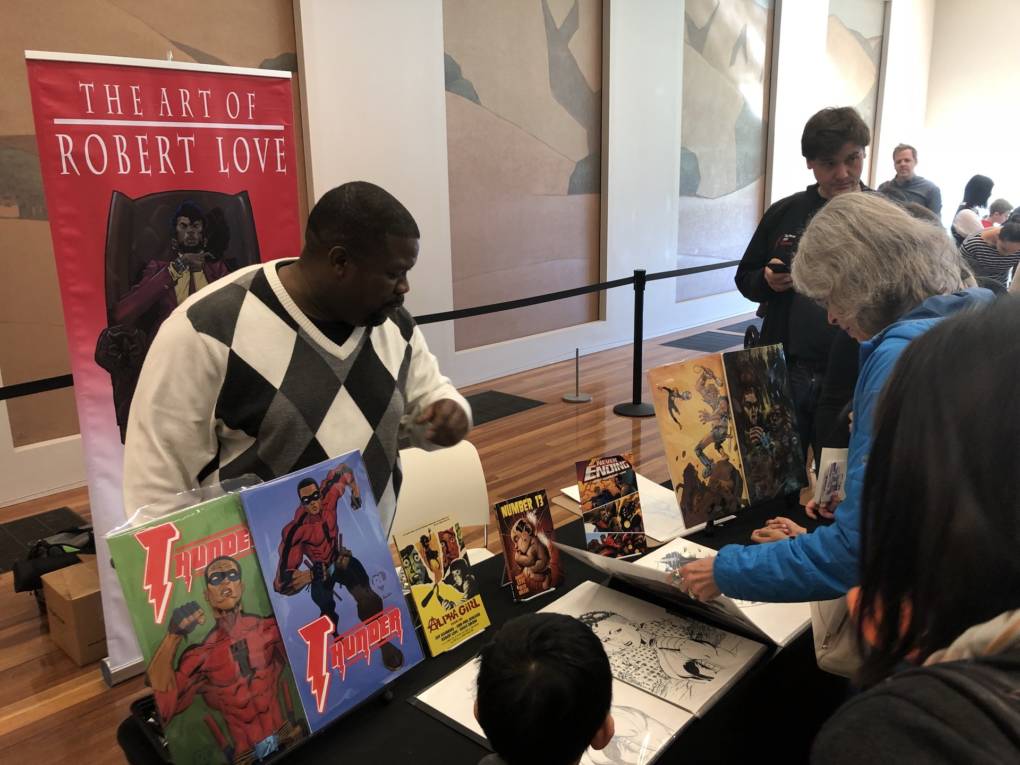
"caption": "Illustrator Robert Love showcases some of his comic book art at the de Young museum as part of the Black Comix Arts Festival.",
"description": "Illustrator Robert Love showcases some of his comic book art at the de Young museum as part of the Black Comix Arts Festival.",
"title": "RS28876_Image uploaded from iOS (9)-qut",
"credit": "Tiffany Camhi/KQED",
"status": "inherit",
"isLoading": false,
"fetchFailed": false
}
},
"audioPlayerReducer": {
"postId": "stream_live",
"isPaused": true,
"isPlaying": false,
"pfsActive": false,
"pledgeModalIsOpen": true,
"playerDrawerIsOpen": false,
"liveAudioPlayStartedAt": 0,
"liveAudioPlayContext": ""
},
"authorsReducer": {
"byline_news_11855799": {
"type": "authors",
"id": "byline_news_11855799",
"meta": {
"override": true
},
"slug": "byline_news_11855799",
"name": "Aisha Harris",
"isLoading": false
},
"gmarzorati": {
"type": "authors",
"id": "227",
"meta": {
"index": "authors_1716337520",
"id": "227",
"found": true
},
"name": "Guy Marzorati",
"firstName": "Guy",
"lastName": "Marzorati",
"slug": "gmarzorati",
"email": "gmarzorati@KQED.org",
"display_author_email": true,
"staff_mastheads": [
"news"
],
"title": "Correspondent",
"bio": "Guy Marzorati is a correspondent on KQED's California Politics and Government Desk, based in San Jose. A graduate of Santa Clara University, Guy joined KQED in 2013. He reports on state and local politics and produces KQED's digital voter guide.",
"avatar": "https://secure.gravatar.com/avatar/e7038b8dbfd55b104369b76b1cd0b9de?s=600&d=blank&r=g",
"twitter": "guymarzorati",
"facebook": null,
"instagram": null,
"linkedin": null,
"sites": [
{
"site": "",
"roles": [
"editor"
]
},
{
"site": "news",
"roles": [
"editor"
]
},
{
"site": "science",
"roles": [
"editor"
]
},
{
"site": "forum",
"roles": [
"editor"
]
},
{
"site": "elections",
"roles": [
"editor"
]
},
{
"site": "liveblog",
"roles": [
"editor"
]
}
],
"headData": {
"title": "Guy Marzorati | KQED",
"description": "Correspondent",
"ogImgSrc": "https://secure.gravatar.com/avatar/e7038b8dbfd55b104369b76b1cd0b9de?s=600&d=blank&r=g",
"twImgSrc": "https://secure.gravatar.com/avatar/e7038b8dbfd55b104369b76b1cd0b9de?s=600&d=blank&r=g"
},
"isLoading": false,
"link": "/author/gmarzorati"
},
"rachael-myrow": {
"type": "authors",
"id": "251",
"meta": {
"index": "authors_1716337520",
"id": "251",
"found": true
},
"name": "Rachael Myrow",
"firstName": "Rachael",
"lastName": "Myrow",
"slug": "rachael-myrow",
"email": "rmyrow@kqed.org",
"display_author_email": true,
"staff_mastheads": [
"news"
],
"title": "Senior Editor of KQED's Silicon Valley News Desk",
"bio": "• I write and edit stories about how Silicon Valley power and policies shape everyday life in California. I’m also passionate about making Bay Area history and culture more accessible to a broad public. • I’ve been a journalist for most of my life, starting in high school with The Franklin Press in Los Angeles, where I grew up. While earning my first degree in English at UC Berkeley, I got my start in public radio at KALX-FM. After completing a second degree in journalism at Cal, I landed my first professional job at Marketplace, then moved on to KPCC (now LAist), and then KQED, where I hosted The California Report for more than seven years. • My reporting has appeared on NPR, The World, WBUR’s \u003ci>Here & Now\u003c/i>, and the BBC. I also guest host for KQED’s \u003ci>Forum\u003c/i>, as well as the Commonwealth Club in San Francisco. • I speak periodically on media, democracy and technology issues, and do voiceover work for documentaries and educational video projects. • Outside of the studio, you'll find me hiking Bay Area trails and whipping up Insta-ready meals in my kitchen. • I do not accept gifts, money, or favors from anyone connected to my reporting, I don't pay people for information, and I do not support or donate to political causes. • I strive to treat the people I report on with fairness, honesty, and respect. I also recognize there are often multiple sides to a story and work to verify information through multiple sources and documentation. If I get something wrong, I correct it.",
"avatar": "https://secure.gravatar.com/avatar/3ed8a3c5f26025e4a805ba634cda8cd764906b97438a6d9ce216b044e340da4e?s=600&d=blank&r=g",
"twitter": "rachaelmyrow",
"bluesky": null,
"facebook": null,
"instagram": null,
"linkedin": "https://www.linkedin.com/in/rachaelmyrow/",
"sites": [
{
"site": "arts",
"roles": [
"administrator"
]
},
{
"site": "news",
"roles": [
"edit_others_posts",
"editor"
]
},
{
"site": "futureofyou",
"roles": [
"editor"
]
},
{
"site": "bayareabites",
"roles": [
"editor"
]
},
{
"site": "stateofhealth",
"roles": [
"editor"
]
},
{
"site": "science",
"roles": [
"editor"
]
},
{
"site": "food",
"roles": [
"editor"
]
},
{
"site": "forum",
"roles": [
"editor"
]
},
{
"site": "liveblog",
"roles": [
"author"
]
}
],
"headData": {
"title": "Rachael Myrow | KQED",
"description": "Senior Editor of KQED's Silicon Valley News Desk",
"ogImgSrc": "https://secure.gravatar.com/avatar/3ed8a3c5f26025e4a805ba634cda8cd764906b97438a6d9ce216b044e340da4e?s=600&d=blank&r=g",
"twImgSrc": "https://secure.gravatar.com/avatar/3ed8a3c5f26025e4a805ba634cda8cd764906b97438a6d9ce216b044e340da4e?s=600&d=blank&r=g"
},
"isLoading": false,
"link": "/author/rachael-myrow"
},
"tcamhi": {
"type": "authors",
"id": "3251",
"meta": {
"index": "authors_1716337520",
"id": "3251",
"found": true
},
"name": "Tiffany Camhi",
"firstName": "Tiffany",
"lastName": "Camhi",
"slug": "tcamhi",
"email": "tiffanycamhi@gmail.com",
"display_author_email": false,
"staff_mastheads": [],
"title": "KQED Contributor",
"bio": null,
"avatar": "https://secure.gravatar.com/avatar/f8204ce351139205d3b3dc1581016a5e30d7d8b38cb2c139348c151ec14b792e?s=600&d=blank&r=g",
"twitter": null,
"bluesky": null,
"facebook": null,
"instagram": null,
"linkedin": null,
"sites": [
{
"site": "arts",
"roles": [
"subscriber"
]
},
{
"site": "news",
"roles": [
"subscriber"
]
}
],
"headData": {
"title": "Tiffany Camhi | KQED",
"description": "KQED Contributor",
"ogImgSrc": "https://secure.gravatar.com/avatar/f8204ce351139205d3b3dc1581016a5e30d7d8b38cb2c139348c151ec14b792e?s=600&d=blank&r=g",
"twImgSrc": "https://secure.gravatar.com/avatar/f8204ce351139205d3b3dc1581016a5e30d7d8b38cb2c139348c151ec14b792e?s=600&d=blank&r=g"
},
"isLoading": false,
"link": "/author/tcamhi"
},
"sdirks": {
"type": "authors",
"id": "7239",
"meta": {
"index": "authors_1716337520",
"id": "7239",
"found": true
},
"name": "Sandhya Dirks",
"firstName": "Sandhya",
"lastName": "Dirks",
"slug": "sdirks",
"email": "sdirks@kqed.org",
"display_author_email": true,
"staff_mastheads": [],
"title": null,
"bio": "Sandhya Dirks was the race and equity reporter at KQED. She approaches race and equity not as a beat, but as a fundamental lens for all investigative and explanatory reporting.\r\n\r\nSandhya covered policing, housing, social justice movements, and the shifting demographics of cities and suburbs.\r\n\r\nShe was the creator and co-host of the podcast American Suburb, about the transformation of suburbia into the most diverse space in American life. She was the editor for Truth Be Told, an advice show for and by people of color. \r\n\r\nHer stories about race, space, and belonging were part of KQED's So Well Spoken project, which won RNDTA's Kaleidoscope award, honoring outstanding achievements in the coverage of diversity.\r\n\r\nPrior to joining KQED in 2015, Sandhya covered the 2012 presidential election from the swing state of Iowa for Iowa Public Radio. At KPBS in San Diego, she broke the story of a sexual harassment scandal that led to the mayor's resignation.\r\n\r\nShe got her start in radio working on documentaries about Oakland that investigated the high drop-out rate in public schools and mistrust between the police and the community.\r\n\r\nSandhya lives in Oakland and believes all stories are stories about power.",
"avatar": "https://secure.gravatar.com/avatar/c0247cb15929cd4c197672fd73d45300?s=600&d=blank&r=g",
"twitter": "audiosand",
"facebook": null,
"instagram": null,
"linkedin": null,
"sites": [
{
"site": "news",
"roles": [
"subscriber"
]
},
{
"site": "stateofhealth",
"roles": [
"author"
]
}
],
"headData": {
"title": "Sandhya Dirks | KQED",
"description": null,
"ogImgSrc": "https://secure.gravatar.com/avatar/c0247cb15929cd4c197672fd73d45300?s=600&d=blank&r=g",
"twImgSrc": "https://secure.gravatar.com/avatar/c0247cb15929cd4c197672fd73d45300?s=600&d=blank&r=g"
},
"isLoading": false,
"link": "/author/sdirks"
},
"cveltman": {
"type": "authors",
"id": "8608",
"meta": {
"index": "authors_1716337520",
"id": "8608",
"found": true
},
"name": "Chloe Veltman",
"firstName": "Chloe",
"lastName": "Veltman",
"slug": "cveltman",
"email": "cveltman@kqed.org",
"display_author_email": true,
"staff_mastheads": [],
"title": "Arts and Culture Reporter",
"bio": "Chloe Veltman is a former arts and culture reporter for KQED. Prior to joining the organization, she launched and led the arts bureau at Colorado Public Radio, served as the Bay Area's culture columnist for the New York Times, and was the founder, host and executive producer of VoiceBox, a national award-winning weekly podcast/radio show and live events series all about the human voice. Chloe is the recipient of numerous prizes, grants and fellowships including a Webby Award for her work on interactive storytelling, both the John S Knight Journalism Fellowship and Humanities Center Fellowship at Stanford University, the Sundance Arts Writing Fellowship and a Library of Congress Research Fellowship. She is the author of the book \"On Acting\" and has appeared as a guest lecturer at Yale University and the San Francisco Conservatory of Music among other institutions. She holds a BA in english literature from King's College, Cambridge, and a Masters in Dramaturgy from the Central School of Speech and Drama/Harvard Institute for Advanced Theater Training.\r\n\u003ca href=\"https://www.chloeveltman.com\">www.chloeveltman.com\u003c/a>",
"avatar": "https://secure.gravatar.com/avatar/55403394b00a1ddab683952c2eb2cf85?s=600&d=blank&r=g",
"twitter": "chloeveltman",
"facebook": null,
"instagram": null,
"linkedin": null,
"sites": [
{
"site": "arts",
"roles": []
},
{
"site": "news",
"roles": [
"author"
]
},
{
"site": "pop",
"roles": [
"editor"
]
},
{
"site": "science",
"roles": []
}
],
"headData": {
"title": "Chloe Veltman | KQED",
"description": "Arts and Culture Reporter",
"ogImgSrc": "https://secure.gravatar.com/avatar/55403394b00a1ddab683952c2eb2cf85?s=600&d=blank&r=g",
"twImgSrc": "https://secure.gravatar.com/avatar/55403394b00a1ddab683952c2eb2cf85?s=600&d=blank&r=g"
},
"isLoading": false,
"link": "/author/cveltman"
},
"agarces": {
"type": "authors",
"id": "11367",
"meta": {
"index": "authors_1716337520",
"id": "11367",
"found": true
},
"name": "Audrey Garces",
"firstName": "Audrey",
"lastName": "Garces",
"slug": "agarces",
"email": "agarces@kqed.org",
"display_author_email": false,
"staff_mastheads": [
"news"
],
"title": "Digital Producer",
"bio": "Audrey is a former digital producer at KQED News. Previously, she was a KQED Raul Ramirez Diversity Fund intern where she developed stories that focused on highlighting diverse voices in journalism. Prior to her work at KQED, she worked as a news intern at the San Francisco Examiner. Audrey graduated from San Francisco State University with a B.A. in journalism and a minor in political science.",
"avatar": "https://secure.gravatar.com/avatar/5211bc2e6a809b9956da169e35ce63d5?s=600&d=blank&r=g",
"twitter": "audgar",
"facebook": null,
"instagram": null,
"linkedin": null,
"sites": [
{
"site": "arts",
"roles": []
},
{
"site": "news",
"roles": [
"subscriber"
]
},
{
"site": "science",
"roles": [
"editor"
]
},
{
"site": "forum",
"roles": [
"editor"
]
},
{
"site": "perspectives",
"roles": [
"administrator"
]
}
],
"headData": {
"title": "Audrey Garces | KQED",
"description": "Digital Producer",
"ogImgSrc": "https://secure.gravatar.com/avatar/5211bc2e6a809b9956da169e35ce63d5?s=600&d=blank&r=g",
"twImgSrc": "https://secure.gravatar.com/avatar/5211bc2e6a809b9956da169e35ce63d5?s=600&d=blank&r=g"
},
"isLoading": false,
"link": "/author/agarces"
},
"mmedina": {
"type": "authors",
"id": "11528",
"meta": {
"index": "authors_1716337520",
"id": "11528",
"found": true
},
"name": "Marisol Medina-Cadena",
"firstName": "Marisol",
"lastName": "Medina-Cadena",
"slug": "mmedina",
"email": "mmedina@KQED.org",
"display_author_email": true,
"staff_mastheads": [],
"title": "Producer, Rightnowish Podcast",
"bio": "Marisol Medina-Cadena is a radio reporter and podcast producer. Before working at KQED, she produced for PBS member station, KCET, in Los Angeles. In 2017, Marisol won an Emmy Award for her work on the televised documentary, \u003cem>City Rising\u003c/em>, examining California's affordable housing crisis and the historical roots of gentrification.",
"avatar": "https://secure.gravatar.com/avatar/6c3db46a1cabb5e1fe9a365b5f4e681e?s=600&d=blank&r=g",
"twitter": "marisolreports",
"facebook": null,
"instagram": null,
"linkedin": null,
"sites": [
{
"site": "arts",
"roles": []
},
{
"site": "news",
"roles": [
"edit_others_posts"
]
}
],
"headData": {
"title": "Marisol Medina-Cadena | KQED",
"description": "Producer, Rightnowish Podcast",
"ogImgSrc": "https://secure.gravatar.com/avatar/6c3db46a1cabb5e1fe9a365b5f4e681e?s=600&d=blank&r=g",
"twImgSrc": "https://secure.gravatar.com/avatar/6c3db46a1cabb5e1fe9a365b5f4e681e?s=600&d=blank&r=g"
},
"isLoading": false,
"link": "/author/mmedina"
}
},
"pagesReducer": {
"news_tag_martin-luther-king-jr": {
"type": "terms",
"id": "news_20755",
"meta": {
"index": "terms_1716263798",
"site": "news",
"id": "20755",
"score": 9.893782
},
"featImg": null,
"name": "Martin Luther King Jr.",
"description": null,
"taxonomy": "tag",
"headData": {
"twImgId": null,
"twTitle": null,
"ogTitle": null,
"ogImgId": null,
"twDescription": null,
"description": null,
"title": "Martin Luther King Jr. Archives | KQED News",
"ogDescription": null
},
"ttid": 20772,
"slug": "martin-luther-king-jr",
"isLoading": false,
"title": "Martin Luther King Jr.",
"pageMeta": {
"site": "news",
"WpPageTemplate": "page-topic-editorial",
"currentPage": 2
},
"blocks": [
{
"blockName": "kqed/post-list",
"attrs": {
"layout": "cardArticle2",
"query": "posts/news?tag=martin-luther-king-jr",
"seeMore": false,
"paginated": true,
"page": 2
}
},
{
"blockName": "kqed/ad"
}
]
}
},
"pfsSessionReducer": {},
"postsReducer": {
"stream_live": {
"type": "live",
"id": "stream_live",
"audioUrl": "https://streams.kqed.org/kqedradio",
"title": "Live Stream",
"excerpt": "Live Stream information currently unavailable.",
"link": "/radio",
"featImg": "",
"label": {
"name": "KQED Live",
"link": "/"
}
},
"stream_kqedNewscast": {
"type": "posts",
"id": "stream_kqedNewscast",
"audioUrl": "https://www.kqed.org/.stream/anon/radio/RDnews/newscast.mp3?_=1",
"title": "KQED Newscast",
"featImg": "",
"label": {
"name": "88.5 FM",
"link": "/"
}
},
"news_11855799": {
"type": "posts",
"id": "news_11855799",
"meta": {
"index": "posts_1716263798",
"site": "news",
"id": "11855799",
"score": null,
"sort": [
1610996276000
]
},
"guestAuthors": [],
"slug": "mlk-fbi-humanizes-a-civil-rights-icons-legacy",
"title": "'MLK/FBI' Humanizes a Civil Rights Icon's Legacy",
"publishDate": 1610996276,
"format": "standard",
"headTitle": "‘MLK/FBI’ Humanizes a Civil Rights Icon’s Legacy | KQED",
"labelTerm": {},
"content": "\u003cp>A year ago, the official Twitter account of the Federal Bureau of Investigation tweeted, “Today, the FBI honors the life and work of the Reverend Dr. Martin Luther King Jr.” It was accompanied by a photo of the FBI Academy’s reflecting pool, where a quote from King is etched in stone: “The time is always right to do what is right.”\u003c/p>\n\u003cp>This wasn’t \u003ca href=\"https://twitter.com/FBI/status/849321344592470018\">the first time\u003c/a> the FBI sent out a statement honoring the slain civil rights leader on the holiday that bears his name, and the responses to the ostensible hypocrisy of it all were no less colorful than they had been in previous years: expletive-filled kiss-offs, angry memes and links or screenshots from articles detailing the agency’s \u003ca href=\"https://www.nytimes.com/2014/11/16/magazine/what-an-uncensored-letter-to-mlk-reveals.html\">notoriously relentless surveillance of King\u003c/a> in the final years of his life. Few took the FBI’s “honor” seriously, because why would they? In the 1960s, the organization, led by its director J. Edgar Hoover, made active attempts to dismantle King’s work and influence.\u003c/p>\n\u003cp>This is neither new nor little-known information, but that doesn’t render Sam Pollard’s documentary “MLK/FBI,” now streaming on demand, less essential. Working with recently declassified documents from the National Archives, which reveal a deeper sense as to the extent and insidiousness of the agency’s surveillance, the film aims to restore dimensions to the now-flattened image of King, who today is often reduced to iconography and erroneously viewed by many as having been a noncontroversial figure during his lifetime.\u003c/p>\n\u003cp>And like Ava DuVernay’s “\u003ca href=\"https://www.npr.org/sections/codeswitch/2014/12/27/373465623/for-hollywood-selma-is-a-new-kind-of-civil-rights-story\">Selma\u003c/a>,” a dramatization with similar aims, it succeeds: Pollard and his team – which includes writers Benjamin Hedin (also the producer) and Laura Tomaselli (also the editor), as well as archival producer Brian Becker – craft an immersive historical play-by-play of how and why King became a target for Hoover and his cohort, placing the activist firmly in context within the era.\u003c/p>\n\u003cp>https://twitter.com/BFI/status/1348932738968035328\u003c/p>\n\u003cp>[ad fullwidth]\u003c/p>\n\u003cp>Interviews with various scholars, former FBI officials like James Comey, and King’s close friends and confidants play out primarily in voice-over (we see no talking heads until the film’s final minutes), which allows the filmmakers to be creative in their visual storytelling. In addition to Becker’s uncovering of rare news clips and footage of King with his family, an effective narrative choice is in the frequent use of excerpts from movies like\u003ca href=\"https://www.youtube.com/watch?v=tCkjDRhk1-E\"> “I Was a Communist for the FBI”\u003c/a> and \u003ca href=\"https://www.youtube.com/watch?v=dMl1fmMkrp8\">“The FBI Story”\u003c/a>. Beverly Gage, author of “G-Man: J. Edgar Hoover and the American Century,” tracks the making of the myth of the FBI as a heroic, moral institution, one driven in large part by the plethora of pro-FBI content in media and entertainment.\u003c/p>\n\u003cp>As “MLK/FBI” explains, it’s King’s association with Stanley Levison, a progressive lawyer and businessman with Communist Party ties, that initially caught the attention of Hoover. But it was his growing impact on the international stage (the Nobel Peace Prize award in 1964; the “I Have a Dream” speech at the March on Washington in 1963), as well as the discovery of his extramarital affairs, which kicked the FBI’s espionage of King into high gear, manifesting into a years-long obsession. The filmmakers don’t shy away from the more unsavory details – including a potentially unreliable FBI document suggesting King was present during the sexual assault of a woman by another man – instead engaging with them head on, as interviewees make the strong case for viewing the investigation as one driven by the deeply ingrained perception of black men as inherent sexual deviants.\u003c/p>\n\u003cp>Recurring themes arise. On a federal judge’s order, the surveillance tapes of King are sealed in the National Archives until at least 2027, and ethical questions are posed about whether dissecting these details are yet another invasion of King’s privacy. There are cautions against taking the content of the documents at face value, because of the inherent racial biases and at-times dubious methods of their authors. And of course, there’s the concern over King’s legacy and how it might crack under revelations that seemingly contradict his near-deified memory.\u003c/p>\n\u003cp>These are valid issues worth wrestling with. But Pollard and his collaborators seem to know and trust that there is more to be gained from this exercise than lost. And as Clarence Jones, a speechwriter for King, puts it, “Does [the truth of his romantic dalliances] make him in my mind less of an historic civil rights leader? No, it does not.”\u003c/p>\n\u003cp>Such an engagement with one of the most recognizable figures of the 20th century has been long overdue. A \u003ca href=\"https://www.rollingstone.com/politics/politics-news/pence-twists-mlk-legacy-black-lives-matter-1021596/\">common schtick\u003c/a> among those decrying Black Lives Matter “rioters” is to compare the activists and their supporters unfavorably to King and the civil rights movement. The modern-day tactics for protest and activism – say, taking a knee or calling for the removal of Confederate monuments – are the “wrong way” and are only sowing further division, they suggest, while King knew how to demonstrate “right.”\u003c/p>\n\u003cp>They willfully ignore the facts of the FBI’s insidious infiltration of King’s inner circle, and the marking of him at one point as “the most dangerous Negro” in the country by one of the agency’s top officials. They evade the truth of his outspokenness against United States involvement in the Vietnam War at a time when it was politically dangerous to take such a position, leading even more people to turn against him toward the end. At one point in the documentary, Gage cites a public opinion poll taken after Hoover and King engaged in a public spat – 50% of respondents at the time sided with Hoover, and only 15-20% agreed with King. These reactions, and many more, all directed at the man (and movement) who advocated for many of the same things BLM is pushing for today.\u003c/p>\n\u003cp>[ad floatright]\u003c/p>\n\u003cp>King’s legacy is complicated, but certainly not undone, by “MLK/FBI.” That’s a good thing; the more we see him as an extraordinary but flawed human being, the easier it is to envision a path forward.\u003c/p>\n\n",
"blocks": [],
"excerpt": "New documentary 'MLK/FBI' explores declassified documents from the National Archives to restore dimensions to the now-flattened image of King, who today is often reduced to iconography and erroneously viewed by many as having been a noncontroversial figure during his lifetime.",
"status": "publish",
"parent": 0,
"modified": 1721156768,
"stats": {
"hasAudio": false,
"hasVideo": false,
"hasChartOrMap": false,
"iframeSrcs": [],
"hasGoogleForm": false,
"hasGallery": false,
"hasHearkenModule": false,
"hasPolis": false,
"paragraphCount": 13,
"wordCount": 1089
},
"headData": {
"title": "'MLK/FBI' Humanizes a Civil Rights Icon's Legacy | KQED",
"description": "New documentary 'MLK/FBI' explores declassified documents from the National Archives to restore dimensions to the now-flattened image of King, who today is often reduced to iconography and erroneously viewed by many as having been a noncontroversial figure during his lifetime.",
"ogTitle": "",
"ogDescription": "",
"ogImgId": "",
"twTitle": "",
"twDescription": "",
"twImgId": "",
"schema": {
"@context": "https://schema.org",
"@type": "NewsArticle",
"headline": "'MLK/FBI' Humanizes a Civil Rights Icon's Legacy",
"datePublished": "2021-01-18T10:57:56-08:00",
"dateModified": "2024-07-16T12:06:08-07:00",
"image": "https://cdn.kqed.org/wp-content/uploads/2020/02/KQED-OG-Image@1x.png",
"isAccessibleForFree": "True",
"publisher": {
"@type": "NewsMediaOrganization",
"@id": "https://www.kqed.org/#organization",
"name": "KQED",
"logo": "https://cdn.kqed.org/wp-content/uploads/2020/02/KQED-OG-Image@1x.png",
"url": "https://www.kqed.org",
"sameAs": [
"https://www.facebook.com/KQED",
"https://twitter.com/KQED",
"https://www.instagram.com/kqed/",
"https://www.tiktok.com/@kqedofficial",
"https://www.linkedin.com/company/kqed",
"https://www.youtube.com/channel/UCeC0IOo7i1P_61zVUWbJ4nw"
]
}
}
},
"source": "NPR",
"sticky": false,
"nprByline": "Aisha Harris",
"path": "/news/11855799/mlk-fbi-humanizes-a-civil-rights-icons-legacy",
"audioTrackLength": null,
"parsedContent": [
{
"type": "contentString",
"content": "\u003cdiv class=\"post-body\">\u003cp>\u003cp>A year ago, the official Twitter account of the Federal Bureau of Investigation tweeted, “Today, the FBI honors the life and work of the Reverend Dr. Martin Luther King Jr.” It was accompanied by a photo of the FBI Academy’s reflecting pool, where a quote from King is etched in stone: “The time is always right to do what is right.”\u003c/p>\n\u003cp>This wasn’t \u003ca href=\"https://twitter.com/FBI/status/849321344592470018\">the first time\u003c/a> the FBI sent out a statement honoring the slain civil rights leader on the holiday that bears his name, and the responses to the ostensible hypocrisy of it all were no less colorful than they had been in previous years: expletive-filled kiss-offs, angry memes and links or screenshots from articles detailing the agency’s \u003ca href=\"https://www.nytimes.com/2014/11/16/magazine/what-an-uncensored-letter-to-mlk-reveals.html\">notoriously relentless surveillance of King\u003c/a> in the final years of his life. Few took the FBI’s “honor” seriously, because why would they? In the 1960s, the organization, led by its director J. Edgar Hoover, made active attempts to dismantle King’s work and influence.\u003c/p>\n\u003cp>This is neither new nor little-known information, but that doesn’t render Sam Pollard’s documentary “MLK/FBI,” now streaming on demand, less essential. Working with recently declassified documents from the National Archives, which reveal a deeper sense as to the extent and insidiousness of the agency’s surveillance, the film aims to restore dimensions to the now-flattened image of King, who today is often reduced to iconography and erroneously viewed by many as having been a noncontroversial figure during his lifetime.\u003c/p>\n\u003cp>And like Ava DuVernay’s “\u003ca href=\"https://www.npr.org/sections/codeswitch/2014/12/27/373465623/for-hollywood-selma-is-a-new-kind-of-civil-rights-story\">Selma\u003c/a>,” a dramatization with similar aims, it succeeds: Pollard and his team – which includes writers Benjamin Hedin (also the producer) and Laura Tomaselli (also the editor), as well as archival producer Brian Becker – craft an immersive historical play-by-play of how and why King became a target for Hoover and his cohort, placing the activist firmly in context within the era.\u003c/p>\u003c/p>\u003c/div>",
"attributes": {
"named": {},
"numeric": []
}
},
{
"type": "component",
"content": "",
"name": "singleTwitterStatus",
"attributes": {
"named": {
"id": "1348932738968035328"
},
"numeric": []
}
},
{
"type": "contentString",
"content": "\u003cdiv class=\"post-body\">\u003cp>\n\u003cp>\u003c/p>\u003c/div>",
"attributes": {
"named": {},
"numeric": []
}
},
{
"type": "component",
"content": "",
"name": "ad",
"attributes": {
"named": {
"label": "fullwidth"
},
"numeric": [
"fullwidth"
]
}
},
{
"type": "contentString",
"content": "\u003cdiv class=\"post-body\">\u003cp>\u003c/p>\n\u003cp>Interviews with various scholars, former FBI officials like James Comey, and King’s close friends and confidants play out primarily in voice-over (we see no talking heads until the film’s final minutes), which allows the filmmakers to be creative in their visual storytelling. In addition to Becker’s uncovering of rare news clips and footage of King with his family, an effective narrative choice is in the frequent use of excerpts from movies like\u003ca href=\"https://www.youtube.com/watch?v=tCkjDRhk1-E\"> “I Was a Communist for the FBI”\u003c/a> and \u003ca href=\"https://www.youtube.com/watch?v=dMl1fmMkrp8\">“The FBI Story”\u003c/a>. Beverly Gage, author of “G-Man: J. Edgar Hoover and the American Century,” tracks the making of the myth of the FBI as a heroic, moral institution, one driven in large part by the plethora of pro-FBI content in media and entertainment.\u003c/p>\n\u003cp>As “MLK/FBI” explains, it’s King’s association with Stanley Levison, a progressive lawyer and businessman with Communist Party ties, that initially caught the attention of Hoover. But it was his growing impact on the international stage (the Nobel Peace Prize award in 1964; the “I Have a Dream” speech at the March on Washington in 1963), as well as the discovery of his extramarital affairs, which kicked the FBI’s espionage of King into high gear, manifesting into a years-long obsession. The filmmakers don’t shy away from the more unsavory details – including a potentially unreliable FBI document suggesting King was present during the sexual assault of a woman by another man – instead engaging with them head on, as interviewees make the strong case for viewing the investigation as one driven by the deeply ingrained perception of black men as inherent sexual deviants.\u003c/p>\n\u003cp>Recurring themes arise. On a federal judge’s order, the surveillance tapes of King are sealed in the National Archives until at least 2027, and ethical questions are posed about whether dissecting these details are yet another invasion of King’s privacy. There are cautions against taking the content of the documents at face value, because of the inherent racial biases and at-times dubious methods of their authors. And of course, there’s the concern over King’s legacy and how it might crack under revelations that seemingly contradict his near-deified memory.\u003c/p>\n\u003cp>These are valid issues worth wrestling with. But Pollard and his collaborators seem to know and trust that there is more to be gained from this exercise than lost. And as Clarence Jones, a speechwriter for King, puts it, “Does [the truth of his romantic dalliances] make him in my mind less of an historic civil rights leader? No, it does not.”\u003c/p>\n\u003cp>Such an engagement with one of the most recognizable figures of the 20th century has been long overdue. A \u003ca href=\"https://www.rollingstone.com/politics/politics-news/pence-twists-mlk-legacy-black-lives-matter-1021596/\">common schtick\u003c/a> among those decrying Black Lives Matter “rioters” is to compare the activists and their supporters unfavorably to King and the civil rights movement. The modern-day tactics for protest and activism – say, taking a knee or calling for the removal of Confederate monuments – are the “wrong way” and are only sowing further division, they suggest, while King knew how to demonstrate “right.”\u003c/p>\n\u003cp>They willfully ignore the facts of the FBI’s insidious infiltration of King’s inner circle, and the marking of him at one point as “the most dangerous Negro” in the country by one of the agency’s top officials. They evade the truth of his outspokenness against United States involvement in the Vietnam War at a time when it was politically dangerous to take such a position, leading even more people to turn against him toward the end. At one point in the documentary, Gage cites a public opinion poll taken after Hoover and King engaged in a public spat – 50% of respondents at the time sided with Hoover, and only 15-20% agreed with King. These reactions, and many more, all directed at the man (and movement) who advocated for many of the same things BLM is pushing for today.\u003c/p>\n\u003cp>\u003c/p>\u003c/div>",
"attributes": {
"named": {},
"numeric": []
}
},
{
"type": "component",
"content": "",
"name": "ad",
"attributes": {
"named": {
"label": "floatright"
},
"numeric": [
"floatright"
]
}
},
{
"type": "contentString",
"content": "\u003cdiv class=\"post-body\">\u003cp>\u003c/p>\n\u003cp>King’s legacy is complicated, but certainly not undone, by “MLK/FBI.” That’s a good thing; the more we see him as an extraordinary but flawed human being, the easier it is to envision a path forward.\u003c/p>\n\n\u003c/div>\u003c/p>",
"attributes": {
"named": {},
"numeric": []
}
}
],
"link": "/news/11855799/mlk-fbi-humanizes-a-civil-rights-icons-legacy",
"authors": [
"byline_news_11855799"
],
"categories": [
"news_223",
"news_8"
],
"tags": [
"news_425",
"news_20755"
],
"featImg": "news_11855800",
"label": "source_news_11855799"
},
"news_11829712": {
"type": "posts",
"id": "news_11829712",
"meta": {
"index": "posts_1716263798",
"site": "news",
"id": "11829712",
"score": null,
"sort": [
1595539405000
]
},
"guestAuthors": [],
"slug": "how-john-lewis-built-a-bridge-to-the-next-generation-in-the-pages-of-a-comic-book",
"title": "How John Lewis Built a Bridge to the Next Generation, in the Pages of a Comic Book",
"publishDate": 1595539405,
"format": "audio",
"headTitle": "How John Lewis Built a Bridge to the Next Generation, in the Pages of a Comic Book | KQED",
"labelTerm": {
"site": "news"
},
"content": "\u003cp>John Lewis was just 25 years old when he faced down death, marching across the Edmund Pettus Bridge in Selma, Alabama, and into the rage of white law enforcement waiting on the other side.\u003c/p>\n\u003cp>Like so many monuments in this country, the arched bridge that leads over the Alabama River is \u003ca href=\"https://www.nytimes.com/2020/07/18/us/politics/edmund-pettus-bridge-renamed-john-lewis.html\">named after\u003c/a> a confederate general and Ku Klux Klan grand dragon, who fought to keep people like Lewis brutally enslaved. In 1965, a century after America’s formal system of chattel slavery ended, Lewis was still fighting for freedom.\u003c/p>\n\u003cp>The response was a violent attack by state troopers. Tear gas and police batons filled the air, the sound of skulls — of Lewis’ skull — cracking.\u003c/p>\n\u003cp>The horrific images of that day were beamed into living rooms across the country, creating a groundswell of public and political support for the movement, leading to the passage of the \u003ca href=\"https://kinginstitute.stanford.edu/encyclopedia/voting-rights-act-1965\">Voting Rights Act of 1965.\u003c/a>\u003c/p>\n\u003cp>This summer, the country was again galvanized by police violence against Black people. We watched George Floyd die in front of us across an agonizing span of almost nine minutes, his neck pinned beneath the knee of a white police officer. We watched \u003ca href=\"https://www.nytimes.com/2020/05/31/us/police-tactics-floyd-protests.html\">police beat\u003c/a>, \u003ca href=\"https://www.nytimes.com/2020/07/21/us/detroit-police-shooting-journalists.html\">shoot\u003c/a> and \u003ca href=\"https://www.nytimes.com/interactive/2020/07/14/nyregion/nypd-george-floyd-protests.html\">even drive their cars\u003c/a> into protesters and journalists. The crowds being beaten and injured by law enforcement were much more multiracial than they had been over half a century before, but they were also \u003ca href=\"https://www.nytimes.com/2020/06/05/us/police-violence-george-floyd.html\">stark reminders of systemic racism\u003c/a> in the use of police force.\u003c/p>\n\u003cp>[ad fullwidth]\u003c/p>\n\u003cp>There is something potent that when Lewis died on July 17, it was in the middle of another civil rights movement. The fact that his lifelong calls for justice, for an end to police violence, and for voting rights are still necessary shows how America’s founding promise of freedom is also our unfinished business.\u003c/p>\n\u003cp>But Lewis never stopped believing in the power of people to one day finish the job. He even left behind a comic book — the three-part graphic novel memoir \u003cem>March\u003c/em> — to share his story with the next generation.\u003c/p>\n\u003cp>To promote the book, Lewis went full fanboy, showing up at San Diego’s Comic-Con \u003ca href=\"https://www.nytimes.com/2020/07/21/us/politics/john-lewis-comic-con.html\">multiple times\u003c/a>. Lewis \u003ca href=\"https://www.washingtonpost.com/news/comic-riffs/wp/2015/07/13/the-real-origin-story-behind-how-rep-john-lewis-became-the-hit-of-comic-con/\">even cosplayed himself\u003c/a> — recreating his famous march across the Edmund Pettus Bridge in the halls of San Diego’s convention center. He replicated his outfit, scouring thrift stores to find a trench coat that matched the one he had worn 50 years before and filling a vintage backpack with fruit, water and books. This time it wasn’t 600 protesters, but a group of school children who took his hands and followed his lead.\u003c/p>\n\u003cp>So how did a sitting U.S. congressman and iconic civil rights leader end up becoming a best-selling graphic novelist and Comic-Con’s favorite cosplayer? As you might expect, there’s an origin story.\u003c/p>\n\u003cp>A group of staffers on Lewis’ 2008 reelection campaign were sitting around, talking about summer plans, including Andrew Aydin.\u003c/p>\n\u003cp>“Unashamed, I said I would be going to a comic book convention. And there was a little teasing, but Congressman Lewis stood up for me,” Aydin recalled.\u003c/p>\n\u003cp>Lewis said, “I just said, ‘You shouldn’t laugh. At another time in another period there was a comic book called \u003cem>The Montgomery Story\u003c/em> ― Martin Luther King Jr. and the Montgomery story — that inspired me.”\u003c/p>\n\u003cp>In 1958, at 18 years old, having just arrived at college, Lewis stumbled upon a comic book that played a role in his rapid evolution into a civil rights leader. The \u003ca href=\"https://www.crmvet.org/docs/ms_for_comic.pdf\">16-page long comic\u003c/a> tells the story of Rosa Parks’ symbolic refusal, and it also gives a detailed account of how to practice nonviolent resistance. It was a lesson Lewis took to heart when he staged sit-ins at segregated lunch counters in Nashville in the late ’50s.\u003c/p>\n\u003cp>“It was on February the 13th, and we had the very first sit-in here,” Lewis said in a 1960 NBC documentary. “I took my seat at the counter. I asked the waiter for a hamburger and a Coke.”\u003c/p>\n\u003cp>Lewis’ staffer, Aydin, knew the history but he hadn’t known about the old comic book. Aydin became convinced Lewis should tell his story as a graphic novel. But Lewis wasn’t so sure.\u003c/p>\n\u003cp>“I thought he was somewhat out of his mind. Why would I be writing a comic book?” Lewis said.\u003c/p>\n\u003cp>But then he thought back: “I do remember reading \u003cem>The Montgomery Story\u003c/em> comic book, and I said, ‘Yes, if you would do it with me.’ And it’s been a labor of love.”\u003c/p>\n\u003cp>That labor brought Lewis, alongside co-writer Aydin and the book’s artist, Nate Powell, to Comic-Con in San Diego to launch the first book in 2013. While the geek and supernatural mecca known for its outlandish costumes may seem like an odd location for a sitting congressman, almost immediately Lewis fit right in.\u003c/p>\n\u003cp>Waiting in line for Lewis’ signature, right next to a guy in an elaborate transformers costume, was Mary Clark, a teacher at San Elijo Middle School in San Marcos.\u003c/p>\n\u003cp>“This will go into my library collection,” Clark said. “As a graphic novel, sometimes students who aren’t really enthusiastic readers will pick it up thinking it’s about the pictures.”\u003c/p>\n\u003cp>In other words, graphic novels like this can be the history equivalent of hiding healthy Brussels sprouts in a fussy eater’s mac and cheese.\u003c/p>\n\u003cp>Lewis was always adamant that \u003cem>March\u003c/em> was more than just biography. Like the Martin Luther King Jr. comic book that inspired him, the trilogy was always meant to be a primer on protest and what it means to march for justice.\u003c/p>\n\u003cp>In 2016, the third book in the \u003cem>March\u003c/em> trilogy won a National Book Award. Lewis, with Aydin and Powell beside him, gave \u003ca href=\"https://www.youtube.com/watch?v=uqmYNOPVyO4\">a powerful speech\u003c/a>. Through tears, he recalled that when he was 16 years old, he tried to get a card from his local library. There were few books at home, and he wanted to read.\u003c/p>\n\u003cp>“We were told the library was for whites only, and not for coloreds,” Lewis said. It is a meaningful reminder of the distance we have traveled since then.\u003c/p>\n\u003cp>On Martin Luther King Jr. Day earlier that same year, a group of Black Lives Matter protesters gathered on the Bay Bridge between Oakland and San Francisco. For hours they \u003ca href=\"https://www.theguardian.com/us-news/2016/jan/19/black-lives-matter-protesters-block-san-franciscos-bay-bridge\">blocked five lanes of traffic on the westbound span\u003c/a>. They were dressed to the nines in their Sunday best, donning suits and fedoras.\u003c/p>\n\u003cp>They dressed like that, they said, to replicate and echo the marchers on another bridge, on another day, in another chapter of this fight. Their outfits were a direct nod to Lewis’ march across the Edmund Pettus Bridge.\u003c/p>\n\u003cp>It is a meaningful reminder that we are still a bridge too far from the justice Lewis fought for, which is perhaps why he left an instruction book, in the form of a graphic novel.\u003c/p>\n\u003cp>[ad floatright]\u003c/p>\n\u003cp>“I remember hearing Martin Luther King Jr. preach from time to time,” Lewis said. “And his father would be in the pulpit. And he would say, ‘Son, make it plain, make it plain.’ So, between Nate and Andrew, they made it plain.”\u003c/p>\n\n",
"blocks": [],
"excerpt": "Civil rights superhero John Lewis, who died on June 17, wrote a comic book adaption of his life story which doubles as a protest playbook, so that future generations can carry on his \"March.\" ",
"status": "publish",
"parent": 0,
"modified": 1721125701,
"stats": {
"hasAudio": false,
"hasVideo": false,
"hasChartOrMap": false,
"iframeSrcs": [],
"hasGoogleForm": false,
"hasGallery": false,
"hasHearkenModule": false,
"hasPolis": false,
"paragraphCount": 30,
"wordCount": 1246
},
"headData": {
"title": "How John Lewis Built a Bridge to the Next Generation, in the Pages of a Comic Book | KQED",
"description": "Civil rights superhero John Lewis, who died on June 17, wrote a comic book adaption of his life story which doubles as a protest playbook, so that future generations can carry on his "March." ",
"ogTitle": "",
"ogDescription": "",
"ogImgId": "",
"twTitle": "",
"twDescription": "",
"twImgId": "",
"schema": {
"@context": "https://schema.org",
"@type": "NewsArticle",
"headline": "How John Lewis Built a Bridge to the Next Generation, in the Pages of a Comic Book",
"datePublished": "2020-07-23T14:23:25-07:00",
"dateModified": "2024-07-16T03:28:21-07:00",
"image": "https://cdn.kqed.org/wp-content/uploads/2020/02/KQED-OG-Image@1x.png",
"isAccessibleForFree": "True",
"publisher": {
"@type": "NewsMediaOrganization",
"@id": "https://www.kqed.org/#organization",
"name": "KQED",
"logo": "https://cdn.kqed.org/wp-content/uploads/2020/02/KQED-OG-Image@1x.png",
"url": "https://www.kqed.org",
"sameAs": [
"https://www.facebook.com/KQED",
"https://twitter.com/KQED",
"https://www.instagram.com/kqed/",
"https://www.tiktok.com/@kqedofficial",
"https://www.linkedin.com/company/kqed",
"https://www.youtube.com/channel/UCeC0IOo7i1P_61zVUWbJ4nw"
]
}
}
},
"sticky": false,
"nprImageAgency": " ",
"nprStoryId": "216884526",
"nprApiLink": "http://api.npr.org/query?id=216884526&apiKey=MDAxOTAwOTE4MDEyMTkxMDAzNjczZDljZA004",
"nprHtmlLink": "https://www.npr.org/sections/codeswitch/2013/08/31/216884526/graphic-novel-depicts-john-lewis-march-toward-justice?ft=nprml&f=216884526",
"nprRetrievedStory": "1",
"nprPubDate": "Thu, 23 Jun 2016 07:59:00 -0400",
"nprStoryDate": "Sat, 31 Aug 2013 04:57:00 -0400",
"nprLastModifiedDate": "Thu, 23 Jun 2016 07:59:53 -0400",
"nprAudio": "https://ondemand.npr.org/anon.npr-mp3/npr/wesat/2013/08/20130831_wesat_08.mp3?orgId=1&topicId=1015&d=357&p=7&story=216884526&ft=nprml&f=216884526",
"nprAudioM3u": "http://api.npr.org/m3u/1217511073-6159de.m3u?orgId=1&topicId=1015&d=357&p=7&story=216884526&ft=nprml&f=216884526",
"path": "/news/11829712/how-john-lewis-built-a-bridge-to-the-next-generation-in-the-pages-of-a-comic-book",
"audioUrl": "https://ondemand.npr.org/anon.npr-mp3/npr/wesat/2013/08/20130831_wesat_08.mp3?orgId=1&topicId=1015&d=357&p=7&story=216884526&ft=nprml&f=216884526",
"audioTrackLength": null,
"parsedContent": [
{
"type": "contentString",
"content": "\u003cdiv class=\"post-body\">\u003cp>\u003cp>John Lewis was just 25 years old when he faced down death, marching across the Edmund Pettus Bridge in Selma, Alabama, and into the rage of white law enforcement waiting on the other side.\u003c/p>\n\u003cp>Like so many monuments in this country, the arched bridge that leads over the Alabama River is \u003ca href=\"https://www.nytimes.com/2020/07/18/us/politics/edmund-pettus-bridge-renamed-john-lewis.html\">named after\u003c/a> a confederate general and Ku Klux Klan grand dragon, who fought to keep people like Lewis brutally enslaved. In 1965, a century after America’s formal system of chattel slavery ended, Lewis was still fighting for freedom.\u003c/p>\n\u003cp>The response was a violent attack by state troopers. Tear gas and police batons filled the air, the sound of skulls — of Lewis’ skull — cracking.\u003c/p>\n\u003cp>The horrific images of that day were beamed into living rooms across the country, creating a groundswell of public and political support for the movement, leading to the passage of the \u003ca href=\"https://kinginstitute.stanford.edu/encyclopedia/voting-rights-act-1965\">Voting Rights Act of 1965.\u003c/a>\u003c/p>\n\u003cp>This summer, the country was again galvanized by police violence against Black people. We watched George Floyd die in front of us across an agonizing span of almost nine minutes, his neck pinned beneath the knee of a white police officer. We watched \u003ca href=\"https://www.nytimes.com/2020/05/31/us/police-tactics-floyd-protests.html\">police beat\u003c/a>, \u003ca href=\"https://www.nytimes.com/2020/07/21/us/detroit-police-shooting-journalists.html\">shoot\u003c/a> and \u003ca href=\"https://www.nytimes.com/interactive/2020/07/14/nyregion/nypd-george-floyd-protests.html\">even drive their cars\u003c/a> into protesters and journalists. The crowds being beaten and injured by law enforcement were much more multiracial than they had been over half a century before, but they were also \u003ca href=\"https://www.nytimes.com/2020/06/05/us/police-violence-george-floyd.html\">stark reminders of systemic racism\u003c/a> in the use of police force.\u003c/p>\n\u003cp>\u003c/p>\u003c/div>",
"attributes": {
"named": {},
"numeric": []
}
},
{
"type": "component",
"content": "",
"name": "ad",
"attributes": {
"named": {
"label": "fullwidth"
},
"numeric": [
"fullwidth"
]
}
},
{
"type": "contentString",
"content": "\u003cdiv class=\"post-body\">\u003cp>\u003c/p>\n\u003cp>There is something potent that when Lewis died on July 17, it was in the middle of another civil rights movement. The fact that his lifelong calls for justice, for an end to police violence, and for voting rights are still necessary shows how America’s founding promise of freedom is also our unfinished business.\u003c/p>\n\u003cp>But Lewis never stopped believing in the power of people to one day finish the job. He even left behind a comic book — the three-part graphic novel memoir \u003cem>March\u003c/em> — to share his story with the next generation.\u003c/p>\n\u003cp>To promote the book, Lewis went full fanboy, showing up at San Diego’s Comic-Con \u003ca href=\"https://www.nytimes.com/2020/07/21/us/politics/john-lewis-comic-con.html\">multiple times\u003c/a>. Lewis \u003ca href=\"https://www.washingtonpost.com/news/comic-riffs/wp/2015/07/13/the-real-origin-story-behind-how-rep-john-lewis-became-the-hit-of-comic-con/\">even cosplayed himself\u003c/a> — recreating his famous march across the Edmund Pettus Bridge in the halls of San Diego’s convention center. He replicated his outfit, scouring thrift stores to find a trench coat that matched the one he had worn 50 years before and filling a vintage backpack with fruit, water and books. This time it wasn’t 600 protesters, but a group of school children who took his hands and followed his lead.\u003c/p>\n\u003cp>So how did a sitting U.S. congressman and iconic civil rights leader end up becoming a best-selling graphic novelist and Comic-Con’s favorite cosplayer? As you might expect, there’s an origin story.\u003c/p>\n\u003cp>A group of staffers on Lewis’ 2008 reelection campaign were sitting around, talking about summer plans, including Andrew Aydin.\u003c/p>\n\u003cp>“Unashamed, I said I would be going to a comic book convention. And there was a little teasing, but Congressman Lewis stood up for me,” Aydin recalled.\u003c/p>\n\u003cp>Lewis said, “I just said, ‘You shouldn’t laugh. At another time in another period there was a comic book called \u003cem>The Montgomery Story\u003c/em> ― Martin Luther King Jr. and the Montgomery story — that inspired me.”\u003c/p>\n\u003cp>In 1958, at 18 years old, having just arrived at college, Lewis stumbled upon a comic book that played a role in his rapid evolution into a civil rights leader. The \u003ca href=\"https://www.crmvet.org/docs/ms_for_comic.pdf\">16-page long comic\u003c/a> tells the story of Rosa Parks’ symbolic refusal, and it also gives a detailed account of how to practice nonviolent resistance. It was a lesson Lewis took to heart when he staged sit-ins at segregated lunch counters in Nashville in the late ’50s.\u003c/p>\n\u003cp>“It was on February the 13th, and we had the very first sit-in here,” Lewis said in a 1960 NBC documentary. “I took my seat at the counter. I asked the waiter for a hamburger and a Coke.”\u003c/p>\n\u003cp>Lewis’ staffer, Aydin, knew the history but he hadn’t known about the old comic book. Aydin became convinced Lewis should tell his story as a graphic novel. But Lewis wasn’t so sure.\u003c/p>\n\u003cp>“I thought he was somewhat out of his mind. Why would I be writing a comic book?” Lewis said.\u003c/p>\n\u003cp>But then he thought back: “I do remember reading \u003cem>The Montgomery Story\u003c/em> comic book, and I said, ‘Yes, if you would do it with me.’ And it’s been a labor of love.”\u003c/p>\n\u003cp>That labor brought Lewis, alongside co-writer Aydin and the book’s artist, Nate Powell, to Comic-Con in San Diego to launch the first book in 2013. While the geek and supernatural mecca known for its outlandish costumes may seem like an odd location for a sitting congressman, almost immediately Lewis fit right in.\u003c/p>\n\u003cp>Waiting in line for Lewis’ signature, right next to a guy in an elaborate transformers costume, was Mary Clark, a teacher at San Elijo Middle School in San Marcos.\u003c/p>\n\u003cp>“This will go into my library collection,” Clark said. “As a graphic novel, sometimes students who aren’t really enthusiastic readers will pick it up thinking it’s about the pictures.”\u003c/p>\n\u003cp>In other words, graphic novels like this can be the history equivalent of hiding healthy Brussels sprouts in a fussy eater’s mac and cheese.\u003c/p>\n\u003cp>Lewis was always adamant that \u003cem>March\u003c/em> was more than just biography. Like the Martin Luther King Jr. comic book that inspired him, the trilogy was always meant to be a primer on protest and what it means to march for justice.\u003c/p>\n\u003cp>In 2016, the third book in the \u003cem>March\u003c/em> trilogy won a National Book Award. Lewis, with Aydin and Powell beside him, gave \u003ca href=\"https://www.youtube.com/watch?v=uqmYNOPVyO4\">a powerful speech\u003c/a>. Through tears, he recalled that when he was 16 years old, he tried to get a card from his local library. There were few books at home, and he wanted to read.\u003c/p>\n\u003cp>“We were told the library was for whites only, and not for coloreds,” Lewis said. It is a meaningful reminder of the distance we have traveled since then.\u003c/p>\n\u003cp>On Martin Luther King Jr. Day earlier that same year, a group of Black Lives Matter protesters gathered on the Bay Bridge between Oakland and San Francisco. For hours they \u003ca href=\"https://www.theguardian.com/us-news/2016/jan/19/black-lives-matter-protesters-block-san-franciscos-bay-bridge\">blocked five lanes of traffic on the westbound span\u003c/a>. They were dressed to the nines in their Sunday best, donning suits and fedoras.\u003c/p>\n\u003cp>They dressed like that, they said, to replicate and echo the marchers on another bridge, on another day, in another chapter of this fight. Their outfits were a direct nod to Lewis’ march across the Edmund Pettus Bridge.\u003c/p>\n\u003cp>It is a meaningful reminder that we are still a bridge too far from the justice Lewis fought for, which is perhaps why he left an instruction book, in the form of a graphic novel.\u003c/p>\n\u003cp>\u003c/p>\u003c/div>",
"attributes": {
"named": {},
"numeric": []
}
},
{
"type": "component",
"content": "",
"name": "ad",
"attributes": {
"named": {
"label": "floatright"
},
"numeric": [
"floatright"
]
}
},
{
"type": "contentString",
"content": "\u003cdiv class=\"post-body\">\u003cp>\u003c/p>\n\u003cp>“I remember hearing Martin Luther King Jr. preach from time to time,” Lewis said. “And his father would be in the pulpit. And he would say, ‘Son, make it plain, make it plain.’ So, between Nate and Andrew, they made it plain.”\u003c/p>\n\n\u003c/div>\u003c/p>",
"attributes": {
"named": {},
"numeric": []
}
}
],
"link": "/news/11829712/how-john-lewis-built-a-bridge-to-the-next-generation-in-the-pages-of-a-comic-book",
"authors": [
"7239"
],
"categories": [
"news_223",
"news_8"
],
"tags": [
"news_28031",
"news_20755",
"news_17968"
],
"featImg": "news_11829713",
"label": "news"
},
"news_11800027": {
"type": "posts",
"id": "news_11800027",
"meta": {
"index": "posts_1716263798",
"site": "news",
"id": "11800027",
"score": null,
"sort": [
1580900455000
]
},
"guestAuthors": [],
"slug": "gay-civil-rights-leader-bayard-rustin-pardoned-for-1953-sex-conviction",
"title": "Gay Civil Rights Leader Bayard Rustin Pardoned for 1953 Sex Conviction",
"publishDate": 1580900455,
"format": "standard",
"headTitle": "Gay Civil Rights Leader Bayard Rustin Pardoned for 1953 Sex Conviction | KQED",
"labelTerm": {
"term": 72,
"site": "news"
},
"content": "\u003cp>California Gov. Gavin Newsom announced a posthumous pardon Wednesday for the late civil rights leader Bayard Rustin, who in 1953 was jailed and registered as a sex offender for having consensual sex with another man.\u003c/p>\n\u003cp>[pullquote size='medium' align='right' citation='State Sen. Scott Wiener']‘Generations of LGBT people — including countless gay men — were branded criminals and sex offenders simply because they had consensual sex. This was often life ruining, and many languished on the sex offender registry for decades.’[/pullquote]The pardon of Rustin, who helped organize the historic March on Washington in 1963, marks the beginning of a Newsom initiative aimed at pardoning others who were convicted of crimes in California for being gay.\u003c/p>\n\u003cp>“In California and across the country, many laws have been used as legal tools of oppression, and to stigmatize and punish LGBTQ people and communities and warn others what harm could await them for living authentically,” Newsom said in a statement. “I want to encourage others in similar situations to seek a pardon to right this egregious wrong.”\u003c/p>\n\u003cp>The Newsom administration is pledging to identify and pardon other individuals who were prosecuted for consensual sex with a partner of the same sex — a statute that was wiped off California’s books in 1975.\u003c/p>\n\u003cfigure id=\"attachment_11800096\" class=\"wp-caption alignnone\" style=\"max-width: 800px\">\u003cimg loading=\"lazy\" decoding=\"async\" class=\"size-medium wp-image-11800096\" src=\"https://ww2.kqed.org/app/uploads/sites/10/2020/02/Bayard-Rustin-March-on-Washington-qut-800x1025.jpg\" alt=\"Bayard Rustin (L) and Cleveland Robinson in August, 1963. (O. Fernandez/Wikimedia Commons)\" width=\"800\" height=\"1025\" srcset=\"https://cdn.kqed.org/wp-content/uploads/sites/10/2020/02/Bayard-Rustin-March-on-Washington-qut-800x1025.jpg 800w, https://cdn.kqed.org/wp-content/uploads/sites/10/2020/02/Bayard-Rustin-March-on-Washington-qut-160x205.jpg 160w, https://cdn.kqed.org/wp-content/uploads/sites/10/2020/02/Bayard-Rustin-March-on-Washington-qut-1020x1306.jpg 1020w, https://cdn.kqed.org/wp-content/uploads/sites/10/2020/02/Bayard-Rustin-March-on-Washington-qut.jpg 1920w\" sizes=\"(max-width: 800px) 100vw, 800px\">\u003cfigcaption class=\"wp-caption-text\">Bayard Rustin (L) and Cleveland Robinson in August 1963. \u003ccite>(O. Fernandez/Wikimedia Commons)\u003c/cite>\u003c/figcaption>\u003c/figure>\n\u003cp>More than two decades earlier, in January 1953, Rustin was arrested in Pasadena after police found him having sex with another man in a car. Rustin spent 50 days in county jail and was forced to register as a sex offender.\u003c/p>\n\u003cp>[ad fullwidth]\u003c/p>\n\u003cp>In the years after the arrest, Rustin emerged as a leader in the nation’s civil rights movement. He advised Martin Luther King Jr. on tactics of non-violent protest and then worked with King to organize the Montgomery bus boycott and create the Southern Christian Leadership Conference.\u003c/p>\n\u003cp>But throughout his career, Rustin was marginalized because of his sexual orientation by both civil rights opponents and allies in the movement.\u003c/p>\n\u003cp>According to \u003ca href=\"https://www.washingtonpost.com/history/2020/01/21/bayard-rustin-gay-pardon/\" target=\"_blank\" rel=\"noopener noreferrer\">The Washington Post\u003c/a>, King was pressured to distance himself from Rustin, who resigned from the Southern Christian Leadership Conference in 1960.\u003c/p>\n\u003cp>But three years later, Rustin played a key role in organizing the March on Washington, where King delivered his famous “I Have a Dream” speech.\u003c/p>\n\u003cp>The week after the march, Rustin graced the cover of Life Magazine with fellow activist A. Philip Randolph.\u003c/p>\n\u003cp>Rustin died in 1987. President Barack Obama awarded him the Presidential Medal of Freedom in 2013.\u003c/p>\n\u003cp>[aside tag='lgbtq-rights' label='More Coverage']The push to pardon Rustin was brought to Newsom by state Sen. Scott Wiener, D-San Francisco, chair of the California Legislative LGBTQ Caucus, who partnered with Assemblywoman Shirley Weber, D-San Diego, chair of the California Legislative Black Caucus.\u003c/p>\n\u003cp>“I’m thrilled that Gov. Newsom is pardoning Bayard Rustin and that he acted so quickly and decisively in response to our request,” Wiener said in a statement. “Generations of LGBT people — including countless gay men — were branded criminals and sex offenders simply because they had consensual sex. This was often life ruining, and many languished on the sex offender registry for decades. The Governor’s actions today are a huge step forward in our community’s ongoing quest for full acceptance and justice.”\u003c/p>\n\u003cp>Weber noted that “Rustin was a great American who was both gay and black at a time when the sheer fact of being either or both could land you in jail.”\u003c/p>\n\u003cp>\u003c/p>\n\u003cp>“This pardon assures his place in history and the Governor’s ongoing commitment to addressing similar convictions shows that California is finally addressing a great injustice,” she added.\u003c/p>\n\n",
"blocks": [],
"excerpt": "Gov. Gavin Newsom's pardon of Bayard Rustin, who helped organize the historic March on Washington in 1963, launched an initiative aimed at pardoning others who were convicted of crimes in California for being gay.",
"status": "publish",
"parent": 0,
"modified": 1721148977,
"stats": {
"hasAudio": false,
"hasVideo": false,
"hasChartOrMap": false,
"iframeSrcs": [],
"hasGoogleForm": false,
"hasGallery": false,
"hasHearkenModule": false,
"hasPolis": false,
"paragraphCount": 17,
"wordCount": 634
},
"headData": {
"title": "Gay Civil Rights Leader Bayard Rustin Pardoned for 1953 Sex Conviction | KQED",
"description": "Gov. Newsom's pardon of Bayard Rustin, who helped organize the March on Washington in 1963, launched an initiative aimed at pardoning people convicted of crimes for being gay.",
"ogTitle": "",
"ogDescription": "",
"ogImgId": "",
"twTitle": "",
"twDescription": "",
"twImgId": "",
"socialDescription": "Gov. Newsom's pardon of Bayard Rustin, who helped organize the March on Washington in 1963, launched an initiative aimed at pardoning people convicted of crimes for being gay.",
"schema": {
"@context": "https://schema.org",
"@type": "NewsArticle",
"headline": "Gay Civil Rights Leader Bayard Rustin Pardoned for 1953 Sex Conviction",
"datePublished": "2020-02-05T03:00:55-08:00",
"dateModified": "2024-07-16T09:56:17-07:00",
"image": "https://cdn.kqed.org/wp-content/uploads/2020/02/KQED-OG-Image@1x.png",
"isAccessibleForFree": "True",
"publisher": {
"@type": "NewsMediaOrganization",
"@id": "https://www.kqed.org/#organization",
"name": "KQED",
"logo": "https://cdn.kqed.org/wp-content/uploads/2020/02/KQED-OG-Image@1x.png",
"url": "https://www.kqed.org",
"sameAs": [
"https://www.facebook.com/KQED",
"https://twitter.com/KQED",
"https://www.instagram.com/kqed/",
"https://www.tiktok.com/@kqedofficial",
"https://www.linkedin.com/company/kqed",
"https://www.youtube.com/channel/UCeC0IOo7i1P_61zVUWbJ4nw"
]
}
}
},
"sticky": false,
"path": "/news/11800027/gay-civil-rights-leader-bayard-rustin-pardoned-for-1953-sex-conviction",
"audioTrackLength": null,
"parsedContent": [
{
"type": "contentString",
"content": "\u003cdiv class=\"post-body\">\u003cp>\u003cp>California Gov. Gavin Newsom announced a posthumous pardon Wednesday for the late civil rights leader Bayard Rustin, who in 1953 was jailed and registered as a sex offender for having consensual sex with another man.\u003c/p>\n\u003cp>\u003c/p>\u003c/div>",
"attributes": {
"named": {},
"numeric": []
}
},
{
"type": "component",
"content": "‘Generations of LGBT people — including countless gay men — were branded criminals and sex offenders simply because they had consensual sex. This was often life ruining, and many languished on the sex offender registry for decades.’",
"name": "pullquote",
"attributes": {
"named": {
"size": "medium",
"align": "right",
"citation": "State Sen. Scott Wiener",
"label": ""
},
"numeric": []
}
},
{
"type": "contentString",
"content": "\u003cdiv class=\"post-body\">\u003cp>The pardon of Rustin, who helped organize the historic March on Washington in 1963, marks the beginning of a Newsom initiative aimed at pardoning others who were convicted of crimes in California for being gay.\u003c/p>\n\u003cp>“In California and across the country, many laws have been used as legal tools of oppression, and to stigmatize and punish LGBTQ people and communities and warn others what harm could await them for living authentically,” Newsom said in a statement. “I want to encourage others in similar situations to seek a pardon to right this egregious wrong.”\u003c/p>\n\u003cp>The Newsom administration is pledging to identify and pardon other individuals who were prosecuted for consensual sex with a partner of the same sex — a statute that was wiped off California’s books in 1975.\u003c/p>\n\u003cfigure id=\"attachment_11800096\" class=\"wp-caption alignnone\" style=\"max-width: 800px\">\u003cimg loading=\"lazy\" decoding=\"async\" class=\"size-medium wp-image-11800096\" src=\"https://ww2.kqed.org/app/uploads/sites/10/2020/02/Bayard-Rustin-March-on-Washington-qut-800x1025.jpg\" alt=\"Bayard Rustin (L) and Cleveland Robinson in August, 1963. (O. Fernandez/Wikimedia Commons)\" width=\"800\" height=\"1025\" srcset=\"https://cdn.kqed.org/wp-content/uploads/sites/10/2020/02/Bayard-Rustin-March-on-Washington-qut-800x1025.jpg 800w, https://cdn.kqed.org/wp-content/uploads/sites/10/2020/02/Bayard-Rustin-March-on-Washington-qut-160x205.jpg 160w, https://cdn.kqed.org/wp-content/uploads/sites/10/2020/02/Bayard-Rustin-March-on-Washington-qut-1020x1306.jpg 1020w, https://cdn.kqed.org/wp-content/uploads/sites/10/2020/02/Bayard-Rustin-March-on-Washington-qut.jpg 1920w\" sizes=\"(max-width: 800px) 100vw, 800px\">\u003cfigcaption class=\"wp-caption-text\">Bayard Rustin (L) and Cleveland Robinson in August 1963. \u003ccite>(O. Fernandez/Wikimedia Commons)\u003c/cite>\u003c/figcaption>\u003c/figure>\n\u003cp>More than two decades earlier, in January 1953, Rustin was arrested in Pasadena after police found him having sex with another man in a car. Rustin spent 50 days in county jail and was forced to register as a sex offender.\u003c/p>\n\u003cp>\u003c/p>\u003c/div>",
"attributes": {
"named": {},
"numeric": []
}
},
{
"type": "component",
"content": "",
"name": "ad",
"attributes": {
"named": {
"label": "fullwidth"
},
"numeric": [
"fullwidth"
]
}
},
{
"type": "contentString",
"content": "\u003cdiv class=\"post-body\">\u003cp>\u003c/p>\n\u003cp>In the years after the arrest, Rustin emerged as a leader in the nation’s civil rights movement. He advised Martin Luther King Jr. on tactics of non-violent protest and then worked with King to organize the Montgomery bus boycott and create the Southern Christian Leadership Conference.\u003c/p>\n\u003cp>But throughout his career, Rustin was marginalized because of his sexual orientation by both civil rights opponents and allies in the movement.\u003c/p>\n\u003cp>According to \u003ca href=\"https://www.washingtonpost.com/history/2020/01/21/bayard-rustin-gay-pardon/\" target=\"_blank\" rel=\"noopener noreferrer\">The Washington Post\u003c/a>, King was pressured to distance himself from Rustin, who resigned from the Southern Christian Leadership Conference in 1960.\u003c/p>\n\u003cp>But three years later, Rustin played a key role in organizing the March on Washington, where King delivered his famous “I Have a Dream” speech.\u003c/p>\n\u003cp>The week after the march, Rustin graced the cover of Life Magazine with fellow activist A. Philip Randolph.\u003c/p>\n\u003cp>Rustin died in 1987. President Barack Obama awarded him the Presidential Medal of Freedom in 2013.\u003c/p>\n\u003cp>\u003c/p>\u003c/div>",
"attributes": {
"named": {},
"numeric": []
}
},
{
"type": "component",
"content": "",
"name": "aside",
"attributes": {
"named": {
"tag": "lgbtq-rights",
"label": "More Coverage "
},
"numeric": []
}
},
{
"type": "contentString",
"content": "\u003cdiv class=\"post-body\">\u003cp>The push to pardon Rustin was brought to Newsom by state Sen. Scott Wiener, D-San Francisco, chair of the California Legislative LGBTQ Caucus, who partnered with Assemblywoman Shirley Weber, D-San Diego, chair of the California Legislative Black Caucus.\u003c/p>\n\u003cp>“I’m thrilled that Gov. Newsom is pardoning Bayard Rustin and that he acted so quickly and decisively in response to our request,” Wiener said in a statement. “Generations of LGBT people — including countless gay men — were branded criminals and sex offenders simply because they had consensual sex. This was often life ruining, and many languished on the sex offender registry for decades. The Governor’s actions today are a huge step forward in our community’s ongoing quest for full acceptance and justice.”\u003c/p>\n\u003cp>Weber noted that “Rustin was a great American who was both gay and black at a time when the sheer fact of being either or both could land you in jail.”\u003c/p>\n\u003cp>\u003c/p>\n\u003cp>“This pardon assures his place in history and the Governor’s ongoing commitment to addressing similar convictions shows that California is finally addressing a great injustice,” she added.\u003c/p>\n\n\u003c/div>\u003c/p>",
"attributes": {
"named": {},
"numeric": []
}
}
],
"link": "/news/11800027/gay-civil-rights-leader-bayard-rustin-pardoned-for-1953-sex-conviction",
"authors": [
"227"
],
"programs": [
"news_72"
],
"categories": [
"news_6188",
"news_8",
"news_13"
],
"tags": [
"news_335",
"news_19542",
"news_16",
"news_20003",
"news_19345",
"news_20755",
"news_1217",
"news_25419"
],
"featImg": "news_11800071",
"label": "news_72"
},
"news_11796631": {
"type": "posts",
"id": "news_11796631",
"meta": {
"index": "posts_1716263798",
"site": "news",
"id": "11796631",
"score": null,
"sort": [
1579306539000
]
},
"guestAuthors": [],
"slug": "oakland-tech-high-school-honors-its-own-role-in-mlk-day-40-years-on",
"title": "Oakland Tech High School Honors Its Own Role in MLK Day — 40 Years On",
"publishDate": 1579306539,
"format": "standard",
"headTitle": "Oakland Tech High School Honors Its Own Role in MLK Day — 40 Years On | KQED",
"labelTerm": {
"site": "news"
},
"content": "\u003cp>On stage, it’s the year 1981. A huddle of nerve-wracked teens waits to hear if state lawmakers will vote to pass \u003ca href=\"https://books.google.com/books?id=CBNWVWxKWgkC&pg=RA21-PA1&lpg=RA21-PA1&dq=Assembly+Bill+312+martin+luther+king+california&source=bl&ots=3WhsPPgZot&sig=ACfU3U0aa_t-CbUpXmCApmulIuw07MKNAw&hl=en&sa=X&ved=2ahUKEwjU7saj0IvnAhX2CjQIHVtqC1kQ6AEwAnoECAoQAQ#v=onepage&q=Assembly%20Bill%20312%20martin%20luther%20king%20california&f=false\" target=\"_blank\" rel=\"noopener noreferrer\">Assembly Bill 312\u003c/a>, the piece of legislation they’ve spent the last three years fighting for.\u003c/p>\n\u003cp>The votes come down in a cascade of “yays” and “nays,” as tense piano music bubbles underneath.\u003c/p>\n\u003cp>“It’s close. Shoot! It could go either way,” says one student, in a state of high anxiety.\u003c/p>\n\u003cp>This is “The Apollos,” a new play written, produced and performed by students from \u003ca href=\"https://oaklandtech.com/\" target=\"_blank\" rel=\"noopener noreferrer\">Oakland Technical High School \u003c/a>under the guidance of their drama teacher Ena Dallas. It’s based on the real-life story of an earlier generation of Oakland Tech students, who campaigned hard almost four decades ago to get Martin Luther King Jr. Day recognized as a California holiday — several years before the national holiday was signed into law in 1983.\u003c/p>\n\u003cfigure id=\"attachment_11796642\" class=\"wp-caption aligncenter\" style=\"max-width: 1920px\">\u003ca href=\"https://ww2.kqed.org/news/2020/01/17/oakland-tech-high-school-honors-its-own-role-in-mlk-day-40-years-on/rs40751_danae-thornton-and-karen-kennedy-qut/\" rel=\"attachment wp-att-11796642\">\u003cimg loading=\"lazy\" decoding=\"async\" class=\"size-full wp-image-11796642\" src=\"https://ww2.kqed.org/app/uploads/sites/10/2020/01/RS40751_Danae-Thornton-and-Karen-Kennedy-qut.jpg\" alt='Oakland tech student actor Danae Thornton (left) plays the real-life Apollo Karen Kennedy in \"The Apollos\".' width=\"1920\" height=\"1440\" srcset=\"https://cdn.kqed.org/wp-content/uploads/sites/10/2020/01/RS40751_Danae-Thornton-and-Karen-Kennedy-qut.jpg 1920w, https://cdn.kqed.org/wp-content/uploads/sites/10/2020/01/RS40751_Danae-Thornton-and-Karen-Kennedy-qut-160x120.jpg 160w, https://cdn.kqed.org/wp-content/uploads/sites/10/2020/01/RS40751_Danae-Thornton-and-Karen-Kennedy-qut-800x600.jpg 800w, https://cdn.kqed.org/wp-content/uploads/sites/10/2020/01/RS40751_Danae-Thornton-and-Karen-Kennedy-qut-1020x765.jpg 1020w, https://cdn.kqed.org/wp-content/uploads/sites/10/2020/01/RS40751_Danae-Thornton-and-Karen-Kennedy-qut-1832x1374.jpg 1832w, https://cdn.kqed.org/wp-content/uploads/sites/10/2020/01/RS40751_Danae-Thornton-and-Karen-Kennedy-qut-1376x1032.jpg 1376w, https://cdn.kqed.org/wp-content/uploads/sites/10/2020/01/RS40751_Danae-Thornton-and-Karen-Kennedy-qut-1044x783.jpg 1044w, https://cdn.kqed.org/wp-content/uploads/sites/10/2020/01/RS40751_Danae-Thornton-and-Karen-Kennedy-qut-632x474.jpg 632w, https://cdn.kqed.org/wp-content/uploads/sites/10/2020/01/RS40751_Danae-Thornton-and-Karen-Kennedy-qut-536x402.jpg 536w\" sizes=\"auto, (max-width: 1920px) 100vw, 1920px\">\u003c/a>\u003cfigcaption class=\"wp-caption-text\">Oakland Tech student actor Danae Thornton (left) plays the real-life Apollo Karen Kennedy in “The Apollos.” \u003ccite>(Ena Dallas)\u003c/cite>\u003c/figcaption>\u003c/figure>\n\u003cp>That class of students called themselves “The Apollos” after the NASA space program.\u003c/p>\n\u003cp>“Which means, ‘We who reach for the stars,’ ” says Karen Kennedy, one of the core group of five students who led the charge under the supervision of their teacher, Tay McArthur.\u003c/p>\n\u003cp>[aside postID='news_11796656,news_11796439' label='Martin Luther King Jr.']Kennedy, now a retired teacher herself, says the idea to push for the holiday came up one day in McArthur’s government class. It was 1978, and the students were learning about the legislative process.\u003c/p>\n\u003cp>“Mr. McArthur was going on with his long, long lectures,” Kennedy says. “And one of the questions came up was, ‘Why isn’t there a holiday for any people of color?'”\u003c/p>\n\u003cp>McArthur remembers it being a chance for the students to learn a real life lesson. “The students asked, ‘What would it take to make it happen for the state?’ ” says McArthur now. “And I said, ‘Open your books up to the page on how a bill becomes a law.’ I said, ‘This is what is required. It’s not easy.’ ”\u003c/p>\n\u003cp>The conversation sent Kennedy and her fellow Apollos on a long and challenging journey, driven by their desire to honor Martin Luther King Jr., who was assassinated a decade earlier.\u003c/p>\n\u003cp>“There weren’t very many African American figures to look up to that were strong leaders,” Kennedy says. “And he was one of the main positive role models in our time.”\u003c/p>\n\u003cfigure id=\"attachment_11796634\" class=\"wp-caption alignright\" style=\"max-width: 425px\">\u003cimg loading=\"lazy\" decoding=\"async\" class=\"size-full wp-image-11796634\" src=\"https://ww2.kqed.org/app/uploads/sites/10/2020/01/RS40754_Tay-McArthur-qut.jpg\" alt=\"Oakland Tech teacher Tay McArthur\" width=\"425\" height=\"292\" srcset=\"https://cdn.kqed.org/wp-content/uploads/sites/10/2020/01/RS40754_Tay-McArthur-qut.jpg 425w, https://cdn.kqed.org/wp-content/uploads/sites/10/2020/01/RS40754_Tay-McArthur-qut-160x110.jpg 160w\" sizes=\"auto, (max-width: 425px) 100vw, 425px\">\u003cfigcaption class=\"wp-caption-text\">Oakland Tech teacher Tay McArthur \u003ccite>(Oakland Technical High School)\u003c/cite>\u003c/figcaption>\u003c/figure>\n\u003cp>The Apollos spent the next three years writing letters to lawmakers, knocking on doors to drum up signatures for their petition and making many, many early morning trips to Sacramento in McArthur’s car.\u003c/p>\n\u003cp>“He even had his license plate named ‘The Apollos,’ ” Kennedy says.\u003c/p>\n\u003cp>Some politicians were receptive to the teenage lobbyists. But others pushed back. “Every time we made a positive gain, there was a setback,” she says. “But we never gave up.”\u003c/p>\n\u003cp>Besides being a lesson in the legislative process, McArthur also remembers how much it meant for the students to feel so empowered.\u003c/p>\n\u003cp>“When the bill passed, they shrieked and cried,” McArthur says. “Those 16, 17 and 18 year olds had power they never dreamed of. That’s a biggie. They had so much satisfaction.”\u003c/p>\n\u003cp>Forty years later, the current crop of Oakland Tech students are carrying on their spirit both on stage and off.\u003c/p>\n\u003cp>Senior Samuel Getachew, who co-wrote the new play and also performs in it, says Oakland Tech has a long history of student activism.\u003c/p>\n\u003cfigure id=\"attachment_11796632\" class=\"wp-caption aligncenter\" style=\"max-width: 1920px\">\u003ca href=\"https://ww2.kqed.org/news/2020/01/17/oakland-tech-high-school-honors-its-own-role-in-mlk-day-40-years-on/rs40757_the-apollos-scene-3-qut/\" rel=\"attachment wp-att-11796632\">\u003cimg loading=\"lazy\" decoding=\"async\" class=\"size-full wp-image-11796632\" src=\"https://ww2.kqed.org/app/uploads/sites/10/2020/01/RS40757_The-Apollos-scene-3-qut.jpg\" alt='The lead actors in \"The Apollos\", a new play written, performed and produced by Oakland Technical High School students.' width=\"1920\" height=\"1440\" srcset=\"https://cdn.kqed.org/wp-content/uploads/sites/10/2020/01/RS40757_The-Apollos-scene-3-qut.jpg 1920w, https://cdn.kqed.org/wp-content/uploads/sites/10/2020/01/RS40757_The-Apollos-scene-3-qut-160x120.jpg 160w, https://cdn.kqed.org/wp-content/uploads/sites/10/2020/01/RS40757_The-Apollos-scene-3-qut-800x600.jpg 800w, https://cdn.kqed.org/wp-content/uploads/sites/10/2020/01/RS40757_The-Apollos-scene-3-qut-1020x765.jpg 1020w, https://cdn.kqed.org/wp-content/uploads/sites/10/2020/01/RS40757_The-Apollos-scene-3-qut-1832x1374.jpg 1832w, https://cdn.kqed.org/wp-content/uploads/sites/10/2020/01/RS40757_The-Apollos-scene-3-qut-1376x1032.jpg 1376w, https://cdn.kqed.org/wp-content/uploads/sites/10/2020/01/RS40757_The-Apollos-scene-3-qut-1044x783.jpg 1044w, https://cdn.kqed.org/wp-content/uploads/sites/10/2020/01/RS40757_The-Apollos-scene-3-qut-632x474.jpg 632w, https://cdn.kqed.org/wp-content/uploads/sites/10/2020/01/RS40757_The-Apollos-scene-3-qut-536x402.jpg 536w\" sizes=\"auto, (max-width: 1920px) 100vw, 1920px\">\u003c/a>\u003cfigcaption class=\"wp-caption-text\">The lead actors in “The Apollos,” a new play written, performed and produced by Oakland Technical High School students. \u003ccite>(Chloe Veltman/KQED)\u003c/cite>\u003c/figcaption>\u003c/figure>\n\u003cp>“Huey P. Newton, one of the founders of the Black Panther Party, went here,” he says. “We’ve always loved a good protest.”\u003c/p>\n\u003cp>Getachew is also a proud activist.\u003c/p>\n\u003cp>“In my sophomore year, I was one of the lead organizers for a walkout in solidarity with the students from the Parkland shooting,” he says, reeling off a list of actions he’s undertaken. “We organized a voter registration drive in Tracy, California, which is a swing district for the upcoming midterm election.”\u003c/p>\n\u003cp>Getachew hopes his fellow students will find The Apollos’ story as much of a call to action as he does.\u003c/p>\n\u003cp>“Mr. McArthur always taught his students that there was no excuse that lay in their age for them being unable to do what they wanted to do,” he says. “And I want the parents in the audience to know their kids are more capable than they may think.”\u003c/p>\n\u003cp>\u003cem>“The Apollos” plays at Oakland Technical High School through Sunday, Jan 19. Tickets and information \u003ca href=\"https://m.bpt.me/event/4493246\" target=\"_blank\" rel=\"noopener noreferrer\">here\u003c/a>.\u003c/em>\u003c/p>\n\u003cp>\u003cem>The \u003ca href=\"https://www.sos.ca.gov/archives/\" target=\"_blank\" rel=\"noopener noreferrer\">California State Archives\u003c/a> contributed sourcing for this story.\u003c/em>\u003c/p>\n\u003cp>[ad fullwidth]\u003c/p>\n\u003cp>\u003c/p>\n",
"blocks": [],
"excerpt": "\"The Apollos,\" written, produced and performed by Oakland Tech students, is based on the real-life story of an earlier generation of students who campaigned to get MLK Day recognized as a California holiday.",
"status": "publish",
"parent": 0,
"modified": 1740180173,
"stats": {
"hasAudio": false,
"hasVideo": false,
"hasChartOrMap": false,
"iframeSrcs": [],
"hasGoogleForm": false,
"hasGallery": false,
"hasHearkenModule": false,
"hasPolis": false,
"paragraphCount": 27,
"wordCount": 866
},
"headData": {
"title": "Oakland Tech High School Honors Its Own Role in MLK Day — 40 Years On | KQED",
"description": ""The Apollos," written, produced and performed by Oakland Tech students, is based on the real-life story of an earlier generation of students who campaigned to get MLK Day recognized as a California holiday.",
"ogTitle": "",
"ogDescription": "",
"ogImgId": "",
"twTitle": "",
"twDescription": "",
"twImgId": "",
"schema": {
"@context": "https://schema.org",
"@type": "NewsArticle",
"headline": "Oakland Tech High School Honors Its Own Role in MLK Day — 40 Years On",
"datePublished": "2020-01-17T16:15:39-08:00",
"dateModified": "2025-02-21T15:22:53-08:00",
"image": "https://cdn.kqed.org/wp-content/uploads/2020/02/KQED-OG-Image@1x.png",
"isAccessibleForFree": "True",
"publisher": {
"@type": "NewsMediaOrganization",
"@id": "https://www.kqed.org/#organization",
"name": "KQED",
"logo": "https://cdn.kqed.org/wp-content/uploads/2020/02/KQED-OG-Image@1x.png",
"url": "https://www.kqed.org",
"sameAs": [
"https://www.facebook.com/KQED",
"https://twitter.com/KQED",
"https://www.instagram.com/kqed/",
"https://www.tiktok.com/@kqedofficial",
"https://www.linkedin.com/company/kqed",
"https://www.youtube.com/channel/UCeC0IOo7i1P_61zVUWbJ4nw"
]
}
}
},
"sticky": false,
"audioTrackLength": 207,
"path": "/news/11796631/oakland-tech-high-school-honors-its-own-role-in-mlk-day-40-years-on",
"audioUrl": "https://www.kqed.org/.stream/anon/radio/RDnews/2020/01/Apollosforwebincludinglede.mp3",
"audioDuration": 210000,
"parsedContent": [
{
"type": "contentString",
"content": "\u003cdiv class=\"post-body\">\u003cp>\u003cp>On stage, it’s the year 1981. A huddle of nerve-wracked teens waits to hear if state lawmakers will vote to pass \u003ca href=\"https://books.google.com/books?id=CBNWVWxKWgkC&pg=RA21-PA1&lpg=RA21-PA1&dq=Assembly+Bill+312+martin+luther+king+california&source=bl&ots=3WhsPPgZot&sig=ACfU3U0aa_t-CbUpXmCApmulIuw07MKNAw&hl=en&sa=X&ved=2ahUKEwjU7saj0IvnAhX2CjQIHVtqC1kQ6AEwAnoECAoQAQ#v=onepage&q=Assembly%20Bill%20312%20martin%20luther%20king%20california&f=false\" target=\"_blank\" rel=\"noopener noreferrer\">Assembly Bill 312\u003c/a>, the piece of legislation they’ve spent the last three years fighting for.\u003c/p>\n\u003cp>The votes come down in a cascade of “yays” and “nays,” as tense piano music bubbles underneath.\u003c/p>\n\u003cp>“It’s close. Shoot! It could go either way,” says one student, in a state of high anxiety.\u003c/p>\n\u003cp>This is “The Apollos,” a new play written, produced and performed by students from \u003ca href=\"https://oaklandtech.com/\" target=\"_blank\" rel=\"noopener noreferrer\">Oakland Technical High School \u003c/a>under the guidance of their drama teacher Ena Dallas. It’s based on the real-life story of an earlier generation of Oakland Tech students, who campaigned hard almost four decades ago to get Martin Luther King Jr. Day recognized as a California holiday — several years before the national holiday was signed into law in 1983.\u003c/p>\n\u003cfigure id=\"attachment_11796642\" class=\"wp-caption aligncenter\" style=\"max-width: 1920px\">\u003ca href=\"https://ww2.kqed.org/news/2020/01/17/oakland-tech-high-school-honors-its-own-role-in-mlk-day-40-years-on/rs40751_danae-thornton-and-karen-kennedy-qut/\" rel=\"attachment wp-att-11796642\">\u003cimg loading=\"lazy\" decoding=\"async\" class=\"size-full wp-image-11796642\" src=\"https://ww2.kqed.org/app/uploads/sites/10/2020/01/RS40751_Danae-Thornton-and-Karen-Kennedy-qut.jpg\" alt='Oakland tech student actor Danae Thornton (left) plays the real-life Apollo Karen Kennedy in \"The Apollos\".' width=\"1920\" height=\"1440\" srcset=\"https://cdn.kqed.org/wp-content/uploads/sites/10/2020/01/RS40751_Danae-Thornton-and-Karen-Kennedy-qut.jpg 1920w, https://cdn.kqed.org/wp-content/uploads/sites/10/2020/01/RS40751_Danae-Thornton-and-Karen-Kennedy-qut-160x120.jpg 160w, https://cdn.kqed.org/wp-content/uploads/sites/10/2020/01/RS40751_Danae-Thornton-and-Karen-Kennedy-qut-800x600.jpg 800w, https://cdn.kqed.org/wp-content/uploads/sites/10/2020/01/RS40751_Danae-Thornton-and-Karen-Kennedy-qut-1020x765.jpg 1020w, https://cdn.kqed.org/wp-content/uploads/sites/10/2020/01/RS40751_Danae-Thornton-and-Karen-Kennedy-qut-1832x1374.jpg 1832w, https://cdn.kqed.org/wp-content/uploads/sites/10/2020/01/RS40751_Danae-Thornton-and-Karen-Kennedy-qut-1376x1032.jpg 1376w, https://cdn.kqed.org/wp-content/uploads/sites/10/2020/01/RS40751_Danae-Thornton-and-Karen-Kennedy-qut-1044x783.jpg 1044w, https://cdn.kqed.org/wp-content/uploads/sites/10/2020/01/RS40751_Danae-Thornton-and-Karen-Kennedy-qut-632x474.jpg 632w, https://cdn.kqed.org/wp-content/uploads/sites/10/2020/01/RS40751_Danae-Thornton-and-Karen-Kennedy-qut-536x402.jpg 536w\" sizes=\"auto, (max-width: 1920px) 100vw, 1920px\">\u003c/a>\u003cfigcaption class=\"wp-caption-text\">Oakland Tech student actor Danae Thornton (left) plays the real-life Apollo Karen Kennedy in “The Apollos.” \u003ccite>(Ena Dallas)\u003c/cite>\u003c/figcaption>\u003c/figure>\n\u003cp>That class of students called themselves “The Apollos” after the NASA space program.\u003c/p>\n\u003cp>“Which means, ‘We who reach for the stars,’ ” says Karen Kennedy, one of the core group of five students who led the charge under the supervision of their teacher, Tay McArthur.\u003c/p>\n\u003cp>\u003c/p>\u003c/div>",
"attributes": {
"named": {},
"numeric": []
}
},
{
"type": "component",
"content": "",
"name": "aside",
"attributes": {
"named": {
"postid": "news_11796656,news_11796439",
"label": "Martin Luther King Jr. "
},
"numeric": []
}
},
{
"type": "contentString",
"content": "\u003cdiv class=\"post-body\">\u003cp>Kennedy, now a retired teacher herself, says the idea to push for the holiday came up one day in McArthur’s government class. It was 1978, and the students were learning about the legislative process.\u003c/p>\n\u003cp>“Mr. McArthur was going on with his long, long lectures,” Kennedy says. “And one of the questions came up was, ‘Why isn’t there a holiday for any people of color?'”\u003c/p>\n\u003cp>McArthur remembers it being a chance for the students to learn a real life lesson. “The students asked, ‘What would it take to make it happen for the state?’ ” says McArthur now. “And I said, ‘Open your books up to the page on how a bill becomes a law.’ I said, ‘This is what is required. It’s not easy.’ ”\u003c/p>\n\u003cp>The conversation sent Kennedy and her fellow Apollos on a long and challenging journey, driven by their desire to honor Martin Luther King Jr., who was assassinated a decade earlier.\u003c/p>\n\u003cp>“There weren’t very many African American figures to look up to that were strong leaders,” Kennedy says. “And he was one of the main positive role models in our time.”\u003c/p>\n\u003cfigure id=\"attachment_11796634\" class=\"wp-caption alignright\" style=\"max-width: 425px\">\u003cimg loading=\"lazy\" decoding=\"async\" class=\"size-full wp-image-11796634\" src=\"https://ww2.kqed.org/app/uploads/sites/10/2020/01/RS40754_Tay-McArthur-qut.jpg\" alt=\"Oakland Tech teacher Tay McArthur\" width=\"425\" height=\"292\" srcset=\"https://cdn.kqed.org/wp-content/uploads/sites/10/2020/01/RS40754_Tay-McArthur-qut.jpg 425w, https://cdn.kqed.org/wp-content/uploads/sites/10/2020/01/RS40754_Tay-McArthur-qut-160x110.jpg 160w\" sizes=\"auto, (max-width: 425px) 100vw, 425px\">\u003cfigcaption class=\"wp-caption-text\">Oakland Tech teacher Tay McArthur \u003ccite>(Oakland Technical High School)\u003c/cite>\u003c/figcaption>\u003c/figure>\n\u003cp>The Apollos spent the next three years writing letters to lawmakers, knocking on doors to drum up signatures for their petition and making many, many early morning trips to Sacramento in McArthur’s car.\u003c/p>\n\u003cp>“He even had his license plate named ‘The Apollos,’ ” Kennedy says.\u003c/p>\n\u003cp>Some politicians were receptive to the teenage lobbyists. But others pushed back. “Every time we made a positive gain, there was a setback,” she says. “But we never gave up.”\u003c/p>\n\u003cp>Besides being a lesson in the legislative process, McArthur also remembers how much it meant for the students to feel so empowered.\u003c/p>\n\u003cp>“When the bill passed, they shrieked and cried,” McArthur says. “Those 16, 17 and 18 year olds had power they never dreamed of. That’s a biggie. They had so much satisfaction.”\u003c/p>\n\u003cp>Forty years later, the current crop of Oakland Tech students are carrying on their spirit both on stage and off.\u003c/p>\n\u003cp>Senior Samuel Getachew, who co-wrote the new play and also performs in it, says Oakland Tech has a long history of student activism.\u003c/p>\n\u003cfigure id=\"attachment_11796632\" class=\"wp-caption aligncenter\" style=\"max-width: 1920px\">\u003ca href=\"https://ww2.kqed.org/news/2020/01/17/oakland-tech-high-school-honors-its-own-role-in-mlk-day-40-years-on/rs40757_the-apollos-scene-3-qut/\" rel=\"attachment wp-att-11796632\">\u003cimg loading=\"lazy\" decoding=\"async\" class=\"size-full wp-image-11796632\" src=\"https://ww2.kqed.org/app/uploads/sites/10/2020/01/RS40757_The-Apollos-scene-3-qut.jpg\" alt='The lead actors in \"The Apollos\", a new play written, performed and produced by Oakland Technical High School students.' width=\"1920\" height=\"1440\" srcset=\"https://cdn.kqed.org/wp-content/uploads/sites/10/2020/01/RS40757_The-Apollos-scene-3-qut.jpg 1920w, https://cdn.kqed.org/wp-content/uploads/sites/10/2020/01/RS40757_The-Apollos-scene-3-qut-160x120.jpg 160w, https://cdn.kqed.org/wp-content/uploads/sites/10/2020/01/RS40757_The-Apollos-scene-3-qut-800x600.jpg 800w, https://cdn.kqed.org/wp-content/uploads/sites/10/2020/01/RS40757_The-Apollos-scene-3-qut-1020x765.jpg 1020w, https://cdn.kqed.org/wp-content/uploads/sites/10/2020/01/RS40757_The-Apollos-scene-3-qut-1832x1374.jpg 1832w, https://cdn.kqed.org/wp-content/uploads/sites/10/2020/01/RS40757_The-Apollos-scene-3-qut-1376x1032.jpg 1376w, https://cdn.kqed.org/wp-content/uploads/sites/10/2020/01/RS40757_The-Apollos-scene-3-qut-1044x783.jpg 1044w, https://cdn.kqed.org/wp-content/uploads/sites/10/2020/01/RS40757_The-Apollos-scene-3-qut-632x474.jpg 632w, https://cdn.kqed.org/wp-content/uploads/sites/10/2020/01/RS40757_The-Apollos-scene-3-qut-536x402.jpg 536w\" sizes=\"auto, (max-width: 1920px) 100vw, 1920px\">\u003c/a>\u003cfigcaption class=\"wp-caption-text\">The lead actors in “The Apollos,” a new play written, performed and produced by Oakland Technical High School students. \u003ccite>(Chloe Veltman/KQED)\u003c/cite>\u003c/figcaption>\u003c/figure>\n\u003cp>“Huey P. Newton, one of the founders of the Black Panther Party, went here,” he says. “We’ve always loved a good protest.”\u003c/p>\n\u003cp>Getachew is also a proud activist.\u003c/p>\n\u003cp>“In my sophomore year, I was one of the lead organizers for a walkout in solidarity with the students from the Parkland shooting,” he says, reeling off a list of actions he’s undertaken. “We organized a voter registration drive in Tracy, California, which is a swing district for the upcoming midterm election.”\u003c/p>\n\u003cp>Getachew hopes his fellow students will find The Apollos’ story as much of a call to action as he does.\u003c/p>\n\u003cp>“Mr. McArthur always taught his students that there was no excuse that lay in their age for them being unable to do what they wanted to do,” he says. “And I want the parents in the audience to know their kids are more capable than they may think.”\u003c/p>\n\u003cp>\u003cem>“The Apollos” plays at Oakland Technical High School through Sunday, Jan 19. Tickets and information \u003ca href=\"https://m.bpt.me/event/4493246\" target=\"_blank\" rel=\"noopener noreferrer\">here\u003c/a>.\u003c/em>\u003c/p>\n\u003cp>\u003cem>The \u003ca href=\"https://www.sos.ca.gov/archives/\" target=\"_blank\" rel=\"noopener noreferrer\">California State Archives\u003c/a> contributed sourcing for this story.\u003c/em>\u003c/p>\n\u003cp>\u003c/p>\u003c/div>",
"attributes": {
"named": {},
"numeric": []
}
},
{
"type": "component",
"content": "",
"name": "ad",
"attributes": {
"named": {
"label": "fullwidth"
},
"numeric": [
"fullwidth"
]
}
},
{
"type": "contentString",
"content": "\u003cdiv class=\"post-body\">\u003cp>\u003c/p>\n\u003cp>\u003c/p>\n\u003c/div>\u003c/p>",
"attributes": {
"named": {},
"numeric": []
}
}
],
"link": "/news/11796631/oakland-tech-high-school-honors-its-own-role-in-mlk-day-40-years-on",
"authors": [
"8608"
],
"categories": [
"news_223",
"news_18540",
"news_8",
"news_13"
],
"tags": [
"news_20013",
"news_19542",
"news_20755"
],
"featImg": "news_11796798",
"label": "news"
},
"news_11796609": {
"type": "posts",
"id": "news_11796609",
"meta": {
"index": "posts_1716263798",
"site": "news",
"id": "11796609",
"score": null,
"sort": [
1579304451000
]
},
"parent": 0,
"labelTerm": {
"site": "news",
"term": 72
},
"blocks": [],
"publishDate": 1579304451,
"format": "standard",
"disqusTitle": "When Martin Luther King Jr. Spoke Out Against the Vietnam War",
"title": "When Martin Luther King Jr. Spoke Out Against the Vietnam War",
"headTitle": "The California Report | KQED News",
"content": "\u003cp>\u003cem>\"Why are you speaking about the war, Dr. King? Why are you joining the voices of dissent? Peace and civil rights don’t mix, they say. Aren’t you hurting the cause of your people, they ask.\" — Dr. Martin Luther King Jr.\u003c/em>\u003c/p>\n\u003cp>Stanford’s \u003ca href=\"https://kinginstitute.stanford.edu\" target=\"_blank\" rel=\"noopener noreferrer\">Martin Luther King, Jr. Research and Education Institute\u003c/a> is marking this coming Martin Luther King Jr. Day with a newly released recording of the most controversial speech he ever gave — against the war in Vietnam.\u003c/p>\n\u003cp>[pullquote size='medium' align='right' citation='Dr. Martin Luther King Jr.']'We were taking the black, young men who had been crippled by our society and sending them 8,000 miles away to guarantee liberties in Southeast Asia which they had not found in southwest Georgia and East Harlem.'[/pullquote] For years, historians had to muddle through a \u003ca href=\"http://okra.stanford.edu/media/audio/1967_04_04_beyond_vietnam.mp3\" target=\"_blank\" rel=\"noopener noreferrer\">recording\u003c/a> probably made too far away from the pulpit where the civil rights leader spoke. But then the \u003ca href=\"https://www.trcnyc.org\" target=\"_blank\" rel=\"noopener noreferrer\">Riverside Church\u003c/a> in New York City digitized their audio archives, and found\u003ca href=\"https://kinginstitute.stanford.edu/news/never-released-recordings-dr-king-riverside-church-1961-1967\" target=\"_blank\" rel=\"noopener noreferrer\"> six clean recordings\u003c/a> of various speeches King gave at the church from 1961 to 1967.\u003c/p>\n\u003cp>The other five recordings include: “Paul’s Letter to American Christians,” “The Dimensions of a Complete Life,” “A Knock at Midnight,” “The Man Who Was a Fool,” and “Transformed Nonconformist.”\u003c/p>\n\u003ch2>A Speech That Took a Stand\u003c/h2>\n\u003cp>But arguably “Beyond Vietnam” was the most famous, and widely denounced, since it came before the Tet Offensive and the massacre at My Lai — which turned public opinion in the U.S. broadly against the war.\u003c/p>\n\u003cp>King, who anticipated those concerns and addressed them preemptively in his speech, didn't see the cause of civil rights as separate from the cause of peace — for a few reasons.\u003c/p>\n\u003cp>First, it was clear to him, (and ultimately \u003ca href=\"https://www.vietnamwar50th.com/assets/1/7/African_Americans_in_the_Vietnam_War.pdf\" target=\"_blank\" rel=\"noopener noreferrer\">proven\u003c/a> by research) that African American men were dying at disproportionate rates to defend a country that wasn’t doing right by them at home.\u003c/p>\n\u003cblockquote>\u003cp>We were taking the black, young men who had been crippled by our society and sending them 8,000 miles away to guarantee liberties in Southeast Asia which they had not found in southwest Georgia and East Harlem. So, we have been repeatedly faced with the cruel irony of watching Negro and white boys on TV screens as they kill and die together for a nation that has been unable to seat them together in the same schools. So, we watch them in brutal solidarity burning the huts of a poor village, but we realize that they would hardly live on the same block in Chicago.\u003c/p>\u003c/blockquote>\n\u003cp>King also remarked on the way the nation's budget for war abroad gutted its budget at home for struggling Americans.\u003c/p>\n\u003cblockquote>\u003cp>It seemed as if there was a real promise of hope for the poor, both black and white, through the poverty program. There were experiments, hopes, new beginnings. Then came the buildup in Vietnam, and I watched this program broken and eviscerated as if it were some idle political plaything of a society gone mad on war. And I knew that America would never invest the necessary funds or energies in rehabilitation of its poor so long as adventures like Vietnam continued to draw men and skills and money like some demonic, destructive suction tube. So, I was increasingly compelled to see the war as an enemy of the poor and to attack it as such.\u003c/p>\u003c/blockquote>\n\u003cp>But King’s concerns ranged far beyond Vietnam. Speaking with what he called “the fierce urgency of now,” he decried \"a deeper malady within the American spirit.\" Specifically, he saw a series of presidential administrations embroiling themselves in armed conflicts across the globe for the wrong reason, which he defined as corporate profit at the expense of human life.\u003c/p>\n\u003cp>\"When machines and computers, profit motives and property rights, are considered more important than people, the giant triplets of racism, extreme materialism and militarism are incapable of being conquered,\" he said.\u003c/p>\n\u003cp>Clayborne Carson, who directs the Stanford Institute, said: \"He was concerned less about the war itself. More about what it said about our priorities.\"\u003c/p>\n\u003cp>\"I think he’s telling us if those resources could be devoted to making American society more just, more democratic, that would mean so much more to the security of the United States than anything that we could do abroad,\" he added.\u003c/p>\n\u003cfigure id=\"attachment_11719450\" class=\"wp-caption aligncenter\" style=\"max-width: 1186px\">\u003cimg class=\"size-full wp-image-11719450\" src=\"https://ww2.kqed.org/app/uploads/sites/10/2019/01/e0e81fb2-screen-shot-2019-01-15-at-8.46.17-pm.png\" alt=\"Martin Luther King Jr. at Stanford on April 14, 1967. The University is now home to the Martin Luther King, Jr. Research and Education Institute, which has released recently discovered recordings of his speeches at Riverside Church in New York City.\" width=\"1186\" height=\"672\" srcset=\"https://ww2.kqed.org/app/uploads/sites/10/2019/01/e0e81fb2-screen-shot-2019-01-15-at-8.46.17-pm.png 1186w, https://ww2.kqed.org/app/uploads/sites/10/2019/01/e0e81fb2-screen-shot-2019-01-15-at-8.46.17-pm-160x91.png 160w, https://ww2.kqed.org/app/uploads/sites/10/2019/01/e0e81fb2-screen-shot-2019-01-15-at-8.46.17-pm-800x453.png 800w, https://ww2.kqed.org/app/uploads/sites/10/2019/01/e0e81fb2-screen-shot-2019-01-15-at-8.46.17-pm-1020x578.png 1020w\" sizes=\"(max-width: 1186px) 100vw, 1186px\">\u003cfigcaption class=\"wp-caption-text\">Martin Luther King Jr. \u003ca href=\"https://www.kqed.org/news/11719386/remembering-martin-luther-king-jr-s-fight-against-poverty-and-the-vietnam-war\" target=\"_blank\" rel=\"noopener noreferrer\">at Stanford\u003c/a> on April 14, 1967. The university is now home to the Martin Luther King, Jr. Research and Education Institute, which has released recently discovered recordings of his speeches at Riverside Church in New York City. \u003ccite>(Courtesy of Stanford University Libraries)\u003c/cite>\u003c/figcaption>\u003c/figure>\n\u003ch2>Negative Reaction, Even From His Allies\u003c/h2>\n\u003cp>In an editorial titled “\u003ca href=\"https://www.nytimes.com/1967/04/07/archives/dr-kings-error.html\" target=\"_blank\" rel=\"noopener noreferrer\">Dr. King’s Error,\u003c/a>” The New York Times wrote, “There are no simple or easy answers to the war in Vietnam or to racial injustice in this country.”\u003c/p>\n\u003cp>The Times, like other papers, took issue with King's fusing of the two problems.\u003c/p>\n\u003cp>[pullquote size='medium' align='right' citation='Clayborne Carson, director of Stanford’s Martin Luther King, Jr. Research and Education Institute']'He was concerned less about the war itself. More about what it said about our priorities.'[/pullquote]\"By drawing them together, Dr. King has done a disservice to both. The moral issues in Vietnam are less clear-cut than he suggests; the political strategy of uniting the peace movement and the civil rights movement could very well be disastrous for both causes,\" the Times wrote.\u003c/p>\n\u003cp>King was also attacked by civil rights groups, including the \u003ca href=\"https://www.nytimes.com/1967/04/11/archives/naacp-decries-stand-of-dr-king-on-vietnam-calls-it-a-serious.html\" target=\"_blank\" rel=\"noopener noreferrer\">NAACP.\u003c/a> As reported by The New York Times, the organization's 60-member board voted unanimously to issue a resolution condemning the speech, calling it \"a serious tactical mistake.\"\u003c/p>\n\u003cp>[aside tag='martin-luther-king-jr' label='More Coverage']\"We are, of course, for a just peace. But there already exist dedicated organizations whose No. 1 task is to work for peace, just as our No. 1 job is to work for civil rights,\" the group said.\u003c/p>\n\u003cp>\"They felt he was doing harm to the movement,\" Carson said.\u003c/p>\n\u003cp>But it should have come as no surprise to King's allies that he was deeply troubled by the Vietnam War: He made multiple casual comments in the two years previous to \"Beyond Vietnam.\" His wife, Coretta Scott King, also spoke publicly against the war and was active in \u003ca href=\"https://kinginstitute.stanford.edu/encyclopedia/king-coretta-scott\" target=\"_blank\" rel=\"noopener noreferrer\">Women's Strike for Peace\u003c/a>.\u003c/p>\n\u003cp>\"To some degree, he was a latecomer,\" Carson said.\u003c/p>\n\u003cp>What prompted King to finally \"come out\" about his feelings towards the war? A photo essay in \u003ca href=\"https://ratical.org/ratville/JFK/ChildrenOfVietnam.html\" target=\"_blank\" rel=\"noopener noreferrer\">Ramparts Extra\u003c/a> magazine in early 1967, according to Carson. \"He realized at that point that he just had to speak out — simply seeing what napalm does to children.\"\u003c/p>\n\u003cp>[ad fullwidth]\u003c/p>\n\u003cp>[ad floatright]\u003c/p>\n",
"disqusIdentifier": "11796609 https://ww2.kqed.org/news/?p=11796609",
"disqusUrl": "https://ww2.kqed.org/news/2020/01/17/when-martin-luther-king-jr-spoke-out-against-the-vietnam-war/",
"stats": {
"hasVideo": false,
"hasChartOrMap": false,
"hasAudio": false,
"hasPolis": false,
"wordCount": 1153,
"hasGoogleForm": false,
"hasGallery": false,
"hasHearkenModule": false,
"iframeSrcs": [],
"paragraphCount": 25
},
"modified": 1641913296,
"excerpt": "The Martin Luther King, Jr. Research and Education Institute at Stanford University has released recently discovered recordings of his speeches at Riverside Church.",
"headData": {
"twImgId": "",
"twTitle": "",
"ogTitle": "",
"ogImgId": "",
"twDescription": "",
"description": "The Martin Luther King, Jr. Research and Education Institute at Stanford University has released recently discovered recordings of his speeches at Riverside Church.",
"title": "When Martin Luther King Jr. Spoke Out Against the Vietnam War | KQED",
"ogDescription": "",
"schema": {
"@context": "https://schema.org",
"@type": "NewsArticle",
"headline": "When Martin Luther King Jr. Spoke Out Against the Vietnam War",
"datePublished": "2020-01-17T15:40:51-08:00",
"dateModified": "2022-01-11T07:01:36-08:00",
"image": "https://cdn.kqed.org/wp-content/uploads/2020/02/KQED-OG-Image@1x.png",
"isAccessibleForFree": "True",
"publisher": {
"@type": "NewsMediaOrganization",
"@id": "https://www.kqed.org/#organization",
"name": "KQED",
"logo": "https://cdn.kqed.org/wp-content/uploads/2020/02/KQED-OG-Image@1x.png",
"url": "https://www.kqed.org",
"sameAs": [
"https://www.facebook.com/KQED",
"https://twitter.com/KQED",
"https://www.instagram.com/kqed/",
"https://www.tiktok.com/@kqedofficial",
"https://www.linkedin.com/company/kqed",
"https://www.youtube.com/channel/UCeC0IOo7i1P_61zVUWbJ4nw"
]
}
}
},
"guestAuthors": [],
"slug": "when-martin-luther-king-jr-spoke-out-against-the-vietnam-war",
"status": "publish",
"audioUrl": "https://www.kqed.org/.stream/anon/radio/RDnews/2020/01/MyrowMLKVietnamSpeech.mp3",
"excludeFromSiteSearch": "Include",
"audioTrackLength": 161,
"path": "/news/11796609/when-martin-luther-king-jr-spoke-out-against-the-vietnam-war",
"audioDuration": 161000,
"parsedContent": [
{
"type": "contentString",
"content": "\u003cdiv class=\"post-body\">\u003cp>\u003cp>\u003cem>\"Why are you speaking about the war, Dr. King? Why are you joining the voices of dissent? Peace and civil rights don’t mix, they say. Aren’t you hurting the cause of your people, they ask.\" — Dr. Martin Luther King Jr.\u003c/em>\u003c/p>\n\u003cp>Stanford’s \u003ca href=\"https://kinginstitute.stanford.edu\" target=\"_blank\" rel=\"noopener noreferrer\">Martin Luther King, Jr. Research and Education Institute\u003c/a> is marking this coming Martin Luther King Jr. Day with a newly released recording of the most controversial speech he ever gave — against the war in Vietnam.\u003c/p>\n\u003cp>\u003c/p>\u003c/div>",
"attributes": {
"named": {},
"numeric": []
}
},
{
"type": "component",
"content": "'We were taking the black, young men who had been crippled by our society and sending them 8,000 miles away to guarantee liberties in Southeast Asia which they had not found in southwest Georgia and East Harlem.'",
"name": "pullquote",
"attributes": {
"named": {
"size": "medium",
"align": "right",
"citation": "Dr. Martin Luther King Jr.",
"label": ""
},
"numeric": []
}
},
{
"type": "contentString",
"content": "\u003cdiv class=\"post-body\">\u003cp> For years, historians had to muddle through a \u003ca href=\"http://okra.stanford.edu/media/audio/1967_04_04_beyond_vietnam.mp3\" target=\"_blank\" rel=\"noopener noreferrer\">recording\u003c/a> probably made too far away from the pulpit where the civil rights leader spoke. But then the \u003ca href=\"https://www.trcnyc.org\" target=\"_blank\" rel=\"noopener noreferrer\">Riverside Church\u003c/a> in New York City digitized their audio archives, and found\u003ca href=\"https://kinginstitute.stanford.edu/news/never-released-recordings-dr-king-riverside-church-1961-1967\" target=\"_blank\" rel=\"noopener noreferrer\"> six clean recordings\u003c/a> of various speeches King gave at the church from 1961 to 1967.\u003c/p>\n\u003cp>The other five recordings include: “Paul’s Letter to American Christians,” “The Dimensions of a Complete Life,” “A Knock at Midnight,” “The Man Who Was a Fool,” and “Transformed Nonconformist.”\u003c/p>\n\u003ch2>A Speech That Took a Stand\u003c/h2>\n\u003cp>But arguably “Beyond Vietnam” was the most famous, and widely denounced, since it came before the Tet Offensive and the massacre at My Lai — which turned public opinion in the U.S. broadly against the war.\u003c/p>\n\u003cp>King, who anticipated those concerns and addressed them preemptively in his speech, didn't see the cause of civil rights as separate from the cause of peace — for a few reasons.\u003c/p>\n\u003cp>First, it was clear to him, (and ultimately \u003ca href=\"https://www.vietnamwar50th.com/assets/1/7/African_Americans_in_the_Vietnam_War.pdf\" target=\"_blank\" rel=\"noopener noreferrer\">proven\u003c/a> by research) that African American men were dying at disproportionate rates to defend a country that wasn’t doing right by them at home.\u003c/p>\n\u003cblockquote>\u003cp>We were taking the black, young men who had been crippled by our society and sending them 8,000 miles away to guarantee liberties in Southeast Asia which they had not found in southwest Georgia and East Harlem. So, we have been repeatedly faced with the cruel irony of watching Negro and white boys on TV screens as they kill and die together for a nation that has been unable to seat them together in the same schools. So, we watch them in brutal solidarity burning the huts of a poor village, but we realize that they would hardly live on the same block in Chicago.\u003c/p>\u003c/blockquote>\n\u003cp>King also remarked on the way the nation's budget for war abroad gutted its budget at home for struggling Americans.\u003c/p>\n\u003cblockquote>\u003cp>It seemed as if there was a real promise of hope for the poor, both black and white, through the poverty program. There were experiments, hopes, new beginnings. Then came the buildup in Vietnam, and I watched this program broken and eviscerated as if it were some idle political plaything of a society gone mad on war. And I knew that America would never invest the necessary funds or energies in rehabilitation of its poor so long as adventures like Vietnam continued to draw men and skills and money like some demonic, destructive suction tube. So, I was increasingly compelled to see the war as an enemy of the poor and to attack it as such.\u003c/p>\u003c/blockquote>\n\u003cp>But King’s concerns ranged far beyond Vietnam. Speaking with what he called “the fierce urgency of now,” he decried \"a deeper malady within the American spirit.\" Specifically, he saw a series of presidential administrations embroiling themselves in armed conflicts across the globe for the wrong reason, which he defined as corporate profit at the expense of human life.\u003c/p>\n\u003cp>\"When machines and computers, profit motives and property rights, are considered more important than people, the giant triplets of racism, extreme materialism and militarism are incapable of being conquered,\" he said.\u003c/p>\n\u003cp>Clayborne Carson, who directs the Stanford Institute, said: \"He was concerned less about the war itself. More about what it said about our priorities.\"\u003c/p>\n\u003cp>\"I think he’s telling us if those resources could be devoted to making American society more just, more democratic, that would mean so much more to the security of the United States than anything that we could do abroad,\" he added.\u003c/p>\n\u003cfigure id=\"attachment_11719450\" class=\"wp-caption aligncenter\" style=\"max-width: 1186px\">\u003cimg class=\"size-full wp-image-11719450\" src=\"https://ww2.kqed.org/app/uploads/sites/10/2019/01/e0e81fb2-screen-shot-2019-01-15-at-8.46.17-pm.png\" alt=\"Martin Luther King Jr. at Stanford on April 14, 1967. The University is now home to the Martin Luther King, Jr. Research and Education Institute, which has released recently discovered recordings of his speeches at Riverside Church in New York City.\" width=\"1186\" height=\"672\" srcset=\"https://ww2.kqed.org/app/uploads/sites/10/2019/01/e0e81fb2-screen-shot-2019-01-15-at-8.46.17-pm.png 1186w, https://ww2.kqed.org/app/uploads/sites/10/2019/01/e0e81fb2-screen-shot-2019-01-15-at-8.46.17-pm-160x91.png 160w, https://ww2.kqed.org/app/uploads/sites/10/2019/01/e0e81fb2-screen-shot-2019-01-15-at-8.46.17-pm-800x453.png 800w, https://ww2.kqed.org/app/uploads/sites/10/2019/01/e0e81fb2-screen-shot-2019-01-15-at-8.46.17-pm-1020x578.png 1020w\" sizes=\"(max-width: 1186px) 100vw, 1186px\">\u003cfigcaption class=\"wp-caption-text\">Martin Luther King Jr. \u003ca href=\"https://www.kqed.org/news/11719386/remembering-martin-luther-king-jr-s-fight-against-poverty-and-the-vietnam-war\" target=\"_blank\" rel=\"noopener noreferrer\">at Stanford\u003c/a> on April 14, 1967. The university is now home to the Martin Luther King, Jr. Research and Education Institute, which has released recently discovered recordings of his speeches at Riverside Church in New York City. \u003ccite>(Courtesy of Stanford University Libraries)\u003c/cite>\u003c/figcaption>\u003c/figure>\n\u003ch2>Negative Reaction, Even From His Allies\u003c/h2>\n\u003cp>In an editorial titled “\u003ca href=\"https://www.nytimes.com/1967/04/07/archives/dr-kings-error.html\" target=\"_blank\" rel=\"noopener noreferrer\">Dr. King’s Error,\u003c/a>” The New York Times wrote, “There are no simple or easy answers to the war in Vietnam or to racial injustice in this country.”\u003c/p>\n\u003cp>The Times, like other papers, took issue with King's fusing of the two problems.\u003c/p>\n\u003cp>\u003c/p>\u003c/div>",
"attributes": {
"named": {},
"numeric": []
}
},
{
"type": "component",
"content": "'He was concerned less about the war itself. More about what it said about our priorities.'",
"name": "pullquote",
"attributes": {
"named": {
"size": "medium",
"align": "right",
"citation": "Clayborne Carson, director of Stanford’s Martin Luther King, Jr. Research and Education Institute",
"label": ""
},
"numeric": []
}
},
{
"type": "contentString",
"content": "\u003cdiv class=\"post-body\">\u003cp>\"By drawing them together, Dr. King has done a disservice to both. The moral issues in Vietnam are less clear-cut than he suggests; the political strategy of uniting the peace movement and the civil rights movement could very well be disastrous for both causes,\" the Times wrote.\u003c/p>\n\u003cp>King was also attacked by civil rights groups, including the \u003ca href=\"https://www.nytimes.com/1967/04/11/archives/naacp-decries-stand-of-dr-king-on-vietnam-calls-it-a-serious.html\" target=\"_blank\" rel=\"noopener noreferrer\">NAACP.\u003c/a> As reported by The New York Times, the organization's 60-member board voted unanimously to issue a resolution condemning the speech, calling it \"a serious tactical mistake.\"\u003c/p>\n\u003cp>\u003c/p>\u003c/div>",
"attributes": {
"named": {},
"numeric": []
}
},
{
"type": "component",
"content": "",
"name": "aside",
"attributes": {
"named": {
"tag": "martin-luther-king-jr",
"label": "More Coverage "
},
"numeric": []
}
},
{
"type": "contentString",
"content": "\u003cdiv class=\"post-body\">\u003cp>\"We are, of course, for a just peace. But there already exist dedicated organizations whose No. 1 task is to work for peace, just as our No. 1 job is to work for civil rights,\" the group said.\u003c/p>\n\u003cp>\"They felt he was doing harm to the movement,\" Carson said.\u003c/p>\n\u003cp>But it should have come as no surprise to King's allies that he was deeply troubled by the Vietnam War: He made multiple casual comments in the two years previous to \"Beyond Vietnam.\" His wife, Coretta Scott King, also spoke publicly against the war and was active in \u003ca href=\"https://kinginstitute.stanford.edu/encyclopedia/king-coretta-scott\" target=\"_blank\" rel=\"noopener noreferrer\">Women's Strike for Peace\u003c/a>.\u003c/p>\n\u003cp>\"To some degree, he was a latecomer,\" Carson said.\u003c/p>\n\u003cp>What prompted King to finally \"come out\" about his feelings towards the war? A photo essay in \u003ca href=\"https://ratical.org/ratville/JFK/ChildrenOfVietnam.html\" target=\"_blank\" rel=\"noopener noreferrer\">Ramparts Extra\u003c/a> magazine in early 1967, according to Carson. \"He realized at that point that he just had to speak out — simply seeing what napalm does to children.\"\u003c/p>\n\u003cp>\u003c/p>\u003c/div>",
"attributes": {
"named": {},
"numeric": []
}
},
{
"type": "component",
"content": "",
"name": "ad",
"attributes": {
"named": {
"label": "fullwidth"
},
"numeric": [
"fullwidth"
]
}
},
{
"type": "contentString",
"content": "\u003cdiv class=\"post-body\">\u003cp>\u003c/p>\n\u003cp>\u003c/p>\u003c/div>",
"attributes": {
"named": {},
"numeric": []
}
},
{
"type": "component",
"content": "",
"name": "ad",
"attributes": {
"named": {
"label": "floatright"
},
"numeric": [
"floatright"
]
}
},
{
"type": "contentString",
"content": "\u003cdiv class=\"post-body\">\u003cp>\u003c/p>\n\u003c/div>\u003c/p>",
"attributes": {
"named": {},
"numeric": []
}
}
],
"link": "/news/11796609/when-martin-luther-king-jr-spoke-out-against-the-vietnam-war",
"authors": [
"251"
],
"programs": [
"news_72"
],
"categories": [
"news_223",
"news_18540",
"news_8"
],
"tags": [
"news_4750",
"news_20013",
"news_20755",
"news_22841",
"news_2011",
"news_178",
"news_5067"
],
"featImg": "news_11796740",
"label": "news_72"
},
"news_11796439": {
"type": "posts",
"id": "news_11796439",
"meta": {
"index": "posts_1716263798",
"site": "news",
"id": "11796439",
"score": null,
"sort": [
1579303389000
]
},
"parent": 0,
"labelTerm": {
"site": "news"
},
"blocks": [],
"publishDate": 1579303389,
"format": "video",
"disqusTitle": "Watch Archival KQED Footage of Martin Luther King Jr.'s 1967 Bay Area Speech",
"title": "Watch Archival KQED Footage of Martin Luther King Jr.'s 1967 Bay Area Speech",
"headTitle": "KQED News",
"content": "\u003cp>To honor Martin Luther King Jr.'s legacy, we're resurfacing footage of his last large-scale address in the Bay Area.\u003c/p>\n\u003cp>Seven thousand people surrounded the stage to hear King's anti-war speech at UC Berkeley's Sproul Plaza on May 17, 1967. Speaking a few years after the passage of the Civil Rights and Voting Rights Acts, he talked about the need for a \"revolution of values,\" including a radical redistribution of economic wealth and political power.\u003c/p>\n\u003cp>Looking out into the crowd of students — some sitting in trees, others crowded against the podium — he expressed his appreciation for the university's support of the civil rights movement.\u003c/p>\n\u003cp>\"Somehow I still have faith that keeps me going through these difficult days. ... I'll tell you why I have the faith, and it is because of universities like this where thousands of young people, black and white, who have the new vision that we need in this age,\" King said near the end of his speech. \"And so I can still sing 'We shall overcome.' I know many can't sing it now, but I can still sing it because I believe the arc of the moral universe is long but it bends towards justice.\"\u003c/p>\n\u003cp>\u003cem>KQED does not own the rights to the audio of this footage. You can view the entire speech \u003ca href=\"https://diva.sfsu.edu/collections/sfbatv/bundles/231146\">here\u003c/a>.\u003c/em>\u003c/p>\n\u003cp>[ad fullwidth]\u003c/p>\u003cp>\u003c/p>\n",
"disqusIdentifier": "11796439 https://ww2.kqed.org/news/?p=11796439",
"disqusUrl": "https://ww2.kqed.org/news/2020/01/17/watch-archival-kqed-footage-of-martin-luther-king-jr-s-1967-bay-area-speech/",
"stats": {
"hasVideo": false,
"hasChartOrMap": false,
"hasAudio": false,
"hasPolis": false,
"wordCount": 230,
"hasGoogleForm": false,
"hasGallery": false,
"hasHearkenModule": false,
"iframeSrcs": [],
"paragraphCount": 7
},
"modified": 1579307274,
"excerpt": "Speaking at UC Berkeley's Sproul Plaza in 1967, King addressed a crowd of 7,000, pushing for a 'revolution of values' that included a radical redistribution of economic wealth.",
"headData": {
"twImgId": "",
"twTitle": "",
"ogTitle": "",
"ogImgId": "",
"twDescription": "",
"description": "Speaking at UC Berkeley's Sproul Plaza in 1967, King addressed a crowd of 7,000, pushing for a 'revolution of values' that included a radical redistribution of economic wealth.",
"title": "Watch Archival KQED Footage of Martin Luther King Jr.'s 1967 Bay Area Speech | KQED",
"ogDescription": "",
"schema": {
"@context": "https://schema.org",
"@type": "NewsArticle",
"headline": "Watch Archival KQED Footage of Martin Luther King Jr.'s 1967 Bay Area Speech",
"datePublished": "2020-01-17T15:23:09-08:00",
"dateModified": "2020-01-17T16:27:54-08:00",
"image": "https://cdn.kqed.org/wp-content/uploads/2020/02/KQED-OG-Image@1x.png",
"isAccessibleForFree": "True",
"publisher": {
"@type": "NewsMediaOrganization",
"@id": "https://www.kqed.org/#organization",
"name": "KQED",
"logo": "https://cdn.kqed.org/wp-content/uploads/2020/02/KQED-OG-Image@1x.png",
"url": "https://www.kqed.org",
"sameAs": [
"https://www.facebook.com/KQED",
"https://twitter.com/KQED",
"https://www.instagram.com/kqed/",
"https://www.tiktok.com/@kqedofficial",
"https://www.linkedin.com/company/kqed",
"https://www.youtube.com/channel/UCeC0IOo7i1P_61zVUWbJ4nw"
]
}
}
},
"guestAuthors": [],
"slug": "watch-archival-kqed-footage-of-martin-luther-king-jr-s-1967-bay-area-speech",
"status": "publish",
"videoEmbed": "https://www.youtube.com/watch?v=GFUuE-MId2g&feature=youtu.be",
"path": "/news/11796439/watch-archival-kqed-footage-of-martin-luther-king-jr-s-1967-bay-area-speech",
"audioTrackLength": null,
"parsedContent": [
{
"type": "contentString",
"content": "\u003cdiv class=\"post-body\">\u003cp>\u003cp>To honor Martin Luther King Jr.'s legacy, we're resurfacing footage of his last large-scale address in the Bay Area.\u003c/p>\n\u003cp>Seven thousand people surrounded the stage to hear King's anti-war speech at UC Berkeley's Sproul Plaza on May 17, 1967. Speaking a few years after the passage of the Civil Rights and Voting Rights Acts, he talked about the need for a \"revolution of values,\" including a radical redistribution of economic wealth and political power.\u003c/p>\n\u003cp>Looking out into the crowd of students — some sitting in trees, others crowded against the podium — he expressed his appreciation for the university's support of the civil rights movement.\u003c/p>\n\u003cp>\"Somehow I still have faith that keeps me going through these difficult days. ... I'll tell you why I have the faith, and it is because of universities like this where thousands of young people, black and white, who have the new vision that we need in this age,\" King said near the end of his speech. \"And so I can still sing 'We shall overcome.' I know many can't sing it now, but I can still sing it because I believe the arc of the moral universe is long but it bends towards justice.\"\u003c/p>\n\u003cp>\u003cem>KQED does not own the rights to the audio of this footage. You can view the entire speech \u003ca href=\"https://diva.sfsu.edu/collections/sfbatv/bundles/231146\">here\u003c/a>.\u003c/em>\u003c/p>\n\u003cp>\u003c/p>\u003c/div>",
"attributes": {
"named": {},
"numeric": []
}
},
{
"type": "component",
"content": "",
"name": "ad",
"attributes": {
"named": {
"label": "fullwidth"
},
"numeric": [
"fullwidth"
]
}
},
{
"type": "contentString",
"content": "\u003cdiv class=\"post-body\">\u003cp>\u003c/p>\u003cp>\u003c/p>\n\u003c/div>\u003c/p>",
"attributes": {
"named": {},
"numeric": []
}
}
],
"link": "/news/11796439/watch-archival-kqed-footage-of-martin-luther-king-jr-s-1967-bay-area-speech",
"authors": [
"11367"
],
"categories": [
"news_223",
"news_8",
"news_13"
],
"tags": [
"news_4750",
"news_20755",
"news_17597"
],
"featImg": "news_11796610",
"label": "news"
},
"news_11719882": {
"type": "posts",
"id": "news_11719882",
"meta": {
"index": "posts_1716263798",
"site": "news",
"id": "11719882",
"score": null,
"sort": [
1548164831000
]
},
"parent": 0,
"labelTerm": {
"site": "news",
"term": 72
},
"blocks": [],
"publishDate": 1548164831,
"format": "standard",
"disqusTitle": "PHOTOS: San Francisco March Commemorates Martin Luther King Jr.",
"title": "PHOTOS: San Francisco March Commemorates Martin Luther King Jr.",
"headTitle": "The California Report | KQED News",
"content": "\u003cp>Girl Scout troops, faith organizations, labor unions and technology company workers marched side by side in San Francisco Monday morning to honor the legacy of civil rights leader, Martin Luther King Jr.\u003c/p>\n\u003cp>The march was part of a three-day celebration that included lectures, an arts expo, a film festival and a day of service in remembrance of King.\u003c/p>\n\u003cp>“Today is not about staying in, it’s about service,” said Paula Farmer, who took part in the march with Glide Memorial United Methodist Church.\u003c/p>\n\u003cfigure id=\"attachment_11719893\" class=\"wp-caption alignright\" style=\"max-width: 1440px\">\u003cimg class=\"size-full wp-image-11719893\" src=\"https://ww2.kqed.org/news/wp-content/uploads/sites/10/2019/01/d808753a-mlkmarch-signs.jpg\" alt=\"\" width=\"1440\" height=\"1920\" srcset=\"https://ww2.kqed.org/app/uploads/sites/10/2019/01/d808753a-mlkmarch-signs.jpg 1440w, https://ww2.kqed.org/app/uploads/sites/10/2019/01/d808753a-mlkmarch-signs-160x213.jpg 160w, https://ww2.kqed.org/app/uploads/sites/10/2019/01/d808753a-mlkmarch-signs-800x1067.jpg 800w, https://ww2.kqed.org/app/uploads/sites/10/2019/01/d808753a-mlkmarch-signs-1020x1360.jpg 1020w, https://ww2.kqed.org/app/uploads/sites/10/2019/01/d808753a-mlkmarch-signs-900x1200.jpg 900w\" sizes=\"(max-width: 1440px) 100vw, 1440px\">\u003cfigcaption class=\"wp-caption-text\">Clarice Flippin, left, Domonic Hampton, center, and Clarisa Flippin, right, hold up their signs outside the Caltrain station for the MLK2019 Commemorative March/Parade on Jan. 21, 2019. \u003ccite>(Marisol Medina-Cadena/KQED)\u003c/cite>\u003c/figcaption>\u003c/figure>\n\u003cp>The Northern California Dr. Martin Luther King, Jr. Community Foundation organized the annual event.\u003c/p>\n\u003cp>Theresa Rutherford, who participated Monday with a union for service workers, said everyone at the march had varying calls for justice but they all had the same message, \"We are one people that all have the same goal and same aim that we all want to take care of our families, that we all want our children to be safe, that every child matters.\"\u003c/p>\n\u003cp>\"It’s important that we show up and support that legacy and continue to push the agenda forwards in regards to equality, equity and fairness,\" said Willie Henry, a program manager at Facebook.\u003c/p>\n\u003cp>Kimberly Moses, another participant who works for the Port of Oakland, said she was inspired by King's work around the Poor People's Campaign, which tries to address issues of disparity between the wealthy and the poor.\u003c/p>\n\u003cp>\"We're fighting privatization, we're trying to save public education, we're trying to save our environment, we're trying to eradicate homelessness,\" said Moses.\u003c/p>\n\u003cfigure id=\"attachment_11719891\" class=\"wp-caption aligncenter\" style=\"max-width: 1920px\">\u003cimg class=\"size-full wp-image-11719891\" src=\"https://ww2.kqed.org/news/wp-content/uploads/sites/10/2019/01/37e818d8-lovesign-mlkmarch.jpg\" alt=\"\" width=\"1920\" height=\"1440\" srcset=\"https://ww2.kqed.org/app/uploads/sites/10/2019/01/37e818d8-lovesign-mlkmarch.jpg 1920w, https://ww2.kqed.org/app/uploads/sites/10/2019/01/37e818d8-lovesign-mlkmarch-160x120.jpg 160w, https://ww2.kqed.org/app/uploads/sites/10/2019/01/37e818d8-lovesign-mlkmarch-800x600.jpg 800w, https://ww2.kqed.org/app/uploads/sites/10/2019/01/37e818d8-lovesign-mlkmarch-1020x765.jpg 1020w, https://ww2.kqed.org/app/uploads/sites/10/2019/01/37e818d8-lovesign-mlkmarch-1200x900.jpg 1200w\" sizes=\"(max-width: 1920px) 100vw, 1920px\">\u003cfigcaption class=\"wp-caption-text\">Hundreds participated in the MLK2019 Commemorative March/Parade in San Francisco on Jan. 21, 2019. \u003ccite>(Marisol Medina-Cadena/KQED)\u003c/cite>\u003c/figcaption>\u003c/figure>\n\u003cfigure id=\"attachment_11719892\" class=\"wp-caption aligncenter\" style=\"max-width: 1920px\">\u003cimg class=\"wp-image-11719892 size-full\" src=\"https://ww2.kqed.org/news/wp-content/uploads/sites/10/2019/01/a2367fd4-bridgesign-mlkmarch.jpg\" alt=\"\" width=\"1920\" height=\"1439\" srcset=\"https://ww2.kqed.org/app/uploads/sites/10/2019/01/a2367fd4-bridgesign-mlkmarch.jpg 1920w, https://ww2.kqed.org/app/uploads/sites/10/2019/01/a2367fd4-bridgesign-mlkmarch-160x120.jpg 160w, https://ww2.kqed.org/app/uploads/sites/10/2019/01/a2367fd4-bridgesign-mlkmarch-800x600.jpg 800w, https://ww2.kqed.org/app/uploads/sites/10/2019/01/a2367fd4-bridgesign-mlkmarch-1020x764.jpg 1020w, https://ww2.kqed.org/app/uploads/sites/10/2019/01/a2367fd4-bridgesign-mlkmarch-1200x899.jpg 1200w\" sizes=\"(max-width: 1920px) 100vw, 1920px\">\u003cfigcaption class=\"wp-caption-text\">A participant of the MLK2019 Commemorative March/Parade holds up a sign that says, 'Bridges Yes, Walls No!' on Jan. 21, 2019. \u003ccite>(Marisol Medina-Cadena/KQED)\u003c/cite>\u003c/figcaption>\u003c/figure>\n\u003cfigure id=\"attachment_11719890\" class=\"wp-caption aligncenter\" style=\"max-width: 1920px\">\u003cimg class=\"wp-image-11719890 size-full\" src=\"https://ww2.kqed.org/news/wp-content/uploads/sites/10/2019/01/ebc35150-crowd-mlk-march.jpg\" alt=\"\" width=\"1920\" height=\"1440\" srcset=\"https://ww2.kqed.org/app/uploads/sites/10/2019/01/ebc35150-crowd-mlk-march.jpg 1920w, https://ww2.kqed.org/app/uploads/sites/10/2019/01/ebc35150-crowd-mlk-march-160x120.jpg 160w, https://ww2.kqed.org/app/uploads/sites/10/2019/01/ebc35150-crowd-mlk-march-800x600.jpg 800w, https://ww2.kqed.org/app/uploads/sites/10/2019/01/ebc35150-crowd-mlk-march-1020x765.jpg 1020w, https://ww2.kqed.org/app/uploads/sites/10/2019/01/ebc35150-crowd-mlk-march-1200x900.jpg 1200w\" sizes=\"(max-width: 1920px) 100vw, 1920px\">\u003cfigcaption class=\"wp-caption-text\">Various tech workers from Facebook, Salesforce and PayPal marched to Yerba Buena Gardens for the MLK2019 Commemorative March/Parade in San Francisco on Jan. 21, 2019. \u003ccite>(Marisol Medina-Cadena/KQED)\u003c/cite>\u003c/figcaption>\u003c/figure>\n\u003cfigure id=\"attachment_11719889\" class=\"wp-caption aligncenter\" style=\"max-width: 1920px\">\u003cimg class=\"size-full wp-image-11719889\" src=\"https://ww2.kqed.org/news/wp-content/uploads/sites/10/2019/01/4a93fed5-fountain-mlkmarch-crowd.jpg\" alt=\"\" width=\"1920\" height=\"1081\" srcset=\"https://ww2.kqed.org/app/uploads/sites/10/2019/01/4a93fed5-fountain-mlkmarch-crowd.jpg 1920w, https://ww2.kqed.org/app/uploads/sites/10/2019/01/4a93fed5-fountain-mlkmarch-crowd-160x90.jpg 160w, https://ww2.kqed.org/app/uploads/sites/10/2019/01/4a93fed5-fountain-mlkmarch-crowd-800x450.jpg 800w, https://ww2.kqed.org/app/uploads/sites/10/2019/01/4a93fed5-fountain-mlkmarch-crowd-1020x574.jpg 1020w, https://ww2.kqed.org/app/uploads/sites/10/2019/01/4a93fed5-fountain-mlkmarch-crowd-1200x676.jpg 1200w\" sizes=\"(max-width: 1920px) 100vw, 1920px\">\u003cfigcaption class=\"wp-caption-text\">Hundreds of people gathered by the MLK Memorial Fountain for the annual MLK2019 Commemorative March/Parade in San Francisco on Jan. 21, 2019. \u003ccite>(Marisol Medina-Cadena/KQED)\u003c/cite>\u003c/figcaption>\u003c/figure>\n\u003cp>[ad fullwidth]\u003c/p>\n\u003cp>\u003c/p>\n",
"disqusIdentifier": "11719882 https://ww2.kqed.org/news/?p=11719882",
"disqusUrl": "https://ww2.kqed.org/news/2019/01/22/photos-san-francisco-march-commemorates-martin-luther-king-jr/",
"stats": {
"hasVideo": false,
"hasChartOrMap": false,
"hasAudio": false,
"hasPolis": false,
"wordCount": 399,
"hasGoogleForm": false,
"hasGallery": false,
"hasHearkenModule": false,
"iframeSrcs": [],
"paragraphCount": 10
},
"modified": 1548203303,
"excerpt": "The march was part of a three-day celebration that included lectures, an arts expo, a film festival and a day of service in remembrance of King. ",
"headData": {
"twImgId": "",
"twTitle": "",
"ogTitle": "",
"ogImgId": "",
"twDescription": "",
"description": "The march was part of a three-day celebration that included lectures, an arts expo, a film festival and a day of service in remembrance of King. ",
"title": "PHOTOS: San Francisco March Commemorates Martin Luther King Jr. | KQED",
"ogDescription": "",
"schema": {
"@context": "https://schema.org",
"@type": "NewsArticle",
"headline": "PHOTOS: San Francisco March Commemorates Martin Luther King Jr.",
"datePublished": "2019-01-22T05:47:11-08:00",
"dateModified": "2019-01-22T16:28:23-08:00",
"image": "https://cdn.kqed.org/wp-content/uploads/2020/02/KQED-OG-Image@1x.png",
"isAccessibleForFree": "True",
"publisher": {
"@type": "NewsMediaOrganization",
"@id": "https://www.kqed.org/#organization",
"name": "KQED",
"logo": "https://cdn.kqed.org/wp-content/uploads/2020/02/KQED-OG-Image@1x.png",
"url": "https://www.kqed.org",
"sameAs": [
"https://www.facebook.com/KQED",
"https://twitter.com/KQED",
"https://www.instagram.com/kqed/",
"https://www.tiktok.com/@kqedofficial",
"https://www.linkedin.com/company/kqed",
"https://www.youtube.com/channel/UCeC0IOo7i1P_61zVUWbJ4nw"
]
}
}
},
"guestAuthors": [],
"slug": "photos-san-francisco-march-commemorates-martin-luther-king-jr",
"status": "publish",
"path": "/news/11719882/photos-san-francisco-march-commemorates-martin-luther-king-jr",
"audioTrackLength": null,
"parsedContent": [
{
"type": "contentString",
"content": "\u003cdiv class=\"post-body\">\u003cp>\u003cp>Girl Scout troops, faith organizations, labor unions and technology company workers marched side by side in San Francisco Monday morning to honor the legacy of civil rights leader, Martin Luther King Jr.\u003c/p>\n\u003cp>The march was part of a three-day celebration that included lectures, an arts expo, a film festival and a day of service in remembrance of King.\u003c/p>\n\u003cp>“Today is not about staying in, it’s about service,” said Paula Farmer, who took part in the march with Glide Memorial United Methodist Church.\u003c/p>\n\u003cfigure id=\"attachment_11719893\" class=\"wp-caption alignright\" style=\"max-width: 1440px\">\u003cimg class=\"size-full wp-image-11719893\" src=\"https://ww2.kqed.org/news/wp-content/uploads/sites/10/2019/01/d808753a-mlkmarch-signs.jpg\" alt=\"\" width=\"1440\" height=\"1920\" srcset=\"https://ww2.kqed.org/app/uploads/sites/10/2019/01/d808753a-mlkmarch-signs.jpg 1440w, https://ww2.kqed.org/app/uploads/sites/10/2019/01/d808753a-mlkmarch-signs-160x213.jpg 160w, https://ww2.kqed.org/app/uploads/sites/10/2019/01/d808753a-mlkmarch-signs-800x1067.jpg 800w, https://ww2.kqed.org/app/uploads/sites/10/2019/01/d808753a-mlkmarch-signs-1020x1360.jpg 1020w, https://ww2.kqed.org/app/uploads/sites/10/2019/01/d808753a-mlkmarch-signs-900x1200.jpg 900w\" sizes=\"(max-width: 1440px) 100vw, 1440px\">\u003cfigcaption class=\"wp-caption-text\">Clarice Flippin, left, Domonic Hampton, center, and Clarisa Flippin, right, hold up their signs outside the Caltrain station for the MLK2019 Commemorative March/Parade on Jan. 21, 2019. \u003ccite>(Marisol Medina-Cadena/KQED)\u003c/cite>\u003c/figcaption>\u003c/figure>\n\u003cp>The Northern California Dr. Martin Luther King, Jr. Community Foundation organized the annual event.\u003c/p>\n\u003cp>Theresa Rutherford, who participated Monday with a union for service workers, said everyone at the march had varying calls for justice but they all had the same message, \"We are one people that all have the same goal and same aim that we all want to take care of our families, that we all want our children to be safe, that every child matters.\"\u003c/p>\n\u003cp>\"It’s important that we show up and support that legacy and continue to push the agenda forwards in regards to equality, equity and fairness,\" said Willie Henry, a program manager at Facebook.\u003c/p>\n\u003cp>Kimberly Moses, another participant who works for the Port of Oakland, said she was inspired by King's work around the Poor People's Campaign, which tries to address issues of disparity between the wealthy and the poor.\u003c/p>\n\u003cp>\"We're fighting privatization, we're trying to save public education, we're trying to save our environment, we're trying to eradicate homelessness,\" said Moses.\u003c/p>\n\u003cfigure id=\"attachment_11719891\" class=\"wp-caption aligncenter\" style=\"max-width: 1920px\">\u003cimg class=\"size-full wp-image-11719891\" src=\"https://ww2.kqed.org/news/wp-content/uploads/sites/10/2019/01/37e818d8-lovesign-mlkmarch.jpg\" alt=\"\" width=\"1920\" height=\"1440\" srcset=\"https://ww2.kqed.org/app/uploads/sites/10/2019/01/37e818d8-lovesign-mlkmarch.jpg 1920w, https://ww2.kqed.org/app/uploads/sites/10/2019/01/37e818d8-lovesign-mlkmarch-160x120.jpg 160w, https://ww2.kqed.org/app/uploads/sites/10/2019/01/37e818d8-lovesign-mlkmarch-800x600.jpg 800w, https://ww2.kqed.org/app/uploads/sites/10/2019/01/37e818d8-lovesign-mlkmarch-1020x765.jpg 1020w, https://ww2.kqed.org/app/uploads/sites/10/2019/01/37e818d8-lovesign-mlkmarch-1200x900.jpg 1200w\" sizes=\"(max-width: 1920px) 100vw, 1920px\">\u003cfigcaption class=\"wp-caption-text\">Hundreds participated in the MLK2019 Commemorative March/Parade in San Francisco on Jan. 21, 2019. \u003ccite>(Marisol Medina-Cadena/KQED)\u003c/cite>\u003c/figcaption>\u003c/figure>\n\u003cfigure id=\"attachment_11719892\" class=\"wp-caption aligncenter\" style=\"max-width: 1920px\">\u003cimg class=\"wp-image-11719892 size-full\" src=\"https://ww2.kqed.org/news/wp-content/uploads/sites/10/2019/01/a2367fd4-bridgesign-mlkmarch.jpg\" alt=\"\" width=\"1920\" height=\"1439\" srcset=\"https://ww2.kqed.org/app/uploads/sites/10/2019/01/a2367fd4-bridgesign-mlkmarch.jpg 1920w, https://ww2.kqed.org/app/uploads/sites/10/2019/01/a2367fd4-bridgesign-mlkmarch-160x120.jpg 160w, https://ww2.kqed.org/app/uploads/sites/10/2019/01/a2367fd4-bridgesign-mlkmarch-800x600.jpg 800w, https://ww2.kqed.org/app/uploads/sites/10/2019/01/a2367fd4-bridgesign-mlkmarch-1020x764.jpg 1020w, https://ww2.kqed.org/app/uploads/sites/10/2019/01/a2367fd4-bridgesign-mlkmarch-1200x899.jpg 1200w\" sizes=\"(max-width: 1920px) 100vw, 1920px\">\u003cfigcaption class=\"wp-caption-text\">A participant of the MLK2019 Commemorative March/Parade holds up a sign that says, 'Bridges Yes, Walls No!' on Jan. 21, 2019. \u003ccite>(Marisol Medina-Cadena/KQED)\u003c/cite>\u003c/figcaption>\u003c/figure>\n\u003cfigure id=\"attachment_11719890\" class=\"wp-caption aligncenter\" style=\"max-width: 1920px\">\u003cimg class=\"wp-image-11719890 size-full\" src=\"https://ww2.kqed.org/news/wp-content/uploads/sites/10/2019/01/ebc35150-crowd-mlk-march.jpg\" alt=\"\" width=\"1920\" height=\"1440\" srcset=\"https://ww2.kqed.org/app/uploads/sites/10/2019/01/ebc35150-crowd-mlk-march.jpg 1920w, https://ww2.kqed.org/app/uploads/sites/10/2019/01/ebc35150-crowd-mlk-march-160x120.jpg 160w, https://ww2.kqed.org/app/uploads/sites/10/2019/01/ebc35150-crowd-mlk-march-800x600.jpg 800w, https://ww2.kqed.org/app/uploads/sites/10/2019/01/ebc35150-crowd-mlk-march-1020x765.jpg 1020w, https://ww2.kqed.org/app/uploads/sites/10/2019/01/ebc35150-crowd-mlk-march-1200x900.jpg 1200w\" sizes=\"(max-width: 1920px) 100vw, 1920px\">\u003cfigcaption class=\"wp-caption-text\">Various tech workers from Facebook, Salesforce and PayPal marched to Yerba Buena Gardens for the MLK2019 Commemorative March/Parade in San Francisco on Jan. 21, 2019. \u003ccite>(Marisol Medina-Cadena/KQED)\u003c/cite>\u003c/figcaption>\u003c/figure>\n\u003cfigure id=\"attachment_11719889\" class=\"wp-caption aligncenter\" style=\"max-width: 1920px\">\u003cimg class=\"size-full wp-image-11719889\" src=\"https://ww2.kqed.org/news/wp-content/uploads/sites/10/2019/01/4a93fed5-fountain-mlkmarch-crowd.jpg\" alt=\"\" width=\"1920\" height=\"1081\" srcset=\"https://ww2.kqed.org/app/uploads/sites/10/2019/01/4a93fed5-fountain-mlkmarch-crowd.jpg 1920w, https://ww2.kqed.org/app/uploads/sites/10/2019/01/4a93fed5-fountain-mlkmarch-crowd-160x90.jpg 160w, https://ww2.kqed.org/app/uploads/sites/10/2019/01/4a93fed5-fountain-mlkmarch-crowd-800x450.jpg 800w, https://ww2.kqed.org/app/uploads/sites/10/2019/01/4a93fed5-fountain-mlkmarch-crowd-1020x574.jpg 1020w, https://ww2.kqed.org/app/uploads/sites/10/2019/01/4a93fed5-fountain-mlkmarch-crowd-1200x676.jpg 1200w\" sizes=\"(max-width: 1920px) 100vw, 1920px\">\u003cfigcaption class=\"wp-caption-text\">Hundreds of people gathered by the MLK Memorial Fountain for the annual MLK2019 Commemorative March/Parade in San Francisco on Jan. 21, 2019. \u003ccite>(Marisol Medina-Cadena/KQED)\u003c/cite>\u003c/figcaption>\u003c/figure>\n\u003cp>\u003c/p>\u003c/div>",
"attributes": {
"named": {},
"numeric": []
}
},
{
"type": "component",
"content": "",
"name": "ad",
"attributes": {
"named": {
"label": "fullwidth"
},
"numeric": [
"fullwidth"
]
}
},
{
"type": "contentString",
"content": "\u003cdiv class=\"post-body\">\u003cp>\u003c/p>\n\u003cp>\u003c/p>\n\u003c/div>\u003c/p>",
"attributes": {
"named": {},
"numeric": []
}
}
],
"link": "/news/11719882/photos-san-francisco-march-commemorates-martin-luther-king-jr",
"authors": [
"11528"
],
"programs": [
"news_72"
],
"categories": [
"news_8"
],
"tags": [
"news_20755"
],
"featImg": "news_11719894",
"label": "news_72"
},
"news_11719386": {
"type": "posts",
"id": "news_11719386",
"meta": {
"index": "posts_1716263798",
"site": "news",
"id": "11719386",
"score": null,
"sort": [
1548109847000
]
},
"parent": 0,
"labelTerm": {
"site": "news"
},
"blocks": [],
"publishDate": 1548109847,
"format": "audio",
"disqusTitle": "Remembering Martin Luther King Jr.'s Fight Against Poverty and the Vietnam War",
"title": "Remembering Martin Luther King Jr.'s Fight Against Poverty and the Vietnam War",
"headTitle": "KQED News",
"content": "\u003cp>Martin Luther King Jr.'s stands on human rights issues including poverty were not as well known as his civil rights issues, but have been well worth noting in remembrance of him, an expert on King's achievements told KQED.\u003c/p>\n\u003cp>Clayborn Carson, Stanford history professor and founding director of the university’s \u003ca href=\"https://kinginstitute.stanford.edu\" target=\"_blank\" rel=\"noopener\">Martin Luther King, Jr. Research and Education Institute\u003c/a>, said King visited the San Francisco Bay Area numerous times to speak on human rights issues in the last years of his life.\u003c/p>\n\u003cp>Since 1985, when he was chosen by Coretta Scott King to edit and publish the papers of her late husband, Carson has devoted most of his professional life to the study of King and the movements he inspired. The \u003ca href=\"https://kinginstitute.stanford.edu/king-papers/about-papers-project\" target=\"_blank\" rel=\"noopener\">King Papers Project\u003c/a> has produced seven \u003ca href=\"https://kinginstitute.stanford.edu/publications/king-papers\" target=\"_blank\" rel=\"noopener\">volumes\u003c/a>, and Carson has edited four additional books on King.\u003c/p>\n\u003cp>Carson said King was always a social gospel minister, concerned with human rights as much as civil rights. \"He felt that basic citizenship rights were essential, but not sufficient,\" said Carson. \"Education, health care, employment: Those are basic concerns of most people.\"\u003c/p>\n\u003cp>King's visits to \u003ca href=\"https://diva.sfsu.edu/collections/sfbatv/bundles/231146\" target=\"_blank\" rel=\"noopener\">UC Berkeley\u003c/a> and \u003ca href=\"https://www.youtube.com/watch?v=so8kSH8IwIA\" target=\"_blank\" rel=\"noopener\">San Francisco\u003c/a> are well known but less so his 1967 talk at Stanford, entitled \"The Other America.” His speech focused primarily on the evils of systemic racism and economic inequality. \"Millions of young people grow up in the sunlight of opportunity, but tragically and unfortunately there is another America,\" said King. \"This other America has a daily ugliness about it that constantly transforms the buoyancy of hope into the fatigue of despair,\" he told a rapt audience of students and faculty.\u003c/p>\n\u003cp>[ad fullwidth]\u003c/p>\n\u003cp>[youtube https://www.youtube.com/watch?v=cYK9xGALPrU]While the Vietnam War was not the main subject of this speech, he had been talking about the conflict in \u003ca href=\"https://kinginstitute.stanford.edu/king-papers/documents/beyond-vietnam\" target=\"_blank\" rel=\"noopener\">others\u003c/a> across the county, and the long-time progressive could not help but turn to it again as he neared the end of his remarks. “I submit, if we spend $35 billion a year to fight an ill-considered war in Vietnam and $20 billion to put a man on the moon, our nation can spend billions of dollars to put God's children on their own two feet right here on earth,\" said King.\u003c/p>\n\u003cp>Carson said King saw the Vietnam War as a costly distraction, both in terms of human lives and resources that could have been devoted to President Lyndon Johnson’s Great Society programs. \"When we look back, I think King thought that was the great mistake of the 1960s, not focusing on these kinds of issues that are still troubling us now,\" Carson said.\u003c/p>\n\u003cp>King also showed up to support others protesting the Vietnam War, including local folk singer \u003ca href=\"http://www.joanbaez.com\" target=\"_blank\" rel=\"noopener\">Joan Baez\u003c/a>. She was a vocal critic of the war and the draft, and she was arrested with dozens of others in 1967 for blocking the entrance to an armed forces induction center in Oakland.\u003c/p>\n\u003cp>King went to visit her in jail and made a few extemporaneous remarks to a crowd of her supporters outside.\u003c/p>\n\u003cp>\"You know, when you go to jail for a righteous cause, you can accept the inconveniences of jail with a kind of innocence of calm and an inner sense of peace,\" said King. \"I want to make it very clear that I'm going to continue with all of my might, with all of my energy, and with all of my action, to oppose that abominable evil unjust war in Vietnam.\"\u003c/p>\n\u003cp>[youtube https://www.youtube.com/watch?v=Hhru_jN8M4E]King added: \"People ask me from time to time, aren’t you getting out of your field? Aren’t you supposed to be working in civil rights? They go on to say the two issues ought not to be mixed. My only answer is I have been working too long and too hard now to end up at this stage of my life segregating my moral concerns.\"\u003c/p>\n\u003cp>\u003c/p>\n\u003cp>He would go on mixing his moral concerns until he was assassinated a few months later in Memphis, Tennessee.\u003c/p>\n\n",
"disqusIdentifier": "11719386 https://ww2.kqed.org/news/?p=11719386",
"disqusUrl": "https://ww2.kqed.org/news/2019/01/21/remembering-martin-luther-king-jr-s-fight-against-poverty-and-the-vietnam-war/",
"stats": {
"hasVideo": true,
"hasChartOrMap": false,
"hasAudio": false,
"hasPolis": false,
"wordCount": 685,
"hasGoogleForm": false,
"hasGallery": false,
"hasHearkenModule": false,
"iframeSrcs": [],
"paragraphCount": 14
},
"modified": 1548113331,
"excerpt": "In his last years, Martin Luther King Jr. met with enthusiastic crowds in the San Francisco Bay Area several times.",
"headData": {
"twImgId": "",
"twTitle": "",
"ogTitle": "",
"ogImgId": "",
"twDescription": "",
"description": "In his last years, Martin Luther King Jr. met with enthusiastic crowds in the San Francisco Bay Area several times.",
"title": "Remembering Martin Luther King Jr.'s Fight Against Poverty and the Vietnam War | KQED",
"ogDescription": "",
"schema": {
"@context": "https://schema.org",
"@type": "NewsArticle",
"headline": "Remembering Martin Luther King Jr.'s Fight Against Poverty and the Vietnam War",
"datePublished": "2019-01-21T14:30:47-08:00",
"dateModified": "2019-01-21T15:28:51-08:00",
"image": "https://cdn.kqed.org/wp-content/uploads/2020/02/KQED-OG-Image@1x.png",
"isAccessibleForFree": "True",
"publisher": {
"@type": "NewsMediaOrganization",
"@id": "https://www.kqed.org/#organization",
"name": "KQED",
"logo": "https://cdn.kqed.org/wp-content/uploads/2020/02/KQED-OG-Image@1x.png",
"url": "https://www.kqed.org",
"sameAs": [
"https://www.facebook.com/KQED",
"https://twitter.com/KQED",
"https://www.instagram.com/kqed/",
"https://www.tiktok.com/@kqedofficial",
"https://www.linkedin.com/company/kqed",
"https://www.youtube.com/channel/UCeC0IOo7i1P_61zVUWbJ4nw"
]
}
}
},
"guestAuthors": [],
"slug": "remembering-martin-luther-king-jr-s-fight-against-poverty-and-the-vietnam-war",
"status": "publish",
"audioUrl": "https://www.kqed.org/.stream/anon/radio/RDnews/2019/01/MyrowMLK.mp3",
"audioTrackLength": 119,
"path": "/news/11719386/remembering-martin-luther-king-jr-s-fight-against-poverty-and-the-vietnam-war",
"parsedContent": [
{
"type": "contentString",
"content": "\u003cdiv class=\"post-body\">\u003cp>\u003cp>Martin Luther King Jr.'s stands on human rights issues including poverty were not as well known as his civil rights issues, but have been well worth noting in remembrance of him, an expert on King's achievements told KQED.\u003c/p>\n\u003cp>Clayborn Carson, Stanford history professor and founding director of the university’s \u003ca href=\"https://kinginstitute.stanford.edu\" target=\"_blank\" rel=\"noopener\">Martin Luther King, Jr. Research and Education Institute\u003c/a>, said King visited the San Francisco Bay Area numerous times to speak on human rights issues in the last years of his life.\u003c/p>\n\u003cp>Since 1985, when he was chosen by Coretta Scott King to edit and publish the papers of her late husband, Carson has devoted most of his professional life to the study of King and the movements he inspired. The \u003ca href=\"https://kinginstitute.stanford.edu/king-papers/about-papers-project\" target=\"_blank\" rel=\"noopener\">King Papers Project\u003c/a> has produced seven \u003ca href=\"https://kinginstitute.stanford.edu/publications/king-papers\" target=\"_blank\" rel=\"noopener\">volumes\u003c/a>, and Carson has edited four additional books on King.\u003c/p>\n\u003cp>Carson said King was always a social gospel minister, concerned with human rights as much as civil rights. \"He felt that basic citizenship rights were essential, but not sufficient,\" said Carson. \"Education, health care, employment: Those are basic concerns of most people.\"\u003c/p>\n\u003cp>King's visits to \u003ca href=\"https://diva.sfsu.edu/collections/sfbatv/bundles/231146\" target=\"_blank\" rel=\"noopener\">UC Berkeley\u003c/a> and \u003ca href=\"https://www.youtube.com/watch?v=so8kSH8IwIA\" target=\"_blank\" rel=\"noopener\">San Francisco\u003c/a> are well known but less so his 1967 talk at Stanford, entitled \"The Other America.” His speech focused primarily on the evils of systemic racism and economic inequality. \"Millions of young people grow up in the sunlight of opportunity, but tragically and unfortunately there is another America,\" said King. \"This other America has a daily ugliness about it that constantly transforms the buoyancy of hope into the fatigue of despair,\" he told a rapt audience of students and faculty.\u003c/p>\n\u003cp>\u003c/p>\u003c/div>",
"attributes": {
"named": {},
"numeric": []
}
},
{
"type": "component",
"content": "",
"name": "ad",
"attributes": {
"named": {
"label": "fullwidth"
},
"numeric": [
"fullwidth"
]
}
},
{
"type": "contentString",
"content": "\u003cdiv class=\"post-body\">\u003cp>\u003c/p>\n\u003cp>\u003c/p>\u003cp>\u003cspan class='utils-parseShortcode-shortcodes-__youtubeShortcode__embedYoutube'>\n \u003cspan class='utils-parseShortcode-shortcodes-__youtubeShortcode__embedYoutubeInside'>\n \u003ciframe\n loading='lazy'\n class='utils-parseShortcode-shortcodes-__youtubeShortcode__youtubePlayer'\n type='text/html'\n src='//www.youtube.com/embed/cYK9xGALPrU'\n title='//www.youtube.com/embed/cYK9xGALPrU'\n allowfullscreen='true'\n style='border:0;'>\u003c/iframe>\n \u003c/span>\n \u003c/span>\u003c/p>\u003cp>While the Vietnam War was not the main subject of this speech, he had been talking about the conflict in \u003ca href=\"https://kinginstitute.stanford.edu/king-papers/documents/beyond-vietnam\" target=\"_blank\" rel=\"noopener\">others\u003c/a> across the county, and the long-time progressive could not help but turn to it again as he neared the end of his remarks. “I submit, if we spend $35 billion a year to fight an ill-considered war in Vietnam and $20 billion to put a man on the moon, our nation can spend billions of dollars to put God's children on their own two feet right here on earth,\" said King.\u003c/p>\n\u003cp>Carson said King saw the Vietnam War as a costly distraction, both in terms of human lives and resources that could have been devoted to President Lyndon Johnson’s Great Society programs. \"When we look back, I think King thought that was the great mistake of the 1960s, not focusing on these kinds of issues that are still troubling us now,\" Carson said.\u003c/p>\n\u003cp>King also showed up to support others protesting the Vietnam War, including local folk singer \u003ca href=\"http://www.joanbaez.com\" target=\"_blank\" rel=\"noopener\">Joan Baez\u003c/a>. She was a vocal critic of the war and the draft, and she was arrested with dozens of others in 1967 for blocking the entrance to an armed forces induction center in Oakland.\u003c/p>\n\u003cp>King went to visit her in jail and made a few extemporaneous remarks to a crowd of her supporters outside.\u003c/p>\n\u003cp>\"You know, when you go to jail for a righteous cause, you can accept the inconveniences of jail with a kind of innocence of calm and an inner sense of peace,\" said King. \"I want to make it very clear that I'm going to continue with all of my might, with all of my energy, and with all of my action, to oppose that abominable evil unjust war in Vietnam.\"\u003c/p>\n\u003cp>\u003c/p>\u003cp>\u003cspan class='utils-parseShortcode-shortcodes-__youtubeShortcode__embedYoutube'>\n \u003cspan class='utils-parseShortcode-shortcodes-__youtubeShortcode__embedYoutubeInside'>\n \u003ciframe\n loading='lazy'\n class='utils-parseShortcode-shortcodes-__youtubeShortcode__youtubePlayer'\n type='text/html'\n src='//www.youtube.com/embed/Hhru_jN8M4E'\n title='//www.youtube.com/embed/Hhru_jN8M4E'\n allowfullscreen='true'\n style='border:0;'>\u003c/iframe>\n \u003c/span>\n \u003c/span>\u003c/p>\u003cp>King added: \"People ask me from time to time, aren’t you getting out of your field? Aren’t you supposed to be working in civil rights? They go on to say the two issues ought not to be mixed. My only answer is I have been working too long and too hard now to end up at this stage of my life segregating my moral concerns.\"\u003c/p>\n\u003cp>\u003c/p>\n\u003cp>He would go on mixing his moral concerns until he was assassinated a few months later in Memphis, Tennessee.\u003c/p>\n\n\u003c/div>\u003c/p>",
"attributes": {
"named": {},
"numeric": []
}
}
],
"link": "/news/11719386/remembering-martin-luther-king-jr-s-fight-against-poverty-and-the-vietnam-war",
"authors": [
"251"
],
"categories": [
"news_1758",
"news_8",
"news_13"
],
"tags": [
"news_4750",
"news_20755",
"news_854",
"news_2011",
"news_19216",
"news_16988",
"news_1928",
"news_22646",
"news_5067"
],
"featImg": "news_11719450",
"label": "news"
},
"news_11719472": {
"type": "posts",
"id": "news_11719472",
"meta": {
"index": "posts_1716263798",
"site": "news",
"id": "11719472",
"score": null,
"sort": [
1547986664000
]
},
"parent": 0,
"labelTerm": {
"site": "news"
},
"blocks": [],
"publishDate": 1547986664,
"format": "audio",
"disqusTitle": "Walking in the Footsteps of MLK, Rev. William Barber Brings Stanford Audience to its Feet",
"title": "Walking in the Footsteps of MLK, Rev. William Barber Brings Stanford Audience to its Feet",
"headTitle": "KQED News",
"content": "\u003cp>As we commemorate Martin Luther King Jr. this week, it's easy to fall into hero worship. He was so young when he ascended into leadership in the civil rights movement. He was so charged with spiritual righteousness of a kind we rarely see today. He was so eloquent.\u003c/p>\n\u003cp>Read just a little bit of his famous \u003ca href=\"https://kinginstitute.stanford.edu/king-papers/documents/ive-been-mountaintop-address-delivered-bishop-charles-mason-temple\" target=\"_blank\" rel=\"noopener\">last address\u003c/a> before he was assassinated, \"I've Been to the Mountaintop,\" delivered at Bishop Charles Mason Temple in Memphis, Tennessee:\u003c/p>\n\u003cblockquote>\u003cp>We've got some difficult days ahead. But it really doesn't matter with me now, because I've been to the mountaintop. And I don't mind. Like anybody, I would like to live a long life—longevity has its place. But I'm not concerned about that now. I just want to do God's will. And He's allowed me to go up to the mountain. And I've looked over, and I've seen the Promised Land. I may not get there with you. But I want you to know tonight that we, as a people, will get to the Promised Land. And so I'm happy tonight; I'm not worried about anything; I'm not fearing any man. Mine eyes have seen the glory of the coming of the Lord.\u003c/p>\u003c/blockquote>\n\u003cp>In the years that followed his death, King's commitment to spiritually based, non-violent civil disobedience has been ridiculed and vilified by some of those frustrated with what he failed to accomplish in his short life. But it's also true that year after year, we celebrate and idolize the man. History books written for children simplify the civil rights movement so that King stands alone, an iconic prophet standing by the Washington Monument, impossible to emulate.\u003c/p>\n\u003cp>\"King's agenda was fulfilled not during the 1960s. If he were here on his 90th birthday, this is what he would be telling us,\" said Clayborn Carson, Stanford history professor and founding director of the University’s \u003ca href=\"https://kinginstitute.stanford.edu\" target=\"_blank\" rel=\"noopener\">Martin Luther King, Jr. Research and Education Institute.\u003c/a>\u003c/p>\n\u003cp>To celebrate the 90th anniversary of King's birth, Carson reached out to a speaker some call the MLK of today, the \u003ca href=\"https://www.breachrepairers.org/about#rev-barber\" target=\"_blank\" rel=\"noopener\">Rev. Dr. William Barber II\u003c/a> of Greenleaf Christian Church in North Carolina.\u003c/p>\n\u003cp>[ad fullwidth]\u003c/p>\n\u003cp>\"I think, Rev. Barber, of all the contemporary leaders, comes closest to that kind of passion and deep sense of spiritual awareness of the problems of our society. It's almost like [King] is whispering in Rev. Barber's ear,\" Carson said.\u003c/p>\n\u003cp>Those are big words, but Barber delivered at Stanford’s Memorial Church Thursday night.\u003c/p>\n\u003cp>Barber limped to the podium with a knee injury sustained, he said, during a recent arrest in Washington DC. He also struggles with a medical condition that affects his mobility, but the overall effect of watching this former football player struggle to his feet elicits a rush of sympathy and concern from his audiences around the country when he rises to speak. It's something you don't see when you see him on television, seated on a panel on MSNBC or \u003ca href=\"https://www.youtube.com/watch?v=l-IV6kKWr1Q&t=136s\" target=\"_blank\" rel=\"noopener\">Real Time With Bill Maher\u003c/a>.\u003c/p>\n\u003cp>The capacity crowd of 1,500 rose to greet him with a standing ovation. Half the people in the pews looked old enough to have marched with Dr. King. Half looked just old enough to vote.\u003c/p>\n\u003cp>The pastor began by arguing against indulging in nostalgia for the glory days of the civil rights movement. \"I'm humbled to stand before you as we honor the legacy of Rev. Dr. Martin Luther King, and I will tell you, I don't do King celebrations. Because I think we're at a point where we do not need to celebrate as much as we need to engage.\"\u003c/p>\n\u003cp>Then he went on to say, \"To truly honor a martyr, we must go where they fell, pick up their baton, and carry it the rest the way.\"\u003c/p>\n\u003cp>Like Dr. King, Barber challenges his audiences to do something about systemic racism, poverty, the war economy and other injustices.\u003c/p>\n\u003cp>Like Dr. King, Barber employs many of the same political tools: marches, civil disobedience and voter registration drives. In recent years, he co-founded the \u003ca href=\"https://www.poorpeoplescampaign.org/demands/\" target=\"_blank\" rel=\"noopener\">Poor People’s Campaign: A National Call for Moral Revival\u003c/a>, a revival of the original launched by King and the Southern Christian Leadership Conference.\u003c/p>\n\u003cp>[youtube https://www.youtube.com/watch?v=aw3PUghqlAA]\u003c/p>\n\u003cp>Barber is firmly in the Democrats' camp, and beyond that, the progressive wing of it, but he rhetorically insists on a bi-partisan, historically rooted understanding of American politics, urging liberals to move past their current, obsessive hatred of President Donald Trump.\u003c/p>\n\u003cp>\"Let me say Trump is not America's biggest problem. Oh, I knew y'all wasn't going to clap. That's alright. Trump is a symptom!\"\u003c/p>\n\u003cp>Barber diagnoses instead a \"spiritual and moral sickness that has not been cleansed from the veins of this democracy still produces moral emergency we are facing as a democracy.\"\u003c/p>\n\u003cp>\"America needs more than a new president. We need a new moral revolution of values,\" he said, raising one eyebrow.\u003c/p>\n\u003cp>Barber has developed a reputation for his King-like ability to blend politics and theology in his speeches without it feeling forced, and he invoked King's last speech in Memphis to argue for practical action.\u003c/p>\n\u003cp>\"True preaching cannot rest on a page, sit in a song, or travel on a tweet alone. Absolutely nothing would be more tragic than for us to turn back now. It’s movement time,\" he roared as the crowd rose to its feet.\u003c/p>\n\u003cp>Those introducing him and Barber himself warned he was on a tight schedule. He would not be able to stay after the speech and personally respond to 1,500 people keen to shake his hand.\u003c/p>\n\u003cp>\u003c/p>\n\u003cp>As he left the stage, presumably headed straight to the airport, the iconic local folk singer \u003ca href=\"http://www.joanbaez.com\" target=\"_blank\" rel=\"noopener\">Joan Baez\u003c/a> joined an a cappella group of Stanford student singers, \u003ca href=\"http://www.stanfordtalisman.com\" target=\"_blank\" rel=\"noopener\">Talisman\u003c/a>, to sing an old civil rights standard, \u003cem>500 Miles\u003c/em>.\u003c/p>\n\n",
"disqusIdentifier": "11719472 https://ww2.kqed.org/news/?p=11719472",
"disqusUrl": "https://ww2.kqed.org/news/2019/01/20/walking-in-the-footsteps-of-mlk-reverend-william-barber-brings-a-stanford-audience-to-its-feet/",
"stats": {
"hasVideo": true,
"hasChartOrMap": false,
"hasAudio": false,
"hasPolis": false,
"wordCount": 1014,
"hasGoogleForm": false,
"hasGallery": false,
"hasHearkenModule": false,
"iframeSrcs": [],
"paragraphCount": 25
},
"modified": 1548031207,
"excerpt": "Rev. William Barber argues against indulging in nostalgia for the glory days of the civil rights movement.",
"headData": {
"twImgId": "",
"twTitle": "",
"ogTitle": "",
"ogImgId": "",
"twDescription": "",
"description": "Rev. William Barber argues against indulging in nostalgia for the glory days of the civil rights movement.",
"title": "Walking in the Footsteps of MLK, Rev. William Barber Brings Stanford Audience to its Feet | KQED",
"ogDescription": "",
"schema": {
"@context": "https://schema.org",
"@type": "NewsArticle",
"headline": "Walking in the Footsteps of MLK, Rev. William Barber Brings Stanford Audience to its Feet",
"datePublished": "2019-01-20T04:17:44-08:00",
"dateModified": "2019-01-20T16:40:07-08:00",
"image": "https://cdn.kqed.org/wp-content/uploads/2020/02/KQED-OG-Image@1x.png",
"isAccessibleForFree": "True",
"publisher": {
"@type": "NewsMediaOrganization",
"@id": "https://www.kqed.org/#organization",
"name": "KQED",
"logo": "https://cdn.kqed.org/wp-content/uploads/2020/02/KQED-OG-Image@1x.png",
"url": "https://www.kqed.org",
"sameAs": [
"https://www.facebook.com/KQED",
"https://twitter.com/KQED",
"https://www.instagram.com/kqed/",
"https://www.tiktok.com/@kqedofficial",
"https://www.linkedin.com/company/kqed",
"https://www.youtube.com/channel/UCeC0IOo7i1P_61zVUWbJ4nw"
]
}
}
},
"guestAuthors": [],
"slug": "walking-in-the-footsteps-of-mlk-reverend-william-barber-brings-a-stanford-audience-to-its-feet",
"status": "publish",
"audioUrl": "https://www.kqed.org/.stream/anon/radio/RDnews/2019/01/MyrowMLK.mp3",
"audioTrackLength": 119,
"path": "/news/11719472/walking-in-the-footsteps-of-mlk-reverend-william-barber-brings-a-stanford-audience-to-its-feet",
"parsedContent": [
{
"type": "contentString",
"content": "\u003cdiv class=\"post-body\">\u003cp>\u003cp>As we commemorate Martin Luther King Jr. this week, it's easy to fall into hero worship. He was so young when he ascended into leadership in the civil rights movement. He was so charged with spiritual righteousness of a kind we rarely see today. He was so eloquent.\u003c/p>\n\u003cp>Read just a little bit of his famous \u003ca href=\"https://kinginstitute.stanford.edu/king-papers/documents/ive-been-mountaintop-address-delivered-bishop-charles-mason-temple\" target=\"_blank\" rel=\"noopener\">last address\u003c/a> before he was assassinated, \"I've Been to the Mountaintop,\" delivered at Bishop Charles Mason Temple in Memphis, Tennessee:\u003c/p>\n\u003cblockquote>\u003cp>We've got some difficult days ahead. But it really doesn't matter with me now, because I've been to the mountaintop. And I don't mind. Like anybody, I would like to live a long life—longevity has its place. But I'm not concerned about that now. I just want to do God's will. And He's allowed me to go up to the mountain. And I've looked over, and I've seen the Promised Land. I may not get there with you. But I want you to know tonight that we, as a people, will get to the Promised Land. And so I'm happy tonight; I'm not worried about anything; I'm not fearing any man. Mine eyes have seen the glory of the coming of the Lord.\u003c/p>\u003c/blockquote>\n\u003cp>In the years that followed his death, King's commitment to spiritually based, non-violent civil disobedience has been ridiculed and vilified by some of those frustrated with what he failed to accomplish in his short life. But it's also true that year after year, we celebrate and idolize the man. History books written for children simplify the civil rights movement so that King stands alone, an iconic prophet standing by the Washington Monument, impossible to emulate.\u003c/p>\n\u003cp>\"King's agenda was fulfilled not during the 1960s. If he were here on his 90th birthday, this is what he would be telling us,\" said Clayborn Carson, Stanford history professor and founding director of the University’s \u003ca href=\"https://kinginstitute.stanford.edu\" target=\"_blank\" rel=\"noopener\">Martin Luther King, Jr. Research and Education Institute.\u003c/a>\u003c/p>\n\u003cp>To celebrate the 90th anniversary of King's birth, Carson reached out to a speaker some call the MLK of today, the \u003ca href=\"https://www.breachrepairers.org/about#rev-barber\" target=\"_blank\" rel=\"noopener\">Rev. Dr. William Barber II\u003c/a> of Greenleaf Christian Church in North Carolina.\u003c/p>\n\u003cp>\u003c/p>\u003c/div>",
"attributes": {
"named": {},
"numeric": []
}
},
{
"type": "component",
"content": "",
"name": "ad",
"attributes": {
"named": {
"label": "fullwidth"
},
"numeric": [
"fullwidth"
]
}
},
{
"type": "contentString",
"content": "\u003cdiv class=\"post-body\">\u003cp>\u003c/p>\n\u003cp>\"I think, Rev. Barber, of all the contemporary leaders, comes closest to that kind of passion and deep sense of spiritual awareness of the problems of our society. It's almost like [King] is whispering in Rev. Barber's ear,\" Carson said.\u003c/p>\n\u003cp>Those are big words, but Barber delivered at Stanford’s Memorial Church Thursday night.\u003c/p>\n\u003cp>Barber limped to the podium with a knee injury sustained, he said, during a recent arrest in Washington DC. He also struggles with a medical condition that affects his mobility, but the overall effect of watching this former football player struggle to his feet elicits a rush of sympathy and concern from his audiences around the country when he rises to speak. It's something you don't see when you see him on television, seated on a panel on MSNBC or \u003ca href=\"https://www.youtube.com/watch?v=l-IV6kKWr1Q&t=136s\" target=\"_blank\" rel=\"noopener\">Real Time With Bill Maher\u003c/a>.\u003c/p>\n\u003cp>The capacity crowd of 1,500 rose to greet him with a standing ovation. Half the people in the pews looked old enough to have marched with Dr. King. Half looked just old enough to vote.\u003c/p>\n\u003cp>The pastor began by arguing against indulging in nostalgia for the glory days of the civil rights movement. \"I'm humbled to stand before you as we honor the legacy of Rev. Dr. Martin Luther King, and I will tell you, I don't do King celebrations. Because I think we're at a point where we do not need to celebrate as much as we need to engage.\"\u003c/p>\n\u003cp>Then he went on to say, \"To truly honor a martyr, we must go where they fell, pick up their baton, and carry it the rest the way.\"\u003c/p>\n\u003cp>Like Dr. King, Barber challenges his audiences to do something about systemic racism, poverty, the war economy and other injustices.\u003c/p>\n\u003cp>Like Dr. King, Barber employs many of the same political tools: marches, civil disobedience and voter registration drives. In recent years, he co-founded the \u003ca href=\"https://www.poorpeoplescampaign.org/demands/\" target=\"_blank\" rel=\"noopener\">Poor People’s Campaign: A National Call for Moral Revival\u003c/a>, a revival of the original launched by King and the Southern Christian Leadership Conference.\u003c/p>\n\u003cp>\u003c/p>\u003cp>\u003cspan class='utils-parseShortcode-shortcodes-__youtubeShortcode__embedYoutube'>\n \u003cspan class='utils-parseShortcode-shortcodes-__youtubeShortcode__embedYoutubeInside'>\n \u003ciframe\n loading='lazy'\n class='utils-parseShortcode-shortcodes-__youtubeShortcode__youtubePlayer'\n type='text/html'\n src='//www.youtube.com/embed/aw3PUghqlAA'\n title='//www.youtube.com/embed/aw3PUghqlAA'\n allowfullscreen='true'\n style='border:0;'>\u003c/iframe>\n \u003c/span>\n \u003c/span>\u003c/p>\u003cp>\u003c/p>\n\u003cp>Barber is firmly in the Democrats' camp, and beyond that, the progressive wing of it, but he rhetorically insists on a bi-partisan, historically rooted understanding of American politics, urging liberals to move past their current, obsessive hatred of President Donald Trump.\u003c/p>\n\u003cp>\"Let me say Trump is not America's biggest problem. Oh, I knew y'all wasn't going to clap. That's alright. Trump is a symptom!\"\u003c/p>\n\u003cp>Barber diagnoses instead a \"spiritual and moral sickness that has not been cleansed from the veins of this democracy still produces moral emergency we are facing as a democracy.\"\u003c/p>\n\u003cp>\"America needs more than a new president. We need a new moral revolution of values,\" he said, raising one eyebrow.\u003c/p>\n\u003cp>Barber has developed a reputation for his King-like ability to blend politics and theology in his speeches without it feeling forced, and he invoked King's last speech in Memphis to argue for practical action.\u003c/p>\n\u003cp>\"True preaching cannot rest on a page, sit in a song, or travel on a tweet alone. Absolutely nothing would be more tragic than for us to turn back now. It’s movement time,\" he roared as the crowd rose to its feet.\u003c/p>\n\u003cp>Those introducing him and Barber himself warned he was on a tight schedule. He would not be able to stay after the speech and personally respond to 1,500 people keen to shake his hand.\u003c/p>\n\u003cp>\u003c/p>\n\u003cp>As he left the stage, presumably headed straight to the airport, the iconic local folk singer \u003ca href=\"http://www.joanbaez.com\" target=\"_blank\" rel=\"noopener\">Joan Baez\u003c/a> joined an a cappella group of Stanford student singers, \u003ca href=\"http://www.stanfordtalisman.com\" target=\"_blank\" rel=\"noopener\">Talisman\u003c/a>, to sing an old civil rights standard, \u003cem>500 Miles\u003c/em>.\u003c/p>\n\n\u003c/div>\u003c/p>",
"attributes": {
"named": {},
"numeric": []
}
}
],
"link": "/news/11719472/walking-in-the-footsteps-of-mlk-reverend-william-barber-brings-a-stanford-audience-to-its-feet",
"authors": [
"251"
],
"categories": [
"news_1758",
"news_8",
"news_13"
],
"tags": [
"news_19542",
"news_20755",
"news_2011",
"news_1928"
],
"featImg": "news_11719577",
"label": "news"
},
"news_11641963": {
"type": "posts",
"id": "news_11641963",
"meta": {
"index": "posts_1716263798",
"site": "news",
"id": "11641963",
"score": null,
"sort": [
1515894188000
]
},
"guestAuthors": [],
"slug": "black-comix-arts-festival-celebrates-more-than-just-black-panther",
"title": "Black Comix Arts Festival Celebrates More Than Just Black Panther",
"publishDate": 1515894188,
"format": "audio",
"headTitle": "Black Comix Arts Festival Celebrates More Than Just Black Panther | KQED",
"labelTerm": {
"term": 6944,
"site": "news"
},
"content": "\u003cp>The fourth annual \u003ca href=\"http://sfmlkday.org/bcafcon/\" target=\"_blank\" rel=\"noopener\">Black Comix Arts Festival\u003c/a> is underway across several venues in San Francisco this weekend. It’s like comic-con, but instead of celebrating superheroes like Batman, Superman and Wonderman… think more along the lines of Black Panther, Powerman or Storm.\u003c/p>\n\u003cp>Comics, graphic novels, films and, of course, cosplay events featuring African-American artists and writers, are all on tap. The event is part of the city’s annual Dr. Martin Luther King Day celebrations.\u003c/p>\n\u003cfigure id=\"attachment_11641965\" class=\"wp-caption alignnone\" style=\"max-width: 800px\">\u003cimg loading=\"lazy\" decoding=\"async\" class=\"size-medium wp-image-11641965\" src=\"https://ww2.kqed.org/news/wp-content/uploads/sites/10/2018/01/RS28874_Image-uploaded-from-iOS-7-qut-800x600.jpg\" alt=\"Love demos some of his work at the de Young museum.\" width=\"800\" height=\"600\" srcset=\"https://cdn.kqed.org/wp-content/uploads/sites/10/2018/01/RS28874_Image-uploaded-from-iOS-7-qut-800x600.jpg 800w, https://cdn.kqed.org/wp-content/uploads/sites/10/2018/01/RS28874_Image-uploaded-from-iOS-7-qut-160x120.jpg 160w, https://cdn.kqed.org/wp-content/uploads/sites/10/2018/01/RS28874_Image-uploaded-from-iOS-7-qut-1020x765.jpg 1020w, https://cdn.kqed.org/wp-content/uploads/sites/10/2018/01/RS28874_Image-uploaded-from-iOS-7-qut.jpg 1920w, https://cdn.kqed.org/wp-content/uploads/sites/10/2018/01/RS28874_Image-uploaded-from-iOS-7-qut-1180x885.jpg 1180w, https://cdn.kqed.org/wp-content/uploads/sites/10/2018/01/RS28874_Image-uploaded-from-iOS-7-qut-960x720.jpg 960w, https://cdn.kqed.org/wp-content/uploads/sites/10/2018/01/RS28874_Image-uploaded-from-iOS-7-qut-240x180.jpg 240w, https://cdn.kqed.org/wp-content/uploads/sites/10/2018/01/RS28874_Image-uploaded-from-iOS-7-qut-375x281.jpg 375w, https://cdn.kqed.org/wp-content/uploads/sites/10/2018/01/RS28874_Image-uploaded-from-iOS-7-qut-520x390.jpg 520w\" sizes=\"(max-width: 800px) 100vw, 800px\">\u003cfigcaption class=\"wp-caption-text\">Love demos some of his work at the de Young museum. \u003ccite>(Tiffany Camhi/KQED)\u003c/cite>\u003c/figcaption>\u003c/figure>\n\u003cp>Sacramento-based comic book illustrator Robert Love is one of the featured artists at the festival.\u003c/p>\n\u003cp>“When I was growing up there weren’t that many superhero characters to look up to,” says Love. “That made me create my own.”\u003c/p>\n\u003cdiv class=\"mceTemp\">\u003c/div>\n\u003cp>Now Love illustrates for comic book publishers like Dark Horse and Image Comics. But Love says, even today, minorities are still grossly underrepresented in the comics industry. That’s why it’s important for him to be a role model for young black artists.\u003c/p>\n\u003cdiv class=\"mceTemp\">\u003c/div>\n\u003cfigure id=\"attachment_11641964\" class=\"wp-caption alignnone\" style=\"max-width: 800px\">\u003cimg loading=\"lazy\" decoding=\"async\" class=\"size-medium wp-image-11641964\" src=\"https://ww2.kqed.org/news/wp-content/uploads/sites/10/2018/01/RS28873_Image-uploaded-from-iOS-6-qut-800x600.jpg\" alt=\"Thunder is a superhero character Love created with his brother.\" width=\"800\" height=\"600\" srcset=\"https://cdn.kqed.org/wp-content/uploads/sites/10/2018/01/RS28873_Image-uploaded-from-iOS-6-qut-800x600.jpg 800w, https://cdn.kqed.org/wp-content/uploads/sites/10/2018/01/RS28873_Image-uploaded-from-iOS-6-qut-160x120.jpg 160w, https://cdn.kqed.org/wp-content/uploads/sites/10/2018/01/RS28873_Image-uploaded-from-iOS-6-qut-1020x765.jpg 1020w, https://cdn.kqed.org/wp-content/uploads/sites/10/2018/01/RS28873_Image-uploaded-from-iOS-6-qut.jpg 1920w, https://cdn.kqed.org/wp-content/uploads/sites/10/2018/01/RS28873_Image-uploaded-from-iOS-6-qut-1180x885.jpg 1180w, https://cdn.kqed.org/wp-content/uploads/sites/10/2018/01/RS28873_Image-uploaded-from-iOS-6-qut-960x720.jpg 960w, https://cdn.kqed.org/wp-content/uploads/sites/10/2018/01/RS28873_Image-uploaded-from-iOS-6-qut-240x180.jpg 240w, https://cdn.kqed.org/wp-content/uploads/sites/10/2018/01/RS28873_Image-uploaded-from-iOS-6-qut-375x281.jpg 375w, https://cdn.kqed.org/wp-content/uploads/sites/10/2018/01/RS28873_Image-uploaded-from-iOS-6-qut-520x390.jpg 520w\" sizes=\"(max-width: 800px) 100vw, 800px\">\u003cfigcaption class=\"wp-caption-text\">Thunder is a superhero character Love created with his brother. \u003ccite>(Tiffany Camhi/KQED)\u003c/cite>\u003c/figcaption>\u003c/figure>\n\u003cp>“I’m just trying to inspire young minority artists and let them know that anyone can do what I’m doing,” says Love. “This is what Dr. Martin Luther King fought for, equality everywhere and in every industry.”\u003c/p>\n\u003cp>[ad fullwidth]\u003c/p>\n\u003cp>And what does Love think of the new hyped-up Black Panther movie released by Marvel this weekend?\u003c/p>\n\u003cp>\u003c/p>\n\u003cp>“I’m very excited; the movie looks hot,” says Love. “I just want to see more of it.”\u003c/p>\n\u003cfigure id=\"attachment_11641966\" class=\"wp-caption alignnone\" style=\"max-width: 800px\">\u003cimg loading=\"lazy\" decoding=\"async\" class=\"size-medium wp-image-11641966\" src=\"https://ww2.kqed.org/news/wp-content/uploads/sites/10/2018/01/RS28875_Image-uploaded-from-iOS-8-qut-800x1067.jpg\" alt=\"Another character created and drawn by Love.\" width=\"800\" height=\"1067\" srcset=\"https://cdn.kqed.org/wp-content/uploads/sites/10/2018/01/RS28875_Image-uploaded-from-iOS-8-qut-800x1067.jpg 800w, https://cdn.kqed.org/wp-content/uploads/sites/10/2018/01/RS28875_Image-uploaded-from-iOS-8-qut-160x213.jpg 160w, https://cdn.kqed.org/wp-content/uploads/sites/10/2018/01/RS28875_Image-uploaded-from-iOS-8-qut-1020x1361.jpg 1020w, https://cdn.kqed.org/wp-content/uploads/sites/10/2018/01/RS28875_Image-uploaded-from-iOS-8-qut.jpg 1920w, https://cdn.kqed.org/wp-content/uploads/sites/10/2018/01/RS28875_Image-uploaded-from-iOS-8-qut-1180x1574.jpg 1180w, https://cdn.kqed.org/wp-content/uploads/sites/10/2018/01/RS28875_Image-uploaded-from-iOS-8-qut-960x1281.jpg 960w, https://cdn.kqed.org/wp-content/uploads/sites/10/2018/01/RS28875_Image-uploaded-from-iOS-8-qut-240x320.jpg 240w, https://cdn.kqed.org/wp-content/uploads/sites/10/2018/01/RS28875_Image-uploaded-from-iOS-8-qut-375x500.jpg 375w, https://cdn.kqed.org/wp-content/uploads/sites/10/2018/01/RS28875_Image-uploaded-from-iOS-8-qut-520x694.jpg 520w\" sizes=\"(max-width: 800px) 100vw, 800px\">\u003cfigcaption class=\"wp-caption-text\">Another character created and drawn by Love. \u003ccite>(Tiffany Camhi/KQED)\u003c/cite>\u003c/figcaption>\u003c/figure>\n\n",
"blocks": [],
"excerpt": "San Francisco’s fourth annual Black Comix Festival celebrates comic book characters beyond Batman and Superman.",
"status": "publish",
"parent": 0,
"modified": 1721113728,
"stats": {
"hasAudio": false,
"hasVideo": false,
"hasChartOrMap": false,
"iframeSrcs": [],
"hasGoogleForm": false,
"hasGallery": false,
"hasHearkenModule": false,
"hasPolis": false,
"paragraphCount": 10,
"wordCount": 295
},
"headData": {
"title": "Black Comix Arts Festival Celebrates More Than Just Black Panther | KQED",
"description": "San Francisco’s fourth annual Black Comix Festival celebrates comic book characters beyond Batman and Superman.",
"ogTitle": "",
"ogDescription": "",
"ogImgId": "",
"twTitle": "",
"twDescription": "",
"twImgId": "",
"schema": {
"@context": "https://schema.org",
"@type": "NewsArticle",
"headline": "Black Comix Arts Festival Celebrates More Than Just Black Panther",
"datePublished": "2018-01-13T17:43:08-08:00",
"dateModified": "2024-07-16T00:08:48-07:00",
"image": "https://cdn.kqed.org/wp-content/uploads/2020/02/KQED-OG-Image@1x.png",
"isAccessibleForFree": "True",
"publisher": {
"@type": "NewsMediaOrganization",
"@id": "https://www.kqed.org/#organization",
"name": "KQED",
"logo": "https://cdn.kqed.org/wp-content/uploads/2020/02/KQED-OG-Image@1x.png",
"url": "https://www.kqed.org",
"sameAs": [
"https://www.facebook.com/KQED",
"https://twitter.com/KQED",
"https://www.instagram.com/kqed/",
"https://www.tiktok.com/@kqedofficial",
"https://www.linkedin.com/company/kqed",
"https://www.youtube.com/channel/UCeC0IOo7i1P_61zVUWbJ4nw"
]
}
}
},
"audioUrl": "https://ww2.kqed.org/news/wp-content/uploads/sites/10/2018/01/9-35-AM-Newscast_1078346_2018-01-14T09-37-37.000.mp3",
"sticky": false,
"path": "/news/11641963/black-comix-arts-festival-celebrates-more-than-just-black-panther",
"audioDuration": 107000,
"audioTrackLength": null,
"parsedContent": [
{
"type": "contentString",
"content": "\u003cdiv class=\"post-body\">\u003cp>\u003cp>The fourth annual \u003ca href=\"http://sfmlkday.org/bcafcon/\" target=\"_blank\" rel=\"noopener\">Black Comix Arts Festival\u003c/a> is underway across several venues in San Francisco this weekend. It’s like comic-con, but instead of celebrating superheroes like Batman, Superman and Wonderman… think more along the lines of Black Panther, Powerman or Storm.\u003c/p>\n\u003cp>Comics, graphic novels, films and, of course, cosplay events featuring African-American artists and writers, are all on tap. The event is part of the city’s annual Dr. Martin Luther King Day celebrations.\u003c/p>\n\u003cfigure id=\"attachment_11641965\" class=\"wp-caption alignnone\" style=\"max-width: 800px\">\u003cimg loading=\"lazy\" decoding=\"async\" class=\"size-medium wp-image-11641965\" src=\"https://ww2.kqed.org/news/wp-content/uploads/sites/10/2018/01/RS28874_Image-uploaded-from-iOS-7-qut-800x600.jpg\" alt=\"Love demos some of his work at the de Young museum.\" width=\"800\" height=\"600\" srcset=\"https://cdn.kqed.org/wp-content/uploads/sites/10/2018/01/RS28874_Image-uploaded-from-iOS-7-qut-800x600.jpg 800w, https://cdn.kqed.org/wp-content/uploads/sites/10/2018/01/RS28874_Image-uploaded-from-iOS-7-qut-160x120.jpg 160w, https://cdn.kqed.org/wp-content/uploads/sites/10/2018/01/RS28874_Image-uploaded-from-iOS-7-qut-1020x765.jpg 1020w, https://cdn.kqed.org/wp-content/uploads/sites/10/2018/01/RS28874_Image-uploaded-from-iOS-7-qut.jpg 1920w, https://cdn.kqed.org/wp-content/uploads/sites/10/2018/01/RS28874_Image-uploaded-from-iOS-7-qut-1180x885.jpg 1180w, https://cdn.kqed.org/wp-content/uploads/sites/10/2018/01/RS28874_Image-uploaded-from-iOS-7-qut-960x720.jpg 960w, https://cdn.kqed.org/wp-content/uploads/sites/10/2018/01/RS28874_Image-uploaded-from-iOS-7-qut-240x180.jpg 240w, https://cdn.kqed.org/wp-content/uploads/sites/10/2018/01/RS28874_Image-uploaded-from-iOS-7-qut-375x281.jpg 375w, https://cdn.kqed.org/wp-content/uploads/sites/10/2018/01/RS28874_Image-uploaded-from-iOS-7-qut-520x390.jpg 520w\" sizes=\"(max-width: 800px) 100vw, 800px\">\u003cfigcaption class=\"wp-caption-text\">Love demos some of his work at the de Young museum. \u003ccite>(Tiffany Camhi/KQED)\u003c/cite>\u003c/figcaption>\u003c/figure>\n\u003cp>Sacramento-based comic book illustrator Robert Love is one of the featured artists at the festival.\u003c/p>\n\u003cp>“When I was growing up there weren’t that many superhero characters to look up to,” says Love. “That made me create my own.”\u003c/p>\n\u003cdiv class=\"mceTemp\">\u003c/div>\n\u003cp>Now Love illustrates for comic book publishers like Dark Horse and Image Comics. But Love says, even today, minorities are still grossly underrepresented in the comics industry. That’s why it’s important for him to be a role model for young black artists.\u003c/p>\n\u003cdiv class=\"mceTemp\">\u003c/div>\n\u003cfigure id=\"attachment_11641964\" class=\"wp-caption alignnone\" style=\"max-width: 800px\">\u003cimg loading=\"lazy\" decoding=\"async\" class=\"size-medium wp-image-11641964\" src=\"https://ww2.kqed.org/news/wp-content/uploads/sites/10/2018/01/RS28873_Image-uploaded-from-iOS-6-qut-800x600.jpg\" alt=\"Thunder is a superhero character Love created with his brother.\" width=\"800\" height=\"600\" srcset=\"https://cdn.kqed.org/wp-content/uploads/sites/10/2018/01/RS28873_Image-uploaded-from-iOS-6-qut-800x600.jpg 800w, https://cdn.kqed.org/wp-content/uploads/sites/10/2018/01/RS28873_Image-uploaded-from-iOS-6-qut-160x120.jpg 160w, https://cdn.kqed.org/wp-content/uploads/sites/10/2018/01/RS28873_Image-uploaded-from-iOS-6-qut-1020x765.jpg 1020w, https://cdn.kqed.org/wp-content/uploads/sites/10/2018/01/RS28873_Image-uploaded-from-iOS-6-qut.jpg 1920w, https://cdn.kqed.org/wp-content/uploads/sites/10/2018/01/RS28873_Image-uploaded-from-iOS-6-qut-1180x885.jpg 1180w, https://cdn.kqed.org/wp-content/uploads/sites/10/2018/01/RS28873_Image-uploaded-from-iOS-6-qut-960x720.jpg 960w, https://cdn.kqed.org/wp-content/uploads/sites/10/2018/01/RS28873_Image-uploaded-from-iOS-6-qut-240x180.jpg 240w, https://cdn.kqed.org/wp-content/uploads/sites/10/2018/01/RS28873_Image-uploaded-from-iOS-6-qut-375x281.jpg 375w, https://cdn.kqed.org/wp-content/uploads/sites/10/2018/01/RS28873_Image-uploaded-from-iOS-6-qut-520x390.jpg 520w\" sizes=\"(max-width: 800px) 100vw, 800px\">\u003cfigcaption class=\"wp-caption-text\">Thunder is a superhero character Love created with his brother. \u003ccite>(Tiffany Camhi/KQED)\u003c/cite>\u003c/figcaption>\u003c/figure>\n\u003cp>“I’m just trying to inspire young minority artists and let them know that anyone can do what I’m doing,” says Love. “This is what Dr. Martin Luther King fought for, equality everywhere and in every industry.”\u003c/p>\n\u003cp>\u003c/p>\u003c/div>",
"attributes": {
"named": {},
"numeric": []
}
},
{
"type": "component",
"content": "",
"name": "ad",
"attributes": {
"named": {
"label": "fullwidth"
},
"numeric": [
"fullwidth"
]
}
},
{
"type": "contentString",
"content": "\u003cdiv class=\"post-body\">\u003cp>\u003c/p>\n\u003cp>And what does Love think of the new hyped-up Black Panther movie released by Marvel this weekend?\u003c/p>\n\u003cp>\u003c/p>\n\u003cp>“I’m very excited; the movie looks hot,” says Love. “I just want to see more of it.”\u003c/p>\n\u003cfigure id=\"attachment_11641966\" class=\"wp-caption alignnone\" style=\"max-width: 800px\">\u003cimg loading=\"lazy\" decoding=\"async\" class=\"size-medium wp-image-11641966\" src=\"https://ww2.kqed.org/news/wp-content/uploads/sites/10/2018/01/RS28875_Image-uploaded-from-iOS-8-qut-800x1067.jpg\" alt=\"Another character created and drawn by Love.\" width=\"800\" height=\"1067\" srcset=\"https://cdn.kqed.org/wp-content/uploads/sites/10/2018/01/RS28875_Image-uploaded-from-iOS-8-qut-800x1067.jpg 800w, https://cdn.kqed.org/wp-content/uploads/sites/10/2018/01/RS28875_Image-uploaded-from-iOS-8-qut-160x213.jpg 160w, https://cdn.kqed.org/wp-content/uploads/sites/10/2018/01/RS28875_Image-uploaded-from-iOS-8-qut-1020x1361.jpg 1020w, https://cdn.kqed.org/wp-content/uploads/sites/10/2018/01/RS28875_Image-uploaded-from-iOS-8-qut.jpg 1920w, https://cdn.kqed.org/wp-content/uploads/sites/10/2018/01/RS28875_Image-uploaded-from-iOS-8-qut-1180x1574.jpg 1180w, https://cdn.kqed.org/wp-content/uploads/sites/10/2018/01/RS28875_Image-uploaded-from-iOS-8-qut-960x1281.jpg 960w, https://cdn.kqed.org/wp-content/uploads/sites/10/2018/01/RS28875_Image-uploaded-from-iOS-8-qut-240x320.jpg 240w, https://cdn.kqed.org/wp-content/uploads/sites/10/2018/01/RS28875_Image-uploaded-from-iOS-8-qut-375x500.jpg 375w, https://cdn.kqed.org/wp-content/uploads/sites/10/2018/01/RS28875_Image-uploaded-from-iOS-8-qut-520x694.jpg 520w\" sizes=\"(max-width: 800px) 100vw, 800px\">\u003cfigcaption class=\"wp-caption-text\">Another character created and drawn by Love. \u003ccite>(Tiffany Camhi/KQED)\u003c/cite>\u003c/figcaption>\u003c/figure>\n\n\u003c/div>\u003c/p>",
"attributes": {
"named": {},
"numeric": []
}
}
],
"link": "/news/11641963/black-comix-arts-festival-celebrates-more-than-just-black-panther",
"authors": [
"3251"
],
"programs": [
"news_6944"
],
"categories": [
"news_223",
"news_8"
],
"tags": [
"news_20257",
"news_4750",
"news_20755"
],
"featImg": "news_11641967",
"label": "news_6944"
}
},
"podcastsReducer": {
"isFetching": false,
"fetchFailed": false,
"hasFetched": false,
"podcasts": {}
},
"radioProgramsReducer": {
"isFetching": false,
"fetchFailed": false,
"hasFetched": false,
"radioPrograms": {}
},
"radioSearchSegmentsReducer": {},
"programsReducer": {
"all-things-considered": {
"id": "all-things-considered",
"title": "All Things Considered",
"info": "Every weekday, \u003cem>All Things Considered\u003c/em> hosts Robert Siegel, Audie Cornish, Ari Shapiro, and Kelly McEvers present the program's trademark mix of news, interviews, commentaries, reviews, and offbeat features. Michel Martin hosts on the weekends.",
"airtime": "MON-FRI 1pm-2pm, 4:30pm-6:30pm\u003cbr />SAT-SUN 5pm-6pm",
"imageSrc": "https://cdn.kqed.org/wp-content/uploads/2024/04/All-Things-Considered-Podcast-Tile-360x360-1.jpg",
"officialWebsiteLink": "https://www.npr.org/programs/all-things-considered/",
"meta": {
"site": "news",
"source": "npr"
},
"link": "/radio/program/all-things-considered"
},
"american-suburb-podcast": {
"id": "american-suburb-podcast",
"title": "American Suburb: The Podcast",
"tagline": "The flip side of gentrification, told through one town",
"info": "Gentrification is changing cities across America, forcing people from neighborhoods they have long called home. Call them the displaced. Now those priced out of the Bay Area are looking for a better life in an unlikely place. American Suburb follows this migration to one California town along the Delta, 45 miles from San Francisco. But is this once sleepy suburb ready for them?",
"imageSrc": "https://cdn.kqed.org/wp-content/uploads/2024/04/American-Suburb-Podcast-Tile-703x703-1.jpg",
"officialWebsiteLink": "/news/series/american-suburb-podcast",
"meta": {
"site": "news",
"source": "kqed",
"order": 19
},
"link": "/news/series/american-suburb-podcast/",
"subscribe": {
"npr": "https://rpb3r.app.goo.gl/RBrW",
"apple": "https://itunes.apple.com/WebObjects/MZStore.woa/wa/viewPodcast?mt=2&id=1287748328",
"tuneIn": "https://tunein.com/radio/American-Suburb-p1086805/",
"rss": "https://ww2.kqed.org/news/series/american-suburb-podcast/feed/podcast",
"google": "https://podcasts.google.com/feed/aHR0cHM6Ly9mZWVkcy5tZWdhcGhvbmUuZm0vS1FJTkMzMDExODgxNjA5"
}
},
"baycurious": {
"id": "baycurious",
"title": "Bay Curious",
"tagline": "Exploring the Bay Area, one question at a time",
"info": "KQED’s new podcast, Bay Curious, gets to the bottom of the mysteries — both profound and peculiar — that give the Bay Area its unique identity. And we’ll do it with your help! You ask the questions. You decide what Bay Curious investigates. And you join us on the journey to find the answers.",
"imageSrc": "https://cdn.kqed.org/wp-content/uploads/2024/04/Bay-Curious-Podcast-Tile-703x703-1.jpg",
"imageAlt": "KQED Bay Curious",
"officialWebsiteLink": "/news/series/baycurious",
"meta": {
"site": "news",
"source": "kqed",
"order": 3
},
"link": "/podcasts/baycurious",
"subscribe": {
"apple": "https://podcasts.apple.com/us/podcast/bay-curious/id1172473406",
"npr": "https://www.npr.org/podcasts/500557090/bay-curious",
"rss": "https://ww2.kqed.org/news/category/bay-curious-podcast/feed/podcast",
"amazon": "https://music.amazon.com/podcasts/9a90d476-aa04-455d-9a4c-0871ed6216d4/bay-curious",
"stitcher": "https://www.stitcher.com/podcast/kqed/bay-curious",
"spotify": "https://open.spotify.com/show/6O76IdmhixfijmhTZLIJ8k"
}
},
"bbc-world-service": {
"id": "bbc-world-service",
"title": "BBC World Service",
"info": "The day's top stories from BBC News compiled twice daily in the week, once at weekends.",
"airtime": "MON-FRI 9pm-10pm, TUE-FRI 1am-2am",
"imageSrc": "https://cdn.kqed.org/wp-content/uploads/2024/04/BBC-World-Service-Podcast-Tile-360x360-1.jpg",
"officialWebsiteLink": "https://www.bbc.co.uk/sounds/play/live:bbc_world_service",
"meta": {
"site": "news",
"source": "BBC World Service"
},
"link": "/radio/program/bbc-world-service",
"subscribe": {
"apple": "https://itunes.apple.com/us/podcast/global-news-podcast/id135067274?mt=2",
"tuneIn": "https://tunein.com/radio/BBC-World-Service-p455581/",
"rss": "https://podcasts.files.bbci.co.uk/p02nq0gn.rss"
}
},
"californiareport": {
"id": "californiareport",
"title": "The California Report",
"tagline": "California, day by day",
"info": "KQED’s statewide radio news program providing daily coverage of issues, trends and public policy decisions.",
"imageSrc": "https://cdn.kqed.org/wp-content/uploads/2024/04/The-California-Report-Podcast-Tile-703x703-1.jpg",
"imageAlt": "KQED The California Report",
"officialWebsiteLink": "/californiareport",
"meta": {
"site": "news",
"source": "kqed",
"order": 8
},
"link": "/californiareport",
"subscribe": {
"apple": "https://podcasts.apple.com/us/podcast/kqeds-the-california-report/id79681292",
"amazon": "https://music.amazon.com/podcasts/26099305-72af-4542-9dde-ac1807fe36d5/kqed-s-the-california-report",
"npr": "https://www.npr.org/podcasts/432285393/the-california-report",
"stitcher": "https://www.stitcher.com/podcast/kqedfm-kqeds-the-california-report-podcast-8838",
"rss": "https://ww2.kqed.org/news/tag/tcram/feed/podcast"
}
},
"californiareportmagazine": {
"id": "californiareportmagazine",
"title": "The California Report Magazine",
"tagline": "Your state, your stories",
"info": "Every week, The California Report Magazine takes you on a road trip for the ears: to visit the places and meet the people who make California unique. The in-depth storytelling podcast from the California Report.",
"airtime": "FRI 4:30pm-5pm, 6:30pm-7pm, 11pm-11:30pm",
"imageSrc": "https://cdn.kqed.org/wp-content/uploads/2024/04/The-California-Report-Magazine-Podcast-Tile-703x703-1.jpg",
"imageAlt": "KQED The California Report Magazine",
"officialWebsiteLink": "/californiareportmagazine",
"meta": {
"site": "news",
"source": "kqed",
"order": 10
},
"link": "/californiareportmagazine",
"subscribe": {
"apple": "https://podcasts.apple.com/us/podcast/the-california-report-magazine/id1314750545",
"google": "https://podcasts.google.com/feed/aHR0cHM6Ly9mZWVkcy5tZWdhcGhvbmUuZm0vS1FJTkM3NjkwNjk1OTAz",
"npr": "https://www.npr.org/podcasts/564733126/the-california-report-magazine",
"stitcher": "https://www.stitcher.com/podcast/kqed/the-california-report-magazine",
"rss": "https://ww2.kqed.org/news/tag/tcrmag/feed/podcast"
}
},
"city-arts": {
"id": "city-arts",
"title": "City Arts & Lectures",
"info": "A one-hour radio program to hear celebrated writers, artists and thinkers address contemporary ideas and values, often discussing the creative process. Please note: tapes or transcripts are not available",
"imageSrc": "https://ww2.kqed.org/radio/wp-content/uploads/sites/50/2018/05/cityartsandlecture-300x300.jpg",
"officialWebsiteLink": "https://www.cityarts.net/",
"airtime": "SUN 1pm-2pm, TUE 10pm, WED 1am",
"meta": {
"site": "news",
"source": "City Arts & Lectures"
},
"link": "https://www.cityarts.net",
"subscribe": {
"tuneIn": "https://tunein.com/radio/City-Arts-and-Lectures-p692/",
"rss": "https://www.cityarts.net/feed/"
}
},
"closealltabs": {
"id": "closealltabs",
"title": "Close All Tabs",
"tagline": "Your irreverent guide to the trends redefining our world",
"info": "Close All Tabs breaks down how digital culture shapes our world through thoughtful insights and irreverent humor.",
"imageSrc": "https://cdn.kqed.org/wp-content/uploads/2025/02/CAT_2_Tile-scaled.jpg",
"imageAlt": "KQED Close All Tabs",
"officialWebsiteLink": "/podcasts/closealltabs",
"meta": {
"site": "news",
"source": "kqed",
"order": 1
},
"link": "/podcasts/closealltabs",
"subscribe": {
"apple": "https://podcasts.apple.com/us/podcast/close-all-tabs/id214663465",
"rss": "https://feeds.megaphone.fm/KQINC6993880386",
"amazon": "https://music.amazon.com/podcasts/92d9d4ac-67a3-4eed-b10a-fb45d45b1ef2/close-all-tabs",
"spotify": "https://open.spotify.com/show/6LAJFHnGK1pYXYzv6SIol6?si=deb0cae19813417c"
}
},
"code-switch-life-kit": {
"id": "code-switch-life-kit",
"title": "Code Switch / Life Kit",
"info": "\u003cem>Code Switch\u003c/em>, which listeners will hear in the first part of the hour, has fearless and much-needed conversations about race. Hosted by journalists of color, the show tackles the subject of race head-on, exploring how it impacts every part of society — from politics and pop culture to history, sports and more.\u003cbr />\u003cbr />\u003cem>Life Kit\u003c/em>, which will be in the second part of the hour, guides you through spaces and feelings no one prepares you for — from finances to mental health, from workplace microaggressions to imposter syndrome, from relationships to parenting. The show features experts with real world experience and shares their knowledge. Because everyone needs a little help being human.\u003cbr />\u003cbr />\u003ca href=\"https://www.npr.org/podcasts/510312/codeswitch\">\u003cem>Code Switch\u003c/em> offical site and podcast\u003c/a>\u003cbr />\u003ca href=\"https://www.npr.org/lifekit\">\u003cem>Life Kit\u003c/em> offical site and podcast\u003c/a>\u003cbr />",
"airtime": "SUN 9pm-10pm",
"imageSrc": "https://cdn.kqed.org/wp-content/uploads/2024/04/Code-Switch-Life-Kit-Podcast-Tile-360x360-1.jpg",
"meta": {
"site": "radio",
"source": "npr"
},
"link": "/radio/program/code-switch-life-kit",
"subscribe": {
"apple": "https://podcasts.apple.com/podcast/1112190608?mt=2&at=11l79Y&ct=nprdirectory",
"google": "https://podcasts.google.com/feed/aHR0cHM6Ly93d3cubnByLm9yZy9yc3MvcG9kY2FzdC5waHA_aWQ9NTEwMzEy",
"spotify": "https://open.spotify.com/show/3bExJ9JQpkwNhoHvaIIuyV",
"rss": "https://feeds.npr.org/510312/podcast.xml"
}
},
"commonwealth-club": {
"id": "commonwealth-club",
"title": "Commonwealth Club of California Podcast",
"info": "The Commonwealth Club of California is the nation's oldest and largest public affairs forum. As a non-partisan forum, The Club brings to the public airwaves diverse viewpoints on important topics. The Club's weekly radio broadcast - the oldest in the U.S., dating back to 1924 - is carried across the nation on public radio stations and is now podcasting. Our website archive features audio of our recent programs, as well as selected speeches from our long and distinguished history. This podcast feed is usually updated twice a week and is always un-edited.",
"airtime": "THU 10pm, FRI 1am",
"imageSrc": "https://cdn.kqed.org/wp-content/uploads/2024/04/Commonwealth-Club-Podcast-Tile-360x360-1.jpg",
"officialWebsiteLink": "https://www.commonwealthclub.org/podcasts",
"meta": {
"site": "news",
"source": "Commonwealth Club of California"
},
"link": "/radio/program/commonwealth-club",
"subscribe": {
"apple": "https://itunes.apple.com/us/podcast/commonwealth-club-of-california-podcast/id976334034?mt=2",
"google": "https://podcasts.google.com/feed/aHR0cDovL3d3dy5jb21tb253ZWFsdGhjbHViLm9yZy9hdWRpby9wb2RjYXN0L3dlZWtseS54bWw",
"tuneIn": "https://tunein.com/radio/Commonwealth-Club-of-California-p1060/"
}
},
"forum": {
"id": "forum",
"title": "Forum",
"tagline": "The conversation starts here",
"info": "KQED’s live call-in program discussing local, state, national and international issues, as well as in-depth interviews.",
"airtime": "MON-FRI 9am-11am, 10pm-11pm",
"imageSrc": "https://cdn.kqed.org/wp-content/uploads/2024/04/Forum-Podcast-Tile-703x703-1.jpg",
"imageAlt": "KQED Forum with Mina Kim and Alexis Madrigal",
"officialWebsiteLink": "/forum",
"meta": {
"site": "news",
"source": "kqed",
"order": 9
},
"link": "/forum",
"subscribe": {
"apple": "https://podcasts.apple.com/us/podcast/kqeds-forum/id73329719",
"google": "https://podcasts.google.com/feed/aHR0cHM6Ly9mZWVkcy5tZWdhcGhvbmUuZm0vS1FJTkM5NTU3MzgxNjMz",
"npr": "https://www.npr.org/podcasts/432307980/forum",
"stitcher": "https://www.stitcher.com/podcast/kqedfm-kqeds-forum-podcast",
"rss": "https://feeds.megaphone.fm/KQINC9557381633"
}
},
"freakonomics-radio": {
"id": "freakonomics-radio",
"title": "Freakonomics Radio",
"info": "Freakonomics Radio is a one-hour award-winning podcast and public-radio project hosted by Stephen Dubner, with co-author Steve Levitt as a regular guest. It is produced in partnership with WNYC.",
"imageSrc": "https://ww2.kqed.org/news/wp-content/uploads/sites/10/2018/05/freakonomicsRadio.png",
"officialWebsiteLink": "http://freakonomics.com/",
"airtime": "SUN 1am-2am, SAT 3pm-4pm",
"meta": {
"site": "radio",
"source": "WNYC"
},
"link": "/radio/program/freakonomics-radio",
"subscribe": {
"npr": "https://rpb3r.app.goo.gl/4s8b",
"apple": "https://itunes.apple.com/us/podcast/freakonomics-radio/id354668519",
"tuneIn": "https://tunein.com/podcasts/WNYC-Podcasts/Freakonomics-Radio-p272293/",
"rss": "https://feeds.feedburner.com/freakonomicsradio"
}
},
"fresh-air": {
"id": "fresh-air",
"title": "Fresh Air",
"info": "Hosted by Terry Gross, \u003cem>Fresh Air from WHYY\u003c/em> is the Peabody Award-winning weekday magazine of contemporary arts and issues. One of public radio's most popular programs, Fresh Air features intimate conversations with today's biggest luminaries.",
"airtime": "MON-FRI 7pm-8pm",
"imageSrc": "https://cdn.kqed.org/wp-content/uploads/2024/04/Fresh-Air-Podcast-Tile-360x360-1.jpg",
"officialWebsiteLink": "https://www.npr.org/programs/fresh-air/",
"meta": {
"site": "radio",
"source": "npr"
},
"link": "/radio/program/fresh-air",
"subscribe": {
"npr": "https://rpb3r.app.goo.gl/4s8b",
"apple": "https://itunes.apple.com/WebObjects/MZStore.woa/wa/viewPodcast?s=143441&mt=2&id=214089682&at=11l79Y&ct=nprdirectory",
"tuneIn": "https://tunein.com/radio/Fresh-Air-p17/",
"rss": "https://feeds.npr.org/381444908/podcast.xml"
}
},
"here-and-now": {
"id": "here-and-now",
"title": "Here & Now",
"info": "A live production of NPR and WBUR Boston, in collaboration with stations across the country, Here & Now reflects the fluid world of news as it's happening in the middle of the day, with timely, in-depth news, interviews and conversation. Hosted by Robin Young, Jeremy Hobson and Tonya Mosley.",
"airtime": "MON-THU 11am-12pm",
"imageSrc": "https://cdn.kqed.org/wp-content/uploads/2024/04/Here-And-Now-Podcast-Tile-360x360-1.jpg",
"officialWebsiteLink": "http://www.wbur.org/hereandnow",
"meta": {
"site": "news",
"source": "npr"
},
"link": "/radio/program/here-and-now",
"subsdcribe": {
"apple": "https://itunes.apple.com/WebObjects/MZStore.woa/wa/viewPodcast?mt=2&id=426698661",
"tuneIn": "https://tunein.com/radio/Here--Now-p211/",
"rss": "https://feeds.npr.org/510051/podcast.xml"
}
},
"hidden-brain": {
"id": "hidden-brain",
"title": "Hidden Brain",
"info": "Shankar Vedantam uses science and storytelling to reveal the unconscious patterns that drive human behavior, shape our choices and direct our relationships.",
"imageSrc": "https://ww2.kqed.org/radio/wp-content/uploads/sites/50/2018/05/hiddenbrain.jpg",
"officialWebsiteLink": "https://www.npr.org/series/423302056/hidden-brain",
"airtime": "SUN 7pm-8pm",
"meta": {
"site": "news",
"source": "NPR"
},
"link": "/radio/program/hidden-brain",
"subscribe": {
"apple": "https://itunes.apple.com/us/podcast/hidden-brain/id1028908750?mt=2",
"tuneIn": "https://tunein.com/podcasts/Science-Podcasts/Hidden-Brain-p787503/",
"rss": "https://feeds.npr.org/510308/podcast.xml"
}
},
"how-i-built-this": {
"id": "how-i-built-this",
"title": "How I Built This with Guy Raz",
"info": "Guy Raz dives into the stories behind some of the world's best known companies. How I Built This weaves a narrative journey about innovators, entrepreneurs and idealists—and the movements they built.",
"imageSrc": "https://ww2.kqed.org/news/wp-content/uploads/sites/10/2018/05/howIBuiltThis.png",
"officialWebsiteLink": "https://www.npr.org/podcasts/510313/how-i-built-this",
"airtime": "SUN 7:30pm-8pm",
"meta": {
"site": "news",
"source": "npr"
},
"link": "/radio/program/how-i-built-this",
"subscribe": {
"npr": "https://rpb3r.app.goo.gl/3zxy",
"apple": "https://itunes.apple.com/us/podcast/how-i-built-this-with-guy-raz/id1150510297?mt=2",
"tuneIn": "https://tunein.com/podcasts/Arts--Culture-Podcasts/How-I-Built-This-p910896/",
"rss": "https://feeds.npr.org/510313/podcast.xml"
}
},
"hyphenacion": {
"id": "hyphenacion",
"title": "Hyphenación",
"tagline": "Where conversation and cultura meet",
"info": "What kind of no sabo word is Hyphenación? For us, it’s about living within a hyphenation. Like being a third-gen Mexican-American from the Texas border now living that Bay Area Chicano life. Like Xorje! Each week we bring together a couple of hyphenated Latinos to talk all about personal life choices: family, careers, relationships, belonging … everything is on the table. ",
"imageSrc": "https://cdn.kqed.org/wp-content/uploads/2025/03/Hyphenacion_FinalAssets_PodcastTile.png",
"imageAlt": "KQED Hyphenación",
"officialWebsiteLink": "/podcasts/hyphenacion",
"meta": {
"site": "news",
"source": "kqed",
"order": 15
},
"link": "/podcasts/hyphenacion",
"subscribe": {
"apple": "https://podcasts.apple.com/us/podcast/hyphenaci%C3%B3n/id1191591838",
"spotify": "https://open.spotify.com/show/2p3Fifq96nw9BPcmFdIq0o?si=39209f7b25774f38",
"youtube": "https://www.youtube.com/c/kqedarts",
"amazon": "https://music.amazon.com/podcasts/6c3dd23c-93fb-4aab-97ba-1725fa6315f1/hyphenaci%C3%B3n",
"rss": "https://feeds.megaphone.fm/KQINC2275451163"
}
},
"jerrybrown": {
"id": "jerrybrown",
"title": "The Political Mind of Jerry Brown",
"tagline": "Lessons from a lifetime in politics",
"info": "The Political Mind of Jerry Brown brings listeners the wisdom of the former Governor, Mayor, and presidential candidate. Scott Shafer interviewed Brown for more than 40 hours, covering the former governor's life and half-century in the political game – and Brown has some lessons he'd like to share. ",
"imageSrc": "https://cdn.kqed.org/wp-content/uploads/2024/04/The-Political-Mind-of-Jerry-Brown-Podcast-Tile-703x703-1.jpg",
"imageAlt": "KQED The Political Mind of Jerry Brown",
"officialWebsiteLink": "/podcasts/jerrybrown",
"meta": {
"site": "news",
"source": "kqed",
"order": 18
},
"link": "/podcasts/jerrybrown",
"subscribe": {
"npr": "https://www.npr.org/podcasts/790253322/the-political-mind-of-jerry-brown",
"apple": "https://itunes.apple.com/us/podcast/id1492194549",
"rss": "https://ww2.kqed.org/news/series/jerrybrown/feed/podcast/",
"tuneIn": "http://tun.in/pjGcK",
"stitcher": "https://www.stitcher.com/podcast/kqed/the-political-mind-of-jerry-brown",
"spotify": "https://open.spotify.com/show/54C1dmuyFyKMFttY6X2j6r?si=K8SgRCoISNK6ZbjpXrX5-w",
"amazon": "https://music.amazon.com/podcasts/44420f75-3b0e-4301-ab3b-16da6b09e543/the-political-mind-of-jerry-brown"
}
},
"latino-usa": {
"id": "latino-usa",
"title": "Latino USA",
"airtime": "MON 1am-2am, SUN 6pm-7pm",
"info": "Latino USA, the radio journal of news and culture, is the only national, English-language radio program produced from a Latino perspective.",
"imageSrc": "https://ww2.kqed.org/radio/wp-content/uploads/sites/50/2018/04/latinoUsa.jpg",
"officialWebsiteLink": "http://latinousa.org/",
"meta": {
"site": "news",
"source": "npr"
},
"link": "/radio/program/latino-usa",
"subscribe": {
"npr": "https://rpb3r.app.goo.gl/xtTd",
"apple": "https://itunes.apple.com/WebObjects/MZStore.woa/wa/viewPodcast?s=143441&mt=2&id=79681317&at=11l79Y&ct=nprdirectory",
"tuneIn": "https://tunein.com/radio/Latino-USA-p621/",
"rss": "https://feeds.npr.org/510016/podcast.xml"
}
},
"marketplace": {
"id": "marketplace",
"title": "Marketplace",
"info": "Our flagship program, helmed by Kai Ryssdal, examines what the day in money delivered, through stories, conversations, newsworthy numbers and more. Updated Monday through Friday at about 3:30 p.m. PT.",
"airtime": "MON-FRI 4pm-4:30pm, MON-WED 6:30pm-7pm",
"imageSrc": "https://cdn.kqed.org/wp-content/uploads/2024/04/Marketplace-Podcast-Tile-360x360-1.jpg",
"officialWebsiteLink": "https://www.marketplace.org/",
"meta": {
"site": "news",
"source": "American Public Media"
},
"link": "/radio/program/marketplace",
"subscribe": {
"apple": "https://itunes.apple.com/WebObjects/MZStore.woa/wa/viewPodcast?s=143441&mt=2&id=201853034&at=11l79Y&ct=nprdirectory",
"tuneIn": "https://tunein.com/radio/APM-Marketplace-p88/",
"rss": "https://feeds.publicradio.org/public_feeds/marketplace-pm/rss/rss"
}
},
"masters-of-scale": {
"id": "masters-of-scale",
"title": "Masters of Scale",
"info": "Masters of Scale is an original podcast in which LinkedIn co-founder and Greylock Partner Reid Hoffman sets out to describe and prove theories that explain how great entrepreneurs take their companies from zero to a gazillion in ingenious fashion.",
"airtime": "Every other Wednesday June 12 through October 16 at 8pm (repeats Thursdays at 2am)",
"imageSrc": "https://cdn.kqed.org/wp-content/uploads/2024/04/Masters-of-Scale-Podcast-Tile-360x360-1.jpg",
"officialWebsiteLink": "https://mastersofscale.com/",
"meta": {
"site": "radio",
"source": "WaitWhat"
},
"link": "/radio/program/masters-of-scale",
"subscribe": {
"apple": "http://mastersofscale.app.link/",
"rss": "https://rss.art19.com/masters-of-scale"
}
},
"mindshift": {
"id": "mindshift",
"title": "MindShift",
"tagline": "A podcast about the future of learning and how we raise our kids",
"info": "The MindShift podcast explores the innovations in education that are shaping how kids learn. Hosts Ki Sung and Katrina Schwartz introduce listeners to educators, researchers, parents and students who are developing effective ways to improve how kids learn. We cover topics like how fed-up administrators are developing surprising tactics to deal with classroom disruptions; how listening to podcasts are helping kids develop reading skills; the consequences of overparenting; and why interdisciplinary learning can engage students on all ends of the traditional achievement spectrum. This podcast is part of the MindShift education site, a division of KQED News. KQED is an NPR/PBS member station based in San Francisco. You can also visit the MindShift website for episodes and supplemental blog posts or tweet us \u003ca href=\"https://twitter.com/MindShiftKQED\">@MindShiftKQED\u003c/a> or visit us at \u003ca href=\"/mindshift\">MindShift.KQED.org\u003c/a>",
"imageSrc": "https://cdn.kqed.org/wp-content/uploads/2024/04/Mindshift-Podcast-Tile-703x703-1.jpg",
"imageAlt": "KQED MindShift: How We Will Learn",
"officialWebsiteLink": "/mindshift/",
"meta": {
"site": "news",
"source": "kqed",
"order": 12
},
"link": "/podcasts/mindshift",
"subscribe": {
"apple": "https://podcasts.apple.com/us/podcast/mindshift-podcast/id1078765985",
"google": "https://podcasts.google.com/feed/aHR0cHM6Ly9mZWVkcy5tZWdhcGhvbmUuZm0vS1FJTkM1NzY0NjAwNDI5",
"npr": "https://www.npr.org/podcasts/464615685/mind-shift-podcast",
"stitcher": "https://www.stitcher.com/podcast/kqed/stories-teachers-share",
"spotify": "https://open.spotify.com/show/0MxSpNYZKNprFLCl7eEtyx"
}
},
"morning-edition": {
"id": "morning-edition",
"title": "Morning Edition",
"info": "\u003cem>Morning Edition\u003c/em> takes listeners around the country and the world with multi-faceted stories and commentaries every weekday. Hosts Steve Inskeep, David Greene and Rachel Martin bring you the latest breaking news and features to prepare you for the day.",
"airtime": "MON-FRI 3am-9am",
"imageSrc": "https://cdn.kqed.org/wp-content/uploads/2024/04/Morning-Edition-Podcast-Tile-360x360-1.jpg",
"officialWebsiteLink": "https://www.npr.org/programs/morning-edition/",
"meta": {
"site": "news",
"source": "npr"
},
"link": "/radio/program/morning-edition"
},
"onourwatch": {
"id": "onourwatch",
"title": "On Our Watch",
"tagline": "Deeply-reported investigative journalism",
"info": "For decades, the process for how police police themselves has been inconsistent – if not opaque. In some states, like California, these proceedings were completely hidden. After a new police transparency law unsealed scores of internal affairs files, our reporters set out to examine these cases and the shadow world of police discipline. On Our Watch brings listeners into the rooms where officers are questioned and witnesses are interrogated to find out who this system is really protecting. Is it the officers, or the public they've sworn to serve?",
"imageSrc": "https://cdn.kqed.org/wp-content/uploads/2024/04/On-Our-Watch-Podcast-Tile-703x703-1.jpg",
"imageAlt": "On Our Watch from NPR and KQED",
"officialWebsiteLink": "/podcasts/onourwatch",
"meta": {
"site": "news",
"source": "kqed",
"order": 11
},
"link": "/podcasts/onourwatch",
"subscribe": {
"apple": "https://podcasts.apple.com/podcast/id1567098962",
"google": "https://podcasts.google.com/feed/aHR0cHM6Ly9mZWVkcy5ucHIub3JnLzUxMDM2MC9wb2RjYXN0LnhtbD9zYz1nb29nbGVwb2RjYXN0cw",
"npr": "https://rpb3r.app.goo.gl/onourwatch",
"spotify": "https://open.spotify.com/show/0OLWoyizopu6tY1XiuX70x",
"tuneIn": "https://tunein.com/radio/On-Our-Watch-p1436229/",
"stitcher": "https://www.stitcher.com/show/on-our-watch",
"rss": "https://feeds.npr.org/510360/podcast.xml"
}
},
"on-the-media": {
"id": "on-the-media",
"title": "On The Media",
"info": "Our weekly podcast explores how the media 'sausage' is made, casts an incisive eye on fluctuations in the marketplace of ideas, and examines threats to the freedom of information and expression in America and abroad. For one hour a week, the show tries to lift the veil from the process of \"making media,\" especially news media, because it's through that lens that we see the world and the world sees us",
"airtime": "SUN 2pm-3pm, MON 12am-1am",
"imageSrc": "https://ww2.kqed.org/radio/wp-content/uploads/sites/50/2018/04/onTheMedia.png",
"officialWebsiteLink": "https://www.wnycstudios.org/shows/otm",
"meta": {
"site": "news",
"source": "wnyc"
},
"link": "/radio/program/on-the-media",
"subscribe": {
"apple": "https://itunes.apple.com/us/podcast/on-the-media/id73330715?mt=2",
"tuneIn": "https://tunein.com/radio/On-the-Media-p69/",
"rss": "http://feeds.wnyc.org/onthemedia"
}
},
"pbs-newshour": {
"id": "pbs-newshour",
"title": "PBS NewsHour",
"info": "Analysis, background reports and updates from the PBS NewsHour putting today's news in context.",
"airtime": "MON-FRI 3pm-4pm",
"imageSrc": "https://cdn.kqed.org/wp-content/uploads/2024/04/PBS-News-Hour-Podcast-Tile-360x360-1.jpg",
"officialWebsiteLink": "https://www.pbs.org/newshour/",
"meta": {
"site": "news",
"source": "pbs"
},
"link": "/radio/program/pbs-newshour",
"subscribe": {
"apple": "https://itunes.apple.com/us/podcast/pbs-newshour-full-show/id394432287?mt=2",
"tuneIn": "https://tunein.com/radio/PBS-NewsHour---Full-Show-p425698/",
"rss": "https://www.pbs.org/newshour/feeds/rss/podcasts/show"
}
},
"perspectives": {
"id": "perspectives",
"title": "Perspectives",
"tagline": "KQED's series of daily listener commentaries since 1991",
"info": "KQED's series of daily listener commentaries since 1991.",
"imageSrc": "https://cdn.kqed.org/wp-content/uploads/2025/01/Perspectives_Tile_Final.jpg",
"imageAlt": "KQED Perspectives",
"officialWebsiteLink": "/perspectives/",
"meta": {
"site": "radio",
"source": "kqed",
"order": 14
},
"link": "/perspectives",
"subscribe": {
"apple": "https://podcasts.apple.com/us/podcast/id73801135",
"npr": "https://www.npr.org/podcasts/432309616/perspectives",
"rss": "https://ww2.kqed.org/perspectives/category/perspectives/feed/",
"google": "https://podcasts.google.com/feed/aHR0cHM6Ly93dzIua3FlZC5vcmcvcGVyc3BlY3RpdmVzL2NhdGVnb3J5L3BlcnNwZWN0aXZlcy9mZWVkLw"
}
},
"planet-money": {
"id": "planet-money",
"title": "Planet Money",
"info": "The economy explained. Imagine you could call up a friend and say, Meet me at the bar and tell me what's going on with the economy. Now imagine that's actually a fun evening.",
"airtime": "SUN 3pm-4pm",
"imageSrc": "https://ww2.kqed.org/radio/wp-content/uploads/sites/50/2018/04/planetmoney.jpg",
"officialWebsiteLink": "https://www.npr.org/sections/money/",
"meta": {
"site": "news",
"source": "npr"
},
"link": "/radio/program/planet-money",
"subscribe": {
"npr": "https://rpb3r.app.goo.gl/M4f5",
"apple": "https://itunes.apple.com/us/podcast/planet-money/id290783428?mt=2",
"tuneIn": "https://tunein.com/podcasts/Business--Economics-Podcasts/Planet-Money-p164680/",
"rss": "https://feeds.npr.org/510289/podcast.xml"
}
},
"politicalbreakdown": {
"id": "politicalbreakdown",
"title": "Political Breakdown",
"tagline": "Politics from a personal perspective",
"info": "Political Breakdown is a new series that explores the political intersection of California and the nation. Each week hosts Scott Shafer and Marisa Lagos are joined with a new special guest to unpack politics -- with personality — and offer an insider’s glimpse at how politics happens.",
"airtime": "THU 6:30pm-7pm",
"imageSrc": "https://cdn.kqed.org/wp-content/uploads/2024/04/Political-Breakdown-2024-Podcast-Tile-703x703-1.jpg",
"imageAlt": "KQED Political Breakdown",
"officialWebsiteLink": "/podcasts/politicalbreakdown",
"meta": {
"site": "radio",
"source": "kqed",
"order": 5
},
"link": "/podcasts/politicalbreakdown",
"subscribe": {
"apple": "https://podcasts.apple.com/us/podcast/political-breakdown/id1327641087",
"amazon": "https://music.amazon.com/podcasts/e0c2d153-ad36-4c8d-901d-f1da6a724824/political-breakdown",
"npr": "https://www.npr.org/podcasts/572155894/political-breakdown",
"stitcher": "https://www.stitcher.com/podcast/kqed/political-breakdown",
"spotify": "https://open.spotify.com/show/07RVyIjIdk2WDuVehvBMoN",
"rss": "https://ww2.kqed.org/news/tag/political-breakdown/feed/podcast"
}
},
"possible": {
"id": "possible",
"title": "Possible",
"info": "Possible is hosted by entrepreneur Reid Hoffman and writer Aria Finger. Together in Possible, Hoffman and Finger lead enlightening discussions about building a brighter collective future. The show features interviews with visionary guests like Trevor Noah, Sam Altman and Janette Sadik-Khan. Possible paints an optimistic portrait of the world we can create through science, policy, business, art and our shared humanity. It asks: What if everything goes right for once? How can we get there? Each episode also includes a short fiction story generated by advanced AI GPT-4, serving as a thought-provoking springboard to speculate how humanity could leverage technology for good.",
"airtime": "SUN 2pm",
"imageSrc": "https://cdn.kqed.org/wp-content/uploads/2024/04/Possible-Podcast-Tile-360x360-1.jpg",
"officialWebsiteLink": "https://www.possible.fm/",
"meta": {
"site": "news",
"source": "Possible"
},
"link": "/radio/program/possible",
"subscribe": {
"apple": "https://podcasts.apple.com/us/podcast/possible/id1677184070",
"spotify": "https://open.spotify.com/show/730YpdUSNlMyPQwNnyjp4k"
}
},
"pri-the-world": {
"id": "pri-the-world",
"title": "PRI's The World: Latest Edition",
"info": "Each weekday, host Marco Werman and his team of producers bring you the world's most interesting stories in an hour of radio that reminds us just how small our planet really is.",
"airtime": "MON-FRI 2pm-3pm",
"imageSrc": "https://cdn.kqed.org/wp-content/uploads/2024/04/The-World-Podcast-Tile-360x360-1.jpg",
"officialWebsiteLink": "https://www.pri.org/programs/the-world",
"meta": {
"site": "news",
"source": "PRI"
},
"link": "/radio/program/pri-the-world",
"subscribe": {
"apple": "https://itunes.apple.com/us/podcast/pris-the-world-latest-edition/id278196007?mt=2",
"tuneIn": "https://tunein.com/podcasts/News--Politics-Podcasts/PRIs-The-World-p24/",
"rss": "http://feeds.feedburner.com/pri/theworld"
}
},
"radiolab": {
"id": "radiolab",
"title": "Radiolab",
"info": "A two-time Peabody Award-winner, Radiolab is an investigation told through sounds and stories, and centered around one big idea. In the Radiolab world, information sounds like music and science and culture collide. Hosted by Jad Abumrad and Robert Krulwich, the show is designed for listeners who demand skepticism, but appreciate wonder. WNYC Studios is the producer of other leading podcasts including Freakonomics Radio, Death, Sex & Money, On the Media and many more.",
"airtime": "SUN 12am-1am, SAT 2pm-3pm",
"imageSrc": "https://ww2.kqed.org/radio/wp-content/uploads/sites/50/2018/04/radiolab1400.png",
"officialWebsiteLink": "https://www.wnycstudios.org/shows/radiolab/",
"meta": {
"site": "science",
"source": "WNYC"
},
"link": "/radio/program/radiolab",
"subscribe": {
"apple": "https://itunes.apple.com/us/podcast/radiolab/id152249110?mt=2",
"tuneIn": "https://tunein.com/radio/RadioLab-p68032/",
"rss": "https://feeds.wnyc.org/radiolab"
}
},
"reveal": {
"id": "reveal",
"title": "Reveal",
"info": "Created by The Center for Investigative Reporting and PRX, Reveal is public radios first one-hour weekly radio show and podcast dedicated to investigative reporting. Credible, fact based and without a partisan agenda, Reveal combines the power and artistry of driveway moment storytelling with data-rich reporting on critically important issues. The result is stories that inform and inspire, arming our listeners with information to right injustices, hold the powerful accountable and improve lives.Reveal is hosted by Al Letson and showcases the award-winning work of CIR and newsrooms large and small across the nation. In a radio and podcast market crowded with choices, Reveal focuses on important and often surprising stories that illuminate the world for our listeners.",
"airtime": "SAT 4pm-5pm",
"imageSrc": "https://ww2.kqed.org/radio/wp-content/uploads/sites/50/2018/04/reveal300px.png",
"officialWebsiteLink": "https://www.revealnews.org/episodes/",
"meta": {
"site": "news",
"source": "npr"
},
"link": "/radio/program/reveal",
"subscribe": {
"apple": "https://itunes.apple.com/us/podcast/reveal/id886009669",
"tuneIn": "https://tunein.com/radio/Reveal-p679597/",
"rss": "http://feeds.revealradio.org/revealpodcast"
}
},
"rightnowish": {
"id": "rightnowish",
"title": "Rightnowish",
"tagline": "Art is where you find it",
"info": "Rightnowish digs into life in the Bay Area right now… ish. Journalist Pendarvis Harshaw takes us to galleries painted on the sides of liquor stores in West Oakland. We'll dance in warehouses in the Bayview, make smoothies with kids in South Berkeley, and listen to classical music in a 1984 Cutlass Supreme in Richmond. Every week, Pen talks to movers and shakers about how the Bay Area shapes what they create, and how they shape the place we call home.",
"imageSrc": "https://cdn.kqed.org/wp-content/uploads/2024/04/Rightnowish-Podcast-Tile-500x500-1.jpg",
"imageAlt": "KQED Rightnowish with Pendarvis Harshaw",
"officialWebsiteLink": "/podcasts/rightnowish",
"meta": {
"site": "arts",
"source": "kqed",
"order": 16
},
"link": "/podcasts/rightnowish",
"subscribe": {
"npr": "https://www.npr.org/podcasts/721590300/rightnowish",
"rss": "https://ww2.kqed.org/arts/programs/rightnowish/feed/podcast",
"apple": "https://podcasts.apple.com/us/podcast/rightnowish/id1482187648",
"stitcher": "https://www.stitcher.com/podcast/kqed/rightnowish",
"google": "https://podcasts.google.com/feed/aHR0cHM6Ly9mZWVkcy5tZWdhcGhvbmUuZm0vS1FJTkMxMjU5MTY3NDc4",
"spotify": "https://open.spotify.com/show/7kEJuafTzTVan7B78ttz1I"
}
},
"science-friday": {
"id": "science-friday",
"title": "Science Friday",
"info": "Science Friday is a weekly science talk show, broadcast live over public radio stations nationwide. Each week, the show focuses on science topics that are in the news and tries to bring an educated, balanced discussion to bear on the scientific issues at hand. Panels of expert guests join host Ira Flatow, a veteran science journalist, to discuss science and to take questions from listeners during the call-in portion of the program.",
"airtime": "FRI 11am-1pm",
"imageSrc": "https://cdn.kqed.org/wp-content/uploads/2024/04/Science-Friday-Podcast-Tile-360x360-1.jpg",
"officialWebsiteLink": "https://www.wnycstudios.org/shows/science-friday",
"meta": {
"site": "news",
"source": "npr"
},
"link": "/radio/program/science-friday",
"subscribe": {
"apple": "https://itunes.apple.com/WebObjects/MZStore.woa/wa/viewPodcast?s=143441&mt=2&id=73329284&at=11l79Y&ct=nprdirectory",
"tuneIn": "https://tunein.com/radio/Science-Friday-p394/",
"rss": "http://feeds.wnyc.org/science-friday"
}
},
"snap-judgment": {
"id": "snap-judgment",
"title": "Snap Judgment",
"tagline": "Real stories with killer beats",
"info": "The Snap Judgment radio show and podcast mixes real stories with killer beats to produce cinematic, dramatic radio. Snap's musical brand of storytelling dares listeners to see the world through the eyes of another. This is storytelling... with a BEAT!! Snap first aired on public radio stations nationwide in July 2010. Today, Snap Judgment airs on over 450 public radio stations and is brought to the airwaves by KQED & PRX.",
"airtime": "SAT 1pm-2pm, 9pm-10pm",
"imageSrc": "https://cdn.kqed.org/wp-content/uploads/2024/05/Snap-Judgment-Podcast-Tile-703x703-1.jpg",
"imageAlt": "KQED Snap Judgment",
"officialWebsiteLink": "https://snapjudgment.org",
"meta": {
"site": "arts",
"source": "kqed",
"order": 4
},
"link": "https://snapjudgment.org",
"subscribe": {
"apple": "https://podcasts.apple.com/us/podcast/snap-judgment/id283657561",
"npr": "https://www.npr.org/podcasts/449018144/snap-judgment",
"stitcher": "https://www.pandora.com/podcast/snap-judgment/PC:241?source=stitcher-sunset",
"spotify": "https://open.spotify.com/show/3Cct7ZWmxHNAtLgBTqjC5v",
"rss": "https://snap.feed.snapjudgment.org/"
}
},
"soldout": {
"id": "soldout",
"title": "SOLD OUT: Rethinking Housing in America",
"tagline": "A new future for housing",
"info": "Sold Out: Rethinking Housing in America",
"imageSrc": "https://cdn.kqed.org/wp-content/uploads/2024/04/Sold-Out-Podcast-Tile-703x703-1.jpg",
"imageAlt": "KQED Sold Out: Rethinking Housing in America",
"officialWebsiteLink": "/podcasts/soldout",
"meta": {
"site": "news",
"source": "kqed",
"order": 13
},
"link": "/podcasts/soldout",
"subscribe": {
"npr": "https://www.npr.org/podcasts/911586047/s-o-l-d-o-u-t-a-new-future-for-housing",
"apple": "https://podcasts.apple.com/us/podcast/introducing-sold-out-rethinking-housing-in-america/id1531354937",
"rss": "https://feeds.megaphone.fm/soldout",
"spotify": "https://open.spotify.com/show/38dTBSk2ISFoPiyYNoKn1X",
"stitcher": "https://www.stitcher.com/podcast/kqed/sold-out-rethinking-housing-in-america",
"tunein": "https://tunein.com/radio/SOLD-OUT-Rethinking-Housing-in-America-p1365871/"
}
},
"spooked": {
"id": "spooked",
"title": "Spooked",
"tagline": "True-life supernatural stories",
"info": "",
"imageSrc": "https://cdn.kqed.org/wp-content/uploads/2024/10/Spooked-Podcast-Tile-703x703-1.jpg",
"imageAlt": "KQED Spooked",
"officialWebsiteLink": "https://spookedpodcast.org/",
"meta": {
"site": "news",
"source": "kqed",
"order": 7
},
"link": "https://spookedpodcast.org/",
"subscribe": {
"apple": "https://podcasts.apple.com/us/podcast/spooked/id1279361017",
"npr": "https://www.npr.org/podcasts/549547848/snap-judgment-presents-spooked",
"spotify": "https://open.spotify.com/show/76571Rfl3m7PLJQZKQIGCT",
"rss": "https://feeds.simplecast.com/TBotaapn"
}
},
"tech-nation": {
"id": "tech-nation",
"title": "Tech Nation Radio Podcast",
"info": "Tech Nation is a weekly public radio program, hosted by Dr. Moira Gunn. Founded in 1993, it has grown from a simple interview show to a multi-faceted production, featuring conversations with noted technology and science leaders, and a weekly science and technology-related commentary.",
"airtime": "FRI 10pm",
"imageSrc": "https://cdn.kqed.org/wp-content/uploads/2024/04/Tech-Nation-Radio-Podcast-Tile-360x360-1.jpg",
"officialWebsiteLink": "http://technation.podomatic.com/",
"meta": {
"site": "science",
"source": "Tech Nation Media"
},
"link": "/radio/program/tech-nation",
"subscribe": {
"rss": "https://technation.podomatic.com/rss2.xml"
}
},
"ted-radio-hour": {
"id": "ted-radio-hour",
"title": "TED Radio Hour",
"info": "The TED Radio Hour is a journey through fascinating ideas, astonishing inventions, fresh approaches to old problems, and new ways to think and create.",
"airtime": "SUN 3pm-4pm, SAT 10pm-11pm",
"imageSrc": "https://ww2.kqed.org/radio/wp-content/uploads/sites/50/2018/04/tedRadioHour.jpg",
"officialWebsiteLink": "https://www.npr.org/programs/ted-radio-hour/?showDate=2018-06-22",
"meta": {
"site": "news",
"source": "npr"
},
"link": "/radio/program/ted-radio-hour",
"subscribe": {
"npr": "https://rpb3r.app.goo.gl/8vsS",
"apple": "https://itunes.apple.com/WebObjects/MZStore.woa/wa/viewPodcast?s=143441&mt=2&id=523121474&at=11l79Y&ct=nprdirectory",
"tuneIn": "https://tunein.com/radio/TED-Radio-Hour-p418021/",
"rss": "https://feeds.npr.org/510298/podcast.xml"
}
},
"thebay": {
"id": "thebay",
"title": "The Bay",
"tagline": "Local news to keep you rooted",
"info": "Host Devin Katayama walks you through the biggest story of the day with reporters and newsmakers.",
"imageSrc": "https://cdn.kqed.org/wp-content/uploads/2024/04/The-Bay-Podcast-Tile-703x703-1.jpg",
"imageAlt": "KQED The Bay",
"officialWebsiteLink": "/podcasts/thebay",
"meta": {
"site": "radio",
"source": "kqed",
"order": 2
},
"link": "/podcasts/thebay",
"subscribe": {
"apple": "https://podcasts.apple.com/us/podcast/the-bay/id1350043452",
"amazon": "https://music.amazon.com/podcasts/d800ea4c-7a2c-42f2-b861-edaf78a5db0b/the-bay",
"npr": "https://www.npr.org/podcasts/586725995/the-bay",
"stitcher": "https://www.stitcher.com/podcast/kqed/the-bay",
"spotify": "https://open.spotify.com/show/4BIKBKIujizLHlIlBNaAqQ",
"rss": "https://feeds.megaphone.fm/KQINC8259786327"
}
},
"thelatest": {
"id": "thelatest",
"title": "The Latest",
"tagline": "Trusted local news in real time",
"info": "",
"imageSrc": "https://cdn.kqed.org/wp-content/uploads/2025/05/The-Latest-2025-Podcast-Tile-703x703-1.jpg",
"imageAlt": "KQED The Latest",
"officialWebsiteLink": "/thelatest",
"meta": {
"site": "news",
"source": "kqed",
"order": 6
},
"link": "/thelatest",
"subscribe": {
"apple": "https://podcasts.apple.com/us/podcast/the-latest-from-kqed/id1197721799",
"npr": "https://www.npr.org/podcasts/1257949365/the-latest-from-k-q-e-d",
"spotify": "https://open.spotify.com/show/5KIIXMgM9GTi5AepwOYvIZ?si=bd3053fec7244dba",
"rss": "https://feeds.megaphone.fm/KQINC9137121918"
}
},
"theleap": {
"id": "theleap",
"title": "The Leap",
"tagline": "What if you closed your eyes, and jumped?",
"info": "Stories about people making dramatic, risky changes, told by award-winning public radio reporter Judy Campbell.",
"imageSrc": "https://cdn.kqed.org/wp-content/uploads/2024/04/The-Leap-Podcast-Tile-703x703-1.jpg",
"imageAlt": "KQED The Leap",
"officialWebsiteLink": "/podcasts/theleap",
"meta": {
"site": "news",
"source": "kqed",
"order": 17
},
"link": "/podcasts/theleap",
"subscribe": {
"apple": "https://podcasts.apple.com/us/podcast/the-leap/id1046668171",
"npr": "https://www.npr.org/podcasts/447248267/the-leap",
"stitcher": "https://www.stitcher.com/podcast/kqed/the-leap",
"spotify": "https://open.spotify.com/show/3sSlVHHzU0ytLwuGs1SD1U",
"rss": "https://ww2.kqed.org/news/programs/the-leap/feed/podcast"
}
},
"the-moth-radio-hour": {
"id": "the-moth-radio-hour",
"title": "The Moth Radio Hour",
"info": "Since its launch in 1997, The Moth has presented thousands of true stories, told live and without notes, to standing-room-only crowds worldwide. Moth storytellers stand alone, under a spotlight, with only a microphone and a roomful of strangers. The storyteller and the audience embark on a high-wire act of shared experience which is both terrifying and exhilarating. Since 2008, The Moth podcast has featured many of our favorite stories told live on Moth stages around the country. For information on all of our programs and live events, visit themoth.org.",
"airtime": "SAT 8pm-9pm and SUN 11am-12pm",
"imageSrc": "https://ww2.kqed.org/radio/wp-content/uploads/sites/50/2018/04/theMoth.jpg",
"officialWebsiteLink": "https://themoth.org/",
"meta": {
"site": "arts",
"source": "prx"
},
"link": "/radio/program/the-moth-radio-hour",
"subscribe": {
"apple": "https://itunes.apple.com/us/podcast/the-moth-podcast/id275699983?mt=2",
"tuneIn": "https://tunein.com/radio/The-Moth-p273888/",
"rss": "http://feeds.themoth.org/themothpodcast"
}
},
"the-new-yorker-radio-hour": {
"id": "the-new-yorker-radio-hour",
"title": "The New Yorker Radio Hour",
"info": "The New Yorker Radio Hour is a weekly program presented by the magazine's editor, David Remnick, and produced by WNYC Studios and The New Yorker. Each episode features a diverse mix of interviews, profiles, storytelling, and an occasional burst of humor inspired by the magazine, and shaped by its writers, artists, and editors. This isn't a radio version of a magazine, but something all its own, reflecting the rich possibilities of audio storytelling and conversation. Theme music for the show was composed and performed by Merrill Garbus of tUnE-YArDs.",
"airtime": "SAT 10am-11am",
"imageSrc": "https://cdn.kqed.org/wp-content/uploads/2024/04/The-New-Yorker-Podcast-Tile-360x360-1.jpg",
"officialWebsiteLink": "https://www.wnycstudios.org/shows/tnyradiohour",
"meta": {
"site": "arts",
"source": "WNYC"
},
"link": "/radio/program/the-new-yorker-radio-hour",
"subscribe": {
"apple": "https://itunes.apple.com/us/podcast/id1050430296",
"tuneIn": "https://tunein.com/podcasts/WNYC-Podcasts/New-Yorker-Radio-Hour-p803804/",
"rss": "https://feeds.feedburner.com/newyorkerradiohour"
}
},
"the-sam-sanders-show": {
"id": "the-sam-sanders-show",
"title": "The Sam Sanders Show",
"info": "One of public radio's most dynamic voices, Sam Sanders helped launch The NPR Politics Podcast and hosted NPR's hit show It's Been A Minute. Now, the award-winning host returns with something brand new, The Sam Sanders Show. Every week, Sam Sanders and friends dig into the culture that shapes our lives: what's driving the biggest trends, how artists really think, and even the memes you can't stop scrolling past. Sam is beloved for his way of unpacking the world and bringing you up close to fresh currents and engaging conversations. The Sam Sanders Show is smart, funny and always a good time.",
"airtime": "FRI 12-1pm AND SAT 11am-12pm",
"imageSrc": "https://cdn.kqed.org/wp-content/uploads/2025/11/The-Sam-Sanders-Show-Podcast-Tile-400x400-1.jpg",
"officialWebsiteLink": "https://www.kcrw.com/shows/the-sam-sanders-show/latest",
"meta": {
"site": "arts",
"source": "KCRW"
},
"link": "https://www.kcrw.com/shows/the-sam-sanders-show/latest",
"subscribe": {
"rss": "https://feed.cdnstream1.com/zjb/feed/download/ac/28/59/ac28594c-e1d0-4231-8728-61865cdc80e8.xml"
}
},
"the-splendid-table": {
"id": "the-splendid-table",
"title": "The Splendid Table",
"info": "\u003cem>The Splendid Table\u003c/em> hosts our nation's conversations about cooking, sustainability and food culture.",
"imageSrc": "https://cdn.kqed.org/wp-content/uploads/2024/04/The-Splendid-Table-Podcast-Tile-360x360-1.jpg",
"officialWebsiteLink": "https://www.splendidtable.org/",
"airtime": "SUN 10-11 pm",
"meta": {
"site": "radio",
"source": "npr"
},
"link": "/radio/program/the-splendid-table"
},
"this-american-life": {
"id": "this-american-life",
"title": "This American Life",
"info": "This American Life is a weekly public radio show, heard by 2.2 million people on more than 500 stations. Another 2.5 million people download the weekly podcast. It is hosted by Ira Glass, produced in collaboration with Chicago Public Media, delivered to stations by PRX The Public Radio Exchange, and has won all of the major broadcasting awards.",
"airtime": "SAT 12pm-1pm, 7pm-8pm",
"imageSrc": "https://ww2.kqed.org/radio/wp-content/uploads/sites/50/2018/04/thisAmericanLife.png",
"officialWebsiteLink": "https://www.thisamericanlife.org/",
"meta": {
"site": "news",
"source": "wbez"
},
"link": "/radio/program/this-american-life",
"subscribe": {
"apple": "https://itunes.apple.com/WebObjects/MZStore.woa/wa/viewPodcast?s=143441&mt=2&id=201671138&at=11l79Y&ct=nprdirectory",
"rss": "https://www.thisamericanlife.org/podcast/rss.xml"
}
},
"tinydeskradio": {
"id": "tinydeskradio",
"title": "Tiny Desk Radio",
"info": "We're bringing the best of Tiny Desk to the airwaves, only on public radio.",
"airtime": "SUN 8pm and SAT 9pm",
"imageSrc": "https://cdn.kqed.org/wp-content/uploads/2025/04/300x300-For-Member-Station-Logo-Tiny-Desk-Radio-@2x.png",
"officialWebsiteLink": "https://www.npr.org/series/g-s1-52030/tiny-desk-radio",
"meta": {
"site": "news",
"source": "npr"
},
"link": "/radio/program/tinydeskradio",
"subscribe": {
"rss": "https://feeds.npr.org/g-s1-52030/rss.xml"
}
},
"wait-wait-dont-tell-me": {
"id": "wait-wait-dont-tell-me",
"title": "Wait Wait... Don't Tell Me!",
"info": "Peter Sagal and Bill Kurtis host the weekly NPR News quiz show alongside some of the best and brightest news and entertainment personalities.",
"airtime": "SUN 10am-11am, SAT 11am-12pm, SAT 6pm-7pm",
"imageSrc": "https://cdn.kqed.org/wp-content/uploads/2024/04/Wait-Wait-Podcast-Tile-300x300-1.jpg",
"officialWebsiteLink": "https://www.npr.org/programs/wait-wait-dont-tell-me/",
"meta": {
"site": "news",
"source": "npr"
},
"link": "/radio/program/wait-wait-dont-tell-me",
"subscribe": {
"npr": "https://rpb3r.app.goo.gl/Xogv",
"apple": "https://itunes.apple.com/WebObjects/MZStore.woa/wa/viewPodcast?s=143441&mt=2&id=121493804&at=11l79Y&ct=nprdirectory",
"tuneIn": "https://tunein.com/radio/Wait-Wait-Dont-Tell-Me-p46/",
"rss": "https://feeds.npr.org/344098539/podcast.xml"
}
},
"weekend-edition-saturday": {
"id": "weekend-edition-saturday",
"title": "Weekend Edition Saturday",
"info": "Weekend Edition Saturday wraps up the week's news and offers a mix of analysis and features on a wide range of topics, including arts, sports, entertainment, and human interest stories. The two-hour program is hosted by NPR's Peabody Award-winning Scott Simon.",
"airtime": "SAT 5am-10am",
"imageSrc": "https://cdn.kqed.org/wp-content/uploads/2024/04/Weekend-Edition-Podcast-Tile-360x360-1.jpg",
"officialWebsiteLink": "https://www.npr.org/programs/weekend-edition-saturday/",
"meta": {
"site": "news",
"source": "npr"
},
"link": "/radio/program/weekend-edition-saturday"
},
"weekend-edition-sunday": {
"id": "weekend-edition-sunday",
"title": "Weekend Edition Sunday",
"info": "Weekend Edition Sunday features interviews with newsmakers, artists, scientists, politicians, musicians, writers, theologians and historians. The program has covered news events from Nelson Mandela's 1990 release from a South African prison to the capture of Saddam Hussein.",
"airtime": "SUN 5am-10am",
"imageSrc": "https://cdn.kqed.org/wp-content/uploads/2024/04/Weekend-Edition-Podcast-Tile-360x360-1.jpg",
"officialWebsiteLink": "https://www.npr.org/programs/weekend-edition-sunday/",
"meta": {
"site": "news",
"source": "npr"
},
"link": "/radio/program/weekend-edition-sunday"
}
},
"racesReducer": {},
"racesGenElectionReducer": {},
"racesGenElection2026Reducer": {},
"racesGenElection2026PresidentialReducer": {},
"radioSchedulesReducer": {},
"listsReducer": {
"posts/news?tag=martin-luther-king-jr": {
"isFetching": false,
"latestQuery": {
"from": 12,
"size": 12
},
"vitalsOnly": false,
"totalRequested": 10,
"isLoading": false,
"isLoadingMore": true,
"total": {
"value": 22,
"relation": "eq"
},
"items": [
"news_11855799",
"news_11829712",
"news_11800027",
"news_11796631",
"news_11796609",
"news_11796439",
"news_11719882",
"news_11719386",
"news_11719472",
"news_11641963"
],
"complete": true
}
},
"recallGuideReducer": {
"intros": {},
"policy": {},
"candidates": {}
},
"savedArticleReducer": {
"articles": [],
"status": {}
},
"newslettersReducer": {
"isFetching": false,
"fetchFailed": false,
"hasFetched": false,
"newsletters": {},
"isSubscribing": false,
"isUnsubscribing": false,
"subscribedNewsletters": {}
},
"termsReducer": {
"about": {
"name": "About",
"type": "terms",
"id": "about",
"slug": "about",
"link": "/about",
"taxonomy": "site"
},
"arts": {
"name": "Arts & Culture",
"grouping": [
"arts",
"pop",
"trulyca"
],
"description": "KQED Arts provides daily in-depth coverage of the Bay Area's music, art, film, performing arts, literature and arts news, as well as cultural commentary and criticism.",
"type": "terms",
"id": "arts",
"slug": "arts",
"link": "/arts",
"taxonomy": "site"
},
"artschool": {
"name": "Art School",
"parent": "arts",
"type": "terms",
"id": "artschool",
"slug": "artschool",
"link": "/artschool",
"taxonomy": "site"
},
"bayareabites": {
"name": "KQED food",
"grouping": [
"food",
"bayareabites",
"checkplease"
],
"parent": "food",
"type": "terms",
"id": "bayareabites",
"slug": "bayareabites",
"link": "/food",
"taxonomy": "site"
},
"bayareahiphop": {
"name": "Bay Area Hiphop",
"type": "terms",
"id": "bayareahiphop",
"slug": "bayareahiphop",
"link": "/bayareahiphop",
"taxonomy": "site"
},
"campaign21": {
"name": "Campaign 21",
"type": "terms",
"id": "campaign21",
"slug": "campaign21",
"link": "/campaign21",
"taxonomy": "site"
},
"careers": {
"name": "Careers",
"type": "terms",
"id": "careers",
"slug": "careers",
"link": "/careers",
"taxonomy": "site"
},
"checkplease": {
"name": "KQED food",
"grouping": [
"food",
"bayareabites",
"checkplease"
],
"parent": "food",
"type": "terms",
"id": "checkplease",
"slug": "checkplease",
"link": "/food",
"taxonomy": "site"
},
"education": {
"name": "Education",
"grouping": [
"education"
],
"type": "terms",
"id": "education",
"slug": "education",
"link": "/education",
"taxonomy": "site"
},
"elections": {
"name": "Elections",
"type": "terms",
"id": "elections",
"slug": "elections",
"link": "/elections",
"taxonomy": "site"
},
"events": {
"name": "Events",
"type": "terms",
"id": "events",
"slug": "events",
"link": "/events",
"taxonomy": "site"
},
"event": {
"name": "Event",
"alias": "events",
"type": "terms",
"id": "event",
"slug": "event",
"link": "/event",
"taxonomy": "site"
},
"filmschoolshorts": {
"name": "Film School Shorts",
"type": "terms",
"id": "filmschoolshorts",
"slug": "filmschoolshorts",
"link": "/filmschoolshorts",
"taxonomy": "site"
},
"food": {
"name": "KQED food",
"grouping": [
"food",
"bayareabites",
"checkplease"
],
"type": "terms",
"id": "food",
"slug": "food",
"link": "/food",
"taxonomy": "site"
},
"forum": {
"name": "Forum",
"relatedContentQuery": "posts/forum?",
"parent": "news",
"type": "terms",
"id": "forum",
"slug": "forum",
"link": "/forum",
"taxonomy": "site"
},
"futureofyou": {
"name": "Future of You",
"grouping": [
"science",
"futureofyou"
],
"parent": "science",
"type": "terms",
"id": "futureofyou",
"slug": "futureofyou",
"link": "/futureofyou",
"taxonomy": "site"
},
"jpepinheart": {
"name": "KQED food",
"relatedContentQuery": "posts/food,bayareabites,checkplease",
"parent": "food",
"type": "terms",
"id": "jpepinheart",
"slug": "jpepinheart",
"link": "/food",
"taxonomy": "site"
},
"liveblog": {
"name": "Live Blog",
"type": "terms",
"id": "liveblog",
"slug": "liveblog",
"link": "/liveblog",
"taxonomy": "site"
},
"livetv": {
"name": "Live TV",
"parent": "tv",
"type": "terms",
"id": "livetv",
"slug": "livetv",
"link": "/livetv",
"taxonomy": "site"
},
"lowdown": {
"name": "The Lowdown",
"relatedContentQuery": "posts/lowdown?",
"parent": "news",
"type": "terms",
"id": "lowdown",
"slug": "lowdown",
"link": "/lowdown",
"taxonomy": "site"
},
"mindshift": {
"name": "Mindshift",
"parent": "news",
"description": "MindShift explores the future of education by highlighting the innovative – and sometimes counterintuitive – ways educators and parents are helping all children succeed.",
"type": "terms",
"id": "mindshift",
"slug": "mindshift",
"link": "/mindshift",
"taxonomy": "site"
},
"news": {
"name": "News",
"grouping": [
"news",
"forum"
],
"type": "terms",
"id": "news",
"slug": "news",
"link": "/news",
"taxonomy": "site"
},
"newsletters": {
"name": "newsletters",
"type": "terms",
"id": "newsletters",
"slug": "newsletters",
"link": "/newsletters",
"taxonomy": "site"
},
"perspectives": {
"name": "Perspectives",
"parent": "radio",
"type": "terms",
"id": "perspectives",
"slug": "perspectives",
"link": "/perspectives",
"taxonomy": "site"
},
"podcasts": {
"name": "Podcasts",
"type": "terms",
"id": "podcasts",
"slug": "podcasts",
"link": "/podcasts",
"taxonomy": "site"
},
"pop": {
"name": "Pop",
"parent": "arts",
"type": "terms",
"id": "pop",
"slug": "pop",
"link": "/pop",
"taxonomy": "site"
},
"pressroom": {
"name": "Pressroom",
"type": "terms",
"id": "pressroom",
"slug": "pressroom",
"link": "/pressroom",
"taxonomy": "site"
},
"quest": {
"name": "Quest",
"parent": "science",
"type": "terms",
"id": "quest",
"slug": "quest",
"link": "/quest",
"taxonomy": "site"
},
"radio": {
"name": "Radio",
"grouping": [
"forum",
"perspectives"
],
"description": "Listen to KQED Public Radio – home of Forum and The California Report – on 88.5 FM in San Francisco, 89.3 FM in Sacramento, 88.3 FM in Santa Rosa and 88.1 FM in Martinez.",
"type": "terms",
"id": "radio",
"slug": "radio",
"link": "/radio",
"taxonomy": "site"
},
"root": {
"name": "KQED",
"image": "https://ww2.kqed.org/app/uploads/2020/02/KQED-OG-Image@1x.png",
"imageWidth": 1200,
"imageHeight": 630,
"headData": {
"title": "KQED | News, Radio, Podcasts, TV | Public Media for Northern California",
"description": "KQED provides public radio, television, and independent reporting on issues that matter to the Bay Area. We’re the NPR and PBS member station for Northern California."
},
"type": "terms",
"id": "root",
"slug": "root",
"link": "/root",
"taxonomy": "site"
},
"science": {
"name": "Science",
"grouping": [
"science",
"futureofyou"
],
"description": "KQED Science brings you award-winning science and environment coverage from the Bay Area and beyond.",
"type": "terms",
"id": "science",
"slug": "science",
"link": "/science",
"taxonomy": "site"
},
"stateofhealth": {
"name": "State of Health",
"parent": "science",
"type": "terms",
"id": "stateofhealth",
"slug": "stateofhealth",
"link": "/stateofhealth",
"taxonomy": "site"
},
"support": {
"name": "Support",
"type": "terms",
"id": "support",
"slug": "support",
"link": "/support",
"taxonomy": "site"
},
"thedolist": {
"name": "The Do List",
"parent": "arts",
"type": "terms",
"id": "thedolist",
"slug": "thedolist",
"link": "/thedolist",
"taxonomy": "site"
},
"trulyca": {
"name": "Truly CA",
"grouping": [
"arts",
"pop",
"trulyca"
],
"parent": "arts",
"type": "terms",
"id": "trulyca",
"slug": "trulyca",
"link": "/trulyca",
"taxonomy": "site"
},
"tv": {
"name": "TV",
"type": "terms",
"id": "tv",
"slug": "tv",
"link": "/tv",
"taxonomy": "site"
},
"voterguide": {
"name": "Voter Guide",
"parent": "elections",
"alias": "elections",
"type": "terms",
"id": "voterguide",
"slug": "voterguide",
"link": "/voterguide",
"taxonomy": "site"
},
"guiaelectoral": {
"name": "Guia Electoral",
"parent": "elections",
"alias": "elections",
"type": "terms",
"id": "guiaelectoral",
"slug": "guiaelectoral",
"link": "/guiaelectoral",
"taxonomy": "site"
},
"news_tag_martin-luther-king-jr": {
"isLoading": true
},
"news_20755": {
"type": "terms",
"id": "news_20755",
"meta": {
"index": "terms_1716263798",
"site": "news",
"id": "20755",
"found": true
},
"relationships": {},
"featImg": null,
"name": "Martin Luther King Jr.",
"description": null,
"taxonomy": "tag",
"headData": {
"twImgId": null,
"twTitle": null,
"ogTitle": null,
"ogImgId": null,
"twDescription": null,
"description": null,
"title": "Martin Luther King Jr. Archives | KQED News",
"ogDescription": null
},
"ttid": 20772,
"slug": "martin-luther-king-jr",
"isLoading": false,
"link": "/news/tag/martin-luther-king-jr"
},
"source_news_11855799": {
"type": "terms",
"id": "source_news_11855799",
"meta": {
"override": true
},
"name": "NPR",
"isLoading": false
},
"news_223": {
"type": "terms",
"id": "news_223",
"meta": {
"index": "terms_1716263798",
"site": "news",
"id": "223",
"found": true
},
"relationships": {},
"featImg": null,
"name": "Arts and Culture",
"description": null,
"taxonomy": "category",
"headData": {
"twImgId": null,
"twTitle": null,
"ogTitle": null,
"ogImgId": null,
"twDescription": null,
"description": null,
"title": "Arts and Culture Archives | KQED News",
"ogDescription": null
},
"ttid": 231,
"slug": "arts-and-culture",
"isLoading": false,
"link": "/news/category/arts-and-culture"
},
"news_8": {
"type": "terms",
"id": "news_8",
"meta": {
"index": "terms_1716263798",
"site": "news",
"id": "8",
"found": true
},
"relationships": {},
"featImg": null,
"name": "News",
"description": null,
"taxonomy": "category",
"headData": {
"twImgId": null,
"twTitle": null,
"ogTitle": null,
"ogImgId": null,
"twDescription": null,
"description": null,
"title": "News Archives | KQED News",
"ogDescription": null
},
"ttid": 8,
"slug": "news",
"isLoading": false,
"link": "/news/category/news"
},
"news_425": {
"type": "terms",
"id": "news_425",
"meta": {
"index": "terms_1716263798",
"site": "news",
"id": "425",
"found": true
},
"relationships": {},
"featImg": null,
"name": "FBI",
"description": null,
"taxonomy": "tag",
"headData": {
"twImgId": null,
"twTitle": null,
"ogTitle": null,
"ogImgId": null,
"twDescription": null,
"description": null,
"title": "FBI Archives | KQED News",
"ogDescription": null
},
"ttid": 434,
"slug": "fbi",
"isLoading": false,
"link": "/news/tag/fbi"
},
"news_28031": {
"type": "terms",
"id": "news_28031",
"meta": {
"index": "terms_1716263798",
"site": "news",
"id": "28031",
"found": true
},
"relationships": {},
"featImg": null,
"name": "George Floyd",
"description": null,
"taxonomy": "tag",
"headData": {
"twImgId": null,
"twTitle": null,
"ogTitle": null,
"ogImgId": null,
"twDescription": null,
"description": null,
"title": "George Floyd Archives | KQED News",
"ogDescription": null
},
"ttid": 28048,
"slug": "george-floyd",
"isLoading": false,
"link": "/news/tag/george-floyd"
},
"news_17968": {
"type": "terms",
"id": "news_17968",
"meta": {
"index": "terms_1716263798",
"site": "news",
"id": "17968",
"found": true
},
"relationships": {},
"name": "Politics",
"slug": "politics",
"taxonomy": "tag",
"description": null,
"featImg": null,
"headData": {
"title": "Politics | KQED News",
"description": null,
"ogTitle": null,
"ogDescription": null,
"ogImgId": null,
"twTitle": null,
"twDescription": null,
"twImgId": null
},
"ttid": 18002,
"isLoading": false,
"link": "/news/tag/politics"
},
"news_72": {
"type": "terms",
"id": "news_72",
"meta": {
"index": "terms_1716263798",
"site": "news",
"id": "72",
"found": true
},
"relationships": {},
"featImg": "https://ww2.kqed.org/app/uploads/sites/10/2014/10/TCR-2-Logo-Web-Banners-03.png",
"name": "The California Report",
"description": null,
"taxonomy": "program",
"headData": {
"twImgId": null,
"twTitle": null,
"ogTitle": null,
"ogImgId": null,
"twDescription": null,
"description": null,
"title": "The California Report Archives | KQED News",
"ogDescription": null
},
"ttid": 6969,
"slug": "the-california-report",
"isLoading": false,
"link": "/news/program/the-california-report"
},
"news_6188": {
"type": "terms",
"id": "news_6188",
"meta": {
"index": "terms_1716263798",
"site": "news",
"id": "6188",
"found": true
},
"relationships": {},
"featImg": null,
"name": "Law and Justice",
"description": null,
"taxonomy": "category",
"headData": {
"twImgId": null,
"twTitle": null,
"ogTitle": null,
"ogImgId": null,
"twDescription": null,
"description": null,
"title": "Law and Justice Archives | KQED News",
"ogDescription": null
},
"ttid": 6212,
"slug": "law-and-justice",
"isLoading": false,
"link": "/news/category/law-and-justice"
},
"news_13": {
"type": "terms",
"id": "news_13",
"meta": {
"index": "terms_1716263798",
"site": "news",
"id": "13",
"found": true
},
"relationships": {},
"name": "Politics",
"slug": "politics",
"taxonomy": "category",
"description": null,
"featImg": null,
"headData": {
"title": "Politics | KQED News",
"description": null,
"ogTitle": null,
"ogDescription": null,
"ogImgId": null,
"twTitle": null,
"twDescription": null,
"twImgId": null
},
"ttid": 13,
"isLoading": false,
"link": "/news/category/politics"
},
"news_335": {
"type": "terms",
"id": "news_335",
"meta": {
"index": "terms_1716263798",
"site": "news",
"id": "335",
"found": true
},
"relationships": {},
"featImg": null,
"name": "Barack Obama",
"description": null,
"taxonomy": "tag",
"headData": {
"twImgId": null,
"twTitle": null,
"ogTitle": null,
"ogImgId": null,
"twDescription": null,
"description": null,
"title": "Barack Obama Archives | KQED News",
"ogDescription": null
},
"ttid": 343,
"slug": "barack-obama",
"isLoading": false,
"link": "/news/tag/barack-obama"
},
"news_19542": {
"type": "terms",
"id": "news_19542",
"meta": {
"index": "terms_1716263798",
"site": "news",
"id": "19542",
"found": true
},
"relationships": {},
"featImg": null,
"name": "featured",
"description": null,
"taxonomy": "tag",
"headData": {
"twImgId": null,
"twTitle": null,
"ogTitle": null,
"ogImgId": null,
"twDescription": null,
"description": null,
"title": "featured Archives | KQED News",
"ogDescription": null
},
"ttid": 19559,
"slug": "featured",
"isLoading": false,
"link": "/news/tag/featured"
},
"news_16": {
"type": "terms",
"id": "news_16",
"meta": {
"index": "terms_1716263798",
"site": "news",
"id": "16",
"found": true
},
"relationships": {},
"featImg": null,
"name": "Gavin Newsom",
"description": null,
"taxonomy": "tag",
"headData": {
"twImgId": null,
"twTitle": null,
"ogTitle": null,
"ogImgId": null,
"twDescription": null,
"description": null,
"title": "Gavin Newsom Archives | KQED News",
"ogDescription": null
},
"ttid": 16,
"slug": "gavin-newsom",
"isLoading": false,
"link": "/news/tag/gavin-newsom"
},
"news_20003": {
"type": "terms",
"id": "news_20003",
"meta": {
"index": "terms_1716263798",
"site": "news",
"id": "20003",
"found": true
},
"relationships": {},
"featImg": null,
"name": "LGBTQ community",
"description": null,
"taxonomy": "tag",
"headData": {
"twImgId": null,
"twTitle": null,
"ogTitle": null,
"ogImgId": null,
"twDescription": null,
"description": null,
"title": "LGBTQ community Archives | KQED News",
"ogDescription": null
},
"ttid": 20020,
"slug": "lgbtq-community",
"isLoading": false,
"link": "/news/tag/lgbtq-community"
},
"news_19345": {
"type": "terms",
"id": "news_19345",
"meta": {
"index": "terms_1716263798",
"site": "news",
"id": "19345",
"found": true
},
"relationships": {},
"featImg": null,
"name": "LGBTQ rights",
"description": null,
"taxonomy": "tag",
"headData": {
"twImgId": null,
"twTitle": null,
"ogTitle": null,
"ogImgId": null,
"twDescription": null,
"description": null,
"title": "LGBTQ rights Archives | KQED News",
"ogDescription": null
},
"ttid": 19362,
"slug": "lgbtq-rights",
"isLoading": false,
"link": "/news/tag/lgbtq-rights"
},
"news_1217": {
"type": "terms",
"id": "news_1217",
"meta": {
"index": "terms_1716263798",
"site": "news",
"id": "1217",
"found": true
},
"relationships": {},
"featImg": null,
"name": "Scott Wiener",
"description": null,
"taxonomy": "tag",
"headData": {
"twImgId": null,
"twTitle": null,
"ogTitle": null,
"ogImgId": null,
"twDescription": null,
"description": null,
"title": "Scott Wiener Archives | KQED News",
"ogDescription": null
},
"ttid": 1229,
"slug": "scott-wiener",
"isLoading": false,
"link": "/news/tag/scott-wiener"
},
"news_25419": {
"type": "terms",
"id": "news_25419",
"meta": {
"index": "terms_1716263798",
"site": "news",
"id": "25419",
"found": true
},
"relationships": {},
"featImg": null,
"name": "Shirley Weber",
"description": null,
"taxonomy": "tag",
"headData": {
"twImgId": null,
"twTitle": null,
"ogTitle": null,
"ogImgId": null,
"twDescription": null,
"description": null,
"title": "Shirley Weber Archives | KQED News",
"ogDescription": null
},
"ttid": 25436,
"slug": "shirley-weber",
"isLoading": false,
"link": "/news/tag/shirley-weber"
},
"news_18540": {
"type": "terms",
"id": "news_18540",
"meta": {
"index": "terms_1716263798",
"site": "news",
"id": "18540",
"found": true
},
"relationships": {},
"featImg": null,
"name": "Education",
"description": null,
"taxonomy": "category",
"headData": {
"twImgId": null,
"twTitle": null,
"ogTitle": null,
"ogImgId": null,
"twDescription": null,
"description": null,
"title": "Education Archives | KQED News",
"ogDescription": null
},
"ttid": 2595,
"slug": "education",
"isLoading": false,
"link": "/news/category/education"
},
"news_20013": {
"type": "terms",
"id": "news_20013",
"meta": {
"index": "terms_1716263798",
"site": "news",
"id": "20013",
"found": true
},
"relationships": {},
"featImg": null,
"name": "education",
"description": null,
"taxonomy": "tag",
"headData": {
"twImgId": null,
"twTitle": null,
"ogTitle": null,
"ogImgId": null,
"twDescription": null,
"description": null,
"title": "education Archives | KQED News",
"ogDescription": null
},
"ttid": 20030,
"slug": "education",
"isLoading": false,
"link": "/news/tag/education"
},
"news_4750": {
"type": "terms",
"id": "news_4750",
"meta": {
"index": "terms_1716263798",
"site": "news",
"id": "4750",
"found": true
},
"relationships": {},
"featImg": null,
"name": "civil rights",
"description": null,
"taxonomy": "tag",
"headData": {
"twImgId": null,
"twTitle": null,
"ogTitle": null,
"ogImgId": null,
"twDescription": null,
"description": null,
"title": "civil rights Archives | KQED News",
"ogDescription": null
},
"ttid": 4769,
"slug": "civil-rights",
"isLoading": false,
"link": "/news/tag/civil-rights"
},
"news_22841": {
"type": "terms",
"id": "news_22841",
"meta": {
"index": "terms_1716263798",
"site": "news",
"id": "22841",
"found": true
},
"relationships": {},
"featImg": null,
"name": "NAACP",
"description": null,
"taxonomy": "tag",
"headData": {
"twImgId": null,
"twTitle": null,
"ogTitle": null,
"ogImgId": null,
"twDescription": null,
"description": null,
"title": "NAACP Archives | KQED News",
"ogDescription": null
},
"ttid": 22858,
"slug": "naacp",
"isLoading": false,
"link": "/news/tag/naacp"
},
"news_2011": {
"type": "terms",
"id": "news_2011",
"meta": {
"index": "terms_1716263798",
"site": "news",
"id": "2011",
"found": true
},
"relationships": {},
"featImg": null,
"name": "Rachael Myrow",
"description": null,
"taxonomy": "tag",
"headData": {
"twImgId": null,
"twTitle": null,
"ogTitle": null,
"ogImgId": null,
"twDescription": null,
"description": null,
"title": "Rachael Myrow Archives | KQED News",
"ogDescription": null
},
"ttid": 2026,
"slug": "rachael-myrow-2",
"isLoading": false,
"link": "/news/tag/rachael-myrow-2"
},
"news_178": {
"type": "terms",
"id": "news_178",
"meta": {
"index": "terms_1716263798",
"site": "news",
"id": "178",
"found": true
},
"relationships": {},
"featImg": null,
"name": "Stanford",
"description": null,
"taxonomy": "tag",
"headData": {
"twImgId": null,
"twTitle": null,
"ogTitle": null,
"ogImgId": null,
"twDescription": null,
"description": null,
"title": "Stanford Archives | KQED News",
"ogDescription": null
},
"ttid": 185,
"slug": "stanford",
"isLoading": false,
"link": "/news/tag/stanford"
},
"news_5067": {
"type": "terms",
"id": "news_5067",
"meta": {
"index": "terms_1716263798",
"site": "news",
"id": "5067",
"found": true
},
"relationships": {},
"featImg": null,
"name": "Vietnam War",
"description": null,
"taxonomy": "tag",
"headData": {
"twImgId": null,
"twTitle": null,
"ogTitle": null,
"ogImgId": null,
"twDescription": null,
"description": null,
"title": "Vietnam War Archives | KQED News",
"ogDescription": null
},
"ttid": 5088,
"slug": "vietnam-war",
"isLoading": false,
"link": "/news/tag/vietnam-war"
},
"news_17597": {
"type": "terms",
"id": "news_17597",
"meta": {
"index": "terms_1716263798",
"site": "news",
"id": "17597",
"found": true
},
"relationships": {},
"featImg": null,
"name": "UC Berkeley",
"description": null,
"taxonomy": "tag",
"headData": {
"twImgId": null,
"twTitle": null,
"ogTitle": null,
"ogImgId": null,
"twDescription": null,
"description": null,
"title": "UC Berkeley Archives | KQED News",
"ogDescription": null
},
"ttid": 17631,
"slug": "uc-berkeley",
"isLoading": false,
"link": "/news/tag/uc-berkeley"
},
"news_1758": {
"type": "terms",
"id": "news_1758",
"meta": {
"index": "terms_1716263798",
"site": "news",
"id": "1758",
"found": true
},
"relationships": {},
"featImg": null,
"name": "Economy",
"description": null,
"taxonomy": "category",
"headData": {
"twImgId": null,
"twTitle": null,
"ogTitle": null,
"ogImgId": null,
"twDescription": null,
"description": "Full coverage of the economy",
"title": "Economy Archives | KQED News",
"ogDescription": null
},
"ttid": 2648,
"slug": "economy",
"isLoading": false,
"link": "/news/category/economy"
},
"news_854": {
"type": "terms",
"id": "news_854",
"meta": {
"index": "terms_1716263798",
"site": "news",
"id": "854",
"found": true
},
"relationships": {},
"featImg": null,
"name": "Poverty Issues",
"description": null,
"taxonomy": "tag",
"headData": {
"twImgId": null,
"twTitle": null,
"ogTitle": null,
"ogImgId": null,
"twDescription": null,
"description": null,
"title": "Poverty Issues Archives | KQED News",
"ogDescription": null
},
"ttid": 864,
"slug": "poverty-issues",
"isLoading": false,
"link": "/news/tag/poverty-issues"
},
"news_19216": {
"type": "terms",
"id": "news_19216",
"meta": {
"index": "terms_1716263798",
"site": "news",
"id": "19216",
"found": true
},
"relationships": {},
"featImg": null,
"name": "racism",
"description": null,
"taxonomy": "tag",
"headData": {
"twImgId": null,
"twTitle": null,
"ogTitle": null,
"ogImgId": null,
"twDescription": null,
"description": null,
"title": "racism Archives | KQED News",
"ogDescription": null
},
"ttid": 19233,
"slug": "racism",
"isLoading": false,
"link": "/news/tag/racism"
},
"news_16988": {
"type": "terms",
"id": "news_16988",
"meta": {
"index": "terms_1716263798",
"site": "news",
"id": "16988",
"found": true
},
"relationships": {},
"featImg": null,
"name": "social justice",
"description": null,
"taxonomy": "tag",
"headData": {
"twImgId": null,
"twTitle": null,
"ogTitle": null,
"ogImgId": null,
"twDescription": null,
"description": null,
"title": "social justice Archives | KQED News",
"ogDescription": null
},
"ttid": 17014,
"slug": "social-justice",
"isLoading": false,
"link": "/news/tag/social-justice"
},
"news_1928": {
"type": "terms",
"id": "news_1928",
"meta": {
"index": "terms_1716263798",
"site": "news",
"id": "1928",
"found": true
},
"relationships": {},
"featImg": null,
"name": "Stanford University",
"description": null,
"taxonomy": "tag",
"headData": {
"twImgId": null,
"twTitle": null,
"ogTitle": null,
"ogImgId": null,
"twDescription": null,
"description": null,
"title": "Stanford University Archives | KQED News",
"ogDescription": null
},
"ttid": 1943,
"slug": "stanford-university",
"isLoading": false,
"link": "/news/tag/stanford-university"
},
"news_22646": {
"type": "terms",
"id": "news_22646",
"meta": {
"index": "terms_1716263798",
"site": "news",
"id": "22646",
"found": true
},
"relationships": {},
"featImg": null,
"name": "student activism",
"description": null,
"taxonomy": "tag",
"headData": {
"twImgId": null,
"twTitle": null,
"ogTitle": null,
"ogImgId": null,
"twDescription": null,
"description": null,
"title": "student activism Archives | KQED News",
"ogDescription": null
},
"ttid": 22663,
"slug": "student-activism",
"isLoading": false,
"link": "/news/tag/student-activism"
},
"news_6944": {
"type": "terms",
"id": "news_6944",
"meta": {
"index": "terms_1716263798",
"site": "news",
"id": "6944",
"found": true
},
"relationships": {},
"featImg": "https://ww2.kqed.org/app/uploads/sites/10/2014/10/News-Fix-Logo-Web-Banners-04.png",
"name": "News Fix",
"description": null,
"taxonomy": "program",
"headData": {
"twImgId": null,
"twTitle": null,
"ogTitle": null,
"ogImgId": null,
"twDescription": null,
"description": "The News Fix is a daily news podcast from KQED that breaks down the latest headlines and provides in-depth analysis of the stories that matter to the Bay Area.",
"title": "News Fix - Daily Dose of Bay Area News | KQED",
"ogDescription": null
},
"ttid": 6968,
"slug": "news-fix",
"isLoading": false,
"link": "/news/program/news-fix"
},
"news_20257": {
"type": "terms",
"id": "news_20257",
"meta": {
"index": "terms_1716263798",
"site": "news",
"id": "20257",
"found": true
},
"relationships": {},
"featImg": null,
"name": "art",
"description": null,
"taxonomy": "tag",
"headData": {
"twImgId": null,
"twTitle": null,
"ogTitle": null,
"ogImgId": null,
"twDescription": null,
"description": null,
"title": "art Archives | KQED News",
"ogDescription": null
},
"ttid": 20274,
"slug": "art",
"isLoading": false,
"link": "/news/tag/art"
}
},
"userPermissionsReducer": {
"wpLoggedIn": false
},
"eventsReducer": {},
"fssReducer": {},
"tvDailyScheduleReducer": {},
"tvWeeklyScheduleReducer": {},
"tvPrimetimeScheduleReducer": {},
"tvMonthlyScheduleReducer": {},
"userAccountReducer": {
"user": {
"email": null,
"emailStatus": "EMAIL_UNVALIDATED",
"loggedStatus": "LOGGED_OUT",
"loggingChecked": false,
"articles": [],
"firstName": null,
"lastName": null,
"phoneNumber": null,
"fetchingMembership": false,
"membershipError": false,
"memberships": [
{
"id": null,
"startDate": null,
"firstName": null,
"lastName": null,
"familyNumber": null,
"memberNumber": null,
"memberSince": null,
"expirationDate": null,
"pfsEligible": false,
"isSustaining": false,
"membershipLevel": "Prospect",
"membershipStatus": "Non Member",
"lastGiftDate": null,
"renewalDate": null,
"lastDonationAmount": null
}
]
},
"authModal": {
"isOpen": false,
"view": "LANDING_VIEW"
},
"error": null
},
"youthMediaReducer": {},
"checkPleaseReducer": {
"filterData": {
"region": {
"key": "Restaurant Region",
"filters": [
"Any Region"
]
},
"cuisine": {
"key": "Restaurant Cuisine",
"filters": [
"Any Cuisine"
]
}
},
"restaurantDataById": {},
"restaurantIdsSorted": [],
"error": null
},
"userAgentReducer": {
"userAgent": "Mozilla/5.0 AppleWebKit/537.36 (KHTML, like Gecko; compatible; ClaudeBot/1.0; +claudebot@anthropic.com)",
"isBot": true
},
"requestOutcomesReducer": {
"notFound": []
}
}