window.__IS_SSR__=true
window.__INITIAL_STATE__={
"attachmentsReducer": {
"audio_0": {
"type": "attachments",
"id": "audio_0",
"imgSizes": {
"kqedFullSize": {
"file": "https://ww2.kqed.org/news/wp-content/themes/KQED-unified/img/audio_bgs/background0.jpg"
}
}
},
"audio_1": {
"type": "attachments",
"id": "audio_1",
"imgSizes": {
"kqedFullSize": {
"file": "https://ww2.kqed.org/news/wp-content/themes/KQED-unified/img/audio_bgs/background1.jpg"
}
}
},
"audio_2": {
"type": "attachments",
"id": "audio_2",
"imgSizes": {
"kqedFullSize": {
"file": "https://ww2.kqed.org/news/wp-content/themes/KQED-unified/img/audio_bgs/background2.jpg"
}
}
},
"audio_3": {
"type": "attachments",
"id": "audio_3",
"imgSizes": {
"kqedFullSize": {
"file": "https://ww2.kqed.org/news/wp-content/themes/KQED-unified/img/audio_bgs/background3.jpg"
}
}
},
"audio_4": {
"type": "attachments",
"id": "audio_4",
"imgSizes": {
"kqedFullSize": {
"file": "https://ww2.kqed.org/news/wp-content/themes/KQED-unified/img/audio_bgs/background4.jpg"
}
}
},
"placeholder": {
"type": "attachments",
"id": "placeholder",
"imgSizes": {
"thumbnail": {
"file": "https://cdn.kqed.org/wp-content/uploads/2024/12/KQED-Default-Image-816638274-2000x1333-1-160x107.jpg",
"width": 160,
"height": 107,
"mimeType": "image/jpeg"
},
"medium": {
"file": "https://cdn.kqed.org/wp-content/uploads/2024/12/KQED-Default-Image-816638274-2000x1333-1-800x533.jpg",
"width": 800,
"height": 533,
"mimeType": "image/jpeg"
},
"medium_large": {
"file": "https://cdn.kqed.org/wp-content/uploads/2024/12/KQED-Default-Image-816638274-2000x1333-1-768x512.jpg",
"width": 768,
"height": 512,
"mimeType": "image/jpeg"
},
"large": {
"file": "https://cdn.kqed.org/wp-content/uploads/2024/12/KQED-Default-Image-816638274-2000x1333-1-1020x680.jpg",
"width": 1020,
"height": 680,
"mimeType": "image/jpeg"
},
"1536x1536": {
"file": "https://cdn.kqed.org/wp-content/uploads/2024/12/KQED-Default-Image-816638274-2000x1333-1-1536x1024.jpg",
"width": 1536,
"height": 1024,
"mimeType": "image/jpeg"
},
"fd-lrg": {
"file": "https://cdn.kqed.org/wp-content/uploads/2024/12/KQED-Default-Image-816638274-2000x1333-1-1536x1024.jpg",
"width": 1536,
"height": 1024,
"mimeType": "image/jpeg"
},
"fd-med": {
"file": "https://cdn.kqed.org/wp-content/uploads/2024/12/KQED-Default-Image-816638274-2000x1333-1-1020x680.jpg",
"width": 1020,
"height": 680,
"mimeType": "image/jpeg"
},
"fd-sm": {
"file": "https://cdn.kqed.org/wp-content/uploads/2024/12/KQED-Default-Image-816638274-2000x1333-1-800x533.jpg",
"width": 800,
"height": 533,
"mimeType": "image/jpeg"
},
"post-thumbnail": {
"file": "https://cdn.kqed.org/wp-content/uploads/2024/12/KQED-Default-Image-816638274-2000x1333-1-672x372.jpg",
"width": 672,
"height": 372,
"mimeType": "image/jpeg"
},
"twentyfourteen-full-width": {
"file": "https://cdn.kqed.org/wp-content/uploads/2024/12/KQED-Default-Image-816638274-2000x1333-1-1038x576.jpg",
"width": 1038,
"height": 576,
"mimeType": "image/jpeg"
},
"xxsmall": {
"file": "https://cdn.kqed.org/wp-content/uploads/2024/12/KQED-Default-Image-816638274-2000x1333-1-160x107.jpg",
"width": 160,
"height": 107,
"mimeType": "image/jpeg"
},
"xsmall": {
"file": "https://cdn.kqed.org/wp-content/uploads/2024/12/KQED-Default-Image-816638274-2000x1333-1-672x372.jpg",
"width": 672,
"height": 372,
"mimeType": "image/jpeg"
},
"small": {
"file": "https://cdn.kqed.org/wp-content/uploads/2024/12/KQED-Default-Image-816638274-2000x1333-1-672x372.jpg",
"width": 672,
"height": 372,
"mimeType": "image/jpeg"
},
"xlarge": {
"file": "https://cdn.kqed.org/wp-content/uploads/2024/12/KQED-Default-Image-816638274-2000x1333-1-1020x680.jpg",
"width": 1020,
"height": 680,
"mimeType": "image/jpeg"
},
"full-width": {
"file": "https://cdn.kqed.org/wp-content/uploads/2024/12/KQED-Default-Image-816638274-2000x1333-1-1920x1280.jpg",
"width": 1920,
"height": 1280,
"mimeType": "image/jpeg"
},
"guest-author-32": {
"file": "https://cdn.kqed.org/wp-content/uploads/2025/01/KQED-Default-Image-816638274-1333x1333-1-160x160.jpg",
"width": 32,
"height": 32,
"mimeType": "image/jpeg"
},
"guest-author-50": {
"file": "https://cdn.kqed.org/wp-content/uploads/2025/01/KQED-Default-Image-816638274-1333x1333-1-160x160.jpg",
"width": 50,
"height": 50,
"mimeType": "image/jpeg"
},
"guest-author-64": {
"file": "https://cdn.kqed.org/wp-content/uploads/2025/01/KQED-Default-Image-816638274-1333x1333-1-160x160.jpg",
"width": 64,
"height": 64,
"mimeType": "image/jpeg"
},
"guest-author-96": {
"file": "https://cdn.kqed.org/wp-content/uploads/2025/01/KQED-Default-Image-816638274-1333x1333-1-160x160.jpg",
"width": 96,
"height": 96,
"mimeType": "image/jpeg"
},
"guest-author-128": {
"file": "https://cdn.kqed.org/wp-content/uploads/2025/01/KQED-Default-Image-816638274-1333x1333-1-160x160.jpg",
"width": 128,
"height": 128,
"mimeType": "image/jpeg"
},
"detail": {
"file": "https://cdn.kqed.org/wp-content/uploads/2025/01/KQED-Default-Image-816638274-1333x1333-1-160x160.jpg",
"width": 160,
"height": 160,
"mimeType": "image/jpeg"
},
"kqedFullSize": {
"file": "https://cdn.kqed.org/wp-content/uploads/2024/12/KQED-Default-Image-816638274-2000x1333-1.jpg",
"width": 2000,
"height": 1333
}
}
},
"news_114950": {
"type": "attachments",
"id": "news_114950",
"meta": {
"index": "attachments_1716263798",
"site": "news",
"id": "114950",
"found": true
},
"parent": 0,
"imgSizes": {
"kqedFullSize": {
"file": "https://ww2.kqed.org/app/uploads/sites/10/2015/10/Brad-Newsham-62-years-old-a-San-Francisco-cab-driver-since-1985-says-that-all-the-recent-turmoil-drove-me-out-of-the-industry.-In-May-2013-he-sold-his-taxicab-medallion-and-left-a-job-I-loved-from-day-one.-e1381795474806.jpg",
"width": 640,
"height": 480
}
},
"publishDate": 1381795454,
"modified": 1381795454,
"caption": "Brad Newsham, 62, a San Francisco cab driver since 1985, says \"all the recent turmoil drove me out of the industry.\" In May, he sold his taxicab medallion, and left a job \"I loved from day one.\" (Photo: Brad Newsham)",
"description": null,
"title": "Brad Newsham",
"credit": null,
"status": "inherit",
"isLoading": false,
"fetchFailed": false
},
"news_118655": {
"type": "attachments",
"id": "news_118655",
"meta": {
"index": "attachments_1716263798",
"site": "news",
"id": "118655",
"found": true
},
"parent": 118226,
"imgSizes": {
"kqedFullSize": {
"file": "https://ww2.kqed.org/app/uploads/sites/10/2014/11/RS6936_Lyft_9oct2013_0012_web-e1391706330133.jpg",
"width": 640,
"height": 427
}
},
"publishDate": 1384816239,
"modified": 1418940773,
"caption": "Behind the wheel of a Lyft driver's vehicle in San Francisco's Potrero Hill neighborhood.",
"description": "Lyft driver Alice S. navigates through Potrero Hill in San Francisco to get a passenger to work on Oct. 9, 2013.",
"title": "Lyft-TNCs-Ride Services",
"credit": "Sara Bloomberg/KQED",
"status": "inherit",
"isLoading": false,
"fetchFailed": false
},
"news_118115": {
"type": "attachments",
"id": "news_118115",
"meta": {
"index": "attachments_1716263798",
"site": "news",
"id": "118115",
"found": true
},
"parent": 123929,
"imgSizes": {
"kqedFullSize": {
"file": "https://ww2.kqed.org/app/uploads/sites/10/2014/11/lyft.jpg",
"width": 640,
"height": 360
}
},
"publishDate": 1384392447,
"modified": 1384392447,
"caption": "(Photo by Deborah Svoboda/KQED)",
"description": "Car with Lyft's famous mustache. (Deborah Svoboda/KQED)",
"title": "uber",
"credit": null,
"status": "inherit",
"isLoading": false,
"fetchFailed": false
},
"news_117417": {
"type": "attachments",
"id": "news_117417",
"meta": {
"index": "attachments_1716263798",
"site": "news",
"id": "117417",
"found": true
},
"parent": 114693,
"imgSizes": {
"kqedFullSize": {
"file": "https://ww2.kqed.org/app/uploads/sites/10/2016/10/5996_transform.jpg",
"width": 640,
"height": 360
}
},
"publishDate": 1383776038,
"modified": 1383776038,
"caption": "A protester mocks ride service Lyft and its signature pink mustaches atcab driver rally outside San Francisco City Hall in 2013. (Alex Emslie/KQED)",
"description": "A protester who declined to give his name mocks ap-based ride-selling company Lyft and its signature pink mustaches at a cab driver rally outside San Francisco City Hall on Tuesday, July 30.",
"title": "5996_transform",
"credit": null,
"status": "inherit",
"isLoading": false,
"fetchFailed": false
},
"news_111826": {
"type": "attachments",
"id": "news_111826",
"meta": {
"index": "attachments_1716263798",
"site": "news",
"id": "111826",
"found": true
},
"parent": 111811,
"imgSizes": {
"kqedFullSize": {
"file": "https://ww2.kqed.org/app/uploads/sites/10/2013/09/rideshare.jpg-e1379615385868.jpg",
"width": 640,
"height": 427
}
},
"publishDate": 1379615200,
"modified": 1379615200,
"caption": null,
"description": null,
"title": "rideshare.jpg",
"credit": null,
"status": "inherit",
"isLoading": false,
"fetchFailed": false
},
"news_105244": {
"type": "attachments",
"id": "news_105244",
"meta": {
"index": "attachments_1716263798",
"site": "news",
"id": "105244",
"found": true
},
"parent": 105242,
"imgSizes": {
"kqedFullSize": {
"file": "https://ww2.kqed.org/app/uploads/sites/10/2013/07/lyftstache.png",
"width": 640,
"height": 646
}
},
"publishDate": 1375314164,
"modified": 1375314164,
"caption": "A car for the ride-share company Lyft. (Photo courtesy of Lyft).",
"description": "Ride-share company Lyft is the subject of a class action complaint. (Photo courtesy of Lyft).",
"title": "lyftstache",
"credit": null,
"status": "inherit",
"isLoading": false,
"fetchFailed": false
}
},
"audioPlayerReducer": {
"postId": "stream_live",
"isPaused": true,
"isPlaying": false,
"pfsActive": false,
"pledgeModalIsOpen": true,
"playerDrawerIsOpen": false,
"liveAudioPlayStartedAt": 0,
"liveAudioPlayContext": ""
},
"authorsReducer": {
"jbrooks": {
"type": "authors",
"id": "80",
"meta": {
"index": "authors_1716337520",
"id": "80",
"found": true
},
"name": "Jon Brooks",
"firstName": "Jon",
"lastName": "Brooks",
"slug": "jbrooks",
"email": "jbrooks@kqed.org",
"display_author_email": true,
"staff_mastheads": [
"science"
],
"title": "Digital Editor",
"bio": "Jon Brooks is a former Digital Editor for KQED Science. He is the former editor of KQED’s daily news blog, News Fix. In 2014, he won a California Journalism Award for his coverage of ride services like Uber and Lyft and the taxi industry. A veteran blogger, he previously worked for Yahoo! in various news writing and editing roles. Jon is also a playwright whose work has been produced in San Francisco, New York, Italy, and around the U.S. He has written about film for his own blog and studied film at Boston University.",
"avatar": "https://secure.gravatar.com/avatar/98887f7ed1c876ed414d4c915e969584?s=600&d=blank&r=g",
"twitter": "jbrooksfoy",
"facebook": null,
"instagram": null,
"linkedin": null,
"sites": [
{
"site": "arts",
"roles": [
"Contributor",
"editor"
]
},
{
"site": "news",
"roles": [
"author"
]
},
{
"site": "futureofyou",
"roles": [
"administrator"
]
},
{
"site": "mindshift",
"roles": [
"editor"
]
},
{
"site": "stateofhealth",
"roles": [
"editor"
]
},
{
"site": "science",
"roles": [
"administrator"
]
},
{
"site": "quest",
"roles": [
"editor"
]
}
],
"headData": {
"title": "Jon Brooks | KQED",
"description": "Digital Editor",
"ogImgSrc": "https://secure.gravatar.com/avatar/98887f7ed1c876ed414d4c915e969584?s=600&d=blank&r=g",
"twImgSrc": "https://secure.gravatar.com/avatar/98887f7ed1c876ed414d4c915e969584?s=600&d=blank&r=g"
},
"isLoading": false,
"link": "/author/jbrooks"
},
"davidweir": {
"type": "authors",
"id": "223",
"meta": {
"index": "authors_1716337520",
"id": "223",
"found": true
},
"name": "David Weir",
"firstName": "David",
"lastName": "Weir",
"slug": "davidweir",
"email": "dweir@kqed.org",
"display_author_email": false,
"staff_mastheads": [],
"title": "KQED Contributor",
"bio": "David Weir is KQED's senior editor for digital news. He previously worked at \u003cem>Rolling Stone,\u003c/em> Salon, Wired Digital, Excite@Home,\u003cem> Mother Jones,\u003c/em> and as a co-founder and executive director of the Center for Investigative Reporting.\r\n\r\nOver the past 40 years, he and his teams have won dozens of awards, including a National Magazine Award, an IRE Award and a Webby. He has authored or co-authored four books, including (with Mark Schapiro) \u003cem>Circle of Poison.\u003c/em>\r\n\r\nHe has a ba\u003cspan class=\"example\">chelor's degree\u003c/span> in journalism from the University of Michigan, and has taught journalism at the University of California at Berkeley, Stanford and San Francisco State.",
"avatar": "https://secure.gravatar.com/avatar/c6642c16c4d2d2de5e6f067edf92b9c8?s=600&d=blank&r=g",
"twitter": null,
"facebook": null,
"instagram": null,
"linkedin": null,
"sites": [
{
"site": "arts",
"roles": [
"editor"
]
},
{
"site": "news",
"roles": [
"subscriber"
]
},
{
"site": "lowdown",
"roles": [
"editor"
]
},
{
"site": "stateofhealth",
"roles": [
"administrator"
]
},
{
"site": "science",
"roles": [
"editor"
]
}
],
"headData": {
"title": "David Weir | KQED",
"description": "KQED Contributor",
"ogImgSrc": "https://secure.gravatar.com/avatar/c6642c16c4d2d2de5e6f067edf92b9c8?s=600&d=blank&r=g",
"twImgSrc": "https://secure.gravatar.com/avatar/c6642c16c4d2d2de5e6f067edf92b9c8?s=600&d=blank&r=g"
},
"isLoading": false,
"link": "/author/davidweir"
},
"kqednewsstaffandwires": {
"type": "authors",
"id": "237",
"meta": {
"index": "authors_1716337520",
"id": "237",
"found": true
},
"name": "KQED News Staff and Wires",
"firstName": "KQED News Staff and Wires",
"lastName": null,
"slug": "kqednewsstaffandwires",
"email": "onlinenewsstaff@kqed.org",
"display_author_email": false,
"staff_mastheads": [],
"title": null,
"bio": null,
"avatar": "https://secure.gravatar.com/avatar/72295af8ebbfbd19a4948f5271285664?s=600&d=blank&r=g",
"twitter": null,
"facebook": null,
"instagram": null,
"linkedin": null,
"sites": [
{
"site": "arts",
"roles": [
"contributor"
]
},
{
"site": "news",
"roles": [
"contributor"
]
},
{
"site": "lowdown",
"roles": [
"author"
]
},
{
"site": "stateofhealth",
"roles": [
"contributor"
]
},
{
"site": "food",
"roles": [
"author"
]
}
],
"headData": {
"title": "KQED News Staff and Wires | KQED",
"description": null,
"ogImgSrc": "https://secure.gravatar.com/avatar/72295af8ebbfbd19a4948f5271285664?s=600&d=blank&r=g",
"twImgSrc": "https://secure.gravatar.com/avatar/72295af8ebbfbd19a4948f5271285664?s=600&d=blank&r=g"
},
"isLoading": false,
"link": "/author/kqednewsstaffandwires"
}
},
"pagesReducer": {
"news_tag_lyft": {
"type": "terms",
"id": "news_4524",
"meta": {
"index": "terms_1716263798",
"site": "news",
"id": "4524",
"score": 9.555889
},
"featImg": null,
"name": "Lyft",
"description": null,
"taxonomy": "tag",
"headData": {
"twImgId": null,
"twTitle": null,
"ogTitle": null,
"ogImgId": null,
"twDescription": null,
"description": null,
"title": "Lyft Archives | KQED News",
"ogDescription": null
},
"ttid": 4543,
"slug": "lyft",
"isLoading": false,
"title": "Lyft",
"pageMeta": {
"site": "news",
"WpPageTemplate": "page-topic-editorial",
"currentPage": 14
},
"blocks": [
{
"blockName": "kqed/post-list",
"attrs": {
"layout": "cardArticle2",
"query": "posts/news?tag=lyft",
"seeMore": false,
"paginated": true,
"page": 14
}
},
{
"blockName": "kqed/ad"
}
]
}
},
"pfsSessionReducer": {},
"postsReducer": {
"stream_live": {
"type": "live",
"id": "stream_live",
"audioUrl": "https://streams.kqed.org/kqedradio",
"title": "Live Stream",
"excerpt": "Live Stream information currently unavailable.",
"link": "/radio",
"featImg": "",
"label": {
"name": "KQED Live",
"link": "/"
}
},
"stream_kqedNewscast": {
"type": "posts",
"id": "stream_kqedNewscast",
"audioUrl": "https://www.kqed.org/.stream/anon/radio/RDnews/newscast.mp3?_=1",
"title": "KQED Newscast",
"featImg": "",
"label": {
"name": "88.5 FM",
"link": "/"
}
},
"news_120468": {
"type": "posts",
"id": "news_120468",
"meta": {
"index": "posts_1716263798",
"site": "news",
"id": "120468",
"score": null,
"sort": [
1387476003000
]
},
"parent": 0,
"labelTerm": {
"site": "news",
"term": 6944
},
"blocks": [],
"publishDate": 1387476003,
"format": "standard",
"disqusTitle": "Tip or Bribe? Taxi Drivers Say Illegal Payments to Dispatchers Are Routine",
"title": "Tip or Bribe? Taxi Drivers Say Illegal Payments to Dispatchers Are Routine",
"headTitle": "News Fix | KQED News",
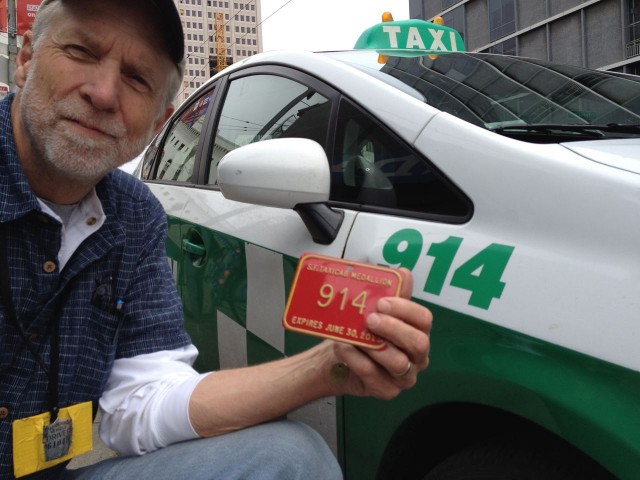
"content": "\u003cp>\u003cspan style=\"font-size: 4.6875em;float: left;line-height: 0.733em;padding: 0.05em 0.1em 0 0;font-family: times, serif, georgia\">B\u003c/span>rad Newsham drove a cab in San Francisco for nearly three decades and says he loved nearly everything about the job from the first day he got behind the wheel: the people, the city's beauty, the independence, the sense of experiencing something new every day.\u003c/p>\n\u003cp>\u003ca href=\"http://www.bradnewsham.com/\" target=\"_blank\">Newsham\u003c/a> quit the business this year because he was down to earning a net income of five bucks an hour. Newsham's experience isn't unique — others in San Francisco's taxicab industry say they know drivers who are only netting $5 to $10 an hour. A big part of the tough economics for drivers has to do with ride-service companies like Sidecar, Uber and Lyft siphoning off business from the traditional cab companies.\u003c/p>\n\u003caside class=\"alignright noborder\">\u003cimg src=\"http://u.s.kqed.net/2013/12/18/tip.jpg\" alt=\"Money\">\n\u003ch3>When drivers pay dispatchers, is it a tip? Or a bribe? \u003ca href=\"http://ww2.kqed.org/news/2014/12/13/the-fine-line-between-a-taxi-drivers-tip-and-a-bribe/\" target=\"_blank\">Read more.\u003c/a>\u003c/h3>\n\u003c/aside>\n\u003cp>But part of the money problem for the great majority of taxi drivers, those who rent their vehicles, is the way the business is structured. They start out in the hole every day, needing to make $100 or more just to pay the \"gate,\" or rental fee, for a 10-hour shift. They pay gas on top of that, which could easily come to $20 or $30 a shift or more. You can do the math yourself: To clear San Francisco's minimum wage of $10.55 an hour, they've got to bring in something north of $200, and probably significantly more than that, during their 10 hours on the road.\u003c/p>\n\u003cp>Drivers get no benefits, and may be held responsible for their gate fees when they're too sick to drive. Sometimes they must pay insurance deductibles and they face fines from city taxi regulators when they violate rules.\u003c/p>\n\u003cp>If you wonder how they survive, well, lots of them are just scraping by. Richard Hybels, owner of San Francisco's Metro Cab, says, \"Cab drivers can’t even get their teeth fixed. They’re poor people. It’s not an easy way to make a living by any stretch of the imagination.\"\u003c/p>\n\u003cp>[ad fullwidth]\u003c/p>\n\u003cp>If the financial odds against drivers aren't long enough already, they face another daily cost that industry veterans like Newsham alternatively call \"the tip\" or \"the bribe.\" That’s the unofficial, and illegal, five to ten bucks or more that many drivers say they pay cab company dispatchers and gas attendants every shift.\u003c/p>\n\u003cp>“Whoever bribes the dispatcher the most tends to get the best shifts,\" says Newsham. “I’ve been in situations at companies where if you don’t tip, the dispatcher says, 'Nice to see you ... I don’t have any cabs right now ... why don’t you sit on the bench for awhile until I get one?' I have sat there for three hours waiting for him to find me a cab when I have seen people walk in, give him 20 bucks and walk right out. It’s just a fact of life in the cab world.”\u003c/p>\n\u003cp>Longtime San Francisco \u003ca href=\"http://phantomcabdriverphites.blogspot.com/\" target=\"_blank\">cab driver Ed Healy\u003c/a> says the practice is standard throughout the industry.\u003c/p>\n\u003caside class=\"alignleft\">\n\u003ch3>More in KQED's series\u003c/h3>\n\u003cp>This is the third part in our series on the risks and benefits to those who sign up with networked ride services like Lyft, Sidecar and UberX, versus those who work for the traditional taxicab industry.\u003c/p>\n\u003cul>\n\u003cli>\u003ca href=\"http://ww2.kqed.org/news/2013/11/07/taxis-lyft-ride-service-war-on-streets-of-san-francisco\">\u003cstrong>Part One\u003c/strong>\u003c/a> describes the growing tensions between ride services and taxi companies.\u003cstrong>\u003c/strong>\u003c/li>\n\u003cli>\u003cstrong>\u003ca href=\"http://ww2.kqed.org/news/2013/11/14/who-pays-when-ride-share-driver-crashes\">Part Two\u003c/a>\u003c/strong> examines the insurance risks facing drivers for the ride services.\u003c/li>\n\u003c/ul>\n\u003c/aside>\n\u003cp>\"I once had a dispatcher come out there and I gave him $3 and he threw it back in my face and said, ‘That’s not a tip,'\" says Healy. \"I stopped tipping them completely, and I regularly got cars without any brakes or (that) broke down in various ways. I had one where a huge pipe dropped out of the cab and onto the ground. I had so many breakdowns, and I wondered why I had to wait three hours for somebody to come and tow. So I would say that pretty much enforced tipping is the rule.\"\u003c/p>\n\u003cp>John Han, who drives for Yellow Cab, breaks down his tipping routine: $1 to the gas guy, $5 to the dispatcher in charge of issuing cabs when he goes out and $1 more when he returns to file his paperwork. That's somewhat lower than a lot of drivers, he says. \"Many drivers say $5 going out and $5 coming in to dispatchers and cashiers.\"\u003c/p>\n\u003cp>Emil Lawrence, a driver since 1996 who wrote the popular \u003ca href=\"http://www.sfgate.com/entertainment/article/NIGHT-CABBIE-A-lesson-in-Chinese-relations-2805327.php\" target=\"_blank\">Night Cabbie\u003c/a> column in the old San Francisco Examiner and the San Francisco Chronicle, lays out basically the same scenario in terms of pressure to make these payments:\u003c/p>\n\u003cp>\"If you don't want to piss off anybody that can cause you problems, you have to pay it,\" he says. \"The system that’s pervasive is tips and payola before you get your taxi.\"\u003c/p>\n\u003cp>Lawrence says radio dispatchers will also sometimes demand money for sending lucrative airport calls a driver's way. He says at one company he used to work for, the radio dispatcher had a black book. \"He came up to me ... and said, 'Emil, I looked at my book, you owe me for two airports.'\"\u003c/p>\n\u003cp>Whatever you call it, this kind of payment, voluntary or involuntary, is against the law in San Francisco, and each violation carries a $633 fine for firms that allow it. Perhaps it's not surprising, then, that when you talk to San Francisco taxi companies, virtually all of them say that they don't allow tipping (six of the biggest companies — Yellow, Luxor, DeSoto, Metro, Royal and Town told me tipping is prohibited in their shops; two other companies, Arrow Checker and NationalVeterans, didn't return my calls).\u003c/p>\n\u003cp>Jim Gillespie, general manager at Yellow Cab, said any reports of tipping at the company aren't true. \"It's not happening at Yellow Cab. If that happens I would fire the employees.\"\u003c/p>\n\u003cp>Has it ever happened? \"Not to my knowledge,\" he says.\u003c/p>\n\u003caside class=\"pullquote alignleft\">'I have sat there for three hours waiting for him to find me a cab when I have seen people walk in, give him 20 bucks and walk right out.'\u003cbr>\n\u003ccite>—Brad Newsham, cab driver\u003c/cite>\u003cbr>\n\u003c/aside>\n\u003cp>Charles Rathbone, assistant manager at Luxor, told me, \"Nobody is forced to tip.\" He says the company has signs up saying tipping isn't allowed. \"Nobody has to tip to get a better shift or cab. The cashiers and the dispatchers know we’d come down on them like a ton of bricks. If you know of somebody who says there is (a tipping requirement) please tell them to come in and see me and I promise no retaliation for complaints. Absolutely.\"\u003c/p>\n\u003cp>What about voluntary tipping, which is also prohibited?\u003c/p>\n\u003cp>\"It's the kind of thing that is almost impossible to stop\" he says. \"How do you prevent somebody from passing somebody else a dollar? It’s a very difficult thing to prevent from happening. I’m not going to say categorically that there is no tipping, but it’s certainly not anything the company gets any money from.\"\u003c/p>\n\u003cp>\u003c!-- iframe plugin v.4.3 wordpress.org/plugins/iframe/ -->\u003cbr>\n\u003ciframe width=\"100%\" height=\"166\" scrolling=\"no\" frameborder=\"no\" src=\"https://w.soundcloud.com/player/?url=https%3A//api.soundcloud.com/tracks/125668303&color=ff6600&auto_play=false&show_artwork=true\" class=\"iframe-class\">\u003c/iframe>\u003c/p>\n\u003cp>\u003cstrong>Tipping is an Expensive Reality\u003c/strong>\u003c/p>\n\u003cp>Dan Hara has little doubt that these payments are a reality in San Francisco cab companies.\u003c/p>\n\u003cp>He's an economist whose firm, Hara Associates, compiled \u003ca href=\"http://www.sfmta.com/sites/default/files/Draft%20SF%20DriverSurvey%2037%20Web%20version04042013.pdf\" target=\"_blank\">a report\u003c/a> last year on the city's taxi industry for the San Francisco Municipal Transportation Agency, or SFMTA. The firm's survey of 621 San Francisco cab drivers found that 61 percent said they always pay daily tips to other company employees. More than half of that group, 55 percent, said they pay those tips because they have to.\u003c/p>\n\u003cp>Of the companies for which more than 30 drivers were surveyed, the reported tips ranged from an average of $4.47 for a non-Friday or non-Saturday night shift to $8.95 for a Friday or Saturday night shift.\u003c/p>\n\u003cp>\u003c!-- iframe plugin v.4.3 wordpress.org/plugins/iframe/ -->\u003cbr>\n\u003ciframe width=\"640\" height=\"300\" scrolling=\"no\" frameborder=\"no\" src=\"https://www.google.com/fusiontables/embedviz?containerId=googft-gviz-canvas&q=select+col0%2C+col1%2C+col2%2C+col3+from+10EWOm6XOitK40qidzUUyuF6ng84o_bUsO5jQnZg+order+by+col2+desc+limit+10&viz=GVIZ&t=COLUMN&uiversion=2&gco_forceIFrame=true&gco_hasLabelsColumn=true&gco_vAxes=%5B%7B%22title%22%3A%22Respondents%22%2C+%22minValue%22%3Anull%2C+%22maxValue%22%3Anull%2C+%22useFormatFromData%22%3Atrue%2C+%22viewWindow%22%3A%7B%22max%22%3Anull%2C+%22min%22%3Anull%7D%2C+%22logScale%22%3Afalse%7D%2C%7B%22useFormatFromData%22%3Atrue%2C+%22viewWindow%22%3A%7B%22max%22%3Anull%2C+%22min%22%3Anull%7D%2C+%22minValue%22%3Anull%2C+%22maxValue%22%3Anull%2C+%22logScale%22%3Afalse%7D%5D&gco_useFirstColumnAsDomain=true&gco_isStacked=true&gco_booleanRole=certainty&gco_hAxis=%7B%22useFormatFromData%22%3Atrue%2C+%22minValue%22%3Anull%2C+%22maxValue%22%3Anull%2C+%22viewWindow%22%3Anull%2C+%22viewWindowMode%22%3Anull%7D&gco_legend=right&gco_title=How+often+do+you+pay+tips+to+dispatchers%2C+gas+attendants+or+other+taxi+companies%3F&gco_fontName=Arial&att=true&width=640&height=300\" class=\"iframe-class\">\u003c/iframe>\u003c/p>\n\u003cp>Tipping can be expensive, the report added, with 21 percent of drivers reporting they gave daily tips of between $10 and $20 and another 8 percent saying the gave more than $20 per shift. The highest tips came from those working lucrative weekend night shifts.\u003c/p>\n\u003cp>Not everyone who drives a cab and tips dispatchers and gas attendants see that as a problem. One longtime driver who asked to remain anonymous recalls a variation on the usual practice of tipping.\u003c/p>\n\u003cp>\"We would have to go into a lottery, put our names in a hat, and they’d pull out these numbers, and your number would determine your chances [of getting a cab],\" he says. \"Your chances would be better if you decided to give money to the dispatcher. If you tipped, your chances are much greater to get out.\"\u003c/p>\n\u003cp>But this driver says he thinks that kind of tipping is OK.\u003c/p>\n\u003cp>\"I think most people realize they should tip at least 10 to 15 percent if they like the service,\" he says.\u003c/p>\n\u003caside class=\"pullquote alignleft\"> 'It's not happening at Yellow Cab. If that happens I would fire the employees.'\u003cbr>\n\u003ccite>— Jim Gillespie, Yellow Cab general manager\u003c/cite>\u003c/aside>\n\u003cp>Barry Korengold, the president of the San Francisco Cab Drivers Association, says there are worse things happening in the industry right now than pressure to give dispatcher and gas attendants a tip. \"It’s not one of my big issues,\" he says.\u003c/p>\n\u003cp>Korengold and one other driver told me that because drivers live in part on tips, it would be hypocritical not to do the same.\u003c/p>\n\u003cp>Emil Lawrence, for one, says he currently tips because he wants to, but that's only because he owns a cab medallion (which is essentially a license to drive a cab in the city) and has greater leverage. He also said he doesn't blame all cab company employees for taking tips, as they make very little money. \"They have no benefits whatsoever, so this is the way they get their income up.\"\u003c/p>\n\u003cp>\u003cstrong>The Law and How It's Enforced\u003c/strong>\u003c/p>\n\u003cp>When I asked Christiane Hayashi, director of taxis and accessible services for the San Francisco Municipal Transportation Agency, whether drivers tipping taxi company employees was legal, she read from the \u003ca href=\"http://transportation.sanfranciscocode.org/downloads/code-text/II._1105.txt\" target=\"_blank\">San Francisco Transportation Code, Section 1105, sub-section A10,\u003c/a> in effect since 2011.\u003c/p>\n\u003cblockquote>\u003cp>“No Permit Holder or agent of a Permit Holder may accept or solicit gifts and/or gratuities or anything of value from any Driver, other than Gate Fees, Lease Fees, payments for goods actually received, or other payments authorized by this Article. A Permit Holder or agent of a Permit Holder shall issue a receipt for any payment received from a Driver.\"\u003c/p>\u003c/blockquote>\n\u003cp>The ordinance covers voluntary payments, too. That means all tipping is illegal.\u003c/p>\n\u003cp>That absolute ban notwithstanding, Hayashi says she's aware tipping is happening and thinks the practice varies widely from company to company.\u003c/p>\n\u003cp>In addition, she adds, \"The salary structure set up by the companies relies on tipping — it is my understanding that many taxi company employees receive San Francisco's minimum wage and are required to rely on tips to make an adequate salary. ... So it is a deeply ingrained institutional issue that has proven difficult to root out.\u003c/p>\n\u003cp>“In some companies, drivers tip because they genuinely have a relationship with the dispatcher and it’s no big deal,\" Hayashi notes. \"In other companies, it’s definitely more of a culture where you’ve got to do this or else. And the driver who doesn’t tip might find himself having consequences.”\u003c/p>\n\u003cfigure id=\"attachment_120383\" class=\"wp-caption alignleft\" style=\"max-width: 320px\">\u003ca href=\"http://ww2.kqed.org/news/2013/12/12/San+Francisco-taxi-bribes-tips/rs7183_taxis_22oct2013_0125_web-hpf/\" rel=\"attachment wp-att-120383\">\u003cimg class=\"size-full wp-image-120383\" src=\"http://ww2.kqed.org/news/wp-content/uploads/sites/10/2014/10/RS7183_Taxis_22oct2013_0125_web-hpf.jpg\" alt=\"Taxis in downtown San Francisco. (Sara Bloomberg/KQED)\" width=\"320\" height=\"213\">\u003c/a>\u003cfigcaption class=\"wp-caption-text\">Taxis in downtown San Francisco. (Sara Bloomberg/KQED)\u003c/figcaption>\u003c/figure>\n\u003cp>But to do something about those \"consequences,\" Hayashi says, a driver would have to file a formal report with the SFMTA. To date, she says, no one has ever been cited for violating Section 1105, sub-section A10.\u003c/p>\n\u003cp>“The drivers may complain to us, but it’s quite another matter to ask them to sign a declaration and go to an administrative hearing,” she says.\u003c/p>\n\u003cp>Veteran driver Brad Newsham says that kind of reasoning is akin to expecting victims of the system to enforce the law. \"You’re going to blame the cab driver who makes a paltry wage for not taking down the system that has been winked at by every regulator that’s ever been,\" he asks, \"and who has thrown up their hands and says, 'There’s nothing we can do'?\"\u003c/p>\n\u003cp>Other drivers say blowing the whistle would be risky. “A driver would be afraid because they’d get fired,\" says Ed Healey, who drives for DeSoto Cab. \"Nobody could survive.”\u003c/p>\n\u003cp>John Han, a Yellow Cab driver, agrees. “I wouldn’t want to go through that process,\" he says. \"I basically would be going on the record with something that does not look very good for the people who I depend upon to issue me a cab every day.”\u003c/p>\n\u003caside class=\"alignright\">\n\u003ch3>Does Tipping Happen? What the Taxi Companies Say\u003c/h3>\n\u003cp>Under \u003ca href=\"http://transportation.sanfranciscocode.org/downloads/code-text/II._1105.txt\" target=\"_blank\">a San Francisco ordinance\u003c/a>, the taxi industry practice of requiring or allowing drivers to tip dispatchers or other employees is illegal. We asked major San Francisco cab companies whether tipping takes place in their shops. Here's what they told us:\u003c/p>\n\u003cul>\n\u003cli>\u003cstrong>\u003ca href=\"http://yellowcabsf.com/\" target=\"_blank\">Yellow Cab\u003c/a>\u003c/strong>: Jim Gillespie, general manager: \"It's not happening at Yellow Cab. If that happens I would fire the employees.\"\u003c/li>\n\u003cli>\u003cstrong>\u003ca href=\"http://www.luxorcab.com/\" target=\"_blank\">Luxor Cabs\u003c/a>\u003c/strong>: Charles Rathbone, assistant manager: \"Nobody is forced to tip.\" What about voluntary tipping? \"It's the kind of thing that it's almost impossible to stop. ... but it’s certainly not anything the company gets any money from.\"\u003c/li>\n\u003cli>\u003cstrong>\u003ca href=\"http://www.desotosf.com/\" target=\"_blank\">DeSoto Cab\u003c/a>\u003c/strong>: Hansu Kim, owner: Says compulsory tipping is “almost nonexistent now,” though he acknowledges voluntary tipping continues. \"We have a lot of drivers who don’t tip, so I have to make sure there’s no consequence whether you tip or not. But how do I stop a guy who says, ‘Hey thanks for giving me the orders, here’s five bucks’?\"\u003c/li>\n\u003cli>\u003cstrong>\u003ca href=\"https://www.sfmta.com/getting-around/take-taxi/taxi-companies/metro-cab\" target=\"_blank\">Metro Cab\u003c/a>\u003c/strong>: Richard Hybels, owner: \"I want it on my headstone: I’ve never taken a penny from a cabdriver as a tip.\"\u003c/li>\n\u003cli>\u003cstrong>\u003ca href=\"https://www.sfmta.com/getting-around/take-taxi/taxi-companies/royal-taxi\" target=\"_blank\">Royal Taxi\u003c/a>\u003c/strong>: Christopher Sweis, CEO: He says the company's preset schedule for drivers makes tipping unnecessary in terms of being assigned a cab. As for voluntary tipping, he says: \"It's a practice that we can try our best to enforce and ask our dispatchers not to take tips or ask our drivers not to tip the dispatchers. We can't control every single driver. If it's going to happen, it's going to happen.\"\u003c/li>\n\u003cli>\u003cstrong>\u003ca href=\"http://sftowntaxi.com/\" target=\"_blank\">SF Town Taxi\u003c/a>:\u003c/strong> Jacob Mayzel, manager: \"It doesn't happen with Town Taxi.\"\u003c/li>\n\u003cli>\u003cstrong>\u003ca href=\"http://www.sfmta.com/vi/getting-around/take-taxi/taxi-companies/arrow-checker-cab\" target=\"_blank\">Arrow Checker\u003c/a>\u003c/strong> Did not respond.\u003c/li>\n\u003cli>\u003ca href=\"http://sfnationalcab.sftaxischool.com/\">\u003cstrong>National Veterans Cab\u003c/strong>\u003c/a> Did not respond.\u003c/li>\n\u003c/ul>\n\u003c/aside>\n\u003cp>Luxor driver Jeremiah Cushing says filing a formal complaint would be like asking, \"Who will step forward so [they] can be shot first? Why don’t I just emboss a scarlet T on my chest? I would just be a total outcast.\"\u003c/p>\n\u003cp>\u003cstrong>Bucking the System\u003c/strong>\u003c/p>\n\u003cp>Cushing's got another solution to the tipping problem, though: Just refuse to do it.\u003c/p>\n\u003cp>\"Most people do five dollars in, five dollars out,\" he says, citing what a company cashier told him, i.e., tipping $5 both at the beginning and end of their shifts. \"I started doing the math on it. ... At the end of the year, it was a lot of money in my pocket going to the unknown ... I said, 'Screw this, I'm not paying any of these guys. ... Other drivers have told me, 'You’re going to need these cashiers, they’re going to provide you a car.' I said, 'No — I do not need them, they need me.'\"\u003c/p>\n\u003cp>Cushing said he hasn't been tipping anyone but the gas guys for more than a year. \"If you ask me why I tip the gas guys, I can't give you a logical answer,\" he says.\u003c/p>\n\u003cp>I asked him if there had been any consequences to his one-man rebellion. He said there had been some minor incidents, including one in which he was assigned a spare cab, typically the vehicle in the worst condition on the lot. He refused to drive it and went home, he said, but there were no other repercussions. \"They have such a shortage of drivers now, I don’t get messed with.\"\u003c/p>\n\u003cp>\u003cstrong>Ray of Hope for Drivers?\u003c/strong>\u003c/p>\n\u003cp>\u003cstrong>\u003c/strong>Metro Cab and Green Cab are two taxi outfits drivers routinely mention as prohibiting tipping. When I asked Metro owner Richard Hybels what's behind his policy, he said:\u003c/p>\n\u003cp>\"Most of the people who work for me are supporting families, or supporting families in another country. It’s a tough business as it is. I make enough money in the normal parts of the business; I don’t need to squeeze any more out of them. ... I want it on my headstone: I’ve never taken a penny from a cabdriver as a tip.\"\u003c/p>\n\u003cp>Former \"Night Cabbie\" columnist Emil Lawrence says many gas-and-gate cab drivers are on the economic margins and that he knows drivers who are living in \u003ca href=\"http://portal.hud.gov/hudportal/HUD?src=/topics/housing_choice_voucher_program_section_8\" target=\"_blank\">Section 8 housing\u003c/a> and receiving food stamps.\u003c/p>\n\u003cp>\"They pay the cab company nonstop, they pay everybody tips nonstop,\" Lawrence says. \"They don't even make minimum wage on some nights, and if they don't pay, they don't have gas, they don't have a job the next day. ... What they make after paying the SFMTA and cab companies, you couldn't make a decent living in downtown Baghdad today.\"\u003c/p>\n\u003cp>\"I've been in that situation,\" he says. \"It's like quicksand.\"\u003c/p>\n\u003cp>But the balance of power between cab drivers and cab companies may be starting to tilt in the drivers' favor.\u003c/p>\n\u003cp>SFMTA consultant Dan Hara says a downturn in the cab business brought about by the rise of ride-service companies has at least temporarily reduced the pressure to tip, because cab companies are having problems filling shifts, a reality confirmed by others in the industry. (Though I recently asked three different drivers during cab rides if they currently tipped taxi company employees, and they all said they did.)\u003c/p>\n\u003cp>While many cab drivers are irate about Sidecar, Lyft and Uber \u003ca href=\"http://ww2.kqed.org/news/2013/11/07/taxis-lyft-ride-service-war-on-streets-of-san-francisco\" target=\"_blank\">cutting into their business\u003c/a>, many others are quitting the cab business to drive with what regulators call \"transportation network companies (TNCs)\" — the very ride-service companies that compete with their cabs.\u003c/p>\n\u003cp>\"Before TNCs, some drivers tipped extensively to get out faster in nicer cars,\" says John Han. \"Now, I'm guessing some of those drivers have gone to TNCs.\"\u003c/p>\n\u003cp>Indeed, one of my recent cab drivers cited the requirement to tip as a major reason he was quitting to go work for Uber. (\"If you get an airport call, the guys ask you for money after and if you don't give you won't get another airport call,\" he said.)\u003c/p>\n\u003caside class=\"pullquote alignleft\"> 'The drivers may complain to us but it’s quite another matter to ask them to sign a declaration...'\u003cbr>\n\u003ccite>— Christiane Hayashi, Director of Taxis at SFMTA\u003c/cite>\u003c/aside>\n\u003cp>I kept asking the drivers if the Lyfts and Sidecars of the world could actually end up \u003cem>helping\u003c/em> them, as they potentially give drivers more leverage in dealing with the cab companies. John Han, for instance, says Yellow recently lowered its Saturday night gate fee for drivers.\u003c/p>\n\u003cp>Some scoffed at the notion that anything good could result from the competition or that they would ever switch to a TNC, citing the \u003ca href=\"http://ww2.kqed.org/news/2013/11/14/who-pays-when-ride-share-driver-crashes\" target=\"_blank\">insurance risk\u003c/a>, among other reasons. But not everyone felt that way. Brad Newsham said if he were giving advice to a young would-be driver today, he'd tell them to skip traditional taxis and go to work for a ride-service company.\u003c/p>\n\u003cp>Emil Lawrence told me there might be something for the average driver to gain from going to work for a ride-service firm.\u003c/p>\n\u003cp>\"I know drivers right now who work for cab companies at the same time they work for Uber,\" he says. \"Radio calls are down probably 70 percent now. They’re down on Friday even more. You’re talking about 10-15 minutes sometimes with no call at all. It’s all on the apps. If you’re a cab driver with a taxi, at the same time you have an Uber setup, that may be the new industry. But you can (also) do that same business in your own car at your own hours without paying the taxi company one dime.\"\u003c/p>\n\u003cp style=\"margin: 12px auto 6px auto;font-family: Helvetica,Arial,Sans-serif;font-style: normal;font-variant: normal;font-weight: normal;font-size: 14px;line-height: normal\">\u003ca style=\"text-decoration: underline\" title=\"View SF Taxi Driver Survey on Scribd\" href=\"http://www.scribd.com/doc/192372483/SF-Taxi-Driver-Survey\">SF Taxi Driver Survey\u003c/a>\u003c/p>\n\u003cp>\u003c!-- iframe plugin v.4.3 wordpress.org/plugins/iframe/ -->\u003cbr>\n\u003ciframe id=\"doc_39345\" src=\"//www.scribd.com/embeds/192372483/content?start_page=1&view_mode=scroll&show_recommendations=true\" frameborder=\"0\" scrolling=\"no\" width=\"100%\" height=\"600\" class=\"iframe-class\">\u003c/iframe>\u003c/p>\n\u003cp>[ad floatright]\u003c/p>\n\u003cp>\u003cem>KQED's Lisa Pickoff-White, Bryan Goebel and Katrina Schwartz contributed reporting to this article.\u003c/em>\u003c/p>\n\n",
"disqusIdentifier": "120468 http://ww2.kqed.org/news/?p=120468",
"disqusUrl": "https://ww2.kqed.org/news/2013/12/19/tip-or-bribe-taxi-drivers-say-illegal-payments-to-dispatchers-are-routine/",
"stats": {
"hasVideo": false,
"hasChartOrMap": false,
"hasAudio": true,
"hasPolis": false,
"wordCount": 3459,
"hasGoogleForm": false,
"hasGallery": false,
"hasHearkenModule": false,
"iframeSrcs": [],
"paragraphCount": 72
},
"modified": 1420846595,
"excerpt": "Unofficial tips get drivers better cabs and better fares, but cut into an already precarious livelihood.",
"headData": {
"twImgId": "",
"twTitle": "",
"ogTitle": "",
"ogImgId": "",
"twDescription": "",
"description": "Unofficial tips get drivers better cabs and better fares, but cut into an already precarious livelihood.",
"title": "Tip or Bribe? Taxi Drivers Say Illegal Payments to Dispatchers Are Routine | KQED",
"ogDescription": "",
"schema": {
"@context": "https://schema.org",
"@type": "NewsArticle",
"headline": "Tip or Bribe? Taxi Drivers Say Illegal Payments to Dispatchers Are Routine",
"datePublished": "2013-12-19T10:00:03-08:00",
"dateModified": "2015-01-09T15:36:35-08:00",
"image": "https://cdn.kqed.org/wp-content/uploads/2020/02/KQED-OG-Image@1x.png",
"isAccessibleForFree": "True",
"publisher": {
"@type": "NewsMediaOrganization",
"@id": "https://www.kqed.org/#organization",
"name": "KQED",
"logo": "https://cdn.kqed.org/wp-content/uploads/2020/02/KQED-OG-Image@1x.png",
"url": "https://www.kqed.org",
"sameAs": [
"https://www.facebook.com/KQED",
"https://twitter.com/KQED",
"https://www.instagram.com/kqed/",
"https://www.tiktok.com/@kqedofficial",
"https://www.linkedin.com/company/kqed",
"https://www.youtube.com/channel/UCeC0IOo7i1P_61zVUWbJ4nw"
]
}
}
},
"guestAuthors": [],
"slug": "tip-or-bribe-taxi-drivers-say-illegal-payments-to-dispatchers-are-routine",
"status": "publish",
"customPermalink": "2013/12/11/taxi-drivers-and-whos-taking-money-out-of-their-pockets/",
"path": "/news/120468/tip-or-bribe-taxi-drivers-say-illegal-payments-to-dispatchers-are-routine",
"audioTrackLength": null,
"parsedContent": [
{
"type": "contentString",
"content": "\u003cdiv class=\"post-body\">\u003cp>\u003cp>\u003cspan style=\"font-size: 4.6875em;float: left;line-height: 0.733em;padding: 0.05em 0.1em 0 0;font-family: times, serif, georgia\">B\u003c/span>rad Newsham drove a cab in San Francisco for nearly three decades and says he loved nearly everything about the job from the first day he got behind the wheel: the people, the city's beauty, the independence, the sense of experiencing something new every day.\u003c/p>\n\u003cp>\u003ca href=\"http://www.bradnewsham.com/\" target=\"_blank\">Newsham\u003c/a> quit the business this year because he was down to earning a net income of five bucks an hour. Newsham's experience isn't unique — others in San Francisco's taxicab industry say they know drivers who are only netting $5 to $10 an hour. A big part of the tough economics for drivers has to do with ride-service companies like Sidecar, Uber and Lyft siphoning off business from the traditional cab companies.\u003c/p>\n\u003caside class=\"alignright noborder\">\u003cimg src=\"http://u.s.kqed.net/2013/12/18/tip.jpg\" alt=\"Money\">\n\u003ch3>When drivers pay dispatchers, is it a tip? Or a bribe? \u003ca href=\"http://ww2.kqed.org/news/2014/12/13/the-fine-line-between-a-taxi-drivers-tip-and-a-bribe/\" target=\"_blank\">Read more.\u003c/a>\u003c/h3>\n\u003c/aside>\n\u003cp>But part of the money problem for the great majority of taxi drivers, those who rent their vehicles, is the way the business is structured. They start out in the hole every day, needing to make $100 or more just to pay the \"gate,\" or rental fee, for a 10-hour shift. They pay gas on top of that, which could easily come to $20 or $30 a shift or more. You can do the math yourself: To clear San Francisco's minimum wage of $10.55 an hour, they've got to bring in something north of $200, and probably significantly more than that, during their 10 hours on the road.\u003c/p>\n\u003cp>Drivers get no benefits, and may be held responsible for their gate fees when they're too sick to drive. Sometimes they must pay insurance deductibles and they face fines from city taxi regulators when they violate rules.\u003c/p>\n\u003cp>If you wonder how they survive, well, lots of them are just scraping by. Richard Hybels, owner of San Francisco's Metro Cab, says, \"Cab drivers can’t even get their teeth fixed. They’re poor people. It’s not an easy way to make a living by any stretch of the imagination.\"\u003c/p>\n\u003cp>\u003c/p>\u003c/div>",
"attributes": {
"named": {},
"numeric": []
}
},
{
"type": "component",
"content": "",
"name": "ad",
"attributes": {
"named": {
"label": "fullwidth"
},
"numeric": [
"fullwidth"
]
}
},
{
"type": "contentString",
"content": "\u003cdiv class=\"post-body\">\u003cp>\u003c/p>\n\u003cp>If the financial odds against drivers aren't long enough already, they face another daily cost that industry veterans like Newsham alternatively call \"the tip\" or \"the bribe.\" That’s the unofficial, and illegal, five to ten bucks or more that many drivers say they pay cab company dispatchers and gas attendants every shift.\u003c/p>\n\u003cp>“Whoever bribes the dispatcher the most tends to get the best shifts,\" says Newsham. “I’ve been in situations at companies where if you don’t tip, the dispatcher says, 'Nice to see you ... I don’t have any cabs right now ... why don’t you sit on the bench for awhile until I get one?' I have sat there for three hours waiting for him to find me a cab when I have seen people walk in, give him 20 bucks and walk right out. It’s just a fact of life in the cab world.”\u003c/p>\n\u003cp>Longtime San Francisco \u003ca href=\"http://phantomcabdriverphites.blogspot.com/\" target=\"_blank\">cab driver Ed Healy\u003c/a> says the practice is standard throughout the industry.\u003c/p>\n\u003caside class=\"alignleft\">\n\u003ch3>More in KQED's series\u003c/h3>\n\u003cp>This is the third part in our series on the risks and benefits to those who sign up with networked ride services like Lyft, Sidecar and UberX, versus those who work for the traditional taxicab industry.\u003c/p>\n\u003cul>\n\u003cli>\u003ca href=\"http://ww2.kqed.org/news/2013/11/07/taxis-lyft-ride-service-war-on-streets-of-san-francisco\">\u003cstrong>Part One\u003c/strong>\u003c/a> describes the growing tensions between ride services and taxi companies.\u003cstrong>\u003c/strong>\u003c/li>\n\u003cli>\u003cstrong>\u003ca href=\"http://ww2.kqed.org/news/2013/11/14/who-pays-when-ride-share-driver-crashes\">Part Two\u003c/a>\u003c/strong> examines the insurance risks facing drivers for the ride services.\u003c/li>\n\u003c/ul>\n\u003c/aside>\n\u003cp>\"I once had a dispatcher come out there and I gave him $3 and he threw it back in my face and said, ‘That’s not a tip,'\" says Healy. \"I stopped tipping them completely, and I regularly got cars without any brakes or (that) broke down in various ways. I had one where a huge pipe dropped out of the cab and onto the ground. I had so many breakdowns, and I wondered why I had to wait three hours for somebody to come and tow. So I would say that pretty much enforced tipping is the rule.\"\u003c/p>\n\u003cp>John Han, who drives for Yellow Cab, breaks down his tipping routine: $1 to the gas guy, $5 to the dispatcher in charge of issuing cabs when he goes out and $1 more when he returns to file his paperwork. That's somewhat lower than a lot of drivers, he says. \"Many drivers say $5 going out and $5 coming in to dispatchers and cashiers.\"\u003c/p>\n\u003cp>Emil Lawrence, a driver since 1996 who wrote the popular \u003ca href=\"http://www.sfgate.com/entertainment/article/NIGHT-CABBIE-A-lesson-in-Chinese-relations-2805327.php\" target=\"_blank\">Night Cabbie\u003c/a> column in the old San Francisco Examiner and the San Francisco Chronicle, lays out basically the same scenario in terms of pressure to make these payments:\u003c/p>\n\u003cp>\"If you don't want to piss off anybody that can cause you problems, you have to pay it,\" he says. \"The system that’s pervasive is tips and payola before you get your taxi.\"\u003c/p>\n\u003cp>Lawrence says radio dispatchers will also sometimes demand money for sending lucrative airport calls a driver's way. He says at one company he used to work for, the radio dispatcher had a black book. \"He came up to me ... and said, 'Emil, I looked at my book, you owe me for two airports.'\"\u003c/p>\n\u003cp>Whatever you call it, this kind of payment, voluntary or involuntary, is against the law in San Francisco, and each violation carries a $633 fine for firms that allow it. Perhaps it's not surprising, then, that when you talk to San Francisco taxi companies, virtually all of them say that they don't allow tipping (six of the biggest companies — Yellow, Luxor, DeSoto, Metro, Royal and Town told me tipping is prohibited in their shops; two other companies, Arrow Checker and NationalVeterans, didn't return my calls).\u003c/p>\n\u003cp>Jim Gillespie, general manager at Yellow Cab, said any reports of tipping at the company aren't true. \"It's not happening at Yellow Cab. If that happens I would fire the employees.\"\u003c/p>\n\u003cp>Has it ever happened? \"Not to my knowledge,\" he says.\u003c/p>\n\u003caside class=\"pullquote alignleft\">'I have sat there for three hours waiting for him to find me a cab when I have seen people walk in, give him 20 bucks and walk right out.'\u003cbr>\n\u003ccite>—Brad Newsham, cab driver\u003c/cite>\u003cbr>\n\u003c/aside>\n\u003cp>Charles Rathbone, assistant manager at Luxor, told me, \"Nobody is forced to tip.\" He says the company has signs up saying tipping isn't allowed. \"Nobody has to tip to get a better shift or cab. The cashiers and the dispatchers know we’d come down on them like a ton of bricks. If you know of somebody who says there is (a tipping requirement) please tell them to come in and see me and I promise no retaliation for complaints. Absolutely.\"\u003c/p>\n\u003cp>What about voluntary tipping, which is also prohibited?\u003c/p>\n\u003cp>\"It's the kind of thing that is almost impossible to stop\" he says. \"How do you prevent somebody from passing somebody else a dollar? It’s a very difficult thing to prevent from happening. I’m not going to say categorically that there is no tipping, but it’s certainly not anything the company gets any money from.\"\u003c/p>\n\u003cp>\u003c!-- iframe plugin v.4.3 wordpress.org/plugins/iframe/ -->\u003cbr>\n\u003ciframe width=\"100%\" height=\"166\" scrolling=\"no\" frameborder=\"no\" src=\"https://w.soundcloud.com/player/?url=https%3A//api.soundcloud.com/tracks/125668303&color=ff6600&auto_play=false&show_artwork=true\" class=\"iframe-class\">\u003c/iframe>\u003c/p>\n\u003cp>\u003cstrong>Tipping is an Expensive Reality\u003c/strong>\u003c/p>\n\u003cp>Dan Hara has little doubt that these payments are a reality in San Francisco cab companies.\u003c/p>\n\u003cp>He's an economist whose firm, Hara Associates, compiled \u003ca href=\"http://www.sfmta.com/sites/default/files/Draft%20SF%20DriverSurvey%2037%20Web%20version04042013.pdf\" target=\"_blank\">a report\u003c/a> last year on the city's taxi industry for the San Francisco Municipal Transportation Agency, or SFMTA. The firm's survey of 621 San Francisco cab drivers found that 61 percent said they always pay daily tips to other company employees. More than half of that group, 55 percent, said they pay those tips because they have to.\u003c/p>\n\u003cp>Of the companies for which more than 30 drivers were surveyed, the reported tips ranged from an average of $4.47 for a non-Friday or non-Saturday night shift to $8.95 for a Friday or Saturday night shift.\u003c/p>\n\u003cp>\u003c!-- iframe plugin v.4.3 wordpress.org/plugins/iframe/ -->\u003cbr>\n\u003ciframe width=\"640\" height=\"300\" scrolling=\"no\" frameborder=\"no\" src=\"https://www.google.com/fusiontables/embedviz?containerId=googft-gviz-canvas&q=select+col0%2C+col1%2C+col2%2C+col3+from+10EWOm6XOitK40qidzUUyuF6ng84o_bUsO5jQnZg+order+by+col2+desc+limit+10&viz=GVIZ&t=COLUMN&uiversion=2&gco_forceIFrame=true&gco_hasLabelsColumn=true&gco_vAxes=%5B%7B%22title%22%3A%22Respondents%22%2C+%22minValue%22%3Anull%2C+%22maxValue%22%3Anull%2C+%22useFormatFromData%22%3Atrue%2C+%22viewWindow%22%3A%7B%22max%22%3Anull%2C+%22min%22%3Anull%7D%2C+%22logScale%22%3Afalse%7D%2C%7B%22useFormatFromData%22%3Atrue%2C+%22viewWindow%22%3A%7B%22max%22%3Anull%2C+%22min%22%3Anull%7D%2C+%22minValue%22%3Anull%2C+%22maxValue%22%3Anull%2C+%22logScale%22%3Afalse%7D%5D&gco_useFirstColumnAsDomain=true&gco_isStacked=true&gco_booleanRole=certainty&gco_hAxis=%7B%22useFormatFromData%22%3Atrue%2C+%22minValue%22%3Anull%2C+%22maxValue%22%3Anull%2C+%22viewWindow%22%3Anull%2C+%22viewWindowMode%22%3Anull%7D&gco_legend=right&gco_title=How+often+do+you+pay+tips+to+dispatchers%2C+gas+attendants+or+other+taxi+companies%3F&gco_fontName=Arial&att=true&width=640&height=300\" class=\"iframe-class\">\u003c/iframe>\u003c/p>\n\u003cp>Tipping can be expensive, the report added, with 21 percent of drivers reporting they gave daily tips of between $10 and $20 and another 8 percent saying the gave more than $20 per shift. The highest tips came from those working lucrative weekend night shifts.\u003c/p>\n\u003cp>Not everyone who drives a cab and tips dispatchers and gas attendants see that as a problem. One longtime driver who asked to remain anonymous recalls a variation on the usual practice of tipping.\u003c/p>\n\u003cp>\"We would have to go into a lottery, put our names in a hat, and they’d pull out these numbers, and your number would determine your chances [of getting a cab],\" he says. \"Your chances would be better if you decided to give money to the dispatcher. If you tipped, your chances are much greater to get out.\"\u003c/p>\n\u003cp>But this driver says he thinks that kind of tipping is OK.\u003c/p>\n\u003cp>\"I think most people realize they should tip at least 10 to 15 percent if they like the service,\" he says.\u003c/p>\n\u003caside class=\"pullquote alignleft\"> 'It's not happening at Yellow Cab. If that happens I would fire the employees.'\u003cbr>\n\u003ccite>— Jim Gillespie, Yellow Cab general manager\u003c/cite>\u003c/aside>\n\u003cp>Barry Korengold, the president of the San Francisco Cab Drivers Association, says there are worse things happening in the industry right now than pressure to give dispatcher and gas attendants a tip. \"It’s not one of my big issues,\" he says.\u003c/p>\n\u003cp>Korengold and one other driver told me that because drivers live in part on tips, it would be hypocritical not to do the same.\u003c/p>\n\u003cp>Emil Lawrence, for one, says he currently tips because he wants to, but that's only because he owns a cab medallion (which is essentially a license to drive a cab in the city) and has greater leverage. He also said he doesn't blame all cab company employees for taking tips, as they make very little money. \"They have no benefits whatsoever, so this is the way they get their income up.\"\u003c/p>\n\u003cp>\u003cstrong>The Law and How It's Enforced\u003c/strong>\u003c/p>\n\u003cp>When I asked Christiane Hayashi, director of taxis and accessible services for the San Francisco Municipal Transportation Agency, whether drivers tipping taxi company employees was legal, she read from the \u003ca href=\"http://transportation.sanfranciscocode.org/downloads/code-text/II._1105.txt\" target=\"_blank\">San Francisco Transportation Code, Section 1105, sub-section A10,\u003c/a> in effect since 2011.\u003c/p>\n\u003cblockquote>\u003cp>“No Permit Holder or agent of a Permit Holder may accept or solicit gifts and/or gratuities or anything of value from any Driver, other than Gate Fees, Lease Fees, payments for goods actually received, or other payments authorized by this Article. A Permit Holder or agent of a Permit Holder shall issue a receipt for any payment received from a Driver.\"\u003c/p>\u003c/blockquote>\n\u003cp>The ordinance covers voluntary payments, too. That means all tipping is illegal.\u003c/p>\n\u003cp>That absolute ban notwithstanding, Hayashi says she's aware tipping is happening and thinks the practice varies widely from company to company.\u003c/p>\n\u003cp>In addition, she adds, \"The salary structure set up by the companies relies on tipping — it is my understanding that many taxi company employees receive San Francisco's minimum wage and are required to rely on tips to make an adequate salary. ... So it is a deeply ingrained institutional issue that has proven difficult to root out.\u003c/p>\n\u003cp>“In some companies, drivers tip because they genuinely have a relationship with the dispatcher and it’s no big deal,\" Hayashi notes. \"In other companies, it’s definitely more of a culture where you’ve got to do this or else. And the driver who doesn’t tip might find himself having consequences.”\u003c/p>\n\u003cfigure id=\"attachment_120383\" class=\"wp-caption alignleft\" style=\"max-width: 320px\">\u003ca href=\"http://ww2.kqed.org/news/2013/12/12/San+Francisco-taxi-bribes-tips/rs7183_taxis_22oct2013_0125_web-hpf/\" rel=\"attachment wp-att-120383\">\u003cimg class=\"size-full wp-image-120383\" src=\"http://ww2.kqed.org/news/wp-content/uploads/sites/10/2014/10/RS7183_Taxis_22oct2013_0125_web-hpf.jpg\" alt=\"Taxis in downtown San Francisco. (Sara Bloomberg/KQED)\" width=\"320\" height=\"213\">\u003c/a>\u003cfigcaption class=\"wp-caption-text\">Taxis in downtown San Francisco. (Sara Bloomberg/KQED)\u003c/figcaption>\u003c/figure>\n\u003cp>But to do something about those \"consequences,\" Hayashi says, a driver would have to file a formal report with the SFMTA. To date, she says, no one has ever been cited for violating Section 1105, sub-section A10.\u003c/p>\n\u003cp>“The drivers may complain to us, but it’s quite another matter to ask them to sign a declaration and go to an administrative hearing,” she says.\u003c/p>\n\u003cp>Veteran driver Brad Newsham says that kind of reasoning is akin to expecting victims of the system to enforce the law. \"You’re going to blame the cab driver who makes a paltry wage for not taking down the system that has been winked at by every regulator that’s ever been,\" he asks, \"and who has thrown up their hands and says, 'There’s nothing we can do'?\"\u003c/p>\n\u003cp>Other drivers say blowing the whistle would be risky. “A driver would be afraid because they’d get fired,\" says Ed Healey, who drives for DeSoto Cab. \"Nobody could survive.”\u003c/p>\n\u003cp>John Han, a Yellow Cab driver, agrees. “I wouldn’t want to go through that process,\" he says. \"I basically would be going on the record with something that does not look very good for the people who I depend upon to issue me a cab every day.”\u003c/p>\n\u003caside class=\"alignright\">\n\u003ch3>Does Tipping Happen? What the Taxi Companies Say\u003c/h3>\n\u003cp>Under \u003ca href=\"http://transportation.sanfranciscocode.org/downloads/code-text/II._1105.txt\" target=\"_blank\">a San Francisco ordinance\u003c/a>, the taxi industry practice of requiring or allowing drivers to tip dispatchers or other employees is illegal. We asked major San Francisco cab companies whether tipping takes place in their shops. Here's what they told us:\u003c/p>\n\u003cul>\n\u003cli>\u003cstrong>\u003ca href=\"http://yellowcabsf.com/\" target=\"_blank\">Yellow Cab\u003c/a>\u003c/strong>: Jim Gillespie, general manager: \"It's not happening at Yellow Cab. If that happens I would fire the employees.\"\u003c/li>\n\u003cli>\u003cstrong>\u003ca href=\"http://www.luxorcab.com/\" target=\"_blank\">Luxor Cabs\u003c/a>\u003c/strong>: Charles Rathbone, assistant manager: \"Nobody is forced to tip.\" What about voluntary tipping? \"It's the kind of thing that it's almost impossible to stop. ... but it’s certainly not anything the company gets any money from.\"\u003c/li>\n\u003cli>\u003cstrong>\u003ca href=\"http://www.desotosf.com/\" target=\"_blank\">DeSoto Cab\u003c/a>\u003c/strong>: Hansu Kim, owner: Says compulsory tipping is “almost nonexistent now,” though he acknowledges voluntary tipping continues. \"We have a lot of drivers who don’t tip, so I have to make sure there’s no consequence whether you tip or not. But how do I stop a guy who says, ‘Hey thanks for giving me the orders, here’s five bucks’?\"\u003c/li>\n\u003cli>\u003cstrong>\u003ca href=\"https://www.sfmta.com/getting-around/take-taxi/taxi-companies/metro-cab\" target=\"_blank\">Metro Cab\u003c/a>\u003c/strong>: Richard Hybels, owner: \"I want it on my headstone: I’ve never taken a penny from a cabdriver as a tip.\"\u003c/li>\n\u003cli>\u003cstrong>\u003ca href=\"https://www.sfmta.com/getting-around/take-taxi/taxi-companies/royal-taxi\" target=\"_blank\">Royal Taxi\u003c/a>\u003c/strong>: Christopher Sweis, CEO: He says the company's preset schedule for drivers makes tipping unnecessary in terms of being assigned a cab. As for voluntary tipping, he says: \"It's a practice that we can try our best to enforce and ask our dispatchers not to take tips or ask our drivers not to tip the dispatchers. We can't control every single driver. If it's going to happen, it's going to happen.\"\u003c/li>\n\u003cli>\u003cstrong>\u003ca href=\"http://sftowntaxi.com/\" target=\"_blank\">SF Town Taxi\u003c/a>:\u003c/strong> Jacob Mayzel, manager: \"It doesn't happen with Town Taxi.\"\u003c/li>\n\u003cli>\u003cstrong>\u003ca href=\"http://www.sfmta.com/vi/getting-around/take-taxi/taxi-companies/arrow-checker-cab\" target=\"_blank\">Arrow Checker\u003c/a>\u003c/strong> Did not respond.\u003c/li>\n\u003cli>\u003ca href=\"http://sfnationalcab.sftaxischool.com/\">\u003cstrong>National Veterans Cab\u003c/strong>\u003c/a> Did not respond.\u003c/li>\n\u003c/ul>\n\u003c/aside>\n\u003cp>Luxor driver Jeremiah Cushing says filing a formal complaint would be like asking, \"Who will step forward so [they] can be shot first? Why don’t I just emboss a scarlet T on my chest? I would just be a total outcast.\"\u003c/p>\n\u003cp>\u003cstrong>Bucking the System\u003c/strong>\u003c/p>\n\u003cp>Cushing's got another solution to the tipping problem, though: Just refuse to do it.\u003c/p>\n\u003cp>\"Most people do five dollars in, five dollars out,\" he says, citing what a company cashier told him, i.e., tipping $5 both at the beginning and end of their shifts. \"I started doing the math on it. ... At the end of the year, it was a lot of money in my pocket going to the unknown ... I said, 'Screw this, I'm not paying any of these guys. ... Other drivers have told me, 'You’re going to need these cashiers, they’re going to provide you a car.' I said, 'No — I do not need them, they need me.'\"\u003c/p>\n\u003cp>Cushing said he hasn't been tipping anyone but the gas guys for more than a year. \"If you ask me why I tip the gas guys, I can't give you a logical answer,\" he says.\u003c/p>\n\u003cp>I asked him if there had been any consequences to his one-man rebellion. He said there had been some minor incidents, including one in which he was assigned a spare cab, typically the vehicle in the worst condition on the lot. He refused to drive it and went home, he said, but there were no other repercussions. \"They have such a shortage of drivers now, I don’t get messed with.\"\u003c/p>\n\u003cp>\u003cstrong>Ray of Hope for Drivers?\u003c/strong>\u003c/p>\n\u003cp>\u003cstrong>\u003c/strong>Metro Cab and Green Cab are two taxi outfits drivers routinely mention as prohibiting tipping. When I asked Metro owner Richard Hybels what's behind his policy, he said:\u003c/p>\n\u003cp>\"Most of the people who work for me are supporting families, or supporting families in another country. It’s a tough business as it is. I make enough money in the normal parts of the business; I don’t need to squeeze any more out of them. ... I want it on my headstone: I’ve never taken a penny from a cabdriver as a tip.\"\u003c/p>\n\u003cp>Former \"Night Cabbie\" columnist Emil Lawrence says many gas-and-gate cab drivers are on the economic margins and that he knows drivers who are living in \u003ca href=\"http://portal.hud.gov/hudportal/HUD?src=/topics/housing_choice_voucher_program_section_8\" target=\"_blank\">Section 8 housing\u003c/a> and receiving food stamps.\u003c/p>\n\u003cp>\"They pay the cab company nonstop, they pay everybody tips nonstop,\" Lawrence says. \"They don't even make minimum wage on some nights, and if they don't pay, they don't have gas, they don't have a job the next day. ... What they make after paying the SFMTA and cab companies, you couldn't make a decent living in downtown Baghdad today.\"\u003c/p>\n\u003cp>\"I've been in that situation,\" he says. \"It's like quicksand.\"\u003c/p>\n\u003cp>But the balance of power between cab drivers and cab companies may be starting to tilt in the drivers' favor.\u003c/p>\n\u003cp>SFMTA consultant Dan Hara says a downturn in the cab business brought about by the rise of ride-service companies has at least temporarily reduced the pressure to tip, because cab companies are having problems filling shifts, a reality confirmed by others in the industry. (Though I recently asked three different drivers during cab rides if they currently tipped taxi company employees, and they all said they did.)\u003c/p>\n\u003cp>While many cab drivers are irate about Sidecar, Lyft and Uber \u003ca href=\"http://ww2.kqed.org/news/2013/11/07/taxis-lyft-ride-service-war-on-streets-of-san-francisco\" target=\"_blank\">cutting into their business\u003c/a>, many others are quitting the cab business to drive with what regulators call \"transportation network companies (TNCs)\" — the very ride-service companies that compete with their cabs.\u003c/p>\n\u003cp>\"Before TNCs, some drivers tipped extensively to get out faster in nicer cars,\" says John Han. \"Now, I'm guessing some of those drivers have gone to TNCs.\"\u003c/p>\n\u003cp>Indeed, one of my recent cab drivers cited the requirement to tip as a major reason he was quitting to go work for Uber. (\"If you get an airport call, the guys ask you for money after and if you don't give you won't get another airport call,\" he said.)\u003c/p>\n\u003caside class=\"pullquote alignleft\"> 'The drivers may complain to us but it’s quite another matter to ask them to sign a declaration...'\u003cbr>\n\u003ccite>— Christiane Hayashi, Director of Taxis at SFMTA\u003c/cite>\u003c/aside>\n\u003cp>I kept asking the drivers if the Lyfts and Sidecars of the world could actually end up \u003cem>helping\u003c/em> them, as they potentially give drivers more leverage in dealing with the cab companies. John Han, for instance, says Yellow recently lowered its Saturday night gate fee for drivers.\u003c/p>\n\u003cp>Some scoffed at the notion that anything good could result from the competition or that they would ever switch to a TNC, citing the \u003ca href=\"http://ww2.kqed.org/news/2013/11/14/who-pays-when-ride-share-driver-crashes\" target=\"_blank\">insurance risk\u003c/a>, among other reasons. But not everyone felt that way. Brad Newsham said if he were giving advice to a young would-be driver today, he'd tell them to skip traditional taxis and go to work for a ride-service company.\u003c/p>\n\u003cp>Emil Lawrence told me there might be something for the average driver to gain from going to work for a ride-service firm.\u003c/p>\n\u003cp>\"I know drivers right now who work for cab companies at the same time they work for Uber,\" he says. \"Radio calls are down probably 70 percent now. They’re down on Friday even more. You’re talking about 10-15 minutes sometimes with no call at all. It’s all on the apps. If you’re a cab driver with a taxi, at the same time you have an Uber setup, that may be the new industry. But you can (also) do that same business in your own car at your own hours without paying the taxi company one dime.\"\u003c/p>\n\u003cp style=\"margin: 12px auto 6px auto;font-family: Helvetica,Arial,Sans-serif;font-style: normal;font-variant: normal;font-weight: normal;font-size: 14px;line-height: normal\">\u003ca style=\"text-decoration: underline\" title=\"View SF Taxi Driver Survey on Scribd\" href=\"http://www.scribd.com/doc/192372483/SF-Taxi-Driver-Survey\">SF Taxi Driver Survey\u003c/a>\u003c/p>\n\u003cp>\u003c!-- iframe plugin v.4.3 wordpress.org/plugins/iframe/ -->\u003cbr>\n\u003ciframe id=\"doc_39345\" src=\"//www.scribd.com/embeds/192372483/content?start_page=1&view_mode=scroll&show_recommendations=true\" frameborder=\"0\" scrolling=\"no\" width=\"100%\" height=\"600\" class=\"iframe-class\">\u003c/iframe>\u003c/p>\n\u003cp>\u003c/p>\u003c/div>",
"attributes": {
"named": {},
"numeric": []
}
},
{
"type": "component",
"content": "",
"name": "ad",
"attributes": {
"named": {
"label": "floatright"
},
"numeric": [
"floatright"
]
}
},
{
"type": "contentString",
"content": "\u003cdiv class=\"post-body\">\u003cp>\u003c/p>\n\u003cp>\u003cem>KQED's Lisa Pickoff-White, Bryan Goebel and Katrina Schwartz contributed reporting to this article.\u003c/em>\u003c/p>\n\n\u003c/div>\u003c/p>",
"attributes": {
"named": {},
"numeric": []
}
}
],
"link": "/news/120468/tip-or-bribe-taxi-drivers-say-illegal-payments-to-dispatchers-are-routine",
"authors": [
"80"
],
"programs": [
"news_6944"
],
"categories": [
"news_248",
"news_1397"
],
"tags": [
"news_4524",
"news_4940",
"news_1334",
"news_3078",
"news_3640",
"news_4952",
"news_4523"
],
"featImg": "news_114950",
"label": "news_6944"
},
"news_118226": {
"type": "posts",
"id": "news_118226",
"meta": {
"index": "posts_1716263798",
"site": "news",
"id": "118226",
"score": null,
"sort": [
1384880438000
]
},
"parent": 0,
"labelTerm": {
"site": "news",
"term": 6944
},
"blocks": [],
"publishDate": 1384880438,
"format": "aside",
"disqusTitle": "Confusion Over Insurance for 'Ride-Sharing' Drivers ",
"title": "Confusion Over Insurance for 'Ride-Sharing' Drivers ",
"headTitle": "News Fix | KQED News",
"content": "\u003cfigure id=\"attachment_118099\" class=\"wp-caption aligncenter\" style=\"max-width: 640px\">\u003ca href=\"http://ww2.kqed.org/news/2013/10/15/widespread-confusion-over-insurance-risks-forride-service-drivers-ponder-the/lyftaudi/\" rel=\"attachment wp-att-118099\">\u003cimg class=\"size-full wp-image-118099\" src=\"http://ww2.kqed.org/news/wp-content/uploads/sites/10/2014/11/lyftaudi.jpg\" alt=\"Are networked ride service drivers covered if they get into an accident while driving a paying passenger? It depends on who you ask. (Sara Bloomberg/KQED)\" width=\"640\" height=\"360\">\u003c/a>\u003cfigcaption class=\"wp-caption-text\">Are networked ride-service drivers covered if they get into an accident while driving a paying passenger? It depends on who you ask. (Deborah Svoboda/KQED)\u003c/figcaption>\u003c/figure>\n\u003cp>\u003cem>This is Part Two of our series on the risks and benefits to drivers who sign up with the networked ride-service companies like Lyft, Sidecar and UberX versus those who work for the traditional taxicab industry. Part One — \u003ca href=\"http://ww2.kqed.org/news/2013/11/07/taxis-lyft-ride-service-war-on-streets-of-san-francisco\">Will 'Ride Sharing' Kill San Francisco's Taxi Industry?\u003c/a> — focused on tensions between the two pools of drivers and the declining income earned by taxi drivers. Part Two looks at insurance issues related to the new ride services.\u003cbr>\n\u003c/em>\u003c/p>\n\u003cp>\u003cspan style=\"font-size: 4.6875em;float: left;line-height: 0.733em;padding: 0.05em 0.1em 0 0;font-family: times, serif, georgia\">V\u003c/span>eteran San Francisco cab driver Ed Healy says he'd never ever drive for Lyft, Sidecar or any of the other smartphone-driven ride-service companies operating in the city.\u003c/p>\n\u003cp>It doesn't matter that many of those driving for what state regulators call \"transportation network companies\" (or TNCs) say they're making better money than old-school taxi drivers. It doesn't matter that many cab drivers have moved over to the TNCs. Healey says his decision comes down to one issue.\u003c/p>\n\u003cp>“I wouldn’t ever drive in one because of the insurance,” Healey says. \"I wasn’t going to leave my car exposed to an accident.”\u003c/p>\n\u003caside class=\"pullquote alignright\">'Mustache Wars' — the conflict between the traditional taxi industry and smartphone-based ride services:\n\u003cdiv style=\"font-size: 12pt\">\n\u003cul>\n\u003cli>\u003cstrong>Part One: \u003c/strong>\u003ca href=\"http://ww2.kqed.org/news/2013/11/07/taxis-lyft-ride-service-war-on-streets-of-san-francisco\" target=\"_blank\">Will ‘Ride Sharing’ Kill San Francisco’s Taxi Industry?\u003c/a>\u003c/li>\n\u003cli>\u003cstrong>Sidebar:\u003c/strong> \u003ca href=\"http://ww2.kqed.org/news/2013/11/14/can-lyft-uberx-drivers-lose-their-insurance\" target=\"_blank\">Are Ride-Service Drivers at Risk of Losing Their Insurance?\u003c/a>\u003c/li>\n\u003cli>\u003cstrong>Part Three:\u003c/strong> \u003ca href=\"http://ww2.kqed.org/news/2013/12/11/taxi-drivers-and-whos-taking-money-out-of-their-pockets\" target=\"_blank\">Tip or Bribe? Taxi Drivers Say Illegal Payments to Dispatchers Are Routine\u003c/a>\u003c/li>\n\u003cli>\u003cstrong>Sidebar:\u003c/strong> \u003ca href=\"http://ww2.kqed.org/news/2014/12/13/the-fine-line-between-a-taxi-drivers-tip-and-a-bribe/\" target=\"_blank\">The Fine Line Between a Tip And a Bribe For Those Who Drive S.F. Taxis\u003c/a>\u003c/li>\n\u003c/ul>\n\u003c/div>\n\u003c/aside>\n\u003cp>Healy's sentiments echo those of many in the taxi industry and point to a big unknown at the heart of the popular new ride-service companies: If a driver gets into a wreck, who pays? More specifically, what insurance is in place to cover injuries, property losses and damage to passengers, passers-by and the driver's own car?\u003c/p>\n\u003cp>[ad fullwidth]\u003c/p>\n\u003cp>Lyft and the other TNCs point to the $1 million per incident excess liability coverage that the California Public Utilities Commission (CPUC) requires them to carry. The policies are designed to deal with liability claims a driver's insurance doesn't cover. But the policies won't cover drivers' cars. That means the drivers must rely on their personal auto insurance policies — which still may leave them uncovered since insurers typically, though not always, bar claims if a driver's vehicle was in commercial use when an accident occurred.\u003c/p>\n\u003cp>And that's not the only uncertainty surrounding insurance coverage for ride-service drivers and passengers. The ride services' terms of service require users to waive liability claims. Lyft's founder says that's just a standard bit of contract language while the taxi industry and San Francisco's chief taxicab regulator say the terms could raise questions of who will pay in case of an accident.\u003c/p>\n\u003cp>All of these issues, TNC opponents claim, amount to incentives for people to keep their status as ride-sharing drivers secret from their insurance company. I found that to be the case with at least some of the drivers I spoke to.\u003c/p>\n\u003cp>I spent the last couple of months talking to drivers, the ride services, their competitors in the taxi trade and insurance industry representatives to try to get answers about insurance coverage. What I found was a thicket of contradictions and complications in figuring out who will pay if something goes wrong during a ride-service trip. For instance:\u003c/p>\n\u003cul>\n\u003cli>Ride-service companies like Lyft and Sidecar say drivers' personal insurance policies will cover some claims. The insurance industry says the policies won't provide any coverage.\u003c/li>\n\u003cli>The insurance industry says ride-service drivers will have to buy commercial insurance to be covered when they're driving for hire and maybe even when they're not.\u003c/li>\n\u003cli>At least some ride-service drivers are keeping their status secret from their insurance companies because they're afraid of losing coverage. (See sidebar: \u003ca href=\"http://ww2.kqed.org/news/2013/11/14/can-lyft-uberx-drivers-lose-their-insurance\" target=\"_blank\">Are Ride-Service Drivers at Risk of Losing Their Insurance?\u003c/a>)\u003c/li>\n\u003c/ul>\n\u003cp>\u003c!-- iframe plugin v.4.3 wordpress.org/plugins/iframe/ -->\u003cbr>\n\u003ciframe src=\"https://w.soundcloud.com/player/?url=https%3A//api.soundcloud.com/tracks/120972565\" frameborder=\"no\" scrolling=\"no\" width=\"100%\" height=\"166\" class=\"iframe-class\">\u003c/iframe>\u003c/p>\n\u003cp>\u003cstrong>A Topic of Conversation\u003c/strong>\u003c/p>\n\u003cp>The insurance issue is definitely a topic of discussion among Lyft drivers, according to Alice, who has been driving for the company since April. (Most ride-service drivers spoke to me on condition we would not use their full names.)\u003c/p>\n\u003cp>“There’s a lot of conversations going on [about insurance] in the Lyft Driver’s Lounge,\" she said, referring to a company Facebook page. She says some Lyft drivers have quit over the issue.\u003c/p>\n\u003cp>“Some people are like, 'Yeah, I’m really bummed, but until the insurance thing is settled, I’m not going to drive for Lyft anymore.' A lot of the new drivers have asked multiple times on the Facebook page, 'What do we do about insurance?' Lyft’s answer is you have to figure that out on our own.”\u003c/p>\n\u003cp>[contextly_sidebar id=\"f68bbd67d82c2482615e012329528828\"]\u003c/p>\n\u003cp>Alice says she and about a dozen other drivers were invited to lunch with Lyft CEO John Zimmer over the summer to discuss the issue. “I got a phone call from Lyft, they were doing damage control,” she says, adding that Zimmer told the drivers the company was working on getting an insurance carrier that would cover them for both personal use of their car and for ride-service work.\u003c/p>\n\u003cp>Zimmer told me the company is now in discussion with insurance companies to offer \"expanded types of coverage.\"\u003c/p>\n\u003cp>The insurance industry has stated clearly that a driver’s personal policy is not going to cover any accident in which the insured was using his or her vehicle for commercial purposes.\u003c/p>\n\u003cp>In a filing with the California Public Utilities Commission in 2012, the Personal Insurance Federation of California, an industry group made up of State Farm, Farmers, Progressive, Allstate, Liberty Mutual, Mercury and Nationwide, said it asked its members to determine how they would treat liability claims in ride-service accidents.\u003c/p>\n\u003cblockquote>\u003cp>In response to the Commission’s inquiries, we surveyed our members regarding coverage issues in the above described situations. It appears that the industry standard for personal auto insurance policy contracts is to exempt from insurance coverage claims involving vehicles used for transporting passengers for a charge. Thus, in situations where a vehicle is insured as a private vehicle and is used to transport passengers for a fee, no insurance coverage would exist...\u003c/p>\u003c/blockquote>\n\u003cp>In a press release after the CPUC ruling, the \u003ca href=\"http://www.acicnet.org/\" target=\"_blank\">Association of California Insurance Companies\u003c/a>, a trade association and lobbying group, said, “Both drivers and riders must understand that an accident in a ride-sharing vehicle will not be covered under a personal auto insurance policy.”\u003c/p>\n\u003cp>The \u003ca href=\"http://www.insurance.ca.gov/\" target=\"_blank\">California Department of Insurance\u003c/a> also weighed in on the issue in an \u003ca href=\"http://www.scribd.com/doc/184030223/Calif-Dept-of-Insurance-letter-on-TNCs-ride-share-services\" target=\"_blank\">advisory letter\u003c/a> it sent to the CPUC before its final decision: \"Based on informal conversations with TNCs and auto insurers, we understand that personal lines auto insurers have both paid claims and denied claims when drivers with personal lines insurance were transporting a passenger referred by a TNC.\"\u003c/p>\n\u003cp>Despite statements like that, the ride-service companies insist drivers' insurance companies will cover claims arising from their paid work and in fact have already done so.\u003c/p>\n\u003cp>Margaret Ryan, vice president of communications at Sidecar, said in an email that the company has yet to see an incident in which a driver's personal insurer has denied a claim. Erin Simpson, director of communications at Lyft, says she is aware of \"multiple instances\" in which an insurer has known that drivers were working for Lyft and still approved a claim under the driver's insurance policy.\u003c/p>\n\u003cfigure id=\"attachment_115064\" class=\"wp-caption alignleft\" style=\"max-width: 272px\">\u003ca href=\"http://ww2.kqed.org/news/2013/10/15/widespread-confusion-over-insurance-risks-forride-service-drivers-ponder-the/desoto-cab-company-driver-and-pacifica-resident-corey-lamb-protests-against-ap-based-ride-selling-companies-like-lyft-on-tuesday-july-30-outside-san-francisco-city-hall-alex-ensliekqedrs5997_img_7/\" rel=\"attachment wp-att-115064\">\u003cimg class=\"size-full wp-image-115064 \" src=\"http://ww2.kqed.org/news/wp-content/uploads/sites/10/2013/10/DeSoto-Cab-Company-driver-and-Pacifica-resident-Corey-Lamb-protests-against-ap-based-ride-selling-companies-like-Lyft-on-Tuesday-July-30-outside-San-Francisco-City-Hall.-Alex-EnslieKQEDRS5997_IMG_7873-sfi.jpg\" alt=\"DeSoto Cab Company driver Corey Lamb protests against app-based ride-service companies outside San Francisco City Hall. (Alex Enslie/KQED)\" width=\"272\" height=\"360\">\u003c/a>\u003cfigcaption class=\"wp-caption-text\">DeSoto Cab Company driver Corey Lamb protests against app-based ride-service companies outside San Francisco City Hall. (Alex Emslie/KQED)\u003cstrong>\u003cbr>\u003c/strong>\u003c/figcaption>\u003c/figure>\n\u003cp>And indeed, one Lyft driver I talked to said that when he got into an accident in 2012 while carrying a paying passenger, his insurance company was aware of the circumstances and still approved the claim.\u003c/p>\n\u003cp>That was last year, though, and things may be different now that the CPUC issued \u003ca href=\"http://docs.cpuc.ca.gov/PublishedDocs/Published/G000/M077/K112/77112285.PDF\" target=\"_blank\">regulations\u003c/a> for the TNC industry. One of the commission's major findings: The TNCs are commercial enterprises,\u003c/p>\n\u003cp>Pete Moraga, a spokesperson for the \u003ca href=\"http://www.iinc.org/\" target=\"_blank\">Insurance Information Network of California\u003c/a>, an industry group, says personal auto policies typically exclude coverage for vehicles when they're in commercial use.\u003c/p>\n\u003cp>“If you are (working for a TNC) and you have your own personal policy, the minute you pick up your rider that policy will cease to cover you,” Moraga says.\u003c/p>\n\u003cp>Lyft, Sidecar and UberX instituted excess liability insurance policies of $1 million per incident for their drivers, a level of coverage that the CPUC now requires. The commission found that coverage to be more than adequate for the TNCs and noted that the San Francisco Municipal Transportation Agency also requires the $1 million amount for cab companies.\u003c/p>\n\u003cp>\u003cstrong>What Those $1 Million Policies Cover\u003c/strong>\u003c/p>\n\u003cp>The \u003ca href=\"http://www.irmi.com/online/insurance-glossary/terms/e/excess-liability-policy.aspx\" target=\"_blank\">excess liability policies\u003c/a> are supposed to supplement a driver's individual coverage, providing coverage at the point where personal policies leave off. Which is interesting, if you consider that the insurance industry says that a driver's personal policy will exclude ride-service claims.\u003c/p>\n\u003cp>Kara Cross, general counsel for the \u003ca href=\"http://www.pifc.org/\" target=\"_blank\">Personal Insurance Federation of California\u003c/a>, says that's a potential problem.\u003c/p>\n\u003cp>\"Their coverage kicks in after any other coverage is paid first, \"Cross says. \"You might wind up that TNC (insurance) carriers are starting to find more and more situations that the personal carriers are not covering, and then you can have a problem with the TNC carriers.”\u003c/p>\n\u003caside class=\"pullquote alignleft\">'In real-life situations you may find there are a lot of gray areas where there’s going to be disputes, claims aren’t honored, and probably litigation at some point.'\n\u003cdiv style=\"text-align: right !important;font-size: 12pt\">— Pete Moraga, Insurance Information Network of California\u003c/div>\n\u003c/aside>\n\u003cp>Lyft's Erin Simpson says even though the company's policy is called excess insurance, it has been custom-designed to “drop down” and cover any amount that a driver's personal policy doesn't. And the CPUC regulations specifically state that \"the insurance coverage shall be available to cover claims regardless of whether a TNC driver maintains insurance to cover any portion of the claim.\"\u003c/p>\n\u003cp>Pete Moraga, from the Insurance Information Network of California, is skeptical that the drop-down feature resolves questions about coverage. \"There was little involvement if any from the insurance industry in these regulations,\" he says. \"The regulations that the CPUC enacted haven't stood the test of real-life situations. In real-life situations you may find there are a lot of gray areas where there’s going to be disputes, claims aren’t honored, and probably litigation at some point.\"\u003c/p>\n\u003cp>As the CPUC hammered out its TNC rules earlier this year, the California Department of Insurance said its preferred option would be to require the companies to carry $1 million in \u003ca href=\"http://www.irmi.com/online/insurance-glossary/terms/p/primary-cover.aspx\" target=\"_blank\">primary insurance\u003c/a> for each driver — meaning policies that pay first if there's a claim. The insurance department said excess insurance would be acceptable as a lower-cost option for the TNCs. But it added such a dual system of insurance, depending on both a driver's insurance and a company's excess liability coverage, could result in confusion to consumers who need to file claims.\u003c/p>\n\u003cp>\"It's a confusion issue,\" agrees Kara Cross of the Personal Insurance Federation of California.\u003c/p>\n\u003cp>In a written statement, the CPUC did not answer a direct question about the excess-versus-primary policy issue, saying only that its Safety and Enforcement Division is reviewing the TNC policies to \"make its independent assessment as to whether the existing coverages conform to the CPUC's insurance requirements.”\u003c/p>\n\u003cp>John Zimmer says Lyft's policy has already been tested a few times and that there have been no problems getting claims through.\u003c/p>\n\u003cp>\u003cstrong>Uncertainty About TNCs' Terms of Use\u003c/strong>\u003c/p>\n\u003cp>Questions about insurance coverage also extend to the terms of service that the ride-service companies require drivers and passengers to accept. Among those raising that issue is Christiane Hayashi, director of \u003ca href=\"http://www.sfmta.com/services/taxi-industry\" target=\"_blank\">taxi services\u003c/a> for the San Francisco Municipal Transportation Agency.\u003c/p>\n\u003cfigure id=\"attachment_118110\" class=\"wp-caption alignleft\" style=\"max-width: 300px\">\u003ca href=\"http://ww2.kqed.org/news/2013/10/15/widespread-confusion-over-insurance-risks-forride-service-drivers-ponder-the/taxi/\" rel=\"attachment wp-att-118110\">\u003cimg class=\"size-medium wp-image-118110\" src=\"http://ww2.kqed.org/news/wp-content/uploads/sites/10/2014/11/taxi-300x168.jpg\" alt=\"One taxi driver says more company money is spent on insurance than on payroll. (Sara Bloomberg/KQED)\" width=\"300\" height=\"168\">\u003c/a>\u003cfigcaption class=\"wp-caption-text\">One taxi driver says more company money is spent on insurance than on payroll. (Sara Bloomberg/KQED)\u003c/figcaption>\u003c/figure>\n\u003cp>“If there happens to be an accident involving the Lyft or Sidecar service,\" she says, \"there’s the uncertainty of how the terms and conditions that people have to sign in order to participate in these services will affect the insurance coverage, because it disclaims all liability for anything whatsoever.”\u003c/p>\n\u003cp>The state Department of Insurance isn't fond of the terms either. The department wrote to the CPUC that \"a disclaimer of liability in the TNCs Terms of Service could mislead a consumer into thinking that they do not have a recourse against a TNC, when in fact the TNC will be required to maintain $1,000,000 in coverage. The CPUC should prohibit waivers that will prevent consumers from having recourse to the insurance.\"\u003c/p>\n\u003cp>The CPUC did insert specific language in its final ruling to address this issue:\u003c/p>\n\u003cblockquote>\u003cp>Nor can any Terms and Conditions in a TNC’s Terms of Service be used or relied on by the TNC to deny insurance coverage, or to otherwise evade the insurance requirements established in this decision.\u003c/p>\u003c/blockquote>\n\u003cp>Lyft CEO John Zimmer says the issue is a total red herring concocted by ride-service opponents. The disclaimer language used by his and other companies, he says, is “legal protection that any website will have, completely standard practice.”\u003c/p>\n\u003cp>\u003cstrong>What About Collision Coverage?\u003c/strong>\u003c/p>\n\u003cp>Even if you’re a TNC driver covered through the companies’ liability policies, that only covers damage to the other vehicle and passengers. If the accident is judged to be your fault, the liability coverage won’t help you pay for damage to your own car. That would require collision coverage, and the TNCs don’t offer that.\u003c/p>\n\u003cp>Erin Simpson of Lyft says drivers \"would need to check with their personal carrier and check on their specifc policy” to make sure their collision coverage applies while working as a Lyft driver.\u003c/p>\n\u003cp>But Josh Wolf, a journalist who did a story for the Bay Guardian about his experiences driving for Lyft, says he ran into trouble when looking for coverage on a new car:\u003c/p>\n\u003cblockquote>\u003cp>I was told that personal automobile insurance was insufficient. The insurance companies that cover limos and taxis said they couldn't help me either since my car wasn't registered as a commercial vehicle. Although Lyft provides a $1 million excess liability policy, there was no way to insure my own car against an accident. The lack of available insurance has left many drivers afraid to continue shuttling passengers, despite decent pay and flexible hours.\u003c/p>\u003c/blockquote>\n\u003cp>Kara Cross of the Personal Insurance Federation says there is definitely a gap in coverage for TNC drivers. “No coverage for collision, comprehensive coverage [theft, vandalism] medical payments,” she says.\u003c/p>\n\u003cp>But she adds that could change.\u003c/p>\n\u003cp>“It’s not to say that somebody might develop a product,” Cross says. “There’s been talk that maybe an insurance carrier will offer the marketplace (a policy) so you still have your personal coverage but there would be some language to cover these situations. As far as I know this product has not come out yet.”\u003c/p>\n\u003caside class=\"pullquote alignleft\"> 'Sometimes when I’d have a close call, I would lose my nerve for awhile. You come to realize how dangerous it is.'\n\u003cdiv style=\"text-align: right !important;font-size: 12pt\">— Brad Newsham, cab driver\u003c/div>\n\u003c/aside>\n\u003cp>One cab driver I spoke to who’s considering driving for UberX said when he tried to get collision coverage through his insurance company, he was told he had to go through a commercial carrier and get livery insurance. He called one up and was able to get a quote. That, coupled with the $1 million liability insurance requirement, has made him more comfortable about making the switch. (\u003cstrong>Update Jan. 17, 2013\u003c/strong>: The driver now tells me although he did get a quote originally, the company ultimately rejected his application because he was a TNC driver, and he was \u003cem>not\u003c/em> able to get commercial insurance.)\u003c/p>\n\u003cp>Pete Moraga of the Insurance Information Network of California says drivers need commercial insurance, which is more expensive than a personal auto policy, if they want to be covered for anything more than basic liability on their ride-service vehicle.\u003c/p>\n\u003cp>For most of the ride-service drivers I talked to, though, these issues are somewhat abstract, if not confusing.\u003c/p>\n\u003cp>But Brad Newsham, a 28-year veteran cab driver, gives a glimpse of the reality that underlies all the talk about insurance. He says he once worked a year-and-half in an underground mine, and he puts cab driving 'right up there with it' in terms of stress, much of it due to being wary of \"not killing somebody, not killing yourself.\"\u003c/p>\n\u003cp>\"Sometimes when I'd have a close call, I would lose my nerve for awhile. You come to realize how dangerous it is,\" Newsham says. \"You’re driving this one-ton piece of machinery at high speeds. To come within inches of killing someone or killing you, it’s a very, very dangerous activity.”\u003c/p>\n\u003cp>Just how dangerous, you can see in the \u003ca href=\"http://www.sfbg.com/politics/2013/08/08/lawsuit-over-injury-airborne-fire-hydrant-tests-uber%E2%80%99s-insurance-practices\" target=\"_blank\"> case of the flying San Francisco fire hydrant\u003c/a>. In that accident last March, a black town car on an Uber call collided with another vehicle while turning left on Divisadero. One of the cars hit a fire hydrant, sending it flying through the air. It struck a pedestrian, who sustained severe injuries. Uber is fighting a lawsuit over the incident, essentially arguing it bears no responsibility for the driver's actions.\u003c/p>\n\u003cp>The ride-service drivers I talked to aren’t focusing on that risk. Right now, they seem to be enamored of the good pay, flexible schedule and social aspects of their jobs. Any insurance concerns they may have aren’t serious enough to spur them to quit, with many citing the TNCs' $1 million liability policies as a mitigating factor.\u003c/p>\n\u003cp>Lyft driver Dan summed it up this way:\u003c/p>\n\u003cp>“Am I worried about the sky falling when I walk out the door? No. Is it more of a distinct possibility that when I’m driving for Lyft in the city? Yeah. But I’m not thinking about it.”\u003c/p>\n\u003cp>[ad floatright]\u003c/p>\n\u003cp>\u003cem>\u003cstrong>Part Three takes an in-depth look at \u003cem>a complaint of many cab drivers: payments demanded of them from cab company employees.\u003c/em>\u003c/strong>\u003c/em>\u003c/p>\n\n",
"disqusIdentifier": "118226 http://ww2.kqed.org/news/?p=118226",
"disqusUrl": "https://ww2.kqed.org/news/2013/11/19/sorting-out-who-pays-when-a-ride-service-driver-gets-into-an-accident/",
"stats": {
"hasVideo": false,
"hasChartOrMap": false,
"hasAudio": true,
"hasPolis": false,
"wordCount": 3122,
"hasGoogleForm": false,
"hasGallery": false,
"hasHearkenModule": false,
"iframeSrcs": [],
"paragraphCount": 66
},
"modified": 1420846507,
"excerpt": "The biggest uncertainty facing smartphone-based ride-service companies is drivers' insurance coverage. ",
"headData": {
"twImgId": "",
"twTitle": "",
"ogTitle": "",
"ogImgId": "",
"twDescription": "",
"description": "The biggest uncertainty facing smartphone-based ride-service companies is drivers' insurance coverage. ",
"title": "Confusion Over Insurance for 'Ride-Sharing' Drivers | KQED",
"ogDescription": "",
"schema": {
"@context": "https://schema.org",
"@type": "NewsArticle",
"headline": "Confusion Over Insurance for 'Ride-Sharing' Drivers ",
"datePublished": "2013-11-19T09:00:38-08:00",
"dateModified": "2015-01-09T15:35:07-08:00",
"image": "https://cdn.kqed.org/wp-content/uploads/2020/02/KQED-OG-Image@1x.png",
"isAccessibleForFree": "True",
"publisher": {
"@type": "NewsMediaOrganization",
"@id": "https://www.kqed.org/#organization",
"name": "KQED",
"logo": "https://cdn.kqed.org/wp-content/uploads/2020/02/KQED-OG-Image@1x.png",
"url": "https://www.kqed.org",
"sameAs": [
"https://www.facebook.com/KQED",
"https://twitter.com/KQED",
"https://www.instagram.com/kqed/",
"https://www.tiktok.com/@kqedofficial",
"https://www.linkedin.com/company/kqed",
"https://www.youtube.com/channel/UCeC0IOo7i1P_61zVUWbJ4nw"
]
}
}
},
"guestAuthors": [],
"slug": "sorting-out-who-pays-when-a-ride-service-driver-gets-into-an-accident",
"status": "publish",
"customPermalink": "2013/11/14/who-pays-when-ride-share-driver-crashes/",
"path": "/news/118226/sorting-out-who-pays-when-a-ride-service-driver-gets-into-an-accident",
"audioTrackLength": null,
"parsedContent": [
{
"type": "contentString",
"content": "\u003cdiv class=\"post-body\">\u003cp>\u003cfigure id=\"attachment_118099\" class=\"wp-caption aligncenter\" style=\"max-width: 640px\">\u003ca href=\"http://ww2.kqed.org/news/2013/10/15/widespread-confusion-over-insurance-risks-forride-service-drivers-ponder-the/lyftaudi/\" rel=\"attachment wp-att-118099\">\u003cimg class=\"size-full wp-image-118099\" src=\"http://ww2.kqed.org/news/wp-content/uploads/sites/10/2014/11/lyftaudi.jpg\" alt=\"Are networked ride service drivers covered if they get into an accident while driving a paying passenger? It depends on who you ask. (Sara Bloomberg/KQED)\" width=\"640\" height=\"360\">\u003c/a>\u003cfigcaption class=\"wp-caption-text\">Are networked ride-service drivers covered if they get into an accident while driving a paying passenger? It depends on who you ask. (Deborah Svoboda/KQED)\u003c/figcaption>\u003c/figure>\n\u003cp>\u003cem>This is Part Two of our series on the risks and benefits to drivers who sign up with the networked ride-service companies like Lyft, Sidecar and UberX versus those who work for the traditional taxicab industry. Part One — \u003ca href=\"http://ww2.kqed.org/news/2013/11/07/taxis-lyft-ride-service-war-on-streets-of-san-francisco\">Will 'Ride Sharing' Kill San Francisco's Taxi Industry?\u003c/a> — focused on tensions between the two pools of drivers and the declining income earned by taxi drivers. Part Two looks at insurance issues related to the new ride services.\u003cbr>\n\u003c/em>\u003c/p>\n\u003cp>\u003cspan style=\"font-size: 4.6875em;float: left;line-height: 0.733em;padding: 0.05em 0.1em 0 0;font-family: times, serif, georgia\">V\u003c/span>eteran San Francisco cab driver Ed Healy says he'd never ever drive for Lyft, Sidecar or any of the other smartphone-driven ride-service companies operating in the city.\u003c/p>\n\u003cp>It doesn't matter that many of those driving for what state regulators call \"transportation network companies\" (or TNCs) say they're making better money than old-school taxi drivers. It doesn't matter that many cab drivers have moved over to the TNCs. Healey says his decision comes down to one issue.\u003c/p>\n\u003cp>“I wouldn’t ever drive in one because of the insurance,” Healey says. \"I wasn’t going to leave my car exposed to an accident.”\u003c/p>\n\u003caside class=\"pullquote alignright\">'Mustache Wars' — the conflict between the traditional taxi industry and smartphone-based ride services:\n\u003cdiv style=\"font-size: 12pt\">\n\u003cul>\n\u003cli>\u003cstrong>Part One: \u003c/strong>\u003ca href=\"http://ww2.kqed.org/news/2013/11/07/taxis-lyft-ride-service-war-on-streets-of-san-francisco\" target=\"_blank\">Will ‘Ride Sharing’ Kill San Francisco’s Taxi Industry?\u003c/a>\u003c/li>\n\u003cli>\u003cstrong>Sidebar:\u003c/strong> \u003ca href=\"http://ww2.kqed.org/news/2013/11/14/can-lyft-uberx-drivers-lose-their-insurance\" target=\"_blank\">Are Ride-Service Drivers at Risk of Losing Their Insurance?\u003c/a>\u003c/li>\n\u003cli>\u003cstrong>Part Three:\u003c/strong> \u003ca href=\"http://ww2.kqed.org/news/2013/12/11/taxi-drivers-and-whos-taking-money-out-of-their-pockets\" target=\"_blank\">Tip or Bribe? Taxi Drivers Say Illegal Payments to Dispatchers Are Routine\u003c/a>\u003c/li>\n\u003cli>\u003cstrong>Sidebar:\u003c/strong> \u003ca href=\"http://ww2.kqed.org/news/2014/12/13/the-fine-line-between-a-taxi-drivers-tip-and-a-bribe/\" target=\"_blank\">The Fine Line Between a Tip And a Bribe For Those Who Drive S.F. Taxis\u003c/a>\u003c/li>\n\u003c/ul>\n\u003c/div>\n\u003c/aside>\n\u003cp>Healy's sentiments echo those of many in the taxi industry and point to a big unknown at the heart of the popular new ride-service companies: If a driver gets into a wreck, who pays? More specifically, what insurance is in place to cover injuries, property losses and damage to passengers, passers-by and the driver's own car?\u003c/p>\n\u003cp>\u003c/p>\u003c/div>",
"attributes": {
"named": {},
"numeric": []
}
},
{
"type": "component",
"content": "",
"name": "ad",
"attributes": {
"named": {
"label": "fullwidth"
},
"numeric": [
"fullwidth"
]
}
},
{
"type": "contentString",
"content": "\u003cdiv class=\"post-body\">\u003cp>\u003c/p>\n\u003cp>Lyft and the other TNCs point to the $1 million per incident excess liability coverage that the California Public Utilities Commission (CPUC) requires them to carry. The policies are designed to deal with liability claims a driver's insurance doesn't cover. But the policies won't cover drivers' cars. That means the drivers must rely on their personal auto insurance policies — which still may leave them uncovered since insurers typically, though not always, bar claims if a driver's vehicle was in commercial use when an accident occurred.\u003c/p>\n\u003cp>And that's not the only uncertainty surrounding insurance coverage for ride-service drivers and passengers. The ride services' terms of service require users to waive liability claims. Lyft's founder says that's just a standard bit of contract language while the taxi industry and San Francisco's chief taxicab regulator say the terms could raise questions of who will pay in case of an accident.\u003c/p>\n\u003cp>All of these issues, TNC opponents claim, amount to incentives for people to keep their status as ride-sharing drivers secret from their insurance company. I found that to be the case with at least some of the drivers I spoke to.\u003c/p>\n\u003cp>I spent the last couple of months talking to drivers, the ride services, their competitors in the taxi trade and insurance industry representatives to try to get answers about insurance coverage. What I found was a thicket of contradictions and complications in figuring out who will pay if something goes wrong during a ride-service trip. For instance:\u003c/p>\n\u003cul>\n\u003cli>Ride-service companies like Lyft and Sidecar say drivers' personal insurance policies will cover some claims. The insurance industry says the policies won't provide any coverage.\u003c/li>\n\u003cli>The insurance industry says ride-service drivers will have to buy commercial insurance to be covered when they're driving for hire and maybe even when they're not.\u003c/li>\n\u003cli>At least some ride-service drivers are keeping their status secret from their insurance companies because they're afraid of losing coverage. (See sidebar: \u003ca href=\"http://ww2.kqed.org/news/2013/11/14/can-lyft-uberx-drivers-lose-their-insurance\" target=\"_blank\">Are Ride-Service Drivers at Risk of Losing Their Insurance?\u003c/a>)\u003c/li>\n\u003c/ul>\n\u003cp>\u003c!-- iframe plugin v.4.3 wordpress.org/plugins/iframe/ -->\u003cbr>\n\u003ciframe src=\"https://w.soundcloud.com/player/?url=https%3A//api.soundcloud.com/tracks/120972565\" frameborder=\"no\" scrolling=\"no\" width=\"100%\" height=\"166\" class=\"iframe-class\">\u003c/iframe>\u003c/p>\n\u003cp>\u003cstrong>A Topic of Conversation\u003c/strong>\u003c/p>\n\u003cp>The insurance issue is definitely a topic of discussion among Lyft drivers, according to Alice, who has been driving for the company since April. (Most ride-service drivers spoke to me on condition we would not use their full names.)\u003c/p>\n\u003cp>“There’s a lot of conversations going on [about insurance] in the Lyft Driver’s Lounge,\" she said, referring to a company Facebook page. She says some Lyft drivers have quit over the issue.\u003c/p>\n\u003cp>“Some people are like, 'Yeah, I’m really bummed, but until the insurance thing is settled, I’m not going to drive for Lyft anymore.' A lot of the new drivers have asked multiple times on the Facebook page, 'What do we do about insurance?' Lyft’s answer is you have to figure that out on our own.”\u003c/p>\n\u003cp>\u003c/p>\u003cp>\u003c/p>\u003cp>\u003c/p>\n\u003cp>Alice says she and about a dozen other drivers were invited to lunch with Lyft CEO John Zimmer over the summer to discuss the issue. “I got a phone call from Lyft, they were doing damage control,” she says, adding that Zimmer told the drivers the company was working on getting an insurance carrier that would cover them for both personal use of their car and for ride-service work.\u003c/p>\n\u003cp>Zimmer told me the company is now in discussion with insurance companies to offer \"expanded types of coverage.\"\u003c/p>\n\u003cp>The insurance industry has stated clearly that a driver’s personal policy is not going to cover any accident in which the insured was using his or her vehicle for commercial purposes.\u003c/p>\n\u003cp>In a filing with the California Public Utilities Commission in 2012, the Personal Insurance Federation of California, an industry group made up of State Farm, Farmers, Progressive, Allstate, Liberty Mutual, Mercury and Nationwide, said it asked its members to determine how they would treat liability claims in ride-service accidents.\u003c/p>\n\u003cblockquote>\u003cp>In response to the Commission’s inquiries, we surveyed our members regarding coverage issues in the above described situations. It appears that the industry standard for personal auto insurance policy contracts is to exempt from insurance coverage claims involving vehicles used for transporting passengers for a charge. Thus, in situations where a vehicle is insured as a private vehicle and is used to transport passengers for a fee, no insurance coverage would exist...\u003c/p>\u003c/blockquote>\n\u003cp>In a press release after the CPUC ruling, the \u003ca href=\"http://www.acicnet.org/\" target=\"_blank\">Association of California Insurance Companies\u003c/a>, a trade association and lobbying group, said, “Both drivers and riders must understand that an accident in a ride-sharing vehicle will not be covered under a personal auto insurance policy.”\u003c/p>\n\u003cp>The \u003ca href=\"http://www.insurance.ca.gov/\" target=\"_blank\">California Department of Insurance\u003c/a> also weighed in on the issue in an \u003ca href=\"http://www.scribd.com/doc/184030223/Calif-Dept-of-Insurance-letter-on-TNCs-ride-share-services\" target=\"_blank\">advisory letter\u003c/a> it sent to the CPUC before its final decision: \"Based on informal conversations with TNCs and auto insurers, we understand that personal lines auto insurers have both paid claims and denied claims when drivers with personal lines insurance were transporting a passenger referred by a TNC.\"\u003c/p>\n\u003cp>Despite statements like that, the ride-service companies insist drivers' insurance companies will cover claims arising from their paid work and in fact have already done so.\u003c/p>\n\u003cp>Margaret Ryan, vice president of communications at Sidecar, said in an email that the company has yet to see an incident in which a driver's personal insurer has denied a claim. Erin Simpson, director of communications at Lyft, says she is aware of \"multiple instances\" in which an insurer has known that drivers were working for Lyft and still approved a claim under the driver's insurance policy.\u003c/p>\n\u003cfigure id=\"attachment_115064\" class=\"wp-caption alignleft\" style=\"max-width: 272px\">\u003ca href=\"http://ww2.kqed.org/news/2013/10/15/widespread-confusion-over-insurance-risks-forride-service-drivers-ponder-the/desoto-cab-company-driver-and-pacifica-resident-corey-lamb-protests-against-ap-based-ride-selling-companies-like-lyft-on-tuesday-july-30-outside-san-francisco-city-hall-alex-ensliekqedrs5997_img_7/\" rel=\"attachment wp-att-115064\">\u003cimg class=\"size-full wp-image-115064 \" src=\"http://ww2.kqed.org/news/wp-content/uploads/sites/10/2013/10/DeSoto-Cab-Company-driver-and-Pacifica-resident-Corey-Lamb-protests-against-ap-based-ride-selling-companies-like-Lyft-on-Tuesday-July-30-outside-San-Francisco-City-Hall.-Alex-EnslieKQEDRS5997_IMG_7873-sfi.jpg\" alt=\"DeSoto Cab Company driver Corey Lamb protests against app-based ride-service companies outside San Francisco City Hall. (Alex Enslie/KQED)\" width=\"272\" height=\"360\">\u003c/a>\u003cfigcaption class=\"wp-caption-text\">DeSoto Cab Company driver Corey Lamb protests against app-based ride-service companies outside San Francisco City Hall. (Alex Emslie/KQED)\u003cstrong>\u003cbr>\u003c/strong>\u003c/figcaption>\u003c/figure>\n\u003cp>And indeed, one Lyft driver I talked to said that when he got into an accident in 2012 while carrying a paying passenger, his insurance company was aware of the circumstances and still approved the claim.\u003c/p>\n\u003cp>That was last year, though, and things may be different now that the CPUC issued \u003ca href=\"http://docs.cpuc.ca.gov/PublishedDocs/Published/G000/M077/K112/77112285.PDF\" target=\"_blank\">regulations\u003c/a> for the TNC industry. One of the commission's major findings: The TNCs are commercial enterprises,\u003c/p>\n\u003cp>Pete Moraga, a spokesperson for the \u003ca href=\"http://www.iinc.org/\" target=\"_blank\">Insurance Information Network of California\u003c/a>, an industry group, says personal auto policies typically exclude coverage for vehicles when they're in commercial use.\u003c/p>\n\u003cp>“If you are (working for a TNC) and you have your own personal policy, the minute you pick up your rider that policy will cease to cover you,” Moraga says.\u003c/p>\n\u003cp>Lyft, Sidecar and UberX instituted excess liability insurance policies of $1 million per incident for their drivers, a level of coverage that the CPUC now requires. The commission found that coverage to be more than adequate for the TNCs and noted that the San Francisco Municipal Transportation Agency also requires the $1 million amount for cab companies.\u003c/p>\n\u003cp>\u003cstrong>What Those $1 Million Policies Cover\u003c/strong>\u003c/p>\n\u003cp>The \u003ca href=\"http://www.irmi.com/online/insurance-glossary/terms/e/excess-liability-policy.aspx\" target=\"_blank\">excess liability policies\u003c/a> are supposed to supplement a driver's individual coverage, providing coverage at the point where personal policies leave off. Which is interesting, if you consider that the insurance industry says that a driver's personal policy will exclude ride-service claims.\u003c/p>\n\u003cp>Kara Cross, general counsel for the \u003ca href=\"http://www.pifc.org/\" target=\"_blank\">Personal Insurance Federation of California\u003c/a>, says that's a potential problem.\u003c/p>\n\u003cp>\"Their coverage kicks in after any other coverage is paid first, \"Cross says. \"You might wind up that TNC (insurance) carriers are starting to find more and more situations that the personal carriers are not covering, and then you can have a problem with the TNC carriers.”\u003c/p>\n\u003caside class=\"pullquote alignleft\">'In real-life situations you may find there are a lot of gray areas where there’s going to be disputes, claims aren’t honored, and probably litigation at some point.'\n\u003cdiv style=\"text-align: right !important;font-size: 12pt\">— Pete Moraga, Insurance Information Network of California\u003c/div>\n\u003c/aside>\n\u003cp>Lyft's Erin Simpson says even though the company's policy is called excess insurance, it has been custom-designed to “drop down” and cover any amount that a driver's personal policy doesn't. And the CPUC regulations specifically state that \"the insurance coverage shall be available to cover claims regardless of whether a TNC driver maintains insurance to cover any portion of the claim.\"\u003c/p>\n\u003cp>Pete Moraga, from the Insurance Information Network of California, is skeptical that the drop-down feature resolves questions about coverage. \"There was little involvement if any from the insurance industry in these regulations,\" he says. \"The regulations that the CPUC enacted haven't stood the test of real-life situations. In real-life situations you may find there are a lot of gray areas where there’s going to be disputes, claims aren’t honored, and probably litigation at some point.\"\u003c/p>\n\u003cp>As the CPUC hammered out its TNC rules earlier this year, the California Department of Insurance said its preferred option would be to require the companies to carry $1 million in \u003ca href=\"http://www.irmi.com/online/insurance-glossary/terms/p/primary-cover.aspx\" target=\"_blank\">primary insurance\u003c/a> for each driver — meaning policies that pay first if there's a claim. The insurance department said excess insurance would be acceptable as a lower-cost option for the TNCs. But it added such a dual system of insurance, depending on both a driver's insurance and a company's excess liability coverage, could result in confusion to consumers who need to file claims.\u003c/p>\n\u003cp>\"It's a confusion issue,\" agrees Kara Cross of the Personal Insurance Federation of California.\u003c/p>\n\u003cp>In a written statement, the CPUC did not answer a direct question about the excess-versus-primary policy issue, saying only that its Safety and Enforcement Division is reviewing the TNC policies to \"make its independent assessment as to whether the existing coverages conform to the CPUC's insurance requirements.”\u003c/p>\n\u003cp>John Zimmer says Lyft's policy has already been tested a few times and that there have been no problems getting claims through.\u003c/p>\n\u003cp>\u003cstrong>Uncertainty About TNCs' Terms of Use\u003c/strong>\u003c/p>\n\u003cp>Questions about insurance coverage also extend to the terms of service that the ride-service companies require drivers and passengers to accept. Among those raising that issue is Christiane Hayashi, director of \u003ca href=\"http://www.sfmta.com/services/taxi-industry\" target=\"_blank\">taxi services\u003c/a> for the San Francisco Municipal Transportation Agency.\u003c/p>\n\u003cfigure id=\"attachment_118110\" class=\"wp-caption alignleft\" style=\"max-width: 300px\">\u003ca href=\"http://ww2.kqed.org/news/2013/10/15/widespread-confusion-over-insurance-risks-forride-service-drivers-ponder-the/taxi/\" rel=\"attachment wp-att-118110\">\u003cimg class=\"size-medium wp-image-118110\" src=\"http://ww2.kqed.org/news/wp-content/uploads/sites/10/2014/11/taxi-300x168.jpg\" alt=\"One taxi driver says more company money is spent on insurance than on payroll. (Sara Bloomberg/KQED)\" width=\"300\" height=\"168\">\u003c/a>\u003cfigcaption class=\"wp-caption-text\">One taxi driver says more company money is spent on insurance than on payroll. (Sara Bloomberg/KQED)\u003c/figcaption>\u003c/figure>\n\u003cp>“If there happens to be an accident involving the Lyft or Sidecar service,\" she says, \"there’s the uncertainty of how the terms and conditions that people have to sign in order to participate in these services will affect the insurance coverage, because it disclaims all liability for anything whatsoever.”\u003c/p>\n\u003cp>The state Department of Insurance isn't fond of the terms either. The department wrote to the CPUC that \"a disclaimer of liability in the TNCs Terms of Service could mislead a consumer into thinking that they do not have a recourse against a TNC, when in fact the TNC will be required to maintain $1,000,000 in coverage. The CPUC should prohibit waivers that will prevent consumers from having recourse to the insurance.\"\u003c/p>\n\u003cp>The CPUC did insert specific language in its final ruling to address this issue:\u003c/p>\n\u003cblockquote>\u003cp>Nor can any Terms and Conditions in a TNC’s Terms of Service be used or relied on by the TNC to deny insurance coverage, or to otherwise evade the insurance requirements established in this decision.\u003c/p>\u003c/blockquote>\n\u003cp>Lyft CEO John Zimmer says the issue is a total red herring concocted by ride-service opponents. The disclaimer language used by his and other companies, he says, is “legal protection that any website will have, completely standard practice.”\u003c/p>\n\u003cp>\u003cstrong>What About Collision Coverage?\u003c/strong>\u003c/p>\n\u003cp>Even if you’re a TNC driver covered through the companies’ liability policies, that only covers damage to the other vehicle and passengers. If the accident is judged to be your fault, the liability coverage won’t help you pay for damage to your own car. That would require collision coverage, and the TNCs don’t offer that.\u003c/p>\n\u003cp>Erin Simpson of Lyft says drivers \"would need to check with their personal carrier and check on their specifc policy” to make sure their collision coverage applies while working as a Lyft driver.\u003c/p>\n\u003cp>But Josh Wolf, a journalist who did a story for the Bay Guardian about his experiences driving for Lyft, says he ran into trouble when looking for coverage on a new car:\u003c/p>\n\u003cblockquote>\u003cp>I was told that personal automobile insurance was insufficient. The insurance companies that cover limos and taxis said they couldn't help me either since my car wasn't registered as a commercial vehicle. Although Lyft provides a $1 million excess liability policy, there was no way to insure my own car against an accident. The lack of available insurance has left many drivers afraid to continue shuttling passengers, despite decent pay and flexible hours.\u003c/p>\u003c/blockquote>\n\u003cp>Kara Cross of the Personal Insurance Federation says there is definitely a gap in coverage for TNC drivers. “No coverage for collision, comprehensive coverage [theft, vandalism] medical payments,” she says.\u003c/p>\n\u003cp>But she adds that could change.\u003c/p>\n\u003cp>“It’s not to say that somebody might develop a product,” Cross says. “There’s been talk that maybe an insurance carrier will offer the marketplace (a policy) so you still have your personal coverage but there would be some language to cover these situations. As far as I know this product has not come out yet.”\u003c/p>\n\u003caside class=\"pullquote alignleft\"> 'Sometimes when I’d have a close call, I would lose my nerve for awhile. You come to realize how dangerous it is.'\n\u003cdiv style=\"text-align: right !important;font-size: 12pt\">— Brad Newsham, cab driver\u003c/div>\n\u003c/aside>\n\u003cp>One cab driver I spoke to who’s considering driving for UberX said when he tried to get collision coverage through his insurance company, he was told he had to go through a commercial carrier and get livery insurance. He called one up and was able to get a quote. That, coupled with the $1 million liability insurance requirement, has made him more comfortable about making the switch. (\u003cstrong>Update Jan. 17, 2013\u003c/strong>: The driver now tells me although he did get a quote originally, the company ultimately rejected his application because he was a TNC driver, and he was \u003cem>not\u003c/em> able to get commercial insurance.)\u003c/p>\n\u003cp>Pete Moraga of the Insurance Information Network of California says drivers need commercial insurance, which is more expensive than a personal auto policy, if they want to be covered for anything more than basic liability on their ride-service vehicle.\u003c/p>\n\u003cp>For most of the ride-service drivers I talked to, though, these issues are somewhat abstract, if not confusing.\u003c/p>\n\u003cp>But Brad Newsham, a 28-year veteran cab driver, gives a glimpse of the reality that underlies all the talk about insurance. He says he once worked a year-and-half in an underground mine, and he puts cab driving 'right up there with it' in terms of stress, much of it due to being wary of \"not killing somebody, not killing yourself.\"\u003c/p>\n\u003cp>\"Sometimes when I'd have a close call, I would lose my nerve for awhile. You come to realize how dangerous it is,\" Newsham says. \"You’re driving this one-ton piece of machinery at high speeds. To come within inches of killing someone or killing you, it’s a very, very dangerous activity.”\u003c/p>\n\u003cp>Just how dangerous, you can see in the \u003ca href=\"http://www.sfbg.com/politics/2013/08/08/lawsuit-over-injury-airborne-fire-hydrant-tests-uber%E2%80%99s-insurance-practices\" target=\"_blank\"> case of the flying San Francisco fire hydrant\u003c/a>. In that accident last March, a black town car on an Uber call collided with another vehicle while turning left on Divisadero. One of the cars hit a fire hydrant, sending it flying through the air. It struck a pedestrian, who sustained severe injuries. Uber is fighting a lawsuit over the incident, essentially arguing it bears no responsibility for the driver's actions.\u003c/p>\n\u003cp>The ride-service drivers I talked to aren’t focusing on that risk. Right now, they seem to be enamored of the good pay, flexible schedule and social aspects of their jobs. Any insurance concerns they may have aren’t serious enough to spur them to quit, with many citing the TNCs' $1 million liability policies as a mitigating factor.\u003c/p>\n\u003cp>Lyft driver Dan summed it up this way:\u003c/p>\n\u003cp>“Am I worried about the sky falling when I walk out the door? No. Is it more of a distinct possibility that when I’m driving for Lyft in the city? Yeah. But I’m not thinking about it.”\u003c/p>\n\u003cp>\u003c/p>\u003c/div>",
"attributes": {
"named": {},
"numeric": []
}
},
{
"type": "component",
"content": "",
"name": "ad",
"attributes": {
"named": {
"label": "floatright"
},
"numeric": [
"floatright"
]
}
},
{
"type": "contentString",
"content": "\u003cdiv class=\"post-body\">\u003cp>\u003c/p>\n\u003cp>\u003cem>\u003cstrong>Part Three takes an in-depth look at \u003cem>a complaint of many cab drivers: payments demanded of them from cab company employees.\u003c/em>\u003c/strong>\u003c/em>\u003c/p>\n\n\u003c/div>\u003c/p>",
"attributes": {
"named": {},
"numeric": []
}
}
],
"link": "/news/118226/sorting-out-who-pays-when-a-ride-service-driver-gets-into-an-accident",
"authors": [
"80"
],
"programs": [
"news_6944"
],
"categories": [
"news_8",
"news_1397"
],
"tags": [
"news_4524",
"news_4756",
"news_4523"
],
"featImg": "news_118655",
"label": "news_6944"
},
"news_118295": {
"type": "posts",
"id": "news_118295",
"meta": {
"index": "posts_1716263798",
"site": "news",
"id": "118295",
"score": null,
"sort": [
1384880403000
]
},
"parent": 0,
"labelTerm": {
"site": "news",
"term": 6944
},
"blocks": [],
"publishDate": 1384880403,
"format": "aside",
"disqusTitle": "Are 'Ride-Share' Drivers at Risk of Losing Their Insurance?",
"title": "Are 'Ride-Share' Drivers at Risk of Losing Their Insurance?",
"headTitle": "News Fix | KQED News",
"content": "\u003cfigure id=\"attachment_118115\" class=\"wp-caption aligncenter\" style=\"max-width: 640px\">\u003ca href=\"http://ww2.kqed.org/news/2013/11/14/widespread-confusion-over-insurance-risks-ride-share-drivers-lyft-uberx-sidecar/lyft/\" rel=\"attachment wp-att-118115\">\u003cimg class=\"size-full wp-image-118115\" src=\"http://ww2.kqed.org/news/wp-content/uploads/sites/10/2014/11/lyft.jpg\" alt=\"Two agents from the same insurance company gave TNC driver different answers on whether they could provide coverage. (Deborah Svoboda/KQED)\" width=\"640\" height=\"360\">\u003c/a>\u003cfigcaption class=\"wp-caption-text\">Two agents from the same insurance company gave TNC driver different answers on whether they could provide coverage. (Deborah Svoboda/KQED)\u003c/figcaption>\u003c/figure>\n\u003cp>What happens if you want to go to work driving for a ride-service company like Sidecar or UberX and try to get insurance up front? What happens to your policy if your insurance company finds out you're driving passengers for hire? Will your insurance pay your claim if you have a fender-bender while driving for a ride service?\u003c/p>\n\u003cp>I'd love to give you definitive, black-and-white answers to all those questions. But the truth is in a gray area. My reporting and stories done by others suggest insurance companies aren't crazy about covering you if you're driving for a ride service, though I did find one driver who said he had no problem with coverage or filing claims.\u003c/p>\n\u003cp>Josh Wolf, a Lyft driver, wrote about his experience trying to get insurance in the \u003ca href=\"http://www.sfbg.com/2013/08/06/driven-take-risks\" target=\"_blank\">San Francisco Bay Guardian\u003c/a> last summer. He related this anecdote:\u003c/p>\n\u003cblockquote>\u003cp>(A)t least one person has been told by her insurance company that she will be dropped unless she obtains a notarized letter from Lyft saying she won't be driving for it anymore.\u003cbr>\nThe trouble began for this driver, who spoke on condition of anonymity, when she got into a minor fender bender while driving a passenger in March.\u003c/p>\n\u003cp>\"The guy whose car I bumped into was the neighbor of my passenger,\" said the driver. \"I never heard anything else from Geico for the longest time so I was sort of hoping that it didn't have an effect on my coverage, but then at the end of June I got the questionnaire in the mail.\"\u003c/p>\n\u003cp>A month later Geico told her that she'd be dropped from her insurance at the end of July unless she can demonstrate that she's no longer driving for Lyft. Geico said that if she couldn't get a letter from Lyft, she could send a notarized letter herself and the company \"might take it under consideration.\"\u003c/p>\u003c/blockquote>\n\u003cp>A spokesperson for the \u003ca href=\"http://www.iinc.org/\" target=\"_blank\">Insurance Information Network of California\u003c/a> told Wolf that, “An insurer may even decide to non-renew your policy for failing to notify them of your business.”\u003c/p>\n\u003cp>[contextly_sidebar id=\"5608f963911d66f33449a67850bfdcda\"]\u003c/p>\n\u003cp>Dan, a Lyft driver I talked to for this series, says, \"I have heard about people being denied coverage because it was discovered they were driving for Lyft, and therefore their personal insurance policy would not be renewed, or canceled.\"\u003c/p>\n\u003caside class=\"pullquote alignleft\">'Mustache Wars' — the conflict between the traditional taxi industry and new smartphone-based ride services:\n\u003cdiv style=\"font-size: 12pt\">\n\u003cul>\n\u003cli>\u003cstrong>Part One: \u003c/strong>\u003ca href=\"http://ww2.kqed.org/news/2013/11/07/taxis-lyft-ride-service-war-on-streets-of-san-francisco\" target=\"_blank\">Will ‘Ride Sharing’ Kill San Francisco’s Taxi Industry?\u003c/a>\u003c/li>\n\u003cli>\u003cstrong>Part Two:\u003c/strong> \u003ca href=\"http://ww2.kqed.org/news/2013/11/14/who-pays-when-ride-share-driver-crashes\" target=\"_blank\">Confusion Over Insurance for 'Ride-Sharing' Drivers\u003c/a> \u003ca href=\"http://ww2.kqed.org/news/2013/11/14/who-pays-when-ride-share-driver-crashes\" target=\"_blank\">\u003cbr>\n\u003c/a>\u003c/li>\n\u003cli>\u003cstrong>Sidebar:\u003c/strong> \u003ca href=\"http://ww2.kqed.org/news/2013/11/14/can-lyft-uberx-drivers-lose-their-insurance\" target=\"_blank\">Are Ride-Share Drivers at Risk of Losing Their Insurance?\u003c/a>\u003c/li>\n\u003cli>\u003cstrong>Part Three:\u003c/strong> Coming Soon\u003c/li>\n\u003c/ul>\n\u003c/div>\n\u003c/aside>\n\u003cp>I asked Kara Cross of the \u003ca href=\"http://www.pifc.org/\" target=\"_blank\">Personal Insurance Federation of California\u003c/a> if this was happening — insurers canceling the policies of TNC drivers once they got wind of their shuttling people around for money. She said she hadn’t heard of any such incidents. And a Lyft driver I spoke to who got into an accident last year told us he had no problem renewing his personal insurance in August. “I think it depends on what agent you have,” he says.\u003c/p>\n\u003cp>[ad fullwidth]\u003c/p>\n\u003cp>But if you buy a new car and plan on using it to work as a ride-service driver, there may also be a problem with obtaining personal insurance for just everyday, non-commercial use. I called up the American Automobile Association and Allstate to see if they’d insure me for the personal use of my car if I also happened to use it for transporting paying passengers. Like, could they insure me and just exclude any incidents in which I was working for a TNC?\u003c/p>\n\u003cp>Nope.\u003c/p>\n\u003cp>“If they discover that your car’s being used that way, then that’s going to raise the red flag for any claim,” an Allstate broker told me. “Tracking if accidents have occurred involving such vehicles is difficult, as the insurer will not always have the knowledge that the passenger paid for transport.”\u003c/p>\n\u003caside class=\"pullquote alignleft\"> 'If they discover that your car’s being used that way, then that’s going to raise the red flag for any claim.'\n\u003cdiv style=\"text-align: right !important;font-size: 12pt\">— Allstate broker on covering a ride-service driver\u003c/div>\n\u003c/aside>\n\u003cp>In other words: If you get into an accident, how’s your insurance company going to know if you were transporting a paid passenger or just on your way to the grocery store? (Though the pink mustache may be a dead giveaway. Per the new CPUC rules, all TNC drivers will have to install signage identifying them as a ride-service vehicle.)\u003c/p>\n\u003cp>Kara Cross says there’s potential ambiguity in these situations as well: “That’s one of the things that’s missing in the CPUC language. There’s no trigger point, really, as far as when coverage switches over when you’re in personal use as opposed to commercial use.”\u003c/p>\n\u003cp>Lyft driver Alice says when she called her insurance company and asked if they covered ride service vehicles, she was told yes several times before finally someone said no.\u003c/p>\n\u003cp>“It depends on the agent, quite frankly,” she says. She says another Lyft driver told her that one agent from an insurance company said it could offer her coverage, and another agent from the same company told her it didn’t.\u003c/p>\n\u003cp>All of these questions, TNC opponents claim, amount to incentives for people to keep their status as ride-sharing drivers secret from their insurance company. My conversations with drivers seem to confirm that.\u003c/p>\n\u003cp>\u003c/p>\n\u003cp>“I don’t think I should let my insurance company know because I’ll probably get dropped,” one driver said. \"I figure the less they know the better,\" said another.\u003c/p>\n\n",
"disqusIdentifier": "118295 http://ww2.kqed.org/news/?p=118295",
"disqusUrl": "https://ww2.kqed.org/news/2013/11/19/do-ride-service-drivers-risk-insurance-cancellation/",
"stats": {
"hasVideo": false,
"hasChartOrMap": false,
"hasAudio": false,
"hasPolis": false,
"wordCount": 1002,
"hasGoogleForm": false,
"hasGallery": false,
"hasHearkenModule": false,
"iframeSrcs": [],
"paragraphCount": 21
},
"modified": 1384911549,
"excerpt": "Can you get insurance, or get a claim paid, if you're driving for Lyft or Sidecar? It depends. ",
"headData": {
"twImgId": "",
"twTitle": "",
"ogTitle": "",
"ogImgId": "",
"twDescription": "",
"description": "Can you get insurance, or get a claim paid, if you're driving for Lyft or Sidecar? It depends. ",
"title": "Are 'Ride-Share' Drivers at Risk of Losing Their Insurance? | KQED",
"ogDescription": "",
"schema": {
"@context": "https://schema.org",
"@type": "NewsArticle",
"headline": "Are 'Ride-Share' Drivers at Risk of Losing Their Insurance?",
"datePublished": "2013-11-19T09:00:03-08:00",
"dateModified": "2013-11-19T17:39:09-08:00",
"image": "https://cdn.kqed.org/wp-content/uploads/2020/02/KQED-OG-Image@1x.png",
"isAccessibleForFree": "True",
"publisher": {
"@type": "NewsMediaOrganization",
"@id": "https://www.kqed.org/#organization",
"name": "KQED",
"logo": "https://cdn.kqed.org/wp-content/uploads/2020/02/KQED-OG-Image@1x.png",
"url": "https://www.kqed.org",
"sameAs": [
"https://www.facebook.com/KQED",
"https://twitter.com/KQED",
"https://www.instagram.com/kqed/",
"https://www.tiktok.com/@kqedofficial",
"https://www.linkedin.com/company/kqed",
"https://www.youtube.com/channel/UCeC0IOo7i1P_61zVUWbJ4nw"
]
}
}
},
"guestAuthors": [],
"slug": "do-ride-service-drivers-risk-insurance-cancellation",
"status": "publish",
"customPermalink": "2013/11/14/can-lyft-uberx-drivers-lose-their-insurance/",
"path": "/news/118295/do-ride-service-drivers-risk-insurance-cancellation",
"audioTrackLength": null,
"parsedContent": [
{
"type": "contentString",
"content": "\u003cdiv class=\"post-body\">\u003cp>\u003cfigure id=\"attachment_118115\" class=\"wp-caption aligncenter\" style=\"max-width: 640px\">\u003ca href=\"http://ww2.kqed.org/news/2013/11/14/widespread-confusion-over-insurance-risks-ride-share-drivers-lyft-uberx-sidecar/lyft/\" rel=\"attachment wp-att-118115\">\u003cimg class=\"size-full wp-image-118115\" src=\"http://ww2.kqed.org/news/wp-content/uploads/sites/10/2014/11/lyft.jpg\" alt=\"Two agents from the same insurance company gave TNC driver different answers on whether they could provide coverage. (Deborah Svoboda/KQED)\" width=\"640\" height=\"360\">\u003c/a>\u003cfigcaption class=\"wp-caption-text\">Two agents from the same insurance company gave TNC driver different answers on whether they could provide coverage. (Deborah Svoboda/KQED)\u003c/figcaption>\u003c/figure>\n\u003cp>What happens if you want to go to work driving for a ride-service company like Sidecar or UberX and try to get insurance up front? What happens to your policy if your insurance company finds out you're driving passengers for hire? Will your insurance pay your claim if you have a fender-bender while driving for a ride service?\u003c/p>\n\u003cp>I'd love to give you definitive, black-and-white answers to all those questions. But the truth is in a gray area. My reporting and stories done by others suggest insurance companies aren't crazy about covering you if you're driving for a ride service, though I did find one driver who said he had no problem with coverage or filing claims.\u003c/p>\n\u003cp>Josh Wolf, a Lyft driver, wrote about his experience trying to get insurance in the \u003ca href=\"http://www.sfbg.com/2013/08/06/driven-take-risks\" target=\"_blank\">San Francisco Bay Guardian\u003c/a> last summer. He related this anecdote:\u003c/p>\n\u003cblockquote>\u003cp>(A)t least one person has been told by her insurance company that she will be dropped unless she obtains a notarized letter from Lyft saying she won't be driving for it anymore.\u003cbr>\nThe trouble began for this driver, who spoke on condition of anonymity, when she got into a minor fender bender while driving a passenger in March.\u003c/p>\n\u003cp>\"The guy whose car I bumped into was the neighbor of my passenger,\" said the driver. \"I never heard anything else from Geico for the longest time so I was sort of hoping that it didn't have an effect on my coverage, but then at the end of June I got the questionnaire in the mail.\"\u003c/p>\n\u003cp>A month later Geico told her that she'd be dropped from her insurance at the end of July unless she can demonstrate that she's no longer driving for Lyft. Geico said that if she couldn't get a letter from Lyft, she could send a notarized letter herself and the company \"might take it under consideration.\"\u003c/p>\u003c/blockquote>\n\u003cp>A spokesperson for the \u003ca href=\"http://www.iinc.org/\" target=\"_blank\">Insurance Information Network of California\u003c/a> told Wolf that, “An insurer may even decide to non-renew your policy for failing to notify them of your business.”\u003c/p>\n\u003cp>\u003c/p>\u003cp>\u003c/p>\u003cp>\u003c/p>\n\u003cp>Dan, a Lyft driver I talked to for this series, says, \"I have heard about people being denied coverage because it was discovered they were driving for Lyft, and therefore their personal insurance policy would not be renewed, or canceled.\"\u003c/p>\n\u003caside class=\"pullquote alignleft\">'Mustache Wars' — the conflict between the traditional taxi industry and new smartphone-based ride services:\n\u003cdiv style=\"font-size: 12pt\">\n\u003cul>\n\u003cli>\u003cstrong>Part One: \u003c/strong>\u003ca href=\"http://ww2.kqed.org/news/2013/11/07/taxis-lyft-ride-service-war-on-streets-of-san-francisco\" target=\"_blank\">Will ‘Ride Sharing’ Kill San Francisco’s Taxi Industry?\u003c/a>\u003c/li>\n\u003cli>\u003cstrong>Part Two:\u003c/strong> \u003ca href=\"http://ww2.kqed.org/news/2013/11/14/who-pays-when-ride-share-driver-crashes\" target=\"_blank\">Confusion Over Insurance for 'Ride-Sharing' Drivers\u003c/a> \u003ca href=\"http://ww2.kqed.org/news/2013/11/14/who-pays-when-ride-share-driver-crashes\" target=\"_blank\">\u003cbr>\n\u003c/a>\u003c/li>\n\u003cli>\u003cstrong>Sidebar:\u003c/strong> \u003ca href=\"http://ww2.kqed.org/news/2013/11/14/can-lyft-uberx-drivers-lose-their-insurance\" target=\"_blank\">Are Ride-Share Drivers at Risk of Losing Their Insurance?\u003c/a>\u003c/li>\n\u003cli>\u003cstrong>Part Three:\u003c/strong> Coming Soon\u003c/li>\n\u003c/ul>\n\u003c/div>\n\u003c/aside>\n\u003cp>I asked Kara Cross of the \u003ca href=\"http://www.pifc.org/\" target=\"_blank\">Personal Insurance Federation of California\u003c/a> if this was happening — insurers canceling the policies of TNC drivers once they got wind of their shuttling people around for money. She said she hadn’t heard of any such incidents. And a Lyft driver I spoke to who got into an accident last year told us he had no problem renewing his personal insurance in August. “I think it depends on what agent you have,” he says.\u003c/p>\n\u003cp>\u003c/p>\u003c/div>",
"attributes": {
"named": {},
"numeric": []
}
},
{
"type": "component",
"content": "",
"name": "ad",
"attributes": {
"named": {
"label": "fullwidth"
},
"numeric": [
"fullwidth"
]
}
},
{
"type": "contentString",
"content": "\u003cdiv class=\"post-body\">\u003cp>\u003c/p>\n\u003cp>But if you buy a new car and plan on using it to work as a ride-service driver, there may also be a problem with obtaining personal insurance for just everyday, non-commercial use. I called up the American Automobile Association and Allstate to see if they’d insure me for the personal use of my car if I also happened to use it for transporting paying passengers. Like, could they insure me and just exclude any incidents in which I was working for a TNC?\u003c/p>\n\u003cp>Nope.\u003c/p>\n\u003cp>“If they discover that your car’s being used that way, then that’s going to raise the red flag for any claim,” an Allstate broker told me. “Tracking if accidents have occurred involving such vehicles is difficult, as the insurer will not always have the knowledge that the passenger paid for transport.”\u003c/p>\n\u003caside class=\"pullquote alignleft\"> 'If they discover that your car’s being used that way, then that’s going to raise the red flag for any claim.'\n\u003cdiv style=\"text-align: right !important;font-size: 12pt\">— Allstate broker on covering a ride-service driver\u003c/div>\n\u003c/aside>\n\u003cp>In other words: If you get into an accident, how’s your insurance company going to know if you were transporting a paid passenger or just on your way to the grocery store? (Though the pink mustache may be a dead giveaway. Per the new CPUC rules, all TNC drivers will have to install signage identifying them as a ride-service vehicle.)\u003c/p>\n\u003cp>Kara Cross says there’s potential ambiguity in these situations as well: “That’s one of the things that’s missing in the CPUC language. There’s no trigger point, really, as far as when coverage switches over when you’re in personal use as opposed to commercial use.”\u003c/p>\n\u003cp>Lyft driver Alice says when she called her insurance company and asked if they covered ride service vehicles, she was told yes several times before finally someone said no.\u003c/p>\n\u003cp>“It depends on the agent, quite frankly,” she says. She says another Lyft driver told her that one agent from an insurance company said it could offer her coverage, and another agent from the same company told her it didn’t.\u003c/p>\n\u003cp>All of these questions, TNC opponents claim, amount to incentives for people to keep their status as ride-sharing drivers secret from their insurance company. My conversations with drivers seem to confirm that.\u003c/p>\n\u003cp>\u003c/p>\n\u003cp>“I don’t think I should let my insurance company know because I’ll probably get dropped,” one driver said. \"I figure the less they know the better,\" said another.\u003c/p>\n\n\u003c/div>\u003c/p>",
"attributes": {
"named": {},
"numeric": []
}
}
],
"link": "/news/118295/do-ride-service-drivers-risk-insurance-cancellation",
"authors": [
"80"
],
"programs": [
"news_6944"
],
"categories": [
"news_8",
"news_1397"
],
"tags": [
"news_4524",
"news_4756",
"news_4523"
],
"featImg": "news_118115",
"label": "news_6944"
},
"news_114693": {
"type": "posts",
"id": "news_114693",
"meta": {
"index": "posts_1716263798",
"site": "news",
"id": "114693",
"score": null,
"sort": [
1383840021000
]
},
"parent": 0,
"labelTerm": {
"site": "news",
"term": 6944
},
"blocks": [],
"publishDate": 1383840021,
"format": "standard",
"disqusTitle": "Will 'Ride Sharing' Kill San Francisco's Taxi Industry? ",
"title": "Will 'Ride Sharing' Kill San Francisco's Taxi Industry? ",
"headTitle": "News Fix | KQED News",
"content": "\u003cp>\u003cem>With the rise of what some call the “sharing economy” — or shared access to goods, services, data and talent — many industries are facing disruption. One of those is the taxi industry, where app-based ride-service startups threaten the taxis’ entrenched business model. In the first installment of a three-part series, KQED’s Jon Brooks looks at the shakeout, assessing the risks and benefits to those who sign up as ride-service drivers vs. traditional cab drivers, and uncovers some startling signs of trouble in San Francisco.\u003c/em>\u003c/p>\n\u003cp>\u003cspan style=\"font-size: 4.6875em;float: left;line-height: 0.733em;padding: 0.05em 0.1em 0 0;font-family: times, serif, georgia\">O\u003c/span>n the streets of San Francisco, what might be called the “Mustache War” has begun, pitting the traditional taxi industry against the networked ride services like \u003ca href=\"http://www.lyft.me/\" target=\"_blank\">Lyft\u003c/a> (of the pink mustache), \u003ca href=\"http://www.side.cr/\" target=\"_blank\">Sidecar\u003c/a> and \u003ca href=\"https://www.uber.com/\" target=\"_blank\">UberX\u003c/a>. In September, the California Public Utilities Commission approved \u003ca href=\"http://docs.cpuc.ca.gov/PublishedDocs/Published/G000/M077/K112/77112285.PDF\" target=\"_blank\">regulations\u003c/a> to oversee the ride-service startups, which allow passengers to hire private drivers through smartphone apps.\u003c/p>\n\u003cp>The nascent business model has been widely called “ride-sharing,” but the CPUC said that term is a misnomer. The companies are now officially referred to as “Transportation Network Companies,” or TNCs, a term with a much less altruistic ring.\u003c/p>\n\u003caside class=\"pullquote alignleft\">'Mustache Wars' — the conflict between the traditional taxi industry and smartphone-based ride services:\n\u003cdiv style=\"font-size: 12pt\">\n\u003cul>\n\u003cli>\u003cstrong>Part Two: \u003c/strong>\u003ca href=\"http://ww2.kqed.org/news/2013/11/14/who-pays-when-ride-share-driver-crashes\" target=\"_blank\">Confusion Over Insurance for ‘Ride-Sharing’ Drivers\u003c/a>\u003c/li>\n\u003cli>\u003cstrong>Sidebar:\u003c/strong> \u003ca href=\"http://ww2.kqed.org/news/2013/11/14/can-lyft-uberx-drivers-lose-their-insurance\" target=\"_blank\">Are Ride-Service Drivers at Risk of Losing Their Insurance?\u003c/a>\u003c/li>\n\u003cli>\u003cstrong>Part Three:\u003c/strong> \u003ca href=\"http://ww2.kqed.org/news/2013/12/11/taxi-drivers-and-whos-taking-money-out-of-their-pockets\" target=\"_blank\">Tip or Bribe? Taxi Drivers Say Illegal Payments to Dispatchers Are Routine\u003c/a>\u003c/li>\n\u003cli>\u003cstrong>Sidebar:\u003c/strong> \u003ca href=\"http://ww2.kqed.org/news/2014/12/13/the-fine-line-between-a-taxi-drivers-tip-and-a-bribe/\" target=\"_blank\">The Fine Line Between a Tip And a Bribe For Those Who Drive S.F. Taxis\u003c/a>\u003c/li>\n\u003c/ul>\n\u003c/div>\n\u003c/aside>\n\u003cp>Though the TNCs may have lost the connotative battle, they think they’ve won the war. While the new regulations require the companies to run background checks and institute training programs, offer a higher level of insurance and accommodate disabled passengers and low-income neighborhoods, they have also given the companies official legal sanction to operate.\u003c/p>\n\u003cp>That’s a far cry from a year ago, when the CPUC hit TNCs with cease-and-desist letters and fines.\u003c/p>\n\u003cp>[ad fullwidth]\u003c/p>\n\u003cp>If these high-tech ride-for-hire matchmakers are the big winners in the regulatory conflict, the traditional taxi industry sees itself as decidedly on the short end.\u003c/p>\n\u003cp>In San Francisco, while the new services have helped mitigate the notoriously difficult task of finding a cab during peak hours, they have also prompted bitter protests from licensed companies and drivers, who view them as unregulated competition that has taken a big bite out of the taxi market. Before the CPUC issued its proposal in July, \u003ca href=\"http://sanfrancisco.cbslocal.com/2013/07/30/cab-drivers-hold-noisy-rally-at-san-francisco-city-hall-to-protest-rideshare/\" target=\"_blank\">hundreds of protesting drivers circled San Francisco City Hall in their taxis\u003c/a>, honking horns and calling on Mayor Ed Lee, despite his lack of jurisdiction, to kick the companies out of San Francisco.\u003c/p>\n\u003cp>\u003cstrong>Cab Industry: Personal Vehicles for Hire 'Outrageous'\u003c/strong>\u003c/p>\n\u003cp>Hansu Kim, the owner of San Francisco's DeSoto Cab and a board member of the trade group \u003ca href=\"http://tpac-ca.org/\" target=\"_blank\">Taxicab Paratransit Association of California\u003c/a>, acknowledges the CPUC’s regulations might go some way in leveling the playing field in terms of competition between the ride services and the tightly regulated cab industry.\u003c/p>\n\u003cp>But he says the rules don’t go far enough to stop the bleeding in the taxi business or to protect public safety. TPAC has \u003ca href=\"http://www.bizjournals.com/sanfrancisco/blog/2013/10/uber-lyft-sidecar-taxicab-puc.html\" target=\"_blank\">filed\u003c/a> an \u003ca href=\"http://www.taxi-library.org/cpuc-2013/rehearing-application-tpac.pdf\" target=\"_blank\">appeal\u003c/a> with the CPUC over its decision, and Kim says the industry will most likely \u003ca href=\"http://www.bizjournals.com/sanfrancisco/blog/2013/10/uberx-lyft-sidecar-andreessen-horowitz.html?page=all\" target=\"_blank\">sue\u003c/a> over its declining fortunes.\u003c/p>\n\u003caside class=\"pullquote alignright\">\"The cab industry will disappear. There will be no cab industry if this isn’t addressed.\" \u003c/aside>\n\u003cp>“I think the industry has no choice but to monetize their losses and take it to the courts,\" he says. \"I’m tightly regulated — what I can charge, the number of vehicles I can put out. They can charge what they want and put out the number of vehicles they want.\"\u003c/p>\n\u003cp>And Kim concludes: \"The idea of taking a personal car and acting like a commercial vehicle for hire is outrageous.\"\u003c/p>\n\u003cp>\"This is the same service competing for the same customers,\" says Barry Korengold, president of the \u003ca href=\"http://www.sfcda.org/\" target=\"_blank\">San Francisco Cab Drivers Association\u003c/a>. But he complains the new companies are allowed to bypass city regulations on the rates they charge, insurance, permit fees and the like.\u003c/p>\n\u003cp>Brad Newsham, who drove a cab in the city for 28 years and was also a chair of the United Taxicab Workers, says what's particularly galling is the low barrier to entry for the newbies compared to \u003ca href=\"http://www.sfmta.com/services/taxi-industry/become-taxi-driver\" target=\"_blank\">what the city requires cab drivers to go through\u003c/a>.\u003c/p>\n\u003cp>\"They didn’t have to go to cab school, didn’t have to pay for an A-card,\" Newsham says, referring to a cab-specific license that costs about $100 a year. \"They didn’t have to do all the stuff we have to do. ... I worked 20 years to get a medallion and these people walk in there and suddenly they’ve got everything I’ve got.\"\u003c/p>\n\u003cp>In its rule-making, the CPUC rejected arguments charging the TNCs with unfair competition and dismissed warnings the new services will result in a \"race toward the bottom with negative impact on safety and service.\" In fact, the commission said its rules were similar to what the San Francisco Municipal Transportation Agency already requires of cab operators\u003c/p>\n\u003cp>The way Brad Newsham sees it, regulations or not, the TNCs could finish off the cab industry.\u003c/p>\n\u003cp>\"In my estimation, it's on the verge of being wiped out,\" he says. And he thinks the Internet's so-called \"\u003ca href=\"http://www.forbes.com/sites/tomiogeron/2013/01/23/airbnb-and-the-unstoppable-rise-of-the-share-economy/\" target=\"_blank\">sharing economy\u003c/a>,\" allowing all sorts of people to transform themselves into instant entrepreneurs by \u003ca href=\"http://www.economist.com/news/leaders/21573104-internet-everything-hire-rise-sharing-economy\" target=\"_blank\">leveraging personal assets like a car or a home\u003c/a>, might put an end to the driving profession.\u003c/p>\n\u003cp>\"Maybe the cab driver as an institution is dead,\" he says.\u003c/p>\n\u003cp>That's not the only time I heard taxi industry stakeholders describe the ride services as an existential threat.\u003c/p>\n\u003cp>\"The cab industry will disappear,\" says Barry Korengold of the cab drivers association. \"There will be no cab industry if this isn’t addressed.\"\u003c/p>\n\u003cp>\u003cstrong>Giving Them the Finger\u003c/strong>\u003c/p>\n\u003cp>Besides engaging in \u003ca href=\"http://sftaxischool.com/1/post/2013/07/the-end-of-rideshare-trevor-johnson.html\" target=\"_blank\">heated rhetoric\u003c/a>, cab drivers have also taken out their frustrations on their ride-service counterparts in the street.\u003c/p>\n\u003cp>One of the Lyft drivers I spoke to said cab drivers have given him his \"fair share of the one-finger salute.\" Said another: \"I have never been harassed, but I'll admit, after reading some of the crap fellow drivers go through, I often take my mustache down when I don't have any passengers.\"\u003c/p>\n\u003cfigure id=\"attachment_117323\" class=\"wp-caption alignleft\" style=\"max-width: 300px\">\u003ca href=\"http://ww2.kqed.org/news/wp-content/uploads/sites/10/2016/10/RS7192_IMG_9674.jpg\">\u003cimg class=\"size-medium wp-image-117323\" src=\"http://ww2.kqed.org/news/wp-content/uploads/sites/10/2016/10/RS7192_IMG_9674-300x200.jpg\" alt=\"Brad Newsham, a former cab driver of 28 years who was also a chair of the United Taxicab Workers. (Courtesy David Kidd)\" width=\"300\" height=\"200\">\u003c/a>\u003cfigcaption class=\"wp-caption-text\">Brad Newsham, a former cab driver of 28 years who was also a chair of the United Taxicab Workers. (Courtesy David Kidd)\u003c/figcaption>\u003c/figure>\n\u003cp>Another driver said that in the course of the four months he's been working for Lyft, there have been maybe five incidents in which cab drivers have taken him on, calling him a \"whore,\" boxing in his vehicle, and taking a picture of his license plate, accompanied by a threat to send it to his insurance company.\u003c/p>\n\u003cp>That last tactic — outing ride-service drivers as commercial-vehicle operators to their insurers — is actually an official policy of the San Francisco Cab Drivers Association, says Barry Korengold. \"We're supplying [the insurance companies] with factual evidence,\" he says. “We collect the license plate numbers.\" He says so far, his group has logged 1,300 or 1,400 plates.\u003c/p>\n\u003cp>Even Newsham, an author who was once \u003ca href=\"http://www.npr.org/templates/story/story.php?storyId=1124175\" target=\"_blank\">featured on NPR\u003c/a> and comes across as relatively even-tempered, says he couldn't control himself when it came to the pink mustaches. \"I’m not a guy who flips the bird. But the last few months I was driving a cab, every time I saw one ... my hand went up. I just couldn’t stop it.\"\u003c/p>\n\u003cp>In talking to longtime cab drivers like Newsham and Korengold, I thought there might be something other than just financial self-interest involved in their extreme animosity toward ride-service drivers. I suggested to Korengold, who has been driving for 30 years, that he sounded downright \"offended\" by the newcomers, who have set up shop as professional drivers so quickly and with an almost total absence of bureaucratic hassle. He jumped on that word.\u003c/p>\n\u003cp>\"I’m \u003cem>totally\u003c/em> offended. It’s disrespectful to the occupation. It’s a dangerous occupation. Not only do you have to worry about unruly passengers, drunk drivers, it’s a backbreaking job. It’s very disrespectful to the people who are doing this for years and it makes a mockery of the occupation, and of the regulations.\"\u003c/p>\n\u003cp>\u003cstrong>Cab Industry 'Shot Itself in the Foot' \u003c/strong>\u003c/p>\n\u003cp>Some in the San Francisco taxi community admit the industry's failure to solve well-known problems, like the unavailability of cabs, have given the ride services an opening. \"I think it’s pretty clear that these new services popped up because the taxi industry did not provide service here,\" says Hansu Kim.\u003c/p>\n\u003cp>\"I gotta say, it’s a good thing for the people of San Francisco that they can get a cab more easily now,\" says Newsham. \"The one good thing about this whole thing that has happened in the past years.”\u003c/p>\n\u003caside class=\"pullquote alignright\">\"I think it’s pretty clear that these new services popped up because the taxi industry did not provide service here.\"\u003c/aside>\n\u003cp>Addressing that issue in a blog post, KQED Pop's Lizzy Acker wrote about a \u003ca href=\"http://blogs.kqed.org/pop/2013/08/13/behind-the-pink-mustache-is-lyft-good-evil-or-something-else-entirely/\">Lyft ride she took to the airport\u003c/a> in August: \"It’s convenient and personal and I actually got a timely, affordable ride, which no taxi company in SF seemed able to provide for me on a Thursday afternoon for any price.\"\u003c/p>\n\u003cp>Newsham criticizes the industry for not figuring out how to offer that kind of easy access to taxis. \"The cab industry here shot itself in the foot,\" he says. \"...It has refused to deploy dispatching innovations. It has refused to keep up with the times and the times have moved right past them.\"\u003c/p>\n\u003cp>Newsham says cab drivers have been asking for something called \"centralized dispatch\" for decades.\u003c/p>\n\u003cp>Christiane Hayashi, the SFMTA's director of Taxis and Accessible Services, elaborates: \"I think it was initially raised in the 1980s. They said, 'Geez – wouldn’t it be nice if you could call one number and access every taxi.' The powers that be have resisted that for many years now.\"\u003c/p>\n\u003cp>Why?\u003c/p>\n\u003cp>Hayashi says cab companies don't want to give customers to their competitors. \"To some extent it’s legitimate,\" she says. \"It’s an understandable response from businesses. But unfortunately it’s not serving the public.\"\u003c/p>\n\u003cp>Hayashi says the two smartphone apps that now dispatch taxis in San Francisco, \u003ca href=\"https://taximagic.com/en_US\" target=\"_blank\">TaxiMagic\u003c/a> and \u003ca href=\"http://www.flywheel.com/\" target=\"_blank\">Flywheel\u003c/a>, \"only recently have signed up sufficient numbers of taxis to be really effective.\" She says the SFMTA is \"working as fast as we can\" to expand the system.\u003c/p>\n\u003cp>\"I believe that if we can make all taxis available through the smartphone applications then we will be able to provide the same kind of reliability and easy electronic access that has made Lyft and Sidecar attractive to consumers,\" she says.\u003c/p>\n\u003cp>\u003cstrong>Ride-Service Drivers Dig Their Jobs\u003c/strong>\u003c/p>\n\u003cp>Driving a taxi has traditionally been a way to supplement an income or earn a living while avoiding the 9-to-5 world.\u003c/p>\n\u003cp>Newsham characterizes those who gravitate to the job as \"people who don’t quite fit in regular mainstream culture. The first thing you notice is you don't have a boss in your presence all the time, someone telling you what to do. That's really attractive.\"\u003c/p>\n\u003cp>Now, with the advent of TNCs, in which drivers can use their own vehicles as opposed to having to own or rent a licensed taxi, the profession is open to all comers. We spoke to seven of them — six from Lyft, one from Sidecar. They \u003cstrong>\u003c/strong>were all highly positive about their experiences, citing good money and the freedom to work whenever they want. The Lyft drivers were particularly enthusiastic about what they called \"Power Hours,\" peak times when they get to keep 100 percent of their earnings.\u003c/p>\n\u003cp>We're not using the last names of these drivers, for reasons we'll get to in Part 2, when we talk about the uncertainties around insurance for TNC drivers.\u003c/p>\n\u003cfigure id=\"attachment_114940\" class=\"wp-caption alignleft\" style=\"max-width: 300px\">\u003ca href=\"http://ww2.kqed.org/news/wp-content/uploads/sites/10/2016/10/RS6938_Lyft_9oct2013_0024_web-hpf.jpg\">\u003cimg class=\"size-medium wp-image-114940\" src=\"http://ww2.kqed.org/news/wp-content/uploads/sites/10/2016/10/RS6938_Lyft_9oct2013_0024_web-hpf-300x200.jpg\" alt=\"James Lee fist bumps Lyft driver Alice before she takes him to work. Lee says he uses Lyft every day and prefers its convenience and reliability to public transportation.(Sara Bloomberg/KQED)\" width=\"300\" height=\"200\">\u003c/a>\u003cfigcaption class=\"wp-caption-text\">James Lee fist bumps Lyft driver Alice before she takes him to work. Lee says he uses Lyft every day and prefers its convenience and reliability to public transportation.(Sara Bloomberg/KQED)\u003c/figcaption>\u003c/figure>\n\u003cp>One Lyft driver, Mike, says he makes an average of $25-$30 per hour on weekdays, $40 on weekends. “It is very lucrative,” he says. Like all the Lyft drivers we spoke to, he had no previous experience transporting customers, but really enjoys the job. “I sit out here for six to eight hours on a shift and I drive around and I talk to people and basically have fun. I learn all the new venues to go to, I hear about restaurants I’ve never tried, I meet all kinds of interesting people. I’m basically talking all night and listening to music.”\u003c/p>\n\u003cp>He says he’s given well over 1,000 rides since he started driving for Lyft. Any problems? “We rank all our passengers on a scale of one to five based on the experience that we have with them. ... And I’ve never given anyone less than a five.”\u003c/p>\n\u003cp>One reason Mike might like his clientele so much: He can decline to pick up passengers based on how other drivers have rated them.\u003c/p>\n\u003cp>He can also bypass passengers that don’t typically tip at a certain percentage of Lyft’s suggested “donation” for each ride. That functionality helps weed out the stiffs, he says. “If you have a passenger out there that never (tips), eventually they’ll request a ride and never get one.”\u003c/p>\n\u003cp>Alice has been driving for Lyft since April. After seeing the company’s ad on Facebook, she filled out an online request for information, got a call and went for an interview. After a background check — “to make sure you’re a normal human being” — she was approved.\u003c/p>\n\u003cp>She says she was then given a one-hour orientation, and that was that — she was up and running as a professional driver. (Lyft has recently become more stringent about whom they take on, instituting a mentor system in which experienced drivers assess prospective candidates and make recommendations as to their hire. And per CPUC regulations, all TNCs will have to start training programs.)\u003c/p>\n\u003cp>Alice says she works about 20 hours per week and makes $25-$35 per hour, depending on the time of day she goes out. After 1,200 rides, she’s a big fan of Lyft, her fellow drivers, the passengers — everything. “Lyft is a great, positive community made up of a lot of good-hearted people,” she says.\u003c/p>\n\u003cp>Dan says he's been a Lyft driver since April, and his boyfriend also goes out on calls. He has a full-time job as a teacher and doesn't want to be held down to another commitment, which makes ride-service work attractive.\u003c/p>\n\u003cp>\"If I have some spare time, I’ll log into the app and get some hours,\" he says. \"I can start driving on a whim.\" Dan reports he makes anywhere from $22 to $35 an hour over the course of a four-hour shift.\u003c/p>\n\u003caside class=\"pullquote alignleft\">Many Lyft drivers say they make anywhere from $22 to $35 an hour.\u003c/aside>\n\u003cp>Jason is 26 and says he's been driving for Lyft for four months. He was unemployed when he saw the company's Facebook ad and signed up. He is pretty much working full time and estimates his earnings at $30-$35 per hour. He loves the job: \"I think it’s really fun, I meet a whole bunch of people and have great conversations every day.\"\u003c/p>\n\u003cp>One driver, who didn't want us to use even his first name, says he was one of Lyft's first 50 drivers, starting back when the company paid a flat rate of $18 per hour. He makes more than that now, no less than $25 an hour during a slow shift and always more than $30 on the weekend. He has another business, but it's not going well, and Lyft is now his main source of income.\u003c/p>\n\u003cp>He's fiercely pro-Lyft: \"For me, Lyft is a company that’s really good. They take care of their employees and their passengers. It is kind of a community.\"\u003c/p>\n\u003cp>I ask if it bothers him that he works 30 to 40 hours a week but gets no health care, workers' comp or other benefits. (\u003ca href=\"http://blogs.sfweekly.com/thesnitch/2013/09/lyft_sued_for_unfair_competiti.php\" target=\"_blank\">Lyft\u003c/a> and \u003ca href=\"http://www.sfbg.com/2013/08/27/uber-sued-denying-drivers-tips\" target=\"_blank\">Uber\u003c/a> have both been named in lawsuits that allege the companies incorrectly classify workers as independent contractors.)\u003c/p>\n\u003cp>\"We’re hoping there will be something like that in the future,\" he says.\u003c/p>\n\u003cp>(Except for workers' comp, cab drivers are in the same boat. When I asked Brad Newsham if taxi drivers get benefits like health care and vacation time, his answer was, \"Ha ha ha ha ha.\")\u003c/p>\n\u003cp>A driver for Sidecar, Jeremy, has been on the job since last Christmas. He says he makes an average of $30 an hour, driving 20-25 hours per week. He is also a big fan of this gig. \"I just had my 1,000th ride this year and I love it,\" he says. \"I meet really nice people; most of them are from the tech industry, I believe, from talking to them.\"\u003c/p>\n\u003cp>It's not surprising that these newbies to the business are excited about their jobs, Newsham says. \"I loved cab driving from the first day, period,\" he said. \"Driving around the world's prettiest city, talking to people. ... Every day, even after 28 years, I saw something new, something that took my breath away. And in the beginning it was more money than I had ever made in my life. I just fell in love with it.\"\u003c/p>\n\u003cp>But for those TNC drivers who are thinking of permanently strapping on the 'stache, Newsham has a warning: This is the honeymoon period. Driving year in and year out takes its toll. \"I worked a year-and-a-half in an underground mine. That was hard labor. I put cab driving right up there with it.\" Newsham says being wary of \"not killing somebody, not killing yourself,\" while also trying to make enough to pay the rent is extremely stressful.\u003c/p>\n\u003cp>\u003cstrong>Taxi Drivers See Income Decline\u003c/strong>\u003c/p>\n\u003cp>That last part — paying the rent — explains why taxi drivers are so worried about the TNCs. Because if ride-service drivers express an almost universal sense of happiness about the money they can make, that is coming at the expense of the traditional taxi business.\u003c/p>\n\u003cp>John Han, who's been driving a cab for 11 years, says he currently makes between $20-$35 per hour, but that pay can vary widely from driver to driver. He says one driver he recently spoke to, someone whose English wasn't great, told him that after gas and gate fees, he took home $10 \u003cem>total\u003c/em> over a Saturday and Sunday.\u003c/p>\n\u003cp>Han says that, anecdotally at least, $15-$19 per hour is more the norm for taxi drivers now. And that pay rate is going down, according to drivers who say they've taken a sharp financial hit since the surfeit of new vehicles-for-hire has hit the road.\u003c/p>\n\u003caside class=\"pullquote alignright\">Anecdotally at least, $15-$19 per hour is more the norm for taxi drivers now.\u003c/aside>\n\u003cp>Ed Healy has been driving a cab for 30 years, and he blogs about the industry and his contempt for the ride services at \u003ca href=\"http://phantomcabdriverphites.blogspot.com/\" target=\"_blank\">The Phantom Cab Driver Phites Back\u003c/a>. Healy estimates taxi driver earnings are off about 25 percent as a result of all the additional competition.\u003c/p>\n\u003cp>Newsham says he’s heard that figure from other drivers, too. Hansu Kim, owner of San Francisco’s \u003ca href=\"http://www.desotosf.com/\" target=\"_blank\">DeSoto Cab\u003c/a>, puts the drop in all taxi business citywide in the same range — anywhere from 25 to 33 percent in the past year.\u003c/p>\n\u003cp>Newsham says the “bandit cabs,” as he calls them, were the final straw in his own decision to quit the business this year. In his best years as a driver, he made $30,000 to $35,000 a year driving 20 to 30 hours a week. By the time he pocketed his last tip, he was making next to nothing — about $5 an hour — which he attributes to all the new competition. That big drop in income prompted him to sell his medallion, the permit that allows cab owners to lease out their vehicles to drivers and companies. The sale netted him $150,000.\u003c/p>\n\u003cp>“Seems like there was no choice. I had to take that 150K while it was still there,” he says, referring to the declining value of taxi ownership.\u003c/p>\n\u003cp>\u003cstrong>Some Passengers 'Have Sworn Off Cabs Forever'\u003c/strong>\u003c/p>\n\u003cp>I asked some of the ride-service drivers if they felt bad about the financial blow cab drivers have absorbed.\u003c/p>\n\u003cp>Not really, says Alice. So many of her passengers are using Lyft because they cannot get a taxi to take them to the outer areas of the city.\u003c/p>\n\u003cp>\"Most of my passengers say they cannot get a cab ride to the Outer Sunset,\" she says.\u003c/p>\n\u003cp>\"People [tell me] they've gotten kicked out of cabs, the driver says 'No, I'm about to go home so get out of my car,' or they say, 'My tire's flat, I can’t drive that way now.' I’ve heard many, many cab horror stories about how they cannot get a cab. So it's hard for me to feel sympathy for an industry that is still excluding a lot of passengers. Most of Lyft's passengers have sworn off cabs forever.\"\u003c/p>\n\u003cfigure id=\"attachment_117413\" class=\"wp-caption alignleft\" style=\"max-width: 300px\">\u003ca href=\"http://ww2.kqed.org/news/wp-content/uploads/sites/10/2016/10/RS6006_008.jpg\">\u003cimg class=\"size-medium wp-image-117413\" src=\"http://ww2.kqed.org/news/wp-content/uploads/sites/10/2016/10/RS6006_008-300x200.jpg\" alt=\"TNC drivers say their passengers have sworn off cabs forever. (Deborah Svoboda/KQED)\" width=\"300\" height=\"200\">\u003c/a>\u003cfigcaption class=\"wp-caption-text\">TNC drivers say their passengers have sworn off cabs forever. (Deborah Svoboda/KQED)\u003c/figcaption>\u003c/figure>\n\u003cp>DeSoto Cab's Hansu Kim responds that, \"That's happened on occasion, but it's really not that common now.\" The SFMTA's Christiane Hayashi says the agency has adopted regulations requiring dispatch permit holders to meet minimum requirements to \"increase responsiveness to neighborhood dispatch requests,\" and that any company that fails to comply with those standards will be shut down.\u003c/p>\n\u003cp>Lyft driver Mike says he is sympathetic to cab drivers, but doesn't appreciate all the flak coming his way.\u003c/p>\n\u003cp>\"There’s some great cab drivers out there that are suffering from this, and I really hope that can come to a better place for them,\" he says. \"And for the drivers that are out there bad-mouthing us, find out the truth. They’re all out there saying we’re all uninsured and this, that and the other, and we’re horrible people and we don’t go through any training. I just tell people to do a little research before you believe everything that you read.\"\u003c/p>\n\u003cp>Brad Newsham says that while he understands the appeal of the new services, and that passengers are frustrated with the taxi industry, there is still a real human cost to the \u003ca href=\"http://www.forbes.com/sites/tomiogeron/2013/01/23/airbnb-and-the-unstoppable-rise-of-the-share-economy/\" target=\"_blank\">dislocation\u003c/a> that is occurring.\u003c/p>\n\u003cp>\"Nobody knows who these people are, the cab drivers who are getting the shaft here,\" he says. \"Nobody knows their stories. Nobody knows what they’ve been through. If you’re coming in here and you’re all gaga about your new job, you don’t know whose career you’ve just put a bullet through the head of. You get all caught up in the technology. Technology is hip, technology is cool, tech is the future. (But) what about the people?\"\u003c/p>\n\u003cp>\u003cstrong>Wanna Drive a Cab? 'Not Even.'\u003c/strong>\u003c/p>\n\u003cp>I asked some of our ride-service drivers if they'd ever thought of driving a cab, which would entail a much more involved process than signing up for ride-service work.\u003c/p>\n\u003cp>\"Not even,\" said one, which seemed to sum up the attitude of the group.\u003c/p>\n\u003cp>OK, but what about the reverse? If things are so bad in the cab industry, why don't more cab drivers, instead of protesting, make the switch to ride-service gigs?\u003c/p>\n\u003cp>Well, they are, actually, says DeSoto Cab's Kim.\u003c/p>\n\u003cp>\"My biggest concern is the shortage of (cab) drivers. A lot of the drivers are leaving the business. There’s no doubt some drivers have decided to do it on their own.\"\u003c/p>\n\u003cp>John Han, who drives for Yellow Cab, says he thinks cab companies are having a hard time filling shifts, and that a dispatcher recently told him he could work extra days without having to go through the company's lottery system. Han says he thinks \"a fair share of taxi drivers have moved to Lyft, Sidecar and UberX.\"\u003c/p>\n\u003cp>\u003cstrong>\u003c/strong>But some longtime taxi drivers who know the business inside and out think there is a serious risk that the ride-service drivers are overlooking. “I wouldn’t ever drive in one because of the insurance issue,” said Ed Healy. “I actually signed up at (Lyft and Sidecar) ... but I decided not to drive the cars after I read the terms and conditions of the contract, because I wasn’t going to leave my car exposed to an accident.”\u003c/p>\n\u003cp>[ad floatright]\u003c/p>\n\u003cp>\u003cem>We'll take a closer look at the insurance issues in Part Two of our series next week.\u003c/em>\u003c/p>\n\n",
"disqusIdentifier": "114693 http://ww2.kqed.org/news/?p=114693",
"disqusUrl": "https://ww2.kqed.org/news/2013/11/07/need-a-lyft-or-a-taxi-the-battle-rages-on-the-streets-of-san-francisco/",
"stats": {
"hasVideo": false,
"hasChartOrMap": false,
"hasAudio": false,
"hasPolis": false,
"wordCount": 4294,
"hasGoogleForm": false,
"hasGallery": false,
"hasHearkenModule": false,
"iframeSrcs": [],
"paragraphCount": 92
},
"modified": 1420846444,
"excerpt": "Tensions run high as drivers from the networked ride services compete with taxis for riders in the city.",
"headData": {
"twImgId": "",
"twTitle": "",
"ogTitle": "",
"ogImgId": "",
"twDescription": "",
"description": "Tensions run high as drivers from the networked ride services compete with taxis for riders in the city.",
"title": "Will 'Ride Sharing' Kill San Francisco's Taxi Industry? | KQED",
"ogDescription": "",
"schema": {
"@context": "https://schema.org",
"@type": "NewsArticle",
"headline": "Will 'Ride Sharing' Kill San Francisco's Taxi Industry? ",
"datePublished": "2013-11-07T08:00:21-08:00",
"dateModified": "2015-01-09T15:34:04-08:00",
"image": "https://cdn.kqed.org/wp-content/uploads/2020/02/KQED-OG-Image@1x.png",
"isAccessibleForFree": "True",
"publisher": {
"@type": "NewsMediaOrganization",
"@id": "https://www.kqed.org/#organization",
"name": "KQED",
"logo": "https://cdn.kqed.org/wp-content/uploads/2020/02/KQED-OG-Image@1x.png",
"url": "https://www.kqed.org",
"sameAs": [
"https://www.facebook.com/KQED",
"https://twitter.com/KQED",
"https://www.instagram.com/kqed/",
"https://www.tiktok.com/@kqedofficial",
"https://www.linkedin.com/company/kqed",
"https://www.youtube.com/channel/UCeC0IOo7i1P_61zVUWbJ4nw"
]
}
}
},
"guestAuthors": [],
"slug": "need-a-lyft-or-a-taxi-the-battle-rages-on-the-streets-of-san-francisco",
"status": "publish",
"customPermalink": "2013/11/07/taxis-lyft-ride-service-war-on-streets-of-san-francisco/",
"path": "/news/114693/need-a-lyft-or-a-taxi-the-battle-rages-on-the-streets-of-san-francisco",
"audioTrackLength": null,
"parsedContent": [
{
"type": "contentString",
"content": "\u003cdiv class=\"post-body\">\u003cp>\u003cp>\u003cem>With the rise of what some call the “sharing economy” — or shared access to goods, services, data and talent — many industries are facing disruption. One of those is the taxi industry, where app-based ride-service startups threaten the taxis’ entrenched business model. In the first installment of a three-part series, KQED’s Jon Brooks looks at the shakeout, assessing the risks and benefits to those who sign up as ride-service drivers vs. traditional cab drivers, and uncovers some startling signs of trouble in San Francisco.\u003c/em>\u003c/p>\n\u003cp>\u003cspan style=\"font-size: 4.6875em;float: left;line-height: 0.733em;padding: 0.05em 0.1em 0 0;font-family: times, serif, georgia\">O\u003c/span>n the streets of San Francisco, what might be called the “Mustache War” has begun, pitting the traditional taxi industry against the networked ride services like \u003ca href=\"http://www.lyft.me/\" target=\"_blank\">Lyft\u003c/a> (of the pink mustache), \u003ca href=\"http://www.side.cr/\" target=\"_blank\">Sidecar\u003c/a> and \u003ca href=\"https://www.uber.com/\" target=\"_blank\">UberX\u003c/a>. In September, the California Public Utilities Commission approved \u003ca href=\"http://docs.cpuc.ca.gov/PublishedDocs/Published/G000/M077/K112/77112285.PDF\" target=\"_blank\">regulations\u003c/a> to oversee the ride-service startups, which allow passengers to hire private drivers through smartphone apps.\u003c/p>\n\u003cp>The nascent business model has been widely called “ride-sharing,” but the CPUC said that term is a misnomer. The companies are now officially referred to as “Transportation Network Companies,” or TNCs, a term with a much less altruistic ring.\u003c/p>\n\u003caside class=\"pullquote alignleft\">'Mustache Wars' — the conflict between the traditional taxi industry and smartphone-based ride services:\n\u003cdiv style=\"font-size: 12pt\">\n\u003cul>\n\u003cli>\u003cstrong>Part Two: \u003c/strong>\u003ca href=\"http://ww2.kqed.org/news/2013/11/14/who-pays-when-ride-share-driver-crashes\" target=\"_blank\">Confusion Over Insurance for ‘Ride-Sharing’ Drivers\u003c/a>\u003c/li>\n\u003cli>\u003cstrong>Sidebar:\u003c/strong> \u003ca href=\"http://ww2.kqed.org/news/2013/11/14/can-lyft-uberx-drivers-lose-their-insurance\" target=\"_blank\">Are Ride-Service Drivers at Risk of Losing Their Insurance?\u003c/a>\u003c/li>\n\u003cli>\u003cstrong>Part Three:\u003c/strong> \u003ca href=\"http://ww2.kqed.org/news/2013/12/11/taxi-drivers-and-whos-taking-money-out-of-their-pockets\" target=\"_blank\">Tip or Bribe? Taxi Drivers Say Illegal Payments to Dispatchers Are Routine\u003c/a>\u003c/li>\n\u003cli>\u003cstrong>Sidebar:\u003c/strong> \u003ca href=\"http://ww2.kqed.org/news/2014/12/13/the-fine-line-between-a-taxi-drivers-tip-and-a-bribe/\" target=\"_blank\">The Fine Line Between a Tip And a Bribe For Those Who Drive S.F. Taxis\u003c/a>\u003c/li>\n\u003c/ul>\n\u003c/div>\n\u003c/aside>\n\u003cp>Though the TNCs may have lost the connotative battle, they think they’ve won the war. While the new regulations require the companies to run background checks and institute training programs, offer a higher level of insurance and accommodate disabled passengers and low-income neighborhoods, they have also given the companies official legal sanction to operate.\u003c/p>\n\u003cp>That’s a far cry from a year ago, when the CPUC hit TNCs with cease-and-desist letters and fines.\u003c/p>\n\u003cp>\u003c/p>\u003c/div>",
"attributes": {
"named": {},
"numeric": []
}
},
{
"type": "component",
"content": "",
"name": "ad",
"attributes": {
"named": {
"label": "fullwidth"
},
"numeric": [
"fullwidth"
]
}
},
{
"type": "contentString",
"content": "\u003cdiv class=\"post-body\">\u003cp>\u003c/p>\n\u003cp>If these high-tech ride-for-hire matchmakers are the big winners in the regulatory conflict, the traditional taxi industry sees itself as decidedly on the short end.\u003c/p>\n\u003cp>In San Francisco, while the new services have helped mitigate the notoriously difficult task of finding a cab during peak hours, they have also prompted bitter protests from licensed companies and drivers, who view them as unregulated competition that has taken a big bite out of the taxi market. Before the CPUC issued its proposal in July, \u003ca href=\"http://sanfrancisco.cbslocal.com/2013/07/30/cab-drivers-hold-noisy-rally-at-san-francisco-city-hall-to-protest-rideshare/\" target=\"_blank\">hundreds of protesting drivers circled San Francisco City Hall in their taxis\u003c/a>, honking horns and calling on Mayor Ed Lee, despite his lack of jurisdiction, to kick the companies out of San Francisco.\u003c/p>\n\u003cp>\u003cstrong>Cab Industry: Personal Vehicles for Hire 'Outrageous'\u003c/strong>\u003c/p>\n\u003cp>Hansu Kim, the owner of San Francisco's DeSoto Cab and a board member of the trade group \u003ca href=\"http://tpac-ca.org/\" target=\"_blank\">Taxicab Paratransit Association of California\u003c/a>, acknowledges the CPUC’s regulations might go some way in leveling the playing field in terms of competition between the ride services and the tightly regulated cab industry.\u003c/p>\n\u003cp>But he says the rules don’t go far enough to stop the bleeding in the taxi business or to protect public safety. TPAC has \u003ca href=\"http://www.bizjournals.com/sanfrancisco/blog/2013/10/uber-lyft-sidecar-taxicab-puc.html\" target=\"_blank\">filed\u003c/a> an \u003ca href=\"http://www.taxi-library.org/cpuc-2013/rehearing-application-tpac.pdf\" target=\"_blank\">appeal\u003c/a> with the CPUC over its decision, and Kim says the industry will most likely \u003ca href=\"http://www.bizjournals.com/sanfrancisco/blog/2013/10/uberx-lyft-sidecar-andreessen-horowitz.html?page=all\" target=\"_blank\">sue\u003c/a> over its declining fortunes.\u003c/p>\n\u003caside class=\"pullquote alignright\">\"The cab industry will disappear. There will be no cab industry if this isn’t addressed.\" \u003c/aside>\n\u003cp>“I think the industry has no choice but to monetize their losses and take it to the courts,\" he says. \"I’m tightly regulated — what I can charge, the number of vehicles I can put out. They can charge what they want and put out the number of vehicles they want.\"\u003c/p>\n\u003cp>And Kim concludes: \"The idea of taking a personal car and acting like a commercial vehicle for hire is outrageous.\"\u003c/p>\n\u003cp>\"This is the same service competing for the same customers,\" says Barry Korengold, president of the \u003ca href=\"http://www.sfcda.org/\" target=\"_blank\">San Francisco Cab Drivers Association\u003c/a>. But he complains the new companies are allowed to bypass city regulations on the rates they charge, insurance, permit fees and the like.\u003c/p>\n\u003cp>Brad Newsham, who drove a cab in the city for 28 years and was also a chair of the United Taxicab Workers, says what's particularly galling is the low barrier to entry for the newbies compared to \u003ca href=\"http://www.sfmta.com/services/taxi-industry/become-taxi-driver\" target=\"_blank\">what the city requires cab drivers to go through\u003c/a>.\u003c/p>\n\u003cp>\"They didn’t have to go to cab school, didn’t have to pay for an A-card,\" Newsham says, referring to a cab-specific license that costs about $100 a year. \"They didn’t have to do all the stuff we have to do. ... I worked 20 years to get a medallion and these people walk in there and suddenly they’ve got everything I’ve got.\"\u003c/p>\n\u003cp>In its rule-making, the CPUC rejected arguments charging the TNCs with unfair competition and dismissed warnings the new services will result in a \"race toward the bottom with negative impact on safety and service.\" In fact, the commission said its rules were similar to what the San Francisco Municipal Transportation Agency already requires of cab operators\u003c/p>\n\u003cp>The way Brad Newsham sees it, regulations or not, the TNCs could finish off the cab industry.\u003c/p>\n\u003cp>\"In my estimation, it's on the verge of being wiped out,\" he says. And he thinks the Internet's so-called \"\u003ca href=\"http://www.forbes.com/sites/tomiogeron/2013/01/23/airbnb-and-the-unstoppable-rise-of-the-share-economy/\" target=\"_blank\">sharing economy\u003c/a>,\" allowing all sorts of people to transform themselves into instant entrepreneurs by \u003ca href=\"http://www.economist.com/news/leaders/21573104-internet-everything-hire-rise-sharing-economy\" target=\"_blank\">leveraging personal assets like a car or a home\u003c/a>, might put an end to the driving profession.\u003c/p>\n\u003cp>\"Maybe the cab driver as an institution is dead,\" he says.\u003c/p>\n\u003cp>That's not the only time I heard taxi industry stakeholders describe the ride services as an existential threat.\u003c/p>\n\u003cp>\"The cab industry will disappear,\" says Barry Korengold of the cab drivers association. \"There will be no cab industry if this isn’t addressed.\"\u003c/p>\n\u003cp>\u003cstrong>Giving Them the Finger\u003c/strong>\u003c/p>\n\u003cp>Besides engaging in \u003ca href=\"http://sftaxischool.com/1/post/2013/07/the-end-of-rideshare-trevor-johnson.html\" target=\"_blank\">heated rhetoric\u003c/a>, cab drivers have also taken out their frustrations on their ride-service counterparts in the street.\u003c/p>\n\u003cp>One of the Lyft drivers I spoke to said cab drivers have given him his \"fair share of the one-finger salute.\" Said another: \"I have never been harassed, but I'll admit, after reading some of the crap fellow drivers go through, I often take my mustache down when I don't have any passengers.\"\u003c/p>\n\u003cfigure id=\"attachment_117323\" class=\"wp-caption alignleft\" style=\"max-width: 300px\">\u003ca href=\"http://ww2.kqed.org/news/wp-content/uploads/sites/10/2016/10/RS7192_IMG_9674.jpg\">\u003cimg class=\"size-medium wp-image-117323\" src=\"http://ww2.kqed.org/news/wp-content/uploads/sites/10/2016/10/RS7192_IMG_9674-300x200.jpg\" alt=\"Brad Newsham, a former cab driver of 28 years who was also a chair of the United Taxicab Workers. (Courtesy David Kidd)\" width=\"300\" height=\"200\">\u003c/a>\u003cfigcaption class=\"wp-caption-text\">Brad Newsham, a former cab driver of 28 years who was also a chair of the United Taxicab Workers. (Courtesy David Kidd)\u003c/figcaption>\u003c/figure>\n\u003cp>Another driver said that in the course of the four months he's been working for Lyft, there have been maybe five incidents in which cab drivers have taken him on, calling him a \"whore,\" boxing in his vehicle, and taking a picture of his license plate, accompanied by a threat to send it to his insurance company.\u003c/p>\n\u003cp>That last tactic — outing ride-service drivers as commercial-vehicle operators to their insurers — is actually an official policy of the San Francisco Cab Drivers Association, says Barry Korengold. \"We're supplying [the insurance companies] with factual evidence,\" he says. “We collect the license plate numbers.\" He says so far, his group has logged 1,300 or 1,400 plates.\u003c/p>\n\u003cp>Even Newsham, an author who was once \u003ca href=\"http://www.npr.org/templates/story/story.php?storyId=1124175\" target=\"_blank\">featured on NPR\u003c/a> and comes across as relatively even-tempered, says he couldn't control himself when it came to the pink mustaches. \"I’m not a guy who flips the bird. But the last few months I was driving a cab, every time I saw one ... my hand went up. I just couldn’t stop it.\"\u003c/p>\n\u003cp>In talking to longtime cab drivers like Newsham and Korengold, I thought there might be something other than just financial self-interest involved in their extreme animosity toward ride-service drivers. I suggested to Korengold, who has been driving for 30 years, that he sounded downright \"offended\" by the newcomers, who have set up shop as professional drivers so quickly and with an almost total absence of bureaucratic hassle. He jumped on that word.\u003c/p>\n\u003cp>\"I’m \u003cem>totally\u003c/em> offended. It’s disrespectful to the occupation. It’s a dangerous occupation. Not only do you have to worry about unruly passengers, drunk drivers, it’s a backbreaking job. It’s very disrespectful to the people who are doing this for years and it makes a mockery of the occupation, and of the regulations.\"\u003c/p>\n\u003cp>\u003cstrong>Cab Industry 'Shot Itself in the Foot' \u003c/strong>\u003c/p>\n\u003cp>Some in the San Francisco taxi community admit the industry's failure to solve well-known problems, like the unavailability of cabs, have given the ride services an opening. \"I think it’s pretty clear that these new services popped up because the taxi industry did not provide service here,\" says Hansu Kim.\u003c/p>\n\u003cp>\"I gotta say, it’s a good thing for the people of San Francisco that they can get a cab more easily now,\" says Newsham. \"The one good thing about this whole thing that has happened in the past years.”\u003c/p>\n\u003caside class=\"pullquote alignright\">\"I think it’s pretty clear that these new services popped up because the taxi industry did not provide service here.\"\u003c/aside>\n\u003cp>Addressing that issue in a blog post, KQED Pop's Lizzy Acker wrote about a \u003ca href=\"http://blogs.kqed.org/pop/2013/08/13/behind-the-pink-mustache-is-lyft-good-evil-or-something-else-entirely/\">Lyft ride she took to the airport\u003c/a> in August: \"It’s convenient and personal and I actually got a timely, affordable ride, which no taxi company in SF seemed able to provide for me on a Thursday afternoon for any price.\"\u003c/p>\n\u003cp>Newsham criticizes the industry for not figuring out how to offer that kind of easy access to taxis. \"The cab industry here shot itself in the foot,\" he says. \"...It has refused to deploy dispatching innovations. It has refused to keep up with the times and the times have moved right past them.\"\u003c/p>\n\u003cp>Newsham says cab drivers have been asking for something called \"centralized dispatch\" for decades.\u003c/p>\n\u003cp>Christiane Hayashi, the SFMTA's director of Taxis and Accessible Services, elaborates: \"I think it was initially raised in the 1980s. They said, 'Geez – wouldn’t it be nice if you could call one number and access every taxi.' The powers that be have resisted that for many years now.\"\u003c/p>\n\u003cp>Why?\u003c/p>\n\u003cp>Hayashi says cab companies don't want to give customers to their competitors. \"To some extent it’s legitimate,\" she says. \"It’s an understandable response from businesses. But unfortunately it’s not serving the public.\"\u003c/p>\n\u003cp>Hayashi says the two smartphone apps that now dispatch taxis in San Francisco, \u003ca href=\"https://taximagic.com/en_US\" target=\"_blank\">TaxiMagic\u003c/a> and \u003ca href=\"http://www.flywheel.com/\" target=\"_blank\">Flywheel\u003c/a>, \"only recently have signed up sufficient numbers of taxis to be really effective.\" She says the SFMTA is \"working as fast as we can\" to expand the system.\u003c/p>\n\u003cp>\"I believe that if we can make all taxis available through the smartphone applications then we will be able to provide the same kind of reliability and easy electronic access that has made Lyft and Sidecar attractive to consumers,\" she says.\u003c/p>\n\u003cp>\u003cstrong>Ride-Service Drivers Dig Their Jobs\u003c/strong>\u003c/p>\n\u003cp>Driving a taxi has traditionally been a way to supplement an income or earn a living while avoiding the 9-to-5 world.\u003c/p>\n\u003cp>Newsham characterizes those who gravitate to the job as \"people who don’t quite fit in regular mainstream culture. The first thing you notice is you don't have a boss in your presence all the time, someone telling you what to do. That's really attractive.\"\u003c/p>\n\u003cp>Now, with the advent of TNCs, in which drivers can use their own vehicles as opposed to having to own or rent a licensed taxi, the profession is open to all comers. We spoke to seven of them — six from Lyft, one from Sidecar. They \u003cstrong>\u003c/strong>were all highly positive about their experiences, citing good money and the freedom to work whenever they want. The Lyft drivers were particularly enthusiastic about what they called \"Power Hours,\" peak times when they get to keep 100 percent of their earnings.\u003c/p>\n\u003cp>We're not using the last names of these drivers, for reasons we'll get to in Part 2, when we talk about the uncertainties around insurance for TNC drivers.\u003c/p>\n\u003cfigure id=\"attachment_114940\" class=\"wp-caption alignleft\" style=\"max-width: 300px\">\u003ca href=\"http://ww2.kqed.org/news/wp-content/uploads/sites/10/2016/10/RS6938_Lyft_9oct2013_0024_web-hpf.jpg\">\u003cimg class=\"size-medium wp-image-114940\" src=\"http://ww2.kqed.org/news/wp-content/uploads/sites/10/2016/10/RS6938_Lyft_9oct2013_0024_web-hpf-300x200.jpg\" alt=\"James Lee fist bumps Lyft driver Alice before she takes him to work. Lee says he uses Lyft every day and prefers its convenience and reliability to public transportation.(Sara Bloomberg/KQED)\" width=\"300\" height=\"200\">\u003c/a>\u003cfigcaption class=\"wp-caption-text\">James Lee fist bumps Lyft driver Alice before she takes him to work. Lee says he uses Lyft every day and prefers its convenience and reliability to public transportation.(Sara Bloomberg/KQED)\u003c/figcaption>\u003c/figure>\n\u003cp>One Lyft driver, Mike, says he makes an average of $25-$30 per hour on weekdays, $40 on weekends. “It is very lucrative,” he says. Like all the Lyft drivers we spoke to, he had no previous experience transporting customers, but really enjoys the job. “I sit out here for six to eight hours on a shift and I drive around and I talk to people and basically have fun. I learn all the new venues to go to, I hear about restaurants I’ve never tried, I meet all kinds of interesting people. I’m basically talking all night and listening to music.”\u003c/p>\n\u003cp>He says he’s given well over 1,000 rides since he started driving for Lyft. Any problems? “We rank all our passengers on a scale of one to five based on the experience that we have with them. ... And I’ve never given anyone less than a five.”\u003c/p>\n\u003cp>One reason Mike might like his clientele so much: He can decline to pick up passengers based on how other drivers have rated them.\u003c/p>\n\u003cp>He can also bypass passengers that don’t typically tip at a certain percentage of Lyft’s suggested “donation” for each ride. That functionality helps weed out the stiffs, he says. “If you have a passenger out there that never (tips), eventually they’ll request a ride and never get one.”\u003c/p>\n\u003cp>Alice has been driving for Lyft since April. After seeing the company’s ad on Facebook, she filled out an online request for information, got a call and went for an interview. After a background check — “to make sure you’re a normal human being” — she was approved.\u003c/p>\n\u003cp>She says she was then given a one-hour orientation, and that was that — she was up and running as a professional driver. (Lyft has recently become more stringent about whom they take on, instituting a mentor system in which experienced drivers assess prospective candidates and make recommendations as to their hire. And per CPUC regulations, all TNCs will have to start training programs.)\u003c/p>\n\u003cp>Alice says she works about 20 hours per week and makes $25-$35 per hour, depending on the time of day she goes out. After 1,200 rides, she’s a big fan of Lyft, her fellow drivers, the passengers — everything. “Lyft is a great, positive community made up of a lot of good-hearted people,” she says.\u003c/p>\n\u003cp>Dan says he's been a Lyft driver since April, and his boyfriend also goes out on calls. He has a full-time job as a teacher and doesn't want to be held down to another commitment, which makes ride-service work attractive.\u003c/p>\n\u003cp>\"If I have some spare time, I’ll log into the app and get some hours,\" he says. \"I can start driving on a whim.\" Dan reports he makes anywhere from $22 to $35 an hour over the course of a four-hour shift.\u003c/p>\n\u003caside class=\"pullquote alignleft\">Many Lyft drivers say they make anywhere from $22 to $35 an hour.\u003c/aside>\n\u003cp>Jason is 26 and says he's been driving for Lyft for four months. He was unemployed when he saw the company's Facebook ad and signed up. He is pretty much working full time and estimates his earnings at $30-$35 per hour. He loves the job: \"I think it’s really fun, I meet a whole bunch of people and have great conversations every day.\"\u003c/p>\n\u003cp>One driver, who didn't want us to use even his first name, says he was one of Lyft's first 50 drivers, starting back when the company paid a flat rate of $18 per hour. He makes more than that now, no less than $25 an hour during a slow shift and always more than $30 on the weekend. He has another business, but it's not going well, and Lyft is now his main source of income.\u003c/p>\n\u003cp>He's fiercely pro-Lyft: \"For me, Lyft is a company that’s really good. They take care of their employees and their passengers. It is kind of a community.\"\u003c/p>\n\u003cp>I ask if it bothers him that he works 30 to 40 hours a week but gets no health care, workers' comp or other benefits. (\u003ca href=\"http://blogs.sfweekly.com/thesnitch/2013/09/lyft_sued_for_unfair_competiti.php\" target=\"_blank\">Lyft\u003c/a> and \u003ca href=\"http://www.sfbg.com/2013/08/27/uber-sued-denying-drivers-tips\" target=\"_blank\">Uber\u003c/a> have both been named in lawsuits that allege the companies incorrectly classify workers as independent contractors.)\u003c/p>\n\u003cp>\"We’re hoping there will be something like that in the future,\" he says.\u003c/p>\n\u003cp>(Except for workers' comp, cab drivers are in the same boat. When I asked Brad Newsham if taxi drivers get benefits like health care and vacation time, his answer was, \"Ha ha ha ha ha.\")\u003c/p>\n\u003cp>A driver for Sidecar, Jeremy, has been on the job since last Christmas. He says he makes an average of $30 an hour, driving 20-25 hours per week. He is also a big fan of this gig. \"I just had my 1,000th ride this year and I love it,\" he says. \"I meet really nice people; most of them are from the tech industry, I believe, from talking to them.\"\u003c/p>\n\u003cp>It's not surprising that these newbies to the business are excited about their jobs, Newsham says. \"I loved cab driving from the first day, period,\" he said. \"Driving around the world's prettiest city, talking to people. ... Every day, even after 28 years, I saw something new, something that took my breath away. And in the beginning it was more money than I had ever made in my life. I just fell in love with it.\"\u003c/p>\n\u003cp>But for those TNC drivers who are thinking of permanently strapping on the 'stache, Newsham has a warning: This is the honeymoon period. Driving year in and year out takes its toll. \"I worked a year-and-a-half in an underground mine. That was hard labor. I put cab driving right up there with it.\" Newsham says being wary of \"not killing somebody, not killing yourself,\" while also trying to make enough to pay the rent is extremely stressful.\u003c/p>\n\u003cp>\u003cstrong>Taxi Drivers See Income Decline\u003c/strong>\u003c/p>\n\u003cp>That last part — paying the rent — explains why taxi drivers are so worried about the TNCs. Because if ride-service drivers express an almost universal sense of happiness about the money they can make, that is coming at the expense of the traditional taxi business.\u003c/p>\n\u003cp>John Han, who's been driving a cab for 11 years, says he currently makes between $20-$35 per hour, but that pay can vary widely from driver to driver. He says one driver he recently spoke to, someone whose English wasn't great, told him that after gas and gate fees, he took home $10 \u003cem>total\u003c/em> over a Saturday and Sunday.\u003c/p>\n\u003cp>Han says that, anecdotally at least, $15-$19 per hour is more the norm for taxi drivers now. And that pay rate is going down, according to drivers who say they've taken a sharp financial hit since the surfeit of new vehicles-for-hire has hit the road.\u003c/p>\n\u003caside class=\"pullquote alignright\">Anecdotally at least, $15-$19 per hour is more the norm for taxi drivers now.\u003c/aside>\n\u003cp>Ed Healy has been driving a cab for 30 years, and he blogs about the industry and his contempt for the ride services at \u003ca href=\"http://phantomcabdriverphites.blogspot.com/\" target=\"_blank\">The Phantom Cab Driver Phites Back\u003c/a>. Healy estimates taxi driver earnings are off about 25 percent as a result of all the additional competition.\u003c/p>\n\u003cp>Newsham says he’s heard that figure from other drivers, too. Hansu Kim, owner of San Francisco’s \u003ca href=\"http://www.desotosf.com/\" target=\"_blank\">DeSoto Cab\u003c/a>, puts the drop in all taxi business citywide in the same range — anywhere from 25 to 33 percent in the past year.\u003c/p>\n\u003cp>Newsham says the “bandit cabs,” as he calls them, were the final straw in his own decision to quit the business this year. In his best years as a driver, he made $30,000 to $35,000 a year driving 20 to 30 hours a week. By the time he pocketed his last tip, he was making next to nothing — about $5 an hour — which he attributes to all the new competition. That big drop in income prompted him to sell his medallion, the permit that allows cab owners to lease out their vehicles to drivers and companies. The sale netted him $150,000.\u003c/p>\n\u003cp>“Seems like there was no choice. I had to take that 150K while it was still there,” he says, referring to the declining value of taxi ownership.\u003c/p>\n\u003cp>\u003cstrong>Some Passengers 'Have Sworn Off Cabs Forever'\u003c/strong>\u003c/p>\n\u003cp>I asked some of the ride-service drivers if they felt bad about the financial blow cab drivers have absorbed.\u003c/p>\n\u003cp>Not really, says Alice. So many of her passengers are using Lyft because they cannot get a taxi to take them to the outer areas of the city.\u003c/p>\n\u003cp>\"Most of my passengers say they cannot get a cab ride to the Outer Sunset,\" she says.\u003c/p>\n\u003cp>\"People [tell me] they've gotten kicked out of cabs, the driver says 'No, I'm about to go home so get out of my car,' or they say, 'My tire's flat, I can’t drive that way now.' I’ve heard many, many cab horror stories about how they cannot get a cab. So it's hard for me to feel sympathy for an industry that is still excluding a lot of passengers. Most of Lyft's passengers have sworn off cabs forever.\"\u003c/p>\n\u003cfigure id=\"attachment_117413\" class=\"wp-caption alignleft\" style=\"max-width: 300px\">\u003ca href=\"http://ww2.kqed.org/news/wp-content/uploads/sites/10/2016/10/RS6006_008.jpg\">\u003cimg class=\"size-medium wp-image-117413\" src=\"http://ww2.kqed.org/news/wp-content/uploads/sites/10/2016/10/RS6006_008-300x200.jpg\" alt=\"TNC drivers say their passengers have sworn off cabs forever. (Deborah Svoboda/KQED)\" width=\"300\" height=\"200\">\u003c/a>\u003cfigcaption class=\"wp-caption-text\">TNC drivers say their passengers have sworn off cabs forever. (Deborah Svoboda/KQED)\u003c/figcaption>\u003c/figure>\n\u003cp>DeSoto Cab's Hansu Kim responds that, \"That's happened on occasion, but it's really not that common now.\" The SFMTA's Christiane Hayashi says the agency has adopted regulations requiring dispatch permit holders to meet minimum requirements to \"increase responsiveness to neighborhood dispatch requests,\" and that any company that fails to comply with those standards will be shut down.\u003c/p>\n\u003cp>Lyft driver Mike says he is sympathetic to cab drivers, but doesn't appreciate all the flak coming his way.\u003c/p>\n\u003cp>\"There’s some great cab drivers out there that are suffering from this, and I really hope that can come to a better place for them,\" he says. \"And for the drivers that are out there bad-mouthing us, find out the truth. They’re all out there saying we’re all uninsured and this, that and the other, and we’re horrible people and we don’t go through any training. I just tell people to do a little research before you believe everything that you read.\"\u003c/p>\n\u003cp>Brad Newsham says that while he understands the appeal of the new services, and that passengers are frustrated with the taxi industry, there is still a real human cost to the \u003ca href=\"http://www.forbes.com/sites/tomiogeron/2013/01/23/airbnb-and-the-unstoppable-rise-of-the-share-economy/\" target=\"_blank\">dislocation\u003c/a> that is occurring.\u003c/p>\n\u003cp>\"Nobody knows who these people are, the cab drivers who are getting the shaft here,\" he says. \"Nobody knows their stories. Nobody knows what they’ve been through. If you’re coming in here and you’re all gaga about your new job, you don’t know whose career you’ve just put a bullet through the head of. You get all caught up in the technology. Technology is hip, technology is cool, tech is the future. (But) what about the people?\"\u003c/p>\n\u003cp>\u003cstrong>Wanna Drive a Cab? 'Not Even.'\u003c/strong>\u003c/p>\n\u003cp>I asked some of our ride-service drivers if they'd ever thought of driving a cab, which would entail a much more involved process than signing up for ride-service work.\u003c/p>\n\u003cp>\"Not even,\" said one, which seemed to sum up the attitude of the group.\u003c/p>\n\u003cp>OK, but what about the reverse? If things are so bad in the cab industry, why don't more cab drivers, instead of protesting, make the switch to ride-service gigs?\u003c/p>\n\u003cp>Well, they are, actually, says DeSoto Cab's Kim.\u003c/p>\n\u003cp>\"My biggest concern is the shortage of (cab) drivers. A lot of the drivers are leaving the business. There’s no doubt some drivers have decided to do it on their own.\"\u003c/p>\n\u003cp>John Han, who drives for Yellow Cab, says he thinks cab companies are having a hard time filling shifts, and that a dispatcher recently told him he could work extra days without having to go through the company's lottery system. Han says he thinks \"a fair share of taxi drivers have moved to Lyft, Sidecar and UberX.\"\u003c/p>\n\u003cp>\u003cstrong>\u003c/strong>But some longtime taxi drivers who know the business inside and out think there is a serious risk that the ride-service drivers are overlooking. “I wouldn’t ever drive in one because of the insurance issue,” said Ed Healy. “I actually signed up at (Lyft and Sidecar) ... but I decided not to drive the cars after I read the terms and conditions of the contract, because I wasn’t going to leave my car exposed to an accident.”\u003c/p>\n\u003cp>\u003c/p>\u003c/div>",
"attributes": {
"named": {},
"numeric": []
}
},
{
"type": "component",
"content": "",
"name": "ad",
"attributes": {
"named": {
"label": "floatright"
},
"numeric": [
"floatright"
]
}
},
{
"type": "contentString",
"content": "\u003cdiv class=\"post-body\">\u003cp>\u003c/p>\n\u003cp>\u003cem>We'll take a closer look at the insurance issues in Part Two of our series next week.\u003c/em>\u003c/p>\n\n\u003c/div>\u003c/p>",
"attributes": {
"named": {},
"numeric": []
}
}
],
"link": "/news/114693/need-a-lyft-or-a-taxi-the-battle-rages-on-the-streets-of-san-francisco",
"authors": [
"80"
],
"programs": [
"news_6944"
],
"categories": [
"news_8",
"news_1397"
],
"tags": [
"news_1066",
"news_4524",
"news_38",
"news_3078",
"news_2024",
"news_4952",
"news_4953"
],
"featImg": "news_117417",
"label": "news_6944"
},
"news_111811": {
"type": "posts",
"id": "news_111811",
"meta": {
"index": "posts_1716263798",
"site": "news",
"id": "111811",
"score": null,
"sort": [
1379653254000
]
},
"parent": 0,
"labelTerm": {
"site": "news",
"term": 6944
},
"blocks": [],
"publishDate": 1379653254,
"format": "aside",
"disqusTitle": "Lyft, Uber, Sidecar Get Official Go-Ahead to Operate in California",
"title": "Lyft, Uber, Sidecar Get Official Go-Ahead to Operate in California",
"headTitle": "News Fix | KQED News",
"content": "\u003cp>The California Public Utilities Commission has approved regulations governing \"transportation network companies,\" formerly and informally known as the \"ride-sharing\" business. The vote was unanimous.\u003c/p>\n\u003cfigure id=\"attachment_111826\" class=\"wp-caption alignleft\" style=\"max-width: 300px\">\u003cimg class=\"size-medium wp-image-111826\" src=\"http://ww2.kqed.org/news/wp-content/uploads/sites/10/2013/09/rideshare.jpg-300x200.jpg\" alt=\"rideshare.jpg\" width=\"300\" height=\"200\">\u003cfigcaption class=\"wp-caption-text\">A protester mocks Lyft and its signature pink mustaches at a cab driver rally outside San Francisco City Hall on Tuesday, July 30. (Alex Emslie/KQED)\u003c/figcaption>\u003c/figure>\n\u003cp>The \u003ca href=\"http://ww2.kqed.org/news/2013/07/31/cpuc-rideshare-decision/\" target=\"_blank\">rules were first proposed\u003c/a> in July. A final vote was originally scheduled for Sept. 5 but was delayed, \u003ca href=\"http://www.sfexaminer.com/sanfrancisco/cpuc-delaying-vote-on-rideshare-regulations/Content?oid=2569597\" target=\"_blank\">giving hope to some in the taxi industry\u003c/a>, which vehemently opposes any official sanction of competition from what many have considered to be operating \"bandit cabs.\"\u003c/p>\n\u003cp>The new rules require TNCs to be licensed by the CPUC. They will have to run background checks on drivers, institute driver-training programs and meet expanded insurance requirements, as well as maintain a zero-tolerance policy on drugs and alcohol. There are also requirements for accommodating disabled passengers and servicing poorer neighborhoods.\u003c/p>\n\u003cp>But the advent of these services, which allow passengers to hire private drivers through online applications, has disrupted the taxi industry, and the new mandates are unlikely to appease traditional cab drivers who have seen a sharp drop in income in cities in which the companies operate.\u003c/p>\n\u003cp>TNCs like Lyft, Sidecar and Uber hailed the rules when they were first proposed, as they gave them, for the first time, the legal right to operate in California.\u003c/p>\n\u003cp>[ad fullwidth]\u003c/p>\u003cp>\u003c/p>\n",
"disqusIdentifier": "111811 http://ww2.kqed.org/news/?p=111811",
"disqusUrl": "https://ww2.kqed.org/news/2013/09/19/california-approves-regulations-for-ridesharing-companies/",
"stats": {
"hasVideo": false,
"hasChartOrMap": false,
"hasAudio": false,
"hasPolis": false,
"wordCount": 227,
"hasGoogleForm": false,
"hasGallery": false,
"hasHearkenModule": false,
"iframeSrcs": [],
"paragraphCount": 7
},
"modified": 1379692556,
"excerpt": "The CPUC has approved regulations for \"transportation network companies\" like Lyft, Sidecar and Uber.",
"headData": {
"twImgId": "",
"twTitle": "",
"ogTitle": "",
"ogImgId": "",
"twDescription": "",
"description": "The CPUC has approved regulations for "transportation network companies" like Lyft, Sidecar and Uber.",
"title": "Lyft, Uber, Sidecar Get Official Go-Ahead to Operate in California | KQED",
"ogDescription": "",
"schema": {
"@context": "https://schema.org",
"@type": "NewsArticle",
"headline": "Lyft, Uber, Sidecar Get Official Go-Ahead to Operate in California",
"datePublished": "2013-09-19T22:00:54-07:00",
"dateModified": "2013-09-20T08:55:56-07:00",
"image": "https://cdn.kqed.org/wp-content/uploads/2020/02/KQED-OG-Image@1x.png",
"isAccessibleForFree": "True",
"publisher": {
"@type": "NewsMediaOrganization",
"@id": "https://www.kqed.org/#organization",
"name": "KQED",
"logo": "https://cdn.kqed.org/wp-content/uploads/2020/02/KQED-OG-Image@1x.png",
"url": "https://www.kqed.org",
"sameAs": [
"https://www.facebook.com/KQED",
"https://twitter.com/KQED",
"https://www.instagram.com/kqed/",
"https://www.tiktok.com/@kqedofficial",
"https://www.linkedin.com/company/kqed",
"https://www.youtube.com/channel/UCeC0IOo7i1P_61zVUWbJ4nw"
]
}
}
},
"guestAuthors": [],
"slug": "california-approves-regulations-for-ridesharing-companies",
"status": "publish",
"customPermalink": "2013/09/19/cpuc-ridesharing/",
"path": "/news/111811/california-approves-regulations-for-ridesharing-companies",
"audioTrackLength": null,
"parsedContent": [
{
"type": "contentString",
"content": "\u003cdiv class=\"post-body\">\u003cp>\u003cp>The California Public Utilities Commission has approved regulations governing \"transportation network companies,\" formerly and informally known as the \"ride-sharing\" business. The vote was unanimous.\u003c/p>\n\u003cfigure id=\"attachment_111826\" class=\"wp-caption alignleft\" style=\"max-width: 300px\">\u003cimg class=\"size-medium wp-image-111826\" src=\"http://ww2.kqed.org/news/wp-content/uploads/sites/10/2013/09/rideshare.jpg-300x200.jpg\" alt=\"rideshare.jpg\" width=\"300\" height=\"200\">\u003cfigcaption class=\"wp-caption-text\">A protester mocks Lyft and its signature pink mustaches at a cab driver rally outside San Francisco City Hall on Tuesday, July 30. (Alex Emslie/KQED)\u003c/figcaption>\u003c/figure>\n\u003cp>The \u003ca href=\"http://ww2.kqed.org/news/2013/07/31/cpuc-rideshare-decision/\" target=\"_blank\">rules were first proposed\u003c/a> in July. A final vote was originally scheduled for Sept. 5 but was delayed, \u003ca href=\"http://www.sfexaminer.com/sanfrancisco/cpuc-delaying-vote-on-rideshare-regulations/Content?oid=2569597\" target=\"_blank\">giving hope to some in the taxi industry\u003c/a>, which vehemently opposes any official sanction of competition from what many have considered to be operating \"bandit cabs.\"\u003c/p>\n\u003cp>The new rules require TNCs to be licensed by the CPUC. They will have to run background checks on drivers, institute driver-training programs and meet expanded insurance requirements, as well as maintain a zero-tolerance policy on drugs and alcohol. There are also requirements for accommodating disabled passengers and servicing poorer neighborhoods.\u003c/p>\n\u003cp>But the advent of these services, which allow passengers to hire private drivers through online applications, has disrupted the taxi industry, and the new mandates are unlikely to appease traditional cab drivers who have seen a sharp drop in income in cities in which the companies operate.\u003c/p>\n\u003cp>TNCs like Lyft, Sidecar and Uber hailed the rules when they were first proposed, as they gave them, for the first time, the legal right to operate in California.\u003c/p>\n\u003cp>\u003c/p>\u003c/div>",
"attributes": {
"named": {},
"numeric": []
}
},
{
"type": "component",
"content": "",
"name": "ad",
"attributes": {
"named": {
"label": "fullwidth"
},
"numeric": [
"fullwidth"
]
}
},
{
"type": "contentString",
"content": "\u003cdiv class=\"post-body\">\u003cp>\u003c/p>\u003cp>\u003c/p>\n\u003c/div>\u003c/p>",
"attributes": {
"named": {},
"numeric": []
}
}
],
"link": "/news/111811/california-approves-regulations-for-ridesharing-companies",
"authors": [
"80"
],
"programs": [
"news_6944"
],
"categories": [
"news_8",
"news_1397"
],
"tags": [
"news_4524",
"news_4658",
"news_3078",
"news_4523"
],
"featImg": "news_111826",
"label": "news_6944"
},
"news_110042": {
"type": "posts",
"id": "news_110042",
"meta": {
"index": "posts_1716263798",
"site": "news",
"id": "110042",
"score": null,
"sort": [
1378412162000
]
},
"parent": 0,
"labelTerm": {
"site": "news",
"term": 6944
},
"blocks": [],
"publishDate": 1378412162,
"format": "aside",
"disqusTitle": "Ride-Share Companies Hit With Lawsuits From Their Drivers",
"title": "Ride-Share Companies Hit With Lawsuits From Their Drivers",
"headTitle": "News Fix | KQED News",
"content": "\u003cfigure id=\"attachment_105244\" class=\"wp-caption alignright\" style=\"max-width: 640px\">\u003ca href=\"http://ww2.kqed.org/news/2013/07/31/how-the-cpucs-new-rules-will-affect-ridesharing-startups/lyftstache/\" rel=\"attachment wp-att-105244\">\u003cimg class=\"size-full wp-image-105244 \" src=\"http://ww2.kqed.org/news/wp-content/uploads/sites/10/2013/07/lyftstache.png\" alt=\"Ride-share company Lyft is the subject of a class action complaint. (Photo courtesy of Lyft).\" width=\"640\" height=\"646\">\u003c/a>\u003cfigcaption class=\"wp-caption-text\">Ride-share company Lyft is the subject of a class-action complaint. (Photo courtesy of Lyft)\u003c/figcaption>\u003c/figure>\n\u003cp>Pink-mustachioed ride-share firm Lyft is facing a federal class-action lawsuit from drivers who say they're being misclassified as independent contractors and that the company improperly takes a cut of the \"gratuity\" passengers give drivers. Lyft is the second of the new wave ride-sharing services to face a class-action suit. Last month, \u003ca href=\"http://www.sfgate.com/business/article/Uber-drivers-file-class-action-suit-over-tips-4778315.php\" target=\"_blank\">a suit was filed\u003c/a> against Uber, targeting the company's policy on tips. \u003c/p>\n\u003cp>Lyft, Uber, Sidecar and other ride-share services argue that, unlike traditional cab companies with an employed labor force, their only products are apps, and their only function is to connect drivers to passengers. Drivers provide their own cars and gas, and their own insurance policies (though the ride-share services provide additional coverage for excess liability).\u003c/p>\n\u003cp>In its story on the Lyft lawsuit, filed in federal court in San Francisco, \u003ca href=\"http://blogs.sfweekly.com/thesnitch/2013/09/lyft_sued_for_unfair_competiti.php\" target=\"_blank\">SF Weekly reports\u003c/a> that plaintiffs argue drivers are company employees and should be protected by the California Labor Code. The story continues: \u003c/p>\n\u003cblockquote>\u003cp>[The suit says] Lyft should be prohibited from skimming 20 percent from drivers' gratuities, and it should provide wage statements that accurately reflect the number of hours that each driver worked. It should also reimburse drivers for mileage...\u003c/p>\n\u003cp>The suit demands $4.5 million in classwide damages, based on calculations that most drivers average $15 per tip, and Lyft filches 20 percent of that.\u003c/p>\u003c/blockquote>\n\u003cp>\u003c!--more-->The plaintiffs and their S.F.-based lawyer, Matthew Carlson, are also seeking an estimated $2 million in derelict wage statements, and $4.5 million in mileage costs for the 1.5 million Lyft rides that have occurred so far.\u003c/p>\n\u003cp>Lyft described the legal action against the company as \"without merit.\" Uber dismissed the suit it's facing as \"frivolous.\" \u003c/p>\n\u003cp>[ad fullwidth]\u003c/p>\n\u003cp>The ride-share industry has exploded in the last year. Uber alone now operates in 40 cities across the country. It recently raised $258 million in funding from Google Ventures and TPG Capital, valuing the company at $3.5 billion. It also hired away high-profile executives from Google, Facebook and Klout.\u003c/p>\n\u003cp>\u003c/p>\n\u003cp>The California Public Utilities Commission proposed a \u003ca href=\"http://ww2.kqed.org/news/2013/07/31/how-the-cpucs-new-rules-will-affect-ridesharing-startups\">set of rules\u003c/a> for ride-share companies—insurance requirements, driver background checks and drug tests, among other proposals.. The CPUC also put ride-share companies under a new legal label: transportation network companies, or TNCs—not taxis. It is \u003ca href=\"http://www.sfexaminer.com/sanfrancisco/cpuc-delaying-vote-on-rideshare-regulations/Content?oid=2569597\" target=\"_blank\">scheduled\u003c/a> to vote on the proposal Sept. 19.\u003c/p>\n\n",
"disqusIdentifier": "110042 http://ww2.kqed.org/news/?p=110042",
"disqusUrl": "https://ww2.kqed.org/news/2013/09/05/ride-share-services-hit-with-complaints-from-their-drivers/",
"stats": {
"hasVideo": false,
"hasChartOrMap": false,
"hasAudio": false,
"hasPolis": false,
"wordCount": 414,
"hasGoogleForm": false,
"hasGallery": false,
"hasHearkenModule": false,
"iframeSrcs": [],
"paragraphCount": 11
},
"modified": 1378504099,
"excerpt": "Are ride-share services just apps connecting drivers to passengers? Or are the drivers employees?",
"headData": {
"twImgId": "",
"twTitle": "",
"ogTitle": "",
"ogImgId": "",
"twDescription": "",
"description": "Are ride-share services just apps connecting drivers to passengers? Or are the drivers employees?",
"title": "Ride-Share Companies Hit With Lawsuits From Their Drivers | KQED",
"ogDescription": "",
"schema": {
"@context": "https://schema.org",
"@type": "NewsArticle",
"headline": "Ride-Share Companies Hit With Lawsuits From Their Drivers",
"datePublished": "2013-09-05T13:16:02-07:00",
"dateModified": "2013-09-06T14:48:19-07:00",
"image": "https://cdn.kqed.org/wp-content/uploads/2020/02/KQED-OG-Image@1x.png",
"isAccessibleForFree": "True",
"publisher": {
"@type": "NewsMediaOrganization",
"@id": "https://www.kqed.org/#organization",
"name": "KQED",
"logo": "https://cdn.kqed.org/wp-content/uploads/2020/02/KQED-OG-Image@1x.png",
"url": "https://www.kqed.org",
"sameAs": [
"https://www.facebook.com/KQED",
"https://twitter.com/KQED",
"https://www.instagram.com/kqed/",
"https://www.tiktok.com/@kqedofficial",
"https://www.linkedin.com/company/kqed",
"https://www.youtube.com/channel/UCeC0IOo7i1P_61zVUWbJ4nw"
]
}
}
},
"guestAuthors": [],
"slug": "ride-share-services-hit-with-complaints-from-their-drivers",
"status": "publish",
"customPermalink": "2013/09/05/110042/rideshare-Lyft-Uber-lawsuit/",
"path": "/news/110042/ride-share-services-hit-with-complaints-from-their-drivers",
"audioTrackLength": null,
"parsedContent": [
{
"type": "contentString",
"content": "\u003cdiv class=\"post-body\">\u003cp>\u003cfigure id=\"attachment_105244\" class=\"wp-caption alignright\" style=\"max-width: 640px\">\u003ca href=\"http://ww2.kqed.org/news/2013/07/31/how-the-cpucs-new-rules-will-affect-ridesharing-startups/lyftstache/\" rel=\"attachment wp-att-105244\">\u003cimg class=\"size-full wp-image-105244 \" src=\"http://ww2.kqed.org/news/wp-content/uploads/sites/10/2013/07/lyftstache.png\" alt=\"Ride-share company Lyft is the subject of a class action complaint. (Photo courtesy of Lyft).\" width=\"640\" height=\"646\">\u003c/a>\u003cfigcaption class=\"wp-caption-text\">Ride-share company Lyft is the subject of a class-action complaint. (Photo courtesy of Lyft)\u003c/figcaption>\u003c/figure>\n\u003cp>Pink-mustachioed ride-share firm Lyft is facing a federal class-action lawsuit from drivers who say they're being misclassified as independent contractors and that the company improperly takes a cut of the \"gratuity\" passengers give drivers. Lyft is the second of the new wave ride-sharing services to face a class-action suit. Last month, \u003ca href=\"http://www.sfgate.com/business/article/Uber-drivers-file-class-action-suit-over-tips-4778315.php\" target=\"_blank\">a suit was filed\u003c/a> against Uber, targeting the company's policy on tips. \u003c/p>\n\u003cp>Lyft, Uber, Sidecar and other ride-share services argue that, unlike traditional cab companies with an employed labor force, their only products are apps, and their only function is to connect drivers to passengers. Drivers provide their own cars and gas, and their own insurance policies (though the ride-share services provide additional coverage for excess liability).\u003c/p>\n\u003cp>In its story on the Lyft lawsuit, filed in federal court in San Francisco, \u003ca href=\"http://blogs.sfweekly.com/thesnitch/2013/09/lyft_sued_for_unfair_competiti.php\" target=\"_blank\">SF Weekly reports\u003c/a> that plaintiffs argue drivers are company employees and should be protected by the California Labor Code. The story continues: \u003c/p>\n\u003cblockquote>\u003cp>[The suit says] Lyft should be prohibited from skimming 20 percent from drivers' gratuities, and it should provide wage statements that accurately reflect the number of hours that each driver worked. It should also reimburse drivers for mileage...\u003c/p>\n\u003cp>The suit demands $4.5 million in classwide damages, based on calculations that most drivers average $15 per tip, and Lyft filches 20 percent of that.\u003c/p>\u003c/blockquote>\n\u003cp>\u003c!--more-->The plaintiffs and their S.F.-based lawyer, Matthew Carlson, are also seeking an estimated $2 million in derelict wage statements, and $4.5 million in mileage costs for the 1.5 million Lyft rides that have occurred so far.\u003c/p>\n\u003cp>Lyft described the legal action against the company as \"without merit.\" Uber dismissed the suit it's facing as \"frivolous.\" \u003c/p>\n\u003cp>\u003c/p>\u003c/div>",
"attributes": {
"named": {},
"numeric": []
}
},
{
"type": "component",
"content": "",
"name": "ad",
"attributes": {
"named": {
"label": "fullwidth"
},
"numeric": [
"fullwidth"
]
}
},
{
"type": "contentString",
"content": "\u003cdiv class=\"post-body\">\u003cp>\u003c/p>\n\u003cp>The ride-share industry has exploded in the last year. Uber alone now operates in 40 cities across the country. It recently raised $258 million in funding from Google Ventures and TPG Capital, valuing the company at $3.5 billion. It also hired away high-profile executives from Google, Facebook and Klout.\u003c/p>\n\u003cp>\u003c/p>\n\u003cp>The California Public Utilities Commission proposed a \u003ca href=\"http://ww2.kqed.org/news/2013/07/31/how-the-cpucs-new-rules-will-affect-ridesharing-startups\">set of rules\u003c/a> for ride-share companies—insurance requirements, driver background checks and drug tests, among other proposals.. The CPUC also put ride-share companies under a new legal label: transportation network companies, or TNCs—not taxis. It is \u003ca href=\"http://www.sfexaminer.com/sanfrancisco/cpuc-delaying-vote-on-rideshare-regulations/Content?oid=2569597\" target=\"_blank\">scheduled\u003c/a> to vote on the proposal Sept. 19.\u003c/p>\n\n\u003c/div>\u003c/p>",
"attributes": {
"named": {},
"numeric": []
}
}
],
"link": "/news/110042/ride-share-services-hit-with-complaints-from-their-drivers",
"authors": [
"237"
],
"programs": [
"news_6944"
],
"categories": [
"news_8",
"news_1397"
],
"tags": [
"news_4524",
"news_3078",
"news_4523"
],
"featImg": "news_105244",
"label": "news_6944"
},
"news_99952": {
"type": "posts",
"id": "news_99952",
"meta": {
"index": "posts_1716263798",
"site": "news",
"id": "99952",
"score": null,
"sort": [
1371239537000
]
},
"guestAuthors": [],
"slug": "this-week-in-tech-from-google-gobbling-hashtag-following-and-ride-cost-sharing-to-the-nsa",
"title": "This Week in Tech: From Google Gobbling, #Hashtag-Following and Ride Cost-Sharing to the NSA",
"publishDate": 1371239537,
"format": "aside",
"headTitle": "This Week in Tech: From Google Gobbling, #Hashtag-Following and Ride Cost-Sharing to the NSA | KQED",
"labelTerm": {
"term": 6944,
"site": "news"
},
"content": "\u003cp>\u003ca href=\"http://ww2.kqed.org/news/2013/06/14/99952/pastedgraphic-1-page-001/\" rel=\"attachment wp-att-99955\">\u003cimg loading=\"lazy\" decoding=\"async\" class=\"size-large wp-image-99955 \" src=\"http://ww2.kqed.org/news/wp-content/uploads/sites/10/2013/06/PastedGraphic-1-page-001-1024x700.jpg\" alt=\"\" width=\"640\" height=\"437\">\u003c/a>\u003c/p>\n\u003cdl>\n\u003cdd>Waze App/Waze.com\u003c/dd>\n\u003c/dl>\n\u003cp>It was a busy week for Bay Area tech companies, big and small. Here are a few of the headliner developments.\u003c/p>\n\u003cp>\u003cstrong>Google-Waze\u003c/strong>\u003c/p>\n\u003cp>On Tuesday, Google announced it had bought the social traffic and navigation app Waze, reportedly for $1.3 billion, which seems to be the market range for acquiring the flashiest startups these days.\u003c!--more-->\u003c/p>\n\u003cp>The search giant already has Google Maps, of course, so why scoop up Waze?\u003c/p>\n\u003cp>[ad fullwidth]\u003c/p>\n\u003cp>At the heart of this Israeli startup are dedicated communities of drivers who share driving information in real time, alerting each other to accidents, road work and other traffic issues along the route ahead.\u003c/p>\n\u003cp>“This fast-growing community of traffic-obsessed drivers is working together to find the best routes from home to work every day,” explained Google’s Brian McClendon, vice president, Geo, on the company\u003ca href=\"http://googleblog.blogspot.com/2013/06/google-maps-and-waze-outsmarting.html\"> blog\u003c/a>. “We’ll … work closely with the vibrant Waze community, who are the DNA of this app, to ensure they have what’s needed to grow and prosper.”\u003c/p>\n\u003cp>“(It) is used by something like 105 percent of the population here, statistically speaking,” said Amalyah Keshet of the Israel Museum in Jerusalem. “It’s a simple expression of the ancient and honorable Israeli habit of giving wanted or unwanted advice – especially about where to go.\u003c/p>\n\u003cp>“Just last night, a friend arrived at my house after Waze told her it would take her 14 minutes from where she was. She mentally bet the program that it would take at least 15 minutes. It took 14.”\u003c/p>\n\u003cp>Waze is notably international in scope, with around 50 million users in some 110 countries.\u003c/p>\n\u003cp>Meanwhile, a nonprofit group, Consumer Watchdog, \u003ca href=\"http://www.bizjournals.com/sanjose/news/2013/06/12/consumer-watchdog-urges-feds-to-block.html?ana=e_du_pub&s=article_du&ed=2013-06-12&u=w2yEyouscoSS9s5yw9jRjLxWrh0&t=1371142404\">urged\u003c/a> the Federal Trade Commission to block the acquisition because it could result in Google attaining a monopoly over mapping.\u003c/p>\n\u003cp>\u003cstrong>Facebook-Twitter\u003c/strong>\u003c/p>\n\u003cp>The two most prominent social media companies picked this week to extend each other the sincerest form of flattery. First, early on Wednesday, Facebook \u003ca href=\"http://bits.blogs.nytimes.com/2013/06/12/facebook-adds-hashtags-to-organize-public-conversations/\">announced\u003c/a> it has introduced the hashtag search feature to its interface, years after the Twitter user base invented it at the microblogging site.\u003c/p>\n\u003cp>Not to be outdone, Twitter soft-launched Wednesday night its new \u003ca href=\"http://www.digitalspy.com/tech/news/a490156/twitter-adds-followme-highlights-reel-feature.html\">#FollowMe \u003c/a>feature that allows users to easily create movies that depict their social footprint, including their top tweets, photos and followers. As much as hashtags have been identified with Twitter, the follow concept has long been identified with Facebook\u003c/p>\n\u003cp>\u003cstrong>Uber – Sidecar – Lyft\u003c/strong>\u003c/p>\n\u003cp>The on-demand transportation sector had a bit of a dustup this week as Uber\u003ca href=\"http://techcrunch.com/2013/06/12/targeting-lyft-and-sidecar-uber-confirms-price-cut-on-uberx-rides-in-san-francisco/\"> announced\u003c/a> it is cutting prices for its UberX rides to compete more directly with ride-sharing startups Lyft and Sidecar.\u003c/p>\n\u003cp>UberX is a cheaper version of its pricier black town car service, and usually involves hybrid vehicles. Those taking rides from Lyft and Sidecar pay an optional donation to drivers who drive them across town — usually the amount suggested on the apps as determined by the companies.\u003c/p>\n\u003cp>Lyft cars are distinguished by the large pink mustache normally displayed on the front of the vehicle.\u003c/p>\n\u003cp>This sector is actually even more crowded as companies including RelayRides, Wheelz, Getaround and Flywheel all present variations on the theme. Flywheel works directly with the taxi companies, whereas the others are often seen as disrupters of the taxi industry.\u003c/p>\n\u003cp>The California PUC has been investigating some of the car-sharing companies and is rewriting its rules governing their operations in the state.\u003c/p>\n\u003cp>\u003cstrong>NSA Data Collection Update\u003c/strong>\u003c/p>\n\u003cp>Google’s Chief Legal Officer David Drummond \u003ca href=\"http://googleblog.blogspot.com/2013/06/asking-us-government-to-allow-google-to.html\">published\u003c/a> his letter to the U.S. attorney general and the FBI director on the corporate blog complaining, “Assertions in the press that our compliance with these requests gives the U.S. government unfettered access to our users’ data are simply untrue. However, government nondisclosure obligations regarding the number of FISA national security requests that Google receives, as well as the number of accounts covered by those requests, fuel that speculation.”\u003c/p>\n\u003cp>Drummond asked to be able to publish in its Transparency Report the “aggregate numbers of national security requests, including FISA disclosures — in terms of both the number we receive and their scope. Google’s numbers would clearly show that our compliance with these requests falls far short of the claims being made. Google has nothing to hide.”\u003c/p>\n\u003cp>Meanwhile, an array of advocacy groups has been organizing opposition to the government’s massive data collection effort. Hosted by Mozilla, the browser company, a website called “\u003ca href=\"http://thenextweb.com/insider/2013/06/13/stop-watching-us-a-group-opposed-to-nsa-surveillance-scorches-past-100000-signatures/\">Stop Watching Us\u003c/a>” gathered more than 100,000 signatures in the first 48 hours after it launched.\u003c/p>\n\u003cp>“The revelations about the National Security Agency’s surveillance apparatus, if true, represent a stunning abuse of our basic rights,” the site said. “We demand the U.S. Congress reveal the full extent of the NSA’s spying programs.”\u003c/p>\n\u003cp>KQED News’s Stephanie Martin \u003ca href=\"I%20don%E2%80%99t%20think%20we%20really%20have%20a%20clear%20view%20of%20where%20the%20public%20is%20on%20this%20yet.%20The%20numbers%20are%20quite%20close,%20and%20the%20number%20that%E2%80%99s%20being%20cited%20as%20a%20majority%20is%20really%20focused%20on%20the%20part%20about%20surveillance%20of%20telephone%20conversations.%20But%20a%20majority%20of%20those%20who%20were%20polled%20said%20they%20are%20not%20comfortable%20with%20their%20online%20communications%20being%20monitored.%20I%20think%20when%20people%20learn%20the%20facts%20they%20will%20be%20outraged,%20and%20this%20is%20not%20something%20that%20they%E2%80%99re%20going%20to%20be%20comfortable%20with.\">asked\u003c/a> Mozilla’s privacy and public policy leader Alex Fowler, who helped spearhead the project, about research indicating most Americans are not overly concerned about the surveillance program.\u003c/p>\n\u003cp>\u003c/p>\n\u003cp>“I don’t think we really have a clear view of where the public is on this yet,” Fowler stated. “The numbers are quite close, and the number that’s being cited as a majority is really focused on the part about surveillance of telephone conversations. But a majority of those who were polled said they are not comfortable with their online communications being monitored. I think when people learn the facts they will be outraged, and this is not something that they’re going to be comfortable with.”\u003c/p>\n\n",
"blocks": [],
"excerpt": null,
"status": "publish",
"parent": 0,
"modified": 1721105085,
"stats": {
"hasAudio": false,
"hasVideo": false,
"hasChartOrMap": false,
"iframeSrcs": [],
"hasGoogleForm": false,
"hasGallery": false,
"hasHearkenModule": false,
"hasPolis": false,
"paragraphCount": 29,
"wordCount": 951
},
"headData": {
"title": "This Week in Tech: From Google Gobbling, #Hashtag-Following and Ride Cost-Sharing to the NSA | KQED",
"description": "Waze App/Waze.com It was a busy week for Bay Area tech companies, big and small. Here are a few of the headliner developments. Google-Waze On Tuesday, Google announced it had bought the social traffic and navigation app Waze, reportedly for $1.3 billion, which seems to be the market range for acquiring the flashiest startups these",
"ogTitle": "",
"ogDescription": "",
"ogImgId": "",
"twTitle": "",
"twDescription": "",
"twImgId": "",
"schema": {
"@context": "https://schema.org",
"@type": "NewsArticle",
"headline": "This Week in Tech: From Google Gobbling, #Hashtag-Following and Ride Cost-Sharing to the NSA",
"datePublished": "2013-06-14T12:52:17-07:00",
"dateModified": "2024-07-15T21:44:45-07:00",
"image": "https://cdn.kqed.org/wp-content/uploads/2020/02/KQED-OG-Image@1x.png",
"isAccessibleForFree": "True",
"publisher": {
"@type": "NewsMediaOrganization",
"@id": "https://www.kqed.org/#organization",
"name": "KQED",
"logo": "https://cdn.kqed.org/wp-content/uploads/2020/02/KQED-OG-Image@1x.png",
"url": "https://www.kqed.org",
"sameAs": [
"https://www.facebook.com/KQED",
"https://twitter.com/KQED",
"https://www.instagram.com/kqed/",
"https://www.tiktok.com/@kqedofficial",
"https://www.linkedin.com/company/kqed",
"https://www.youtube.com/channel/UCeC0IOo7i1P_61zVUWbJ4nw"
]
}
}
},
"sticky": false,
"customPermalink": "2013/06/14/99952/",
"path": "/news/99952/this-week-in-tech-from-google-gobbling-hashtag-following-and-ride-cost-sharing-to-the-nsa",
"audioTrackLength": null,
"parsedContent": [
{
"type": "contentString",
"content": "\u003cdiv class=\"post-body\">\u003cp>\u003cp>\u003ca href=\"http://ww2.kqed.org/news/2013/06/14/99952/pastedgraphic-1-page-001/\" rel=\"attachment wp-att-99955\">\u003cimg loading=\"lazy\" decoding=\"async\" class=\"size-large wp-image-99955 \" src=\"http://ww2.kqed.org/news/wp-content/uploads/sites/10/2013/06/PastedGraphic-1-page-001-1024x700.jpg\" alt=\"\" width=\"640\" height=\"437\">\u003c/a>\u003c/p>\n\u003cdl>\n\u003cdd>Waze App/Waze.com\u003c/dd>\n\u003c/dl>\n\u003cp>It was a busy week for Bay Area tech companies, big and small. Here are a few of the headliner developments.\u003c/p>\n\u003cp>\u003cstrong>Google-Waze\u003c/strong>\u003c/p>\n\u003cp>On Tuesday, Google announced it had bought the social traffic and navigation app Waze, reportedly for $1.3 billion, which seems to be the market range for acquiring the flashiest startups these days.\u003c!--more-->\u003c/p>\n\u003cp>The search giant already has Google Maps, of course, so why scoop up Waze?\u003c/p>\n\u003cp>\u003c/p>\u003c/div>",
"attributes": {
"named": {},
"numeric": []
}
},
{
"type": "component",
"content": "",
"name": "ad",
"attributes": {
"named": {
"label": "fullwidth"
},
"numeric": [
"fullwidth"
]
}
},
{
"type": "contentString",
"content": "\u003cdiv class=\"post-body\">\u003cp>\u003c/p>\n\u003cp>At the heart of this Israeli startup are dedicated communities of drivers who share driving information in real time, alerting each other to accidents, road work and other traffic issues along the route ahead.\u003c/p>\n\u003cp>“This fast-growing community of traffic-obsessed drivers is working together to find the best routes from home to work every day,” explained Google’s Brian McClendon, vice president, Geo, on the company\u003ca href=\"http://googleblog.blogspot.com/2013/06/google-maps-and-waze-outsmarting.html\"> blog\u003c/a>. “We’ll … work closely with the vibrant Waze community, who are the DNA of this app, to ensure they have what’s needed to grow and prosper.”\u003c/p>\n\u003cp>“(It) is used by something like 105 percent of the population here, statistically speaking,” said Amalyah Keshet of the Israel Museum in Jerusalem. “It’s a simple expression of the ancient and honorable Israeli habit of giving wanted or unwanted advice – especially about where to go.\u003c/p>\n\u003cp>“Just last night, a friend arrived at my house after Waze told her it would take her 14 minutes from where she was. She mentally bet the program that it would take at least 15 minutes. It took 14.”\u003c/p>\n\u003cp>Waze is notably international in scope, with around 50 million users in some 110 countries.\u003c/p>\n\u003cp>Meanwhile, a nonprofit group, Consumer Watchdog, \u003ca href=\"http://www.bizjournals.com/sanjose/news/2013/06/12/consumer-watchdog-urges-feds-to-block.html?ana=e_du_pub&s=article_du&ed=2013-06-12&u=w2yEyouscoSS9s5yw9jRjLxWrh0&t=1371142404\">urged\u003c/a> the Federal Trade Commission to block the acquisition because it could result in Google attaining a monopoly over mapping.\u003c/p>\n\u003cp>\u003cstrong>Facebook-Twitter\u003c/strong>\u003c/p>\n\u003cp>The two most prominent social media companies picked this week to extend each other the sincerest form of flattery. First, early on Wednesday, Facebook \u003ca href=\"http://bits.blogs.nytimes.com/2013/06/12/facebook-adds-hashtags-to-organize-public-conversations/\">announced\u003c/a> it has introduced the hashtag search feature to its interface, years after the Twitter user base invented it at the microblogging site.\u003c/p>\n\u003cp>Not to be outdone, Twitter soft-launched Wednesday night its new \u003ca href=\"http://www.digitalspy.com/tech/news/a490156/twitter-adds-followme-highlights-reel-feature.html\">#FollowMe \u003c/a>feature that allows users to easily create movies that depict their social footprint, including their top tweets, photos and followers. As much as hashtags have been identified with Twitter, the follow concept has long been identified with Facebook\u003c/p>\n\u003cp>\u003cstrong>Uber – Sidecar – Lyft\u003c/strong>\u003c/p>\n\u003cp>The on-demand transportation sector had a bit of a dustup this week as Uber\u003ca href=\"http://techcrunch.com/2013/06/12/targeting-lyft-and-sidecar-uber-confirms-price-cut-on-uberx-rides-in-san-francisco/\"> announced\u003c/a> it is cutting prices for its UberX rides to compete more directly with ride-sharing startups Lyft and Sidecar.\u003c/p>\n\u003cp>UberX is a cheaper version of its pricier black town car service, and usually involves hybrid vehicles. Those taking rides from Lyft and Sidecar pay an optional donation to drivers who drive them across town — usually the amount suggested on the apps as determined by the companies.\u003c/p>\n\u003cp>Lyft cars are distinguished by the large pink mustache normally displayed on the front of the vehicle.\u003c/p>\n\u003cp>This sector is actually even more crowded as companies including RelayRides, Wheelz, Getaround and Flywheel all present variations on the theme. Flywheel works directly with the taxi companies, whereas the others are often seen as disrupters of the taxi industry.\u003c/p>\n\u003cp>The California PUC has been investigating some of the car-sharing companies and is rewriting its rules governing their operations in the state.\u003c/p>\n\u003cp>\u003cstrong>NSA Data Collection Update\u003c/strong>\u003c/p>\n\u003cp>Google’s Chief Legal Officer David Drummond \u003ca href=\"http://googleblog.blogspot.com/2013/06/asking-us-government-to-allow-google-to.html\">published\u003c/a> his letter to the U.S. attorney general and the FBI director on the corporate blog complaining, “Assertions in the press that our compliance with these requests gives the U.S. government unfettered access to our users’ data are simply untrue. However, government nondisclosure obligations regarding the number of FISA national security requests that Google receives, as well as the number of accounts covered by those requests, fuel that speculation.”\u003c/p>\n\u003cp>Drummond asked to be able to publish in its Transparency Report the “aggregate numbers of national security requests, including FISA disclosures — in terms of both the number we receive and their scope. Google’s numbers would clearly show that our compliance with these requests falls far short of the claims being made. Google has nothing to hide.”\u003c/p>\n\u003cp>Meanwhile, an array of advocacy groups has been organizing opposition to the government’s massive data collection effort. Hosted by Mozilla, the browser company, a website called “\u003ca href=\"http://thenextweb.com/insider/2013/06/13/stop-watching-us-a-group-opposed-to-nsa-surveillance-scorches-past-100000-signatures/\">Stop Watching Us\u003c/a>” gathered more than 100,000 signatures in the first 48 hours after it launched.\u003c/p>\n\u003cp>“The revelations about the National Security Agency’s surveillance apparatus, if true, represent a stunning abuse of our basic rights,” the site said. “We demand the U.S. Congress reveal the full extent of the NSA’s spying programs.”\u003c/p>\n\u003cp>KQED News’s Stephanie Martin \u003ca href=\"I%20don%E2%80%99t%20think%20we%20really%20have%20a%20clear%20view%20of%20where%20the%20public%20is%20on%20this%20yet.%20The%20numbers%20are%20quite%20close,%20and%20the%20number%20that%E2%80%99s%20being%20cited%20as%20a%20majority%20is%20really%20focused%20on%20the%20part%20about%20surveillance%20of%20telephone%20conversations.%20But%20a%20majority%20of%20those%20who%20were%20polled%20said%20they%20are%20not%20comfortable%20with%20their%20online%20communications%20being%20monitored.%20I%20think%20when%20people%20learn%20the%20facts%20they%20will%20be%20outraged,%20and%20this%20is%20not%20something%20that%20they%E2%80%99re%20going%20to%20be%20comfortable%20with.\">asked\u003c/a> Mozilla’s privacy and public policy leader Alex Fowler, who helped spearhead the project, about research indicating most Americans are not overly concerned about the surveillance program.\u003c/p>\n\u003cp>\u003c/p>\n\u003cp>“I don’t think we really have a clear view of where the public is on this yet,” Fowler stated. “The numbers are quite close, and the number that’s being cited as a majority is really focused on the part about surveillance of telephone conversations. But a majority of those who were polled said they are not comfortable with their online communications being monitored. I think when people learn the facts they will be outraged, and this is not something that they’re going to be comfortable with.”\u003c/p>\n\n\u003c/div>\u003c/p>",
"attributes": {
"named": {},
"numeric": []
}
}
],
"link": "/news/99952/this-week-in-tech-from-google-gobbling-hashtag-following-and-ride-cost-sharing-to-the-nsa",
"authors": [
"223"
],
"programs": [
"news_6944"
],
"categories": [
"news_1758",
"news_248",
"news_1397"
],
"tags": [
"news_4531",
"news_249",
"news_4526",
"news_4528",
"news_93",
"news_4524",
"news_4518",
"news_4481",
"news_4527",
"news_3078",
"news_20517",
"news_346",
"news_4523",
"news_4525"
],
"label": "news_6944"
}
},
"podcastsReducer": {
"isFetching": false,
"fetchFailed": false,
"hasFetched": false,
"podcasts": {}
},
"radioProgramsReducer": {
"isFetching": false,
"fetchFailed": false,
"hasFetched": false,
"radioPrograms": {}
},
"radioSearchSegmentsReducer": {},
"programsReducer": {
"all-things-considered": {
"id": "all-things-considered",
"title": "All Things Considered",
"info": "Every weekday, \u003cem>All Things Considered\u003c/em> hosts Robert Siegel, Audie Cornish, Ari Shapiro, and Kelly McEvers present the program's trademark mix of news, interviews, commentaries, reviews, and offbeat features. Michel Martin hosts on the weekends.",
"airtime": "MON-FRI 1pm-2pm, 4:30pm-6:30pm\u003cbr />SAT-SUN 5pm-6pm",
"imageSrc": "https://cdn.kqed.org/wp-content/uploads/2024/04/All-Things-Considered-Podcast-Tile-360x360-1.jpg",
"officialWebsiteLink": "https://www.npr.org/programs/all-things-considered/",
"meta": {
"site": "news",
"source": "npr"
},
"link": "/radio/program/all-things-considered"
},
"american-suburb-podcast": {
"id": "american-suburb-podcast",
"title": "American Suburb: The Podcast",
"tagline": "The flip side of gentrification, told through one town",
"info": "Gentrification is changing cities across America, forcing people from neighborhoods they have long called home. Call them the displaced. Now those priced out of the Bay Area are looking for a better life in an unlikely place. American Suburb follows this migration to one California town along the Delta, 45 miles from San Francisco. But is this once sleepy suburb ready for them?",
"imageSrc": "https://cdn.kqed.org/wp-content/uploads/2024/04/American-Suburb-Podcast-Tile-703x703-1.jpg",
"officialWebsiteLink": "/news/series/american-suburb-podcast",
"meta": {
"site": "news",
"source": "kqed",
"order": 19
},
"link": "/news/series/american-suburb-podcast/",
"subscribe": {
"npr": "https://rpb3r.app.goo.gl/RBrW",
"apple": "https://itunes.apple.com/WebObjects/MZStore.woa/wa/viewPodcast?mt=2&id=1287748328",
"tuneIn": "https://tunein.com/radio/American-Suburb-p1086805/",
"rss": "https://ww2.kqed.org/news/series/american-suburb-podcast/feed/podcast",
"google": "https://podcasts.google.com/feed/aHR0cHM6Ly9mZWVkcy5tZWdhcGhvbmUuZm0vS1FJTkMzMDExODgxNjA5"
}
},
"baycurious": {
"id": "baycurious",
"title": "Bay Curious",
"tagline": "Exploring the Bay Area, one question at a time",
"info": "KQED’s new podcast, Bay Curious, gets to the bottom of the mysteries — both profound and peculiar — that give the Bay Area its unique identity. And we’ll do it with your help! You ask the questions. You decide what Bay Curious investigates. And you join us on the journey to find the answers.",
"imageSrc": "https://cdn.kqed.org/wp-content/uploads/2024/04/Bay-Curious-Podcast-Tile-703x703-1.jpg",
"imageAlt": "KQED Bay Curious",
"officialWebsiteLink": "/news/series/baycurious",
"meta": {
"site": "news",
"source": "kqed",
"order": 3
},
"link": "/podcasts/baycurious",
"subscribe": {
"apple": "https://podcasts.apple.com/us/podcast/bay-curious/id1172473406",
"npr": "https://www.npr.org/podcasts/500557090/bay-curious",
"rss": "https://ww2.kqed.org/news/category/bay-curious-podcast/feed/podcast",
"amazon": "https://music.amazon.com/podcasts/9a90d476-aa04-455d-9a4c-0871ed6216d4/bay-curious",
"stitcher": "https://www.stitcher.com/podcast/kqed/bay-curious",
"spotify": "https://open.spotify.com/show/6O76IdmhixfijmhTZLIJ8k"
}
},
"bbc-world-service": {
"id": "bbc-world-service",
"title": "BBC World Service",
"info": "The day's top stories from BBC News compiled twice daily in the week, once at weekends.",
"airtime": "MON-FRI 9pm-10pm, TUE-FRI 1am-2am",
"imageSrc": "https://cdn.kqed.org/wp-content/uploads/2024/04/BBC-World-Service-Podcast-Tile-360x360-1.jpg",
"officialWebsiteLink": "https://www.bbc.co.uk/sounds/play/live:bbc_world_service",
"meta": {
"site": "news",
"source": "BBC World Service"
},
"link": "/radio/program/bbc-world-service",
"subscribe": {
"apple": "https://itunes.apple.com/us/podcast/global-news-podcast/id135067274?mt=2",
"tuneIn": "https://tunein.com/radio/BBC-World-Service-p455581/",
"rss": "https://podcasts.files.bbci.co.uk/p02nq0gn.rss"
}
},
"californiareport": {
"id": "californiareport",
"title": "The California Report",
"tagline": "California, day by day",
"info": "KQED’s statewide radio news program providing daily coverage of issues, trends and public policy decisions.",
"imageSrc": "https://cdn.kqed.org/wp-content/uploads/2024/04/The-California-Report-Podcast-Tile-703x703-1.jpg",
"imageAlt": "KQED The California Report",
"officialWebsiteLink": "/californiareport",
"meta": {
"site": "news",
"source": "kqed",
"order": 8
},
"link": "/californiareport",
"subscribe": {
"apple": "https://podcasts.apple.com/us/podcast/kqeds-the-california-report/id79681292",
"amazon": "https://music.amazon.com/podcasts/26099305-72af-4542-9dde-ac1807fe36d5/kqed-s-the-california-report",
"npr": "https://www.npr.org/podcasts/432285393/the-california-report",
"stitcher": "https://www.stitcher.com/podcast/kqedfm-kqeds-the-california-report-podcast-8838",
"rss": "https://ww2.kqed.org/news/tag/tcram/feed/podcast"
}
},
"californiareportmagazine": {
"id": "californiareportmagazine",
"title": "The California Report Magazine",
"tagline": "Your state, your stories",
"info": "Every week, The California Report Magazine takes you on a road trip for the ears: to visit the places and meet the people who make California unique. The in-depth storytelling podcast from the California Report.",
"airtime": "FRI 4:30pm-5pm, 6:30pm-7pm, 11pm-11:30pm",
"imageSrc": "https://cdn.kqed.org/wp-content/uploads/2024/04/The-California-Report-Magazine-Podcast-Tile-703x703-1.jpg",
"imageAlt": "KQED The California Report Magazine",
"officialWebsiteLink": "/californiareportmagazine",
"meta": {
"site": "news",
"source": "kqed",
"order": 10
},
"link": "/californiareportmagazine",
"subscribe": {
"apple": "https://podcasts.apple.com/us/podcast/the-california-report-magazine/id1314750545",
"google": "https://podcasts.google.com/feed/aHR0cHM6Ly9mZWVkcy5tZWdhcGhvbmUuZm0vS1FJTkM3NjkwNjk1OTAz",
"npr": "https://www.npr.org/podcasts/564733126/the-california-report-magazine",
"stitcher": "https://www.stitcher.com/podcast/kqed/the-california-report-magazine",
"rss": "https://ww2.kqed.org/news/tag/tcrmag/feed/podcast"
}
},
"city-arts": {
"id": "city-arts",
"title": "City Arts & Lectures",
"info": "A one-hour radio program to hear celebrated writers, artists and thinkers address contemporary ideas and values, often discussing the creative process. Please note: tapes or transcripts are not available",
"imageSrc": "https://ww2.kqed.org/radio/wp-content/uploads/sites/50/2018/05/cityartsandlecture-300x300.jpg",
"officialWebsiteLink": "https://www.cityarts.net/",
"airtime": "SUN 1pm-2pm, TUE 10pm, WED 1am",
"meta": {
"site": "news",
"source": "City Arts & Lectures"
},
"link": "https://www.cityarts.net",
"subscribe": {
"tuneIn": "https://tunein.com/radio/City-Arts-and-Lectures-p692/",
"rss": "https://www.cityarts.net/feed/"
}
},
"closealltabs": {
"id": "closealltabs",
"title": "Close All Tabs",
"tagline": "Your irreverent guide to the trends redefining our world",
"info": "Close All Tabs breaks down how digital culture shapes our world through thoughtful insights and irreverent humor.",
"imageSrc": "https://cdn.kqed.org/wp-content/uploads/2025/02/CAT_2_Tile-scaled.jpg",
"imageAlt": "KQED Close All Tabs",
"officialWebsiteLink": "/podcasts/closealltabs",
"meta": {
"site": "news",
"source": "kqed",
"order": 1
},
"link": "/podcasts/closealltabs",
"subscribe": {
"apple": "https://podcasts.apple.com/us/podcast/close-all-tabs/id214663465",
"rss": "https://feeds.megaphone.fm/KQINC6993880386",
"amazon": "https://music.amazon.com/podcasts/92d9d4ac-67a3-4eed-b10a-fb45d45b1ef2/close-all-tabs",
"spotify": "https://open.spotify.com/show/6LAJFHnGK1pYXYzv6SIol6?si=deb0cae19813417c"
}
},
"code-switch-life-kit": {
"id": "code-switch-life-kit",
"title": "Code Switch / Life Kit",
"info": "\u003cem>Code Switch\u003c/em>, which listeners will hear in the first part of the hour, has fearless and much-needed conversations about race. Hosted by journalists of color, the show tackles the subject of race head-on, exploring how it impacts every part of society — from politics and pop culture to history, sports and more.\u003cbr />\u003cbr />\u003cem>Life Kit\u003c/em>, which will be in the second part of the hour, guides you through spaces and feelings no one prepares you for — from finances to mental health, from workplace microaggressions to imposter syndrome, from relationships to parenting. The show features experts with real world experience and shares their knowledge. Because everyone needs a little help being human.\u003cbr />\u003cbr />\u003ca href=\"https://www.npr.org/podcasts/510312/codeswitch\">\u003cem>Code Switch\u003c/em> offical site and podcast\u003c/a>\u003cbr />\u003ca href=\"https://www.npr.org/lifekit\">\u003cem>Life Kit\u003c/em> offical site and podcast\u003c/a>\u003cbr />",
"airtime": "SUN 9pm-10pm",
"imageSrc": "https://cdn.kqed.org/wp-content/uploads/2024/04/Code-Switch-Life-Kit-Podcast-Tile-360x360-1.jpg",
"meta": {
"site": "radio",
"source": "npr"
},
"link": "/radio/program/code-switch-life-kit",
"subscribe": {
"apple": "https://podcasts.apple.com/podcast/1112190608?mt=2&at=11l79Y&ct=nprdirectory",
"google": "https://podcasts.google.com/feed/aHR0cHM6Ly93d3cubnByLm9yZy9yc3MvcG9kY2FzdC5waHA_aWQ9NTEwMzEy",
"spotify": "https://open.spotify.com/show/3bExJ9JQpkwNhoHvaIIuyV",
"rss": "https://feeds.npr.org/510312/podcast.xml"
}
},
"commonwealth-club": {
"id": "commonwealth-club",
"title": "Commonwealth Club of California Podcast",
"info": "The Commonwealth Club of California is the nation's oldest and largest public affairs forum. As a non-partisan forum, The Club brings to the public airwaves diverse viewpoints on important topics. The Club's weekly radio broadcast - the oldest in the U.S., dating back to 1924 - is carried across the nation on public radio stations and is now podcasting. Our website archive features audio of our recent programs, as well as selected speeches from our long and distinguished history. This podcast feed is usually updated twice a week and is always un-edited.",
"airtime": "THU 10pm, FRI 1am",
"imageSrc": "https://cdn.kqed.org/wp-content/uploads/2024/04/Commonwealth-Club-Podcast-Tile-360x360-1.jpg",
"officialWebsiteLink": "https://www.commonwealthclub.org/podcasts",
"meta": {
"site": "news",
"source": "Commonwealth Club of California"
},
"link": "/radio/program/commonwealth-club",
"subscribe": {
"apple": "https://itunes.apple.com/us/podcast/commonwealth-club-of-california-podcast/id976334034?mt=2",
"google": "https://podcasts.google.com/feed/aHR0cDovL3d3dy5jb21tb253ZWFsdGhjbHViLm9yZy9hdWRpby9wb2RjYXN0L3dlZWtseS54bWw",
"tuneIn": "https://tunein.com/radio/Commonwealth-Club-of-California-p1060/"
}
},
"forum": {
"id": "forum",
"title": "Forum",
"tagline": "The conversation starts here",
"info": "KQED’s live call-in program discussing local, state, national and international issues, as well as in-depth interviews.",
"airtime": "MON-FRI 9am-11am, 10pm-11pm",
"imageSrc": "https://cdn.kqed.org/wp-content/uploads/2024/04/Forum-Podcast-Tile-703x703-1.jpg",
"imageAlt": "KQED Forum with Mina Kim and Alexis Madrigal",
"officialWebsiteLink": "/forum",
"meta": {
"site": "news",
"source": "kqed",
"order": 9
},
"link": "/forum",
"subscribe": {
"apple": "https://podcasts.apple.com/us/podcast/kqeds-forum/id73329719",
"google": "https://podcasts.google.com/feed/aHR0cHM6Ly9mZWVkcy5tZWdhcGhvbmUuZm0vS1FJTkM5NTU3MzgxNjMz",
"npr": "https://www.npr.org/podcasts/432307980/forum",
"stitcher": "https://www.stitcher.com/podcast/kqedfm-kqeds-forum-podcast",
"rss": "https://feeds.megaphone.fm/KQINC9557381633"
}
},
"freakonomics-radio": {
"id": "freakonomics-radio",
"title": "Freakonomics Radio",
"info": "Freakonomics Radio is a one-hour award-winning podcast and public-radio project hosted by Stephen Dubner, with co-author Steve Levitt as a regular guest. It is produced in partnership with WNYC.",
"imageSrc": "https://ww2.kqed.org/news/wp-content/uploads/sites/10/2018/05/freakonomicsRadio.png",
"officialWebsiteLink": "http://freakonomics.com/",
"airtime": "SUN 1am-2am, SAT 3pm-4pm",
"meta": {
"site": "radio",
"source": "WNYC"
},
"link": "/radio/program/freakonomics-radio",
"subscribe": {
"npr": "https://rpb3r.app.goo.gl/4s8b",
"apple": "https://itunes.apple.com/us/podcast/freakonomics-radio/id354668519",
"tuneIn": "https://tunein.com/podcasts/WNYC-Podcasts/Freakonomics-Radio-p272293/",
"rss": "https://feeds.feedburner.com/freakonomicsradio"
}
},
"fresh-air": {
"id": "fresh-air",
"title": "Fresh Air",
"info": "Hosted by Terry Gross, \u003cem>Fresh Air from WHYY\u003c/em> is the Peabody Award-winning weekday magazine of contemporary arts and issues. One of public radio's most popular programs, Fresh Air features intimate conversations with today's biggest luminaries.",
"airtime": "MON-FRI 7pm-8pm",
"imageSrc": "https://cdn.kqed.org/wp-content/uploads/2024/04/Fresh-Air-Podcast-Tile-360x360-1.jpg",
"officialWebsiteLink": "https://www.npr.org/programs/fresh-air/",
"meta": {
"site": "radio",
"source": "npr"
},
"link": "/radio/program/fresh-air",
"subscribe": {
"npr": "https://rpb3r.app.goo.gl/4s8b",
"apple": "https://itunes.apple.com/WebObjects/MZStore.woa/wa/viewPodcast?s=143441&mt=2&id=214089682&at=11l79Y&ct=nprdirectory",
"tuneIn": "https://tunein.com/radio/Fresh-Air-p17/",
"rss": "https://feeds.npr.org/381444908/podcast.xml"
}
},
"here-and-now": {
"id": "here-and-now",
"title": "Here & Now",
"info": "A live production of NPR and WBUR Boston, in collaboration with stations across the country, Here & Now reflects the fluid world of news as it's happening in the middle of the day, with timely, in-depth news, interviews and conversation. Hosted by Robin Young, Jeremy Hobson and Tonya Mosley.",
"airtime": "MON-THU 11am-12pm",
"imageSrc": "https://cdn.kqed.org/wp-content/uploads/2024/04/Here-And-Now-Podcast-Tile-360x360-1.jpg",
"officialWebsiteLink": "http://www.wbur.org/hereandnow",
"meta": {
"site": "news",
"source": "npr"
},
"link": "/radio/program/here-and-now",
"subsdcribe": {
"apple": "https://itunes.apple.com/WebObjects/MZStore.woa/wa/viewPodcast?mt=2&id=426698661",
"tuneIn": "https://tunein.com/radio/Here--Now-p211/",
"rss": "https://feeds.npr.org/510051/podcast.xml"
}
},
"hidden-brain": {
"id": "hidden-brain",
"title": "Hidden Brain",
"info": "Shankar Vedantam uses science and storytelling to reveal the unconscious patterns that drive human behavior, shape our choices and direct our relationships.",
"imageSrc": "https://ww2.kqed.org/radio/wp-content/uploads/sites/50/2018/05/hiddenbrain.jpg",
"officialWebsiteLink": "https://www.npr.org/series/423302056/hidden-brain",
"airtime": "SUN 7pm-8pm",
"meta": {
"site": "news",
"source": "NPR"
},
"link": "/radio/program/hidden-brain",
"subscribe": {
"apple": "https://itunes.apple.com/us/podcast/hidden-brain/id1028908750?mt=2",
"tuneIn": "https://tunein.com/podcasts/Science-Podcasts/Hidden-Brain-p787503/",
"rss": "https://feeds.npr.org/510308/podcast.xml"
}
},
"how-i-built-this": {
"id": "how-i-built-this",
"title": "How I Built This with Guy Raz",
"info": "Guy Raz dives into the stories behind some of the world's best known companies. How I Built This weaves a narrative journey about innovators, entrepreneurs and idealists—and the movements they built.",
"imageSrc": "https://ww2.kqed.org/news/wp-content/uploads/sites/10/2018/05/howIBuiltThis.png",
"officialWebsiteLink": "https://www.npr.org/podcasts/510313/how-i-built-this",
"airtime": "SUN 7:30pm-8pm",
"meta": {
"site": "news",
"source": "npr"
},
"link": "/radio/program/how-i-built-this",
"subscribe": {
"npr": "https://rpb3r.app.goo.gl/3zxy",
"apple": "https://itunes.apple.com/us/podcast/how-i-built-this-with-guy-raz/id1150510297?mt=2",
"tuneIn": "https://tunein.com/podcasts/Arts--Culture-Podcasts/How-I-Built-This-p910896/",
"rss": "https://feeds.npr.org/510313/podcast.xml"
}
},
"hyphenacion": {
"id": "hyphenacion",
"title": "Hyphenación",
"tagline": "Where conversation and cultura meet",
"info": "What kind of no sabo word is Hyphenación? For us, it’s about living within a hyphenation. Like being a third-gen Mexican-American from the Texas border now living that Bay Area Chicano life. Like Xorje! Each week we bring together a couple of hyphenated Latinos to talk all about personal life choices: family, careers, relationships, belonging … everything is on the table. ",
"imageSrc": "https://cdn.kqed.org/wp-content/uploads/2025/03/Hyphenacion_FinalAssets_PodcastTile.png",
"imageAlt": "KQED Hyphenación",
"officialWebsiteLink": "/podcasts/hyphenacion",
"meta": {
"site": "news",
"source": "kqed",
"order": 15
},
"link": "/podcasts/hyphenacion",
"subscribe": {
"apple": "https://podcasts.apple.com/us/podcast/hyphenaci%C3%B3n/id1191591838",
"spotify": "https://open.spotify.com/show/2p3Fifq96nw9BPcmFdIq0o?si=39209f7b25774f38",
"youtube": "https://www.youtube.com/c/kqedarts",
"amazon": "https://music.amazon.com/podcasts/6c3dd23c-93fb-4aab-97ba-1725fa6315f1/hyphenaci%C3%B3n",
"rss": "https://feeds.megaphone.fm/KQINC2275451163"
}
},
"jerrybrown": {
"id": "jerrybrown",
"title": "The Political Mind of Jerry Brown",
"tagline": "Lessons from a lifetime in politics",
"info": "The Political Mind of Jerry Brown brings listeners the wisdom of the former Governor, Mayor, and presidential candidate. Scott Shafer interviewed Brown for more than 40 hours, covering the former governor's life and half-century in the political game – and Brown has some lessons he'd like to share. ",
"imageSrc": "https://cdn.kqed.org/wp-content/uploads/2024/04/The-Political-Mind-of-Jerry-Brown-Podcast-Tile-703x703-1.jpg",
"imageAlt": "KQED The Political Mind of Jerry Brown",
"officialWebsiteLink": "/podcasts/jerrybrown",
"meta": {
"site": "news",
"source": "kqed",
"order": 18
},
"link": "/podcasts/jerrybrown",
"subscribe": {
"npr": "https://www.npr.org/podcasts/790253322/the-political-mind-of-jerry-brown",
"apple": "https://itunes.apple.com/us/podcast/id1492194549",
"rss": "https://ww2.kqed.org/news/series/jerrybrown/feed/podcast/",
"tuneIn": "http://tun.in/pjGcK",
"stitcher": "https://www.stitcher.com/podcast/kqed/the-political-mind-of-jerry-brown",
"spotify": "https://open.spotify.com/show/54C1dmuyFyKMFttY6X2j6r?si=K8SgRCoISNK6ZbjpXrX5-w",
"amazon": "https://music.amazon.com/podcasts/44420f75-3b0e-4301-ab3b-16da6b09e543/the-political-mind-of-jerry-brown"
}
},
"latino-usa": {
"id": "latino-usa",
"title": "Latino USA",
"airtime": "MON 1am-2am, SUN 6pm-7pm",
"info": "Latino USA, the radio journal of news and culture, is the only national, English-language radio program produced from a Latino perspective.",
"imageSrc": "https://ww2.kqed.org/radio/wp-content/uploads/sites/50/2018/04/latinoUsa.jpg",
"officialWebsiteLink": "http://latinousa.org/",
"meta": {
"site": "news",
"source": "npr"
},
"link": "/radio/program/latino-usa",
"subscribe": {
"npr": "https://rpb3r.app.goo.gl/xtTd",
"apple": "https://itunes.apple.com/WebObjects/MZStore.woa/wa/viewPodcast?s=143441&mt=2&id=79681317&at=11l79Y&ct=nprdirectory",
"tuneIn": "https://tunein.com/radio/Latino-USA-p621/",
"rss": "https://feeds.npr.org/510016/podcast.xml"
}
},
"marketplace": {
"id": "marketplace",
"title": "Marketplace",
"info": "Our flagship program, helmed by Kai Ryssdal, examines what the day in money delivered, through stories, conversations, newsworthy numbers and more. Updated Monday through Friday at about 3:30 p.m. PT.",
"airtime": "MON-FRI 4pm-4:30pm, MON-WED 6:30pm-7pm",
"imageSrc": "https://cdn.kqed.org/wp-content/uploads/2024/04/Marketplace-Podcast-Tile-360x360-1.jpg",
"officialWebsiteLink": "https://www.marketplace.org/",
"meta": {
"site": "news",
"source": "American Public Media"
},
"link": "/radio/program/marketplace",
"subscribe": {
"apple": "https://itunes.apple.com/WebObjects/MZStore.woa/wa/viewPodcast?s=143441&mt=2&id=201853034&at=11l79Y&ct=nprdirectory",
"tuneIn": "https://tunein.com/radio/APM-Marketplace-p88/",
"rss": "https://feeds.publicradio.org/public_feeds/marketplace-pm/rss/rss"
}
},
"masters-of-scale": {
"id": "masters-of-scale",
"title": "Masters of Scale",
"info": "Masters of Scale is an original podcast in which LinkedIn co-founder and Greylock Partner Reid Hoffman sets out to describe and prove theories that explain how great entrepreneurs take their companies from zero to a gazillion in ingenious fashion.",
"airtime": "Every other Wednesday June 12 through October 16 at 8pm (repeats Thursdays at 2am)",
"imageSrc": "https://cdn.kqed.org/wp-content/uploads/2024/04/Masters-of-Scale-Podcast-Tile-360x360-1.jpg",
"officialWebsiteLink": "https://mastersofscale.com/",
"meta": {
"site": "radio",
"source": "WaitWhat"
},
"link": "/radio/program/masters-of-scale",
"subscribe": {
"apple": "http://mastersofscale.app.link/",
"rss": "https://rss.art19.com/masters-of-scale"
}
},
"mindshift": {
"id": "mindshift",
"title": "MindShift",
"tagline": "A podcast about the future of learning and how we raise our kids",
"info": "The MindShift podcast explores the innovations in education that are shaping how kids learn. Hosts Ki Sung and Katrina Schwartz introduce listeners to educators, researchers, parents and students who are developing effective ways to improve how kids learn. We cover topics like how fed-up administrators are developing surprising tactics to deal with classroom disruptions; how listening to podcasts are helping kids develop reading skills; the consequences of overparenting; and why interdisciplinary learning can engage students on all ends of the traditional achievement spectrum. This podcast is part of the MindShift education site, a division of KQED News. KQED is an NPR/PBS member station based in San Francisco. You can also visit the MindShift website for episodes and supplemental blog posts or tweet us \u003ca href=\"https://twitter.com/MindShiftKQED\">@MindShiftKQED\u003c/a> or visit us at \u003ca href=\"/mindshift\">MindShift.KQED.org\u003c/a>",
"imageSrc": "https://cdn.kqed.org/wp-content/uploads/2024/04/Mindshift-Podcast-Tile-703x703-1.jpg",
"imageAlt": "KQED MindShift: How We Will Learn",
"officialWebsiteLink": "/mindshift/",
"meta": {
"site": "news",
"source": "kqed",
"order": 12
},
"link": "/podcasts/mindshift",
"subscribe": {
"apple": "https://podcasts.apple.com/us/podcast/mindshift-podcast/id1078765985",
"google": "https://podcasts.google.com/feed/aHR0cHM6Ly9mZWVkcy5tZWdhcGhvbmUuZm0vS1FJTkM1NzY0NjAwNDI5",
"npr": "https://www.npr.org/podcasts/464615685/mind-shift-podcast",
"stitcher": "https://www.stitcher.com/podcast/kqed/stories-teachers-share",
"spotify": "https://open.spotify.com/show/0MxSpNYZKNprFLCl7eEtyx"
}
},
"morning-edition": {
"id": "morning-edition",
"title": "Morning Edition",
"info": "\u003cem>Morning Edition\u003c/em> takes listeners around the country and the world with multi-faceted stories and commentaries every weekday. Hosts Steve Inskeep, David Greene and Rachel Martin bring you the latest breaking news and features to prepare you for the day.",
"airtime": "MON-FRI 3am-9am",
"imageSrc": "https://cdn.kqed.org/wp-content/uploads/2024/04/Morning-Edition-Podcast-Tile-360x360-1.jpg",
"officialWebsiteLink": "https://www.npr.org/programs/morning-edition/",
"meta": {
"site": "news",
"source": "npr"
},
"link": "/radio/program/morning-edition"
},
"onourwatch": {
"id": "onourwatch",
"title": "On Our Watch",
"tagline": "Deeply-reported investigative journalism",
"info": "For decades, the process for how police police themselves has been inconsistent – if not opaque. In some states, like California, these proceedings were completely hidden. After a new police transparency law unsealed scores of internal affairs files, our reporters set out to examine these cases and the shadow world of police discipline. On Our Watch brings listeners into the rooms where officers are questioned and witnesses are interrogated to find out who this system is really protecting. Is it the officers, or the public they've sworn to serve?",
"imageSrc": "https://cdn.kqed.org/wp-content/uploads/2024/04/On-Our-Watch-Podcast-Tile-703x703-1.jpg",
"imageAlt": "On Our Watch from NPR and KQED",
"officialWebsiteLink": "/podcasts/onourwatch",
"meta": {
"site": "news",
"source": "kqed",
"order": 11
},
"link": "/podcasts/onourwatch",
"subscribe": {
"apple": "https://podcasts.apple.com/podcast/id1567098962",
"google": "https://podcasts.google.com/feed/aHR0cHM6Ly9mZWVkcy5ucHIub3JnLzUxMDM2MC9wb2RjYXN0LnhtbD9zYz1nb29nbGVwb2RjYXN0cw",
"npr": "https://rpb3r.app.goo.gl/onourwatch",
"spotify": "https://open.spotify.com/show/0OLWoyizopu6tY1XiuX70x",
"tuneIn": "https://tunein.com/radio/On-Our-Watch-p1436229/",
"stitcher": "https://www.stitcher.com/show/on-our-watch",
"rss": "https://feeds.npr.org/510360/podcast.xml"
}
},
"on-the-media": {
"id": "on-the-media",
"title": "On The Media",
"info": "Our weekly podcast explores how the media 'sausage' is made, casts an incisive eye on fluctuations in the marketplace of ideas, and examines threats to the freedom of information and expression in America and abroad. For one hour a week, the show tries to lift the veil from the process of \"making media,\" especially news media, because it's through that lens that we see the world and the world sees us",
"airtime": "SUN 2pm-3pm, MON 12am-1am",
"imageSrc": "https://ww2.kqed.org/radio/wp-content/uploads/sites/50/2018/04/onTheMedia.png",
"officialWebsiteLink": "https://www.wnycstudios.org/shows/otm",
"meta": {
"site": "news",
"source": "wnyc"
},
"link": "/radio/program/on-the-media",
"subscribe": {
"apple": "https://itunes.apple.com/us/podcast/on-the-media/id73330715?mt=2",
"tuneIn": "https://tunein.com/radio/On-the-Media-p69/",
"rss": "http://feeds.wnyc.org/onthemedia"
}
},
"pbs-newshour": {
"id": "pbs-newshour",
"title": "PBS NewsHour",
"info": "Analysis, background reports and updates from the PBS NewsHour putting today's news in context.",
"airtime": "MON-FRI 3pm-4pm",
"imageSrc": "https://cdn.kqed.org/wp-content/uploads/2024/04/PBS-News-Hour-Podcast-Tile-360x360-1.jpg",
"officialWebsiteLink": "https://www.pbs.org/newshour/",
"meta": {
"site": "news",
"source": "pbs"
},
"link": "/radio/program/pbs-newshour",
"subscribe": {
"apple": "https://itunes.apple.com/us/podcast/pbs-newshour-full-show/id394432287?mt=2",
"tuneIn": "https://tunein.com/radio/PBS-NewsHour---Full-Show-p425698/",
"rss": "https://www.pbs.org/newshour/feeds/rss/podcasts/show"
}
},
"perspectives": {
"id": "perspectives",
"title": "Perspectives",
"tagline": "KQED's series of daily listener commentaries since 1991",
"info": "KQED's series of daily listener commentaries since 1991.",
"imageSrc": "https://cdn.kqed.org/wp-content/uploads/2025/01/Perspectives_Tile_Final.jpg",
"imageAlt": "KQED Perspectives",
"officialWebsiteLink": "/perspectives/",
"meta": {
"site": "radio",
"source": "kqed",
"order": 14
},
"link": "/perspectives",
"subscribe": {
"apple": "https://podcasts.apple.com/us/podcast/id73801135",
"npr": "https://www.npr.org/podcasts/432309616/perspectives",
"rss": "https://ww2.kqed.org/perspectives/category/perspectives/feed/",
"google": "https://podcasts.google.com/feed/aHR0cHM6Ly93dzIua3FlZC5vcmcvcGVyc3BlY3RpdmVzL2NhdGVnb3J5L3BlcnNwZWN0aXZlcy9mZWVkLw"
}
},
"planet-money": {
"id": "planet-money",
"title": "Planet Money",
"info": "The economy explained. Imagine you could call up a friend and say, Meet me at the bar and tell me what's going on with the economy. Now imagine that's actually a fun evening.",
"airtime": "SUN 3pm-4pm",
"imageSrc": "https://ww2.kqed.org/radio/wp-content/uploads/sites/50/2018/04/planetmoney.jpg",
"officialWebsiteLink": "https://www.npr.org/sections/money/",
"meta": {
"site": "news",
"source": "npr"
},
"link": "/radio/program/planet-money",
"subscribe": {
"npr": "https://rpb3r.app.goo.gl/M4f5",
"apple": "https://itunes.apple.com/us/podcast/planet-money/id290783428?mt=2",
"tuneIn": "https://tunein.com/podcasts/Business--Economics-Podcasts/Planet-Money-p164680/",
"rss": "https://feeds.npr.org/510289/podcast.xml"
}
},
"politicalbreakdown": {
"id": "politicalbreakdown",
"title": "Political Breakdown",
"tagline": "Politics from a personal perspective",
"info": "Political Breakdown is a new series that explores the political intersection of California and the nation. Each week hosts Scott Shafer and Marisa Lagos are joined with a new special guest to unpack politics -- with personality — and offer an insider’s glimpse at how politics happens.",
"airtime": "THU 6:30pm-7pm",
"imageSrc": "https://cdn.kqed.org/wp-content/uploads/2024/04/Political-Breakdown-2024-Podcast-Tile-703x703-1.jpg",
"imageAlt": "KQED Political Breakdown",
"officialWebsiteLink": "/podcasts/politicalbreakdown",
"meta": {
"site": "radio",
"source": "kqed",
"order": 5
},
"link": "/podcasts/politicalbreakdown",
"subscribe": {
"apple": "https://podcasts.apple.com/us/podcast/political-breakdown/id1327641087",
"amazon": "https://music.amazon.com/podcasts/e0c2d153-ad36-4c8d-901d-f1da6a724824/political-breakdown",
"npr": "https://www.npr.org/podcasts/572155894/political-breakdown",
"stitcher": "https://www.stitcher.com/podcast/kqed/political-breakdown",
"spotify": "https://open.spotify.com/show/07RVyIjIdk2WDuVehvBMoN",
"rss": "https://ww2.kqed.org/news/tag/political-breakdown/feed/podcast"
}
},
"possible": {
"id": "possible",
"title": "Possible",
"info": "Possible is hosted by entrepreneur Reid Hoffman and writer Aria Finger. Together in Possible, Hoffman and Finger lead enlightening discussions about building a brighter collective future. The show features interviews with visionary guests like Trevor Noah, Sam Altman and Janette Sadik-Khan. Possible paints an optimistic portrait of the world we can create through science, policy, business, art and our shared humanity. It asks: What if everything goes right for once? How can we get there? Each episode also includes a short fiction story generated by advanced AI GPT-4, serving as a thought-provoking springboard to speculate how humanity could leverage technology for good.",
"airtime": "SUN 2pm",
"imageSrc": "https://cdn.kqed.org/wp-content/uploads/2024/04/Possible-Podcast-Tile-360x360-1.jpg",
"officialWebsiteLink": "https://www.possible.fm/",
"meta": {
"site": "news",
"source": "Possible"
},
"link": "/radio/program/possible",
"subscribe": {
"apple": "https://podcasts.apple.com/us/podcast/possible/id1677184070",
"spotify": "https://open.spotify.com/show/730YpdUSNlMyPQwNnyjp4k"
}
},
"pri-the-world": {
"id": "pri-the-world",
"title": "PRI's The World: Latest Edition",
"info": "Each weekday, host Marco Werman and his team of producers bring you the world's most interesting stories in an hour of radio that reminds us just how small our planet really is.",
"airtime": "MON-FRI 2pm-3pm",
"imageSrc": "https://cdn.kqed.org/wp-content/uploads/2024/04/The-World-Podcast-Tile-360x360-1.jpg",
"officialWebsiteLink": "https://www.pri.org/programs/the-world",
"meta": {
"site": "news",
"source": "PRI"
},
"link": "/radio/program/pri-the-world",
"subscribe": {
"apple": "https://itunes.apple.com/us/podcast/pris-the-world-latest-edition/id278196007?mt=2",
"tuneIn": "https://tunein.com/podcasts/News--Politics-Podcasts/PRIs-The-World-p24/",
"rss": "http://feeds.feedburner.com/pri/theworld"
}
},
"radiolab": {
"id": "radiolab",
"title": "Radiolab",
"info": "A two-time Peabody Award-winner, Radiolab is an investigation told through sounds and stories, and centered around one big idea. In the Radiolab world, information sounds like music and science and culture collide. Hosted by Jad Abumrad and Robert Krulwich, the show is designed for listeners who demand skepticism, but appreciate wonder. WNYC Studios is the producer of other leading podcasts including Freakonomics Radio, Death, Sex & Money, On the Media and many more.",
"airtime": "SUN 12am-1am, SAT 2pm-3pm",
"imageSrc": "https://ww2.kqed.org/radio/wp-content/uploads/sites/50/2018/04/radiolab1400.png",
"officialWebsiteLink": "https://www.wnycstudios.org/shows/radiolab/",
"meta": {
"site": "science",
"source": "WNYC"
},
"link": "/radio/program/radiolab",
"subscribe": {
"apple": "https://itunes.apple.com/us/podcast/radiolab/id152249110?mt=2",
"tuneIn": "https://tunein.com/radio/RadioLab-p68032/",
"rss": "https://feeds.wnyc.org/radiolab"
}
},
"reveal": {
"id": "reveal",
"title": "Reveal",
"info": "Created by The Center for Investigative Reporting and PRX, Reveal is public radios first one-hour weekly radio show and podcast dedicated to investigative reporting. Credible, fact based and without a partisan agenda, Reveal combines the power and artistry of driveway moment storytelling with data-rich reporting on critically important issues. The result is stories that inform and inspire, arming our listeners with information to right injustices, hold the powerful accountable and improve lives.Reveal is hosted by Al Letson and showcases the award-winning work of CIR and newsrooms large and small across the nation. In a radio and podcast market crowded with choices, Reveal focuses on important and often surprising stories that illuminate the world for our listeners.",
"airtime": "SAT 4pm-5pm",
"imageSrc": "https://ww2.kqed.org/radio/wp-content/uploads/sites/50/2018/04/reveal300px.png",
"officialWebsiteLink": "https://www.revealnews.org/episodes/",
"meta": {
"site": "news",
"source": "npr"
},
"link": "/radio/program/reveal",
"subscribe": {
"apple": "https://itunes.apple.com/us/podcast/reveal/id886009669",
"tuneIn": "https://tunein.com/radio/Reveal-p679597/",
"rss": "http://feeds.revealradio.org/revealpodcast"
}
},
"rightnowish": {
"id": "rightnowish",
"title": "Rightnowish",
"tagline": "Art is where you find it",
"info": "Rightnowish digs into life in the Bay Area right now… ish. Journalist Pendarvis Harshaw takes us to galleries painted on the sides of liquor stores in West Oakland. We'll dance in warehouses in the Bayview, make smoothies with kids in South Berkeley, and listen to classical music in a 1984 Cutlass Supreme in Richmond. Every week, Pen talks to movers and shakers about how the Bay Area shapes what they create, and how they shape the place we call home.",
"imageSrc": "https://cdn.kqed.org/wp-content/uploads/2024/04/Rightnowish-Podcast-Tile-500x500-1.jpg",
"imageAlt": "KQED Rightnowish with Pendarvis Harshaw",
"officialWebsiteLink": "/podcasts/rightnowish",
"meta": {
"site": "arts",
"source": "kqed",
"order": 16
},
"link": "/podcasts/rightnowish",
"subscribe": {
"npr": "https://www.npr.org/podcasts/721590300/rightnowish",
"rss": "https://ww2.kqed.org/arts/programs/rightnowish/feed/podcast",
"apple": "https://podcasts.apple.com/us/podcast/rightnowish/id1482187648",
"stitcher": "https://www.stitcher.com/podcast/kqed/rightnowish",
"google": "https://podcasts.google.com/feed/aHR0cHM6Ly9mZWVkcy5tZWdhcGhvbmUuZm0vS1FJTkMxMjU5MTY3NDc4",
"spotify": "https://open.spotify.com/show/7kEJuafTzTVan7B78ttz1I"
}
},
"science-friday": {
"id": "science-friday",
"title": "Science Friday",
"info": "Science Friday is a weekly science talk show, broadcast live over public radio stations nationwide. Each week, the show focuses on science topics that are in the news and tries to bring an educated, balanced discussion to bear on the scientific issues at hand. Panels of expert guests join host Ira Flatow, a veteran science journalist, to discuss science and to take questions from listeners during the call-in portion of the program.",
"airtime": "FRI 11am-1pm",
"imageSrc": "https://cdn.kqed.org/wp-content/uploads/2024/04/Science-Friday-Podcast-Tile-360x360-1.jpg",
"officialWebsiteLink": "https://www.wnycstudios.org/shows/science-friday",
"meta": {
"site": "news",
"source": "npr"
},
"link": "/radio/program/science-friday",
"subscribe": {
"apple": "https://itunes.apple.com/WebObjects/MZStore.woa/wa/viewPodcast?s=143441&mt=2&id=73329284&at=11l79Y&ct=nprdirectory",
"tuneIn": "https://tunein.com/radio/Science-Friday-p394/",
"rss": "http://feeds.wnyc.org/science-friday"
}
},
"snap-judgment": {
"id": "snap-judgment",
"title": "Snap Judgment",
"tagline": "Real stories with killer beats",
"info": "The Snap Judgment radio show and podcast mixes real stories with killer beats to produce cinematic, dramatic radio. Snap's musical brand of storytelling dares listeners to see the world through the eyes of another. This is storytelling... with a BEAT!! Snap first aired on public radio stations nationwide in July 2010. Today, Snap Judgment airs on over 450 public radio stations and is brought to the airwaves by KQED & PRX.",
"airtime": "SAT 1pm-2pm, 9pm-10pm",
"imageSrc": "https://cdn.kqed.org/wp-content/uploads/2024/05/Snap-Judgment-Podcast-Tile-703x703-1.jpg",
"imageAlt": "KQED Snap Judgment",
"officialWebsiteLink": "https://snapjudgment.org",
"meta": {
"site": "arts",
"source": "kqed",
"order": 4
},
"link": "https://snapjudgment.org",
"subscribe": {
"apple": "https://podcasts.apple.com/us/podcast/snap-judgment/id283657561",
"npr": "https://www.npr.org/podcasts/449018144/snap-judgment",
"stitcher": "https://www.pandora.com/podcast/snap-judgment/PC:241?source=stitcher-sunset",
"spotify": "https://open.spotify.com/show/3Cct7ZWmxHNAtLgBTqjC5v",
"rss": "https://snap.feed.snapjudgment.org/"
}
},
"soldout": {
"id": "soldout",
"title": "SOLD OUT: Rethinking Housing in America",
"tagline": "A new future for housing",
"info": "Sold Out: Rethinking Housing in America",
"imageSrc": "https://cdn.kqed.org/wp-content/uploads/2024/04/Sold-Out-Podcast-Tile-703x703-1.jpg",
"imageAlt": "KQED Sold Out: Rethinking Housing in America",
"officialWebsiteLink": "/podcasts/soldout",
"meta": {
"site": "news",
"source": "kqed",
"order": 13
},
"link": "/podcasts/soldout",
"subscribe": {
"npr": "https://www.npr.org/podcasts/911586047/s-o-l-d-o-u-t-a-new-future-for-housing",
"apple": "https://podcasts.apple.com/us/podcast/introducing-sold-out-rethinking-housing-in-america/id1531354937",
"rss": "https://feeds.megaphone.fm/soldout",
"spotify": "https://open.spotify.com/show/38dTBSk2ISFoPiyYNoKn1X",
"stitcher": "https://www.stitcher.com/podcast/kqed/sold-out-rethinking-housing-in-america",
"tunein": "https://tunein.com/radio/SOLD-OUT-Rethinking-Housing-in-America-p1365871/"
}
},
"spooked": {
"id": "spooked",
"title": "Spooked",
"tagline": "True-life supernatural stories",
"info": "",
"imageSrc": "https://cdn.kqed.org/wp-content/uploads/2024/10/Spooked-Podcast-Tile-703x703-1.jpg",
"imageAlt": "KQED Spooked",
"officialWebsiteLink": "https://spookedpodcast.org/",
"meta": {
"site": "news",
"source": "kqed",
"order": 7
},
"link": "https://spookedpodcast.org/",
"subscribe": {
"apple": "https://podcasts.apple.com/us/podcast/spooked/id1279361017",
"npr": "https://www.npr.org/podcasts/549547848/snap-judgment-presents-spooked",
"spotify": "https://open.spotify.com/show/76571Rfl3m7PLJQZKQIGCT",
"rss": "https://feeds.simplecast.com/TBotaapn"
}
},
"tech-nation": {
"id": "tech-nation",
"title": "Tech Nation Radio Podcast",
"info": "Tech Nation is a weekly public radio program, hosted by Dr. Moira Gunn. Founded in 1993, it has grown from a simple interview show to a multi-faceted production, featuring conversations with noted technology and science leaders, and a weekly science and technology-related commentary.",
"airtime": "FRI 10pm",
"imageSrc": "https://cdn.kqed.org/wp-content/uploads/2024/04/Tech-Nation-Radio-Podcast-Tile-360x360-1.jpg",
"officialWebsiteLink": "http://technation.podomatic.com/",
"meta": {
"site": "science",
"source": "Tech Nation Media"
},
"link": "/radio/program/tech-nation",
"subscribe": {
"rss": "https://technation.podomatic.com/rss2.xml"
}
},
"ted-radio-hour": {
"id": "ted-radio-hour",
"title": "TED Radio Hour",
"info": "The TED Radio Hour is a journey through fascinating ideas, astonishing inventions, fresh approaches to old problems, and new ways to think and create.",
"airtime": "SUN 3pm-4pm, SAT 10pm-11pm",
"imageSrc": "https://ww2.kqed.org/radio/wp-content/uploads/sites/50/2018/04/tedRadioHour.jpg",
"officialWebsiteLink": "https://www.npr.org/programs/ted-radio-hour/?showDate=2018-06-22",
"meta": {
"site": "news",
"source": "npr"
},
"link": "/radio/program/ted-radio-hour",
"subscribe": {
"npr": "https://rpb3r.app.goo.gl/8vsS",
"apple": "https://itunes.apple.com/WebObjects/MZStore.woa/wa/viewPodcast?s=143441&mt=2&id=523121474&at=11l79Y&ct=nprdirectory",
"tuneIn": "https://tunein.com/radio/TED-Radio-Hour-p418021/",
"rss": "https://feeds.npr.org/510298/podcast.xml"
}
},
"thebay": {
"id": "thebay",
"title": "The Bay",
"tagline": "Local news to keep you rooted",
"info": "Host Devin Katayama walks you through the biggest story of the day with reporters and newsmakers.",
"imageSrc": "https://cdn.kqed.org/wp-content/uploads/2024/04/The-Bay-Podcast-Tile-703x703-1.jpg",
"imageAlt": "KQED The Bay",
"officialWebsiteLink": "/podcasts/thebay",
"meta": {
"site": "radio",
"source": "kqed",
"order": 2
},
"link": "/podcasts/thebay",
"subscribe": {
"apple": "https://podcasts.apple.com/us/podcast/the-bay/id1350043452",
"amazon": "https://music.amazon.com/podcasts/d800ea4c-7a2c-42f2-b861-edaf78a5db0b/the-bay",
"npr": "https://www.npr.org/podcasts/586725995/the-bay",
"stitcher": "https://www.stitcher.com/podcast/kqed/the-bay",
"spotify": "https://open.spotify.com/show/4BIKBKIujizLHlIlBNaAqQ",
"rss": "https://feeds.megaphone.fm/KQINC8259786327"
}
},
"thelatest": {
"id": "thelatest",
"title": "The Latest",
"tagline": "Trusted local news in real time",
"info": "",
"imageSrc": "https://cdn.kqed.org/wp-content/uploads/2025/05/The-Latest-2025-Podcast-Tile-703x703-1.jpg",
"imageAlt": "KQED The Latest",
"officialWebsiteLink": "/thelatest",
"meta": {
"site": "news",
"source": "kqed",
"order": 6
},
"link": "/thelatest",
"subscribe": {
"apple": "https://podcasts.apple.com/us/podcast/the-latest-from-kqed/id1197721799",
"npr": "https://www.npr.org/podcasts/1257949365/the-latest-from-k-q-e-d",
"spotify": "https://open.spotify.com/show/5KIIXMgM9GTi5AepwOYvIZ?si=bd3053fec7244dba",
"rss": "https://feeds.megaphone.fm/KQINC9137121918"
}
},
"theleap": {
"id": "theleap",
"title": "The Leap",
"tagline": "What if you closed your eyes, and jumped?",
"info": "Stories about people making dramatic, risky changes, told by award-winning public radio reporter Judy Campbell.",
"imageSrc": "https://cdn.kqed.org/wp-content/uploads/2024/04/The-Leap-Podcast-Tile-703x703-1.jpg",
"imageAlt": "KQED The Leap",
"officialWebsiteLink": "/podcasts/theleap",
"meta": {
"site": "news",
"source": "kqed",
"order": 17
},
"link": "/podcasts/theleap",
"subscribe": {
"apple": "https://podcasts.apple.com/us/podcast/the-leap/id1046668171",
"npr": "https://www.npr.org/podcasts/447248267/the-leap",
"stitcher": "https://www.stitcher.com/podcast/kqed/the-leap",
"spotify": "https://open.spotify.com/show/3sSlVHHzU0ytLwuGs1SD1U",
"rss": "https://ww2.kqed.org/news/programs/the-leap/feed/podcast"
}
},
"the-moth-radio-hour": {
"id": "the-moth-radio-hour",
"title": "The Moth Radio Hour",
"info": "Since its launch in 1997, The Moth has presented thousands of true stories, told live and without notes, to standing-room-only crowds worldwide. Moth storytellers stand alone, under a spotlight, with only a microphone and a roomful of strangers. The storyteller and the audience embark on a high-wire act of shared experience which is both terrifying and exhilarating. Since 2008, The Moth podcast has featured many of our favorite stories told live on Moth stages around the country. For information on all of our programs and live events, visit themoth.org.",
"airtime": "SAT 8pm-9pm and SUN 11am-12pm",
"imageSrc": "https://ww2.kqed.org/radio/wp-content/uploads/sites/50/2018/04/theMoth.jpg",
"officialWebsiteLink": "https://themoth.org/",
"meta": {
"site": "arts",
"source": "prx"
},
"link": "/radio/program/the-moth-radio-hour",
"subscribe": {
"apple": "https://itunes.apple.com/us/podcast/the-moth-podcast/id275699983?mt=2",
"tuneIn": "https://tunein.com/radio/The-Moth-p273888/",
"rss": "http://feeds.themoth.org/themothpodcast"
}
},
"the-new-yorker-radio-hour": {
"id": "the-new-yorker-radio-hour",
"title": "The New Yorker Radio Hour",
"info": "The New Yorker Radio Hour is a weekly program presented by the magazine's editor, David Remnick, and produced by WNYC Studios and The New Yorker. Each episode features a diverse mix of interviews, profiles, storytelling, and an occasional burst of humor inspired by the magazine, and shaped by its writers, artists, and editors. This isn't a radio version of a magazine, but something all its own, reflecting the rich possibilities of audio storytelling and conversation. Theme music for the show was composed and performed by Merrill Garbus of tUnE-YArDs.",
"airtime": "SAT 10am-11am",
"imageSrc": "https://cdn.kqed.org/wp-content/uploads/2024/04/The-New-Yorker-Podcast-Tile-360x360-1.jpg",
"officialWebsiteLink": "https://www.wnycstudios.org/shows/tnyradiohour",
"meta": {
"site": "arts",
"source": "WNYC"
},
"link": "/radio/program/the-new-yorker-radio-hour",
"subscribe": {
"apple": "https://itunes.apple.com/us/podcast/id1050430296",
"tuneIn": "https://tunein.com/podcasts/WNYC-Podcasts/New-Yorker-Radio-Hour-p803804/",
"rss": "https://feeds.feedburner.com/newyorkerradiohour"
}
},
"the-sam-sanders-show": {
"id": "the-sam-sanders-show",
"title": "The Sam Sanders Show",
"info": "One of public radio's most dynamic voices, Sam Sanders helped launch The NPR Politics Podcast and hosted NPR's hit show It's Been A Minute. Now, the award-winning host returns with something brand new, The Sam Sanders Show. Every week, Sam Sanders and friends dig into the culture that shapes our lives: what's driving the biggest trends, how artists really think, and even the memes you can't stop scrolling past. Sam is beloved for his way of unpacking the world and bringing you up close to fresh currents and engaging conversations. The Sam Sanders Show is smart, funny and always a good time.",
"airtime": "FRI 12-1pm AND SAT 11am-12pm",
"imageSrc": "https://cdn.kqed.org/wp-content/uploads/2025/11/The-Sam-Sanders-Show-Podcast-Tile-400x400-1.jpg",
"officialWebsiteLink": "https://www.kcrw.com/shows/the-sam-sanders-show/latest",
"meta": {
"site": "arts",
"source": "KCRW"
},
"link": "https://www.kcrw.com/shows/the-sam-sanders-show/latest",
"subscribe": {
"rss": "https://feed.cdnstream1.com/zjb/feed/download/ac/28/59/ac28594c-e1d0-4231-8728-61865cdc80e8.xml"
}
},
"the-splendid-table": {
"id": "the-splendid-table",
"title": "The Splendid Table",
"info": "\u003cem>The Splendid Table\u003c/em> hosts our nation's conversations about cooking, sustainability and food culture.",
"imageSrc": "https://cdn.kqed.org/wp-content/uploads/2024/04/The-Splendid-Table-Podcast-Tile-360x360-1.jpg",
"officialWebsiteLink": "https://www.splendidtable.org/",
"airtime": "SUN 10-11 pm",
"meta": {
"site": "radio",
"source": "npr"
},
"link": "/radio/program/the-splendid-table"
},
"this-american-life": {
"id": "this-american-life",
"title": "This American Life",
"info": "This American Life is a weekly public radio show, heard by 2.2 million people on more than 500 stations. Another 2.5 million people download the weekly podcast. It is hosted by Ira Glass, produced in collaboration with Chicago Public Media, delivered to stations by PRX The Public Radio Exchange, and has won all of the major broadcasting awards.",
"airtime": "SAT 12pm-1pm, 7pm-8pm",
"imageSrc": "https://ww2.kqed.org/radio/wp-content/uploads/sites/50/2018/04/thisAmericanLife.png",
"officialWebsiteLink": "https://www.thisamericanlife.org/",
"meta": {
"site": "news",
"source": "wbez"
},
"link": "/radio/program/this-american-life",
"subscribe": {
"apple": "https://itunes.apple.com/WebObjects/MZStore.woa/wa/viewPodcast?s=143441&mt=2&id=201671138&at=11l79Y&ct=nprdirectory",
"rss": "https://www.thisamericanlife.org/podcast/rss.xml"
}
},
"tinydeskradio": {
"id": "tinydeskradio",
"title": "Tiny Desk Radio",
"info": "We're bringing the best of Tiny Desk to the airwaves, only on public radio.",
"airtime": "SUN 8pm and SAT 9pm",
"imageSrc": "https://cdn.kqed.org/wp-content/uploads/2025/04/300x300-For-Member-Station-Logo-Tiny-Desk-Radio-@2x.png",
"officialWebsiteLink": "https://www.npr.org/series/g-s1-52030/tiny-desk-radio",
"meta": {
"site": "news",
"source": "npr"
},
"link": "/radio/program/tinydeskradio",
"subscribe": {
"rss": "https://feeds.npr.org/g-s1-52030/rss.xml"
}
},
"wait-wait-dont-tell-me": {
"id": "wait-wait-dont-tell-me",
"title": "Wait Wait... Don't Tell Me!",
"info": "Peter Sagal and Bill Kurtis host the weekly NPR News quiz show alongside some of the best and brightest news and entertainment personalities.",
"airtime": "SUN 10am-11am, SAT 11am-12pm, SAT 6pm-7pm",
"imageSrc": "https://cdn.kqed.org/wp-content/uploads/2024/04/Wait-Wait-Podcast-Tile-300x300-1.jpg",
"officialWebsiteLink": "https://www.npr.org/programs/wait-wait-dont-tell-me/",
"meta": {
"site": "news",
"source": "npr"
},
"link": "/radio/program/wait-wait-dont-tell-me",
"subscribe": {
"npr": "https://rpb3r.app.goo.gl/Xogv",
"apple": "https://itunes.apple.com/WebObjects/MZStore.woa/wa/viewPodcast?s=143441&mt=2&id=121493804&at=11l79Y&ct=nprdirectory",
"tuneIn": "https://tunein.com/radio/Wait-Wait-Dont-Tell-Me-p46/",
"rss": "https://feeds.npr.org/344098539/podcast.xml"
}
},
"weekend-edition-saturday": {
"id": "weekend-edition-saturday",
"title": "Weekend Edition Saturday",
"info": "Weekend Edition Saturday wraps up the week's news and offers a mix of analysis and features on a wide range of topics, including arts, sports, entertainment, and human interest stories. The two-hour program is hosted by NPR's Peabody Award-winning Scott Simon.",
"airtime": "SAT 5am-10am",
"imageSrc": "https://cdn.kqed.org/wp-content/uploads/2024/04/Weekend-Edition-Podcast-Tile-360x360-1.jpg",
"officialWebsiteLink": "https://www.npr.org/programs/weekend-edition-saturday/",
"meta": {
"site": "news",
"source": "npr"
},
"link": "/radio/program/weekend-edition-saturday"
},
"weekend-edition-sunday": {
"id": "weekend-edition-sunday",
"title": "Weekend Edition Sunday",
"info": "Weekend Edition Sunday features interviews with newsmakers, artists, scientists, politicians, musicians, writers, theologians and historians. The program has covered news events from Nelson Mandela's 1990 release from a South African prison to the capture of Saddam Hussein.",
"airtime": "SUN 5am-10am",
"imageSrc": "https://cdn.kqed.org/wp-content/uploads/2024/04/Weekend-Edition-Podcast-Tile-360x360-1.jpg",
"officialWebsiteLink": "https://www.npr.org/programs/weekend-edition-sunday/",
"meta": {
"site": "news",
"source": "npr"
},
"link": "/radio/program/weekend-edition-sunday"
}
},
"racesReducer": {},
"racesGenElectionReducer": {},
"racesGenElection2026Reducer": {},
"radioSchedulesReducer": {},
"listsReducer": {
"posts/news?tag=lyft": {
"isFetching": false,
"latestQuery": {
"from": 156,
"size": 12
},
"vitalsOnly": false,
"totalRequested": 7,
"isLoading": false,
"isLoadingMore": true,
"total": {
"value": 163,
"relation": "eq"
},
"items": [
"news_120468",
"news_118226",
"news_118295",
"news_114693",
"news_111811",
"news_110042",
"news_99952"
],
"complete": true
}
},
"recallGuideReducer": {
"intros": {},
"policy": {},
"candidates": {}
},
"savedArticleReducer": {
"articles": [],
"status": {}
},
"newslettersReducer": {
"isFetching": false,
"fetchFailed": false,
"hasFetched": false,
"newsletters": {},
"isSubscribing": false,
"isUnsubscribing": false,
"subscribedNewsletters": {}
},
"termsReducer": {
"about": {
"name": "About",
"type": "terms",
"id": "about",
"slug": "about",
"link": "/about",
"taxonomy": "site"
},
"arts": {
"name": "Arts & Culture",
"grouping": [
"arts",
"pop",
"trulyca"
],
"description": "KQED Arts provides daily in-depth coverage of the Bay Area's music, art, film, performing arts, literature and arts news, as well as cultural commentary and criticism.",
"type": "terms",
"id": "arts",
"slug": "arts",
"link": "/arts",
"taxonomy": "site"
},
"artschool": {
"name": "Art School",
"parent": "arts",
"type": "terms",
"id": "artschool",
"slug": "artschool",
"link": "/artschool",
"taxonomy": "site"
},
"bayareabites": {
"name": "KQED food",
"grouping": [
"food",
"bayareabites",
"checkplease"
],
"parent": "food",
"type": "terms",
"id": "bayareabites",
"slug": "bayareabites",
"link": "/food",
"taxonomy": "site"
},
"bayareahiphop": {
"name": "Bay Area Hiphop",
"type": "terms",
"id": "bayareahiphop",
"slug": "bayareahiphop",
"link": "/bayareahiphop",
"taxonomy": "site"
},
"campaign21": {
"name": "Campaign 21",
"type": "terms",
"id": "campaign21",
"slug": "campaign21",
"link": "/campaign21",
"taxonomy": "site"
},
"careers": {
"name": "Careers",
"type": "terms",
"id": "careers",
"slug": "careers",
"link": "/careers",
"taxonomy": "site"
},
"checkplease": {
"name": "KQED food",
"grouping": [
"food",
"bayareabites",
"checkplease"
],
"parent": "food",
"type": "terms",
"id": "checkplease",
"slug": "checkplease",
"link": "/food",
"taxonomy": "site"
},
"education": {
"name": "Education",
"grouping": [
"education"
],
"type": "terms",
"id": "education",
"slug": "education",
"link": "/education",
"taxonomy": "site"
},
"elections": {
"name": "Elections",
"type": "terms",
"id": "elections",
"slug": "elections",
"link": "/elections",
"taxonomy": "site"
},
"events": {
"name": "Events",
"type": "terms",
"id": "events",
"slug": "events",
"link": "/events",
"taxonomy": "site"
},
"event": {
"name": "Event",
"alias": "events",
"type": "terms",
"id": "event",
"slug": "event",
"link": "/event",
"taxonomy": "site"
},
"filmschoolshorts": {
"name": "Film School Shorts",
"type": "terms",
"id": "filmschoolshorts",
"slug": "filmschoolshorts",
"link": "/filmschoolshorts",
"taxonomy": "site"
},
"food": {
"name": "KQED food",
"grouping": [
"food",
"bayareabites",
"checkplease"
],
"type": "terms",
"id": "food",
"slug": "food",
"link": "/food",
"taxonomy": "site"
},
"forum": {
"name": "Forum",
"relatedContentQuery": "posts/forum?",
"parent": "news",
"type": "terms",
"id": "forum",
"slug": "forum",
"link": "/forum",
"taxonomy": "site"
},
"futureofyou": {
"name": "Future of You",
"grouping": [
"science",
"futureofyou"
],
"parent": "science",
"type": "terms",
"id": "futureofyou",
"slug": "futureofyou",
"link": "/futureofyou",
"taxonomy": "site"
},
"jpepinheart": {
"name": "KQED food",
"relatedContentQuery": "posts/food,bayareabites,checkplease",
"parent": "food",
"type": "terms",
"id": "jpepinheart",
"slug": "jpepinheart",
"link": "/food",
"taxonomy": "site"
},
"liveblog": {
"name": "Live Blog",
"type": "terms",
"id": "liveblog",
"slug": "liveblog",
"link": "/liveblog",
"taxonomy": "site"
},
"livetv": {
"name": "Live TV",
"parent": "tv",
"type": "terms",
"id": "livetv",
"slug": "livetv",
"link": "/livetv",
"taxonomy": "site"
},
"lowdown": {
"name": "The Lowdown",
"relatedContentQuery": "posts/lowdown?",
"parent": "news",
"type": "terms",
"id": "lowdown",
"slug": "lowdown",
"link": "/lowdown",
"taxonomy": "site"
},
"mindshift": {
"name": "Mindshift",
"parent": "news",
"description": "MindShift explores the future of education by highlighting the innovative – and sometimes counterintuitive – ways educators and parents are helping all children succeed.",
"type": "terms",
"id": "mindshift",
"slug": "mindshift",
"link": "/mindshift",
"taxonomy": "site"
},
"news": {
"name": "News",
"grouping": [
"news",
"forum"
],
"type": "terms",
"id": "news",
"slug": "news",
"link": "/news",
"taxonomy": "site"
},
"newsletters": {
"name": "newsletters",
"type": "terms",
"id": "newsletters",
"slug": "newsletters",
"link": "/newsletters",
"taxonomy": "site"
},
"perspectives": {
"name": "Perspectives",
"parent": "radio",
"type": "terms",
"id": "perspectives",
"slug": "perspectives",
"link": "/perspectives",
"taxonomy": "site"
},
"podcasts": {
"name": "Podcasts",
"type": "terms",
"id": "podcasts",
"slug": "podcasts",
"link": "/podcasts",
"taxonomy": "site"
},
"pop": {
"name": "Pop",
"parent": "arts",
"type": "terms",
"id": "pop",
"slug": "pop",
"link": "/pop",
"taxonomy": "site"
},
"pressroom": {
"name": "Pressroom",
"type": "terms",
"id": "pressroom",
"slug": "pressroom",
"link": "/pressroom",
"taxonomy": "site"
},
"quest": {
"name": "Quest",
"parent": "science",
"type": "terms",
"id": "quest",
"slug": "quest",
"link": "/quest",
"taxonomy": "site"
},
"radio": {
"name": "Radio",
"grouping": [
"forum",
"perspectives"
],
"description": "Listen to KQED Public Radio – home of Forum and The California Report – on 88.5 FM in San Francisco, 89.3 FM in Sacramento, 88.3 FM in Santa Rosa and 88.1 FM in Martinez.",
"type": "terms",
"id": "radio",
"slug": "radio",
"link": "/radio",
"taxonomy": "site"
},
"root": {
"name": "KQED",
"image": "https://ww2.kqed.org/app/uploads/2020/02/KQED-OG-Image@1x.png",
"imageWidth": 1200,
"imageHeight": 630,
"headData": {
"title": "KQED | News, Radio, Podcasts, TV | Public Media for Northern California",
"description": "KQED provides public radio, television, and independent reporting on issues that matter to the Bay Area. We’re the NPR and PBS member station for Northern California."
},
"type": "terms",
"id": "root",
"slug": "root",
"link": "/root",
"taxonomy": "site"
},
"science": {
"name": "Science",
"grouping": [
"science",
"futureofyou"
],
"description": "KQED Science brings you award-winning science and environment coverage from the Bay Area and beyond.",
"type": "terms",
"id": "science",
"slug": "science",
"link": "/science",
"taxonomy": "site"
},
"stateofhealth": {
"name": "State of Health",
"parent": "science",
"type": "terms",
"id": "stateofhealth",
"slug": "stateofhealth",
"link": "/stateofhealth",
"taxonomy": "site"
},
"support": {
"name": "Support",
"type": "terms",
"id": "support",
"slug": "support",
"link": "/support",
"taxonomy": "site"
},
"thedolist": {
"name": "The Do List",
"parent": "arts",
"type": "terms",
"id": "thedolist",
"slug": "thedolist",
"link": "/thedolist",
"taxonomy": "site"
},
"trulyca": {
"name": "Truly CA",
"grouping": [
"arts",
"pop",
"trulyca"
],
"parent": "arts",
"type": "terms",
"id": "trulyca",
"slug": "trulyca",
"link": "/trulyca",
"taxonomy": "site"
},
"tv": {
"name": "TV",
"type": "terms",
"id": "tv",
"slug": "tv",
"link": "/tv",
"taxonomy": "site"
},
"voterguide": {
"name": "Voter Guide",
"parent": "elections",
"alias": "elections",
"type": "terms",
"id": "voterguide",
"slug": "voterguide",
"link": "/voterguide",
"taxonomy": "site"
},
"guiaelectoral": {
"name": "Guia Electoral",
"parent": "elections",
"alias": "elections",
"type": "terms",
"id": "guiaelectoral",
"slug": "guiaelectoral",
"link": "/guiaelectoral",
"taxonomy": "site"
},
"news_tag_lyft": {
"isLoading": true
},
"news_4524": {
"type": "terms",
"id": "news_4524",
"meta": {
"index": "terms_1716263798",
"site": "news",
"id": "4524",
"found": true
},
"relationships": {},
"featImg": null,
"name": "Lyft",
"description": null,
"taxonomy": "tag",
"headData": {
"twImgId": null,
"twTitle": null,
"ogTitle": null,
"ogImgId": null,
"twDescription": null,
"description": null,
"title": "Lyft Archives | KQED News",
"ogDescription": null
},
"ttid": 4543,
"slug": "lyft",
"isLoading": false,
"link": "/news/tag/lyft"
},
"news_6944": {
"type": "terms",
"id": "news_6944",
"meta": {
"index": "terms_1716263798",
"site": "news",
"id": "6944",
"found": true
},
"relationships": {},
"featImg": "https://ww2.kqed.org/app/uploads/sites/10/2014/10/News-Fix-Logo-Web-Banners-04.png",
"name": "News Fix",
"description": null,
"taxonomy": "program",
"headData": {
"twImgId": null,
"twTitle": null,
"ogTitle": null,
"ogImgId": null,
"twDescription": null,
"description": "The News Fix is a daily news podcast from KQED that breaks down the latest headlines and provides in-depth analysis of the stories that matter to the Bay Area.",
"title": "News Fix - Daily Dose of Bay Area News | KQED",
"ogDescription": null
},
"ttid": 6968,
"slug": "news-fix",
"isLoading": false,
"link": "/news/program/news-fix"
},
"news_248": {
"type": "terms",
"id": "news_248",
"meta": {
"index": "terms_1716263798",
"site": "news",
"id": "248",
"found": true
},
"relationships": {},
"featImg": null,
"name": "Technology",
"description": null,
"taxonomy": "category",
"headData": {
"twImgId": null,
"twTitle": null,
"ogTitle": null,
"ogImgId": null,
"twDescription": null,
"description": null,
"title": "Technology Archives | KQED News",
"ogDescription": null
},
"ttid": 256,
"slug": "technology",
"isLoading": false,
"link": "/news/category/technology"
},
"news_1397": {
"type": "terms",
"id": "news_1397",
"meta": {
"index": "terms_1716263798",
"site": "news",
"id": "1397",
"found": true
},
"relationships": {},
"featImg": null,
"name": "Transportation",
"description": null,
"taxonomy": "category",
"headData": {
"twImgId": null,
"twTitle": null,
"ogTitle": null,
"ogImgId": null,
"twDescription": null,
"description": null,
"title": "Transportation Archives | KQED News",
"ogDescription": null
},
"ttid": 1409,
"slug": "transportation",
"isLoading": false,
"link": "/news/category/transportation"
},
"news_4940": {
"type": "terms",
"id": "news_4940",
"meta": {
"index": "terms_1716263798",
"site": "news",
"id": "4940",
"found": true
},
"relationships": {},
"featImg": null,
"name": "San Francisco taxis",
"description": null,
"taxonomy": "tag",
"headData": {
"twImgId": null,
"twTitle": null,
"ogTitle": null,
"ogImgId": null,
"twDescription": null,
"description": null,
"title": "San Francisco taxis Archives | KQED News",
"ogDescription": null
},
"ttid": 4959,
"slug": "san-francisco-taxis",
"isLoading": false,
"link": "/news/tag/san-francisco-taxis"
},
"news_1334": {
"type": "terms",
"id": "news_1334",
"meta": {
"index": "terms_1716263798",
"site": "news",
"id": "1334",
"found": true
},
"relationships": {},
"featImg": null,
"name": "SFMTA",
"description": null,
"taxonomy": "tag",
"headData": {
"twImgId": null,
"twTitle": null,
"ogTitle": null,
"ogImgId": null,
"twDescription": null,
"description": null,
"title": "SFMTA Archives | KQED News",
"ogDescription": null
},
"ttid": 1346,
"slug": "sfmta",
"isLoading": false,
"link": "/news/tag/sfmta"
},
"news_3078": {
"type": "terms",
"id": "news_3078",
"meta": {
"index": "terms_1716263798",
"site": "news",
"id": "3078",
"found": true
},
"relationships": {},
"featImg": null,
"name": "Sidecar",
"description": null,
"taxonomy": "tag",
"headData": {
"twImgId": null,
"twTitle": null,
"ogTitle": null,
"ogImgId": null,
"twDescription": null,
"description": null,
"title": "Sidecar Archives | KQED News",
"ogDescription": null
},
"ttid": 3096,
"slug": "sidecar",
"isLoading": false,
"link": "/news/tag/sidecar"
},
"news_3640": {
"type": "terms",
"id": "news_3640",
"meta": {
"index": "terms_1716263798",
"site": "news",
"id": "3640",
"found": true
},
"relationships": {},
"featImg": null,
"name": "taxicabs",
"description": null,
"taxonomy": "tag",
"headData": {
"twImgId": null,
"twTitle": null,
"ogTitle": null,
"ogImgId": null,
"twDescription": null,
"description": null,
"title": "taxicabs Archives | KQED News",
"ogDescription": null
},
"ttid": 3658,
"slug": "taxicabs",
"isLoading": false,
"link": "/news/tag/taxicabs"
},
"news_4952": {
"type": "terms",
"id": "news_4952",
"meta": {
"index": "terms_1716263798",
"site": "news",
"id": "4952",
"found": true
},
"relationships": {},
"featImg": null,
"name": "TNCs",
"description": null,
"taxonomy": "tag",
"headData": {
"twImgId": null,
"twTitle": null,
"ogTitle": null,
"ogImgId": null,
"twDescription": null,
"description": null,
"title": "TNCs Archives | KQED News",
"ogDescription": null
},
"ttid": 4971,
"slug": "tncs",
"isLoading": false,
"link": "/news/tag/tncs"
},
"news_4523": {
"type": "terms",
"id": "news_4523",
"meta": {
"index": "terms_1716263798",
"site": "news",
"id": "4523",
"found": true
},
"relationships": {},
"featImg": null,
"name": "Uber",
"description": null,
"taxonomy": "tag",
"headData": {
"twImgId": null,
"twTitle": null,
"ogTitle": null,
"ogImgId": null,
"twDescription": null,
"description": null,
"title": "Uber Archives | KQED News",
"ogDescription": null
},
"ttid": 4542,
"slug": "uber",
"isLoading": false,
"link": "/news/tag/uber"
},
"news_8": {
"type": "terms",
"id": "news_8",
"meta": {
"index": "terms_1716263798",
"site": "news",
"id": "8",
"found": true
},
"relationships": {},
"featImg": null,
"name": "News",
"description": null,
"taxonomy": "category",
"headData": {
"twImgId": null,
"twTitle": null,
"ogTitle": null,
"ogImgId": null,
"twDescription": null,
"description": null,
"title": "News Archives | KQED News",
"ogDescription": null
},
"ttid": 8,
"slug": "news",
"isLoading": false,
"link": "/news/category/news"
},
"news_4756": {
"type": "terms",
"id": "news_4756",
"meta": {
"index": "terms_1716263798",
"site": "news",
"id": "4756",
"found": true
},
"relationships": {},
"featImg": null,
"name": "ride-sharing",
"description": null,
"taxonomy": "tag",
"headData": {
"twImgId": null,
"twTitle": null,
"ogTitle": null,
"ogImgId": null,
"twDescription": null,
"description": null,
"title": "ride-sharing Archives | KQED News",
"ogDescription": null
},
"ttid": 4775,
"slug": "ride-sharing",
"isLoading": false,
"link": "/news/tag/ride-sharing"
},
"news_1066": {
"type": "terms",
"id": "news_1066",
"meta": {
"index": "terms_1716263798",
"site": "news",
"id": "1066",
"found": true
},
"relationships": {},
"featImg": null,
"name": "California Public Utilities Commission",
"description": null,
"taxonomy": "tag",
"headData": {
"twImgId": null,
"twTitle": null,
"ogTitle": null,
"ogImgId": null,
"twDescription": null,
"description": null,
"title": "California Public Utilities Commission Archives | KQED News",
"ogDescription": null
},
"ttid": 1077,
"slug": "california-public-utilities-commission",
"isLoading": false,
"link": "/news/tag/california-public-utilities-commission"
},
"news_38": {
"type": "terms",
"id": "news_38",
"meta": {
"index": "terms_1716263798",
"site": "news",
"id": "38",
"found": true
},
"relationships": {},
"featImg": null,
"name": "San Francisco",
"description": null,
"taxonomy": "tag",
"headData": {
"twImgId": null,
"twTitle": null,
"ogTitle": null,
"ogImgId": null,
"twDescription": null,
"description": null,
"title": "San Francisco Archives | KQED News",
"ogDescription": null
},
"ttid": 58,
"slug": "san-francisco",
"isLoading": false,
"link": "/news/tag/san-francisco"
},
"news_2024": {
"type": "terms",
"id": "news_2024",
"meta": {
"index": "terms_1716263798",
"site": "news",
"id": "2024",
"found": true
},
"relationships": {},
"featImg": null,
"name": "taxis",
"description": null,
"taxonomy": "tag",
"headData": {
"twImgId": null,
"twTitle": null,
"ogTitle": null,
"ogImgId": null,
"twDescription": null,
"description": null,
"title": "taxis Archives | KQED News",
"ogDescription": null
},
"ttid": 2039,
"slug": "taxis",
"isLoading": false,
"link": "/news/tag/taxis"
},
"news_4953": {
"type": "terms",
"id": "news_4953",
"meta": {
"index": "terms_1716263798",
"site": "news",
"id": "4953",
"found": true
},
"relationships": {},
"featImg": null,
"name": "UberX",
"description": null,
"taxonomy": "tag",
"headData": {
"twImgId": null,
"twTitle": null,
"ogTitle": null,
"ogImgId": null,
"twDescription": null,
"description": null,
"title": "UberX Archives | KQED News",
"ogDescription": null
},
"ttid": 4972,
"slug": "uberx",
"isLoading": false,
"link": "/news/tag/uberx"
},
"news_4658": {
"type": "terms",
"id": "news_4658",
"meta": {
"index": "terms_1716263798",
"site": "news",
"id": "4658",
"found": true
},
"relationships": {},
"featImg": null,
"name": "ridesharing",
"description": null,
"taxonomy": "tag",
"headData": {
"twImgId": null,
"twTitle": null,
"ogTitle": null,
"ogImgId": null,
"twDescription": null,
"description": null,
"title": "ridesharing Archives | KQED News",
"ogDescription": null
},
"ttid": 4677,
"slug": "ridesharing",
"isLoading": false,
"link": "/news/tag/ridesharing"
},
"news_1758": {
"type": "terms",
"id": "news_1758",
"meta": {
"index": "terms_1716263798",
"site": "news",
"id": "1758",
"found": true
},
"relationships": {},
"featImg": null,
"name": "Economy",
"description": null,
"taxonomy": "category",
"headData": {
"twImgId": null,
"twTitle": null,
"ogTitle": null,
"ogImgId": null,
"twDescription": null,
"description": "Full coverage of the economy",
"title": "Economy Archives | KQED News",
"ogDescription": null
},
"ttid": 2648,
"slug": "economy",
"isLoading": false,
"link": "/news/category/economy"
},
"news_4531": {
"type": "terms",
"id": "news_4531",
"meta": {
"index": "terms_1716263798",
"site": "news",
"id": "4531",
"found": true
},
"relationships": {},
"name": "Alex Fowler",
"slug": "alex-fowler",
"taxonomy": "tag",
"description": null,
"featImg": null,
"headData": {
"title": "Alex Fowler | KQED News",
"description": null,
"ogTitle": null,
"ogDescription": null,
"ogImgId": null,
"twTitle": null,
"twDescription": null,
"twImgId": null,
"metaRobotsNoIndex": "noindex"
},
"ttid": 4550,
"isLoading": false,
"link": "/news/tag/alex-fowler"
},
"news_249": {
"type": "terms",
"id": "news_249",
"meta": {
"index": "terms_1716263798",
"site": "news",
"id": "249",
"found": true
},
"relationships": {},
"featImg": null,
"name": "Facebook",
"description": null,
"taxonomy": "tag",
"headData": {
"twImgId": null,
"twTitle": null,
"ogTitle": null,
"ogImgId": null,
"twDescription": null,
"description": null,
"title": "Facebook Archives | KQED News",
"ogDescription": null
},
"ttid": 257,
"slug": "facebook",
"isLoading": false,
"link": "/news/tag/facebook"
},
"news_4526": {
"type": "terms",
"id": "news_4526",
"meta": {
"index": "terms_1716263798",
"site": "news",
"id": "4526",
"found": true
},
"relationships": {},
"name": "Flywheel",
"slug": "flywheel",
"taxonomy": "tag",
"description": null,
"featImg": null,
"headData": {
"title": "Flywheel | KQED News",
"description": null,
"ogTitle": null,
"ogDescription": null,
"ogImgId": null,
"twTitle": null,
"twDescription": null,
"twImgId": null,
"metaRobotsNoIndex": "noindex"
},
"ttid": 4545,
"isLoading": false,
"link": "/news/tag/flywheel"
},
"news_4528": {
"type": "terms",
"id": "news_4528",
"meta": {
"index": "terms_1716263798",
"site": "news",
"id": "4528",
"found": true
},
"relationships": {},
"name": "Getaround",
"slug": "getaround",
"taxonomy": "tag",
"description": null,
"featImg": null,
"headData": {
"title": "Getaround | KQED News",
"description": null,
"ogTitle": null,
"ogDescription": null,
"ogImgId": null,
"twTitle": null,
"twDescription": null,
"twImgId": null,
"metaRobotsNoIndex": "noindex"
},
"ttid": 4547,
"isLoading": false,
"link": "/news/tag/getaround"
},
"news_93": {
"type": "terms",
"id": "news_93",
"meta": {
"index": "terms_1716263798",
"site": "news",
"id": "93",
"found": true
},
"relationships": {},
"featImg": null,
"name": "Google",
"description": null,
"taxonomy": "tag",
"headData": {
"twImgId": null,
"twTitle": null,
"ogTitle": null,
"ogImgId": null,
"twDescription": null,
"description": null,
"title": "Google Archives | KQED News",
"ogDescription": null
},
"ttid": 96,
"slug": "google",
"isLoading": false,
"link": "/news/tag/google"
},
"news_4518": {
"type": "terms",
"id": "news_4518",
"meta": {
"index": "terms_1716263798",
"site": "news",
"id": "4518",
"found": true
},
"relationships": {},
"name": "Mozilla",
"slug": "mozilla",
"taxonomy": "tag",
"description": null,
"featImg": null,
"headData": {
"title": "Mozilla | KQED News",
"description": null,
"ogTitle": null,
"ogDescription": null,
"ogImgId": null,
"twTitle": null,
"twDescription": null,
"twImgId": null,
"metaRobotsNoIndex": "noindex"
},
"ttid": 4537,
"isLoading": false,
"link": "/news/tag/mozilla"
},
"news_4481": {
"type": "terms",
"id": "news_4481",
"meta": {
"index": "terms_1716263798",
"site": "news",
"id": "4481",
"found": true
},
"relationships": {},
"featImg": null,
"name": "NSA",
"description": null,
"taxonomy": "tag",
"headData": {
"twImgId": null,
"twTitle": null,
"ogTitle": null,
"ogImgId": null,
"twDescription": null,
"description": null,
"title": "NSA Archives | KQED News",
"ogDescription": null
},
"ttid": 4500,
"slug": "nsa",
"isLoading": false,
"link": "/news/tag/nsa"
},
"news_4527": {
"type": "terms",
"id": "news_4527",
"meta": {
"index": "terms_1716263798",
"site": "news",
"id": "4527",
"found": true
},
"relationships": {},
"name": "RelayRides",
"slug": "relayrides",
"taxonomy": "tag",
"description": null,
"featImg": null,
"headData": {
"title": "RelayRides | KQED News",
"description": null,
"ogTitle": null,
"ogDescription": null,
"ogImgId": null,
"twTitle": null,
"twDescription": null,
"twImgId": null,
"metaRobotsNoIndex": "noindex"
},
"ttid": 4546,
"isLoading": false,
"link": "/news/tag/relayrides"
},
"news_20517": {
"type": "terms",
"id": "news_20517",
"meta": {
"index": "terms_1716263798",
"site": "news",
"id": "20517",
"found": true
},
"relationships": {},
"featImg": null,
"name": "transportation",
"description": null,
"taxonomy": "tag",
"headData": {
"twImgId": null,
"twTitle": null,
"ogTitle": null,
"ogImgId": null,
"twDescription": null,
"description": null,
"title": "transportation Archives | KQED News",
"ogDescription": null
},
"ttid": 20534,
"slug": "transportation",
"isLoading": false,
"link": "/news/tag/transportation"
},
"news_346": {
"type": "terms",
"id": "news_346",
"meta": {
"index": "terms_1716263798",
"site": "news",
"id": "346",
"found": true
},
"relationships": {},
"featImg": null,
"name": "Twitter",
"description": null,
"taxonomy": "tag",
"headData": {
"twImgId": null,
"twTitle": null,
"ogTitle": null,
"ogImgId": null,
"twDescription": null,
"description": null,
"title": "Twitter Archives | KQED News",
"ogDescription": null
},
"ttid": 354,
"slug": "twitter",
"isLoading": false,
"link": "/news/tag/twitter"
},
"news_4525": {
"type": "terms",
"id": "news_4525",
"meta": {
"index": "terms_1716263798",
"site": "news",
"id": "4525",
"found": true
},
"relationships": {},
"name": "Wheelz",
"slug": "wheelz",
"taxonomy": "tag",
"description": null,
"featImg": null,
"headData": {
"title": "Wheelz | KQED News",
"description": null,
"ogTitle": null,
"ogDescription": null,
"ogImgId": null,
"twTitle": null,
"twDescription": null,
"twImgId": null,
"metaRobotsNoIndex": "noindex"
},
"ttid": 4544,
"isLoading": false,
"link": "/news/tag/wheelz"
}
},
"userPermissionsReducer": {
"wpLoggedIn": false
},
"eventsReducer": {},
"fssReducer": {},
"tvDailyScheduleReducer": {},
"tvWeeklyScheduleReducer": {},
"tvPrimetimeScheduleReducer": {},
"tvMonthlyScheduleReducer": {},
"userAccountReducer": {
"user": {
"email": null,
"emailStatus": "EMAIL_UNVALIDATED",
"loggedStatus": "LOGGED_OUT",
"loggingChecked": false,
"articles": [],
"firstName": null,
"lastName": null,
"phoneNumber": null,
"fetchingMembership": false,
"membershipError": false,
"memberships": [
{
"id": null,
"startDate": null,
"firstName": null,
"lastName": null,
"familyNumber": null,
"memberNumber": null,
"memberSince": null,
"expirationDate": null,
"pfsEligible": false,
"isSustaining": false,
"membershipLevel": "Prospect",
"membershipStatus": "Non Member",
"lastGiftDate": null,
"renewalDate": null,
"lastDonationAmount": null
}
]
},
"authModal": {
"isOpen": false,
"view": "LANDING_VIEW"
},
"error": null
},
"youthMediaReducer": {},
"checkPleaseReducer": {
"filterData": {
"region": {
"key": "Restaurant Region",
"filters": [
"Any Region"
]
},
"cuisine": {
"key": "Restaurant Cuisine",
"filters": [
"Any Cuisine"
]
}
},
"restaurantDataById": {},
"restaurantIdsSorted": [],
"error": null
},
"userAgentReducer": {
"userAgent": "Mozilla/5.0 AppleWebKit/537.36 (KHTML, like Gecko; compatible; ClaudeBot/1.0; +claudebot@anthropic.com)",
"isBot": true
},
"requestOutcomesReducer": {
"notFound": []
}
}