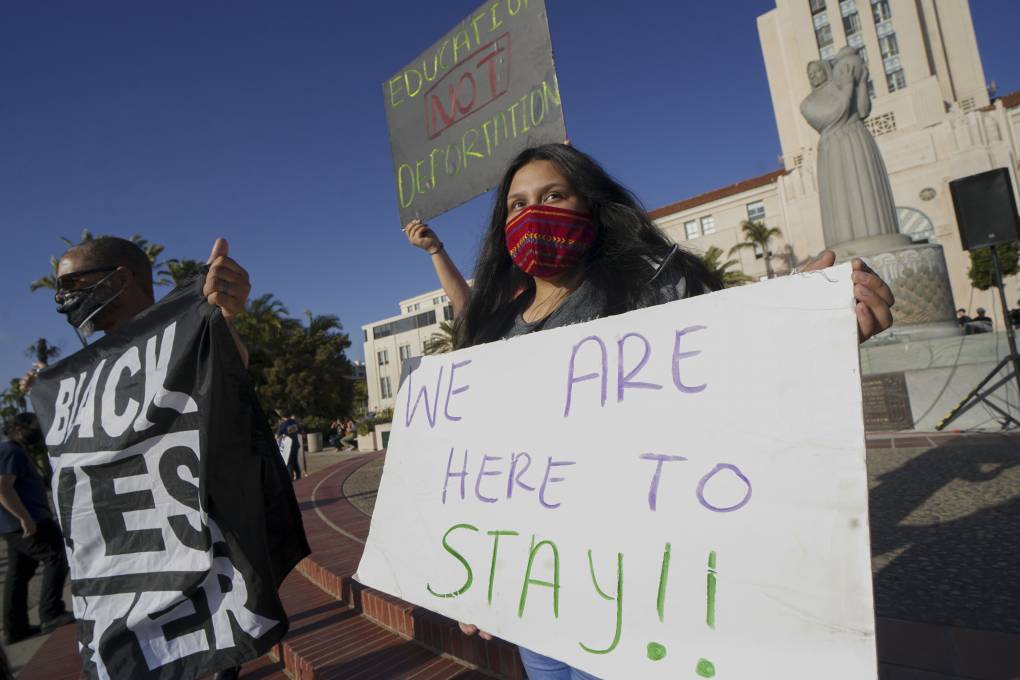
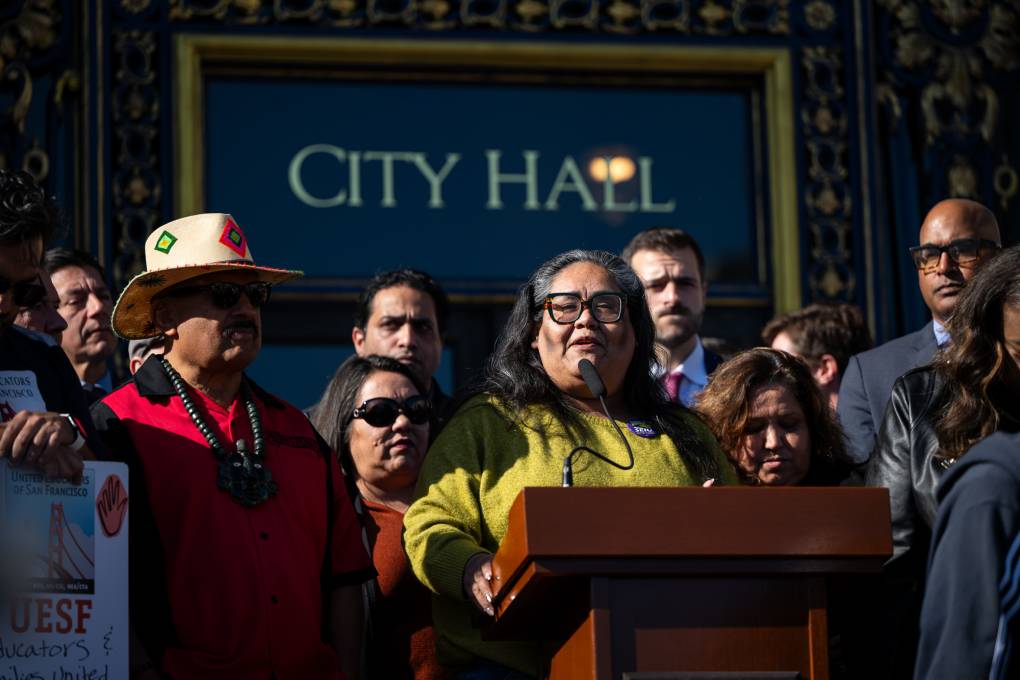
window.__IS_SSR__=true
window.__INITIAL_STATE__={
"attachmentsReducer": {
"audio_0": {
"type": "attachments",
"id": "audio_0",
"imgSizes": {
"kqedFullSize": {
"file": "https://ww2.kqed.org/news/wp-content/themes/KQED-unified/img/audio_bgs/background0.jpg"
}
}
},
"audio_1": {
"type": "attachments",
"id": "audio_1",
"imgSizes": {
"kqedFullSize": {
"file": "https://ww2.kqed.org/news/wp-content/themes/KQED-unified/img/audio_bgs/background1.jpg"
}
}
},
"audio_2": {
"type": "attachments",
"id": "audio_2",
"imgSizes": {
"kqedFullSize": {
"file": "https://ww2.kqed.org/news/wp-content/themes/KQED-unified/img/audio_bgs/background2.jpg"
}
}
},
"audio_3": {
"type": "attachments",
"id": "audio_3",
"imgSizes": {
"kqedFullSize": {
"file": "https://ww2.kqed.org/news/wp-content/themes/KQED-unified/img/audio_bgs/background3.jpg"
}
}
},
"audio_4": {
"type": "attachments",
"id": "audio_4",
"imgSizes": {
"kqedFullSize": {
"file": "https://ww2.kqed.org/news/wp-content/themes/KQED-unified/img/audio_bgs/background4.jpg"
}
}
},
"placeholder": {
"type": "attachments",
"id": "placeholder",
"imgSizes": {
"thumbnail": {
"file": "https://cdn.kqed.org/wp-content/uploads/2024/12/KQED-Default-Image-816638274-2000x1333-1-160x107.jpg",
"width": 160,
"height": 107,
"mimeType": "image/jpeg"
},
"medium": {
"file": "https://cdn.kqed.org/wp-content/uploads/2024/12/KQED-Default-Image-816638274-2000x1333-1-800x533.jpg",
"width": 800,
"height": 533,
"mimeType": "image/jpeg"
},
"medium_large": {
"file": "https://cdn.kqed.org/wp-content/uploads/2024/12/KQED-Default-Image-816638274-2000x1333-1-768x512.jpg",
"width": 768,
"height": 512,
"mimeType": "image/jpeg"
},
"large": {
"file": "https://cdn.kqed.org/wp-content/uploads/2024/12/KQED-Default-Image-816638274-2000x1333-1-1020x680.jpg",
"width": 1020,
"height": 680,
"mimeType": "image/jpeg"
},
"1536x1536": {
"file": "https://cdn.kqed.org/wp-content/uploads/2024/12/KQED-Default-Image-816638274-2000x1333-1-1536x1024.jpg",
"width": 1536,
"height": 1024,
"mimeType": "image/jpeg"
},
"fd-lrg": {
"file": "https://cdn.kqed.org/wp-content/uploads/2024/12/KQED-Default-Image-816638274-2000x1333-1-1536x1024.jpg",
"width": 1536,
"height": 1024,
"mimeType": "image/jpeg"
},
"fd-med": {
"file": "https://cdn.kqed.org/wp-content/uploads/2024/12/KQED-Default-Image-816638274-2000x1333-1-1020x680.jpg",
"width": 1020,
"height": 680,
"mimeType": "image/jpeg"
},
"fd-sm": {
"file": "https://cdn.kqed.org/wp-content/uploads/2024/12/KQED-Default-Image-816638274-2000x1333-1-800x533.jpg",
"width": 800,
"height": 533,
"mimeType": "image/jpeg"
},
"post-thumbnail": {
"file": "https://cdn.kqed.org/wp-content/uploads/2024/12/KQED-Default-Image-816638274-2000x1333-1-672x372.jpg",
"width": 672,
"height": 372,
"mimeType": "image/jpeg"
},
"twentyfourteen-full-width": {
"file": "https://cdn.kqed.org/wp-content/uploads/2024/12/KQED-Default-Image-816638274-2000x1333-1-1038x576.jpg",
"width": 1038,
"height": 576,
"mimeType": "image/jpeg"
},
"xxsmall": {
"file": "https://cdn.kqed.org/wp-content/uploads/2024/12/KQED-Default-Image-816638274-2000x1333-1-160x107.jpg",
"width": 160,
"height": 107,
"mimeType": "image/jpeg"
},
"xsmall": {
"file": "https://cdn.kqed.org/wp-content/uploads/2024/12/KQED-Default-Image-816638274-2000x1333-1-672x372.jpg",
"width": 672,
"height": 372,
"mimeType": "image/jpeg"
},
"small": {
"file": "https://cdn.kqed.org/wp-content/uploads/2024/12/KQED-Default-Image-816638274-2000x1333-1-672x372.jpg",
"width": 672,
"height": 372,
"mimeType": "image/jpeg"
},
"xlarge": {
"file": "https://cdn.kqed.org/wp-content/uploads/2024/12/KQED-Default-Image-816638274-2000x1333-1-1020x680.jpg",
"width": 1020,
"height": 680,
"mimeType": "image/jpeg"
},
"full-width": {
"file": "https://cdn.kqed.org/wp-content/uploads/2024/12/KQED-Default-Image-816638274-2000x1333-1-1920x1280.jpg",
"width": 1920,
"height": 1280,
"mimeType": "image/jpeg"
},
"guest-author-32": {
"file": "https://cdn.kqed.org/wp-content/uploads/2025/01/KQED-Default-Image-816638274-1333x1333-1-160x160.jpg",
"width": 32,
"height": 32,
"mimeType": "image/jpeg"
},
"guest-author-50": {
"file": "https://cdn.kqed.org/wp-content/uploads/2025/01/KQED-Default-Image-816638274-1333x1333-1-160x160.jpg",
"width": 50,
"height": 50,
"mimeType": "image/jpeg"
},
"guest-author-64": {
"file": "https://cdn.kqed.org/wp-content/uploads/2025/01/KQED-Default-Image-816638274-1333x1333-1-160x160.jpg",
"width": 64,
"height": 64,
"mimeType": "image/jpeg"
},
"guest-author-96": {
"file": "https://cdn.kqed.org/wp-content/uploads/2025/01/KQED-Default-Image-816638274-1333x1333-1-160x160.jpg",
"width": 96,
"height": 96,
"mimeType": "image/jpeg"
},
"guest-author-128": {
"file": "https://cdn.kqed.org/wp-content/uploads/2025/01/KQED-Default-Image-816638274-1333x1333-1-160x160.jpg",
"width": 128,
"height": 128,
"mimeType": "image/jpeg"
},
"detail": {
"file": "https://cdn.kqed.org/wp-content/uploads/2025/01/KQED-Default-Image-816638274-1333x1333-1-160x160.jpg",
"width": 160,
"height": 160,
"mimeType": "image/jpeg"
},
"kqedFullSize": {
"file": "https://cdn.kqed.org/wp-content/uploads/2024/12/KQED-Default-Image-816638274-2000x1333-1.jpg",
"width": 2000,
"height": 1333
}
}
},
"news_12052259": {
"type": "attachments",
"id": "news_12052259",
"meta": {
"index": "attachments_1716263798",
"site": "news",
"id": "12052259",
"found": true
},
"title": null,
"publishDate": 1755205539,
"status": "inherit",
"parent": 12052217,
"modified": 1755213544,
"caption": "Each year, immigrant families in California are targeted by scammers posing as immigration lawyers — a problem worsened by heightened deportation fears under President Donald Trump. Here's what to know about the different types of immigration fraud — plus how to spot a potential scam.",
"credit": "SDI Productions/Getty Images",
"altTag": null,
"description": null,
"imgSizes": {
"thumbnail": {
"file": "https://cdn.kqed.org/wp-content/uploads/sites/10/2025/08/ImmigrationLawyerGetty-160x90.jpg",
"width": 160,
"height": 90,
"mimeType": "image/jpeg"
},
"1536x1536": {
"file": "https://cdn.kqed.org/wp-content/uploads/sites/10/2025/08/ImmigrationLawyerGetty-1536x864.jpg",
"width": 1536,
"height": 864,
"mimeType": "image/jpeg"
},
"post-thumbnail": {
"file": "https://cdn.kqed.org/wp-content/uploads/sites/10/2025/08/ImmigrationLawyerGetty-672x372.jpg",
"width": 672,
"height": 372,
"mimeType": "image/jpeg"
},
"twentyfourteen-full-width": {
"file": "https://cdn.kqed.org/wp-content/uploads/sites/10/2025/08/ImmigrationLawyerGetty-1038x576.jpg",
"width": 1038,
"height": 576,
"mimeType": "image/jpeg"
},
"kqedFullSize": {
"file": "https://cdn.kqed.org/wp-content/uploads/sites/10/2025/08/ImmigrationLawyerGetty.jpg",
"width": 2000,
"height": 1125
}
},
"isLoading": false,
"fetchFailed": false
},
"news_11883278": {
"type": "attachments",
"id": "news_11883278",
"meta": {
"index": "attachments_1716263798",
"site": "news",
"id": "11883278",
"found": true
},
"parent": 11883227,
"imgSizes": {
"twentyfourteen-full-width": {
"file": "https://ww2.kqed.org/app/uploads/sites/10/2021/07/immigration-protest-1038x576.jpeg",
"width": 1038,
"mimeType": "image/jpeg",
"height": 576
},
"thumbnail": {
"file": "https://ww2.kqed.org/app/uploads/sites/10/2021/07/immigration-protest-160x107.jpeg",
"width": 160,
"mimeType": "image/jpeg",
"height": 107
},
"post-thumbnail": {
"file": "https://ww2.kqed.org/app/uploads/sites/10/2021/07/immigration-protest-672x372.jpeg",
"width": 672,
"mimeType": "image/jpeg",
"height": 372
},
"kqedFullSize": {
"file": "https://ww2.kqed.org/app/uploads/sites/10/2021/07/immigration-protest.jpeg",
"width": 1600,
"height": 1067
},
"large": {
"file": "https://ww2.kqed.org/app/uploads/sites/10/2021/07/immigration-protest-1020x680.jpeg",
"width": 1020,
"mimeType": "image/jpeg",
"height": 680
},
"1536x1536": {
"file": "https://ww2.kqed.org/app/uploads/sites/10/2021/07/immigration-protest-1536x1024.jpeg",
"width": 1536,
"mimeType": "image/jpeg",
"height": 1024
},
"medium": {
"file": "https://ww2.kqed.org/app/uploads/sites/10/2021/07/immigration-protest-800x534.jpeg",
"width": 800,
"mimeType": "image/jpeg",
"height": 534
}
},
"publishDate": 1627692006,
"modified": 1627692069,
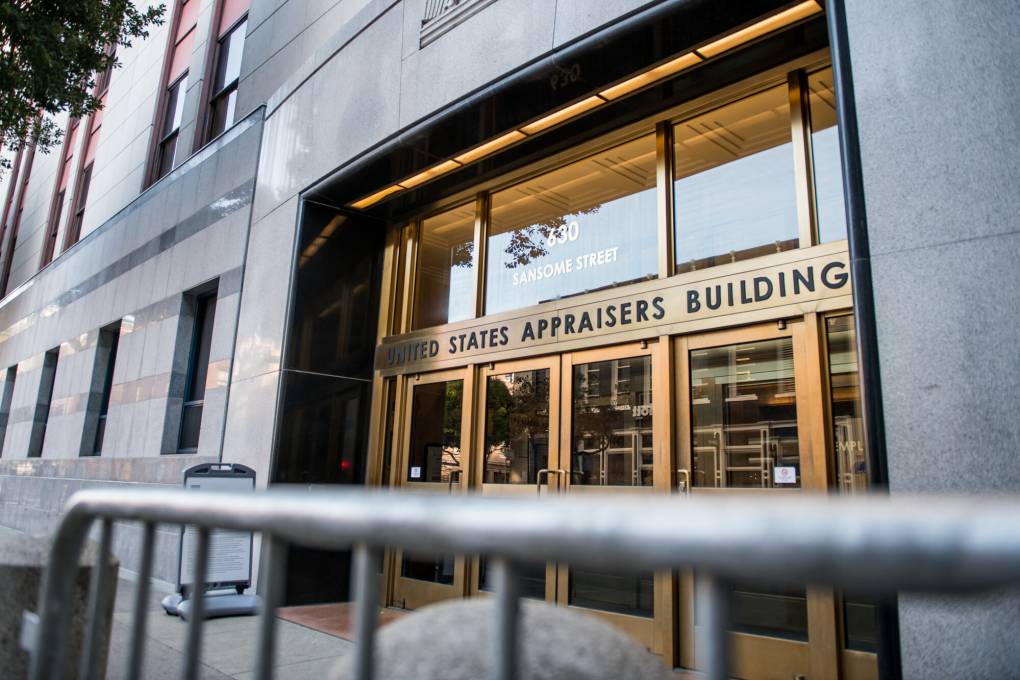
"caption": "A protester holds up a sign outside of the U.S. Immigration and Customs Enforcement processing center and immigration court at 630 Sansome St. in San Francisco.",
"description": "A protester holds up a sign outside of the U.S. Immigration and Customs Enforcement processing center and immigration court at 630 Sansome St. in San Francisco.",
"title": "immigration-protest",
"credit": "JoeBill Muñoz/KQED",
"status": "inherit",
"altTag": "Protester holds up a sign that says \"everyone is welcome Here\"",
"isLoading": false,
"fetchFailed": false
},
"news_12024249": {
"type": "attachments",
"id": "news_12024249",
"meta": {
"index": "attachments_1716263798",
"site": "news",
"id": "12024249",
"found": true
},
"title": "ICE agents raid to arrest illigal immigrants.",
"publishDate": 1738015637,
"status": "inherit",
"parent": 12024246,
"modified": 1738716093,
"caption": "Thomas Giles, ICE Field Office Director, center, talks to other agents after going to arrest an immigrant with a criminal record on Sept. 8, 2022, in Los Angeles.",
"credit": "Irfan Khan / Los Angeles Times via Getty Images",
"altTag": null,
"description": null,
"imgSizes": {
"medium": {
"file": "https://cdn.kqed.org/wp-content/uploads/sites/10/2025/01/GettyImages-1243312873-800x533.jpg",
"width": 800,
"height": 533,
"mimeType": "image/jpeg"
},
"large": {
"file": "https://cdn.kqed.org/wp-content/uploads/sites/10/2025/01/GettyImages-1243312873-1020x680.jpg",
"width": 1020,
"height": 680,
"mimeType": "image/jpeg"
},
"thumbnail": {
"file": "https://cdn.kqed.org/wp-content/uploads/sites/10/2025/01/GettyImages-1243312873-160x107.jpg",
"width": 160,
"height": 107,
"mimeType": "image/jpeg"
},
"1536x1536": {
"file": "https://cdn.kqed.org/wp-content/uploads/sites/10/2025/01/GettyImages-1243312873-1536x1024.jpg",
"width": 1536,
"height": 1024,
"mimeType": "image/jpeg"
},
"2048x2048": {
"file": "https://cdn.kqed.org/wp-content/uploads/sites/10/2025/01/GettyImages-1243312873-2048x1365.jpg",
"width": 2048,
"height": 1365,
"mimeType": "image/jpeg"
},
"post-thumbnail": {
"file": "https://cdn.kqed.org/wp-content/uploads/sites/10/2025/01/GettyImages-1243312873-672x372.jpg",
"width": 672,
"height": 372,
"mimeType": "image/jpeg"
},
"twentyfourteen-full-width": {
"file": "https://cdn.kqed.org/wp-content/uploads/sites/10/2025/01/GettyImages-1243312873-1038x576.jpg",
"width": 1038,
"height": 576,
"mimeType": "image/jpeg"
},
"full-width": {
"file": "https://cdn.kqed.org/wp-content/uploads/sites/10/2025/01/GettyImages-1243312873-1920x1280.jpg",
"width": 1920,
"height": 1280,
"mimeType": "image/jpeg"
},
"kqedFullSize": {
"file": "https://cdn.kqed.org/wp-content/uploads/sites/10/2025/01/GettyImages-1243312873-scaled.jpg",
"width": 2560,
"height": 1707
}
},
"isLoading": false,
"fetchFailed": false
},
"news_12042519": {
"type": "attachments",
"id": "news_12042519",
"meta": {
"index": "attachments_1716263798",
"site": "news",
"id": "12042519",
"found": true
},
"title": "20250501_MayDayRally_GC-11_qed",
"publishDate": 1748973260,
"status": "inherit",
"parent": 12042492,
"modified": 1748973272,
"caption": "Hundreds march during a May Day rally, calling for immigrant rights, on International Workers’ Day, in Santa Rosa on May 1, 2025.",
"credit": "Gina Castro/KQED",
"altTag": null,
"description": null,
"imgSizes": {
"medium": {
"file": "https://cdn.kqed.org/wp-content/uploads/sites/10/2025/06/20250501_MayDayRally_GC-11_qed-800x533.jpg",
"width": 800,
"height": 533,
"mimeType": "image/jpeg"
},
"large": {
"file": "https://cdn.kqed.org/wp-content/uploads/sites/10/2025/06/20250501_MayDayRally_GC-11_qed-1020x680.jpg",
"width": 1020,
"height": 680,
"mimeType": "image/jpeg"
},
"thumbnail": {
"file": "https://cdn.kqed.org/wp-content/uploads/sites/10/2025/06/20250501_MayDayRally_GC-11_qed-160x107.jpg",
"width": 160,
"height": 107,
"mimeType": "image/jpeg"
},
"1536x1536": {
"file": "https://cdn.kqed.org/wp-content/uploads/sites/10/2025/06/20250501_MayDayRally_GC-11_qed-1536x1024.jpg",
"width": 1536,
"height": 1024,
"mimeType": "image/jpeg"
},
"post-thumbnail": {
"file": "https://cdn.kqed.org/wp-content/uploads/sites/10/2025/06/20250501_MayDayRally_GC-11_qed-672x372.jpg",
"width": 672,
"height": 372,
"mimeType": "image/jpeg"
},
"twentyfourteen-full-width": {
"file": "https://cdn.kqed.org/wp-content/uploads/sites/10/2025/06/20250501_MayDayRally_GC-11_qed-1038x576.jpg",
"width": 1038,
"height": 576,
"mimeType": "image/jpeg"
},
"full-width": {
"file": "https://cdn.kqed.org/wp-content/uploads/sites/10/2025/06/20250501_MayDayRally_GC-11_qed-1920x1280.jpg",
"width": 1920,
"height": 1280,
"mimeType": "image/jpeg"
},
"kqedFullSize": {
"file": "https://cdn.kqed.org/wp-content/uploads/sites/10/2025/06/20250501_MayDayRally_GC-11_qed.jpg",
"width": 2000,
"height": 1333
}
},
"isLoading": false,
"fetchFailed": false
},
"news_12042200": {
"type": "attachments",
"id": "news_12042200",
"meta": {
"index": "attachments_1716263798",
"site": "news",
"id": "12042200",
"found": true
},
"title": "008_KQED_630Sansome_02052020_1470_qed",
"publishDate": 1748630169,
"status": "inherit",
"parent": 12042197,
"modified": 1784932362,
"caption": "The U.S. Immigration & Customs Enforcement building at 630 Sansome St., in San Francisco, California, on Feb. 5, 2020.",
"credit": "Beth LaBerge/KQED",
"altTag": null,
"description": null,
"imgSizes": {
"medium": {
"file": "https://cdn.kqed.org/wp-content/uploads/sites/10/2025/05/008_KQED_630Sansome_02052020_1470_qed-800x533.jpg",
"width": 800,
"height": 533,
"mimeType": "image/jpeg"
},
"large": {
"file": "https://cdn.kqed.org/wp-content/uploads/sites/10/2025/05/008_KQED_630Sansome_02052020_1470_qed-1020x680.jpg",
"width": 1020,
"height": 680,
"mimeType": "image/jpeg"
},
"thumbnail": {
"file": "https://cdn.kqed.org/wp-content/uploads/sites/10/2025/05/008_KQED_630Sansome_02052020_1470_qed-160x107.jpg",
"width": 160,
"height": 107,
"mimeType": "image/jpeg"
},
"1536x1536": {
"file": "https://cdn.kqed.org/wp-content/uploads/sites/10/2025/05/008_KQED_630Sansome_02052020_1470_qed-1536x1024.jpg",
"width": 1536,
"height": 1024,
"mimeType": "image/jpeg"
},
"post-thumbnail": {
"file": "https://cdn.kqed.org/wp-content/uploads/sites/10/2025/05/008_KQED_630Sansome_02052020_1470_qed-672x372.jpg",
"width": 672,
"height": 372,
"mimeType": "image/jpeg"
},
"twentyfourteen-full-width": {
"file": "https://cdn.kqed.org/wp-content/uploads/sites/10/2025/05/008_KQED_630Sansome_02052020_1470_qed-1038x576.jpg",
"width": 1038,
"height": 576,
"mimeType": "image/jpeg"
},
"full-width": {
"file": "https://cdn.kqed.org/wp-content/uploads/sites/10/2025/05/008_KQED_630Sansome_02052020_1470_qed-1920x1280.jpg",
"width": 1920,
"height": 1280,
"mimeType": "image/jpeg"
},
"kqedFullSize": {
"file": "https://cdn.kqed.org/wp-content/uploads/sites/10/2025/05/008_KQED_630Sansome_02052020_1470_qed.jpg",
"width": 1999,
"height": 1333
}
},
"isLoading": false,
"fetchFailed": false
},
"news_11979156": {
"type": "attachments",
"id": "news_11979156",
"meta": {
"index": "attachments_1716263798",
"site": "news",
"id": "11979156",
"found": true
},
"title": "240212-ImmigrationCourt-31-BL_qut",
"publishDate": 1710283094,
"status": "inherit",
"parent": 11979131,
"modified": 1748456121,
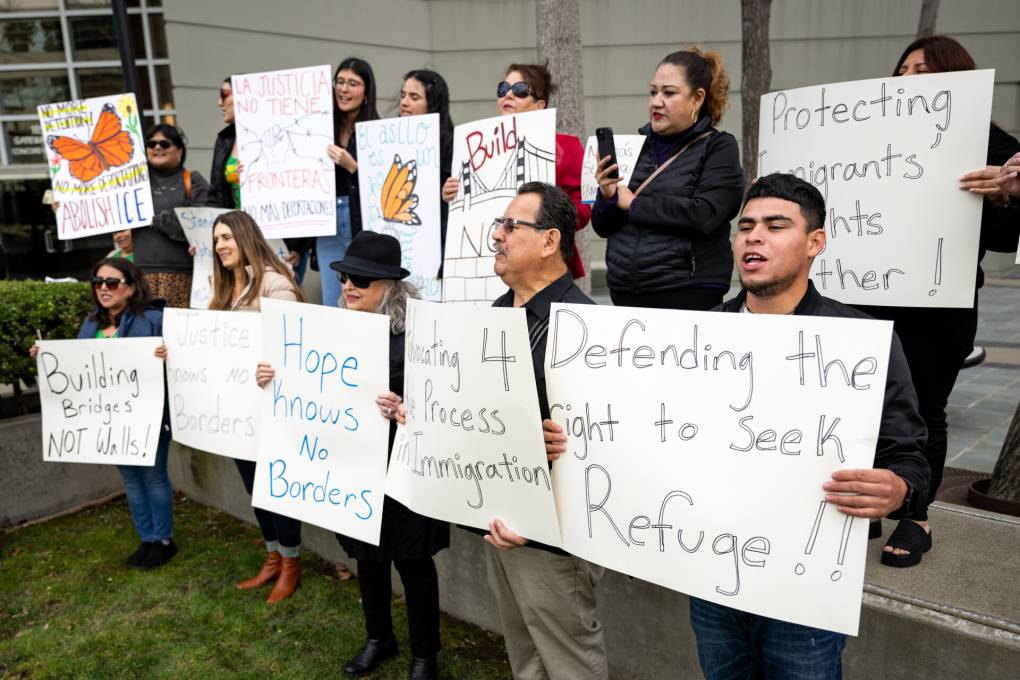
"caption": "Immigration rights supporters stand outside the new Concord Immigration Court in Concord during a press conference on Feb. 12, 2024.",
"credit": "Beth LaBerge/KQED",
"altTag": null,
"description": null,
"imgSizes": {
"medium": {
"file": "https://cdn.kqed.org/wp-content/uploads/sites/10/2024/03/240212-ImmigrationCourt-31-BL_qut-800x533.jpg",
"width": 800,
"height": 533,
"mimeType": "image/jpeg"
},
"large": {
"file": "https://cdn.kqed.org/wp-content/uploads/sites/10/2024/03/240212-ImmigrationCourt-31-BL_qut-1020x680.jpg",
"width": 1020,
"height": 680,
"mimeType": "image/jpeg"
},
"thumbnail": {
"file": "https://cdn.kqed.org/wp-content/uploads/sites/10/2024/03/240212-ImmigrationCourt-31-BL_qut-160x107.jpg",
"width": 160,
"height": 107,
"mimeType": "image/jpeg"
},
"1536x1536": {
"file": "https://cdn.kqed.org/wp-content/uploads/sites/10/2024/03/240212-ImmigrationCourt-31-BL_qut-1536x1024.jpg",
"width": 1536,
"height": 1024,
"mimeType": "image/jpeg"
},
"post-thumbnail": {
"file": "https://cdn.kqed.org/wp-content/uploads/sites/10/2024/03/240212-ImmigrationCourt-31-BL_qut-672x372.jpg",
"width": 672,
"height": 372,
"mimeType": "image/jpeg"
},
"twentyfourteen-full-width": {
"file": "https://cdn.kqed.org/wp-content/uploads/sites/10/2024/03/240212-ImmigrationCourt-31-BL_qut-1038x576.jpg",
"width": 1038,
"height": 576,
"mimeType": "image/jpeg"
},
"kqedFullSize": {
"file": "https://cdn.kqed.org/wp-content/uploads/sites/10/2024/03/240212-ImmigrationCourt-31-BL_qut.jpg",
"width": 1920,
"height": 1280
}
},
"isLoading": false,
"fetchFailed": false
},
"news_11712245": {
"type": "attachments",
"id": "news_11712245",
"meta": {
"index": "attachments_1716263798",
"site": "news",
"id": "11712245",
"found": true
},
"title": "The Association of Legal Aid Attorneys along with dozens of unions, immigrant rights organizations, and community groups held a rally on December 7, 2017 at Brooklyn Borough Hall to call on the Office of Court Administration and Chief Judge Janet DiFiore to prohibit Immigration & Customs Enforcement agents from entering state courthouses, and to end coordination with ICE.",
"publishDate": 1544730613,
"status": "inherit",
"parent": 11712244,
"modified": 1748046862,
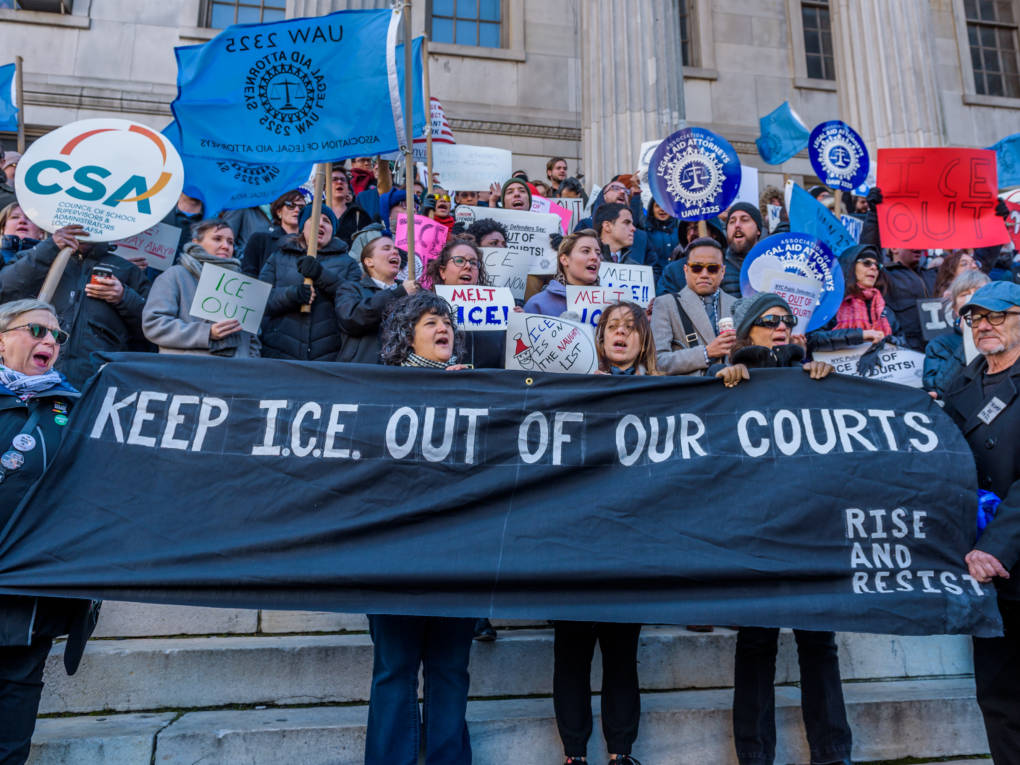
"caption": "The Association of Legal Aid Attorneys, along with dozens of unions, immigrant rights organizations and community groups, held a rally on Dec. 7, 2017, at Brooklyn Borough Hall.",
"credit": "Pacific Press/LightRocket via Getty Images",
"altTag": null,
"description": null,
"imgSizes": {
"thumbnail": {
"file": "https://cdn.kqed.org/wp-content/uploads/sites/10/2018/12/gettyimages-888870656-e9acdd0cdcb80ec5cd16b8a05023e4e5664f30fb-160x120.jpg",
"width": 160,
"height": 120,
"mimeType": "image/jpeg"
},
"medium": {
"file": "https://cdn.kqed.org/wp-content/uploads/sites/10/2018/12/gettyimages-888870656-e9acdd0cdcb80ec5cd16b8a05023e4e5664f30fb-800x600.jpg",
"width": 800,
"height": 600,
"mimeType": "image/jpeg"
},
"large": {
"file": "https://cdn.kqed.org/wp-content/uploads/sites/10/2018/12/gettyimages-888870656-e9acdd0cdcb80ec5cd16b8a05023e4e5664f30fb-1020x765.jpg",
"width": 1020,
"height": 765,
"mimeType": "image/jpeg"
},
"complete_open_graph": {
"file": "https://cdn.kqed.org/wp-content/uploads/sites/10/2018/12/gettyimages-888870656-e9acdd0cdcb80ec5cd16b8a05023e4e5664f30fb-1200x900.jpg",
"width": 1200,
"height": 900,
"mimeType": "image/jpeg"
},
"post-thumbnail": {
"file": "https://cdn.kqed.org/wp-content/uploads/sites/10/2018/12/gettyimages-888870656-e9acdd0cdcb80ec5cd16b8a05023e4e5664f30fb-672x372.jpg",
"width": 672,
"height": 372,
"mimeType": "image/jpeg"
},
"twentyfourteen-full-width": {
"file": "https://cdn.kqed.org/wp-content/uploads/sites/10/2018/12/gettyimages-888870656-e9acdd0cdcb80ec5cd16b8a05023e4e5664f30fb-1038x576.jpg",
"width": 1038,
"height": 576,
"mimeType": "image/jpeg"
},
"full-width": {
"file": "https://cdn.kqed.org/wp-content/uploads/sites/10/2018/12/gettyimages-888870656-e9acdd0cdcb80ec5cd16b8a05023e4e5664f30fb-1920x1440.jpg",
"width": 1920,
"height": 1440,
"mimeType": "image/jpeg"
},
"guest-author-32": {
"file": "https://cdn.kqed.org/wp-content/uploads/sites/10/2018/12/gettyimages-888870656-e9acdd0cdcb80ec5cd16b8a05023e4e5664f30fb-32x32.jpg",
"width": 32,
"height": 32,
"mimeType": "image/jpeg"
},
"guest-author-50": {
"file": "https://cdn.kqed.org/wp-content/uploads/sites/10/2018/12/gettyimages-888870656-e9acdd0cdcb80ec5cd16b8a05023e4e5664f30fb-50x50.jpg",
"width": 50,
"height": 50,
"mimeType": "image/jpeg"
},
"guest-author-64": {
"file": "https://cdn.kqed.org/wp-content/uploads/sites/10/2018/12/gettyimages-888870656-e9acdd0cdcb80ec5cd16b8a05023e4e5664f30fb-64x64.jpg",
"width": 64,
"height": 64,
"mimeType": "image/jpeg"
},
"guest-author-96": {
"file": "https://cdn.kqed.org/wp-content/uploads/sites/10/2018/12/gettyimages-888870656-e9acdd0cdcb80ec5cd16b8a05023e4e5664f30fb-96x96.jpg",
"width": 96,
"height": 96,
"mimeType": "image/jpeg"
},
"guest-author-128": {
"file": "https://cdn.kqed.org/wp-content/uploads/sites/10/2018/12/gettyimages-888870656-e9acdd0cdcb80ec5cd16b8a05023e4e5664f30fb-128x128.jpg",
"width": 128,
"height": 128,
"mimeType": "image/jpeg"
},
"detail": {
"file": "https://cdn.kqed.org/wp-content/uploads/sites/10/2018/12/gettyimages-888870656-e9acdd0cdcb80ec5cd16b8a05023e4e5664f30fb-150x150.jpg",
"width": 150,
"height": 150,
"mimeType": "image/jpeg"
},
"kqedFullSize": {
"file": "https://cdn.kqed.org/wp-content/uploads/sites/10/2018/12/gettyimages-888870656-e9acdd0cdcb80ec5cd16b8a05023e4e5664f30fb-e1748037342663.jpg",
"width": 2000,
"height": 1500
}
},
"isLoading": false,
"fetchFailed": false
},
"news_12029327": {
"type": "attachments",
"id": "news_12029327",
"meta": {
"index": "attachments_1716263798",
"site": "news",
"id": "12029327",
"found": true
},
"title": "Farmworkers on farm near Bakersfield",
"publishDate": 1740784110,
"status": "inherit",
"parent": 12029195,
"modified": 1740784995,
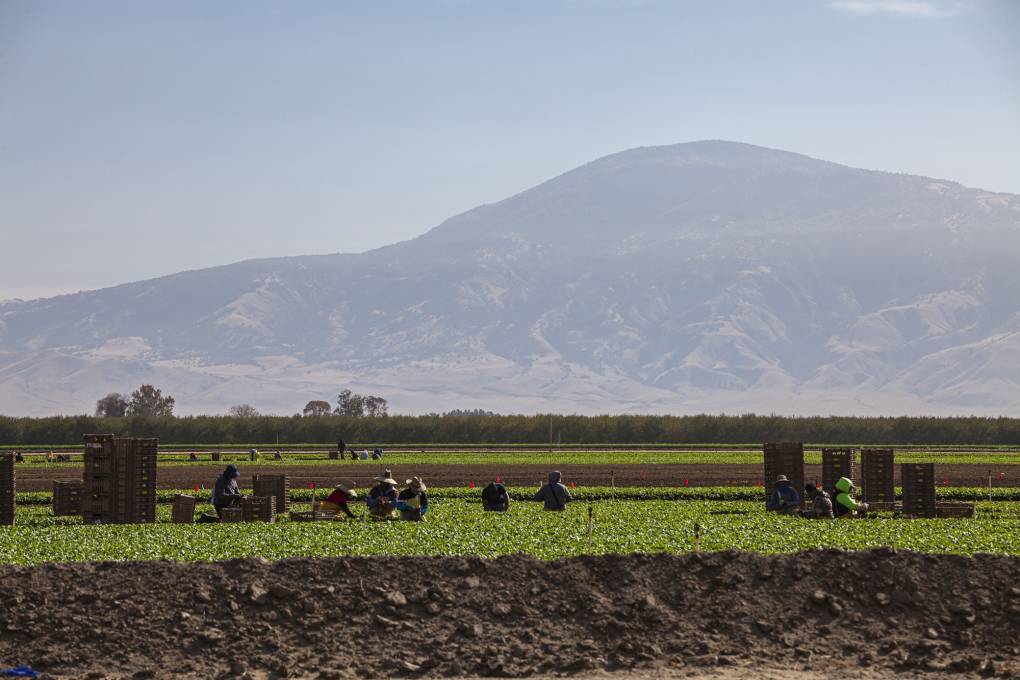
"caption": "Farmworkers on a farm near Bakersfield in Kern County, California, on Oct. 22, 2021. ",
"credit": "Citizen of the Planet/UCG/Universal Images Group via Getty Images",
"altTag": null,
"description": null,
"imgSizes": {
"medium": {
"file": "https://cdn.kqed.org/wp-content/uploads/sites/10/2025/02/BakersfieldFarmworkersGetty-800x533.jpg",
"width": 800,
"height": 533,
"mimeType": "image/jpeg"
},
"large": {
"file": "https://cdn.kqed.org/wp-content/uploads/sites/10/2025/02/BakersfieldFarmworkersGetty-1020x680.jpg",
"width": 1020,
"height": 680,
"mimeType": "image/jpeg"
},
"thumbnail": {
"file": "https://cdn.kqed.org/wp-content/uploads/sites/10/2025/02/BakersfieldFarmworkersGetty-160x107.jpg",
"width": 160,
"height": 107,
"mimeType": "image/jpeg"
},
"1536x1536": {
"file": "https://cdn.kqed.org/wp-content/uploads/sites/10/2025/02/BakersfieldFarmworkersGetty-1536x1024.jpg",
"width": 1536,
"height": 1024,
"mimeType": "image/jpeg"
},
"post-thumbnail": {
"file": "https://cdn.kqed.org/wp-content/uploads/sites/10/2025/02/BakersfieldFarmworkersGetty-672x372.jpg",
"width": 672,
"height": 372,
"mimeType": "image/jpeg"
},
"twentyfourteen-full-width": {
"file": "https://cdn.kqed.org/wp-content/uploads/sites/10/2025/02/BakersfieldFarmworkersGetty-1038x576.jpg",
"width": 1038,
"height": 576,
"mimeType": "image/jpeg"
},
"full-width": {
"file": "https://cdn.kqed.org/wp-content/uploads/sites/10/2025/02/BakersfieldFarmworkersGetty-1920x1280.jpg",
"width": 1920,
"height": 1280,
"mimeType": "image/jpeg"
},
"kqedFullSize": {
"file": "https://cdn.kqed.org/wp-content/uploads/sites/10/2025/02/BakersfieldFarmworkersGetty.jpg",
"width": 2000,
"height": 1333
}
},
"isLoading": false,
"fetchFailed": false
},
"news_11890060": {
"type": "attachments",
"id": "news_11890060",
"meta": {
"index": "attachments_1716263798",
"site": "news",
"id": "11890060",
"found": true
},
"title": "US-POLITICS-IMMIGRATION-COURT",
"publishDate": 1632779004,
"status": "inherit",
"parent": 11890039,
"modified": 1779125894,
"caption": "People hold signs during a rally in support of the Supreme Court's ruling in favor of the Deferred Action for Childhood Arrivals (DACA) program in San Diego, California, June 18, 2020.",
"credit": "Sandy Huffaker/AFP via Getty Images",
"altTag": "Protesters hold signs saying, \"We are here to stay!\" \"Black Lives Matter\" and \"Education, Not Deportation.\"",
"description": "People hold signs during a rally in support of the Supreme Court's ruling in favor of the Deferred Action for Childhood Arrivals (DACA) program, in San Diego, California June 18, 2020.",
"imgSizes": {
"medium": {
"file": "https://cdn.kqed.org/wp-content/uploads/sites/10/2021/09/GettyImages-1221069312-800x534.jpg",
"width": 800,
"height": 534,
"mimeType": "image/jpeg"
},
"large": {
"file": "https://cdn.kqed.org/wp-content/uploads/sites/10/2021/09/GettyImages-1221069312-1020x680.jpg",
"width": 1020,
"height": 680,
"mimeType": "image/jpeg"
},
"thumbnail": {
"file": "https://cdn.kqed.org/wp-content/uploads/sites/10/2021/09/GettyImages-1221069312-160x107.jpg",
"width": 160,
"height": 107,
"mimeType": "image/jpeg"
},
"1536x1536": {
"file": "https://cdn.kqed.org/wp-content/uploads/sites/10/2021/09/GettyImages-1221069312-1536x1025.jpg",
"width": 1536,
"height": 1025,
"mimeType": "image/jpeg"
},
"2048x2048": {
"file": "https://cdn.kqed.org/wp-content/uploads/sites/10/2021/09/GettyImages-1221069312-2048x1366.jpg",
"width": 2048,
"height": 1366,
"mimeType": "image/jpeg"
},
"post-thumbnail": {
"file": "https://cdn.kqed.org/wp-content/uploads/sites/10/2021/09/GettyImages-1221069312-672x372.jpg",
"width": 672,
"height": 372,
"mimeType": "image/jpeg"
},
"twentyfourteen-full-width": {
"file": "https://cdn.kqed.org/wp-content/uploads/sites/10/2021/09/GettyImages-1221069312-1038x576.jpg",
"width": 1038,
"height": 576,
"mimeType": "image/jpeg"
},
"full-width": {
"file": "https://cdn.kqed.org/wp-content/uploads/sites/10/2021/09/GettyImages-1221069312-1920x1281.jpg",
"width": 1920,
"height": 1281,
"mimeType": "image/jpeg"
},
"kqedFullSize": {
"file": "https://cdn.kqed.org/wp-content/uploads/sites/10/2021/09/GettyImages-1221069312-scaled-e1740595603543.jpg",
"width": 2000,
"height": 1334
}
},
"isLoading": false,
"fetchFailed": false
},
"news_11861171": {
"type": "attachments",
"id": "news_11861171",
"meta": {
"index": "attachments_1716263798",
"site": "news",
"id": "11861171",
"found": true
},
"parent": 11861170,
"imgSizes": {
"apple_news_ca_landscape_5_5": {
"file": "https://ww2.kqed.org/app/uploads/sites/10/2021/02/ap20085537395007_custom-ecee50ce392cd8fa5d32a2063cb73d5bd1c02722-1044x783.jpg",
"width": 1044,
"mimeType": "image/jpeg",
"height": 783
},
"apple_news_ca_square_4_0": {
"file": "https://ww2.kqed.org/app/uploads/sites/10/2021/02/ap20085537395007_custom-ecee50ce392cd8fa5d32a2063cb73d5bd1c02722-470x470.jpg",
"width": 470,
"mimeType": "image/jpeg",
"height": 470
},
"twentyfourteen-full-width": {
"file": "https://ww2.kqed.org/app/uploads/sites/10/2021/02/ap20085537395007_custom-ecee50ce392cd8fa5d32a2063cb73d5bd1c02722-1038x576.jpg",
"width": 1038,
"mimeType": "image/jpeg",
"height": 576
},
"thumbnail": {
"file": "https://ww2.kqed.org/app/uploads/sites/10/2021/02/ap20085537395007_custom-ecee50ce392cd8fa5d32a2063cb73d5bd1c02722-160x107.jpg",
"width": 160,
"mimeType": "image/jpeg",
"height": 107
},
"post-thumbnail": {
"file": "https://ww2.kqed.org/app/uploads/sites/10/2021/02/ap20085537395007_custom-ecee50ce392cd8fa5d32a2063cb73d5bd1c02722-672x372.jpg",
"width": 672,
"mimeType": "image/jpeg",
"height": 372
},
"kqedFullSize": {
"file": "https://ww2.kqed.org/app/uploads/sites/10/2021/02/ap20085537395007_custom-ecee50ce392cd8fa5d32a2063cb73d5bd1c02722-scaled-e1613765453619.jpg",
"width": 1920,
"height": 1279
},
"2048x2048": {
"file": "https://ww2.kqed.org/app/uploads/sites/10/2021/02/ap20085537395007_custom-ecee50ce392cd8fa5d32a2063cb73d5bd1c02722-2048x1364.jpg",
"width": 2048,
"mimeType": "image/jpeg",
"height": 1364
},
"apple_news_ca_landscape_4_7": {
"file": "https://ww2.kqed.org/app/uploads/sites/10/2021/02/ap20085537395007_custom-ecee50ce392cd8fa5d32a2063cb73d5bd1c02722-632x474.jpg",
"width": 632,
"mimeType": "image/jpeg",
"height": 474
},
"large": {
"file": "https://ww2.kqed.org/app/uploads/sites/10/2021/02/ap20085537395007_custom-ecee50ce392cd8fa5d32a2063cb73d5bd1c02722-1020x679.jpg",
"width": 1020,
"mimeType": "image/jpeg",
"height": 679
},
"apple_news_ca_landscape_4_0": {
"file": "https://ww2.kqed.org/app/uploads/sites/10/2021/02/ap20085537395007_custom-ecee50ce392cd8fa5d32a2063cb73d5bd1c02722-536x402.jpg",
"width": 536,
"mimeType": "image/jpeg",
"height": 402
},
"apple_news_ca_portrait_12_9": {
"file": "https://ww2.kqed.org/app/uploads/sites/10/2021/02/ap20085537395007_custom-ecee50ce392cd8fa5d32a2063cb73d5bd1c02722-1122x1496.jpg",
"width": 1122,
"mimeType": "image/jpeg",
"height": 1496
},
"medium": {
"file": "https://ww2.kqed.org/app/uploads/sites/10/2021/02/ap20085537395007_custom-ecee50ce392cd8fa5d32a2063cb73d5bd1c02722-800x533.jpg",
"width": 800,
"mimeType": "image/jpeg",
"height": 533
},
"apple_news_ca_portrait_4_0": {
"file": "https://ww2.kqed.org/app/uploads/sites/10/2021/02/ap20085537395007_custom-ecee50ce392cd8fa5d32a2063cb73d5bd1c02722-354x472.jpg",
"width": 354,
"mimeType": "image/jpeg",
"height": 472
},
"apple_news_ca_portrait_9_7": {
"file": "https://ww2.kqed.org/app/uploads/sites/10/2021/02/ap20085537395007_custom-ecee50ce392cd8fa5d32a2063cb73d5bd1c02722-840x1120.jpg",
"width": 840,
"mimeType": "image/jpeg",
"height": 1120
},
"apple_news_ca_landscape_12_9": {
"file": "https://ww2.kqed.org/app/uploads/sites/10/2021/02/ap20085537395007_custom-ecee50ce392cd8fa5d32a2063cb73d5bd1c02722-1832x1374.jpg",
"width": 1832,
"mimeType": "image/jpeg",
"height": 1374
},
"apple_news_ca_square_9_7": {
"file": "https://ww2.kqed.org/app/uploads/sites/10/2021/02/ap20085537395007_custom-ecee50ce392cd8fa5d32a2063cb73d5bd1c02722-1104x1104.jpg",
"width": 1104,
"mimeType": "image/jpeg",
"height": 1104
},
"1536x1536": {
"file": "https://ww2.kqed.org/app/uploads/sites/10/2021/02/ap20085537395007_custom-ecee50ce392cd8fa5d32a2063cb73d5bd1c02722-1536x1023.jpg",
"width": 1536,
"mimeType": "image/jpeg",
"height": 1023
},
"apple_news_ca_portrait_4_7": {
"file": "https://ww2.kqed.org/app/uploads/sites/10/2021/02/ap20085537395007_custom-ecee50ce392cd8fa5d32a2063cb73d5bd1c02722-414x552.jpg",
"width": 414,
"mimeType": "image/jpeg",
"height": 552
},
"apple_news_ca_square_12_9": {
"file": "https://ww2.kqed.org/app/uploads/sites/10/2021/02/ap20085537395007_custom-ecee50ce392cd8fa5d32a2063cb73d5bd1c02722-1472x1472.jpg",
"width": 1472,
"mimeType": "image/jpeg",
"height": 1472
},
"apple_news_ca_portrait_5_5": {
"file": "https://ww2.kqed.org/app/uploads/sites/10/2021/02/ap20085537395007_custom-ecee50ce392cd8fa5d32a2063cb73d5bd1c02722-687x916.jpg",
"width": 687,
"mimeType": "image/jpeg",
"height": 916
},
"full-width": {
"file": "https://ww2.kqed.org/app/uploads/sites/10/2021/02/ap20085537395007_custom-ecee50ce392cd8fa5d32a2063cb73d5bd1c02722-1920x1279.jpg",
"width": 1920,
"mimeType": "image/jpeg",
"height": 1279
},
"apple_news_ca_square_4_7": {
"file": "https://ww2.kqed.org/app/uploads/sites/10/2021/02/ap20085537395007_custom-ecee50ce392cd8fa5d32a2063cb73d5bd1c02722-550x550.jpg",
"width": 550,
"mimeType": "image/jpeg",
"height": 550
},
"apple_news_ca_landscape_9_7": {
"file": "https://ww2.kqed.org/app/uploads/sites/10/2021/02/ap20085537395007_custom-ecee50ce392cd8fa5d32a2063cb73d5bd1c02722-1376x1032.jpg",
"width": 1376,
"mimeType": "image/jpeg",
"height": 1032
},
"apple_news_ca_square_5_5": {
"file": "https://ww2.kqed.org/app/uploads/sites/10/2021/02/ap20085537395007_custom-ecee50ce392cd8fa5d32a2063cb73d5bd1c02722-912x912.jpg",
"width": 912,
"mimeType": "image/jpeg",
"height": 912
}
},
"publishDate": 1613761514,
"modified": 1613766809,
"caption": "A U.S. Immigration and Customs Enforcement officer looks on during an operation in Escondido, California, in 2019. The Biden administration on Thursday announced new guidelines that are expected to sharply limit arrests and deportations carried out by ICE.",
"description": "A U.S. Immigration and Customs Enforcement officer looks on during an operation in Escondido, Calif., in 2019. The Biden administration on Thursday announced new guidelines that are expected to sharply limit arrests and deportations carried out by ICE.",
"title": "A U.S. Immigration and Customs Enforcement officer looks on during an operation in Escondido, Calif., in 2019. The Biden administration today announced new guidelines that are expected to sharply limit arrests and deportations carried out by ICE.",
"credit": "Gregory Bull/AP",
"status": "inherit",
"altTag": null,
"isLoading": false,
"fetchFailed": false
},
"news_12025468": {
"type": "attachments",
"id": "news_12025468",
"meta": {
"index": "attachments_1716263798",
"site": "news",
"id": "12025468",
"found": true
},
"title": "250203-DayWithoutAnImmigrant-04-BL",
"publishDate": 1738619150,
"status": "inherit",
"parent": 0,
"modified": 1738624102,
"caption": "Amaris, 17, (center), and Christian, 14, march during a rally for immigrants’ rights in the Fruitvale district of Oakland on Monday, Feb. 3, 2025. By Any Means Necessary, a youth-led immigrants' rights organization, organized the rally.",
"credit": "Beth LaBerge/KQED",
"altTag": null,
"description": null,
"imgSizes": {
"medium": {
"file": "https://cdn.kqed.org/wp-content/uploads/sites/10/2025/02/250203-DayWithoutAnImmigrant-04-BL-800x533.jpg",
"width": 800,
"height": 533,
"mimeType": "image/jpeg"
},
"large": {
"file": "https://cdn.kqed.org/wp-content/uploads/sites/10/2025/02/250203-DayWithoutAnImmigrant-04-BL-1020x680.jpg",
"width": 1020,
"height": 680,
"mimeType": "image/jpeg"
},
"thumbnail": {
"file": "https://cdn.kqed.org/wp-content/uploads/sites/10/2025/02/250203-DayWithoutAnImmigrant-04-BL-160x107.jpg",
"width": 160,
"height": 107,
"mimeType": "image/jpeg"
},
"1536x1536": {
"file": "https://cdn.kqed.org/wp-content/uploads/sites/10/2025/02/250203-DayWithoutAnImmigrant-04-BL-1536x1024.jpg",
"width": 1536,
"height": 1024,
"mimeType": "image/jpeg"
},
"post-thumbnail": {
"file": "https://cdn.kqed.org/wp-content/uploads/sites/10/2025/02/250203-DayWithoutAnImmigrant-04-BL-672x372.jpg",
"width": 672,
"height": 372,
"mimeType": "image/jpeg"
},
"twentyfourteen-full-width": {
"file": "https://cdn.kqed.org/wp-content/uploads/sites/10/2025/02/250203-DayWithoutAnImmigrant-04-BL-1038x576.jpg",
"width": 1038,
"height": 576,
"mimeType": "image/jpeg"
},
"full-width": {
"file": "https://cdn.kqed.org/wp-content/uploads/sites/10/2025/02/250203-DayWithoutAnImmigrant-04-BL-1920x1280.jpg",
"width": 1920,
"height": 1280,
"mimeType": "image/jpeg"
},
"kqedFullSize": {
"file": "https://cdn.kqed.org/wp-content/uploads/sites/10/2025/02/250203-DayWithoutAnImmigrant-04-BL.jpg",
"width": 2000,
"height": 1333
}
},
"isLoading": false,
"fetchFailed": false
},
"news_12024428": {
"type": "attachments",
"id": "news_12024428",
"meta": {
"index": "attachments_1716263798",
"site": "news",
"id": "12024428",
"found": true
},
"title": "250128-SFImmigration-03-BL",
"publishDate": 1738105092,
"status": "inherit",
"parent": 0,
"modified": 1738105369,
"caption": "SEIU Local 87 president Olga Miranda speaks during a press conference with elected and public safety officials and labor leaders in front of City Hall in San Francisco on Tuesday, Jan. 28, 2025, to reaffirm San Francisco’s commitment to being a Sanctuary City.",
"credit": "Beth LaBerge/KQED",
"altTag": null,
"description": null,
"imgSizes": {
"medium": {
"file": "https://cdn.kqed.org/wp-content/uploads/sites/10/2025/01/250128-SFImmigration-03-BL-800x533.jpg",
"width": 800,
"height": 533,
"mimeType": "image/jpeg"
},
"large": {
"file": "https://cdn.kqed.org/wp-content/uploads/sites/10/2025/01/250128-SFImmigration-03-BL-1020x680.jpg",
"width": 1020,
"height": 680,
"mimeType": "image/jpeg"
},
"thumbnail": {
"file": "https://cdn.kqed.org/wp-content/uploads/sites/10/2025/01/250128-SFImmigration-03-BL-160x107.jpg",
"width": 160,
"height": 107,
"mimeType": "image/jpeg"
},
"1536x1536": {
"file": "https://cdn.kqed.org/wp-content/uploads/sites/10/2025/01/250128-SFImmigration-03-BL-1536x1024.jpg",
"width": 1536,
"height": 1024,
"mimeType": "image/jpeg"
},
"post-thumbnail": {
"file": "https://cdn.kqed.org/wp-content/uploads/sites/10/2025/01/250128-SFImmigration-03-BL-672x372.jpg",
"width": 672,
"height": 372,
"mimeType": "image/jpeg"
},
"twentyfourteen-full-width": {
"file": "https://cdn.kqed.org/wp-content/uploads/sites/10/2025/01/250128-SFImmigration-03-BL-1038x576.jpg",
"width": 1038,
"height": 576,
"mimeType": "image/jpeg"
},
"full-width": {
"file": "https://cdn.kqed.org/wp-content/uploads/sites/10/2025/01/250128-SFImmigration-03-BL-1920x1280.jpg",
"width": 1920,
"height": 1280,
"mimeType": "image/jpeg"
},
"kqedFullSize": {
"file": "https://cdn.kqed.org/wp-content/uploads/sites/10/2025/01/250128-SFImmigration-03-BL.jpg",
"width": 2000,
"height": 1333
}
},
"isLoading": false,
"fetchFailed": false
}
},
"audioPlayerReducer": {
"postId": "stream_live",
"isPaused": true,
"isPlaying": false,
"pfsActive": false,
"pledgeModalIsOpen": true,
"playerDrawerIsOpen": false,
"liveAudioPlayStartedAt": 0,
"liveAudioPlayContext": ""
},
"authorsReducer": {
"tychehendricks": {
"type": "authors",
"id": "259",
"meta": {
"index": "authors_1716337520",
"id": "259",
"found": true
},
"name": "Tyche Hendricks",
"firstName": "Tyche",
"lastName": "Hendricks",
"slug": "tychehendricks",
"email": "thendricks@kqed.org",
"display_author_email": true,
"staff_mastheads": [
"news"
],
"title": "KQED Senior Editor, Immigration",
"bio": "\u003cspan style=\"font-weight: 400;\">Tyche Hendricks is KQED’s senior editor for immigration, leading coverage of the policy and politics that affect California’s immigrant communities. Her work for KQED’s radio and online audiences is also carried on NPR and other national outlets. She has been recognized with awards from the Radio and Television News Directors Association, the Society for Professional Journalists; the Education Writers Association; the Best of the West and the National Federation of Community Broadcasters. Before joining KQED in 2010, Tyche spent more than a dozen years as a newspaper reporter, notably at the \u003c/span>\u003ci>\u003cspan style=\"font-weight: 400;\">San Francisco Chronicle\u003c/span>\u003c/i>\u003cspan style=\"font-weight: 400;\">. At different times she has covered criminal justice, government and politics and urban planning. Tyche has taught in the MFA Creative Writing program at the University of San Francisco and at UC Berkeley’s Graduate School of Journalism, where she was co-director of a national immigration symposium for professional journalists. She is the author of \u003c/span>\u003ci>\u003cspan style=\"font-weight: 400;\">The Wind Doesn't Need a Passport: Stories from the U.S.-Mexico Borderlands\u003c/span>\u003c/i>\u003cspan style=\"font-weight: 400;\"> (University of California Press). \u003c/span>",
"avatar": "https://secure.gravatar.com/avatar/b8ee458e2731c2d43df86882ce17267e?s=600&d=blank&r=g",
"twitter": "tychehendricks",
"facebook": null,
"instagram": null,
"linkedin": null,
"sites": [
{
"site": "news",
"roles": [
"editor"
]
},
{
"site": "stateofhealth",
"roles": [
"editor"
]
}
],
"headData": {
"title": "Tyche Hendricks | KQED",
"description": "KQED Senior Editor, Immigration",
"ogImgSrc": "https://secure.gravatar.com/avatar/b8ee458e2731c2d43df86882ce17267e?s=600&d=blank&r=g",
"twImgSrc": "https://secure.gravatar.com/avatar/b8ee458e2731c2d43df86882ce17267e?s=600&d=blank&r=g"
},
"isLoading": false,
"link": "/author/tychehendricks"
},
"lsarah": {
"type": "authors",
"id": "11626",
"meta": {
"index": "authors_1716337520",
"id": "11626",
"found": true
},
"name": "Lakshmi Sarah",
"firstName": "Lakshmi",
"lastName": "Sarah",
"slug": "lsarah",
"email": "lsarah@kqed.org",
"display_author_email": false,
"staff_mastheads": [],
"title": "Digital Producer",
"bio": "Lakshmi Sarah is an educator, author and journalist with a focus on innovative storytelling. She has worked with newspapers, radio and magazines from Ahmedabad, India to Los Angeles, California. She has written and produced for Die Zeit, Global Voices, AJ+, KQED, Fusion Media Group and the New York Times.",
"avatar": "https://secure.gravatar.com/avatar/652dcaecd8b28826fc17a8b2d6bb4e93?s=600&d=blank&r=g",
"twitter": "lakitalki",
"facebook": null,
"instagram": "https://www.instagram.com/laki.talki/",
"linkedin": "https://www.linkedin.com/in/lakisarah/",
"sites": [
{
"site": "arts",
"roles": []
},
{
"site": "news",
"roles": []
},
{
"site": "bayareabites",
"roles": []
},
{
"site": "science",
"roles": []
}
],
"headData": {
"title": "Lakshmi Sarah | KQED",
"description": "Digital Producer",
"ogImgSrc": "https://secure.gravatar.com/avatar/652dcaecd8b28826fc17a8b2d6bb4e93?s=600&d=blank&r=g",
"twImgSrc": "https://secure.gravatar.com/avatar/652dcaecd8b28826fc17a8b2d6bb4e93?s=600&d=blank&r=g"
},
"isLoading": false,
"link": "/author/lsarah"
},
"ccabreralomeli": {
"type": "authors",
"id": "11708",
"meta": {
"index": "authors_1716337520",
"id": "11708",
"found": true
},
"name": "Carlos Cabrera-Lomelí",
"firstName": "Carlos",
"lastName": "Cabrera-Lomelí",
"slug": "ccabreralomeli",
"email": "ccabreralomeli@KQED.org",
"display_author_email": true,
"staff_mastheads": [
"news"
],
"title": "Community Reporter",
"bio": "Carlos Cabrera-Lomelí is a community reporter with KQED's digital engagement team. He also reports and co-produces for KQED's bilingual news hub KQED en Español. He grew up in San Francisco's Mission District and has previously worked with Univision, 48 Hills and REFORMA in Mexico City.",
"avatar": "https://secure.gravatar.com/avatar/c309be9665e484f887b818c89e273ecc673004f426f36b24d00a4d813a2e0518?s=600&d=blank&r=g",
"twitter": "@LomeliCabrera",
"bluesky": null,
"facebook": null,
"instagram": null,
"linkedin": null,
"sites": [
{
"site": "arts",
"roles": [
"editor"
]
},
{
"site": "news",
"roles": [
"editor"
]
},
{
"site": "about",
"roles": [
"editor"
]
},
{
"site": "science",
"roles": [
"editor"
]
},
{
"site": "perspectives",
"roles": [
"editor"
]
},
{
"site": "elections",
"roles": [
"editor"
]
},
{
"site": "liveblog",
"roles": [
"contributor"
]
}
],
"headData": {
"title": "Carlos Cabrera-Lomelí | KQED",
"description": "Community Reporter",
"ogImgSrc": "https://secure.gravatar.com/avatar/c309be9665e484f887b818c89e273ecc673004f426f36b24d00a4d813a2e0518?s=600&d=blank&r=g",
"twImgSrc": "https://secure.gravatar.com/avatar/c309be9665e484f887b818c89e273ecc673004f426f36b24d00a4d813a2e0518?s=600&d=blank&r=g"
},
"isLoading": false,
"link": "/author/ccabreralomeli"
},
"kmizuguchi": {
"type": "authors",
"id": "11739",
"meta": {
"index": "authors_1716337520",
"id": "11739",
"found": true
},
"name": "Keith Mizuguchi",
"firstName": "Keith",
"lastName": "Mizuguchi",
"slug": "kmizuguchi",
"email": "kmizuguchi@kqed.org",
"display_author_email": false,
"staff_mastheads": [],
"title": "KQED Contributor",
"bio": null,
"avatar": "https://secure.gravatar.com/avatar/64d8a7de0723d4099b9fe4e915136103febcc20809abce228ee4415bcb237023?s=600&d=blank&r=g",
"twitter": null,
"bluesky": null,
"facebook": null,
"instagram": null,
"linkedin": null,
"sites": [
{
"site": "news",
"roles": [
"editor"
]
},
{
"site": "science",
"roles": [
"editor"
]
}
],
"headData": {
"title": "Keith Mizuguchi | KQED",
"description": "KQED Contributor",
"ogImgSrc": "https://secure.gravatar.com/avatar/64d8a7de0723d4099b9fe4e915136103febcc20809abce228ee4415bcb237023?s=600&d=blank&r=g",
"twImgSrc": "https://secure.gravatar.com/avatar/64d8a7de0723d4099b9fe4e915136103febcc20809abce228ee4415bcb237023?s=600&d=blank&r=g"
},
"isLoading": false,
"link": "/author/kmizuguchi"
},
"jgeha": {
"type": "authors",
"id": "11906",
"meta": {
"index": "authors_1716337520",
"id": "11906",
"found": true
},
"name": "Joseph Geha",
"firstName": "Joseph",
"lastName": "Geha",
"slug": "jgeha",
"email": "jgeha@kqed.org",
"display_author_email": false,
"staff_mastheads": [
"news",
"science"
],
"title": "KQED Contributor",
"bio": null,
"avatar": "https://secure.gravatar.com/avatar/ea84d2b6dd93d6369d453edf19dd583f117cd1759d2d9c9c92f9de77017354fe?s=600&d=blank&r=g",
"twitter": null,
"bluesky": null,
"facebook": null,
"instagram": null,
"linkedin": null,
"sites": [
{
"site": "news",
"roles": [
"editor"
]
},
{
"site": "liveblog",
"roles": [
"author"
]
}
],
"headData": {
"title": "Joseph Geha | KQED",
"description": "KQED Contributor",
"ogImgSrc": "https://secure.gravatar.com/avatar/ea84d2b6dd93d6369d453edf19dd583f117cd1759d2d9c9c92f9de77017354fe?s=600&d=blank&r=g",
"twImgSrc": "https://secure.gravatar.com/avatar/ea84d2b6dd93d6369d453edf19dd583f117cd1759d2d9c9c92f9de77017354fe?s=600&d=blank&r=g"
},
"isLoading": false,
"link": "/author/jgeha"
},
"kdebenedetti": {
"type": "authors",
"id": "11913",
"meta": {
"index": "authors_1716337520",
"id": "11913",
"found": true
},
"name": "Katie DeBenedetti",
"firstName": "Katie",
"lastName": "DeBenedetti",
"slug": "kdebenedetti",
"email": "kdebenedetti@kqed.org",
"display_author_email": false,
"staff_mastheads": [
"news",
"science"
],
"title": "KQED Contributor",
"bio": "Katie DeBenedetti is a digital reporter covering daily news for the Express Desk. Prior to joining KQED as a culture reporting intern in January 2024, she covered education and city government for the Napa Valley Register.",
"avatar": "https://secure.gravatar.com/avatar/6e31073cb8f7e4214ab03f42771d0f45?s=600&d=blank&r=g",
"twitter": null,
"facebook": null,
"instagram": null,
"linkedin": null,
"sites": [
{
"site": "news",
"roles": [
"author"
]
},
{
"site": "science",
"roles": [
"author"
]
},
{
"site": "liveblog",
"roles": [
"author"
]
}
],
"headData": {
"title": "Katie DeBenedetti | KQED",
"description": "KQED Contributor",
"ogImgSrc": "https://secure.gravatar.com/avatar/6e31073cb8f7e4214ab03f42771d0f45?s=600&d=blank&r=g",
"twImgSrc": "https://secure.gravatar.com/avatar/6e31073cb8f7e4214ab03f42771d0f45?s=600&d=blank&r=g"
},
"isLoading": false,
"link": "/author/kdebenedetti"
},
"slim": {
"type": "authors",
"id": "11920",
"meta": {
"index": "authors_1716337520",
"id": "11920",
"found": true
},
"name": "Samantha Lim",
"firstName": "Samantha",
"lastName": "Lim",
"slug": "slim",
"email": "slim@KQED.org",
"display_author_email": false,
"staff_mastheads": [],
"title": "KQED Contributor",
"bio": null,
"avatar": "https://secure.gravatar.com/avatar/82e592e6c15fe1a04d385e8ad0fb0b4e?s=600&d=blank&r=g",
"twitter": null,
"facebook": null,
"instagram": null,
"linkedin": null,
"sites": [
{
"site": "news",
"roles": []
}
],
"headData": {
"title": "Samantha Lim | KQED",
"description": "KQED Contributor",
"ogImgSrc": "https://secure.gravatar.com/avatar/82e592e6c15fe1a04d385e8ad0fb0b4e?s=600&d=blank&r=g",
"twImgSrc": "https://secure.gravatar.com/avatar/82e592e6c15fe1a04d385e8ad0fb0b4e?s=600&d=blank&r=g"
},
"isLoading": false,
"link": "/author/slim"
},
"rcooke": {
"type": "authors",
"id": "11921",
"meta": {
"index": "authors_1716337520",
"id": "11921",
"found": true
},
"name": "Riley Cooke",
"firstName": "Riley",
"lastName": "Cooke",
"slug": "rcooke",
"email": "rcooke@kqed.org",
"display_author_email": true,
"staff_mastheads": [
"news"
],
"title": "KQED Contributor",
"bio": "Riley is a senior at UC Berkeley, where she studies political science and journalism. Her work has appeared in SFGate, NBC Bay Area, Local News Matters and more. She enjoys reporting on politics, housing and homelessness — and using as many em dashes as her editors will allow.",
"avatar": "https://secure.gravatar.com/avatar/792f98c126cc5e270a8a96f77f7224ea?s=600&d=blank&r=g",
"twitter": "rrileycooke",
"facebook": null,
"instagram": null,
"linkedin": null,
"sites": [
{
"site": "arts",
"roles": [
"author"
]
},
{
"site": "news",
"roles": [
"author"
]
}
],
"headData": {
"title": "Riley Cooke | KQED",
"description": "KQED Contributor",
"ogImgSrc": "https://secure.gravatar.com/avatar/792f98c126cc5e270a8a96f77f7224ea?s=600&d=blank&r=g",
"twImgSrc": "https://secure.gravatar.com/avatar/792f98c126cc5e270a8a96f77f7224ea?s=600&d=blank&r=g"
},
"isLoading": false,
"link": "/author/rcooke"
}
},
"pagesReducer": {
"news_tag_immigrant-rights": {
"type": "terms",
"id": "news_20579",
"meta": {
"index": "terms_1716263798",
"site": "news",
"id": "20579",
"score": 10.401059
},
"featImg": null,
"name": "immigrant rights",
"description": null,
"taxonomy": "tag",
"headData": {
"twImgId": null,
"twTitle": null,
"ogTitle": null,
"ogImgId": null,
"twDescription": null,
"description": null,
"title": "immigrant rights Archives | KQED News",
"ogDescription": null
},
"ttid": 20596,
"slug": "immigrant-rights",
"isLoading": false,
"title": "immigrant rights",
"pageMeta": {
"site": "news",
"WpPageTemplate": "page-topic-editorial",
"currentPage": 3
},
"blocks": [
{
"blockName": "kqed/post-list",
"attrs": {
"layout": "cardArticle2",
"query": "posts/news?tag=immigrant-rights",
"seeMore": false,
"paginated": true,
"page": 3
}
},
{
"blockName": "kqed/ad"
}
]
}
},
"pfsSessionReducer": {},
"postsReducer": {
"stream_live": {
"type": "live",
"id": "stream_live",
"audioUrl": "https://streams.kqed.org/kqedradio",
"title": "Live Stream",
"excerpt": "Live Stream information currently unavailable.",
"link": "/radio",
"featImg": "",
"label": {
"name": "KQED Live",
"link": "/"
}
},
"stream_kqedNewscast": {
"type": "posts",
"id": "stream_kqedNewscast",
"audioUrl": "https://www.kqed.org/.stream/anon/radio/RDnews/newscast.mp3?_=1",
"title": "KQED Newscast",
"featImg": "",
"label": {
"name": "88.5 FM",
"link": "/"
}
},
"news_12052217": {
"type": "posts",
"id": "news_12052217",
"meta": {
"index": "posts_1716263798",
"site": "news",
"id": "12052217",
"score": null,
"sort": [
1755255616000
]
},
"guestAuthors": [],
"slug": "immigration-lawyers-bay-area-common-scams-notario-fraud",
"title": "Looking for an Immigration Lawyer? Don’t Fall for These Scams",
"publishDate": 1755255616,
"format": "standard",
"headTitle": "Looking for an Immigration Lawyer? Don’t Fall for These Scams | KQED",
"labelTerm": {
"site": "news"
},
"content": "\u003cp>\u003cem>\u003ca href=\"https://www.kqed.org/news/12052932/busca-abogado-inmigracion-cuidado-estafas\">\u003cstrong>Leer en español\u003c/strong>\u003c/a>\u003c/em>\u003c/p>\n\u003cp>It’s been 24 years since a woman now residing in \u003ca href=\"https://www.kqed.org/news/tag/san-francisco\">San Francisco\u003c/a> last saw her eldest children in Guatemala.\u003c/p>\n\u003cp>“I’ve given everything trying to find a way to visit my children there,” said the woman, who works cleaning houses. She now has a young son here in California, and because she is undocumented, she risks being unable to reenter the U.S. if she ever travels back to Guatemala. (KQED is not using the woman’s name because she fears being detained or deported if publicly identified due to her immigration status.)\u003c/p>\n\u003cp>“All this time here, I’ve never found a way to figure out my situation,” she said. “When you’re trying to see the people you love once more, you’re willing to do anything.”\u003c/p>\n\u003cp>[ad fullwidth]\u003c/p>\n\u003cp>And unfortunately, her desperation made her a target for fraud, she said.\u003c/p>\n\u003ch2>‘Fear and uncertainty’\u003c/h2>\n\u003cp>While scrolling Facebook in 2023, she saw a post from a man claiming to be a successful immigration lawyer — with experience handling complicated cases like hers. After she messaged him, “he promised that he could make me a permanent resident within three months,” she said.\u003c/p>\n\u003cp>In exchange, she sent over her personal documents and $500 via money order. But when she tried contacting the California law firm where the man claimed to work, this office told her he wasn’t employed there.[aside postID=news_12013522 hero='https://cdn.kqed.org/wp-content/uploads/sites/10/2024/11/GettyImages-1171173643-1020x765.jpg']\u003c/p>\n\u003cp>When a family friend suggested that they ask the man for his law license. “That’s when he got very defensive, and just kept asking why I would want that,” she said. “After that call, he blocked me.”\u003c/p>\n\u003cp>That’s when she realized: “He pretended to be a lawyer and he scammed me.”\u003c/p>\n\u003cp>This woman’s experience is not unique. Every year, \u003ca href=\"https://www.kvpr.org/government-politics/2021-05-27/fresno-city-council-approves-measure-targeting-immigration-fraud\">immigrant families across California\u003c/a> fall prey to individuals claiming to be immigration lawyers, and President Donald Trump’s \u003ca href=\"https://www.npr.org/2025/07/03/nx-s1-5454891/sharpest-growth-in-ice-detention-population-people-with-no-criminal-convictions\">aggressive deportation policy\u003c/a> has made many in the undocumented community desperate to find any type of legal help.\u003c/p>\n\u003cp>State officials are now asking people to be on high alert for potential fraud amid this tense environment.\u003c/p>\n\u003cfigure id=\"attachment_11959336\" class=\"wp-caption aligncenter\" style=\"max-width: 2000px\">\u003cimg loading=\"lazy\" decoding=\"async\" class=\"size-full wp-image-11959336\" src=\"https://cdn.kqed.org/wp-content/uploads/sites/10/2023/08/230828-ROB-BONTA-AP-MJS-KQED.jpg\" alt=\"A man wearing a navy blue suit, white shirt and blue foulard tie speaks into a microphone.\" width=\"2000\" height=\"1333\" srcset=\"https://cdn.kqed.org/wp-content/uploads/sites/10/2023/08/230828-ROB-BONTA-AP-MJS-KQED.jpg 2000w, https://cdn.kqed.org/wp-content/uploads/sites/10/2023/08/230828-ROB-BONTA-AP-MJS-KQED-800x533.jpg 800w, https://cdn.kqed.org/wp-content/uploads/sites/10/2023/08/230828-ROB-BONTA-AP-MJS-KQED-1020x680.jpg 1020w, https://cdn.kqed.org/wp-content/uploads/sites/10/2023/08/230828-ROB-BONTA-AP-MJS-KQED-160x107.jpg 160w, https://cdn.kqed.org/wp-content/uploads/sites/10/2023/08/230828-ROB-BONTA-AP-MJS-KQED-1536x1024.jpg 1536w, https://cdn.kqed.org/wp-content/uploads/sites/10/2023/08/230828-ROB-BONTA-AP-MJS-KQED-1920x1280.jpg 1920w\" sizes=\"auto, (max-width: 2000px) 100vw, 2000px\">\u003cfigcaption class=\"wp-caption-text\">California Attorney General Rob Bonta fields questions during a press conference on Monday, Aug. 28, 2023, in Los Angeles. \u003ccite>(Marcio Jose Sanchez/AP Photo)\u003c/cite>\u003c/figcaption>\u003c/figure>\n\u003cp>“Families across the country are experiencing fear and uncertainty as a result of President Trump’s inhumane immigration agenda — and scammers are paying attention,” Attorney General Rob Bonta said in a statement \u003ca href=\"https://oag.ca.gov/news/press-releases/attorney-general-bonta-issues-consumer-alert-notario-fraud-obtaining-immigration\">released on July 27\u003c/a>.\u003c/p>\n\u003cp>Keep reading for what to know about immigration fraud and how to spot a potential scam.\u003c/p>\n\u003ch2>The types of immigration fraud to watch for\u003c/h2>\n\u003cp>When seeking legal help for an immigration case, fraud can happen in different ways and can be perpetrated by different kinds of people:\u003c/p>\n\u003cp>\u003cstrong>Notario fraud\u003c/strong>\u003c/p>\n\u003cp>\u003cem>When a U.S.-based notary public insists to prospective clients that they are qualified to give legal advice, despite this being untrue. \u003c/em>\u003c/p>\n\u003cp>In many Latin American countries — including Mexico, Colombia and Argentina — notaries, or notario públicos, are trained as lawyers. This means that in these countries, they can prepare important legal documents like wills and contracts.\u003c/p>\n\u003cp>Victims incorrectly believe that this is also true in the U.S. legal system, even though notaries and lawyers are two completely different professions in the U.S. \u003ca href=\"#Jumpstraighttomoreinformationaboutnotariofraud\">Jump straight to more information about notario fraud.\u003c/a>\u003c/p>\n\u003cp>\u003cstrong>Invalid legal license\u003c/strong>\u003c/p>\n\u003cp>\u003cem>When someone who previously worked as a lawyer in their country of origin claims they can offer legal services in the United States.\u003c/em>[aside postID=news_12052198 hero='https://cdn.kqed.org/wp-content/uploads/sites/10/2025/07/GettyImages-2220045842-2000x1334.jpg']In most legal proceedings, the lawyer who represents you must be licensed in the state where you are, but for immigration law, your lawyer \u003ca href=\"https://www.uscis.gov/sites/default/files/document/outreach-engagements/USCIS_Institute_of_Museum_and_Library_Services_Webinar-The_Unauthorized_Practice_of_Immigration_Law.pdf\">\u003cem>can \u003c/em>be licensed in any U.S. state or territory\u003c/a>. However, \u003ca href=\"#theymustbecertifiedtopracticelawintheUSnotanothercountry\">they must be certified to practice law in the U.S., not another country.\u003c/a>\u003c/p>\n\u003cp>\u003cstrong>Identity fraud\u003c/strong>\u003c/p>\n\u003cp>\u003cem>When an individual claims to be a licensed attorney when they have no professional legal background whatsoever, or impersonates the identity of a real-life lawyer.\u003c/em>\u003c/p>\n\u003cp>“Immigration services is not something that just anyone can do,” said Hugo Meza, Santa Clara County deputy district attorney. For years, Santa Clara County officials have worked \u003ca href=\"https://sheriff.santaclaracounty.gov/news/press-releases/immigration-fraud-investigation\">to identify and stop individuals\u003c/a> falsely claiming to be immigration attorneys.\u003c/p>\n\u003cp>“These bad actors will sometimes take all the money and never render any services,” he said. But what could be even \u003cem>worse\u003c/em>, said Meza, is when a fraudster actually does provide a legal service, “and then they provide it in a wrong way.”\u003c/p>\n\u003cp>This, Meza said, “can really ruin someone’s chances in a complex legal process.”\u003c/p>\n\u003ch2>Who can actually offer legal services for an immigration case?\u003c/h2>\n\u003cp>In the U.S., only an attorney licensed by a state bar can represent someone in court, that is, someone accredited by the professional association that sets quality standards for legal services in your state.\u003c/p>\n\u003cp>However, immigration law is federal, and any person licensed in any U.S. state or territory can practice it. This means you can be represented by a lawyer licensed in a state different from where you live.\u003c/p>\n\u003cp>“Attorneys can handle all aspects of a case; they can represent someone before an immigration office and even give legal advice,” Meza said. “But in order to have that authority, you must overcome a lot of layers of scrutiny.”\u003c/p>\n\u003cp>For someone to work as an attorney in California, they must:[aside postID=news_12047018 hero='https://cdn.kqed.org/wp-content/uploads/sites/10/2025/07/IMG_1067-2000x1500.jpg']\u003c/p>\n\u003cul>\n\u003cli>Graduate from law school (a law degree is different from an undergraduate degree) or successfully complete an apprenticeship with the \u003ca href=\"http://calbar.ca.gov/Admissions/Requirements/Education/Legal-Education/Law-Office-or-Judges-Chamber\">Law Office Study Program\u003c/a>;\u003c/li>\n\u003cli>Pass the \u003ca href=\"https://www.calbar.ca.gov/Admissions/Examinations/California-Bar-Examination\">state Bar Examination\u003c/a>, the test all attorneys must pass if they want to practice law in California; and\u003c/li>\n\u003cli>Maintain their certification and stay in good standing with the state Bar Association, which investigates cases of attorney misconduct.\u003c/li>\n\u003c/ul>\n\u003cp>When looking for an immigration attorney, you may also see ads for “immigration consultants.” These are professionals who can translate important documents, help you complete certain applications or provide general background information on the American immigration system.\u003c/p>\n\u003cp>“But not anyone can decide to be an immigration consultant,” Meza said, and these people have to conform to certain regulations, too. California requires that \u003ca href=\"https://www.sos.ca.gov/business-programs/special-filings/immigration-consultant-checklist\">every person offering services as an immigration consultant\u003c/a> must:\u003c/p>\n\u003cul>\n\u003cli>Pass a background check with state officials;\u003c/li>\n\u003cli>Be registered with the Secretary of State’s office; and\u003c/li>\n\u003cli>\u003ca href=\"https://www.sos.ca.gov/business-programs/special-filings/immigration-consultant-qualifications\">Secure a $100,000 bond from an insurer or surety company\u003c/a> to establish trust with clients.\u003c/li>\n\u003c/ul>\n\u003cfigure id=\"attachment_11949809\" class=\"wp-caption alignnone\" style=\"max-width: 2560px\">\u003cimg loading=\"lazy\" decoding=\"async\" class=\"wp-image-11949809 size-full\" src=\"https://cdn.kqed.org/wp-content/uploads/sites/10/2023/05/GettyImages-867421140-scaled.jpg\" alt=\"Young businesswoman looks at a computer screen thoughtfully.\" width=\"2560\" height=\"1707\" srcset=\"https://cdn.kqed.org/wp-content/uploads/sites/10/2023/05/GettyImages-867421140-scaled.jpg 2560w, https://cdn.kqed.org/wp-content/uploads/sites/10/2023/05/GettyImages-867421140-800x533.jpg 800w, https://cdn.kqed.org/wp-content/uploads/sites/10/2023/05/GettyImages-867421140-1020x680.jpg 1020w, https://cdn.kqed.org/wp-content/uploads/sites/10/2023/05/GettyImages-867421140-160x107.jpg 160w, https://cdn.kqed.org/wp-content/uploads/sites/10/2023/05/GettyImages-867421140-1536x1024.jpg 1536w, https://cdn.kqed.org/wp-content/uploads/sites/10/2023/05/GettyImages-867421140-2048x1365.jpg 2048w, https://cdn.kqed.org/wp-content/uploads/sites/10/2023/05/GettyImages-867421140-1920x1280.jpg 1920w\" sizes=\"auto, (max-width: 2560px) 100vw, 2560px\">\u003cfigcaption class=\"wp-caption-text\">What should you know about choosing a trustworthy immigration lawyer? \u003ccite>(Luis Alvarez/Getty Images)\u003c/cite>\u003c/figcaption>\u003c/figure>\n\u003ch2>\u003ca id=\"Jumpstraighttomoreinformationaboutnotariofraud\">\u003c/a>Why can’t a notary help me in my immigration case?\u003c/h2>\n\u003cp>“Notaries here typically don’t have any special qualification to do any kind of immigration law,” said Ronald Lee, San Francisco deputy city attorney. But some notary publics incorrectly promote themselves to suggest they offer immigration services, he said. “By saying that they are notarios, they are causing confusion for a lot of people in terms of their actual qualifications.”\u003c/p>\n\u003cp>In the U.S., the role of notaries is to “notarize” important documents, like a contract or copies of personal documents, like a passport.\u003c/p>\n\u003cp>This means they confirm that the person presenting the document is who they say they are, and if the document involved is a contract, that the parties signing it are willingly entering into this agreement.\u003c/p>\n\u003cp>“In no way, shape or form do they have the same responsibilities as a lawyer,” Meza said.\u003c/p>\n\u003ch2>What are some red flags to spot a potential immigration scam?\u003c/h2>\n\u003cp>When someone has worked for years and had to pass through multiple levels of accreditation, they should be willing to talk about this, Meza said. “If you ask people about their background in this field and they don’t want to talk about it?” he said. ”That’s a red flag.”\u003c/p>\n\u003cp>The most important question you can ask to confirm that this person is actually licensed to practice law is: “What is your attorney bar number?”\u003c/p>\n\u003cp>Why: Licensed attorneys must have received a number specific to them from the state bar. \u003ca href=\"https://apps.calbar.ca.gov/attorney/LicenseeSearch/QuickSearch\">You can then look this number up online in the State Bar of California’s attorney search tool\u003c/a> to make sure who you’re speaking to is telling the truth about who they are.[aside postID=news_12050993 hero='https://cdn.kqed.org/wp-content/uploads/sites/10/2025/07/250718-RIDEALONGRAPIDRESPONSE-10-BL-KQED.jpg']If this attorney shares that they are licensed in another state, they can still represent you — but it’s a good idea to nonetheless look them up in their home state’s bar. Most states have \u003ca href=\"https://www.americanbar.org/groups/legal_services/flh-home/flh-bar-directories-and-lawyer-finders/\">an attorney search tool available online\u003c/a>. Experts recommend you confirm an attorney’s bar number \u003cem>before \u003c/em>making any payments — or sharing your personal documents with them.\u003c/p>\n\u003cp>Some questions you can also ask to make sure that this person can provide you with the legal services you are looking for:\u003c/p>\n\u003cul>\n\u003cli>“Have you worked on cases similar to mine?”\u003c/li>\n\u003cli>“Are you a member of any professional groups or organizations related to immigration law?”\u003c/li>\n\u003cli>“Where can I find more information about you online?”\u003c/li>\n\u003c/ul>\n\u003cp>Other red flags to watch for when it comes to verifying your immigration lawyer:\u003c/p>\n\u003cp>\u003cstrong>Blank documents:\u003c/strong> If you are asked to sign a blank form and told that everything else will be taken care of, be wary. A blank document can later be altered, and you may find yourself in a contract you did not actually agree to. “Always ask for copies of everything. Get everything explained to you,” Meza said.\u003c/p>\n\u003cp>\u003cstrong>Cash only:\u003c/strong> Stay alert if you are told that only cash payments are accepted. “Fraudsters want to do stuff under the table. They don’t want a lot of paper trail,” Meza said.\u003c/p>\n\u003cp>\u003cstrong>Costs keep increasing:\u003c/strong> “They’re always saying that a hiccup came up and they’re asking for more and more money,” Meza said. “That’s a big red flag.” Before you sign anything, make sure you and your attorney have clearly established how much you will pay for their services.\u003c/p>\n\u003cp>\u003cstrong>Overly optimistic promises:\u003c/strong> Immigration law is extremely complicated, and many immigration benefits can take many months, if not years. Be wary of people promising you very quick, positive results.\u003c/p>\n\u003cp>“In the legal field, you never know what might come out in a trial or how a judge might decide a case,” Meza said. “If anyone’s promising you a specific permit or immigration status, that’s also someone who I would probably turn away [from] and look for someone else.”\u003c/p>\n\u003cfigure id=\"attachment_11756647\" class=\"wp-caption alignnone\" style=\"max-width: 1920px\">\u003cimg loading=\"lazy\" decoding=\"async\" class=\"wp-image-11756647 size-full\" src=\"https://cdn.kqed.org/wp-content/uploads/sites/10/2019/06/iStock-1155523595-e1561227391685.jpg\" alt=\"Judge Gavel hammer wood\" width=\"1920\" height=\"1280\">\u003cfigcaption class=\"wp-caption-text\">What should you know about choosing a trustworthy immigration lawyer? \u003ccite>(iStock)\u003c/cite>\u003c/figcaption>\u003c/figure>\n\u003ch2>\u003ca id=\"theymustbecertifiedtopracticelawintheUSnotanothercountry\">\u003c/a>Can someone who is only licensed to practice law in another country help me?\u003c/h2>\n\u003cp>San José immigrant organizers recently told KQED they’re aware of individuals offering immigration legal services when they are only certified to practice law in their home country, but not in the U.S.\u003c/p>\n\u003cp>According to \u003ca href=\"https://www.uscis.gov/scams-fraud-and-misconduct/avoid-scams/find-legal-services#:~:text=An%20attorney%20who%20is:,Recognized%20Organizations%20and%20Accredited%20Representatives.\">U.S. Citizenship and Immigration Services\u003c/a>, any attorney who offers legal representation \u003cem>must \u003c/em>be eligible to practice law in a U.S. state or territory or the District of Columbia. They must also be in compliance with the professional standards set by their state’s bar.\u003c/p>\n\u003cp>If someone claims to be an attorney in another country but they are not licensed anywhere within the U.S., they cannot offer you legal services as a lawyer in the U.S.\u003c/p>\n\u003cp>If they are a lawyer but licensed in another state — Texas, for example — they \u003cem>can\u003c/em> offer immigration legal services to someone living in California. This is because \u003ca href=\"https://www.uscis.gov/sites/default/files/document/outreach-engagements/USCIS_Institute_of_Museum_and_Library_Services_Webinar-The_Unauthorized_Practice_of_Immigration_Law.pdf\">immigration law is federal\u003c/a>, and a person licensed in any U.S. state or territory can practice it.\u003c/p>\n\u003cp>If you connect with an immigration attorney in another state, experts still recommend that you verify that they have a valid license.\u003c/p>\n\u003cp>[ad floatright]\u003c/p>\n",
"blocks": [],
"excerpt": "What to know about the different types of immigration fraud — plus how to spot a potential scam.",
"status": "publish",
"parent": 0,
"modified": 1755897132,
"stats": {
"hasAudio": false,
"hasVideo": false,
"hasChartOrMap": false,
"iframeSrcs": [],
"hasGoogleForm": false,
"hasGallery": false,
"hasHearkenModule": false,
"hasPolis": false,
"paragraphCount": 52,
"wordCount": 2091
},
"headData": {
"title": "Looking for an Immigration Lawyer? Don’t Fall for These Scams | KQED",
"description": "What to know about the different types of immigration fraud — plus how to spot a potential scam.",
"ogTitle": "",
"ogDescription": "",
"ogImgId": "",
"twTitle": "",
"twDescription": "",
"twImgId": "",
"translatedArticles": [
{
"path": "/news/12052217/immigration-lawyers-bay-area-common-scams-notario-fraud",
"lang": "en"
},
{
"path": "/news/12052932/busca-abogado-inmigracion-cuidado-estafas",
"lang": "es"
}
],
"schema": {
"@context": "https://schema.org",
"@type": "NewsArticle",
"headline": "Looking for an Immigration Lawyer? Don’t Fall for These Scams",
"datePublished": "2025-08-15T04:00:16-07:00",
"dateModified": "2025-08-22T14:12:12-07:00",
"image": "https://cdn.kqed.org/wp-content/uploads/2020/02/KQED-OG-Image@1x.png",
"isAccessibleForFree": "True",
"publisher": {
"@type": "NewsMediaOrganization",
"@id": "https://www.kqed.org/#organization",
"name": "KQED",
"logo": "https://cdn.kqed.org/wp-content/uploads/2020/02/KQED-OG-Image@1x.png",
"url": "https://www.kqed.org",
"sameAs": [
"https://www.facebook.com/KQED",
"https://twitter.com/KQED",
"https://www.instagram.com/kqed/",
"https://www.tiktok.com/@kqedofficial",
"https://www.linkedin.com/company/kqed",
"https://www.youtube.com/channel/UCeC0IOo7i1P_61zVUWbJ4nw"
]
}
}
},
"primaryCategory": {
"termId": 8,
"slug": "news",
"name": "News"
},
"sticky": false,
"nprStoryId": "kqed-12052217",
"templateType": "standard",
"featuredImageType": "standard",
"excludeFromSiteSearch": "Include",
"articleAge": "0",
"path": "/news/12052217/immigration-lawyers-bay-area-common-scams-notario-fraud",
"audioTrackLength": null,
"parsedContent": [
{
"type": "contentString",
"content": "\u003cdiv class=\"post-body\">\u003cp>\u003cp>\u003cem>\u003ca href=\"https://www.kqed.org/news/12052932/busca-abogado-inmigracion-cuidado-estafas\">\u003cstrong>Leer en español\u003c/strong>\u003c/a>\u003c/em>\u003c/p>\n\u003cp>It’s been 24 years since a woman now residing in \u003ca href=\"https://www.kqed.org/news/tag/san-francisco\">San Francisco\u003c/a> last saw her eldest children in Guatemala.\u003c/p>\n\u003cp>“I’ve given everything trying to find a way to visit my children there,” said the woman, who works cleaning houses. She now has a young son here in California, and because she is undocumented, she risks being unable to reenter the U.S. if she ever travels back to Guatemala. (KQED is not using the woman’s name because she fears being detained or deported if publicly identified due to her immigration status.)\u003c/p>\n\u003cp>“All this time here, I’ve never found a way to figure out my situation,” she said. “When you’re trying to see the people you love once more, you’re willing to do anything.”\u003c/p>\n\u003cp>\u003c/p>\u003c/div>",
"attributes": {
"named": {},
"numeric": []
}
},
{
"type": "component",
"content": "",
"name": "ad",
"attributes": {
"named": {
"label": "fullwidth"
},
"numeric": [
"fullwidth"
]
}
},
{
"type": "contentString",
"content": "\u003cdiv class=\"post-body\">\u003cp>\u003c/p>\n\u003cp>And unfortunately, her desperation made her a target for fraud, she said.\u003c/p>\n\u003ch2>‘Fear and uncertainty’\u003c/h2>\n\u003cp>While scrolling Facebook in 2023, she saw a post from a man claiming to be a successful immigration lawyer — with experience handling complicated cases like hers. After she messaged him, “he promised that he could make me a permanent resident within three months,” she said.\u003c/p>\n\u003cp>In exchange, she sent over her personal documents and $500 via money order. But when she tried contacting the California law firm where the man claimed to work, this office told her he wasn’t employed there.\u003c/p>\u003c/div>",
"attributes": {
"named": {},
"numeric": []
}
},
{
"type": "component",
"content": "",
"name": "aside",
"attributes": {
"named": {
"postid": "news_12013522",
"hero": "https://cdn.kqed.org/wp-content/uploads/sites/10/2024/11/GettyImages-1171173643-1020x765.jpg",
"label": ""
},
"numeric": []
}
},
{
"type": "contentString",
"content": "\u003cdiv class=\"post-body\">\u003cp>\u003c/p>\n\u003cp>When a family friend suggested that they ask the man for his law license. “That’s when he got very defensive, and just kept asking why I would want that,” she said. “After that call, he blocked me.”\u003c/p>\n\u003cp>That’s when she realized: “He pretended to be a lawyer and he scammed me.”\u003c/p>\n\u003cp>This woman’s experience is not unique. Every year, \u003ca href=\"https://www.kvpr.org/government-politics/2021-05-27/fresno-city-council-approves-measure-targeting-immigration-fraud\">immigrant families across California\u003c/a> fall prey to individuals claiming to be immigration lawyers, and President Donald Trump’s \u003ca href=\"https://www.npr.org/2025/07/03/nx-s1-5454891/sharpest-growth-in-ice-detention-population-people-with-no-criminal-convictions\">aggressive deportation policy\u003c/a> has made many in the undocumented community desperate to find any type of legal help.\u003c/p>\n\u003cp>State officials are now asking people to be on high alert for potential fraud amid this tense environment.\u003c/p>\n\u003cfigure id=\"attachment_11959336\" class=\"wp-caption aligncenter\" style=\"max-width: 2000px\">\u003cimg loading=\"lazy\" decoding=\"async\" class=\"size-full wp-image-11959336\" src=\"https://cdn.kqed.org/wp-content/uploads/sites/10/2023/08/230828-ROB-BONTA-AP-MJS-KQED.jpg\" alt=\"A man wearing a navy blue suit, white shirt and blue foulard tie speaks into a microphone.\" width=\"2000\" height=\"1333\" srcset=\"https://cdn.kqed.org/wp-content/uploads/sites/10/2023/08/230828-ROB-BONTA-AP-MJS-KQED.jpg 2000w, https://cdn.kqed.org/wp-content/uploads/sites/10/2023/08/230828-ROB-BONTA-AP-MJS-KQED-800x533.jpg 800w, https://cdn.kqed.org/wp-content/uploads/sites/10/2023/08/230828-ROB-BONTA-AP-MJS-KQED-1020x680.jpg 1020w, https://cdn.kqed.org/wp-content/uploads/sites/10/2023/08/230828-ROB-BONTA-AP-MJS-KQED-160x107.jpg 160w, https://cdn.kqed.org/wp-content/uploads/sites/10/2023/08/230828-ROB-BONTA-AP-MJS-KQED-1536x1024.jpg 1536w, https://cdn.kqed.org/wp-content/uploads/sites/10/2023/08/230828-ROB-BONTA-AP-MJS-KQED-1920x1280.jpg 1920w\" sizes=\"auto, (max-width: 2000px) 100vw, 2000px\">\u003cfigcaption class=\"wp-caption-text\">California Attorney General Rob Bonta fields questions during a press conference on Monday, Aug. 28, 2023, in Los Angeles. \u003ccite>(Marcio Jose Sanchez/AP Photo)\u003c/cite>\u003c/figcaption>\u003c/figure>\n\u003cp>“Families across the country are experiencing fear and uncertainty as a result of President Trump’s inhumane immigration agenda — and scammers are paying attention,” Attorney General Rob Bonta said in a statement \u003ca href=\"https://oag.ca.gov/news/press-releases/attorney-general-bonta-issues-consumer-alert-notario-fraud-obtaining-immigration\">released on July 27\u003c/a>.\u003c/p>\n\u003cp>Keep reading for what to know about immigration fraud and how to spot a potential scam.\u003c/p>\n\u003ch2>The types of immigration fraud to watch for\u003c/h2>\n\u003cp>When seeking legal help for an immigration case, fraud can happen in different ways and can be perpetrated by different kinds of people:\u003c/p>\n\u003cp>\u003cstrong>Notario fraud\u003c/strong>\u003c/p>\n\u003cp>\u003cem>When a U.S.-based notary public insists to prospective clients that they are qualified to give legal advice, despite this being untrue. \u003c/em>\u003c/p>\n\u003cp>In many Latin American countries — including Mexico, Colombia and Argentina — notaries, or notario públicos, are trained as lawyers. This means that in these countries, they can prepare important legal documents like wills and contracts.\u003c/p>\n\u003cp>Victims incorrectly believe that this is also true in the U.S. legal system, even though notaries and lawyers are two completely different professions in the U.S. \u003ca href=\"#Jumpstraighttomoreinformationaboutnotariofraud\">Jump straight to more information about notario fraud.\u003c/a>\u003c/p>\n\u003cp>\u003cstrong>Invalid legal license\u003c/strong>\u003c/p>\n\u003cp>\u003cem>When someone who previously worked as a lawyer in their country of origin claims they can offer legal services in the United States.\u003c/em>\u003c/p>\u003c/div>",
"attributes": {
"named": {},
"numeric": []
}
},
{
"type": "component",
"content": "",
"name": "aside",
"attributes": {
"named": {
"postid": "news_12052198",
"hero": "https://cdn.kqed.org/wp-content/uploads/sites/10/2025/07/GettyImages-2220045842-2000x1334.jpg",
"label": ""
},
"numeric": []
}
},
{
"type": "contentString",
"content": "\u003cdiv class=\"post-body\">\u003cp>In most legal proceedings, the lawyer who represents you must be licensed in the state where you are, but for immigration law, your lawyer \u003ca href=\"https://www.uscis.gov/sites/default/files/document/outreach-engagements/USCIS_Institute_of_Museum_and_Library_Services_Webinar-The_Unauthorized_Practice_of_Immigration_Law.pdf\">\u003cem>can \u003c/em>be licensed in any U.S. state or territory\u003c/a>. However, \u003ca href=\"#theymustbecertifiedtopracticelawintheUSnotanothercountry\">they must be certified to practice law in the U.S., not another country.\u003c/a>\u003c/p>\n\u003cp>\u003cstrong>Identity fraud\u003c/strong>\u003c/p>\n\u003cp>\u003cem>When an individual claims to be a licensed attorney when they have no professional legal background whatsoever, or impersonates the identity of a real-life lawyer.\u003c/em>\u003c/p>\n\u003cp>“Immigration services is not something that just anyone can do,” said Hugo Meza, Santa Clara County deputy district attorney. For years, Santa Clara County officials have worked \u003ca href=\"https://sheriff.santaclaracounty.gov/news/press-releases/immigration-fraud-investigation\">to identify and stop individuals\u003c/a> falsely claiming to be immigration attorneys.\u003c/p>\n\u003cp>“These bad actors will sometimes take all the money and never render any services,” he said. But what could be even \u003cem>worse\u003c/em>, said Meza, is when a fraudster actually does provide a legal service, “and then they provide it in a wrong way.”\u003c/p>\n\u003cp>This, Meza said, “can really ruin someone’s chances in a complex legal process.”\u003c/p>\n\u003ch2>Who can actually offer legal services for an immigration case?\u003c/h2>\n\u003cp>In the U.S., only an attorney licensed by a state bar can represent someone in court, that is, someone accredited by the professional association that sets quality standards for legal services in your state.\u003c/p>\n\u003cp>However, immigration law is federal, and any person licensed in any U.S. state or territory can practice it. This means you can be represented by a lawyer licensed in a state different from where you live.\u003c/p>\n\u003cp>“Attorneys can handle all aspects of a case; they can represent someone before an immigration office and even give legal advice,” Meza said. “But in order to have that authority, you must overcome a lot of layers of scrutiny.”\u003c/p>\n\u003cp>For someone to work as an attorney in California, they must:\u003c/p>\u003c/div>",
"attributes": {
"named": {},
"numeric": []
}
},
{
"type": "component",
"content": "",
"name": "aside",
"attributes": {
"named": {
"postid": "news_12047018",
"hero": "https://cdn.kqed.org/wp-content/uploads/sites/10/2025/07/IMG_1067-2000x1500.jpg",
"label": ""
},
"numeric": []
}
},
{
"type": "contentString",
"content": "\u003cdiv class=\"post-body\">\u003cp>\u003c/p>\n\u003cul>\n\u003cli>Graduate from law school (a law degree is different from an undergraduate degree) or successfully complete an apprenticeship with the \u003ca href=\"http://calbar.ca.gov/Admissions/Requirements/Education/Legal-Education/Law-Office-or-Judges-Chamber\">Law Office Study Program\u003c/a>;\u003c/li>\n\u003cli>Pass the \u003ca href=\"https://www.calbar.ca.gov/Admissions/Examinations/California-Bar-Examination\">state Bar Examination\u003c/a>, the test all attorneys must pass if they want to practice law in California; and\u003c/li>\n\u003cli>Maintain their certification and stay in good standing with the state Bar Association, which investigates cases of attorney misconduct.\u003c/li>\n\u003c/ul>\n\u003cp>When looking for an immigration attorney, you may also see ads for “immigration consultants.” These are professionals who can translate important documents, help you complete certain applications or provide general background information on the American immigration system.\u003c/p>\n\u003cp>“But not anyone can decide to be an immigration consultant,” Meza said, and these people have to conform to certain regulations, too. California requires that \u003ca href=\"https://www.sos.ca.gov/business-programs/special-filings/immigration-consultant-checklist\">every person offering services as an immigration consultant\u003c/a> must:\u003c/p>\n\u003cul>\n\u003cli>Pass a background check with state officials;\u003c/li>\n\u003cli>Be registered with the Secretary of State’s office; and\u003c/li>\n\u003cli>\u003ca href=\"https://www.sos.ca.gov/business-programs/special-filings/immigration-consultant-qualifications\">Secure a $100,000 bond from an insurer or surety company\u003c/a> to establish trust with clients.\u003c/li>\n\u003c/ul>\n\u003cfigure id=\"attachment_11949809\" class=\"wp-caption alignnone\" style=\"max-width: 2560px\">\u003cimg loading=\"lazy\" decoding=\"async\" class=\"wp-image-11949809 size-full\" src=\"https://cdn.kqed.org/wp-content/uploads/sites/10/2023/05/GettyImages-867421140-scaled.jpg\" alt=\"Young businesswoman looks at a computer screen thoughtfully.\" width=\"2560\" height=\"1707\" srcset=\"https://cdn.kqed.org/wp-content/uploads/sites/10/2023/05/GettyImages-867421140-scaled.jpg 2560w, https://cdn.kqed.org/wp-content/uploads/sites/10/2023/05/GettyImages-867421140-800x533.jpg 800w, https://cdn.kqed.org/wp-content/uploads/sites/10/2023/05/GettyImages-867421140-1020x680.jpg 1020w, https://cdn.kqed.org/wp-content/uploads/sites/10/2023/05/GettyImages-867421140-160x107.jpg 160w, https://cdn.kqed.org/wp-content/uploads/sites/10/2023/05/GettyImages-867421140-1536x1024.jpg 1536w, https://cdn.kqed.org/wp-content/uploads/sites/10/2023/05/GettyImages-867421140-2048x1365.jpg 2048w, https://cdn.kqed.org/wp-content/uploads/sites/10/2023/05/GettyImages-867421140-1920x1280.jpg 1920w\" sizes=\"auto, (max-width: 2560px) 100vw, 2560px\">\u003cfigcaption class=\"wp-caption-text\">What should you know about choosing a trustworthy immigration lawyer? \u003ccite>(Luis Alvarez/Getty Images)\u003c/cite>\u003c/figcaption>\u003c/figure>\n\u003ch2>\u003ca id=\"Jumpstraighttomoreinformationaboutnotariofraud\">\u003c/a>Why can’t a notary help me in my immigration case?\u003c/h2>\n\u003cp>“Notaries here typically don’t have any special qualification to do any kind of immigration law,” said Ronald Lee, San Francisco deputy city attorney. But some notary publics incorrectly promote themselves to suggest they offer immigration services, he said. “By saying that they are notarios, they are causing confusion for a lot of people in terms of their actual qualifications.”\u003c/p>\n\u003cp>In the U.S., the role of notaries is to “notarize” important documents, like a contract or copies of personal documents, like a passport.\u003c/p>\n\u003cp>This means they confirm that the person presenting the document is who they say they are, and if the document involved is a contract, that the parties signing it are willingly entering into this agreement.\u003c/p>\n\u003cp>“In no way, shape or form do they have the same responsibilities as a lawyer,” Meza said.\u003c/p>\n\u003ch2>What are some red flags to spot a potential immigration scam?\u003c/h2>\n\u003cp>When someone has worked for years and had to pass through multiple levels of accreditation, they should be willing to talk about this, Meza said. “If you ask people about their background in this field and they don’t want to talk about it?” he said. ”That’s a red flag.”\u003c/p>\n\u003cp>The most important question you can ask to confirm that this person is actually licensed to practice law is: “What is your attorney bar number?”\u003c/p>\n\u003cp>Why: Licensed attorneys must have received a number specific to them from the state bar. \u003ca href=\"https://apps.calbar.ca.gov/attorney/LicenseeSearch/QuickSearch\">You can then look this number up online in the State Bar of California’s attorney search tool\u003c/a> to make sure who you’re speaking to is telling the truth about who they are.\u003c/p>\u003c/div>",
"attributes": {
"named": {},
"numeric": []
}
},
{
"type": "component",
"content": "",
"name": "aside",
"attributes": {
"named": {
"postid": "news_12050993",
"hero": "https://cdn.kqed.org/wp-content/uploads/sites/10/2025/07/250718-RIDEALONGRAPIDRESPONSE-10-BL-KQED.jpg",
"label": ""
},
"numeric": []
}
},
{
"type": "contentString",
"content": "\u003cdiv class=\"post-body\">\u003cp>If this attorney shares that they are licensed in another state, they can still represent you — but it’s a good idea to nonetheless look them up in their home state’s bar. Most states have \u003ca href=\"https://www.americanbar.org/groups/legal_services/flh-home/flh-bar-directories-and-lawyer-finders/\">an attorney search tool available online\u003c/a>. Experts recommend you confirm an attorney’s bar number \u003cem>before \u003c/em>making any payments — or sharing your personal documents with them.\u003c/p>\n\u003cp>Some questions you can also ask to make sure that this person can provide you with the legal services you are looking for:\u003c/p>\n\u003cul>\n\u003cli>“Have you worked on cases similar to mine?”\u003c/li>\n\u003cli>“Are you a member of any professional groups or organizations related to immigration law?”\u003c/li>\n\u003cli>“Where can I find more information about you online?”\u003c/li>\n\u003c/ul>\n\u003cp>Other red flags to watch for when it comes to verifying your immigration lawyer:\u003c/p>\n\u003cp>\u003cstrong>Blank documents:\u003c/strong> If you are asked to sign a blank form and told that everything else will be taken care of, be wary. A blank document can later be altered, and you may find yourself in a contract you did not actually agree to. “Always ask for copies of everything. Get everything explained to you,” Meza said.\u003c/p>\n\u003cp>\u003cstrong>Cash only:\u003c/strong> Stay alert if you are told that only cash payments are accepted. “Fraudsters want to do stuff under the table. They don’t want a lot of paper trail,” Meza said.\u003c/p>\n\u003cp>\u003cstrong>Costs keep increasing:\u003c/strong> “They’re always saying that a hiccup came up and they’re asking for more and more money,” Meza said. “That’s a big red flag.” Before you sign anything, make sure you and your attorney have clearly established how much you will pay for their services.\u003c/p>\n\u003cp>\u003cstrong>Overly optimistic promises:\u003c/strong> Immigration law is extremely complicated, and many immigration benefits can take many months, if not years. Be wary of people promising you very quick, positive results.\u003c/p>\n\u003cp>“In the legal field, you never know what might come out in a trial or how a judge might decide a case,” Meza said. “If anyone’s promising you a specific permit or immigration status, that’s also someone who I would probably turn away [from] and look for someone else.”\u003c/p>\n\u003cfigure id=\"attachment_11756647\" class=\"wp-caption alignnone\" style=\"max-width: 1920px\">\u003cimg loading=\"lazy\" decoding=\"async\" class=\"wp-image-11756647 size-full\" src=\"https://cdn.kqed.org/wp-content/uploads/sites/10/2019/06/iStock-1155523595-e1561227391685.jpg\" alt=\"Judge Gavel hammer wood\" width=\"1920\" height=\"1280\">\u003cfigcaption class=\"wp-caption-text\">What should you know about choosing a trustworthy immigration lawyer? \u003ccite>(iStock)\u003c/cite>\u003c/figcaption>\u003c/figure>\n\u003ch2>\u003ca id=\"theymustbecertifiedtopracticelawintheUSnotanothercountry\">\u003c/a>Can someone who is only licensed to practice law in another country help me?\u003c/h2>\n\u003cp>San José immigrant organizers recently told KQED they’re aware of individuals offering immigration legal services when they are only certified to practice law in their home country, but not in the U.S.\u003c/p>\n\u003cp>According to \u003ca href=\"https://www.uscis.gov/scams-fraud-and-misconduct/avoid-scams/find-legal-services#:~:text=An%20attorney%20who%20is:,Recognized%20Organizations%20and%20Accredited%20Representatives.\">U.S. Citizenship and Immigration Services\u003c/a>, any attorney who offers legal representation \u003cem>must \u003c/em>be eligible to practice law in a U.S. state or territory or the District of Columbia. They must also be in compliance with the professional standards set by their state’s bar.\u003c/p>\n\u003cp>If someone claims to be an attorney in another country but they are not licensed anywhere within the U.S., they cannot offer you legal services as a lawyer in the U.S.\u003c/p>\n\u003cp>If they are a lawyer but licensed in another state — Texas, for example — they \u003cem>can\u003c/em> offer immigration legal services to someone living in California. This is because \u003ca href=\"https://www.uscis.gov/sites/default/files/document/outreach-engagements/USCIS_Institute_of_Museum_and_Library_Services_Webinar-The_Unauthorized_Practice_of_Immigration_Law.pdf\">immigration law is federal\u003c/a>, and a person licensed in any U.S. state or territory can practice it.\u003c/p>\n\u003cp>If you connect with an immigration attorney in another state, experts still recommend that you verify that they have a valid license.\u003c/p>\n\u003cp>\u003c/p>\u003c/div>",
"attributes": {
"named": {},
"numeric": []
}
},
{
"type": "component",
"content": "",
"name": "ad",
"attributes": {
"named": {
"label": "floatright"
},
"numeric": [
"floatright"
]
}
},
{
"type": "contentString",
"content": "\u003cdiv class=\"post-body\">\u003cp>\u003c/p>\n\u003c/div>\u003c/p>",
"attributes": {
"named": {},
"numeric": []
}
}
],
"link": "/news/12052217/immigration-lawyers-bay-area-common-scams-notario-fraud",
"authors": [
"11708"
],
"categories": [
"news_31795",
"news_34168",
"news_1169",
"news_28250",
"news_8",
"news_13"
],
"tags": [
"news_32707",
"news_18538",
"news_4750",
"news_1323",
"news_27626",
"news_35606",
"news_20579",
"news_17708",
"news_20202",
"news_35278",
"news_17968",
"news_4308",
"news_20529",
"news_244"
],
"featImg": "news_12052259",
"label": "news"
},
"news_12047397": {
"type": "posts",
"id": "news_12047397",
"meta": {
"index": "posts_1716263798",
"site": "news",
"id": "12047397",
"score": null,
"sort": [
1752015485000
]
},
"guestAuthors": [],
"slug": "ice-officers-drive-through-protesters-trying-to-stop-arrest-at-sf-immigration-court",
"title": "ICE Officers Drive Through Protesters Trying to Stop Arrest at SF Immigration Court",
"publishDate": 1752015485,
"format": "standard",
"headTitle": "ICE Officers Drive Through Protesters Trying to Stop Arrest at SF Immigration Court | KQED",
"labelTerm": {
"site": "news"
},
"content": "\u003cp>Federal officials drove through a group of protesters outside San Francisco’s \u003ca href=\"https://www.kqed.org/news/12047018/how-legal-experts-advocates-are-responding-to-the-detention-of-asylum-seekers\">immigration court\u003c/a> on Tuesday after violent clashes between the officers and demonstrators at the downtown office building.\u003c/p>\n\u003cp>In \u003ca href=\"https://www.instagram.com/p/DL2-Y7zB-Hr/\">videos captured by protesters and journalists\u003c/a>, about a dozen protesters faced off with immigration enforcement officials trying to move a man who had been detained inside the courthouse into a van waiting outside. When they appeared to try to block the van from driving away, it accelerated through the group, dragging one protester who was clinging to the hood.\u003c/p>\n\u003cp>Immigration and Customs Enforcement officials were not immediately available to comment.\u003c/p>\n\u003cp>[ad fullwidth]\u003c/p>\n\u003cp>Over the last month, immigration officials began making frequent appearances at the city’s immigration court on Montgomery Street and \u003ca href=\"https://www.kqed.org/news/12044592/bay-area-lawmaker-demands-answers-after-ice-arrests-at-immigration-courts\">arresting people\u003c/a> after court-mandated asylum hearings. About 25 people have been detained there since May, according to Milli Atkinson, the director of the Immigrant Legal Defense Program at the San Francisco Bar Association.\u003c/p>\n\u003cp>In response, protesters have made a habit of gathering outside the building, where there have been multiple altercations between immigration officials and community members, including one that led the court to \u003ca href=\"https://www.kqed.org/news/12043596/protesters-swarm-sf-immigration-court-after-more-ice-arrests\">shut down early one day last month\u003c/a>.\u003c/p>\n\u003cp>One of the most violent altercations to date came after about 10 ICE officers arrived in unmarked vans at the Montgomery Street courthouse around 11:20 a.m. Tuesday, \u003ca href=\"https://missionlocal.org/2025/07/video-ice-agents-brandish-rifles-drive-through-protesters-at-s-f-immigration-court/\">according to \u003cem>Mission Local\u003c/em>\u003c/a>. They tried to enter the building to aid another group of officers inside who were blocked by a group of protesters after detaining a man, the local news nonprofit reported.[aside postID=news_12047018 hero='https://cdn.kqed.org/wp-content/uploads/sites/10/2025/07/IMG_1067-2000x1500.jpg']In videos, the protesters can be seen standing in front of the glass doors and using bikes to block the sidewalk between the building and waiting vehicles.\u003c/p>\n\u003cp>The officers, wearing masks and green “ICE Police” vests, yell “Get back” and “Fuck you” at protesters as they try to push through the crowd and clear the path to the front doors, grabbing onto multiple people’s bicycles and pushing others away from the doors. Protesters can be heard shrieking and yelling, “Shame on you.”\u003c/p>\n\u003cp>After about a minute, the ICE officers who were inside exited the building, surrounding a man in handcuffs. As they lead him to one of the waiting vans, protesters grab at the group, with one even reaching for the man in handcuffs, trying to pull him away from agents.\u003c/p>\n\u003cp>After the man is forced into the back of one of the waiting vans, video footage shows protesters continuing to yell and bang on the doors and sides of the vehicle. Officers try to pull them off the van, shoving one person with a bicycle and throwing another onto a non-ICE vehicle stopped in the next lane.\u003c/p>\n\u003cp>As the van pulls away from the courthouse, at least half a dozen people stand in front of it and jump on its hood to block its path. After most of the protesters clear the lane, one person continues hanging onto the van’s hood as it breaks away from the crowd. In videos, the person can be seen falling from the side of the vehicle seconds later as it crosses an intersection about half a block away from the court.\u003c/p>\n\u003cp>Atkinson, the Immigrant Legal Defense Program director, confirmed the arrest made on Tuesday, adding that an attorney with the Rapid Response Network was meeting with the person.\u003c/p>\n\u003cp>\u003c/p>\n",
"blocks": [],
"excerpt": "Videos captured by protesters and journalists showed violent clashes between federal officers and demonstrators outside the downtown San Francisco immigration court.",
"status": "publish",
"parent": 0,
"modified": 1752016706,
"stats": {
"hasAudio": false,
"hasVideo": false,
"hasChartOrMap": false,
"iframeSrcs": [],
"hasGoogleForm": false,
"hasGallery": false,
"hasHearkenModule": false,
"hasPolis": false,
"paragraphCount": 13,
"wordCount": 585
},
"headData": {
"title": "ICE Officers Drive Through Protesters Trying to Stop Arrest at SF Immigration Court | KQED",
"description": "Videos captured by protesters and journalists showed violent clashes between federal officers and demonstrators outside the downtown San Francisco immigration court.",
"ogTitle": "",
"ogDescription": "",
"ogImgId": "",
"twTitle": "",
"twDescription": "",
"twImgId": "",
"schema": {
"@context": "https://schema.org",
"@type": "NewsArticle",
"headline": "ICE Officers Drive Through Protesters Trying to Stop Arrest at SF Immigration Court",
"datePublished": "2025-07-08T15:58:05-07:00",
"dateModified": "2025-07-08T16:18:26-07:00",
"image": "https://cdn.kqed.org/wp-content/uploads/2020/02/KQED-OG-Image@1x.png",
"isAccessibleForFree": "True",
"publisher": {
"@type": "NewsMediaOrganization",
"@id": "https://www.kqed.org/#organization",
"name": "KQED",
"logo": "https://cdn.kqed.org/wp-content/uploads/2020/02/KQED-OG-Image@1x.png",
"url": "https://www.kqed.org",
"sameAs": [
"https://www.facebook.com/KQED",
"https://twitter.com/KQED",
"https://www.instagram.com/kqed/",
"https://www.tiktok.com/@kqedofficial",
"https://www.linkedin.com/company/kqed",
"https://www.youtube.com/channel/UCeC0IOo7i1P_61zVUWbJ4nw"
]
}
}
},
"primaryCategory": {
"termId": 8,
"slug": "news",
"name": "News"
},
"sticky": false,
"nprStoryId": "kqed-12047397",
"templateType": "standard",
"featuredImageType": "standard",
"excludeFromSiteSearch": "Include",
"articleAge": "0",
"path": "/news/12047397/ice-officers-drive-through-protesters-trying-to-stop-arrest-at-sf-immigration-court",
"audioTrackLength": null,
"parsedContent": [
{
"type": "contentString",
"content": "\u003cdiv class=\"post-body\">\u003cp>\u003cp>Federal officials drove through a group of protesters outside San Francisco’s \u003ca href=\"https://www.kqed.org/news/12047018/how-legal-experts-advocates-are-responding-to-the-detention-of-asylum-seekers\">immigration court\u003c/a> on Tuesday after violent clashes between the officers and demonstrators at the downtown office building.\u003c/p>\n\u003cp>In \u003ca href=\"https://www.instagram.com/p/DL2-Y7zB-Hr/\">videos captured by protesters and journalists\u003c/a>, about a dozen protesters faced off with immigration enforcement officials trying to move a man who had been detained inside the courthouse into a van waiting outside. When they appeared to try to block the van from driving away, it accelerated through the group, dragging one protester who was clinging to the hood.\u003c/p>\n\u003cp>Immigration and Customs Enforcement officials were not immediately available to comment.\u003c/p>\n\u003cp>\u003c/p>\u003c/div>",
"attributes": {
"named": {},
"numeric": []
}
},
{
"type": "component",
"content": "",
"name": "ad",
"attributes": {
"named": {
"label": "fullwidth"
},
"numeric": [
"fullwidth"
]
}
},
{
"type": "contentString",
"content": "\u003cdiv class=\"post-body\">\u003cp>\u003c/p>\n\u003cp>Over the last month, immigration officials began making frequent appearances at the city’s immigration court on Montgomery Street and \u003ca href=\"https://www.kqed.org/news/12044592/bay-area-lawmaker-demands-answers-after-ice-arrests-at-immigration-courts\">arresting people\u003c/a> after court-mandated asylum hearings. About 25 people have been detained there since May, according to Milli Atkinson, the director of the Immigrant Legal Defense Program at the San Francisco Bar Association.\u003c/p>\n\u003cp>In response, protesters have made a habit of gathering outside the building, where there have been multiple altercations between immigration officials and community members, including one that led the court to \u003ca href=\"https://www.kqed.org/news/12043596/protesters-swarm-sf-immigration-court-after-more-ice-arrests\">shut down early one day last month\u003c/a>.\u003c/p>\n\u003cp>One of the most violent altercations to date came after about 10 ICE officers arrived in unmarked vans at the Montgomery Street courthouse around 11:20 a.m. Tuesday, \u003ca href=\"https://missionlocal.org/2025/07/video-ice-agents-brandish-rifles-drive-through-protesters-at-s-f-immigration-court/\">according to \u003cem>Mission Local\u003c/em>\u003c/a>. They tried to enter the building to aid another group of officers inside who were blocked by a group of protesters after detaining a man, the local news nonprofit reported.\u003c/p>\u003c/div>",
"attributes": {
"named": {},
"numeric": []
}
},
{
"type": "component",
"content": "",
"name": "aside",
"attributes": {
"named": {
"postid": "news_12047018",
"hero": "https://cdn.kqed.org/wp-content/uploads/sites/10/2025/07/IMG_1067-2000x1500.jpg",
"label": ""
},
"numeric": []
}
},
{
"type": "contentString",
"content": "\u003cdiv class=\"post-body\">\u003cp>In videos, the protesters can be seen standing in front of the glass doors and using bikes to block the sidewalk between the building and waiting vehicles.\u003c/p>\n\u003cp>The officers, wearing masks and green “ICE Police” vests, yell “Get back” and “Fuck you” at protesters as they try to push through the crowd and clear the path to the front doors, grabbing onto multiple people’s bicycles and pushing others away from the doors. Protesters can be heard shrieking and yelling, “Shame on you.”\u003c/p>\n\u003cp>After about a minute, the ICE officers who were inside exited the building, surrounding a man in handcuffs. As they lead him to one of the waiting vans, protesters grab at the group, with one even reaching for the man in handcuffs, trying to pull him away from agents.\u003c/p>\n\u003cp>After the man is forced into the back of one of the waiting vans, video footage shows protesters continuing to yell and bang on the doors and sides of the vehicle. Officers try to pull them off the van, shoving one person with a bicycle and throwing another onto a non-ICE vehicle stopped in the next lane.\u003c/p>\n\u003cp>As the van pulls away from the courthouse, at least half a dozen people stand in front of it and jump on its hood to block its path. After most of the protesters clear the lane, one person continues hanging onto the van’s hood as it breaks away from the crowd. In videos, the person can be seen falling from the side of the vehicle seconds later as it crosses an intersection about half a block away from the court.\u003c/p>\n\u003cp>Atkinson, the Immigrant Legal Defense Program director, confirmed the arrest made on Tuesday, adding that an attorney with the Rapid Response Network was meeting with the person.\u003c/p>\n\u003cp>\u003c/p>\n\u003c/div>\u003c/p>",
"attributes": {
"named": {},
"numeric": []
}
}
],
"link": "/news/12047397/ice-officers-drive-through-protesters-trying-to-stop-arrest-at-sf-immigration-court",
"authors": [
"11913"
],
"categories": [
"news_31795",
"news_1169",
"news_8",
"news_13"
],
"tags": [
"news_1323",
"news_27626",
"news_34377",
"news_20579",
"news_20202",
"news_6883",
"news_17968",
"news_38",
"news_20529",
"news_244"
],
"featImg": "news_11883278",
"label": "news"
},
"news_12043740": {
"type": "posts",
"id": "news_12043740",
"meta": {
"index": "posts_1716263798",
"site": "news",
"id": "12043740",
"score": null,
"sort": [
1749669928000
]
},
"guestAuthors": [],
"slug": "what-immigrants-should-know-as-ice-enforcement-continues",
"title": "What Immigrants Should Know As ICE Enforcement Continues",
"publishDate": 1749669928,
"format": "audio",
"headTitle": "What Immigrants Should Know As ICE Enforcement Continues | KQED",
"labelTerm": {},
"content": "\u003cp>\u003cb>Here are the morning’s top stories on Wednesday, June 11, 2025…\u003c/b>\u003c/p>\n\u003cul>\n\u003cli style=\"font-weight: 400\">\u003cspan style=\"font-weight: 400\">As Immigration and Customs Enforcement escalates its efforts to detain as many people without legal status as possible in California, immigration advocates \u003c/span>\u003ca href=\"https://www.kqed.org/news/12025647/what-to-do-if-you-encounter-ice\">\u003cspan style=\"font-weight: 400\">are reminding people\u003c/span>\u003c/a>\u003cspan style=\"font-weight: 400\"> of their constitutional rights.\u003c/span>\u003c/li>\n\u003cli style=\"font-weight: 400\">\u003cspan style=\"font-weight: 400\">Thousands of migrant families across the country received a text message from Immigration and Customs Enforcement last week asking them to report for what seemed like a routine check-in. But \u003c/span>\u003ca href=\"https://laist.com/news/politics/ice-raids-los-angeles-family-detained\">\u003cspan style=\"font-weight: 400\">many were detained\u003c/span>\u003c/a>\u003cspan style=\"font-weight: 400\"> at these check-ins, including at ICE’s field office in downtown Los Angeles.\u003c/span>\u003c/li>\n\u003cli>Police arrested more than 20 people, mostly on curfew violations, on the first night of restrictions in downtown Los Angeles and used crowd-control projectiles to break up hundreds of protesters demonstrating against \u003ca href=\"https://apnews.com/article/insurrection-act-trump-troops-newsom-military-national-guard-a842f79e1c0e244039be274a6f266a7a\">President Donald Trump’s immigration crackdown\u003c/a>.\u003c/li>\n\u003c/ul>\n\u003ch2 class=\"routes-Site-routes-Post-Title-__Title__title\">\u003ca href=\"https://www.kqed.org/news/12025647/what-to-do-if-you-encounter-ice\">\u003cstrong>What To Do If ICE Shows Up At Your Home Or Workplace\u003c/strong>\u003c/a>\u003c/h2>\n\u003cp>The recent immigration actions in Los Angeles County have left communities on edge.\u003c/p>\n\u003cp>California has \u003ca href=\"https://www.pewresearch.org/short-reads/2024/07/22/what-we-know-about-unauthorized-immigrants-living-in-the-us/\">close to 2 million undocumented residents\u003c/a> — and 8% of households include a family member without a permanent legal status.\u003c/p>\n\u003cp>In the midst of this fear and uncertainty over potential ICE raids, Bay Area officials in San Francisco and Oakland have reiterated promises to be \u003ca href=\"https://www.kqed.org/news/12023560/bay-area-officials-vow-uphold-sanctuary-immigrants-despite-threats-from-trump\">a sanctuary region for immigrants\u003c/a> — meaning that local officials limit their cooperation with \u003ca href=\"https://www.kqed.org/lowdown/18799/explainer-what-are-sanctuary-cities\">federal immigration agents\u003c/a>. In turn, one of Trump’s Inauguration Day executive orders \u003ca href=\"https://www.kqed.org/news/12024342/trump-wants-to-break-californias-sanctuary-state-law-5-things-to-know\">seeks to challenge these state-level sanctuary laws\u003c/a>.\u003c/p>\n\u003cp>Activists and legal experts \u003ca href=\"https://www.kqed.org/news/12025647/what-to-do-if-you-encounter-ice\">explain here\u003c/a> what people should know about when dealing with immigration officers.\u003c/p>\n\u003ch2 class=\"ArticlePage-headline\">\u003ca href=\"https://laist.com/news/politics/ice-raids-los-angeles-family-detained\">They Followed The Government’s Rules. ICE Held Them Anyway\u003c/a>\u003c/h2>\n\u003cp>As \u003ca class=\"Link\" href=\"https://www.nbcnews.com/news/us-news/live-blog/trump-los-angeles-immigration-protests-rcna211695\" target=\"_blank\" rel=\"noopener\" data-cms-ai=\"0\">\u003cu>National Guard Troops\u003c/u>\u003c/a> and local police \u003ca class=\"Link\" href=\"https://laist.com/news/federal-agents-immigration-raids-across-la\" data-cms-ai=\"0\">confronted protestors\u003c/a> speaking out against federal immigration enforcement across Los Angeles this past weekend, Nancy Raquel Chirinos Medina crawled into bed without her husband.\u003c/p>\n\u003cp>[ad fullwidth]\u003c/p>\n\u003cp>“I try to stay calm, to show my children that I’m OK,” she said in an interview with LAist and the California Newsroom\u003ci> \u003c/i>in the family’s home in Lancaster on Friday. “I try to pretend that everything is OK, even if, inside, it isn’t.” During the conversation, the gregarious woman sometimes broke into tears.\u003c/p>\n\u003cp>Two days before the ICE raids that sparked the current protests, Nancy and her husband, Randal Isaías Bonilla Mejía, arrived at the downtown Los Angeles field office of Immigration and Customs Enforcement. Nancy (this article refers to the couple by their first names for clarity) said they were hoping for a routine check-in with the agency monitoring their presence in the United States while they apply for asylum. Instead, her husband was detained under threat of deportation back to Honduras, the country the couple fled in 2021. He was taken into custody despite a court order barring his deportation until the family’s asylum claim is adjudicated.\u003c/p>\n\u003cp>His was just one of a record number of ICE arrests on June 3 and 4, with more than 2,000 people detained each day at federal offices and in workplace raids all over the country, \u003ca class=\"Link\" href=\"https://www.cbsnews.com/news/ice-arrests-under-trump-100k/\" target=\"_blank\" rel=\"noopener\" data-cms-ai=\"0\">\u003cu>according to CBS News\u003c/u>\u003c/a>. Nancy, who is nine weeks pregnant and has experienced complications with the pregnancy, said she waited at the office for more than 12 hours with Randal and their two young children. It wasn’t until late in the day they learned ICE officials planned to detain the entire family, despite her showing them health records from a recent hospital visit. Nancy said she and the children were released after ICE officials were told that their daughter, a toddler, had been born in the United States and is a U.S. citizen.\u003c/p>\n\u003ch2 class=\"ArticlePage-headline\">\u003ca href=\"https://laist.com/news/federal-agents-immigration-raids-across-la\">\u003cstrong>Overnight Curfew Declared For Downtown LA After ICE Protests\u003c/strong>\u003c/a>\u003c/h2>\n\u003cp>An overnight curfew was declared for downtown Los Angeles Tuesday in response to looting and vandalism that broke out during ICE protests, officials said.\u003c/p>\n\u003cp>The curfew is in place from 8 p.m. to 6 a.m. and extends east to west from the 5 Freeway to the 110 Freeway; and from north to south from the 10 Freeway to where the 110 and 5 freeways merge. L.A. Mayor Karen Bass said she made the decision to impose a curfew after 23 businesses were looted Monday night and other properties were vandalized.\u003c/p>\n\u003cp>\u003c/p>\n\u003cp>“I think that if you drive through downtown L.A., the graffiti is everywhere and has caused significant damages to businesses and a number of properties,” she said. Bass also stressed that the area under curfew is a small fraction of the city, 1 square mile in a city that’s more than 500 square miles.\u003c/p>\n\n",
"blocks": [],
"excerpt": "As ICE actions continue in California, immigration advocates are reminding people of their constitutional rights.",
"status": "publish",
"parent": 0,
"modified": 1749669928,
"stats": {
"hasAudio": false,
"hasVideo": false,
"hasChartOrMap": false,
"iframeSrcs": [],
"hasGoogleForm": false,
"hasGallery": false,
"hasHearkenModule": false,
"hasPolis": false,
"paragraphCount": 14,
"wordCount": 784
},
"headData": {
"title": "What Immigrants Should Know As ICE Enforcement Continues | KQED",
"description": "As ICE actions continue in California, immigration advocates are reminding people of their constitutional rights.",
"ogTitle": "",
"ogDescription": "",
"ogImgId": "",
"twTitle": "",
"twDescription": "",
"twImgId": "",
"schema": {
"@context": "https://schema.org",
"@type": "NewsArticle",
"headline": "What Immigrants Should Know As ICE Enforcement Continues",
"datePublished": "2025-06-11T12:25:28-07:00",
"dateModified": "2025-06-11T12:25:28-07:00",
"image": "https://cdn.kqed.org/wp-content/uploads/2020/02/KQED-OG-Image@1x.png",
"isAccessibleForFree": "True",
"publisher": {
"@type": "NewsMediaOrganization",
"@id": "https://www.kqed.org/#organization",
"name": "KQED",
"logo": "https://cdn.kqed.org/wp-content/uploads/2020/02/KQED-OG-Image@1x.png",
"url": "https://www.kqed.org",
"sameAs": [
"https://www.facebook.com/KQED",
"https://twitter.com/KQED",
"https://www.instagram.com/kqed/",
"https://www.tiktok.com/@kqedofficial",
"https://www.linkedin.com/company/kqed",
"https://www.youtube.com/channel/UCeC0IOo7i1P_61zVUWbJ4nw"
]
}
}
},
"source": "The California Report",
"sourceUrl": "https://www.kqed.org/news/tag/tcrarchive/",
"audioUrl": "https://www.podtrac.com/pts/redirect.mp3/chrt.fm/track/G6C7C3/traffic.megaphone.fm/KQINC7317334474.mp3?updated=1749653519",
"sticky": false,
"nprStoryId": "kqed-12043740",
"templateType": "standard",
"featuredImageType": "standard",
"excludeFromSiteSearch": "Include",
"articleAge": "0",
"path": "/news/12043740/what-immigrants-should-know-as-ice-enforcement-continues",
"audioTrackLength": null,
"parsedContent": [
{
"type": "contentString",
"content": "\u003cdiv class=\"post-body\">\u003cp>\u003cp>\u003cb>Here are the morning’s top stories on Wednesday, June 11, 2025…\u003c/b>\u003c/p>\n\u003cul>\n\u003cli style=\"font-weight: 400\">\u003cspan style=\"font-weight: 400\">As Immigration and Customs Enforcement escalates its efforts to detain as many people without legal status as possible in California, immigration advocates \u003c/span>\u003ca href=\"https://www.kqed.org/news/12025647/what-to-do-if-you-encounter-ice\">\u003cspan style=\"font-weight: 400\">are reminding people\u003c/span>\u003c/a>\u003cspan style=\"font-weight: 400\"> of their constitutional rights.\u003c/span>\u003c/li>\n\u003cli style=\"font-weight: 400\">\u003cspan style=\"font-weight: 400\">Thousands of migrant families across the country received a text message from Immigration and Customs Enforcement last week asking them to report for what seemed like a routine check-in. But \u003c/span>\u003ca href=\"https://laist.com/news/politics/ice-raids-los-angeles-family-detained\">\u003cspan style=\"font-weight: 400\">many were detained\u003c/span>\u003c/a>\u003cspan style=\"font-weight: 400\"> at these check-ins, including at ICE’s field office in downtown Los Angeles.\u003c/span>\u003c/li>\n\u003cli>Police arrested more than 20 people, mostly on curfew violations, on the first night of restrictions in downtown Los Angeles and used crowd-control projectiles to break up hundreds of protesters demonstrating against \u003ca href=\"https://apnews.com/article/insurrection-act-trump-troops-newsom-military-national-guard-a842f79e1c0e244039be274a6f266a7a\">President Donald Trump’s immigration crackdown\u003c/a>.\u003c/li>\n\u003c/ul>\n\u003ch2 class=\"routes-Site-routes-Post-Title-__Title__title\">\u003ca href=\"https://www.kqed.org/news/12025647/what-to-do-if-you-encounter-ice\">\u003cstrong>What To Do If ICE Shows Up At Your Home Or Workplace\u003c/strong>\u003c/a>\u003c/h2>\n\u003cp>The recent immigration actions in Los Angeles County have left communities on edge.\u003c/p>\n\u003cp>California has \u003ca href=\"https://www.pewresearch.org/short-reads/2024/07/22/what-we-know-about-unauthorized-immigrants-living-in-the-us/\">close to 2 million undocumented residents\u003c/a> — and 8% of households include a family member without a permanent legal status.\u003c/p>\n\u003cp>In the midst of this fear and uncertainty over potential ICE raids, Bay Area officials in San Francisco and Oakland have reiterated promises to be \u003ca href=\"https://www.kqed.org/news/12023560/bay-area-officials-vow-uphold-sanctuary-immigrants-despite-threats-from-trump\">a sanctuary region for immigrants\u003c/a> — meaning that local officials limit their cooperation with \u003ca href=\"https://www.kqed.org/lowdown/18799/explainer-what-are-sanctuary-cities\">federal immigration agents\u003c/a>. In turn, one of Trump’s Inauguration Day executive orders \u003ca href=\"https://www.kqed.org/news/12024342/trump-wants-to-break-californias-sanctuary-state-law-5-things-to-know\">seeks to challenge these state-level sanctuary laws\u003c/a>.\u003c/p>\n\u003cp>Activists and legal experts \u003ca href=\"https://www.kqed.org/news/12025647/what-to-do-if-you-encounter-ice\">explain here\u003c/a> what people should know about when dealing with immigration officers.\u003c/p>\n\u003ch2 class=\"ArticlePage-headline\">\u003ca href=\"https://laist.com/news/politics/ice-raids-los-angeles-family-detained\">They Followed The Government’s Rules. ICE Held Them Anyway\u003c/a>\u003c/h2>\n\u003cp>As \u003ca class=\"Link\" href=\"https://www.nbcnews.com/news/us-news/live-blog/trump-los-angeles-immigration-protests-rcna211695\" target=\"_blank\" rel=\"noopener\" data-cms-ai=\"0\">\u003cu>National Guard Troops\u003c/u>\u003c/a> and local police \u003ca class=\"Link\" href=\"https://laist.com/news/federal-agents-immigration-raids-across-la\" data-cms-ai=\"0\">confronted protestors\u003c/a> speaking out against federal immigration enforcement across Los Angeles this past weekend, Nancy Raquel Chirinos Medina crawled into bed without her husband.\u003c/p>\n\u003cp>\u003c/p>\u003c/div>",
"attributes": {
"named": {},
"numeric": []
}
},
{
"type": "component",
"content": "",
"name": "ad",
"attributes": {
"named": {
"label": "fullwidth"
},
"numeric": [
"fullwidth"
]
}
},
{
"type": "contentString",
"content": "\u003cdiv class=\"post-body\">\u003cp>\u003c/p>\n\u003cp>“I try to stay calm, to show my children that I’m OK,” she said in an interview with LAist and the California Newsroom\u003ci> \u003c/i>in the family’s home in Lancaster on Friday. “I try to pretend that everything is OK, even if, inside, it isn’t.” During the conversation, the gregarious woman sometimes broke into tears.\u003c/p>\n\u003cp>Two days before the ICE raids that sparked the current protests, Nancy and her husband, Randal Isaías Bonilla Mejía, arrived at the downtown Los Angeles field office of Immigration and Customs Enforcement. Nancy (this article refers to the couple by their first names for clarity) said they were hoping for a routine check-in with the agency monitoring their presence in the United States while they apply for asylum. Instead, her husband was detained under threat of deportation back to Honduras, the country the couple fled in 2021. He was taken into custody despite a court order barring his deportation until the family’s asylum claim is adjudicated.\u003c/p>\n\u003cp>His was just one of a record number of ICE arrests on June 3 and 4, with more than 2,000 people detained each day at federal offices and in workplace raids all over the country, \u003ca class=\"Link\" href=\"https://www.cbsnews.com/news/ice-arrests-under-trump-100k/\" target=\"_blank\" rel=\"noopener\" data-cms-ai=\"0\">\u003cu>according to CBS News\u003c/u>\u003c/a>. Nancy, who is nine weeks pregnant and has experienced complications with the pregnancy, said she waited at the office for more than 12 hours with Randal and their two young children. It wasn’t until late in the day they learned ICE officials planned to detain the entire family, despite her showing them health records from a recent hospital visit. Nancy said she and the children were released after ICE officials were told that their daughter, a toddler, had been born in the United States and is a U.S. citizen.\u003c/p>\n\u003ch2 class=\"ArticlePage-headline\">\u003ca href=\"https://laist.com/news/federal-agents-immigration-raids-across-la\">\u003cstrong>Overnight Curfew Declared For Downtown LA After ICE Protests\u003c/strong>\u003c/a>\u003c/h2>\n\u003cp>An overnight curfew was declared for downtown Los Angeles Tuesday in response to looting and vandalism that broke out during ICE protests, officials said.\u003c/p>\n\u003cp>The curfew is in place from 8 p.m. to 6 a.m. and extends east to west from the 5 Freeway to the 110 Freeway; and from north to south from the 10 Freeway to where the 110 and 5 freeways merge. L.A. Mayor Karen Bass said she made the decision to impose a curfew after 23 businesses were looted Monday night and other properties were vandalized.\u003c/p>\n\u003cp>\u003c/p>\n\u003cp>“I think that if you drive through downtown L.A., the graffiti is everywhere and has caused significant damages to businesses and a number of properties,” she said. Bass also stressed that the area under curfew is a small fraction of the city, 1 square mile in a city that’s more than 500 square miles.\u003c/p>\n\n\u003c/div>\u003c/p>",
"attributes": {
"named": {},
"numeric": []
}
}
],
"link": "/news/12043740/what-immigrants-should-know-as-ice-enforcement-continues",
"authors": [
"11739"
],
"programs": [
"news_72"
],
"categories": [
"news_33520",
"news_34018"
],
"tags": [
"news_21027",
"news_20579",
"news_35532",
"news_23978",
"news_21998",
"news_21268"
],
"featImg": "news_12024249",
"label": "source_news_12043740"
},
"news_12042492": {
"type": "posts",
"id": "news_12042492",
"meta": {
"index": "posts_1716263798",
"site": "news",
"id": "12042492",
"score": null,
"sort": [
1749045637000
]
},
"guestAuthors": [],
"slug": "what-is-due-process-habeas-corpus-definition-courts-push-back-trump-moves-limit-this-right",
"title": "What Is Due Process? Courts Push Back as Trump Moves to Limit This Right",
"publishDate": 1749045637,
"format": "standard",
"headTitle": "What Is Due Process? Courts Push Back as Trump Moves to Limit This Right | KQED",
"labelTerm": {
"site": "news"
},
"content": "\u003cp>In President Donald Trump’s second term, one phrase \u003ca href=\"https://www.kqed.org/news/12038481/may-day-thousands-bay-area-take-streets-immigrant-worker-rights\">keeps showing up\u003c/a>: “due process.”\u003c/p>\n\u003cp>Many of Trump’s critics claim that many actions taken by his administration violate due process, including \u003ca href=\"https://www.govexec.com/workforce/2025/02/oversight-agency-finds-trumps-federal-worker-firings-unlawful-asks-some-employees-be-reinstated/403218/\">terminating federal workers\u003c/a>, \u003ca href=\"https://www.npr.org/2025/04/22/nx-s1-5372214/harvard-sues-trump-administration-research\">freezing federal grants for universities\u003c/a> and \u003ca href=\"https://www.npr.org/2025/05/02/nx-s1-5385355/perkins-coie-trump-executive-order-law-firms\">targeting law firms the White House sees as its enemies\u003c/a>.\u003c/p>\n\u003cp>But the president is testing his ability to challenge due process most frequently \u003ca href=\"https://www.npr.org/2025/04/29/g-s1-63187/trump-courts-immigration-judges-due-process\">in the area of immigration\u003c/a>. The administration has \u003ca href=\"https://www.bbc.com/news/articles/cy871w21d3vo\">invoked a wartime power\u003c/a> to rush deportations of alleged gang members, \u003ca href=\"https://www.kqed.org/news/12034742/california-students-visa-cancellations-sue-trump-administration\">stripped thousands of foreign students of their visas\u003c/a> and is quietly \u003ca href=\"https://www.kqed.org/news/12041326/this-ethiopian-woman-was-tortured-by-her-government-the-us-is-sending-her-home-anyway\">whittling away legal protections for torture survivors\u003c/a>.\u003c/p>\n\u003cp>Both legal scholars and immigration advocates say that disregarding due process for immigrants could have serious consequences for the civil liberties of everyone else, and potentially, \u003ca href=\"https://www.theatlantic.com/politics/archive/2025/04/trump-constitution-abrego-garcia/682487/\">the country’s democracy\u003c/a>.\u003c/p>\n\u003cp>[ad fullwidth]\u003c/p>\n\u003ch2>So what exactly is due process?\u003c/h2>\n\u003cp>The U.S. Constitution — the document that establishes \u003ca href=\"https://www.kqed.org/news/12028351/what-happens-if-the-president-disobeys-the-courts-a-constitutional-crisis-experts-say\">the powers and limitations of government\u003c/a> — first mentions \u003ca href=\"https://constitutioncenter.org/the-constitution/amendments/amendment-v\">due process in the Fifth Amendment\u003c/a>: “No person shall … be deprived of life, liberty, or property, without due process of law.”\u003c/p>\n\u003cp>“What this simply means is that the government can’t impose harm on somebody unless there are fair procedures,” said Erwin Chemerinsky, dean of the School of Law at UC Berkeley.\u003c/p>\n\u003cfigure id=\"attachment_12042500\" class=\"wp-caption aligncenter\" style=\"max-width: 2000px\">\u003cimg loading=\"lazy\" decoding=\"async\" class=\"size-full wp-image-12042500\" src=\"https://cdn.kqed.org/wp-content/uploads/sites/10/2025/06/ErwinChemerinskyGetty.jpg\" alt=\"\" width=\"2000\" height=\"1373\" srcset=\"https://cdn.kqed.org/wp-content/uploads/sites/10/2025/06/ErwinChemerinskyGetty.jpg 2000w, https://cdn.kqed.org/wp-content/uploads/sites/10/2025/06/ErwinChemerinskyGetty-800x549.jpg 800w, https://cdn.kqed.org/wp-content/uploads/sites/10/2025/06/ErwinChemerinskyGetty-1020x700.jpg 1020w, https://cdn.kqed.org/wp-content/uploads/sites/10/2025/06/ErwinChemerinskyGetty-160x110.jpg 160w, https://cdn.kqed.org/wp-content/uploads/sites/10/2025/06/ErwinChemerinskyGetty-1536x1054.jpg 1536w, https://cdn.kqed.org/wp-content/uploads/sites/10/2025/06/ErwinChemerinskyGetty-1920x1318.jpg 1920w\" sizes=\"auto, (max-width: 2000px) 100vw, 2000px\">\u003cfigcaption class=\"wp-caption-text\">UC Berkeley law school dean Erwin Chemerinsky at his home in Oakland, California, on Jan. 19, 2021. \u003ccite>(Carlos Avila Gonzalez/The San Francisco Chronicle via Getty Images)\u003c/cite>\u003c/figcaption>\u003c/figure>\n\u003cp>“The government has tremendous power: the power to take away somebody’s property, their freedom, even their life,” he said — but due process of law dictates that “the government shouldn’t be able to do that without notice, hearings, a fair decision maker, appeals.”\u003c/p>\n\u003cp>Yet recent declarations by \u003ca href=\"https://www.npr.org/2025/05/01/nx-s1-5382400/dhs-spokesperson-tricia-mclaughlin-deporations\">several White House officials\u003c/a> and \u003ca href=\"https://www.nbcnews.com/politics/trump-administration/read-full-transcript-president-donald-trump-interviewed-meet-press-mod-rcna203514\">even Trump himself\u003c/a> suggest that this administration believes some immigrants are not actually entitled to due process. If the government believes an individual is undocumented or part of a gang or terrorist organization, due process “is going to look different,” a top spokesperson for the Department of Homeland Security \u003ca href=\"https://www.npr.org/2025/05/01/nx-s1-5382400/dhs-spokesperson-tricia-mclaughlin-deporations\">told NPR\u003c/a>.\u003c/p>\n\u003ch2>Who does due process actually protect?\u003c/h2>\n\u003cp>In the federal government, it’s the Supreme Court that is tasked with \u003ca href=\"https://www.supremecourt.gov/about/constitutional.aspx\">interpreting the Constitution\u003c/a> — not the White House.\u003c/p>\n\u003cp>And the Supreme Court has established multiple times that every person \u003ca href=\"https://www.britannica.com/event/Boumediene-v-Bush\">on U.S. soil\u003c/a> — regardless of their immigration status — is entitled to due process. In the 1976 case, \u003ca href=\"https://supreme.justia.com/cases/federal/us/426/67/\">\u003cem>Mathews v. Diaz\u003c/em>\u003c/a>, the court declared that the Constitution’s Fifth Amendment protects the millions of non-citizens living in the U.S. “from deprivation of life, liberty, or property without due process of law.”\u003c/p>\n\u003ch2>The Trump administration and due process\u003c/h2>\n\u003cp>Despite these rulings from the Supreme Court, the White House insists on its own definition of due process. The case of Kilmar Abrego García — a Salvadoran citizen who lived in Maryland and \u003ca href=\"https://www.npr.org/2025/04/20/g-s1-61475/trump-faces-bipartisan-criticism-over-abrego-garcia-deportation\">was deported to a prison in El Salvador last April\u003c/a> — shows what can happen when the administration’s interpretation is put into practice.\u003c/p>\n\u003cp>On March 15, Immigration and Customs Enforcement (ICE) agents \u003ca href=\"https://www.npr.org/2025/04/10/nx-s1-5358421/supreme-court-abrego-garcia-deportation-decision\">pulled over Abrego García\u003c/a> on his way home from work in Baltimore. At the time, Abrego García was living in the U.S. with a legal status protecting him from deportation, but when ICE officials detained him, they told his family \u003ca href=\"https://www.nbcnews.com/news/us-news/kilmar-abrego-garcia-deported-el-salvador-trump-immigration-what-know-rcna201708\">that his “status had changed.”\u003c/a>\u003c/p>\n\u003cfigure id=\"attachment_12035874\" class=\"wp-caption aligncenter\" style=\"max-width: 2000px\">\u003cimg loading=\"lazy\" decoding=\"async\" class=\"size-full wp-image-12035874\" src=\"https://cdn.kqed.org/wp-content/uploads/sites/10/2025/04/gettyimages-2210243092-scaled-e1745537471811.jpeg\" alt=\"Two men wearing suits shake hands while seated in chairs.\" width=\"2000\" height=\"1333\">\u003cfigcaption class=\"wp-caption-text\">President Trump meets with President Nayib Bukele of El Salvador in the Oval Office on April 14, 2025. Trump and Bukele were expected to discuss a range of bilateral issues, including the detention of Kilmar Armando Abrego Garcia, who has been held in a prison in El Salvador since March 15. \u003ccite>(Win McNamee/Getty Images)\u003c/cite>\u003c/figcaption>\u003c/figure>\n\u003cp>Three days later, the administration placed Abrego García on a deportation flight to El Salvador — before a judge could actually hold a new hearing to review his immigration status. The Salvadoran government now \u003ca href=\"https://www.nbcnews.com/news/us-news/kilmar-abrego-garcia-el-salvador-prison-rcna203429\">has custody over Abrego García\u003c/a> and has refused to return him to the U.S.\u003c/p>\n\u003cp>The White House, for its part, acknowledged that Abrego García’s deportation \u003ca href=\"https://apnews.com/article/kilmar-abrego-garcia-deportation-mistake-el-salvador-ed94130580412b81d5ff5c86aea5c0c7\">was an “administrative error,”\u003c/a> but has since then insisted he was \u003ca href=\"https://www.npr.org/2025/04/07/g-s1-58709/trump-immigration-dhs-maryland-el-salvador\">involved with the gang MS-13\u003c/a> — something his lawyers \u003ca href=\"https://www.cbsnews.com/news/kilmar-abrego-garcia-case-trump-state-secrets-privilege/\">have repeatedly denied\u003c/a>. Trump and Bukele were expected to discuss a range of bilateral issues, including the detention of Kilmar Armando Abrego Garcia, who has been held in a prison in El Salvador since March 15.[aside postID=news_12034742 hero='https://cdn.kqed.org/wp-content/uploads/sites/10/2025/04/20250129_UCBerkeleyRally_GC-72_qed-1020x680.jpg']On social media, Deputy Chief of Staff Stephen Miller \u003ca href=\"https://x.com/StephenM/status/1919377123266937140\">wrote that\u003c/a> due process “guarantees the rights of a criminal defendant facing prosecution, not an illegal alien facing deportation.” But the Supreme Court \u003ca href=\"https://www.supremecourt.gov/opinions/24pdf/24a949_lkhn.pdf\">has criticized the administration’s actions\u003c/a> and stated that the government “must comply with its obligation to provide Abrego Garcia with ‘due process of law,’ including notice and an opportunity to be heard, in any future proceedings.”\u003c/p>\n\u003cp>When asked \u003ca href=\"https://www.nbcnews.com/politics/trump-administration/read-full-transcript-president-donald-trump-interviewed-meet-press-mod-rcna203514\">by NBC journalist Kristen Welker\u003c/a> if he thought citizens and non-citizens alike deserve due process, Trump said, “I’m not a lawyer. I don’t know.” Welker then reminded the president that due process was enshrined by the Fifth Amendment, to which Trump replied, “It might say that, but if you’re talking about that, then we’d have to have a million or two million or three million trials.”\u003c/p>\n\u003cp>But having too many legal cases is not a good enough reason to ignore due process, said Matt Coles, professor of practice at UC Law San Francisco.\u003c/p>\n\u003cp>“The due process clause results in a lot of cases all the time,” he said. “Every single criminal case we have in the United States in a sense exists because we require due process.”\u003c/p>\n\u003ch2>Habeas corpus: The White House’s latest focus\u003c/h2>\n\u003cp>In the past few weeks, judges around the country \u003ca href=\"https://www.nytimes.com/2025/05/17/us/politics/courts-immigrants-venezuelans-garcia-trump.html\">have frozen many of the White House’s immigration plans\u003c/a>, slowing down what \u003ca href=\"https://www.theguardian.com/us-news/article/2024/may/03/trump-mass-deportations-detention-camps-military-migrants\">Trump promised to be\u003c/a> “the largest domestic deportation operation in American history.”\u003c/p>\n\u003cp>In response, the White House has become even more defiant.\u003c/p>\n\u003cp>In May, Miller \u003ca href=\"https://www.bbc.com/news/articles/c0qgz18glljo\">told reporters\u003c/a> that the administration is considering suspending habeas corpus: a legal right that allows individuals held by the government to \u003ca href=\"https://apnews.com/article/habeas-corpus-trump-migrants-deportations-constitution-28a598363d03bfc9448b5132c72f2b3d\">challenge their detention\u003c/a> in court. This term originally comes from the Latin phrase “you should have the body” because the detained person has to be brought to court so a court can review their situation — \u003ca href=\"https://www.npr.org/2025/05/23/1253043762/can-trump-suspend-habeas-corpus\">a form of due process\u003c/a>.\u003c/p>\n\u003cfigure id=\"attachment_12019937\" class=\"wp-caption aligncenter\" style=\"max-width: 2000px\">\u003cimg loading=\"lazy\" decoding=\"async\" class=\"size-full wp-image-12019937\" src=\"https://cdn.kqed.org/wp-content/uploads/sites/10/2024/12/122724-Stephen-Miller-MB-REUTERS-01-copy.jpg\" alt=\"\" width=\"2000\" height=\"1333\" srcset=\"https://cdn.kqed.org/wp-content/uploads/sites/10/2024/12/122724-Stephen-Miller-MB-REUTERS-01-copy.jpg 2000w, https://cdn.kqed.org/wp-content/uploads/sites/10/2024/12/122724-Stephen-Miller-MB-REUTERS-01-copy-800x533.jpg 800w, https://cdn.kqed.org/wp-content/uploads/sites/10/2024/12/122724-Stephen-Miller-MB-REUTERS-01-copy-1020x680.jpg 1020w, https://cdn.kqed.org/wp-content/uploads/sites/10/2024/12/122724-Stephen-Miller-MB-REUTERS-01-copy-160x107.jpg 160w, https://cdn.kqed.org/wp-content/uploads/sites/10/2024/12/122724-Stephen-Miller-MB-REUTERS-01-copy-1536x1024.jpg 1536w, https://cdn.kqed.org/wp-content/uploads/sites/10/2024/12/122724-Stephen-Miller-MB-REUTERS-01-copy-1920x1280.jpg 1920w\" sizes=\"auto, (max-width: 2000px) 100vw, 2000px\">\u003cfigcaption class=\"wp-caption-text\">Stephen Miller, an adviser to President-elect Donald Trump who is expected to join the incoming administration, speaks during a rally for the president-elect in Coachella on Oct. 12, 2024. \u003ccite>(Mike Blake/Reuters)\u003c/cite>\u003c/figcaption>\u003c/figure>\n\u003cp>Through habeas corpus, multiple individuals detained by ICE \u003ca href=\"https://www.bbc.com/news/articles/cp3nd0dwlpgo\">have been able to regain their freedom\u003c/a> and avoid deportation after a court decided the federal government broke the law when arresting them. Without habeas corpus, the administration could move even faster with certain deportations.\u003c/p>\n\u003cp>But even as the administration eyes this new target, some officials have shown a lack of knowledge about what habeas corpus actually entails.\u003c/p>\n\u003cp>At \u003ca href=\"https://apnews.com/article/noem-homeland-security-habeas-corpus-trump-338604206f40fed32c2790608d3e5da6\">a congressional hearing last month\u003c/a>, Secretary of Homeland Security Kristi Noem stated that habeas corpus allows “the president has to be able to remove people from this country and suspend their rights.”[aside postID=news_12025647 hero='https://cdn.kqed.org/wp-content/uploads/sites/10/2025/01/GettyImages-1243312873-1020x680.jpg']Democratic Senator Maggie Hassan of New Hampshire quickly pushed back and described habeas corpus as “the foundational right that separates free societies like America from police states like North Korea.”\u003c/p>\n\u003cp>“The writ of habeas corpus is available to anyone who’s been held by the government and who says that they’re being held illegally,” said UC Berkeley’s Chemerinsky, who added that the Constitution \u003ca href=\"https://constitution.congress.gov/constitution/article-1/\">only allows one part of government to suspend habeas corpus\u003c/a>: Congress — not the president — and only when “cases of rebellion or invasion the public safety may require it.”\u003c/p>\n\u003cp>The Trump administration, however, insists that \u003ca href=\"https://www.cnbc.com/2025/05/20/kristi-noem-habeas-corpus-immigration.html\">there is a historical precedent\u003c/a> for the president to freeze habeas corpus: In 1861, Abraham Lincoln suspended habeas corpus without permission from Congress during the Civil War. And although Lincoln argued that this only impacted suspected Confederate spies and sympathizers, the courts soon decided that the president’s actions were unconstitutional.\u003c/p>\n\u003cp>“Lincoln had no authority to suspend the writ of habeas corpus,” Chemerinsky said. “The fact that this was a constitutional violation back in the mid-19th century certainly doesn’t justify one now in the early 21st century.”\u003c/p>\n\u003ch2>Due process: A final failsafe\u003c/h2>\n\u003cp>In March, Trump \u003ca href=\"https://www.whitehouse.gov/presidential-actions/2025/03/invocation-of-the-alien-enemies-act-regarding-the-invasion-of-the-united-states-by-tren-de-aragua/\">signed a proclamation\u003c/a> claiming that the gang Tren de Aragua — founded in a Venezuelan prison in 2011 — is cooperating with the regime of Nicolás Maduro to perpetrate “an invasion of and predatory incursion” into the U.S. Any Venezuelan immigrant the administration believes to be a TDA member, according to the proclamation, is “liable to be apprehended, restrained, secured, and removed” from the country.\u003c/p>\n\u003cp>Behind this aggressive deportation policy is the \u003ca href=\"https://www.archives.gov/milestone-documents/alien-and-sedition-acts#:~:text=Be%20it%20enacted%20by%20the%20Senate%20and%20House%20of%20Representatives,attempted%2C%20or%20threatened%20against%20the\">Alien Enemies Act of 1798\u003c/a> — a law that’s only been invoked before when the U.S. was at war with a foreign nation. On April 7, the Supreme Court \u003ca href=\"https://www.supremecourt.gov/opinions/24pdf/24a931_2c83.pdf\">ruled that the administration could move forward\u003c/a> with its plan as long as suspected gang members were given “reasonable time” to challenge their deportations in court — due process.\u003c/p>\n\u003cfigure id=\"attachment_11958277\" class=\"wp-caption aligncenter\" style=\"max-width: 2000px\">\u003cimg loading=\"lazy\" decoding=\"async\" class=\"size-full wp-image-11958277\" src=\"https://cdn.kqed.org/wp-content/uploads/sites/10/2023/08/230815-IMMIGRATION-RALLY-AP-JC-KQED.jpg\" alt=\"People fill a plaza holding signs in front of a large ornate building.\" width=\"2000\" height=\"1397\" srcset=\"https://cdn.kqed.org/wp-content/uploads/sites/10/2023/08/230815-IMMIGRATION-RALLY-AP-JC-KQED.jpg 2000w, https://cdn.kqed.org/wp-content/uploads/sites/10/2023/08/230815-IMMIGRATION-RALLY-AP-JC-KQED-800x559.jpg 800w, https://cdn.kqed.org/wp-content/uploads/sites/10/2023/08/230815-IMMIGRATION-RALLY-AP-JC-KQED-1020x712.jpg 1020w, https://cdn.kqed.org/wp-content/uploads/sites/10/2023/08/230815-IMMIGRATION-RALLY-AP-JC-KQED-160x112.jpg 160w, https://cdn.kqed.org/wp-content/uploads/sites/10/2023/08/230815-IMMIGRATION-RALLY-AP-JC-KQED-1536x1073.jpg 1536w, https://cdn.kqed.org/wp-content/uploads/sites/10/2023/08/230815-IMMIGRATION-RALLY-AP-JC-KQED-1920x1341.jpg 1920w\" sizes=\"auto, (max-width: 2000px) 100vw, 2000px\">\u003cfigcaption class=\"wp-caption-text\">Demonstrators hold signs at a rally held by immigrant and union groups as they march to mark May Day and protest against President Donald Trump’s efforts to boost deportations at the San Francisco City Hall on May 1, 2017. \u003ccite>(Jeff Chiu/AP Photo)\u003c/cite>\u003c/figcaption>\u003c/figure>\n\u003cp>But by the time the court announced its ruling, the administration \u003ca href=\"https://apnews.com/article/supreme-court-trump-deportations-el-salvador-9988b667199e1b02fc0a6a83570225c1\">had already deported hundreds of Venezuelan citizens\u003c/a> without a hearing. Many of these individuals are now held in prisons in El Salvador, per an agreement \u003ca href=\"https://www.kqed.org/news/12038872/what-us-taxpayers-getting-6-million-deal-salvadoran-mega-prison\">between the U.S. and the government of Nayib Bukele\u003c/a>.\u003c/p>\n\u003cp>A recent study from the Cato Institute, a libertarian think tank, found that 50 Venezuelan men deported to El Salvador’s maximum security CECOT prison \u003ca href=\"https://www.cato.org/blog/50-venezuelans-imprisoned-el-salvador-came-us-legally-never-violated-immigration-law\">came to the U.S. legally, with advanced government permission\u003c/a>. “Because these men were denied due process, the public had no opportunity to obtain a real accounting of any evidence against them,” the Cato Institute report said.\u003c/p>\n\u003cp>New evidence also puts into question Trump’s claim that the Venezuelan government is collaborating with TDA. The Freedom of the Press Foundation \u003ca href=\"https://media.freedom.press/media/documents/SOCM_2025-11374_Redacted.pdf\">obtained last month an internal memo\u003c/a> from the administration’s own intelligence agencies that states the Maduro regime “probably does not have a policy of cooperating with TDA and is not directing TDA movement” into the U.S.\u003c/p>\n\u003cp>Government can still make mistakes, Chemerinsky said. “The only way we can check the government is to have a fair process.”\u003c/p>\n\u003cp>Rewriting — or eliminating completely due process — for one group could make everyone else vulnerable in the future, added Coles. “The guarantees of individual rights are only meaningful if the government doesn’t get to pick and choose who’s got the rights,” he said.\u003c/p>\n\u003cp>[ad floatright]\u003c/p>\n",
"blocks": [],
"excerpt": "The courts are pushing back against the White House and affirming that everyone is entitled to due process and habeas corpus — regardless of immigration status.",
"status": "publish",
"parent": 0,
"modified": 1749247702,
"stats": {
"hasAudio": false,
"hasVideo": false,
"hasChartOrMap": false,
"iframeSrcs": [],
"hasGoogleForm": false,
"hasGallery": false,
"hasHearkenModule": false,
"hasPolis": false,
"paragraphCount": 35,
"wordCount": 1935
},
"headData": {
"title": "What Is Due Process? Courts Push Back as Trump Moves to Limit This Right | KQED",
"description": "The courts are pushing back against the White House and affirming that everyone is entitled to due process and habeas corpus — regardless of immigration status.",
"ogTitle": "",
"ogDescription": "",
"ogImgId": "",
"twTitle": "",
"twDescription": "",
"twImgId": "",
"schema": {
"@context": "https://schema.org",
"@type": "NewsArticle",
"headline": "What Is Due Process? Courts Push Back as Trump Moves to Limit This Right",
"datePublished": "2025-06-04T07:00:37-07:00",
"dateModified": "2025-06-06T15:08:22-07:00",
"image": "https://cdn.kqed.org/wp-content/uploads/2020/02/KQED-OG-Image@1x.png",
"isAccessibleForFree": "True",
"publisher": {
"@type": "NewsMediaOrganization",
"@id": "https://www.kqed.org/#organization",
"name": "KQED",
"logo": "https://cdn.kqed.org/wp-content/uploads/2020/02/KQED-OG-Image@1x.png",
"url": "https://www.kqed.org",
"sameAs": [
"https://www.facebook.com/KQED",
"https://twitter.com/KQED",
"https://www.instagram.com/kqed/",
"https://www.tiktok.com/@kqedofficial",
"https://www.linkedin.com/company/kqed",
"https://www.youtube.com/channel/UCeC0IOo7i1P_61zVUWbJ4nw"
]
}
}
},
"sticky": false,
"nprStoryId": "kqed-12042492",
"templateType": "standard",
"featuredImageType": "standard",
"excludeFromSiteSearch": "Include",
"articleAge": "0",
"path": "/news/12042492/what-is-due-process-habeas-corpus-definition-courts-push-back-trump-moves-limit-this-right",
"audioTrackLength": null,
"parsedContent": [
{
"type": "contentString",
"content": "\u003cdiv class=\"post-body\">\u003cp>\u003cp>In President Donald Trump’s second term, one phrase \u003ca href=\"https://www.kqed.org/news/12038481/may-day-thousands-bay-area-take-streets-immigrant-worker-rights\">keeps showing up\u003c/a>: “due process.”\u003c/p>\n\u003cp>Many of Trump’s critics claim that many actions taken by his administration violate due process, including \u003ca href=\"https://www.govexec.com/workforce/2025/02/oversight-agency-finds-trumps-federal-worker-firings-unlawful-asks-some-employees-be-reinstated/403218/\">terminating federal workers\u003c/a>, \u003ca href=\"https://www.npr.org/2025/04/22/nx-s1-5372214/harvard-sues-trump-administration-research\">freezing federal grants for universities\u003c/a> and \u003ca href=\"https://www.npr.org/2025/05/02/nx-s1-5385355/perkins-coie-trump-executive-order-law-firms\">targeting law firms the White House sees as its enemies\u003c/a>.\u003c/p>\n\u003cp>But the president is testing his ability to challenge due process most frequently \u003ca href=\"https://www.npr.org/2025/04/29/g-s1-63187/trump-courts-immigration-judges-due-process\">in the area of immigration\u003c/a>. The administration has \u003ca href=\"https://www.bbc.com/news/articles/cy871w21d3vo\">invoked a wartime power\u003c/a> to rush deportations of alleged gang members, \u003ca href=\"https://www.kqed.org/news/12034742/california-students-visa-cancellations-sue-trump-administration\">stripped thousands of foreign students of their visas\u003c/a> and is quietly \u003ca href=\"https://www.kqed.org/news/12041326/this-ethiopian-woman-was-tortured-by-her-government-the-us-is-sending-her-home-anyway\">whittling away legal protections for torture survivors\u003c/a>.\u003c/p>\n\u003cp>Both legal scholars and immigration advocates say that disregarding due process for immigrants could have serious consequences for the civil liberties of everyone else, and potentially, \u003ca href=\"https://www.theatlantic.com/politics/archive/2025/04/trump-constitution-abrego-garcia/682487/\">the country’s democracy\u003c/a>.\u003c/p>\n\u003cp>\u003c/p>\u003c/div>",
"attributes": {
"named": {},
"numeric": []
}
},
{
"type": "component",
"content": "",
"name": "ad",
"attributes": {
"named": {
"label": "fullwidth"
},
"numeric": [
"fullwidth"
]
}
},
{
"type": "contentString",
"content": "\u003cdiv class=\"post-body\">\u003cp>\u003c/p>\n\u003ch2>So what exactly is due process?\u003c/h2>\n\u003cp>The U.S. Constitution — the document that establishes \u003ca href=\"https://www.kqed.org/news/12028351/what-happens-if-the-president-disobeys-the-courts-a-constitutional-crisis-experts-say\">the powers and limitations of government\u003c/a> — first mentions \u003ca href=\"https://constitutioncenter.org/the-constitution/amendments/amendment-v\">due process in the Fifth Amendment\u003c/a>: “No person shall … be deprived of life, liberty, or property, without due process of law.”\u003c/p>\n\u003cp>“What this simply means is that the government can’t impose harm on somebody unless there are fair procedures,” said Erwin Chemerinsky, dean of the School of Law at UC Berkeley.\u003c/p>\n\u003cfigure id=\"attachment_12042500\" class=\"wp-caption aligncenter\" style=\"max-width: 2000px\">\u003cimg loading=\"lazy\" decoding=\"async\" class=\"size-full wp-image-12042500\" src=\"https://cdn.kqed.org/wp-content/uploads/sites/10/2025/06/ErwinChemerinskyGetty.jpg\" alt=\"\" width=\"2000\" height=\"1373\" srcset=\"https://cdn.kqed.org/wp-content/uploads/sites/10/2025/06/ErwinChemerinskyGetty.jpg 2000w, https://cdn.kqed.org/wp-content/uploads/sites/10/2025/06/ErwinChemerinskyGetty-800x549.jpg 800w, https://cdn.kqed.org/wp-content/uploads/sites/10/2025/06/ErwinChemerinskyGetty-1020x700.jpg 1020w, https://cdn.kqed.org/wp-content/uploads/sites/10/2025/06/ErwinChemerinskyGetty-160x110.jpg 160w, https://cdn.kqed.org/wp-content/uploads/sites/10/2025/06/ErwinChemerinskyGetty-1536x1054.jpg 1536w, https://cdn.kqed.org/wp-content/uploads/sites/10/2025/06/ErwinChemerinskyGetty-1920x1318.jpg 1920w\" sizes=\"auto, (max-width: 2000px) 100vw, 2000px\">\u003cfigcaption class=\"wp-caption-text\">UC Berkeley law school dean Erwin Chemerinsky at his home in Oakland, California, on Jan. 19, 2021. \u003ccite>(Carlos Avila Gonzalez/The San Francisco Chronicle via Getty Images)\u003c/cite>\u003c/figcaption>\u003c/figure>\n\u003cp>“The government has tremendous power: the power to take away somebody’s property, their freedom, even their life,” he said — but due process of law dictates that “the government shouldn’t be able to do that without notice, hearings, a fair decision maker, appeals.”\u003c/p>\n\u003cp>Yet recent declarations by \u003ca href=\"https://www.npr.org/2025/05/01/nx-s1-5382400/dhs-spokesperson-tricia-mclaughlin-deporations\">several White House officials\u003c/a> and \u003ca href=\"https://www.nbcnews.com/politics/trump-administration/read-full-transcript-president-donald-trump-interviewed-meet-press-mod-rcna203514\">even Trump himself\u003c/a> suggest that this administration believes some immigrants are not actually entitled to due process. If the government believes an individual is undocumented or part of a gang or terrorist organization, due process “is going to look different,” a top spokesperson for the Department of Homeland Security \u003ca href=\"https://www.npr.org/2025/05/01/nx-s1-5382400/dhs-spokesperson-tricia-mclaughlin-deporations\">told NPR\u003c/a>.\u003c/p>\n\u003ch2>Who does due process actually protect?\u003c/h2>\n\u003cp>In the federal government, it’s the Supreme Court that is tasked with \u003ca href=\"https://www.supremecourt.gov/about/constitutional.aspx\">interpreting the Constitution\u003c/a> — not the White House.\u003c/p>\n\u003cp>And the Supreme Court has established multiple times that every person \u003ca href=\"https://www.britannica.com/event/Boumediene-v-Bush\">on U.S. soil\u003c/a> — regardless of their immigration status — is entitled to due process. In the 1976 case, \u003ca href=\"https://supreme.justia.com/cases/federal/us/426/67/\">\u003cem>Mathews v. Diaz\u003c/em>\u003c/a>, the court declared that the Constitution’s Fifth Amendment protects the millions of non-citizens living in the U.S. “from deprivation of life, liberty, or property without due process of law.”\u003c/p>\n\u003ch2>The Trump administration and due process\u003c/h2>\n\u003cp>Despite these rulings from the Supreme Court, the White House insists on its own definition of due process. The case of Kilmar Abrego García — a Salvadoran citizen who lived in Maryland and \u003ca href=\"https://www.npr.org/2025/04/20/g-s1-61475/trump-faces-bipartisan-criticism-over-abrego-garcia-deportation\">was deported to a prison in El Salvador last April\u003c/a> — shows what can happen when the administration’s interpretation is put into practice.\u003c/p>\n\u003cp>On March 15, Immigration and Customs Enforcement (ICE) agents \u003ca href=\"https://www.npr.org/2025/04/10/nx-s1-5358421/supreme-court-abrego-garcia-deportation-decision\">pulled over Abrego García\u003c/a> on his way home from work in Baltimore. At the time, Abrego García was living in the U.S. with a legal status protecting him from deportation, but when ICE officials detained him, they told his family \u003ca href=\"https://www.nbcnews.com/news/us-news/kilmar-abrego-garcia-deported-el-salvador-trump-immigration-what-know-rcna201708\">that his “status had changed.”\u003c/a>\u003c/p>\n\u003cfigure id=\"attachment_12035874\" class=\"wp-caption aligncenter\" style=\"max-width: 2000px\">\u003cimg loading=\"lazy\" decoding=\"async\" class=\"size-full wp-image-12035874\" src=\"https://cdn.kqed.org/wp-content/uploads/sites/10/2025/04/gettyimages-2210243092-scaled-e1745537471811.jpeg\" alt=\"Two men wearing suits shake hands while seated in chairs.\" width=\"2000\" height=\"1333\">\u003cfigcaption class=\"wp-caption-text\">President Trump meets with President Nayib Bukele of El Salvador in the Oval Office on April 14, 2025. Trump and Bukele were expected to discuss a range of bilateral issues, including the detention of Kilmar Armando Abrego Garcia, who has been held in a prison in El Salvador since March 15. \u003ccite>(Win McNamee/Getty Images)\u003c/cite>\u003c/figcaption>\u003c/figure>\n\u003cp>Three days later, the administration placed Abrego García on a deportation flight to El Salvador — before a judge could actually hold a new hearing to review his immigration status. The Salvadoran government now \u003ca href=\"https://www.nbcnews.com/news/us-news/kilmar-abrego-garcia-el-salvador-prison-rcna203429\">has custody over Abrego García\u003c/a> and has refused to return him to the U.S.\u003c/p>\n\u003cp>The White House, for its part, acknowledged that Abrego García’s deportation \u003ca href=\"https://apnews.com/article/kilmar-abrego-garcia-deportation-mistake-el-salvador-ed94130580412b81d5ff5c86aea5c0c7\">was an “administrative error,”\u003c/a> but has since then insisted he was \u003ca href=\"https://www.npr.org/2025/04/07/g-s1-58709/trump-immigration-dhs-maryland-el-salvador\">involved with the gang MS-13\u003c/a> — something his lawyers \u003ca href=\"https://www.cbsnews.com/news/kilmar-abrego-garcia-case-trump-state-secrets-privilege/\">have repeatedly denied\u003c/a>. Trump and Bukele were expected to discuss a range of bilateral issues, including the detention of Kilmar Armando Abrego Garcia, who has been held in a prison in El Salvador since March 15.\u003c/p>\u003c/div>",
"attributes": {
"named": {},
"numeric": []
}
},
{
"type": "component",
"content": "",
"name": "aside",
"attributes": {
"named": {
"postid": "news_12034742",
"hero": "https://cdn.kqed.org/wp-content/uploads/sites/10/2025/04/20250129_UCBerkeleyRally_GC-72_qed-1020x680.jpg",
"label": ""
},
"numeric": []
}
},
{
"type": "contentString",
"content": "\u003cdiv class=\"post-body\">\u003cp>On social media, Deputy Chief of Staff Stephen Miller \u003ca href=\"https://x.com/StephenM/status/1919377123266937140\">wrote that\u003c/a> due process “guarantees the rights of a criminal defendant facing prosecution, not an illegal alien facing deportation.” But the Supreme Court \u003ca href=\"https://www.supremecourt.gov/opinions/24pdf/24a949_lkhn.pdf\">has criticized the administration’s actions\u003c/a> and stated that the government “must comply with its obligation to provide Abrego Garcia with ‘due process of law,’ including notice and an opportunity to be heard, in any future proceedings.”\u003c/p>\n\u003cp>When asked \u003ca href=\"https://www.nbcnews.com/politics/trump-administration/read-full-transcript-president-donald-trump-interviewed-meet-press-mod-rcna203514\">by NBC journalist Kristen Welker\u003c/a> if he thought citizens and non-citizens alike deserve due process, Trump said, “I’m not a lawyer. I don’t know.” Welker then reminded the president that due process was enshrined by the Fifth Amendment, to which Trump replied, “It might say that, but if you’re talking about that, then we’d have to have a million or two million or three million trials.”\u003c/p>\n\u003cp>But having too many legal cases is not a good enough reason to ignore due process, said Matt Coles, professor of practice at UC Law San Francisco.\u003c/p>\n\u003cp>“The due process clause results in a lot of cases all the time,” he said. “Every single criminal case we have in the United States in a sense exists because we require due process.”\u003c/p>\n\u003ch2>Habeas corpus: The White House’s latest focus\u003c/h2>\n\u003cp>In the past few weeks, judges around the country \u003ca href=\"https://www.nytimes.com/2025/05/17/us/politics/courts-immigrants-venezuelans-garcia-trump.html\">have frozen many of the White House’s immigration plans\u003c/a>, slowing down what \u003ca href=\"https://www.theguardian.com/us-news/article/2024/may/03/trump-mass-deportations-detention-camps-military-migrants\">Trump promised to be\u003c/a> “the largest domestic deportation operation in American history.”\u003c/p>\n\u003cp>In response, the White House has become even more defiant.\u003c/p>\n\u003cp>In May, Miller \u003ca href=\"https://www.bbc.com/news/articles/c0qgz18glljo\">told reporters\u003c/a> that the administration is considering suspending habeas corpus: a legal right that allows individuals held by the government to \u003ca href=\"https://apnews.com/article/habeas-corpus-trump-migrants-deportations-constitution-28a598363d03bfc9448b5132c72f2b3d\">challenge their detention\u003c/a> in court. This term originally comes from the Latin phrase “you should have the body” because the detained person has to be brought to court so a court can review their situation — \u003ca href=\"https://www.npr.org/2025/05/23/1253043762/can-trump-suspend-habeas-corpus\">a form of due process\u003c/a>.\u003c/p>\n\u003cfigure id=\"attachment_12019937\" class=\"wp-caption aligncenter\" style=\"max-width: 2000px\">\u003cimg loading=\"lazy\" decoding=\"async\" class=\"size-full wp-image-12019937\" src=\"https://cdn.kqed.org/wp-content/uploads/sites/10/2024/12/122724-Stephen-Miller-MB-REUTERS-01-copy.jpg\" alt=\"\" width=\"2000\" height=\"1333\" srcset=\"https://cdn.kqed.org/wp-content/uploads/sites/10/2024/12/122724-Stephen-Miller-MB-REUTERS-01-copy.jpg 2000w, https://cdn.kqed.org/wp-content/uploads/sites/10/2024/12/122724-Stephen-Miller-MB-REUTERS-01-copy-800x533.jpg 800w, https://cdn.kqed.org/wp-content/uploads/sites/10/2024/12/122724-Stephen-Miller-MB-REUTERS-01-copy-1020x680.jpg 1020w, https://cdn.kqed.org/wp-content/uploads/sites/10/2024/12/122724-Stephen-Miller-MB-REUTERS-01-copy-160x107.jpg 160w, https://cdn.kqed.org/wp-content/uploads/sites/10/2024/12/122724-Stephen-Miller-MB-REUTERS-01-copy-1536x1024.jpg 1536w, https://cdn.kqed.org/wp-content/uploads/sites/10/2024/12/122724-Stephen-Miller-MB-REUTERS-01-copy-1920x1280.jpg 1920w\" sizes=\"auto, (max-width: 2000px) 100vw, 2000px\">\u003cfigcaption class=\"wp-caption-text\">Stephen Miller, an adviser to President-elect Donald Trump who is expected to join the incoming administration, speaks during a rally for the president-elect in Coachella on Oct. 12, 2024. \u003ccite>(Mike Blake/Reuters)\u003c/cite>\u003c/figcaption>\u003c/figure>\n\u003cp>Through habeas corpus, multiple individuals detained by ICE \u003ca href=\"https://www.bbc.com/news/articles/cp3nd0dwlpgo\">have been able to regain their freedom\u003c/a> and avoid deportation after a court decided the federal government broke the law when arresting them. Without habeas corpus, the administration could move even faster with certain deportations.\u003c/p>\n\u003cp>But even as the administration eyes this new target, some officials have shown a lack of knowledge about what habeas corpus actually entails.\u003c/p>\n\u003cp>At \u003ca href=\"https://apnews.com/article/noem-homeland-security-habeas-corpus-trump-338604206f40fed32c2790608d3e5da6\">a congressional hearing last month\u003c/a>, Secretary of Homeland Security Kristi Noem stated that habeas corpus allows “the president has to be able to remove people from this country and suspend their rights.”\u003c/p>\u003c/div>",
"attributes": {
"named": {},
"numeric": []
}
},
{
"type": "component",
"content": "",
"name": "aside",
"attributes": {
"named": {
"postid": "news_12025647",
"hero": "https://cdn.kqed.org/wp-content/uploads/sites/10/2025/01/GettyImages-1243312873-1020x680.jpg",
"label": ""
},
"numeric": []
}
},
{
"type": "contentString",
"content": "\u003cdiv class=\"post-body\">\u003cp>Democratic Senator Maggie Hassan of New Hampshire quickly pushed back and described habeas corpus as “the foundational right that separates free societies like America from police states like North Korea.”\u003c/p>\n\u003cp>“The writ of habeas corpus is available to anyone who’s been held by the government and who says that they’re being held illegally,” said UC Berkeley’s Chemerinsky, who added that the Constitution \u003ca href=\"https://constitution.congress.gov/constitution/article-1/\">only allows one part of government to suspend habeas corpus\u003c/a>: Congress — not the president — and only when “cases of rebellion or invasion the public safety may require it.”\u003c/p>\n\u003cp>The Trump administration, however, insists that \u003ca href=\"https://www.cnbc.com/2025/05/20/kristi-noem-habeas-corpus-immigration.html\">there is a historical precedent\u003c/a> for the president to freeze habeas corpus: In 1861, Abraham Lincoln suspended habeas corpus without permission from Congress during the Civil War. And although Lincoln argued that this only impacted suspected Confederate spies and sympathizers, the courts soon decided that the president’s actions were unconstitutional.\u003c/p>\n\u003cp>“Lincoln had no authority to suspend the writ of habeas corpus,” Chemerinsky said. “The fact that this was a constitutional violation back in the mid-19th century certainly doesn’t justify one now in the early 21st century.”\u003c/p>\n\u003ch2>Due process: A final failsafe\u003c/h2>\n\u003cp>In March, Trump \u003ca href=\"https://www.whitehouse.gov/presidential-actions/2025/03/invocation-of-the-alien-enemies-act-regarding-the-invasion-of-the-united-states-by-tren-de-aragua/\">signed a proclamation\u003c/a> claiming that the gang Tren de Aragua — founded in a Venezuelan prison in 2011 — is cooperating with the regime of Nicolás Maduro to perpetrate “an invasion of and predatory incursion” into the U.S. Any Venezuelan immigrant the administration believes to be a TDA member, according to the proclamation, is “liable to be apprehended, restrained, secured, and removed” from the country.\u003c/p>\n\u003cp>Behind this aggressive deportation policy is the \u003ca href=\"https://www.archives.gov/milestone-documents/alien-and-sedition-acts#:~:text=Be%20it%20enacted%20by%20the%20Senate%20and%20House%20of%20Representatives,attempted%2C%20or%20threatened%20against%20the\">Alien Enemies Act of 1798\u003c/a> — a law that’s only been invoked before when the U.S. was at war with a foreign nation. On April 7, the Supreme Court \u003ca href=\"https://www.supremecourt.gov/opinions/24pdf/24a931_2c83.pdf\">ruled that the administration could move forward\u003c/a> with its plan as long as suspected gang members were given “reasonable time” to challenge their deportations in court — due process.\u003c/p>\n\u003cfigure id=\"attachment_11958277\" class=\"wp-caption aligncenter\" style=\"max-width: 2000px\">\u003cimg loading=\"lazy\" decoding=\"async\" class=\"size-full wp-image-11958277\" src=\"https://cdn.kqed.org/wp-content/uploads/sites/10/2023/08/230815-IMMIGRATION-RALLY-AP-JC-KQED.jpg\" alt=\"People fill a plaza holding signs in front of a large ornate building.\" width=\"2000\" height=\"1397\" srcset=\"https://cdn.kqed.org/wp-content/uploads/sites/10/2023/08/230815-IMMIGRATION-RALLY-AP-JC-KQED.jpg 2000w, https://cdn.kqed.org/wp-content/uploads/sites/10/2023/08/230815-IMMIGRATION-RALLY-AP-JC-KQED-800x559.jpg 800w, https://cdn.kqed.org/wp-content/uploads/sites/10/2023/08/230815-IMMIGRATION-RALLY-AP-JC-KQED-1020x712.jpg 1020w, https://cdn.kqed.org/wp-content/uploads/sites/10/2023/08/230815-IMMIGRATION-RALLY-AP-JC-KQED-160x112.jpg 160w, https://cdn.kqed.org/wp-content/uploads/sites/10/2023/08/230815-IMMIGRATION-RALLY-AP-JC-KQED-1536x1073.jpg 1536w, https://cdn.kqed.org/wp-content/uploads/sites/10/2023/08/230815-IMMIGRATION-RALLY-AP-JC-KQED-1920x1341.jpg 1920w\" sizes=\"auto, (max-width: 2000px) 100vw, 2000px\">\u003cfigcaption class=\"wp-caption-text\">Demonstrators hold signs at a rally held by immigrant and union groups as they march to mark May Day and protest against President Donald Trump’s efforts to boost deportations at the San Francisco City Hall on May 1, 2017. \u003ccite>(Jeff Chiu/AP Photo)\u003c/cite>\u003c/figcaption>\u003c/figure>\n\u003cp>But by the time the court announced its ruling, the administration \u003ca href=\"https://apnews.com/article/supreme-court-trump-deportations-el-salvador-9988b667199e1b02fc0a6a83570225c1\">had already deported hundreds of Venezuelan citizens\u003c/a> without a hearing. Many of these individuals are now held in prisons in El Salvador, per an agreement \u003ca href=\"https://www.kqed.org/news/12038872/what-us-taxpayers-getting-6-million-deal-salvadoran-mega-prison\">between the U.S. and the government of Nayib Bukele\u003c/a>.\u003c/p>\n\u003cp>A recent study from the Cato Institute, a libertarian think tank, found that 50 Venezuelan men deported to El Salvador’s maximum security CECOT prison \u003ca href=\"https://www.cato.org/blog/50-venezuelans-imprisoned-el-salvador-came-us-legally-never-violated-immigration-law\">came to the U.S. legally, with advanced government permission\u003c/a>. “Because these men were denied due process, the public had no opportunity to obtain a real accounting of any evidence against them,” the Cato Institute report said.\u003c/p>\n\u003cp>New evidence also puts into question Trump’s claim that the Venezuelan government is collaborating with TDA. The Freedom of the Press Foundation \u003ca href=\"https://media.freedom.press/media/documents/SOCM_2025-11374_Redacted.pdf\">obtained last month an internal memo\u003c/a> from the administration’s own intelligence agencies that states the Maduro regime “probably does not have a policy of cooperating with TDA and is not directing TDA movement” into the U.S.\u003c/p>\n\u003cp>Government can still make mistakes, Chemerinsky said. “The only way we can check the government is to have a fair process.”\u003c/p>\n\u003cp>Rewriting — or eliminating completely due process — for one group could make everyone else vulnerable in the future, added Coles. “The guarantees of individual rights are only meaningful if the government doesn’t get to pick and choose who’s got the rights,” he said.\u003c/p>\n\u003cp>\u003c/p>\u003c/div>",
"attributes": {
"named": {},
"numeric": []
}
},
{
"type": "component",
"content": "",
"name": "ad",
"attributes": {
"named": {
"label": "floatright"
},
"numeric": [
"floatright"
]
}
},
{
"type": "contentString",
"content": "\u003cdiv class=\"post-body\">\u003cp>\u003c/p>\n\u003c/div>\u003c/p>",
"attributes": {
"named": {},
"numeric": []
}
}
],
"link": "/news/12042492/what-is-due-process-habeas-corpus-definition-courts-push-back-trump-moves-limit-this-right",
"authors": [
"11708"
],
"categories": [
"news_34168",
"news_1169",
"news_8",
"news_13"
],
"tags": [
"news_32707",
"news_1386",
"news_18538",
"news_4750",
"news_1323",
"news_20579",
"news_20202",
"news_6883",
"news_20529",
"news_244"
],
"featImg": "news_12042519",
"label": "news"
},
"news_12042197": {
"type": "posts",
"id": "news_12042197",
"meta": {
"index": "posts_1716263798",
"site": "news",
"id": "12042197",
"score": null,
"sort": [
1748646649000
]
},
"guestAuthors": [],
"slug": "an-sf-journalist-took-photos-of-ice-officers-then-he-was-asked-to-blur-their-faces",
"title": "An SF Journalist Took Photos of ICE Officers. Then He Was Asked to Blur Their Faces",
"publishDate": 1748646649,
"format": "standard",
"headTitle": "An SF Journalist Took Photos of ICE Officers. Then He Was Asked to Blur Their Faces | KQED",
"labelTerm": {
"site": "news"
},
"content": "\u003cp>When Immigration and Customs Enforcement officers \u003ca href=\"https://www.kqed.org/news/12041810/ice-arrests-at-bay-area-immigration-courts-are-meant-to-stoke-fear-advocates-say\">arrested four people outside the immigration court\u003c/a> in downtown San Francisco this week, reporter Tomoki Chien was there to take cellphone photos and videos of the officers, some of whom wore sunglasses and masks that concealed their faces.\u003c/p>\n\u003cp>Chien, whose \u003ca href=\"https://sfstandard.com/2025/05/27/undercover-ice-agents-make-arrests-san-francisco-court/\">story for the \u003cem>San Francisco Standard\u003c/em>\u003c/a> published with those images, said he was surprised when he received a request from ICE to blur the officers’ faces after the fact.\u003c/p>\n\u003cp>“The interaction was not confrontational,” he said. “There was no confrontation or sense of hostility between us during that exchange.”\u003c/p>\n\u003cp>[ad fullwidth]\u003c/p>\n\u003cp>After the story was published, ICE spokesperson Richard Beam reached out to ask about blurring the faces.\u003c/p>\n\u003cp>“I fully respect the media’s right to take and use photos taken in a public space and would normally not make such a request,” Beam wrote in the email to Chien. “However, out of a concern for the safety of our personnel I wanted to simply ask.”\u003c/p>\n\u003cp>The \u003cem>Standard’s\u003c/em> managing editor, Jeff Bercovici, said he quickly realized that ICE would need a much stronger case for him and his colleagues to grant the request to alter the images — and that doing so would set a dangerous precedent.\u003c/p>\n\u003cfigure id=\"attachment_12024430\" class=\"wp-caption aligncenter\" style=\"max-width: 2000px\">\u003cimg loading=\"lazy\" decoding=\"async\" class=\"size-full wp-image-12024430\" src=\"https://cdn.kqed.org/wp-content/uploads/sites/10/2025/01/250128-SFImmigration-08-BL.jpg\" alt=\"\" width=\"2000\" height=\"1333\" srcset=\"https://cdn.kqed.org/wp-content/uploads/sites/10/2025/01/250128-SFImmigration-08-BL.jpg 2000w, https://cdn.kqed.org/wp-content/uploads/sites/10/2025/01/250128-SFImmigration-08-BL-800x533.jpg 800w, https://cdn.kqed.org/wp-content/uploads/sites/10/2025/01/250128-SFImmigration-08-BL-1020x680.jpg 1020w, https://cdn.kqed.org/wp-content/uploads/sites/10/2025/01/250128-SFImmigration-08-BL-160x107.jpg 160w, https://cdn.kqed.org/wp-content/uploads/sites/10/2025/01/250128-SFImmigration-08-BL-1536x1024.jpg 1536w, https://cdn.kqed.org/wp-content/uploads/sites/10/2025/01/250128-SFImmigration-08-BL-1920x1280.jpg 1920w\" sizes=\"auto, (max-width: 2000px) 100vw, 2000px\">\u003cfigcaption class=\"wp-caption-text\">A group of elected and public safety officials, labor leaders, and community members fills the steps in front of City Hall in San Francisco on Jan. 28, 2025, during a press conference to reaffirm San Francisco’s commitment to being a Sanctuary City. \u003ccite>(Beth LaBerge/KQED)\u003c/cite>\u003c/figcaption>\u003c/figure>\n\u003cp>“That’s the kind of thing that anybody who works in law enforcement, anybody who works in government, any powerful person in the tech industry could say,” Bercovici said. “If we were to consider every time someone makes a plea like that, we would basically not run pictures of people with power or people who are involved with controversial government policy.”\u003c/p>\n\u003cp>To his knowledge, ICE is the only law enforcement agency that has made such a request of the \u003cem>Standard\u003c/em>. It’s unclear how often ICE makes these requests to media outlets, but Beam told KQED that the agency “routinely” does so.\u003c/p>\n\u003cp>David Loy, the legal director of the First Amendment Coalition, said that while government officials can always ask, there is no law barring media outlets from publishing photos or other identifying information of officers conducting operations in public — such as on the street in front of immigration court.\u003c/p>\n\u003cp>“If it’s just a polite request, the government has the right to ask,” Loy said. “What the government should never do is make it the least bit coercive or threatening, in substance if not in form.”[aside postID=news_12041810 hero='https://cdn.kqed.org/wp-content/uploads/sites/10/2024/03/240212-ImmigrationCourt-31-BL_qut-1020x680.jpg']According to emails between ICE and the \u003cem>Standard \u003c/em>reviewed by KQED, there was no evidence of coercion or threats.\u003c/p>\n\u003cp>The same cannot be said for the \u003ca href=\"https://www.kqed.org/news/12025977/fcc-investigates-sf-radio-station-for-ice-reporting-sparking-press-freedom-fears\">Federal Communications Commission’s announcement that it would investigate KCBS\u003c/a> after the San Francisco radio station published details about an ICE operation in February — something Loy described as having a chilling effect on coverage of immigration enforcement.\u003c/p>\n\u003cp>“They claim they’re ‘investigating’ to leave this threat dangling over the station’s head, and that’s very pernicious,” Loy said. “It’s a direct attack on freedom of speech.”\u003c/p>\n\u003cp>Uniformed law enforcement officers in California are required to wear some form of identification, such as a badge or name plate. But that does not extend to federal agents, and ICE officers frequently conduct operations in plainclothes without any identification. During the arrests covered by Chien in the \u003cem>Standard\u003c/em>, all the officers were in plainclothes and only one wore an ICE badge.\u003c/p>\n\u003cp>Journalistic ethics codes also generally oppose any alterations to photos or videos. But as the \u003cem>Standard \u003c/em>reported in its \u003ca href=\"https://sfstandard.com/2025/05/29/ice-arrests-blur-photos-agents-san-francisco-court/\">follow-up story\u003c/a>, other outlets such as \u003ca href=\"https://www.nbcbayarea.com/news/local/2-detained-in-ice-action-at-san-francisco-courthouse/3878292/\">NBC Bay Area\u003c/a> and \u003ca href=\"https://www.ktvu.com/news/immigrant-advocates-california-decry-trump-tactics-detain-asylum-seekers\">KTVU \u003c/a>intermittently blurred the faces of ICE agents in television segments this week.\u003c/p>\n\u003cp>“We as journalists should not slide into a new norm of helping these agencies create a zone of unaccountability around their actions,” Bercovici said.\u003c/p>\n\u003cp>Bercovici also said that ICE, as a public agency, should make its case publicly if it plans to regularly ask news outlets to keep officers anonymous.\u003c/p>\n\u003cp>“If we can be convinced that there is a very specific threat, then we will consider that and might make a different decision,” Bercovici said. “But we think this is the right one for now.”\u003c/p>\n\u003cp>\u003c/p>\n",
"blocks": [],
"excerpt": "After a San Francisco Standard story about ICE arrests was published, a spokesperson for the agency asked to alter the images “out of a concern for the safety of our personnel.”",
"status": "publish",
"parent": 0,
"modified": 1748651450,
"stats": {
"hasAudio": false,
"hasVideo": false,
"hasChartOrMap": false,
"iframeSrcs": [],
"hasGoogleForm": false,
"hasGallery": false,
"hasHearkenModule": false,
"hasPolis": false,
"paragraphCount": 19,
"wordCount": 786
},
"headData": {
"title": "An SF Journalist Took Photos of ICE Officers. Then He Was Asked to Blur Their Faces | KQED",
"description": "After a San Francisco Standard story about ICE arrests was published, a spokesperson for the agency asked to alter the images “out of a concern for the safety of our personnel.”",
"ogTitle": "",
"ogDescription": "",
"ogImgId": "",
"twTitle": "",
"twDescription": "",
"twImgId": "",
"schema": {
"@context": "https://schema.org",
"@type": "NewsArticle",
"headline": "An SF Journalist Took Photos of ICE Officers. Then He Was Asked to Blur Their Faces",
"datePublished": "2025-05-30T16:10:49-07:00",
"dateModified": "2025-05-30T17:30:50-07:00",
"image": "https://cdn.kqed.org/wp-content/uploads/2020/02/KQED-OG-Image@1x.png",
"isAccessibleForFree": "True",
"publisher": {
"@type": "NewsMediaOrganization",
"@id": "https://www.kqed.org/#organization",
"name": "KQED",
"logo": "https://cdn.kqed.org/wp-content/uploads/2020/02/KQED-OG-Image@1x.png",
"url": "https://www.kqed.org",
"sameAs": [
"https://www.facebook.com/KQED",
"https://twitter.com/KQED",
"https://www.instagram.com/kqed/",
"https://www.tiktok.com/@kqedofficial",
"https://www.linkedin.com/company/kqed",
"https://www.youtube.com/channel/UCeC0IOo7i1P_61zVUWbJ4nw"
]
}
}
},
"sticky": false,
"nprStoryId": "kqed-12042197",
"templateType": "standard",
"featuredImageType": "standard",
"excludeFromSiteSearch": "Include",
"articleAge": "0",
"path": "/news/12042197/an-sf-journalist-took-photos-of-ice-officers-then-he-was-asked-to-blur-their-faces",
"audioTrackLength": null,
"parsedContent": [
{
"type": "contentString",
"content": "\u003cdiv class=\"post-body\">\u003cp>\u003cp>When Immigration and Customs Enforcement officers \u003ca href=\"https://www.kqed.org/news/12041810/ice-arrests-at-bay-area-immigration-courts-are-meant-to-stoke-fear-advocates-say\">arrested four people outside the immigration court\u003c/a> in downtown San Francisco this week, reporter Tomoki Chien was there to take cellphone photos and videos of the officers, some of whom wore sunglasses and masks that concealed their faces.\u003c/p>\n\u003cp>Chien, whose \u003ca href=\"https://sfstandard.com/2025/05/27/undercover-ice-agents-make-arrests-san-francisco-court/\">story for the \u003cem>San Francisco Standard\u003c/em>\u003c/a> published with those images, said he was surprised when he received a request from ICE to blur the officers’ faces after the fact.\u003c/p>\n\u003cp>“The interaction was not confrontational,” he said. “There was no confrontation or sense of hostility between us during that exchange.”\u003c/p>\n\u003cp>\u003c/p>\u003c/div>",
"attributes": {
"named": {},
"numeric": []
}
},
{
"type": "component",
"content": "",
"name": "ad",
"attributes": {
"named": {
"label": "fullwidth"
},
"numeric": [
"fullwidth"
]
}
},
{
"type": "contentString",
"content": "\u003cdiv class=\"post-body\">\u003cp>\u003c/p>\n\u003cp>After the story was published, ICE spokesperson Richard Beam reached out to ask about blurring the faces.\u003c/p>\n\u003cp>“I fully respect the media’s right to take and use photos taken in a public space and would normally not make such a request,” Beam wrote in the email to Chien. “However, out of a concern for the safety of our personnel I wanted to simply ask.”\u003c/p>\n\u003cp>The \u003cem>Standard’s\u003c/em> managing editor, Jeff Bercovici, said he quickly realized that ICE would need a much stronger case for him and his colleagues to grant the request to alter the images — and that doing so would set a dangerous precedent.\u003c/p>\n\u003cfigure id=\"attachment_12024430\" class=\"wp-caption aligncenter\" style=\"max-width: 2000px\">\u003cimg loading=\"lazy\" decoding=\"async\" class=\"size-full wp-image-12024430\" src=\"https://cdn.kqed.org/wp-content/uploads/sites/10/2025/01/250128-SFImmigration-08-BL.jpg\" alt=\"\" width=\"2000\" height=\"1333\" srcset=\"https://cdn.kqed.org/wp-content/uploads/sites/10/2025/01/250128-SFImmigration-08-BL.jpg 2000w, https://cdn.kqed.org/wp-content/uploads/sites/10/2025/01/250128-SFImmigration-08-BL-800x533.jpg 800w, https://cdn.kqed.org/wp-content/uploads/sites/10/2025/01/250128-SFImmigration-08-BL-1020x680.jpg 1020w, https://cdn.kqed.org/wp-content/uploads/sites/10/2025/01/250128-SFImmigration-08-BL-160x107.jpg 160w, https://cdn.kqed.org/wp-content/uploads/sites/10/2025/01/250128-SFImmigration-08-BL-1536x1024.jpg 1536w, https://cdn.kqed.org/wp-content/uploads/sites/10/2025/01/250128-SFImmigration-08-BL-1920x1280.jpg 1920w\" sizes=\"auto, (max-width: 2000px) 100vw, 2000px\">\u003cfigcaption class=\"wp-caption-text\">A group of elected and public safety officials, labor leaders, and community members fills the steps in front of City Hall in San Francisco on Jan. 28, 2025, during a press conference to reaffirm San Francisco’s commitment to being a Sanctuary City. \u003ccite>(Beth LaBerge/KQED)\u003c/cite>\u003c/figcaption>\u003c/figure>\n\u003cp>“That’s the kind of thing that anybody who works in law enforcement, anybody who works in government, any powerful person in the tech industry could say,” Bercovici said. “If we were to consider every time someone makes a plea like that, we would basically not run pictures of people with power or people who are involved with controversial government policy.”\u003c/p>\n\u003cp>To his knowledge, ICE is the only law enforcement agency that has made such a request of the \u003cem>Standard\u003c/em>. It’s unclear how often ICE makes these requests to media outlets, but Beam told KQED that the agency “routinely” does so.\u003c/p>\n\u003cp>David Loy, the legal director of the First Amendment Coalition, said that while government officials can always ask, there is no law barring media outlets from publishing photos or other identifying information of officers conducting operations in public — such as on the street in front of immigration court.\u003c/p>\n\u003cp>“If it’s just a polite request, the government has the right to ask,” Loy said. “What the government should never do is make it the least bit coercive or threatening, in substance if not in form.”\u003c/p>\u003c/div>",
"attributes": {
"named": {},
"numeric": []
}
},
{
"type": "component",
"content": "",
"name": "aside",
"attributes": {
"named": {
"postid": "news_12041810",
"hero": "https://cdn.kqed.org/wp-content/uploads/sites/10/2024/03/240212-ImmigrationCourt-31-BL_qut-1020x680.jpg",
"label": ""
},
"numeric": []
}
},
{
"type": "contentString",
"content": "\u003cdiv class=\"post-body\">\u003cp>According to emails between ICE and the \u003cem>Standard \u003c/em>reviewed by KQED, there was no evidence of coercion or threats.\u003c/p>\n\u003cp>The same cannot be said for the \u003ca href=\"https://www.kqed.org/news/12025977/fcc-investigates-sf-radio-station-for-ice-reporting-sparking-press-freedom-fears\">Federal Communications Commission’s announcement that it would investigate KCBS\u003c/a> after the San Francisco radio station published details about an ICE operation in February — something Loy described as having a chilling effect on coverage of immigration enforcement.\u003c/p>\n\u003cp>“They claim they’re ‘investigating’ to leave this threat dangling over the station’s head, and that’s very pernicious,” Loy said. “It’s a direct attack on freedom of speech.”\u003c/p>\n\u003cp>Uniformed law enforcement officers in California are required to wear some form of identification, such as a badge or name plate. But that does not extend to federal agents, and ICE officers frequently conduct operations in plainclothes without any identification. During the arrests covered by Chien in the \u003cem>Standard\u003c/em>, all the officers were in plainclothes and only one wore an ICE badge.\u003c/p>\n\u003cp>Journalistic ethics codes also generally oppose any alterations to photos or videos. But as the \u003cem>Standard \u003c/em>reported in its \u003ca href=\"https://sfstandard.com/2025/05/29/ice-arrests-blur-photos-agents-san-francisco-court/\">follow-up story\u003c/a>, other outlets such as \u003ca href=\"https://www.nbcbayarea.com/news/local/2-detained-in-ice-action-at-san-francisco-courthouse/3878292/\">NBC Bay Area\u003c/a> and \u003ca href=\"https://www.ktvu.com/news/immigrant-advocates-california-decry-trump-tactics-detain-asylum-seekers\">KTVU \u003c/a>intermittently blurred the faces of ICE agents in television segments this week.\u003c/p>\n\u003cp>“We as journalists should not slide into a new norm of helping these agencies create a zone of unaccountability around their actions,” Bercovici said.\u003c/p>\n\u003cp>Bercovici also said that ICE, as a public agency, should make its case publicly if it plans to regularly ask news outlets to keep officers anonymous.\u003c/p>\n\u003cp>“If we can be convinced that there is a very specific threat, then we will consider that and might make a different decision,” Bercovici said. “But we think this is the right one for now.”\u003c/p>\n\u003cp>\u003c/p>\n\u003c/div>\u003c/p>",
"attributes": {
"named": {},
"numeric": []
}
}
],
"link": "/news/12042197/an-sf-journalist-took-photos-of-ice-officers-then-he-was-asked-to-blur-their-faces",
"authors": [
"11921"
],
"categories": [
"news_31795",
"news_1169",
"news_28250",
"news_8",
"news_13"
],
"tags": [
"news_1386",
"news_18538",
"news_1323",
"news_20466",
"news_20579",
"news_20202",
"news_17968",
"news_38",
"news_20529",
"news_244"
],
"featImg": "news_12042200",
"label": "news"
},
"news_12041810": {
"type": "posts",
"id": "news_12041810",
"meta": {
"index": "posts_1716263798",
"site": "news",
"id": "12041810",
"score": null,
"sort": [
1748461608000
]
},
"guestAuthors": [],
"slug": "ice-arrests-at-bay-area-immigration-courts-are-meant-to-stoke-fear-advocates-say",
"title": "ICE Arrests at Bay Area Immigration Courts Are Meant to Stoke Fear, Advocates Say",
"publishDate": 1748461608,
"format": "standard",
"headTitle": "ICE Arrests at Bay Area Immigration Courts Are Meant to Stoke Fear, Advocates Say | KQED",
"labelTerm": {
"site": "news"
},
"content": "\u003cp>\u003cem>Updated 12:45 p.m. Wednesday\u003c/em>\u003c/p>\n\u003cp>Immigration advocates gathered across Northern California on Wednesday morning to condemn what they called the unprecedented and unconstitutional \u003ca href=\"https://www.kqed.org/news/12041473/unprecedented-ice-officers-operating-inside-bay-area-immigration-courts-lawyers-say\">arrests of asylum seekers in courthouses\u003c/a>.\u003c/p>\n\u003cp>According to Lisa Knox, the co-executive director of the California Collaborative for Immigrant Justice, at least 10 people have been arrested in San Francisco, Sacramento and Concord this week. Some of the immigrants were taken into custody despite having open asylum cases, a tactic that ICE officials have not previously used in the Bay Area, Knox said.\u003c/p>\n\u003cp>“The Constitution guarantees due process,” she told KQED. “When you’re facing something as life-changing as deportation, you have a right to a process, you have the right to fight that.”\u003c/p>\n\u003cp>[ad fullwidth]\u003c/p>\n\u003cp>Four of the arrests, which took place Tuesday in the halls of San Francisco’s immigration court on Montgomery Street, came after attorneys for the Department of Homeland Security asked judges to reject the individuals’ requests for asylum.\u003c/p>\n\u003cp>Last week, a man was arrested in Concord’s immigration courthouse after his case was thrown out by a judge, but Knox said that on Tuesday, some of those arrested still had active cases after judges rejected the attorneys’ motions to dismiss them.\u003c/p>\n\u003cp>Immigration advocates speaking to a crowd of at least 100 people gathered outside the downtown San Francisco immigration court facility Wednesday said the arrests and deportations are designed to stoke fear and undermine immigrants’ rights.\u003c/p>\n\u003cfigure id=\"attachment_12041832\" class=\"wp-caption aligncenter\" style=\"max-width: 2000px\">\u003cimg loading=\"lazy\" decoding=\"async\" class=\"size-full wp-image-12041832\" src=\"https://cdn.kqed.org/wp-content/uploads/sites/10/2025/05/Immigration1.jpg\" alt=\"\" width=\"2000\" height=\"1500\" srcset=\"https://cdn.kqed.org/wp-content/uploads/sites/10/2025/05/Immigration1.jpg 2000w, https://cdn.kqed.org/wp-content/uploads/sites/10/2025/05/Immigration1-800x600.jpg 800w, https://cdn.kqed.org/wp-content/uploads/sites/10/2025/05/Immigration1-1020x765.jpg 1020w, https://cdn.kqed.org/wp-content/uploads/sites/10/2025/05/Immigration1-160x120.jpg 160w, https://cdn.kqed.org/wp-content/uploads/sites/10/2025/05/Immigration1-1536x1152.jpg 1536w, https://cdn.kqed.org/wp-content/uploads/sites/10/2025/05/Immigration1-1920x1440.jpg 1920w\" sizes=\"auto, (max-width: 2000px) 100vw, 2000px\">\u003cfigcaption class=\"wp-caption-text\">Immigrant rights advocates call on local and federal officials to end detentions by Immigration and Customs Enforcement on May 28, 2025, in downtown San Francisco. \u003ccite>(Riley Cooke/KQED)\u003c/cite>\u003c/figcaption>\u003c/figure>\n\u003cp>“The rights of immigrant children, of our immigrant communities here in San Francisco and Sacramento and Concord, are constantly shifting. They’re trying to keep us on our back foot,” said Fernando Antunez, a social worker with the nonprofit Legal Services for Children.\u003c/p>\n\u003cp>\u003ca href=\"https://www.kqed.org/news/12025647/what-to-do-if-you-encounter-ice\">Immigration enforcement officials\u003c/a> were seen at San Francisco’s downtown immigration court every day last week, and on at least one day at similar facilities in Concord and Sacramento.\u003c/p>\n\u003cp>Similar ICE presence and enforcement actions have been reported at immigration courts across the country, including in Phoenix and New York.\u003c/p>\n\u003cp>But on Wednesday, with the crowd gathered outside, ICE officials were not in the San Francisco court building, said Sanika Mahajan, the director of community engagement and organizing at Mission Action.\u003c/p>\n\u003cp>“There are dozens of us here in the streets, there are dozens more upstairs accompanying our immigrants to their court appointments, and ICE is nowhere to be found,” she told the crowd at the press conference. “That is what happens when we show our people power.”\u003c/p>\n\u003cp>The ICE enforcement efforts are part of a DHS campaign to increase deportations under President Trump, who has pledged to deport at least 1 million undocumented immigrants during the first year of his term.\u003c/p>\n\u003cp>DHS said in a statement that it is “implementing the rule of law,” which allows for the expedited deportation of immigrants who arrived in the U.S. illegally less than two years ago.[aside postID=news_12025647 hero='https://cdn.kqed.org/wp-content/uploads/sites/10/2025/01/GettyImages-1243312873-1020x680.jpg']Historically, the expedited deportation policy has been used mostly to deport people who have just crossed the border or are found within 100 miles of it. However, the Trump administration plans to expand the use of the policy to any person who cannot prove that they have been in the country for more than two years.\u003c/p>\n\u003cp>“Biden ignored this legal fact and chose to release millions of illegal aliens, including violent criminals, into the country with a notice to appear before an immigration judge,” DHS said in its statement. “ICE is now following the law and placing these illegal aliens in expedited removal, as they always should have been.”\u003c/p>\n\u003cp>“This is part of a coordinated campaign by the Trump administration to undermine due process, to not give people their day in court,” Knox said, adding that government officials are also posting flyers on the walls of courthouses that encourage immigrants to “self-deport” and mislead them about their rights in an asylum case.\u003c/p>\n\u003cp>The actions are especially alarming because they are sowing panic and could prevent some immigrants from appearing for a hearing in their case, Knox said. If an asylum seeker misses a hearing, they automatically lose and can be ordered to be deported in absentia.\u003c/p>\n\u003cp>“People are really panicked,” Knox said. “The one place that folks thought they had to go was safe to go, now ICE is arresting people.”\u003c/p>\n\u003cp>\u003cem>KQED’s \u003c/em>\u003ca href=\"https://www.kqed.org/author/rcooke\">\u003cem>Riley Cooke\u003c/em>\u003c/a>\u003cem> contributed to this report.\u003c/em>\u003c/p>\n\u003cp>\u003c/p>\n",
"blocks": [],
"excerpt": "Immigration advocates gathered across Northern California to condemn what they called the unprecedented and unconstitutional arrests of asylum seekers in courthouses.",
"status": "publish",
"parent": 0,
"modified": 1748461580,
"stats": {
"hasAudio": false,
"hasVideo": false,
"hasChartOrMap": false,
"iframeSrcs": [],
"hasGoogleForm": false,
"hasGallery": false,
"hasHearkenModule": false,
"hasPolis": false,
"paragraphCount": 21,
"wordCount": 795
},
"headData": {
"title": "ICE Arrests at Bay Area Immigration Courts Are Meant to Stoke Fear, Advocates Say | KQED",
"description": "Immigration advocates gathered across Northern California to condemn what they called the unprecedented and unconstitutional arrests of asylum seekers in courthouses.",
"ogTitle": "",
"ogDescription": "",
"ogImgId": "",
"twTitle": "",
"twDescription": "",
"twImgId": "",
"schema": {
"@context": "https://schema.org",
"@type": "NewsArticle",
"headline": "ICE Arrests at Bay Area Immigration Courts Are Meant to Stoke Fear, Advocates Say",
"datePublished": "2025-05-28T12:46:48-07:00",
"dateModified": "2025-05-28T12:46:20-07:00",
"image": "https://cdn.kqed.org/wp-content/uploads/2020/02/KQED-OG-Image@1x.png",
"isAccessibleForFree": "True",
"publisher": {
"@type": "NewsMediaOrganization",
"@id": "https://www.kqed.org/#organization",
"name": "KQED",
"logo": "https://cdn.kqed.org/wp-content/uploads/2020/02/KQED-OG-Image@1x.png",
"url": "https://www.kqed.org",
"sameAs": [
"https://www.facebook.com/KQED",
"https://twitter.com/KQED",
"https://www.instagram.com/kqed/",
"https://www.tiktok.com/@kqedofficial",
"https://www.linkedin.com/company/kqed",
"https://www.youtube.com/channel/UCeC0IOo7i1P_61zVUWbJ4nw"
]
}
}
},
"sticky": false,
"nprStoryId": "kqed-12041810",
"templateType": "standard",
"featuredImageType": "standard",
"excludeFromSiteSearch": "Include",
"articleAge": "0",
"path": "/news/12041810/ice-arrests-at-bay-area-immigration-courts-are-meant-to-stoke-fear-advocates-say",
"audioTrackLength": null,
"parsedContent": [
{
"type": "contentString",
"content": "\u003cdiv class=\"post-body\">\u003cp>\u003cp>\u003cem>Updated 12:45 p.m. Wednesday\u003c/em>\u003c/p>\n\u003cp>Immigration advocates gathered across Northern California on Wednesday morning to condemn what they called the unprecedented and unconstitutional \u003ca href=\"https://www.kqed.org/news/12041473/unprecedented-ice-officers-operating-inside-bay-area-immigration-courts-lawyers-say\">arrests of asylum seekers in courthouses\u003c/a>.\u003c/p>\n\u003cp>According to Lisa Knox, the co-executive director of the California Collaborative for Immigrant Justice, at least 10 people have been arrested in San Francisco, Sacramento and Concord this week. Some of the immigrants were taken into custody despite having open asylum cases, a tactic that ICE officials have not previously used in the Bay Area, Knox said.\u003c/p>\n\u003cp>“The Constitution guarantees due process,” she told KQED. “When you’re facing something as life-changing as deportation, you have a right to a process, you have the right to fight that.”\u003c/p>\n\u003cp>\u003c/p>\u003c/div>",
"attributes": {
"named": {},
"numeric": []
}
},
{
"type": "component",
"content": "",
"name": "ad",
"attributes": {
"named": {
"label": "fullwidth"
},
"numeric": [
"fullwidth"
]
}
},
{
"type": "contentString",
"content": "\u003cdiv class=\"post-body\">\u003cp>\u003c/p>\n\u003cp>Four of the arrests, which took place Tuesday in the halls of San Francisco’s immigration court on Montgomery Street, came after attorneys for the Department of Homeland Security asked judges to reject the individuals’ requests for asylum.\u003c/p>\n\u003cp>Last week, a man was arrested in Concord’s immigration courthouse after his case was thrown out by a judge, but Knox said that on Tuesday, some of those arrested still had active cases after judges rejected the attorneys’ motions to dismiss them.\u003c/p>\n\u003cp>Immigration advocates speaking to a crowd of at least 100 people gathered outside the downtown San Francisco immigration court facility Wednesday said the arrests and deportations are designed to stoke fear and undermine immigrants’ rights.\u003c/p>\n\u003cfigure id=\"attachment_12041832\" class=\"wp-caption aligncenter\" style=\"max-width: 2000px\">\u003cimg loading=\"lazy\" decoding=\"async\" class=\"size-full wp-image-12041832\" src=\"https://cdn.kqed.org/wp-content/uploads/sites/10/2025/05/Immigration1.jpg\" alt=\"\" width=\"2000\" height=\"1500\" srcset=\"https://cdn.kqed.org/wp-content/uploads/sites/10/2025/05/Immigration1.jpg 2000w, https://cdn.kqed.org/wp-content/uploads/sites/10/2025/05/Immigration1-800x600.jpg 800w, https://cdn.kqed.org/wp-content/uploads/sites/10/2025/05/Immigration1-1020x765.jpg 1020w, https://cdn.kqed.org/wp-content/uploads/sites/10/2025/05/Immigration1-160x120.jpg 160w, https://cdn.kqed.org/wp-content/uploads/sites/10/2025/05/Immigration1-1536x1152.jpg 1536w, https://cdn.kqed.org/wp-content/uploads/sites/10/2025/05/Immigration1-1920x1440.jpg 1920w\" sizes=\"auto, (max-width: 2000px) 100vw, 2000px\">\u003cfigcaption class=\"wp-caption-text\">Immigrant rights advocates call on local and federal officials to end detentions by Immigration and Customs Enforcement on May 28, 2025, in downtown San Francisco. \u003ccite>(Riley Cooke/KQED)\u003c/cite>\u003c/figcaption>\u003c/figure>\n\u003cp>“The rights of immigrant children, of our immigrant communities here in San Francisco and Sacramento and Concord, are constantly shifting. They’re trying to keep us on our back foot,” said Fernando Antunez, a social worker with the nonprofit Legal Services for Children.\u003c/p>\n\u003cp>\u003ca href=\"https://www.kqed.org/news/12025647/what-to-do-if-you-encounter-ice\">Immigration enforcement officials\u003c/a> were seen at San Francisco’s downtown immigration court every day last week, and on at least one day at similar facilities in Concord and Sacramento.\u003c/p>\n\u003cp>Similar ICE presence and enforcement actions have been reported at immigration courts across the country, including in Phoenix and New York.\u003c/p>\n\u003cp>But on Wednesday, with the crowd gathered outside, ICE officials were not in the San Francisco court building, said Sanika Mahajan, the director of community engagement and organizing at Mission Action.\u003c/p>\n\u003cp>“There are dozens of us here in the streets, there are dozens more upstairs accompanying our immigrants to their court appointments, and ICE is nowhere to be found,” she told the crowd at the press conference. “That is what happens when we show our people power.”\u003c/p>\n\u003cp>The ICE enforcement efforts are part of a DHS campaign to increase deportations under President Trump, who has pledged to deport at least 1 million undocumented immigrants during the first year of his term.\u003c/p>\n\u003cp>DHS said in a statement that it is “implementing the rule of law,” which allows for the expedited deportation of immigrants who arrived in the U.S. illegally less than two years ago.\u003c/p>\u003c/div>",
"attributes": {
"named": {},
"numeric": []
}
},
{
"type": "component",
"content": "",
"name": "aside",
"attributes": {
"named": {
"postid": "news_12025647",
"hero": "https://cdn.kqed.org/wp-content/uploads/sites/10/2025/01/GettyImages-1243312873-1020x680.jpg",
"label": ""
},
"numeric": []
}
},
{
"type": "contentString",
"content": "\u003cdiv class=\"post-body\">\u003cp>Historically, the expedited deportation policy has been used mostly to deport people who have just crossed the border or are found within 100 miles of it. However, the Trump administration plans to expand the use of the policy to any person who cannot prove that they have been in the country for more than two years.\u003c/p>\n\u003cp>“Biden ignored this legal fact and chose to release millions of illegal aliens, including violent criminals, into the country with a notice to appear before an immigration judge,” DHS said in its statement. “ICE is now following the law and placing these illegal aliens in expedited removal, as they always should have been.”\u003c/p>\n\u003cp>“This is part of a coordinated campaign by the Trump administration to undermine due process, to not give people their day in court,” Knox said, adding that government officials are also posting flyers on the walls of courthouses that encourage immigrants to “self-deport” and mislead them about their rights in an asylum case.\u003c/p>\n\u003cp>The actions are especially alarming because they are sowing panic and could prevent some immigrants from appearing for a hearing in their case, Knox said. If an asylum seeker misses a hearing, they automatically lose and can be ordered to be deported in absentia.\u003c/p>\n\u003cp>“People are really panicked,” Knox said. “The one place that folks thought they had to go was safe to go, now ICE is arresting people.”\u003c/p>\n\u003cp>\u003cem>KQED’s \u003c/em>\u003ca href=\"https://www.kqed.org/author/rcooke\">\u003cem>Riley Cooke\u003c/em>\u003c/a>\u003cem> contributed to this report.\u003c/em>\u003c/p>\n\u003cp>\u003c/p>\n\u003c/div>\u003c/p>",
"attributes": {
"named": {},
"numeric": []
}
}
],
"link": "/news/12041810/ice-arrests-at-bay-area-immigration-courts-are-meant-to-stoke-fear-advocates-say",
"authors": [
"11913"
],
"categories": [
"news_31795",
"news_1169",
"news_8",
"news_13"
],
"tags": [
"news_18538",
"news_27626",
"news_34377",
"news_20579",
"news_20202",
"news_6883",
"news_5930",
"news_17968",
"news_38",
"news_20529",
"news_244"
],
"featImg": "news_11979156",
"label": "news"
},
"news_12041473": {
"type": "posts",
"id": "news_12041473",
"meta": {
"index": "posts_1716263798",
"site": "news",
"id": "12041473",
"score": null,
"sort": [
1748091621000
]
},
"guestAuthors": [],
"slug": "unprecedented-ice-officers-operating-inside-bay-area-immigration-courts-lawyers-say",
"title": "‘Unprecedented’: ICE Officers Operating Inside Bay Area Immigration Courts, Lawyers Say",
"publishDate": 1748091621,
"format": "standard",
"headTitle": "‘Unprecedented’: ICE Officers Operating Inside Bay Area Immigration Courts, Lawyers Say | KQED",
"labelTerm": {
"site": "news"
},
"content": "\u003cp>In a move Bay Area immigrant advocates say is a first, federal immigration agents are conducting enforcement operations inside \u003ca href=\"https://www.kqed.org/news/11975904/new-bay-area-immigration-court-opens-aims-to-tackle-deportation-backlog\">immigration courthouses\u003c/a>.\u003c/p>\n\u003cp>U.S. Immigration and Customs Enforcement officers showed up in the halls and waiting rooms of immigration courts in San Francisco, Concord and Sacramento this week, according to attorneys and others at the courts.\u003c/p>\n\u003cp>Advocates reported just one local arrest — of a man at the Concord court. But multiple \u003ca href=\"https://www.kpbs.org/news/border-immigration/2025/05/22/ice-agents-swarm-san-diego-immigration-court-arresting-people-after-their-hearings\">arrests have occurred in San Diego\u003c/a>, Phoenix and elsewhere.\u003c/p>\n\u003cp>“It’s outrageous and unprecedented,” said Sean McMahon, a senior attorney with the California Collaborative for Immigrant Justice. “People have the right to apply for asylum. They have the right to be heard if the government’s asserting that they’re deportable. And ICE is scaring people away from doing that.”\u003c/p>\n\u003cp>[ad fullwidth]\u003c/p>\n\u003cp>If an immigrant fails to appear for a hearing, they automatically lose their case and are ordered deported in absentia.\u003c/p>\n\u003cp>McMahon said ICE officers were at the San Francisco courthouse every day this week, questioning people entering or leaving courtrooms, and appeared at the Sacramento and Concord courts on at least one day.\u003c/p>\n\u003cp>Attorneys say they’ve observed ICE prosecutors moving to dismiss charges against immigrants who could be subject to a fast-track removal process. McMahon said they believe the prosecutors are coordinating with ICE officers in the corridors to conduct arrests as people leave the courtrooms.\u003c/p>\n\u003cp>ICE officials acknowledged the courthouse operations in a statement that read, in part: “Secretary Noem is reversing Biden’s catch and release policy that allowed millions of unvetted illegal aliens to be let loose on American streets. This Administration is once again implementing the rule of law.”\u003c/p>\n\u003cp>ICE went on to say that it considers immigrants who entered the U.S. illegally within the past two years to be subject to the fast-track deportation process — called \u003ca href=\"https://www.congress.gov/crs-product/IF11357\">expedited removal\u003c/a> — that does not require an immigration court hearing. Since expedited removal was enacted by Congress in 1996, it has been primarily applied to people at the border or who recently entered the country and are encountered within 100 miles of the border. The Trump administration has \u003ca href=\"https://www.federalregister.gov/documents/2025/01/24/2025-01720/designating-aliens-for-expedited-removal\">expanded its interpretation of the law\u003c/a> to cover people anywhere in the U.S. who can’t prove they’ve been here for at least two years.[aside postID=news_12039137 hero='https://cdn.kqed.org/wp-content/uploads/sites/10/2025/04/TravisAirForceBaseGetty2-1020x680.jpg']ICE said it will screen people it arrests under the statute for a “credible fear” of persecution in their home country, which would allow them to apply for asylum here.\u003c/p>\n\u003cp>“If no valid claim is found, aliens will be subject to a swift deportation,” the statement said.\u003c/p>\n\u003cp>President Donald Trump pledged “mass deportations” of at least a million people in the first year of his term. In an effort to carry that out, the administration has stripped away a variety of due process protections, and the Republican-controlled House of\u003c/p>\n\u003cp>Representatives just approved a \u003ca href=\"https://www.wola.org/analysis/160-billion-to-detain-and-deport-congresss-reconciliation-bill-is-a-betrayal-of-priorities-and-will-harm-the-most-vulnerable/\">massive budget increase\u003c/a> for immigration enforcement.\u003c/p>\n\u003cp>In January, the Department of Homeland Security \u003ca href=\"https://www.ice.gov/about-ice/ero/protected-areas\">revoked\u003c/a> a \u003ca href=\"https://www.dhs.gov/archive/news/2021/04/27/dhs-announces-new-guidance-limit-ice-and-cbp-civil-enforcement-actions-or-near\">Biden-era policy\u003c/a> limiting ICE enforcement in or near courthouses, as well as other “sensitive areas,” such as schools, hospitals and places of worship.\u003c/p>\n\u003cp>For ICE officers to be in the courthouses, advocates say they must receive permission from the Executive Office of Immigration Review, as the immigration court system is formally known.\u003c/p>\n\u003cp>“They’re certainly allowing it,” McMahon said. “There’s not just an awareness, but basically a tolerance of ICE’s presence at the court currently.”\u003c/p>\n\u003cp>He said that when volunteers who witnessed the arrest at the Concord immigration court on Wednesday began informing people of their legal rights, the court’s private security guards asked them to leave the facility.\u003c/p>\n\u003cp>When asked about ICE enforcement inside courthouses, EOIR spokeswoman Kathryn Mattingly declined to comment.\u003c/p>\n\u003cp>Sergio Lopez, a volunteer coordinator with the Contra Costa Immigrant Rights Alliance, was at the Concord court on Wednesday and observed the arrest. He said ICE agents in plain clothes approached him and asked for identification.\u003c/p>\n\u003cp>“They were kind of aggressive,” he said. “It is a tactic to terrify people. I’ve been receiving texts and calls from a lot of people asking questions about if it’s safe to go to the court. ‘Is it OK, or I could be arrested?’”\u003c/p>\n\u003cp>Lopez said his organization plans to deploy legal observers to monitor ICE’s actions at the Concord courthouse.\u003c/p>\n\u003cp>Advocates also called on elected officials to speak up for immigrants’ due process rights and to increase funding for legal services.\u003c/p>\n\u003cp>\u003c/p>\n",
"blocks": [],
"excerpt": "Attorneys have seen US Immigration and Customs Enforcement officers in the halls and waiting rooms of several California courthouses. Advocates reported the arrest of one man at a Concord court. ",
"status": "publish",
"parent": 0,
"modified": 1748370648,
"stats": {
"hasAudio": false,
"hasVideo": false,
"hasChartOrMap": false,
"iframeSrcs": [],
"hasGoogleForm": false,
"hasGallery": false,
"hasHearkenModule": false,
"hasPolis": false,
"paragraphCount": 23,
"wordCount": 799
},
"headData": {
"title": "‘Unprecedented’: ICE Officers Operating Inside Bay Area Immigration Courts, Lawyers Say | KQED",
"description": "Attorneys have seen US Immigration and Customs Enforcement officers in the halls and waiting rooms of several California courthouses. Advocates reported the arrest of one man at a Concord court. ",
"ogTitle": "",
"ogDescription": "",
"ogImgId": "",
"twTitle": "",
"twDescription": "",
"twImgId": "",
"schema": {
"@context": "https://schema.org",
"@type": "NewsArticle",
"headline": "‘Unprecedented’: ICE Officers Operating Inside Bay Area Immigration Courts, Lawyers Say",
"datePublished": "2025-05-24T06:00:21-07:00",
"dateModified": "2025-05-27T11:30:48-07:00",
"image": "https://cdn.kqed.org/wp-content/uploads/2020/02/KQED-OG-Image@1x.png",
"isAccessibleForFree": "True",
"publisher": {
"@type": "NewsMediaOrganization",
"@id": "https://www.kqed.org/#organization",
"name": "KQED",
"logo": "https://cdn.kqed.org/wp-content/uploads/2020/02/KQED-OG-Image@1x.png",
"url": "https://www.kqed.org",
"sameAs": [
"https://www.facebook.com/KQED",
"https://twitter.com/KQED",
"https://www.instagram.com/kqed/",
"https://www.tiktok.com/@kqedofficial",
"https://www.linkedin.com/company/kqed",
"https://www.youtube.com/channel/UCeC0IOo7i1P_61zVUWbJ4nw"
]
}
}
},
"audioUrl": "https://traffic.omny.fm/d/clips/0af137ef-751e-4b19-a055-aaef00d2d578/ffca7e9f-6831-4[…]f-aaef00f5a073/9f0e7b97-3462-4af8-ab09-b2ea0127bc5a/audio.mp3",
"sticky": false,
"nprStoryId": "kqed-12041473",
"templateType": "standard",
"featuredImageType": "standard",
"excludeFromSiteSearch": "Include",
"articleAge": "0",
"path": "/news/12041473/unprecedented-ice-officers-operating-inside-bay-area-immigration-courts-lawyers-say",
"audioTrackLength": null,
"parsedContent": [
{
"type": "contentString",
"content": "\u003cdiv class=\"post-body\">\u003cp>\u003cp>In a move Bay Area immigrant advocates say is a first, federal immigration agents are conducting enforcement operations inside \u003ca href=\"https://www.kqed.org/news/11975904/new-bay-area-immigration-court-opens-aims-to-tackle-deportation-backlog\">immigration courthouses\u003c/a>.\u003c/p>\n\u003cp>U.S. Immigration and Customs Enforcement officers showed up in the halls and waiting rooms of immigration courts in San Francisco, Concord and Sacramento this week, according to attorneys and others at the courts.\u003c/p>\n\u003cp>Advocates reported just one local arrest — of a man at the Concord court. But multiple \u003ca href=\"https://www.kpbs.org/news/border-immigration/2025/05/22/ice-agents-swarm-san-diego-immigration-court-arresting-people-after-their-hearings\">arrests have occurred in San Diego\u003c/a>, Phoenix and elsewhere.\u003c/p>\n\u003cp>“It’s outrageous and unprecedented,” said Sean McMahon, a senior attorney with the California Collaborative for Immigrant Justice. “People have the right to apply for asylum. They have the right to be heard if the government’s asserting that they’re deportable. And ICE is scaring people away from doing that.”\u003c/p>\n\u003cp>\u003c/p>\u003c/div>",
"attributes": {
"named": {},
"numeric": []
}
},
{
"type": "component",
"content": "",
"name": "ad",
"attributes": {
"named": {
"label": "fullwidth"
},
"numeric": [
"fullwidth"
]
}
},
{
"type": "contentString",
"content": "\u003cdiv class=\"post-body\">\u003cp>\u003c/p>\n\u003cp>If an immigrant fails to appear for a hearing, they automatically lose their case and are ordered deported in absentia.\u003c/p>\n\u003cp>McMahon said ICE officers were at the San Francisco courthouse every day this week, questioning people entering or leaving courtrooms, and appeared at the Sacramento and Concord courts on at least one day.\u003c/p>\n\u003cp>Attorneys say they’ve observed ICE prosecutors moving to dismiss charges against immigrants who could be subject to a fast-track removal process. McMahon said they believe the prosecutors are coordinating with ICE officers in the corridors to conduct arrests as people leave the courtrooms.\u003c/p>\n\u003cp>ICE officials acknowledged the courthouse operations in a statement that read, in part: “Secretary Noem is reversing Biden’s catch and release policy that allowed millions of unvetted illegal aliens to be let loose on American streets. This Administration is once again implementing the rule of law.”\u003c/p>\n\u003cp>ICE went on to say that it considers immigrants who entered the U.S. illegally within the past two years to be subject to the fast-track deportation process — called \u003ca href=\"https://www.congress.gov/crs-product/IF11357\">expedited removal\u003c/a> — that does not require an immigration court hearing. Since expedited removal was enacted by Congress in 1996, it has been primarily applied to people at the border or who recently entered the country and are encountered within 100 miles of the border. The Trump administration has \u003ca href=\"https://www.federalregister.gov/documents/2025/01/24/2025-01720/designating-aliens-for-expedited-removal\">expanded its interpretation of the law\u003c/a> to cover people anywhere in the U.S. who can’t prove they’ve been here for at least two years.\u003c/p>\u003c/div>",
"attributes": {
"named": {},
"numeric": []
}
},
{
"type": "component",
"content": "",
"name": "aside",
"attributes": {
"named": {
"postid": "news_12039137",
"hero": "https://cdn.kqed.org/wp-content/uploads/sites/10/2025/04/TravisAirForceBaseGetty2-1020x680.jpg",
"label": ""
},
"numeric": []
}
},
{
"type": "contentString",
"content": "\u003cdiv class=\"post-body\">\u003cp>ICE said it will screen people it arrests under the statute for a “credible fear” of persecution in their home country, which would allow them to apply for asylum here.\u003c/p>\n\u003cp>“If no valid claim is found, aliens will be subject to a swift deportation,” the statement said.\u003c/p>\n\u003cp>President Donald Trump pledged “mass deportations” of at least a million people in the first year of his term. In an effort to carry that out, the administration has stripped away a variety of due process protections, and the Republican-controlled House of\u003c/p>\n\u003cp>Representatives just approved a \u003ca href=\"https://www.wola.org/analysis/160-billion-to-detain-and-deport-congresss-reconciliation-bill-is-a-betrayal-of-priorities-and-will-harm-the-most-vulnerable/\">massive budget increase\u003c/a> for immigration enforcement.\u003c/p>\n\u003cp>In January, the Department of Homeland Security \u003ca href=\"https://www.ice.gov/about-ice/ero/protected-areas\">revoked\u003c/a> a \u003ca href=\"https://www.dhs.gov/archive/news/2021/04/27/dhs-announces-new-guidance-limit-ice-and-cbp-civil-enforcement-actions-or-near\">Biden-era policy\u003c/a> limiting ICE enforcement in or near courthouses, as well as other “sensitive areas,” such as schools, hospitals and places of worship.\u003c/p>\n\u003cp>For ICE officers to be in the courthouses, advocates say they must receive permission from the Executive Office of Immigration Review, as the immigration court system is formally known.\u003c/p>\n\u003cp>“They’re certainly allowing it,” McMahon said. “There’s not just an awareness, but basically a tolerance of ICE’s presence at the court currently.”\u003c/p>\n\u003cp>He said that when volunteers who witnessed the arrest at the Concord immigration court on Wednesday began informing people of their legal rights, the court’s private security guards asked them to leave the facility.\u003c/p>\n\u003cp>When asked about ICE enforcement inside courthouses, EOIR spokeswoman Kathryn Mattingly declined to comment.\u003c/p>\n\u003cp>Sergio Lopez, a volunteer coordinator with the Contra Costa Immigrant Rights Alliance, was at the Concord court on Wednesday and observed the arrest. He said ICE agents in plain clothes approached him and asked for identification.\u003c/p>\n\u003cp>“They were kind of aggressive,” he said. “It is a tactic to terrify people. I’ve been receiving texts and calls from a lot of people asking questions about if it’s safe to go to the court. ‘Is it OK, or I could be arrested?’”\u003c/p>\n\u003cp>Lopez said his organization plans to deploy legal observers to monitor ICE’s actions at the Concord courthouse.\u003c/p>\n\u003cp>Advocates also called on elected officials to speak up for immigrants’ due process rights and to increase funding for legal services.\u003c/p>\n\u003cp>\u003c/p>\n\u003c/div>\u003c/p>",
"attributes": {
"named": {},
"numeric": []
}
}
],
"link": "/news/12041473/unprecedented-ice-officers-operating-inside-bay-area-immigration-courts-lawyers-say",
"authors": [
"259"
],
"categories": [
"news_1169",
"news_8",
"news_13"
],
"tags": [
"news_34903",
"news_1323",
"news_20466",
"news_34377",
"news_22215",
"news_20579",
"news_17708",
"news_20202",
"news_6883",
"news_17968",
"news_20529"
],
"featImg": "news_11712245",
"label": "news"
},
"news_12029195": {
"type": "posts",
"id": "news_12029195",
"meta": {
"index": "posts_1716263798",
"site": "news",
"id": "12029195",
"score": null,
"sort": [
1740784612000
]
},
"guestAuthors": [],
"slug": "border-patrol-slashed-tires-dragged-people-from-cars-bakersfield-raids-aclu-says",
"title": "Border Patrol Slashed Tires, Dragged People From Cars in Bakersfield Raids, ACLU Says",
"publishDate": 1740784612,
"format": "standard",
"headTitle": "Border Patrol Slashed Tires, Dragged People From Cars in Bakersfield Raids, ACLU Says | KQED",
"labelTerm": {
"site": "news"
},
"content": "\u003cp>In early January, Border Patrol agents in Bakersfield rounded people up in unannounced raids, \u003ca href=\"https://www.kqed.org/news/12021487/an-immigration-raid-in-kern-county-foreshadows-what-awaits-farmworkers-and-the-economy\">rattling predominantly Latino farmworker communities\u003c/a> that were already on edge in the days before President Trump’s inauguration.\u003c/p>\n\u003cp>Based on little more than racial profiling, a new lawsuit alleges, agents slashed tires, dragged people out of their vehicles and unlawfully detained many who were in the U.S. legally.\u003c/p>\n\u003cp>The lawsuit, filed Wednesday by the American Civil Liberties Union of Northern California, accuses the Department of Homeland Security and its Border Patrol agents of targeting people of color who they assumed were working as farm laborers and violating their Fourth Amendment rights by subjecting them to unreasonable searches and seizures.\u003c/p>\n\u003cp>[ad fullwidth]\u003c/p>\n\u003cp>“This lawsuit is about racial profiling and illegal actions by Border Patrol in the Central Valley,” said Bree Bernwanger, a senior staff attorney at the ACLU of Northern California. “We expect to see them \u003ca href=\"https://www.kqed.org/news/12016488/how-trumps-plan-for-mass-deportations-could-play-out\">continue in the Trump administration\u003c/a>, and our goal is to stop them before they spread.”\u003c/p>\n\u003cp>A spokesperson for the Department of Homeland Security said in a statement to KQED that all allegations of misconduct are investigated and that all Border Patrol actions are “highly targeted.”\u003c/p>\n\u003cp>The raids in Kern County were part of a large-scale operation that the Border Patrol called “Operation Return to Sender,” according to the lawsuit. Residents reported that around 200 people were stopped, searched or detained, the lawsuit said. Border Patrol officials said in a statement that agents made 78 arrests during the sweep.\u003c/p>\n\u003cp>[aside postID=news_12028728 hero='https://cdn.kqed.org/wp-content/uploads/sites/10/2021/09/GettyImages-1221069312-1020x680.jpg']\u003c/p>\n\u003cp>In the lawsuit, attorneys estimated that at least 40 people who were arrested were deported to Mexico after being coerced into agreeing to voluntary departure, a form of expulsion that involves waiving one’s right to an immigration hearing.\u003c/p>\n\u003cp>People who agree to voluntary departure are also prohibited from reentering the United States, even if they would otherwise have a legal basis to do so, for at least three years and up to 10 years if they had been in the country for more than a year, Bernwanger said.\u003c/p>\n\u003cp>“What we’re challenging is Border Patrol’s attempt to push people through this process of banishment without telling them what would happen to them if they accepted it,” Bernwanger told KQED. “What we’re challenging is Border Patrol’s absolute failure to explain people’s rights and explain the consequences.”\u003c/p>\n\u003cp>One of the plaintiffs in the lawsuit, Mungia Esquivel, reported being forcibly stopped by immigration officers outside a Home Depot in Bakersfield on Jan. 7.\u003c/p>\n\u003cp>According to the lawsuit, officers arrested Esquivel when he tried to avoid their questioning and took him away without due cause or explanation.\u003c/p>\n\u003cp>Esquivel, who has lived in Bakersfield for over 10 years, was then taken to El Centro Station, a Border Patrol facility over 300 miles away at the U.S.-Mexico border. There, he was forced to stay in poor conditions and made to sign documents that he was not permitted to see by Border Patrol agents, attorneys said. Esquivel was released three days after his arrest, but he still feels traumatized by his experience, the lawsuit reads.\u003c/p>\n\u003cp>Three of the other plaintiffs were forced to accept voluntary departure after Border Patrol agents arrested them during the raids, according to the lawsuit. Bernwanger said two of them are still “stranded” in Mexico, and part of the lawsuit is an effort to bring them back.\u003c/p>\n\u003cp>“Their lives have been thrown into crisis as the result of Border Patrol’s illegal actions,” Bernwanger said. “This raid was not legal the way the Border Patrol ran it. … It absolutely disrupted people’s lives, and we are working through the legal process to try to make them whole again — but there’s really no way to do that because the disruption to their lives and their families has been so profound.”\u003c/p>\n\u003cp>\u003c/p>\n",
"blocks": [],
"excerpt": "The January raids, which rattled Central Valley farmworkers ahead of President Trump’s inauguration, included illegal, discriminatory stops and coercive deportations, a new lawsuit alleges. ",
"status": "publish",
"parent": 0,
"modified": 1740788829,
"stats": {
"hasAudio": false,
"hasVideo": false,
"hasChartOrMap": false,
"iframeSrcs": [],
"hasGoogleForm": false,
"hasGallery": false,
"hasHearkenModule": false,
"hasPolis": false,
"paragraphCount": 17,
"wordCount": 682
},
"headData": {
"title": "Border Patrol Slashed Tires, Dragged People From Cars in Bakersfield Raids, ACLU Says | KQED",
"description": "The January raids, which rattled Central Valley farmworkers ahead of President Trump’s inauguration, included illegal, discriminatory stops and coercive deportations, a new lawsuit alleges. ",
"ogTitle": "",
"ogDescription": "",
"ogImgId": "",
"twTitle": "",
"twDescription": "",
"twImgId": "",
"schema": {
"@context": "https://schema.org",
"@type": "NewsArticle",
"headline": "Border Patrol Slashed Tires, Dragged People From Cars in Bakersfield Raids, ACLU Says",
"datePublished": "2025-02-28T15:16:52-08:00",
"dateModified": "2025-02-28T16:27:09-08:00",
"image": "https://cdn.kqed.org/wp-content/uploads/2020/02/KQED-OG-Image@1x.png",
"isAccessibleForFree": "True",
"publisher": {
"@type": "NewsMediaOrganization",
"@id": "https://www.kqed.org/#organization",
"name": "KQED",
"logo": "https://cdn.kqed.org/wp-content/uploads/2020/02/KQED-OG-Image@1x.png",
"url": "https://www.kqed.org",
"sameAs": [
"https://www.facebook.com/KQED",
"https://twitter.com/KQED",
"https://www.instagram.com/kqed/",
"https://www.tiktok.com/@kqedofficial",
"https://www.linkedin.com/company/kqed",
"https://www.youtube.com/channel/UCeC0IOo7i1P_61zVUWbJ4nw"
]
}
}
},
"sticky": false,
"nprStoryId": "kqed-12029195",
"templateType": "standard",
"featuredImageType": "standard",
"excludeFromSiteSearch": "Include",
"articleAge": "0",
"path": "/news/12029195/border-patrol-slashed-tires-dragged-people-from-cars-bakersfield-raids-aclu-says",
"audioTrackLength": null,
"parsedContent": [
{
"type": "contentString",
"content": "\u003cdiv class=\"post-body\">\u003cp>\u003cp>In early January, Border Patrol agents in Bakersfield rounded people up in unannounced raids, \u003ca href=\"https://www.kqed.org/news/12021487/an-immigration-raid-in-kern-county-foreshadows-what-awaits-farmworkers-and-the-economy\">rattling predominantly Latino farmworker communities\u003c/a> that were already on edge in the days before President Trump’s inauguration.\u003c/p>\n\u003cp>Based on little more than racial profiling, a new lawsuit alleges, agents slashed tires, dragged people out of their vehicles and unlawfully detained many who were in the U.S. legally.\u003c/p>\n\u003cp>The lawsuit, filed Wednesday by the American Civil Liberties Union of Northern California, accuses the Department of Homeland Security and its Border Patrol agents of targeting people of color who they assumed were working as farm laborers and violating their Fourth Amendment rights by subjecting them to unreasonable searches and seizures.\u003c/p>\n\u003cp>\u003c/p>\u003c/div>",
"attributes": {
"named": {},
"numeric": []
}
},
{
"type": "component",
"content": "",
"name": "ad",
"attributes": {
"named": {
"label": "fullwidth"
},
"numeric": [
"fullwidth"
]
}
},
{
"type": "contentString",
"content": "\u003cdiv class=\"post-body\">\u003cp>\u003c/p>\n\u003cp>“This lawsuit is about racial profiling and illegal actions by Border Patrol in the Central Valley,” said Bree Bernwanger, a senior staff attorney at the ACLU of Northern California. “We expect to see them \u003ca href=\"https://www.kqed.org/news/12016488/how-trumps-plan-for-mass-deportations-could-play-out\">continue in the Trump administration\u003c/a>, and our goal is to stop them before they spread.”\u003c/p>\n\u003cp>A spokesperson for the Department of Homeland Security said in a statement to KQED that all allegations of misconduct are investigated and that all Border Patrol actions are “highly targeted.”\u003c/p>\n\u003cp>The raids in Kern County were part of a large-scale operation that the Border Patrol called “Operation Return to Sender,” according to the lawsuit. Residents reported that around 200 people were stopped, searched or detained, the lawsuit said. Border Patrol officials said in a statement that agents made 78 arrests during the sweep.\u003c/p>\n\u003cp>\u003c/p>\u003c/div>",
"attributes": {
"named": {},
"numeric": []
}
},
{
"type": "component",
"content": "",
"name": "aside",
"attributes": {
"named": {
"postid": "news_12028728",
"hero": "https://cdn.kqed.org/wp-content/uploads/sites/10/2021/09/GettyImages-1221069312-1020x680.jpg",
"label": ""
},
"numeric": []
}
},
{
"type": "contentString",
"content": "\u003cdiv class=\"post-body\">\u003cp>\u003c/p>\n\u003cp>In the lawsuit, attorneys estimated that at least 40 people who were arrested were deported to Mexico after being coerced into agreeing to voluntary departure, a form of expulsion that involves waiving one’s right to an immigration hearing.\u003c/p>\n\u003cp>People who agree to voluntary departure are also prohibited from reentering the United States, even if they would otherwise have a legal basis to do so, for at least three years and up to 10 years if they had been in the country for more than a year, Bernwanger said.\u003c/p>\n\u003cp>“What we’re challenging is Border Patrol’s attempt to push people through this process of banishment without telling them what would happen to them if they accepted it,” Bernwanger told KQED. “What we’re challenging is Border Patrol’s absolute failure to explain people’s rights and explain the consequences.”\u003c/p>\n\u003cp>One of the plaintiffs in the lawsuit, Mungia Esquivel, reported being forcibly stopped by immigration officers outside a Home Depot in Bakersfield on Jan. 7.\u003c/p>\n\u003cp>According to the lawsuit, officers arrested Esquivel when he tried to avoid their questioning and took him away without due cause or explanation.\u003c/p>\n\u003cp>Esquivel, who has lived in Bakersfield for over 10 years, was then taken to El Centro Station, a Border Patrol facility over 300 miles away at the U.S.-Mexico border. There, he was forced to stay in poor conditions and made to sign documents that he was not permitted to see by Border Patrol agents, attorneys said. Esquivel was released three days after his arrest, but he still feels traumatized by his experience, the lawsuit reads.\u003c/p>\n\u003cp>Three of the other plaintiffs were forced to accept voluntary departure after Border Patrol agents arrested them during the raids, according to the lawsuit. Bernwanger said two of them are still “stranded” in Mexico, and part of the lawsuit is an effort to bring them back.\u003c/p>\n\u003cp>“Their lives have been thrown into crisis as the result of Border Patrol’s illegal actions,” Bernwanger said. “This raid was not legal the way the Border Patrol ran it. … It absolutely disrupted people’s lives, and we are working through the legal process to try to make them whole again — but there’s really no way to do that because the disruption to their lives and their families has been so profound.”\u003c/p>\n\u003cp>\u003c/p>\n\u003c/div>\u003c/p>",
"attributes": {
"named": {},
"numeric": []
}
}
],
"link": "/news/12029195/border-patrol-slashed-tires-dragged-people-from-cars-bakersfield-raids-aclu-says",
"authors": [
"11920"
],
"categories": [
"news_1169",
"news_8",
"news_13"
],
"tags": [
"news_350",
"news_18538",
"news_311",
"news_4750",
"news_27626",
"news_34377",
"news_20579",
"news_20202",
"news_20320",
"news_5930",
"news_17968",
"news_22226"
],
"featImg": "news_12029327",
"label": "news"
},
"news_12028728": {
"type": "posts",
"id": "news_12028728",
"meta": {
"index": "posts_1716263798",
"site": "news",
"id": "12028728",
"score": null,
"sort": [
1740613731000
]
},
"guestAuthors": [],
"slug": "california-democrats-help-reintroduce-bill-give-dreamers-path-citizenship",
"title": "California Democrats Help Reintroduce Bill to Give ‘Dreamers’ a Path to Citizenship",
"publishDate": 1740613731,
"format": "standard",
"headTitle": "California Democrats Help Reintroduce Bill to Give ‘Dreamers’ a Path to Citizenship | KQED",
"labelTerm": {
"site": "news"
},
"content": "\u003cp>California Democrats were among 201 members of Congress to reintroduce a bill on Wednesday that would provide a path to citizenship for an estimated 2.7 million undocumented immigrants — most of them so-called Dreamers, who were \u003ca href=\"https://www.kqed.org/news/11917125/bay-area-daca-recipients-have-mixed-emotions-on-10-year-anniversary\">brought to the U.S. as children\u003c/a>.\u003c/p>\n\u003cp>The \u003ca href=\"https://sylviagarcia.house.gov/sites/evo-subsites/sylviagarcia.house.gov/files/evo-media-document/garctx_001_xml.pdf\">American Dream and Promise Act\u003c/a> would also offer that path to roughly 400,000 people with Temporary Protected Status who have been in the U.S. since 2017. The bill would exclude TPS holders who arrived more recently.\u003c/p>\n\u003cp>At a press conference on Wednesday on Capitol Hill, Rep. Pete Aguilar (D–Redlands) said the successes of the 800,000 Dreamers who have been able to work legally under the Obama-era Deferred Action for Childhood Arrivals program are evidence that immigrants who’ve come of age in the U.S. deserve the security of becoming fully American.\u003c/p>\n\u003cp>[ad fullwidth]\u003c/p>\n\u003cp>“They’re our friends, our neighbors. They’re teachers, doctors, nurses, essential workers, business owners, service members in our military and much more,” said Aguilar, who chairs the House Democratic Caucus. “They pay taxes, some of them own homes. And they have contributed $108 billion in our local economy. And yet, these are the same individuals who live in fear.”\u003c/p>\n\u003cp>There is overwhelming public support for establishing a path to citizenship for people who were brought to the U.S. illegally as children, but despite \u003ca href=\"https://www.americanimmigrationcouncil.org/research/dream-act-overview\">bipartisan backing\u003c/a>, several versions of such a bill have failed to become law over the last two decades since the original Development, Relief, and Education for Alien Minors (DREAM) Act was introduced in 2001.\u003c/p>\n\u003cfigure id=\"attachment_12026832\" class=\"wp-caption aligncenter\" style=\"max-width: 2000px\">\u003cimg loading=\"lazy\" decoding=\"async\" class=\"size-full wp-image-12026832\" src=\"https://cdn.kqed.org/wp-content/uploads/sites/10/2025/02/GettyImages-2197914000-scaled-e1740613370625.jpg\" alt=\"\" width=\"2000\" height=\"1334\">\u003cfigcaption class=\"wp-caption-text\">A protester waves the national flags of Mexico during a demonstration for immigrants’ rights outside of Los Angeles City Hall on Feb. 5, 2025. \u003ccite>(Qian Weizhong/VCG via Getty Images)\u003c/cite>\u003c/figcaption>\u003c/figure>\n\u003cp>A \u003ca href=\"https://news.gallup.com/poll/647123/sharply-americans-curb-immigration.aspx\">July 2024 Gallup poll\u003c/a> found that 55% of Americans wanted to curb immigration overall, a sharp increase from the year before. But the same poll showed that 70% favored allowing immigrants who entered the country illegally a chance to become U.S. citizens if they meet certain requirements over a period of time — and that figure jumped to 81% for those who were brought as children.\u003c/p>\n\u003cp>Rep. Sylvia Garcia (D–Texas), who introduced the current bill, said she anticipated being questioned about why she would do so when President Donald Trump and Republicans have been attacking immigrants as threats to the country and vowing mass deportations.\u003c/p>\n\u003cp>“Well, why not now? Now is the time to double down,” she said, adding that Trump is on record saying he supports Dreamers. “So Congress must act now and deliver this bill to the president’s desk.”\u003c/p>\n\u003cp>[aside postID=news_12028303 hero='https://ww2.kqed.org/app/uploads/sites/10/2021/02/ap20085537395007_custom-ecee50ce392cd8fa5d32a2063cb73d5bd1c02722-1020x679.jpg']\u003c/p>\n\u003cp>In a \u003ca href=\"https://www.nbcnews.com/politics/donald-trump/trump-interview-meet-press-kristen-welker-election-president-rcna182857\">December interview\u003c/a> with NBC “Meet the Press” moderator Kristen Welker, Trump said he wanted to allow Dreamers to stay in the U.S.\u003c/p>\n\u003cp>“We have to do something about the Dreamers because these are people that have been brought here at a very young age,” he told Welker. “I want to be able to work something out. … I think we can work with the Democrats and work something out.”\u003c/p>\n\u003cp>The bill currently has 201 cosponsors, comprising the vast majority of House Democrats — including the San Francisco Bay Area’s delegation — plus one Republican, Florida Rep. Maria Elvira Salazar.\u003c/p>\n\u003cp>\u003ca href=\"https://immigrationforum.org/article/american-dream-and-promise-act-of-2023-bill-summary/\">In 2023, the same bill had four Republican cosponsors\u003c/a>, but Republican leadership didn’t allow the bill to go to a vote. In 2021, the bill passed the House 228 to 197, with nine Republicans voting for it, including one Californian, Central Valley Rep. David Valadao.\u003c/p>\n\u003cp>Valadao’s office did not respond to a request for comment by press time on whether he currently supports the bill.\u003c/p>\n\u003cp>The \u003ca href=\"https://theimmigrationhub.org/wp-content/uploads/2025/02/Fact-Sheet-Dream-and-Promise-Act.pdf\">current bill\u003c/a> would create a “conditional permanent resident” status for eligible Dreamers who have not been convicted of certain crimes. While they have that, they would need to show they’ve completed at least two years of higher education or military service or have worked for at least three years. From there, they could obtain a green card as lawful permanent residents, which would make them eligible to apply for citizenship after five years.\u003c/p>\n\u003cfigure id=\"attachment_12015403\" class=\"wp-caption aligncenter\" style=\"max-width: 2000px\">\u003cimg loading=\"lazy\" decoding=\"async\" class=\"size-full wp-image-12015403\" src=\"https://cdn.kqed.org/wp-content/uploads/sites/10/2024/11/AP24319624163000-scaled-e1738263690738.jpg\" alt=\"\" width=\"2000\" height=\"1333\">\u003cfigcaption class=\"wp-caption-text\">The U.S. Capitol, including the House of Representatives, left, are seen on Thursday, Nov. 14, 2024, in Washington. \u003ccite>(AP Photo/Mariam Zuhaib)\u003c/cite>\u003c/figcaption>\u003c/figure>\n\u003cp>The bill would also cover TPS holders who can show they’ve been continuously in the country for three years and were eligible for or had TPS in 2017 and meet other requirements.\u003c/p>\n\u003cp>At the press conference for the bill outside the Capitol building, Orange County Rep. Lou Correa said he believes his district has more Dreamers than any other.\u003c/p>\n\u003cp>“Let me tell you who they are,” he said. “The local police department has police officers that are Dreamers. Does it make sense to deport them? Absolutely not.”\u003c/p>\n\u003cp>As supporters of the bill chanted “Si, se puede,” Garcia told the crowd that Dreamers should not be penalized for being in the country without lawful status because they came as children.\u003c/p>\n\u003cp>\u003cstrong>“\u003c/strong>Like any other child, they lived where their parents told them to live. Many of them were just 6 years old. Six-year-old children do not violate laws,” she said. “If an adult is pulled over for speeding, we don’t turn around and give the adult a ticket and then give a ticket to the child in the back seat. Doesn’t work that way.”\u003c/p>\n\u003cp>The bill is likely to be referred to the immigration subcommittee in the House Judiciary Committee. The subcommittee’s chair is California Rep. Tom McClintock, a Republican who voted against the bill in 2021. His office did not respond by press time as to whether he would allow the bill to go to a vote.\u003c/p>\n\u003cp>\u003c/p>\n",
"blocks": [],
"excerpt": "The bill, sponsored by 201 members of Congress, would also offer that path to certain people with Temporary Protected Status.",
"status": "publish",
"parent": 0,
"modified": 1740690609,
"stats": {
"hasAudio": false,
"hasVideo": false,
"hasChartOrMap": false,
"iframeSrcs": [],
"hasGoogleForm": false,
"hasGallery": false,
"hasHearkenModule": false,
"hasPolis": false,
"paragraphCount": 23,
"wordCount": 1008
},
"headData": {
"title": "California Democrats Help Reintroduce Bill to Give ‘Dreamers’ a Path to Citizenship | KQED",
"description": "The bill, sponsored by 201 members of Congress, would also offer that path to certain people with Temporary Protected Status.",
"ogTitle": "",
"ogDescription": "",
"ogImgId": "",
"twTitle": "",
"twDescription": "",
"twImgId": "",
"schema": {
"@context": "https://schema.org",
"@type": "NewsArticle",
"headline": "California Democrats Help Reintroduce Bill to Give ‘Dreamers’ a Path to Citizenship",
"datePublished": "2025-02-26T15:48:51-08:00",
"dateModified": "2025-02-27T13:10:09-08:00",
"image": "https://cdn.kqed.org/wp-content/uploads/2020/02/KQED-OG-Image@1x.png",
"isAccessibleForFree": "True",
"publisher": {
"@type": "NewsMediaOrganization",
"@id": "https://www.kqed.org/#organization",
"name": "KQED",
"logo": "https://cdn.kqed.org/wp-content/uploads/2020/02/KQED-OG-Image@1x.png",
"url": "https://www.kqed.org",
"sameAs": [
"https://www.facebook.com/KQED",
"https://twitter.com/KQED",
"https://www.instagram.com/kqed/",
"https://www.tiktok.com/@kqedofficial",
"https://www.linkedin.com/company/kqed",
"https://www.youtube.com/channel/UCeC0IOo7i1P_61zVUWbJ4nw"
]
}
}
},
"audioUrl": "https://traffic.omny.fm/d/clips/0af137ef-751e-4b19-a055-aaef00d2d578/ffca7e9f-6831-41c5-bcaf-aaef00f5a073/0f23685d-738b-4704-9800-b291014485fe/audio.mp3",
"sticky": false,
"nprStoryId": "kqed-12028728",
"excludeFromSiteSearch": "Include",
"articleAge": "0",
"path": "/news/12028728/california-democrats-help-reintroduce-bill-give-dreamers-path-citizenship",
"audioTrackLength": null,
"parsedContent": [
{
"type": "contentString",
"content": "\u003cdiv class=\"post-body\">\u003cp>\u003cp>California Democrats were among 201 members of Congress to reintroduce a bill on Wednesday that would provide a path to citizenship for an estimated 2.7 million undocumented immigrants — most of them so-called Dreamers, who were \u003ca href=\"https://www.kqed.org/news/11917125/bay-area-daca-recipients-have-mixed-emotions-on-10-year-anniversary\">brought to the U.S. as children\u003c/a>.\u003c/p>\n\u003cp>The \u003ca href=\"https://sylviagarcia.house.gov/sites/evo-subsites/sylviagarcia.house.gov/files/evo-media-document/garctx_001_xml.pdf\">American Dream and Promise Act\u003c/a> would also offer that path to roughly 400,000 people with Temporary Protected Status who have been in the U.S. since 2017. The bill would exclude TPS holders who arrived more recently.\u003c/p>\n\u003cp>At a press conference on Wednesday on Capitol Hill, Rep. Pete Aguilar (D–Redlands) said the successes of the 800,000 Dreamers who have been able to work legally under the Obama-era Deferred Action for Childhood Arrivals program are evidence that immigrants who’ve come of age in the U.S. deserve the security of becoming fully American.\u003c/p>\n\u003cp>\u003c/p>\u003c/div>",
"attributes": {
"named": {},
"numeric": []
}
},
{
"type": "component",
"content": "",
"name": "ad",
"attributes": {
"named": {
"label": "fullwidth"
},
"numeric": [
"fullwidth"
]
}
},
{
"type": "contentString",
"content": "\u003cdiv class=\"post-body\">\u003cp>\u003c/p>\n\u003cp>“They’re our friends, our neighbors. They’re teachers, doctors, nurses, essential workers, business owners, service members in our military and much more,” said Aguilar, who chairs the House Democratic Caucus. “They pay taxes, some of them own homes. And they have contributed $108 billion in our local economy. And yet, these are the same individuals who live in fear.”\u003c/p>\n\u003cp>There is overwhelming public support for establishing a path to citizenship for people who were brought to the U.S. illegally as children, but despite \u003ca href=\"https://www.americanimmigrationcouncil.org/research/dream-act-overview\">bipartisan backing\u003c/a>, several versions of such a bill have failed to become law over the last two decades since the original Development, Relief, and Education for Alien Minors (DREAM) Act was introduced in 2001.\u003c/p>\n\u003cfigure id=\"attachment_12026832\" class=\"wp-caption aligncenter\" style=\"max-width: 2000px\">\u003cimg loading=\"lazy\" decoding=\"async\" class=\"size-full wp-image-12026832\" src=\"https://cdn.kqed.org/wp-content/uploads/sites/10/2025/02/GettyImages-2197914000-scaled-e1740613370625.jpg\" alt=\"\" width=\"2000\" height=\"1334\">\u003cfigcaption class=\"wp-caption-text\">A protester waves the national flags of Mexico during a demonstration for immigrants’ rights outside of Los Angeles City Hall on Feb. 5, 2025. \u003ccite>(Qian Weizhong/VCG via Getty Images)\u003c/cite>\u003c/figcaption>\u003c/figure>\n\u003cp>A \u003ca href=\"https://news.gallup.com/poll/647123/sharply-americans-curb-immigration.aspx\">July 2024 Gallup poll\u003c/a> found that 55% of Americans wanted to curb immigration overall, a sharp increase from the year before. But the same poll showed that 70% favored allowing immigrants who entered the country illegally a chance to become U.S. citizens if they meet certain requirements over a period of time — and that figure jumped to 81% for those who were brought as children.\u003c/p>\n\u003cp>Rep. Sylvia Garcia (D–Texas), who introduced the current bill, said she anticipated being questioned about why she would do so when President Donald Trump and Republicans have been attacking immigrants as threats to the country and vowing mass deportations.\u003c/p>\n\u003cp>“Well, why not now? Now is the time to double down,” she said, adding that Trump is on record saying he supports Dreamers. “So Congress must act now and deliver this bill to the president’s desk.”\u003c/p>\n\u003cp>\u003c/p>\u003c/div>",
"attributes": {
"named": {},
"numeric": []
}
},
{
"type": "component",
"content": "",
"name": "aside",
"attributes": {
"named": {
"postid": "news_12028303",
"hero": "https://ww2.kqed.org/app/uploads/sites/10/2021/02/ap20085537395007_custom-ecee50ce392cd8fa5d32a2063cb73d5bd1c02722-1020x679.jpg",
"label": ""
},
"numeric": []
}
},
{
"type": "contentString",
"content": "\u003cdiv class=\"post-body\">\u003cp>\u003c/p>\n\u003cp>In a \u003ca href=\"https://www.nbcnews.com/politics/donald-trump/trump-interview-meet-press-kristen-welker-election-president-rcna182857\">December interview\u003c/a> with NBC “Meet the Press” moderator Kristen Welker, Trump said he wanted to allow Dreamers to stay in the U.S.\u003c/p>\n\u003cp>“We have to do something about the Dreamers because these are people that have been brought here at a very young age,” he told Welker. “I want to be able to work something out. … I think we can work with the Democrats and work something out.”\u003c/p>\n\u003cp>The bill currently has 201 cosponsors, comprising the vast majority of House Democrats — including the San Francisco Bay Area’s delegation — plus one Republican, Florida Rep. Maria Elvira Salazar.\u003c/p>\n\u003cp>\u003ca href=\"https://immigrationforum.org/article/american-dream-and-promise-act-of-2023-bill-summary/\">In 2023, the same bill had four Republican cosponsors\u003c/a>, but Republican leadership didn’t allow the bill to go to a vote. In 2021, the bill passed the House 228 to 197, with nine Republicans voting for it, including one Californian, Central Valley Rep. David Valadao.\u003c/p>\n\u003cp>Valadao’s office did not respond to a request for comment by press time on whether he currently supports the bill.\u003c/p>\n\u003cp>The \u003ca href=\"https://theimmigrationhub.org/wp-content/uploads/2025/02/Fact-Sheet-Dream-and-Promise-Act.pdf\">current bill\u003c/a> would create a “conditional permanent resident” status for eligible Dreamers who have not been convicted of certain crimes. While they have that, they would need to show they’ve completed at least two years of higher education or military service or have worked for at least three years. From there, they could obtain a green card as lawful permanent residents, which would make them eligible to apply for citizenship after five years.\u003c/p>\n\u003cfigure id=\"attachment_12015403\" class=\"wp-caption aligncenter\" style=\"max-width: 2000px\">\u003cimg loading=\"lazy\" decoding=\"async\" class=\"size-full wp-image-12015403\" src=\"https://cdn.kqed.org/wp-content/uploads/sites/10/2024/11/AP24319624163000-scaled-e1738263690738.jpg\" alt=\"\" width=\"2000\" height=\"1333\">\u003cfigcaption class=\"wp-caption-text\">The U.S. Capitol, including the House of Representatives, left, are seen on Thursday, Nov. 14, 2024, in Washington. \u003ccite>(AP Photo/Mariam Zuhaib)\u003c/cite>\u003c/figcaption>\u003c/figure>\n\u003cp>The bill would also cover TPS holders who can show they’ve been continuously in the country for three years and were eligible for or had TPS in 2017 and meet other requirements.\u003c/p>\n\u003cp>At the press conference for the bill outside the Capitol building, Orange County Rep. Lou Correa said he believes his district has more Dreamers than any other.\u003c/p>\n\u003cp>“Let me tell you who they are,” he said. “The local police department has police officers that are Dreamers. Does it make sense to deport them? Absolutely not.”\u003c/p>\n\u003cp>As supporters of the bill chanted “Si, se puede,” Garcia told the crowd that Dreamers should not be penalized for being in the country without lawful status because they came as children.\u003c/p>\n\u003cp>\u003cstrong>“\u003c/strong>Like any other child, they lived where their parents told them to live. Many of them were just 6 years old. Six-year-old children do not violate laws,” she said. “If an adult is pulled over for speeding, we don’t turn around and give the adult a ticket and then give a ticket to the child in the back seat. Doesn’t work that way.”\u003c/p>\n\u003cp>The bill is likely to be referred to the immigration subcommittee in the House Judiciary Committee. The subcommittee’s chair is California Rep. Tom McClintock, a Republican who voted against the bill in 2021. His office did not respond by press time as to whether he would allow the bill to go to a vote.\u003c/p>\n\u003cp>\u003c/p>\n\u003c/div>\u003c/p>",
"attributes": {
"named": {},
"numeric": []
}
}
],
"link": "/news/12028728/california-democrats-help-reintroduce-bill-give-dreamers-path-citizenship",
"authors": [
"259"
],
"categories": [
"news_31795",
"news_1169",
"news_8"
],
"tags": [
"news_34903",
"news_18538",
"news_22883",
"news_1323",
"news_20466",
"news_34377",
"news_20579",
"news_20202",
"news_17968",
"news_34896"
],
"featImg": "news_11890060",
"label": "news"
},
"news_12028303": {
"type": "posts",
"id": "news_12028303",
"meta": {
"index": "posts_1716263798",
"site": "news",
"id": "12028303",
"score": null,
"sort": [
1740436965000
]
},
"guestAuthors": [],
"slug": "ice-arrest-left-bay-area-man-hospitalized-struggling-breathe-attorney-says",
"title": "ICE Arrest Left Bay Area Man Hospitalized and Struggling to Breathe, Attorney Says",
"publishDate": 1740436965,
"format": "standard",
"headTitle": "ICE Arrest Left Bay Area Man Hospitalized and Struggling to Breathe, Attorney Says | KQED",
"labelTerm": {
"site": "news"
},
"content": "\u003cp>\u003cem>Updated Tuesday, March 4\u003c/em>\u003c/p>\n\u003cp>The attorney for a South Bay man arrested by \u003ca href=\"https://www.kqed.org/news/tag/immigration-customs-and-enforcement\">Immigration and Customs Enforcement\u003c/a> last week said that the officers were violent and aggressive with him and violated his constitutional rights, however the agency has challenged much of that narrative.\u003c/p>\n\u003cp>Ulises Peña Lopez, a Sunnyvale resident, was arrested by ICE outside his home on Friday morning, according to his attorney, Elena Hodges.\u003c/p>\n\u003cp>When officers approached Peña Lopez, he was in his car and requested to \u003ca href=\"https://www.kqed.org/news/12025647/what-to-do-if-you-encounter-ice\">see a warrant and speak with an attorney\u003c/a>, Hodges said.\u003c/p>\n\u003cp>[ad fullwidth]\u003c/p>\n\u003cp>“And in response, ICE bashed in his car window and dragged him out,” Hodges said. Peña Lopez suffered a panic attack and was taken by ambulance to a hospital in Mountain View.\u003c/p>\n\u003cp>Hodges said the violent arrest and failure to show a warrant marked only the beginning of a series of concerning actions from the immigration agency. When she was eventually able to speak with Peña Lopez at the hospital, she said ICE agents refused to leave the room so they could speak privately.\u003c/p>\n\u003cp>Peña Lopez’s family alleges that he was mistreated in the hospital and that they were not allowed to see him for more than 24 hours after his arrest.\u003c/p>\n\u003cp>“They shackled him to his bed, prevented him from contacting his family, and kept him isolated from his loved ones,” the family \u003ca href=\"https://www.instagram.com/p/DGb7CE_STDA/?img_index=1\">said in a statement\u003c/a> on Sunday afternoon. “He shared that the ICE agents beat him up in an alley after taking him from the house.”\u003c/p>\n\u003cp>An ICE spokesperson said Thursday evening that Peña Lopez was not following commands from officers who could not see inside his car’s tinted windows, and they struck it three times until it cracked. Peña Lopez was not dragged from the car, ICE said, but rather “exited his vehicle unassisted and was fully cooperative as arresting officers took him into custody.”\u003c/p>\n\u003cp>The spokesperson also said the allegation that Peña Lopez was beaten by officers is “absolutely inaccurate.”\u003c/p>\n\u003cp>Peña Lopez was not shown a warrant while being arrested, ICE acknowledged, though the spokesperson claims it was not shown because shortly after exiting the car, Peña Lopez began experiencing a medical event and needed aid from the officers, followed by the paramedics. Once at the hospital, officers didn’t allow family or an attorney to visit with him until it was clear he was medically stable, ICE said.\u003c/p>\n\u003cp>The family said that Peña Lopez has health conditions, including a blood clot, heart issues, a spinal disorder and knee injuries, and that he collapsed and struggled to breathe after the arrest.\u003c/p>\n\u003cp>“This was not just an arrest; it was an assault on his dignity, his health, and his rights,” the statement said. “This violent act against him has left our entire family and community heartbroken and enraged.”\u003c/p>\n\u003cp>[aside postID=news_12027607 hero='https://cdn.kqed.org/wp-content/uploads/sites/10/2024/09/GettyImages-184795463-1020x680.jpg']\u003c/p>\n\u003cp>The agency has yet to produce records about his case, Hodges said.\u003c/p>\n\u003cp>“This feels really indicative of an environment politically that is empowering ICE to act with even more impunity, even more recklessness and cruelty than we’re accustomed to,” Hodges said.\u003c/p>\n\u003cp>An ICE spokesperson said Peña Lopez was previously deported from the U.S. in 2013, illegally re-entered at some point after that, and was targeted for arrest because of his criminal record.\u003c/p>\n\u003cp>Peña Lopez was previously convicted of disregarding safety and evading police in November 2016 in San Luis Obispo County, as well as assault with a deadly weapon with force in March 2020 in Santa Clara County, ICE said. He was also convicted of a DUI in September 2020 in Santa Clara County.\u003c/p>\n\u003cp>Peña Lopez has a wife and a 3-year-old daughter and has lived in Sunnyvale for about 13 years, his family and attorney said. Hodges said information about his immigration status or the reason he was arrested isn’t clear yet due to the lack of records from ICE.\u003c/p>\n\u003cp>“We want a full investigation of what happened to him that day,” said Jesus Ruiz, an organizer with the Rapid Response Network of Santa Clara County. “We are reaching out to local congresspeople to get the support to launch an investigation of what happened.”\u003c/p>\n\u003cp>On Saturday night, Peña Lopez was released from the hospital and was transferred overnight to the Golden State Annex Detention Center in McFarland, in the Central Valley, Hodges said.\u003c/p>\n\u003cp>On Sunday, Peña Lopez had another panic attack at the facility and was taken to a hospital, but he wasn’t told which one, Hodges said he told his family. After returning to the detention facility on Sunday night, he was denied access to medications and was not fed, Hodges said, adding that she and the family are worried about his health and well-being.\u003c/p>\n\u003cp>“We want justice for Ulises, and we will fight to ensure that no one else has to endure such brutality,” his family’s statement said.\u003c/p>\n\u003cp>Community members and supporters read the family’s statement at a vigil at the Mexican Heritage Plaza in East San José on Sunday for Jocelynn Rojo Carranza. The 11-year-old girl in Texas died by suicide this month after classmates had bullied her and threatened to call ICE to deport her parents, according to her mother.\u003c/p>\n\u003cp>“This whole narrative that this new administration is painting on the undocumented community, it carries consequences,” said Ruiz, the Rapid Response Network organizer, adding that it trickles down “to those enforcing immigration law and feeling that they can treat the undocumented community as less than humans.”\u003c/p>\n\u003cp>\u003cem>KQED’s \u003c/em>\u003ca href=\"https://www.kqed.org/author/calam\">\u003cem>Christopher Alam\u003c/em>\u003c/a>\u003cem> contributed to this report.\u003c/em>\u003c/p>\n\u003cp>\u003cem>This story has been updated to include a more detailed response from ICE than was available at the time of original publication.\u003c/em>\u003c/p>\n\u003cp>\u003c/p>\n",
"blocks": [],
"excerpt": "Ulises Peña Lopez, a Santa Clara County resident, was unlawfully and violently detained by Immigration and Customs Enforcement officers, according to his attorney, family and advocates.",
"status": "publish",
"parent": 0,
"modified": 1741140111,
"stats": {
"hasAudio": false,
"hasVideo": false,
"hasChartOrMap": false,
"iframeSrcs": [],
"hasGoogleForm": false,
"hasGallery": false,
"hasHearkenModule": false,
"hasPolis": false,
"paragraphCount": 29,
"wordCount": 1024
},
"headData": {
"title": "ICE Arrest Left Bay Area Man Hospitalized and Struggling to Breathe, Attorney Says | KQED",
"description": "Ulises Peña Lopez, a Santa Clara County resident, was unlawfully and violently detained by Immigration and Customs Enforcement officers, according to his attorney, family and advocates.",
"ogTitle": "",
"ogDescription": "",
"ogImgId": "",
"twTitle": "",
"twDescription": "",
"twImgId": "",
"schema": {
"@context": "https://schema.org",
"@type": "NewsArticle",
"headline": "ICE Arrest Left Bay Area Man Hospitalized and Struggling to Breathe, Attorney Says",
"datePublished": "2025-02-24T14:42:45-08:00",
"dateModified": "2025-03-04T18:01:51-08:00",
"image": "https://cdn.kqed.org/wp-content/uploads/2020/02/KQED-OG-Image@1x.png",
"isAccessibleForFree": "True",
"publisher": {
"@type": "NewsMediaOrganization",
"@id": "https://www.kqed.org/#organization",
"name": "KQED",
"logo": "https://cdn.kqed.org/wp-content/uploads/2020/02/KQED-OG-Image@1x.png",
"url": "https://www.kqed.org",
"sameAs": [
"https://www.facebook.com/KQED",
"https://twitter.com/KQED",
"https://www.instagram.com/kqed/",
"https://www.tiktok.com/@kqedofficial",
"https://www.linkedin.com/company/kqed",
"https://www.youtube.com/channel/UCeC0IOo7i1P_61zVUWbJ4nw"
]
}
}
},
"sticky": false,
"nprStoryId": "kqed-12028303",
"templateType": "standard",
"featuredImageType": "standard",
"excludeFromSiteSearch": "Include",
"articleAge": "0",
"path": "/news/12028303/ice-arrest-left-bay-area-man-hospitalized-struggling-breathe-attorney-says",
"audioTrackLength": null,
"parsedContent": [
{
"type": "contentString",
"content": "\u003cdiv class=\"post-body\">\u003cp>\u003cp>\u003cem>Updated Tuesday, March 4\u003c/em>\u003c/p>\n\u003cp>The attorney for a South Bay man arrested by \u003ca href=\"https://www.kqed.org/news/tag/immigration-customs-and-enforcement\">Immigration and Customs Enforcement\u003c/a> last week said that the officers were violent and aggressive with him and violated his constitutional rights, however the agency has challenged much of that narrative.\u003c/p>\n\u003cp>Ulises Peña Lopez, a Sunnyvale resident, was arrested by ICE outside his home on Friday morning, according to his attorney, Elena Hodges.\u003c/p>\n\u003cp>When officers approached Peña Lopez, he was in his car and requested to \u003ca href=\"https://www.kqed.org/news/12025647/what-to-do-if-you-encounter-ice\">see a warrant and speak with an attorney\u003c/a>, Hodges said.\u003c/p>\n\u003cp>\u003c/p>\u003c/div>",
"attributes": {
"named": {},
"numeric": []
}
},
{
"type": "component",
"content": "",
"name": "ad",
"attributes": {
"named": {
"label": "fullwidth"
},
"numeric": [
"fullwidth"
]
}
},
{
"type": "contentString",
"content": "\u003cdiv class=\"post-body\">\u003cp>\u003c/p>\n\u003cp>“And in response, ICE bashed in his car window and dragged him out,” Hodges said. Peña Lopez suffered a panic attack and was taken by ambulance to a hospital in Mountain View.\u003c/p>\n\u003cp>Hodges said the violent arrest and failure to show a warrant marked only the beginning of a series of concerning actions from the immigration agency. When she was eventually able to speak with Peña Lopez at the hospital, she said ICE agents refused to leave the room so they could speak privately.\u003c/p>\n\u003cp>Peña Lopez’s family alleges that he was mistreated in the hospital and that they were not allowed to see him for more than 24 hours after his arrest.\u003c/p>\n\u003cp>“They shackled him to his bed, prevented him from contacting his family, and kept him isolated from his loved ones,” the family \u003ca href=\"https://www.instagram.com/p/DGb7CE_STDA/?img_index=1\">said in a statement\u003c/a> on Sunday afternoon. “He shared that the ICE agents beat him up in an alley after taking him from the house.”\u003c/p>\n\u003cp>An ICE spokesperson said Thursday evening that Peña Lopez was not following commands from officers who could not see inside his car’s tinted windows, and they struck it three times until it cracked. Peña Lopez was not dragged from the car, ICE said, but rather “exited his vehicle unassisted and was fully cooperative as arresting officers took him into custody.”\u003c/p>\n\u003cp>The spokesperson also said the allegation that Peña Lopez was beaten by officers is “absolutely inaccurate.”\u003c/p>\n\u003cp>Peña Lopez was not shown a warrant while being arrested, ICE acknowledged, though the spokesperson claims it was not shown because shortly after exiting the car, Peña Lopez began experiencing a medical event and needed aid from the officers, followed by the paramedics. Once at the hospital, officers didn’t allow family or an attorney to visit with him until it was clear he was medically stable, ICE said.\u003c/p>\n\u003cp>The family said that Peña Lopez has health conditions, including a blood clot, heart issues, a spinal disorder and knee injuries, and that he collapsed and struggled to breathe after the arrest.\u003c/p>\n\u003cp>“This was not just an arrest; it was an assault on his dignity, his health, and his rights,” the statement said. “This violent act against him has left our entire family and community heartbroken and enraged.”\u003c/p>\n\u003cp>\u003c/p>\u003c/div>",
"attributes": {
"named": {},
"numeric": []
}
},
{
"type": "component",
"content": "",
"name": "aside",
"attributes": {
"named": {
"postid": "news_12027607",
"hero": "https://cdn.kqed.org/wp-content/uploads/sites/10/2024/09/GettyImages-184795463-1020x680.jpg",
"label": ""
},
"numeric": []
}
},
{
"type": "contentString",
"content": "\u003cdiv class=\"post-body\">\u003cp>\u003c/p>\n\u003cp>The agency has yet to produce records about his case, Hodges said.\u003c/p>\n\u003cp>“This feels really indicative of an environment politically that is empowering ICE to act with even more impunity, even more recklessness and cruelty than we’re accustomed to,” Hodges said.\u003c/p>\n\u003cp>An ICE spokesperson said Peña Lopez was previously deported from the U.S. in 2013, illegally re-entered at some point after that, and was targeted for arrest because of his criminal record.\u003c/p>\n\u003cp>Peña Lopez was previously convicted of disregarding safety and evading police in November 2016 in San Luis Obispo County, as well as assault with a deadly weapon with force in March 2020 in Santa Clara County, ICE said. He was also convicted of a DUI in September 2020 in Santa Clara County.\u003c/p>\n\u003cp>Peña Lopez has a wife and a 3-year-old daughter and has lived in Sunnyvale for about 13 years, his family and attorney said. Hodges said information about his immigration status or the reason he was arrested isn’t clear yet due to the lack of records from ICE.\u003c/p>\n\u003cp>“We want a full investigation of what happened to him that day,” said Jesus Ruiz, an organizer with the Rapid Response Network of Santa Clara County. “We are reaching out to local congresspeople to get the support to launch an investigation of what happened.”\u003c/p>\n\u003cp>On Saturday night, Peña Lopez was released from the hospital and was transferred overnight to the Golden State Annex Detention Center in McFarland, in the Central Valley, Hodges said.\u003c/p>\n\u003cp>On Sunday, Peña Lopez had another panic attack at the facility and was taken to a hospital, but he wasn’t told which one, Hodges said he told his family. After returning to the detention facility on Sunday night, he was denied access to medications and was not fed, Hodges said, adding that she and the family are worried about his health and well-being.\u003c/p>\n\u003cp>“We want justice for Ulises, and we will fight to ensure that no one else has to endure such brutality,” his family’s statement said.\u003c/p>\n\u003cp>Community members and supporters read the family’s statement at a vigil at the Mexican Heritage Plaza in East San José on Sunday for Jocelynn Rojo Carranza. The 11-year-old girl in Texas died by suicide this month after classmates had bullied her and threatened to call ICE to deport her parents, according to her mother.\u003c/p>\n\u003cp>“This whole narrative that this new administration is painting on the undocumented community, it carries consequences,” said Ruiz, the Rapid Response Network organizer, adding that it trickles down “to those enforcing immigration law and feeling that they can treat the undocumented community as less than humans.”\u003c/p>\n\u003cp>\u003cem>KQED’s \u003c/em>\u003ca href=\"https://www.kqed.org/author/calam\">\u003cem>Christopher Alam\u003c/em>\u003c/a>\u003cem> contributed to this report.\u003c/em>\u003c/p>\n\u003cp>\u003cem>This story has been updated to include a more detailed response from ICE than was available at the time of original publication.\u003c/em>\u003c/p>\n\u003cp>\u003c/p>\n\u003c/div>\u003c/p>",
"attributes": {
"named": {},
"numeric": []
}
}
],
"link": "/news/12028303/ice-arrest-left-bay-area-man-hospitalized-struggling-breathe-attorney-says",
"authors": [
"11906",
"11626"
],
"categories": [
"news_1169",
"news_8",
"news_13"
],
"tags": [
"news_1323",
"news_20466",
"news_27626",
"news_34377",
"news_20579",
"news_20202",
"news_17968",
"news_18188",
"news_21285",
"news_20529"
],
"featImg": "news_11861171",
"label": "news"
},
"news_12025395": {
"type": "posts",
"id": "news_12025395",
"meta": {
"index": "posts_1716263798",
"site": "news",
"id": "12025395",
"score": null,
"sort": [
1738670415000
]
},
"guestAuthors": [],
"slug": "across-bay-area-day-without-immigrants-meets-trump-crackdown-protests",
"title": "Across Bay Area, ‘A Day Without Immigrants’ Meets Trump Crackdown With Protests",
"publishDate": 1738670415,
"format": "standard",
"headTitle": "Across Bay Area, ‘A Day Without Immigrants’ Meets Trump Crackdown With Protests | KQED",
"labelTerm": {
"site": "news"
},
"content": "\u003cp>Across the Bay Area, immigrant rights advocates and allies participated in a national day of action on Monday, refusing to work or attend school in solidarity amid \u003ca href=\"https://www.kqed.org/news/12024325/sf-leaders-reaffirm-sanctuary-city-status-amid-trumps-immigration-crackdown\">President Trump’s crackdown\u003c/a>.\u003c/p>\n\u003cp>Organizers also called on the public to abstain from shopping and for businesses to close their doors to mark what was called A Day Without Immigrants. Ronald Cruz, an attorney at the civil rights group By Any Means Necessary, or BAMN, said he hoped the demonstrations would show the economic benefits that immigrants and undocumented workers bring to the United States.\u003c/p>\n\u003cp>“We are going to resist Trump’s deportations and defend our friends, coworkers, families, neighbors and classmates,” Cruz told KQED.\u003c/p>\n\u003cp>[ad fullwidth]\u003c/p>\n\u003cp>At Oakland’s Fruitvale BART station, around 100 people gathered Monday morning with signs that read “Immigrants Built This Country” and “No One is Illegal” and marched through the streets. Organizers encouraged residents to intervene on behalf of immigrant or undocumented neighbors if they saw Immigration and Customs Enforcement in their communities.\u003c/p>\n\u003cp>“We want to encourage people to build community defense guards,” said Jose Lagos, a community organizer with BAMN. “There’s a high chance we can stop those deportations if we’re prepared to act collectively.”\u003c/p>\n\u003cfigure id=\"attachment_12025470\" class=\"wp-caption aligncenter\" style=\"max-width: 2000px\">\u003cimg loading=\"lazy\" decoding=\"async\" class=\"size-full wp-image-12025470\" src=\"https://cdn.kqed.org/wp-content/uploads/sites/10/2025/02/250203-DayWithoutAnImmigrant-03-BL.jpg\" alt=\"\" width=\"2000\" height=\"1333\" srcset=\"https://cdn.kqed.org/wp-content/uploads/sites/10/2025/02/250203-DayWithoutAnImmigrant-03-BL.jpg 2000w, https://cdn.kqed.org/wp-content/uploads/sites/10/2025/02/250203-DayWithoutAnImmigrant-03-BL-800x533.jpg 800w, https://cdn.kqed.org/wp-content/uploads/sites/10/2025/02/250203-DayWithoutAnImmigrant-03-BL-1020x680.jpg 1020w, https://cdn.kqed.org/wp-content/uploads/sites/10/2025/02/250203-DayWithoutAnImmigrant-03-BL-160x107.jpg 160w, https://cdn.kqed.org/wp-content/uploads/sites/10/2025/02/250203-DayWithoutAnImmigrant-03-BL-1536x1024.jpg 1536w, https://cdn.kqed.org/wp-content/uploads/sites/10/2025/02/250203-DayWithoutAnImmigrant-03-BL-1920x1280.jpg 1920w\" sizes=\"auto, (max-width: 2000px) 100vw, 2000px\">\u003cfigcaption class=\"wp-caption-text\">Jovanna Diaz (right) and her niece, Lluvia, 15, march during a rally for immigrants’ rights in the Fruitvale district of Oakland on Monday, Feb. 3, 2025. \u003ccite>(Beth LaBerge/KQED)\u003c/cite>\u003c/figcaption>\u003c/figure>\n\u003cp>The national day of action is traditionally held in May but was moved forward this year in light of the Trump administration’s threats of mass deportations. Since the start of his second term, Trump has signed several executive orders on immigration, several of which have received backlash from community organizers and officials in sanctuary cities such as San Francisco and Oakland.\u003c/p>\n\u003cp>Many Bay Area residents and leaders are concerned about what Trump’s aggressive stance could mean for undocumented people in the region. There were reports of \u003ca href=\"https://www.kqed.org/news/12024442/ice-agents-tried-to-enter-downtown-sf-office-buildings-janitors-union-says\">immigration enforcement raids in San Francisco\u003c/a> and San Jose last week, and nonprofit groups working in immigrant communities are concerned about the fear and anxiety being caused by Trump’s threats and directives.\u003c/p>\n\u003cp>“I want to use my voice to help empower those who are afraid,” said Rubi Cortes, whose parents immigrated from Mexico. “Trump is creating divisions and hatred, and that’s not a good leader.”\u003c/p>\n\u003cfigure id=\"attachment_12025466\" class=\"wp-caption aligncenter\" style=\"max-width: 2000px\">\u003cimg loading=\"lazy\" decoding=\"async\" class=\"size-full wp-image-12025466\" src=\"https://cdn.kqed.org/wp-content/uploads/sites/10/2025/02/250203-DayWithoutAnImmigrant-01-BL.jpg\" alt=\"\" width=\"2000\" height=\"1333\" srcset=\"https://cdn.kqed.org/wp-content/uploads/sites/10/2025/02/250203-DayWithoutAnImmigrant-01-BL.jpg 2000w, https://cdn.kqed.org/wp-content/uploads/sites/10/2025/02/250203-DayWithoutAnImmigrant-01-BL-800x533.jpg 800w, https://cdn.kqed.org/wp-content/uploads/sites/10/2025/02/250203-DayWithoutAnImmigrant-01-BL-1020x680.jpg 1020w, https://cdn.kqed.org/wp-content/uploads/sites/10/2025/02/250203-DayWithoutAnImmigrant-01-BL-160x107.jpg 160w, https://cdn.kqed.org/wp-content/uploads/sites/10/2025/02/250203-DayWithoutAnImmigrant-01-BL-1536x1024.jpg 1536w, https://cdn.kqed.org/wp-content/uploads/sites/10/2025/02/250203-DayWithoutAnImmigrant-01-BL-1920x1280.jpg 1920w\" sizes=\"auto, (max-width: 2000px) 100vw, 2000px\">\u003cfigcaption class=\"wp-caption-text\">Demonstrators gather at Fruitvale Plaza in Oakland on Monday, Feb. 3, 2025, to rally for immigrants’ rights. \u003ccite>(Beth LaBerge/KQED)\u003c/cite>\u003c/figcaption>\u003c/figure>\n\u003cp>BAMN attorney Cruz said policies like the \u003ca href=\"https://www.kqed.org/news/12024776/laken-riley-act-raises-alarms-from-bay-area-civil-rights-attorneys\">Laken Riley Act\u003c/a>, a law signed by Trump that directs federal immigration officers to detain undocumented persons who have been accused but not convicted of certain crimes, criminalize immigrant communities and encourage racist rhetoric.\u003c/p>\n\u003cp>He added that communities need to band together to protect their most vulnerable.\u003c/p>\n\u003cp>[aside postID=news_12024325 hero='https://cdn.kqed.org/wp-content/uploads/sites/10/2025/01/250128-SFImmigration-30-BL-1020x680.jpg']\u003c/p>\n\u003cp>Over 300 high school students from throughout Sonoma County also participated in Monday’s day of action. The county has a significant Latinx population, and several students and their families are undocumented, said Isabel Lopez, executive director of the nonprofit Raizes Collective.\u003c/p>\n\u003cp>“Their hope is for the administration of all school districts to declare their schools sanctuaries and to stand up against ICE raids,” Lopez said. “By uniting and showing the Sonoma County leadership that we do have power in numbers, they will be able to push not just for sanctuary districts and schools but to implement a sanctuary law countywide.”\u003c/p>\n\u003cp>Across California, other groups have also organized against Trump’s directives. Hundreds of students at UC Berkeley \u003ca href=\"https://www.kqed.org/news/12024593/uc-berkeley-students-march-for-undocumented-classmates-say-school-isnt-doing-enough\">marched through the university’s campus\u003c/a> last week in an act of solidarity with their undocumented classmates. In Los Angeles, thousands of people rallied in the city’s downtown area on Sunday, blocking off highways and pouring into the streets.\u003c/p>\n\u003cp>\u003cem>KQED’s \u003c/em>\u003ca href=\"https://www.kqed.org/author/vrancano\">\u003cem>Vanessa Rancaño\u003c/em>\u003c/a>\u003cem> contributed to this report. \u003c/em>\u003c/p>\n\u003cp>\u003c/p>\n",
"blocks": [],
"excerpt": "Immigrant rights advocates and allies took part in a national day of action — traditionally held in May but moved up in light of the Trump administration’s threats of mass deportations.",
"status": "publish",
"parent": 0,
"modified": 1738633120,
"stats": {
"hasAudio": false,
"hasVideo": false,
"hasChartOrMap": false,
"iframeSrcs": [],
"hasGoogleForm": false,
"hasGallery": false,
"hasHearkenModule": false,
"hasPolis": false,
"paragraphCount": 17,
"wordCount": 683
},
"headData": {
"title": "Across Bay Area, ‘A Day Without Immigrants’ Meets Trump Crackdown With Protests | KQED",
"description": "Immigrant rights advocates and allies took part in a national day of action — traditionally held in May but moved up in light of the Trump administration’s threats of mass deportations.",
"ogTitle": "",
"ogDescription": "",
"ogImgId": "",
"twTitle": "",
"twDescription": "",
"twImgId": "",
"schema": {
"@context": "https://schema.org",
"@type": "NewsArticle",
"headline": "Across Bay Area, ‘A Day Without Immigrants’ Meets Trump Crackdown With Protests",
"datePublished": "2025-02-04T04:00:15-08:00",
"dateModified": "2025-02-03T17:38:40-08:00",
"image": "https://cdn.kqed.org/wp-content/uploads/2020/02/KQED-OG-Image@1x.png",
"isAccessibleForFree": "True",
"publisher": {
"@type": "NewsMediaOrganization",
"@id": "https://www.kqed.org/#organization",
"name": "KQED",
"logo": "https://cdn.kqed.org/wp-content/uploads/2020/02/KQED-OG-Image@1x.png",
"url": "https://www.kqed.org",
"sameAs": [
"https://www.facebook.com/KQED",
"https://twitter.com/KQED",
"https://www.instagram.com/kqed/",
"https://www.tiktok.com/@kqedofficial",
"https://www.linkedin.com/company/kqed",
"https://www.youtube.com/channel/UCeC0IOo7i1P_61zVUWbJ4nw"
]
}
}
},
"sticky": false,
"excludeFromSiteSearch": "Include",
"articleAge": "0",
"path": "/news/12025395/across-bay-area-day-without-immigrants-meets-trump-crackdown-protests",
"audioTrackLength": null,
"parsedContent": [
{
"type": "contentString",
"content": "\u003cdiv class=\"post-body\">\u003cp>\u003cp>Across the Bay Area, immigrant rights advocates and allies participated in a national day of action on Monday, refusing to work or attend school in solidarity amid \u003ca href=\"https://www.kqed.org/news/12024325/sf-leaders-reaffirm-sanctuary-city-status-amid-trumps-immigration-crackdown\">President Trump’s crackdown\u003c/a>.\u003c/p>\n\u003cp>Organizers also called on the public to abstain from shopping and for businesses to close their doors to mark what was called A Day Without Immigrants. Ronald Cruz, an attorney at the civil rights group By Any Means Necessary, or BAMN, said he hoped the demonstrations would show the economic benefits that immigrants and undocumented workers bring to the United States.\u003c/p>\n\u003cp>“We are going to resist Trump’s deportations and defend our friends, coworkers, families, neighbors and classmates,” Cruz told KQED.\u003c/p>\n\u003cp>\u003c/p>\u003c/div>",
"attributes": {
"named": {},
"numeric": []
}
},
{
"type": "component",
"content": "",
"name": "ad",
"attributes": {
"named": {
"label": "fullwidth"
},
"numeric": [
"fullwidth"
]
}
},
{
"type": "contentString",
"content": "\u003cdiv class=\"post-body\">\u003cp>\u003c/p>\n\u003cp>At Oakland’s Fruitvale BART station, around 100 people gathered Monday morning with signs that read “Immigrants Built This Country” and “No One is Illegal” and marched through the streets. Organizers encouraged residents to intervene on behalf of immigrant or undocumented neighbors if they saw Immigration and Customs Enforcement in their communities.\u003c/p>\n\u003cp>“We want to encourage people to build community defense guards,” said Jose Lagos, a community organizer with BAMN. “There’s a high chance we can stop those deportations if we’re prepared to act collectively.”\u003c/p>\n\u003cfigure id=\"attachment_12025470\" class=\"wp-caption aligncenter\" style=\"max-width: 2000px\">\u003cimg loading=\"lazy\" decoding=\"async\" class=\"size-full wp-image-12025470\" src=\"https://cdn.kqed.org/wp-content/uploads/sites/10/2025/02/250203-DayWithoutAnImmigrant-03-BL.jpg\" alt=\"\" width=\"2000\" height=\"1333\" srcset=\"https://cdn.kqed.org/wp-content/uploads/sites/10/2025/02/250203-DayWithoutAnImmigrant-03-BL.jpg 2000w, https://cdn.kqed.org/wp-content/uploads/sites/10/2025/02/250203-DayWithoutAnImmigrant-03-BL-800x533.jpg 800w, https://cdn.kqed.org/wp-content/uploads/sites/10/2025/02/250203-DayWithoutAnImmigrant-03-BL-1020x680.jpg 1020w, https://cdn.kqed.org/wp-content/uploads/sites/10/2025/02/250203-DayWithoutAnImmigrant-03-BL-160x107.jpg 160w, https://cdn.kqed.org/wp-content/uploads/sites/10/2025/02/250203-DayWithoutAnImmigrant-03-BL-1536x1024.jpg 1536w, https://cdn.kqed.org/wp-content/uploads/sites/10/2025/02/250203-DayWithoutAnImmigrant-03-BL-1920x1280.jpg 1920w\" sizes=\"auto, (max-width: 2000px) 100vw, 2000px\">\u003cfigcaption class=\"wp-caption-text\">Jovanna Diaz (right) and her niece, Lluvia, 15, march during a rally for immigrants’ rights in the Fruitvale district of Oakland on Monday, Feb. 3, 2025. \u003ccite>(Beth LaBerge/KQED)\u003c/cite>\u003c/figcaption>\u003c/figure>\n\u003cp>The national day of action is traditionally held in May but was moved forward this year in light of the Trump administration’s threats of mass deportations. Since the start of his second term, Trump has signed several executive orders on immigration, several of which have received backlash from community organizers and officials in sanctuary cities such as San Francisco and Oakland.\u003c/p>\n\u003cp>Many Bay Area residents and leaders are concerned about what Trump’s aggressive stance could mean for undocumented people in the region. There were reports of \u003ca href=\"https://www.kqed.org/news/12024442/ice-agents-tried-to-enter-downtown-sf-office-buildings-janitors-union-says\">immigration enforcement raids in San Francisco\u003c/a> and San Jose last week, and nonprofit groups working in immigrant communities are concerned about the fear and anxiety being caused by Trump’s threats and directives.\u003c/p>\n\u003cp>“I want to use my voice to help empower those who are afraid,” said Rubi Cortes, whose parents immigrated from Mexico. “Trump is creating divisions and hatred, and that’s not a good leader.”\u003c/p>\n\u003cfigure id=\"attachment_12025466\" class=\"wp-caption aligncenter\" style=\"max-width: 2000px\">\u003cimg loading=\"lazy\" decoding=\"async\" class=\"size-full wp-image-12025466\" src=\"https://cdn.kqed.org/wp-content/uploads/sites/10/2025/02/250203-DayWithoutAnImmigrant-01-BL.jpg\" alt=\"\" width=\"2000\" height=\"1333\" srcset=\"https://cdn.kqed.org/wp-content/uploads/sites/10/2025/02/250203-DayWithoutAnImmigrant-01-BL.jpg 2000w, https://cdn.kqed.org/wp-content/uploads/sites/10/2025/02/250203-DayWithoutAnImmigrant-01-BL-800x533.jpg 800w, https://cdn.kqed.org/wp-content/uploads/sites/10/2025/02/250203-DayWithoutAnImmigrant-01-BL-1020x680.jpg 1020w, https://cdn.kqed.org/wp-content/uploads/sites/10/2025/02/250203-DayWithoutAnImmigrant-01-BL-160x107.jpg 160w, https://cdn.kqed.org/wp-content/uploads/sites/10/2025/02/250203-DayWithoutAnImmigrant-01-BL-1536x1024.jpg 1536w, https://cdn.kqed.org/wp-content/uploads/sites/10/2025/02/250203-DayWithoutAnImmigrant-01-BL-1920x1280.jpg 1920w\" sizes=\"auto, (max-width: 2000px) 100vw, 2000px\">\u003cfigcaption class=\"wp-caption-text\">Demonstrators gather at Fruitvale Plaza in Oakland on Monday, Feb. 3, 2025, to rally for immigrants’ rights. \u003ccite>(Beth LaBerge/KQED)\u003c/cite>\u003c/figcaption>\u003c/figure>\n\u003cp>BAMN attorney Cruz said policies like the \u003ca href=\"https://www.kqed.org/news/12024776/laken-riley-act-raises-alarms-from-bay-area-civil-rights-attorneys\">Laken Riley Act\u003c/a>, a law signed by Trump that directs federal immigration officers to detain undocumented persons who have been accused but not convicted of certain crimes, criminalize immigrant communities and encourage racist rhetoric.\u003c/p>\n\u003cp>He added that communities need to band together to protect their most vulnerable.\u003c/p>\n\u003cp>\u003c/p>\u003c/div>",
"attributes": {
"named": {},
"numeric": []
}
},
{
"type": "component",
"content": "",
"name": "aside",
"attributes": {
"named": {
"postid": "news_12024325",
"hero": "https://cdn.kqed.org/wp-content/uploads/sites/10/2025/01/250128-SFImmigration-30-BL-1020x680.jpg",
"label": ""
},
"numeric": []
}
},
{
"type": "contentString",
"content": "\u003cdiv class=\"post-body\">\u003cp>\u003c/p>\n\u003cp>Over 300 high school students from throughout Sonoma County also participated in Monday’s day of action. The county has a significant Latinx population, and several students and their families are undocumented, said Isabel Lopez, executive director of the nonprofit Raizes Collective.\u003c/p>\n\u003cp>“Their hope is for the administration of all school districts to declare their schools sanctuaries and to stand up against ICE raids,” Lopez said. “By uniting and showing the Sonoma County leadership that we do have power in numbers, they will be able to push not just for sanctuary districts and schools but to implement a sanctuary law countywide.”\u003c/p>\n\u003cp>Across California, other groups have also organized against Trump’s directives. Hundreds of students at UC Berkeley \u003ca href=\"https://www.kqed.org/news/12024593/uc-berkeley-students-march-for-undocumented-classmates-say-school-isnt-doing-enough\">marched through the university’s campus\u003c/a> last week in an act of solidarity with their undocumented classmates. In Los Angeles, thousands of people rallied in the city’s downtown area on Sunday, blocking off highways and pouring into the streets.\u003c/p>\n\u003cp>\u003cem>KQED’s \u003c/em>\u003ca href=\"https://www.kqed.org/author/vrancano\">\u003cem>Vanessa Rancaño\u003c/em>\u003c/a>\u003cem> contributed to this report. \u003c/em>\u003c/p>\n\u003cp>\u003c/p>\n\u003c/div>\u003c/p>",
"attributes": {
"named": {},
"numeric": []
}
}
],
"link": "/news/12025395/across-bay-area-day-without-immigrants-meets-trump-crackdown-protests",
"authors": [
"11920"
],
"categories": [
"news_31795",
"news_1169",
"news_34551",
"news_8"
],
"tags": [
"news_1386",
"news_18538",
"news_4750",
"news_20226",
"news_1323",
"news_27626",
"news_34377",
"news_20579",
"news_17708",
"news_20202",
"news_19904",
"news_17968",
"news_244"
],
"featImg": "news_12025468",
"label": "news"
},
"news_12024442": {
"type": "posts",
"id": "news_12024442",
"meta": {
"index": "posts_1716263798",
"site": "news",
"id": "12024442",
"score": null,
"sort": [
1738161133000
]
},
"guestAuthors": [],
"slug": "ice-agents-tried-to-enter-downtown-sf-office-buildings-janitors-union-says",
"title": "ICE Agents Tried to Enter Downtown SF Office Buildings, Janitors Union Says",
"publishDate": 1738161133,
"format": "standard",
"headTitle": "ICE Agents Tried to Enter Downtown SF Office Buildings, Janitors Union Says | KQED",
"labelTerm": {
"site": "news"
},
"content": "\u003cp>A union representing janitors in \u003ca href=\"https://www.kqed.org/news/tag/san-francisco\">San Francisco\u003c/a> claimed federal immigration agents entered office buildings last week, spreading concern that immigrant workers in the city may be at risk of being detained.\u003c/p>\n\u003cp>“The janitors who work in these buildings clean our city’s offices. They go to work each day, pay taxes & raise their kids,” state Sen. Scott Wiener (D–San Francisco) \u003ca href=\"https://x.com/Scott_Wiener/status/1883928916072751332\">said on social media platform X\u003c/a>. “Trump says he’s only targeting criminals. That’s a bald-faced lie.”\u003c/p>\n\u003cp>\u003ca href=\"https://www.kqed.org/news/tag/donald-trump\">President Donald Trump\u003c/a> has signed executive orders to strengthen border security and increase deportations since his inauguration. There have been two confirmed immigration enforcement actions in the Bay Area, as well as rumors of several more. Rumors of federal raids and mass deportations have instilled fear in the undocumented community.\u003c/p>\n\u003cp>[ad fullwidth]\u003c/p>\n\u003cp>There were reports of immigration agents entering five buildings in downtown San Francisco on Friday night, but SEIU Local 87 was only able to confirm two, according to union President Olga Miranda. Workers said plainclothes agents attempted to access the building, but they were stopped by security and asked to provide warrants.\u003c/p>\n\u003cp>No one was detained, Miranda said.\u003c/p>\n\u003cp>“This is the moment that private business in San Francisco can really speak up and say, ‘This is private property. You can’t come here’,” Miranda said.\u003c/p>\n\u003cp>She said it’s critical for employees to be educated on what to do if immigration officers show up at their workplace. Businesses also need to be ready to protect their workers by having established protocols, she added.[aside postID=news_12024332 hero='https://cdn.kqed.org/wp-content/uploads/sites/10/2025/01/GettyImages-1181956018-scaled.jpg']\u003c/p>\n\u003cp>Bay Area elected officials have pushed back against Trump’s anti-immigrant directives and his attacks on sanctuary cities. In San Francisco, officials reaffirmed a commitment to \u003ca href=\"https://www.kqed.org/news/12024325/sf-leaders-reaffirm-sanctuary-city-status-amid-trumps-immigration-crackdown\">not use city resources\u003c/a> for immigration enforcement on Tuesday.\u003c/p>\n\u003cp>In San Jose, Mayor Matt Mahan confirmed ICE agents were conducting operations over the weekend. In a statement, he said the San Jose Police Department will not participate in immigration enforcement.\u003c/p>\n\u003cp>Miranda said cities such as San Francisco were always going to be targets for the Trump administration. However, the community shouldn’t live in fear, according to Miranda. People should feel comfortable sending their children to school and going to work, and it shouldn’t be seen as an act of defiance by federal officials, she said.\u003c/p>\n\u003cp>“We will always be in the crosshairs of this administration… but we will not live in darkness, and we will not live in fear,” Miranda said.\u003c/p>\n\u003cp>\u003c/p>\n",
"blocks": [],
"excerpt": "A union representing San Francisco service workers confirmed two sightings last week but said no one was detained. The reports come amid heightened fears in the immigrant community.",
"status": "publish",
"parent": 0,
"modified": 1738968654,
"stats": {
"hasAudio": false,
"hasVideo": false,
"hasChartOrMap": false,
"iframeSrcs": [],
"hasGoogleForm": false,
"hasGallery": false,
"hasHearkenModule": false,
"hasPolis": false,
"paragraphCount": 13,
"wordCount": 445
},
"headData": {
"title": "ICE Agents Tried to Enter Downtown SF Office Buildings, Janitors Union Says | KQED",
"description": "A union representing San Francisco service workers confirmed two sightings last week but said no one was detained. The reports come amid heightened fears in the immigrant community.",
"ogTitle": "",
"ogDescription": "",
"ogImgId": "",
"twTitle": "",
"twDescription": "",
"twImgId": "",
"schema": {
"@context": "https://schema.org",
"@type": "NewsArticle",
"headline": "ICE Agents Tried to Enter Downtown SF Office Buildings, Janitors Union Says",
"datePublished": "2025-01-29T06:32:13-08:00",
"dateModified": "2025-02-07T14:50:54-08:00",
"image": "https://cdn.kqed.org/wp-content/uploads/2020/02/KQED-OG-Image@1x.png",
"isAccessibleForFree": "True",
"publisher": {
"@type": "NewsMediaOrganization",
"@id": "https://www.kqed.org/#organization",
"name": "KQED",
"logo": "https://cdn.kqed.org/wp-content/uploads/2020/02/KQED-OG-Image@1x.png",
"url": "https://www.kqed.org",
"sameAs": [
"https://www.facebook.com/KQED",
"https://twitter.com/KQED",
"https://www.instagram.com/kqed/",
"https://www.tiktok.com/@kqedofficial",
"https://www.linkedin.com/company/kqed",
"https://www.youtube.com/channel/UCeC0IOo7i1P_61zVUWbJ4nw"
]
}
}
},
"sticky": false,
"nprStoryId": "kqed-12024442",
"excludeFromSiteSearch": "Include",
"articleAge": "0",
"path": "/news/12024442/ice-agents-tried-to-enter-downtown-sf-office-buildings-janitors-union-says",
"audioTrackLength": null,
"parsedContent": [
{
"type": "contentString",
"content": "\u003cdiv class=\"post-body\">\u003cp>\u003cp>A union representing janitors in \u003ca href=\"https://www.kqed.org/news/tag/san-francisco\">San Francisco\u003c/a> claimed federal immigration agents entered office buildings last week, spreading concern that immigrant workers in the city may be at risk of being detained.\u003c/p>\n\u003cp>“The janitors who work in these buildings clean our city’s offices. They go to work each day, pay taxes & raise their kids,” state Sen. Scott Wiener (D–San Francisco) \u003ca href=\"https://x.com/Scott_Wiener/status/1883928916072751332\">said on social media platform X\u003c/a>. “Trump says he’s only targeting criminals. That’s a bald-faced lie.”\u003c/p>\n\u003cp>\u003ca href=\"https://www.kqed.org/news/tag/donald-trump\">President Donald Trump\u003c/a> has signed executive orders to strengthen border security and increase deportations since his inauguration. There have been two confirmed immigration enforcement actions in the Bay Area, as well as rumors of several more. Rumors of federal raids and mass deportations have instilled fear in the undocumented community.\u003c/p>\n\u003cp>\u003c/p>\u003c/div>",
"attributes": {
"named": {},
"numeric": []
}
},
{
"type": "component",
"content": "",
"name": "ad",
"attributes": {
"named": {
"label": "fullwidth"
},
"numeric": [
"fullwidth"
]
}
},
{
"type": "contentString",
"content": "\u003cdiv class=\"post-body\">\u003cp>\u003c/p>\n\u003cp>There were reports of immigration agents entering five buildings in downtown San Francisco on Friday night, but SEIU Local 87 was only able to confirm two, according to union President Olga Miranda. Workers said plainclothes agents attempted to access the building, but they were stopped by security and asked to provide warrants.\u003c/p>\n\u003cp>No one was detained, Miranda said.\u003c/p>\n\u003cp>“This is the moment that private business in San Francisco can really speak up and say, ‘This is private property. You can’t come here’,” Miranda said.\u003c/p>\n\u003cp>She said it’s critical for employees to be educated on what to do if immigration officers show up at their workplace. Businesses also need to be ready to protect their workers by having established protocols, she added.\u003c/p>\u003c/div>",
"attributes": {
"named": {},
"numeric": []
}
},
{
"type": "component",
"content": "",
"name": "aside",
"attributes": {
"named": {
"postid": "news_12024332",
"hero": "https://cdn.kqed.org/wp-content/uploads/sites/10/2025/01/GettyImages-1181956018-scaled.jpg",
"label": ""
},
"numeric": []
}
},
{
"type": "contentString",
"content": "\u003cdiv class=\"post-body\">\u003cp>\u003c/p>\n\u003cp>Bay Area elected officials have pushed back against Trump’s anti-immigrant directives and his attacks on sanctuary cities. In San Francisco, officials reaffirmed a commitment to \u003ca href=\"https://www.kqed.org/news/12024325/sf-leaders-reaffirm-sanctuary-city-status-amid-trumps-immigration-crackdown\">not use city resources\u003c/a> for immigration enforcement on Tuesday.\u003c/p>\n\u003cp>In San Jose, Mayor Matt Mahan confirmed ICE agents were conducting operations over the weekend. In a statement, he said the San Jose Police Department will not participate in immigration enforcement.\u003c/p>\n\u003cp>Miranda said cities such as San Francisco were always going to be targets for the Trump administration. However, the community shouldn’t live in fear, according to Miranda. People should feel comfortable sending their children to school and going to work, and it shouldn’t be seen as an act of defiance by federal officials, she said.\u003c/p>\n\u003cp>“We will always be in the crosshairs of this administration… but we will not live in darkness, and we will not live in fear,” Miranda said.\u003c/p>\n\u003cp>\u003c/p>\n\u003c/div>\u003c/p>",
"attributes": {
"named": {},
"numeric": []
}
}
],
"link": "/news/12024442/ice-agents-tried-to-enter-downtown-sf-office-buildings-janitors-union-says",
"authors": [
"11920"
],
"categories": [
"news_31795",
"news_1169",
"news_8",
"news_13"
],
"tags": [
"news_18538",
"news_167",
"news_27626",
"news_34377",
"news_21027",
"news_20579",
"news_20202",
"news_17968",
"news_38",
"news_20445",
"news_20529"
],
"featImg": "news_12024428",
"label": "news"
}
},
"podcastsReducer": {
"isFetching": false,
"fetchFailed": false,
"hasFetched": false,
"podcasts": {}
},
"radioProgramsReducer": {
"isFetching": false,
"fetchFailed": false,
"hasFetched": false,
"radioPrograms": {}
},
"programsReducer": {
"all-things-considered": {
"id": "all-things-considered",
"title": "All Things Considered",
"info": "Every weekday, \u003cem>All Things Considered\u003c/em> hosts Robert Siegel, Audie Cornish, Ari Shapiro, and Kelly McEvers present the program's trademark mix of news, interviews, commentaries, reviews, and offbeat features. Michel Martin hosts on the weekends.",
"airtime": "MON-FRI 1pm-2pm, 4:30pm-6:30pm\u003cbr />SAT-SUN 5pm-6pm",
"imageSrc": "https://cdn.kqed.org/wp-content/uploads/2024/04/All-Things-Considered-Podcast-Tile-360x360-1.jpg",
"officialWebsiteLink": "https://www.npr.org/programs/all-things-considered/",
"meta": {
"site": "news",
"source": "npr"
},
"link": "/radio/program/all-things-considered"
},
"american-suburb-podcast": {
"id": "american-suburb-podcast",
"title": "American Suburb: The Podcast",
"tagline": "The flip side of gentrification, told through one town",
"info": "Gentrification is changing cities across America, forcing people from neighborhoods they have long called home. Call them the displaced. Now those priced out of the Bay Area are looking for a better life in an unlikely place. American Suburb follows this migration to one California town along the Delta, 45 miles from San Francisco. But is this once sleepy suburb ready for them?",
"imageSrc": "https://cdn.kqed.org/wp-content/uploads/2024/04/American-Suburb-Podcast-Tile-703x703-1.jpg",
"officialWebsiteLink": "/news/series/american-suburb-podcast",
"meta": {
"site": "news",
"source": "kqed",
"order": 19
},
"link": "/news/series/american-suburb-podcast/",
"subscribe": {
"npr": "https://rpb3r.app.goo.gl/RBrW",
"apple": "https://itunes.apple.com/WebObjects/MZStore.woa/wa/viewPodcast?mt=2&id=1287748328",
"tuneIn": "https://tunein.com/radio/American-Suburb-p1086805/",
"rss": "https://ww2.kqed.org/news/series/american-suburb-podcast/feed/podcast",
"google": "https://podcasts.google.com/feed/aHR0cHM6Ly9mZWVkcy5tZWdhcGhvbmUuZm0vS1FJTkMzMDExODgxNjA5"
}
},
"baycurious": {
"id": "baycurious",
"title": "Bay Curious",
"tagline": "Exploring the Bay Area, one question at a time",
"info": "KQED’s new podcast, Bay Curious, gets to the bottom of the mysteries — both profound and peculiar — that give the Bay Area its unique identity. And we’ll do it with your help! You ask the questions. You decide what Bay Curious investigates. And you join us on the journey to find the answers.",
"imageSrc": "https://cdn.kqed.org/wp-content/uploads/2024/04/Bay-Curious-Podcast-Tile-703x703-1.jpg",
"imageAlt": "KQED Bay Curious",
"officialWebsiteLink": "/news/series/baycurious",
"meta": {
"site": "news",
"source": "kqed",
"order": 3
},
"link": "/podcasts/baycurious",
"subscribe": {
"apple": "https://podcasts.apple.com/us/podcast/bay-curious/id1172473406",
"npr": "https://www.npr.org/podcasts/500557090/bay-curious",
"rss": "https://ww2.kqed.org/news/category/bay-curious-podcast/feed/podcast",
"amazon": "https://music.amazon.com/podcasts/9a90d476-aa04-455d-9a4c-0871ed6216d4/bay-curious",
"stitcher": "https://www.stitcher.com/podcast/kqed/bay-curious",
"spotify": "https://open.spotify.com/show/6O76IdmhixfijmhTZLIJ8k"
}
},
"bbc-world-service": {
"id": "bbc-world-service",
"title": "BBC World Service",
"info": "The day's top stories from BBC News compiled twice daily in the week, once at weekends.",
"airtime": "MON-FRI 9pm-10pm, TUE-FRI 1am-2am",
"imageSrc": "https://cdn.kqed.org/wp-content/uploads/2024/04/BBC-World-Service-Podcast-Tile-360x360-1.jpg",
"officialWebsiteLink": "https://www.bbc.co.uk/sounds/play/live:bbc_world_service",
"meta": {
"site": "news",
"source": "BBC World Service"
},
"link": "/radio/program/bbc-world-service",
"subscribe": {
"apple": "https://itunes.apple.com/us/podcast/global-news-podcast/id135067274?mt=2",
"tuneIn": "https://tunein.com/radio/BBC-World-Service-p455581/",
"rss": "https://podcasts.files.bbci.co.uk/p02nq0gn.rss"
}
},
"californiareport": {
"id": "californiareport",
"title": "The California Report",
"tagline": "California, day by day",
"info": "KQED’s statewide radio news program providing daily coverage of issues, trends and public policy decisions.",
"imageSrc": "https://cdn.kqed.org/wp-content/uploads/2024/04/The-California-Report-Podcast-Tile-703x703-1.jpg",
"imageAlt": "KQED The California Report",
"officialWebsiteLink": "/californiareport",
"meta": {
"site": "news",
"source": "kqed",
"order": 8
},
"link": "/californiareport",
"subscribe": {
"apple": "https://podcasts.apple.com/us/podcast/kqeds-the-california-report/id79681292",
"amazon": "https://music.amazon.com/podcasts/26099305-72af-4542-9dde-ac1807fe36d5/kqed-s-the-california-report",
"npr": "https://www.npr.org/podcasts/432285393/the-california-report",
"stitcher": "https://www.stitcher.com/podcast/kqedfm-kqeds-the-california-report-podcast-8838",
"rss": "https://ww2.kqed.org/news/tag/tcram/feed/podcast"
}
},
"californiareportmagazine": {
"id": "californiareportmagazine",
"title": "The California Report Magazine",
"tagline": "Your state, your stories",
"info": "Every week, The California Report Magazine takes you on a road trip for the ears: to visit the places and meet the people who make California unique. The in-depth storytelling podcast from the California Report.",
"airtime": "FRI 4:30pm-5pm, 6:30pm-7pm, 11pm-11:30pm",
"imageSrc": "https://cdn.kqed.org/wp-content/uploads/2024/04/The-California-Report-Magazine-Podcast-Tile-703x703-1.jpg",
"imageAlt": "KQED The California Report Magazine",
"officialWebsiteLink": "/californiareportmagazine",
"meta": {
"site": "news",
"source": "kqed",
"order": 10
},
"link": "/californiareportmagazine",
"subscribe": {
"apple": "https://podcasts.apple.com/us/podcast/the-california-report-magazine/id1314750545",
"google": "https://podcasts.google.com/feed/aHR0cHM6Ly9mZWVkcy5tZWdhcGhvbmUuZm0vS1FJTkM3NjkwNjk1OTAz",
"npr": "https://www.npr.org/podcasts/564733126/the-california-report-magazine",
"stitcher": "https://www.stitcher.com/podcast/kqed/the-california-report-magazine",
"rss": "https://ww2.kqed.org/news/tag/tcrmag/feed/podcast"
}
},
"city-arts": {
"id": "city-arts",
"title": "City Arts & Lectures",
"info": "A one-hour radio program to hear celebrated writers, artists and thinkers address contemporary ideas and values, often discussing the creative process. Please note: tapes or transcripts are not available",
"imageSrc": "https://ww2.kqed.org/radio/wp-content/uploads/sites/50/2018/05/cityartsandlecture-300x300.jpg",
"officialWebsiteLink": "https://www.cityarts.net/",
"airtime": "SUN 1pm-2pm, TUE 10pm, WED 1am",
"meta": {
"site": "news",
"source": "City Arts & Lectures"
},
"link": "https://www.cityarts.net",
"subscribe": {
"tuneIn": "https://tunein.com/radio/City-Arts-and-Lectures-p692/",
"rss": "https://www.cityarts.net/feed/"
}
},
"closealltabs": {
"id": "closealltabs",
"title": "Close All Tabs",
"tagline": "Your irreverent guide to the trends redefining our world",
"info": "Close All Tabs breaks down how digital culture shapes our world through thoughtful insights and irreverent humor.",
"imageSrc": "https://cdn.kqed.org/wp-content/uploads/2025/02/CAT_2_Tile-scaled.jpg",
"imageAlt": "KQED Close All Tabs",
"officialWebsiteLink": "/podcasts/closealltabs",
"meta": {
"site": "news",
"source": "kqed",
"order": 1
},
"link": "/podcasts/closealltabs",
"subscribe": {
"apple": "https://podcasts.apple.com/us/podcast/close-all-tabs/id214663465",
"rss": "https://feeds.megaphone.fm/KQINC6993880386",
"amazon": "https://music.amazon.com/podcasts/92d9d4ac-67a3-4eed-b10a-fb45d45b1ef2/close-all-tabs",
"spotify": "https://open.spotify.com/show/6LAJFHnGK1pYXYzv6SIol6?si=deb0cae19813417c"
}
},
"code-switch-life-kit": {
"id": "code-switch-life-kit",
"title": "Code Switch / Life Kit",
"info": "\u003cem>Code Switch\u003c/em>, which listeners will hear in the first part of the hour, has fearless and much-needed conversations about race. Hosted by journalists of color, the show tackles the subject of race head-on, exploring how it impacts every part of society — from politics and pop culture to history, sports and more.\u003cbr />\u003cbr />\u003cem>Life Kit\u003c/em>, which will be in the second part of the hour, guides you through spaces and feelings no one prepares you for — from finances to mental health, from workplace microaggressions to imposter syndrome, from relationships to parenting. The show features experts with real world experience and shares their knowledge. Because everyone needs a little help being human.\u003cbr />\u003cbr />\u003ca href=\"https://www.npr.org/podcasts/510312/codeswitch\">\u003cem>Code Switch\u003c/em> offical site and podcast\u003c/a>\u003cbr />\u003ca href=\"https://www.npr.org/lifekit\">\u003cem>Life Kit\u003c/em> offical site and podcast\u003c/a>\u003cbr />",
"airtime": "SUN 9pm-10pm",
"imageSrc": "https://cdn.kqed.org/wp-content/uploads/2024/04/Code-Switch-Life-Kit-Podcast-Tile-360x360-1.jpg",
"meta": {
"site": "radio",
"source": "npr"
},
"link": "/radio/program/code-switch-life-kit",
"subscribe": {
"apple": "https://podcasts.apple.com/podcast/1112190608?mt=2&at=11l79Y&ct=nprdirectory",
"google": "https://podcasts.google.com/feed/aHR0cHM6Ly93d3cubnByLm9yZy9yc3MvcG9kY2FzdC5waHA_aWQ9NTEwMzEy",
"spotify": "https://open.spotify.com/show/3bExJ9JQpkwNhoHvaIIuyV",
"rss": "https://feeds.npr.org/510312/podcast.xml"
}
},
"commonwealth-club": {
"id": "commonwealth-club",
"title": "Commonwealth Club of California Podcast",
"info": "The Commonwealth Club of California is the nation's oldest and largest public affairs forum. As a non-partisan forum, The Club brings to the public airwaves diverse viewpoints on important topics. The Club's weekly radio broadcast - the oldest in the U.S., dating back to 1924 - is carried across the nation on public radio stations and is now podcasting. Our website archive features audio of our recent programs, as well as selected speeches from our long and distinguished history. This podcast feed is usually updated twice a week and is always un-edited.",
"airtime": "THU 10pm, FRI 1am",
"imageSrc": "https://cdn.kqed.org/wp-content/uploads/2024/04/Commonwealth-Club-Podcast-Tile-360x360-1.jpg",
"officialWebsiteLink": "https://www.commonwealthclub.org/podcasts",
"meta": {
"site": "news",
"source": "Commonwealth Club of California"
},
"link": "/radio/program/commonwealth-club",
"subscribe": {
"apple": "https://itunes.apple.com/us/podcast/commonwealth-club-of-california-podcast/id976334034?mt=2",
"google": "https://podcasts.google.com/feed/aHR0cDovL3d3dy5jb21tb253ZWFsdGhjbHViLm9yZy9hdWRpby9wb2RjYXN0L3dlZWtseS54bWw",
"tuneIn": "https://tunein.com/radio/Commonwealth-Club-of-California-p1060/"
}
},
"forum": {
"id": "forum",
"title": "Forum",
"tagline": "The conversation starts here",
"info": "KQED’s live call-in program discussing local, state, national and international issues, as well as in-depth interviews.",
"airtime": "MON-FRI 9am-11am, 10pm-11pm",
"imageSrc": "https://cdn.kqed.org/wp-content/uploads/2024/04/Forum-Podcast-Tile-703x703-1.jpg",
"imageAlt": "KQED Forum with Mina Kim and Alexis Madrigal",
"officialWebsiteLink": "/forum",
"meta": {
"site": "news",
"source": "kqed",
"order": 9
},
"link": "/forum",
"subscribe": {
"apple": "https://podcasts.apple.com/us/podcast/kqeds-forum/id73329719",
"google": "https://podcasts.google.com/feed/aHR0cHM6Ly9mZWVkcy5tZWdhcGhvbmUuZm0vS1FJTkM5NTU3MzgxNjMz",
"npr": "https://www.npr.org/podcasts/432307980/forum",
"stitcher": "https://www.stitcher.com/podcast/kqedfm-kqeds-forum-podcast",
"rss": "https://feeds.megaphone.fm/KQINC9557381633"
}
},
"freakonomics-radio": {
"id": "freakonomics-radio",
"title": "Freakonomics Radio",
"info": "Freakonomics Radio is a one-hour award-winning podcast and public-radio project hosted by Stephen Dubner, with co-author Steve Levitt as a regular guest. It is produced in partnership with WNYC.",
"imageSrc": "https://ww2.kqed.org/news/wp-content/uploads/sites/10/2018/05/freakonomicsRadio.png",
"officialWebsiteLink": "http://freakonomics.com/",
"airtime": "SUN 1am-2am, SAT 3pm-4pm",
"meta": {
"site": "radio",
"source": "WNYC"
},
"link": "/radio/program/freakonomics-radio",
"subscribe": {
"npr": "https://rpb3r.app.goo.gl/4s8b",
"apple": "https://itunes.apple.com/us/podcast/freakonomics-radio/id354668519",
"tuneIn": "https://tunein.com/podcasts/WNYC-Podcasts/Freakonomics-Radio-p272293/",
"rss": "https://feeds.feedburner.com/freakonomicsradio"
}
},
"fresh-air": {
"id": "fresh-air",
"title": "Fresh Air",
"info": "Hosted by Terry Gross, \u003cem>Fresh Air from WHYY\u003c/em> is the Peabody Award-winning weekday magazine of contemporary arts and issues. One of public radio's most popular programs, Fresh Air features intimate conversations with today's biggest luminaries.",
"airtime": "MON-FRI 7pm-8pm",
"imageSrc": "https://cdn.kqed.org/wp-content/uploads/2024/04/Fresh-Air-Podcast-Tile-360x360-1.jpg",
"officialWebsiteLink": "https://www.npr.org/programs/fresh-air/",
"meta": {
"site": "radio",
"source": "npr"
},
"link": "/radio/program/fresh-air",
"subscribe": {
"npr": "https://rpb3r.app.goo.gl/4s8b",
"apple": "https://itunes.apple.com/WebObjects/MZStore.woa/wa/viewPodcast?s=143441&mt=2&id=214089682&at=11l79Y&ct=nprdirectory",
"tuneIn": "https://tunein.com/radio/Fresh-Air-p17/",
"rss": "https://feeds.npr.org/381444908/podcast.xml"
}
},
"here-and-now": {
"id": "here-and-now",
"title": "Here & Now",
"info": "A live production of NPR and WBUR Boston, in collaboration with stations across the country, Here & Now reflects the fluid world of news as it's happening in the middle of the day, with timely, in-depth news, interviews and conversation. Hosted by Robin Young, Jeremy Hobson and Tonya Mosley.",
"airtime": "MON-THU 11am-12pm",
"imageSrc": "https://cdn.kqed.org/wp-content/uploads/2024/04/Here-And-Now-Podcast-Tile-360x360-1.jpg",
"officialWebsiteLink": "http://www.wbur.org/hereandnow",
"meta": {
"site": "news",
"source": "npr"
},
"link": "/radio/program/here-and-now",
"subsdcribe": {
"apple": "https://itunes.apple.com/WebObjects/MZStore.woa/wa/viewPodcast?mt=2&id=426698661",
"tuneIn": "https://tunein.com/radio/Here--Now-p211/",
"rss": "https://feeds.npr.org/510051/podcast.xml"
}
},
"hidden-brain": {
"id": "hidden-brain",
"title": "Hidden Brain",
"info": "Shankar Vedantam uses science and storytelling to reveal the unconscious patterns that drive human behavior, shape our choices and direct our relationships.",
"imageSrc": "https://ww2.kqed.org/radio/wp-content/uploads/sites/50/2018/05/hiddenbrain.jpg",
"officialWebsiteLink": "https://www.npr.org/series/423302056/hidden-brain",
"airtime": "SUN 7pm-8pm",
"meta": {
"site": "news",
"source": "NPR"
},
"link": "/radio/program/hidden-brain",
"subscribe": {
"apple": "https://itunes.apple.com/us/podcast/hidden-brain/id1028908750?mt=2",
"tuneIn": "https://tunein.com/podcasts/Science-Podcasts/Hidden-Brain-p787503/",
"rss": "https://feeds.npr.org/510308/podcast.xml"
}
},
"how-i-built-this": {
"id": "how-i-built-this",
"title": "How I Built This with Guy Raz",
"info": "Guy Raz dives into the stories behind some of the world's best known companies. How I Built This weaves a narrative journey about innovators, entrepreneurs and idealists—and the movements they built.",
"imageSrc": "https://ww2.kqed.org/news/wp-content/uploads/sites/10/2018/05/howIBuiltThis.png",
"officialWebsiteLink": "https://www.npr.org/podcasts/510313/how-i-built-this",
"airtime": "SUN 7:30pm-8pm",
"meta": {
"site": "news",
"source": "npr"
},
"link": "/radio/program/how-i-built-this",
"subscribe": {
"npr": "https://rpb3r.app.goo.gl/3zxy",
"apple": "https://itunes.apple.com/us/podcast/how-i-built-this-with-guy-raz/id1150510297?mt=2",
"tuneIn": "https://tunein.com/podcasts/Arts--Culture-Podcasts/How-I-Built-This-p910896/",
"rss": "https://feeds.npr.org/510313/podcast.xml"
}
},
"hyphenacion": {
"id": "hyphenacion",
"title": "Hyphenación",
"tagline": "Where conversation and cultura meet",
"info": "What kind of no sabo word is Hyphenación? For us, it’s about living within a hyphenation. Like being a third-gen Mexican-American from the Texas border now living that Bay Area Chicano life. Like Xorje! Each week we bring together a couple of hyphenated Latinos to talk all about personal life choices: family, careers, relationships, belonging … everything is on the table. ",
"imageSrc": "https://cdn.kqed.org/wp-content/uploads/2025/03/Hyphenacion_FinalAssets_PodcastTile.png",
"imageAlt": "KQED Hyphenación",
"officialWebsiteLink": "/podcasts/hyphenacion",
"meta": {
"site": "news",
"source": "kqed",
"order": 15
},
"link": "/podcasts/hyphenacion",
"subscribe": {
"apple": "https://podcasts.apple.com/us/podcast/hyphenaci%C3%B3n/id1191591838",
"spotify": "https://open.spotify.com/show/2p3Fifq96nw9BPcmFdIq0o?si=39209f7b25774f38",
"youtube": "https://www.youtube.com/c/kqedarts",
"amazon": "https://music.amazon.com/podcasts/6c3dd23c-93fb-4aab-97ba-1725fa6315f1/hyphenaci%C3%B3n",
"rss": "https://feeds.megaphone.fm/KQINC2275451163"
}
},
"jerrybrown": {
"id": "jerrybrown",
"title": "The Political Mind of Jerry Brown",
"tagline": "Lessons from a lifetime in politics",
"info": "The Political Mind of Jerry Brown brings listeners the wisdom of the former Governor, Mayor, and presidential candidate. Scott Shafer interviewed Brown for more than 40 hours, covering the former governor's life and half-century in the political game – and Brown has some lessons he'd like to share. ",
"imageSrc": "https://cdn.kqed.org/wp-content/uploads/2024/04/The-Political-Mind-of-Jerry-Brown-Podcast-Tile-703x703-1.jpg",
"imageAlt": "KQED The Political Mind of Jerry Brown",
"officialWebsiteLink": "/podcasts/jerrybrown",
"meta": {
"site": "news",
"source": "kqed",
"order": 18
},
"link": "/podcasts/jerrybrown",
"subscribe": {
"npr": "https://www.npr.org/podcasts/790253322/the-political-mind-of-jerry-brown",
"apple": "https://itunes.apple.com/us/podcast/id1492194549",
"rss": "https://ww2.kqed.org/news/series/jerrybrown/feed/podcast/",
"tuneIn": "http://tun.in/pjGcK",
"stitcher": "https://www.stitcher.com/podcast/kqed/the-political-mind-of-jerry-brown",
"spotify": "https://open.spotify.com/show/54C1dmuyFyKMFttY6X2j6r?si=K8SgRCoISNK6ZbjpXrX5-w",
"amazon": "https://music.amazon.com/podcasts/44420f75-3b0e-4301-ab3b-16da6b09e543/the-political-mind-of-jerry-brown"
}
},
"latino-usa": {
"id": "latino-usa",
"title": "Latino USA",
"airtime": "MON 1am-2am, SUN 6pm-7pm",
"info": "Latino USA, the radio journal of news and culture, is the only national, English-language radio program produced from a Latino perspective.",
"imageSrc": "https://ww2.kqed.org/radio/wp-content/uploads/sites/50/2018/04/latinoUsa.jpg",
"officialWebsiteLink": "http://latinousa.org/",
"meta": {
"site": "news",
"source": "npr"
},
"link": "/radio/program/latino-usa",
"subscribe": {
"npr": "https://rpb3r.app.goo.gl/xtTd",
"apple": "https://itunes.apple.com/WebObjects/MZStore.woa/wa/viewPodcast?s=143441&mt=2&id=79681317&at=11l79Y&ct=nprdirectory",
"tuneIn": "https://tunein.com/radio/Latino-USA-p621/",
"rss": "https://feeds.npr.org/510016/podcast.xml"
}
},
"marketplace": {
"id": "marketplace",
"title": "Marketplace",
"info": "Our flagship program, helmed by Kai Ryssdal, examines what the day in money delivered, through stories, conversations, newsworthy numbers and more. Updated Monday through Friday at about 3:30 p.m. PT.",
"airtime": "MON-FRI 4pm-4:30pm, MON-WED 6:30pm-7pm",
"imageSrc": "https://cdn.kqed.org/wp-content/uploads/2024/04/Marketplace-Podcast-Tile-360x360-1.jpg",
"officialWebsiteLink": "https://www.marketplace.org/",
"meta": {
"site": "news",
"source": "American Public Media"
},
"link": "/radio/program/marketplace",
"subscribe": {
"apple": "https://itunes.apple.com/WebObjects/MZStore.woa/wa/viewPodcast?s=143441&mt=2&id=201853034&at=11l79Y&ct=nprdirectory",
"tuneIn": "https://tunein.com/radio/APM-Marketplace-p88/",
"rss": "https://feeds.publicradio.org/public_feeds/marketplace-pm/rss/rss"
}
},
"masters-of-scale": {
"id": "masters-of-scale",
"title": "Masters of Scale",
"info": "Masters of Scale is an original podcast in which LinkedIn co-founder and Greylock Partner Reid Hoffman sets out to describe and prove theories that explain how great entrepreneurs take their companies from zero to a gazillion in ingenious fashion.",
"airtime": "Every other Wednesday June 12 through October 16 at 8pm (repeats Thursdays at 2am)",
"imageSrc": "https://cdn.kqed.org/wp-content/uploads/2024/04/Masters-of-Scale-Podcast-Tile-360x360-1.jpg",
"officialWebsiteLink": "https://mastersofscale.com/",
"meta": {
"site": "radio",
"source": "WaitWhat"
},
"link": "/radio/program/masters-of-scale",
"subscribe": {
"apple": "http://mastersofscale.app.link/",
"rss": "https://rss.art19.com/masters-of-scale"
}
},
"mindshift": {
"id": "mindshift",
"title": "MindShift",
"tagline": "A podcast about the future of learning and how we raise our kids",
"info": "The MindShift podcast explores the innovations in education that are shaping how kids learn. Hosts Ki Sung and Katrina Schwartz introduce listeners to educators, researchers, parents and students who are developing effective ways to improve how kids learn. We cover topics like how fed-up administrators are developing surprising tactics to deal with classroom disruptions; how listening to podcasts are helping kids develop reading skills; the consequences of overparenting; and why interdisciplinary learning can engage students on all ends of the traditional achievement spectrum. This podcast is part of the MindShift education site, a division of KQED News. KQED is an NPR/PBS member station based in San Francisco. You can also visit the MindShift website for episodes and supplemental blog posts or tweet us \u003ca href=\"https://twitter.com/MindShiftKQED\">@MindShiftKQED\u003c/a> or visit us at \u003ca href=\"/mindshift\">MindShift.KQED.org\u003c/a>",
"imageSrc": "https://cdn.kqed.org/wp-content/uploads/2024/04/Mindshift-Podcast-Tile-703x703-1.jpg",
"imageAlt": "KQED MindShift: How We Will Learn",
"officialWebsiteLink": "/mindshift/",
"meta": {
"site": "news",
"source": "kqed",
"order": 12
},
"link": "/podcasts/mindshift",
"subscribe": {
"apple": "https://podcasts.apple.com/us/podcast/mindshift-podcast/id1078765985",
"google": "https://podcasts.google.com/feed/aHR0cHM6Ly9mZWVkcy5tZWdhcGhvbmUuZm0vS1FJTkM1NzY0NjAwNDI5",
"npr": "https://www.npr.org/podcasts/464615685/mind-shift-podcast",
"stitcher": "https://www.stitcher.com/podcast/kqed/stories-teachers-share",
"spotify": "https://open.spotify.com/show/0MxSpNYZKNprFLCl7eEtyx"
}
},
"morning-edition": {
"id": "morning-edition",
"title": "Morning Edition",
"info": "\u003cem>Morning Edition\u003c/em> takes listeners around the country and the world with multi-faceted stories and commentaries every weekday. Hosts Steve Inskeep, David Greene and Rachel Martin bring you the latest breaking news and features to prepare you for the day.",
"airtime": "MON-FRI 3am-9am",
"imageSrc": "https://cdn.kqed.org/wp-content/uploads/2024/04/Morning-Edition-Podcast-Tile-360x360-1.jpg",
"officialWebsiteLink": "https://www.npr.org/programs/morning-edition/",
"meta": {
"site": "news",
"source": "npr"
},
"link": "/radio/program/morning-edition"
},
"onourwatch": {
"id": "onourwatch",
"title": "On Our Watch",
"tagline": "Deeply-reported investigative journalism",
"info": "For decades, the process for how police police themselves has been inconsistent – if not opaque. In some states, like California, these proceedings were completely hidden. After a new police transparency law unsealed scores of internal affairs files, our reporters set out to examine these cases and the shadow world of police discipline. On Our Watch brings listeners into the rooms where officers are questioned and witnesses are interrogated to find out who this system is really protecting. Is it the officers, or the public they've sworn to serve?",
"imageSrc": "https://cdn.kqed.org/wp-content/uploads/2024/04/On-Our-Watch-Podcast-Tile-703x703-1.jpg",
"imageAlt": "On Our Watch from NPR and KQED",
"officialWebsiteLink": "/podcasts/onourwatch",
"meta": {
"site": "news",
"source": "kqed",
"order": 11
},
"link": "/podcasts/onourwatch",
"subscribe": {
"apple": "https://podcasts.apple.com/podcast/id1567098962",
"google": "https://podcasts.google.com/feed/aHR0cHM6Ly9mZWVkcy5ucHIub3JnLzUxMDM2MC9wb2RjYXN0LnhtbD9zYz1nb29nbGVwb2RjYXN0cw",
"npr": "https://rpb3r.app.goo.gl/onourwatch",
"spotify": "https://open.spotify.com/show/0OLWoyizopu6tY1XiuX70x",
"tuneIn": "https://tunein.com/radio/On-Our-Watch-p1436229/",
"stitcher": "https://www.stitcher.com/show/on-our-watch",
"rss": "https://feeds.npr.org/510360/podcast.xml"
}
},
"on-the-media": {
"id": "on-the-media",
"title": "On The Media",
"info": "Our weekly podcast explores how the media 'sausage' is made, casts an incisive eye on fluctuations in the marketplace of ideas, and examines threats to the freedom of information and expression in America and abroad. For one hour a week, the show tries to lift the veil from the process of \"making media,\" especially news media, because it's through that lens that we see the world and the world sees us",
"airtime": "SUN 2pm-3pm, MON 12am-1am",
"imageSrc": "https://ww2.kqed.org/radio/wp-content/uploads/sites/50/2018/04/onTheMedia.png",
"officialWebsiteLink": "https://www.wnycstudios.org/shows/otm",
"meta": {
"site": "news",
"source": "wnyc"
},
"link": "/radio/program/on-the-media",
"subscribe": {
"apple": "https://itunes.apple.com/us/podcast/on-the-media/id73330715?mt=2",
"tuneIn": "https://tunein.com/radio/On-the-Media-p69/",
"rss": "http://feeds.wnyc.org/onthemedia"
}
},
"pbs-newshour": {
"id": "pbs-newshour",
"title": "PBS NewsHour",
"info": "Analysis, background reports and updates from the PBS NewsHour putting today's news in context.",
"airtime": "MON-FRI 3pm-4pm",
"imageSrc": "https://cdn.kqed.org/wp-content/uploads/2024/04/PBS-News-Hour-Podcast-Tile-360x360-1.jpg",
"officialWebsiteLink": "https://www.pbs.org/newshour/",
"meta": {
"site": "news",
"source": "pbs"
},
"link": "/radio/program/pbs-newshour",
"subscribe": {
"apple": "https://itunes.apple.com/us/podcast/pbs-newshour-full-show/id394432287?mt=2",
"tuneIn": "https://tunein.com/radio/PBS-NewsHour---Full-Show-p425698/",
"rss": "https://www.pbs.org/newshour/feeds/rss/podcasts/show"
}
},
"perspectives": {
"id": "perspectives",
"title": "Perspectives",
"tagline": "KQED's series of daily listener commentaries since 1991",
"info": "KQED's series of daily listener commentaries since 1991.",
"imageSrc": "https://cdn.kqed.org/wp-content/uploads/2025/01/Perspectives_Tile_Final.jpg",
"imageAlt": "KQED Perspectives",
"officialWebsiteLink": "/perspectives/",
"meta": {
"site": "radio",
"source": "kqed",
"order": 14
},
"link": "/perspectives",
"subscribe": {
"apple": "https://podcasts.apple.com/us/podcast/id73801135",
"npr": "https://www.npr.org/podcasts/432309616/perspectives",
"rss": "https://ww2.kqed.org/perspectives/category/perspectives/feed/",
"google": "https://podcasts.google.com/feed/aHR0cHM6Ly93dzIua3FlZC5vcmcvcGVyc3BlY3RpdmVzL2NhdGVnb3J5L3BlcnNwZWN0aXZlcy9mZWVkLw"
}
},
"planet-money": {
"id": "planet-money",
"title": "Planet Money",
"info": "The economy explained. Imagine you could call up a friend and say, Meet me at the bar and tell me what's going on with the economy. Now imagine that's actually a fun evening.",
"airtime": "SUN 3pm-4pm",
"imageSrc": "https://ww2.kqed.org/radio/wp-content/uploads/sites/50/2018/04/planetmoney.jpg",
"officialWebsiteLink": "https://www.npr.org/sections/money/",
"meta": {
"site": "news",
"source": "npr"
},
"link": "/radio/program/planet-money",
"subscribe": {
"npr": "https://rpb3r.app.goo.gl/M4f5",
"apple": "https://itunes.apple.com/us/podcast/planet-money/id290783428?mt=2",
"tuneIn": "https://tunein.com/podcasts/Business--Economics-Podcasts/Planet-Money-p164680/",
"rss": "https://feeds.npr.org/510289/podcast.xml"
}
},
"politicalbreakdown": {
"id": "politicalbreakdown",
"title": "Political Breakdown",
"tagline": "Politics from a personal perspective",
"info": "Political Breakdown is a new series that explores the political intersection of California and the nation. Each week hosts Scott Shafer and Marisa Lagos are joined with a new special guest to unpack politics -- with personality — and offer an insider’s glimpse at how politics happens.",
"airtime": "THU 6:30pm-7pm",
"imageSrc": "https://cdn.kqed.org/wp-content/uploads/2024/04/Political-Breakdown-2024-Podcast-Tile-703x703-1.jpg",
"imageAlt": "KQED Political Breakdown",
"officialWebsiteLink": "/podcasts/politicalbreakdown",
"meta": {
"site": "radio",
"source": "kqed",
"order": 5
},
"link": "/podcasts/politicalbreakdown",
"subscribe": {
"apple": "https://podcasts.apple.com/us/podcast/political-breakdown/id1327641087",
"amazon": "https://music.amazon.com/podcasts/e0c2d153-ad36-4c8d-901d-f1da6a724824/political-breakdown",
"npr": "https://www.npr.org/podcasts/572155894/political-breakdown",
"stitcher": "https://www.stitcher.com/podcast/kqed/political-breakdown",
"spotify": "https://open.spotify.com/show/07RVyIjIdk2WDuVehvBMoN",
"rss": "https://ww2.kqed.org/news/tag/political-breakdown/feed/podcast"
}
},
"possible": {
"id": "possible",
"title": "Possible",
"info": "Possible is hosted by entrepreneur Reid Hoffman and writer Aria Finger. Together in Possible, Hoffman and Finger lead enlightening discussions about building a brighter collective future. The show features interviews with visionary guests like Trevor Noah, Sam Altman and Janette Sadik-Khan. Possible paints an optimistic portrait of the world we can create through science, policy, business, art and our shared humanity. It asks: What if everything goes right for once? How can we get there? Each episode also includes a short fiction story generated by advanced AI GPT-4, serving as a thought-provoking springboard to speculate how humanity could leverage technology for good.",
"airtime": "SUN 2pm",
"imageSrc": "https://cdn.kqed.org/wp-content/uploads/2024/04/Possible-Podcast-Tile-360x360-1.jpg",
"officialWebsiteLink": "https://www.possible.fm/",
"meta": {
"site": "news",
"source": "Possible"
},
"link": "/radio/program/possible",
"subscribe": {
"apple": "https://podcasts.apple.com/us/podcast/possible/id1677184070",
"spotify": "https://open.spotify.com/show/730YpdUSNlMyPQwNnyjp4k"
}
},
"pri-the-world": {
"id": "pri-the-world",
"title": "PRI's The World: Latest Edition",
"info": "Each weekday, host Marco Werman and his team of producers bring you the world's most interesting stories in an hour of radio that reminds us just how small our planet really is.",
"airtime": "MON-FRI 2pm-3pm",
"imageSrc": "https://cdn.kqed.org/wp-content/uploads/2024/04/The-World-Podcast-Tile-360x360-1.jpg",
"officialWebsiteLink": "https://www.pri.org/programs/the-world",
"meta": {
"site": "news",
"source": "PRI"
},
"link": "/radio/program/pri-the-world",
"subscribe": {
"apple": "https://itunes.apple.com/us/podcast/pris-the-world-latest-edition/id278196007?mt=2",
"tuneIn": "https://tunein.com/podcasts/News--Politics-Podcasts/PRIs-The-World-p24/",
"rss": "http://feeds.feedburner.com/pri/theworld"
}
},
"radiolab": {
"id": "radiolab",
"title": "Radiolab",
"info": "A two-time Peabody Award-winner, Radiolab is an investigation told through sounds and stories, and centered around one big idea. In the Radiolab world, information sounds like music and science and culture collide. Hosted by Jad Abumrad and Robert Krulwich, the show is designed for listeners who demand skepticism, but appreciate wonder. WNYC Studios is the producer of other leading podcasts including Freakonomics Radio, Death, Sex & Money, On the Media and many more.",
"airtime": "SUN 12am-1am, SAT 2pm-3pm",
"imageSrc": "https://ww2.kqed.org/radio/wp-content/uploads/sites/50/2018/04/radiolab1400.png",
"officialWebsiteLink": "https://www.wnycstudios.org/shows/radiolab/",
"meta": {
"site": "science",
"source": "WNYC"
},
"link": "/radio/program/radiolab",
"subscribe": {
"apple": "https://itunes.apple.com/us/podcast/radiolab/id152249110?mt=2",
"tuneIn": "https://tunein.com/radio/RadioLab-p68032/",
"rss": "https://feeds.wnyc.org/radiolab"
}
},
"reveal": {
"id": "reveal",
"title": "Reveal",
"info": "Created by The Center for Investigative Reporting and PRX, Reveal is public radios first one-hour weekly radio show and podcast dedicated to investigative reporting. Credible, fact based and without a partisan agenda, Reveal combines the power and artistry of driveway moment storytelling with data-rich reporting on critically important issues. The result is stories that inform and inspire, arming our listeners with information to right injustices, hold the powerful accountable and improve lives.Reveal is hosted by Al Letson and showcases the award-winning work of CIR and newsrooms large and small across the nation. In a radio and podcast market crowded with choices, Reveal focuses on important and often surprising stories that illuminate the world for our listeners.",
"airtime": "SAT 4pm-5pm",
"imageSrc": "https://ww2.kqed.org/radio/wp-content/uploads/sites/50/2018/04/reveal300px.png",
"officialWebsiteLink": "https://www.revealnews.org/episodes/",
"meta": {
"site": "news",
"source": "npr"
},
"link": "/radio/program/reveal",
"subscribe": {
"apple": "https://itunes.apple.com/us/podcast/reveal/id886009669",
"tuneIn": "https://tunein.com/radio/Reveal-p679597/",
"rss": "http://feeds.revealradio.org/revealpodcast"
}
},
"rightnowish": {
"id": "rightnowish",
"title": "Rightnowish",
"tagline": "Art is where you find it",
"info": "Rightnowish digs into life in the Bay Area right now… ish. Journalist Pendarvis Harshaw takes us to galleries painted on the sides of liquor stores in West Oakland. We'll dance in warehouses in the Bayview, make smoothies with kids in South Berkeley, and listen to classical music in a 1984 Cutlass Supreme in Richmond. Every week, Pen talks to movers and shakers about how the Bay Area shapes what they create, and how they shape the place we call home.",
"imageSrc": "https://cdn.kqed.org/wp-content/uploads/2024/04/Rightnowish-Podcast-Tile-500x500-1.jpg",
"imageAlt": "KQED Rightnowish with Pendarvis Harshaw",
"officialWebsiteLink": "/podcasts/rightnowish",
"meta": {
"site": "arts",
"source": "kqed",
"order": 16
},
"link": "/podcasts/rightnowish",
"subscribe": {
"npr": "https://www.npr.org/podcasts/721590300/rightnowish",
"rss": "https://ww2.kqed.org/arts/programs/rightnowish/feed/podcast",
"apple": "https://podcasts.apple.com/us/podcast/rightnowish/id1482187648",
"stitcher": "https://www.stitcher.com/podcast/kqed/rightnowish",
"google": "https://podcasts.google.com/feed/aHR0cHM6Ly9mZWVkcy5tZWdhcGhvbmUuZm0vS1FJTkMxMjU5MTY3NDc4",
"spotify": "https://open.spotify.com/show/7kEJuafTzTVan7B78ttz1I"
}
},
"science-friday": {
"id": "science-friday",
"title": "Science Friday",
"info": "Science Friday is a weekly science talk show, broadcast live over public radio stations nationwide. Each week, the show focuses on science topics that are in the news and tries to bring an educated, balanced discussion to bear on the scientific issues at hand. Panels of expert guests join host Ira Flatow, a veteran science journalist, to discuss science and to take questions from listeners during the call-in portion of the program.",
"airtime": "FRI 11am-1pm",
"imageSrc": "https://cdn.kqed.org/wp-content/uploads/2024/04/Science-Friday-Podcast-Tile-360x360-1.jpg",
"officialWebsiteLink": "https://www.wnycstudios.org/shows/science-friday",
"meta": {
"site": "news",
"source": "npr"
},
"link": "/radio/program/science-friday",
"subscribe": {
"apple": "https://itunes.apple.com/WebObjects/MZStore.woa/wa/viewPodcast?s=143441&mt=2&id=73329284&at=11l79Y&ct=nprdirectory",
"tuneIn": "https://tunein.com/radio/Science-Friday-p394/",
"rss": "http://feeds.wnyc.org/science-friday"
}
},
"snap-judgment": {
"id": "snap-judgment",
"title": "Snap Judgment",
"tagline": "Real stories with killer beats",
"info": "The Snap Judgment radio show and podcast mixes real stories with killer beats to produce cinematic, dramatic radio. Snap's musical brand of storytelling dares listeners to see the world through the eyes of another. This is storytelling... with a BEAT!! Snap first aired on public radio stations nationwide in July 2010. Today, Snap Judgment airs on over 450 public radio stations and is brought to the airwaves by KQED & PRX.",
"airtime": "SAT 1pm-2pm, 9pm-10pm",
"imageSrc": "https://cdn.kqed.org/wp-content/uploads/2024/05/Snap-Judgment-Podcast-Tile-703x703-1.jpg",
"imageAlt": "KQED Snap Judgment",
"officialWebsiteLink": "https://snapjudgment.org",
"meta": {
"site": "arts",
"source": "kqed",
"order": 4
},
"link": "https://snapjudgment.org",
"subscribe": {
"apple": "https://podcasts.apple.com/us/podcast/snap-judgment/id283657561",
"npr": "https://www.npr.org/podcasts/449018144/snap-judgment",
"stitcher": "https://www.pandora.com/podcast/snap-judgment/PC:241?source=stitcher-sunset",
"spotify": "https://open.spotify.com/show/3Cct7ZWmxHNAtLgBTqjC5v",
"rss": "https://snap.feed.snapjudgment.org/"
}
},
"soldout": {
"id": "soldout",
"title": "SOLD OUT: Rethinking Housing in America",
"tagline": "A new future for housing",
"info": "Sold Out: Rethinking Housing in America",
"imageSrc": "https://cdn.kqed.org/wp-content/uploads/2024/04/Sold-Out-Podcast-Tile-703x703-1.jpg",
"imageAlt": "KQED Sold Out: Rethinking Housing in America",
"officialWebsiteLink": "/podcasts/soldout",
"meta": {
"site": "news",
"source": "kqed",
"order": 13
},
"link": "/podcasts/soldout",
"subscribe": {
"npr": "https://www.npr.org/podcasts/911586047/s-o-l-d-o-u-t-a-new-future-for-housing",
"apple": "https://podcasts.apple.com/us/podcast/introducing-sold-out-rethinking-housing-in-america/id1531354937",
"rss": "https://feeds.megaphone.fm/soldout",
"spotify": "https://open.spotify.com/show/38dTBSk2ISFoPiyYNoKn1X",
"stitcher": "https://www.stitcher.com/podcast/kqed/sold-out-rethinking-housing-in-america",
"tunein": "https://tunein.com/radio/SOLD-OUT-Rethinking-Housing-in-America-p1365871/"
}
},
"spooked": {
"id": "spooked",
"title": "Spooked",
"tagline": "True-life supernatural stories",
"info": "",
"imageSrc": "https://cdn.kqed.org/wp-content/uploads/2024/10/Spooked-Podcast-Tile-703x703-1.jpg",
"imageAlt": "KQED Spooked",
"officialWebsiteLink": "https://spookedpodcast.org/",
"meta": {
"site": "news",
"source": "kqed",
"order": 7
},
"link": "https://spookedpodcast.org/",
"subscribe": {
"apple": "https://podcasts.apple.com/us/podcast/spooked/id1279361017",
"npr": "https://www.npr.org/podcasts/549547848/snap-judgment-presents-spooked",
"spotify": "https://open.spotify.com/show/76571Rfl3m7PLJQZKQIGCT",
"rss": "https://feeds.simplecast.com/TBotaapn"
}
},
"tech-nation": {
"id": "tech-nation",
"title": "Tech Nation Radio Podcast",
"info": "Tech Nation is a weekly public radio program, hosted by Dr. Moira Gunn. Founded in 1993, it has grown from a simple interview show to a multi-faceted production, featuring conversations with noted technology and science leaders, and a weekly science and technology-related commentary.",
"airtime": "FRI 10pm",
"imageSrc": "https://cdn.kqed.org/wp-content/uploads/2024/04/Tech-Nation-Radio-Podcast-Tile-360x360-1.jpg",
"officialWebsiteLink": "http://technation.podomatic.com/",
"meta": {
"site": "science",
"source": "Tech Nation Media"
},
"link": "/radio/program/tech-nation",
"subscribe": {
"rss": "https://technation.podomatic.com/rss2.xml"
}
},
"ted-radio-hour": {
"id": "ted-radio-hour",
"title": "TED Radio Hour",
"info": "The TED Radio Hour is a journey through fascinating ideas, astonishing inventions, fresh approaches to old problems, and new ways to think and create.",
"airtime": "SUN 3pm-4pm, SAT 10pm-11pm",
"imageSrc": "https://ww2.kqed.org/radio/wp-content/uploads/sites/50/2018/04/tedRadioHour.jpg",
"officialWebsiteLink": "https://www.npr.org/programs/ted-radio-hour/?showDate=2018-06-22",
"meta": {
"site": "news",
"source": "npr"
},
"link": "/radio/program/ted-radio-hour",
"subscribe": {
"npr": "https://rpb3r.app.goo.gl/8vsS",
"apple": "https://itunes.apple.com/WebObjects/MZStore.woa/wa/viewPodcast?s=143441&mt=2&id=523121474&at=11l79Y&ct=nprdirectory",
"tuneIn": "https://tunein.com/radio/TED-Radio-Hour-p418021/",
"rss": "https://feeds.npr.org/510298/podcast.xml"
}
},
"thebay": {
"id": "thebay",
"title": "The Bay",
"tagline": "Local news to keep you rooted",
"info": "Host Devin Katayama walks you through the biggest story of the day with reporters and newsmakers.",
"imageSrc": "https://cdn.kqed.org/wp-content/uploads/2024/04/The-Bay-Podcast-Tile-703x703-1.jpg",
"imageAlt": "KQED The Bay",
"officialWebsiteLink": "/podcasts/thebay",
"meta": {
"site": "radio",
"source": "kqed",
"order": 2
},
"link": "/podcasts/thebay",
"subscribe": {
"apple": "https://podcasts.apple.com/us/podcast/the-bay/id1350043452",
"amazon": "https://music.amazon.com/podcasts/d800ea4c-7a2c-42f2-b861-edaf78a5db0b/the-bay",
"npr": "https://www.npr.org/podcasts/586725995/the-bay",
"stitcher": "https://www.stitcher.com/podcast/kqed/the-bay",
"spotify": "https://open.spotify.com/show/4BIKBKIujizLHlIlBNaAqQ",
"rss": "https://feeds.megaphone.fm/KQINC8259786327"
}
},
"thelatest": {
"id": "thelatest",
"title": "The Latest",
"tagline": "Trusted local news in real time",
"info": "",
"imageSrc": "https://cdn.kqed.org/wp-content/uploads/2025/05/The-Latest-2025-Podcast-Tile-703x703-1.jpg",
"imageAlt": "KQED The Latest",
"officialWebsiteLink": "/thelatest",
"meta": {
"site": "news",
"source": "kqed",
"order": 6
},
"link": "/thelatest",
"subscribe": {
"apple": "https://podcasts.apple.com/us/podcast/the-latest-from-kqed/id1197721799",
"npr": "https://www.npr.org/podcasts/1257949365/the-latest-from-k-q-e-d",
"spotify": "https://open.spotify.com/show/5KIIXMgM9GTi5AepwOYvIZ?si=bd3053fec7244dba",
"rss": "https://feeds.megaphone.fm/KQINC9137121918"
}
},
"theleap": {
"id": "theleap",
"title": "The Leap",
"tagline": "What if you closed your eyes, and jumped?",
"info": "Stories about people making dramatic, risky changes, told by award-winning public radio reporter Judy Campbell.",
"imageSrc": "https://cdn.kqed.org/wp-content/uploads/2024/04/The-Leap-Podcast-Tile-703x703-1.jpg",
"imageAlt": "KQED The Leap",
"officialWebsiteLink": "/podcasts/theleap",
"meta": {
"site": "news",
"source": "kqed",
"order": 17
},
"link": "/podcasts/theleap",
"subscribe": {
"apple": "https://podcasts.apple.com/us/podcast/the-leap/id1046668171",
"npr": "https://www.npr.org/podcasts/447248267/the-leap",
"stitcher": "https://www.stitcher.com/podcast/kqed/the-leap",
"spotify": "https://open.spotify.com/show/3sSlVHHzU0ytLwuGs1SD1U",
"rss": "https://ww2.kqed.org/news/programs/the-leap/feed/podcast"
}
},
"the-moth-radio-hour": {
"id": "the-moth-radio-hour",
"title": "The Moth Radio Hour",
"info": "Since its launch in 1997, The Moth has presented thousands of true stories, told live and without notes, to standing-room-only crowds worldwide. Moth storytellers stand alone, under a spotlight, with only a microphone and a roomful of strangers. The storyteller and the audience embark on a high-wire act of shared experience which is both terrifying and exhilarating. Since 2008, The Moth podcast has featured many of our favorite stories told live on Moth stages around the country. For information on all of our programs and live events, visit themoth.org.",
"airtime": "SAT 8pm-9pm and SUN 11am-12pm",
"imageSrc": "https://ww2.kqed.org/radio/wp-content/uploads/sites/50/2018/04/theMoth.jpg",
"officialWebsiteLink": "https://themoth.org/",
"meta": {
"site": "arts",
"source": "prx"
},
"link": "/radio/program/the-moth-radio-hour",
"subscribe": {
"apple": "https://itunes.apple.com/us/podcast/the-moth-podcast/id275699983?mt=2",
"tuneIn": "https://tunein.com/radio/The-Moth-p273888/",
"rss": "http://feeds.themoth.org/themothpodcast"
}
},
"the-new-yorker-radio-hour": {
"id": "the-new-yorker-radio-hour",
"title": "The New Yorker Radio Hour",
"info": "The New Yorker Radio Hour is a weekly program presented by the magazine's editor, David Remnick, and produced by WNYC Studios and The New Yorker. Each episode features a diverse mix of interviews, profiles, storytelling, and an occasional burst of humor inspired by the magazine, and shaped by its writers, artists, and editors. This isn't a radio version of a magazine, but something all its own, reflecting the rich possibilities of audio storytelling and conversation. Theme music for the show was composed and performed by Merrill Garbus of tUnE-YArDs.",
"airtime": "SAT 10am-11am",
"imageSrc": "https://cdn.kqed.org/wp-content/uploads/2024/04/The-New-Yorker-Podcast-Tile-360x360-1.jpg",
"officialWebsiteLink": "https://www.wnycstudios.org/shows/tnyradiohour",
"meta": {
"site": "arts",
"source": "WNYC"
},
"link": "/radio/program/the-new-yorker-radio-hour",
"subscribe": {
"apple": "https://itunes.apple.com/us/podcast/id1050430296",
"tuneIn": "https://tunein.com/podcasts/WNYC-Podcasts/New-Yorker-Radio-Hour-p803804/",
"rss": "https://feeds.feedburner.com/newyorkerradiohour"
}
},
"the-sam-sanders-show": {
"id": "the-sam-sanders-show",
"title": "The Sam Sanders Show",
"info": "One of public radio's most dynamic voices, Sam Sanders helped launch The NPR Politics Podcast and hosted NPR's hit show It's Been A Minute. Now, the award-winning host returns with something brand new, The Sam Sanders Show. Every week, Sam Sanders and friends dig into the culture that shapes our lives: what's driving the biggest trends, how artists really think, and even the memes you can't stop scrolling past. Sam is beloved for his way of unpacking the world and bringing you up close to fresh currents and engaging conversations. The Sam Sanders Show is smart, funny and always a good time.",
"airtime": "FRI 12-1pm AND SAT 11am-12pm",
"imageSrc": "https://cdn.kqed.org/wp-content/uploads/2025/11/The-Sam-Sanders-Show-Podcast-Tile-400x400-1.jpg",
"officialWebsiteLink": "https://www.kcrw.com/shows/the-sam-sanders-show/latest",
"meta": {
"site": "arts",
"source": "KCRW"
},
"link": "https://www.kcrw.com/shows/the-sam-sanders-show/latest",
"subscribe": {
"rss": "https://feed.cdnstream1.com/zjb/feed/download/ac/28/59/ac28594c-e1d0-4231-8728-61865cdc80e8.xml"
}
},
"the-splendid-table": {
"id": "the-splendid-table",
"title": "The Splendid Table",
"info": "\u003cem>The Splendid Table\u003c/em> hosts our nation's conversations about cooking, sustainability and food culture.",
"imageSrc": "https://cdn.kqed.org/wp-content/uploads/2024/04/The-Splendid-Table-Podcast-Tile-360x360-1.jpg",
"officialWebsiteLink": "https://www.splendidtable.org/",
"airtime": "SUN 10-11 pm",
"meta": {
"site": "radio",
"source": "npr"
},
"link": "/radio/program/the-splendid-table"
},
"this-american-life": {
"id": "this-american-life",
"title": "This American Life",
"info": "This American Life is a weekly public radio show, heard by 2.2 million people on more than 500 stations. Another 2.5 million people download the weekly podcast. It is hosted by Ira Glass, produced in collaboration with Chicago Public Media, delivered to stations by PRX The Public Radio Exchange, and has won all of the major broadcasting awards.",
"airtime": "SAT 12pm-1pm, 7pm-8pm",
"imageSrc": "https://ww2.kqed.org/radio/wp-content/uploads/sites/50/2018/04/thisAmericanLife.png",
"officialWebsiteLink": "https://www.thisamericanlife.org/",
"meta": {
"site": "news",
"source": "wbez"
},
"link": "/radio/program/this-american-life",
"subscribe": {
"apple": "https://itunes.apple.com/WebObjects/MZStore.woa/wa/viewPodcast?s=143441&mt=2&id=201671138&at=11l79Y&ct=nprdirectory",
"rss": "https://www.thisamericanlife.org/podcast/rss.xml"
}
},
"tinydeskradio": {
"id": "tinydeskradio",
"title": "Tiny Desk Radio",
"info": "We're bringing the best of Tiny Desk to the airwaves, only on public radio.",
"airtime": "SUN 8pm and SAT 9pm",
"imageSrc": "https://cdn.kqed.org/wp-content/uploads/2025/04/300x300-For-Member-Station-Logo-Tiny-Desk-Radio-@2x.png",
"officialWebsiteLink": "https://www.npr.org/series/g-s1-52030/tiny-desk-radio",
"meta": {
"site": "news",
"source": "npr"
},
"link": "/radio/program/tinydeskradio",
"subscribe": {
"rss": "https://feeds.npr.org/g-s1-52030/rss.xml"
}
},
"wait-wait-dont-tell-me": {
"id": "wait-wait-dont-tell-me",
"title": "Wait Wait... Don't Tell Me!",
"info": "Peter Sagal and Bill Kurtis host the weekly NPR News quiz show alongside some of the best and brightest news and entertainment personalities.",
"airtime": "SUN 10am-11am, SAT 11am-12pm, SAT 6pm-7pm",
"imageSrc": "https://cdn.kqed.org/wp-content/uploads/2024/04/Wait-Wait-Podcast-Tile-300x300-1.jpg",
"officialWebsiteLink": "https://www.npr.org/programs/wait-wait-dont-tell-me/",
"meta": {
"site": "news",
"source": "npr"
},
"link": "/radio/program/wait-wait-dont-tell-me",
"subscribe": {
"npr": "https://rpb3r.app.goo.gl/Xogv",
"apple": "https://itunes.apple.com/WebObjects/MZStore.woa/wa/viewPodcast?s=143441&mt=2&id=121493804&at=11l79Y&ct=nprdirectory",
"tuneIn": "https://tunein.com/radio/Wait-Wait-Dont-Tell-Me-p46/",
"rss": "https://feeds.npr.org/344098539/podcast.xml"
}
},
"weekend-edition-saturday": {
"id": "weekend-edition-saturday",
"title": "Weekend Edition Saturday",
"info": "Weekend Edition Saturday wraps up the week's news and offers a mix of analysis and features on a wide range of topics, including arts, sports, entertainment, and human interest stories. The two-hour program is hosted by NPR's Peabody Award-winning Scott Simon.",
"airtime": "SAT 5am-10am",
"imageSrc": "https://cdn.kqed.org/wp-content/uploads/2024/04/Weekend-Edition-Podcast-Tile-360x360-1.jpg",
"officialWebsiteLink": "https://www.npr.org/programs/weekend-edition-saturday/",
"meta": {
"site": "news",
"source": "npr"
},
"link": "/radio/program/weekend-edition-saturday"
},
"weekend-edition-sunday": {
"id": "weekend-edition-sunday",
"title": "Weekend Edition Sunday",
"info": "Weekend Edition Sunday features interviews with newsmakers, artists, scientists, politicians, musicians, writers, theologians and historians. The program has covered news events from Nelson Mandela's 1990 release from a South African prison to the capture of Saddam Hussein.",
"airtime": "SUN 5am-10am",
"imageSrc": "https://cdn.kqed.org/wp-content/uploads/2024/04/Weekend-Edition-Podcast-Tile-360x360-1.jpg",
"officialWebsiteLink": "https://www.npr.org/programs/weekend-edition-sunday/",
"meta": {
"site": "news",
"source": "npr"
},
"link": "/radio/program/weekend-edition-sunday"
}
},
"racesReducer": {},
"racesGenElectionReducer": {},
"racesGenElection2026Reducer": {},
"radioSchedulesReducer": {},
"listsReducer": {
"posts/news?tag=immigrant-rights": {
"isFetching": false,
"latestQuery": {
"from": 24,
"size": 12
},
"vitalsOnly": false,
"totalRequested": 12,
"isLoading": false,
"isLoadingMore": true,
"total": {
"value": 51,
"relation": "eq"
},
"items": [
"news_12052217",
"news_12047397",
"news_12043740",
"news_12042492",
"news_12042197",
"news_12041810",
"news_12041473",
"news_12029195",
"news_12028728",
"news_12028303",
"news_12025395",
"news_12024442"
],
"complete": true
}
},
"recallGuideReducer": {
"intros": {},
"policy": {},
"candidates": {}
},
"savedArticleReducer": {
"articles": [],
"status": {}
},
"newslettersReducer": {
"isFetching": false,
"fetchFailed": false,
"hasFetched": false,
"newsletters": {},
"isSubscribing": false,
"isUnsubscribing": false,
"subscribedNewsletters": {}
},
"termsReducer": {
"about": {
"name": "About",
"type": "terms",
"id": "about",
"slug": "about",
"link": "/about",
"taxonomy": "site"
},
"arts": {
"name": "Arts & Culture",
"grouping": [
"arts",
"pop",
"trulyca"
],
"description": "KQED Arts provides daily in-depth coverage of the Bay Area's music, art, film, performing arts, literature and arts news, as well as cultural commentary and criticism.",
"type": "terms",
"id": "arts",
"slug": "arts",
"link": "/arts",
"taxonomy": "site"
},
"artschool": {
"name": "Art School",
"parent": "arts",
"type": "terms",
"id": "artschool",
"slug": "artschool",
"link": "/artschool",
"taxonomy": "site"
},
"bayareabites": {
"name": "KQED food",
"grouping": [
"food",
"bayareabites",
"checkplease"
],
"parent": "food",
"type": "terms",
"id": "bayareabites",
"slug": "bayareabites",
"link": "/food",
"taxonomy": "site"
},
"bayareahiphop": {
"name": "Bay Area Hiphop",
"type": "terms",
"id": "bayareahiphop",
"slug": "bayareahiphop",
"link": "/bayareahiphop",
"taxonomy": "site"
},
"campaign21": {
"name": "Campaign 21",
"type": "terms",
"id": "campaign21",
"slug": "campaign21",
"link": "/campaign21",
"taxonomy": "site"
},
"careers": {
"name": "Careers",
"type": "terms",
"id": "careers",
"slug": "careers",
"link": "/careers",
"taxonomy": "site"
},
"checkplease": {
"name": "KQED food",
"grouping": [
"food",
"bayareabites",
"checkplease"
],
"parent": "food",
"type": "terms",
"id": "checkplease",
"slug": "checkplease",
"link": "/food",
"taxonomy": "site"
},
"education": {
"name": "Education",
"grouping": [
"education"
],
"type": "terms",
"id": "education",
"slug": "education",
"link": "/education",
"taxonomy": "site"
},
"elections": {
"name": "Elections",
"type": "terms",
"id": "elections",
"slug": "elections",
"link": "/elections",
"taxonomy": "site"
},
"events": {
"name": "Events",
"type": "terms",
"id": "events",
"slug": "events",
"link": "/events",
"taxonomy": "site"
},
"event": {
"name": "Event",
"alias": "events",
"type": "terms",
"id": "event",
"slug": "event",
"link": "/event",
"taxonomy": "site"
},
"filmschoolshorts": {
"name": "Film School Shorts",
"type": "terms",
"id": "filmschoolshorts",
"slug": "filmschoolshorts",
"link": "/filmschoolshorts",
"taxonomy": "site"
},
"food": {
"name": "KQED food",
"grouping": [
"food",
"bayareabites",
"checkplease"
],
"type": "terms",
"id": "food",
"slug": "food",
"link": "/food",
"taxonomy": "site"
},
"forum": {
"name": "Forum",
"relatedContentQuery": "posts/forum?",
"parent": "news",
"type": "terms",
"id": "forum",
"slug": "forum",
"link": "/forum",
"taxonomy": "site"
},
"futureofyou": {
"name": "Future of You",
"grouping": [
"science",
"futureofyou"
],
"parent": "science",
"type": "terms",
"id": "futureofyou",
"slug": "futureofyou",
"link": "/futureofyou",
"taxonomy": "site"
},
"jpepinheart": {
"name": "KQED food",
"relatedContentQuery": "posts/food,bayareabites,checkplease",
"parent": "food",
"type": "terms",
"id": "jpepinheart",
"slug": "jpepinheart",
"link": "/food",
"taxonomy": "site"
},
"liveblog": {
"name": "Live Blog",
"type": "terms",
"id": "liveblog",
"slug": "liveblog",
"link": "/liveblog",
"taxonomy": "site"
},
"livetv": {
"name": "Live TV",
"parent": "tv",
"type": "terms",
"id": "livetv",
"slug": "livetv",
"link": "/livetv",
"taxonomy": "site"
},
"lowdown": {
"name": "The Lowdown",
"relatedContentQuery": "posts/lowdown?",
"parent": "news",
"type": "terms",
"id": "lowdown",
"slug": "lowdown",
"link": "/lowdown",
"taxonomy": "site"
},
"mindshift": {
"name": "Mindshift",
"parent": "news",
"description": "MindShift explores the future of education by highlighting the innovative – and sometimes counterintuitive – ways educators and parents are helping all children succeed.",
"type": "terms",
"id": "mindshift",
"slug": "mindshift",
"link": "/mindshift",
"taxonomy": "site"
},
"news": {
"name": "News",
"grouping": [
"news",
"forum"
],
"type": "terms",
"id": "news",
"slug": "news",
"link": "/news",
"taxonomy": "site"
},
"newsletters": {
"name": "newsletters",
"type": "terms",
"id": "newsletters",
"slug": "newsletters",
"link": "/newsletters",
"taxonomy": "site"
},
"perspectives": {
"name": "Perspectives",
"parent": "radio",
"type": "terms",
"id": "perspectives",
"slug": "perspectives",
"link": "/perspectives",
"taxonomy": "site"
},
"podcasts": {
"name": "Podcasts",
"type": "terms",
"id": "podcasts",
"slug": "podcasts",
"link": "/podcasts",
"taxonomy": "site"
},
"pop": {
"name": "Pop",
"parent": "arts",
"type": "terms",
"id": "pop",
"slug": "pop",
"link": "/pop",
"taxonomy": "site"
},
"pressroom": {
"name": "Pressroom",
"type": "terms",
"id": "pressroom",
"slug": "pressroom",
"link": "/pressroom",
"taxonomy": "site"
},
"quest": {
"name": "Quest",
"parent": "science",
"type": "terms",
"id": "quest",
"slug": "quest",
"link": "/quest",
"taxonomy": "site"
},
"radio": {
"name": "Radio",
"grouping": [
"forum",
"perspectives"
],
"description": "Listen to KQED Public Radio – home of Forum and The California Report – on 88.5 FM in San Francisco, 89.3 FM in Sacramento, 88.3 FM in Santa Rosa and 88.1 FM in Martinez.",
"type": "terms",
"id": "radio",
"slug": "radio",
"link": "/radio",
"taxonomy": "site"
},
"root": {
"name": "KQED",
"image": "https://ww2.kqed.org/app/uploads/2020/02/KQED-OG-Image@1x.png",
"imageWidth": 1200,
"imageHeight": 630,
"headData": {
"title": "KQED | News, Radio, Podcasts, TV | Public Media for Northern California",
"description": "KQED provides public radio, television, and independent reporting on issues that matter to the Bay Area. We’re the NPR and PBS member station for Northern California."
},
"type": "terms",
"id": "root",
"slug": "root",
"link": "/root",
"taxonomy": "site"
},
"science": {
"name": "Science",
"grouping": [
"science",
"futureofyou"
],
"description": "KQED Science brings you award-winning science and environment coverage from the Bay Area and beyond.",
"type": "terms",
"id": "science",
"slug": "science",
"link": "/science",
"taxonomy": "site"
},
"stateofhealth": {
"name": "State of Health",
"parent": "science",
"type": "terms",
"id": "stateofhealth",
"slug": "stateofhealth",
"link": "/stateofhealth",
"taxonomy": "site"
},
"support": {
"name": "Support",
"type": "terms",
"id": "support",
"slug": "support",
"link": "/support",
"taxonomy": "site"
},
"thedolist": {
"name": "The Do List",
"parent": "arts",
"type": "terms",
"id": "thedolist",
"slug": "thedolist",
"link": "/thedolist",
"taxonomy": "site"
},
"trulyca": {
"name": "Truly CA",
"grouping": [
"arts",
"pop",
"trulyca"
],
"parent": "arts",
"type": "terms",
"id": "trulyca",
"slug": "trulyca",
"link": "/trulyca",
"taxonomy": "site"
},
"tv": {
"name": "TV",
"type": "terms",
"id": "tv",
"slug": "tv",
"link": "/tv",
"taxonomy": "site"
},
"voterguide": {
"name": "Voter Guide",
"parent": "elections",
"alias": "elections",
"type": "terms",
"id": "voterguide",
"slug": "voterguide",
"link": "/voterguide",
"taxonomy": "site"
},
"guiaelectoral": {
"name": "Guia Electoral",
"parent": "elections",
"alias": "elections",
"type": "terms",
"id": "guiaelectoral",
"slug": "guiaelectoral",
"link": "/guiaelectoral",
"taxonomy": "site"
},
"news_tag_immigrant-rights": {
"isLoading": true
},
"news_20579": {
"type": "terms",
"id": "news_20579",
"meta": {
"index": "terms_1716263798",
"site": "news",
"id": "20579",
"found": true
},
"relationships": {},
"featImg": null,
"name": "immigrant rights",
"description": null,
"taxonomy": "tag",
"headData": {
"twImgId": null,
"twTitle": null,
"ogTitle": null,
"ogImgId": null,
"twDescription": null,
"description": null,
"title": "immigrant rights Archives | KQED News",
"ogDescription": null
},
"ttid": 20596,
"slug": "immigrant-rights",
"isLoading": false,
"link": "/news/tag/immigrant-rights"
},
"source_news_12043740": {
"type": "terms",
"id": "source_news_12043740",
"meta": {
"override": true
},
"name": "The California Report",
"link": "https://www.kqed.org/news/tag/tcrarchive/",
"isLoading": false
},
"news_31795": {
"type": "terms",
"id": "news_31795",
"meta": {
"index": "terms_1716263798",
"site": "news",
"id": "31795",
"found": true
},
"relationships": {},
"featImg": null,
"name": "California",
"description": null,
"taxonomy": "category",
"headData": {
"twImgId": null,
"twTitle": null,
"ogTitle": null,
"ogImgId": null,
"twDescription": null,
"description": null,
"title": "California Archives | KQED News",
"ogDescription": null
},
"ttid": 31812,
"slug": "california",
"isLoading": false,
"link": "/news/category/california"
},
"news_34168": {
"type": "terms",
"id": "news_34168",
"meta": {
"index": "terms_1716263798",
"site": "news",
"id": "34168",
"found": true
},
"relationships": {},
"name": "Guides and Explainers",
"slug": "guides-and-explainers",
"taxonomy": "category",
"description": null,
"featImg": null,
"headData": {
"title": "Guides and Explainers Archives | KQED News",
"description": null,
"ogTitle": null,
"ogDescription": null,
"ogImgId": null,
"twTitle": null,
"twDescription": null,
"twImgId": null
},
"ttid": 34185,
"isLoading": false,
"link": "/news/category/guides-and-explainers"
},
"news_1169": {
"type": "terms",
"id": "news_1169",
"meta": {
"index": "terms_1716263798",
"site": "news",
"id": "1169",
"found": true
},
"relationships": {},
"featImg": null,
"name": "Immigration",
"description": null,
"taxonomy": "category",
"headData": {
"twImgId": null,
"twTitle": null,
"ogTitle": null,
"ogImgId": null,
"twDescription": null,
"description": null,
"title": "Immigration Archives | KQED News",
"ogDescription": null
},
"ttid": 1180,
"slug": "immigration",
"isLoading": false,
"link": "/news/category/immigration"
},
"news_28250": {
"type": "terms",
"id": "news_28250",
"meta": {
"index": "terms_1716263798",
"site": "news",
"id": "28250",
"found": true
},
"relationships": {},
"featImg": null,
"name": "Local",
"description": null,
"taxonomy": "category",
"headData": {
"twImgId": null,
"twTitle": null,
"ogTitle": null,
"ogImgId": null,
"twDescription": null,
"description": null,
"title": "Local Archives | KQED News",
"ogDescription": null
},
"ttid": 28267,
"slug": "local",
"isLoading": false,
"link": "/news/category/local"
},
"news_8": {
"type": "terms",
"id": "news_8",
"meta": {
"index": "terms_1716263798",
"site": "news",
"id": "8",
"found": true
},
"relationships": {},
"featImg": null,
"name": "News",
"description": null,
"taxonomy": "category",
"headData": {
"twImgId": null,
"twTitle": null,
"ogTitle": null,
"ogImgId": null,
"twDescription": null,
"description": null,
"title": "News Archives | KQED News",
"ogDescription": null
},
"ttid": 8,
"slug": "news",
"isLoading": false,
"link": "/news/category/news"
},
"news_13": {
"type": "terms",
"id": "news_13",
"meta": {
"index": "terms_1716263798",
"site": "news",
"id": "13",
"found": true
},
"relationships": {},
"name": "Politics",
"slug": "politics",
"taxonomy": "category",
"description": null,
"featImg": null,
"headData": {
"title": "Politics | KQED News",
"description": null,
"ogTitle": null,
"ogDescription": null,
"ogImgId": null,
"twTitle": null,
"twDescription": null,
"twImgId": null
},
"ttid": 13,
"isLoading": false,
"link": "/news/category/politics"
},
"news_32707": {
"type": "terms",
"id": "news_32707",
"meta": {
"index": "terms_1716263798",
"site": "news",
"id": "32707",
"found": true
},
"relationships": {},
"featImg": null,
"name": "audience-news",
"description": null,
"taxonomy": "tag",
"headData": {
"twImgId": null,
"twTitle": null,
"ogTitle": null,
"ogImgId": null,
"twDescription": null,
"description": null,
"title": "audience-news Archives | KQED News",
"ogDescription": null
},
"ttid": 32724,
"slug": "audience-news",
"isLoading": false,
"link": "/news/tag/audience-news"
},
"news_18538": {
"type": "terms",
"id": "news_18538",
"meta": {
"index": "terms_1716263798",
"site": "news",
"id": "18538",
"found": true
},
"relationships": {},
"featImg": null,
"name": "California",
"description": null,
"taxonomy": "tag",
"headData": {
"twImgId": null,
"twTitle": null,
"ogTitle": null,
"ogImgId": null,
"twDescription": null,
"description": null,
"title": "California Archives | KQED News",
"ogDescription": null
},
"ttid": 31,
"slug": "california",
"isLoading": false,
"link": "/news/tag/california"
},
"news_4750": {
"type": "terms",
"id": "news_4750",
"meta": {
"index": "terms_1716263798",
"site": "news",
"id": "4750",
"found": true
},
"relationships": {},
"featImg": null,
"name": "civil rights",
"description": null,
"taxonomy": "tag",
"headData": {
"twImgId": null,
"twTitle": null,
"ogTitle": null,
"ogImgId": null,
"twDescription": null,
"description": null,
"title": "civil rights Archives | KQED News",
"ogDescription": null
},
"ttid": 4769,
"slug": "civil-rights",
"isLoading": false,
"link": "/news/tag/civil-rights"
},
"news_1323": {
"type": "terms",
"id": "news_1323",
"meta": {
"index": "terms_1716263798",
"site": "news",
"id": "1323",
"found": true
},
"relationships": {},
"featImg": null,
"name": "Donald Trump",
"description": null,
"taxonomy": "tag",
"headData": {
"twImgId": null,
"twTitle": null,
"ogTitle": null,
"ogImgId": null,
"twDescription": null,
"description": null,
"title": "Donald Trump Archives | KQED News",
"ogDescription": null
},
"ttid": 1335,
"slug": "donald-trump",
"isLoading": false,
"link": "/news/tag/donald-trump"
},
"news_27626": {
"type": "terms",
"id": "news_27626",
"meta": {
"index": "terms_1716263798",
"site": "news",
"id": "27626",
"found": true
},
"relationships": {},
"featImg": null,
"name": "featured-news",
"description": null,
"taxonomy": "tag",
"headData": {
"twImgId": null,
"twTitle": null,
"ogTitle": null,
"ogImgId": null,
"twDescription": null,
"description": null,
"title": "featured-news Archives | KQED News",
"ogDescription": null
},
"ttid": 27643,
"slug": "featured-news",
"isLoading": false,
"link": "/news/tag/featured-news"
},
"news_35606": {
"type": "terms",
"id": "news_35606",
"meta": {
"index": "terms_1716263798",
"site": "news",
"id": "35606",
"found": true
},
"relationships": {},
"name": "ICE raids",
"slug": "ice-raids",
"taxonomy": "tag",
"description": null,
"featImg": null,
"headData": {
"title": "ICE raids | KQED News",
"description": null,
"ogTitle": null,
"ogDescription": null,
"ogImgId": null,
"twTitle": null,
"twDescription": null,
"twImgId": null
},
"ttid": 35623,
"isLoading": false,
"link": "/news/tag/ice-raids"
},
"news_17708": {
"type": "terms",
"id": "news_17708",
"meta": {
"index": "terms_1716263798",
"site": "news",
"id": "17708",
"found": true
},
"relationships": {},
"featImg": null,
"name": "immigrants",
"description": null,
"taxonomy": "tag",
"headData": {
"twImgId": null,
"twTitle": null,
"ogTitle": null,
"ogImgId": null,
"twDescription": null,
"description": null,
"title": "immigrants Archives | KQED News",
"ogDescription": null
},
"ttid": 17742,
"slug": "immigrants",
"isLoading": false,
"link": "/news/tag/immigrants"
},
"news_20202": {
"type": "terms",
"id": "news_20202",
"meta": {
"index": "terms_1716263798",
"site": "news",
"id": "20202",
"found": true
},
"relationships": {},
"featImg": null,
"name": "immigration",
"description": null,
"taxonomy": "tag",
"headData": {
"twImgId": null,
"twTitle": null,
"ogTitle": null,
"ogImgId": null,
"twDescription": null,
"description": null,
"title": "immigration Archives | KQED News",
"ogDescription": null
},
"ttid": 20219,
"slug": "immigration",
"isLoading": false,
"link": "/news/tag/immigration"
},
"news_35278": {
"type": "terms",
"id": "news_35278",
"meta": {
"index": "terms_1716263798",
"site": "news",
"id": "35278",
"found": true
},
"relationships": {},
"name": "Immigration Raids",
"slug": "immigration-raids",
"taxonomy": "tag",
"description": null,
"featImg": null,
"headData": {
"title": "Immigration Raids | KQED News",
"description": null,
"ogTitle": null,
"ogDescription": null,
"ogImgId": null,
"twTitle": null,
"twDescription": null,
"twImgId": null
},
"ttid": 35295,
"isLoading": false,
"link": "/news/tag/immigration-raids"
},
"news_17968": {
"type": "terms",
"id": "news_17968",
"meta": {
"index": "terms_1716263798",
"site": "news",
"id": "17968",
"found": true
},
"relationships": {},
"name": "Politics",
"slug": "politics",
"taxonomy": "tag",
"description": null,
"featImg": null,
"headData": {
"title": "Politics | KQED News",
"description": null,
"ogTitle": null,
"ogDescription": null,
"ogImgId": null,
"twTitle": null,
"twDescription": null,
"twImgId": null
},
"ttid": 18002,
"isLoading": false,
"link": "/news/tag/politics"
},
"news_4308": {
"type": "terms",
"id": "news_4308",
"meta": {
"index": "terms_1716263798",
"site": "news",
"id": "4308",
"found": true
},
"relationships": {},
"featImg": null,
"name": "scam",
"description": null,
"taxonomy": "tag",
"headData": {
"twImgId": null,
"twTitle": null,
"ogTitle": null,
"ogImgId": null,
"twDescription": null,
"description": null,
"title": "scam Archives | KQED News",
"ogDescription": null
},
"ttid": 4327,
"slug": "scam",
"isLoading": false,
"link": "/news/tag/scam"
},
"news_20529": {
"type": "terms",
"id": "news_20529",
"meta": {
"index": "terms_1716263798",
"site": "news",
"id": "20529",
"found": true
},
"relationships": {},
"featImg": null,
"name": "U.S. Immigration and Customs Enforcement",
"description": null,
"taxonomy": "tag",
"headData": {
"twImgId": null,
"twTitle": null,
"ogTitle": null,
"ogImgId": null,
"twDescription": null,
"description": null,
"title": "U.S. Immigration and Customs Enforcement Archives | KQED News",
"ogDescription": null
},
"ttid": 20546,
"slug": "u-s-immigration-and-customs-enforcement",
"isLoading": false,
"link": "/news/tag/u-s-immigration-and-customs-enforcement"
},
"news_244": {
"type": "terms",
"id": "news_244",
"meta": {
"index": "terms_1716263798",
"site": "news",
"id": "244",
"found": true
},
"relationships": {},
"featImg": null,
"name": "undocumented immigrants",
"description": null,
"taxonomy": "tag",
"headData": {
"twImgId": null,
"twTitle": null,
"ogTitle": null,
"ogImgId": null,
"twDescription": null,
"description": null,
"title": "undocumented immigrants Archives | KQED News",
"ogDescription": null
},
"ttid": 252,
"slug": "undocumented-immigrants",
"isLoading": false,
"link": "/news/tag/undocumented-immigrants"
},
"news_33738": {
"type": "terms",
"id": "news_33738",
"meta": {
"index": "terms_1716263798",
"site": "news",
"id": "33738",
"found": true
},
"relationships": {},
"featImg": null,
"name": "California",
"description": null,
"taxonomy": "interest",
"headData": {
"twImgId": null,
"twTitle": null,
"ogTitle": null,
"ogImgId": null,
"twDescription": null,
"description": null,
"title": "California Archives | KQED News",
"ogDescription": null
},
"ttid": 33755,
"slug": "california",
"isLoading": false,
"link": "/news/interest/california"
},
"news_33748": {
"type": "terms",
"id": "news_33748",
"meta": {
"index": "terms_1716263798",
"site": "news",
"id": "33748",
"found": true
},
"relationships": {},
"featImg": null,
"name": "Immigration",
"description": null,
"taxonomy": "interest",
"headData": {
"twImgId": null,
"twTitle": null,
"ogTitle": null,
"ogImgId": null,
"twDescription": null,
"description": null,
"title": "Immigration Archives | KQED News",
"ogDescription": null
},
"ttid": 33765,
"slug": "immigration",
"isLoading": false,
"link": "/news/interest/immigration"
},
"news_33733": {
"type": "terms",
"id": "news_33733",
"meta": {
"index": "terms_1716263798",
"site": "news",
"id": "33733",
"found": true
},
"relationships": {},
"featImg": null,
"name": "News",
"description": null,
"taxonomy": "interest",
"headData": {
"twImgId": null,
"twTitle": null,
"ogTitle": null,
"ogImgId": null,
"twDescription": null,
"description": null,
"title": "News Archives | KQED News",
"ogDescription": null
},
"ttid": 33750,
"slug": "news",
"isLoading": false,
"link": "/news/interest/news"
},
"news_34377": {
"type": "terms",
"id": "news_34377",
"meta": {
"index": "terms_1716263798",
"site": "news",
"id": "34377",
"found": true
},
"relationships": {},
"name": "featured-politics",
"slug": "featured-politics",
"taxonomy": "tag",
"description": null,
"featImg": null,
"headData": {
"title": "featured-politics Archives | KQED News",
"description": null,
"ogTitle": null,
"ogDescription": null,
"ogImgId": null,
"twTitle": null,
"twDescription": null,
"twImgId": null
},
"ttid": 34394,
"isLoading": false,
"link": "/news/tag/featured-politics"
},
"news_6883": {
"type": "terms",
"id": "news_6883",
"meta": {
"index": "terms_1716263798",
"site": "news",
"id": "6883",
"found": true
},
"relationships": {},
"featImg": null,
"name": "immigration courts",
"description": null,
"taxonomy": "tag",
"headData": {
"twImgId": null,
"twTitle": null,
"ogTitle": null,
"ogImgId": null,
"twDescription": null,
"description": null,
"title": "immigration courts Archives | KQED News",
"ogDescription": null
},
"ttid": 6907,
"slug": "immigration-courts",
"isLoading": false,
"link": "/news/tag/immigration-courts"
},
"news_38": {
"type": "terms",
"id": "news_38",
"meta": {
"index": "terms_1716263798",
"site": "news",
"id": "38",
"found": true
},
"relationships": {},
"featImg": null,
"name": "San Francisco",
"description": null,
"taxonomy": "tag",
"headData": {
"twImgId": null,
"twTitle": null,
"ogTitle": null,
"ogImgId": null,
"twDescription": null,
"description": null,
"title": "San Francisco Archives | KQED News",
"ogDescription": null
},
"ttid": 58,
"slug": "san-francisco",
"isLoading": false,
"link": "/news/tag/san-francisco"
},
"news_72": {
"type": "terms",
"id": "news_72",
"meta": {
"index": "terms_1716263798",
"site": "news",
"id": "72",
"found": true
},
"relationships": {},
"featImg": "https://ww2.kqed.org/app/uploads/sites/10/2014/10/TCR-2-Logo-Web-Banners-03.png",
"name": "The California Report",
"description": null,
"taxonomy": "program",
"headData": {
"twImgId": null,
"twTitle": null,
"ogTitle": null,
"ogImgId": null,
"twDescription": null,
"description": null,
"title": "The California Report Archives | KQED News",
"ogDescription": null
},
"ttid": 6969,
"slug": "the-california-report",
"isLoading": false,
"link": "/news/program/the-california-report"
},
"news_33520": {
"type": "terms",
"id": "news_33520",
"meta": {
"index": "terms_1716263798",
"site": "news",
"id": "33520",
"found": true
},
"relationships": {},
"featImg": null,
"name": "Podcast",
"description": null,
"taxonomy": "category",
"headData": {
"twImgId": null,
"twTitle": null,
"ogTitle": null,
"ogImgId": null,
"twDescription": null,
"description": null,
"title": "Podcast Archives | KQED News",
"ogDescription": null
},
"ttid": 33537,
"slug": "podcast",
"isLoading": false,
"link": "/news/category/podcast"
},
"news_34018": {
"type": "terms",
"id": "news_34018",
"meta": {
"index": "terms_1716263798",
"site": "news",
"id": "34018",
"found": true
},
"relationships": {},
"featImg": null,
"name": "tcr",
"description": null,
"taxonomy": "category",
"headData": {
"twImgId": null,
"twTitle": null,
"ogTitle": null,
"ogImgId": null,
"twDescription": null,
"description": null,
"title": "tcr Archives | KQED News",
"ogDescription": null
},
"ttid": 34035,
"slug": "tcr",
"isLoading": false,
"link": "/news/category/tcr"
},
"news_21027": {
"type": "terms",
"id": "news_21027",
"meta": {
"index": "terms_1716263798",
"site": "news",
"id": "21027",
"found": true
},
"relationships": {},
"featImg": null,
"name": "ICE",
"description": null,
"taxonomy": "tag",
"headData": {
"twImgId": null,
"twTitle": null,
"ogTitle": null,
"ogImgId": null,
"twDescription": null,
"description": null,
"title": "ICE Archives | KQED News",
"ogDescription": null
},
"ttid": 21044,
"slug": "ice",
"isLoading": false,
"link": "/news/tag/ice"
},
"news_35532": {
"type": "terms",
"id": "news_35532",
"meta": {
"index": "terms_1716263798",
"site": "news",
"id": "35532",
"found": true
},
"relationships": {},
"name": "los angeles protests",
"slug": "los-angeles-protests",
"taxonomy": "tag",
"description": null,
"featImg": null,
"headData": {
"title": "los angeles protests | KQED News",
"description": null,
"ogTitle": null,
"ogDescription": null,
"ogImgId": null,
"twTitle": null,
"twDescription": null,
"twImgId": null
},
"ttid": 35549,
"isLoading": false,
"link": "/news/tag/los-angeles-protests"
},
"news_23978": {
"type": "terms",
"id": "news_23978",
"meta": {
"index": "terms_1716263798",
"site": "news",
"id": "23978",
"found": true
},
"relationships": {},
"featImg": null,
"name": "migrants",
"description": null,
"taxonomy": "tag",
"headData": {
"twImgId": null,
"twTitle": null,
"ogTitle": null,
"ogImgId": null,
"twDescription": null,
"description": null,
"title": "migrants Archives | KQED News",
"ogDescription": null
},
"ttid": 23995,
"slug": "migrants",
"isLoading": false,
"link": "/news/tag/migrants"
},
"news_21998": {
"type": "terms",
"id": "news_21998",
"meta": {
"index": "terms_1716263798",
"site": "news",
"id": "21998",
"found": true
},
"relationships": {},
"featImg": null,
"name": "TCRAM",
"description": null,
"taxonomy": "tag",
"headData": {
"twImgId": null,
"twTitle": null,
"ogTitle": null,
"ogImgId": null,
"twDescription": null,
"description": null,
"title": "TCRAM Archives | KQED News",
"ogDescription": null
},
"ttid": 22015,
"slug": "tcram",
"isLoading": false,
"link": "/news/tag/tcram"
},
"news_21268": {
"type": "terms",
"id": "news_21268",
"meta": {
"index": "terms_1716263798",
"site": "news",
"id": "21268",
"found": true
},
"relationships": {},
"featImg": null,
"name": "tcrarchive",
"description": null,
"taxonomy": "tag",
"headData": {
"twImgId": null,
"twTitle": null,
"ogTitle": null,
"ogImgId": null,
"twDescription": null,
"description": null,
"title": "tcrarchive Archives | KQED News",
"ogDescription": null
},
"ttid": 21285,
"slug": "tcrarchive",
"isLoading": false,
"link": "/news/tag/tcrarchive"
},
"news_1386": {
"type": "terms",
"id": "news_1386",
"meta": {
"index": "terms_1716263798",
"site": "news",
"id": "1386",
"found": true
},
"relationships": {},
"featImg": null,
"name": "Bay Area",
"description": null,
"taxonomy": "tag",
"headData": {
"twImgId": null,
"twTitle": null,
"ogTitle": null,
"ogImgId": null,
"twDescription": null,
"description": null,
"title": "Bay Area Archives | KQED News",
"ogDescription": null
},
"ttid": 1398,
"slug": "bay-area",
"isLoading": false,
"link": "/news/tag/bay-area"
},
"news_33734": {
"type": "terms",
"id": "news_33734",
"meta": {
"index": "terms_1716263798",
"site": "news",
"id": "33734",
"found": true
},
"relationships": {},
"featImg": null,
"name": "Local Politics",
"description": null,
"taxonomy": "interest",
"headData": {
"twImgId": null,
"twTitle": null,
"ogTitle": null,
"ogImgId": null,
"twDescription": null,
"description": null,
"title": "Local Politics Archives | KQED News",
"ogDescription": null
},
"ttid": 33751,
"slug": "local-politics",
"isLoading": false,
"link": "/news/interest/local-politics"
},
"news_20466": {
"type": "terms",
"id": "news_20466",
"meta": {
"index": "terms_1716263798",
"site": "news",
"id": "20466",
"found": true
},
"relationships": {},
"featImg": null,
"name": "Executive Order",
"description": null,
"taxonomy": "tag",
"headData": {
"twImgId": null,
"twTitle": null,
"ogTitle": null,
"ogImgId": null,
"twDescription": null,
"description": null,
"title": "Executive Order Archives | KQED News",
"ogDescription": null
},
"ttid": 20483,
"slug": "executive-order",
"isLoading": false,
"link": "/news/tag/executive-order"
},
"news_33729": {
"type": "terms",
"id": "news_33729",
"meta": {
"index": "terms_1716263798",
"site": "news",
"id": "33729",
"found": true
},
"relationships": {},
"featImg": null,
"name": "San Francisco",
"description": null,
"taxonomy": "interest",
"headData": {
"twImgId": null,
"twTitle": null,
"ogTitle": null,
"ogImgId": null,
"twDescription": null,
"description": null,
"title": "San Francisco Archives | KQED News",
"ogDescription": null
},
"ttid": 33746,
"slug": "san-francisco",
"isLoading": false,
"link": "/news/interest/san-francisco"
},
"news_5930": {
"type": "terms",
"id": "news_5930",
"meta": {
"index": "terms_1716263798",
"site": "news",
"id": "5930",
"found": true
},
"relationships": {},
"featImg": null,
"name": "Northern California",
"description": null,
"taxonomy": "tag",
"headData": {
"twImgId": null,
"twTitle": null,
"ogTitle": null,
"ogImgId": null,
"twDescription": null,
"description": null,
"title": "Northern California Archives | KQED News",
"ogDescription": null
},
"ttid": 5954,
"slug": "northern-california",
"isLoading": false,
"link": "/news/tag/northern-california"
},
"news_34903": {
"type": "terms",
"id": "news_34903",
"meta": {
"index": "terms_1716263798",
"site": "news",
"id": "34903",
"found": true
},
"relationships": {},
"name": "birthright citizenship",
"slug": "birthright-citizenship",
"taxonomy": "tag",
"description": null,
"featImg": null,
"headData": {
"title": "birthright citizenship | KQED News",
"description": null,
"ogTitle": null,
"ogDescription": null,
"ogImgId": null,
"twTitle": null,
"twDescription": null,
"twImgId": null
},
"ttid": 34920,
"isLoading": false,
"link": "/news/tag/birthright-citizenship"
},
"news_22215": {
"type": "terms",
"id": "news_22215",
"meta": {
"index": "terms_1716263798",
"site": "news",
"id": "22215",
"found": true
},
"relationships": {},
"featImg": null,
"name": "immigrant detention centers",
"description": null,
"taxonomy": "tag",
"headData": {
"twImgId": null,
"twTitle": null,
"ogTitle": null,
"ogImgId": null,
"twDescription": null,
"description": null,
"title": "immigrant detention centers Archives | KQED News",
"ogDescription": null
},
"ttid": 22232,
"slug": "immigrant-detention-centers",
"isLoading": false,
"link": "/news/tag/immigrant-detention-centers"
},
"news_350": {
"type": "terms",
"id": "news_350",
"meta": {
"index": "terms_1716263798",
"site": "news",
"id": "350",
"found": true
},
"relationships": {},
"featImg": null,
"name": "ACLU",
"description": null,
"taxonomy": "tag",
"headData": {
"twImgId": null,
"twTitle": null,
"ogTitle": null,
"ogImgId": null,
"twDescription": null,
"description": null,
"title": "ACLU Archives | KQED News",
"ogDescription": null
},
"ttid": 358,
"slug": "aclu",
"isLoading": false,
"link": "/news/tag/aclu"
},
"news_311": {
"type": "terms",
"id": "news_311",
"meta": {
"index": "terms_1716263798",
"site": "news",
"id": "311",
"found": true
},
"relationships": {},
"featImg": null,
"name": "Central Valley",
"description": null,
"taxonomy": "tag",
"headData": {
"twImgId": null,
"twTitle": null,
"ogTitle": null,
"ogImgId": null,
"twDescription": null,
"description": null,
"title": "Central Valley Archives | KQED News",
"ogDescription": null
},
"ttid": 319,
"slug": "central-valley",
"isLoading": false,
"link": "/news/tag/central-valley"
},
"news_20320": {
"type": "terms",
"id": "news_20320",
"meta": {
"index": "terms_1716263798",
"site": "news",
"id": "20320",
"found": true
},
"relationships": {},
"featImg": null,
"name": "kern county",
"description": null,
"taxonomy": "tag",
"headData": {
"twImgId": null,
"twTitle": null,
"ogTitle": null,
"ogImgId": null,
"twDescription": null,
"description": null,
"title": "kern county Archives | KQED News",
"ogDescription": null
},
"ttid": 20337,
"slug": "kern-county",
"isLoading": false,
"link": "/news/tag/kern-county"
},
"news_22226": {
"type": "terms",
"id": "news_22226",
"meta": {
"index": "terms_1716263798",
"site": "news",
"id": "22226",
"found": true
},
"relationships": {},
"featImg": null,
"name": "U.S. Department of Homeland Security",
"description": null,
"taxonomy": "tag",
"headData": {
"twImgId": null,
"twTitle": null,
"ogTitle": null,
"ogImgId": null,
"twDescription": null,
"description": null,
"title": "U.S. Department of Homeland Security Archives | KQED News",
"ogDescription": null
},
"ttid": 22243,
"slug": "u-s-department-of-homeland-security",
"isLoading": false,
"link": "/news/tag/u-s-department-of-homeland-security"
},
"news_22883": {
"type": "terms",
"id": "news_22883",
"meta": {
"index": "terms_1716263798",
"site": "news",
"id": "22883",
"found": true
},
"relationships": {},
"featImg": null,
"name": "citizenship",
"description": null,
"taxonomy": "tag",
"headData": {
"twImgId": null,
"twTitle": null,
"ogTitle": null,
"ogImgId": null,
"twDescription": null,
"description": null,
"title": "citizenship Archives | KQED News",
"ogDescription": null
},
"ttid": 22900,
"slug": "citizenship",
"isLoading": false,
"link": "/news/tag/citizenship"
},
"news_34896": {
"type": "terms",
"id": "news_34896",
"meta": {
"index": "terms_1716263798",
"site": "news",
"id": "34896",
"found": true
},
"relationships": {},
"name": "right to citizenship",
"slug": "right-to-citizenship",
"taxonomy": "tag",
"description": null,
"featImg": null,
"headData": {
"title": "right to citizenship | KQED News",
"description": null,
"ogTitle": null,
"ogDescription": null,
"ogImgId": null,
"twTitle": null,
"twDescription": null,
"twImgId": null
},
"ttid": 34913,
"isLoading": false,
"link": "/news/tag/right-to-citizenship"
},
"news_18188": {
"type": "terms",
"id": "news_18188",
"meta": {
"index": "terms_1716263798",
"site": "news",
"id": "18188",
"found": true
},
"relationships": {},
"featImg": null,
"name": "Santa Clara County",
"description": null,
"taxonomy": "tag",
"headData": {
"twImgId": null,
"twTitle": null,
"ogTitle": null,
"ogImgId": null,
"twDescription": null,
"description": null,
"title": "Santa Clara County Archives | KQED News",
"ogDescription": null
},
"ttid": 18222,
"slug": "santa-clara-county",
"isLoading": false,
"link": "/news/tag/santa-clara-county"
},
"news_21285": {
"type": "terms",
"id": "news_21285",
"meta": {
"index": "terms_1716263798",
"site": "news",
"id": "21285",
"found": true
},
"relationships": {},
"featImg": null,
"name": "South Bay",
"description": null,
"taxonomy": "tag",
"headData": {
"twImgId": null,
"twTitle": null,
"ogTitle": null,
"ogImgId": null,
"twDescription": null,
"description": null,
"title": "South Bay Archives | KQED News",
"ogDescription": null
},
"ttid": 21302,
"slug": "south-bay",
"isLoading": false,
"link": "/news/tag/south-bay"
},
"news_34551": {
"type": "terms",
"id": "news_34551",
"meta": {
"index": "terms_1716263798",
"site": "news",
"id": "34551",
"found": true
},
"relationships": {},
"name": "Labor",
"slug": "labor",
"taxonomy": "category",
"description": "We examine worker safety, workplace regulation, employment trends and union organizing.",
"featImg": null,
"headData": {
"title": "Labor | KQED News",
"description": "We examine worker safety, workplace regulation, employment trends and union organizing.",
"ogTitle": null,
"ogDescription": null,
"ogImgId": null,
"twTitle": null,
"twDescription": null,
"twImgId": null
},
"ttid": 34568,
"isLoading": false,
"link": "/news/category/labor"
},
"news_20226": {
"type": "terms",
"id": "news_20226",
"meta": {
"index": "terms_1716263798",
"site": "news",
"id": "20226",
"found": true
},
"relationships": {},
"featImg": null,
"name": "DACA",
"description": null,
"taxonomy": "tag",
"headData": {
"twImgId": null,
"twTitle": null,
"ogTitle": null,
"ogImgId": null,
"twDescription": null,
"description": null,
"title": "DACA Archives | KQED News",
"ogDescription": null
},
"ttid": 20243,
"slug": "daca",
"isLoading": false,
"link": "/news/tag/daca"
},
"news_19904": {
"type": "terms",
"id": "news_19904",
"meta": {
"index": "terms_1716263798",
"site": "news",
"id": "19904",
"found": true
},
"relationships": {},
"name": "Labor",
"slug": "labor",
"taxonomy": "tag",
"description": null,
"featImg": null,
"headData": {
"title": "Labor | KQED News",
"description": null,
"ogTitle": null,
"ogDescription": null,
"ogImgId": null,
"twTitle": null,
"twDescription": null,
"twImgId": null
},
"ttid": 19921,
"isLoading": false,
"link": "/news/tag/labor"
},
"news_167": {
"type": "terms",
"id": "news_167",
"meta": {
"index": "terms_1716263798",
"site": "news",
"id": "167",
"found": true
},
"relationships": {},
"featImg": null,
"name": "David Chiu",
"description": null,
"taxonomy": "tag",
"headData": {
"twImgId": null,
"twTitle": null,
"ogTitle": null,
"ogImgId": null,
"twDescription": null,
"description": null,
"title": "David Chiu Archives | KQED News",
"ogDescription": null
},
"ttid": 174,
"slug": "david-chiu",
"isLoading": false,
"link": "/news/tag/david-chiu"
},
"news_20445": {
"type": "terms",
"id": "news_20445",
"meta": {
"index": "terms_1716263798",
"site": "news",
"id": "20445",
"found": true
},
"relationships": {},
"featImg": null,
"name": "Sanctuary Cities",
"description": null,
"taxonomy": "tag",
"headData": {
"twImgId": null,
"twTitle": null,
"ogTitle": null,
"ogImgId": null,
"twDescription": null,
"description": null,
"title": "Sanctuary Cities Archives | KQED News",
"ogDescription": null
},
"ttid": 20462,
"slug": "sanctuary-cities",
"isLoading": false,
"link": "/news/tag/sanctuary-cities"
}
},
"userPermissionsReducer": {
"wpLoggedIn": false
},
"eventsReducer": {},
"fssReducer": {},
"tvDailyScheduleReducer": {},
"tvWeeklyScheduleReducer": {},
"tvPrimetimeScheduleReducer": {},
"tvMonthlyScheduleReducer": {},
"userAccountReducer": {
"user": {
"email": null,
"emailStatus": "EMAIL_UNVALIDATED",
"loggedStatus": "LOGGED_OUT",
"loggingChecked": false,
"articles": [],
"firstName": null,
"lastName": null,
"phoneNumber": null,
"fetchingMembership": false,
"membershipError": false,
"memberships": [
{
"id": null,
"startDate": null,
"firstName": null,
"lastName": null,
"familyNumber": null,
"memberNumber": null,
"memberSince": null,
"expirationDate": null,
"pfsEligible": false,
"isSustaining": false,
"membershipLevel": "Prospect",
"membershipStatus": "Non Member",
"lastGiftDate": null,
"renewalDate": null,
"lastDonationAmount": null
}
]
},
"authModal": {
"isOpen": false,
"view": "LANDING_VIEW"
},
"error": null
},
"youthMediaReducer": {},
"checkPleaseReducer": {
"filterData": {
"region": {
"key": "Restaurant Region",
"filters": [
"Any Region"
]
},
"cuisine": {
"key": "Restaurant Cuisine",
"filters": [
"Any Cuisine"
]
}
},
"restaurantDataById": {},
"restaurantIdsSorted": [],
"error": null
},
"userAgentReducer": {
"userAgent": "Mozilla/5.0 AppleWebKit/537.36 (KHTML, like Gecko; compatible; ClaudeBot/1.0; +claudebot@anthropic.com)",
"isBot": true
}
}