window.__IS_SSR__=true
window.__INITIAL_STATE__={
"attachmentsReducer": {
"audio_0": {
"type": "attachments",
"id": "audio_0",
"imgSizes": {
"kqedFullSize": {
"file": "https://ww2.kqed.org/news/wp-content/themes/KQED-unified/img/audio_bgs/background0.jpg"
}
}
},
"audio_1": {
"type": "attachments",
"id": "audio_1",
"imgSizes": {
"kqedFullSize": {
"file": "https://ww2.kqed.org/news/wp-content/themes/KQED-unified/img/audio_bgs/background1.jpg"
}
}
},
"audio_2": {
"type": "attachments",
"id": "audio_2",
"imgSizes": {
"kqedFullSize": {
"file": "https://ww2.kqed.org/news/wp-content/themes/KQED-unified/img/audio_bgs/background2.jpg"
}
}
},
"audio_3": {
"type": "attachments",
"id": "audio_3",
"imgSizes": {
"kqedFullSize": {
"file": "https://ww2.kqed.org/news/wp-content/themes/KQED-unified/img/audio_bgs/background3.jpg"
}
}
},
"audio_4": {
"type": "attachments",
"id": "audio_4",
"imgSizes": {
"kqedFullSize": {
"file": "https://ww2.kqed.org/news/wp-content/themes/KQED-unified/img/audio_bgs/background4.jpg"
}
}
},
"placeholder": {
"type": "attachments",
"id": "placeholder",
"imgSizes": {
"thumbnail": {
"file": "https://cdn.kqed.org/wp-content/uploads/2024/12/KQED-Default-Image-816638274-2000x1333-1-160x107.jpg",
"width": 160,
"height": 107,
"mimeType": "image/jpeg"
},
"medium": {
"file": "https://cdn.kqed.org/wp-content/uploads/2024/12/KQED-Default-Image-816638274-2000x1333-1-800x533.jpg",
"width": 800,
"height": 533,
"mimeType": "image/jpeg"
},
"medium_large": {
"file": "https://cdn.kqed.org/wp-content/uploads/2024/12/KQED-Default-Image-816638274-2000x1333-1-768x512.jpg",
"width": 768,
"height": 512,
"mimeType": "image/jpeg"
},
"large": {
"file": "https://cdn.kqed.org/wp-content/uploads/2024/12/KQED-Default-Image-816638274-2000x1333-1-1020x680.jpg",
"width": 1020,
"height": 680,
"mimeType": "image/jpeg"
},
"1536x1536": {
"file": "https://cdn.kqed.org/wp-content/uploads/2024/12/KQED-Default-Image-816638274-2000x1333-1-1536x1024.jpg",
"width": 1536,
"height": 1024,
"mimeType": "image/jpeg"
},
"fd-lrg": {
"file": "https://cdn.kqed.org/wp-content/uploads/2024/12/KQED-Default-Image-816638274-2000x1333-1-1536x1024.jpg",
"width": 1536,
"height": 1024,
"mimeType": "image/jpeg"
},
"fd-med": {
"file": "https://cdn.kqed.org/wp-content/uploads/2024/12/KQED-Default-Image-816638274-2000x1333-1-1020x680.jpg",
"width": 1020,
"height": 680,
"mimeType": "image/jpeg"
},
"fd-sm": {
"file": "https://cdn.kqed.org/wp-content/uploads/2024/12/KQED-Default-Image-816638274-2000x1333-1-800x533.jpg",
"width": 800,
"height": 533,
"mimeType": "image/jpeg"
},
"post-thumbnail": {
"file": "https://cdn.kqed.org/wp-content/uploads/2024/12/KQED-Default-Image-816638274-2000x1333-1-672x372.jpg",
"width": 672,
"height": 372,
"mimeType": "image/jpeg"
},
"twentyfourteen-full-width": {
"file": "https://cdn.kqed.org/wp-content/uploads/2024/12/KQED-Default-Image-816638274-2000x1333-1-1038x576.jpg",
"width": 1038,
"height": 576,
"mimeType": "image/jpeg"
},
"xxsmall": {
"file": "https://cdn.kqed.org/wp-content/uploads/2024/12/KQED-Default-Image-816638274-2000x1333-1-160x107.jpg",
"width": 160,
"height": 107,
"mimeType": "image/jpeg"
},
"xsmall": {
"file": "https://cdn.kqed.org/wp-content/uploads/2024/12/KQED-Default-Image-816638274-2000x1333-1-672x372.jpg",
"width": 672,
"height": 372,
"mimeType": "image/jpeg"
},
"small": {
"file": "https://cdn.kqed.org/wp-content/uploads/2024/12/KQED-Default-Image-816638274-2000x1333-1-672x372.jpg",
"width": 672,
"height": 372,
"mimeType": "image/jpeg"
},
"xlarge": {
"file": "https://cdn.kqed.org/wp-content/uploads/2024/12/KQED-Default-Image-816638274-2000x1333-1-1020x680.jpg",
"width": 1020,
"height": 680,
"mimeType": "image/jpeg"
},
"full-width": {
"file": "https://cdn.kqed.org/wp-content/uploads/2024/12/KQED-Default-Image-816638274-2000x1333-1-1920x1280.jpg",
"width": 1920,
"height": 1280,
"mimeType": "image/jpeg"
},
"guest-author-32": {
"file": "https://cdn.kqed.org/wp-content/uploads/2025/01/KQED-Default-Image-816638274-1333x1333-1-160x160.jpg",
"width": 32,
"height": 32,
"mimeType": "image/jpeg"
},
"guest-author-50": {
"file": "https://cdn.kqed.org/wp-content/uploads/2025/01/KQED-Default-Image-816638274-1333x1333-1-160x160.jpg",
"width": 50,
"height": 50,
"mimeType": "image/jpeg"
},
"guest-author-64": {
"file": "https://cdn.kqed.org/wp-content/uploads/2025/01/KQED-Default-Image-816638274-1333x1333-1-160x160.jpg",
"width": 64,
"height": 64,
"mimeType": "image/jpeg"
},
"guest-author-96": {
"file": "https://cdn.kqed.org/wp-content/uploads/2025/01/KQED-Default-Image-816638274-1333x1333-1-160x160.jpg",
"width": 96,
"height": 96,
"mimeType": "image/jpeg"
},
"guest-author-128": {
"file": "https://cdn.kqed.org/wp-content/uploads/2025/01/KQED-Default-Image-816638274-1333x1333-1-160x160.jpg",
"width": 128,
"height": 128,
"mimeType": "image/jpeg"
},
"detail": {
"file": "https://cdn.kqed.org/wp-content/uploads/2025/01/KQED-Default-Image-816638274-1333x1333-1-160x160.jpg",
"width": 160,
"height": 160,
"mimeType": "image/jpeg"
},
"kqedFullSize": {
"file": "https://cdn.kqed.org/wp-content/uploads/2024/12/KQED-Default-Image-816638274-2000x1333-1.jpg",
"width": 2000,
"height": 1333
}
}
},
"news_12076630": {
"type": "attachments",
"id": "news_12076630",
"meta": {
"index": "attachments_1716263798",
"site": "news",
"id": "12076630",
"found": true
},
"title": "California Gov. Newsom Leads Democratic Redistricting Plan In The State",
"publishDate": 1773699476,
"status": "inherit",
"parent": 12076626,
"modified": 1773771595,
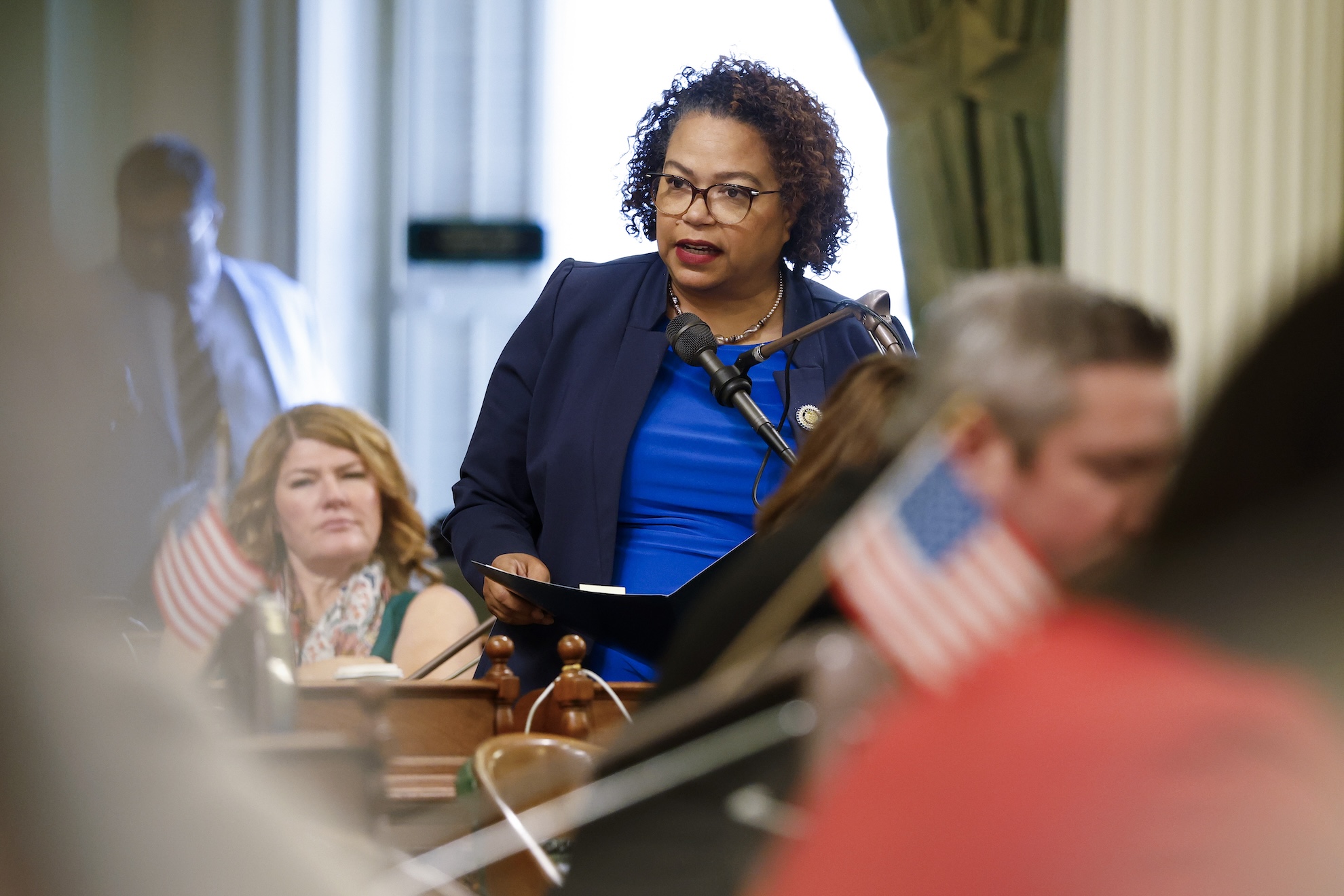
"caption": "Democratic Assembly Member Mia Bonta speaks during a meeting of the California State Assembly on Aug. 21, 2025, in Sacramento, California. Bonta introduced a bill Tuesday aimed at guaranteeing legal representation for all California residents facing deportation, a proposal that could make California the first state to commit to providing counsel in immigration proceedings, pending funding.",
"credit": "Justin Sullivan via Getty Images",
"altTag": null,
"description": null,
"imgSizes": {
"thumbnail": {
"file": "https://cdn.kqed.org/wp-content/uploads/sites/10/2026/03/GettyImages-2231342596-160x107.jpg",
"width": 160,
"height": 107,
"mimeType": "image/jpeg"
},
"1536x1536": {
"file": "https://cdn.kqed.org/wp-content/uploads/sites/10/2026/03/GettyImages-2231342596-1536x1024.jpg",
"width": 1536,
"height": 1024,
"mimeType": "image/jpeg"
},
"post-thumbnail": {
"file": "https://cdn.kqed.org/wp-content/uploads/sites/10/2026/03/GettyImages-2231342596-672x372.jpg",
"width": 672,
"height": 372,
"mimeType": "image/jpeg"
},
"twentyfourteen-full-width": {
"file": "https://cdn.kqed.org/wp-content/uploads/sites/10/2026/03/GettyImages-2231342596-1038x576.jpg",
"width": 1038,
"height": 576,
"mimeType": "image/jpeg"
},
"npr-cds-wide": {
"file": "https://cdn.kqed.org/wp-content/uploads/sites/10/2026/03/GettyImages-2231342596-1200x675.jpg",
"width": 1200,
"height": 675,
"mimeType": "image/jpeg"
},
"kqedFullSize": {
"file": "https://cdn.kqed.org/wp-content/uploads/sites/10/2026/03/GettyImages-2231342596.jpg",
"width": 1980,
"height": 1320
}
},
"isLoading": false,
"fetchFailed": false
},
"news_12046565": {
"type": "attachments",
"id": "news_12046565",
"meta": {
"index": "attachments_1716263798",
"site": "news",
"id": "12046565",
"found": true
},
"title": "The Core Civic detention facility in California City on June 28, 2025.",
"publishDate": 1751305002,
"status": "inherit",
"parent": 0,
"modified": 1751305043,
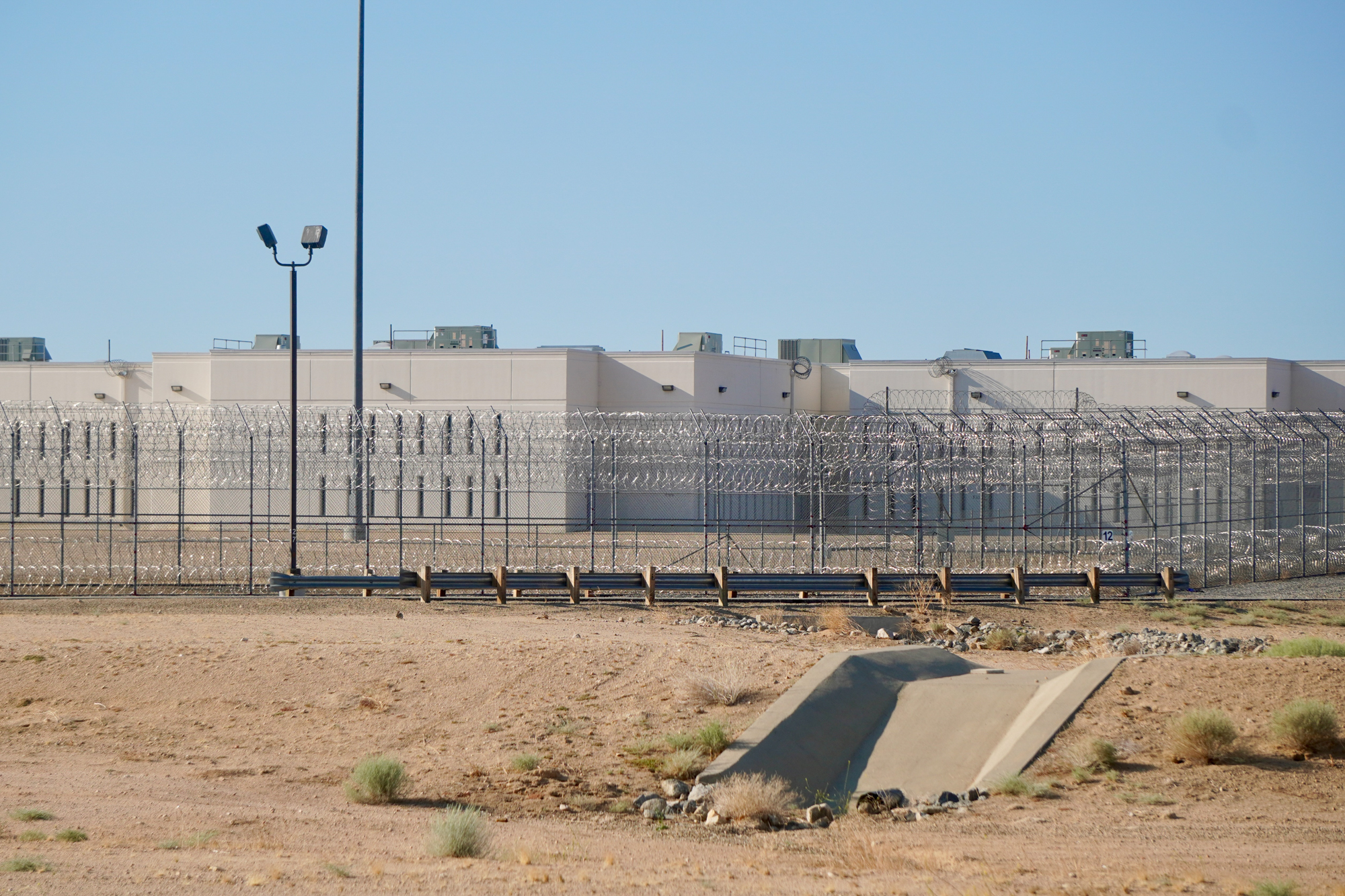
"caption": "The Core Civic detention facility in California City on June 28, 2025.",
"credit": "Saul Gonzalez/KQED",
"altTag": null,
"description": null,
"imgSizes": {
"thumbnail": {
"file": "https://cdn.kqed.org/wp-content/uploads/sites/10/2025/06/CORECIVICCALCITY2-KQED-160x107.jpg",
"width": 160,
"height": 107,
"mimeType": "image/jpeg"
},
"1536x1536": {
"file": "https://cdn.kqed.org/wp-content/uploads/sites/10/2025/06/CORECIVICCALCITY2-KQED-1536x1024.jpg",
"width": 1536,
"height": 1024,
"mimeType": "image/jpeg"
},
"post-thumbnail": {
"file": "https://cdn.kqed.org/wp-content/uploads/sites/10/2025/06/CORECIVICCALCITY2-KQED-672x372.jpg",
"width": 672,
"height": 372,
"mimeType": "image/jpeg"
},
"twentyfourteen-full-width": {
"file": "https://cdn.kqed.org/wp-content/uploads/sites/10/2025/06/CORECIVICCALCITY2-KQED-1038x576.jpg",
"width": 1038,
"height": 576,
"mimeType": "image/jpeg"
},
"kqedFullSize": {
"file": "https://cdn.kqed.org/wp-content/uploads/sites/10/2025/06/CORECIVICCALCITY2-KQED.jpg",
"width": 2000,
"height": 1333
}
},
"isLoading": false,
"fetchFailed": false
},
"news_12054610": {
"type": "attachments",
"id": "news_12054610",
"meta": {
"index": "attachments_1716263798",
"site": "news",
"id": "12054610",
"found": true
},
"title": "US-POLITICS-IMMIGRATION",
"publishDate": 1757005960,
"status": "inherit",
"parent": 12054544,
"modified": 1770343220,
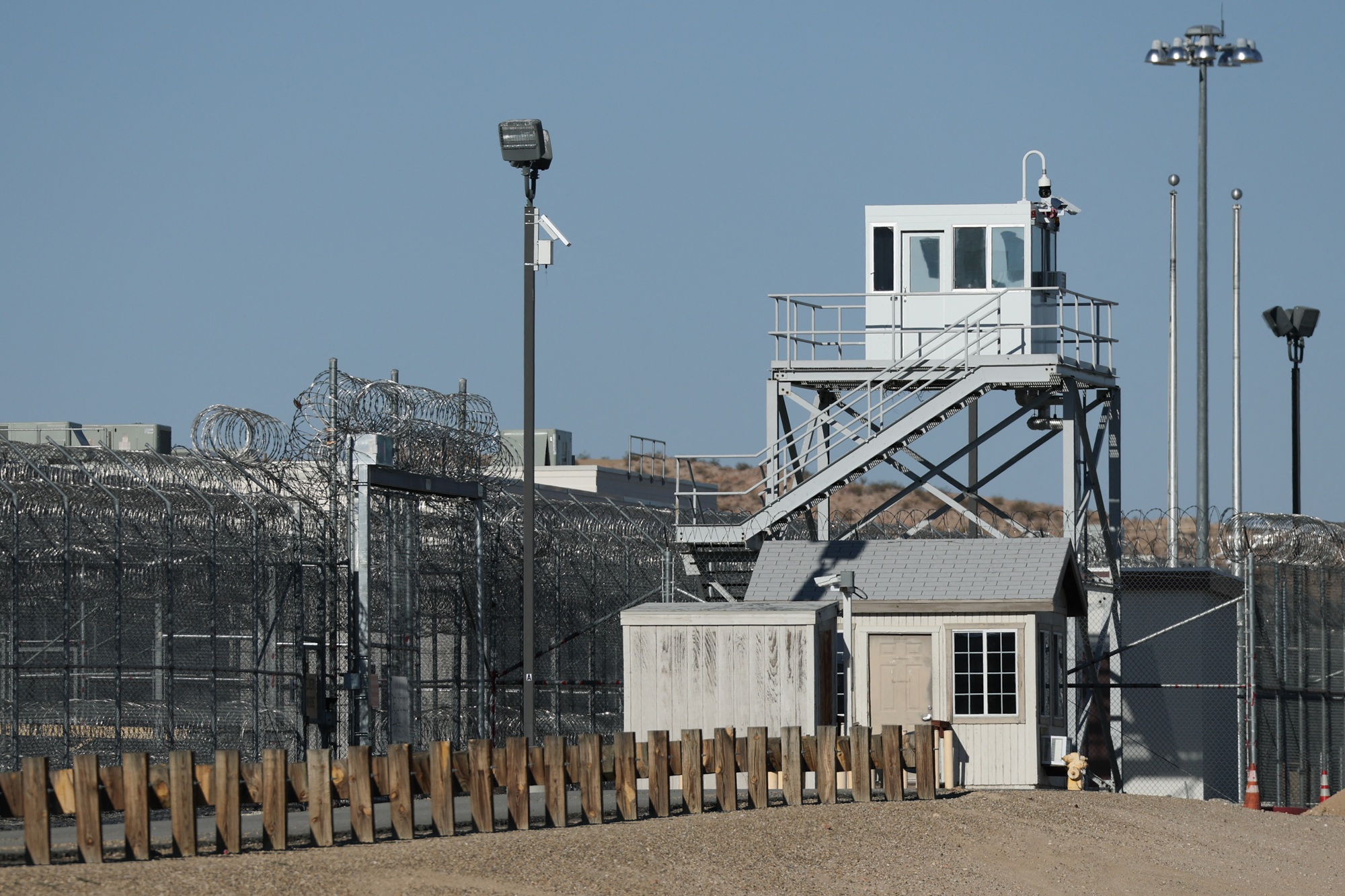
"caption": "The CoreCivic, Inc. California City Immigration Processing Center stands in the Kern County desert awaiting reopening as a federal immigrant detention facility under contract with the US Immigration and Customs Enforcement (ICE) in California City, California, on July 10, 2025. ",
"credit": "Patrick T. Fallon/AFP via Getty Images",
"altTag": null,
"description": null,
"imgSizes": {
"thumbnail": {
"file": "https://cdn.kqed.org/wp-content/uploads/sites/10/2025/09/CoreCivicKernCountyGetty-160x107.jpg",
"width": 160,
"height": 107,
"mimeType": "image/jpeg"
},
"1536x1536": {
"file": "https://cdn.kqed.org/wp-content/uploads/sites/10/2025/09/CoreCivicKernCountyGetty-1536x1024.jpg",
"width": 1536,
"height": 1024,
"mimeType": "image/jpeg"
},
"post-thumbnail": {
"file": "https://cdn.kqed.org/wp-content/uploads/sites/10/2025/09/CoreCivicKernCountyGetty-672x372.jpg",
"width": 672,
"height": 372,
"mimeType": "image/jpeg"
},
"twentyfourteen-full-width": {
"file": "https://cdn.kqed.org/wp-content/uploads/sites/10/2025/09/CoreCivicKernCountyGetty-1038x576.jpg",
"width": 1038,
"height": 576,
"mimeType": "image/jpeg"
},
"kqedFullSize": {
"file": "https://cdn.kqed.org/wp-content/uploads/sites/10/2025/09/CoreCivicKernCountyGetty.jpg",
"width": 2000,
"height": 1333
}
},
"isLoading": false,
"fetchFailed": false
},
"news_12054567": {
"type": "attachments",
"id": "news_12054567",
"meta": {
"index": "attachments_1716263798",
"site": "news",
"id": "12054567",
"found": true
},
"title": "US-POLITICS-IMMIGRATION",
"publishDate": 1756941444,
"status": "inherit",
"parent": 12054544,
"modified": 1769006278,
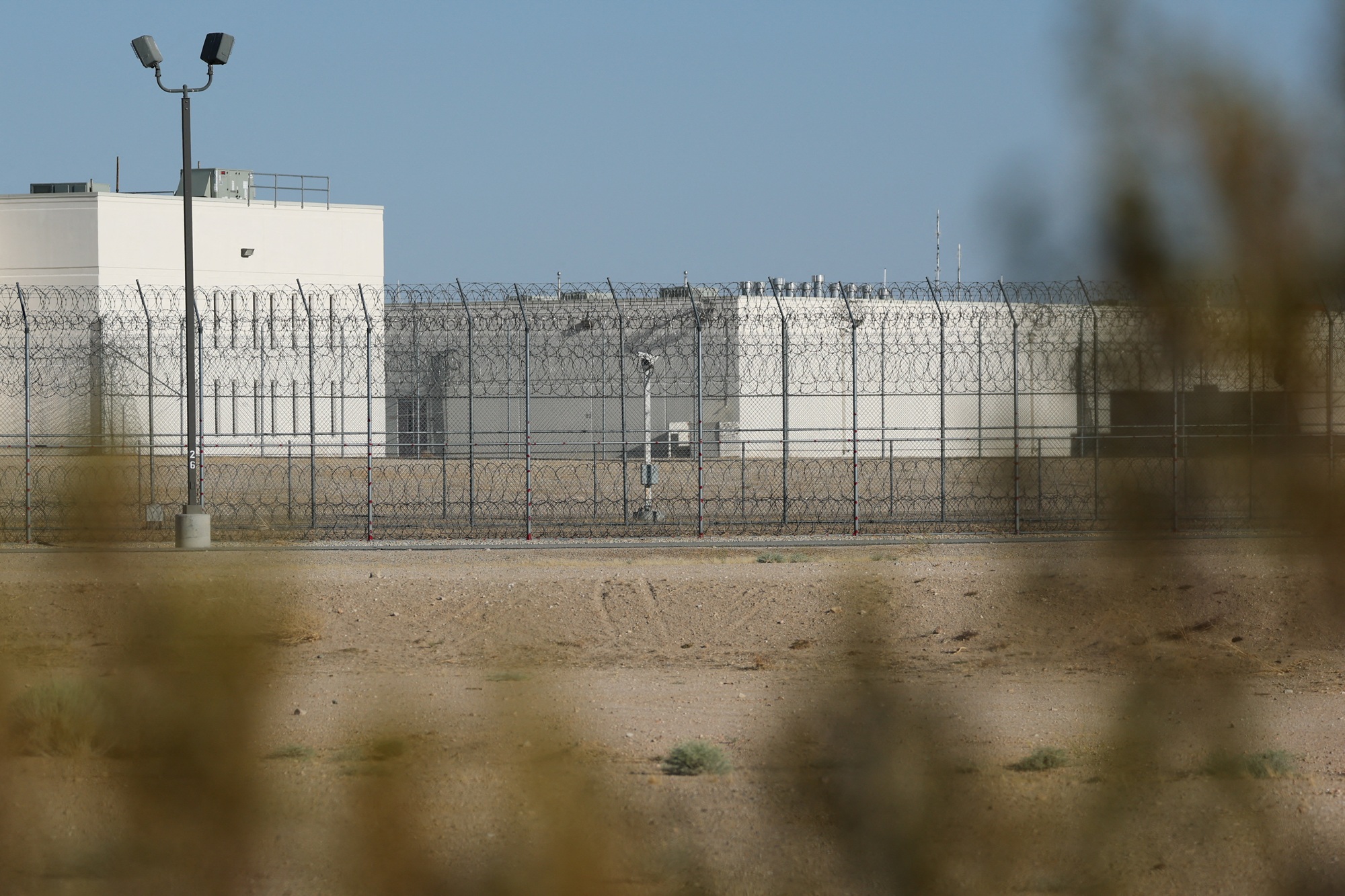
"caption": "The CoreCivic, Inc. California City Immigration Processing Center stands in the Kern County desert on July 10, 2025.",
"credit": "Patrick T. Fallon/AFP via Getty Images",
"altTag": null,
"description": null,
"imgSizes": {
"thumbnail": {
"file": "https://cdn.kqed.org/wp-content/uploads/sites/10/2025/09/KernCountyICEDetentionGetty-160x107.jpg",
"width": 160,
"height": 107,
"mimeType": "image/jpeg"
},
"1536x1536": {
"file": "https://cdn.kqed.org/wp-content/uploads/sites/10/2025/09/KernCountyICEDetentionGetty-1536x1024.jpg",
"width": 1536,
"height": 1024,
"mimeType": "image/jpeg"
},
"post-thumbnail": {
"file": "https://cdn.kqed.org/wp-content/uploads/sites/10/2025/09/KernCountyICEDetentionGetty-672x372.jpg",
"width": 672,
"height": 372,
"mimeType": "image/jpeg"
},
"twentyfourteen-full-width": {
"file": "https://cdn.kqed.org/wp-content/uploads/sites/10/2025/09/KernCountyICEDetentionGetty-1038x576.jpg",
"width": 1038,
"height": 576,
"mimeType": "image/jpeg"
},
"kqedFullSize": {
"file": "https://cdn.kqed.org/wp-content/uploads/sites/10/2025/09/KernCountyICEDetentionGetty.jpg",
"width": 2000,
"height": 1333
}
},
"isLoading": false,
"fetchFailed": false
},
"news_12068971": {
"type": "attachments",
"id": "news_12068971",
"meta": {
"index": "attachments_1716263798",
"site": "news",
"id": "12068971",
"found": true
},
"title": "250820-ICEActivity-05_qed",
"publishDate": 1767820146,
"status": "inherit",
"parent": 12068969,
"modified": 1767829411,
"caption": "100 Montgomery St., the location of the San Francisco Immigration Court, on Aug. 20, 2025.",
"credit": "Beth LaBerge/KQED",
"altTag": null,
"description": null,
"imgSizes": {
"thumbnail": {
"file": "https://cdn.kqed.org/wp-content/uploads/sites/10/2026/01/250820-ICEActivity-05_qed-160x107.jpg",
"width": 160,
"height": 107,
"mimeType": "image/jpeg"
},
"1536x1536": {
"file": "https://cdn.kqed.org/wp-content/uploads/sites/10/2026/01/250820-ICEActivity-05_qed-1536x1024.jpg",
"width": 1536,
"height": 1024,
"mimeType": "image/jpeg"
},
"post-thumbnail": {
"file": "https://cdn.kqed.org/wp-content/uploads/sites/10/2026/01/250820-ICEActivity-05_qed-672x372.jpg",
"width": 672,
"height": 372,
"mimeType": "image/jpeg"
},
"twentyfourteen-full-width": {
"file": "https://cdn.kqed.org/wp-content/uploads/sites/10/2026/01/250820-ICEActivity-05_qed-1038x576.jpg",
"width": 1038,
"height": 576,
"mimeType": "image/jpeg"
},
"npr-cds-wide": {
"file": "https://cdn.kqed.org/wp-content/uploads/sites/10/2026/01/250820-ICEActivity-05_qed-1200x675.jpg",
"width": 1200,
"height": 675,
"mimeType": "image/jpeg"
},
"kqedFullSize": {
"file": "https://cdn.kqed.org/wp-content/uploads/sites/10/2026/01/250820-ICEActivity-05_qed.jpg",
"width": 1999,
"height": 1333
}
},
"isLoading": false,
"fetchFailed": false
},
"news_12067537": {
"type": "attachments",
"id": "news_12067537",
"meta": {
"index": "attachments_1716263798",
"site": "news",
"id": "12067537",
"found": true
},
"title": "20251216_REVOKE OF COMMERCIAL DRIVERS LICENSES_DECEMBER_GH-5-KQED",
"publishDate": 1765991719,
"status": "inherit",
"parent": 0,
"modified": 1766015725,
"caption": "Amarjit Singh stands beside his truck on Dec. 16, 2025, in Livermore. Singh is among thousands of immigrant drivers whose commercial licenses the state planned to revoke after federal pressure. ",
"credit": "Gustavo Hernandez/KQED",
"altTag": null,
"description": null,
"imgSizes": {
"thumbnail": {
"file": "https://cdn.kqed.org/wp-content/uploads/sites/10/2025/12/20251216_REVOKE-OF-COMMERCIAL-DRIVERS-LICENSES_DECEMBER_GH-5-KQED-160x107.jpg",
"width": 160,
"height": 107,
"mimeType": "image/jpeg"
},
"1536x1536": {
"file": "https://cdn.kqed.org/wp-content/uploads/sites/10/2025/12/20251216_REVOKE-OF-COMMERCIAL-DRIVERS-LICENSES_DECEMBER_GH-5-KQED-1536x1024.jpg",
"width": 1536,
"height": 1024,
"mimeType": "image/jpeg"
},
"post-thumbnail": {
"file": "https://cdn.kqed.org/wp-content/uploads/sites/10/2025/12/20251216_REVOKE-OF-COMMERCIAL-DRIVERS-LICENSES_DECEMBER_GH-5-KQED-672x372.jpg",
"width": 672,
"height": 372,
"mimeType": "image/jpeg"
},
"twentyfourteen-full-width": {
"file": "https://cdn.kqed.org/wp-content/uploads/sites/10/2025/12/20251216_REVOKE-OF-COMMERCIAL-DRIVERS-LICENSES_DECEMBER_GH-5-KQED-1038x576.jpg",
"width": 1038,
"height": 576,
"mimeType": "image/jpeg"
},
"npr-cds-wide": {
"file": "https://cdn.kqed.org/wp-content/uploads/sites/10/2025/12/20251216_REVOKE-OF-COMMERCIAL-DRIVERS-LICENSES_DECEMBER_GH-5-KQED-1200x675.jpg",
"width": 1200,
"height": 675,
"mimeType": "image/jpeg"
},
"kqedFullSize": {
"file": "https://cdn.kqed.org/wp-content/uploads/sites/10/2025/12/20251216_REVOKE-OF-COMMERCIAL-DRIVERS-LICENSES_DECEMBER_GH-5-KQED.jpg",
"width": 2000,
"height": 1333
}
},
"isLoading": false,
"fetchFailed": false
},
"news_12005684": {
"type": "attachments",
"id": "news_12005684",
"meta": {
"index": "attachments_1716263798",
"site": "news",
"id": "12005684",
"found": true
},
"title": "US passports",
"publishDate": 1726861630,
"status": "inherit",
"parent": 12005679,
"modified": 1764793132,
"caption": "A U.S. passport enables travel to more than 180 countries without needing a visa beforehand.",
"credit": "Douglas Sacha/Getty Images",
"altTag": null,
"description": null,
"imgSizes": {
"medium": {
"file": "https://cdn.kqed.org/wp-content/uploads/sites/10/2024/09/GettyImages-1277623147-800x533.jpg",
"width": 800,
"height": 533,
"mimeType": "image/jpeg"
},
"large": {
"file": "https://cdn.kqed.org/wp-content/uploads/sites/10/2024/09/GettyImages-1277623147-1020x680.jpg",
"width": 1020,
"height": 680,
"mimeType": "image/jpeg"
},
"thumbnail": {
"file": "https://cdn.kqed.org/wp-content/uploads/sites/10/2024/09/GettyImages-1277623147-160x107.jpg",
"width": 160,
"height": 107,
"mimeType": "image/jpeg"
},
"1536x1536": {
"file": "https://cdn.kqed.org/wp-content/uploads/sites/10/2024/09/GettyImages-1277623147-1536x1023.jpg",
"width": 1536,
"height": 1023,
"mimeType": "image/jpeg"
},
"2048x2048": {
"file": "https://cdn.kqed.org/wp-content/uploads/sites/10/2024/09/GettyImages-1277623147-2048x1364.jpg",
"width": 2048,
"height": 1364,
"mimeType": "image/jpeg"
},
"post-thumbnail": {
"file": "https://cdn.kqed.org/wp-content/uploads/sites/10/2024/09/GettyImages-1277623147-672x372.jpg",
"width": 672,
"height": 372,
"mimeType": "image/jpeg"
},
"twentyfourteen-full-width": {
"file": "https://cdn.kqed.org/wp-content/uploads/sites/10/2024/09/GettyImages-1277623147-1038x576.jpg",
"width": 1038,
"height": 576,
"mimeType": "image/jpeg"
},
"full-width": {
"file": "https://cdn.kqed.org/wp-content/uploads/sites/10/2024/09/GettyImages-1277623147-1920x1279.jpg",
"width": 1920,
"height": 1279,
"mimeType": "image/jpeg"
},
"kqedFullSize": {
"file": "https://cdn.kqed.org/wp-content/uploads/sites/10/2024/09/GettyImages-1277623147.jpg",
"width": 2121,
"height": 1413
}
},
"isLoading": false,
"fetchFailed": false
},
"news_12063947": {
"type": "attachments",
"id": "news_12063947",
"meta": {
"index": "attachments_1716263798",
"site": "news",
"id": "12063947",
"found": true
},
"title": "Home healthcare",
"publishDate": 1762998778,
"status": "inherit",
"parent": 12063843,
"modified": 1762998817,
"caption": "A senior woman at home receiving health care.",
"credit": "LPETTET via Getty Images",
"altTag": null,
"description": null,
"imgSizes": {
"thumbnail": {
"file": "https://cdn.kqed.org/wp-content/uploads/sites/10/2025/11/CaregiverGetty-160x107.jpg",
"width": 160,
"height": 107,
"mimeType": "image/jpeg"
},
"1536x1536": {
"file": "https://cdn.kqed.org/wp-content/uploads/sites/10/2025/11/CaregiverGetty-1536x1024.jpg",
"width": 1536,
"height": 1024,
"mimeType": "image/jpeg"
},
"post-thumbnail": {
"file": "https://cdn.kqed.org/wp-content/uploads/sites/10/2025/11/CaregiverGetty-672x372.jpg",
"width": 672,
"height": 372,
"mimeType": "image/jpeg"
},
"twentyfourteen-full-width": {
"file": "https://cdn.kqed.org/wp-content/uploads/sites/10/2025/11/CaregiverGetty-1038x576.jpg",
"width": 1038,
"height": 576,
"mimeType": "image/jpeg"
},
"npr-cds-wide": {
"file": "https://cdn.kqed.org/wp-content/uploads/sites/10/2025/11/CaregiverGetty-1200x675.jpg",
"width": 1200,
"height": 675,
"mimeType": "image/jpeg"
},
"kqedFullSize": {
"file": "https://cdn.kqed.org/wp-content/uploads/sites/10/2025/11/CaregiverGetty.jpg",
"width": 2000,
"height": 1333
}
},
"isLoading": false,
"fetchFailed": false
},
"news_12063685": {
"type": "attachments",
"id": "news_12063685",
"meta": {
"index": "attachments_1716263798",
"site": "news",
"id": "12063685",
"found": true
},
"title": "20251106_ICE Vigil_GH-15_qed",
"publishDate": 1762811431,
"status": "inherit",
"parent": 12063676,
"modified": 1762811465,
"caption": "A demonstrator holds a sign reading “Santuario: Manteniendo Familias Unidas” (“Sanctuary: Keeping Families United”) during the Faith in Action “Walking Our Faith” vigil outside the San Francisco Immigration Court on Nov. 6, 2025. The multi-faith gathering called for compassion and protection for immigrant families.",
"credit": "Gustavo Hernandez/KQED",
"altTag": null,
"description": null,
"imgSizes": {
"thumbnail": {
"file": "https://cdn.kqed.org/wp-content/uploads/sites/10/2025/11/20251106_ICE-Vigil_GH-15_qed-160x107.jpg",
"width": 160,
"height": 107,
"mimeType": "image/jpeg"
},
"1536x1536": {
"file": "https://cdn.kqed.org/wp-content/uploads/sites/10/2025/11/20251106_ICE-Vigil_GH-15_qed-1536x1024.jpg",
"width": 1536,
"height": 1024,
"mimeType": "image/jpeg"
},
"post-thumbnail": {
"file": "https://cdn.kqed.org/wp-content/uploads/sites/10/2025/11/20251106_ICE-Vigil_GH-15_qed-672x372.jpg",
"width": 672,
"height": 372,
"mimeType": "image/jpeg"
},
"twentyfourteen-full-width": {
"file": "https://cdn.kqed.org/wp-content/uploads/sites/10/2025/11/20251106_ICE-Vigil_GH-15_qed-1038x576.jpg",
"width": 1038,
"height": 576,
"mimeType": "image/jpeg"
},
"npr-cds-wide": {
"file": "https://cdn.kqed.org/wp-content/uploads/sites/10/2025/11/20251106_ICE-Vigil_GH-15_qed-1200x675.jpg",
"width": 1200,
"height": 675,
"mimeType": "image/jpeg"
},
"kqedFullSize": {
"file": "https://cdn.kqed.org/wp-content/uploads/sites/10/2025/11/20251106_ICE-Vigil_GH-15_qed.jpg",
"width": 2000,
"height": 1333
}
},
"isLoading": false,
"fetchFailed": false
},
"news_12058946": {
"type": "attachments",
"id": "news_12058946",
"meta": {
"index": "attachments_1716263798",
"site": "news",
"id": "12058946",
"found": true
},
"title": "ICE in Little Tokyo",
"publishDate": 1759861710,
"status": "inherit",
"parent": 12058936,
"modified": 1759880054,
"caption": "Gregory Bovino, chief patrol agent of the El Centro sector (center), marches with federal agents to the Edward R. Roybal Federal Building after U.S. Border Patrol agents produced a show of force outside the Japanese American National Museum, where Gov. Newsom was holding a redistricting press conference on Aug. 14, 2025, in Los Angeles, California.",
"credit": "Carlin Stiehl/Los Angeles Times via Getty Images",
"altTag": null,
"description": null,
"imgSizes": {
"thumbnail": {
"file": "https://cdn.kqed.org/wp-content/uploads/sites/10/2025/10/BorderPatrolAgentsGetty-160x107.jpg",
"width": 160,
"height": 107,
"mimeType": "image/jpeg"
},
"1536x1536": {
"file": "https://cdn.kqed.org/wp-content/uploads/sites/10/2025/10/BorderPatrolAgentsGetty-1536x1025.jpg",
"width": 1536,
"height": 1025,
"mimeType": "image/jpeg"
},
"post-thumbnail": {
"file": "https://cdn.kqed.org/wp-content/uploads/sites/10/2025/10/BorderPatrolAgentsGetty-672x372.jpg",
"width": 672,
"height": 372,
"mimeType": "image/jpeg"
},
"twentyfourteen-full-width": {
"file": "https://cdn.kqed.org/wp-content/uploads/sites/10/2025/10/BorderPatrolAgentsGetty-1038x576.jpg",
"width": 1038,
"height": 576,
"mimeType": "image/jpeg"
},
"kqedFullSize": {
"file": "https://cdn.kqed.org/wp-content/uploads/sites/10/2025/10/BorderPatrolAgentsGetty.jpg",
"width": 2000,
"height": 1334
}
},
"isLoading": false,
"fetchFailed": false
},
"news_12057112": {
"type": "attachments",
"id": "news_12057112",
"meta": {
"index": "attachments_1716263798",
"site": "news",
"id": "12057112",
"found": true
},
"title": "Background Checks",
"publishDate": 1758571460,
"status": "inherit",
"parent": 12057093,
"modified": 1758662735,
"caption": "North Bay Rep. Mike Thompson participates in a news conference outside the Capitol on Feb. 1, 2023. ",
"credit": "Bill Clark/CQ-Roll Call, Inc via Getty Images",
"altTag": null,
"description": null,
"imgSizes": {
"thumbnail": {
"file": "https://cdn.kqed.org/wp-content/uploads/sites/10/2025/09/MikeThompson_ICE-1-160x107.jpg",
"width": 160,
"height": 107,
"mimeType": "image/jpeg"
},
"1536x1536": {
"file": "https://cdn.kqed.org/wp-content/uploads/sites/10/2025/09/MikeThompson_ICE-1-1536x1024.jpg",
"width": 1536,
"height": 1024,
"mimeType": "image/jpeg"
},
"post-thumbnail": {
"file": "https://cdn.kqed.org/wp-content/uploads/sites/10/2025/09/MikeThompson_ICE-1-672x372.jpg",
"width": 672,
"height": 372,
"mimeType": "image/jpeg"
},
"twentyfourteen-full-width": {
"file": "https://cdn.kqed.org/wp-content/uploads/sites/10/2025/09/MikeThompson_ICE-1-1038x576.jpg",
"width": 1038,
"height": 576,
"mimeType": "image/jpeg"
},
"kqedFullSize": {
"file": "https://cdn.kqed.org/wp-content/uploads/sites/10/2025/09/MikeThompson_ICE-1.jpg",
"width": 1998,
"height": 1332
}
},
"isLoading": false,
"fetchFailed": false
},
"news_12056765": {
"type": "attachments",
"id": "news_12056765",
"meta": {
"index": "attachments_1716263798",
"site": "news",
"id": "12056765",
"found": true
},
"title": "250715-ImmigrationCourtProtests-16-BL_qed",
"publishDate": 1758299414,
"status": "inherit",
"parent": 12056762,
"modified": 1758299424,
"caption": "Supporters rally outside the U.S. District Court in San Francisco on July 15, 2025, calling on ICE to release Guillermo Medina Reyes ahead of his preliminary injunction hearing.",
"credit": "Beth LaBerge/KQED",
"altTag": null,
"description": null,
"imgSizes": {
"thumbnail": {
"file": "https://cdn.kqed.org/wp-content/uploads/sites/10/2025/09/250715-ImmigrationCourtProtests-16-BL_qed-160x107.jpg",
"width": 160,
"height": 107,
"mimeType": "image/jpeg"
},
"1536x1536": {
"file": "https://cdn.kqed.org/wp-content/uploads/sites/10/2025/09/250715-ImmigrationCourtProtests-16-BL_qed-1536x1024.jpg",
"width": 1536,
"height": 1024,
"mimeType": "image/jpeg"
},
"post-thumbnail": {
"file": "https://cdn.kqed.org/wp-content/uploads/sites/10/2025/09/250715-ImmigrationCourtProtests-16-BL_qed-672x372.jpg",
"width": 672,
"height": 372,
"mimeType": "image/jpeg"
},
"twentyfourteen-full-width": {
"file": "https://cdn.kqed.org/wp-content/uploads/sites/10/2025/09/250715-ImmigrationCourtProtests-16-BL_qed-1038x576.jpg",
"width": 1038,
"height": 576,
"mimeType": "image/jpeg"
},
"kqedFullSize": {
"file": "https://cdn.kqed.org/wp-content/uploads/sites/10/2025/09/250715-ImmigrationCourtProtests-16-BL_qed.jpg",
"width": 2000,
"height": 1333
}
},
"isLoading": false,
"fetchFailed": false
}
},
"audioPlayerReducer": {
"postId": "stream_live",
"isPaused": true,
"isPlaying": false,
"pfsActive": false,
"pledgeModalIsOpen": true,
"playerDrawerIsOpen": false,
"liveAudioPlayStartedAt": 0,
"liveAudioPlayContext": ""
},
"authorsReducer": {
"tychehendricks": {
"type": "authors",
"id": "259",
"meta": {
"index": "authors_1716337520",
"id": "259",
"found": true
},
"name": "Tyche Hendricks",
"firstName": "Tyche",
"lastName": "Hendricks",
"slug": "tychehendricks",
"email": "thendricks@kqed.org",
"display_author_email": true,
"staff_mastheads": [
"news"
],
"title": "KQED Senior Editor, Immigration",
"bio": "\u003cspan style=\"font-weight: 400;\">Tyche Hendricks is KQED’s senior editor for immigration, leading coverage of the policy and politics that affect California’s immigrant communities. Her work for KQED’s radio and online audiences is also carried on NPR and other national outlets. She has been recognized with awards from the Radio and Television News Directors Association, the Society for Professional Journalists; the Education Writers Association; the Best of the West and the National Federation of Community Broadcasters. Before joining KQED in 2010, Tyche spent more than a dozen years as a newspaper reporter, notably at the \u003c/span>\u003ci>\u003cspan style=\"font-weight: 400;\">San Francisco Chronicle\u003c/span>\u003c/i>\u003cspan style=\"font-weight: 400;\">. At different times she has covered criminal justice, government and politics and urban planning. Tyche has taught in the MFA Creative Writing program at the University of San Francisco and at UC Berkeley’s Graduate School of Journalism, where she was co-director of a national immigration symposium for professional journalists. She is the author of \u003c/span>\u003ci>\u003cspan style=\"font-weight: 400;\">The Wind Doesn't Need a Passport: Stories from the U.S.-Mexico Borderlands\u003c/span>\u003c/i>\u003cspan style=\"font-weight: 400;\"> (University of California Press). \u003c/span>",
"avatar": "https://secure.gravatar.com/avatar/b8ee458e2731c2d43df86882ce17267e?s=600&d=blank&r=g",
"twitter": "tychehendricks",
"facebook": null,
"instagram": null,
"linkedin": null,
"sites": [
{
"site": "news",
"roles": [
"editor"
]
},
{
"site": "stateofhealth",
"roles": [
"editor"
]
}
],
"headData": {
"title": "Tyche Hendricks | KQED",
"description": "KQED Senior Editor, Immigration",
"ogImgSrc": "https://secure.gravatar.com/avatar/b8ee458e2731c2d43df86882ce17267e?s=600&d=blank&r=g",
"twImgSrc": "https://secure.gravatar.com/avatar/b8ee458e2731c2d43df86882ce17267e?s=600&d=blank&r=g"
},
"isLoading": false,
"link": "/author/tychehendricks"
},
"mlagos": {
"type": "authors",
"id": "3239",
"meta": {
"index": "authors_1716337520",
"id": "3239",
"found": true
},
"name": "Marisa Lagos",
"firstName": "Marisa",
"lastName": "Lagos",
"slug": "mlagos",
"email": "mlagos@kqed.org",
"display_author_email": false,
"staff_mastheads": [
"news"
],
"title": "KQED Contributor",
"bio": "Marisa Lagos is a correspondent for KQED’s California Politics and Government Desk and co-hosts the award-winning show and podcast, Political Breakdown. At KQED, Lagos also conducts reporting, analysis and investigations into state, local and national politics for radio, TV, online and onstage. In 2022, she and co-host, Scott Shafer, moderated the only gubernatorial debate in California. In 2020, the \u003ci>Washington Post\u003c/i> named her one of the top political journalists in California; she was nominated for a Peabody and won several other awards for her work investigating the 2017 California wildfires. She has worked at the \u003ci>San Francisco Chronicle\u003c/i>, \u003ci>San Francisco Examiner\u003c/i> and \u003ci>Los Angeles Times\u003c/i>. A UC Santa Barbara graduate, she lives in San Francisco with her two sons and husband.",
"avatar": "https://secure.gravatar.com/avatar/a261a0d3696fc066871ef96b85b5e7d2?s=600&d=blank&r=g",
"twitter": "@mlagos",
"facebook": null,
"instagram": null,
"linkedin": null,
"sites": [
{
"site": "arts",
"roles": [
"author"
]
},
{
"site": "news",
"roles": [
"editor"
]
},
{
"site": "science",
"roles": [
"editor"
]
},
{
"site": "forum",
"roles": [
"author"
]
},
{
"site": "liveblog",
"roles": [
"author"
]
}
],
"headData": {
"title": "Marisa Lagos | KQED",
"description": "KQED Contributor",
"ogImgSrc": "https://secure.gravatar.com/avatar/a261a0d3696fc066871ef96b85b5e7d2?s=600&d=blank&r=g",
"twImgSrc": "https://secure.gravatar.com/avatar/a261a0d3696fc066871ef96b85b5e7d2?s=600&d=blank&r=g"
},
"isLoading": false,
"link": "/author/mlagos"
},
"fjhabvala": {
"type": "authors",
"id": "8659",
"meta": {
"index": "authors_1716337520",
"id": "8659",
"found": true
},
"name": "Farida Jhabvala Romero",
"firstName": "Farida",
"lastName": "Jhabvala Romero",
"slug": "fjhabvala",
"email": "fjhabvala@kqed.org",
"display_author_email": true,
"staff_mastheads": [
"news"
],
"title": "KQED Contributor",
"bio": "Farida Jhabvala Romero is a Labor Correspondent for KQED. She previously covered immigration. Farida was \u003ca href=\"https://www.ccnma.org/2022-most-influential-latina-journalists\">named\u003c/a> one of the 10 Most Influential Latina Journalists in California in 2022 by the California Chicano News Media Association. Her work has won awards from the Society of Professional Journalists (Northern California), as well as a national and regional Edward M. Murrow Award for the collaborative reporting projects “Dangerous Air” and “Graying California.” Before joining KQED, Farida worked as a producer at Radio Bilingüe, a national public radio network. Farida earned her master’s degree in journalism from Stanford University.",
"avatar": "https://secure.gravatar.com/avatar/f9f022d4e2609741874222a1e9d41f48fea74011aa7c615eef91d9a50c944ebe?s=600&d=blank&r=g",
"twitter": "FaridaJhabvala",
"bluesky": null,
"facebook": null,
"instagram": null,
"linkedin": "https://www.linkedin.com/in/faridajhabvala/",
"sites": [
{
"site": "news",
"roles": [
"editor"
]
},
{
"site": "stateofhealth",
"roles": [
"author"
]
},
{
"site": "liveblog",
"roles": [
"author"
]
}
],
"headData": {
"title": "Farida Jhabvala Romero | KQED",
"description": "KQED Contributor",
"ogImgSrc": "https://secure.gravatar.com/avatar/f9f022d4e2609741874222a1e9d41f48fea74011aa7c615eef91d9a50c944ebe?s=600&d=blank&r=g",
"twImgSrc": "https://secure.gravatar.com/avatar/f9f022d4e2609741874222a1e9d41f48fea74011aa7c615eef91d9a50c944ebe?s=600&d=blank&r=g"
},
"isLoading": false,
"link": "/author/fjhabvala"
},
"ccabreralomeli": {
"type": "authors",
"id": "11708",
"meta": {
"index": "authors_1716337520",
"id": "11708",
"found": true
},
"name": "Carlos Cabrera-Lomelí",
"firstName": "Carlos",
"lastName": "Cabrera-Lomelí",
"slug": "ccabreralomeli",
"email": "ccabreralomeli@KQED.org",
"display_author_email": true,
"staff_mastheads": [
"news"
],
"title": "Community Reporter",
"bio": "Carlos Cabrera-Lomelí is a community reporter with KQED's digital engagement team. He also reports and co-produces for KQED's bilingual news hub KQED en Español. He grew up in San Francisco's Mission District and has previously worked with Univision, 48 Hills and REFORMA in Mexico City.",
"avatar": "https://secure.gravatar.com/avatar/c309be9665e484f887b818c89e273ecc673004f426f36b24d00a4d813a2e0518?s=600&d=blank&r=g",
"twitter": "@LomeliCabrera",
"bluesky": null,
"facebook": null,
"instagram": null,
"linkedin": null,
"sites": [
{
"site": "arts",
"roles": [
"editor"
]
},
{
"site": "news",
"roles": [
"editor"
]
},
{
"site": "about",
"roles": [
"editor"
]
},
{
"site": "science",
"roles": [
"editor"
]
},
{
"site": "perspectives",
"roles": [
"editor"
]
},
{
"site": "elections",
"roles": [
"editor"
]
},
{
"site": "liveblog",
"roles": [
"contributor"
]
}
],
"headData": {
"title": "Carlos Cabrera-Lomelí | KQED",
"description": "Community Reporter",
"ogImgSrc": "https://secure.gravatar.com/avatar/c309be9665e484f887b818c89e273ecc673004f426f36b24d00a4d813a2e0518?s=600&d=blank&r=g",
"twImgSrc": "https://secure.gravatar.com/avatar/c309be9665e484f887b818c89e273ecc673004f426f36b24d00a4d813a2e0518?s=600&d=blank&r=g"
},
"isLoading": false,
"link": "/author/ccabreralomeli"
},
"nkhan": {
"type": "authors",
"id": "11867",
"meta": {
"index": "authors_1716337520",
"id": "11867",
"found": true
},
"name": "Nisa Khan",
"firstName": "Nisa",
"lastName": "Khan",
"slug": "nkhan",
"email": "nkhan@kqed.org",
"display_author_email": false,
"staff_mastheads": [],
"title": "KQED Contributor",
"bio": "Nisa Khan is a reporter for KQED's Audience News Desk. She was formerly a data reporter at Michigan Radio. She earned a Bachelor of Science in Information from the University of Michigan and a Master of Arts in Communication from Stanford University.",
"avatar": "https://secure.gravatar.com/avatar/a3bf1efcfbe7658d13a434cc54d0b2e3?s=600&d=blank&r=g",
"twitter": "mnisakhan",
"bluesky": null,
"facebook": null,
"instagram": null,
"linkedin": null,
"sites": [
{
"site": "arts",
"roles": [
"editor"
]
},
{
"site": "news",
"roles": [
"editor"
]
},
{
"site": "science",
"roles": [
"editor",
"author"
]
},
{
"site": "forum",
"roles": [
"editor"
]
},
{
"site": "liveblog",
"roles": [
"contributor"
]
}
],
"headData": {
"title": "Nisa Khan | KQED",
"description": "KQED Contributor",
"ogImgSrc": "https://secure.gravatar.com/avatar/a3bf1efcfbe7658d13a434cc54d0b2e3?s=600&d=blank&r=g",
"twImgSrc": "https://secure.gravatar.com/avatar/a3bf1efcfbe7658d13a434cc54d0b2e3?s=600&d=blank&r=g"
},
"isLoading": false,
"link": "/author/nkhan"
},
"kdebenedetti": {
"type": "authors",
"id": "11913",
"meta": {
"index": "authors_1716337520",
"id": "11913",
"found": true
},
"name": "Katie DeBenedetti",
"firstName": "Katie",
"lastName": "DeBenedetti",
"slug": "kdebenedetti",
"email": "kdebenedetti@kqed.org",
"display_author_email": false,
"staff_mastheads": [
"news",
"science"
],
"title": "KQED Contributor",
"bio": "Katie DeBenedetti is a digital reporter covering daily news for the Express Desk. Prior to joining KQED as a culture reporting intern in January 2024, she covered education and city government for the Napa Valley Register.",
"avatar": "https://secure.gravatar.com/avatar/6e31073cb8f7e4214ab03f42771d0f45?s=600&d=blank&r=g",
"twitter": null,
"facebook": null,
"instagram": null,
"linkedin": null,
"sites": [
{
"site": "news",
"roles": [
"author"
]
},
{
"site": "science",
"roles": [
"author"
]
},
{
"site": "liveblog",
"roles": [
"author"
]
}
],
"headData": {
"title": "Katie DeBenedetti | KQED",
"description": "KQED Contributor",
"ogImgSrc": "https://secure.gravatar.com/avatar/6e31073cb8f7e4214ab03f42771d0f45?s=600&d=blank&r=g",
"twImgSrc": "https://secure.gravatar.com/avatar/6e31073cb8f7e4214ab03f42771d0f45?s=600&d=blank&r=g"
},
"isLoading": false,
"link": "/author/kdebenedetti"
},
"emanoukian": {
"type": "authors",
"id": "11925",
"meta": {
"index": "authors_1716337520",
"id": "11925",
"found": true
},
"name": "Elize Manoukian",
"firstName": "Elize",
"lastName": "Manoukian",
"slug": "emanoukian",
"email": "emanoukian@KQED.org",
"display_author_email": false,
"staff_mastheads": [
"news"
],
"title": "Digital Producer",
"bio": null,
"avatar": "https://secure.gravatar.com/avatar/4525f1a8e46ccb30933b32653d9772064cfefe3fa655eb45b3b3a80341f6bdad?s=600&d=blank&r=g",
"twitter": null,
"bluesky": null,
"facebook": null,
"instagram": null,
"linkedin": null,
"sites": [
{
"site": "arts",
"roles": [
"editor"
]
},
{
"site": "news",
"roles": [
"editor"
]
},
{
"site": "science",
"roles": [
"editor"
]
}
],
"headData": {
"title": "Elize Manoukian | KQED",
"description": "Digital Producer",
"ogImgSrc": "https://secure.gravatar.com/avatar/4525f1a8e46ccb30933b32653d9772064cfefe3fa655eb45b3b3a80341f6bdad?s=600&d=blank&r=g",
"twImgSrc": "https://secure.gravatar.com/avatar/4525f1a8e46ccb30933b32653d9772064cfefe3fa655eb45b3b3a80341f6bdad?s=600&d=blank&r=g"
},
"isLoading": false,
"link": "/author/emanoukian"
},
"aaliahmad": {
"type": "authors",
"id": "11986",
"meta": {
"index": "authors_1716337520",
"id": "11986",
"found": true
},
"name": "Ayah Ali-Ahmad",
"firstName": "Ayah",
"lastName": "Ali-Ahmad",
"slug": "aaliahmad",
"email": "aaliahmad@KQED.org",
"display_author_email": false,
"staff_mastheads": [],
"title": "KQED Contributor",
"bio": null,
"avatar": "https://secure.gravatar.com/avatar/7f340465c69a2c816f6c07000137a3ee?s=600&d=blank&r=g",
"twitter": "ayahaliahmad",
"bluesky": null,
"facebook": null,
"instagram": null,
"linkedin": null,
"sites": [
{
"site": "news",
"roles": [
"author"
]
}
],
"headData": {
"title": "Ayah Ali-Ahmad | KQED",
"description": "KQED Contributor",
"ogImgSrc": "https://secure.gravatar.com/avatar/7f340465c69a2c816f6c07000137a3ee?s=600&d=blank&r=g",
"twImgSrc": "https://secure.gravatar.com/avatar/7f340465c69a2c816f6c07000137a3ee?s=600&d=blank&r=g"
},
"isLoading": false,
"link": "/author/aaliahmad"
}
},
"pagesReducer": {
"news_tag_immigrant-rights": {
"type": "terms",
"id": "news_20579",
"meta": {
"index": "terms_1716263798",
"site": "news",
"id": "20579",
"score": 10.401059
},
"featImg": null,
"name": "immigrant rights",
"description": null,
"taxonomy": "tag",
"headData": {
"twImgId": null,
"twTitle": null,
"ogTitle": null,
"ogImgId": null,
"twDescription": null,
"description": null,
"title": "immigrant rights Archives | KQED News",
"ogDescription": null
},
"ttid": 20596,
"slug": "immigrant-rights",
"isLoading": false,
"title": "immigrant rights",
"pageMeta": {
"site": "news",
"WpPageTemplate": "page-topic-editorial",
"currentPage": 2
},
"blocks": [
{
"blockName": "kqed/post-list",
"attrs": {
"layout": "cardArticle2",
"query": "posts/news?tag=immigrant-rights",
"seeMore": false,
"paginated": true,
"page": 2
}
},
{
"blockName": "kqed/ad"
}
]
}
},
"pfsSessionReducer": {},
"postsReducer": {
"stream_live": {
"type": "live",
"id": "stream_live",
"audioUrl": "https://streams.kqed.org/kqedradio",
"title": "Live Stream",
"excerpt": "Live Stream information currently unavailable.",
"link": "/radio",
"featImg": "",
"label": {
"name": "KQED Live",
"link": "/"
}
},
"stream_kqedNewscast": {
"type": "posts",
"id": "stream_kqedNewscast",
"audioUrl": "https://www.kqed.org/.stream/anon/radio/RDnews/newscast.mp3?_=1",
"title": "KQED Newscast",
"featImg": "",
"label": {
"name": "88.5 FM",
"link": "/"
}
},
"news_12076626": {
"type": "posts",
"id": "news_12076626",
"meta": {
"index": "posts_1716263798",
"site": "news",
"id": "12076626",
"score": null,
"sort": [
1773767338000
]
},
"guestAuthors": [],
"slug": "new-bill-aims-to-ensure-legal-help-for-immigrants-facing-deportation",
"title": "New Bill Aims to Ensure Legal Help for Immigrants Facing Deportation",
"publishDate": 1773767338,
"format": "standard",
"headTitle": "New Bill Aims to Ensure Legal Help for Immigrants Facing Deportation | KQED",
"labelTerm": {
"site": "news"
},
"content": "\u003cp>A group of Democratic lawmakers, led by East Bay Assemblymember Mia Bonta, is rolling out a bill on Tuesday that they hope will pave the way to ensuring legal representation for every California resident \u003ca href=\"https://www.kqed.org/news/12075670/california-officials-demand-ice-return-family-to-us-after-arrest-and-deportation\">facing deportation\u003c/a>.\u003c/p>\n\u003cp>If passed, the measure would make California the second state to commit to providing counsel (subject to funding) for everyone in immigration proceedings.\u003c/p>\n\u003cp>The move comes in response to the Trump administration’s mass deportation campaign, which led to a \u003ca href=\"https://deportationdata.org/analysis/immigration-enforcement-first-nine-months-trump.html\">quadrupling\u003c/a> of immigration arrests nationally in the first nine months of last year. In Northern California, arrests more than doubled, even though a planned surge of federal immigration agents \u003ca href=\"http://federal\">was averted\u003c/a> at the last minute.\u003c/p>\n\u003cp>[ad fullwidth]\u003c/p>\n\u003cp>“People are literally being scooped up without due process rights, being separated from their families,” Bonta said. “And we have a record number of people in detention centers.”\u003c/p>\n\u003cp>California already has relatively robust legal aid for immigrants, channeling tens of millions of dollars in public funds to legal service providers, including a one-time $25 million approved by the legislature last year.\u003c/p>\n\u003cp>That has meant that \u003ca href=\"https://tracreports.org/phptools/immigration/addressrep/\">70% of Californians\u003c/a> with pending immigration cases had an attorney as of the end of December, the highest rate of any state except Hawaii (which had 84% representation but just 1,435 cases total). Even so, more than 100,000 California immigrants fighting deportation did not have a lawyer’s help.\u003c/p>\n\u003cfigure id=\"attachment_12070623\" class=\"wp-caption aligncenter\" style=\"max-width: 2000px\">\u003cimg loading=\"lazy\" decoding=\"async\" class=\"size-full wp-image-12070623\" src=\"https://cdn.kqed.org/wp-content/uploads/sites/10/2026/01/AP26020826398216-KQED.jpg\" alt=\"\" width=\"2000\" height=\"1333\" srcset=\"https://cdn.kqed.org/wp-content/uploads/sites/10/2026/01/AP26020826398216-KQED.jpg 2000w, https://cdn.kqed.org/wp-content/uploads/sites/10/2026/01/AP26020826398216-KQED-160x107.jpg 160w, https://cdn.kqed.org/wp-content/uploads/sites/10/2026/01/AP26020826398216-KQED-1536x1024.jpg 1536w\" sizes=\"auto, (max-width: 2000px) 100vw, 2000px\">\u003cfigcaption class=\"wp-caption-text\">A guard walks to the entrance of an immigration detention center during a visit by California Democrats Sen. Adam Schiff and Sen. Alex Padilla, on Jan. 20, 2026, in California City, California. \u003ccite>(Marcio Jose Sanchez/AP Photo)\u003c/cite>\u003c/figcaption>\u003c/figure>\n\u003cp>Bonta’s bill, AB 2600, aims to close that gap. It does not obligate a specific dollar amount to immigrant legal aid, but creates a framework to channel funds when the money is there. It builds off a state law passed last year that provides a right to counsel for children in immigration proceedings, expanding that to people of all ages, with priority for those in immigration detention.\u003c/p>\n\u003cp>The proposed language reads: “Subject to the availability of state funding, the state shall provide legal counsel to every covered individual that is not otherwise being provided counsel.”\u003c/p>\n\u003cp>That pledge to provide counsel should be a prod to put the necessary funding in the budget — not only for California lawmakers, but also for other states, said Liz Kenney, associate director at the Vera Institute of Justice in New York, who advocates for universal representation around the country.\u003c/p>\n\u003cp>“Given California’s leadership on funding and supporting legal representation for immigrants, it’s an incredibly significant next step,” she said. “States across the country have always looked to California for leadership on this issue, so passing a right to counsel in California would significantly impact what other states are interested in exploring.”[aside postID=news_12076370 hero='https://cdn.kqed.org/wp-content/uploads/sites/10/2026/03/HaywardFamilyDeportation1.jpg']For a decade, New York City has invested in \u003ca href=\"https://comptroller.nyc.gov/reports/economic-benefits-of-immigration-legal-services/\">universal representation\u003c/a> for residents in immigration detention. And several California counties are \u003ca href=\"https://calmatters.org/justice/2026/02/city-immigrant-legal-defense/\">putting extra resources\u003c/a> into deportation defense. Lawmakers in both New York state and Congress have tried to pass such laws, but so far without success. In 2022, Illinois passed a law establishing a right to legal representation in immigration proceedings, but it has not yet been implemented.\u003c/p>\n\u003cp>The U.S. Constitution guarantees legal counsel for every person facing criminal charges, at government expense if necessary. However, for people fighting deportation in immigration court, federal law provides a \u003ca href=\"https://uscode.house.gov/view.xhtml?req=granuleid:USC-prelim-title8-section1362&num=0&edition=prelim\">right to counsel\u003c/a>, but only if they can supply their own attorney. In practice, that means more than half — 57% at the end of 2025 — did not have a lawyer.\u003c/p>\n\u003cp>Data compiled by the Transactional Records Access Clearinghouse at Syracuse University shows that in nearly 1 million \u003ca href=\"https://tracreports.org/phptools/immigration/asylum/\">asylum cases\u003c/a> decided in the first quarter of this century, immigrants with an attorney won asylum nearly 45% of the time, while those who were unrepresented won less than 15% of the time.\u003c/p>\n\u003cp>And immigration enforcement affects not only undocumented immigrants in California, said Bruno Huizar, supervising policy manager with the California Immigrant Policy Center. It has become a broad public safety concern, as legal immigrants and U.S. citizens have been arrested and even shot by immigration agents.\u003c/p>\n\u003cp>“Legal representation is a lifeline,” Huizar said. “We have seen people based on the color of their skin, the language they speak … federal agents are taking them, no matter their immigration status. So this is an incredibly urgent political issue.”\u003c/p>\n\u003cp>But Huizar, who advised Bonta’s office on the bill, acknowledged that new financial obligations are a heavy lift at a time when California policymakers are contending with a budget shortfall of between $3 billion and $18 billion.\u003c/p>\n\u003cfigure id=\"attachment_12060144\" class=\"wp-caption aligncenter\" style=\"max-width: 2000px\">\u003cimg loading=\"lazy\" decoding=\"async\" class=\"wp-image-12060144 size-full\" src=\"https://cdn.kqed.org/wp-content/uploads/sites/10/2025/10/FamilySeparationGetty2.jpg\" alt=\"\" width=\"2000\" height=\"1403\" srcset=\"https://cdn.kqed.org/wp-content/uploads/sites/10/2025/10/FamilySeparationGetty2.jpg 2000w, https://cdn.kqed.org/wp-content/uploads/sites/10/2025/10/FamilySeparationGetty2-160x112.jpg 160w, https://cdn.kqed.org/wp-content/uploads/sites/10/2025/10/FamilySeparationGetty2-1536x1078.jpg 1536w\" sizes=\"auto, (max-width: 2000px) 100vw, 2000px\">\u003cfigcaption class=\"wp-caption-text\">Protesters stand outside the James A. Musick Facility, a detention center that houses unauthorized immigrants, to protest President Trump’s immigration policies and demand that children be reunited with their families in Irvine on June 30, 2018. \u003ccite>(Kevin Sullivan/Orange County Register via Getty Images)\u003c/cite>\u003c/figcaption>\u003c/figure>\n\u003cp>“Given the budget deficit, [this bill] does not mandate funding,” he said. “Our hope is that we can pass this right here in the state of California, and year after year, build the political support we need to continue scaling up investments.”\u003c/p>\n\u003cp>Some state budget observers say California can’t afford to add additional spending obligations, at least without finding cuts in other areas. Wayne Winegarden, a senior fellow with the Pacific Research Institute, a free-market think tank, said lawmakers should look at the state budget holistically, rather than pushing individual items in isolation.\u003c/p>\n\u003cp>\u003cem>“\u003c/em>Where my concern comes is not on this project per se, which in my own personal values I probably would prioritize highly,” he said. “But is this going to become another justification to further increase the tax burden here in the state, which is already excessive compared to the rest of the country, and which I think is already having a lot of deleterious impacts on our growth and our prosperity.”\u003c/p>\n\u003cp>But Bonta said expanding legal defense is not only the humane thing to do, but it’s also a way to ensure prosperity in a state where a third of the workforce is foreign-born.\u003c/p>\n\u003cp>“Our immigrant community is the economic lifeblood of not only the state of California, but the country,” she said. \u003cstrong>“\u003c/strong>So it’s incredibly important that we preserve that economic engine.”\u003c/p>\n\u003cp>[ad floatright]\u003c/p>\n",
"blocks": [],
"excerpt": "East Bay Assemblymember Mia Bonta introduced the proposal on Tuesday.",
"status": "publish",
"parent": 0,
"modified": 1773775960,
"stats": {
"hasAudio": false,
"hasVideo": false,
"hasChartOrMap": false,
"iframeSrcs": [],
"hasGoogleForm": false,
"hasGallery": false,
"hasHearkenModule": false,
"hasPolis": false,
"paragraphCount": 22,
"wordCount": 1102
},
"headData": {
"title": "New Bill Aims to Ensure Legal Help for Immigrants Facing Deportation | KQED",
"description": "East Bay Assemblymember Mia Bonta introduced the proposal on Tuesday.",
"ogTitle": "",
"ogDescription": "",
"ogImgId": "",
"twTitle": "",
"twDescription": "",
"twImgId": "",
"schema": {
"@context": "https://schema.org",
"@type": "NewsArticle",
"headline": "New Bill Aims to Ensure Legal Help for Immigrants Facing Deportation",
"datePublished": "2026-03-17T10:08:58-07:00",
"dateModified": "2026-03-17T12:32:40-07:00",
"image": "https://cdn.kqed.org/wp-content/uploads/2020/02/KQED-OG-Image@1x.png",
"isAccessibleForFree": "True",
"publisher": {
"@type": "NewsMediaOrganization",
"@id": "https://www.kqed.org/#organization",
"name": "KQED",
"logo": "https://cdn.kqed.org/wp-content/uploads/2020/02/KQED-OG-Image@1x.png",
"url": "https://www.kqed.org",
"sameAs": [
"https://www.facebook.com/KQED",
"https://twitter.com/KQED",
"https://www.instagram.com/kqed/",
"https://www.tiktok.com/@kqedofficial",
"https://www.linkedin.com/company/kqed",
"https://www.youtube.com/channel/UCeC0IOo7i1P_61zVUWbJ4nw"
]
}
}
},
"primaryCategory": {
"termId": 1169,
"slug": "immigration",
"name": "Immigration"
},
"audioUrl": "https://traffic.omny.fm/d/clips/0af137ef-751e-4b19-a055-aaef00d2d578/ffca7e9f-6831-41c5-bcaf-aaef00f5a073/dd44884b-22b4-4835-bc2e-b410011c07e6/audio.mp3",
"sticky": false,
"nprStoryId": "kqed-12076626",
"templateType": "standard",
"featuredImageType": "standard",
"excludeFromSiteSearch": "Include",
"articleAge": "0",
"path": "/news/12076626/new-bill-aims-to-ensure-legal-help-for-immigrants-facing-deportation",
"audioTrackLength": null,
"parsedContent": [
{
"type": "contentString",
"content": "\u003cdiv class=\"post-body\">\u003cp>\u003cp>A group of Democratic lawmakers, led by East Bay Assemblymember Mia Bonta, is rolling out a bill on Tuesday that they hope will pave the way to ensuring legal representation for every California resident \u003ca href=\"https://www.kqed.org/news/12075670/california-officials-demand-ice-return-family-to-us-after-arrest-and-deportation\">facing deportation\u003c/a>.\u003c/p>\n\u003cp>If passed, the measure would make California the second state to commit to providing counsel (subject to funding) for everyone in immigration proceedings.\u003c/p>\n\u003cp>The move comes in response to the Trump administration’s mass deportation campaign, which led to a \u003ca href=\"https://deportationdata.org/analysis/immigration-enforcement-first-nine-months-trump.html\">quadrupling\u003c/a> of immigration arrests nationally in the first nine months of last year. In Northern California, arrests more than doubled, even though a planned surge of federal immigration agents \u003ca href=\"http://federal\">was averted\u003c/a> at the last minute.\u003c/p>\n\u003cp>\u003c/p>\u003c/div>",
"attributes": {
"named": {},
"numeric": []
}
},
{
"type": "component",
"content": "",
"name": "ad",
"attributes": {
"named": {
"label": "fullwidth"
},
"numeric": [
"fullwidth"
]
}
},
{
"type": "contentString",
"content": "\u003cdiv class=\"post-body\">\u003cp>\u003c/p>\n\u003cp>“People are literally being scooped up without due process rights, being separated from their families,” Bonta said. “And we have a record number of people in detention centers.”\u003c/p>\n\u003cp>California already has relatively robust legal aid for immigrants, channeling tens of millions of dollars in public funds to legal service providers, including a one-time $25 million approved by the legislature last year.\u003c/p>\n\u003cp>That has meant that \u003ca href=\"https://tracreports.org/phptools/immigration/addressrep/\">70% of Californians\u003c/a> with pending immigration cases had an attorney as of the end of December, the highest rate of any state except Hawaii (which had 84% representation but just 1,435 cases total). Even so, more than 100,000 California immigrants fighting deportation did not have a lawyer’s help.\u003c/p>\n\u003cfigure id=\"attachment_12070623\" class=\"wp-caption aligncenter\" style=\"max-width: 2000px\">\u003cimg loading=\"lazy\" decoding=\"async\" class=\"size-full wp-image-12070623\" src=\"https://cdn.kqed.org/wp-content/uploads/sites/10/2026/01/AP26020826398216-KQED.jpg\" alt=\"\" width=\"2000\" height=\"1333\" srcset=\"https://cdn.kqed.org/wp-content/uploads/sites/10/2026/01/AP26020826398216-KQED.jpg 2000w, https://cdn.kqed.org/wp-content/uploads/sites/10/2026/01/AP26020826398216-KQED-160x107.jpg 160w, https://cdn.kqed.org/wp-content/uploads/sites/10/2026/01/AP26020826398216-KQED-1536x1024.jpg 1536w\" sizes=\"auto, (max-width: 2000px) 100vw, 2000px\">\u003cfigcaption class=\"wp-caption-text\">A guard walks to the entrance of an immigration detention center during a visit by California Democrats Sen. Adam Schiff and Sen. Alex Padilla, on Jan. 20, 2026, in California City, California. \u003ccite>(Marcio Jose Sanchez/AP Photo)\u003c/cite>\u003c/figcaption>\u003c/figure>\n\u003cp>Bonta’s bill, AB 2600, aims to close that gap. It does not obligate a specific dollar amount to immigrant legal aid, but creates a framework to channel funds when the money is there. It builds off a state law passed last year that provides a right to counsel for children in immigration proceedings, expanding that to people of all ages, with priority for those in immigration detention.\u003c/p>\n\u003cp>The proposed language reads: “Subject to the availability of state funding, the state shall provide legal counsel to every covered individual that is not otherwise being provided counsel.”\u003c/p>\n\u003cp>That pledge to provide counsel should be a prod to put the necessary funding in the budget — not only for California lawmakers, but also for other states, said Liz Kenney, associate director at the Vera Institute of Justice in New York, who advocates for universal representation around the country.\u003c/p>\n\u003cp>“Given California’s leadership on funding and supporting legal representation for immigrants, it’s an incredibly significant next step,” she said. “States across the country have always looked to California for leadership on this issue, so passing a right to counsel in California would significantly impact what other states are interested in exploring.”\u003c/p>\u003c/div>",
"attributes": {
"named": {},
"numeric": []
}
},
{
"type": "component",
"content": "",
"name": "aside",
"attributes": {
"named": {
"postid": "news_12076370",
"hero": "https://cdn.kqed.org/wp-content/uploads/sites/10/2026/03/HaywardFamilyDeportation1.jpg",
"label": ""
},
"numeric": []
}
},
{
"type": "contentString",
"content": "\u003cdiv class=\"post-body\">\u003cp>For a decade, New York City has invested in \u003ca href=\"https://comptroller.nyc.gov/reports/economic-benefits-of-immigration-legal-services/\">universal representation\u003c/a> for residents in immigration detention. And several California counties are \u003ca href=\"https://calmatters.org/justice/2026/02/city-immigrant-legal-defense/\">putting extra resources\u003c/a> into deportation defense. Lawmakers in both New York state and Congress have tried to pass such laws, but so far without success. In 2022, Illinois passed a law establishing a right to legal representation in immigration proceedings, but it has not yet been implemented.\u003c/p>\n\u003cp>The U.S. Constitution guarantees legal counsel for every person facing criminal charges, at government expense if necessary. However, for people fighting deportation in immigration court, federal law provides a \u003ca href=\"https://uscode.house.gov/view.xhtml?req=granuleid:USC-prelim-title8-section1362&num=0&edition=prelim\">right to counsel\u003c/a>, but only if they can supply their own attorney. In practice, that means more than half — 57% at the end of 2025 — did not have a lawyer.\u003c/p>\n\u003cp>Data compiled by the Transactional Records Access Clearinghouse at Syracuse University shows that in nearly 1 million \u003ca href=\"https://tracreports.org/phptools/immigration/asylum/\">asylum cases\u003c/a> decided in the first quarter of this century, immigrants with an attorney won asylum nearly 45% of the time, while those who were unrepresented won less than 15% of the time.\u003c/p>\n\u003cp>And immigration enforcement affects not only undocumented immigrants in California, said Bruno Huizar, supervising policy manager with the California Immigrant Policy Center. It has become a broad public safety concern, as legal immigrants and U.S. citizens have been arrested and even shot by immigration agents.\u003c/p>\n\u003cp>“Legal representation is a lifeline,” Huizar said. “We have seen people based on the color of their skin, the language they speak … federal agents are taking them, no matter their immigration status. So this is an incredibly urgent political issue.”\u003c/p>\n\u003cp>But Huizar, who advised Bonta’s office on the bill, acknowledged that new financial obligations are a heavy lift at a time when California policymakers are contending with a budget shortfall of between $3 billion and $18 billion.\u003c/p>\n\u003cfigure id=\"attachment_12060144\" class=\"wp-caption aligncenter\" style=\"max-width: 2000px\">\u003cimg loading=\"lazy\" decoding=\"async\" class=\"wp-image-12060144 size-full\" src=\"https://cdn.kqed.org/wp-content/uploads/sites/10/2025/10/FamilySeparationGetty2.jpg\" alt=\"\" width=\"2000\" height=\"1403\" srcset=\"https://cdn.kqed.org/wp-content/uploads/sites/10/2025/10/FamilySeparationGetty2.jpg 2000w, https://cdn.kqed.org/wp-content/uploads/sites/10/2025/10/FamilySeparationGetty2-160x112.jpg 160w, https://cdn.kqed.org/wp-content/uploads/sites/10/2025/10/FamilySeparationGetty2-1536x1078.jpg 1536w\" sizes=\"auto, (max-width: 2000px) 100vw, 2000px\">\u003cfigcaption class=\"wp-caption-text\">Protesters stand outside the James A. Musick Facility, a detention center that houses unauthorized immigrants, to protest President Trump’s immigration policies and demand that children be reunited with their families in Irvine on June 30, 2018. \u003ccite>(Kevin Sullivan/Orange County Register via Getty Images)\u003c/cite>\u003c/figcaption>\u003c/figure>\n\u003cp>“Given the budget deficit, [this bill] does not mandate funding,” he said. “Our hope is that we can pass this right here in the state of California, and year after year, build the political support we need to continue scaling up investments.”\u003c/p>\n\u003cp>Some state budget observers say California can’t afford to add additional spending obligations, at least without finding cuts in other areas. Wayne Winegarden, a senior fellow with the Pacific Research Institute, a free-market think tank, said lawmakers should look at the state budget holistically, rather than pushing individual items in isolation.\u003c/p>\n\u003cp>\u003cem>“\u003c/em>Where my concern comes is not on this project per se, which in my own personal values I probably would prioritize highly,” he said. “But is this going to become another justification to further increase the tax burden here in the state, which is already excessive compared to the rest of the country, and which I think is already having a lot of deleterious impacts on our growth and our prosperity.”\u003c/p>\n\u003cp>But Bonta said expanding legal defense is not only the humane thing to do, but it’s also a way to ensure prosperity in a state where a third of the workforce is foreign-born.\u003c/p>\n\u003cp>“Our immigrant community is the economic lifeblood of not only the state of California, but the country,” she said. \u003cstrong>“\u003c/strong>So it’s incredibly important that we preserve that economic engine.”\u003c/p>\n\u003cp>\u003c/p>\u003c/div>",
"attributes": {
"named": {},
"numeric": []
}
},
{
"type": "component",
"content": "",
"name": "ad",
"attributes": {
"named": {
"label": "floatright"
},
"numeric": [
"floatright"
]
}
},
{
"type": "contentString",
"content": "\u003cdiv class=\"post-body\">\u003cp>\u003c/p>\n\u003c/div>\u003c/p>",
"attributes": {
"named": {},
"numeric": []
}
}
],
"link": "/news/12076626/new-bill-aims-to-ensure-legal-help-for-immigrants-facing-deportation",
"authors": [
"259"
],
"categories": [
"news_31795",
"news_1169",
"news_6188",
"news_8"
],
"tags": [
"news_18538",
"news_27240",
"news_35701",
"news_6884",
"news_20579",
"news_17708",
"news_20202",
"news_19954",
"news_35547",
"news_29347",
"news_20529"
],
"featImg": "news_12076630",
"label": "news"
},
"news_12073215": {
"type": "posts",
"id": "news_12073215",
"meta": {
"index": "posts_1716263798",
"site": "news",
"id": "12073215",
"score": null,
"sort": [
1770850961000
]
},
"guestAuthors": [],
"slug": "judge-orders-ice-to-provide-medical-care-in-largest-immigration-jail-in-california",
"title": "Judge Orders ICE to Provide Medical Care in Largest Immigration Jail in California",
"publishDate": 1770850961,
"format": "standard",
"headTitle": "Judge Orders ICE to Provide Medical Care in Largest Immigration Jail in California | KQED",
"labelTerm": {
"site": "news"
},
"content": "\u003cp>A federal judge on Tuesday ordered the Trump administration to provide constitutionally adequate health care to people detained in the \u003ca href=\"https://www.kqed.org/news/12072450/immigrants-suing-ice-over-detention-conditions-get-their-day-in-court-in-sf\">largest immigration jail\u003c/a> in California.\u003c/p>\n\u003cp>In her \u003ca href=\"https://www.aclu.org/cases/gomez-ruiz-et-al-v-ice?document=PI-Order\">preliminary injunction\u003c/a>, District Judge Maxine Chesney also called for an independent third-party monitor to ensure U.S. Immigration and Customs Enforcement meets constitutional requirements for care. And she ordered ICE to allow the monitor to access the facility for at least 120 days, inspect conditions, review medical records and interview staff and patients.\u003c/p>\n\u003cp>The ruling followed a \u003ca href=\"https://www.aclu.org/cases/gomez-ruiz-et-al-v-ice\">lawsuit\u003c/a> on behalf of seven detained individuals alleging brutal conditions at the California City Detention Facility, a remote, privately operated center deep in the Mojave Desert. Chesney’s order applies to all current and future California City detainees, though she has not so far granted class status to all detainees for the lawsuit as a whole.\u003c/p>\n\u003cp>[ad fullwidth]\u003c/p>\n\u003cp>“I would characterize the conditions in this facility as truly crisis-level. It is an emergency, what’s happening inside,” said Margot Mendelson, executive director of the Prison Law Office, which brought the lawsuit alongside the American Civil Liberties Union, the California Collaborative for Immigrant Justice and the law firm Keker, Van Nest & Peters.\u003c/p>\n\u003cp>Loba Lovos Mendez, a California City detainee who has been in ICE custody for two years as she fights deportation, said she’s grateful to the court for the ruling.\u003c/p>\n\u003cp>“People’s lives depend on it,” she said. “It is outrageous that it took a lawsuit to say that we deserve adequate medical care while ICE holds us here.”\u003c/p>\n\u003cp>Chesney also ordered ICE to guarantee access to legal representation and to provide detained people with temperature-appropriate blankets and clothing, as well as daily recreational outdoor time.\u003c/p>\n\u003cfigure id=\"attachment_12054617\" class=\"wp-caption aligncenter\" style=\"max-width: 2000px\">\u003cimg loading=\"lazy\" decoding=\"async\" class=\"size-full wp-image-12054617\" src=\"https://cdn.kqed.org/wp-content/uploads/sites/10/2025/09/CoreCivicKQED3.jpg\" alt=\"\" width=\"2000\" height=\"1125\" srcset=\"https://cdn.kqed.org/wp-content/uploads/sites/10/2025/09/CoreCivicKQED3.jpg 2000w, https://cdn.kqed.org/wp-content/uploads/sites/10/2025/09/CoreCivicKQED3-160x90.jpg 160w, https://cdn.kqed.org/wp-content/uploads/sites/10/2025/09/CoreCivicKQED3-1536x864.jpg 1536w\" sizes=\"auto, (max-width: 2000px) 100vw, 2000px\">\u003cfigcaption class=\"wp-caption-text\">The CoreCivic Inc. California City Immigration Processing Center in California City, California, in June 2025. \u003ccite>(Saul Gonzalez/KQED)\u003c/cite>\u003c/figcaption>\u003c/figure>\n\u003cp>The 2,560-bed facility is owned and operated by the private, for-profit prison company CoreCivic. Formerly operated as a state prison, the California City immigration jail opened in late August, under a two-year, $130 million contract with ICE. Since then, the detainee population has climbed to more than 1,000, and the company has \u003ca href=\"https://ir.corecivic.com/node/24926/pdf\">said \u003c/a>it expects to fill the place early this year.\u003c/p>\n\u003cp>“We work closely with our government partner to ensure we are providing all required services and meeting applicable standards,” Ryan Gustin, a spokesman for CoreCivic, told KQED.\u003c/p>\n\u003cp>Gustin referred all questions about the court order to ICE and its parent agency, the Department of Homeland Security.\u003c/p>\n\u003cp>In a statement, ICE spokeswoman Tricia McLaughlin told KQED that the agency is already exceeding the requirements set out by the court.\u003c/p>\n\u003cp>“Judge Chesney’s order in this case was unnecessary and superfluous given DHS’s medical policy goes above and beyond her nominal ‘order,’” she said. “This is the best healthcare that many aliens have received in their lives.”\u003c/p>\n\u003cp>The immigration jail \u003ca href=\"https://www.kqed.org/news/12070519/california-senators-visit-immigration-jail-ahead-of-looming-ice-funding-bill-deadline\">gained notoriety after recent visits from U.S. lawmakers\u003c/a>, who said they witnessed punishing, inhumane conditions.[aside postID=news_12072927 hero='https://cdn.kqed.org/wp-content/uploads/sites/10/2026/02/FederalOfficersMasksAP.jpg']Plaintiffs, who described insect-infested, sewage-contaminated housing and threats of violence and solitary confinement by officers, also alleged a broken medical care system in their complaint.\u003c/p>\n\u003cp>Fernando Gomez Ruiz, a father of two who had lived in Los Angeles for 22 years before he was arrested, told attorneys he had been denied regular doses of insulin since arriving at California City, leading to elevated blood sugar levels and a mistreated ulcer on his foot.\u003c/p>\n\u003cp>“Mr. Gomez Ruiz knows that his diabetes can lead to serious infection and is worried that his foot will require amputation in the absence of the medical care he needs,” the suit reads. “Because of the facility’s restrictions on legal calls, he has been unable to discuss his medical needs in adequate detail with his attorney.”\u003c/p>\n\u003cp>ICE and DHS have disputed such allegations in the past. In court filings, they argued that the law does not require them to treat detainees better than prisoners and say the California City facility has an experienced warden who follows ICE’s detention standards.\u003c/p>\n\u003cp>Chesney issued an emergency order last month on behalf of two other detained men with life-threatening conditions, directing ICE to ensure timely access to outside doctors and treatment. But in court last Friday, the attorney for ICE acknowledged that California City staff failed to take one of those men to get his prostate cancer biopsy results on Feb. 2 because they hadn’t properly entered the appointment in their scheduling system.\u003c/p>\n\u003cfigure id=\"attachment_12046564\" class=\"wp-caption aligncenter\" style=\"max-width: 2000px\">\u003cimg loading=\"lazy\" decoding=\"async\" class=\"size-full wp-image-12046564\" src=\"https://cdn.kqed.org/wp-content/uploads/sites/10/2025/06/CORECIVICCALCITY1-KQED.jpg\" alt=\"\" width=\"2000\" height=\"1333\" srcset=\"https://cdn.kqed.org/wp-content/uploads/sites/10/2025/06/CORECIVICCALCITY1-KQED.jpg 2000w, https://cdn.kqed.org/wp-content/uploads/sites/10/2025/06/CORECIVICCALCITY1-KQED-160x107.jpg 160w, https://cdn.kqed.org/wp-content/uploads/sites/10/2025/06/CORECIVICCALCITY1-KQED-1536x1024.jpg 1536w\" sizes=\"auto, (max-width: 2000px) 100vw, 2000px\">\u003cfigcaption class=\"wp-caption-text\">The Core Civic detention facility in California City on June 28, 2025. \u003ccite>(Saul Gonzalez/KQED)\u003c/cite>\u003c/figcaption>\u003c/figure>\n\u003cp>The man, Fernando Viera Reyes, has been waiting months for care, has lost 25 pounds since he arrived in California City and is in excruciating pain, according to court records. The appointment was rescheduled for March 3.\u003c/p>\n\u003cp>“I am concerned about this particular detainee because I know people who died of prostate cancer, and it’s not pretty,” Chesney told the lawyers. “I am concerned he get the care he needs.”\u003c/p>\n\u003cp>Chesney indicated at the Friday hearing that she would grant the government’s request to transfer the case to the Eastern District of California, closer to the detention center, which is in southern Kern County, 75 miles east of Bakersfield. Attorneys for the detainees oppose the plan, saying ICE’s San Francisco field office is in charge of the facility. Chesney has not yet issued an order to move the case.\u003c/p>\n\u003cp>\u003c/p>\n",
"blocks": [],
"excerpt": "An attorney who sued the federal government alleged “crisis-level” conditions for the more than 1,000 people detained at the California City ICE facility.",
"status": "publish",
"parent": 0,
"modified": 1770936806,
"stats": {
"hasAudio": false,
"hasVideo": false,
"hasChartOrMap": false,
"iframeSrcs": [],
"hasGoogleForm": false,
"hasGallery": false,
"hasHearkenModule": false,
"hasPolis": false,
"paragraphCount": 22,
"wordCount": 951
},
"headData": {
"title": "Judge Orders ICE to Provide Medical Care in Largest Immigration Jail in California | KQED",
"description": "An attorney who sued the federal government alleged “crisis-level” conditions for the more than 1,000 people detained at the California City ICE facility.",
"ogTitle": "",
"ogDescription": "",
"ogImgId": "",
"twTitle": "",
"twDescription": "",
"twImgId": "",
"schema": {
"@context": "https://schema.org",
"@type": "NewsArticle",
"headline": "Judge Orders ICE to Provide Medical Care in Largest Immigration Jail in California",
"datePublished": "2026-02-11T15:02:41-08:00",
"dateModified": "2026-02-12T14:53:26-08:00",
"image": "https://cdn.kqed.org/wp-content/uploads/2020/02/KQED-OG-Image@1x.png",
"isAccessibleForFree": "True",
"publisher": {
"@type": "NewsMediaOrganization",
"@id": "https://www.kqed.org/#organization",
"name": "KQED",
"logo": "https://cdn.kqed.org/wp-content/uploads/2020/02/KQED-OG-Image@1x.png",
"url": "https://www.kqed.org",
"sameAs": [
"https://www.facebook.com/KQED",
"https://twitter.com/KQED",
"https://www.instagram.com/kqed/",
"https://www.tiktok.com/@kqedofficial",
"https://www.linkedin.com/company/kqed",
"https://www.youtube.com/channel/UCeC0IOo7i1P_61zVUWbJ4nw"
]
}
}
},
"primaryCategory": {
"termId": 1169,
"slug": "immigration",
"name": "Immigration"
},
"audioUrl": "https://traffic.omny.fm/d/clips/0af137ef-751e-4b19-a055-aaef00d2d578/ffca7e9f-6831-4[%E2%80%A6]f-aaef00f5a073/632eb2e9-6a21-4ed9-b95a-b3ef0007962a/audio.mp3",
"sticky": false,
"nprStoryId": "kqed-12073215",
"templateType": "standard",
"featuredImageType": "standard",
"excludeFromSiteSearch": "Include",
"articleAge": "0",
"path": "/news/12073215/judge-orders-ice-to-provide-medical-care-in-largest-immigration-jail-in-california",
"audioTrackLength": null,
"parsedContent": [
{
"type": "contentString",
"content": "\u003cdiv class=\"post-body\">\u003cp>\u003cp>A federal judge on Tuesday ordered the Trump administration to provide constitutionally adequate health care to people detained in the \u003ca href=\"https://www.kqed.org/news/12072450/immigrants-suing-ice-over-detention-conditions-get-their-day-in-court-in-sf\">largest immigration jail\u003c/a> in California.\u003c/p>\n\u003cp>In her \u003ca href=\"https://www.aclu.org/cases/gomez-ruiz-et-al-v-ice?document=PI-Order\">preliminary injunction\u003c/a>, District Judge Maxine Chesney also called for an independent third-party monitor to ensure U.S. Immigration and Customs Enforcement meets constitutional requirements for care. And she ordered ICE to allow the monitor to access the facility for at least 120 days, inspect conditions, review medical records and interview staff and patients.\u003c/p>\n\u003cp>The ruling followed a \u003ca href=\"https://www.aclu.org/cases/gomez-ruiz-et-al-v-ice\">lawsuit\u003c/a> on behalf of seven detained individuals alleging brutal conditions at the California City Detention Facility, a remote, privately operated center deep in the Mojave Desert. Chesney’s order applies to all current and future California City detainees, though she has not so far granted class status to all detainees for the lawsuit as a whole.\u003c/p>\n\u003cp>\u003c/p>\u003c/div>",
"attributes": {
"named": {},
"numeric": []
}
},
{
"type": "component",
"content": "",
"name": "ad",
"attributes": {
"named": {
"label": "fullwidth"
},
"numeric": [
"fullwidth"
]
}
},
{
"type": "contentString",
"content": "\u003cdiv class=\"post-body\">\u003cp>\u003c/p>\n\u003cp>“I would characterize the conditions in this facility as truly crisis-level. It is an emergency, what’s happening inside,” said Margot Mendelson, executive director of the Prison Law Office, which brought the lawsuit alongside the American Civil Liberties Union, the California Collaborative for Immigrant Justice and the law firm Keker, Van Nest & Peters.\u003c/p>\n\u003cp>Loba Lovos Mendez, a California City detainee who has been in ICE custody for two years as she fights deportation, said she’s grateful to the court for the ruling.\u003c/p>\n\u003cp>“People’s lives depend on it,” she said. “It is outrageous that it took a lawsuit to say that we deserve adequate medical care while ICE holds us here.”\u003c/p>\n\u003cp>Chesney also ordered ICE to guarantee access to legal representation and to provide detained people with temperature-appropriate blankets and clothing, as well as daily recreational outdoor time.\u003c/p>\n\u003cfigure id=\"attachment_12054617\" class=\"wp-caption aligncenter\" style=\"max-width: 2000px\">\u003cimg loading=\"lazy\" decoding=\"async\" class=\"size-full wp-image-12054617\" src=\"https://cdn.kqed.org/wp-content/uploads/sites/10/2025/09/CoreCivicKQED3.jpg\" alt=\"\" width=\"2000\" height=\"1125\" srcset=\"https://cdn.kqed.org/wp-content/uploads/sites/10/2025/09/CoreCivicKQED3.jpg 2000w, https://cdn.kqed.org/wp-content/uploads/sites/10/2025/09/CoreCivicKQED3-160x90.jpg 160w, https://cdn.kqed.org/wp-content/uploads/sites/10/2025/09/CoreCivicKQED3-1536x864.jpg 1536w\" sizes=\"auto, (max-width: 2000px) 100vw, 2000px\">\u003cfigcaption class=\"wp-caption-text\">The CoreCivic Inc. California City Immigration Processing Center in California City, California, in June 2025. \u003ccite>(Saul Gonzalez/KQED)\u003c/cite>\u003c/figcaption>\u003c/figure>\n\u003cp>The 2,560-bed facility is owned and operated by the private, for-profit prison company CoreCivic. Formerly operated as a state prison, the California City immigration jail opened in late August, under a two-year, $130 million contract with ICE. Since then, the detainee population has climbed to more than 1,000, and the company has \u003ca href=\"https://ir.corecivic.com/node/24926/pdf\">said \u003c/a>it expects to fill the place early this year.\u003c/p>\n\u003cp>“We work closely with our government partner to ensure we are providing all required services and meeting applicable standards,” Ryan Gustin, a spokesman for CoreCivic, told KQED.\u003c/p>\n\u003cp>Gustin referred all questions about the court order to ICE and its parent agency, the Department of Homeland Security.\u003c/p>\n\u003cp>In a statement, ICE spokeswoman Tricia McLaughlin told KQED that the agency is already exceeding the requirements set out by the court.\u003c/p>\n\u003cp>“Judge Chesney’s order in this case was unnecessary and superfluous given DHS’s medical policy goes above and beyond her nominal ‘order,’” she said. “This is the best healthcare that many aliens have received in their lives.”\u003c/p>\n\u003cp>The immigration jail \u003ca href=\"https://www.kqed.org/news/12070519/california-senators-visit-immigration-jail-ahead-of-looming-ice-funding-bill-deadline\">gained notoriety after recent visits from U.S. lawmakers\u003c/a>, who said they witnessed punishing, inhumane conditions.\u003c/p>\u003c/div>",
"attributes": {
"named": {},
"numeric": []
}
},
{
"type": "component",
"content": "",
"name": "aside",
"attributes": {
"named": {
"postid": "news_12072927",
"hero": "https://cdn.kqed.org/wp-content/uploads/sites/10/2026/02/FederalOfficersMasksAP.jpg",
"label": ""
},
"numeric": []
}
},
{
"type": "contentString",
"content": "\u003cdiv class=\"post-body\">\u003cp>Plaintiffs, who described insect-infested, sewage-contaminated housing and threats of violence and solitary confinement by officers, also alleged a broken medical care system in their complaint.\u003c/p>\n\u003cp>Fernando Gomez Ruiz, a father of two who had lived in Los Angeles for 22 years before he was arrested, told attorneys he had been denied regular doses of insulin since arriving at California City, leading to elevated blood sugar levels and a mistreated ulcer on his foot.\u003c/p>\n\u003cp>“Mr. Gomez Ruiz knows that his diabetes can lead to serious infection and is worried that his foot will require amputation in the absence of the medical care he needs,” the suit reads. “Because of the facility’s restrictions on legal calls, he has been unable to discuss his medical needs in adequate detail with his attorney.”\u003c/p>\n\u003cp>ICE and DHS have disputed such allegations in the past. In court filings, they argued that the law does not require them to treat detainees better than prisoners and say the California City facility has an experienced warden who follows ICE’s detention standards.\u003c/p>\n\u003cp>Chesney issued an emergency order last month on behalf of two other detained men with life-threatening conditions, directing ICE to ensure timely access to outside doctors and treatment. But in court last Friday, the attorney for ICE acknowledged that California City staff failed to take one of those men to get his prostate cancer biopsy results on Feb. 2 because they hadn’t properly entered the appointment in their scheduling system.\u003c/p>\n\u003cfigure id=\"attachment_12046564\" class=\"wp-caption aligncenter\" style=\"max-width: 2000px\">\u003cimg loading=\"lazy\" decoding=\"async\" class=\"size-full wp-image-12046564\" src=\"https://cdn.kqed.org/wp-content/uploads/sites/10/2025/06/CORECIVICCALCITY1-KQED.jpg\" alt=\"\" width=\"2000\" height=\"1333\" srcset=\"https://cdn.kqed.org/wp-content/uploads/sites/10/2025/06/CORECIVICCALCITY1-KQED.jpg 2000w, https://cdn.kqed.org/wp-content/uploads/sites/10/2025/06/CORECIVICCALCITY1-KQED-160x107.jpg 160w, https://cdn.kqed.org/wp-content/uploads/sites/10/2025/06/CORECIVICCALCITY1-KQED-1536x1024.jpg 1536w\" sizes=\"auto, (max-width: 2000px) 100vw, 2000px\">\u003cfigcaption class=\"wp-caption-text\">The Core Civic detention facility in California City on June 28, 2025. \u003ccite>(Saul Gonzalez/KQED)\u003c/cite>\u003c/figcaption>\u003c/figure>\n\u003cp>The man, Fernando Viera Reyes, has been waiting months for care, has lost 25 pounds since he arrived in California City and is in excruciating pain, according to court records. The appointment was rescheduled for March 3.\u003c/p>\n\u003cp>“I am concerned about this particular detainee because I know people who died of prostate cancer, and it’s not pretty,” Chesney told the lawyers. “I am concerned he get the care he needs.”\u003c/p>\n\u003cp>Chesney indicated at the Friday hearing that she would grant the government’s request to transfer the case to the Eastern District of California, closer to the detention center, which is in southern Kern County, 75 miles east of Bakersfield. Attorneys for the detainees oppose the plan, saying ICE’s San Francisco field office is in charge of the facility. Chesney has not yet issued an order to move the case.\u003c/p>\n\u003cp>\u003c/p>\n\u003c/div>\u003c/p>",
"attributes": {
"named": {},
"numeric": []
}
}
],
"link": "/news/12073215/judge-orders-ice-to-provide-medical-care-in-largest-immigration-jail-in-california",
"authors": [
"259",
"11925"
],
"categories": [
"news_31795",
"news_1169",
"news_8"
],
"tags": [
"news_35600",
"news_36430",
"news_35598",
"news_36479",
"news_1323",
"news_20606",
"news_20579",
"news_20202",
"news_21891"
],
"featImg": "news_12046565",
"label": "news"
},
"news_12072450": {
"type": "posts",
"id": "news_12072450",
"meta": {
"index": "posts_1716263798",
"site": "news",
"id": "12072450",
"score": null,
"sort": [
1770379214000
]
},
"guestAuthors": [],
"slug": "immigrants-suing-ice-over-detention-conditions-get-their-day-in-court-in-sf",
"title": "Immigrants Suing ICE Over Detention Conditions Get Their Day in Court in SF",
"publishDate": 1770379214,
"format": "standard",
"headTitle": "Immigrants Suing ICE Over Detention Conditions Get Their Day in Court in SF | KQED",
"labelTerm": {
"site": "news"
},
"content": "\u003cp>A group of detained immigrants who say their rights are being violated at the \u003ca href=\"https://www.kqed.org/news/12070519/california-senators-visit-immigration-jail-ahead-of-looming-ice-funding-bill-deadline\">California City immigration detention facility\u003c/a> in the Mojave Desert will get their first day in court on Friday before a federal judge in San Francisco.\u003c/p>\n\u003cp>Their \u003ca href=\"https://www.aclu.org/cases/gomez-ruiz-et-al-v-ice\">lawsuit\u003c/a> alleges that \u003ca href=\"https://www.kqed.org/news/12071297/bay-area-congressman-ramps-up-push-to-bring-ice-detention-conditions-to-light\">conditions at the 2,560-bed immigration jail\u003c/a> operated by a for-profit contractor are so bad that they violate the Constitution and a law meant to protect people with disabilities. It points to meager medical care, inadequate access to lawyers and an environment so punishing it’s worse than a high-security prison.\u003c/p>\n\u003cp>The suit comes as a record number of people are being held in U.S. Immigration and Customs Enforcement detention — more than 70,000 as of late January — and a growing number of them are dying. There were 32 deaths in 2025, the highest in two decades, and ICE has reported that six people have died in custody since the start of this year.\u003c/p>\n\u003cp>[ad fullwidth]\u003c/p>\n\u003cp>The detainees are asking U.S. District Judge Maxine Chesney to order ICE to ensure that conditions improve so they comply with the Rehabilitation Act and the 1st and 5th amendments to the Constitution. They’re also asking her to make the case a class action to cover everyone held at the California City facility.\u003c/p>\n\u003cp>Nearly three-quarters of the roughly 1,000 people held at the detention center, 100 miles north of Los Angeles and 75 miles east of Bakersfield, have no criminal conviction. And in any case, immigration detention is a civil matter, not a sentence for a crime.\u003c/p>\n\u003cp>Yet Cody Harris, a partner at Keker, Van Nest & Peters, who’s part of a team representing the detainees, said people are locked in their cells facing the wall for headcounts four times a day and are not allowed contact visits where they can hug their children or other loved ones. He called it draconian and cruel.\u003c/p>\n\u003cfigure id=\"attachment_12054617\" class=\"wp-caption aligncenter\" style=\"max-width: 2000px\">\u003cimg loading=\"lazy\" decoding=\"async\" class=\"size-full wp-image-12054617\" src=\"https://cdn.kqed.org/wp-content/uploads/sites/10/2025/09/CoreCivicKQED3.jpg\" alt=\"\" width=\"2000\" height=\"1125\" srcset=\"https://cdn.kqed.org/wp-content/uploads/sites/10/2025/09/CoreCivicKQED3.jpg 2000w, https://cdn.kqed.org/wp-content/uploads/sites/10/2025/09/CoreCivicKQED3-160x90.jpg 160w, https://cdn.kqed.org/wp-content/uploads/sites/10/2025/09/CoreCivicKQED3-1536x864.jpg 1536w\" sizes=\"auto, (max-width: 2000px) 100vw, 2000px\">\u003cfigcaption class=\"wp-caption-text\">The CoreCivic Inc. California City Immigration Processing Center in California City, California, in June 2025. \u003ccite>(Saul Gonzalez/KQED)\u003c/cite>\u003c/figcaption>\u003c/figure>\n\u003cp>“These are people who went out to the doctor, or went to get food at a restaurant, and they were apprehended,” Harris said. “They’ve never been in a jail, they’ve never been in a prison, and then suddenly they’re finding themselves in this remote facility with barbed wire everywhere and they’re being treated worse than the highest-security criminals.”\u003c/p>\n\u003cp>The suit also alleges a dire lack of medical care, even for life-threatening conditions.\u003c/p>\n\u003cp>In late December, Chesney intervened for two men — one with a serious heart condition, the other with symptoms of cancer — who had been waiting months for care. The judge, who was appointed to the bench by President Bill Clinton, ordered ICE to ensure the men see specialists and get treatment promptly.\u003c/p>\n\u003cp>Harris said ICE and CoreCivic, the company that owns and operates the former prison in California City, \u003ca href=\"https://www.kqed.org/news/12054544/californias-newest-immigration-facility-is-also-its-biggest-is-it-operating-legally\">opened it in haste last August\u003c/a>, unprepared to handle even routine medical needs, let alone serious ones.[aside postID=news_12070519 hero='https://cdn.kqed.org/wp-content/uploads/sites/10/2026/01/AlexPadillaAdamSchiffAP.jpg']“Their staffing was not ready, their training was not ready, the facility itself wasn’t ready,” he said. “They set out to make this the biggest immigration detention facility in the entire state … and they just weren’t ready to do that.”\u003c/p>\n\u003cp>ICE and the Department of Homeland Security dispute the allegations. In court filings, they argue that the law does not require them to treat detainees better than prisoners and say the California City facility has an experienced warden who follows ICE’s detention standards.\u003c/p>\n\u003cp>They say plaintiffs’ complaints about health care reflect isolated lapses, not systemic problems, and that the staff now meets medical needs in a timely way. And they say they allow detainees access to legal counsel, subject to the facility’s “operational limits.”\u003c/p>\n\u003cp>ICE generally does not comment on pending litigation, but in this case, DHS sent KQED a statement from spokesperson Tricia McLaughlin that reads in part: “Any claims there are subprime conditions at the California City detention center are FALSE…. This type of garbage about ICE facilities is contributing to our officers facing an 8000% increase in death threats against them.”\u003c/p>\n\u003cp>McLaughlin has cited the 8,000% figure repeatedly in recent months, but DHS has not offered publicly verifiable data to support the claim.\u003c/p>\n\u003cp>McLaughlin said detainees get nutritious meals, access to phones to contact family and lawyers, and disability accommodations. She said comprehensive medical care is provided “from the moment an alien enters ICE custody.” She added: “The average illegal alien gets far more due process than most Americans.”\u003c/p>\n\u003cfigure id=\"attachment_11869381\" class=\"wp-caption aligncenter\" style=\"max-width: 2560px\">\u003cimg loading=\"lazy\" decoding=\"async\" class=\"size-full wp-image-11869381\" src=\"https://cdn.kqed.org/wp-content/uploads/sites/10/2021/04/GettyImages-450371267-1-scaled.jpg\" alt=\"\" width=\"2560\" height=\"1707\" srcset=\"https://cdn.kqed.org/wp-content/uploads/sites/10/2021/04/GettyImages-450371267-1-scaled.jpg 2560w, https://cdn.kqed.org/wp-content/uploads/sites/10/2021/04/GettyImages-450371267-1-800x533.jpg 800w, https://cdn.kqed.org/wp-content/uploads/sites/10/2021/04/GettyImages-450371267-1-1020x680.jpg 1020w, https://cdn.kqed.org/wp-content/uploads/sites/10/2021/04/GettyImages-450371267-1-160x107.jpg 160w, https://cdn.kqed.org/wp-content/uploads/sites/10/2021/04/GettyImages-450371267-1-1536x1024.jpg 1536w, https://cdn.kqed.org/wp-content/uploads/sites/10/2021/04/GettyImages-450371267-1-2048x1365.jpg 2048w, https://cdn.kqed.org/wp-content/uploads/sites/10/2021/04/GettyImages-450371267-1-1920x1280.jpg 1920w\" sizes=\"auto, (max-width: 2560px) 100vw, 2560px\">\u003cfigcaption class=\"wp-caption-text\">The Adelanto Detention Facility is the largest U.S. Immigration and Customs Enforcement detention center in California. The private GEO Group manages the facility. Organizers signal that distrust of for-profit prison operators like GEO Group and Core Civic among detained migrants could complicate the process to vaccinate this population. \u003ccite>(John Moore/Getty Images)\u003c/cite>\u003c/figcaption>\u003c/figure>\n\u003cp>Meanwhile, the government is also asking that the case be moved from San Francisco to a court in the Eastern District of California, which includes Kern County, where the California City facility is located.\u003c/p>\n\u003cp>Lawyers for the detainees say the case should stay in San Francisco because the ICE field office that sends arrested immigrants to California City is located here, and the Eastern District has a severe shortage of judges, which could delay the case.\u003c/p>\n\u003cp>Last week, detainees at another California ICE facility, the Adelanto ICE Processing Center in San Bernardino County, \u003ca href=\"https://publiccounsel.org/press-releases/adelanto-detainees-file-federal-lawsuit-challenging-inhumane-conditions-at-adelanto-ice-processing-center/\">filed a similar lawsuit\u003c/a>. That suit alleges ICE denies critical medical care, adequate nutrition and sanitation, and abuses solitary confinement at Adelanto. Two men died in ICE custody at Adelanto last fall.\u003c/p>\n\u003cp>Harris said, regardless of how Americans feel about immigration, he hoped they could agree that the government has a legal and moral duty to treat people in custody with human dignity.\u003c/p>\n\u003cp>“The federal government can’t just lock people up and treat them however it likes and throw away the key until it deports them. It has some basic obligations,” he said. “How you treat people you’re detaining says a lot about your values as a country. And right now, what’s being said is pretty ugly.”\u003c/p>\n\u003cp>[ad floatright]\u003c/p>\n",
"blocks": [],
"excerpt": "A lawsuit being heard in federal court in San Francisco alleges meager medical care, inadequate access to lawyers and punishing treatment at the detention center in California City.",
"status": "publish",
"parent": 0,
"modified": 1770402538,
"stats": {
"hasAudio": false,
"hasVideo": false,
"hasChartOrMap": false,
"iframeSrcs": [],
"hasGoogleForm": false,
"hasGallery": false,
"hasHearkenModule": false,
"hasPolis": false,
"paragraphCount": 22,
"wordCount": 1087
},
"headData": {
"title": "Immigrants Suing ICE Over Detention Conditions Get Their Day in Court in SF | KQED",
"description": "A lawsuit being heard in federal court in San Francisco alleges meager medical care, inadequate access to lawyers and punishing treatment at the detention center in California City.",
"ogTitle": "",
"ogDescription": "",
"ogImgId": "",
"twTitle": "",
"twDescription": "",
"twImgId": "",
"schema": {
"@context": "https://schema.org",
"@type": "NewsArticle",
"headline": "Immigrants Suing ICE Over Detention Conditions Get Their Day in Court in SF",
"datePublished": "2026-02-06T04:00:14-08:00",
"dateModified": "2026-02-06T10:28:58-08:00",
"image": "https://cdn.kqed.org/wp-content/uploads/2020/02/KQED-OG-Image@1x.png",
"isAccessibleForFree": "True",
"publisher": {
"@type": "NewsMediaOrganization",
"@id": "https://www.kqed.org/#organization",
"name": "KQED",
"logo": "https://cdn.kqed.org/wp-content/uploads/2020/02/KQED-OG-Image@1x.png",
"url": "https://www.kqed.org",
"sameAs": [
"https://www.facebook.com/KQED",
"https://twitter.com/KQED",
"https://www.instagram.com/kqed/",
"https://www.tiktok.com/@kqedofficial",
"https://www.linkedin.com/company/kqed",
"https://www.youtube.com/channel/UCeC0IOo7i1P_61zVUWbJ4nw"
]
}
}
},
"primaryCategory": {
"termId": 1169,
"slug": "immigration",
"name": "Immigration"
},
"audioUrl": "https://traffic.omny.fm/d/clips/0af137ef-751e-4b19-a055-aaef00d2d578/ffca7e9f-6831-41c5-bcaf-aaef00f5a073/509bf70e-2fed-4514-bf48-b3e90125f056/audio.mp3",
"sticky": false,
"nprStoryId": "kqed-12072450",
"templateType": "standard",
"featuredImageType": "standard",
"excludeFromSiteSearch": "Include",
"articleAge": "0",
"path": "/news/12072450/immigrants-suing-ice-over-detention-conditions-get-their-day-in-court-in-sf",
"audioTrackLength": null,
"parsedContent": [
{
"type": "contentString",
"content": "\u003cdiv class=\"post-body\">\u003cp>\u003cp>A group of detained immigrants who say their rights are being violated at the \u003ca href=\"https://www.kqed.org/news/12070519/california-senators-visit-immigration-jail-ahead-of-looming-ice-funding-bill-deadline\">California City immigration detention facility\u003c/a> in the Mojave Desert will get their first day in court on Friday before a federal judge in San Francisco.\u003c/p>\n\u003cp>Their \u003ca href=\"https://www.aclu.org/cases/gomez-ruiz-et-al-v-ice\">lawsuit\u003c/a> alleges that \u003ca href=\"https://www.kqed.org/news/12071297/bay-area-congressman-ramps-up-push-to-bring-ice-detention-conditions-to-light\">conditions at the 2,560-bed immigration jail\u003c/a> operated by a for-profit contractor are so bad that they violate the Constitution and a law meant to protect people with disabilities. It points to meager medical care, inadequate access to lawyers and an environment so punishing it’s worse than a high-security prison.\u003c/p>\n\u003cp>The suit comes as a record number of people are being held in U.S. Immigration and Customs Enforcement detention — more than 70,000 as of late January — and a growing number of them are dying. There were 32 deaths in 2025, the highest in two decades, and ICE has reported that six people have died in custody since the start of this year.\u003c/p>\n\u003cp>\u003c/p>\u003c/div>",
"attributes": {
"named": {},
"numeric": []
}
},
{
"type": "component",
"content": "",
"name": "ad",
"attributes": {
"named": {
"label": "fullwidth"
},
"numeric": [
"fullwidth"
]
}
},
{
"type": "contentString",
"content": "\u003cdiv class=\"post-body\">\u003cp>\u003c/p>\n\u003cp>The detainees are asking U.S. District Judge Maxine Chesney to order ICE to ensure that conditions improve so they comply with the Rehabilitation Act and the 1st and 5th amendments to the Constitution. They’re also asking her to make the case a class action to cover everyone held at the California City facility.\u003c/p>\n\u003cp>Nearly three-quarters of the roughly 1,000 people held at the detention center, 100 miles north of Los Angeles and 75 miles east of Bakersfield, have no criminal conviction. And in any case, immigration detention is a civil matter, not a sentence for a crime.\u003c/p>\n\u003cp>Yet Cody Harris, a partner at Keker, Van Nest & Peters, who’s part of a team representing the detainees, said people are locked in their cells facing the wall for headcounts four times a day and are not allowed contact visits where they can hug their children or other loved ones. He called it draconian and cruel.\u003c/p>\n\u003cfigure id=\"attachment_12054617\" class=\"wp-caption aligncenter\" style=\"max-width: 2000px\">\u003cimg loading=\"lazy\" decoding=\"async\" class=\"size-full wp-image-12054617\" src=\"https://cdn.kqed.org/wp-content/uploads/sites/10/2025/09/CoreCivicKQED3.jpg\" alt=\"\" width=\"2000\" height=\"1125\" srcset=\"https://cdn.kqed.org/wp-content/uploads/sites/10/2025/09/CoreCivicKQED3.jpg 2000w, https://cdn.kqed.org/wp-content/uploads/sites/10/2025/09/CoreCivicKQED3-160x90.jpg 160w, https://cdn.kqed.org/wp-content/uploads/sites/10/2025/09/CoreCivicKQED3-1536x864.jpg 1536w\" sizes=\"auto, (max-width: 2000px) 100vw, 2000px\">\u003cfigcaption class=\"wp-caption-text\">The CoreCivic Inc. California City Immigration Processing Center in California City, California, in June 2025. \u003ccite>(Saul Gonzalez/KQED)\u003c/cite>\u003c/figcaption>\u003c/figure>\n\u003cp>“These are people who went out to the doctor, or went to get food at a restaurant, and they were apprehended,” Harris said. “They’ve never been in a jail, they’ve never been in a prison, and then suddenly they’re finding themselves in this remote facility with barbed wire everywhere and they’re being treated worse than the highest-security criminals.”\u003c/p>\n\u003cp>The suit also alleges a dire lack of medical care, even for life-threatening conditions.\u003c/p>\n\u003cp>In late December, Chesney intervened for two men — one with a serious heart condition, the other with symptoms of cancer — who had been waiting months for care. The judge, who was appointed to the bench by President Bill Clinton, ordered ICE to ensure the men see specialists and get treatment promptly.\u003c/p>\n\u003cp>Harris said ICE and CoreCivic, the company that owns and operates the former prison in California City, \u003ca href=\"https://www.kqed.org/news/12054544/californias-newest-immigration-facility-is-also-its-biggest-is-it-operating-legally\">opened it in haste last August\u003c/a>, unprepared to handle even routine medical needs, let alone serious ones.\u003c/p>\u003c/div>",
"attributes": {
"named": {},
"numeric": []
}
},
{
"type": "component",
"content": "",
"name": "aside",
"attributes": {
"named": {
"postid": "news_12070519",
"hero": "https://cdn.kqed.org/wp-content/uploads/sites/10/2026/01/AlexPadillaAdamSchiffAP.jpg",
"label": ""
},
"numeric": []
}
},
{
"type": "contentString",
"content": "\u003cdiv class=\"post-body\">\u003cp>“Their staffing was not ready, their training was not ready, the facility itself wasn’t ready,” he said. “They set out to make this the biggest immigration detention facility in the entire state … and they just weren’t ready to do that.”\u003c/p>\n\u003cp>ICE and the Department of Homeland Security dispute the allegations. In court filings, they argue that the law does not require them to treat detainees better than prisoners and say the California City facility has an experienced warden who follows ICE’s detention standards.\u003c/p>\n\u003cp>They say plaintiffs’ complaints about health care reflect isolated lapses, not systemic problems, and that the staff now meets medical needs in a timely way. And they say they allow detainees access to legal counsel, subject to the facility’s “operational limits.”\u003c/p>\n\u003cp>ICE generally does not comment on pending litigation, but in this case, DHS sent KQED a statement from spokesperson Tricia McLaughlin that reads in part: “Any claims there are subprime conditions at the California City detention center are FALSE…. This type of garbage about ICE facilities is contributing to our officers facing an 8000% increase in death threats against them.”\u003c/p>\n\u003cp>McLaughlin has cited the 8,000% figure repeatedly in recent months, but DHS has not offered publicly verifiable data to support the claim.\u003c/p>\n\u003cp>McLaughlin said detainees get nutritious meals, access to phones to contact family and lawyers, and disability accommodations. She said comprehensive medical care is provided “from the moment an alien enters ICE custody.” She added: “The average illegal alien gets far more due process than most Americans.”\u003c/p>\n\u003cfigure id=\"attachment_11869381\" class=\"wp-caption aligncenter\" style=\"max-width: 2560px\">\u003cimg loading=\"lazy\" decoding=\"async\" class=\"size-full wp-image-11869381\" src=\"https://cdn.kqed.org/wp-content/uploads/sites/10/2021/04/GettyImages-450371267-1-scaled.jpg\" alt=\"\" width=\"2560\" height=\"1707\" srcset=\"https://cdn.kqed.org/wp-content/uploads/sites/10/2021/04/GettyImages-450371267-1-scaled.jpg 2560w, https://cdn.kqed.org/wp-content/uploads/sites/10/2021/04/GettyImages-450371267-1-800x533.jpg 800w, https://cdn.kqed.org/wp-content/uploads/sites/10/2021/04/GettyImages-450371267-1-1020x680.jpg 1020w, https://cdn.kqed.org/wp-content/uploads/sites/10/2021/04/GettyImages-450371267-1-160x107.jpg 160w, https://cdn.kqed.org/wp-content/uploads/sites/10/2021/04/GettyImages-450371267-1-1536x1024.jpg 1536w, https://cdn.kqed.org/wp-content/uploads/sites/10/2021/04/GettyImages-450371267-1-2048x1365.jpg 2048w, https://cdn.kqed.org/wp-content/uploads/sites/10/2021/04/GettyImages-450371267-1-1920x1280.jpg 1920w\" sizes=\"auto, (max-width: 2560px) 100vw, 2560px\">\u003cfigcaption class=\"wp-caption-text\">The Adelanto Detention Facility is the largest U.S. Immigration and Customs Enforcement detention center in California. The private GEO Group manages the facility. Organizers signal that distrust of for-profit prison operators like GEO Group and Core Civic among detained migrants could complicate the process to vaccinate this population. \u003ccite>(John Moore/Getty Images)\u003c/cite>\u003c/figcaption>\u003c/figure>\n\u003cp>Meanwhile, the government is also asking that the case be moved from San Francisco to a court in the Eastern District of California, which includes Kern County, where the California City facility is located.\u003c/p>\n\u003cp>Lawyers for the detainees say the case should stay in San Francisco because the ICE field office that sends arrested immigrants to California City is located here, and the Eastern District has a severe shortage of judges, which could delay the case.\u003c/p>\n\u003cp>Last week, detainees at another California ICE facility, the Adelanto ICE Processing Center in San Bernardino County, \u003ca href=\"https://publiccounsel.org/press-releases/adelanto-detainees-file-federal-lawsuit-challenging-inhumane-conditions-at-adelanto-ice-processing-center/\">filed a similar lawsuit\u003c/a>. That suit alleges ICE denies critical medical care, adequate nutrition and sanitation, and abuses solitary confinement at Adelanto. Two men died in ICE custody at Adelanto last fall.\u003c/p>\n\u003cp>Harris said, regardless of how Americans feel about immigration, he hoped they could agree that the government has a legal and moral duty to treat people in custody with human dignity.\u003c/p>\n\u003cp>“The federal government can’t just lock people up and treat them however it likes and throw away the key until it deports them. It has some basic obligations,” he said. “How you treat people you’re detaining says a lot about your values as a country. And right now, what’s being said is pretty ugly.”\u003c/p>\n\u003cp>\u003c/p>\u003c/div>",
"attributes": {
"named": {},
"numeric": []
}
},
{
"type": "component",
"content": "",
"name": "ad",
"attributes": {
"named": {
"label": "floatright"
},
"numeric": [
"floatright"
]
}
},
{
"type": "contentString",
"content": "\u003cdiv class=\"post-body\">\u003cp>\u003c/p>\n\u003c/div>\u003c/p>",
"attributes": {
"named": {},
"numeric": []
}
}
],
"link": "/news/12072450/immigrants-suing-ice-over-detention-conditions-get-their-day-in-court-in-sf",
"authors": [
"259"
],
"categories": [
"news_1169",
"news_6188",
"news_8"
],
"tags": [
"news_35600",
"news_4750",
"news_27240",
"news_35701",
"news_27626",
"news_6884",
"news_36429",
"news_20579",
"news_20202",
"news_21891",
"news_20529"
],
"featImg": "news_12054610",
"label": "news"
},
"news_12069220": {
"type": "posts",
"id": "news_12069220",
"meta": {
"index": "posts_1716263798",
"site": "news",
"id": "12069220",
"score": null,
"sort": [
1768046454000
]
},
"guestAuthors": [],
"slug": "south-bay-rep-ro-khanna-horrified-after-visit-to-california-city-ice-detention-center",
"title": "South Bay Rep. Ro Khanna ‘Horrified’ After Visit to California City ICE Detention Center",
"publishDate": 1768046454,
"format": "standard",
"headTitle": "South Bay Rep. Ro Khanna ‘Horrified’ After Visit to California City ICE Detention Center | KQED",
"labelTerm": {
"site": "news"
},
"content": "\u003cp>A Bay Area lawmaker said conditions at the \u003ca href=\"https://www.kqed.org/news/12054544/californias-newest-immigration-facility-is-also-its-biggest-is-it-operating-legally\">newest immigration jail\u003c/a> in California amounted to “a violation of human rights” after an oversight visit this week.\u003c/p>\n\u003cp>South Bay Rep. Ro Khanna described what he called the “systemic neglect” of more than 900 people currently held at the California City Detention Facility, a private prison in the Mojave Desert, which opened in late August under a contract with U.S. Immigration and Customs Enforcement.\u003c/p>\n\u003cp>“We’re treating these people like animals, not like human beings … It’s an embarrassment for the country,” he told KQED. “Whatever you think about the consequences for people who are undocumented, we should all agree that you treat people with dignity.”\u003c/p>\n\u003cp>[ad fullwidth]\u003c/p>\n\u003cp>Khanna’s visit comes at a time when ICE is locking up more people than ever in its history — roughly 69,000 as of late December — as the Trump administration continues its massive ramp-up in immigration enforcement as part of an aggressive campaign to deport millions of non-citizens.\u003c/p>\n\u003cp>Advocates have raised alarms over poor conditions in ICE detention as the number of in-custody deaths\u003ca href=\"https://www.theguardian.com/us-news/ng-interactive/2026/jan/04/ice-2025-deaths-timeline\"> surged\u003c/a> to its highest level in more than 20 years, with 32 people dying in 2025.\u003c/p>\n\u003cp>Congress has a legal right to inspect immigration detention centers, even unannounced. But over the past year, ICE has repeatedly denied access to politicians who have tried to exercise their power of oversight. Last July, several House \u003ca href=\"https://www.texasobserver.org/dems-congress-ice-detention-oversight-lawsuit/\">Democrats sued\u003c/a> the Trump administration after ICE issued a policy requiring seven days advance notice to schedule a visit. Last month, a federal judge \u003ca href=\"https://www.politico.com/news/2025/12/17/ice-lawmaker-visits-policy-ruling-00695801\">blocked \u003c/a>that policy while the case unfolded.\u003c/p>\n\u003cfigure id=\"attachment_12069262\" class=\"wp-caption aligncenter\" style=\"max-width: 1500px\">\u003cimg loading=\"lazy\" decoding=\"async\" class=\"size-full wp-image-12069262\" src=\"https://cdn.kqed.org/wp-content/uploads/sites/10/2026/01/G9_jv3KW0AMIDK3_a.jpg\" alt=\"\" width=\"1500\" height=\"1000\" srcset=\"https://cdn.kqed.org/wp-content/uploads/sites/10/2026/01/G9_jv3KW0AMIDK3_a.jpg 1500w, https://cdn.kqed.org/wp-content/uploads/sites/10/2026/01/G9_jv3KW0AMIDK3_a-160x107.jpg 160w\" sizes=\"auto, (max-width: 1500px) 100vw, 1500px\">\u003cfigcaption class=\"wp-caption-text\">South Bay Democrat Rep. Ro Khanna and his staff member, Yvonne Inciarte, stand outside of the ICE California City Detention Center on Jan. 5, 2025. \u003ccite>(Courtesy Ro Khanna's office)\u003c/cite>\u003c/figcaption>\u003c/figure>\n\u003cp>Khanna’s visit to the California City facility was pre-arranged. His office first reached out to ICE on Dec. 4 to set up the visit, which took place Jan. 5, a staff member said.\u003c/p>\n\u003cp>Khanna said he and an aide spent about three hours there, and took an official tour of the facility — which is set to become ICE’s largest in the state, with capacity for nearly 2,600 detainees. Khanna was reportedly told there were 1,428 detainees, including 215 women. The most recently available ICE data available, from Dec. 26, shows 922 detainees — although that number could have increased over the past two weeks.\u003c/p>\n\u003cp>The lawmaker said he also had two group sessions where he was able to talk with 47 detained people who had signed up to meet him. No prison staff was present in the meetings, he said.\u003c/p>\n\u003cp>“During the tour, [the warden and other prison officials] were showing us they were going by the book, and they took standards really seriously,” he said. “Then when we met the detainees, I was just floored.”[aside postID=news_12068663 hero='https://cdn.kqed.org/wp-content/uploads/sites/10/2026/01/260105-VenezuelaCalifornia-06-BL_qed.jpg']Khanna said he spoke with a man who said he had blood in his urine and was still waiting for medical care after seven days. He said people described rocks in their food, undrinkable water, punishing lockdowns four times a day and no-contact visits with family members.\u003c/p>\n\u003cp>“It was really dehumanizing, and many of them were in tears,” he said. “Some of them had been in this country for over a decade, paying taxes, and they’re just shocked that they had been sent to this facility.”\u003c/p>\n\u003cp>Khanna said he was particularly alarmed by the lack of medical care. On the day he visited, he said, he saw only one doctor handling a clinic waiting room filled with roughly 40 patients.\u003c/p>\n\u003cp>CoreCivic, the company that owns and operates the facility, said the safety and health of people in its custody is its top priority.\u003c/p>\n\u003cp>The facility employs licensed health care providers, who “[take] seriously their role and responsibility to provide high-quality healthcare, available 24/7, to the individuals in our care,” said CoreCivic public affairs director Ryan Gustin, in a statement emailed to KQED. “Our health services teams follow both CoreCivic’s standards for medical care and the standards set forth by our government partners. All individuals have daily access to sign up for medical care, including mental health services.”\u003c/p>\n\u003cp>Gustin added that the company’s immigration facilities are closely monitored by ICE and required to undergo regular reviews and audits “to ensure an appropriate standard of living and care for all detainees.”\u003c/p>\n\u003cfigure id=\"attachment_12054617\" class=\"wp-caption aligncenter\" style=\"max-width: 2000px\">\u003cimg loading=\"lazy\" decoding=\"async\" class=\"size-full wp-image-12054617\" src=\"https://cdn.kqed.org/wp-content/uploads/sites/10/2025/09/CoreCivicKQED3.jpg\" alt=\"\" width=\"2000\" height=\"1125\" srcset=\"https://cdn.kqed.org/wp-content/uploads/sites/10/2025/09/CoreCivicKQED3.jpg 2000w, https://cdn.kqed.org/wp-content/uploads/sites/10/2025/09/CoreCivicKQED3-160x90.jpg 160w, https://cdn.kqed.org/wp-content/uploads/sites/10/2025/09/CoreCivicKQED3-1536x864.jpg 1536w\" sizes=\"auto, (max-width: 2000px) 100vw, 2000px\">\u003cfigcaption class=\"wp-caption-text\">The CoreCivic Inc. California City Immigration Processing Center in California City, California, in June 2025. \u003ccite>(Saul Gonzalez/KQED)\u003c/cite>\u003c/figcaption>\u003c/figure>\n\u003cp>ICE did not respond to repeated requests for comment. But information the agency is legally required to make public indicates that, as of Dec. 26, 2025, the most recent inspection of the California City facility took place “pre-occupancy,” with another inspection due at an unspecified date in 2026.\u003c/p>\n\u003cp>A state-authorized \u003ca href=\"https://www.kqed.org/news/12062774/conditions-at-massive-new-california-immigration-facility-are-alarming-report-finds\">inspection was conducted\u003c/a> in September by Disability Rights California, a nonprofit watchdog organization with \u003ca href=\"https://www.disabilityrightsca.org/publications/summary-of-disability-rights-californias-authority-under-state-and-federal-law\">investigative powers\u003c/a> under state and federal law to protect the rights of people with physical, developmental and psychiatric disabilities. The group found that conditions at the detention center were dangerous for disabled people and that health care access was broadly lacking.\u003c/p>\n\u003cp>In October, immigrant rights organizations filed a lawsuit alleging that CoreCivic began operating the ICE facility without first obtaining state and local permits. Then, in November, detainees at the facility\u003ca href=\"https://calmatters.org/justice/2025/11/ice-california-city-detainee-lawsuit/\"> sued\u003c/a>, alleging the place is polluted by sewage leaks and insect infestations, and that detainees can’t get proper medical attention for life-threatening conditions.[aside postID=news_12069104 hero='https://cdn.kqed.org/wp-content/uploads/sites/10/2026/01/ReneeGoodProtestOaklandGetty.jpg']Last month, the California Attorney General’s office sent out its own inspection team, as mandated under state law, and then \u003ca href=\"https://oag.ca.gov/news/press-releases/attorney-general-bonta-warns-dangerous-conditions-california-city-detention\">issued \u003c/a>a sharply worded letter to Homeland Security Secretary Kristi Noem, calling out “dangerous and inadequate living conditions.”\u003c/p>\n\u003cp>Attorney General Rob Bonta said the facility had “opened prematurely and was not prepared to handle the needs of the incoming population.”\u003c/p>\n\u003cp>ICE’s $130 million two-year contract with CoreCivic for the California City facility — formerly used as a state prison but vacant since 2023 — was enabled by Congress’s passage last summer of a budget bill that included $170 billion for President Donald Trump’s immigration enforcement priorities — including $45 billion specifically for detention facilities. Analysts estimate the money could allow for as many as 116,000 detention beds. By comparison, ICE held about 39,000 people in the final days of the Biden administration.\u003c/p>\n\u003cp>Khanna said he decided to see the inside of the facility for himself after residents in his Santa Clara County district expressed concern for loved ones who were held there. The lawmaker said he wants more of Congress to visit detention centers and hold ICE accountable.\u003c/p>\n\u003cp>“I think more members need to go in,” he said. “Get access to these facilities and talk to the detainees. And then we need to tell their stories. That’s our job in oversight. I did it because my constituents faced it, and I’m really glad I did and horrified to see what I discovered.”\u003c/p>\n\u003cp>[ad floatright]\u003c/p>\n",
"blocks": [],
"excerpt": "The Trump administration is holding a record number of people in immigration jails — 69,000 as of December 2025.",
"status": "publish",
"parent": 0,
"modified": 1768868659,
"stats": {
"hasAudio": false,
"hasVideo": false,
"hasChartOrMap": false,
"iframeSrcs": [],
"hasGoogleForm": false,
"hasGallery": false,
"hasHearkenModule": false,
"hasPolis": false,
"paragraphCount": 24,
"wordCount": 1255
},
"headData": {
"title": "South Bay Rep. Ro Khanna ‘Horrified’ After Visit to California City ICE Detention Center | KQED",
"description": "The Trump administration is holding a record number of people in immigration jails — 69,000 as of December 2025.",
"ogTitle": "",
"ogDescription": "",
"ogImgId": "",
"twTitle": "",
"twDescription": "",
"twImgId": "",
"schema": {
"@context": "https://schema.org",
"@type": "NewsArticle",
"headline": "South Bay Rep. Ro Khanna ‘Horrified’ After Visit to California City ICE Detention Center",
"datePublished": "2026-01-10T04:00:54-08:00",
"dateModified": "2026-01-19T16:24:19-08:00",
"image": "https://cdn.kqed.org/wp-content/uploads/2020/02/KQED-OG-Image@1x.png",
"isAccessibleForFree": "True",
"publisher": {
"@type": "NewsMediaOrganization",
"@id": "https://www.kqed.org/#organization",
"name": "KQED",
"logo": "https://cdn.kqed.org/wp-content/uploads/2020/02/KQED-OG-Image@1x.png",
"url": "https://www.kqed.org",
"sameAs": [
"https://www.facebook.com/KQED",
"https://twitter.com/KQED",
"https://www.instagram.com/kqed/",
"https://www.tiktok.com/@kqedofficial",
"https://www.linkedin.com/company/kqed",
"https://www.youtube.com/channel/UCeC0IOo7i1P_61zVUWbJ4nw"
]
}
}
},
"primaryCategory": {
"termId": 1169,
"slug": "immigration",
"name": "Immigration"
},
"audioUrl": "https://traffic.omny.fm/d/clips/0af137ef-751e-4b19-a055-aaef00d2d578/ffca7e9f-6831-41c5-bcaf-aaef00f5a073/ff7b4c58-eed4-4c19-8c43-b3d2011f73b4/audio.mp3",
"sticky": false,
"nprStoryId": "kqed-12069220",
"templateType": "standard",
"featuredImageType": "standard",
"excludeFromSiteSearch": "Include",
"articleAge": "0",
"path": "/news/12069220/south-bay-rep-ro-khanna-horrified-after-visit-to-california-city-ice-detention-center",
"audioTrackLength": null,
"parsedContent": [
{
"type": "contentString",
"content": "\u003cdiv class=\"post-body\">\u003cp>\u003cp>A Bay Area lawmaker said conditions at the \u003ca href=\"https://www.kqed.org/news/12054544/californias-newest-immigration-facility-is-also-its-biggest-is-it-operating-legally\">newest immigration jail\u003c/a> in California amounted to “a violation of human rights” after an oversight visit this week.\u003c/p>\n\u003cp>South Bay Rep. Ro Khanna described what he called the “systemic neglect” of more than 900 people currently held at the California City Detention Facility, a private prison in the Mojave Desert, which opened in late August under a contract with U.S. Immigration and Customs Enforcement.\u003c/p>\n\u003cp>“We’re treating these people like animals, not like human beings … It’s an embarrassment for the country,” he told KQED. “Whatever you think about the consequences for people who are undocumented, we should all agree that you treat people with dignity.”\u003c/p>\n\u003cp>\u003c/p>\u003c/div>",
"attributes": {
"named": {},
"numeric": []
}
},
{
"type": "component",
"content": "",
"name": "ad",
"attributes": {
"named": {
"label": "fullwidth"
},
"numeric": [
"fullwidth"
]
}
},
{
"type": "contentString",
"content": "\u003cdiv class=\"post-body\">\u003cp>\u003c/p>\n\u003cp>Khanna’s visit comes at a time when ICE is locking up more people than ever in its history — roughly 69,000 as of late December — as the Trump administration continues its massive ramp-up in immigration enforcement as part of an aggressive campaign to deport millions of non-citizens.\u003c/p>\n\u003cp>Advocates have raised alarms over poor conditions in ICE detention as the number of in-custody deaths\u003ca href=\"https://www.theguardian.com/us-news/ng-interactive/2026/jan/04/ice-2025-deaths-timeline\"> surged\u003c/a> to its highest level in more than 20 years, with 32 people dying in 2025.\u003c/p>\n\u003cp>Congress has a legal right to inspect immigration detention centers, even unannounced. But over the past year, ICE has repeatedly denied access to politicians who have tried to exercise their power of oversight. Last July, several House \u003ca href=\"https://www.texasobserver.org/dems-congress-ice-detention-oversight-lawsuit/\">Democrats sued\u003c/a> the Trump administration after ICE issued a policy requiring seven days advance notice to schedule a visit. Last month, a federal judge \u003ca href=\"https://www.politico.com/news/2025/12/17/ice-lawmaker-visits-policy-ruling-00695801\">blocked \u003c/a>that policy while the case unfolded.\u003c/p>\n\u003cfigure id=\"attachment_12069262\" class=\"wp-caption aligncenter\" style=\"max-width: 1500px\">\u003cimg loading=\"lazy\" decoding=\"async\" class=\"size-full wp-image-12069262\" src=\"https://cdn.kqed.org/wp-content/uploads/sites/10/2026/01/G9_jv3KW0AMIDK3_a.jpg\" alt=\"\" width=\"1500\" height=\"1000\" srcset=\"https://cdn.kqed.org/wp-content/uploads/sites/10/2026/01/G9_jv3KW0AMIDK3_a.jpg 1500w, https://cdn.kqed.org/wp-content/uploads/sites/10/2026/01/G9_jv3KW0AMIDK3_a-160x107.jpg 160w\" sizes=\"auto, (max-width: 1500px) 100vw, 1500px\">\u003cfigcaption class=\"wp-caption-text\">South Bay Democrat Rep. Ro Khanna and his staff member, Yvonne Inciarte, stand outside of the ICE California City Detention Center on Jan. 5, 2025. \u003ccite>(Courtesy Ro Khanna's office)\u003c/cite>\u003c/figcaption>\u003c/figure>\n\u003cp>Khanna’s visit to the California City facility was pre-arranged. His office first reached out to ICE on Dec. 4 to set up the visit, which took place Jan. 5, a staff member said.\u003c/p>\n\u003cp>Khanna said he and an aide spent about three hours there, and took an official tour of the facility — which is set to become ICE’s largest in the state, with capacity for nearly 2,600 detainees. Khanna was reportedly told there were 1,428 detainees, including 215 women. The most recently available ICE data available, from Dec. 26, shows 922 detainees — although that number could have increased over the past two weeks.\u003c/p>\n\u003cp>The lawmaker said he also had two group sessions where he was able to talk with 47 detained people who had signed up to meet him. No prison staff was present in the meetings, he said.\u003c/p>\n\u003cp>“During the tour, [the warden and other prison officials] were showing us they were going by the book, and they took standards really seriously,” he said. “Then when we met the detainees, I was just floored.”\u003c/p>\u003c/div>",
"attributes": {
"named": {},
"numeric": []
}
},
{
"type": "component",
"content": "",
"name": "aside",
"attributes": {
"named": {
"postid": "news_12068663",
"hero": "https://cdn.kqed.org/wp-content/uploads/sites/10/2026/01/260105-VenezuelaCalifornia-06-BL_qed.jpg",
"label": ""
},
"numeric": []
}
},
{
"type": "contentString",
"content": "\u003cdiv class=\"post-body\">\u003cp>Khanna said he spoke with a man who said he had blood in his urine and was still waiting for medical care after seven days. He said people described rocks in their food, undrinkable water, punishing lockdowns four times a day and no-contact visits with family members.\u003c/p>\n\u003cp>“It was really dehumanizing, and many of them were in tears,” he said. “Some of them had been in this country for over a decade, paying taxes, and they’re just shocked that they had been sent to this facility.”\u003c/p>\n\u003cp>Khanna said he was particularly alarmed by the lack of medical care. On the day he visited, he said, he saw only one doctor handling a clinic waiting room filled with roughly 40 patients.\u003c/p>\n\u003cp>CoreCivic, the company that owns and operates the facility, said the safety and health of people in its custody is its top priority.\u003c/p>\n\u003cp>The facility employs licensed health care providers, who “[take] seriously their role and responsibility to provide high-quality healthcare, available 24/7, to the individuals in our care,” said CoreCivic public affairs director Ryan Gustin, in a statement emailed to KQED. “Our health services teams follow both CoreCivic’s standards for medical care and the standards set forth by our government partners. All individuals have daily access to sign up for medical care, including mental health services.”\u003c/p>\n\u003cp>Gustin added that the company’s immigration facilities are closely monitored by ICE and required to undergo regular reviews and audits “to ensure an appropriate standard of living and care for all detainees.”\u003c/p>\n\u003cfigure id=\"attachment_12054617\" class=\"wp-caption aligncenter\" style=\"max-width: 2000px\">\u003cimg loading=\"lazy\" decoding=\"async\" class=\"size-full wp-image-12054617\" src=\"https://cdn.kqed.org/wp-content/uploads/sites/10/2025/09/CoreCivicKQED3.jpg\" alt=\"\" width=\"2000\" height=\"1125\" srcset=\"https://cdn.kqed.org/wp-content/uploads/sites/10/2025/09/CoreCivicKQED3.jpg 2000w, https://cdn.kqed.org/wp-content/uploads/sites/10/2025/09/CoreCivicKQED3-160x90.jpg 160w, https://cdn.kqed.org/wp-content/uploads/sites/10/2025/09/CoreCivicKQED3-1536x864.jpg 1536w\" sizes=\"auto, (max-width: 2000px) 100vw, 2000px\">\u003cfigcaption class=\"wp-caption-text\">The CoreCivic Inc. California City Immigration Processing Center in California City, California, in June 2025. \u003ccite>(Saul Gonzalez/KQED)\u003c/cite>\u003c/figcaption>\u003c/figure>\n\u003cp>ICE did not respond to repeated requests for comment. But information the agency is legally required to make public indicates that, as of Dec. 26, 2025, the most recent inspection of the California City facility took place “pre-occupancy,” with another inspection due at an unspecified date in 2026.\u003c/p>\n\u003cp>A state-authorized \u003ca href=\"https://www.kqed.org/news/12062774/conditions-at-massive-new-california-immigration-facility-are-alarming-report-finds\">inspection was conducted\u003c/a> in September by Disability Rights California, a nonprofit watchdog organization with \u003ca href=\"https://www.disabilityrightsca.org/publications/summary-of-disability-rights-californias-authority-under-state-and-federal-law\">investigative powers\u003c/a> under state and federal law to protect the rights of people with physical, developmental and psychiatric disabilities. The group found that conditions at the detention center were dangerous for disabled people and that health care access was broadly lacking.\u003c/p>\n\u003cp>In October, immigrant rights organizations filed a lawsuit alleging that CoreCivic began operating the ICE facility without first obtaining state and local permits. Then, in November, detainees at the facility\u003ca href=\"https://calmatters.org/justice/2025/11/ice-california-city-detainee-lawsuit/\"> sued\u003c/a>, alleging the place is polluted by sewage leaks and insect infestations, and that detainees can’t get proper medical attention for life-threatening conditions.\u003c/p>\u003c/div>",
"attributes": {
"named": {},
"numeric": []
}
},
{
"type": "component",
"content": "",
"name": "aside",
"attributes": {
"named": {
"postid": "news_12069104",
"hero": "https://cdn.kqed.org/wp-content/uploads/sites/10/2026/01/ReneeGoodProtestOaklandGetty.jpg",
"label": ""
},
"numeric": []
}
},
{
"type": "contentString",
"content": "\u003cdiv class=\"post-body\">\u003cp>Last month, the California Attorney General’s office sent out its own inspection team, as mandated under state law, and then \u003ca href=\"https://oag.ca.gov/news/press-releases/attorney-general-bonta-warns-dangerous-conditions-california-city-detention\">issued \u003c/a>a sharply worded letter to Homeland Security Secretary Kristi Noem, calling out “dangerous and inadequate living conditions.”\u003c/p>\n\u003cp>Attorney General Rob Bonta said the facility had “opened prematurely and was not prepared to handle the needs of the incoming population.”\u003c/p>\n\u003cp>ICE’s $130 million two-year contract with CoreCivic for the California City facility — formerly used as a state prison but vacant since 2023 — was enabled by Congress’s passage last summer of a budget bill that included $170 billion for President Donald Trump’s immigration enforcement priorities — including $45 billion specifically for detention facilities. Analysts estimate the money could allow for as many as 116,000 detention beds. By comparison, ICE held about 39,000 people in the final days of the Biden administration.\u003c/p>\n\u003cp>Khanna said he decided to see the inside of the facility for himself after residents in his Santa Clara County district expressed concern for loved ones who were held there. The lawmaker said he wants more of Congress to visit detention centers and hold ICE accountable.\u003c/p>\n\u003cp>“I think more members need to go in,” he said. “Get access to these facilities and talk to the detainees. And then we need to tell their stories. That’s our job in oversight. I did it because my constituents faced it, and I’m really glad I did and horrified to see what I discovered.”\u003c/p>\n\u003cp>\u003c/p>\u003c/div>",
"attributes": {
"named": {},
"numeric": []
}
},
{
"type": "component",
"content": "",
"name": "ad",
"attributes": {
"named": {
"label": "floatright"
},
"numeric": [
"floatright"
]
}
},
{
"type": "contentString",
"content": "\u003cdiv class=\"post-body\">\u003cp>\u003c/p>\n\u003c/div>\u003c/p>",
"attributes": {
"named": {},
"numeric": []
}
}
],
"link": "/news/12069220/south-bay-rep-ro-khanna-horrified-after-visit-to-california-city-ice-detention-center",
"authors": [
"259"
],
"categories": [
"news_1169",
"news_6188",
"news_28250",
"news_8"
],
"tags": [
"news_18538",
"news_35600",
"news_27240",
"news_1323",
"news_27626",
"news_21027",
"news_20606",
"news_22215",
"news_20579",
"news_20202",
"news_17996",
"news_6238",
"news_38",
"news_23744",
"news_20529"
],
"featImg": "news_12054567",
"label": "news"
},
"news_12068969": {
"type": "posts",
"id": "news_12068969",
"meta": {
"index": "posts_1716263798",
"site": "news",
"id": "12068969",
"score": null,
"sort": [
1767828350000
]
},
"guestAuthors": [],
"slug": "sf-immigration-courts-looming-closure-raises-concerns-about-path-to-asylum",
"title": "SF Immigration Court’s Looming Closure Raises Concerns About Path to Asylum",
"publishDate": 1767828350,
"format": "standard",
"headTitle": "SF Immigration Court’s Looming Closure Raises Concerns About Path to Asylum | KQED",
"labelTerm": {
"site": "news"
},
"content": "\u003cp>San Francisco’s \u003ca href=\"https://www.kqed.org/news/12068148/san-francisco-immigration-court-down-to-four-judges-after-new-departures\">main immigration court\u003c/a> is set to close by the end of the year, driving former judges and advocates to worry that it’s part of an effort by the Trump administration to drastically remake and shrink the overburdened immigration system in the Bay Area and beyond.\u003c/p>\n\u003cp>Former judges told KQED that staffers were informed Tuesday that the court would not renew its lease at 100 Montgomery St., where the majority of the Bay Area’s asylum cases are heard.\u003c/p>\n\u003cp>The court, which began 2025 with 21 judges, now has just four remaining after 13 were fired and four more retired at the end of the year, which some attorneys told KQED they were pressured into. Nationwide, more than 100 immigration judges have been fired since last January.\u003c/p>\n\u003cp>[ad fullwidth]\u003c/p>\n\u003cp>Former San Francisco Judge Dana Leigh Marks said the move to shutter the largest of three immigration courts serving Northern California feels like a step toward dismantling the path to asylum entirely.\u003c/p>\n\u003cp>“The system is bleeding from 1,000 small cuts,” she said. “It seems to me like what the current administration is trying to do is maximize the dysfunction in order to allow a change in the law by Congress. To eventually eliminate the system and eliminate the due process that immigrants get.”\u003c/p>\n\u003cp>Marks said she’s heard from current immigration attorneys that when the judge presiding over their client’s cases has been fired, their court dates have been removed from the docket and pushed back by up to three or four years.\u003c/p>\n\u003cfigure id=\"attachment_11975030\" class=\"wp-caption aligncenter\" style=\"max-width: 2000px\">\u003cimg loading=\"lazy\" decoding=\"async\" class=\"size-full wp-image-11975030\" src=\"https://cdn.kqed.org/wp-content/uploads/sites/10/2024/02/240206-IMMIGRATIONCOURT-26-BL-KQED.jpg\" alt=\"A view looking up at a building.\" width=\"2000\" height=\"1333\" srcset=\"https://cdn.kqed.org/wp-content/uploads/sites/10/2024/02/240206-IMMIGRATIONCOURT-26-BL-KQED.jpg 2000w, https://cdn.kqed.org/wp-content/uploads/sites/10/2024/02/240206-IMMIGRATIONCOURT-26-BL-KQED-800x533.jpg 800w, https://cdn.kqed.org/wp-content/uploads/sites/10/2024/02/240206-IMMIGRATIONCOURT-26-BL-KQED-1020x680.jpg 1020w, https://cdn.kqed.org/wp-content/uploads/sites/10/2024/02/240206-IMMIGRATIONCOURT-26-BL-KQED-160x107.jpg 160w, https://cdn.kqed.org/wp-content/uploads/sites/10/2024/02/240206-IMMIGRATIONCOURT-26-BL-KQED-1536x1024.jpg 1536w, https://cdn.kqed.org/wp-content/uploads/sites/10/2024/02/240206-IMMIGRATIONCOURT-26-BL-KQED-1920x1280.jpg 1920w\" sizes=\"auto, (max-width: 2000px) 100vw, 2000px\">\u003cfigcaption class=\"wp-caption-text\">The site of a new immigration court at 1855 Concord Gateway in Concord on Feb. 6, 2024. \u003ccite>(Beth LaBerge/KQED)\u003c/cite>\u003c/figcaption>\u003c/figure>\n\u003cp>Former Judge Arwen Swink, who was \u003ca href=\"https://www.kqed.org/news/12068148/san-francisco-immigration-court-down-to-four-judges-after-new-departures\">fired from San Francisco’s bench last month\u003c/a>, told KQED that current staffers got an email confirming that the Montgomery Street court would shutter by January 2027, when the court’s current lease ends. She and three other former judges, who spoke with KQED on the condition of anonymity to protect their sources from retaliation, said the court is aiming to end operations at the site as soon as the summer and plans to consolidate remaining staff in the Bay Area’s other immigration courthouse in Concord.\u003c/p>\n\u003cp>The Rev. Leah Martens, who has been attending \u003ca href=\"https://www.kqed.org/news/12063228/bay-area-religious-leaders-hold-interfaith-vigil-outside-of-ice-office-in-san-francisco\">vigils outside the nearby Immigration and Customs Enforcement field office\u003c/a> in recent months as part of the Interfaith Movement for Human Integrity, said the news on Tuesday felt like “a gut punch.”\u003c/p>\n\u003cp>“It feels like this administration is continuing to make moves that make it harder for people to find legal pathways to be secure,” she told KQED. “It feels like that’s not the goal anymore.”\u003c/p>\n\u003cp>Martens said the immigration system is already backlogged, and she worries that shutting down the city’s main court will only further slow immigrants’ cases.[aside postID=news_12068148 hero='https://cdn.kqed.org/wp-content/uploads/sites/10/2025/05/008_KQED_630Sansome_02052020_1470_qed-1020x680.jpg']The San Francisco court, which is the largest of three that hear cases from the Central Valley to the Oregon border, has a \u003ca href=\"https://www.kqed.org/news/12068148/san-francisco-immigration-court-down-to-four-judges-after-new-departures\">backlog of 120,000 cases\u003c/a>.\u003c/p>\n\u003cp>Another in Concord, which opened in 2024 and was expected to grow to a similar size, has just seven judges. Sacramento’s smaller court shrunk from six to three judges last year. The two locations are responsible for around 90,000 more cases.\u003c/p>\n\u003cp>On Wednesday morning, the line of people waiting for check-in appointments outside the ICE field office on Sansome Street, about half a mile from the court, extended down the block and around the corner. Martens said some of the people standing outside the federal building, holding folders of legal paperwork and bundled against the early morning cold, had also been lined up Monday or Tuesday but hadn’t made it through the long, slow-moving queue.\u003c/p>\n\u003cp>The Rev. Deborah Lee, who heads the Interfaith Movement for Human Integrity, said she sees the closure of San Francisco’s court as part of a series of moves by the Trump administration to dismantle the immigration judicial system.\u003c/p>\n\u003cp>Last spring, ICE officers began \u003ca href=\"https://www.kqed.org/news/12057368/unprecedented-ice-arrest-inside-oakland-courthouse-draws-backlash\">arresting immigrants outside courtrooms\u003c/a> where they had mandatory hearings, a tactic that was previously unprecedented. DOJ attorneys would move to have asylum-seekers’ cases dismissed, while officers waited in courtroom hallways to take them into detention if they were. The DOJ used similar tactics to detain immigrants who reported to ICE check-in appointments like those held at 630 Sansome St.\u003c/p>\n\u003cp>If asylum-seekers fail to appear for a mandatory hearing or appointment, their case can be dropped altogether.\u003c/p>\n\u003cfigure id=\"attachment_12063685\" class=\"wp-caption aligncenter\" style=\"max-width: 2000px\">\u003cimg loading=\"lazy\" decoding=\"async\" class=\"size-full wp-image-12063685\" src=\"https://cdn.kqed.org/wp-content/uploads/sites/10/2025/11/20251106_ICE-Vigil_GH-15_qed.jpg\" alt=\"\" width=\"2000\" height=\"1333\" srcset=\"https://cdn.kqed.org/wp-content/uploads/sites/10/2025/11/20251106_ICE-Vigil_GH-15_qed.jpg 2000w, https://cdn.kqed.org/wp-content/uploads/sites/10/2025/11/20251106_ICE-Vigil_GH-15_qed-160x107.jpg 160w, https://cdn.kqed.org/wp-content/uploads/sites/10/2025/11/20251106_ICE-Vigil_GH-15_qed-1536x1024.jpg 1536w\" sizes=\"auto, (max-width: 2000px) 100vw, 2000px\">\u003cfigcaption class=\"wp-caption-text\">A demonstrator holds a sign reading “Santuario: Manteniendo Familias Unidas” (“Sanctuary: Keeping Families United”) during the Faith in Action “Walking Our Faith” vigil outside the San Francisco Immigration Court on Nov. 6, 2025. The multi-faith gathering called for compassion and protection for immigrant families. \u003ccite>(Gustavo Hernandez/KQED)\u003c/cite>\u003c/figcaption>\u003c/figure>\n\u003cp>Marks said prosecutors have also increasingly moved to deny cases before immigrants have a hearing and offer asylum cooperation agreements, under which people can go to a country other than their home country if they agree to leave the U.S., without taking the necessary legal steps.\u003c/p>\n\u003cp>“What this current administration has been doing is almost like a smash-and-grab robbery. They’re not following any of the established rules … providing flimsy and transparent justifications, or just disregarding the rules,” Marks said. “Some might not hold up with litigation, but they aren’t waiting.”\u003c/p>\n\u003cp>Milli Atkinson, who directs the Immigrant Legal Defense Program at the Bar Association of San Francisco, said it is possible that the DOJ could shift some hearings in the city to three courtrooms in the Sansome Street building, which is federally owned and not expected to close. But no judges are located at the site, and the communication sent to Montgomery Street staff suggests that operations will be consolidated to Concord.\u003c/p>\n\u003cp>“Logistically, it’s just going to be a nightmare,” she said. “It is going to be chaotic for several months, where people are not going to know if they have a hearing scheduled, where the hearing is scheduled, who their judge is, if their case is going to be moved.”\u003c/p>\n\u003cp>Amanda Maya, the asylum program director at the Lawyers’ Committee for Civil Rights, said the move also backpedals on the goal of opening Concord’s court: easing access for immigrants in the East Bay and Central Valley.\u003c/p>\n\u003cp>“It was an incredible development for people who were already in the East Bay and were having to travel to San Francisco, where it didn’t make sense, or people in the Central Valley who unfortunately don’t have an immigration courthouse,” Maya said. “But now we’ve created the problem that existed, but for people on the Peninsula or people who live in the South Bay.”\u003c/p>\n\u003cp>Maya also said that many of the Bay Area’s legal resource centers and nonprofits are based in San Francisco because of its proximity to the court. Programs like the Bar Association of San Francisco’s Federal Pro Bono Project, through which immigrants can get legal advice from attorneys, have spent years building relationships with the city’s judges and court staff.\u003c/p>\n\u003cp>Marks said it’s not unheard of for the immigration court to move to a new location when its lease expires, but she said eliminating what has been perceived as one of the most liberal courts nationwide feels calculated.\u003c/p>\n\u003cp>“For a long time, it has been seen as a thorn in the side of more restrictive immigration policies,” Marks said. “The only rationale I can find to justify closing the San Francisco court instead of relocating it in the close area … is that it’s an effective way to close down a more liberal court.”\u003c/p>\n\u003cp>\u003cem>KQED’s \u003c/em>\u003ca href=\"https://www.kqed.org/author/tychehendricks\">\u003cem>Tyche Hendricks\u003c/em>\u003c/a>\u003cem> contributed to this report.\u003c/em>\u003c/p>\n\u003cp>[ad floatright]\u003c/p>\n",
"blocks": [],
"excerpt": "San Francisco’s decimated main immigration court is set to close by the end of the year. Some worry the Trump administration is trying to disrupt the entire system.",
"status": "publish",
"parent": 0,
"modified": 1768507654,
"stats": {
"hasAudio": false,
"hasVideo": false,
"hasChartOrMap": false,
"iframeSrcs": [],
"hasGoogleForm": false,
"hasGallery": false,
"hasHearkenModule": false,
"hasPolis": false,
"paragraphCount": 27,
"wordCount": 1357
},
"headData": {
"title": "SF Immigration Court’s Looming Closure Raises Concerns About Path to Asylum | KQED",
"description": "San Francisco’s decimated main immigration court is set to close by the end of the year. Some worry the Trump administration is trying to disrupt the entire system.",
"ogTitle": "",
"ogDescription": "",
"ogImgId": "",
"twTitle": "",
"twDescription": "",
"twImgId": "",
"schema": {
"@context": "https://schema.org",
"@type": "NewsArticle",
"headline": "SF Immigration Court’s Looming Closure Raises Concerns About Path to Asylum",
"datePublished": "2026-01-07T15:25:50-08:00",
"dateModified": "2026-01-15T12:07:34-08:00",
"image": "https://cdn.kqed.org/wp-content/uploads/2020/02/KQED-OG-Image@1x.png",
"isAccessibleForFree": "True",
"publisher": {
"@type": "NewsMediaOrganization",
"@id": "https://www.kqed.org/#organization",
"name": "KQED",
"logo": "https://cdn.kqed.org/wp-content/uploads/2020/02/KQED-OG-Image@1x.png",
"url": "https://www.kqed.org",
"sameAs": [
"https://www.facebook.com/KQED",
"https://twitter.com/KQED",
"https://www.instagram.com/kqed/",
"https://www.tiktok.com/@kqedofficial",
"https://www.linkedin.com/company/kqed",
"https://www.youtube.com/channel/UCeC0IOo7i1P_61zVUWbJ4nw"
]
}
}
},
"primaryCategory": {
"termId": 1169,
"slug": "immigration",
"name": "Immigration"
},
"audioUrl": "https://traffic.omny.fm/d/clips/0af137ef-751e-4b19-a055-aaef00d2d578/ffca7e9f-6831-41c5-bcaf-aaef00f5a073/6555cb7e-5589-41cb-9d9e-b3d1012203be/audio.mp3",
"sticky": false,
"nprStoryId": "kqed-12068969",
"templateType": "standard",
"featuredImageType": "standard",
"excludeFromSiteSearch": "Include",
"articleAge": "0",
"path": "/news/12068969/sf-immigration-courts-looming-closure-raises-concerns-about-path-to-asylum",
"audioTrackLength": null,
"parsedContent": [
{
"type": "contentString",
"content": "\u003cdiv class=\"post-body\">\u003cp>\u003cp>San Francisco’s \u003ca href=\"https://www.kqed.org/news/12068148/san-francisco-immigration-court-down-to-four-judges-after-new-departures\">main immigration court\u003c/a> is set to close by the end of the year, driving former judges and advocates to worry that it’s part of an effort by the Trump administration to drastically remake and shrink the overburdened immigration system in the Bay Area and beyond.\u003c/p>\n\u003cp>Former judges told KQED that staffers were informed Tuesday that the court would not renew its lease at 100 Montgomery St., where the majority of the Bay Area’s asylum cases are heard.\u003c/p>\n\u003cp>The court, which began 2025 with 21 judges, now has just four remaining after 13 were fired and four more retired at the end of the year, which some attorneys told KQED they were pressured into. Nationwide, more than 100 immigration judges have been fired since last January.\u003c/p>\n\u003cp>\u003c/p>\u003c/div>",
"attributes": {
"named": {},
"numeric": []
}
},
{
"type": "component",
"content": "",
"name": "ad",
"attributes": {
"named": {
"label": "fullwidth"
},
"numeric": [
"fullwidth"
]
}
},
{
"type": "contentString",
"content": "\u003cdiv class=\"post-body\">\u003cp>\u003c/p>\n\u003cp>Former San Francisco Judge Dana Leigh Marks said the move to shutter the largest of three immigration courts serving Northern California feels like a step toward dismantling the path to asylum entirely.\u003c/p>\n\u003cp>“The system is bleeding from 1,000 small cuts,” she said. “It seems to me like what the current administration is trying to do is maximize the dysfunction in order to allow a change in the law by Congress. To eventually eliminate the system and eliminate the due process that immigrants get.”\u003c/p>\n\u003cp>Marks said she’s heard from current immigration attorneys that when the judge presiding over their client’s cases has been fired, their court dates have been removed from the docket and pushed back by up to three or four years.\u003c/p>\n\u003cfigure id=\"attachment_11975030\" class=\"wp-caption aligncenter\" style=\"max-width: 2000px\">\u003cimg loading=\"lazy\" decoding=\"async\" class=\"size-full wp-image-11975030\" src=\"https://cdn.kqed.org/wp-content/uploads/sites/10/2024/02/240206-IMMIGRATIONCOURT-26-BL-KQED.jpg\" alt=\"A view looking up at a building.\" width=\"2000\" height=\"1333\" srcset=\"https://cdn.kqed.org/wp-content/uploads/sites/10/2024/02/240206-IMMIGRATIONCOURT-26-BL-KQED.jpg 2000w, https://cdn.kqed.org/wp-content/uploads/sites/10/2024/02/240206-IMMIGRATIONCOURT-26-BL-KQED-800x533.jpg 800w, https://cdn.kqed.org/wp-content/uploads/sites/10/2024/02/240206-IMMIGRATIONCOURT-26-BL-KQED-1020x680.jpg 1020w, https://cdn.kqed.org/wp-content/uploads/sites/10/2024/02/240206-IMMIGRATIONCOURT-26-BL-KQED-160x107.jpg 160w, https://cdn.kqed.org/wp-content/uploads/sites/10/2024/02/240206-IMMIGRATIONCOURT-26-BL-KQED-1536x1024.jpg 1536w, https://cdn.kqed.org/wp-content/uploads/sites/10/2024/02/240206-IMMIGRATIONCOURT-26-BL-KQED-1920x1280.jpg 1920w\" sizes=\"auto, (max-width: 2000px) 100vw, 2000px\">\u003cfigcaption class=\"wp-caption-text\">The site of a new immigration court at 1855 Concord Gateway in Concord on Feb. 6, 2024. \u003ccite>(Beth LaBerge/KQED)\u003c/cite>\u003c/figcaption>\u003c/figure>\n\u003cp>Former Judge Arwen Swink, who was \u003ca href=\"https://www.kqed.org/news/12068148/san-francisco-immigration-court-down-to-four-judges-after-new-departures\">fired from San Francisco’s bench last month\u003c/a>, told KQED that current staffers got an email confirming that the Montgomery Street court would shutter by January 2027, when the court’s current lease ends. She and three other former judges, who spoke with KQED on the condition of anonymity to protect their sources from retaliation, said the court is aiming to end operations at the site as soon as the summer and plans to consolidate remaining staff in the Bay Area’s other immigration courthouse in Concord.\u003c/p>\n\u003cp>The Rev. Leah Martens, who has been attending \u003ca href=\"https://www.kqed.org/news/12063228/bay-area-religious-leaders-hold-interfaith-vigil-outside-of-ice-office-in-san-francisco\">vigils outside the nearby Immigration and Customs Enforcement field office\u003c/a> in recent months as part of the Interfaith Movement for Human Integrity, said the news on Tuesday felt like “a gut punch.”\u003c/p>\n\u003cp>“It feels like this administration is continuing to make moves that make it harder for people to find legal pathways to be secure,” she told KQED. “It feels like that’s not the goal anymore.”\u003c/p>\n\u003cp>Martens said the immigration system is already backlogged, and she worries that shutting down the city’s main court will only further slow immigrants’ cases.\u003c/p>\u003c/div>",
"attributes": {
"named": {},
"numeric": []
}
},
{
"type": "component",
"content": "",
"name": "aside",
"attributes": {
"named": {
"postid": "news_12068148",
"hero": "https://cdn.kqed.org/wp-content/uploads/sites/10/2025/05/008_KQED_630Sansome_02052020_1470_qed-1020x680.jpg",
"label": ""
},
"numeric": []
}
},
{
"type": "contentString",
"content": "\u003cdiv class=\"post-body\">\u003cp>The San Francisco court, which is the largest of three that hear cases from the Central Valley to the Oregon border, has a \u003ca href=\"https://www.kqed.org/news/12068148/san-francisco-immigration-court-down-to-four-judges-after-new-departures\">backlog of 120,000 cases\u003c/a>.\u003c/p>\n\u003cp>Another in Concord, which opened in 2024 and was expected to grow to a similar size, has just seven judges. Sacramento’s smaller court shrunk from six to three judges last year. The two locations are responsible for around 90,000 more cases.\u003c/p>\n\u003cp>On Wednesday morning, the line of people waiting for check-in appointments outside the ICE field office on Sansome Street, about half a mile from the court, extended down the block and around the corner. Martens said some of the people standing outside the federal building, holding folders of legal paperwork and bundled against the early morning cold, had also been lined up Monday or Tuesday but hadn’t made it through the long, slow-moving queue.\u003c/p>\n\u003cp>The Rev. Deborah Lee, who heads the Interfaith Movement for Human Integrity, said she sees the closure of San Francisco’s court as part of a series of moves by the Trump administration to dismantle the immigration judicial system.\u003c/p>\n\u003cp>Last spring, ICE officers began \u003ca href=\"https://www.kqed.org/news/12057368/unprecedented-ice-arrest-inside-oakland-courthouse-draws-backlash\">arresting immigrants outside courtrooms\u003c/a> where they had mandatory hearings, a tactic that was previously unprecedented. DOJ attorneys would move to have asylum-seekers’ cases dismissed, while officers waited in courtroom hallways to take them into detention if they were. The DOJ used similar tactics to detain immigrants who reported to ICE check-in appointments like those held at 630 Sansome St.\u003c/p>\n\u003cp>If asylum-seekers fail to appear for a mandatory hearing or appointment, their case can be dropped altogether.\u003c/p>\n\u003cfigure id=\"attachment_12063685\" class=\"wp-caption aligncenter\" style=\"max-width: 2000px\">\u003cimg loading=\"lazy\" decoding=\"async\" class=\"size-full wp-image-12063685\" src=\"https://cdn.kqed.org/wp-content/uploads/sites/10/2025/11/20251106_ICE-Vigil_GH-15_qed.jpg\" alt=\"\" width=\"2000\" height=\"1333\" srcset=\"https://cdn.kqed.org/wp-content/uploads/sites/10/2025/11/20251106_ICE-Vigil_GH-15_qed.jpg 2000w, https://cdn.kqed.org/wp-content/uploads/sites/10/2025/11/20251106_ICE-Vigil_GH-15_qed-160x107.jpg 160w, https://cdn.kqed.org/wp-content/uploads/sites/10/2025/11/20251106_ICE-Vigil_GH-15_qed-1536x1024.jpg 1536w\" sizes=\"auto, (max-width: 2000px) 100vw, 2000px\">\u003cfigcaption class=\"wp-caption-text\">A demonstrator holds a sign reading “Santuario: Manteniendo Familias Unidas” (“Sanctuary: Keeping Families United”) during the Faith in Action “Walking Our Faith” vigil outside the San Francisco Immigration Court on Nov. 6, 2025. The multi-faith gathering called for compassion and protection for immigrant families. \u003ccite>(Gustavo Hernandez/KQED)\u003c/cite>\u003c/figcaption>\u003c/figure>\n\u003cp>Marks said prosecutors have also increasingly moved to deny cases before immigrants have a hearing and offer asylum cooperation agreements, under which people can go to a country other than their home country if they agree to leave the U.S., without taking the necessary legal steps.\u003c/p>\n\u003cp>“What this current administration has been doing is almost like a smash-and-grab robbery. They’re not following any of the established rules … providing flimsy and transparent justifications, or just disregarding the rules,” Marks said. “Some might not hold up with litigation, but they aren’t waiting.”\u003c/p>\n\u003cp>Milli Atkinson, who directs the Immigrant Legal Defense Program at the Bar Association of San Francisco, said it is possible that the DOJ could shift some hearings in the city to three courtrooms in the Sansome Street building, which is federally owned and not expected to close. But no judges are located at the site, and the communication sent to Montgomery Street staff suggests that operations will be consolidated to Concord.\u003c/p>\n\u003cp>“Logistically, it’s just going to be a nightmare,” she said. “It is going to be chaotic for several months, where people are not going to know if they have a hearing scheduled, where the hearing is scheduled, who their judge is, if their case is going to be moved.”\u003c/p>\n\u003cp>Amanda Maya, the asylum program director at the Lawyers’ Committee for Civil Rights, said the move also backpedals on the goal of opening Concord’s court: easing access for immigrants in the East Bay and Central Valley.\u003c/p>\n\u003cp>“It was an incredible development for people who were already in the East Bay and were having to travel to San Francisco, where it didn’t make sense, or people in the Central Valley who unfortunately don’t have an immigration courthouse,” Maya said. “But now we’ve created the problem that existed, but for people on the Peninsula or people who live in the South Bay.”\u003c/p>\n\u003cp>Maya also said that many of the Bay Area’s legal resource centers and nonprofits are based in San Francisco because of its proximity to the court. Programs like the Bar Association of San Francisco’s Federal Pro Bono Project, through which immigrants can get legal advice from attorneys, have spent years building relationships with the city’s judges and court staff.\u003c/p>\n\u003cp>Marks said it’s not unheard of for the immigration court to move to a new location when its lease expires, but she said eliminating what has been perceived as one of the most liberal courts nationwide feels calculated.\u003c/p>\n\u003cp>“For a long time, it has been seen as a thorn in the side of more restrictive immigration policies,” Marks said. “The only rationale I can find to justify closing the San Francisco court instead of relocating it in the close area … is that it’s an effective way to close down a more liberal court.”\u003c/p>\n\u003cp>\u003cem>KQED’s \u003c/em>\u003ca href=\"https://www.kqed.org/author/tychehendricks\">\u003cem>Tyche Hendricks\u003c/em>\u003c/a>\u003cem> contributed to this report.\u003c/em>\u003c/p>\n\u003cp>\u003c/p>\u003c/div>",
"attributes": {
"named": {},
"numeric": []
}
},
{
"type": "component",
"content": "",
"name": "ad",
"attributes": {
"named": {
"label": "floatright"
},
"numeric": [
"floatright"
]
}
},
{
"type": "contentString",
"content": "\u003cdiv class=\"post-body\">\u003cp>\u003c/p>\n\u003c/div>\u003c/p>",
"attributes": {
"named": {},
"numeric": []
}
}
],
"link": "/news/12068969/sf-immigration-courts-looming-closure-raises-concerns-about-path-to-asylum",
"authors": [
"11913"
],
"categories": [
"news_31795",
"news_1169",
"news_28250",
"news_8",
"news_13"
],
"tags": [
"news_1386",
"news_18053",
"news_1323",
"news_27626",
"news_20579",
"news_20202",
"news_6883",
"news_17968",
"news_38"
],
"featImg": "news_12068971",
"label": "news"
},
"news_12067557": {
"type": "posts",
"id": "news_12067557",
"meta": {
"index": "posts_1716263798",
"site": "news",
"id": "12067557",
"score": null,
"sort": [
1766014745000
]
},
"guestAuthors": [],
"slug": "california-plans-to-reissue-contested-drivers-licenses-to-thousands-of-immigrants",
"title": "California Plans to Reissue Contested Driver’s Licenses to Thousands of Immigrants",
"publishDate": 1766014745,
"format": "standard",
"headTitle": "California Plans to Reissue Contested Driver’s Licenses to Thousands of Immigrants | KQED",
"labelTerm": {
"site": "news"
},
"content": "\u003cp>\u003cstrong>Update, 11:05 a.m. Saturday: \u003c/strong>After this story was published, the California Department of Motor Vehicles \u003ca href=\"https://www.kqed.org/news/12068027/california-delays-plan-to-reissue-commercial-licenses-drivers-mired-in-uncertainty\">announced it has paused its plan\u003c/a> to resume issuing non-domiciled commercial driver’s licenses under pressure from the Trump administration.\u003c/p>\n\u003cp>\u003cstrong>Original story, 3:39 p.m. Wednesday \u003c/strong>\u003ca href=\"https://www.kqed.org/news/12067524/sikh-truck-drivers-have-a-second-chance-in-california\">Thousands of immigrant truck drivers\u003c/a> are breathing a sigh of relief after \u003ca href=\"https://www.kqed.org/news/tag/california\">California\u003c/a> said Tuesday it’s preparing to reissue commercial licences it planned to revoke after federal pressure.\u003c/p>\n\u003cp>State transportation officials confirmed that the Department of Motor Vehicles will start reissuing the contested licences to 17,000 immigrant drivers who were sent 60-day cancellation notices on Nov. 6. The agency has yet to clarify how that process will work.\u003c/p>\n\u003cp>“I was so happy,” said Amarjit Singh, a 41-year-old truck owner and driver who worried he wouldn’t be able to support his two young children or afford the $4,000 monthly payments on his truck if the state canceled his license on Jan. 6. “This is a very big relief.”\u003c/p>\n\u003cp>[ad fullwidth]\u003c/p>\n\u003cp>Singh, a Livermore resident whose work authorization is valid through 2029, first heard the news while making an afternoon delivery 90 miles away in Santa Rosa. He took a moment in his yellow sleeper truck cabin, with a 53-foot trailer, to pray in gratitude. When he made it home and told his wife, Zoraida, she cried, he said.\u003c/p>\n\u003cp>“It’s great news,” said Singh, who invested all his savings and borrowed money from relatives to purchase his truck in 2022 for $160,000. “It’s going to save my life, and it’s going to save my business.”\u003c/p>\n\u003cfigure id=\"attachment_12067538\" class=\"wp-caption aligncenter\" style=\"max-width: 2000px\">\u003cimg loading=\"lazy\" decoding=\"async\" class=\"size-full wp-image-12067538\" src=\"https://cdn.kqed.org/wp-content/uploads/sites/10/2025/12/20251216_REVOKE-OF-COMMERCIAL-DRIVERS-LICENSES_DECEMBER_GH-9-KQED.jpg\" alt=\"\" width=\"2000\" height=\"1333\" srcset=\"https://cdn.kqed.org/wp-content/uploads/sites/10/2025/12/20251216_REVOKE-OF-COMMERCIAL-DRIVERS-LICENSES_DECEMBER_GH-9-KQED.jpg 2000w, https://cdn.kqed.org/wp-content/uploads/sites/10/2025/12/20251216_REVOKE-OF-COMMERCIAL-DRIVERS-LICENSES_DECEMBER_GH-9-KQED-160x107.jpg 160w, https://cdn.kqed.org/wp-content/uploads/sites/10/2025/12/20251216_REVOKE-OF-COMMERCIAL-DRIVERS-LICENSES_DECEMBER_GH-9-KQED-1536x1024.jpg 1536w\" sizes=\"auto, (max-width: 2000px) 100vw, 2000px\">\u003cfigcaption class=\"wp-caption-text\">The view from inside Amarjit Singh’s truck in Livermore, on Dec. 16, 2025. Advocates are calling on California officials to halt the planned license revocations. \u003ccite>(Gustavo Hernandez/KQED)\u003c/cite>\u003c/figcaption>\u003c/figure>\n\u003cp>The U.S. Department of Transportation threatened to pull more than $150 million in highway funding from California unless the state addressed non-domiciled commercial driver’s licenses, in which the driver’s work permit ended before the license expired, due to a DMV clerical error. A state review found at least 17,000 licenses with mismatched expiration dates, many of them held by Sikh men like Singh who fled persecution in India and sought asylum in the U.S.\u003c/p>\n\u003cp>The transportation and logistics industry is a major source of employment for Sikhs, a community with roots in Punjab, India, that has its largest U.S. population in California. About 150,000 Sikhs work in the trucking industry nationwide, according to \u003ca href=\"https://www.sikhcoalition.org/our-work/ending-employment-discrimination/resources-for-sikh-truck-drivers/\">estimates\u003c/a>.\u003c/p>\n\u003cp>Non-domiciled CDLs, issued to noncitizens without permanent U.S. residency (or a green card), became a political flashpoint after incidents of fatal crashes involving immigrant truck drivers in Florida and other states.[aside postID=news_12067098 hero='https://cdn.kqed.org/wp-content/uploads/sites/10/2025/12/IMG_6628-2000x1500.jpg']President Donald Trump signed an \u003ca href=\"https://www.whitehouse.gov/presidential-actions/2025/04/enforcing-commonsense-rules-of-the-road-for-americas-truck-drivers/\">executive order\u003c/a> in April, reinforcing English requirements for commercial vehicle drivers. In September, the Federal Motor Carrier Safety Administration announced an emergency rule to exclude asylum seekers, refugees and other immigrants from holding these licenses, arguing it would \u003ca href=\"https://www.fmcsa.dot.gov/newsroom/trumps-transportation-secretary-sean-p-duffy-takes-emergency-action-protect-americas-roads\">improve safety\u003c/a> on the roads. About 200,000 commercial drivers with valid work permits were expected to lose their licenses and jobs as a result.\u003c/p>\n\u003cp>“We have a vulnerable workforce here that [has] become a political football,” said Steve Viscelli, a sociology professor at the University of Pennsylvania who studies the trucking industry.\u003c/p>\n\u003cp>Viscelli questioned whether any reliable evidence links safe driving with immigration status. He recommended the administration focus instead on enhancing job conditions and wages in the industry, especially in long-haul trucking.\u003c/p>\n\u003cp>“The best thing we can do for safety is to retain experienced, well-compensated professional drivers,” he said. “Experienced drivers are more knowledgeable, just more ready to handle those unexpected situations. And the problem is we can’t retain them.”\u003c/p>\n\u003cp>About 700,000 drivers have commercial licenses in California to operate large vehicles ranging from semi-trailers to oil tankers and school buses, according to the DMV. A federal court in Washington, D.C. halted the FMCSA rule in November after unions, drivers and others sued. The administration is preparing a permanent regulation and reviewing public comments.\u003c/p>\n\u003cfigure id=\"attachment_12067539\" class=\"wp-caption aligncenter\" style=\"max-width: 2000px\">\u003cimg loading=\"lazy\" decoding=\"async\" class=\"size-full wp-image-12067539\" src=\"https://cdn.kqed.org/wp-content/uploads/sites/10/2025/12/20251216_REVOKE-OF-COMMERCIAL-DRIVERS-LICENSES_DECEMBER_GH-13-KQED.jpg\" alt=\"\" width=\"2000\" height=\"1333\" srcset=\"https://cdn.kqed.org/wp-content/uploads/sites/10/2025/12/20251216_REVOKE-OF-COMMERCIAL-DRIVERS-LICENSES_DECEMBER_GH-13-KQED.jpg 2000w, https://cdn.kqed.org/wp-content/uploads/sites/10/2025/12/20251216_REVOKE-OF-COMMERCIAL-DRIVERS-LICENSES_DECEMBER_GH-13-KQED-160x107.jpg 160w, https://cdn.kqed.org/wp-content/uploads/sites/10/2025/12/20251216_REVOKE-OF-COMMERCIAL-DRIVERS-LICENSES_DECEMBER_GH-13-KQED-1536x1024.jpg 1536w\" sizes=\"auto, (max-width: 2000px) 100vw, 2000px\">\u003cfigcaption class=\"wp-caption-text\">The sleeping area inside Amarjit Singh’s truck is seen on Dec. 16, 2025, in Livermore. \u003ccite>(Gustavo Hernandez/KQED)\u003c/cite>\u003c/figcaption>\u003c/figure>\n\u003cp>The California DMV’s Nov. 6 cancellation letters said that only drivers who met the new FMCSA rule requirements may keep their commercial licenses. But the court’s decision putting that rule on hold meant the state could reissue CDLs with correct expiration dates to those who have valid work authorization and pass knowledge, skills and medical tests, according to several unions, elected officials and nonprofits that called on Gov. Gavin Newsom to intervene. Groups such as United Sikhs and the Sikh Coalition said \u003ca href=\"https://www.sikhcoalition.org/blog/2025/fateh-solution-for-truck-drivers-targeted-in-california/\">they met\u003c/a> with state officials seeking a resolution.\u003c/p>\n\u003cp>A spokesperson with the California State Transportation Agency, which oversees the DMV, maintained as of early Tuesday that the agency could not issue or renew non-domiciled commercial driver’s licenses due to the FMCSA findings of mismatched dates. Members of WhatsApp driver chat groups, however, and several sources not authorized to speak with the media said they expected a good outcome for drivers would be announced soon.\u003c/p>\n\u003cp>Shortly after the \u003cem>San Francisco Chronicle\u003c/em> \u003ca href=\"https://www.sfchronicle.com/politics/article/california-immigrant-truck-drivers-21235419.php\">first reported\u003c/a> California’s plans to start reissuing non-domiciled CDLs for drivers, the transportation agency spokesperson confirmed to KQED the news but declined to provide more information.\u003c/p>\n\u003cfigure id=\"attachment_12068050\" class=\"wp-caption aligncenter\" style=\"max-width: 1999px\">\u003cimg loading=\"lazy\" decoding=\"async\" class=\"size-full wp-image-12068050\" src=\"https://cdn.kqed.org/wp-content/uploads/sites/10/2025/12/20251216_revoke-of-commercial-drivers-licenses_December_GH-16_qed.jpg\" alt=\"\" width=\"1999\" height=\"1333\" srcset=\"https://cdn.kqed.org/wp-content/uploads/sites/10/2025/12/20251216_revoke-of-commercial-drivers-licenses_December_GH-16_qed.jpg 1999w, https://cdn.kqed.org/wp-content/uploads/sites/10/2025/12/20251216_revoke-of-commercial-drivers-licenses_December_GH-16_qed-160x107.jpg 160w, https://cdn.kqed.org/wp-content/uploads/sites/10/2025/12/20251216_revoke-of-commercial-drivers-licenses_December_GH-16_qed-1536x1024.jpg 1536w\" sizes=\"auto, (max-width: 1999px) 100vw, 1999px\">\u003cfigcaption class=\"wp-caption-text\">Amarjit Singh holds a letter from the California Department of Motor Vehicles notifying him of the cancellation of his commercial driver’s license on Dec. 16, 2025, in Livermore, California. \u003ccite>(Gustavo Hernandez/KQED)\u003c/cite>\u003c/figcaption>\u003c/figure>\n\u003cp>As of Wednesday afternoon, the DMV’s website had not posted updates on the issue and drivers said they had not yet received emailed notifications of any changes.\u003c/p>\n\u003cp>It’s unclear how federal officials will react if the state moves to reissue these licenses. The U.S. Department of Transportation did not immediately respond to a request for comment.\u003c/p>\n\u003cp>Bhupinder Kaur, director of operations of advocacy group United Sikhs, said many drivers have contacted the \u003ca href=\"https://unitedsikhs.org/umeed-our-247-helpline-is-a-potential-lifeline-you-are-helping-sustain-it/\">nonprofit’s helpline\u003c/a> with questions about what steps they should follow to keep their licenses.\u003c/p>\n\u003cp>Some reported that DMV offices they’d flocked to on Wednesday morning were still not sharing updated information.\u003c/p>\n\u003cp>Overall, Kaur said the ordeal left her and several relatives in the trucking business “on edge,” fearing that these licenses could still be taken away, which would threaten families’ livelihoods. She added that some Sikh drivers and logistics businesses had already lost income as a result of the uncertainty.\u003c/p>\n\u003cp>“Immigrant truck drivers were turned into collateral damage in a federal power struggle,” Kaur said. “It should never have happened, and we hope it doesn’t happen again.”\u003c/p>\n\u003cp>[ad floatright]\u003c/p>\n",
"blocks": [],
"excerpt": "Sikh truckers and other vulnerable workers have become a “political football” in the Trump administration’s push to restrict who gets commercial driver’s licenses. ",
"status": "publish",
"parent": 0,
"modified": 1766259327,
"stats": {
"hasAudio": false,
"hasVideo": false,
"hasChartOrMap": false,
"iframeSrcs": [],
"hasGoogleForm": false,
"hasGallery": false,
"hasHearkenModule": false,
"hasPolis": false,
"paragraphCount": 24,
"wordCount": 1172
},
"headData": {
"title": "California Plans to Reissue Contested Driver’s Licenses to Thousands of Immigrants | KQED",
"description": "Sikh truckers and other vulnerable workers have become a “political football” in the Trump administration’s push to restrict who gets commercial driver’s licenses. ",
"ogTitle": "",
"ogDescription": "",
"ogImgId": "",
"twTitle": "",
"twDescription": "",
"twImgId": "",
"schema": {
"@context": "https://schema.org",
"@type": "NewsArticle",
"headline": "California Plans to Reissue Contested Driver’s Licenses to Thousands of Immigrants",
"datePublished": "2025-12-17T15:39:05-08:00",
"dateModified": "2025-12-20T11:35:27-08:00",
"image": "https://cdn.kqed.org/wp-content/uploads/2020/02/KQED-OG-Image@1x.png",
"isAccessibleForFree": "True",
"publisher": {
"@type": "NewsMediaOrganization",
"@id": "https://www.kqed.org/#organization",
"name": "KQED",
"logo": "https://cdn.kqed.org/wp-content/uploads/2020/02/KQED-OG-Image@1x.png",
"url": "https://www.kqed.org",
"sameAs": [
"https://www.facebook.com/KQED",
"https://twitter.com/KQED",
"https://www.instagram.com/kqed/",
"https://www.tiktok.com/@kqedofficial",
"https://www.linkedin.com/company/kqed",
"https://www.youtube.com/channel/UCeC0IOo7i1P_61zVUWbJ4nw"
]
}
}
},
"primaryCategory": {
"termId": 34551,
"slug": "labor",
"name": "Labor"
},
"audioUrl": "https://traffic.omny.fm/d/clips/0af137ef-751e-4b19-a055-aaef00d2d578/ffca7e9f-6831-41c5-bcaf-aaef00f5a073/33d7e542-f322-4f5f-91ca-b3b60120bd95/audio.mp3",
"sticky": false,
"nprStoryId": "kqed-12067557",
"templateType": "standard",
"featuredImageType": "standard",
"excludeFromSiteSearch": "Include",
"articleAge": "0",
"path": "/news/12067557/california-plans-to-reissue-contested-drivers-licenses-to-thousands-of-immigrants",
"audioTrackLength": null,
"parsedContent": [
{
"type": "contentString",
"content": "\u003cdiv class=\"post-body\">\u003cp>\u003cp>\u003cstrong>Update, 11:05 a.m. Saturday: \u003c/strong>After this story was published, the California Department of Motor Vehicles \u003ca href=\"https://www.kqed.org/news/12068027/california-delays-plan-to-reissue-commercial-licenses-drivers-mired-in-uncertainty\">announced it has paused its plan\u003c/a> to resume issuing non-domiciled commercial driver’s licenses under pressure from the Trump administration.\u003c/p>\n\u003cp>\u003cstrong>Original story, 3:39 p.m. Wednesday \u003c/strong>\u003ca href=\"https://www.kqed.org/news/12067524/sikh-truck-drivers-have-a-second-chance-in-california\">Thousands of immigrant truck drivers\u003c/a> are breathing a sigh of relief after \u003ca href=\"https://www.kqed.org/news/tag/california\">California\u003c/a> said Tuesday it’s preparing to reissue commercial licences it planned to revoke after federal pressure.\u003c/p>\n\u003cp>State transportation officials confirmed that the Department of Motor Vehicles will start reissuing the contested licences to 17,000 immigrant drivers who were sent 60-day cancellation notices on Nov. 6. The agency has yet to clarify how that process will work.\u003c/p>\n\u003cp>“I was so happy,” said Amarjit Singh, a 41-year-old truck owner and driver who worried he wouldn’t be able to support his two young children or afford the $4,000 monthly payments on his truck if the state canceled his license on Jan. 6. “This is a very big relief.”\u003c/p>\n\u003cp>\u003c/p>\u003c/div>",
"attributes": {
"named": {},
"numeric": []
}
},
{
"type": "component",
"content": "",
"name": "ad",
"attributes": {
"named": {
"label": "fullwidth"
},
"numeric": [
"fullwidth"
]
}
},
{
"type": "contentString",
"content": "\u003cdiv class=\"post-body\">\u003cp>\u003c/p>\n\u003cp>Singh, a Livermore resident whose work authorization is valid through 2029, first heard the news while making an afternoon delivery 90 miles away in Santa Rosa. He took a moment in his yellow sleeper truck cabin, with a 53-foot trailer, to pray in gratitude. When he made it home and told his wife, Zoraida, she cried, he said.\u003c/p>\n\u003cp>“It’s great news,” said Singh, who invested all his savings and borrowed money from relatives to purchase his truck in 2022 for $160,000. “It’s going to save my life, and it’s going to save my business.”\u003c/p>\n\u003cfigure id=\"attachment_12067538\" class=\"wp-caption aligncenter\" style=\"max-width: 2000px\">\u003cimg loading=\"lazy\" decoding=\"async\" class=\"size-full wp-image-12067538\" src=\"https://cdn.kqed.org/wp-content/uploads/sites/10/2025/12/20251216_REVOKE-OF-COMMERCIAL-DRIVERS-LICENSES_DECEMBER_GH-9-KQED.jpg\" alt=\"\" width=\"2000\" height=\"1333\" srcset=\"https://cdn.kqed.org/wp-content/uploads/sites/10/2025/12/20251216_REVOKE-OF-COMMERCIAL-DRIVERS-LICENSES_DECEMBER_GH-9-KQED.jpg 2000w, https://cdn.kqed.org/wp-content/uploads/sites/10/2025/12/20251216_REVOKE-OF-COMMERCIAL-DRIVERS-LICENSES_DECEMBER_GH-9-KQED-160x107.jpg 160w, https://cdn.kqed.org/wp-content/uploads/sites/10/2025/12/20251216_REVOKE-OF-COMMERCIAL-DRIVERS-LICENSES_DECEMBER_GH-9-KQED-1536x1024.jpg 1536w\" sizes=\"auto, (max-width: 2000px) 100vw, 2000px\">\u003cfigcaption class=\"wp-caption-text\">The view from inside Amarjit Singh’s truck in Livermore, on Dec. 16, 2025. Advocates are calling on California officials to halt the planned license revocations. \u003ccite>(Gustavo Hernandez/KQED)\u003c/cite>\u003c/figcaption>\u003c/figure>\n\u003cp>The U.S. Department of Transportation threatened to pull more than $150 million in highway funding from California unless the state addressed non-domiciled commercial driver’s licenses, in which the driver’s work permit ended before the license expired, due to a DMV clerical error. A state review found at least 17,000 licenses with mismatched expiration dates, many of them held by Sikh men like Singh who fled persecution in India and sought asylum in the U.S.\u003c/p>\n\u003cp>The transportation and logistics industry is a major source of employment for Sikhs, a community with roots in Punjab, India, that has its largest U.S. population in California. About 150,000 Sikhs work in the trucking industry nationwide, according to \u003ca href=\"https://www.sikhcoalition.org/our-work/ending-employment-discrimination/resources-for-sikh-truck-drivers/\">estimates\u003c/a>.\u003c/p>\n\u003cp>Non-domiciled CDLs, issued to noncitizens without permanent U.S. residency (or a green card), became a political flashpoint after incidents of fatal crashes involving immigrant truck drivers in Florida and other states.\u003c/p>\u003c/div>",
"attributes": {
"named": {},
"numeric": []
}
},
{
"type": "component",
"content": "",
"name": "aside",
"attributes": {
"named": {
"postid": "news_12067098",
"hero": "https://cdn.kqed.org/wp-content/uploads/sites/10/2025/12/IMG_6628-2000x1500.jpg",
"label": ""
},
"numeric": []
}
},
{
"type": "contentString",
"content": "\u003cdiv class=\"post-body\">\u003cp>President Donald Trump signed an \u003ca href=\"https://www.whitehouse.gov/presidential-actions/2025/04/enforcing-commonsense-rules-of-the-road-for-americas-truck-drivers/\">executive order\u003c/a> in April, reinforcing English requirements for commercial vehicle drivers. In September, the Federal Motor Carrier Safety Administration announced an emergency rule to exclude asylum seekers, refugees and other immigrants from holding these licenses, arguing it would \u003ca href=\"https://www.fmcsa.dot.gov/newsroom/trumps-transportation-secretary-sean-p-duffy-takes-emergency-action-protect-americas-roads\">improve safety\u003c/a> on the roads. About 200,000 commercial drivers with valid work permits were expected to lose their licenses and jobs as a result.\u003c/p>\n\u003cp>“We have a vulnerable workforce here that [has] become a political football,” said Steve Viscelli, a sociology professor at the University of Pennsylvania who studies the trucking industry.\u003c/p>\n\u003cp>Viscelli questioned whether any reliable evidence links safe driving with immigration status. He recommended the administration focus instead on enhancing job conditions and wages in the industry, especially in long-haul trucking.\u003c/p>\n\u003cp>“The best thing we can do for safety is to retain experienced, well-compensated professional drivers,” he said. “Experienced drivers are more knowledgeable, just more ready to handle those unexpected situations. And the problem is we can’t retain them.”\u003c/p>\n\u003cp>About 700,000 drivers have commercial licenses in California to operate large vehicles ranging from semi-trailers to oil tankers and school buses, according to the DMV. A federal court in Washington, D.C. halted the FMCSA rule in November after unions, drivers and others sued. The administration is preparing a permanent regulation and reviewing public comments.\u003c/p>\n\u003cfigure id=\"attachment_12067539\" class=\"wp-caption aligncenter\" style=\"max-width: 2000px\">\u003cimg loading=\"lazy\" decoding=\"async\" class=\"size-full wp-image-12067539\" src=\"https://cdn.kqed.org/wp-content/uploads/sites/10/2025/12/20251216_REVOKE-OF-COMMERCIAL-DRIVERS-LICENSES_DECEMBER_GH-13-KQED.jpg\" alt=\"\" width=\"2000\" height=\"1333\" srcset=\"https://cdn.kqed.org/wp-content/uploads/sites/10/2025/12/20251216_REVOKE-OF-COMMERCIAL-DRIVERS-LICENSES_DECEMBER_GH-13-KQED.jpg 2000w, https://cdn.kqed.org/wp-content/uploads/sites/10/2025/12/20251216_REVOKE-OF-COMMERCIAL-DRIVERS-LICENSES_DECEMBER_GH-13-KQED-160x107.jpg 160w, https://cdn.kqed.org/wp-content/uploads/sites/10/2025/12/20251216_REVOKE-OF-COMMERCIAL-DRIVERS-LICENSES_DECEMBER_GH-13-KQED-1536x1024.jpg 1536w\" sizes=\"auto, (max-width: 2000px) 100vw, 2000px\">\u003cfigcaption class=\"wp-caption-text\">The sleeping area inside Amarjit Singh’s truck is seen on Dec. 16, 2025, in Livermore. \u003ccite>(Gustavo Hernandez/KQED)\u003c/cite>\u003c/figcaption>\u003c/figure>\n\u003cp>The California DMV’s Nov. 6 cancellation letters said that only drivers who met the new FMCSA rule requirements may keep their commercial licenses. But the court’s decision putting that rule on hold meant the state could reissue CDLs with correct expiration dates to those who have valid work authorization and pass knowledge, skills and medical tests, according to several unions, elected officials and nonprofits that called on Gov. Gavin Newsom to intervene. Groups such as United Sikhs and the Sikh Coalition said \u003ca href=\"https://www.sikhcoalition.org/blog/2025/fateh-solution-for-truck-drivers-targeted-in-california/\">they met\u003c/a> with state officials seeking a resolution.\u003c/p>\n\u003cp>A spokesperson with the California State Transportation Agency, which oversees the DMV, maintained as of early Tuesday that the agency could not issue or renew non-domiciled commercial driver’s licenses due to the FMCSA findings of mismatched dates. Members of WhatsApp driver chat groups, however, and several sources not authorized to speak with the media said they expected a good outcome for drivers would be announced soon.\u003c/p>\n\u003cp>Shortly after the \u003cem>San Francisco Chronicle\u003c/em> \u003ca href=\"https://www.sfchronicle.com/politics/article/california-immigrant-truck-drivers-21235419.php\">first reported\u003c/a> California’s plans to start reissuing non-domiciled CDLs for drivers, the transportation agency spokesperson confirmed to KQED the news but declined to provide more information.\u003c/p>\n\u003cfigure id=\"attachment_12068050\" class=\"wp-caption aligncenter\" style=\"max-width: 1999px\">\u003cimg loading=\"lazy\" decoding=\"async\" class=\"size-full wp-image-12068050\" src=\"https://cdn.kqed.org/wp-content/uploads/sites/10/2025/12/20251216_revoke-of-commercial-drivers-licenses_December_GH-16_qed.jpg\" alt=\"\" width=\"1999\" height=\"1333\" srcset=\"https://cdn.kqed.org/wp-content/uploads/sites/10/2025/12/20251216_revoke-of-commercial-drivers-licenses_December_GH-16_qed.jpg 1999w, https://cdn.kqed.org/wp-content/uploads/sites/10/2025/12/20251216_revoke-of-commercial-drivers-licenses_December_GH-16_qed-160x107.jpg 160w, https://cdn.kqed.org/wp-content/uploads/sites/10/2025/12/20251216_revoke-of-commercial-drivers-licenses_December_GH-16_qed-1536x1024.jpg 1536w\" sizes=\"auto, (max-width: 1999px) 100vw, 1999px\">\u003cfigcaption class=\"wp-caption-text\">Amarjit Singh holds a letter from the California Department of Motor Vehicles notifying him of the cancellation of his commercial driver’s license on Dec. 16, 2025, in Livermore, California. \u003ccite>(Gustavo Hernandez/KQED)\u003c/cite>\u003c/figcaption>\u003c/figure>\n\u003cp>As of Wednesday afternoon, the DMV’s website had not posted updates on the issue and drivers said they had not yet received emailed notifications of any changes.\u003c/p>\n\u003cp>It’s unclear how federal officials will react if the state moves to reissue these licenses. The U.S. Department of Transportation did not immediately respond to a request for comment.\u003c/p>\n\u003cp>Bhupinder Kaur, director of operations of advocacy group United Sikhs, said many drivers have contacted the \u003ca href=\"https://unitedsikhs.org/umeed-our-247-helpline-is-a-potential-lifeline-you-are-helping-sustain-it/\">nonprofit’s helpline\u003c/a> with questions about what steps they should follow to keep their licenses.\u003c/p>\n\u003cp>Some reported that DMV offices they’d flocked to on Wednesday morning were still not sharing updated information.\u003c/p>\n\u003cp>Overall, Kaur said the ordeal left her and several relatives in the trucking business “on edge,” fearing that these licenses could still be taken away, which would threaten families’ livelihoods. She added that some Sikh drivers and logistics businesses had already lost income as a result of the uncertainty.\u003c/p>\n\u003cp>“Immigrant truck drivers were turned into collateral damage in a federal power struggle,” Kaur said. “It should never have happened, and we hope it doesn’t happen again.”\u003c/p>\n\u003cp>\u003c/p>\u003c/div>",
"attributes": {
"named": {},
"numeric": []
}
},
{
"type": "component",
"content": "",
"name": "ad",
"attributes": {
"named": {
"label": "floatright"
},
"numeric": [
"floatright"
]
}
},
{
"type": "contentString",
"content": "\u003cdiv class=\"post-body\">\u003cp>\u003c/p>\n\u003c/div>\u003c/p>",
"attributes": {
"named": {},
"numeric": []
}
}
],
"link": "/news/12067557/california-plans-to-reissue-contested-drivers-licenses-to-thousands-of-immigrants",
"authors": [
"8659"
],
"categories": [
"news_31795",
"news_1169",
"news_34551",
"news_8"
],
"tags": [
"news_1386",
"news_18538",
"news_1323",
"news_35346",
"news_17940",
"news_20579",
"news_35825",
"news_20202",
"news_19904",
"news_35347",
"news_804",
"news_17968",
"news_20242",
"news_20056",
"news_20517"
],
"featImg": "news_12067537",
"label": "news"
},
"news_12065885": {
"type": "posts",
"id": "news_12065885",
"meta": {
"index": "posts_1716263798",
"site": "news",
"id": "12065885",
"score": null,
"sort": [
1764849630000
]
},
"guestAuthors": [],
"slug": "ice-immigration-us-citizens-detained-carry-passports-documentation-green-card",
"title": "Should US Citizens Carry Their Passports?",
"publishDate": 1764849630,
"format": "standard",
"headTitle": "Should US Citizens Carry Their Passports? | KQED",
"labelTerm": {
"site": "news"
},
"content": "\u003cp>\u003ca href=\"https://www.propublica.org/article/immigration-dhs-american-citizens-arrested-detained-against-will\">More than 170 American citizens\u003c/a> have been detained during raids by U.S. Immigration and Customs Enforcement, as well as during protests, according to an October investigation by \u003cem>ProPublica\u003c/em>.\u003c/p>\n\u003cp>Among the detained were nearly 20 children. In some cases, citizens have been held for 24 hours without being able to call a lawyer or a loved one.\u003c/p>\n\u003cp>Regardless of potential legal recourse, the threat of mistakenly being taken into ICE detention — and \u003ca href=\"https://www.kqed.org/news/12047506/searching-for-a-loved-one-in-ice-custody-heres-what-you-need-to-know\">potentially disappearing into labyrinthine immigration custody\u003c/a> — has \u003ca href=\"https://www.reddit.com/r/AskUS/comments/1m0w113/how_many_of_you_are_carrying_your_us_passport/\">some\u003c/a> \u003ca href=\"https://www.tiktok.com/@imalawyerinreallife/video/7463630715998162222\">U.S. citizens\u003c/a> \u003ca href=\"https://www.cnn.com/2019/08/16/us/immigration-citizens-carrying-passports\">wondering\u003c/a> \u003ca href=\"https://www.reddit.com/r/immigration/comments/1i8n698/lpt_us_citizens_who_are_brown_should_carry_their/\">online\u003c/a> if they should carry their passport or other documents with them to prove their citizenship.\u003c/p>\n\u003cp>[ad fullwidth]\u003c/p>\n\u003cp>Of \u003ca href=\"https://www.propublica.org/article/immigration-dhs-american-citizens-arrested-detained-against-will\">the 50 American citizens \u003cem>ProPublica\u003c/em> found who were held \u003cem>after\u003c/em> immigration agents questioned their citizenship\u003c/a>, almost all were Latino. This fall, a Supreme Court decision allows \u003ca href=\"https://www.supremecourt.gov/opinions/24pdf/25a169_5h25.pdf\">immigration agents to consider race\u003c/a> during sweeps in Los Angeles.\u003c/p>\n\u003cp>So amid the efforts of President Donald Trump’s administration to \u003ca href=\"https://www.kqed.org/news/12060135/families-once-torn-apart-at-border-face-renewed-threat-of-separation\">ramp up\u003c/a> \u003ca href=\"https://www.kqed.org/news/12058936/masking-bill-fuels-california-legal-battle-over-federal-immigration-agents\">immigration enforcement\u003c/a> \u003ca href=\"https://www.msnbc.com/opinion/msnbc-opinion/ice-memo-deportation-due-process-six-hours-rcna218745\">across the country\u003c/a> this year, what do legal experts and advocates say about how U.S. citizens can protect themselves — and whether carrying proof of citizenship is a good idea?\u003c/p>\n\u003ch2>Do U.S. citizens have to carry their documents?\u003c/h2>\n\u003cp>Richard Boswell, law professor at UC Law School, San Francisco, called it “most troubling” that U.S. citizens should be considering carrying proof of citizenship in this context, and that “there is no reason why government officers can or should be questioning people about their citizenship without any reason to suspect that they are non-citizens who are here unlawfully.”\u003c/p>\n\u003cp>“At the same time, I understand the practical warning about carrying the original of one’s passport as a way of making it less likely that you will be arrested,” Boswell said.\u003c/p>\n\u003cfigure id=\"attachment_12054806\" class=\"wp-caption aligncenter\" style=\"max-width: 2000px\">\u003cimg loading=\"lazy\" decoding=\"async\" class=\"size-full wp-image-12054806\" src=\"https://cdn.kqed.org/wp-content/uploads/sites/10/2025/09/GettyImages-1243312873_NEWS.jpg\" alt=\"\" width=\"2000\" height=\"1333\" srcset=\"https://cdn.kqed.org/wp-content/uploads/sites/10/2025/09/GettyImages-1243312873_NEWS.jpg 2000w, https://cdn.kqed.org/wp-content/uploads/sites/10/2025/09/GettyImages-1243312873_NEWS-160x107.jpg 160w, https://cdn.kqed.org/wp-content/uploads/sites/10/2025/09/GettyImages-1243312873_NEWS-1536x1024.jpg 1536w\" sizes=\"auto, (max-width: 2000px) 100vw, 2000px\">\u003cfigcaption class=\"wp-caption-text\">Thomas Giles, Field Office Director, center, talks to a raiding party agent after a raid to arrest an illegal immigrant with a criminal record on Thursday, Sept. 8, 2022, in Los Angeles. \u003ccite>(Irfan Khan/Los Angeles Times/ Getty Images)\u003c/cite>\u003c/figcaption>\u003c/figure>\n\u003cp>But “if they have evidence that I have broken the law or that I am a non-citizen in the US in violation, the law places the burden on [an immigration officer] to have that evidence before they arrest me,” Boswell said. “I don’t have the legal obligation to give them that information in advance.”\u003c/p>\n\u003cp>This very question — of whether U.S. citizens should need to prove their status — highlights the gulf between what \u003cem>should \u003c/em>happen according to the law and what’s actually happening on the ground, said Bree Bernwanger, a senior attorney at ACLU NorCal.[aside postID=news_12025647 hero='https://cdn.kqed.org/wp-content/uploads/sites/10/2018/09/CBPSanYsidro-1180x787.jpg']“There is no legal requirement that U.S. citizens carry papers or have proof of their citizenship on them,” Bernwanger said. “There shouldn’t be a reason to have to carry your papers, because immigration agents aren’t supposed to stop people or detain them,” unless they have reasonable suspicion that the individual is unlawfully in the U.S., she said.\u003c/p>\n\u003cp>Nonetheless, citizens may choose to make practical decisions around carrying documentation anyway, Bernwanger said, because of “our immigration agencies that are violating the law here and that are causing this anxiety and concern and confusion.”\u003c/p>\n\u003cp>“People just kind of have to make their own decisions about what they’re comfortable with in the face of this lawless enforcement,” Bernwanger said. “And that’s not fair.”\u003c/p>\n\u003cp>Saira Hussain, a senior staff attorney at the Electronic Frontier Foundation, told \u003ca href=\"https://www.huffpost.com/entry/proof-of-citizenship-trump-deportations_l_680675f2e4b066a6887ab2f0\">the Huffington Post\u003c/a> that U.S. citizens picked up by ICE “have a very strong civil rights suit because of \u003ca href=\"https://www.americanimmigrationcouncil.org/blog/supreme-courts-decision-racial-profiling-immigration-raids/\">the racial profiling\u003c/a> involved and the detention that would be involved.”\u003c/p>\n\u003cp>The Department of Homeland Security did not respond to KQED’s request for comment. When contacted for comment by the reporters of October’s \u003ca href=\"https://www.propublica.org/article/immigration-dhs-american-citizens-arrested-detained-against-will\">\u003cem>ProPublica\u003c/em> investigation\u003c/a>, DHS claimed that agents do not racially profile or target Americans.\u003c/p>\n\u003cp>“We have said it a million times: ICE does NOT arrest or deport U.S. citizens,” Assistant Secretary Tricia McLaughlin said \u003ca href=\"https://www.dhs.gov/news/2025/10/01/dhs-debunks-new-york-times-false-reporting-dhs-does-not-deport-us-citizens\">in response\u003c/a> to \u003ca href=\"https://www.nytimes.com/2025/09/29/us/trump-immigration-agents-us-citizens.html\">a \u003cem>New York Times\u003c/em>\u003c/a> that featured stories of detained Americans.\u003c/p>\n\u003ch2>What kind of documentation could someone potentially use to prove their citizenship?\u003c/h2>\n\u003cp>Proof of \u003ca href=\"https://travel.state.gov/content/travel/en/passports/how-apply/citizenship-evidence.html\">citizenship documents\u003c/a> include:\u003c/p>\n\u003cul>\n\u003cli>U.S. passport\u003c/li>\n\u003cli>\u003ca href=\"https://travel.state.gov/content/travel/en/passports/need-passport/card.html\">U.S. passport card\u003c/a>\u003c/li>\n\u003cli>\u003ca href=\"https://www.cdc.gov/nchs/w2w/index.htm\">U.S. birth certificate\u003c/a> that has been issued by the city, county, or state of birth\u003c/li>\n\u003cli>\u003ca href=\"https://travel.state.gov/en/international-travel/living-abroad/birth.html\">Consular Report of Birth Abroad\u003c/a>\u003c/li>\n\u003cli>\u003ca href=\"https://www.usa.gov/certificate-citizenship-naturalization\">Certificate of Naturalization\u003c/a>\u003c/li>\n\u003cli>\u003ca href=\"https://www.usa.gov/certificate-citizenship-naturalization\">Certificate of Citizenship\u003c/a>\u003c/li>\n\u003c/ul>\n\u003cp>A Real ID does not prove citizenship, but it does prove your identity, and \u003ca href=\"https://www.dmv.ca.gov/portal/driver-licenses-identification-cards/real-id/what-is-real-id/real-id-info-non-u-s-citizens/\">only immigrants with legal status in the U.S. can obtain one\u003c/a>. However, there have been \u003ca href=\"https://www.msnbc.com/opinion/msnbc-opinion/ice-detained-us-citizen-immigration-crackdown-lawsuit-rcna238744\">reports of ICE agents refusing to accept\u003c/a> this form of ID.\u003c/p>\n\u003cp>If a person does decide to carry their actual, original documentation with them — like a passport — Bernwanger warned there’s a risk that ICE or CBP officers may confiscate it, or that your document could be otherwise lost in the confusion.\u003c/p>\n\u003cp>“There is a real risk that if you are stopped, if you’re detained, if you were arrested — even if it’s unlawful — that your documents will be held,” she said.\u003c/p>\n\u003cfigure id=\"attachment_11848802\" class=\"wp-caption aligncenter\" style=\"max-width: 1920px\">\u003cimg loading=\"lazy\" decoding=\"async\" class=\"size-full wp-image-11848802\" src=\"https://cdn.kqed.org/wp-content/uploads/sites/10/2020/11/iStock-1130785257_1_1920x.jpg\" alt=\"Biometric passport with visa stamp for United States\" width=\"1920\" height=\"1281\" srcset=\"https://cdn.kqed.org/wp-content/uploads/sites/10/2020/11/iStock-1130785257_1_1920x.jpg 1920w, https://cdn.kqed.org/wp-content/uploads/sites/10/2020/11/iStock-1130785257_1_1920x-800x534.jpg 800w, https://cdn.kqed.org/wp-content/uploads/sites/10/2020/11/iStock-1130785257_1_1920x-1020x681.jpg 1020w, https://cdn.kqed.org/wp-content/uploads/sites/10/2020/11/iStock-1130785257_1_1920x-160x107.jpg 160w, https://cdn.kqed.org/wp-content/uploads/sites/10/2020/11/iStock-1130785257_1_1920x-1536x1025.jpg 1536w\" sizes=\"auto, (max-width: 1920px) 100vw, 1920px\">\u003cfigcaption class=\"wp-caption-text\">An H1B visa issued Nov. 25, 2020. KQED’s Forum spoke to experts about how H-1B visa holders in the Bay Area are reacting to the latest White House order. \u003ccite>(iStock)\u003c/cite>\u003c/figcaption>\u003c/figure>\n\u003cp>An \u003ca href=\"https://www.facebook.com/mario.smith.549/videos/4124931194388551/\">alternative that’s being discussed\u003c/a> online could be carrying a legible copy of your passport or other proof of citizenship. Even a black and white photocopy of your passport’s photo page or \u003ca href=\"https://travel.state.gov/content/travel/en/passports/need-passport/card.html\">your passport card\u003c/a> should be able to accomplish that, Bernwanger said.\u003c/p>\n\u003cp>What about having a photo of your documentation on your phone, to potentially show an immigration officer? Again, Boswell stressed the need for that officer to have evidence that a person is unlawfully present in the U.S. — and cautioned that even just unlocking your phone to show your proof of citizenship “could be viewed as permission [for an officer] to go rummaging through it in search of other things.”\u003c/p>\n\u003ch2>Do non-citizens have to carry documentation with them?\u003c/h2>\n\u003cp>Unlike citizens, U.S. law said that non-citizen immigrants \u003cem>should \u003c/em>actually carry documentation of their legal status in the country with them at all times.\u003c/p>\n\u003cp>Immigrants with work authorization should carry documentation like a green card or an I-94 with them — and this should be their actual, original documentation, Bernwanger said.\u003c/p>\n\u003ch2>Should I have multiple copies of my documentation anyway?\u003c/h2>\n\u003cp>Given what Bernwanger called the “real risk that documents will be confiscated during encounters with immigration agents just based on what we’ve seen elsewhere,” she recommended that citizens and non-citizens alike should make multiple, clear copies of their immigration documentation and store them securely at home in a place they can be quickly located.\u003c/p>\n\u003cp>Bernwanger also advised you to “leave copies with your trusted family members,” who could then provide them in the event that you are detained by immigration enforcement.\u003c/p>\n\u003cp>\u003cem>This story has been updated to reflect that of the 50 American citizens \u003c/em>ProPublica \u003cem>found who were held after immigration agents questioned their citizenship, almost all were Latino.\u003c/em>\u003c/p>\n\u003cp>[ad floatright]\u003c/p>\n",
"blocks": [],
"excerpt": "As immigration raids continue across the state, some U.S. citizens have wondered if they should carry documentation to avoid being detained. Here’s what experts and advocates say.",
"status": "publish",
"parent": 0,
"modified": 1764963692,
"stats": {
"hasAudio": false,
"hasVideo": false,
"hasChartOrMap": false,
"iframeSrcs": [],
"hasGoogleForm": false,
"hasGallery": false,
"hasHearkenModule": false,
"hasPolis": false,
"paragraphCount": 27,
"wordCount": 1235
},
"headData": {
"title": "Should US Citizens Carry Their Passports? | KQED",
"description": "As immigration raids continue across the state, some U.S. citizens have wondered if they should carry documentation to avoid being detained. Here’s what experts and advocates say.",
"ogTitle": "",
"ogDescription": "",
"ogImgId": "",
"twTitle": "",
"twDescription": "",
"twImgId": "",
"schema": {
"@context": "https://schema.org",
"@type": "NewsArticle",
"headline": "Should US Citizens Carry Their Passports?",
"datePublished": "2025-12-04T04:00:30-08:00",
"dateModified": "2025-12-05T11:41:32-08:00",
"image": "https://cdn.kqed.org/wp-content/uploads/2020/02/KQED-OG-Image@1x.png",
"isAccessibleForFree": "True",
"publisher": {
"@type": "NewsMediaOrganization",
"@id": "https://www.kqed.org/#organization",
"name": "KQED",
"logo": "https://cdn.kqed.org/wp-content/uploads/2020/02/KQED-OG-Image@1x.png",
"url": "https://www.kqed.org",
"sameAs": [
"https://www.facebook.com/KQED",
"https://twitter.com/KQED",
"https://www.instagram.com/kqed/",
"https://www.tiktok.com/@kqedofficial",
"https://www.linkedin.com/company/kqed",
"https://www.youtube.com/channel/UCeC0IOo7i1P_61zVUWbJ4nw"
]
}
}
},
"primaryCategory": {
"termId": 34168,
"slug": "guides-and-explainers",
"name": "Guides and Explainers"
},
"sticky": false,
"nprStoryId": "kqed-12065885",
"templateType": "standard",
"featuredImageType": "standard",
"excludeFromSiteSearch": "Include",
"articleAge": "0",
"path": "/news/12065885/ice-immigration-us-citizens-detained-carry-passports-documentation-green-card",
"audioTrackLength": null,
"parsedContent": [
{
"type": "contentString",
"content": "\u003cdiv class=\"post-body\">\u003cp>\u003cp>\u003ca href=\"https://www.propublica.org/article/immigration-dhs-american-citizens-arrested-detained-against-will\">More than 170 American citizens\u003c/a> have been detained during raids by U.S. Immigration and Customs Enforcement, as well as during protests, according to an October investigation by \u003cem>ProPublica\u003c/em>.\u003c/p>\n\u003cp>Among the detained were nearly 20 children. In some cases, citizens have been held for 24 hours without being able to call a lawyer or a loved one.\u003c/p>\n\u003cp>Regardless of potential legal recourse, the threat of mistakenly being taken into ICE detention — and \u003ca href=\"https://www.kqed.org/news/12047506/searching-for-a-loved-one-in-ice-custody-heres-what-you-need-to-know\">potentially disappearing into labyrinthine immigration custody\u003c/a> — has \u003ca href=\"https://www.reddit.com/r/AskUS/comments/1m0w113/how_many_of_you_are_carrying_your_us_passport/\">some\u003c/a> \u003ca href=\"https://www.tiktok.com/@imalawyerinreallife/video/7463630715998162222\">U.S. citizens\u003c/a> \u003ca href=\"https://www.cnn.com/2019/08/16/us/immigration-citizens-carrying-passports\">wondering\u003c/a> \u003ca href=\"https://www.reddit.com/r/immigration/comments/1i8n698/lpt_us_citizens_who_are_brown_should_carry_their/\">online\u003c/a> if they should carry their passport or other documents with them to prove their citizenship.\u003c/p>\n\u003cp>\u003c/p>\u003c/div>",
"attributes": {
"named": {},
"numeric": []
}
},
{
"type": "component",
"content": "",
"name": "ad",
"attributes": {
"named": {
"label": "fullwidth"
},
"numeric": [
"fullwidth"
]
}
},
{
"type": "contentString",
"content": "\u003cdiv class=\"post-body\">\u003cp>\u003c/p>\n\u003cp>Of \u003ca href=\"https://www.propublica.org/article/immigration-dhs-american-citizens-arrested-detained-against-will\">the 50 American citizens \u003cem>ProPublica\u003c/em> found who were held \u003cem>after\u003c/em> immigration agents questioned their citizenship\u003c/a>, almost all were Latino. This fall, a Supreme Court decision allows \u003ca href=\"https://www.supremecourt.gov/opinions/24pdf/25a169_5h25.pdf\">immigration agents to consider race\u003c/a> during sweeps in Los Angeles.\u003c/p>\n\u003cp>So amid the efforts of President Donald Trump’s administration to \u003ca href=\"https://www.kqed.org/news/12060135/families-once-torn-apart-at-border-face-renewed-threat-of-separation\">ramp up\u003c/a> \u003ca href=\"https://www.kqed.org/news/12058936/masking-bill-fuels-california-legal-battle-over-federal-immigration-agents\">immigration enforcement\u003c/a> \u003ca href=\"https://www.msnbc.com/opinion/msnbc-opinion/ice-memo-deportation-due-process-six-hours-rcna218745\">across the country\u003c/a> this year, what do legal experts and advocates say about how U.S. citizens can protect themselves — and whether carrying proof of citizenship is a good idea?\u003c/p>\n\u003ch2>Do U.S. citizens have to carry their documents?\u003c/h2>\n\u003cp>Richard Boswell, law professor at UC Law School, San Francisco, called it “most troubling” that U.S. citizens should be considering carrying proof of citizenship in this context, and that “there is no reason why government officers can or should be questioning people about their citizenship without any reason to suspect that they are non-citizens who are here unlawfully.”\u003c/p>\n\u003cp>“At the same time, I understand the practical warning about carrying the original of one’s passport as a way of making it less likely that you will be arrested,” Boswell said.\u003c/p>\n\u003cfigure id=\"attachment_12054806\" class=\"wp-caption aligncenter\" style=\"max-width: 2000px\">\u003cimg loading=\"lazy\" decoding=\"async\" class=\"size-full wp-image-12054806\" src=\"https://cdn.kqed.org/wp-content/uploads/sites/10/2025/09/GettyImages-1243312873_NEWS.jpg\" alt=\"\" width=\"2000\" height=\"1333\" srcset=\"https://cdn.kqed.org/wp-content/uploads/sites/10/2025/09/GettyImages-1243312873_NEWS.jpg 2000w, https://cdn.kqed.org/wp-content/uploads/sites/10/2025/09/GettyImages-1243312873_NEWS-160x107.jpg 160w, https://cdn.kqed.org/wp-content/uploads/sites/10/2025/09/GettyImages-1243312873_NEWS-1536x1024.jpg 1536w\" sizes=\"auto, (max-width: 2000px) 100vw, 2000px\">\u003cfigcaption class=\"wp-caption-text\">Thomas Giles, Field Office Director, center, talks to a raiding party agent after a raid to arrest an illegal immigrant with a criminal record on Thursday, Sept. 8, 2022, in Los Angeles. \u003ccite>(Irfan Khan/Los Angeles Times/ Getty Images)\u003c/cite>\u003c/figcaption>\u003c/figure>\n\u003cp>But “if they have evidence that I have broken the law or that I am a non-citizen in the US in violation, the law places the burden on [an immigration officer] to have that evidence before they arrest me,” Boswell said. “I don’t have the legal obligation to give them that information in advance.”\u003c/p>\n\u003cp>This very question — of whether U.S. citizens should need to prove their status — highlights the gulf between what \u003cem>should \u003c/em>happen according to the law and what’s actually happening on the ground, said Bree Bernwanger, a senior attorney at ACLU NorCal.\u003c/p>\u003c/div>",
"attributes": {
"named": {},
"numeric": []
}
},
{
"type": "component",
"content": "",
"name": "aside",
"attributes": {
"named": {
"postid": "news_12025647",
"hero": "https://cdn.kqed.org/wp-content/uploads/sites/10/2018/09/CBPSanYsidro-1180x787.jpg",
"label": ""
},
"numeric": []
}
},
{
"type": "contentString",
"content": "\u003cdiv class=\"post-body\">\u003cp>“There is no legal requirement that U.S. citizens carry papers or have proof of their citizenship on them,” Bernwanger said. “There shouldn’t be a reason to have to carry your papers, because immigration agents aren’t supposed to stop people or detain them,” unless they have reasonable suspicion that the individual is unlawfully in the U.S., she said.\u003c/p>\n\u003cp>Nonetheless, citizens may choose to make practical decisions around carrying documentation anyway, Bernwanger said, because of “our immigration agencies that are violating the law here and that are causing this anxiety and concern and confusion.”\u003c/p>\n\u003cp>“People just kind of have to make their own decisions about what they’re comfortable with in the face of this lawless enforcement,” Bernwanger said. “And that’s not fair.”\u003c/p>\n\u003cp>Saira Hussain, a senior staff attorney at the Electronic Frontier Foundation, told \u003ca href=\"https://www.huffpost.com/entry/proof-of-citizenship-trump-deportations_l_680675f2e4b066a6887ab2f0\">the Huffington Post\u003c/a> that U.S. citizens picked up by ICE “have a very strong civil rights suit because of \u003ca href=\"https://www.americanimmigrationcouncil.org/blog/supreme-courts-decision-racial-profiling-immigration-raids/\">the racial profiling\u003c/a> involved and the detention that would be involved.”\u003c/p>\n\u003cp>The Department of Homeland Security did not respond to KQED’s request for comment. When contacted for comment by the reporters of October’s \u003ca href=\"https://www.propublica.org/article/immigration-dhs-american-citizens-arrested-detained-against-will\">\u003cem>ProPublica\u003c/em> investigation\u003c/a>, DHS claimed that agents do not racially profile or target Americans.\u003c/p>\n\u003cp>“We have said it a million times: ICE does NOT arrest or deport U.S. citizens,” Assistant Secretary Tricia McLaughlin said \u003ca href=\"https://www.dhs.gov/news/2025/10/01/dhs-debunks-new-york-times-false-reporting-dhs-does-not-deport-us-citizens\">in response\u003c/a> to \u003ca href=\"https://www.nytimes.com/2025/09/29/us/trump-immigration-agents-us-citizens.html\">a \u003cem>New York Times\u003c/em>\u003c/a> that featured stories of detained Americans.\u003c/p>\n\u003ch2>What kind of documentation could someone potentially use to prove their citizenship?\u003c/h2>\n\u003cp>Proof of \u003ca href=\"https://travel.state.gov/content/travel/en/passports/how-apply/citizenship-evidence.html\">citizenship documents\u003c/a> include:\u003c/p>\n\u003cul>\n\u003cli>U.S. passport\u003c/li>\n\u003cli>\u003ca href=\"https://travel.state.gov/content/travel/en/passports/need-passport/card.html\">U.S. passport card\u003c/a>\u003c/li>\n\u003cli>\u003ca href=\"https://www.cdc.gov/nchs/w2w/index.htm\">U.S. birth certificate\u003c/a> that has been issued by the city, county, or state of birth\u003c/li>\n\u003cli>\u003ca href=\"https://travel.state.gov/en/international-travel/living-abroad/birth.html\">Consular Report of Birth Abroad\u003c/a>\u003c/li>\n\u003cli>\u003ca href=\"https://www.usa.gov/certificate-citizenship-naturalization\">Certificate of Naturalization\u003c/a>\u003c/li>\n\u003cli>\u003ca href=\"https://www.usa.gov/certificate-citizenship-naturalization\">Certificate of Citizenship\u003c/a>\u003c/li>\n\u003c/ul>\n\u003cp>A Real ID does not prove citizenship, but it does prove your identity, and \u003ca href=\"https://www.dmv.ca.gov/portal/driver-licenses-identification-cards/real-id/what-is-real-id/real-id-info-non-u-s-citizens/\">only immigrants with legal status in the U.S. can obtain one\u003c/a>. However, there have been \u003ca href=\"https://www.msnbc.com/opinion/msnbc-opinion/ice-detained-us-citizen-immigration-crackdown-lawsuit-rcna238744\">reports of ICE agents refusing to accept\u003c/a> this form of ID.\u003c/p>\n\u003cp>If a person does decide to carry their actual, original documentation with them — like a passport — Bernwanger warned there’s a risk that ICE or CBP officers may confiscate it, or that your document could be otherwise lost in the confusion.\u003c/p>\n\u003cp>“There is a real risk that if you are stopped, if you’re detained, if you were arrested — even if it’s unlawful — that your documents will be held,” she said.\u003c/p>\n\u003cfigure id=\"attachment_11848802\" class=\"wp-caption aligncenter\" style=\"max-width: 1920px\">\u003cimg loading=\"lazy\" decoding=\"async\" class=\"size-full wp-image-11848802\" src=\"https://cdn.kqed.org/wp-content/uploads/sites/10/2020/11/iStock-1130785257_1_1920x.jpg\" alt=\"Biometric passport with visa stamp for United States\" width=\"1920\" height=\"1281\" srcset=\"https://cdn.kqed.org/wp-content/uploads/sites/10/2020/11/iStock-1130785257_1_1920x.jpg 1920w, https://cdn.kqed.org/wp-content/uploads/sites/10/2020/11/iStock-1130785257_1_1920x-800x534.jpg 800w, https://cdn.kqed.org/wp-content/uploads/sites/10/2020/11/iStock-1130785257_1_1920x-1020x681.jpg 1020w, https://cdn.kqed.org/wp-content/uploads/sites/10/2020/11/iStock-1130785257_1_1920x-160x107.jpg 160w, https://cdn.kqed.org/wp-content/uploads/sites/10/2020/11/iStock-1130785257_1_1920x-1536x1025.jpg 1536w\" sizes=\"auto, (max-width: 1920px) 100vw, 1920px\">\u003cfigcaption class=\"wp-caption-text\">An H1B visa issued Nov. 25, 2020. KQED’s Forum spoke to experts about how H-1B visa holders in the Bay Area are reacting to the latest White House order. \u003ccite>(iStock)\u003c/cite>\u003c/figcaption>\u003c/figure>\n\u003cp>An \u003ca href=\"https://www.facebook.com/mario.smith.549/videos/4124931194388551/\">alternative that’s being discussed\u003c/a> online could be carrying a legible copy of your passport or other proof of citizenship. Even a black and white photocopy of your passport’s photo page or \u003ca href=\"https://travel.state.gov/content/travel/en/passports/need-passport/card.html\">your passport card\u003c/a> should be able to accomplish that, Bernwanger said.\u003c/p>\n\u003cp>What about having a photo of your documentation on your phone, to potentially show an immigration officer? Again, Boswell stressed the need for that officer to have evidence that a person is unlawfully present in the U.S. — and cautioned that even just unlocking your phone to show your proof of citizenship “could be viewed as permission [for an officer] to go rummaging through it in search of other things.”\u003c/p>\n\u003ch2>Do non-citizens have to carry documentation with them?\u003c/h2>\n\u003cp>Unlike citizens, U.S. law said that non-citizen immigrants \u003cem>should \u003c/em>actually carry documentation of their legal status in the country with them at all times.\u003c/p>\n\u003cp>Immigrants with work authorization should carry documentation like a green card or an I-94 with them — and this should be their actual, original documentation, Bernwanger said.\u003c/p>\n\u003ch2>Should I have multiple copies of my documentation anyway?\u003c/h2>\n\u003cp>Given what Bernwanger called the “real risk that documents will be confiscated during encounters with immigration agents just based on what we’ve seen elsewhere,” she recommended that citizens and non-citizens alike should make multiple, clear copies of their immigration documentation and store them securely at home in a place they can be quickly located.\u003c/p>\n\u003cp>Bernwanger also advised you to “leave copies with your trusted family members,” who could then provide them in the event that you are detained by immigration enforcement.\u003c/p>\n\u003cp>\u003cem>This story has been updated to reflect that of the 50 American citizens \u003c/em>ProPublica \u003cem>found who were held after immigration agents questioned their citizenship, almost all were Latino.\u003c/em>\u003c/p>\n\u003cp>\u003c/p>\u003c/div>",
"attributes": {
"named": {},
"numeric": []
}
},
{
"type": "component",
"content": "",
"name": "ad",
"attributes": {
"named": {
"label": "floatright"
},
"numeric": [
"floatright"
]
}
},
{
"type": "contentString",
"content": "\u003cdiv class=\"post-body\">\u003cp>\u003c/p>\n\u003c/div>\u003c/p>",
"attributes": {
"named": {},
"numeric": []
}
}
],
"link": "/news/12065885/ice-immigration-us-citizens-detained-carry-passports-documentation-green-card",
"authors": [
"11867"
],
"categories": [
"news_34168",
"news_1169",
"news_8",
"news_1397"
],
"tags": [
"news_20281",
"news_32707",
"news_4750",
"news_35888",
"news_27626",
"news_20579",
"news_20202",
"news_34515",
"news_34550",
"news_17968",
"news_22530"
],
"featImg": "news_12005684",
"label": "news"
},
"news_12063843": {
"type": "posts",
"id": "news_12063843",
"meta": {
"index": "posts_1716263798",
"site": "news",
"id": "12063843",
"score": null,
"sort": [
1763049632000
]
},
"guestAuthors": [],
"slug": "santa-clara-county-sues-home-care-business-over-wage-theft-exploiting-immigrant-workers",
"title": "Santa Clara County Sues Home Care Business Over Wage Theft, Exploiting Immigrant Workers",
"publishDate": 1763049632,
"format": "standard",
"headTitle": "Santa Clara County Sues Home Care Business Over Wage Theft, Exploiting Immigrant Workers | KQED",
"labelTerm": {
"site": "news"
},
"content": "\u003cp>\u003ca href=\"https://www.kqed.org/news/tag/santa-clara-county\">Santa Clara County\u003c/a> officials announced Wednesday a sweeping civil enforcement action against a Milpitas-based home care business, alleging its owners perpetrated a complex scheme to exploit immigrant caregivers.\u003c/p>\n\u003cp>The county said the owners paid “extreme sub-minimum wages,” forced “egregious work conditions” and committed identity theft.\u003c/p>\n\u003cp>County Counsel Tony LoPresti filed the lawsuit against Safejourney Transport LLC, which conducts business under the title Happy Trip Home Care. The \u003ca href=\"https://drive.google.com/file/d/1t8RT7C1soYl52WmmJd1u3okq84BA9Xx5/view?usp=sharing\">complaint\u003c/a> said its owners, who used multiple aliases to operate, recruited primarily Filipino immigrants through word-of-mouth networks. The owners then allegedly compensated them in cash or by electronic transfer for grueling 24-hour shifts, sometimes paying as little as $4.17 an hour.\u003c/p>\n\u003cp>[ad fullwidth]\u003c/p>\n\u003cp>At a Nov. 12 press conference in San José, LoPresti said the lawsuit sends a “clear and simple” message to employers.\u003c/p>\n\u003cp>“We will hold accountable employers who seek to profit by violating the law and exploiting vulnerable immigrant workers,” LoPresti said. “We will be sure that they face their day in court.”\u003c/p>\n\u003cp>The county alleged Armando Ogerio De Castro Jr., Michelle Sison Delos Reyes and Edmund Vasquez Olaso charged clients $300 to $500 a day for 24-hour care, but only paid the caregivers $100 to $250. The defendants “routinely pocketed more than half of the money” that clients paid for the caregivers’ work, the complaint states.\u003c/p>\n\u003cp>By paying in cash and not issuing itemized wage statements, the complaint said, the business ensured caregivers did not have the documents that would “reflect their true hours, employer, and hourly rate.”\u003c/p>\n\u003cp>Caregivers were expected to be on call for their entire 24-hour shift, often woken “every few hours at night” to assist clients. The county alleged workers were denied all meal and rest breaks, and in some cases, were directed to perform uncompensated domestic labor like cooking and cleaning for the owners themselves, or clients’ spouses.[aside postID=news_12062811 hero='https://cdn.kqed.org/wp-content/uploads/sites/10/2025/11/CostcoTruckGetty.jpg']“The job these immigrant workers perform is grueling,” said LoPresti, who added that the lawsuit is a result of a yearlong investigation. “And yet, in spite of shouldering that very heavy responsibility, defendants pay them next to nothing.”\u003c/p>\n\u003cp>The allegations extend beyond wage theft, detailing at least one instance where defendants took possession of a caregiver’s passport and bank account information. They then allegedly “performed numerous unauthorized transactions” using the caregiver’s account to transfer money to themselves, pay their own landlord and attorney and make personal purchases.\u003c/p>\n\u003cp>The business is not licensed under the Home Care Consumer Protection Act, according to the county. The complaint also states that two of the owners, Delos Reyes and Olaso, have previously been subject to two separate elder abuse restraining orders, filed by the County’s Public Guardian.\u003c/p>\n\u003cp>Officials emphasized that this business model hinges on exploiting a vulnerable population. Speaking at the conference, former in-home care worker Tess Brillante said caregivers, many of whom are immigrants, are often desperate for work.\u003c/p>\n\u003cp>“Workers not only need the job for their livelihood, but also to send money back home to support their families,” Brillante said. “And most caregivers will endure anything to just keep their job.”\u003c/p>\n\u003cp>By 2030, older adults will outnumber children in Santa Clara County, increasing the demand for these services, according to the California Department of Finance.\u003c/p>\n\u003cp>This lawsuit is the latest move in Santa Clara County’s multi-pronged effort to combat wage theft, an issue that costs workers nationwide an estimated $15 billion annually. In October, the county successfully pushed for SB 261, a new state law that \u003ca href=\"https://www.kqed.org/news/12060714/new-california-law-imposes-massive-fines-on-employers-who-refuse-to-pay-stolen-wages\">imposes triple penalties on employers\u003c/a> who ignore wage theft judgments.\u003c/p>\n\u003cp>This new lawsuit, LoPresti said, is a direct message of protection for immigrants at a time when these communities are being increasingly targeted.\u003c/p>\n\u003cp>“When the federal administration is doing everything they can, trying to create a culture of fear in these communities, we want to make sure that those immigrant workers know that they still have rights.”\u003c/p>\n\u003cp>The business and its owners could not immediately be reached for comment.\u003c/p>\n\u003cp>\u003c/p>\n",
"blocks": [],
"excerpt": "Santa Clara County alleged immigrant caregivers were paid as little as $4 an hour for 24-hour shifts, while owners pocketed over half of client fees and stole one worker's passport.",
"status": "publish",
"parent": 0,
"modified": 1763421734,
"stats": {
"hasAudio": false,
"hasVideo": false,
"hasChartOrMap": false,
"iframeSrcs": [],
"hasGoogleForm": false,
"hasGallery": false,
"hasHearkenModule": false,
"hasPolis": false,
"paragraphCount": 19,
"wordCount": 713
},
"headData": {
"title": "Santa Clara County Sues Home Care Business Over Wage Theft, Exploiting Immigrant Workers | KQED",
"description": "Santa Clara County alleged immigrant caregivers were paid as little as $4 an hour for 24-hour shifts, while owners pocketed over half of client fees and stole one worker's passport.",
"ogTitle": "",
"ogDescription": "",
"ogImgId": "",
"twTitle": "",
"twDescription": "",
"twImgId": "",
"schema": {
"@context": "https://schema.org",
"@type": "NewsArticle",
"headline": "Santa Clara County Sues Home Care Business Over Wage Theft, Exploiting Immigrant Workers",
"datePublished": "2025-11-13T08:00:32-08:00",
"dateModified": "2025-11-17T15:22:14-08:00",
"image": "https://cdn.kqed.org/wp-content/uploads/2020/02/KQED-OG-Image@1x.png",
"isAccessibleForFree": "True",
"publisher": {
"@type": "NewsMediaOrganization",
"@id": "https://www.kqed.org/#organization",
"name": "KQED",
"logo": "https://cdn.kqed.org/wp-content/uploads/2020/02/KQED-OG-Image@1x.png",
"url": "https://www.kqed.org",
"sameAs": [
"https://www.facebook.com/KQED",
"https://twitter.com/KQED",
"https://www.instagram.com/kqed/",
"https://www.tiktok.com/@kqedofficial",
"https://www.linkedin.com/company/kqed",
"https://www.youtube.com/channel/UCeC0IOo7i1P_61zVUWbJ4nw"
]
}
}
},
"primaryCategory": {
"termId": 34551,
"slug": "labor",
"name": "Labor"
},
"sticky": false,
"nprStoryId": "kqed-12063843",
"templateType": "standard",
"featuredImageType": "standard",
"excludeFromSiteSearch": "Include",
"showOnAuthorArchivePages": "No",
"articleAge": "0",
"path": "/news/12063843/santa-clara-county-sues-home-care-business-over-wage-theft-exploiting-immigrant-workers",
"audioTrackLength": null,
"parsedContent": [
{
"type": "contentString",
"content": "\u003cdiv class=\"post-body\">\u003cp>\u003cp>\u003ca href=\"https://www.kqed.org/news/tag/santa-clara-county\">Santa Clara County\u003c/a> officials announced Wednesday a sweeping civil enforcement action against a Milpitas-based home care business, alleging its owners perpetrated a complex scheme to exploit immigrant caregivers.\u003c/p>\n\u003cp>The county said the owners paid “extreme sub-minimum wages,” forced “egregious work conditions” and committed identity theft.\u003c/p>\n\u003cp>County Counsel Tony LoPresti filed the lawsuit against Safejourney Transport LLC, which conducts business under the title Happy Trip Home Care. The \u003ca href=\"https://drive.google.com/file/d/1t8RT7C1soYl52WmmJd1u3okq84BA9Xx5/view?usp=sharing\">complaint\u003c/a> said its owners, who used multiple aliases to operate, recruited primarily Filipino immigrants through word-of-mouth networks. The owners then allegedly compensated them in cash or by electronic transfer for grueling 24-hour shifts, sometimes paying as little as $4.17 an hour.\u003c/p>\n\u003cp>\u003c/p>\u003c/div>",
"attributes": {
"named": {},
"numeric": []
}
},
{
"type": "component",
"content": "",
"name": "ad",
"attributes": {
"named": {
"label": "fullwidth"
},
"numeric": [
"fullwidth"
]
}
},
{
"type": "contentString",
"content": "\u003cdiv class=\"post-body\">\u003cp>\u003c/p>\n\u003cp>At a Nov. 12 press conference in San José, LoPresti said the lawsuit sends a “clear and simple” message to employers.\u003c/p>\n\u003cp>“We will hold accountable employers who seek to profit by violating the law and exploiting vulnerable immigrant workers,” LoPresti said. “We will be sure that they face their day in court.”\u003c/p>\n\u003cp>The county alleged Armando Ogerio De Castro Jr., Michelle Sison Delos Reyes and Edmund Vasquez Olaso charged clients $300 to $500 a day for 24-hour care, but only paid the caregivers $100 to $250. The defendants “routinely pocketed more than half of the money” that clients paid for the caregivers’ work, the complaint states.\u003c/p>\n\u003cp>By paying in cash and not issuing itemized wage statements, the complaint said, the business ensured caregivers did not have the documents that would “reflect their true hours, employer, and hourly rate.”\u003c/p>\n\u003cp>Caregivers were expected to be on call for their entire 24-hour shift, often woken “every few hours at night” to assist clients. The county alleged workers were denied all meal and rest breaks, and in some cases, were directed to perform uncompensated domestic labor like cooking and cleaning for the owners themselves, or clients’ spouses.\u003c/p>\u003c/div>",
"attributes": {
"named": {},
"numeric": []
}
},
{
"type": "component",
"content": "",
"name": "aside",
"attributes": {
"named": {
"postid": "news_12062811",
"hero": "https://cdn.kqed.org/wp-content/uploads/sites/10/2025/11/CostcoTruckGetty.jpg",
"label": ""
},
"numeric": []
}
},
{
"type": "contentString",
"content": "\u003cdiv class=\"post-body\">\u003cp>“The job these immigrant workers perform is grueling,” said LoPresti, who added that the lawsuit is a result of a yearlong investigation. “And yet, in spite of shouldering that very heavy responsibility, defendants pay them next to nothing.”\u003c/p>\n\u003cp>The allegations extend beyond wage theft, detailing at least one instance where defendants took possession of a caregiver’s passport and bank account information. They then allegedly “performed numerous unauthorized transactions” using the caregiver’s account to transfer money to themselves, pay their own landlord and attorney and make personal purchases.\u003c/p>\n\u003cp>The business is not licensed under the Home Care Consumer Protection Act, according to the county. The complaint also states that two of the owners, Delos Reyes and Olaso, have previously been subject to two separate elder abuse restraining orders, filed by the County’s Public Guardian.\u003c/p>\n\u003cp>Officials emphasized that this business model hinges on exploiting a vulnerable population. Speaking at the conference, former in-home care worker Tess Brillante said caregivers, many of whom are immigrants, are often desperate for work.\u003c/p>\n\u003cp>“Workers not only need the job for their livelihood, but also to send money back home to support their families,” Brillante said. “And most caregivers will endure anything to just keep their job.”\u003c/p>\n\u003cp>By 2030, older adults will outnumber children in Santa Clara County, increasing the demand for these services, according to the California Department of Finance.\u003c/p>\n\u003cp>This lawsuit is the latest move in Santa Clara County’s multi-pronged effort to combat wage theft, an issue that costs workers nationwide an estimated $15 billion annually. In October, the county successfully pushed for SB 261, a new state law that \u003ca href=\"https://www.kqed.org/news/12060714/new-california-law-imposes-massive-fines-on-employers-who-refuse-to-pay-stolen-wages\">imposes triple penalties on employers\u003c/a> who ignore wage theft judgments.\u003c/p>\n\u003cp>This new lawsuit, LoPresti said, is a direct message of protection for immigrants at a time when these communities are being increasingly targeted.\u003c/p>\n\u003cp>“When the federal administration is doing everything they can, trying to create a culture of fear in these communities, we want to make sure that those immigrant workers know that they still have rights.”\u003c/p>\n\u003cp>The business and its owners could not immediately be reached for comment.\u003c/p>\n\u003cp>\u003c/p>\n\u003c/div>\u003c/p>",
"attributes": {
"named": {},
"numeric": []
}
}
],
"link": "/news/12063843/santa-clara-county-sues-home-care-business-over-wage-theft-exploiting-immigrant-workers",
"authors": [
"11986"
],
"categories": [
"news_457",
"news_1169",
"news_34551",
"news_6188",
"news_28250",
"news_8"
],
"tags": [
"news_18538",
"news_20579",
"news_35825",
"news_20202",
"news_19904",
"news_24863",
"news_32377",
"news_29865",
"news_1749",
"news_18188",
"news_32380",
"news_18208",
"news_3733"
],
"featImg": "news_12063947",
"label": "news"
},
"news_12063676": {
"type": "posts",
"id": "news_12063676",
"meta": {
"index": "posts_1716263798",
"site": "news",
"id": "12063676",
"score": null,
"sort": [
1762818234000
]
},
"guestAuthors": [],
"slug": "bay-area-lawyers-ask-court-to-stop-ice-from-keeping-immigrants-in-holding-rooms-for-days",
"title": "Bay Area Lawyers Ask Court to Stop ICE From Keeping Immigrants in Holding Rooms for Days",
"publishDate": 1762818234,
"format": "standard",
"headTitle": "Bay Area Lawyers Ask Court to Stop ICE From Keeping Immigrants in Holding Rooms for Days | KQED",
"labelTerm": {
"site": "news"
},
"content": "\u003cp>Civil rights advocates argued in federal court on Monday that immigrants are being \u003ca href=\"https://www.kqed.org/news/12060821/bay-area-advocates-head-to-court-to-halt-trump-administrations-immigration-policies\">detained in unacceptable conditions\u003c/a> in the U.S. Immigration and Customs Enforcement field office in downtown San Francisco.\u003c/p>\n\u003cp>Asylum seekers and others detained \u003ca href=\"https://www.kqed.org/news/12056762/bay-area-immigrant-advocates-sue-the-trump-administration-to-end-courthouse-arrests\">while showing up for their immigration court date\u003c/a> have been kept for days at a time in rooms meant to hold people for less than 12 hours, according to advocates.\u003c/p>\n\u003cp>The Lawyers’ Committee for Civil Rights of the San Francisco Bay Area — one of the groups that has sued the federal government — said that this practice violates both federal law and the Constitution, and it is asking the court to provide immediate relief to detained immigrants.\u003c/p>\n\u003cp>[ad fullwidth]\u003c/p>\n\u003cp>The lawsuit alleges that ICE has kept immigrants detained at the 630 Sansome St. holding site in “a state of sleep deprivation.” Plaintiffs say they were forced to sleep on either the floor or metal benches, with only a sheet of plastic for cover in cold rooms where the lights were kept on 24 hours a day.\u003c/p>\n\u003cp>“These spaces cannot hold people safely for more than 12 hours, fundamentally, as a matter of operations and a matter of physical layout,” LCCRSF attorney Marissa Hatton declared at federal court in San José.\u003c/p>\n\u003cfigure id=\"attachment_12063700\" class=\"wp-caption aligncenter\" style=\"max-width: 1999px\">\u003cimg loading=\"lazy\" decoding=\"async\" class=\"size-full wp-image-12063700\" src=\"https://cdn.kqed.org/wp-content/uploads/sites/10/2025/11/251014-AntifaRoundtableFolo-19-BL_qed.jpg\" alt=\"\" width=\"1999\" height=\"1333\" srcset=\"https://cdn.kqed.org/wp-content/uploads/sites/10/2025/11/251014-AntifaRoundtableFolo-19-BL_qed.jpg 1999w, https://cdn.kqed.org/wp-content/uploads/sites/10/2025/11/251014-AntifaRoundtableFolo-19-BL_qed-160x107.jpg 160w, https://cdn.kqed.org/wp-content/uploads/sites/10/2025/11/251014-AntifaRoundtableFolo-19-BL_qed-1536x1024.jpg 1536w\" sizes=\"auto, (max-width: 1999px) 100vw, 1999px\">\u003cfigcaption class=\"wp-caption-text\">People line up outside the ICE Field Office in downtown San Francisco on Oct. 14, 2025, for scheduled check-ins and immigration-related appointments. \u003ccite>(Beth LaBerge/KQED)\u003c/cite>\u003c/figcaption>\u003c/figure>\n\u003cp>One plaintiff, Martin Hernandez Torres, told lawyers that federal agents deprived him of his blood pressure medication while he was detained overnight, resulting in a hypertensive crisis that may have left him with permanent brain damage.\u003c/p>\n\u003cp>For years, ICE has kept individuals awaiting deportation or a hearing in hold rooms like the one in downtown San Francisco for up to 12 hours at a time — as required by the agency’s own standards.\u003c/p>\n\u003cp>But as it ramped up operations under the Trump administration in recent months, ICE leadership issued a waiver in June for its own rule and allowed for detentions of up to several days.[aside postID=news_12063228 hero='https://cdn.kqed.org/wp-content/uploads/sites/10/2025/11/20251106_ICE-VIGIL_GH-3-KQED.jpg']LCCRSF and other civil groups argue that the federal government made this change without making changes to its procedures and practices “necessary for longer-term incarceration,” like making bedding, medication or hygiene products available to detainees.\u003c/p>\n\u003cp>Officials with ICE said their agencies do not comment on pending litigation, but the attorney representing the federal government, Douglas Earl Johns, told Biden-appointed Judge P. Casey Pitts that the waiver to the 12-hour rule “is applied operationally on an individual basis.”\u003c/p>\n\u003cp>Earlier this year, several members of Congress and immigrant justice groups in New York \u003ca href=\"https://gothamist.com/news/theyre-killing-us-immigrants-complain-of-inhumane-conditions-inside-nyc-holding-site\">similarly accused ICE\u003c/a> of keeping immigrants \u003ca href=\"https://www.nyic.org/2025/07/new-video-shows-inhumane-conditions-inside-ice-detention-center-at-26-federal-plaza-ice-breaking-oversight-law/\">detained in “inhumane conditions”\u003c/a> after detaining them at their court hearings.\u003c/p>\n\u003cp>Civil rights groups are asking the court to freeze ICE’s waiver of its 12-hour rule and require federal agents to provide detained individuals with basic medical screenings, prescribed medication and improve overall conditions in the holding rooms.\u003c/p>\n\u003cp>The court did not make a decision on Monday, but the next scheduled hearing is set for Dec. 9.\u003c/p>\n\u003cp>\u003cem>KQED’s \u003c/em>\u003ca href=\"https://www.kqed.org/author/tychehendricks\">\u003cem>Tyche Hendricks\u003c/em>\u003c/a>\u003cem> contributed to this report.\u003c/em>\u003c/p>\n\u003cp>\u003c/p>\n",
"blocks": [],
"excerpt": "Civil rights advocates argued in federal court on Monday that immigrants are being detained in unacceptable conditions in the downtown San Francisco ICE field office.",
"status": "publish",
"parent": 0,
"modified": 1762819294,
"stats": {
"hasAudio": false,
"hasVideo": false,
"hasChartOrMap": false,
"iframeSrcs": [],
"hasGoogleForm": false,
"hasGallery": false,
"hasHearkenModule": false,
"hasPolis": false,
"paragraphCount": 15,
"wordCount": 553
},
"headData": {
"title": "Bay Area Lawyers Ask Court to Stop ICE From Keeping Immigrants in Holding Rooms for Days | KQED",
"description": "Civil rights advocates argued in federal court on Monday that immigrants are being detained in unacceptable conditions in the downtown San Francisco ICE field office.",
"ogTitle": "",
"ogDescription": "",
"ogImgId": "",
"twTitle": "",
"twDescription": "",
"twImgId": "",
"schema": {
"@context": "https://schema.org",
"@type": "NewsArticle",
"headline": "Bay Area Lawyers Ask Court to Stop ICE From Keeping Immigrants in Holding Rooms for Days",
"datePublished": "2025-11-10T15:43:54-08:00",
"dateModified": "2025-11-10T16:01:34-08:00",
"image": "https://cdn.kqed.org/wp-content/uploads/2020/02/KQED-OG-Image@1x.png",
"isAccessibleForFree": "True",
"publisher": {
"@type": "NewsMediaOrganization",
"@id": "https://www.kqed.org/#organization",
"name": "KQED",
"logo": "https://cdn.kqed.org/wp-content/uploads/2020/02/KQED-OG-Image@1x.png",
"url": "https://www.kqed.org",
"sameAs": [
"https://www.facebook.com/KQED",
"https://twitter.com/KQED",
"https://www.instagram.com/kqed/",
"https://www.tiktok.com/@kqedofficial",
"https://www.linkedin.com/company/kqed",
"https://www.youtube.com/channel/UCeC0IOo7i1P_61zVUWbJ4nw"
]
}
}
},
"primaryCategory": {
"termId": 1169,
"slug": "immigration",
"name": "Immigration"
},
"sticky": false,
"nprStoryId": "kqed-12063676",
"templateType": "standard",
"featuredImageType": "standard",
"excludeFromSiteSearch": "Include",
"articleAge": "0",
"path": "/news/12063676/bay-area-lawyers-ask-court-to-stop-ice-from-keeping-immigrants-in-holding-rooms-for-days",
"audioTrackLength": null,
"parsedContent": [
{
"type": "contentString",
"content": "\u003cdiv class=\"post-body\">\u003cp>\u003cp>Civil rights advocates argued in federal court on Monday that immigrants are being \u003ca href=\"https://www.kqed.org/news/12060821/bay-area-advocates-head-to-court-to-halt-trump-administrations-immigration-policies\">detained in unacceptable conditions\u003c/a> in the U.S. Immigration and Customs Enforcement field office in downtown San Francisco.\u003c/p>\n\u003cp>Asylum seekers and others detained \u003ca href=\"https://www.kqed.org/news/12056762/bay-area-immigrant-advocates-sue-the-trump-administration-to-end-courthouse-arrests\">while showing up for their immigration court date\u003c/a> have been kept for days at a time in rooms meant to hold people for less than 12 hours, according to advocates.\u003c/p>\n\u003cp>The Lawyers’ Committee for Civil Rights of the San Francisco Bay Area — one of the groups that has sued the federal government — said that this practice violates both federal law and the Constitution, and it is asking the court to provide immediate relief to detained immigrants.\u003c/p>\n\u003cp>\u003c/p>\u003c/div>",
"attributes": {
"named": {},
"numeric": []
}
},
{
"type": "component",
"content": "",
"name": "ad",
"attributes": {
"named": {
"label": "fullwidth"
},
"numeric": [
"fullwidth"
]
}
},
{
"type": "contentString",
"content": "\u003cdiv class=\"post-body\">\u003cp>\u003c/p>\n\u003cp>The lawsuit alleges that ICE has kept immigrants detained at the 630 Sansome St. holding site in “a state of sleep deprivation.” Plaintiffs say they were forced to sleep on either the floor or metal benches, with only a sheet of plastic for cover in cold rooms where the lights were kept on 24 hours a day.\u003c/p>\n\u003cp>“These spaces cannot hold people safely for more than 12 hours, fundamentally, as a matter of operations and a matter of physical layout,” LCCRSF attorney Marissa Hatton declared at federal court in San José.\u003c/p>\n\u003cfigure id=\"attachment_12063700\" class=\"wp-caption aligncenter\" style=\"max-width: 1999px\">\u003cimg loading=\"lazy\" decoding=\"async\" class=\"size-full wp-image-12063700\" src=\"https://cdn.kqed.org/wp-content/uploads/sites/10/2025/11/251014-AntifaRoundtableFolo-19-BL_qed.jpg\" alt=\"\" width=\"1999\" height=\"1333\" srcset=\"https://cdn.kqed.org/wp-content/uploads/sites/10/2025/11/251014-AntifaRoundtableFolo-19-BL_qed.jpg 1999w, https://cdn.kqed.org/wp-content/uploads/sites/10/2025/11/251014-AntifaRoundtableFolo-19-BL_qed-160x107.jpg 160w, https://cdn.kqed.org/wp-content/uploads/sites/10/2025/11/251014-AntifaRoundtableFolo-19-BL_qed-1536x1024.jpg 1536w\" sizes=\"auto, (max-width: 1999px) 100vw, 1999px\">\u003cfigcaption class=\"wp-caption-text\">People line up outside the ICE Field Office in downtown San Francisco on Oct. 14, 2025, for scheduled check-ins and immigration-related appointments. \u003ccite>(Beth LaBerge/KQED)\u003c/cite>\u003c/figcaption>\u003c/figure>\n\u003cp>One plaintiff, Martin Hernandez Torres, told lawyers that federal agents deprived him of his blood pressure medication while he was detained overnight, resulting in a hypertensive crisis that may have left him with permanent brain damage.\u003c/p>\n\u003cp>For years, ICE has kept individuals awaiting deportation or a hearing in hold rooms like the one in downtown San Francisco for up to 12 hours at a time — as required by the agency’s own standards.\u003c/p>\n\u003cp>But as it ramped up operations under the Trump administration in recent months, ICE leadership issued a waiver in June for its own rule and allowed for detentions of up to several days.\u003c/p>\u003c/div>",
"attributes": {
"named": {},
"numeric": []
}
},
{
"type": "component",
"content": "",
"name": "aside",
"attributes": {
"named": {
"postid": "news_12063228",
"hero": "https://cdn.kqed.org/wp-content/uploads/sites/10/2025/11/20251106_ICE-VIGIL_GH-3-KQED.jpg",
"label": ""
},
"numeric": []
}
},
{
"type": "contentString",
"content": "\u003cdiv class=\"post-body\">\u003cp>LCCRSF and other civil groups argue that the federal government made this change without making changes to its procedures and practices “necessary for longer-term incarceration,” like making bedding, medication or hygiene products available to detainees.\u003c/p>\n\u003cp>Officials with ICE said their agencies do not comment on pending litigation, but the attorney representing the federal government, Douglas Earl Johns, told Biden-appointed Judge P. Casey Pitts that the waiver to the 12-hour rule “is applied operationally on an individual basis.”\u003c/p>\n\u003cp>Earlier this year, several members of Congress and immigrant justice groups in New York \u003ca href=\"https://gothamist.com/news/theyre-killing-us-immigrants-complain-of-inhumane-conditions-inside-nyc-holding-site\">similarly accused ICE\u003c/a> of keeping immigrants \u003ca href=\"https://www.nyic.org/2025/07/new-video-shows-inhumane-conditions-inside-ice-detention-center-at-26-federal-plaza-ice-breaking-oversight-law/\">detained in “inhumane conditions”\u003c/a> after detaining them at their court hearings.\u003c/p>\n\u003cp>Civil rights groups are asking the court to freeze ICE’s waiver of its 12-hour rule and require federal agents to provide detained individuals with basic medical screenings, prescribed medication and improve overall conditions in the holding rooms.\u003c/p>\n\u003cp>The court did not make a decision on Monday, but the next scheduled hearing is set for Dec. 9.\u003c/p>\n\u003cp>\u003cem>KQED’s \u003c/em>\u003ca href=\"https://www.kqed.org/author/tychehendricks\">\u003cem>Tyche Hendricks\u003c/em>\u003c/a>\u003cem> contributed to this report.\u003c/em>\u003c/p>\n\u003cp>\u003c/p>\n\u003c/div>\u003c/p>",
"attributes": {
"named": {},
"numeric": []
}
}
],
"link": "/news/12063676/bay-area-lawyers-ask-court-to-stop-ice-from-keeping-immigrants-in-holding-rooms-for-days",
"authors": [
"11708"
],
"categories": [
"news_1169",
"news_28250",
"news_8",
"news_13"
],
"tags": [
"news_4750",
"news_35606",
"news_20579",
"news_17708",
"news_20202",
"news_17968",
"news_38",
"news_20529",
"news_244"
],
"featImg": "news_12063685",
"label": "news"
},
"news_12058936": {
"type": "posts",
"id": "news_12058936",
"meta": {
"index": "posts_1716263798",
"site": "news",
"id": "12058936",
"score": null,
"sort": [
1759939244000
]
},
"guestAuthors": [],
"slug": "masking-bill-fuels-california-legal-battle-over-federal-immigration-agents",
"title": "Masking Bill Fuels California Legal Battle Over Federal Immigration Agents",
"publishDate": 1759939244,
"format": "standard",
"headTitle": "Masking Bill Fuels California Legal Battle Over Federal Immigration Agents | KQED",
"labelTerm": {
"site": "news"
},
"content": "\u003cp>The videos have become almost routine: men in dark clothing and vests, \u003ca href=\"https://www.kqed.org/news/12044570/california-bill-would-prohibit-ice-officers-from-wearing-masks-in-the-state\">often wearing masks\u003c/a>, wrestling people to the ground and whisking them away in unmarked vehicles.\u003c/p>\n\u003cp>It could look like a kidnapping or a scene from a movie, but they are American immigration officers, and some of the people being swept up are U.S. citizens.\u003c/p>\n\u003cp>“That’s happening in the United States of America. Masked men jumping out of unmarked cars, people disappearing, no due process, no oversight, zero accountability,” California Gov. Gavin Newsom \u003ca href=\"https://www.youtube.com/watch?v=OC71635to-I\">said recently on “The Late Show with Stephen Colbert\u003c/a>.”\u003c/p>\n\u003cp>[ad fullwidth]\u003c/p>\n\u003cp>“We’re losing confidence and trust in law enforcement,” he said, citing incidents where federal officers \u003ca href=\"https://www.theguardian.com/us-news/2025/aug/29/immigration-agents-los-angeles-detention-damages-claim\">pointed guns\u003c/a> at a teenager. “We had a 15-year-old disabled kid in Los Angeles who was waiting for his sister to come out of high school and they pulled out guns on this kid. They pulled out guns and handcuffed this young child.”\u003c/p>\n\u003cp>In response to the scenes, Newsom signed a bill last month barring local and federal law enforcement from wearing masks while on duty.\u003c/p>\n\u003cfigure id=\"attachment_12046313\" class=\"wp-caption aligncenter\" style=\"max-width: 2000px\">\u003cimg loading=\"lazy\" decoding=\"async\" class=\"size-full wp-image-12046313\" src=\"https://cdn.kqed.org/wp-content/uploads/sites/10/2025/06/GavinNewsomGetty2.jpg\" alt=\"\" width=\"2000\" height=\"1333\" srcset=\"https://cdn.kqed.org/wp-content/uploads/sites/10/2025/06/GavinNewsomGetty2.jpg 2000w, https://cdn.kqed.org/wp-content/uploads/sites/10/2025/06/GavinNewsomGetty2-160x107.jpg 160w, https://cdn.kqed.org/wp-content/uploads/sites/10/2025/06/GavinNewsomGetty2-1536x1024.jpg 1536w\" sizes=\"auto, (max-width: 2000px) 100vw, 2000px\">\u003cfigcaption class=\"wp-caption-text\">Gov. Gavin Newsom speaks after U.S. District Judge Charles Breyer granted an emergency temporary restraining order to stop President Trump’s deployment of the California National Guard, on Thursday, June 12, 2025, at the California State Supreme Court building in San Francisco. \u003ccite>(Santiago Mejia/San Francisco Chronicle via Getty Images)\u003c/cite>\u003c/figcaption>\u003c/figure>\n\u003cp>The new law quickly drew fire from federal officials. Acting U.S. Attorney Bill Essayli instructed federal officers to \u003ca href=\"https://x.com/USAttyEssayli/status/1971625330722119843\">disregard\u003c/a> what he called a dangerous and unconstitutional law. In a recent \u003ca href=\"https://www.youtube.com/watch?v=fEbtGwPLi6E\">interview\u003c/a> on KCRA, Essayli accused California officials of passing the law because they “don’t want our immigration laws being enforced.”\u003c/p>\n\u003cp>“So they’re dehumanizing, and they’re delegitimizing the federal government. They call ICE agents kidnappers. They’re saying they’re making people disappear,” he said. “People are being arrested in compliance with federal law and the Constitution. … And all they’re doing with this bill and this rhetoric is putting the lives of our agents in danger.”\u003c/p>\n\u003ch2>California’s latest immigration battle\u003c/h2>\n\u003cp>The masking bill is the latest skirmish in an ongoing battle between California and the Trump administration over how federal law enforcement agencies operate in the state — a fight likely headed to court.\u003c/p>\n\u003cp>There’s already a \u003ca href=\"https://www.kqed.org/news/12054322/judge-rules-trump-violated-law-by-sending-troops-to-los-angeles\">pending federal lawsuit\u003c/a> over President Donald Trump’s decision to seize control of the California National Guard earlier this summer and deploy guard troops and U.S. Marines to assist in immigration raids.\u003c/p>\n\u003cfigure id=\"attachment_12058608\" class=\"wp-caption aligncenter\" style=\"max-width: 2000px\">\u003cimg loading=\"lazy\" decoding=\"async\" class=\"wp-image-12058608 size-full\" src=\"https://cdn.kqed.org/wp-content/uploads/sites/10/2025/10/GettyImages-2237687579-scaled-e1759877176351.jpg\" alt=\"\" width=\"2000\" height=\"1334\">\u003cfigcaption class=\"wp-caption-text\">Federal agents confront protesters outside of the U.S. Immigration and Customs Enforcement building on Sept. 28, 2025, in Portland, Oregon. In a Truth Social post on Sept. 27, President Donald Trump authorized the deployment of military troops to “protect war-ravaged Portland, and any of our ICE Facilities under siege from attack by Antifa, and other domestic terrorists.” \u003ccite>(Mathieu Lewis-Rolland/Getty Images)\u003c/cite>\u003c/figcaption>\u003c/figure>\n\u003cp>Last weekend, California also joined a lawsuit in Oregon challenging the president’s move to send National Guard troops into Portland. And \u003ca href=\"https://www.kqed.org/news/12031821/legal-showdown-over-sanctuary-laws-tests-federal-vs-state-power-again\">legal battles over the state’s sanctuary laws\u003c/a>, which prohibit state and local police from assisting in immigration enforcement, date back to Trump’s first term.\u003c/p>\n\u003cp>Essayli and other federal prosecutors have also \u003ca href=\"https://www.latimes.com/california/story/2025-07-23/protester-charges-essayli\">aggressively pursued criminal charges\u003c/a> against people who come into contact with federal officers, though many cases have been dismissed or reduced after grand juries \u003ca href=\"https://www.nytimes.com/2025/09/06/us/trump-dc-national-guard-grand-juries-crime.html\">declined to hand down indictments\u003c/a>. In some cases, evidence \u003ca href=\"https://www.theguardian.com/us-news/2025/jul/28/doj-la-protesters-false-claims\">contradicted\u003c/a> Immigration and Customs Enforcement and Department of Homeland Security agents’ claims.\u003c/p>\n\u003cp>Critics say the aggressive tactics and lack of identification by immigration officers raise questions about both the rights of Americans and the accountability of federal law enforcement officers.\u003c/p>\n\u003cfigure id=\"attachment_12000985\" class=\"wp-caption aligncenter\" style=\"max-width: 2000px\">\u003cimg loading=\"lazy\" decoding=\"async\" class=\"wp-image-12000985 size-full\" style=\"font-weight: bold;background-color: transparent;color: #767676\" src=\"https://cdn.kqed.org/wp-content/uploads/sites/10/2024/08/Scott_Wiener_20111118_1473_qed.jpg\" alt=\"\" width=\"2000\" height=\"1333\" srcset=\"https://cdn.kqed.org/wp-content/uploads/sites/10/2024/08/Scott_Wiener_20111118_1473_qed.jpg 2000w, https://cdn.kqed.org/wp-content/uploads/sites/10/2024/08/Scott_Wiener_20111118_1473_qed-800x533.jpg 800w, https://cdn.kqed.org/wp-content/uploads/sites/10/2024/08/Scott_Wiener_20111118_1473_qed-1020x680.jpg 1020w, https://cdn.kqed.org/wp-content/uploads/sites/10/2024/08/Scott_Wiener_20111118_1473_qed-160x107.jpg 160w, https://cdn.kqed.org/wp-content/uploads/sites/10/2024/08/Scott_Wiener_20111118_1473_qed-1536x1024.jpg 1536w, https://cdn.kqed.org/wp-content/uploads/sites/10/2024/08/Scott_Wiener_20111118_1473_qed-1920x1280.jpg 1920w\" sizes=\"auto, (max-width: 2000px) 100vw, 2000px\">\u003cfigcaption class=\"wp-caption-text\">Sen. Scott Wiener, a Democrat, wrote the No Secret Police Act (SB 627), barring law enforcement from wearing masks. \u003ccite>(Michelle Gachet/KQED)\u003c/cite>\u003c/figcaption>\u003c/figure>\n\u003cp>San Francisco state Sen. Scott Wiener, a Democrat, wrote the bill barring law enforcement from wearing masks. He said ICE’s “authoritarian tactics” are creating a combustible situation that makes law enforcement less safe by eroding trust with the public and opening the door to people \u003ca href=\"https://www.usatoday.com/story/news/nation/2025/04/25/ice-agent-impersonate-kidnapping-florida-woman/83271541007/\">impersonating law enforcement\u003c/a>. It also makes it nearly impossible for Americans to know whether the people detaining them are actually law enforcement, he said.\u003c/p>\n\u003cp>The city of San José also passed a policy last week aimed at forcing federal immigration agents to unmask and identify themselves when they are working in the city.\u003c/p>\n\u003cp>“This entire ICE operation, essentially secret police, is terrifying and scary. Having ICE agents, and lord knows who else, vigilantes, bounty hunters, having them patrolling, roving around neighborhoods and grabbing people out of bus stops, out of their front yards, out their workplaces — it’s absolutely terrifying,” Wiener said. “You can’t even see the face of the person you’re dealing with. You don’t know who you’re interacting with.”\u003c/p>\n\u003ch2>‘I’m a citizen. I am not doing anything wrong’\u003c/h2>\n\u003cp>U.S. citizens, including George Retes, are among those being caught up.\u003c/p>\n\u003cp>Retes, a 25-year-old Army veteran and security guard, was arrested in July during a raid on the Ventura County cannabis farm where he works as a security guard. He was held for three days before being released without charges. After he wrote an \u003ca href=\"https://www.sfchronicle.com/opinion/openforum/article/ice-racial-profiling-21045429.php\">op-ed\u003c/a> about his experience, DHS accused him of assault on the social media platform \u003ca href=\"https://x.com/DHSgov/status/1968378912326697368\">X\u003c/a>. No charges have been filed, according to his lawyers.\u003c/p>\n\u003cp>Retes said he tried to comply with orders as he approached the farm in his vehicle, but federal agents gave him contradictory commands before using tear gas, smashing his car window, pepper-spraying his face, pulling him out of the car and pinning him to the ground with their knees. He was transferred to a Los Angeles County facility and released without explanation.\u003c/p>\n\u003cfigure id=\"attachment_12059042\" class=\"wp-caption aligncenter\" style=\"max-width: 2000px\">\u003cimg loading=\"lazy\" decoding=\"async\" class=\"size-full wp-image-12059042\" src=\"https://cdn.kqed.org/wp-content/uploads/sites/10/2025/10/CamarilloCannabisFarmICEGetty.jpg\" alt=\"\" width=\"2000\" height=\"1307\" srcset=\"https://cdn.kqed.org/wp-content/uploads/sites/10/2025/10/CamarilloCannabisFarmICEGetty.jpg 2000w, https://cdn.kqed.org/wp-content/uploads/sites/10/2025/10/CamarilloCannabisFarmICEGetty-160x105.jpg 160w, https://cdn.kqed.org/wp-content/uploads/sites/10/2025/10/CamarilloCannabisFarmICEGetty-1536x1004.jpg 1536w\" sizes=\"auto, (max-width: 2000px) 100vw, 2000px\">\u003cfigcaption class=\"wp-caption-text\">Federal agents block a field and road during an ICE raid at a nearby licensed cannabis farm on July 10, 2025, near Camarillo, California. \u003ccite>(Mario Tama/Getty Images)\u003c/cite>\u003c/figcaption>\u003c/figure>\n\u003cp>Retes has filed a claim alleging unconstitutional detention — the precursor to a lawsuit — but his lawyers have been unable to identify the officers involved.\u003c/p>\n\u003cp>“I’m just trying to get to work. I’m a citizen. I am not doing anything wrong,” he said. “I thought everything was going to be OK.”\u003c/p>\n\u003cp>Retes missed his daughter’s third birthday during his detention, and was suspended from work for three weeks until he could prove he wasn’t charged with a crime.\u003c/p>\n\u003cp>Institute for Justice attorney Anya Bidwell, who represents Retes, alleged that his arrest and detention — and the threat of assault charges now being leveled at him — illustrate how ICE officers are comfortable acting with impunity.\u003c/p>\n\u003cfigure id=\"attachment_12047761\" class=\"wp-caption aligncenter\" style=\"max-width: 2000px\">\u003cimg loading=\"lazy\" decoding=\"async\" class=\"size-full wp-image-12047761\" src=\"https://cdn.kqed.org/wp-content/uploads/sites/10/2025/07/AP25192084195592-scaled-e1759878934178.jpg\" alt=\"\" width=\"2000\" height=\"1331\">\u003cfigcaption class=\"wp-caption-text\">A demonstrator stands in front of a military vehicle approaching a federal immigration agents raid in the agriculture area of Camarillo, California, on July 10, 2025. \u003ccite>(Michael Owen Baker/AP Photo)\u003c/cite>\u003c/figcaption>\u003c/figure>\n\u003cp>Bidwell said \u003ca href=\"https://www.ecfr.gov/current/title-8/chapter-I/subchapter-B/part-287/section-287.8#p-287.8%28c%29\">federal regulations\u003c/a> already require immigration officers to identify themselves when making arrests — a point noted in \u003ca href=\"https://www.kaine.senate.gov/press-releases/warner-kaine-push-ice-to-require-agents-identify-themselves-limit-use-of-masks-and-face-coverings-during-enforcement-operations\">a letter earlier this year\u003c/a> from Virginia Sens. Mark Warner and Tim Kaine, who demanded ICE agents unmask and identify themselves.\u003c/p>\n\u003cp>“This administration is kind of just exploiting the cracks that we have in the system,” Bidwell said. “Federal officials have such a high degree of immunity that they essentially don’t even care if they break the law.”\u003c/p>\n\u003cp>“They’re not following their own regulations,” she added. “But again, it doesn’t matter that they’re not following their own regulations, at least in their mind, because like, go ahead, sue me. What are you going to do?”\u003c/p>\n\u003ch2>Local police caught in the middle\u003c/h2>\n\u003cp>By contrast, local and state police in California are legally required to identify themselves in most cases, said Brian Marvel, president of the Peace Officers Research Association of California, or PORAC. The group represents 87,000 rank-and-file police officers in the state.\u003c/p>\n\u003cp>“You have to have either a badge or a name or identification indicating that you’re a peace officer in the state of California,” Marvel said, adding that after someone is arrested,” their name, their ID number and the agency they work for will be all available to that individual.”\u003c/p>\n\u003cfigure id=\"attachment_12055169\" class=\"wp-caption aligncenter\" style=\"max-width: 1999px\">\u003cimg loading=\"lazy\" decoding=\"async\" class=\"size-full wp-image-12055169\" src=\"https://cdn.kqed.org/wp-content/uploads/sites/10/2025/09/ICECMGETTY.jpg\" alt=\"\" width=\"1999\" height=\"1334\" srcset=\"https://cdn.kqed.org/wp-content/uploads/sites/10/2025/09/ICECMGETTY.jpg 1999w, https://cdn.kqed.org/wp-content/uploads/sites/10/2025/09/ICECMGETTY-160x107.jpg 160w, https://cdn.kqed.org/wp-content/uploads/sites/10/2025/09/ICECMGETTY-1536x1025.jpg 1536w\" sizes=\"auto, (max-width: 1999px) 100vw, 1999px\">\u003cfigcaption class=\"wp-caption-text\">A person is detained as clashes break out after U.S. Customs and Border Protection (CBP) officers attempted to raid a store in Bell, just south of Los Angeles, on June 20, 2025. \u003ccite>(Etienne Laurent/AFP via Getty Images)\u003c/cite>\u003c/figcaption>\u003c/figure>\n\u003cp>PORAC opposed the masking bill, arguing that it unfairly entangles local police in a broader political fight that’s really about federal authorities. Marvel said no California agency uses masks to conceal identity, but the law could expose officers to lawsuits even if they cover their faces for legitimate reasons, like cold weather or to protect their health and safety.\u003c/p>\n\u003cp>Federal officials have made clear they will not comply. Before Newsom signed the bill, Department of Homeland Security officials called on the governor to veto it. In \u003ca href=\"https://www.dhs.gov/news/2025/09/16/dhs-calls-governor-newsom-veto-californias-no-secret-police-act\">a statement\u003c/a>, DHS insisted federal agents do identify themselves but wear masks to prevent doxing and retaliation from “highly sophisticated gangs like Tren de Aragua and MS-13, criminal rings, murderers, and rapists.”\u003c/p>\n\u003cp>DHS Assistant Secretary Tricia McLaughlin went on to blame Wiener for violence against ICE agents, saying that his legislation “and rhetoric comparing them to ‘secret police’ — likening them to the Gestapo — is despicable.”[aside postID=news_12058586 hero='https://cdn.kqed.org/wp-content/uploads/sites/10/2025/10/IMG_1173-2000x1500.jpg']Wiener, who has himself been frequently targeted and doxed, said McLaughlin’s comments are meant to silence critics.\u003c/p>\n\u003cp>“None of us want anyone to be doxed,” he said. “Being a law enforcement officer has certain risks. Just like being an elected official has certain risks … Anyone who says, ‘I can only be a law enforcement officer on patrol if I wear a ski mask,’ I think that person needs to do some introspection and decide if law enforcement is really the right calling for them.”\u003c/p>\n\u003cp>Still, Wiener and others acknowledged that the public runs the risk of criminal charges if they don’t comply with a federal agent. Marvel, from PORAC, recommended compliance even if an agent refuses to show identification.\u003c/p>\n\u003cp>“Here in America, the likelihood of that actually being a legitimate kidnapping is pretty slight. So I would assume that they are legitimate law enforcement officers,” he said. “Compliance is the best route because it’s less likely to escalate a situation, less likely to turn into a violent altercation or an officer-involved shooting.”\u003c/p>\n\u003cp>UC Berkeley Law School Dean Erwin Chemerinsky said police have a clear obligation to identify themselves when arresting someone.\u003c/p>\n\u003cp>“If law enforcement personnel take somebody and arrest them, law enforcement personnel need to let them know that they have been arrested,” he said. “It’s the only way for somebody to know that they haven’t been kidnapped. And so when ICE agents in masks without identification are taking people into custody, that shouldn’t be deemed a lawful arrest.”\u003c/p>\n\u003cp>But Chemerinsky acknowledged the only recourse is a lawsuit or asking a judge to dismiss charges. Neither, he said, is a sure bet.\u003c/p>\n\u003cp>[ad floatright]\u003c/p>\n",
"blocks": [],
"excerpt": "California’s new law banning federal immigration agents from wearing masks heightens tensions with the Trump administration over ICE accountability, enforcement authority and public oversight. ",
"status": "publish",
"parent": 0,
"modified": 1766096405,
"stats": {
"hasAudio": false,
"hasVideo": false,
"hasChartOrMap": false,
"iframeSrcs": [],
"hasGoogleForm": false,
"hasGallery": false,
"hasHearkenModule": false,
"hasPolis": false,
"paragraphCount": 38,
"wordCount": 1951
},
"headData": {
"title": "Masking Bill Fuels California Legal Battle Over Federal Immigration Agents | KQED",
"description": "California’s new law banning federal immigration agents from wearing masks heightens tensions with the Trump administration over ICE accountability, enforcement authority and public oversight. ",
"ogTitle": "",
"ogDescription": "",
"ogImgId": "",
"twTitle": "",
"twDescription": "",
"twImgId": "",
"schema": {
"@context": "https://schema.org",
"@type": "NewsArticle",
"headline": "Masking Bill Fuels California Legal Battle Over Federal Immigration Agents",
"datePublished": "2025-10-08T09:00:44-07:00",
"dateModified": "2025-12-18T14:20:05-08:00",
"image": "https://cdn.kqed.org/wp-content/uploads/2020/02/KQED-OG-Image@1x.png",
"isAccessibleForFree": "True",
"publisher": {
"@type": "NewsMediaOrganization",
"@id": "https://www.kqed.org/#organization",
"name": "KQED",
"logo": "https://cdn.kqed.org/wp-content/uploads/2020/02/KQED-OG-Image@1x.png",
"url": "https://www.kqed.org",
"sameAs": [
"https://www.facebook.com/KQED",
"https://twitter.com/KQED",
"https://www.instagram.com/kqed/",
"https://www.tiktok.com/@kqedofficial",
"https://www.linkedin.com/company/kqed",
"https://www.youtube.com/channel/UCeC0IOo7i1P_61zVUWbJ4nw"
]
}
}
},
"primaryCategory": {
"termId": 13,
"slug": "politics",
"name": "Politics"
},
"audioUrl": "https://traffic.omny.fm/d/clips/0af137ef-751e-4b19-a055-aaef00d2d578/ffca7e9f-6831-41c5-bcaf-aaef00f5a073/85d46495-ba4f-4c59-8fee-b370010e89b6/audio.mp3",
"sticky": false,
"nprStoryId": "kqed-12058936",
"templateType": "standard",
"featuredImageType": "standard",
"excludeFromSiteSearch": "Include",
"articleAge": "0",
"path": "/news/12058936/masking-bill-fuels-california-legal-battle-over-federal-immigration-agents",
"audioTrackLength": null,
"parsedContent": [
{
"type": "contentString",
"content": "\u003cdiv class=\"post-body\">\u003cp>\u003cp>The videos have become almost routine: men in dark clothing and vests, \u003ca href=\"https://www.kqed.org/news/12044570/california-bill-would-prohibit-ice-officers-from-wearing-masks-in-the-state\">often wearing masks\u003c/a>, wrestling people to the ground and whisking them away in unmarked vehicles.\u003c/p>\n\u003cp>It could look like a kidnapping or a scene from a movie, but they are American immigration officers, and some of the people being swept up are U.S. citizens.\u003c/p>\n\u003cp>“That’s happening in the United States of America. Masked men jumping out of unmarked cars, people disappearing, no due process, no oversight, zero accountability,” California Gov. Gavin Newsom \u003ca href=\"https://www.youtube.com/watch?v=OC71635to-I\">said recently on “The Late Show with Stephen Colbert\u003c/a>.”\u003c/p>\n\u003cp>\u003c/p>\u003c/div>",
"attributes": {
"named": {},
"numeric": []
}
},
{
"type": "component",
"content": "",
"name": "ad",
"attributes": {
"named": {
"label": "fullwidth"
},
"numeric": [
"fullwidth"
]
}
},
{
"type": "contentString",
"content": "\u003cdiv class=\"post-body\">\u003cp>\u003c/p>\n\u003cp>“We’re losing confidence and trust in law enforcement,” he said, citing incidents where federal officers \u003ca href=\"https://www.theguardian.com/us-news/2025/aug/29/immigration-agents-los-angeles-detention-damages-claim\">pointed guns\u003c/a> at a teenager. “We had a 15-year-old disabled kid in Los Angeles who was waiting for his sister to come out of high school and they pulled out guns on this kid. They pulled out guns and handcuffed this young child.”\u003c/p>\n\u003cp>In response to the scenes, Newsom signed a bill last month barring local and federal law enforcement from wearing masks while on duty.\u003c/p>\n\u003cfigure id=\"attachment_12046313\" class=\"wp-caption aligncenter\" style=\"max-width: 2000px\">\u003cimg loading=\"lazy\" decoding=\"async\" class=\"size-full wp-image-12046313\" src=\"https://cdn.kqed.org/wp-content/uploads/sites/10/2025/06/GavinNewsomGetty2.jpg\" alt=\"\" width=\"2000\" height=\"1333\" srcset=\"https://cdn.kqed.org/wp-content/uploads/sites/10/2025/06/GavinNewsomGetty2.jpg 2000w, https://cdn.kqed.org/wp-content/uploads/sites/10/2025/06/GavinNewsomGetty2-160x107.jpg 160w, https://cdn.kqed.org/wp-content/uploads/sites/10/2025/06/GavinNewsomGetty2-1536x1024.jpg 1536w\" sizes=\"auto, (max-width: 2000px) 100vw, 2000px\">\u003cfigcaption class=\"wp-caption-text\">Gov. Gavin Newsom speaks after U.S. District Judge Charles Breyer granted an emergency temporary restraining order to stop President Trump’s deployment of the California National Guard, on Thursday, June 12, 2025, at the California State Supreme Court building in San Francisco. \u003ccite>(Santiago Mejia/San Francisco Chronicle via Getty Images)\u003c/cite>\u003c/figcaption>\u003c/figure>\n\u003cp>The new law quickly drew fire from federal officials. Acting U.S. Attorney Bill Essayli instructed federal officers to \u003ca href=\"https://x.com/USAttyEssayli/status/1971625330722119843\">disregard\u003c/a> what he called a dangerous and unconstitutional law. In a recent \u003ca href=\"https://www.youtube.com/watch?v=fEbtGwPLi6E\">interview\u003c/a> on KCRA, Essayli accused California officials of passing the law because they “don’t want our immigration laws being enforced.”\u003c/p>\n\u003cp>“So they’re dehumanizing, and they’re delegitimizing the federal government. They call ICE agents kidnappers. They’re saying they’re making people disappear,” he said. “People are being arrested in compliance with federal law and the Constitution. … And all they’re doing with this bill and this rhetoric is putting the lives of our agents in danger.”\u003c/p>\n\u003ch2>California’s latest immigration battle\u003c/h2>\n\u003cp>The masking bill is the latest skirmish in an ongoing battle between California and the Trump administration over how federal law enforcement agencies operate in the state — a fight likely headed to court.\u003c/p>\n\u003cp>There’s already a \u003ca href=\"https://www.kqed.org/news/12054322/judge-rules-trump-violated-law-by-sending-troops-to-los-angeles\">pending federal lawsuit\u003c/a> over President Donald Trump’s decision to seize control of the California National Guard earlier this summer and deploy guard troops and U.S. Marines to assist in immigration raids.\u003c/p>\n\u003cfigure id=\"attachment_12058608\" class=\"wp-caption aligncenter\" style=\"max-width: 2000px\">\u003cimg loading=\"lazy\" decoding=\"async\" class=\"wp-image-12058608 size-full\" src=\"https://cdn.kqed.org/wp-content/uploads/sites/10/2025/10/GettyImages-2237687579-scaled-e1759877176351.jpg\" alt=\"\" width=\"2000\" height=\"1334\">\u003cfigcaption class=\"wp-caption-text\">Federal agents confront protesters outside of the U.S. Immigration and Customs Enforcement building on Sept. 28, 2025, in Portland, Oregon. In a Truth Social post on Sept. 27, President Donald Trump authorized the deployment of military troops to “protect war-ravaged Portland, and any of our ICE Facilities under siege from attack by Antifa, and other domestic terrorists.” \u003ccite>(Mathieu Lewis-Rolland/Getty Images)\u003c/cite>\u003c/figcaption>\u003c/figure>\n\u003cp>Last weekend, California also joined a lawsuit in Oregon challenging the president’s move to send National Guard troops into Portland. And \u003ca href=\"https://www.kqed.org/news/12031821/legal-showdown-over-sanctuary-laws-tests-federal-vs-state-power-again\">legal battles over the state’s sanctuary laws\u003c/a>, which prohibit state and local police from assisting in immigration enforcement, date back to Trump’s first term.\u003c/p>\n\u003cp>Essayli and other federal prosecutors have also \u003ca href=\"https://www.latimes.com/california/story/2025-07-23/protester-charges-essayli\">aggressively pursued criminal charges\u003c/a> against people who come into contact with federal officers, though many cases have been dismissed or reduced after grand juries \u003ca href=\"https://www.nytimes.com/2025/09/06/us/trump-dc-national-guard-grand-juries-crime.html\">declined to hand down indictments\u003c/a>. In some cases, evidence \u003ca href=\"https://www.theguardian.com/us-news/2025/jul/28/doj-la-protesters-false-claims\">contradicted\u003c/a> Immigration and Customs Enforcement and Department of Homeland Security agents’ claims.\u003c/p>\n\u003cp>Critics say the aggressive tactics and lack of identification by immigration officers raise questions about both the rights of Americans and the accountability of federal law enforcement officers.\u003c/p>\n\u003cfigure id=\"attachment_12000985\" class=\"wp-caption aligncenter\" style=\"max-width: 2000px\">\u003cimg loading=\"lazy\" decoding=\"async\" class=\"wp-image-12000985 size-full\" style=\"font-weight: bold;background-color: transparent;color: #767676\" src=\"https://cdn.kqed.org/wp-content/uploads/sites/10/2024/08/Scott_Wiener_20111118_1473_qed.jpg\" alt=\"\" width=\"2000\" height=\"1333\" srcset=\"https://cdn.kqed.org/wp-content/uploads/sites/10/2024/08/Scott_Wiener_20111118_1473_qed.jpg 2000w, https://cdn.kqed.org/wp-content/uploads/sites/10/2024/08/Scott_Wiener_20111118_1473_qed-800x533.jpg 800w, https://cdn.kqed.org/wp-content/uploads/sites/10/2024/08/Scott_Wiener_20111118_1473_qed-1020x680.jpg 1020w, https://cdn.kqed.org/wp-content/uploads/sites/10/2024/08/Scott_Wiener_20111118_1473_qed-160x107.jpg 160w, https://cdn.kqed.org/wp-content/uploads/sites/10/2024/08/Scott_Wiener_20111118_1473_qed-1536x1024.jpg 1536w, https://cdn.kqed.org/wp-content/uploads/sites/10/2024/08/Scott_Wiener_20111118_1473_qed-1920x1280.jpg 1920w\" sizes=\"auto, (max-width: 2000px) 100vw, 2000px\">\u003cfigcaption class=\"wp-caption-text\">Sen. Scott Wiener, a Democrat, wrote the No Secret Police Act (SB 627), barring law enforcement from wearing masks. \u003ccite>(Michelle Gachet/KQED)\u003c/cite>\u003c/figcaption>\u003c/figure>\n\u003cp>San Francisco state Sen. Scott Wiener, a Democrat, wrote the bill barring law enforcement from wearing masks. He said ICE’s “authoritarian tactics” are creating a combustible situation that makes law enforcement less safe by eroding trust with the public and opening the door to people \u003ca href=\"https://www.usatoday.com/story/news/nation/2025/04/25/ice-agent-impersonate-kidnapping-florida-woman/83271541007/\">impersonating law enforcement\u003c/a>. It also makes it nearly impossible for Americans to know whether the people detaining them are actually law enforcement, he said.\u003c/p>\n\u003cp>The city of San José also passed a policy last week aimed at forcing federal immigration agents to unmask and identify themselves when they are working in the city.\u003c/p>\n\u003cp>“This entire ICE operation, essentially secret police, is terrifying and scary. Having ICE agents, and lord knows who else, vigilantes, bounty hunters, having them patrolling, roving around neighborhoods and grabbing people out of bus stops, out of their front yards, out their workplaces — it’s absolutely terrifying,” Wiener said. “You can’t even see the face of the person you’re dealing with. You don’t know who you’re interacting with.”\u003c/p>\n\u003ch2>‘I’m a citizen. I am not doing anything wrong’\u003c/h2>\n\u003cp>U.S. citizens, including George Retes, are among those being caught up.\u003c/p>\n\u003cp>Retes, a 25-year-old Army veteran and security guard, was arrested in July during a raid on the Ventura County cannabis farm where he works as a security guard. He was held for three days before being released without charges. After he wrote an \u003ca href=\"https://www.sfchronicle.com/opinion/openforum/article/ice-racial-profiling-21045429.php\">op-ed\u003c/a> about his experience, DHS accused him of assault on the social media platform \u003ca href=\"https://x.com/DHSgov/status/1968378912326697368\">X\u003c/a>. No charges have been filed, according to his lawyers.\u003c/p>\n\u003cp>Retes said he tried to comply with orders as he approached the farm in his vehicle, but federal agents gave him contradictory commands before using tear gas, smashing his car window, pepper-spraying his face, pulling him out of the car and pinning him to the ground with their knees. He was transferred to a Los Angeles County facility and released without explanation.\u003c/p>\n\u003cfigure id=\"attachment_12059042\" class=\"wp-caption aligncenter\" style=\"max-width: 2000px\">\u003cimg loading=\"lazy\" decoding=\"async\" class=\"size-full wp-image-12059042\" src=\"https://cdn.kqed.org/wp-content/uploads/sites/10/2025/10/CamarilloCannabisFarmICEGetty.jpg\" alt=\"\" width=\"2000\" height=\"1307\" srcset=\"https://cdn.kqed.org/wp-content/uploads/sites/10/2025/10/CamarilloCannabisFarmICEGetty.jpg 2000w, https://cdn.kqed.org/wp-content/uploads/sites/10/2025/10/CamarilloCannabisFarmICEGetty-160x105.jpg 160w, https://cdn.kqed.org/wp-content/uploads/sites/10/2025/10/CamarilloCannabisFarmICEGetty-1536x1004.jpg 1536w\" sizes=\"auto, (max-width: 2000px) 100vw, 2000px\">\u003cfigcaption class=\"wp-caption-text\">Federal agents block a field and road during an ICE raid at a nearby licensed cannabis farm on July 10, 2025, near Camarillo, California. \u003ccite>(Mario Tama/Getty Images)\u003c/cite>\u003c/figcaption>\u003c/figure>\n\u003cp>Retes has filed a claim alleging unconstitutional detention — the precursor to a lawsuit — but his lawyers have been unable to identify the officers involved.\u003c/p>\n\u003cp>“I’m just trying to get to work. I’m a citizen. I am not doing anything wrong,” he said. “I thought everything was going to be OK.”\u003c/p>\n\u003cp>Retes missed his daughter’s third birthday during his detention, and was suspended from work for three weeks until he could prove he wasn’t charged with a crime.\u003c/p>\n\u003cp>Institute for Justice attorney Anya Bidwell, who represents Retes, alleged that his arrest and detention — and the threat of assault charges now being leveled at him — illustrate how ICE officers are comfortable acting with impunity.\u003c/p>\n\u003cfigure id=\"attachment_12047761\" class=\"wp-caption aligncenter\" style=\"max-width: 2000px\">\u003cimg loading=\"lazy\" decoding=\"async\" class=\"size-full wp-image-12047761\" src=\"https://cdn.kqed.org/wp-content/uploads/sites/10/2025/07/AP25192084195592-scaled-e1759878934178.jpg\" alt=\"\" width=\"2000\" height=\"1331\">\u003cfigcaption class=\"wp-caption-text\">A demonstrator stands in front of a military vehicle approaching a federal immigration agents raid in the agriculture area of Camarillo, California, on July 10, 2025. \u003ccite>(Michael Owen Baker/AP Photo)\u003c/cite>\u003c/figcaption>\u003c/figure>\n\u003cp>Bidwell said \u003ca href=\"https://www.ecfr.gov/current/title-8/chapter-I/subchapter-B/part-287/section-287.8#p-287.8%28c%29\">federal regulations\u003c/a> already require immigration officers to identify themselves when making arrests — a point noted in \u003ca href=\"https://www.kaine.senate.gov/press-releases/warner-kaine-push-ice-to-require-agents-identify-themselves-limit-use-of-masks-and-face-coverings-during-enforcement-operations\">a letter earlier this year\u003c/a> from Virginia Sens. Mark Warner and Tim Kaine, who demanded ICE agents unmask and identify themselves.\u003c/p>\n\u003cp>“This administration is kind of just exploiting the cracks that we have in the system,” Bidwell said. “Federal officials have such a high degree of immunity that they essentially don’t even care if they break the law.”\u003c/p>\n\u003cp>“They’re not following their own regulations,” she added. “But again, it doesn’t matter that they’re not following their own regulations, at least in their mind, because like, go ahead, sue me. What are you going to do?”\u003c/p>\n\u003ch2>Local police caught in the middle\u003c/h2>\n\u003cp>By contrast, local and state police in California are legally required to identify themselves in most cases, said Brian Marvel, president of the Peace Officers Research Association of California, or PORAC. The group represents 87,000 rank-and-file police officers in the state.\u003c/p>\n\u003cp>“You have to have either a badge or a name or identification indicating that you’re a peace officer in the state of California,” Marvel said, adding that after someone is arrested,” their name, their ID number and the agency they work for will be all available to that individual.”\u003c/p>\n\u003cfigure id=\"attachment_12055169\" class=\"wp-caption aligncenter\" style=\"max-width: 1999px\">\u003cimg loading=\"lazy\" decoding=\"async\" class=\"size-full wp-image-12055169\" src=\"https://cdn.kqed.org/wp-content/uploads/sites/10/2025/09/ICECMGETTY.jpg\" alt=\"\" width=\"1999\" height=\"1334\" srcset=\"https://cdn.kqed.org/wp-content/uploads/sites/10/2025/09/ICECMGETTY.jpg 1999w, https://cdn.kqed.org/wp-content/uploads/sites/10/2025/09/ICECMGETTY-160x107.jpg 160w, https://cdn.kqed.org/wp-content/uploads/sites/10/2025/09/ICECMGETTY-1536x1025.jpg 1536w\" sizes=\"auto, (max-width: 1999px) 100vw, 1999px\">\u003cfigcaption class=\"wp-caption-text\">A person is detained as clashes break out after U.S. Customs and Border Protection (CBP) officers attempted to raid a store in Bell, just south of Los Angeles, on June 20, 2025. \u003ccite>(Etienne Laurent/AFP via Getty Images)\u003c/cite>\u003c/figcaption>\u003c/figure>\n\u003cp>PORAC opposed the masking bill, arguing that it unfairly entangles local police in a broader political fight that’s really about federal authorities. Marvel said no California agency uses masks to conceal identity, but the law could expose officers to lawsuits even if they cover their faces for legitimate reasons, like cold weather or to protect their health and safety.\u003c/p>\n\u003cp>Federal officials have made clear they will not comply. Before Newsom signed the bill, Department of Homeland Security officials called on the governor to veto it. In \u003ca href=\"https://www.dhs.gov/news/2025/09/16/dhs-calls-governor-newsom-veto-californias-no-secret-police-act\">a statement\u003c/a>, DHS insisted federal agents do identify themselves but wear masks to prevent doxing and retaliation from “highly sophisticated gangs like Tren de Aragua and MS-13, criminal rings, murderers, and rapists.”\u003c/p>\n\u003cp>DHS Assistant Secretary Tricia McLaughlin went on to blame Wiener for violence against ICE agents, saying that his legislation “and rhetoric comparing them to ‘secret police’ — likening them to the Gestapo — is despicable.”\u003c/p>\u003c/div>",
"attributes": {
"named": {},
"numeric": []
}
},
{
"type": "component",
"content": "",
"name": "aside",
"attributes": {
"named": {
"postid": "news_12058586",
"hero": "https://cdn.kqed.org/wp-content/uploads/sites/10/2025/10/IMG_1173-2000x1500.jpg",
"label": ""
},
"numeric": []
}
},
{
"type": "contentString",
"content": "\u003cdiv class=\"post-body\">\u003cp>Wiener, who has himself been frequently targeted and doxed, said McLaughlin’s comments are meant to silence critics.\u003c/p>\n\u003cp>“None of us want anyone to be doxed,” he said. “Being a law enforcement officer has certain risks. Just like being an elected official has certain risks … Anyone who says, ‘I can only be a law enforcement officer on patrol if I wear a ski mask,’ I think that person needs to do some introspection and decide if law enforcement is really the right calling for them.”\u003c/p>\n\u003cp>Still, Wiener and others acknowledged that the public runs the risk of criminal charges if they don’t comply with a federal agent. Marvel, from PORAC, recommended compliance even if an agent refuses to show identification.\u003c/p>\n\u003cp>“Here in America, the likelihood of that actually being a legitimate kidnapping is pretty slight. So I would assume that they are legitimate law enforcement officers,” he said. “Compliance is the best route because it’s less likely to escalate a situation, less likely to turn into a violent altercation or an officer-involved shooting.”\u003c/p>\n\u003cp>UC Berkeley Law School Dean Erwin Chemerinsky said police have a clear obligation to identify themselves when arresting someone.\u003c/p>\n\u003cp>“If law enforcement personnel take somebody and arrest them, law enforcement personnel need to let them know that they have been arrested,” he said. “It’s the only way for somebody to know that they haven’t been kidnapped. And so when ICE agents in masks without identification are taking people into custody, that shouldn’t be deemed a lawful arrest.”\u003c/p>\n\u003cp>But Chemerinsky acknowledged the only recourse is a lawsuit or asking a judge to dismiss charges. Neither, he said, is a sure bet.\u003c/p>\n\u003cp>\u003c/p>\u003c/div>",
"attributes": {
"named": {},
"numeric": []
}
},
{
"type": "component",
"content": "",
"name": "ad",
"attributes": {
"named": {
"label": "floatright"
},
"numeric": [
"floatright"
]
}
},
{
"type": "contentString",
"content": "\u003cdiv class=\"post-body\">\u003cp>\u003c/p>\n\u003c/div>\u003c/p>",
"attributes": {
"named": {},
"numeric": []
}
}
],
"link": "/news/12058936/masking-bill-fuels-california-legal-battle-over-federal-immigration-agents",
"authors": [
"3239"
],
"categories": [
"news_31795",
"news_1169",
"news_28250",
"news_8",
"news_13"
],
"tags": [
"news_18538",
"news_4750",
"news_1323",
"news_27626",
"news_34377",
"news_16",
"news_35606",
"news_20579",
"news_20202",
"news_17968",
"news_20529"
],
"featImg": "news_12058946",
"label": "news"
},
"news_12057093": {
"type": "posts",
"id": "news_12057093",
"meta": {
"index": "posts_1716263798",
"site": "news",
"id": "12057093",
"score": null,
"sort": [
1758661674000
]
},
"guestAuthors": [],
"slug": "bay-area-lawmaker-inspects-ice-detention-facility-in-sf-after-reports-of-mistreatment",
"title": "Bay Area Lawmaker Inspects ICE Detention Facility in SF After Reports of Mistreatment",
"publishDate": 1758661674,
"format": "standard",
"headTitle": "Bay Area Lawmaker Inspects ICE Detention Facility in SF After Reports of Mistreatment | KQED",
"labelTerm": {
"site": "news"
},
"content": "\u003cp>A Bay Area congressperson said he remains deeply concerned over possible mistreatment of detained immigrants after a visit to \u003ca href=\"https://www.kqed.org/news/12056762/bay-area-immigrant-advocates-sue-the-trump-administration-to-end-courthouse-arrests\">an immigration holding facility in San Francisco\u003c/a> on Monday.\u003c/p>\n\u003cp>Rep. Mike Thompson, a North Bay Democrat, said he scheduled the visit to the U.S. Immigration and Customs Enforcement field office at 630 Sansome St. in San Francisco after getting reports that detainees were mistreated there.\u003c/p>\n\u003cp>His inspection comes on the heels of a class action \u003ca href=\"https://lccrsf.org/wp-content/uploads/2025/09/32.pdf\">lawsuit\u003c/a>, filed last week, that alleged conditions at the facility are so inhumane they violate the U.S. Constitution. The suit accused ICE of turning 12-hour holding cells in the downtown office building into a jail where people are detained for days with no beds, hygiene or medical care.\u003c/p>\n\u003cp>[ad fullwidth]\u003c/p>\n\u003cp>Thompson said he did not observe egregious conditions on Monday, but he noted that his visit was planned in advance. It was not a response to the lawsuit.\u003c/p>\n\u003cp>“While the conditions shown to me appeared orderly and maintained, leadership at the facility was given prior notice of my visit,” he told KQED in a statement. “I will continue to closely monitor reports of undue detainments and improper conditions at the immigration facilities near our community.”\u003c/p>\n\u003cfigure id=\"attachment_12042200\" class=\"wp-caption aligncenter\" style=\"max-width: 1999px\">\u003cimg loading=\"lazy\" decoding=\"async\" class=\"size-full wp-image-12042200\" src=\"https://cdn.kqed.org/wp-content/uploads/sites/10/2025/05/008_KQED_630Sansome_02052020_1470_qed.jpg\" alt=\"\" width=\"1999\" height=\"1333\" srcset=\"https://cdn.kqed.org/wp-content/uploads/sites/10/2025/05/008_KQED_630Sansome_02052020_1470_qed.jpg 1999w, https://cdn.kqed.org/wp-content/uploads/sites/10/2025/05/008_KQED_630Sansome_02052020_1470_qed-800x533.jpg 800w, https://cdn.kqed.org/wp-content/uploads/sites/10/2025/05/008_KQED_630Sansome_02052020_1470_qed-1020x680.jpg 1020w, https://cdn.kqed.org/wp-content/uploads/sites/10/2025/05/008_KQED_630Sansome_02052020_1470_qed-160x107.jpg 160w, https://cdn.kqed.org/wp-content/uploads/sites/10/2025/05/008_KQED_630Sansome_02052020_1470_qed-1536x1024.jpg 1536w, https://cdn.kqed.org/wp-content/uploads/sites/10/2025/05/008_KQED_630Sansome_02052020_1470_qed-1920x1280.jpg 1920w\" sizes=\"auto, (max-width: 1999px) 100vw, 1999px\">\u003cfigcaption class=\"wp-caption-text\">The U.S. Immigration & Customs Enforcement building at 630 Sansome St. in San Francisco, California, on Feb. 5, 2020. \u003ccite>(Beth LaBerge/KQED)\u003c/cite>\u003c/figcaption>\u003c/figure>\n\u003cp>Under federal \u003ca href=\"https://www.congress.gov/118/plaws/publ47/PLAW-118publ47.pdf\">law\u003c/a>, members of Congress have the right to conduct inspections of immigration detention facilities without providing advance notice. However, in recent months, ICE has repeatedly\u003ca href=\"https://www.pogo.org/analysis/ice-barring-congress-from-detention-facilities-is-illegal\"> blocked \u003c/a>members of \u003ca href=\"https://www.pogo.org/analysis/ice-barring-congress-from-detention-facilities-is-illegal\">Congress \u003c/a>from entering detention facilities. In July, a dozen lawmakers who were denied access \u003ca href=\"https://democracyforward.org/wp-content/uploads/2025/07/1-Neguse-v.-ICE-Complaint.pdf\">sued\u003c/a> the Trump administration.\u003c/p>\n\u003cp>Until recently, the sixth-floor cells at the Sansome Street ICE office were intended for temporary custody while immigrants awaited transfer or processing for release, according to the lawsuit. But in January, ICE rescinded a national policy that limited the use of such temporary “hold rooms” to a maximum of 12 hours.[aside postID=news_12056762 hero='https://cdn.kqed.org/wp-content/uploads/sites/10/2025/09/250715-ImmigrationCourtProtests-16-BL_qed.jpg']Since then, people arrested at Northern California immigration courts, at ICE check-in appointments and elsewhere have been locked up overnight — some as long as six days — and have nowhere to sleep but a metal bench or the floor, with the lights on around the clock, the suit alleged. They must share a toilet with no privacy, have nowhere to bathe and are denied soap and toothpaste, according to the lawsuit, which was filed on behalf of several people who were held there.\u003c/p>\n\u003cp>“Defendants do not conduct a medical intake or use a medical questionnaire to identify the needs of people being detained in the hold rooms,” the suit said. “Defendants routinely fail to provide for the proper administration of prescription medications, and they do not allow detained people to make arrangements to access their prescription medications or keep medication with them.”\u003c/p>\n\u003cp>ICE spokesperson Tricia McLaughlin denied the charges in a statement to KQED.\u003c/p>\n\u003cp>“Any claim that there are subprime conditions at ICE detention centers are false,” she wrote. “In fact, ICE has higher detention standards than most US prisons that hold actual US citizens. All detainees are provided with proper meals, medical treatment, and have opportunities to communicate with lawyers and their family members. It is a longstanding practice to provide comprehensive medical care from the moment an alien enters ICE custody.”\u003c/p>\n\u003cp>The lawsuit, which also challenged ICE’s recent practice of arresting people at immigration courthouses, was brought by the Lawyers’ Committee for Civil Rights of the San Francisco Bay Area, the Central American Resource Center of San Francisco and the American Civil Liberties Union of Northern California, as well as attorneys with the firm Coblentz, Patch, Duffy & Bass.\u003c/p>\n\u003cfigure id=\"attachment_12024499\" class=\"wp-caption aligncenter\" style=\"max-width: 2000px\">\u003cimg loading=\"lazy\" decoding=\"async\" class=\"size-full wp-image-12024499\" src=\"https://cdn.kqed.org/wp-content/uploads/sites/10/2025/01/240828-ICEDetainees-04-BL_qed.jpg\" alt=\"\" width=\"2000\" height=\"1333\" srcset=\"https://cdn.kqed.org/wp-content/uploads/sites/10/2025/01/240828-ICEDetainees-04-BL_qed.jpg 2000w, https://cdn.kqed.org/wp-content/uploads/sites/10/2025/01/240828-ICEDetainees-04-BL_qed-800x533.jpg 800w, https://cdn.kqed.org/wp-content/uploads/sites/10/2025/01/240828-ICEDetainees-04-BL_qed-1020x680.jpg 1020w, https://cdn.kqed.org/wp-content/uploads/sites/10/2025/01/240828-ICEDetainees-04-BL_qed-160x107.jpg 160w, https://cdn.kqed.org/wp-content/uploads/sites/10/2025/01/240828-ICEDetainees-04-BL_qed-1536x1024.jpg 1536w, https://cdn.kqed.org/wp-content/uploads/sites/10/2025/01/240828-ICEDetainees-04-BL_qed-1920x1280.jpg 1920w\" sizes=\"auto, (max-width: 2000px) 100vw, 2000px\">\u003cfigcaption class=\"wp-caption-text\">Jesse Lucas rallies outside the U.S. Customs and Immigration Enforcement offices in San Francisco on Aug. 28, 2024, in support of labor and hunger strikers inside two detention centers in Kern County. \u003ccite>(Beth LaBerge/KQED)\u003c/cite>\u003c/figcaption>\u003c/figure>\n\u003cp>In her statement, ICE’s McLaughlin wrote: “The ACLU should just change its name. It’s clear they only care about illegal aliens—not Americans.”\u003c/p>\n\u003cp>Thompson said he would continue to work with immigrant service organizations “to ensure members of our immigrant community know their rights and are treated with dignity.”\u003c/p>\n\u003cp>He urged anyone in his 4th Congressional District who has faced inhumane treatment in ICE custody to contact his office.\u003c/p>\n\u003cp>\u003c/p>\n",
"blocks": [],
"excerpt": "The visit by Rep. Mike Thompson coincided with a class-action lawsuit alleging inhumane and unconstitutional conditions at ICE’s temporary holding facility in downtown San Francisco. ",
"status": "publish",
"parent": 0,
"modified": 1758667893,
"stats": {
"hasAudio": false,
"hasVideo": false,
"hasChartOrMap": false,
"iframeSrcs": [],
"hasGoogleForm": false,
"hasGallery": false,
"hasHearkenModule": false,
"hasPolis": false,
"paragraphCount": 16,
"wordCount": 759
},
"headData": {
"title": "Bay Area Lawmaker Inspects ICE Detention Facility in SF After Reports of Mistreatment | KQED",
"description": "The visit by Rep. Mike Thompson coincided with a class-action lawsuit alleging inhumane and unconstitutional conditions at ICE’s temporary holding facility in downtown San Francisco. ",
"ogTitle": "",
"ogDescription": "",
"ogImgId": "",
"twTitle": "",
"twDescription": "",
"twImgId": "",
"schema": {
"@context": "https://schema.org",
"@type": "NewsArticle",
"headline": "Bay Area Lawmaker Inspects ICE Detention Facility in SF After Reports of Mistreatment",
"datePublished": "2025-09-23T14:07:54-07:00",
"dateModified": "2025-09-23T15:51:33-07:00",
"image": "https://cdn.kqed.org/wp-content/uploads/2020/02/KQED-OG-Image@1x.png",
"isAccessibleForFree": "True",
"publisher": {
"@type": "NewsMediaOrganization",
"@id": "https://www.kqed.org/#organization",
"name": "KQED",
"logo": "https://cdn.kqed.org/wp-content/uploads/2020/02/KQED-OG-Image@1x.png",
"url": "https://www.kqed.org",
"sameAs": [
"https://www.facebook.com/KQED",
"https://twitter.com/KQED",
"https://www.instagram.com/kqed/",
"https://www.tiktok.com/@kqedofficial",
"https://www.linkedin.com/company/kqed",
"https://www.youtube.com/channel/UCeC0IOo7i1P_61zVUWbJ4nw"
]
}
}
},
"primaryCategory": {
"termId": 1169,
"slug": "immigration",
"name": "Immigration"
},
"sticky": false,
"nprStoryId": "kqed-12057093",
"templateType": "standard",
"featuredImageType": "standard",
"excludeFromSiteSearch": "Include",
"articleAge": "0",
"path": "/news/12057093/bay-area-lawmaker-inspects-ice-detention-facility-in-sf-after-reports-of-mistreatment",
"audioTrackLength": null,
"parsedContent": [
{
"type": "contentString",
"content": "\u003cdiv class=\"post-body\">\u003cp>\u003cp>A Bay Area congressperson said he remains deeply concerned over possible mistreatment of detained immigrants after a visit to \u003ca href=\"https://www.kqed.org/news/12056762/bay-area-immigrant-advocates-sue-the-trump-administration-to-end-courthouse-arrests\">an immigration holding facility in San Francisco\u003c/a> on Monday.\u003c/p>\n\u003cp>Rep. Mike Thompson, a North Bay Democrat, said he scheduled the visit to the U.S. Immigration and Customs Enforcement field office at 630 Sansome St. in San Francisco after getting reports that detainees were mistreated there.\u003c/p>\n\u003cp>His inspection comes on the heels of a class action \u003ca href=\"https://lccrsf.org/wp-content/uploads/2025/09/32.pdf\">lawsuit\u003c/a>, filed last week, that alleged conditions at the facility are so inhumane they violate the U.S. Constitution. The suit accused ICE of turning 12-hour holding cells in the downtown office building into a jail where people are detained for days with no beds, hygiene or medical care.\u003c/p>\n\u003cp>\u003c/p>\u003c/div>",
"attributes": {
"named": {},
"numeric": []
}
},
{
"type": "component",
"content": "",
"name": "ad",
"attributes": {
"named": {
"label": "fullwidth"
},
"numeric": [
"fullwidth"
]
}
},
{
"type": "contentString",
"content": "\u003cdiv class=\"post-body\">\u003cp>\u003c/p>\n\u003cp>Thompson said he did not observe egregious conditions on Monday, but he noted that his visit was planned in advance. It was not a response to the lawsuit.\u003c/p>\n\u003cp>“While the conditions shown to me appeared orderly and maintained, leadership at the facility was given prior notice of my visit,” he told KQED in a statement. “I will continue to closely monitor reports of undue detainments and improper conditions at the immigration facilities near our community.”\u003c/p>\n\u003cfigure id=\"attachment_12042200\" class=\"wp-caption aligncenter\" style=\"max-width: 1999px\">\u003cimg loading=\"lazy\" decoding=\"async\" class=\"size-full wp-image-12042200\" src=\"https://cdn.kqed.org/wp-content/uploads/sites/10/2025/05/008_KQED_630Sansome_02052020_1470_qed.jpg\" alt=\"\" width=\"1999\" height=\"1333\" srcset=\"https://cdn.kqed.org/wp-content/uploads/sites/10/2025/05/008_KQED_630Sansome_02052020_1470_qed.jpg 1999w, https://cdn.kqed.org/wp-content/uploads/sites/10/2025/05/008_KQED_630Sansome_02052020_1470_qed-800x533.jpg 800w, https://cdn.kqed.org/wp-content/uploads/sites/10/2025/05/008_KQED_630Sansome_02052020_1470_qed-1020x680.jpg 1020w, https://cdn.kqed.org/wp-content/uploads/sites/10/2025/05/008_KQED_630Sansome_02052020_1470_qed-160x107.jpg 160w, https://cdn.kqed.org/wp-content/uploads/sites/10/2025/05/008_KQED_630Sansome_02052020_1470_qed-1536x1024.jpg 1536w, https://cdn.kqed.org/wp-content/uploads/sites/10/2025/05/008_KQED_630Sansome_02052020_1470_qed-1920x1280.jpg 1920w\" sizes=\"auto, (max-width: 1999px) 100vw, 1999px\">\u003cfigcaption class=\"wp-caption-text\">The U.S. Immigration & Customs Enforcement building at 630 Sansome St. in San Francisco, California, on Feb. 5, 2020. \u003ccite>(Beth LaBerge/KQED)\u003c/cite>\u003c/figcaption>\u003c/figure>\n\u003cp>Under federal \u003ca href=\"https://www.congress.gov/118/plaws/publ47/PLAW-118publ47.pdf\">law\u003c/a>, members of Congress have the right to conduct inspections of immigration detention facilities without providing advance notice. However, in recent months, ICE has repeatedly\u003ca href=\"https://www.pogo.org/analysis/ice-barring-congress-from-detention-facilities-is-illegal\"> blocked \u003c/a>members of \u003ca href=\"https://www.pogo.org/analysis/ice-barring-congress-from-detention-facilities-is-illegal\">Congress \u003c/a>from entering detention facilities. In July, a dozen lawmakers who were denied access \u003ca href=\"https://democracyforward.org/wp-content/uploads/2025/07/1-Neguse-v.-ICE-Complaint.pdf\">sued\u003c/a> the Trump administration.\u003c/p>\n\u003cp>Until recently, the sixth-floor cells at the Sansome Street ICE office were intended for temporary custody while immigrants awaited transfer or processing for release, according to the lawsuit. But in January, ICE rescinded a national policy that limited the use of such temporary “hold rooms” to a maximum of 12 hours.\u003c/p>\u003c/div>",
"attributes": {
"named": {},
"numeric": []
}
},
{
"type": "component",
"content": "",
"name": "aside",
"attributes": {
"named": {
"postid": "news_12056762",
"hero": "https://cdn.kqed.org/wp-content/uploads/sites/10/2025/09/250715-ImmigrationCourtProtests-16-BL_qed.jpg",
"label": ""
},
"numeric": []
}
},
{
"type": "contentString",
"content": "\u003cdiv class=\"post-body\">\u003cp>Since then, people arrested at Northern California immigration courts, at ICE check-in appointments and elsewhere have been locked up overnight — some as long as six days — and have nowhere to sleep but a metal bench or the floor, with the lights on around the clock, the suit alleged. They must share a toilet with no privacy, have nowhere to bathe and are denied soap and toothpaste, according to the lawsuit, which was filed on behalf of several people who were held there.\u003c/p>\n\u003cp>“Defendants do not conduct a medical intake or use a medical questionnaire to identify the needs of people being detained in the hold rooms,” the suit said. “Defendants routinely fail to provide for the proper administration of prescription medications, and they do not allow detained people to make arrangements to access their prescription medications or keep medication with them.”\u003c/p>\n\u003cp>ICE spokesperson Tricia McLaughlin denied the charges in a statement to KQED.\u003c/p>\n\u003cp>“Any claim that there are subprime conditions at ICE detention centers are false,” she wrote. “In fact, ICE has higher detention standards than most US prisons that hold actual US citizens. All detainees are provided with proper meals, medical treatment, and have opportunities to communicate with lawyers and their family members. It is a longstanding practice to provide comprehensive medical care from the moment an alien enters ICE custody.”\u003c/p>\n\u003cp>The lawsuit, which also challenged ICE’s recent practice of arresting people at immigration courthouses, was brought by the Lawyers’ Committee for Civil Rights of the San Francisco Bay Area, the Central American Resource Center of San Francisco and the American Civil Liberties Union of Northern California, as well as attorneys with the firm Coblentz, Patch, Duffy & Bass.\u003c/p>\n\u003cfigure id=\"attachment_12024499\" class=\"wp-caption aligncenter\" style=\"max-width: 2000px\">\u003cimg loading=\"lazy\" decoding=\"async\" class=\"size-full wp-image-12024499\" src=\"https://cdn.kqed.org/wp-content/uploads/sites/10/2025/01/240828-ICEDetainees-04-BL_qed.jpg\" alt=\"\" width=\"2000\" height=\"1333\" srcset=\"https://cdn.kqed.org/wp-content/uploads/sites/10/2025/01/240828-ICEDetainees-04-BL_qed.jpg 2000w, https://cdn.kqed.org/wp-content/uploads/sites/10/2025/01/240828-ICEDetainees-04-BL_qed-800x533.jpg 800w, https://cdn.kqed.org/wp-content/uploads/sites/10/2025/01/240828-ICEDetainees-04-BL_qed-1020x680.jpg 1020w, https://cdn.kqed.org/wp-content/uploads/sites/10/2025/01/240828-ICEDetainees-04-BL_qed-160x107.jpg 160w, https://cdn.kqed.org/wp-content/uploads/sites/10/2025/01/240828-ICEDetainees-04-BL_qed-1536x1024.jpg 1536w, https://cdn.kqed.org/wp-content/uploads/sites/10/2025/01/240828-ICEDetainees-04-BL_qed-1920x1280.jpg 1920w\" sizes=\"auto, (max-width: 2000px) 100vw, 2000px\">\u003cfigcaption class=\"wp-caption-text\">Jesse Lucas rallies outside the U.S. Customs and Immigration Enforcement offices in San Francisco on Aug. 28, 2024, in support of labor and hunger strikers inside two detention centers in Kern County. \u003ccite>(Beth LaBerge/KQED)\u003c/cite>\u003c/figcaption>\u003c/figure>\n\u003cp>In her statement, ICE’s McLaughlin wrote: “The ACLU should just change its name. It’s clear they only care about illegal aliens—not Americans.”\u003c/p>\n\u003cp>Thompson said he would continue to work with immigrant service organizations “to ensure members of our immigrant community know their rights and are treated with dignity.”\u003c/p>\n\u003cp>He urged anyone in his 4th Congressional District who has faced inhumane treatment in ICE custody to contact his office.\u003c/p>\n\u003cp>\u003c/p>\n\u003c/div>\u003c/p>",
"attributes": {
"named": {},
"numeric": []
}
}
],
"link": "/news/12057093/bay-area-lawmaker-inspects-ice-detention-facility-in-sf-after-reports-of-mistreatment",
"authors": [
"259"
],
"categories": [
"news_1169",
"news_6188",
"news_28250",
"news_8"
],
"tags": [
"news_1323",
"news_21027",
"news_20606",
"news_20579",
"news_20199",
"news_24484",
"news_17996",
"news_38"
],
"featImg": "news_12057112",
"label": "news"
},
"news_12056762": {
"type": "posts",
"id": "news_12056762",
"meta": {
"index": "posts_1716263798",
"site": "news",
"id": "12056762",
"score": null,
"sort": [
1758303963000
]
},
"guestAuthors": [],
"slug": "bay-area-immigrant-advocates-sue-the-trump-administration-to-end-courthouse-arrests",
"title": "Bay Area Immigrant Advocates Sue the Trump Administration to End Courthouse Arrests",
"publishDate": 1758303963,
"format": "standard",
"headTitle": "Bay Area Immigrant Advocates Sue the Trump Administration to End Courthouse Arrests | KQED",
"labelTerm": {
"site": "news"
},
"content": "\u003cp>Bay Area immigrant rights advocates have filed a federal lawsuit against the Trump administration to end its \u003ca href=\"https://www.kqed.org/news/12041473/unprecedented-ice-officers-operating-inside-bay-area-immigration-courts-lawyers-say\">controversial immigration courthouse arrests\u003c/a> and stop federal officers from detaining people for days in a San Francisco holding facility not meant for overnight use.\u003c/p>\n\u003cp>Since late May, U.S. Immigration and Customs Enforcement officers have been arresting asylum seekers and others in the halls of immigration courts in San Francisco, Concord and Sacramento. Lawyers say at least 85 people have been detained.\u003c/p>\n\u003cp>“These arrests are often traumatic and needlessly violent,” the complaint said. “Immigrants leaving court are shackled and thrown to the floor while their families watch helplessly.”\u003c/p>\n\u003cp>[ad fullwidth]\u003c/p>\n\u003cp>The unprecedented tactic has \u003ca href=\"https://www.kqed.org/news/12043596/protesters-swarm-sf-immigration-court-after-more-ice-arrests\">triggered heated protests\u003c/a>, with some activists attempting to block arrests and \u003ca href=\"https://www.kqed.org/news/12052975/federal-officers-detain-protester-after-clash-outside-san-francisco-ice-office\">getting into clashes\u003c/a> with ICE officers.\u003c/p>\n\u003cp>The class action \u003ca href=\"https://lccrsf.org/wp-content/uploads/2025/09/32.pdf\">lawsuit\u003c/a>, filed late Thursday, challenges ICE and the Executive Office of Immigration Review, which runs the courts, for abruptly reversing longstanding policies that had protected immigration hearings to ensure people fighting to stay in the U.S. got their day in court.\u003c/p>\n\u003cp>“It’s really turned our immigration courts into a trap,” said Nisha Kashyap, an attorney with the Lawyers Committee for Civil Rights of the San Francisco Bay Area, one of the groups suing.\u003c/p>\n\u003cfigure id=\"attachment_12044758\" class=\"wp-caption aligncenter\" style=\"max-width: 2000px\">\u003cimg loading=\"lazy\" decoding=\"async\" class=\"size-full wp-image-12044758\" src=\"https://cdn.kqed.org/wp-content/uploads/sites/10/2025/06/250609-SEIUProtests-05-BL_qed.jpg\" alt=\"\" width=\"2000\" height=\"1333\" srcset=\"https://cdn.kqed.org/wp-content/uploads/sites/10/2025/06/250609-SEIUProtests-05-BL_qed.jpg 2000w, https://cdn.kqed.org/wp-content/uploads/sites/10/2025/06/250609-SEIUProtests-05-BL_qed-160x107.jpg 160w, https://cdn.kqed.org/wp-content/uploads/sites/10/2025/06/250609-SEIUProtests-05-BL_qed-1536x1024.jpg 1536w\" sizes=\"auto, (max-width: 2000px) 100vw, 2000px\">\u003cfigcaption class=\"wp-caption-text\">Susan Solomon, with the Labor Council, rallies outside the California State Building in San Francisco on June 9, 2025, calling for the release of SEIU California President David Huerta. Huerta was arrested by federal agents on June 6 in Los Angeles while serving as a community observer during a workplace Immigration and Customs Enforcement (ICE) raid. \u003ccite>(Beth LaBerge/KQED)\u003c/cite>\u003c/figcaption>\u003c/figure>\n\u003cp>“If they miss court, they automatically receive an \u003cem>in absentia \u003c/em>order ordering their deportation,” she said. “On the other hand, folks who do come to court are now at risk of being arrested.”\u003c/p>\n\u003cp>Kashyap said the arrests are taking place in other cities, including New York, “but San Francisco, which has one of the busiest immigration courts in the country, is one of the places where the pattern has been most pronounced.”\u003c/p>\n\u003cp>The lawsuit also calls out ICE for holding detained immigrants for days at a time in a short-term processing center at ICE’s field office at 630 Sansome St. — a federal government office building in San Francisco. In January, ICE rescinded a policy that said people must not be kept in such temporary “hold rooms” for longer than 12 hours.[aside postID=news_12055651 hero='https://cdn.kqed.org/wp-content/uploads/sites/10/2025/04/TravisAirForceBaseGetty3-1020x603.jpg']Now, people arrested at immigration court, at ICE check-in appointments and elsewhere are locked up overnight — some as long as six days — without bedding, hygiene products or access to prescribed medication, according to the lawsuit.\u003c/p>\n\u003cp>“There’s a single, shared toilet in the room that everyone has to use in front of each other,” Kashyap said. “The rooms are often very cold and so people who are kept there overnight are forced to try and sleep in a freezing cold metal box with no bed, where the lights are on all the time. The conditions are really punitive and punishing in a way that our lawsuit contends is unconstitutional.”\u003c/p>\n\u003cp>Officials with ICE and the Executive Office of Immigration Review said their agencies do not comment on pending litigation.\u003c/p>\n\u003cp>The lawsuit was filed on behalf of two asylum seekers arrested at immigration court, a third asylum seeker who narrowly avoided arrest at court because she was with her 9-month-old baby, and a man who’s lived in the U.S. for three decades and was arrested at a scheduled interview with an asylum officer — as well as others who’ve faced similar treatment.\u003c/p>\n\u003cp>The suit alleges that the courthouse arrests and the extended use of the short-term holding cells are a consequence of the Trump administration’s sweeping mass deportation campaign and its \u003ca href=\"https://www.foxnews.com/video/6373591405112\">stated goal\u003c/a> of arresting at least 3,000 immigrants a day.\u003c/p>\n\u003cp>\u003c/p>\n",
"blocks": [],
"excerpt": "The suit also calls on U.S. Immigration and Customs Enforcement to stop detaining people for days in temporary holding rooms without beds and proper hygiene.",
"status": "publish",
"parent": 0,
"modified": 1758307367,
"stats": {
"hasAudio": false,
"hasVideo": false,
"hasChartOrMap": false,
"iframeSrcs": [],
"hasGoogleForm": false,
"hasGallery": false,
"hasHearkenModule": false,
"hasPolis": false,
"paragraphCount": 15,
"wordCount": 681
},
"headData": {
"title": "Bay Area Immigrant Advocates Sue the Trump Administration to End Courthouse Arrests | KQED",
"description": "The suit also calls on U.S. Immigration and Customs Enforcement to stop detaining people for days in temporary holding rooms without beds and proper hygiene.",
"ogTitle": "",
"ogDescription": "",
"ogImgId": "",
"twTitle": "",
"twDescription": "",
"twImgId": "",
"schema": {
"@context": "https://schema.org",
"@type": "NewsArticle",
"headline": "Bay Area Immigrant Advocates Sue the Trump Administration to End Courthouse Arrests",
"datePublished": "2025-09-19T10:46:03-07:00",
"dateModified": "2025-09-19T11:42:47-07:00",
"image": "https://cdn.kqed.org/wp-content/uploads/2020/02/KQED-OG-Image@1x.png",
"isAccessibleForFree": "True",
"publisher": {
"@type": "NewsMediaOrganization",
"@id": "https://www.kqed.org/#organization",
"name": "KQED",
"logo": "https://cdn.kqed.org/wp-content/uploads/2020/02/KQED-OG-Image@1x.png",
"url": "https://www.kqed.org",
"sameAs": [
"https://www.facebook.com/KQED",
"https://twitter.com/KQED",
"https://www.instagram.com/kqed/",
"https://www.tiktok.com/@kqedofficial",
"https://www.linkedin.com/company/kqed",
"https://www.youtube.com/channel/UCeC0IOo7i1P_61zVUWbJ4nw"
]
}
}
},
"primaryCategory": {
"termId": 1169,
"slug": "immigration",
"name": "Immigration"
},
"audioUrl": "https://traffic.omny.fm/d/clips/0af137ef-751e-4b19-a055-aaef00d2d578/ffca7e9f-6831-4[…]f-aaef00f5a073/1d4630a1-d10f-4d48-8ea5-b35d010d3c8f/audio.mp3",
"sticky": false,
"nprStoryId": "kqed-12056762",
"templateType": "standard",
"featuredImageType": "standard",
"excludeFromSiteSearch": "Include",
"articleAge": "0",
"path": "/news/12056762/bay-area-immigrant-advocates-sue-the-trump-administration-to-end-courthouse-arrests",
"audioTrackLength": null,
"parsedContent": [
{
"type": "contentString",
"content": "\u003cdiv class=\"post-body\">\u003cp>\u003cp>Bay Area immigrant rights advocates have filed a federal lawsuit against the Trump administration to end its \u003ca href=\"https://www.kqed.org/news/12041473/unprecedented-ice-officers-operating-inside-bay-area-immigration-courts-lawyers-say\">controversial immigration courthouse arrests\u003c/a> and stop federal officers from detaining people for days in a San Francisco holding facility not meant for overnight use.\u003c/p>\n\u003cp>Since late May, U.S. Immigration and Customs Enforcement officers have been arresting asylum seekers and others in the halls of immigration courts in San Francisco, Concord and Sacramento. Lawyers say at least 85 people have been detained.\u003c/p>\n\u003cp>“These arrests are often traumatic and needlessly violent,” the complaint said. “Immigrants leaving court are shackled and thrown to the floor while their families watch helplessly.”\u003c/p>\n\u003cp>\u003c/p>\u003c/div>",
"attributes": {
"named": {},
"numeric": []
}
},
{
"type": "component",
"content": "",
"name": "ad",
"attributes": {
"named": {
"label": "fullwidth"
},
"numeric": [
"fullwidth"
]
}
},
{
"type": "contentString",
"content": "\u003cdiv class=\"post-body\">\u003cp>\u003c/p>\n\u003cp>The unprecedented tactic has \u003ca href=\"https://www.kqed.org/news/12043596/protesters-swarm-sf-immigration-court-after-more-ice-arrests\">triggered heated protests\u003c/a>, with some activists attempting to block arrests and \u003ca href=\"https://www.kqed.org/news/12052975/federal-officers-detain-protester-after-clash-outside-san-francisco-ice-office\">getting into clashes\u003c/a> with ICE officers.\u003c/p>\n\u003cp>The class action \u003ca href=\"https://lccrsf.org/wp-content/uploads/2025/09/32.pdf\">lawsuit\u003c/a>, filed late Thursday, challenges ICE and the Executive Office of Immigration Review, which runs the courts, for abruptly reversing longstanding policies that had protected immigration hearings to ensure people fighting to stay in the U.S. got their day in court.\u003c/p>\n\u003cp>“It’s really turned our immigration courts into a trap,” said Nisha Kashyap, an attorney with the Lawyers Committee for Civil Rights of the San Francisco Bay Area, one of the groups suing.\u003c/p>\n\u003cfigure id=\"attachment_12044758\" class=\"wp-caption aligncenter\" style=\"max-width: 2000px\">\u003cimg loading=\"lazy\" decoding=\"async\" class=\"size-full wp-image-12044758\" src=\"https://cdn.kqed.org/wp-content/uploads/sites/10/2025/06/250609-SEIUProtests-05-BL_qed.jpg\" alt=\"\" width=\"2000\" height=\"1333\" srcset=\"https://cdn.kqed.org/wp-content/uploads/sites/10/2025/06/250609-SEIUProtests-05-BL_qed.jpg 2000w, https://cdn.kqed.org/wp-content/uploads/sites/10/2025/06/250609-SEIUProtests-05-BL_qed-160x107.jpg 160w, https://cdn.kqed.org/wp-content/uploads/sites/10/2025/06/250609-SEIUProtests-05-BL_qed-1536x1024.jpg 1536w\" sizes=\"auto, (max-width: 2000px) 100vw, 2000px\">\u003cfigcaption class=\"wp-caption-text\">Susan Solomon, with the Labor Council, rallies outside the California State Building in San Francisco on June 9, 2025, calling for the release of SEIU California President David Huerta. Huerta was arrested by federal agents on June 6 in Los Angeles while serving as a community observer during a workplace Immigration and Customs Enforcement (ICE) raid. \u003ccite>(Beth LaBerge/KQED)\u003c/cite>\u003c/figcaption>\u003c/figure>\n\u003cp>“If they miss court, they automatically receive an \u003cem>in absentia \u003c/em>order ordering their deportation,” she said. “On the other hand, folks who do come to court are now at risk of being arrested.”\u003c/p>\n\u003cp>Kashyap said the arrests are taking place in other cities, including New York, “but San Francisco, which has one of the busiest immigration courts in the country, is one of the places where the pattern has been most pronounced.”\u003c/p>\n\u003cp>The lawsuit also calls out ICE for holding detained immigrants for days at a time in a short-term processing center at ICE’s field office at 630 Sansome St. — a federal government office building in San Francisco. In January, ICE rescinded a policy that said people must not be kept in such temporary “hold rooms” for longer than 12 hours.\u003c/p>\u003c/div>",
"attributes": {
"named": {},
"numeric": []
}
},
{
"type": "component",
"content": "",
"name": "aside",
"attributes": {
"named": {
"postid": "news_12055651",
"hero": "https://cdn.kqed.org/wp-content/uploads/sites/10/2025/04/TravisAirForceBaseGetty3-1020x603.jpg",
"label": ""
},
"numeric": []
}
},
{
"type": "contentString",
"content": "\u003cdiv class=\"post-body\">\u003cp>Now, people arrested at immigration court, at ICE check-in appointments and elsewhere are locked up overnight — some as long as six days — without bedding, hygiene products or access to prescribed medication, according to the lawsuit.\u003c/p>\n\u003cp>“There’s a single, shared toilet in the room that everyone has to use in front of each other,” Kashyap said. “The rooms are often very cold and so people who are kept there overnight are forced to try and sleep in a freezing cold metal box with no bed, where the lights are on all the time. The conditions are really punitive and punishing in a way that our lawsuit contends is unconstitutional.”\u003c/p>\n\u003cp>Officials with ICE and the Executive Office of Immigration Review said their agencies do not comment on pending litigation.\u003c/p>\n\u003cp>The lawsuit was filed on behalf of two asylum seekers arrested at immigration court, a third asylum seeker who narrowly avoided arrest at court because she was with her 9-month-old baby, and a man who’s lived in the U.S. for three decades and was arrested at a scheduled interview with an asylum officer — as well as others who’ve faced similar treatment.\u003c/p>\n\u003cp>The suit alleges that the courthouse arrests and the extended use of the short-term holding cells are a consequence of the Trump administration’s sweeping mass deportation campaign and its \u003ca href=\"https://www.foxnews.com/video/6373591405112\">stated goal\u003c/a> of arresting at least 3,000 immigrants a day.\u003c/p>\n\u003cp>\u003c/p>\n\u003c/div>\u003c/p>",
"attributes": {
"named": {},
"numeric": []
}
}
],
"link": "/news/12056762/bay-area-immigrant-advocates-sue-the-trump-administration-to-end-courthouse-arrests",
"authors": [
"259"
],
"categories": [
"news_1169",
"news_6188",
"news_28250",
"news_8"
],
"tags": [
"news_1323",
"news_20606",
"news_20579",
"news_20202",
"news_20199",
"news_17996",
"news_38"
],
"featImg": "news_12056765",
"label": "news"
}
},
"podcastsReducer": {
"isFetching": false,
"fetchFailed": false,
"hasFetched": false,
"podcasts": {}
},
"radioProgramsReducer": {
"isFetching": false,
"fetchFailed": false,
"hasFetched": false,
"radioPrograms": {}
},
"programsReducer": {
"all-things-considered": {
"id": "all-things-considered",
"title": "All Things Considered",
"info": "Every weekday, \u003cem>All Things Considered\u003c/em> hosts Robert Siegel, Audie Cornish, Ari Shapiro, and Kelly McEvers present the program's trademark mix of news, interviews, commentaries, reviews, and offbeat features. Michel Martin hosts on the weekends.",
"airtime": "MON-FRI 1pm-2pm, 4:30pm-6:30pm\u003cbr />SAT-SUN 5pm-6pm",
"imageSrc": "https://cdn.kqed.org/wp-content/uploads/2024/04/All-Things-Considered-Podcast-Tile-360x360-1.jpg",
"officialWebsiteLink": "https://www.npr.org/programs/all-things-considered/",
"meta": {
"site": "news",
"source": "npr"
},
"link": "/radio/program/all-things-considered"
},
"american-suburb-podcast": {
"id": "american-suburb-podcast",
"title": "American Suburb: The Podcast",
"tagline": "The flip side of gentrification, told through one town",
"info": "Gentrification is changing cities across America, forcing people from neighborhoods they have long called home. Call them the displaced. Now those priced out of the Bay Area are looking for a better life in an unlikely place. American Suburb follows this migration to one California town along the Delta, 45 miles from San Francisco. But is this once sleepy suburb ready for them?",
"imageSrc": "https://cdn.kqed.org/wp-content/uploads/2024/04/American-Suburb-Podcast-Tile-703x703-1.jpg",
"officialWebsiteLink": "/news/series/american-suburb-podcast",
"meta": {
"site": "news",
"source": "kqed",
"order": 19
},
"link": "/news/series/american-suburb-podcast/",
"subscribe": {
"npr": "https://rpb3r.app.goo.gl/RBrW",
"apple": "https://itunes.apple.com/WebObjects/MZStore.woa/wa/viewPodcast?mt=2&id=1287748328",
"tuneIn": "https://tunein.com/radio/American-Suburb-p1086805/",
"rss": "https://ww2.kqed.org/news/series/american-suburb-podcast/feed/podcast",
"google": "https://podcasts.google.com/feed/aHR0cHM6Ly9mZWVkcy5tZWdhcGhvbmUuZm0vS1FJTkMzMDExODgxNjA5"
}
},
"baycurious": {
"id": "baycurious",
"title": "Bay Curious",
"tagline": "Exploring the Bay Area, one question at a time",
"info": "KQED’s new podcast, Bay Curious, gets to the bottom of the mysteries — both profound and peculiar — that give the Bay Area its unique identity. And we’ll do it with your help! You ask the questions. You decide what Bay Curious investigates. And you join us on the journey to find the answers.",
"imageSrc": "https://cdn.kqed.org/wp-content/uploads/2024/04/Bay-Curious-Podcast-Tile-703x703-1.jpg",
"imageAlt": "KQED Bay Curious",
"officialWebsiteLink": "/news/series/baycurious",
"meta": {
"site": "news",
"source": "kqed",
"order": 3
},
"link": "/podcasts/baycurious",
"subscribe": {
"apple": "https://podcasts.apple.com/us/podcast/bay-curious/id1172473406",
"npr": "https://www.npr.org/podcasts/500557090/bay-curious",
"rss": "https://ww2.kqed.org/news/category/bay-curious-podcast/feed/podcast",
"amazon": "https://music.amazon.com/podcasts/9a90d476-aa04-455d-9a4c-0871ed6216d4/bay-curious",
"stitcher": "https://www.stitcher.com/podcast/kqed/bay-curious",
"spotify": "https://open.spotify.com/show/6O76IdmhixfijmhTZLIJ8k"
}
},
"bbc-world-service": {
"id": "bbc-world-service",
"title": "BBC World Service",
"info": "The day's top stories from BBC News compiled twice daily in the week, once at weekends.",
"airtime": "MON-FRI 9pm-10pm, TUE-FRI 1am-2am",
"imageSrc": "https://cdn.kqed.org/wp-content/uploads/2024/04/BBC-World-Service-Podcast-Tile-360x360-1.jpg",
"officialWebsiteLink": "https://www.bbc.co.uk/sounds/play/live:bbc_world_service",
"meta": {
"site": "news",
"source": "BBC World Service"
},
"link": "/radio/program/bbc-world-service",
"subscribe": {
"apple": "https://itunes.apple.com/us/podcast/global-news-podcast/id135067274?mt=2",
"tuneIn": "https://tunein.com/radio/BBC-World-Service-p455581/",
"rss": "https://podcasts.files.bbci.co.uk/p02nq0gn.rss"
}
},
"californiareport": {
"id": "californiareport",
"title": "The California Report",
"tagline": "California, day by day",
"info": "KQED’s statewide radio news program providing daily coverage of issues, trends and public policy decisions.",
"imageSrc": "https://cdn.kqed.org/wp-content/uploads/2024/04/The-California-Report-Podcast-Tile-703x703-1.jpg",
"imageAlt": "KQED The California Report",
"officialWebsiteLink": "/californiareport",
"meta": {
"site": "news",
"source": "kqed",
"order": 8
},
"link": "/californiareport",
"subscribe": {
"apple": "https://podcasts.apple.com/us/podcast/kqeds-the-california-report/id79681292",
"amazon": "https://music.amazon.com/podcasts/26099305-72af-4542-9dde-ac1807fe36d5/kqed-s-the-california-report",
"npr": "https://www.npr.org/podcasts/432285393/the-california-report",
"stitcher": "https://www.stitcher.com/podcast/kqedfm-kqeds-the-california-report-podcast-8838",
"rss": "https://ww2.kqed.org/news/tag/tcram/feed/podcast"
}
},
"californiareportmagazine": {
"id": "californiareportmagazine",
"title": "The California Report Magazine",
"tagline": "Your state, your stories",
"info": "Every week, The California Report Magazine takes you on a road trip for the ears: to visit the places and meet the people who make California unique. The in-depth storytelling podcast from the California Report.",
"airtime": "FRI 4:30pm-5pm, 6:30pm-7pm, 11pm-11:30pm",
"imageSrc": "https://cdn.kqed.org/wp-content/uploads/2024/04/The-California-Report-Magazine-Podcast-Tile-703x703-1.jpg",
"imageAlt": "KQED The California Report Magazine",
"officialWebsiteLink": "/californiareportmagazine",
"meta": {
"site": "news",
"source": "kqed",
"order": 10
},
"link": "/californiareportmagazine",
"subscribe": {
"apple": "https://podcasts.apple.com/us/podcast/the-california-report-magazine/id1314750545",
"google": "https://podcasts.google.com/feed/aHR0cHM6Ly9mZWVkcy5tZWdhcGhvbmUuZm0vS1FJTkM3NjkwNjk1OTAz",
"npr": "https://www.npr.org/podcasts/564733126/the-california-report-magazine",
"stitcher": "https://www.stitcher.com/podcast/kqed/the-california-report-magazine",
"rss": "https://ww2.kqed.org/news/tag/tcrmag/feed/podcast"
}
},
"city-arts": {
"id": "city-arts",
"title": "City Arts & Lectures",
"info": "A one-hour radio program to hear celebrated writers, artists and thinkers address contemporary ideas and values, often discussing the creative process. Please note: tapes or transcripts are not available",
"imageSrc": "https://ww2.kqed.org/radio/wp-content/uploads/sites/50/2018/05/cityartsandlecture-300x300.jpg",
"officialWebsiteLink": "https://www.cityarts.net/",
"airtime": "SUN 1pm-2pm, TUE 10pm, WED 1am",
"meta": {
"site": "news",
"source": "City Arts & Lectures"
},
"link": "https://www.cityarts.net",
"subscribe": {
"tuneIn": "https://tunein.com/radio/City-Arts-and-Lectures-p692/",
"rss": "https://www.cityarts.net/feed/"
}
},
"closealltabs": {
"id": "closealltabs",
"title": "Close All Tabs",
"tagline": "Your irreverent guide to the trends redefining our world",
"info": "Close All Tabs breaks down how digital culture shapes our world through thoughtful insights and irreverent humor.",
"imageSrc": "https://cdn.kqed.org/wp-content/uploads/2025/02/CAT_2_Tile-scaled.jpg",
"imageAlt": "KQED Close All Tabs",
"officialWebsiteLink": "/podcasts/closealltabs",
"meta": {
"site": "news",
"source": "kqed",
"order": 1
},
"link": "/podcasts/closealltabs",
"subscribe": {
"apple": "https://podcasts.apple.com/us/podcast/close-all-tabs/id214663465",
"rss": "https://feeds.megaphone.fm/KQINC6993880386",
"amazon": "https://music.amazon.com/podcasts/92d9d4ac-67a3-4eed-b10a-fb45d45b1ef2/close-all-tabs",
"spotify": "https://open.spotify.com/show/6LAJFHnGK1pYXYzv6SIol6?si=deb0cae19813417c"
}
},
"code-switch-life-kit": {
"id": "code-switch-life-kit",
"title": "Code Switch / Life Kit",
"info": "\u003cem>Code Switch\u003c/em>, which listeners will hear in the first part of the hour, has fearless and much-needed conversations about race. Hosted by journalists of color, the show tackles the subject of race head-on, exploring how it impacts every part of society — from politics and pop culture to history, sports and more.\u003cbr />\u003cbr />\u003cem>Life Kit\u003c/em>, which will be in the second part of the hour, guides you through spaces and feelings no one prepares you for — from finances to mental health, from workplace microaggressions to imposter syndrome, from relationships to parenting. The show features experts with real world experience and shares their knowledge. Because everyone needs a little help being human.\u003cbr />\u003cbr />\u003ca href=\"https://www.npr.org/podcasts/510312/codeswitch\">\u003cem>Code Switch\u003c/em> offical site and podcast\u003c/a>\u003cbr />\u003ca href=\"https://www.npr.org/lifekit\">\u003cem>Life Kit\u003c/em> offical site and podcast\u003c/a>\u003cbr />",
"airtime": "SUN 9pm-10pm",
"imageSrc": "https://cdn.kqed.org/wp-content/uploads/2024/04/Code-Switch-Life-Kit-Podcast-Tile-360x360-1.jpg",
"meta": {
"site": "radio",
"source": "npr"
},
"link": "/radio/program/code-switch-life-kit",
"subscribe": {
"apple": "https://podcasts.apple.com/podcast/1112190608?mt=2&at=11l79Y&ct=nprdirectory",
"google": "https://podcasts.google.com/feed/aHR0cHM6Ly93d3cubnByLm9yZy9yc3MvcG9kY2FzdC5waHA_aWQ9NTEwMzEy",
"spotify": "https://open.spotify.com/show/3bExJ9JQpkwNhoHvaIIuyV",
"rss": "https://feeds.npr.org/510312/podcast.xml"
}
},
"commonwealth-club": {
"id": "commonwealth-club",
"title": "Commonwealth Club of California Podcast",
"info": "The Commonwealth Club of California is the nation's oldest and largest public affairs forum. As a non-partisan forum, The Club brings to the public airwaves diverse viewpoints on important topics. The Club's weekly radio broadcast - the oldest in the U.S., dating back to 1924 - is carried across the nation on public radio stations and is now podcasting. Our website archive features audio of our recent programs, as well as selected speeches from our long and distinguished history. This podcast feed is usually updated twice a week and is always un-edited.",
"airtime": "THU 10pm, FRI 1am",
"imageSrc": "https://cdn.kqed.org/wp-content/uploads/2024/04/Commonwealth-Club-Podcast-Tile-360x360-1.jpg",
"officialWebsiteLink": "https://www.commonwealthclub.org/podcasts",
"meta": {
"site": "news",
"source": "Commonwealth Club of California"
},
"link": "/radio/program/commonwealth-club",
"subscribe": {
"apple": "https://itunes.apple.com/us/podcast/commonwealth-club-of-california-podcast/id976334034?mt=2",
"google": "https://podcasts.google.com/feed/aHR0cDovL3d3dy5jb21tb253ZWFsdGhjbHViLm9yZy9hdWRpby9wb2RjYXN0L3dlZWtseS54bWw",
"tuneIn": "https://tunein.com/radio/Commonwealth-Club-of-California-p1060/"
}
},
"forum": {
"id": "forum",
"title": "Forum",
"tagline": "The conversation starts here",
"info": "KQED’s live call-in program discussing local, state, national and international issues, as well as in-depth interviews.",
"airtime": "MON-FRI 9am-11am, 10pm-11pm",
"imageSrc": "https://cdn.kqed.org/wp-content/uploads/2024/04/Forum-Podcast-Tile-703x703-1.jpg",
"imageAlt": "KQED Forum with Mina Kim and Alexis Madrigal",
"officialWebsiteLink": "/forum",
"meta": {
"site": "news",
"source": "kqed",
"order": 9
},
"link": "/forum",
"subscribe": {
"apple": "https://podcasts.apple.com/us/podcast/kqeds-forum/id73329719",
"google": "https://podcasts.google.com/feed/aHR0cHM6Ly9mZWVkcy5tZWdhcGhvbmUuZm0vS1FJTkM5NTU3MzgxNjMz",
"npr": "https://www.npr.org/podcasts/432307980/forum",
"stitcher": "https://www.stitcher.com/podcast/kqedfm-kqeds-forum-podcast",
"rss": "https://feeds.megaphone.fm/KQINC9557381633"
}
},
"freakonomics-radio": {
"id": "freakonomics-radio",
"title": "Freakonomics Radio",
"info": "Freakonomics Radio is a one-hour award-winning podcast and public-radio project hosted by Stephen Dubner, with co-author Steve Levitt as a regular guest. It is produced in partnership with WNYC.",
"imageSrc": "https://ww2.kqed.org/news/wp-content/uploads/sites/10/2018/05/freakonomicsRadio.png",
"officialWebsiteLink": "http://freakonomics.com/",
"airtime": "SUN 1am-2am, SAT 3pm-4pm",
"meta": {
"site": "radio",
"source": "WNYC"
},
"link": "/radio/program/freakonomics-radio",
"subscribe": {
"npr": "https://rpb3r.app.goo.gl/4s8b",
"apple": "https://itunes.apple.com/us/podcast/freakonomics-radio/id354668519",
"tuneIn": "https://tunein.com/podcasts/WNYC-Podcasts/Freakonomics-Radio-p272293/",
"rss": "https://feeds.feedburner.com/freakonomicsradio"
}
},
"fresh-air": {
"id": "fresh-air",
"title": "Fresh Air",
"info": "Hosted by Terry Gross, \u003cem>Fresh Air from WHYY\u003c/em> is the Peabody Award-winning weekday magazine of contemporary arts and issues. One of public radio's most popular programs, Fresh Air features intimate conversations with today's biggest luminaries.",
"airtime": "MON-FRI 7pm-8pm",
"imageSrc": "https://cdn.kqed.org/wp-content/uploads/2024/04/Fresh-Air-Podcast-Tile-360x360-1.jpg",
"officialWebsiteLink": "https://www.npr.org/programs/fresh-air/",
"meta": {
"site": "radio",
"source": "npr"
},
"link": "/radio/program/fresh-air",
"subscribe": {
"npr": "https://rpb3r.app.goo.gl/4s8b",
"apple": "https://itunes.apple.com/WebObjects/MZStore.woa/wa/viewPodcast?s=143441&mt=2&id=214089682&at=11l79Y&ct=nprdirectory",
"tuneIn": "https://tunein.com/radio/Fresh-Air-p17/",
"rss": "https://feeds.npr.org/381444908/podcast.xml"
}
},
"here-and-now": {
"id": "here-and-now",
"title": "Here & Now",
"info": "A live production of NPR and WBUR Boston, in collaboration with stations across the country, Here & Now reflects the fluid world of news as it's happening in the middle of the day, with timely, in-depth news, interviews and conversation. Hosted by Robin Young, Jeremy Hobson and Tonya Mosley.",
"airtime": "MON-THU 11am-12pm",
"imageSrc": "https://cdn.kqed.org/wp-content/uploads/2024/04/Here-And-Now-Podcast-Tile-360x360-1.jpg",
"officialWebsiteLink": "http://www.wbur.org/hereandnow",
"meta": {
"site": "news",
"source": "npr"
},
"link": "/radio/program/here-and-now",
"subsdcribe": {
"apple": "https://itunes.apple.com/WebObjects/MZStore.woa/wa/viewPodcast?mt=2&id=426698661",
"tuneIn": "https://tunein.com/radio/Here--Now-p211/",
"rss": "https://feeds.npr.org/510051/podcast.xml"
}
},
"hidden-brain": {
"id": "hidden-brain",
"title": "Hidden Brain",
"info": "Shankar Vedantam uses science and storytelling to reveal the unconscious patterns that drive human behavior, shape our choices and direct our relationships.",
"imageSrc": "https://ww2.kqed.org/radio/wp-content/uploads/sites/50/2018/05/hiddenbrain.jpg",
"officialWebsiteLink": "https://www.npr.org/series/423302056/hidden-brain",
"airtime": "SUN 7pm-8pm",
"meta": {
"site": "news",
"source": "NPR"
},
"link": "/radio/program/hidden-brain",
"subscribe": {
"apple": "https://itunes.apple.com/us/podcast/hidden-brain/id1028908750?mt=2",
"tuneIn": "https://tunein.com/podcasts/Science-Podcasts/Hidden-Brain-p787503/",
"rss": "https://feeds.npr.org/510308/podcast.xml"
}
},
"how-i-built-this": {
"id": "how-i-built-this",
"title": "How I Built This with Guy Raz",
"info": "Guy Raz dives into the stories behind some of the world's best known companies. How I Built This weaves a narrative journey about innovators, entrepreneurs and idealists—and the movements they built.",
"imageSrc": "https://ww2.kqed.org/news/wp-content/uploads/sites/10/2018/05/howIBuiltThis.png",
"officialWebsiteLink": "https://www.npr.org/podcasts/510313/how-i-built-this",
"airtime": "SUN 7:30pm-8pm",
"meta": {
"site": "news",
"source": "npr"
},
"link": "/radio/program/how-i-built-this",
"subscribe": {
"npr": "https://rpb3r.app.goo.gl/3zxy",
"apple": "https://itunes.apple.com/us/podcast/how-i-built-this-with-guy-raz/id1150510297?mt=2",
"tuneIn": "https://tunein.com/podcasts/Arts--Culture-Podcasts/How-I-Built-This-p910896/",
"rss": "https://feeds.npr.org/510313/podcast.xml"
}
},
"hyphenacion": {
"id": "hyphenacion",
"title": "Hyphenación",
"tagline": "Where conversation and cultura meet",
"info": "What kind of no sabo word is Hyphenación? For us, it’s about living within a hyphenation. Like being a third-gen Mexican-American from the Texas border now living that Bay Area Chicano life. Like Xorje! Each week we bring together a couple of hyphenated Latinos to talk all about personal life choices: family, careers, relationships, belonging … everything is on the table. ",
"imageSrc": "https://cdn.kqed.org/wp-content/uploads/2025/03/Hyphenacion_FinalAssets_PodcastTile.png",
"imageAlt": "KQED Hyphenación",
"officialWebsiteLink": "/podcasts/hyphenacion",
"meta": {
"site": "news",
"source": "kqed",
"order": 15
},
"link": "/podcasts/hyphenacion",
"subscribe": {
"apple": "https://podcasts.apple.com/us/podcast/hyphenaci%C3%B3n/id1191591838",
"spotify": "https://open.spotify.com/show/2p3Fifq96nw9BPcmFdIq0o?si=39209f7b25774f38",
"youtube": "https://www.youtube.com/c/kqedarts",
"amazon": "https://music.amazon.com/podcasts/6c3dd23c-93fb-4aab-97ba-1725fa6315f1/hyphenaci%C3%B3n",
"rss": "https://feeds.megaphone.fm/KQINC2275451163"
}
},
"jerrybrown": {
"id": "jerrybrown",
"title": "The Political Mind of Jerry Brown",
"tagline": "Lessons from a lifetime in politics",
"info": "The Political Mind of Jerry Brown brings listeners the wisdom of the former Governor, Mayor, and presidential candidate. Scott Shafer interviewed Brown for more than 40 hours, covering the former governor's life and half-century in the political game – and Brown has some lessons he'd like to share. ",
"imageSrc": "https://cdn.kqed.org/wp-content/uploads/2024/04/The-Political-Mind-of-Jerry-Brown-Podcast-Tile-703x703-1.jpg",
"imageAlt": "KQED The Political Mind of Jerry Brown",
"officialWebsiteLink": "/podcasts/jerrybrown",
"meta": {
"site": "news",
"source": "kqed",
"order": 18
},
"link": "/podcasts/jerrybrown",
"subscribe": {
"npr": "https://www.npr.org/podcasts/790253322/the-political-mind-of-jerry-brown",
"apple": "https://itunes.apple.com/us/podcast/id1492194549",
"rss": "https://ww2.kqed.org/news/series/jerrybrown/feed/podcast/",
"tuneIn": "http://tun.in/pjGcK",
"stitcher": "https://www.stitcher.com/podcast/kqed/the-political-mind-of-jerry-brown",
"spotify": "https://open.spotify.com/show/54C1dmuyFyKMFttY6X2j6r?si=K8SgRCoISNK6ZbjpXrX5-w",
"amazon": "https://music.amazon.com/podcasts/44420f75-3b0e-4301-ab3b-16da6b09e543/the-political-mind-of-jerry-brown"
}
},
"latino-usa": {
"id": "latino-usa",
"title": "Latino USA",
"airtime": "MON 1am-2am, SUN 6pm-7pm",
"info": "Latino USA, the radio journal of news and culture, is the only national, English-language radio program produced from a Latino perspective.",
"imageSrc": "https://ww2.kqed.org/radio/wp-content/uploads/sites/50/2018/04/latinoUsa.jpg",
"officialWebsiteLink": "http://latinousa.org/",
"meta": {
"site": "news",
"source": "npr"
},
"link": "/radio/program/latino-usa",
"subscribe": {
"npr": "https://rpb3r.app.goo.gl/xtTd",
"apple": "https://itunes.apple.com/WebObjects/MZStore.woa/wa/viewPodcast?s=143441&mt=2&id=79681317&at=11l79Y&ct=nprdirectory",
"tuneIn": "https://tunein.com/radio/Latino-USA-p621/",
"rss": "https://feeds.npr.org/510016/podcast.xml"
}
},
"marketplace": {
"id": "marketplace",
"title": "Marketplace",
"info": "Our flagship program, helmed by Kai Ryssdal, examines what the day in money delivered, through stories, conversations, newsworthy numbers and more. Updated Monday through Friday at about 3:30 p.m. PT.",
"airtime": "MON-FRI 4pm-4:30pm, MON-WED 6:30pm-7pm",
"imageSrc": "https://cdn.kqed.org/wp-content/uploads/2024/04/Marketplace-Podcast-Tile-360x360-1.jpg",
"officialWebsiteLink": "https://www.marketplace.org/",
"meta": {
"site": "news",
"source": "American Public Media"
},
"link": "/radio/program/marketplace",
"subscribe": {
"apple": "https://itunes.apple.com/WebObjects/MZStore.woa/wa/viewPodcast?s=143441&mt=2&id=201853034&at=11l79Y&ct=nprdirectory",
"tuneIn": "https://tunein.com/radio/APM-Marketplace-p88/",
"rss": "https://feeds.publicradio.org/public_feeds/marketplace-pm/rss/rss"
}
},
"masters-of-scale": {
"id": "masters-of-scale",
"title": "Masters of Scale",
"info": "Masters of Scale is an original podcast in which LinkedIn co-founder and Greylock Partner Reid Hoffman sets out to describe and prove theories that explain how great entrepreneurs take their companies from zero to a gazillion in ingenious fashion.",
"airtime": "Every other Wednesday June 12 through October 16 at 8pm (repeats Thursdays at 2am)",
"imageSrc": "https://cdn.kqed.org/wp-content/uploads/2024/04/Masters-of-Scale-Podcast-Tile-360x360-1.jpg",
"officialWebsiteLink": "https://mastersofscale.com/",
"meta": {
"site": "radio",
"source": "WaitWhat"
},
"link": "/radio/program/masters-of-scale",
"subscribe": {
"apple": "http://mastersofscale.app.link/",
"rss": "https://rss.art19.com/masters-of-scale"
}
},
"mindshift": {
"id": "mindshift",
"title": "MindShift",
"tagline": "A podcast about the future of learning and how we raise our kids",
"info": "The MindShift podcast explores the innovations in education that are shaping how kids learn. Hosts Ki Sung and Katrina Schwartz introduce listeners to educators, researchers, parents and students who are developing effective ways to improve how kids learn. We cover topics like how fed-up administrators are developing surprising tactics to deal with classroom disruptions; how listening to podcasts are helping kids develop reading skills; the consequences of overparenting; and why interdisciplinary learning can engage students on all ends of the traditional achievement spectrum. This podcast is part of the MindShift education site, a division of KQED News. KQED is an NPR/PBS member station based in San Francisco. You can also visit the MindShift website for episodes and supplemental blog posts or tweet us \u003ca href=\"https://twitter.com/MindShiftKQED\">@MindShiftKQED\u003c/a> or visit us at \u003ca href=\"/mindshift\">MindShift.KQED.org\u003c/a>",
"imageSrc": "https://cdn.kqed.org/wp-content/uploads/2024/04/Mindshift-Podcast-Tile-703x703-1.jpg",
"imageAlt": "KQED MindShift: How We Will Learn",
"officialWebsiteLink": "/mindshift/",
"meta": {
"site": "news",
"source": "kqed",
"order": 12
},
"link": "/podcasts/mindshift",
"subscribe": {
"apple": "https://podcasts.apple.com/us/podcast/mindshift-podcast/id1078765985",
"google": "https://podcasts.google.com/feed/aHR0cHM6Ly9mZWVkcy5tZWdhcGhvbmUuZm0vS1FJTkM1NzY0NjAwNDI5",
"npr": "https://www.npr.org/podcasts/464615685/mind-shift-podcast",
"stitcher": "https://www.stitcher.com/podcast/kqed/stories-teachers-share",
"spotify": "https://open.spotify.com/show/0MxSpNYZKNprFLCl7eEtyx"
}
},
"morning-edition": {
"id": "morning-edition",
"title": "Morning Edition",
"info": "\u003cem>Morning Edition\u003c/em> takes listeners around the country and the world with multi-faceted stories and commentaries every weekday. Hosts Steve Inskeep, David Greene and Rachel Martin bring you the latest breaking news and features to prepare you for the day.",
"airtime": "MON-FRI 3am-9am",
"imageSrc": "https://cdn.kqed.org/wp-content/uploads/2024/04/Morning-Edition-Podcast-Tile-360x360-1.jpg",
"officialWebsiteLink": "https://www.npr.org/programs/morning-edition/",
"meta": {
"site": "news",
"source": "npr"
},
"link": "/radio/program/morning-edition"
},
"onourwatch": {
"id": "onourwatch",
"title": "On Our Watch",
"tagline": "Deeply-reported investigative journalism",
"info": "For decades, the process for how police police themselves has been inconsistent – if not opaque. In some states, like California, these proceedings were completely hidden. After a new police transparency law unsealed scores of internal affairs files, our reporters set out to examine these cases and the shadow world of police discipline. On Our Watch brings listeners into the rooms where officers are questioned and witnesses are interrogated to find out who this system is really protecting. Is it the officers, or the public they've sworn to serve?",
"imageSrc": "https://cdn.kqed.org/wp-content/uploads/2024/04/On-Our-Watch-Podcast-Tile-703x703-1.jpg",
"imageAlt": "On Our Watch from NPR and KQED",
"officialWebsiteLink": "/podcasts/onourwatch",
"meta": {
"site": "news",
"source": "kqed",
"order": 11
},
"link": "/podcasts/onourwatch",
"subscribe": {
"apple": "https://podcasts.apple.com/podcast/id1567098962",
"google": "https://podcasts.google.com/feed/aHR0cHM6Ly9mZWVkcy5ucHIub3JnLzUxMDM2MC9wb2RjYXN0LnhtbD9zYz1nb29nbGVwb2RjYXN0cw",
"npr": "https://rpb3r.app.goo.gl/onourwatch",
"spotify": "https://open.spotify.com/show/0OLWoyizopu6tY1XiuX70x",
"tuneIn": "https://tunein.com/radio/On-Our-Watch-p1436229/",
"stitcher": "https://www.stitcher.com/show/on-our-watch",
"rss": "https://feeds.npr.org/510360/podcast.xml"
}
},
"on-the-media": {
"id": "on-the-media",
"title": "On The Media",
"info": "Our weekly podcast explores how the media 'sausage' is made, casts an incisive eye on fluctuations in the marketplace of ideas, and examines threats to the freedom of information and expression in America and abroad. For one hour a week, the show tries to lift the veil from the process of \"making media,\" especially news media, because it's through that lens that we see the world and the world sees us",
"airtime": "SUN 2pm-3pm, MON 12am-1am",
"imageSrc": "https://ww2.kqed.org/radio/wp-content/uploads/sites/50/2018/04/onTheMedia.png",
"officialWebsiteLink": "https://www.wnycstudios.org/shows/otm",
"meta": {
"site": "news",
"source": "wnyc"
},
"link": "/radio/program/on-the-media",
"subscribe": {
"apple": "https://itunes.apple.com/us/podcast/on-the-media/id73330715?mt=2",
"tuneIn": "https://tunein.com/radio/On-the-Media-p69/",
"rss": "http://feeds.wnyc.org/onthemedia"
}
},
"pbs-newshour": {
"id": "pbs-newshour",
"title": "PBS NewsHour",
"info": "Analysis, background reports and updates from the PBS NewsHour putting today's news in context.",
"airtime": "MON-FRI 3pm-4pm",
"imageSrc": "https://cdn.kqed.org/wp-content/uploads/2024/04/PBS-News-Hour-Podcast-Tile-360x360-1.jpg",
"officialWebsiteLink": "https://www.pbs.org/newshour/",
"meta": {
"site": "news",
"source": "pbs"
},
"link": "/radio/program/pbs-newshour",
"subscribe": {
"apple": "https://itunes.apple.com/us/podcast/pbs-newshour-full-show/id394432287?mt=2",
"tuneIn": "https://tunein.com/radio/PBS-NewsHour---Full-Show-p425698/",
"rss": "https://www.pbs.org/newshour/feeds/rss/podcasts/show"
}
},
"perspectives": {
"id": "perspectives",
"title": "Perspectives",
"tagline": "KQED's series of daily listener commentaries since 1991",
"info": "KQED's series of daily listener commentaries since 1991.",
"imageSrc": "https://cdn.kqed.org/wp-content/uploads/2025/01/Perspectives_Tile_Final.jpg",
"imageAlt": "KQED Perspectives",
"officialWebsiteLink": "/perspectives/",
"meta": {
"site": "radio",
"source": "kqed",
"order": 14
},
"link": "/perspectives",
"subscribe": {
"apple": "https://podcasts.apple.com/us/podcast/id73801135",
"npr": "https://www.npr.org/podcasts/432309616/perspectives",
"rss": "https://ww2.kqed.org/perspectives/category/perspectives/feed/",
"google": "https://podcasts.google.com/feed/aHR0cHM6Ly93dzIua3FlZC5vcmcvcGVyc3BlY3RpdmVzL2NhdGVnb3J5L3BlcnNwZWN0aXZlcy9mZWVkLw"
}
},
"planet-money": {
"id": "planet-money",
"title": "Planet Money",
"info": "The economy explained. Imagine you could call up a friend and say, Meet me at the bar and tell me what's going on with the economy. Now imagine that's actually a fun evening.",
"airtime": "SUN 3pm-4pm",
"imageSrc": "https://ww2.kqed.org/radio/wp-content/uploads/sites/50/2018/04/planetmoney.jpg",
"officialWebsiteLink": "https://www.npr.org/sections/money/",
"meta": {
"site": "news",
"source": "npr"
},
"link": "/radio/program/planet-money",
"subscribe": {
"npr": "https://rpb3r.app.goo.gl/M4f5",
"apple": "https://itunes.apple.com/us/podcast/planet-money/id290783428?mt=2",
"tuneIn": "https://tunein.com/podcasts/Business--Economics-Podcasts/Planet-Money-p164680/",
"rss": "https://feeds.npr.org/510289/podcast.xml"
}
},
"politicalbreakdown": {
"id": "politicalbreakdown",
"title": "Political Breakdown",
"tagline": "Politics from a personal perspective",
"info": "Political Breakdown is a new series that explores the political intersection of California and the nation. Each week hosts Scott Shafer and Marisa Lagos are joined with a new special guest to unpack politics -- with personality — and offer an insider’s glimpse at how politics happens.",
"airtime": "THU 6:30pm-7pm",
"imageSrc": "https://cdn.kqed.org/wp-content/uploads/2024/04/Political-Breakdown-2024-Podcast-Tile-703x703-1.jpg",
"imageAlt": "KQED Political Breakdown",
"officialWebsiteLink": "/podcasts/politicalbreakdown",
"meta": {
"site": "radio",
"source": "kqed",
"order": 5
},
"link": "/podcasts/politicalbreakdown",
"subscribe": {
"apple": "https://podcasts.apple.com/us/podcast/political-breakdown/id1327641087",
"amazon": "https://music.amazon.com/podcasts/e0c2d153-ad36-4c8d-901d-f1da6a724824/political-breakdown",
"npr": "https://www.npr.org/podcasts/572155894/political-breakdown",
"stitcher": "https://www.stitcher.com/podcast/kqed/political-breakdown",
"spotify": "https://open.spotify.com/show/07RVyIjIdk2WDuVehvBMoN",
"rss": "https://ww2.kqed.org/news/tag/political-breakdown/feed/podcast"
}
},
"possible": {
"id": "possible",
"title": "Possible",
"info": "Possible is hosted by entrepreneur Reid Hoffman and writer Aria Finger. Together in Possible, Hoffman and Finger lead enlightening discussions about building a brighter collective future. The show features interviews with visionary guests like Trevor Noah, Sam Altman and Janette Sadik-Khan. Possible paints an optimistic portrait of the world we can create through science, policy, business, art and our shared humanity. It asks: What if everything goes right for once? How can we get there? Each episode also includes a short fiction story generated by advanced AI GPT-4, serving as a thought-provoking springboard to speculate how humanity could leverage technology for good.",
"airtime": "SUN 2pm",
"imageSrc": "https://cdn.kqed.org/wp-content/uploads/2024/04/Possible-Podcast-Tile-360x360-1.jpg",
"officialWebsiteLink": "https://www.possible.fm/",
"meta": {
"site": "news",
"source": "Possible"
},
"link": "/radio/program/possible",
"subscribe": {
"apple": "https://podcasts.apple.com/us/podcast/possible/id1677184070",
"spotify": "https://open.spotify.com/show/730YpdUSNlMyPQwNnyjp4k"
}
},
"pri-the-world": {
"id": "pri-the-world",
"title": "PRI's The World: Latest Edition",
"info": "Each weekday, host Marco Werman and his team of producers bring you the world's most interesting stories in an hour of radio that reminds us just how small our planet really is.",
"airtime": "MON-FRI 2pm-3pm",
"imageSrc": "https://cdn.kqed.org/wp-content/uploads/2024/04/The-World-Podcast-Tile-360x360-1.jpg",
"officialWebsiteLink": "https://www.pri.org/programs/the-world",
"meta": {
"site": "news",
"source": "PRI"
},
"link": "/radio/program/pri-the-world",
"subscribe": {
"apple": "https://itunes.apple.com/us/podcast/pris-the-world-latest-edition/id278196007?mt=2",
"tuneIn": "https://tunein.com/podcasts/News--Politics-Podcasts/PRIs-The-World-p24/",
"rss": "http://feeds.feedburner.com/pri/theworld"
}
},
"radiolab": {
"id": "radiolab",
"title": "Radiolab",
"info": "A two-time Peabody Award-winner, Radiolab is an investigation told through sounds and stories, and centered around one big idea. In the Radiolab world, information sounds like music and science and culture collide. Hosted by Jad Abumrad and Robert Krulwich, the show is designed for listeners who demand skepticism, but appreciate wonder. WNYC Studios is the producer of other leading podcasts including Freakonomics Radio, Death, Sex & Money, On the Media and many more.",
"airtime": "SUN 12am-1am, SAT 2pm-3pm",
"imageSrc": "https://ww2.kqed.org/radio/wp-content/uploads/sites/50/2018/04/radiolab1400.png",
"officialWebsiteLink": "https://www.wnycstudios.org/shows/radiolab/",
"meta": {
"site": "science",
"source": "WNYC"
},
"link": "/radio/program/radiolab",
"subscribe": {
"apple": "https://itunes.apple.com/us/podcast/radiolab/id152249110?mt=2",
"tuneIn": "https://tunein.com/radio/RadioLab-p68032/",
"rss": "https://feeds.wnyc.org/radiolab"
}
},
"reveal": {
"id": "reveal",
"title": "Reveal",
"info": "Created by The Center for Investigative Reporting and PRX, Reveal is public radios first one-hour weekly radio show and podcast dedicated to investigative reporting. Credible, fact based and without a partisan agenda, Reveal combines the power and artistry of driveway moment storytelling with data-rich reporting on critically important issues. The result is stories that inform and inspire, arming our listeners with information to right injustices, hold the powerful accountable and improve lives.Reveal is hosted by Al Letson and showcases the award-winning work of CIR and newsrooms large and small across the nation. In a radio and podcast market crowded with choices, Reveal focuses on important and often surprising stories that illuminate the world for our listeners.",
"airtime": "SAT 4pm-5pm",
"imageSrc": "https://ww2.kqed.org/radio/wp-content/uploads/sites/50/2018/04/reveal300px.png",
"officialWebsiteLink": "https://www.revealnews.org/episodes/",
"meta": {
"site": "news",
"source": "npr"
},
"link": "/radio/program/reveal",
"subscribe": {
"apple": "https://itunes.apple.com/us/podcast/reveal/id886009669",
"tuneIn": "https://tunein.com/radio/Reveal-p679597/",
"rss": "http://feeds.revealradio.org/revealpodcast"
}
},
"rightnowish": {
"id": "rightnowish",
"title": "Rightnowish",
"tagline": "Art is where you find it",
"info": "Rightnowish digs into life in the Bay Area right now… ish. Journalist Pendarvis Harshaw takes us to galleries painted on the sides of liquor stores in West Oakland. We'll dance in warehouses in the Bayview, make smoothies with kids in South Berkeley, and listen to classical music in a 1984 Cutlass Supreme in Richmond. Every week, Pen talks to movers and shakers about how the Bay Area shapes what they create, and how they shape the place we call home.",
"imageSrc": "https://cdn.kqed.org/wp-content/uploads/2024/04/Rightnowish-Podcast-Tile-500x500-1.jpg",
"imageAlt": "KQED Rightnowish with Pendarvis Harshaw",
"officialWebsiteLink": "/podcasts/rightnowish",
"meta": {
"site": "arts",
"source": "kqed",
"order": 16
},
"link": "/podcasts/rightnowish",
"subscribe": {
"npr": "https://www.npr.org/podcasts/721590300/rightnowish",
"rss": "https://ww2.kqed.org/arts/programs/rightnowish/feed/podcast",
"apple": "https://podcasts.apple.com/us/podcast/rightnowish/id1482187648",
"stitcher": "https://www.stitcher.com/podcast/kqed/rightnowish",
"google": "https://podcasts.google.com/feed/aHR0cHM6Ly9mZWVkcy5tZWdhcGhvbmUuZm0vS1FJTkMxMjU5MTY3NDc4",
"spotify": "https://open.spotify.com/show/7kEJuafTzTVan7B78ttz1I"
}
},
"science-friday": {
"id": "science-friday",
"title": "Science Friday",
"info": "Science Friday is a weekly science talk show, broadcast live over public radio stations nationwide. Each week, the show focuses on science topics that are in the news and tries to bring an educated, balanced discussion to bear on the scientific issues at hand. Panels of expert guests join host Ira Flatow, a veteran science journalist, to discuss science and to take questions from listeners during the call-in portion of the program.",
"airtime": "FRI 11am-1pm",
"imageSrc": "https://cdn.kqed.org/wp-content/uploads/2024/04/Science-Friday-Podcast-Tile-360x360-1.jpg",
"officialWebsiteLink": "https://www.wnycstudios.org/shows/science-friday",
"meta": {
"site": "news",
"source": "npr"
},
"link": "/radio/program/science-friday",
"subscribe": {
"apple": "https://itunes.apple.com/WebObjects/MZStore.woa/wa/viewPodcast?s=143441&mt=2&id=73329284&at=11l79Y&ct=nprdirectory",
"tuneIn": "https://tunein.com/radio/Science-Friday-p394/",
"rss": "http://feeds.wnyc.org/science-friday"
}
},
"snap-judgment": {
"id": "snap-judgment",
"title": "Snap Judgment",
"tagline": "Real stories with killer beats",
"info": "The Snap Judgment radio show and podcast mixes real stories with killer beats to produce cinematic, dramatic radio. Snap's musical brand of storytelling dares listeners to see the world through the eyes of another. This is storytelling... with a BEAT!! Snap first aired on public radio stations nationwide in July 2010. Today, Snap Judgment airs on over 450 public radio stations and is brought to the airwaves by KQED & PRX.",
"airtime": "SAT 1pm-2pm, 9pm-10pm",
"imageSrc": "https://cdn.kqed.org/wp-content/uploads/2024/05/Snap-Judgment-Podcast-Tile-703x703-1.jpg",
"imageAlt": "KQED Snap Judgment",
"officialWebsiteLink": "https://snapjudgment.org",
"meta": {
"site": "arts",
"source": "kqed",
"order": 4
},
"link": "https://snapjudgment.org",
"subscribe": {
"apple": "https://podcasts.apple.com/us/podcast/snap-judgment/id283657561",
"npr": "https://www.npr.org/podcasts/449018144/snap-judgment",
"stitcher": "https://www.pandora.com/podcast/snap-judgment/PC:241?source=stitcher-sunset",
"spotify": "https://open.spotify.com/show/3Cct7ZWmxHNAtLgBTqjC5v",
"rss": "https://snap.feed.snapjudgment.org/"
}
},
"soldout": {
"id": "soldout",
"title": "SOLD OUT: Rethinking Housing in America",
"tagline": "A new future for housing",
"info": "Sold Out: Rethinking Housing in America",
"imageSrc": "https://cdn.kqed.org/wp-content/uploads/2024/04/Sold-Out-Podcast-Tile-703x703-1.jpg",
"imageAlt": "KQED Sold Out: Rethinking Housing in America",
"officialWebsiteLink": "/podcasts/soldout",
"meta": {
"site": "news",
"source": "kqed",
"order": 13
},
"link": "/podcasts/soldout",
"subscribe": {
"npr": "https://www.npr.org/podcasts/911586047/s-o-l-d-o-u-t-a-new-future-for-housing",
"apple": "https://podcasts.apple.com/us/podcast/introducing-sold-out-rethinking-housing-in-america/id1531354937",
"rss": "https://feeds.megaphone.fm/soldout",
"spotify": "https://open.spotify.com/show/38dTBSk2ISFoPiyYNoKn1X",
"stitcher": "https://www.stitcher.com/podcast/kqed/sold-out-rethinking-housing-in-america",
"tunein": "https://tunein.com/radio/SOLD-OUT-Rethinking-Housing-in-America-p1365871/"
}
},
"spooked": {
"id": "spooked",
"title": "Spooked",
"tagline": "True-life supernatural stories",
"info": "",
"imageSrc": "https://cdn.kqed.org/wp-content/uploads/2024/10/Spooked-Podcast-Tile-703x703-1.jpg",
"imageAlt": "KQED Spooked",
"officialWebsiteLink": "https://spookedpodcast.org/",
"meta": {
"site": "news",
"source": "kqed",
"order": 7
},
"link": "https://spookedpodcast.org/",
"subscribe": {
"apple": "https://podcasts.apple.com/us/podcast/spooked/id1279361017",
"npr": "https://www.npr.org/podcasts/549547848/snap-judgment-presents-spooked",
"spotify": "https://open.spotify.com/show/76571Rfl3m7PLJQZKQIGCT",
"rss": "https://feeds.simplecast.com/TBotaapn"
}
},
"tech-nation": {
"id": "tech-nation",
"title": "Tech Nation Radio Podcast",
"info": "Tech Nation is a weekly public radio program, hosted by Dr. Moira Gunn. Founded in 1993, it has grown from a simple interview show to a multi-faceted production, featuring conversations with noted technology and science leaders, and a weekly science and technology-related commentary.",
"airtime": "FRI 10pm",
"imageSrc": "https://cdn.kqed.org/wp-content/uploads/2024/04/Tech-Nation-Radio-Podcast-Tile-360x360-1.jpg",
"officialWebsiteLink": "http://technation.podomatic.com/",
"meta": {
"site": "science",
"source": "Tech Nation Media"
},
"link": "/radio/program/tech-nation",
"subscribe": {
"rss": "https://technation.podomatic.com/rss2.xml"
}
},
"ted-radio-hour": {
"id": "ted-radio-hour",
"title": "TED Radio Hour",
"info": "The TED Radio Hour is a journey through fascinating ideas, astonishing inventions, fresh approaches to old problems, and new ways to think and create.",
"airtime": "SUN 3pm-4pm, SAT 10pm-11pm",
"imageSrc": "https://ww2.kqed.org/radio/wp-content/uploads/sites/50/2018/04/tedRadioHour.jpg",
"officialWebsiteLink": "https://www.npr.org/programs/ted-radio-hour/?showDate=2018-06-22",
"meta": {
"site": "news",
"source": "npr"
},
"link": "/radio/program/ted-radio-hour",
"subscribe": {
"npr": "https://rpb3r.app.goo.gl/8vsS",
"apple": "https://itunes.apple.com/WebObjects/MZStore.woa/wa/viewPodcast?s=143441&mt=2&id=523121474&at=11l79Y&ct=nprdirectory",
"tuneIn": "https://tunein.com/radio/TED-Radio-Hour-p418021/",
"rss": "https://feeds.npr.org/510298/podcast.xml"
}
},
"thebay": {
"id": "thebay",
"title": "The Bay",
"tagline": "Local news to keep you rooted",
"info": "Host Devin Katayama walks you through the biggest story of the day with reporters and newsmakers.",
"imageSrc": "https://cdn.kqed.org/wp-content/uploads/2024/04/The-Bay-Podcast-Tile-703x703-1.jpg",
"imageAlt": "KQED The Bay",
"officialWebsiteLink": "/podcasts/thebay",
"meta": {
"site": "radio",
"source": "kqed",
"order": 2
},
"link": "/podcasts/thebay",
"subscribe": {
"apple": "https://podcasts.apple.com/us/podcast/the-bay/id1350043452",
"amazon": "https://music.amazon.com/podcasts/d800ea4c-7a2c-42f2-b861-edaf78a5db0b/the-bay",
"npr": "https://www.npr.org/podcasts/586725995/the-bay",
"stitcher": "https://www.stitcher.com/podcast/kqed/the-bay",
"spotify": "https://open.spotify.com/show/4BIKBKIujizLHlIlBNaAqQ",
"rss": "https://feeds.megaphone.fm/KQINC8259786327"
}
},
"thelatest": {
"id": "thelatest",
"title": "The Latest",
"tagline": "Trusted local news in real time",
"info": "",
"imageSrc": "https://cdn.kqed.org/wp-content/uploads/2025/05/The-Latest-2025-Podcast-Tile-703x703-1.jpg",
"imageAlt": "KQED The Latest",
"officialWebsiteLink": "/thelatest",
"meta": {
"site": "news",
"source": "kqed",
"order": 6
},
"link": "/thelatest",
"subscribe": {
"apple": "https://podcasts.apple.com/us/podcast/the-latest-from-kqed/id1197721799",
"npr": "https://www.npr.org/podcasts/1257949365/the-latest-from-k-q-e-d",
"spotify": "https://open.spotify.com/show/5KIIXMgM9GTi5AepwOYvIZ?si=bd3053fec7244dba",
"rss": "https://feeds.megaphone.fm/KQINC9137121918"
}
},
"theleap": {
"id": "theleap",
"title": "The Leap",
"tagline": "What if you closed your eyes, and jumped?",
"info": "Stories about people making dramatic, risky changes, told by award-winning public radio reporter Judy Campbell.",
"imageSrc": "https://cdn.kqed.org/wp-content/uploads/2024/04/The-Leap-Podcast-Tile-703x703-1.jpg",
"imageAlt": "KQED The Leap",
"officialWebsiteLink": "/podcasts/theleap",
"meta": {
"site": "news",
"source": "kqed",
"order": 17
},
"link": "/podcasts/theleap",
"subscribe": {
"apple": "https://podcasts.apple.com/us/podcast/the-leap/id1046668171",
"npr": "https://www.npr.org/podcasts/447248267/the-leap",
"stitcher": "https://www.stitcher.com/podcast/kqed/the-leap",
"spotify": "https://open.spotify.com/show/3sSlVHHzU0ytLwuGs1SD1U",
"rss": "https://ww2.kqed.org/news/programs/the-leap/feed/podcast"
}
},
"the-moth-radio-hour": {
"id": "the-moth-radio-hour",
"title": "The Moth Radio Hour",
"info": "Since its launch in 1997, The Moth has presented thousands of true stories, told live and without notes, to standing-room-only crowds worldwide. Moth storytellers stand alone, under a spotlight, with only a microphone and a roomful of strangers. The storyteller and the audience embark on a high-wire act of shared experience which is both terrifying and exhilarating. Since 2008, The Moth podcast has featured many of our favorite stories told live on Moth stages around the country. For information on all of our programs and live events, visit themoth.org.",
"airtime": "SAT 8pm-9pm and SUN 11am-12pm",
"imageSrc": "https://ww2.kqed.org/radio/wp-content/uploads/sites/50/2018/04/theMoth.jpg",
"officialWebsiteLink": "https://themoth.org/",
"meta": {
"site": "arts",
"source": "prx"
},
"link": "/radio/program/the-moth-radio-hour",
"subscribe": {
"apple": "https://itunes.apple.com/us/podcast/the-moth-podcast/id275699983?mt=2",
"tuneIn": "https://tunein.com/radio/The-Moth-p273888/",
"rss": "http://feeds.themoth.org/themothpodcast"
}
},
"the-new-yorker-radio-hour": {
"id": "the-new-yorker-radio-hour",
"title": "The New Yorker Radio Hour",
"info": "The New Yorker Radio Hour is a weekly program presented by the magazine's editor, David Remnick, and produced by WNYC Studios and The New Yorker. Each episode features a diverse mix of interviews, profiles, storytelling, and an occasional burst of humor inspired by the magazine, and shaped by its writers, artists, and editors. This isn't a radio version of a magazine, but something all its own, reflecting the rich possibilities of audio storytelling and conversation. Theme music for the show was composed and performed by Merrill Garbus of tUnE-YArDs.",
"airtime": "SAT 10am-11am",
"imageSrc": "https://cdn.kqed.org/wp-content/uploads/2024/04/The-New-Yorker-Podcast-Tile-360x360-1.jpg",
"officialWebsiteLink": "https://www.wnycstudios.org/shows/tnyradiohour",
"meta": {
"site": "arts",
"source": "WNYC"
},
"link": "/radio/program/the-new-yorker-radio-hour",
"subscribe": {
"apple": "https://itunes.apple.com/us/podcast/id1050430296",
"tuneIn": "https://tunein.com/podcasts/WNYC-Podcasts/New-Yorker-Radio-Hour-p803804/",
"rss": "https://feeds.feedburner.com/newyorkerradiohour"
}
},
"the-sam-sanders-show": {
"id": "the-sam-sanders-show",
"title": "The Sam Sanders Show",
"info": "One of public radio's most dynamic voices, Sam Sanders helped launch The NPR Politics Podcast and hosted NPR's hit show It's Been A Minute. Now, the award-winning host returns with something brand new, The Sam Sanders Show. Every week, Sam Sanders and friends dig into the culture that shapes our lives: what's driving the biggest trends, how artists really think, and even the memes you can't stop scrolling past. Sam is beloved for his way of unpacking the world and bringing you up close to fresh currents and engaging conversations. The Sam Sanders Show is smart, funny and always a good time.",
"airtime": "FRI 12-1pm AND SAT 11am-12pm",
"imageSrc": "https://cdn.kqed.org/wp-content/uploads/2025/11/The-Sam-Sanders-Show-Podcast-Tile-400x400-1.jpg",
"officialWebsiteLink": "https://www.kcrw.com/shows/the-sam-sanders-show/latest",
"meta": {
"site": "arts",
"source": "KCRW"
},
"link": "https://www.kcrw.com/shows/the-sam-sanders-show/latest",
"subscribe": {
"rss": "https://feed.cdnstream1.com/zjb/feed/download/ac/28/59/ac28594c-e1d0-4231-8728-61865cdc80e8.xml"
}
},
"the-splendid-table": {
"id": "the-splendid-table",
"title": "The Splendid Table",
"info": "\u003cem>The Splendid Table\u003c/em> hosts our nation's conversations about cooking, sustainability and food culture.",
"imageSrc": "https://cdn.kqed.org/wp-content/uploads/2024/04/The-Splendid-Table-Podcast-Tile-360x360-1.jpg",
"officialWebsiteLink": "https://www.splendidtable.org/",
"airtime": "SUN 10-11 pm",
"meta": {
"site": "radio",
"source": "npr"
},
"link": "/radio/program/the-splendid-table"
},
"this-american-life": {
"id": "this-american-life",
"title": "This American Life",
"info": "This American Life is a weekly public radio show, heard by 2.2 million people on more than 500 stations. Another 2.5 million people download the weekly podcast. It is hosted by Ira Glass, produced in collaboration with Chicago Public Media, delivered to stations by PRX The Public Radio Exchange, and has won all of the major broadcasting awards.",
"airtime": "SAT 12pm-1pm, 7pm-8pm",
"imageSrc": "https://ww2.kqed.org/radio/wp-content/uploads/sites/50/2018/04/thisAmericanLife.png",
"officialWebsiteLink": "https://www.thisamericanlife.org/",
"meta": {
"site": "news",
"source": "wbez"
},
"link": "/radio/program/this-american-life",
"subscribe": {
"apple": "https://itunes.apple.com/WebObjects/MZStore.woa/wa/viewPodcast?s=143441&mt=2&id=201671138&at=11l79Y&ct=nprdirectory",
"rss": "https://www.thisamericanlife.org/podcast/rss.xml"
}
},
"tinydeskradio": {
"id": "tinydeskradio",
"title": "Tiny Desk Radio",
"info": "We're bringing the best of Tiny Desk to the airwaves, only on public radio.",
"airtime": "SUN 8pm and SAT 9pm",
"imageSrc": "https://cdn.kqed.org/wp-content/uploads/2025/04/300x300-For-Member-Station-Logo-Tiny-Desk-Radio-@2x.png",
"officialWebsiteLink": "https://www.npr.org/series/g-s1-52030/tiny-desk-radio",
"meta": {
"site": "news",
"source": "npr"
},
"link": "/radio/program/tinydeskradio",
"subscribe": {
"rss": "https://feeds.npr.org/g-s1-52030/rss.xml"
}
},
"wait-wait-dont-tell-me": {
"id": "wait-wait-dont-tell-me",
"title": "Wait Wait... Don't Tell Me!",
"info": "Peter Sagal and Bill Kurtis host the weekly NPR News quiz show alongside some of the best and brightest news and entertainment personalities.",
"airtime": "SUN 10am-11am, SAT 11am-12pm, SAT 6pm-7pm",
"imageSrc": "https://cdn.kqed.org/wp-content/uploads/2024/04/Wait-Wait-Podcast-Tile-300x300-1.jpg",
"officialWebsiteLink": "https://www.npr.org/programs/wait-wait-dont-tell-me/",
"meta": {
"site": "news",
"source": "npr"
},
"link": "/radio/program/wait-wait-dont-tell-me",
"subscribe": {
"npr": "https://rpb3r.app.goo.gl/Xogv",
"apple": "https://itunes.apple.com/WebObjects/MZStore.woa/wa/viewPodcast?s=143441&mt=2&id=121493804&at=11l79Y&ct=nprdirectory",
"tuneIn": "https://tunein.com/radio/Wait-Wait-Dont-Tell-Me-p46/",
"rss": "https://feeds.npr.org/344098539/podcast.xml"
}
},
"weekend-edition-saturday": {
"id": "weekend-edition-saturday",
"title": "Weekend Edition Saturday",
"info": "Weekend Edition Saturday wraps up the week's news and offers a mix of analysis and features on a wide range of topics, including arts, sports, entertainment, and human interest stories. The two-hour program is hosted by NPR's Peabody Award-winning Scott Simon.",
"airtime": "SAT 5am-10am",
"imageSrc": "https://cdn.kqed.org/wp-content/uploads/2024/04/Weekend-Edition-Podcast-Tile-360x360-1.jpg",
"officialWebsiteLink": "https://www.npr.org/programs/weekend-edition-saturday/",
"meta": {
"site": "news",
"source": "npr"
},
"link": "/radio/program/weekend-edition-saturday"
},
"weekend-edition-sunday": {
"id": "weekend-edition-sunday",
"title": "Weekend Edition Sunday",
"info": "Weekend Edition Sunday features interviews with newsmakers, artists, scientists, politicians, musicians, writers, theologians and historians. The program has covered news events from Nelson Mandela's 1990 release from a South African prison to the capture of Saddam Hussein.",
"airtime": "SUN 5am-10am",
"imageSrc": "https://cdn.kqed.org/wp-content/uploads/2024/04/Weekend-Edition-Podcast-Tile-360x360-1.jpg",
"officialWebsiteLink": "https://www.npr.org/programs/weekend-edition-sunday/",
"meta": {
"site": "news",
"source": "npr"
},
"link": "/radio/program/weekend-edition-sunday"
}
},
"racesReducer": {},
"racesGenElectionReducer": {},
"racesGenElection2026Reducer": {},
"radioSchedulesReducer": {},
"listsReducer": {
"posts/news?tag=immigrant-rights": {
"isFetching": false,
"latestQuery": {
"from": 12,
"size": 12
},
"vitalsOnly": false,
"totalRequested": 12,
"isLoading": false,
"isLoadingMore": true,
"total": {
"value": 51,
"relation": "eq"
},
"items": [
"news_12076626",
"news_12073215",
"news_12072450",
"news_12069220",
"news_12068969",
"news_12067557",
"news_12065885",
"news_12063843",
"news_12063676",
"news_12058936",
"news_12057093",
"news_12056762"
],
"complete": true
}
},
"recallGuideReducer": {
"intros": {},
"policy": {},
"candidates": {}
},
"savedArticleReducer": {
"articles": [],
"status": {}
},
"newslettersReducer": {
"isFetching": false,
"fetchFailed": false,
"hasFetched": false,
"newsletters": {},
"isSubscribing": false,
"isUnsubscribing": false,
"subscribedNewsletters": {}
},
"termsReducer": {
"about": {
"name": "About",
"type": "terms",
"id": "about",
"slug": "about",
"link": "/about",
"taxonomy": "site"
},
"arts": {
"name": "Arts & Culture",
"grouping": [
"arts",
"pop",
"trulyca"
],
"description": "KQED Arts provides daily in-depth coverage of the Bay Area's music, art, film, performing arts, literature and arts news, as well as cultural commentary and criticism.",
"type": "terms",
"id": "arts",
"slug": "arts",
"link": "/arts",
"taxonomy": "site"
},
"artschool": {
"name": "Art School",
"parent": "arts",
"type": "terms",
"id": "artschool",
"slug": "artschool",
"link": "/artschool",
"taxonomy": "site"
},
"bayareabites": {
"name": "KQED food",
"grouping": [
"food",
"bayareabites",
"checkplease"
],
"parent": "food",
"type": "terms",
"id": "bayareabites",
"slug": "bayareabites",
"link": "/food",
"taxonomy": "site"
},
"bayareahiphop": {
"name": "Bay Area Hiphop",
"type": "terms",
"id": "bayareahiphop",
"slug": "bayareahiphop",
"link": "/bayareahiphop",
"taxonomy": "site"
},
"campaign21": {
"name": "Campaign 21",
"type": "terms",
"id": "campaign21",
"slug": "campaign21",
"link": "/campaign21",
"taxonomy": "site"
},
"careers": {
"name": "Careers",
"type": "terms",
"id": "careers",
"slug": "careers",
"link": "/careers",
"taxonomy": "site"
},
"checkplease": {
"name": "KQED food",
"grouping": [
"food",
"bayareabites",
"checkplease"
],
"parent": "food",
"type": "terms",
"id": "checkplease",
"slug": "checkplease",
"link": "/food",
"taxonomy": "site"
},
"education": {
"name": "Education",
"grouping": [
"education"
],
"type": "terms",
"id": "education",
"slug": "education",
"link": "/education",
"taxonomy": "site"
},
"elections": {
"name": "Elections",
"type": "terms",
"id": "elections",
"slug": "elections",
"link": "/elections",
"taxonomy": "site"
},
"events": {
"name": "Events",
"type": "terms",
"id": "events",
"slug": "events",
"link": "/events",
"taxonomy": "site"
},
"event": {
"name": "Event",
"alias": "events",
"type": "terms",
"id": "event",
"slug": "event",
"link": "/event",
"taxonomy": "site"
},
"filmschoolshorts": {
"name": "Film School Shorts",
"type": "terms",
"id": "filmschoolshorts",
"slug": "filmschoolshorts",
"link": "/filmschoolshorts",
"taxonomy": "site"
},
"food": {
"name": "KQED food",
"grouping": [
"food",
"bayareabites",
"checkplease"
],
"type": "terms",
"id": "food",
"slug": "food",
"link": "/food",
"taxonomy": "site"
},
"forum": {
"name": "Forum",
"relatedContentQuery": "posts/forum?",
"parent": "news",
"type": "terms",
"id": "forum",
"slug": "forum",
"link": "/forum",
"taxonomy": "site"
},
"futureofyou": {
"name": "Future of You",
"grouping": [
"science",
"futureofyou"
],
"parent": "science",
"type": "terms",
"id": "futureofyou",
"slug": "futureofyou",
"link": "/futureofyou",
"taxonomy": "site"
},
"jpepinheart": {
"name": "KQED food",
"relatedContentQuery": "posts/food,bayareabites,checkplease",
"parent": "food",
"type": "terms",
"id": "jpepinheart",
"slug": "jpepinheart",
"link": "/food",
"taxonomy": "site"
},
"liveblog": {
"name": "Live Blog",
"type": "terms",
"id": "liveblog",
"slug": "liveblog",
"link": "/liveblog",
"taxonomy": "site"
},
"livetv": {
"name": "Live TV",
"parent": "tv",
"type": "terms",
"id": "livetv",
"slug": "livetv",
"link": "/livetv",
"taxonomy": "site"
},
"lowdown": {
"name": "The Lowdown",
"relatedContentQuery": "posts/lowdown?",
"parent": "news",
"type": "terms",
"id": "lowdown",
"slug": "lowdown",
"link": "/lowdown",
"taxonomy": "site"
},
"mindshift": {
"name": "Mindshift",
"parent": "news",
"description": "MindShift explores the future of education by highlighting the innovative – and sometimes counterintuitive – ways educators and parents are helping all children succeed.",
"type": "terms",
"id": "mindshift",
"slug": "mindshift",
"link": "/mindshift",
"taxonomy": "site"
},
"news": {
"name": "News",
"grouping": [
"news",
"forum"
],
"type": "terms",
"id": "news",
"slug": "news",
"link": "/news",
"taxonomy": "site"
},
"newsletters": {
"name": "newsletters",
"type": "terms",
"id": "newsletters",
"slug": "newsletters",
"link": "/newsletters",
"taxonomy": "site"
},
"perspectives": {
"name": "Perspectives",
"parent": "radio",
"type": "terms",
"id": "perspectives",
"slug": "perspectives",
"link": "/perspectives",
"taxonomy": "site"
},
"podcasts": {
"name": "Podcasts",
"type": "terms",
"id": "podcasts",
"slug": "podcasts",
"link": "/podcasts",
"taxonomy": "site"
},
"pop": {
"name": "Pop",
"parent": "arts",
"type": "terms",
"id": "pop",
"slug": "pop",
"link": "/pop",
"taxonomy": "site"
},
"pressroom": {
"name": "Pressroom",
"type": "terms",
"id": "pressroom",
"slug": "pressroom",
"link": "/pressroom",
"taxonomy": "site"
},
"quest": {
"name": "Quest",
"parent": "science",
"type": "terms",
"id": "quest",
"slug": "quest",
"link": "/quest",
"taxonomy": "site"
},
"radio": {
"name": "Radio",
"grouping": [
"forum",
"perspectives"
],
"description": "Listen to KQED Public Radio – home of Forum and The California Report – on 88.5 FM in San Francisco, 89.3 FM in Sacramento, 88.3 FM in Santa Rosa and 88.1 FM in Martinez.",
"type": "terms",
"id": "radio",
"slug": "radio",
"link": "/radio",
"taxonomy": "site"
},
"root": {
"name": "KQED",
"image": "https://ww2.kqed.org/app/uploads/2020/02/KQED-OG-Image@1x.png",
"imageWidth": 1200,
"imageHeight": 630,
"headData": {
"title": "KQED | News, Radio, Podcasts, TV | Public Media for Northern California",
"description": "KQED provides public radio, television, and independent reporting on issues that matter to the Bay Area. We’re the NPR and PBS member station for Northern California."
},
"type": "terms",
"id": "root",
"slug": "root",
"link": "/root",
"taxonomy": "site"
},
"science": {
"name": "Science",
"grouping": [
"science",
"futureofyou"
],
"description": "KQED Science brings you award-winning science and environment coverage from the Bay Area and beyond.",
"type": "terms",
"id": "science",
"slug": "science",
"link": "/science",
"taxonomy": "site"
},
"stateofhealth": {
"name": "State of Health",
"parent": "science",
"type": "terms",
"id": "stateofhealth",
"slug": "stateofhealth",
"link": "/stateofhealth",
"taxonomy": "site"
},
"support": {
"name": "Support",
"type": "terms",
"id": "support",
"slug": "support",
"link": "/support",
"taxonomy": "site"
},
"thedolist": {
"name": "The Do List",
"parent": "arts",
"type": "terms",
"id": "thedolist",
"slug": "thedolist",
"link": "/thedolist",
"taxonomy": "site"
},
"trulyca": {
"name": "Truly CA",
"grouping": [
"arts",
"pop",
"trulyca"
],
"parent": "arts",
"type": "terms",
"id": "trulyca",
"slug": "trulyca",
"link": "/trulyca",
"taxonomy": "site"
},
"tv": {
"name": "TV",
"type": "terms",
"id": "tv",
"slug": "tv",
"link": "/tv",
"taxonomy": "site"
},
"voterguide": {
"name": "Voter Guide",
"parent": "elections",
"alias": "elections",
"type": "terms",
"id": "voterguide",
"slug": "voterguide",
"link": "/voterguide",
"taxonomy": "site"
},
"guiaelectoral": {
"name": "Guia Electoral",
"parent": "elections",
"alias": "elections",
"type": "terms",
"id": "guiaelectoral",
"slug": "guiaelectoral",
"link": "/guiaelectoral",
"taxonomy": "site"
},
"news_tag_immigrant-rights": {
"isLoading": true
},
"news_20579": {
"type": "terms",
"id": "news_20579",
"meta": {
"index": "terms_1716263798",
"site": "news",
"id": "20579",
"found": true
},
"relationships": {},
"featImg": null,
"name": "immigrant rights",
"description": null,
"taxonomy": "tag",
"headData": {
"twImgId": null,
"twTitle": null,
"ogTitle": null,
"ogImgId": null,
"twDescription": null,
"description": null,
"title": "immigrant rights Archives | KQED News",
"ogDescription": null
},
"ttid": 20596,
"slug": "immigrant-rights",
"isLoading": false,
"link": "/news/tag/immigrant-rights"
},
"news_31795": {
"type": "terms",
"id": "news_31795",
"meta": {
"index": "terms_1716263798",
"site": "news",
"id": "31795",
"found": true
},
"relationships": {},
"featImg": null,
"name": "California",
"description": null,
"taxonomy": "category",
"headData": {
"twImgId": null,
"twTitle": null,
"ogTitle": null,
"ogImgId": null,
"twDescription": null,
"description": null,
"title": "California Archives | KQED News",
"ogDescription": null
},
"ttid": 31812,
"slug": "california",
"isLoading": false,
"link": "/news/category/california"
},
"news_1169": {
"type": "terms",
"id": "news_1169",
"meta": {
"index": "terms_1716263798",
"site": "news",
"id": "1169",
"found": true
},
"relationships": {},
"featImg": null,
"name": "Immigration",
"description": null,
"taxonomy": "category",
"headData": {
"twImgId": null,
"twTitle": null,
"ogTitle": null,
"ogImgId": null,
"twDescription": null,
"description": null,
"title": "Immigration Archives | KQED News",
"ogDescription": null
},
"ttid": 1180,
"slug": "immigration",
"isLoading": false,
"link": "/news/category/immigration"
},
"news_6188": {
"type": "terms",
"id": "news_6188",
"meta": {
"index": "terms_1716263798",
"site": "news",
"id": "6188",
"found": true
},
"relationships": {},
"featImg": null,
"name": "Law and Justice",
"description": null,
"taxonomy": "category",
"headData": {
"twImgId": null,
"twTitle": null,
"ogTitle": null,
"ogImgId": null,
"twDescription": null,
"description": null,
"title": "Law and Justice Archives | KQED News",
"ogDescription": null
},
"ttid": 6212,
"slug": "law-and-justice",
"isLoading": false,
"link": "/news/category/law-and-justice"
},
"news_8": {
"type": "terms",
"id": "news_8",
"meta": {
"index": "terms_1716263798",
"site": "news",
"id": "8",
"found": true
},
"relationships": {},
"featImg": null,
"name": "News",
"description": null,
"taxonomy": "category",
"headData": {
"twImgId": null,
"twTitle": null,
"ogTitle": null,
"ogImgId": null,
"twDescription": null,
"description": null,
"title": "News Archives | KQED News",
"ogDescription": null
},
"ttid": 8,
"slug": "news",
"isLoading": false,
"link": "/news/category/news"
},
"news_18538": {
"type": "terms",
"id": "news_18538",
"meta": {
"index": "terms_1716263798",
"site": "news",
"id": "18538",
"found": true
},
"relationships": {},
"featImg": null,
"name": "California",
"description": null,
"taxonomy": "tag",
"headData": {
"twImgId": null,
"twTitle": null,
"ogTitle": null,
"ogImgId": null,
"twDescription": null,
"description": null,
"title": "California Archives | KQED News",
"ogDescription": null
},
"ttid": 31,
"slug": "california",
"isLoading": false,
"link": "/news/tag/california"
},
"news_27240": {
"type": "terms",
"id": "news_27240",
"meta": {
"index": "terms_1716263798",
"site": "news",
"id": "27240",
"found": true
},
"relationships": {},
"featImg": null,
"name": "detention centers",
"description": null,
"taxonomy": "tag",
"headData": {
"twImgId": null,
"twTitle": null,
"ogTitle": null,
"ogImgId": null,
"twDescription": null,
"description": null,
"title": "detention centers Archives | KQED News",
"ogDescription": null
},
"ttid": 27257,
"slug": "detention-centers",
"isLoading": false,
"link": "/news/tag/detention-centers"
},
"news_35701": {
"type": "terms",
"id": "news_35701",
"meta": {
"index": "terms_1716263798",
"site": "news",
"id": "35701",
"found": true
},
"relationships": {},
"name": "detention facilities",
"slug": "detention-facilities",
"taxonomy": "tag",
"description": null,
"featImg": null,
"headData": {
"title": "detention facilities | KQED News",
"description": null,
"ogTitle": null,
"ogDescription": null,
"ogImgId": null,
"twTitle": null,
"twDescription": null,
"twImgId": null
},
"ttid": 35718,
"isLoading": false,
"link": "/news/tag/detention-facilities"
},
"news_6884": {
"type": "terms",
"id": "news_6884",
"meta": {
"index": "terms_1716263798",
"site": "news",
"id": "6884",
"found": true
},
"relationships": {},
"featImg": null,
"name": "ICE detention",
"description": null,
"taxonomy": "tag",
"headData": {
"twImgId": null,
"twTitle": null,
"ogTitle": null,
"ogImgId": null,
"twDescription": null,
"description": null,
"title": "ICE detention Archives | KQED News",
"ogDescription": null
},
"ttid": 6908,
"slug": "ice-detention",
"isLoading": false,
"link": "/news/tag/ice-detention"
},
"news_17708": {
"type": "terms",
"id": "news_17708",
"meta": {
"index": "terms_1716263798",
"site": "news",
"id": "17708",
"found": true
},
"relationships": {},
"featImg": null,
"name": "immigrants",
"description": null,
"taxonomy": "tag",
"headData": {
"twImgId": null,
"twTitle": null,
"ogTitle": null,
"ogImgId": null,
"twDescription": null,
"description": null,
"title": "immigrants Archives | KQED News",
"ogDescription": null
},
"ttid": 17742,
"slug": "immigrants",
"isLoading": false,
"link": "/news/tag/immigrants"
},
"news_20202": {
"type": "terms",
"id": "news_20202",
"meta": {
"index": "terms_1716263798",
"site": "news",
"id": "20202",
"found": true
},
"relationships": {},
"featImg": null,
"name": "immigration",
"description": null,
"taxonomy": "tag",
"headData": {
"twImgId": null,
"twTitle": null,
"ogTitle": null,
"ogImgId": null,
"twDescription": null,
"description": null,
"title": "immigration Archives | KQED News",
"ogDescription": null
},
"ttid": 20219,
"slug": "immigration",
"isLoading": false,
"link": "/news/tag/immigration"
},
"news_19954": {
"type": "terms",
"id": "news_19954",
"meta": {
"index": "terms_1716263798",
"site": "news",
"id": "19954",
"found": true
},
"relationships": {},
"featImg": null,
"name": "Law and Justice",
"description": null,
"taxonomy": "tag",
"headData": {
"twImgId": null,
"twTitle": null,
"ogTitle": null,
"ogImgId": null,
"twDescription": null,
"description": null,
"title": "Law and Justice Archives | KQED News",
"ogDescription": null
},
"ttid": 19971,
"slug": "law-and-justice",
"isLoading": false,
"link": "/news/tag/law-and-justice"
},
"news_35547": {
"type": "terms",
"id": "news_35547",
"meta": {
"index": "terms_1716263798",
"site": "news",
"id": "35547",
"found": true
},
"relationships": {},
"name": "legal aid",
"slug": "legal-aid",
"taxonomy": "tag",
"description": null,
"featImg": null,
"headData": {
"title": "legal aid | KQED News",
"description": null,
"ogTitle": null,
"ogDescription": null,
"ogImgId": null,
"twTitle": null,
"twDescription": null,
"twImgId": null
},
"ttid": 35564,
"isLoading": false,
"link": "/news/tag/legal-aid"
},
"news_29347": {
"type": "terms",
"id": "news_29347",
"meta": {
"index": "terms_1716263798",
"site": "news",
"id": "29347",
"found": true
},
"relationships": {},
"featImg": null,
"name": "Mia Bonta",
"description": null,
"taxonomy": "tag",
"headData": {
"twImgId": null,
"twTitle": null,
"ogTitle": null,
"ogImgId": null,
"twDescription": null,
"description": null,
"title": "Mia Bonta Archives | KQED News",
"ogDescription": null
},
"ttid": 29364,
"slug": "mia-bonta",
"isLoading": false,
"link": "/news/tag/mia-bonta"
},
"news_20529": {
"type": "terms",
"id": "news_20529",
"meta": {
"index": "terms_1716263798",
"site": "news",
"id": "20529",
"found": true
},
"relationships": {},
"featImg": null,
"name": "U.S. Immigration and Customs Enforcement",
"description": null,
"taxonomy": "tag",
"headData": {
"twImgId": null,
"twTitle": null,
"ogTitle": null,
"ogImgId": null,
"twDescription": null,
"description": null,
"title": "U.S. Immigration and Customs Enforcement Archives | KQED News",
"ogDescription": null
},
"ttid": 20546,
"slug": "u-s-immigration-and-customs-enforcement",
"isLoading": false,
"link": "/news/tag/u-s-immigration-and-customs-enforcement"
},
"news_33748": {
"type": "terms",
"id": "news_33748",
"meta": {
"index": "terms_1716263798",
"site": "news",
"id": "33748",
"found": true
},
"relationships": {},
"featImg": null,
"name": "Immigration",
"description": null,
"taxonomy": "interest",
"headData": {
"twImgId": null,
"twTitle": null,
"ogTitle": null,
"ogImgId": null,
"twDescription": null,
"description": null,
"title": "Immigration Archives | KQED News",
"ogDescription": null
},
"ttid": 33765,
"slug": "immigration",
"isLoading": false,
"link": "/news/interest/immigration"
},
"news_33734": {
"type": "terms",
"id": "news_33734",
"meta": {
"index": "terms_1716263798",
"site": "news",
"id": "33734",
"found": true
},
"relationships": {},
"featImg": null,
"name": "Local Politics",
"description": null,
"taxonomy": "interest",
"headData": {
"twImgId": null,
"twTitle": null,
"ogTitle": null,
"ogImgId": null,
"twDescription": null,
"description": null,
"title": "Local Politics Archives | KQED News",
"ogDescription": null
},
"ttid": 33751,
"slug": "local-politics",
"isLoading": false,
"link": "/news/interest/local-politics"
},
"news_33733": {
"type": "terms",
"id": "news_33733",
"meta": {
"index": "terms_1716263798",
"site": "news",
"id": "33733",
"found": true
},
"relationships": {},
"featImg": null,
"name": "News",
"description": null,
"taxonomy": "interest",
"headData": {
"twImgId": null,
"twTitle": null,
"ogTitle": null,
"ogImgId": null,
"twDescription": null,
"description": null,
"title": "News Archives | KQED News",
"ogDescription": null
},
"ttid": 33750,
"slug": "news",
"isLoading": false,
"link": "/news/interest/news"
},
"news_35600": {
"type": "terms",
"id": "news_35600",
"meta": {
"index": "terms_1716263798",
"site": "news",
"id": "35600",
"found": true
},
"relationships": {},
"name": "California City",
"slug": "california-city",
"taxonomy": "tag",
"description": null,
"featImg": null,
"headData": {
"title": "California City | KQED News",
"description": null,
"ogTitle": null,
"ogDescription": null,
"ogImgId": null,
"twTitle": null,
"twDescription": null,
"twImgId": null
},
"ttid": 35617,
"isLoading": false,
"link": "/news/tag/california-city"
},
"news_36430": {
"type": "terms",
"id": "news_36430",
"meta": {
"index": "terms_1716263798",
"site": "news",
"id": "36430",
"found": true
},
"relationships": {},
"name": "California City detention facility",
"slug": "california-city-detention-facility",
"taxonomy": "tag",
"description": null,
"featImg": null,
"headData": {
"title": "California City detention facility | KQED News",
"description": null,
"ogTitle": null,
"ogDescription": null,
"ogImgId": null,
"twTitle": null,
"twDescription": null,
"twImgId": null
},
"ttid": 36447,
"isLoading": false,
"link": "/news/tag/california-city-detention-facility"
},
"news_35598": {
"type": "terms",
"id": "news_35598",
"meta": {
"index": "terms_1716263798",
"site": "news",
"id": "35598",
"found": true
},
"relationships": {},
"name": "CoreCivic",
"slug": "corecivic",
"taxonomy": "tag",
"description": null,
"featImg": null,
"headData": {
"title": "CoreCivic | KQED News",
"description": null,
"ogTitle": null,
"ogDescription": null,
"ogImgId": null,
"twTitle": null,
"twDescription": null,
"twImgId": null
},
"ttid": 35615,
"isLoading": false,
"link": "/news/tag/corecivic"
},
"news_36479": {
"type": "terms",
"id": "news_36479",
"meta": {
"index": "terms_1716263798",
"site": "news",
"id": "36479",
"found": true
},
"relationships": {},
"name": "detained immigrants",
"slug": "detained-immigrants",
"taxonomy": "tag",
"description": null,
"featImg": null,
"headData": {
"title": "detained immigrants | KQED News",
"description": null,
"ogTitle": null,
"ogDescription": null,
"ogImgId": null,
"twTitle": null,
"twDescription": null,
"twImgId": null
},
"ttid": 36496,
"isLoading": false,
"link": "/news/tag/detained-immigrants"
},
"news_1323": {
"type": "terms",
"id": "news_1323",
"meta": {
"index": "terms_1716263798",
"site": "news",
"id": "1323",
"found": true
},
"relationships": {},
"featImg": null,
"name": "Donald Trump",
"description": null,
"taxonomy": "tag",
"headData": {
"twImgId": null,
"twTitle": null,
"ogTitle": null,
"ogImgId": null,
"twDescription": null,
"description": null,
"title": "Donald Trump Archives | KQED News",
"ogDescription": null
},
"ttid": 1335,
"slug": "donald-trump",
"isLoading": false,
"link": "/news/tag/donald-trump"
},
"news_20606": {
"type": "terms",
"id": "news_20606",
"meta": {
"index": "terms_1716263798",
"site": "news",
"id": "20606",
"found": true
},
"relationships": {},
"featImg": null,
"name": "immigrant detainees",
"description": null,
"taxonomy": "tag",
"headData": {
"twImgId": null,
"twTitle": null,
"ogTitle": null,
"ogImgId": null,
"twDescription": null,
"description": null,
"title": "immigrant detainees Archives | KQED News",
"ogDescription": null
},
"ttid": 20623,
"slug": "immigrant-detainees",
"isLoading": false,
"link": "/news/tag/immigrant-detainees"
},
"news_21891": {
"type": "terms",
"id": "news_21891",
"meta": {
"index": "terms_1716263798",
"site": "news",
"id": "21891",
"found": true
},
"relationships": {},
"featImg": null,
"name": "lawsuits",
"description": null,
"taxonomy": "tag",
"headData": {
"twImgId": null,
"twTitle": null,
"ogTitle": null,
"ogImgId": null,
"twDescription": null,
"description": null,
"title": "lawsuits Archives | KQED News",
"ogDescription": null
},
"ttid": 21908,
"slug": "lawsuits",
"isLoading": false,
"link": "/news/tag/lawsuits"
},
"news_33738": {
"type": "terms",
"id": "news_33738",
"meta": {
"index": "terms_1716263798",
"site": "news",
"id": "33738",
"found": true
},
"relationships": {},
"featImg": null,
"name": "California",
"description": null,
"taxonomy": "interest",
"headData": {
"twImgId": null,
"twTitle": null,
"ogTitle": null,
"ogImgId": null,
"twDescription": null,
"description": null,
"title": "California Archives | KQED News",
"ogDescription": null
},
"ttid": 33755,
"slug": "california",
"isLoading": false,
"link": "/news/interest/california"
},
"news_4750": {
"type": "terms",
"id": "news_4750",
"meta": {
"index": "terms_1716263798",
"site": "news",
"id": "4750",
"found": true
},
"relationships": {},
"featImg": null,
"name": "civil rights",
"description": null,
"taxonomy": "tag",
"headData": {
"twImgId": null,
"twTitle": null,
"ogTitle": null,
"ogImgId": null,
"twDescription": null,
"description": null,
"title": "civil rights Archives | KQED News",
"ogDescription": null
},
"ttid": 4769,
"slug": "civil-rights",
"isLoading": false,
"link": "/news/tag/civil-rights"
},
"news_27626": {
"type": "terms",
"id": "news_27626",
"meta": {
"index": "terms_1716263798",
"site": "news",
"id": "27626",
"found": true
},
"relationships": {},
"featImg": null,
"name": "featured-news",
"description": null,
"taxonomy": "tag",
"headData": {
"twImgId": null,
"twTitle": null,
"ogTitle": null,
"ogImgId": null,
"twDescription": null,
"description": null,
"title": "featured-news Archives | KQED News",
"ogDescription": null
},
"ttid": 27643,
"slug": "featured-news",
"isLoading": false,
"link": "/news/tag/featured-news"
},
"news_36429": {
"type": "terms",
"id": "news_36429",
"meta": {
"index": "terms_1716263798",
"site": "news",
"id": "36429",
"found": true
},
"relationships": {},
"name": "ICE facility",
"slug": "ice-facility",
"taxonomy": "tag",
"description": null,
"featImg": null,
"headData": {
"title": "ICE facility | KQED News",
"description": null,
"ogTitle": null,
"ogDescription": null,
"ogImgId": null,
"twTitle": null,
"twDescription": null,
"twImgId": null
},
"ttid": 36446,
"isLoading": false,
"link": "/news/tag/ice-facility"
},
"news_33745": {
"type": "terms",
"id": "news_33745",
"meta": {
"index": "terms_1716263798",
"site": "news",
"id": "33745",
"found": true
},
"relationships": {},
"featImg": null,
"name": "Criminal Justice",
"description": null,
"taxonomy": "interest",
"headData": {
"twImgId": null,
"twTitle": null,
"ogTitle": null,
"ogImgId": null,
"twDescription": null,
"description": null,
"title": "Criminal Justice Archives | KQED News",
"ogDescription": null
},
"ttid": 33762,
"slug": "criminal-justice",
"isLoading": false,
"link": "/news/interest/criminal-justice"
},
"news_28250": {
"type": "terms",
"id": "news_28250",
"meta": {
"index": "terms_1716263798",
"site": "news",
"id": "28250",
"found": true
},
"relationships": {},
"featImg": null,
"name": "Local",
"description": null,
"taxonomy": "category",
"headData": {
"twImgId": null,
"twTitle": null,
"ogTitle": null,
"ogImgId": null,
"twDescription": null,
"description": null,
"title": "Local Archives | KQED News",
"ogDescription": null
},
"ttid": 28267,
"slug": "local",
"isLoading": false,
"link": "/news/category/local"
},
"news_21027": {
"type": "terms",
"id": "news_21027",
"meta": {
"index": "terms_1716263798",
"site": "news",
"id": "21027",
"found": true
},
"relationships": {},
"featImg": null,
"name": "ICE",
"description": null,
"taxonomy": "tag",
"headData": {
"twImgId": null,
"twTitle": null,
"ogTitle": null,
"ogImgId": null,
"twDescription": null,
"description": null,
"title": "ICE Archives | KQED News",
"ogDescription": null
},
"ttid": 21044,
"slug": "ice",
"isLoading": false,
"link": "/news/tag/ice"
},
"news_22215": {
"type": "terms",
"id": "news_22215",
"meta": {
"index": "terms_1716263798",
"site": "news",
"id": "22215",
"found": true
},
"relationships": {},
"featImg": null,
"name": "immigrant detention centers",
"description": null,
"taxonomy": "tag",
"headData": {
"twImgId": null,
"twTitle": null,
"ogTitle": null,
"ogImgId": null,
"twDescription": null,
"description": null,
"title": "immigrant detention centers Archives | KQED News",
"ogDescription": null
},
"ttid": 22232,
"slug": "immigrant-detention-centers",
"isLoading": false,
"link": "/news/tag/immigrant-detention-centers"
},
"news_17996": {
"type": "terms",
"id": "news_17996",
"meta": {
"index": "terms_1716263798",
"site": "news",
"id": "17996",
"found": true
},
"relationships": {},
"featImg": null,
"name": "News",
"description": null,
"taxonomy": "tag",
"headData": {
"twImgId": null,
"twTitle": null,
"ogTitle": null,
"ogImgId": null,
"twDescription": null,
"description": null,
"title": "News Archives | KQED News",
"ogDescription": null
},
"ttid": 18030,
"slug": "news",
"isLoading": false,
"link": "/news/tag/news"
},
"news_6238": {
"type": "terms",
"id": "news_6238",
"meta": {
"index": "terms_1716263798",
"site": "news",
"id": "6238",
"found": true
},
"relationships": {},
"featImg": null,
"name": "Ro Khanna",
"description": null,
"taxonomy": "tag",
"headData": {
"twImgId": null,
"twTitle": null,
"ogTitle": null,
"ogImgId": null,
"twDescription": null,
"description": null,
"title": "Ro Khanna Archives | KQED News",
"ogDescription": null
},
"ttid": 6262,
"slug": "ro-khanna",
"isLoading": false,
"link": "/news/tag/ro-khanna"
},
"news_38": {
"type": "terms",
"id": "news_38",
"meta": {
"index": "terms_1716263798",
"site": "news",
"id": "38",
"found": true
},
"relationships": {},
"featImg": null,
"name": "San Francisco",
"description": null,
"taxonomy": "tag",
"headData": {
"twImgId": null,
"twTitle": null,
"ogTitle": null,
"ogImgId": null,
"twDescription": null,
"description": null,
"title": "San Francisco Archives | KQED News",
"ogDescription": null
},
"ttid": 58,
"slug": "san-francisco",
"isLoading": false,
"link": "/news/tag/san-francisco"
},
"news_23744": {
"type": "terms",
"id": "news_23744",
"meta": {
"index": "terms_1716263798",
"site": "news",
"id": "23744",
"found": true
},
"relationships": {},
"featImg": null,
"name": "U.S. Customs and Border Enforcement",
"description": null,
"taxonomy": "tag",
"headData": {
"twImgId": null,
"twTitle": null,
"ogTitle": null,
"ogImgId": null,
"twDescription": null,
"description": null,
"title": "U.S. Customs and Border Enforcement Archives | KQED News",
"ogDescription": null
},
"ttid": 23761,
"slug": "u-s-customs-and-border-enforcement",
"isLoading": false,
"link": "/news/tag/u-s-customs-and-border-enforcement"
},
"news_33729": {
"type": "terms",
"id": "news_33729",
"meta": {
"index": "terms_1716263798",
"site": "news",
"id": "33729",
"found": true
},
"relationships": {},
"featImg": null,
"name": "San Francisco",
"description": null,
"taxonomy": "interest",
"headData": {
"twImgId": null,
"twTitle": null,
"ogTitle": null,
"ogImgId": null,
"twDescription": null,
"description": null,
"title": "San Francisco Archives | KQED News",
"ogDescription": null
},
"ttid": 33746,
"slug": "san-francisco",
"isLoading": false,
"link": "/news/interest/san-francisco"
},
"news_13": {
"type": "terms",
"id": "news_13",
"meta": {
"index": "terms_1716263798",
"site": "news",
"id": "13",
"found": true
},
"relationships": {},
"name": "Politics",
"slug": "politics",
"taxonomy": "category",
"description": null,
"featImg": null,
"headData": {
"title": "Politics | KQED News",
"description": null,
"ogTitle": null,
"ogDescription": null,
"ogImgId": null,
"twTitle": null,
"twDescription": null,
"twImgId": null
},
"ttid": 13,
"isLoading": false,
"link": "/news/category/politics"
},
"news_1386": {
"type": "terms",
"id": "news_1386",
"meta": {
"index": "terms_1716263798",
"site": "news",
"id": "1386",
"found": true
},
"relationships": {},
"featImg": null,
"name": "Bay Area",
"description": null,
"taxonomy": "tag",
"headData": {
"twImgId": null,
"twTitle": null,
"ogTitle": null,
"ogImgId": null,
"twDescription": null,
"description": null,
"title": "Bay Area Archives | KQED News",
"ogDescription": null
},
"ttid": 1398,
"slug": "bay-area",
"isLoading": false,
"link": "/news/tag/bay-area"
},
"news_18053": {
"type": "terms",
"id": "news_18053",
"meta": {
"index": "terms_1716263798",
"site": "news",
"id": "18053",
"found": true
},
"relationships": {},
"featImg": null,
"name": "Concord",
"description": null,
"taxonomy": "tag",
"headData": {
"twImgId": null,
"twTitle": null,
"ogTitle": null,
"ogImgId": null,
"twDescription": null,
"description": null,
"title": "Concord Archives | KQED News",
"ogDescription": null
},
"ttid": 18087,
"slug": "concord",
"isLoading": false,
"link": "/news/tag/concord"
},
"news_6883": {
"type": "terms",
"id": "news_6883",
"meta": {
"index": "terms_1716263798",
"site": "news",
"id": "6883",
"found": true
},
"relationships": {},
"featImg": null,
"name": "immigration courts",
"description": null,
"taxonomy": "tag",
"headData": {
"twImgId": null,
"twTitle": null,
"ogTitle": null,
"ogImgId": null,
"twDescription": null,
"description": null,
"title": "immigration courts Archives | KQED News",
"ogDescription": null
},
"ttid": 6907,
"slug": "immigration-courts",
"isLoading": false,
"link": "/news/tag/immigration-courts"
},
"news_17968": {
"type": "terms",
"id": "news_17968",
"meta": {
"index": "terms_1716263798",
"site": "news",
"id": "17968",
"found": true
},
"relationships": {},
"name": "Politics",
"slug": "politics",
"taxonomy": "tag",
"description": null,
"featImg": null,
"headData": {
"title": "Politics | KQED News",
"description": null,
"ogTitle": null,
"ogDescription": null,
"ogImgId": null,
"twTitle": null,
"twDescription": null,
"twImgId": null
},
"ttid": 18002,
"isLoading": false,
"link": "/news/tag/politics"
},
"news_34551": {
"type": "terms",
"id": "news_34551",
"meta": {
"index": "terms_1716263798",
"site": "news",
"id": "34551",
"found": true
},
"relationships": {},
"name": "Labor",
"slug": "labor",
"taxonomy": "category",
"description": "We examine worker safety, workplace regulation, employment trends and union organizing.",
"featImg": null,
"headData": {
"title": "Labor | KQED News",
"description": "We examine worker safety, workplace regulation, employment trends and union organizing.",
"ogTitle": null,
"ogDescription": null,
"ogImgId": null,
"twTitle": null,
"twDescription": null,
"twImgId": null
},
"ttid": 34568,
"isLoading": false,
"link": "/news/category/labor"
},
"news_35346": {
"type": "terms",
"id": "news_35346",
"meta": {
"index": "terms_1716263798",
"site": "news",
"id": "35346",
"found": true
},
"relationships": {},
"name": "Drivers License",
"slug": "drivers-license",
"taxonomy": "tag",
"description": null,
"featImg": null,
"headData": {
"title": "Drivers License | KQED News",
"description": null,
"ogTitle": null,
"ogDescription": null,
"ogImgId": null,
"twTitle": null,
"twDescription": null,
"twImgId": null
},
"ttid": 35363,
"isLoading": false,
"link": "/news/tag/drivers-license"
},
"news_17940": {
"type": "terms",
"id": "news_17940",
"meta": {
"index": "terms_1716263798",
"site": "news",
"id": "17940",
"found": true
},
"relationships": {},
"featImg": null,
"name": "Drivers' Licenses",
"description": null,
"taxonomy": "tag",
"headData": {
"twImgId": null,
"twTitle": null,
"ogTitle": null,
"ogImgId": null,
"twDescription": null,
"description": null,
"title": "Drivers' Licenses Archives | KQED News",
"ogDescription": null
},
"ttid": 17974,
"slug": "drivers-licenses",
"isLoading": false,
"link": "/news/tag/drivers-licenses"
},
"news_35825": {
"type": "terms",
"id": "news_35825",
"meta": {
"index": "terms_1716263798",
"site": "news",
"id": "35825",
"found": true
},
"relationships": {},
"name": "immigrant workers",
"slug": "immigrant-workers",
"taxonomy": "tag",
"description": null,
"featImg": null,
"headData": {
"title": "immigrant workers | KQED News",
"description": null,
"ogTitle": null,
"ogDescription": null,
"ogImgId": null,
"twTitle": null,
"twDescription": null,
"twImgId": null
},
"ttid": 35842,
"isLoading": false,
"link": "/news/tag/immigrant-workers"
},
"news_19904": {
"type": "terms",
"id": "news_19904",
"meta": {
"index": "terms_1716263798",
"site": "news",
"id": "19904",
"found": true
},
"relationships": {},
"name": "Labor",
"slug": "labor",
"taxonomy": "tag",
"description": null,
"featImg": null,
"headData": {
"title": "Labor | KQED News",
"description": null,
"ogTitle": null,
"ogDescription": null,
"ogImgId": null,
"twTitle": null,
"twDescription": null,
"twImgId": null
},
"ttid": 19921,
"isLoading": false,
"link": "/news/tag/labor"
},
"news_35347": {
"type": "terms",
"id": "news_35347",
"meta": {
"index": "terms_1716263798",
"site": "news",
"id": "35347",
"found": true
},
"relationships": {},
"name": "Licenses",
"slug": "licenses",
"taxonomy": "tag",
"description": null,
"featImg": null,
"headData": {
"title": "Licenses | KQED News",
"description": null,
"ogTitle": null,
"ogDescription": null,
"ogImgId": null,
"twTitle": null,
"twDescription": null,
"twImgId": null
},
"ttid": 35364,
"isLoading": false,
"link": "/news/tag/licenses"
},
"news_804": {
"type": "terms",
"id": "news_804",
"meta": {
"index": "terms_1716263798",
"site": "news",
"id": "804",
"found": true
},
"relationships": {},
"featImg": null,
"name": "Livermore",
"description": null,
"taxonomy": "tag",
"headData": {
"twImgId": null,
"twTitle": null,
"ogTitle": null,
"ogImgId": null,
"twDescription": null,
"description": null,
"title": "Livermore Archives | KQED News",
"ogDescription": null
},
"ttid": 814,
"slug": "livermore",
"isLoading": false,
"link": "/news/tag/livermore"
},
"news_20242": {
"type": "terms",
"id": "news_20242",
"meta": {
"index": "terms_1716263798",
"site": "news",
"id": "20242",
"found": true
},
"relationships": {},
"featImg": null,
"name": "Sikh",
"description": null,
"taxonomy": "tag",
"headData": {
"twImgId": null,
"twTitle": null,
"ogTitle": null,
"ogImgId": null,
"twDescription": null,
"description": null,
"title": "Sikh Archives | KQED News",
"ogDescription": null
},
"ttid": 20259,
"slug": "sikh",
"isLoading": false,
"link": "/news/tag/sikh"
},
"news_20056": {
"type": "terms",
"id": "news_20056",
"meta": {
"index": "terms_1716263798",
"site": "news",
"id": "20056",
"found": true
},
"relationships": {},
"featImg": null,
"name": "Sikh Community",
"description": null,
"taxonomy": "tag",
"headData": {
"twImgId": null,
"twTitle": null,
"ogTitle": null,
"ogImgId": null,
"twDescription": null,
"description": null,
"title": "Sikh Community Archives | KQED News",
"ogDescription": null
},
"ttid": 20073,
"slug": "sikh-community",
"isLoading": false,
"link": "/news/tag/sikh-community"
},
"news_20517": {
"type": "terms",
"id": "news_20517",
"meta": {
"index": "terms_1716263798",
"site": "news",
"id": "20517",
"found": true
},
"relationships": {},
"featImg": null,
"name": "transportation",
"description": null,
"taxonomy": "tag",
"headData": {
"twImgId": null,
"twTitle": null,
"ogTitle": null,
"ogImgId": null,
"twDescription": null,
"description": null,
"title": "transportation Archives | KQED News",
"ogDescription": null
},
"ttid": 20534,
"slug": "transportation",
"isLoading": false,
"link": "/news/tag/transportation"
},
"news_34168": {
"type": "terms",
"id": "news_34168",
"meta": {
"index": "terms_1716263798",
"site": "news",
"id": "34168",
"found": true
},
"relationships": {},
"name": "Guides and Explainers",
"slug": "guides-and-explainers",
"taxonomy": "category",
"description": null,
"featImg": null,
"headData": {
"title": "Guides and Explainers Archives | KQED News",
"description": null,
"ogTitle": null,
"ogDescription": null,
"ogImgId": null,
"twTitle": null,
"twDescription": null,
"twImgId": null
},
"ttid": 34185,
"isLoading": false,
"link": "/news/category/guides-and-explainers"
},
"news_1397": {
"type": "terms",
"id": "news_1397",
"meta": {
"index": "terms_1716263798",
"site": "news",
"id": "1397",
"found": true
},
"relationships": {},
"featImg": null,
"name": "Transportation",
"description": null,
"taxonomy": "category",
"headData": {
"twImgId": null,
"twTitle": null,
"ogTitle": null,
"ogImgId": null,
"twDescription": null,
"description": null,
"title": "Transportation Archives | KQED News",
"ogDescription": null
},
"ttid": 1409,
"slug": "transportation",
"isLoading": false,
"link": "/news/category/transportation"
},
"news_20281": {
"type": "terms",
"id": "news_20281",
"meta": {
"index": "terms_1716263798",
"site": "news",
"id": "20281",
"found": true
},
"relationships": {},
"featImg": null,
"name": "air travel",
"description": null,
"taxonomy": "tag",
"headData": {
"twImgId": null,
"twTitle": null,
"ogTitle": null,
"ogImgId": null,
"twDescription": null,
"description": null,
"title": "air travel Archives | KQED News",
"ogDescription": null
},
"ttid": 20298,
"slug": "air-travel",
"isLoading": false,
"link": "/news/tag/air-travel"
},
"news_32707": {
"type": "terms",
"id": "news_32707",
"meta": {
"index": "terms_1716263798",
"site": "news",
"id": "32707",
"found": true
},
"relationships": {},
"featImg": null,
"name": "audience-news",
"description": null,
"taxonomy": "tag",
"headData": {
"twImgId": null,
"twTitle": null,
"ogTitle": null,
"ogImgId": null,
"twDescription": null,
"description": null,
"title": "audience-news Archives | KQED News",
"ogDescription": null
},
"ttid": 32724,
"slug": "audience-news",
"isLoading": false,
"link": "/news/tag/audience-news"
},
"news_35888": {
"type": "terms",
"id": "news_35888",
"meta": {
"index": "terms_1716263798",
"site": "news",
"id": "35888",
"found": true
},
"relationships": {},
"name": "featured-audience-news",
"slug": "featured-audience-news",
"taxonomy": "tag",
"description": null,
"featImg": null,
"headData": {
"title": "featured-audience-news | KQED News",
"description": null,
"ogTitle": null,
"ogDescription": null,
"ogImgId": null,
"twTitle": null,
"twDescription": null,
"twImgId": null
},
"ttid": 35905,
"isLoading": false,
"link": "/news/tag/featured-audience-news"
},
"news_34515": {
"type": "terms",
"id": "news_34515",
"meta": {
"index": "terms_1716263798",
"site": "news",
"id": "34515",
"found": true
},
"relationships": {},
"name": "non-citizens",
"slug": "non-citizens",
"taxonomy": "tag",
"description": null,
"featImg": null,
"headData": {
"title": "non-citizens | KQED News",
"description": null,
"ogTitle": null,
"ogDescription": null,
"ogImgId": null,
"twTitle": null,
"twDescription": null,
"twImgId": null,
"metaRobotsNoIndex": "noindex"
},
"ttid": 34532,
"isLoading": false,
"link": "/news/tag/non-citizens"
},
"news_34550": {
"type": "terms",
"id": "news_34550",
"meta": {
"index": "terms_1716263798",
"site": "news",
"id": "34550",
"found": true
},
"relationships": {},
"name": "passport",
"slug": "passport",
"taxonomy": "tag",
"description": null,
"featImg": null,
"headData": {
"title": "passport | KQED News",
"description": null,
"ogTitle": null,
"ogDescription": null,
"ogImgId": null,
"twTitle": null,
"twDescription": null,
"twImgId": null
},
"ttid": 34567,
"isLoading": false,
"link": "/news/tag/passport"
},
"news_22530": {
"type": "terms",
"id": "news_22530",
"meta": {
"index": "terms_1716263798",
"site": "news",
"id": "22530",
"found": true
},
"relationships": {},
"featImg": null,
"name": "U.S.Citizenship and Immigration Services",
"description": null,
"taxonomy": "tag",
"headData": {
"twImgId": null,
"twTitle": null,
"ogTitle": null,
"ogImgId": null,
"twDescription": null,
"description": null,
"title": "U.S.Citizenship and Immigration Services Archives | KQED News",
"ogDescription": null
},
"ttid": 22547,
"slug": "u-s-citizenship-and-immigration-services",
"isLoading": false,
"link": "/news/tag/u-s-citizenship-and-immigration-services"
},
"news_457": {
"type": "terms",
"id": "news_457",
"meta": {
"index": "terms_1716263798",
"site": "news",
"id": "457",
"found": true
},
"relationships": {},
"featImg": null,
"name": "Health",
"description": null,
"taxonomy": "category",
"headData": {
"twImgId": null,
"twTitle": null,
"ogTitle": null,
"ogImgId": null,
"twDescription": null,
"description": null,
"title": "Health Archives | KQED News",
"ogDescription": null
},
"ttid": 16998,
"slug": "health",
"isLoading": false,
"link": "/news/category/health"
},
"news_24863": {
"type": "terms",
"id": "news_24863",
"meta": {
"index": "terms_1716263798",
"site": "news",
"id": "24863",
"found": true
},
"relationships": {},
"featImg": null,
"name": "labor disputes",
"description": null,
"taxonomy": "tag",
"headData": {
"twImgId": null,
"twTitle": null,
"ogTitle": null,
"ogImgId": null,
"twDescription": null,
"description": null,
"title": "labor disputes Archives | KQED News",
"ogDescription": null
},
"ttid": 24880,
"slug": "labor-disputes",
"isLoading": false,
"link": "/news/tag/labor-disputes"
},
"news_32377": {
"type": "terms",
"id": "news_32377",
"meta": {
"index": "terms_1716263798",
"site": "news",
"id": "32377",
"found": true
},
"relationships": {},
"featImg": null,
"name": "labor laws",
"description": null,
"taxonomy": "tag",
"headData": {
"twImgId": null,
"twTitle": null,
"ogTitle": null,
"ogImgId": null,
"twDescription": null,
"description": null,
"title": "labor laws Archives | KQED News",
"ogDescription": null
},
"ttid": 32394,
"slug": "labor-laws",
"isLoading": false,
"link": "/news/tag/labor-laws"
},
"news_29865": {
"type": "terms",
"id": "news_29865",
"meta": {
"index": "terms_1716263798",
"site": "news",
"id": "29865",
"found": true
},
"relationships": {},
"featImg": null,
"name": "labor rights",
"description": null,
"taxonomy": "tag",
"headData": {
"twImgId": null,
"twTitle": null,
"ogTitle": null,
"ogImgId": null,
"twDescription": null,
"description": null,
"title": "labor rights Archives | KQED News",
"ogDescription": null
},
"ttid": 29882,
"slug": "labor-rights",
"isLoading": false,
"link": "/news/tag/labor-rights"
},
"news_1749": {
"type": "terms",
"id": "news_1749",
"meta": {
"index": "terms_1716263798",
"site": "news",
"id": "1749",
"found": true
},
"relationships": {},
"featImg": null,
"name": "Santa Clara",
"description": null,
"taxonomy": "tag",
"headData": {
"twImgId": null,
"twTitle": null,
"ogTitle": null,
"ogImgId": null,
"twDescription": null,
"description": null,
"title": "Santa Clara Archives | KQED News",
"ogDescription": null
},
"ttid": 1761,
"slug": "santa-clara",
"isLoading": false,
"link": "/news/tag/santa-clara"
},
"news_18188": {
"type": "terms",
"id": "news_18188",
"meta": {
"index": "terms_1716263798",
"site": "news",
"id": "18188",
"found": true
},
"relationships": {},
"featImg": null,
"name": "Santa Clara County",
"description": null,
"taxonomy": "tag",
"headData": {
"twImgId": null,
"twTitle": null,
"ogTitle": null,
"ogImgId": null,
"twDescription": null,
"description": null,
"title": "Santa Clara County Archives | KQED News",
"ogDescription": null
},
"ttid": 18222,
"slug": "santa-clara-county",
"isLoading": false,
"link": "/news/tag/santa-clara-county"
},
"news_32380": {
"type": "terms",
"id": "news_32380",
"meta": {
"index": "terms_1716263798",
"site": "news",
"id": "32380",
"found": true
},
"relationships": {},
"featImg": null,
"name": "undocumented workers",
"description": null,
"taxonomy": "tag",
"headData": {
"twImgId": null,
"twTitle": null,
"ogTitle": null,
"ogImgId": null,
"twDescription": null,
"description": null,
"title": "undocumented workers Archives | KQED News",
"ogDescription": null
},
"ttid": 32397,
"slug": "undocumented-workers",
"isLoading": false,
"link": "/news/tag/undocumented-workers"
},
"news_18208": {
"type": "terms",
"id": "news_18208",
"meta": {
"index": "terms_1716263798",
"site": "news",
"id": "18208",
"found": true
},
"relationships": {},
"featImg": null,
"name": "wage theft",
"description": null,
"taxonomy": "tag",
"headData": {
"twImgId": null,
"twTitle": null,
"ogTitle": null,
"ogImgId": null,
"twDescription": null,
"description": null,
"title": "wage theft Archives | KQED News",
"ogDescription": null
},
"ttid": 18242,
"slug": "wage-theft",
"isLoading": false,
"link": "/news/tag/wage-theft"
},
"news_3733": {
"type": "terms",
"id": "news_3733",
"meta": {
"index": "terms_1716263798",
"site": "news",
"id": "3733",
"found": true
},
"relationships": {},
"featImg": null,
"name": "wages",
"description": null,
"taxonomy": "tag",
"headData": {
"twImgId": null,
"twTitle": null,
"ogTitle": null,
"ogImgId": null,
"twDescription": null,
"description": null,
"title": "wages Archives | KQED News",
"ogDescription": null
},
"ttid": 3751,
"slug": "wages",
"isLoading": false,
"link": "/news/tag/wages"
},
"news_33731": {
"type": "terms",
"id": "news_33731",
"meta": {
"index": "terms_1716263798",
"site": "news",
"id": "33731",
"found": true
},
"relationships": {},
"featImg": null,
"name": "South Bay",
"description": null,
"taxonomy": "interest",
"headData": {
"twImgId": null,
"twTitle": null,
"ogTitle": null,
"ogImgId": null,
"twDescription": null,
"description": null,
"title": "South Bay Archives | KQED News",
"ogDescription": null
},
"ttid": 33748,
"slug": "south-bay",
"isLoading": false,
"link": "/news/interest/south-bay"
},
"news_35606": {
"type": "terms",
"id": "news_35606",
"meta": {
"index": "terms_1716263798",
"site": "news",
"id": "35606",
"found": true
},
"relationships": {},
"name": "ICE raids",
"slug": "ice-raids",
"taxonomy": "tag",
"description": null,
"featImg": null,
"headData": {
"title": "ICE raids | KQED News",
"description": null,
"ogTitle": null,
"ogDescription": null,
"ogImgId": null,
"twTitle": null,
"twDescription": null,
"twImgId": null
},
"ttid": 35623,
"isLoading": false,
"link": "/news/tag/ice-raids"
},
"news_244": {
"type": "terms",
"id": "news_244",
"meta": {
"index": "terms_1716263798",
"site": "news",
"id": "244",
"found": true
},
"relationships": {},
"featImg": null,
"name": "undocumented immigrants",
"description": null,
"taxonomy": "tag",
"headData": {
"twImgId": null,
"twTitle": null,
"ogTitle": null,
"ogImgId": null,
"twDescription": null,
"description": null,
"title": "undocumented immigrants Archives | KQED News",
"ogDescription": null
},
"ttid": 252,
"slug": "undocumented-immigrants",
"isLoading": false,
"link": "/news/tag/undocumented-immigrants"
},
"news_34377": {
"type": "terms",
"id": "news_34377",
"meta": {
"index": "terms_1716263798",
"site": "news",
"id": "34377",
"found": true
},
"relationships": {},
"name": "featured-politics",
"slug": "featured-politics",
"taxonomy": "tag",
"description": null,
"featImg": null,
"headData": {
"title": "featured-politics Archives | KQED News",
"description": null,
"ogTitle": null,
"ogDescription": null,
"ogImgId": null,
"twTitle": null,
"twDescription": null,
"twImgId": null
},
"ttid": 34394,
"isLoading": false,
"link": "/news/tag/featured-politics"
},
"news_16": {
"type": "terms",
"id": "news_16",
"meta": {
"index": "terms_1716263798",
"site": "news",
"id": "16",
"found": true
},
"relationships": {},
"featImg": null,
"name": "Gavin Newsom",
"description": null,
"taxonomy": "tag",
"headData": {
"twImgId": null,
"twTitle": null,
"ogTitle": null,
"ogImgId": null,
"twDescription": null,
"description": null,
"title": "Gavin Newsom Archives | KQED News",
"ogDescription": null
},
"ttid": 16,
"slug": "gavin-newsom",
"isLoading": false,
"link": "/news/tag/gavin-newsom"
},
"news_20199": {
"type": "terms",
"id": "news_20199",
"meta": {
"index": "terms_1716263798",
"site": "news",
"id": "20199",
"found": true
},
"relationships": {},
"featImg": null,
"name": "lawsuit",
"description": null,
"taxonomy": "tag",
"headData": {
"twImgId": null,
"twTitle": null,
"ogTitle": null,
"ogImgId": null,
"twDescription": null,
"description": null,
"title": "lawsuit Archives | KQED News",
"ogDescription": null
},
"ttid": 20216,
"slug": "lawsuit",
"isLoading": false,
"link": "/news/tag/lawsuit"
},
"news_24484": {
"type": "terms",
"id": "news_24484",
"meta": {
"index": "terms_1716263798",
"site": "news",
"id": "24484",
"found": true
},
"relationships": {},
"featImg": null,
"name": "mike thompson",
"description": null,
"taxonomy": "tag",
"headData": {
"twImgId": null,
"twTitle": null,
"ogTitle": null,
"ogImgId": null,
"twDescription": null,
"description": null,
"title": "mike thompson Archives | KQED News",
"ogDescription": null
},
"ttid": 24501,
"slug": "mike-thompson",
"isLoading": false,
"link": "/news/tag/mike-thompson"
}
},
"userPermissionsReducer": {
"wpLoggedIn": false
},
"eventsReducer": {},
"fssReducer": {},
"tvDailyScheduleReducer": {},
"tvWeeklyScheduleReducer": {},
"tvPrimetimeScheduleReducer": {},
"tvMonthlyScheduleReducer": {},
"userAccountReducer": {
"user": {
"email": null,
"emailStatus": "EMAIL_UNVALIDATED",
"loggedStatus": "LOGGED_OUT",
"loggingChecked": false,
"articles": [],
"firstName": null,
"lastName": null,
"phoneNumber": null,
"fetchingMembership": false,
"membershipError": false,
"memberships": [
{
"id": null,
"startDate": null,
"firstName": null,
"lastName": null,
"familyNumber": null,
"memberNumber": null,
"memberSince": null,
"expirationDate": null,
"pfsEligible": false,
"isSustaining": false,
"membershipLevel": "Prospect",
"membershipStatus": "Non Member",
"lastGiftDate": null,
"renewalDate": null,
"lastDonationAmount": null
}
]
},
"authModal": {
"isOpen": false,
"view": "LANDING_VIEW"
},
"error": null
},
"youthMediaReducer": {},
"checkPleaseReducer": {
"filterData": {
"region": {
"key": "Restaurant Region",
"filters": [
"Any Region"
]
},
"cuisine": {
"key": "Restaurant Cuisine",
"filters": [
"Any Cuisine"
]
}
},
"restaurantDataById": {},
"restaurantIdsSorted": [],
"error": null
},
"userAgentReducer": {
"userAgent": "Mozilla/5.0 AppleWebKit/537.36 (KHTML, like Gecko; compatible; ClaudeBot/1.0; +claudebot@anthropic.com)",
"isBot": true
}
}