window.__IS_SSR__=true
window.__INITIAL_STATE__={
"attachmentsReducer": {
"audio_0": {
"type": "attachments",
"id": "audio_0",
"imgSizes": {
"kqedFullSize": {
"file": "https://ww2.kqed.org/news/wp-content/themes/KQED-unified/img/audio_bgs/background0.jpg"
}
}
},
"audio_1": {
"type": "attachments",
"id": "audio_1",
"imgSizes": {
"kqedFullSize": {
"file": "https://ww2.kqed.org/news/wp-content/themes/KQED-unified/img/audio_bgs/background1.jpg"
}
}
},
"audio_2": {
"type": "attachments",
"id": "audio_2",
"imgSizes": {
"kqedFullSize": {
"file": "https://ww2.kqed.org/news/wp-content/themes/KQED-unified/img/audio_bgs/background2.jpg"
}
}
},
"audio_3": {
"type": "attachments",
"id": "audio_3",
"imgSizes": {
"kqedFullSize": {
"file": "https://ww2.kqed.org/news/wp-content/themes/KQED-unified/img/audio_bgs/background3.jpg"
}
}
},
"audio_4": {
"type": "attachments",
"id": "audio_4",
"imgSizes": {
"kqedFullSize": {
"file": "https://ww2.kqed.org/news/wp-content/themes/KQED-unified/img/audio_bgs/background4.jpg"
}
}
},
"placeholder": {
"type": "attachments",
"id": "placeholder",
"imgSizes": {
"thumbnail": {
"file": "https://cdn.kqed.org/wp-content/uploads/2024/12/KQED-Default-Image-816638274-2000x1333-1-160x107.jpg",
"width": 160,
"height": 107,
"mimeType": "image/jpeg"
},
"medium": {
"file": "https://cdn.kqed.org/wp-content/uploads/2024/12/KQED-Default-Image-816638274-2000x1333-1-800x533.jpg",
"width": 800,
"height": 533,
"mimeType": "image/jpeg"
},
"medium_large": {
"file": "https://cdn.kqed.org/wp-content/uploads/2024/12/KQED-Default-Image-816638274-2000x1333-1-768x512.jpg",
"width": 768,
"height": 512,
"mimeType": "image/jpeg"
},
"large": {
"file": "https://cdn.kqed.org/wp-content/uploads/2024/12/KQED-Default-Image-816638274-2000x1333-1-1020x680.jpg",
"width": 1020,
"height": 680,
"mimeType": "image/jpeg"
},
"1536x1536": {
"file": "https://cdn.kqed.org/wp-content/uploads/2024/12/KQED-Default-Image-816638274-2000x1333-1-1536x1024.jpg",
"width": 1536,
"height": 1024,
"mimeType": "image/jpeg"
},
"fd-lrg": {
"file": "https://cdn.kqed.org/wp-content/uploads/2024/12/KQED-Default-Image-816638274-2000x1333-1-1536x1024.jpg",
"width": 1536,
"height": 1024,
"mimeType": "image/jpeg"
},
"fd-med": {
"file": "https://cdn.kqed.org/wp-content/uploads/2024/12/KQED-Default-Image-816638274-2000x1333-1-1020x680.jpg",
"width": 1020,
"height": 680,
"mimeType": "image/jpeg"
},
"fd-sm": {
"file": "https://cdn.kqed.org/wp-content/uploads/2024/12/KQED-Default-Image-816638274-2000x1333-1-800x533.jpg",
"width": 800,
"height": 533,
"mimeType": "image/jpeg"
},
"post-thumbnail": {
"file": "https://cdn.kqed.org/wp-content/uploads/2024/12/KQED-Default-Image-816638274-2000x1333-1-672x372.jpg",
"width": 672,
"height": 372,
"mimeType": "image/jpeg"
},
"twentyfourteen-full-width": {
"file": "https://cdn.kqed.org/wp-content/uploads/2024/12/KQED-Default-Image-816638274-2000x1333-1-1038x576.jpg",
"width": 1038,
"height": 576,
"mimeType": "image/jpeg"
},
"xxsmall": {
"file": "https://cdn.kqed.org/wp-content/uploads/2024/12/KQED-Default-Image-816638274-2000x1333-1-160x107.jpg",
"width": 160,
"height": 107,
"mimeType": "image/jpeg"
},
"xsmall": {
"file": "https://cdn.kqed.org/wp-content/uploads/2024/12/KQED-Default-Image-816638274-2000x1333-1-672x372.jpg",
"width": 672,
"height": 372,
"mimeType": "image/jpeg"
},
"small": {
"file": "https://cdn.kqed.org/wp-content/uploads/2024/12/KQED-Default-Image-816638274-2000x1333-1-672x372.jpg",
"width": 672,
"height": 372,
"mimeType": "image/jpeg"
},
"xlarge": {
"file": "https://cdn.kqed.org/wp-content/uploads/2024/12/KQED-Default-Image-816638274-2000x1333-1-1020x680.jpg",
"width": 1020,
"height": 680,
"mimeType": "image/jpeg"
},
"full-width": {
"file": "https://cdn.kqed.org/wp-content/uploads/2024/12/KQED-Default-Image-816638274-2000x1333-1-1920x1280.jpg",
"width": 1920,
"height": 1280,
"mimeType": "image/jpeg"
},
"guest-author-32": {
"file": "https://cdn.kqed.org/wp-content/uploads/2025/01/KQED-Default-Image-816638274-1333x1333-1-160x160.jpg",
"width": 32,
"height": 32,
"mimeType": "image/jpeg"
},
"guest-author-50": {
"file": "https://cdn.kqed.org/wp-content/uploads/2025/01/KQED-Default-Image-816638274-1333x1333-1-160x160.jpg",
"width": 50,
"height": 50,
"mimeType": "image/jpeg"
},
"guest-author-64": {
"file": "https://cdn.kqed.org/wp-content/uploads/2025/01/KQED-Default-Image-816638274-1333x1333-1-160x160.jpg",
"width": 64,
"height": 64,
"mimeType": "image/jpeg"
},
"guest-author-96": {
"file": "https://cdn.kqed.org/wp-content/uploads/2025/01/KQED-Default-Image-816638274-1333x1333-1-160x160.jpg",
"width": 96,
"height": 96,
"mimeType": "image/jpeg"
},
"guest-author-128": {
"file": "https://cdn.kqed.org/wp-content/uploads/2025/01/KQED-Default-Image-816638274-1333x1333-1-160x160.jpg",
"width": 128,
"height": 128,
"mimeType": "image/jpeg"
},
"detail": {
"file": "https://cdn.kqed.org/wp-content/uploads/2025/01/KQED-Default-Image-816638274-1333x1333-1-160x160.jpg",
"width": 160,
"height": 160,
"mimeType": "image/jpeg"
},
"kqedFullSize": {
"file": "https://cdn.kqed.org/wp-content/uploads/2024/12/KQED-Default-Image-816638274-2000x1333-1.jpg",
"width": 2000,
"height": 1333
}
}
},
"news_11664378": {
"type": "attachments",
"id": "news_11664378",
"meta": {
"index": "attachments_1716263798",
"site": "news",
"id": "11664378",
"found": true
},
"parent": 11664364,
"imgSizes": {
"small": {
"file": "https://ww2.kqed.org/app/uploads/sites/10/2018/04/RS30579_IMG_8596-qut-520x390.jpg",
"width": 520,
"mimeType": "image/jpeg",
"height": 390
},
"twentyfourteen-full-width": {
"file": "https://ww2.kqed.org/app/uploads/sites/10/2018/04/RS30579_IMG_8596-qut-1038x576.jpg",
"width": 1038,
"mimeType": "image/jpeg",
"height": 576
},
"thumbnail": {
"file": "https://ww2.kqed.org/app/uploads/sites/10/2018/04/RS30579_IMG_8596-qut-160x120.jpg",
"width": 160,
"mimeType": "image/jpeg",
"height": 120
},
"fd-sm": {
"file": "https://ww2.kqed.org/app/uploads/sites/10/2018/04/RS30579_IMG_8596-qut-960x720.jpg",
"width": 960,
"mimeType": "image/jpeg",
"height": 720
},
"post-thumbnail": {
"file": "https://ww2.kqed.org/app/uploads/sites/10/2018/04/RS30579_IMG_8596-qut-672x372.jpg",
"width": 672,
"mimeType": "image/jpeg",
"height": 372
},
"xsmall": {
"file": "https://ww2.kqed.org/app/uploads/sites/10/2018/04/RS30579_IMG_8596-qut-375x281.jpg",
"width": 375,
"mimeType": "image/jpeg",
"height": 281
},
"kqedFullSize": {
"file": "https://ww2.kqed.org/app/uploads/sites/10/2018/04/RS30579_IMG_8596-qut.jpg",
"width": 1920,
"height": 1440
},
"large": {
"file": "https://ww2.kqed.org/app/uploads/sites/10/2018/04/RS30579_IMG_8596-qut-1020x765.jpg",
"width": 1020,
"mimeType": "image/jpeg",
"height": 765
},
"xlarge": {
"file": "https://ww2.kqed.org/app/uploads/sites/10/2018/04/RS30579_IMG_8596-qut-1180x885.jpg",
"width": 1180,
"mimeType": "image/jpeg",
"height": 885
},
"complete_open_graph": {
"file": "https://ww2.kqed.org/app/uploads/sites/10/2018/04/RS30579_IMG_8596-qut-1200x900.jpg",
"width": 1200,
"mimeType": "image/jpeg",
"height": 900
},
"guest-author-50": {
"file": "https://ww2.kqed.org/app/uploads/sites/10/2018/04/RS30579_IMG_8596-qut-50x50.jpg",
"width": 50,
"mimeType": "image/jpeg",
"height": 50
},
"guest-author-96": {
"file": "https://ww2.kqed.org/app/uploads/sites/10/2018/04/RS30579_IMG_8596-qut-96x96.jpg",
"width": 96,
"mimeType": "image/jpeg",
"height": 96
},
"medium": {
"file": "https://ww2.kqed.org/app/uploads/sites/10/2018/04/RS30579_IMG_8596-qut-800x600.jpg",
"width": 800,
"mimeType": "image/jpeg",
"height": 600
},
"guest-author-64": {
"file": "https://ww2.kqed.org/app/uploads/sites/10/2018/04/RS30579_IMG_8596-qut-64x64.jpg",
"width": 64,
"mimeType": "image/jpeg",
"height": 64
},
"guest-author-32": {
"file": "https://ww2.kqed.org/app/uploads/sites/10/2018/04/RS30579_IMG_8596-qut-32x32.jpg",
"width": 32,
"mimeType": "image/jpeg",
"height": 32
},
"fd-lrg": {
"file": "https://ww2.kqed.org/app/uploads/sites/10/2018/04/RS30579_IMG_8596-qut-1920x1440.jpg",
"width": 1920,
"mimeType": "image/jpeg",
"height": 1440
},
"fd-med": {
"file": "https://ww2.kqed.org/app/uploads/sites/10/2018/04/RS30579_IMG_8596-qut-1180x885.jpg",
"width": 1180,
"mimeType": "image/jpeg",
"height": 885
},
"full-width": {
"file": "https://ww2.kqed.org/app/uploads/sites/10/2018/04/RS30579_IMG_8596-qut-1920x1440.jpg",
"width": 1920,
"mimeType": "image/jpeg",
"height": 1440
},
"detail": {
"file": "https://ww2.kqed.org/app/uploads/sites/10/2018/04/RS30579_IMG_8596-qut-150x150.jpg",
"width": 150,
"mimeType": "image/jpeg",
"height": 150
},
"guest-author-128": {
"file": "https://ww2.kqed.org/app/uploads/sites/10/2018/04/RS30579_IMG_8596-qut-128x128.jpg",
"width": 128,
"mimeType": "image/jpeg",
"height": 128
},
"xxsmall": {
"file": "https://ww2.kqed.org/app/uploads/sites/10/2018/04/RS30579_IMG_8596-qut-240x180.jpg",
"width": 240,
"mimeType": "image/jpeg",
"height": 180
}
},
"publishDate": 1524591605,
"modified": 1524591657,
"caption": "Jennifer is a senior at Richmond High School. She spent two years living in a garage with her family.",
"description": null,
"title": "RS30579_IMG_8596-qut",
"credit": "Laura Klivans/KQED",
"status": "inherit",
"isLoading": false,
"fetchFailed": false
},
"news_11665164": {
"type": "attachments",
"id": "news_11665164",
"meta": {
"index": "attachments_1716263798",
"site": "news",
"id": "11665164",
"found": true
},
"parent": 11665092,
"imgSizes": {
"small": {
"file": "https://ww2.kqed.org/app/uploads/sites/10/2018/04/RS30617_Snapchat-1007563942-qut-520x436.jpg",
"width": 520,
"mimeType": "image/jpeg",
"height": 436
},
"twentyfourteen-full-width": {
"file": "https://ww2.kqed.org/app/uploads/sites/10/2018/04/RS30617_Snapchat-1007563942-qut-1038x576.jpg",
"width": 1038,
"mimeType": "image/jpeg",
"height": 576
},
"thumbnail": {
"file": "https://ww2.kqed.org/app/uploads/sites/10/2018/04/RS30617_Snapchat-1007563942-qut-160x134.jpg",
"width": 160,
"mimeType": "image/jpeg",
"height": 134
},
"fd-sm": {
"file": "https://ww2.kqed.org/app/uploads/sites/10/2018/04/RS30617_Snapchat-1007563942-qut-960x805.jpg",
"width": 960,
"mimeType": "image/jpeg",
"height": 805
},
"post-thumbnail": {
"file": "https://ww2.kqed.org/app/uploads/sites/10/2018/04/RS30617_Snapchat-1007563942-qut-672x372.jpg",
"width": 672,
"mimeType": "image/jpeg",
"height": 372
},
"xsmall": {
"file": "https://ww2.kqed.org/app/uploads/sites/10/2018/04/RS30617_Snapchat-1007563942-qut-375x314.jpg",
"width": 375,
"mimeType": "image/jpeg",
"height": 314
},
"kqedFullSize": {
"file": "https://ww2.kqed.org/app/uploads/sites/10/2018/04/RS30617_Snapchat-1007563942-qut.jpg",
"width": 1920,
"height": 1610
},
"large": {
"file": "https://ww2.kqed.org/app/uploads/sites/10/2018/04/RS30617_Snapchat-1007563942-qut-1020x855.jpg",
"width": 1020,
"mimeType": "image/jpeg",
"height": 855
},
"xlarge": {
"file": "https://ww2.kqed.org/app/uploads/sites/10/2018/04/RS30617_Snapchat-1007563942-qut-1180x989.jpg",
"width": 1180,
"mimeType": "image/jpeg",
"height": 989
},
"complete_open_graph": {
"file": "https://ww2.kqed.org/app/uploads/sites/10/2018/04/RS30617_Snapchat-1007563942-qut-1200x1006.jpg",
"width": 1200,
"mimeType": "image/jpeg",
"height": 1006
},
"guest-author-50": {
"file": "https://ww2.kqed.org/app/uploads/sites/10/2018/04/RS30617_Snapchat-1007563942-qut-50x50.jpg",
"width": 50,
"mimeType": "image/jpeg",
"height": 50
},
"guest-author-96": {
"file": "https://ww2.kqed.org/app/uploads/sites/10/2018/04/RS30617_Snapchat-1007563942-qut-96x96.jpg",
"width": 96,
"mimeType": "image/jpeg",
"height": 96
},
"medium": {
"file": "https://ww2.kqed.org/app/uploads/sites/10/2018/04/RS30617_Snapchat-1007563942-qut-800x671.jpg",
"width": 800,
"mimeType": "image/jpeg",
"height": 671
},
"guest-author-64": {
"file": "https://ww2.kqed.org/app/uploads/sites/10/2018/04/RS30617_Snapchat-1007563942-qut-64x64.jpg",
"width": 64,
"mimeType": "image/jpeg",
"height": 64
},
"guest-author-32": {
"file": "https://ww2.kqed.org/app/uploads/sites/10/2018/04/RS30617_Snapchat-1007563942-qut-32x32.jpg",
"width": 32,
"mimeType": "image/jpeg",
"height": 32
},
"fd-lrg": {
"file": "https://ww2.kqed.org/app/uploads/sites/10/2018/04/RS30617_Snapchat-1007563942-qut-1920x1610.jpg",
"width": 1920,
"mimeType": "image/jpeg",
"height": 1610
},
"fd-med": {
"file": "https://ww2.kqed.org/app/uploads/sites/10/2018/04/RS30617_Snapchat-1007563942-qut-1180x989.jpg",
"width": 1180,
"mimeType": "image/jpeg",
"height": 989
},
"full-width": {
"file": "https://ww2.kqed.org/app/uploads/sites/10/2018/04/RS30617_Snapchat-1007563942-qut-1920x1610.jpg",
"width": 1920,
"mimeType": "image/jpeg",
"height": 1610
},
"detail": {
"file": "https://ww2.kqed.org/app/uploads/sites/10/2018/04/RS30617_Snapchat-1007563942-qut-150x150.jpg",
"width": 150,
"mimeType": "image/jpeg",
"height": 150
},
"guest-author-128": {
"file": "https://ww2.kqed.org/app/uploads/sites/10/2018/04/RS30617_Snapchat-1007563942-qut-128x128.jpg",
"width": 128,
"mimeType": "image/jpeg",
"height": 128
},
"xxsmall": {
"file": "https://ww2.kqed.org/app/uploads/sites/10/2018/04/RS30617_Snapchat-1007563942-qut-240x201.jpg",
"width": 240,
"mimeType": "image/jpeg",
"height": 201
}
},
"publishDate": 1524862274,
"modified": 1524864390,
"caption": "Tyrius Ammons, a senior at Richmond High School, guest hosts this week's California Report Magazine. ",
"description": "Tyrius Ammons, a senior at Richmond High School, guest hosts this week's California Report Magazine. ",
"title": "RS30617_Snapchat-1007563942-qut",
"credit": "Courtesy Tyrius Ammons",
"status": "inherit",
"isLoading": false,
"fetchFailed": false
},
"news_11660891": {
"type": "attachments",
"id": "news_11660891",
"meta": {
"index": "attachments_1716263798",
"site": "news",
"id": "11660891",
"found": true
},
"parent": 11660885,
"imgSizes": {
"small": {
"file": "https://ww2.kqed.org/app/uploads/sites/10/2018/04/ChadMain-520x379.jpg",
"width": 520,
"mimeType": "image/jpeg",
"height": 379
},
"twentyfourteen-full-width": {
"file": "https://ww2.kqed.org/app/uploads/sites/10/2018/04/ChadMain-1038x576.jpg",
"width": 1038,
"mimeType": "image/jpeg",
"height": 576
},
"thumbnail": {
"file": "https://ww2.kqed.org/app/uploads/sites/10/2018/04/ChadMain-160x117.jpg",
"width": 160,
"mimeType": "image/jpeg",
"height": 117
},
"fd-sm": {
"file": "https://ww2.kqed.org/app/uploads/sites/10/2018/04/ChadMain-960x700.jpg",
"width": 960,
"mimeType": "image/jpeg",
"height": 700
},
"post-thumbnail": {
"file": "https://ww2.kqed.org/app/uploads/sites/10/2018/04/ChadMain-672x372.jpg",
"width": 672,
"mimeType": "image/jpeg",
"height": 372
},
"xsmall": {
"file": "https://ww2.kqed.org/app/uploads/sites/10/2018/04/ChadMain-375x273.jpg",
"width": 375,
"mimeType": "image/jpeg",
"height": 273
},
"kqedFullSize": {
"file": "https://ww2.kqed.org/app/uploads/sites/10/2018/04/ChadMain.jpg",
"width": 1920,
"height": 1400
},
"large": {
"file": "https://ww2.kqed.org/app/uploads/sites/10/2018/04/ChadMain-1020x744.jpg",
"width": 1020,
"mimeType": "image/jpeg",
"height": 744
},
"xlarge": {
"file": "https://ww2.kqed.org/app/uploads/sites/10/2018/04/ChadMain-1180x860.jpg",
"width": 1180,
"mimeType": "image/jpeg",
"height": 860
},
"guest-author-50": {
"file": "https://ww2.kqed.org/app/uploads/sites/10/2018/04/ChadMain-50x50.jpg",
"width": 50,
"mimeType": "image/jpeg",
"height": 50
},
"guest-author-96": {
"file": "https://ww2.kqed.org/app/uploads/sites/10/2018/04/ChadMain-96x96.jpg",
"width": 96,
"mimeType": "image/jpeg",
"height": 96
},
"medium": {
"file": "https://ww2.kqed.org/app/uploads/sites/10/2018/04/ChadMain-800x583.jpg",
"width": 800,
"mimeType": "image/jpeg",
"height": 583
},
"guest-author-64": {
"file": "https://ww2.kqed.org/app/uploads/sites/10/2018/04/ChadMain-64x64.jpg",
"width": 64,
"mimeType": "image/jpeg",
"height": 64
},
"guest-author-32": {
"file": "https://ww2.kqed.org/app/uploads/sites/10/2018/04/ChadMain-32x32.jpg",
"width": 32,
"mimeType": "image/jpeg",
"height": 32
},
"fd-lrg": {
"file": "https://ww2.kqed.org/app/uploads/sites/10/2018/04/ChadMain-1920x1400.jpg",
"width": 1920,
"mimeType": "image/jpeg",
"height": 1400
},
"fd-med": {
"file": "https://ww2.kqed.org/app/uploads/sites/10/2018/04/ChadMain-1180x860.jpg",
"width": 1180,
"mimeType": "image/jpeg",
"height": 860
},
"full-width": {
"file": "https://ww2.kqed.org/app/uploads/sites/10/2018/04/ChadMain-1920x1400.jpg",
"width": 1920,
"mimeType": "image/jpeg",
"height": 1400
},
"detail": {
"file": "https://ww2.kqed.org/app/uploads/sites/10/2018/04/ChadMain-150x150.jpg",
"width": 150,
"mimeType": "image/jpeg",
"height": 150
},
"guest-author-128": {
"file": "https://ww2.kqed.org/app/uploads/sites/10/2018/04/ChadMain-128x128.jpg",
"width": 128,
"mimeType": "image/jpeg",
"height": 128
},
"xxsmall": {
"file": "https://ww2.kqed.org/app/uploads/sites/10/2018/04/ChadMain-240x175.jpg",
"width": 240,
"mimeType": "image/jpeg",
"height": 175
}
},
"publishDate": 1523310105,
"modified": 1523310164,
"caption": "After finishing his first Uber/Lyft driving shift, Chad Bordes heads to the gym to shower and change before starting his next job selling cars online.",
"description": "After finishing his first Uber/Lyft driving shift, Chad Bordes heads to the gym to shower and change before starting his next job selling cars online.",
"title": "ChadMain",
"credit": "Amita Sharma/KPBS",
"status": "inherit",
"isLoading": false,
"fetchFailed": false
},
"news_11662874": {
"type": "attachments",
"id": "news_11662874",
"meta": {
"index": "attachments_1716263798",
"site": "news",
"id": "11662874",
"found": true
},
"parent": 11662857,
"imgSizes": {
"small": {
"file": "https://ww2.kqed.org/app/uploads/sites/10/2018/04/LAHomeless-1-520x324.jpg",
"width": 520,
"mimeType": "image/jpeg",
"height": 324
},
"twentyfourteen-full-width": {
"file": "https://ww2.kqed.org/app/uploads/sites/10/2018/04/LAHomeless-1-1038x576.jpg",
"width": 1038,
"mimeType": "image/jpeg",
"height": 576
},
"thumbnail": {
"file": "https://ww2.kqed.org/app/uploads/sites/10/2018/04/LAHomeless-1-160x100.jpg",
"width": 160,
"mimeType": "image/jpeg",
"height": 100
},
"fd-sm": {
"file": "https://ww2.kqed.org/app/uploads/sites/10/2018/04/LAHomeless-1-960x598.jpg",
"width": 960,
"mimeType": "image/jpeg",
"height": 598
},
"post-thumbnail": {
"file": "https://ww2.kqed.org/app/uploads/sites/10/2018/04/LAHomeless-1-672x372.jpg",
"width": 672,
"mimeType": "image/jpeg",
"height": 372
},
"xsmall": {
"file": "https://ww2.kqed.org/app/uploads/sites/10/2018/04/LAHomeless-1-375x234.jpg",
"width": 375,
"mimeType": "image/jpeg",
"height": 234
},
"kqedFullSize": {
"file": "https://ww2.kqed.org/app/uploads/sites/10/2018/04/LAHomeless-1.jpg",
"width": 1920,
"height": 1196
},
"large": {
"file": "https://ww2.kqed.org/app/uploads/sites/10/2018/04/LAHomeless-1-1020x635.jpg",
"width": 1020,
"mimeType": "image/jpeg",
"height": 635
},
"xlarge": {
"file": "https://ww2.kqed.org/app/uploads/sites/10/2018/04/LAHomeless-1-1180x735.jpg",
"width": 1180,
"mimeType": "image/jpeg",
"height": 735
},
"complete_open_graph": {
"file": "https://ww2.kqed.org/app/uploads/sites/10/2018/04/LAHomeless-1-1200x748.jpg",
"width": 1200,
"mimeType": "image/jpeg",
"height": 748
},
"guest-author-50": {
"file": "https://ww2.kqed.org/app/uploads/sites/10/2018/04/LAHomeless-1-50x50.jpg",
"width": 50,
"mimeType": "image/jpeg",
"height": 50
},
"guest-author-96": {
"file": "https://ww2.kqed.org/app/uploads/sites/10/2018/04/LAHomeless-1-96x96.jpg",
"width": 96,
"mimeType": "image/jpeg",
"height": 96
},
"medium": {
"file": "https://ww2.kqed.org/app/uploads/sites/10/2018/04/LAHomeless-1-800x498.jpg",
"width": 800,
"mimeType": "image/jpeg",
"height": 498
},
"guest-author-64": {
"file": "https://ww2.kqed.org/app/uploads/sites/10/2018/04/LAHomeless-1-64x64.jpg",
"width": 64,
"mimeType": "image/jpeg",
"height": 64
},
"guest-author-32": {
"file": "https://ww2.kqed.org/app/uploads/sites/10/2018/04/LAHomeless-1-32x32.jpg",
"width": 32,
"mimeType": "image/jpeg",
"height": 32
},
"fd-lrg": {
"file": "https://ww2.kqed.org/app/uploads/sites/10/2018/04/LAHomeless-1-1920x1196.jpg",
"width": 1920,
"mimeType": "image/jpeg",
"height": 1196
},
"fd-med": {
"file": "https://ww2.kqed.org/app/uploads/sites/10/2018/04/LAHomeless-1-1180x735.jpg",
"width": 1180,
"mimeType": "image/jpeg",
"height": 735
},
"full-width": {
"file": "https://ww2.kqed.org/app/uploads/sites/10/2018/04/LAHomeless-1-1920x1196.jpg",
"width": 1920,
"mimeType": "image/jpeg",
"height": 1196
},
"detail": {
"file": "https://ww2.kqed.org/app/uploads/sites/10/2018/04/LAHomeless-1-150x150.jpg",
"width": 150,
"mimeType": "image/jpeg",
"height": 150
},
"guest-author-128": {
"file": "https://ww2.kqed.org/app/uploads/sites/10/2018/04/LAHomeless-1-128x128.jpg",
"width": 128,
"mimeType": "image/jpeg",
"height": 128
},
"xxsmall": {
"file": "https://ww2.kqed.org/app/uploads/sites/10/2018/04/LAHomeless-1-240x150.jpg",
"width": 240,
"mimeType": "image/jpeg",
"height": 150
}
},
"publishDate": 1523994647,
"modified": 1524001698,
"caption": "A homeless woman carries her tent as she relocates her camp on Jan. 24, 2017, in Los Angeles.",
"description": "A homeless woman carries her tent as she relocates her camp on January 24, 2017 in Los Angeles.",
"title": "LAHomeless",
"credit": "Justin Sullivan/Getty Images",
"status": "inherit",
"isLoading": false,
"fetchFailed": false
},
"news_11662347": {
"type": "attachments",
"id": "news_11662347",
"meta": {
"index": "attachments_1716263798",
"site": "news",
"id": "11662347",
"found": true
},
"parent": 11662346,
"imgSizes": {
"small": {
"file": "https://ww2.kqed.org/app/uploads/sites/10/2018/04/ap_17339773700572-c0bda21d098c8a4a73690da1c3e73ebe370b6abb-520x390.jpg",
"width": 520,
"mimeType": "image/jpeg",
"height": 390
},
"twentyfourteen-full-width": {
"file": "https://ww2.kqed.org/app/uploads/sites/10/2018/04/ap_17339773700572-c0bda21d098c8a4a73690da1c3e73ebe370b6abb-1038x576.jpg",
"width": 1038,
"mimeType": "image/jpeg",
"height": 576
},
"thumbnail": {
"file": "https://ww2.kqed.org/app/uploads/sites/10/2018/04/ap_17339773700572-c0bda21d098c8a4a73690da1c3e73ebe370b6abb-160x120.jpg",
"width": 160,
"mimeType": "image/jpeg",
"height": 120
},
"fd-sm": {
"file": "https://ww2.kqed.org/app/uploads/sites/10/2018/04/ap_17339773700572-c0bda21d098c8a4a73690da1c3e73ebe370b6abb-960x720.jpg",
"width": 960,
"mimeType": "image/jpeg",
"height": 720
},
"post-thumbnail": {
"file": "https://ww2.kqed.org/app/uploads/sites/10/2018/04/ap_17339773700572-c0bda21d098c8a4a73690da1c3e73ebe370b6abb-672x372.jpg",
"width": 672,
"mimeType": "image/jpeg",
"height": 372
},
"xsmall": {
"file": "https://ww2.kqed.org/app/uploads/sites/10/2018/04/ap_17339773700572-c0bda21d098c8a4a73690da1c3e73ebe370b6abb-375x281.jpg",
"width": 375,
"mimeType": "image/jpeg",
"height": 281
},
"kqedFullSize": {
"file": "https://ww2.kqed.org/app/uploads/sites/10/2018/04/ap_17339773700572-c0bda21d098c8a4a73690da1c3e73ebe370b6abb-e1523745332436.jpg",
"width": 1920,
"height": 1440
},
"large": {
"file": "https://ww2.kqed.org/app/uploads/sites/10/2018/04/ap_17339773700572-c0bda21d098c8a4a73690da1c3e73ebe370b6abb-1020x765.jpg",
"width": 1020,
"mimeType": "image/jpeg",
"height": 765
},
"xlarge": {
"file": "https://ww2.kqed.org/app/uploads/sites/10/2018/04/ap_17339773700572-c0bda21d098c8a4a73690da1c3e73ebe370b6abb-1180x885.jpg",
"width": 1180,
"mimeType": "image/jpeg",
"height": 885
},
"complete_open_graph": {
"file": "https://ww2.kqed.org/app/uploads/sites/10/2018/04/ap_17339773700572-c0bda21d098c8a4a73690da1c3e73ebe370b6abb-1200x900.jpg",
"width": 1200,
"mimeType": "image/jpeg",
"height": 900
},
"guest-author-50": {
"file": "https://ww2.kqed.org/app/uploads/sites/10/2018/04/ap_17339773700572-c0bda21d098c8a4a73690da1c3e73ebe370b6abb-50x50.jpg",
"width": 50,
"mimeType": "image/jpeg",
"height": 50
},
"guest-author-96": {
"file": "https://ww2.kqed.org/app/uploads/sites/10/2018/04/ap_17339773700572-c0bda21d098c8a4a73690da1c3e73ebe370b6abb-96x96.jpg",
"width": 96,
"mimeType": "image/jpeg",
"height": 96
},
"medium": {
"file": "https://ww2.kqed.org/app/uploads/sites/10/2018/04/ap_17339773700572-c0bda21d098c8a4a73690da1c3e73ebe370b6abb-800x600.jpg",
"width": 800,
"mimeType": "image/jpeg",
"height": 600
},
"guest-author-64": {
"file": "https://ww2.kqed.org/app/uploads/sites/10/2018/04/ap_17339773700572-c0bda21d098c8a4a73690da1c3e73ebe370b6abb-64x64.jpg",
"width": 64,
"mimeType": "image/jpeg",
"height": 64
},
"guest-author-32": {
"file": "https://ww2.kqed.org/app/uploads/sites/10/2018/04/ap_17339773700572-c0bda21d098c8a4a73690da1c3e73ebe370b6abb-32x32.jpg",
"width": 32,
"mimeType": "image/jpeg",
"height": 32
},
"fd-lrg": {
"file": "https://ww2.kqed.org/app/uploads/sites/10/2018/04/ap_17339773700572-c0bda21d098c8a4a73690da1c3e73ebe370b6abb-1920x1440.jpg",
"width": 1920,
"mimeType": "image/jpeg",
"height": 1440
},
"fd-med": {
"file": "https://ww2.kqed.org/app/uploads/sites/10/2018/04/ap_17339773700572-c0bda21d098c8a4a73690da1c3e73ebe370b6abb-1180x885.jpg",
"width": 1180,
"mimeType": "image/jpeg",
"height": 885
},
"full-width": {
"file": "https://ww2.kqed.org/app/uploads/sites/10/2018/04/ap_17339773700572-c0bda21d098c8a4a73690da1c3e73ebe370b6abb-1920x1440.jpg",
"width": 1920,
"mimeType": "image/jpeg",
"height": 1440
},
"detail": {
"file": "https://ww2.kqed.org/app/uploads/sites/10/2018/04/ap_17339773700572-c0bda21d098c8a4a73690da1c3e73ebe370b6abb-150x150.jpg",
"width": 150,
"mimeType": "image/jpeg",
"height": 150
},
"guest-author-128": {
"file": "https://ww2.kqed.org/app/uploads/sites/10/2018/04/ap_17339773700572-c0bda21d098c8a4a73690da1c3e73ebe370b6abb-128x128.jpg",
"width": 128,
"mimeType": "image/jpeg",
"height": 128
},
"xxsmall": {
"file": "https://ww2.kqed.org/app/uploads/sites/10/2018/04/ap_17339773700572-c0bda21d098c8a4a73690da1c3e73ebe370b6abb-240x180.jpg",
"width": 240,
"mimeType": "image/jpeg",
"height": 180
}
},
"publishDate": 1523744583,
"modified": 1523745324,
"caption": "The Los Angeles Homeless Services Authority found the homeless population ballooned to 57,794 in 2017. A new pilot program seeks to pay homeowners to create housing for those in need.",
"description": "The Los Angeles Homeless Services Authority found the homeless population ballooned to 57,794 in 2017. A new pilot program seeks to pay homeowners to create housing for those in need.",
"title": "The Los Angeles Homeless Services Authority found the homeless population ballooned to 57,794 in 2017. A new pilot program seeks to pay homeowners to create housing for those in need.",
"credit": "Jae C. Hong/AP",
"status": "inherit",
"isLoading": false,
"fetchFailed": false
},
"news_11660326": {
"type": "attachments",
"id": "news_11660326",
"meta": {
"index": "attachments_1716263798",
"site": "news",
"id": "11660326",
"found": true
},
"parent": 11660315,
"imgSizes": {
"small": {
"file": "https://ww2.kqed.org/app/uploads/sites/10/2018/04/STUDENT-HOUSING_Photo1-520x356.jpg",
"width": 520,
"mimeType": "image/jpeg",
"height": 356
},
"twentyfourteen-full-width": {
"file": "https://ww2.kqed.org/app/uploads/sites/10/2018/04/STUDENT-HOUSING_Photo1-1038x576.jpg",
"width": 1038,
"mimeType": "image/jpeg",
"height": 576
},
"thumbnail": {
"file": "https://ww2.kqed.org/app/uploads/sites/10/2018/04/STUDENT-HOUSING_Photo1-160x109.jpg",
"width": 160,
"mimeType": "image/jpeg",
"height": 109
},
"fd-sm": {
"file": "https://ww2.kqed.org/app/uploads/sites/10/2018/04/STUDENT-HOUSING_Photo1-960x657.jpg",
"width": 960,
"mimeType": "image/jpeg",
"height": 657
},
"post-thumbnail": {
"file": "https://ww2.kqed.org/app/uploads/sites/10/2018/04/STUDENT-HOUSING_Photo1-672x372.jpg",
"width": 672,
"mimeType": "image/jpeg",
"height": 372
},
"xsmall": {
"file": "https://ww2.kqed.org/app/uploads/sites/10/2018/04/STUDENT-HOUSING_Photo1-375x257.jpg",
"width": 375,
"mimeType": "image/jpeg",
"height": 257
},
"kqedFullSize": {
"file": "https://ww2.kqed.org/app/uploads/sites/10/2018/04/STUDENT-HOUSING_Photo1-e1523043370812.jpg",
"width": 1920,
"height": 1313
},
"large": {
"file": "https://ww2.kqed.org/app/uploads/sites/10/2018/04/STUDENT-HOUSING_Photo1-1020x698.jpg",
"width": 1020,
"mimeType": "image/jpeg",
"height": 698
},
"xlarge": {
"file": "https://ww2.kqed.org/app/uploads/sites/10/2018/04/STUDENT-HOUSING_Photo1-1180x807.jpg",
"width": 1180,
"mimeType": "image/jpeg",
"height": 807
},
"guest-author-50": {
"file": "https://ww2.kqed.org/app/uploads/sites/10/2018/04/STUDENT-HOUSING_Photo1-50x50.jpg",
"width": 50,
"mimeType": "image/jpeg",
"height": 50
},
"guest-author-96": {
"file": "https://ww2.kqed.org/app/uploads/sites/10/2018/04/STUDENT-HOUSING_Photo1-96x96.jpg",
"width": 96,
"mimeType": "image/jpeg",
"height": 96
},
"medium": {
"file": "https://ww2.kqed.org/app/uploads/sites/10/2018/04/STUDENT-HOUSING_Photo1-800x547.jpg",
"width": 800,
"mimeType": "image/jpeg",
"height": 547
},
"guest-author-64": {
"file": "https://ww2.kqed.org/app/uploads/sites/10/2018/04/STUDENT-HOUSING_Photo1-64x64.jpg",
"width": 64,
"mimeType": "image/jpeg",
"height": 64
},
"guest-author-32": {
"file": "https://ww2.kqed.org/app/uploads/sites/10/2018/04/STUDENT-HOUSING_Photo1-32x32.jpg",
"width": 32,
"mimeType": "image/jpeg",
"height": 32
},
"fd-lrg": {
"file": "https://ww2.kqed.org/app/uploads/sites/10/2018/04/STUDENT-HOUSING_Photo1-1920x1313.jpg",
"width": 1920,
"mimeType": "image/jpeg",
"height": 1313
},
"fd-med": {
"file": "https://ww2.kqed.org/app/uploads/sites/10/2018/04/STUDENT-HOUSING_Photo1-1180x807.jpg",
"width": 1180,
"mimeType": "image/jpeg",
"height": 807
},
"full-width": {
"file": "https://ww2.kqed.org/app/uploads/sites/10/2018/04/STUDENT-HOUSING_Photo1-1920x1313.jpg",
"width": 1920,
"mimeType": "image/jpeg",
"height": 1313
},
"detail": {
"file": "https://ww2.kqed.org/app/uploads/sites/10/2018/04/STUDENT-HOUSING_Photo1-150x150.jpg",
"width": 150,
"mimeType": "image/jpeg",
"height": 150
},
"guest-author-128": {
"file": "https://ww2.kqed.org/app/uploads/sites/10/2018/04/STUDENT-HOUSING_Photo1-128x128.jpg",
"width": 128,
"mimeType": "image/jpeg",
"height": 128
},
"xxsmall": {
"file": "https://ww2.kqed.org/app/uploads/sites/10/2018/04/STUDENT-HOUSING_Photo1-240x164.jpg",
"width": 240,
"mimeType": "image/jpeg",
"height": 164
}
},
"publishDate": 1523043342,
"modified": 1523043474,
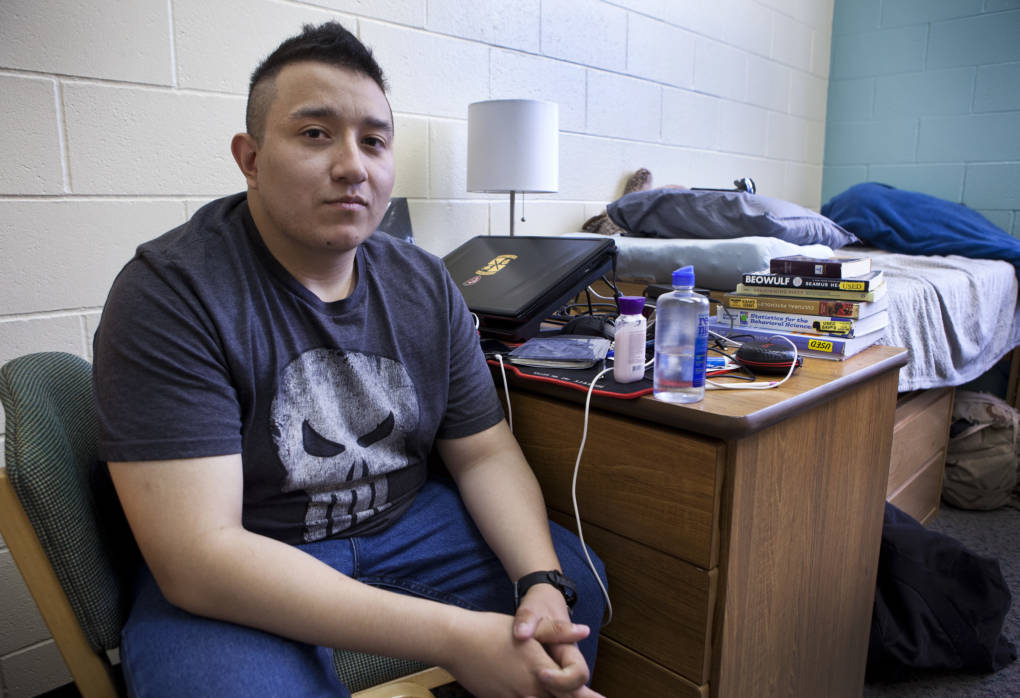
"caption": "Arthur Chavez, a transfer student at Sacramento State, poses for a portrait in his dorm room. Chavez was homeless and living in his car until the university's emergency housing program gave him a temporary room.",
"description": "Arthur Chavez, a transfer student at Sacramento State, poses for a portrait in his dorm room. Chavez was homeless and living in his car until the university's emergency housing program gave him a temporary room.",
"title": "STUDENT HOUSING_Photo1",
"credit": "Steve Yeater for CALmatters",
"status": "inherit",
"isLoading": false,
"fetchFailed": false
},
"news_11660093": {
"type": "attachments",
"id": "news_11660093",
"meta": {
"index": "attachments_1716263798",
"site": "news",
"id": "11660093",
"found": true
},
"parent": 11659893,
"imgSizes": {
"small": {
"file": "https://ww2.kqed.org/app/uploads/sites/10/2018/04/SantaAnaRiverbedCampPath-520x347.jpg",
"width": 520,
"mimeType": "image/jpeg",
"height": 347
},
"twentyfourteen-full-width": {
"file": "https://ww2.kqed.org/app/uploads/sites/10/2018/04/SantaAnaRiverbedCampPath-1038x576.jpg",
"width": 1038,
"mimeType": "image/jpeg",
"height": 576
},
"thumbnail": {
"file": "https://ww2.kqed.org/app/uploads/sites/10/2018/04/SantaAnaRiverbedCampPath-160x107.jpg",
"width": 160,
"mimeType": "image/jpeg",
"height": 107
},
"fd-sm": {
"file": "https://ww2.kqed.org/app/uploads/sites/10/2018/04/SantaAnaRiverbedCampPath-960x640.jpg",
"width": 960,
"mimeType": "image/jpeg",
"height": 640
},
"post-thumbnail": {
"file": "https://ww2.kqed.org/app/uploads/sites/10/2018/04/SantaAnaRiverbedCampPath-672x372.jpg",
"width": 672,
"mimeType": "image/jpeg",
"height": 372
},
"xsmall": {
"file": "https://ww2.kqed.org/app/uploads/sites/10/2018/04/SantaAnaRiverbedCampPath-375x250.jpg",
"width": 375,
"mimeType": "image/jpeg",
"height": 250
},
"kqedFullSize": {
"file": "https://ww2.kqed.org/app/uploads/sites/10/2018/04/SantaAnaRiverbedCampPath.jpg",
"width": 1920,
"height": 1280
},
"large": {
"file": "https://ww2.kqed.org/app/uploads/sites/10/2018/04/SantaAnaRiverbedCampPath-1020x680.jpg",
"width": 1020,
"mimeType": "image/jpeg",
"height": 680
},
"xlarge": {
"file": "https://ww2.kqed.org/app/uploads/sites/10/2018/04/SantaAnaRiverbedCampPath-1180x787.jpg",
"width": 1180,
"mimeType": "image/jpeg",
"height": 787
},
"guest-author-50": {
"file": "https://ww2.kqed.org/app/uploads/sites/10/2018/04/SantaAnaRiverbedCampPath-50x50.jpg",
"width": 50,
"mimeType": "image/jpeg",
"height": 50
},
"guest-author-96": {
"file": "https://ww2.kqed.org/app/uploads/sites/10/2018/04/SantaAnaRiverbedCampPath-96x96.jpg",
"width": 96,
"mimeType": "image/jpeg",
"height": 96
},
"medium": {
"file": "https://ww2.kqed.org/app/uploads/sites/10/2018/04/SantaAnaRiverbedCampPath-800x533.jpg",
"width": 800,
"mimeType": "image/jpeg",
"height": 533
},
"guest-author-64": {
"file": "https://ww2.kqed.org/app/uploads/sites/10/2018/04/SantaAnaRiverbedCampPath-64x64.jpg",
"width": 64,
"mimeType": "image/jpeg",
"height": 64
},
"guest-author-32": {
"file": "https://ww2.kqed.org/app/uploads/sites/10/2018/04/SantaAnaRiverbedCampPath-32x32.jpg",
"width": 32,
"mimeType": "image/jpeg",
"height": 32
},
"fd-lrg": {
"file": "https://ww2.kqed.org/app/uploads/sites/10/2018/04/SantaAnaRiverbedCampPath-1920x1280.jpg",
"width": 1920,
"mimeType": "image/jpeg",
"height": 1280
},
"fd-med": {
"file": "https://ww2.kqed.org/app/uploads/sites/10/2018/04/SantaAnaRiverbedCampPath-1180x787.jpg",
"width": 1180,
"mimeType": "image/jpeg",
"height": 787
},
"full-width": {
"file": "https://ww2.kqed.org/app/uploads/sites/10/2018/04/SantaAnaRiverbedCampPath-1920x1280.jpg",
"width": 1920,
"mimeType": "image/jpeg",
"height": 1280
},
"detail": {
"file": "https://ww2.kqed.org/app/uploads/sites/10/2018/04/SantaAnaRiverbedCampPath-150x150.jpg",
"width": 150,
"mimeType": "image/jpeg",
"height": 150
},
"guest-author-128": {
"file": "https://ww2.kqed.org/app/uploads/sites/10/2018/04/SantaAnaRiverbedCampPath-128x128.jpg",
"width": 128,
"mimeType": "image/jpeg",
"height": 128
},
"xxsmall": {
"file": "https://ww2.kqed.org/app/uploads/sites/10/2018/04/SantaAnaRiverbedCampPath-240x160.jpg",
"width": 240,
"mimeType": "image/jpeg",
"height": 160
}
},
"publishDate": 1522962095,
"modified": 1522962234,
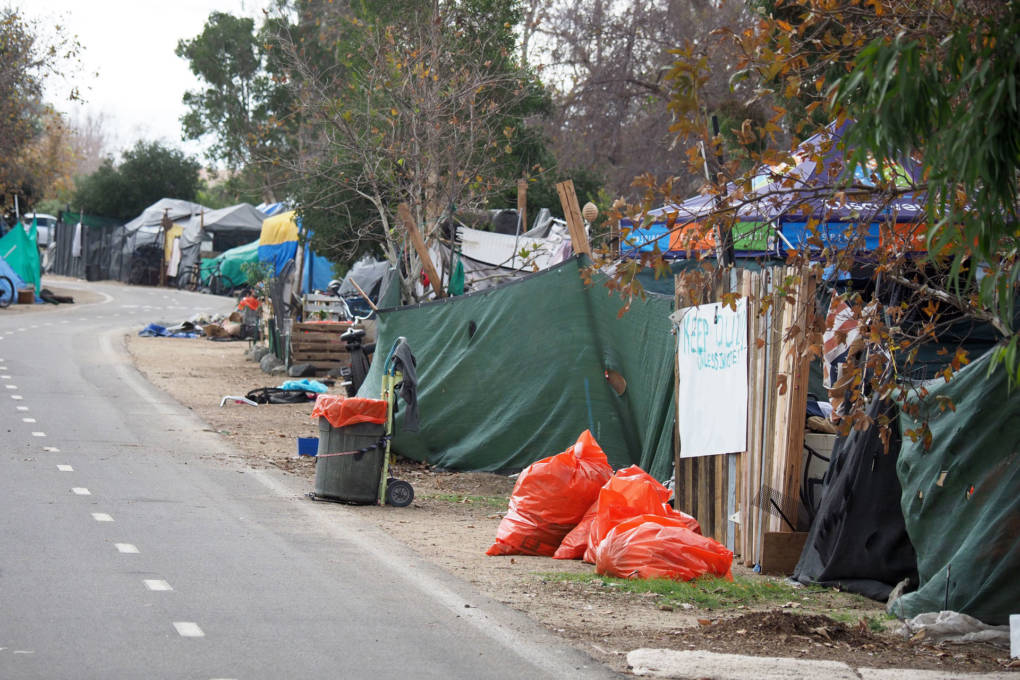
"caption": "Trash bags sit outside tents and tarps of a homeless encampment along the Santa Ana riverbed bicycle path near Angel Stadium in Anaheim on Jan. 25, 2018. Over 700 homeless people were evicted in February from encampments along the riverbed.",
"description": "Trash bags sit outside tents and tarps of a homeless encampment along the Santa Ana riverbed bicycle path near Angel Stadium in Anaheim on Jan. 25, 2018. Over 700 homeless people were evicted in February from encampments along the riverbed.",
"title": "SantaAnaRiverbedCampPath",
"credit": "ROBYN BECK/AFP/Getty Images",
"status": "inherit",
"isLoading": false,
"fetchFailed": false
},
"news_11658543": {
"type": "attachments",
"id": "news_11658543",
"meta": {
"index": "attachments_1716263798",
"site": "news",
"id": "11658543",
"found": true
},
"parent": 11658542,
"imgSizes": {
"small": {
"file": "https://ww2.kqed.org/app/uploads/sites/10/2018/03/linda-wang-protesters-2-148365a799b87d47995b822228ca2fc59061ea60-520x390.jpg",
"width": 520,
"mimeType": "image/jpeg",
"height": 390
},
"twentyfourteen-full-width": {
"file": "https://ww2.kqed.org/app/uploads/sites/10/2018/03/linda-wang-protesters-2-148365a799b87d47995b822228ca2fc59061ea60-1038x576.jpg",
"width": 1038,
"mimeType": "image/jpeg",
"height": 576
},
"thumbnail": {
"file": "https://ww2.kqed.org/app/uploads/sites/10/2018/03/linda-wang-protesters-2-148365a799b87d47995b822228ca2fc59061ea60-160x120.jpg",
"width": 160,
"mimeType": "image/jpeg",
"height": 120
},
"fd-sm": {
"file": "https://ww2.kqed.org/app/uploads/sites/10/2018/03/linda-wang-protesters-2-148365a799b87d47995b822228ca2fc59061ea60-960x720.jpg",
"width": 960,
"mimeType": "image/jpeg",
"height": 720
},
"post-thumbnail": {
"file": "https://ww2.kqed.org/app/uploads/sites/10/2018/03/linda-wang-protesters-2-148365a799b87d47995b822228ca2fc59061ea60-672x372.jpg",
"width": 672,
"mimeType": "image/jpeg",
"height": 372
},
"xsmall": {
"file": "https://ww2.kqed.org/app/uploads/sites/10/2018/03/linda-wang-protesters-2-148365a799b87d47995b822228ca2fc59061ea60-375x281.jpg",
"width": 375,
"mimeType": "image/jpeg",
"height": 281
},
"kqedFullSize": {
"file": "https://ww2.kqed.org/app/uploads/sites/10/2018/03/linda-wang-protesters-2-148365a799b87d47995b822228ca2fc59061ea60-e1522279505617.jpg",
"width": 1920,
"height": 1440
},
"large": {
"file": "https://ww2.kqed.org/app/uploads/sites/10/2018/03/linda-wang-protesters-2-148365a799b87d47995b822228ca2fc59061ea60-1020x765.jpg",
"width": 1020,
"mimeType": "image/jpeg",
"height": 765
},
"xlarge": {
"file": "https://ww2.kqed.org/app/uploads/sites/10/2018/03/linda-wang-protesters-2-148365a799b87d47995b822228ca2fc59061ea60-1180x885.jpg",
"width": 1180,
"mimeType": "image/jpeg",
"height": 885
},
"guest-author-50": {
"file": "https://ww2.kqed.org/app/uploads/sites/10/2018/03/linda-wang-protesters-2-148365a799b87d47995b822228ca2fc59061ea60-50x50.jpg",
"width": 50,
"mimeType": "image/jpeg",
"height": 50
},
"guest-author-96": {
"file": "https://ww2.kqed.org/app/uploads/sites/10/2018/03/linda-wang-protesters-2-148365a799b87d47995b822228ca2fc59061ea60-96x96.jpg",
"width": 96,
"mimeType": "image/jpeg",
"height": 96
},
"medium": {
"file": "https://ww2.kqed.org/app/uploads/sites/10/2018/03/linda-wang-protesters-2-148365a799b87d47995b822228ca2fc59061ea60-800x600.jpg",
"width": 800,
"mimeType": "image/jpeg",
"height": 600
},
"guest-author-64": {
"file": "https://ww2.kqed.org/app/uploads/sites/10/2018/03/linda-wang-protesters-2-148365a799b87d47995b822228ca2fc59061ea60-64x64.jpg",
"width": 64,
"mimeType": "image/jpeg",
"height": 64
},
"guest-author-32": {
"file": "https://ww2.kqed.org/app/uploads/sites/10/2018/03/linda-wang-protesters-2-148365a799b87d47995b822228ca2fc59061ea60-32x32.jpg",
"width": 32,
"mimeType": "image/jpeg",
"height": 32
},
"fd-lrg": {
"file": "https://ww2.kqed.org/app/uploads/sites/10/2018/03/linda-wang-protesters-2-148365a799b87d47995b822228ca2fc59061ea60-1920x1440.jpg",
"width": 1920,
"mimeType": "image/jpeg",
"height": 1440
},
"fd-med": {
"file": "https://ww2.kqed.org/app/uploads/sites/10/2018/03/linda-wang-protesters-2-148365a799b87d47995b822228ca2fc59061ea60-1180x885.jpg",
"width": 1180,
"mimeType": "image/jpeg",
"height": 885
},
"full-width": {
"file": "https://ww2.kqed.org/app/uploads/sites/10/2018/03/linda-wang-protesters-2-148365a799b87d47995b822228ca2fc59061ea60-1920x1440.jpg",
"width": 1920,
"mimeType": "image/jpeg",
"height": 1440
},
"detail": {
"file": "https://ww2.kqed.org/app/uploads/sites/10/2018/03/linda-wang-protesters-2-148365a799b87d47995b822228ca2fc59061ea60-150x150.jpg",
"width": 150,
"mimeType": "image/jpeg",
"height": 150
},
"guest-author-128": {
"file": "https://ww2.kqed.org/app/uploads/sites/10/2018/03/linda-wang-protesters-2-148365a799b87d47995b822228ca2fc59061ea60-128x128.jpg",
"width": 128,
"mimeType": "image/jpeg",
"height": 128
},
"xxsmall": {
"file": "https://ww2.kqed.org/app/uploads/sites/10/2018/03/linda-wang-protesters-2-148365a799b87d47995b822228ca2fc59061ea60-240x180.jpg",
"width": 240,
"mimeType": "image/jpeg",
"height": 180
}
},
"publishDate": 1522279445,
"modified": 1522279495,
"caption": "Protesters arrived in chartered buses to fight a plan by Orange County to relocate homeless people from Santa Ana to new temporary shelters in more affluent coastal cities.",
"description": "Protesters arrived in chartered buses to fight a plan by Orange County to relocate homeless people from Santa Ana to new temporary shelters in more affluent coastal cities.",
"title": "Protesters arrived in chartered buses to fight a plan by Orange County to relocate homeless people from Santa Ana to new temporary shelters in more affluent coastal cities.",
"credit": "Linda Wang/NPR",
"status": "inherit",
"isLoading": false,
"fetchFailed": false
},
"news_11658254": {
"type": "attachments",
"id": "news_11658254",
"meta": {
"index": "attachments_1716263798",
"site": "news",
"id": "11658254",
"found": true
},
"parent": 11658250,
"imgSizes": {
"small": {
"file": "https://ww2.kqed.org/app/uploads/sites/10/2018/03/OCHomelessLine-520x350.jpg",
"width": 520,
"mimeType": "image/jpeg",
"height": 350
},
"twentyfourteen-full-width": {
"file": "https://ww2.kqed.org/app/uploads/sites/10/2018/03/OCHomelessLine-1024x576.jpg",
"width": 1024,
"mimeType": "image/jpeg",
"height": 576
},
"thumbnail": {
"file": "https://ww2.kqed.org/app/uploads/sites/10/2018/03/OCHomelessLine-160x108.jpg",
"width": 160,
"mimeType": "image/jpeg",
"height": 108
},
"fd-sm": {
"file": "https://ww2.kqed.org/app/uploads/sites/10/2018/03/OCHomelessLine-960x646.jpg",
"width": 960,
"mimeType": "image/jpeg",
"height": 646
},
"post-thumbnail": {
"file": "https://ww2.kqed.org/app/uploads/sites/10/2018/03/OCHomelessLine-672x372.jpg",
"width": 672,
"mimeType": "image/jpeg",
"height": 372
},
"xsmall": {
"file": "https://ww2.kqed.org/app/uploads/sites/10/2018/03/OCHomelessLine-375x252.jpg",
"width": 375,
"mimeType": "image/jpeg",
"height": 252
},
"kqedFullSize": {
"file": "https://ww2.kqed.org/app/uploads/sites/10/2018/03/OCHomelessLine.jpg",
"width": 1024,
"height": 689
},
"large": {
"file": "https://ww2.kqed.org/app/uploads/sites/10/2018/03/OCHomelessLine-1020x686.jpg",
"width": 1020,
"mimeType": "image/jpeg",
"height": 686
},
"guest-author-50": {
"file": "https://ww2.kqed.org/app/uploads/sites/10/2018/03/OCHomelessLine-50x50.jpg",
"width": 50,
"mimeType": "image/jpeg",
"height": 50
},
"guest-author-96": {
"file": "https://ww2.kqed.org/app/uploads/sites/10/2018/03/OCHomelessLine-96x96.jpg",
"width": 96,
"mimeType": "image/jpeg",
"height": 96
},
"medium": {
"file": "https://ww2.kqed.org/app/uploads/sites/10/2018/03/OCHomelessLine-800x538.jpg",
"width": 800,
"mimeType": "image/jpeg",
"height": 538
},
"guest-author-64": {
"file": "https://ww2.kqed.org/app/uploads/sites/10/2018/03/OCHomelessLine-64x64.jpg",
"width": 64,
"mimeType": "image/jpeg",
"height": 64
},
"guest-author-32": {
"file": "https://ww2.kqed.org/app/uploads/sites/10/2018/03/OCHomelessLine-32x32.jpg",
"width": 32,
"mimeType": "image/jpeg",
"height": 32
},
"detail": {
"file": "https://ww2.kqed.org/app/uploads/sites/10/2018/03/OCHomelessLine-150x150.jpg",
"width": 150,
"mimeType": "image/jpeg",
"height": 150
},
"guest-author-128": {
"file": "https://ww2.kqed.org/app/uploads/sites/10/2018/03/OCHomelessLine-128x128.jpg",
"width": 128,
"mimeType": "image/jpeg",
"height": 128
},
"xxsmall": {
"file": "https://ww2.kqed.org/app/uploads/sites/10/2018/03/OCHomelessLine-240x161.jpg",
"width": 240,
"mimeType": "image/jpeg",
"height": 161
}
},
"publishDate": 1522183777,
"modified": 1522183821,
"caption": "A line of homeless people at the Santa Ana riverbed wait to get connected with a motel room or shelter on Tuesday, Feb. 20, 2018.",
"description": "A line of homeless people at the Santa Ana riverbed wait to get connected with a motel room or shelter on Tuesday, Feb. 20, 2018.",
"title": "OCHomelessLine",
"credit": "Jill Replogle/KPCC",
"status": "inherit",
"isLoading": false,
"fetchFailed": false
},
"news_11656896": {
"type": "attachments",
"id": "news_11656896",
"meta": {
"index": "attachments_1716263798",
"site": "news",
"id": "11656896",
"found": true
},
"parent": 11656882,
"imgSizes": {
"small": {
"file": "https://ww2.kqed.org/app/uploads/sites/10/2018/03/HomelessRiverbedBikes-520x333.jpg",
"width": 520,
"mimeType": "image/jpeg",
"height": 333
},
"twentyfourteen-full-width": {
"file": "https://ww2.kqed.org/app/uploads/sites/10/2018/03/HomelessRiverbedBikes-1038x576.jpg",
"width": 1038,
"mimeType": "image/jpeg",
"height": 576
},
"thumbnail": {
"file": "https://ww2.kqed.org/app/uploads/sites/10/2018/03/HomelessRiverbedBikes-160x102.jpg",
"width": 160,
"mimeType": "image/jpeg",
"height": 102
},
"fd-sm": {
"file": "https://ww2.kqed.org/app/uploads/sites/10/2018/03/HomelessRiverbedBikes-960x614.jpg",
"width": 960,
"mimeType": "image/jpeg",
"height": 614
},
"post-thumbnail": {
"file": "https://ww2.kqed.org/app/uploads/sites/10/2018/03/HomelessRiverbedBikes-672x372.jpg",
"width": 672,
"mimeType": "image/jpeg",
"height": 372
},
"xsmall": {
"file": "https://ww2.kqed.org/app/uploads/sites/10/2018/03/HomelessRiverbedBikes-375x240.jpg",
"width": 375,
"mimeType": "image/jpeg",
"height": 240
},
"kqedFullSize": {
"file": "https://ww2.kqed.org/app/uploads/sites/10/2018/03/HomelessRiverbedBikes.jpg",
"width": 1920,
"height": 1228
},
"large": {
"file": "https://ww2.kqed.org/app/uploads/sites/10/2018/03/HomelessRiverbedBikes-1020x652.jpg",
"width": 1020,
"mimeType": "image/jpeg",
"height": 652
},
"xlarge": {
"file": "https://ww2.kqed.org/app/uploads/sites/10/2018/03/HomelessRiverbedBikes-1180x755.jpg",
"width": 1180,
"mimeType": "image/jpeg",
"height": 755
},
"guest-author-50": {
"file": "https://ww2.kqed.org/app/uploads/sites/10/2018/03/HomelessRiverbedBikes-50x50.jpg",
"width": 50,
"mimeType": "image/jpeg",
"height": 50
},
"guest-author-96": {
"file": "https://ww2.kqed.org/app/uploads/sites/10/2018/03/HomelessRiverbedBikes-96x96.jpg",
"width": 96,
"mimeType": "image/jpeg",
"height": 96
},
"medium": {
"file": "https://ww2.kqed.org/app/uploads/sites/10/2018/03/HomelessRiverbedBikes-800x512.jpg",
"width": 800,
"mimeType": "image/jpeg",
"height": 512
},
"guest-author-64": {
"file": "https://ww2.kqed.org/app/uploads/sites/10/2018/03/HomelessRiverbedBikes-64x64.jpg",
"width": 64,
"mimeType": "image/jpeg",
"height": 64
},
"guest-author-32": {
"file": "https://ww2.kqed.org/app/uploads/sites/10/2018/03/HomelessRiverbedBikes-32x32.jpg",
"width": 32,
"mimeType": "image/jpeg",
"height": 32
},
"fd-lrg": {
"file": "https://ww2.kqed.org/app/uploads/sites/10/2018/03/HomelessRiverbedBikes-1920x1228.jpg",
"width": 1920,
"mimeType": "image/jpeg",
"height": 1228
},
"fd-med": {
"file": "https://ww2.kqed.org/app/uploads/sites/10/2018/03/HomelessRiverbedBikes-1180x755.jpg",
"width": 1180,
"mimeType": "image/jpeg",
"height": 755
},
"full-width": {
"file": "https://ww2.kqed.org/app/uploads/sites/10/2018/03/HomelessRiverbedBikes-1920x1228.jpg",
"width": 1920,
"mimeType": "image/jpeg",
"height": 1228
},
"detail": {
"file": "https://ww2.kqed.org/app/uploads/sites/10/2018/03/HomelessRiverbedBikes-150x150.jpg",
"width": 150,
"mimeType": "image/jpeg",
"height": 150
},
"guest-author-128": {
"file": "https://ww2.kqed.org/app/uploads/sites/10/2018/03/HomelessRiverbedBikes-128x128.jpg",
"width": 128,
"mimeType": "image/jpeg",
"height": 128
},
"xxsmall": {
"file": "https://ww2.kqed.org/app/uploads/sites/10/2018/03/HomelessRiverbedBikes-240x154.jpg",
"width": 240,
"mimeType": "image/jpeg",
"height": 154
}
},
"publishDate": 1521582556,
"modified": 1521582673,
"caption": "People ride bicycles past tents and tarps of a homeless encampment along the Santa Ana River bicycle path near Angel Stadium in Anaheim on Jan. 25, 2018. Over 700 homeless people were evicted in February from encampments along the riverbed.",
"description": "People ride bicycles past tents and tarps of a homeless encampment along the Santa Ana River bicycle path near Angel Stadium in Anaheim on Jan. 25, 2018. Over 700 homeless people were evicted in February from encampments along the riverbed.",
"title": "HomelessRiverbedBikes",
"credit": "ROBYN BECK/AFP/Getty Images",
"status": "inherit",
"isLoading": false,
"fetchFailed": false
},
"news_11656589": {
"type": "attachments",
"id": "news_11656589",
"meta": {
"index": "attachments_1716263798",
"site": "news",
"id": "11656589",
"found": true
},
"parent": 11656586,
"imgSizes": {
"small": {
"file": "https://ww2.kqed.org/app/uploads/sites/10/2018/03/homeless-520x347.jpg",
"width": 520,
"mimeType": "image/jpeg",
"height": 347
},
"twentyfourteen-full-width": {
"file": "https://ww2.kqed.org/app/uploads/sites/10/2018/03/homeless-1024x576.jpg",
"width": 1024,
"mimeType": "image/jpeg",
"height": 576
},
"thumbnail": {
"file": "https://ww2.kqed.org/app/uploads/sites/10/2018/03/homeless-160x107.jpg",
"width": 160,
"mimeType": "image/jpeg",
"height": 107
},
"fd-sm": {
"file": "https://ww2.kqed.org/app/uploads/sites/10/2018/03/homeless-960x640.jpg",
"width": 960,
"mimeType": "image/jpeg",
"height": 640
},
"post-thumbnail": {
"file": "https://ww2.kqed.org/app/uploads/sites/10/2018/03/homeless-672x372.jpg",
"width": 672,
"mimeType": "image/jpeg",
"height": 372
},
"xsmall": {
"file": "https://ww2.kqed.org/app/uploads/sites/10/2018/03/homeless-375x250.jpg",
"width": 375,
"mimeType": "image/jpeg",
"height": 250
},
"kqedFullSize": {
"file": "https://ww2.kqed.org/app/uploads/sites/10/2018/03/homeless.jpg",
"width": 1024,
"height": 683
},
"large": {
"file": "https://ww2.kqed.org/app/uploads/sites/10/2018/03/homeless-1020x680.jpg",
"width": 1020,
"mimeType": "image/jpeg",
"height": 680
},
"guest-author-50": {
"file": "https://ww2.kqed.org/app/uploads/sites/10/2018/03/homeless-50x50.jpg",
"width": 50,
"mimeType": "image/jpeg",
"height": 50
},
"guest-author-96": {
"file": "https://ww2.kqed.org/app/uploads/sites/10/2018/03/homeless-96x96.jpg",
"width": 96,
"mimeType": "image/jpeg",
"height": 96
},
"medium": {
"file": "https://ww2.kqed.org/app/uploads/sites/10/2018/03/homeless-800x534.jpg",
"width": 800,
"mimeType": "image/jpeg",
"height": 534
},
"guest-author-64": {
"file": "https://ww2.kqed.org/app/uploads/sites/10/2018/03/homeless-64x64.jpg",
"width": 64,
"mimeType": "image/jpeg",
"height": 64
},
"guest-author-32": {
"file": "https://ww2.kqed.org/app/uploads/sites/10/2018/03/homeless-32x32.jpg",
"width": 32,
"mimeType": "image/jpeg",
"height": 32
},
"detail": {
"file": "https://ww2.kqed.org/app/uploads/sites/10/2018/03/homeless-150x150.jpg",
"width": 150,
"mimeType": "image/jpeg",
"height": 150
},
"guest-author-128": {
"file": "https://ww2.kqed.org/app/uploads/sites/10/2018/03/homeless-128x128.jpg",
"width": 128,
"mimeType": "image/jpeg",
"height": 128
},
"xxsmall": {
"file": "https://ww2.kqed.org/app/uploads/sites/10/2018/03/homeless-240x160.jpg",
"width": 240,
"mimeType": "image/jpeg",
"height": 160
}
},
"publishDate": 1521486844,
"modified": 1521487480,
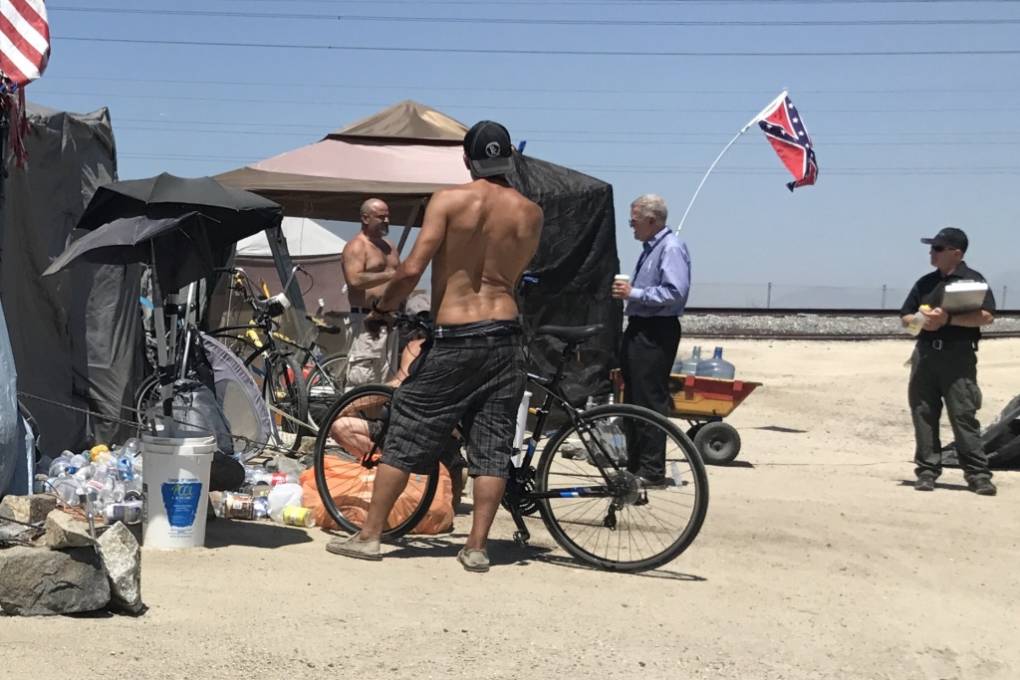
"caption": "Judge David O. Carter, lawyers and county officials stop to talk to a group of homeless men camped along the Santa Ana River in March 2017. Judge Carter is now presiding over a case that allowed for the riverbed homeless encampment to be cleared with the promise of finding appropriate shelter for the some 700 people still living there in February 2018.",
"description": "Judge David O. Carter, lawyers and county officials stop to talk to a group of homeless men camped along the Santa Ana River in March 2017. Judge Carter is now presiding over a case that allowed for the riverbed homeless encampment to be cleared with the promise of finding appropriate shelter for the some 700 people still living there in February 2018.",
"title": "homeless",
"credit": "Jill Replogle/KPCC",
"status": "inherit",
"isLoading": false,
"fetchFailed": false
},
"news_11654784": {
"type": "attachments",
"id": "news_11654784",
"meta": {
"index": "attachments_1716263798",
"site": "news",
"id": "11654784",
"found": true
},
"parent": 11654778,
"imgSizes": {
"small": {
"file": "https://ww2.kqed.org/app/uploads/sites/10/2018/03/StoltzeKillBrothers-520x374.jpg",
"width": 520,
"mimeType": "image/jpeg",
"height": 374
},
"twentyfourteen-full-width": {
"file": "https://ww2.kqed.org/app/uploads/sites/10/2018/03/StoltzeKillBrothers-1038x576.jpg",
"width": 1038,
"mimeType": "image/jpeg",
"height": 576
},
"thumbnail": {
"file": "https://ww2.kqed.org/app/uploads/sites/10/2018/03/StoltzeKillBrothers-160x115.jpg",
"width": 160,
"mimeType": "image/jpeg",
"height": 115
},
"fd-sm": {
"file": "https://ww2.kqed.org/app/uploads/sites/10/2018/03/StoltzeKillBrothers-960x690.jpg",
"width": 960,
"mimeType": "image/jpeg",
"height": 690
},
"post-thumbnail": {
"file": "https://ww2.kqed.org/app/uploads/sites/10/2018/03/StoltzeKillBrothers-672x372.jpg",
"width": 672,
"mimeType": "image/jpeg",
"height": 372
},
"xsmall": {
"file": "https://ww2.kqed.org/app/uploads/sites/10/2018/03/StoltzeKillBrothers-375x270.jpg",
"width": 375,
"mimeType": "image/jpeg",
"height": 270
},
"kqedFullSize": {
"file": "https://ww2.kqed.org/app/uploads/sites/10/2018/03/StoltzeKillBrothers.jpg",
"width": 1200,
"height": 863
},
"large": {
"file": "https://ww2.kqed.org/app/uploads/sites/10/2018/03/StoltzeKillBrothers-1020x734.jpg",
"width": 1020,
"mimeType": "image/jpeg",
"height": 734
},
"xlarge": {
"file": "https://ww2.kqed.org/app/uploads/sites/10/2018/03/StoltzeKillBrothers-1180x849.jpg",
"width": 1180,
"mimeType": "image/jpeg",
"height": 849
},
"guest-author-50": {
"file": "https://ww2.kqed.org/app/uploads/sites/10/2018/03/StoltzeKillBrothers-50x50.jpg",
"width": 50,
"mimeType": "image/jpeg",
"height": 50
},
"guest-author-96": {
"file": "https://ww2.kqed.org/app/uploads/sites/10/2018/03/StoltzeKillBrothers-96x96.jpg",
"width": 96,
"mimeType": "image/jpeg",
"height": 96
},
"medium": {
"file": "https://ww2.kqed.org/app/uploads/sites/10/2018/03/StoltzeKillBrothers-800x575.jpg",
"width": 800,
"mimeType": "image/jpeg",
"height": 575
},
"guest-author-64": {
"file": "https://ww2.kqed.org/app/uploads/sites/10/2018/03/StoltzeKillBrothers-64x64.jpg",
"width": 64,
"mimeType": "image/jpeg",
"height": 64
},
"guest-author-32": {
"file": "https://ww2.kqed.org/app/uploads/sites/10/2018/03/StoltzeKillBrothers-32x32.jpg",
"width": 32,
"mimeType": "image/jpeg",
"height": 32
},
"fd-med": {
"file": "https://ww2.kqed.org/app/uploads/sites/10/2018/03/StoltzeKillBrothers-1180x849.jpg",
"width": 1180,
"mimeType": "image/jpeg",
"height": 849
},
"detail": {
"file": "https://ww2.kqed.org/app/uploads/sites/10/2018/03/StoltzeKillBrothers-150x150.jpg",
"width": 150,
"mimeType": "image/jpeg",
"height": 150
},
"guest-author-128": {
"file": "https://ww2.kqed.org/app/uploads/sites/10/2018/03/StoltzeKillBrothers-128x128.jpg",
"width": 128,
"mimeType": "image/jpeg",
"height": 128
},
"xxsmall": {
"file": "https://ww2.kqed.org/app/uploads/sites/10/2018/03/StoltzeKillBrothers-240x173.jpg",
"width": 240,
"mimeType": "image/jpeg",
"height": 173
}
},
"publishDate": 1520627380,
"modified": 1520627416,
"caption": "A memorial for Brendon Glenn, fatally shot by an LAPD officer in Venice on May 5, 2015.",
"description": "A memorial for Brendon Glenn, fatally shot by an LAPD officer in Venice on May 5, 2015.",
"title": "StoltzeKillBrothers",
"credit": "Frank Stoltze/KPCC",
"status": "inherit",
"isLoading": false,
"fetchFailed": false
}
},
"audioPlayerReducer": {
"postId": "stream_live",
"isPaused": true,
"isPlaying": false,
"pfsActive": false,
"pledgeModalIsOpen": true,
"playerDrawerIsOpen": false,
"liveAudioPlayStartedAt": 0,
"liveAudioPlayContext": ""
},
"authorsReducer": {
"byline_news_11665092": {
"type": "authors",
"id": "byline_news_11665092",
"meta": {
"override": true
},
"slug": "byline_news_11665092",
"name": "Tyrius Ammons",
"isLoading": false
},
"byline_news_11660885": {
"type": "authors",
"id": "byline_news_11660885",
"meta": {
"override": true
},
"slug": "byline_news_11660885",
"name": "\u003cstrong>\u003ca href=\"http://www.kpbs.org/staff/amita-sharma/\">Amita Sharma\u003c/a>\u003c/strong>",
"isLoading": false
},
"byline_news_11662857": {
"type": "authors",
"id": "byline_news_11662857",
"meta": {
"override": true
},
"slug": "byline_news_11662857",
"name": "\u003cstrong>\u003ca href=\"http://www.scpr.org/about/people/staff/rina-palta\">Rina Palta\u003c/a>\u003c/strong>",
"isLoading": false
},
"byline_news_11662346": {
"type": "authors",
"id": "byline_news_11662346",
"meta": {
"override": true
},
"slug": "byline_news_11662346",
"name": "\u003cstrong>\u003ca href=\"https://www.npr.org/people/527855988/vanessa-romo\">Vanessa Romo\u003c/a>\u003c/br>\u003ca href=\"https://www.npr.org/\">NPR\u003c/a>\u003c/strong>",
"isLoading": false
},
"byline_news_11660315": {
"type": "authors",
"id": "byline_news_11660315",
"meta": {
"override": true
},
"slug": "byline_news_11660315",
"name": "\u003cstrong>\u003ca href=\"https://calmatters.org/articles/author/feliciacalmatters-org/\">Felicia Mello\u003c/a>\u003c/strong>",
"isLoading": false
},
"byline_news_11658542": {
"type": "authors",
"id": "byline_news_11658542",
"meta": {
"override": true
},
"slug": "byline_news_11658542",
"name": "Kirk Siegler",
"isLoading": false
},
"byline_news_11658250": {
"type": "authors",
"id": "byline_news_11658250",
"meta": {
"override": true
},
"slug": "byline_news_11658250",
"name": "\u003cstrong>\u003ca href=\"http://www.scpr.org/about/people/staff/aaron-mendelson\">Aaron Mendelson\u003c/a>\u003c/strong>",
"isLoading": false
},
"byline_news_11656882": {
"type": "authors",
"id": "byline_news_11656882",
"meta": {
"override": true
},
"slug": "byline_news_11656882",
"name": "\u003cstrong>\u003ca href=\"https://www.scpr.org/about/people/staff/jill-replogle\">Jill Replogle\u003c/a>\u003c/strong>",
"isLoading": false
},
"byline_news_11656586": {
"type": "authors",
"id": "byline_news_11656586",
"meta": {
"override": true
},
"slug": "byline_news_11656586",
"name": "\u003cstrong>\u003ca href=\"https://www.scpr.org/about/people/staff/jill-replogle\">Jill Replogle\u003c/a>\u003c/strong>",
"isLoading": false
},
"byline_news_11654778": {
"type": "authors",
"id": "byline_news_11654778",
"meta": {
"override": true
},
"slug": "byline_news_11654778",
"name": "\u003cstrong>\u003ca href=\"http://www.scpr.org/about/people/staff/frank-stoltze\">Frank Stoltze\u003c/a>\u003c/strong>",
"isLoading": false
},
"pollystryker": {
"type": "authors",
"id": "250",
"meta": {
"index": "authors_1716337520",
"id": "250",
"found": true
},
"name": "Polly Stryker",
"firstName": "Polly",
"lastName": "Stryker",
"slug": "pollystryker",
"email": "pstryker@kqed.org",
"display_author_email": false,
"staff_mastheads": [
"science"
],
"title": "Editor",
"bio": "Polly Stryker is a former editor for KQED's Science desk. She and reporter/host Rachael Myrow produced the KQED podcast, \u003ca href=\"http://www.npr.org/podcasts/448072249/love-in-the-digital-age\">Love in the Digital Age\u003c/a>.\r\n\r\nPolly has worked for a variety of news and public affairs programs, including most recently as editor of \u003cem>The California Report\u003c/em>. She also edited \u003ca href=\"https://ww2.kqed.org/news/programs/the-california-report\" target=\"_blank\" rel=\"noopener noreferrer\">\u003cem>The California Report'\u003c/em>s\u003c/a> \u003ca href=\"http://www.californiareport.org/healthdialogues/\" target=\"_blank\" rel=\"noopener noreferrer\">“Health Dialogues.”\u003c/a> Before that, she was a producer on \u003cem>\u003ca href=\"http://www.scpr.org/programs/airtalk/\" target=\"_blank\" rel=\"noopener noreferrer\">AirTalk\u003c/a>\u003c/em> with Larry Mantle on \u003ca href=\"http://www.scpr.org/\" target=\"_blank\" rel=\"noopener noreferrer\">KPCC\u003c/a> radio, and \u003cem>\u003ca href=\"http://www.kpbs.org/news/midday-edition/\">These Days\u003c/a>\u003c/em> on KPBS. Polly’s work has won awards from the Radio and Television News Directors Association of Northern California, the Society of Professional Journalists (Southern California and Northern California chapters), the Radio and Television News Association. She's also won a Taste Award.\r\n\r\nShe considers herself to be a citizen of the world, having grown up in Cairo before coming to the United States. Polly speaks Arabic and can say, \"I’d like a martini, please\" in Swahili.",
"avatar": "https://secure.gravatar.com/avatar/5012854a99868cb15a517a876d88f736?s=600&d=blank&r=g",
"twitter": null,
"facebook": null,
"instagram": null,
"linkedin": null,
"sites": [
{
"site": "",
"roles": [
"editor"
]
},
{
"site": "arts",
"roles": [
"administrator"
]
},
{
"site": "news",
"roles": [
"subscriber"
]
},
{
"site": "stateofhealth",
"roles": [
"author"
]
},
{
"site": "science",
"roles": [
"editor"
]
},
{
"site": "forum",
"roles": [
"editor"
]
}
],
"headData": {
"title": "Polly Stryker | KQED",
"description": "Editor",
"ogImgSrc": "https://secure.gravatar.com/avatar/5012854a99868cb15a517a876d88f736?s=600&d=blank&r=g",
"twImgSrc": "https://secure.gravatar.com/avatar/5012854a99868cb15a517a876d88f736?s=600&d=blank&r=g"
},
"isLoading": false,
"link": "/author/pollystryker"
},
"lklivans": {
"type": "authors",
"id": "8648",
"meta": {
"index": "authors_1716337520",
"id": "8648",
"found": true
},
"name": "Laura Klivans",
"firstName": "Laura",
"lastName": "Klivans",
"slug": "lklivans",
"email": "lklivans@kqed.org",
"display_author_email": true,
"staff_mastheads": [
"news",
"science"
],
"title": "Reporter",
"bio": "Laura Klivans is an award-winning science reporter for KQED News, where she covers climate change with an eye on both groundbreaking progress and gaps in action. She is the former host of KQED's blockbuster video series about tiny, amazing animals, \u003cem>Deep Look\u003c/em>. Her work reaches national audiences through NPR, \u003cem>Here & Now, \u003c/em>PRI, and other major outlets. \r\n\r\nLaura’s won five Northern California Area Emmy Awards for Deep Look and First Place in the Greater Bay Area Journalism Awards for a podcast exploring how one Oakland neighborhood teamed up to reduce planet-heating pollution.\r\n\r\nBeyond her reporting, she hosts and moderates events. In the past, she taught audio storytelling at the UC Berkeley Graduate School of Journalism, led international education programs, worked with immigrants and refugees along the Thai-Burmese border, taught high schoolers sex ed, and was an actress. \r\n\r\nShe's a former UC Berkeley Human Rights Fellow, USC Center for Health Journalism's California Fellow and Coro Fellow in Public Affairs. Laura has a master’s in journalism from UC Berkeley, a master’s in education from Harvard, and an undergraduate degree from Northwestern University.\r\n\r\nShe loves trying to riddle the meaning out of vanity license plates.",
"avatar": "https://secure.gravatar.com/avatar/af8e757bb8ce7b7fee6160ba66e37327?s=600&d=blank&r=g",
"twitter": "lauraklivans",
"facebook": null,
"instagram": null,
"linkedin": null,
"sites": [
{
"site": "news",
"roles": [
"editor"
]
},
{
"site": "stateofhealth",
"roles": [
"contributor",
"editor"
]
},
{
"site": "science",
"roles": [
"editor"
]
},
{
"site": "forum",
"roles": [
"editor"
]
}
],
"headData": {
"title": "Laura Klivans | KQED",
"description": "Reporter",
"ogImgSrc": "https://secure.gravatar.com/avatar/af8e757bb8ce7b7fee6160ba66e37327?s=600&d=blank&r=g",
"twImgSrc": "https://secure.gravatar.com/avatar/af8e757bb8ce7b7fee6160ba66e37327?s=600&d=blank&r=g"
},
"isLoading": false,
"link": "/author/lklivans"
}
},
"pagesReducer": {
"news_tag_homelessness": {
"type": "terms",
"id": "news_4020",
"meta": {
"index": "terms_1716263798",
"site": "news",
"id": "4020",
"score": 8.555192
},
"name": "Homelessness",
"slug": "homelessness",
"taxonomy": "tag",
"description": null,
"featImg": null,
"headData": {
"title": "Homelessness | KQED News",
"description": null,
"ogTitle": null,
"ogDescription": null,
"ogImgId": null,
"twTitle": null,
"twDescription": null,
"twImgId": null,
"metaRobotsNoIndex": "index"
},
"ttid": 4039,
"isLoading": false,
"title": "Homelessness",
"pageMeta": {
"site": "news",
"WpPageTemplate": "page-topic-editorial",
"currentPage": 49
},
"blocks": [
{
"blockName": "kqed/post-list",
"attrs": {
"layout": "cardArticle2",
"query": "posts/news?tag=homelessness",
"seeMore": false,
"paginated": true,
"page": 49
}
},
{
"blockName": "kqed/ad"
}
]
}
},
"pfsSessionReducer": {},
"postsReducer": {
"stream_live": {
"type": "live",
"id": "stream_live",
"audioUrl": "https://streams.kqed.org/kqedradio",
"title": "Live Stream",
"excerpt": "Live Stream information currently unavailable.",
"link": "/radio",
"featImg": "",
"label": {
"name": "KQED Live",
"link": "/"
}
},
"stream_kqedNewscast": {
"type": "posts",
"id": "stream_kqedNewscast",
"audioUrl": "https://www.kqed.org/.stream/anon/radio/RDnews/newscast.mp3?_=1",
"title": "KQED Newscast",
"featImg": "",
"label": {
"name": "88.5 FM",
"link": "/"
}
},
"news_11664364": {
"type": "posts",
"id": "news_11664364",
"meta": {
"index": "posts_1716263798",
"site": "news",
"id": "11664364",
"score": null,
"sort": [
1524875730000
]
},
"guestAuthors": [],
"slug": "high-school-student-goes-from-homeless-to-hopeful",
"title": "High School Student Goes From Homeless to Hopeful",
"publishDate": 1524875730,
"format": "audio",
"headTitle": "High School Student Goes From Homeless to Hopeful | KQED",
"labelTerm": {
"term": 72,
"site": "news"
},
"content": "\u003cp>Jennifer is a senior at Richmond High School. Just a few weeks ago, she put on a sparkly pink dress and went to prom — a quintessential high school experience.\u003c/p>\n\u003cp>But most of the time, Jennifer feels much, much older. She remembers a happy childhood with her older brothers and her parents. There were trips to Toys “R” Us, a comfortable home, and a lot of love.\u003c/p>\n\u003cp>But her life started changing when her father’s construction company hit hard times. The family lost their home. And her parents had nowhere to turn for help. They’re both undocumented. That’s why we’re only using Jennifer’s first name for this story.\u003c/p>\n\u003cp>Things got even worse, Jennifer says, during her sophomore year, when one day, their landlord pulled up to their house. She shared her story as as part of \u003ca href=\"https://ww2.kqed.org/education/2018/04/18/youth-takeover-of-kqed-news-starts-april-23/\" rel=\"noopener\" target=\"_blank\">KQED’s Youth Takeover Week\u003c/a>.\u003c/p>\n\u003cfigure id=\"attachment_11664878\" class=\"wp-caption aligncenter\" style=\"max-width: 800px\">\u003cimg loading=\"lazy\" decoding=\"async\" class=\"size-medium wp-image-11664878\" src=\"https://ww2.kqed.org/news/wp-content/uploads/sites/10/2018/04/RS30596_PicsArt_04-15-08.29.38_01-qut-800x1062.jpg\" alt=\"\" width=\"800\" height=\"1062\" srcset=\"https://cdn.kqed.org/wp-content/uploads/sites/10/2018/04/RS30596_PicsArt_04-15-08.29.38_01-qut-800x1062.jpg 800w, https://cdn.kqed.org/wp-content/uploads/sites/10/2018/04/RS30596_PicsArt_04-15-08.29.38_01-qut-160x212.jpg 160w, https://cdn.kqed.org/wp-content/uploads/sites/10/2018/04/RS30596_PicsArt_04-15-08.29.38_01-qut.jpg 904w, https://cdn.kqed.org/wp-content/uploads/sites/10/2018/04/RS30596_PicsArt_04-15-08.29.38_01-qut-240x319.jpg 240w, https://cdn.kqed.org/wp-content/uploads/sites/10/2018/04/RS30596_PicsArt_04-15-08.29.38_01-qut-375x498.jpg 375w, https://cdn.kqed.org/wp-content/uploads/sites/10/2018/04/RS30596_PicsArt_04-15-08.29.38_01-qut-520x690.jpg 520w\" sizes=\"auto, (max-width: 800px) 100vw, 800px\">\u003cfigcaption class=\"wp-caption-text\">Jennifer (second from left) at her high school prom. \u003ccite>(Mario Valencia)\u003c/cite>\u003c/figcaption>\u003c/figure>\n\u003cp>“He has white hair, blue eyes and a white, bushy mustache and he walked up to me and said ‘hey could you like call out your mom,'” Jennifer remembers.\u003c/p>\n\u003cp>[ad fullwidth]\u003c/p>\n\u003cp>The landlord told Jennifer’s mother that he was no longer interested in renting his house to them. He was going to sell the house and told the family they had three months to leave. If they weren’t out in three months, the landlord said he’d call the sheriff.\u003c/p>\n\u003cp>Jennifer was stunned. “I felt the world go silent in my head. All these thoughts kind of flashed through, like ‘what’re we going to do? Where are we going to go?'”\u003c/p>\n\u003cp>Two weeks later, the landlord returned with a proposal: If Jennifer’s father fixed up the house for free, the family could live in the garage behind the house.\u003c/p>\n\u003cp>But this wasn’t a generous offer. Jennifer says the garage was basically uninhabitable.\u003c/p>\n\u003cp>“The floor was kind of this old concrete. It was like a dark-gray brown color,” Jennifer recalls. “No matter how much you washed it, it wouldn’t go away. I would usually take turns either sleeping on the old mattress that was there, or I slept on the concrete floor that was piled on with a bunch of blankets. Even though there was like many blankets you could still feel the hard floor on your back. Since there was no electricity or no actual windows you didn’t know the time of day. It was so dark that if you would extend your hand out and just stare at it, you couldn’t even see the outline of your hand.”\u003c/p>\n\u003caside class=\"alignright\">\n\u003ch3>\u003ca href=\"https://ww2.kqed.org/education/2018/04/18/youth-takeover-of-kqed-news-starts-april-23/\" target=\"_blank\" rel=\"noopener\">Youth Takeover of KQED News\u003c/a>\u003c/h3>\n\u003cfigure>\u003ca href=\"https://ww2.kqed.org/education/2018/04/18/youth-takeover-of-kqed-news-starts-april-23/\" target=\"_blank\" rel=\"noopener\">\u003cimg decoding=\"async\" src=\"https://ww2.kqed.org/education/wp-content/uploads/sites/38/2018/04/Youth-Takeover-image-2.png\">\u003c/a>\u003c/figure>\n\u003cp>Youth are taking over KQED! From April 23 – 27, KQED programs will feature stories pitched, produced and reported by youth from Bay Area high schools. Participating programs include \u003ca href=\"https://www.kqed.org/news/program/the-california-report\" target=\"_blank\" rel=\"noopener\">The California Report\u003c/a>, \u003ca href=\"https://www.youtube.com/channel/UC4K10PNjqgGLKA3lo5V8KdQ\" target=\"_blank\" rel=\"noopener\">Above the Noise\u003c/a>, \u003ca href=\"https://www.kqed.org/perspectives\" target=\"_blank\" rel=\"noopener\">Perspectives\u003c/a> and \u003ca href=\"https://www.kqed.org/news/program/kqed-newsroom/\" target=\"_blank\" rel=\"noopener\">KQED Newsroom\u003c/a>.\u003cbr>\n\u003c/p>\u003c/aside>\n\u003cp>While living in the garage, Jennifer’s grades dropped significantly. She even failed a couple of semesters. She was also ashamed of her living situation, and that was getting to her. She was starting to spiral into depression.\u003c/p>\n\u003cp>“I was scared that people wouldn’t understand or would just like tease me for it. I would stare at people and just see how they would smile and laugh and just like not have like a single care in the world. And I was just like, ‘Why was it me that had to deal with all this?'”\u003c/p>\n\u003cp>And then, when it felt like things couldn’t get worse, Jennifer’s mom was hospitalized with septicemia.\u003c/p>\n\u003cp>“Septicemia is a condition where there is an infection somewhere in your body that is not treated,” Jennifer explains. “So that infection starts spreading out and gets even more serious when it gets into your bloodstream.”\u003c/p>\n\u003cp>Her mother going to the hospital hit Jennifer hard.\u003c/p>\n\u003cp>“I thought she wasn’t going to make it. Like all of these ideas just started flashing through my head like, ‘This could be like the last time I see her.'”\u003c/p>\n\u003cp>At the same time, her father slowly started to drift away from the family.\u003c/p>\n\u003cp>“He would stay out long nights, like drinking, trying to cope with the situation,” Jennifer says. “And that just kind of led me into like a deeper depression.”\u003c/p>\n\u003cp>Jennifer and her family endured living in the garage behind their old house for nearly two years. But early in the morning one day, they got a call. Their application to rent a beautiful three-bedroom house was accepted.\u003c/p>\n\u003cp>These days, Jennifer’s taking online courses to make up for the classes she failed a few years back. If she passes them, she’ll graduate high school in June. Her mother’s health is much better now, and her father is a big part of their family again. In the future, she says, she wants to be a journalist, an animator or a property owner — so she can give folks like her family a place to live, she explains.\u003c/p>\n\u003cp>Reflecting on the years living in the garage, Jennifer says she has learned a lot of lessons. One, she says, is to always stay positive toward people, no matter how they treat you. Another lesson is to not take things for granted. Especially family.\u003c/p>\n\u003cp>\u003c/p>\n\u003cp>“I’m grateful for the family I have. Because no matter the situation that happened or the things that we went through, we stayed together in a way.” she says. “Yeah, they can’t give you everything in the world, but they wish they could. And that’s what’s important.”\u003c/p>\n\n",
"blocks": [],
"excerpt": "Jennifer, a high school senior in Richmond, has had to deal with a lot more than most young people her age -- and she's already learned powerful lessons about resilience.",
"status": "publish",
"parent": 0,
"modified": 1740530062,
"stats": {
"hasAudio": false,
"hasVideo": false,
"hasChartOrMap": false,
"iframeSrcs": [],
"hasGoogleForm": false,
"hasGallery": false,
"hasHearkenModule": false,
"hasPolis": false,
"paragraphCount": 25,
"wordCount": 986
},
"headData": {
"title": "High School Student Goes From Homeless to Hopeful | KQED",
"description": "Jennifer, a high school senior in Richmond, has had to deal with a lot more than most young people her age -- and she's already learned powerful lessons about resilience.",
"ogTitle": "",
"ogDescription": "",
"ogImgId": "",
"twTitle": "",
"twDescription": "",
"twImgId": "",
"schema": {
"@context": "https://schema.org",
"@type": "NewsArticle",
"headline": "High School Student Goes From Homeless to Hopeful",
"datePublished": "2018-04-27T17:35:30-07:00",
"dateModified": "2025-02-25T16:34:22-08:00",
"image": "https://cdn.kqed.org/wp-content/uploads/2020/02/KQED-OG-Image@1x.png",
"isAccessibleForFree": "True",
"publisher": {
"@type": "NewsMediaOrganization",
"@id": "https://www.kqed.org/#organization",
"name": "KQED",
"logo": "https://cdn.kqed.org/wp-content/uploads/2020/02/KQED-OG-Image@1x.png",
"url": "https://www.kqed.org",
"sameAs": [
"https://www.facebook.com/KQED",
"https://twitter.com/KQED",
"https://www.instagram.com/kqed/",
"https://www.tiktok.com/@kqedofficial",
"https://www.linkedin.com/company/kqed",
"https://www.youtube.com/channel/UCeC0IOo7i1P_61zVUWbJ4nw"
]
}
}
},
"audioUrl": "https://www.kqed.org/.stream/anon/radio/tcrmag/2018/04/JenniferHomelessness.mp3",
"sticky": false,
"path": "/news/11664364/high-school-student-goes-from-homeless-to-hopeful",
"audioTrackLength": null,
"parsedContent": [
{
"type": "contentString",
"content": "\u003cdiv class=\"post-body\">\u003cp>\u003cp>Jennifer is a senior at Richmond High School. Just a few weeks ago, she put on a sparkly pink dress and went to prom — a quintessential high school experience.\u003c/p>\n\u003cp>But most of the time, Jennifer feels much, much older. She remembers a happy childhood with her older brothers and her parents. There were trips to Toys “R” Us, a comfortable home, and a lot of love.\u003c/p>\n\u003cp>But her life started changing when her father’s construction company hit hard times. The family lost their home. And her parents had nowhere to turn for help. They’re both undocumented. That’s why we’re only using Jennifer’s first name for this story.\u003c/p>\n\u003cp>Things got even worse, Jennifer says, during her sophomore year, when one day, their landlord pulled up to their house. She shared her story as as part of \u003ca href=\"https://ww2.kqed.org/education/2018/04/18/youth-takeover-of-kqed-news-starts-april-23/\" rel=\"noopener\" target=\"_blank\">KQED’s Youth Takeover Week\u003c/a>.\u003c/p>\n\u003cfigure id=\"attachment_11664878\" class=\"wp-caption aligncenter\" style=\"max-width: 800px\">\u003cimg loading=\"lazy\" decoding=\"async\" class=\"size-medium wp-image-11664878\" src=\"https://ww2.kqed.org/news/wp-content/uploads/sites/10/2018/04/RS30596_PicsArt_04-15-08.29.38_01-qut-800x1062.jpg\" alt=\"\" width=\"800\" height=\"1062\" srcset=\"https://cdn.kqed.org/wp-content/uploads/sites/10/2018/04/RS30596_PicsArt_04-15-08.29.38_01-qut-800x1062.jpg 800w, https://cdn.kqed.org/wp-content/uploads/sites/10/2018/04/RS30596_PicsArt_04-15-08.29.38_01-qut-160x212.jpg 160w, https://cdn.kqed.org/wp-content/uploads/sites/10/2018/04/RS30596_PicsArt_04-15-08.29.38_01-qut.jpg 904w, https://cdn.kqed.org/wp-content/uploads/sites/10/2018/04/RS30596_PicsArt_04-15-08.29.38_01-qut-240x319.jpg 240w, https://cdn.kqed.org/wp-content/uploads/sites/10/2018/04/RS30596_PicsArt_04-15-08.29.38_01-qut-375x498.jpg 375w, https://cdn.kqed.org/wp-content/uploads/sites/10/2018/04/RS30596_PicsArt_04-15-08.29.38_01-qut-520x690.jpg 520w\" sizes=\"auto, (max-width: 800px) 100vw, 800px\">\u003cfigcaption class=\"wp-caption-text\">Jennifer (second from left) at her high school prom. \u003ccite>(Mario Valencia)\u003c/cite>\u003c/figcaption>\u003c/figure>\n\u003cp>“He has white hair, blue eyes and a white, bushy mustache and he walked up to me and said ‘hey could you like call out your mom,'” Jennifer remembers.\u003c/p>\n\u003cp>\u003c/p>\u003c/div>",
"attributes": {
"named": {},
"numeric": []
}
},
{
"type": "component",
"content": "",
"name": "ad",
"attributes": {
"named": {
"label": "fullwidth"
},
"numeric": [
"fullwidth"
]
}
},
{
"type": "contentString",
"content": "\u003cdiv class=\"post-body\">\u003cp>\u003c/p>\n\u003cp>The landlord told Jennifer’s mother that he was no longer interested in renting his house to them. He was going to sell the house and told the family they had three months to leave. If they weren’t out in three months, the landlord said he’d call the sheriff.\u003c/p>\n\u003cp>Jennifer was stunned. “I felt the world go silent in my head. All these thoughts kind of flashed through, like ‘what’re we going to do? Where are we going to go?'”\u003c/p>\n\u003cp>Two weeks later, the landlord returned with a proposal: If Jennifer’s father fixed up the house for free, the family could live in the garage behind the house.\u003c/p>\n\u003cp>But this wasn’t a generous offer. Jennifer says the garage was basically uninhabitable.\u003c/p>\n\u003cp>“The floor was kind of this old concrete. It was like a dark-gray brown color,” Jennifer recalls. “No matter how much you washed it, it wouldn’t go away. I would usually take turns either sleeping on the old mattress that was there, or I slept on the concrete floor that was piled on with a bunch of blankets. Even though there was like many blankets you could still feel the hard floor on your back. Since there was no electricity or no actual windows you didn’t know the time of day. It was so dark that if you would extend your hand out and just stare at it, you couldn’t even see the outline of your hand.”\u003c/p>\n\u003caside class=\"alignright\">\n\u003ch3>\u003ca href=\"https://ww2.kqed.org/education/2018/04/18/youth-takeover-of-kqed-news-starts-april-23/\" target=\"_blank\" rel=\"noopener\">Youth Takeover of KQED News\u003c/a>\u003c/h3>\n\u003cfigure>\u003ca href=\"https://ww2.kqed.org/education/2018/04/18/youth-takeover-of-kqed-news-starts-april-23/\" target=\"_blank\" rel=\"noopener\">\u003cimg decoding=\"async\" src=\"https://ww2.kqed.org/education/wp-content/uploads/sites/38/2018/04/Youth-Takeover-image-2.png\">\u003c/a>\u003c/figure>\n\u003cp>Youth are taking over KQED! From April 23 – 27, KQED programs will feature stories pitched, produced and reported by youth from Bay Area high schools. Participating programs include \u003ca href=\"https://www.kqed.org/news/program/the-california-report\" target=\"_blank\" rel=\"noopener\">The California Report\u003c/a>, \u003ca href=\"https://www.youtube.com/channel/UC4K10PNjqgGLKA3lo5V8KdQ\" target=\"_blank\" rel=\"noopener\">Above the Noise\u003c/a>, \u003ca href=\"https://www.kqed.org/perspectives\" target=\"_blank\" rel=\"noopener\">Perspectives\u003c/a> and \u003ca href=\"https://www.kqed.org/news/program/kqed-newsroom/\" target=\"_blank\" rel=\"noopener\">KQED Newsroom\u003c/a>.\u003cbr>\n\u003c/p>\u003c/aside>\n\u003cp>While living in the garage, Jennifer’s grades dropped significantly. She even failed a couple of semesters. She was also ashamed of her living situation, and that was getting to her. She was starting to spiral into depression.\u003c/p>\n\u003cp>“I was scared that people wouldn’t understand or would just like tease me for it. I would stare at people and just see how they would smile and laugh and just like not have like a single care in the world. And I was just like, ‘Why was it me that had to deal with all this?'”\u003c/p>\n\u003cp>And then, when it felt like things couldn’t get worse, Jennifer’s mom was hospitalized with septicemia.\u003c/p>\n\u003cp>“Septicemia is a condition where there is an infection somewhere in your body that is not treated,” Jennifer explains. “So that infection starts spreading out and gets even more serious when it gets into your bloodstream.”\u003c/p>\n\u003cp>Her mother going to the hospital hit Jennifer hard.\u003c/p>\n\u003cp>“I thought she wasn’t going to make it. Like all of these ideas just started flashing through my head like, ‘This could be like the last time I see her.'”\u003c/p>\n\u003cp>At the same time, her father slowly started to drift away from the family.\u003c/p>\n\u003cp>“He would stay out long nights, like drinking, trying to cope with the situation,” Jennifer says. “And that just kind of led me into like a deeper depression.”\u003c/p>\n\u003cp>Jennifer and her family endured living in the garage behind their old house for nearly two years. But early in the morning one day, they got a call. Their application to rent a beautiful three-bedroom house was accepted.\u003c/p>\n\u003cp>These days, Jennifer’s taking online courses to make up for the classes she failed a few years back. If she passes them, she’ll graduate high school in June. Her mother’s health is much better now, and her father is a big part of their family again. In the future, she says, she wants to be a journalist, an animator or a property owner — so she can give folks like her family a place to live, she explains.\u003c/p>\n\u003cp>Reflecting on the years living in the garage, Jennifer says she has learned a lot of lessons. One, she says, is to always stay positive toward people, no matter how they treat you. Another lesson is to not take things for granted. Especially family.\u003c/p>\n\u003cp>\u003c/p>\n\u003cp>“I’m grateful for the family I have. Because no matter the situation that happened or the things that we went through, we stayed together in a way.” she says. “Yeah, they can’t give you everything in the world, but they wish they could. And that’s what’s important.”\u003c/p>\n\n\u003c/div>\u003c/p>",
"attributes": {
"named": {},
"numeric": []
}
}
],
"link": "/news/11664364/high-school-student-goes-from-homeless-to-hopeful",
"authors": [
"8648"
],
"programs": [
"news_72"
],
"categories": [
"news_18540",
"news_457",
"news_6266",
"news_1169",
"news_8",
"news_33520"
],
"tags": [
"news_20634",
"news_20013",
"news_4020",
"news_579",
"news_23013"
],
"featImg": "news_11664378",
"label": "news_72"
},
"news_11665092": {
"type": "posts",
"id": "news_11665092",
"meta": {
"index": "posts_1716263798",
"site": "news",
"id": "11665092",
"score": null,
"sort": [
1524870943000
]
},
"guestAuthors": [],
"slug": "meet-the-california-report-magazines-teenage-co-host",
"title": "Meet The California Report Magazine's (Teenage) Co-Host",
"publishDate": 1524870943,
"format": "audio",
"headTitle": "Meet The California Report Magazine’s (Teenage) Co-Host | KQED",
"labelTerm": {
"term": 72,
"site": "news"
},
"content": "\u003cp>\u003cem>This week, the California Report Magazine has an 18-year-old co-host: Tyrius Ammons, a senior at Richmond High School. It’s part of \u003ca href=\"https://ww2.kqed.org/education/2018/04/18/youth-takeover-of-kqed-news-starts-april-23/\" rel=\"noopener\" target=\"_blank\">Youth Takeover\u003c/a> week at KQED. He shared his thoughts about his time behind the microphone, and told his story about growing up with a single mother. \u003c/em>\u003c/p>\n\u003cp>I’m excited about this youth takeover. Getting young people on a show that’s been around for a long time gives it a new spice. And people get a little exposure to students and their lives, what they go through. It might not get all positive responses, but it may kickstart something very awesome.\u003c/p>\n\u003cp>I not only get to guest co-host this week’s show, I also get to tell part of my own story. \u003c/p>\n\u003cp>I interviewed my mom Akisha Ammons for a segment my classmates and I produced about single mothers, for \u003ca href=\"https://humansofrichmondca.wordpress.com/\" target=\"_blank\" rel=\"noopener\">my journalism class at Richmond High\u003c/a>.\u003c/p>\n\u003cp>My mom never told me I couldn’t cry. I didn’t have to grow up like that. She never told me not to cry, or to just suck it up. Showing emotions was easy.\u003c/p>\n\u003cp>[ad fullwidth]\u003c/p>\n\u003cp>My mom was a single mom. She raised me and my sister by herself.\u003c/p>\n\u003cfigure id=\"attachment_11665098\" class=\"wp-caption aligncenter\" style=\"max-width: 364px\">\u003cimg loading=\"lazy\" decoding=\"async\" class=\"wp-image-11665098\" src=\"https://ww2.kqed.org/news/wp-content/uploads/sites/10/2018/04/RS30615_Tyrius_Mom_Photo-qut.jpg\" alt=\"\" width=\"364\" height=\"436\" srcset=\"https://cdn.kqed.org/wp-content/uploads/sites/10/2018/04/RS30615_Tyrius_Mom_Photo-qut.jpg 708w, https://cdn.kqed.org/wp-content/uploads/sites/10/2018/04/RS30615_Tyrius_Mom_Photo-qut-160x192.jpg 160w, https://cdn.kqed.org/wp-content/uploads/sites/10/2018/04/RS30615_Tyrius_Mom_Photo-qut-240x288.jpg 240w, https://cdn.kqed.org/wp-content/uploads/sites/10/2018/04/RS30615_Tyrius_Mom_Photo-qut-375x450.jpg 375w, https://cdn.kqed.org/wp-content/uploads/sites/10/2018/04/RS30615_Tyrius_Mom_Photo-qut-520x624.jpg 520w\" sizes=\"(max-width: 364px) 100vw, 364px\">\u003cfigcaption class=\"wp-caption-text\">Tyrius Ammons in a recent photo with his mom, Akisha Ammons. \u003ccite>(Courtesy Tyrius Ammons)\u003c/cite>\u003c/figcaption>\u003c/figure>\n\u003cp>When my classmates and I decided to interview our moms about how they raised us, I had to ask my mom about things that happened a really long time ago, when I was four or five. We went to a women’s shelter. We never brought it up or talked about it.\u003c/p>\n\u003cp>My mom was about my age now when she had me. We lived in Oakland, and when I was about four or five, our home was vandalized. Someone came in and sprayed graffiti. We lived in a really tough neighborhood in Oakland. So she felt like it wasn’t a safe environment to spend another night in. So she made a couple of phone calls, and we ended up at a women’s shelter somewhere in Oakland.\u003c/p>\n\u003cp>Here’s a little bit of my interview with my mom about that time:\u003c/p>\n\u003cblockquote>\u003cp>\n\u003cb>Tyrius Ammons\u003c/b>: So [do] you want to say what was going through your head while you were there [at the women’s shelter]?\u003c/p>\n\u003cp>\u003cb>Akisha Ammons\u003c/b>: What was going through my head was ‘what could I have done to have avoided being in that situation?’ Just being able to keep myself with my head up and stay focused and not get too distracted. Or [fall] into a state of depression or feeling as if I was defeated.\u003c/p>\n\u003cp>\u003cb>Tyrius\u003c/b>: How did it affect me? Were you worried about … putting any mental strain upon me?\u003c/p>\n\u003cp>\u003cb>Akisha\u003c/b>: At the time that was not my concern. I was very young when I had you … At that time, all I could think of was our well-being. And keeping us safe.\n\u003c/p>\u003c/blockquote>\n\u003cp>The shelter was a really big house. I remember the first time I watched Pocahontas was at that house. And I remember there was a old African-American guy and he was really nice. And when I got older, like I can’t really forget the guy’s face and I can’t forget the office, because … I couldn’t go in there. I think at the time my mom was at work, so they were taking care of me while I was there. I remember a lot of those little things. I can’t forget.\u003c/p>\n\u003cp>Eventually, we ended up moving to Richmond. I’m happy she did that because the part of Oakland where I grew up as a kid was very gang infested. There were a lot of unhealthy things for a young man growing up. It was a really good thing that my mom got us out of the ghetto. I could have ended up in a different situation. I might have been in a gang or I might have been shot. I mean, [because of] selling drugs.\u003c/p>\n\u003cfigure id=\"attachment_11665123\" class=\"wp-caption aligncenter\" style=\"max-width: 301px\">\u003cimg loading=\"lazy\" decoding=\"async\" class=\" wp-image-11665123\" src=\"https://ww2.kqed.org/news/wp-content/uploads/sites/10/2018/04/RS30616_Drawing_of_Tyrius-qut.jpg\" alt=\"\" width=\"301\" height=\"301\" srcset=\"https://cdn.kqed.org/wp-content/uploads/sites/10/2018/04/RS30616_Drawing_of_Tyrius-qut.jpg 720w, https://cdn.kqed.org/wp-content/uploads/sites/10/2018/04/RS30616_Drawing_of_Tyrius-qut-160x160.jpg 160w, https://cdn.kqed.org/wp-content/uploads/sites/10/2018/04/RS30616_Drawing_of_Tyrius-qut-240x240.jpg 240w, https://cdn.kqed.org/wp-content/uploads/sites/10/2018/04/RS30616_Drawing_of_Tyrius-qut-375x375.jpg 375w, https://cdn.kqed.org/wp-content/uploads/sites/10/2018/04/RS30616_Drawing_of_Tyrius-qut-520x520.jpg 520w, https://cdn.kqed.org/wp-content/uploads/sites/10/2018/04/RS30616_Drawing_of_Tyrius-qut-32x32.jpg 32w, https://cdn.kqed.org/wp-content/uploads/sites/10/2018/04/RS30616_Drawing_of_Tyrius-qut-50x50.jpg 50w, https://cdn.kqed.org/wp-content/uploads/sites/10/2018/04/RS30616_Drawing_of_Tyrius-qut-64x64.jpg 64w, https://cdn.kqed.org/wp-content/uploads/sites/10/2018/04/RS30616_Drawing_of_Tyrius-qut-96x96.jpg 96w, https://cdn.kqed.org/wp-content/uploads/sites/10/2018/04/RS30616_Drawing_of_Tyrius-qut-128x128.jpg 128w, https://cdn.kqed.org/wp-content/uploads/sites/10/2018/04/RS30616_Drawing_of_Tyrius-qut-150x150.jpg 150w\" sizes=\"(max-width: 301px) 100vw, 301px\">\u003cfigcaption class=\"wp-caption-text\">A portrait of Tyrius by his classmate, Jennifer, who tells her story about being homeless on this week’s Youth Takeover edition of The California Report Magazine. \u003ccite>(Courtesy Tyrius Ammons)\u003c/cite>\u003c/figcaption>\u003c/figure>\n\u003cp>Instead, I’m about to graduate high school. I’m an artist. I like to do animation. I think I’d like to go into storytelling, using animation. Telling real stories.\u003c/p>\n\u003cp>\u003cem>Here’s an animation project Tyrius did for his advanced media class, based on a Story Corps interview he did with his 86-year-old grandmother:\u003c/em>\u003c/p>\n\u003cp>\u003c/p>\n\u003cp>https://www.youtube.com/watch?v=1q3hd_41Wbo\u003c/p>\n\n",
"blocks": [],
"excerpt": "Tyrius Ammons, 18, a senior at Richmond High co-hosted our show this week as part of KQED’s Youth Takeover.",
"status": "publish",
"parent": 0,
"modified": 1725926347,
"stats": {
"hasAudio": false,
"hasVideo": true,
"hasChartOrMap": false,
"iframeSrcs": [],
"hasGoogleForm": false,
"hasGallery": false,
"hasHearkenModule": false,
"hasPolis": false,
"paragraphCount": 19,
"wordCount": 789
},
"headData": {
"title": "Meet The California Report Magazine's (Teenage) Co-Host | KQED",
"description": "Tyrius Ammons, 18, a senior at Richmond High co-hosted our show this week as part of KQED’s Youth Takeover.",
"ogTitle": "",
"ogDescription": "",
"ogImgId": "",
"twTitle": "",
"twDescription": "",
"twImgId": "",
"schema": {
"@context": "https://schema.org",
"@type": "NewsArticle",
"headline": "Meet The California Report Magazine's (Teenage) Co-Host",
"datePublished": "2018-04-27T16:15:43-07:00",
"dateModified": "2024-09-09T16:59:07-07:00",
"image": "https://cdn.kqed.org/wp-content/uploads/2020/02/KQED-OG-Image@1x.png",
"isAccessibleForFree": "True",
"publisher": {
"@type": "NewsMediaOrganization",
"@id": "https://www.kqed.org/#organization",
"name": "KQED",
"logo": "https://cdn.kqed.org/wp-content/uploads/2020/02/KQED-OG-Image@1x.png",
"url": "https://www.kqed.org",
"sameAs": [
"https://www.facebook.com/KQED",
"https://twitter.com/KQED",
"https://www.instagram.com/kqed/",
"https://www.tiktok.com/@kqedofficial",
"https://www.linkedin.com/company/kqed",
"https://www.youtube.com/channel/UCeC0IOo7i1P_61zVUWbJ4nw"
]
}
}
},
"audioUrl": "https://www.kqed.org/.stream/anon/radio/tcrmag/2018/04/TyriusMom.mp3",
"sticky": false,
"nprByline": "Tyrius Ammons",
"path": "/news/11665092/meet-the-california-report-magazines-teenage-co-host",
"audioDuration": 173000,
"audioTrackLength": null,
"parsedContent": [
{
"type": "contentString",
"content": "\u003cdiv class=\"post-body\">\u003cp>\u003cp>\u003cem>This week, the California Report Magazine has an 18-year-old co-host: Tyrius Ammons, a senior at Richmond High School. It’s part of \u003ca href=\"https://ww2.kqed.org/education/2018/04/18/youth-takeover-of-kqed-news-starts-april-23/\" rel=\"noopener\" target=\"_blank\">Youth Takeover\u003c/a> week at KQED. He shared his thoughts about his time behind the microphone, and told his story about growing up with a single mother. \u003c/em>\u003c/p>\n\u003cp>I’m excited about this youth takeover. Getting young people on a show that’s been around for a long time gives it a new spice. And people get a little exposure to students and their lives, what they go through. It might not get all positive responses, but it may kickstart something very awesome.\u003c/p>\n\u003cp>I not only get to guest co-host this week’s show, I also get to tell part of my own story. \u003c/p>\n\u003cp>I interviewed my mom Akisha Ammons for a segment my classmates and I produced about single mothers, for \u003ca href=\"https://humansofrichmondca.wordpress.com/\" target=\"_blank\" rel=\"noopener\">my journalism class at Richmond High\u003c/a>.\u003c/p>\n\u003cp>My mom never told me I couldn’t cry. I didn’t have to grow up like that. She never told me not to cry, or to just suck it up. Showing emotions was easy.\u003c/p>\n\u003cp>\u003c/p>\u003c/div>",
"attributes": {
"named": {},
"numeric": []
}
},
{
"type": "component",
"content": "",
"name": "ad",
"attributes": {
"named": {
"label": "fullwidth"
},
"numeric": [
"fullwidth"
]
}
},
{
"type": "contentString",
"content": "\u003cdiv class=\"post-body\">\u003cp>\u003c/p>\n\u003cp>My mom was a single mom. She raised me and my sister by herself.\u003c/p>\n\u003cfigure id=\"attachment_11665098\" class=\"wp-caption aligncenter\" style=\"max-width: 364px\">\u003cimg loading=\"lazy\" decoding=\"async\" class=\"wp-image-11665098\" src=\"https://ww2.kqed.org/news/wp-content/uploads/sites/10/2018/04/RS30615_Tyrius_Mom_Photo-qut.jpg\" alt=\"\" width=\"364\" height=\"436\" srcset=\"https://cdn.kqed.org/wp-content/uploads/sites/10/2018/04/RS30615_Tyrius_Mom_Photo-qut.jpg 708w, https://cdn.kqed.org/wp-content/uploads/sites/10/2018/04/RS30615_Tyrius_Mom_Photo-qut-160x192.jpg 160w, https://cdn.kqed.org/wp-content/uploads/sites/10/2018/04/RS30615_Tyrius_Mom_Photo-qut-240x288.jpg 240w, https://cdn.kqed.org/wp-content/uploads/sites/10/2018/04/RS30615_Tyrius_Mom_Photo-qut-375x450.jpg 375w, https://cdn.kqed.org/wp-content/uploads/sites/10/2018/04/RS30615_Tyrius_Mom_Photo-qut-520x624.jpg 520w\" sizes=\"(max-width: 364px) 100vw, 364px\">\u003cfigcaption class=\"wp-caption-text\">Tyrius Ammons in a recent photo with his mom, Akisha Ammons. \u003ccite>(Courtesy Tyrius Ammons)\u003c/cite>\u003c/figcaption>\u003c/figure>\n\u003cp>When my classmates and I decided to interview our moms about how they raised us, I had to ask my mom about things that happened a really long time ago, when I was four or five. We went to a women’s shelter. We never brought it up or talked about it.\u003c/p>\n\u003cp>My mom was about my age now when she had me. We lived in Oakland, and when I was about four or five, our home was vandalized. Someone came in and sprayed graffiti. We lived in a really tough neighborhood in Oakland. So she felt like it wasn’t a safe environment to spend another night in. So she made a couple of phone calls, and we ended up at a women’s shelter somewhere in Oakland.\u003c/p>\n\u003cp>Here’s a little bit of my interview with my mom about that time:\u003c/p>\n\u003cblockquote>\u003cp>\n\u003cb>Tyrius Ammons\u003c/b>: So [do] you want to say what was going through your head while you were there [at the women’s shelter]?\u003c/p>\n\u003cp>\u003cb>Akisha Ammons\u003c/b>: What was going through my head was ‘what could I have done to have avoided being in that situation?’ Just being able to keep myself with my head up and stay focused and not get too distracted. Or [fall] into a state of depression or feeling as if I was defeated.\u003c/p>\n\u003cp>\u003cb>Tyrius\u003c/b>: How did it affect me? Were you worried about … putting any mental strain upon me?\u003c/p>\n\u003cp>\u003cb>Akisha\u003c/b>: At the time that was not my concern. I was very young when I had you … At that time, all I could think of was our well-being. And keeping us safe.\n\u003c/p>\u003c/blockquote>\n\u003cp>The shelter was a really big house. I remember the first time I watched Pocahontas was at that house. And I remember there was a old African-American guy and he was really nice. And when I got older, like I can’t really forget the guy’s face and I can’t forget the office, because … I couldn’t go in there. I think at the time my mom was at work, so they were taking care of me while I was there. I remember a lot of those little things. I can’t forget.\u003c/p>\n\u003cp>Eventually, we ended up moving to Richmond. I’m happy she did that because the part of Oakland where I grew up as a kid was very gang infested. There were a lot of unhealthy things for a young man growing up. It was a really good thing that my mom got us out of the ghetto. I could have ended up in a different situation. I might have been in a gang or I might have been shot. I mean, [because of] selling drugs.\u003c/p>\n\u003cfigure id=\"attachment_11665123\" class=\"wp-caption aligncenter\" style=\"max-width: 301px\">\u003cimg loading=\"lazy\" decoding=\"async\" class=\" wp-image-11665123\" src=\"https://ww2.kqed.org/news/wp-content/uploads/sites/10/2018/04/RS30616_Drawing_of_Tyrius-qut.jpg\" alt=\"\" width=\"301\" height=\"301\" srcset=\"https://cdn.kqed.org/wp-content/uploads/sites/10/2018/04/RS30616_Drawing_of_Tyrius-qut.jpg 720w, https://cdn.kqed.org/wp-content/uploads/sites/10/2018/04/RS30616_Drawing_of_Tyrius-qut-160x160.jpg 160w, https://cdn.kqed.org/wp-content/uploads/sites/10/2018/04/RS30616_Drawing_of_Tyrius-qut-240x240.jpg 240w, https://cdn.kqed.org/wp-content/uploads/sites/10/2018/04/RS30616_Drawing_of_Tyrius-qut-375x375.jpg 375w, https://cdn.kqed.org/wp-content/uploads/sites/10/2018/04/RS30616_Drawing_of_Tyrius-qut-520x520.jpg 520w, https://cdn.kqed.org/wp-content/uploads/sites/10/2018/04/RS30616_Drawing_of_Tyrius-qut-32x32.jpg 32w, https://cdn.kqed.org/wp-content/uploads/sites/10/2018/04/RS30616_Drawing_of_Tyrius-qut-50x50.jpg 50w, https://cdn.kqed.org/wp-content/uploads/sites/10/2018/04/RS30616_Drawing_of_Tyrius-qut-64x64.jpg 64w, https://cdn.kqed.org/wp-content/uploads/sites/10/2018/04/RS30616_Drawing_of_Tyrius-qut-96x96.jpg 96w, https://cdn.kqed.org/wp-content/uploads/sites/10/2018/04/RS30616_Drawing_of_Tyrius-qut-128x128.jpg 128w, https://cdn.kqed.org/wp-content/uploads/sites/10/2018/04/RS30616_Drawing_of_Tyrius-qut-150x150.jpg 150w\" sizes=\"(max-width: 301px) 100vw, 301px\">\u003cfigcaption class=\"wp-caption-text\">A portrait of Tyrius by his classmate, Jennifer, who tells her story about being homeless on this week’s Youth Takeover edition of The California Report Magazine. \u003ccite>(Courtesy Tyrius Ammons)\u003c/cite>\u003c/figcaption>\u003c/figure>\n\u003cp>Instead, I’m about to graduate high school. I’m an artist. I like to do animation. I think I’d like to go into storytelling, using animation. Telling real stories.\u003c/p>\n\u003cp>\u003cem>Here’s an animation project Tyrius did for his advanced media class, based on a Story Corps interview he did with his 86-year-old grandmother:\u003c/em>\u003c/p>\n\u003cp>\u003c/p>\u003c/p>\u003cp>\u003cspan class='utils-parseShortcode-shortcodes-__youtubeShortcode__embedYoutube'>\n \u003cspan class='utils-parseShortcode-shortcodes-__youtubeShortcode__embedYoutubeInside'>\n \u003ciframe\n loading='lazy'\n class='utils-parseShortcode-shortcodes-__youtubeShortcode__youtubePlayer'\n type='text/html'\n src='//www.youtube.com/embed/1q3hd_41Wbo'\n title='//www.youtube.com/embed/1q3hd_41Wbo'\n allowfullscreen='true'\n style='border:0;'>\u003c/iframe>\n \u003c/span>\n \u003c/span>\u003c/p>\u003cp>\n\u003c/div>\u003c/p>",
"attributes": {
"named": {},
"numeric": []
}
}
],
"link": "/news/11665092/meet-the-california-report-magazines-teenage-co-host",
"authors": [
"byline_news_11665092"
],
"programs": [
"news_72"
],
"categories": [
"news_18540",
"news_6266",
"news_8"
],
"tags": [
"news_4020",
"news_23013"
],
"featImg": "news_11665164",
"label": "news_72"
},
"news_11660885": {
"type": "posts",
"id": "news_11660885",
"meta": {
"index": "posts_1716263798",
"site": "news",
"id": "11660885",
"score": null,
"sort": [
1524585036000
]
},
"parent": 0,
"labelTerm": {},
"blocks": [],
"publishDate": 1524585036,
"format": "audio",
"disqusTitle": "Having a Job (or Two, or Three) Doesn't Mean You Can Afford a Place to Live in California",
"title": "Having a Job (or Two, or Three) Doesn't Mean You Can Afford a Place to Live in California",
"headTitle": "The California Dream | The California Report | KQED News",
"content": "\u003cp>Sandwiched between California’s iconic Highway 101 and the Pacific Ocean is a parking lot in Encinitas, where Chad Bordes’ car doubled as his home.\u003c/p>\n\u003cp>The rain pounded and the wind blew; it was 3:30 a.m. in mid-March and still dark outside. Bordes emerged from the front seat of his gray Nissan Altima, wearing a T-shirt, jeans and flip-flops. He walked over to his trunk that also served as his closet. The newness of the day had him bleary eyed.\u003c/p>\n\u003cp>“You wake up and you’re like, 'Oh, I’m in my car,'” Bordes said. “It’s like a bad episode of ‘Groundhog Day,’ every day.”\u003c/p>\n\u003cp>Bordes lived out of his car for the month of March. It was light years from what he imagined for himself. Bordes is 46 years old. He has an MBA from the University of Phoenix. He drives Uber and Lyft and has a part-time job with an online car auction company.\u003c/p>\n\u003cp>Still, it’s not enough to pay the bills.\u003c/p>\n\u003cp>[ad fullwidth]\u003c/p>\n\u003cp>For a time, Bordes was among the estimated 134,000 Californians who are homeless, according to the California Department of Housing and Community Development. The state doesn’t keep track of how many of those people have jobs. But, \u003ca href=\"https://calmatters.org/articles/digging-data-attainable-california-dream-today/\">as the cost of living in California continues to rise\u003c/a>, some residents find themselves with jobs that don’t pay enough to afford a stable place to live.\u003c/p>\n\u003cp>Until the end of February, Bordes rented a room in a home in Encinitas for $750 a month. But the owner decided to sell, and Bordes’s take-home pay of between $2,000 and $2,400 a month wasn’t enough to get a one-bedroom apartment in San Diego, where the average rent for a one-bedroom runs about $1,700 a month, according to MarketPointe Realty Advisors in San Diego.\u003c/p>\n\u003cp>So, he lived in his car for a month.\u003c/p>\n\u003cp>In April, he found a room in a home in Vista for $450 on Craigslist.\u003c/p>\n\u003cp>“It’s pretty small,\" Bordes said. “It’s an 8-by-8. It’s actually a laundry room. It’s got a closet. It’s got windows. It’s a place to rest my head.\"\u003c/p>\n\u003cp>He said he’s grateful for the room but “this situation is month-to-month. I don’t know how long the person I am living there with will stay there. I mean, it’s a likely possibility that I might end up in my car again.”\u003c/p>\n\u003caside class=\"alignright\">\n\u003ch3>\u003ca href=\"https://www.kqed.org/news/11657217/thousands-of-college-hopefuls-could-leave-california-and-never-come-back\">Thousands of College Hopefuls Could Leave California, and Never Come Back\u003c/a>\u003c/h3>\n\u003cfigure>\u003ca href=\"https://www.kqed.org/news/11657217/thousands-of-college-hopefuls-could-leave-california-and-never-come-back\">\u003cimg src=\"https://ww2.kqed.org/news/wp-content/uploads/sites/10/2018/03/RS30018_CADCOLLEGEACCESSPHOTO-qut-1180x767.jpg\" alt=\"\">\u003c/a>\u003c/figure>\n\u003c/aside>\n\u003cp>Bordes owes nearly $100,000 in student loan debt on his MBA. His monthly payments to pay that down amount to $1,300.\u003c/p>\n\u003cp>He has had financial problems in the past. Bordes filed for bankruptcy in 2003 after a divorce. But he said he has worked hard to rebuild his credit.\u003c/p>\n\u003cp>At 3:45 a.m., Bordes' workday began. “All right, another day in paradise,” he said as he drove out to the gas station.\u003c/p>\n\u003cp>A full tank cost him $55. Then he checked Uber and Lyft ride requests.\u003c/p>\n\u003cp>\"I’m looking for the longer rides, 45 minutes plus,” Bordes said. “I like to do two of those in the morning because it starts me off with $70 or $80 in the morning right off the bat.”\u003c/p>\n\u003cp>At 4:30 a.m., his smartphone pinged. He picked up a couple in the northern tip of San Diego County to take them to the airport. He made $40.\u003c/p>\n\u003cp>At 7 a.m., Bordes went to a gym to shower and change into a fresh set of clothes. By 7:30 a.m., he was out the door to start his next job. Already, he was tired.\u003c/p>\n\u003cp>His shift selling cars online ended at 3 p.m., and he went back to driving.\u003c/p>\n\u003cp>“It’s very, very exhausting,” Bordes said. “There are times during the day when I’ll just turn the apps off, if I am not working at my other job, and just try to catch a 15-minute nap because I’m exhausted.”\u003c/p>\n\u003cp>https://www.youtube.com/watch?v=p-GW21x96VA\u003c/p>\n\u003cp>When Bordes was living in his car, he made sure to leave room in his trunk for his passenger’s luggage. He hid his own belongings -- clothes, laptop, pillow and blanket -- tucked underneath a black towel. He didn’t often talk about his living circumstances but said the typical reaction when he did was one of disbelief.\u003c/p>\n\u003cp>“It’s shock,” Bordes said. “It’s like, ’Whoa, why are you living in your car?’”\u003c/p>\n\u003cp>Bordes asked himself that same question. He thought his MBA would have enabled him to get a job that paid at least between $75,000 and $100,000 a year.\u003c/p>\n\u003cp>“I thought the degree would make me more marketable,” he said.\u003c/p>\n\u003cp>But it hasn’t paid off.\u003c/p>\n\u003cp>Bordes said he sneaks in time during the day to search for sales and marketing jobs.\u003c/p>\n\u003cp>So far, he has received only rejections. Bordes said he hasn’t even gotten a call back for entry-level jobs that start at $36,000.\u003c/p>\n\u003caside class=\"alignright\">\n\u003ch3>\u003ca href=\"https://www.kqed.org/news/11654616/for-the-middle-class-the-california-dream-has-become-a-california-joke\">For the Middle Class, the California Dream Has Become a California Joke\u003cbr>\n\u003c/a>\u003c/h3>\n\u003cfigure>\u003ca href=\"https://www.kqed.org/news/11654616/for-the-middle-class-the-california-dream-has-become-a-california-joke\">\u003cimg src=\"https://ww2.kqed.org/news/wp-content/uploads/sites/10/2018/03/MiddleClassDream-1020x747.jpg\" alt=\"\">\u003c/a>\u003c/figure>\n\u003c/aside>\n\u003cp>He doesn’t know why exactly. He guesses that’s because he’s not using keywords in his resume that would prompt a company to respond, \u003ca href=\"http://www.kpbs.org/news/2018/mar/15/californias-middle-class-decline-despite-states-im/\">or maybe there just aren’t enough middle-income jobs\u003c/a>, or perhaps his MBA makes him overqualified.\u003c/p>\n\u003cp>“I wake up in the morning and I’m just sad and I think, God, I wish things were different,\" he said. \"I wish I would have gone down a different track or gotten a different degree.”\u003c/p>\n\u003cp>The wondering. The work. The living situation. It has drained him.\u003c/p>\n\u003cp>“There are times I just get really emotional,” Bordes said. “I just start crying. I get really sad. One of the things I think about is, 'Oh, yeah my parents would be real proud of me, 46, living in my car.' My parents had bigger dreams. My dad never went to college. My mom didn’t go to college either. They held bigger dreams for me.”\u003c/p>\n\u003cp>But there was fire in his eyes when asked what he would like to know from California’s politicians.\u003c/p>\n\u003cp>“How did we get here?” Bordes wanted to know. “How did we get to a point where we devalue human life to where it’s OK if we step over homeless people? Why isn’t there more housing being built for lower-income families? What are we doing to bring more jobs in?”\u003c/p>\n\u003cp>After another two-hour Uber/Lyft shift, at 8:30 p.m., Bordes finished his day. His fatigue left him cynical about how the state’s politicians might answer him.\u003c/p>\n\u003cp>“They don’t care,” Bordes said. “Honestly, they don’t care.”\u003c/p>\n\u003cp>\u003cem>\u003ca href=\"https://www.kqed.org/news/series/californiadream/\" target=\"_blank\" rel=\"noopener\">The California Dream series\u003c/a> is a statewide media collaboration of CALmatters, KPBS, KPCC, KQED and Capital Public Radio with support from the Corporation for Public Broadcasting, the James Irvine Foundation and the College Futures Foundation.\u003c/em>\u003c/p>\n\u003cp>[ad floatright]\u003c/p>\n\u003cp>\u003cimg class=\"aligncenter size-medium wp-image-11660142\" src=\"https://ww2.kqed.org/news/wp-content/uploads/sites/10/2018/04/CADreamBanner-800x219.jpg\" alt=\"\" width=\"800\" height=\"219\" srcset=\"https://ww2.kqed.org/app/uploads/sites/10/2018/04/CADreamBanner-800x219.jpg 800w, https://ww2.kqed.org/app/uploads/sites/10/2018/04/CADreamBanner-160x44.jpg 160w, https://ww2.kqed.org/app/uploads/sites/10/2018/04/CADreamBanner-1020x280.jpg 1020w, https://ww2.kqed.org/app/uploads/sites/10/2018/04/CADreamBanner-1180x324.jpg 1180w, https://ww2.kqed.org/app/uploads/sites/10/2018/04/CADreamBanner-960x263.jpg 960w, https://ww2.kqed.org/app/uploads/sites/10/2018/04/CADreamBanner-240x66.jpg 240w, https://ww2.kqed.org/app/uploads/sites/10/2018/04/CADreamBanner-375x103.jpg 375w, https://ww2.kqed.org/app/uploads/sites/10/2018/04/CADreamBanner-520x143.jpg 520w, https://ww2.kqed.org/app/uploads/sites/10/2018/04/CADreamBanner.jpg 1867w\" sizes=\"(max-width: 800px) 100vw, 800px\">\u003c/p>\n\n",
"disqusIdentifier": "11660885 https://ww2.kqed.org/news/?p=11660885",
"disqusUrl": "https://ww2.kqed.org/news/2018/04/24/having-a-job-or-two-or-three-doesnt-mean-you-can-afford-a-place-to-live-in-california/",
"stats": {
"hasVideo": true,
"hasChartOrMap": false,
"hasAudio": false,
"hasPolis": false,
"wordCount": 1259,
"hasGoogleForm": false,
"hasGallery": false,
"hasHearkenModule": false,
"iframeSrcs": [],
"paragraphCount": 39
},
"modified": 1524613848,
"excerpt": "Chad Bordes is 46 and has an MBA. But between high rents and student loan debt, he's struggling.",
"headData": {
"twImgId": "",
"twTitle": "",
"ogTitle": "",
"ogImgId": "",
"twDescription": "",
"description": "Chad Bordes is 46 and has an MBA. But between high rents and student loan debt, he's struggling.",
"title": "Having a Job (or Two, or Three) Doesn't Mean You Can Afford a Place to Live in California | KQED",
"ogDescription": "",
"schema": {
"@context": "https://schema.org",
"@type": "NewsArticle",
"headline": "Having a Job (or Two, or Three) Doesn't Mean You Can Afford a Place to Live in California",
"datePublished": "2018-04-24T08:50:36-07:00",
"dateModified": "2018-04-24T16:50:48-07:00",
"image": "https://cdn.kqed.org/wp-content/uploads/2020/02/KQED-OG-Image@1x.png",
"isAccessibleForFree": "True",
"publisher": {
"@type": "NewsMediaOrganization",
"@id": "https://www.kqed.org/#organization",
"name": "KQED",
"logo": "https://cdn.kqed.org/wp-content/uploads/2020/02/KQED-OG-Image@1x.png",
"url": "https://www.kqed.org",
"sameAs": [
"https://www.facebook.com/KQED",
"https://twitter.com/KQED",
"https://www.instagram.com/kqed/",
"https://www.tiktok.com/@kqedofficial",
"https://www.linkedin.com/company/kqed",
"https://www.youtube.com/channel/UCeC0IOo7i1P_61zVUWbJ4nw"
]
}
}
},
"guestAuthors": [],
"slug": "having-a-job-or-two-or-three-doesnt-mean-you-can-afford-a-place-to-live-in-california",
"status": "publish",
"sourceUrl": "http://www.kpbs.org/",
"audioUrl": "https://www.kqed.org/.stream/anon/radio/tcr/2018/04/CADWorkingHomelessSharma.mp3",
"nprByline": "\u003cstrong>\u003ca href=\"http://www.kpbs.org/staff/amita-sharma/\">Amita Sharma\u003c/a>\u003c/strong>",
"source": "KPBS",
"path": "/news/11660885/having-a-job-or-two-or-three-doesnt-mean-you-can-afford-a-place-to-live-in-california",
"audioDuration": 231000,
"audioTrackLength": null,
"parsedContent": [
{
"type": "contentString",
"content": "\u003cdiv class=\"post-body\">\u003cp>\u003cp>Sandwiched between California’s iconic Highway 101 and the Pacific Ocean is a parking lot in Encinitas, where Chad Bordes’ car doubled as his home.\u003c/p>\n\u003cp>The rain pounded and the wind blew; it was 3:30 a.m. in mid-March and still dark outside. Bordes emerged from the front seat of his gray Nissan Altima, wearing a T-shirt, jeans and flip-flops. He walked over to his trunk that also served as his closet. The newness of the day had him bleary eyed.\u003c/p>\n\u003cp>“You wake up and you’re like, 'Oh, I’m in my car,'” Bordes said. “It’s like a bad episode of ‘Groundhog Day,’ every day.”\u003c/p>\n\u003cp>Bordes lived out of his car for the month of March. It was light years from what he imagined for himself. Bordes is 46 years old. He has an MBA from the University of Phoenix. He drives Uber and Lyft and has a part-time job with an online car auction company.\u003c/p>\n\u003cp>Still, it’s not enough to pay the bills.\u003c/p>\n\u003cp>\u003c/p>\u003c/div>",
"attributes": {
"named": {},
"numeric": []
}
},
{
"type": "component",
"content": "",
"name": "ad",
"attributes": {
"named": {
"label": "fullwidth"
},
"numeric": [
"fullwidth"
]
}
},
{
"type": "contentString",
"content": "\u003cdiv class=\"post-body\">\u003cp>\u003c/p>\n\u003cp>For a time, Bordes was among the estimated 134,000 Californians who are homeless, according to the California Department of Housing and Community Development. The state doesn’t keep track of how many of those people have jobs. But, \u003ca href=\"https://calmatters.org/articles/digging-data-attainable-california-dream-today/\">as the cost of living in California continues to rise\u003c/a>, some residents find themselves with jobs that don’t pay enough to afford a stable place to live.\u003c/p>\n\u003cp>Until the end of February, Bordes rented a room in a home in Encinitas for $750 a month. But the owner decided to sell, and Bordes’s take-home pay of between $2,000 and $2,400 a month wasn’t enough to get a one-bedroom apartment in San Diego, where the average rent for a one-bedroom runs about $1,700 a month, according to MarketPointe Realty Advisors in San Diego.\u003c/p>\n\u003cp>So, he lived in his car for a month.\u003c/p>\n\u003cp>In April, he found a room in a home in Vista for $450 on Craigslist.\u003c/p>\n\u003cp>“It’s pretty small,\" Bordes said. “It’s an 8-by-8. It’s actually a laundry room. It’s got a closet. It’s got windows. It’s a place to rest my head.\"\u003c/p>\n\u003cp>He said he’s grateful for the room but “this situation is month-to-month. I don’t know how long the person I am living there with will stay there. I mean, it’s a likely possibility that I might end up in my car again.”\u003c/p>\n\u003caside class=\"alignright\">\n\u003ch3>\u003ca href=\"https://www.kqed.org/news/11657217/thousands-of-college-hopefuls-could-leave-california-and-never-come-back\">Thousands of College Hopefuls Could Leave California, and Never Come Back\u003c/a>\u003c/h3>\n\u003cfigure>\u003ca href=\"https://www.kqed.org/news/11657217/thousands-of-college-hopefuls-could-leave-california-and-never-come-back\">\u003cimg src=\"https://ww2.kqed.org/news/wp-content/uploads/sites/10/2018/03/RS30018_CADCOLLEGEACCESSPHOTO-qut-1180x767.jpg\" alt=\"\">\u003c/a>\u003c/figure>\n\u003c/aside>\n\u003cp>Bordes owes nearly $100,000 in student loan debt on his MBA. His monthly payments to pay that down amount to $1,300.\u003c/p>\n\u003cp>He has had financial problems in the past. Bordes filed for bankruptcy in 2003 after a divorce. But he said he has worked hard to rebuild his credit.\u003c/p>\n\u003cp>At 3:45 a.m., Bordes' workday began. “All right, another day in paradise,” he said as he drove out to the gas station.\u003c/p>\n\u003cp>A full tank cost him $55. Then he checked Uber and Lyft ride requests.\u003c/p>\n\u003cp>\"I’m looking for the longer rides, 45 minutes plus,” Bordes said. “I like to do two of those in the morning because it starts me off with $70 or $80 in the morning right off the bat.”\u003c/p>\n\u003cp>At 4:30 a.m., his smartphone pinged. He picked up a couple in the northern tip of San Diego County to take them to the airport. He made $40.\u003c/p>\n\u003cp>At 7 a.m., Bordes went to a gym to shower and change into a fresh set of clothes. By 7:30 a.m., he was out the door to start his next job. Already, he was tired.\u003c/p>\n\u003cp>His shift selling cars online ended at 3 p.m., and he went back to driving.\u003c/p>\n\u003cp>“It’s very, very exhausting,” Bordes said. “There are times during the day when I’ll just turn the apps off, if I am not working at my other job, and just try to catch a 15-minute nap because I’m exhausted.”\u003c/p>\u003c/p>\u003cp>\u003cspan class='utils-parseShortcode-shortcodes-__youtubeShortcode__embedYoutube'>\n \u003cspan class='utils-parseShortcode-shortcodes-__youtubeShortcode__embedYoutubeInside'>\n \u003ciframe\n loading='lazy'\n class='utils-parseShortcode-shortcodes-__youtubeShortcode__youtubePlayer'\n type='text/html'\n src='//www.youtube.com/embed/p-GW21x96VA'\n title='//www.youtube.com/embed/p-GW21x96VA'\n allowfullscreen='true'\n style='border:0;'>\u003c/iframe>\n \u003c/span>\n \u003c/span>\u003c/p>\u003cp>\u003cp>When Bordes was living in his car, he made sure to leave room in his trunk for his passenger’s luggage. He hid his own belongings -- clothes, laptop, pillow and blanket -- tucked underneath a black towel. He didn’t often talk about his living circumstances but said the typical reaction when he did was one of disbelief.\u003c/p>\n\u003cp>“It’s shock,” Bordes said. “It’s like, ’Whoa, why are you living in your car?’”\u003c/p>\n\u003cp>Bordes asked himself that same question. He thought his MBA would have enabled him to get a job that paid at least between $75,000 and $100,000 a year.\u003c/p>\n\u003cp>“I thought the degree would make me more marketable,” he said.\u003c/p>\n\u003cp>But it hasn’t paid off.\u003c/p>\n\u003cp>Bordes said he sneaks in time during the day to search for sales and marketing jobs.\u003c/p>\n\u003cp>So far, he has received only rejections. Bordes said he hasn’t even gotten a call back for entry-level jobs that start at $36,000.\u003c/p>\n\u003caside class=\"alignright\">\n\u003ch3>\u003ca href=\"https://www.kqed.org/news/11654616/for-the-middle-class-the-california-dream-has-become-a-california-joke\">For the Middle Class, the California Dream Has Become a California Joke\u003cbr>\n\u003c/a>\u003c/h3>\n\u003cfigure>\u003ca href=\"https://www.kqed.org/news/11654616/for-the-middle-class-the-california-dream-has-become-a-california-joke\">\u003cimg src=\"https://ww2.kqed.org/news/wp-content/uploads/sites/10/2018/03/MiddleClassDream-1020x747.jpg\" alt=\"\">\u003c/a>\u003c/figure>\n\u003c/aside>\n\u003cp>He doesn’t know why exactly. He guesses that’s because he’s not using keywords in his resume that would prompt a company to respond, \u003ca href=\"http://www.kpbs.org/news/2018/mar/15/californias-middle-class-decline-despite-states-im/\">or maybe there just aren’t enough middle-income jobs\u003c/a>, or perhaps his MBA makes him overqualified.\u003c/p>\n\u003cp>“I wake up in the morning and I’m just sad and I think, God, I wish things were different,\" he said. \"I wish I would have gone down a different track or gotten a different degree.”\u003c/p>\n\u003cp>The wondering. The work. The living situation. It has drained him.\u003c/p>\n\u003cp>“There are times I just get really emotional,” Bordes said. “I just start crying. I get really sad. One of the things I think about is, 'Oh, yeah my parents would be real proud of me, 46, living in my car.' My parents had bigger dreams. My dad never went to college. My mom didn’t go to college either. They held bigger dreams for me.”\u003c/p>\n\u003cp>But there was fire in his eyes when asked what he would like to know from California’s politicians.\u003c/p>\n\u003cp>“How did we get here?” Bordes wanted to know. “How did we get to a point where we devalue human life to where it’s OK if we step over homeless people? Why isn’t there more housing being built for lower-income families? What are we doing to bring more jobs in?”\u003c/p>\n\u003cp>After another two-hour Uber/Lyft shift, at 8:30 p.m., Bordes finished his day. His fatigue left him cynical about how the state’s politicians might answer him.\u003c/p>\n\u003cp>“They don’t care,” Bordes said. “Honestly, they don’t care.”\u003c/p>\n\u003cp>\u003cem>\u003ca href=\"https://www.kqed.org/news/series/californiadream/\" target=\"_blank\" rel=\"noopener\">The California Dream series\u003c/a> is a statewide media collaboration of CALmatters, KPBS, KPCC, KQED and Capital Public Radio with support from the Corporation for Public Broadcasting, the James Irvine Foundation and the College Futures Foundation.\u003c/em>\u003c/p>\n\u003cp>\u003c/p>\u003c/div>",
"attributes": {
"named": {},
"numeric": []
}
},
{
"type": "component",
"content": "",
"name": "ad",
"attributes": {
"named": {
"label": "floatright"
},
"numeric": [
"floatright"
]
}
},
{
"type": "contentString",
"content": "\u003cdiv class=\"post-body\">\u003cp>\u003c/p>\n\u003cp>\u003cimg class=\"aligncenter size-medium wp-image-11660142\" src=\"https://ww2.kqed.org/news/wp-content/uploads/sites/10/2018/04/CADreamBanner-800x219.jpg\" alt=\"\" width=\"800\" height=\"219\" srcset=\"https://ww2.kqed.org/app/uploads/sites/10/2018/04/CADreamBanner-800x219.jpg 800w, https://ww2.kqed.org/app/uploads/sites/10/2018/04/CADreamBanner-160x44.jpg 160w, https://ww2.kqed.org/app/uploads/sites/10/2018/04/CADreamBanner-1020x280.jpg 1020w, https://ww2.kqed.org/app/uploads/sites/10/2018/04/CADreamBanner-1180x324.jpg 1180w, https://ww2.kqed.org/app/uploads/sites/10/2018/04/CADreamBanner-960x263.jpg 960w, https://ww2.kqed.org/app/uploads/sites/10/2018/04/CADreamBanner-240x66.jpg 240w, https://ww2.kqed.org/app/uploads/sites/10/2018/04/CADreamBanner-375x103.jpg 375w, https://ww2.kqed.org/app/uploads/sites/10/2018/04/CADreamBanner-520x143.jpg 520w, https://ww2.kqed.org/app/uploads/sites/10/2018/04/CADreamBanner.jpg 1867w\" sizes=\"(max-width: 800px) 100vw, 800px\">\u003c/p>\n\n\u003c/div>\u003c/p>",
"attributes": {
"named": {},
"numeric": []
}
}
],
"link": "/news/11660885/having-a-job-or-two-or-three-doesnt-mean-you-can-afford-a-place-to-live-in-california",
"authors": [
"byline_news_11660885"
],
"programs": [
"news_72"
],
"series": [
"news_21879"
],
"categories": [
"news_1758",
"news_457",
"news_6266",
"news_8",
"news_13"
],
"tags": [
"news_19542",
"news_4020",
"news_19904",
"news_4524",
"news_17041",
"news_4523"
],
"affiliates": [
"news_7054"
],
"featImg": "news_11660891",
"label": "source_news_11660885"
},
"news_11662857": {
"type": "posts",
"id": "news_11662857",
"meta": {
"index": "posts_1716263798",
"site": "news",
"id": "11662857",
"score": null,
"sort": [
1523995100000
]
},
"parent": 0,
"labelTerm": {},
"blocks": [],
"publishDate": 1523995100,
"format": "audio",
"disqusTitle": "L.A. Mayor's New Homelessness Plan: More Shelters, More Enforcement",
"title": "L.A. Mayor's New Homelessness Plan: More Shelters, More Enforcement",
"headTitle": "The California Report | KQED News",
"content": "\u003cp>Could the prospect of cleaner streets and sidewalks free of homeless encampments be enough to override L.A.'s history of NIMBYism?\u003c/p>\n\u003cp>That's the hope behind a new plan by L.A. Mayor Eric Garcetti to spread $20 million worth of emergency homeless shelters across the city — and simultaneously beef up the Bureau of Sanitation resources traditionally responsible for clearing encampments.\u003c/p>\n\u003cp>Garcetti unveiled the proposal \u003ca href=\"https://www.scpr.org/news/2018/04/16/82323/la-mayor-s-state-of-the-city-address-live-with-ann/\" target=\"_blank\" rel=\"noopener\">during his annual State of the City address\u003c/a> on Monday.\u003c/p>\n\u003cp>The city has approximately 25,000 \"unsheltered\" homeless, living in vehicles, tents or in the open, according to the last tally in January 2017. Officials estimate there are nearly 43,000 unsheltered homeless countywide.\u003c/p>\n\u003cp>The county estimates it needs more than 3,000 more shelter beds to be able to accommodate everyone — and finding sites for new shelters is a perpetual challenge. Neighborhoods simply don't want them.\u003c/p>\n\u003cp>[ad fullwidth]\u003c/p>\n\u003cp>That has left the need in places like the San Fernando Valley and L.A.'s West Side quite high, said Matt Szabo, Garcetti's deputy chief of staff.\u003c/p>\n\u003cp>The plan to change that centers around a promise: For any neighborhood that houses one of these new shelters, the city will keep it clear of homeless encampments.\u003c/p>\n\u003ch2>How the Plan Would Work\u003c/h2>\n\u003cp>Garcetti is asking the City Council to appropriate about $1.3 million to each of L.A.'s 15 council districts to construct a temporary shelter.\u003c/p>\n\u003cp>The area around the shelter would then become a target zone for enforcement efforts by special LAPD Homeless Outreach and Proactive Engagement (HOPE) teams and Bureau of Sanitation workers who would keep the area clear of encampments. (HOPE teams partner law enforcement with service providers to do outreach and enforcement related to homelessness.)\u003c/p>\n\u003cp>Teams from the L.A. Homeless Services Authority and L.A. County Department of Mental Health would conduct outreach in the neighborhood in the runup to the shelters' opening to get as many people into services and housing as possible, according to the mayor's plan.\u003c/p>\n\u003cp>\"Once the facilities are open, then those that remain in the encampments will be encouraged to move into the shelter,\" Szabo said.\u003c/p>\n\u003cp>In his address, Garcetti said anyone who seeks help getting off the streets will get it.\u003c/p>\n\u003cfigure id=\"attachment_11662872\" class=\"wp-caption aligncenter\" style=\"max-width: 800px\">\u003cimg class=\"size-medium wp-image-11662872\" src=\"https://ww2.kqed.org/news/wp-content/uploads/sites/10/2018/04/Garcetti-800x558.jpg\" alt=\"Los Angeles Mayor Eric Garcetti.\" width=\"800\" height=\"558\" srcset=\"https://ww2.kqed.org/app/uploads/sites/10/2018/04/Garcetti-800x558.jpg 800w, https://ww2.kqed.org/app/uploads/sites/10/2018/04/Garcetti-160x112.jpg 160w, https://ww2.kqed.org/app/uploads/sites/10/2018/04/Garcetti-1020x711.jpg 1020w, https://ww2.kqed.org/app/uploads/sites/10/2018/04/Garcetti-1200x836.jpg 1200w, https://ww2.kqed.org/app/uploads/sites/10/2018/04/Garcetti.jpg 1920w, https://ww2.kqed.org/app/uploads/sites/10/2018/04/Garcetti-1180x822.jpg 1180w, https://ww2.kqed.org/app/uploads/sites/10/2018/04/Garcetti-960x669.jpg 960w, https://ww2.kqed.org/app/uploads/sites/10/2018/04/Garcetti-240x167.jpg 240w, https://ww2.kqed.org/app/uploads/sites/10/2018/04/Garcetti-375x261.jpg 375w, https://ww2.kqed.org/app/uploads/sites/10/2018/04/Garcetti-520x362.jpg 520w\" sizes=\"(max-width: 800px) 100vw, 800px\">\u003cfigcaption class=\"wp-caption-text\">Los Angeles Mayor Eric Garcetti. \u003ccite>(Emma McIntyre/Getty Images)\u003c/cite>\u003c/figcaption>\u003c/figure>\n\u003cp>\"Some folks will only stay for a few weeks in our new shelters, where we can connect them to a job or a rapid-rehousing voucher. Once they’ve gotten back on their feet, we’ll be able to turn that bed over to someone else ... two, three, four times in a year,\" Garcetti said.\u003c/p>\n\u003cp>\"Other folks could be there for six months before they’re ready to move somewhere permanent. But everybody will get the help that they need.\"\u003c/p>\n\u003cp>The city would then determine and post a date by which homeless people would either have to move into the shelter or leave the neighborhood, he said.\u003c/p>\n\u003cp>\"When the enforcement begins, the encampment will be removed, and we will not allow for re-encampment in those targeted areas,\" Szabo said.\u003c/p>\n\u003cp>Asked if the mayor is confident the plan complies with L.A.'s various settlement agreements regarding the rights of homeless people, Szabo said the mayor's office has been working with the L.A. City Attorney's Office on the plan.\u003c/p>\n\u003cp>The details of how enforcement would work and what radius around the shelter would be an encampment-free zone is still under discussion, he added.\u003c/p>\n\u003cp>To fund enforcement, Garcetti is proposing a $29 million boost in homelessness spending related to city departments in the coming fiscal year, $17 million of which would go to the Bureau of Sanitation.\u003c/p>\n\u003cp>The number of LAPD officers paired with these teams (40 citywide) would remain the same as in the last fiscal year.\u003c/p>\n\u003cfigure id=\"attachment_11662876\" class=\"wp-caption aligncenter\" style=\"max-width: 800px\">\u003cimg class=\"size-medium wp-image-11662876\" src=\"https://ww2.kqed.org/news/wp-content/uploads/sites/10/2018/04/PoliceRidePast-800x504.jpg\" alt=\"LAPD officers patrol on bicycles past a homeless man in downtown Los Angeles.\" width=\"800\" height=\"504\" srcset=\"https://ww2.kqed.org/app/uploads/sites/10/2018/04/PoliceRidePast-800x504.jpg 800w, https://ww2.kqed.org/app/uploads/sites/10/2018/04/PoliceRidePast-160x101.jpg 160w, https://ww2.kqed.org/app/uploads/sites/10/2018/04/PoliceRidePast-1020x642.jpg 1020w, https://ww2.kqed.org/app/uploads/sites/10/2018/04/PoliceRidePast-1200x756.jpg 1200w, https://ww2.kqed.org/app/uploads/sites/10/2018/04/PoliceRidePast.jpg 1920w, https://ww2.kqed.org/app/uploads/sites/10/2018/04/PoliceRidePast-1180x743.jpg 1180w, https://ww2.kqed.org/app/uploads/sites/10/2018/04/PoliceRidePast-960x605.jpg 960w, https://ww2.kqed.org/app/uploads/sites/10/2018/04/PoliceRidePast-240x151.jpg 240w, https://ww2.kqed.org/app/uploads/sites/10/2018/04/PoliceRidePast-375x236.jpg 375w, https://ww2.kqed.org/app/uploads/sites/10/2018/04/PoliceRidePast-520x327.jpg 520w\" sizes=\"(max-width: 800px) 100vw, 800px\">\u003cfigcaption class=\"wp-caption-text\">LAPD officers patrol on bicycles past a homeless man in downtown Los Angeles. \u003ccite>(FREDERIC J. BROWN/AFP/Getty Images)\u003c/cite>\u003c/figcaption>\u003c/figure>\n\u003ch2>What Would These Shelters Look Like and Where Would They Be?\u003c/h2>\n\u003cp>The proposed shelters are intended to be temporary, meaning lasting up to three years, and could take many forms.\u003c/p>\n\u003cp>\"We're looking at tent structures, we're looking at trailers,\" Szabo said. \"There may be some instances where we use an existing building.\"\u003c/p>\n\u003cp>The shelters would be administered by the L.A. Homeless Services Authority, likely through contracts with community providers. Any on-site services would ideally be paid for by L.A. County, he said, adding that the city is in talks with the county to determine whether funds from Measure H, a new sales tax, could pay for services.\u003c/p>\n\u003cp>Simultaneously, the city has been working with the state to establish \"alternative minimum health and safety standards\" to apply to the temporary shelters, which would relieve the structures of some of the need to conform to building and fire safety codes, said Szabo.\u003c/p>\n\u003cp>The need for such standards and any zoning changes and other red tape would be substantially reduced if the L.A. City Council enacts an emergency declaration regarding homelessness. The council is expected to take up such a declaration on Tuesday.\u003c/p>\n\u003cp>As for siting, Szabo said no council district or neighborhood would be forced to open a shelter against the community's wishes. Neighborhood councils would be involved in locating sites. And the district's city council representative would still have the ability to nix any project, he said.\u003c/p>\n\u003cp>But should a council district not use its funds in short order, it would lose access to them, and to the promise of stepped-up encampment cleanups, Szabo noted.\u003c/p>\n\u003cp>The money could potentially fund up to 100 beds in each council district.\u003c/p>\n\u003cfigure id=\"attachment_11662867\" class=\"wp-caption aligncenter\" style=\"max-width: 800px\">\u003cimg class=\"size-medium wp-image-11662867\" src=\"https://ww2.kqed.org/news/wp-content/uploads/sites/10/2018/04/LAHomeless-800x498.jpg\" alt=\"A homeless woman stands in front of her tent near Skid Row in downtown Los Angeles on June 20, 2017.\" width=\"800\" height=\"498\" srcset=\"https://ww2.kqed.org/app/uploads/sites/10/2018/04/LAHomeless-800x498.jpg 800w, https://ww2.kqed.org/app/uploads/sites/10/2018/04/LAHomeless-160x100.jpg 160w, https://ww2.kqed.org/app/uploads/sites/10/2018/04/LAHomeless-1020x635.jpg 1020w, https://ww2.kqed.org/app/uploads/sites/10/2018/04/LAHomeless-1200x747.jpg 1200w, https://ww2.kqed.org/app/uploads/sites/10/2018/04/LAHomeless.jpg 1920w, https://ww2.kqed.org/app/uploads/sites/10/2018/04/LAHomeless-1180x734.jpg 1180w, https://ww2.kqed.org/app/uploads/sites/10/2018/04/LAHomeless-960x598.jpg 960w, https://ww2.kqed.org/app/uploads/sites/10/2018/04/LAHomeless-240x149.jpg 240w, https://ww2.kqed.org/app/uploads/sites/10/2018/04/LAHomeless-375x233.jpg 375w, https://ww2.kqed.org/app/uploads/sites/10/2018/04/LAHomeless-520x324.jpg 520w\" sizes=\"(max-width: 800px) 100vw, 800px\">\u003cfigcaption class=\"wp-caption-text\">A homeless woman stands in front of her tent near Skid Row in downtown Los Angeles on June 20, 2017. \u003ccite>(FREDERIC J. BROWN/AFP/Getty Images)\u003c/cite>\u003c/figcaption>\u003c/figure>\n\u003ch2>Wait, That's Nowhere Near Enough to Shelter L.A.'s Homeless\u003c/h2>\n\u003cp>\"The need is enormous. This is a start,\" Szabo said.\u003c/p>\n\u003cp>The city, he said, is hoping for financial help from the state to expand the program.\u003c/p>\n\u003cp>Garcetti was recently in Sacramento to help lobby for the passage of AB 3171, a bill that would create $1.5 billion in block grants for localities to spend on addressing homelessness.\u003c/p>\n\u003cp>The measure, introduced by Assembly Member Phil Ting (D-San Francisco), is scheduled to go before the Assembly Housing and Community Development Committee later this month.\u003c/p>\n\u003cp>If AB 3171 becomes law, Szabo said Garcetti's plan could work as a model for rolling those funds out in L.A.\u003c/p>\n\u003ch2>'Nowhere Near Enough': Homeless Advocates Respond\u003c/h2>\n\u003cp>Andy Bales, CEO of the Union Rescue Mission, said Mayor Garcetti's proposal is a good first step, but that more needs to be done.\u003c/p>\n\u003cp>\"[This plan] is nowhere near what I would hope for, nowhere near what the Urban Land Institute called for,\" he said. \"These are experts from all around the country who came and consulted with the leaders of Los Angeles, and it's nowhere near enough for people who are suffering on the streets.\"\u003c/p>\n\u003cp>The Urban Land Institute recently recommended that L.A. build 60 shelters across the city, which would be four in each district, not one, Bales said.\u003c/p>\n\u003cp>However, building shelters in more neighborhoods would be a positive change, he said, because it could be a step to help get more people into shelters and off the streets.\u003c/p>\n\u003cp>\"Having a shelter in your own neighborhood to go to when you lose your housing rather than having to go to the mean streets of skid row, that would help immensely,\" Bales said. \"And wouldn't we as neighbors rather say yes to shelter and accountability and care, rather than saying no, not in my backyard? Yes to people being under a roof instead of leaving people on the streets to suffer?\"\u003c/p>\n\u003cp>In the past, finding shelter sites has been a challenge around Southern California because many neighborhoods don't want them, so the opinions of residents across L.A. are a potential concern for Garcetti's new plan.\u003c/p>\n\u003cp>Chris Ko, director of Homeless Initiatives for United Way of Greater Los Angeles, said his organization's polling shows that L.A. residents actually do support more shelters.\u003c/p>\n\u003cp>\"I think people understand that other solutions are just temporary and patchworks. People that we've spoken to, as long as they know that there's a plan and that there's something that is more holistic that will move people inside, that's what our residents are really asking for at the end of the day.\"\u003c/p>\n\u003cp>That idea of a more holistic, permanent solution to homelessness is something that should be incorporated into this plan and the shelters being built, Ko said.\u003c/p>\n\u003cp>\"What we need to make sure is that every single bed constructed has a connection to permanent housing. We've started calling these solutions bridge housing because we want them to connect to the next step of exiting homelessness. Unless every bed has a connection to a permanent exit, they become bridges to nowhere.\"\u003c/p>\n\u003cp>[ad floatright]\u003c/p>\n\u003cp>Ko said that means having enough permanent housing to accommodate everyone in shelters later moving to a permanent home.\u003c/p>\n\n",
"disqusIdentifier": "11662857 https://ww2.kqed.org/news/?p=11662857",
"disqusUrl": "https://ww2.kqed.org/news/2018/04/17/l-a-mayors-new-homelessness-plan-more-shelters-more-enforcement/",
"stats": {
"hasVideo": false,
"hasChartOrMap": false,
"hasAudio": false,
"hasPolis": false,
"wordCount": 1521,
"hasGoogleForm": false,
"hasGallery": false,
"hasHearkenModule": false,
"iframeSrcs": [],
"paragraphCount": 46
},
"modified": 1524002787,
"excerpt": "Eric Garcetti plans to spread $20 million worth of emergency shelters across the city while simultaneously beefing up resources traditionally responsible for clearing encampments.",
"headData": {
"twImgId": "",
"twTitle": "",
"ogTitle": "",
"ogImgId": "",
"twDescription": "",
"description": "Eric Garcetti plans to spread $20 million worth of emergency shelters across the city while simultaneously beefing up resources traditionally responsible for clearing encampments.",
"title": "L.A. Mayor's New Homelessness Plan: More Shelters, More Enforcement | KQED",
"ogDescription": "",
"schema": {
"@context": "https://schema.org",
"@type": "NewsArticle",
"headline": "L.A. Mayor's New Homelessness Plan: More Shelters, More Enforcement",
"datePublished": "2018-04-17T12:58:20-07:00",
"dateModified": "2018-04-17T15:06:27-07:00",
"image": "https://cdn.kqed.org/wp-content/uploads/2020/02/KQED-OG-Image@1x.png",
"isAccessibleForFree": "True",
"publisher": {
"@type": "NewsMediaOrganization",
"@id": "https://www.kqed.org/#organization",
"name": "KQED",
"logo": "https://cdn.kqed.org/wp-content/uploads/2020/02/KQED-OG-Image@1x.png",
"url": "https://www.kqed.org",
"sameAs": [
"https://www.facebook.com/KQED",
"https://twitter.com/KQED",
"https://www.instagram.com/kqed/",
"https://www.tiktok.com/@kqedofficial",
"https://www.linkedin.com/company/kqed",
"https://www.youtube.com/channel/UCeC0IOo7i1P_61zVUWbJ4nw"
]
}
}
},
"guestAuthors": [],
"slug": "l-a-mayors-new-homelessness-plan-more-shelters-more-enforcement",
"status": "publish",
"sourceUrl": "http://www.scpr.org/",
"audioUrl": "https://www.kqed.org/.stream/anon/radio/tcr/2018/04/GarcettiHomelessGonzalez.mp3",
"nprByline": "\u003cstrong>\u003ca href=\"http://www.scpr.org/about/people/staff/rina-palta\">Rina Palta\u003c/a>\u003c/strong>",
"source": "KPCC",
"path": "/news/11662857/l-a-mayors-new-homelessness-plan-more-shelters-more-enforcement",
"audioDuration": 104000,
"audioTrackLength": null,
"parsedContent": [
{
"type": "contentString",
"content": "\u003cdiv class=\"post-body\">\u003cp>\u003cp>Could the prospect of cleaner streets and sidewalks free of homeless encampments be enough to override L.A.'s history of NIMBYism?\u003c/p>\n\u003cp>That's the hope behind a new plan by L.A. Mayor Eric Garcetti to spread $20 million worth of emergency homeless shelters across the city — and simultaneously beef up the Bureau of Sanitation resources traditionally responsible for clearing encampments.\u003c/p>\n\u003cp>Garcetti unveiled the proposal \u003ca href=\"https://www.scpr.org/news/2018/04/16/82323/la-mayor-s-state-of-the-city-address-live-with-ann/\" target=\"_blank\" rel=\"noopener\">during his annual State of the City address\u003c/a> on Monday.\u003c/p>\n\u003cp>The city has approximately 25,000 \"unsheltered\" homeless, living in vehicles, tents or in the open, according to the last tally in January 2017. Officials estimate there are nearly 43,000 unsheltered homeless countywide.\u003c/p>\n\u003cp>The county estimates it needs more than 3,000 more shelter beds to be able to accommodate everyone — and finding sites for new shelters is a perpetual challenge. Neighborhoods simply don't want them.\u003c/p>\n\u003cp>\u003c/p>\u003c/div>",
"attributes": {
"named": {},
"numeric": []
}
},
{
"type": "component",
"content": "",
"name": "ad",
"attributes": {
"named": {
"label": "fullwidth"
},
"numeric": [
"fullwidth"
]
}
},
{
"type": "contentString",
"content": "\u003cdiv class=\"post-body\">\u003cp>\u003c/p>\n\u003cp>That has left the need in places like the San Fernando Valley and L.A.'s West Side quite high, said Matt Szabo, Garcetti's deputy chief of staff.\u003c/p>\n\u003cp>The plan to change that centers around a promise: For any neighborhood that houses one of these new shelters, the city will keep it clear of homeless encampments.\u003c/p>\n\u003ch2>How the Plan Would Work\u003c/h2>\n\u003cp>Garcetti is asking the City Council to appropriate about $1.3 million to each of L.A.'s 15 council districts to construct a temporary shelter.\u003c/p>\n\u003cp>The area around the shelter would then become a target zone for enforcement efforts by special LAPD Homeless Outreach and Proactive Engagement (HOPE) teams and Bureau of Sanitation workers who would keep the area clear of encampments. (HOPE teams partner law enforcement with service providers to do outreach and enforcement related to homelessness.)\u003c/p>\n\u003cp>Teams from the L.A. Homeless Services Authority and L.A. County Department of Mental Health would conduct outreach in the neighborhood in the runup to the shelters' opening to get as many people into services and housing as possible, according to the mayor's plan.\u003c/p>\n\u003cp>\"Once the facilities are open, then those that remain in the encampments will be encouraged to move into the shelter,\" Szabo said.\u003c/p>\n\u003cp>In his address, Garcetti said anyone who seeks help getting off the streets will get it.\u003c/p>\n\u003cfigure id=\"attachment_11662872\" class=\"wp-caption aligncenter\" style=\"max-width: 800px\">\u003cimg class=\"size-medium wp-image-11662872\" src=\"https://ww2.kqed.org/news/wp-content/uploads/sites/10/2018/04/Garcetti-800x558.jpg\" alt=\"Los Angeles Mayor Eric Garcetti.\" width=\"800\" height=\"558\" srcset=\"https://ww2.kqed.org/app/uploads/sites/10/2018/04/Garcetti-800x558.jpg 800w, https://ww2.kqed.org/app/uploads/sites/10/2018/04/Garcetti-160x112.jpg 160w, https://ww2.kqed.org/app/uploads/sites/10/2018/04/Garcetti-1020x711.jpg 1020w, https://ww2.kqed.org/app/uploads/sites/10/2018/04/Garcetti-1200x836.jpg 1200w, https://ww2.kqed.org/app/uploads/sites/10/2018/04/Garcetti.jpg 1920w, https://ww2.kqed.org/app/uploads/sites/10/2018/04/Garcetti-1180x822.jpg 1180w, https://ww2.kqed.org/app/uploads/sites/10/2018/04/Garcetti-960x669.jpg 960w, https://ww2.kqed.org/app/uploads/sites/10/2018/04/Garcetti-240x167.jpg 240w, https://ww2.kqed.org/app/uploads/sites/10/2018/04/Garcetti-375x261.jpg 375w, https://ww2.kqed.org/app/uploads/sites/10/2018/04/Garcetti-520x362.jpg 520w\" sizes=\"(max-width: 800px) 100vw, 800px\">\u003cfigcaption class=\"wp-caption-text\">Los Angeles Mayor Eric Garcetti. \u003ccite>(Emma McIntyre/Getty Images)\u003c/cite>\u003c/figcaption>\u003c/figure>\n\u003cp>\"Some folks will only stay for a few weeks in our new shelters, where we can connect them to a job or a rapid-rehousing voucher. Once they’ve gotten back on their feet, we’ll be able to turn that bed over to someone else ... two, three, four times in a year,\" Garcetti said.\u003c/p>\n\u003cp>\"Other folks could be there for six months before they’re ready to move somewhere permanent. But everybody will get the help that they need.\"\u003c/p>\n\u003cp>The city would then determine and post a date by which homeless people would either have to move into the shelter or leave the neighborhood, he said.\u003c/p>\n\u003cp>\"When the enforcement begins, the encampment will be removed, and we will not allow for re-encampment in those targeted areas,\" Szabo said.\u003c/p>\n\u003cp>Asked if the mayor is confident the plan complies with L.A.'s various settlement agreements regarding the rights of homeless people, Szabo said the mayor's office has been working with the L.A. City Attorney's Office on the plan.\u003c/p>\n\u003cp>The details of how enforcement would work and what radius around the shelter would be an encampment-free zone is still under discussion, he added.\u003c/p>\n\u003cp>To fund enforcement, Garcetti is proposing a $29 million boost in homelessness spending related to city departments in the coming fiscal year, $17 million of which would go to the Bureau of Sanitation.\u003c/p>\n\u003cp>The number of LAPD officers paired with these teams (40 citywide) would remain the same as in the last fiscal year.\u003c/p>\n\u003cfigure id=\"attachment_11662876\" class=\"wp-caption aligncenter\" style=\"max-width: 800px\">\u003cimg class=\"size-medium wp-image-11662876\" src=\"https://ww2.kqed.org/news/wp-content/uploads/sites/10/2018/04/PoliceRidePast-800x504.jpg\" alt=\"LAPD officers patrol on bicycles past a homeless man in downtown Los Angeles.\" width=\"800\" height=\"504\" srcset=\"https://ww2.kqed.org/app/uploads/sites/10/2018/04/PoliceRidePast-800x504.jpg 800w, https://ww2.kqed.org/app/uploads/sites/10/2018/04/PoliceRidePast-160x101.jpg 160w, https://ww2.kqed.org/app/uploads/sites/10/2018/04/PoliceRidePast-1020x642.jpg 1020w, https://ww2.kqed.org/app/uploads/sites/10/2018/04/PoliceRidePast-1200x756.jpg 1200w, https://ww2.kqed.org/app/uploads/sites/10/2018/04/PoliceRidePast.jpg 1920w, https://ww2.kqed.org/app/uploads/sites/10/2018/04/PoliceRidePast-1180x743.jpg 1180w, https://ww2.kqed.org/app/uploads/sites/10/2018/04/PoliceRidePast-960x605.jpg 960w, https://ww2.kqed.org/app/uploads/sites/10/2018/04/PoliceRidePast-240x151.jpg 240w, https://ww2.kqed.org/app/uploads/sites/10/2018/04/PoliceRidePast-375x236.jpg 375w, https://ww2.kqed.org/app/uploads/sites/10/2018/04/PoliceRidePast-520x327.jpg 520w\" sizes=\"(max-width: 800px) 100vw, 800px\">\u003cfigcaption class=\"wp-caption-text\">LAPD officers patrol on bicycles past a homeless man in downtown Los Angeles. \u003ccite>(FREDERIC J. BROWN/AFP/Getty Images)\u003c/cite>\u003c/figcaption>\u003c/figure>\n\u003ch2>What Would These Shelters Look Like and Where Would They Be?\u003c/h2>\n\u003cp>The proposed shelters are intended to be temporary, meaning lasting up to three years, and could take many forms.\u003c/p>\n\u003cp>\"We're looking at tent structures, we're looking at trailers,\" Szabo said. \"There may be some instances where we use an existing building.\"\u003c/p>\n\u003cp>The shelters would be administered by the L.A. Homeless Services Authority, likely through contracts with community providers. Any on-site services would ideally be paid for by L.A. County, he said, adding that the city is in talks with the county to determine whether funds from Measure H, a new sales tax, could pay for services.\u003c/p>\n\u003cp>Simultaneously, the city has been working with the state to establish \"alternative minimum health and safety standards\" to apply to the temporary shelters, which would relieve the structures of some of the need to conform to building and fire safety codes, said Szabo.\u003c/p>\n\u003cp>The need for such standards and any zoning changes and other red tape would be substantially reduced if the L.A. City Council enacts an emergency declaration regarding homelessness. The council is expected to take up such a declaration on Tuesday.\u003c/p>\n\u003cp>As for siting, Szabo said no council district or neighborhood would be forced to open a shelter against the community's wishes. Neighborhood councils would be involved in locating sites. And the district's city council representative would still have the ability to nix any project, he said.\u003c/p>\n\u003cp>But should a council district not use its funds in short order, it would lose access to them, and to the promise of stepped-up encampment cleanups, Szabo noted.\u003c/p>\n\u003cp>The money could potentially fund up to 100 beds in each council district.\u003c/p>\n\u003cfigure id=\"attachment_11662867\" class=\"wp-caption aligncenter\" style=\"max-width: 800px\">\u003cimg class=\"size-medium wp-image-11662867\" src=\"https://ww2.kqed.org/news/wp-content/uploads/sites/10/2018/04/LAHomeless-800x498.jpg\" alt=\"A homeless woman stands in front of her tent near Skid Row in downtown Los Angeles on June 20, 2017.\" width=\"800\" height=\"498\" srcset=\"https://ww2.kqed.org/app/uploads/sites/10/2018/04/LAHomeless-800x498.jpg 800w, https://ww2.kqed.org/app/uploads/sites/10/2018/04/LAHomeless-160x100.jpg 160w, https://ww2.kqed.org/app/uploads/sites/10/2018/04/LAHomeless-1020x635.jpg 1020w, https://ww2.kqed.org/app/uploads/sites/10/2018/04/LAHomeless-1200x747.jpg 1200w, https://ww2.kqed.org/app/uploads/sites/10/2018/04/LAHomeless.jpg 1920w, https://ww2.kqed.org/app/uploads/sites/10/2018/04/LAHomeless-1180x734.jpg 1180w, https://ww2.kqed.org/app/uploads/sites/10/2018/04/LAHomeless-960x598.jpg 960w, https://ww2.kqed.org/app/uploads/sites/10/2018/04/LAHomeless-240x149.jpg 240w, https://ww2.kqed.org/app/uploads/sites/10/2018/04/LAHomeless-375x233.jpg 375w, https://ww2.kqed.org/app/uploads/sites/10/2018/04/LAHomeless-520x324.jpg 520w\" sizes=\"(max-width: 800px) 100vw, 800px\">\u003cfigcaption class=\"wp-caption-text\">A homeless woman stands in front of her tent near Skid Row in downtown Los Angeles on June 20, 2017. \u003ccite>(FREDERIC J. BROWN/AFP/Getty Images)\u003c/cite>\u003c/figcaption>\u003c/figure>\n\u003ch2>Wait, That's Nowhere Near Enough to Shelter L.A.'s Homeless\u003c/h2>\n\u003cp>\"The need is enormous. This is a start,\" Szabo said.\u003c/p>\n\u003cp>The city, he said, is hoping for financial help from the state to expand the program.\u003c/p>\n\u003cp>Garcetti was recently in Sacramento to help lobby for the passage of AB 3171, a bill that would create $1.5 billion in block grants for localities to spend on addressing homelessness.\u003c/p>\n\u003cp>The measure, introduced by Assembly Member Phil Ting (D-San Francisco), is scheduled to go before the Assembly Housing and Community Development Committee later this month.\u003c/p>\n\u003cp>If AB 3171 becomes law, Szabo said Garcetti's plan could work as a model for rolling those funds out in L.A.\u003c/p>\n\u003ch2>'Nowhere Near Enough': Homeless Advocates Respond\u003c/h2>\n\u003cp>Andy Bales, CEO of the Union Rescue Mission, said Mayor Garcetti's proposal is a good first step, but that more needs to be done.\u003c/p>\n\u003cp>\"[This plan] is nowhere near what I would hope for, nowhere near what the Urban Land Institute called for,\" he said. \"These are experts from all around the country who came and consulted with the leaders of Los Angeles, and it's nowhere near enough for people who are suffering on the streets.\"\u003c/p>\n\u003cp>The Urban Land Institute recently recommended that L.A. build 60 shelters across the city, which would be four in each district, not one, Bales said.\u003c/p>\n\u003cp>However, building shelters in more neighborhoods would be a positive change, he said, because it could be a step to help get more people into shelters and off the streets.\u003c/p>\n\u003cp>\"Having a shelter in your own neighborhood to go to when you lose your housing rather than having to go to the mean streets of skid row, that would help immensely,\" Bales said. \"And wouldn't we as neighbors rather say yes to shelter and accountability and care, rather than saying no, not in my backyard? Yes to people being under a roof instead of leaving people on the streets to suffer?\"\u003c/p>\n\u003cp>In the past, finding shelter sites has been a challenge around Southern California because many neighborhoods don't want them, so the opinions of residents across L.A. are a potential concern for Garcetti's new plan.\u003c/p>\n\u003cp>Chris Ko, director of Homeless Initiatives for United Way of Greater Los Angeles, said his organization's polling shows that L.A. residents actually do support more shelters.\u003c/p>\n\u003cp>\"I think people understand that other solutions are just temporary and patchworks. People that we've spoken to, as long as they know that there's a plan and that there's something that is more holistic that will move people inside, that's what our residents are really asking for at the end of the day.\"\u003c/p>\n\u003cp>That idea of a more holistic, permanent solution to homelessness is something that should be incorporated into this plan and the shelters being built, Ko said.\u003c/p>\n\u003cp>\"What we need to make sure is that every single bed constructed has a connection to permanent housing. We've started calling these solutions bridge housing because we want them to connect to the next step of exiting homelessness. Unless every bed has a connection to a permanent exit, they become bridges to nowhere.\"\u003c/p>\n\u003cp>\u003c/p>\u003c/div>",
"attributes": {
"named": {},
"numeric": []
}
},
{
"type": "component",
"content": "",
"name": "ad",
"attributes": {
"named": {
"label": "floatright"
},
"numeric": [
"floatright"
]
}
},
{
"type": "contentString",
"content": "\u003cdiv class=\"post-body\">\u003cp>\u003c/p>\n\u003cp>Ko said that means having enough permanent housing to accommodate everyone in shelters later moving to a permanent home.\u003c/p>\n\n\u003c/div>\u003c/p>",
"attributes": {
"named": {},
"numeric": []
}
}
],
"link": "/news/11662857/l-a-mayors-new-homelessness-plan-more-shelters-more-enforcement",
"authors": [
"byline_news_11662857"
],
"programs": [
"news_72"
],
"categories": [
"news_1758",
"news_457",
"news_6266",
"news_8",
"news_13"
],
"tags": [
"news_20837",
"news_4020",
"news_4"
],
"affiliates": [
"news_7055"
],
"featImg": "news_11662874",
"label": "source_news_11662857"
},
"news_11662346": {
"type": "posts",
"id": "news_11662346",
"meta": {
"index": "posts_1716263798",
"site": "news",
"id": "11662346",
"score": null,
"sort": [
1523745493000
]
},
"parent": 0,
"labelTerm": {},
"blocks": [],
"publishDate": 1523745493,
"format": "standard",
"disqusTitle": "Los Angeles County to Pay Homeowners to House Homeless in Their Backyards",
"title": "Los Angeles County to Pay Homeowners to House Homeless in Their Backyards",
"headTitle": "The California Report | KQED News",
"content": "\u003cp>In an attempt to alleviate the soaring homelessness problem in Los Angeles County, officials want to pay homeowners to house people by building new living units or bringing existing dwellings up to code if they are in violation. \u003c/p>\n\u003cp>It's part of a $550,000 \u003ca href=\"http://planning.lacounty.gov/secondunitpilot\" rel=\"noopener\" target=\"_blank\">pilot program\u003c/a> launched by the L.A. Community Development Commission to explore new ways to safely, and at a relatively low cost, provide housing options for a handful of the county's \u003ca href=\"https://www.scpr.org/news/2017/05/31/72340/homeless-population-in-la-county-jumps-23-percent/\" rel=\"noopener\" target=\"_blank\">nearly 60,000 homeless residents\u003c/a>. \u003c/p>\n\u003cp>The county Board of Supervisors has narrowed down the pool of applicants from 500 to 27 and is in the final stages of selecting a group of six property owners who are ready and willing to start construction in the fall, \u003ca href=\"http://www.latimes.com/local/lanow/la-me-ln-homeless-tiny-house-20180411-story.html\" rel=\"noopener\" target=\"_blank\">according\u003c/a> to the Los Angeles Times. The county is also leading a design competition for model secondary dwelling units.\u003c/p>\n\u003cp>Officials will consider whether to expand the program after 18 months. \u003c/p>\n\u003cp>A report by the Los Angeles Homeless Services Authority found the number of homeless people increased by 23 percent in 2017 to 57,794. It estimates there are approximately 35,000 homeless residents in the city of Los Angeles on any given night. \u003c/p>\n\u003cp>[ad fullwidth]\u003c/p>\n\u003cp>\"People are looking at what they can do to make our neighborhoods more affordable and help more Angelenos find stable places to live,\" L.A. Mayor Eric Garcetti told the Times.\u003c/p>\n\u003cp>Garcetti has been urging property owners to build secondary units, or \"\u003ca href=\"https://www.scpr.org/news/2017/12/25/79179/la-embracing-granny-flats-more-than-anywhere-else/\" rel=\"noopener\" target=\"_blank\">granny flats\u003c/a>\" as they're often called, in their backyards for years. He estimated it could create 50,000 more units if only 10 percent of homeowners would take on the challenge.\u003c/p>\n\u003cp>NPR member station KPCC \u003ca href=\"http://www.scpr.org/programs/take-two/2018/04/12/62569/la-has-a-pilot-program-to-house-homeless-in-backya/\" rel=\"noopener\" target=\"_blank\">reported \u003c/a>on a few of the program's details: \u003c/p>\n\u003cblockquote>\n\u003cp>\"Up to a $75,000 loan for constructing a new unit, and up to $50,000 for converting an existing structure.\u003c/p>\n\u003cp>\"The interest stops accruing after five years in the program, and the loan is forgiven after 10 years. ...\u003c/p>\n\u003cp>\"[The commission] expects groundbreakings this fall and early next year, with tenants moving in by summer of 2019.\"\u003c/p>\n\u003c/blockquote>\n\u003cp>The Times also reported \"the loan principal will be reduced each year the unit is occupied by a formerly homeless person and forgiven after 10 years, at which point the homeowners can do as they wish with the housing.\" \u003c/p>\n\u003cp>The pilot program seeks to take advantage of changes in state legislation that have eased local building laws and new city rules aimed at \u003ca href=\"https://la.curbed.com/2018/4/11/17225282/homeless-housing-rules-los-angeles-motels\" rel=\"noopener\" target=\"_blank\">accelerating the construction of affordable housing\u003c/a>, reported Curbed. \u003c/p>\n\u003cp>Homeowners would also receive rental income provided through Section 8 or other county housing vouchers, Monique King-Viehland, executive director of the county commission \u003ca href=\"http://www.scpr.org/programs/take-two/2018/04/12/62569/la-has-a-pilot-program-to-house-homeless-in-backya/\" rel=\"noopener\" target=\"_blank\">told \u003c/a>KPCC. And landlords have the final on say on potential tenants, though all candidates will be screened by the commission and receive social services, reported the Times.\u003c/p>\n\u003cp>Los Angeles is only the latest county trying to take on the nation's homelessness crisis by inducing property owners to provide affordable housing. \u003c/p>\n\u003cp>Multnomah County in Oregon started a \u003ca href=\"https://multco.us/multnomah-county/news/everything-there-know-now-about-place-you-granny-flats-project\" rel=\"noopener\" target=\"_blank\">similar project\u003c/a> last summer where four homeowners agreed to have a small unit built on their lot and pledged to provide housing for pre-screened homeless candidates for at least five years. \u003c/p>\n\u003cp>While city officials say that L.A.'s easing of regulations can help mitigate the housing shortage, not everyone is on board. \u003c/p>\n\u003cp>\"Every time you add people to a neighborhood, you add a need for city services and a need for parking and all the things that come with added density,\" Elizabeth Pollock, president of the Del Rey Residents Association told the Times. \u003c/p>\n\u003cp>She wants the city to crack down and told the newspaper, \"she doesn't expect the backyard homes going up near her to help the affordability crisis, because they probably will fetch top dollar in the increasingly expensive Westside neighborhood coveted by tech company employees.\"\u003c/p>\n\u003cp>\u003c/p>\n\u003cp>Copyright 2018 NPR. To see more, visit http://www.npr.org/.\u003c/p>\n\n",
"disqusIdentifier": "11662346 https://ww2.kqed.org/news/?p=11662346",
"disqusUrl": "https://ww2.kqed.org/news/2018/04/14/los-angeles-county-to-pay-homeowners-to-house-homeless-in-their-backyards/",
"stats": {
"hasVideo": false,
"hasChartOrMap": false,
"hasAudio": false,
"hasPolis": false,
"wordCount": 646,
"hasGoogleForm": false,
"hasGallery": false,
"hasHearkenModule": false,
"iframeSrcs": [],
"paragraphCount": 22
},
"modified": 1523745493,
"excerpt": "More than 500 property owners applied to receive generous loans to build new units or legalize existing dwellings for the homeless. ",
"headData": {
"twImgId": "",
"twTitle": "",
"ogTitle": "",
"ogImgId": "",
"twDescription": "",
"description": "More than 500 property owners applied to receive generous loans to build new units or legalize existing dwellings for the homeless. ",
"title": "Los Angeles County to Pay Homeowners to House Homeless in Their Backyards | KQED",
"ogDescription": "",
"schema": {
"@context": "https://schema.org",
"@type": "NewsArticle",
"headline": "Los Angeles County to Pay Homeowners to House Homeless in Their Backyards",
"datePublished": "2018-04-14T15:38:13-07:00",
"dateModified": "2018-04-14T15:38:13-07:00",
"image": "https://cdn.kqed.org/wp-content/uploads/2020/02/KQED-OG-Image@1x.png",
"isAccessibleForFree": "True",
"publisher": {
"@type": "NewsMediaOrganization",
"@id": "https://www.kqed.org/#organization",
"name": "KQED",
"logo": "https://cdn.kqed.org/wp-content/uploads/2020/02/KQED-OG-Image@1x.png",
"url": "https://www.kqed.org",
"sameAs": [
"https://www.facebook.com/KQED",
"https://twitter.com/KQED",
"https://www.instagram.com/kqed/",
"https://www.tiktok.com/@kqedofficial",
"https://www.linkedin.com/company/kqed",
"https://www.youtube.com/channel/UCeC0IOo7i1P_61zVUWbJ4nw"
]
}
}
},
"guestAuthors": [],
"slug": "los-angeles-county-to-pay-homeowners-to-house-homeless-in-their-backyards",
"status": "publish",
"sourceUrl": "https://www.npr.org/",
"nprApiLink": "http://api.npr.org/query?id=602348649&apiKey=MDAxOTAwOTE4MDEyMTkxMDAzNjczZDljZA004",
"nprByline": "\u003cstrong>\u003ca href=\"https://www.npr.org/people/527855988/vanessa-romo\">Vanessa Romo\u003c/a>\u003c/br>\u003ca href=\"https://www.npr.org/\">NPR\u003c/a>\u003c/strong>",
"nprStoryDate": "Fri, 13 Apr 2018 22:55:47 -0400",
"nprLastModifiedDate": "Sat, 14 Apr 2018 01:29:17 -0400",
"nprHtmlLink": "https://www.npr.org/sections/thetwo-way/2018/04/13/602348649/la-county-to-pay-homeowners-to-create-housing-for-the-homeless?ft=nprml&f=602348649",
"nprImageAgency": "AP",
"nprImageCredit": "Jae C. Hong",
"source": "NPR",
"nprStoryId": "602348649",
"nprRetrievedStory": "1",
"nprPubDate": "Sat, 14 Apr 2018 01:29:00 -0400",
"path": "/news/11662346/los-angeles-county-to-pay-homeowners-to-house-homeless-in-their-backyards",
"audioTrackLength": null,
"parsedContent": [
{
"type": "contentString",
"content": "\u003cdiv class=\"post-body\">\u003cp>\u003cp>In an attempt to alleviate the soaring homelessness problem in Los Angeles County, officials want to pay homeowners to house people by building new living units or bringing existing dwellings up to code if they are in violation. \u003c/p>\n\u003cp>It's part of a $550,000 \u003ca href=\"http://planning.lacounty.gov/secondunitpilot\" rel=\"noopener\" target=\"_blank\">pilot program\u003c/a> launched by the L.A. Community Development Commission to explore new ways to safely, and at a relatively low cost, provide housing options for a handful of the county's \u003ca href=\"https://www.scpr.org/news/2017/05/31/72340/homeless-population-in-la-county-jumps-23-percent/\" rel=\"noopener\" target=\"_blank\">nearly 60,000 homeless residents\u003c/a>. \u003c/p>\n\u003cp>The county Board of Supervisors has narrowed down the pool of applicants from 500 to 27 and is in the final stages of selecting a group of six property owners who are ready and willing to start construction in the fall, \u003ca href=\"http://www.latimes.com/local/lanow/la-me-ln-homeless-tiny-house-20180411-story.html\" rel=\"noopener\" target=\"_blank\">according\u003c/a> to the Los Angeles Times. The county is also leading a design competition for model secondary dwelling units.\u003c/p>\n\u003cp>Officials will consider whether to expand the program after 18 months. \u003c/p>\n\u003cp>A report by the Los Angeles Homeless Services Authority found the number of homeless people increased by 23 percent in 2017 to 57,794. It estimates there are approximately 35,000 homeless residents in the city of Los Angeles on any given night. \u003c/p>\n\u003cp>\u003c/p>\u003c/div>",
"attributes": {
"named": {},
"numeric": []
}
},
{
"type": "component",
"content": "",
"name": "ad",
"attributes": {
"named": {
"label": "fullwidth"
},
"numeric": [
"fullwidth"
]
}
},
{
"type": "contentString",
"content": "\u003cdiv class=\"post-body\">\u003cp>\u003c/p>\n\u003cp>\"People are looking at what they can do to make our neighborhoods more affordable and help more Angelenos find stable places to live,\" L.A. Mayor Eric Garcetti told the Times.\u003c/p>\n\u003cp>Garcetti has been urging property owners to build secondary units, or \"\u003ca href=\"https://www.scpr.org/news/2017/12/25/79179/la-embracing-granny-flats-more-than-anywhere-else/\" rel=\"noopener\" target=\"_blank\">granny flats\u003c/a>\" as they're often called, in their backyards for years. He estimated it could create 50,000 more units if only 10 percent of homeowners would take on the challenge.\u003c/p>\n\u003cp>NPR member station KPCC \u003ca href=\"http://www.scpr.org/programs/take-two/2018/04/12/62569/la-has-a-pilot-program-to-house-homeless-in-backya/\" rel=\"noopener\" target=\"_blank\">reported \u003c/a>on a few of the program's details: \u003c/p>\n\u003cblockquote>\n\u003cp>\"Up to a $75,000 loan for constructing a new unit, and up to $50,000 for converting an existing structure.\u003c/p>\n\u003cp>\"The interest stops accruing after five years in the program, and the loan is forgiven after 10 years. ...\u003c/p>\n\u003cp>\"[The commission] expects groundbreakings this fall and early next year, with tenants moving in by summer of 2019.\"\u003c/p>\n\u003c/blockquote>\n\u003cp>The Times also reported \"the loan principal will be reduced each year the unit is occupied by a formerly homeless person and forgiven after 10 years, at which point the homeowners can do as they wish with the housing.\" \u003c/p>\n\u003cp>The pilot program seeks to take advantage of changes in state legislation that have eased local building laws and new city rules aimed at \u003ca href=\"https://la.curbed.com/2018/4/11/17225282/homeless-housing-rules-los-angeles-motels\" rel=\"noopener\" target=\"_blank\">accelerating the construction of affordable housing\u003c/a>, reported Curbed. \u003c/p>\n\u003cp>Homeowners would also receive rental income provided through Section 8 or other county housing vouchers, Monique King-Viehland, executive director of the county commission \u003ca href=\"http://www.scpr.org/programs/take-two/2018/04/12/62569/la-has-a-pilot-program-to-house-homeless-in-backya/\" rel=\"noopener\" target=\"_blank\">told \u003c/a>KPCC. And landlords have the final on say on potential tenants, though all candidates will be screened by the commission and receive social services, reported the Times.\u003c/p>\n\u003cp>Los Angeles is only the latest county trying to take on the nation's homelessness crisis by inducing property owners to provide affordable housing. \u003c/p>\n\u003cp>Multnomah County in Oregon started a \u003ca href=\"https://multco.us/multnomah-county/news/everything-there-know-now-about-place-you-granny-flats-project\" rel=\"noopener\" target=\"_blank\">similar project\u003c/a> last summer where four homeowners agreed to have a small unit built on their lot and pledged to provide housing for pre-screened homeless candidates for at least five years. \u003c/p>\n\u003cp>While city officials say that L.A.'s easing of regulations can help mitigate the housing shortage, not everyone is on board. \u003c/p>\n\u003cp>\"Every time you add people to a neighborhood, you add a need for city services and a need for parking and all the things that come with added density,\" Elizabeth Pollock, president of the Del Rey Residents Association told the Times. \u003c/p>\n\u003cp>She wants the city to crack down and told the newspaper, \"she doesn't expect the backyard homes going up near her to help the affordability crisis, because they probably will fetch top dollar in the increasingly expensive Westside neighborhood coveted by tech company employees.\"\u003c/p>\n\u003cp>\u003c/p>\n\u003cp>Copyright 2018 NPR. To see more, visit http://www.npr.org/.\u003c/p>\n\n\u003c/div>\u003c/p>",
"attributes": {
"named": {},
"numeric": []
}
}
],
"link": "/news/11662346/los-angeles-county-to-pay-homeowners-to-house-homeless-in-their-backyards",
"authors": [
"byline_news_11662346"
],
"programs": [
"news_72"
],
"categories": [
"news_6266",
"news_8"
],
"tags": [
"news_4020",
"news_4"
],
"featImg": "news_11662347",
"label": "source_news_11662346"
},
"news_11660315": {
"type": "posts",
"id": "news_11660315",
"meta": {
"index": "posts_1716263798",
"site": "news",
"id": "11660315",
"score": null,
"sort": [
1523044988000
]
},
"guestAuthors": [],
"slug": "california-campuses-confront-a-growing-challenge-homeless-students",
"title": "California Campuses Confront a Growing Challenge: Homeless Students",
"publishDate": 1523044988,
"format": "standard",
"headTitle": "California Campuses Confront a Growing Challenge: Homeless Students | KQED",
"labelTerm": {},
"content": "\u003cp>The dream was always the same, Arthur Chavez says. He was following a bumblebee through a forest, stumbling over puddles and branches. When he caught the bee, he’d find himself onstage, wearing a suit, in front of an applauding crowd.\u003c/p>\n\u003cp>After the third time, Chavez decided the dream was a sign. He quit his job at a Fullerton gas station and enrolled in community college, on his way to a bachelor’s degree.\u003c/p>\n\u003cp>His first semester as a transfer student at Sacramento State, he started participating in the ROTC, lost 75 pounds, and declared a double-major in psychology and humanities/religious studies. He planned to become an Army officer, which he hoped would help him obtain U.S. citizenship for his mother.\u003c/p>\n\u003cp>But in February he lost his place to stay and resorted to what he describes as his best option: parking his 2001 Toyota Corolla on the top floor of a campus garage, propping some pillows in the front seat, and sleeping under the glare of the 24-hour lights, a knife nearby for protection. “I didn’t have enough for a down payment on an apartment, and my money was disappearing because of bills and gas,” says the stocky 23-year-old, whose friends call him Chavi. “My spirit was dampened.”\u003c/p>\n\u003cp>Chavez faced a reality all too familiar to California college students: trying to find a home on a student budget in a housing market gone berserk.\u003c/p>\n\u003cp>[ad fullwidth]\u003c/p>\n\u003cp>The state’s public universities serve a student population that is about half low-income, who must compete for housing in some of the most expensive neighborhoods in the nation. While California provides more financial aid for non-tuition expenses than other states, the grants have failed to keep up with the state’s rising cost of living. One in ten California State University students say they have been homeless at some point in the past year, \u003ca href=\"https://www2.calstate.edu/impact-of-the-csu/student-success/basic-needs-initiative/Documents/BasicNeedsStudy_phaseII_withAccessibilityComments.pdf\" target=\"_blank\" rel=\"noopener\">according to campus surveys\u003c/a>. Among community college students in Los Angeles, \u003ca href=\"https://www.laccd.edu/Documents/NewsDocuments/LACCD-HOPE-LAB-Survey-Results.pdf\" target=\"_blank\" rel=\"noopener\">the figure is one in five\u003c/a>.\u003c/p>\n\u003cp>Already converting double rooms to triples to increase capacity, some campuses have also begun acting as social service agencies, setting up a patchwork of programs that includes giving students emergency grants for rent payment, and reserving some dorm beds for homeless students. Bills under consideration in the California Legislature aim to increase the supply of student housing, reduce its cost and boost aid. Yet they likely will prove insufficient to solve what experts say is the extreme end of \u003ca href=\"http://wihopelab.com/publications/Wisconsin-HOPE-Lab-Still-Hungry-and-Homeless.pdf\" target=\"_blank\" rel=\"noopener\">a nationwide student housing crisis\u003c/a>.\u003c/p>\n\u003cp>“When we ask people why they became homeless, no one ever says, ‘because of decades of federal disinvestment in affordable housing,’” says Shahera Hyatt, who was homeless herself before becoming director of the \u003ca href=\"http://cahomelessyouth.library.ca.gov/\" target=\"_blank\" rel=\"noopener\">California Homeless Youth Project\u003c/a>, a state-funded research group. “But it’s a systemic problem.”\u003c/p>\n\u003cp>Chavez had wanted to live in one of Sacramento State’s dormitories, but that would have brought his costs for the year to about $5,000 more than his financial aid package, he says. So instead, he’d rented a room in a private home, paying $425 per month.\u003c/p>\n\u003cp>He says when he was asked to leave after a dispute with a housemate, he’d just spent about $2,000 to fix his car so he could commute back and forth to school. Another housing option fell through, Chavez says, and he was out the $225 he’d put down as the security deposit. Meanwhile, bills were piling up: $174 for a semester-long parking permit, $600 for textbooks. His part-time job providing home care for an elderly woman helped, but the hours were irregular.\u003c/p>\n\u003cp>So he ended up bunking in the cramped car—a familiar feeling. As a child, he and his mother had slept in their car for a month after she and his father split up. Now, they talked by phone every day. Unemployed after a workplace accident, she lacked money to send him for rent. When she heard about his living situation, she couldn’t stop sobbing.\u003c/p>\n\u003cp>“The first week, I was really emotional,” Chavez says. “I started to panic but then I thought, I have to get my head on straight. I gotta lose weight, so I can be in the (ROTC) program, go to class, and I gotta find a place to live because my mom is crying.”\u003c/p>\n\u003cp>He describes how he started rationing food to save money, sometimes eating just once in a day, like he had when he was training as a high school wrestler. “If I could do it once, I could do it again.”\u003c/p>\n\u003cp>Over the past two years, California has seen a burgeoning movement to address students’ living expenses. The state Legislature set aside $7.5 million last year to fight campus hunger, and colleges have started food pantries and meal-sharing programs, signed up students for food stamps and created apps to notify them about leftover catering food.\u003c/p>\n\u003cp>“California is way ahead of the rest of the nation,” in addressing students’ basic needs, said Temple University education policy professor Sara Goldrick-Rab, a leading expert on the non-tuition costs of college. \u003c/p>\n\u003cp>\u003cimg loading=\"lazy\" decoding=\"async\" class=\"aligncenter wp-image-11660332 size-full\" src=\"https://ww2.kqed.org/news/wp-content/uploads/sites/10/2018/04/STUDENT-HOUSING_Graphic.png\" alt=\"\" width=\"700\" height=\"764\" srcset=\"https://cdn.kqed.org/wp-content/uploads/sites/10/2018/04/STUDENT-HOUSING_Graphic.png 700w, https://cdn.kqed.org/wp-content/uploads/sites/10/2018/04/STUDENT-HOUSING_Graphic-160x175.png 160w, https://cdn.kqed.org/wp-content/uploads/sites/10/2018/04/STUDENT-HOUSING_Graphic-240x262.png 240w, https://cdn.kqed.org/wp-content/uploads/sites/10/2018/04/STUDENT-HOUSING_Graphic-375x409.png 375w, https://cdn.kqed.org/wp-content/uploads/sites/10/2018/04/STUDENT-HOUSING_Graphic-520x568.png 520w\" sizes=\"auto, (max-width: 700px) 100vw, 700px\">\u003c/p>\n\u003cp>Yet finding affordable housing for the state’s 2.7 million public college and university students poses a more stubborn challenge than fighting campus hunger, experts say. The solutions come with higher price tags. Increasingly older than 25, California students sometimes can’t count on parental support and may even have dependents of their own. With students living both on campus and off, alone or with families, every situation is unique.\u003c/p>\n\u003cp>“The hunger issue seems to be lower-hanging fruit,” said Shahera Hyatt. “What I’ve seen on college campuses is that there’s a lot less knowledge on housing and homelessness and how to address it and how to talk about it.”\u003c/p>\n\u003cp>Last month Assemblyman Marc Berman, a Palo Alto Democrat, convened a \u003ca href=\"https://a24.asmdc.org/third-select-committee-hearing-march-1-2018\" target=\"_blank\" rel=\"noopener\">hearing\u003c/a> on the state’s Master Plan for Higher Education—the 1960 document that laid out a blueprint for providing affordable, high-quality education to Californians by dividing responsibility among the University of California and California State University systems plus community colleges.\u003c/p>\n\u003cp>Billed as a discussion on how well the Master Plan served today’s students, the Fresno hearing quickly turned into a teach-in about student hunger and homelessness. After starting off the evening with jokes, lawmakers turned somber as student after student stepped to the microphone to share stories of commuting more than 50 miles to school, or working three jobs to afford rent.\u003c/p>\n\u003cp>“Today, as far as our landlord knows, we have eight people living in our little blue apartment,” UC Santa Barbara junior Spencer Brandt told legislators. “But in reality, anywhere from 10 to 13 people are crammed into two bedrooms and one garage on any given night—some who are additional sub-leasers, some who are friends, some who are experiencing homelessness.”\u003c/p>\n\u003cp>California needs a Master Plan for students’ basic needs, added UC Riverside student Lennin Kuri.\u003c/p>\n\u003cp>Students who walk into Danielle Muñoz’s Sacramento State office are met with aromatherapy-scented air and a pile of healthy snacks. As the campus’s sole student services case manager, Muñoz helps stressed-out students navigate the local housing market.\u003c/p>\n\u003cp>The school maintains on-campus dorm rooms for just over 2,100 students on a campus of 30,000. Like Chavez, most students can’t afford to live in the dorms, Muñoz says, which cost $700 to $1200 per month, not including meals—and off-campus apartments aren’t much cheaper. Last semester, Muñoz awarded 30 low-income students emergency grants—double the number from the semester before—to spend on security deposits, temporary housing and other urgent needs. They’re paid for by donations from alumni. The university also sets aside four dorm beds for homeless students to use for up to 30 days while they look for a permanent place, and connects some with community members who have volunteered to provide housing.\u003c/p>\n\u003cp>Students dealing with housing issues often miss class, Muñoz says. “They’re either gripped by their insecurity, they’re out looking for housing or they don’t have money for gas. That’s what I try to focus on: how can I get you to class sooner.”\u003c/p>\n\u003cp>But Muñoz says she feels stymied by a housing market in which the median two-bedroom apartment in the zip code nearest to campus rents for more than $2,000. What her students really need, she says, is a tiered rental system that takes into account what they can pay, and nonprofit developers to build more units.\u003c/p>\n\u003cp>She estimates that the average low-income student gets back $4,000 to $6,000 in financial aid per semester after paying tuition. If they spent 30 percent on housing, the nationally-recognized standard for “affordable,” that would amount to $300 to $500 per month. But it’s close to impossible to find housing for that amount.\u003c/p>\n\u003cp>“When you get into a place around here that caters to students and you go sign a lease and it’s $1,000 for one month—that’s where I feel like a David facing Goliath.”\u003c/p>\n\u003cp>Because support for struggling students is often privately funded, and campuses have flexibility on what to implement, \u003ca href=\"https://www2.calstate.edu/impact-of-the-csu/student-success/basic-needs-initiative/Documents/CSU-Basic-Needs-Action-Report.pdf\" target=\"_blank\" rel=\"noopener\">services vary widely from campus to campus\u003c/a>. Humboldt State has started a home-share program that matches students with elderly residents, reducing housing costs for both. At Chico State, students can access free hotel vouchers for short-term stays, and the campus will co-sign apartment leases. UCLA in 2016 opened a shelter run by and for students.\u003c/p>\n\u003cp>The leadership on some other campuses, however, has been less aggressive.\u003c/p>\n\u003cp>At the macro level, there are some signs policymakers are taking students’ housing woes more seriously.\u003c/p>\n\u003cp>The University of California has pledged to add 14,000 housing beds by 2020 and says it is on track to exceed that goal if current projects move forward as planned.\u003c/p>\n\u003cp>The Legislature is considering a bill that would extend density bonuses to developers who build student housing, allowing them to add up to 35 percent more units than zoning typically allows if they designate at least one-fifth of the beds for low-income students. Students could use the information from their federal financial-aid application to qualify.\u003c/p>\n\u003cp>“Many California college students live in some of the most expensive housing markets in the state, like Berkeley, Santa Barbara, and the Westwood area of LA,” said \u003ca href=\"https://leginfo.legislature.ca.gov/faces/billTextClient.xhtml?bill_id=201720180SB1227\" target=\"_blank\" rel=\"noopener\">SB 1227\u003c/a>’s author, state Sen. Nancy Skinner, a Berkeley Democrat. “The more housing options we can provide for low-income students, the better.”\u003c/p>\n\u003cp>Democratic Assembly members Anna Caballero of Salinas and Joaquin Arambula of Fresno have proposed setting up a pilot emergency housing loan program at three CSU campuses. Under \u003ca href=\"https://leginfo.legislature.ca.gov/faces/billTextClient.xhtml?bill_id=201720180AB2784\" target=\"_blank\" rel=\"noopener\">AB 2784\u003c/a>, students who prove that they are homeless or facing eviction could borrow enough to pay for up to two years’ worth of rent. The debt would be forgiven if students successfully complete the academic semester in which they receive the loan.\u003c/p>\n\u003cp>The state-funded program would expire in 2022, and campuses would have to report on whether students who get the loans end up graduating. It’s based on a ‘rapid rehousing’ model—the idea that getting students like Chavez into permanent digs as quickly as possible can stave off the ripple effects on their academic and personal lives.\u003c/p>\n\u003cp>Such interventions often draw criticism from those who say college students have always struggled, or that they just need to manage their money responsibly. To respond to that line of thinking, researchers like Goldrick-Rab have begun studying how helping students with food and housing costs impacts their academic performance.\u003c/p>\n\u003cp>“Every college wants to know, if I invest, will students graduate?” Goldrick-Rab said.\u003c/p>\n\u003cp>Meanwhile, Chavez is settling into a new temporary home in one of Sacramento State’s dormitories. With his grades plummeting, one of his professors had pulled him aside. “She said, ‘You obviously understand all the concepts; why are you failing my class?’” Chavez says.\u003c/p>\n\u003cp>Chavez broke down and told her about his stresses. She connected him with the school’s emergency housing program, and on Thursday, he moved in. He’s received permission to stay through the end of the semester, then hopes to get a summer job at a restaurant and save for next year.\u003c/p>\n\u003cp>For now, he has the spartan double room with its mini-fridge, two single beds and view of the courtyard all to himself—a luxury after a month in his car. But he says he’ll happily give up the extra space to share with a roommate.\u003c/p>\n\u003cp>“I know there are other homeless students on campus,” he says. “They need help, too.”\u003c/p>\n\u003cp>\u003cem>\u003ca href=\"https://calmatters.org/\" target=\"_blank\" rel=\"noopener\">CALmatters.org\u003c/a> is a nonprofit, nonpartisan media venture explaining California policies and politics. This story and other higher education coverage are supported by the College Futures Foundation.\u003c/em>\u003c/p>\n\u003cp>[ad floatright]\u003c/p>\n\u003cp>\u003cem>This is an abridged version of the full story, which is available at \u003ca href=\"https://calmatters.org/\" target=\"_blank\" rel=\"noopener\">CALmatters.org\u003c/a>—a nonprofit, nonpartisan media venture explaining California policies and politics. This story and other higher education coverage are supported by the College Futures Foundation.\u003c/em>\u003c/p>\n\n",
"blocks": [],
"excerpt": "It's a reality all too familiar to California college students: trying to find a home on a student budget in a housing market gone berserk.",
"status": "publish",
"parent": 0,
"modified": 1740529891,
"stats": {
"hasAudio": false,
"hasVideo": false,
"hasChartOrMap": false,
"iframeSrcs": [],
"hasGoogleForm": false,
"hasGallery": false,
"hasHearkenModule": false,
"hasPolis": false,
"paragraphCount": 46,
"wordCount": 2292
},
"headData": {
"title": "California Campuses Confront a Growing Challenge: Homeless Students | KQED",
"description": "It's a reality all too familiar to California college students: trying to find a home on a student budget in a housing market gone berserk.",
"ogTitle": "",
"ogDescription": "",
"ogImgId": "",
"twTitle": "",
"twDescription": "",
"twImgId": "",
"schema": {
"@context": "https://schema.org",
"@type": "NewsArticle",
"headline": "California Campuses Confront a Growing Challenge: Homeless Students",
"datePublished": "2018-04-06T13:03:08-07:00",
"dateModified": "2025-02-25T16:31:31-08:00",
"image": "https://cdn.kqed.org/wp-content/uploads/2020/02/KQED-OG-Image@1x.png",
"isAccessibleForFree": "True",
"publisher": {
"@type": "NewsMediaOrganization",
"@id": "https://www.kqed.org/#organization",
"name": "KQED",
"logo": "https://cdn.kqed.org/wp-content/uploads/2020/02/KQED-OG-Image@1x.png",
"url": "https://www.kqed.org",
"sameAs": [
"https://www.facebook.com/KQED",
"https://twitter.com/KQED",
"https://www.instagram.com/kqed/",
"https://www.tiktok.com/@kqedofficial",
"https://www.linkedin.com/company/kqed",
"https://www.youtube.com/channel/UCeC0IOo7i1P_61zVUWbJ4nw"
]
}
}
},
"source": "CALmatters",
"sourceUrl": "https://calmatters.org",
"sticky": false,
"nprByline": "\u003cstrong>\u003ca href=\"https://calmatters.org/articles/author/feliciacalmatters-org/\">Felicia Mello\u003c/a>\u003c/strong>",
"path": "/news/11660315/california-campuses-confront-a-growing-challenge-homeless-students",
"audioTrackLength": null,
"parsedContent": [
{
"type": "contentString",
"content": "\u003cdiv class=\"post-body\">\u003cp>\u003cp>The dream was always the same, Arthur Chavez says. He was following a bumblebee through a forest, stumbling over puddles and branches. When he caught the bee, he’d find himself onstage, wearing a suit, in front of an applauding crowd.\u003c/p>\n\u003cp>After the third time, Chavez decided the dream was a sign. He quit his job at a Fullerton gas station and enrolled in community college, on his way to a bachelor’s degree.\u003c/p>\n\u003cp>His first semester as a transfer student at Sacramento State, he started participating in the ROTC, lost 75 pounds, and declared a double-major in psychology and humanities/religious studies. He planned to become an Army officer, which he hoped would help him obtain U.S. citizenship for his mother.\u003c/p>\n\u003cp>But in February he lost his place to stay and resorted to what he describes as his best option: parking his 2001 Toyota Corolla on the top floor of a campus garage, propping some pillows in the front seat, and sleeping under the glare of the 24-hour lights, a knife nearby for protection. “I didn’t have enough for a down payment on an apartment, and my money was disappearing because of bills and gas,” says the stocky 23-year-old, whose friends call him Chavi. “My spirit was dampened.”\u003c/p>\n\u003cp>Chavez faced a reality all too familiar to California college students: trying to find a home on a student budget in a housing market gone berserk.\u003c/p>\n\u003cp>\u003c/p>\u003c/div>",
"attributes": {
"named": {},
"numeric": []
}
},
{
"type": "component",
"content": "",
"name": "ad",
"attributes": {
"named": {
"label": "fullwidth"
},
"numeric": [
"fullwidth"
]
}
},
{
"type": "contentString",
"content": "\u003cdiv class=\"post-body\">\u003cp>\u003c/p>\n\u003cp>The state’s public universities serve a student population that is about half low-income, who must compete for housing in some of the most expensive neighborhoods in the nation. While California provides more financial aid for non-tuition expenses than other states, the grants have failed to keep up with the state’s rising cost of living. One in ten California State University students say they have been homeless at some point in the past year, \u003ca href=\"https://www2.calstate.edu/impact-of-the-csu/student-success/basic-needs-initiative/Documents/BasicNeedsStudy_phaseII_withAccessibilityComments.pdf\" target=\"_blank\" rel=\"noopener\">according to campus surveys\u003c/a>. Among community college students in Los Angeles, \u003ca href=\"https://www.laccd.edu/Documents/NewsDocuments/LACCD-HOPE-LAB-Survey-Results.pdf\" target=\"_blank\" rel=\"noopener\">the figure is one in five\u003c/a>.\u003c/p>\n\u003cp>Already converting double rooms to triples to increase capacity, some campuses have also begun acting as social service agencies, setting up a patchwork of programs that includes giving students emergency grants for rent payment, and reserving some dorm beds for homeless students. Bills under consideration in the California Legislature aim to increase the supply of student housing, reduce its cost and boost aid. Yet they likely will prove insufficient to solve what experts say is the extreme end of \u003ca href=\"http://wihopelab.com/publications/Wisconsin-HOPE-Lab-Still-Hungry-and-Homeless.pdf\" target=\"_blank\" rel=\"noopener\">a nationwide student housing crisis\u003c/a>.\u003c/p>\n\u003cp>“When we ask people why they became homeless, no one ever says, ‘because of decades of federal disinvestment in affordable housing,’” says Shahera Hyatt, who was homeless herself before becoming director of the \u003ca href=\"http://cahomelessyouth.library.ca.gov/\" target=\"_blank\" rel=\"noopener\">California Homeless Youth Project\u003c/a>, a state-funded research group. “But it’s a systemic problem.”\u003c/p>\n\u003cp>Chavez had wanted to live in one of Sacramento State’s dormitories, but that would have brought his costs for the year to about $5,000 more than his financial aid package, he says. So instead, he’d rented a room in a private home, paying $425 per month.\u003c/p>\n\u003cp>He says when he was asked to leave after a dispute with a housemate, he’d just spent about $2,000 to fix his car so he could commute back and forth to school. Another housing option fell through, Chavez says, and he was out the $225 he’d put down as the security deposit. Meanwhile, bills were piling up: $174 for a semester-long parking permit, $600 for textbooks. His part-time job providing home care for an elderly woman helped, but the hours were irregular.\u003c/p>\n\u003cp>So he ended up bunking in the cramped car—a familiar feeling. As a child, he and his mother had slept in their car for a month after she and his father split up. Now, they talked by phone every day. Unemployed after a workplace accident, she lacked money to send him for rent. When she heard about his living situation, she couldn’t stop sobbing.\u003c/p>\n\u003cp>“The first week, I was really emotional,” Chavez says. “I started to panic but then I thought, I have to get my head on straight. I gotta lose weight, so I can be in the (ROTC) program, go to class, and I gotta find a place to live because my mom is crying.”\u003c/p>\n\u003cp>He describes how he started rationing food to save money, sometimes eating just once in a day, like he had when he was training as a high school wrestler. “If I could do it once, I could do it again.”\u003c/p>\n\u003cp>Over the past two years, California has seen a burgeoning movement to address students’ living expenses. The state Legislature set aside $7.5 million last year to fight campus hunger, and colleges have started food pantries and meal-sharing programs, signed up students for food stamps and created apps to notify them about leftover catering food.\u003c/p>\n\u003cp>“California is way ahead of the rest of the nation,” in addressing students’ basic needs, said Temple University education policy professor Sara Goldrick-Rab, a leading expert on the non-tuition costs of college. \u003c/p>\n\u003cp>\u003cimg loading=\"lazy\" decoding=\"async\" class=\"aligncenter wp-image-11660332 size-full\" src=\"https://ww2.kqed.org/news/wp-content/uploads/sites/10/2018/04/STUDENT-HOUSING_Graphic.png\" alt=\"\" width=\"700\" height=\"764\" srcset=\"https://cdn.kqed.org/wp-content/uploads/sites/10/2018/04/STUDENT-HOUSING_Graphic.png 700w, https://cdn.kqed.org/wp-content/uploads/sites/10/2018/04/STUDENT-HOUSING_Graphic-160x175.png 160w, https://cdn.kqed.org/wp-content/uploads/sites/10/2018/04/STUDENT-HOUSING_Graphic-240x262.png 240w, https://cdn.kqed.org/wp-content/uploads/sites/10/2018/04/STUDENT-HOUSING_Graphic-375x409.png 375w, https://cdn.kqed.org/wp-content/uploads/sites/10/2018/04/STUDENT-HOUSING_Graphic-520x568.png 520w\" sizes=\"auto, (max-width: 700px) 100vw, 700px\">\u003c/p>\n\u003cp>Yet finding affordable housing for the state’s 2.7 million public college and university students poses a more stubborn challenge than fighting campus hunger, experts say. The solutions come with higher price tags. Increasingly older than 25, California students sometimes can’t count on parental support and may even have dependents of their own. With students living both on campus and off, alone or with families, every situation is unique.\u003c/p>\n\u003cp>“The hunger issue seems to be lower-hanging fruit,” said Shahera Hyatt. “What I’ve seen on college campuses is that there’s a lot less knowledge on housing and homelessness and how to address it and how to talk about it.”\u003c/p>\n\u003cp>Last month Assemblyman Marc Berman, a Palo Alto Democrat, convened a \u003ca href=\"https://a24.asmdc.org/third-select-committee-hearing-march-1-2018\" target=\"_blank\" rel=\"noopener\">hearing\u003c/a> on the state’s Master Plan for Higher Education—the 1960 document that laid out a blueprint for providing affordable, high-quality education to Californians by dividing responsibility among the University of California and California State University systems plus community colleges.\u003c/p>\n\u003cp>Billed as a discussion on how well the Master Plan served today’s students, the Fresno hearing quickly turned into a teach-in about student hunger and homelessness. After starting off the evening with jokes, lawmakers turned somber as student after student stepped to the microphone to share stories of commuting more than 50 miles to school, or working three jobs to afford rent.\u003c/p>\n\u003cp>“Today, as far as our landlord knows, we have eight people living in our little blue apartment,” UC Santa Barbara junior Spencer Brandt told legislators. “But in reality, anywhere from 10 to 13 people are crammed into two bedrooms and one garage on any given night—some who are additional sub-leasers, some who are friends, some who are experiencing homelessness.”\u003c/p>\n\u003cp>California needs a Master Plan for students’ basic needs, added UC Riverside student Lennin Kuri.\u003c/p>\n\u003cp>Students who walk into Danielle Muñoz’s Sacramento State office are met with aromatherapy-scented air and a pile of healthy snacks. As the campus’s sole student services case manager, Muñoz helps stressed-out students navigate the local housing market.\u003c/p>\n\u003cp>The school maintains on-campus dorm rooms for just over 2,100 students on a campus of 30,000. Like Chavez, most students can’t afford to live in the dorms, Muñoz says, which cost $700 to $1200 per month, not including meals—and off-campus apartments aren’t much cheaper. Last semester, Muñoz awarded 30 low-income students emergency grants—double the number from the semester before—to spend on security deposits, temporary housing and other urgent needs. They’re paid for by donations from alumni. The university also sets aside four dorm beds for homeless students to use for up to 30 days while they look for a permanent place, and connects some with community members who have volunteered to provide housing.\u003c/p>\n\u003cp>Students dealing with housing issues often miss class, Muñoz says. “They’re either gripped by their insecurity, they’re out looking for housing or they don’t have money for gas. That’s what I try to focus on: how can I get you to class sooner.”\u003c/p>\n\u003cp>But Muñoz says she feels stymied by a housing market in which the median two-bedroom apartment in the zip code nearest to campus rents for more than $2,000. What her students really need, she says, is a tiered rental system that takes into account what they can pay, and nonprofit developers to build more units.\u003c/p>\n\u003cp>She estimates that the average low-income student gets back $4,000 to $6,000 in financial aid per semester after paying tuition. If they spent 30 percent on housing, the nationally-recognized standard for “affordable,” that would amount to $300 to $500 per month. But it’s close to impossible to find housing for that amount.\u003c/p>\n\u003cp>“When you get into a place around here that caters to students and you go sign a lease and it’s $1,000 for one month—that’s where I feel like a David facing Goliath.”\u003c/p>\n\u003cp>Because support for struggling students is often privately funded, and campuses have flexibility on what to implement, \u003ca href=\"https://www2.calstate.edu/impact-of-the-csu/student-success/basic-needs-initiative/Documents/CSU-Basic-Needs-Action-Report.pdf\" target=\"_blank\" rel=\"noopener\">services vary widely from campus to campus\u003c/a>. Humboldt State has started a home-share program that matches students with elderly residents, reducing housing costs for both. At Chico State, students can access free hotel vouchers for short-term stays, and the campus will co-sign apartment leases. UCLA in 2016 opened a shelter run by and for students.\u003c/p>\n\u003cp>The leadership on some other campuses, however, has been less aggressive.\u003c/p>\n\u003cp>At the macro level, there are some signs policymakers are taking students’ housing woes more seriously.\u003c/p>\n\u003cp>The University of California has pledged to add 14,000 housing beds by 2020 and says it is on track to exceed that goal if current projects move forward as planned.\u003c/p>\n\u003cp>The Legislature is considering a bill that would extend density bonuses to developers who build student housing, allowing them to add up to 35 percent more units than zoning typically allows if they designate at least one-fifth of the beds for low-income students. Students could use the information from their federal financial-aid application to qualify.\u003c/p>\n\u003cp>“Many California college students live in some of the most expensive housing markets in the state, like Berkeley, Santa Barbara, and the Westwood area of LA,” said \u003ca href=\"https://leginfo.legislature.ca.gov/faces/billTextClient.xhtml?bill_id=201720180SB1227\" target=\"_blank\" rel=\"noopener\">SB 1227\u003c/a>’s author, state Sen. Nancy Skinner, a Berkeley Democrat. “The more housing options we can provide for low-income students, the better.”\u003c/p>\n\u003cp>Democratic Assembly members Anna Caballero of Salinas and Joaquin Arambula of Fresno have proposed setting up a pilot emergency housing loan program at three CSU campuses. Under \u003ca href=\"https://leginfo.legislature.ca.gov/faces/billTextClient.xhtml?bill_id=201720180AB2784\" target=\"_blank\" rel=\"noopener\">AB 2784\u003c/a>, students who prove that they are homeless or facing eviction could borrow enough to pay for up to two years’ worth of rent. The debt would be forgiven if students successfully complete the academic semester in which they receive the loan.\u003c/p>\n\u003cp>The state-funded program would expire in 2022, and campuses would have to report on whether students who get the loans end up graduating. It’s based on a ‘rapid rehousing’ model—the idea that getting students like Chavez into permanent digs as quickly as possible can stave off the ripple effects on their academic and personal lives.\u003c/p>\n\u003cp>Such interventions often draw criticism from those who say college students have always struggled, or that they just need to manage their money responsibly. To respond to that line of thinking, researchers like Goldrick-Rab have begun studying how helping students with food and housing costs impacts their academic performance.\u003c/p>\n\u003cp>“Every college wants to know, if I invest, will students graduate?” Goldrick-Rab said.\u003c/p>\n\u003cp>Meanwhile, Chavez is settling into a new temporary home in one of Sacramento State’s dormitories. With his grades plummeting, one of his professors had pulled him aside. “She said, ‘You obviously understand all the concepts; why are you failing my class?’” Chavez says.\u003c/p>\n\u003cp>Chavez broke down and told her about his stresses. She connected him with the school’s emergency housing program, and on Thursday, he moved in. He’s received permission to stay through the end of the semester, then hopes to get a summer job at a restaurant and save for next year.\u003c/p>\n\u003cp>For now, he has the spartan double room with its mini-fridge, two single beds and view of the courtyard all to himself—a luxury after a month in his car. But he says he’ll happily give up the extra space to share with a roommate.\u003c/p>\n\u003cp>“I know there are other homeless students on campus,” he says. “They need help, too.”\u003c/p>\n\u003cp>\u003cem>\u003ca href=\"https://calmatters.org/\" target=\"_blank\" rel=\"noopener\">CALmatters.org\u003c/a> is a nonprofit, nonpartisan media venture explaining California policies and politics. This story and other higher education coverage are supported by the College Futures Foundation.\u003c/em>\u003c/p>\n\u003cp>\u003c/p>\u003c/div>",
"attributes": {
"named": {},
"numeric": []
}
},
{
"type": "component",
"content": "",
"name": "ad",
"attributes": {
"named": {
"label": "floatright"
},
"numeric": [
"floatright"
]
}
},
{
"type": "contentString",
"content": "\u003cdiv class=\"post-body\">\u003cp>\u003c/p>\n\u003cp>\u003cem>This is an abridged version of the full story, which is available at \u003ca href=\"https://calmatters.org/\" target=\"_blank\" rel=\"noopener\">CALmatters.org\u003c/a>—a nonprofit, nonpartisan media venture explaining California policies and politics. This story and other higher education coverage are supported by the College Futures Foundation.\u003c/em>\u003c/p>\n\n\u003c/div>\u003c/p>",
"attributes": {
"named": {},
"numeric": []
}
}
],
"link": "/news/11660315/california-campuses-confront-a-growing-challenge-homeless-students",
"authors": [
"byline_news_11660315"
],
"programs": [
"news_72"
],
"categories": [
"news_8",
"news_33520"
],
"tags": [
"news_18085",
"news_4843",
"news_4020",
"news_17286"
],
"affiliates": [
"news_18481"
],
"featImg": "news_11660326",
"label": "source_news_11660315"
},
"news_11659893": {
"type": "posts",
"id": "news_11659893",
"meta": {
"index": "posts_1716263798",
"site": "news",
"id": "11659893",
"score": null,
"sort": [
1522967605000
]
},
"guestAuthors": [],
"slug": "federal-judge-holds-orange-county-cities-feet-to-the-fire-over-homeless-crisis",
"title": "Federal Judge Holds Orange County Cities' Feet to the Fire Over Homeless Crisis",
"publishDate": 1522967605,
"format": "audio",
"headTitle": "Federal Judge Holds Orange County Cities’ Feet to the Fire Over Homeless Crisis | KQED",
"labelTerm": {
"term": 72,
"site": "news"
},
"content": "\u003cp>Orange County officials have begun to \u003ca href=\"https://www.ocregister.com/2018/04/02/with-river-trail-cleared-of-homeless-orange-county-shifts-focus-to-santa-ana-civic-center-camp/\">clear about 200 homeless people\u003c/a> from the Santa Ana Civic Center’s Plaza of the Flags, the central plaza by City Hall and the federal courthouse.\u003c/p>\n\u003cp>Support services began to triage people on Monday, and that work is ongoing. Officials are using the earlier model of \u003ca href=\"https://www.kqed.org/news/11651208/orange-county-starts-clearing-river-encampments-issuing-motel-vouchers-to-homeless\" rel=\"noopener\" target=\"_blank\">how the homeless were evicted\u003c/a> — into temporary housing — from the Santa Ana Riverbank in February.\u003c/p>\n\u003cp>Both orders came from federal \u003ca href=\"https://www.cacd.uscourts.gov/honorable-david-o-carter\">Judge David O. Carter\u003c/a>, who is overseeing a \u003ca href=\"https://www.kqed.org/news/11647578/homeless-advocates-sue-to-stop-orange-county-from-clearing-riverbed-camps\" rel=\"noopener\" target=\"_blank\">lawsuit\u003c/a> filed by homeless advocates against the county to not simply evict people and move them along.\u003c/p>\n\u003cp>Carter invited stakeholders and the mayors of all 34 cities in Orange County for a Tuesday hearing focused on the ongoing wrangling over how to deal with the homelessness crisis. \u003c/p>\n\u003cp>His invitation came on the heels of an Orange County Board of Supervisors \u003ca href=\"https://www.kqed.org/news/11658250/orange-county-bows-to-pressure-abandons-plans-to-house-homeless\" rel=\"noopener\" target=\"_blank\">meeting last week that reversed course\u003c/a> on placement of temporary emergency shelters for about 400 people in the cities of Irvine, Laguna Niguel and Huntington Beach. \u003c/p>\n\u003cp>[ad fullwidth]\u003c/p>\n\u003cp>Residents of those cities protested loudly against having shelters in their cities, drawing charges of nimbyism from homeless advocates.\u003c/p>\n\u003cp>“We’ve got five of the wealthiest 20 cities in America. This is not about money. We are better than this,” Carter told a packed courtroom. \u003c/p>\n\u003cfigure id=\"attachment_11660108\" class=\"wp-caption aligncenter\" style=\"max-width: 800px\">\u003cimg loading=\"lazy\" decoding=\"async\" src=\"https://ww2.kqed.org/news/wp-content/uploads/sites/10/2018/04/JudgeCarter-800x464.jpg\" alt=\"Federal Judge David O. Carter (R) took the unusual step of personally touring the Santa Ana riverbank encampment before hundreds of homeless people were evicted from the area in February.\" width=\"800\" height=\"464\" class=\"size-medium wp-image-11660108\" srcset=\"https://cdn.kqed.org/wp-content/uploads/sites/10/2018/04/JudgeCarter-800x464.jpg 800w, https://cdn.kqed.org/wp-content/uploads/sites/10/2018/04/JudgeCarter-160x93.jpg 160w, https://cdn.kqed.org/wp-content/uploads/sites/10/2018/04/JudgeCarter-1020x591.jpg 1020w, https://cdn.kqed.org/wp-content/uploads/sites/10/2018/04/JudgeCarter.jpg 1920w, https://cdn.kqed.org/wp-content/uploads/sites/10/2018/04/JudgeCarter-1180x684.jpg 1180w, https://cdn.kqed.org/wp-content/uploads/sites/10/2018/04/JudgeCarter-960x557.jpg 960w, https://cdn.kqed.org/wp-content/uploads/sites/10/2018/04/JudgeCarter-240x139.jpg 240w, https://cdn.kqed.org/wp-content/uploads/sites/10/2018/04/JudgeCarter-375x217.jpg 375w, https://cdn.kqed.org/wp-content/uploads/sites/10/2018/04/JudgeCarter-520x301.jpg 520w\" sizes=\"auto, (max-width: 800px) 100vw, 800px\">\u003cfigcaption class=\"wp-caption-text\">Federal Judge David O. Carter (R) took the unusual step of personally touring the Santa Ana riverbank encampment before hundreds of homeless people were evicted from the area in February. \u003ccite>(Orange County Register/YouTube)\u003c/cite>\u003c/figcaption>\u003c/figure>\n\u003cp>It was clear that the judge was frustrated at the temporary shelter impasse — and the political impasse. He wanted to get things moving by bringing stakeholders in front of him to answer questions about what each city is doing toward sheltering a portion of Orange County’s homeless population, estimated at 5,000 people in 2017.\u003c/p>\n\u003cp>Orange County mirrors the story of California — 34 wealthy cities juxtaposed with substantial poverty and a growing divide between haves and have-nots. Add to this what Orange County Board of Supervisors Chair Andrew Do calls a “failure” of civic leadership over many years, and a homelessness crisis has blossomed.\u003c/p>\n\u003cp>Carter said the “good mayors” — the ones seeking solutions — were present in his courtroom for the hearing. He shamed those he called the “bad mayors” for being absent. \u003c/p>\n\u003cp>Mayors from Santa Ana, Orange, Anaheim, Fullerton, Garden Grove, Tustin and Irvine stood at a podium in front of the judge and spoke about the shelters in their cities, what they had done, what they would like to do. Carter grilled them, praised them and reminded the courtroom that he could issue a temporary restraining order on any city’s anti-camping ordinance to get officials to step up and build shelters in their communities.\u003c/p>\n\u003cp>Much of the talk was about money needed to create permanent supportive housing. Numbers flew around: Was there $500 million in an account? More? Less? Of money available that could be leveraged to help the homeless in Orange County, Carter said: “That money has been sitting there, chipmunked away. At the state level and in Orange County. And OC is disproportionate in the chipmunking. It’s embarrassing.” \u003c/p>\n\u003cp>The Board of Supervisors recently pledged around $90.5 million to help find permanent supportive housing for the homeless.\u003c/p>\n\u003ch3>Judge Carter vs. Irvine Mayor Donald Wagner\u003c/h3>\n\u003cp>The liveliest exchange came when Carter got Irvine Mayor Donald Wagner in his sights. \u003c/p>\n\u003cp>Wagner told the judge that Irvine has identified at least one other potential place to put some beds, and he explained Irvine’s outcry at the idea of the temporary shelter in the context of past experience, when churches tried to help the homeless and had trouble with a few violent people.\u003c/p>\n\u003cp>“I want this court to know that we appreciate you (Judge Carter) moving this forward and that Irvine stands ready to help,” said Wagner. \u003c/p>\n\u003cp>And then the judge questioned the mayor. Here’s how that went:\u003c/p>\n\u003cp>\u003cstrong>Judge David O. Carter\u003c/strong>: “Is this idea of regional responsibility acceptable to you? Are you dedicated right off the bat to the idea of holding your own down in South County? (and not moving people along to other cities like Santa Ana?)”\u003c/p>\n\u003cp>\u003cstrong>Irvine Mayor Donald Wagner\u003c/strong>: “We in Irvine have been accused of dumping (homeless people).”\u003c/p>\n\u003cp>\u003cstrong>Judge Carter\u003c/strong>: “Who accused you of that?”\u003c/p>\n\u003cp>\u003cstrong>Mayor Wagner\u003c/strong>: “I’ve read that in the press and on the blogs.”\u003c/p>\n\u003cp>\u003cstrong>Judge Carter\u003c/strong>: “There are three types of dumping.”\u003c/p>\n\u003cp>“One is what has been occurring,” Carter said, referring to homeless people being brought to Santa Ana to get an assessment, with nobody taking them back.\u003c/p>\n\u003cp>“The other kind is what you hear walking down that river. I’m blessed that I took those unorthodox walks down that (Santa Ana) river.” \u003c/p>\n\u003cp>Carter recalled how people told him that police picked them up and told them to get down to the Santa Ana River. And he invited Wagner to go out to the Civic Plaza homeless encampment with him.\u003c/p>\n\u003cp>“The third kind of dumping?” A fast transport system by some agencies.\u003c/p>\n\u003cp>\u003cstrong>Judge Carter\u003c/strong>: “So, which kind of dumping are you talking about?”\u003c/p>\n\u003cp>\u003cstrong>Mayor Wagner\u003c/strong>: “I’m going to tell you that we have done none of those things. I’ve been assured by our police that the only transport we do is contact the shelters in some of these other cities — do you have room? — and they are transported there. I am unaware of any efforts to transport them back. Irvine is fully behind the concept of regional centers. One of the problems we had with the tent city concept (the temporary shelter) was no mental health facilities, no job placement.”\u003c/p>\n\u003cp>Carter pressed Wagner on how much time his city needs for a site to be found and realized. The judge threatened to step in and invalidate (by temporary restraining order) the anti-camping ordinances, and told Wagner that if he did that, “you’ll be back” — because Wagner’s constituents would clamor for a solution over tent camps that the Irvine police would not be able to clear out legally.\u003c/p>\n\u003cp>\u003cstrong>Judge Carter\u003c/strong>: “Can you give me a time frame so we can get down to reality and a piece of property? I don’t care what it is, but you can’t keep shipping folks up here and turning them loose in Santa Ana.”\u003c/p>\n\u003cp>\u003cstrong>Mayor Wagner\u003c/strong>: “Your honor, I’m going to push back. We are not shipping people to Santa Ana… You want a date? We have started. We started before this morning, trying to find those places. Can I tell you how long it takes to get the appropriate wraparound services?” \u003c/p>\n\u003cp>But Wagner couldn’t give a date or a time frame for finding, funding and building an emergency shelter. He was able to set up a meeting for further discussion with the judge.\u003c/p>\n\u003cp>In spite of his frustration at the politics of finding solutions to the homeless crisis, Judge Carter sounded hopeful. \u003c/p>\n\u003cp>[ad floatright]\u003c/p>\n\u003cp>“One of the positive things that is happening is that there are coalitions of goodness happening. I’m going to give that time to keep fostering.”\u003c/p>\n\n",
"blocks": [],
"excerpt": "Judge David O. Carter reminded every Orange County city that he could pressure them to build shelters by issuing a restraining order on their anti-camping ordinances.",
"status": "publish",
"parent": 0,
"modified": 1740520302,
"stats": {
"hasAudio": false,
"hasVideo": false,
"hasChartOrMap": false,
"iframeSrcs": [],
"hasGoogleForm": false,
"hasGallery": false,
"hasHearkenModule": false,
"hasPolis": false,
"paragraphCount": 36,
"wordCount": 1248
},
"headData": {
"title": "Federal Judge Holds Orange County Cities' Feet to the Fire Over Homeless Crisis | KQED",
"description": "Judge David O. Carter reminded every Orange County city that he could pressure them to build shelters by issuing a restraining order on their anti-camping ordinances.",
"ogTitle": "",
"ogDescription": "",
"ogImgId": "",
"twTitle": "",
"twDescription": "",
"twImgId": "",
"schema": {
"@context": "https://schema.org",
"@type": "NewsArticle",
"headline": "Federal Judge Holds Orange County Cities' Feet to the Fire Over Homeless Crisis",
"datePublished": "2018-04-05T15:33:25-07:00",
"dateModified": "2025-02-25T13:51:42-08:00",
"image": "https://cdn.kqed.org/wp-content/uploads/2020/02/KQED-OG-Image@1x.png",
"isAccessibleForFree": "True",
"publisher": {
"@type": "NewsMediaOrganization",
"@id": "https://www.kqed.org/#organization",
"name": "KQED",
"logo": "https://cdn.kqed.org/wp-content/uploads/2020/02/KQED-OG-Image@1x.png",
"url": "https://www.kqed.org",
"sameAs": [
"https://www.facebook.com/KQED",
"https://twitter.com/KQED",
"https://www.instagram.com/kqed/",
"https://www.tiktok.com/@kqedofficial",
"https://www.linkedin.com/company/kqed",
"https://www.youtube.com/channel/UCeC0IOo7i1P_61zVUWbJ4nw"
]
}
}
},
"audioUrl": "https://www.kqed.org/.stream/anon/radio/tcr/2018/04/OCHomelessStrykerSepulvado2way.mp3",
"sticky": false,
"path": "/news/11659893/federal-judge-holds-orange-county-cities-feet-to-the-fire-over-homeless-crisis",
"audioTrackLength": null,
"parsedContent": [
{
"type": "contentString",
"content": "\u003cdiv class=\"post-body\">\u003cp>\u003cp>Orange County officials have begun to \u003ca href=\"https://www.ocregister.com/2018/04/02/with-river-trail-cleared-of-homeless-orange-county-shifts-focus-to-santa-ana-civic-center-camp/\">clear about 200 homeless people\u003c/a> from the Santa Ana Civic Center’s Plaza of the Flags, the central plaza by City Hall and the federal courthouse.\u003c/p>\n\u003cp>Support services began to triage people on Monday, and that work is ongoing. Officials are using the earlier model of \u003ca href=\"https://www.kqed.org/news/11651208/orange-county-starts-clearing-river-encampments-issuing-motel-vouchers-to-homeless\" rel=\"noopener\" target=\"_blank\">how the homeless were evicted\u003c/a> — into temporary housing — from the Santa Ana Riverbank in February.\u003c/p>\n\u003cp>Both orders came from federal \u003ca href=\"https://www.cacd.uscourts.gov/honorable-david-o-carter\">Judge David O. Carter\u003c/a>, who is overseeing a \u003ca href=\"https://www.kqed.org/news/11647578/homeless-advocates-sue-to-stop-orange-county-from-clearing-riverbed-camps\" rel=\"noopener\" target=\"_blank\">lawsuit\u003c/a> filed by homeless advocates against the county to not simply evict people and move them along.\u003c/p>\n\u003cp>Carter invited stakeholders and the mayors of all 34 cities in Orange County for a Tuesday hearing focused on the ongoing wrangling over how to deal with the homelessness crisis. \u003c/p>\n\u003cp>His invitation came on the heels of an Orange County Board of Supervisors \u003ca href=\"https://www.kqed.org/news/11658250/orange-county-bows-to-pressure-abandons-plans-to-house-homeless\" rel=\"noopener\" target=\"_blank\">meeting last week that reversed course\u003c/a> on placement of temporary emergency shelters for about 400 people in the cities of Irvine, Laguna Niguel and Huntington Beach. \u003c/p>\n\u003cp>\u003c/p>\u003c/div>",
"attributes": {
"named": {},
"numeric": []
}
},
{
"type": "component",
"content": "",
"name": "ad",
"attributes": {
"named": {
"label": "fullwidth"
},
"numeric": [
"fullwidth"
]
}
},
{
"type": "contentString",
"content": "\u003cdiv class=\"post-body\">\u003cp>\u003c/p>\n\u003cp>Residents of those cities protested loudly against having shelters in their cities, drawing charges of nimbyism from homeless advocates.\u003c/p>\n\u003cp>“We’ve got five of the wealthiest 20 cities in America. This is not about money. We are better than this,” Carter told a packed courtroom. \u003c/p>\n\u003cfigure id=\"attachment_11660108\" class=\"wp-caption aligncenter\" style=\"max-width: 800px\">\u003cimg loading=\"lazy\" decoding=\"async\" src=\"https://ww2.kqed.org/news/wp-content/uploads/sites/10/2018/04/JudgeCarter-800x464.jpg\" alt=\"Federal Judge David O. Carter (R) took the unusual step of personally touring the Santa Ana riverbank encampment before hundreds of homeless people were evicted from the area in February.\" width=\"800\" height=\"464\" class=\"size-medium wp-image-11660108\" srcset=\"https://cdn.kqed.org/wp-content/uploads/sites/10/2018/04/JudgeCarter-800x464.jpg 800w, https://cdn.kqed.org/wp-content/uploads/sites/10/2018/04/JudgeCarter-160x93.jpg 160w, https://cdn.kqed.org/wp-content/uploads/sites/10/2018/04/JudgeCarter-1020x591.jpg 1020w, https://cdn.kqed.org/wp-content/uploads/sites/10/2018/04/JudgeCarter.jpg 1920w, https://cdn.kqed.org/wp-content/uploads/sites/10/2018/04/JudgeCarter-1180x684.jpg 1180w, https://cdn.kqed.org/wp-content/uploads/sites/10/2018/04/JudgeCarter-960x557.jpg 960w, https://cdn.kqed.org/wp-content/uploads/sites/10/2018/04/JudgeCarter-240x139.jpg 240w, https://cdn.kqed.org/wp-content/uploads/sites/10/2018/04/JudgeCarter-375x217.jpg 375w, https://cdn.kqed.org/wp-content/uploads/sites/10/2018/04/JudgeCarter-520x301.jpg 520w\" sizes=\"auto, (max-width: 800px) 100vw, 800px\">\u003cfigcaption class=\"wp-caption-text\">Federal Judge David O. Carter (R) took the unusual step of personally touring the Santa Ana riverbank encampment before hundreds of homeless people were evicted from the area in February. \u003ccite>(Orange County Register/YouTube)\u003c/cite>\u003c/figcaption>\u003c/figure>\n\u003cp>It was clear that the judge was frustrated at the temporary shelter impasse — and the political impasse. He wanted to get things moving by bringing stakeholders in front of him to answer questions about what each city is doing toward sheltering a portion of Orange County’s homeless population, estimated at 5,000 people in 2017.\u003c/p>\n\u003cp>Orange County mirrors the story of California — 34 wealthy cities juxtaposed with substantial poverty and a growing divide between haves and have-nots. Add to this what Orange County Board of Supervisors Chair Andrew Do calls a “failure” of civic leadership over many years, and a homelessness crisis has blossomed.\u003c/p>\n\u003cp>Carter said the “good mayors” — the ones seeking solutions — were present in his courtroom for the hearing. He shamed those he called the “bad mayors” for being absent. \u003c/p>\n\u003cp>Mayors from Santa Ana, Orange, Anaheim, Fullerton, Garden Grove, Tustin and Irvine stood at a podium in front of the judge and spoke about the shelters in their cities, what they had done, what they would like to do. Carter grilled them, praised them and reminded the courtroom that he could issue a temporary restraining order on any city’s anti-camping ordinance to get officials to step up and build shelters in their communities.\u003c/p>\n\u003cp>Much of the talk was about money needed to create permanent supportive housing. Numbers flew around: Was there $500 million in an account? More? Less? Of money available that could be leveraged to help the homeless in Orange County, Carter said: “That money has been sitting there, chipmunked away. At the state level and in Orange County. And OC is disproportionate in the chipmunking. It’s embarrassing.” \u003c/p>\n\u003cp>The Board of Supervisors recently pledged around $90.5 million to help find permanent supportive housing for the homeless.\u003c/p>\n\u003ch3>Judge Carter vs. Irvine Mayor Donald Wagner\u003c/h3>\n\u003cp>The liveliest exchange came when Carter got Irvine Mayor Donald Wagner in his sights. \u003c/p>\n\u003cp>Wagner told the judge that Irvine has identified at least one other potential place to put some beds, and he explained Irvine’s outcry at the idea of the temporary shelter in the context of past experience, when churches tried to help the homeless and had trouble with a few violent people.\u003c/p>\n\u003cp>“I want this court to know that we appreciate you (Judge Carter) moving this forward and that Irvine stands ready to help,” said Wagner. \u003c/p>\n\u003cp>And then the judge questioned the mayor. Here’s how that went:\u003c/p>\n\u003cp>\u003cstrong>Judge David O. Carter\u003c/strong>: “Is this idea of regional responsibility acceptable to you? Are you dedicated right off the bat to the idea of holding your own down in South County? (and not moving people along to other cities like Santa Ana?)”\u003c/p>\n\u003cp>\u003cstrong>Irvine Mayor Donald Wagner\u003c/strong>: “We in Irvine have been accused of dumping (homeless people).”\u003c/p>\n\u003cp>\u003cstrong>Judge Carter\u003c/strong>: “Who accused you of that?”\u003c/p>\n\u003cp>\u003cstrong>Mayor Wagner\u003c/strong>: “I’ve read that in the press and on the blogs.”\u003c/p>\n\u003cp>\u003cstrong>Judge Carter\u003c/strong>: “There are three types of dumping.”\u003c/p>\n\u003cp>“One is what has been occurring,” Carter said, referring to homeless people being brought to Santa Ana to get an assessment, with nobody taking them back.\u003c/p>\n\u003cp>“The other kind is what you hear walking down that river. I’m blessed that I took those unorthodox walks down that (Santa Ana) river.” \u003c/p>\n\u003cp>Carter recalled how people told him that police picked them up and told them to get down to the Santa Ana River. And he invited Wagner to go out to the Civic Plaza homeless encampment with him.\u003c/p>\n\u003cp>“The third kind of dumping?” A fast transport system by some agencies.\u003c/p>\n\u003cp>\u003cstrong>Judge Carter\u003c/strong>: “So, which kind of dumping are you talking about?”\u003c/p>\n\u003cp>\u003cstrong>Mayor Wagner\u003c/strong>: “I’m going to tell you that we have done none of those things. I’ve been assured by our police that the only transport we do is contact the shelters in some of these other cities — do you have room? — and they are transported there. I am unaware of any efforts to transport them back. Irvine is fully behind the concept of regional centers. One of the problems we had with the tent city concept (the temporary shelter) was no mental health facilities, no job placement.”\u003c/p>\n\u003cp>Carter pressed Wagner on how much time his city needs for a site to be found and realized. The judge threatened to step in and invalidate (by temporary restraining order) the anti-camping ordinances, and told Wagner that if he did that, “you’ll be back” — because Wagner’s constituents would clamor for a solution over tent camps that the Irvine police would not be able to clear out legally.\u003c/p>\n\u003cp>\u003cstrong>Judge Carter\u003c/strong>: “Can you give me a time frame so we can get down to reality and a piece of property? I don’t care what it is, but you can’t keep shipping folks up here and turning them loose in Santa Ana.”\u003c/p>\n\u003cp>\u003cstrong>Mayor Wagner\u003c/strong>: “Your honor, I’m going to push back. We are not shipping people to Santa Ana… You want a date? We have started. We started before this morning, trying to find those places. Can I tell you how long it takes to get the appropriate wraparound services?” \u003c/p>\n\u003cp>But Wagner couldn’t give a date or a time frame for finding, funding and building an emergency shelter. He was able to set up a meeting for further discussion with the judge.\u003c/p>\n\u003cp>In spite of his frustration at the politics of finding solutions to the homeless crisis, Judge Carter sounded hopeful. \u003c/p>\n\u003cp>\u003c/p>\u003c/div>",
"attributes": {
"named": {},
"numeric": []
}
},
{
"type": "component",
"content": "",
"name": "ad",
"attributes": {
"named": {
"label": "floatright"
},
"numeric": [
"floatright"
]
}
},
{
"type": "contentString",
"content": "\u003cdiv class=\"post-body\">\u003cp>\u003c/p>\n\u003cp>“One of the positive things that is happening is that there are coalitions of goodness happening. I’m going to give that time to keep fostering.”\u003c/p>\n\n\u003c/div>\u003c/p>",
"attributes": {
"named": {},
"numeric": []
}
}
],
"link": "/news/11659893/federal-judge-holds-orange-county-cities-feet-to-the-fire-over-homeless-crisis",
"authors": [
"250"
],
"programs": [
"news_72"
],
"categories": [
"news_457",
"news_6266",
"news_6188",
"news_8",
"news_33520",
"news_13"
],
"tags": [
"news_18778",
"news_18538",
"news_4020",
"news_18371",
"news_17968",
"news_20583"
],
"featImg": "news_11660093",
"label": "news_72"
},
"news_11658542": {
"type": "posts",
"id": "news_11658542",
"meta": {
"index": "posts_1716263798",
"site": "news",
"id": "11658542",
"score": null,
"sort": [
1522280015000
]
},
"parent": 0,
"labelTerm": {},
"blocks": [],
"publishDate": 1522280015,
"format": "image",
"disqusTitle": "Orange County Faces Bitter Backlash Over Homeless Relocation Plans",
"title": "Orange County Faces Bitter Backlash Over Homeless Relocation Plans",
"headTitle": "The California Report | KQED News",
"content": "\u003cp>Patrick Hogan has never been able to rebound after losing his home during the financial crash 10 years ago. He worked temp agency jobs. But $10-an-hour jobs don't cut it in one of the most expensive corners of the nation.\u003c/p>\n\u003cp>\"Fortunately, I had friends I could stay with for a few months, but when they sold their home, that was it,\" Hogan says.\u003c/p>\n\u003cp>He ended up camping along with hundreds of others in a sprawling tent city in a dried-up riverbed. \"My experience has taught me one thing,\" Hogan says. \"The most discriminated group of people, at least in America, are the poor.\"\u003c/p>\n\u003cp>Hogan could easily be the poster child of the Southern California homelessness crisis. As housing costs skyrocket, and the income inequality gap widens, the problem has spread from more traditional enclaves like Los Angeles into affluent coastal areas in places like Orange County.\u003c/p>\n\u003cp>\u003c!-- iframe plugin v.4.3 wordpress.org/plugins/iframe/ -->\u003cbr>\n\u003ciframe src=\"https://www.npr.org/player/embed/597707663/597750754\" width=\"100%\" height=\"290\" frameborder=\"0\" scrolling=\"no\" title=\"NPR embedded audio player\" class=\"iframe-class\">\u003c/iframe>\u003c/p>\n\u003cp>[ad fullwidth]\u003c/p>\n\u003cp>Orange County is now under federal pressure to address what homeless advocates in court filings have called a humanitarian crisis. A federal judge agreed. The tent city along the Santa Ana River where Hogan once stayed was \u003ca href=\"https://www.kqed.org/news/11651208/orange-county-starts-clearing-river-encampments-issuing-motel-vouchers-to-homeless\" target=\"_blank\" rel=\"noopener\">cleared a month ago\u003c/a>. The county was \u003ca href=\"https://www.kqed.org/news/11651602/orange-county-struggles-to-find-motels-to-house-riverbed-homeless\" target=\"_blank\" rel=\"noopener\">ordered to pay for hotel vouchers\u003c/a> while new permanent shelters are found or built.\u003c/p>\n\u003cp>Those vouchers are set to expire this week and it's not clear where people will go.\u003c/p>\n\u003cp>The county's proposed plan to relocate homeless people from Santa Ana to temporary shelters on county land in more affluent coastal cities like Irvine and Huntington Beach drew well-organized protests. On Tuesday, chartered buses ferried hundreds of local residents to protest outside the Orange County Board of Supervisors meeting.\u003c/p>\n\u003cp>They chanted \"No Tent City!\" and waved signs that read \"No Drugs Near Our Schools.\"\u003c/p>\n\u003cp>https://twitter.com/KirkSiegler/status/978670529962958848\u003c/p>\n\u003cp>\"Not all homeless people are bad but certain ones are,\" said Cheryl Nakano, of Irvine. \"It's just not safe.\"\u003c/p>\n\u003cp>Nakano said this wasn't a \"not in my backyard issue.\" She wants to see the county find a long-term solution to help the homeless: \"Not just dumping them in tent cities.\"\u003c/p>\n\u003cp>Some protesters also said tackling homelessness has never been a top political priority in Orange County, one of the richest and traditionally more politically conservative counties in the United States.\u003c/p>\n\u003cp>\"We're all sorry,\" said Todd Spitzer, Orange County supervisor, at a public hearing Tuesday. \"We know we can do better, we're a smart county, we're an influential county, the nation is watching us.\"\u003c/p>\n\u003cp>But with protesters chanting outside, \u003ca href=\"https://www.kqed.org/news/11658250/orange-county-bows-to-pressure-abandons-plans-to-house-homeless\" target=\"_blank\" rel=\"noopener\">the county voted to rescind its plans\u003c/a> — for now — to build three new emergency shelters. After the 4-0 vote, there was a chorus of boos mixing with loud applause.\u003c/p>\n\u003cp>\"Housing is not a human right,\" said Arthur Shopper.\u003c/p>\n\u003cp>Wearing a red \"Make America Great Again\" hat, Shopper spoke during a lengthy and often heated public comment period.\u003c/p>\n\u003cp>\"Expecting the government to solve every single problem is precisely why we are in the mess we are right now.\"\u003c/p>\n\u003cp>The supervisors did commit to fast-tracking spending of more than $50 million in previously unspent dollars to help the poor.\u003c/p>\n\u003cfigure id=\"attachment_11658544\" class=\"wp-caption aligncenter\" style=\"max-width: 800px\">\u003cimg class=\"size-medium wp-image-11658544\" src=\"https://ww2.kqed.org/news/wp-content/uploads/sites/10/2018/03/siegler-homeless-encampment-2_wide-44ba3127ebe15352decd833fbc6c3005e9e5234a-800x450.jpg\" alt=\"Orange County officials rescinded plans to establish three temporary shelters on county land near the ocean. Two blocks away from the hearing in Santa Ana, a sprawling homeless encampment remains in front of the courthouse.\" width=\"800\" height=\"450\">\u003cfigcaption class=\"wp-caption-text\">Orange County officials rescinded plans to establish three temporary shelters on county land near the ocean. Two blocks away from the hearing in Santa Ana, a sprawling homeless encampment remains in front of the courthouse. \u003ccite>(Kirk Siegler/NPR)\u003c/cite>\u003c/figcaption>\u003c/figure>\n\u003cp>Meanwhile, a few blocks from the hearing, a large homeless encampment of worn tents and blue tarps remained intact in front of the Santa Ana courthouse. A policeman in a nearby squad car monitored the camp. Nearby, an official temporary county shelter was open and bustling inside a converted bus terminal. Dozens of people slept on row after row of cots. Some of the shelter's residents had stacked up their backpacks and shopping carts full of their belongings outside the entrance.\u003c/p>\n\u003cp>The temporary shelter was first opened in November 2016, and county health officials say demand has quickly outpaced the space allotted.\u003c/p>\n\u003cp>Patrick Hogan said he stayed there for a few nights, but it was too crowded.\u003c/p>\n\u003cp>\"It is the most disgraceful thing in a county like Orange County, one of the most affluent counties in the country,\" he said.\u003c/p>\n\u003cp>\u003c/p>\n\u003cp>Hogan says he has recently been able to line up housing on his own, and he plans to move off the streets soon. It's safe to say many others here won't be as fortunate.\u003c/p>\n\u003cdiv class=\"fullattribution\">Copyright 2018 NPR. To see more, visit http://www.npr.org/.\u003cimg src=\"https://www.google-analytics.com/__utm.gif?utmac=UA-5828686-4&utmdt=California+County+Faces+Bitter+Backlash+Over+Homeless+Relocation+Plans&utme=8(APIKey)9(MDAxOTAwOTE4MDEyMTkxMDAzNjczZDljZA004)\">\u003c/div>\n\n",
"disqusIdentifier": "11658542 https://ww2.kqed.org/news/?p=11658542",
"disqusUrl": "https://ww2.kqed.org/news/2018/03/28/orange-county-faces-bitter-backlash-over-homeless-relocation-plans/",
"stats": {
"hasVideo": false,
"hasChartOrMap": false,
"hasAudio": false,
"hasPolis": false,
"wordCount": 750,
"hasGoogleForm": false,
"hasGallery": false,
"hasHearkenModule": false,
"iframeSrcs": [],
"paragraphCount": 25
},
"modified": 1522371159,
"excerpt": "The county is under federal court order to deal with a worsening homelessness crisis. But plans to set up new emergency shelters in affluent coastal communities face stiff opposition.",
"headData": {
"twImgId": "",
"twTitle": "",
"ogTitle": "",
"ogImgId": "",
"twDescription": "",
"description": "The county is under federal court order to deal with a worsening homelessness crisis. But plans to set up new emergency shelters in affluent coastal communities face stiff opposition.",
"title": "Orange County Faces Bitter Backlash Over Homeless Relocation Plans | KQED",
"ogDescription": "",
"schema": {
"@context": "https://schema.org",
"@type": "NewsArticle",
"headline": "Orange County Faces Bitter Backlash Over Homeless Relocation Plans",
"datePublished": "2018-03-28T16:33:35-07:00",
"dateModified": "2018-03-29T17:52:39-07:00",
"image": "https://cdn.kqed.org/wp-content/uploads/2020/02/KQED-OG-Image@1x.png",
"isAccessibleForFree": "True",
"publisher": {
"@type": "NewsMediaOrganization",
"@id": "https://www.kqed.org/#organization",
"name": "KQED",
"logo": "https://cdn.kqed.org/wp-content/uploads/2020/02/KQED-OG-Image@1x.png",
"url": "https://www.kqed.org",
"sameAs": [
"https://www.facebook.com/KQED",
"https://twitter.com/KQED",
"https://www.instagram.com/kqed/",
"https://www.tiktok.com/@kqedofficial",
"https://www.linkedin.com/company/kqed",
"https://www.youtube.com/channel/UCeC0IOo7i1P_61zVUWbJ4nw"
]
}
}
},
"guestAuthors": [],
"slug": "orange-county-faces-bitter-backlash-over-homeless-relocation-plans",
"status": "publish",
"nprApiLink": "http://api.npr.org/query?id=597707663&apiKey=MDAxOTAwOTE4MDEyMTkxMDAzNjczZDljZA004",
"nprStoryDate": "Wed, 28 Mar 2018 16:47:00 -0400",
"nprLastModifiedDate": "Wed, 28 Mar 2018 17:16:54 -0400",
"nprHtmlLink": "https://www.npr.org/2018/03/28/597707663/california-county-faces-bitter-backlash-over-homeless-relocation-plans?ft=nprml&f=597707663",
"nprAudio": "https://ondemand.npr.org/anon.npr-mp3/npr/atc/2018/03/20180328_atc_california_county_faces_bitter_backlash_over_homeless_relocation_plans.mp3?orgId=1&topicId=1003&d=176&p=2&story=597707663&ft=nprml&f=597707663",
"nprImageAgency": "NPR",
"source": "NPR",
"nprAudioM3u": "http://api.npr.org/m3u/1597750754-b7661e.m3u?orgId=1&topicId=1003&d=176&p=2&story=597707663&ft=nprml&f=597707663",
"nprStoryId": "597707663",
"sourceUrl": "https://www.npr.org/",
"nprByline": "Kirk Siegler",
"nprImageCredit": "Linda Wang",
"nprRetrievedStory": "1",
"nprPubDate": "Wed, 28 Mar 2018 18:21:00 -0400",
"path": "/news/11658542/orange-county-faces-bitter-backlash-over-homeless-relocation-plans",
"audioUrl": "https://ondemand.npr.org/anon.npr-mp3/npr/atc/2018/03/20180328_atc_california_county_faces_bitter_backlash_over_homeless_relocation_plans.mp3?orgId=1&topicId=1003&d=176&p=2&story=597707663&ft=nprml&f=597707663",
"audioTrackLength": null,
"parsedContent": [
{
"type": "contentString",
"content": "\u003cdiv class=\"post-body\">\u003cp>\u003cp>Patrick Hogan has never been able to rebound after losing his home during the financial crash 10 years ago. He worked temp agency jobs. But $10-an-hour jobs don't cut it in one of the most expensive corners of the nation.\u003c/p>\n\u003cp>\"Fortunately, I had friends I could stay with for a few months, but when they sold their home, that was it,\" Hogan says.\u003c/p>\n\u003cp>He ended up camping along with hundreds of others in a sprawling tent city in a dried-up riverbed. \"My experience has taught me one thing,\" Hogan says. \"The most discriminated group of people, at least in America, are the poor.\"\u003c/p>\n\u003cp>Hogan could easily be the poster child of the Southern California homelessness crisis. As housing costs skyrocket, and the income inequality gap widens, the problem has spread from more traditional enclaves like Los Angeles into affluent coastal areas in places like Orange County.\u003c/p>\n\u003cp>\u003c!-- iframe plugin v.4.3 wordpress.org/plugins/iframe/ -->\u003cbr>\n\u003ciframe src=\"https://www.npr.org/player/embed/597707663/597750754\" width=\"100%\" height=\"290\" frameborder=\"0\" scrolling=\"no\" title=\"NPR embedded audio player\" class=\"iframe-class\">\u003c/iframe>\u003c/p>\n\u003cp>\u003c/p>\u003c/div>",
"attributes": {
"named": {},
"numeric": []
}
},
{
"type": "component",
"content": "",
"name": "ad",
"attributes": {
"named": {
"label": "fullwidth"
},
"numeric": [
"fullwidth"
]
}
},
{
"type": "contentString",
"content": "\u003cdiv class=\"post-body\">\u003cp>\u003c/p>\n\u003cp>Orange County is now under federal pressure to address what homeless advocates in court filings have called a humanitarian crisis. A federal judge agreed. The tent city along the Santa Ana River where Hogan once stayed was \u003ca href=\"https://www.kqed.org/news/11651208/orange-county-starts-clearing-river-encampments-issuing-motel-vouchers-to-homeless\" target=\"_blank\" rel=\"noopener\">cleared a month ago\u003c/a>. The county was \u003ca href=\"https://www.kqed.org/news/11651602/orange-county-struggles-to-find-motels-to-house-riverbed-homeless\" target=\"_blank\" rel=\"noopener\">ordered to pay for hotel vouchers\u003c/a> while new permanent shelters are found or built.\u003c/p>\n\u003cp>Those vouchers are set to expire this week and it's not clear where people will go.\u003c/p>\n\u003cp>The county's proposed plan to relocate homeless people from Santa Ana to temporary shelters on county land in more affluent coastal cities like Irvine and Huntington Beach drew well-organized protests. On Tuesday, chartered buses ferried hundreds of local residents to protest outside the Orange County Board of Supervisors meeting.\u003c/p>\n\u003cp>They chanted \"No Tent City!\" and waved signs that read \"No Drugs Near Our Schools.\"\u003c/p>\u003c/p>\u003c/div>",
"attributes": {
"named": {},
"numeric": []
}
},
{
"type": "component",
"content": "",
"name": "singleTwitterStatus",
"attributes": {
"named": {
"id": "978670529962958848"
},
"numeric": []
}
},
{
"type": "contentString",
"content": "\u003cdiv class=\"post-body\">\u003cp>\n\u003cp>\"Not all homeless people are bad but certain ones are,\" said Cheryl Nakano, of Irvine. \"It's just not safe.\"\u003c/p>\n\u003cp>Nakano said this wasn't a \"not in my backyard issue.\" She wants to see the county find a long-term solution to help the homeless: \"Not just dumping them in tent cities.\"\u003c/p>\n\u003cp>Some protesters also said tackling homelessness has never been a top political priority in Orange County, one of the richest and traditionally more politically conservative counties in the United States.\u003c/p>\n\u003cp>\"We're all sorry,\" said Todd Spitzer, Orange County supervisor, at a public hearing Tuesday. \"We know we can do better, we're a smart county, we're an influential county, the nation is watching us.\"\u003c/p>\n\u003cp>But with protesters chanting outside, \u003ca href=\"https://www.kqed.org/news/11658250/orange-county-bows-to-pressure-abandons-plans-to-house-homeless\" target=\"_blank\" rel=\"noopener\">the county voted to rescind its plans\u003c/a> — for now — to build three new emergency shelters. After the 4-0 vote, there was a chorus of boos mixing with loud applause.\u003c/p>\n\u003cp>\"Housing is not a human right,\" said Arthur Shopper.\u003c/p>\n\u003cp>Wearing a red \"Make America Great Again\" hat, Shopper spoke during a lengthy and often heated public comment period.\u003c/p>\n\u003cp>\"Expecting the government to solve every single problem is precisely why we are in the mess we are right now.\"\u003c/p>\n\u003cp>The supervisors did commit to fast-tracking spending of more than $50 million in previously unspent dollars to help the poor.\u003c/p>\n\u003cfigure id=\"attachment_11658544\" class=\"wp-caption aligncenter\" style=\"max-width: 800px\">\u003cimg class=\"size-medium wp-image-11658544\" src=\"https://ww2.kqed.org/news/wp-content/uploads/sites/10/2018/03/siegler-homeless-encampment-2_wide-44ba3127ebe15352decd833fbc6c3005e9e5234a-800x450.jpg\" alt=\"Orange County officials rescinded plans to establish three temporary shelters on county land near the ocean. Two blocks away from the hearing in Santa Ana, a sprawling homeless encampment remains in front of the courthouse.\" width=\"800\" height=\"450\">\u003cfigcaption class=\"wp-caption-text\">Orange County officials rescinded plans to establish three temporary shelters on county land near the ocean. Two blocks away from the hearing in Santa Ana, a sprawling homeless encampment remains in front of the courthouse. \u003ccite>(Kirk Siegler/NPR)\u003c/cite>\u003c/figcaption>\u003c/figure>\n\u003cp>Meanwhile, a few blocks from the hearing, a large homeless encampment of worn tents and blue tarps remained intact in front of the Santa Ana courthouse. A policeman in a nearby squad car monitored the camp. Nearby, an official temporary county shelter was open and bustling inside a converted bus terminal. Dozens of people slept on row after row of cots. Some of the shelter's residents had stacked up their backpacks and shopping carts full of their belongings outside the entrance.\u003c/p>\n\u003cp>The temporary shelter was first opened in November 2016, and county health officials say demand has quickly outpaced the space allotted.\u003c/p>\n\u003cp>Patrick Hogan said he stayed there for a few nights, but it was too crowded.\u003c/p>\n\u003cp>\"It is the most disgraceful thing in a county like Orange County, one of the most affluent counties in the country,\" he said.\u003c/p>\n\u003cp>\u003c/p>\n\u003cp>Hogan says he has recently been able to line up housing on his own, and he plans to move off the streets soon. It's safe to say many others here won't be as fortunate.\u003c/p>\n\u003cdiv class=\"fullattribution\">Copyright 2018 NPR. To see more, visit http://www.npr.org/.\u003cimg src=\"https://www.google-analytics.com/__utm.gif?utmac=UA-5828686-4&utmdt=California+County+Faces+Bitter+Backlash+Over+Homeless+Relocation+Plans&utme=8(APIKey)9(MDAxOTAwOTE4MDEyMTkxMDAzNjczZDljZA004)\">\u003c/div>\n\n\u003c/div>\u003c/p>",
"attributes": {
"named": {},
"numeric": []
}
}
],
"link": "/news/11658542/orange-county-faces-bitter-backlash-over-homeless-relocation-plans",
"authors": [
"byline_news_11658542"
],
"programs": [
"news_72"
],
"categories": [
"news_1758",
"news_457",
"news_6266",
"news_6188",
"news_8",
"news_13"
],
"tags": [
"news_4020",
"news_18371",
"news_1585"
],
"affiliates": [
"news_253"
],
"featImg": "news_11658543",
"label": "source_news_11658542"
},
"news_11658250": {
"type": "posts",
"id": "news_11658250",
"meta": {
"index": "posts_1716263798",
"site": "news",
"id": "11658250",
"score": null,
"sort": [
1522188026000
]
},
"parent": 0,
"labelTerm": {},
"blocks": [],
"publishDate": 1522188026,
"format": "audio",
"disqusTitle": "Orange County Bows to Pressure, Abandons Plans to House Homeless",
"title": "Orange County Bows to Pressure, Abandons Plans to House Homeless",
"headTitle": "The California Report | KQED News",
"content": "\u003cp>At an emotional and jampacked meeting Tuesday, Orange County supervisors voted to reverse course on a homeless housing plan they passed just last week.\u003c/p>\n\u003cp>The plan would have paved the way for \u003ca href=\"http://www.scpr.org/news/2018/03/20/81793/homeless-shelters-could-open-in-irvine-huntington/\">potential homeless housing in Irvine, Huntington Beach and Laguna Niguel\u003c/a>, but Supervisors Lisa Bartlett and Michelle Steel announced they no longer supported it, citing public safety and health.\u003c/p>\n\u003cp>All three cities had \u003ca href=\"http://www.scpr.org/news/2018/03/21/81823/orange-county-cities-threaten-lawsuits-over-planne/\">threatened legal action\u003c/a> over the measure. And in Irvine, where the plan called for an emergency shelter with beds for 200 people on a piece of county land zoned for homeless housing, \u003ca href=\"http://voiceofoc.org/2018/03/hundreds-protest-irvine-homeless-shelter-supervisors-start-addressing-concerns/\">hundreds of residents turned out to protest\u003c/a>.\u003c/p>\n\u003cp>After hours of combative comment from politicians, homeless advocates and residents on Tuesday, the board voted 4-0 to rescind last week's action. Chairman Andrew Do was not present.\u003c/p>\n\u003ch2>The Objections\u003c/h2>\n\u003cp>\"No one wants to have or host this difficult population,\" Supervisor Shawn Nelson said. \"Who's willing to step up?\"\u003c/p>\n\u003cp>[ad fullwidth]\u003c/p>\n\u003cp>The hearing room in Santa Ana was at capacity with more than 200 people, \u003ca href=\"https://www.ocregister.com/2018/03/27/hundreds-protest-homeless-sanctuary-city-law-outside-orange-county-board-of-supervisors-meeting/\">with hundreds more protesting outside the event\u003c/a>, including both those opposed to the housing sites and in support of more housing for the homeless in Orange County.\u003c/p>\n\u003cp>https://twitter.com/jeffgritchen/status/978738047616339969\u003c/p>\n\u003cp>The mayors of Irvine and Laguna Niguel, two of the cities slated for possible homeless housing under the old plan, spoke forcefully in support of scraping the measure.\u003c/p>\n\u003cp>\"This plan needs to be killed now,\" Laguna Niguel Mayor Elaine Gennawey said, citing her concerns about public safety.\u003c/p>\n\u003cp>Irvine Mayor Don Wagner spoke against the site approved in his city.\u003c/p>\n\u003cp>\"It is not a place fit for human habitation,\" he told the board, saying chemical contamination and a lack of infrastructure such as running water make it untenable.\u003c/p>\n\u003cp>Congressman Dana Rohrabacher also objected to last week's measure, suggesting the homeless housing would be a magnet drawing drug addicts and alcoholics to Orange County.\u003c/p>\n\u003cp>Resistance from Irvine was particularly fierce at the meeting, with several residents expressing opposition to the proposed site.\u003c/p>\n\u003ch2>The Unsolved Crisis\u003c/h2>\n\u003cp>The decision comes after Orange County \u003ca href=\"https://www.kqed.org/news/11651208/orange-county-starts-clearing-river-encampments-issuing-motel-vouchers-to-homeless\" target=\"_blank\" rel=\"noopener\">evicted hundreds of homeless people living along the Santa Ana riverbed\u003c/a> in February.\u003c/p>\n\u003cp>The tent city, near Anaheim's ARTIC transit center and Angel Stadium, was a striking reminder of the extent of homelessness in one of America's wealthiest counties.\u003c/p>\n\u003cfigure id=\"attachment_11658257\" class=\"wp-caption aligncenter\" style=\"max-width: 800px\">\u003cimg class=\"size-medium wp-image-11658257\" src=\"https://ww2.kqed.org/news/wp-content/uploads/sites/10/2018/03/OCHomelessRiverbed-800x519.jpg\" alt=\"A homeless encampment made of tents and tarps lines the Santa Ana riverbed near Angel Stadium in Anaheim on Jan. 25, 2018.\" width=\"800\" height=\"519\" srcset=\"https://ww2.kqed.org/app/uploads/sites/10/2018/03/OCHomelessRiverbed-800x519.jpg 800w, https://ww2.kqed.org/app/uploads/sites/10/2018/03/OCHomelessRiverbed-160x104.jpg 160w, https://ww2.kqed.org/app/uploads/sites/10/2018/03/OCHomelessRiverbed-1020x662.jpg 1020w, https://ww2.kqed.org/app/uploads/sites/10/2018/03/OCHomelessRiverbed.jpg 1920w, https://ww2.kqed.org/app/uploads/sites/10/2018/03/OCHomelessRiverbed-1180x766.jpg 1180w, https://ww2.kqed.org/app/uploads/sites/10/2018/03/OCHomelessRiverbed-960x623.jpg 960w, https://ww2.kqed.org/app/uploads/sites/10/2018/03/OCHomelessRiverbed-240x156.jpg 240w, https://ww2.kqed.org/app/uploads/sites/10/2018/03/OCHomelessRiverbed-375x243.jpg 375w, https://ww2.kqed.org/app/uploads/sites/10/2018/03/OCHomelessRiverbed-520x337.jpg 520w\" sizes=\"(max-width: 800px) 100vw, 800px\">\u003cfigcaption class=\"wp-caption-text\">A homeless encampment made of tents and tarps lines the Santa Ana riverbed near Angel Stadium in Anaheim on Jan. 25, 2018. \u003ccite>(ROBYN BECK/AFP/Getty Images)\u003c/cite>\u003c/figcaption>\u003c/figure>\n\u003cp>Hundreds of those removed from the riverbed were temporarily placed in motels, \u003ca href=\"https://www.kqed.org/news/11656586/some-orange-county-homeless-could-get-extended-motel-stays\" target=\"_blank\" rel=\"noopener\">many for longer than the 30 days originally planned for\u003c/a>. The county is under pressure from U.S. District Court Judge David Carter to find beds in shelters, substance abuse programs and rehab facilities to house them.\u003c/p>\n\u003cp>Tuesday's vote will not resolve Orange County's homelessness crisis.\u003c/p>\n\u003cp>On Sunday, Judge Carter wrote in a court filing that \"this County remains desperately in need of additional emergency shelter resources, and the Court remains concerned about the County’s ability to meet its promise to provide 'appropriate resources' to individuals at the end of their 30-day motel stays.\"\u003c/p>\n\u003cp>Further complicating the situation, Orange County plans to remove approximately 200 homeless people living in the Santa Ana Civic Center starting April 2. Carter has said he expects the county to find shelter for them, too.\u003c/p>\n\u003cp>\u003c/p>\n\u003cp>Carter has also invited the mayors and city managers of Orange County's 34 cities to discuss long-term solutions to the homeless crisis in Orange County on April 3.\u003c/p>\n\n",
"disqusIdentifier": "11658250 https://ww2.kqed.org/news/?p=11658250",
"disqusUrl": "https://ww2.kqed.org/news/2018/03/27/orange-county-bows-to-pressure-abandons-plans-to-house-homeless/",
"stats": {
"hasVideo": false,
"hasChartOrMap": false,
"hasAudio": false,
"hasPolis": false,
"wordCount": 596,
"hasGoogleForm": false,
"hasGallery": false,
"hasHearkenModule": false,
"iframeSrcs": [],
"paragraphCount": 21
},
"modified": 1522263101,
"excerpt": "At an emotional and jampacked meeting Tuesday, Orange County supervisors voted to reverse course on a homeless housing plan they passed just last week.",
"headData": {
"twImgId": "",
"twTitle": "",
"ogTitle": "",
"ogImgId": "",
"twDescription": "",
"description": "At an emotional and jampacked meeting Tuesday, Orange County supervisors voted to reverse course on a homeless housing plan they passed just last week.",
"title": "Orange County Bows to Pressure, Abandons Plans to House Homeless | KQED",
"ogDescription": "",
"schema": {
"@context": "https://schema.org",
"@type": "NewsArticle",
"headline": "Orange County Bows to Pressure, Abandons Plans to House Homeless",
"datePublished": "2018-03-27T15:00:26-07:00",
"dateModified": "2018-03-28T11:51:41-07:00",
"image": "https://cdn.kqed.org/wp-content/uploads/2020/02/KQED-OG-Image@1x.png",
"isAccessibleForFree": "True",
"publisher": {
"@type": "NewsMediaOrganization",
"@id": "https://www.kqed.org/#organization",
"name": "KQED",
"logo": "https://cdn.kqed.org/wp-content/uploads/2020/02/KQED-OG-Image@1x.png",
"url": "https://www.kqed.org",
"sameAs": [
"https://www.facebook.com/KQED",
"https://twitter.com/KQED",
"https://www.instagram.com/kqed/",
"https://www.tiktok.com/@kqedofficial",
"https://www.linkedin.com/company/kqed",
"https://www.youtube.com/channel/UCeC0IOo7i1P_61zVUWbJ4nw"
]
}
}
},
"guestAuthors": [],
"slug": "orange-county-bows-to-pressure-abandons-plans-to-house-homeless",
"status": "publish",
"sourceUrl": "http://www.scpr.org/",
"audioUrl": "https://www.kqed.org/.stream/anon/radio/tcr/2018/03/OCHomelessMendelson.mp3",
"nprByline": "\u003cstrong>\u003ca href=\"http://www.scpr.org/about/people/staff/aaron-mendelson\">Aaron Mendelson\u003c/a>\u003c/strong>",
"source": "KPCC",
"path": "/news/11658250/orange-county-bows-to-pressure-abandons-plans-to-house-homeless",
"audioDuration": 103000,
"audioTrackLength": null,
"parsedContent": [
{
"type": "contentString",
"content": "\u003cdiv class=\"post-body\">\u003cp>\u003cp>At an emotional and jampacked meeting Tuesday, Orange County supervisors voted to reverse course on a homeless housing plan they passed just last week.\u003c/p>\n\u003cp>The plan would have paved the way for \u003ca href=\"http://www.scpr.org/news/2018/03/20/81793/homeless-shelters-could-open-in-irvine-huntington/\">potential homeless housing in Irvine, Huntington Beach and Laguna Niguel\u003c/a>, but Supervisors Lisa Bartlett and Michelle Steel announced they no longer supported it, citing public safety and health.\u003c/p>\n\u003cp>All three cities had \u003ca href=\"http://www.scpr.org/news/2018/03/21/81823/orange-county-cities-threaten-lawsuits-over-planne/\">threatened legal action\u003c/a> over the measure. And in Irvine, where the plan called for an emergency shelter with beds for 200 people on a piece of county land zoned for homeless housing, \u003ca href=\"http://voiceofoc.org/2018/03/hundreds-protest-irvine-homeless-shelter-supervisors-start-addressing-concerns/\">hundreds of residents turned out to protest\u003c/a>.\u003c/p>\n\u003cp>After hours of combative comment from politicians, homeless advocates and residents on Tuesday, the board voted 4-0 to rescind last week's action. Chairman Andrew Do was not present.\u003c/p>\n\u003ch2>The Objections\u003c/h2>\n\u003cp>\"No one wants to have or host this difficult population,\" Supervisor Shawn Nelson said. \"Who's willing to step up?\"\u003c/p>\n\u003cp>\u003c/p>\u003c/div>",
"attributes": {
"named": {},
"numeric": []
}
},
{
"type": "component",
"content": "",
"name": "ad",
"attributes": {
"named": {
"label": "fullwidth"
},
"numeric": [
"fullwidth"
]
}
},
{
"type": "contentString",
"content": "\u003cdiv class=\"post-body\">\u003cp>\u003c/p>\n\u003cp>The hearing room in Santa Ana was at capacity with more than 200 people, \u003ca href=\"https://www.ocregister.com/2018/03/27/hundreds-protest-homeless-sanctuary-city-law-outside-orange-county-board-of-supervisors-meeting/\">with hundreds more protesting outside the event\u003c/a>, including both those opposed to the housing sites and in support of more housing for the homeless in Orange County.\u003c/p>\u003c/p>\u003c/div>",
"attributes": {
"named": {},
"numeric": []
}
},
{
"type": "component",
"content": "",
"name": "singleTwitterStatus",
"attributes": {
"named": {
"id": "978738047616339969"
},
"numeric": []
}
},
{
"type": "contentString",
"content": "\u003cdiv class=\"post-body\">\u003cp>\n\u003cp>The mayors of Irvine and Laguna Niguel, two of the cities slated for possible homeless housing under the old plan, spoke forcefully in support of scraping the measure.\u003c/p>\n\u003cp>\"This plan needs to be killed now,\" Laguna Niguel Mayor Elaine Gennawey said, citing her concerns about public safety.\u003c/p>\n\u003cp>Irvine Mayor Don Wagner spoke against the site approved in his city.\u003c/p>\n\u003cp>\"It is not a place fit for human habitation,\" he told the board, saying chemical contamination and a lack of infrastructure such as running water make it untenable.\u003c/p>\n\u003cp>Congressman Dana Rohrabacher also objected to last week's measure, suggesting the homeless housing would be a magnet drawing drug addicts and alcoholics to Orange County.\u003c/p>\n\u003cp>Resistance from Irvine was particularly fierce at the meeting, with several residents expressing opposition to the proposed site.\u003c/p>\n\u003ch2>The Unsolved Crisis\u003c/h2>\n\u003cp>The decision comes after Orange County \u003ca href=\"https://www.kqed.org/news/11651208/orange-county-starts-clearing-river-encampments-issuing-motel-vouchers-to-homeless\" target=\"_blank\" rel=\"noopener\">evicted hundreds of homeless people living along the Santa Ana riverbed\u003c/a> in February.\u003c/p>\n\u003cp>The tent city, near Anaheim's ARTIC transit center and Angel Stadium, was a striking reminder of the extent of homelessness in one of America's wealthiest counties.\u003c/p>\n\u003cfigure id=\"attachment_11658257\" class=\"wp-caption aligncenter\" style=\"max-width: 800px\">\u003cimg class=\"size-medium wp-image-11658257\" src=\"https://ww2.kqed.org/news/wp-content/uploads/sites/10/2018/03/OCHomelessRiverbed-800x519.jpg\" alt=\"A homeless encampment made of tents and tarps lines the Santa Ana riverbed near Angel Stadium in Anaheim on Jan. 25, 2018.\" width=\"800\" height=\"519\" srcset=\"https://ww2.kqed.org/app/uploads/sites/10/2018/03/OCHomelessRiverbed-800x519.jpg 800w, https://ww2.kqed.org/app/uploads/sites/10/2018/03/OCHomelessRiverbed-160x104.jpg 160w, https://ww2.kqed.org/app/uploads/sites/10/2018/03/OCHomelessRiverbed-1020x662.jpg 1020w, https://ww2.kqed.org/app/uploads/sites/10/2018/03/OCHomelessRiverbed.jpg 1920w, https://ww2.kqed.org/app/uploads/sites/10/2018/03/OCHomelessRiverbed-1180x766.jpg 1180w, https://ww2.kqed.org/app/uploads/sites/10/2018/03/OCHomelessRiverbed-960x623.jpg 960w, https://ww2.kqed.org/app/uploads/sites/10/2018/03/OCHomelessRiverbed-240x156.jpg 240w, https://ww2.kqed.org/app/uploads/sites/10/2018/03/OCHomelessRiverbed-375x243.jpg 375w, https://ww2.kqed.org/app/uploads/sites/10/2018/03/OCHomelessRiverbed-520x337.jpg 520w\" sizes=\"(max-width: 800px) 100vw, 800px\">\u003cfigcaption class=\"wp-caption-text\">A homeless encampment made of tents and tarps lines the Santa Ana riverbed near Angel Stadium in Anaheim on Jan. 25, 2018. \u003ccite>(ROBYN BECK/AFP/Getty Images)\u003c/cite>\u003c/figcaption>\u003c/figure>\n\u003cp>Hundreds of those removed from the riverbed were temporarily placed in motels, \u003ca href=\"https://www.kqed.org/news/11656586/some-orange-county-homeless-could-get-extended-motel-stays\" target=\"_blank\" rel=\"noopener\">many for longer than the 30 days originally planned for\u003c/a>. The county is under pressure from U.S. District Court Judge David Carter to find beds in shelters, substance abuse programs and rehab facilities to house them.\u003c/p>\n\u003cp>Tuesday's vote will not resolve Orange County's homelessness crisis.\u003c/p>\n\u003cp>On Sunday, Judge Carter wrote in a court filing that \"this County remains desperately in need of additional emergency shelter resources, and the Court remains concerned about the County’s ability to meet its promise to provide 'appropriate resources' to individuals at the end of their 30-day motel stays.\"\u003c/p>\n\u003cp>Further complicating the situation, Orange County plans to remove approximately 200 homeless people living in the Santa Ana Civic Center starting April 2. Carter has said he expects the county to find shelter for them, too.\u003c/p>\n\u003cp>\u003c/p>\n\u003cp>Carter has also invited the mayors and city managers of Orange County's 34 cities to discuss long-term solutions to the homeless crisis in Orange County on April 3.\u003c/p>\n\n\u003c/div>\u003c/p>",
"attributes": {
"named": {},
"numeric": []
}
}
],
"link": "/news/11658250/orange-county-bows-to-pressure-abandons-plans-to-house-homeless",
"authors": [
"byline_news_11658250"
],
"programs": [
"news_72"
],
"categories": [
"news_1758",
"news_457",
"news_6266",
"news_6188",
"news_8",
"news_13"
],
"tags": [
"news_4020",
"news_18371"
],
"featImg": "news_11658254",
"label": "source_news_11658250"
},
"news_11656882": {
"type": "posts",
"id": "news_11656882",
"meta": {
"index": "posts_1716263798",
"site": "news",
"id": "11656882",
"score": null,
"sort": [
1521583802000
]
},
"parent": 0,
"labelTerm": {},
"blocks": [],
"publishDate": 1521583802,
"format": "audio",
"disqusTitle": "In Reversal, Orange County Supervisors Vote for More Homeless Shelters",
"title": "In Reversal, Orange County Supervisors Vote for More Homeless Shelters",
"headTitle": "The California Report | KQED News",
"content": "\u003cp>After months of denying the need, the Orange County Board of Supervisors voted Monday to set up as many as three new temporary homeless shelters in Irvine, Huntington Beach and Laguna Niguel. The board also voted to allocate $70.5 million to renovate or acquire buildings to provide housing and services for homeless people with mental illness.\u003c/p>\n\u003cp>\"It’s fantastic,” said Supervisor Andrew Do, who spearheaded the effort.\u003c/p>\n\u003cp>\"I feel bad that we have to select sites, but that’s the way it is,” he said, hinting at a potential backlash from city leaders and neighbors.\u003c/p>\n\u003cp>He said the first planned shelter, on 100 acres of county land in Irvine, could be up and running under a tent within two weeks.\u003c/p>\n\u003cp>Supervisors had floated the idea last year of siting temporary shelters in Irvine and Huntington Beach, only to be met with swift resistance from city leaders and neighbors.\u003c/p>\n\u003cp>[ad fullwidth]\u003c/p>\n\u003cp>Monday’s vote was in response to a lawsuit that alleged the county didn’t have enough shelter and rehab beds to house the more than 700 homeless people who were evicted in February from an encampment along the Santa Ana riverbed.\u003c/p>\n\u003cp>Under a preliminary settlement, officials \u003ca href=\"https://www.kqed.org/news/11651602/orange-county-struggles-to-find-motels-to-house-riverbed-homeless\" rel=\"noopener\" target=\"_blank\">placed most of those evicted in motels\u003c/a> for a month while they worked to find longer-term solutions. The 30-day deadline to vacate the motels ends this week for most people, and lawyers for the homeless have objected to the lack of detail regarding next steps.\u003c/p>\n\u003cfigure id=\"attachment_11651605\" class=\"wp-caption aligncenter\" style=\"max-width: 800px\">\u003cimg src=\"https://ww2.kqed.org/news/wp-content/uploads/sites/10/2018/02/OCHomeless-800x600.jpg\" alt=\"Fritz Reichenbach waited along the Santa Ana River in February to board a van for a motel in Buena Park.\" width=\"800\" height=\"600\" class=\"size-medium wp-image-11651605\" srcset=\"https://ww2.kqed.org/app/uploads/sites/10/2018/02/OCHomeless-800x600.jpg 800w, https://ww2.kqed.org/app/uploads/sites/10/2018/02/OCHomeless-160x120.jpg 160w, https://ww2.kqed.org/app/uploads/sites/10/2018/02/OCHomeless-1020x765.jpg 1020w, https://ww2.kqed.org/app/uploads/sites/10/2018/02/OCHomeless.jpg 1920w, https://ww2.kqed.org/app/uploads/sites/10/2018/02/OCHomeless-1180x885.jpg 1180w, https://ww2.kqed.org/app/uploads/sites/10/2018/02/OCHomeless-960x720.jpg 960w, https://ww2.kqed.org/app/uploads/sites/10/2018/02/OCHomeless-240x180.jpg 240w, https://ww2.kqed.org/app/uploads/sites/10/2018/02/OCHomeless-375x281.jpg 375w, https://ww2.kqed.org/app/uploads/sites/10/2018/02/OCHomeless-520x390.jpg 520w\" sizes=\"(max-width: 800px) 100vw, 800px\">\u003cfigcaption class=\"wp-caption-text\">Fritz Reichenbach waited along the Santa Ana River in February to board a van for a motel in Buena Park. \u003ccite>(Josie Huang/KPCC)\u003c/cite>\u003c/figcaption>\u003c/figure>\n\u003cp>They’ve also raised concerns about what they say are inadequate referrals to shelters or treatment centers for some homeless people with mental illnesses or other special needs.\u003c/p>\n\u003cp>Supervisor Todd Spitzer was the only one of the five board members to vote against the temporary shelter plan.\u003c/p>\n\u003cp>\"To think that we have to create a bed for every single person we moved off the riverbed is ludicrous to me,\" he said. Spitzer cited reports from the sheriff's department and the county health care agency that at least 250 people removed rom the riverbed didn't want the county's help. He said existing shelters and treatment centers could accommodate the remaining who want assistance getting off the street.\u003c/p>\n\u003cp>Supervisor Shawn Nelson accused Spitzer of trying to score political points. Spitzer is running for district attorney; Nelson is running for Congress.\u003c/p>\n\u003cp>“The reality is the judge had to order because we wouldn’t do stuff that we should’ve done a year ago, but it’s just not popular,” Nelson said.\u003c/p>\n\u003cp>Irvine Mayor Donald Wagner said he was disappointed with the temporary shelter plan and wasn’t informed about it until Monday morning. He questioned whether the land, which he said has no running water or electricity and is far from public transportation, is an appropriate site.\u003c/p>\n\u003cp>“I’m not real sure how recreating the situation in Irvine that we had at the riverbed is in anyone’s best interest,” he said.\u003c/p>\n\u003cfigure id=\"attachment_11656917\" class=\"wp-caption aligncenter\" style=\"max-width: 800px\">\u003cimg src=\"https://ww2.kqed.org/news/wp-content/uploads/sites/10/2018/03/HomelessRiverbedWomanBike-800x528.jpg\" alt=\"An officer from the Sheriff's Department and a social worker speak with a woman at the homeless encampment beside the Santa Ana River in Anaheim on February 20, 2018.\" width=\"800\" height=\"528\" class=\"size-medium wp-image-11656917\" srcset=\"https://ww2.kqed.org/app/uploads/sites/10/2018/03/HomelessRiverbedWomanBike-800x528.jpg 800w, https://ww2.kqed.org/app/uploads/sites/10/2018/03/HomelessRiverbedWomanBike-160x106.jpg 160w, https://ww2.kqed.org/app/uploads/sites/10/2018/03/HomelessRiverbedWomanBike-1020x673.jpg 1020w, https://ww2.kqed.org/app/uploads/sites/10/2018/03/HomelessRiverbedWomanBike.jpg 1920w, https://ww2.kqed.org/app/uploads/sites/10/2018/03/HomelessRiverbedWomanBike-1180x779.jpg 1180w, https://ww2.kqed.org/app/uploads/sites/10/2018/03/HomelessRiverbedWomanBike-960x634.jpg 960w, https://ww2.kqed.org/app/uploads/sites/10/2018/03/HomelessRiverbedWomanBike-240x158.jpg 240w, https://ww2.kqed.org/app/uploads/sites/10/2018/03/HomelessRiverbedWomanBike-375x247.jpg 375w, https://ww2.kqed.org/app/uploads/sites/10/2018/03/HomelessRiverbedWomanBike-520x343.jpg 520w\" sizes=\"(max-width: 800px) 100vw, 800px\">\u003cfigcaption class=\"wp-caption-text\">An officer from the Sheriff's Department and a social worker speak with a woman at the homeless encampment beside the Santa Ana River in Anaheim on February 20, 2018. \u003ccite>(FREDERIC J. BROWN/AFP/Getty Images)\u003c/cite>\u003c/figcaption>\u003c/figure>\n\u003cp>Brooke Weitzman, one of the lawyers representing homeless clients, called the county's plan “a step in the right direction.”\u003c/p>\n\u003cp>\"Of course, we want to see those things come to fruition,” she said.\u003c/p>\n\u003cp>She highlighted the need for more shelter space and recuperative beds for homeless couples, especially when mental illness is a factor.\u003c/p>\n\u003cp>“We all know, and I think all the parties agree, that it’s in the best interest of the person with a mental health condition to keep them with their caretaker and their family member,” she said.\u003c/p>\n\u003cp>The county did vote Monday to enter into a contract with a private organization to provide 12 housing units that accommodate couples, which Weitzman supported but questioned whether it would be enough.\u003c/p>\n\u003ch2>Supervisors Embarrassed by Stashed Mental Health Funds\u003c/h2>\n\u003cp>Several supervisors said they only recently discovered that the county had several hundred million dollars in unspent funds earmarked for mental health services, including housing.\u003c/p>\n\u003cp>The unanimous vote to spend $70.5 million to house homeless people with mental illnesses would be funded with tax money collected through the Mental Health Services Act. U.S. District Judge David Carter, who is overseeing the homeless case, has accused the county of “chipmunking” funds that could be used to address homelessness.\u003c/p>\n\u003cp>Supervisor Spitzer said Monday that the county had accumulated $380 million over the last two years that could be directed toward housing and services for mentally ill homeless people.\u003c/p>\n\u003cp>“We did not know that those dollars were potentially available to build housing,” he said. “I’m embarrassed. Because I was led to believe until today that we were doing everything in our power to put money on the street to help people who need our help.”\u003c/p>\n\u003cp>Spitzer seemed to blame staff members for not informing the board of the funds.\u003c/p>\n\u003cp>Supervisor Do said the board would look into who’s responsible for the miscommunication.\u003c/p>\n\u003cp>\u003c/p>\n\u003cp>“We will look into that in the future, today is not the day,” Do said.\u003c/p>\n\n",
"disqusIdentifier": "11656882 https://ww2.kqed.org/news/?p=11656882",
"disqusUrl": "https://ww2.kqed.org/news/2018/03/20/in-reversal-orange-county-supervisors-vote-for-more-homeless-shelters/",
"stats": {
"hasVideo": false,
"hasChartOrMap": false,
"hasAudio": false,
"hasPolis": false,
"wordCount": 907,
"hasGoogleForm": false,
"hasGallery": false,
"hasHearkenModule": false,
"iframeSrcs": [],
"paragraphCount": 28
},
"modified": 1521587247,
"excerpt": "After months of denying the need, supervisors voted to set up as many as three new temporary shelters in Irvine, Huntington Beach and Laguna Niguel.",
"headData": {
"twImgId": "",
"twTitle": "",
"ogTitle": "",
"ogImgId": "",
"twDescription": "",
"description": "After months of denying the need, supervisors voted to set up as many as three new temporary shelters in Irvine, Huntington Beach and Laguna Niguel.",
"title": "In Reversal, Orange County Supervisors Vote for More Homeless Shelters | KQED",
"ogDescription": "",
"schema": {
"@context": "https://schema.org",
"@type": "NewsArticle",
"headline": "In Reversal, Orange County Supervisors Vote for More Homeless Shelters",
"datePublished": "2018-03-20T15:10:02-07:00",
"dateModified": "2018-03-20T16:07:27-07:00",
"image": "https://cdn.kqed.org/wp-content/uploads/2020/02/KQED-OG-Image@1x.png",
"isAccessibleForFree": "True",
"publisher": {
"@type": "NewsMediaOrganization",
"@id": "https://www.kqed.org/#organization",
"name": "KQED",
"logo": "https://cdn.kqed.org/wp-content/uploads/2020/02/KQED-OG-Image@1x.png",
"url": "https://www.kqed.org",
"sameAs": [
"https://www.facebook.com/KQED",
"https://twitter.com/KQED",
"https://www.instagram.com/kqed/",
"https://www.tiktok.com/@kqedofficial",
"https://www.linkedin.com/company/kqed",
"https://www.youtube.com/channel/UCeC0IOo7i1P_61zVUWbJ4nw"
]
}
}
},
"guestAuthors": [],
"slug": "in-reversal-orange-county-supervisors-vote-for-more-homeless-shelters",
"status": "publish",
"sourceUrl": "https://www.scpr.org/",
"audioUrl": "https://www.kqed.org/.stream/anon/radio/tcr/2018/03/OCHomelessReplogle.mp3",
"nprByline": "\u003cstrong>\u003ca href=\"https://www.scpr.org/about/people/staff/jill-replogle\">Jill Replogle\u003c/a>\u003c/strong>",
"source": "KPCC",
"path": "/news/11656882/in-reversal-orange-county-supervisors-vote-for-more-homeless-shelters",
"audioDuration": 114000,
"audioTrackLength": null,
"parsedContent": [
{
"type": "contentString",
"content": "\u003cdiv class=\"post-body\">\u003cp>\u003cp>After months of denying the need, the Orange County Board of Supervisors voted Monday to set up as many as three new temporary homeless shelters in Irvine, Huntington Beach and Laguna Niguel. The board also voted to allocate $70.5 million to renovate or acquire buildings to provide housing and services for homeless people with mental illness.\u003c/p>\n\u003cp>\"It’s fantastic,” said Supervisor Andrew Do, who spearheaded the effort.\u003c/p>\n\u003cp>\"I feel bad that we have to select sites, but that’s the way it is,” he said, hinting at a potential backlash from city leaders and neighbors.\u003c/p>\n\u003cp>He said the first planned shelter, on 100 acres of county land in Irvine, could be up and running under a tent within two weeks.\u003c/p>\n\u003cp>Supervisors had floated the idea last year of siting temporary shelters in Irvine and Huntington Beach, only to be met with swift resistance from city leaders and neighbors.\u003c/p>\n\u003cp>\u003c/p>\u003c/div>",
"attributes": {
"named": {},
"numeric": []
}
},
{
"type": "component",
"content": "",
"name": "ad",
"attributes": {
"named": {
"label": "fullwidth"
},
"numeric": [
"fullwidth"
]
}
},
{
"type": "contentString",
"content": "\u003cdiv class=\"post-body\">\u003cp>\u003c/p>\n\u003cp>Monday’s vote was in response to a lawsuit that alleged the county didn’t have enough shelter and rehab beds to house the more than 700 homeless people who were evicted in February from an encampment along the Santa Ana riverbed.\u003c/p>\n\u003cp>Under a preliminary settlement, officials \u003ca href=\"https://www.kqed.org/news/11651602/orange-county-struggles-to-find-motels-to-house-riverbed-homeless\" rel=\"noopener\" target=\"_blank\">placed most of those evicted in motels\u003c/a> for a month while they worked to find longer-term solutions. The 30-day deadline to vacate the motels ends this week for most people, and lawyers for the homeless have objected to the lack of detail regarding next steps.\u003c/p>\n\u003cfigure id=\"attachment_11651605\" class=\"wp-caption aligncenter\" style=\"max-width: 800px\">\u003cimg src=\"https://ww2.kqed.org/news/wp-content/uploads/sites/10/2018/02/OCHomeless-800x600.jpg\" alt=\"Fritz Reichenbach waited along the Santa Ana River in February to board a van for a motel in Buena Park.\" width=\"800\" height=\"600\" class=\"size-medium wp-image-11651605\" srcset=\"https://ww2.kqed.org/app/uploads/sites/10/2018/02/OCHomeless-800x600.jpg 800w, https://ww2.kqed.org/app/uploads/sites/10/2018/02/OCHomeless-160x120.jpg 160w, https://ww2.kqed.org/app/uploads/sites/10/2018/02/OCHomeless-1020x765.jpg 1020w, https://ww2.kqed.org/app/uploads/sites/10/2018/02/OCHomeless.jpg 1920w, https://ww2.kqed.org/app/uploads/sites/10/2018/02/OCHomeless-1180x885.jpg 1180w, https://ww2.kqed.org/app/uploads/sites/10/2018/02/OCHomeless-960x720.jpg 960w, https://ww2.kqed.org/app/uploads/sites/10/2018/02/OCHomeless-240x180.jpg 240w, https://ww2.kqed.org/app/uploads/sites/10/2018/02/OCHomeless-375x281.jpg 375w, https://ww2.kqed.org/app/uploads/sites/10/2018/02/OCHomeless-520x390.jpg 520w\" sizes=\"(max-width: 800px) 100vw, 800px\">\u003cfigcaption class=\"wp-caption-text\">Fritz Reichenbach waited along the Santa Ana River in February to board a van for a motel in Buena Park. \u003ccite>(Josie Huang/KPCC)\u003c/cite>\u003c/figcaption>\u003c/figure>\n\u003cp>They’ve also raised concerns about what they say are inadequate referrals to shelters or treatment centers for some homeless people with mental illnesses or other special needs.\u003c/p>\n\u003cp>Supervisor Todd Spitzer was the only one of the five board members to vote against the temporary shelter plan.\u003c/p>\n\u003cp>\"To think that we have to create a bed for every single person we moved off the riverbed is ludicrous to me,\" he said. Spitzer cited reports from the sheriff's department and the county health care agency that at least 250 people removed rom the riverbed didn't want the county's help. He said existing shelters and treatment centers could accommodate the remaining who want assistance getting off the street.\u003c/p>\n\u003cp>Supervisor Shawn Nelson accused Spitzer of trying to score political points. Spitzer is running for district attorney; Nelson is running for Congress.\u003c/p>\n\u003cp>“The reality is the judge had to order because we wouldn’t do stuff that we should’ve done a year ago, but it’s just not popular,” Nelson said.\u003c/p>\n\u003cp>Irvine Mayor Donald Wagner said he was disappointed with the temporary shelter plan and wasn’t informed about it until Monday morning. He questioned whether the land, which he said has no running water or electricity and is far from public transportation, is an appropriate site.\u003c/p>\n\u003cp>“I’m not real sure how recreating the situation in Irvine that we had at the riverbed is in anyone’s best interest,” he said.\u003c/p>\n\u003cfigure id=\"attachment_11656917\" class=\"wp-caption aligncenter\" style=\"max-width: 800px\">\u003cimg src=\"https://ww2.kqed.org/news/wp-content/uploads/sites/10/2018/03/HomelessRiverbedWomanBike-800x528.jpg\" alt=\"An officer from the Sheriff's Department and a social worker speak with a woman at the homeless encampment beside the Santa Ana River in Anaheim on February 20, 2018.\" width=\"800\" height=\"528\" class=\"size-medium wp-image-11656917\" srcset=\"https://ww2.kqed.org/app/uploads/sites/10/2018/03/HomelessRiverbedWomanBike-800x528.jpg 800w, https://ww2.kqed.org/app/uploads/sites/10/2018/03/HomelessRiverbedWomanBike-160x106.jpg 160w, https://ww2.kqed.org/app/uploads/sites/10/2018/03/HomelessRiverbedWomanBike-1020x673.jpg 1020w, https://ww2.kqed.org/app/uploads/sites/10/2018/03/HomelessRiverbedWomanBike.jpg 1920w, https://ww2.kqed.org/app/uploads/sites/10/2018/03/HomelessRiverbedWomanBike-1180x779.jpg 1180w, https://ww2.kqed.org/app/uploads/sites/10/2018/03/HomelessRiverbedWomanBike-960x634.jpg 960w, https://ww2.kqed.org/app/uploads/sites/10/2018/03/HomelessRiverbedWomanBike-240x158.jpg 240w, https://ww2.kqed.org/app/uploads/sites/10/2018/03/HomelessRiverbedWomanBike-375x247.jpg 375w, https://ww2.kqed.org/app/uploads/sites/10/2018/03/HomelessRiverbedWomanBike-520x343.jpg 520w\" sizes=\"(max-width: 800px) 100vw, 800px\">\u003cfigcaption class=\"wp-caption-text\">An officer from the Sheriff's Department and a social worker speak with a woman at the homeless encampment beside the Santa Ana River in Anaheim on February 20, 2018. \u003ccite>(FREDERIC J. BROWN/AFP/Getty Images)\u003c/cite>\u003c/figcaption>\u003c/figure>\n\u003cp>Brooke Weitzman, one of the lawyers representing homeless clients, called the county's plan “a step in the right direction.”\u003c/p>\n\u003cp>\"Of course, we want to see those things come to fruition,” she said.\u003c/p>\n\u003cp>She highlighted the need for more shelter space and recuperative beds for homeless couples, especially when mental illness is a factor.\u003c/p>\n\u003cp>“We all know, and I think all the parties agree, that it’s in the best interest of the person with a mental health condition to keep them with their caretaker and their family member,” she said.\u003c/p>\n\u003cp>The county did vote Monday to enter into a contract with a private organization to provide 12 housing units that accommodate couples, which Weitzman supported but questioned whether it would be enough.\u003c/p>\n\u003ch2>Supervisors Embarrassed by Stashed Mental Health Funds\u003c/h2>\n\u003cp>Several supervisors said they only recently discovered that the county had several hundred million dollars in unspent funds earmarked for mental health services, including housing.\u003c/p>\n\u003cp>The unanimous vote to spend $70.5 million to house homeless people with mental illnesses would be funded with tax money collected through the Mental Health Services Act. U.S. District Judge David Carter, who is overseeing the homeless case, has accused the county of “chipmunking” funds that could be used to address homelessness.\u003c/p>\n\u003cp>Supervisor Spitzer said Monday that the county had accumulated $380 million over the last two years that could be directed toward housing and services for mentally ill homeless people.\u003c/p>\n\u003cp>“We did not know that those dollars were potentially available to build housing,” he said. “I’m embarrassed. Because I was led to believe until today that we were doing everything in our power to put money on the street to help people who need our help.”\u003c/p>\n\u003cp>Spitzer seemed to blame staff members for not informing the board of the funds.\u003c/p>\n\u003cp>Supervisor Do said the board would look into who’s responsible for the miscommunication.\u003c/p>\n\u003cp>\u003c/p>\n\u003cp>“We will look into that in the future, today is not the day,” Do said.\u003c/p>\n\n\u003c/div>\u003c/p>",
"attributes": {
"named": {},
"numeric": []
}
}
],
"link": "/news/11656882/in-reversal-orange-county-supervisors-vote-for-more-homeless-shelters",
"authors": [
"byline_news_11656882"
],
"programs": [
"news_72"
],
"categories": [
"news_457",
"news_6266",
"news_8"
],
"tags": [
"news_18778",
"news_4020",
"news_18371",
"news_17286"
],
"affiliates": [
"news_7055"
],
"featImg": "news_11656896",
"label": "source_news_11656882"
},
"news_11656586": {
"type": "posts",
"id": "news_11656586",
"meta": {
"index": "posts_1716263798",
"site": "news",
"id": "11656586",
"score": null,
"sort": [
1521489677000
]
},
"guestAuthors": [],
"slug": "some-orange-county-homeless-could-get-extended-motel-stays",
"title": "Some Orange County Homeless Could Get Extended Motel Stays",
"publishDate": 1521489677,
"format": "standard",
"headTitle": "Some Orange County Homeless Could Get Extended Motel Stays | KQED",
"labelTerm": {},
"content": "\u003cp>Orange County officials agreed Saturday to consider extending motel stays for some homeless people who have been in motels since their eviction from an encampment along the Santa Ana River last month. They also plan to start clearing another homeless encampment, in the Santa Ana Civic Center, on April 2.\u003c/p>\n\u003cp>The agreement came after a day-long court hearing, held by U.S. District Court Judge David Carter at Santa Ana City Hall. The hearing was attended by county officials, city leaders, homeless people and their advocates.\u003c/p>\n\u003cp>Lawyers for the county and for homeless plaintiffs negotiated for nearly six hours behind closed doors before Orange County Supervisor Andrew Do announced the county would consider paying for some homeless people to stay in motels longer than their allotted 30 days, if outreach workers determine that there’s no appropriate shelter option for them.\u003c/p>\n\u003cp>Do told Take Two on Monday that the extended motel stays will be determined on a case-by-case basis.\u003c/p>\n\u003cdiv class=\"mceTemp\">\u003c/div>\n\u003cfigure id=\"attachment_11656588\" class=\"wp-caption aligncenter\" style=\"max-width: 1024px\">\u003cimg loading=\"lazy\" decoding=\"async\" class=\"size-full wp-image-11656588\" src=\"https://ww2.kqed.org/news/wp-content/uploads/sites/10/2018/03/homeless1.jpg\" alt=\"People line up on Saturday, March 17, 2017 to get into an Orange County courtroom for a hearing, presided over by Judge David O. Carter, addressing what to do about 700 homeless people who were recently removed from their encampments along the Santa Ana riverbed.\" width=\"1024\" height=\"768\" srcset=\"https://cdn.kqed.org/wp-content/uploads/sites/10/2018/03/homeless1.jpg 1024w, https://cdn.kqed.org/wp-content/uploads/sites/10/2018/03/homeless1-160x120.jpg 160w, https://cdn.kqed.org/wp-content/uploads/sites/10/2018/03/homeless1-800x600.jpg 800w, https://cdn.kqed.org/wp-content/uploads/sites/10/2018/03/homeless1-1020x765.jpg 1020w, https://cdn.kqed.org/wp-content/uploads/sites/10/2018/03/homeless1-960x720.jpg 960w, https://cdn.kqed.org/wp-content/uploads/sites/10/2018/03/homeless1-240x180.jpg 240w, https://cdn.kqed.org/wp-content/uploads/sites/10/2018/03/homeless1-375x281.jpg 375w, https://cdn.kqed.org/wp-content/uploads/sites/10/2018/03/homeless1-520x390.jpg 520w\" sizes=\"auto, (max-width: 1024px) 100vw, 1024px\">\u003cfigcaption class=\"wp-caption-text\">People line up on Saturday, March 17, 2017 to get into an Orange County courtroom for a hearing, presided over by Judge David Carter, addressing what to do about 700 homeless people who were recently removed from their encampments along the Santa Ana riverbed. \u003ccite>(Jill Replogle/KPCC)\u003c/cite>\u003c/figcaption>\u003c/figure>\n\u003cp>“In those few cases where we feel like people are making good progress, for instance, and just a few days in a motel would allow them to transition more successfully, or those cases where the placement may be a little bit challenging because of the multiple factors that we have to deal with, then on those cases, the county will exercise the option to keep them in motels longer,” Do said.\u003c/p>\n\u003caside class=\"alignright\">\n\u003ch3>Read More of KQED’s Coverage\u003c/h3>\n\u003cul>\n\u003cli>\u003ca href=\"https://www.kqed.org/news/11651602/orange-county-struggles-to-find-motels-to-house-riverbed-homeless\" target=\"_blank\" rel=\"noopener\">Orange County Struggles to Find Motels to House Riverbed Homeless\u003c/a>\u003c/li>\n\u003cli>\u003ca href=\"https://www.kqed.org/news/11651208/orange-county-starts-clearing-river-encampments-issuing-motel-vouchers-to-homeless\" target=\"_blank\" rel=\"noopener\">Orange County Starts Clearing River Encampments, Issuing Motel Vouchers to Homeless\u003c/a>\u003c/li>\n\u003cli>\u003ca href=\"https://www.kqed.org/news/11650308/homeless-at-orange-county-riverbed-camp-prepare-to-move\" target=\"_blank\" rel=\"noopener\">Homeless at Orange County Riverbed Camp Prepare to Move\u003c/a>\u003c/li>\n\u003c/ul>\n\u003c/aside>\n\u003cp>The county agreed to give lawyers for the homeless 48-hours notice before relocating them from the motels. That’s intended to give them time to object if they feel a placement for an individual is inappropriate.\u003c/p>\n\u003cp>[ad fullwidth]\u003c/p>\n\u003cp>Amy Cheema, who’s been staying at a motel in Buena Park since she was evicted from the riverbed in February, got a letter on March 15 from county health care workers informing her she would be referred to an emergency shelter.\u003c/p>\n\u003cp>“I don’t want to go to a shelter,” she said. “At least at the riverbed there was freedom. I feel like I’m being punished for something; I don’t know what I did.”\u003c/p>\n\u003cfigure id=\"attachment_11656593\" class=\"wp-caption aligncenter\" style=\"max-width: 1024px\">\u003cimg loading=\"lazy\" decoding=\"async\" class=\"size-full wp-image-11656593\" src=\"https://ww2.kqed.org/news/wp-content/uploads/sites/10/2018/03/homeless2.jpg\" alt=\"A line of homeless people at the Santa Ana riverbed wait to get connected with a motel room or shelter on Tuesday, Feb. 20, 2018.\" width=\"1024\" height=\"768\" srcset=\"https://cdn.kqed.org/wp-content/uploads/sites/10/2018/03/homeless2.jpg 1024w, https://cdn.kqed.org/wp-content/uploads/sites/10/2018/03/homeless2-160x120.jpg 160w, https://cdn.kqed.org/wp-content/uploads/sites/10/2018/03/homeless2-800x600.jpg 800w, https://cdn.kqed.org/wp-content/uploads/sites/10/2018/03/homeless2-1020x765.jpg 1020w, https://cdn.kqed.org/wp-content/uploads/sites/10/2018/03/homeless2-960x720.jpg 960w, https://cdn.kqed.org/wp-content/uploads/sites/10/2018/03/homeless2-240x180.jpg 240w, https://cdn.kqed.org/wp-content/uploads/sites/10/2018/03/homeless2-375x281.jpg 375w, https://cdn.kqed.org/wp-content/uploads/sites/10/2018/03/homeless2-520x390.jpg 520w\" sizes=\"auto, (max-width: 1024px) 100vw, 1024px\">\u003cfigcaption class=\"wp-caption-text\">A line of homeless people at the Santa Ana riverbed wait to get connected with a motel room or shelter on Tuesday, Feb. 20, 2018. \u003ccite>(Jill Replogle/KPCC)\u003c/cite>\u003c/figcaption>\u003c/figure>\n\u003cp>She said she would fight for something better.\u003c/p>\n\u003cp>Rebecca Kovacs, a volunteer who’s been visiting the homeless in motels, worries that many people will end up back on the streets.\u003c/p>\n\u003cp>“They’re broken. And shelter isn’t going to work. They’d rather go back to the riverbed.”\u003c/p>\n\u003cp>Anyone who does decide to return to the riverside encampments will be subject to citation or arrest, though, Do warned.\u003c/p>\n\u003cp>“Judge Carter was very clear on Saturday. He said look: All he can do is hold the county to its responsibility to create a system of care. Ultimately, he’s not going to protect people who do not take advantage of those services,” he said.\u003c/p>\n\u003cp>Some homeless people and their advocates say the county is providing few options for homeless couples. Shelters often separate men and women, and partners are not allowed to stay at the recuperative care facilities offered by the county, which take people recovering from acute physical problems.\u003c/p>\n\u003cfigure id=\"attachment_11656591\" class=\"wp-caption aligncenter\" style=\"max-width: 1024px\">\u003cimg loading=\"lazy\" decoding=\"async\" class=\"size-full wp-image-11656591\" src=\"https://ww2.kqed.org/news/wp-content/uploads/sites/10/2018/03/homeless3.jpg\" alt=\"Fritz Reichenbach waits along the Santa Ana River to board a van for a motel in Buena Park where he'll stay for 30 days.\" width=\"1024\" height=\"768\" srcset=\"https://cdn.kqed.org/wp-content/uploads/sites/10/2018/03/homeless3.jpg 1024w, https://cdn.kqed.org/wp-content/uploads/sites/10/2018/03/homeless3-160x120.jpg 160w, https://cdn.kqed.org/wp-content/uploads/sites/10/2018/03/homeless3-800x600.jpg 800w, https://cdn.kqed.org/wp-content/uploads/sites/10/2018/03/homeless3-1020x765.jpg 1020w, https://cdn.kqed.org/wp-content/uploads/sites/10/2018/03/homeless3-960x720.jpg 960w, https://cdn.kqed.org/wp-content/uploads/sites/10/2018/03/homeless3-240x180.jpg 240w, https://cdn.kqed.org/wp-content/uploads/sites/10/2018/03/homeless3-375x281.jpg 375w, https://cdn.kqed.org/wp-content/uploads/sites/10/2018/03/homeless3-520x390.jpg 520w\" sizes=\"auto, (max-width: 1024px) 100vw, 1024px\">\u003cfigcaption class=\"wp-caption-text\">Fritz Reichenbach waits along the Santa Ana River to board a van for a motel in Buena Park where he’ll stay for 30 days. \u003ccite>(Josie Huang/KPCC)\u003c/cite>\u003c/figcaption>\u003c/figure>\n\u003cp>“You either accommodate the disability or you put someone in the impossible choice of having to leave their partner,” Carol Sobel, one of the lawyers for the homeless, said. “It’s not a choice.”\u003c/p>\n\u003cp>Sobel also said she was doubtful the county could locate enough beds in shelters, substance abuse programs and mental and physical rehab facilities to accommodate the more than 600 homeless people still in motels.\u003c/p>\n\u003cp>“Frankly, I think they’re going to run out,” she said. The Orange County Board of Supervisors is holding an emergency meeting Monday to discuss possibilities for expanding beds and services for the homeless.\u003c/p>\n\u003cp>After the settlement was announced at the hearing, lawyers went back to negotiating next steps for the dozen or so homeless people whose motel stays have already run out.\u003c/p>\n\u003cfigure id=\"attachment_11656590\" class=\"wp-caption aligncenter\" style=\"max-width: 1024px\">\u003cimg loading=\"lazy\" decoding=\"async\" class=\"size-full wp-image-11656590\" src=\"https://ww2.kqed.org/news/wp-content/uploads/sites/10/2018/03/homeless4.jpg\" alt=\"Orange County sheriff's deputies on Monday began going tent to tent along the Santa Ana River telling people the area will be closed and they need to move.\" width=\"1024\" height=\"768\" srcset=\"https://cdn.kqed.org/wp-content/uploads/sites/10/2018/03/homeless4.jpg 1024w, https://cdn.kqed.org/wp-content/uploads/sites/10/2018/03/homeless4-160x120.jpg 160w, https://cdn.kqed.org/wp-content/uploads/sites/10/2018/03/homeless4-800x600.jpg 800w, https://cdn.kqed.org/wp-content/uploads/sites/10/2018/03/homeless4-1020x765.jpg 1020w, https://cdn.kqed.org/wp-content/uploads/sites/10/2018/03/homeless4-960x720.jpg 960w, https://cdn.kqed.org/wp-content/uploads/sites/10/2018/03/homeless4-240x180.jpg 240w, https://cdn.kqed.org/wp-content/uploads/sites/10/2018/03/homeless4-375x281.jpg 375w, https://cdn.kqed.org/wp-content/uploads/sites/10/2018/03/homeless4-520x390.jpg 520w\" sizes=\"auto, (max-width: 1024px) 100vw, 1024px\">\u003cfigcaption class=\"wp-caption-text\">Orange County sheriff’s deputies on Monday began going tent to tent along the Santa Ana River telling people the area will be closed and they need to move. \u003ccite>(Jill Replogle/KPCC)\u003c/cite>\u003c/figcaption>\u003c/figure>\n\u003cp>The hearing was requested by lawyers for homeless plaintiffs, who are facing the end of their county-guaranteed motel stays in the coming days. The lawyers said the county had failed to come up with an adequate plan for providing shelter for their clients beyond the motel stays.\u003c/p>\n\u003cp>During the first few hours of the hearing, Judge David Carter congratulated county leaders and plaintiffs’ lawyers for humanely clearing the Santa Ana riverbed homeless encampment, where he said an estimated 1,500 people had lived.\u003c/p>\n\u003cp>He also accused Orange County cities, without mentioning names, of dumping homeless people at the riverbed and in central cities like Anaheim and Santa Ana and threatened to order a federal investigation.\u003c/p>\n\u003cp>“It stops now,” he said.\u003c/p>\n\u003cp>\u003c/p>\n\u003cp>Judge Carter also said he wants the homeless encampment at the Santa Ana Civic Center, where some 150 sleep nightly, cleared within the next few weeks.\u003c/p>\n\n",
"blocks": [],
"excerpt": "Orange County officials agreed to consider extending motel stays for some homeless people who have been in motels since their eviction last month.",
"status": "publish",
"parent": 0,
"modified": 1740517699,
"stats": {
"hasAudio": false,
"hasVideo": false,
"hasChartOrMap": false,
"iframeSrcs": [],
"hasGoogleForm": false,
"hasGallery": false,
"hasHearkenModule": false,
"hasPolis": false,
"paragraphCount": 25,
"wordCount": 993
},
"headData": {
"title": "Some Orange County Homeless Could Get Extended Motel Stays | KQED",
"description": "Orange County officials agreed to consider extending motel stays for some homeless people who have been in motels since their eviction last month.",
"ogTitle": "",
"ogDescription": "",
"ogImgId": "",
"twTitle": "",
"twDescription": "",
"twImgId": "",
"schema": {
"@context": "https://schema.org",
"@type": "NewsArticle",
"headline": "Some Orange County Homeless Could Get Extended Motel Stays",
"datePublished": "2018-03-19T13:01:17-07:00",
"dateModified": "2025-02-25T13:08:19-08:00",
"image": "https://cdn.kqed.org/wp-content/uploads/2020/02/KQED-OG-Image@1x.png",
"isAccessibleForFree": "True",
"publisher": {
"@type": "NewsMediaOrganization",
"@id": "https://www.kqed.org/#organization",
"name": "KQED",
"logo": "https://cdn.kqed.org/wp-content/uploads/2020/02/KQED-OG-Image@1x.png",
"url": "https://www.kqed.org",
"sameAs": [
"https://www.facebook.com/KQED",
"https://twitter.com/KQED",
"https://www.instagram.com/kqed/",
"https://www.tiktok.com/@kqedofficial",
"https://www.linkedin.com/company/kqed",
"https://www.youtube.com/channel/UCeC0IOo7i1P_61zVUWbJ4nw"
]
}
}
},
"source": "KPCC",
"sourceUrl": "http://www.scpr.org/",
"sticky": false,
"nprByline": "\u003cstrong>\u003ca href=\"https://www.scpr.org/about/people/staff/jill-replogle\">Jill Replogle\u003c/a>\u003c/strong>",
"path": "/news/11656586/some-orange-county-homeless-could-get-extended-motel-stays",
"audioTrackLength": null,
"parsedContent": [
{
"type": "contentString",
"content": "\u003cdiv class=\"post-body\">\u003cp>\u003cp>Orange County officials agreed Saturday to consider extending motel stays for some homeless people who have been in motels since their eviction from an encampment along the Santa Ana River last month. They also plan to start clearing another homeless encampment, in the Santa Ana Civic Center, on April 2.\u003c/p>\n\u003cp>The agreement came after a day-long court hearing, held by U.S. District Court Judge David Carter at Santa Ana City Hall. The hearing was attended by county officials, city leaders, homeless people and their advocates.\u003c/p>\n\u003cp>Lawyers for the county and for homeless plaintiffs negotiated for nearly six hours behind closed doors before Orange County Supervisor Andrew Do announced the county would consider paying for some homeless people to stay in motels longer than their allotted 30 days, if outreach workers determine that there’s no appropriate shelter option for them.\u003c/p>\n\u003cp>Do told Take Two on Monday that the extended motel stays will be determined on a case-by-case basis.\u003c/p>\n\u003cdiv class=\"mceTemp\">\u003c/div>\n\u003cfigure id=\"attachment_11656588\" class=\"wp-caption aligncenter\" style=\"max-width: 1024px\">\u003cimg loading=\"lazy\" decoding=\"async\" class=\"size-full wp-image-11656588\" src=\"https://ww2.kqed.org/news/wp-content/uploads/sites/10/2018/03/homeless1.jpg\" alt=\"People line up on Saturday, March 17, 2017 to get into an Orange County courtroom for a hearing, presided over by Judge David O. Carter, addressing what to do about 700 homeless people who were recently removed from their encampments along the Santa Ana riverbed.\" width=\"1024\" height=\"768\" srcset=\"https://cdn.kqed.org/wp-content/uploads/sites/10/2018/03/homeless1.jpg 1024w, https://cdn.kqed.org/wp-content/uploads/sites/10/2018/03/homeless1-160x120.jpg 160w, https://cdn.kqed.org/wp-content/uploads/sites/10/2018/03/homeless1-800x600.jpg 800w, https://cdn.kqed.org/wp-content/uploads/sites/10/2018/03/homeless1-1020x765.jpg 1020w, https://cdn.kqed.org/wp-content/uploads/sites/10/2018/03/homeless1-960x720.jpg 960w, https://cdn.kqed.org/wp-content/uploads/sites/10/2018/03/homeless1-240x180.jpg 240w, https://cdn.kqed.org/wp-content/uploads/sites/10/2018/03/homeless1-375x281.jpg 375w, https://cdn.kqed.org/wp-content/uploads/sites/10/2018/03/homeless1-520x390.jpg 520w\" sizes=\"auto, (max-width: 1024px) 100vw, 1024px\">\u003cfigcaption class=\"wp-caption-text\">People line up on Saturday, March 17, 2017 to get into an Orange County courtroom for a hearing, presided over by Judge David Carter, addressing what to do about 700 homeless people who were recently removed from their encampments along the Santa Ana riverbed. \u003ccite>(Jill Replogle/KPCC)\u003c/cite>\u003c/figcaption>\u003c/figure>\n\u003cp>“In those few cases where we feel like people are making good progress, for instance, and just a few days in a motel would allow them to transition more successfully, or those cases where the placement may be a little bit challenging because of the multiple factors that we have to deal with, then on those cases, the county will exercise the option to keep them in motels longer,” Do said.\u003c/p>\n\u003caside class=\"alignright\">\n\u003ch3>Read More of KQED’s Coverage\u003c/h3>\n\u003cul>\n\u003cli>\u003ca href=\"https://www.kqed.org/news/11651602/orange-county-struggles-to-find-motels-to-house-riverbed-homeless\" target=\"_blank\" rel=\"noopener\">Orange County Struggles to Find Motels to House Riverbed Homeless\u003c/a>\u003c/li>\n\u003cli>\u003ca href=\"https://www.kqed.org/news/11651208/orange-county-starts-clearing-river-encampments-issuing-motel-vouchers-to-homeless\" target=\"_blank\" rel=\"noopener\">Orange County Starts Clearing River Encampments, Issuing Motel Vouchers to Homeless\u003c/a>\u003c/li>\n\u003cli>\u003ca href=\"https://www.kqed.org/news/11650308/homeless-at-orange-county-riverbed-camp-prepare-to-move\" target=\"_blank\" rel=\"noopener\">Homeless at Orange County Riverbed Camp Prepare to Move\u003c/a>\u003c/li>\n\u003c/ul>\n\u003c/aside>\n\u003cp>The county agreed to give lawyers for the homeless 48-hours notice before relocating them from the motels. That’s intended to give them time to object if they feel a placement for an individual is inappropriate.\u003c/p>\n\u003cp>\u003c/p>\u003c/div>",
"attributes": {
"named": {},
"numeric": []
}
},
{
"type": "component",
"content": "",
"name": "ad",
"attributes": {
"named": {
"label": "fullwidth"
},
"numeric": [
"fullwidth"
]
}
},
{
"type": "contentString",
"content": "\u003cdiv class=\"post-body\">\u003cp>\u003c/p>\n\u003cp>Amy Cheema, who’s been staying at a motel in Buena Park since she was evicted from the riverbed in February, got a letter on March 15 from county health care workers informing her she would be referred to an emergency shelter.\u003c/p>\n\u003cp>“I don’t want to go to a shelter,” she said. “At least at the riverbed there was freedom. I feel like I’m being punished for something; I don’t know what I did.”\u003c/p>\n\u003cfigure id=\"attachment_11656593\" class=\"wp-caption aligncenter\" style=\"max-width: 1024px\">\u003cimg loading=\"lazy\" decoding=\"async\" class=\"size-full wp-image-11656593\" src=\"https://ww2.kqed.org/news/wp-content/uploads/sites/10/2018/03/homeless2.jpg\" alt=\"A line of homeless people at the Santa Ana riverbed wait to get connected with a motel room or shelter on Tuesday, Feb. 20, 2018.\" width=\"1024\" height=\"768\" srcset=\"https://cdn.kqed.org/wp-content/uploads/sites/10/2018/03/homeless2.jpg 1024w, https://cdn.kqed.org/wp-content/uploads/sites/10/2018/03/homeless2-160x120.jpg 160w, https://cdn.kqed.org/wp-content/uploads/sites/10/2018/03/homeless2-800x600.jpg 800w, https://cdn.kqed.org/wp-content/uploads/sites/10/2018/03/homeless2-1020x765.jpg 1020w, https://cdn.kqed.org/wp-content/uploads/sites/10/2018/03/homeless2-960x720.jpg 960w, https://cdn.kqed.org/wp-content/uploads/sites/10/2018/03/homeless2-240x180.jpg 240w, https://cdn.kqed.org/wp-content/uploads/sites/10/2018/03/homeless2-375x281.jpg 375w, https://cdn.kqed.org/wp-content/uploads/sites/10/2018/03/homeless2-520x390.jpg 520w\" sizes=\"auto, (max-width: 1024px) 100vw, 1024px\">\u003cfigcaption class=\"wp-caption-text\">A line of homeless people at the Santa Ana riverbed wait to get connected with a motel room or shelter on Tuesday, Feb. 20, 2018. \u003ccite>(Jill Replogle/KPCC)\u003c/cite>\u003c/figcaption>\u003c/figure>\n\u003cp>She said she would fight for something better.\u003c/p>\n\u003cp>Rebecca Kovacs, a volunteer who’s been visiting the homeless in motels, worries that many people will end up back on the streets.\u003c/p>\n\u003cp>“They’re broken. And shelter isn’t going to work. They’d rather go back to the riverbed.”\u003c/p>\n\u003cp>Anyone who does decide to return to the riverside encampments will be subject to citation or arrest, though, Do warned.\u003c/p>\n\u003cp>“Judge Carter was very clear on Saturday. He said look: All he can do is hold the county to its responsibility to create a system of care. Ultimately, he’s not going to protect people who do not take advantage of those services,” he said.\u003c/p>\n\u003cp>Some homeless people and their advocates say the county is providing few options for homeless couples. Shelters often separate men and women, and partners are not allowed to stay at the recuperative care facilities offered by the county, which take people recovering from acute physical problems.\u003c/p>\n\u003cfigure id=\"attachment_11656591\" class=\"wp-caption aligncenter\" style=\"max-width: 1024px\">\u003cimg loading=\"lazy\" decoding=\"async\" class=\"size-full wp-image-11656591\" src=\"https://ww2.kqed.org/news/wp-content/uploads/sites/10/2018/03/homeless3.jpg\" alt=\"Fritz Reichenbach waits along the Santa Ana River to board a van for a motel in Buena Park where he'll stay for 30 days.\" width=\"1024\" height=\"768\" srcset=\"https://cdn.kqed.org/wp-content/uploads/sites/10/2018/03/homeless3.jpg 1024w, https://cdn.kqed.org/wp-content/uploads/sites/10/2018/03/homeless3-160x120.jpg 160w, https://cdn.kqed.org/wp-content/uploads/sites/10/2018/03/homeless3-800x600.jpg 800w, https://cdn.kqed.org/wp-content/uploads/sites/10/2018/03/homeless3-1020x765.jpg 1020w, https://cdn.kqed.org/wp-content/uploads/sites/10/2018/03/homeless3-960x720.jpg 960w, https://cdn.kqed.org/wp-content/uploads/sites/10/2018/03/homeless3-240x180.jpg 240w, https://cdn.kqed.org/wp-content/uploads/sites/10/2018/03/homeless3-375x281.jpg 375w, https://cdn.kqed.org/wp-content/uploads/sites/10/2018/03/homeless3-520x390.jpg 520w\" sizes=\"auto, (max-width: 1024px) 100vw, 1024px\">\u003cfigcaption class=\"wp-caption-text\">Fritz Reichenbach waits along the Santa Ana River to board a van for a motel in Buena Park where he’ll stay for 30 days. \u003ccite>(Josie Huang/KPCC)\u003c/cite>\u003c/figcaption>\u003c/figure>\n\u003cp>“You either accommodate the disability or you put someone in the impossible choice of having to leave their partner,” Carol Sobel, one of the lawyers for the homeless, said. “It’s not a choice.”\u003c/p>\n\u003cp>Sobel also said she was doubtful the county could locate enough beds in shelters, substance abuse programs and mental and physical rehab facilities to accommodate the more than 600 homeless people still in motels.\u003c/p>\n\u003cp>“Frankly, I think they’re going to run out,” she said. The Orange County Board of Supervisors is holding an emergency meeting Monday to discuss possibilities for expanding beds and services for the homeless.\u003c/p>\n\u003cp>After the settlement was announced at the hearing, lawyers went back to negotiating next steps for the dozen or so homeless people whose motel stays have already run out.\u003c/p>\n\u003cfigure id=\"attachment_11656590\" class=\"wp-caption aligncenter\" style=\"max-width: 1024px\">\u003cimg loading=\"lazy\" decoding=\"async\" class=\"size-full wp-image-11656590\" src=\"https://ww2.kqed.org/news/wp-content/uploads/sites/10/2018/03/homeless4.jpg\" alt=\"Orange County sheriff's deputies on Monday began going tent to tent along the Santa Ana River telling people the area will be closed and they need to move.\" width=\"1024\" height=\"768\" srcset=\"https://cdn.kqed.org/wp-content/uploads/sites/10/2018/03/homeless4.jpg 1024w, https://cdn.kqed.org/wp-content/uploads/sites/10/2018/03/homeless4-160x120.jpg 160w, https://cdn.kqed.org/wp-content/uploads/sites/10/2018/03/homeless4-800x600.jpg 800w, https://cdn.kqed.org/wp-content/uploads/sites/10/2018/03/homeless4-1020x765.jpg 1020w, https://cdn.kqed.org/wp-content/uploads/sites/10/2018/03/homeless4-960x720.jpg 960w, https://cdn.kqed.org/wp-content/uploads/sites/10/2018/03/homeless4-240x180.jpg 240w, https://cdn.kqed.org/wp-content/uploads/sites/10/2018/03/homeless4-375x281.jpg 375w, https://cdn.kqed.org/wp-content/uploads/sites/10/2018/03/homeless4-520x390.jpg 520w\" sizes=\"auto, (max-width: 1024px) 100vw, 1024px\">\u003cfigcaption class=\"wp-caption-text\">Orange County sheriff’s deputies on Monday began going tent to tent along the Santa Ana River telling people the area will be closed and they need to move. \u003ccite>(Jill Replogle/KPCC)\u003c/cite>\u003c/figcaption>\u003c/figure>\n\u003cp>The hearing was requested by lawyers for homeless plaintiffs, who are facing the end of their county-guaranteed motel stays in the coming days. The lawyers said the county had failed to come up with an adequate plan for providing shelter for their clients beyond the motel stays.\u003c/p>\n\u003cp>During the first few hours of the hearing, Judge David Carter congratulated county leaders and plaintiffs’ lawyers for humanely clearing the Santa Ana riverbed homeless encampment, where he said an estimated 1,500 people had lived.\u003c/p>\n\u003cp>He also accused Orange County cities, without mentioning names, of dumping homeless people at the riverbed and in central cities like Anaheim and Santa Ana and threatened to order a federal investigation.\u003c/p>\n\u003cp>“It stops now,” he said.\u003c/p>\n\u003cp>\u003c/p>\n\u003cp>Judge Carter also said he wants the homeless encampment at the Santa Ana Civic Center, where some 150 sleep nightly, cleared within the next few weeks.\u003c/p>\n\n\u003c/div>\u003c/p>",
"attributes": {
"named": {},
"numeric": []
}
}
],
"link": "/news/11656586/some-orange-county-homeless-could-get-extended-motel-stays",
"authors": [
"byline_news_11656586"
],
"programs": [
"news_72"
],
"categories": [
"news_6266",
"news_8",
"news_33520",
"news_13"
],
"tags": [
"news_4020",
"news_18371",
"news_20583",
"news_17286"
],
"affiliates": [
"news_7055"
],
"featImg": "news_11656589",
"label": "source_news_11656586"
},
"news_11654778": {
"type": "posts",
"id": "news_11654778",
"meta": {
"index": "posts_1716263798",
"site": "news",
"id": "11654778",
"score": null,
"sort": [
1520630620000
]
},
"guestAuthors": [],
"slug": "no-charges-against-ex-lapd-officer-for-fatally-shooting-homeless-man",
"title": "No Charges Against Ex-LAPD Officer for Fatally Shooting Homeless Man",
"publishDate": 1520630620,
"format": "audio",
"headTitle": "No Charges Against Ex-LAPD Officer for Fatally Shooting Homeless Man | KQED",
"labelTerm": {},
"content": "\u003cp>Los Angeles County District Attorney Jackie Lacey on Thursday declined to file criminal charges against a former LAPD officer who fatally shot a homeless man in Venice in 2015 — \u003ca href=\"https://www.scpr.org/news/2016/01/11/56778/beck-recommends-criminal-charges-in-fatal-venice-p/\">despite a recommendation from Chief Charlie Beck\u003c/a> that she do so.\u003c/p>\n\u003cp>Brendon Glenn, 29, was shot by Officer Clifford Proctor, who has since resigned from the department. Proctor said he shot Glenn because he was going for his partner’s gun during a struggle just off the Venice boardwalk.\u003c/p>\n\u003cp>Beck said investigators found no evidence to support his claim. Footage from a nearby bar’s surveillance camera did not show Glenn’s hands near the officers’ guns. And Proctor’s own partner said he never felt any jerking movements or saw Glenn’s hand near his gun, according to the chief.\u003c/p>\n\u003cp>Lacey disagreed: “Proctor may have reasonably believed that Glenn was reaching for his partner’s weapon,” according to a statement from the DA’s office.\u003c/p>\n\u003cp>“After an independent and thorough review of all the evidence in this case, we cannot prove beyond a reasonable doubt that Officer Proctor did not act within the law,” Lacey said.\u003c/p>\n\u003cp>[ad fullwidth]\u003c/p>\n\u003cp>In an interview with KPCC, Lacey said “there’s no video taken from the angle where Officer Proctor was during the struggle. And so we don’t know, or we could not disprove, that Officer Proctor didn’t see what we think he saw, which is that there was some sort of danger that was occurring.”\u003c/p>\n\u003cp>At 83 pages, the \u003ca href=\"http://da.lacounty.gov/media/media-resources/report-officer-involved-shooting-brendon-glenn\" target=\"_blank\" rel=\"noopener\">DA’s report\u003c/a> on the case is unusually long. Such reports on officer-involved shootings typically run less than 10 pages.\u003c/p>\n\u003cp>And unlike many police shootings, which often occur late at night with few witnesses, there was a substantial amount of evidence in this one. In addition to the video from the bar’s surveillance camera, there was an officer’s body-cam video, 10 civilian eyewitnesses and DNA, according to the report.\u003c/p>\n\u003cp>Lacey also took the unusual step of obtaining the opinion of a nationally recognized use-of-force expert.\u003c/p>\n\u003cfigure id=\"attachment_11654787\" class=\"wp-caption aligncenter\" style=\"max-width: 800px\">\u003cimg loading=\"lazy\" decoding=\"async\" class=\"size-medium wp-image-11654787\" src=\"https://ww2.kqed.org/news/wp-content/uploads/sites/10/2018/03/Glenn-800x600.jpg\" alt=\"A friend of Brendon Glenn wears a t-shirt with his photo. Glenn was fatally shot by LAPD officers May 5, 2015.\" width=\"800\" height=\"600\" srcset=\"https://cdn.kqed.org/wp-content/uploads/sites/10/2018/03/Glenn-800x600.jpg 800w, https://cdn.kqed.org/wp-content/uploads/sites/10/2018/03/Glenn-160x120.jpg 160w, https://cdn.kqed.org/wp-content/uploads/sites/10/2018/03/Glenn-1020x765.jpg 1020w, https://cdn.kqed.org/wp-content/uploads/sites/10/2018/03/Glenn-960x720.jpg 960w, https://cdn.kqed.org/wp-content/uploads/sites/10/2018/03/Glenn-240x180.jpg 240w, https://cdn.kqed.org/wp-content/uploads/sites/10/2018/03/Glenn-375x281.jpg 375w, https://cdn.kqed.org/wp-content/uploads/sites/10/2018/03/Glenn-520x390.jpg 520w, https://cdn.kqed.org/wp-content/uploads/sites/10/2018/03/Glenn.jpg 1024w\" sizes=\"(max-width: 800px) 100vw, 800px\">\u003cfigcaption class=\"wp-caption-text\">A friend of Brendon Glenn wears a T-shirt with his photo. Glenn was fatally shot by LAPD officers May 5, 2015. \u003ccite>(Frank Stoltze/KPCC)\u003c/cite>\u003c/figcaption>\u003c/figure>\n\u003cp>Beck stood by his earlier calls on Lacey to pursue criminal charges against Proctor.\u003c/p>\n\u003cp>“It is my belief that former Los Angeles police officer Proctor committed manslaughter by what is called imperfect self-defense,” Beck said Thursday. “In other words, he unreasonably believed that his life was in danger and therefore he took a life.”\u003c/p>\n\u003cp>Glenn family attorney Kaveh Navab criticized Lacey’s decision, as well as the fact that the DA’s office reviews officer-involved shootings.\u003c/p>\n\u003cp>“The DA’s office has a conflict of interest, in that they’re spineless when it comes to decisions like this,” he said. “We need an independent prosecutor that can really look at these cases independently and make a judgment.”\u003c/p>\n\u003cp>Navab said the encounter with Glenn did not need to end with him getting shot.\u003c/p>\n\u003cp>“From the get-go they approached this in the wrong way,” he said. “They escalated the situation. Office Proctor acted in an aggressive and violent fashion toward Mr. Glenn, and you can see that in the video that leads up to the shooting.”\u003c/p>\n\u003cp>While saying, “I understand the criticism,” Lacey said, “I think it’s misplaced.” She felt the decision was not a close call.\u003c/p>\n\u003cp>“Once I got a chance to really look for myself at everything that we had, I came to the conclusion that we would not win this case, that we could not ethically file this case,” said Lacey.\u003c/p>\n\u003cp>The Glenn shooting came amid a national uproar over police shootings and sparked angry protests in Venice and outside LAPD’s downtown headquarters.\u003c/p>\n\u003cp>Beck’s call for Lacey to file charges against Proctor, a seven-year veteran of the force, marked the first time in the chief’s career that he had publicly called on prosecutors to pursue a criminal case against an officer.\u003c/p>\n\u003cfigure id=\"attachment_11654797\" class=\"wp-caption alignright\" style=\"max-width: 800px\">\u003cimg loading=\"lazy\" decoding=\"async\" class=\"size-medium wp-image-11654797\" src=\"https://ww2.kqed.org/news/wp-content/uploads/sites/10/2018/03/CharlieBeck-800x696.jpg\" alt=\"LAPD Chief Charlie Beck stood by his earlier calls on L.A. County District Attorney Jackie Lacey to pursue criminal charges against the officer who shot Brendon Glenn.\" width=\"800\" height=\"696\" srcset=\"https://cdn.kqed.org/wp-content/uploads/sites/10/2018/03/CharlieBeck-800x696.jpg 800w, https://cdn.kqed.org/wp-content/uploads/sites/10/2018/03/CharlieBeck-160x139.jpg 160w, https://cdn.kqed.org/wp-content/uploads/sites/10/2018/03/CharlieBeck-1020x887.jpg 1020w, https://cdn.kqed.org/wp-content/uploads/sites/10/2018/03/CharlieBeck-1180x1027.jpg 1180w, https://cdn.kqed.org/wp-content/uploads/sites/10/2018/03/CharlieBeck-960x835.jpg 960w, https://cdn.kqed.org/wp-content/uploads/sites/10/2018/03/CharlieBeck-240x209.jpg 240w, https://cdn.kqed.org/wp-content/uploads/sites/10/2018/03/CharlieBeck-375x326.jpg 375w, https://cdn.kqed.org/wp-content/uploads/sites/10/2018/03/CharlieBeck-520x452.jpg 520w, https://cdn.kqed.org/wp-content/uploads/sites/10/2018/03/CharlieBeck.jpg 1500w\" sizes=\"(max-width: 800px) 100vw, 800px\">\u003cfigcaption class=\"wp-caption-text\">LAPD Chief Charlie Beck stood by his earlier calls on L.A. County District Attorney Jackie Lacey to pursue criminal charges against the officer who shot Brendon Glenn. \u003ccite>(FREDERIC J. BROWN/AFP/Getty Images)\u003c/cite>\u003c/figcaption>\u003c/figure>\n\u003cp>“Anytime an unarmed person is shot by a Los Angeles police officer, it takes extraordinary circumstances to justify that,” Beck said in the aftermath of the shooting. “I have not seen those circumstances here.”\u003c/p>\n\u003cp>The Board of Police Commissioners, the civilian panel that oversees the LAPD, also found the shooting unjustified.\u003c/p>\n\u003cp>“The evidence did not independently support Officer A’s perception that a deadly threat was present,” the commission found in an April 2016 report. Proctor is identified as Officer A in the commission’s final report.\u003c/p>\n\u003cp>In December 2016, the city agreed to pay Glenn’s family $4 million to settle a federal wrongful death lawsuit.\u003c/p>\n\u003cp>Glenn was from upstate New York and at the time of his death had only recently arrived in Los Angeles after working on a sustainable farm in Northern California, according to his family’s attorney, Jim DeSimone.\u003c/p>\n\u003cp>“My brother had a heart of gold and the courage of a lion,” his sister, Brittany, said in a statement after the shooting. “Brendon was not a homeless man but rather a family man who simply went on a trip to explore a new work opportunity.”\u003c/p>\n\u003cp>Glenn had a 3-year-old son at the time of his death, according to DeSimone.\u003c/p>\n\u003cfigure id=\"attachment_11654793\" class=\"wp-caption aligncenter\" style=\"max-width: 800px\">\u003cimg loading=\"lazy\" decoding=\"async\" class=\"size-medium wp-image-11654793\" src=\"https://ww2.kqed.org/news/wp-content/uploads/sites/10/2018/03/GlennSidewalkChallk-800x600.jpg\" alt=\"Friends of Brendon Glenn wrote in chalk on the pavement where he died after being fatally shot by an LAPD officer May 5, 2015.\" width=\"800\" height=\"600\" srcset=\"https://cdn.kqed.org/wp-content/uploads/sites/10/2018/03/GlennSidewalkChallk-800x600.jpg 800w, https://cdn.kqed.org/wp-content/uploads/sites/10/2018/03/GlennSidewalkChallk-160x120.jpg 160w, https://cdn.kqed.org/wp-content/uploads/sites/10/2018/03/GlennSidewalkChallk-1020x765.jpg 1020w, https://cdn.kqed.org/wp-content/uploads/sites/10/2018/03/GlennSidewalkChallk-960x720.jpg 960w, https://cdn.kqed.org/wp-content/uploads/sites/10/2018/03/GlennSidewalkChallk-240x180.jpg 240w, https://cdn.kqed.org/wp-content/uploads/sites/10/2018/03/GlennSidewalkChallk-375x281.jpg 375w, https://cdn.kqed.org/wp-content/uploads/sites/10/2018/03/GlennSidewalkChallk-520x390.jpg 520w, https://cdn.kqed.org/wp-content/uploads/sites/10/2018/03/GlennSidewalkChallk.jpg 1024w\" sizes=\"(max-width: 800px) 100vw, 800px\">\u003cfigcaption class=\"wp-caption-text\">Friends of Brendon Glenn wrote in chalk on the pavement where he died after being fatally shot by an LAPD officer May 5, 2015. \u003ccite>(Frank Stoltze/KPCC)\u003c/cite>\u003c/figcaption>\u003c/figure>\n\u003ch2>Prosecutions Rare\u003c/h2>\n\u003cp>Like Glenn, people shot by police officers in Los Angeles County often are unarmed. A 2015 KPCC investigation found one in four people shot by law enforcement have no weapon.\u003c/p>\n\u003cp>Prosecutions, however, are rare.\u003c/p>\n\u003cp>KPCC’s analysis found the DA’s office hasn’t charged a law enforcement officer in L.A. County with criminal charges related to an on-duty shooting since 2000. In that case, former LAPD officer Ron Orosco was charged with assault and sentenced to five years in prison.\u003c/p>\n\u003cp>The head of the district attorney’s division that reviews police shootings has told KPCC the law gives officers wide leeway, based on their perception of a threat to themselves or others.\u003c/p>\n\u003cp>“Police officers are allowed to use deadly force,” said Deputy District Attorney James Garrison. “We make the decision based on the law.”\u003c/p>\n\u003cp>Prosecutors have been criticized for their reluctance to file charges. Some have suggested their close relationship with police shades their judgment.\u003c/p>\n\u003cp>[ad floatright]\u003c/p>\n\u003cp>“Prosecutors have to rely on police officers in their daily work in order to keep cases moving through the criminal courts … so it interferes with that relationship,” said Phil Stinson, associate professor of criminology at Bowling Green State University in Ohio.\u003c/p>\n\n",
"blocks": [],
"excerpt": "L.A. County’s district attorney declined to file charges against the former officer, despite an unusual recommendation from LAPD’s chief that she do so.",
"status": "publish",
"parent": 0,
"modified": 1725926350,
"stats": {
"hasAudio": false,
"hasVideo": false,
"hasChartOrMap": false,
"iframeSrcs": [],
"hasGoogleForm": false,
"hasGallery": false,
"hasHearkenModule": false,
"hasPolis": false,
"paragraphCount": 35,
"wordCount": 1207
},
"headData": {
"title": "No Charges Against Ex-LAPD Officer for Fatally Shooting Homeless Man | KQED",
"description": "L.A. County’s district attorney declined to file charges against the former officer, despite an unusual recommendation from LAPD’s chief that she do so.",
"ogTitle": "",
"ogDescription": "",
"ogImgId": "",
"twTitle": "",
"twDescription": "",
"twImgId": "",
"schema": {
"@context": "https://schema.org",
"@type": "NewsArticle",
"headline": "No Charges Against Ex-LAPD Officer for Fatally Shooting Homeless Man",
"datePublished": "2018-03-09T13:23:40-08:00",
"dateModified": "2024-09-09T16:59:10-07:00",
"image": "https://cdn.kqed.org/wp-content/uploads/2020/02/KQED-OG-Image@1x.png",
"isAccessibleForFree": "True",
"publisher": {
"@type": "NewsMediaOrganization",
"@id": "https://www.kqed.org/#organization",
"name": "KQED",
"logo": "https://cdn.kqed.org/wp-content/uploads/2020/02/KQED-OG-Image@1x.png",
"url": "https://www.kqed.org",
"sameAs": [
"https://www.facebook.com/KQED",
"https://twitter.com/KQED",
"https://www.instagram.com/kqed/",
"https://www.tiktok.com/@kqedofficial",
"https://www.linkedin.com/company/kqed",
"https://www.youtube.com/channel/UCeC0IOo7i1P_61zVUWbJ4nw"
]
}
}
},
"source": "KPCC",
"sourceUrl": "http://www.scpr.org/",
"audioUrl": "https://www.kqed.org/.stream/anon/radio/tcr/2018/03/LAPDShootingGottlieb180309.mp3",
"sticky": false,
"nprByline": "\u003cstrong>\u003ca href=\"http://www.scpr.org/about/people/staff/frank-stoltze\">Frank Stoltze\u003c/a>\u003c/strong>",
"path": "/news/11654778/no-charges-against-ex-lapd-officer-for-fatally-shooting-homeless-man",
"audioTrackLength": null,
"parsedContent": [
{
"type": "contentString",
"content": "\u003cdiv class=\"post-body\">\u003cp>\u003cp>Los Angeles County District Attorney Jackie Lacey on Thursday declined to file criminal charges against a former LAPD officer who fatally shot a homeless man in Venice in 2015 — \u003ca href=\"https://www.scpr.org/news/2016/01/11/56778/beck-recommends-criminal-charges-in-fatal-venice-p/\">despite a recommendation from Chief Charlie Beck\u003c/a> that she do so.\u003c/p>\n\u003cp>Brendon Glenn, 29, was shot by Officer Clifford Proctor, who has since resigned from the department. Proctor said he shot Glenn because he was going for his partner’s gun during a struggle just off the Venice boardwalk.\u003c/p>\n\u003cp>Beck said investigators found no evidence to support his claim. Footage from a nearby bar’s surveillance camera did not show Glenn’s hands near the officers’ guns. And Proctor’s own partner said he never felt any jerking movements or saw Glenn’s hand near his gun, according to the chief.\u003c/p>\n\u003cp>Lacey disagreed: “Proctor may have reasonably believed that Glenn was reaching for his partner’s weapon,” according to a statement from the DA’s office.\u003c/p>\n\u003cp>“After an independent and thorough review of all the evidence in this case, we cannot prove beyond a reasonable doubt that Officer Proctor did not act within the law,” Lacey said.\u003c/p>\n\u003cp>\u003c/p>\u003c/div>",
"attributes": {
"named": {},
"numeric": []
}
},
{
"type": "component",
"content": "",
"name": "ad",
"attributes": {
"named": {
"label": "fullwidth"
},
"numeric": [
"fullwidth"
]
}
},
{
"type": "contentString",
"content": "\u003cdiv class=\"post-body\">\u003cp>\u003c/p>\n\u003cp>In an interview with KPCC, Lacey said “there’s no video taken from the angle where Officer Proctor was during the struggle. And so we don’t know, or we could not disprove, that Officer Proctor didn’t see what we think he saw, which is that there was some sort of danger that was occurring.”\u003c/p>\n\u003cp>At 83 pages, the \u003ca href=\"http://da.lacounty.gov/media/media-resources/report-officer-involved-shooting-brendon-glenn\" target=\"_blank\" rel=\"noopener\">DA’s report\u003c/a> on the case is unusually long. Such reports on officer-involved shootings typically run less than 10 pages.\u003c/p>\n\u003cp>And unlike many police shootings, which often occur late at night with few witnesses, there was a substantial amount of evidence in this one. In addition to the video from the bar’s surveillance camera, there was an officer’s body-cam video, 10 civilian eyewitnesses and DNA, according to the report.\u003c/p>\n\u003cp>Lacey also took the unusual step of obtaining the opinion of a nationally recognized use-of-force expert.\u003c/p>\n\u003cfigure id=\"attachment_11654787\" class=\"wp-caption aligncenter\" style=\"max-width: 800px\">\u003cimg loading=\"lazy\" decoding=\"async\" class=\"size-medium wp-image-11654787\" src=\"https://ww2.kqed.org/news/wp-content/uploads/sites/10/2018/03/Glenn-800x600.jpg\" alt=\"A friend of Brendon Glenn wears a t-shirt with his photo. Glenn was fatally shot by LAPD officers May 5, 2015.\" width=\"800\" height=\"600\" srcset=\"https://cdn.kqed.org/wp-content/uploads/sites/10/2018/03/Glenn-800x600.jpg 800w, https://cdn.kqed.org/wp-content/uploads/sites/10/2018/03/Glenn-160x120.jpg 160w, https://cdn.kqed.org/wp-content/uploads/sites/10/2018/03/Glenn-1020x765.jpg 1020w, https://cdn.kqed.org/wp-content/uploads/sites/10/2018/03/Glenn-960x720.jpg 960w, https://cdn.kqed.org/wp-content/uploads/sites/10/2018/03/Glenn-240x180.jpg 240w, https://cdn.kqed.org/wp-content/uploads/sites/10/2018/03/Glenn-375x281.jpg 375w, https://cdn.kqed.org/wp-content/uploads/sites/10/2018/03/Glenn-520x390.jpg 520w, https://cdn.kqed.org/wp-content/uploads/sites/10/2018/03/Glenn.jpg 1024w\" sizes=\"(max-width: 800px) 100vw, 800px\">\u003cfigcaption class=\"wp-caption-text\">A friend of Brendon Glenn wears a T-shirt with his photo. Glenn was fatally shot by LAPD officers May 5, 2015. \u003ccite>(Frank Stoltze/KPCC)\u003c/cite>\u003c/figcaption>\u003c/figure>\n\u003cp>Beck stood by his earlier calls on Lacey to pursue criminal charges against Proctor.\u003c/p>\n\u003cp>“It is my belief that former Los Angeles police officer Proctor committed manslaughter by what is called imperfect self-defense,” Beck said Thursday. “In other words, he unreasonably believed that his life was in danger and therefore he took a life.”\u003c/p>\n\u003cp>Glenn family attorney Kaveh Navab criticized Lacey’s decision, as well as the fact that the DA’s office reviews officer-involved shootings.\u003c/p>\n\u003cp>“The DA’s office has a conflict of interest, in that they’re spineless when it comes to decisions like this,” he said. “We need an independent prosecutor that can really look at these cases independently and make a judgment.”\u003c/p>\n\u003cp>Navab said the encounter with Glenn did not need to end with him getting shot.\u003c/p>\n\u003cp>“From the get-go they approached this in the wrong way,” he said. “They escalated the situation. Office Proctor acted in an aggressive and violent fashion toward Mr. Glenn, and you can see that in the video that leads up to the shooting.”\u003c/p>\n\u003cp>While saying, “I understand the criticism,” Lacey said, “I think it’s misplaced.” She felt the decision was not a close call.\u003c/p>\n\u003cp>“Once I got a chance to really look for myself at everything that we had, I came to the conclusion that we would not win this case, that we could not ethically file this case,” said Lacey.\u003c/p>\n\u003cp>The Glenn shooting came amid a national uproar over police shootings and sparked angry protests in Venice and outside LAPD’s downtown headquarters.\u003c/p>\n\u003cp>Beck’s call for Lacey to file charges against Proctor, a seven-year veteran of the force, marked the first time in the chief’s career that he had publicly called on prosecutors to pursue a criminal case against an officer.\u003c/p>\n\u003cfigure id=\"attachment_11654797\" class=\"wp-caption alignright\" style=\"max-width: 800px\">\u003cimg loading=\"lazy\" decoding=\"async\" class=\"size-medium wp-image-11654797\" src=\"https://ww2.kqed.org/news/wp-content/uploads/sites/10/2018/03/CharlieBeck-800x696.jpg\" alt=\"LAPD Chief Charlie Beck stood by his earlier calls on L.A. County District Attorney Jackie Lacey to pursue criminal charges against the officer who shot Brendon Glenn.\" width=\"800\" height=\"696\" srcset=\"https://cdn.kqed.org/wp-content/uploads/sites/10/2018/03/CharlieBeck-800x696.jpg 800w, https://cdn.kqed.org/wp-content/uploads/sites/10/2018/03/CharlieBeck-160x139.jpg 160w, https://cdn.kqed.org/wp-content/uploads/sites/10/2018/03/CharlieBeck-1020x887.jpg 1020w, https://cdn.kqed.org/wp-content/uploads/sites/10/2018/03/CharlieBeck-1180x1027.jpg 1180w, https://cdn.kqed.org/wp-content/uploads/sites/10/2018/03/CharlieBeck-960x835.jpg 960w, https://cdn.kqed.org/wp-content/uploads/sites/10/2018/03/CharlieBeck-240x209.jpg 240w, https://cdn.kqed.org/wp-content/uploads/sites/10/2018/03/CharlieBeck-375x326.jpg 375w, https://cdn.kqed.org/wp-content/uploads/sites/10/2018/03/CharlieBeck-520x452.jpg 520w, https://cdn.kqed.org/wp-content/uploads/sites/10/2018/03/CharlieBeck.jpg 1500w\" sizes=\"(max-width: 800px) 100vw, 800px\">\u003cfigcaption class=\"wp-caption-text\">LAPD Chief Charlie Beck stood by his earlier calls on L.A. County District Attorney Jackie Lacey to pursue criminal charges against the officer who shot Brendon Glenn. \u003ccite>(FREDERIC J. BROWN/AFP/Getty Images)\u003c/cite>\u003c/figcaption>\u003c/figure>\n\u003cp>“Anytime an unarmed person is shot by a Los Angeles police officer, it takes extraordinary circumstances to justify that,” Beck said in the aftermath of the shooting. “I have not seen those circumstances here.”\u003c/p>\n\u003cp>The Board of Police Commissioners, the civilian panel that oversees the LAPD, also found the shooting unjustified.\u003c/p>\n\u003cp>“The evidence did not independently support Officer A’s perception that a deadly threat was present,” the commission found in an April 2016 report. Proctor is identified as Officer A in the commission’s final report.\u003c/p>\n\u003cp>In December 2016, the city agreed to pay Glenn’s family $4 million to settle a federal wrongful death lawsuit.\u003c/p>\n\u003cp>Glenn was from upstate New York and at the time of his death had only recently arrived in Los Angeles after working on a sustainable farm in Northern California, according to his family’s attorney, Jim DeSimone.\u003c/p>\n\u003cp>“My brother had a heart of gold and the courage of a lion,” his sister, Brittany, said in a statement after the shooting. “Brendon was not a homeless man but rather a family man who simply went on a trip to explore a new work opportunity.”\u003c/p>\n\u003cp>Glenn had a 3-year-old son at the time of his death, according to DeSimone.\u003c/p>\n\u003cfigure id=\"attachment_11654793\" class=\"wp-caption aligncenter\" style=\"max-width: 800px\">\u003cimg loading=\"lazy\" decoding=\"async\" class=\"size-medium wp-image-11654793\" src=\"https://ww2.kqed.org/news/wp-content/uploads/sites/10/2018/03/GlennSidewalkChallk-800x600.jpg\" alt=\"Friends of Brendon Glenn wrote in chalk on the pavement where he died after being fatally shot by an LAPD officer May 5, 2015.\" width=\"800\" height=\"600\" srcset=\"https://cdn.kqed.org/wp-content/uploads/sites/10/2018/03/GlennSidewalkChallk-800x600.jpg 800w, https://cdn.kqed.org/wp-content/uploads/sites/10/2018/03/GlennSidewalkChallk-160x120.jpg 160w, https://cdn.kqed.org/wp-content/uploads/sites/10/2018/03/GlennSidewalkChallk-1020x765.jpg 1020w, https://cdn.kqed.org/wp-content/uploads/sites/10/2018/03/GlennSidewalkChallk-960x720.jpg 960w, https://cdn.kqed.org/wp-content/uploads/sites/10/2018/03/GlennSidewalkChallk-240x180.jpg 240w, https://cdn.kqed.org/wp-content/uploads/sites/10/2018/03/GlennSidewalkChallk-375x281.jpg 375w, https://cdn.kqed.org/wp-content/uploads/sites/10/2018/03/GlennSidewalkChallk-520x390.jpg 520w, https://cdn.kqed.org/wp-content/uploads/sites/10/2018/03/GlennSidewalkChallk.jpg 1024w\" sizes=\"(max-width: 800px) 100vw, 800px\">\u003cfigcaption class=\"wp-caption-text\">Friends of Brendon Glenn wrote in chalk on the pavement where he died after being fatally shot by an LAPD officer May 5, 2015. \u003ccite>(Frank Stoltze/KPCC)\u003c/cite>\u003c/figcaption>\u003c/figure>\n\u003ch2>Prosecutions Rare\u003c/h2>\n\u003cp>Like Glenn, people shot by police officers in Los Angeles County often are unarmed. A 2015 KPCC investigation found one in four people shot by law enforcement have no weapon.\u003c/p>\n\u003cp>Prosecutions, however, are rare.\u003c/p>\n\u003cp>KPCC’s analysis found the DA’s office hasn’t charged a law enforcement officer in L.A. County with criminal charges related to an on-duty shooting since 2000. In that case, former LAPD officer Ron Orosco was charged with assault and sentenced to five years in prison.\u003c/p>\n\u003cp>The head of the district attorney’s division that reviews police shootings has told KPCC the law gives officers wide leeway, based on their perception of a threat to themselves or others.\u003c/p>\n\u003cp>“Police officers are allowed to use deadly force,” said Deputy District Attorney James Garrison. “We make the decision based on the law.”\u003c/p>\n\u003cp>Prosecutors have been criticized for their reluctance to file charges. Some have suggested their close relationship with police shades their judgment.\u003c/p>\n\u003cp>\u003c/p>\u003c/div>",
"attributes": {
"named": {},
"numeric": []
}
},
{
"type": "component",
"content": "",
"name": "ad",
"attributes": {
"named": {
"label": "floatright"
},
"numeric": [
"floatright"
]
}
},
{
"type": "contentString",
"content": "\u003cdiv class=\"post-body\">\u003cp>\u003c/p>\n\u003cp>“Prosecutors have to rely on police officers in their daily work in order to keep cases moving through the criminal courts … so it interferes with that relationship,” said Phil Stinson, associate professor of criminology at Bowling Green State University in Ohio.\u003c/p>\n\n\u003c/div>\u003c/p>",
"attributes": {
"named": {},
"numeric": []
}
}
],
"link": "/news/11654778/no-charges-against-ex-lapd-officer-for-fatally-shooting-homeless-man",
"authors": [
"byline_news_11654778"
],
"programs": [
"news_72"
],
"categories": [
"news_6266",
"news_6188",
"news_8"
],
"tags": [
"news_4020",
"news_1470",
"news_4",
"news_116",
"news_4379",
"news_17968",
"news_17286"
],
"affiliates": [
"news_7055"
],
"featImg": "news_11654784",
"label": "source_news_11654778"
}
},
"podcastsReducer": {
"isFetching": false,
"fetchFailed": false,
"hasFetched": false,
"podcasts": {}
},
"radioProgramsReducer": {
"isFetching": false,
"fetchFailed": false,
"hasFetched": false,
"radioPrograms": {}
},
"programsReducer": {
"all-things-considered": {
"id": "all-things-considered",
"title": "All Things Considered",
"info": "Every weekday, \u003cem>All Things Considered\u003c/em> hosts Robert Siegel, Audie Cornish, Ari Shapiro, and Kelly McEvers present the program's trademark mix of news, interviews, commentaries, reviews, and offbeat features. Michel Martin hosts on the weekends.",
"airtime": "MON-FRI 1pm-2pm, 4:30pm-6:30pm\u003cbr />SAT-SUN 5pm-6pm",
"imageSrc": "https://cdn.kqed.org/wp-content/uploads/2024/04/All-Things-Considered-Podcast-Tile-360x360-1.jpg",
"officialWebsiteLink": "https://www.npr.org/programs/all-things-considered/",
"meta": {
"site": "news",
"source": "npr"
},
"link": "/radio/program/all-things-considered"
},
"american-suburb-podcast": {
"id": "american-suburb-podcast",
"title": "American Suburb: The Podcast",
"tagline": "The flip side of gentrification, told through one town",
"info": "Gentrification is changing cities across America, forcing people from neighborhoods they have long called home. Call them the displaced. Now those priced out of the Bay Area are looking for a better life in an unlikely place. American Suburb follows this migration to one California town along the Delta, 45 miles from San Francisco. But is this once sleepy suburb ready for them?",
"imageSrc": "https://cdn.kqed.org/wp-content/uploads/2024/04/American-Suburb-Podcast-Tile-703x703-1.jpg",
"officialWebsiteLink": "/news/series/american-suburb-podcast",
"meta": {
"site": "news",
"source": "kqed",
"order": 19
},
"link": "/news/series/american-suburb-podcast/",
"subscribe": {
"npr": "https://rpb3r.app.goo.gl/RBrW",
"apple": "https://itunes.apple.com/WebObjects/MZStore.woa/wa/viewPodcast?mt=2&id=1287748328",
"tuneIn": "https://tunein.com/radio/American-Suburb-p1086805/",
"rss": "https://ww2.kqed.org/news/series/american-suburb-podcast/feed/podcast",
"google": "https://podcasts.google.com/feed/aHR0cHM6Ly9mZWVkcy5tZWdhcGhvbmUuZm0vS1FJTkMzMDExODgxNjA5"
}
},
"baycurious": {
"id": "baycurious",
"title": "Bay Curious",
"tagline": "Exploring the Bay Area, one question at a time",
"info": "KQED’s new podcast, Bay Curious, gets to the bottom of the mysteries — both profound and peculiar — that give the Bay Area its unique identity. And we’ll do it with your help! You ask the questions. You decide what Bay Curious investigates. And you join us on the journey to find the answers.",
"imageSrc": "https://cdn.kqed.org/wp-content/uploads/2024/04/Bay-Curious-Podcast-Tile-703x703-1.jpg",
"imageAlt": "KQED Bay Curious",
"officialWebsiteLink": "/news/series/baycurious",
"meta": {
"site": "news",
"source": "kqed",
"order": 3
},
"link": "/podcasts/baycurious",
"subscribe": {
"apple": "https://podcasts.apple.com/us/podcast/bay-curious/id1172473406",
"npr": "https://www.npr.org/podcasts/500557090/bay-curious",
"rss": "https://ww2.kqed.org/news/category/bay-curious-podcast/feed/podcast",
"amazon": "https://music.amazon.com/podcasts/9a90d476-aa04-455d-9a4c-0871ed6216d4/bay-curious",
"stitcher": "https://www.stitcher.com/podcast/kqed/bay-curious",
"spotify": "https://open.spotify.com/show/6O76IdmhixfijmhTZLIJ8k"
}
},
"bbc-world-service": {
"id": "bbc-world-service",
"title": "BBC World Service",
"info": "The day's top stories from BBC News compiled twice daily in the week, once at weekends.",
"airtime": "MON-FRI 9pm-10pm, TUE-FRI 1am-2am",
"imageSrc": "https://cdn.kqed.org/wp-content/uploads/2024/04/BBC-World-Service-Podcast-Tile-360x360-1.jpg",
"officialWebsiteLink": "https://www.bbc.co.uk/sounds/play/live:bbc_world_service",
"meta": {
"site": "news",
"source": "BBC World Service"
},
"link": "/radio/program/bbc-world-service",
"subscribe": {
"apple": "https://itunes.apple.com/us/podcast/global-news-podcast/id135067274?mt=2",
"tuneIn": "https://tunein.com/radio/BBC-World-Service-p455581/",
"rss": "https://podcasts.files.bbci.co.uk/p02nq0gn.rss"
}
},
"californiareport": {
"id": "californiareport",
"title": "The California Report",
"tagline": "California, day by day",
"info": "KQED’s statewide radio news program providing daily coverage of issues, trends and public policy decisions.",
"imageSrc": "https://cdn.kqed.org/wp-content/uploads/2024/04/The-California-Report-Podcast-Tile-703x703-1.jpg",
"imageAlt": "KQED The California Report",
"officialWebsiteLink": "/californiareport",
"meta": {
"site": "news",
"source": "kqed",
"order": 8
},
"link": "/californiareport",
"subscribe": {
"apple": "https://podcasts.apple.com/us/podcast/kqeds-the-california-report/id79681292",
"amazon": "https://music.amazon.com/podcasts/26099305-72af-4542-9dde-ac1807fe36d5/kqed-s-the-california-report",
"npr": "https://www.npr.org/podcasts/432285393/the-california-report",
"stitcher": "https://www.stitcher.com/podcast/kqedfm-kqeds-the-california-report-podcast-8838",
"rss": "https://ww2.kqed.org/news/tag/tcram/feed/podcast"
}
},
"californiareportmagazine": {
"id": "californiareportmagazine",
"title": "The California Report Magazine",
"tagline": "Your state, your stories",
"info": "Every week, The California Report Magazine takes you on a road trip for the ears: to visit the places and meet the people who make California unique. The in-depth storytelling podcast from the California Report.",
"airtime": "FRI 4:30pm-5pm, 6:30pm-7pm, 11pm-11:30pm",
"imageSrc": "https://cdn.kqed.org/wp-content/uploads/2024/04/The-California-Report-Magazine-Podcast-Tile-703x703-1.jpg",
"imageAlt": "KQED The California Report Magazine",
"officialWebsiteLink": "/californiareportmagazine",
"meta": {
"site": "news",
"source": "kqed",
"order": 10
},
"link": "/californiareportmagazine",
"subscribe": {
"apple": "https://podcasts.apple.com/us/podcast/the-california-report-magazine/id1314750545",
"google": "https://podcasts.google.com/feed/aHR0cHM6Ly9mZWVkcy5tZWdhcGhvbmUuZm0vS1FJTkM3NjkwNjk1OTAz",
"npr": "https://www.npr.org/podcasts/564733126/the-california-report-magazine",
"stitcher": "https://www.stitcher.com/podcast/kqed/the-california-report-magazine",
"rss": "https://ww2.kqed.org/news/tag/tcrmag/feed/podcast"
}
},
"city-arts": {
"id": "city-arts",
"title": "City Arts & Lectures",
"info": "A one-hour radio program to hear celebrated writers, artists and thinkers address contemporary ideas and values, often discussing the creative process. Please note: tapes or transcripts are not available",
"imageSrc": "https://ww2.kqed.org/radio/wp-content/uploads/sites/50/2018/05/cityartsandlecture-300x300.jpg",
"officialWebsiteLink": "https://www.cityarts.net/",
"airtime": "SUN 1pm-2pm, TUE 10pm, WED 1am",
"meta": {
"site": "news",
"source": "City Arts & Lectures"
},
"link": "https://www.cityarts.net",
"subscribe": {
"tuneIn": "https://tunein.com/radio/City-Arts-and-Lectures-p692/",
"rss": "https://www.cityarts.net/feed/"
}
},
"closealltabs": {
"id": "closealltabs",
"title": "Close All Tabs",
"tagline": "Your irreverent guide to the trends redefining our world",
"info": "Close All Tabs breaks down how digital culture shapes our world through thoughtful insights and irreverent humor.",
"imageSrc": "https://cdn.kqed.org/wp-content/uploads/2025/02/CAT_2_Tile-scaled.jpg",
"imageAlt": "KQED Close All Tabs",
"officialWebsiteLink": "/podcasts/closealltabs",
"meta": {
"site": "news",
"source": "kqed",
"order": 1
},
"link": "/podcasts/closealltabs",
"subscribe": {
"apple": "https://podcasts.apple.com/us/podcast/close-all-tabs/id214663465",
"rss": "https://feeds.megaphone.fm/KQINC6993880386",
"amazon": "https://music.amazon.com/podcasts/92d9d4ac-67a3-4eed-b10a-fb45d45b1ef2/close-all-tabs",
"spotify": "https://open.spotify.com/show/6LAJFHnGK1pYXYzv6SIol6?si=deb0cae19813417c"
}
},
"code-switch-life-kit": {
"id": "code-switch-life-kit",
"title": "Code Switch / Life Kit",
"info": "\u003cem>Code Switch\u003c/em>, which listeners will hear in the first part of the hour, has fearless and much-needed conversations about race. Hosted by journalists of color, the show tackles the subject of race head-on, exploring how it impacts every part of society — from politics and pop culture to history, sports and more.\u003cbr />\u003cbr />\u003cem>Life Kit\u003c/em>, which will be in the second part of the hour, guides you through spaces and feelings no one prepares you for — from finances to mental health, from workplace microaggressions to imposter syndrome, from relationships to parenting. The show features experts with real world experience and shares their knowledge. Because everyone needs a little help being human.\u003cbr />\u003cbr />\u003ca href=\"https://www.npr.org/podcasts/510312/codeswitch\">\u003cem>Code Switch\u003c/em> offical site and podcast\u003c/a>\u003cbr />\u003ca href=\"https://www.npr.org/lifekit\">\u003cem>Life Kit\u003c/em> offical site and podcast\u003c/a>\u003cbr />",
"airtime": "SUN 9pm-10pm",
"imageSrc": "https://cdn.kqed.org/wp-content/uploads/2024/04/Code-Switch-Life-Kit-Podcast-Tile-360x360-1.jpg",
"meta": {
"site": "radio",
"source": "npr"
},
"link": "/radio/program/code-switch-life-kit",
"subscribe": {
"apple": "https://podcasts.apple.com/podcast/1112190608?mt=2&at=11l79Y&ct=nprdirectory",
"google": "https://podcasts.google.com/feed/aHR0cHM6Ly93d3cubnByLm9yZy9yc3MvcG9kY2FzdC5waHA_aWQ9NTEwMzEy",
"spotify": "https://open.spotify.com/show/3bExJ9JQpkwNhoHvaIIuyV",
"rss": "https://feeds.npr.org/510312/podcast.xml"
}
},
"commonwealth-club": {
"id": "commonwealth-club",
"title": "Commonwealth Club of California Podcast",
"info": "The Commonwealth Club of California is the nation's oldest and largest public affairs forum. As a non-partisan forum, The Club brings to the public airwaves diverse viewpoints on important topics. The Club's weekly radio broadcast - the oldest in the U.S., dating back to 1924 - is carried across the nation on public radio stations and is now podcasting. Our website archive features audio of our recent programs, as well as selected speeches from our long and distinguished history. This podcast feed is usually updated twice a week and is always un-edited.",
"airtime": "THU 10pm, FRI 1am",
"imageSrc": "https://cdn.kqed.org/wp-content/uploads/2024/04/Commonwealth-Club-Podcast-Tile-360x360-1.jpg",
"officialWebsiteLink": "https://www.commonwealthclub.org/podcasts",
"meta": {
"site": "news",
"source": "Commonwealth Club of California"
},
"link": "/radio/program/commonwealth-club",
"subscribe": {
"apple": "https://itunes.apple.com/us/podcast/commonwealth-club-of-california-podcast/id976334034?mt=2",
"google": "https://podcasts.google.com/feed/aHR0cDovL3d3dy5jb21tb253ZWFsdGhjbHViLm9yZy9hdWRpby9wb2RjYXN0L3dlZWtseS54bWw",
"tuneIn": "https://tunein.com/radio/Commonwealth-Club-of-California-p1060/"
}
},
"forum": {
"id": "forum",
"title": "Forum",
"tagline": "The conversation starts here",
"info": "KQED’s live call-in program discussing local, state, national and international issues, as well as in-depth interviews.",
"airtime": "MON-FRI 9am-11am, 10pm-11pm",
"imageSrc": "https://cdn.kqed.org/wp-content/uploads/2024/04/Forum-Podcast-Tile-703x703-1.jpg",
"imageAlt": "KQED Forum with Mina Kim and Alexis Madrigal",
"officialWebsiteLink": "/forum",
"meta": {
"site": "news",
"source": "kqed",
"order": 9
},
"link": "/forum",
"subscribe": {
"apple": "https://podcasts.apple.com/us/podcast/kqeds-forum/id73329719",
"google": "https://podcasts.google.com/feed/aHR0cHM6Ly9mZWVkcy5tZWdhcGhvbmUuZm0vS1FJTkM5NTU3MzgxNjMz",
"npr": "https://www.npr.org/podcasts/432307980/forum",
"stitcher": "https://www.stitcher.com/podcast/kqedfm-kqeds-forum-podcast",
"rss": "https://feeds.megaphone.fm/KQINC9557381633"
}
},
"freakonomics-radio": {
"id": "freakonomics-radio",
"title": "Freakonomics Radio",
"info": "Freakonomics Radio is a one-hour award-winning podcast and public-radio project hosted by Stephen Dubner, with co-author Steve Levitt as a regular guest. It is produced in partnership with WNYC.",
"imageSrc": "https://ww2.kqed.org/news/wp-content/uploads/sites/10/2018/05/freakonomicsRadio.png",
"officialWebsiteLink": "http://freakonomics.com/",
"airtime": "SUN 1am-2am, SAT 3pm-4pm",
"meta": {
"site": "radio",
"source": "WNYC"
},
"link": "/radio/program/freakonomics-radio",
"subscribe": {
"npr": "https://rpb3r.app.goo.gl/4s8b",
"apple": "https://itunes.apple.com/us/podcast/freakonomics-radio/id354668519",
"tuneIn": "https://tunein.com/podcasts/WNYC-Podcasts/Freakonomics-Radio-p272293/",
"rss": "https://feeds.feedburner.com/freakonomicsradio"
}
},
"fresh-air": {
"id": "fresh-air",
"title": "Fresh Air",
"info": "Hosted by Terry Gross, \u003cem>Fresh Air from WHYY\u003c/em> is the Peabody Award-winning weekday magazine of contemporary arts and issues. One of public radio's most popular programs, Fresh Air features intimate conversations with today's biggest luminaries.",
"airtime": "MON-FRI 7pm-8pm",
"imageSrc": "https://cdn.kqed.org/wp-content/uploads/2024/04/Fresh-Air-Podcast-Tile-360x360-1.jpg",
"officialWebsiteLink": "https://www.npr.org/programs/fresh-air/",
"meta": {
"site": "radio",
"source": "npr"
},
"link": "/radio/program/fresh-air",
"subscribe": {
"npr": "https://rpb3r.app.goo.gl/4s8b",
"apple": "https://itunes.apple.com/WebObjects/MZStore.woa/wa/viewPodcast?s=143441&mt=2&id=214089682&at=11l79Y&ct=nprdirectory",
"tuneIn": "https://tunein.com/radio/Fresh-Air-p17/",
"rss": "https://feeds.npr.org/381444908/podcast.xml"
}
},
"here-and-now": {
"id": "here-and-now",
"title": "Here & Now",
"info": "A live production of NPR and WBUR Boston, in collaboration with stations across the country, Here & Now reflects the fluid world of news as it's happening in the middle of the day, with timely, in-depth news, interviews and conversation. Hosted by Robin Young, Jeremy Hobson and Tonya Mosley.",
"airtime": "MON-THU 11am-12pm",
"imageSrc": "https://cdn.kqed.org/wp-content/uploads/2024/04/Here-And-Now-Podcast-Tile-360x360-1.jpg",
"officialWebsiteLink": "http://www.wbur.org/hereandnow",
"meta": {
"site": "news",
"source": "npr"
},
"link": "/radio/program/here-and-now",
"subsdcribe": {
"apple": "https://itunes.apple.com/WebObjects/MZStore.woa/wa/viewPodcast?mt=2&id=426698661",
"tuneIn": "https://tunein.com/radio/Here--Now-p211/",
"rss": "https://feeds.npr.org/510051/podcast.xml"
}
},
"hidden-brain": {
"id": "hidden-brain",
"title": "Hidden Brain",
"info": "Shankar Vedantam uses science and storytelling to reveal the unconscious patterns that drive human behavior, shape our choices and direct our relationships.",
"imageSrc": "https://ww2.kqed.org/radio/wp-content/uploads/sites/50/2018/05/hiddenbrain.jpg",
"officialWebsiteLink": "https://www.npr.org/series/423302056/hidden-brain",
"airtime": "SUN 7pm-8pm",
"meta": {
"site": "news",
"source": "NPR"
},
"link": "/radio/program/hidden-brain",
"subscribe": {
"apple": "https://itunes.apple.com/us/podcast/hidden-brain/id1028908750?mt=2",
"tuneIn": "https://tunein.com/podcasts/Science-Podcasts/Hidden-Brain-p787503/",
"rss": "https://feeds.npr.org/510308/podcast.xml"
}
},
"how-i-built-this": {
"id": "how-i-built-this",
"title": "How I Built This with Guy Raz",
"info": "Guy Raz dives into the stories behind some of the world's best known companies. How I Built This weaves a narrative journey about innovators, entrepreneurs and idealists—and the movements they built.",
"imageSrc": "https://ww2.kqed.org/news/wp-content/uploads/sites/10/2018/05/howIBuiltThis.png",
"officialWebsiteLink": "https://www.npr.org/podcasts/510313/how-i-built-this",
"airtime": "SUN 7:30pm-8pm",
"meta": {
"site": "news",
"source": "npr"
},
"link": "/radio/program/how-i-built-this",
"subscribe": {
"npr": "https://rpb3r.app.goo.gl/3zxy",
"apple": "https://itunes.apple.com/us/podcast/how-i-built-this-with-guy-raz/id1150510297?mt=2",
"tuneIn": "https://tunein.com/podcasts/Arts--Culture-Podcasts/How-I-Built-This-p910896/",
"rss": "https://feeds.npr.org/510313/podcast.xml"
}
},
"hyphenacion": {
"id": "hyphenacion",
"title": "Hyphenación",
"tagline": "Where conversation and cultura meet",
"info": "What kind of no sabo word is Hyphenación? For us, it’s about living within a hyphenation. Like being a third-gen Mexican-American from the Texas border now living that Bay Area Chicano life. Like Xorje! Each week we bring together a couple of hyphenated Latinos to talk all about personal life choices: family, careers, relationships, belonging … everything is on the table. ",
"imageSrc": "https://cdn.kqed.org/wp-content/uploads/2025/03/Hyphenacion_FinalAssets_PodcastTile.png",
"imageAlt": "KQED Hyphenación",
"officialWebsiteLink": "/podcasts/hyphenacion",
"meta": {
"site": "news",
"source": "kqed",
"order": 15
},
"link": "/podcasts/hyphenacion",
"subscribe": {
"apple": "https://podcasts.apple.com/us/podcast/hyphenaci%C3%B3n/id1191591838",
"spotify": "https://open.spotify.com/show/2p3Fifq96nw9BPcmFdIq0o?si=39209f7b25774f38",
"youtube": "https://www.youtube.com/c/kqedarts",
"amazon": "https://music.amazon.com/podcasts/6c3dd23c-93fb-4aab-97ba-1725fa6315f1/hyphenaci%C3%B3n",
"rss": "https://feeds.megaphone.fm/KQINC2275451163"
}
},
"jerrybrown": {
"id": "jerrybrown",
"title": "The Political Mind of Jerry Brown",
"tagline": "Lessons from a lifetime in politics",
"info": "The Political Mind of Jerry Brown brings listeners the wisdom of the former Governor, Mayor, and presidential candidate. Scott Shafer interviewed Brown for more than 40 hours, covering the former governor's life and half-century in the political game – and Brown has some lessons he'd like to share. ",
"imageSrc": "https://cdn.kqed.org/wp-content/uploads/2024/04/The-Political-Mind-of-Jerry-Brown-Podcast-Tile-703x703-1.jpg",
"imageAlt": "KQED The Political Mind of Jerry Brown",
"officialWebsiteLink": "/podcasts/jerrybrown",
"meta": {
"site": "news",
"source": "kqed",
"order": 18
},
"link": "/podcasts/jerrybrown",
"subscribe": {
"npr": "https://www.npr.org/podcasts/790253322/the-political-mind-of-jerry-brown",
"apple": "https://itunes.apple.com/us/podcast/id1492194549",
"rss": "https://ww2.kqed.org/news/series/jerrybrown/feed/podcast/",
"tuneIn": "http://tun.in/pjGcK",
"stitcher": "https://www.stitcher.com/podcast/kqed/the-political-mind-of-jerry-brown",
"spotify": "https://open.spotify.com/show/54C1dmuyFyKMFttY6X2j6r?si=K8SgRCoISNK6ZbjpXrX5-w",
"amazon": "https://music.amazon.com/podcasts/44420f75-3b0e-4301-ab3b-16da6b09e543/the-political-mind-of-jerry-brown"
}
},
"latino-usa": {
"id": "latino-usa",
"title": "Latino USA",
"airtime": "MON 1am-2am, SUN 6pm-7pm",
"info": "Latino USA, the radio journal of news and culture, is the only national, English-language radio program produced from a Latino perspective.",
"imageSrc": "https://ww2.kqed.org/radio/wp-content/uploads/sites/50/2018/04/latinoUsa.jpg",
"officialWebsiteLink": "http://latinousa.org/",
"meta": {
"site": "news",
"source": "npr"
},
"link": "/radio/program/latino-usa",
"subscribe": {
"npr": "https://rpb3r.app.goo.gl/xtTd",
"apple": "https://itunes.apple.com/WebObjects/MZStore.woa/wa/viewPodcast?s=143441&mt=2&id=79681317&at=11l79Y&ct=nprdirectory",
"tuneIn": "https://tunein.com/radio/Latino-USA-p621/",
"rss": "https://feeds.npr.org/510016/podcast.xml"
}
},
"marketplace": {
"id": "marketplace",
"title": "Marketplace",
"info": "Our flagship program, helmed by Kai Ryssdal, examines what the day in money delivered, through stories, conversations, newsworthy numbers and more. Updated Monday through Friday at about 3:30 p.m. PT.",
"airtime": "MON-FRI 4pm-4:30pm, MON-WED 6:30pm-7pm",
"imageSrc": "https://cdn.kqed.org/wp-content/uploads/2024/04/Marketplace-Podcast-Tile-360x360-1.jpg",
"officialWebsiteLink": "https://www.marketplace.org/",
"meta": {
"site": "news",
"source": "American Public Media"
},
"link": "/radio/program/marketplace",
"subscribe": {
"apple": "https://itunes.apple.com/WebObjects/MZStore.woa/wa/viewPodcast?s=143441&mt=2&id=201853034&at=11l79Y&ct=nprdirectory",
"tuneIn": "https://tunein.com/radio/APM-Marketplace-p88/",
"rss": "https://feeds.publicradio.org/public_feeds/marketplace-pm/rss/rss"
}
},
"masters-of-scale": {
"id": "masters-of-scale",
"title": "Masters of Scale",
"info": "Masters of Scale is an original podcast in which LinkedIn co-founder and Greylock Partner Reid Hoffman sets out to describe and prove theories that explain how great entrepreneurs take their companies from zero to a gazillion in ingenious fashion.",
"airtime": "Every other Wednesday June 12 through October 16 at 8pm (repeats Thursdays at 2am)",
"imageSrc": "https://cdn.kqed.org/wp-content/uploads/2024/04/Masters-of-Scale-Podcast-Tile-360x360-1.jpg",
"officialWebsiteLink": "https://mastersofscale.com/",
"meta": {
"site": "radio",
"source": "WaitWhat"
},
"link": "/radio/program/masters-of-scale",
"subscribe": {
"apple": "http://mastersofscale.app.link/",
"rss": "https://rss.art19.com/masters-of-scale"
}
},
"mindshift": {
"id": "mindshift",
"title": "MindShift",
"tagline": "A podcast about the future of learning and how we raise our kids",
"info": "The MindShift podcast explores the innovations in education that are shaping how kids learn. Hosts Ki Sung and Katrina Schwartz introduce listeners to educators, researchers, parents and students who are developing effective ways to improve how kids learn. We cover topics like how fed-up administrators are developing surprising tactics to deal with classroom disruptions; how listening to podcasts are helping kids develop reading skills; the consequences of overparenting; and why interdisciplinary learning can engage students on all ends of the traditional achievement spectrum. This podcast is part of the MindShift education site, a division of KQED News. KQED is an NPR/PBS member station based in San Francisco. You can also visit the MindShift website for episodes and supplemental blog posts or tweet us \u003ca href=\"https://twitter.com/MindShiftKQED\">@MindShiftKQED\u003c/a> or visit us at \u003ca href=\"/mindshift\">MindShift.KQED.org\u003c/a>",
"imageSrc": "https://cdn.kqed.org/wp-content/uploads/2024/04/Mindshift-Podcast-Tile-703x703-1.jpg",
"imageAlt": "KQED MindShift: How We Will Learn",
"officialWebsiteLink": "/mindshift/",
"meta": {
"site": "news",
"source": "kqed",
"order": 12
},
"link": "/podcasts/mindshift",
"subscribe": {
"apple": "https://podcasts.apple.com/us/podcast/mindshift-podcast/id1078765985",
"google": "https://podcasts.google.com/feed/aHR0cHM6Ly9mZWVkcy5tZWdhcGhvbmUuZm0vS1FJTkM1NzY0NjAwNDI5",
"npr": "https://www.npr.org/podcasts/464615685/mind-shift-podcast",
"stitcher": "https://www.stitcher.com/podcast/kqed/stories-teachers-share",
"spotify": "https://open.spotify.com/show/0MxSpNYZKNprFLCl7eEtyx"
}
},
"morning-edition": {
"id": "morning-edition",
"title": "Morning Edition",
"info": "\u003cem>Morning Edition\u003c/em> takes listeners around the country and the world with multi-faceted stories and commentaries every weekday. Hosts Steve Inskeep, David Greene and Rachel Martin bring you the latest breaking news and features to prepare you for the day.",
"airtime": "MON-FRI 3am-9am",
"imageSrc": "https://cdn.kqed.org/wp-content/uploads/2024/04/Morning-Edition-Podcast-Tile-360x360-1.jpg",
"officialWebsiteLink": "https://www.npr.org/programs/morning-edition/",
"meta": {
"site": "news",
"source": "npr"
},
"link": "/radio/program/morning-edition"
},
"onourwatch": {
"id": "onourwatch",
"title": "On Our Watch",
"tagline": "Deeply-reported investigative journalism",
"info": "For decades, the process for how police police themselves has been inconsistent – if not opaque. In some states, like California, these proceedings were completely hidden. After a new police transparency law unsealed scores of internal affairs files, our reporters set out to examine these cases and the shadow world of police discipline. On Our Watch brings listeners into the rooms where officers are questioned and witnesses are interrogated to find out who this system is really protecting. Is it the officers, or the public they've sworn to serve?",
"imageSrc": "https://cdn.kqed.org/wp-content/uploads/2024/04/On-Our-Watch-Podcast-Tile-703x703-1.jpg",
"imageAlt": "On Our Watch from NPR and KQED",
"officialWebsiteLink": "/podcasts/onourwatch",
"meta": {
"site": "news",
"source": "kqed",
"order": 11
},
"link": "/podcasts/onourwatch",
"subscribe": {
"apple": "https://podcasts.apple.com/podcast/id1567098962",
"google": "https://podcasts.google.com/feed/aHR0cHM6Ly9mZWVkcy5ucHIub3JnLzUxMDM2MC9wb2RjYXN0LnhtbD9zYz1nb29nbGVwb2RjYXN0cw",
"npr": "https://rpb3r.app.goo.gl/onourwatch",
"spotify": "https://open.spotify.com/show/0OLWoyizopu6tY1XiuX70x",
"tuneIn": "https://tunein.com/radio/On-Our-Watch-p1436229/",
"stitcher": "https://www.stitcher.com/show/on-our-watch",
"rss": "https://feeds.npr.org/510360/podcast.xml"
}
},
"on-the-media": {
"id": "on-the-media",
"title": "On The Media",
"info": "Our weekly podcast explores how the media 'sausage' is made, casts an incisive eye on fluctuations in the marketplace of ideas, and examines threats to the freedom of information and expression in America and abroad. For one hour a week, the show tries to lift the veil from the process of \"making media,\" especially news media, because it's through that lens that we see the world and the world sees us",
"airtime": "SUN 2pm-3pm, MON 12am-1am",
"imageSrc": "https://ww2.kqed.org/radio/wp-content/uploads/sites/50/2018/04/onTheMedia.png",
"officialWebsiteLink": "https://www.wnycstudios.org/shows/otm",
"meta": {
"site": "news",
"source": "wnyc"
},
"link": "/radio/program/on-the-media",
"subscribe": {
"apple": "https://itunes.apple.com/us/podcast/on-the-media/id73330715?mt=2",
"tuneIn": "https://tunein.com/radio/On-the-Media-p69/",
"rss": "http://feeds.wnyc.org/onthemedia"
}
},
"pbs-newshour": {
"id": "pbs-newshour",
"title": "PBS NewsHour",
"info": "Analysis, background reports and updates from the PBS NewsHour putting today's news in context.",
"airtime": "MON-FRI 3pm-4pm",
"imageSrc": "https://cdn.kqed.org/wp-content/uploads/2024/04/PBS-News-Hour-Podcast-Tile-360x360-1.jpg",
"officialWebsiteLink": "https://www.pbs.org/newshour/",
"meta": {
"site": "news",
"source": "pbs"
},
"link": "/radio/program/pbs-newshour",
"subscribe": {
"apple": "https://itunes.apple.com/us/podcast/pbs-newshour-full-show/id394432287?mt=2",
"tuneIn": "https://tunein.com/radio/PBS-NewsHour---Full-Show-p425698/",
"rss": "https://www.pbs.org/newshour/feeds/rss/podcasts/show"
}
},
"perspectives": {
"id": "perspectives",
"title": "Perspectives",
"tagline": "KQED's series of daily listener commentaries since 1991",
"info": "KQED's series of daily listener commentaries since 1991.",
"imageSrc": "https://cdn.kqed.org/wp-content/uploads/2025/01/Perspectives_Tile_Final.jpg",
"imageAlt": "KQED Perspectives",
"officialWebsiteLink": "/perspectives/",
"meta": {
"site": "radio",
"source": "kqed",
"order": 14
},
"link": "/perspectives",
"subscribe": {
"apple": "https://podcasts.apple.com/us/podcast/id73801135",
"npr": "https://www.npr.org/podcasts/432309616/perspectives",
"rss": "https://ww2.kqed.org/perspectives/category/perspectives/feed/",
"google": "https://podcasts.google.com/feed/aHR0cHM6Ly93dzIua3FlZC5vcmcvcGVyc3BlY3RpdmVzL2NhdGVnb3J5L3BlcnNwZWN0aXZlcy9mZWVkLw"
}
},
"planet-money": {
"id": "planet-money",
"title": "Planet Money",
"info": "The economy explained. Imagine you could call up a friend and say, Meet me at the bar and tell me what's going on with the economy. Now imagine that's actually a fun evening.",
"airtime": "SUN 3pm-4pm",
"imageSrc": "https://ww2.kqed.org/radio/wp-content/uploads/sites/50/2018/04/planetmoney.jpg",
"officialWebsiteLink": "https://www.npr.org/sections/money/",
"meta": {
"site": "news",
"source": "npr"
},
"link": "/radio/program/planet-money",
"subscribe": {
"npr": "https://rpb3r.app.goo.gl/M4f5",
"apple": "https://itunes.apple.com/us/podcast/planet-money/id290783428?mt=2",
"tuneIn": "https://tunein.com/podcasts/Business--Economics-Podcasts/Planet-Money-p164680/",
"rss": "https://feeds.npr.org/510289/podcast.xml"
}
},
"politicalbreakdown": {
"id": "politicalbreakdown",
"title": "Political Breakdown",
"tagline": "Politics from a personal perspective",
"info": "Political Breakdown is a new series that explores the political intersection of California and the nation. Each week hosts Scott Shafer and Marisa Lagos are joined with a new special guest to unpack politics -- with personality — and offer an insider’s glimpse at how politics happens.",
"airtime": "THU 6:30pm-7pm",
"imageSrc": "https://cdn.kqed.org/wp-content/uploads/2024/04/Political-Breakdown-2024-Podcast-Tile-703x703-1.jpg",
"imageAlt": "KQED Political Breakdown",
"officialWebsiteLink": "/podcasts/politicalbreakdown",
"meta": {
"site": "radio",
"source": "kqed",
"order": 5
},
"link": "/podcasts/politicalbreakdown",
"subscribe": {
"apple": "https://podcasts.apple.com/us/podcast/political-breakdown/id1327641087",
"amazon": "https://music.amazon.com/podcasts/e0c2d153-ad36-4c8d-901d-f1da6a724824/political-breakdown",
"npr": "https://www.npr.org/podcasts/572155894/political-breakdown",
"stitcher": "https://www.stitcher.com/podcast/kqed/political-breakdown",
"spotify": "https://open.spotify.com/show/07RVyIjIdk2WDuVehvBMoN",
"rss": "https://ww2.kqed.org/news/tag/political-breakdown/feed/podcast"
}
},
"possible": {
"id": "possible",
"title": "Possible",
"info": "Possible is hosted by entrepreneur Reid Hoffman and writer Aria Finger. Together in Possible, Hoffman and Finger lead enlightening discussions about building a brighter collective future. The show features interviews with visionary guests like Trevor Noah, Sam Altman and Janette Sadik-Khan. Possible paints an optimistic portrait of the world we can create through science, policy, business, art and our shared humanity. It asks: What if everything goes right for once? How can we get there? Each episode also includes a short fiction story generated by advanced AI GPT-4, serving as a thought-provoking springboard to speculate how humanity could leverage technology for good.",
"airtime": "SUN 2pm",
"imageSrc": "https://cdn.kqed.org/wp-content/uploads/2024/04/Possible-Podcast-Tile-360x360-1.jpg",
"officialWebsiteLink": "https://www.possible.fm/",
"meta": {
"site": "news",
"source": "Possible"
},
"link": "/radio/program/possible",
"subscribe": {
"apple": "https://podcasts.apple.com/us/podcast/possible/id1677184070",
"spotify": "https://open.spotify.com/show/730YpdUSNlMyPQwNnyjp4k"
}
},
"pri-the-world": {
"id": "pri-the-world",
"title": "PRI's The World: Latest Edition",
"info": "Each weekday, host Marco Werman and his team of producers bring you the world's most interesting stories in an hour of radio that reminds us just how small our planet really is.",
"airtime": "MON-FRI 2pm-3pm",
"imageSrc": "https://cdn.kqed.org/wp-content/uploads/2024/04/The-World-Podcast-Tile-360x360-1.jpg",
"officialWebsiteLink": "https://www.pri.org/programs/the-world",
"meta": {
"site": "news",
"source": "PRI"
},
"link": "/radio/program/pri-the-world",
"subscribe": {
"apple": "https://itunes.apple.com/us/podcast/pris-the-world-latest-edition/id278196007?mt=2",
"tuneIn": "https://tunein.com/podcasts/News--Politics-Podcasts/PRIs-The-World-p24/",
"rss": "http://feeds.feedburner.com/pri/theworld"
}
},
"radiolab": {
"id": "radiolab",
"title": "Radiolab",
"info": "A two-time Peabody Award-winner, Radiolab is an investigation told through sounds and stories, and centered around one big idea. In the Radiolab world, information sounds like music and science and culture collide. Hosted by Jad Abumrad and Robert Krulwich, the show is designed for listeners who demand skepticism, but appreciate wonder. WNYC Studios is the producer of other leading podcasts including Freakonomics Radio, Death, Sex & Money, On the Media and many more.",
"airtime": "SUN 12am-1am, SAT 2pm-3pm",
"imageSrc": "https://ww2.kqed.org/radio/wp-content/uploads/sites/50/2018/04/radiolab1400.png",
"officialWebsiteLink": "https://www.wnycstudios.org/shows/radiolab/",
"meta": {
"site": "science",
"source": "WNYC"
},
"link": "/radio/program/radiolab",
"subscribe": {
"apple": "https://itunes.apple.com/us/podcast/radiolab/id152249110?mt=2",
"tuneIn": "https://tunein.com/radio/RadioLab-p68032/",
"rss": "https://feeds.wnyc.org/radiolab"
}
},
"reveal": {
"id": "reveal",
"title": "Reveal",
"info": "Created by The Center for Investigative Reporting and PRX, Reveal is public radios first one-hour weekly radio show and podcast dedicated to investigative reporting. Credible, fact based and without a partisan agenda, Reveal combines the power and artistry of driveway moment storytelling with data-rich reporting on critically important issues. The result is stories that inform and inspire, arming our listeners with information to right injustices, hold the powerful accountable and improve lives.Reveal is hosted by Al Letson and showcases the award-winning work of CIR and newsrooms large and small across the nation. In a radio and podcast market crowded with choices, Reveal focuses on important and often surprising stories that illuminate the world for our listeners.",
"airtime": "SAT 4pm-5pm",
"imageSrc": "https://ww2.kqed.org/radio/wp-content/uploads/sites/50/2018/04/reveal300px.png",
"officialWebsiteLink": "https://www.revealnews.org/episodes/",
"meta": {
"site": "news",
"source": "npr"
},
"link": "/radio/program/reveal",
"subscribe": {
"apple": "https://itunes.apple.com/us/podcast/reveal/id886009669",
"tuneIn": "https://tunein.com/radio/Reveal-p679597/",
"rss": "http://feeds.revealradio.org/revealpodcast"
}
},
"rightnowish": {
"id": "rightnowish",
"title": "Rightnowish",
"tagline": "Art is where you find it",
"info": "Rightnowish digs into life in the Bay Area right now… ish. Journalist Pendarvis Harshaw takes us to galleries painted on the sides of liquor stores in West Oakland. We'll dance in warehouses in the Bayview, make smoothies with kids in South Berkeley, and listen to classical music in a 1984 Cutlass Supreme in Richmond. Every week, Pen talks to movers and shakers about how the Bay Area shapes what they create, and how they shape the place we call home.",
"imageSrc": "https://cdn.kqed.org/wp-content/uploads/2024/04/Rightnowish-Podcast-Tile-500x500-1.jpg",
"imageAlt": "KQED Rightnowish with Pendarvis Harshaw",
"officialWebsiteLink": "/podcasts/rightnowish",
"meta": {
"site": "arts",
"source": "kqed",
"order": 16
},
"link": "/podcasts/rightnowish",
"subscribe": {
"npr": "https://www.npr.org/podcasts/721590300/rightnowish",
"rss": "https://ww2.kqed.org/arts/programs/rightnowish/feed/podcast",
"apple": "https://podcasts.apple.com/us/podcast/rightnowish/id1482187648",
"stitcher": "https://www.stitcher.com/podcast/kqed/rightnowish",
"google": "https://podcasts.google.com/feed/aHR0cHM6Ly9mZWVkcy5tZWdhcGhvbmUuZm0vS1FJTkMxMjU5MTY3NDc4",
"spotify": "https://open.spotify.com/show/7kEJuafTzTVan7B78ttz1I"
}
},
"science-friday": {
"id": "science-friday",
"title": "Science Friday",
"info": "Science Friday is a weekly science talk show, broadcast live over public radio stations nationwide. Each week, the show focuses on science topics that are in the news and tries to bring an educated, balanced discussion to bear on the scientific issues at hand. Panels of expert guests join host Ira Flatow, a veteran science journalist, to discuss science and to take questions from listeners during the call-in portion of the program.",
"airtime": "FRI 11am-1pm",
"imageSrc": "https://cdn.kqed.org/wp-content/uploads/2024/04/Science-Friday-Podcast-Tile-360x360-1.jpg",
"officialWebsiteLink": "https://www.wnycstudios.org/shows/science-friday",
"meta": {
"site": "news",
"source": "npr"
},
"link": "/radio/program/science-friday",
"subscribe": {
"apple": "https://itunes.apple.com/WebObjects/MZStore.woa/wa/viewPodcast?s=143441&mt=2&id=73329284&at=11l79Y&ct=nprdirectory",
"tuneIn": "https://tunein.com/radio/Science-Friday-p394/",
"rss": "http://feeds.wnyc.org/science-friday"
}
},
"snap-judgment": {
"id": "snap-judgment",
"title": "Snap Judgment",
"tagline": "Real stories with killer beats",
"info": "The Snap Judgment radio show and podcast mixes real stories with killer beats to produce cinematic, dramatic radio. Snap's musical brand of storytelling dares listeners to see the world through the eyes of another. This is storytelling... with a BEAT!! Snap first aired on public radio stations nationwide in July 2010. Today, Snap Judgment airs on over 450 public radio stations and is brought to the airwaves by KQED & PRX.",
"airtime": "SAT 1pm-2pm, 9pm-10pm",
"imageSrc": "https://cdn.kqed.org/wp-content/uploads/2024/05/Snap-Judgment-Podcast-Tile-703x703-1.jpg",
"imageAlt": "KQED Snap Judgment",
"officialWebsiteLink": "https://snapjudgment.org",
"meta": {
"site": "arts",
"source": "kqed",
"order": 4
},
"link": "https://snapjudgment.org",
"subscribe": {
"apple": "https://podcasts.apple.com/us/podcast/snap-judgment/id283657561",
"npr": "https://www.npr.org/podcasts/449018144/snap-judgment",
"stitcher": "https://www.pandora.com/podcast/snap-judgment/PC:241?source=stitcher-sunset",
"spotify": "https://open.spotify.com/show/3Cct7ZWmxHNAtLgBTqjC5v",
"rss": "https://snap.feed.snapjudgment.org/"
}
},
"soldout": {
"id": "soldout",
"title": "SOLD OUT: Rethinking Housing in America",
"tagline": "A new future for housing",
"info": "Sold Out: Rethinking Housing in America",
"imageSrc": "https://cdn.kqed.org/wp-content/uploads/2024/04/Sold-Out-Podcast-Tile-703x703-1.jpg",
"imageAlt": "KQED Sold Out: Rethinking Housing in America",
"officialWebsiteLink": "/podcasts/soldout",
"meta": {
"site": "news",
"source": "kqed",
"order": 13
},
"link": "/podcasts/soldout",
"subscribe": {
"npr": "https://www.npr.org/podcasts/911586047/s-o-l-d-o-u-t-a-new-future-for-housing",
"apple": "https://podcasts.apple.com/us/podcast/introducing-sold-out-rethinking-housing-in-america/id1531354937",
"rss": "https://feeds.megaphone.fm/soldout",
"spotify": "https://open.spotify.com/show/38dTBSk2ISFoPiyYNoKn1X",
"stitcher": "https://www.stitcher.com/podcast/kqed/sold-out-rethinking-housing-in-america",
"tunein": "https://tunein.com/radio/SOLD-OUT-Rethinking-Housing-in-America-p1365871/"
}
},
"spooked": {
"id": "spooked",
"title": "Spooked",
"tagline": "True-life supernatural stories",
"info": "",
"imageSrc": "https://cdn.kqed.org/wp-content/uploads/2024/10/Spooked-Podcast-Tile-703x703-1.jpg",
"imageAlt": "KQED Spooked",
"officialWebsiteLink": "https://spookedpodcast.org/",
"meta": {
"site": "news",
"source": "kqed",
"order": 7
},
"link": "https://spookedpodcast.org/",
"subscribe": {
"apple": "https://podcasts.apple.com/us/podcast/spooked/id1279361017",
"npr": "https://www.npr.org/podcasts/549547848/snap-judgment-presents-spooked",
"spotify": "https://open.spotify.com/show/76571Rfl3m7PLJQZKQIGCT",
"rss": "https://feeds.simplecast.com/TBotaapn"
}
},
"tech-nation": {
"id": "tech-nation",
"title": "Tech Nation Radio Podcast",
"info": "Tech Nation is a weekly public radio program, hosted by Dr. Moira Gunn. Founded in 1993, it has grown from a simple interview show to a multi-faceted production, featuring conversations with noted technology and science leaders, and a weekly science and technology-related commentary.",
"airtime": "FRI 10pm",
"imageSrc": "https://cdn.kqed.org/wp-content/uploads/2024/04/Tech-Nation-Radio-Podcast-Tile-360x360-1.jpg",
"officialWebsiteLink": "http://technation.podomatic.com/",
"meta": {
"site": "science",
"source": "Tech Nation Media"
},
"link": "/radio/program/tech-nation",
"subscribe": {
"rss": "https://technation.podomatic.com/rss2.xml"
}
},
"ted-radio-hour": {
"id": "ted-radio-hour",
"title": "TED Radio Hour",
"info": "The TED Radio Hour is a journey through fascinating ideas, astonishing inventions, fresh approaches to old problems, and new ways to think and create.",
"airtime": "SUN 3pm-4pm, SAT 10pm-11pm",
"imageSrc": "https://ww2.kqed.org/radio/wp-content/uploads/sites/50/2018/04/tedRadioHour.jpg",
"officialWebsiteLink": "https://www.npr.org/programs/ted-radio-hour/?showDate=2018-06-22",
"meta": {
"site": "news",
"source": "npr"
},
"link": "/radio/program/ted-radio-hour",
"subscribe": {
"npr": "https://rpb3r.app.goo.gl/8vsS",
"apple": "https://itunes.apple.com/WebObjects/MZStore.woa/wa/viewPodcast?s=143441&mt=2&id=523121474&at=11l79Y&ct=nprdirectory",
"tuneIn": "https://tunein.com/radio/TED-Radio-Hour-p418021/",
"rss": "https://feeds.npr.org/510298/podcast.xml"
}
},
"thebay": {
"id": "thebay",
"title": "The Bay",
"tagline": "Local news to keep you rooted",
"info": "Host Devin Katayama walks you through the biggest story of the day with reporters and newsmakers.",
"imageSrc": "https://cdn.kqed.org/wp-content/uploads/2024/04/The-Bay-Podcast-Tile-703x703-1.jpg",
"imageAlt": "KQED The Bay",
"officialWebsiteLink": "/podcasts/thebay",
"meta": {
"site": "radio",
"source": "kqed",
"order": 2
},
"link": "/podcasts/thebay",
"subscribe": {
"apple": "https://podcasts.apple.com/us/podcast/the-bay/id1350043452",
"amazon": "https://music.amazon.com/podcasts/d800ea4c-7a2c-42f2-b861-edaf78a5db0b/the-bay",
"npr": "https://www.npr.org/podcasts/586725995/the-bay",
"stitcher": "https://www.stitcher.com/podcast/kqed/the-bay",
"spotify": "https://open.spotify.com/show/4BIKBKIujizLHlIlBNaAqQ",
"rss": "https://feeds.megaphone.fm/KQINC8259786327"
}
},
"thelatest": {
"id": "thelatest",
"title": "The Latest",
"tagline": "Trusted local news in real time",
"info": "",
"imageSrc": "https://cdn.kqed.org/wp-content/uploads/2025/05/The-Latest-2025-Podcast-Tile-703x703-1.jpg",
"imageAlt": "KQED The Latest",
"officialWebsiteLink": "/thelatest",
"meta": {
"site": "news",
"source": "kqed",
"order": 6
},
"link": "/thelatest",
"subscribe": {
"apple": "https://podcasts.apple.com/us/podcast/the-latest-from-kqed/id1197721799",
"npr": "https://www.npr.org/podcasts/1257949365/the-latest-from-k-q-e-d",
"spotify": "https://open.spotify.com/show/5KIIXMgM9GTi5AepwOYvIZ?si=bd3053fec7244dba",
"rss": "https://feeds.megaphone.fm/KQINC9137121918"
}
},
"theleap": {
"id": "theleap",
"title": "The Leap",
"tagline": "What if you closed your eyes, and jumped?",
"info": "Stories about people making dramatic, risky changes, told by award-winning public radio reporter Judy Campbell.",
"imageSrc": "https://cdn.kqed.org/wp-content/uploads/2024/04/The-Leap-Podcast-Tile-703x703-1.jpg",
"imageAlt": "KQED The Leap",
"officialWebsiteLink": "/podcasts/theleap",
"meta": {
"site": "news",
"source": "kqed",
"order": 17
},
"link": "/podcasts/theleap",
"subscribe": {
"apple": "https://podcasts.apple.com/us/podcast/the-leap/id1046668171",
"npr": "https://www.npr.org/podcasts/447248267/the-leap",
"stitcher": "https://www.stitcher.com/podcast/kqed/the-leap",
"spotify": "https://open.spotify.com/show/3sSlVHHzU0ytLwuGs1SD1U",
"rss": "https://ww2.kqed.org/news/programs/the-leap/feed/podcast"
}
},
"the-moth-radio-hour": {
"id": "the-moth-radio-hour",
"title": "The Moth Radio Hour",
"info": "Since its launch in 1997, The Moth has presented thousands of true stories, told live and without notes, to standing-room-only crowds worldwide. Moth storytellers stand alone, under a spotlight, with only a microphone and a roomful of strangers. The storyteller and the audience embark on a high-wire act of shared experience which is both terrifying and exhilarating. Since 2008, The Moth podcast has featured many of our favorite stories told live on Moth stages around the country. For information on all of our programs and live events, visit themoth.org.",
"airtime": "SAT 8pm-9pm and SUN 11am-12pm",
"imageSrc": "https://ww2.kqed.org/radio/wp-content/uploads/sites/50/2018/04/theMoth.jpg",
"officialWebsiteLink": "https://themoth.org/",
"meta": {
"site": "arts",
"source": "prx"
},
"link": "/radio/program/the-moth-radio-hour",
"subscribe": {
"apple": "https://itunes.apple.com/us/podcast/the-moth-podcast/id275699983?mt=2",
"tuneIn": "https://tunein.com/radio/The-Moth-p273888/",
"rss": "http://feeds.themoth.org/themothpodcast"
}
},
"the-new-yorker-radio-hour": {
"id": "the-new-yorker-radio-hour",
"title": "The New Yorker Radio Hour",
"info": "The New Yorker Radio Hour is a weekly program presented by the magazine's editor, David Remnick, and produced by WNYC Studios and The New Yorker. Each episode features a diverse mix of interviews, profiles, storytelling, and an occasional burst of humor inspired by the magazine, and shaped by its writers, artists, and editors. This isn't a radio version of a magazine, but something all its own, reflecting the rich possibilities of audio storytelling and conversation. Theme music for the show was composed and performed by Merrill Garbus of tUnE-YArDs.",
"airtime": "SAT 10am-11am",
"imageSrc": "https://cdn.kqed.org/wp-content/uploads/2024/04/The-New-Yorker-Podcast-Tile-360x360-1.jpg",
"officialWebsiteLink": "https://www.wnycstudios.org/shows/tnyradiohour",
"meta": {
"site": "arts",
"source": "WNYC"
},
"link": "/radio/program/the-new-yorker-radio-hour",
"subscribe": {
"apple": "https://itunes.apple.com/us/podcast/id1050430296",
"tuneIn": "https://tunein.com/podcasts/WNYC-Podcasts/New-Yorker-Radio-Hour-p803804/",
"rss": "https://feeds.feedburner.com/newyorkerradiohour"
}
},
"the-sam-sanders-show": {
"id": "the-sam-sanders-show",
"title": "The Sam Sanders Show",
"info": "One of public radio's most dynamic voices, Sam Sanders helped launch The NPR Politics Podcast and hosted NPR's hit show It's Been A Minute. Now, the award-winning host returns with something brand new, The Sam Sanders Show. Every week, Sam Sanders and friends dig into the culture that shapes our lives: what's driving the biggest trends, how artists really think, and even the memes you can't stop scrolling past. Sam is beloved for his way of unpacking the world and bringing you up close to fresh currents and engaging conversations. The Sam Sanders Show is smart, funny and always a good time.",
"airtime": "FRI 12-1pm AND SAT 11am-12pm",
"imageSrc": "https://cdn.kqed.org/wp-content/uploads/2025/11/The-Sam-Sanders-Show-Podcast-Tile-400x400-1.jpg",
"officialWebsiteLink": "https://www.kcrw.com/shows/the-sam-sanders-show/latest",
"meta": {
"site": "arts",
"source": "KCRW"
},
"link": "https://www.kcrw.com/shows/the-sam-sanders-show/latest",
"subscribe": {
"rss": "https://feed.cdnstream1.com/zjb/feed/download/ac/28/59/ac28594c-e1d0-4231-8728-61865cdc80e8.xml"
}
},
"the-splendid-table": {
"id": "the-splendid-table",
"title": "The Splendid Table",
"info": "\u003cem>The Splendid Table\u003c/em> hosts our nation's conversations about cooking, sustainability and food culture.",
"imageSrc": "https://cdn.kqed.org/wp-content/uploads/2024/04/The-Splendid-Table-Podcast-Tile-360x360-1.jpg",
"officialWebsiteLink": "https://www.splendidtable.org/",
"airtime": "SUN 10-11 pm",
"meta": {
"site": "radio",
"source": "npr"
},
"link": "/radio/program/the-splendid-table"
},
"this-american-life": {
"id": "this-american-life",
"title": "This American Life",
"info": "This American Life is a weekly public radio show, heard by 2.2 million people on more than 500 stations. Another 2.5 million people download the weekly podcast. It is hosted by Ira Glass, produced in collaboration with Chicago Public Media, delivered to stations by PRX The Public Radio Exchange, and has won all of the major broadcasting awards.",
"airtime": "SAT 12pm-1pm, 7pm-8pm",
"imageSrc": "https://ww2.kqed.org/radio/wp-content/uploads/sites/50/2018/04/thisAmericanLife.png",
"officialWebsiteLink": "https://www.thisamericanlife.org/",
"meta": {
"site": "news",
"source": "wbez"
},
"link": "/radio/program/this-american-life",
"subscribe": {
"apple": "https://itunes.apple.com/WebObjects/MZStore.woa/wa/viewPodcast?s=143441&mt=2&id=201671138&at=11l79Y&ct=nprdirectory",
"rss": "https://www.thisamericanlife.org/podcast/rss.xml"
}
},
"tinydeskradio": {
"id": "tinydeskradio",
"title": "Tiny Desk Radio",
"info": "We're bringing the best of Tiny Desk to the airwaves, only on public radio.",
"airtime": "SUN 8pm and SAT 9pm",
"imageSrc": "https://cdn.kqed.org/wp-content/uploads/2025/04/300x300-For-Member-Station-Logo-Tiny-Desk-Radio-@2x.png",
"officialWebsiteLink": "https://www.npr.org/series/g-s1-52030/tiny-desk-radio",
"meta": {
"site": "news",
"source": "npr"
},
"link": "/radio/program/tinydeskradio",
"subscribe": {
"rss": "https://feeds.npr.org/g-s1-52030/rss.xml"
}
},
"wait-wait-dont-tell-me": {
"id": "wait-wait-dont-tell-me",
"title": "Wait Wait... Don't Tell Me!",
"info": "Peter Sagal and Bill Kurtis host the weekly NPR News quiz show alongside some of the best and brightest news and entertainment personalities.",
"airtime": "SUN 10am-11am, SAT 11am-12pm, SAT 6pm-7pm",
"imageSrc": "https://cdn.kqed.org/wp-content/uploads/2024/04/Wait-Wait-Podcast-Tile-300x300-1.jpg",
"officialWebsiteLink": "https://www.npr.org/programs/wait-wait-dont-tell-me/",
"meta": {
"site": "news",
"source": "npr"
},
"link": "/radio/program/wait-wait-dont-tell-me",
"subscribe": {
"npr": "https://rpb3r.app.goo.gl/Xogv",
"apple": "https://itunes.apple.com/WebObjects/MZStore.woa/wa/viewPodcast?s=143441&mt=2&id=121493804&at=11l79Y&ct=nprdirectory",
"tuneIn": "https://tunein.com/radio/Wait-Wait-Dont-Tell-Me-p46/",
"rss": "https://feeds.npr.org/344098539/podcast.xml"
}
},
"weekend-edition-saturday": {
"id": "weekend-edition-saturday",
"title": "Weekend Edition Saturday",
"info": "Weekend Edition Saturday wraps up the week's news and offers a mix of analysis and features on a wide range of topics, including arts, sports, entertainment, and human interest stories. The two-hour program is hosted by NPR's Peabody Award-winning Scott Simon.",
"airtime": "SAT 5am-10am",
"imageSrc": "https://cdn.kqed.org/wp-content/uploads/2024/04/Weekend-Edition-Podcast-Tile-360x360-1.jpg",
"officialWebsiteLink": "https://www.npr.org/programs/weekend-edition-saturday/",
"meta": {
"site": "news",
"source": "npr"
},
"link": "/radio/program/weekend-edition-saturday"
},
"weekend-edition-sunday": {
"id": "weekend-edition-sunday",
"title": "Weekend Edition Sunday",
"info": "Weekend Edition Sunday features interviews with newsmakers, artists, scientists, politicians, musicians, writers, theologians and historians. The program has covered news events from Nelson Mandela's 1990 release from a South African prison to the capture of Saddam Hussein.",
"airtime": "SUN 5am-10am",
"imageSrc": "https://cdn.kqed.org/wp-content/uploads/2024/04/Weekend-Edition-Podcast-Tile-360x360-1.jpg",
"officialWebsiteLink": "https://www.npr.org/programs/weekend-edition-sunday/",
"meta": {
"site": "news",
"source": "npr"
},
"link": "/radio/program/weekend-edition-sunday"
}
},
"racesReducer": {},
"racesGenElectionReducer": {},
"racesGenElection2026Reducer": {},
"radioSchedulesReducer": {},
"listsReducer": {
"posts/news?tag=homelessness": {
"isFetching": false,
"latestQuery": {
"from": 576,
"size": 12
},
"vitalsOnly": false,
"totalRequested": 12,
"isLoading": false,
"isLoadingMore": true,
"total": {
"value": 799,
"relation": "eq"
},
"items": [
"news_11664364",
"news_11665092",
"news_11660885",
"news_11662857",
"news_11662346",
"news_11660315",
"news_11659893",
"news_11658542",
"news_11658250",
"news_11656882",
"news_11656586",
"news_11654778"
],
"complete": true
}
},
"recallGuideReducer": {
"intros": {},
"policy": {},
"candidates": {}
},
"savedArticleReducer": {
"articles": [],
"status": {}
},
"newslettersReducer": {
"isFetching": false,
"fetchFailed": false,
"hasFetched": false,
"newsletters": {},
"isSubscribing": false,
"isUnsubscribing": false,
"subscribedNewsletters": {}
},
"termsReducer": {
"about": {
"name": "About",
"type": "terms",
"id": "about",
"slug": "about",
"link": "/about",
"taxonomy": "site"
},
"arts": {
"name": "Arts & Culture",
"grouping": [
"arts",
"pop",
"trulyca"
],
"description": "KQED Arts provides daily in-depth coverage of the Bay Area's music, art, film, performing arts, literature and arts news, as well as cultural commentary and criticism.",
"type": "terms",
"id": "arts",
"slug": "arts",
"link": "/arts",
"taxonomy": "site"
},
"artschool": {
"name": "Art School",
"parent": "arts",
"type": "terms",
"id": "artschool",
"slug": "artschool",
"link": "/artschool",
"taxonomy": "site"
},
"bayareabites": {
"name": "KQED food",
"grouping": [
"food",
"bayareabites",
"checkplease"
],
"parent": "food",
"type": "terms",
"id": "bayareabites",
"slug": "bayareabites",
"link": "/food",
"taxonomy": "site"
},
"bayareahiphop": {
"name": "Bay Area Hiphop",
"type": "terms",
"id": "bayareahiphop",
"slug": "bayareahiphop",
"link": "/bayareahiphop",
"taxonomy": "site"
},
"campaign21": {
"name": "Campaign 21",
"type": "terms",
"id": "campaign21",
"slug": "campaign21",
"link": "/campaign21",
"taxonomy": "site"
},
"careers": {
"name": "Careers",
"type": "terms",
"id": "careers",
"slug": "careers",
"link": "/careers",
"taxonomy": "site"
},
"checkplease": {
"name": "KQED food",
"grouping": [
"food",
"bayareabites",
"checkplease"
],
"parent": "food",
"type": "terms",
"id": "checkplease",
"slug": "checkplease",
"link": "/food",
"taxonomy": "site"
},
"education": {
"name": "Education",
"grouping": [
"education"
],
"type": "terms",
"id": "education",
"slug": "education",
"link": "/education",
"taxonomy": "site"
},
"elections": {
"name": "Elections",
"type": "terms",
"id": "elections",
"slug": "elections",
"link": "/elections",
"taxonomy": "site"
},
"events": {
"name": "Events",
"type": "terms",
"id": "events",
"slug": "events",
"link": "/events",
"taxonomy": "site"
},
"event": {
"name": "Event",
"alias": "events",
"type": "terms",
"id": "event",
"slug": "event",
"link": "/event",
"taxonomy": "site"
},
"filmschoolshorts": {
"name": "Film School Shorts",
"type": "terms",
"id": "filmschoolshorts",
"slug": "filmschoolshorts",
"link": "/filmschoolshorts",
"taxonomy": "site"
},
"food": {
"name": "KQED food",
"grouping": [
"food",
"bayareabites",
"checkplease"
],
"type": "terms",
"id": "food",
"slug": "food",
"link": "/food",
"taxonomy": "site"
},
"forum": {
"name": "Forum",
"relatedContentQuery": "posts/forum?",
"parent": "news",
"type": "terms",
"id": "forum",
"slug": "forum",
"link": "/forum",
"taxonomy": "site"
},
"futureofyou": {
"name": "Future of You",
"grouping": [
"science",
"futureofyou"
],
"parent": "science",
"type": "terms",
"id": "futureofyou",
"slug": "futureofyou",
"link": "/futureofyou",
"taxonomy": "site"
},
"jpepinheart": {
"name": "KQED food",
"relatedContentQuery": "posts/food,bayareabites,checkplease",
"parent": "food",
"type": "terms",
"id": "jpepinheart",
"slug": "jpepinheart",
"link": "/food",
"taxonomy": "site"
},
"liveblog": {
"name": "Live Blog",
"type": "terms",
"id": "liveblog",
"slug": "liveblog",
"link": "/liveblog",
"taxonomy": "site"
},
"livetv": {
"name": "Live TV",
"parent": "tv",
"type": "terms",
"id": "livetv",
"slug": "livetv",
"link": "/livetv",
"taxonomy": "site"
},
"lowdown": {
"name": "The Lowdown",
"relatedContentQuery": "posts/lowdown?",
"parent": "news",
"type": "terms",
"id": "lowdown",
"slug": "lowdown",
"link": "/lowdown",
"taxonomy": "site"
},
"mindshift": {
"name": "Mindshift",
"parent": "news",
"description": "MindShift explores the future of education by highlighting the innovative – and sometimes counterintuitive – ways educators and parents are helping all children succeed.",
"type": "terms",
"id": "mindshift",
"slug": "mindshift",
"link": "/mindshift",
"taxonomy": "site"
},
"news": {
"name": "News",
"grouping": [
"news",
"forum"
],
"type": "terms",
"id": "news",
"slug": "news",
"link": "/news",
"taxonomy": "site"
},
"newsletters": {
"name": "newsletters",
"type": "terms",
"id": "newsletters",
"slug": "newsletters",
"link": "/newsletters",
"taxonomy": "site"
},
"perspectives": {
"name": "Perspectives",
"parent": "radio",
"type": "terms",
"id": "perspectives",
"slug": "perspectives",
"link": "/perspectives",
"taxonomy": "site"
},
"podcasts": {
"name": "Podcasts",
"type": "terms",
"id": "podcasts",
"slug": "podcasts",
"link": "/podcasts",
"taxonomy": "site"
},
"pop": {
"name": "Pop",
"parent": "arts",
"type": "terms",
"id": "pop",
"slug": "pop",
"link": "/pop",
"taxonomy": "site"
},
"pressroom": {
"name": "Pressroom",
"type": "terms",
"id": "pressroom",
"slug": "pressroom",
"link": "/pressroom",
"taxonomy": "site"
},
"quest": {
"name": "Quest",
"parent": "science",
"type": "terms",
"id": "quest",
"slug": "quest",
"link": "/quest",
"taxonomy": "site"
},
"radio": {
"name": "Radio",
"grouping": [
"forum",
"perspectives"
],
"description": "Listen to KQED Public Radio – home of Forum and The California Report – on 88.5 FM in San Francisco, 89.3 FM in Sacramento, 88.3 FM in Santa Rosa and 88.1 FM in Martinez.",
"type": "terms",
"id": "radio",
"slug": "radio",
"link": "/radio",
"taxonomy": "site"
},
"root": {
"name": "KQED",
"image": "https://ww2.kqed.org/app/uploads/2020/02/KQED-OG-Image@1x.png",
"imageWidth": 1200,
"imageHeight": 630,
"headData": {
"title": "KQED | News, Radio, Podcasts, TV | Public Media for Northern California",
"description": "KQED provides public radio, television, and independent reporting on issues that matter to the Bay Area. We’re the NPR and PBS member station for Northern California."
},
"type": "terms",
"id": "root",
"slug": "root",
"link": "/root",
"taxonomy": "site"
},
"science": {
"name": "Science",
"grouping": [
"science",
"futureofyou"
],
"description": "KQED Science brings you award-winning science and environment coverage from the Bay Area and beyond.",
"type": "terms",
"id": "science",
"slug": "science",
"link": "/science",
"taxonomy": "site"
},
"stateofhealth": {
"name": "State of Health",
"parent": "science",
"type": "terms",
"id": "stateofhealth",
"slug": "stateofhealth",
"link": "/stateofhealth",
"taxonomy": "site"
},
"support": {
"name": "Support",
"type": "terms",
"id": "support",
"slug": "support",
"link": "/support",
"taxonomy": "site"
},
"thedolist": {
"name": "The Do List",
"parent": "arts",
"type": "terms",
"id": "thedolist",
"slug": "thedolist",
"link": "/thedolist",
"taxonomy": "site"
},
"trulyca": {
"name": "Truly CA",
"grouping": [
"arts",
"pop",
"trulyca"
],
"parent": "arts",
"type": "terms",
"id": "trulyca",
"slug": "trulyca",
"link": "/trulyca",
"taxonomy": "site"
},
"tv": {
"name": "TV",
"type": "terms",
"id": "tv",
"slug": "tv",
"link": "/tv",
"taxonomy": "site"
},
"voterguide": {
"name": "Voter Guide",
"parent": "elections",
"alias": "elections",
"type": "terms",
"id": "voterguide",
"slug": "voterguide",
"link": "/voterguide",
"taxonomy": "site"
},
"guiaelectoral": {
"name": "Guia Electoral",
"parent": "elections",
"alias": "elections",
"type": "terms",
"id": "guiaelectoral",
"slug": "guiaelectoral",
"link": "/guiaelectoral",
"taxonomy": "site"
},
"news_tag_homelessness": {
"isLoading": true
},
"news_4020": {
"type": "terms",
"id": "news_4020",
"meta": {
"index": "terms_1716263798",
"site": "news",
"id": "4020",
"found": true
},
"relationships": {},
"name": "Homelessness",
"slug": "homelessness",
"taxonomy": "tag",
"description": null,
"featImg": null,
"headData": {
"title": "Homelessness | KQED News",
"description": null,
"ogTitle": null,
"ogDescription": null,
"ogImgId": null,
"twTitle": null,
"twDescription": null,
"twImgId": null,
"metaRobotsNoIndex": "index"
},
"ttid": 4039,
"isLoading": false,
"link": "/news/tag/homelessness"
},
"source_news_11660885": {
"type": "terms",
"id": "source_news_11660885",
"meta": {
"override": true
},
"name": "KPBS",
"link": "http://www.kpbs.org/",
"isLoading": false
},
"source_news_11662857": {
"type": "terms",
"id": "source_news_11662857",
"meta": {
"override": true
},
"name": "KPCC",
"link": "http://www.scpr.org/",
"isLoading": false
},
"source_news_11662346": {
"type": "terms",
"id": "source_news_11662346",
"meta": {
"override": true
},
"name": "NPR",
"link": "https://www.npr.org/",
"isLoading": false
},
"source_news_11660315": {
"type": "terms",
"id": "source_news_11660315",
"meta": {
"override": true
},
"name": "CALmatters",
"link": "https://calmatters.org",
"isLoading": false
},
"source_news_11658542": {
"type": "terms",
"id": "source_news_11658542",
"meta": {
"override": true
},
"name": "NPR",
"link": "https://www.npr.org/",
"isLoading": false
},
"source_news_11658250": {
"type": "terms",
"id": "source_news_11658250",
"meta": {
"override": true
},
"name": "KPCC",
"link": "http://www.scpr.org/",
"isLoading": false
},
"source_news_11656882": {
"type": "terms",
"id": "source_news_11656882",
"meta": {
"override": true
},
"name": "KPCC",
"link": "https://www.scpr.org/",
"isLoading": false
},
"source_news_11656586": {
"type": "terms",
"id": "source_news_11656586",
"meta": {
"override": true
},
"name": "KPCC",
"link": "http://www.scpr.org/",
"isLoading": false
},
"source_news_11654778": {
"type": "terms",
"id": "source_news_11654778",
"meta": {
"override": true
},
"name": "KPCC",
"link": "http://www.scpr.org/",
"isLoading": false
},
"news_72": {
"type": "terms",
"id": "news_72",
"meta": {
"index": "terms_1716263798",
"site": "news",
"id": "72",
"found": true
},
"relationships": {},
"featImg": "https://ww2.kqed.org/app/uploads/sites/10/2014/10/TCR-2-Logo-Web-Banners-03.png",
"name": "The California Report",
"description": null,
"taxonomy": "program",
"headData": {
"twImgId": null,
"twTitle": null,
"ogTitle": null,
"ogImgId": null,
"twDescription": null,
"description": null,
"title": "The California Report Archives | KQED News",
"ogDescription": null
},
"ttid": 6969,
"slug": "the-california-report",
"isLoading": false,
"link": "/news/program/the-california-report"
},
"news_18540": {
"type": "terms",
"id": "news_18540",
"meta": {
"index": "terms_1716263798",
"site": "news",
"id": "18540",
"found": true
},
"relationships": {},
"featImg": null,
"name": "Education",
"description": null,
"taxonomy": "category",
"headData": {
"twImgId": null,
"twTitle": null,
"ogTitle": null,
"ogImgId": null,
"twDescription": null,
"description": null,
"title": "Education Archives | KQED News",
"ogDescription": null
},
"ttid": 2595,
"slug": "education",
"isLoading": false,
"link": "/news/category/education"
},
"news_457": {
"type": "terms",
"id": "news_457",
"meta": {
"index": "terms_1716263798",
"site": "news",
"id": "457",
"found": true
},
"relationships": {},
"featImg": null,
"name": "Health",
"description": null,
"taxonomy": "category",
"headData": {
"twImgId": null,
"twTitle": null,
"ogTitle": null,
"ogImgId": null,
"twDescription": null,
"description": null,
"title": "Health Archives | KQED News",
"ogDescription": null
},
"ttid": 16998,
"slug": "health",
"isLoading": false,
"link": "/news/category/health"
},
"news_6266": {
"type": "terms",
"id": "news_6266",
"meta": {
"index": "terms_1716263798",
"site": "news",
"id": "6266",
"found": true
},
"relationships": {},
"featImg": null,
"name": "Housing",
"description": null,
"taxonomy": "category",
"headData": {
"twImgId": null,
"twTitle": null,
"ogTitle": null,
"ogImgId": null,
"twDescription": null,
"description": null,
"title": "Housing Archives | KQED News",
"ogDescription": null
},
"ttid": 6290,
"slug": "housing",
"isLoading": false,
"link": "/news/category/housing"
},
"news_1169": {
"type": "terms",
"id": "news_1169",
"meta": {
"index": "terms_1716263798",
"site": "news",
"id": "1169",
"found": true
},
"relationships": {},
"featImg": null,
"name": "Immigration",
"description": null,
"taxonomy": "category",
"headData": {
"twImgId": null,
"twTitle": null,
"ogTitle": null,
"ogImgId": null,
"twDescription": null,
"description": null,
"title": "Immigration Archives | KQED News",
"ogDescription": null
},
"ttid": 1180,
"slug": "immigration",
"isLoading": false,
"link": "/news/category/immigration"
},
"news_8": {
"type": "terms",
"id": "news_8",
"meta": {
"index": "terms_1716263798",
"site": "news",
"id": "8",
"found": true
},
"relationships": {},
"featImg": null,
"name": "News",
"description": null,
"taxonomy": "category",
"headData": {
"twImgId": null,
"twTitle": null,
"ogTitle": null,
"ogImgId": null,
"twDescription": null,
"description": null,
"title": "News Archives | KQED News",
"ogDescription": null
},
"ttid": 8,
"slug": "news",
"isLoading": false,
"link": "/news/category/news"
},
"news_33520": {
"type": "terms",
"id": "news_33520",
"meta": {
"index": "terms_1716263798",
"site": "news",
"id": "33520",
"found": true
},
"relationships": {},
"featImg": null,
"name": "Podcast",
"description": null,
"taxonomy": "category",
"headData": {
"twImgId": null,
"twTitle": null,
"ogTitle": null,
"ogImgId": null,
"twDescription": null,
"description": null,
"title": "Podcast Archives | KQED News",
"ogDescription": null
},
"ttid": 33537,
"slug": "podcast",
"isLoading": false,
"link": "/news/category/podcast"
},
"news_20634": {
"type": "terms",
"id": "news_20634",
"meta": {
"index": "terms_1716263798",
"site": "news",
"id": "20634",
"found": true
},
"relationships": {},
"featImg": null,
"name": "Depression",
"description": null,
"taxonomy": "tag",
"headData": {
"twImgId": null,
"twTitle": null,
"ogTitle": null,
"ogImgId": null,
"twDescription": null,
"description": null,
"title": "Depression Archives | KQED News",
"ogDescription": null
},
"ttid": 20651,
"slug": "depression",
"isLoading": false,
"link": "/news/tag/depression"
},
"news_20013": {
"type": "terms",
"id": "news_20013",
"meta": {
"index": "terms_1716263798",
"site": "news",
"id": "20013",
"found": true
},
"relationships": {},
"featImg": null,
"name": "education",
"description": null,
"taxonomy": "tag",
"headData": {
"twImgId": null,
"twTitle": null,
"ogTitle": null,
"ogImgId": null,
"twDescription": null,
"description": null,
"title": "education Archives | KQED News",
"ogDescription": null
},
"ttid": 20030,
"slug": "education",
"isLoading": false,
"link": "/news/tag/education"
},
"news_579": {
"type": "terms",
"id": "news_579",
"meta": {
"index": "terms_1716263798",
"site": "news",
"id": "579",
"found": true
},
"relationships": {},
"featImg": null,
"name": "Richmond",
"description": null,
"taxonomy": "tag",
"headData": {
"twImgId": null,
"twTitle": null,
"ogTitle": null,
"ogImgId": null,
"twDescription": null,
"description": null,
"title": "Richmond Archives | KQED News",
"ogDescription": null
},
"ttid": 2717,
"slug": "richmond",
"isLoading": false,
"link": "/news/tag/richmond"
},
"news_23013": {
"type": "terms",
"id": "news_23013",
"meta": {
"index": "terms_1716263798",
"site": "news",
"id": "23013",
"found": true
},
"relationships": {},
"featImg": null,
"name": "Youth Takeover",
"description": null,
"taxonomy": "tag",
"headData": {
"twImgId": null,
"twTitle": null,
"ogTitle": null,
"ogImgId": null,
"twDescription": null,
"description": null,
"title": "Youth Takeover Archives | KQED News",
"ogDescription": null
},
"ttid": 23030,
"slug": "youth-takeover",
"isLoading": false,
"link": "/news/tag/youth-takeover"
},
"news_21879": {
"type": "terms",
"id": "news_21879",
"meta": {
"index": "terms_1716263798",
"site": "news",
"id": "21879",
"found": true
},
"relationships": {},
"featImg": "https://ww2.kqed.org/app/uploads/sites/10/2017/10/interstate-1920x1080-tight-crop.jpg",
"name": "The California Dream",
"description": "\u003ch1>The California Dream\u003c/h1>\r\nYou became a Californian because someone in your family believed in a dream. A strong public education. The promise of a job. The weather. (Ahhh, the weather.) In its long history, the California Dream has meant different things to different people. Today, the state’s identity is in marked contrast to the rest of the country. The dream may still be alive, but it’s challenged at every corner.\r\n\r\nWhat does it mean today?\r\n\r\nKQED and mission-driven media organizations around the state will explore the California Dream starting this year. Reporters and producers will tell the personal stories and discuss the ideas that make up the history, future and current state of the California Dream.\r\n\r\nIs the dream still attainable for most people who live here? \u003ca href=\"https://www.kqed.org/news/11671006/what-was-your-familys-california-dream\">\u003cstrong>Tell us your California Dream story\u003c/strong>\u003c/a>.\r\n\r\n\u003ca href=\"https://www.kqed.org/news/11671006/what-was-your-familys-california-dream\">\u003cimg class=\"aligncenter size-medium wp-image-11660152\" src=\"https://ww2.kqed.org/news/wp-content/uploads/sites/10/2018/04/CADreamBanner-1-800x219.jpg\" alt=\"\" width=\"800\" height=\"219\" />\u003c/a>",
"taxonomy": "series",
"headData": {
"twImgId": null,
"twTitle": null,
"ogTitle": null,
"ogImgId": null,
"twDescription": null,
"description": "The California Dream You became a Californian because someone in your family believed in a dream. A strong public education. The promise of a job. The weather. (Ahhh, the weather.) In its long history, the California Dream has meant different things to different people. Today, the state’s identity is in marked contrast to the rest of the country. The dream may still be alive, but it’s challenged at every corner. What does it mean today? KQED and mission-driven media organizations around the state will explore the California Dream starting this year. Reporters and producers will tell the personal stories and discuss the ideas that make up the history, future and current state of the California Dream. Is the dream still attainable for most people who live here? Tell us your California Dream story.",
"title": "The California Dream Archives | KQED News",
"ogDescription": null
},
"ttid": 21896,
"slug": "californiadream",
"isLoading": false,
"link": "/news/series/californiadream"
},
"news_1758": {
"type": "terms",
"id": "news_1758",
"meta": {
"index": "terms_1716263798",
"site": "news",
"id": "1758",
"found": true
},
"relationships": {},
"featImg": null,
"name": "Economy",
"description": null,
"taxonomy": "category",
"headData": {
"twImgId": null,
"twTitle": null,
"ogTitle": null,
"ogImgId": null,
"twDescription": null,
"description": "Full coverage of the economy",
"title": "Economy Archives | KQED News",
"ogDescription": null
},
"ttid": 2648,
"slug": "economy",
"isLoading": false,
"link": "/news/category/economy"
},
"news_13": {
"type": "terms",
"id": "news_13",
"meta": {
"index": "terms_1716263798",
"site": "news",
"id": "13",
"found": true
},
"relationships": {},
"name": "Politics",
"slug": "politics",
"taxonomy": "category",
"description": null,
"featImg": null,
"headData": {
"title": "Politics | KQED News",
"description": null,
"ogTitle": null,
"ogDescription": null,
"ogImgId": null,
"twTitle": null,
"twDescription": null,
"twImgId": null
},
"ttid": 13,
"isLoading": false,
"link": "/news/category/politics"
},
"news_19542": {
"type": "terms",
"id": "news_19542",
"meta": {
"index": "terms_1716263798",
"site": "news",
"id": "19542",
"found": true
},
"relationships": {},
"featImg": null,
"name": "featured",
"description": null,
"taxonomy": "tag",
"headData": {
"twImgId": null,
"twTitle": null,
"ogTitle": null,
"ogImgId": null,
"twDescription": null,
"description": null,
"title": "featured Archives | KQED News",
"ogDescription": null
},
"ttid": 19559,
"slug": "featured",
"isLoading": false,
"link": "/news/tag/featured"
},
"news_19904": {
"type": "terms",
"id": "news_19904",
"meta": {
"index": "terms_1716263798",
"site": "news",
"id": "19904",
"found": true
},
"relationships": {},
"name": "Labor",
"slug": "labor",
"taxonomy": "tag",
"description": null,
"featImg": null,
"headData": {
"title": "Labor | KQED News",
"description": null,
"ogTitle": null,
"ogDescription": null,
"ogImgId": null,
"twTitle": null,
"twDescription": null,
"twImgId": null
},
"ttid": 19921,
"isLoading": false,
"link": "/news/tag/labor"
},
"news_4524": {
"type": "terms",
"id": "news_4524",
"meta": {
"index": "terms_1716263798",
"site": "news",
"id": "4524",
"found": true
},
"relationships": {},
"featImg": null,
"name": "Lyft",
"description": null,
"taxonomy": "tag",
"headData": {
"twImgId": null,
"twTitle": null,
"ogTitle": null,
"ogImgId": null,
"twDescription": null,
"description": null,
"title": "Lyft Archives | KQED News",
"ogDescription": null
},
"ttid": 4543,
"slug": "lyft",
"isLoading": false,
"link": "/news/tag/lyft"
},
"news_17041": {
"type": "terms",
"id": "news_17041",
"meta": {
"index": "terms_1716263798",
"site": "news",
"id": "17041",
"found": true
},
"relationships": {},
"featImg": null,
"name": "the-california-report-featured",
"description": null,
"taxonomy": "tag",
"headData": {
"twImgId": null,
"twTitle": null,
"ogTitle": null,
"ogImgId": null,
"twDescription": null,
"description": null,
"title": "the-california-report-featured Archives | KQED News",
"ogDescription": null
},
"ttid": 17067,
"slug": "the-california-report-featured",
"isLoading": false,
"link": "/news/tag/the-california-report-featured"
},
"news_4523": {
"type": "terms",
"id": "news_4523",
"meta": {
"index": "terms_1716263798",
"site": "news",
"id": "4523",
"found": true
},
"relationships": {},
"featImg": null,
"name": "Uber",
"description": null,
"taxonomy": "tag",
"headData": {
"twImgId": null,
"twTitle": null,
"ogTitle": null,
"ogImgId": null,
"twDescription": null,
"description": null,
"title": "Uber Archives | KQED News",
"ogDescription": null
},
"ttid": 4542,
"slug": "uber",
"isLoading": false,
"link": "/news/tag/uber"
},
"news_7054": {
"type": "terms",
"id": "news_7054",
"meta": {
"index": "terms_1716263798",
"site": "news",
"id": "7054",
"found": true
},
"relationships": {},
"featImg": null,
"name": "KPBS",
"description": null,
"taxonomy": "affiliate",
"headData": {
"twImgId": null,
"twTitle": null,
"ogTitle": null,
"ogImgId": null,
"twDescription": null,
"description": null,
"title": "KPBS Archives | KQED Arts",
"ogDescription": null
},
"ttid": 7081,
"slug": "kpbs",
"isLoading": false,
"link": "/news/affiliate/kpbs"
},
"news_20837": {
"type": "terms",
"id": "news_20837",
"meta": {
"index": "terms_1716263798",
"site": "news",
"id": "20837",
"found": true
},
"relationships": {},
"featImg": null,
"name": "eric garcetti",
"description": null,
"taxonomy": "tag",
"headData": {
"twImgId": null,
"twTitle": null,
"ogTitle": null,
"ogImgId": null,
"twDescription": null,
"description": null,
"title": "eric garcetti Archives | KQED News",
"ogDescription": null
},
"ttid": 20854,
"slug": "eric-garcetti",
"isLoading": false,
"link": "/news/tag/eric-garcetti"
},
"news_4": {
"type": "terms",
"id": "news_4",
"meta": {
"index": "terms_1716263798",
"site": "news",
"id": "4",
"found": true
},
"relationships": {},
"featImg": null,
"name": "los angeles",
"description": null,
"taxonomy": "tag",
"headData": {
"twImgId": null,
"twTitle": null,
"ogTitle": null,
"ogImgId": null,
"twDescription": null,
"description": null,
"title": "los angeles Archives | KQED News",
"ogDescription": null
},
"ttid": 4,
"slug": "los-angeles",
"isLoading": false,
"link": "/news/tag/los-angeles"
},
"news_7055": {
"type": "terms",
"id": "news_7055",
"meta": {
"index": "terms_1716263798",
"site": "news",
"id": "7055",
"found": true
},
"relationships": {},
"featImg": null,
"name": "KPCC",
"description": null,
"taxonomy": "affiliate",
"headData": {
"twImgId": null,
"twTitle": null,
"ogTitle": null,
"ogImgId": null,
"twDescription": null,
"description": null,
"title": "KPCC Archives | KQED Arts",
"ogDescription": null
},
"ttid": 7082,
"slug": "kpcc",
"isLoading": false,
"link": "/news/affiliate/kpcc"
},
"news_18085": {
"type": "terms",
"id": "news_18085",
"meta": {
"index": "terms_1716263798",
"site": "news",
"id": "18085",
"found": true
},
"relationships": {},
"name": "College",
"slug": "college",
"taxonomy": "tag",
"description": null,
"featImg": null,
"headData": {
"title": "College | KQED News",
"description": null,
"ogTitle": null,
"ogDescription": null,
"ogImgId": null,
"twTitle": null,
"twDescription": null,
"twImgId": null
},
"ttid": 18119,
"isLoading": false,
"link": "/news/tag/college"
},
"news_4843": {
"type": "terms",
"id": "news_4843",
"meta": {
"index": "terms_1716263798",
"site": "news",
"id": "4843",
"found": true
},
"relationships": {},
"featImg": null,
"name": "higher education",
"description": null,
"taxonomy": "tag",
"headData": {
"twImgId": null,
"twTitle": null,
"ogTitle": null,
"ogImgId": null,
"twDescription": null,
"description": null,
"title": "higher education Archives | KQED News",
"ogDescription": null
},
"ttid": 4862,
"slug": "higher-education",
"isLoading": false,
"link": "/news/tag/higher-education"
},
"news_17286": {
"type": "terms",
"id": "news_17286",
"meta": {
"index": "terms_1716263798",
"site": "news",
"id": "17286",
"found": true
},
"relationships": {},
"featImg": null,
"name": "tcr",
"description": null,
"taxonomy": "tag",
"headData": {
"twImgId": null,
"twTitle": null,
"ogTitle": null,
"ogImgId": null,
"twDescription": null,
"description": null,
"title": "tcr Archives | KQED News",
"ogDescription": null
},
"ttid": 17318,
"slug": "tcr",
"isLoading": false,
"link": "/news/tag/tcr"
},
"news_18481": {
"type": "terms",
"id": "news_18481",
"meta": {
"index": "terms_1716263798",
"site": "news",
"id": "18481",
"found": true
},
"relationships": {},
"featImg": null,
"name": "CALmatters",
"description": null,
"taxonomy": "affiliate",
"headData": {
"twImgId": null,
"twTitle": null,
"ogTitle": null,
"ogImgId": null,
"twDescription": null,
"description": null,
"title": "CALmatters Archives | KQED Arts",
"ogDescription": null
},
"ttid": 18515,
"slug": "calmatters",
"isLoading": false,
"link": "/news/affiliate/calmatters"
},
"news_6188": {
"type": "terms",
"id": "news_6188",
"meta": {
"index": "terms_1716263798",
"site": "news",
"id": "6188",
"found": true
},
"relationships": {},
"featImg": null,
"name": "Law and Justice",
"description": null,
"taxonomy": "category",
"headData": {
"twImgId": null,
"twTitle": null,
"ogTitle": null,
"ogImgId": null,
"twDescription": null,
"description": null,
"title": "Law and Justice Archives | KQED News",
"ogDescription": null
},
"ttid": 6212,
"slug": "law-and-justice",
"isLoading": false,
"link": "/news/category/law-and-justice"
},
"news_18778": {
"type": "terms",
"id": "news_18778",
"meta": {
"index": "terms_1716263798",
"site": "news",
"id": "18778",
"found": true
},
"relationships": {},
"featImg": null,
"name": "Anaheim",
"description": null,
"taxonomy": "tag",
"headData": {
"twImgId": null,
"twTitle": null,
"ogTitle": null,
"ogImgId": null,
"twDescription": null,
"description": null,
"title": "Anaheim Archives | KQED News",
"ogDescription": null
},
"ttid": 18795,
"slug": "anaheim",
"isLoading": false,
"link": "/news/tag/anaheim"
},
"news_18538": {
"type": "terms",
"id": "news_18538",
"meta": {
"index": "terms_1716263798",
"site": "news",
"id": "18538",
"found": true
},
"relationships": {},
"featImg": null,
"name": "California",
"description": null,
"taxonomy": "tag",
"headData": {
"twImgId": null,
"twTitle": null,
"ogTitle": null,
"ogImgId": null,
"twDescription": null,
"description": null,
"title": "California Archives | KQED News",
"ogDescription": null
},
"ttid": 31,
"slug": "california",
"isLoading": false,
"link": "/news/tag/california"
},
"news_18371": {
"type": "terms",
"id": "news_18371",
"meta": {
"index": "terms_1716263798",
"site": "news",
"id": "18371",
"found": true
},
"relationships": {},
"featImg": null,
"name": "orange county",
"description": null,
"taxonomy": "tag",
"headData": {
"twImgId": null,
"twTitle": null,
"ogTitle": null,
"ogImgId": null,
"twDescription": null,
"description": null,
"title": "orange county Archives | KQED News",
"ogDescription": null
},
"ttid": 18405,
"slug": "orange-county",
"isLoading": false,
"link": "/news/tag/orange-county"
},
"news_17968": {
"type": "terms",
"id": "news_17968",
"meta": {
"index": "terms_1716263798",
"site": "news",
"id": "17968",
"found": true
},
"relationships": {},
"name": "Politics",
"slug": "politics",
"taxonomy": "tag",
"description": null,
"featImg": null,
"headData": {
"title": "Politics | KQED News",
"description": null,
"ogTitle": null,
"ogDescription": null,
"ogImgId": null,
"twTitle": null,
"twDescription": null,
"twImgId": null
},
"ttid": 18002,
"isLoading": false,
"link": "/news/tag/politics"
},
"news_20583": {
"type": "terms",
"id": "news_20583",
"meta": {
"index": "terms_1716263798",
"site": "news",
"id": "20583",
"found": true
},
"relationships": {},
"featImg": null,
"name": "Santa Ana",
"description": null,
"taxonomy": "tag",
"headData": {
"twImgId": null,
"twTitle": null,
"ogTitle": null,
"ogImgId": null,
"twDescription": null,
"description": null,
"title": "Santa Ana Archives | KQED News",
"ogDescription": null
},
"ttid": 20600,
"slug": "santa-ana",
"isLoading": false,
"link": "/news/tag/santa-ana"
},
"news_1585": {
"type": "terms",
"id": "news_1585",
"meta": {
"index": "terms_1716263798",
"site": "news",
"id": "1585",
"found": true
},
"relationships": {},
"featImg": null,
"name": "poverty",
"description": null,
"taxonomy": "tag",
"headData": {
"twImgId": null,
"twTitle": null,
"ogTitle": null,
"ogImgId": null,
"twDescription": null,
"description": null,
"title": "poverty Archives | KQED News",
"ogDescription": null
},
"ttid": 1597,
"slug": "poverty",
"isLoading": false,
"link": "/news/tag/poverty"
},
"news_253": {
"type": "terms",
"id": "news_253",
"meta": {
"index": "terms_1716263798",
"site": "news",
"id": "253",
"found": true
},
"relationships": {},
"featImg": null,
"name": "NPR",
"description": null,
"taxonomy": "affiliate",
"headData": {
"twImgId": null,
"twTitle": null,
"ogTitle": null,
"ogImgId": null,
"twDescription": null,
"description": "KQED is the NPR station for the Bay Area, providing award-winning news, programming, and community engagement.",
"title": "NPR Archives - Get the Latest News and Reports from California | KQED",
"ogDescription": null
},
"ttid": 7083,
"slug": "npr",
"isLoading": false,
"link": "/news/affiliate/npr"
},
"news_1470": {
"type": "terms",
"id": "news_1470",
"meta": {
"index": "terms_1716263798",
"site": "news",
"id": "1470",
"found": true
},
"relationships": {},
"featImg": null,
"name": "LAPD",
"description": null,
"taxonomy": "tag",
"headData": {
"twImgId": null,
"twTitle": null,
"ogTitle": null,
"ogImgId": null,
"twDescription": null,
"description": null,
"title": "LAPD Archives | KQED News",
"ogDescription": null
},
"ttid": 1482,
"slug": "lapd",
"isLoading": false,
"link": "/news/tag/lapd"
},
"news_116": {
"type": "terms",
"id": "news_116",
"meta": {
"index": "terms_1716263798",
"site": "news",
"id": "116",
"found": true
},
"relationships": {},
"featImg": null,
"name": "police",
"description": null,
"taxonomy": "tag",
"headData": {
"twImgId": null,
"twTitle": null,
"ogTitle": null,
"ogImgId": null,
"twDescription": null,
"description": null,
"title": "police Archives | KQED News",
"ogDescription": null
},
"ttid": 120,
"slug": "police",
"isLoading": false,
"link": "/news/tag/police"
},
"news_4379": {
"type": "terms",
"id": "news_4379",
"meta": {
"index": "terms_1716263798",
"site": "news",
"id": "4379",
"found": true
},
"relationships": {},
"featImg": null,
"name": "police shootings",
"description": null,
"taxonomy": "tag",
"headData": {
"twImgId": null,
"twTitle": null,
"ogTitle": null,
"ogImgId": null,
"twDescription": null,
"description": null,
"title": "police shootings Archives | KQED News",
"ogDescription": null
},
"ttid": 4398,
"slug": "police-shootings",
"isLoading": false,
"link": "/news/tag/police-shootings"
}
},
"userPermissionsReducer": {
"wpLoggedIn": false
},
"eventsReducer": {},
"fssReducer": {},
"tvDailyScheduleReducer": {},
"tvWeeklyScheduleReducer": {},
"tvPrimetimeScheduleReducer": {},
"tvMonthlyScheduleReducer": {},
"userAccountReducer": {
"user": {
"email": null,
"emailStatus": "EMAIL_UNVALIDATED",
"loggedStatus": "LOGGED_OUT",
"loggingChecked": false,
"articles": [],
"firstName": null,
"lastName": null,
"phoneNumber": null,
"fetchingMembership": false,
"membershipError": false,
"memberships": [
{
"id": null,
"startDate": null,
"firstName": null,
"lastName": null,
"familyNumber": null,
"memberNumber": null,
"memberSince": null,
"expirationDate": null,
"pfsEligible": false,
"isSustaining": false,
"membershipLevel": "Prospect",
"membershipStatus": "Non Member",
"lastGiftDate": null,
"renewalDate": null,
"lastDonationAmount": null
}
]
},
"authModal": {
"isOpen": false,
"view": "LANDING_VIEW"
},
"error": null
},
"youthMediaReducer": {},
"checkPleaseReducer": {
"filterData": {
"region": {
"key": "Restaurant Region",
"filters": [
"Any Region"
]
},
"cuisine": {
"key": "Restaurant Cuisine",
"filters": [
"Any Cuisine"
]
}
},
"restaurantDataById": {},
"restaurantIdsSorted": [],
"error": null
},
"userAgentReducer": {
"userAgent": "Mozilla/5.0 AppleWebKit/537.36 (KHTML, like Gecko; compatible; ClaudeBot/1.0; +claudebot@anthropic.com)",
"isBot": true
}
}