window.__IS_SSR__=true
window.__INITIAL_STATE__={
"attachmentsReducer": {
"audio_0": {
"type": "attachments",
"id": "audio_0",
"imgSizes": {
"kqedFullSize": {
"file": "https://ww2.kqed.org/news/wp-content/themes/KQED-unified/img/audio_bgs/background0.jpg"
}
}
},
"audio_1": {
"type": "attachments",
"id": "audio_1",
"imgSizes": {
"kqedFullSize": {
"file": "https://ww2.kqed.org/news/wp-content/themes/KQED-unified/img/audio_bgs/background1.jpg"
}
}
},
"audio_2": {
"type": "attachments",
"id": "audio_2",
"imgSizes": {
"kqedFullSize": {
"file": "https://ww2.kqed.org/news/wp-content/themes/KQED-unified/img/audio_bgs/background2.jpg"
}
}
},
"audio_3": {
"type": "attachments",
"id": "audio_3",
"imgSizes": {
"kqedFullSize": {
"file": "https://ww2.kqed.org/news/wp-content/themes/KQED-unified/img/audio_bgs/background3.jpg"
}
}
},
"audio_4": {
"type": "attachments",
"id": "audio_4",
"imgSizes": {
"kqedFullSize": {
"file": "https://ww2.kqed.org/news/wp-content/themes/KQED-unified/img/audio_bgs/background4.jpg"
}
}
},
"placeholder": {
"type": "attachments",
"id": "placeholder",
"imgSizes": {
"thumbnail": {
"file": "https://cdn.kqed.org/wp-content/uploads/2024/12/KQED-Default-Image-816638274-2000x1333-1-160x107.jpg",
"width": 160,
"height": 107,
"mimeType": "image/jpeg"
},
"medium": {
"file": "https://cdn.kqed.org/wp-content/uploads/2024/12/KQED-Default-Image-816638274-2000x1333-1-800x533.jpg",
"width": 800,
"height": 533,
"mimeType": "image/jpeg"
},
"medium_large": {
"file": "https://cdn.kqed.org/wp-content/uploads/2024/12/KQED-Default-Image-816638274-2000x1333-1-768x512.jpg",
"width": 768,
"height": 512,
"mimeType": "image/jpeg"
},
"large": {
"file": "https://cdn.kqed.org/wp-content/uploads/2024/12/KQED-Default-Image-816638274-2000x1333-1-1020x680.jpg",
"width": 1020,
"height": 680,
"mimeType": "image/jpeg"
},
"1536x1536": {
"file": "https://cdn.kqed.org/wp-content/uploads/2024/12/KQED-Default-Image-816638274-2000x1333-1-1536x1024.jpg",
"width": 1536,
"height": 1024,
"mimeType": "image/jpeg"
},
"fd-lrg": {
"file": "https://cdn.kqed.org/wp-content/uploads/2024/12/KQED-Default-Image-816638274-2000x1333-1-1536x1024.jpg",
"width": 1536,
"height": 1024,
"mimeType": "image/jpeg"
},
"fd-med": {
"file": "https://cdn.kqed.org/wp-content/uploads/2024/12/KQED-Default-Image-816638274-2000x1333-1-1020x680.jpg",
"width": 1020,
"height": 680,
"mimeType": "image/jpeg"
},
"fd-sm": {
"file": "https://cdn.kqed.org/wp-content/uploads/2024/12/KQED-Default-Image-816638274-2000x1333-1-800x533.jpg",
"width": 800,
"height": 533,
"mimeType": "image/jpeg"
},
"post-thumbnail": {
"file": "https://cdn.kqed.org/wp-content/uploads/2024/12/KQED-Default-Image-816638274-2000x1333-1-672x372.jpg",
"width": 672,
"height": 372,
"mimeType": "image/jpeg"
},
"twentyfourteen-full-width": {
"file": "https://cdn.kqed.org/wp-content/uploads/2024/12/KQED-Default-Image-816638274-2000x1333-1-1038x576.jpg",
"width": 1038,
"height": 576,
"mimeType": "image/jpeg"
},
"xxsmall": {
"file": "https://cdn.kqed.org/wp-content/uploads/2024/12/KQED-Default-Image-816638274-2000x1333-1-160x107.jpg",
"width": 160,
"height": 107,
"mimeType": "image/jpeg"
},
"xsmall": {
"file": "https://cdn.kqed.org/wp-content/uploads/2024/12/KQED-Default-Image-816638274-2000x1333-1-672x372.jpg",
"width": 672,
"height": 372,
"mimeType": "image/jpeg"
},
"small": {
"file": "https://cdn.kqed.org/wp-content/uploads/2024/12/KQED-Default-Image-816638274-2000x1333-1-672x372.jpg",
"width": 672,
"height": 372,
"mimeType": "image/jpeg"
},
"xlarge": {
"file": "https://cdn.kqed.org/wp-content/uploads/2024/12/KQED-Default-Image-816638274-2000x1333-1-1020x680.jpg",
"width": 1020,
"height": 680,
"mimeType": "image/jpeg"
},
"full-width": {
"file": "https://cdn.kqed.org/wp-content/uploads/2024/12/KQED-Default-Image-816638274-2000x1333-1-1920x1280.jpg",
"width": 1920,
"height": 1280,
"mimeType": "image/jpeg"
},
"guest-author-32": {
"file": "https://cdn.kqed.org/wp-content/uploads/2025/01/KQED-Default-Image-816638274-1333x1333-1-160x160.jpg",
"width": 32,
"height": 32,
"mimeType": "image/jpeg"
},
"guest-author-50": {
"file": "https://cdn.kqed.org/wp-content/uploads/2025/01/KQED-Default-Image-816638274-1333x1333-1-160x160.jpg",
"width": 50,
"height": 50,
"mimeType": "image/jpeg"
},
"guest-author-64": {
"file": "https://cdn.kqed.org/wp-content/uploads/2025/01/KQED-Default-Image-816638274-1333x1333-1-160x160.jpg",
"width": 64,
"height": 64,
"mimeType": "image/jpeg"
},
"guest-author-96": {
"file": "https://cdn.kqed.org/wp-content/uploads/2025/01/KQED-Default-Image-816638274-1333x1333-1-160x160.jpg",
"width": 96,
"height": 96,
"mimeType": "image/jpeg"
},
"guest-author-128": {
"file": "https://cdn.kqed.org/wp-content/uploads/2025/01/KQED-Default-Image-816638274-1333x1333-1-160x160.jpg",
"width": 128,
"height": 128,
"mimeType": "image/jpeg"
},
"detail": {
"file": "https://cdn.kqed.org/wp-content/uploads/2025/01/KQED-Default-Image-816638274-1333x1333-1-160x160.jpg",
"width": 160,
"height": 160,
"mimeType": "image/jpeg"
},
"kqedFullSize": {
"file": "https://cdn.kqed.org/wp-content/uploads/2024/12/KQED-Default-Image-816638274-2000x1333-1.jpg",
"width": 2000,
"height": 1333
}
}
},
"news_11974696": {
"type": "attachments",
"id": "news_11974696",
"meta": {
"index": "attachments_1716263798",
"site": "news",
"id": "11974696",
"found": true
},
"parent": 11974695,
"imgSizes": {
"twentyfourteen-full-width": {
"file": "https://cdn.kqed.org/wp-content/uploads/sites/10/2024/02/AP24030772665124-1038x576.jpg",
"width": 1038,
"mimeType": "image/jpeg",
"height": 576
},
"thumbnail": {
"file": "https://cdn.kqed.org/wp-content/uploads/sites/10/2024/02/AP24030772665124-160x107.jpg",
"width": 160,
"mimeType": "image/jpeg",
"height": 107
},
"post-thumbnail": {
"file": "https://cdn.kqed.org/wp-content/uploads/sites/10/2024/02/AP24030772665124-672x372.jpg",
"width": 672,
"mimeType": "image/jpeg",
"height": 372
},
"kqedFullSize": {
"file": "https://cdn.kqed.org/wp-content/uploads/sites/10/2024/02/AP24030772665124-scaled.jpg",
"width": 2560,
"height": 1707
},
"2048x2048": {
"file": "https://cdn.kqed.org/wp-content/uploads/sites/10/2024/02/AP24030772665124-2048x1365.jpg",
"width": 2048,
"mimeType": "image/jpeg",
"height": 1365
},
"large": {
"file": "https://cdn.kqed.org/wp-content/uploads/sites/10/2024/02/AP24030772665124-1020x680.jpg",
"width": 1020,
"mimeType": "image/jpeg",
"height": 680
},
"1536x1536": {
"file": "https://cdn.kqed.org/wp-content/uploads/sites/10/2024/02/AP24030772665124-1536x1024.jpg",
"width": 1536,
"mimeType": "image/jpeg",
"height": 1024
},
"full-width": {
"file": "https://cdn.kqed.org/wp-content/uploads/sites/10/2024/02/AP24030772665124-1920x1280.jpg",
"width": 1920,
"mimeType": "image/jpeg",
"height": 1280
},
"medium": {
"file": "https://cdn.kqed.org/wp-content/uploads/sites/10/2024/02/AP24030772665124-800x533.jpg",
"width": 800,
"mimeType": "image/jpeg",
"height": 533
}
},
"publishDate": 1707149878,
"modified": 1709694975,
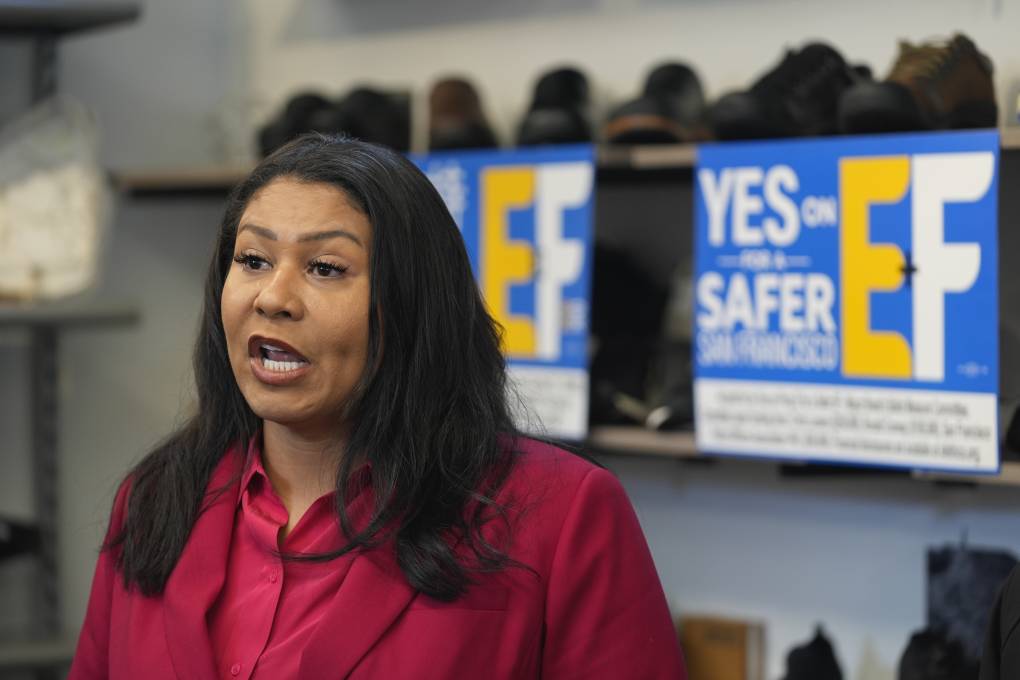
"caption": "San Francisco Mayor London Breed speaks during a news conference to promote Proposition E and F at the Footprint retail store in San Francisco on Thursday, Jan. 25, 2024. ",
"description": null,
"title": "London Breed",
"credit": "Eric Risberg/AP Photo",
"status": "inherit",
"altTag": "San Francisco Mayor London Breed is pictured speaking inside of a business.",
"isLoading": false,
"fetchFailed": false
},
"news_11974380": {
"type": "attachments",
"id": "news_11974380",
"meta": {
"index": "attachments_1716263798",
"site": "news",
"id": "11974380",
"found": true
},
"parent": 11974310,
"imgSizes": {
"thumbnail": {
"file": "https://cdn.kqed.org/wp-content/uploads/sites/10/2024/01/479421059_scr-160x107.jpg",
"width": 160,
"mimeType": "image/jpeg",
"height": 107
},
"post-thumbnail": {
"file": "https://cdn.kqed.org/wp-content/uploads/sites/10/2024/01/479421059_scr-672x372.jpg",
"width": 672,
"mimeType": "image/jpeg",
"height": 372
},
"kqedFullSize": {
"file": "https://cdn.kqed.org/wp-content/uploads/sites/10/2024/01/479421059_scr.jpg",
"width": 850,
"height": 567
},
"medium": {
"file": "https://cdn.kqed.org/wp-content/uploads/sites/10/2024/01/479421059_scr-800x534.jpg",
"width": 800,
"mimeType": "image/jpeg",
"height": 534
}
},
"publishDate": 1706739964,
"modified": 1706740057,
"caption": null,
"description": null,
"title": "479421059_scr",
"credit": "Justin Sullivan/Getty Images",
"status": "inherit",
"altTag": "Image of a computer screen on the Covered California website.",
"isLoading": false,
"fetchFailed": false
},
"news_11973559": {
"type": "attachments",
"id": "news_11973559",
"meta": {
"index": "attachments_1716263798",
"site": "news",
"id": "11973559",
"found": true
},
"parent": 0,
"imgSizes": {
"twentyfourteen-full-width": {
"file": "https://cdn.kqed.org/wp-content/uploads/sites/10/2024/01/240124-HEALTCARE-GAZA-RALLY-MD-02-KQED_1-1038x576.jpg",
"width": 1038,
"mimeType": "image/jpeg",
"height": 576
},
"thumbnail": {
"file": "https://cdn.kqed.org/wp-content/uploads/sites/10/2024/01/240124-HEALTCARE-GAZA-RALLY-MD-02-KQED_1-160x107.jpg",
"width": 160,
"mimeType": "image/jpeg",
"height": 107
},
"post-thumbnail": {
"file": "https://cdn.kqed.org/wp-content/uploads/sites/10/2024/01/240124-HEALTCARE-GAZA-RALLY-MD-02-KQED_1-672x372.jpg",
"width": 672,
"mimeType": "image/jpeg",
"height": 372
},
"kqedFullSize": {
"file": "https://cdn.kqed.org/wp-content/uploads/sites/10/2024/01/240124-HEALTCARE-GAZA-RALLY-MD-02-KQED_1.jpg",
"width": 2000,
"height": 1333
},
"large": {
"file": "https://cdn.kqed.org/wp-content/uploads/sites/10/2024/01/240124-HEALTCARE-GAZA-RALLY-MD-02-KQED_1-1020x680.jpg",
"width": 1020,
"mimeType": "image/jpeg",
"height": 680
},
"1536x1536": {
"file": "https://cdn.kqed.org/wp-content/uploads/sites/10/2024/01/240124-HEALTCARE-GAZA-RALLY-MD-02-KQED_1-1536x1024.jpg",
"width": 1536,
"mimeType": "image/jpeg",
"height": 1024
},
"full-width": {
"file": "https://cdn.kqed.org/wp-content/uploads/sites/10/2024/01/240124-HEALTCARE-GAZA-RALLY-MD-02-KQED_1-1920x1280.jpg",
"width": 1920,
"mimeType": "image/jpeg",
"height": 1280
},
"medium": {
"file": "https://cdn.kqed.org/wp-content/uploads/sites/10/2024/01/240124-HEALTCARE-GAZA-RALLY-MD-02-KQED_1-800x533.jpg",
"width": 800,
"mimeType": "image/jpeg",
"height": 533
}
},
"publishDate": 1706129799,
"modified": 1706146386,
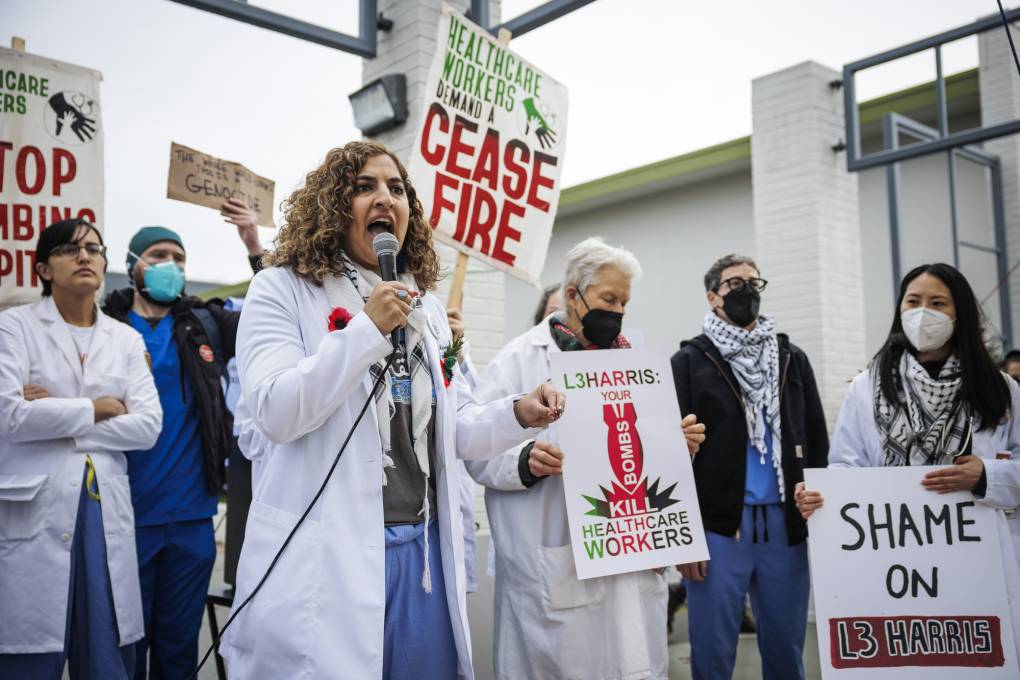
"caption": "Maisa Morrar speaks at a rally of health care workers in front of the L3 Harris office in San Leandro on Jan. 24, 2024.",
"description": null,
"title": "240124-HEALTCARE GAZA RALLY-MD-02-KQED_1",
"credit": "Martin do Nascimento/KQED",
"status": "inherit",
"altTag": "A woman wearing a labcoat talks into a microphone at a rally of health care workers also wearing labcoats holding posters calling for a cease-fire in Gaza.",
"isLoading": false,
"fetchFailed": false
},
"news_11972533": {
"type": "attachments",
"id": "news_11972533",
"meta": {
"index": "attachments_1716263798",
"site": "news",
"id": "11972533",
"found": true
},
"parent": 11972532,
"imgSizes": {
"twentyfourteen-full-width": {
"file": "https://cdn.kqed.org/wp-content/uploads/sites/10/2024/01/covidpartners_final_sm_wide-d805aa85d583f5ffe09f939ee48b5bf36f9eb297-1038x576.jpg",
"width": 1038,
"mimeType": "image/jpeg",
"height": 576
},
"thumbnail": {
"file": "https://cdn.kqed.org/wp-content/uploads/sites/10/2024/01/covidpartners_final_sm_wide-d805aa85d583f5ffe09f939ee48b5bf36f9eb297-160x90.jpg",
"width": 160,
"mimeType": "image/jpeg",
"height": 90
},
"post-thumbnail": {
"file": "https://cdn.kqed.org/wp-content/uploads/sites/10/2024/01/covidpartners_final_sm_wide-d805aa85d583f5ffe09f939ee48b5bf36f9eb297-672x372.jpg",
"width": 672,
"mimeType": "image/jpeg",
"height": 372
},
"kqedFullSize": {
"file": "https://cdn.kqed.org/wp-content/uploads/sites/10/2024/01/covidpartners_final_sm_wide-d805aa85d583f5ffe09f939ee48b5bf36f9eb297-scaled.jpg",
"width": 2560,
"height": 1440
},
"2048x2048": {
"file": "https://cdn.kqed.org/wp-content/uploads/sites/10/2024/01/covidpartners_final_sm_wide-d805aa85d583f5ffe09f939ee48b5bf36f9eb297-2048x1152.jpg",
"width": 2048,
"mimeType": "image/jpeg",
"height": 1152
},
"large": {
"file": "https://cdn.kqed.org/wp-content/uploads/sites/10/2024/01/covidpartners_final_sm_wide-d805aa85d583f5ffe09f939ee48b5bf36f9eb297-1020x574.jpg",
"width": 1020,
"mimeType": "image/jpeg",
"height": 574
},
"1536x1536": {
"file": "https://cdn.kqed.org/wp-content/uploads/sites/10/2024/01/covidpartners_final_sm_wide-d805aa85d583f5ffe09f939ee48b5bf36f9eb297-1536x864.jpg",
"width": 1536,
"mimeType": "image/jpeg",
"height": 864
},
"full-width": {
"file": "https://cdn.kqed.org/wp-content/uploads/sites/10/2024/01/covidpartners_final_sm_wide-d805aa85d583f5ffe09f939ee48b5bf36f9eb297-1920x1080.jpg",
"width": 1920,
"mimeType": "image/jpeg",
"height": 1080
},
"medium": {
"file": "https://cdn.kqed.org/wp-content/uploads/sites/10/2024/01/covidpartners_final_sm_wide-d805aa85d583f5ffe09f939ee48b5bf36f9eb297-800x450.jpg",
"width": 800,
"mimeType": "image/jpeg",
"height": 450
}
},
"publishDate": 1705092889,
"modified": 1705094442,
"caption": null,
"description": null,
"title": "My partner/roommate/kid got COVID. And I didn't. How come?",
"credit": "Josie Norton/NPR",
"status": "inherit",
"altTag": "An illustration of virus spores and to people swatting them with a tennis racket and a mask.",
"isLoading": false,
"fetchFailed": false
},
"news_11972052": {
"type": "attachments",
"id": "news_11972052",
"meta": {
"index": "attachments_1716263798",
"site": "news",
"id": "11972052",
"found": true
},
"parent": 11972039,
"imgSizes": {
"twentyfourteen-full-width": {
"file": "https://cdn.kqed.org/wp-content/uploads/sites/10/2024/01/PROPE_081-qut-1038x576.jpg",
"width": 1038,
"mimeType": "image/jpeg",
"height": 576
},
"thumbnail": {
"file": "https://cdn.kqed.org/wp-content/uploads/sites/10/2024/01/PROPE_081-qut-160x107.jpg",
"width": 160,
"mimeType": "image/jpeg",
"height": 107
},
"post-thumbnail": {
"file": "https://cdn.kqed.org/wp-content/uploads/sites/10/2024/01/PROPE_081-qut-672x372.jpg",
"width": 672,
"mimeType": "image/jpeg",
"height": 372
},
"kqedFullSize": {
"file": "https://cdn.kqed.org/wp-content/uploads/sites/10/2024/01/PROPE_081-qut.jpg",
"width": 1920,
"height": 1280
},
"large": {
"file": "https://cdn.kqed.org/wp-content/uploads/sites/10/2024/01/PROPE_081-qut-1020x680.jpg",
"width": 1020,
"mimeType": "image/jpeg",
"height": 680
},
"1536x1536": {
"file": "https://cdn.kqed.org/wp-content/uploads/sites/10/2024/01/PROPE_081-qut-1536x1024.jpg",
"width": 1536,
"mimeType": "image/jpeg",
"height": 1024
},
"medium": {
"file": "https://cdn.kqed.org/wp-content/uploads/sites/10/2024/01/PROPE_081-qut-800x533.jpg",
"width": 800,
"mimeType": "image/jpeg",
"height": 533
}
},
"publishDate": 1704825105,
"modified": 1704829469,
"caption": "'Fruit n Custard Banana'-flavored tobacco at the Vapor Den in San Francisco on May 9, 2018. According to an employee, the company avoids purchasing flavors that are too childlike in design, even if they are desirable flavors. ",
"description": null,
"title": "PROPE_081-qut",
"credit": "Lauren Hanussak/KQED",
"status": "inherit",
"altTag": "A row of flavored tobacco vape juice bottles.",
"isLoading": false,
"fetchFailed": false
},
"news_11971654": {
"type": "attachments",
"id": "news_11971654",
"meta": {
"index": "attachments_1716263798",
"site": "news",
"id": "11971654",
"found": true
},
"parent": 11971653,
"imgSizes": {
"twentyfourteen-full-width": {
"file": "https://cdn.kqed.org/wp-content/uploads/sites/10/2024/01/121523_Monterey-County-Hospitals_MO_CM_02-copy-1038x576.jpg",
"width": 1038,
"mimeType": "image/jpeg",
"height": 576
},
"thumbnail": {
"file": "https://cdn.kqed.org/wp-content/uploads/sites/10/2024/01/121523_Monterey-County-Hospitals_MO_CM_02-copy-160x107.jpg",
"width": 160,
"mimeType": "image/jpeg",
"height": 107
},
"post-thumbnail": {
"file": "https://cdn.kqed.org/wp-content/uploads/sites/10/2024/01/121523_Monterey-County-Hospitals_MO_CM_02-copy-672x372.jpg",
"width": 672,
"mimeType": "image/jpeg",
"height": 372
},
"kqedFullSize": {
"file": "https://cdn.kqed.org/wp-content/uploads/sites/10/2024/01/121523_Monterey-County-Hospitals_MO_CM_02-copy.jpg",
"width": 2000,
"height": 1333
},
"large": {
"file": "https://cdn.kqed.org/wp-content/uploads/sites/10/2024/01/121523_Monterey-County-Hospitals_MO_CM_02-copy-1020x680.jpg",
"width": 1020,
"mimeType": "image/jpeg",
"height": 680
},
"1536x1536": {
"file": "https://cdn.kqed.org/wp-content/uploads/sites/10/2024/01/121523_Monterey-County-Hospitals_MO_CM_02-copy-1536x1024.jpg",
"width": 1536,
"mimeType": "image/jpeg",
"height": 1024
},
"full-width": {
"file": "https://cdn.kqed.org/wp-content/uploads/sites/10/2024/01/121523_Monterey-County-Hospitals_MO_CM_02-copy-1920x1280.jpg",
"width": 1920,
"mimeType": "image/jpeg",
"height": 1280
},
"medium": {
"file": "https://cdn.kqed.org/wp-content/uploads/sites/10/2024/01/121523_Monterey-County-Hospitals_MO_CM_02-copy-800x533.jpg",
"width": 800,
"mimeType": "image/jpeg",
"height": 533
}
},
"publishDate": 1704406788,
"modified": 1704406812,
"caption": "Community Hospital of the Monterey Peninsula in Monterey on Dec. 15, 2023. \n",
"description": null,
"title": "121523_Monterey-County-Hospitals_MO_CM_02 copy",
"credit": "Manuel Orbegozo for CalMatters",
"status": "inherit",
"altTag": null,
"isLoading": false,
"fetchFailed": false
},
"news_11971104": {
"type": "attachments",
"id": "news_11971104",
"meta": {
"index": "attachments_1716263798",
"site": "news",
"id": "11971104",
"found": true
},
"parent": 11971102,
"imgSizes": {
"twentyfourteen-full-width": {
"file": "https://cdn.kqed.org/wp-content/uploads/sites/10/2023/12/121923_MediCal-Expansion_LJ_CM_06-1038x576.jpg",
"width": 1038,
"mimeType": "image/jpeg",
"height": 576
},
"thumbnail": {
"file": "https://cdn.kqed.org/wp-content/uploads/sites/10/2023/12/121923_MediCal-Expansion_LJ_CM_06-160x107.jpg",
"width": 160,
"mimeType": "image/jpeg",
"height": 107
},
"post-thumbnail": {
"file": "https://cdn.kqed.org/wp-content/uploads/sites/10/2023/12/121923_MediCal-Expansion_LJ_CM_06-672x372.jpg",
"width": 672,
"mimeType": "image/jpeg",
"height": 372
},
"kqedFullSize": {
"file": "https://cdn.kqed.org/wp-content/uploads/sites/10/2023/12/121923_MediCal-Expansion_LJ_CM_06.jpg",
"width": 2000,
"height": 1333
},
"large": {
"file": "https://cdn.kqed.org/wp-content/uploads/sites/10/2023/12/121923_MediCal-Expansion_LJ_CM_06-1020x680.jpg",
"width": 1020,
"mimeType": "image/jpeg",
"height": 680
},
"1536x1536": {
"file": "https://cdn.kqed.org/wp-content/uploads/sites/10/2023/12/121923_MediCal-Expansion_LJ_CM_06-1536x1024.jpg",
"width": 1536,
"mimeType": "image/jpeg",
"height": 1024
},
"full-width": {
"file": "https://cdn.kqed.org/wp-content/uploads/sites/10/2023/12/121923_MediCal-Expansion_LJ_CM_06-1920x1280.jpg",
"width": 1920,
"mimeType": "image/jpeg",
"height": 1280
},
"medium": {
"file": "https://cdn.kqed.org/wp-content/uploads/sites/10/2023/12/121923_MediCal-Expansion_LJ_CM_06-800x533.jpg",
"width": 800,
"mimeType": "image/jpeg",
"height": 533
}
},
"publishDate": 1703794303,
"modified": 1703801619,
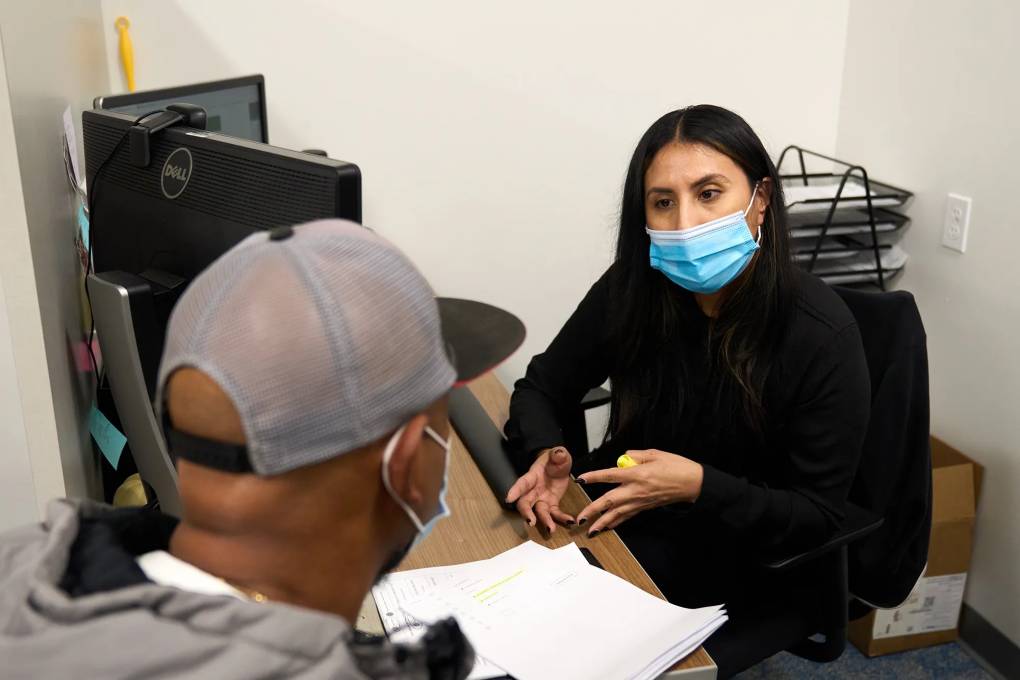
"caption": "Benefits counselor Perla Lopez assists an undocumented person who will be eligible for Medi-Cal health care coverage in the new year at St. John’s Community Health in Los Angeles on Dec. 19, 2023.",
"description": null,
"title": "121923_MediCal-Expansion_LJ_CM_06",
"credit": "Lauren Justice/CalMatters",
"status": "inherit",
"altTag": "A young woman wearing a face mask sits at her desk and talks to a man in a baseball cap. A small stack of paper is between them.",
"isLoading": false,
"fetchFailed": false
},
"news_11935568": {
"type": "attachments",
"id": "news_11935568",
"meta": {
"index": "attachments_1716263798",
"site": "news",
"id": "11935568",
"found": true
},
"parent": 11935500,
"imgSizes": {
"twentyfourteen-full-width": {
"file": "https://cdn.kqed.org/wp-content/uploads/sites/10/2022/12/RS46625_009_SanFrancisco_Hospital_01142021-qut-1038x576.jpg",
"width": 1038,
"mimeType": "image/jpeg",
"height": 576
},
"thumbnail": {
"file": "https://cdn.kqed.org/wp-content/uploads/sites/10/2022/12/RS46625_009_SanFrancisco_Hospital_01142021-qut-160x107.jpg",
"width": 160,
"mimeType": "image/jpeg",
"height": 107
},
"post-thumbnail": {
"file": "https://cdn.kqed.org/wp-content/uploads/sites/10/2022/12/RS46625_009_SanFrancisco_Hospital_01142021-qut-672x372.jpg",
"width": 672,
"mimeType": "image/jpeg",
"height": 372
},
"kqedFullSize": {
"file": "https://cdn.kqed.org/wp-content/uploads/sites/10/2022/12/RS46625_009_SanFrancisco_Hospital_01142021-qut.jpg",
"width": 1920,
"height": 1280
},
"large": {
"file": "https://cdn.kqed.org/wp-content/uploads/sites/10/2022/12/RS46625_009_SanFrancisco_Hospital_01142021-qut-1020x680.jpg",
"width": 1020,
"mimeType": "image/jpeg",
"height": 680
},
"1536x1536": {
"file": "https://cdn.kqed.org/wp-content/uploads/sites/10/2022/12/RS46625_009_SanFrancisco_Hospital_01142021-qut-1536x1024.jpg",
"width": 1536,
"mimeType": "image/jpeg",
"height": 1024
},
"medium": {
"file": "https://cdn.kqed.org/wp-content/uploads/sites/10/2022/12/RS46625_009_SanFrancisco_Hospital_01142021-qut-800x533.jpg",
"width": 800,
"mimeType": "image/jpeg",
"height": 533
}
},
"publishDate": 1671224046,
"modified": 1703727902,
"caption": "A San Francisco Fire Department ambulance leaves the Zuckerberg San Francisco General Hospital on Jan. 14, 2021. ",
"description": null,
"title": "RS46625_009_SanFrancisco_Hospital_01142021-qut",
"credit": "Beth LaBerge/KQED",
"status": "inherit",
"altTag": "An ambulance outside of a hospital.",
"isLoading": false,
"fetchFailed": false
},
"news_11970922": {
"type": "attachments",
"id": "news_11970922",
"meta": {
"index": "attachments_1716263798",
"site": "news",
"id": "11970922",
"found": true
},
"parent": 11970919,
"imgSizes": {
"twentyfourteen-full-width": {
"file": "https://cdn.kqed.org/wp-content/uploads/sites/10/2023/12/231219-OuchlessNeedles-29-BL-qut-1-1038x576.jpg",
"width": 1038,
"mimeType": "image/jpeg",
"height": 576
},
"thumbnail": {
"file": "https://cdn.kqed.org/wp-content/uploads/sites/10/2023/12/231219-OuchlessNeedles-29-BL-qut-1-160x107.jpg",
"width": 160,
"mimeType": "image/jpeg",
"height": 107
},
"post-thumbnail": {
"file": "https://cdn.kqed.org/wp-content/uploads/sites/10/2023/12/231219-OuchlessNeedles-29-BL-qut-1-672x372.jpg",
"width": 672,
"mimeType": "image/jpeg",
"height": 372
},
"kqedFullSize": {
"file": "https://cdn.kqed.org/wp-content/uploads/sites/10/2023/12/231219-OuchlessNeedles-29-BL-qut-1.jpg",
"width": 1920,
"height": 1280
},
"large": {
"file": "https://cdn.kqed.org/wp-content/uploads/sites/10/2023/12/231219-OuchlessNeedles-29-BL-qut-1-1020x680.jpg",
"width": 1020,
"mimeType": "image/jpeg",
"height": 680
},
"1536x1536": {
"file": "https://cdn.kqed.org/wp-content/uploads/sites/10/2023/12/231219-OuchlessNeedles-29-BL-qut-1-1536x1024.jpg",
"width": 1536,
"mimeType": "image/jpeg",
"height": 1024
},
"medium": {
"file": "https://cdn.kqed.org/wp-content/uploads/sites/10/2023/12/231219-OuchlessNeedles-29-BL-qut-1-800x533.jpg",
"width": 800,
"mimeType": "image/jpeg",
"height": 533
}
},
"publishDate": 1703618448,
"modified": 1703635009,
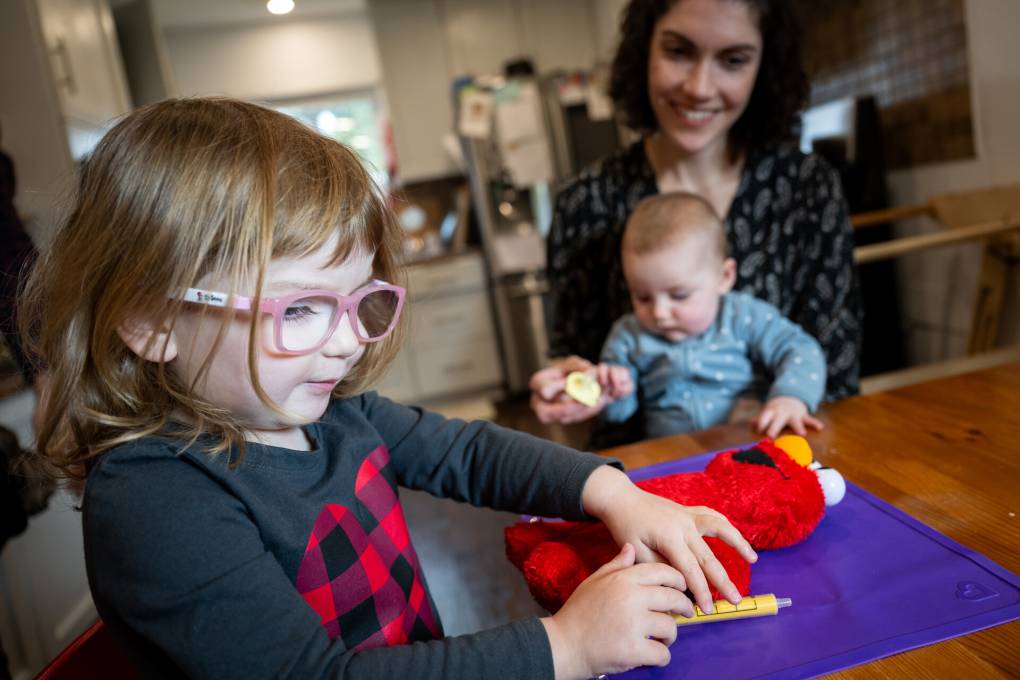
"caption": "Julia Cramer sits with her two children — Maya, 3, and Lily, 6 months — at their home in Petaluma on Dec. 19, 2023. Maya administers a pretend shot to her Elmo doll that she often brings to the doctors' office.",
"description": null,
"title": "231219-OuchlessNeedles-29-BL-qut (1)",
"credit": "Beth LaBerge/KQED",
"status": "inherit",
"altTag": "A mother with a baby on her lap sits next to a 3-year-old, who is playing with a toy needle and an Elmo doll.",
"isLoading": false,
"fetchFailed": false
},
"news_11970625": {
"type": "attachments",
"id": "news_11970625",
"meta": {
"index": "attachments_1716263798",
"site": "news",
"id": "11970625",
"found": true
},
"parent": 0,
"imgSizes": {
"twentyfourteen-full-width": {
"file": "https://cdn.kqed.org/wp-content/uploads/sites/10/2023/12/231220-TIRECOVERY-10-BL-KQED-1038x576.jpg",
"width": 1038,
"mimeType": "image/jpeg",
"height": 576
},
"thumbnail": {
"file": "https://cdn.kqed.org/wp-content/uploads/sites/10/2023/12/231220-TIRECOVERY-10-BL-KQED-160x107.jpg",
"width": 160,
"mimeType": "image/jpeg",
"height": 107
},
"post-thumbnail": {
"file": "https://cdn.kqed.org/wp-content/uploads/sites/10/2023/12/231220-TIRECOVERY-10-BL-KQED-672x372.jpg",
"width": 672,
"mimeType": "image/jpeg",
"height": 372
},
"kqedFullSize": {
"file": "https://cdn.kqed.org/wp-content/uploads/sites/10/2023/12/231220-TIRECOVERY-10-BL-KQED.jpg",
"width": 2000,
"height": 1333
},
"large": {
"file": "https://cdn.kqed.org/wp-content/uploads/sites/10/2023/12/231220-TIRECOVERY-10-BL-KQED-1020x680.jpg",
"width": 1020,
"mimeType": "image/jpeg",
"height": 680
},
"1536x1536": {
"file": "https://cdn.kqed.org/wp-content/uploads/sites/10/2023/12/231220-TIRECOVERY-10-BL-KQED-1536x1024.jpg",
"width": 1536,
"mimeType": "image/jpeg",
"height": 1024
},
"full-width": {
"file": "https://cdn.kqed.org/wp-content/uploads/sites/10/2023/12/231220-TIRECOVERY-10-BL-KQED-1920x1280.jpg",
"width": 1920,
"mimeType": "image/jpeg",
"height": 1280
},
"medium": {
"file": "https://cdn.kqed.org/wp-content/uploads/sites/10/2023/12/231220-TIRECOVERY-10-BL-KQED-800x533.jpg",
"width": 800,
"mimeType": "image/jpeg",
"height": 533
}
},
"publishDate": 1703183222,
"modified": 1703205795,
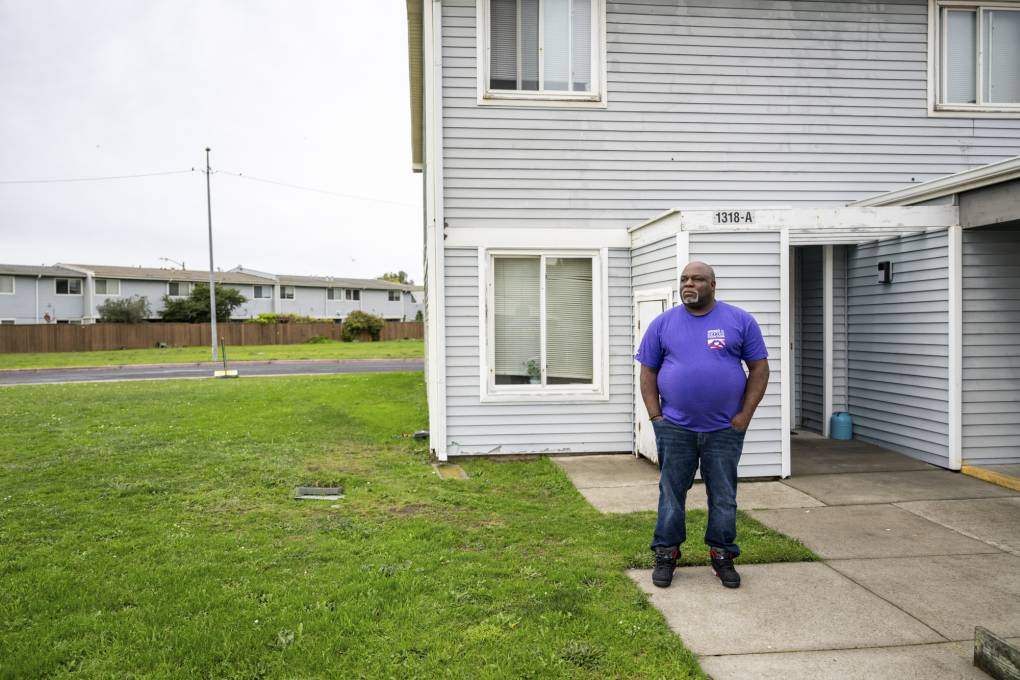
"caption": "De'Andre Devereaux stands outside a holiday party at HealthRight 360's Recovery Residence program on Treasure Island on Dec. 20, 2023.",
"description": null,
"title": "231220-TIRECOVERY-10-BL-KQED",
"credit": "Beth LaBerge/KQED",
"status": "inherit",
"altTag": "A person with a bald head stands in front of a building in a residential area.",
"isLoading": false,
"fetchFailed": false
},
"news_11970417": {
"type": "attachments",
"id": "news_11970417",
"meta": {
"index": "attachments_1716263798",
"site": "news",
"id": "11970417",
"found": true
},
"parent": 11970414,
"imgSizes": {
"twentyfourteen-full-width": {
"file": "https://cdn.kqed.org/wp-content/uploads/sites/10/2023/12/07262022_MLK-Hospital_PU_CM_23-1038x576.jpeg",
"width": 1038,
"mimeType": "image/jpeg",
"height": 576
},
"thumbnail": {
"file": "https://cdn.kqed.org/wp-content/uploads/sites/10/2023/12/07262022_MLK-Hospital_PU_CM_23-160x107.jpeg",
"width": 160,
"mimeType": "image/jpeg",
"height": 107
},
"post-thumbnail": {
"file": "https://cdn.kqed.org/wp-content/uploads/sites/10/2023/12/07262022_MLK-Hospital_PU_CM_23-672x372.jpeg",
"width": 672,
"mimeType": "image/jpeg",
"height": 372
},
"kqedFullSize": {
"file": "https://cdn.kqed.org/wp-content/uploads/sites/10/2023/12/07262022_MLK-Hospital_PU_CM_23.jpeg",
"width": 2000,
"height": 1333
},
"large": {
"file": "https://cdn.kqed.org/wp-content/uploads/sites/10/2023/12/07262022_MLK-Hospital_PU_CM_23-1020x680.jpeg",
"width": 1020,
"mimeType": "image/jpeg",
"height": 680
},
"1536x1536": {
"file": "https://cdn.kqed.org/wp-content/uploads/sites/10/2023/12/07262022_MLK-Hospital_PU_CM_23-1536x1024.jpeg",
"width": 1536,
"mimeType": "image/jpeg",
"height": 1024
},
"full-width": {
"file": "https://cdn.kqed.org/wp-content/uploads/sites/10/2023/12/07262022_MLK-Hospital_PU_CM_23-1920x1280.jpeg",
"width": 1920,
"mimeType": "image/jpeg",
"height": 1280
},
"medium": {
"file": "https://cdn.kqed.org/wp-content/uploads/sites/10/2023/12/07262022_MLK-Hospital_PU_CM_23-800x533.jpeg",
"width": 800,
"mimeType": "image/jpeg",
"height": 533
}
},
"publishDate": 1703009122,
"modified": 1703015336,
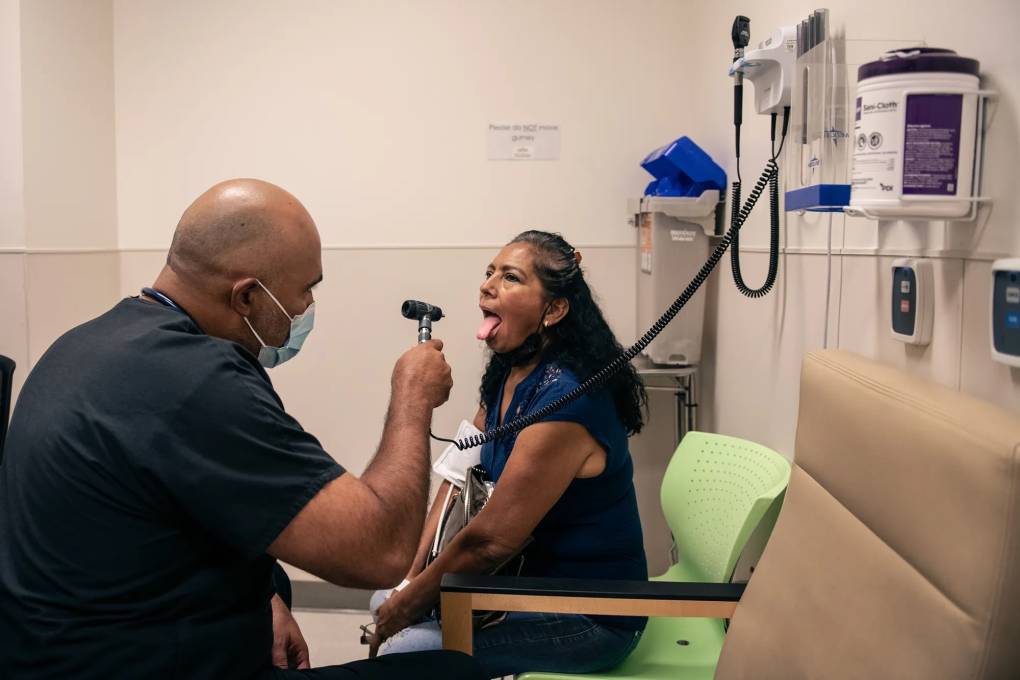
"caption": "Elvia Macedo, a Medi-Cal patient, gets a check-up with Dr. Oscar Casillas at Martin Luther King Jr. Community Hospital in Los Angeles on July 26, 2022. ",
"description": null,
"title": "07262022_MLK-Hospital_PU_CM_23",
"credit": "Pablo Unzueta/CalMatters",
"status": "inherit",
"altTag": "A male doctor examines a seated female patient who is sticking out her tongue in an exam room.",
"isLoading": false,
"fetchFailed": false
},
"news_11969925": {
"type": "attachments",
"id": "news_11969925",
"meta": {
"index": "attachments_1716263798",
"site": "news",
"id": "11969925",
"found": true
},
"parent": 0,
"imgSizes": {
"twentyfourteen-full-width": {
"file": "https://cdn.kqed.org/wp-content/uploads/sites/10/2023/12/231214-AVIAN-FLU-GETTY-MT-KQED-1038x576.jpg",
"width": 1038,
"mimeType": "image/jpeg",
"height": 576
},
"thumbnail": {
"file": "https://cdn.kqed.org/wp-content/uploads/sites/10/2023/12/231214-AVIAN-FLU-GETTY-MT-KQED-160x102.jpg",
"width": 160,
"mimeType": "image/jpeg",
"height": 102
},
"post-thumbnail": {
"file": "https://cdn.kqed.org/wp-content/uploads/sites/10/2023/12/231214-AVIAN-FLU-GETTY-MT-KQED-672x372.jpg",
"width": 672,
"mimeType": "image/jpeg",
"height": 372
},
"kqedFullSize": {
"file": "https://cdn.kqed.org/wp-content/uploads/sites/10/2023/12/231214-AVIAN-FLU-GETTY-MT-KQED.jpg",
"width": 2000,
"height": 1277
},
"large": {
"file": "https://cdn.kqed.org/wp-content/uploads/sites/10/2023/12/231214-AVIAN-FLU-GETTY-MT-KQED-1020x651.jpg",
"width": 1020,
"mimeType": "image/jpeg",
"height": 651
},
"1536x1536": {
"file": "https://cdn.kqed.org/wp-content/uploads/sites/10/2023/12/231214-AVIAN-FLU-GETTY-MT-KQED-1536x981.jpg",
"width": 1536,
"mimeType": "image/jpeg",
"height": 981
},
"full-width": {
"file": "https://cdn.kqed.org/wp-content/uploads/sites/10/2023/12/231214-AVIAN-FLU-GETTY-MT-KQED-1920x1226.jpg",
"width": 1920,
"mimeType": "image/jpeg",
"height": 1226
},
"medium": {
"file": "https://cdn.kqed.org/wp-content/uploads/sites/10/2023/12/231214-AVIAN-FLU-GETTY-MT-KQED-800x511.jpg",
"width": 800,
"mimeType": "image/jpeg",
"height": 511
}
},
"publishDate": 1702602082,
"modified": 1702602163,
"caption": "Chickens in an aviary in Acton on Oct. 5, 2022. ",
"description": null,
"title": "Southern California Hit With Historic Avian Flu Outbreak",
"credit": "Mario Tama/Getty Images",
"status": "inherit",
"altTag": "A group of four differently colored chickens.",
"isLoading": false,
"fetchFailed": false
}
},
"audioPlayerReducer": {
"postId": "stream_live",
"isPaused": true,
"isPlaying": false,
"pfsActive": false,
"pledgeModalIsOpen": true,
"playerDrawerIsOpen": false,
"liveAudioPlayStartedAt": 0,
"liveAudioPlayContext": ""
},
"authorsReducer": {
"byline_news_11974695": {
"type": "authors",
"id": "byline_news_11974695",
"meta": {
"override": true
},
"slug": "byline_news_11974695",
"name": "\u003ca href=\"https://apnews.com/\">Janie Har\u003c/a> \u003cbr> Associated Press",
"isLoading": false
},
"byline_news_11972532": {
"type": "authors",
"id": "byline_news_11972532",
"meta": {
"override": true
},
"slug": "byline_news_11972532",
"name": "Abraar Karan",
"isLoading": false
},
"byline_news_11972039": {
"type": "authors",
"id": "byline_news_11972039",
"meta": {
"override": true
},
"slug": "byline_news_11972039",
"name": "\u003ca href=\"https://calmatters.org/author/lynn-la/\">Lynn La\u003c/a>",
"isLoading": false
},
"byline_news_11971653": {
"type": "authors",
"id": "byline_news_11971653",
"meta": {
"override": true
},
"slug": "byline_news_11971653",
"name": "\u003ca href=\"https://calmatters.org/author/kristen-hwang/\">Kristen Hwang\u003c/a>",
"isLoading": false
},
"byline_news_11971102": {
"type": "authors",
"id": "byline_news_11971102",
"meta": {
"override": true
},
"slug": "byline_news_11971102",
"name": "\u003ca href=\"https://calmatters.org/author/kristen-hwang/\">Kristen Hwang\u003c/a>",
"isLoading": false
},
"byline_news_11971055": {
"type": "authors",
"id": "byline_news_11971055",
"meta": {
"override": true
},
"slug": "byline_news_11971055",
"name": "\u003ca href=\"https://calmatters.org/author/kristen-hwang/\">Kristen Hwang\u003c/a>",
"isLoading": false
},
"byline_news_11970414": {
"type": "authors",
"id": "byline_news_11970414",
"meta": {
"override": true
},
"slug": "byline_news_11970414",
"name": "\u003ca href=\"https://calmatters.org/author/anaibarra/\">Ana Ibarra\u003c/a>",
"isLoading": false
},
"adembosky": {
"type": "authors",
"id": "3205",
"meta": {
"index": "authors_1716337520",
"id": "3205",
"found": true
},
"name": "April Dembosky",
"firstName": "April",
"lastName": "Dembosky",
"slug": "adembosky",
"email": "adembosky@kqed.org",
"display_author_email": false,
"staff_mastheads": [
"news",
"science"
],
"title": "KQED Health Correspondent",
"bio": "April Dembosky is the health correspondent for KQED News and a regular contributor to NPR. She specializes in covering altered states of mind, from postpartum depression to methamphetamine-induced psychosis to the insanity defense. Her investigative series on insurance companies sidestepping mental health laws won multiple awards, including first place in beat reporting from the national Association of Health Care Journalists. She is the recipient of numerous other prizes and fellowships, including a national Edward R. Murrow award for investigative reporting, a Society of Professional Journalists award for long-form storytelling, and a Carter Center Fellowship for Mental Health Journalism.\r\n\r\nDembosky reported and produced \u003cem>Soundtrack of Silence\u003c/em>, an audio documentary about music and memory that is currently being made into a feature film by Paramount Pictures.\r\n\r\nBefore joining KQED in 2013, Dembosky covered technology and Silicon Valley for \u003cem>The Financial Times of London,\u003c/em> and contributed business and arts stories to \u003cem>Marketplace \u003c/em>and \u003cem>The New York Times.\u003c/em> She got her undergraduate degree in philosophy from Smith College and her master's in journalism from the University of California, Berkeley. She is a classically trained violinist and proud alum of the first symphony orchestra at Burning Man.",
"avatar": "https://secure.gravatar.com/avatar/ef92999be4ceb9ea60701e7dc276f813?s=600&d=blank&r=g",
"twitter": "adembosky",
"facebook": null,
"instagram": null,
"linkedin": null,
"sites": [
{
"site": "arts",
"roles": [
"author"
]
},
{
"site": "news",
"roles": [
"editor"
]
},
{
"site": "futureofyou",
"roles": [
"author"
]
},
{
"site": "stateofhealth",
"roles": [
"editor"
]
},
{
"site": "science",
"roles": [
"editor"
]
},
{
"site": "forum",
"roles": [
"editor"
]
}
],
"headData": {
"title": "April Dembosky | KQED",
"description": "KQED Health Correspondent",
"ogImgSrc": "https://secure.gravatar.com/avatar/ef92999be4ceb9ea60701e7dc276f813?s=600&d=blank&r=g",
"twImgSrc": "https://secure.gravatar.com/avatar/ef92999be4ceb9ea60701e7dc276f813?s=600&d=blank&r=g"
},
"isLoading": false,
"link": "/author/adembosky"
},
"ccabreralomeli": {
"type": "authors",
"id": "11708",
"meta": {
"index": "authors_1716337520",
"id": "11708",
"found": true
},
"name": "Carlos Cabrera-Lomelí",
"firstName": "Carlos",
"lastName": "Cabrera-Lomelí",
"slug": "ccabreralomeli",
"email": "ccabreralomeli@KQED.org",
"display_author_email": true,
"staff_mastheads": [
"news"
],
"title": "Community Reporter",
"bio": "Carlos Cabrera-Lomelí is a community reporter with KQED's digital engagement team. He also reports and co-produces for KQED's bilingual news hub KQED en Español. He grew up in San Francisco's Mission District and has previously worked with Univision, 48 Hills and REFORMA in Mexico City.",
"avatar": "https://secure.gravatar.com/avatar/c309be9665e484f887b818c89e273ecc673004f426f36b24d00a4d813a2e0518?s=600&d=blank&r=g",
"twitter": "@LomeliCabrera",
"bluesky": null,
"facebook": null,
"instagram": null,
"linkedin": null,
"sites": [
{
"site": "arts",
"roles": [
"editor"
]
},
{
"site": "news",
"roles": [
"editor"
]
},
{
"site": "about",
"roles": [
"editor"
]
},
{
"site": "science",
"roles": [
"editor"
]
},
{
"site": "perspectives",
"roles": [
"editor"
]
},
{
"site": "elections",
"roles": [
"editor"
]
},
{
"site": "liveblog",
"roles": [
"contributor"
]
}
],
"headData": {
"title": "Carlos Cabrera-Lomelí | KQED",
"description": "Community Reporter",
"ogImgSrc": "https://secure.gravatar.com/avatar/c309be9665e484f887b818c89e273ecc673004f426f36b24d00a4d813a2e0518?s=600&d=blank&r=g",
"twImgSrc": "https://secure.gravatar.com/avatar/c309be9665e484f887b818c89e273ecc673004f426f36b24d00a4d813a2e0518?s=600&d=blank&r=g"
},
"isLoading": false,
"link": "/author/ccabreralomeli"
},
"jlara": {
"type": "authors",
"id": "11761",
"meta": {
"index": "authors_1716337520",
"id": "11761",
"found": true
},
"name": "Juan Carlos Lara",
"firstName": "Juan Carlos",
"lastName": "Lara",
"slug": "jlara",
"email": "jlara@kqed.org",
"display_author_email": false,
"staff_mastheads": [],
"title": "KQED Contributor",
"bio": null,
"avatar": "https://secure.gravatar.com/avatar/19e2052b9b05657c5ff2af2121846e9c?s=600&d=blank&r=g",
"twitter": null,
"facebook": null,
"instagram": null,
"linkedin": null,
"sites": [
{
"site": "arts",
"roles": [
"editor"
]
},
{
"site": "news",
"roles": [
"editor"
]
},
{
"site": "forum",
"roles": [
"editor"
]
},
{
"site": "liveblog",
"roles": [
"contributor"
]
}
],
"headData": {
"title": "Juan Carlos Lara | KQED",
"description": "KQED Contributor",
"ogImgSrc": "https://secure.gravatar.com/avatar/19e2052b9b05657c5ff2af2121846e9c?s=600&d=blank&r=g",
"twImgSrc": "https://secure.gravatar.com/avatar/19e2052b9b05657c5ff2af2121846e9c?s=600&d=blank&r=g"
},
"isLoading": false,
"link": "/author/jlara"
},
"sjohnson": {
"type": "authors",
"id": "11840",
"meta": {
"index": "authors_1716337520",
"id": "11840",
"found": true
},
"name": "Sydney Johnson",
"firstName": "Sydney",
"lastName": "Johnson",
"slug": "sjohnson",
"email": "sjohnson@kqed.org",
"display_author_email": false,
"staff_mastheads": [
"news"
],
"title": "KQED Reporter",
"bio": "Sydney Johnson is a general assignment reporter at KQED. She previously reported on public health and city government at the San Francisco Examiner, and before that, she covered statewide education policy for EdSource. Her reporting has won multiple local, state and national awards. Sydney is a graduate of the University of California, Berkeley and lives in San Francisco.",
"avatar": "https://secure.gravatar.com/avatar/97855f2719b72ad6190b7c535fe642c8?s=600&d=blank&r=g",
"twitter": "sydneyfjohnson",
"facebook": null,
"instagram": null,
"linkedin": null,
"sites": [
{
"site": "news",
"roles": [
"editor"
]
}
],
"headData": {
"title": "Sydney Johnson | KQED",
"description": "KQED Reporter",
"ogImgSrc": "https://secure.gravatar.com/avatar/97855f2719b72ad6190b7c535fe642c8?s=600&d=blank&r=g",
"twImgSrc": "https://secure.gravatar.com/avatar/97855f2719b72ad6190b7c535fe642c8?s=600&d=blank&r=g"
},
"isLoading": false,
"link": "/author/sjohnson"
},
"naltenberg": {
"type": "authors",
"id": "11896",
"meta": {
"index": "authors_1716337520",
"id": "11896",
"found": true
},
"name": "Nik Altenberg",
"firstName": "Nik",
"lastName": "Altenberg",
"slug": "naltenberg",
"email": "naltenberg@kqed.org",
"display_author_email": false,
"staff_mastheads": [],
"title": "KQED Contributor",
"bio": "Nik Altenberg is an on-call reporter for KQED and a copy editor and fact checker for Santa Cruz Local. Nik’s reporting interests include policing, public health, environment, immigration, housing and the places where these issues intersect.",
"avatar": "https://secure.gravatar.com/avatar/e391b3a18ce4a53a7ca3f3065c74418b?s=600&d=blank&r=g",
"twitter": null,
"facebook": null,
"instagram": "https://www.instagram.com/nikaltenberg/",
"linkedin": null,
"sites": [
{
"site": "news",
"roles": []
}
],
"headData": {
"title": "Nik Altenberg | KQED",
"description": "KQED Contributor",
"ogImgSrc": "https://secure.gravatar.com/avatar/e391b3a18ce4a53a7ca3f3065c74418b?s=600&d=blank&r=g",
"twImgSrc": "https://secure.gravatar.com/avatar/e391b3a18ce4a53a7ca3f3065c74418b?s=600&d=blank&r=g"
},
"isLoading": false,
"link": "/author/naltenberg"
}
},
"pagesReducer": {
"news_tag_health": {
"type": "terms",
"id": "news_18543",
"meta": {
"index": "terms_1716263798",
"site": "news",
"id": "18543",
"score": 6.886659
},
"featImg": null,
"name": "Health",
"description": null,
"taxonomy": "tag",
"headData": {
"twImgId": null,
"twTitle": null,
"ogTitle": null,
"ogImgId": null,
"twDescription": null,
"description": null,
"title": "Health Archives | KQED News",
"ogDescription": null
},
"ttid": 466,
"slug": "health",
"isLoading": false,
"title": "Health",
"pageMeta": {
"site": "news",
"WpPageTemplate": "page-topic-editorial",
"currentPage": 39
},
"blocks": [
{
"blockName": "kqed/post-list",
"attrs": {
"layout": "cardArticle2",
"query": "posts/news?tag=health",
"seeMore": false,
"paginated": true,
"page": 39
}
},
{
"blockName": "kqed/ad"
}
]
}
},
"pfsSessionReducer": {},
"postsReducer": {
"stream_live": {
"type": "live",
"id": "stream_live",
"audioUrl": "https://streams.kqed.org/kqedradio",
"title": "Live Stream",
"excerpt": "Live Stream information currently unavailable.",
"link": "/radio",
"featImg": "",
"label": {
"name": "KQED Live",
"link": "/"
}
},
"stream_kqedNewscast": {
"type": "posts",
"id": "stream_kqedNewscast",
"audioUrl": "https://www.kqed.org/.stream/anon/radio/RDnews/newscast.mp3?_=1",
"title": "KQED Newscast",
"featImg": "",
"label": {
"name": "88.5 FM",
"link": "/"
}
},
"news_11974695": {
"type": "posts",
"id": "news_11974695",
"meta": {
"index": "posts_1716263798",
"site": "news",
"id": "11974695",
"score": null,
"sort": [
1707151787000
]
},
"parent": 0,
"labelTerm": {
"site": "news"
},
"blocks": [],
"publishDate": 1707151787,
"format": "standard",
"title": "San Francisco Considers a Measure to Screen Welfare Recipients for Addiction",
"headTitle": "San Francisco Considers a Measure to Screen Welfare Recipients for Addiction | KQED",
"content": "\u003cp>The Democratic mayor of San Francisco is pushing a pair of controversial public safety proposals on the March 5 ballot, including one that would require single adults on welfare to be screened and treated for illegal drug addiction or else lose cash assistance.\u003c/p>\n\u003cp>\u003ca href=\"https://apnews.com/domestic-general-news-3b2cac01584f4479b7b1da0bde1c8a88\">Mayor London Breed\u003c/a> also supports a ballot measure that would grant police more crime-fighting powers, such as using drones and surveillance cameras. In November, she’ll face cranky voters in a competitive reelection bid.\u003c/p>\n\u003cp>San Francisco is in a struggle to redefine itself after the pandemic left it in economic tatters and highlighted its \u003ca style=\"font-weight: var(--font-weight-reg)\" href=\"https://apnews.com/article/coronavirus-pandemic-sports-business-health-lifestyle-538efc664e9da0d2f0831f3f3ed9a4d7\">longstanding problems\u003c/a> with homelessness, drugs and property crime. Opponents say both ballot measures are wildly out of step with San Francisco’s support for privacy and civil liberties and will only hurt the marginalized communities the city prides itself on helping. [pullquote size=\"medium\" align=\"right\" citation=\"San Francisco Mayor London Breed\"]‘They said San Francisco makes it too easy for people to access and to use drugs on the streets of the city, and we need to do something a lot more aggressive.’[/pullquote]But Breed, the first Black woman to lead San Francisco, said at a January campaign stop that residents from poorer, Black and immigrant neighborhoods are pleading for more police, and recovery advocates are demanding change as more than 800 people died of accidental overdose last year — a record fueled by the abundance of cheap and potent fentanyl.\u003c/p>\n\u003cp>“They said San Francisco makes it too easy for people to access and to use drugs on the streets of the city, and we need to do something a lot more aggressive,” Breed said at Footprint, an athletic apparel and shoe store that has been repeatedly burglarized.\u003c/p>\n\u003cp>While Breed’s name isn’t on the presidential primary ballots going out now — San Francisco uses a method where residents rank mayoral candidates by preference a single time in November — the two measures she’s pushing are. They serve as an opening salvo for her reelection campaign as she faces off against fellow moderates who say her approach to the city’s problems has been weak.\u003c/p>\n\u003cp>[ad fullwidth]\u003c/p>\n\u003cp>Violent crimes are low in San Francisco, but the city has long struggled with quality-of-life crimes.\u003c/p>\n\u003cp>Breed said rates of retail theft and auto smash-ins have declined recently, thanks in large part to strategic operations by city police. Similarly, police have stepped up enforcement of drug laws, including by issuing citations to people using drugs in public as a way to disrupt the behavior and an opportunity to persuade the person cited to seek help.\u003c/p>\n\u003cp>But she said San Francisco needs to do more.\u003c/p>\n\u003cp>If approved by voters, Proposition F would offer another way to compel treatment by allowing the city to screen single adults on local welfare for substance abuse. People found to be abusing illegal drugs would be required to enroll in treatment if they want to receive cash assistance from the city, which maxes out at just over $700 a month. [aside label='More Stories on Public Health' tag='public-health']Opponents say coercion doesn’t work and homelessness may increase if the measure passes. Drug addicts are not criminals, they say, and there are not enough treatment beds and counseling services as it is.\u003c/p>\n\u003cp>A crackdown on drugs is reminiscent of the failed war on drugs that disproportionately harmed Black families, said Chris Ballard, co-executive director of Coleman Advocates, which pushes for improvements for Black and Latino youth in San Francisco.\u003c/p>\n\u003cp>“There are more ethical ways to address the issue aside from punitive measures, and that’s the proper way to take care of a community, to show true support,” he said.\u003c/p>\n\u003cp>Yet Trent Rhorer, executive director of the San Francisco Human Services Agency, which provides cash assistance and employment services to low-income residents without dependent children, said the current situation conflicts with the agency’s mission: to improve lives.\u003c/p>\n\u003cp>“To give someone who’s addicted to fentanyl $700 a month, I don’t think it helps improve their lives,” he said. “In fact, I think it does the opposite.”\u003c/p>\n\u003cp>Compelling treatment has become more acceptable in Democratic California, despite angst over the potential loss of civil liberties, as visible signs of homelessness and mental illness, fentanyl addiction, and unsafe street behavior surge.\u003c/p>\n\u003cp>Last year, several counties rolled out an alternative mental health court created by Democratic Gov. Gavin Newsom, former mayor of San Francisco, to fast-track people with untreated schizophrenia and related disorders into care, and in March, voters will take up a statewide mental health proposition, that some say will increase involuntary treatment.\u003c/p>\n\u003cp>Rhorer said the welfare program for single adults — which serves about 9,000 people per year — already asks applicants about substance abuse, with about 20% self-reporting an issue. A data check with the Department of Public Health revealed that almost one-third of recipients have been diagnosed with a substance use disorder, he said.\u003c/p>\n\u003cp>The ballot measure would replace that question with a more rigorous screening test that an addiction specialist would verify. If substance abuse is found, Rhorer said, the specialist and applicant would agree on treatment options that include residential care, a 12-step program, individual counseling and replacement medication. [pullquote size=\"medium\" align=\"right\" citation=\"Michael Hsu, store owner, Footprint USA\"]‘You’re sending the wrong message to these criminals.’[/pullquote]There is no requirement that the person be sober, only that they make good-faith efforts to attend their program, with the hope that “at one point a light bulb will go off,” Rhorer said.\u003c/p>\n\u003cp>The measure calls for the city to pay the rent of those accepted into the program for 30 days or longer to avoid eviction. About 30% of the people who fatally overdosed in 2023 were homeless, and more were living in subsidized city housing.\u003c/p>\n\u003cp>Besides authorizing drones, cameras and other modern technologies, Proposition E would reduce paperwork so police have more time to patrol. It would also allow police to pursue more suspects by vehicle, not just in cases of a violent felony or immediate threat to public safety — a policy store owner Michael Hsu learned of the hard way.\u003c/p>\n\u003cp>Hsu has had his Footprint store broken into multiple times since he took over in 2020, most recently on Jan. 1. Police arrived as the suspects were leaving but could not pursue them because no lives were at risk. Hsu, who lost about $20,000 in merchandise and damage, called that discouraging.\u003c/p>\n\u003cp>“You’re sending the wrong message to these criminals,” he said.\u003c/p>\n\u003cp>[ad floatright]\u003c/p>\n",
"stats": {
"hasVideo": false,
"hasChartOrMap": false,
"hasAudio": false,
"hasPolis": false,
"wordCount": 1132,
"hasGoogleForm": false,
"hasGallery": false,
"hasHearkenModule": false,
"iframeSrcs": [],
"paragraphCount": 23
},
"modified": 1707162574,
"excerpt": "The Democratic mayor of San Francisco is pushing a March 5 ballot measure that would require single adults on welfare to be screened and treated for illegal drug addiction or else lose cash assistance.",
"headData": {
"twImgId": "",
"twTitle": "",
"ogTitle": "",
"ogImgId": "",
"twDescription": "",
"description": "The Democratic mayor of San Francisco is pushing a March 5 ballot measure that would require single adults on welfare to be screened and treated for illegal drug addiction or else lose cash assistance.",
"title": "San Francisco Considers a Measure to Screen Welfare Recipients for Addiction | KQED",
"ogDescription": "",
"schema": {
"@context": "https://schema.org",
"@type": "NewsArticle",
"headline": "San Francisco Considers a Measure to Screen Welfare Recipients for Addiction",
"datePublished": "2024-02-05T08:49:47-08:00",
"dateModified": "2024-02-05T11:49:34-08:00",
"image": "https://cdn.kqed.org/wp-content/uploads/2020/02/KQED-OG-Image@1x.png",
"isAccessibleForFree": "True",
"publisher": {
"@type": "NewsMediaOrganization",
"@id": "https://www.kqed.org/#organization",
"name": "KQED",
"logo": "https://cdn.kqed.org/wp-content/uploads/2020/02/KQED-OG-Image@1x.png",
"url": "https://www.kqed.org",
"sameAs": [
"https://www.facebook.com/KQED",
"https://twitter.com/KQED",
"https://www.instagram.com/kqed/",
"https://www.tiktok.com/@kqedofficial",
"https://www.linkedin.com/company/kqed",
"https://www.youtube.com/channel/UCeC0IOo7i1P_61zVUWbJ4nw"
]
}
}
},
"guestAuthors": [],
"slug": "san-francisco-considers-a-measure-to-screen-welfare-recipients-for-addiction",
"status": "publish",
"nprByline": "\u003ca href=\"https://apnews.com/\">Janie Har\u003c/a> \u003cbr> Associated Press",
"excludeFromSiteSearch": "Include",
"sticky": false,
"showOnAuthorArchivePages": "No",
"articleAge": "0",
"path": "/news/11974695/san-francisco-considers-a-measure-to-screen-welfare-recipients-for-addiction",
"audioTrackLength": null,
"parsedContent": [
{
"type": "contentString",
"content": "\u003cdiv class=\"post-body\">\u003cp>\u003cp>The Democratic mayor of San Francisco is pushing a pair of controversial public safety proposals on the March 5 ballot, including one that would require single adults on welfare to be screened and treated for illegal drug addiction or else lose cash assistance.\u003c/p>\n\u003cp>\u003ca href=\"https://apnews.com/domestic-general-news-3b2cac01584f4479b7b1da0bde1c8a88\">Mayor London Breed\u003c/a> also supports a ballot measure that would grant police more crime-fighting powers, such as using drones and surveillance cameras. In November, she’ll face cranky voters in a competitive reelection bid.\u003c/p>\n\u003cp>San Francisco is in a struggle to redefine itself after the pandemic left it in economic tatters and highlighted its \u003ca style=\"font-weight: var(--font-weight-reg)\" href=\"https://apnews.com/article/coronavirus-pandemic-sports-business-health-lifestyle-538efc664e9da0d2f0831f3f3ed9a4d7\">longstanding problems\u003c/a> with homelessness, drugs and property crime. Opponents say both ballot measures are wildly out of step with San Francisco’s support for privacy and civil liberties and will only hurt the marginalized communities the city prides itself on helping. \u003c/p>\u003c/div>",
"attributes": {
"named": {},
"numeric": []
}
},
{
"type": "component",
"content": "‘They said San Francisco makes it too easy for people to access and to use drugs on the streets of the city, and we need to do something a lot more aggressive.’",
"name": "pullquote",
"attributes": {
"named": {
"size": "medium",
"align": "right",
"citation": "San Francisco Mayor London Breed",
"label": ""
},
"numeric": []
}
},
{
"type": "contentString",
"content": "\u003cdiv class=\"post-body\">\u003cp>But Breed, the first Black woman to lead San Francisco, said at a January campaign stop that residents from poorer, Black and immigrant neighborhoods are pleading for more police, and recovery advocates are demanding change as more than 800 people died of accidental overdose last year — a record fueled by the abundance of cheap and potent fentanyl.\u003c/p>\n\u003cp>“They said San Francisco makes it too easy for people to access and to use drugs on the streets of the city, and we need to do something a lot more aggressive,” Breed said at Footprint, an athletic apparel and shoe store that has been repeatedly burglarized.\u003c/p>\n\u003cp>While Breed’s name isn’t on the presidential primary ballots going out now — San Francisco uses a method where residents rank mayoral candidates by preference a single time in November — the two measures she’s pushing are. They serve as an opening salvo for her reelection campaign as she faces off against fellow moderates who say her approach to the city’s problems has been weak.\u003c/p>\n\u003cp>\u003c/p>\u003c/div>",
"attributes": {
"named": {},
"numeric": []
}
},
{
"type": "component",
"content": "",
"name": "ad",
"attributes": {
"named": {
"label": "fullwidth"
},
"numeric": [
"fullwidth"
]
}
},
{
"type": "contentString",
"content": "\u003cdiv class=\"post-body\">\u003cp>\u003c/p>\n\u003cp>Violent crimes are low in San Francisco, but the city has long struggled with quality-of-life crimes.\u003c/p>\n\u003cp>Breed said rates of retail theft and auto smash-ins have declined recently, thanks in large part to strategic operations by city police. Similarly, police have stepped up enforcement of drug laws, including by issuing citations to people using drugs in public as a way to disrupt the behavior and an opportunity to persuade the person cited to seek help.\u003c/p>\n\u003cp>But she said San Francisco needs to do more.\u003c/p>\n\u003cp>If approved by voters, Proposition F would offer another way to compel treatment by allowing the city to screen single adults on local welfare for substance abuse. People found to be abusing illegal drugs would be required to enroll in treatment if they want to receive cash assistance from the city, which maxes out at just over $700 a month. \u003c/p>\u003c/div>",
"attributes": {
"named": {},
"numeric": []
}
},
{
"type": "component",
"content": "",
"name": "aside",
"attributes": {
"named": {
"label": "More Stories on Public Health ",
"tag": "public-health"
},
"numeric": []
}
},
{
"type": "contentString",
"content": "\u003cdiv class=\"post-body\">\u003cp>Opponents say coercion doesn’t work and homelessness may increase if the measure passes. Drug addicts are not criminals, they say, and there are not enough treatment beds and counseling services as it is.\u003c/p>\n\u003cp>A crackdown on drugs is reminiscent of the failed war on drugs that disproportionately harmed Black families, said Chris Ballard, co-executive director of Coleman Advocates, which pushes for improvements for Black and Latino youth in San Francisco.\u003c/p>\n\u003cp>“There are more ethical ways to address the issue aside from punitive measures, and that’s the proper way to take care of a community, to show true support,” he said.\u003c/p>\n\u003cp>Yet Trent Rhorer, executive director of the San Francisco Human Services Agency, which provides cash assistance and employment services to low-income residents without dependent children, said the current situation conflicts with the agency’s mission: to improve lives.\u003c/p>\n\u003cp>“To give someone who’s addicted to fentanyl $700 a month, I don’t think it helps improve their lives,” he said. “In fact, I think it does the opposite.”\u003c/p>\n\u003cp>Compelling treatment has become more acceptable in Democratic California, despite angst over the potential loss of civil liberties, as visible signs of homelessness and mental illness, fentanyl addiction, and unsafe street behavior surge.\u003c/p>\n\u003cp>Last year, several counties rolled out an alternative mental health court created by Democratic Gov. Gavin Newsom, former mayor of San Francisco, to fast-track people with untreated schizophrenia and related disorders into care, and in March, voters will take up a statewide mental health proposition, that some say will increase involuntary treatment.\u003c/p>\n\u003cp>Rhorer said the welfare program for single adults — which serves about 9,000 people per year — already asks applicants about substance abuse, with about 20% self-reporting an issue. A data check with the Department of Public Health revealed that almost one-third of recipients have been diagnosed with a substance use disorder, he said.\u003c/p>\n\u003cp>The ballot measure would replace that question with a more rigorous screening test that an addiction specialist would verify. If substance abuse is found, Rhorer said, the specialist and applicant would agree on treatment options that include residential care, a 12-step program, individual counseling and replacement medication. \u003c/p>\u003c/div>",
"attributes": {
"named": {},
"numeric": []
}
},
{
"type": "component",
"content": "‘You’re sending the wrong message to these criminals.’",
"name": "pullquote",
"attributes": {
"named": {
"size": "medium",
"align": "right",
"citation": "Michael Hsu, store owner, Footprint USA",
"label": ""
},
"numeric": []
}
},
{
"type": "contentString",
"content": "\u003cdiv class=\"post-body\">\u003cp>There is no requirement that the person be sober, only that they make good-faith efforts to attend their program, with the hope that “at one point a light bulb will go off,” Rhorer said.\u003c/p>\n\u003cp>The measure calls for the city to pay the rent of those accepted into the program for 30 days or longer to avoid eviction. About 30% of the people who fatally overdosed in 2023 were homeless, and more were living in subsidized city housing.\u003c/p>\n\u003cp>Besides authorizing drones, cameras and other modern technologies, Proposition E would reduce paperwork so police have more time to patrol. It would also allow police to pursue more suspects by vehicle, not just in cases of a violent felony or immediate threat to public safety — a policy store owner Michael Hsu learned of the hard way.\u003c/p>\n\u003cp>Hsu has had his Footprint store broken into multiple times since he took over in 2020, most recently on Jan. 1. Police arrived as the suspects were leaving but could not pursue them because no lives were at risk. Hsu, who lost about $20,000 in merchandise and damage, called that discouraging.\u003c/p>\n\u003cp>“You’re sending the wrong message to these criminals,” he said.\u003c/p>\n\u003cp>\u003c/p>\u003c/div>",
"attributes": {
"named": {},
"numeric": []
}
},
{
"type": "component",
"content": "",
"name": "ad",
"attributes": {
"named": {
"label": "floatright"
},
"numeric": [
"floatright"
]
}
},
{
"type": "contentString",
"content": "\u003cdiv class=\"post-body\">\u003cp>\u003c/p>\n\u003c/div>\u003c/p>",
"attributes": {
"named": {},
"numeric": []
}
}
],
"link": "/news/11974695/san-francisco-considers-a-measure-to-screen-welfare-recipients-for-addiction",
"authors": [
"byline_news_11974695"
],
"categories": [
"news_457",
"news_8"
],
"tags": [
"news_21434",
"news_18538",
"news_27626",
"news_18543",
"news_19960",
"news_38",
"news_18176"
],
"featImg": "news_11974696",
"label": "news"
},
"news_11974310": {
"type": "posts",
"id": "news_11974310",
"meta": {
"index": "posts_1716263798",
"site": "news",
"id": "11974310",
"score": null,
"sort": [
1706742489000
]
},
"guestAuthors": [],
"slug": "covered-californias-enrollment-deadline-now-extended-to-feb-9",
"title": "Covered California's Enrollment Deadline Now Extended to Feb. 9",
"publishDate": 1706742489,
"format": "standard",
"headTitle": "Covered California’s Enrollment Deadline Now Extended to Feb. 9 | KQED",
"labelTerm": {
"site": "news"
},
"content": "\u003cp>The deadline to enroll in a health care plan through Covered California — \u003ca href=\"https://www.coveredca.com/\">the state’s health insurance marketplace that offers hundreds of low-cost coverage plans\u003c/a> — has been extended until Friday, Feb. 9.\u003c/p>\n\u003cp>Previously, the deadline to sign up for a plan was Wednesday, Jan. 31.\u003c/p>\n\u003cp>[pullquote align=\"right\" size=\"medium\" citation=\"Jessica Altman, executive director, Covered California\"]‘We want any Californian who needs health insurance to have the opportunity to get covered for the rest of 2024, and extending the open-enrollment period will ensure they have the time they need.’[/pullquote]State officials made the announcement \u003ca href=\"https://www.coveredca.com/newsroom/news-releases/2024/01/31/\">through a press release on Wednesday\u003c/a>, explaining that Covered California’s service center was recently taken offline in response to a cybersecurity incident that affected the third-party vendor that supports its phone lines. Many residents who tried to sign up for a health care plan by calling the service center experienced long wait times, the release said, which also noted that “at this time,” there was no indication that any members’ personal information was compromised.\u003c/p>\n\u003cp>“We want any Californian who needs health insurance to have the opportunity to get covered for the rest of 2024, and extending the open-enrollment period will ensure they have the time they need,” Covered California Executive Director Jessica Altman said.\u003c/p>\n\u003ch2>Ways to sign up\u003c/h2>\n\u003cp>Consumers have several ways to find a health care plan — not just over the phone. One option is visiting Covered California’s website at \u003ca href=\"https://www.coveredca.com/\">coveredca.com\u003c/a>.\u003c/p>\n\u003cp>If your job doesn’t provide health insurance and you don’t qualify for Medi-Cal, you may be eligible for a Covered California plan. Thanks to a mix of federal and state subsidies, many plans offer monthly premiums under $30.\u003c/p>\n\u003cp>If you are undocumented, you can also look for an insurance plan through Covered California — but you’ll have to meet the income requirements for Medi-Cal.\u003c/p>\n\u003cp>[ad fullwidth]\u003c/p>\n\u003cp>California is one of two states \u003ca href=\"https://www.coveredca.com/learning-center/tax-penalty-details-and-exemptions/penalty/\">that requires residents to pay a penalty if uninsured\u003c/a>. The penalty for not having coverage the entire year would be at least $900 per adult when you file taxes this year. If you have a child under 18 that is dependent on you, that’s an additional $450 per kid.\u003c/p>\n\u003ch2>An increase in enrollment\u003c/h2>\n\u003cp>More than 243,000 people have already signed up this enrollment period, state officials said — \u003ca href=\"https://www.coveredca.com/newsroom/news-releases/2024/01/25/end-of-oe/\">a 13% increase from last year\u003c/a>. California already boasts one of the lowest uninsured rates in the country, with only 6.2% of non-elderly Californians lacking health insurance, \u003ca href=\"https://www.chcf.org/publication/california-achieves-lowest-uninsured-rate-ever-2022/\">according to a 2023 report from the California Health Care Foundation\u003c/a>. When the state launched its insurance marketplace in 2013, \u003ca href=\"https://calbudgetcenter.org/resources/continuing-the-path-towards-universal-health-coverage-in-california/#:~:text=The%20percentage%20of%20Californians%20without,uninsured%20rate%20was%20over%2017%25.\">the uninsured rate was around 17%\u003c/a>.\u003c/p>\n\u003cp>[aside label=\"Related Stories\" postID=\"news_11949192,news_11956545,news_11961980\"]The nation’s top health official, United States Health and Human Services Secretary Xavier Becerra, visited San Francisco on Tuesday to mark these new figures, and offered uninsured Californians a last push of encouragement to apply to Covered California (before the deadline extension was then announced on Wednesday).\u003c/p>\n\u003cp>“My mother would always say, \u003cem>mejor prevenir que remediar\u003c/em> — better to prevent than to remediate an illness,” Becerra said. “Health care insurance helps you prevent your children from becoming ill. If you don’t have insurance, you wait till they’re so ill they have to go to the hospital.”\u003c/p>\n\u003cp>At the national level, 21.3 million people nationwide enrolled in a health care plan this year through the Affordable Care Act (ACA) marketplaces. Many are receiving subsidies for their plans owing to the Inflation Reduction Act that Congress passed in 2022, and Becerra said he hoped Congress would vote to keep those subsidies in place.\u003c/p>\n\u003cp>Despite multiple attempts by Congressional Republicans each year to repeal ACA — also known as Obamacare — marketplaces have only grown since the health care law passed in 2010. “There was talk that when the Affordable Care Act launched, insurers would not buy in because it wouldn’t be a profitable enterprise for them,” Becerra said.\u003c/p>\n\u003cp>“Well, they’re in. Now what’s happening is they’re offering a panoply of plans; it’s tough to figure out which one is good for you,” he added.\u003c/p>\n\u003cp>“So we’re going to move more towards requiring the plans [to] provide some standardization, so people can make some good guesses about what might be good for them,” Becerra said.\u003c/p>\n\u003cp>\u003c/p>\n",
"blocks": [],
"excerpt": "The deadline for Covered California health care enrollment was extended to give Californians 'the time they need,' Covered California Executive Director Jessica Altman said.",
"status": "publish",
"parent": 0,
"modified": 1738186263,
"stats": {
"hasAudio": false,
"hasVideo": false,
"hasChartOrMap": false,
"iframeSrcs": [],
"hasGoogleForm": false,
"hasGallery": false,
"hasHearkenModule": false,
"hasPolis": false,
"paragraphCount": 17,
"wordCount": 764
},
"headData": {
"title": "Covered California's Enrollment Deadline Now Extended to Feb. 9 | KQED",
"description": "The deadline for Covered California health care enrollment was extended to give Californians 'the time they need,' Covered California Executive Director Jessica Altman said.",
"ogTitle": "",
"ogDescription": "",
"ogImgId": "",
"twTitle": "",
"twDescription": "",
"twImgId": "",
"schema": {
"@context": "https://schema.org",
"@type": "NewsArticle",
"headline": "Covered California's Enrollment Deadline Now Extended to Feb. 9",
"datePublished": "2024-01-31T15:08:09-08:00",
"dateModified": "2025-01-29T13:31:03-08:00",
"image": "https://cdn.kqed.org/wp-content/uploads/2020/02/KQED-OG-Image@1x.png",
"isAccessibleForFree": "True",
"publisher": {
"@type": "NewsMediaOrganization",
"@id": "https://www.kqed.org/#organization",
"name": "KQED",
"logo": "https://cdn.kqed.org/wp-content/uploads/2020/02/KQED-OG-Image@1x.png",
"url": "https://www.kqed.org",
"sameAs": [
"https://www.facebook.com/KQED",
"https://twitter.com/KQED",
"https://www.instagram.com/kqed/",
"https://www.tiktok.com/@kqedofficial",
"https://www.linkedin.com/company/kqed",
"https://www.youtube.com/channel/UCeC0IOo7i1P_61zVUWbJ4nw"
]
}
}
},
"sticky": false,
"excludeFromSiteSearch": "Include",
"articleAge": "0",
"path": "/news/11974310/covered-californias-enrollment-deadline-now-extended-to-feb-9",
"audioTrackLength": null,
"parsedContent": [
{
"type": "contentString",
"content": "\u003cdiv class=\"post-body\">\u003cp>\u003cp>The deadline to enroll in a health care plan through Covered California — \u003ca href=\"https://www.coveredca.com/\">the state’s health insurance marketplace that offers hundreds of low-cost coverage plans\u003c/a> — has been extended until Friday, Feb. 9.\u003c/p>\n\u003cp>Previously, the deadline to sign up for a plan was Wednesday, Jan. 31.\u003c/p>\n\u003cp>\u003c/p>\u003c/div>",
"attributes": {
"named": {},
"numeric": []
}
},
{
"type": "component",
"content": "‘We want any Californian who needs health insurance to have the opportunity to get covered for the rest of 2024, and extending the open-enrollment period will ensure they have the time they need.’",
"name": "pullquote",
"attributes": {
"named": {
"align": "right",
"size": "medium",
"citation": "Jessica Altman, executive director, Covered California",
"label": ""
},
"numeric": []
}
},
{
"type": "contentString",
"content": "\u003cdiv class=\"post-body\">\u003cp>State officials made the announcement \u003ca href=\"https://www.coveredca.com/newsroom/news-releases/2024/01/31/\">through a press release on Wednesday\u003c/a>, explaining that Covered California’s service center was recently taken offline in response to a cybersecurity incident that affected the third-party vendor that supports its phone lines. Many residents who tried to sign up for a health care plan by calling the service center experienced long wait times, the release said, which also noted that “at this time,” there was no indication that any members’ personal information was compromised.\u003c/p>\n\u003cp>“We want any Californian who needs health insurance to have the opportunity to get covered for the rest of 2024, and extending the open-enrollment period will ensure they have the time they need,” Covered California Executive Director Jessica Altman said.\u003c/p>\n\u003ch2>Ways to sign up\u003c/h2>\n\u003cp>Consumers have several ways to find a health care plan — not just over the phone. One option is visiting Covered California’s website at \u003ca href=\"https://www.coveredca.com/\">coveredca.com\u003c/a>.\u003c/p>\n\u003cp>If your job doesn’t provide health insurance and you don’t qualify for Medi-Cal, you may be eligible for a Covered California plan. Thanks to a mix of federal and state subsidies, many plans offer monthly premiums under $30.\u003c/p>\n\u003cp>If you are undocumented, you can also look for an insurance plan through Covered California — but you’ll have to meet the income requirements for Medi-Cal.\u003c/p>\n\u003cp>\u003c/p>\u003c/div>",
"attributes": {
"named": {},
"numeric": []
}
},
{
"type": "component",
"content": "",
"name": "ad",
"attributes": {
"named": {
"label": "fullwidth"
},
"numeric": [
"fullwidth"
]
}
},
{
"type": "contentString",
"content": "\u003cdiv class=\"post-body\">\u003cp>\u003c/p>\n\u003cp>California is one of two states \u003ca href=\"https://www.coveredca.com/learning-center/tax-penalty-details-and-exemptions/penalty/\">that requires residents to pay a penalty if uninsured\u003c/a>. The penalty for not having coverage the entire year would be at least $900 per adult when you file taxes this year. If you have a child under 18 that is dependent on you, that’s an additional $450 per kid.\u003c/p>\n\u003ch2>An increase in enrollment\u003c/h2>\n\u003cp>More than 243,000 people have already signed up this enrollment period, state officials said — \u003ca href=\"https://www.coveredca.com/newsroom/news-releases/2024/01/25/end-of-oe/\">a 13% increase from last year\u003c/a>. California already boasts one of the lowest uninsured rates in the country, with only 6.2% of non-elderly Californians lacking health insurance, \u003ca href=\"https://www.chcf.org/publication/california-achieves-lowest-uninsured-rate-ever-2022/\">according to a 2023 report from the California Health Care Foundation\u003c/a>. When the state launched its insurance marketplace in 2013, \u003ca href=\"https://calbudgetcenter.org/resources/continuing-the-path-towards-universal-health-coverage-in-california/#:~:text=The%20percentage%20of%20Californians%20without,uninsured%20rate%20was%20over%2017%25.\">the uninsured rate was around 17%\u003c/a>.\u003c/p>\n\u003cp>\u003c/p>\u003c/div>",
"attributes": {
"named": {},
"numeric": []
}
},
{
"type": "component",
"content": "",
"name": "aside",
"attributes": {
"named": {
"label": "Related Stories ",
"postid": "news_11949192,news_11956545,news_11961980"
},
"numeric": []
}
},
{
"type": "contentString",
"content": "\u003cdiv class=\"post-body\">\u003cp>The nation’s top health official, United States Health and Human Services Secretary Xavier Becerra, visited San Francisco on Tuesday to mark these new figures, and offered uninsured Californians a last push of encouragement to apply to Covered California (before the deadline extension was then announced on Wednesday).\u003c/p>\n\u003cp>“My mother would always say, \u003cem>mejor prevenir que remediar\u003c/em> — better to prevent than to remediate an illness,” Becerra said. “Health care insurance helps you prevent your children from becoming ill. If you don’t have insurance, you wait till they’re so ill they have to go to the hospital.”\u003c/p>\n\u003cp>At the national level, 21.3 million people nationwide enrolled in a health care plan this year through the Affordable Care Act (ACA) marketplaces. Many are receiving subsidies for their plans owing to the Inflation Reduction Act that Congress passed in 2022, and Becerra said he hoped Congress would vote to keep those subsidies in place.\u003c/p>\n\u003cp>Despite multiple attempts by Congressional Republicans each year to repeal ACA — also known as Obamacare — marketplaces have only grown since the health care law passed in 2010. “There was talk that when the Affordable Care Act launched, insurers would not buy in because it wouldn’t be a profitable enterprise for them,” Becerra said.\u003c/p>\n\u003cp>“Well, they’re in. Now what’s happening is they’re offering a panoply of plans; it’s tough to figure out which one is good for you,” he added.\u003c/p>\n\u003cp>“So we’re going to move more towards requiring the plans [to] provide some standardization, so people can make some good guesses about what might be good for them,” Becerra said.\u003c/p>\n\u003cp>\u003c/p>\n\u003c/div>\u003c/p>",
"attributes": {
"named": {},
"numeric": []
}
}
],
"link": "/news/11974310/covered-californias-enrollment-deadline-now-extended-to-feb-9",
"authors": [
"11708"
],
"categories": [
"news_457",
"news_8"
],
"tags": [
"news_5164",
"news_27626",
"news_18543",
"news_1054"
],
"featImg": "news_11974380",
"label": "news"
},
"news_11973562": {
"type": "posts",
"id": "news_11973562",
"meta": {
"index": "posts_1716263798",
"site": "news",
"id": "11973562",
"score": null,
"sort": [
1706144405000
]
},
"guestAuthors": [],
"slug": "bay-area-health-care-workers-protest-arms-sales-to-israel",
"title": "Bay Area Health Care Workers Protest Arms Sales to Israel",
"publishDate": 1706144405,
"format": "standard",
"headTitle": "Bay Area Health Care Workers Protest Arms Sales to Israel | KQED",
"labelTerm": {
"site": "news"
},
"content": "\u003cp>Bay Area health care workers rallied outside the San Leandro facility of military contractor L3Harris on Wednesday. About 200 nurses, pediatricians, psychiatrists and other doctors and activists gathered to protest what they call “war profiteering” by the company, which has provided surveillance technologies to Israel for years and whose components are used in missiles, warplanes and tanks.\u003c/p>\n\u003cp>“We are here today in front of L3Harris because we know with certainty that they are complicit in mass civilian casualties,” said Dr. Nida Bajwa, a family medicine doctor at San Francisco General Hospital.\u003c/p>\n\u003cp>Protesters pointed to “joint direct attack munitions,” or JDAMs, which Boeing manufactures with components from L3Harris. In a \u003ca href=\"https://www.amnesty.org/en/latest/news/2023/12/israel-opt-us-made-munitions-killed-43-civilians-in-two-documented-israeli-air-strikes-in-gaza-new-investigation/\">December report from Amnesty International\u003c/a>, these weapons were linked to “two deadly, unlawful air strikes on homes full of civilians” in Gaza on Oct. 10 and Oct. 22 that killed 43 people, including 19 children.\u003c/p>\n\u003cfigure id=\"attachment_11973553\" class=\"wp-caption alignnone\" style=\"max-width: 2000px\">\u003cimg loading=\"lazy\" decoding=\"async\" class=\"size-full wp-image-11973553\" src=\"https://cdn.kqed.org/wp-content/uploads/sites/10/2024/01/240124-HEALTCARE-GAZA-RALLY-MD-06-KQED.jpg\" alt=\"Healthcare workers rally in front of the L3 Harris office in San Leandro on Jan. 24, 2024.\" width=\"2000\" height=\"1333\" srcset=\"https://cdn.kqed.org/wp-content/uploads/sites/10/2024/01/240124-HEALTCARE-GAZA-RALLY-MD-06-KQED.jpg 2000w, https://cdn.kqed.org/wp-content/uploads/sites/10/2024/01/240124-HEALTCARE-GAZA-RALLY-MD-06-KQED-800x533.jpg 800w, https://cdn.kqed.org/wp-content/uploads/sites/10/2024/01/240124-HEALTCARE-GAZA-RALLY-MD-06-KQED-1020x680.jpg 1020w, https://cdn.kqed.org/wp-content/uploads/sites/10/2024/01/240124-HEALTCARE-GAZA-RALLY-MD-06-KQED-160x107.jpg 160w, https://cdn.kqed.org/wp-content/uploads/sites/10/2024/01/240124-HEALTCARE-GAZA-RALLY-MD-06-KQED-1536x1024.jpg 1536w, https://cdn.kqed.org/wp-content/uploads/sites/10/2024/01/240124-HEALTCARE-GAZA-RALLY-MD-06-KQED-1920x1280.jpg 1920w\" sizes=\"auto, (max-width: 2000px) 100vw, 2000px\">\u003cfigcaption class=\"wp-caption-text\">Health care workers rally in front of the L3Harris office in San Leandro on Jan. 24, 2024. \u003ccite>(Martin do Nascimento/KQED)\u003c/cite>\u003c/figcaption>\u003c/figure>\n\u003cp>Joint direct attack munitions are essentially an upgrade that converts unguided “dumb” bombs into precision-guided “smart” bombs. Protesters said this technology is being used to target hospitals and other vital civilian infrastructure in the Gaza Strip.\u003c/p>\n\u003cp>L3Harris did not respond to requests for comment.\u003c/p>\n\u003cp>[pullquote align=\"right\" size=\"medium\" citation=\"Jess Ghannam, clinical professor of psychiatry, UCSF\"]‘We stand against the destruction of any health care facility, any hospital, the killing of any doctor, any nurse. For me, it’s personal because my colleagues, my friends, my peers have been killed in Gaza.’[/pullquote]“We stand against the destruction of any health care facility, any hospital, the killing of any doctor, any nurse,” said Jess Ghannam, a Palestinian American clinical professor of psychiatry at UCSF who has worked in Gaza for decades. “For me, it’s personal because my colleagues, my friends, my peers have been killed in Gaza.”\u003c/p>\n\u003cp>Since Oct. 7, at least 300 health care workers have died as a result of Israeli strikes in Gaza, \u003ca href=\"https://www.ochaopt.org/content/hostilities-gaza-strip-and-israel-reported-impact-day-68\">according to the United Nations\u003c/a>. A shortage of medical supplies has left doctors to perform surgeries and amputations without anesthesia or adequate sanitation.\u003c/p>\n\u003cp>“Mothers in Gaza are being forced to choose between risking their lives going to an already overwhelmed health care system or giving birth in the streets amidst rubble,” said Dr. Saba Ali, a pediatrician at UCSF. “In hospitals, mothers are undergoing cesarean sections without anesthesia, and at times without electricity. Some are being \u003ca href=\"https://news.un.org/en/story/2024/01/1145677\">discharged as early as three hours after giving birth\u003c/a> because health care facilities don’t have enough beds.”\u003c/p>\n\u003cfigure id=\"attachment_11973554\" class=\"wp-caption alignnone\" style=\"max-width: 2000px\">\u003cimg loading=\"lazy\" decoding=\"async\" class=\"size-full wp-image-11973554\" src=\"https://cdn.kqed.org/wp-content/uploads/sites/10/2024/01/240124-HEALTCARE-GAZA-RALLY-MD-07-KQED.jpg\" alt=\"Jess Ghannam speaks at a rally of healthcare workers in front of the L3 Harris office in San Leandro on Jan. 24, 2024.\" width=\"2000\" height=\"1333\" srcset=\"https://cdn.kqed.org/wp-content/uploads/sites/10/2024/01/240124-HEALTCARE-GAZA-RALLY-MD-07-KQED.jpg 2000w, https://cdn.kqed.org/wp-content/uploads/sites/10/2024/01/240124-HEALTCARE-GAZA-RALLY-MD-07-KQED-800x533.jpg 800w, https://cdn.kqed.org/wp-content/uploads/sites/10/2024/01/240124-HEALTCARE-GAZA-RALLY-MD-07-KQED-1020x680.jpg 1020w, https://cdn.kqed.org/wp-content/uploads/sites/10/2024/01/240124-HEALTCARE-GAZA-RALLY-MD-07-KQED-160x107.jpg 160w, https://cdn.kqed.org/wp-content/uploads/sites/10/2024/01/240124-HEALTCARE-GAZA-RALLY-MD-07-KQED-1536x1024.jpg 1536w, https://cdn.kqed.org/wp-content/uploads/sites/10/2024/01/240124-HEALTCARE-GAZA-RALLY-MD-07-KQED-1920x1280.jpg 1920w\" sizes=\"auto, (max-width: 2000px) 100vw, 2000px\">\u003cfigcaption class=\"wp-caption-text\">Jess Ghannam speaks at a rally of health care workers in front of the L3Harris office in San Leandro on Jan. 24, 2024. \u003ccite>(Martin do Nascimento/KQED)\u003c/cite>\u003c/figcaption>\u003c/figure>\n\u003cp>In northern Gaza, seven out of 24 hospitals remain partially functional, and in southern Gaza, seven of 12 hospitals are partially functional, according to the World Health Organization.\u003c/p>\n\u003cp>Outside L3Harris, protesters painted the sidewalk with the words “war profiteer.” A \u003ca href=\"https://www.l3harris.com/sites/default/files/2023-12/LHX_InvestorDay_ExecutivePresentations_Final.pdf\">Dec. 12 report\u003c/a> for L3Harris investors stated that there was “increased demand for missiles driven by Ukraine (and) Israel.”\u003c/p>\n\u003cp>“A 2,000-pound bomb, somehow smart, dropped in the most densely populated area on the planet,” Ghannam said. “L3Harris has blood on its hands, it’s complicit, it’s culpable.”\u003c/p>\n\u003cfigure id=\"attachment_11973555\" class=\"wp-caption alignnone\" style=\"max-width: 2000px\">\u003cimg loading=\"lazy\" decoding=\"async\" class=\"size-full wp-image-11973555\" src=\"https://cdn.kqed.org/wp-content/uploads/sites/10/2024/01/240124-HEALTCARE-GAZA-RALLY-MD-08-KQED.jpg\" alt=\"Rally-goers raise their fists in support of Gaza in front of the L3 Harris office in San Leandro on Jan. 24, 2024.\" width=\"2000\" height=\"1333\" srcset=\"https://cdn.kqed.org/wp-content/uploads/sites/10/2024/01/240124-HEALTCARE-GAZA-RALLY-MD-08-KQED.jpg 2000w, https://cdn.kqed.org/wp-content/uploads/sites/10/2024/01/240124-HEALTCARE-GAZA-RALLY-MD-08-KQED-800x533.jpg 800w, https://cdn.kqed.org/wp-content/uploads/sites/10/2024/01/240124-HEALTCARE-GAZA-RALLY-MD-08-KQED-1020x680.jpg 1020w, https://cdn.kqed.org/wp-content/uploads/sites/10/2024/01/240124-HEALTCARE-GAZA-RALLY-MD-08-KQED-160x107.jpg 160w, https://cdn.kqed.org/wp-content/uploads/sites/10/2024/01/240124-HEALTCARE-GAZA-RALLY-MD-08-KQED-1536x1024.jpg 1536w, https://cdn.kqed.org/wp-content/uploads/sites/10/2024/01/240124-HEALTCARE-GAZA-RALLY-MD-08-KQED-1920x1280.jpg 1920w\" sizes=\"auto, (max-width: 2000px) 100vw, 2000px\">\u003cfigcaption class=\"wp-caption-text\">Rallygoers raise their fists in support of Gaza in front of the L3Harris office in San Leandro on Jan. 24, 2024. \u003ccite>(Martin do Nascimento/KQED)\u003c/cite>\u003c/figcaption>\u003c/figure>\n\u003cp>At the entrance to the facility, protesters hung banners that read “Stop Bombing Hospitals” and “Genocide Manufactured Here.” On a clothesline hung light blue scrubs, each printed with the name of a health care worker who died in Gaza. Between protesters speaking, they played audio clips of doctors in Gaza that described hospital walls shaking from nearby bombardment, airstrikes on hospitals killing patients and doctors and an operating room ceiling collapsing after an explosion.\u003c/p>\n\u003cp>Protest organizers said 200 employees left the facility by early afternoon, and operations were halted for the day.\u003c/p>\n\u003cfigure id=\"attachment_11973556\" class=\"wp-caption alignnone\" style=\"max-width: 2000px\">\u003cimg loading=\"lazy\" decoding=\"async\" class=\"size-full wp-image-11973556\" src=\"https://cdn.kqed.org/wp-content/uploads/sites/10/2024/01/240124-HEALTCARE-GAZA-RALLY-MD-09-KQED.jpg\" alt=\"The names of healthcare workers killed in Gaza are printed on scrubs hung in front of the L3 Harris office in San Leandro on Jan. 24, 2024.\" width=\"2000\" height=\"1333\" srcset=\"https://cdn.kqed.org/wp-content/uploads/sites/10/2024/01/240124-HEALTCARE-GAZA-RALLY-MD-09-KQED.jpg 2000w, https://cdn.kqed.org/wp-content/uploads/sites/10/2024/01/240124-HEALTCARE-GAZA-RALLY-MD-09-KQED-800x533.jpg 800w, https://cdn.kqed.org/wp-content/uploads/sites/10/2024/01/240124-HEALTCARE-GAZA-RALLY-MD-09-KQED-1020x680.jpg 1020w, https://cdn.kqed.org/wp-content/uploads/sites/10/2024/01/240124-HEALTCARE-GAZA-RALLY-MD-09-KQED-160x107.jpg 160w, https://cdn.kqed.org/wp-content/uploads/sites/10/2024/01/240124-HEALTCARE-GAZA-RALLY-MD-09-KQED-1536x1024.jpg 1536w, https://cdn.kqed.org/wp-content/uploads/sites/10/2024/01/240124-HEALTCARE-GAZA-RALLY-MD-09-KQED-1920x1280.jpg 1920w\" sizes=\"auto, (max-width: 2000px) 100vw, 2000px\">\u003cfigcaption class=\"wp-caption-text\">The names of health care workers killed in Gaza are printed on scrubs hung in front of the L3Harris office in San Leandro on Jan. 24, 2024. \u003ccite>(Martin do Nascimento/KQED)\u003c/cite>\u003c/figcaption>\u003c/figure>\n\u003cp>In another protest on Wednesday, nearly 50 students rallied at a meeting of UC regents at the UCSF Mission Bay Campus in San Francisco, calling on the university system to divest from companies they say are profiting from the war in Gaza.\u003c/p>\n\u003cp>[aside label=\"Related Stories\" postID=\"news_11972100,news_11971593,forum_2010101904469\"]Yara Kaadan, political director for Students for Justice in Palestine at UC Davis, said her campus has financial contracts with RTX (formerly Raytheon Technologies), which manufactures and sells weapons and military technology.\u003c/p>\n\u003cp>“We want this academic institution to invest its money in the community and education, not through war or the occupation of anybody in the Global South or the Middle East,” Kaadan said.\u003c/p>\n\u003cp>Kaadan also said the coalition was protesting \u003ca href=\"https://regents.universityofcalifornia.edu/regmeet/jan24/jointacadaudit.pdf\">item J3 on the UC Board of Regents’ agenda\u003c/a>, which she said, “seeks to ban any department or organization under UC jurisdiction from releasing any political statements that quote-unquote, go against UC values.”\u003c/p>\n\u003cp>“I think this is a huge violation of the First Amendment,” Kaadan said. “\u003cb>\u003c/b>People should be allowed to have political discourse within the system and have political agreements that don’t always align with the people who are in charge.”\u003c/p>\n\u003cp>The UC regents did not immediately respond to a request for comment.\u003c/p>\n\u003cp>\u003cem>KQED’s Madi Bolaños contributed reporting to this story.\u003c/em>\u003c/p>\n\u003cp>[ad fullwidth]\u003c/p>\n\u003cp>\u003c/p>\n",
"blocks": [],
"excerpt": "Hundreds of health care workers chanted 'stop bombing hospitals' at the protest in San Leandro outside L3Harris, a defense manufacturer that builds components for precision weapons sold to Israel. ",
"status": "publish",
"parent": 0,
"modified": 1738186268,
"stats": {
"hasAudio": false,
"hasVideo": false,
"hasChartOrMap": false,
"iframeSrcs": [],
"hasGoogleForm": false,
"hasGallery": false,
"hasHearkenModule": false,
"hasPolis": false,
"paragraphCount": 22,
"wordCount": 964
},
"headData": {
"title": "Bay Area Health Care Workers Protest Arms Sales to Israel | KQED",
"description": "Hundreds of health care workers chanted 'stop bombing hospitals' at the protest in San Leandro outside L3Harris, a defense manufacturer that builds components for precision weapons sold to Israel. ",
"ogTitle": "",
"ogDescription": "",
"ogImgId": "",
"twTitle": "",
"twDescription": "",
"twImgId": "",
"schema": {
"@context": "https://schema.org",
"@type": "NewsArticle",
"headline": "Bay Area Health Care Workers Protest Arms Sales to Israel",
"datePublished": "2024-01-24T17:00:05-08:00",
"dateModified": "2025-01-29T13:31:08-08:00",
"image": "https://cdn.kqed.org/wp-content/uploads/2020/02/KQED-OG-Image@1x.png",
"isAccessibleForFree": "True",
"publisher": {
"@type": "NewsMediaOrganization",
"@id": "https://www.kqed.org/#organization",
"name": "KQED",
"logo": "https://cdn.kqed.org/wp-content/uploads/2020/02/KQED-OG-Image@1x.png",
"url": "https://www.kqed.org",
"sameAs": [
"https://www.facebook.com/KQED",
"https://twitter.com/KQED",
"https://www.instagram.com/kqed/",
"https://www.tiktok.com/@kqedofficial",
"https://www.linkedin.com/company/kqed",
"https://www.youtube.com/channel/UCeC0IOo7i1P_61zVUWbJ4nw"
]
}
}
},
"sticky": false,
"excludeFromSiteSearch": "Include",
"showOnAuthorArchivePages": "No",
"articleAge": "0",
"path": "/news/11973562/bay-area-health-care-workers-protest-arms-sales-to-israel",
"audioTrackLength": null,
"parsedContent": [
{
"type": "contentString",
"content": "\u003cdiv class=\"post-body\">\u003cp>\u003cp>Bay Area health care workers rallied outside the San Leandro facility of military contractor L3Harris on Wednesday. About 200 nurses, pediatricians, psychiatrists and other doctors and activists gathered to protest what they call “war profiteering” by the company, which has provided surveillance technologies to Israel for years and whose components are used in missiles, warplanes and tanks.\u003c/p>\n\u003cp>“We are here today in front of L3Harris because we know with certainty that they are complicit in mass civilian casualties,” said Dr. Nida Bajwa, a family medicine doctor at San Francisco General Hospital.\u003c/p>\n\u003cp>Protesters pointed to “joint direct attack munitions,” or JDAMs, which Boeing manufactures with components from L3Harris. In a \u003ca href=\"https://www.amnesty.org/en/latest/news/2023/12/israel-opt-us-made-munitions-killed-43-civilians-in-two-documented-israeli-air-strikes-in-gaza-new-investigation/\">December report from Amnesty International\u003c/a>, these weapons were linked to “two deadly, unlawful air strikes on homes full of civilians” in Gaza on Oct. 10 and Oct. 22 that killed 43 people, including 19 children.\u003c/p>\n\u003cfigure id=\"attachment_11973553\" class=\"wp-caption alignnone\" style=\"max-width: 2000px\">\u003cimg loading=\"lazy\" decoding=\"async\" class=\"size-full wp-image-11973553\" src=\"https://cdn.kqed.org/wp-content/uploads/sites/10/2024/01/240124-HEALTCARE-GAZA-RALLY-MD-06-KQED.jpg\" alt=\"Healthcare workers rally in front of the L3 Harris office in San Leandro on Jan. 24, 2024.\" width=\"2000\" height=\"1333\" srcset=\"https://cdn.kqed.org/wp-content/uploads/sites/10/2024/01/240124-HEALTCARE-GAZA-RALLY-MD-06-KQED.jpg 2000w, https://cdn.kqed.org/wp-content/uploads/sites/10/2024/01/240124-HEALTCARE-GAZA-RALLY-MD-06-KQED-800x533.jpg 800w, https://cdn.kqed.org/wp-content/uploads/sites/10/2024/01/240124-HEALTCARE-GAZA-RALLY-MD-06-KQED-1020x680.jpg 1020w, https://cdn.kqed.org/wp-content/uploads/sites/10/2024/01/240124-HEALTCARE-GAZA-RALLY-MD-06-KQED-160x107.jpg 160w, https://cdn.kqed.org/wp-content/uploads/sites/10/2024/01/240124-HEALTCARE-GAZA-RALLY-MD-06-KQED-1536x1024.jpg 1536w, https://cdn.kqed.org/wp-content/uploads/sites/10/2024/01/240124-HEALTCARE-GAZA-RALLY-MD-06-KQED-1920x1280.jpg 1920w\" sizes=\"auto, (max-width: 2000px) 100vw, 2000px\">\u003cfigcaption class=\"wp-caption-text\">Health care workers rally in front of the L3Harris office in San Leandro on Jan. 24, 2024. \u003ccite>(Martin do Nascimento/KQED)\u003c/cite>\u003c/figcaption>\u003c/figure>\n\u003cp>Joint direct attack munitions are essentially an upgrade that converts unguided “dumb” bombs into precision-guided “smart” bombs. Protesters said this technology is being used to target hospitals and other vital civilian infrastructure in the Gaza Strip.\u003c/p>\n\u003cp>L3Harris did not respond to requests for comment.\u003c/p>\n\u003cp>\u003c/p>\u003c/div>",
"attributes": {
"named": {},
"numeric": []
}
},
{
"type": "component",
"content": "‘We stand against the destruction of any health care facility, any hospital, the killing of any doctor, any nurse. For me, it’s personal because my colleagues, my friends, my peers have been killed in Gaza.’",
"name": "pullquote",
"attributes": {
"named": {
"align": "right",
"size": "medium",
"citation": "Jess Ghannam, clinical professor of psychiatry, UCSF",
"label": ""
},
"numeric": []
}
},
{
"type": "contentString",
"content": "\u003cdiv class=\"post-body\">\u003cp>“We stand against the destruction of any health care facility, any hospital, the killing of any doctor, any nurse,” said Jess Ghannam, a Palestinian American clinical professor of psychiatry at UCSF who has worked in Gaza for decades. “For me, it’s personal because my colleagues, my friends, my peers have been killed in Gaza.”\u003c/p>\n\u003cp>Since Oct. 7, at least 300 health care workers have died as a result of Israeli strikes in Gaza, \u003ca href=\"https://www.ochaopt.org/content/hostilities-gaza-strip-and-israel-reported-impact-day-68\">according to the United Nations\u003c/a>. A shortage of medical supplies has left doctors to perform surgeries and amputations without anesthesia or adequate sanitation.\u003c/p>\n\u003cp>“Mothers in Gaza are being forced to choose between risking their lives going to an already overwhelmed health care system or giving birth in the streets amidst rubble,” said Dr. Saba Ali, a pediatrician at UCSF. “In hospitals, mothers are undergoing cesarean sections without anesthesia, and at times without electricity. Some are being \u003ca href=\"https://news.un.org/en/story/2024/01/1145677\">discharged as early as three hours after giving birth\u003c/a> because health care facilities don’t have enough beds.”\u003c/p>\n\u003cfigure id=\"attachment_11973554\" class=\"wp-caption alignnone\" style=\"max-width: 2000px\">\u003cimg loading=\"lazy\" decoding=\"async\" class=\"size-full wp-image-11973554\" src=\"https://cdn.kqed.org/wp-content/uploads/sites/10/2024/01/240124-HEALTCARE-GAZA-RALLY-MD-07-KQED.jpg\" alt=\"Jess Ghannam speaks at a rally of healthcare workers in front of the L3 Harris office in San Leandro on Jan. 24, 2024.\" width=\"2000\" height=\"1333\" srcset=\"https://cdn.kqed.org/wp-content/uploads/sites/10/2024/01/240124-HEALTCARE-GAZA-RALLY-MD-07-KQED.jpg 2000w, https://cdn.kqed.org/wp-content/uploads/sites/10/2024/01/240124-HEALTCARE-GAZA-RALLY-MD-07-KQED-800x533.jpg 800w, https://cdn.kqed.org/wp-content/uploads/sites/10/2024/01/240124-HEALTCARE-GAZA-RALLY-MD-07-KQED-1020x680.jpg 1020w, https://cdn.kqed.org/wp-content/uploads/sites/10/2024/01/240124-HEALTCARE-GAZA-RALLY-MD-07-KQED-160x107.jpg 160w, https://cdn.kqed.org/wp-content/uploads/sites/10/2024/01/240124-HEALTCARE-GAZA-RALLY-MD-07-KQED-1536x1024.jpg 1536w, https://cdn.kqed.org/wp-content/uploads/sites/10/2024/01/240124-HEALTCARE-GAZA-RALLY-MD-07-KQED-1920x1280.jpg 1920w\" sizes=\"auto, (max-width: 2000px) 100vw, 2000px\">\u003cfigcaption class=\"wp-caption-text\">Jess Ghannam speaks at a rally of health care workers in front of the L3Harris office in San Leandro on Jan. 24, 2024. \u003ccite>(Martin do Nascimento/KQED)\u003c/cite>\u003c/figcaption>\u003c/figure>\n\u003cp>In northern Gaza, seven out of 24 hospitals remain partially functional, and in southern Gaza, seven of 12 hospitals are partially functional, according to the World Health Organization.\u003c/p>\n\u003cp>Outside L3Harris, protesters painted the sidewalk with the words “war profiteer.” A \u003ca href=\"https://www.l3harris.com/sites/default/files/2023-12/LHX_InvestorDay_ExecutivePresentations_Final.pdf\">Dec. 12 report\u003c/a> for L3Harris investors stated that there was “increased demand for missiles driven by Ukraine (and) Israel.”\u003c/p>\n\u003cp>“A 2,000-pound bomb, somehow smart, dropped in the most densely populated area on the planet,” Ghannam said. “L3Harris has blood on its hands, it’s complicit, it’s culpable.”\u003c/p>\n\u003cfigure id=\"attachment_11973555\" class=\"wp-caption alignnone\" style=\"max-width: 2000px\">\u003cimg loading=\"lazy\" decoding=\"async\" class=\"size-full wp-image-11973555\" src=\"https://cdn.kqed.org/wp-content/uploads/sites/10/2024/01/240124-HEALTCARE-GAZA-RALLY-MD-08-KQED.jpg\" alt=\"Rally-goers raise their fists in support of Gaza in front of the L3 Harris office in San Leandro on Jan. 24, 2024.\" width=\"2000\" height=\"1333\" srcset=\"https://cdn.kqed.org/wp-content/uploads/sites/10/2024/01/240124-HEALTCARE-GAZA-RALLY-MD-08-KQED.jpg 2000w, https://cdn.kqed.org/wp-content/uploads/sites/10/2024/01/240124-HEALTCARE-GAZA-RALLY-MD-08-KQED-800x533.jpg 800w, https://cdn.kqed.org/wp-content/uploads/sites/10/2024/01/240124-HEALTCARE-GAZA-RALLY-MD-08-KQED-1020x680.jpg 1020w, https://cdn.kqed.org/wp-content/uploads/sites/10/2024/01/240124-HEALTCARE-GAZA-RALLY-MD-08-KQED-160x107.jpg 160w, https://cdn.kqed.org/wp-content/uploads/sites/10/2024/01/240124-HEALTCARE-GAZA-RALLY-MD-08-KQED-1536x1024.jpg 1536w, https://cdn.kqed.org/wp-content/uploads/sites/10/2024/01/240124-HEALTCARE-GAZA-RALLY-MD-08-KQED-1920x1280.jpg 1920w\" sizes=\"auto, (max-width: 2000px) 100vw, 2000px\">\u003cfigcaption class=\"wp-caption-text\">Rallygoers raise their fists in support of Gaza in front of the L3Harris office in San Leandro on Jan. 24, 2024. \u003ccite>(Martin do Nascimento/KQED)\u003c/cite>\u003c/figcaption>\u003c/figure>\n\u003cp>At the entrance to the facility, protesters hung banners that read “Stop Bombing Hospitals” and “Genocide Manufactured Here.” On a clothesline hung light blue scrubs, each printed with the name of a health care worker who died in Gaza. Between protesters speaking, they played audio clips of doctors in Gaza that described hospital walls shaking from nearby bombardment, airstrikes on hospitals killing patients and doctors and an operating room ceiling collapsing after an explosion.\u003c/p>\n\u003cp>Protest organizers said 200 employees left the facility by early afternoon, and operations were halted for the day.\u003c/p>\n\u003cfigure id=\"attachment_11973556\" class=\"wp-caption alignnone\" style=\"max-width: 2000px\">\u003cimg loading=\"lazy\" decoding=\"async\" class=\"size-full wp-image-11973556\" src=\"https://cdn.kqed.org/wp-content/uploads/sites/10/2024/01/240124-HEALTCARE-GAZA-RALLY-MD-09-KQED.jpg\" alt=\"The names of healthcare workers killed in Gaza are printed on scrubs hung in front of the L3 Harris office in San Leandro on Jan. 24, 2024.\" width=\"2000\" height=\"1333\" srcset=\"https://cdn.kqed.org/wp-content/uploads/sites/10/2024/01/240124-HEALTCARE-GAZA-RALLY-MD-09-KQED.jpg 2000w, https://cdn.kqed.org/wp-content/uploads/sites/10/2024/01/240124-HEALTCARE-GAZA-RALLY-MD-09-KQED-800x533.jpg 800w, https://cdn.kqed.org/wp-content/uploads/sites/10/2024/01/240124-HEALTCARE-GAZA-RALLY-MD-09-KQED-1020x680.jpg 1020w, https://cdn.kqed.org/wp-content/uploads/sites/10/2024/01/240124-HEALTCARE-GAZA-RALLY-MD-09-KQED-160x107.jpg 160w, https://cdn.kqed.org/wp-content/uploads/sites/10/2024/01/240124-HEALTCARE-GAZA-RALLY-MD-09-KQED-1536x1024.jpg 1536w, https://cdn.kqed.org/wp-content/uploads/sites/10/2024/01/240124-HEALTCARE-GAZA-RALLY-MD-09-KQED-1920x1280.jpg 1920w\" sizes=\"auto, (max-width: 2000px) 100vw, 2000px\">\u003cfigcaption class=\"wp-caption-text\">The names of health care workers killed in Gaza are printed on scrubs hung in front of the L3Harris office in San Leandro on Jan. 24, 2024. \u003ccite>(Martin do Nascimento/KQED)\u003c/cite>\u003c/figcaption>\u003c/figure>\n\u003cp>In another protest on Wednesday, nearly 50 students rallied at a meeting of UC regents at the UCSF Mission Bay Campus in San Francisco, calling on the university system to divest from companies they say are profiting from the war in Gaza.\u003c/p>\n\u003cp>\u003c/p>\u003c/div>",
"attributes": {
"named": {},
"numeric": []
}
},
{
"type": "component",
"content": "",
"name": "aside",
"attributes": {
"named": {
"label": "Related Stories ",
"postid": "news_11972100,news_11971593,forum_2010101904469"
},
"numeric": []
}
},
{
"type": "contentString",
"content": "\u003cdiv class=\"post-body\">\u003cp>Yara Kaadan, political director for Students for Justice in Palestine at UC Davis, said her campus has financial contracts with RTX (formerly Raytheon Technologies), which manufactures and sells weapons and military technology.\u003c/p>\n\u003cp>“We want this academic institution to invest its money in the community and education, not through war or the occupation of anybody in the Global South or the Middle East,” Kaadan said.\u003c/p>\n\u003cp>Kaadan also said the coalition was protesting \u003ca href=\"https://regents.universityofcalifornia.edu/regmeet/jan24/jointacadaudit.pdf\">item J3 on the UC Board of Regents’ agenda\u003c/a>, which she said, “seeks to ban any department or organization under UC jurisdiction from releasing any political statements that quote-unquote, go against UC values.”\u003c/p>\n\u003cp>“I think this is a huge violation of the First Amendment,” Kaadan said. “\u003cb>\u003c/b>People should be allowed to have political discourse within the system and have political agreements that don’t always align with the people who are in charge.”\u003c/p>\n\u003cp>The UC regents did not immediately respond to a request for comment.\u003c/p>\n\u003cp>\u003cem>KQED’s Madi Bolaños contributed reporting to this story.\u003c/em>\u003c/p>\n\u003cp>\u003c/p>\u003c/div>",
"attributes": {
"named": {},
"numeric": []
}
},
{
"type": "component",
"content": "",
"name": "ad",
"attributes": {
"named": {
"label": "fullwidth"
},
"numeric": [
"fullwidth"
]
}
},
{
"type": "contentString",
"content": "\u003cdiv class=\"post-body\">\u003cp>\u003c/p>\n\u003cp>\u003c/p>\n\u003c/div>\u003c/p>",
"attributes": {
"named": {},
"numeric": []
}
}
],
"link": "/news/11973562/bay-area-health-care-workers-protest-arms-sales-to-israel",
"authors": [
"11896"
],
"categories": [
"news_8"
],
"tags": [
"news_27626",
"news_6631",
"news_18543",
"news_18659",
"news_745"
],
"featImg": "news_11973559",
"label": "news"
},
"news_11972532": {
"type": "posts",
"id": "news_11972532",
"meta": {
"index": "posts_1716263798",
"site": "news",
"id": "11972532",
"score": null,
"sort": [
1705248052000
]
},
"guestAuthors": [],
"slug": "why-did-my-loved-one-contract-covid-but-not-me-one-expert-explains",
"title": "Understanding Why Some People Don't Get COVID Despite Exposure",
"publishDate": 1705248052,
"format": "standard",
"headTitle": "Understanding Why Some People Don’t Get COVID Despite Exposure | KQED",
"labelTerm": {
"term": 253,
"site": "news"
},
"content": "\u003cp>\u003cem>We regularly answer frequently asked questions about the coronavirus. If you have a question you’d like us to consider for a future post, email us at \u003c/em>\u003ca href=\"mailto:goatsandsoda@npr.org\">\u003cem>goatsandsoda@npr.org\u003c/em>\u003c/a>\u003cem> with the subject line: “Weekly Coronavirus Questions.” See an archive of our FAQs \u003c/em>\u003ca href=\"https://www.npr.org/tags/926361810/coronavirus-faqs\">\u003cem>here\u003c/em>\u003c/a>\u003cem>.\u003c/em>\u003c/p>\n\u003cp>As a physician and infectious disease epidemiologist, I’ve seen a lot of COVID-19 patients during the pandemic, and there’s a question I hear over and over:\u003c/p>\n\u003cp>\u003cstrong>How is it possible that my partner — or child or sibling or roommate — tested positive for COVID-19, and even though I slept in the same room or lived in the same house, I didn’t come down with the virus?\u003c/strong>\u003c/p>\n\u003cp>\u003cstrong>Weren’t they breathing out infectious particles for days on end? And I assume I was breathing them in. \u003c/strong>\u003c/p>\n\u003cp>There is an answer to this question. But it’s a bit complicated.\u003c/p>\n\u003cp>First, let’s review how SARS-CoV-2, the virus that causes COVID-19, spreads. While some viruses are primarily passed through contact with the bodily fluids (Ebola) or skin (mpox) of someone who’s infected, SARS-CoV-2 is easier to catch. It’s spread \u003ca href=\"https://www.cdc.gov/coronavirus/2019-ncov/your-health/about-covid-19.html\">mainly\u003c/a> through the air in invisible aerosols (and to a lesser extent in large droplets) that the infected person emits while breathing, talking, sneezing, coughing, laughing or snoring. The aerosols can hang around in the air for hours, and others can inhale them.\u003c/p>\n\u003cp>So yes, if someone in your house is exhaling SARS-CoV-2-viral particles, you could breathe them in and become infected. But … here’s why that does not always happen.\u003c/p>\n\u003cp>There are two points to ponder. One: The person with COVID is not contagious at all times. Two: Different factors can reduce the risk of getting infected by a housemate.\u003c/p>\n\u003cp>[ad fullwidth]\u003c/p>\n\u003ch2>The incubation period\u003c/h2>\n\u003cp>For starters, someone who is sick with COVID-19 is not infectious from the moment they catch the virus to the moment they test negative (or their symptoms go away). Viruses like SARS-CoV-2 have different stages.\u003c/p>\n\u003cp>It all starts when you’re first exposed.\u003c/p>\n\u003cp>If you breathe in enough viral particles and your immune system doesn’t vanquish the pathogens you’ve inhaled, the timer starts for your case of COVID. The virus will incubate in your body until symptoms begin to appear. [aside postID=news_11972313 hero='https://cdn.kqed.org/wp-content/uploads/sites/10/2024/01/240111-AT-HOME-COVID-TEST-GETTY-MB-KQED-1038x576.jpg']And when do you become contagious – marking the transition from the “latent” stage to the “infectious” stage? There’s no way to know the exact moment this happens. It’s a complex biological process, and for everyone, it will be a little different.\u003c/p>\n\u003cp>But we can make certain inferences.\u003c/p>\n\u003cp>For example, many people wonder: Can you be contagious before symptoms of COVID appear?\u003c/p>\n\u003cp>Early on in the pandemic, the answer was definitely yes – and that’s one reason why it was so hard to control COVID. We knew this from \u003ca href=\"https://www.nejm.org/doi/full/10.1056/nejmoa2008457\">studies\u003c/a> that showed transmission happening before the sick person had any symptoms. You would not necessarily know when you were exposed to someone contagious because they may have been “pre-symptomatic.”\u003c/p>\n\u003cp>But things have changed since 2020. Now, most of our immune systems can recognize the virus — as a result of previous exposures and/or being vaccinated. The immune system’s reaction to even a small amount of virus could be symptoms like coughing, sore throat, running nose or a fever. With our immune systems primed, the body’s response comes much more quickly than it would have back in 2020 when SARS-CoV-2 was a novel pathogen. So those symptoms could appear early on after exposure — even before we’re infectious. This was shown \u003ca href=\"https://academic.oup.com/cid/advance-article/doi/10.1093/cid/ciad582/7285011\">in a study\u003c/a> published in \u003cem>Clinical Infectious Disease\u003c/em> that examined people’s symptoms compared to how much virus they were carrying across the days of their infection.\u003c/p>\n\u003ch2>The infectious window\u003c/h2>\n\u003cp>The infectious window — the period during which you’re contagious — varies from person to person.\u003c/p>\n\u003cp>For some, it may only be a couple of days, whereas, for others, it can be a week or even longer (especially in people who are immunocompromised and can’t easily clear the virus).\u003c/p>\n\u003cp>If you’re lucky, your housemate will have a short window.\u003c/p>\n\u003cp>And then there’s the matter of quantity.\u003c/p>\n\u003cp>Many, if not most, people will transmit only small amounts of SARS-CoV-2 after getting infected.\u003c/p>\n\u003cp>Most of the spread of SARS-CoV-2 happens from a relatively small number of highly infectious people — called superspreaders. Research on transmission has shown a \u003ca href=\"https://bmcpublichealth.biomedcentral.com/articles/10.1186/s12889-023-15915-1\">wide variation\u003c/a> in how many people get infected by one person.\u003c/p>\n\u003cp>Some superspreaders are just biologically capable of shedding a lot of viruses. One study published in November 2023 \u003ca href=\"https://academic.oup.com/cid/advance-article/doi/10.1093/cid/ciad701/7424866?login=true#432788078\">found an association\u003c/a> between higher BMI in men and higher viral loads. Other superspreaders could have a big network of people they come into contact with — for example, infecting \u003ca href=\"https://jamanetwork.com/journals/jamainternalmedicine/fullarticle/2770172\">on a bus\u003c/a> or in a \u003ca href=\"https://www.cdc.gov/mmwr/volumes/69/wr/mm6919e6.htm\">choir\u003c/a> setting.\u003c/p>\n\u003ch2>You can reduce the amount of pathogens you’re exposed to\u003c/h2>\n\u003cp>Just breathing in a pathogen doesn’t mean you’ll get sick. This is the difference between exposure versus actual infection.\u003c/p>\n\u003cp>For a pathogen to cause disease, you must be exposed to enough of it — the minimum infectious dose — so it can overcome your immune defenses. Some pathogens can do their work with a tiny infectious dose, meaning even just a few microbes or viral particles are sufficient to infect you, while others require a much heftier exposure. [aside label='More Stories on Public Health' tag='public-health']That’s why you’re unlikely to catch COVID from, say, dashing into a grocery store for a quick shop and perhaps breathing in a very small amount of virus. The \u003ca href=\"https://x.com/ChristoPhraser/status/1737513787563868270?s=20\">duration of exposure\u003c/a> and the concentration of the pathogen in its preferred route (air, for this virus) affect your chance of getting sick.\u003c/p>\n\u003cp>We are exposed to small amounts of pathogens all the time, but usually, it is not enough to cause disease. Sometimes, however, it is. A more sinister example of these principles is Coxiella burnetii, the bacteria that causes “Q Fever.” It can spread to people from animals, including farm animals, and is on the list of “\u003ca href=\"https://www.selectagents.gov/sat/list.htm\">select agents\u003c/a>” for bioterrorism concerns. The bacteria has a very low infectious dose, is stable in the environment and can spread so effectively that even living miles downwind of a farm is a risk factor.\u003c/p>\n\u003cp>Reducing the dose you are exposed to is one way to avoid infection. For SARS-CoV-2, opening windows can dilute the cloud of aerosols by bringing in fresh air.\u003c/p>\n\u003cp>If your home has a fan with an air filter or you’re using a HEPA air purifier, the infectious aerosol particles \u003ca href=\"https://blogs.cdc.gov/niosh-science-blog/2023/02/03/diy-filtration/\">can become trapped in the filter\u003c/a> rather than in your lungs.\u003c/p>\n\u003cp>To reiterate, the cumulative dose you inhale depends on the time you spend in a place and the concentration of viral particles there.\u003c/p>\n\u003cp>Masks that are worn correctly and consistently will also reduce that dose. If your housemate is infected and you wear an effective mask (a well-fitting N95, for example), the mask will trap most of the viral particles, reducing the amount you inhale. If the person with COVID masks up, that will decrease the quantity of pathogens they’re emitting into the air as well.\u003c/p>\n\u003ch2>Your immune system (or medications) could save you\u003c/h2>\n\u003cp>If you’ve been vaccinated or had a prior infection, your immune system could be able to knock out the pathogen. The older you get, the less effective your immune system will be. And if you have a medical condition that makes your immune system weaker — like cancer or chronic diseases like diabetes — that could also play a role in whether exposure to viral particles will lead to infection.\u003c/p>\n\u003cp>For healthy people exposed to a sick person, antiviral drugs (or antibiotics for bacteria) can often avert infection after exposure — this is called post-exposure prophylaxis and is used for many infections already, including \u003ca href=\"https://www.hiv.gov/hiv-basics/hiv-prevention/using-hiv-medication-to-reduce-risk/post-exposure-prophylaxis/\">HIV\u003c/a>, \u003ca href=\"https://www.nejm.org/doi/full/10.1056/NEJMoa2211934\">gonorrhea, chlamydia and syphilis\u003c/a>. [aside postID=news_11966797 hero='https://cdn.kqed.org/wp-content/uploads/sites/10/2023/11/GettyImages-1387450682-672x372.jpg']In one study, researchers looked at whether those living at home with someone infected with COVID-19 were less likely to get sick if they used the antiviral Paxlovid. The study found a signal — \u003ca href=\"https://www.pfizer.com/news/press-release/press-release-detail/pfizer-shares-top-line-results-phase-23-epic-pep-study\">a 32% reduced risk\u003c/a> of getting sick compared to placebo — but did not meet statistical significance.\u003c/p>\n\u003cp>So, in conclusion, yes, you can live with someone with COVID and not catch it. Because infectious disease transmission is complicated.\u003c/p>\n\u003cp>And remember, we do see weird things happening with infectious diseases every single day. So yes, in theory, you could catch, say, mpox from dust particles on a patient’s blanket. This happened in a \u003ca href=\"https://pubmed.ncbi.nlm.nih.gov/32023204/\">famous case\u003c/a> from the U.K., but it is exceedingly rare.\u003c/p>\n\u003cp>But don’t fall for the trap of thinking that your single example represents the general trend.\u003c/p>\n\u003cp>When it comes to COVID, let me assure you: It is contagious — but remember, that doesn’t mean everyone who is in contact with someone infected will catch it.\u003c/p>\n\u003cp>I was infected a few weeks ago. My mother and sister were both in the car with me hours before I felt sick and tested positive. My sister got COVID days later. But my mother never got it.\u003c/p>\n\u003cp>\u003ca href=\"https://twitter.com/AbraarKaran?ref_src=twsrc%5Egoogle%7Ctwcamp%5Eserp%7Ctwgr%5Eauthor\">\u003cem>Abraar Karan\u003c/em>\u003c/a>\u003cem> is an infectious disease physician and researcher at Stanford University. He worked on the COVID-19 pandemic for the Massachusetts Department of Public Health and the mpox outbreak for the Los Angeles County Department of Public Health. \u003c/em>\u003c/p>\n\u003cp>[ad floatright]\u003c/p>\n",
"blocks": [],
"excerpt": "Infectious disease doctor Abraar Karan says it's the question he's asked most often about SARS-CoV-2. So how does that happen? Here's his answer.",
"status": "publish",
"parent": 0,
"modified": 1747760013,
"stats": {
"hasAudio": false,
"hasVideo": false,
"hasChartOrMap": false,
"iframeSrcs": [],
"hasGoogleForm": false,
"hasGallery": false,
"hasHearkenModule": false,
"hasPolis": false,
"paragraphCount": 39,
"wordCount": 1672
},
"headData": {
"title": "Why Some People Don't Get COVID Despite Exposure | KQED",
"description": "Even when exposed to COVID-19, some people don’t contract the virus. Discover what factors may protect certain individuals from infection.",
"ogTitle": "",
"ogDescription": "",
"ogImgId": "",
"twTitle": "",
"twDescription": "",
"twImgId": "",
"socialTitle": "Why Some People Don't Get COVID Despite Exposure | KQED",
"socialDescription": "Even when exposed to COVID-19, some people don’t contract the virus. Discover what factors may protect certain individuals from infection.",
"schema": {
"@context": "https://schema.org",
"@type": "NewsArticle",
"headline": "Understanding Why Some People Don't Get COVID Despite Exposure",
"datePublished": "2024-01-14T08:00:52-08:00",
"dateModified": "2025-05-20T09:53:33-07:00",
"image": "https://cdn.kqed.org/wp-content/uploads/2020/02/KQED-OG-Image@1x.png",
"isAccessibleForFree": "True",
"publisher": {
"@type": "NewsMediaOrganization",
"@id": "https://www.kqed.org/#organization",
"name": "KQED",
"logo": "https://cdn.kqed.org/wp-content/uploads/2020/02/KQED-OG-Image@1x.png",
"url": "https://www.kqed.org",
"sameAs": [
"https://www.facebook.com/KQED",
"https://twitter.com/KQED",
"https://www.instagram.com/kqed/",
"https://www.tiktok.com/@kqedofficial",
"https://www.linkedin.com/company/kqed",
"https://www.youtube.com/channel/UCeC0IOo7i1P_61zVUWbJ4nw"
]
}
}
},
"sticky": false,
"nprByline": "Abraar Karan",
"nprStoryId": "1222847727",
"nprApiLink": "http://api.npr.org/query?id=1222847727&apiKey=MDAxOTAwOTE4MDEyMTkxMDAzNjczZDljZA004",
"nprHtmlLink": "https://www.npr.org/sections/goatsandsoda/2024/01/07/1222847727/coronavirus-faq-my-partner-roommate-kid-got-covid-and-i-didnt-how-come?ft=nprml&f=1222847727",
"nprRetrievedStory": "1",
"nprPubDate": "Sun, 07 Jan 2024 13:00:00 -0500",
"nprStoryDate": "Sun, 07 Jan 2024 07:21:54 -0500",
"nprLastModifiedDate": "Sun, 07 Jan 2024 13:00:49 -0500",
"templateType": "standard",
"featuredImageType": "standard",
"excludeFromSiteSearch": "Include",
"showOnAuthorArchivePages": "No",
"articleAge": "0",
"path": "/news/11972532/why-did-my-loved-one-contract-covid-but-not-me-one-expert-explains",
"audioTrackLength": null,
"parsedContent": [
{
"type": "contentString",
"content": "\u003cdiv class=\"post-body\">\u003cp>\u003cp>\u003cem>We regularly answer frequently asked questions about the coronavirus. If you have a question you’d like us to consider for a future post, email us at \u003c/em>\u003ca href=\"mailto:goatsandsoda@npr.org\">\u003cem>goatsandsoda@npr.org\u003c/em>\u003c/a>\u003cem> with the subject line: “Weekly Coronavirus Questions.” See an archive of our FAQs \u003c/em>\u003ca href=\"https://www.npr.org/tags/926361810/coronavirus-faqs\">\u003cem>here\u003c/em>\u003c/a>\u003cem>.\u003c/em>\u003c/p>\n\u003cp>As a physician and infectious disease epidemiologist, I’ve seen a lot of COVID-19 patients during the pandemic, and there’s a question I hear over and over:\u003c/p>\n\u003cp>\u003cstrong>How is it possible that my partner — or child or sibling or roommate — tested positive for COVID-19, and even though I slept in the same room or lived in the same house, I didn’t come down with the virus?\u003c/strong>\u003c/p>\n\u003cp>\u003cstrong>Weren’t they breathing out infectious particles for days on end? And I assume I was breathing them in. \u003c/strong>\u003c/p>\n\u003cp>There is an answer to this question. But it’s a bit complicated.\u003c/p>\n\u003cp>First, let’s review how SARS-CoV-2, the virus that causes COVID-19, spreads. While some viruses are primarily passed through contact with the bodily fluids (Ebola) or skin (mpox) of someone who’s infected, SARS-CoV-2 is easier to catch. It’s spread \u003ca href=\"https://www.cdc.gov/coronavirus/2019-ncov/your-health/about-covid-19.html\">mainly\u003c/a> through the air in invisible aerosols (and to a lesser extent in large droplets) that the infected person emits while breathing, talking, sneezing, coughing, laughing or snoring. The aerosols can hang around in the air for hours, and others can inhale them.\u003c/p>\n\u003cp>So yes, if someone in your house is exhaling SARS-CoV-2-viral particles, you could breathe them in and become infected. But … here’s why that does not always happen.\u003c/p>\n\u003cp>There are two points to ponder. One: The person with COVID is not contagious at all times. Two: Different factors can reduce the risk of getting infected by a housemate.\u003c/p>\n\u003cp>\u003c/p>\u003c/div>",
"attributes": {
"named": {},
"numeric": []
}
},
{
"type": "component",
"content": "",
"name": "ad",
"attributes": {
"named": {
"label": "fullwidth"
},
"numeric": [
"fullwidth"
]
}
},
{
"type": "contentString",
"content": "\u003cdiv class=\"post-body\">\u003cp>\u003c/p>\n\u003ch2>The incubation period\u003c/h2>\n\u003cp>For starters, someone who is sick with COVID-19 is not infectious from the moment they catch the virus to the moment they test negative (or their symptoms go away). Viruses like SARS-CoV-2 have different stages.\u003c/p>\n\u003cp>It all starts when you’re first exposed.\u003c/p>\n\u003cp>If you breathe in enough viral particles and your immune system doesn’t vanquish the pathogens you’ve inhaled, the timer starts for your case of COVID. The virus will incubate in your body until symptoms begin to appear. \u003c/p>\u003c/div>",
"attributes": {
"named": {},
"numeric": []
}
},
{
"type": "component",
"content": "",
"name": "aside",
"attributes": {
"named": {
"postid": "news_11972313",
"hero": "https://cdn.kqed.org/wp-content/uploads/sites/10/2024/01/240111-AT-HOME-COVID-TEST-GETTY-MB-KQED-1038x576.jpg",
"label": ""
},
"numeric": []
}
},
{
"type": "contentString",
"content": "\u003cdiv class=\"post-body\">\u003cp>And when do you become contagious – marking the transition from the “latent” stage to the “infectious” stage? There’s no way to know the exact moment this happens. It’s a complex biological process, and for everyone, it will be a little different.\u003c/p>\n\u003cp>But we can make certain inferences.\u003c/p>\n\u003cp>For example, many people wonder: Can you be contagious before symptoms of COVID appear?\u003c/p>\n\u003cp>Early on in the pandemic, the answer was definitely yes – and that’s one reason why it was so hard to control COVID. We knew this from \u003ca href=\"https://www.nejm.org/doi/full/10.1056/nejmoa2008457\">studies\u003c/a> that showed transmission happening before the sick person had any symptoms. You would not necessarily know when you were exposed to someone contagious because they may have been “pre-symptomatic.”\u003c/p>\n\u003cp>But things have changed since 2020. Now, most of our immune systems can recognize the virus — as a result of previous exposures and/or being vaccinated. The immune system’s reaction to even a small amount of virus could be symptoms like coughing, sore throat, running nose or a fever. With our immune systems primed, the body’s response comes much more quickly than it would have back in 2020 when SARS-CoV-2 was a novel pathogen. So those symptoms could appear early on after exposure — even before we’re infectious. This was shown \u003ca href=\"https://academic.oup.com/cid/advance-article/doi/10.1093/cid/ciad582/7285011\">in a study\u003c/a> published in \u003cem>Clinical Infectious Disease\u003c/em> that examined people’s symptoms compared to how much virus they were carrying across the days of their infection.\u003c/p>\n\u003ch2>The infectious window\u003c/h2>\n\u003cp>The infectious window — the period during which you’re contagious — varies from person to person.\u003c/p>\n\u003cp>For some, it may only be a couple of days, whereas, for others, it can be a week or even longer (especially in people who are immunocompromised and can’t easily clear the virus).\u003c/p>\n\u003cp>If you’re lucky, your housemate will have a short window.\u003c/p>\n\u003cp>And then there’s the matter of quantity.\u003c/p>\n\u003cp>Many, if not most, people will transmit only small amounts of SARS-CoV-2 after getting infected.\u003c/p>\n\u003cp>Most of the spread of SARS-CoV-2 happens from a relatively small number of highly infectious people — called superspreaders. Research on transmission has shown a \u003ca href=\"https://bmcpublichealth.biomedcentral.com/articles/10.1186/s12889-023-15915-1\">wide variation\u003c/a> in how many people get infected by one person.\u003c/p>\n\u003cp>Some superspreaders are just biologically capable of shedding a lot of viruses. One study published in November 2023 \u003ca href=\"https://academic.oup.com/cid/advance-article/doi/10.1093/cid/ciad701/7424866?login=true#432788078\">found an association\u003c/a> between higher BMI in men and higher viral loads. Other superspreaders could have a big network of people they come into contact with — for example, infecting \u003ca href=\"https://jamanetwork.com/journals/jamainternalmedicine/fullarticle/2770172\">on a bus\u003c/a> or in a \u003ca href=\"https://www.cdc.gov/mmwr/volumes/69/wr/mm6919e6.htm\">choir\u003c/a> setting.\u003c/p>\n\u003ch2>You can reduce the amount of pathogens you’re exposed to\u003c/h2>\n\u003cp>Just breathing in a pathogen doesn’t mean you’ll get sick. This is the difference between exposure versus actual infection.\u003c/p>\n\u003cp>For a pathogen to cause disease, you must be exposed to enough of it — the minimum infectious dose — so it can overcome your immune defenses. Some pathogens can do their work with a tiny infectious dose, meaning even just a few microbes or viral particles are sufficient to infect you, while others require a much heftier exposure. \u003c/p>\u003c/div>",
"attributes": {
"named": {},
"numeric": []
}
},
{
"type": "component",
"content": "",
"name": "aside",
"attributes": {
"named": {
"label": "More Stories on Public Health ",
"tag": "public-health"
},
"numeric": []
}
},
{
"type": "contentString",
"content": "\u003cdiv class=\"post-body\">\u003cp>That’s why you’re unlikely to catch COVID from, say, dashing into a grocery store for a quick shop and perhaps breathing in a very small amount of virus. The \u003ca href=\"https://x.com/ChristoPhraser/status/1737513787563868270?s=20\">duration of exposure\u003c/a> and the concentration of the pathogen in its preferred route (air, for this virus) affect your chance of getting sick.\u003c/p>\n\u003cp>We are exposed to small amounts of pathogens all the time, but usually, it is not enough to cause disease. Sometimes, however, it is. A more sinister example of these principles is Coxiella burnetii, the bacteria that causes “Q Fever.” It can spread to people from animals, including farm animals, and is on the list of “\u003ca href=\"https://www.selectagents.gov/sat/list.htm\">select agents\u003c/a>” for bioterrorism concerns. The bacteria has a very low infectious dose, is stable in the environment and can spread so effectively that even living miles downwind of a farm is a risk factor.\u003c/p>\n\u003cp>Reducing the dose you are exposed to is one way to avoid infection. For SARS-CoV-2, opening windows can dilute the cloud of aerosols by bringing in fresh air.\u003c/p>\n\u003cp>If your home has a fan with an air filter or you’re using a HEPA air purifier, the infectious aerosol particles \u003ca href=\"https://blogs.cdc.gov/niosh-science-blog/2023/02/03/diy-filtration/\">can become trapped in the filter\u003c/a> rather than in your lungs.\u003c/p>\n\u003cp>To reiterate, the cumulative dose you inhale depends on the time you spend in a place and the concentration of viral particles there.\u003c/p>\n\u003cp>Masks that are worn correctly and consistently will also reduce that dose. If your housemate is infected and you wear an effective mask (a well-fitting N95, for example), the mask will trap most of the viral particles, reducing the amount you inhale. If the person with COVID masks up, that will decrease the quantity of pathogens they’re emitting into the air as well.\u003c/p>\n\u003ch2>Your immune system (or medications) could save you\u003c/h2>\n\u003cp>If you’ve been vaccinated or had a prior infection, your immune system could be able to knock out the pathogen. The older you get, the less effective your immune system will be. And if you have a medical condition that makes your immune system weaker — like cancer or chronic diseases like diabetes — that could also play a role in whether exposure to viral particles will lead to infection.\u003c/p>\n\u003cp>For healthy people exposed to a sick person, antiviral drugs (or antibiotics for bacteria) can often avert infection after exposure — this is called post-exposure prophylaxis and is used for many infections already, including \u003ca href=\"https://www.hiv.gov/hiv-basics/hiv-prevention/using-hiv-medication-to-reduce-risk/post-exposure-prophylaxis/\">HIV\u003c/a>, \u003ca href=\"https://www.nejm.org/doi/full/10.1056/NEJMoa2211934\">gonorrhea, chlamydia and syphilis\u003c/a>. \u003c/p>\u003c/div>",
"attributes": {
"named": {},
"numeric": []
}
},
{
"type": "component",
"content": "",
"name": "aside",
"attributes": {
"named": {
"postid": "news_11966797",
"hero": "https://cdn.kqed.org/wp-content/uploads/sites/10/2023/11/GettyImages-1387450682-672x372.jpg",
"label": ""
},
"numeric": []
}
},
{
"type": "contentString",
"content": "\u003cdiv class=\"post-body\">\u003cp>In one study, researchers looked at whether those living at home with someone infected with COVID-19 were less likely to get sick if they used the antiviral Paxlovid. The study found a signal — \u003ca href=\"https://www.pfizer.com/news/press-release/press-release-detail/pfizer-shares-top-line-results-phase-23-epic-pep-study\">a 32% reduced risk\u003c/a> of getting sick compared to placebo — but did not meet statistical significance.\u003c/p>\n\u003cp>So, in conclusion, yes, you can live with someone with COVID and not catch it. Because infectious disease transmission is complicated.\u003c/p>\n\u003cp>And remember, we do see weird things happening with infectious diseases every single day. So yes, in theory, you could catch, say, mpox from dust particles on a patient’s blanket. This happened in a \u003ca href=\"https://pubmed.ncbi.nlm.nih.gov/32023204/\">famous case\u003c/a> from the U.K., but it is exceedingly rare.\u003c/p>\n\u003cp>But don’t fall for the trap of thinking that your single example represents the general trend.\u003c/p>\n\u003cp>When it comes to COVID, let me assure you: It is contagious — but remember, that doesn’t mean everyone who is in contact with someone infected will catch it.\u003c/p>\n\u003cp>I was infected a few weeks ago. My mother and sister were both in the car with me hours before I felt sick and tested positive. My sister got COVID days later. But my mother never got it.\u003c/p>\n\u003cp>\u003ca href=\"https://twitter.com/AbraarKaran?ref_src=twsrc%5Egoogle%7Ctwcamp%5Eserp%7Ctwgr%5Eauthor\">\u003cem>Abraar Karan\u003c/em>\u003c/a>\u003cem> is an infectious disease physician and researcher at Stanford University. He worked on the COVID-19 pandemic for the Massachusetts Department of Public Health and the mpox outbreak for the Los Angeles County Department of Public Health. \u003c/em>\u003c/p>\n\u003cp>\u003c/p>\u003c/div>",
"attributes": {
"named": {},
"numeric": []
}
},
{
"type": "component",
"content": "",
"name": "ad",
"attributes": {
"named": {
"label": "floatright"
},
"numeric": [
"floatright"
]
}
},
{
"type": "contentString",
"content": "\u003cdiv class=\"post-body\">\u003cp>\u003c/p>\n\u003c/div>\u003c/p>",
"attributes": {
"named": {},
"numeric": []
}
}
],
"link": "/news/11972532/why-did-my-loved-one-contract-covid-but-not-me-one-expert-explains",
"authors": [
"byline_news_11972532"
],
"categories": [
"news_457",
"news_8"
],
"tags": [
"news_32707",
"news_27989",
"news_27626",
"news_18543",
"news_19960"
],
"affiliates": [
"news_253"
],
"featImg": "news_11972533",
"label": "news_253"
},
"news_11972039": {
"type": "posts",
"id": "news_11972039",
"meta": {
"index": "posts_1716263798",
"site": "news",
"id": "11972039",
"score": null,
"sort": [
1704837653000
]
},
"guestAuthors": [],
"slug": "californias-ban-on-flavored-tobacco-upheld-by-u-s-supreme-court",
"title": "California's Ban on Flavored Tobacco Upheld by US Supreme Court",
"publishDate": 1704837653,
"format": "standard",
"headTitle": "California’s Ban on Flavored Tobacco Upheld by US Supreme Court | KQED",
"labelTerm": {},
"content": "\u003cp>California is often at the cutting edge of public policy, so it isn’t rare that one of its laws ends up before the nation’s highest court. But that doesn’t always mean the more conservative U.S. Supreme Court is quick to throw out these laws.\u003c/p>\n\u003cp>Monday, for instance, the court decided, without comment, \u003cem>not\u003c/em> to hear a challenge from the tobacco industry to the state’s ban on flavored tobacco products.\u003c/p>\n\u003cp>The case stems from a 2020 law that \u003ca href=\"https://calmatters.org/health/2020/08/california-flavored-tobacco-ban/\">bans the sale of certain flavored tobacco products\u003c/a> and menthol cigarettes. The law was intended to protect kids and teens, who are often the targets of flavored tobacco ads and sometimes start with flavored tobacco products before becoming smokers.\u003c/p>\n\u003cp>But quickly after the law was passed, tobacco companies funded and qualified a referendum to overturn the law. However, the results did not go in their favor as Californians easily \u003ca href=\"https://calmatters.org/california-voter-guide-2022/propositions/prop-31-flavored-tobacco-ban/\">passed Proposition 31\u003c/a> in November 2022 and upheld the ban. Within days, R.J. Reynolds and other tobacco companies filed a lawsuit. They took\u003ca href=\"https://www.cnn.com/2024/01/08/politics/supreme-court-leaves-californias-ban-on-flavored-cigarettes-in-place/\"> \u003c/a>it to the Supreme Court, arguing that the U.S. Food and Drug Administration, not individual states, has the power to regulate cigarette sales.\u003c/p>\n\u003cp>[ad fullwidth]\u003c/p>\n\u003cp>However, one case the Supreme Court \u003cem>will\u003c/em> consider concerns another pressing issue: housing. Today, the court is expected to hear oral arguments about the constitutionality of a “traffic impact mitigation fee” one resident, George Sheetz, had to \u003ca href=\"https://www.scotusblog.com/2024/01/latest-property-rights-fight-comes-before-justices/\">pay El Dorado County\u003c/a> to build a single-family home on his property. [aside label='More on California Law' tag='california-law']The case has major implications for developers who argue that impact fees such as the $23,000 levied against Sheetz are one of the reasons why it’s difficult \u003ca href=\"https://www.latimes.com/opinion/story/2024-01-08/california-u-s-supreme-court-sheetz-el-dorado-county-permit-fees-traffic-mitigation#:~:text=Sheetz%20vs.%20County%20of%20El,and%20in%20many%20other%20states.\">to construct affordable housing in the state\u003c/a>.\u003c/p>\n\u003cp>And a reminder of recent Supreme Court decisions impacting California:\u003c/p>\n\u003cul>\n\u003cli>\u003cstrong>Animal welfare:\u003c/strong> Last May, the high court sided with California voters and upheld Prop. 12, which was approved in 2018 to \u003ca href=\"https://calmatters.org/newsletters/whatmatters/2023/05/california-propositions-pigs/\">ban the sale of meat and egg products from farms\u003c/a> that do not raise their livestock, including pigs, in spaces that give the animals enough room to stand and turn around.\u003c/li>\n\u003c/ul>\n\u003cul>\n\u003cli>\u003cstrong>Conversion therapy:\u003c/strong> The Supreme Court also turned down an opportunity in December to hear a case regarding a Washington state law that prohibits licensed therapists from \u003ca href=\"https://www.scotusblog.com/2023/12/justices-wont-hear-conversion-therapy-case/\">practicing conversion therapy\u003c/a>. California is one of several states with similar bans, which some argue violates the First Amendment rights of free speech and free exercise of religion.\u003c/li>\n\u003c/ul>\n\u003cul>\n\u003cli>\u003cstrong>Concealed carry:\u003c/strong> With California’s ban on concealed weapons in most public places still tangled up in the courts, it’s unclear how the state will comply with the \u003ca href=\"https://calmatters.org/justice/2022/06/california-gun-laws-supreme-court/\">June 2022 Supreme Court ruling on concealed carry\u003c/a>. On Saturday, a panel of federal judges \u003ca href=\"https://apnews.com/article/california-concealed-carry-gun-law-appeal-7fcf523c22d7c72bd95abf73604df0ad\">upheld a former injunction\u003c/a>, preventing the ban from taking effect. Gov. Gavin Newsom \u003ca href=\"https://twitter.com/dvillasenorCA/status/1743808687687573799?s=20\">decried the decision\u003c/a>, saying it “puts the lives of Californians on the line.”\u003c/li>\n\u003c/ul>\n\u003cp>\u003c/p>\n",
"blocks": [],
"excerpt": "The California law was intended to protect kids and teens, who are often the targets of flavored tobacco ads and sometimes start with flavored tobacco products before becoming smokers.",
"status": "publish",
"parent": 0,
"modified": 1726004427,
"stats": {
"hasAudio": false,
"hasVideo": false,
"hasChartOrMap": false,
"iframeSrcs": [],
"hasGoogleForm": false,
"hasGallery": false,
"hasHearkenModule": false,
"hasPolis": false,
"paragraphCount": 8,
"wordCount": 507
},
"headData": {
"title": "California's Ban on Flavored Tobacco Upheld by US Supreme Court | KQED",
"description": "The California law was intended to protect kids and teens, who are often the targets of flavored tobacco ads and sometimes start with flavored tobacco products before becoming smokers.",
"ogTitle": "",
"ogDescription": "",
"ogImgId": "",
"twTitle": "",
"twDescription": "",
"twImgId": "",
"schema": {
"@context": "https://schema.org",
"@type": "NewsArticle",
"headline": "California's Ban on Flavored Tobacco Upheld by US Supreme Court",
"datePublished": "2024-01-09T14:00:53-08:00",
"dateModified": "2024-09-10T14:40:27-07:00",
"image": "https://cdn.kqed.org/wp-content/uploads/2020/02/KQED-OG-Image@1x.png",
"isAccessibleForFree": "True",
"publisher": {
"@type": "NewsMediaOrganization",
"@id": "https://www.kqed.org/#organization",
"name": "KQED",
"logo": "https://cdn.kqed.org/wp-content/uploads/2020/02/KQED-OG-Image@1x.png",
"url": "https://www.kqed.org",
"sameAs": [
"https://www.facebook.com/KQED",
"https://twitter.com/KQED",
"https://www.instagram.com/kqed/",
"https://www.tiktok.com/@kqedofficial",
"https://www.linkedin.com/company/kqed",
"https://www.youtube.com/channel/UCeC0IOo7i1P_61zVUWbJ4nw"
]
}
}
},
"source": "CalMatters",
"sourceUrl": "https://calmatters.org/",
"sticky": false,
"nprByline": "\u003ca href=\"https://calmatters.org/author/lynn-la/\">Lynn La\u003c/a>",
"excludeFromSiteSearch": "Include",
"showOnAuthorArchivePages": "No",
"articleAge": "0",
"path": "/news/11972039/californias-ban-on-flavored-tobacco-upheld-by-u-s-supreme-court",
"audioTrackLength": null,
"parsedContent": [
{
"type": "contentString",
"content": "\u003cdiv class=\"post-body\">\u003cp>\u003cp>California is often at the cutting edge of public policy, so it isn’t rare that one of its laws ends up before the nation’s highest court. But that doesn’t always mean the more conservative U.S. Supreme Court is quick to throw out these laws.\u003c/p>\n\u003cp>Monday, for instance, the court decided, without comment, \u003cem>not\u003c/em> to hear a challenge from the tobacco industry to the state’s ban on flavored tobacco products.\u003c/p>\n\u003cp>The case stems from a 2020 law that \u003ca href=\"https://calmatters.org/health/2020/08/california-flavored-tobacco-ban/\">bans the sale of certain flavored tobacco products\u003c/a> and menthol cigarettes. The law was intended to protect kids and teens, who are often the targets of flavored tobacco ads and sometimes start with flavored tobacco products before becoming smokers.\u003c/p>\n\u003cp>But quickly after the law was passed, tobacco companies funded and qualified a referendum to overturn the law. However, the results did not go in their favor as Californians easily \u003ca href=\"https://calmatters.org/california-voter-guide-2022/propositions/prop-31-flavored-tobacco-ban/\">passed Proposition 31\u003c/a> in November 2022 and upheld the ban. Within days, R.J. Reynolds and other tobacco companies filed a lawsuit. They took\u003ca href=\"https://www.cnn.com/2024/01/08/politics/supreme-court-leaves-californias-ban-on-flavored-cigarettes-in-place/\"> \u003c/a>it to the Supreme Court, arguing that the U.S. Food and Drug Administration, not individual states, has the power to regulate cigarette sales.\u003c/p>\n\u003cp>\u003c/p>\u003c/div>",
"attributes": {
"named": {},
"numeric": []
}
},
{
"type": "component",
"content": "",
"name": "ad",
"attributes": {
"named": {
"label": "fullwidth"
},
"numeric": [
"fullwidth"
]
}
},
{
"type": "contentString",
"content": "\u003cdiv class=\"post-body\">\u003cp>\u003c/p>\n\u003cp>However, one case the Supreme Court \u003cem>will\u003c/em> consider concerns another pressing issue: housing. Today, the court is expected to hear oral arguments about the constitutionality of a “traffic impact mitigation fee” one resident, George Sheetz, had to \u003ca href=\"https://www.scotusblog.com/2024/01/latest-property-rights-fight-comes-before-justices/\">pay El Dorado County\u003c/a> to build a single-family home on his property. \u003c/p>\u003c/div>",
"attributes": {
"named": {},
"numeric": []
}
},
{
"type": "component",
"content": "",
"name": "aside",
"attributes": {
"named": {
"label": "More on California Law ",
"tag": "california-law"
},
"numeric": []
}
},
{
"type": "contentString",
"content": "\u003cdiv class=\"post-body\">\u003cp>The case has major implications for developers who argue that impact fees such as the $23,000 levied against Sheetz are one of the reasons why it’s difficult \u003ca href=\"https://www.latimes.com/opinion/story/2024-01-08/california-u-s-supreme-court-sheetz-el-dorado-county-permit-fees-traffic-mitigation#:~:text=Sheetz%20vs.%20County%20of%20El,and%20in%20many%20other%20states.\">to construct affordable housing in the state\u003c/a>.\u003c/p>\n\u003cp>And a reminder of recent Supreme Court decisions impacting California:\u003c/p>\n\u003cul>\n\u003cli>\u003cstrong>Animal welfare:\u003c/strong> Last May, the high court sided with California voters and upheld Prop. 12, which was approved in 2018 to \u003ca href=\"https://calmatters.org/newsletters/whatmatters/2023/05/california-propositions-pigs/\">ban the sale of meat and egg products from farms\u003c/a> that do not raise their livestock, including pigs, in spaces that give the animals enough room to stand and turn around.\u003c/li>\n\u003c/ul>\n\u003cul>\n\u003cli>\u003cstrong>Conversion therapy:\u003c/strong> The Supreme Court also turned down an opportunity in December to hear a case regarding a Washington state law that prohibits licensed therapists from \u003ca href=\"https://www.scotusblog.com/2023/12/justices-wont-hear-conversion-therapy-case/\">practicing conversion therapy\u003c/a>. California is one of several states with similar bans, which some argue violates the First Amendment rights of free speech and free exercise of religion.\u003c/li>\n\u003c/ul>\n\u003cul>\n\u003cli>\u003cstrong>Concealed carry:\u003c/strong> With California’s ban on concealed weapons in most public places still tangled up in the courts, it’s unclear how the state will comply with the \u003ca href=\"https://calmatters.org/justice/2022/06/california-gun-laws-supreme-court/\">June 2022 Supreme Court ruling on concealed carry\u003c/a>. On Saturday, a panel of federal judges \u003ca href=\"https://apnews.com/article/california-concealed-carry-gun-law-appeal-7fcf523c22d7c72bd95abf73604df0ad\">upheld a former injunction\u003c/a>, preventing the ban from taking effect. Gov. Gavin Newsom \u003ca href=\"https://twitter.com/dvillasenorCA/status/1743808687687573799?s=20\">decried the decision\u003c/a>, saying it “puts the lives of Californians on the line.”\u003c/li>\n\u003c/ul>\n\u003cp>\u003c/p>\n\u003c/div>\u003c/p>",
"attributes": {
"named": {},
"numeric": []
}
}
],
"link": "/news/11972039/californias-ban-on-flavored-tobacco-upheld-by-u-s-supreme-court",
"authors": [
"byline_news_11972039"
],
"categories": [
"news_457",
"news_8"
],
"tags": [
"news_30069",
"news_22307",
"news_27626",
"news_23477",
"news_18543",
"news_2629",
"news_1172"
],
"affiliates": [
"news_18481"
],
"featImg": "news_11972052",
"label": "source_news_11972039"
},
"news_11971653": {
"type": "posts",
"id": "news_11971653",
"meta": {
"index": "posts_1716263798",
"site": "news",
"id": "11971653",
"score": null,
"sort": [
1704484807000
]
},
"parent": 0,
"labelTerm": {
"site": "news",
"term": 18481
},
"blocks": [],
"publishDate": 1704484807,
"format": "standard",
"title": "'It's Just Too Much': Why Many Insured Californians Avoid Hospitals in This County",
"headTitle": "‘It’s Just Too Much’: Why Many Insured Californians Avoid Hospitals in This County | KQED",
"content": "\u003cp>Every three months, Bernie Medina takes a day off of work and drives an hour from Salinas to San José to see her oncologist. She was diagnosed with uterine cancer two years ago and needs regular checkups. Medina lives in Monterey County, but her health insurance forbids her from using any local hospital.\u003c/p>\n\u003cp>Medina and her wife Jeannie are both Salinas Union High School District teachers. They’re enrolled in a local government employee health insurance plan created a decade ago to save employees and employers money. To do that, it excludes all Monterey County hospitals and their affiliates. As the hospitals have gobbled up local doctors’ offices and urgent care centers, seeing specialists like Medina’s oncologist and getting emergency care have become more difficult.\u003c/p>\n\u003cp>“I think that the community would probably be shocked if they knew that the teachers, the people in our school districts, were not able to access our hospitals,” Jeannie Medina said.\u003c/p>\n\u003cp>[ad fullwidth]\u003c/p>\n\u003cp>They live in one of California’s most expensive health care markets, where experts said geographic isolation and lack of market competition combine to drive up prices at especially steep rates. Three hospitals in Monterey County — Community Hospital of the Monterey Peninsula, Natividad Medical Center and Mee Memorial Healthcare System — are in the top 10% of highest-priced hospitals in California, according to \u003ca href=\"https://www.rand.org/pubs/research_reports/RRA1144-1.html\">data collected by the research think tank RAND\u003c/a>.\u003c/p>\n\u003cp>A fourth hospital, Salinas Valley Health, is in the top 15% of highest-priced hospitals. The RAND data is compiled through voluntary disclosures from employers and includes price information for about 90% of California’s hospitals.\u003c/p>\n\u003cp>“Monterey is the definition of a market failure,” said Ivana Krajcinovic, an economist and vice president for a union health plan that supports hotel workers in the county.\u003c/p>\n\u003cfigure id=\"attachment_11971663\" class=\"wp-caption alignright\" style=\"max-width: 1568px\">\u003cimg loading=\"lazy\" decoding=\"async\" class=\"size-full wp-image-11971663\" src=\"https://cdn.kqed.org/wp-content/uploads/sites/10/2024/01/121523_Monterey-County-Hospitals_MO_CM_10-copy.jpg\" alt=\"A medical center building seen from the street.\" width=\"1568\" height=\"1045\" srcset=\"https://cdn.kqed.org/wp-content/uploads/sites/10/2024/01/121523_Monterey-County-Hospitals_MO_CM_10-copy.jpg 1568w, https://cdn.kqed.org/wp-content/uploads/sites/10/2024/01/121523_Monterey-County-Hospitals_MO_CM_10-copy-800x533.jpg 800w, https://cdn.kqed.org/wp-content/uploads/sites/10/2024/01/121523_Monterey-County-Hospitals_MO_CM_10-copy-1020x680.jpg 1020w, https://cdn.kqed.org/wp-content/uploads/sites/10/2024/01/121523_Monterey-County-Hospitals_MO_CM_10-copy-160x107.jpg 160w, https://cdn.kqed.org/wp-content/uploads/sites/10/2024/01/121523_Monterey-County-Hospitals_MO_CM_10-copy-1536x1024.jpg 1536w\" sizes=\"(max-width: 1568px) 100vw, 1568px\">\u003cfigcaption class=\"wp-caption-text\">The emergency entrance of Salinas Valley Health in Salinas on Dec. 15, 2023. \u003ccite>(Manuel Orbegozo for CalMatters)\u003c/cite>\u003c/figcaption>\u003c/figure>\n\u003cp>Though Monterey elicits images of pristine coastline, swanky restaurants and golf resorts for tourists, it is squarely a blue-collar county. The average annual salary is less than $58,000, and \u003ca href=\"https://www.montereycountywdb.org/wp-content/uploads/2023/02/Economic-Overview-Monterey-County-California.pdf\">fishing and agriculture comprise the county’s largest industry\u003c/a>.\u003c/p>\n\u003cp>Residents and labor advocates said the hospitals are so expensive they’re causing an access and “affordability crisis” on the Central Coast. They said the prices saddle thousands of people with medical debt and compel others to travel hours to give birth or have surgeries.\u003c/p>\n\u003cp>They’ve \u003ca href=\"https://laborcenter.berkeley.edu/why-are-health-care-prices-so-high-for-workers-in-monterey-county/\">taken their complaints to the state’s new Office of Health Care Affordability\u003c/a>, a department created by a \u003ca href=\"https://calmatters.org/health/2022/07/rising-health-care-costs/\">2022 law that’s intended to curb extreme price increases\u003c/a>. But the deal lawmakers struck with the industry to get the bill through the Legislature limits the office to looking only at future price increases, leaving Monterey County residents with little recourse for the existing medical costs there.\u003c/p>\n\u003cp>Hospital executives blame insurers for Monterey County’s affordability woes and argue that the rates hospitals charge are the only way to stay in business at a time when \u003ca href=\"https://calhospital.org/new-report-shows-patients-served-by-one-in-five-california-hospitals-are-at-risk-of-losing-their-hospital-due-to-closure/\">one in five California hospitals is at risk of closure\u003c/a>, according to a report commissioned by the California Hospital Association. Essential services would be cut, and jobs would be lost if prices were lowered, executives at two hospitals told CalMatters.\u003c/p>\n\u003cp>But, independent economists said Monterey hospitals have healthy profit margins and charge patients more than four times the amount needed to break even, based on a comparison with Medicare billing rates.\u003c/p>\n\u003cp>[pullquote align=\"right\" size=\"medium\" citation=\"Jeannie Medina\"]‘I think that the community would probably be shocked if they knew that the teachers, the people in our school districts, were not able to access our hospitals.’[/pullquote]The cost of living in Monterey is high but “not as expensive as San Francisco or Los Angeles, and you see higher prices in Monterey,” said Christopher Whaley, a health economist and lead author of a RAND hospital price transparency study.\u003c/p>\n\u003cp>Even nationally, Monterey is an outlier, Krajcinovic said. Krajcinovic runs UNITE HERE HEALTH, a national insurance plan for the UNITE HERE hospitality workers union. The health plan pays the medical bills of more than 200,000 members across the country, and Monterey is far and away the most expensive place in the network, Krajcinovic said.\u003c/p>\n\u003cp>For comparison, the average price for one night in the hospital in Monterey was $12,300 in 2022, the health plan’s hospital payment data shows. In New York City, it was less than $7,000, and in Chicago, it was $3,500. The price reflects just the cost of the hospital room and does not include the cost of treatment, Krajcinovic said.\u003c/p>\n\u003cp>“We’d be better off putting people up at the Pebble Beach Lodge,” Krajcinovic said.\u003c/p>\n\u003cp>\u003c!-- iframe plugin v.4.3 wordpress.org/plugins/iframe/ -->\u003cbr>\n\u003ciframe loading=\"lazy\" src=\"https://flo.uri.sh/visualisation/16151834/embed?auto=1\" width=\"800\" height=\"600\" scrolling=\"yes\" class=\"iframe-class\" frameborder=\"0\">\u003c/iframe>\u003c/p>\n\u003ch2>Tough choices for Salinas families\u003c/h2>\n\u003cp>Things would be a lot easier for the Medina family if Bernie could use the hospital and treatment center just a couple of miles from where the family lives in Salinas, Jeannie Medina said.\u003c/p>\n\u003cp>On New Year’s Eve 2021, the Medinas drove more than 60 miles north to San José for Bernie’s cancer operation. For the next six weeks, as Bernie lost her hair and strength, Jeannie shuttled her to chemotherapy appointments about 20 miles from their home. The chemotherapy center was located in Monterey County, but it was difficult to find one that wasn’t owned by one of the four hospitals, they said.\u003c/p>\n\u003cp>In one instance, early in Bernie’s treatment, she was incorrectly told by the treatment center that a procedure to place a chemotherapy port would be covered by insurance at the Community Hospital of the Monterey Peninsula. She walked away from the procedure with a $25,000 bill, Jeannie Medina said.\u003c/p>\n\u003cfigure id=\"attachment_11971662\" class=\"wp-caption alignnone\" style=\"max-width: 1568px\">\u003cimg loading=\"lazy\" decoding=\"async\" class=\"size-full wp-image-11971662\" src=\"https://cdn.kqed.org/wp-content/uploads/sites/10/2024/01/010224_Medina-Family_CM_01-copy.jpg\" alt=\"A family smile at the camera, two adults and two children.\" width=\"1568\" height=\"1045\" srcset=\"https://cdn.kqed.org/wp-content/uploads/sites/10/2024/01/010224_Medina-Family_CM_01-copy.jpg 1568w, https://cdn.kqed.org/wp-content/uploads/sites/10/2024/01/010224_Medina-Family_CM_01-copy-800x533.jpg 800w, https://cdn.kqed.org/wp-content/uploads/sites/10/2024/01/010224_Medina-Family_CM_01-copy-1020x680.jpg 1020w, https://cdn.kqed.org/wp-content/uploads/sites/10/2024/01/010224_Medina-Family_CM_01-copy-160x107.jpg 160w, https://cdn.kqed.org/wp-content/uploads/sites/10/2024/01/010224_Medina-Family_CM_01-copy-1536x1024.jpg 1536w\" sizes=\"(max-width: 1568px) 100vw, 1568px\">\u003cfigcaption class=\"wp-caption-text\">Bernie and Jeannie Medina are teachers in Salinas, where they live with their sons, Mark and Michael. When Bernie Medina was diagnosed with cancer, she was forbidden from using any of the local hospitals by her insurance plan. \u003ccite>(Courtesy of Jeannie Medina)\u003c/cite>\u003c/figcaption>\u003c/figure>\n\u003cp>Both of the Medinas said they wish they could use the local hospitals and be supported by loved ones and people they know.\u003c/p>\n\u003cp>“We can’t use the hospitals that some of our spouses work at, that our children and our aunts and our uncles work at,” Jeannie Medina said.\u003c/p>\n\u003cp>If the Medinas opted for an insurance plan that includes the local hospitals, they would pay an extra $3,000 per month in premiums, about $30,000 annually.\u003c/p>\n\u003cp>“It’s just too much,” Jeannie Medina said.\u003c/p>\n\u003cp>[pullquote align=\"right\" size=\"medium\" citation=\"Jeannie Medina\"]‘We can’t use the hospitals that some of our spouses work at, that our children and our aunts and our uncles work at … It’s just too much.’[/pullquote]They get insurance through a local plan called the Municipalities, Colleges, Schools Insurance Group, which serves government employees. It has about 10,500 members, 40% of whom are enrolled in the \u003ca href=\"https://www.mcsig.com/current-plans/\">plan that excludes the local hospitals\u003c/a>, group Executive Director Neddie Sarmiento said. That’s about 4,500 people, most of whom are teachers. The number grows every year, Sarmiento said.\u003c/p>\n\u003cp>Uninsured patients using the hospitals in emergencies are often on the hook for the full cost of medical care.\u003c/p>\n\u003cp>Farmworkers Araceli Ruiz and her husband do everything they can to avoid going to the hospital. They already have medical debt, and they can’t afford more.\u003c/p>\n\u003cp>In 2018, a kitchen accident left Ruiz badly burned and sent her to Natividad Medical Center, where treatment cost $5,000. In 2020, wracked by debilitating stomach pain, Ruiz went to Salinas Valley Health for an emergency gallbladder surgery. She was terrified of dying alone in a hospital overcrowded by COVID-19 patients, she said but believed she would die at home without medical care.\u003c/p>\n\u003cp>She said she now owes the hospitals $17,000. Faced with the choice between paying medical bills or paying rent and buying groceries, Ruiz and her husband can only cover their basic needs, she said.\u003c/p>\n\u003cp>“It is very, very difficult,” Ruiz said in Spanish. “All of this should be more accessible.”\u003c/p>\n\u003ch2>Monterey hospitals defend costs\u003c/h2>\n\u003cp>Local hospital executives fired back at critics of their prices, saying charging less would erode their financial stability and jeopardize health care delivery in the region.\u003c/p>\n\u003cp>“Discounting our rates to a level that does not sustain the long-term viability of our local hospital would be irresponsible. Buckling to rates that could result in large-scale layoffs or cutting vital services would be management malpractice,” said Matt Morgan, vice president and chief financial officer for Montage Health, the parent company of Community Hospital of the Monterey Peninsula, in a statement.\u003c/p>\n\u003cp>[aside label=\"Related Stories\" postID=\"news_11969051,news_11959175,news_11970414\"]Morgan pointed to two financially distressed hospitals in neighboring counties as examples of cheaper hospitals that could not remain viable. Hazel Hawkins Memorial Hospital in San Benito County declared bankruptcy in May, and \u003ca href=\"https://lookout.co/watsonville-community-hospital-survived-bankruptcy-will-it-survive-next-few-years/\">Watsonville Community Hospital\u003c/a> in Santa Cruz County which emerged from bankruptcy in 2022 after years of financial trouble.\u003c/p>\n\u003cp>Today, more than half of the state’s hospitals are \u003ca href=\"https://www.kaufmanhall.com/sites/default/files/2023-04/CHA-Financial-Impact-Report.pdf\">operating in the red\u003c/a>, according to a report from the California Hospital Association, the industry lobby. Fears of hospital closures became a reality when \u003ca href=\"https://calmatters.org/health/2023/01/hospital-closure/\">Madera Community Hospital in the San Joaquin Valley\u003c/a> shuttered one year ago, prompting lawmakers to create a $300 million \u003ca href=\"https://calmatters.org/health/2023/08/california-hospitals-bailout-loans/\">bailout loan fund for distressed hospitals\u003c/a>.\u003c/p>\n\u003cp>In an unsigned statement to CalMatters, Natividad Medical Center, the Salinas hospital managed by Monterey County, also said it would be “irresponsible for the hospital to operate at a loss.” Reducing commercial prices would result in “significant annual deficits” and jeopardize services, the statement said.\u003c/p>\n\u003cp>“For Natividad’s essential services to continue, we need adequate reimbursement,” the statement said. “Our community needs us to remain viable, accessible and fully operational.”\u003c/p>\n\u003cp>Salinas Valley Health, a publicly-run district hospital, did not respond to multiple requests for comment. County officials also declined to speak on the record.\u003c/p>\n\u003cp>Mee Memorial Healthcare System, a private hospital on the southern edge of the county, did not respond to requests for comment by the deadline. Mee Memorial has \u003ca href=\"https://www.montereycountyweekly.com/news/local_news/from-struggling-to-flourishing-mee-memorial-hospital-is-a-pandemic-success-story/article_4a32e2a6-8c6f-11ed-9991-f3e77610eef3.html\">faced immense financial difficulties in recent years\u003c/a> but posted significant profits in 2022.\u003c/p>\n\u003cp>Krajcinovic, with UNITE HERE HEALTH, said it’s shocking that the county’s taxpayer-supported hospitals, Natividad Medical Center and Salinas Valley Health, charge the same prices as the private hospitals.\u003c/p>\n\u003cp>“Frankly, how is a county hospital doing this?” she said.\u003c/p>\n\u003cp>\u003c!-- iframe plugin v.4.3 wordpress.org/plugins/iframe/ -->\u003cbr>\n\u003ciframe loading=\"lazy\" src=\"https://flo.uri.sh/visualisation/16324007/embed?auto=1\" width=\"800\" height=\"600\" scrolling=\"yes\" class=\"iframe-class\" frameborder=\"0\">\u003c/iframe>\u003c/p>\n\u003cp>Morgan with Community Hospital of the Monterey Peninsula also blamed insurers for passing high premiums onto consumers. The hospital has kept price increases below 5% annually for the past five years, he said in his statement.\u003c/p>\n\u003cp>But according to the California Association of Health Plans, the industry lobby representing insurers, premium increases are directly tied to hospital prices. Hospital spending accounts for 37% of health care cost, the single largest share, spokesperson Mary Ellen Grant said.\u003c/p>\n\u003cp>“The best two examples of ever-increasing costs are prescription drugs and hospital costs,” Grant said.\u003c/p>\n\u003cp>Sarmiento, with the local government and school insurance group, said Monterey County hospital prices are the primary driver for premium increases for its plans. For example, the plan that excludes the local hospitals saw a 2.8% premium increase for 2024. In contrast, the plan with the next highest enrollment that allows members to use the hospitals had a 13.3% premium increase.\u003c/p>\n\u003ch2>Rates four times greater than Medicare\u003c/h2>\n\u003cp>Hospitals, including those in Monterey County, often argue that public insurance programs like Medicare don’t pay enough to make ends meet. When a hospital serves lots of patients with public insurance like Medicare or Medi-Cal, the state’s insurance program for Californians with very low income, they say they have to \u003ca href=\"https://www.aha.org/fact-sheets/2023-03-24-setting-record-straight-correcting-6-misleading-conclusions-medpacs-2023-report-hospital-payment\">charge commercial insurers more to make up the difference\u003c/a>.\u003c/p>\n\u003cp>According to state data, the county-run Natividad serves the \u003ca href=\"https://data.chhs.ca.gov/dataset/fourth-quarter-summary-hospital-utilization-discharges-by-payer-source\">highest proportion of Medi-Cal patients\u003c/a> at 63%. Community Hospital of the Monterey Peninsula serves the fewest at 18%, but it serves the highest proportion of Medicare patients at 46%.\u003c/p>\n\u003cp>[pullquote align=\"right\" size=\"medium\" citation=\"Glenn Melnick, health economics expert and professor, USC Sol Price School of Public Policy\"]‘We don’t have enough competition to make competition work. Prices rise to the environment they’re in. If I’m one of these … hospitals, why would I give you a discount?’[/pullquote]RAND economist Whaley said research proves the hospital argument to be only partially true: \u003ca href=\"https://www.kff.org/medicare/issue-brief/how-much-more-than-medicare-do-private-insurers-pay-a-review-of-the-literature/\">Relatively efficient hospitals operate near Medicare rates\u003c/a>. It isn’t quite enough to pay all the bills, but reimbursement isn’t so inadequate that \u003ca href=\"https://jamanetwork.com/channels/health-forum/fullarticle/2760166\">private insurance\u003c/a> needs to make up five times the difference. Medicare rates are also calculated regionally to account for local cost of living and labor expenses.\u003c/p>\n\u003cp>The RAND data shows Monterey hospitals routinely charge more than four to five times the Medicare rate.\u003c/p>\n\u003cp>“The general consensus is (Medicare) is probably paying 80 to 85% of their costs,” said Patrick Pine, an administrator for an insurance plan that supports farmworkers in California. “How does a hospital justify charging three, four, five, six times or more Medicare?”\u003c/p>\n\u003cp>So, what is happening in Monterey County? Simply put, there’s not enough competition, said Glenn Melnick, an expert in health economics and professor at USC’s Sol Price School of Public Policy.\u003c/p>\n\u003cp>“We don’t have enough competition to make competition work,” Melnick said. “Prices rise to the environment they’re in. If I’m one of these … hospitals, why would I give you a discount?”\u003c/p>\n\u003ch2>Health plans save money with travel\u003c/h2>\n\u003cp>Local labor advocates said they’ve dealt with high hospital prices for decades and now want answers from the state.\u003c/p>\n\u003cp>For months, Office of Health Care Affordability board meetings in Sacramento have been filled with anecdotes during public comment of working-class residents in Monterey hit with exorbitant hospital bills, hounded by collections officers, and filing for bankruptcy.\u003c/p>\n\u003cp>Kati Bassler, president of the Salinas Valley Federation of Teachers, travels monthly to the meetings to share stories of her union members’ struggles to afford health care. More than 70% of the teachers in her union are enrolled in the health plan that excludes Monterey County hospitals, she said.\u003c/p>\n\u003cp>“Their practices are predatory,” she said. “They’ve been developing a monopoly-like practice… They’re unchecked.”\u003c/p>\n\u003cp>Pine, chief administrative officer of the Robert F. Kennedy Farm Workers Medical Plan, which insures about 7,000 United Farm Workers union members, has also started sharing data and stories with the state board.\u003c/p>\n\u003cp>Like the UNITE HERE HEALTH fund, the Robert F. Kennedy Farm Workers Medical Plan pays the medical bills directly for its members and can see the prices hospitals charge — a level of transparency that is unusual for most employer-sponsored health coverage, which typically uses health insurance companies to broker deals. The prices negotiated between hospitals and health insurers are usually a closely guarded industry secret.\u003c/p>\n\u003cfigure id=\"attachment_11971660\" class=\"wp-caption alignnone\" style=\"max-width: 1568px\">\u003cimg loading=\"lazy\" decoding=\"async\" class=\"size-full wp-image-11971660\" src=\"https://cdn.kqed.org/wp-content/uploads/sites/10/2024/01/080923_Salinas-Farmworkers_SN_CM_16-copy.jpg\" alt=\"\" width=\"1568\" height=\"1045\" srcset=\"https://cdn.kqed.org/wp-content/uploads/sites/10/2024/01/080923_Salinas-Farmworkers_SN_CM_16-copy.jpg 1568w, https://cdn.kqed.org/wp-content/uploads/sites/10/2024/01/080923_Salinas-Farmworkers_SN_CM_16-copy-800x533.jpg 800w, https://cdn.kqed.org/wp-content/uploads/sites/10/2024/01/080923_Salinas-Farmworkers_SN_CM_16-copy-1020x680.jpg 1020w, https://cdn.kqed.org/wp-content/uploads/sites/10/2024/01/080923_Salinas-Farmworkers_SN_CM_16-copy-160x107.jpg 160w, https://cdn.kqed.org/wp-content/uploads/sites/10/2024/01/080923_Salinas-Farmworkers_SN_CM_16-copy-1536x1024.jpg 1536w\" sizes=\"(max-width: 1568px) 100vw, 1568px\">\u003cfigcaption class=\"wp-caption-text\">Farmworkers harvest strawberries in Salinas on Aug. 9, 2023. \u003ccite>(Semantha Norris/CalMatters)\u003c/cite>\u003c/figcaption>\u003c/figure>\n\u003cp>A United Farm Workers analysis of billing codes showed Salinas Valley Health charged more than $420,000 to treat a farmworker’s parasitic infection while Watsonville Community Hospital, 25 miles to the north in Santa Cruz County, charged around $126,000 for the same treatment over the same number of days, Pine said. That’s more than three times as expensive, and it’s not unusual, Pine said.\u003c/p>\n\u003cp>The plan has saved money by paying for the transportation and lodging of Monterey County members who have procedures done in other counties.\u003c/p>\n\u003cp>“The California coast from Santa Barbara to about Marin County is the most expensive health care market in the state,” Pine said. “Monterey is an anomaly even among the most expensive.”\u003c/p>\n\u003cp>There may be little the new state agency can do. Officials can conduct a market analysis, but the law that created the Office of Health Care Affordability \u003ca href=\"https://calmatters.org/health/2022/07/rising-health-care-costs/\">limited its power to control future price increases\u003c/a>.\u003c/p>\n\u003cp>Elizabeth Landsberg, director of the state department of Health Care Access and Information, where the office is seated, declined to comment.\u003c/p>\n\u003cp>Advocates said they hope shining a light on the issue during board meetings will force hospitals to lower prices. The week before Christmas, Montage Health, which operates the Community Hospital of the Monterey Peninsula, \u003ca href=\"https://kion546.com/top-stories/2023/12/18/montage-health-forgiving-medical-debt-for-thousands-of-patients-who-were-treated-from-2020-2022/\">forgave $40 million of \u003c/a>\u003ca href=\"https://kion546.com/top-stories/2023/12/18/montage-health-forgiving-medical-debt-for-thousands-of-patients-who-were-treated-from-2020-2022/\" target=\"_blank\" rel=\"noreferrer noopener\">medical\u003c/a>\u003ca href=\"https://kion546.com/top-stories/2023/12/18/montage-health-forgiving-medical-debt-for-thousands-of-patients-who-were-treated-from-2020-2022/\"> debt\u003c/a> for 29,000 patients who utilized the hospital between 2020 and 2022.\u003c/p>\n\u003cp>“We’re hoping with bringing this to light, the hospitals will take a second look and say 200% of Medicare is enough. Let’s take double what it actually costs to run a hospital,” Krajcinovic said. “500% is highway robbery.”\u003c/p>\n\u003cp>\u003cem>CalMatters reporter Nicole Foy contributed to this story.\u003c/em>\u003c/p>\n\u003cp>\u003cem>Supported by the California Health Care Foundation (CHCF), which works to ensure that\u003c/em> \u003cem>people have access to the care they need, when they need it, at a price they can afford. Visit \u003c/em>\u003ca href=\"http://www.chcf.org/\">\u003cem>www.chcf.org\u003c/em>\u003c/a>\u003cem> to learn more.\u003c/em>\u003c/p>\n\u003cp>[ad floatright]\u003c/p>\n",
"stats": {
"hasVideo": false,
"hasChartOrMap": true,
"hasAudio": false,
"hasPolis": false,
"wordCount": 2915,
"hasGoogleForm": false,
"hasGallery": false,
"hasHearkenModule": false,
"iframeSrcs": [
"https://flo.uri.sh/visualisation/16151834/embed",
"https://flo.uri.sh/visualisation/16324007/embed"
],
"paragraphCount": 68
},
"modified": 1704482321,
"excerpt": "High prices at hospitals in Monterey County are 'an anomaly even among the most expensive' communities in California. One insurance plan there saves money by paying for members' travel to other counties for procedures.",
"headData": {
"twImgId": "",
"twTitle": "",
"ogTitle": "",
"ogImgId": "",
"twDescription": "",
"description": "High prices at hospitals in Monterey County are 'an anomaly even among the most expensive' communities in California. One insurance plan there saves money by paying for members' travel to other counties for procedures.",
"title": "'It's Just Too Much': Why Many Insured Californians Avoid Hospitals in This County | KQED",
"ogDescription": "",
"schema": {
"@context": "https://schema.org",
"@type": "NewsArticle",
"headline": "'It's Just Too Much': Why Many Insured Californians Avoid Hospitals in This County",
"datePublished": "2024-01-05T12:00:07-08:00",
"dateModified": "2024-01-05T11:18:41-08:00",
"image": "https://cdn.kqed.org/wp-content/uploads/2020/02/KQED-OG-Image@1x.png",
"isAccessibleForFree": "True",
"publisher": {
"@type": "NewsMediaOrganization",
"@id": "https://www.kqed.org/#organization",
"name": "KQED",
"logo": "https://cdn.kqed.org/wp-content/uploads/2020/02/KQED-OG-Image@1x.png",
"url": "https://www.kqed.org",
"sameAs": [
"https://www.facebook.com/KQED",
"https://twitter.com/KQED",
"https://www.instagram.com/kqed/",
"https://www.tiktok.com/@kqedofficial",
"https://www.linkedin.com/company/kqed",
"https://www.youtube.com/channel/UCeC0IOo7i1P_61zVUWbJ4nw"
]
}
}
},
"guestAuthors": [],
"slug": "why-many-insured-californians-avoid-hospitals-in-this-county-its-just-too-much",
"status": "publish",
"nprByline": "\u003ca href=\"https://calmatters.org/author/kristen-hwang/\">Kristen Hwang\u003c/a>",
"excludeFromSiteSearch": "Include",
"sticky": false,
"showOnAuthorArchivePages": "No",
"articleAge": "0",
"path": "/news/11971653/why-many-insured-californians-avoid-hospitals-in-this-county-its-just-too-much",
"audioTrackLength": null,
"parsedContent": [
{
"type": "contentString",
"content": "\u003cdiv class=\"post-body\">\u003cp>\u003cp>Every three months, Bernie Medina takes a day off of work and drives an hour from Salinas to San José to see her oncologist. She was diagnosed with uterine cancer two years ago and needs regular checkups. Medina lives in Monterey County, but her health insurance forbids her from using any local hospital.\u003c/p>\n\u003cp>Medina and her wife Jeannie are both Salinas Union High School District teachers. They’re enrolled in a local government employee health insurance plan created a decade ago to save employees and employers money. To do that, it excludes all Monterey County hospitals and their affiliates. As the hospitals have gobbled up local doctors’ offices and urgent care centers, seeing specialists like Medina’s oncologist and getting emergency care have become more difficult.\u003c/p>\n\u003cp>“I think that the community would probably be shocked if they knew that the teachers, the people in our school districts, were not able to access our hospitals,” Jeannie Medina said.\u003c/p>\n\u003cp>\u003c/p>\u003c/div>",
"attributes": {
"named": {},
"numeric": []
}
},
{
"type": "component",
"content": "",
"name": "ad",
"attributes": {
"named": {
"label": "fullwidth"
},
"numeric": [
"fullwidth"
]
}
},
{
"type": "contentString",
"content": "\u003cdiv class=\"post-body\">\u003cp>\u003c/p>\n\u003cp>They live in one of California’s most expensive health care markets, where experts said geographic isolation and lack of market competition combine to drive up prices at especially steep rates. Three hospitals in Monterey County — Community Hospital of the Monterey Peninsula, Natividad Medical Center and Mee Memorial Healthcare System — are in the top 10% of highest-priced hospitals in California, according to \u003ca href=\"https://www.rand.org/pubs/research_reports/RRA1144-1.html\">data collected by the research think tank RAND\u003c/a>.\u003c/p>\n\u003cp>A fourth hospital, Salinas Valley Health, is in the top 15% of highest-priced hospitals. The RAND data is compiled through voluntary disclosures from employers and includes price information for about 90% of California’s hospitals.\u003c/p>\n\u003cp>“Monterey is the definition of a market failure,” said Ivana Krajcinovic, an economist and vice president for a union health plan that supports hotel workers in the county.\u003c/p>\n\u003cfigure id=\"attachment_11971663\" class=\"wp-caption alignright\" style=\"max-width: 1568px\">\u003cimg loading=\"lazy\" decoding=\"async\" class=\"size-full wp-image-11971663\" src=\"https://cdn.kqed.org/wp-content/uploads/sites/10/2024/01/121523_Monterey-County-Hospitals_MO_CM_10-copy.jpg\" alt=\"A medical center building seen from the street.\" width=\"1568\" height=\"1045\" srcset=\"https://cdn.kqed.org/wp-content/uploads/sites/10/2024/01/121523_Monterey-County-Hospitals_MO_CM_10-copy.jpg 1568w, https://cdn.kqed.org/wp-content/uploads/sites/10/2024/01/121523_Monterey-County-Hospitals_MO_CM_10-copy-800x533.jpg 800w, https://cdn.kqed.org/wp-content/uploads/sites/10/2024/01/121523_Monterey-County-Hospitals_MO_CM_10-copy-1020x680.jpg 1020w, https://cdn.kqed.org/wp-content/uploads/sites/10/2024/01/121523_Monterey-County-Hospitals_MO_CM_10-copy-160x107.jpg 160w, https://cdn.kqed.org/wp-content/uploads/sites/10/2024/01/121523_Monterey-County-Hospitals_MO_CM_10-copy-1536x1024.jpg 1536w\" sizes=\"(max-width: 1568px) 100vw, 1568px\">\u003cfigcaption class=\"wp-caption-text\">The emergency entrance of Salinas Valley Health in Salinas on Dec. 15, 2023. \u003ccite>(Manuel Orbegozo for CalMatters)\u003c/cite>\u003c/figcaption>\u003c/figure>\n\u003cp>Though Monterey elicits images of pristine coastline, swanky restaurants and golf resorts for tourists, it is squarely a blue-collar county. The average annual salary is less than $58,000, and \u003ca href=\"https://www.montereycountywdb.org/wp-content/uploads/2023/02/Economic-Overview-Monterey-County-California.pdf\">fishing and agriculture comprise the county’s largest industry\u003c/a>.\u003c/p>\n\u003cp>Residents and labor advocates said the hospitals are so expensive they’re causing an access and “affordability crisis” on the Central Coast. They said the prices saddle thousands of people with medical debt and compel others to travel hours to give birth or have surgeries.\u003c/p>\n\u003cp>They’ve \u003ca href=\"https://laborcenter.berkeley.edu/why-are-health-care-prices-so-high-for-workers-in-monterey-county/\">taken their complaints to the state’s new Office of Health Care Affordability\u003c/a>, a department created by a \u003ca href=\"https://calmatters.org/health/2022/07/rising-health-care-costs/\">2022 law that’s intended to curb extreme price increases\u003c/a>. But the deal lawmakers struck with the industry to get the bill through the Legislature limits the office to looking only at future price increases, leaving Monterey County residents with little recourse for the existing medical costs there.\u003c/p>\n\u003cp>Hospital executives blame insurers for Monterey County’s affordability woes and argue that the rates hospitals charge are the only way to stay in business at a time when \u003ca href=\"https://calhospital.org/new-report-shows-patients-served-by-one-in-five-california-hospitals-are-at-risk-of-losing-their-hospital-due-to-closure/\">one in five California hospitals is at risk of closure\u003c/a>, according to a report commissioned by the California Hospital Association. Essential services would be cut, and jobs would be lost if prices were lowered, executives at two hospitals told CalMatters.\u003c/p>\n\u003cp>But, independent economists said Monterey hospitals have healthy profit margins and charge patients more than four times the amount needed to break even, based on a comparison with Medicare billing rates.\u003c/p>\n\u003cp>\u003c/p>\u003c/div>",
"attributes": {
"named": {},
"numeric": []
}
},
{
"type": "component",
"content": "‘I think that the community would probably be shocked if they knew that the teachers, the people in our school districts, were not able to access our hospitals.’",
"name": "pullquote",
"attributes": {
"named": {
"align": "right",
"size": "medium",
"citation": "Jeannie Medina",
"label": ""
},
"numeric": []
}
},
{
"type": "contentString",
"content": "\u003cdiv class=\"post-body\">\u003cp>The cost of living in Monterey is high but “not as expensive as San Francisco or Los Angeles, and you see higher prices in Monterey,” said Christopher Whaley, a health economist and lead author of a RAND hospital price transparency study.\u003c/p>\n\u003cp>Even nationally, Monterey is an outlier, Krajcinovic said. Krajcinovic runs UNITE HERE HEALTH, a national insurance plan for the UNITE HERE hospitality workers union. The health plan pays the medical bills of more than 200,000 members across the country, and Monterey is far and away the most expensive place in the network, Krajcinovic said.\u003c/p>\n\u003cp>For comparison, the average price for one night in the hospital in Monterey was $12,300 in 2022, the health plan’s hospital payment data shows. In New York City, it was less than $7,000, and in Chicago, it was $3,500. The price reflects just the cost of the hospital room and does not include the cost of treatment, Krajcinovic said.\u003c/p>\n\u003cp>“We’d be better off putting people up at the Pebble Beach Lodge,” Krajcinovic said.\u003c/p>\n\u003cp>\u003c!-- iframe plugin v.4.3 wordpress.org/plugins/iframe/ -->\u003cbr>\n\u003ciframe loading=\"lazy\" src=\"https://flo.uri.sh/visualisation/16151834/embed?auto=1\" width=\"800\" height=\"600\" scrolling=\"yes\" class=\"iframe-class\" frameborder=\"0\">\u003c/iframe>\u003c/p>\n\u003ch2>Tough choices for Salinas families\u003c/h2>\n\u003cp>Things would be a lot easier for the Medina family if Bernie could use the hospital and treatment center just a couple of miles from where the family lives in Salinas, Jeannie Medina said.\u003c/p>\n\u003cp>On New Year’s Eve 2021, the Medinas drove more than 60 miles north to San José for Bernie’s cancer operation. For the next six weeks, as Bernie lost her hair and strength, Jeannie shuttled her to chemotherapy appointments about 20 miles from their home. The chemotherapy center was located in Monterey County, but it was difficult to find one that wasn’t owned by one of the four hospitals, they said.\u003c/p>\n\u003cp>In one instance, early in Bernie’s treatment, she was incorrectly told by the treatment center that a procedure to place a chemotherapy port would be covered by insurance at the Community Hospital of the Monterey Peninsula. She walked away from the procedure with a $25,000 bill, Jeannie Medina said.\u003c/p>\n\u003cfigure id=\"attachment_11971662\" class=\"wp-caption alignnone\" style=\"max-width: 1568px\">\u003cimg loading=\"lazy\" decoding=\"async\" class=\"size-full wp-image-11971662\" src=\"https://cdn.kqed.org/wp-content/uploads/sites/10/2024/01/010224_Medina-Family_CM_01-copy.jpg\" alt=\"A family smile at the camera, two adults and two children.\" width=\"1568\" height=\"1045\" srcset=\"https://cdn.kqed.org/wp-content/uploads/sites/10/2024/01/010224_Medina-Family_CM_01-copy.jpg 1568w, https://cdn.kqed.org/wp-content/uploads/sites/10/2024/01/010224_Medina-Family_CM_01-copy-800x533.jpg 800w, https://cdn.kqed.org/wp-content/uploads/sites/10/2024/01/010224_Medina-Family_CM_01-copy-1020x680.jpg 1020w, https://cdn.kqed.org/wp-content/uploads/sites/10/2024/01/010224_Medina-Family_CM_01-copy-160x107.jpg 160w, https://cdn.kqed.org/wp-content/uploads/sites/10/2024/01/010224_Medina-Family_CM_01-copy-1536x1024.jpg 1536w\" sizes=\"(max-width: 1568px) 100vw, 1568px\">\u003cfigcaption class=\"wp-caption-text\">Bernie and Jeannie Medina are teachers in Salinas, where they live with their sons, Mark and Michael. When Bernie Medina was diagnosed with cancer, she was forbidden from using any of the local hospitals by her insurance plan. \u003ccite>(Courtesy of Jeannie Medina)\u003c/cite>\u003c/figcaption>\u003c/figure>\n\u003cp>Both of the Medinas said they wish they could use the local hospitals and be supported by loved ones and people they know.\u003c/p>\n\u003cp>“We can’t use the hospitals that some of our spouses work at, that our children and our aunts and our uncles work at,” Jeannie Medina said.\u003c/p>\n\u003cp>If the Medinas opted for an insurance plan that includes the local hospitals, they would pay an extra $3,000 per month in premiums, about $30,000 annually.\u003c/p>\n\u003cp>“It’s just too much,” Jeannie Medina said.\u003c/p>\n\u003cp>\u003c/p>\u003c/div>",
"attributes": {
"named": {},
"numeric": []
}
},
{
"type": "component",
"content": "‘We can’t use the hospitals that some of our spouses work at, that our children and our aunts and our uncles work at … It’s just too much.’",
"name": "pullquote",
"attributes": {
"named": {
"align": "right",
"size": "medium",
"citation": "Jeannie Medina",
"label": ""
},
"numeric": []
}
},
{
"type": "contentString",
"content": "\u003cdiv class=\"post-body\">\u003cp>They get insurance through a local plan called the Municipalities, Colleges, Schools Insurance Group, which serves government employees. It has about 10,500 members, 40% of whom are enrolled in the \u003ca href=\"https://www.mcsig.com/current-plans/\">plan that excludes the local hospitals\u003c/a>, group Executive Director Neddie Sarmiento said. That’s about 4,500 people, most of whom are teachers. The number grows every year, Sarmiento said.\u003c/p>\n\u003cp>Uninsured patients using the hospitals in emergencies are often on the hook for the full cost of medical care.\u003c/p>\n\u003cp>Farmworkers Araceli Ruiz and her husband do everything they can to avoid going to the hospital. They already have medical debt, and they can’t afford more.\u003c/p>\n\u003cp>In 2018, a kitchen accident left Ruiz badly burned and sent her to Natividad Medical Center, where treatment cost $5,000. In 2020, wracked by debilitating stomach pain, Ruiz went to Salinas Valley Health for an emergency gallbladder surgery. She was terrified of dying alone in a hospital overcrowded by COVID-19 patients, she said but believed she would die at home without medical care.\u003c/p>\n\u003cp>She said she now owes the hospitals $17,000. Faced with the choice between paying medical bills or paying rent and buying groceries, Ruiz and her husband can only cover their basic needs, she said.\u003c/p>\n\u003cp>“It is very, very difficult,” Ruiz said in Spanish. “All of this should be more accessible.”\u003c/p>\n\u003ch2>Monterey hospitals defend costs\u003c/h2>\n\u003cp>Local hospital executives fired back at critics of their prices, saying charging less would erode their financial stability and jeopardize health care delivery in the region.\u003c/p>\n\u003cp>“Discounting our rates to a level that does not sustain the long-term viability of our local hospital would be irresponsible. Buckling to rates that could result in large-scale layoffs or cutting vital services would be management malpractice,” said Matt Morgan, vice president and chief financial officer for Montage Health, the parent company of Community Hospital of the Monterey Peninsula, in a statement.\u003c/p>\n\u003cp>\u003c/p>\u003c/div>",
"attributes": {
"named": {},
"numeric": []
}
},
{
"type": "component",
"content": "",
"name": "aside",
"attributes": {
"named": {
"label": "Related Stories ",
"postid": "news_11969051,news_11959175,news_11970414"
},
"numeric": []
}
},
{
"type": "contentString",
"content": "\u003cdiv class=\"post-body\">\u003cp>Morgan pointed to two financially distressed hospitals in neighboring counties as examples of cheaper hospitals that could not remain viable. Hazel Hawkins Memorial Hospital in San Benito County declared bankruptcy in May, and \u003ca href=\"https://lookout.co/watsonville-community-hospital-survived-bankruptcy-will-it-survive-next-few-years/\">Watsonville Community Hospital\u003c/a> in Santa Cruz County which emerged from bankruptcy in 2022 after years of financial trouble.\u003c/p>\n\u003cp>Today, more than half of the state’s hospitals are \u003ca href=\"https://www.kaufmanhall.com/sites/default/files/2023-04/CHA-Financial-Impact-Report.pdf\">operating in the red\u003c/a>, according to a report from the California Hospital Association, the industry lobby. Fears of hospital closures became a reality when \u003ca href=\"https://calmatters.org/health/2023/01/hospital-closure/\">Madera Community Hospital in the San Joaquin Valley\u003c/a> shuttered one year ago, prompting lawmakers to create a $300 million \u003ca href=\"https://calmatters.org/health/2023/08/california-hospitals-bailout-loans/\">bailout loan fund for distressed hospitals\u003c/a>.\u003c/p>\n\u003cp>In an unsigned statement to CalMatters, Natividad Medical Center, the Salinas hospital managed by Monterey County, also said it would be “irresponsible for the hospital to operate at a loss.” Reducing commercial prices would result in “significant annual deficits” and jeopardize services, the statement said.\u003c/p>\n\u003cp>“For Natividad’s essential services to continue, we need adequate reimbursement,” the statement said. “Our community needs us to remain viable, accessible and fully operational.”\u003c/p>\n\u003cp>Salinas Valley Health, a publicly-run district hospital, did not respond to multiple requests for comment. County officials also declined to speak on the record.\u003c/p>\n\u003cp>Mee Memorial Healthcare System, a private hospital on the southern edge of the county, did not respond to requests for comment by the deadline. Mee Memorial has \u003ca href=\"https://www.montereycountyweekly.com/news/local_news/from-struggling-to-flourishing-mee-memorial-hospital-is-a-pandemic-success-story/article_4a32e2a6-8c6f-11ed-9991-f3e77610eef3.html\">faced immense financial difficulties in recent years\u003c/a> but posted significant profits in 2022.\u003c/p>\n\u003cp>Krajcinovic, with UNITE HERE HEALTH, said it’s shocking that the county’s taxpayer-supported hospitals, Natividad Medical Center and Salinas Valley Health, charge the same prices as the private hospitals.\u003c/p>\n\u003cp>“Frankly, how is a county hospital doing this?” she said.\u003c/p>\n\u003cp>\u003c!-- iframe plugin v.4.3 wordpress.org/plugins/iframe/ -->\u003cbr>\n\u003ciframe loading=\"lazy\" src=\"https://flo.uri.sh/visualisation/16324007/embed?auto=1\" width=\"800\" height=\"600\" scrolling=\"yes\" class=\"iframe-class\" frameborder=\"0\">\u003c/iframe>\u003c/p>\n\u003cp>Morgan with Community Hospital of the Monterey Peninsula also blamed insurers for passing high premiums onto consumers. The hospital has kept price increases below 5% annually for the past five years, he said in his statement.\u003c/p>\n\u003cp>But according to the California Association of Health Plans, the industry lobby representing insurers, premium increases are directly tied to hospital prices. Hospital spending accounts for 37% of health care cost, the single largest share, spokesperson Mary Ellen Grant said.\u003c/p>\n\u003cp>“The best two examples of ever-increasing costs are prescription drugs and hospital costs,” Grant said.\u003c/p>\n\u003cp>Sarmiento, with the local government and school insurance group, said Monterey County hospital prices are the primary driver for premium increases for its plans. For example, the plan that excludes the local hospitals saw a 2.8% premium increase for 2024. In contrast, the plan with the next highest enrollment that allows members to use the hospitals had a 13.3% premium increase.\u003c/p>\n\u003ch2>Rates four times greater than Medicare\u003c/h2>\n\u003cp>Hospitals, including those in Monterey County, often argue that public insurance programs like Medicare don’t pay enough to make ends meet. When a hospital serves lots of patients with public insurance like Medicare or Medi-Cal, the state’s insurance program for Californians with very low income, they say they have to \u003ca href=\"https://www.aha.org/fact-sheets/2023-03-24-setting-record-straight-correcting-6-misleading-conclusions-medpacs-2023-report-hospital-payment\">charge commercial insurers more to make up the difference\u003c/a>.\u003c/p>\n\u003cp>According to state data, the county-run Natividad serves the \u003ca href=\"https://data.chhs.ca.gov/dataset/fourth-quarter-summary-hospital-utilization-discharges-by-payer-source\">highest proportion of Medi-Cal patients\u003c/a> at 63%. Community Hospital of the Monterey Peninsula serves the fewest at 18%, but it serves the highest proportion of Medicare patients at 46%.\u003c/p>\n\u003cp>\u003c/p>\u003c/div>",
"attributes": {
"named": {},
"numeric": []
}
},
{
"type": "component",
"content": "‘We don’t have enough competition to make competition work. Prices rise to the environment they’re in. If I’m one of these … hospitals, why would I give you a discount?’",
"name": "pullquote",
"attributes": {
"named": {
"align": "right",
"size": "medium",
"citation": "Glenn Melnick, health economics expert and professor, USC Sol Price School of Public Policy",
"label": ""
},
"numeric": []
}
},
{
"type": "contentString",
"content": "\u003cdiv class=\"post-body\">\u003cp>RAND economist Whaley said research proves the hospital argument to be only partially true: \u003ca href=\"https://www.kff.org/medicare/issue-brief/how-much-more-than-medicare-do-private-insurers-pay-a-review-of-the-literature/\">Relatively efficient hospitals operate near Medicare rates\u003c/a>. It isn’t quite enough to pay all the bills, but reimbursement isn’t so inadequate that \u003ca href=\"https://jamanetwork.com/channels/health-forum/fullarticle/2760166\">private insurance\u003c/a> needs to make up five times the difference. Medicare rates are also calculated regionally to account for local cost of living and labor expenses.\u003c/p>\n\u003cp>The RAND data shows Monterey hospitals routinely charge more than four to five times the Medicare rate.\u003c/p>\n\u003cp>“The general consensus is (Medicare) is probably paying 80 to 85% of their costs,” said Patrick Pine, an administrator for an insurance plan that supports farmworkers in California. “How does a hospital justify charging three, four, five, six times or more Medicare?”\u003c/p>\n\u003cp>So, what is happening in Monterey County? Simply put, there’s not enough competition, said Glenn Melnick, an expert in health economics and professor at USC’s Sol Price School of Public Policy.\u003c/p>\n\u003cp>“We don’t have enough competition to make competition work,” Melnick said. “Prices rise to the environment they’re in. If I’m one of these … hospitals, why would I give you a discount?”\u003c/p>\n\u003ch2>Health plans save money with travel\u003c/h2>\n\u003cp>Local labor advocates said they’ve dealt with high hospital prices for decades and now want answers from the state.\u003c/p>\n\u003cp>For months, Office of Health Care Affordability board meetings in Sacramento have been filled with anecdotes during public comment of working-class residents in Monterey hit with exorbitant hospital bills, hounded by collections officers, and filing for bankruptcy.\u003c/p>\n\u003cp>Kati Bassler, president of the Salinas Valley Federation of Teachers, travels monthly to the meetings to share stories of her union members’ struggles to afford health care. More than 70% of the teachers in her union are enrolled in the health plan that excludes Monterey County hospitals, she said.\u003c/p>\n\u003cp>“Their practices are predatory,” she said. “They’ve been developing a monopoly-like practice… They’re unchecked.”\u003c/p>\n\u003cp>Pine, chief administrative officer of the Robert F. Kennedy Farm Workers Medical Plan, which insures about 7,000 United Farm Workers union members, has also started sharing data and stories with the state board.\u003c/p>\n\u003cp>Like the UNITE HERE HEALTH fund, the Robert F. Kennedy Farm Workers Medical Plan pays the medical bills directly for its members and can see the prices hospitals charge — a level of transparency that is unusual for most employer-sponsored health coverage, which typically uses health insurance companies to broker deals. The prices negotiated between hospitals and health insurers are usually a closely guarded industry secret.\u003c/p>\n\u003cfigure id=\"attachment_11971660\" class=\"wp-caption alignnone\" style=\"max-width: 1568px\">\u003cimg loading=\"lazy\" decoding=\"async\" class=\"size-full wp-image-11971660\" src=\"https://cdn.kqed.org/wp-content/uploads/sites/10/2024/01/080923_Salinas-Farmworkers_SN_CM_16-copy.jpg\" alt=\"\" width=\"1568\" height=\"1045\" srcset=\"https://cdn.kqed.org/wp-content/uploads/sites/10/2024/01/080923_Salinas-Farmworkers_SN_CM_16-copy.jpg 1568w, https://cdn.kqed.org/wp-content/uploads/sites/10/2024/01/080923_Salinas-Farmworkers_SN_CM_16-copy-800x533.jpg 800w, https://cdn.kqed.org/wp-content/uploads/sites/10/2024/01/080923_Salinas-Farmworkers_SN_CM_16-copy-1020x680.jpg 1020w, https://cdn.kqed.org/wp-content/uploads/sites/10/2024/01/080923_Salinas-Farmworkers_SN_CM_16-copy-160x107.jpg 160w, https://cdn.kqed.org/wp-content/uploads/sites/10/2024/01/080923_Salinas-Farmworkers_SN_CM_16-copy-1536x1024.jpg 1536w\" sizes=\"(max-width: 1568px) 100vw, 1568px\">\u003cfigcaption class=\"wp-caption-text\">Farmworkers harvest strawberries in Salinas on Aug. 9, 2023. \u003ccite>(Semantha Norris/CalMatters)\u003c/cite>\u003c/figcaption>\u003c/figure>\n\u003cp>A United Farm Workers analysis of billing codes showed Salinas Valley Health charged more than $420,000 to treat a farmworker’s parasitic infection while Watsonville Community Hospital, 25 miles to the north in Santa Cruz County, charged around $126,000 for the same treatment over the same number of days, Pine said. That’s more than three times as expensive, and it’s not unusual, Pine said.\u003c/p>\n\u003cp>The plan has saved money by paying for the transportation and lodging of Monterey County members who have procedures done in other counties.\u003c/p>\n\u003cp>“The California coast from Santa Barbara to about Marin County is the most expensive health care market in the state,” Pine said. “Monterey is an anomaly even among the most expensive.”\u003c/p>\n\u003cp>There may be little the new state agency can do. Officials can conduct a market analysis, but the law that created the Office of Health Care Affordability \u003ca href=\"https://calmatters.org/health/2022/07/rising-health-care-costs/\">limited its power to control future price increases\u003c/a>.\u003c/p>\n\u003cp>Elizabeth Landsberg, director of the state department of Health Care Access and Information, where the office is seated, declined to comment.\u003c/p>\n\u003cp>Advocates said they hope shining a light on the issue during board meetings will force hospitals to lower prices. The week before Christmas, Montage Health, which operates the Community Hospital of the Monterey Peninsula, \u003ca href=\"https://kion546.com/top-stories/2023/12/18/montage-health-forgiving-medical-debt-for-thousands-of-patients-who-were-treated-from-2020-2022/\">forgave $40 million of \u003c/a>\u003ca href=\"https://kion546.com/top-stories/2023/12/18/montage-health-forgiving-medical-debt-for-thousands-of-patients-who-were-treated-from-2020-2022/\" target=\"_blank\" rel=\"noreferrer noopener\">medical\u003c/a>\u003ca href=\"https://kion546.com/top-stories/2023/12/18/montage-health-forgiving-medical-debt-for-thousands-of-patients-who-were-treated-from-2020-2022/\"> debt\u003c/a> for 29,000 patients who utilized the hospital between 2020 and 2022.\u003c/p>\n\u003cp>“We’re hoping with bringing this to light, the hospitals will take a second look and say 200% of Medicare is enough. Let’s take double what it actually costs to run a hospital,” Krajcinovic said. “500% is highway robbery.”\u003c/p>\n\u003cp>\u003cem>CalMatters reporter Nicole Foy contributed to this story.\u003c/em>\u003c/p>\n\u003cp>\u003cem>Supported by the California Health Care Foundation (CHCF), which works to ensure that\u003c/em> \u003cem>people have access to the care they need, when they need it, at a price they can afford. Visit \u003c/em>\u003ca href=\"http://www.chcf.org/\">\u003cem>www.chcf.org\u003c/em>\u003c/a>\u003cem> to learn more.\u003c/em>\u003c/p>\n\u003cp>\u003c/p>\u003c/div>",
"attributes": {
"named": {},
"numeric": []
}
},
{
"type": "component",
"content": "",
"name": "ad",
"attributes": {
"named": {
"label": "floatright"
},
"numeric": [
"floatright"
]
}
},
{
"type": "contentString",
"content": "\u003cdiv class=\"post-body\">\u003cp>\u003c/p>\n\u003c/div>\u003c/p>",
"attributes": {
"named": {},
"numeric": []
}
}
],
"link": "/news/11971653/why-many-insured-californians-avoid-hospitals-in-this-county-its-just-too-much",
"authors": [
"byline_news_11971653"
],
"categories": [
"news_457",
"news_8"
],
"tags": [
"news_27626",
"news_18543",
"news_18659",
"news_18159"
],
"affiliates": [
"news_18481"
],
"featImg": "news_11971654",
"label": "news_18481"
},
"news_11971102": {
"type": "posts",
"id": "news_11971102",
"meta": {
"index": "posts_1716263798",
"site": "news",
"id": "11971102",
"score": null,
"sort": [
1703880035000
]
},
"guestAuthors": [],
"slug": "california-becomes-first-state-to-offer-health-insurance-to-all-eligible-undocumented-adults",
"title": "California Will Soon Be First State to Offer Health Insurance to Eligible Undocumented Adults",
"publishDate": 1703880035,
"format": "standard",
"headTitle": "California Will Soon Be First State to Offer Health Insurance to Eligible Undocumented Adults | KQED",
"labelTerm": {
"term": 18481,
"site": "news"
},
"content": "\u003cp>\u003cem>Lea este artículo en \u003ca href=\"https://calmatters.org/calmatters-en-espanol/2023/12/california-se-convierte-en-el-primer-estado-en-ofrecer-seguro-medico-a-todos-los-adultos-indocumentados-elegibles/\">español\u003c/a>.\u003c/em>\u003c/p>\n\u003cp>Perla Lopez hands a stack of papers to Baudeilio, a 44-year-old undocumented immigrant and day laborer. She has just helped him apply for Medi-Cal at the benefits center at St. John’s Community Health in South Los Angeles.\u003c/p>\n\u003cp>“If you see anything you don’t understand from the county, come back here,” Lopez tells Baudeilio in Spanish.\u003c/p>\n\u003cp>The application takes less than 20 minutes. The paperwork, though brief, marks a major milestone in California’s decades-long expansion of health care for undocumented immigrants.\u003c/p>\n\u003cp>Beginning Jan. 1, for the first time, undocumented immigrants of all ages will qualify for Medi-Cal, the state’s health insurance program for extremely low-income people. It makes \u003ca href=\"https://www.kff.org/racial-equity-and-health-policy/fact-sheet/key-facts-on-health-coverage-of-immigrants/\" target=\"_blank\" rel=\"noreferrer noopener\">California the only state\u003c/a> to fund comprehensive health care for undocumented immigrants.\u003c/p>\n\u003cp>[ad fullwidth]\u003c/p>\n\u003cp>Baudeilio, who has been denied coverage before and asked that his last name not be published to protect him from immigration authorities, will join more than 700,000 undocumented immigrants between the ages of 26 and 49 who will become eligible for Medi-Cal as part of the state’s final expansion of the program — the realization of a long-awaited dream for Californians without legal status.\u003c/p>\n\u003cp>“This is the culmination of literally decades of work, and it’s huge,” said Sarah Dar, policy director for the California Immigrant Policy Center. “It’s huge because of all the work and effort and advocacy that went into making this possible, and it’s also huge because of the impact that it’s going to have.”\u003c/p>\n\u003cp>Gov. Gavin Newsom and the state’s Democratic-led Legislature have committed more than $4 billion annually to the Medi-Cal expansion. \u003ca href=\"https://ebudget.ca.gov/2022-23/pdf/Enacted/BudgetSummary/HealthandHumanServices.pdf\" target=\"_blank\" rel=\"noreferrer noopener\">Newsom’s 2022 budget\u003c/a> made the latest expansion possible, and though the state is now headed into a \u003ca href=\"https://calmatters.org/politics/2023/12/budget-deficit-california/\" target=\"_blank\" rel=\"noreferrer noopener\">$68 billion deficit\u003c/a>, advocates said the positive impact Medi-Cal will have on individual health is priceless.[aside label=\"more Medi-cal-coverage\" tag=\"medi-cal\"]The change resonates deeply with Lopez, who is herself undocumented and eligible to work through the Deferred Action for Childhood Arrivals program.\u003c/p>\n\u003cp>Last year, when the state \u003ca href=\"https://calmatters.org/health/2022/02/medi-cal-expansion-immigrants/\" target=\"_blank\" rel=\"noreferrer noopener\">expanded Medi-Cal to older immigrants over 50\u003c/a>, Lopez’s mother was finally able to get medication and blood testing equipment for her diabetes. This year, surrounded by tinsel and other Christmas decorations in her brightly lit office, Lopez is happy she gets to deliver good news to undocumented patients.\u003c/p>\n\u003cp>“It really touches me,” she said. “It’s a stressor we take away from them. … For people with health issues, Medi-Cal really makes a difference.”\u003c/p>\n\u003cp>The clinic where Lopez works estimates about 13,000 of its patients will become eligible for Medi-Cal in the new year. They’re part of the largest group in California’s ambitious plan to close the insurance gap. Los Angeles County alone accounts for roughly half of the enrollees who are expected to qualify for Medi-Cal.\u003c/p>\n\u003cp>“It’s an exciting moment for our patients as well as for us,” said Annie Uraga, benefits counselor coordinator at St. John’s Community Health. “They’re ready. Many of them are in need or waiting for specialist visits.”\u003c/p>\n\u003ch2>California’s health insurance expansion\u003c/h2>\n\u003cp>The final expansion comes nine years after then-Gov. Jerry Brown signed the 2015 law making undocumented children eligible for state insurance, and it is due to the efforts of advocates trekking to the Capitol to plead their case.\u003c/p>\n\u003cp>“When we talk to people who are impacted by this, the difference it makes in their lives is something that truly numbers and words cannot even describe,” Dar, with the California Immigrant Policy Center, said. “In many cases, people have lived for decades without any kind of health care whatsoever.”\u003c/p>\n\u003cp>Full-scope Medi-Cal, which offers access to primary and preventive care, specialists, pharmaceuticals, and other wraparound services, will change lives, Dar said. California does not share immigration information with federal authorities, and enrolling in Medi-Cal will not threaten chances to pursue legal residency.\u003c/p>\n\u003cp>The California Immigrant Policy Center and consumer advocacy group Health Access California have been the leading force in the campaign to eliminate citizenship requirements for Medi-Cal. The work was not easy, even in left-leaning California. Many moderate Democrats voted against the legislation or refrained from weighing in on the debate in the early days, Dar said, but slowly, public opinion and political will shifted.\u003c/p>\n\u003cp>About \u003ca href=\"https://www.ppic.org/publication/immigrants-and-health-in-california/\" target=\"_blank\" rel=\"noreferrer noopener\">66% of California adults supported health coverage\u003c/a> for undocumented immigrants in March 2021, up from 54% in 2015, according to a survey by the Public Policy Institute of California.\u003c/p>\n\u003cp>\u003ca href=\"https://www.sacbee.com/news/politics-government/article239976023.html\" target=\"_blank\" rel=\"noreferrer noopener\">Former Republican President Donald Trump\u003c/a> lambasted California’s expansion for young adults in 2020 and claimed California and other states would “bankrupt our nation by providing free taxpayer-funded health care to millions of illegal aliens.” California Republican leaders, though less harsh in their condemnation of the state’s immigration policies in recent years, have \u003ca href=\"https://src.senate.ca.gov/content/highlights-and-analysis-2022-23-governors-budget\" target=\"_blank\" rel=\"noreferrer noopener\">accused Newsom of overloading the state’s budget\u003c/a> and Medi-Cal system.\u003c/p>\n\u003cp>“Medi-Cal is already strained by serving 14.6 million Californians —more than a third of the state’s population. Adding 764,000 more individuals to the system will certainly exacerbate current provider access problems,” the Senate Republican Caucus said in a January 2022 budget analysis.\u003c/p>\n\u003cp>For his part, Newsom has played a critical role in propelling the movement forward, said Rachel Linn Gish, communications director for Health Access California. Newsom, who took office in 2019, campaigned on the \u003ca href=\"https://www.politico.com/states/california/story/2018/11/29/how-newsoms-big-win-gives-him-a-mandate-on-health-care-715530\" target=\"_blank\" rel=\"noreferrer noopener\">promise of establishing universal health care in California\u003c/a>, and advocates have spent the duration of his governorship pushing him to keep that promise.[pullquote align=\"right\" size=\"medium\" citation=\"Rachel Linn Gish, Health Access California\"]‘You cannot talk about coverage for all if you’re not talking about coverage for everyone regardless of their immigration status.’[/pullquote]“You cannot talk about coverage for all if you’re not talking about coverage for everyone regardless of their immigration status,” Linn Gish said. “Gov. Newsom made it a major platform of his from day one, and I think it’s hard to untie those two things.”\u003c/p>\n\u003cp>Newsom has faced pressure to do more for undocumented immigrants and to do it faster. Advocates and some legislators lobbied Newsom to roll out this last expansion sooner, in part because of the \u003ca href=\"https://calmatters.org/california-divide/2022/01/omicron-essential-workers-alone/\" target=\"_blank\" rel=\"noreferrer noopener\">disproportionate toll COVID-19 took on essential workers\u003c/a>, many of whom are undocumented.\u003c/p>\n\u003cp>This expansion is \u003ca href=\"https://ebudget.ca.gov/2022-23/pdf/Enacted/BudgetSummary/HealthandHumanServices.pdf\" target=\"_blank\" rel=\"noreferrer noopener\">projected to cost\u003c/a> more than $835 million in the next six months and $2.6 billion every year after that. Previous expansions, which opened the door to more than 1.1 million undocumented enrollees, cost the state approximately $1.6 billion annually, according to \u003ca href=\"https://lao.ca.gov/Publications/Report/4423\" target=\"_blank\" rel=\"noreferrer noopener\">past Legislative Analyst’s Office reports\u003c/a>. The total $4 billion price tag, though significant, represents a fraction of Medi-Cal’s expansive $37 billion budget.\u003c/p>\n\u003cp>Still, many \u003ca href=\"https://calmatters.org/health/2022/02/medi-cal-expansion-immigrants/\" target=\"_blank\" rel=\"noreferrer noopener\">undocumented Californians will remain ineligible\u003c/a>\u003ca href=\"https://calmatters.org/health/2022/02/medi-cal-expansion-immigrants/\"> for health insurance\u003c/a>. Roughly half a million immigrants make too much money to qualify for Medi-Cal but still can’t afford private insurance. Advocates want to expand Covered California to include that population, but the state’s ballooning deficit makes that unlikely in the near future.\u003c/p>\n\u003ch2>Health disparities among undocumented immigrants\u003c/h2>\n\u003cp>Many undocumented immigrants avoid medical care, making it difficult to compare their health to other California residents. Some studies indicate they experience \u003ca href=\"https://www.ppic.org/publication/health-conditions-and-health-care-among-californias-undocumented-immigrants/\">higher rates of chronic conditions\u003c/a> like heart disease, asthma and high blood pressure. Immigrants without legal status in California are also \u003ca href=\"https://link.springer.com/article/10.1007/s11113-021-09689-w\">more likely to suffer from \u003c/a>\u003ca href=\"https://link.springer.com/article/10.1007/s11113-021-09689-w\" target=\"_blank\" rel=\"noreferrer noopener\">mental\u003c/a>\u003ca href=\"https://link.springer.com/article/10.1007/s11113-021-09689-w\"> distress and self-report poor health\u003c/a>.\u003c/p>\n\u003cp>Dr. Efrain Talamantes, chief operating officer at AltaMed in Los Angeles, the largest federally qualified health center in California, said he frequently sees young, undocumented individuals who feel healthy but “already are having the end damage of chronic conditions that have not been detected.”\u003c/p>\n\u003cp>The new Medi-Cal expansion will allow Talamantes and others who serve undocumented communities to give patients affordable, high-level care. Although California offers many undocumented immigrants emergency Medi-Cal, and \u003ca href=\"https://dhs.lacounty.gov/my-health-la/\">some counties fund their own programs\u003c/a>, services can be disjointed with monthslong wait times.\u003c/p>\n\u003cp>“When these patients now receive Medi-Cal and are part of a managed care health care plan with us, then we’re responsible for their entire care from primary and specialty to hospital care,” Talamantes said.\u003c/p>\n\u003cp>Miriam Pozuelos is one such potential beneficiary. The Los Angeles-area mother said the expansion lifts a huge financial burden from her family. She and her husband now pay out-of-pocket for any medical services and often go without. Both have already applied to full-scope Medi-Cal for January.\u003c/p>\n\u003cp>“When me and my family heard about this expansion, we were just really hoping that it would actually come true and that we can start getting the care that we need and not be worried about ‘I have to pay this enormous bill,’” Pozuelos said in Spanish.\u003c/p>\n\u003cp>Back at the St. John’s Community Health benefits center, Lopez helps another undocumented immigrant renew his emergency Medi-Cal, which will automatically roll over to full-scope next month. Wilder, 41, who requested his last name be withheld to protect him from immigration authorities, said he needs two root canals totaling $8,000. He has searched for months for a cheaper option without success, he said. He also needs medication for high blood pressure but can’t always afford it.\u003c/p>\n\u003cp>The Medi-Cal expansion means he’ll finally be able to take care of his health, Wilder said.\u003c/p>\n\u003cp>“It’s nice seeing them leaving happy and smiling,” Lopez said. “Even if it takes us three hours, they leave with a sense of relief that they can see the doctor.”\u003c/p>\n\u003cp>[ad floatright]\u003c/p>\n\u003cp>\u003cem>Supported by the California Health Care Foundation (CHCF), which works to ensure that\u003c/em> \u003cem>people have access to the care they need, when they need it, at a price they can afford. Visit \u003c/em>\u003ca href=\"http://www.chcf.org/\">\u003cem>www.chcf.org\u003c/em>\u003c/a>\u003cem> to learn more.\u003c/em>\u003c/p>\n\n",
"blocks": [],
"excerpt": "Beginning Jan. 1, undocumented immigrants of all ages will qualify for Medi-Cal, the state's health insurance program for people with extremely low-income.",
"status": "publish",
"parent": 0,
"modified": 1738186274,
"stats": {
"hasAudio": false,
"hasVideo": false,
"hasChartOrMap": false,
"iframeSrcs": [],
"hasGoogleForm": false,
"hasGallery": false,
"hasHearkenModule": false,
"hasPolis": false,
"paragraphCount": 35,
"wordCount": 1737
},
"headData": {
"title": "California Will Soon Be First State to Offer Health Insurance to Eligible Undocumented Adults | KQED",
"description": "Beginning Jan. 1, undocumented immigrants of all ages will qualify for Medi-Cal, the state's health insurance program for people with extremely low-income.",
"ogTitle": "",
"ogDescription": "",
"ogImgId": "",
"twTitle": "",
"twDescription": "",
"twImgId": "",
"schema": {
"@context": "https://schema.org",
"@type": "NewsArticle",
"headline": "California Will Soon Be First State to Offer Health Insurance to Eligible Undocumented Adults",
"datePublished": "2023-12-29T12:00:35-08:00",
"dateModified": "2025-01-29T13:31:14-08:00",
"image": "https://cdn.kqed.org/wp-content/uploads/2020/02/KQED-OG-Image@1x.png",
"isAccessibleForFree": "True",
"publisher": {
"@type": "NewsMediaOrganization",
"@id": "https://www.kqed.org/#organization",
"name": "KQED",
"logo": "https://cdn.kqed.org/wp-content/uploads/2020/02/KQED-OG-Image@1x.png",
"url": "https://www.kqed.org",
"sameAs": [
"https://www.facebook.com/KQED",
"https://twitter.com/KQED",
"https://www.instagram.com/kqed/",
"https://www.tiktok.com/@kqedofficial",
"https://www.linkedin.com/company/kqed",
"https://www.youtube.com/channel/UCeC0IOo7i1P_61zVUWbJ4nw"
]
}
}
},
"sticky": false,
"nprByline": "\u003ca href=\"https://calmatters.org/author/kristen-hwang/\">Kristen Hwang\u003c/a>",
"excludeFromSiteSearch": "Include",
"showOnAuthorArchivePages": "No",
"articleAge": "0",
"path": "/news/11971102/california-becomes-first-state-to-offer-health-insurance-to-all-eligible-undocumented-adults",
"audioTrackLength": null,
"parsedContent": [
{
"type": "contentString",
"content": "\u003cdiv class=\"post-body\">\u003cp>\u003cp>\u003cem>Lea este artículo en \u003ca href=\"https://calmatters.org/calmatters-en-espanol/2023/12/california-se-convierte-en-el-primer-estado-en-ofrecer-seguro-medico-a-todos-los-adultos-indocumentados-elegibles/\">español\u003c/a>.\u003c/em>\u003c/p>\n\u003cp>Perla Lopez hands a stack of papers to Baudeilio, a 44-year-old undocumented immigrant and day laborer. She has just helped him apply for Medi-Cal at the benefits center at St. John’s Community Health in South Los Angeles.\u003c/p>\n\u003cp>“If you see anything you don’t understand from the county, come back here,” Lopez tells Baudeilio in Spanish.\u003c/p>\n\u003cp>The application takes less than 20 minutes. The paperwork, though brief, marks a major milestone in California’s decades-long expansion of health care for undocumented immigrants.\u003c/p>\n\u003cp>Beginning Jan. 1, for the first time, undocumented immigrants of all ages will qualify for Medi-Cal, the state’s health insurance program for extremely low-income people. It makes \u003ca href=\"https://www.kff.org/racial-equity-and-health-policy/fact-sheet/key-facts-on-health-coverage-of-immigrants/\" target=\"_blank\" rel=\"noreferrer noopener\">California the only state\u003c/a> to fund comprehensive health care for undocumented immigrants.\u003c/p>\n\u003cp>\u003c/p>\u003c/div>",
"attributes": {
"named": {},
"numeric": []
}
},
{
"type": "component",
"content": "",
"name": "ad",
"attributes": {
"named": {
"label": "fullwidth"
},
"numeric": [
"fullwidth"
]
}
},
{
"type": "contentString",
"content": "\u003cdiv class=\"post-body\">\u003cp>\u003c/p>\n\u003cp>Baudeilio, who has been denied coverage before and asked that his last name not be published to protect him from immigration authorities, will join more than 700,000 undocumented immigrants between the ages of 26 and 49 who will become eligible for Medi-Cal as part of the state’s final expansion of the program — the realization of a long-awaited dream for Californians without legal status.\u003c/p>\n\u003cp>“This is the culmination of literally decades of work, and it’s huge,” said Sarah Dar, policy director for the California Immigrant Policy Center. “It’s huge because of all the work and effort and advocacy that went into making this possible, and it’s also huge because of the impact that it’s going to have.”\u003c/p>\n\u003cp>Gov. Gavin Newsom and the state’s Democratic-led Legislature have committed more than $4 billion annually to the Medi-Cal expansion. \u003ca href=\"https://ebudget.ca.gov/2022-23/pdf/Enacted/BudgetSummary/HealthandHumanServices.pdf\" target=\"_blank\" rel=\"noreferrer noopener\">Newsom’s 2022 budget\u003c/a> made the latest expansion possible, and though the state is now headed into a \u003ca href=\"https://calmatters.org/politics/2023/12/budget-deficit-california/\" target=\"_blank\" rel=\"noreferrer noopener\">$68 billion deficit\u003c/a>, advocates said the positive impact Medi-Cal will have on individual health is priceless.\u003c/p>\u003c/div>",
"attributes": {
"named": {},
"numeric": []
}
},
{
"type": "component",
"content": "",
"name": "aside",
"attributes": {
"named": {
"label": "more Medi-cal-coverage ",
"tag": "medi-cal"
},
"numeric": []
}
},
{
"type": "contentString",
"content": "\u003cdiv class=\"post-body\">\u003cp>The change resonates deeply with Lopez, who is herself undocumented and eligible to work through the Deferred Action for Childhood Arrivals program.\u003c/p>\n\u003cp>Last year, when the state \u003ca href=\"https://calmatters.org/health/2022/02/medi-cal-expansion-immigrants/\" target=\"_blank\" rel=\"noreferrer noopener\">expanded Medi-Cal to older immigrants over 50\u003c/a>, Lopez’s mother was finally able to get medication and blood testing equipment for her diabetes. This year, surrounded by tinsel and other Christmas decorations in her brightly lit office, Lopez is happy she gets to deliver good news to undocumented patients.\u003c/p>\n\u003cp>“It really touches me,” she said. “It’s a stressor we take away from them. … For people with health issues, Medi-Cal really makes a difference.”\u003c/p>\n\u003cp>The clinic where Lopez works estimates about 13,000 of its patients will become eligible for Medi-Cal in the new year. They’re part of the largest group in California’s ambitious plan to close the insurance gap. Los Angeles County alone accounts for roughly half of the enrollees who are expected to qualify for Medi-Cal.\u003c/p>\n\u003cp>“It’s an exciting moment for our patients as well as for us,” said Annie Uraga, benefits counselor coordinator at St. John’s Community Health. “They’re ready. Many of them are in need or waiting for specialist visits.”\u003c/p>\n\u003ch2>California’s health insurance expansion\u003c/h2>\n\u003cp>The final expansion comes nine years after then-Gov. Jerry Brown signed the 2015 law making undocumented children eligible for state insurance, and it is due to the efforts of advocates trekking to the Capitol to plead their case.\u003c/p>\n\u003cp>“When we talk to people who are impacted by this, the difference it makes in their lives is something that truly numbers and words cannot even describe,” Dar, with the California Immigrant Policy Center, said. “In many cases, people have lived for decades without any kind of health care whatsoever.”\u003c/p>\n\u003cp>Full-scope Medi-Cal, which offers access to primary and preventive care, specialists, pharmaceuticals, and other wraparound services, will change lives, Dar said. California does not share immigration information with federal authorities, and enrolling in Medi-Cal will not threaten chances to pursue legal residency.\u003c/p>\n\u003cp>The California Immigrant Policy Center and consumer advocacy group Health Access California have been the leading force in the campaign to eliminate citizenship requirements for Medi-Cal. The work was not easy, even in left-leaning California. Many moderate Democrats voted against the legislation or refrained from weighing in on the debate in the early days, Dar said, but slowly, public opinion and political will shifted.\u003c/p>\n\u003cp>About \u003ca href=\"https://www.ppic.org/publication/immigrants-and-health-in-california/\" target=\"_blank\" rel=\"noreferrer noopener\">66% of California adults supported health coverage\u003c/a> for undocumented immigrants in March 2021, up from 54% in 2015, according to a survey by the Public Policy Institute of California.\u003c/p>\n\u003cp>\u003ca href=\"https://www.sacbee.com/news/politics-government/article239976023.html\" target=\"_blank\" rel=\"noreferrer noopener\">Former Republican President Donald Trump\u003c/a> lambasted California’s expansion for young adults in 2020 and claimed California and other states would “bankrupt our nation by providing free taxpayer-funded health care to millions of illegal aliens.” California Republican leaders, though less harsh in their condemnation of the state’s immigration policies in recent years, have \u003ca href=\"https://src.senate.ca.gov/content/highlights-and-analysis-2022-23-governors-budget\" target=\"_blank\" rel=\"noreferrer noopener\">accused Newsom of overloading the state’s budget\u003c/a> and Medi-Cal system.\u003c/p>\n\u003cp>“Medi-Cal is already strained by serving 14.6 million Californians —more than a third of the state’s population. Adding 764,000 more individuals to the system will certainly exacerbate current provider access problems,” the Senate Republican Caucus said in a January 2022 budget analysis.\u003c/p>\n\u003cp>For his part, Newsom has played a critical role in propelling the movement forward, said Rachel Linn Gish, communications director for Health Access California. Newsom, who took office in 2019, campaigned on the \u003ca href=\"https://www.politico.com/states/california/story/2018/11/29/how-newsoms-big-win-gives-him-a-mandate-on-health-care-715530\" target=\"_blank\" rel=\"noreferrer noopener\">promise of establishing universal health care in California\u003c/a>, and advocates have spent the duration of his governorship pushing him to keep that promise.\u003c/p>\u003c/div>",
"attributes": {
"named": {},
"numeric": []
}
},
{
"type": "component",
"content": "‘You cannot talk about coverage for all if you’re not talking about coverage for everyone regardless of their immigration status.’",
"name": "pullquote",
"attributes": {
"named": {
"align": "right",
"size": "medium",
"citation": "Rachel Linn Gish, Health Access California",
"label": ""
},
"numeric": []
}
},
{
"type": "contentString",
"content": "\u003cdiv class=\"post-body\">\u003cp>“You cannot talk about coverage for all if you’re not talking about coverage for everyone regardless of their immigration status,” Linn Gish said. “Gov. Newsom made it a major platform of his from day one, and I think it’s hard to untie those two things.”\u003c/p>\n\u003cp>Newsom has faced pressure to do more for undocumented immigrants and to do it faster. Advocates and some legislators lobbied Newsom to roll out this last expansion sooner, in part because of the \u003ca href=\"https://calmatters.org/california-divide/2022/01/omicron-essential-workers-alone/\" target=\"_blank\" rel=\"noreferrer noopener\">disproportionate toll COVID-19 took on essential workers\u003c/a>, many of whom are undocumented.\u003c/p>\n\u003cp>This expansion is \u003ca href=\"https://ebudget.ca.gov/2022-23/pdf/Enacted/BudgetSummary/HealthandHumanServices.pdf\" target=\"_blank\" rel=\"noreferrer noopener\">projected to cost\u003c/a> more than $835 million in the next six months and $2.6 billion every year after that. Previous expansions, which opened the door to more than 1.1 million undocumented enrollees, cost the state approximately $1.6 billion annually, according to \u003ca href=\"https://lao.ca.gov/Publications/Report/4423\" target=\"_blank\" rel=\"noreferrer noopener\">past Legislative Analyst’s Office reports\u003c/a>. The total $4 billion price tag, though significant, represents a fraction of Medi-Cal’s expansive $37 billion budget.\u003c/p>\n\u003cp>Still, many \u003ca href=\"https://calmatters.org/health/2022/02/medi-cal-expansion-immigrants/\" target=\"_blank\" rel=\"noreferrer noopener\">undocumented Californians will remain ineligible\u003c/a>\u003ca href=\"https://calmatters.org/health/2022/02/medi-cal-expansion-immigrants/\"> for health insurance\u003c/a>. Roughly half a million immigrants make too much money to qualify for Medi-Cal but still can’t afford private insurance. Advocates want to expand Covered California to include that population, but the state’s ballooning deficit makes that unlikely in the near future.\u003c/p>\n\u003ch2>Health disparities among undocumented immigrants\u003c/h2>\n\u003cp>Many undocumented immigrants avoid medical care, making it difficult to compare their health to other California residents. Some studies indicate they experience \u003ca href=\"https://www.ppic.org/publication/health-conditions-and-health-care-among-californias-undocumented-immigrants/\">higher rates of chronic conditions\u003c/a> like heart disease, asthma and high blood pressure. Immigrants without legal status in California are also \u003ca href=\"https://link.springer.com/article/10.1007/s11113-021-09689-w\">more likely to suffer from \u003c/a>\u003ca href=\"https://link.springer.com/article/10.1007/s11113-021-09689-w\" target=\"_blank\" rel=\"noreferrer noopener\">mental\u003c/a>\u003ca href=\"https://link.springer.com/article/10.1007/s11113-021-09689-w\"> distress and self-report poor health\u003c/a>.\u003c/p>\n\u003cp>Dr. Efrain Talamantes, chief operating officer at AltaMed in Los Angeles, the largest federally qualified health center in California, said he frequently sees young, undocumented individuals who feel healthy but “already are having the end damage of chronic conditions that have not been detected.”\u003c/p>\n\u003cp>The new Medi-Cal expansion will allow Talamantes and others who serve undocumented communities to give patients affordable, high-level care. Although California offers many undocumented immigrants emergency Medi-Cal, and \u003ca href=\"https://dhs.lacounty.gov/my-health-la/\">some counties fund their own programs\u003c/a>, services can be disjointed with monthslong wait times.\u003c/p>\n\u003cp>“When these patients now receive Medi-Cal and are part of a managed care health care plan with us, then we’re responsible for their entire care from primary and specialty to hospital care,” Talamantes said.\u003c/p>\n\u003cp>Miriam Pozuelos is one such potential beneficiary. The Los Angeles-area mother said the expansion lifts a huge financial burden from her family. She and her husband now pay out-of-pocket for any medical services and often go without. Both have already applied to full-scope Medi-Cal for January.\u003c/p>\n\u003cp>“When me and my family heard about this expansion, we were just really hoping that it would actually come true and that we can start getting the care that we need and not be worried about ‘I have to pay this enormous bill,’” Pozuelos said in Spanish.\u003c/p>\n\u003cp>Back at the St. John’s Community Health benefits center, Lopez helps another undocumented immigrant renew his emergency Medi-Cal, which will automatically roll over to full-scope next month. Wilder, 41, who requested his last name be withheld to protect him from immigration authorities, said he needs two root canals totaling $8,000. He has searched for months for a cheaper option without success, he said. He also needs medication for high blood pressure but can’t always afford it.\u003c/p>\n\u003cp>The Medi-Cal expansion means he’ll finally be able to take care of his health, Wilder said.\u003c/p>\n\u003cp>“It’s nice seeing them leaving happy and smiling,” Lopez said. “Even if it takes us three hours, they leave with a sense of relief that they can see the doctor.”\u003c/p>\n\u003cp>\u003c/p>\u003c/div>",
"attributes": {
"named": {},
"numeric": []
}
},
{
"type": "component",
"content": "",
"name": "ad",
"attributes": {
"named": {
"label": "floatright"
},
"numeric": [
"floatright"
]
}
},
{
"type": "contentString",
"content": "\u003cdiv class=\"post-body\">\u003cp>\u003c/p>\n\u003cp>\u003cem>Supported by the California Health Care Foundation (CHCF), which works to ensure that\u003c/em> \u003cem>people have access to the care they need, when they need it, at a price they can afford. Visit \u003c/em>\u003ca href=\"http://www.chcf.org/\">\u003cem>www.chcf.org\u003c/em>\u003c/a>\u003cem> to learn more.\u003c/em>\u003c/p>\n\n\u003c/div>\u003c/p>",
"attributes": {
"named": {},
"numeric": []
}
}
],
"link": "/news/11971102/california-becomes-first-state-to-offer-health-insurance-to-all-eligible-undocumented-adults",
"authors": [
"byline_news_11971102"
],
"categories": [
"news_457",
"news_8"
],
"tags": [
"news_27626",
"news_18543",
"news_2605",
"news_32785"
],
"affiliates": [
"news_18481"
],
"featImg": "news_11971104",
"label": "news_18481"
},
"news_11971055": {
"type": "posts",
"id": "news_11971055",
"meta": {
"index": "posts_1716263798",
"site": "news",
"id": "11971055",
"score": null,
"sort": [
1703851255000
]
},
"guestAuthors": [],
"slug": "new-california-law-bans-surprise-ambulance-bills-that-can-put-families-in-debt",
"title": "New California Law Bans Surprise Ambulance Bills That Can Put Families in Debt",
"publishDate": 1703851255,
"format": "standard",
"headTitle": "New California Law Bans Surprise Ambulance Bills That Can Put Families in Debt | KQED",
"labelTerm": {
"term": 18481,
"site": "news"
},
"content": "\u003cp>\u003cem>Lea este artículo en \u003ca href=\"https://calmatters.org/calmatters-en-espanol/2023/12/las-carisimas-facturas-por-uso-de-ambulancias-endeudaron-a-estas-familias-pero-una-nueva-ley-de-california-prohibe-la-practica/\">español\u003c/a>.\u003c/em>\u003c/p>\n\u003cp>The COVID-19 pandemic took a brutal toll on Danielle Miele’s family. But after two exorbitant ambulance bills, she’s now scared to call 911.\u003c/p>\n\u003cp>Her teenage son attempted suicide in 2022, Miele said. His mental health deteriorated during the pandemic, and he needed an ambulance transfer from the Roseville emergency room, where Miele took him to a treatment center in San Mateo. The ambulance company hit Miele with a $9,000 out-of-network charge, which was sent to collections “almost immediately,” she said.[pullquote align=\"right\" size=\"medium\" citation=\"Katie Van Deynze, Health Access California\"]‘It’s the last remaining gap, but it’s a really big one. You could be insured, but it doesn’t matter.’[/pullquote]The virus also left Miele with seizures that mimic the symptoms of a heart attack, she said. Miele called 911 the first time a seizure happened. The 15-minute ride to the hospital cost $4,000 without help from insurance, she said.\u003c/p>\n\u003cp>“The last time I had one of my seizures, I basically said, ‘I’m going to die here at home. … I’m not getting another ambulance,’” Miele said. “I’d maybe rather die at home than have more medical debt.”\u003c/p>\n\u003cp>A \u003ca href=\"https://leginfo.legislature.ca.gov/faces/billTextClient.xhtml?bill_id=202320240AB716\" target=\"_blank\" rel=\"noreferrer noopener\">new California law\u003c/a> that takes effect Jan. 1 targets the kind of “surprise” ambulance bills that put Miele’s family in debt, even though they had medical insurance. These bills take the form of out-of-network charges for privately insured patients without control over which ambulance company responds to a call for help.\u003c/p>\n\u003cp>[ad fullwidth]\u003c/p>\n\u003cp>Under the new law, patients will only have to pay the equivalent of what they would have paid for an in-network service. Health insurance and ambulance companies will have to settle the bill directly even if they don’t have an existing contract.\u003c/p>\n\u003cp>Supporters of the new law argue it will make a big difference for thousands of families like Miele’s. The second time that Miele’s son needed an emergency psychiatric hold, the ambulance company that arrived was part of the family’s insurance network. Their co-pay: $83.\u003c/p>\n\u003cp>Ambulance companies did not oppose the legislation, which includes guarantees that health insurance plans reimburse them for services.\u003c/p>\n\u003ch2>Millions in surprise bills\u003c/h2>\n\u003cp>The California Association of Health Plans, which represents insurers, opposed the bill before it became law because of its potential to increase premiums by $67.3 million statewide. In contrast, people with private health insurance stand to save approximately $44.5 million in \u003ca href=\"https://www.chbrp.org/sites/default/files/bill-documents/AB716/AB%20716%20Final.pdf\" target=\"_blank\" rel=\"noreferrer noopener\">direct\u003c/a>\u003ca href=\"https://www.chbrp.org/sites/default/files/bill-documents/AB716/AB%20716%20Final.pdf\"> charges for ambulance rides\u003c/a>, according to a legislative analysis.\u003c/p>\n\u003cp>Katie Van Deynze, a legislative advocate for Health Access California, a consumer advocacy group that sponsored the legislation, said the law closes a longstanding gap in California’s \u003ca href=\"https://www.insurance.ca.gov/01-consumers/110-health/60-resources/NoSupriseBills.cfm\" target=\"_blank\" rel=\"noreferrer noopener\">consumer\u003c/a>\u003ca href=\"https://www.insurance.ca.gov/01-consumers/110-health/60-resources/NoSupriseBills.cfm\"> protections against surprise medical billing\u003c/a> for patients with private insurance.\u003c/p>\n\u003cp>“It’s the last remaining gap, but it’s a really big one,” she said. “You could be insured, but it doesn’t matter.”\u003c/p>\n\u003cfigure id=\"attachment_11971057\" class=\"wp-caption alignnone\" style=\"max-width: 2000px\">\u003ca href=\"https://cdn.kqed.org/wp-content/uploads/sites/10/2023/12/121923-Surprise-Ambulance-LV_01-CM.jpeg\">\u003cimg loading=\"lazy\" decoding=\"async\" class=\"size-full wp-image-11971057\" src=\"https://cdn.kqed.org/wp-content/uploads/sites/10/2023/12/121923-Surprise-Ambulance-LV_01-CM.jpeg\" alt=\"A woman with glasses, sitting on an easy chair, holds a little boy on her lap.\" width=\"2000\" height=\"1333\" srcset=\"https://cdn.kqed.org/wp-content/uploads/sites/10/2023/12/121923-Surprise-Ambulance-LV_01-CM.jpeg 2000w, https://cdn.kqed.org/wp-content/uploads/sites/10/2023/12/121923-Surprise-Ambulance-LV_01-CM-800x533.jpeg 800w, https://cdn.kqed.org/wp-content/uploads/sites/10/2023/12/121923-Surprise-Ambulance-LV_01-CM-1020x680.jpeg 1020w, https://cdn.kqed.org/wp-content/uploads/sites/10/2023/12/121923-Surprise-Ambulance-LV_01-CM-160x107.jpeg 160w, https://cdn.kqed.org/wp-content/uploads/sites/10/2023/12/121923-Surprise-Ambulance-LV_01-CM-1536x1024.jpeg 1536w, https://cdn.kqed.org/wp-content/uploads/sites/10/2023/12/121923-Surprise-Ambulance-LV_01-CM-1920x1280.jpeg 1920w\" sizes=\"auto, (max-width: 2000px) 100vw, 2000px\">\u003c/a>\u003cfigcaption class=\"wp-caption-text\">Lainey Arebalo and her son Brady sitting in the living room of her parents’ home in Templeton, California, on Dec. 19, 2023. Minutes after Arebalo gave birth to Brady, doctors had him transported by ambulance to a neonatal intensive care unit, leaving the family with a hefty ambulance bill. \u003ccite>(Larry Valenzuela/CalMatters, CatchLight Local)\u003c/cite>\u003c/figcaption>\u003c/figure>\n\u003cp>Approximately 14 million Californians with state-regulated private health plans will benefit from the law’s protections. According to an analysis by the Kaiser Family Foundation, \u003ca href=\"https://www.healthsystemtracker.org/brief/ground-ambulance-rides-and-potential-for-surprise-billing/#Among%20privately%20insured%20non-elderly%20people%20with%20an%20emergency%20room%20(ER)%20visit,%20the%20share%20who%20arrived%20to%20the%20ER%20by%20ambulance,%202018\">73% of all ground ambulance \u003c/a>\u003ca href=\"https://www.healthsystemtracker.org/brief/ground-ambulance-rides-and-potential-for-surprise-billing/#Among%20privately%20insured%20non-elderly%20people%20with%20an%20emergency%20room%20(ER)%20visit,%20the%20share%20who%20arrived%20to%20the%20ER%20by%20ambulance,%202018\" target=\"_blank\" rel=\"noreferrer noopener\">transports\u003c/a> in California resulted in an out-of-network charge in 2018 among people with large employer insurance. California also has the nation’s \u003ca href=\"https://publicinterestnetwork.org/wp-content/uploads/2022/12/EMERGENCY-The-high-cost-of-ambulance-surprise-bills-USPIRG-Education-Fund-December-2022-Final.pdf#=page9\" target=\"_blank\" rel=\"noreferrer noopener\">highest median surprise ambulance bill\u003c/a>, at $1,209, according to a study published last year by the U.S. Public Interest Research Group.\u003c/p>\n\u003cp>In a statement at the time of the law’s passage, Assemblymember \u003ca href=\"https://calmatters.org/legislator-tracker/tasha-boerner-horvath-1973/\">Tasha Boerner\u003c/a>, the Democrat from Carlsbad who authored the measure, said people have no control over which ambulance company picks them up in a time of crisis.\u003c/p>\n\u003cp>“The last thing anyone should be thinking about when they call 911 is whether they can afford the ambulance ride,” Boerner said in her statement.\u003c/p>\n\u003cp>[aside label=\"more health coverage\" tag=\"health-care\"]The law also protects uninsured people from receiving an expensive ambulance bill by limiting their out-of-pocket cost to the Medi-Cal or Medicare rate, whichever is greater. Medi-Cal is the state’s health insurance program for very low-income residents and already protects its enrollees from these types of bills.\u003c/p>\n\u003cp>About 6 million Californians enrolled in federally regulated health plans, many of whom work for multi-state or multinational companies, won’t be shielded by the law. Californians can ask their employer what kind of health plan they offer.\u003c/p>\n\u003ch2>$4,400 bill for newborn’s ambulance trip\u003c/h2>\n\u003cp>Lainey Arebalo is thankful that future emergencies will be covered in California. Her health insurance company doesn’t contract with any ambulance companies in San Luis Obispo County, where she and her family live, leaving them with no choice but to pay out of pocket.\u003c/p>\n\u003cp>In September, minutes after Arebalo gave birth to her son Brady, doctors decided to transfer him to a larger hospital about 20 miles away. Brady wasn’t breathing properly and needed to be admitted to a neonatal intensive care unit. The ambulance came and whisked him away.\u003c/p>\n\u003cp>Over the next month, letters started arriving from the ambulance company: Arebalo owed $4,400 for the transfer, she said.\u003c/p>\n\u003cp>“Here I am, you know, less than two months after giving birth, being told I would be sent to collections,” she said.\u003c/p>\n\u003cp>Insurance covered nearly all of Brady’s five-day hospital stay, which totaled $109,000, Arebalo said, but wouldn’t pay for the out-of-network ambulance ride. Eventually, insurance paid about a third of the bill after Arebalo filed a grievance, but the remaining unexpected expense still cut into the family’s finances.\u003c/p>\n\u003cp>She ended her maternity leave early to return to work as a special education teacher to help pay the bills and is now on a payment plan of $200 per month.\u003c/p>\n\u003cp>“It was definitely a surprise bill and one that I’m still paying,” Arebalo said.\u003c/p>\n\u003cp>[ad floatright]\u003c/p>\n\u003cp>\u003cem>Supported by the California Health Care Foundation (CHCF), which works to ensure that\u003c/em> \u003cem>people have access to the care they need, when they need it, at a price they can afford. Visit \u003c/em>\u003ca href=\"http://www.chcf.org/\">\u003cem>www.chcf.org\u003c/em>\u003c/a>\u003cem> to learn more.\u003c/em>\u003c/p>\n\n",
"blocks": [],
"excerpt": "Surprise ambulance bills can leave families deeply in debt after a medical emergency. A new state law forcing insurance companies to negotiate payments is expected to save Californians tens of millions of dollars a year.",
"status": "publish",
"parent": 0,
"modified": 1738186280,
"stats": {
"hasAudio": false,
"hasVideo": false,
"hasChartOrMap": false,
"iframeSrcs": [],
"hasGoogleForm": false,
"hasGallery": false,
"hasHearkenModule": false,
"hasPolis": false,
"paragraphCount": 26,
"wordCount": 1140
},
"headData": {
"title": "New California Law Bans Surprise Ambulance Bills That Can Put Families in Debt | KQED",
"description": "Surprise ambulance bills can leave families deeply in debt after a medical emergency. A new state law forcing insurance companies to negotiate payments is expected to save Californians tens of millions of dollars a year.",
"ogTitle": "",
"ogDescription": "",
"ogImgId": "",
"twTitle": "",
"twDescription": "",
"twImgId": "",
"schema": {
"@context": "https://schema.org",
"@type": "NewsArticle",
"headline": "New California Law Bans Surprise Ambulance Bills That Can Put Families in Debt",
"datePublished": "2023-12-29T04:00:55-08:00",
"dateModified": "2025-01-29T13:31:20-08:00",
"image": "https://cdn.kqed.org/wp-content/uploads/2020/02/KQED-OG-Image@1x.png",
"isAccessibleForFree": "True",
"publisher": {
"@type": "NewsMediaOrganization",
"@id": "https://www.kqed.org/#organization",
"name": "KQED",
"logo": "https://cdn.kqed.org/wp-content/uploads/2020/02/KQED-OG-Image@1x.png",
"url": "https://www.kqed.org",
"sameAs": [
"https://www.facebook.com/KQED",
"https://twitter.com/KQED",
"https://www.instagram.com/kqed/",
"https://www.tiktok.com/@kqedofficial",
"https://www.linkedin.com/company/kqed",
"https://www.youtube.com/channel/UCeC0IOo7i1P_61zVUWbJ4nw"
]
}
}
},
"sticky": false,
"nprByline": "\u003ca href=\"https://calmatters.org/author/kristen-hwang/\">Kristen Hwang\u003c/a>",
"excludeFromSiteSearch": "Include",
"showOnAuthorArchivePages": "No",
"articleAge": "0",
"path": "/news/11971055/new-california-law-bans-surprise-ambulance-bills-that-can-put-families-in-debt",
"audioTrackLength": null,
"parsedContent": [
{
"type": "contentString",
"content": "\u003cdiv class=\"post-body\">\u003cp>\u003cp>\u003cem>Lea este artículo en \u003ca href=\"https://calmatters.org/calmatters-en-espanol/2023/12/las-carisimas-facturas-por-uso-de-ambulancias-endeudaron-a-estas-familias-pero-una-nueva-ley-de-california-prohibe-la-practica/\">español\u003c/a>.\u003c/em>\u003c/p>\n\u003cp>The COVID-19 pandemic took a brutal toll on Danielle Miele’s family. But after two exorbitant ambulance bills, she’s now scared to call 911.\u003c/p>\n\u003cp>Her teenage son attempted suicide in 2022, Miele said. His mental health deteriorated during the pandemic, and he needed an ambulance transfer from the Roseville emergency room, where Miele took him to a treatment center in San Mateo. The ambulance company hit Miele with a $9,000 out-of-network charge, which was sent to collections “almost immediately,” she said.\u003c/p>\u003c/div>",
"attributes": {
"named": {},
"numeric": []
}
},
{
"type": "component",
"content": "‘It’s the last remaining gap, but it’s a really big one. You could be insured, but it doesn’t matter.’",
"name": "pullquote",
"attributes": {
"named": {
"align": "right",
"size": "medium",
"citation": "Katie Van Deynze, Health Access California",
"label": ""
},
"numeric": []
}
},
{
"type": "contentString",
"content": "\u003cdiv class=\"post-body\">\u003cp>The virus also left Miele with seizures that mimic the symptoms of a heart attack, she said. Miele called 911 the first time a seizure happened. The 15-minute ride to the hospital cost $4,000 without help from insurance, she said.\u003c/p>\n\u003cp>“The last time I had one of my seizures, I basically said, ‘I’m going to die here at home. … I’m not getting another ambulance,’” Miele said. “I’d maybe rather die at home than have more medical debt.”\u003c/p>\n\u003cp>A \u003ca href=\"https://leginfo.legislature.ca.gov/faces/billTextClient.xhtml?bill_id=202320240AB716\" target=\"_blank\" rel=\"noreferrer noopener\">new California law\u003c/a> that takes effect Jan. 1 targets the kind of “surprise” ambulance bills that put Miele’s family in debt, even though they had medical insurance. These bills take the form of out-of-network charges for privately insured patients without control over which ambulance company responds to a call for help.\u003c/p>\n\u003cp>\u003c/p>\u003c/div>",
"attributes": {
"named": {},
"numeric": []
}
},
{
"type": "component",
"content": "",
"name": "ad",
"attributes": {
"named": {
"label": "fullwidth"
},
"numeric": [
"fullwidth"
]
}
},
{
"type": "contentString",
"content": "\u003cdiv class=\"post-body\">\u003cp>\u003c/p>\n\u003cp>Under the new law, patients will only have to pay the equivalent of what they would have paid for an in-network service. Health insurance and ambulance companies will have to settle the bill directly even if they don’t have an existing contract.\u003c/p>\n\u003cp>Supporters of the new law argue it will make a big difference for thousands of families like Miele’s. The second time that Miele’s son needed an emergency psychiatric hold, the ambulance company that arrived was part of the family’s insurance network. Their co-pay: $83.\u003c/p>\n\u003cp>Ambulance companies did not oppose the legislation, which includes guarantees that health insurance plans reimburse them for services.\u003c/p>\n\u003ch2>Millions in surprise bills\u003c/h2>\n\u003cp>The California Association of Health Plans, which represents insurers, opposed the bill before it became law because of its potential to increase premiums by $67.3 million statewide. In contrast, people with private health insurance stand to save approximately $44.5 million in \u003ca href=\"https://www.chbrp.org/sites/default/files/bill-documents/AB716/AB%20716%20Final.pdf\" target=\"_blank\" rel=\"noreferrer noopener\">direct\u003c/a>\u003ca href=\"https://www.chbrp.org/sites/default/files/bill-documents/AB716/AB%20716%20Final.pdf\"> charges for ambulance rides\u003c/a>, according to a legislative analysis.\u003c/p>\n\u003cp>Katie Van Deynze, a legislative advocate for Health Access California, a consumer advocacy group that sponsored the legislation, said the law closes a longstanding gap in California’s \u003ca href=\"https://www.insurance.ca.gov/01-consumers/110-health/60-resources/NoSupriseBills.cfm\" target=\"_blank\" rel=\"noreferrer noopener\">consumer\u003c/a>\u003ca href=\"https://www.insurance.ca.gov/01-consumers/110-health/60-resources/NoSupriseBills.cfm\"> protections against surprise medical billing\u003c/a> for patients with private insurance.\u003c/p>\n\u003cp>“It’s the last remaining gap, but it’s a really big one,” she said. “You could be insured, but it doesn’t matter.”\u003c/p>\n\u003cfigure id=\"attachment_11971057\" class=\"wp-caption alignnone\" style=\"max-width: 2000px\">\u003ca href=\"https://cdn.kqed.org/wp-content/uploads/sites/10/2023/12/121923-Surprise-Ambulance-LV_01-CM.jpeg\">\u003cimg loading=\"lazy\" decoding=\"async\" class=\"size-full wp-image-11971057\" src=\"https://cdn.kqed.org/wp-content/uploads/sites/10/2023/12/121923-Surprise-Ambulance-LV_01-CM.jpeg\" alt=\"A woman with glasses, sitting on an easy chair, holds a little boy on her lap.\" width=\"2000\" height=\"1333\" srcset=\"https://cdn.kqed.org/wp-content/uploads/sites/10/2023/12/121923-Surprise-Ambulance-LV_01-CM.jpeg 2000w, https://cdn.kqed.org/wp-content/uploads/sites/10/2023/12/121923-Surprise-Ambulance-LV_01-CM-800x533.jpeg 800w, https://cdn.kqed.org/wp-content/uploads/sites/10/2023/12/121923-Surprise-Ambulance-LV_01-CM-1020x680.jpeg 1020w, https://cdn.kqed.org/wp-content/uploads/sites/10/2023/12/121923-Surprise-Ambulance-LV_01-CM-160x107.jpeg 160w, https://cdn.kqed.org/wp-content/uploads/sites/10/2023/12/121923-Surprise-Ambulance-LV_01-CM-1536x1024.jpeg 1536w, https://cdn.kqed.org/wp-content/uploads/sites/10/2023/12/121923-Surprise-Ambulance-LV_01-CM-1920x1280.jpeg 1920w\" sizes=\"auto, (max-width: 2000px) 100vw, 2000px\">\u003c/a>\u003cfigcaption class=\"wp-caption-text\">Lainey Arebalo and her son Brady sitting in the living room of her parents’ home in Templeton, California, on Dec. 19, 2023. Minutes after Arebalo gave birth to Brady, doctors had him transported by ambulance to a neonatal intensive care unit, leaving the family with a hefty ambulance bill. \u003ccite>(Larry Valenzuela/CalMatters, CatchLight Local)\u003c/cite>\u003c/figcaption>\u003c/figure>\n\u003cp>Approximately 14 million Californians with state-regulated private health plans will benefit from the law’s protections. According to an analysis by the Kaiser Family Foundation, \u003ca href=\"https://www.healthsystemtracker.org/brief/ground-ambulance-rides-and-potential-for-surprise-billing/#Among%20privately%20insured%20non-elderly%20people%20with%20an%20emergency%20room%20(ER)%20visit,%20the%20share%20who%20arrived%20to%20the%20ER%20by%20ambulance,%202018\">73% of all ground ambulance \u003c/a>\u003ca href=\"https://www.healthsystemtracker.org/brief/ground-ambulance-rides-and-potential-for-surprise-billing/#Among%20privately%20insured%20non-elderly%20people%20with%20an%20emergency%20room%20(ER)%20visit,%20the%20share%20who%20arrived%20to%20the%20ER%20by%20ambulance,%202018\" target=\"_blank\" rel=\"noreferrer noopener\">transports\u003c/a> in California resulted in an out-of-network charge in 2018 among people with large employer insurance. California also has the nation’s \u003ca href=\"https://publicinterestnetwork.org/wp-content/uploads/2022/12/EMERGENCY-The-high-cost-of-ambulance-surprise-bills-USPIRG-Education-Fund-December-2022-Final.pdf#=page9\" target=\"_blank\" rel=\"noreferrer noopener\">highest median surprise ambulance bill\u003c/a>, at $1,209, according to a study published last year by the U.S. Public Interest Research Group.\u003c/p>\n\u003cp>In a statement at the time of the law’s passage, Assemblymember \u003ca href=\"https://calmatters.org/legislator-tracker/tasha-boerner-horvath-1973/\">Tasha Boerner\u003c/a>, the Democrat from Carlsbad who authored the measure, said people have no control over which ambulance company picks them up in a time of crisis.\u003c/p>\n\u003cp>“The last thing anyone should be thinking about when they call 911 is whether they can afford the ambulance ride,” Boerner said in her statement.\u003c/p>\n\u003cp>\u003c/p>\u003c/div>",
"attributes": {
"named": {},
"numeric": []
}
},
{
"type": "component",
"content": "",
"name": "aside",
"attributes": {
"named": {
"label": "more health coverage ",
"tag": "health-care"
},
"numeric": []
}
},
{
"type": "contentString",
"content": "\u003cdiv class=\"post-body\">\u003cp>The law also protects uninsured people from receiving an expensive ambulance bill by limiting their out-of-pocket cost to the Medi-Cal or Medicare rate, whichever is greater. Medi-Cal is the state’s health insurance program for very low-income residents and already protects its enrollees from these types of bills.\u003c/p>\n\u003cp>About 6 million Californians enrolled in federally regulated health plans, many of whom work for multi-state or multinational companies, won’t be shielded by the law. Californians can ask their employer what kind of health plan they offer.\u003c/p>\n\u003ch2>$4,400 bill for newborn’s ambulance trip\u003c/h2>\n\u003cp>Lainey Arebalo is thankful that future emergencies will be covered in California. Her health insurance company doesn’t contract with any ambulance companies in San Luis Obispo County, where she and her family live, leaving them with no choice but to pay out of pocket.\u003c/p>\n\u003cp>In September, minutes after Arebalo gave birth to her son Brady, doctors decided to transfer him to a larger hospital about 20 miles away. Brady wasn’t breathing properly and needed to be admitted to a neonatal intensive care unit. The ambulance came and whisked him away.\u003c/p>\n\u003cp>Over the next month, letters started arriving from the ambulance company: Arebalo owed $4,400 for the transfer, she said.\u003c/p>\n\u003cp>“Here I am, you know, less than two months after giving birth, being told I would be sent to collections,” she said.\u003c/p>\n\u003cp>Insurance covered nearly all of Brady’s five-day hospital stay, which totaled $109,000, Arebalo said, but wouldn’t pay for the out-of-network ambulance ride. Eventually, insurance paid about a third of the bill after Arebalo filed a grievance, but the remaining unexpected expense still cut into the family’s finances.\u003c/p>\n\u003cp>She ended her maternity leave early to return to work as a special education teacher to help pay the bills and is now on a payment plan of $200 per month.\u003c/p>\n\u003cp>“It was definitely a surprise bill and one that I’m still paying,” Arebalo said.\u003c/p>\n\u003cp>\u003c/p>\u003c/div>",
"attributes": {
"named": {},
"numeric": []
}
},
{
"type": "component",
"content": "",
"name": "ad",
"attributes": {
"named": {
"label": "floatright"
},
"numeric": [
"floatright"
]
}
},
{
"type": "contentString",
"content": "\u003cdiv class=\"post-body\">\u003cp>\u003c/p>\n\u003cp>\u003cem>Supported by the California Health Care Foundation (CHCF), which works to ensure that\u003c/em> \u003cem>people have access to the care they need, when they need it, at a price they can afford. Visit \u003c/em>\u003ca href=\"http://www.chcf.org/\">\u003cem>www.chcf.org\u003c/em>\u003c/a>\u003cem> to learn more.\u003c/em>\u003c/p>\n\n\u003c/div>\u003c/p>",
"attributes": {
"named": {},
"numeric": []
}
}
],
"link": "/news/11971055/new-california-law-bans-surprise-ambulance-bills-that-can-put-families-in-debt",
"authors": [
"byline_news_11971055"
],
"categories": [
"news_457",
"news_8"
],
"tags": [
"news_18543",
"news_1054"
],
"affiliates": [
"news_18481"
],
"featImg": "news_11935568",
"label": "news_18481"
},
"news_11970919": {
"type": "posts",
"id": "news_11970919",
"meta": {
"index": "posts_1716263798",
"site": "news",
"id": "11970919",
"score": null,
"sort": [
1703678448000
]
},
"guestAuthors": [],
"slug": "this-is-not-rocket-science-one-doctors-plan-to-overcome-childrens-fear-of-needles",
"title": "'This Is Not Rocket Science': A Doctor's Mission to Overcome Children's Fear of Needles",
"publishDate": 1703678448,
"format": "standard",
"headTitle": "‘This Is Not Rocket Science’: A Doctor’s Mission to Overcome Children’s Fear of Needles | KQED",
"labelTerm": {
"site": "news"
},
"content": "\u003cp>Any new parent has been through it: The distress of seeing your child scream at the doctor’s office. The torture of having to hold them down as the clinician sticks them with one vaccine after another.\u003c/p>\n\u003cp>“The first shots he got, I probably cried more than he did,” said Remy Anthes, rocking her 6-month-old son, Dorian, in his stroller.[pullquote align =\"right:\" size=\"medium\" citation=\"Dr. Stefan Friedrichsdorf, medical director of UCSF's Stad Center for Pediatric Pain\"]‘We can pretty much promise to completely take away the pain and the anxiety caused by needles, vaccination, blood draws.’[/pullquote]“The look in her eyes, it’s hard to take,” said Jill Lovitt of her infant daughter, Jenna, who recently received her vaccines. “Like, ‘What are you letting them do to me? Why?’”\u003c/p>\n\u003cp>Some kids remember that pain and internalize the fear. Like when Julia Cramer’s 3-year-old daughter, Maya, had her blood drawn for an allergy test in Petaluma.\u003c/p>\n\u003cp>“After that, she had a fear of blue gloves,” Cramer said. “I went to the grocery store, and she saw someone wearing blue gloves, stocking the vegetables, and she started freaking out and crying.”\u003ci> \u003c/i>\u003c/p>\n\u003cp>Pediatricians see this all the time. Research suggests that children’s biggest source of pain in the health care system is\u003ca href=\"https://pubmed.ncbi.nlm.nih.gov/25554755/\"> needle pokes\u003c/a>, including in kids who are being treated for serious illness. Especially in some lower- and moderate-income countries, many hospitals that treat pediatric cancer don’t use central lines or small catheters, so every time a child needs blood drawn or IV medications, they get poked.\u003c/p>\n\u003cp>Picture the medical student trying 17 times to find a vein.\u003c/p>\n\u003cp>“This is so bad that many children and many parents decide not to continue the treatment. Even here in the United States,” Dr. Stefan Friedrichsdorf, medical director of UCSF’s \u003ca href=\"https://www.ucsfbenioffchildrens.org/clinics/pediatric-pain-palliative-and-integrative-medicine-center\">Stad Center for Pediatric Pain\u003c/a>, told an audience during November’s End Well conference in Los Angeles.\u003c/p>\n\u003cp>The trauma follows kids: \u003ca href=\"https://www.cdc.gov/vaccines/pubs/pinkbook/vac-admin.html\">An estimated 25% of adults\u003c/a> have a fear of needles that began in childhood. And roughly 16%\u003ca href=\"https://pubmed.ncbi.nlm.nih.gov/30109720/\"> of adults refuse flu vaccinations\u003c/a> because of it.\u003c/p>\n\u003cfigure id=\"attachment_11970963\" class=\"wp-caption alignnone\" style=\"max-width: 1920px\">\u003ca href=\"https://cdn.kqed.org/wp-content/uploads/sites/10/2023/12/231218-OuchlessNeedles-04-BL-qut.jpg\">\u003cimg loading=\"lazy\" decoding=\"async\" class=\"size-full wp-image-11970963\" src=\"https://cdn.kqed.org/wp-content/uploads/sites/10/2023/12/231218-OuchlessNeedles-04-BL-qut.jpg\" alt=\"A man with glasses and a stethoscope blows on a mini pinwheel\" width=\"1920\" height=\"1280\" srcset=\"https://cdn.kqed.org/wp-content/uploads/sites/10/2023/12/231218-OuchlessNeedles-04-BL-qut.jpg 1920w, https://cdn.kqed.org/wp-content/uploads/sites/10/2023/12/231218-OuchlessNeedles-04-BL-qut-800x533.jpg 800w, https://cdn.kqed.org/wp-content/uploads/sites/10/2023/12/231218-OuchlessNeedles-04-BL-qut-1020x680.jpg 1020w, https://cdn.kqed.org/wp-content/uploads/sites/10/2023/12/231218-OuchlessNeedles-04-BL-qut-160x107.jpg 160w, https://cdn.kqed.org/wp-content/uploads/sites/10/2023/12/231218-OuchlessNeedles-04-BL-qut-1536x1024.jpg 1536w\" sizes=\"auto, (max-width: 1920px) 100vw, 1920px\">\u003c/a>\u003cfigcaption class=\"wp-caption-text\">Dr. Stefan Friedrichsdorf, medical director of Stad Center for Pediatric Pain, demonstrates one of the distraction techniques he uses for children receiving shots at UCSF Benioff Children’s Hospital in San Francisco on Dec. 18, 2023. \u003ccite>(Beth LaBerge/KQED)\u003c/cite>\u003c/figcaption>\u003c/figure>\n\u003cp>Friedrichsdorf said he has a solution: the Ouchless Jab Challenge.\u003c/p>\n\u003cp>“We can pretty much promise to completely take away the pain and the anxiety caused by needles, vaccination, blood draws,” he said. “This is not rocket science.”\u003c/p>\n\u003cp>He outlines the series of simple steps clinicians and parents can follow:\u003c/p>\n\u003cul>\n\u003cli>Apply numbing cream — over-the-counter lidocaine — 30 minutes before a shot\u003c/li>\n\u003cli>Breastfeed babies or give them a pacifier dipped in sugar water to comfort them while getting a shot\u003c/li>\n\u003cli>Use distractions, like teddy bears, pinwheels, or bubbles, to divert attention away from the needle.\u003c/li>\n\u003cli>Don’t pin kids down. Parents should hold children in their laps instead.\u003c/li>\n\u003c/ul>\n\u003cp>[aside label=\"related coverage\" tag=\"palliative-care\"]Friedrichsdorf is leading the rollout of these new protocols this year at UCSF Benioff Children’s Hospitals in San Francisco and Oakland after launching a similar effort in Minnesota. Parents will have to take a leading role in demanding these measures at other local medical centers, he said, because the tolerance and acceptance of children’s pain is so entrenched among clinicians.\u003c/p>\n\u003cp>“We are taught to see pain as an unfortunate but inevitable side effect of good treatment,” said Dr. Diane Meier, a palliative care specialist at Mount Sinai in New York. “We learn to repress that feeling of distress at the pain we are causing because otherwise we can’t do our jobs.”\u003c/p>\n\u003cp>During her medical training, Meier had to hold kids down for procedures, a task she hated. It drove her away from pediatrics. She went into geriatrics instead and later helped lead \u003ca href=\"https://resident360.nejm.org/content-items/history-of-palliative-care\">the modern movement\u003c/a> to promote palliative care in medicine, which didn’t become \u003ca href=\"https://www.mercurynews.com/2012/02/05/young-doctors-flock-toward-new-specialty-in-end-of-life-care/?clearUserState=true\">an accredited specialty\u003c/a> in the U.S. until 2006.\u003c/p>\n\u003cp>Meier thinks the campaign to eliminate needle pain and anxiety should be applied to everyone.\u003c/p>\n\u003cp>“Just like in children and infants, people with dementia have no idea why human beings are approaching them to stick needles in them,” she said.\u003c/p>\n\u003cp>Friedrichsdorf’s techniques would likely work in this population, too, Meier said. Numbing cream, distraction, something sweet in the mouth, and perhaps music from the patient’s youth that they remember and can sing along to would all be helpful.\u003c/p>\n\u003cp>“It’s worthy of study, and it’s worthy of serious attention,” she said.\u003cbr>\n[ad fullwidth]\u003c/p>\n\u003cp>\u003c/p>\n",
"blocks": [],
"excerpt": "An estimated 25% of adults still hold on to a fear of needles that they developed during childhood, leading many to refuse the flu vaccine and other crucial shots.",
"status": "publish",
"parent": 0,
"modified": 1738186286,
"stats": {
"hasAudio": false,
"hasVideo": false,
"hasChartOrMap": false,
"iframeSrcs": [],
"hasGoogleForm": false,
"hasGallery": false,
"hasHearkenModule": false,
"hasPolis": false,
"paragraphCount": 19,
"wordCount": 819
},
"headData": {
"title": "'This Is Not Rocket Science': A Doctor's Mission to Overcome Children's Fear of Needles | KQED",
"description": "An estimated 25% of adults still hold on to a fear of needles that they developed during childhood, leading many to refuse the flu vaccine and other crucial shots.",
"ogTitle": "",
"ogDescription": "",
"ogImgId": "",
"twTitle": "",
"twDescription": "",
"twImgId": "",
"schema": {
"@context": "https://schema.org",
"@type": "NewsArticle",
"headline": "'This Is Not Rocket Science': A Doctor's Mission to Overcome Children's Fear of Needles",
"datePublished": "2023-12-27T04:00:48-08:00",
"dateModified": "2025-01-29T13:31:26-08:00",
"image": "https://cdn.kqed.org/wp-content/uploads/2020/02/KQED-OG-Image@1x.png",
"isAccessibleForFree": "True",
"publisher": {
"@type": "NewsMediaOrganization",
"@id": "https://www.kqed.org/#organization",
"name": "KQED",
"logo": "https://cdn.kqed.org/wp-content/uploads/2020/02/KQED-OG-Image@1x.png",
"url": "https://www.kqed.org",
"sameAs": [
"https://www.facebook.com/KQED",
"https://twitter.com/KQED",
"https://www.instagram.com/kqed/",
"https://www.tiktok.com/@kqedofficial",
"https://www.linkedin.com/company/kqed",
"https://www.youtube.com/channel/UCeC0IOo7i1P_61zVUWbJ4nw"
]
}
}
},
"audioUrl": "https://traffic.omny.fm/d/clips/0af137ef-751e-4b19-a055-aaef00d2d578/ffca7e9f-6831-41c5-bcaf-aaef00f5a073/2e047d34-60c4-49c0-a0be-b0c7010eedf4/audio.mp3",
"sticky": false,
"excludeFromSiteSearch": "Include",
"articleAge": "0",
"path": "/news/11970919/this-is-not-rocket-science-one-doctors-plan-to-overcome-childrens-fear-of-needles",
"audioTrackLength": null,
"parsedContent": [
{
"type": "contentString",
"content": "\u003cdiv class=\"post-body\">\u003cp>\u003cp>Any new parent has been through it: The distress of seeing your child scream at the doctor’s office. The torture of having to hold them down as the clinician sticks them with one vaccine after another.\u003c/p>\n\u003cp>“The first shots he got, I probably cried more than he did,” said Remy Anthes, rocking her 6-month-old son, Dorian, in his stroller.\u003c/p>\u003c/div>",
"attributes": {
"named": {},
"numeric": []
}
},
{
"type": "component",
"content": "‘We can pretty much promise to completely take away the pain and the anxiety caused by needles, vaccination, blood draws.’",
"name": "pullquote",
"attributes": {
"named": {
"align": "right:",
"size": "medium",
"citation": "Dr. Stefan Friedrichsdorf, medical director of UCSF's Stad Center for Pediatric Pain",
"label": ""
},
"numeric": []
}
},
{
"type": "contentString",
"content": "\u003cdiv class=\"post-body\">\u003cp>“The look in her eyes, it’s hard to take,” said Jill Lovitt of her infant daughter, Jenna, who recently received her vaccines. “Like, ‘What are you letting them do to me? Why?’”\u003c/p>\n\u003cp>Some kids remember that pain and internalize the fear. Like when Julia Cramer’s 3-year-old daughter, Maya, had her blood drawn for an allergy test in Petaluma.\u003c/p>\n\u003cp>“After that, she had a fear of blue gloves,” Cramer said. “I went to the grocery store, and she saw someone wearing blue gloves, stocking the vegetables, and she started freaking out and crying.”\u003ci> \u003c/i>\u003c/p>\n\u003cp>Pediatricians see this all the time. Research suggests that children’s biggest source of pain in the health care system is\u003ca href=\"https://pubmed.ncbi.nlm.nih.gov/25554755/\"> needle pokes\u003c/a>, including in kids who are being treated for serious illness. Especially in some lower- and moderate-income countries, many hospitals that treat pediatric cancer don’t use central lines or small catheters, so every time a child needs blood drawn or IV medications, they get poked.\u003c/p>\n\u003cp>Picture the medical student trying 17 times to find a vein.\u003c/p>\n\u003cp>“This is so bad that many children and many parents decide not to continue the treatment. Even here in the United States,” Dr. Stefan Friedrichsdorf, medical director of UCSF’s \u003ca href=\"https://www.ucsfbenioffchildrens.org/clinics/pediatric-pain-palliative-and-integrative-medicine-center\">Stad Center for Pediatric Pain\u003c/a>, told an audience during November’s End Well conference in Los Angeles.\u003c/p>\n\u003cp>The trauma follows kids: \u003ca href=\"https://www.cdc.gov/vaccines/pubs/pinkbook/vac-admin.html\">An estimated 25% of adults\u003c/a> have a fear of needles that began in childhood. And roughly 16%\u003ca href=\"https://pubmed.ncbi.nlm.nih.gov/30109720/\"> of adults refuse flu vaccinations\u003c/a> because of it.\u003c/p>\n\u003cfigure id=\"attachment_11970963\" class=\"wp-caption alignnone\" style=\"max-width: 1920px\">\u003ca href=\"https://cdn.kqed.org/wp-content/uploads/sites/10/2023/12/231218-OuchlessNeedles-04-BL-qut.jpg\">\u003cimg loading=\"lazy\" decoding=\"async\" class=\"size-full wp-image-11970963\" src=\"https://cdn.kqed.org/wp-content/uploads/sites/10/2023/12/231218-OuchlessNeedles-04-BL-qut.jpg\" alt=\"A man with glasses and a stethoscope blows on a mini pinwheel\" width=\"1920\" height=\"1280\" srcset=\"https://cdn.kqed.org/wp-content/uploads/sites/10/2023/12/231218-OuchlessNeedles-04-BL-qut.jpg 1920w, https://cdn.kqed.org/wp-content/uploads/sites/10/2023/12/231218-OuchlessNeedles-04-BL-qut-800x533.jpg 800w, https://cdn.kqed.org/wp-content/uploads/sites/10/2023/12/231218-OuchlessNeedles-04-BL-qut-1020x680.jpg 1020w, https://cdn.kqed.org/wp-content/uploads/sites/10/2023/12/231218-OuchlessNeedles-04-BL-qut-160x107.jpg 160w, https://cdn.kqed.org/wp-content/uploads/sites/10/2023/12/231218-OuchlessNeedles-04-BL-qut-1536x1024.jpg 1536w\" sizes=\"auto, (max-width: 1920px) 100vw, 1920px\">\u003c/a>\u003cfigcaption class=\"wp-caption-text\">Dr. Stefan Friedrichsdorf, medical director of Stad Center for Pediatric Pain, demonstrates one of the distraction techniques he uses for children receiving shots at UCSF Benioff Children’s Hospital in San Francisco on Dec. 18, 2023. \u003ccite>(Beth LaBerge/KQED)\u003c/cite>\u003c/figcaption>\u003c/figure>\n\u003cp>Friedrichsdorf said he has a solution: the Ouchless Jab Challenge.\u003c/p>\n\u003cp>“We can pretty much promise to completely take away the pain and the anxiety caused by needles, vaccination, blood draws,” he said. “This is not rocket science.”\u003c/p>\n\u003cp>He outlines the series of simple steps clinicians and parents can follow:\u003c/p>\n\u003cul>\n\u003cli>Apply numbing cream — over-the-counter lidocaine — 30 minutes before a shot\u003c/li>\n\u003cli>Breastfeed babies or give them a pacifier dipped in sugar water to comfort them while getting a shot\u003c/li>\n\u003cli>Use distractions, like teddy bears, pinwheels, or bubbles, to divert attention away from the needle.\u003c/li>\n\u003cli>Don’t pin kids down. Parents should hold children in their laps instead.\u003c/li>\n\u003c/ul>\n\u003cp>\u003c/p>\u003c/div>",
"attributes": {
"named": {},
"numeric": []
}
},
{
"type": "component",
"content": "",
"name": "aside",
"attributes": {
"named": {
"label": "related coverage ",
"tag": "palliative-care"
},
"numeric": []
}
},
{
"type": "contentString",
"content": "\u003cdiv class=\"post-body\">\u003cp>Friedrichsdorf is leading the rollout of these new protocols this year at UCSF Benioff Children’s Hospitals in San Francisco and Oakland after launching a similar effort in Minnesota. Parents will have to take a leading role in demanding these measures at other local medical centers, he said, because the tolerance and acceptance of children’s pain is so entrenched among clinicians.\u003c/p>\n\u003cp>“We are taught to see pain as an unfortunate but inevitable side effect of good treatment,” said Dr. Diane Meier, a palliative care specialist at Mount Sinai in New York. “We learn to repress that feeling of distress at the pain we are causing because otherwise we can’t do our jobs.”\u003c/p>\n\u003cp>During her medical training, Meier had to hold kids down for procedures, a task she hated. It drove her away from pediatrics. She went into geriatrics instead and later helped lead \u003ca href=\"https://resident360.nejm.org/content-items/history-of-palliative-care\">the modern movement\u003c/a> to promote palliative care in medicine, which didn’t become \u003ca href=\"https://www.mercurynews.com/2012/02/05/young-doctors-flock-toward-new-specialty-in-end-of-life-care/?clearUserState=true\">an accredited specialty\u003c/a> in the U.S. until 2006.\u003c/p>\n\u003cp>Meier thinks the campaign to eliminate needle pain and anxiety should be applied to everyone.\u003c/p>\n\u003cp>“Just like in children and infants, people with dementia have no idea why human beings are approaching them to stick needles in them,” she said.\u003c/p>\n\u003cp>Friedrichsdorf’s techniques would likely work in this population, too, Meier said. Numbing cream, distraction, something sweet in the mouth, and perhaps music from the patient’s youth that they remember and can sing along to would all be helpful.\u003c/p>\n\u003cp>“It’s worthy of study, and it’s worthy of serious attention,” she said.\u003cbr>\n\u003c/p>\u003c/div>",
"attributes": {
"named": {},
"numeric": []
}
},
{
"type": "component",
"content": "",
"name": "ad",
"attributes": {
"named": {
"label": "fullwidth"
},
"numeric": [
"fullwidth"
]
}
},
{
"type": "contentString",
"content": "\u003cdiv class=\"post-body\">\u003cp>\u003c/p>\n\u003cp>\u003c/p>\n\u003c/div>\u003c/p>",
"attributes": {
"named": {},
"numeric": []
}
}
],
"link": "/news/11970919/this-is-not-rocket-science-one-doctors-plan-to-overcome-childrens-fear-of-needles",
"authors": [
"3205"
],
"categories": [
"news_457",
"news_8",
"news_356"
],
"tags": [
"news_27626",
"news_28199",
"news_18543",
"news_17615"
],
"featImg": "news_11970922",
"label": "news"
},
"news_11970663": {
"type": "posts",
"id": "news_11970663",
"meta": {
"index": "posts_1716263798",
"site": "news",
"id": "11970663",
"score": null,
"sort": [
1703246454000
]
},
"guestAuthors": [],
"slug": "san-franciscos-hope-for-expanding-supportive-housing-treasure-island",
"title": "San Francisco's Hope for Expanding Supportive Housing? Treasure Island",
"publishDate": 1703246454,
"format": "standard",
"headTitle": "San Francisco’s Hope for Expanding Supportive Housing? Treasure Island | KQED",
"labelTerm": {
"site": "news"
},
"content": "\u003cp>Oakland native De’andre Devereaux is no stranger to Treasure Island, a former military base along the Bay Bridge, halfway between Oakland and San Francisco. Up until about a year ago, he was unhoused, and the 55-year-old would spend afternoons on the quiet island panhandling for food and cash.\u003c/p>\n\u003cp>Devereaux now lives on the island, but his life couldn’t look more different. After choosing to enter treatment for a substance-use disorder last winter, he’s now living at a 70-bed sober, supportive living community that opened on Treasure Island in April. [pullquote size=\"medium\" align=\"right\" citation=\"De’andre Devereaux, resident of a HealthRight 360 program on Treasure Island\"]‘I’ve been in and out of rehabs since I was like 24 because I wasn’t ready to get my life together. I finally got tired, and I haven’t looked back … this changed my life.’[/pullquote]“I’ve been in and out of rehabs since I was like 24 because I wasn’t ready to get my life together,” Devereaux told KQED at a holiday party for residents in the program in December. “I finally got tired and I haven’t looked back, and I’m happy for that because this changed my life.”\u003c/p>\n\u003cp>Residents can enter the step-down program after completing a separate rehabilitation program and live there between nine months and two years. They are also connected with recovery coaches who assist with job readiness and navigating public benefits and medications. Everyone in the program simultaneously participates in outpatient recovery services.\u003c/p>\n\u003cp>The program helped Devereaux line up a job as an in-home service provider for older people and those with disabilities — a job he said he loves.\u003c/p>\n\u003cp>“It feels good doing that, giving back,” he said as holiday music played and neighbors mingled at the facility on Gateview Avenue. The Department of Public Health and HealthRight 360 operates the community, a statewide health care nonprofit that provides substance-use treatment.\u003c/p>\n\u003cp>[ad fullwidth]\u003c/p>\n\u003cp>For most residents who spoke to KQED, having a safe place to call home and a supportive environment to help navigate the ups and downs of recovery has made the biggest difference in their journey with sobriety.\u003c/p>\n\u003cp>“The real thing is getting people off the streets and into a place where the fog can lift, you know? Because when you’re in a sober mind, and you finally do kick that drug, that’s a major thing,” said William Pecknold Jr., another resident. “I don’t know if everybody wants help, you know, but for those who do, this is where you can get it.”\u003c/p>\n\u003cfigure id=\"attachment_11970626\" class=\"wp-caption aligncenter\" style=\"max-width: 2000px\">\u003cimg loading=\"lazy\" decoding=\"async\" class=\"size-full wp-image-11970626\" src=\"https://cdn.kqed.org/wp-content/uploads/sites/10/2023/12/231220-TIRECOVERY-11-BL-KQED.jpg\" alt=\"A person wearing a hood stands beside a fence in a residential area.\" width=\"2000\" height=\"1333\" srcset=\"https://cdn.kqed.org/wp-content/uploads/sites/10/2023/12/231220-TIRECOVERY-11-BL-KQED.jpg 2000w, https://cdn.kqed.org/wp-content/uploads/sites/10/2023/12/231220-TIRECOVERY-11-BL-KQED-800x533.jpg 800w, https://cdn.kqed.org/wp-content/uploads/sites/10/2023/12/231220-TIRECOVERY-11-BL-KQED-1020x680.jpg 1020w, https://cdn.kqed.org/wp-content/uploads/sites/10/2023/12/231220-TIRECOVERY-11-BL-KQED-160x107.jpg 160w, https://cdn.kqed.org/wp-content/uploads/sites/10/2023/12/231220-TIRECOVERY-11-BL-KQED-1536x1024.jpg 1536w, https://cdn.kqed.org/wp-content/uploads/sites/10/2023/12/231220-TIRECOVERY-11-BL-KQED-1920x1280.jpg 1920w\" sizes=\"auto, (max-width: 2000px) 100vw, 2000px\">\u003cfigcaption class=\"wp-caption-text\">William Pecknold Jr. stands in the backyard of HealthRight 360’s Recovery Residence program. \u003ccite>(Beth LaBerge/KQED)\u003c/cite>\u003c/figcaption>\u003c/figure>\n\u003cp>As an ironworker, Pecknold has helped build the literal framework for prominent Bay Area structures like 131 Fremont Street in San Francisco. However, he struggled with alcohol addiction and later turned to methamphetamine when he was unhoused.\u003c/p>\n\u003cp>He got sober during a stay in prison, then quickly entered drug treatment programs after his release last December. The experience sent him down a new path, but, he said, everyone’s journey looks different. [pullquote size=\"medium\" align=\"right\" citation=\"William Pecknold Jr., resident of a HealthRight 360 program on Treasure Island\"]‘I don’t think it’s anyone else’s decision but the individual. I just know one thing for a fact. This place saved my life. It really did.’[/pullquote]“I don’t think it’s anyone else’s decision but the individual,” Pecknold said. “I just know one thing for a fact. This place saved my life. It really did.”\u003c/p>\n\u003cp>The residential step-down program is part of the city’s ongoing effort to increase the number of behavioral health care beds by 400, or 20% — a goal determined by the City’s \u003ca href=\"https://www.sfdph.org/dph/files/MHR/SFDPH_Behavioral_Health_Bed_Optimization_Report_FINAL.pdf\">Behavioral Health Bed Optimization Report\u003c/a> released in 2020.\u003c/p>\n\u003cp>The site is part of a broader behavioral health program that collectively currently offers 128 beds across the island. The step-down facility is scheduled to be rebuilt by 2028 as part of a multistory building with health services and housing overseen by the Department of Public Health.\u003c/p>\n\u003cp>Still, the program is not running at full capacity yet due to a lack of trained staff. As of Thursday, 87 people were using the broader program’s 128 beds. At the Gateview site, in particular, it has just over half of the staff it needs and only 39 residents for its 70 beds so far, according to officials at HealthRight 360. [aside label='More Stories on Housing' tag='housing']San Francisco is set to open three more projects across the city next year as part of the \u003ca href=\"https://www.sf.gov/sites/default/files/2022-06/SFDPH%20Bed%20Expansion%20Dashboard%206.22.22%20Final.pdf.pdf\">bed expansion\u003c/a>. That includes a 30-bed care facility for people with mental health and substance-use issues, a 10-person mental health program for transitional-age youth, and a 16-bed urgent care facility.\u003c/p>\n\u003cp>But the city’s goal to add more beds is an ever-moving target. While more beds have been added, \u003ca href=\"https://missionlocal.org/2022/08/despite-rosy-press-board-and-cares-continue-to-go-quietly/\">other behavioral health facilities and beds across the city’s network have shuttered\u003c/a> as the overdose epidemic and housing crisis collide.\u003c/p>\n\u003cp>Residents in the step-down program are encouraged and supported to move out after a period of time. However, some housing and healthcare advocates argue that temporary programs can destabilize residents who have to move frequently from place to place. Many point to permanent supportive housing as the ultimate north star for making a dent in the housing and addiction crisis. [pullquote size=\"medium\" align=\"right\" citation=\"Vitka Eisen, CEO, HealthRight 360\"]‘Our hope is that they can build their support in the earliest part of their recovery journey and their journey post-treatment.’[/pullquote]Eisen has been through residential treatment and said she views the issue as a “both-and,” arguing that there is a need for housing where people exiting drug detoxification or inpatient programs can build community, find work and secure longer-term housing.\u003c/p>\n\u003cp>“If we can develop permanent housing and affordable housing for people, that is the most important thing to do. But these services are unique. When people are just leaving intensive residential treatment, they’re less likely to be isolated here,” said Vitka Eisen, CEO of HealthRight 360. “Our hope is that they can build their support in the earliest part of their recovery journey and their journey post-treatment.”\u003c/p>\n\u003cp>\u003ci>Information on publicly available substance-use treatment in San Francisco and how to get care for yourself or a loved one can be found at \u003ca href=\"https://findtreatment-sf.org/\">findtreatment-sf.org\u003c/a>.\u003c/i>\u003c/p>\n\u003cp>[ad floatright]\u003c/p>\n",
"blocks": [],
"excerpt": "Residents at San Francisco’s residential step-down treatment say housing makes all the difference in recovery. \r\n",
"status": "publish",
"parent": 0,
"modified": 1738095662,
"stats": {
"hasAudio": false,
"hasVideo": false,
"hasChartOrMap": false,
"iframeSrcs": [],
"hasGoogleForm": false,
"hasGallery": false,
"hasHearkenModule": false,
"hasPolis": false,
"paragraphCount": 18,
"wordCount": 1151
},
"headData": {
"title": "San Francisco's Hope for Expanding Supportive Housing? Treasure Island | KQED",
"description": "Residents at San Francisco’s residential step-down treatment say housing makes all the difference in recovery. \r\n",
"ogTitle": "",
"ogDescription": "",
"ogImgId": "",
"twTitle": "",
"twDescription": "",
"twImgId": "",
"schema": {
"@context": "https://schema.org",
"@type": "NewsArticle",
"headline": "San Francisco's Hope for Expanding Supportive Housing? Treasure Island",
"datePublished": "2023-12-22T04:00:54-08:00",
"dateModified": "2025-01-28T12:21:02-08:00",
"image": "https://cdn.kqed.org/wp-content/uploads/2020/02/KQED-OG-Image@1x.png",
"isAccessibleForFree": "True",
"publisher": {
"@type": "NewsMediaOrganization",
"@id": "https://www.kqed.org/#organization",
"name": "KQED",
"logo": "https://cdn.kqed.org/wp-content/uploads/2020/02/KQED-OG-Image@1x.png",
"url": "https://www.kqed.org",
"sameAs": [
"https://www.facebook.com/KQED",
"https://twitter.com/KQED",
"https://www.instagram.com/kqed/",
"https://www.tiktok.com/@kqedofficial",
"https://www.linkedin.com/company/kqed",
"https://www.youtube.com/channel/UCeC0IOo7i1P_61zVUWbJ4nw"
]
}
}
},
"sticky": false,
"excludeFromSiteSearch": "Include",
"articleAge": "0",
"path": "/news/11970663/san-franciscos-hope-for-expanding-supportive-housing-treasure-island",
"audioTrackLength": null,
"parsedContent": [
{
"type": "contentString",
"content": "\u003cdiv class=\"post-body\">\u003cp>\u003cp>Oakland native De’andre Devereaux is no stranger to Treasure Island, a former military base along the Bay Bridge, halfway between Oakland and San Francisco. Up until about a year ago, he was unhoused, and the 55-year-old would spend afternoons on the quiet island panhandling for food and cash.\u003c/p>\n\u003cp>Devereaux now lives on the island, but his life couldn’t look more different. After choosing to enter treatment for a substance-use disorder last winter, he’s now living at a 70-bed sober, supportive living community that opened on Treasure Island in April. \u003c/p>\u003c/div>",
"attributes": {
"named": {},
"numeric": []
}
},
{
"type": "component",
"content": "‘I’ve been in and out of rehabs since I was like 24 because I wasn’t ready to get my life together. I finally got tired, and I haven’t looked back … this changed my life.’",
"name": "pullquote",
"attributes": {
"named": {
"size": "medium",
"align": "right",
"citation": "De’andre Devereaux, resident of a HealthRight 360 program on Treasure Island",
"label": ""
},
"numeric": []
}
},
{
"type": "contentString",
"content": "\u003cdiv class=\"post-body\">\u003cp>“I’ve been in and out of rehabs since I was like 24 because I wasn’t ready to get my life together,” Devereaux told KQED at a holiday party for residents in the program in December. “I finally got tired and I haven’t looked back, and I’m happy for that because this changed my life.”\u003c/p>\n\u003cp>Residents can enter the step-down program after completing a separate rehabilitation program and live there between nine months and two years. They are also connected with recovery coaches who assist with job readiness and navigating public benefits and medications. Everyone in the program simultaneously participates in outpatient recovery services.\u003c/p>\n\u003cp>The program helped Devereaux line up a job as an in-home service provider for older people and those with disabilities — a job he said he loves.\u003c/p>\n\u003cp>“It feels good doing that, giving back,” he said as holiday music played and neighbors mingled at the facility on Gateview Avenue. The Department of Public Health and HealthRight 360 operates the community, a statewide health care nonprofit that provides substance-use treatment.\u003c/p>\n\u003cp>\u003c/p>\u003c/div>",
"attributes": {
"named": {},
"numeric": []
}
},
{
"type": "component",
"content": "",
"name": "ad",
"attributes": {
"named": {
"label": "fullwidth"
},
"numeric": [
"fullwidth"
]
}
},
{
"type": "contentString",
"content": "\u003cdiv class=\"post-body\">\u003cp>\u003c/p>\n\u003cp>For most residents who spoke to KQED, having a safe place to call home and a supportive environment to help navigate the ups and downs of recovery has made the biggest difference in their journey with sobriety.\u003c/p>\n\u003cp>“The real thing is getting people off the streets and into a place where the fog can lift, you know? Because when you’re in a sober mind, and you finally do kick that drug, that’s a major thing,” said William Pecknold Jr., another resident. “I don’t know if everybody wants help, you know, but for those who do, this is where you can get it.”\u003c/p>\n\u003cfigure id=\"attachment_11970626\" class=\"wp-caption aligncenter\" style=\"max-width: 2000px\">\u003cimg loading=\"lazy\" decoding=\"async\" class=\"size-full wp-image-11970626\" src=\"https://cdn.kqed.org/wp-content/uploads/sites/10/2023/12/231220-TIRECOVERY-11-BL-KQED.jpg\" alt=\"A person wearing a hood stands beside a fence in a residential area.\" width=\"2000\" height=\"1333\" srcset=\"https://cdn.kqed.org/wp-content/uploads/sites/10/2023/12/231220-TIRECOVERY-11-BL-KQED.jpg 2000w, https://cdn.kqed.org/wp-content/uploads/sites/10/2023/12/231220-TIRECOVERY-11-BL-KQED-800x533.jpg 800w, https://cdn.kqed.org/wp-content/uploads/sites/10/2023/12/231220-TIRECOVERY-11-BL-KQED-1020x680.jpg 1020w, https://cdn.kqed.org/wp-content/uploads/sites/10/2023/12/231220-TIRECOVERY-11-BL-KQED-160x107.jpg 160w, https://cdn.kqed.org/wp-content/uploads/sites/10/2023/12/231220-TIRECOVERY-11-BL-KQED-1536x1024.jpg 1536w, https://cdn.kqed.org/wp-content/uploads/sites/10/2023/12/231220-TIRECOVERY-11-BL-KQED-1920x1280.jpg 1920w\" sizes=\"auto, (max-width: 2000px) 100vw, 2000px\">\u003cfigcaption class=\"wp-caption-text\">William Pecknold Jr. stands in the backyard of HealthRight 360’s Recovery Residence program. \u003ccite>(Beth LaBerge/KQED)\u003c/cite>\u003c/figcaption>\u003c/figure>\n\u003cp>As an ironworker, Pecknold has helped build the literal framework for prominent Bay Area structures like 131 Fremont Street in San Francisco. However, he struggled with alcohol addiction and later turned to methamphetamine when he was unhoused.\u003c/p>\n\u003cp>He got sober during a stay in prison, then quickly entered drug treatment programs after his release last December. The experience sent him down a new path, but, he said, everyone’s journey looks different. \u003c/p>\u003c/div>",
"attributes": {
"named": {},
"numeric": []
}
},
{
"type": "component",
"content": "‘I don’t think it’s anyone else’s decision but the individual. I just know one thing for a fact. This place saved my life. It really did.’",
"name": "pullquote",
"attributes": {
"named": {
"size": "medium",
"align": "right",
"citation": "William Pecknold Jr., resident of a HealthRight 360 program on Treasure Island",
"label": ""
},
"numeric": []
}
},
{
"type": "contentString",
"content": "\u003cdiv class=\"post-body\">\u003cp>“I don’t think it’s anyone else’s decision but the individual,” Pecknold said. “I just know one thing for a fact. This place saved my life. It really did.”\u003c/p>\n\u003cp>The residential step-down program is part of the city’s ongoing effort to increase the number of behavioral health care beds by 400, or 20% — a goal determined by the City’s \u003ca href=\"https://www.sfdph.org/dph/files/MHR/SFDPH_Behavioral_Health_Bed_Optimization_Report_FINAL.pdf\">Behavioral Health Bed Optimization Report\u003c/a> released in 2020.\u003c/p>\n\u003cp>The site is part of a broader behavioral health program that collectively currently offers 128 beds across the island. The step-down facility is scheduled to be rebuilt by 2028 as part of a multistory building with health services and housing overseen by the Department of Public Health.\u003c/p>\n\u003cp>Still, the program is not running at full capacity yet due to a lack of trained staff. As of Thursday, 87 people were using the broader program’s 128 beds. At the Gateview site, in particular, it has just over half of the staff it needs and only 39 residents for its 70 beds so far, according to officials at HealthRight 360. \u003c/p>\u003c/div>",
"attributes": {
"named": {},
"numeric": []
}
},
{
"type": "component",
"content": "",
"name": "aside",
"attributes": {
"named": {
"label": "More Stories on Housing ",
"tag": "housing"
},
"numeric": []
}
},
{
"type": "contentString",
"content": "\u003cdiv class=\"post-body\">\u003cp>San Francisco is set to open three more projects across the city next year as part of the \u003ca href=\"https://www.sf.gov/sites/default/files/2022-06/SFDPH%20Bed%20Expansion%20Dashboard%206.22.22%20Final.pdf.pdf\">bed expansion\u003c/a>. That includes a 30-bed care facility for people with mental health and substance-use issues, a 10-person mental health program for transitional-age youth, and a 16-bed urgent care facility.\u003c/p>\n\u003cp>But the city’s goal to add more beds is an ever-moving target. While more beds have been added, \u003ca href=\"https://missionlocal.org/2022/08/despite-rosy-press-board-and-cares-continue-to-go-quietly/\">other behavioral health facilities and beds across the city’s network have shuttered\u003c/a> as the overdose epidemic and housing crisis collide.\u003c/p>\n\u003cp>Residents in the step-down program are encouraged and supported to move out after a period of time. However, some housing and healthcare advocates argue that temporary programs can destabilize residents who have to move frequently from place to place. Many point to permanent supportive housing as the ultimate north star for making a dent in the housing and addiction crisis. \u003c/p>\u003c/div>",
"attributes": {
"named": {},
"numeric": []
}
},
{
"type": "component",
"content": "‘Our hope is that they can build their support in the earliest part of their recovery journey and their journey post-treatment.’",
"name": "pullquote",
"attributes": {
"named": {
"size": "medium",
"align": "right",
"citation": "Vitka Eisen, CEO, HealthRight 360",
"label": ""
},
"numeric": []
}
},
{
"type": "contentString",
"content": "\u003cdiv class=\"post-body\">\u003cp>Eisen has been through residential treatment and said she views the issue as a “both-and,” arguing that there is a need for housing where people exiting drug detoxification or inpatient programs can build community, find work and secure longer-term housing.\u003c/p>\n\u003cp>“If we can develop permanent housing and affordable housing for people, that is the most important thing to do. But these services are unique. When people are just leaving intensive residential treatment, they’re less likely to be isolated here,” said Vitka Eisen, CEO of HealthRight 360. “Our hope is that they can build their support in the earliest part of their recovery journey and their journey post-treatment.”\u003c/p>\n\u003cp>\u003ci>Information on publicly available substance-use treatment in San Francisco and how to get care for yourself or a loved one can be found at \u003ca href=\"https://findtreatment-sf.org/\">findtreatment-sf.org\u003c/a>.\u003c/i>\u003c/p>\n\u003cp>\u003c/p>\u003c/div>",
"attributes": {
"named": {},
"numeric": []
}
},
{
"type": "component",
"content": "",
"name": "ad",
"attributes": {
"named": {
"label": "floatright"
},
"numeric": [
"floatright"
]
}
},
{
"type": "contentString",
"content": "\u003cdiv class=\"post-body\">\u003cp>\u003c/p>\n\u003c/div>\u003c/p>",
"attributes": {
"named": {},
"numeric": []
}
}
],
"link": "/news/11970663/san-franciscos-hope-for-expanding-supportive-housing-treasure-island",
"authors": [
"11840"
],
"categories": [
"news_457",
"news_6266",
"news_8"
],
"tags": [
"news_21434",
"news_28991",
"news_25968",
"news_25959",
"news_27626",
"news_18543",
"news_1775",
"news_22774",
"news_1279"
],
"featImg": "news_11970625",
"label": "news"
},
"news_11970414": {
"type": "posts",
"id": "news_11970414",
"meta": {
"index": "posts_1716263798",
"site": "news",
"id": "11970414",
"score": null,
"sort": [
1703016018000
]
},
"guestAuthors": [],
"slug": "they-told-me-i-have-no-coverage-californians-surprised-by-loss-of-medi-cal-insurance",
"title": "Over 930,000 Californians Lost Medi-Cal Coverage This Year Due to ‘Procedural Reasons’",
"publishDate": 1703016018,
"format": "standard",
"headTitle": "Over 930,000 Californians Lost Medi-Cal Coverage This Year Due to ‘Procedural Reasons’ | KQED",
"labelTerm": {
"term": 18481,
"site": "news"
},
"content": "\u003cp>\u003cem>Lea este artículo en \u003ca href=\"https://calmatters.org/calmatters-en-espanol/2023/12/me-dijeron-que-no-tengo-cobertura-californianos-sorprendidos-por-haber-perdido-su-seguro-de-medi-cal/\">español\u003c/a>.\u003c/em>\u003c/p>\n\u003cp>Florinda Miguel took her 6-year-old daughter for a routine dentist appointment in early December, only to find out that her Medi-Cal coverage had lapsed.\u003c/p>\n\u003cp>It took her by surprise. She hadn’t needed to renew her kids’ Medi-Cal coverage in almost four years. The Los Angeles resident said she doesn’t recall getting any notices or renewal paperwork in the mail this year.\u003c/p>\n\u003cp>“I don’t know if they sent it, if it was lost. I don’t know, but I didn’t get it,” Miguel said.\u003c/p>\n\u003cp>Without coverage, her daughter’s dental exam would cost $60, plus the cost of any additional work that needed to be done, so Miguel postponed it until she could get her Medi-Cal reinstated.\u003c/p>\n\u003cp>This spring, \u003ca href=\"https://calmatters.org/health/2023/07/medi-cal-eligibility-california-review/\">states restarted their annual eligibility reviews\u003c/a> for lower-income people enrolled in Medicaid — better known as Medi-Cal in California — after the federal government paused them in 2020 so recipients could automatically maintain their health benefits during the COVID-19 pandemic.[pullquote align=\"right\" size=\"medium\" citation=\"Celia Valdez, Maternal and Child Health Access\"]‘During COVID, the message was ignore, ignore, don’t worry. For close to four years, we told people not to worry, and then all of a sudden, they had to worry.’[/pullquote]Now, six months into the renewed eligibility process, thousands of eligible Californians are finding out, often during doctor’s visits, that they’ve lost their coverage due to missing or incomplete paperwork.\u003c/p>\n\u003cp>More than 930,000 people have had their Medi-Cal coverage terminated this year, according to state data. The vast majority of them — close to 90% — lost coverage because of so-called “procedural reasons,” often entailing problems with paperwork. \u003ca href=\"https://www.kff.org/report-section/medicaid-enrollment-and-unwinding-tracker-overview/\">California has the country’s fourth highest rate\u003c/a> of terminations linked to procedural issues, according to the health policy research organization KFF (formerly known as the Kaiser Family Foundation).\u003c/p>\n\u003cp>Among Californians eligible for Medi-Cal renewals, 47% retained coverage, 15% were kicked off for paperwork problems, 2% no longer qualified and 35% are still under review, the KFF tracker shows.\u003c/p>\n\u003cp>People who lose their \u003ca href=\"https://www.dhcs.ca.gov/keep-your-Medi-Cal/Pages/I-got-a-renewal-form.aspx\">Medi-Cal coverage but are still eligible\u003c/a> can hop back on within a 90-day grace period as long as they submit any missing information through the mail or online. As of October, the program covered 15.1 million people in California.\u003c/p>\n\u003cp>“During COVID, the message was ignore, ignore, don’t worry. For close to four years, we told people not to worry, and then all of a sudden, they had to worry,” said Celia Valdez, director of outreach and education at the Los Angeles nonprofit Maternal and Child Health Access. Her organization helped Miguel reinstate her kids’ Medi-Cal. But experiences like Miguel’s are common, she said.\u003c/p>\n\u003cp>“Many [enrollees] are saying, ‘I couldn’t fill my prescription, I went to the doctor and they told me I have no coverage,’” Valdez said.\u003c/p>\n\u003cp>People who are being disenrolled for “procedural reasons” tend to fall into several buckets, including those who are new to the program and may not understand that they now have to respond to yearly reviews, said Yingjia Huang, assistant deputy director at the California Department of Health Care Services, the state agency that oversees the Medi-Cal program.\u003c/p>\n\u003cp>Other people may now have health insurance through an employer and are not filling out their paperwork because they no longer need Medi-Cal nor would they qualify, Huang said. And some who moved during the pandemic may not have received the renewal alert this year because they neglected to report their new address to their county Medi-Cal office.[aside label=\"more on medi-cal\" tag=\"medi-cal\"]And in some cases, advocates add, county offices may not be processing paperwork on time that was submitted close to the deadline.\u003c/p>\n\u003cp>The Children’s Partnership, a nonprofit children’s advocacy organization, last week \u003ca href=\"https://childrenspartnership.org/wp-content/uploads/2023/03/101691-000_Packard_FinishLine_CA_Deck.pptx.pdf\">published a report \u003c/a>about parents’ and guardians’ experiences with renewing their families’ Medi-Cal. The report noted several obstacles that parents said contributed to their children losing coverage, including unreturned phone calls, long call wait times, confusing instructions, limited access to translators, feelings of discrimination, and lack of awareness.\u003c/p>\n\u003cp>According to the report, gaps in coverage led to delays in care, missed medications and out-of-pocket costs for families.\u003c/p>\n\u003cp>Huang, with the Department of Health Care Services, said the state is working to increase the number of people whose coverage can be renewed automatically using state electronic databases that can verify an enrollee’s income and eligibility.\u003c/p>\n\u003cp>“Our [automatic renewal] rates historically have been lower than many of the other states — they probably have more electronic sources and databases that they can use,” Huang said. She noted the state has been receiving automation tips and technical assistance from the federal government to increase the number of cases that can be renewed automatically.\u003c/p>\n\u003cp>“That just eases the administrative burden on our members as well as our counties,” Huang said.\u003c/p>\n\u003cp>Valdez and other health advocates said there are significant gaps in support for people who have questions or need assistance. She said that calling county Medi-Cal offices can result in hours-long waits, and organizations like hers have limited capacity to fill in the gaps. People who are not connected to an advocate or an enrollment counselor could get lost in the process.\u003c/p>\n\u003cp>[ad fullwidth]\u003c/p>\n\u003cp>Among the \u003ca href=\"https://calmatters.org/health/2023/09/what-to-do-if-you-lose-medi-cal-health-insurance/\">top questions and comments\u003c/a> from people seeking assistance is that the paperwork is too much or too confusing, said Kimberley Graham, director of patient access at AltaMed Health Services, a clinic system in Los Angeles and Orange counties that provides enrollment services.\u003c/p>\n\u003cp>“And they don’t know what to do. So often, the packets are opened, but they’re completely blank,” Graham said. “The next question is, ‘Do I have to do this every year?’”\u003c/p>\n\u003cp>The answer, she said, is “yes.”\u003c/p>\n\u003cp>\u003cem>Supported by the California Health Care Foundation (CHCF), which works to ensure that\u003c/em> \u003cem>people have access to the care they need, when they need it, at a price they can afford. Visit \u003c/em>\u003ca href=\"http://www.chcf.org/\">\u003cem>www.chcf.org\u003c/em>\u003c/a>\u003cem> to learn more.\u003c/em>\u003c/p>\n\u003cp>\u003c/p>\n",
"blocks": [],
"excerpt": "An annual renewal requirement for Medi-Cal was recently reinstated after being suspended for years during the pandemic, causing scores of Californians to unknowingly lose their coverage. ",
"status": "publish",
"parent": 0,
"modified": 1738186292,
"stats": {
"hasAudio": false,
"hasVideo": false,
"hasChartOrMap": false,
"iframeSrcs": [],
"hasGoogleForm": false,
"hasGallery": false,
"hasHearkenModule": false,
"hasPolis": false,
"paragraphCount": 25,
"wordCount": 1084
},
"headData": {
"title": "Over 930,000 Californians Lost Medi-Cal Coverage This Year Due to ‘Procedural Reasons’ | KQED",
"description": "An annual renewal requirement for Medi-Cal was recently reinstated after being suspended for years during the pandemic, causing scores of Californians to unknowingly lose their coverage. ",
"ogTitle": "",
"ogDescription": "",
"ogImgId": "",
"twTitle": "",
"twDescription": "",
"twImgId": "",
"schema": {
"@context": "https://schema.org",
"@type": "NewsArticle",
"headline": "Over 930,000 Californians Lost Medi-Cal Coverage This Year Due to ‘Procedural Reasons’",
"datePublished": "2023-12-19T12:00:18-08:00",
"dateModified": "2025-01-29T13:31:32-08:00",
"image": "https://cdn.kqed.org/wp-content/uploads/2020/02/KQED-OG-Image@1x.png",
"isAccessibleForFree": "True",
"publisher": {
"@type": "NewsMediaOrganization",
"@id": "https://www.kqed.org/#organization",
"name": "KQED",
"logo": "https://cdn.kqed.org/wp-content/uploads/2020/02/KQED-OG-Image@1x.png",
"url": "https://www.kqed.org",
"sameAs": [
"https://www.facebook.com/KQED",
"https://twitter.com/KQED",
"https://www.instagram.com/kqed/",
"https://www.tiktok.com/@kqedofficial",
"https://www.linkedin.com/company/kqed",
"https://www.youtube.com/channel/UCeC0IOo7i1P_61zVUWbJ4nw"
]
}
}
},
"sticky": false,
"nprByline": "\u003ca href=\"https://calmatters.org/author/anaibarra/\">Ana Ibarra\u003c/a>",
"excludeFromSiteSearch": "Include",
"showOnAuthorArchivePages": "No",
"articleAge": "0",
"path": "/news/11970414/they-told-me-i-have-no-coverage-californians-surprised-by-loss-of-medi-cal-insurance",
"audioTrackLength": null,
"parsedContent": [
{
"type": "contentString",
"content": "\u003cdiv class=\"post-body\">\u003cp>\u003cp>\u003cem>Lea este artículo en \u003ca href=\"https://calmatters.org/calmatters-en-espanol/2023/12/me-dijeron-que-no-tengo-cobertura-californianos-sorprendidos-por-haber-perdido-su-seguro-de-medi-cal/\">español\u003c/a>.\u003c/em>\u003c/p>\n\u003cp>Florinda Miguel took her 6-year-old daughter for a routine dentist appointment in early December, only to find out that her Medi-Cal coverage had lapsed.\u003c/p>\n\u003cp>It took her by surprise. She hadn’t needed to renew her kids’ Medi-Cal coverage in almost four years. The Los Angeles resident said she doesn’t recall getting any notices or renewal paperwork in the mail this year.\u003c/p>\n\u003cp>“I don’t know if they sent it, if it was lost. I don’t know, but I didn’t get it,” Miguel said.\u003c/p>\n\u003cp>Without coverage, her daughter’s dental exam would cost $60, plus the cost of any additional work that needed to be done, so Miguel postponed it until she could get her Medi-Cal reinstated.\u003c/p>\n\u003cp>This spring, \u003ca href=\"https://calmatters.org/health/2023/07/medi-cal-eligibility-california-review/\">states restarted their annual eligibility reviews\u003c/a> for lower-income people enrolled in Medicaid — better known as Medi-Cal in California — after the federal government paused them in 2020 so recipients could automatically maintain their health benefits during the COVID-19 pandemic.\u003c/p>\u003c/div>",
"attributes": {
"named": {},
"numeric": []
}
},
{
"type": "component",
"content": "‘During COVID, the message was ignore, ignore, don’t worry. For close to four years, we told people not to worry, and then all of a sudden, they had to worry.’",
"name": "pullquote",
"attributes": {
"named": {
"align": "right",
"size": "medium",
"citation": "Celia Valdez, Maternal and Child Health Access",
"label": ""
},
"numeric": []
}
},
{
"type": "contentString",
"content": "\u003cdiv class=\"post-body\">\u003cp>Now, six months into the renewed eligibility process, thousands of eligible Californians are finding out, often during doctor’s visits, that they’ve lost their coverage due to missing or incomplete paperwork.\u003c/p>\n\u003cp>More than 930,000 people have had their Medi-Cal coverage terminated this year, according to state data. The vast majority of them — close to 90% — lost coverage because of so-called “procedural reasons,” often entailing problems with paperwork. \u003ca href=\"https://www.kff.org/report-section/medicaid-enrollment-and-unwinding-tracker-overview/\">California has the country’s fourth highest rate\u003c/a> of terminations linked to procedural issues, according to the health policy research organization KFF (formerly known as the Kaiser Family Foundation).\u003c/p>\n\u003cp>Among Californians eligible for Medi-Cal renewals, 47% retained coverage, 15% were kicked off for paperwork problems, 2% no longer qualified and 35% are still under review, the KFF tracker shows.\u003c/p>\n\u003cp>People who lose their \u003ca href=\"https://www.dhcs.ca.gov/keep-your-Medi-Cal/Pages/I-got-a-renewal-form.aspx\">Medi-Cal coverage but are still eligible\u003c/a> can hop back on within a 90-day grace period as long as they submit any missing information through the mail or online. As of October, the program covered 15.1 million people in California.\u003c/p>\n\u003cp>“During COVID, the message was ignore, ignore, don’t worry. For close to four years, we told people not to worry, and then all of a sudden, they had to worry,” said Celia Valdez, director of outreach and education at the Los Angeles nonprofit Maternal and Child Health Access. Her organization helped Miguel reinstate her kids’ Medi-Cal. But experiences like Miguel’s are common, she said.\u003c/p>\n\u003cp>“Many [enrollees] are saying, ‘I couldn’t fill my prescription, I went to the doctor and they told me I have no coverage,’” Valdez said.\u003c/p>\n\u003cp>People who are being disenrolled for “procedural reasons” tend to fall into several buckets, including those who are new to the program and may not understand that they now have to respond to yearly reviews, said Yingjia Huang, assistant deputy director at the California Department of Health Care Services, the state agency that oversees the Medi-Cal program.\u003c/p>\n\u003cp>Other people may now have health insurance through an employer and are not filling out their paperwork because they no longer need Medi-Cal nor would they qualify, Huang said. And some who moved during the pandemic may not have received the renewal alert this year because they neglected to report their new address to their county Medi-Cal office.\u003c/p>\u003c/div>",
"attributes": {
"named": {},
"numeric": []
}
},
{
"type": "component",
"content": "",
"name": "aside",
"attributes": {
"named": {
"label": "more on medi-cal ",
"tag": "medi-cal"
},
"numeric": []
}
},
{
"type": "contentString",
"content": "\u003cdiv class=\"post-body\">\u003cp>And in some cases, advocates add, county offices may not be processing paperwork on time that was submitted close to the deadline.\u003c/p>\n\u003cp>The Children’s Partnership, a nonprofit children’s advocacy organization, last week \u003ca href=\"https://childrenspartnership.org/wp-content/uploads/2023/03/101691-000_Packard_FinishLine_CA_Deck.pptx.pdf\">published a report \u003c/a>about parents’ and guardians’ experiences with renewing their families’ Medi-Cal. The report noted several obstacles that parents said contributed to their children losing coverage, including unreturned phone calls, long call wait times, confusing instructions, limited access to translators, feelings of discrimination, and lack of awareness.\u003c/p>\n\u003cp>According to the report, gaps in coverage led to delays in care, missed medications and out-of-pocket costs for families.\u003c/p>\n\u003cp>Huang, with the Department of Health Care Services, said the state is working to increase the number of people whose coverage can be renewed automatically using state electronic databases that can verify an enrollee’s income and eligibility.\u003c/p>\n\u003cp>“Our [automatic renewal] rates historically have been lower than many of the other states — they probably have more electronic sources and databases that they can use,” Huang said. She noted the state has been receiving automation tips and technical assistance from the federal government to increase the number of cases that can be renewed automatically.\u003c/p>\n\u003cp>“That just eases the administrative burden on our members as well as our counties,” Huang said.\u003c/p>\n\u003cp>Valdez and other health advocates said there are significant gaps in support for people who have questions or need assistance. She said that calling county Medi-Cal offices can result in hours-long waits, and organizations like hers have limited capacity to fill in the gaps. People who are not connected to an advocate or an enrollment counselor could get lost in the process.\u003c/p>\n\u003cp>\u003c/p>\u003c/div>",
"attributes": {
"named": {},
"numeric": []
}
},
{
"type": "component",
"content": "",
"name": "ad",
"attributes": {
"named": {
"label": "fullwidth"
},
"numeric": [
"fullwidth"
]
}
},
{
"type": "contentString",
"content": "\u003cdiv class=\"post-body\">\u003cp>\u003c/p>\n\u003cp>Among the \u003ca href=\"https://calmatters.org/health/2023/09/what-to-do-if-you-lose-medi-cal-health-insurance/\">top questions and comments\u003c/a> from people seeking assistance is that the paperwork is too much or too confusing, said Kimberley Graham, director of patient access at AltaMed Health Services, a clinic system in Los Angeles and Orange counties that provides enrollment services.\u003c/p>\n\u003cp>“And they don’t know what to do. So often, the packets are opened, but they’re completely blank,” Graham said. “The next question is, ‘Do I have to do this every year?’”\u003c/p>\n\u003cp>The answer, she said, is “yes.”\u003c/p>\n\u003cp>\u003cem>Supported by the California Health Care Foundation (CHCF), which works to ensure that\u003c/em> \u003cem>people have access to the care they need, when they need it, at a price they can afford. Visit \u003c/em>\u003ca href=\"http://www.chcf.org/\">\u003cem>www.chcf.org\u003c/em>\u003c/a>\u003cem> to learn more.\u003c/em>\u003c/p>\n\u003cp>\u003c/p>\n\u003c/div>\u003c/p>",
"attributes": {
"named": {},
"numeric": []
}
}
],
"link": "/news/11970414/they-told-me-i-have-no-coverage-californians-surprised-by-loss-of-medi-cal-insurance",
"authors": [
"byline_news_11970414"
],
"categories": [
"news_457"
],
"tags": [
"news_27626",
"news_18543",
"news_2605",
"news_30761",
"news_20666"
],
"affiliates": [
"news_18481"
],
"featImg": "news_11970417",
"label": "news_18481"
},
"news_11969913": {
"type": "posts",
"id": "news_11969913",
"meta": {
"index": "posts_1716263798",
"site": "news",
"id": "11969913",
"score": null,
"sort": [
1702670443000
]
},
"guestAuthors": [],
"slug": "bird-flu-outbreak-hitting-sonoma-county-poultry-producers-hard",
"title": "Bird Flu Outbreak Hitting Sonoma County Poultry Producers Hard",
"publishDate": 1702670443,
"format": "standard",
"headTitle": "Bird Flu Outbreak Hitting Sonoma County Poultry Producers Hard | KQED",
"labelTerm": {
"site": "news"
},
"content": "\u003cp>A fatal strain of bird flu is tearing through Sonoma County poultry populations, leading to mass euthanization efforts as farmers work to stop the spread of the virus.\u003c/p>\n\u003cp>In less than a month, four Sonoma County farms have detected the highly pathogenic avian influenza strain that’s been found in bird populations across the state, country and world. [pullquote size=\"medium\" align=\"right\" citation=\"Jennifer Reichardt, chief operating officer, Liberty Ducks\"]‘There was never going to be a good time for this to hit, but during the holidays, it is especially hard.’[/pullquote]More than half a million ducks and hens have been affected at those four farms experiencing outbreaks, according to an \u003ca href=\"https://www.aphis.usda.gov/aphis/ourfocus/animalhealth/animal-disease-information/avian/avian-influenza/hpai-2022/2022-hpai-commercial-backyard-flocks\">online infection tracker by the U.S. Department of Agriculture.\u003c/a> Across California, the number is more than 1.3 million.\u003c/p>\n\u003cp>Dayna Ghirardelli, executive director of the Sonoma County Farm Bureau, said the outbreaks are a devastating hit to farms in the area.\u003c/p>\n\u003cp>“Everyone’s doing all they can and just praying daily and losing sleep, hoping that we’ve seen the worst of it and, you know, that it doesn’t continue to spread in our area or anywhere for that matter,” Ghirardelli said.\u003c/p>\n\u003cp>Because of the highly contagious nature of the virus, all birds in a commercial flock where avian flu is detected must be euthanized. According to the USDA, commercial flocks are operations with 1,000 or more birds (domestic poultry).\u003c/p>\n\u003cp>[ad fullwidth]\u003c/p>\n\u003cp>Bill Mattos, president of the California Poultry Federation, says prices could go up soon as hundreds of thousands of birds are euthanized and others at nearby farms are quarantined.\u003c/p>\n\u003cp>“Because we’ve lost so many ducks and we have a small duck population in California, that could affect pricing more at restaurants than anywhere else,” Mattos said.\u003c/p>\n\u003cp>The first reported outbreak occurred in late November at a duck breeding facility where nearly 170,000 ducks were affected. [pullquote size=\"medium\" align=\"right\" citation=\"Bill Mattos, president, California Poultry Federation\"]‘Because we’ve lost so many ducks and we have a small duck population in California, that could affect pricing more at restaurants than anywhere else.’[/pullquote]Then last week, Liberty Ducks Chief Operating Officer Jennifer Reichardt announced on\u003ca href=\"https://www.gofundme.com/f/save-the-liberty-ducks-family-farm\"> a GoFundMe page\u003c/a> that one of their farm locations detected the virus among a population of nearly 5,000 ducks.\u003c/p>\n\u003cp>Liberty Ducks is a supplier to several fine dining restaurants in Sonoma and other parts of the Bay Area.\u003c/p>\n\u003cp>“There was never going to be a good time for this to hit, but during the holidays, it is especially hard,” Reichardt said in an email. “These should have been our biggest three weeks of the year, and it’s been severely crippled with the outbreak.”\u003c/p>\n\u003cp>Mattos also warned about the possibility of rising egg prices, as has occurred in previous years when avian flu numbers were high.\u003c/p>\n\u003cp>“The price of eggs could change if we lose more [egg] layers in California. … We just saw 3 million layer chickens in Ohio have bird flu and have to be depopulated,” Mattos said. “And a lot of the Ohio birds come into California because they meet our cage-free standards. So the price will depend on if this affects more than California.” [aside label='More Stories on Farmworkers' tag='farmworkers']Mattos made those remarks before the discovery of the latest Sonoma County outbreak at an unnamed egg-laying operation where 270,000 birds were affected, the largest single outbreak in California in the past two months.\u003c/p>\n\u003cp>This Eurasian H5N1 strain of the avian flu has been in California since 2022 and was first detected among waterfowl populations, which are often responsible for spreading the virus to new areas. Now, cases are on the rise again as wild birds embark on their annual migration south, according to the California Department of Fish and Wildlife.\u003c/p>\n\u003cp>Peter Tira, a CDFW public information officer, said infection numbers among wild bird populations don’t seem to be as high as last fall. But he added that the migration is beginning later than usual this year, meaning more birds, possibly more infected birds, are on the way.\u003c/p>\n\u003cp>Tira said once the winter passes and birds begin to migrate north again, the disease should begin to dissipate again.\u003c/p>\n\u003cp>Though even if cases subside, this avian flu strain could be sticking around for a while. [pullquote size=\"medium\" align=\"right\" citation=\"Maurice Pitesky, professor, UC Davis School of Veterinary Medicine-Cooperative Extension\"]‘… We’re probably going to be in some kind of persistent cycle with this specific strain of influenza for a while.’[/pullquote]Maurice Pitesky, a professor at the UC Davis School of Veterinary Medicine-Cooperative Extension, said the outbreak is akin to a global pandemic among poultry.\u003c/p>\n\u003cp>According to the \u003ca href=\"https://www.aphis.usda.gov/aphis/ourfocus/animalhealth/animal-disease-information/avian/avian-influenza/hpai-2022/2022-hpai-commercial-backyard-flocks\">USDA\u003c/a>, over 4.6 million birds have been killed so far this year compared to the almost 58 million birds killed last year when the outbreak began. The disease has been found in dozens of countries across five continents, according to the World Health Organization.\u003c/p>\n\u003cp>“I think most people at this point view the virus as somewhat endemic in the waterfowl population,” Pitesky said. “As long as the virus infects the ducklings and goslings that these adults are hatching, we’re probably going to be in some kind of persistent cycle with this specific strain of influenza for a while.”\u003c/p>\n\u003cp>\u003c/p>\n",
"blocks": [],
"excerpt": "A deadly avian flu strain is sweeping through Sonoma County's poultry populations, prompting mass euthanasia measures as farmers work quickly to stop the spread.",
"status": "publish",
"parent": 0,
"modified": 1726004443,
"stats": {
"hasAudio": false,
"hasVideo": false,
"hasChartOrMap": false,
"iframeSrcs": [],
"hasGoogleForm": false,
"hasGallery": false,
"hasHearkenModule": false,
"hasPolis": false,
"paragraphCount": 20,
"wordCount": 921
},
"headData": {
"title": "Bird Flu Outbreak Hitting Sonoma County Poultry Producers Hard | KQED",
"description": "A deadly avian flu strain is sweeping through Sonoma County's poultry populations, prompting mass euthanasia measures as farmers work quickly to stop the spread.",
"ogTitle": "",
"ogDescription": "",
"ogImgId": "",
"twTitle": "",
"twDescription": "",
"twImgId": "",
"schema": {
"@context": "https://schema.org",
"@type": "NewsArticle",
"headline": "Bird Flu Outbreak Hitting Sonoma County Poultry Producers Hard",
"datePublished": "2023-12-15T12:00:43-08:00",
"dateModified": "2024-09-10T14:40:43-07:00",
"image": "https://cdn.kqed.org/wp-content/uploads/2020/02/KQED-OG-Image@1x.png",
"isAccessibleForFree": "True",
"publisher": {
"@type": "NewsMediaOrganization",
"@id": "https://www.kqed.org/#organization",
"name": "KQED",
"logo": "https://cdn.kqed.org/wp-content/uploads/2020/02/KQED-OG-Image@1x.png",
"url": "https://www.kqed.org",
"sameAs": [
"https://www.facebook.com/KQED",
"https://twitter.com/KQED",
"https://www.instagram.com/kqed/",
"https://www.tiktok.com/@kqedofficial",
"https://www.linkedin.com/company/kqed",
"https://www.youtube.com/channel/UCeC0IOo7i1P_61zVUWbJ4nw"
]
}
}
},
"sticky": false,
"excludeFromSiteSearch": "Include",
"articleAge": "0",
"path": "/news/11969913/bird-flu-outbreak-hitting-sonoma-county-poultry-producers-hard",
"audioTrackLength": null,
"parsedContent": [
{
"type": "contentString",
"content": "\u003cdiv class=\"post-body\">\u003cp>\u003cp>A fatal strain of bird flu is tearing through Sonoma County poultry populations, leading to mass euthanization efforts as farmers work to stop the spread of the virus.\u003c/p>\n\u003cp>In less than a month, four Sonoma County farms have detected the highly pathogenic avian influenza strain that’s been found in bird populations across the state, country and world. \u003c/p>\u003c/div>",
"attributes": {
"named": {},
"numeric": []
}
},
{
"type": "component",
"content": "‘There was never going to be a good time for this to hit, but during the holidays, it is especially hard.’",
"name": "pullquote",
"attributes": {
"named": {
"size": "medium",
"align": "right",
"citation": "Jennifer Reichardt, chief operating officer, Liberty Ducks",
"label": ""
},
"numeric": []
}
},
{
"type": "contentString",
"content": "\u003cdiv class=\"post-body\">\u003cp>More than half a million ducks and hens have been affected at those four farms experiencing outbreaks, according to an \u003ca href=\"https://www.aphis.usda.gov/aphis/ourfocus/animalhealth/animal-disease-information/avian/avian-influenza/hpai-2022/2022-hpai-commercial-backyard-flocks\">online infection tracker by the U.S. Department of Agriculture.\u003c/a> Across California, the number is more than 1.3 million.\u003c/p>\n\u003cp>Dayna Ghirardelli, executive director of the Sonoma County Farm Bureau, said the outbreaks are a devastating hit to farms in the area.\u003c/p>\n\u003cp>“Everyone’s doing all they can and just praying daily and losing sleep, hoping that we’ve seen the worst of it and, you know, that it doesn’t continue to spread in our area or anywhere for that matter,” Ghirardelli said.\u003c/p>\n\u003cp>Because of the highly contagious nature of the virus, all birds in a commercial flock where avian flu is detected must be euthanized. According to the USDA, commercial flocks are operations with 1,000 or more birds (domestic poultry).\u003c/p>\n\u003cp>\u003c/p>\u003c/div>",
"attributes": {
"named": {},
"numeric": []
}
},
{
"type": "component",
"content": "",
"name": "ad",
"attributes": {
"named": {
"label": "fullwidth"
},
"numeric": [
"fullwidth"
]
}
},
{
"type": "contentString",
"content": "\u003cdiv class=\"post-body\">\u003cp>\u003c/p>\n\u003cp>Bill Mattos, president of the California Poultry Federation, says prices could go up soon as hundreds of thousands of birds are euthanized and others at nearby farms are quarantined.\u003c/p>\n\u003cp>“Because we’ve lost so many ducks and we have a small duck population in California, that could affect pricing more at restaurants than anywhere else,” Mattos said.\u003c/p>\n\u003cp>The first reported outbreak occurred in late November at a duck breeding facility where nearly 170,000 ducks were affected. \u003c/p>\u003c/div>",
"attributes": {
"named": {},
"numeric": []
}
},
{
"type": "component",
"content": "‘Because we’ve lost so many ducks and we have a small duck population in California, that could affect pricing more at restaurants than anywhere else.’",
"name": "pullquote",
"attributes": {
"named": {
"size": "medium",
"align": "right",
"citation": "Bill Mattos, president, California Poultry Federation",
"label": ""
},
"numeric": []
}
},
{
"type": "contentString",
"content": "\u003cdiv class=\"post-body\">\u003cp>Then last week, Liberty Ducks Chief Operating Officer Jennifer Reichardt announced on\u003ca href=\"https://www.gofundme.com/f/save-the-liberty-ducks-family-farm\"> a GoFundMe page\u003c/a> that one of their farm locations detected the virus among a population of nearly 5,000 ducks.\u003c/p>\n\u003cp>Liberty Ducks is a supplier to several fine dining restaurants in Sonoma and other parts of the Bay Area.\u003c/p>\n\u003cp>“There was never going to be a good time for this to hit, but during the holidays, it is especially hard,” Reichardt said in an email. “These should have been our biggest three weeks of the year, and it’s been severely crippled with the outbreak.”\u003c/p>\n\u003cp>Mattos also warned about the possibility of rising egg prices, as has occurred in previous years when avian flu numbers were high.\u003c/p>\n\u003cp>“The price of eggs could change if we lose more [egg] layers in California. … We just saw 3 million layer chickens in Ohio have bird flu and have to be depopulated,” Mattos said. “And a lot of the Ohio birds come into California because they meet our cage-free standards. So the price will depend on if this affects more than California.” \u003c/p>\u003c/div>",
"attributes": {
"named": {},
"numeric": []
}
},
{
"type": "component",
"content": "",
"name": "aside",
"attributes": {
"named": {
"label": "More Stories on Farmworkers ",
"tag": "farmworkers"
},
"numeric": []
}
},
{
"type": "contentString",
"content": "\u003cdiv class=\"post-body\">\u003cp>Mattos made those remarks before the discovery of the latest Sonoma County outbreak at an unnamed egg-laying operation where 270,000 birds were affected, the largest single outbreak in California in the past two months.\u003c/p>\n\u003cp>This Eurasian H5N1 strain of the avian flu has been in California since 2022 and was first detected among waterfowl populations, which are often responsible for spreading the virus to new areas. Now, cases are on the rise again as wild birds embark on their annual migration south, according to the California Department of Fish and Wildlife.\u003c/p>\n\u003cp>Peter Tira, a CDFW public information officer, said infection numbers among wild bird populations don’t seem to be as high as last fall. But he added that the migration is beginning later than usual this year, meaning more birds, possibly more infected birds, are on the way.\u003c/p>\n\u003cp>Tira said once the winter passes and birds begin to migrate north again, the disease should begin to dissipate again.\u003c/p>\n\u003cp>Though even if cases subside, this avian flu strain could be sticking around for a while. \u003c/p>\u003c/div>",
"attributes": {
"named": {},
"numeric": []
}
},
{
"type": "component",
"content": "‘… We’re probably going to be in some kind of persistent cycle with this specific strain of influenza for a while.’",
"name": "pullquote",
"attributes": {
"named": {
"size": "medium",
"align": "right",
"citation": "Maurice Pitesky, professor, UC Davis School of Veterinary Medicine-Cooperative Extension",
"label": ""
},
"numeric": []
}
},
{
"type": "contentString",
"content": "\u003cdiv class=\"post-body\">\u003cp>Maurice Pitesky, a professor at the UC Davis School of Veterinary Medicine-Cooperative Extension, said the outbreak is akin to a global pandemic among poultry.\u003c/p>\n\u003cp>According to the \u003ca href=\"https://www.aphis.usda.gov/aphis/ourfocus/animalhealth/animal-disease-information/avian/avian-influenza/hpai-2022/2022-hpai-commercial-backyard-flocks\">USDA\u003c/a>, over 4.6 million birds have been killed so far this year compared to the almost 58 million birds killed last year when the outbreak began. The disease has been found in dozens of countries across five continents, according to the World Health Organization.\u003c/p>\n\u003cp>“I think most people at this point view the virus as somewhat endemic in the waterfowl population,” Pitesky said. “As long as the virus infects the ducklings and goslings that these adults are hatching, we’re probably going to be in some kind of persistent cycle with this specific strain of influenza for a while.”\u003c/p>\n\u003cp>\u003c/p>\n\u003c/div>\u003c/p>",
"attributes": {
"named": {},
"numeric": []
}
}
],
"link": "/news/11969913/bird-flu-outbreak-hitting-sonoma-county-poultry-producers-hard",
"authors": [
"11761"
],
"categories": [
"news_457",
"news_8"
],
"tags": [
"news_18132",
"news_33648",
"news_18269",
"news_27626",
"news_18543",
"news_20202"
],
"featImg": "news_11969925",
"label": "news"
}
},
"podcastsReducer": {
"isFetching": false,
"fetchFailed": false,
"hasFetched": false,
"podcasts": {}
},
"radioProgramsReducer": {
"isFetching": false,
"fetchFailed": false,
"hasFetched": false,
"radioPrograms": {}
},
"radioSearchSegmentsReducer": {},
"programsReducer": {
"all-things-considered": {
"id": "all-things-considered",
"title": "All Things Considered",
"info": "Every weekday, \u003cem>All Things Considered\u003c/em> hosts Robert Siegel, Audie Cornish, Ari Shapiro, and Kelly McEvers present the program's trademark mix of news, interviews, commentaries, reviews, and offbeat features. Michel Martin hosts on the weekends.",
"airtime": "MON-FRI 1pm-2pm, 4:30pm-6:30pm\u003cbr />SAT-SUN 5pm-6pm",
"imageSrc": "https://cdn.kqed.org/wp-content/uploads/2024/04/All-Things-Considered-Podcast-Tile-360x360-1.jpg",
"officialWebsiteLink": "https://www.npr.org/programs/all-things-considered/",
"meta": {
"site": "news",
"source": "npr"
},
"link": "/radio/program/all-things-considered"
},
"american-suburb-podcast": {
"id": "american-suburb-podcast",
"title": "American Suburb: The Podcast",
"tagline": "The flip side of gentrification, told through one town",
"info": "Gentrification is changing cities across America, forcing people from neighborhoods they have long called home. Call them the displaced. Now those priced out of the Bay Area are looking for a better life in an unlikely place. American Suburb follows this migration to one California town along the Delta, 45 miles from San Francisco. But is this once sleepy suburb ready for them?",
"imageSrc": "https://cdn.kqed.org/wp-content/uploads/2024/04/American-Suburb-Podcast-Tile-703x703-1.jpg",
"officialWebsiteLink": "/news/series/american-suburb-podcast",
"meta": {
"site": "news",
"source": "kqed",
"order": 19
},
"link": "/news/series/american-suburb-podcast/",
"subscribe": {
"npr": "https://rpb3r.app.goo.gl/RBrW",
"apple": "https://itunes.apple.com/WebObjects/MZStore.woa/wa/viewPodcast?mt=2&id=1287748328",
"tuneIn": "https://tunein.com/radio/American-Suburb-p1086805/",
"rss": "https://ww2.kqed.org/news/series/american-suburb-podcast/feed/podcast",
"google": "https://podcasts.google.com/feed/aHR0cHM6Ly9mZWVkcy5tZWdhcGhvbmUuZm0vS1FJTkMzMDExODgxNjA5"
}
},
"baycurious": {
"id": "baycurious",
"title": "Bay Curious",
"tagline": "Exploring the Bay Area, one question at a time",
"info": "KQED’s new podcast, Bay Curious, gets to the bottom of the mysteries — both profound and peculiar — that give the Bay Area its unique identity. And we’ll do it with your help! You ask the questions. You decide what Bay Curious investigates. And you join us on the journey to find the answers.",
"imageSrc": "https://cdn.kqed.org/wp-content/uploads/2024/04/Bay-Curious-Podcast-Tile-703x703-1.jpg",
"imageAlt": "KQED Bay Curious",
"officialWebsiteLink": "/news/series/baycurious",
"meta": {
"site": "news",
"source": "kqed",
"order": 3
},
"link": "/podcasts/baycurious",
"subscribe": {
"apple": "https://podcasts.apple.com/us/podcast/bay-curious/id1172473406",
"npr": "https://www.npr.org/podcasts/500557090/bay-curious",
"rss": "https://ww2.kqed.org/news/category/bay-curious-podcast/feed/podcast",
"amazon": "https://music.amazon.com/podcasts/9a90d476-aa04-455d-9a4c-0871ed6216d4/bay-curious",
"stitcher": "https://www.stitcher.com/podcast/kqed/bay-curious",
"spotify": "https://open.spotify.com/show/6O76IdmhixfijmhTZLIJ8k"
}
},
"bbc-world-service": {
"id": "bbc-world-service",
"title": "BBC World Service",
"info": "The day's top stories from BBC News compiled twice daily in the week, once at weekends.",
"airtime": "MON-FRI 9pm-10pm, TUE-FRI 1am-2am",
"imageSrc": "https://cdn.kqed.org/wp-content/uploads/2024/04/BBC-World-Service-Podcast-Tile-360x360-1.jpg",
"officialWebsiteLink": "https://www.bbc.co.uk/sounds/play/live:bbc_world_service",
"meta": {
"site": "news",
"source": "BBC World Service"
},
"link": "/radio/program/bbc-world-service",
"subscribe": {
"apple": "https://itunes.apple.com/us/podcast/global-news-podcast/id135067274?mt=2",
"tuneIn": "https://tunein.com/radio/BBC-World-Service-p455581/",
"rss": "https://podcasts.files.bbci.co.uk/p02nq0gn.rss"
}
},
"californiareport": {
"id": "californiareport",
"title": "The California Report",
"tagline": "California, day by day",
"info": "KQED’s statewide radio news program providing daily coverage of issues, trends and public policy decisions.",
"imageSrc": "https://cdn.kqed.org/wp-content/uploads/2024/04/The-California-Report-Podcast-Tile-703x703-1.jpg",
"imageAlt": "KQED The California Report",
"officialWebsiteLink": "/californiareport",
"meta": {
"site": "news",
"source": "kqed",
"order": 8
},
"link": "/californiareport",
"subscribe": {
"apple": "https://podcasts.apple.com/us/podcast/kqeds-the-california-report/id79681292",
"amazon": "https://music.amazon.com/podcasts/26099305-72af-4542-9dde-ac1807fe36d5/kqed-s-the-california-report",
"npr": "https://www.npr.org/podcasts/432285393/the-california-report",
"stitcher": "https://www.stitcher.com/podcast/kqedfm-kqeds-the-california-report-podcast-8838",
"rss": "https://ww2.kqed.org/news/tag/tcram/feed/podcast"
}
},
"californiareportmagazine": {
"id": "californiareportmagazine",
"title": "The California Report Magazine",
"tagline": "Your state, your stories",
"info": "Every week, The California Report Magazine takes you on a road trip for the ears: to visit the places and meet the people who make California unique. The in-depth storytelling podcast from the California Report.",
"airtime": "FRI 4:30pm-5pm, 6:30pm-7pm, 11pm-11:30pm",
"imageSrc": "https://cdn.kqed.org/wp-content/uploads/2024/04/The-California-Report-Magazine-Podcast-Tile-703x703-1.jpg",
"imageAlt": "KQED The California Report Magazine",
"officialWebsiteLink": "/californiareportmagazine",
"meta": {
"site": "news",
"source": "kqed",
"order": 10
},
"link": "/californiareportmagazine",
"subscribe": {
"apple": "https://podcasts.apple.com/us/podcast/the-california-report-magazine/id1314750545",
"google": "https://podcasts.google.com/feed/aHR0cHM6Ly9mZWVkcy5tZWdhcGhvbmUuZm0vS1FJTkM3NjkwNjk1OTAz",
"npr": "https://www.npr.org/podcasts/564733126/the-california-report-magazine",
"stitcher": "https://www.stitcher.com/podcast/kqed/the-california-report-magazine",
"rss": "https://ww2.kqed.org/news/tag/tcrmag/feed/podcast"
}
},
"city-arts": {
"id": "city-arts",
"title": "City Arts & Lectures",
"info": "A one-hour radio program to hear celebrated writers, artists and thinkers address contemporary ideas and values, often discussing the creative process. Please note: tapes or transcripts are not available",
"imageSrc": "https://ww2.kqed.org/radio/wp-content/uploads/sites/50/2018/05/cityartsandlecture-300x300.jpg",
"officialWebsiteLink": "https://www.cityarts.net/",
"airtime": "SUN 1pm-2pm, TUE 10pm, WED 1am",
"meta": {
"site": "news",
"source": "City Arts & Lectures"
},
"link": "https://www.cityarts.net",
"subscribe": {
"tuneIn": "https://tunein.com/radio/City-Arts-and-Lectures-p692/",
"rss": "https://www.cityarts.net/feed/"
}
},
"closealltabs": {
"id": "closealltabs",
"title": "Close All Tabs",
"tagline": "Your irreverent guide to the trends redefining our world",
"info": "Close All Tabs breaks down how digital culture shapes our world through thoughtful insights and irreverent humor.",
"imageSrc": "https://cdn.kqed.org/wp-content/uploads/2025/02/CAT_2_Tile-scaled.jpg",
"imageAlt": "KQED Close All Tabs",
"officialWebsiteLink": "/podcasts/closealltabs",
"meta": {
"site": "news",
"source": "kqed",
"order": 1
},
"link": "/podcasts/closealltabs",
"subscribe": {
"apple": "https://podcasts.apple.com/us/podcast/close-all-tabs/id214663465",
"rss": "https://feeds.megaphone.fm/KQINC6993880386",
"amazon": "https://music.amazon.com/podcasts/92d9d4ac-67a3-4eed-b10a-fb45d45b1ef2/close-all-tabs",
"spotify": "https://open.spotify.com/show/6LAJFHnGK1pYXYzv6SIol6?si=deb0cae19813417c"
}
},
"code-switch-life-kit": {
"id": "code-switch-life-kit",
"title": "Code Switch / Life Kit",
"info": "\u003cem>Code Switch\u003c/em>, which listeners will hear in the first part of the hour, has fearless and much-needed conversations about race. Hosted by journalists of color, the show tackles the subject of race head-on, exploring how it impacts every part of society — from politics and pop culture to history, sports and more.\u003cbr />\u003cbr />\u003cem>Life Kit\u003c/em>, which will be in the second part of the hour, guides you through spaces and feelings no one prepares you for — from finances to mental health, from workplace microaggressions to imposter syndrome, from relationships to parenting. The show features experts with real world experience and shares their knowledge. Because everyone needs a little help being human.\u003cbr />\u003cbr />\u003ca href=\"https://www.npr.org/podcasts/510312/codeswitch\">\u003cem>Code Switch\u003c/em> offical site and podcast\u003c/a>\u003cbr />\u003ca href=\"https://www.npr.org/lifekit\">\u003cem>Life Kit\u003c/em> offical site and podcast\u003c/a>\u003cbr />",
"airtime": "SUN 9pm-10pm",
"imageSrc": "https://cdn.kqed.org/wp-content/uploads/2024/04/Code-Switch-Life-Kit-Podcast-Tile-360x360-1.jpg",
"meta": {
"site": "radio",
"source": "npr"
},
"link": "/radio/program/code-switch-life-kit",
"subscribe": {
"apple": "https://podcasts.apple.com/podcast/1112190608?mt=2&at=11l79Y&ct=nprdirectory",
"google": "https://podcasts.google.com/feed/aHR0cHM6Ly93d3cubnByLm9yZy9yc3MvcG9kY2FzdC5waHA_aWQ9NTEwMzEy",
"spotify": "https://open.spotify.com/show/3bExJ9JQpkwNhoHvaIIuyV",
"rss": "https://feeds.npr.org/510312/podcast.xml"
}
},
"commonwealth-club": {
"id": "commonwealth-club",
"title": "Commonwealth Club of California Podcast",
"info": "The Commonwealth Club of California is the nation's oldest and largest public affairs forum. As a non-partisan forum, The Club brings to the public airwaves diverse viewpoints on important topics. The Club's weekly radio broadcast - the oldest in the U.S., dating back to 1924 - is carried across the nation on public radio stations and is now podcasting. Our website archive features audio of our recent programs, as well as selected speeches from our long and distinguished history. This podcast feed is usually updated twice a week and is always un-edited.",
"airtime": "THU 10pm, FRI 1am",
"imageSrc": "https://cdn.kqed.org/wp-content/uploads/2024/04/Commonwealth-Club-Podcast-Tile-360x360-1.jpg",
"officialWebsiteLink": "https://www.commonwealthclub.org/podcasts",
"meta": {
"site": "news",
"source": "Commonwealth Club of California"
},
"link": "/radio/program/commonwealth-club",
"subscribe": {
"apple": "https://itunes.apple.com/us/podcast/commonwealth-club-of-california-podcast/id976334034?mt=2",
"google": "https://podcasts.google.com/feed/aHR0cDovL3d3dy5jb21tb253ZWFsdGhjbHViLm9yZy9hdWRpby9wb2RjYXN0L3dlZWtseS54bWw",
"tuneIn": "https://tunein.com/radio/Commonwealth-Club-of-California-p1060/"
}
},
"forum": {
"id": "forum",
"title": "Forum",
"tagline": "The conversation starts here",
"info": "KQED’s live call-in program discussing local, state, national and international issues, as well as in-depth interviews.",
"airtime": "MON-FRI 9am-11am, 10pm-11pm",
"imageSrc": "https://cdn.kqed.org/wp-content/uploads/2024/04/Forum-Podcast-Tile-703x703-1.jpg",
"imageAlt": "KQED Forum with Mina Kim and Alexis Madrigal",
"officialWebsiteLink": "/forum",
"meta": {
"site": "news",
"source": "kqed",
"order": 9
},
"link": "/forum",
"subscribe": {
"apple": "https://podcasts.apple.com/us/podcast/kqeds-forum/id73329719",
"google": "https://podcasts.google.com/feed/aHR0cHM6Ly9mZWVkcy5tZWdhcGhvbmUuZm0vS1FJTkM5NTU3MzgxNjMz",
"npr": "https://www.npr.org/podcasts/432307980/forum",
"stitcher": "https://www.stitcher.com/podcast/kqedfm-kqeds-forum-podcast",
"rss": "https://feeds.megaphone.fm/KQINC9557381633"
}
},
"freakonomics-radio": {
"id": "freakonomics-radio",
"title": "Freakonomics Radio",
"info": "Freakonomics Radio is a one-hour award-winning podcast and public-radio project hosted by Stephen Dubner, with co-author Steve Levitt as a regular guest. It is produced in partnership with WNYC.",
"imageSrc": "https://ww2.kqed.org/news/wp-content/uploads/sites/10/2018/05/freakonomicsRadio.png",
"officialWebsiteLink": "http://freakonomics.com/",
"airtime": "SUN 1am-2am, SAT 3pm-4pm",
"meta": {
"site": "radio",
"source": "WNYC"
},
"link": "/radio/program/freakonomics-radio",
"subscribe": {
"npr": "https://rpb3r.app.goo.gl/4s8b",
"apple": "https://itunes.apple.com/us/podcast/freakonomics-radio/id354668519",
"tuneIn": "https://tunein.com/podcasts/WNYC-Podcasts/Freakonomics-Radio-p272293/",
"rss": "https://feeds.feedburner.com/freakonomicsradio"
}
},
"fresh-air": {
"id": "fresh-air",
"title": "Fresh Air",
"info": "Hosted by Terry Gross, \u003cem>Fresh Air from WHYY\u003c/em> is the Peabody Award-winning weekday magazine of contemporary arts and issues. One of public radio's most popular programs, Fresh Air features intimate conversations with today's biggest luminaries.",
"airtime": "MON-FRI 7pm-8pm",
"imageSrc": "https://cdn.kqed.org/wp-content/uploads/2024/04/Fresh-Air-Podcast-Tile-360x360-1.jpg",
"officialWebsiteLink": "https://www.npr.org/programs/fresh-air/",
"meta": {
"site": "radio",
"source": "npr"
},
"link": "/radio/program/fresh-air",
"subscribe": {
"npr": "https://rpb3r.app.goo.gl/4s8b",
"apple": "https://itunes.apple.com/WebObjects/MZStore.woa/wa/viewPodcast?s=143441&mt=2&id=214089682&at=11l79Y&ct=nprdirectory",
"tuneIn": "https://tunein.com/radio/Fresh-Air-p17/",
"rss": "https://feeds.npr.org/381444908/podcast.xml"
}
},
"here-and-now": {
"id": "here-and-now",
"title": "Here & Now",
"info": "A live production of NPR and WBUR Boston, in collaboration with stations across the country, Here & Now reflects the fluid world of news as it's happening in the middle of the day, with timely, in-depth news, interviews and conversation. Hosted by Robin Young, Jeremy Hobson and Tonya Mosley.",
"airtime": "MON-THU 11am-12pm",
"imageSrc": "https://cdn.kqed.org/wp-content/uploads/2024/04/Here-And-Now-Podcast-Tile-360x360-1.jpg",
"officialWebsiteLink": "http://www.wbur.org/hereandnow",
"meta": {
"site": "news",
"source": "npr"
},
"link": "/radio/program/here-and-now",
"subsdcribe": {
"apple": "https://itunes.apple.com/WebObjects/MZStore.woa/wa/viewPodcast?mt=2&id=426698661",
"tuneIn": "https://tunein.com/radio/Here--Now-p211/",
"rss": "https://feeds.npr.org/510051/podcast.xml"
}
},
"hidden-brain": {
"id": "hidden-brain",
"title": "Hidden Brain",
"info": "Shankar Vedantam uses science and storytelling to reveal the unconscious patterns that drive human behavior, shape our choices and direct our relationships.",
"imageSrc": "https://ww2.kqed.org/radio/wp-content/uploads/sites/50/2018/05/hiddenbrain.jpg",
"officialWebsiteLink": "https://www.npr.org/series/423302056/hidden-brain",
"airtime": "SUN 7pm-8pm",
"meta": {
"site": "news",
"source": "NPR"
},
"link": "/radio/program/hidden-brain",
"subscribe": {
"apple": "https://itunes.apple.com/us/podcast/hidden-brain/id1028908750?mt=2",
"tuneIn": "https://tunein.com/podcasts/Science-Podcasts/Hidden-Brain-p787503/",
"rss": "https://feeds.npr.org/510308/podcast.xml"
}
},
"how-i-built-this": {
"id": "how-i-built-this",
"title": "How I Built This with Guy Raz",
"info": "Guy Raz dives into the stories behind some of the world's best known companies. How I Built This weaves a narrative journey about innovators, entrepreneurs and idealists—and the movements they built.",
"imageSrc": "https://ww2.kqed.org/news/wp-content/uploads/sites/10/2018/05/howIBuiltThis.png",
"officialWebsiteLink": "https://www.npr.org/podcasts/510313/how-i-built-this",
"airtime": "SUN 7:30pm-8pm",
"meta": {
"site": "news",
"source": "npr"
},
"link": "/radio/program/how-i-built-this",
"subscribe": {
"npr": "https://rpb3r.app.goo.gl/3zxy",
"apple": "https://itunes.apple.com/us/podcast/how-i-built-this-with-guy-raz/id1150510297?mt=2",
"tuneIn": "https://tunein.com/podcasts/Arts--Culture-Podcasts/How-I-Built-This-p910896/",
"rss": "https://feeds.npr.org/510313/podcast.xml"
}
},
"hyphenacion": {
"id": "hyphenacion",
"title": "Hyphenación",
"tagline": "Where conversation and cultura meet",
"info": "What kind of no sabo word is Hyphenación? For us, it’s about living within a hyphenation. Like being a third-gen Mexican-American from the Texas border now living that Bay Area Chicano life. Like Xorje! Each week we bring together a couple of hyphenated Latinos to talk all about personal life choices: family, careers, relationships, belonging … everything is on the table. ",
"imageSrc": "https://cdn.kqed.org/wp-content/uploads/2025/03/Hyphenacion_FinalAssets_PodcastTile.png",
"imageAlt": "KQED Hyphenación",
"officialWebsiteLink": "/podcasts/hyphenacion",
"meta": {
"site": "news",
"source": "kqed",
"order": 15
},
"link": "/podcasts/hyphenacion",
"subscribe": {
"apple": "https://podcasts.apple.com/us/podcast/hyphenaci%C3%B3n/id1191591838",
"spotify": "https://open.spotify.com/show/2p3Fifq96nw9BPcmFdIq0o?si=39209f7b25774f38",
"youtube": "https://www.youtube.com/c/kqedarts",
"amazon": "https://music.amazon.com/podcasts/6c3dd23c-93fb-4aab-97ba-1725fa6315f1/hyphenaci%C3%B3n",
"rss": "https://feeds.megaphone.fm/KQINC2275451163"
}
},
"jerrybrown": {
"id": "jerrybrown",
"title": "The Political Mind of Jerry Brown",
"tagline": "Lessons from a lifetime in politics",
"info": "The Political Mind of Jerry Brown brings listeners the wisdom of the former Governor, Mayor, and presidential candidate. Scott Shafer interviewed Brown for more than 40 hours, covering the former governor's life and half-century in the political game – and Brown has some lessons he'd like to share. ",
"imageSrc": "https://cdn.kqed.org/wp-content/uploads/2024/04/The-Political-Mind-of-Jerry-Brown-Podcast-Tile-703x703-1.jpg",
"imageAlt": "KQED The Political Mind of Jerry Brown",
"officialWebsiteLink": "/podcasts/jerrybrown",
"meta": {
"site": "news",
"source": "kqed",
"order": 18
},
"link": "/podcasts/jerrybrown",
"subscribe": {
"npr": "https://www.npr.org/podcasts/790253322/the-political-mind-of-jerry-brown",
"apple": "https://itunes.apple.com/us/podcast/id1492194549",
"rss": "https://ww2.kqed.org/news/series/jerrybrown/feed/podcast/",
"tuneIn": "http://tun.in/pjGcK",
"stitcher": "https://www.stitcher.com/podcast/kqed/the-political-mind-of-jerry-brown",
"spotify": "https://open.spotify.com/show/54C1dmuyFyKMFttY6X2j6r?si=K8SgRCoISNK6ZbjpXrX5-w",
"amazon": "https://music.amazon.com/podcasts/44420f75-3b0e-4301-ab3b-16da6b09e543/the-political-mind-of-jerry-brown"
}
},
"latino-usa": {
"id": "latino-usa",
"title": "Latino USA",
"airtime": "MON 1am-2am, SUN 6pm-7pm",
"info": "Latino USA, the radio journal of news and culture, is the only national, English-language radio program produced from a Latino perspective.",
"imageSrc": "https://ww2.kqed.org/radio/wp-content/uploads/sites/50/2018/04/latinoUsa.jpg",
"officialWebsiteLink": "http://latinousa.org/",
"meta": {
"site": "news",
"source": "npr"
},
"link": "/radio/program/latino-usa",
"subscribe": {
"npr": "https://rpb3r.app.goo.gl/xtTd",
"apple": "https://itunes.apple.com/WebObjects/MZStore.woa/wa/viewPodcast?s=143441&mt=2&id=79681317&at=11l79Y&ct=nprdirectory",
"tuneIn": "https://tunein.com/radio/Latino-USA-p621/",
"rss": "https://feeds.npr.org/510016/podcast.xml"
}
},
"marketplace": {
"id": "marketplace",
"title": "Marketplace",
"info": "Our flagship program, helmed by Kai Ryssdal, examines what the day in money delivered, through stories, conversations, newsworthy numbers and more. Updated Monday through Friday at about 3:30 p.m. PT.",
"airtime": "MON-FRI 4pm-4:30pm, MON-WED 6:30pm-7pm",
"imageSrc": "https://cdn.kqed.org/wp-content/uploads/2024/04/Marketplace-Podcast-Tile-360x360-1.jpg",
"officialWebsiteLink": "https://www.marketplace.org/",
"meta": {
"site": "news",
"source": "American Public Media"
},
"link": "/radio/program/marketplace",
"subscribe": {
"apple": "https://itunes.apple.com/WebObjects/MZStore.woa/wa/viewPodcast?s=143441&mt=2&id=201853034&at=11l79Y&ct=nprdirectory",
"tuneIn": "https://tunein.com/radio/APM-Marketplace-p88/",
"rss": "https://feeds.publicradio.org/public_feeds/marketplace-pm/rss/rss"
}
},
"masters-of-scale": {
"id": "masters-of-scale",
"title": "Masters of Scale",
"info": "Masters of Scale is an original podcast in which LinkedIn co-founder and Greylock Partner Reid Hoffman sets out to describe and prove theories that explain how great entrepreneurs take their companies from zero to a gazillion in ingenious fashion.",
"airtime": "Every other Wednesday June 12 through October 16 at 8pm (repeats Thursdays at 2am)",
"imageSrc": "https://cdn.kqed.org/wp-content/uploads/2024/04/Masters-of-Scale-Podcast-Tile-360x360-1.jpg",
"officialWebsiteLink": "https://mastersofscale.com/",
"meta": {
"site": "radio",
"source": "WaitWhat"
},
"link": "/radio/program/masters-of-scale",
"subscribe": {
"apple": "http://mastersofscale.app.link/",
"rss": "https://rss.art19.com/masters-of-scale"
}
},
"mindshift": {
"id": "mindshift",
"title": "MindShift",
"tagline": "A podcast about the future of learning and how we raise our kids",
"info": "The MindShift podcast explores the innovations in education that are shaping how kids learn. Hosts Ki Sung and Katrina Schwartz introduce listeners to educators, researchers, parents and students who are developing effective ways to improve how kids learn. We cover topics like how fed-up administrators are developing surprising tactics to deal with classroom disruptions; how listening to podcasts are helping kids develop reading skills; the consequences of overparenting; and why interdisciplinary learning can engage students on all ends of the traditional achievement spectrum. This podcast is part of the MindShift education site, a division of KQED News. KQED is an NPR/PBS member station based in San Francisco. You can also visit the MindShift website for episodes and supplemental blog posts or tweet us \u003ca href=\"https://twitter.com/MindShiftKQED\">@MindShiftKQED\u003c/a> or visit us at \u003ca href=\"/mindshift\">MindShift.KQED.org\u003c/a>",
"imageSrc": "https://cdn.kqed.org/wp-content/uploads/2024/04/Mindshift-Podcast-Tile-703x703-1.jpg",
"imageAlt": "KQED MindShift: How We Will Learn",
"officialWebsiteLink": "/mindshift/",
"meta": {
"site": "news",
"source": "kqed",
"order": 12
},
"link": "/podcasts/mindshift",
"subscribe": {
"apple": "https://podcasts.apple.com/us/podcast/mindshift-podcast/id1078765985",
"google": "https://podcasts.google.com/feed/aHR0cHM6Ly9mZWVkcy5tZWdhcGhvbmUuZm0vS1FJTkM1NzY0NjAwNDI5",
"npr": "https://www.npr.org/podcasts/464615685/mind-shift-podcast",
"stitcher": "https://www.stitcher.com/podcast/kqed/stories-teachers-share",
"spotify": "https://open.spotify.com/show/0MxSpNYZKNprFLCl7eEtyx"
}
},
"morning-edition": {
"id": "morning-edition",
"title": "Morning Edition",
"info": "\u003cem>Morning Edition\u003c/em> takes listeners around the country and the world with multi-faceted stories and commentaries every weekday. Hosts Steve Inskeep, David Greene and Rachel Martin bring you the latest breaking news and features to prepare you for the day.",
"airtime": "MON-FRI 3am-9am",
"imageSrc": "https://cdn.kqed.org/wp-content/uploads/2024/04/Morning-Edition-Podcast-Tile-360x360-1.jpg",
"officialWebsiteLink": "https://www.npr.org/programs/morning-edition/",
"meta": {
"site": "news",
"source": "npr"
},
"link": "/radio/program/morning-edition"
},
"onourwatch": {
"id": "onourwatch",
"title": "On Our Watch",
"tagline": "Deeply-reported investigative journalism",
"info": "For decades, the process for how police police themselves has been inconsistent – if not opaque. In some states, like California, these proceedings were completely hidden. After a new police transparency law unsealed scores of internal affairs files, our reporters set out to examine these cases and the shadow world of police discipline. On Our Watch brings listeners into the rooms where officers are questioned and witnesses are interrogated to find out who this system is really protecting. Is it the officers, or the public they've sworn to serve?",
"imageSrc": "https://cdn.kqed.org/wp-content/uploads/2024/04/On-Our-Watch-Podcast-Tile-703x703-1.jpg",
"imageAlt": "On Our Watch from NPR and KQED",
"officialWebsiteLink": "/podcasts/onourwatch",
"meta": {
"site": "news",
"source": "kqed",
"order": 11
},
"link": "/podcasts/onourwatch",
"subscribe": {
"apple": "https://podcasts.apple.com/podcast/id1567098962",
"google": "https://podcasts.google.com/feed/aHR0cHM6Ly9mZWVkcy5ucHIub3JnLzUxMDM2MC9wb2RjYXN0LnhtbD9zYz1nb29nbGVwb2RjYXN0cw",
"npr": "https://rpb3r.app.goo.gl/onourwatch",
"spotify": "https://open.spotify.com/show/0OLWoyizopu6tY1XiuX70x",
"tuneIn": "https://tunein.com/radio/On-Our-Watch-p1436229/",
"stitcher": "https://www.stitcher.com/show/on-our-watch",
"rss": "https://feeds.npr.org/510360/podcast.xml"
}
},
"on-the-media": {
"id": "on-the-media",
"title": "On The Media",
"info": "Our weekly podcast explores how the media 'sausage' is made, casts an incisive eye on fluctuations in the marketplace of ideas, and examines threats to the freedom of information and expression in America and abroad. For one hour a week, the show tries to lift the veil from the process of \"making media,\" especially news media, because it's through that lens that we see the world and the world sees us",
"airtime": "SUN 2pm-3pm, MON 12am-1am",
"imageSrc": "https://ww2.kqed.org/radio/wp-content/uploads/sites/50/2018/04/onTheMedia.png",
"officialWebsiteLink": "https://www.wnycstudios.org/shows/otm",
"meta": {
"site": "news",
"source": "wnyc"
},
"link": "/radio/program/on-the-media",
"subscribe": {
"apple": "https://itunes.apple.com/us/podcast/on-the-media/id73330715?mt=2",
"tuneIn": "https://tunein.com/radio/On-the-Media-p69/",
"rss": "http://feeds.wnyc.org/onthemedia"
}
},
"pbs-newshour": {
"id": "pbs-newshour",
"title": "PBS NewsHour",
"info": "Analysis, background reports and updates from the PBS NewsHour putting today's news in context.",
"airtime": "MON-FRI 3pm-4pm",
"imageSrc": "https://cdn.kqed.org/wp-content/uploads/2024/04/PBS-News-Hour-Podcast-Tile-360x360-1.jpg",
"officialWebsiteLink": "https://www.pbs.org/newshour/",
"meta": {
"site": "news",
"source": "pbs"
},
"link": "/radio/program/pbs-newshour",
"subscribe": {
"apple": "https://itunes.apple.com/us/podcast/pbs-newshour-full-show/id394432287?mt=2",
"tuneIn": "https://tunein.com/radio/PBS-NewsHour---Full-Show-p425698/",
"rss": "https://www.pbs.org/newshour/feeds/rss/podcasts/show"
}
},
"perspectives": {
"id": "perspectives",
"title": "Perspectives",
"tagline": "KQED's series of daily listener commentaries since 1991",
"info": "KQED's series of daily listener commentaries since 1991.",
"imageSrc": "https://cdn.kqed.org/wp-content/uploads/2025/01/Perspectives_Tile_Final.jpg",
"imageAlt": "KQED Perspectives",
"officialWebsiteLink": "/perspectives/",
"meta": {
"site": "radio",
"source": "kqed",
"order": 14
},
"link": "/perspectives",
"subscribe": {
"apple": "https://podcasts.apple.com/us/podcast/id73801135",
"npr": "https://www.npr.org/podcasts/432309616/perspectives",
"rss": "https://ww2.kqed.org/perspectives/category/perspectives/feed/",
"google": "https://podcasts.google.com/feed/aHR0cHM6Ly93dzIua3FlZC5vcmcvcGVyc3BlY3RpdmVzL2NhdGVnb3J5L3BlcnNwZWN0aXZlcy9mZWVkLw"
}
},
"planet-money": {
"id": "planet-money",
"title": "Planet Money",
"info": "The economy explained. Imagine you could call up a friend and say, Meet me at the bar and tell me what's going on with the economy. Now imagine that's actually a fun evening.",
"airtime": "SUN 3pm-4pm",
"imageSrc": "https://ww2.kqed.org/radio/wp-content/uploads/sites/50/2018/04/planetmoney.jpg",
"officialWebsiteLink": "https://www.npr.org/sections/money/",
"meta": {
"site": "news",
"source": "npr"
},
"link": "/radio/program/planet-money",
"subscribe": {
"npr": "https://rpb3r.app.goo.gl/M4f5",
"apple": "https://itunes.apple.com/us/podcast/planet-money/id290783428?mt=2",
"tuneIn": "https://tunein.com/podcasts/Business--Economics-Podcasts/Planet-Money-p164680/",
"rss": "https://feeds.npr.org/510289/podcast.xml"
}
},
"politicalbreakdown": {
"id": "politicalbreakdown",
"title": "Political Breakdown",
"tagline": "Politics from a personal perspective",
"info": "Political Breakdown is a new series that explores the political intersection of California and the nation. Each week hosts Scott Shafer and Marisa Lagos are joined with a new special guest to unpack politics -- with personality — and offer an insider’s glimpse at how politics happens.",
"airtime": "THU 6:30pm-7pm",
"imageSrc": "https://cdn.kqed.org/wp-content/uploads/2024/04/Political-Breakdown-2024-Podcast-Tile-703x703-1.jpg",
"imageAlt": "KQED Political Breakdown",
"officialWebsiteLink": "/podcasts/politicalbreakdown",
"meta": {
"site": "radio",
"source": "kqed",
"order": 5
},
"link": "/podcasts/politicalbreakdown",
"subscribe": {
"apple": "https://podcasts.apple.com/us/podcast/political-breakdown/id1327641087",
"amazon": "https://music.amazon.com/podcasts/e0c2d153-ad36-4c8d-901d-f1da6a724824/political-breakdown",
"npr": "https://www.npr.org/podcasts/572155894/political-breakdown",
"stitcher": "https://www.stitcher.com/podcast/kqed/political-breakdown",
"spotify": "https://open.spotify.com/show/07RVyIjIdk2WDuVehvBMoN",
"rss": "https://ww2.kqed.org/news/tag/political-breakdown/feed/podcast"
}
},
"possible": {
"id": "possible",
"title": "Possible",
"info": "Possible is hosted by entrepreneur Reid Hoffman and writer Aria Finger. Together in Possible, Hoffman and Finger lead enlightening discussions about building a brighter collective future. The show features interviews with visionary guests like Trevor Noah, Sam Altman and Janette Sadik-Khan. Possible paints an optimistic portrait of the world we can create through science, policy, business, art and our shared humanity. It asks: What if everything goes right for once? How can we get there? Each episode also includes a short fiction story generated by advanced AI GPT-4, serving as a thought-provoking springboard to speculate how humanity could leverage technology for good.",
"airtime": "SUN 2pm",
"imageSrc": "https://cdn.kqed.org/wp-content/uploads/2024/04/Possible-Podcast-Tile-360x360-1.jpg",
"officialWebsiteLink": "https://www.possible.fm/",
"meta": {
"site": "news",
"source": "Possible"
},
"link": "/radio/program/possible",
"subscribe": {
"apple": "https://podcasts.apple.com/us/podcast/possible/id1677184070",
"spotify": "https://open.spotify.com/show/730YpdUSNlMyPQwNnyjp4k"
}
},
"pri-the-world": {
"id": "pri-the-world",
"title": "PRI's The World: Latest Edition",
"info": "Each weekday, host Marco Werman and his team of producers bring you the world's most interesting stories in an hour of radio that reminds us just how small our planet really is.",
"airtime": "MON-FRI 2pm-3pm",
"imageSrc": "https://cdn.kqed.org/wp-content/uploads/2024/04/The-World-Podcast-Tile-360x360-1.jpg",
"officialWebsiteLink": "https://www.pri.org/programs/the-world",
"meta": {
"site": "news",
"source": "PRI"
},
"link": "/radio/program/pri-the-world",
"subscribe": {
"apple": "https://itunes.apple.com/us/podcast/pris-the-world-latest-edition/id278196007?mt=2",
"tuneIn": "https://tunein.com/podcasts/News--Politics-Podcasts/PRIs-The-World-p24/",
"rss": "http://feeds.feedburner.com/pri/theworld"
}
},
"radiolab": {
"id": "radiolab",
"title": "Radiolab",
"info": "A two-time Peabody Award-winner, Radiolab is an investigation told through sounds and stories, and centered around one big idea. In the Radiolab world, information sounds like music and science and culture collide. Hosted by Jad Abumrad and Robert Krulwich, the show is designed for listeners who demand skepticism, but appreciate wonder. WNYC Studios is the producer of other leading podcasts including Freakonomics Radio, Death, Sex & Money, On the Media and many more.",
"airtime": "SUN 12am-1am, SAT 2pm-3pm",
"imageSrc": "https://ww2.kqed.org/radio/wp-content/uploads/sites/50/2018/04/radiolab1400.png",
"officialWebsiteLink": "https://www.wnycstudios.org/shows/radiolab/",
"meta": {
"site": "science",
"source": "WNYC"
},
"link": "/radio/program/radiolab",
"subscribe": {
"apple": "https://itunes.apple.com/us/podcast/radiolab/id152249110?mt=2",
"tuneIn": "https://tunein.com/radio/RadioLab-p68032/",
"rss": "https://feeds.wnyc.org/radiolab"
}
},
"reveal": {
"id": "reveal",
"title": "Reveal",
"info": "Created by The Center for Investigative Reporting and PRX, Reveal is public radios first one-hour weekly radio show and podcast dedicated to investigative reporting. Credible, fact based and without a partisan agenda, Reveal combines the power and artistry of driveway moment storytelling with data-rich reporting on critically important issues. The result is stories that inform and inspire, arming our listeners with information to right injustices, hold the powerful accountable and improve lives.Reveal is hosted by Al Letson and showcases the award-winning work of CIR and newsrooms large and small across the nation. In a radio and podcast market crowded with choices, Reveal focuses on important and often surprising stories that illuminate the world for our listeners.",
"airtime": "SAT 4pm-5pm",
"imageSrc": "https://ww2.kqed.org/radio/wp-content/uploads/sites/50/2018/04/reveal300px.png",
"officialWebsiteLink": "https://www.revealnews.org/episodes/",
"meta": {
"site": "news",
"source": "npr"
},
"link": "/radio/program/reveal",
"subscribe": {
"apple": "https://itunes.apple.com/us/podcast/reveal/id886009669",
"tuneIn": "https://tunein.com/radio/Reveal-p679597/",
"rss": "http://feeds.revealradio.org/revealpodcast"
}
},
"rightnowish": {
"id": "rightnowish",
"title": "Rightnowish",
"tagline": "Art is where you find it",
"info": "Rightnowish digs into life in the Bay Area right now… ish. Journalist Pendarvis Harshaw takes us to galleries painted on the sides of liquor stores in West Oakland. We'll dance in warehouses in the Bayview, make smoothies with kids in South Berkeley, and listen to classical music in a 1984 Cutlass Supreme in Richmond. Every week, Pen talks to movers and shakers about how the Bay Area shapes what they create, and how they shape the place we call home.",
"imageSrc": "https://cdn.kqed.org/wp-content/uploads/2024/04/Rightnowish-Podcast-Tile-500x500-1.jpg",
"imageAlt": "KQED Rightnowish with Pendarvis Harshaw",
"officialWebsiteLink": "/podcasts/rightnowish",
"meta": {
"site": "arts",
"source": "kqed",
"order": 16
},
"link": "/podcasts/rightnowish",
"subscribe": {
"npr": "https://www.npr.org/podcasts/721590300/rightnowish",
"rss": "https://ww2.kqed.org/arts/programs/rightnowish/feed/podcast",
"apple": "https://podcasts.apple.com/us/podcast/rightnowish/id1482187648",
"stitcher": "https://www.stitcher.com/podcast/kqed/rightnowish",
"google": "https://podcasts.google.com/feed/aHR0cHM6Ly9mZWVkcy5tZWdhcGhvbmUuZm0vS1FJTkMxMjU5MTY3NDc4",
"spotify": "https://open.spotify.com/show/7kEJuafTzTVan7B78ttz1I"
}
},
"science-friday": {
"id": "science-friday",
"title": "Science Friday",
"info": "Science Friday is a weekly science talk show, broadcast live over public radio stations nationwide. Each week, the show focuses on science topics that are in the news and tries to bring an educated, balanced discussion to bear on the scientific issues at hand. Panels of expert guests join host Ira Flatow, a veteran science journalist, to discuss science and to take questions from listeners during the call-in portion of the program.",
"airtime": "FRI 11am-1pm",
"imageSrc": "https://cdn.kqed.org/wp-content/uploads/2024/04/Science-Friday-Podcast-Tile-360x360-1.jpg",
"officialWebsiteLink": "https://www.wnycstudios.org/shows/science-friday",
"meta": {
"site": "news",
"source": "npr"
},
"link": "/radio/program/science-friday",
"subscribe": {
"apple": "https://itunes.apple.com/WebObjects/MZStore.woa/wa/viewPodcast?s=143441&mt=2&id=73329284&at=11l79Y&ct=nprdirectory",
"tuneIn": "https://tunein.com/radio/Science-Friday-p394/",
"rss": "http://feeds.wnyc.org/science-friday"
}
},
"snap-judgment": {
"id": "snap-judgment",
"title": "Snap Judgment",
"tagline": "Real stories with killer beats",
"info": "The Snap Judgment radio show and podcast mixes real stories with killer beats to produce cinematic, dramatic radio. Snap's musical brand of storytelling dares listeners to see the world through the eyes of another. This is storytelling... with a BEAT!! Snap first aired on public radio stations nationwide in July 2010. Today, Snap Judgment airs on over 450 public radio stations and is brought to the airwaves by KQED & PRX.",
"airtime": "SAT 1pm-2pm, 9pm-10pm",
"imageSrc": "https://cdn.kqed.org/wp-content/uploads/2024/05/Snap-Judgment-Podcast-Tile-703x703-1.jpg",
"imageAlt": "KQED Snap Judgment",
"officialWebsiteLink": "https://snapjudgment.org",
"meta": {
"site": "arts",
"source": "kqed",
"order": 4
},
"link": "https://snapjudgment.org",
"subscribe": {
"apple": "https://podcasts.apple.com/us/podcast/snap-judgment/id283657561",
"npr": "https://www.npr.org/podcasts/449018144/snap-judgment",
"stitcher": "https://www.pandora.com/podcast/snap-judgment/PC:241?source=stitcher-sunset",
"spotify": "https://open.spotify.com/show/3Cct7ZWmxHNAtLgBTqjC5v",
"rss": "https://snap.feed.snapjudgment.org/"
}
},
"soldout": {
"id": "soldout",
"title": "SOLD OUT: Rethinking Housing in America",
"tagline": "A new future for housing",
"info": "Sold Out: Rethinking Housing in America",
"imageSrc": "https://cdn.kqed.org/wp-content/uploads/2024/04/Sold-Out-Podcast-Tile-703x703-1.jpg",
"imageAlt": "KQED Sold Out: Rethinking Housing in America",
"officialWebsiteLink": "/podcasts/soldout",
"meta": {
"site": "news",
"source": "kqed",
"order": 13
},
"link": "/podcasts/soldout",
"subscribe": {
"npr": "https://www.npr.org/podcasts/911586047/s-o-l-d-o-u-t-a-new-future-for-housing",
"apple": "https://podcasts.apple.com/us/podcast/introducing-sold-out-rethinking-housing-in-america/id1531354937",
"rss": "https://feeds.megaphone.fm/soldout",
"spotify": "https://open.spotify.com/show/38dTBSk2ISFoPiyYNoKn1X",
"stitcher": "https://www.stitcher.com/podcast/kqed/sold-out-rethinking-housing-in-america",
"tunein": "https://tunein.com/radio/SOLD-OUT-Rethinking-Housing-in-America-p1365871/"
}
},
"spooked": {
"id": "spooked",
"title": "Spooked",
"tagline": "True-life supernatural stories",
"info": "",
"imageSrc": "https://cdn.kqed.org/wp-content/uploads/2024/10/Spooked-Podcast-Tile-703x703-1.jpg",
"imageAlt": "KQED Spooked",
"officialWebsiteLink": "https://spookedpodcast.org/",
"meta": {
"site": "news",
"source": "kqed",
"order": 7
},
"link": "https://spookedpodcast.org/",
"subscribe": {
"apple": "https://podcasts.apple.com/us/podcast/spooked/id1279361017",
"npr": "https://www.npr.org/podcasts/549547848/snap-judgment-presents-spooked",
"spotify": "https://open.spotify.com/show/76571Rfl3m7PLJQZKQIGCT",
"rss": "https://feeds.simplecast.com/TBotaapn"
}
},
"tech-nation": {
"id": "tech-nation",
"title": "Tech Nation Radio Podcast",
"info": "Tech Nation is a weekly public radio program, hosted by Dr. Moira Gunn. Founded in 1993, it has grown from a simple interview show to a multi-faceted production, featuring conversations with noted technology and science leaders, and a weekly science and technology-related commentary.",
"airtime": "FRI 10pm",
"imageSrc": "https://cdn.kqed.org/wp-content/uploads/2024/04/Tech-Nation-Radio-Podcast-Tile-360x360-1.jpg",
"officialWebsiteLink": "http://technation.podomatic.com/",
"meta": {
"site": "science",
"source": "Tech Nation Media"
},
"link": "/radio/program/tech-nation",
"subscribe": {
"rss": "https://technation.podomatic.com/rss2.xml"
}
},
"ted-radio-hour": {
"id": "ted-radio-hour",
"title": "TED Radio Hour",
"info": "The TED Radio Hour is a journey through fascinating ideas, astonishing inventions, fresh approaches to old problems, and new ways to think and create.",
"airtime": "SUN 3pm-4pm, SAT 10pm-11pm",
"imageSrc": "https://ww2.kqed.org/radio/wp-content/uploads/sites/50/2018/04/tedRadioHour.jpg",
"officialWebsiteLink": "https://www.npr.org/programs/ted-radio-hour/?showDate=2018-06-22",
"meta": {
"site": "news",
"source": "npr"
},
"link": "/radio/program/ted-radio-hour",
"subscribe": {
"npr": "https://rpb3r.app.goo.gl/8vsS",
"apple": "https://itunes.apple.com/WebObjects/MZStore.woa/wa/viewPodcast?s=143441&mt=2&id=523121474&at=11l79Y&ct=nprdirectory",
"tuneIn": "https://tunein.com/radio/TED-Radio-Hour-p418021/",
"rss": "https://feeds.npr.org/510298/podcast.xml"
}
},
"thebay": {
"id": "thebay",
"title": "The Bay",
"tagline": "Local news to keep you rooted",
"info": "Host Devin Katayama walks you through the biggest story of the day with reporters and newsmakers.",
"imageSrc": "https://cdn.kqed.org/wp-content/uploads/2024/04/The-Bay-Podcast-Tile-703x703-1.jpg",
"imageAlt": "KQED The Bay",
"officialWebsiteLink": "/podcasts/thebay",
"meta": {
"site": "radio",
"source": "kqed",
"order": 2
},
"link": "/podcasts/thebay",
"subscribe": {
"apple": "https://podcasts.apple.com/us/podcast/the-bay/id1350043452",
"amazon": "https://music.amazon.com/podcasts/d800ea4c-7a2c-42f2-b861-edaf78a5db0b/the-bay",
"npr": "https://www.npr.org/podcasts/586725995/the-bay",
"stitcher": "https://www.stitcher.com/podcast/kqed/the-bay",
"spotify": "https://open.spotify.com/show/4BIKBKIujizLHlIlBNaAqQ",
"rss": "https://feeds.megaphone.fm/KQINC8259786327"
}
},
"thelatest": {
"id": "thelatest",
"title": "The Latest",
"tagline": "Trusted local news in real time",
"info": "",
"imageSrc": "https://cdn.kqed.org/wp-content/uploads/2025/05/The-Latest-2025-Podcast-Tile-703x703-1.jpg",
"imageAlt": "KQED The Latest",
"officialWebsiteLink": "/thelatest",
"meta": {
"site": "news",
"source": "kqed",
"order": 6
},
"link": "/thelatest",
"subscribe": {
"apple": "https://podcasts.apple.com/us/podcast/the-latest-from-kqed/id1197721799",
"npr": "https://www.npr.org/podcasts/1257949365/the-latest-from-k-q-e-d",
"spotify": "https://open.spotify.com/show/5KIIXMgM9GTi5AepwOYvIZ?si=bd3053fec7244dba",
"rss": "https://feeds.megaphone.fm/KQINC9137121918"
}
},
"theleap": {
"id": "theleap",
"title": "The Leap",
"tagline": "What if you closed your eyes, and jumped?",
"info": "Stories about people making dramatic, risky changes, told by award-winning public radio reporter Judy Campbell.",
"imageSrc": "https://cdn.kqed.org/wp-content/uploads/2024/04/The-Leap-Podcast-Tile-703x703-1.jpg",
"imageAlt": "KQED The Leap",
"officialWebsiteLink": "/podcasts/theleap",
"meta": {
"site": "news",
"source": "kqed",
"order": 17
},
"link": "/podcasts/theleap",
"subscribe": {
"apple": "https://podcasts.apple.com/us/podcast/the-leap/id1046668171",
"npr": "https://www.npr.org/podcasts/447248267/the-leap",
"stitcher": "https://www.stitcher.com/podcast/kqed/the-leap",
"spotify": "https://open.spotify.com/show/3sSlVHHzU0ytLwuGs1SD1U",
"rss": "https://ww2.kqed.org/news/programs/the-leap/feed/podcast"
}
},
"the-moth-radio-hour": {
"id": "the-moth-radio-hour",
"title": "The Moth Radio Hour",
"info": "Since its launch in 1997, The Moth has presented thousands of true stories, told live and without notes, to standing-room-only crowds worldwide. Moth storytellers stand alone, under a spotlight, with only a microphone and a roomful of strangers. The storyteller and the audience embark on a high-wire act of shared experience which is both terrifying and exhilarating. Since 2008, The Moth podcast has featured many of our favorite stories told live on Moth stages around the country. For information on all of our programs and live events, visit themoth.org.",
"airtime": "SAT 8pm-9pm and SUN 11am-12pm",
"imageSrc": "https://ww2.kqed.org/radio/wp-content/uploads/sites/50/2018/04/theMoth.jpg",
"officialWebsiteLink": "https://themoth.org/",
"meta": {
"site": "arts",
"source": "prx"
},
"link": "/radio/program/the-moth-radio-hour",
"subscribe": {
"apple": "https://itunes.apple.com/us/podcast/the-moth-podcast/id275699983?mt=2",
"tuneIn": "https://tunein.com/radio/The-Moth-p273888/",
"rss": "http://feeds.themoth.org/themothpodcast"
}
},
"the-new-yorker-radio-hour": {
"id": "the-new-yorker-radio-hour",
"title": "The New Yorker Radio Hour",
"info": "The New Yorker Radio Hour is a weekly program presented by the magazine's editor, David Remnick, and produced by WNYC Studios and The New Yorker. Each episode features a diverse mix of interviews, profiles, storytelling, and an occasional burst of humor inspired by the magazine, and shaped by its writers, artists, and editors. This isn't a radio version of a magazine, but something all its own, reflecting the rich possibilities of audio storytelling and conversation. Theme music for the show was composed and performed by Merrill Garbus of tUnE-YArDs.",
"airtime": "SAT 10am-11am",
"imageSrc": "https://cdn.kqed.org/wp-content/uploads/2024/04/The-New-Yorker-Podcast-Tile-360x360-1.jpg",
"officialWebsiteLink": "https://www.wnycstudios.org/shows/tnyradiohour",
"meta": {
"site": "arts",
"source": "WNYC"
},
"link": "/radio/program/the-new-yorker-radio-hour",
"subscribe": {
"apple": "https://itunes.apple.com/us/podcast/id1050430296",
"tuneIn": "https://tunein.com/podcasts/WNYC-Podcasts/New-Yorker-Radio-Hour-p803804/",
"rss": "https://feeds.feedburner.com/newyorkerradiohour"
}
},
"the-sam-sanders-show": {
"id": "the-sam-sanders-show",
"title": "The Sam Sanders Show",
"info": "One of public radio's most dynamic voices, Sam Sanders helped launch The NPR Politics Podcast and hosted NPR's hit show It's Been A Minute. Now, the award-winning host returns with something brand new, The Sam Sanders Show. Every week, Sam Sanders and friends dig into the culture that shapes our lives: what's driving the biggest trends, how artists really think, and even the memes you can't stop scrolling past. Sam is beloved for his way of unpacking the world and bringing you up close to fresh currents and engaging conversations. The Sam Sanders Show is smart, funny and always a good time.",
"airtime": "FRI 12-1pm AND SAT 11am-12pm",
"imageSrc": "https://cdn.kqed.org/wp-content/uploads/2025/11/The-Sam-Sanders-Show-Podcast-Tile-400x400-1.jpg",
"officialWebsiteLink": "https://www.kcrw.com/shows/the-sam-sanders-show/latest",
"meta": {
"site": "arts",
"source": "KCRW"
},
"link": "https://www.kcrw.com/shows/the-sam-sanders-show/latest",
"subscribe": {
"rss": "https://feed.cdnstream1.com/zjb/feed/download/ac/28/59/ac28594c-e1d0-4231-8728-61865cdc80e8.xml"
}
},
"the-splendid-table": {
"id": "the-splendid-table",
"title": "The Splendid Table",
"info": "\u003cem>The Splendid Table\u003c/em> hosts our nation's conversations about cooking, sustainability and food culture.",
"imageSrc": "https://cdn.kqed.org/wp-content/uploads/2024/04/The-Splendid-Table-Podcast-Tile-360x360-1.jpg",
"officialWebsiteLink": "https://www.splendidtable.org/",
"airtime": "SUN 10-11 pm",
"meta": {
"site": "radio",
"source": "npr"
},
"link": "/radio/program/the-splendid-table"
},
"this-american-life": {
"id": "this-american-life",
"title": "This American Life",
"info": "This American Life is a weekly public radio show, heard by 2.2 million people on more than 500 stations. Another 2.5 million people download the weekly podcast. It is hosted by Ira Glass, produced in collaboration with Chicago Public Media, delivered to stations by PRX The Public Radio Exchange, and has won all of the major broadcasting awards.",
"airtime": "SAT 12pm-1pm, 7pm-8pm",
"imageSrc": "https://ww2.kqed.org/radio/wp-content/uploads/sites/50/2018/04/thisAmericanLife.png",
"officialWebsiteLink": "https://www.thisamericanlife.org/",
"meta": {
"site": "news",
"source": "wbez"
},
"link": "/radio/program/this-american-life",
"subscribe": {
"apple": "https://itunes.apple.com/WebObjects/MZStore.woa/wa/viewPodcast?s=143441&mt=2&id=201671138&at=11l79Y&ct=nprdirectory",
"rss": "https://www.thisamericanlife.org/podcast/rss.xml"
}
},
"tinydeskradio": {
"id": "tinydeskradio",
"title": "Tiny Desk Radio",
"info": "We're bringing the best of Tiny Desk to the airwaves, only on public radio.",
"airtime": "SUN 8pm and SAT 9pm",
"imageSrc": "https://cdn.kqed.org/wp-content/uploads/2025/04/300x300-For-Member-Station-Logo-Tiny-Desk-Radio-@2x.png",
"officialWebsiteLink": "https://www.npr.org/series/g-s1-52030/tiny-desk-radio",
"meta": {
"site": "news",
"source": "npr"
},
"link": "/radio/program/tinydeskradio",
"subscribe": {
"rss": "https://feeds.npr.org/g-s1-52030/rss.xml"
}
},
"wait-wait-dont-tell-me": {
"id": "wait-wait-dont-tell-me",
"title": "Wait Wait... Don't Tell Me!",
"info": "Peter Sagal and Bill Kurtis host the weekly NPR News quiz show alongside some of the best and brightest news and entertainment personalities.",
"airtime": "SUN 10am-11am, SAT 11am-12pm, SAT 6pm-7pm",
"imageSrc": "https://cdn.kqed.org/wp-content/uploads/2024/04/Wait-Wait-Podcast-Tile-300x300-1.jpg",
"officialWebsiteLink": "https://www.npr.org/programs/wait-wait-dont-tell-me/",
"meta": {
"site": "news",
"source": "npr"
},
"link": "/radio/program/wait-wait-dont-tell-me",
"subscribe": {
"npr": "https://rpb3r.app.goo.gl/Xogv",
"apple": "https://itunes.apple.com/WebObjects/MZStore.woa/wa/viewPodcast?s=143441&mt=2&id=121493804&at=11l79Y&ct=nprdirectory",
"tuneIn": "https://tunein.com/radio/Wait-Wait-Dont-Tell-Me-p46/",
"rss": "https://feeds.npr.org/344098539/podcast.xml"
}
},
"weekend-edition-saturday": {
"id": "weekend-edition-saturday",
"title": "Weekend Edition Saturday",
"info": "Weekend Edition Saturday wraps up the week's news and offers a mix of analysis and features on a wide range of topics, including arts, sports, entertainment, and human interest stories. The two-hour program is hosted by NPR's Peabody Award-winning Scott Simon.",
"airtime": "SAT 5am-10am",
"imageSrc": "https://cdn.kqed.org/wp-content/uploads/2024/04/Weekend-Edition-Podcast-Tile-360x360-1.jpg",
"officialWebsiteLink": "https://www.npr.org/programs/weekend-edition-saturday/",
"meta": {
"site": "news",
"source": "npr"
},
"link": "/radio/program/weekend-edition-saturday"
},
"weekend-edition-sunday": {
"id": "weekend-edition-sunday",
"title": "Weekend Edition Sunday",
"info": "Weekend Edition Sunday features interviews with newsmakers, artists, scientists, politicians, musicians, writers, theologians and historians. The program has covered news events from Nelson Mandela's 1990 release from a South African prison to the capture of Saddam Hussein.",
"airtime": "SUN 5am-10am",
"imageSrc": "https://cdn.kqed.org/wp-content/uploads/2024/04/Weekend-Edition-Podcast-Tile-360x360-1.jpg",
"officialWebsiteLink": "https://www.npr.org/programs/weekend-edition-sunday/",
"meta": {
"site": "news",
"source": "npr"
},
"link": "/radio/program/weekend-edition-sunday"
}
},
"racesReducer": {},
"racesGenElectionReducer": {},
"racesGenElection2026Reducer": {},
"radioSchedulesReducer": {},
"listsReducer": {
"posts/news?tag=health": {
"isFetching": false,
"latestQuery": {
"from": 456,
"size": 12
},
"vitalsOnly": false,
"totalRequested": 12,
"isLoading": false,
"isLoadingMore": true,
"total": {
"value": 1634,
"relation": "eq"
},
"items": [
"news_11974695",
"news_11974310",
"news_11973562",
"news_11972532",
"news_11972039",
"news_11971653",
"news_11971102",
"news_11971055",
"news_11970919",
"news_11970663",
"news_11970414",
"news_11969913"
],
"complete": true
}
},
"recallGuideReducer": {
"intros": {},
"policy": {},
"candidates": {}
},
"savedArticleReducer": {
"articles": [],
"status": {}
},
"newslettersReducer": {
"isFetching": false,
"fetchFailed": false,
"hasFetched": false,
"newsletters": {},
"isSubscribing": false,
"isUnsubscribing": false,
"subscribedNewsletters": {}
},
"termsReducer": {
"about": {
"name": "About",
"type": "terms",
"id": "about",
"slug": "about",
"link": "/about",
"taxonomy": "site"
},
"arts": {
"name": "Arts & Culture",
"grouping": [
"arts",
"pop",
"trulyca"
],
"description": "KQED Arts provides daily in-depth coverage of the Bay Area's music, art, film, performing arts, literature and arts news, as well as cultural commentary and criticism.",
"type": "terms",
"id": "arts",
"slug": "arts",
"link": "/arts",
"taxonomy": "site"
},
"artschool": {
"name": "Art School",
"parent": "arts",
"type": "terms",
"id": "artschool",
"slug": "artschool",
"link": "/artschool",
"taxonomy": "site"
},
"bayareabites": {
"name": "KQED food",
"grouping": [
"food",
"bayareabites",
"checkplease"
],
"parent": "food",
"type": "terms",
"id": "bayareabites",
"slug": "bayareabites",
"link": "/food",
"taxonomy": "site"
},
"bayareahiphop": {
"name": "Bay Area Hiphop",
"type": "terms",
"id": "bayareahiphop",
"slug": "bayareahiphop",
"link": "/bayareahiphop",
"taxonomy": "site"
},
"campaign21": {
"name": "Campaign 21",
"type": "terms",
"id": "campaign21",
"slug": "campaign21",
"link": "/campaign21",
"taxonomy": "site"
},
"careers": {
"name": "Careers",
"type": "terms",
"id": "careers",
"slug": "careers",
"link": "/careers",
"taxonomy": "site"
},
"checkplease": {
"name": "KQED food",
"grouping": [
"food",
"bayareabites",
"checkplease"
],
"parent": "food",
"type": "terms",
"id": "checkplease",
"slug": "checkplease",
"link": "/food",
"taxonomy": "site"
},
"education": {
"name": "Education",
"grouping": [
"education"
],
"type": "terms",
"id": "education",
"slug": "education",
"link": "/education",
"taxonomy": "site"
},
"elections": {
"name": "Elections",
"type": "terms",
"id": "elections",
"slug": "elections",
"link": "/elections",
"taxonomy": "site"
},
"events": {
"name": "Events",
"type": "terms",
"id": "events",
"slug": "events",
"link": "/events",
"taxonomy": "site"
},
"event": {
"name": "Event",
"alias": "events",
"type": "terms",
"id": "event",
"slug": "event",
"link": "/event",
"taxonomy": "site"
},
"filmschoolshorts": {
"name": "Film School Shorts",
"type": "terms",
"id": "filmschoolshorts",
"slug": "filmschoolshorts",
"link": "/filmschoolshorts",
"taxonomy": "site"
},
"food": {
"name": "KQED food",
"grouping": [
"food",
"bayareabites",
"checkplease"
],
"type": "terms",
"id": "food",
"slug": "food",
"link": "/food",
"taxonomy": "site"
},
"forum": {
"name": "Forum",
"relatedContentQuery": "posts/forum?",
"parent": "news",
"type": "terms",
"id": "forum",
"slug": "forum",
"link": "/forum",
"taxonomy": "site"
},
"futureofyou": {
"name": "Future of You",
"grouping": [
"science",
"futureofyou"
],
"parent": "science",
"type": "terms",
"id": "futureofyou",
"slug": "futureofyou",
"link": "/futureofyou",
"taxonomy": "site"
},
"jpepinheart": {
"name": "KQED food",
"relatedContentQuery": "posts/food,bayareabites,checkplease",
"parent": "food",
"type": "terms",
"id": "jpepinheart",
"slug": "jpepinheart",
"link": "/food",
"taxonomy": "site"
},
"liveblog": {
"name": "Live Blog",
"type": "terms",
"id": "liveblog",
"slug": "liveblog",
"link": "/liveblog",
"taxonomy": "site"
},
"livetv": {
"name": "Live TV",
"parent": "tv",
"type": "terms",
"id": "livetv",
"slug": "livetv",
"link": "/livetv",
"taxonomy": "site"
},
"lowdown": {
"name": "The Lowdown",
"relatedContentQuery": "posts/lowdown?",
"parent": "news",
"type": "terms",
"id": "lowdown",
"slug": "lowdown",
"link": "/lowdown",
"taxonomy": "site"
},
"mindshift": {
"name": "Mindshift",
"parent": "news",
"description": "MindShift explores the future of education by highlighting the innovative – and sometimes counterintuitive – ways educators and parents are helping all children succeed.",
"type": "terms",
"id": "mindshift",
"slug": "mindshift",
"link": "/mindshift",
"taxonomy": "site"
},
"news": {
"name": "News",
"grouping": [
"news",
"forum"
],
"type": "terms",
"id": "news",
"slug": "news",
"link": "/news",
"taxonomy": "site"
},
"newsletters": {
"name": "newsletters",
"type": "terms",
"id": "newsletters",
"slug": "newsletters",
"link": "/newsletters",
"taxonomy": "site"
},
"perspectives": {
"name": "Perspectives",
"parent": "radio",
"type": "terms",
"id": "perspectives",
"slug": "perspectives",
"link": "/perspectives",
"taxonomy": "site"
},
"podcasts": {
"name": "Podcasts",
"type": "terms",
"id": "podcasts",
"slug": "podcasts",
"link": "/podcasts",
"taxonomy": "site"
},
"pop": {
"name": "Pop",
"parent": "arts",
"type": "terms",
"id": "pop",
"slug": "pop",
"link": "/pop",
"taxonomy": "site"
},
"pressroom": {
"name": "Pressroom",
"type": "terms",
"id": "pressroom",
"slug": "pressroom",
"link": "/pressroom",
"taxonomy": "site"
},
"quest": {
"name": "Quest",
"parent": "science",
"type": "terms",
"id": "quest",
"slug": "quest",
"link": "/quest",
"taxonomy": "site"
},
"radio": {
"name": "Radio",
"grouping": [
"forum",
"perspectives"
],
"description": "Listen to KQED Public Radio – home of Forum and The California Report – on 88.5 FM in San Francisco, 89.3 FM in Sacramento, 88.3 FM in Santa Rosa and 88.1 FM in Martinez.",
"type": "terms",
"id": "radio",
"slug": "radio",
"link": "/radio",
"taxonomy": "site"
},
"root": {
"name": "KQED",
"image": "https://ww2.kqed.org/app/uploads/2020/02/KQED-OG-Image@1x.png",
"imageWidth": 1200,
"imageHeight": 630,
"headData": {
"title": "KQED | News, Radio, Podcasts, TV | Public Media for Northern California",
"description": "KQED provides public radio, television, and independent reporting on issues that matter to the Bay Area. We’re the NPR and PBS member station for Northern California."
},
"type": "terms",
"id": "root",
"slug": "root",
"link": "/root",
"taxonomy": "site"
},
"science": {
"name": "Science",
"grouping": [
"science",
"futureofyou"
],
"description": "KQED Science brings you award-winning science and environment coverage from the Bay Area and beyond.",
"type": "terms",
"id": "science",
"slug": "science",
"link": "/science",
"taxonomy": "site"
},
"stateofhealth": {
"name": "State of Health",
"parent": "science",
"type": "terms",
"id": "stateofhealth",
"slug": "stateofhealth",
"link": "/stateofhealth",
"taxonomy": "site"
},
"support": {
"name": "Support",
"type": "terms",
"id": "support",
"slug": "support",
"link": "/support",
"taxonomy": "site"
},
"thedolist": {
"name": "The Do List",
"parent": "arts",
"type": "terms",
"id": "thedolist",
"slug": "thedolist",
"link": "/thedolist",
"taxonomy": "site"
},
"trulyca": {
"name": "Truly CA",
"grouping": [
"arts",
"pop",
"trulyca"
],
"parent": "arts",
"type": "terms",
"id": "trulyca",
"slug": "trulyca",
"link": "/trulyca",
"taxonomy": "site"
},
"tv": {
"name": "TV",
"type": "terms",
"id": "tv",
"slug": "tv",
"link": "/tv",
"taxonomy": "site"
},
"voterguide": {
"name": "Voter Guide",
"parent": "elections",
"alias": "elections",
"type": "terms",
"id": "voterguide",
"slug": "voterguide",
"link": "/voterguide",
"taxonomy": "site"
},
"guiaelectoral": {
"name": "Guia Electoral",
"parent": "elections",
"alias": "elections",
"type": "terms",
"id": "guiaelectoral",
"slug": "guiaelectoral",
"link": "/guiaelectoral",
"taxonomy": "site"
},
"news_tag_health": {
"isLoading": true
},
"news_18543": {
"type": "terms",
"id": "news_18543",
"meta": {
"index": "terms_1716263798",
"site": "news",
"id": "18543",
"found": true
},
"relationships": {},
"featImg": null,
"name": "Health",
"description": null,
"taxonomy": "tag",
"headData": {
"twImgId": null,
"twTitle": null,
"ogTitle": null,
"ogImgId": null,
"twDescription": null,
"description": null,
"title": "Health Archives | KQED News",
"ogDescription": null
},
"ttid": 466,
"slug": "health",
"isLoading": false,
"link": "/news/tag/health"
},
"source_news_11972039": {
"type": "terms",
"id": "source_news_11972039",
"meta": {
"override": true
},
"name": "CalMatters",
"link": "https://calmatters.org/",
"isLoading": false
},
"news_457": {
"type": "terms",
"id": "news_457",
"meta": {
"index": "terms_1716263798",
"site": "news",
"id": "457",
"found": true
},
"relationships": {},
"featImg": null,
"name": "Health",
"description": null,
"taxonomy": "category",
"headData": {
"twImgId": null,
"twTitle": null,
"ogTitle": null,
"ogImgId": null,
"twDescription": null,
"description": null,
"title": "Health Archives | KQED News",
"ogDescription": null
},
"ttid": 16998,
"slug": "health",
"isLoading": false,
"link": "/news/category/health"
},
"news_8": {
"type": "terms",
"id": "news_8",
"meta": {
"index": "terms_1716263798",
"site": "news",
"id": "8",
"found": true
},
"relationships": {},
"featImg": null,
"name": "News",
"description": null,
"taxonomy": "category",
"headData": {
"twImgId": null,
"twTitle": null,
"ogTitle": null,
"ogImgId": null,
"twDescription": null,
"description": null,
"title": "News Archives | KQED News",
"ogDescription": null
},
"ttid": 8,
"slug": "news",
"isLoading": false,
"link": "/news/category/news"
},
"news_21434": {
"type": "terms",
"id": "news_21434",
"meta": {
"index": "terms_1716263798",
"site": "news",
"id": "21434",
"found": true
},
"relationships": {},
"featImg": null,
"name": "addiction",
"description": null,
"taxonomy": "tag",
"headData": {
"twImgId": null,
"twTitle": null,
"ogTitle": null,
"ogImgId": null,
"twDescription": null,
"description": null,
"title": "addiction Archives | KQED News",
"ogDescription": null
},
"ttid": 21451,
"slug": "addiction",
"isLoading": false,
"link": "/news/tag/addiction"
},
"news_18538": {
"type": "terms",
"id": "news_18538",
"meta": {
"index": "terms_1716263798",
"site": "news",
"id": "18538",
"found": true
},
"relationships": {},
"featImg": null,
"name": "California",
"description": null,
"taxonomy": "tag",
"headData": {
"twImgId": null,
"twTitle": null,
"ogTitle": null,
"ogImgId": null,
"twDescription": null,
"description": null,
"title": "California Archives | KQED News",
"ogDescription": null
},
"ttid": 31,
"slug": "california",
"isLoading": false,
"link": "/news/tag/california"
},
"news_27626": {
"type": "terms",
"id": "news_27626",
"meta": {
"index": "terms_1716263798",
"site": "news",
"id": "27626",
"found": true
},
"relationships": {},
"featImg": null,
"name": "featured-news",
"description": null,
"taxonomy": "tag",
"headData": {
"twImgId": null,
"twTitle": null,
"ogTitle": null,
"ogImgId": null,
"twDescription": null,
"description": null,
"title": "featured-news Archives | KQED News",
"ogDescription": null
},
"ttid": 27643,
"slug": "featured-news",
"isLoading": false,
"link": "/news/tag/featured-news"
},
"news_19960": {
"type": "terms",
"id": "news_19960",
"meta": {
"index": "terms_1716263798",
"site": "news",
"id": "19960",
"found": true
},
"relationships": {},
"featImg": null,
"name": "public health",
"description": null,
"taxonomy": "tag",
"headData": {
"twImgId": null,
"twTitle": null,
"ogTitle": null,
"ogImgId": null,
"twDescription": null,
"description": null,
"title": "public health Archives | KQED News",
"ogDescription": null
},
"ttid": 19977,
"slug": "public-health",
"isLoading": false,
"link": "/news/tag/public-health"
},
"news_38": {
"type": "terms",
"id": "news_38",
"meta": {
"index": "terms_1716263798",
"site": "news",
"id": "38",
"found": true
},
"relationships": {},
"featImg": null,
"name": "San Francisco",
"description": null,
"taxonomy": "tag",
"headData": {
"twImgId": null,
"twTitle": null,
"ogTitle": null,
"ogImgId": null,
"twDescription": null,
"description": null,
"title": "San Francisco Archives | KQED News",
"ogDescription": null
},
"ttid": 58,
"slug": "san-francisco",
"isLoading": false,
"link": "/news/tag/san-francisco"
},
"news_18176": {
"type": "terms",
"id": "news_18176",
"meta": {
"index": "terms_1716263798",
"site": "news",
"id": "18176",
"found": true
},
"relationships": {},
"featImg": null,
"name": "welfare",
"description": null,
"taxonomy": "tag",
"headData": {
"twImgId": null,
"twTitle": null,
"ogTitle": null,
"ogImgId": null,
"twDescription": null,
"description": null,
"title": "welfare Archives | KQED News",
"ogDescription": null
},
"ttid": 18210,
"slug": "welfare",
"isLoading": false,
"link": "/news/tag/welfare"
},
"news_5164": {
"type": "terms",
"id": "news_5164",
"meta": {
"index": "terms_1716263798",
"site": "news",
"id": "5164",
"found": true
},
"relationships": {},
"featImg": null,
"name": "Covered California",
"description": null,
"taxonomy": "tag",
"headData": {
"twImgId": null,
"twTitle": null,
"ogTitle": null,
"ogImgId": null,
"twDescription": null,
"description": null,
"title": "Covered California Archives | KQED News",
"ogDescription": null
},
"ttid": 5185,
"slug": "covered-california",
"isLoading": false,
"link": "/news/tag/covered-california"
},
"news_1054": {
"type": "terms",
"id": "news_1054",
"meta": {
"index": "terms_1716263798",
"site": "news",
"id": "1054",
"found": true
},
"relationships": {},
"featImg": null,
"name": "health insurance",
"description": null,
"taxonomy": "tag",
"headData": {
"twImgId": null,
"twTitle": null,
"ogTitle": null,
"ogImgId": null,
"twDescription": null,
"description": null,
"title": "health insurance Archives | KQED News",
"ogDescription": null
},
"ttid": 1065,
"slug": "health-insurance",
"isLoading": false,
"link": "/news/tag/health-insurance"
},
"news_6631": {
"type": "terms",
"id": "news_6631",
"meta": {
"index": "terms_1716263798",
"site": "news",
"id": "6631",
"found": true
},
"relationships": {},
"featImg": null,
"name": "Gaza",
"description": null,
"taxonomy": "tag",
"headData": {
"twImgId": null,
"twTitle": null,
"ogTitle": null,
"ogImgId": null,
"twDescription": null,
"description": null,
"title": "Gaza Archives | KQED News",
"ogDescription": null
},
"ttid": 6655,
"slug": "gaza",
"isLoading": false,
"link": "/news/tag/gaza"
},
"news_18659": {
"type": "terms",
"id": "news_18659",
"meta": {
"index": "terms_1716263798",
"site": "news",
"id": "18659",
"found": true
},
"relationships": {},
"featImg": null,
"name": "hospitals",
"description": null,
"taxonomy": "tag",
"headData": {
"twImgId": null,
"twTitle": null,
"ogTitle": null,
"ogImgId": null,
"twDescription": null,
"description": null,
"title": "hospitals Archives | KQED News",
"ogDescription": null
},
"ttid": 18676,
"slug": "hospitals",
"isLoading": false,
"link": "/news/tag/hospitals"
},
"news_745": {
"type": "terms",
"id": "news_745",
"meta": {
"index": "terms_1716263798",
"site": "news",
"id": "745",
"found": true
},
"relationships": {},
"featImg": null,
"name": "protests",
"description": null,
"taxonomy": "tag",
"headData": {
"twImgId": null,
"twTitle": null,
"ogTitle": null,
"ogImgId": null,
"twDescription": null,
"description": null,
"title": "protests Archives | KQED News",
"ogDescription": null
},
"ttid": 754,
"slug": "protests",
"isLoading": false,
"link": "/news/tag/protests"
},
"news_32707": {
"type": "terms",
"id": "news_32707",
"meta": {
"index": "terms_1716263798",
"site": "news",
"id": "32707",
"found": true
},
"relationships": {},
"featImg": null,
"name": "audience-news",
"description": null,
"taxonomy": "tag",
"headData": {
"twImgId": null,
"twTitle": null,
"ogTitle": null,
"ogImgId": null,
"twDescription": null,
"description": null,
"title": "audience-news Archives | KQED News",
"ogDescription": null
},
"ttid": 32724,
"slug": "audience-news",
"isLoading": false,
"link": "/news/tag/audience-news"
},
"news_27989": {
"type": "terms",
"id": "news_27989",
"meta": {
"index": "terms_1716263798",
"site": "news",
"id": "27989",
"found": true
},
"relationships": {},
"featImg": null,
"name": "covid",
"description": null,
"taxonomy": "tag",
"headData": {
"twImgId": null,
"twTitle": null,
"ogTitle": null,
"ogImgId": null,
"twDescription": null,
"description": null,
"title": "covid Archives | KQED News",
"ogDescription": null
},
"ttid": 28006,
"slug": "covid",
"isLoading": false,
"link": "/news/tag/covid"
},
"news_253": {
"type": "terms",
"id": "news_253",
"meta": {
"index": "terms_1716263798",
"site": "news",
"id": "253",
"found": true
},
"relationships": {},
"featImg": null,
"name": "NPR",
"description": null,
"taxonomy": "affiliate",
"headData": {
"twImgId": null,
"twTitle": null,
"ogTitle": null,
"ogImgId": null,
"twDescription": null,
"description": "KQED is the NPR station for the Bay Area, providing award-winning news, programming, and community engagement.",
"title": "NPR Archives - Get the Latest News and Reports from California | KQED",
"ogDescription": null
},
"ttid": 7083,
"slug": "npr",
"isLoading": false,
"link": "/news/affiliate/npr"
},
"news_30069": {
"type": "terms",
"id": "news_30069",
"meta": {
"index": "terms_1716263798",
"site": "news",
"id": "30069",
"found": true
},
"relationships": {},
"featImg": null,
"name": "california law",
"description": null,
"taxonomy": "tag",
"headData": {
"twImgId": null,
"twTitle": null,
"ogTitle": null,
"ogImgId": null,
"twDescription": null,
"description": null,
"title": "california law Archives | KQED News",
"ogDescription": null
},
"ttid": 30086,
"slug": "california-law",
"isLoading": false,
"link": "/news/tag/california-law"
},
"news_22307": {
"type": "terms",
"id": "news_22307",
"meta": {
"index": "terms_1716263798",
"site": "news",
"id": "22307",
"found": true
},
"relationships": {},
"featImg": null,
"name": "california laws",
"description": null,
"taxonomy": "tag",
"headData": {
"twImgId": null,
"twTitle": null,
"ogTitle": null,
"ogImgId": null,
"twDescription": null,
"description": null,
"title": "california laws Archives | KQED News",
"ogDescription": null
},
"ttid": 22324,
"slug": "california-laws",
"isLoading": false,
"link": "/news/tag/california-laws"
},
"news_23477": {
"type": "terms",
"id": "news_23477",
"meta": {
"index": "terms_1716263798",
"site": "news",
"id": "23477",
"found": true
},
"relationships": {},
"featImg": null,
"name": "flavored tobacco",
"description": null,
"taxonomy": "tag",
"headData": {
"twImgId": null,
"twTitle": null,
"ogTitle": null,
"ogImgId": null,
"twDescription": null,
"description": null,
"title": "flavored tobacco Archives | KQED News",
"ogDescription": null
},
"ttid": 23494,
"slug": "flavored-tobacco",
"isLoading": false,
"link": "/news/tag/flavored-tobacco"
},
"news_2629": {
"type": "terms",
"id": "news_2629",
"meta": {
"index": "terms_1716263798",
"site": "news",
"id": "2629",
"found": true
},
"relationships": {},
"featImg": null,
"name": "tobacco",
"description": null,
"taxonomy": "tag",
"headData": {
"twImgId": null,
"twTitle": null,
"ogTitle": null,
"ogImgId": null,
"twDescription": null,
"description": null,
"title": "tobacco Archives | KQED News",
"ogDescription": null
},
"ttid": 2645,
"slug": "tobacco",
"isLoading": false,
"link": "/news/tag/tobacco"
},
"news_1172": {
"type": "terms",
"id": "news_1172",
"meta": {
"index": "terms_1716263798",
"site": "news",
"id": "1172",
"found": true
},
"relationships": {},
"featImg": null,
"name": "U.S. Supreme Court",
"description": null,
"taxonomy": "tag",
"headData": {
"twImgId": null,
"twTitle": null,
"ogTitle": null,
"ogImgId": null,
"twDescription": null,
"description": null,
"title": "U.S. Supreme Court Archives | KQED News",
"ogDescription": null
},
"ttid": 1183,
"slug": "u-s-supreme-court",
"isLoading": false,
"link": "/news/tag/u-s-supreme-court"
},
"news_18481": {
"type": "terms",
"id": "news_18481",
"meta": {
"index": "terms_1716263798",
"site": "news",
"id": "18481",
"found": true
},
"relationships": {},
"featImg": null,
"name": "CALmatters",
"description": null,
"taxonomy": "affiliate",
"headData": {
"twImgId": null,
"twTitle": null,
"ogTitle": null,
"ogImgId": null,
"twDescription": null,
"description": null,
"title": "CALmatters Archives | KQED Arts",
"ogDescription": null
},
"ttid": 18515,
"slug": "calmatters",
"isLoading": false,
"link": "/news/affiliate/calmatters"
},
"news_18159": {
"type": "terms",
"id": "news_18159",
"meta": {
"index": "terms_1716263798",
"site": "news",
"id": "18159",
"found": true
},
"relationships": {},
"featImg": null,
"name": "insurance",
"description": null,
"taxonomy": "tag",
"headData": {
"twImgId": null,
"twTitle": null,
"ogTitle": null,
"ogImgId": null,
"twDescription": null,
"description": null,
"title": "insurance Archives | KQED News",
"ogDescription": null
},
"ttid": 18193,
"slug": "insurance",
"isLoading": false,
"link": "/news/tag/insurance"
},
"news_2605": {
"type": "terms",
"id": "news_2605",
"meta": {
"index": "terms_1716263798",
"site": "news",
"id": "2605",
"found": true
},
"relationships": {},
"featImg": null,
"name": "Medi-Cal",
"description": null,
"taxonomy": "tag",
"headData": {
"twImgId": null,
"twTitle": null,
"ogTitle": null,
"ogImgId": null,
"twDescription": null,
"description": null,
"title": "Medi-Cal Archives | KQED News",
"ogDescription": null
},
"ttid": 2621,
"slug": "medi-cal",
"isLoading": false,
"link": "/news/tag/medi-cal"
},
"news_32785": {
"type": "terms",
"id": "news_32785",
"meta": {
"index": "terms_1716263798",
"site": "news",
"id": "32785",
"found": true
},
"relationships": {},
"featImg": null,
"name": "medical insurance",
"description": null,
"taxonomy": "tag",
"headData": {
"twImgId": null,
"twTitle": null,
"ogTitle": null,
"ogImgId": null,
"twDescription": null,
"description": null,
"title": "medical insurance Archives | KQED News",
"ogDescription": null
},
"ttid": 32802,
"slug": "medical-insurance",
"isLoading": false,
"link": "/news/tag/medical-insurance"
},
"news_356": {
"type": "terms",
"id": "news_356",
"meta": {
"index": "terms_1716263798",
"site": "news",
"id": "356",
"found": true
},
"relationships": {},
"featImg": null,
"name": "Science",
"description": null,
"taxonomy": "category",
"headData": {
"twImgId": null,
"twTitle": null,
"ogTitle": null,
"ogImgId": null,
"twDescription": null,
"description": null,
"title": "Science Archives | KQED News",
"ogDescription": null
},
"ttid": 364,
"slug": "science",
"isLoading": false,
"link": "/news/category/science"
},
"news_28199": {
"type": "terms",
"id": "news_28199",
"meta": {
"index": "terms_1716263798",
"site": "news",
"id": "28199",
"found": true
},
"relationships": {},
"featImg": null,
"name": "featured-science",
"description": null,
"taxonomy": "tag",
"headData": {
"twImgId": null,
"twTitle": null,
"ogTitle": null,
"ogImgId": null,
"twDescription": null,
"description": null,
"title": "featured-science Archives | KQED News",
"ogDescription": null
},
"ttid": 28216,
"slug": "featured-science",
"isLoading": false,
"link": "/news/tag/featured-science"
},
"news_17615": {
"type": "terms",
"id": "news_17615",
"meta": {
"index": "terms_1716263798",
"site": "news",
"id": "17615",
"found": true
},
"relationships": {},
"featImg": null,
"name": "vaccinations",
"description": null,
"taxonomy": "tag",
"headData": {
"twImgId": null,
"twTitle": null,
"ogTitle": null,
"ogImgId": null,
"twDescription": null,
"description": null,
"title": "vaccinations Archives | KQED News",
"ogDescription": null
},
"ttid": 17649,
"slug": "vaccinations",
"isLoading": false,
"link": "/news/tag/vaccinations"
},
"news_6266": {
"type": "terms",
"id": "news_6266",
"meta": {
"index": "terms_1716263798",
"site": "news",
"id": "6266",
"found": true
},
"relationships": {},
"featImg": null,
"name": "Housing",
"description": null,
"taxonomy": "category",
"headData": {
"twImgId": null,
"twTitle": null,
"ogTitle": null,
"ogImgId": null,
"twDescription": null,
"description": null,
"title": "Housing Archives | KQED News",
"ogDescription": null
},
"ttid": 6290,
"slug": "housing",
"isLoading": false,
"link": "/news/category/housing"
},
"news_28991": {
"type": "terms",
"id": "news_28991",
"meta": {
"index": "terms_1716263798",
"site": "news",
"id": "28991",
"found": true
},
"relationships": {},
"featImg": null,
"name": "addiction treatment",
"description": null,
"taxonomy": "tag",
"headData": {
"twImgId": null,
"twTitle": null,
"ogTitle": null,
"ogImgId": null,
"twDescription": null,
"description": null,
"title": "addiction treatment Archives | KQED News",
"ogDescription": null
},
"ttid": 29008,
"slug": "addiction-treatment",
"isLoading": false,
"link": "/news/tag/addiction-treatment"
},
"news_25968": {
"type": "terms",
"id": "news_25968",
"meta": {
"index": "terms_1716263798",
"site": "news",
"id": "25968",
"found": true
},
"relationships": {},
"featImg": null,
"name": "drug addiction",
"description": null,
"taxonomy": "tag",
"headData": {
"twImgId": null,
"twTitle": null,
"ogTitle": null,
"ogImgId": null,
"twDescription": null,
"description": null,
"title": "drug addiction Archives | KQED News",
"ogDescription": null
},
"ttid": 25985,
"slug": "drug-addiction",
"isLoading": false,
"link": "/news/tag/drug-addiction"
},
"news_25959": {
"type": "terms",
"id": "news_25959",
"meta": {
"index": "terms_1716263798",
"site": "news",
"id": "25959",
"found": true
},
"relationships": {},
"featImg": null,
"name": "drug treatment",
"description": null,
"taxonomy": "tag",
"headData": {
"twImgId": null,
"twTitle": null,
"ogTitle": null,
"ogImgId": null,
"twDescription": null,
"description": null,
"title": "drug treatment Archives | KQED News",
"ogDescription": null
},
"ttid": 25976,
"slug": "drug-treatment",
"isLoading": false,
"link": "/news/tag/drug-treatment"
},
"news_1775": {
"type": "terms",
"id": "news_1775",
"meta": {
"index": "terms_1716263798",
"site": "news",
"id": "1775",
"found": true
},
"relationships": {},
"featImg": null,
"name": "housing",
"description": null,
"taxonomy": "tag",
"headData": {
"twImgId": null,
"twTitle": null,
"ogTitle": null,
"ogImgId": null,
"twDescription": null,
"description": null,
"title": "housing Archives | KQED News",
"ogDescription": null
},
"ttid": 1790,
"slug": "housing",
"isLoading": false,
"link": "/news/tag/housing"
},
"news_22774": {
"type": "terms",
"id": "news_22774",
"meta": {
"index": "terms_1716263798",
"site": "news",
"id": "22774",
"found": true
},
"relationships": {},
"featImg": null,
"name": "opioids",
"description": null,
"taxonomy": "tag",
"headData": {
"twImgId": null,
"twTitle": null,
"ogTitle": null,
"ogImgId": null,
"twDescription": null,
"description": null,
"title": "opioids Archives | KQED News",
"ogDescription": null
},
"ttid": 22791,
"slug": "opioids",
"isLoading": false,
"link": "/news/tag/opioids"
},
"news_1279": {
"type": "terms",
"id": "news_1279",
"meta": {
"index": "terms_1716263798",
"site": "news",
"id": "1279",
"found": true
},
"relationships": {},
"featImg": null,
"name": "Treasure Island",
"description": null,
"taxonomy": "tag",
"headData": {
"twImgId": null,
"twTitle": null,
"ogTitle": null,
"ogImgId": null,
"twDescription": null,
"description": null,
"title": "Treasure Island Archives | KQED News",
"ogDescription": null
},
"ttid": 1291,
"slug": "treasure-island",
"isLoading": false,
"link": "/news/tag/treasure-island"
},
"news_30761": {
"type": "terms",
"id": "news_30761",
"meta": {
"index": "terms_1716263798",
"site": "news",
"id": "30761",
"found": true
},
"relationships": {},
"featImg": null,
"name": "Medi-Cal coverage",
"description": null,
"taxonomy": "tag",
"headData": {
"twImgId": null,
"twTitle": null,
"ogTitle": null,
"ogImgId": null,
"twDescription": null,
"description": null,
"title": "Medi-Cal coverage Archives | KQED News",
"ogDescription": null
},
"ttid": 30778,
"slug": "medi-cal-coverage",
"isLoading": false,
"link": "/news/tag/medi-cal-coverage"
},
"news_20666": {
"type": "terms",
"id": "news_20666",
"meta": {
"index": "terms_1716263798",
"site": "news",
"id": "20666",
"found": true
},
"relationships": {},
"featImg": null,
"name": "Medicaid",
"description": null,
"taxonomy": "tag",
"headData": {
"twImgId": null,
"twTitle": null,
"ogTitle": null,
"ogImgId": null,
"twDescription": null,
"description": null,
"title": "Medicaid Archives | KQED News",
"ogDescription": null
},
"ttid": 20683,
"slug": "medicaid",
"isLoading": false,
"link": "/news/tag/medicaid"
},
"news_18132": {
"type": "terms",
"id": "news_18132",
"meta": {
"index": "terms_1716263798",
"site": "news",
"id": "18132",
"found": true
},
"relationships": {},
"featImg": null,
"name": "animals",
"description": null,
"taxonomy": "tag",
"headData": {
"twImgId": null,
"twTitle": null,
"ogTitle": null,
"ogImgId": null,
"twDescription": null,
"description": null,
"title": "animals Archives | KQED News",
"ogDescription": null
},
"ttid": 18166,
"slug": "animals",
"isLoading": false,
"link": "/news/tag/animals"
},
"news_33648": {
"type": "terms",
"id": "news_33648",
"meta": {
"index": "terms_1716263798",
"site": "news",
"id": "33648",
"found": true
},
"relationships": {},
"featImg": null,
"name": "bird flu",
"description": null,
"taxonomy": "tag",
"headData": {
"twImgId": null,
"twTitle": null,
"ogTitle": null,
"ogImgId": null,
"twDescription": null,
"description": null,
"title": "bird flu Archives | KQED News",
"ogDescription": null
},
"ttid": 33665,
"slug": "bird-flu",
"isLoading": false,
"link": "/news/tag/bird-flu"
},
"news_18269": {
"type": "terms",
"id": "news_18269",
"meta": {
"index": "terms_1716263798",
"site": "news",
"id": "18269",
"found": true
},
"relationships": {},
"featImg": null,
"name": "farmworkers",
"description": null,
"taxonomy": "tag",
"headData": {
"twImgId": null,
"twTitle": null,
"ogTitle": null,
"ogImgId": null,
"twDescription": null,
"description": null,
"title": "farmworkers Archives | KQED News",
"ogDescription": null
},
"ttid": 18303,
"slug": "farmworkers",
"isLoading": false,
"link": "/news/tag/farmworkers"
},
"news_20202": {
"type": "terms",
"id": "news_20202",
"meta": {
"index": "terms_1716263798",
"site": "news",
"id": "20202",
"found": true
},
"relationships": {},
"featImg": null,
"name": "immigration",
"description": null,
"taxonomy": "tag",
"headData": {
"twImgId": null,
"twTitle": null,
"ogTitle": null,
"ogImgId": null,
"twDescription": null,
"description": null,
"title": "immigration Archives | KQED News",
"ogDescription": null
},
"ttid": 20219,
"slug": "immigration",
"isLoading": false,
"link": "/news/tag/immigration"
}
},
"userPermissionsReducer": {
"wpLoggedIn": false
},
"eventsReducer": {},
"fssReducer": {},
"tvDailyScheduleReducer": {},
"tvWeeklyScheduleReducer": {},
"tvPrimetimeScheduleReducer": {},
"tvMonthlyScheduleReducer": {},
"userAccountReducer": {
"user": {
"email": null,
"emailStatus": "EMAIL_UNVALIDATED",
"loggedStatus": "LOGGED_OUT",
"loggingChecked": false,
"articles": [],
"firstName": null,
"lastName": null,
"phoneNumber": null,
"fetchingMembership": false,
"membershipError": false,
"memberships": [
{
"id": null,
"startDate": null,
"firstName": null,
"lastName": null,
"familyNumber": null,
"memberNumber": null,
"memberSince": null,
"expirationDate": null,
"pfsEligible": false,
"isSustaining": false,
"membershipLevel": "Prospect",
"membershipStatus": "Non Member",
"lastGiftDate": null,
"renewalDate": null,
"lastDonationAmount": null
}
]
},
"authModal": {
"isOpen": false,
"view": "LANDING_VIEW"
},
"error": null
},
"youthMediaReducer": {},
"checkPleaseReducer": {
"filterData": {
"region": {
"key": "Restaurant Region",
"filters": [
"Any Region"
]
},
"cuisine": {
"key": "Restaurant Cuisine",
"filters": [
"Any Cuisine"
]
}
},
"restaurantDataById": {},
"restaurantIdsSorted": [],
"error": null
},
"userAgentReducer": {
"userAgent": "Mozilla/5.0 AppleWebKit/537.36 (KHTML, like Gecko; compatible; ClaudeBot/1.0; +claudebot@anthropic.com)",
"isBot": true
},
"requestOutcomesReducer": {
"notFound": []
}
}