window.__IS_SSR__=true
window.__INITIAL_STATE__={
"attachmentsReducer": {
"audio_0": {
"type": "attachments",
"id": "audio_0",
"imgSizes": {
"kqedFullSize": {
"file": "https://ww2.kqed.org/news/wp-content/themes/KQED-unified/img/audio_bgs/background0.jpg"
}
}
},
"audio_1": {
"type": "attachments",
"id": "audio_1",
"imgSizes": {
"kqedFullSize": {
"file": "https://ww2.kqed.org/news/wp-content/themes/KQED-unified/img/audio_bgs/background1.jpg"
}
}
},
"audio_2": {
"type": "attachments",
"id": "audio_2",
"imgSizes": {
"kqedFullSize": {
"file": "https://ww2.kqed.org/news/wp-content/themes/KQED-unified/img/audio_bgs/background2.jpg"
}
}
},
"audio_3": {
"type": "attachments",
"id": "audio_3",
"imgSizes": {
"kqedFullSize": {
"file": "https://ww2.kqed.org/news/wp-content/themes/KQED-unified/img/audio_bgs/background3.jpg"
}
}
},
"audio_4": {
"type": "attachments",
"id": "audio_4",
"imgSizes": {
"kqedFullSize": {
"file": "https://ww2.kqed.org/news/wp-content/themes/KQED-unified/img/audio_bgs/background4.jpg"
}
}
},
"placeholder": {
"type": "attachments",
"id": "placeholder",
"imgSizes": {
"thumbnail": {
"file": "https://cdn.kqed.org/wp-content/uploads/2024/12/KQED-Default-Image-816638274-2000x1333-1-160x107.jpg",
"width": 160,
"height": 107,
"mimeType": "image/jpeg"
},
"medium": {
"file": "https://cdn.kqed.org/wp-content/uploads/2024/12/KQED-Default-Image-816638274-2000x1333-1-800x533.jpg",
"width": 800,
"height": 533,
"mimeType": "image/jpeg"
},
"medium_large": {
"file": "https://cdn.kqed.org/wp-content/uploads/2024/12/KQED-Default-Image-816638274-2000x1333-1-768x512.jpg",
"width": 768,
"height": 512,
"mimeType": "image/jpeg"
},
"large": {
"file": "https://cdn.kqed.org/wp-content/uploads/2024/12/KQED-Default-Image-816638274-2000x1333-1-1020x680.jpg",
"width": 1020,
"height": 680,
"mimeType": "image/jpeg"
},
"1536x1536": {
"file": "https://cdn.kqed.org/wp-content/uploads/2024/12/KQED-Default-Image-816638274-2000x1333-1-1536x1024.jpg",
"width": 1536,
"height": 1024,
"mimeType": "image/jpeg"
},
"fd-lrg": {
"file": "https://cdn.kqed.org/wp-content/uploads/2024/12/KQED-Default-Image-816638274-2000x1333-1-1536x1024.jpg",
"width": 1536,
"height": 1024,
"mimeType": "image/jpeg"
},
"fd-med": {
"file": "https://cdn.kqed.org/wp-content/uploads/2024/12/KQED-Default-Image-816638274-2000x1333-1-1020x680.jpg",
"width": 1020,
"height": 680,
"mimeType": "image/jpeg"
},
"fd-sm": {
"file": "https://cdn.kqed.org/wp-content/uploads/2024/12/KQED-Default-Image-816638274-2000x1333-1-800x533.jpg",
"width": 800,
"height": 533,
"mimeType": "image/jpeg"
},
"post-thumbnail": {
"file": "https://cdn.kqed.org/wp-content/uploads/2024/12/KQED-Default-Image-816638274-2000x1333-1-672x372.jpg",
"width": 672,
"height": 372,
"mimeType": "image/jpeg"
},
"twentyfourteen-full-width": {
"file": "https://cdn.kqed.org/wp-content/uploads/2024/12/KQED-Default-Image-816638274-2000x1333-1-1038x576.jpg",
"width": 1038,
"height": 576,
"mimeType": "image/jpeg"
},
"xxsmall": {
"file": "https://cdn.kqed.org/wp-content/uploads/2024/12/KQED-Default-Image-816638274-2000x1333-1-160x107.jpg",
"width": 160,
"height": 107,
"mimeType": "image/jpeg"
},
"xsmall": {
"file": "https://cdn.kqed.org/wp-content/uploads/2024/12/KQED-Default-Image-816638274-2000x1333-1-672x372.jpg",
"width": 672,
"height": 372,
"mimeType": "image/jpeg"
},
"small": {
"file": "https://cdn.kqed.org/wp-content/uploads/2024/12/KQED-Default-Image-816638274-2000x1333-1-672x372.jpg",
"width": 672,
"height": 372,
"mimeType": "image/jpeg"
},
"xlarge": {
"file": "https://cdn.kqed.org/wp-content/uploads/2024/12/KQED-Default-Image-816638274-2000x1333-1-1020x680.jpg",
"width": 1020,
"height": 680,
"mimeType": "image/jpeg"
},
"full-width": {
"file": "https://cdn.kqed.org/wp-content/uploads/2024/12/KQED-Default-Image-816638274-2000x1333-1-1920x1280.jpg",
"width": 1920,
"height": 1280,
"mimeType": "image/jpeg"
},
"guest-author-32": {
"file": "https://cdn.kqed.org/wp-content/uploads/2025/01/KQED-Default-Image-816638274-1333x1333-1-160x160.jpg",
"width": 32,
"height": 32,
"mimeType": "image/jpeg"
},
"guest-author-50": {
"file": "https://cdn.kqed.org/wp-content/uploads/2025/01/KQED-Default-Image-816638274-1333x1333-1-160x160.jpg",
"width": 50,
"height": 50,
"mimeType": "image/jpeg"
},
"guest-author-64": {
"file": "https://cdn.kqed.org/wp-content/uploads/2025/01/KQED-Default-Image-816638274-1333x1333-1-160x160.jpg",
"width": 64,
"height": 64,
"mimeType": "image/jpeg"
},
"guest-author-96": {
"file": "https://cdn.kqed.org/wp-content/uploads/2025/01/KQED-Default-Image-816638274-1333x1333-1-160x160.jpg",
"width": 96,
"height": 96,
"mimeType": "image/jpeg"
},
"guest-author-128": {
"file": "https://cdn.kqed.org/wp-content/uploads/2025/01/KQED-Default-Image-816638274-1333x1333-1-160x160.jpg",
"width": 128,
"height": 128,
"mimeType": "image/jpeg"
},
"detail": {
"file": "https://cdn.kqed.org/wp-content/uploads/2025/01/KQED-Default-Image-816638274-1333x1333-1-160x160.jpg",
"width": 160,
"height": 160,
"mimeType": "image/jpeg"
},
"kqedFullSize": {
"file": "https://cdn.kqed.org/wp-content/uploads/2024/12/KQED-Default-Image-816638274-2000x1333-1.jpg",
"width": 2000,
"height": 1333
}
}
},
"news_148922": {
"type": "attachments",
"id": "news_148922",
"meta": {
"index": "attachments_1716263798",
"site": "news",
"id": "148922",
"found": true
},
"parent": 148879,
"imgSizes": {
"wide-featured-image": {
"file": "https://ww2.kqed.org/app/uploads/sites/10/2014/09/doctorsmedicalcenter-600x300.jpg",
"width": 600,
"mimeType": "image/jpeg",
"height": 300
},
"featured-page": {
"file": "https://ww2.kqed.org/app/uploads/sites/10/2014/09/doctorsmedicalcenter-315x145.jpg",
"width": 315,
"mimeType": "image/jpeg",
"height": 145
},
"thumbnail": {
"file": "https://ww2.kqed.org/app/uploads/sites/10/2014/09/doctorsmedicalcenter-300x300.jpg",
"width": 300,
"mimeType": "image/jpeg",
"height": 300
},
"kqedFullSize": {
"file": "https://ww2.kqed.org/app/uploads/sites/10/2014/09/doctorsmedicalcenter.jpg",
"width": 750,
"height": 350
},
"wide-featured-image-full": {
"file": "https://ww2.kqed.org/app/uploads/sites/10/2014/09/doctorsmedicalcenter-750x300.jpg",
"width": 750,
"mimeType": "image/jpeg",
"height": 300
},
"guest-author-96": {
"file": "https://ww2.kqed.org/app/uploads/sites/10/2014/09/doctorsmedicalcenter-96x96.jpg",
"width": 96,
"mimeType": "image/jpeg",
"height": 96
},
"medium": {
"file": "https://ww2.kqed.org/app/uploads/sites/10/2014/09/doctorsmedicalcenter-640x298.jpg",
"width": 640,
"mimeType": "image/jpeg",
"height": 298
},
"guest-author-64": {
"file": "https://ww2.kqed.org/app/uploads/sites/10/2014/09/doctorsmedicalcenter-64x64.jpg",
"width": 64,
"mimeType": "image/jpeg",
"height": 64
},
"guest-author-32": {
"file": "https://ww2.kqed.org/app/uploads/sites/10/2014/09/doctorsmedicalcenter-32x32.jpg",
"width": 32,
"mimeType": "image/jpeg",
"height": 32
},
"narrow-featured-image": {
"file": "https://ww2.kqed.org/app/uploads/sites/10/2014/09/doctorsmedicalcenter-400x300.jpg",
"width": 400,
"mimeType": "image/jpeg",
"height": 300
},
"narrow-featured-image-full": {
"file": "https://ww2.kqed.org/app/uploads/sites/10/2014/09/doctorsmedicalcenter-640x350.jpg",
"width": 640,
"mimeType": "image/jpeg",
"height": 350
},
"detail": {
"file": "https://ww2.kqed.org/app/uploads/sites/10/2014/09/doctorsmedicalcenter-75x75.jpg",
"width": 75,
"mimeType": "image/jpeg",
"height": 75
},
"guest-author-128": {
"file": "https://ww2.kqed.org/app/uploads/sites/10/2014/09/doctorsmedicalcenter-128x128.jpg",
"width": 128,
"mimeType": "image/jpeg",
"height": 128
}
},
"publishDate": 1411998335,
"modified": 1435768079,
"caption": "The now-closed Doctors Medical Center in San Pablo. (Contra Costa Health Services)",
"description": "(Contra Costa Health Services)",
"title": "Doctors Medical Center",
"credit": null,
"status": "inherit",
"isLoading": false,
"fetchFailed": false
},
"stateofhealth_25338": {
"type": "attachments",
"id": "stateofhealth_25338",
"meta": {
"index": "attachments_1716263798",
"site": "stateofhealth",
"id": "25338",
"found": true
},
"parent": 25334,
"imgSizes": {
"twentyfourteen-full-width": {
"file": "https://ww2.kqed.org/app/uploads/sites/27/2015/05/SOHIMG_1408-1038x576.jpg",
"width": 1038,
"mimeType": "image/jpeg",
"height": 576
},
"thumbnail": {
"file": "https://ww2.kqed.org/app/uploads/sites/27/2015/05/SOHIMG_1408-400x326.jpg",
"width": 400,
"mimeType": "image/jpeg",
"height": 326
},
"fd-sm": {
"file": "https://ww2.kqed.org/app/uploads/sites/27/2015/05/SOHIMG_1408-960x782.jpg",
"width": 960,
"mimeType": "image/jpeg",
"height": 782
},
"post-thumbnail": {
"file": "https://ww2.kqed.org/app/uploads/sites/27/2015/05/SOHIMG_1408-672x372.jpg",
"width": 672,
"mimeType": "image/jpeg",
"height": 372
},
"kqedFullSize": {
"file": "https://ww2.kqed.org/app/uploads/sites/27/2015/05/SOHIMG_1408.jpg",
"width": 1920,
"height": 1564
},
"large": {
"file": "https://ww2.kqed.org/app/uploads/sites/27/2015/05/SOHIMG_1408-1440x1173.jpg",
"width": 1440,
"mimeType": "image/jpeg",
"height": 1173
},
"guest-author-96": {
"file": "https://ww2.kqed.org/app/uploads/sites/27/2015/05/SOHIMG_1408-96x96.jpg",
"width": 96,
"mimeType": "image/jpeg",
"height": 96
},
"medium": {
"file": "https://ww2.kqed.org/app/uploads/sites/27/2015/05/SOHIMG_1408-800x652.jpg",
"width": 800,
"mimeType": "image/jpeg",
"height": 652
},
"guest-author-64": {
"file": "https://ww2.kqed.org/app/uploads/sites/27/2015/05/SOHIMG_1408-64x64.jpg",
"width": 64,
"mimeType": "image/jpeg",
"height": 64
},
"guest-author-32": {
"file": "https://ww2.kqed.org/app/uploads/sites/27/2015/05/SOHIMG_1408-32x32.jpg",
"width": 32,
"mimeType": "image/jpeg",
"height": 32
},
"fd-med": {
"file": "https://ww2.kqed.org/app/uploads/sites/27/2015/05/SOHIMG_1408-1180x961.jpg",
"width": 1180,
"mimeType": "image/jpeg",
"height": 961
},
"detail": {
"file": "https://ww2.kqed.org/app/uploads/sites/27/2015/05/SOHIMG_1408-75x75.jpg",
"width": 75,
"mimeType": "image/jpeg",
"height": 75
},
"guest-author-128": {
"file": "https://ww2.kqed.org/app/uploads/sites/27/2015/05/SOHIMG_1408-128x128.jpg",
"width": 128,
"mimeType": "image/jpeg",
"height": 128
}
},
"publishDate": 1430954676,
"modified": 1431015709,
"caption": "More than 2,000 people received services at a free dental fair held in Sacramento in March. ",
"description": null,
"title": "SOHIMG_1408",
"credit": "David Gorn/California Healthline",
"status": "inherit",
"isLoading": false,
"fetchFailed": false
},
"stateofhealth_23344": {
"type": "attachments",
"id": "stateofhealth_23344",
"meta": {
"index": "attachments_1716263798",
"site": "stateofhealth",
"id": "23344",
"found": true
},
"parent": 23341,
"imgSizes": {
"twentyfourteen-full-width": {
"file": "https://ww2.kqed.org/app/uploads/sites/27/2015/01/Messengale-7-e1420584165747-1038x576.jpg",
"width": 1038,
"mimeType": "image/jpeg",
"height": 576
},
"thumbnail": {
"file": "https://ww2.kqed.org/app/uploads/sites/27/2015/01/Messengale-7-e1420584165747-400x267.jpg",
"width": 400,
"mimeType": "image/jpeg",
"height": 267
},
"fd-sm": {
"file": "https://ww2.kqed.org/app/uploads/sites/27/2015/01/Messengale-7-e1420584165747-320x214.jpg",
"width": 320,
"mimeType": "image/jpeg",
"height": 214
},
"post-thumbnail": {
"file": "https://ww2.kqed.org/app/uploads/sites/27/2015/01/Messengale-7-e1420584165747-672x372.jpg",
"width": 672,
"mimeType": "image/jpeg",
"height": 372
},
"kqedFullSize": {
"file": "https://ww2.kqed.org/app/uploads/sites/27/2015/01/Messengale-7-e1420584165747.jpg",
"width": 1440,
"height": 961
},
"large": {
"file": "https://ww2.kqed.org/app/uploads/sites/27/2015/01/Messengale-7-e1420584165747-1440x961.jpg",
"width": 1440,
"mimeType": "image/jpeg",
"height": 961
},
"guest-author-96": {
"file": "https://ww2.kqed.org/app/uploads/sites/27/2015/01/Messengale-7-e1420584165747-96x96.jpg",
"width": 96,
"mimeType": "image/jpeg",
"height": 96
},
"medium": {
"file": "https://ww2.kqed.org/app/uploads/sites/27/2015/01/Messengale-7-e1420584165747-800x534.jpg",
"width": 800,
"mimeType": "image/jpeg",
"height": 534
},
"guest-author-64": {
"file": "https://ww2.kqed.org/app/uploads/sites/27/2015/01/Messengale-7-e1420584165747-64x64.jpg",
"width": 64,
"mimeType": "image/jpeg",
"height": 64
},
"guest-author-32": {
"file": "https://ww2.kqed.org/app/uploads/sites/27/2015/01/Messengale-7-e1420584165747-32x32.jpg",
"width": 32,
"mimeType": "image/jpeg",
"height": 32
},
"fd-lrg": {
"file": "https://ww2.kqed.org/app/uploads/sites/27/2015/01/Messengale-7-e1420584165747-1180x787.jpg",
"width": 1180,
"mimeType": "image/jpeg",
"height": 787
},
"fd-med": {
"file": "https://ww2.kqed.org/app/uploads/sites/27/2015/01/Messengale-7-e1420584165747-768x513.jpg",
"width": 768,
"mimeType": "image/jpeg",
"height": 513
},
"detail": {
"file": "https://ww2.kqed.org/app/uploads/sites/27/2015/01/Messengale-7-e1420584165747-75x75.jpg",
"width": 75,
"mimeType": "image/jpeg",
"height": 75
},
"guest-author-128": {
"file": "https://ww2.kqed.org/app/uploads/sites/27/2015/01/Messengale-7-e1420584165747-128x128.jpg",
"width": 128,
"mimeType": "image/jpeg",
"height": 128
}
},
"publishDate": 1420584146,
"modified": 1420584194,
"caption": "Oliver Massengale took over as his brother’s full-time caregiver six years ago. He says he hasn’t had time for himself in years. (Heidi de Marco/KHN)",
"description": "Oliver Massengale took over as his brother’s full-time caregiver six years ago. He says he hasn’t had time for himself in years (Photo by Heidi de Marco/KHN).",
"title": "Messengale-7",
"credit": null,
"status": "inherit",
"isLoading": false,
"fetchFailed": false
},
"news_115375": {
"type": "attachments",
"id": "news_115375",
"meta": {
"index": "attachments_1716263798",
"site": "news",
"id": "115375",
"found": true
},
"parent": 115361,
"imgSizes": {
"kqedFullSize": {
"file": "https://ww2.kqed.org/app/uploads/sites/10/2013/10/vaccines-640.jpg",
"width": 640,
"height": 360
}
},
"publishDate": 1382076243,
"modified": 1424366249,
"caption": null,
"description": null,
"title": "Vaccines",
"credit": null,
"status": "inherit",
"isLoading": false,
"fetchFailed": false
},
"news_10420043": {
"type": "attachments",
"id": "news_10420043",
"meta": {
"index": "attachments_1716263798",
"site": "news",
"id": "10420043",
"found": true
},
"parent": 10420040,
"imgSizes": {
"twentyfourteen-full-width": {
"file": "https://ww2.kqed.org/app/uploads/sites/10/2015/01/MeaslesDocs-1038x576.jpg",
"width": 1038,
"mimeType": "image/jpeg",
"height": 576
},
"thumbnail": {
"file": "https://ww2.kqed.org/app/uploads/sites/10/2015/01/MeaslesDocs-400x266.jpg",
"width": 400,
"mimeType": "image/jpeg",
"height": 266
},
"post-thumbnail": {
"file": "https://ww2.kqed.org/app/uploads/sites/10/2015/01/MeaslesDocs-672x372.jpg",
"width": 672,
"mimeType": "image/jpeg",
"height": 372
},
"kqedFullSize": {
"file": "https://ww2.kqed.org/app/uploads/sites/10/2015/01/MeaslesDocs.jpg",
"width": 1440,
"height": 958
},
"large": {
"file": "https://ww2.kqed.org/app/uploads/sites/10/2015/01/MeaslesDocs-1440x958.jpg",
"width": 1440,
"mimeType": "image/jpeg",
"height": 958
},
"guest-author-96": {
"file": "https://ww2.kqed.org/app/uploads/sites/10/2015/01/MeaslesDocs-96x96.jpg",
"width": 96,
"mimeType": "image/jpeg",
"height": 96
},
"medium": {
"file": "https://ww2.kqed.org/app/uploads/sites/10/2015/01/MeaslesDocs-800x532.jpg",
"width": 800,
"mimeType": "image/jpeg",
"height": 532
},
"guest-author-64": {
"file": "https://ww2.kqed.org/app/uploads/sites/10/2015/01/MeaslesDocs-64x64.jpg",
"width": 64,
"mimeType": "image/jpeg",
"height": 64
},
"detail": {
"file": "https://ww2.kqed.org/app/uploads/sites/10/2015/01/MeaslesDocs-75x75.jpg",
"width": 75,
"mimeType": "image/jpeg",
"height": 75
},
"guest-author-32": {
"file": "https://ww2.kqed.org/app/uploads/sites/10/2015/01/MeaslesDocs-32x32.jpg",
"width": 32,
"mimeType": "image/jpeg",
"height": 32
},
"guest-author-128": {
"file": "https://ww2.kqed.org/app/uploads/sites/10/2015/01/MeaslesDocs-128x128.jpg",
"width": 128,
"mimeType": "image/jpeg",
"height": 128
}
},
"publishDate": 1422651926,
"modified": 1422651960,
"caption": "Dr. Greg Moran gives an informal workshop on measles for residents in the ER at Olive View-UCLA Medical Center in Sylmar. Most residents have never seen measles before.",
"description": "Dr. Greg Moran gives an informal workshop on measles for residents in the ER at Olive View-UCLA Medical Center in Sylmar. Most residents have never seen measles before.",
"title": "MeaslesDocs",
"credit": "Maya Sugarman/KPCC",
"status": "inherit",
"isLoading": false,
"fetchFailed": false
},
"news_10367772": {
"type": "attachments",
"id": "news_10367772",
"meta": {
"index": "attachments_1716263798",
"site": "news",
"id": "10367772",
"found": true
},
"parent": 10366122,
"imgSizes": {
"twentyfourteen-full-width": {
"file": "https://ww2.kqed.org/app/uploads/sites/10/2014/12/CondomMachine-1038x576.jpg",
"width": 1038,
"mimeType": "image/jpeg",
"height": 576
},
"thumbnail": {
"file": "https://ww2.kqed.org/app/uploads/sites/10/2014/12/CondomMachine-400x391.jpg",
"width": 400,
"mimeType": "image/jpeg",
"height": 391
},
"post-thumbnail": {
"file": "https://ww2.kqed.org/app/uploads/sites/10/2014/12/CondomMachine-672x372.jpg",
"width": 672,
"mimeType": "image/jpeg",
"height": 372
},
"kqedFullSize": {
"file": "https://ww2.kqed.org/app/uploads/sites/10/2014/12/CondomMachine.jpg",
"width": 1440,
"height": 1409
},
"guest-author-96": {
"file": "https://ww2.kqed.org/app/uploads/sites/10/2014/12/CondomMachine-96x96.jpg",
"width": 96,
"mimeType": "image/jpeg",
"height": 96
},
"medium": {
"file": "https://ww2.kqed.org/app/uploads/sites/10/2014/12/CondomMachine-800x782.jpg",
"width": 800,
"mimeType": "image/jpeg",
"height": 782
},
"guest-author-64": {
"file": "https://ww2.kqed.org/app/uploads/sites/10/2014/12/CondomMachine-64x64.jpg",
"width": 64,
"mimeType": "image/jpeg",
"height": 64
},
"detail": {
"file": "https://ww2.kqed.org/app/uploads/sites/10/2014/12/CondomMachine-75x75.jpg",
"width": 75,
"mimeType": "image/jpeg",
"height": 75
},
"guest-author-32": {
"file": "https://ww2.kqed.org/app/uploads/sites/10/2014/12/CondomMachine-32x32.jpg",
"width": 32,
"mimeType": "image/jpeg",
"height": 32
},
"guest-author-128": {
"file": "https://ww2.kqed.org/app/uploads/sites/10/2014/12/CondomMachine-128x128.jpg",
"width": 128,
"mimeType": "image/jpeg",
"height": 128
}
},
"publishDate": 1417742632,
"modified": 1418176209,
"caption": "Condoms have been available to prisoners in San Francisco County jails since the 1980s. Under a new law, condom machines like this one may soon be installed in state prisons.",
"description": "Condoms have been available to prisoners in San Francisco County jails since the 1980s. Under a new law, condom machines like this one may soon be installed in state prisons.",
"title": "CondomMachine",
"credit": "George Lavender/KQED",
"status": "inherit",
"isLoading": false,
"fetchFailed": false
},
"stateofhealth_22581": {
"type": "attachments",
"id": "stateofhealth_22581",
"meta": {
"index": "attachments_1716263798",
"site": "stateofhealth",
"id": "22581",
"found": true
},
"parent": 22569,
"imgSizes": {
"twentyfourteen-full-width": {
"file": "https://ww2.kqed.org/app/uploads/sites/27/2014/11/iStock_000018168863_Large-2-e1416359434913-1038x576.jpg",
"width": 1038,
"mimeType": "image/jpeg",
"height": 576
},
"thumbnail": {
"file": "https://ww2.kqed.org/app/uploads/sites/27/2014/11/iStock_000018168863_Large-2-e1416359434913-400x266.jpg",
"width": 400,
"mimeType": "image/jpeg",
"height": 266
},
"fd-sm": {
"file": "https://ww2.kqed.org/app/uploads/sites/27/2014/11/iStock_000018168863_Large-2-e1416359434913-320x213.jpg",
"width": 320,
"mimeType": "image/jpeg",
"height": 213
},
"post-thumbnail": {
"file": "https://ww2.kqed.org/app/uploads/sites/27/2014/11/iStock_000018168863_Large-2-e1416359434913-672x372.jpg",
"width": 672,
"mimeType": "image/jpeg",
"height": 372
},
"kqedFullSize": {
"file": "https://ww2.kqed.org/app/uploads/sites/27/2014/11/iStock_000018168863_Large-2-e1416359434913.jpg",
"width": 1441,
"height": 960
},
"large": {
"file": "https://ww2.kqed.org/app/uploads/sites/27/2014/11/iStock_000018168863_Large-2-e1416359434913-1440x959.jpg",
"width": 1440,
"mimeType": "image/jpeg",
"height": 959
},
"guest-author-96": {
"file": "https://ww2.kqed.org/app/uploads/sites/27/2014/11/iStock_000018168863_Large-2-e1416359434913-96x96.jpg",
"width": 96,
"mimeType": "image/jpeg",
"height": 96
},
"medium": {
"file": "https://ww2.kqed.org/app/uploads/sites/27/2014/11/iStock_000018168863_Large-2-e1416359434913-800x533.jpg",
"width": 800,
"mimeType": "image/jpeg",
"height": 533
},
"guest-author-64": {
"file": "https://ww2.kqed.org/app/uploads/sites/27/2014/11/iStock_000018168863_Large-2-e1416359434913-64x64.jpg",
"width": 64,
"mimeType": "image/jpeg",
"height": 64
},
"guest-author-32": {
"file": "https://ww2.kqed.org/app/uploads/sites/27/2014/11/iStock_000018168863_Large-2-e1416359434913-32x32.jpg",
"width": 32,
"mimeType": "image/jpeg",
"height": 32
},
"fd-lrg": {
"file": "https://ww2.kqed.org/app/uploads/sites/27/2014/11/iStock_000018168863_Large-2-e1416359434913-1180x786.jpg",
"width": 1180,
"mimeType": "image/jpeg",
"height": 786
},
"fd-med": {
"file": "https://ww2.kqed.org/app/uploads/sites/27/2014/11/iStock_000018168863_Large-2-e1416359434913-768x512.jpg",
"width": 768,
"mimeType": "image/jpeg",
"height": 512
},
"detail": {
"file": "https://ww2.kqed.org/app/uploads/sites/27/2014/11/iStock_000018168863_Large-2-e1416359434913-75x75.jpg",
"width": 75,
"mimeType": "image/jpeg",
"height": 75
},
"guest-author-128": {
"file": "https://ww2.kqed.org/app/uploads/sites/27/2014/11/iStock_000018168863_Large-2-e1416359434913-128x128.jpg",
"width": 128,
"mimeType": "image/jpeg",
"height": 128
}
},
"publishDate": 1416359411,
"modified": 1416359411,
"caption": "(Getty Images)",
"description": "Blurred figures with medical uniforms performing surgery in operative room",
"title": "busy surgery",
"credit": null,
"status": "inherit",
"isLoading": false,
"fetchFailed": false
},
"stateofhealth_19615": {
"type": "attachments",
"id": "stateofhealth_19615",
"meta": {
"index": "attachments_1716263798",
"site": "stateofhealth",
"id": "19615",
"found": true
},
"parent": 19612,
"imgSizes": {
"twentyfourteen-full-width": {
"file": "https://ww2.kqed.org/app/uploads/sites/27/2014/06/pricecheck-post-share-1038x576.jpg",
"width": 1038,
"mimeType": "image/jpeg",
"height": 576
},
"thumbnail": {
"file": "https://ww2.kqed.org/app/uploads/sites/27/2014/06/pricecheck-post-share-400x251.jpg",
"width": 400,
"mimeType": "image/jpeg",
"height": 251
},
"fd-sm": {
"file": "https://ww2.kqed.org/app/uploads/sites/27/2014/06/pricecheck-post-share-320x201.jpg",
"width": 320,
"mimeType": "image/jpeg",
"height": 201
},
"post-thumbnail": {
"file": "https://ww2.kqed.org/app/uploads/sites/27/2014/06/pricecheck-post-share-672x372.jpg",
"width": 672,
"mimeType": "image/jpeg",
"height": 372
},
"kqedFullSize": {
"file": "https://ww2.kqed.org/app/uploads/sites/27/2014/06/pricecheck-post-share.jpg",
"width": 2192,
"height": 1376
},
"large": {
"file": "https://ww2.kqed.org/app/uploads/sites/27/2014/06/pricecheck-post-share-1440x904.jpg",
"width": 1440,
"mimeType": "image/jpeg",
"height": 904
},
"guest-author-96": {
"file": "https://ww2.kqed.org/app/uploads/sites/27/2014/06/pricecheck-post-share-96x96.jpg",
"width": 96,
"mimeType": "image/jpeg",
"height": 96
},
"medium": {
"file": "https://ww2.kqed.org/app/uploads/sites/27/2014/06/pricecheck-post-share-800x502.jpg",
"width": 800,
"mimeType": "image/jpeg",
"height": 502
},
"guest-author-64": {
"file": "https://ww2.kqed.org/app/uploads/sites/27/2014/06/pricecheck-post-share-64x64.jpg",
"width": 64,
"mimeType": "image/jpeg",
"height": 64
},
"guest-author-32": {
"file": "https://ww2.kqed.org/app/uploads/sites/27/2014/06/pricecheck-post-share-32x32.jpg",
"width": 32,
"mimeType": "image/jpeg",
"height": 32
},
"fd-lrg": {
"file": "https://ww2.kqed.org/app/uploads/sites/27/2014/06/pricecheck-post-share-1180x741.jpg",
"width": 1180,
"mimeType": "image/jpeg",
"height": 741
},
"fd-med": {
"file": "https://ww2.kqed.org/app/uploads/sites/27/2014/06/pricecheck-post-share-768x482.jpg",
"width": 768,
"mimeType": "image/jpeg",
"height": 482
},
"detail": {
"file": "https://ww2.kqed.org/app/uploads/sites/27/2014/06/pricecheck-post-share-75x75.jpg",
"width": 75,
"mimeType": "image/jpeg",
"height": 75
},
"guest-author-128": {
"file": "https://ww2.kqed.org/app/uploads/sites/27/2014/06/pricecheck-post-share-128x128.jpg",
"width": 128,
"mimeType": "image/jpeg",
"height": 128
}
},
"publishDate": 1403214770,
"modified": 1403214770,
"caption": "(Andy Warner)",
"description": null,
"title": "pricecheck-post-share",
"credit": null,
"status": "inherit",
"isLoading": false,
"fetchFailed": false
},
"stateofhealth_22223": {
"type": "attachments",
"id": "stateofhealth_22223",
"meta": {
"index": "attachments_1716263798",
"site": "stateofhealth",
"id": "22223",
"found": true
},
"parent": 22215,
"imgSizes": {
"twentyfourteen-full-width": {
"file": "https://ww2.kqed.org/app/uploads/sites/27/2014/10/asthma-12A-1038x576.jpg",
"width": 1038,
"mimeType": "image/jpeg",
"height": 576
},
"thumbnail": {
"file": "https://ww2.kqed.org/app/uploads/sites/27/2014/10/asthma-12A-400x267.jpg",
"width": 400,
"mimeType": "image/jpeg",
"height": 267
},
"fd-sm": {
"file": "https://ww2.kqed.org/app/uploads/sites/27/2014/10/asthma-12A-320x213.jpg",
"width": 320,
"mimeType": "image/jpeg",
"height": 213
},
"post-thumbnail": {
"file": "https://ww2.kqed.org/app/uploads/sites/27/2014/10/asthma-12A-672x372.jpg",
"width": 672,
"mimeType": "image/jpeg",
"height": 372
},
"kqedFullSize": {
"file": "https://ww2.kqed.org/app/uploads/sites/27/2014/10/asthma-12A.jpg",
"width": 1440,
"height": 960
},
"large": {
"file": "https://ww2.kqed.org/app/uploads/sites/27/2014/10/asthma-12A-1440x960.jpg",
"width": 1440,
"mimeType": "image/jpeg",
"height": 960
},
"guest-author-96": {
"file": "https://ww2.kqed.org/app/uploads/sites/27/2014/10/asthma-12A-96x96.jpg",
"width": 96,
"mimeType": "image/jpeg",
"height": 96
},
"medium": {
"file": "https://ww2.kqed.org/app/uploads/sites/27/2014/10/asthma-12A-800x533.jpg",
"width": 800,
"mimeType": "image/jpeg",
"height": 533
},
"guest-author-64": {
"file": "https://ww2.kqed.org/app/uploads/sites/27/2014/10/asthma-12A-64x64.jpg",
"width": 64,
"mimeType": "image/jpeg",
"height": 64
},
"guest-author-32": {
"file": "https://ww2.kqed.org/app/uploads/sites/27/2014/10/asthma-12A-32x32.jpg",
"width": 32,
"mimeType": "image/jpeg",
"height": 32
},
"fd-lrg": {
"file": "https://ww2.kqed.org/app/uploads/sites/27/2014/10/asthma-12A-1180x787.jpg",
"width": 1180,
"mimeType": "image/jpeg",
"height": 787
},
"fd-med": {
"file": "https://ww2.kqed.org/app/uploads/sites/27/2014/10/asthma-12A-768x512.jpg",
"width": 768,
"mimeType": "image/jpeg",
"height": 512
},
"detail": {
"file": "https://ww2.kqed.org/app/uploads/sites/27/2014/10/asthma-12A-75x75.jpg",
"width": 75,
"mimeType": "image/jpeg",
"height": 75
},
"guest-author-128": {
"file": "https://ww2.kqed.org/app/uploads/sites/27/2014/10/asthma-12A-128x128.jpg",
"width": 128,
"mimeType": "image/jpeg",
"height": 128
}
},
"publishDate": 1414431986,
"modified": 1414431986,
"caption": "Maura Vasquez tells health educator Nunu Sixay during a home visit on Tuesday, September 9, 2014, that her son, Jovani Garcia-Vasquez, 6, has not visited the emergency room since learning that administering his medication more regularly could help alleviate his asthma symptoms (Heidi de Marco/KHN).",
"description": "Maura Vasquez tells health educator Nunu Sixay during a home visit on Tuesday, September 9, 2014, that her son, Jovani Garcia-Vasquez, 6, has not visited the emergency room since learning that administering his medication more regularly could help alleviate his asthma symptoms (Photo by Heidi de Marco/KHN).",
"title": "asthma-12A",
"credit": null,
"status": "inherit",
"isLoading": false,
"fetchFailed": false
},
"news_10343918": {
"type": "attachments",
"id": "news_10343918",
"meta": {
"index": "attachments_1716263798",
"site": "news",
"id": "10343918",
"found": true
},
"parent": 10343910,
"imgSizes": {
"twentyfourteen-full-width": {
"file": "https://ww2.kqed.org/app/uploads/sites/10/2014/10/Pogo-Park-1-1038x576.jpg",
"width": 1038,
"mimeType": "image/jpeg",
"height": 576
},
"thumbnail": {
"file": "https://ww2.kqed.org/app/uploads/sites/10/2014/10/Pogo-Park-1-400x266.jpg",
"width": 400,
"mimeType": "image/jpeg",
"height": 266
},
"post-thumbnail": {
"file": "https://ww2.kqed.org/app/uploads/sites/10/2014/10/Pogo-Park-1-672x372.jpg",
"width": 672,
"mimeType": "image/jpeg",
"height": 372
},
"kqedFullSize": {
"file": "https://ww2.kqed.org/app/uploads/sites/10/2014/10/Pogo-Park-1.jpg",
"width": 3456,
"height": 2304
},
"large": {
"file": "https://ww2.kqed.org/app/uploads/sites/10/2014/10/Pogo-Park-1-1440x960.jpg",
"width": 1440,
"mimeType": "image/jpeg",
"height": 960
},
"guest-author-96": {
"file": "https://ww2.kqed.org/app/uploads/sites/10/2014/10/Pogo-Park-1-96x96.jpg",
"width": 96,
"mimeType": "image/jpeg",
"height": 96
},
"medium": {
"file": "https://ww2.kqed.org/app/uploads/sites/10/2014/10/Pogo-Park-1-800x533.jpg",
"width": 800,
"mimeType": "image/jpeg",
"height": 533
},
"guest-author-64": {
"file": "https://ww2.kqed.org/app/uploads/sites/10/2014/10/Pogo-Park-1-64x64.jpg",
"width": 64,
"mimeType": "image/jpeg",
"height": 64
},
"detail": {
"file": "https://ww2.kqed.org/app/uploads/sites/10/2014/10/Pogo-Park-1-75x75.jpg",
"width": 75,
"mimeType": "image/jpeg",
"height": 75
},
"guest-author-32": {
"file": "https://ww2.kqed.org/app/uploads/sites/10/2014/10/Pogo-Park-1-32x32.jpg",
"width": 32,
"mimeType": "image/jpeg",
"height": 32
},
"guest-author-128": {
"file": "https://ww2.kqed.org/app/uploads/sites/10/2014/10/Pogo-Park-1-128x128.jpg",
"width": 128,
"mimeType": "image/jpeg",
"height": 128
}
},
"publishDate": 1413402209,
"modified": 1413402209,
"caption": "Inside Pogo Park's Elm Playlot. Credit: Nancy DeVille.",
"description": null,
"title": "Pogo Park 1",
"credit": null,
"status": "inherit",
"isLoading": false,
"fetchFailed": false
},
"stateofhealth_20126": {
"type": "attachments",
"id": "stateofhealth_20126",
"meta": {
"index": "attachments_1716263798",
"site": "stateofhealth",
"id": "20126",
"found": true
},
"parent": 20125,
"imgSizes": {
"thumbnail": {
"file": "https://ww2.kqed.org/app/uploads/sites/27/2014/07/RS1449_saccapitoldome090911-scr-400x267.jpg",
"width": 400,
"mimeType": "image/jpeg",
"height": 267
},
"fd-sm": {
"file": "https://ww2.kqed.org/app/uploads/sites/27/2014/07/RS1449_saccapitoldome090911-scr-320x213.jpg",
"width": 320,
"mimeType": "image/jpeg",
"height": 213
},
"post-thumbnail": {
"file": "https://ww2.kqed.org/app/uploads/sites/27/2014/07/RS1449_saccapitoldome090911-scr-672x372.jpg",
"width": 672,
"mimeType": "image/jpeg",
"height": 372
},
"kqedFullSize": {
"file": "https://ww2.kqed.org/app/uploads/sites/27/2014/07/RS1449_saccapitoldome090911-scr.jpg",
"width": 850,
"height": 567
},
"fd-med": {
"file": "https://ww2.kqed.org/app/uploads/sites/27/2014/07/RS1449_saccapitoldome090911-scr-768x512.jpg",
"width": 768,
"mimeType": "image/jpeg",
"height": 512
},
"guest-author-96": {
"file": "https://ww2.kqed.org/app/uploads/sites/27/2014/07/RS1449_saccapitoldome090911-scr-96x96.jpg",
"width": 96,
"mimeType": "image/jpeg",
"height": 96
},
"medium": {
"file": "https://ww2.kqed.org/app/uploads/sites/27/2014/07/RS1449_saccapitoldome090911-scr-800x534.jpg",
"width": 800,
"mimeType": "image/jpeg",
"height": 534
},
"guest-author-64": {
"file": "https://ww2.kqed.org/app/uploads/sites/27/2014/07/RS1449_saccapitoldome090911-scr-64x64.jpg",
"width": 64,
"mimeType": "image/jpeg",
"height": 64
},
"detail": {
"file": "https://ww2.kqed.org/app/uploads/sites/27/2014/07/RS1449_saccapitoldome090911-scr-75x75.jpg",
"width": 75,
"mimeType": "image/jpeg",
"height": 75
},
"guest-author-32": {
"file": "https://ww2.kqed.org/app/uploads/sites/27/2014/07/RS1449_saccapitoldome090911-scr-32x32.jpg",
"width": 32,
"mimeType": "image/jpeg",
"height": 32
},
"guest-author-128": {
"file": "https://ww2.kqed.org/app/uploads/sites/27/2014/07/RS1449_saccapitoldome090911-scr-128x128.jpg",
"width": 128,
"mimeType": "image/jpeg",
"height": 128
}
},
"publishDate": 1405034664,
"modified": 1405034664,
"caption": "State officials have until Monday to submit plan. (Justin Sullivan/Getty Images)",
"description": "state capital, capitol, sacramento",
"title": "RS1449_saccapitoldome090911-scr",
"credit": null,
"status": "inherit",
"isLoading": false,
"fetchFailed": false
},
"news_147034": {
"type": "attachments",
"id": "news_147034",
"meta": {
"index": "attachments_1716263798",
"site": "news",
"id": "147034",
"found": true
},
"parent": 146694,
"imgSizes": {
"thumbnail": {
"file": "https://ww2.kqed.org/app/uploads/sites/10/2014/09/DMC_5-400x225.jpg",
"width": 400,
"mimeType": "image/jpeg",
"height": 225
},
"post-thumbnail": {
"file": "https://ww2.kqed.org/app/uploads/sites/10/2014/09/DMC_5-672x372.jpg",
"width": 672,
"mimeType": "image/jpeg",
"height": 372
},
"kqedFullSize": {
"file": "https://ww2.kqed.org/app/uploads/sites/10/2014/09/DMC_5.jpg",
"width": 800,
"height": 450
}
},
"publishDate": 1409956013,
"modified": 1409956013,
"caption": "(Photo courtesy of Doctors Medical Center)",
"description": null,
"title": null,
"credit": null,
"status": "inherit",
"isLoading": false,
"fetchFailed": false
}
},
"audioPlayerReducer": {
"postId": "stream_live",
"isPaused": true,
"isPlaying": false,
"pfsActive": false,
"pledgeModalIsOpen": true,
"playerDrawerIsOpen": false,
"liveAudioPlayStartedAt": 0,
"liveAudioPlayContext": ""
},
"authorsReducer": {
"byline_stateofhealth_25334": {
"type": "authors",
"id": "byline_stateofhealth_25334",
"meta": {
"override": true
},
"slug": "byline_stateofhealth_25334",
"name": "David Gorn, California Healthline",
"isLoading": false
},
"byline_news_10437496": {
"type": "authors",
"id": "byline_news_10437496",
"meta": {
"override": true
},
"slug": "byline_news_10437496",
"name": "\u003cstrong>Robert Jablon\u003cbr />Associated Press\u003c/strong>",
"isLoading": false
},
"byline_news_10420040": {
"type": "authors",
"id": "byline_news_10420040",
"meta": {
"override": true
},
"slug": "byline_news_10420040",
"name": "Elizabeth Aguilera",
"isLoading": false
},
"byline_news_10366122": {
"type": "authors",
"id": "byline_news_10366122",
"meta": {
"override": true
},
"slug": "byline_news_10366122",
"name": "George Lavender",
"isLoading": false
},
"byline_news_10343910": {
"type": "authors",
"id": "byline_news_10343910",
"meta": {
"override": true
},
"slug": "byline_news_10343910",
"name": "Nancy DeVille",
"isLoading": false
},
"lisaaliferis": {
"type": "authors",
"id": "240",
"meta": {
"index": "authors_1716337520",
"id": "240",
"found": true
},
"name": "Lisa Aliferis",
"firstName": "Lisa",
"lastName": "Aliferis",
"slug": "lisaaliferis",
"email": "laliferis@kqed.org",
"display_author_email": false,
"staff_mastheads": [],
"title": "KQED Contributor",
"bio": "Lisa Aliferis is the founding editor of KQED's \u003cem>State of Health\u003c/em> blog. Since 2011, she's been writing and editing stories for the site. Before taking up blogging, she toiled for many years (more than we can count) producing health stories for television, including\u003cem> Dateline NBC\u003c/em> and San Francisco's CBS affiliate, KPIX-TV. She also wrote up a \u003ca title=\"http://www.kqed.org/news/health/obamacare/obamacare-guide.jsp\" href=\"http://www.kqed.org/news/health/obamacare/obamacare-guide.jsp\">handy guide to the Affordable Care Act\u003c/a>, especially for Californians. Her work has been honored for many awards. Most recently she was a finalist for \"Best Topical Reporting\" from the Online News Association. You can follow her on Twitter: \u003ca title=\"https://twitter.com/laliferis\" href=\"https://twitter.com/laliferis\">@laliferis\u003c/a>",
"avatar": "https://secure.gravatar.com/avatar/86c339d5cdcb0dcd2b6cf5d7c3f5886b?s=600&d=mm&r=g",
"twitter": "laliferis",
"facebook": null,
"instagram": null,
"linkedin": null,
"sites": [
{
"site": "news",
"roles": [
"subscriber"
]
},
{
"site": "futureofyou",
"roles": [
"subscriber"
]
},
{
"site": "stateofhealth",
"roles": [
"subscriber"
]
},
{
"site": "science",
"roles": [
"subscriber"
]
},
{
"site": "food",
"roles": []
}
],
"headData": {
"title": "Lisa Aliferis | KQED",
"description": "KQED Contributor",
"ogImgSrc": "https://secure.gravatar.com/avatar/86c339d5cdcb0dcd2b6cf5d7c3f5886b?s=600&d=mm&r=g",
"twImgSrc": "https://secure.gravatar.com/avatar/86c339d5cdcb0dcd2b6cf5d7c3f5886b?s=600&d=mm&r=g"
},
"isLoading": false,
"link": "/author/lisaaliferis"
},
"wjonassen": {
"type": "authors",
"id": "261",
"meta": {
"index": "authors_1716337520",
"id": "261",
"found": true
},
"name": "Wendi Jonassen",
"firstName": "Wendi",
"lastName": "Jonassen",
"slug": "wjonassen",
"email": "wendi.jonassen@gmail.com",
"display_author_email": false,
"staff_mastheads": [],
"title": "KQED Contributor",
"bio": null,
"avatar": "https://secure.gravatar.com/avatar/86a296c54acbd8b7edba69d44d70f06d?s=600&d=blank&r=g",
"twitter": null,
"facebook": null,
"instagram": null,
"linkedin": null,
"sites": [
{
"site": "news",
"roles": [
"subscriber"
]
}
],
"headData": {
"title": "Wendi Jonassen | KQED",
"description": "KQED Contributor",
"ogImgSrc": "https://secure.gravatar.com/avatar/86a296c54acbd8b7edba69d44d70f06d?s=600&d=blank&r=g",
"twImgSrc": "https://secure.gravatar.com/avatar/86a296c54acbd8b7edba69d44d70f06d?s=600&d=blank&r=g"
},
"isLoading": false,
"link": "/author/wjonassen"
},
"shossaini": {
"type": "authors",
"id": "3214",
"meta": {
"index": "authors_1716337520",
"id": "3214",
"found": true
},
"name": "Sara Hossaini",
"firstName": "Sara",
"lastName": "Hossaini",
"slug": "shossaini",
"email": "shossaini@kqed.org",
"display_author_email": true,
"staff_mastheads": [
"news"
],
"title": "KQED Reporter",
"bio": "Sara Hossaini came to general assignment reporting at KQED in 2013 after two winters reporting at Wyoming Public Radio. She holds a bachelor's degree in broadcast journalism from the University of Nebraska-Lincoln. Her radio romance began after a bitter breakup with documentary film (Ok, maybe it's still complicated). Her first simultaneous jobs in San Francisco were as Associate Producer on a PBS film series through the Center for Asian American Media and as a butler. She likes to trot, plot and make things with her hands.",
"avatar": "https://secure.gravatar.com/avatar/060e9f56b9554e17942e89f413242774?s=600&d=blank&r=g",
"twitter": "mshossaini",
"facebook": null,
"instagram": null,
"linkedin": null,
"sites": [
{
"site": "news",
"roles": [
"author"
]
},
{
"site": "stateofhealth",
"roles": [
"author"
]
}
],
"headData": {
"title": "Sara Hossaini | KQED",
"description": "KQED Reporter",
"ogImgSrc": "https://secure.gravatar.com/avatar/060e9f56b9554e17942e89f413242774?s=600&d=blank&r=g",
"twImgSrc": "https://secure.gravatar.com/avatar/060e9f56b9554e17942e89f413242774?s=600&d=blank&r=g"
},
"isLoading": false,
"link": "/author/shossaini"
},
"state-of-health": {
"type": "authors",
"id": "8344",
"meta": {
"index": "authors_1716337520",
"id": "8344",
"found": true
},
"name": "State of Health",
"firstName": "State of Health",
"lastName": null,
"slug": "state-of-health",
"email": "stateofhealth@kqed.org",
"display_author_email": false,
"staff_mastheads": [],
"title": null,
"bio": null,
"avatar": "https://secure.gravatar.com/avatar/66de4bf6d331fa7402bba1ffe8135e17?s=600&d=blank&r=g",
"twitter": null,
"facebook": null,
"instagram": null,
"linkedin": null,
"sites": [
{
"site": "arts",
"roles": [
"author"
]
},
{
"site": "stateofhealth",
"roles": [
"editor"
]
}
],
"headData": {
"title": "State of Health | KQED",
"description": null,
"ogImgSrc": "https://secure.gravatar.com/avatar/66de4bf6d331fa7402bba1ffe8135e17?s=600&d=blank&r=g",
"twImgSrc": "https://secure.gravatar.com/avatar/66de4bf6d331fa7402bba1ffe8135e17?s=600&d=blank&r=g"
},
"isLoading": false,
"link": "/author/state-of-health"
}
},
"pagesReducer": {
"news_tag_health": {
"type": "terms",
"id": "news_18543",
"meta": {
"index": "terms_1716263798",
"site": "news",
"id": "18543",
"score": 6.886679
},
"featImg": null,
"name": "Health",
"description": null,
"taxonomy": "tag",
"headData": {
"twImgId": null,
"twTitle": null,
"ogTitle": null,
"ogImgId": null,
"twDescription": null,
"description": null,
"title": "Health Archives | KQED News",
"ogDescription": null
},
"ttid": 466,
"slug": "health",
"isLoading": false,
"title": "Health",
"pageMeta": {
"site": "news",
"WpPageTemplate": "page-topic-editorial",
"currentPage": 107
},
"blocks": [
{
"blockName": "kqed/post-list",
"attrs": {
"layout": "cardArticle2",
"query": "posts/news?tag=health",
"seeMore": false,
"paginated": true,
"page": 107
}
},
{
"blockName": "kqed/ad"
}
]
}
},
"pfsSessionReducer": {},
"postsReducer": {
"stream_live": {
"type": "live",
"id": "stream_live",
"audioUrl": "https://streams.kqed.org/kqedradio",
"title": "Live Stream",
"excerpt": "Live Stream information currently unavailable.",
"link": "/radio",
"featImg": "",
"label": {
"name": "KQED Live",
"link": "/"
}
},
"stream_kqedNewscast": {
"type": "posts",
"id": "stream_kqedNewscast",
"audioUrl": "https://www.kqed.org/.stream/anon/radio/RDnews/newscast.mp3?_=1",
"title": "KQED Newscast",
"featImg": "",
"label": {
"name": "88.5 FM",
"link": "/"
}
},
"news_10583316": {
"type": "posts",
"id": "news_10583316",
"meta": {
"index": "posts_1716263798",
"site": "news",
"id": "10583316",
"score": null,
"sort": [
1435768278000
]
},
"guestAuthors": [],
"slug": "san-pablo-clinic-gets-help-from-state-to-care-for-displaced-patients",
"title": "San Pablo Clinic Gets Help From State to Care for Displaced Patients",
"publishDate": 1435768278,
"format": "standard",
"headTitle": "San Pablo Clinic Gets Help From State to Care for Displaced Patients | KQED",
"labelTerm": {
"term": 6944,
"site": "news"
},
"content": "\u003cp>An urgent care clinic in San Pablo is getting $2 million in state funds to expand service to the community affected by the recent closure of deficit-plagued \u003ca href=\"http://ww2.kqed.org/stateofhealth/2015/04/20/san-pablos-doctors-medical-center-to-close-tuesday/\" target=\"_blank\" rel=\"noopener\">Doctors Medical Center\u003c/a>.\u003c/p>\n\u003cp>That grant — secured with the aid of state Sen. Tony Thurmond, a Richmond Democrat — will go to \u003ca href=\"http://www.lifelongmedical.org\" target=\"_blank\" rel=\"noopener\">LifeLong Medical Care, \u003c/a>which in addition to its San Pablo facility runs clinics throughout the East Bay.\u003c/p>\n\u003cp>Marty Lynch, LifeLong’s executive director, says the new funding will go toward expanding the clinic’s hours. The facility is open from noon to 8 p.m. seven days a week; closing time will likely be extended to midnight.\u003c/p>\n\u003cp>The clinic treats about 50 people a day for non-emergency health problems like asthma and minor infections. Lynch says one of the clinic’s major challenges is educating those who depended on the Doctors Medical Center emergency room for such care that LifeLong can take care of them.\u003c/p>\n\u003cp>“If you have some problem that we can deal with — you know, you’re not having a heart attack — much better to come to us than to wait four, five, eight hours in the emergency room,” says Lynch.\u003c/p>\n\u003cp>[ad fullwidth]\u003c/p>\n\u003cp>Lynch says the clinic hopes to reach at least 80 patients a day — the number of patients estimated to have relied on Doctors’ emergency room for non-emergency care.\u003c/p>\n\u003cp>The new clinic employs some staff from the former hospital, to the delight of Jeffrey Adams, who came to the clinic with his daughter. She’s being examined by her longtime doctor for abdominal pain.\u003c/p>\n\u003cp>“We would have definitely been over to Doctors for [this] because that’s where she was born,” says Adams. “So I like sticking with the same doctor.”\u003c/p>\n\u003cp>Lynch says the new clinic isn’t designed to entirely fill the void left by Doctors, which closed in late April.\u003c/p>\n\u003cp>For instance, patients with true medical emergencies must go to other hospitals in the surrounding area. And he notes a dearth of nearby specialists, such as cardiologists and urologists. He says many either left town when Doctors shut down or retired.\u003c/p>\n\u003cp>Lynch says one of the long-term obstacles to providing care to low-income communities in West Contra Costa County and elsewhere is the meager reimbursement that doctors get from state and federal health insurance programs for the poor and elderly. Those low reimbursement rates mean fewer and fewer doctors will accept patients on Medi-Cal and Medicare.\u003c/p>\n\u003cp>Lynch says he believes the solution to the problem will include a restructuring of both doctor pay — more for primary doctors and less for specialists — and better training.\u003c/p>\n\u003cp>“I think it’s unlikely that Medi-Cal or Medicare will ever pay as much as commercial insurance,” says Lynch. “My own feeling is that we have to train more primary care docs, and we also have to train more specialists who are interested in mission.”\u003c/p>\n\u003cp>\u003c/p>\n\u003cp>Lynch says the key will be finding a way to encourage doctors to pursue careers serving low-income communities.\u003c/p>\n\n",
"blocks": [],
"excerpt": "$2 million grant will help facility serve community that depended on now-closed Doctors Medical Center.",
"status": "publish",
"parent": 0,
"modified": 1726009493,
"stats": {
"hasAudio": false,
"hasVideo": false,
"hasChartOrMap": false,
"iframeSrcs": [],
"hasGoogleForm": false,
"hasGallery": false,
"hasHearkenModule": false,
"hasPolis": false,
"paragraphCount": 16,
"wordCount": 526
},
"headData": {
"title": "San Pablo Clinic Gets Help From State to Care for Displaced Patients | KQED",
"description": "$2 million grant will help facility serve community that depended on now-closed Doctors Medical Center.",
"ogTitle": "",
"ogDescription": "",
"ogImgId": "",
"twTitle": "",
"twDescription": "",
"twImgId": "",
"schema": {
"@context": "https://schema.org",
"@type": "NewsArticle",
"headline": "San Pablo Clinic Gets Help From State to Care for Displaced Patients",
"datePublished": "2015-07-01T09:31:18-07:00",
"dateModified": "2024-09-10T16:04:53-07:00",
"image": "https://cdn.kqed.org/wp-content/uploads/2020/02/KQED-OG-Image@1x.png",
"isAccessibleForFree": "True",
"publisher": {
"@type": "NewsMediaOrganization",
"@id": "https://www.kqed.org/#organization",
"name": "KQED",
"logo": "https://cdn.kqed.org/wp-content/uploads/2020/02/KQED-OG-Image@1x.png",
"url": "https://www.kqed.org",
"sameAs": [
"https://www.facebook.com/KQED",
"https://twitter.com/KQED",
"https://www.instagram.com/kqed/",
"https://www.tiktok.com/@kqedofficial",
"https://www.linkedin.com/company/kqed",
"https://www.youtube.com/channel/UCeC0IOo7i1P_61zVUWbJ4nw"
]
}
}
},
"sticky": false,
"path": "/news/10583316/san-pablo-clinic-gets-help-from-state-to-care-for-displaced-patients",
"audioTrackLength": null,
"parsedContent": [
{
"type": "contentString",
"content": "\u003cdiv class=\"post-body\">\u003cp>\u003cp>An urgent care clinic in San Pablo is getting $2 million in state funds to expand service to the community affected by the recent closure of deficit-plagued \u003ca href=\"http://ww2.kqed.org/stateofhealth/2015/04/20/san-pablos-doctors-medical-center-to-close-tuesday/\" target=\"_blank\" rel=\"noopener\">Doctors Medical Center\u003c/a>.\u003c/p>\n\u003cp>That grant — secured with the aid of state Sen. Tony Thurmond, a Richmond Democrat — will go to \u003ca href=\"http://www.lifelongmedical.org\" target=\"_blank\" rel=\"noopener\">LifeLong Medical Care, \u003c/a>which in addition to its San Pablo facility runs clinics throughout the East Bay.\u003c/p>\n\u003cp>Marty Lynch, LifeLong’s executive director, says the new funding will go toward expanding the clinic’s hours. The facility is open from noon to 8 p.m. seven days a week; closing time will likely be extended to midnight.\u003c/p>\n\u003cp>The clinic treats about 50 people a day for non-emergency health problems like asthma and minor infections. Lynch says one of the clinic’s major challenges is educating those who depended on the Doctors Medical Center emergency room for such care that LifeLong can take care of them.\u003c/p>\n\u003cp>“If you have some problem that we can deal with — you know, you’re not having a heart attack — much better to come to us than to wait four, five, eight hours in the emergency room,” says Lynch.\u003c/p>\n\u003cp>\u003c/p>\u003c/div>",
"attributes": {
"named": {},
"numeric": []
}
},
{
"type": "component",
"content": "",
"name": "ad",
"attributes": {
"named": {
"label": "fullwidth"
},
"numeric": [
"fullwidth"
]
}
},
{
"type": "contentString",
"content": "\u003cdiv class=\"post-body\">\u003cp>\u003c/p>\n\u003cp>Lynch says the clinic hopes to reach at least 80 patients a day — the number of patients estimated to have relied on Doctors’ emergency room for non-emergency care.\u003c/p>\n\u003cp>The new clinic employs some staff from the former hospital, to the delight of Jeffrey Adams, who came to the clinic with his daughter. She’s being examined by her longtime doctor for abdominal pain.\u003c/p>\n\u003cp>“We would have definitely been over to Doctors for [this] because that’s where she was born,” says Adams. “So I like sticking with the same doctor.”\u003c/p>\n\u003cp>Lynch says the new clinic isn’t designed to entirely fill the void left by Doctors, which closed in late April.\u003c/p>\n\u003cp>For instance, patients with true medical emergencies must go to other hospitals in the surrounding area. And he notes a dearth of nearby specialists, such as cardiologists and urologists. He says many either left town when Doctors shut down or retired.\u003c/p>\n\u003cp>Lynch says one of the long-term obstacles to providing care to low-income communities in West Contra Costa County and elsewhere is the meager reimbursement that doctors get from state and federal health insurance programs for the poor and elderly. Those low reimbursement rates mean fewer and fewer doctors will accept patients on Medi-Cal and Medicare.\u003c/p>\n\u003cp>Lynch says he believes the solution to the problem will include a restructuring of both doctor pay — more for primary doctors and less for specialists — and better training.\u003c/p>\n\u003cp>“I think it’s unlikely that Medi-Cal or Medicare will ever pay as much as commercial insurance,” says Lynch. “My own feeling is that we have to train more primary care docs, and we also have to train more specialists who are interested in mission.”\u003c/p>\n\u003cp>\u003c/p>\n\u003cp>Lynch says the key will be finding a way to encourage doctors to pursue careers serving low-income communities.\u003c/p>\n\n\u003c/div>\u003c/p>",
"attributes": {
"named": {},
"numeric": []
}
}
],
"link": "/news/10583316/san-pablo-clinic-gets-help-from-state-to-care-for-displaced-patients",
"authors": [
"3214"
],
"programs": [
"news_6944"
],
"categories": [
"news_457"
],
"tags": [
"news_1467",
"news_18543"
],
"featImg": "news_148922",
"label": "news_6944"
},
"stateofhealth_25334": {
"type": "posts",
"id": "stateofhealth_25334",
"meta": {
"index": "posts_1716263798",
"site": "stateofhealth",
"id": "25334",
"score": null,
"sort": [
1431013780000
]
},
"guestAuthors": [],
"slug": "millions-struggle-to-access-dental-care-in-california",
"title": "State Expands Dental Coverage for Poor — But Getting Treatment Is Another Matter",
"publishDate": 1431013780,
"format": "standard",
"headTitle": "State Expands Dental Coverage for Poor — But Getting Treatment Is Another Matter | KQED",
"labelTerm": {
"site": "stateofhealth"
},
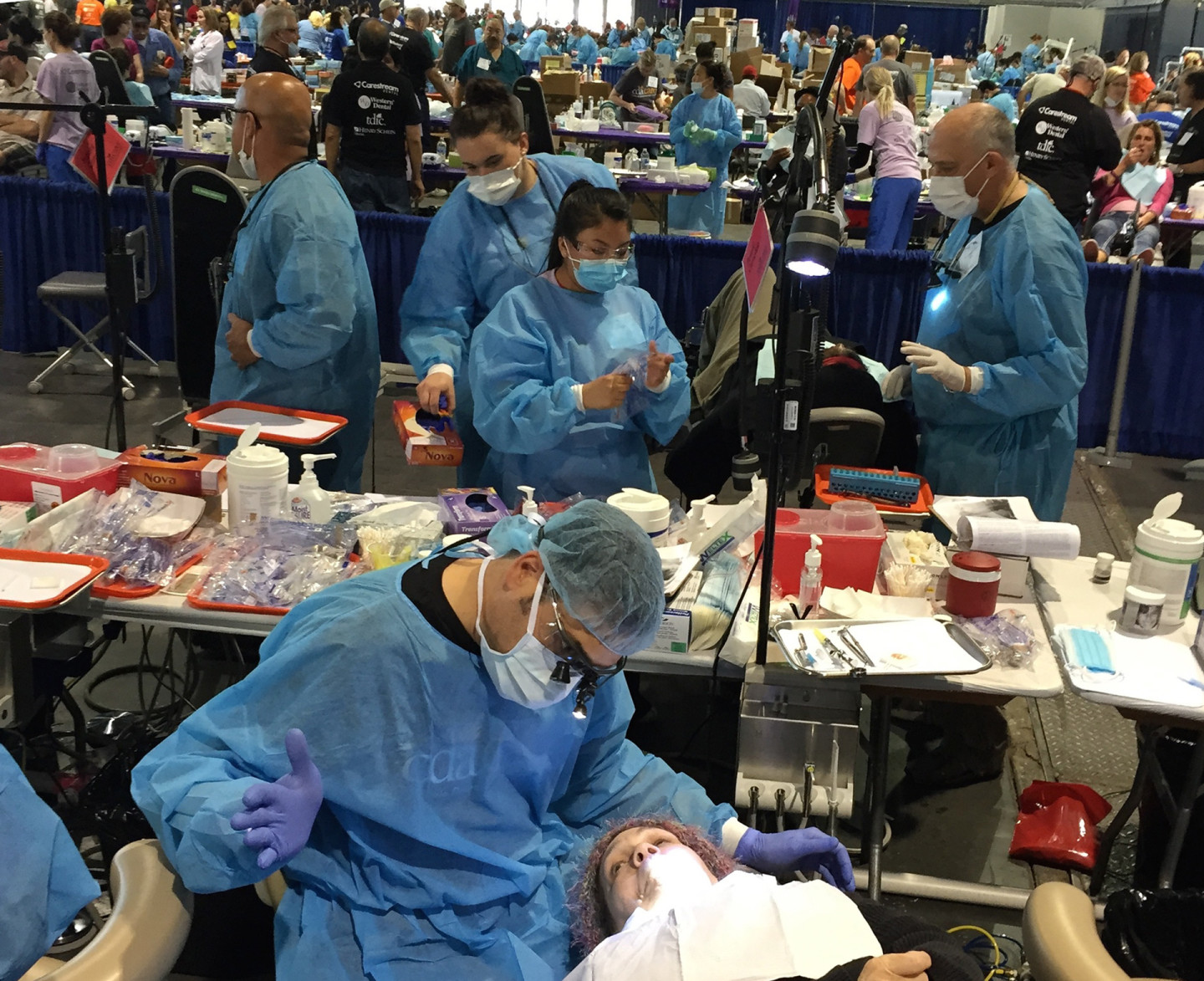
"content": "\u003cp>Inside the cavernous main building at the Sacramento County Fairgrounds was a beehive of activity. But this was no county fair or concert.\u003c/p>\n\u003cp>Instead, hundreds of long, reclining dental chairs fill the floor, and 2,000 people wait for a turn. The sound of drilling buzzed the air, and the acrid smell of anesthetic permeated it.\u003c/p>\n\u003cp>It was free dental day – a special program run by the California Dental Association Foundation. “CDA Cares” took over the entire fairgrounds for this event in March, and 300 dentists were busy pumping in Novocain and making lame jokes to captive patients.\u003c/p>\n\u003cp>Across the broad hall, there was one station for filling cavities, one for root canals, another for extractions, yet another for dentures.\u003c/p>\n\u003cp>It looked like a sort of Dental Disneyland.\u003c/p>\n\u003cp>[ad fullwidth]\u003c/p>\n\u003cp>Rhonda Morse of Sacramento was among the patients. She camped out at the fairgrounds the night before the event.\u003c/p>\n\u003cp>“Got here at 7 o’clock last night,” she said. “We slept outside. It gets crowded real fast.”\u003c/p>\n\u003cp>[soundcloud url=”https://api.soundcloud.com/tracks/204359777″ params=”color=ff5500&auto_play=false&hide_related=false&show_comments=true&show_user=true&show_reposts=false” width=”100%” height=”166″ iframe=”true” /]\u003c/p>\n\u003cp>That’s because the need is so profound. Denti-Cal, the state’s program of dental care for low-income Californians, including 5 million children, is in disarray. At a time when millions more have been added into coverage, it’s becoming harder to find dental care. The CDA Foundation \u003ca title=\"http://www.cdafoundation.org/cda-cares\" href=\"http://www.cdafoundation.org/cda-cares\" target=\"_blank\" rel=\"noopener\">estimates that 10 million Californians\u003c/a> face barriers to dental care.\u003c/p>\n\u003cp>Morse knows this first-hand.\u003c/p>\n\u003cp>“It takes months to get in, then you get an appointment, and it takes months to get in again,” she explained.\u003c/p>\n\u003cp>She said it would have taken her years of appointments to get the dental care she received in a single day at the fair.\u003c/p>\n\u003cp>“Coverage and access are two different things,” said James Stephens, a Palo Alto dentist and former chair of the California Dental Association who volunteered for the Sacramento event.\u003c/p>\n\u003cp>The reason there’s no access, he said, is because so few dentists take Denti-Cal patients — because they lose money on every one of them.\u003c/p>\n\u003cp>“Fees have been cut in the program so much, they’re not enough to create a viable provider network,” Stephens said.\u003c/p>\n\u003cfigure id=\"attachment_25339\" class=\"wp-caption alignright\" style=\"max-width: 800px\">\u003ca href=\"http://ww2.kqed.org/stateofhealth/wp-content/uploads/sites/27/2015/05/IMG_1429-2-e1430955574138.jpg\">\u003cimg loading=\"lazy\" decoding=\"async\" class=\"size-medium wp-image-25339\" src=\"http://ww2.kqed.org/stateofhealth/wp-content/uploads/sites/27/2015/05/IMG_1429-2-800x1067.jpg\" alt=\"George Maranon, an oral surgeon from Encino, is extracting a tooth from a young boy who already has diseased gums. \" width=\"800\" height=\"1067\">\u003c/a>\u003cfigcaption class=\"wp-caption-text\">George Maranon, an oral surgeon from Encino, is extracting a tooth from a young boy who already has diseased gums. \u003ccite>(David Gorn/California Healthline)\u003c/cite>\u003c/figcaption>\u003c/figure>\n\u003cp>That network of providers is even thinner now, he said. So there are fewere dentists to serve even more people who have signed up since the state expanded eligibility rules.\u003c/p>\n\u003cp>George Maranon, an oral surgeon from Encino, was working on a tooth extraction at one of the fair stations for a 9-year-old boy with diseased gums. He said he’d rather volunteer his time than take Denti-Cal payments.\u003c/p>\n\u003cp>“There are Denti-Cal patients who I actually see in my practice for free,” Maranon said. “Sometimes dealing with the state in terms of reimbursement can be more expensive than just doing it for free.”\u003c/p>\n\u003cp>Just to get to the national average for provider rates, California would have to spend three times as much as it does now, at least another $100 million a year, according to Elizabeth Mertz, a dental sciences professor at UC San Francisco.\u003c/p>\n\u003cp>Beyond inadequate provider rates, there’s another huge challenge in the Denti-Cal system, Mertz said. Half of the state’s kids are in Denti-Cal, and those kids desperately need preventive care.\u003c/p>\n\u003cp>“So you’re talking about taking care of a large portion of the state’s children,” she said. “If those children grow up with dental disease, they’re going to be adults with dental disease.”\u003c/p>\n\u003cp>She said lawmakers could pass a dental health parity law, and that would put preventive dental health services on the same plane as other essential medical care.\u003c/p>\n\u003cp>“Because nobody’s made it a priority from the top on down,” Mertz said. “When you say something’s essential but you make it optional, that’s not sending the message that it’s a priority.”\u003c/p>\n\u003cp>The new director of the Department of Health Care Services, Jennifer Kent, has acknowledged the deficiencies of Denti-Cal and says fixing it is one of her top two priorities. The department is working on a plan now to restructure the program, but state officials haven’t said whether or not that would include a boost in reimbursement rates.\u003c/p>\n\u003cp>\u003c/p>\n\u003cp>In the meantime, \u003ca title=\"Fresno Dental Fair\" href=\"http://www.cdafoundation.org/cda-cares/fresno\" target=\"_blank\" rel=\"noopener\">the next free California Dental Association dental fair \u003c/a>will be held in Fresno, in October.\u003c/p>\n\n",
"blocks": [],
"excerpt": "Many are covered by Denti-Cal, but reimbursements are so low that few dentists accept the patients. ",
"status": "publish",
"parent": 0,
"modified": 1721108147,
"stats": {
"hasAudio": false,
"hasVideo": false,
"hasChartOrMap": false,
"iframeSrcs": [],
"hasGoogleForm": false,
"hasGallery": false,
"hasHearkenModule": false,
"hasPolis": false,
"paragraphCount": 27,
"wordCount": 817
},
"headData": {
"title": "State Expands Dental Coverage for Poor — But Getting Treatment Is Another Matter",
"description": "Many are covered by Denti-Cal, but reimbursements are so low that few dentists accept the patients. ",
"ogTitle": "",
"ogDescription": "",
"ogImgId": "",
"twTitle": "",
"twDescription": "",
"twImgId": "",
"schema": {
"@context": "https://schema.org",
"@type": "Article",
"headline": "State Expands Dental Coverage for Poor — But Getting Treatment Is Another Matter",
"datePublished": "2015-05-07T08:49:40-07:00",
"dateModified": "2024-07-15T22:35:47-07:00",
"image": "https://cdn.kqed.org/wp-content/uploads/2020/02/KQED-OG-Image@1x.png"
}
},
"sticky": false,
"nprByline": "David Gorn, California Healthline",
"path": "/stateofhealth/25334/millions-struggle-to-access-dental-care-in-california",
"audioTrackLength": null,
"parsedContent": [
{
"type": "contentString",
"content": "\u003cdiv class=\"post-body\">\u003cp>\u003cp>Inside the cavernous main building at the Sacramento County Fairgrounds was a beehive of activity. But this was no county fair or concert.\u003c/p>\n\u003cp>Instead, hundreds of long, reclining dental chairs fill the floor, and 2,000 people wait for a turn. The sound of drilling buzzed the air, and the acrid smell of anesthetic permeated it.\u003c/p>\n\u003cp>It was free dental day – a special program run by the California Dental Association Foundation. “CDA Cares” took over the entire fairgrounds for this event in March, and 300 dentists were busy pumping in Novocain and making lame jokes to captive patients.\u003c/p>\n\u003cp>Across the broad hall, there was one station for filling cavities, one for root canals, another for extractions, yet another for dentures.\u003c/p>\n\u003cp>It looked like a sort of Dental Disneyland.\u003c/p>\n\u003cp>\u003c/p>\u003c/div>",
"attributes": {
"named": {},
"numeric": []
}
},
{
"type": "component",
"content": "",
"name": "ad",
"attributes": {
"named": {
"label": "fullwidth"
},
"numeric": [
"fullwidth"
]
}
},
{
"type": "contentString",
"content": "\u003cdiv class=\"post-body\">\u003cp>\u003c/p>\n\u003cp>Rhonda Morse of Sacramento was among the patients. She camped out at the fairgrounds the night before the event.\u003c/p>\n\u003cp>“Got here at 7 o’clock last night,” she said. “We slept outside. It gets crowded real fast.”\u003c/p>\n\u003cp>\u003c/p>\u003cp>\u003cdiv class='utils-parseShortcode-shortcodes-__shortcodes__shortcodeWrapper'>\n \u003ciframe width='”100%”' height='”166″'\n scrolling='no' frameborder='no'\n src='https://w.soundcloud.com/player/?url=”https://api.soundcloud.com/tracks/204359777″&visual=true&”color=ff5500&auto_play=false&hide_related=false&show_comments=true&show_user=true&show_reposts=false”'\n title='”https://api.soundcloud.com/tracks/204359777″'>\n \u003c/iframe>\n \u003c/div>\u003c/p>\u003cp>\u003c/p>\n\u003cp>That’s because the need is so profound. Denti-Cal, the state’s program of dental care for low-income Californians, including 5 million children, is in disarray. At a time when millions more have been added into coverage, it’s becoming harder to find dental care. The CDA Foundation \u003ca title=\"http://www.cdafoundation.org/cda-cares\" href=\"http://www.cdafoundation.org/cda-cares\" target=\"_blank\" rel=\"noopener\">estimates that 10 million Californians\u003c/a> face barriers to dental care.\u003c/p>\n\u003cp>Morse knows this first-hand.\u003c/p>\n\u003cp>“It takes months to get in, then you get an appointment, and it takes months to get in again,” she explained.\u003c/p>\n\u003cp>She said it would have taken her years of appointments to get the dental care she received in a single day at the fair.\u003c/p>\n\u003cp>“Coverage and access are two different things,” said James Stephens, a Palo Alto dentist and former chair of the California Dental Association who volunteered for the Sacramento event.\u003c/p>\n\u003cp>The reason there’s no access, he said, is because so few dentists take Denti-Cal patients — because they lose money on every one of them.\u003c/p>\n\u003cp>“Fees have been cut in the program so much, they’re not enough to create a viable provider network,” Stephens said.\u003c/p>\n\u003cfigure id=\"attachment_25339\" class=\"wp-caption alignright\" style=\"max-width: 800px\">\u003ca href=\"http://ww2.kqed.org/stateofhealth/wp-content/uploads/sites/27/2015/05/IMG_1429-2-e1430955574138.jpg\">\u003cimg loading=\"lazy\" decoding=\"async\" class=\"size-medium wp-image-25339\" src=\"http://ww2.kqed.org/stateofhealth/wp-content/uploads/sites/27/2015/05/IMG_1429-2-800x1067.jpg\" alt=\"George Maranon, an oral surgeon from Encino, is extracting a tooth from a young boy who already has diseased gums. \" width=\"800\" height=\"1067\">\u003c/a>\u003cfigcaption class=\"wp-caption-text\">George Maranon, an oral surgeon from Encino, is extracting a tooth from a young boy who already has diseased gums. \u003ccite>(David Gorn/California Healthline)\u003c/cite>\u003c/figcaption>\u003c/figure>\n\u003cp>That network of providers is even thinner now, he said. So there are fewere dentists to serve even more people who have signed up since the state expanded eligibility rules.\u003c/p>\n\u003cp>George Maranon, an oral surgeon from Encino, was working on a tooth extraction at one of the fair stations for a 9-year-old boy with diseased gums. He said he’d rather volunteer his time than take Denti-Cal payments.\u003c/p>\n\u003cp>“There are Denti-Cal patients who I actually see in my practice for free,” Maranon said. “Sometimes dealing with the state in terms of reimbursement can be more expensive than just doing it for free.”\u003c/p>\n\u003cp>Just to get to the national average for provider rates, California would have to spend three times as much as it does now, at least another $100 million a year, according to Elizabeth Mertz, a dental sciences professor at UC San Francisco.\u003c/p>\n\u003cp>Beyond inadequate provider rates, there’s another huge challenge in the Denti-Cal system, Mertz said. Half of the state’s kids are in Denti-Cal, and those kids desperately need preventive care.\u003c/p>\n\u003cp>“So you’re talking about taking care of a large portion of the state’s children,” she said. “If those children grow up with dental disease, they’re going to be adults with dental disease.”\u003c/p>\n\u003cp>She said lawmakers could pass a dental health parity law, and that would put preventive dental health services on the same plane as other essential medical care.\u003c/p>\n\u003cp>“Because nobody’s made it a priority from the top on down,” Mertz said. “When you say something’s essential but you make it optional, that’s not sending the message that it’s a priority.”\u003c/p>\n\u003cp>The new director of the Department of Health Care Services, Jennifer Kent, has acknowledged the deficiencies of Denti-Cal and says fixing it is one of her top two priorities. The department is working on a plan now to restructure the program, but state officials haven’t said whether or not that would include a boost in reimbursement rates.\u003c/p>\n\u003cp>\u003c/p>\n\u003cp>In the meantime, \u003ca title=\"Fresno Dental Fair\" href=\"http://www.cdafoundation.org/cda-cares/fresno\" target=\"_blank\" rel=\"noopener\">the next free California Dental Association dental fair \u003c/a>will be held in Fresno, in October.\u003c/p>\n\n\u003c/div>\u003c/p>",
"attributes": {
"named": {},
"numeric": []
}
}
],
"link": "/stateofhealth/25334/millions-struggle-to-access-dental-care-in-california",
"authors": [
"byline_stateofhealth_25334"
],
"categories": [
"stateofhealth_11",
"stateofhealth_13"
],
"tags": [
"stateofhealth_380"
],
"featImg": "stateofhealth_25338",
"label": "stateofhealth"
},
"stateofhealth_23341": {
"type": "posts",
"id": "stateofhealth_23341",
"meta": {
"index": "posts_1716263798",
"site": "stateofhealth",
"id": "23341",
"score": null,
"sort": [
1420652602000
]
},
"guestAuthors": [],
"slug": "plenty-of-responsibility-but-no-required-training-for-in-home-caregivers",
"title": "Plenty of Responsibility, But No Required Training, for In-Home Caregivers",
"publishDate": 1420652602,
"format": "aside",
"headTitle": "Plenty of Responsibility, But No Required Training, for In-Home Caregivers | KQED",
"labelTerm": {
"site": "stateofhealth"
},
"content": "\u003cfigure id=\"attachment_23344\" class=\"wp-caption aligncenter\" style=\"max-width: 640px\">\u003ca href=\"http://ww2.kqed.org/stateofhealth/wp-content/uploads/sites/27/2015/01/Messengale-7-e1420584165747.jpg\">\u003cimg loading=\"lazy\" decoding=\"async\" class=\"size-large wp-image-23344\" title=\"\" src=\"http://ww2.kqed.org/stateofhealth/wp-content/uploads/sites/27/2015/01/Messengale-7-640x427.jpg\" alt=\"Oliver Massengale took over as his brother’s full-time caregiver six years ago. He says he hasn’t had time for himself in years. (Heidi de Marco/KHN)\" width=\"640\" height=\"427\">\u003c/a>\u003cfigcaption class=\"wp-caption-text\">Oliver Massengale took over as his brother’s full-time caregiver six years ago. He says he hasn’t had time for himself in years. (Heidi de Marco/KHN)\u003c/figcaption>\u003c/figure>\n\u003cp>\u003cstrong>By Anna Gorman,\u003ca title=\"http://kaiserhealthnews.org/news/lots-of-responsibility-for-in-home-care-providers-but-no-training-required/\" href=\"http://kaiserhealthnews.org/news/lots-of-responsibility-for-in-home-care-providers-but-no-training-required/\" target=\"_blank\" rel=\"noopener\"> \u003c/a>\u003c/strong>\u003ca title=\"http://kaiserhealthnews.org/news/lots-of-responsibility-for-in-home-care-providers-but-no-training-required/\" href=\"http://kaiserhealthnews.org/news/lots-of-responsibility-for-in-home-care-providers-but-no-training-required/\" target=\"_blank\" rel=\"noopener\">Kaiser Health News\u003c/a>\u003c/p>\n\u003cp>Born just a year apart, Oliver Massengale and his brother Charles grew up together. Now, in a two-story home in Compton, they are growing old together. But Charles Massengale, 71, can do little on his own.\u003c/p>\n\u003cp>The former tree trimmer has severe brain damage from a 30-foot fall, as well as dementia, diabetes and high blood pressure. Six years ago, Oliver took over as his brother’s full-time caregiver. He’s paid about $10.00 an hour by the state.\u003c/p>\n\u003cp>It was not a job he was trained to do.\u003c/p>\n\u003cp>“I didn’t have a clue,” said Oliver, a retired grounds manager at a college. “I was just so afraid of what I was doing.”\u003c/p>\n\u003cp>[ad fullwidth]\u003c/p>\n\u003cp>He constantly worried –- about giving Charles the wrong medication, about him getting bedsores, about his blood pressure. And he had no idea how easily his brother could fall over. One day, he was cooking and Charles was on a stool at the kitchen counter.\u003c!--more-->\u003c/p>\n\u003cp>“I heard BAM,” he said. “I turned around and he was on the kitchen floor.”\u003c/p>\n\u003cfigure id=\"attachment_23346\" class=\"wp-caption aligncenter\" style=\"max-width: 640px\">\u003ca href=\"http://ww2.kqed.org/stateofhealth/wp-content/uploads/sites/27/2015/01/Messengale-5-e1420584871222.jpg\">\u003cimg loading=\"lazy\" decoding=\"async\" class=\"size-large wp-image-23346\" title=\"\" src=\"http://ww2.kqed.org/stateofhealth/wp-content/uploads/sites/27/2015/01/Messengale-5-640x427.jpg\" alt=\"Oliver Massengale needs to make sure his brother takes his medicine. He says Charles has a tendency to keep them in his mouth and forget to swallow them (Heidi de Marco/KHN).\" width=\"640\" height=\"427\">\u003c/a>\u003cfigcaption class=\"wp-caption-text\">Oliver Massengale needs to make sure his brother takes his medicine. He says Charles has a tendency to keep them in his mouth and forget to swallow them (Heidi de Marco/KHN).\u003c/figcaption>\u003c/figure>\n\u003cp>No overall training is required for the more than 400,000 caregivers in California’s $7.3 billion In-Home Supportive Services Program (IHSS) for low-income elderly and disabled residents. Without instruction even in CPR or first aid, these caregivers can quickly become overwhelmed and their sick or disabled clients can get hurt, according to interviews with caregivers, advocates and elder abuse experts.\u003c/p>\n\u003cp>The lack of training is “of enormous concern,” said Gary Passmore, a vice president of the Congress of California Seniors, an advocacy organization. “We are dealing with a lot of frail, elderly people.”\u003c/p>\n\u003cp>The need for in-home caregivers is rising as the elderly and disabled population grows. The demand for personal aides –- most of whom work in the home — is expected to increase by 37 percent over the next decade, requiring about 1.3 million new positions, according to \u003ca title=\"http://phinational.org/sites/phinational.org/files/phi-factsheet14update-12052014.pdf\" href=\"http://phinational.org/sites/phinational.org/files/phi-factsheet14update-12052014.pdf\" target=\"_blank\" rel=\"noopener\">research published last year\u003c/a> by the New-York based Paraprofessional Healthcare Institute, an advocacy group that also provides training\u003cstrong>. \u003c/strong>\u003c/p>\n\u003cp>The federal government is trying to meet that need by stepping up efforts to expand and train the work force. But for now, there are no federal training requirements for in-home-caregivers. It’s up to states to set them in Medicaid-funded programs like California’s. As a result, training policies vary dramatically.\u003c/p>\n\u003cp>\u003cstrong>Often Providing Medical Care \u003c/strong>\u003c/p>\n\u003cp>In California’s IHSS program, clients are in charge of hiring, managing and training their own caregivers. The program stands out because of its sheer size — it is the nation’s largest publicly-funded home care program –- and because such a high percentage of caregivers are relatives directly employed by the clients rather than agencies, said Abby Marquand, director of policy research for the Paraprofessional Healthcare Institute.\u003c/p>\n\u003cp>“It is a lot easier to ensure a minimum level of training if the person is employed through an agency,” she said.\u003c/p>\n\u003cp>IHSS was never intended to be a medical program. The caregivers are distinct from visiting nurses and the certified home health aides often dispatched after a hospital stay. IHSS caregivers are not certified or licensed and are hired to do personal care and household tasks.\u003c/p>\n\u003cp>But more than a quarter of IHSS clients are 80 or over, and many have chronic health conditions or dementia. In these and other cases, caregivers can end up providing basic medical care -– helping to administer insulin shots, manage other medication or dress wounds, for instance.\u003c/p>\n\u003cfigure id=\"attachment_23348\" class=\"wp-caption alignright\" style=\"max-width: 200px\">\u003ca href=\"http://ww2.kqed.org/stateofhealth/wp-content/uploads/sites/27/2015/01/Messengale-3rev.jpg\">\u003cimg loading=\"lazy\" decoding=\"async\" class=\"size-medium wp-image-23348\" title=\"\" src=\"http://ww2.kqed.org/stateofhealth/wp-content/uploads/sites/27/2015/01/Messengale-3rev-300x449.jpg\" alt=\"Charles Massengale can eat by himself, but needs help with everything else. The former tree trimmer has severe brain damage from a 30-foot fall, as well as dementia, diabetes and high blood pressure (Heidi de Marco/KHN).\" width=\"200\" height=\"300\">\u003c/a>\u003cfigcaption class=\"wp-caption-text\">Charles Massengale can eat by himself, but needs help with everything else. The former tree trimmer has severe brain damage from a 30-foot fall, as well as dementia, diabetes and high blood pressure (Heidi de Marco/KHN).\u003c/figcaption>\u003c/figure>\n\u003cp>When such “paramedical” services are needed by individual clients, IHSS caregivers are required to get instruction and approval from a health care professional. But the state doesn’t sponsor the training or pay caregivers more for getting it. Only 12 percent of clients have caregivers who have received it.\u003c/p>\n\u003cp>Eileen Carroll, deputy director of the California Department of Social Services, which oversees IHSS, said the program doesn’t have a lot of training requirements because it was set up to give clients the choice of how they want their care delivered.\u003c/p>\n\u003cp>For caregivers who want it, the state offers comprehensive \u003ca title=\"http://www.cdss.ca.gov/agedblinddisabled/PG3366.htm\" href=\"http://www.cdss.ca.gov/agedblinddisabled/PG3366.htm\" target=\"_blank\" rel=\"noopener\">voluntary training information online\u003c/a> on topics such as fall prevention and use of medical equipment, she said.\u003c/p>\n\u003cp>Carroll said many people are fully able to direct their own care and supervise their caregivers, but some aren’t. “Our task is how to work harder to support those who have greater need,” she said.\u003c/p>\n\u003cp>Oliver Massengale, for example, can’t depend on his brother to tell him what he wants or needs — Charles no longer talks much. “Because of the nature of the injuries and his different ailments, he could never train,” Oliver said. “He can’t even take care of himself.”\u003c/p>\n\u003cp>The situation worsened recently because Charles’ health insurance plan changed, and he no longer is being visited by a nurse. So every day Oliver sits inches from Charles, checking his blood pressure and blood sugar and coaching him step-by-step on how to inject insulin into his own arm.\u003c/p>\n\u003cp>“Hold the back of that needle up,” he told Charles on a recent day. “Put it in right there. Now pump the medicine in. Good, good.”\u003c/p>\n\u003cp>When he heard about a training class in Los Angeles, Oliver said he jumped at the chance.\u003c/p>\n\u003cp>“If I’d had this class in advance, it would have made it a lot easier,” he said.\u003c/p>\n\u003cp>[soundcloud url=”https://api.soundcloud.com/tracks/192785628″ params=”color=ff5500&auto_play=false&hide_related=false&show_comments=true&show_user=true&show_reposts=false” width=”100%” height=”166″ iframe=”true” /]\u003c/p>\n\u003cp>\u003cstrong>A Sensitive Matter\u003c/strong>\u003c/p>\n\u003cp>Whether to require training for those who care for California’s 490,000 low-income elderly and disabled home care clients is a sensitive political — and personal — issue.\u003c/p>\n\u003cp>Carroll said the state is in a tough situation. Training is a positive thing, she said, “but you have a very strong adult disabled community in this program who … oppose any mandatory training.”\u003c/p>\n\u003cp>Many disability rights advocates say a training mandate would make it more difficult for IHSS consumers to find caregivers, chip away at clients’ autonomy and drain resources from the program.\u003c/p>\n\u003cp>“The idea of choice is really paramount,” said Deborah Doctor, legislative advocate at Disability Rights California. “Anything that puts a requirement that erodes that choice is a problem.”\u003c/p>\n\u003cfigure id=\"attachment_23349\" class=\"wp-caption aligncenter\" style=\"max-width: 640px\">\u003ca href=\"http://ww2.kqed.org/stateofhealth/wp-content/uploads/sites/27/2015/01/chuc-2-e1420585465561.jpg\">\u003cimg loading=\"lazy\" decoding=\"async\" class=\"size-large wp-image-23349\" title=\"\" src=\"http://ww2.kqed.org/stateofhealth/wp-content/uploads/sites/27/2015/01/chuc-2-640x427.jpg\" alt=\"Frances Chuc brushes her husband’s hair. Jorge Chuc has been paralyzed for more than 30 years and needs full-time care from his wife. (Heidi de Marco/KHN)\" width=\"640\" height=\"427\">\u003c/a>\u003cfigcaption class=\"wp-caption-text\">Frances Chuc brushes her husband’s hair. Jorge Chuc has been paralyzed for more than 30 years and needs full-time care from his wife. (Heidi de Marco/KHN)\u003c/figcaption>\u003c/figure>\n\u003cp>Relatives, who make up nearly three-quarters of paid IHSS caregivers, often say they know what is best for their loved ones. And clients are inclined to trust family members and say they can instruct them on what they need\u003cstrong>. \u003c/strong>\u003c/p>\n\u003cp>\u003cstrong>“\u003c/strong>A mother who has been taking care of a child for 20 or 30 or 40 years doesn’t need mandatory training on how to take care of that person,” Doctor said.\u003c/p>\n\u003cp>Training should be made available to those who want it, but should be entirely voluntary, said Nancy Becker Kennedy, who was paralyzed in a diving accident 40 years ago.\u003c/p>\n\u003cp>[contextly_sidebar id=”ZDWZeL7IA0WaNYn7VwnhrQXAGx4kEPFd”]\u003c/p>\n\u003cp>“There is no one size fits all,” said Becker Kennedy, who founded IHSS Consumers Union, a group that advocates for both consumers and workers. “The population is much too diverse to mandate anything across the board.”\u003c/p>\n\u003cp>Many other clients agree. Sheela Gunn-Cushman, who is blind, diabetic and has mild cerebral palsy, lives with roommates in San Lorenzo, Calif., with the help of an IHSS caregiver whom she trained herself.\u003c/p>\n\u003cp>“I don’t feel like anyone is capable of training a [caregiver] about what I need better than I do,” she said. “I am capable of telling them what I need.”\u003c/p>\n\u003cp>A union that represents caregivers, however, sees advantages to a minimum level of training.\u003c/p>\n\u003cp>SEIU-United Healthcare Workers West proposed a \u003ca title=\"http://www.seiu-uhw.org/archives/16457\" href=\"http://www.seiu-uhw.org/archives/16457\" target=\"_blank\" rel=\"noopener\">statewide initiative\u003c/a> last year that would have required 75 hours of training, but the union didn’t get enough signatures to put the measure on the ballot. SEIU plans to try again for the 2016 ballot.\u003c/p>\n\u003cp>Requiring training would “save lives,” said Loretta Jackson, who serves on the union’s executive board and is an IHSS caregiver in Sacramento. It would also reduce the risk of injuries to caregivers, she added.\u003c/p>\n\u003cp>Jackson cares for her sister, who was left partially paralyzed by a stroke 15 years ago. When Jackson first started, she had to call paramedics every few weeks because her sister would fall. Once, Jackson said, her sister took too many pills and started shaking violently.\u003c/p>\n\u003cp>“I didn’t know what to do,” she said. “I started panicking.”\u003c/p>\n\u003cp>Other caregivers tell similar stories.\u003c/p>\n\u003cp>Ariana Ramos, 28, who is taking a training class, said a paralyzed client got a bed sore after sleeping in his wheelchair. Ramos thought it would heal on its own, but it just got worse.\u003c/p>\n\u003cp>“Now I know that we need to keep it covered up,” said Ramos, who lives in South Gate. “Now I know about bacteria and all the things that could get in a bed sore.”\u003c/p>\n\u003cfigure id=\"attachment_23350\" class=\"wp-caption alignleft\" style=\"max-width: 200px\">\u003ca href=\"http://ww2.kqed.org/stateofhealth/wp-content/uploads/sites/27/2015/01/chuc-4rev.jpg\">\u003cimg loading=\"lazy\" decoding=\"async\" class=\"size-medium wp-image-23350\" title=\"\" src=\"http://ww2.kqed.org/stateofhealth/wp-content/uploads/sites/27/2015/01/chuc-4rev-300x449.jpg\" alt=\"Frances Chuc takes a break after a morning of taking care of her paraplegic husband. She says taking care of her husband is daunting, but her previous experience as a caregiver has helped (Heidi de Marco/KHN).\" width=\"200\" height=\"300\">\u003c/a>\u003cfigcaption class=\"wp-caption-text\">Frances Chuc takes a break after a morning of taking care of her paraplegic husband. She says taking care of her husband is daunting, but her previous experience as a caregiver has helped (Heidi de Marco/KHN).\u003c/figcaption>\u003c/figure>\n\u003cp>Caregivers without any medical background or training may not know when to call 911 or how to recognize a heart attack or stroke, said Frances Chuc, who takes care of her paralyzed husband at their home in South Gate and was trained as a nurse aide before she met him. “That person could die in their hands.”\u003c/p>\n\u003cp>A little bit of training can go a long way, said Joanne Spetz, director of UC San Francisco’s newly created Health Workforce Research Center. It can help caregivers recognize when their clients are having bad reactions to medications, for instance, or help them safely lift a person to avoid falls.\u003c/p>\n\u003cp>Training can also reduce turnover in a field that has low job retention, said Marquand of the Paraprofessional Healthcare Institute.\u003c/p>\n\u003cp>Several states are experimenting with different models of training. Washington State, for example,\u003ca title=\"http://www.dshs.wa.gov/altsa/home-and-community-services/individual-providers\" href=\"http://www.dshs.wa.gov/altsa/home-and-community-services/individual-providers\" target=\"_blank\" rel=\"noopener\"> began requiring 75 hours of training\u003c/a> for home caregivers in 2012.\u003c/p>\n\u003cp>It doesn’t make sense that caregivers in the home require less training nationwide than caregivers in nursing homes, said Charissa Raynor, executive director of the SEIU Healthcare NW Training Partnership, which trains 40,000 providers annually. (Certified aides in nursing homes are required by the federal government to have 75 hours of training.)\u003c/p>\n\u003cp>The Washington initiative, Raynor said, will help professionalize the workforce, reduce on-the-job injuries and lead to better care.\u003c/p>\n\u003cp>But not everyone has been happy with the new mandate.\u003c/p>\n\u003cp>“There are a lot of folks who just want to be a caregiver in someone’s home,” said Betty Schwieterman, director of systems advocacy at Disability Rights Washington. “They are not on a career path.”\u003c/p>\n\u003cp>\u003cstrong>Grants From The Government\u003c/strong>\u003c/p>\n\u003cp>The debate over mandatory training is far from resolved. But in the meantime, the federal government is putting money into pilot training efforts in various states.\u003c/p>\n\u003cp>Through the Affordable Care Act, it has awarded about \u003ca title=\"http://bhpr.hrsa.gov/nursing/grants/phcast.html\" href=\"http://bhpr.hrsa.gov/nursing/grants/phcast.html\" target=\"_blank\" rel=\"noopener\">$15 million in grants to California\u003c/a> and five other states to recruit and train qualified caregivers for the elderly and disabled populations\u003cstrong>. \u003c/strong>Classes started in 2011 in cities throughout the state, including San Francisco, Anaheim and Walnut.\u003c/p>\n\u003cp>The class Massengale attended is part of a separate federal grant of nearly $12 million given to the California Long-Term Care Education Center in Los Angeles. The center is training about 6,000 IHSS caregivers in Los Angeles, San Bernardino and Contra Costa counties.\u003c/p>\n\u003cp>An early evaluation of the program, as yet unpublished, by UC San Francisco researchers shows that clients with trained providers are less likely to go to the emergency room or be admitted to a hospital than those with untrained providers.\u003c/p>\n\u003cp>Corinne Eldridge, who runs the program, said trained caregivers can play an important role on a client’s health care team. “They can be the eyes and the ears in the home … and communicate back to the health care provider,” she said.\u003c/p>\n\u003cp>At a recent session in Compton, about two dozen caregivers gathered in a classroom at the public library, their binders of training materials spread out before them. The topic of the day was preventing bed sores and controlling infections.\u003c/p>\n\u003cp>The teacher, nurse Lori Picou, asked the class about the signs and symptoms of infection. The students yelled out answers: Redness. Fever. Fluid or discharge.\u003c/p>\n\u003cp>One offered a story about a bruise that swelled up like a basketball. Another said her paralyzed son was sweating so much that she had to repeatedly change his shirt.\u003c/p>\n\u003cp>Picou reminded the group to wash their hands frequently. “It is one of the most important things an individual can ever do to help control infection,” she said.\u003c/p>\n\u003cp>Oliver Massengale, who is in the class, said he is feeling a little bit more confident about keeping his brother safe. “The more I learn, the better I am to cope with this,” he said.\u003c/p>\n\u003cp>But being a caregiver for someone with so many health conditions is still scary to him.\u003c/p>\n\u003cp>“As I come down those stairs,” he said, “I am saying a prayer and just hoping that everything is all right when I get to the bottom.”\u003c/p>\n\u003cp>[ad floatright]\u003c/p>\n\u003cp>\u003cem>\u003ca title=\"Kaiser Health News\" href=\"www.kaiserhealthnews.org\" target=\"_blank\" rel=\"noopener\">Kaiser Health News \u003c/a>is an editorially independent program of the \u003ca title=\"Kaiser Family Foundation\" href=\"www.kff.org\" target=\"_blank\" rel=\"noopener\">Kaiser Family Foundation.\u003c/a>\u003c/em>\u003c/p>\n\n",
"blocks": [],
"excerpt": "The lack of instruction in California program, even CPR and first aid, puts clients at risk, experts say.",
"status": "publish",
"parent": 0,
"modified": 1721150389,
"stats": {
"hasAudio": false,
"hasVideo": false,
"hasChartOrMap": false,
"iframeSrcs": [],
"hasGoogleForm": false,
"hasGallery": false,
"hasHearkenModule": false,
"hasPolis": false,
"paragraphCount": 70,
"wordCount": 2461
},
"headData": {
"title": "Plenty of Responsibility, But No Required Training, for In-Home Caregivers",
"description": "The lack of instruction in California program, even CPR and first aid, puts clients at risk, experts say.",
"ogTitle": "",
"ogDescription": "",
"ogImgId": "",
"twTitle": "",
"twDescription": "",
"twImgId": "",
"schema": {
"@context": "https://schema.org",
"@type": "Article",
"headline": "Plenty of Responsibility, But No Required Training, for In-Home Caregivers",
"datePublished": "2015-01-07T09:43:22-08:00",
"dateModified": "2024-07-16T10:19:49-07:00",
"image": "https://cdn.kqed.org/wp-content/uploads/2020/02/KQED-OG-Image@1x.png"
}
},
"sticky": false,
"path": "/stateofhealth/23341/plenty-of-responsibility-but-no-required-training-for-in-home-caregivers",
"audioTrackLength": null,
"parsedContent": [
{
"type": "contentString",
"content": "\u003cdiv class=\"post-body\">\u003cp>\u003cfigure id=\"attachment_23344\" class=\"wp-caption aligncenter\" style=\"max-width: 640px\">\u003ca href=\"http://ww2.kqed.org/stateofhealth/wp-content/uploads/sites/27/2015/01/Messengale-7-e1420584165747.jpg\">\u003cimg loading=\"lazy\" decoding=\"async\" class=\"size-large wp-image-23344\" title=\"\" src=\"http://ww2.kqed.org/stateofhealth/wp-content/uploads/sites/27/2015/01/Messengale-7-640x427.jpg\" alt=\"Oliver Massengale took over as his brother’s full-time caregiver six years ago. He says he hasn’t had time for himself in years. (Heidi de Marco/KHN)\" width=\"640\" height=\"427\">\u003c/a>\u003cfigcaption class=\"wp-caption-text\">Oliver Massengale took over as his brother’s full-time caregiver six years ago. He says he hasn’t had time for himself in years. (Heidi de Marco/KHN)\u003c/figcaption>\u003c/figure>\n\u003cp>\u003cstrong>By Anna Gorman,\u003ca title=\"http://kaiserhealthnews.org/news/lots-of-responsibility-for-in-home-care-providers-but-no-training-required/\" href=\"http://kaiserhealthnews.org/news/lots-of-responsibility-for-in-home-care-providers-but-no-training-required/\" target=\"_blank\" rel=\"noopener\"> \u003c/a>\u003c/strong>\u003ca title=\"http://kaiserhealthnews.org/news/lots-of-responsibility-for-in-home-care-providers-but-no-training-required/\" href=\"http://kaiserhealthnews.org/news/lots-of-responsibility-for-in-home-care-providers-but-no-training-required/\" target=\"_blank\" rel=\"noopener\">Kaiser Health News\u003c/a>\u003c/p>\n\u003cp>Born just a year apart, Oliver Massengale and his brother Charles grew up together. Now, in a two-story home in Compton, they are growing old together. But Charles Massengale, 71, can do little on his own.\u003c/p>\n\u003cp>The former tree trimmer has severe brain damage from a 30-foot fall, as well as dementia, diabetes and high blood pressure. Six years ago, Oliver took over as his brother’s full-time caregiver. He’s paid about $10.00 an hour by the state.\u003c/p>\n\u003cp>It was not a job he was trained to do.\u003c/p>\n\u003cp>“I didn’t have a clue,” said Oliver, a retired grounds manager at a college. “I was just so afraid of what I was doing.”\u003c/p>\n\u003cp>\u003c/p>\u003c/div>",
"attributes": {
"named": {},
"numeric": []
}
},
{
"type": "component",
"content": "",
"name": "ad",
"attributes": {
"named": {
"label": "fullwidth"
},
"numeric": [
"fullwidth"
]
}
},
{
"type": "contentString",
"content": "\u003cdiv class=\"post-body\">\u003cp>\u003c/p>\n\u003cp>He constantly worried –- about giving Charles the wrong medication, about him getting bedsores, about his blood pressure. And he had no idea how easily his brother could fall over. One day, he was cooking and Charles was on a stool at the kitchen counter.\u003c!--more-->\u003c/p>\n\u003cp>“I heard BAM,” he said. “I turned around and he was on the kitchen floor.”\u003c/p>\n\u003cfigure id=\"attachment_23346\" class=\"wp-caption aligncenter\" style=\"max-width: 640px\">\u003ca href=\"http://ww2.kqed.org/stateofhealth/wp-content/uploads/sites/27/2015/01/Messengale-5-e1420584871222.jpg\">\u003cimg loading=\"lazy\" decoding=\"async\" class=\"size-large wp-image-23346\" title=\"\" src=\"http://ww2.kqed.org/stateofhealth/wp-content/uploads/sites/27/2015/01/Messengale-5-640x427.jpg\" alt=\"Oliver Massengale needs to make sure his brother takes his medicine. He says Charles has a tendency to keep them in his mouth and forget to swallow them (Heidi de Marco/KHN).\" width=\"640\" height=\"427\">\u003c/a>\u003cfigcaption class=\"wp-caption-text\">Oliver Massengale needs to make sure his brother takes his medicine. He says Charles has a tendency to keep them in his mouth and forget to swallow them (Heidi de Marco/KHN).\u003c/figcaption>\u003c/figure>\n\u003cp>No overall training is required for the more than 400,000 caregivers in California’s $7.3 billion In-Home Supportive Services Program (IHSS) for low-income elderly and disabled residents. Without instruction even in CPR or first aid, these caregivers can quickly become overwhelmed and their sick or disabled clients can get hurt, according to interviews with caregivers, advocates and elder abuse experts.\u003c/p>\n\u003cp>The lack of training is “of enormous concern,” said Gary Passmore, a vice president of the Congress of California Seniors, an advocacy organization. “We are dealing with a lot of frail, elderly people.”\u003c/p>\n\u003cp>The need for in-home caregivers is rising as the elderly and disabled population grows. The demand for personal aides –- most of whom work in the home — is expected to increase by 37 percent over the next decade, requiring about 1.3 million new positions, according to \u003ca title=\"http://phinational.org/sites/phinational.org/files/phi-factsheet14update-12052014.pdf\" href=\"http://phinational.org/sites/phinational.org/files/phi-factsheet14update-12052014.pdf\" target=\"_blank\" rel=\"noopener\">research published last year\u003c/a> by the New-York based Paraprofessional Healthcare Institute, an advocacy group that also provides training\u003cstrong>. \u003c/strong>\u003c/p>\n\u003cp>The federal government is trying to meet that need by stepping up efforts to expand and train the work force. But for now, there are no federal training requirements for in-home-caregivers. It’s up to states to set them in Medicaid-funded programs like California’s. As a result, training policies vary dramatically.\u003c/p>\n\u003cp>\u003cstrong>Often Providing Medical Care \u003c/strong>\u003c/p>\n\u003cp>In California’s IHSS program, clients are in charge of hiring, managing and training their own caregivers. The program stands out because of its sheer size — it is the nation’s largest publicly-funded home care program –- and because such a high percentage of caregivers are relatives directly employed by the clients rather than agencies, said Abby Marquand, director of policy research for the Paraprofessional Healthcare Institute.\u003c/p>\n\u003cp>“It is a lot easier to ensure a minimum level of training if the person is employed through an agency,” she said.\u003c/p>\n\u003cp>IHSS was never intended to be a medical program. The caregivers are distinct from visiting nurses and the certified home health aides often dispatched after a hospital stay. IHSS caregivers are not certified or licensed and are hired to do personal care and household tasks.\u003c/p>\n\u003cp>But more than a quarter of IHSS clients are 80 or over, and many have chronic health conditions or dementia. In these and other cases, caregivers can end up providing basic medical care -– helping to administer insulin shots, manage other medication or dress wounds, for instance.\u003c/p>\n\u003cfigure id=\"attachment_23348\" class=\"wp-caption alignright\" style=\"max-width: 200px\">\u003ca href=\"http://ww2.kqed.org/stateofhealth/wp-content/uploads/sites/27/2015/01/Messengale-3rev.jpg\">\u003cimg loading=\"lazy\" decoding=\"async\" class=\"size-medium wp-image-23348\" title=\"\" src=\"http://ww2.kqed.org/stateofhealth/wp-content/uploads/sites/27/2015/01/Messengale-3rev-300x449.jpg\" alt=\"Charles Massengale can eat by himself, but needs help with everything else. The former tree trimmer has severe brain damage from a 30-foot fall, as well as dementia, diabetes and high blood pressure (Heidi de Marco/KHN).\" width=\"200\" height=\"300\">\u003c/a>\u003cfigcaption class=\"wp-caption-text\">Charles Massengale can eat by himself, but needs help with everything else. The former tree trimmer has severe brain damage from a 30-foot fall, as well as dementia, diabetes and high blood pressure (Heidi de Marco/KHN).\u003c/figcaption>\u003c/figure>\n\u003cp>When such “paramedical” services are needed by individual clients, IHSS caregivers are required to get instruction and approval from a health care professional. But the state doesn’t sponsor the training or pay caregivers more for getting it. Only 12 percent of clients have caregivers who have received it.\u003c/p>\n\u003cp>Eileen Carroll, deputy director of the California Department of Social Services, which oversees IHSS, said the program doesn’t have a lot of training requirements because it was set up to give clients the choice of how they want their care delivered.\u003c/p>\n\u003cp>For caregivers who want it, the state offers comprehensive \u003ca title=\"http://www.cdss.ca.gov/agedblinddisabled/PG3366.htm\" href=\"http://www.cdss.ca.gov/agedblinddisabled/PG3366.htm\" target=\"_blank\" rel=\"noopener\">voluntary training information online\u003c/a> on topics such as fall prevention and use of medical equipment, she said.\u003c/p>\n\u003cp>Carroll said many people are fully able to direct their own care and supervise their caregivers, but some aren’t. “Our task is how to work harder to support those who have greater need,” she said.\u003c/p>\n\u003cp>Oliver Massengale, for example, can’t depend on his brother to tell him what he wants or needs — Charles no longer talks much. “Because of the nature of the injuries and his different ailments, he could never train,” Oliver said. “He can’t even take care of himself.”\u003c/p>\n\u003cp>The situation worsened recently because Charles’ health insurance plan changed, and he no longer is being visited by a nurse. So every day Oliver sits inches from Charles, checking his blood pressure and blood sugar and coaching him step-by-step on how to inject insulin into his own arm.\u003c/p>\n\u003cp>“Hold the back of that needle up,” he told Charles on a recent day. “Put it in right there. Now pump the medicine in. Good, good.”\u003c/p>\n\u003cp>When he heard about a training class in Los Angeles, Oliver said he jumped at the chance.\u003c/p>\n\u003cp>“If I’d had this class in advance, it would have made it a lot easier,” he said.\u003c/p>\n\u003cp>\u003c/p>\u003cp>\u003cdiv class='utils-parseShortcode-shortcodes-__shortcodes__shortcodeWrapper'>\n \u003ciframe width='”100%”' height='”166″'\n scrolling='no' frameborder='no'\n src='https://w.soundcloud.com/player/?url=”https://api.soundcloud.com/tracks/192785628″&visual=true&”color=ff5500&auto_play=false&hide_related=false&show_comments=true&show_user=true&show_reposts=false”'\n title='”https://api.soundcloud.com/tracks/192785628″'>\n \u003c/iframe>\n \u003c/div>\u003c/p>\u003cp>\u003c/p>\n\u003cp>\u003cstrong>A Sensitive Matter\u003c/strong>\u003c/p>\n\u003cp>Whether to require training for those who care for California’s 490,000 low-income elderly and disabled home care clients is a sensitive political — and personal — issue.\u003c/p>\n\u003cp>Carroll said the state is in a tough situation. Training is a positive thing, she said, “but you have a very strong adult disabled community in this program who … oppose any mandatory training.”\u003c/p>\n\u003cp>Many disability rights advocates say a training mandate would make it more difficult for IHSS consumers to find caregivers, chip away at clients’ autonomy and drain resources from the program.\u003c/p>\n\u003cp>“The idea of choice is really paramount,” said Deborah Doctor, legislative advocate at Disability Rights California. “Anything that puts a requirement that erodes that choice is a problem.”\u003c/p>\n\u003cfigure id=\"attachment_23349\" class=\"wp-caption aligncenter\" style=\"max-width: 640px\">\u003ca href=\"http://ww2.kqed.org/stateofhealth/wp-content/uploads/sites/27/2015/01/chuc-2-e1420585465561.jpg\">\u003cimg loading=\"lazy\" decoding=\"async\" class=\"size-large wp-image-23349\" title=\"\" src=\"http://ww2.kqed.org/stateofhealth/wp-content/uploads/sites/27/2015/01/chuc-2-640x427.jpg\" alt=\"Frances Chuc brushes her husband’s hair. Jorge Chuc has been paralyzed for more than 30 years and needs full-time care from his wife. (Heidi de Marco/KHN)\" width=\"640\" height=\"427\">\u003c/a>\u003cfigcaption class=\"wp-caption-text\">Frances Chuc brushes her husband’s hair. Jorge Chuc has been paralyzed for more than 30 years and needs full-time care from his wife. (Heidi de Marco/KHN)\u003c/figcaption>\u003c/figure>\n\u003cp>Relatives, who make up nearly three-quarters of paid IHSS caregivers, often say they know what is best for their loved ones. And clients are inclined to trust family members and say they can instruct them on what they need\u003cstrong>. \u003c/strong>\u003c/p>\n\u003cp>\u003cstrong>“\u003c/strong>A mother who has been taking care of a child for 20 or 30 or 40 years doesn’t need mandatory training on how to take care of that person,” Doctor said.\u003c/p>\n\u003cp>Training should be made available to those who want it, but should be entirely voluntary, said Nancy Becker Kennedy, who was paralyzed in a diving accident 40 years ago.\u003c/p>\n\u003cp>\u003c/p>\u003cp>\u003c/p>\u003cp>\u003c/p>\n\u003cp>“There is no one size fits all,” said Becker Kennedy, who founded IHSS Consumers Union, a group that advocates for both consumers and workers. “The population is much too diverse to mandate anything across the board.”\u003c/p>\n\u003cp>Many other clients agree. Sheela Gunn-Cushman, who is blind, diabetic and has mild cerebral palsy, lives with roommates in San Lorenzo, Calif., with the help of an IHSS caregiver whom she trained herself.\u003c/p>\n\u003cp>“I don’t feel like anyone is capable of training a [caregiver] about what I need better than I do,” she said. “I am capable of telling them what I need.”\u003c/p>\n\u003cp>A union that represents caregivers, however, sees advantages to a minimum level of training.\u003c/p>\n\u003cp>SEIU-United Healthcare Workers West proposed a \u003ca title=\"http://www.seiu-uhw.org/archives/16457\" href=\"http://www.seiu-uhw.org/archives/16457\" target=\"_blank\" rel=\"noopener\">statewide initiative\u003c/a> last year that would have required 75 hours of training, but the union didn’t get enough signatures to put the measure on the ballot. SEIU plans to try again for the 2016 ballot.\u003c/p>\n\u003cp>Requiring training would “save lives,” said Loretta Jackson, who serves on the union’s executive board and is an IHSS caregiver in Sacramento. It would also reduce the risk of injuries to caregivers, she added.\u003c/p>\n\u003cp>Jackson cares for her sister, who was left partially paralyzed by a stroke 15 years ago. When Jackson first started, she had to call paramedics every few weeks because her sister would fall. Once, Jackson said, her sister took too many pills and started shaking violently.\u003c/p>\n\u003cp>“I didn’t know what to do,” she said. “I started panicking.”\u003c/p>\n\u003cp>Other caregivers tell similar stories.\u003c/p>\n\u003cp>Ariana Ramos, 28, who is taking a training class, said a paralyzed client got a bed sore after sleeping in his wheelchair. Ramos thought it would heal on its own, but it just got worse.\u003c/p>\n\u003cp>“Now I know that we need to keep it covered up,” said Ramos, who lives in South Gate. “Now I know about bacteria and all the things that could get in a bed sore.”\u003c/p>\n\u003cfigure id=\"attachment_23350\" class=\"wp-caption alignleft\" style=\"max-width: 200px\">\u003ca href=\"http://ww2.kqed.org/stateofhealth/wp-content/uploads/sites/27/2015/01/chuc-4rev.jpg\">\u003cimg loading=\"lazy\" decoding=\"async\" class=\"size-medium wp-image-23350\" title=\"\" src=\"http://ww2.kqed.org/stateofhealth/wp-content/uploads/sites/27/2015/01/chuc-4rev-300x449.jpg\" alt=\"Frances Chuc takes a break after a morning of taking care of her paraplegic husband. She says taking care of her husband is daunting, but her previous experience as a caregiver has helped (Heidi de Marco/KHN).\" width=\"200\" height=\"300\">\u003c/a>\u003cfigcaption class=\"wp-caption-text\">Frances Chuc takes a break after a morning of taking care of her paraplegic husband. She says taking care of her husband is daunting, but her previous experience as a caregiver has helped (Heidi de Marco/KHN).\u003c/figcaption>\u003c/figure>\n\u003cp>Caregivers without any medical background or training may not know when to call 911 or how to recognize a heart attack or stroke, said Frances Chuc, who takes care of her paralyzed husband at their home in South Gate and was trained as a nurse aide before she met him. “That person could die in their hands.”\u003c/p>\n\u003cp>A little bit of training can go a long way, said Joanne Spetz, director of UC San Francisco’s newly created Health Workforce Research Center. It can help caregivers recognize when their clients are having bad reactions to medications, for instance, or help them safely lift a person to avoid falls.\u003c/p>\n\u003cp>Training can also reduce turnover in a field that has low job retention, said Marquand of the Paraprofessional Healthcare Institute.\u003c/p>\n\u003cp>Several states are experimenting with different models of training. Washington State, for example,\u003ca title=\"http://www.dshs.wa.gov/altsa/home-and-community-services/individual-providers\" href=\"http://www.dshs.wa.gov/altsa/home-and-community-services/individual-providers\" target=\"_blank\" rel=\"noopener\"> began requiring 75 hours of training\u003c/a> for home caregivers in 2012.\u003c/p>\n\u003cp>It doesn’t make sense that caregivers in the home require less training nationwide than caregivers in nursing homes, said Charissa Raynor, executive director of the SEIU Healthcare NW Training Partnership, which trains 40,000 providers annually. (Certified aides in nursing homes are required by the federal government to have 75 hours of training.)\u003c/p>\n\u003cp>The Washington initiative, Raynor said, will help professionalize the workforce, reduce on-the-job injuries and lead to better care.\u003c/p>\n\u003cp>But not everyone has been happy with the new mandate.\u003c/p>\n\u003cp>“There are a lot of folks who just want to be a caregiver in someone’s home,” said Betty Schwieterman, director of systems advocacy at Disability Rights Washington. “They are not on a career path.”\u003c/p>\n\u003cp>\u003cstrong>Grants From The Government\u003c/strong>\u003c/p>\n\u003cp>The debate over mandatory training is far from resolved. But in the meantime, the federal government is putting money into pilot training efforts in various states.\u003c/p>\n\u003cp>Through the Affordable Care Act, it has awarded about \u003ca title=\"http://bhpr.hrsa.gov/nursing/grants/phcast.html\" href=\"http://bhpr.hrsa.gov/nursing/grants/phcast.html\" target=\"_blank\" rel=\"noopener\">$15 million in grants to California\u003c/a> and five other states to recruit and train qualified caregivers for the elderly and disabled populations\u003cstrong>. \u003c/strong>Classes started in 2011 in cities throughout the state, including San Francisco, Anaheim and Walnut.\u003c/p>\n\u003cp>The class Massengale attended is part of a separate federal grant of nearly $12 million given to the California Long-Term Care Education Center in Los Angeles. The center is training about 6,000 IHSS caregivers in Los Angeles, San Bernardino and Contra Costa counties.\u003c/p>\n\u003cp>An early evaluation of the program, as yet unpublished, by UC San Francisco researchers shows that clients with trained providers are less likely to go to the emergency room or be admitted to a hospital than those with untrained providers.\u003c/p>\n\u003cp>Corinne Eldridge, who runs the program, said trained caregivers can play an important role on a client’s health care team. “They can be the eyes and the ears in the home … and communicate back to the health care provider,” she said.\u003c/p>\n\u003cp>At a recent session in Compton, about two dozen caregivers gathered in a classroom at the public library, their binders of training materials spread out before them. The topic of the day was preventing bed sores and controlling infections.\u003c/p>\n\u003cp>The teacher, nurse Lori Picou, asked the class about the signs and symptoms of infection. The students yelled out answers: Redness. Fever. Fluid or discharge.\u003c/p>\n\u003cp>One offered a story about a bruise that swelled up like a basketball. Another said her paralyzed son was sweating so much that she had to repeatedly change his shirt.\u003c/p>\n\u003cp>Picou reminded the group to wash their hands frequently. “It is one of the most important things an individual can ever do to help control infection,” she said.\u003c/p>\n\u003cp>Oliver Massengale, who is in the class, said he is feeling a little bit more confident about keeping his brother safe. “The more I learn, the better I am to cope with this,” he said.\u003c/p>\n\u003cp>But being a caregiver for someone with so many health conditions is still scary to him.\u003c/p>\n\u003cp>“As I come down those stairs,” he said, “I am saying a prayer and just hoping that everything is all right when I get to the bottom.”\u003c/p>\n\u003cp>\u003c/p>\u003c/div>",
"attributes": {
"named": {},
"numeric": []
}
},
{
"type": "component",
"content": "",
"name": "ad",
"attributes": {
"named": {
"label": "floatright"
},
"numeric": [
"floatright"
]
}
},
{
"type": "contentString",
"content": "\u003cdiv class=\"post-body\">\u003cp>\u003c/p>\n\u003cp>\u003cem>\u003ca title=\"Kaiser Health News\" href=\"www.kaiserhealthnews.org\" target=\"_blank\" rel=\"noopener\">Kaiser Health News \u003c/a>is an editorially independent program of the \u003ca title=\"Kaiser Family Foundation\" href=\"www.kff.org\" target=\"_blank\" rel=\"noopener\">Kaiser Family Foundation.\u003c/a>\u003c/em>\u003c/p>\n\n\u003c/div>\u003c/p>",
"attributes": {
"named": {},
"numeric": []
}
}
],
"link": "/stateofhealth/23341/plenty-of-responsibility-but-no-required-training-for-in-home-caregivers",
"authors": [
"8344"
],
"categories": [
"stateofhealth_11",
"stateofhealth_14"
],
"tags": [
"stateofhealth_459",
"stateofhealth_474"
],
"featImg": "stateofhealth_23344",
"label": "stateofhealth"
},
"news_10437496": {
"type": "posts",
"id": "news_10437496",
"meta": {
"index": "posts_1716263798",
"site": "news",
"id": "10437496",
"score": null,
"sort": [
1424366342000
]
},
"guestAuthors": [],
"slug": "los-angeles-case-spreads-concern-over-drug-resistant-superbug",
"title": "Los Angeles Case Spreads Concern Over Drug-Resistant 'Superbug'",
"publishDate": 1424366342,
"format": "standard",
"headTitle": "Los Angeles Case Spreads Concern Over Drug-Resistant ‘Superbug’ | KQED",
"labelTerm": {
"term": 72,
"site": "news"
},
"content": "\u003cp>LOS ANGELES — Contaminated medical instruments are suspected in a “superbug” outbreak at a Los Angeles hospital that has infected at least seven patients, two of whom died. More than 170 others may have been exposed to the antibiotic-resistant bacteria.\u003c/p>\n\u003cp>They were potentially infected with \u003ca href=\"http://www.cdc.gov/HAI/organisms/cre/\" target=\"_blank\" rel=\"noopener\">Carbapenem-resistant Enterobacteriaceae\u003c/a>, or CRE, during endoscopic procedures at Ronald Reagan UCLA Medical Center between October and January, UCLA spokeswoman Dale Tate said. Tests on a patient uncovered the outbreak.\u003c/p>\n\u003cp>Similar outbreaks of potentially lethal CRE have been reported around the nation. They are difficult to treat because some varieties are resistant to most known antibiotics. By one estimate, CRE can contribute to death in up to half of seriously infected patients, according to the U.S. Centers for Disease Control and Prevention.\u003c/p>\n\u003cp>The bacteria may have been a “contributing factor” in the deaths of two patients, UCLA said in a statement. Those who may have been exposed are being sent free home-testing kits that the university will analyze.\u003c/p>\n\u003cp>The bacteria can cause infections of the bladder or lungs. Symptoms can include coughing, fever and chills.\u003c/p>\n\u003cp>[ad fullwidth]\u003c/p>\n\u003cp>UCLA said Wednesday that the infections may have been transmitted through two endoscopes used to diagnose and treat pancreatic and bile-duct problems.\u003c/p>\n\u003cp>“We notified all patients who had this type of procedure, and we were using seven different scopes. Only two of them were found to be infected. In an abundance of caution, we notified everybody,” Tate said.\u003c/p>\n\u003cp>The two medical devices carried the bacteria even though they had been sterilized according to the manufacturer’s specifications, UCLA said.\u003c/p>\n\u003cp>“We removed the infected instruments, and we have heightened the sterilization process,” Tate said.\u003c/p>\n\u003cp>On Thursday, the U.S. Food and Drug Administration issued an advisory warning doctors that even when a manufacturer’s cleaning instructions are followed, infectious germs may linger in the devices. Their complex design and tiny parts make complete disinfection extremely difficult, the advisory said.\u003c/p>\n\u003cp>National figures on the bacteria are not kept, but 47 states have seen cases, the CDC said.\u003c/p>\n\u003cp>Since 2012, there have been about a half-dozen outbreaks reaching as many as 150 patients, according to the Los Angeles Times, which first reported the UCLA outbreak.\u003c/p>\n\u003cp>One occurred in Illinois in 2013. Dozens of patients were exposed to CRE, with some cases apparently linked to a tainted endoscope used at a hospital.\u003c/p>\n\u003cp>A Seattle hospital, Virginia Mason Medical Center, reported in January that CRE linked to an endoscope sickened at least 35 patients, and 11 died, though it was unclear whether the infection played a role in those deaths.\u003c/p>\n\u003cp>Experts say the cases represent a disturbing surge.\u003c/p>\n\u003cp>\u003c/p>\n\u003cp>“This bacteria is emerging in the U.S., and it’s associated with a high mortality rate,” CDC epidemiologist Dr. Alex Kallen told the Times. “We don’t want this circulating anywhere in the community.”\u003c/p>\n\n",
"blocks": [],
"excerpt": "Bacteria on medical devices may have contributed to deaths of two patients, with five others infected.",
"status": "publish",
"parent": 0,
"modified": 1726009501,
"stats": {
"hasAudio": false,
"hasVideo": false,
"hasChartOrMap": false,
"iframeSrcs": [],
"hasGoogleForm": false,
"hasGallery": false,
"hasHearkenModule": false,
"hasPolis": false,
"paragraphCount": 18,
"wordCount": 491
},
"headData": {
"title": "Los Angeles Case Spreads Concern Over Drug-Resistant 'Superbug' | KQED",
"description": "Bacteria on medical devices may have contributed to deaths of two patients, with five others infected.",
"ogTitle": "",
"ogDescription": "",
"ogImgId": "",
"twTitle": "",
"twDescription": "",
"twImgId": "",
"schema": {
"@context": "https://schema.org",
"@type": "NewsArticle",
"headline": "Los Angeles Case Spreads Concern Over Drug-Resistant 'Superbug'",
"datePublished": "2015-02-19T09:19:02-08:00",
"dateModified": "2024-09-10T16:05:01-07:00",
"image": "https://cdn.kqed.org/wp-content/uploads/2020/02/KQED-OG-Image@1x.png",
"isAccessibleForFree": "True",
"publisher": {
"@type": "NewsMediaOrganization",
"@id": "https://www.kqed.org/#organization",
"name": "KQED",
"logo": "https://cdn.kqed.org/wp-content/uploads/2020/02/KQED-OG-Image@1x.png",
"url": "https://www.kqed.org",
"sameAs": [
"https://www.facebook.com/KQED",
"https://twitter.com/KQED",
"https://www.instagram.com/kqed/",
"https://www.tiktok.com/@kqedofficial",
"https://www.linkedin.com/company/kqed",
"https://www.youtube.com/channel/UCeC0IOo7i1P_61zVUWbJ4nw"
]
}
}
},
"sticky": false,
"nprByline": "\u003cstrong>Robert Jablon\u003cbr />Associated Press\u003c/strong>",
"path": "/news/10437496/los-angeles-case-spreads-concern-over-drug-resistant-superbug",
"audioTrackLength": null,
"parsedContent": [
{
"type": "contentString",
"content": "\u003cdiv class=\"post-body\">\u003cp>\u003cp>LOS ANGELES — Contaminated medical instruments are suspected in a “superbug” outbreak at a Los Angeles hospital that has infected at least seven patients, two of whom died. More than 170 others may have been exposed to the antibiotic-resistant bacteria.\u003c/p>\n\u003cp>They were potentially infected with \u003ca href=\"http://www.cdc.gov/HAI/organisms/cre/\" target=\"_blank\" rel=\"noopener\">Carbapenem-resistant Enterobacteriaceae\u003c/a>, or CRE, during endoscopic procedures at Ronald Reagan UCLA Medical Center between October and January, UCLA spokeswoman Dale Tate said. Tests on a patient uncovered the outbreak.\u003c/p>\n\u003cp>Similar outbreaks of potentially lethal CRE have been reported around the nation. They are difficult to treat because some varieties are resistant to most known antibiotics. By one estimate, CRE can contribute to death in up to half of seriously infected patients, according to the U.S. Centers for Disease Control and Prevention.\u003c/p>\n\u003cp>The bacteria may have been a “contributing factor” in the deaths of two patients, UCLA said in a statement. Those who may have been exposed are being sent free home-testing kits that the university will analyze.\u003c/p>\n\u003cp>The bacteria can cause infections of the bladder or lungs. Symptoms can include coughing, fever and chills.\u003c/p>\n\u003cp>\u003c/p>\u003c/div>",
"attributes": {
"named": {},
"numeric": []
}
},
{
"type": "component",
"content": "",
"name": "ad",
"attributes": {
"named": {
"label": "fullwidth"
},
"numeric": [
"fullwidth"
]
}
},
{
"type": "contentString",
"content": "\u003cdiv class=\"post-body\">\u003cp>\u003c/p>\n\u003cp>UCLA said Wednesday that the infections may have been transmitted through two endoscopes used to diagnose and treat pancreatic and bile-duct problems.\u003c/p>\n\u003cp>“We notified all patients who had this type of procedure, and we were using seven different scopes. Only two of them were found to be infected. In an abundance of caution, we notified everybody,” Tate said.\u003c/p>\n\u003cp>The two medical devices carried the bacteria even though they had been sterilized according to the manufacturer’s specifications, UCLA said.\u003c/p>\n\u003cp>“We removed the infected instruments, and we have heightened the sterilization process,” Tate said.\u003c/p>\n\u003cp>On Thursday, the U.S. Food and Drug Administration issued an advisory warning doctors that even when a manufacturer’s cleaning instructions are followed, infectious germs may linger in the devices. Their complex design and tiny parts make complete disinfection extremely difficult, the advisory said.\u003c/p>\n\u003cp>National figures on the bacteria are not kept, but 47 states have seen cases, the CDC said.\u003c/p>\n\u003cp>Since 2012, there have been about a half-dozen outbreaks reaching as many as 150 patients, according to the Los Angeles Times, which first reported the UCLA outbreak.\u003c/p>\n\u003cp>One occurred in Illinois in 2013. Dozens of patients were exposed to CRE, with some cases apparently linked to a tainted endoscope used at a hospital.\u003c/p>\n\u003cp>A Seattle hospital, Virginia Mason Medical Center, reported in January that CRE linked to an endoscope sickened at least 35 patients, and 11 died, though it was unclear whether the infection played a role in those deaths.\u003c/p>\n\u003cp>Experts say the cases represent a disturbing surge.\u003c/p>\n\u003cp>\u003c/p>\n\u003cp>“This bacteria is emerging in the U.S., and it’s associated with a high mortality rate,” CDC epidemiologist Dr. Alex Kallen told the Times. “We don’t want this circulating anywhere in the community.”\u003c/p>\n\n\u003c/div>\u003c/p>",
"attributes": {
"named": {},
"numeric": []
}
}
],
"link": "/news/10437496/los-angeles-case-spreads-concern-over-drug-resistant-superbug",
"authors": [
"byline_news_10437496"
],
"programs": [
"news_6944",
"news_72"
],
"categories": [
"news_457"
],
"tags": [
"news_18543"
],
"featImg": "news_115375",
"label": "news_72"
},
"news_10420040": {
"type": "posts",
"id": "news_10420040",
"meta": {
"index": "posts_1716263798",
"site": "news",
"id": "10420040",
"score": null,
"sort": [
1422652096000
]
},
"guestAuthors": [],
"slug": "younger-doctors-get-crash-course-on-measles",
"title": "Younger Doctors Get Crash Course on Measles",
"publishDate": 1422652096,
"format": "standard",
"headTitle": "Younger Doctors Get Crash Course on Measles | KQED",
"labelTerm": {},
"content": "\u003cp>As public health officials have been working to curb the measles outbreak that began last month at Disneyland, they have run into an unexpected challenge: Because measles was all but eliminated in the United States about 15 years ago, most younger physicians have never seen it.\u003c/p>\n\u003cp>So now a generation of doctors is getting a crash course via a combination of methods, including informal workshops, emails, fliers and old college textbooks.\u003c/p>\n\u003cp>[soundcloud url=”https://api.soundcloud.com/tracks/188674870″ params=”color=ff5500&auto_play=false&hide_related=false&show_comments=true&show_user=true&show_reposts=false” width=”100%” height=”166″ iframe=”true” /]\u003c/p>\n\u003cp>On a recent morning, Dr. Greg Moran, interim chief of emergency medicine at Olive View-UCLA Medical Center in Sylmar, gave a quick seminar to a handful of residents, interns and other doctors during their daily huddle in the ER.\u003c/p>\n\u003cp>“Probably most of you young whippersnappers here have never seen a case of measles,” he says, going on to explain when a rash might appear on a person with measles.\u003c/p>\n\u003cp>[ad fullwidth]\u003c/p>\n\u003cp>In fact, none of the students in the ad hoc workshop had ever seen a case. Before the development of a vaccine in the 1960s, hundreds of thousands of Americans got measles, and about 500 kids died every year, says Moran.\u003c/p>\n\u003cp>\u003cstrong>\u003cem>\u003ca href=\"http://www.scpr.org/news/2015/01/28/49505/younger-doctors-need-a-measles-crash-course/\">Read the full story via KPCC\u003c/a>\u003c/em>\u003c/strong>\u003c/p>\n\u003cp>\u003c/p>\n\u003cp> \u003c/p>\n\n",
"blocks": [],
"excerpt": "Because measles was all but eliminated in the U.S., most younger physicians have never seen it.",
"status": "publish",
"parent": 0,
"modified": 1726009534,
"stats": {
"hasAudio": false,
"hasVideo": false,
"hasChartOrMap": false,
"iframeSrcs": [],
"hasGoogleForm": false,
"hasGallery": false,
"hasHearkenModule": false,
"hasPolis": false,
"paragraphCount": 9,
"wordCount": 235
},
"headData": {
"title": "Younger Doctors Get Crash Course on Measles | KQED",
"description": "Because measles was all but eliminated in the U.S., most younger physicians have never seen it.",
"ogTitle": "",
"ogDescription": "",
"ogImgId": "",
"twTitle": "",
"twDescription": "",
"twImgId": "",
"schema": {
"@context": "https://schema.org",
"@type": "NewsArticle",
"headline": "Younger Doctors Get Crash Course on Measles",
"datePublished": "2015-01-30T13:08:16-08:00",
"dateModified": "2024-09-10T16:05:34-07:00",
"image": "https://cdn.kqed.org/wp-content/uploads/2020/02/KQED-OG-Image@1x.png",
"isAccessibleForFree": "True",
"publisher": {
"@type": "NewsMediaOrganization",
"@id": "https://www.kqed.org/#organization",
"name": "KQED",
"logo": "https://cdn.kqed.org/wp-content/uploads/2020/02/KQED-OG-Image@1x.png",
"url": "https://www.kqed.org",
"sameAs": [
"https://www.facebook.com/KQED",
"https://twitter.com/KQED",
"https://www.instagram.com/kqed/",
"https://www.tiktok.com/@kqedofficial",
"https://www.linkedin.com/company/kqed",
"https://www.youtube.com/channel/UCeC0IOo7i1P_61zVUWbJ4nw"
]
}
}
},
"source": "KPCC",
"sourceUrl": "http://www.scpr.org/news/2015/01/28/49505/younger-doctors-need-a-measles-crash-course/",
"sticky": false,
"nprByline": "Elizabeth Aguilera",
"path": "/news/10420040/younger-doctors-get-crash-course-on-measles",
"audioTrackLength": null,
"parsedContent": [
{
"type": "contentString",
"content": "\u003cdiv class=\"post-body\">\u003cp>\u003cp>As public health officials have been working to curb the measles outbreak that began last month at Disneyland, they have run into an unexpected challenge: Because measles was all but eliminated in the United States about 15 years ago, most younger physicians have never seen it.\u003c/p>\n\u003cp>So now a generation of doctors is getting a crash course via a combination of methods, including informal workshops, emails, fliers and old college textbooks.\u003c/p>\n\u003cp>\u003c/p>\u003cp>\u003cdiv class='utils-parseShortcode-shortcodes-__shortcodes__shortcodeWrapper'>\n \u003ciframe width='”100%”' height='”166″'\n scrolling='no' frameborder='no'\n src='https://w.soundcloud.com/player/?url=”https://api.soundcloud.com/tracks/188674870″&visual=true&”color=ff5500&auto_play=false&hide_related=false&show_comments=true&show_user=true&show_reposts=false”'\n title='”https://api.soundcloud.com/tracks/188674870″'>\n \u003c/iframe>\n \u003c/div>\u003c/p>\u003cp>\u003c/p>\n\u003cp>On a recent morning, Dr. Greg Moran, interim chief of emergency medicine at Olive View-UCLA Medical Center in Sylmar, gave a quick seminar to a handful of residents, interns and other doctors during their daily huddle in the ER.\u003c/p>\n\u003cp>“Probably most of you young whippersnappers here have never seen a case of measles,” he says, going on to explain when a rash might appear on a person with measles.\u003c/p>\n\u003cp>\u003c/p>\u003c/div>",
"attributes": {
"named": {},
"numeric": []
}
},
{
"type": "component",
"content": "",
"name": "ad",
"attributes": {
"named": {
"label": "fullwidth"
},
"numeric": [
"fullwidth"
]
}
},
{
"type": "contentString",
"content": "\u003cdiv class=\"post-body\">\u003cp>\u003c/p>\n\u003cp>In fact, none of the students in the ad hoc workshop had ever seen a case. Before the development of a vaccine in the 1960s, hundreds of thousands of Americans got measles, and about 500 kids died every year, says Moran.\u003c/p>\n\u003cp>\u003cstrong>\u003cem>\u003ca href=\"http://www.scpr.org/news/2015/01/28/49505/younger-doctors-need-a-measles-crash-course/\">Read the full story via KPCC\u003c/a>\u003c/em>\u003c/strong>\u003c/p>\n\u003cp>\u003c/p>\n\u003cp> \u003c/p>\n\n\u003c/div>\u003c/p>",
"attributes": {
"named": {},
"numeric": []
}
}
],
"link": "/news/10420040/younger-doctors-get-crash-course-on-measles",
"authors": [
"byline_news_10420040"
],
"programs": [
"news_72"
],
"categories": [
"news_457",
"news_8"
],
"tags": [
"news_17606",
"news_18543",
"news_17604",
"news_17286",
"news_2792"
],
"featImg": "news_10420043",
"label": "source_news_10420040"
},
"news_10366122": {
"type": "posts",
"id": "news_10366122",
"meta": {
"index": "posts_1716263798",
"site": "news",
"id": "10366122",
"score": null,
"sort": [
1417795243000
]
},
"guestAuthors": [],
"slug": "condom-machines-for-inmates-in-s-f-jails-could-serve-as-model-for-state",
"title": "Condom Machines for Inmates in S.F. Jails Could Serve as Model for State",
"publishDate": 1417795243,
"format": "standard",
"headTitle": "Condom Machines for Inmates in S.F. Jails Could Serve as Model for State | KQED",
"labelTerm": {
"term": 72,
"site": "news"
},
"content": "\u003cp>In the corner of a gym in a San Francisco jail, there’s something you wouldn’t usually find behind bars: a condom machine.\u003c/p>\n\u003cp>Earlier this year, Gov. Jerry Brown signed a new law that makes condoms available for free in all of California’s prisons. While sex between inmates is illegal, supporters of the “Prisoner Protections for Family and Community Health Act” say making condoms available in prison will help prevent the spread of HIV and other sexually transmitted diseases.\u003c/p>\n\u003cp>The law’s author, Assemblyman Rob Bonta, points to the machines in San Francisco’s jails as a model of how condom distribution could work on the state level.\u003c/p>\n\u003cp>[soundcloud url=”https://api.soundcloud.com/tracks/180179842″ params=”color=ff5500&auto_play=false&hide_related=false&show_comments=true&show_user=true&show_reposts=false” width=”100%” height=”166″ iframe=”true” /]\u003c/p>\n\u003cp>San Francisco began providing condoms to inmates in the 1980s in response to the AIDS crisis. There are now more than a dozen condom machines in San Francisco’s jails, according to Kate Monico Klein, director of HIV services for Jail Health, a division of the county’s Public Health Department. The dispenser in Jail Number Four was mounted in a corner of the gym “so that people would have a minor amount of privacy,” Monico Klein explains.\u003c/p>\n\u003caside class=\"pullquote alignright\">The CDC estimates that one in seven people living with HIV passes through correctional facilities each year.\u003c/aside>\n\u003cp>Sex in jail is illegal even if it is consensual. Section 286(e) of the California Penal Code outlaws “sodomy with any person of any age while confined in any state prison … or in any local detention facility,” and California’s Code of Regulations prohibits all sexual acts between inmates.\u003c/p>\n\u003cp>[ad fullwidth]\u003c/p>\n\u003cp>“The law’s the law, but should this behavior occur, there’s a safe, safer way,” says San Francisco Sheriff Ross Mirkarimi. “We want people to be protected.”\u003c/p>\n\u003cp>The Centers for Disease Control and Prevention estimate that one in seven people living with HIV passes through correctional facilities each year.\u003c/p>\n\u003cp>“Condoms are good to have around, I think, because it’s a life-saving device,” says Robert Greve, an inmate who’s serving a short sentence in the jail’s special unit for gay and transgender prisoners. “A lot of people don’t care about their health, I don’t think. Personally, I do. I’d rather not have sex than not use a condom, but some people do.”\u003c/p>\n\u003cfigure id=\"attachment_10367776\" class=\"wp-caption alignleft\" style=\"max-width: 336px\">\u003ca href=\"http://ww2.kqed.org/news/wp-content/uploads/sites/10/2014/12/Mirkarimi.jpg\">\u003cimg loading=\"lazy\" decoding=\"async\" class=\" wp-image-10367776\" src=\"http://ww2.kqed.org/news/wp-content/uploads/sites/10/2014/12/Mirkarimi-400x442.jpg\" alt=\"San Francisco Sheriff Ross Mirkarimi\" width=\"336\" height=\"371\" srcset=\"https://cdn.kqed.org/wp-content/uploads/sites/10/2014/12/Mirkarimi-400x442.jpg 400w, https://cdn.kqed.org/wp-content/uploads/sites/10/2014/12/Mirkarimi-800x884.jpg 800w, https://cdn.kqed.org/wp-content/uploads/sites/10/2014/12/Mirkarimi.jpg 1440w\" sizes=\"(max-width: 336px) 100vw, 336px\">\u003c/a>\u003cfigcaption class=\"wp-caption-text\">San Francisco Sheriff Ross Mirkarimi. (Mina Kim/KQED)\u003c/figcaption>\u003c/figure>\n\u003cp>Having done time in several states, Greve says this is the first time he’s been locked up in a facility where condoms are provided. With a laugh, he says he likes to make use of the machine, taking “10 of them every time.”\u003c/p>\n\u003cp>Another inmate in the jail, Rene Angel Ramirez, says he’s HIV-positive and uses condoms to keep partners safe — and to protect himself from diseases like gonorrhea, chlamydia or hepatitis C. He says he knows people who have contracted HIV while in custody. “We still have the need of sex,” he explains.\u003c/p>\n\u003cp>As Monico Klein recalls, when condoms were first introduced in San Francisco jails, some deputies were unhappy with the plan. Apart from the illegality of sex between inmates, there were concerns that condoms could be used for smuggling drugs, or filled with urine and thrown at staff, known as “gassing.”\u003c/p>\n\u003cp>She says deputies were also concerned that making condoms available would lead to an increase in both consensual sex and sexual assault. The Sheriff’s Department says that hasn’t happened in the years since condoms have been available. But the condoms have been used in some unexpected ways.\u003c/p>\n\u003cp>“We found that among other things, prisoners take the condoms and they use them as hair ties. They use them as pillows,” says Monico Klein. “One of the deputies told me that they blow them up and use them as balloons. While this initially bothered some people, she says, “we realized that this is another way of destigmatizing HIV.”\u003c/p>\n\u003cp>Even after more than two decades, San Francisco Chief Deputy Sheriff Matthew Freeman says not all deputies are comfortable with condoms being available.\u003c/p>\n\u003cp>“I could not report to you that there still is buy-in from the uniformed staff,” Freeman says, and adds there are reasons sex is prohibited in jail. “We know from experiences running and managing jails that even consensual activity amongst inmates can lead to very real problems.”\u003cstrong>\u003cem> \u003c/em>\u003c/strong>\u003c/p>\n\u003cp>California has five years to come up with its plan for distributing condoms in state prisons, a move that Mirkarimi says is “years overdue.” Other prisons and jails across the U.S. have been slow to follow San Francisco’s lead, something Mirkarimi attributes to the slow pace of reform in the criminal justice system, as well as homophobia.\u003c/p>\n\u003cp>\u003c/p>\n\u003cp>Inmate Greve says that, based on his own experience in state lockups, the only problem he imagines with providing condoms in California state prisons will be supply, because “people will want as many of them as they can get.”\u003c/p>\n\n",
"blocks": [],
"excerpt": "One in seven people living with HIV passes through correctional facilities each year.",
"status": "publish",
"parent": 0,
"modified": 1726009537,
"stats": {
"hasAudio": false,
"hasVideo": false,
"hasChartOrMap": false,
"iframeSrcs": [],
"hasGoogleForm": false,
"hasGallery": false,
"hasHearkenModule": false,
"hasPolis": false,
"paragraphCount": 20,
"wordCount": 916
},
"headData": {
"title": "Condom Machines for Inmates in S.F. Jails Could Serve as Model for State | KQED",
"description": "One in seven people living with HIV passes through correctional facilities each year.",
"ogTitle": "",
"ogDescription": "",
"ogImgId": "",
"twTitle": "",
"twDescription": "",
"twImgId": "",
"schema": {
"@context": "https://schema.org",
"@type": "NewsArticle",
"headline": "Condom Machines for Inmates in S.F. Jails Could Serve as Model for State",
"datePublished": "2014-12-05T08:00:43-08:00",
"dateModified": "2024-09-10T16:05:37-07:00",
"image": "https://cdn.kqed.org/wp-content/uploads/2020/02/KQED-OG-Image@1x.png",
"isAccessibleForFree": "True",
"publisher": {
"@type": "NewsMediaOrganization",
"@id": "https://www.kqed.org/#organization",
"name": "KQED",
"logo": "https://cdn.kqed.org/wp-content/uploads/2020/02/KQED-OG-Image@1x.png",
"url": "https://www.kqed.org",
"sameAs": [
"https://www.facebook.com/KQED",
"https://twitter.com/KQED",
"https://www.instagram.com/kqed/",
"https://www.tiktok.com/@kqedofficial",
"https://www.linkedin.com/company/kqed",
"https://www.youtube.com/channel/UCeC0IOo7i1P_61zVUWbJ4nw"
]
}
}
},
"sticky": false,
"nprByline": "George Lavender",
"path": "/news/10366122/condom-machines-for-inmates-in-s-f-jails-could-serve-as-model-for-state",
"audioTrackLength": null,
"parsedContent": [
{
"type": "contentString",
"content": "\u003cdiv class=\"post-body\">\u003cp>\u003cp>In the corner of a gym in a San Francisco jail, there’s something you wouldn’t usually find behind bars: a condom machine.\u003c/p>\n\u003cp>Earlier this year, Gov. Jerry Brown signed a new law that makes condoms available for free in all of California’s prisons. While sex between inmates is illegal, supporters of the “Prisoner Protections for Family and Community Health Act” say making condoms available in prison will help prevent the spread of HIV and other sexually transmitted diseases.\u003c/p>\n\u003cp>The law’s author, Assemblyman Rob Bonta, points to the machines in San Francisco’s jails as a model of how condom distribution could work on the state level.\u003c/p>\n\u003cp>\u003c/p>\u003cp>\u003cdiv class='utils-parseShortcode-shortcodes-__shortcodes__shortcodeWrapper'>\n \u003ciframe width='”100%”' height='”166″'\n scrolling='no' frameborder='no'\n src='https://w.soundcloud.com/player/?url=”https://api.soundcloud.com/tracks/180179842″&visual=true&”color=ff5500&auto_play=false&hide_related=false&show_comments=true&show_user=true&show_reposts=false”'\n title='”https://api.soundcloud.com/tracks/180179842″'>\n \u003c/iframe>\n \u003c/div>\u003c/p>\u003cp>\u003c/p>\n\u003cp>San Francisco began providing condoms to inmates in the 1980s in response to the AIDS crisis. There are now more than a dozen condom machines in San Francisco’s jails, according to Kate Monico Klein, director of HIV services for Jail Health, a division of the county’s Public Health Department. The dispenser in Jail Number Four was mounted in a corner of the gym “so that people would have a minor amount of privacy,” Monico Klein explains.\u003c/p>\n\u003caside class=\"pullquote alignright\">The CDC estimates that one in seven people living with HIV passes through correctional facilities each year.\u003c/aside>\n\u003cp>Sex in jail is illegal even if it is consensual. Section 286(e) of the California Penal Code outlaws “sodomy with any person of any age while confined in any state prison … or in any local detention facility,” and California’s Code of Regulations prohibits all sexual acts between inmates.\u003c/p>\n\u003cp>\u003c/p>\u003c/div>",
"attributes": {
"named": {},
"numeric": []
}
},
{
"type": "component",
"content": "",
"name": "ad",
"attributes": {
"named": {
"label": "fullwidth"
},
"numeric": [
"fullwidth"
]
}
},
{
"type": "contentString",
"content": "\u003cdiv class=\"post-body\">\u003cp>\u003c/p>\n\u003cp>“The law’s the law, but should this behavior occur, there’s a safe, safer way,” says San Francisco Sheriff Ross Mirkarimi. “We want people to be protected.”\u003c/p>\n\u003cp>The Centers for Disease Control and Prevention estimate that one in seven people living with HIV passes through correctional facilities each year.\u003c/p>\n\u003cp>“Condoms are good to have around, I think, because it’s a life-saving device,” says Robert Greve, an inmate who’s serving a short sentence in the jail’s special unit for gay and transgender prisoners. “A lot of people don’t care about their health, I don’t think. Personally, I do. I’d rather not have sex than not use a condom, but some people do.”\u003c/p>\n\u003cfigure id=\"attachment_10367776\" class=\"wp-caption alignleft\" style=\"max-width: 336px\">\u003ca href=\"http://ww2.kqed.org/news/wp-content/uploads/sites/10/2014/12/Mirkarimi.jpg\">\u003cimg loading=\"lazy\" decoding=\"async\" class=\" wp-image-10367776\" src=\"http://ww2.kqed.org/news/wp-content/uploads/sites/10/2014/12/Mirkarimi-400x442.jpg\" alt=\"San Francisco Sheriff Ross Mirkarimi\" width=\"336\" height=\"371\" srcset=\"https://cdn.kqed.org/wp-content/uploads/sites/10/2014/12/Mirkarimi-400x442.jpg 400w, https://cdn.kqed.org/wp-content/uploads/sites/10/2014/12/Mirkarimi-800x884.jpg 800w, https://cdn.kqed.org/wp-content/uploads/sites/10/2014/12/Mirkarimi.jpg 1440w\" sizes=\"(max-width: 336px) 100vw, 336px\">\u003c/a>\u003cfigcaption class=\"wp-caption-text\">San Francisco Sheriff Ross Mirkarimi. (Mina Kim/KQED)\u003c/figcaption>\u003c/figure>\n\u003cp>Having done time in several states, Greve says this is the first time he’s been locked up in a facility where condoms are provided. With a laugh, he says he likes to make use of the machine, taking “10 of them every time.”\u003c/p>\n\u003cp>Another inmate in the jail, Rene Angel Ramirez, says he’s HIV-positive and uses condoms to keep partners safe — and to protect himself from diseases like gonorrhea, chlamydia or hepatitis C. He says he knows people who have contracted HIV while in custody. “We still have the need of sex,” he explains.\u003c/p>\n\u003cp>As Monico Klein recalls, when condoms were first introduced in San Francisco jails, some deputies were unhappy with the plan. Apart from the illegality of sex between inmates, there were concerns that condoms could be used for smuggling drugs, or filled with urine and thrown at staff, known as “gassing.”\u003c/p>\n\u003cp>She says deputies were also concerned that making condoms available would lead to an increase in both consensual sex and sexual assault. The Sheriff’s Department says that hasn’t happened in the years since condoms have been available. But the condoms have been used in some unexpected ways.\u003c/p>\n\u003cp>“We found that among other things, prisoners take the condoms and they use them as hair ties. They use them as pillows,” says Monico Klein. “One of the deputies told me that they blow them up and use them as balloons. While this initially bothered some people, she says, “we realized that this is another way of destigmatizing HIV.”\u003c/p>\n\u003cp>Even after more than two decades, San Francisco Chief Deputy Sheriff Matthew Freeman says not all deputies are comfortable with condoms being available.\u003c/p>\n\u003cp>“I could not report to you that there still is buy-in from the uniformed staff,” Freeman says, and adds there are reasons sex is prohibited in jail. “We know from experiences running and managing jails that even consensual activity amongst inmates can lead to very real problems.”\u003cstrong>\u003cem> \u003c/em>\u003c/strong>\u003c/p>\n\u003cp>California has five years to come up with its plan for distributing condoms in state prisons, a move that Mirkarimi says is “years overdue.” Other prisons and jails across the U.S. have been slow to follow San Francisco’s lead, something Mirkarimi attributes to the slow pace of reform in the criminal justice system, as well as homophobia.\u003c/p>\n\u003cp>\u003c/p>\n\u003cp>Inmate Greve says that, based on his own experience in state lockups, the only problem he imagines with providing condoms in California state prisons will be supply, because “people will want as many of them as they can get.”\u003c/p>\n\n\u003c/div>\u003c/p>",
"attributes": {
"named": {},
"numeric": []
}
}
],
"link": "/news/10366122/condom-machines-for-inmates-in-s-f-jails-could-serve-as-model-for-state",
"authors": [
"byline_news_10366122"
],
"programs": [
"news_6944",
"news_72"
],
"categories": [
"news_457",
"news_6188",
"news_8"
],
"tags": [
"news_18543",
"news_2069",
"news_1471",
"news_38",
"news_17286",
"news_17041"
],
"featImg": "news_10367772",
"label": "news_72"
},
"stateofhealth_22569": {
"type": "posts",
"id": "stateofhealth_22569",
"meta": {
"index": "posts_1716263798",
"site": "stateofhealth",
"id": "22569",
"score": null,
"sort": [
1416359568000
]
},
"parent": 0,
"labelTerm": {
"site": "stateofhealth"
},
"blocks": [],
"publishDate": 1416359568,
"format": "aside",
"disqusTitle": "How Likely Are You to Have Heart Surgery? A C-Section? Depends Where You Live",
"title": "How Likely Are You to Have Heart Surgery? A C-Section? Depends Where You Live",
"headTitle": "State of Health | KQED News",
"content": "\u003cfigure id=\"attachment_22581\" class=\"wp-caption aligncenter\" style=\"max-width: 640px\">\u003ca href=\"http://ww2.kqed.org/stateofhealth/wp-content/uploads/sites/27/2014/11/iStock_000018168863_Large-2-e1416359434913.jpg\">\u003cimg class=\"size-large wp-image-22581\" title=\"\" src=\"http://ww2.kqed.org/stateofhealth/wp-content/uploads/sites/27/2014/11/iStock_000018168863_Large-2-640x426.jpg\" alt=\"(Getty Images)\" width=\"640\" height=\"426\">\u003c/a>\u003cfigcaption class=\"wp-caption-text\">(Getty Images)\u003c/figcaption>\u003c/figure>\n\u003cp>\"Location, location, location\" may be a well-known maxim in real estate, but it applies in health care, too. Where you live matters in terms of what treatment you will receive for a given condition.\u003c/p>\n\u003cp>\u003ca title=\"http://www.chcf.org/publications/2014/11/medical-variation-map\" href=\"http://www.chcf.org/publications/2014/11/medical-variation-map\" target=\"_blank\">A new statewide survey\u003c/a> published Tuesday found significant variation in the rate of 13 common elective procedures for several health conditions -- including heart disease, childbirth and arthritis of the hip or knee. Treatments for these conditions are considered \"elective\" because deciding which treatment is best (or deciding on no treatment at all) can depend on someone's preference.\u003c/p>\n\u003cp>It would be ideal if the patient was fully informed of all treatment options and made a decision based on his or her own preferences. But often it's the doctor's preferences that drive the decision.\u003c!--more-->\u003c/p>\n\u003cp>The California Healthcare Foundation has been tracking this variation in its ongoing \"\u003ca title=\"http://www.chcf.org/publications/2014/11/medical-variation-map#\" href=\"http://www.chcf.org/publications/2014/11/medical-variation-map#\" target=\"_blank\">All Over the Map\u003c/a>\" initiative. It previously published data about variation for these elective conditions from 2005 through 2008. This update looks at 2009 through 2012.\u003c/p>\n\u003cp>Some highlights from the survey, which looked at changes in the rates of procedures between the two time periods studied:\u003c/p>\n\u003cul>\n\u003cli>In Deer Park (Napa County), the rate of knee replacement surgery increased by 62 percent. People there are twice as likely to have knee replacement as people in Hawthorne (Los Angeles County).\u003c/li>\n\u003cli>For women having babies in Paramount (L.A. County), the rate of cesarean section increased 25 percent, and women there were more than twice as likely to deliver by C-section as women in Grass Valley, where the C-section rate dropped by 24 percent.\u003c/li>\n\u003cli>In Fresno, people are more than twice as likely to have angiography, compared with the statewide average.\u003c/li>\n\u003c/ul>\n\u003cp>You can use the \u003ca title=\"http://www.chcf.org/publications/2014/11/medical-variation-map\" href=\"http://www.chcf.org/publications/2014/11/medical-variation-map\" target=\"_blank\">interactive map\u003c/a> to look up rates for these procedures where you live. You might find pleasant surprises. Health advocates have been working to reduce rates of C-section. Woodland, Sonoma, Grass Valley and Davis are all Northern California cities with C-section rates well below the statewide average.\u003c/p>\n\u003cp>[ad fullwidth]\u003c/p>\n\u003cp>\u003ca href=\"http://www.chcf.org/publications/2014/11/medical-variation-map?utm_source=KQED&utm_medium=Article&utm_campaign=State%20of%20Health\" target=\"_blank\">\u003cimg class=\"alignright\" src=\"http://www.chcf.org/~/media/images/campaigns/variations%20teaser%2020141.jpg\" alt=\"All Over The Map: Surgery Rates in California Vary Widely\" width=\"190\" height=\"258\" border=\"0\">\u003c/a>Maribeth Shannon helps oversee the \"All Over The Map\" project for the foundation. She says that if patients were informed and making decisions about care, rates of procedures would average out over time.\u003c/p>\n\u003cp>It's also important to note that there's no known \"right\" rate, although the statewide average is a reasonable benchmark, she says.\u003c/p>\n\u003cp>\"You wouldn't think that people in Southern California would make a dramatically different decisions as people in Northern California with the same symptoms,\" she said. \"If people are fully informed, there'd be a range of options that people would choose ... but you wouldn't see a decision based on geography.\"\u003c/p>\n\u003cp>In an interview, Shannon elaborated on the spike in knee replacement surgeries in Deer Park. There was a successful knee replacement surgeon in Red Bluff, she told me, and that area had a \"much, much higher knee replacement rate.\" That surgeon moved to St. Helena, in Napa County, and then that area experienced a \"dramatic increase\" in knee replacements. \"The difference seemed to be the presence of a surgeon who was good at doing knee replacement and did a lot, had very high volume.\"\u003c/p>\n\u003cp>\"So to me that's a really great example of what's driving (an increased rate) tends to be the surgeon's preference, rather than the patient's preference,\" she said. There are a range of options for knee pain, she said, everything from no treatment at all, to management with medication to physical therapy.\u003c/p>\n\u003cp>\"You wouldn't want a lot of people, who perhaps would have been happy with physical therapy, opting for knee replacement because that's the only option given to them by their surgeon.\"\u003c/p>\n\u003cp>\u003c/p>\n\u003cp>The question becomes a problem for society at large because if patients would have chosen a lesser therapy, if only they had known of it, then health care costs are being driven up unnecessarily.\u003c/p>\n\n",
"disqusIdentifier": "22569 http://blogs.kqed.org/stateofhealth/?p=22569",
"disqusUrl": "https://ww2.kqed.org/stateofhealth/2014/11/18/how-likely-are-you-to-have-heart-surgery-a-c-section-depends-where-you-live/",
"stats": {
"hasVideo": false,
"hasChartOrMap": false,
"hasAudio": false,
"hasPolis": false,
"wordCount": 652,
"hasGoogleForm": false,
"hasGallery": false,
"hasHearkenModule": false,
"iframeSrcs": [],
"paragraphCount": 15
},
"modified": 1416421624,
"excerpt": "Women in Paramount in L.A. County were three times as likely to have a C-section as women in Grass Valley. Why?",
"headData": {
"twImgId": "",
"twTitle": "",
"ogTitle": "",
"ogImgId": "",
"twDescription": "",
"description": "Women in Paramount in L.A. County were three times as likely to have a C-section as women in Grass Valley. Why?",
"title": "How Likely Are You to Have Heart Surgery? A C-Section? Depends Where You Live | KQED",
"ogDescription": "",
"schema": {
"@context": "https://schema.org",
"@type": "Article",
"headline": "How Likely Are You to Have Heart Surgery? A C-Section? Depends Where You Live",
"datePublished": "2014-11-18T17:12:48-08:00",
"dateModified": "2014-11-19T10:27:04-08:00",
"image": "https://cdn.kqed.org/wp-content/uploads/2020/02/KQED-OG-Image@1x.png"
}
},
"guestAuthors": [],
"slug": "how-likely-are-you-to-have-heart-surgery-a-c-section-depends-where-you-live",
"status": "publish",
"path": "/stateofhealth/22569/how-likely-are-you-to-have-heart-surgery-a-c-section-depends-where-you-live",
"audioTrackLength": null,
"parsedContent": [
{
"type": "contentString",
"content": "\u003cdiv class=\"post-body\">\u003cp>\u003cfigure id=\"attachment_22581\" class=\"wp-caption aligncenter\" style=\"max-width: 640px\">\u003ca href=\"http://ww2.kqed.org/stateofhealth/wp-content/uploads/sites/27/2014/11/iStock_000018168863_Large-2-e1416359434913.jpg\">\u003cimg class=\"size-large wp-image-22581\" title=\"\" src=\"http://ww2.kqed.org/stateofhealth/wp-content/uploads/sites/27/2014/11/iStock_000018168863_Large-2-640x426.jpg\" alt=\"(Getty Images)\" width=\"640\" height=\"426\">\u003c/a>\u003cfigcaption class=\"wp-caption-text\">(Getty Images)\u003c/figcaption>\u003c/figure>\n\u003cp>\"Location, location, location\" may be a well-known maxim in real estate, but it applies in health care, too. Where you live matters in terms of what treatment you will receive for a given condition.\u003c/p>\n\u003cp>\u003ca title=\"http://www.chcf.org/publications/2014/11/medical-variation-map\" href=\"http://www.chcf.org/publications/2014/11/medical-variation-map\" target=\"_blank\">A new statewide survey\u003c/a> published Tuesday found significant variation in the rate of 13 common elective procedures for several health conditions -- including heart disease, childbirth and arthritis of the hip or knee. Treatments for these conditions are considered \"elective\" because deciding which treatment is best (or deciding on no treatment at all) can depend on someone's preference.\u003c/p>\n\u003cp>It would be ideal if the patient was fully informed of all treatment options and made a decision based on his or her own preferences. But often it's the doctor's preferences that drive the decision.\u003c!--more-->\u003c/p>\n\u003cp>The California Healthcare Foundation has been tracking this variation in its ongoing \"\u003ca title=\"http://www.chcf.org/publications/2014/11/medical-variation-map#\" href=\"http://www.chcf.org/publications/2014/11/medical-variation-map#\" target=\"_blank\">All Over the Map\u003c/a>\" initiative. It previously published data about variation for these elective conditions from 2005 through 2008. This update looks at 2009 through 2012.\u003c/p>\n\u003cp>Some highlights from the survey, which looked at changes in the rates of procedures between the two time periods studied:\u003c/p>\n\u003cul>\n\u003cli>In Deer Park (Napa County), the rate of knee replacement surgery increased by 62 percent. People there are twice as likely to have knee replacement as people in Hawthorne (Los Angeles County).\u003c/li>\n\u003cli>For women having babies in Paramount (L.A. County), the rate of cesarean section increased 25 percent, and women there were more than twice as likely to deliver by C-section as women in Grass Valley, where the C-section rate dropped by 24 percent.\u003c/li>\n\u003cli>In Fresno, people are more than twice as likely to have angiography, compared with the statewide average.\u003c/li>\n\u003c/ul>\n\u003cp>You can use the \u003ca title=\"http://www.chcf.org/publications/2014/11/medical-variation-map\" href=\"http://www.chcf.org/publications/2014/11/medical-variation-map\" target=\"_blank\">interactive map\u003c/a> to look up rates for these procedures where you live. You might find pleasant surprises. Health advocates have been working to reduce rates of C-section. Woodland, Sonoma, Grass Valley and Davis are all Northern California cities with C-section rates well below the statewide average.\u003c/p>\n\u003cp>\u003c/p>\u003c/div>",
"attributes": {
"named": {},
"numeric": []
}
},
{
"type": "component",
"content": "",
"name": "ad",
"attributes": {
"named": {
"label": "fullwidth"
},
"numeric": [
"fullwidth"
]
}
},
{
"type": "contentString",
"content": "\u003cdiv class=\"post-body\">\u003cp>\u003c/p>\n\u003cp>\u003ca href=\"http://www.chcf.org/publications/2014/11/medical-variation-map?utm_source=KQED&utm_medium=Article&utm_campaign=State%20of%20Health\" target=\"_blank\">\u003cimg class=\"alignright\" src=\"http://www.chcf.org/~/media/images/campaigns/variations%20teaser%2020141.jpg\" alt=\"All Over The Map: Surgery Rates in California Vary Widely\" width=\"190\" height=\"258\" border=\"0\">\u003c/a>Maribeth Shannon helps oversee the \"All Over The Map\" project for the foundation. She says that if patients were informed and making decisions about care, rates of procedures would average out over time.\u003c/p>\n\u003cp>It's also important to note that there's no known \"right\" rate, although the statewide average is a reasonable benchmark, she says.\u003c/p>\n\u003cp>\"You wouldn't think that people in Southern California would make a dramatically different decisions as people in Northern California with the same symptoms,\" she said. \"If people are fully informed, there'd be a range of options that people would choose ... but you wouldn't see a decision based on geography.\"\u003c/p>\n\u003cp>In an interview, Shannon elaborated on the spike in knee replacement surgeries in Deer Park. There was a successful knee replacement surgeon in Red Bluff, she told me, and that area had a \"much, much higher knee replacement rate.\" That surgeon moved to St. Helena, in Napa County, and then that area experienced a \"dramatic increase\" in knee replacements. \"The difference seemed to be the presence of a surgeon who was good at doing knee replacement and did a lot, had very high volume.\"\u003c/p>\n\u003cp>\"So to me that's a really great example of what's driving (an increased rate) tends to be the surgeon's preference, rather than the patient's preference,\" she said. There are a range of options for knee pain, she said, everything from no treatment at all, to management with medication to physical therapy.\u003c/p>\n\u003cp>\"You wouldn't want a lot of people, who perhaps would have been happy with physical therapy, opting for knee replacement because that's the only option given to them by their surgeon.\"\u003c/p>\n\u003cp>\u003c/p>\n\u003cp>The question becomes a problem for society at large because if patients would have chosen a lesser therapy, if only they had known of it, then health care costs are being driven up unnecessarily.\u003c/p>\n\n\u003c/div>\u003c/p>",
"attributes": {
"named": {},
"numeric": []
}
}
],
"link": "/stateofhealth/22569/how-likely-are-you-to-have-heart-surgery-a-c-section-depends-where-you-live",
"authors": [
"240"
],
"categories": [
"stateofhealth_12",
"stateofhealth_13"
],
"tags": [
"stateofhealth_421"
],
"featImg": "stateofhealth_22581",
"label": "stateofhealth"
},
"stateofhealth_22522": {
"type": "posts",
"id": "stateofhealth_22522",
"meta": {
"index": "posts_1716263798",
"site": "stateofhealth",
"id": "22522",
"score": null,
"sort": [
1416258091000
]
},
"parent": 0,
"labelTerm": {
"site": "stateofhealth",
"term": 2492
},
"blocks": [],
"publishDate": 1416258091,
"format": "aside",
"disqusTitle": "KQED’s #PriceCheck Project Shows Steep Variation in Prices Paid by Health Insurers",
"title": "KQED’s #PriceCheck Project Shows Steep Variation in Prices Paid by Health Insurers",
"headTitle": "Price Check | State of Health | KQED News",
"content": "\u003cfigure id=\"attachment_19667\" class=\"wp-caption aligncenter\" style=\"max-width: 640px\">\u003ca href=\"http://ww2.kqed.org/stateofhealth/wp-content/uploads/sites/27/2014/06/RS10943_Facebook_Final-hpf.jpg\">\u003cimg class=\"size-full wp-image-19667\" title=\"\" src=\"http://ww2.kqed.org/stateofhealth/wp-content/uploads/sites/27/2014/06/RS10943_Facebook_Final-hpf.jpg\" alt=\"(Illustration: Andy Warner)\" width=\"640\" height=\"206\" srcset=\"https://ww2.kqed.org/app/uploads/sites/27/2014/06/RS10943_Facebook_Final-hpf.jpg 640w, https://ww2.kqed.org/app/uploads/sites/27/2014/06/RS10943_Facebook_Final-hpf-400x129.jpg 400w, https://ww2.kqed.org/app/uploads/sites/27/2014/06/RS10943_Facebook_Final-hpf-320x103.jpg 320w\" sizes=\"(max-width: 640px) 100vw, 640px\">\u003c/a>\u003cfigcaption class=\"wp-caption-text\">(Illustration: Andy Warner)\u003c/figcaption>\u003c/figure>\n\u003cp>Since June, KQED has been crowdsourcing health care prices.\u003c/p>\n\u003caside class=\"pullquote alignleft\">For starters, insurers paid from $128 to $694 for a screening mammogram. \u003c/aside>\n\u003cp>Why turn to crowdsourcing? Because health care prices are notoriously opaque. Negotiated rates between insurance companies and providers, both doctors and hospitals, are sealed tight, by contract. We know there’s variation, but comparing what one insurance company pays with another is virtually impossible.\u003c/p>\n\u003cp>So \u003ca title=\"http://ww2.kqed.org/stateofhealth/2014/06/23/kqed-launches-project-to-help-make-health-costs-transparent/\" href=\"http://ww2.kqed.org/stateofhealth/2014/06/23/kqed-launches-project-to-help-make-health-costs-transparent/\" target=\"_blank\">we asked you,\u003c/a> the members of our community, to share what you paid.\u003c/p>\n\u003cp>Together with our collaborators \u003ca title=\"http://www.scpr.org/price-check\" href=\"http://www.scpr.org/price-check\" target=\"_blank\">KPCC in Los Angeles\u003c/a> and \u003ca title=\"http://clearhealthcosts.com\" href=\"http://clearhealthcosts.com\" target=\"_blank\">ClearHealthCosts.com\u003c/a>, a New York City startup dedicated to health cost transparency, we created a form to make it easy for people to share what they paid — and easy for consumers to see apples-to-apples comparisons of prices.\u003c!--more-->\u003c/p>\n\u003cp>First off, thank you! Hundreds of you shared what you paid for common health care procedures, and thousands more have searched our database, looking for concrete prices they can count on.\u003c/p>\n\u003cp>[ad fullwidth]\u003c/p>\n\u003cp>Today, we are also proud to report recognition from the medical community: the journal \u003ca title=\"http://archinte.jamanetwork.com/article.aspx?doi=10.1001/jamainternmed.2014.6793\" href=\"http://archinte.jamanetwork.com/article.aspx?doi=10.1001/jamainternmed.2014.6793\" target=\"_blank\">JAMA Internal Medicine invited me to write\u003c/a> a Viewpoint to inform doctors about PriceCheck findings. It was published Monday.\u003c/p>\n\u003cp>\u003cstrong>How PriceCheck Works\u003c/strong>\u003c/p>\n\u003cp>In PriceCheck we asked people to share prices for four common medical procedures: mammograms, lower-back MRIs, IUDs and diabetes test strips -- although plenty of people shared prices for other procedures, too. Our form can take virtually any share.\u003c/p>\n\u003cp>I described in JAMA Internal Medicine what happens next:\u003c/p>\n\u003cblockquote>\u003cp>“First, people enter the ‘charged' price. Next, people who do not have insurance and pay out of pocket enter the self-pay price. People with insurance can submit both what the insurer paid and their copay amount, if any. All shared costs are automatically fed into the database, which we pre-populated with cash prices for 30 to 35 ‘shoppable’ medical tests and procedures; these prices were collected by ClearHealthCosts.com.\"\u003c/p>\u003c/blockquote>\n\u003cp>We started with mammograms, because this test is done \u003ca title=\"http://www.fda.gov/Radiation-EmittingProducts/MammographyQualityStandardsActandProgram/FacilityScorecard/ucm113858.htm\" href=\"http://www.fda.gov/Radiation-EmittingProducts/MammographyQualityStandardsActandProgram/FacilityScorecard/ucm113858.htm\" target=\"_blank\">more than 38 million times a year\u003c/a> across the country. Since screening mammograms are a test that can be scheduled, women can, in theory, call around and select a facility based on price.\u003c/p>\n\u003cp>We thought we would find variation, and indeed we did.\u003c/p>\n\u003cp>Looking just at the San Francisco and Los Angeles metropolitan areas, we found that the variation in what insurers paid for screening mammograms ranged from $128 to $694.\u003c/p>\n\u003cp>Specifically in Los Angeles, our KPCC co-conspirator Rebecca Plevin\u003ca title=\"http://www.scpr.org/blogs/health/2014/07/21/17024/next-up-for-pricecheck-back-mri-s/\" href=\"http://www.scpr.org/blogs/health/2014/07/21/17024/next-up-for-pricecheck-back-mri-s/\" target=\"_blank\"> found one woman\u003c/a> whose insurer paid $600 more than the lowest-cost screening mammogram in Los Angeles. “I’m sure every woman who’s had a mammogram had the exact same experience I did,” this woman told Plevin. \"It was a friendly technician, but I don’t think that’s worth maybe $600 extra dollars.”\u003c/p>\n\u003caside class=\"pullquote alignright\">Read the \u003ca title=\"http://archinte.jamanetwork.com/article.aspx?doi=10.1001/jamainternmed.2014.6793\" href=\"http://archinte.jamanetwork.com/article.aspx?doi=10.1001/jamainternmed.2014.6793\" target=\"_blank\">JAMA Internal Medicine Viewpoint\u003c/a> about PriceCheck. \u003c/aside>\n\u003cp>In lower-back MRIs, we found that for \u003ca title=\"http://www.ama-assn.org/ama/pub/physician-resources/solutions-managing-your-practice/coding-billing-insurance/cpt.page\" href=\"http://www.ama-assn.org/ama/pub/physician-resources/solutions-managing-your-practice/coding-billing-insurance/cpt.page\" target=\"_blank\">CPT\u003c/a> code 72148, insurers paid from $467 to $1,567. But when looking beyond commercial insurers, we found even greater variation — from a low of $255 to a self-pay price of $6,221 at an academic medical center.\u003c/p>\n\u003cp>That $255 MRI was paid by Medicare — and was just a fraction of the $2,450 price the facility charged.\u003c/p>\n\u003cp>But the variation doesn’t stop there, as I described in JAMA Internal Medicine. Yet another person went to the same facility and was charged $603 for the same procedure, same CPT code. This patient had commercial insurance, but paid the entire amount out of pocket, the patient said in comments on our form, since “I had not yet met my deductible.”\u003c/p>\n\u003cp>For IUDs, women reported that prices insurers paid ranged from $440 to $1,230 (for both the device and insertion.)\u003c/p>\n\u003cp>We received very few formal submissions for diabetes test strips. But people shared their prices in comments on Facebook or blog posts. Culling from these informal shares, we found that cash prices for a box of 50 strips ranged from $9 to $88.\u003c/p>\n\u003cp>In \u003ca title=\"http://archinte.jamanetwork.com/article.aspx?articleid=1935928\" href=\"http://archinte.jamanetwork.com/article.aspx?articleid=1935928\" target=\"_blank\">an editorial\u003c/a>, JAMA Internal Medicine editor Rita Redberg, a UC San Francisco cardiologist, called PriceCheck \"bold\" and said that PriceCheck is starting to supply \"essential information\" about price information for common health care tests and procedures.\u003c/p>\n\u003cp>\u003cstrong>Why Price Matters\u003c/strong>\u003c/p>\n\u003cp>Until recently, consumers didn’t have much incentive to shop on price in health care. They might have paid only a manageable copay; insurance picked up the rest.\u003c/p>\n\u003cp>But today, many people have high-deductible health plans. So it might matter to you if the price your insurer negotiated at Facility A is hundreds of dollars more than at Facility B.\u003c/p>\n\u003cp>People told us in comments on stories we wrote and on Facebook of their frustration (“fury” might be a better word):\u003c/p>\n\u003cul>\n\u003cli>“High deductible so paid the whole thing and then found out I could have had it done for *HALF* the price only blocks away. My first foray into individual insurance and it s***ed. Need to shop around assuming can even get a price quote.”\u003c/li>\n\u003cli>“I was told the procedure was $1850. I have a $7500 deductible. So I talked to (an employee) who said if I paid upfront and agreed not to report he procedure to Blue Cross, that it would be $580.”\u003c/li>\n\u003cli>“How’s a civilian supposed to make sense of this?”\u003c/li>\n\u003c/ul>\n\u003cp>\u003cstrong>What About Quality?\u003c/strong>\u003c/p>\n\u003cp>We’ve received thoughtful and pointed questions on two fronts. First, many people ask about quality. Should people be shopping for health care procedures in the same way they shop for a computer or look for the best price on canned goods?\u003c/p>\n\u003cp>This is a reasonable question, but the problem is that cost and quality are unfortunately not connected in health care. There’s no evidence that getting the most expensive treatment or procedure will yield a better outcome. People are starting to wonder why they're paying dramatically more if that extra money isn't buying better health.\u003c/p>\n\u003cp>At PriceCheck, we believe that driving cost transparency helps drive quality discussions, too. \u003ca title=\"But thanks to a law enacted in October, Massachusetts health insurers now have to make all their prices public — in advance.\" href=\"But%20thanks%20to%20a%20law%20enacted%20in%20October,%20Massachusetts%20health%20insurers%20now%20have%20to%20make%20all%20their%20prices%20public%20%E2%80%94%20in%20advance.\" target=\"_blank\">A new law in Massachusetts\u003c/a> requires insurers to make their prices public, in advance. Patients can look up their own costs, based on their plan. Advocates are encouraging people to shop on price.\u003c/p>\n\u003cp>We also hear skepticism about the reliability of crowdsourced data. While I noted this important caveat in JAMA Internal Medicine, we are also firmly behind our community and the prices they share with us. Yes, these data are crowdsourced and as such may contain errors, I wrote, then added:\u003c/p>\n\u003cblockquote>\u003cp>“Yet people should be able to understand their medical bills and explanation of benefits statements. Some people who shared their prices provided contact information; we reached some of them to discuss their bills more fully.”\u003c/p>\u003c/blockquote>\n\u003cp>The PriceCheck form and database are open to you. Please visit and search our database for prices — or share what you paid. Help us make health costs transparent!\u003c/p>\n\u003cp>[ad floatright]\u003c/p>\n\u003cp>[soundcloud url=\"https://api.soundcloud.com/tracks/177363983\"]\u003c/p>\n\n",
"disqusIdentifier": "22522 http://blogs.kqed.org/stateofhealth/?p=22522",
"disqusUrl": "https://ww2.kqed.org/stateofhealth/2014/11/17/kqeds-pricecheck-project-shows-steep-variation-in-prices-paid-by-health-insurers/",
"stats": {
"hasVideo": false,
"hasChartOrMap": false,
"hasAudio": false,
"hasPolis": false,
"wordCount": 1187,
"hasGoogleForm": false,
"hasGallery": false,
"hasHearkenModule": false,
"iframeSrcs": [],
"paragraphCount": 34
},
"modified": 1448918445,
"excerpt": "Health care prices are wildly variable. KQED is crowdsourcing prices to show you exactly what tests and procedures cost.",
"headData": {
"twImgId": "",
"twTitle": "",
"ogTitle": "",
"ogImgId": "",
"twDescription": "",
"description": "Health care prices are wildly variable. KQED is crowdsourcing prices to show you exactly what tests and procedures cost.",
"title": "KQED’s #PriceCheck Project Shows Steep Variation in Prices Paid by Health Insurers | KQED",
"ogDescription": "",
"schema": {
"@context": "https://schema.org",
"@type": "Article",
"headline": "KQED’s #PriceCheck Project Shows Steep Variation in Prices Paid by Health Insurers",
"datePublished": "2014-11-17T13:01:31-08:00",
"dateModified": "2015-11-30T13:20:45-08:00",
"image": "https://cdn.kqed.org/wp-content/uploads/2020/02/KQED-OG-Image@1x.png"
}
},
"guestAuthors": [],
"slug": "kqeds-pricecheck-project-shows-steep-variation-in-prices-paid-by-health-insurers",
"status": "publish",
"path": "/stateofhealth/22522/kqeds-pricecheck-project-shows-steep-variation-in-prices-paid-by-health-insurers",
"audioTrackLength": null,
"parsedContent": [
{
"type": "contentString",
"content": "\u003cdiv class=\"post-body\">\u003cp>\u003cfigure id=\"attachment_19667\" class=\"wp-caption aligncenter\" style=\"max-width: 640px\">\u003ca href=\"http://ww2.kqed.org/stateofhealth/wp-content/uploads/sites/27/2014/06/RS10943_Facebook_Final-hpf.jpg\">\u003cimg class=\"size-full wp-image-19667\" title=\"\" src=\"http://ww2.kqed.org/stateofhealth/wp-content/uploads/sites/27/2014/06/RS10943_Facebook_Final-hpf.jpg\" alt=\"(Illustration: Andy Warner)\" width=\"640\" height=\"206\" srcset=\"https://ww2.kqed.org/app/uploads/sites/27/2014/06/RS10943_Facebook_Final-hpf.jpg 640w, https://ww2.kqed.org/app/uploads/sites/27/2014/06/RS10943_Facebook_Final-hpf-400x129.jpg 400w, https://ww2.kqed.org/app/uploads/sites/27/2014/06/RS10943_Facebook_Final-hpf-320x103.jpg 320w\" sizes=\"(max-width: 640px) 100vw, 640px\">\u003c/a>\u003cfigcaption class=\"wp-caption-text\">(Illustration: Andy Warner)\u003c/figcaption>\u003c/figure>\n\u003cp>Since June, KQED has been crowdsourcing health care prices.\u003c/p>\n\u003caside class=\"pullquote alignleft\">For starters, insurers paid from $128 to $694 for a screening mammogram. \u003c/aside>\n\u003cp>Why turn to crowdsourcing? Because health care prices are notoriously opaque. Negotiated rates between insurance companies and providers, both doctors and hospitals, are sealed tight, by contract. We know there’s variation, but comparing what one insurance company pays with another is virtually impossible.\u003c/p>\n\u003cp>So \u003ca title=\"http://ww2.kqed.org/stateofhealth/2014/06/23/kqed-launches-project-to-help-make-health-costs-transparent/\" href=\"http://ww2.kqed.org/stateofhealth/2014/06/23/kqed-launches-project-to-help-make-health-costs-transparent/\" target=\"_blank\">we asked you,\u003c/a> the members of our community, to share what you paid.\u003c/p>\n\u003cp>Together with our collaborators \u003ca title=\"http://www.scpr.org/price-check\" href=\"http://www.scpr.org/price-check\" target=\"_blank\">KPCC in Los Angeles\u003c/a> and \u003ca title=\"http://clearhealthcosts.com\" href=\"http://clearhealthcosts.com\" target=\"_blank\">ClearHealthCosts.com\u003c/a>, a New York City startup dedicated to health cost transparency, we created a form to make it easy for people to share what they paid — and easy for consumers to see apples-to-apples comparisons of prices.\u003c!--more-->\u003c/p>\n\u003cp>First off, thank you! Hundreds of you shared what you paid for common health care procedures, and thousands more have searched our database, looking for concrete prices they can count on.\u003c/p>\n\u003cp>\u003c/p>\u003c/div>",
"attributes": {
"named": {},
"numeric": []
}
},
{
"type": "component",
"content": "",
"name": "ad",
"attributes": {
"named": {
"label": "fullwidth"
},
"numeric": [
"fullwidth"
]
}
},
{
"type": "contentString",
"content": "\u003cdiv class=\"post-body\">\u003cp>\u003c/p>\n\u003cp>Today, we are also proud to report recognition from the medical community: the journal \u003ca title=\"http://archinte.jamanetwork.com/article.aspx?doi=10.1001/jamainternmed.2014.6793\" href=\"http://archinte.jamanetwork.com/article.aspx?doi=10.1001/jamainternmed.2014.6793\" target=\"_blank\">JAMA Internal Medicine invited me to write\u003c/a> a Viewpoint to inform doctors about PriceCheck findings. It was published Monday.\u003c/p>\n\u003cp>\u003cstrong>How PriceCheck Works\u003c/strong>\u003c/p>\n\u003cp>In PriceCheck we asked people to share prices for four common medical procedures: mammograms, lower-back MRIs, IUDs and diabetes test strips -- although plenty of people shared prices for other procedures, too. Our form can take virtually any share.\u003c/p>\n\u003cp>I described in JAMA Internal Medicine what happens next:\u003c/p>\n\u003cblockquote>\u003cp>“First, people enter the ‘charged' price. Next, people who do not have insurance and pay out of pocket enter the self-pay price. People with insurance can submit both what the insurer paid and their copay amount, if any. All shared costs are automatically fed into the database, which we pre-populated with cash prices for 30 to 35 ‘shoppable’ medical tests and procedures; these prices were collected by ClearHealthCosts.com.\"\u003c/p>\u003c/blockquote>\n\u003cp>We started with mammograms, because this test is done \u003ca title=\"http://www.fda.gov/Radiation-EmittingProducts/MammographyQualityStandardsActandProgram/FacilityScorecard/ucm113858.htm\" href=\"http://www.fda.gov/Radiation-EmittingProducts/MammographyQualityStandardsActandProgram/FacilityScorecard/ucm113858.htm\" target=\"_blank\">more than 38 million times a year\u003c/a> across the country. Since screening mammograms are a test that can be scheduled, women can, in theory, call around and select a facility based on price.\u003c/p>\n\u003cp>We thought we would find variation, and indeed we did.\u003c/p>\n\u003cp>Looking just at the San Francisco and Los Angeles metropolitan areas, we found that the variation in what insurers paid for screening mammograms ranged from $128 to $694.\u003c/p>\n\u003cp>Specifically in Los Angeles, our KPCC co-conspirator Rebecca Plevin\u003ca title=\"http://www.scpr.org/blogs/health/2014/07/21/17024/next-up-for-pricecheck-back-mri-s/\" href=\"http://www.scpr.org/blogs/health/2014/07/21/17024/next-up-for-pricecheck-back-mri-s/\" target=\"_blank\"> found one woman\u003c/a> whose insurer paid $600 more than the lowest-cost screening mammogram in Los Angeles. “I’m sure every woman who’s had a mammogram had the exact same experience I did,” this woman told Plevin. \"It was a friendly technician, but I don’t think that’s worth maybe $600 extra dollars.”\u003c/p>\n\u003caside class=\"pullquote alignright\">Read the \u003ca title=\"http://archinte.jamanetwork.com/article.aspx?doi=10.1001/jamainternmed.2014.6793\" href=\"http://archinte.jamanetwork.com/article.aspx?doi=10.1001/jamainternmed.2014.6793\" target=\"_blank\">JAMA Internal Medicine Viewpoint\u003c/a> about PriceCheck. \u003c/aside>\n\u003cp>In lower-back MRIs, we found that for \u003ca title=\"http://www.ama-assn.org/ama/pub/physician-resources/solutions-managing-your-practice/coding-billing-insurance/cpt.page\" href=\"http://www.ama-assn.org/ama/pub/physician-resources/solutions-managing-your-practice/coding-billing-insurance/cpt.page\" target=\"_blank\">CPT\u003c/a> code 72148, insurers paid from $467 to $1,567. But when looking beyond commercial insurers, we found even greater variation — from a low of $255 to a self-pay price of $6,221 at an academic medical center.\u003c/p>\n\u003cp>That $255 MRI was paid by Medicare — and was just a fraction of the $2,450 price the facility charged.\u003c/p>\n\u003cp>But the variation doesn’t stop there, as I described in JAMA Internal Medicine. Yet another person went to the same facility and was charged $603 for the same procedure, same CPT code. This patient had commercial insurance, but paid the entire amount out of pocket, the patient said in comments on our form, since “I had not yet met my deductible.”\u003c/p>\n\u003cp>For IUDs, women reported that prices insurers paid ranged from $440 to $1,230 (for both the device and insertion.)\u003c/p>\n\u003cp>We received very few formal submissions for diabetes test strips. But people shared their prices in comments on Facebook or blog posts. Culling from these informal shares, we found that cash prices for a box of 50 strips ranged from $9 to $88.\u003c/p>\n\u003cp>In \u003ca title=\"http://archinte.jamanetwork.com/article.aspx?articleid=1935928\" href=\"http://archinte.jamanetwork.com/article.aspx?articleid=1935928\" target=\"_blank\">an editorial\u003c/a>, JAMA Internal Medicine editor Rita Redberg, a UC San Francisco cardiologist, called PriceCheck \"bold\" and said that PriceCheck is starting to supply \"essential information\" about price information for common health care tests and procedures.\u003c/p>\n\u003cp>\u003cstrong>Why Price Matters\u003c/strong>\u003c/p>\n\u003cp>Until recently, consumers didn’t have much incentive to shop on price in health care. They might have paid only a manageable copay; insurance picked up the rest.\u003c/p>\n\u003cp>But today, many people have high-deductible health plans. So it might matter to you if the price your insurer negotiated at Facility A is hundreds of dollars more than at Facility B.\u003c/p>\n\u003cp>People told us in comments on stories we wrote and on Facebook of their frustration (“fury” might be a better word):\u003c/p>\n\u003cul>\n\u003cli>“High deductible so paid the whole thing and then found out I could have had it done for *HALF* the price only blocks away. My first foray into individual insurance and it s***ed. Need to shop around assuming can even get a price quote.”\u003c/li>\n\u003cli>“I was told the procedure was $1850. I have a $7500 deductible. So I talked to (an employee) who said if I paid upfront and agreed not to report he procedure to Blue Cross, that it would be $580.”\u003c/li>\n\u003cli>“How’s a civilian supposed to make sense of this?”\u003c/li>\n\u003c/ul>\n\u003cp>\u003cstrong>What About Quality?\u003c/strong>\u003c/p>\n\u003cp>We’ve received thoughtful and pointed questions on two fronts. First, many people ask about quality. Should people be shopping for health care procedures in the same way they shop for a computer or look for the best price on canned goods?\u003c/p>\n\u003cp>This is a reasonable question, but the problem is that cost and quality are unfortunately not connected in health care. There’s no evidence that getting the most expensive treatment or procedure will yield a better outcome. People are starting to wonder why they're paying dramatically more if that extra money isn't buying better health.\u003c/p>\n\u003cp>At PriceCheck, we believe that driving cost transparency helps drive quality discussions, too. \u003ca title=\"But thanks to a law enacted in October, Massachusetts health insurers now have to make all their prices public — in advance.\" href=\"But%20thanks%20to%20a%20law%20enacted%20in%20October,%20Massachusetts%20health%20insurers%20now%20have%20to%20make%20all%20their%20prices%20public%20%E2%80%94%20in%20advance.\" target=\"_blank\">A new law in Massachusetts\u003c/a> requires insurers to make their prices public, in advance. Patients can look up their own costs, based on their plan. Advocates are encouraging people to shop on price.\u003c/p>\n\u003cp>We also hear skepticism about the reliability of crowdsourced data. While I noted this important caveat in JAMA Internal Medicine, we are also firmly behind our community and the prices they share with us. Yes, these data are crowdsourced and as such may contain errors, I wrote, then added:\u003c/p>\n\u003cblockquote>\u003cp>“Yet people should be able to understand their medical bills and explanation of benefits statements. Some people who shared their prices provided contact information; we reached some of them to discuss their bills more fully.”\u003c/p>\u003c/blockquote>\n\u003cp>The PriceCheck form and database are open to you. Please visit and search our database for prices — or share what you paid. Help us make health costs transparent!\u003c/p>\n\u003cp>\u003c/p>\u003c/div>",
"attributes": {
"named": {},
"numeric": []
}
},
{
"type": "component",
"content": "",
"name": "ad",
"attributes": {
"named": {
"label": "floatright"
},
"numeric": [
"floatright"
]
}
},
{
"type": "contentString",
"content": "\u003cdiv class=\"post-body\">\u003cp>\u003c/p>\n\u003cp>\u003c/p>\u003cp>\u003cdiv class='utils-parseShortcode-shortcodes-__shortcodes__shortcodeWrapper'>\n \u003ciframe width='undefined' height='undefined'\n scrolling='no' frameborder='no'\n src='https://w.soundcloud.com/player/?url=https://api.soundcloud.com/tracks/177363983&visual=true&undefined'\n title='https://api.soundcloud.com/tracks/177363983'>\n \u003c/iframe>\n \u003c/div>\u003c/p>\u003cp>\u003c/p>\n\n\u003c/div>\u003c/p>",
"attributes": {
"named": {},
"numeric": []
}
}
],
"link": "/stateofhealth/22522/kqeds-pricecheck-project-shows-steep-variation-in-prices-paid-by-health-insurers",
"authors": [
"240"
],
"series": [
"stateofhealth_2492"
],
"categories": [
"stateofhealth_14",
"stateofhealth_13"
],
"tags": [
"stateofhealth_799",
"stateofhealth_28"
],
"featImg": "stateofhealth_19615",
"label": "stateofhealth_2492"
},
"stateofhealth_22215": {
"type": "posts",
"id": "stateofhealth_22215",
"meta": {
"index": "posts_1716263798",
"site": "stateofhealth",
"id": "22215",
"score": null,
"sort": [
1414432244000
]
},
"parent": 0,
"labelTerm": {
"site": "stateofhealth"
},
"blocks": [],
"publishDate": 1414432244,
"format": "aside",
"disqusTitle": "Fresno Pilots Asthma Program Aimed at Tapping Investors for Funds",
"title": "Fresno Pilots Asthma Program Aimed at Tapping Investors for Funds",
"headTitle": "State of Health | KQED News",
"content": "\u003cfigure id=\"attachment_22223\" class=\"wp-caption aligncenter\" style=\"max-width: 640px\">\u003ca href=\"http://ww2.kqed.org/stateofhealth/wp-content/uploads/sites/27/2014/10/asthma-12A.jpg\">\u003cimg class=\"size-large wp-image-22223\" title=\"\" src=\"http://ww2.kqed.org/stateofhealth/wp-content/uploads/sites/27/2014/10/asthma-12A-640x426.jpg\" alt=\"Maura Vasquez tells health educator Nunu Sixay during a home visit on Tuesday, September 9, 2014, that her son, Jovani Garcia-Vasquez, 6, has not visited the emergency room since learning that administering his medication more regularly could help alleviate his asthma symptoms (Heidi de Marco/KHN).\" width=\"640\" height=\"426\">\u003c/a>\u003cfigcaption class=\"wp-caption-text\">During a home visit Maura Vasquez (R) tells health educator Nunu Sixay that her son, Jovani, 6, has not been to the E.R. since learning that administering his medication more regularly could help alleviate his asthma. (Heidi de Marco/KHN).\u003c/figcaption>\u003c/figure>\n\u003cp>\u003cstrong>By Anna Gorman\u003c/strong>, \u003ca title=\"http://kaiserhealthnews.org/news/the-latest-in-public-health-funding-tapping-investors/\" href=\"http://kaiserhealthnews.org/news/the-latest-in-public-health-funding-tapping-investors/\" target=\"_blank\">Kaiser Health News\u003c/a>\u003c/p>\n\u003cp>Inside her single-story home in the dry and dusty Central Valley, Dalia Mondragon scarcely sleeps. Several times a night, she tiptoes into her children’s rooms to make sure their chests are peacefully rising and falling.\u003c/p>\n\u003caside class=\"pullquote alignleft\">Under the approach, investors fund a social impact bond; if a social program saves money -- investors make money.\u003c/aside>\n\u003cp>“I feel like any time they could stop breathing,” she says.\u003c/p>\n\u003cp>Mondragon and all four of her children have asthma -– a disease that has sent them to the hospital more times than she can count. So she is more than willing to open her home to Nunu Sixay, an asthma prevention worker trying to figure out what is triggering the attacks. On a recent visit, Sixay found some possible culprits: mold in the bathroom and aerosol furniture polish in the kitchen.\u003c/p>\n\u003cp>Sixay’s work visiting low-income families like the Mondragons is part of a public health experiment to help asthmatic children breathe easier and stay out of costly emergency rooms – with the aim of getting investors to pay for it.\u003c!--more-->\u003c/p>\n\u003cp>[ad fullwidth]\u003c/p>\n\u003cp>The plan is to create a “social impact bond,” a contract in which Wall Street and other investors agree to support programs with goals such as taxpayer savings and improved health outcomes. If the programs can demonstrate with solid evidence that they have met those goals, the investors recoup their principal and get a return, typically from the government.\u003c/p>\n\u003cp>The asthma project is among the first to focus on improving health outcomes. But a rising number of “pay for success” projects are planned or underway around the nation, including in Ohio, Connecticut, South Carolina and Massachusetts. One seeks to expand early childhood education in Utah, for instance, and another to reduce homelessness in Colorado.\u003c/p>\n\u003cp>Typically, private investors or foundations provide at least a portion of the seed money. Bank of America Merrill Lynch, for instance, raised $13.5 million from its investors for a New York project aimed at reducing recidivism and increasing employment among former inmates. Depending on the outcomes, which must be evaluated by an independent third party, the government will repay the investors and provide a return. Generally, it is a slice of taxpayer savings, ranging from 5 to 12 percent of the original investment.\u003c/p>\n\u003cp>“We were all excited about the idea of a whole new form of impact investing,” said Kirstin Hill, a managing director in Merrill Lynch’s global wealth management business.\u003c/p>\n\u003cp>The bonds, which first were devised in England, appeal to investors who want to see part of their portfolio go toward what they see as a social good. “People with lots of money are anxious to invest at least a portion in things like this, especially if you give them a reasonable return,” said John Vogel, who teaches business administration at Dartmouth’s Tuck School of Business.\u003c/p>\n\u003cp>Critics, however, say it’s too early to see what impact the bonds will have, and question whether the effects can be accurately measured. Some are skeptical that many private firms will invest.\u003c/p>\n\u003cp>\u003cstrong>Growing The Pie\u003c/strong>\u003c/p>\n\u003cp>Organizations are looking for ways to “grow the pie of funding that is available to the social sector” rather than relying only on philanthropic and government funds, said Rick Brush, CEO of Collective Health. The Connecticut company is helping to organize the Fresno project with Social Finance, a Boston nonprofit that designs social impact bonds.\u003c/p>\n\u003cp>Nirav Shah, director of Social Finance, said numerous health programs have a significant impact on patients but are outside of clinical settings so aren’t typically reimbursed by insurers.\u003c/p>\n\u003cp>In the asthma program, for example, a social impact bond could pay for home renovations such as stripping out carpet or getting rid of mold.\u003c/p>\n\u003cp>The Fresno project is still in its pilot stage: Organizers won’t start reaching out to investors until late next year Funding from banks, individuals and foundations would enable the asthma prevention program to expand from about 200 children to 3,500, they said. In this case, the returns could come from either the state or insurers, Shah said.\u003c/p>\n\u003cp>The pilot program, which is funded by a grant of about $1 million from The California Endowment, is using claims data to track ER visits and measure the savings before turning to investors. The estimated savings per child is more than $7,700.\u003c/p>\n\u003cp>\u003cstrong>Taking It To Heart\u003c/strong>\u003c/p>\n\u003cp>In Fresno, asthma prevention workers ask parents to commit to three changes in the home to help prevent asthma attacks. Throughout the year, they follow up with in-person visits and phone calls. “The little knowledge we give them they really take it to heart,” Sixay said.\u003c/p>\n\u003cp>One recent day, Sixay stopped by the cramped house of 6-year-old Jovani Garcia-Vasquez. His mother, Maura Vasquez, said she used to rush her son to the hospital every time he had an asthma flare-up. She said that a doctor had advised her not to give the inhaler to her son because he could get addicted to Albuterol. “So I didn’t give it to him, hardly ever,” she said.\u003c/p>\n\u003cp>After learning from Sixay that the medication actually helps relieve the asthma symptoms, Vasquez began administering it more regularly. She said she hasn’t had to take him to the ER since.\u003c/p>\n\u003cp>“I didn’t know how to help him,” she said. “Now I know.”\u003c/p>\n\u003cp>Sixay sat down with Jovani and asked him to point to faces that showed how he felt. When she asked “How is your asthma today?” he pointed to a happy face.\u003c/p>\n\u003cp>Sixay, who works for the Central California Asthma Collaborative, said she is taking small steps toward solving a big problem. Fresno has one of the highest childhood asthma rates in California, with a fifth of children ages 5 to 17 affected. The county also has high rates of asthma-related pediatric emergency room visits and hospitalizations, paid for primarily by Medi-Cal, California’s public insurance program for poor people. All told, about $35 million is spent countywide per year for hospital costs for children with asthma, according to Collective Health and Social Finance.\u003c/p>\n\u003cp>The region has relatively poor air quality, said Vipul Jain, a professor at UC San Francisco and pulmonologist at Fresno’s Community Regional Medical Center. “It’s this recurrent, vicious glob [of bad air] that never lets them free,” he said. Poverty, lack of regular care and poor housing conditions also contribute to high hospitalization rates, he said.\u003c/p>\n\u003cp>Jain said home interventions can certainly help, but good self-management, disease education and clinical care also are needed. Otherwise, “it’s not realistic to expect a significant change,” he said.\u003c/p>\n\u003cp>The Fresno project is collaborating with Clinica Sierra Vista, a community health center in Fresno, which is providing ongoing medical care. Each day, the clinic’s doctors see asthmatic children like Jose Lomelli, 11.\u003c/p>\n\u003cp>On a recent September morning, Jose’s mother, Hopie Castro, took him to the doctor because he was coughing and using his inhaler every few hours and she worried he would have to go to the emergency room.\u003c/p>\n\u003cp>Jose missed about a fifth of the last school year because of asthma and has gone to the hospital more than 15 times in the past several years, Castro said.\u003c/p>\n\u003cp>Dr. Kami Jow listened to Jose breathe and confirmed that he was having an asthma attack. He prescribed steroids, and he corrected him on using his inhaler so the medicine would flow into his lungs.\u003c/p>\n\u003cp>“How do I know when to take him to the emergency room?” she asked.\u003c/p>\n\u003cp>“You’ll see him working really hard to breathe,” he said.\u003c/p>\n\u003cp>Jow said he often sees families who don’t know what leads to asthma attacks or how or when to use medication. Rarely, he said, does he have the time to educate them thoroughly about the disease.\u003c/p>\n\u003cp>That’s where workers like Sixay come in.\u003c/p>\n\u003cp>She sees a lot of progress but faces occasional setbacks. The Mondragons, for instance, had made improvements at home –- then recently got a kitten. It’s cute, she told the family, but not good for the airways.\u003c/p>\n\u003cp>“It’s a process,” she said. “They are not all going to change overnight.”\u003c/p>\n\u003cp>[ad floatright]\u003c/p>\n\u003cp>\u003cem>Kaiser Health News (KHN) is a nonprofit news organization covering health care policy and politics. It is an editorially independent program of the \u003c/em>\u003ca href=\"http://www.kff.org/\">\u003cstrong>\u003cem>Kaiser Family Foundation\u003c/em>\u003c/strong>\u003c/a>\u003cem>.\u003c/em>\u003c/p>\n\n",
"disqusIdentifier": "22215 http://blogs.kqed.org/stateofhealth/?p=22215",
"disqusUrl": "https://ww2.kqed.org/stateofhealth/2014/10/27/fresno-pilots-asthma-program-aimed-at-tapping-investors-for-funds/",
"stats": {
"hasVideo": false,
"hasChartOrMap": false,
"hasAudio": false,
"hasPolis": false,
"wordCount": 1497,
"hasGoogleForm": false,
"hasGallery": false,
"hasHearkenModule": false,
"iframeSrcs": [],
"paragraphCount": 39
},
"modified": 1414438206,
"excerpt": "If a funded program shows solid evidence that it has met a social goal, investors earn a return.",
"headData": {
"twImgId": "",
"twTitle": "",
"ogTitle": "",
"ogImgId": "",
"twDescription": "",
"description": "If a funded program shows solid evidence that it has met a social goal, investors earn a return.",
"title": "Fresno Pilots Asthma Program Aimed at Tapping Investors for Funds | KQED",
"ogDescription": "",
"schema": {
"@context": "https://schema.org",
"@type": "Article",
"headline": "Fresno Pilots Asthma Program Aimed at Tapping Investors for Funds",
"datePublished": "2014-10-27T10:50:44-07:00",
"dateModified": "2014-10-27T12:30:06-07:00",
"image": "https://cdn.kqed.org/wp-content/uploads/2020/02/KQED-OG-Image@1x.png"
}
},
"guestAuthors": [],
"slug": "fresno-pilots-asthma-program-aimed-at-tapping-investors-for-funds",
"status": "publish",
"path": "/stateofhealth/22215/fresno-pilots-asthma-program-aimed-at-tapping-investors-for-funds",
"audioTrackLength": null,
"parsedContent": [
{
"type": "contentString",
"content": "\u003cdiv class=\"post-body\">\u003cp>\u003cfigure id=\"attachment_22223\" class=\"wp-caption aligncenter\" style=\"max-width: 640px\">\u003ca href=\"http://ww2.kqed.org/stateofhealth/wp-content/uploads/sites/27/2014/10/asthma-12A.jpg\">\u003cimg class=\"size-large wp-image-22223\" title=\"\" src=\"http://ww2.kqed.org/stateofhealth/wp-content/uploads/sites/27/2014/10/asthma-12A-640x426.jpg\" alt=\"Maura Vasquez tells health educator Nunu Sixay during a home visit on Tuesday, September 9, 2014, that her son, Jovani Garcia-Vasquez, 6, has not visited the emergency room since learning that administering his medication more regularly could help alleviate his asthma symptoms (Heidi de Marco/KHN).\" width=\"640\" height=\"426\">\u003c/a>\u003cfigcaption class=\"wp-caption-text\">During a home visit Maura Vasquez (R) tells health educator Nunu Sixay that her son, Jovani, 6, has not been to the E.R. since learning that administering his medication more regularly could help alleviate his asthma. (Heidi de Marco/KHN).\u003c/figcaption>\u003c/figure>\n\u003cp>\u003cstrong>By Anna Gorman\u003c/strong>, \u003ca title=\"http://kaiserhealthnews.org/news/the-latest-in-public-health-funding-tapping-investors/\" href=\"http://kaiserhealthnews.org/news/the-latest-in-public-health-funding-tapping-investors/\" target=\"_blank\">Kaiser Health News\u003c/a>\u003c/p>\n\u003cp>Inside her single-story home in the dry and dusty Central Valley, Dalia Mondragon scarcely sleeps. Several times a night, she tiptoes into her children’s rooms to make sure their chests are peacefully rising and falling.\u003c/p>\n\u003caside class=\"pullquote alignleft\">Under the approach, investors fund a social impact bond; if a social program saves money -- investors make money.\u003c/aside>\n\u003cp>“I feel like any time they could stop breathing,” she says.\u003c/p>\n\u003cp>Mondragon and all four of her children have asthma -– a disease that has sent them to the hospital more times than she can count. So she is more than willing to open her home to Nunu Sixay, an asthma prevention worker trying to figure out what is triggering the attacks. On a recent visit, Sixay found some possible culprits: mold in the bathroom and aerosol furniture polish in the kitchen.\u003c/p>\n\u003cp>Sixay’s work visiting low-income families like the Mondragons is part of a public health experiment to help asthmatic children breathe easier and stay out of costly emergency rooms – with the aim of getting investors to pay for it.\u003c!--more-->\u003c/p>\n\u003cp>\u003c/p>\u003c/div>",
"attributes": {
"named": {},
"numeric": []
}
},
{
"type": "component",
"content": "",
"name": "ad",
"attributes": {
"named": {
"label": "fullwidth"
},
"numeric": [
"fullwidth"
]
}
},
{
"type": "contentString",
"content": "\u003cdiv class=\"post-body\">\u003cp>\u003c/p>\n\u003cp>The plan is to create a “social impact bond,” a contract in which Wall Street and other investors agree to support programs with goals such as taxpayer savings and improved health outcomes. If the programs can demonstrate with solid evidence that they have met those goals, the investors recoup their principal and get a return, typically from the government.\u003c/p>\n\u003cp>The asthma project is among the first to focus on improving health outcomes. But a rising number of “pay for success” projects are planned or underway around the nation, including in Ohio, Connecticut, South Carolina and Massachusetts. One seeks to expand early childhood education in Utah, for instance, and another to reduce homelessness in Colorado.\u003c/p>\n\u003cp>Typically, private investors or foundations provide at least a portion of the seed money. Bank of America Merrill Lynch, for instance, raised $13.5 million from its investors for a New York project aimed at reducing recidivism and increasing employment among former inmates. Depending on the outcomes, which must be evaluated by an independent third party, the government will repay the investors and provide a return. Generally, it is a slice of taxpayer savings, ranging from 5 to 12 percent of the original investment.\u003c/p>\n\u003cp>“We were all excited about the idea of a whole new form of impact investing,” said Kirstin Hill, a managing director in Merrill Lynch’s global wealth management business.\u003c/p>\n\u003cp>The bonds, which first were devised in England, appeal to investors who want to see part of their portfolio go toward what they see as a social good. “People with lots of money are anxious to invest at least a portion in things like this, especially if you give them a reasonable return,” said John Vogel, who teaches business administration at Dartmouth’s Tuck School of Business.\u003c/p>\n\u003cp>Critics, however, say it’s too early to see what impact the bonds will have, and question whether the effects can be accurately measured. Some are skeptical that many private firms will invest.\u003c/p>\n\u003cp>\u003cstrong>Growing The Pie\u003c/strong>\u003c/p>\n\u003cp>Organizations are looking for ways to “grow the pie of funding that is available to the social sector” rather than relying only on philanthropic and government funds, said Rick Brush, CEO of Collective Health. The Connecticut company is helping to organize the Fresno project with Social Finance, a Boston nonprofit that designs social impact bonds.\u003c/p>\n\u003cp>Nirav Shah, director of Social Finance, said numerous health programs have a significant impact on patients but are outside of clinical settings so aren’t typically reimbursed by insurers.\u003c/p>\n\u003cp>In the asthma program, for example, a social impact bond could pay for home renovations such as stripping out carpet or getting rid of mold.\u003c/p>\n\u003cp>The Fresno project is still in its pilot stage: Organizers won’t start reaching out to investors until late next year Funding from banks, individuals and foundations would enable the asthma prevention program to expand from about 200 children to 3,500, they said. In this case, the returns could come from either the state or insurers, Shah said.\u003c/p>\n\u003cp>The pilot program, which is funded by a grant of about $1 million from The California Endowment, is using claims data to track ER visits and measure the savings before turning to investors. The estimated savings per child is more than $7,700.\u003c/p>\n\u003cp>\u003cstrong>Taking It To Heart\u003c/strong>\u003c/p>\n\u003cp>In Fresno, asthma prevention workers ask parents to commit to three changes in the home to help prevent asthma attacks. Throughout the year, they follow up with in-person visits and phone calls. “The little knowledge we give them they really take it to heart,” Sixay said.\u003c/p>\n\u003cp>One recent day, Sixay stopped by the cramped house of 6-year-old Jovani Garcia-Vasquez. His mother, Maura Vasquez, said she used to rush her son to the hospital every time he had an asthma flare-up. She said that a doctor had advised her not to give the inhaler to her son because he could get addicted to Albuterol. “So I didn’t give it to him, hardly ever,” she said.\u003c/p>\n\u003cp>After learning from Sixay that the medication actually helps relieve the asthma symptoms, Vasquez began administering it more regularly. She said she hasn’t had to take him to the ER since.\u003c/p>\n\u003cp>“I didn’t know how to help him,” she said. “Now I know.”\u003c/p>\n\u003cp>Sixay sat down with Jovani and asked him to point to faces that showed how he felt. When she asked “How is your asthma today?” he pointed to a happy face.\u003c/p>\n\u003cp>Sixay, who works for the Central California Asthma Collaborative, said she is taking small steps toward solving a big problem. Fresno has one of the highest childhood asthma rates in California, with a fifth of children ages 5 to 17 affected. The county also has high rates of asthma-related pediatric emergency room visits and hospitalizations, paid for primarily by Medi-Cal, California’s public insurance program for poor people. All told, about $35 million is spent countywide per year for hospital costs for children with asthma, according to Collective Health and Social Finance.\u003c/p>\n\u003cp>The region has relatively poor air quality, said Vipul Jain, a professor at UC San Francisco and pulmonologist at Fresno’s Community Regional Medical Center. “It’s this recurrent, vicious glob [of bad air] that never lets them free,” he said. Poverty, lack of regular care and poor housing conditions also contribute to high hospitalization rates, he said.\u003c/p>\n\u003cp>Jain said home interventions can certainly help, but good self-management, disease education and clinical care also are needed. Otherwise, “it’s not realistic to expect a significant change,” he said.\u003c/p>\n\u003cp>The Fresno project is collaborating with Clinica Sierra Vista, a community health center in Fresno, which is providing ongoing medical care. Each day, the clinic’s doctors see asthmatic children like Jose Lomelli, 11.\u003c/p>\n\u003cp>On a recent September morning, Jose’s mother, Hopie Castro, took him to the doctor because he was coughing and using his inhaler every few hours and she worried he would have to go to the emergency room.\u003c/p>\n\u003cp>Jose missed about a fifth of the last school year because of asthma and has gone to the hospital more than 15 times in the past several years, Castro said.\u003c/p>\n\u003cp>Dr. Kami Jow listened to Jose breathe and confirmed that he was having an asthma attack. He prescribed steroids, and he corrected him on using his inhaler so the medicine would flow into his lungs.\u003c/p>\n\u003cp>“How do I know when to take him to the emergency room?” she asked.\u003c/p>\n\u003cp>“You’ll see him working really hard to breathe,” he said.\u003c/p>\n\u003cp>Jow said he often sees families who don’t know what leads to asthma attacks or how or when to use medication. Rarely, he said, does he have the time to educate them thoroughly about the disease.\u003c/p>\n\u003cp>That’s where workers like Sixay come in.\u003c/p>\n\u003cp>She sees a lot of progress but faces occasional setbacks. The Mondragons, for instance, had made improvements at home –- then recently got a kitten. It’s cute, she told the family, but not good for the airways.\u003c/p>\n\u003cp>“It’s a process,” she said. “They are not all going to change overnight.”\u003c/p>\n\u003cp>\u003c/p>\u003c/div>",
"attributes": {
"named": {},
"numeric": []
}
},
{
"type": "component",
"content": "",
"name": "ad",
"attributes": {
"named": {
"label": "floatright"
},
"numeric": [
"floatright"
]
}
},
{
"type": "contentString",
"content": "\u003cdiv class=\"post-body\">\u003cp>\u003c/p>\n\u003cp>\u003cem>Kaiser Health News (KHN) is a nonprofit news organization covering health care policy and politics. It is an editorially independent program of the \u003c/em>\u003ca href=\"http://www.kff.org/\">\u003cstrong>\u003cem>Kaiser Family Foundation\u003c/em>\u003c/strong>\u003c/a>\u003cem>.\u003c/em>\u003c/p>\n\n\u003c/div>\u003c/p>",
"attributes": {
"named": {},
"numeric": []
}
}
],
"link": "/stateofhealth/22215/fresno-pilots-asthma-program-aimed-at-tapping-investors-for-funds",
"authors": [
"8344"
],
"categories": [
"stateofhealth_11",
"stateofhealth_14"
],
"tags": [
"stateofhealth_23"
],
"featImg": "stateofhealth_22223",
"label": "stateofhealth"
},
"news_10343910": {
"type": "posts",
"id": "news_10343910",
"meta": {
"index": "posts_1716263798",
"site": "news",
"id": "10343910",
"score": null,
"sort": [
1413723653000
]
},
"guestAuthors": [],
"slug": "richmond-pocket-park-gets-an-upgrade-with-neighborhood-buy-in",
"title": "Richmond 'Pocket Park' Gets an Upgrade With Neighborhood Buy-in",
"publishDate": 1413723653,
"format": "standard",
"headTitle": "Richmond ‘Pocket Park’ Gets an Upgrade With Neighborhood Buy-in | KQED",
"labelTerm": {
"term": 72,
"site": "news"
},
"content": "\u003cp>There’s a new scene at Richmond’s \u003ca href=\"http://pogopark.org/2013/07/21/elm-park-scale-model/\">Elm Playlot\u003c/a>, a half-acre renovated “pocket park” in the heart of the Iron Triangle, one of the city’s toughest neighborhoods.\u003c/p>\n\u003cp>Inside the park’s fence, kids are everywhere. Toddlers ride tricycles along brightly painted paths. Older kids patiently wait for a spin on the popular zip line. And teens gather in the center for a quick game of dodge ball.\u003c/p>\n\u003cp>This is a far cry from what the park used to look like just two years ago. The playground was littered with empty liquor bottles, gun shell casing and an occasional needle. Parents didn’t take their kids there.\u003c/p>\n\u003cp>“Nobody used to come in here and now people are here to take care of us,” says 10-year-old Jose Anaya while taking a break from running around the playground. “[Now] it makes me feel safe.”\u003c/p>\n\u003cp>His sister Dulce chimes in.\u003c/p>\n\u003cp>[ad fullwidth]\u003c/p>\n\u003cp>“The first time I walked by it, it was so amazing I couldn’t help myself,” she says. “The next day I came and seen all the exciting things that was here at Pogo Park. I got to meet some of my friends. I want to thank whoever made the Pogo Park and the workers who are here to help us.”\u003c/p>\n\u003cp>The siblings make a dash to the ice cream truck stopped in front of the park. They share ice cream before Dulce gives Jose a big push on the zip line.\u003c/p>\n\u003cp>“We have a lot of fun,” he says. \u003c/p>\n\u003cp>The park’s renovation is the brainchild of Toody Maher, a UC Berkeley alumna who previously helped launch the trendy Swatch watches on the West Coast.\u003c/p>\n\u003cp>The Richmond resident is the founder and executive director of \u003ca href=\"http://pogopark.org/\">Pogo Park\u003c/a>, the nonprofit that is renovating parks throughout Richmond. In 2007, she visited each of the city’s 56 parks, and it was the tiny “pocket parks,” like Elm Playlot, that captured her attention.\u003c/p>\n\u003cp>“When I first came to visit, every single house surrounding the park, but one, was boarded up,” Maher says. “You drive up and think, ‘Oh, this is a nice park.’ Then you get in and realize there is nowhere to sit, there’s no water fountains, there’s no bathroom.”\u003c/p>\n\u003cp>Maher used funds from her 401(K) as the initial investment. Since then, she’s managed to raise $8 million dollars from private and public sources.\u003c/p>\n\u003cp>“My whole life I’ve always dreamed, if I had a million dollars and I had all the time in the world, I would go and build like great little children’s parks and playgrounds,” she says, smiling.\u003c/p>\n\u003cp>But Maher knew she needed to gain the community’s trust, which was hard since the neighbors were fed up with broken promises.\u003c/p>\n\u003cp>“This is a neighborhood where, despite millions of dollars of investments and urban renewal projects, nothing works,” she says.\u003c/p>\n\u003cp>Maher decided to hire workers from the community to design, build and now manage their own park.\u003c/p>\n\u003cp>“I knocked on people’s doors that live around the neighborhood, and we worked for years to figure out what we wanted to build,” says Maher. “By empowering local residents to make the change themselves, it’s really been a transformative project for the whole neighborhood. It’s like a mini stimulus plan in the neighborhood because all these folks are getting jobs and training.”\u003c/p>\n\u003cp>One of those employees is Karina Guadalupe. She’s worked for Pogo Park since 2008.\u003c/p>\n\u003cp>“Before the park, people knew they had someone living next to them, but it really wasn’t a sense of community,” says Guadalupe. “Now the neighbors know each other, they look after each other’s kids and it’s a place to come meet each other and feel safe and comfortable.”\u003c/p>\n\u003cp>She’s not the only one who has noticed the change.\u003c/p>\n\u003cp>“We live here and are really invested in this,” says Doris Mason, a longtime Richmond resident who works the afternoon shift at the park. “Every day, I wake up I know I’m making a difference, so I don’t mind coming to work.”\u003c/p>\n\u003cp>She says Elm Playlot has changed the whole atmosphere of the neighborhood.\u003c/p>\n\u003cp>“You can look around and you can see the kids, you know, they’re just happy,” Mason says. “There’s no play structure; they’re creating their own type of play.”\u003c/p>\n\u003cp>Maher is already working on renovating two other Richmond parks and has plans for many more.\u003c/p>\n\u003cp>“There are thousands of inner-city parks all over the country that are just lying there — unused, dormant, uninspired — and all you have to do is transform it into a Pogo Park,” Maher says. She adds, “All I set out to do was just build a far-out, fantastic, great children’s park. It’s such a great feeling; it’s indescribable to see a dream come true.”\u003c/p>\n\u003cp>\u003c/p>\n\u003cp>Elm Playlot, Pogo Park’s first renovation, is at Eighth Street and Elm Avenue in Richmond.\u003c/p>\n\n",
"blocks": [],
"excerpt": "Nonprofit Pogo Park worked with residents to transform the Elm Playlot in the city's Iron Triangle.",
"status": "publish",
"parent": 0,
"modified": 1726009541,
"stats": {
"hasAudio": false,
"hasVideo": false,
"hasChartOrMap": false,
"iframeSrcs": [],
"hasGoogleForm": false,
"hasGallery": false,
"hasHearkenModule": false,
"hasPolis": false,
"paragraphCount": 28,
"wordCount": 906
},
"headData": {
"title": "Richmond 'Pocket Park' Gets an Upgrade With Neighborhood Buy-in | KQED",
"description": "Nonprofit Pogo Park worked with residents to transform the Elm Playlot in the city's Iron Triangle.",
"ogTitle": "",
"ogDescription": "",
"ogImgId": "",
"twTitle": "",
"twDescription": "",
"twImgId": "",
"schema": {
"@context": "https://schema.org",
"@type": "NewsArticle",
"headline": "Richmond 'Pocket Park' Gets an Upgrade With Neighborhood Buy-in",
"datePublished": "2014-10-19T06:00:53-07:00",
"dateModified": "2024-09-10T16:05:41-07:00",
"image": "https://cdn.kqed.org/wp-content/uploads/2020/02/KQED-OG-Image@1x.png",
"isAccessibleForFree": "True",
"publisher": {
"@type": "NewsMediaOrganization",
"@id": "https://www.kqed.org/#organization",
"name": "KQED",
"logo": "https://cdn.kqed.org/wp-content/uploads/2020/02/KQED-OG-Image@1x.png",
"url": "https://www.kqed.org",
"sameAs": [
"https://www.facebook.com/KQED",
"https://twitter.com/KQED",
"https://www.instagram.com/kqed/",
"https://www.tiktok.com/@kqedofficial",
"https://www.linkedin.com/company/kqed",
"https://www.youtube.com/channel/UCeC0IOo7i1P_61zVUWbJ4nw"
]
}
}
},
"sticky": false,
"nprByline": "Nancy DeVille",
"path": "/news/10343910/richmond-pocket-park-gets-an-upgrade-with-neighborhood-buy-in",
"audioTrackLength": null,
"parsedContent": [
{
"type": "contentString",
"content": "\u003cdiv class=\"post-body\">\u003cp>\u003cp>There’s a new scene at Richmond’s \u003ca href=\"http://pogopark.org/2013/07/21/elm-park-scale-model/\">Elm Playlot\u003c/a>, a half-acre renovated “pocket park” in the heart of the Iron Triangle, one of the city’s toughest neighborhoods.\u003c/p>\n\u003cp>Inside the park’s fence, kids are everywhere. Toddlers ride tricycles along brightly painted paths. Older kids patiently wait for a spin on the popular zip line. And teens gather in the center for a quick game of dodge ball.\u003c/p>\n\u003cp>This is a far cry from what the park used to look like just two years ago. The playground was littered with empty liquor bottles, gun shell casing and an occasional needle. Parents didn’t take their kids there.\u003c/p>\n\u003cp>“Nobody used to come in here and now people are here to take care of us,” says 10-year-old Jose Anaya while taking a break from running around the playground. “[Now] it makes me feel safe.”\u003c/p>\n\u003cp>His sister Dulce chimes in.\u003c/p>\n\u003cp>\u003c/p>\u003c/div>",
"attributes": {
"named": {},
"numeric": []
}
},
{
"type": "component",
"content": "",
"name": "ad",
"attributes": {
"named": {
"label": "fullwidth"
},
"numeric": [
"fullwidth"
]
}
},
{
"type": "contentString",
"content": "\u003cdiv class=\"post-body\">\u003cp>\u003c/p>\n\u003cp>“The first time I walked by it, it was so amazing I couldn’t help myself,” she says. “The next day I came and seen all the exciting things that was here at Pogo Park. I got to meet some of my friends. I want to thank whoever made the Pogo Park and the workers who are here to help us.”\u003c/p>\n\u003cp>The siblings make a dash to the ice cream truck stopped in front of the park. They share ice cream before Dulce gives Jose a big push on the zip line.\u003c/p>\n\u003cp>“We have a lot of fun,” he says. \u003c/p>\n\u003cp>The park’s renovation is the brainchild of Toody Maher, a UC Berkeley alumna who previously helped launch the trendy Swatch watches on the West Coast.\u003c/p>\n\u003cp>The Richmond resident is the founder and executive director of \u003ca href=\"http://pogopark.org/\">Pogo Park\u003c/a>, the nonprofit that is renovating parks throughout Richmond. In 2007, she visited each of the city’s 56 parks, and it was the tiny “pocket parks,” like Elm Playlot, that captured her attention.\u003c/p>\n\u003cp>“When I first came to visit, every single house surrounding the park, but one, was boarded up,” Maher says. “You drive up and think, ‘Oh, this is a nice park.’ Then you get in and realize there is nowhere to sit, there’s no water fountains, there’s no bathroom.”\u003c/p>\n\u003cp>Maher used funds from her 401(K) as the initial investment. Since then, she’s managed to raise $8 million dollars from private and public sources.\u003c/p>\n\u003cp>“My whole life I’ve always dreamed, if I had a million dollars and I had all the time in the world, I would go and build like great little children’s parks and playgrounds,” she says, smiling.\u003c/p>\n\u003cp>But Maher knew she needed to gain the community’s trust, which was hard since the neighbors were fed up with broken promises.\u003c/p>\n\u003cp>“This is a neighborhood where, despite millions of dollars of investments and urban renewal projects, nothing works,” she says.\u003c/p>\n\u003cp>Maher decided to hire workers from the community to design, build and now manage their own park.\u003c/p>\n\u003cp>“I knocked on people’s doors that live around the neighborhood, and we worked for years to figure out what we wanted to build,” says Maher. “By empowering local residents to make the change themselves, it’s really been a transformative project for the whole neighborhood. It’s like a mini stimulus plan in the neighborhood because all these folks are getting jobs and training.”\u003c/p>\n\u003cp>One of those employees is Karina Guadalupe. She’s worked for Pogo Park since 2008.\u003c/p>\n\u003cp>“Before the park, people knew they had someone living next to them, but it really wasn’t a sense of community,” says Guadalupe. “Now the neighbors know each other, they look after each other’s kids and it’s a place to come meet each other and feel safe and comfortable.”\u003c/p>\n\u003cp>She’s not the only one who has noticed the change.\u003c/p>\n\u003cp>“We live here and are really invested in this,” says Doris Mason, a longtime Richmond resident who works the afternoon shift at the park. “Every day, I wake up I know I’m making a difference, so I don’t mind coming to work.”\u003c/p>\n\u003cp>She says Elm Playlot has changed the whole atmosphere of the neighborhood.\u003c/p>\n\u003cp>“You can look around and you can see the kids, you know, they’re just happy,” Mason says. “There’s no play structure; they’re creating their own type of play.”\u003c/p>\n\u003cp>Maher is already working on renovating two other Richmond parks and has plans for many more.\u003c/p>\n\u003cp>“There are thousands of inner-city parks all over the country that are just lying there — unused, dormant, uninspired — and all you have to do is transform it into a Pogo Park,” Maher says. She adds, “All I set out to do was just build a far-out, fantastic, great children’s park. It’s such a great feeling; it’s indescribable to see a dream come true.”\u003c/p>\n\u003cp>\u003c/p>\n\u003cp>Elm Playlot, Pogo Park’s first renovation, is at Eighth Street and Elm Avenue in Richmond.\u003c/p>\n\n\u003c/div>\u003c/p>",
"attributes": {
"named": {},
"numeric": []
}
}
],
"link": "/news/10343910/richmond-pocket-park-gets-an-upgrade-with-neighborhood-buy-in",
"authors": [
"byline_news_10343910"
],
"programs": [
"news_6944",
"news_72"
],
"categories": [
"news_19906",
"news_457",
"news_8"
],
"tags": [
"news_18543",
"news_579"
],
"featImg": "news_10343918",
"label": "news_72"
},
"stateofhealth_21783": {
"type": "posts",
"id": "stateofhealth_21783",
"meta": {
"index": "posts_1716263798",
"site": "stateofhealth",
"id": "21783",
"score": null,
"sort": [
1411863037000
]
},
"guestAuthors": [],
"slug": "governor-signs-bill-giving-3-million-to-doctors-medical-center",
"title": "Governor Signs Bill Giving $3 Million to Doctors Medical Center",
"publishDate": 1411863037,
"format": "aside",
"headTitle": "Governor Signs Bill Giving $3 Million to Doctors Medical Center | KQED",
"labelTerm": {
"site": "stateofhealth"
},
"content": "\u003cfigure id=\"attachment_20126\" class=\"wp-caption aligncenter\" style=\"max-width: 640px\">\u003ca href=\"http://ww2.kqed.org/stateofhealth/wp-content/uploads/sites/27/2014/07/RS1449_saccapitoldome090911-scr.jpg\">\u003cimg loading=\"lazy\" decoding=\"async\" class=\"size-large wp-image-20126\" title=\"\" src=\"http://ww2.kqed.org/stateofhealth/wp-content/uploads/sites/27/2014/07/RS1449_saccapitoldome090911-scr-640x426.jpg\" alt=\"State officials have until Monday to submit plan. (Justin Sullivan/Getty Images)\" width=\"640\" height=\"426\">\u003c/a>\u003cfigcaption class=\"wp-caption-text\">(Justin Sullivan/Getty Images)\u003c/figcaption>\u003c/figure>\n\u003cp>Gov. Jerry Brown has signed a bill giving $3 million to financially troubled Doctors Medical Center in western Contra Costa County. The hospital has been in danger of closing for weeks.\u003c/p>\n\u003cp>\u003ca title=\"http://leginfo.legislature.ca.gov/faces/billNavClient.xhtml?bill_id=201320140SB883\" href=\"http://leginfo.legislature.ca.gov/faces/billNavClient.xhtml?bill_id=201320140SB883\" target=\"_blank\" rel=\"noopener\">SB883\u003c/a> appropriates the money from the state’s \u003ca title=\"http://www.mrmib.ca.gov/mrmib/mrmip.shtml\" href=\"http://www.mrmib.ca.gov/mrmib/mrmip.shtml\" target=\"_blank\" rel=\"noopener\">Major Risk Medical Insurance Fund\u003c/a> to the West Contra Costa Healthcare District, which oversees Doctors Medical Center. It is considered “bridge funding,” according to a release from Assemblywoman Nancy Skinner (D-Berkeley), an author of the bill, so that the hospital and health care district have time to identify more secure funding.\u003c/p>\n\u003cp>\u003cspan class=\"Apple-style-span\" style=\"color: #000000\">\u003cspan class=\"Apple-style-span\">“Doctors Medical Center is the safety net hospital for Richmond, San Pablo and other West Contra County communities. Its closure would leave a community in need without emergency care, cardio, dialysis and other critical hospital services,” Skinner said in a statement.\u003cbr>\n\u003c/span>\u003c/span>\u003c!--more-->\u003c/p>\n\u003cp>\u003cspan class=\"Apple-style-span\" style=\"color: #000000\">\u003cspan class=\"Apple-style-span\">“The governor’s support of this $3 million lifeline expands our window for pursuing solutions to continue to meet these critical health care needs.” \u003c/span>\u003c/span>\u003c/p>\n\u003cp>Doctors Medical Center (DMC) has been\u003ca title=\"http://ww2.kqed.org/news/2014/09/05/do-or-die-for-doctors-medical-center-but-not-for-lack-of-trying\" href=\"http://ww2.kqed.org/news/2014/09/05/do-or-die-for-doctors-medical-center-but-not-for-lack-of-trying\" target=\"_blank\" rel=\"noopener\"> struggling financially for more than a decade\u003c/a>. The crisis hit hard in early August when (DMC) stopped accepting \u003ca title=\"http://www.mercurynews.com/my-town/ci_26292817/doctors-medical-center-ends-emergency-ambulance-service\" href=\"http://www.mercurynews.com/my-town/ci_26292817/doctors-medical-center-ends-emergency-ambulance-service\" target=\"_blank\" rel=\"noopener\">emergency ambulance patients\u003c/a> and reduced inpatient beds from 140 to 50. Just days after the ambulance diversion began, a \u003ca title=\"http://ww2.kqed.org/stateofhealth/2014/08/28/options-outlined-in-doctors-medical-center-court-hearing/\" href=\"http://ww2.kqed.org/stateofhealth/2014/08/28/options-outlined-in-doctors-medical-center-court-hearing/\" target=\"_blank\" rel=\"noopener\">group of doctors, nurses and advocates sued\u003c/a> Contra Costa County.\u003c/p>\n\u003cp>[ad fullwidth]\u003c/p>\n\u003cp>\u003cspan class=\"Apple-style-span\" style=\"color: #000000\">\u003cspan class=\"Apple-style-span\">“I am glad the governor joined with us to help ensure health care access for the residents of West Contra Costa County,” Skinner said.\u003c/span>\u003c/span>\u003c/p>\n\u003cp>\u003c/p>\n\u003cp>\u003cspan class=\"Apple-style-span\" style=\"color: #000000\">\u003cspan class=\"Apple-style-span\">Senator Loni Hancock (D-Berkeley) was a co-author of the bill.\u003c/span>\u003c/span>\u003c/p>\n\n",
"blocks": [],
"excerpt": "The money is a lifeline to the hospital, which was in imminent danger of closing.",
"status": "publish",
"parent": 0,
"modified": 1721107827,
"stats": {
"hasAudio": false,
"hasVideo": false,
"hasChartOrMap": false,
"iframeSrcs": [],
"hasGoogleForm": false,
"hasGallery": false,
"hasHearkenModule": false,
"hasPolis": false,
"paragraphCount": 9,
"wordCount": 267
},
"headData": {
"title": "Governor Signs Bill Giving $3 Million to Doctors Medical Center",
"description": "The money is a lifeline to the hospital, which was in imminent danger of closing.",
"ogTitle": "",
"ogDescription": "",
"ogImgId": "",
"twTitle": "",
"twDescription": "",
"twImgId": "",
"schema": {
"@context": "https://schema.org",
"@type": "Article",
"headline": "Governor Signs Bill Giving $3 Million to Doctors Medical Center",
"datePublished": "2014-09-27T17:10:37-07:00",
"dateModified": "2024-07-15T22:30:27-07:00",
"image": "https://cdn.kqed.org/wp-content/uploads/2020/02/KQED-OG-Image@1x.png"
}
},
"sticky": false,
"path": "/stateofhealth/21783/governor-signs-bill-giving-3-million-to-doctors-medical-center",
"audioTrackLength": null,
"parsedContent": [
{
"type": "contentString",
"content": "\u003cdiv class=\"post-body\">\u003cp>\u003cfigure id=\"attachment_20126\" class=\"wp-caption aligncenter\" style=\"max-width: 640px\">\u003ca href=\"http://ww2.kqed.org/stateofhealth/wp-content/uploads/sites/27/2014/07/RS1449_saccapitoldome090911-scr.jpg\">\u003cimg loading=\"lazy\" decoding=\"async\" class=\"size-large wp-image-20126\" title=\"\" src=\"http://ww2.kqed.org/stateofhealth/wp-content/uploads/sites/27/2014/07/RS1449_saccapitoldome090911-scr-640x426.jpg\" alt=\"State officials have until Monday to submit plan. (Justin Sullivan/Getty Images)\" width=\"640\" height=\"426\">\u003c/a>\u003cfigcaption class=\"wp-caption-text\">(Justin Sullivan/Getty Images)\u003c/figcaption>\u003c/figure>\n\u003cp>Gov. Jerry Brown has signed a bill giving $3 million to financially troubled Doctors Medical Center in western Contra Costa County. The hospital has been in danger of closing for weeks.\u003c/p>\n\u003cp>\u003ca title=\"http://leginfo.legislature.ca.gov/faces/billNavClient.xhtml?bill_id=201320140SB883\" href=\"http://leginfo.legislature.ca.gov/faces/billNavClient.xhtml?bill_id=201320140SB883\" target=\"_blank\" rel=\"noopener\">SB883\u003c/a> appropriates the money from the state’s \u003ca title=\"http://www.mrmib.ca.gov/mrmib/mrmip.shtml\" href=\"http://www.mrmib.ca.gov/mrmib/mrmip.shtml\" target=\"_blank\" rel=\"noopener\">Major Risk Medical Insurance Fund\u003c/a> to the West Contra Costa Healthcare District, which oversees Doctors Medical Center. It is considered “bridge funding,” according to a release from Assemblywoman Nancy Skinner (D-Berkeley), an author of the bill, so that the hospital and health care district have time to identify more secure funding.\u003c/p>\n\u003cp>\u003cspan class=\"Apple-style-span\" style=\"color: #000000\">\u003cspan class=\"Apple-style-span\">“Doctors Medical Center is the safety net hospital for Richmond, San Pablo and other West Contra County communities. Its closure would leave a community in need without emergency care, cardio, dialysis and other critical hospital services,” Skinner said in a statement.\u003cbr>\n\u003c/span>\u003c/span>\u003c!--more-->\u003c/p>\n\u003cp>\u003cspan class=\"Apple-style-span\" style=\"color: #000000\">\u003cspan class=\"Apple-style-span\">“The governor’s support of this $3 million lifeline expands our window for pursuing solutions to continue to meet these critical health care needs.” \u003c/span>\u003c/span>\u003c/p>\n\u003cp>Doctors Medical Center (DMC) has been\u003ca title=\"http://ww2.kqed.org/news/2014/09/05/do-or-die-for-doctors-medical-center-but-not-for-lack-of-trying\" href=\"http://ww2.kqed.org/news/2014/09/05/do-or-die-for-doctors-medical-center-but-not-for-lack-of-trying\" target=\"_blank\" rel=\"noopener\"> struggling financially for more than a decade\u003c/a>. The crisis hit hard in early August when (DMC) stopped accepting \u003ca title=\"http://www.mercurynews.com/my-town/ci_26292817/doctors-medical-center-ends-emergency-ambulance-service\" href=\"http://www.mercurynews.com/my-town/ci_26292817/doctors-medical-center-ends-emergency-ambulance-service\" target=\"_blank\" rel=\"noopener\">emergency ambulance patients\u003c/a> and reduced inpatient beds from 140 to 50. Just days after the ambulance diversion began, a \u003ca title=\"http://ww2.kqed.org/stateofhealth/2014/08/28/options-outlined-in-doctors-medical-center-court-hearing/\" href=\"http://ww2.kqed.org/stateofhealth/2014/08/28/options-outlined-in-doctors-medical-center-court-hearing/\" target=\"_blank\" rel=\"noopener\">group of doctors, nurses and advocates sued\u003c/a> Contra Costa County.\u003c/p>\n\u003cp>\u003c/p>\u003c/div>",
"attributes": {
"named": {},
"numeric": []
}
},
{
"type": "component",
"content": "",
"name": "ad",
"attributes": {
"named": {
"label": "fullwidth"
},
"numeric": [
"fullwidth"
]
}
},
{
"type": "contentString",
"content": "\u003cdiv class=\"post-body\">\u003cp>\u003c/p>\n\u003cp>\u003cspan class=\"Apple-style-span\" style=\"color: #000000\">\u003cspan class=\"Apple-style-span\">“I am glad the governor joined with us to help ensure health care access for the residents of West Contra Costa County,” Skinner said.\u003c/span>\u003c/span>\u003c/p>\n\u003cp>\u003c/p>\n\u003cp>\u003cspan class=\"Apple-style-span\" style=\"color: #000000\">\u003cspan class=\"Apple-style-span\">Senator Loni Hancock (D-Berkeley) was a co-author of the bill.\u003c/span>\u003c/span>\u003c/p>\n\n\u003c/div>\u003c/p>",
"attributes": {
"named": {},
"numeric": []
}
}
],
"link": "/stateofhealth/21783/governor-signs-bill-giving-3-million-to-doctors-medical-center",
"authors": [
"240"
],
"categories": [
"stateofhealth_11"
],
"tags": [
"stateofhealth_839"
],
"featImg": "stateofhealth_20126",
"label": "stateofhealth"
},
"news_146694": {
"type": "posts",
"id": "news_146694",
"meta": {
"index": "posts_1716263798",
"site": "news",
"id": "146694",
"score": null,
"sort": [
1409958405000
]
},
"guestAuthors": [],
"slug": "do-or-die-for-doctors-medical-center-but-its-not-for-lack-of-trying",
"title": "Do or Die for Doctors Medical Center But It's Not for Lack of Trying",
"publishDate": 1409958405,
"format": "aside",
"headTitle": "Do or Die for Doctors Medical Center But It’s Not for Lack of Trying | KQED",
"labelTerm": {
"term": 6944,
"site": "news"
},
"content": "\u003cp>\u003ciframe loading=\"lazy\" src=\"http://cdn.knightlab.com/libs/timeline/latest/embed/index.html?source=0AnyL_u8iq5ZydExfU3YyaVM0bzUyenE5TVpBMThYRkE&font=PT&maptype=watercolor&lang=en&start_at_slide=11&height=650\" width=\"100%\" height=\"650\" frameborder=\"0\">\u003c/iframe>\u003c/p>\n\u003cp>Doctors Medical Center in San Pablo has been struggling for more than a decade — hemorrhaging millions of dollars in the face of extraordinary efforts to keep it afloat.\u003c/p>\n\u003cp>Despite emerging from bankruptcy and 10 years of million-dollar grants, loans and parcel taxes, the center recently \u003ca href=\"http://blogs.kqed.org/stateofhealth/2014/08/28/options-outlined-in-doctors-medical-center-court-hearing/\">downsized\u003c/a>, cutting the number of inpatient beds from 140 to 50, closing the unit treating heart attack patients and diverting ambulance traffic to nearby hospitals.\u003c/p>\n\u003cp>Without additional and continuous funding, Doctors Medical Center will have to close its doors entirely or completely reconsider its model very soon.\u003c/p>\n\u003cp>In 2008, 2009 and 2010, the medical center saw a bit of a reprieve when outside funding — a combined $17 million a year from Kaiser, John Muir and the state — filled its financial gap. But when that funding dropped by 93 percent in 2011, DMC’s chances of survival grew more dismal. It just can’t survive on its own.\u003c/p>\n\u003cp>[ad fullwidth]\u003c/p>\n\u003cp>[googlemaps https://www.google.com/fusiontables/embedviz?containerId=googft-gviz-canvas&q=select+col0%2C+col1%2C+col3%2C+col2+from+11mPIoLrK8mvCfhGj-XDBuuW7rRflzi0cdmF4vA6W+order+by+col2+desc+limit+10&viz=GVIZ&t=COLUMN&uiversion=2&gco_forceIFrame=true&gco_hasLabelsColumn=true&gco_vAxes=%5B%7B%22title%22%3Anull%2C+%22minValue%22%3Anull%2C+%22maxValue%22%3Anull%2C+%22useFormatFromData%22%3Atrue%2C+%22viewWindow%22%3A%7B%22max%22%3Anull%2C+%22min%22%3Anull%7D%2C+%22logScale%22%3Afalse%7D%2C%7B%22useFormatFromData%22%3Atrue%2C+%22viewWindow%22%3A%7B%22max%22%3Anull%2C+%22min%22%3Anull%7D%2C+%22minValue%22%3Anull%2C+%22maxValue%22%3Anull%2C+%22logScale%22%3Afalse%7D%5D&gco_useFirstColumnAsDomain=true&gco_isStacked=false&gco_booleanRole=certainty&gco_hAxis=%7B%22useFormatFromData%22%3Atrue%2C+%22minValue%22%3Anull%2C+%22maxValue%22%3Anull%2C+%22viewWindow%22%3Anull%2C+%22viewWindowMode%22%3Anull%7D&gco_legend=right&gco_domainAxis=%7B%22direction%22%3A1%7D&gco_focusTarget=category&gco_title=Financial+Situation+for+DMC&att=true&width=640&height=285&w=640&h=300]\u003c/p>\n\u003cp>Doctors Medical Center became a stand-alone hospital in 2004, when Tenet Healthcare didn’t renew its contract and the West Contra Costa County Healthcare District took over operations and assumed financial liability.\u003c/p>\n\u003cp>With changes to the national health care system and a shaky economic climate, it has been challenging for many stand-alone hospitals across the country. In 1990, there were 3,562 stand-alone hospitals. But by 2010, there were only 2,044, according to \u003ca href=\"http://www.lovelace.com/content/stand-alone-rural-hospitals-face-major-challenges#.VApIfuL4JgE\" target=\"_blank\" rel=\"noopener\">Lovelace Health System\u003c/a>.\u003c/p>\n\u003cp>“Stand-alone hospitals have challenges,” says Richard Gundling, vice president for the Healthcare Financial Management Association. “They have a lack of market share, geographic coverage and limited access to capital.”\u003c/p>\n\u003cp>While the Affordable Care Act provided coverage to the uninsured, it compounded the challenges of stand-alone hospitals. Hospitals are reimbursed for each patient covered by Medi-Cal, but those reimbursements are only about 70 percent of what the hospital receives for patients covered by commercial insurance.\u003c/p>\n\u003cp>“With the Affordable Care Act, more people got coverage,” says Gundling, “but more people got coverage that pays less than cost. It has accelerated a change to larger systems.”\u003c/p>\n\u003cp>The payer mix at Doctors Medical Center is about 80 percent Medi-Cal and about 10 percent uninsured, leaving only about 10 percent that is commercial insurance — which is not enough to cover the much larger number of Medi-Cal patients with a lower amount of reimbursement.\u003c/p>\n\u003cp>“The hospital has always had a payer mix that is not highly profitable,” says John Gioia, West Contra Costa County supervisor, who has worked alongside the medical center to since 2004.\u003c/p>\n\u003cp>But that is the Catch-22 of DMC. That payer mix might be exactly why people like Gioia are desperately trying to keep the hospital above ground. It is one of two hospitals serving Richmond, a community with many residents living in poverty.\u003c/p>\n\u003cp>In 2013, DMC served 41,903 patients in the emergency room, with many in severe or critical condition. If DMC closes its doors, there will be only 15 emergency room beds to serve a population of about 250,000, according to the \u003ca href=\"http://cchealth.org/dmc/\" target=\"_blank\" rel=\"noopener\">Contra Costa Emergency Medical Services Agency\u003c/a>.\u003c/p>\n\u003cp>\u003c/p>\n\u003cp>“It’s a combination of a bad model and bad payer mix,” Gioia says, “yet you have a very important emergency room.”\u003c/p>\n\n",
"blocks": [],
"excerpt": "Without big infusion of funds, San Pablo institution will soon have to close or reconsider its model. ",
"status": "publish",
"parent": 0,
"modified": 1726009549,
"stats": {
"hasAudio": false,
"hasVideo": false,
"hasChartOrMap": true,
"iframeSrcs": [
"http://cdn.knightlab.com/libs/timeline/latest/embed/index.html",
"https://www.google.com/fusiontables/embedviz"
],
"hasGoogleForm": false,
"hasGallery": false,
"hasHearkenModule": false,
"hasPolis": false,
"paragraphCount": 18,
"wordCount": 734
},
"headData": {
"title": "Do or Die for Doctors Medical Center But It's Not for Lack of Trying | KQED",
"description": "Without big infusion of funds, San Pablo institution will soon have to close or reconsider its model. ",
"ogTitle": "",
"ogDescription": "",
"ogImgId": "",
"twTitle": "",
"twDescription": "",
"twImgId": "",
"schema": {
"@context": "https://schema.org",
"@type": "NewsArticle",
"headline": "Do or Die for Doctors Medical Center But It's Not for Lack of Trying",
"datePublished": "2014-09-05T16:06:45-07:00",
"dateModified": "2024-09-10T16:05:49-07:00",
"image": "https://cdn.kqed.org/wp-content/uploads/2020/02/KQED-OG-Image@1x.png",
"isAccessibleForFree": "True",
"publisher": {
"@type": "NewsMediaOrganization",
"@id": "https://www.kqed.org/#organization",
"name": "KQED",
"logo": "https://cdn.kqed.org/wp-content/uploads/2020/02/KQED-OG-Image@1x.png",
"url": "https://www.kqed.org",
"sameAs": [
"https://www.facebook.com/KQED",
"https://twitter.com/KQED",
"https://www.instagram.com/kqed/",
"https://www.tiktok.com/@kqedofficial",
"https://www.linkedin.com/company/kqed",
"https://www.youtube.com/channel/UCeC0IOo7i1P_61zVUWbJ4nw"
]
}
}
},
"sticky": false,
"customPermalink": "2014/09/05/do-or-die-for-doctors-medical-center-but-not-for-lack-of-trying/",
"path": "/news/146694/do-or-die-for-doctors-medical-center-but-its-not-for-lack-of-trying",
"audioTrackLength": null,
"parsedContent": [
{
"type": "contentString",
"content": "\u003cdiv class=\"post-body\">\u003cp>\u003cp>\u003ciframe loading=\"lazy\" src=\"http://cdn.knightlab.com/libs/timeline/latest/embed/index.html?source=0AnyL_u8iq5ZydExfU3YyaVM0bzUyenE5TVpBMThYRkE&font=PT&maptype=watercolor&lang=en&start_at_slide=11&height=650\" width=\"100%\" height=\"650\" frameborder=\"0\">\u003c/iframe>\u003c/p>\n\u003cp>Doctors Medical Center in San Pablo has been struggling for more than a decade — hemorrhaging millions of dollars in the face of extraordinary efforts to keep it afloat.\u003c/p>\n\u003cp>Despite emerging from bankruptcy and 10 years of million-dollar grants, loans and parcel taxes, the center recently \u003ca href=\"http://blogs.kqed.org/stateofhealth/2014/08/28/options-outlined-in-doctors-medical-center-court-hearing/\">downsized\u003c/a>, cutting the number of inpatient beds from 140 to 50, closing the unit treating heart attack patients and diverting ambulance traffic to nearby hospitals.\u003c/p>\n\u003cp>Without additional and continuous funding, Doctors Medical Center will have to close its doors entirely or completely reconsider its model very soon.\u003c/p>\n\u003cp>In 2008, 2009 and 2010, the medical center saw a bit of a reprieve when outside funding — a combined $17 million a year from Kaiser, John Muir and the state — filled its financial gap. But when that funding dropped by 93 percent in 2011, DMC’s chances of survival grew more dismal. It just can’t survive on its own.\u003c/p>\n\u003cp>\u003c/p>\u003c/div>",
"attributes": {
"named": {},
"numeric": []
}
},
{
"type": "component",
"content": "",
"name": "ad",
"attributes": {
"named": {
"label": "fullwidth"
},
"numeric": [
"fullwidth"
]
}
},
{
"type": "contentString",
"content": "\u003cdiv class=\"post-body\">\u003cp>\u003c/p>\n\u003cp>\u003c/p>\u003cp>\u003ciframe\n src='https://www.google.com/fusiontables/embedviz?containerId=googft-gviz-canvas&q=select+col0%2C+col1%2C+col3%2C+col2+from+11mPIoLrK8mvCfhGj-XDBuuW7rRflzi0cdmF4vA6W+order+by+col2+desc+limit+10&viz=GVIZ&t=COLUMN&uiversion=2&gco_forceIFrame=true&gco_hasLabelsColumn=true&gco_vAxes=%5B%7B%22title%22%3Anull%2C+%22minValue%22%3Anull%2C+%22maxValue%22%3Anull%2C+%22useFormatFromData%22%3Atrue%2C+%22viewWindow%22%3A%7B%22max%22%3Anull%2C+%22min%22%3Anull%7D%2C+%22logScale%22%3Afalse%7D%2C%7B%22useFormatFromData%22%3Atrue%2C+%22viewWindow%22%3A%7B%22max%22%3Anull%2C+%22min%22%3Anull%7D%2C+%22minValue%22%3Anull%2C+%22maxValue%22%3Anull%2C+%22logScale%22%3Afalse%7D%5D&gco_useFirstColumnAsDomain=true&gco_isStacked=false&gco_booleanRole=certainty&gco_hAxis=%7B%22useFormatFromData%22%3Atrue%2C+%22minValue%22%3Anull%2C+%22maxValue%22%3Anull%2C+%22viewWindow%22%3Anull%2C+%22viewWindowMode%22%3Anull%7D&gco_legend=right&gco_domainAxis=%7B%22direction%22%3A1%7D&gco_focusTarget=category&gco_title=Financial+Situation+for+DMC&att=true&width=640&height=285&w=640&h=300'\n title='https://www.google.com/fusiontables/embedviz?containerId=googft-gviz-canvas&q=select+col0%2C+col1%2C+col3%2C+col2+from+11mPIoLrK8mvCfhGj-XDBuuW7rRflzi0cdmF4vA6W+order+by+col2+desc+limit+10&viz=GVIZ&t=COLUMN&uiversion=2&gco_forceIFrame=true&gco_hasLabelsColumn=true&gco_vAxes=%5B%7B%22title%22%3Anull%2C+%22minValue%22%3Anull%2C+%22maxValue%22%3Anull%2C+%22useFormatFromData%22%3Atrue%2C+%22viewWindow%22%3A%7B%22max%22%3Anull%2C+%22min%22%3Anull%7D%2C+%22logScale%22%3Afalse%7D%2C%7B%22useFormatFromData%22%3Atrue%2C+%22viewWindow%22%3A%7B%22max%22%3Anull%2C+%22min%22%3Anull%7D%2C+%22minValue%22%3Anull%2C+%22maxValue%22%3Anull%2C+%22logScale%22%3Afalse%7D%5D&gco_useFirstColumnAsDomain=true&gco_isStacked=false&gco_booleanRole=certainty&gco_hAxis=%7B%22useFormatFromData%22%3Atrue%2C+%22minValue%22%3Anull%2C+%22maxValue%22%3Anull%2C+%22viewWindow%22%3Anull%2C+%22viewWindowMode%22%3Anull%7D&gco_legend=right&gco_domainAxis=%7B%22direction%22%3A1%7D&gco_focusTarget=category&gco_title=Financial+Situation+for+DMC&att=true&width=640&height=285&w=640&h=300'\n width='640'\n height='300'\n scrolling='no'\n frameborder='no'>\u003c/iframe>\u003c/p>\u003cp>\u003c/p>\n\u003cp>Doctors Medical Center became a stand-alone hospital in 2004, when Tenet Healthcare didn’t renew its contract and the West Contra Costa County Healthcare District took over operations and assumed financial liability.\u003c/p>\n\u003cp>With changes to the national health care system and a shaky economic climate, it has been challenging for many stand-alone hospitals across the country. In 1990, there were 3,562 stand-alone hospitals. But by 2010, there were only 2,044, according to \u003ca href=\"http://www.lovelace.com/content/stand-alone-rural-hospitals-face-major-challenges#.VApIfuL4JgE\" target=\"_blank\" rel=\"noopener\">Lovelace Health System\u003c/a>.\u003c/p>\n\u003cp>“Stand-alone hospitals have challenges,” says Richard Gundling, vice president for the Healthcare Financial Management Association. “They have a lack of market share, geographic coverage and limited access to capital.”\u003c/p>\n\u003cp>While the Affordable Care Act provided coverage to the uninsured, it compounded the challenges of stand-alone hospitals. Hospitals are reimbursed for each patient covered by Medi-Cal, but those reimbursements are only about 70 percent of what the hospital receives for patients covered by commercial insurance.\u003c/p>\n\u003cp>“With the Affordable Care Act, more people got coverage,” says Gundling, “but more people got coverage that pays less than cost. It has accelerated a change to larger systems.”\u003c/p>\n\u003cp>The payer mix at Doctors Medical Center is about 80 percent Medi-Cal and about 10 percent uninsured, leaving only about 10 percent that is commercial insurance — which is not enough to cover the much larger number of Medi-Cal patients with a lower amount of reimbursement.\u003c/p>\n\u003cp>“The hospital has always had a payer mix that is not highly profitable,” says John Gioia, West Contra Costa County supervisor, who has worked alongside the medical center to since 2004.\u003c/p>\n\u003cp>But that is the Catch-22 of DMC. That payer mix might be exactly why people like Gioia are desperately trying to keep the hospital above ground. It is one of two hospitals serving Richmond, a community with many residents living in poverty.\u003c/p>\n\u003cp>In 2013, DMC served 41,903 patients in the emergency room, with many in severe or critical condition. If DMC closes its doors, there will be only 15 emergency room beds to serve a population of about 250,000, according to the \u003ca href=\"http://cchealth.org/dmc/\" target=\"_blank\" rel=\"noopener\">Contra Costa Emergency Medical Services Agency\u003c/a>.\u003c/p>\n\u003cp>\u003c/p>\n\u003cp>“It’s a combination of a bad model and bad payer mix,” Gioia says, “yet you have a very important emergency room.”\u003c/p>\n\n\u003c/div>\u003c/p>",
"attributes": {
"named": {},
"numeric": []
}
}
],
"link": "/news/146694/do-or-die-for-doctors-medical-center-but-its-not-for-lack-of-trying",
"authors": [
"261"
],
"programs": [
"news_6944"
],
"categories": [
"news_1758",
"news_457",
"news_8"
],
"tags": [
"news_18543",
"news_579"
],
"featImg": "news_147034",
"label": "news_6944"
}
},
"podcastsReducer": {
"isFetching": false,
"fetchFailed": false,
"hasFetched": false,
"podcasts": {}
},
"radioProgramsReducer": {
"isFetching": false,
"fetchFailed": false,
"hasFetched": false,
"radioPrograms": {}
},
"radioSearchSegmentsReducer": {},
"programsReducer": {
"all-things-considered": {
"id": "all-things-considered",
"title": "All Things Considered",
"info": "Every weekday, \u003cem>All Things Considered\u003c/em> hosts Robert Siegel, Audie Cornish, Ari Shapiro, and Kelly McEvers present the program's trademark mix of news, interviews, commentaries, reviews, and offbeat features. Michel Martin hosts on the weekends.",
"airtime": "MON-FRI 1pm-2pm, 4:30pm-6:30pm\u003cbr />SAT-SUN 5pm-6pm",
"imageSrc": "https://cdn.kqed.org/wp-content/uploads/2024/04/All-Things-Considered-Podcast-Tile-360x360-1.jpg",
"officialWebsiteLink": "https://www.npr.org/programs/all-things-considered/",
"meta": {
"site": "news",
"source": "npr"
},
"link": "/radio/program/all-things-considered"
},
"american-suburb-podcast": {
"id": "american-suburb-podcast",
"title": "American Suburb: The Podcast",
"tagline": "The flip side of gentrification, told through one town",
"info": "Gentrification is changing cities across America, forcing people from neighborhoods they have long called home. Call them the displaced. Now those priced out of the Bay Area are looking for a better life in an unlikely place. American Suburb follows this migration to one California town along the Delta, 45 miles from San Francisco. But is this once sleepy suburb ready for them?",
"imageSrc": "https://cdn.kqed.org/wp-content/uploads/2024/04/American-Suburb-Podcast-Tile-703x703-1.jpg",
"officialWebsiteLink": "/news/series/american-suburb-podcast",
"meta": {
"site": "news",
"source": "kqed",
"order": 19
},
"link": "/news/series/american-suburb-podcast/",
"subscribe": {
"npr": "https://rpb3r.app.goo.gl/RBrW",
"apple": "https://itunes.apple.com/WebObjects/MZStore.woa/wa/viewPodcast?mt=2&id=1287748328",
"tuneIn": "https://tunein.com/radio/American-Suburb-p1086805/",
"rss": "https://ww2.kqed.org/news/series/american-suburb-podcast/feed/podcast",
"google": "https://podcasts.google.com/feed/aHR0cHM6Ly9mZWVkcy5tZWdhcGhvbmUuZm0vS1FJTkMzMDExODgxNjA5"
}
},
"baycurious": {
"id": "baycurious",
"title": "Bay Curious",
"tagline": "Exploring the Bay Area, one question at a time",
"info": "KQED’s new podcast, Bay Curious, gets to the bottom of the mysteries — both profound and peculiar — that give the Bay Area its unique identity. And we’ll do it with your help! You ask the questions. You decide what Bay Curious investigates. And you join us on the journey to find the answers.",
"imageSrc": "https://cdn.kqed.org/wp-content/uploads/2024/04/Bay-Curious-Podcast-Tile-703x703-1.jpg",
"imageAlt": "KQED Bay Curious",
"officialWebsiteLink": "/news/series/baycurious",
"meta": {
"site": "news",
"source": "kqed",
"order": 3
},
"link": "/podcasts/baycurious",
"subscribe": {
"apple": "https://podcasts.apple.com/us/podcast/bay-curious/id1172473406",
"npr": "https://www.npr.org/podcasts/500557090/bay-curious",
"rss": "https://ww2.kqed.org/news/category/bay-curious-podcast/feed/podcast",
"amazon": "https://music.amazon.com/podcasts/9a90d476-aa04-455d-9a4c-0871ed6216d4/bay-curious",
"stitcher": "https://www.stitcher.com/podcast/kqed/bay-curious",
"spotify": "https://open.spotify.com/show/6O76IdmhixfijmhTZLIJ8k"
}
},
"bbc-world-service": {
"id": "bbc-world-service",
"title": "BBC World Service",
"info": "The day's top stories from BBC News compiled twice daily in the week, once at weekends.",
"airtime": "MON-FRI 9pm-10pm, TUE-FRI 1am-2am",
"imageSrc": "https://cdn.kqed.org/wp-content/uploads/2024/04/BBC-World-Service-Podcast-Tile-360x360-1.jpg",
"officialWebsiteLink": "https://www.bbc.co.uk/sounds/play/live:bbc_world_service",
"meta": {
"site": "news",
"source": "BBC World Service"
},
"link": "/radio/program/bbc-world-service",
"subscribe": {
"apple": "https://itunes.apple.com/us/podcast/global-news-podcast/id135067274?mt=2",
"tuneIn": "https://tunein.com/radio/BBC-World-Service-p455581/",
"rss": "https://podcasts.files.bbci.co.uk/p02nq0gn.rss"
}
},
"californiareport": {
"id": "californiareport",
"title": "The California Report",
"tagline": "California, day by day",
"info": "KQED’s statewide radio news program providing daily coverage of issues, trends and public policy decisions.",
"imageSrc": "https://cdn.kqed.org/wp-content/uploads/2024/04/The-California-Report-Podcast-Tile-703x703-1.jpg",
"imageAlt": "KQED The California Report",
"officialWebsiteLink": "/californiareport",
"meta": {
"site": "news",
"source": "kqed",
"order": 8
},
"link": "/californiareport",
"subscribe": {
"apple": "https://podcasts.apple.com/us/podcast/kqeds-the-california-report/id79681292",
"amazon": "https://music.amazon.com/podcasts/26099305-72af-4542-9dde-ac1807fe36d5/kqed-s-the-california-report",
"npr": "https://www.npr.org/podcasts/432285393/the-california-report",
"stitcher": "https://www.stitcher.com/podcast/kqedfm-kqeds-the-california-report-podcast-8838",
"rss": "https://ww2.kqed.org/news/tag/tcram/feed/podcast"
}
},
"californiareportmagazine": {
"id": "californiareportmagazine",
"title": "The California Report Magazine",
"tagline": "Your state, your stories",
"info": "Every week, The California Report Magazine takes you on a road trip for the ears: to visit the places and meet the people who make California unique. The in-depth storytelling podcast from the California Report.",
"airtime": "FRI 4:30pm-5pm, 6:30pm-7pm, 11pm-11:30pm",
"imageSrc": "https://cdn.kqed.org/wp-content/uploads/2024/04/The-California-Report-Magazine-Podcast-Tile-703x703-1.jpg",
"imageAlt": "KQED The California Report Magazine",
"officialWebsiteLink": "/californiareportmagazine",
"meta": {
"site": "news",
"source": "kqed",
"order": 10
},
"link": "/californiareportmagazine",
"subscribe": {
"apple": "https://podcasts.apple.com/us/podcast/the-california-report-magazine/id1314750545",
"google": "https://podcasts.google.com/feed/aHR0cHM6Ly9mZWVkcy5tZWdhcGhvbmUuZm0vS1FJTkM3NjkwNjk1OTAz",
"npr": "https://www.npr.org/podcasts/564733126/the-california-report-magazine",
"stitcher": "https://www.stitcher.com/podcast/kqed/the-california-report-magazine",
"rss": "https://ww2.kqed.org/news/tag/tcrmag/feed/podcast"
}
},
"city-arts": {
"id": "city-arts",
"title": "City Arts & Lectures",
"info": "A one-hour radio program to hear celebrated writers, artists and thinkers address contemporary ideas and values, often discussing the creative process. Please note: tapes or transcripts are not available",
"imageSrc": "https://ww2.kqed.org/radio/wp-content/uploads/sites/50/2018/05/cityartsandlecture-300x300.jpg",
"officialWebsiteLink": "https://www.cityarts.net/",
"airtime": "SUN 1pm-2pm, TUE 10pm, WED 1am",
"meta": {
"site": "news",
"source": "City Arts & Lectures"
},
"link": "https://www.cityarts.net",
"subscribe": {
"tuneIn": "https://tunein.com/radio/City-Arts-and-Lectures-p692/",
"rss": "https://www.cityarts.net/feed/"
}
},
"closealltabs": {
"id": "closealltabs",
"title": "Close All Tabs",
"tagline": "Your irreverent guide to the trends redefining our world",
"info": "Close All Tabs breaks down how digital culture shapes our world through thoughtful insights and irreverent humor.",
"imageSrc": "https://cdn.kqed.org/wp-content/uploads/2025/02/CAT_2_Tile-scaled.jpg",
"imageAlt": "KQED Close All Tabs",
"officialWebsiteLink": "/podcasts/closealltabs",
"meta": {
"site": "news",
"source": "kqed",
"order": 1
},
"link": "/podcasts/closealltabs",
"subscribe": {
"apple": "https://podcasts.apple.com/us/podcast/close-all-tabs/id214663465",
"rss": "https://feeds.megaphone.fm/KQINC6993880386",
"amazon": "https://music.amazon.com/podcasts/92d9d4ac-67a3-4eed-b10a-fb45d45b1ef2/close-all-tabs",
"spotify": "https://open.spotify.com/show/6LAJFHnGK1pYXYzv6SIol6?si=deb0cae19813417c"
}
},
"code-switch-life-kit": {
"id": "code-switch-life-kit",
"title": "Code Switch / Life Kit",
"info": "\u003cem>Code Switch\u003c/em>, which listeners will hear in the first part of the hour, has fearless and much-needed conversations about race. Hosted by journalists of color, the show tackles the subject of race head-on, exploring how it impacts every part of society — from politics and pop culture to history, sports and more.\u003cbr />\u003cbr />\u003cem>Life Kit\u003c/em>, which will be in the second part of the hour, guides you through spaces and feelings no one prepares you for — from finances to mental health, from workplace microaggressions to imposter syndrome, from relationships to parenting. The show features experts with real world experience and shares their knowledge. Because everyone needs a little help being human.\u003cbr />\u003cbr />\u003ca href=\"https://www.npr.org/podcasts/510312/codeswitch\">\u003cem>Code Switch\u003c/em> offical site and podcast\u003c/a>\u003cbr />\u003ca href=\"https://www.npr.org/lifekit\">\u003cem>Life Kit\u003c/em> offical site and podcast\u003c/a>\u003cbr />",
"airtime": "SUN 9pm-10pm",
"imageSrc": "https://cdn.kqed.org/wp-content/uploads/2024/04/Code-Switch-Life-Kit-Podcast-Tile-360x360-1.jpg",
"meta": {
"site": "radio",
"source": "npr"
},
"link": "/radio/program/code-switch-life-kit",
"subscribe": {
"apple": "https://podcasts.apple.com/podcast/1112190608?mt=2&at=11l79Y&ct=nprdirectory",
"google": "https://podcasts.google.com/feed/aHR0cHM6Ly93d3cubnByLm9yZy9yc3MvcG9kY2FzdC5waHA_aWQ9NTEwMzEy",
"spotify": "https://open.spotify.com/show/3bExJ9JQpkwNhoHvaIIuyV",
"rss": "https://feeds.npr.org/510312/podcast.xml"
}
},
"commonwealth-club": {
"id": "commonwealth-club",
"title": "Commonwealth Club of California Podcast",
"info": "The Commonwealth Club of California is the nation's oldest and largest public affairs forum. As a non-partisan forum, The Club brings to the public airwaves diverse viewpoints on important topics. The Club's weekly radio broadcast - the oldest in the U.S., dating back to 1924 - is carried across the nation on public radio stations and is now podcasting. Our website archive features audio of our recent programs, as well as selected speeches from our long and distinguished history. This podcast feed is usually updated twice a week and is always un-edited.",
"airtime": "THU 10pm, FRI 1am",
"imageSrc": "https://cdn.kqed.org/wp-content/uploads/2024/04/Commonwealth-Club-Podcast-Tile-360x360-1.jpg",
"officialWebsiteLink": "https://www.commonwealthclub.org/podcasts",
"meta": {
"site": "news",
"source": "Commonwealth Club of California"
},
"link": "/radio/program/commonwealth-club",
"subscribe": {
"apple": "https://itunes.apple.com/us/podcast/commonwealth-club-of-california-podcast/id976334034?mt=2",
"google": "https://podcasts.google.com/feed/aHR0cDovL3d3dy5jb21tb253ZWFsdGhjbHViLm9yZy9hdWRpby9wb2RjYXN0L3dlZWtseS54bWw",
"tuneIn": "https://tunein.com/radio/Commonwealth-Club-of-California-p1060/"
}
},
"forum": {
"id": "forum",
"title": "Forum",
"tagline": "The conversation starts here",
"info": "KQED’s live call-in program discussing local, state, national and international issues, as well as in-depth interviews.",
"airtime": "MON-FRI 9am-11am, 10pm-11pm",
"imageSrc": "https://cdn.kqed.org/wp-content/uploads/2024/04/Forum-Podcast-Tile-703x703-1.jpg",
"imageAlt": "KQED Forum with Mina Kim and Alexis Madrigal",
"officialWebsiteLink": "/forum",
"meta": {
"site": "news",
"source": "kqed",
"order": 9
},
"link": "/forum",
"subscribe": {
"apple": "https://podcasts.apple.com/us/podcast/kqeds-forum/id73329719",
"google": "https://podcasts.google.com/feed/aHR0cHM6Ly9mZWVkcy5tZWdhcGhvbmUuZm0vS1FJTkM5NTU3MzgxNjMz",
"npr": "https://www.npr.org/podcasts/432307980/forum",
"stitcher": "https://www.stitcher.com/podcast/kqedfm-kqeds-forum-podcast",
"rss": "https://feeds.megaphone.fm/KQINC9557381633"
}
},
"freakonomics-radio": {
"id": "freakonomics-radio",
"title": "Freakonomics Radio",
"info": "Freakonomics Radio is a one-hour award-winning podcast and public-radio project hosted by Stephen Dubner, with co-author Steve Levitt as a regular guest. It is produced in partnership with WNYC.",
"imageSrc": "https://ww2.kqed.org/news/wp-content/uploads/sites/10/2018/05/freakonomicsRadio.png",
"officialWebsiteLink": "http://freakonomics.com/",
"airtime": "SUN 1am-2am, SAT 3pm-4pm",
"meta": {
"site": "radio",
"source": "WNYC"
},
"link": "/radio/program/freakonomics-radio",
"subscribe": {
"npr": "https://rpb3r.app.goo.gl/4s8b",
"apple": "https://itunes.apple.com/us/podcast/freakonomics-radio/id354668519",
"tuneIn": "https://tunein.com/podcasts/WNYC-Podcasts/Freakonomics-Radio-p272293/",
"rss": "https://feeds.feedburner.com/freakonomicsradio"
}
},
"fresh-air": {
"id": "fresh-air",
"title": "Fresh Air",
"info": "Hosted by Terry Gross, \u003cem>Fresh Air from WHYY\u003c/em> is the Peabody Award-winning weekday magazine of contemporary arts and issues. One of public radio's most popular programs, Fresh Air features intimate conversations with today's biggest luminaries.",
"airtime": "MON-FRI 7pm-8pm",
"imageSrc": "https://cdn.kqed.org/wp-content/uploads/2024/04/Fresh-Air-Podcast-Tile-360x360-1.jpg",
"officialWebsiteLink": "https://www.npr.org/programs/fresh-air/",
"meta": {
"site": "radio",
"source": "npr"
},
"link": "/radio/program/fresh-air",
"subscribe": {
"npr": "https://rpb3r.app.goo.gl/4s8b",
"apple": "https://itunes.apple.com/WebObjects/MZStore.woa/wa/viewPodcast?s=143441&mt=2&id=214089682&at=11l79Y&ct=nprdirectory",
"tuneIn": "https://tunein.com/radio/Fresh-Air-p17/",
"rss": "https://feeds.npr.org/381444908/podcast.xml"
}
},
"here-and-now": {
"id": "here-and-now",
"title": "Here & Now",
"info": "A live production of NPR and WBUR Boston, in collaboration with stations across the country, Here & Now reflects the fluid world of news as it's happening in the middle of the day, with timely, in-depth news, interviews and conversation. Hosted by Robin Young, Jeremy Hobson and Tonya Mosley.",
"airtime": "MON-THU 11am-12pm",
"imageSrc": "https://cdn.kqed.org/wp-content/uploads/2024/04/Here-And-Now-Podcast-Tile-360x360-1.jpg",
"officialWebsiteLink": "http://www.wbur.org/hereandnow",
"meta": {
"site": "news",
"source": "npr"
},
"link": "/radio/program/here-and-now",
"subsdcribe": {
"apple": "https://itunes.apple.com/WebObjects/MZStore.woa/wa/viewPodcast?mt=2&id=426698661",
"tuneIn": "https://tunein.com/radio/Here--Now-p211/",
"rss": "https://feeds.npr.org/510051/podcast.xml"
}
},
"hidden-brain": {
"id": "hidden-brain",
"title": "Hidden Brain",
"info": "Shankar Vedantam uses science and storytelling to reveal the unconscious patterns that drive human behavior, shape our choices and direct our relationships.",
"imageSrc": "https://ww2.kqed.org/radio/wp-content/uploads/sites/50/2018/05/hiddenbrain.jpg",
"officialWebsiteLink": "https://www.npr.org/series/423302056/hidden-brain",
"airtime": "SUN 7pm-8pm",
"meta": {
"site": "news",
"source": "NPR"
},
"link": "/radio/program/hidden-brain",
"subscribe": {
"apple": "https://itunes.apple.com/us/podcast/hidden-brain/id1028908750?mt=2",
"tuneIn": "https://tunein.com/podcasts/Science-Podcasts/Hidden-Brain-p787503/",
"rss": "https://feeds.npr.org/510308/podcast.xml"
}
},
"how-i-built-this": {
"id": "how-i-built-this",
"title": "How I Built This with Guy Raz",
"info": "Guy Raz dives into the stories behind some of the world's best known companies. How I Built This weaves a narrative journey about innovators, entrepreneurs and idealists—and the movements they built.",
"imageSrc": "https://ww2.kqed.org/news/wp-content/uploads/sites/10/2018/05/howIBuiltThis.png",
"officialWebsiteLink": "https://www.npr.org/podcasts/510313/how-i-built-this",
"airtime": "SUN 7:30pm-8pm",
"meta": {
"site": "news",
"source": "npr"
},
"link": "/radio/program/how-i-built-this",
"subscribe": {
"npr": "https://rpb3r.app.goo.gl/3zxy",
"apple": "https://itunes.apple.com/us/podcast/how-i-built-this-with-guy-raz/id1150510297?mt=2",
"tuneIn": "https://tunein.com/podcasts/Arts--Culture-Podcasts/How-I-Built-This-p910896/",
"rss": "https://feeds.npr.org/510313/podcast.xml"
}
},
"hyphenacion": {
"id": "hyphenacion",
"title": "Hyphenación",
"tagline": "Where conversation and cultura meet",
"info": "What kind of no sabo word is Hyphenación? For us, it’s about living within a hyphenation. Like being a third-gen Mexican-American from the Texas border now living that Bay Area Chicano life. Like Xorje! Each week we bring together a couple of hyphenated Latinos to talk all about personal life choices: family, careers, relationships, belonging … everything is on the table. ",
"imageSrc": "https://cdn.kqed.org/wp-content/uploads/2025/03/Hyphenacion_FinalAssets_PodcastTile.png",
"imageAlt": "KQED Hyphenación",
"officialWebsiteLink": "/podcasts/hyphenacion",
"meta": {
"site": "news",
"source": "kqed",
"order": 15
},
"link": "/podcasts/hyphenacion",
"subscribe": {
"apple": "https://podcasts.apple.com/us/podcast/hyphenaci%C3%B3n/id1191591838",
"spotify": "https://open.spotify.com/show/2p3Fifq96nw9BPcmFdIq0o?si=39209f7b25774f38",
"youtube": "https://www.youtube.com/c/kqedarts",
"amazon": "https://music.amazon.com/podcasts/6c3dd23c-93fb-4aab-97ba-1725fa6315f1/hyphenaci%C3%B3n",
"rss": "https://feeds.megaphone.fm/KQINC2275451163"
}
},
"jerrybrown": {
"id": "jerrybrown",
"title": "The Political Mind of Jerry Brown",
"tagline": "Lessons from a lifetime in politics",
"info": "The Political Mind of Jerry Brown brings listeners the wisdom of the former Governor, Mayor, and presidential candidate. Scott Shafer interviewed Brown for more than 40 hours, covering the former governor's life and half-century in the political game – and Brown has some lessons he'd like to share. ",
"imageSrc": "https://cdn.kqed.org/wp-content/uploads/2024/04/The-Political-Mind-of-Jerry-Brown-Podcast-Tile-703x703-1.jpg",
"imageAlt": "KQED The Political Mind of Jerry Brown",
"officialWebsiteLink": "/podcasts/jerrybrown",
"meta": {
"site": "news",
"source": "kqed",
"order": 18
},
"link": "/podcasts/jerrybrown",
"subscribe": {
"npr": "https://www.npr.org/podcasts/790253322/the-political-mind-of-jerry-brown",
"apple": "https://itunes.apple.com/us/podcast/id1492194549",
"rss": "https://ww2.kqed.org/news/series/jerrybrown/feed/podcast/",
"tuneIn": "http://tun.in/pjGcK",
"stitcher": "https://www.stitcher.com/podcast/kqed/the-political-mind-of-jerry-brown",
"spotify": "https://open.spotify.com/show/54C1dmuyFyKMFttY6X2j6r?si=K8SgRCoISNK6ZbjpXrX5-w",
"amazon": "https://music.amazon.com/podcasts/44420f75-3b0e-4301-ab3b-16da6b09e543/the-political-mind-of-jerry-brown"
}
},
"latino-usa": {
"id": "latino-usa",
"title": "Latino USA",
"airtime": "MON 1am-2am, SUN 6pm-7pm",
"info": "Latino USA, the radio journal of news and culture, is the only national, English-language radio program produced from a Latino perspective.",
"imageSrc": "https://ww2.kqed.org/radio/wp-content/uploads/sites/50/2018/04/latinoUsa.jpg",
"officialWebsiteLink": "http://latinousa.org/",
"meta": {
"site": "news",
"source": "npr"
},
"link": "/radio/program/latino-usa",
"subscribe": {
"npr": "https://rpb3r.app.goo.gl/xtTd",
"apple": "https://itunes.apple.com/WebObjects/MZStore.woa/wa/viewPodcast?s=143441&mt=2&id=79681317&at=11l79Y&ct=nprdirectory",
"tuneIn": "https://tunein.com/radio/Latino-USA-p621/",
"rss": "https://feeds.npr.org/510016/podcast.xml"
}
},
"marketplace": {
"id": "marketplace",
"title": "Marketplace",
"info": "Our flagship program, helmed by Kai Ryssdal, examines what the day in money delivered, through stories, conversations, newsworthy numbers and more. Updated Monday through Friday at about 3:30 p.m. PT.",
"airtime": "MON-FRI 4pm-4:30pm, MON-WED 6:30pm-7pm",
"imageSrc": "https://cdn.kqed.org/wp-content/uploads/2024/04/Marketplace-Podcast-Tile-360x360-1.jpg",
"officialWebsiteLink": "https://www.marketplace.org/",
"meta": {
"site": "news",
"source": "American Public Media"
},
"link": "/radio/program/marketplace",
"subscribe": {
"apple": "https://itunes.apple.com/WebObjects/MZStore.woa/wa/viewPodcast?s=143441&mt=2&id=201853034&at=11l79Y&ct=nprdirectory",
"tuneIn": "https://tunein.com/radio/APM-Marketplace-p88/",
"rss": "https://feeds.publicradio.org/public_feeds/marketplace-pm/rss/rss"
}
},
"masters-of-scale": {
"id": "masters-of-scale",
"title": "Masters of Scale",
"info": "Masters of Scale is an original podcast in which LinkedIn co-founder and Greylock Partner Reid Hoffman sets out to describe and prove theories that explain how great entrepreneurs take their companies from zero to a gazillion in ingenious fashion.",
"airtime": "Every other Wednesday June 12 through October 16 at 8pm (repeats Thursdays at 2am)",
"imageSrc": "https://cdn.kqed.org/wp-content/uploads/2024/04/Masters-of-Scale-Podcast-Tile-360x360-1.jpg",
"officialWebsiteLink": "https://mastersofscale.com/",
"meta": {
"site": "radio",
"source": "WaitWhat"
},
"link": "/radio/program/masters-of-scale",
"subscribe": {
"apple": "http://mastersofscale.app.link/",
"rss": "https://rss.art19.com/masters-of-scale"
}
},
"mindshift": {
"id": "mindshift",
"title": "MindShift",
"tagline": "A podcast about the future of learning and how we raise our kids",
"info": "The MindShift podcast explores the innovations in education that are shaping how kids learn. Hosts Ki Sung and Katrina Schwartz introduce listeners to educators, researchers, parents and students who are developing effective ways to improve how kids learn. We cover topics like how fed-up administrators are developing surprising tactics to deal with classroom disruptions; how listening to podcasts are helping kids develop reading skills; the consequences of overparenting; and why interdisciplinary learning can engage students on all ends of the traditional achievement spectrum. This podcast is part of the MindShift education site, a division of KQED News. KQED is an NPR/PBS member station based in San Francisco. You can also visit the MindShift website for episodes and supplemental blog posts or tweet us \u003ca href=\"https://twitter.com/MindShiftKQED\">@MindShiftKQED\u003c/a> or visit us at \u003ca href=\"/mindshift\">MindShift.KQED.org\u003c/a>",
"imageSrc": "https://cdn.kqed.org/wp-content/uploads/2024/04/Mindshift-Podcast-Tile-703x703-1.jpg",
"imageAlt": "KQED MindShift: How We Will Learn",
"officialWebsiteLink": "/mindshift/",
"meta": {
"site": "news",
"source": "kqed",
"order": 12
},
"link": "/podcasts/mindshift",
"subscribe": {
"apple": "https://podcasts.apple.com/us/podcast/mindshift-podcast/id1078765985",
"google": "https://podcasts.google.com/feed/aHR0cHM6Ly9mZWVkcy5tZWdhcGhvbmUuZm0vS1FJTkM1NzY0NjAwNDI5",
"npr": "https://www.npr.org/podcasts/464615685/mind-shift-podcast",
"stitcher": "https://www.stitcher.com/podcast/kqed/stories-teachers-share",
"spotify": "https://open.spotify.com/show/0MxSpNYZKNprFLCl7eEtyx"
}
},
"morning-edition": {
"id": "morning-edition",
"title": "Morning Edition",
"info": "\u003cem>Morning Edition\u003c/em> takes listeners around the country and the world with multi-faceted stories and commentaries every weekday. Hosts Steve Inskeep, David Greene and Rachel Martin bring you the latest breaking news and features to prepare you for the day.",
"airtime": "MON-FRI 3am-9am",
"imageSrc": "https://cdn.kqed.org/wp-content/uploads/2024/04/Morning-Edition-Podcast-Tile-360x360-1.jpg",
"officialWebsiteLink": "https://www.npr.org/programs/morning-edition/",
"meta": {
"site": "news",
"source": "npr"
},
"link": "/radio/program/morning-edition"
},
"onourwatch": {
"id": "onourwatch",
"title": "On Our Watch",
"tagline": "Deeply-reported investigative journalism",
"info": "For decades, the process for how police police themselves has been inconsistent – if not opaque. In some states, like California, these proceedings were completely hidden. After a new police transparency law unsealed scores of internal affairs files, our reporters set out to examine these cases and the shadow world of police discipline. On Our Watch brings listeners into the rooms where officers are questioned and witnesses are interrogated to find out who this system is really protecting. Is it the officers, or the public they've sworn to serve?",
"imageSrc": "https://cdn.kqed.org/wp-content/uploads/2024/04/On-Our-Watch-Podcast-Tile-703x703-1.jpg",
"imageAlt": "On Our Watch from NPR and KQED",
"officialWebsiteLink": "/podcasts/onourwatch",
"meta": {
"site": "news",
"source": "kqed",
"order": 11
},
"link": "/podcasts/onourwatch",
"subscribe": {
"apple": "https://podcasts.apple.com/podcast/id1567098962",
"google": "https://podcasts.google.com/feed/aHR0cHM6Ly9mZWVkcy5ucHIub3JnLzUxMDM2MC9wb2RjYXN0LnhtbD9zYz1nb29nbGVwb2RjYXN0cw",
"npr": "https://rpb3r.app.goo.gl/onourwatch",
"spotify": "https://open.spotify.com/show/0OLWoyizopu6tY1XiuX70x",
"tuneIn": "https://tunein.com/radio/On-Our-Watch-p1436229/",
"stitcher": "https://www.stitcher.com/show/on-our-watch",
"rss": "https://feeds.npr.org/510360/podcast.xml"
}
},
"on-the-media": {
"id": "on-the-media",
"title": "On The Media",
"info": "Our weekly podcast explores how the media 'sausage' is made, casts an incisive eye on fluctuations in the marketplace of ideas, and examines threats to the freedom of information and expression in America and abroad. For one hour a week, the show tries to lift the veil from the process of \"making media,\" especially news media, because it's through that lens that we see the world and the world sees us",
"airtime": "SUN 2pm-3pm, MON 12am-1am",
"imageSrc": "https://ww2.kqed.org/radio/wp-content/uploads/sites/50/2018/04/onTheMedia.png",
"officialWebsiteLink": "https://www.wnycstudios.org/shows/otm",
"meta": {
"site": "news",
"source": "wnyc"
},
"link": "/radio/program/on-the-media",
"subscribe": {
"apple": "https://itunes.apple.com/us/podcast/on-the-media/id73330715?mt=2",
"tuneIn": "https://tunein.com/radio/On-the-Media-p69/",
"rss": "http://feeds.wnyc.org/onthemedia"
}
},
"pbs-newshour": {
"id": "pbs-newshour",
"title": "PBS NewsHour",
"info": "Analysis, background reports and updates from the PBS NewsHour putting today's news in context.",
"airtime": "MON-FRI 3pm-4pm",
"imageSrc": "https://cdn.kqed.org/wp-content/uploads/2024/04/PBS-News-Hour-Podcast-Tile-360x360-1.jpg",
"officialWebsiteLink": "https://www.pbs.org/newshour/",
"meta": {
"site": "news",
"source": "pbs"
},
"link": "/radio/program/pbs-newshour",
"subscribe": {
"apple": "https://itunes.apple.com/us/podcast/pbs-newshour-full-show/id394432287?mt=2",
"tuneIn": "https://tunein.com/radio/PBS-NewsHour---Full-Show-p425698/",
"rss": "https://www.pbs.org/newshour/feeds/rss/podcasts/show"
}
},
"perspectives": {
"id": "perspectives",
"title": "Perspectives",
"tagline": "KQED's series of daily listener commentaries since 1991",
"info": "KQED's series of daily listener commentaries since 1991.",
"imageSrc": "https://cdn.kqed.org/wp-content/uploads/2025/01/Perspectives_Tile_Final.jpg",
"imageAlt": "KQED Perspectives",
"officialWebsiteLink": "/perspectives/",
"meta": {
"site": "radio",
"source": "kqed",
"order": 14
},
"link": "/perspectives",
"subscribe": {
"apple": "https://podcasts.apple.com/us/podcast/id73801135",
"npr": "https://www.npr.org/podcasts/432309616/perspectives",
"rss": "https://ww2.kqed.org/perspectives/category/perspectives/feed/",
"google": "https://podcasts.google.com/feed/aHR0cHM6Ly93dzIua3FlZC5vcmcvcGVyc3BlY3RpdmVzL2NhdGVnb3J5L3BlcnNwZWN0aXZlcy9mZWVkLw"
}
},
"planet-money": {
"id": "planet-money",
"title": "Planet Money",
"info": "The economy explained. Imagine you could call up a friend and say, Meet me at the bar and tell me what's going on with the economy. Now imagine that's actually a fun evening.",
"airtime": "SUN 3pm-4pm",
"imageSrc": "https://ww2.kqed.org/radio/wp-content/uploads/sites/50/2018/04/planetmoney.jpg",
"officialWebsiteLink": "https://www.npr.org/sections/money/",
"meta": {
"site": "news",
"source": "npr"
},
"link": "/radio/program/planet-money",
"subscribe": {
"npr": "https://rpb3r.app.goo.gl/M4f5",
"apple": "https://itunes.apple.com/us/podcast/planet-money/id290783428?mt=2",
"tuneIn": "https://tunein.com/podcasts/Business--Economics-Podcasts/Planet-Money-p164680/",
"rss": "https://feeds.npr.org/510289/podcast.xml"
}
},
"politicalbreakdown": {
"id": "politicalbreakdown",
"title": "Political Breakdown",
"tagline": "Politics from a personal perspective",
"info": "Political Breakdown is a new series that explores the political intersection of California and the nation. Each week hosts Scott Shafer and Marisa Lagos are joined with a new special guest to unpack politics -- with personality — and offer an insider’s glimpse at how politics happens.",
"airtime": "THU 6:30pm-7pm",
"imageSrc": "https://cdn.kqed.org/wp-content/uploads/2024/04/Political-Breakdown-2024-Podcast-Tile-703x703-1.jpg",
"imageAlt": "KQED Political Breakdown",
"officialWebsiteLink": "/podcasts/politicalbreakdown",
"meta": {
"site": "radio",
"source": "kqed",
"order": 5
},
"link": "/podcasts/politicalbreakdown",
"subscribe": {
"apple": "https://podcasts.apple.com/us/podcast/political-breakdown/id1327641087",
"amazon": "https://music.amazon.com/podcasts/e0c2d153-ad36-4c8d-901d-f1da6a724824/political-breakdown",
"npr": "https://www.npr.org/podcasts/572155894/political-breakdown",
"stitcher": "https://www.stitcher.com/podcast/kqed/political-breakdown",
"spotify": "https://open.spotify.com/show/07RVyIjIdk2WDuVehvBMoN",
"rss": "https://ww2.kqed.org/news/tag/political-breakdown/feed/podcast"
}
},
"possible": {
"id": "possible",
"title": "Possible",
"info": "Possible is hosted by entrepreneur Reid Hoffman and writer Aria Finger. Together in Possible, Hoffman and Finger lead enlightening discussions about building a brighter collective future. The show features interviews with visionary guests like Trevor Noah, Sam Altman and Janette Sadik-Khan. Possible paints an optimistic portrait of the world we can create through science, policy, business, art and our shared humanity. It asks: What if everything goes right for once? How can we get there? Each episode also includes a short fiction story generated by advanced AI GPT-4, serving as a thought-provoking springboard to speculate how humanity could leverage technology for good.",
"airtime": "SUN 2pm",
"imageSrc": "https://cdn.kqed.org/wp-content/uploads/2024/04/Possible-Podcast-Tile-360x360-1.jpg",
"officialWebsiteLink": "https://www.possible.fm/",
"meta": {
"site": "news",
"source": "Possible"
},
"link": "/radio/program/possible",
"subscribe": {
"apple": "https://podcasts.apple.com/us/podcast/possible/id1677184070",
"spotify": "https://open.spotify.com/show/730YpdUSNlMyPQwNnyjp4k"
}
},
"pri-the-world": {
"id": "pri-the-world",
"title": "PRI's The World: Latest Edition",
"info": "Each weekday, host Marco Werman and his team of producers bring you the world's most interesting stories in an hour of radio that reminds us just how small our planet really is.",
"airtime": "MON-FRI 2pm-3pm",
"imageSrc": "https://cdn.kqed.org/wp-content/uploads/2024/04/The-World-Podcast-Tile-360x360-1.jpg",
"officialWebsiteLink": "https://www.pri.org/programs/the-world",
"meta": {
"site": "news",
"source": "PRI"
},
"link": "/radio/program/pri-the-world",
"subscribe": {
"apple": "https://itunes.apple.com/us/podcast/pris-the-world-latest-edition/id278196007?mt=2",
"tuneIn": "https://tunein.com/podcasts/News--Politics-Podcasts/PRIs-The-World-p24/",
"rss": "http://feeds.feedburner.com/pri/theworld"
}
},
"radiolab": {
"id": "radiolab",
"title": "Radiolab",
"info": "A two-time Peabody Award-winner, Radiolab is an investigation told through sounds and stories, and centered around one big idea. In the Radiolab world, information sounds like music and science and culture collide. Hosted by Jad Abumrad and Robert Krulwich, the show is designed for listeners who demand skepticism, but appreciate wonder. WNYC Studios is the producer of other leading podcasts including Freakonomics Radio, Death, Sex & Money, On the Media and many more.",
"airtime": "SUN 12am-1am, SAT 2pm-3pm",
"imageSrc": "https://ww2.kqed.org/radio/wp-content/uploads/sites/50/2018/04/radiolab1400.png",
"officialWebsiteLink": "https://www.wnycstudios.org/shows/radiolab/",
"meta": {
"site": "science",
"source": "WNYC"
},
"link": "/radio/program/radiolab",
"subscribe": {
"apple": "https://itunes.apple.com/us/podcast/radiolab/id152249110?mt=2",
"tuneIn": "https://tunein.com/radio/RadioLab-p68032/",
"rss": "https://feeds.wnyc.org/radiolab"
}
},
"reveal": {
"id": "reveal",
"title": "Reveal",
"info": "Created by The Center for Investigative Reporting and PRX, Reveal is public radios first one-hour weekly radio show and podcast dedicated to investigative reporting. Credible, fact based and without a partisan agenda, Reveal combines the power and artistry of driveway moment storytelling with data-rich reporting on critically important issues. The result is stories that inform and inspire, arming our listeners with information to right injustices, hold the powerful accountable and improve lives.Reveal is hosted by Al Letson and showcases the award-winning work of CIR and newsrooms large and small across the nation. In a radio and podcast market crowded with choices, Reveal focuses on important and often surprising stories that illuminate the world for our listeners.",
"airtime": "SAT 4pm-5pm",
"imageSrc": "https://ww2.kqed.org/radio/wp-content/uploads/sites/50/2018/04/reveal300px.png",
"officialWebsiteLink": "https://www.revealnews.org/episodes/",
"meta": {
"site": "news",
"source": "npr"
},
"link": "/radio/program/reveal",
"subscribe": {
"apple": "https://itunes.apple.com/us/podcast/reveal/id886009669",
"tuneIn": "https://tunein.com/radio/Reveal-p679597/",
"rss": "http://feeds.revealradio.org/revealpodcast"
}
},
"rightnowish": {
"id": "rightnowish",
"title": "Rightnowish",
"tagline": "Art is where you find it",
"info": "Rightnowish digs into life in the Bay Area right now… ish. Journalist Pendarvis Harshaw takes us to galleries painted on the sides of liquor stores in West Oakland. We'll dance in warehouses in the Bayview, make smoothies with kids in South Berkeley, and listen to classical music in a 1984 Cutlass Supreme in Richmond. Every week, Pen talks to movers and shakers about how the Bay Area shapes what they create, and how they shape the place we call home.",
"imageSrc": "https://cdn.kqed.org/wp-content/uploads/2024/04/Rightnowish-Podcast-Tile-500x500-1.jpg",
"imageAlt": "KQED Rightnowish with Pendarvis Harshaw",
"officialWebsiteLink": "/podcasts/rightnowish",
"meta": {
"site": "arts",
"source": "kqed",
"order": 16
},
"link": "/podcasts/rightnowish",
"subscribe": {
"npr": "https://www.npr.org/podcasts/721590300/rightnowish",
"rss": "https://ww2.kqed.org/arts/programs/rightnowish/feed/podcast",
"apple": "https://podcasts.apple.com/us/podcast/rightnowish/id1482187648",
"stitcher": "https://www.stitcher.com/podcast/kqed/rightnowish",
"google": "https://podcasts.google.com/feed/aHR0cHM6Ly9mZWVkcy5tZWdhcGhvbmUuZm0vS1FJTkMxMjU5MTY3NDc4",
"spotify": "https://open.spotify.com/show/7kEJuafTzTVan7B78ttz1I"
}
},
"science-friday": {
"id": "science-friday",
"title": "Science Friday",
"info": "Science Friday is a weekly science talk show, broadcast live over public radio stations nationwide. Each week, the show focuses on science topics that are in the news and tries to bring an educated, balanced discussion to bear on the scientific issues at hand. Panels of expert guests join host Ira Flatow, a veteran science journalist, to discuss science and to take questions from listeners during the call-in portion of the program.",
"airtime": "FRI 11am-1pm",
"imageSrc": "https://cdn.kqed.org/wp-content/uploads/2024/04/Science-Friday-Podcast-Tile-360x360-1.jpg",
"officialWebsiteLink": "https://www.wnycstudios.org/shows/science-friday",
"meta": {
"site": "news",
"source": "npr"
},
"link": "/radio/program/science-friday",
"subscribe": {
"apple": "https://itunes.apple.com/WebObjects/MZStore.woa/wa/viewPodcast?s=143441&mt=2&id=73329284&at=11l79Y&ct=nprdirectory",
"tuneIn": "https://tunein.com/radio/Science-Friday-p394/",
"rss": "http://feeds.wnyc.org/science-friday"
}
},
"snap-judgment": {
"id": "snap-judgment",
"title": "Snap Judgment",
"tagline": "Real stories with killer beats",
"info": "The Snap Judgment radio show and podcast mixes real stories with killer beats to produce cinematic, dramatic radio. Snap's musical brand of storytelling dares listeners to see the world through the eyes of another. This is storytelling... with a BEAT!! Snap first aired on public radio stations nationwide in July 2010. Today, Snap Judgment airs on over 450 public radio stations and is brought to the airwaves by KQED & PRX.",
"airtime": "SAT 1pm-2pm, 9pm-10pm",
"imageSrc": "https://cdn.kqed.org/wp-content/uploads/2024/05/Snap-Judgment-Podcast-Tile-703x703-1.jpg",
"imageAlt": "KQED Snap Judgment",
"officialWebsiteLink": "https://snapjudgment.org",
"meta": {
"site": "arts",
"source": "kqed",
"order": 4
},
"link": "https://snapjudgment.org",
"subscribe": {
"apple": "https://podcasts.apple.com/us/podcast/snap-judgment/id283657561",
"npr": "https://www.npr.org/podcasts/449018144/snap-judgment",
"stitcher": "https://www.pandora.com/podcast/snap-judgment/PC:241?source=stitcher-sunset",
"spotify": "https://open.spotify.com/show/3Cct7ZWmxHNAtLgBTqjC5v",
"rss": "https://snap.feed.snapjudgment.org/"
}
},
"soldout": {
"id": "soldout",
"title": "SOLD OUT: Rethinking Housing in America",
"tagline": "A new future for housing",
"info": "Sold Out: Rethinking Housing in America",
"imageSrc": "https://cdn.kqed.org/wp-content/uploads/2024/04/Sold-Out-Podcast-Tile-703x703-1.jpg",
"imageAlt": "KQED Sold Out: Rethinking Housing in America",
"officialWebsiteLink": "/podcasts/soldout",
"meta": {
"site": "news",
"source": "kqed",
"order": 13
},
"link": "/podcasts/soldout",
"subscribe": {
"npr": "https://www.npr.org/podcasts/911586047/s-o-l-d-o-u-t-a-new-future-for-housing",
"apple": "https://podcasts.apple.com/us/podcast/introducing-sold-out-rethinking-housing-in-america/id1531354937",
"rss": "https://feeds.megaphone.fm/soldout",
"spotify": "https://open.spotify.com/show/38dTBSk2ISFoPiyYNoKn1X",
"stitcher": "https://www.stitcher.com/podcast/kqed/sold-out-rethinking-housing-in-america",
"tunein": "https://tunein.com/radio/SOLD-OUT-Rethinking-Housing-in-America-p1365871/"
}
},
"spooked": {
"id": "spooked",
"title": "Spooked",
"tagline": "True-life supernatural stories",
"info": "",
"imageSrc": "https://cdn.kqed.org/wp-content/uploads/2024/10/Spooked-Podcast-Tile-703x703-1.jpg",
"imageAlt": "KQED Spooked",
"officialWebsiteLink": "https://spookedpodcast.org/",
"meta": {
"site": "news",
"source": "kqed",
"order": 7
},
"link": "https://spookedpodcast.org/",
"subscribe": {
"apple": "https://podcasts.apple.com/us/podcast/spooked/id1279361017",
"npr": "https://www.npr.org/podcasts/549547848/snap-judgment-presents-spooked",
"spotify": "https://open.spotify.com/show/76571Rfl3m7PLJQZKQIGCT",
"rss": "https://feeds.simplecast.com/TBotaapn"
}
},
"tech-nation": {
"id": "tech-nation",
"title": "Tech Nation Radio Podcast",
"info": "Tech Nation is a weekly public radio program, hosted by Dr. Moira Gunn. Founded in 1993, it has grown from a simple interview show to a multi-faceted production, featuring conversations with noted technology and science leaders, and a weekly science and technology-related commentary.",
"airtime": "FRI 10pm",
"imageSrc": "https://cdn.kqed.org/wp-content/uploads/2024/04/Tech-Nation-Radio-Podcast-Tile-360x360-1.jpg",
"officialWebsiteLink": "http://technation.podomatic.com/",
"meta": {
"site": "science",
"source": "Tech Nation Media"
},
"link": "/radio/program/tech-nation",
"subscribe": {
"rss": "https://technation.podomatic.com/rss2.xml"
}
},
"ted-radio-hour": {
"id": "ted-radio-hour",
"title": "TED Radio Hour",
"info": "The TED Radio Hour is a journey through fascinating ideas, astonishing inventions, fresh approaches to old problems, and new ways to think and create.",
"airtime": "SUN 3pm-4pm, SAT 10pm-11pm",
"imageSrc": "https://ww2.kqed.org/radio/wp-content/uploads/sites/50/2018/04/tedRadioHour.jpg",
"officialWebsiteLink": "https://www.npr.org/programs/ted-radio-hour/?showDate=2018-06-22",
"meta": {
"site": "news",
"source": "npr"
},
"link": "/radio/program/ted-radio-hour",
"subscribe": {
"npr": "https://rpb3r.app.goo.gl/8vsS",
"apple": "https://itunes.apple.com/WebObjects/MZStore.woa/wa/viewPodcast?s=143441&mt=2&id=523121474&at=11l79Y&ct=nprdirectory",
"tuneIn": "https://tunein.com/radio/TED-Radio-Hour-p418021/",
"rss": "https://feeds.npr.org/510298/podcast.xml"
}
},
"thebay": {
"id": "thebay",
"title": "The Bay",
"tagline": "Local news to keep you rooted",
"info": "Host Devin Katayama walks you through the biggest story of the day with reporters and newsmakers.",
"imageSrc": "https://cdn.kqed.org/wp-content/uploads/2024/04/The-Bay-Podcast-Tile-703x703-1.jpg",
"imageAlt": "KQED The Bay",
"officialWebsiteLink": "/podcasts/thebay",
"meta": {
"site": "radio",
"source": "kqed",
"order": 2
},
"link": "/podcasts/thebay",
"subscribe": {
"apple": "https://podcasts.apple.com/us/podcast/the-bay/id1350043452",
"amazon": "https://music.amazon.com/podcasts/d800ea4c-7a2c-42f2-b861-edaf78a5db0b/the-bay",
"npr": "https://www.npr.org/podcasts/586725995/the-bay",
"stitcher": "https://www.stitcher.com/podcast/kqed/the-bay",
"spotify": "https://open.spotify.com/show/4BIKBKIujizLHlIlBNaAqQ",
"rss": "https://feeds.megaphone.fm/KQINC8259786327"
}
},
"thelatest": {
"id": "thelatest",
"title": "The Latest",
"tagline": "Trusted local news in real time",
"info": "",
"imageSrc": "https://cdn.kqed.org/wp-content/uploads/2025/05/The-Latest-2025-Podcast-Tile-703x703-1.jpg",
"imageAlt": "KQED The Latest",
"officialWebsiteLink": "/thelatest",
"meta": {
"site": "news",
"source": "kqed",
"order": 6
},
"link": "/thelatest",
"subscribe": {
"apple": "https://podcasts.apple.com/us/podcast/the-latest-from-kqed/id1197721799",
"npr": "https://www.npr.org/podcasts/1257949365/the-latest-from-k-q-e-d",
"spotify": "https://open.spotify.com/show/5KIIXMgM9GTi5AepwOYvIZ?si=bd3053fec7244dba",
"rss": "https://feeds.megaphone.fm/KQINC9137121918"
}
},
"theleap": {
"id": "theleap",
"title": "The Leap",
"tagline": "What if you closed your eyes, and jumped?",
"info": "Stories about people making dramatic, risky changes, told by award-winning public radio reporter Judy Campbell.",
"imageSrc": "https://cdn.kqed.org/wp-content/uploads/2024/04/The-Leap-Podcast-Tile-703x703-1.jpg",
"imageAlt": "KQED The Leap",
"officialWebsiteLink": "/podcasts/theleap",
"meta": {
"site": "news",
"source": "kqed",
"order": 17
},
"link": "/podcasts/theleap",
"subscribe": {
"apple": "https://podcasts.apple.com/us/podcast/the-leap/id1046668171",
"npr": "https://www.npr.org/podcasts/447248267/the-leap",
"stitcher": "https://www.stitcher.com/podcast/kqed/the-leap",
"spotify": "https://open.spotify.com/show/3sSlVHHzU0ytLwuGs1SD1U",
"rss": "https://ww2.kqed.org/news/programs/the-leap/feed/podcast"
}
},
"the-moth-radio-hour": {
"id": "the-moth-radio-hour",
"title": "The Moth Radio Hour",
"info": "Since its launch in 1997, The Moth has presented thousands of true stories, told live and without notes, to standing-room-only crowds worldwide. Moth storytellers stand alone, under a spotlight, with only a microphone and a roomful of strangers. The storyteller and the audience embark on a high-wire act of shared experience which is both terrifying and exhilarating. Since 2008, The Moth podcast has featured many of our favorite stories told live on Moth stages around the country. For information on all of our programs and live events, visit themoth.org.",
"airtime": "SAT 8pm-9pm and SUN 11am-12pm",
"imageSrc": "https://ww2.kqed.org/radio/wp-content/uploads/sites/50/2018/04/theMoth.jpg",
"officialWebsiteLink": "https://themoth.org/",
"meta": {
"site": "arts",
"source": "prx"
},
"link": "/radio/program/the-moth-radio-hour",
"subscribe": {
"apple": "https://itunes.apple.com/us/podcast/the-moth-podcast/id275699983?mt=2",
"tuneIn": "https://tunein.com/radio/The-Moth-p273888/",
"rss": "http://feeds.themoth.org/themothpodcast"
}
},
"the-new-yorker-radio-hour": {
"id": "the-new-yorker-radio-hour",
"title": "The New Yorker Radio Hour",
"info": "The New Yorker Radio Hour is a weekly program presented by the magazine's editor, David Remnick, and produced by WNYC Studios and The New Yorker. Each episode features a diverse mix of interviews, profiles, storytelling, and an occasional burst of humor inspired by the magazine, and shaped by its writers, artists, and editors. This isn't a radio version of a magazine, but something all its own, reflecting the rich possibilities of audio storytelling and conversation. Theme music for the show was composed and performed by Merrill Garbus of tUnE-YArDs.",
"airtime": "SAT 10am-11am",
"imageSrc": "https://cdn.kqed.org/wp-content/uploads/2024/04/The-New-Yorker-Podcast-Tile-360x360-1.jpg",
"officialWebsiteLink": "https://www.wnycstudios.org/shows/tnyradiohour",
"meta": {
"site": "arts",
"source": "WNYC"
},
"link": "/radio/program/the-new-yorker-radio-hour",
"subscribe": {
"apple": "https://itunes.apple.com/us/podcast/id1050430296",
"tuneIn": "https://tunein.com/podcasts/WNYC-Podcasts/New-Yorker-Radio-Hour-p803804/",
"rss": "https://feeds.feedburner.com/newyorkerradiohour"
}
},
"the-sam-sanders-show": {
"id": "the-sam-sanders-show",
"title": "The Sam Sanders Show",
"info": "One of public radio's most dynamic voices, Sam Sanders helped launch The NPR Politics Podcast and hosted NPR's hit show It's Been A Minute. Now, the award-winning host returns with something brand new, The Sam Sanders Show. Every week, Sam Sanders and friends dig into the culture that shapes our lives: what's driving the biggest trends, how artists really think, and even the memes you can't stop scrolling past. Sam is beloved for his way of unpacking the world and bringing you up close to fresh currents and engaging conversations. The Sam Sanders Show is smart, funny and always a good time.",
"airtime": "FRI 12-1pm AND SAT 11am-12pm",
"imageSrc": "https://cdn.kqed.org/wp-content/uploads/2025/11/The-Sam-Sanders-Show-Podcast-Tile-400x400-1.jpg",
"officialWebsiteLink": "https://www.kcrw.com/shows/the-sam-sanders-show/latest",
"meta": {
"site": "arts",
"source": "KCRW"
},
"link": "https://www.kcrw.com/shows/the-sam-sanders-show/latest",
"subscribe": {
"rss": "https://feed.cdnstream1.com/zjb/feed/download/ac/28/59/ac28594c-e1d0-4231-8728-61865cdc80e8.xml"
}
},
"the-splendid-table": {
"id": "the-splendid-table",
"title": "The Splendid Table",
"info": "\u003cem>The Splendid Table\u003c/em> hosts our nation's conversations about cooking, sustainability and food culture.",
"imageSrc": "https://cdn.kqed.org/wp-content/uploads/2024/04/The-Splendid-Table-Podcast-Tile-360x360-1.jpg",
"officialWebsiteLink": "https://www.splendidtable.org/",
"airtime": "SUN 10-11 pm",
"meta": {
"site": "radio",
"source": "npr"
},
"link": "/radio/program/the-splendid-table"
},
"this-american-life": {
"id": "this-american-life",
"title": "This American Life",
"info": "This American Life is a weekly public radio show, heard by 2.2 million people on more than 500 stations. Another 2.5 million people download the weekly podcast. It is hosted by Ira Glass, produced in collaboration with Chicago Public Media, delivered to stations by PRX The Public Radio Exchange, and has won all of the major broadcasting awards.",
"airtime": "SAT 12pm-1pm, 7pm-8pm",
"imageSrc": "https://ww2.kqed.org/radio/wp-content/uploads/sites/50/2018/04/thisAmericanLife.png",
"officialWebsiteLink": "https://www.thisamericanlife.org/",
"meta": {
"site": "news",
"source": "wbez"
},
"link": "/radio/program/this-american-life",
"subscribe": {
"apple": "https://itunes.apple.com/WebObjects/MZStore.woa/wa/viewPodcast?s=143441&mt=2&id=201671138&at=11l79Y&ct=nprdirectory",
"rss": "https://www.thisamericanlife.org/podcast/rss.xml"
}
},
"tinydeskradio": {
"id": "tinydeskradio",
"title": "Tiny Desk Radio",
"info": "We're bringing the best of Tiny Desk to the airwaves, only on public radio.",
"airtime": "SUN 8pm and SAT 9pm",
"imageSrc": "https://cdn.kqed.org/wp-content/uploads/2025/04/300x300-For-Member-Station-Logo-Tiny-Desk-Radio-@2x.png",
"officialWebsiteLink": "https://www.npr.org/series/g-s1-52030/tiny-desk-radio",
"meta": {
"site": "news",
"source": "npr"
},
"link": "/radio/program/tinydeskradio",
"subscribe": {
"rss": "https://feeds.npr.org/g-s1-52030/rss.xml"
}
},
"wait-wait-dont-tell-me": {
"id": "wait-wait-dont-tell-me",
"title": "Wait Wait... Don't Tell Me!",
"info": "Peter Sagal and Bill Kurtis host the weekly NPR News quiz show alongside some of the best and brightest news and entertainment personalities.",
"airtime": "SUN 10am-11am, SAT 11am-12pm, SAT 6pm-7pm",
"imageSrc": "https://cdn.kqed.org/wp-content/uploads/2024/04/Wait-Wait-Podcast-Tile-300x300-1.jpg",
"officialWebsiteLink": "https://www.npr.org/programs/wait-wait-dont-tell-me/",
"meta": {
"site": "news",
"source": "npr"
},
"link": "/radio/program/wait-wait-dont-tell-me",
"subscribe": {
"npr": "https://rpb3r.app.goo.gl/Xogv",
"apple": "https://itunes.apple.com/WebObjects/MZStore.woa/wa/viewPodcast?s=143441&mt=2&id=121493804&at=11l79Y&ct=nprdirectory",
"tuneIn": "https://tunein.com/radio/Wait-Wait-Dont-Tell-Me-p46/",
"rss": "https://feeds.npr.org/344098539/podcast.xml"
}
},
"weekend-edition-saturday": {
"id": "weekend-edition-saturday",
"title": "Weekend Edition Saturday",
"info": "Weekend Edition Saturday wraps up the week's news and offers a mix of analysis and features on a wide range of topics, including arts, sports, entertainment, and human interest stories. The two-hour program is hosted by NPR's Peabody Award-winning Scott Simon.",
"airtime": "SAT 5am-10am",
"imageSrc": "https://cdn.kqed.org/wp-content/uploads/2024/04/Weekend-Edition-Podcast-Tile-360x360-1.jpg",
"officialWebsiteLink": "https://www.npr.org/programs/weekend-edition-saturday/",
"meta": {
"site": "news",
"source": "npr"
},
"link": "/radio/program/weekend-edition-saturday"
},
"weekend-edition-sunday": {
"id": "weekend-edition-sunday",
"title": "Weekend Edition Sunday",
"info": "Weekend Edition Sunday features interviews with newsmakers, artists, scientists, politicians, musicians, writers, theologians and historians. The program has covered news events from Nelson Mandela's 1990 release from a South African prison to the capture of Saddam Hussein.",
"airtime": "SUN 5am-10am",
"imageSrc": "https://cdn.kqed.org/wp-content/uploads/2024/04/Weekend-Edition-Podcast-Tile-360x360-1.jpg",
"officialWebsiteLink": "https://www.npr.org/programs/weekend-edition-sunday/",
"meta": {
"site": "news",
"source": "npr"
},
"link": "/radio/program/weekend-edition-sunday"
}
},
"racesReducer": {},
"racesGenElectionReducer": {},
"racesGenElection2026Reducer": {},
"radioSchedulesReducer": {},
"listsReducer": {
"posts/news?tag=health": {
"isFetching": false,
"latestQuery": {
"from": 1272,
"size": 12
},
"vitalsOnly": false,
"totalRequested": 12,
"isLoading": false,
"isLoadingMore": true,
"total": {
"value": 1634,
"relation": "eq"
},
"items": [
"news_10583316",
"stateofhealth_25334",
"stateofhealth_23341",
"news_10437496",
"news_10420040",
"news_10366122",
"stateofhealth_22569",
"stateofhealth_22522",
"stateofhealth_22215",
"news_10343910",
"stateofhealth_21783",
"news_146694"
],
"complete": true
}
},
"recallGuideReducer": {
"intros": {},
"policy": {},
"candidates": {}
},
"savedArticleReducer": {
"articles": [],
"status": {}
},
"newslettersReducer": {
"isFetching": false,
"fetchFailed": false,
"hasFetched": false,
"newsletters": {},
"isSubscribing": false,
"isUnsubscribing": false,
"subscribedNewsletters": {}
},
"termsReducer": {
"about": {
"name": "About",
"type": "terms",
"id": "about",
"slug": "about",
"link": "/about",
"taxonomy": "site"
},
"arts": {
"name": "Arts & Culture",
"grouping": [
"arts",
"pop",
"trulyca"
],
"description": "KQED Arts provides daily in-depth coverage of the Bay Area's music, art, film, performing arts, literature and arts news, as well as cultural commentary and criticism.",
"type": "terms",
"id": "arts",
"slug": "arts",
"link": "/arts",
"taxonomy": "site"
},
"artschool": {
"name": "Art School",
"parent": "arts",
"type": "terms",
"id": "artschool",
"slug": "artschool",
"link": "/artschool",
"taxonomy": "site"
},
"bayareabites": {
"name": "KQED food",
"grouping": [
"food",
"bayareabites",
"checkplease"
],
"parent": "food",
"type": "terms",
"id": "bayareabites",
"slug": "bayareabites",
"link": "/food",
"taxonomy": "site"
},
"bayareahiphop": {
"name": "Bay Area Hiphop",
"type": "terms",
"id": "bayareahiphop",
"slug": "bayareahiphop",
"link": "/bayareahiphop",
"taxonomy": "site"
},
"campaign21": {
"name": "Campaign 21",
"type": "terms",
"id": "campaign21",
"slug": "campaign21",
"link": "/campaign21",
"taxonomy": "site"
},
"careers": {
"name": "Careers",
"type": "terms",
"id": "careers",
"slug": "careers",
"link": "/careers",
"taxonomy": "site"
},
"checkplease": {
"name": "KQED food",
"grouping": [
"food",
"bayareabites",
"checkplease"
],
"parent": "food",
"type": "terms",
"id": "checkplease",
"slug": "checkplease",
"link": "/food",
"taxonomy": "site"
},
"education": {
"name": "Education",
"grouping": [
"education"
],
"type": "terms",
"id": "education",
"slug": "education",
"link": "/education",
"taxonomy": "site"
},
"elections": {
"name": "Elections",
"type": "terms",
"id": "elections",
"slug": "elections",
"link": "/elections",
"taxonomy": "site"
},
"events": {
"name": "Events",
"type": "terms",
"id": "events",
"slug": "events",
"link": "/events",
"taxonomy": "site"
},
"event": {
"name": "Event",
"alias": "events",
"type": "terms",
"id": "event",
"slug": "event",
"link": "/event",
"taxonomy": "site"
},
"filmschoolshorts": {
"name": "Film School Shorts",
"type": "terms",
"id": "filmschoolshorts",
"slug": "filmschoolshorts",
"link": "/filmschoolshorts",
"taxonomy": "site"
},
"food": {
"name": "KQED food",
"grouping": [
"food",
"bayareabites",
"checkplease"
],
"type": "terms",
"id": "food",
"slug": "food",
"link": "/food",
"taxonomy": "site"
},
"forum": {
"name": "Forum",
"relatedContentQuery": "posts/forum?",
"parent": "news",
"type": "terms",
"id": "forum",
"slug": "forum",
"link": "/forum",
"taxonomy": "site"
},
"futureofyou": {
"name": "Future of You",
"grouping": [
"science",
"futureofyou"
],
"parent": "science",
"type": "terms",
"id": "futureofyou",
"slug": "futureofyou",
"link": "/futureofyou",
"taxonomy": "site"
},
"jpepinheart": {
"name": "KQED food",
"relatedContentQuery": "posts/food,bayareabites,checkplease",
"parent": "food",
"type": "terms",
"id": "jpepinheart",
"slug": "jpepinheart",
"link": "/food",
"taxonomy": "site"
},
"liveblog": {
"name": "Live Blog",
"type": "terms",
"id": "liveblog",
"slug": "liveblog",
"link": "/liveblog",
"taxonomy": "site"
},
"livetv": {
"name": "Live TV",
"parent": "tv",
"type": "terms",
"id": "livetv",
"slug": "livetv",
"link": "/livetv",
"taxonomy": "site"
},
"lowdown": {
"name": "The Lowdown",
"relatedContentQuery": "posts/lowdown?",
"parent": "news",
"type": "terms",
"id": "lowdown",
"slug": "lowdown",
"link": "/lowdown",
"taxonomy": "site"
},
"mindshift": {
"name": "Mindshift",
"parent": "news",
"description": "MindShift explores the future of education by highlighting the innovative – and sometimes counterintuitive – ways educators and parents are helping all children succeed.",
"type": "terms",
"id": "mindshift",
"slug": "mindshift",
"link": "/mindshift",
"taxonomy": "site"
},
"news": {
"name": "News",
"grouping": [
"news",
"forum"
],
"type": "terms",
"id": "news",
"slug": "news",
"link": "/news",
"taxonomy": "site"
},
"newsletters": {
"name": "newsletters",
"type": "terms",
"id": "newsletters",
"slug": "newsletters",
"link": "/newsletters",
"taxonomy": "site"
},
"perspectives": {
"name": "Perspectives",
"parent": "radio",
"type": "terms",
"id": "perspectives",
"slug": "perspectives",
"link": "/perspectives",
"taxonomy": "site"
},
"podcasts": {
"name": "Podcasts",
"type": "terms",
"id": "podcasts",
"slug": "podcasts",
"link": "/podcasts",
"taxonomy": "site"
},
"pop": {
"name": "Pop",
"parent": "arts",
"type": "terms",
"id": "pop",
"slug": "pop",
"link": "/pop",
"taxonomy": "site"
},
"pressroom": {
"name": "Pressroom",
"type": "terms",
"id": "pressroom",
"slug": "pressroom",
"link": "/pressroom",
"taxonomy": "site"
},
"quest": {
"name": "Quest",
"parent": "science",
"type": "terms",
"id": "quest",
"slug": "quest",
"link": "/quest",
"taxonomy": "site"
},
"radio": {
"name": "Radio",
"grouping": [
"forum",
"perspectives"
],
"description": "Listen to KQED Public Radio – home of Forum and The California Report – on 88.5 FM in San Francisco, 89.3 FM in Sacramento, 88.3 FM in Santa Rosa and 88.1 FM in Martinez.",
"type": "terms",
"id": "radio",
"slug": "radio",
"link": "/radio",
"taxonomy": "site"
},
"root": {
"name": "KQED",
"image": "https://ww2.kqed.org/app/uploads/2020/02/KQED-OG-Image@1x.png",
"imageWidth": 1200,
"imageHeight": 630,
"headData": {
"title": "KQED | News, Radio, Podcasts, TV | Public Media for Northern California",
"description": "KQED provides public radio, television, and independent reporting on issues that matter to the Bay Area. We’re the NPR and PBS member station for Northern California."
},
"type": "terms",
"id": "root",
"slug": "root",
"link": "/root",
"taxonomy": "site"
},
"science": {
"name": "Science",
"grouping": [
"science",
"futureofyou"
],
"description": "KQED Science brings you award-winning science and environment coverage from the Bay Area and beyond.",
"type": "terms",
"id": "science",
"slug": "science",
"link": "/science",
"taxonomy": "site"
},
"stateofhealth": {
"name": "State of Health",
"parent": "science",
"type": "terms",
"id": "stateofhealth",
"slug": "stateofhealth",
"link": "/stateofhealth",
"taxonomy": "site"
},
"support": {
"name": "Support",
"type": "terms",
"id": "support",
"slug": "support",
"link": "/support",
"taxonomy": "site"
},
"thedolist": {
"name": "The Do List",
"parent": "arts",
"type": "terms",
"id": "thedolist",
"slug": "thedolist",
"link": "/thedolist",
"taxonomy": "site"
},
"trulyca": {
"name": "Truly CA",
"grouping": [
"arts",
"pop",
"trulyca"
],
"parent": "arts",
"type": "terms",
"id": "trulyca",
"slug": "trulyca",
"link": "/trulyca",
"taxonomy": "site"
},
"tv": {
"name": "TV",
"type": "terms",
"id": "tv",
"slug": "tv",
"link": "/tv",
"taxonomy": "site"
},
"voterguide": {
"name": "Voter Guide",
"parent": "elections",
"alias": "elections",
"type": "terms",
"id": "voterguide",
"slug": "voterguide",
"link": "/voterguide",
"taxonomy": "site"
},
"guiaelectoral": {
"name": "Guia Electoral",
"parent": "elections",
"alias": "elections",
"type": "terms",
"id": "guiaelectoral",
"slug": "guiaelectoral",
"link": "/guiaelectoral",
"taxonomy": "site"
},
"news_tag_health": {
"isLoading": true
},
"news_18543": {
"type": "terms",
"id": "news_18543",
"meta": {
"index": "terms_1716263798",
"site": "news",
"id": "18543",
"found": true
},
"relationships": {},
"featImg": null,
"name": "Health",
"description": null,
"taxonomy": "tag",
"headData": {
"twImgId": null,
"twTitle": null,
"ogTitle": null,
"ogImgId": null,
"twDescription": null,
"description": null,
"title": "Health Archives | KQED News",
"ogDescription": null
},
"ttid": 466,
"slug": "health",
"isLoading": false,
"link": "/news/tag/health"
},
"source_news_10420040": {
"type": "terms",
"id": "source_news_10420040",
"meta": {
"override": true
},
"name": "KPCC",
"link": "http://www.scpr.org/news/2015/01/28/49505/younger-doctors-need-a-measles-crash-course/",
"isLoading": false
},
"news_6944": {
"type": "terms",
"id": "news_6944",
"meta": {
"index": "terms_1716263798",
"site": "news",
"id": "6944",
"found": true
},
"relationships": {},
"featImg": "https://ww2.kqed.org/app/uploads/sites/10/2014/10/News-Fix-Logo-Web-Banners-04.png",
"name": "News Fix",
"description": null,
"taxonomy": "program",
"headData": {
"twImgId": null,
"twTitle": null,
"ogTitle": null,
"ogImgId": null,
"twDescription": null,
"description": "The News Fix is a daily news podcast from KQED that breaks down the latest headlines and provides in-depth analysis of the stories that matter to the Bay Area.",
"title": "News Fix - Daily Dose of Bay Area News | KQED",
"ogDescription": null
},
"ttid": 6968,
"slug": "news-fix",
"isLoading": false,
"link": "/news/program/news-fix"
},
"news_457": {
"type": "terms",
"id": "news_457",
"meta": {
"index": "terms_1716263798",
"site": "news",
"id": "457",
"found": true
},
"relationships": {},
"featImg": null,
"name": "Health",
"description": null,
"taxonomy": "category",
"headData": {
"twImgId": null,
"twTitle": null,
"ogTitle": null,
"ogImgId": null,
"twDescription": null,
"description": null,
"title": "Health Archives | KQED News",
"ogDescription": null
},
"ttid": 16998,
"slug": "health",
"isLoading": false,
"link": "/news/category/health"
},
"news_1467": {
"type": "terms",
"id": "news_1467",
"meta": {
"index": "terms_1716263798",
"site": "news",
"id": "1467",
"found": true
},
"relationships": {},
"featImg": null,
"name": "Contra Costa County",
"description": null,
"taxonomy": "tag",
"headData": {
"twImgId": null,
"twTitle": null,
"ogTitle": null,
"ogImgId": null,
"twDescription": null,
"description": null,
"title": "Contra Costa County Archives | KQED News",
"ogDescription": null
},
"ttid": 1479,
"slug": "contra-costa-county",
"isLoading": false,
"link": "/news/tag/contra-costa-county"
},
"stateofhealth_11": {
"type": "terms",
"id": "stateofhealth_11",
"meta": {
"index": "terms_1716263798",
"site": "stateofhealth",
"id": "11",
"found": true
},
"relationships": {},
"featImg": null,
"name": "Community Health",
"description": "\r\n\r\nFrom rural California to urban neighborhoods, where you live affects your health",
"taxonomy": "category",
"headData": {
"twImgId": null,
"twTitle": null,
"ogTitle": null,
"ogImgId": null,
"twDescription": null,
"description": "From rural California to urban neighborhoods, where you live affects your health",
"title": "Community Health Archives | KQED Arts",
"ogDescription": null
},
"ttid": 11,
"slug": "place-matters",
"isLoading": false,
"link": "/stateofhealth/category/place-matters"
},
"stateofhealth_13": {
"type": "terms",
"id": "stateofhealth_13",
"meta": {
"index": "terms_1716263798",
"site": "stateofhealth",
"id": "13",
"found": true
},
"relationships": {},
"featImg": null,
"name": "Tests & Treatments",
"description": "Information and new research about advances in discovering and treating diseases and conditions.",
"taxonomy": "category",
"headData": {
"twImgId": null,
"twTitle": null,
"ogTitle": null,
"ogImgId": null,
"twDescription": null,
"description": "Information and new research about advances in discovering and treating diseases and conditions.",
"title": "Tests & Treatments Archives | KQED Arts",
"ogDescription": null
},
"ttid": 13,
"slug": "tests-treatments",
"isLoading": false,
"link": "/stateofhealth/category/tests-treatments"
},
"stateofhealth_380": {
"type": "terms",
"id": "stateofhealth_380",
"meta": {
"index": "terms_1716263798",
"site": "stateofhealth",
"id": "380",
"found": true
},
"relationships": {},
"featImg": null,
"name": "Dental Care",
"description": null,
"taxonomy": "tag",
"headData": {
"twImgId": null,
"twTitle": null,
"ogTitle": null,
"ogImgId": null,
"twDescription": null,
"description": null,
"title": "Dental Care Archives | KQED Arts",
"ogDescription": null
},
"ttid": 381,
"slug": "dental-care",
"isLoading": false,
"link": "/stateofhealth/tag/dental-care"
},
"stateofhealth_14": {
"type": "terms",
"id": "stateofhealth_14",
"meta": {
"index": "terms_1716263798",
"site": "stateofhealth",
"id": "14",
"found": true
},
"relationships": {},
"featImg": null,
"name": "Policy",
"description": "Actions by people in power – lawmakers, regulators and the like – can make a difference to your health, for better or for worse. We keep you informed",
"taxonomy": "category",
"headData": {
"twImgId": null,
"twTitle": null,
"ogTitle": null,
"ogImgId": null,
"twDescription": null,
"description": "Actions by people in power – lawmakers, regulators and the like – can make a difference to your health, for better or for worse. We keep you informed",
"title": "Policy Archives | KQED Arts",
"ogDescription": null
},
"ttid": 14,
"slug": "policy",
"isLoading": false,
"link": "/stateofhealth/category/policy"
},
"stateofhealth_459": {
"type": "terms",
"id": "stateofhealth_459",
"meta": {
"index": "terms_1716263798",
"site": "stateofhealth",
"id": "459",
"found": true
},
"relationships": {},
"featImg": null,
"name": "Caregivers",
"description": null,
"taxonomy": "tag",
"headData": {
"twImgId": null,
"twTitle": null,
"ogTitle": null,
"ogImgId": null,
"twDescription": null,
"description": null,
"title": "Caregivers Archives | KQED Arts",
"ogDescription": null
},
"ttid": 460,
"slug": "caregivers",
"isLoading": false,
"link": "/stateofhealth/tag/caregivers"
},
"stateofhealth_474": {
"type": "terms",
"id": "stateofhealth_474",
"meta": {
"index": "terms_1716263798",
"site": "stateofhealth",
"id": "474",
"found": true
},
"relationships": {},
"featImg": null,
"name": "In Home Supportive Services",
"description": null,
"taxonomy": "tag",
"headData": {
"twImgId": null,
"twTitle": null,
"ogTitle": null,
"ogImgId": null,
"twDescription": null,
"description": null,
"title": "In Home Supportive Services Archives | KQED Arts",
"ogDescription": null
},
"ttid": 475,
"slug": "in-home-supportive-services",
"isLoading": false,
"link": "/stateofhealth/tag/in-home-supportive-services"
},
"news_72": {
"type": "terms",
"id": "news_72",
"meta": {
"index": "terms_1716263798",
"site": "news",
"id": "72",
"found": true
},
"relationships": {},
"featImg": "https://ww2.kqed.org/app/uploads/sites/10/2014/10/TCR-2-Logo-Web-Banners-03.png",
"name": "The California Report",
"description": null,
"taxonomy": "program",
"headData": {
"twImgId": null,
"twTitle": null,
"ogTitle": null,
"ogImgId": null,
"twDescription": null,
"description": null,
"title": "The California Report Archives | KQED News",
"ogDescription": null
},
"ttid": 6969,
"slug": "the-california-report",
"isLoading": false,
"link": "/news/program/the-california-report"
},
"news_8": {
"type": "terms",
"id": "news_8",
"meta": {
"index": "terms_1716263798",
"site": "news",
"id": "8",
"found": true
},
"relationships": {},
"featImg": null,
"name": "News",
"description": null,
"taxonomy": "category",
"headData": {
"twImgId": null,
"twTitle": null,
"ogTitle": null,
"ogImgId": null,
"twDescription": null,
"description": null,
"title": "News Archives | KQED News",
"ogDescription": null
},
"ttid": 8,
"slug": "news",
"isLoading": false,
"link": "/news/category/news"
},
"news_17606": {
"type": "terms",
"id": "news_17606",
"meta": {
"index": "terms_1716263798",
"site": "news",
"id": "17606",
"found": true
},
"relationships": {},
"featImg": null,
"name": "doctors",
"description": null,
"taxonomy": "tag",
"headData": {
"twImgId": null,
"twTitle": null,
"ogTitle": null,
"ogImgId": null,
"twDescription": null,
"description": null,
"title": "doctors Archives | KQED News",
"ogDescription": null
},
"ttid": 17640,
"slug": "doctors",
"isLoading": false,
"link": "/news/tag/doctors"
},
"news_17604": {
"type": "terms",
"id": "news_17604",
"meta": {
"index": "terms_1716263798",
"site": "news",
"id": "17604",
"found": true
},
"relationships": {},
"featImg": null,
"name": "measles",
"description": null,
"taxonomy": "tag",
"headData": {
"twImgId": null,
"twTitle": null,
"ogTitle": null,
"ogImgId": null,
"twDescription": null,
"description": null,
"title": "measles Archives | KQED News",
"ogDescription": null
},
"ttid": 17638,
"slug": "measles",
"isLoading": false,
"link": "/news/tag/measles"
},
"news_17286": {
"type": "terms",
"id": "news_17286",
"meta": {
"index": "terms_1716263798",
"site": "news",
"id": "17286",
"found": true
},
"relationships": {},
"featImg": null,
"name": "tcr",
"description": null,
"taxonomy": "tag",
"headData": {
"twImgId": null,
"twTitle": null,
"ogTitle": null,
"ogImgId": null,
"twDescription": null,
"description": null,
"title": "tcr Archives | KQED News",
"ogDescription": null
},
"ttid": 17318,
"slug": "tcr",
"isLoading": false,
"link": "/news/tag/tcr"
},
"news_2792": {
"type": "terms",
"id": "news_2792",
"meta": {
"index": "terms_1716263798",
"site": "news",
"id": "2792",
"found": true
},
"relationships": {},
"featImg": null,
"name": "UCLA",
"description": null,
"taxonomy": "tag",
"headData": {
"twImgId": null,
"twTitle": null,
"ogTitle": null,
"ogImgId": null,
"twDescription": null,
"description": null,
"title": "UCLA Archives | KQED News",
"ogDescription": null
},
"ttid": 2810,
"slug": "ucla",
"isLoading": false,
"link": "/news/tag/ucla"
},
"news_6188": {
"type": "terms",
"id": "news_6188",
"meta": {
"index": "terms_1716263798",
"site": "news",
"id": "6188",
"found": true
},
"relationships": {},
"featImg": null,
"name": "Law and Justice",
"description": null,
"taxonomy": "category",
"headData": {
"twImgId": null,
"twTitle": null,
"ogTitle": null,
"ogImgId": null,
"twDescription": null,
"description": null,
"title": "Law and Justice Archives | KQED News",
"ogDescription": null
},
"ttid": 6212,
"slug": "law-and-justice",
"isLoading": false,
"link": "/news/category/law-and-justice"
},
"news_2069": {
"type": "terms",
"id": "news_2069",
"meta": {
"index": "terms_1716263798",
"site": "news",
"id": "2069",
"found": true
},
"relationships": {},
"featImg": null,
"name": "Jails",
"description": null,
"taxonomy": "tag",
"headData": {
"twImgId": null,
"twTitle": null,
"ogTitle": null,
"ogImgId": null,
"twDescription": null,
"description": null,
"title": "Jails Archives | KQED News",
"ogDescription": null
},
"ttid": 2084,
"slug": "jails",
"isLoading": false,
"link": "/news/tag/jails"
},
"news_1471": {
"type": "terms",
"id": "news_1471",
"meta": {
"index": "terms_1716263798",
"site": "news",
"id": "1471",
"found": true
},
"relationships": {},
"featImg": null,
"name": "prisons",
"description": null,
"taxonomy": "tag",
"headData": {
"twImgId": null,
"twTitle": null,
"ogTitle": null,
"ogImgId": null,
"twDescription": null,
"description": null,
"title": "prisons Archives | KQED News",
"ogDescription": null
},
"ttid": 1483,
"slug": "prisons",
"isLoading": false,
"link": "/news/tag/prisons"
},
"news_38": {
"type": "terms",
"id": "news_38",
"meta": {
"index": "terms_1716263798",
"site": "news",
"id": "38",
"found": true
},
"relationships": {},
"featImg": null,
"name": "San Francisco",
"description": null,
"taxonomy": "tag",
"headData": {
"twImgId": null,
"twTitle": null,
"ogTitle": null,
"ogImgId": null,
"twDescription": null,
"description": null,
"title": "San Francisco Archives | KQED News",
"ogDescription": null
},
"ttid": 58,
"slug": "san-francisco",
"isLoading": false,
"link": "/news/tag/san-francisco"
},
"news_17041": {
"type": "terms",
"id": "news_17041",
"meta": {
"index": "terms_1716263798",
"site": "news",
"id": "17041",
"found": true
},
"relationships": {},
"featImg": null,
"name": "the-california-report-featured",
"description": null,
"taxonomy": "tag",
"headData": {
"twImgId": null,
"twTitle": null,
"ogTitle": null,
"ogImgId": null,
"twDescription": null,
"description": null,
"title": "the-california-report-featured Archives | KQED News",
"ogDescription": null
},
"ttid": 17067,
"slug": "the-california-report-featured",
"isLoading": false,
"link": "/news/tag/the-california-report-featured"
},
"stateofhealth_12": {
"type": "terms",
"id": "stateofhealth_12",
"meta": {
"index": "terms_1716263798",
"site": "stateofhealth",
"id": "12",
"found": true
},
"relationships": {},
"featImg": null,
"name": "Living Healthy",
"description": "Health is about much more than medicine. We show you what's new to help you attain and maintain a healthy life",
"taxonomy": "category",
"headData": {
"twImgId": null,
"twTitle": null,
"ogTitle": null,
"ogImgId": null,
"twDescription": null,
"description": "Health is about much more than medicine. We show you what's new to help you attain and maintain a healthy life",
"title": "Living Healthy Archives | KQED Arts",
"ogDescription": null
},
"ttid": 12,
"slug": "living-healthy",
"isLoading": false,
"link": "/stateofhealth/category/living-healthy"
},
"stateofhealth_421": {
"type": "terms",
"id": "stateofhealth_421",
"meta": {
"index": "terms_1716263798",
"site": "stateofhealth",
"id": "421",
"found": true
},
"relationships": {},
"featImg": null,
"name": "Geographic Variation",
"description": null,
"taxonomy": "tag",
"headData": {
"twImgId": null,
"twTitle": null,
"ogTitle": null,
"ogImgId": null,
"twDescription": null,
"description": null,
"title": "Geographic Variation Archives | KQED Arts",
"ogDescription": null
},
"ttid": 422,
"slug": "geographic-variation",
"isLoading": false,
"link": "/stateofhealth/tag/geographic-variation"
},
"stateofhealth_2492": {
"type": "terms",
"id": "stateofhealth_2492",
"meta": {
"index": "terms_1716263798",
"site": "stateofhealth",
"id": "2492",
"found": true
},
"relationships": {},
"featImg": null,
"name": "Price Check",
"description": null,
"taxonomy": "series",
"headData": {
"twImgId": null,
"twTitle": null,
"ogTitle": null,
"ogImgId": null,
"twDescription": null,
"description": null,
"title": "Price Check Archives | KQED Arts",
"ogDescription": null
},
"ttid": 802,
"slug": "price-check",
"isLoading": false,
"link": "/stateofhealth/series/price-check"
},
"stateofhealth_799": {
"type": "terms",
"id": "stateofhealth_799",
"meta": {
"index": "terms_1716263798",
"site": "stateofhealth",
"id": "799",
"found": true
},
"relationships": {},
"featImg": null,
"name": "Health Costs",
"description": null,
"taxonomy": "tag",
"headData": {
"twImgId": null,
"twTitle": null,
"ogTitle": null,
"ogImgId": null,
"twDescription": null,
"description": null,
"title": "Health Costs Archives | KQED Arts",
"ogDescription": null
},
"ttid": 801,
"slug": "health-costs",
"isLoading": false,
"link": "/stateofhealth/tag/health-costs"
},
"stateofhealth_28": {
"type": "terms",
"id": "stateofhealth_28",
"meta": {
"index": "terms_1716263798",
"site": "stateofhealth",
"id": "28",
"found": true
},
"relationships": {},
"featImg": null,
"name": "health insurance",
"description": null,
"taxonomy": "tag",
"headData": {
"twImgId": null,
"twTitle": null,
"ogTitle": null,
"ogImgId": null,
"twDescription": null,
"description": null,
"title": "health insurance Archives | KQED Arts",
"ogDescription": null
},
"ttid": 28,
"slug": "health-insurance",
"isLoading": false,
"link": "/stateofhealth/tag/health-insurance"
},
"stateofhealth_23": {
"type": "terms",
"id": "stateofhealth_23",
"meta": {
"index": "terms_1716263798",
"site": "stateofhealth",
"id": "23",
"found": true
},
"relationships": {},
"featImg": null,
"name": "asthma",
"description": null,
"taxonomy": "tag",
"headData": {
"twImgId": null,
"twTitle": null,
"ogTitle": null,
"ogImgId": null,
"twDescription": null,
"description": null,
"title": "asthma Archives | KQED Arts",
"ogDescription": null
},
"ttid": 23,
"slug": "asthma",
"isLoading": false,
"link": "/stateofhealth/tag/asthma"
},
"news_19906": {
"type": "terms",
"id": "news_19906",
"meta": {
"index": "terms_1716263798",
"site": "news",
"id": "19906",
"found": true
},
"relationships": {},
"featImg": null,
"name": "Environment",
"description": null,
"taxonomy": "category",
"headData": {
"twImgId": null,
"twTitle": null,
"ogTitle": null,
"ogImgId": null,
"twDescription": null,
"description": null,
"title": "Environment Archives | KQED News",
"ogDescription": null
},
"ttid": 19923,
"slug": "environment",
"isLoading": false,
"link": "/news/category/environment"
},
"news_579": {
"type": "terms",
"id": "news_579",
"meta": {
"index": "terms_1716263798",
"site": "news",
"id": "579",
"found": true
},
"relationships": {},
"featImg": null,
"name": "Richmond",
"description": null,
"taxonomy": "tag",
"headData": {
"twImgId": null,
"twTitle": null,
"ogTitle": null,
"ogImgId": null,
"twDescription": null,
"description": null,
"title": "Richmond Archives | KQED News",
"ogDescription": null
},
"ttid": 2717,
"slug": "richmond",
"isLoading": false,
"link": "/news/tag/richmond"
},
"stateofhealth_839": {
"type": "terms",
"id": "stateofhealth_839",
"meta": {
"index": "terms_1716263798",
"site": "stateofhealth",
"id": "839",
"found": true
},
"relationships": {},
"featImg": null,
"name": "Doctor's Medical Center",
"description": null,
"taxonomy": "tag",
"headData": {
"twImgId": null,
"twTitle": null,
"ogTitle": null,
"ogImgId": null,
"twDescription": null,
"description": null,
"title": "Doctor's Medical Center Archives | KQED Arts",
"ogDescription": null
},
"ttid": 842,
"slug": "doctors-medical-center",
"isLoading": false,
"link": "/stateofhealth/tag/doctors-medical-center"
},
"news_1758": {
"type": "terms",
"id": "news_1758",
"meta": {
"index": "terms_1716263798",
"site": "news",
"id": "1758",
"found": true
},
"relationships": {},
"featImg": null,
"name": "Economy",
"description": null,
"taxonomy": "category",
"headData": {
"twImgId": null,
"twTitle": null,
"ogTitle": null,
"ogImgId": null,
"twDescription": null,
"description": "Full coverage of the economy",
"title": "Economy Archives | KQED News",
"ogDescription": null
},
"ttid": 2648,
"slug": "economy",
"isLoading": false,
"link": "/news/category/economy"
}
},
"userPermissionsReducer": {
"wpLoggedIn": false
},
"eventsReducer": {},
"fssReducer": {},
"tvDailyScheduleReducer": {},
"tvWeeklyScheduleReducer": {},
"tvPrimetimeScheduleReducer": {},
"tvMonthlyScheduleReducer": {},
"userAccountReducer": {
"user": {
"email": null,
"emailStatus": "EMAIL_UNVALIDATED",
"loggedStatus": "LOGGED_OUT",
"loggingChecked": false,
"articles": [],
"firstName": null,
"lastName": null,
"phoneNumber": null,
"fetchingMembership": false,
"membershipError": false,
"memberships": [
{
"id": null,
"startDate": null,
"firstName": null,
"lastName": null,
"familyNumber": null,
"memberNumber": null,
"memberSince": null,
"expirationDate": null,
"pfsEligible": false,
"isSustaining": false,
"membershipLevel": "Prospect",
"membershipStatus": "Non Member",
"lastGiftDate": null,
"renewalDate": null,
"lastDonationAmount": null
}
]
},
"authModal": {
"isOpen": false,
"view": "LANDING_VIEW"
},
"error": null
},
"youthMediaReducer": {},
"checkPleaseReducer": {
"filterData": {
"region": {
"key": "Restaurant Region",
"filters": [
"Any Region"
]
},
"cuisine": {
"key": "Restaurant Cuisine",
"filters": [
"Any Cuisine"
]
}
},
"restaurantDataById": {},
"restaurantIdsSorted": [],
"error": null
},
"userAgentReducer": {
"userAgent": "Mozilla/5.0 AppleWebKit/537.36 (KHTML, like Gecko; compatible; ClaudeBot/1.0; +claudebot@anthropic.com)",
"isBot": true
},
"requestOutcomesReducer": {
"notFound": []
}
}