window.__IS_SSR__=true
window.__INITIAL_STATE__={
"attachmentsReducer": {
"audio_0": {
"type": "attachments",
"id": "audio_0",
"imgSizes": {
"kqedFullSize": {
"file": "https://ww2.kqed.org/news/wp-content/themes/KQED-unified/img/audio_bgs/background0.jpg"
}
}
},
"audio_1": {
"type": "attachments",
"id": "audio_1",
"imgSizes": {
"kqedFullSize": {
"file": "https://ww2.kqed.org/news/wp-content/themes/KQED-unified/img/audio_bgs/background1.jpg"
}
}
},
"audio_2": {
"type": "attachments",
"id": "audio_2",
"imgSizes": {
"kqedFullSize": {
"file": "https://ww2.kqed.org/news/wp-content/themes/KQED-unified/img/audio_bgs/background2.jpg"
}
}
},
"audio_3": {
"type": "attachments",
"id": "audio_3",
"imgSizes": {
"kqedFullSize": {
"file": "https://ww2.kqed.org/news/wp-content/themes/KQED-unified/img/audio_bgs/background3.jpg"
}
}
},
"audio_4": {
"type": "attachments",
"id": "audio_4",
"imgSizes": {
"kqedFullSize": {
"file": "https://ww2.kqed.org/news/wp-content/themes/KQED-unified/img/audio_bgs/background4.jpg"
}
}
},
"placeholder": {
"type": "attachments",
"id": "placeholder",
"imgSizes": {
"thumbnail": {
"file": "https://cdn.kqed.org/wp-content/uploads/2024/12/KQED-Default-Image-816638274-2000x1333-1-160x107.jpg",
"width": 160,
"height": 107,
"mimeType": "image/jpeg"
},
"medium": {
"file": "https://cdn.kqed.org/wp-content/uploads/2024/12/KQED-Default-Image-816638274-2000x1333-1-800x533.jpg",
"width": 800,
"height": 533,
"mimeType": "image/jpeg"
},
"medium_large": {
"file": "https://cdn.kqed.org/wp-content/uploads/2024/12/KQED-Default-Image-816638274-2000x1333-1-768x512.jpg",
"width": 768,
"height": 512,
"mimeType": "image/jpeg"
},
"large": {
"file": "https://cdn.kqed.org/wp-content/uploads/2024/12/KQED-Default-Image-816638274-2000x1333-1-1020x680.jpg",
"width": 1020,
"height": 680,
"mimeType": "image/jpeg"
},
"1536x1536": {
"file": "https://cdn.kqed.org/wp-content/uploads/2024/12/KQED-Default-Image-816638274-2000x1333-1-1536x1024.jpg",
"width": 1536,
"height": 1024,
"mimeType": "image/jpeg"
},
"fd-lrg": {
"file": "https://cdn.kqed.org/wp-content/uploads/2024/12/KQED-Default-Image-816638274-2000x1333-1-1536x1024.jpg",
"width": 1536,
"height": 1024,
"mimeType": "image/jpeg"
},
"fd-med": {
"file": "https://cdn.kqed.org/wp-content/uploads/2024/12/KQED-Default-Image-816638274-2000x1333-1-1020x680.jpg",
"width": 1020,
"height": 680,
"mimeType": "image/jpeg"
},
"fd-sm": {
"file": "https://cdn.kqed.org/wp-content/uploads/2024/12/KQED-Default-Image-816638274-2000x1333-1-800x533.jpg",
"width": 800,
"height": 533,
"mimeType": "image/jpeg"
},
"post-thumbnail": {
"file": "https://cdn.kqed.org/wp-content/uploads/2024/12/KQED-Default-Image-816638274-2000x1333-1-672x372.jpg",
"width": 672,
"height": 372,
"mimeType": "image/jpeg"
},
"twentyfourteen-full-width": {
"file": "https://cdn.kqed.org/wp-content/uploads/2024/12/KQED-Default-Image-816638274-2000x1333-1-1038x576.jpg",
"width": 1038,
"height": 576,
"mimeType": "image/jpeg"
},
"xxsmall": {
"file": "https://cdn.kqed.org/wp-content/uploads/2024/12/KQED-Default-Image-816638274-2000x1333-1-160x107.jpg",
"width": 160,
"height": 107,
"mimeType": "image/jpeg"
},
"xsmall": {
"file": "https://cdn.kqed.org/wp-content/uploads/2024/12/KQED-Default-Image-816638274-2000x1333-1-672x372.jpg",
"width": 672,
"height": 372,
"mimeType": "image/jpeg"
},
"small": {
"file": "https://cdn.kqed.org/wp-content/uploads/2024/12/KQED-Default-Image-816638274-2000x1333-1-672x372.jpg",
"width": 672,
"height": 372,
"mimeType": "image/jpeg"
},
"xlarge": {
"file": "https://cdn.kqed.org/wp-content/uploads/2024/12/KQED-Default-Image-816638274-2000x1333-1-1020x680.jpg",
"width": 1020,
"height": 680,
"mimeType": "image/jpeg"
},
"full-width": {
"file": "https://cdn.kqed.org/wp-content/uploads/2024/12/KQED-Default-Image-816638274-2000x1333-1-1920x1280.jpg",
"width": 1920,
"height": 1280,
"mimeType": "image/jpeg"
},
"guest-author-32": {
"file": "https://cdn.kqed.org/wp-content/uploads/2025/01/KQED-Default-Image-816638274-1333x1333-1-160x160.jpg",
"width": 32,
"height": 32,
"mimeType": "image/jpeg"
},
"guest-author-50": {
"file": "https://cdn.kqed.org/wp-content/uploads/2025/01/KQED-Default-Image-816638274-1333x1333-1-160x160.jpg",
"width": 50,
"height": 50,
"mimeType": "image/jpeg"
},
"guest-author-64": {
"file": "https://cdn.kqed.org/wp-content/uploads/2025/01/KQED-Default-Image-816638274-1333x1333-1-160x160.jpg",
"width": 64,
"height": 64,
"mimeType": "image/jpeg"
},
"guest-author-96": {
"file": "https://cdn.kqed.org/wp-content/uploads/2025/01/KQED-Default-Image-816638274-1333x1333-1-160x160.jpg",
"width": 96,
"height": 96,
"mimeType": "image/jpeg"
},
"guest-author-128": {
"file": "https://cdn.kqed.org/wp-content/uploads/2025/01/KQED-Default-Image-816638274-1333x1333-1-160x160.jpg",
"width": 128,
"height": 128,
"mimeType": "image/jpeg"
},
"detail": {
"file": "https://cdn.kqed.org/wp-content/uploads/2025/01/KQED-Default-Image-816638274-1333x1333-1-160x160.jpg",
"width": 160,
"height": 160,
"mimeType": "image/jpeg"
},
"kqedFullSize": {
"file": "https://cdn.kqed.org/wp-content/uploads/2024/12/KQED-Default-Image-816638274-2000x1333-1.jpg",
"width": 2000,
"height": 1333
}
}
},
"news_10958712": {
"type": "attachments",
"id": "news_10958712",
"meta": {
"index": "attachments_1716263798",
"site": "news",
"id": "10958712",
"found": true
},
"parent": 10955713,
"imgSizes": {
"twentyfourteen-full-width": {
"file": "https://ww2.kqed.org/app/uploads/sites/10/2016/05/BallotBox-1038x576.jpg",
"width": 1038,
"mimeType": "image/jpeg",
"height": 576
},
"thumbnail": {
"file": "https://ww2.kqed.org/app/uploads/sites/10/2016/05/BallotBox-400x258.jpg",
"width": 400,
"mimeType": "image/jpeg",
"height": 258
},
"fd-sm": {
"file": "https://ww2.kqed.org/app/uploads/sites/10/2016/05/BallotBox-960x618.jpg",
"width": 960,
"mimeType": "image/jpeg",
"height": 618
},
"post-thumbnail": {
"file": "https://ww2.kqed.org/app/uploads/sites/10/2016/05/BallotBox-672x372.jpg",
"width": 672,
"mimeType": "image/jpeg",
"height": 372
},
"kqedFullSize": {
"file": "https://ww2.kqed.org/app/uploads/sites/10/2016/05/BallotBox.jpg",
"width": 1920,
"height": 1236
},
"large": {
"file": "https://ww2.kqed.org/app/uploads/sites/10/2016/05/BallotBox-1920x1236.jpg",
"width": 1920,
"mimeType": "image/jpeg",
"height": 1236
},
"guest-author-50": {
"file": "https://ww2.kqed.org/app/uploads/sites/10/2016/05/BallotBox-50x50.jpg",
"width": 50,
"mimeType": "image/jpeg",
"height": 50
},
"guest-author-96": {
"file": "https://ww2.kqed.org/app/uploads/sites/10/2016/05/BallotBox-96x96.jpg",
"width": 96,
"mimeType": "image/jpeg",
"height": 96
},
"medium": {
"file": "https://ww2.kqed.org/app/uploads/sites/10/2016/05/BallotBox-800x515.jpg",
"width": 800,
"mimeType": "image/jpeg",
"height": 515
},
"guest-author-64": {
"file": "https://ww2.kqed.org/app/uploads/sites/10/2016/05/BallotBox-64x64.jpg",
"width": 64,
"mimeType": "image/jpeg",
"height": 64
},
"guest-author-32": {
"file": "https://ww2.kqed.org/app/uploads/sites/10/2016/05/BallotBox-32x32.jpg",
"width": 32,
"mimeType": "image/jpeg",
"height": 32
},
"jmtc-small-thumb": {
"file": "https://ww2.kqed.org/app/uploads/sites/10/2016/05/BallotBox-280x150.jpg",
"width": 280,
"mimeType": "image/jpeg",
"height": 150
},
"fd-lrg": {
"file": "https://ww2.kqed.org/app/uploads/sites/10/2016/05/BallotBox-1920x1236.jpg",
"width": 1920,
"mimeType": "image/jpeg",
"height": 1236
},
"fd-med": {
"file": "https://ww2.kqed.org/app/uploads/sites/10/2016/05/BallotBox-1180x760.jpg",
"width": 1180,
"mimeType": "image/jpeg",
"height": 760
},
"detail": {
"file": "https://ww2.kqed.org/app/uploads/sites/10/2016/05/BallotBox-150x150.jpg",
"width": 150,
"mimeType": "image/jpeg",
"height": 150
},
"guest-author-128": {
"file": "https://ww2.kqed.org/app/uploads/sites/10/2016/05/BallotBox-128x128.jpg",
"width": 128,
"mimeType": "image/jpeg",
"height": 128
}
},
"publishDate": 1463518583,
"modified": 1463518634,
"caption": "A drop-off ballot box in San Mateo County.",
"description": "A drop-off ballot box in San Mateo County.",
"title": "BallotBox",
"credit": "Ericka Cruz Guevarra/KQED",
"status": "inherit",
"isLoading": false,
"fetchFailed": false
},
"news_10919869": {
"type": "attachments",
"id": "news_10919869",
"meta": {
"index": "attachments_1716263798",
"site": "news",
"id": "10919869",
"found": true
},
"parent": 10916699,
"imgSizes": {
"twentyfourteen-full-width": {
"file": "https://ww2.kqed.org/app/uploads/sites/10/2016/04/TrumpProtesters-1038x576.jpg",
"width": 1038,
"mimeType": "image/jpeg",
"height": 576
},
"thumbnail": {
"file": "https://ww2.kqed.org/app/uploads/sites/10/2016/04/TrumpProtesters-400x268.jpg",
"width": 400,
"mimeType": "image/jpeg",
"height": 268
},
"fd-sm": {
"file": "https://ww2.kqed.org/app/uploads/sites/10/2016/04/TrumpProtesters-960x644.jpg",
"width": 960,
"mimeType": "image/jpeg",
"height": 644
},
"post-thumbnail": {
"file": "https://ww2.kqed.org/app/uploads/sites/10/2016/04/TrumpProtesters-672x372.jpg",
"width": 672,
"mimeType": "image/jpeg",
"height": 372
},
"kqedFullSize": {
"file": "https://ww2.kqed.org/app/uploads/sites/10/2016/04/TrumpProtesters.jpg",
"width": 3000,
"height": 2012
},
"large": {
"file": "https://ww2.kqed.org/app/uploads/sites/10/2016/04/TrumpProtesters-1920x1288.jpg",
"width": 1920,
"mimeType": "image/jpeg",
"height": 1288
},
"guest-author-96": {
"file": "https://ww2.kqed.org/app/uploads/sites/10/2016/04/TrumpProtesters-96x96.jpg",
"width": 96,
"mimeType": "image/jpeg",
"height": 96
},
"medium": {
"file": "https://ww2.kqed.org/app/uploads/sites/10/2016/04/TrumpProtesters-800x537.jpg",
"width": 800,
"mimeType": "image/jpeg",
"height": 537
},
"guest-author-64": {
"file": "https://ww2.kqed.org/app/uploads/sites/10/2016/04/TrumpProtesters-64x64.jpg",
"width": 64,
"mimeType": "image/jpeg",
"height": 64
},
"guest-author-32": {
"file": "https://ww2.kqed.org/app/uploads/sites/10/2016/04/TrumpProtesters-32x32.jpg",
"width": 32,
"mimeType": "image/jpeg",
"height": 32
},
"jmtc-small-thumb": {
"file": "https://ww2.kqed.org/app/uploads/sites/10/2016/04/TrumpProtesters-280x150.jpg",
"width": 280,
"mimeType": "image/jpeg",
"height": 150
},
"fd-lrg": {
"file": "https://ww2.kqed.org/app/uploads/sites/10/2016/04/TrumpProtesters-1920x1288.jpg",
"width": 1920,
"mimeType": "image/jpeg",
"height": 1288
},
"fd-med": {
"file": "https://ww2.kqed.org/app/uploads/sites/10/2016/04/TrumpProtesters-1180x791.jpg",
"width": 1180,
"mimeType": "image/jpeg",
"height": 791
},
"detail": {
"file": "https://ww2.kqed.org/app/uploads/sites/10/2016/04/TrumpProtesters-75x75.jpg",
"width": 75,
"mimeType": "image/jpeg",
"height": 75
},
"guest-author-128": {
"file": "https://ww2.kqed.org/app/uploads/sites/10/2016/04/TrumpProtesters-128x128.jpg",
"width": 128,
"mimeType": "image/jpeg",
"height": 128
}
},
"publishDate": 1459815763,
"modified": 1459816034,
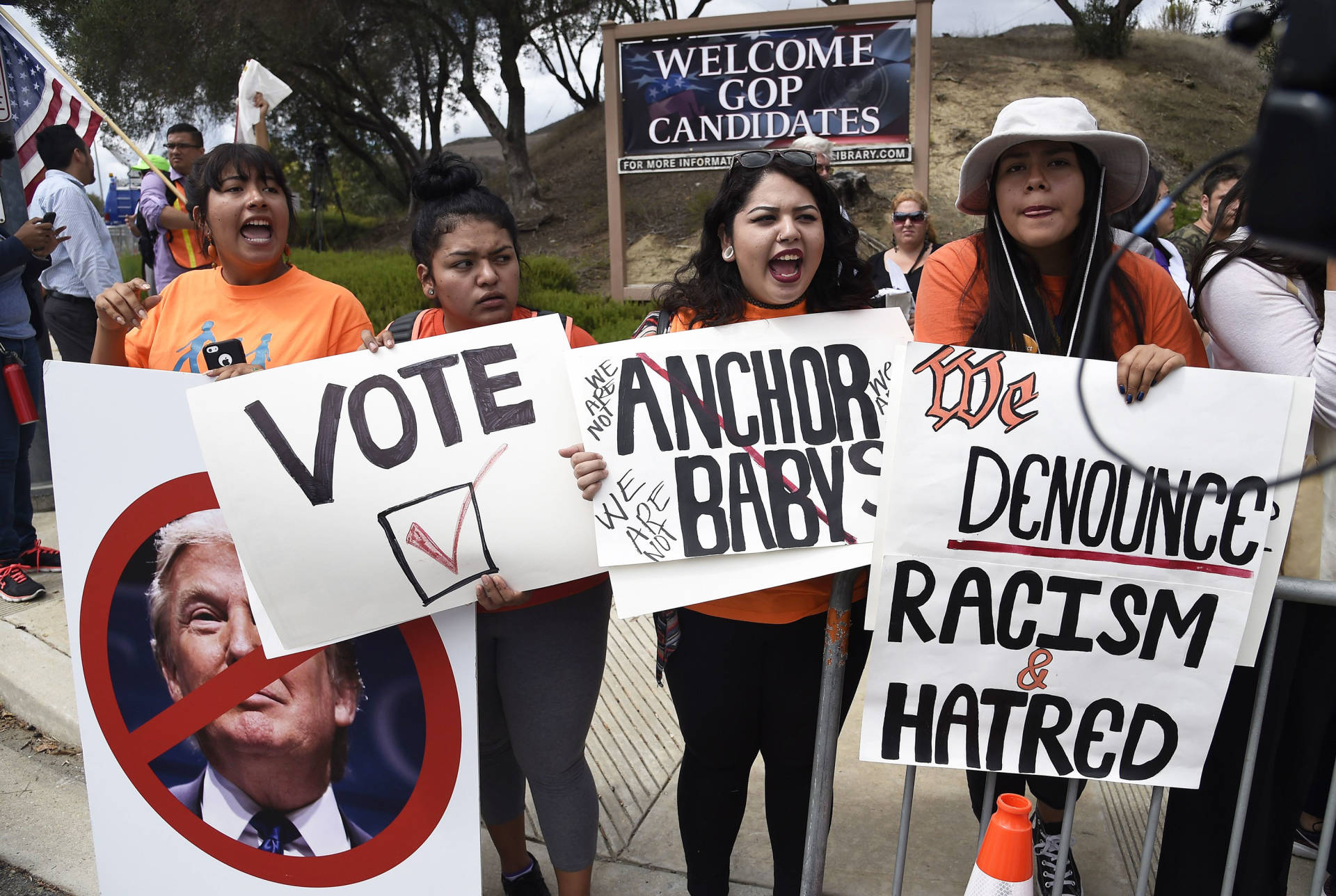
"caption": "Latinos, immigration and workers' rights advocates and their supporters protest against Donald Trump and other Republican presidential hopefuls, outside a debate at the Ronald Reagan Presidential Library in Simi Valley on September 16, 2015.",
"description": "Latinos, immigration and workers' rights advocates and their supporters protest against Donald Trump and other Republican presidential hopefuls, outside a debate at the Ronald Reagan Presidential Library in Simi Valley on September 16, 2015.",
"title": "TrumpProtesters",
"credit": "ROBYN BECK/AFP/Getty Images",
"status": "inherit",
"isLoading": false,
"fetchFailed": false
},
"news_10746274": {
"type": "attachments",
"id": "news_10746274",
"meta": {
"index": "attachments_1716263798",
"site": "news",
"id": "10746274",
"found": true
},
"parent": 10746104,
"imgSizes": {
"twentyfourteen-full-width": {
"file": "https://ww2.kqed.org/app/uploads/sites/10/2015/11/parrots-for-peskin-1038x576.jpg",
"width": 1038,
"mimeType": "image/jpeg",
"height": 576
},
"thumbnail": {
"file": "https://ww2.kqed.org/app/uploads/sites/10/2015/11/parrots-for-peskin-400x300.jpg",
"width": 400,
"mimeType": "image/jpeg",
"height": 300
},
"fd-sm": {
"file": "https://ww2.kqed.org/app/uploads/sites/10/2015/11/parrots-for-peskin-960x720.jpg",
"width": 960,
"mimeType": "image/jpeg",
"height": 720
},
"post-thumbnail": {
"file": "https://ww2.kqed.org/app/uploads/sites/10/2015/11/parrots-for-peskin-672x372.jpg",
"width": 672,
"mimeType": "image/jpeg",
"height": 372
},
"kqedFullSize": {
"file": "https://ww2.kqed.org/app/uploads/sites/10/2015/11/parrots-for-peskin.jpg",
"width": 1632,
"height": 1224
},
"large": {
"file": "https://ww2.kqed.org/app/uploads/sites/10/2015/11/parrots-for-peskin-1440x1080.jpg",
"width": 1440,
"mimeType": "image/jpeg",
"height": 1080
},
"guest-author-96": {
"file": "https://ww2.kqed.org/app/uploads/sites/10/2015/11/parrots-for-peskin-96x96.jpg",
"width": 96,
"mimeType": "image/jpeg",
"height": 96
},
"medium": {
"file": "https://ww2.kqed.org/app/uploads/sites/10/2015/11/parrots-for-peskin-800x600.jpg",
"width": 800,
"mimeType": "image/jpeg",
"height": 600
},
"guest-author-64": {
"file": "https://ww2.kqed.org/app/uploads/sites/10/2015/11/parrots-for-peskin-64x64.jpg",
"width": 64,
"mimeType": "image/jpeg",
"height": 64
},
"guest-author-32": {
"file": "https://ww2.kqed.org/app/uploads/sites/10/2015/11/parrots-for-peskin-32x32.jpg",
"width": 32,
"mimeType": "image/jpeg",
"height": 32
},
"jmtc-small-thumb": {
"file": "https://ww2.kqed.org/app/uploads/sites/10/2015/11/parrots-for-peskin-280x150.jpg",
"width": 280,
"mimeType": "image/jpeg",
"height": 150
},
"fd-med": {
"file": "https://ww2.kqed.org/app/uploads/sites/10/2015/11/parrots-for-peskin-1180x885.jpg",
"width": 1180,
"mimeType": "image/jpeg",
"height": 885
},
"detail": {
"file": "https://ww2.kqed.org/app/uploads/sites/10/2015/11/parrots-for-peskin-75x75.jpg",
"width": 75,
"mimeType": "image/jpeg",
"height": 75
},
"guest-author-128": {
"file": "https://ww2.kqed.org/app/uploads/sites/10/2015/11/parrots-for-peskin-128x128.jpg",
"width": 128,
"mimeType": "image/jpeg",
"height": 128
}
},
"publishDate": 1446680112,
"modified": 1446680233,
"caption": "This tee celebrating Peskin and the parrots of Telegraph Hill probably cost way less than the average campaign dollars spent per vote.",
"description": null,
"title": "parrots for peskin",
"credit": "Vinnee Tong/KQED",
"status": "inherit",
"isLoading": false,
"fetchFailed": false
},
"news_10746113": {
"type": "attachments",
"id": "news_10746113",
"meta": {
"index": "attachments_1716263798",
"site": "news",
"id": "10746113",
"found": true
},
"parent": 10745878,
"imgSizes": {
"twentyfourteen-full-width": {
"file": "https://ww2.kqed.org/app/uploads/sites/10/2015/11/EdLee.jpg-1038x576.jpg",
"width": 1038,
"mimeType": "image/jpeg",
"height": 576
},
"thumbnail": {
"file": "https://ww2.kqed.org/app/uploads/sites/10/2015/11/EdLee.jpg-400x267.jpg",
"width": 400,
"mimeType": "image/jpeg",
"height": 267
},
"fd-sm": {
"file": "https://ww2.kqed.org/app/uploads/sites/10/2015/11/EdLee.jpg-960x641.jpg",
"width": 960,
"mimeType": "image/jpeg",
"height": 641
},
"post-thumbnail": {
"file": "https://ww2.kqed.org/app/uploads/sites/10/2015/11/EdLee.jpg-672x372.jpg",
"width": 672,
"mimeType": "image/jpeg",
"height": 372
},
"kqedFullSize": {
"file": "https://ww2.kqed.org/app/uploads/sites/10/2015/11/EdLee.jpg.jpg",
"width": 1800,
"height": 1202
},
"large": {
"file": "https://ww2.kqed.org/app/uploads/sites/10/2015/11/EdLee.jpg-1440x962.jpg",
"width": 1440,
"mimeType": "image/jpeg",
"height": 962
},
"guest-author-96": {
"file": "https://ww2.kqed.org/app/uploads/sites/10/2015/11/EdLee.jpg-96x96.jpg",
"width": 96,
"mimeType": "image/jpeg",
"height": 96
},
"medium": {
"file": "https://ww2.kqed.org/app/uploads/sites/10/2015/11/EdLee.jpg-800x534.jpg",
"width": 800,
"mimeType": "image/jpeg",
"height": 534
},
"guest-author-64": {
"file": "https://ww2.kqed.org/app/uploads/sites/10/2015/11/EdLee.jpg-64x64.jpg",
"width": 64,
"mimeType": "image/jpeg",
"height": 64
},
"guest-author-32": {
"file": "https://ww2.kqed.org/app/uploads/sites/10/2015/11/EdLee.jpg-32x32.jpg",
"width": 32,
"mimeType": "image/jpeg",
"height": 32
},
"jmtc-small-thumb": {
"file": "https://ww2.kqed.org/app/uploads/sites/10/2015/11/EdLee.jpg-280x150.jpg",
"width": 280,
"mimeType": "image/jpeg",
"height": 150
},
"fd-med": {
"file": "https://ww2.kqed.org/app/uploads/sites/10/2015/11/EdLee.jpg-1180x788.jpg",
"width": 1180,
"mimeType": "image/jpeg",
"height": 788
},
"detail": {
"file": "https://ww2.kqed.org/app/uploads/sites/10/2015/11/EdLee.jpg-75x75.jpg",
"width": 75,
"mimeType": "image/jpeg",
"height": 75
},
"guest-author-128": {
"file": "https://ww2.kqed.org/app/uploads/sites/10/2015/11/EdLee.jpg-128x128.jpg",
"width": 128,
"mimeType": "image/jpeg",
"height": 128
}
},
"publishDate": 1446674678,
"modified": 1446680500,
"caption": "Mayor Ed Lee stands beside his choice for District 3 supervisor, Julie Christensen, in October. ",
"description": null,
"title": "EdLee.jpg",
"credit": "Christensen campaign",
"status": "inherit",
"isLoading": false,
"fetchFailed": false
},
"news_10730299": {
"type": "attachments",
"id": "news_10730299",
"meta": {
"index": "attachments_1716263798",
"site": "news",
"id": "10730299",
"found": true
},
"parent": 10716963,
"imgSizes": {
"twentyfourteen-full-width": {
"file": "https://ww2.kqed.org/app/uploads/sites/10/2015/10/d3-1038x576.jpg",
"width": 1038,
"mimeType": "image/jpeg",
"height": 576
},
"thumbnail": {
"file": "https://ww2.kqed.org/app/uploads/sites/10/2015/10/d3-400x180.jpg",
"width": 400,
"mimeType": "image/jpeg",
"height": 180
},
"fd-sm": {
"file": "https://ww2.kqed.org/app/uploads/sites/10/2015/10/d3-960x433.jpg",
"width": 960,
"mimeType": "image/jpeg",
"height": 433
},
"post-thumbnail": {
"file": "https://ww2.kqed.org/app/uploads/sites/10/2015/10/d3-672x372.jpg",
"width": 672,
"mimeType": "image/jpeg",
"height": 372
},
"kqedFullSize": {
"file": "https://ww2.kqed.org/app/uploads/sites/10/2015/10/d3.jpg",
"width": 1920,
"height": 866
},
"large": {
"file": "https://ww2.kqed.org/app/uploads/sites/10/2015/10/d3-1440x650.jpg",
"width": 1440,
"mimeType": "image/jpeg",
"height": 650
},
"guest-author-96": {
"file": "https://ww2.kqed.org/app/uploads/sites/10/2015/10/d3-96x96.jpg",
"width": 96,
"mimeType": "image/jpeg",
"height": 96
},
"medium": {
"file": "https://ww2.kqed.org/app/uploads/sites/10/2015/10/d3-800x361.jpg",
"width": 800,
"mimeType": "image/jpeg",
"height": 361
},
"guest-author-64": {
"file": "https://ww2.kqed.org/app/uploads/sites/10/2015/10/d3-64x64.jpg",
"width": 64,
"mimeType": "image/jpeg",
"height": 64
},
"guest-author-32": {
"file": "https://ww2.kqed.org/app/uploads/sites/10/2015/10/d3-32x32.jpg",
"width": 32,
"mimeType": "image/jpeg",
"height": 32
},
"jmtc-small-thumb": {
"file": "https://ww2.kqed.org/app/uploads/sites/10/2015/10/d3-280x150.jpg",
"width": 280,
"mimeType": "image/jpeg",
"height": 150
},
"fd-lrg": {
"file": "https://ww2.kqed.org/app/uploads/sites/10/2015/10/d3-1920x866.jpg",
"width": 1920,
"mimeType": "image/jpeg",
"height": 866
},
"fd-med": {
"file": "https://ww2.kqed.org/app/uploads/sites/10/2015/10/d3-1180x532.jpg",
"width": 1180,
"mimeType": "image/jpeg",
"height": 532
},
"detail": {
"file": "https://ww2.kqed.org/app/uploads/sites/10/2015/10/d3-75x75.jpg",
"width": 75,
"mimeType": "image/jpeg",
"height": 75
},
"guest-author-128": {
"file": "https://ww2.kqed.org/app/uploads/sites/10/2015/10/d3-128x128.jpg",
"width": 128,
"mimeType": "image/jpeg",
"height": 128
}
},
"publishDate": 1445626806,
"modified": 1445626918,
"caption": "Left to right: Julie Christensen, Aaron Peskin and Wilma Pang",
"description": null,
"title": "d3",
"credit": "Courtesy Christensen campaign, Christopher Michel/\u003ca href=\"https://www.flickr.com/photos/cmichel67/18461140541/in/photolist-u8maUz-iofnNg-p1Qfbc-tQAXkY-iofnVR-xPHLuD-vvBXMD-8rRtbS-8rRtCo-8rNo8X-7ty5g1-7ttKhv-4NrsiM-4Nrs78-7tM6Cr-7tHZUG-97TnkZ-9KWXXr-98po3W-7tJScG-8rNHgH-8rRPMs-8rNJdD-8rRPuY-8rNHLR-8rRNyN-8rRNtd-8rRNom-8rRNgY-8rNHBn-8rNHuB-8rNHpV-8rRNJq-97TLvP-98miEi-98myAF-7tJvXS-7tRgxW-7tR3rS-7tMjKD-7tEzBk-7tJsdY-7tMqea-7tMnbH-7tHC8r-7tMqCn-7tRor3-7tRkMU-7tMxP7-7tJsXw\">Flickr\u003c/a> and courtesy Pang",
"status": "inherit",
"isLoading": false,
"fetchFailed": false
},
"news_10728712": {
"type": "attachments",
"id": "news_10728712",
"meta": {
"index": "attachments_1716263798",
"site": "news",
"id": "10728712",
"found": true
},
"parent": 10728592,
"imgSizes": {
"jmtc-small-thumb": {
"file": "https://ww2.kqed.org/app/uploads/sites/10/2015/10/airbnb4-280x150.png",
"width": 280,
"mimeType": "image/png",
"height": 150
},
"thumbnail": {
"file": "https://ww2.kqed.org/app/uploads/sites/10/2015/10/airbnb4-400x229.png",
"width": 400,
"mimeType": "image/png",
"height": 229
},
"kqedFullSize": {
"file": "https://ww2.kqed.org/app/uploads/sites/10/2015/10/airbnb4.png",
"width": 598,
"height": 343
},
"guest-author-96": {
"file": "https://ww2.kqed.org/app/uploads/sites/10/2015/10/airbnb4-96x96.png",
"width": 96,
"mimeType": "image/png",
"height": 96
},
"guest-author-64": {
"file": "https://ww2.kqed.org/app/uploads/sites/10/2015/10/airbnb4-64x64.png",
"width": 64,
"mimeType": "image/png",
"height": 64
},
"detail": {
"file": "https://ww2.kqed.org/app/uploads/sites/10/2015/10/airbnb4-75x75.png",
"width": 75,
"mimeType": "image/png",
"height": 75
},
"guest-author-32": {
"file": "https://ww2.kqed.org/app/uploads/sites/10/2015/10/airbnb4-32x32.png",
"width": 32,
"mimeType": "image/png",
"height": 32
},
"guest-author-128": {
"file": "https://ww2.kqed.org/app/uploads/sites/10/2015/10/airbnb4-128x128.png",
"width": 128,
"mimeType": "image/png",
"height": 128
}
},
"publishDate": 1445535787,
"modified": 1445535787,
"caption": null,
"description": null,
"title": "airbnb4",
"credit": null,
"status": "inherit",
"isLoading": false,
"fetchFailed": false
},
"news_10725795": {
"type": "attachments",
"id": "news_10725795",
"meta": {
"index": "attachments_1716263798",
"site": "news",
"id": "10725795",
"found": true
},
"parent": 10725735,
"imgSizes": {
"twentyfourteen-full-width": {
"file": "https://ww2.kqed.org/app/uploads/sites/10/2015/10/RS17112_WillHayworth-qut-800x576.jpg",
"width": 800,
"mimeType": "image/jpeg",
"height": 576
},
"jmtc-small-thumb": {
"file": "https://ww2.kqed.org/app/uploads/sites/10/2015/10/RS17112_WillHayworth-qut-280x150.jpg",
"width": 280,
"mimeType": "image/jpeg",
"height": 150
},
"thumbnail": {
"file": "https://ww2.kqed.org/app/uploads/sites/10/2015/10/RS17112_WillHayworth-qut-400x310.jpg",
"width": 400,
"mimeType": "image/jpeg",
"height": 310
},
"post-thumbnail": {
"file": "https://ww2.kqed.org/app/uploads/sites/10/2015/10/RS17112_WillHayworth-qut-672x372.jpg",
"width": 672,
"mimeType": "image/jpeg",
"height": 372
},
"kqedFullSize": {
"file": "https://ww2.kqed.org/app/uploads/sites/10/2015/10/RS17112_WillHayworth-qut.jpg",
"width": 800,
"height": 620
},
"guest-author-96": {
"file": "https://ww2.kqed.org/app/uploads/sites/10/2015/10/RS17112_WillHayworth-qut-96x96.jpg",
"width": 96,
"mimeType": "image/jpeg",
"height": 96
},
"medium": {
"file": "https://ww2.kqed.org/app/uploads/sites/10/2015/10/RS17112_WillHayworth-qut-800x620.jpg",
"width": 800,
"mimeType": "image/jpeg",
"height": 620
},
"guest-author-64": {
"file": "https://ww2.kqed.org/app/uploads/sites/10/2015/10/RS17112_WillHayworth-qut-64x64.jpg",
"width": 64,
"mimeType": "image/jpeg",
"height": 64
},
"detail": {
"file": "https://ww2.kqed.org/app/uploads/sites/10/2015/10/RS17112_WillHayworth-qut-75x75.jpg",
"width": 75,
"mimeType": "image/jpeg",
"height": 75
},
"guest-author-32": {
"file": "https://ww2.kqed.org/app/uploads/sites/10/2015/10/RS17112_WillHayworth-qut-32x32.jpg",
"width": 32,
"mimeType": "image/jpeg",
"height": 32
},
"guest-author-128": {
"file": "https://ww2.kqed.org/app/uploads/sites/10/2015/10/RS17112_WillHayworth-qut-128x128.jpg",
"width": 128,
"mimeType": "image/jpeg",
"height": 128
}
},
"publishDate": 1445366436,
"modified": 1445369060,
"caption": "Voted yet? Will Hayworth has, proving not all young tech workers in San Francisco are politically disengaged workaholics. ",
"description": "Voted yet? Will Hayworth has, proving not all young tech workers in San Francisco are politically disengaged workaholics. ",
"title": "RS17112_WillHayworth-qut",
"credit": "Rachael Myrow/KQED",
"status": "inherit",
"isLoading": false,
"fetchFailed": false
},
"news_10701546": {
"type": "attachments",
"id": "news_10701546",
"meta": {
"index": "attachments_1716263798",
"site": "news",
"id": "10701546",
"found": true
},
"parent": 10701488,
"imgSizes": {
"twentyfourteen-full-width": {
"file": "https://ww2.kqed.org/app/uploads/sites/10/2015/09/airbnb-billboard-1038x576.jpg",
"width": 1038,
"mimeType": "image/jpeg",
"height": 576
},
"thumbnail": {
"file": "https://ww2.kqed.org/app/uploads/sites/10/2015/09/airbnb-billboard-400x267.jpg",
"width": 400,
"mimeType": "image/jpeg",
"height": 267
},
"fd-sm": {
"file": "https://ww2.kqed.org/app/uploads/sites/10/2015/09/airbnb-billboard-960x640.jpg",
"width": 960,
"mimeType": "image/jpeg",
"height": 640
},
"post-thumbnail": {
"file": "https://ww2.kqed.org/app/uploads/sites/10/2015/09/airbnb-billboard-672x372.jpg",
"width": 672,
"mimeType": "image/jpeg",
"height": 372
},
"kqedFullSize": {
"file": "https://ww2.kqed.org/app/uploads/sites/10/2015/09/airbnb-billboard.jpg",
"width": 1920,
"height": 1280
},
"large": {
"file": "https://ww2.kqed.org/app/uploads/sites/10/2015/09/airbnb-billboard-1440x960.jpg",
"width": 1440,
"mimeType": "image/jpeg",
"height": 960
},
"guest-author-96": {
"file": "https://ww2.kqed.org/app/uploads/sites/10/2015/09/airbnb-billboard-96x96.jpg",
"width": 96,
"mimeType": "image/jpeg",
"height": 96
},
"medium": {
"file": "https://ww2.kqed.org/app/uploads/sites/10/2015/09/airbnb-billboard-800x533.jpg",
"width": 800,
"mimeType": "image/jpeg",
"height": 533
},
"guest-author-64": {
"file": "https://ww2.kqed.org/app/uploads/sites/10/2015/09/airbnb-billboard-64x64.jpg",
"width": 64,
"mimeType": "image/jpeg",
"height": 64
},
"guest-author-32": {
"file": "https://ww2.kqed.org/app/uploads/sites/10/2015/09/airbnb-billboard-32x32.jpg",
"width": 32,
"mimeType": "image/jpeg",
"height": 32
},
"jmtc-small-thumb": {
"file": "https://ww2.kqed.org/app/uploads/sites/10/2015/09/airbnb-billboard-280x150.jpg",
"width": 280,
"mimeType": "image/jpeg",
"height": 150
},
"fd-lrg": {
"file": "https://ww2.kqed.org/app/uploads/sites/10/2015/09/airbnb-billboard-1920x1280.jpg",
"width": 1920,
"mimeType": "image/jpeg",
"height": 1280
},
"fd-med": {
"file": "https://ww2.kqed.org/app/uploads/sites/10/2015/09/airbnb-billboard-1180x787.jpg",
"width": 1180,
"mimeType": "image/jpeg",
"height": 787
},
"detail": {
"file": "https://ww2.kqed.org/app/uploads/sites/10/2015/09/airbnb-billboard-75x75.jpg",
"width": 75,
"mimeType": "image/jpeg",
"height": 75
},
"guest-author-128": {
"file": "https://ww2.kqed.org/app/uploads/sites/10/2015/09/airbnb-billboard-128x128.jpg",
"width": 128,
"mimeType": "image/jpeg",
"height": 128
}
},
"publishDate": 1443566161,
"modified": 1443566244,
"caption": "Airbnb has contributed some $8 million to the opposition campaign for Prop F, which seeks to restrict short-term housing rentals.",
"description": null,
"title": "airbnb billboard",
"credit": "Ericka Cruz Guevarra/KQED",
"status": "inherit",
"isLoading": false,
"fetchFailed": false
},
"news_10685257": {
"type": "attachments",
"id": "news_10685257",
"meta": {
"index": "attachments_1716263798",
"site": "news",
"id": "10685257",
"found": true
},
"parent": 10685094,
"imgSizes": {
"twentyfourteen-full-width": {
"file": "https://ww2.kqed.org/app/uploads/sites/10/2015/09/GettyImages-483182176-1038x576.jpg",
"width": 1038,
"mimeType": "image/jpeg",
"height": 576
},
"thumbnail": {
"file": "https://ww2.kqed.org/app/uploads/sites/10/2015/09/GettyImages-483182176-400x267.jpg",
"width": 400,
"mimeType": "image/jpeg",
"height": 267
},
"fd-sm": {
"file": "https://ww2.kqed.org/app/uploads/sites/10/2015/09/GettyImages-483182176-960x640.jpg",
"width": 960,
"mimeType": "image/jpeg",
"height": 640
},
"post-thumbnail": {
"file": "https://ww2.kqed.org/app/uploads/sites/10/2015/09/GettyImages-483182176-672x372.jpg",
"width": 672,
"mimeType": "image/jpeg",
"height": 372
},
"kqedFullSize": {
"file": "https://ww2.kqed.org/app/uploads/sites/10/2015/09/GettyImages-483182176-e1442432913431.jpg",
"width": 1920,
"height": 1281
},
"large": {
"file": "https://ww2.kqed.org/app/uploads/sites/10/2015/09/GettyImages-483182176-1440x960.jpg",
"width": 1440,
"mimeType": "image/jpeg",
"height": 960
},
"guest-author-96": {
"file": "https://ww2.kqed.org/app/uploads/sites/10/2015/09/GettyImages-483182176-96x96.jpg",
"width": 96,
"mimeType": "image/jpeg",
"height": 96
},
"medium": {
"file": "https://ww2.kqed.org/app/uploads/sites/10/2015/09/GettyImages-483182176-800x534.jpg",
"width": 800,
"mimeType": "image/jpeg",
"height": 534
},
"guest-author-64": {
"file": "https://ww2.kqed.org/app/uploads/sites/10/2015/09/GettyImages-483182176-64x64.jpg",
"width": 64,
"mimeType": "image/jpeg",
"height": 64
},
"guest-author-32": {
"file": "https://ww2.kqed.org/app/uploads/sites/10/2015/09/GettyImages-483182176-32x32.jpg",
"width": 32,
"mimeType": "image/jpeg",
"height": 32
},
"jmtc-small-thumb": {
"file": "https://ww2.kqed.org/app/uploads/sites/10/2015/09/GettyImages-483182176-280x150.jpg",
"width": 280,
"mimeType": "image/jpeg",
"height": 150
},
"fd-lrg": {
"file": "https://ww2.kqed.org/app/uploads/sites/10/2015/09/GettyImages-483182176-1920x1281.jpg",
"width": 1920,
"mimeType": "image/jpeg",
"height": 1281
},
"fd-med": {
"file": "https://ww2.kqed.org/app/uploads/sites/10/2015/09/GettyImages-483182176-1180x787.jpg",
"width": 1180,
"mimeType": "image/jpeg",
"height": 787
},
"detail": {
"file": "https://ww2.kqed.org/app/uploads/sites/10/2015/09/GettyImages-483182176-75x75.jpg",
"width": 75,
"mimeType": "image/jpeg",
"height": 75
},
"guest-author-128": {
"file": "https://ww2.kqed.org/app/uploads/sites/10/2015/09/GettyImages-483182176-128x128.jpg",
"width": 128,
"mimeType": "image/jpeg",
"height": 128
}
},
"publishDate": 1442432904,
"modified": 1442441099,
"caption": "Republican presidential candidate Carly Fiorina participates in a presidential pre-debate forum hosted by FOX News and Facebook at the Quicken Loans Arena Aug. 6, 2015, in Cleveland, Ohio. ",
"description": "Republican presidential candidate Carly Fiorina participates in a presidential pre-debate forum hosted by FOX News and Facebook at the Quicken Loans Arena August 6, 2015 in Cleveland, Ohio. ",
"title": "GOP Presidential Candidates Participate In Pre-Debate Forum In Cleveland",
"credit": "Chip Somodevilla/Getty Images",
"status": "inherit",
"isLoading": false,
"fetchFailed": false
},
"news_10632933": {
"type": "attachments",
"id": "news_10632933",
"meta": {
"index": "attachments_1716263798",
"site": "news",
"id": "10632933",
"found": true
},
"parent": 10632925,
"imgSizes": {
"twentyfourteen-full-width": {
"file": "https://ww2.kqed.org/app/uploads/sites/10/2015/08/fordon-1038x576.jpg",
"width": 1038,
"mimeType": "image/jpeg",
"height": 576
},
"thumbnail": {
"file": "https://ww2.kqed.org/app/uploads/sites/10/2015/08/fordon-400x264.jpg",
"width": 400,
"mimeType": "image/jpeg",
"height": 264
},
"fd-sm": {
"file": "https://ww2.kqed.org/app/uploads/sites/10/2015/08/fordon-960x633.jpg",
"width": 960,
"mimeType": "image/jpeg",
"height": 633
},
"post-thumbnail": {
"file": "https://ww2.kqed.org/app/uploads/sites/10/2015/08/fordon-672x372.jpg",
"width": 672,
"mimeType": "image/jpeg",
"height": 372
},
"kqedFullSize": {
"file": "https://ww2.kqed.org/app/uploads/sites/10/2015/08/fordon.jpg",
"width": 1920,
"height": 1266
},
"large": {
"file": "https://ww2.kqed.org/app/uploads/sites/10/2015/08/fordon-1440x950.jpg",
"width": 1440,
"mimeType": "image/jpeg",
"height": 950
},
"guest-author-96": {
"file": "https://ww2.kqed.org/app/uploads/sites/10/2015/08/fordon-96x96.jpg",
"width": 96,
"mimeType": "image/jpeg",
"height": 96
},
"medium": {
"file": "https://ww2.kqed.org/app/uploads/sites/10/2015/08/fordon-800x528.jpg",
"width": 800,
"mimeType": "image/jpeg",
"height": 528
},
"guest-author-64": {
"file": "https://ww2.kqed.org/app/uploads/sites/10/2015/08/fordon-64x64.jpg",
"width": 64,
"mimeType": "image/jpeg",
"height": 64
},
"guest-author-32": {
"file": "https://ww2.kqed.org/app/uploads/sites/10/2015/08/fordon-32x32.jpg",
"width": 32,
"mimeType": "image/jpeg",
"height": 32
},
"jmtc-small-thumb": {
"file": "https://ww2.kqed.org/app/uploads/sites/10/2015/08/fordon-280x150.jpg",
"width": 280,
"mimeType": "image/jpeg",
"height": 150
},
"fd-lrg": {
"file": "https://ww2.kqed.org/app/uploads/sites/10/2015/08/fordon-1920x1266.jpg",
"width": 1920,
"mimeType": "image/jpeg",
"height": 1266
},
"fd-med": {
"file": "https://ww2.kqed.org/app/uploads/sites/10/2015/08/fordon-1180x778.jpg",
"width": 1180,
"mimeType": "image/jpeg",
"height": 778
},
"detail": {
"file": "https://ww2.kqed.org/app/uploads/sites/10/2015/08/fordon-75x75.jpg",
"width": 75,
"mimeType": "image/jpeg",
"height": 75
},
"guest-author-128": {
"file": "https://ww2.kqed.org/app/uploads/sites/10/2015/08/fordon-128x128.jpg",
"width": 128,
"mimeType": "image/jpeg",
"height": 128
}
},
"publishDate": 1438897781,
"modified": 1438897833,
"caption": " Republican presidential candidates (L-R) Jim Gilmore, Sen. Lindsey Graham (R-SC), Louisiana Gov. Bobby Jindal, Rick Perry, Rick Santorum, Carly Fiorina and George Pataki pose for a photograph at the beginning of a presidential forum hosted by FOX News and Facebook at the Quicken Loans Arena August 6, 2015 in Cleveland, Ohio. The seven GOP candidates were selected to participate in the forum based on their rank in an average of the five most recent national political polls.",
"description": " Republican presidential candidates (L-R) Jim Gilmore, Sen. Lindsey Graham (R-SC), Louisiana Gov. Bobby Jindal, Rick Perry, Rick Santorum, Carly Fiorina and George Pataki pose for a photograph at the beginning of a presidential forum hosted by FOX News and Facebook at the Quicken Loans Arena August 6, 2015 in Cleveland, Ohio. The seven GOP candidates were selected to participate in the forum based on their rank in an average of the five most recent national political polls.",
"title": "GOP Presidential Candidates Participate In Pre-Debate Forum In Cleveland",
"credit": "Scott Olson/Getty Images",
"status": "inherit",
"isLoading": false,
"fetchFailed": false
},
"news_10541519": {
"type": "attachments",
"id": "news_10541519",
"meta": {
"index": "attachments_1716263798",
"site": "news",
"id": "10541519",
"found": true
},
"parent": 10540066,
"imgSizes": {
"twentyfourteen-full-width": {
"file": "https://ww2.kqed.org/app/uploads/sites/10/2015/05/Screen-Shot-2015-05-27-at-3.51.37-PM-e1432767170735-1038x576.png",
"width": 1038,
"mimeType": "image/png",
"height": 576
},
"thumbnail": {
"file": "https://ww2.kqed.org/app/uploads/sites/10/2015/05/Screen-Shot-2015-05-27-at-3.51.37-PM-e1432767170735-400x291.png",
"width": 400,
"mimeType": "image/png",
"height": 291
},
"fd-sm": {
"file": "https://ww2.kqed.org/app/uploads/sites/10/2015/05/Screen-Shot-2015-05-27-at-3.51.37-PM-e1432767170735-960x699.png",
"width": 960,
"mimeType": "image/png",
"height": 699
},
"post-thumbnail": {
"file": "https://ww2.kqed.org/app/uploads/sites/10/2015/05/Screen-Shot-2015-05-27-at-3.51.37-PM-e1432767170735-672x372.png",
"width": 672,
"mimeType": "image/png",
"height": 372
},
"kqedFullSize": {
"file": "https://ww2.kqed.org/app/uploads/sites/10/2015/05/Screen-Shot-2015-05-27-at-3.51.37-PM-e1432767170735.png",
"width": 1747,
"height": 1272
},
"large": {
"file": "https://ww2.kqed.org/app/uploads/sites/10/2015/05/Screen-Shot-2015-05-27-at-3.51.37-PM-e1432767170735-1440x1048.png",
"width": 1440,
"mimeType": "image/png",
"height": 1048
},
"guest-author-96": {
"file": "https://ww2.kqed.org/app/uploads/sites/10/2015/05/Screen-Shot-2015-05-27-at-3.51.37-PM-e1432767170735-96x96.png",
"width": 96,
"mimeType": "image/png",
"height": 96
},
"medium": {
"file": "https://ww2.kqed.org/app/uploads/sites/10/2015/05/Screen-Shot-2015-05-27-at-3.51.37-PM-e1432767170735-800x582.png",
"width": 800,
"mimeType": "image/png",
"height": 582
},
"guest-author-64": {
"file": "https://ww2.kqed.org/app/uploads/sites/10/2015/05/Screen-Shot-2015-05-27-at-3.51.37-PM-e1432767170735-64x64.png",
"width": 64,
"mimeType": "image/png",
"height": 64
},
"guest-author-32": {
"file": "https://ww2.kqed.org/app/uploads/sites/10/2015/05/Screen-Shot-2015-05-27-at-3.51.37-PM-e1432767170735-32x32.png",
"width": 32,
"mimeType": "image/png",
"height": 32
},
"fd-med": {
"file": "https://ww2.kqed.org/app/uploads/sites/10/2015/05/Screen-Shot-2015-05-27-at-3.51.37-PM-e1432767170735-1180x859.png",
"width": 1180,
"mimeType": "image/png",
"height": 859
},
"detail": {
"file": "https://ww2.kqed.org/app/uploads/sites/10/2015/05/Screen-Shot-2015-05-27-at-3.51.37-PM-e1432767170735-75x75.png",
"width": 75,
"mimeType": "image/png",
"height": 75
},
"guest-author-128": {
"file": "https://ww2.kqed.org/app/uploads/sites/10/2015/05/Screen-Shot-2015-05-27-at-3.51.37-PM-e1432767170735-128x128.png",
"width": 128,
"mimeType": "image/png",
"height": 128
}
},
"publishDate": 1432767131,
"modified": 1432767262,
"caption": "Assemblyman Jose Medina, D-Riverside, reviews documents on the Assembly floor in 2014.",
"description": "Legislature",
"title": "Screen Shot 2015-05-27 at 3.51.37 PM",
"credit": "Phil Desmangles/KQED",
"status": "inherit",
"isLoading": false,
"fetchFailed": false
}
},
"audioPlayerReducer": {
"postId": "stream_live",
"isPaused": true,
"isPlaying": false,
"pfsActive": false,
"pledgeModalIsOpen": true,
"playerDrawerIsOpen": false,
"liveAudioPlayStartedAt": 0,
"liveAudioPlayContext": ""
},
"authorsReducer": {
"byline_news_10685094": {
"type": "authors",
"id": "byline_news_10685094",
"meta": {
"override": true
},
"slug": "byline_news_10685094",
"name": "\u003cstrong>\u003ca href=\"https://twitter.com/sarahmccammon?ref_src=twsrc%5Egoogle%7Ctwcamp%5Eserp%7Ctwgr%5Eauthor\">Sarah McCammon\u003c/a>\u003cbr />NPR\u003c/strong>",
"isLoading": false
},
"jbrooks": {
"type": "authors",
"id": "80",
"meta": {
"index": "authors_1716337520",
"id": "80",
"found": true
},
"name": "Jon Brooks",
"firstName": "Jon",
"lastName": "Brooks",
"slug": "jbrooks",
"email": "jbrooks@kqed.org",
"display_author_email": true,
"staff_mastheads": [
"science"
],
"title": "Digital Editor",
"bio": "Jon Brooks is a former Digital Editor for KQED Science. He is the former editor of KQED’s daily news blog, News Fix. In 2014, he won a California Journalism Award for his coverage of ride services like Uber and Lyft and the taxi industry. A veteran blogger, he previously worked for Yahoo! in various news writing and editing roles. Jon is also a playwright whose work has been produced in San Francisco, New York, Italy, and around the U.S. He has written about film for his own blog and studied film at Boston University.",
"avatar": "https://secure.gravatar.com/avatar/98887f7ed1c876ed414d4c915e969584?s=600&d=blank&r=g",
"twitter": "jbrooksfoy",
"facebook": null,
"instagram": null,
"linkedin": null,
"sites": [
{
"site": "arts",
"roles": [
"Contributor",
"editor"
]
},
{
"site": "news",
"roles": [
"author"
]
},
{
"site": "futureofyou",
"roles": [
"administrator"
]
},
{
"site": "mindshift",
"roles": [
"editor"
]
},
{
"site": "stateofhealth",
"roles": [
"editor"
]
},
{
"site": "science",
"roles": [
"administrator"
]
},
{
"site": "quest",
"roles": [
"editor"
]
}
],
"headData": {
"title": "Jon Brooks | KQED",
"description": "Digital Editor",
"ogImgSrc": "https://secure.gravatar.com/avatar/98887f7ed1c876ed414d4c915e969584?s=600&d=blank&r=g",
"twImgSrc": "https://secure.gravatar.com/avatar/98887f7ed1c876ed414d4c915e969584?s=600&d=blank&r=g"
},
"isLoading": false,
"link": "/author/jbrooks"
},
"smartin": {
"type": "authors",
"id": "89",
"meta": {
"index": "authors_1716337520",
"id": "89",
"found": true
},
"name": "Stephanie Martin Taylor",
"firstName": "Stephanie Martin",
"lastName": "Taylor",
"slug": "smartin",
"email": "smartin@kqed.org",
"display_author_email": false,
"staff_mastheads": [],
"title": null,
"bio": "Stephanie Martin is a radio news reporter and anchor, and an occasional host of the \u003cem>KQED Newsroom \u003c/em>television program. While she currently focuses on housing and development issues, she has also reported on topics ranging from state and local politics to religion to arts and culture.\r\n\r\nPrior to joining KQED in 2005, Stephanie was an anchor and reporter for WFDD, the NPR affiliate in Winston-Salem, NC. She also spent several years as a television anchor, reporter and producer at various stations around the country.\r\n\r\nStephanie has received numerous awards for her reporting, including two National Headliner Awards, the Religion Newswriters Association's Best Radio Reporting Award and honors from the Associated Press and the Radio and Television Digital News Association. A series she produced from Iraq in 2005 earned a Best of Radio Award from the Society of Professional Journalists.\r\n\r\nStephanie received a graduate degree in Journalism from Columbia University. As an undergraduate at Colgate University, she worked and studied in Paris and Dijon, France, and spent a summer interning in the White House Press Office.\r\n\r\nStephanie grew up in Dallas, TX, and now lives with her husband in San Francisco.",
"avatar": "https://secure.gravatar.com/avatar/9fd3f8e9af01e14afde39822c19646e0?s=600&d=blank&r=g",
"twitter": "SMartinTaylor",
"facebook": null,
"instagram": null,
"linkedin": null,
"sites": [
{
"site": "arts",
"roles": [
"Contributor",
"subscriber"
]
},
{
"site": "news",
"roles": [
"subscriber"
]
},
{
"site": "stateofhealth",
"roles": [
"subscriber"
]
}
],
"headData": {
"title": "Stephanie Martin Taylor | KQED",
"description": null,
"ogImgSrc": "https://secure.gravatar.com/avatar/9fd3f8e9af01e14afde39822c19646e0?s=600&d=blank&r=g",
"twImgSrc": "https://secure.gravatar.com/avatar/9fd3f8e9af01e14afde39822c19646e0?s=600&d=blank&r=g"
},
"isLoading": false,
"link": "/author/smartin"
},
"danbrekke": {
"type": "authors",
"id": "222",
"meta": {
"index": "authors_1716337520",
"id": "222",
"found": true
},
"name": "Dan Brekke",
"firstName": "Dan",
"lastName": "Brekke",
"slug": "danbrekke",
"email": "dbrekke@kqed.org",
"display_author_email": true,
"staff_mastheads": [
"news",
"science"
],
"title": "KQED Editor and Reporter",
"bio": "Dan Brekke is a reporter and editor for KQED News, responsible for coverage of topics ranging from California water issues to the Bay Area's transportation challenges. In a newsroom career that began in Chicago in 1972, Dan has worked for \u003cem>The San Francisco Examiner,\u003c/em> Wired and TechTV and has been published in The New York Times, The New York Times Magazine, Business 2.0, Salon and elsewhere.\r\n\r\nSince joining KQED in 2007, Dan has reported, edited and produced both radio and online features and breaking news pieces. He has shared as both editor and reporter in four Society of Professional Journalists Norcal Excellence in Journalism awards and one Edward R. Murrow regional award. He was chosen for a spring 2017 residency at the Mesa Refuge to advance his research on California salmon.\r\n\r\nEmail Dan at: \u003ca href=\"mailto:dbrekke@kqed.org\">dbrekke@kqed.org\u003c/a>\r\n\r\n\u003cstrong>Twitter:\u003c/strong> \u003ca href=\"https://twitter.com/danbrekke\" rel=\"noopener noreferrer\">twitter.com/danbrekke\u003c/a>\r\n\u003cstrong>Facebook:\u003c/strong> \u003ca href=\"https://www.facebook.com/danbrekke\" rel=\"noopener noreferrer\">www.facebook.com/danbrekke\u003c/a>\r\n\u003cstrong>LinkedIn:\u003c/strong> \u003ca href=\"https://www.linkedin.com/in/danbrekke\" rel=\"noopener noreferrer\">www.linkedin.com/in/danbrekke\u003c/a>",
"avatar": "https://secure.gravatar.com/avatar/8f1f0d2a978fb3b23426c922c7e2af558fa36905b49c4ce76a97dc3c72d27226?s=600&d=mm&r=g",
"twitter": "danbrekke",
"bluesky": null,
"facebook": null,
"instagram": "https://www.instagram.com/dan.brekke/",
"linkedin": "https://www.linkedin.com/in/danbrekke/",
"sites": [
{
"site": "news",
"roles": [
"administrator",
"create_posts"
]
},
{
"site": "stateofhealth",
"roles": [
"editor"
]
},
{
"site": "science",
"roles": [
"editor"
]
},
{
"site": "quest",
"roles": [
"contributor"
]
},
{
"site": "food",
"roles": [
"contributor"
]
},
{
"site": "forum",
"roles": [
"contributor"
]
},
{
"site": "elections",
"roles": [
"editor"
]
},
{
"site": "liveblog",
"roles": [
"editor"
]
}
],
"headData": {
"title": "Dan Brekke | KQED",
"description": "KQED Editor and Reporter",
"ogImgSrc": "https://secure.gravatar.com/avatar/8f1f0d2a978fb3b23426c922c7e2af558fa36905b49c4ce76a97dc3c72d27226?s=600&d=mm&r=g",
"twImgSrc": "https://secure.gravatar.com/avatar/8f1f0d2a978fb3b23426c922c7e2af558fa36905b49c4ce76a97dc3c72d27226?s=600&d=mm&r=g"
},
"isLoading": false,
"link": "/author/danbrekke"
},
"gmarzorati": {
"type": "authors",
"id": "227",
"meta": {
"index": "authors_1716337520",
"id": "227",
"found": true
},
"name": "Guy Marzorati",
"firstName": "Guy",
"lastName": "Marzorati",
"slug": "gmarzorati",
"email": "gmarzorati@KQED.org",
"display_author_email": true,
"staff_mastheads": [
"news"
],
"title": "Correspondent",
"bio": "Guy Marzorati is a correspondent on KQED's California Politics and Government Desk, based in San Jose. A graduate of Santa Clara University, Guy joined KQED in 2013. He reports on state and local politics and produces KQED's digital voter guide.",
"avatar": "https://secure.gravatar.com/avatar/771cddf45ce3a8ed533d82dcc214e9ef925d76d2af5794a33da1ce439eb54a32?s=600&d=blank&r=g",
"twitter": "guymarzorati",
"bluesky": null,
"facebook": null,
"instagram": null,
"linkedin": null,
"sites": [
{
"site": "",
"roles": [
"editor"
]
},
{
"site": "news",
"roles": [
"editor"
]
},
{
"site": "science",
"roles": [
"editor"
]
},
{
"site": "forum",
"roles": [
"editor"
]
},
{
"site": "elections",
"roles": [
"editor"
]
},
{
"site": "liveblog",
"roles": [
"editor"
]
}
],
"headData": {
"title": "Guy Marzorati | KQED",
"description": "Correspondent",
"ogImgSrc": "https://secure.gravatar.com/avatar/771cddf45ce3a8ed533d82dcc214e9ef925d76d2af5794a33da1ce439eb54a32?s=600&d=blank&r=g",
"twImgSrc": "https://secure.gravatar.com/avatar/771cddf45ce3a8ed533d82dcc214e9ef925d76d2af5794a33da1ce439eb54a32?s=600&d=blank&r=g"
},
"isLoading": false,
"link": "/author/gmarzorati"
},
"jmyers": {
"type": "authors",
"id": "232",
"meta": {
"index": "authors_1716337520",
"id": "232",
"found": true
},
"name": "John Myers",
"firstName": "John",
"lastName": "Myers",
"slug": "jmyers",
"email": "jmyers@kqed.org",
"display_author_email": false,
"staff_mastheads": [],
"title": null,
"bio": "John Myers is Senior Editor of KQED's new California Politics and Government Desk. A veteran of almost two decades of political coverage, he was KQED's longest serving statehouse bureau chief and recently was political editor for Sacramento's ABC affiliate, News10 (KXTV). John was moderator of the only 2014 gubernatorial debate, and was named by \u003cem>The Washington Post\u003c/em> to two \"Best Of\" lists: the 2015 list of top state politics reporters and 2014's list of America's most influential statehouse reporters.",
"avatar": "https://secure.gravatar.com/avatar/c0ac98482caf0b8229a792662b38722a?s=600&d=blank&r=g",
"twitter": "johnmyers",
"facebook": null,
"instagram": null,
"linkedin": null,
"sites": [
{
"site": "news",
"roles": [
"subscriber"
]
}
],
"headData": {
"title": "John Myers | KQED",
"description": null,
"ogImgSrc": "https://secure.gravatar.com/avatar/c0ac98482caf0b8229a792662b38722a?s=600&d=blank&r=g",
"twImgSrc": "https://secure.gravatar.com/avatar/c0ac98482caf0b8229a792662b38722a?s=600&d=blank&r=g"
},
"isLoading": false,
"link": "/author/jmyers"
},
"rachael-myrow": {
"type": "authors",
"id": "251",
"meta": {
"index": "authors_1716337520",
"id": "251",
"found": true
},
"name": "Rachael Myrow",
"firstName": "Rachael",
"lastName": "Myrow",
"slug": "rachael-myrow",
"email": "rmyrow@kqed.org",
"display_author_email": true,
"staff_mastheads": [
"news"
],
"title": "Senior Editor of KQED's Silicon Valley News Desk",
"bio": "• I write and edit stories about how Silicon Valley power and policies shape everyday life in California. I’m also passionate about making Bay Area history and culture more accessible to a broad public. • I’ve been a journalist for most of my life, starting in high school with The Franklin Press in Los Angeles, where I grew up. While earning my first degree in English at UC Berkeley, I got my start in public radio at KALX-FM. After completing a second degree in journalism at Cal, I landed my first professional job at Marketplace, then moved on to KPCC (now LAist), and then KQED, where I hosted The California Report for more than seven years. • My reporting has appeared on NPR, The World, WBUR’s \u003ci>Here & Now\u003c/i>, and the BBC. I also guest host for KQED’s \u003ci>Forum\u003c/i>, as well as the Commonwealth Club in San Francisco. • I speak periodically on media, democracy and technology issues, and do voiceover work for documentaries and educational video projects. • Outside of the studio, you'll find me hiking Bay Area trails and whipping up Insta-ready meals in my kitchen. • I do not accept gifts, money, or favors from anyone connected to my reporting, I don't pay people for information, and I do not support or donate to political causes. • I strive to treat the people I report on with fairness, honesty, and respect. I also recognize there are often multiple sides to a story and work to verify information through multiple sources and documentation. If I get something wrong, I correct it.",
"avatar": "https://secure.gravatar.com/avatar/3ed8a3c5f26025e4a805ba634cda8cd764906b97438a6d9ce216b044e340da4e?s=600&d=blank&r=g",
"twitter": "rachaelmyrow",
"bluesky": null,
"facebook": null,
"instagram": null,
"linkedin": "https://www.linkedin.com/in/rachaelmyrow/",
"sites": [
{
"site": "arts",
"roles": [
"administrator"
]
},
{
"site": "news",
"roles": [
"edit_others_posts",
"editor"
]
},
{
"site": "futureofyou",
"roles": [
"editor"
]
},
{
"site": "bayareabites",
"roles": [
"editor"
]
},
{
"site": "stateofhealth",
"roles": [
"editor"
]
},
{
"site": "science",
"roles": [
"editor"
]
},
{
"site": "food",
"roles": [
"editor"
]
},
{
"site": "forum",
"roles": [
"editor"
]
},
{
"site": "liveblog",
"roles": [
"author"
]
}
],
"headData": {
"title": "Rachael Myrow | KQED",
"description": "Senior Editor of KQED's Silicon Valley News Desk",
"ogImgSrc": "https://secure.gravatar.com/avatar/3ed8a3c5f26025e4a805ba634cda8cd764906b97438a6d9ce216b044e340da4e?s=600&d=blank&r=g",
"twImgSrc": "https://secure.gravatar.com/avatar/3ed8a3c5f26025e4a805ba634cda8cd764906b97438a6d9ce216b044e340da4e?s=600&d=blank&r=g"
},
"isLoading": false,
"link": "/author/rachael-myrow"
},
"bwillon": {
"type": "authors",
"id": "3207",
"meta": {
"index": "authors_1716337520",
"id": "3207",
"found": true
},
"name": "Beth Willon",
"firstName": "Beth",
"lastName": "Willon",
"slug": "bwillon",
"email": "bwillon@kqed.org",
"display_author_email": false,
"staff_mastheads": [],
"title": "KQED Contributor",
"bio": "Beth Willon is a former senior reporter for KQED's Silicon Valley News Desk in San Jose. (@KQEDNews )\r\n\r\n@BethWillon",
"avatar": "https://secure.gravatar.com/avatar/3533b741c785d6a97e8b283e7f65606d?s=600&d=blank&r=g",
"twitter": null,
"facebook": null,
"instagram": null,
"linkedin": null,
"sites": [
{
"site": "news",
"roles": [
"subscriber"
]
}
],
"headData": {
"title": "Beth Willon | KQED",
"description": "KQED Contributor",
"ogImgSrc": "https://secure.gravatar.com/avatar/3533b741c785d6a97e8b283e7f65606d?s=600&d=blank&r=g",
"twImgSrc": "https://secure.gravatar.com/avatar/3533b741c785d6a97e8b283e7f65606d?s=600&d=blank&r=g"
},
"isLoading": false,
"link": "/author/bwillon"
},
"rbowe": {
"type": "authors",
"id": "3231",
"meta": {
"index": "authors_1716337520",
"id": "3231",
"found": true
},
"name": "Rebecca Bowe",
"firstName": "Rebecca",
"lastName": "Bowe",
"slug": "rbowe",
"email": "rbowe@kqed.org",
"display_author_email": false,
"staff_mastheads": [],
"title": null,
"bio": "Rebecca Bowe is a journalist based in San Francisco. She's covered Bay Area news since 2009, and previously served as News Editor of the San Francisco Bay Guardian. Follow her on Twitter @ByRebeccaBowe.",
"avatar": "https://secure.gravatar.com/avatar/50e1da0639521639108e89c123a76c9c?s=600&d=blank&r=g",
"twitter": null,
"facebook": null,
"instagram": null,
"linkedin": null,
"sites": [
{
"site": "news",
"roles": [
"subscriber"
]
},
{
"site": "science",
"roles": [
"editor"
]
}
],
"headData": {
"title": "Rebecca Bowe | KQED",
"description": null,
"ogImgSrc": "https://secure.gravatar.com/avatar/50e1da0639521639108e89c123a76c9c?s=600&d=blank&r=g",
"twImgSrc": "https://secure.gravatar.com/avatar/50e1da0639521639108e89c123a76c9c?s=600&d=blank&r=g"
},
"isLoading": false,
"link": "/author/rbowe"
},
"korr": {
"type": "authors",
"id": "11200",
"meta": {
"index": "authors_1716337520",
"id": "11200",
"found": true
},
"name": "Katie Orr",
"firstName": "Katie",
"lastName": "Orr",
"slug": "korr",
"email": "korr@kqed.org",
"display_author_email": false,
"staff_mastheads": [],
"title": "KQED Contributor",
"bio": "Katie Orr was a Sacramento-based reporter for KQED's Politics and Government Desk, covering the state Capitol and a variety of issues including women in politics, voting and elections and legislation. Prior to joining KQED in 2016, Katie was state government reporter for Capital Public Radio in Sacramento. She's also worked for KPBS in San Diego, where she covered City Hall.\r\n\r\nKatie received her masters degree in political science from San Diego State University and holds a Bachelors degree in broadcast journalism from Arizona State University.\r\n\r\nIn 2015 Katie won a national Clarion Award for a series of stories she did on women in California politics. She's been honored by the Society for Professional Journalists and, in 2013, was named by \u003cem>The Washington Post\u003c/em> as one of the country's top state Capitol reporters. She's also reported for the award-winning documentary series \u003cem>The View from Here \u003c/em>and was part of the team that won national PRNDI and Gabriel Awards in 2015. She lives in Sacramento with her husband. Twitter: @1KatieOrr",
"avatar": "https://secure.gravatar.com/avatar/41a40b25845adc78f50808670860449e?s=600&d=blank&r=g",
"twitter": "1katieorr",
"facebook": null,
"instagram": null,
"linkedin": null,
"sites": [
{
"site": "news",
"roles": [
"subscriber"
]
},
{
"site": "stateofhealth",
"roles": [
"author"
]
},
{
"site": "forum",
"roles": [
"author"
]
}
],
"headData": {
"title": "Katie Orr | KQED",
"description": "KQED Contributor",
"ogImgSrc": "https://secure.gravatar.com/avatar/41a40b25845adc78f50808670860449e?s=600&d=blank&r=g",
"twImgSrc": "https://secure.gravatar.com/avatar/41a40b25845adc78f50808670860449e?s=600&d=blank&r=g"
},
"isLoading": false,
"link": "/author/korr"
}
},
"pagesReducer": {
"news_tag_elections": {
"type": "terms",
"id": "news_23394",
"meta": {
"index": "terms_1716263798",
"site": "news",
"id": "23394",
"score": 9.107828
},
"featImg": null,
"name": "elections",
"description": null,
"taxonomy": "tag",
"headData": {
"twImgId": null,
"twTitle": null,
"ogTitle": null,
"ogImgId": null,
"twDescription": null,
"description": null,
"title": "elections Archives | KQED News",
"ogDescription": null
},
"ttid": 23411,
"slug": "elections",
"isLoading": false,
"title": "elections",
"pageMeta": {
"site": "news",
"WpPageTemplate": "page-topic-editorial",
"currentPage": 17
},
"blocks": [
{
"blockName": "kqed/post-list",
"attrs": {
"layout": "cardArticle2",
"query": "posts/news?tag=elections",
"seeMore": false,
"paginated": true,
"page": 17
}
},
{
"blockName": "kqed/ad"
}
]
}
},
"pfsSessionReducer": {},
"postsReducer": {
"stream_live": {
"type": "live",
"id": "stream_live",
"audioUrl": "https://hls.kqed.org/hls/kqed_app/playlist.m3u8",
"title": "Live Stream",
"excerpt": "Live Stream information currently unavailable.",
"link": "/radio",
"featImg": "",
"label": {
"name": "KQED Live",
"link": "/"
}
},
"stream_kqedNewscast": {
"type": "posts",
"id": "stream_kqedNewscast",
"audioUrl": "https://www.kqed.org/.stream/anon/radio/RDnews/newscast.mp3?_=1",
"title": "KQED Newscast",
"featImg": "",
"label": {
"name": "88.5 FM",
"link": "/"
}
},
"news_11005651": {
"type": "posts",
"id": "news_11005651",
"meta": {
"index": "posts_1716263798",
"site": "news",
"id": "11005651",
"score": null,
"sort": [
1467389596000
]
},
"guestAuthors": [],
"slug": "study-up-california-youve-got-17-statewide-measures-to-vote-on",
"title": "Study Up, California! You've Got 17 Statewide Measures to Vote On",
"publishDate": 1467389596,
"format": "standard",
"headTitle": "Study Up, California! You’ve Got 17 Statewide Measures to Vote On | KQED",
"labelTerm": {
"term": 72,
"site": "news"
},
"content": "\u003cp>The California Secretary of State’s Office has certified the final list of statewide measures that have qualified for the November ballot.\u003c/p>\n\u003cp>Along with several big bond and tax questions, voters will get to decide the future of the death penalty, a collection of tough new gun laws, and whether they really like a yet-to-be-enacted statewide ban on plastic bags.\u003c/p>\n\u003cp>If you start studying now, you might be ready come Election Day. It’s just 130 days away.\u003c/p>\n\u003cul>\n\u003cli>\u003cstrong>\u003ca href=\"http://www.oag.ca.gov/system/files/initiatives/pdfs/15-0098%20%28Firearms%29_0.pdf\" target=\"_blank\" rel=\"noopener\">Gun Control\u003c/a>:\u003c/strong> This is a package of \u003ca href=\"http://safetyforall.com/\">gun control measures\u003c/a> backed by Lt. Gov. Gavin Newsom. Among its provisions is a ban on large-capacity ammunition magazines. It would also require background checks for ammunition purchases. State lawmakers have passed \u003ca href=\"http://ww2.kqed.org/news/2016/06/30/california-legislature-passes-a-dozen-new-gun-regulations\" target=\"_blank\" rel=\"noopener\">a similar package\u003c/a> of laws but neither Newsom nor Senate leader Kevin de León, who pushed the bills in the Legislature, would drop their effort and support the other.\u003c/li>\n\u003cli>\u003cstrong>\u003ca href=\"http://www.oag.ca.gov/system/files/initiatives/pdfs/15-0081%20%28Tobacco%20Tax%20V3%29.pdf?\" target=\"_blank\" rel=\"noopener\">Cigarette Tax\u003c/a>:\u003c/strong> This would place a $2 per pack tax on cigarettes. The money would be used for health care programs as well as tobacco use prevention and control programs. The cigarette tax currently stands at \u003ca href=\"https://ww2.kqed.org/stateofhealth/2016/05/16/move-to-triple-californias-tobacco-tax-appears-headed-to-ballot/\">87 cents per pack\u003c/a>. The increased tax would also apply to electronic cigarettes and other products containing nicotine. The measure comes after the California Legislature and Gov. Jerry Brown raised the state’s smoking age to 21.\u003c/li>\n\u003cli>\u003cstrong>\u003ca href=\"http://www.oag.ca.gov/system/files/initiatives/pdfs/15-0115%20%28Temporary%20Tax%20Increase%29_0.pdf?\" target=\"_blank\" rel=\"noopener\">Proposition 30 Tax Extension\u003c/a>: \u003c/strong>If approved, this measure would extend the income tax portion of the Prop. 30 tax increase for another 12 years. It would apply to anyone making more than $250,000 a year. Brown, who campaigned fiercely for Prop. 30 to help bail out the state from a series of huge deficits, has not endorsed the extension.\u003c/li>\n\u003cli>\u003cstrong>\u003ca href=\"http://www.oag.ca.gov/system/files/initiatives/pdfs/15-0121%20%28Prison%20Sentence%20Reform%29_0.pdf?\" target=\"_blank\" rel=\"noopener\">Criminal Sentences\u003c/a>:\u003c/strong> Measure sponsored by Brown aims to cut the state prison population by giving inmates a chance for earlier parole and allowing judges, instead of prosecutors, to decide whether a minor should be tried as an adult. The initiative faced a court challenge from the California District Attorneys Association, which said Brown improperly amended an existing initiative to get this on the ballot. However, the California Supreme Court ultimately ruled in Brown’s favor.\u003c/li>\n\u003cli>\u003ca href=\"https://oag.ca.gov/system/files/initiatives/pdfs/14-0011%20%28Referendum%20of%20SB%20270%29.pdf??\" target=\"_blank\" rel=\"noopener\">\u003cstrong>Plastic Bag Ban Referendum\u003c/strong>\u003c/a>: In 2014, Brown \u003ca href=\"https://www.gov.ca.gov/news.php?id=18742\">signed\u003c/a> the nation’s first statewide ban on single-use plastic bags. The governor touted the ban as a way to stop “the torrent of plastic polluting our beaches, parks and even the vast ocean itself.” But the ban never went into effect, as plastic bag manufacturers were able to gather enough signatures a few months later to force a referendum.\u003c/li>\n\u003cli>\u003cstrong>\u003ca href=\"http://www.oag.ca.gov/system/files/initiatives/pdfs/15-0074%20%28Carryout%20Bag%20Fees%29.pdf?\" target=\"_blank\" rel=\"noopener\">Carry-Out Bag Revenue\u003c/a>:\u003c/strong> This measure, backed by the same plastic bag manufacturers who qualified the referendum, would go into effect only if the referendum campaign is defeated and the plastic bag ban is upheld. It would direct money that stores collect from selling paper bags into a special state fund for environmental projects. Proponents say they’re just giving voters a chance to direct paper bag proceeds to “worthy environmental causes.” Critics say the plastic bag makers are trying to force grocers, who support the plastic bag ban, to spend money to defeat this measure.\u003c/li>\n\u003cli>\u003cstrong>\u003ca href=\"http://www.oag.ca.gov/system/files/initiatives/pdfs/15-0103%20%28Marijuana%29_1.pdf?\" target=\"_blank\" rel=\"noopener\">Recreational Pot\u003c/a>: \u003c/strong>If approved, California would become the fifth state (after Colorado, Oregon, Alaska and Washington) to legalize the recreational use of marijuana for adults 21 and over. Proponents include Newsom and former Facebook president Sean Parker.\u003c/li>\n\u003cli>\u003cstrong>\u003ca href=\"https://oag.ca.gov/system/files/initiatives/pdfs/13-0022%20%2813-0022%20%28Hospital%20Fees%29%29.pdfhttps://oag.ca.gov/system/files/initiatives/pdfs/13-0022%20%2813-0022%20%28Hospital%20Fees%29%29.pdf\" target=\"_blank\" rel=\"noopener\">Medi-Cal Hospital Reimbursement\u003c/a>:\u003c/strong> Currently, private California hospitals pay a fee into a state Medi-Cal fund, which is used to bring in matching federal dollars for the state health program. In return, the hospitals receive a reimbursement for Medi-Cal services. The fund is set to expire at the end of the year; this measure would make it permanent.\u003c/li>\n\u003cli>\u003cstrong>\u003ca href=\"http://oag.ca.gov/system/files/initiatives/pdfs/15-0003%20%28Bond-funded%20Projects%20V2%29.pdf?\" target=\"_blank\" rel=\"noopener\">Public Vote on Bonds\u003c/a>:\u003c/strong> This measure has the potential to spark a number of statewide ballot battles in the near future. The initiative, backed by wealthy San Joaquin Valley farmer/agribusinessman \u003ca href=\"http://www.sacbee.com/opinion/opn-columns-blogs/dan-morain/article36624108.html\" target=\"_blank\" rel=\"noopener\">Dean Cortopassi\u003c/a>, would require a statewide vote on any project requiring $2 billion or more in revenue bonds. What might that include? Brown’s two “legacy” projects: a high-speed rail system and the proposed twin-tunnel water project in the Delta.\u003c/li>\n\u003cli>\u003cstrong>\u003ca href=\"https://ballotpedia.org/California_Multilingual_Education_Act_(2016)\" target=\"_blank\" rel=\"noopener\">Multilingual Education\u003c/a>:\u003c/strong> Placed on the ballot by Democratic lawmakers, this measure would repeal Proposition 227, the 1998 initiative (backed by Ron Unz) that ended bilingual education in the state.\u003c/li>\n\u003cli>\u003cstrong>\u003ca href=\"http://oag.ca.gov/system/files/initiatives/pdfs/15-0005%20%28Education%20Bond%20Act%29.pdf?\" target=\"_blank\" rel=\"noopener\">School Bond\u003c/a>: \u003c/strong> After a similar effort fell short in 2014, school districts and developers have qualified a $9 billion bond to fund school construction. Brown is opposed to the measure, which he called “a blunderbuss effort.” He has argued that the current bond system gives an advantage to large districts that are able to quickly complete first-come-first-serve funding applications.\u003c/li>\n\u003cli>\u003cstrong>\u003ca href=\"http://oag.ca.gov/system/files/initiatives/pdfs/15-0004%20%28Safer%20Sex%29_8.pdf?\" target=\"_blank\" rel=\"noopener\">Condoms in Adult Films\u003c/a>:\u003c/strong> Proposal would require actors in adult movies made in California to wear condoms while filming sex scenes. Earlier this year, California’s Divison of Occupational Safety and Health \u003ca href=\"http://ww2.kqed.org/stateofhealth/2016/02/17/california-porn-industry-protests-rules-mandating-condoms/\">rejected proposed regulations\u003c/a> that would have mandated condom use.\u003c/li>\n\u003cli>\u003cstrong>\u003ca href=\"http://oag.ca.gov/system/files/initiatives/pdfs/15-0009%20%28Prescription%20Drug%20Costs%29.pdf?\" target=\"_blank\" rel=\"noopener\">Prescription Drug Pricing\u003c/a>:\u003c/strong> Sponsored by the AIDS Healthcare Foundation, the same group behind the condom measure, this measure would cap the amount the state can be charged for the prescription drugs it purchases for Medi-Cal beneficiaries, retirees and prison inmates. The pharmaceutical industry is strongly opposed, arguing the measure will limit drug choices for patients.\u003c/li>\n\u003cli>\u003cstrong>\u003ca href=\"http://www.oag.ca.gov/system/files/initiatives/pdfs/15-0066%20%28Death%20Penalty%29.pdf?\" target=\"_blank\" rel=\"noopener\">Death Penalty Repeal\u003c/a>:\u003c/strong> Proponents of eliminating California’s death penalty (and replacing it with a max sentence of life in prison without the possibility of parole) are hoping for a different result than in 2012, when voters defeated another repeal measure, \u003ca href=\"http://vig.cdn.sos.ca.gov/2012/general/pdf/34-title-summ-analysis.pdf\" target=\"_blank\" rel=\"noopener\">Proposition 34\u003c/a>. \u003ca href=\"http://ww2.kqed.org/news/2015/12/14/faster-executions-or-none-at-all-california-voters-may-choose\">California has executed 15 inmates\u003c/a> since its current capital punishment law took effect in 1978, and its current system of carrying out death sentences is the target of multiple legal challenges.\u003c/li>\n\u003cli>\u003cstrong>\u003ca href=\"http://www.oag.ca.gov/system/files/initiatives/pdfs/15-0096%20%28Death%20Penalty%29_0.pdf?\" target=\"_blank\" rel=\"noopener\">Expedite Death Penalty\u003c/a>: \u003c/strong>A group led by former NFL player Kermit Alexander wants to take a completely different approach to reforming California’s death penalty process. The initiative would limit inmate appeals, which in some cases can drag on for decades.\u003c/li>\n\u003cli>\u003cstrong>\u003ca href=\"http://www.oag.ca.gov/system/files/initiatives/pdfs/15-0083%20%28Legislature%20Transparency%29_0.pdf?\" target=\"_blank\" rel=\"noopener\">Legislative Transparency\u003c/a>:\u003c/strong> Backed by wealthy GOP donor Charles T. Munger Jr., this effort would require bills be in print for 72 hours before a vote. It would also mandate that video recordings of all legislative proceedings be posted online. A late attempt by a group of state senators to place their own version of this measure on the November ballot fell short.\u003c/li>\n\u003cli>\u003cstrong>\u003ca href=\"http://leginfo.legislature.ca.gov/faces/billNavClient.xhtml?bill_id=201520160SB254\" target=\"_blank\" rel=\"noopener\">Citizens United\u003c/a>:\u003c/strong> The \u003ca href=\"http://ww2.kqed.org/news/2016/01/04/court-greenlights-citizens-united-ballot-question\">path to the ballot\u003c/a> for this advisory measure was arguably more interesting than the measure itself. Voters will be asked whether they support legislators using the little power they have to overturn the U.S. Supreme Court’s Citizens United decision, which struck down limits on independent campaign expenditures by corporations and unions. To get on the ballot, the advisory question had to survive a challenge in the state Supreme Court over whether such advisory measures should be allowed on the ballot.\u003c/li>\n\u003c/ul>\n\u003cp>[ad fullwidth]\u003c/p>\u003cp>[ad floatright]\u003c/p>\n",
"blocks": [],
"excerpt": "Voters have 130 days to delve into topics ranging from gun control to condoms in the adult film industry.",
"status": "publish",
"parent": 0,
"modified": 1721108958,
"stats": {
"hasAudio": false,
"hasVideo": false,
"hasChartOrMap": false,
"iframeSrcs": [],
"hasGoogleForm": false,
"hasGallery": false,
"hasHearkenModule": false,
"hasPolis": false,
"paragraphCount": 5,
"wordCount": 1193
},
"headData": {
"title": "Study Up, California! You've Got 17 Statewide Measures to Vote On | KQED",
"description": "Voters have 130 days to delve into topics ranging from gun control to condoms in the adult film industry.",
"ogTitle": "",
"ogDescription": "",
"ogImgId": "",
"twTitle": "",
"twDescription": "",
"twImgId": "",
"schema": {
"@context": "https://schema.org",
"@type": "NewsArticle",
"headline": "Study Up, California! You've Got 17 Statewide Measures to Vote On",
"datePublished": "2016-07-01T09:13:16-07:00",
"dateModified": "2024-07-15T22:49:18-07:00",
"image": "https://cdn.kqed.org/wp-content/uploads/2020/02/KQED-OG-Image@1x.png",
"isAccessibleForFree": "True",
"publisher": {
"@type": "NewsMediaOrganization",
"@id": "https://www.kqed.org/#organization",
"name": "KQED",
"logo": "https://cdn.kqed.org/wp-content/uploads/2020/02/KQED-OG-Image@1x.png",
"url": "https://www.kqed.org",
"sameAs": [
"https://www.facebook.com/KQED",
"https://twitter.com/KQED",
"https://www.instagram.com/kqed/",
"https://www.tiktok.com/@kqedofficial",
"https://www.linkedin.com/company/kqed",
"https://www.youtube.com/channel/UCeC0IOo7i1P_61zVUWbJ4nw"
]
}
}
},
"sticky": false,
"customPermalink": "2016/07/01/california-2016-statewide-ballot-measures/",
"nprStoryId": "493623137",
"path": "/news/11005651/study-up-california-youve-got-17-statewide-measures-to-vote-on",
"audioTrackLength": null,
"parsedContent": [
{
"type": "contentString",
"content": "\u003cdiv class=\"post-body\">\u003cp>\u003cp>The California Secretary of State’s Office has certified the final list of statewide measures that have qualified for the November ballot.\u003c/p>\n\u003cp>Along with several big bond and tax questions, voters will get to decide the future of the death penalty, a collection of tough new gun laws, and whether they really like a yet-to-be-enacted statewide ban on plastic bags.\u003c/p>\n\u003cp>If you start studying now, you might be ready come Election Day. It’s just 130 days away.\u003c/p>\n\u003cul>\n\u003cli>\u003cstrong>\u003ca href=\"http://www.oag.ca.gov/system/files/initiatives/pdfs/15-0098%20%28Firearms%29_0.pdf\" target=\"_blank\" rel=\"noopener\">Gun Control\u003c/a>:\u003c/strong> This is a package of \u003ca href=\"http://safetyforall.com/\">gun control measures\u003c/a> backed by Lt. Gov. Gavin Newsom. Among its provisions is a ban on large-capacity ammunition magazines. It would also require background checks for ammunition purchases. State lawmakers have passed \u003ca href=\"http://ww2.kqed.org/news/2016/06/30/california-legislature-passes-a-dozen-new-gun-regulations\" target=\"_blank\" rel=\"noopener\">a similar package\u003c/a> of laws but neither Newsom nor Senate leader Kevin de León, who pushed the bills in the Legislature, would drop their effort and support the other.\u003c/li>\n\u003cli>\u003cstrong>\u003ca href=\"http://www.oag.ca.gov/system/files/initiatives/pdfs/15-0081%20%28Tobacco%20Tax%20V3%29.pdf?\" target=\"_blank\" rel=\"noopener\">Cigarette Tax\u003c/a>:\u003c/strong> This would place a $2 per pack tax on cigarettes. The money would be used for health care programs as well as tobacco use prevention and control programs. The cigarette tax currently stands at \u003ca href=\"https://ww2.kqed.org/stateofhealth/2016/05/16/move-to-triple-californias-tobacco-tax-appears-headed-to-ballot/\">87 cents per pack\u003c/a>. The increased tax would also apply to electronic cigarettes and other products containing nicotine. The measure comes after the California Legislature and Gov. Jerry Brown raised the state’s smoking age to 21.\u003c/li>\n\u003cli>\u003cstrong>\u003ca href=\"http://www.oag.ca.gov/system/files/initiatives/pdfs/15-0115%20%28Temporary%20Tax%20Increase%29_0.pdf?\" target=\"_blank\" rel=\"noopener\">Proposition 30 Tax Extension\u003c/a>: \u003c/strong>If approved, this measure would extend the income tax portion of the Prop. 30 tax increase for another 12 years. It would apply to anyone making more than $250,000 a year. Brown, who campaigned fiercely for Prop. 30 to help bail out the state from a series of huge deficits, has not endorsed the extension.\u003c/li>\n\u003cli>\u003cstrong>\u003ca href=\"http://www.oag.ca.gov/system/files/initiatives/pdfs/15-0121%20%28Prison%20Sentence%20Reform%29_0.pdf?\" target=\"_blank\" rel=\"noopener\">Criminal Sentences\u003c/a>:\u003c/strong> Measure sponsored by Brown aims to cut the state prison population by giving inmates a chance for earlier parole and allowing judges, instead of prosecutors, to decide whether a minor should be tried as an adult. The initiative faced a court challenge from the California District Attorneys Association, which said Brown improperly amended an existing initiative to get this on the ballot. However, the California Supreme Court ultimately ruled in Brown’s favor.\u003c/li>\n\u003cli>\u003ca href=\"https://oag.ca.gov/system/files/initiatives/pdfs/14-0011%20%28Referendum%20of%20SB%20270%29.pdf??\" target=\"_blank\" rel=\"noopener\">\u003cstrong>Plastic Bag Ban Referendum\u003c/strong>\u003c/a>: In 2014, Brown \u003ca href=\"https://www.gov.ca.gov/news.php?id=18742\">signed\u003c/a> the nation’s first statewide ban on single-use plastic bags. The governor touted the ban as a way to stop “the torrent of plastic polluting our beaches, parks and even the vast ocean itself.” But the ban never went into effect, as plastic bag manufacturers were able to gather enough signatures a few months later to force a referendum.\u003c/li>\n\u003cli>\u003cstrong>\u003ca href=\"http://www.oag.ca.gov/system/files/initiatives/pdfs/15-0074%20%28Carryout%20Bag%20Fees%29.pdf?\" target=\"_blank\" rel=\"noopener\">Carry-Out Bag Revenue\u003c/a>:\u003c/strong> This measure, backed by the same plastic bag manufacturers who qualified the referendum, would go into effect only if the referendum campaign is defeated and the plastic bag ban is upheld. It would direct money that stores collect from selling paper bags into a special state fund for environmental projects. Proponents say they’re just giving voters a chance to direct paper bag proceeds to “worthy environmental causes.” Critics say the plastic bag makers are trying to force grocers, who support the plastic bag ban, to spend money to defeat this measure.\u003c/li>\n\u003cli>\u003cstrong>\u003ca href=\"http://www.oag.ca.gov/system/files/initiatives/pdfs/15-0103%20%28Marijuana%29_1.pdf?\" target=\"_blank\" rel=\"noopener\">Recreational Pot\u003c/a>: \u003c/strong>If approved, California would become the fifth state (after Colorado, Oregon, Alaska and Washington) to legalize the recreational use of marijuana for adults 21 and over. Proponents include Newsom and former Facebook president Sean Parker.\u003c/li>\n\u003cli>\u003cstrong>\u003ca href=\"https://oag.ca.gov/system/files/initiatives/pdfs/13-0022%20%2813-0022%20%28Hospital%20Fees%29%29.pdfhttps://oag.ca.gov/system/files/initiatives/pdfs/13-0022%20%2813-0022%20%28Hospital%20Fees%29%29.pdf\" target=\"_blank\" rel=\"noopener\">Medi-Cal Hospital Reimbursement\u003c/a>:\u003c/strong> Currently, private California hospitals pay a fee into a state Medi-Cal fund, which is used to bring in matching federal dollars for the state health program. In return, the hospitals receive a reimbursement for Medi-Cal services. The fund is set to expire at the end of the year; this measure would make it permanent.\u003c/li>\n\u003cli>\u003cstrong>\u003ca href=\"http://oag.ca.gov/system/files/initiatives/pdfs/15-0003%20%28Bond-funded%20Projects%20V2%29.pdf?\" target=\"_blank\" rel=\"noopener\">Public Vote on Bonds\u003c/a>:\u003c/strong> This measure has the potential to spark a number of statewide ballot battles in the near future. The initiative, backed by wealthy San Joaquin Valley farmer/agribusinessman \u003ca href=\"http://www.sacbee.com/opinion/opn-columns-blogs/dan-morain/article36624108.html\" target=\"_blank\" rel=\"noopener\">Dean Cortopassi\u003c/a>, would require a statewide vote on any project requiring $2 billion or more in revenue bonds. What might that include? Brown’s two “legacy” projects: a high-speed rail system and the proposed twin-tunnel water project in the Delta.\u003c/li>\n\u003cli>\u003cstrong>\u003ca href=\"https://ballotpedia.org/California_Multilingual_Education_Act_(2016)\" target=\"_blank\" rel=\"noopener\">Multilingual Education\u003c/a>:\u003c/strong> Placed on the ballot by Democratic lawmakers, this measure would repeal Proposition 227, the 1998 initiative (backed by Ron Unz) that ended bilingual education in the state.\u003c/li>\n\u003cli>\u003cstrong>\u003ca href=\"http://oag.ca.gov/system/files/initiatives/pdfs/15-0005%20%28Education%20Bond%20Act%29.pdf?\" target=\"_blank\" rel=\"noopener\">School Bond\u003c/a>: \u003c/strong> After a similar effort fell short in 2014, school districts and developers have qualified a $9 billion bond to fund school construction. Brown is opposed to the measure, which he called “a blunderbuss effort.” He has argued that the current bond system gives an advantage to large districts that are able to quickly complete first-come-first-serve funding applications.\u003c/li>\n\u003cli>\u003cstrong>\u003ca href=\"http://oag.ca.gov/system/files/initiatives/pdfs/15-0004%20%28Safer%20Sex%29_8.pdf?\" target=\"_blank\" rel=\"noopener\">Condoms in Adult Films\u003c/a>:\u003c/strong> Proposal would require actors in adult movies made in California to wear condoms while filming sex scenes. Earlier this year, California’s Divison of Occupational Safety and Health \u003ca href=\"http://ww2.kqed.org/stateofhealth/2016/02/17/california-porn-industry-protests-rules-mandating-condoms/\">rejected proposed regulations\u003c/a> that would have mandated condom use.\u003c/li>\n\u003cli>\u003cstrong>\u003ca href=\"http://oag.ca.gov/system/files/initiatives/pdfs/15-0009%20%28Prescription%20Drug%20Costs%29.pdf?\" target=\"_blank\" rel=\"noopener\">Prescription Drug Pricing\u003c/a>:\u003c/strong> Sponsored by the AIDS Healthcare Foundation, the same group behind the condom measure, this measure would cap the amount the state can be charged for the prescription drugs it purchases for Medi-Cal beneficiaries, retirees and prison inmates. The pharmaceutical industry is strongly opposed, arguing the measure will limit drug choices for patients.\u003c/li>\n\u003cli>\u003cstrong>\u003ca href=\"http://www.oag.ca.gov/system/files/initiatives/pdfs/15-0066%20%28Death%20Penalty%29.pdf?\" target=\"_blank\" rel=\"noopener\">Death Penalty Repeal\u003c/a>:\u003c/strong> Proponents of eliminating California’s death penalty (and replacing it with a max sentence of life in prison without the possibility of parole) are hoping for a different result than in 2012, when voters defeated another repeal measure, \u003ca href=\"http://vig.cdn.sos.ca.gov/2012/general/pdf/34-title-summ-analysis.pdf\" target=\"_blank\" rel=\"noopener\">Proposition 34\u003c/a>. \u003ca href=\"http://ww2.kqed.org/news/2015/12/14/faster-executions-or-none-at-all-california-voters-may-choose\">California has executed 15 inmates\u003c/a> since its current capital punishment law took effect in 1978, and its current system of carrying out death sentences is the target of multiple legal challenges.\u003c/li>\n\u003cli>\u003cstrong>\u003ca href=\"http://www.oag.ca.gov/system/files/initiatives/pdfs/15-0096%20%28Death%20Penalty%29_0.pdf?\" target=\"_blank\" rel=\"noopener\">Expedite Death Penalty\u003c/a>: \u003c/strong>A group led by former NFL player Kermit Alexander wants to take a completely different approach to reforming California’s death penalty process. The initiative would limit inmate appeals, which in some cases can drag on for decades.\u003c/li>\n\u003cli>\u003cstrong>\u003ca href=\"http://www.oag.ca.gov/system/files/initiatives/pdfs/15-0083%20%28Legislature%20Transparency%29_0.pdf?\" target=\"_blank\" rel=\"noopener\">Legislative Transparency\u003c/a>:\u003c/strong> Backed by wealthy GOP donor Charles T. Munger Jr., this effort would require bills be in print for 72 hours before a vote. It would also mandate that video recordings of all legislative proceedings be posted online. A late attempt by a group of state senators to place their own version of this measure on the November ballot fell short.\u003c/li>\n\u003cli>\u003cstrong>\u003ca href=\"http://leginfo.legislature.ca.gov/faces/billNavClient.xhtml?bill_id=201520160SB254\" target=\"_blank\" rel=\"noopener\">Citizens United\u003c/a>:\u003c/strong> The \u003ca href=\"http://ww2.kqed.org/news/2016/01/04/court-greenlights-citizens-united-ballot-question\">path to the ballot\u003c/a> for this advisory measure was arguably more interesting than the measure itself. Voters will be asked whether they support legislators using the little power they have to overturn the U.S. Supreme Court’s Citizens United decision, which struck down limits on independent campaign expenditures by corporations and unions. To get on the ballot, the advisory question had to survive a challenge in the state Supreme Court over whether such advisory measures should be allowed on the ballot.\u003c/li>\n\u003c/ul>\n\u003cp>\u003c/p>\u003c/div>",
"attributes": {
"named": {},
"numeric": []
}
},
{
"type": "component",
"content": "",
"name": "ad",
"attributes": {
"named": {
"label": "fullwidth"
},
"numeric": [
"fullwidth"
]
}
},
{
"type": "contentString",
"content": "\u003cdiv class=\"post-body\">\u003cp>\u003c/p>\u003cp>\u003c/p>\u003c/div>",
"attributes": {
"named": {},
"numeric": []
}
},
{
"type": "component",
"content": "",
"name": "ad",
"attributes": {
"named": {
"label": "floatright"
},
"numeric": [
"floatright"
]
}
},
{
"type": "contentString",
"content": "\u003cdiv class=\"post-body\">\u003cp>\u003c/p>\n\u003c/div>\u003c/p>",
"attributes": {
"named": {},
"numeric": []
}
}
],
"link": "/news/11005651/study-up-california-youve-got-17-statewide-measures-to-vote-on",
"authors": [
"227",
"11200"
],
"programs": [
"news_72"
],
"series": [
"news_19101"
],
"categories": [
"news_8",
"news_13"
],
"tags": [
"news_18538",
"news_23394",
"news_19909",
"news_19915",
"news_19916",
"news_18418",
"news_19919",
"news_19920",
"news_19910",
"news_19895",
"news_19921",
"news_19922",
"news_17286"
],
"featImg": "news_10958712",
"label": "news_72"
},
"news_10916699": {
"type": "posts",
"id": "news_10916699",
"meta": {
"index": "posts_1716263798",
"site": "news",
"id": "10916699",
"score": null,
"sort": [
1459840227000
]
},
"guestAuthors": [],
"slug": "the-trump-factor-will-it-activate-californias-latino-voters",
"title": "The Trump Factor: Will It Activate California's Latino Voters?",
"publishDate": 1459840227,
"format": "image",
"headTitle": "The Trump Factor: Will It Activate California’s Latino Voters? | KQED",
"labelTerm": {
"term": 72,
"site": "news"
},
"content": "\u003cp>Nothing has come easily to Gustavo Bedolla. And when you walk into his hair salon in downtown San Jose, it’s clear he has worked hard to develop “Bedolla” into a thriving business.\u003c/p>\n\u003cp>Every patron gets his undivided attention, whether it’s for stripping the blue dye out of an 8-year-old girl’s hair or advising a woman on why it’s best to stop being a serial shampoo consumer. And the man can take a mop of wet hair and make it look like a volcano.\u003c/p>\n\u003cp>“The higher the hair, the closer to God,” joked 32-year-old Bedolla.\u003c/p>\n\u003cp>Bedolla’s easy laugh belies a life filled with struggle after coming to San Jose from Michoacan, Mexico, when he was 15. He stopped going to school the minute he got here and started working as a cook in a retirement home before moving on to become a home construction worker and a painter.\u003c/p>\n\u003cp>[soundcloud url=”https://api.soundcloud.com/tracks/257480546″ params=”color=ff5500&auto_play=false&hide_related=false&show_comments=true&show_user=true&show_reposts=false” width=”100%” height=”166″ iframe=”true” /]\u003c/p>\n\u003cp>“I had to focus on work. I wanted to go to school, but unfortunately it was work because my family needed the money,” said Bedolla.\u003c/p>\n\u003cp>[ad fullwidth]\u003c/p>\n\u003cp>Eventually he went to San Jose City College to learn English and to beauty school to become a hair stylist.\u003c/p>\n\u003cp>But Bedolla said his proudest accomplishment will be voting for the first time in this year’s presidential election after becoming a U.S. citizen in 2015.\u003c/p>\n\u003cp>He won’t be \u003ca href=\"http://www.pewhispanic.org/fact-sheets/2016-state-election-fact-sheets/latinos-in-the-2016-election-california/\">one of the more than \u003c/a>2 million Latinos in California who are eligible to vote but don’t bother to register. According to\u003ca href=\"http://www.pewhispanic.org/2016/01/19/millennials-make-up-almost-half-of-latino-eligible-voters-in-2016/\"> Pew Hispanic Research Center, \u003c/a>millennials — those 35 and younger like Bedolla — make up almost half of Latino eligible voters. And Bedolla wants to help stop Republican front-runner Donald Trump, who created an international controversy after calling Mexican immigrants rapists and drug runners.\u003c/p>\n\u003cfigure id=\"attachment_10919875\" class=\"wp-caption aligncenter\" style=\"max-width: 800px\">\u003cimg loading=\"lazy\" decoding=\"async\" class=\"size-medium wp-image-10919875\" src=\"http://ww2.kqed.org/news/wp-content/uploads/sites/10/2016/04/Bedolla-800x548.jpg\" alt=\"Gustavo Bedolla at work in his San Jose hair salon. He’ll vote for the first time this election, and he wants more Latinos to do the same. \" width=\"800\" height=\"548\" srcset=\"https://cdn.kqed.org/wp-content/uploads/sites/10/2016/04/Bedolla-800x548.jpg 800w, https://cdn.kqed.org/wp-content/uploads/sites/10/2016/04/Bedolla-400x274.jpg 400w, https://cdn.kqed.org/wp-content/uploads/sites/10/2016/04/Bedolla.jpg 1920w, https://cdn.kqed.org/wp-content/uploads/sites/10/2016/04/Bedolla-1180x808.jpg 1180w, https://cdn.kqed.org/wp-content/uploads/sites/10/2016/04/Bedolla-960x657.jpg 960w\" sizes=\"(max-width: 800px) 100vw, 800px\">\u003cfigcaption class=\"wp-caption-text\">Gustavo Bedolla at work in his San Jose hair salon. He’ll vote for the first time this election, and he wants more Latinos to do the same. \u003ccite>(Beth Willon/KQED)\u003c/cite>\u003c/figcaption>\u003c/figure>\n\u003cp>Bedolla calls Trump’s remarks about Mexican immigrants highly insulting — but also motivating.\u003c/p>\n\u003cp>“These Americans [who support him] don’t have any idea what it’s like to struggle and come to this country for a better opportunity,” said Bedolla. “It’s not only emotionally shocking but it’s very hurtful because we leave everything — not that we want to but because we have to. We have nothing there.”\u003c/p>\n\u003cp>That’s why Bedolla is somewhat frustrated with his 55-year-old father, who won’t be able to vote because he has not become a U.S. citizen. Like many older longtime permanent residents from Mexico, Bedolla’s father is afraid he can’t pass the citizenship test.\u003c/p>\n\u003caside class=\"pullquote alignright\">‘Not since Proposition 187 has the Latino population been so directly attacked by a political system, political in this case a candidate.’\u003c/aside>\n\u003cp>“He doesn’t speak the [English] language, so for him it’s really difficult,” Bedolla said. “You have to memorize 100 questions for the citizenship test but you only get asked 10. He cannot read and write the language.”\u003c/p>\n\u003cp>But U.S. Citizenship and Immigration Services offers English-language exemptions for people who are 50 or older and have lived as a permanent resident in the United States for 20 years.\u003c/p>\n\u003cp>It’s too late for Bedolla’s father to vote in the 2016 presidential election because of the lengthy process to become a citizen. But around the state there’s a major push by activists and campaigns to mobilize, educate and register the millions of other Latino voters who are citizens but don’t vote.\u003c/p>\n\u003cp>“Not since Proposition 187 has the Latino population been so directly attacked by a political system, political in this case a candidate,” said Rolando Bonilla, a political strategist for Voler Strategic Advisors.\u003c/p>\n\u003cp>\u003ca href=\"http://www.latimes.com/nation/politics/politicsnow/la-pn-politics-of-proposition-187-in-one-chart-20140617-story.html\">Proposition 187 \u003c/a>was a 1994 California ballot measure aimed at preventing undocumented immigrants from using public education, health care and other services. After the election there was a two-year surge in Latino voter registration. But then the registration uptick stalled, said Mike Madrid, a Republican consultant who specializes in Latino voting trends.\u003c/p>\n\u003cp>“A lot of that growth is not as significant as we would like, keeping in mind Latinos are the largest ethnic plurality in California but also have the lowest rate of participation of any major ethnic group in the state as well,” said Madrid.\u003c/p>\n\u003cp>Many Latinos who don’t vote live below the federal poverty line. Bonilla said to motivate them, campaigns need to break through the mind-set that there’s nothing in it for them.\u003c/p>\n\u003cp>[contextly_sidebar id=”EbXAtZUZjiWu03MkIIRegKwkFoA7yhzX”]\u003c/p>\n\u003cp>“That thinking of, ‘Look, I’ve got to work, I’ve got the two or three jobs, I don’t necessarily see the direct impact to me. As long as I keep my head down, do the work, I can feed my kids, pay the mortgage, I’m OK,’ ” said Bonilla.\u003c/p>\n\u003cp>Latino voter registration is increasing in California but it’s too early to tell if this year’s presidential campaign will be the tipping point for Latino political activism. Political consultants said campaigns need to focus on local issues — a speed bump on voters’ busy streets or charter schools — that potential Latino voters can connect with because those issues affect their everyday lives.\u003c/p>\n\u003cp>For the last 20 years, most conventional wisdom has been that Latino issues tend to involve immigration reform, farmworkers or driver’s licenses for the undocumented, said Madrid.\u003c/p>\n\u003cp>“The vast majority of Latinos in California are not even undocumented,” said Madrid. “Those are not the issues that cause concern over the dinner table at night.”\u003c/p>\n\u003cp>Ignoring local issues while acting as if immigration and driver’s licenses for undocumented immigrants are the only issues that matter to Latinos amounts to what some in the community call “His-pandering” — pandering to Hispanic voters.\u003c/p>\n\u003cp>Bonilla said campaigns need to do a much better job of walking Latino voters through what’s in it for them if they vote, or they won’t register or vote. Slick mail pieces for the masses, he said, will accomplish nothing.\u003c/p>\n\u003cp>“It’s totally OK to want to do something for personal benefit,” said Bonilla. “We want to understand what Latino voters want and we still haven’t had that conversation yet.”\u003c/p>\n\u003cp>Former Los Angeles Mayor Antonio Villaraigosa, who’s considering a run for governor in 2018, believes investments need to be made to increase Latino voting and political involvement. He said it costs money to register and educate voters.\u003c/p>\n\u003cp>“Those citizens need to be targeted to a greater degree,” said Villaraigosa. “What we tend to do during elections is focus on the people who vote all the time. I had a historic election [mayor’s race] and one of the highest turnout rates and it was only 35 percent. That’s pathetic.”\u003c/p>\n\u003cfigure id=\"attachment_10919878\" class=\"wp-caption aligncenter\" style=\"max-width: 800px\">\u003cimg loading=\"lazy\" decoding=\"async\" class=\"size-medium wp-image-10919878\" src=\"http://ww2.kqed.org/news/wp-content/uploads/sites/10/2016/04/Gomez-800x558.jpg\" alt=\"Longtime Univision 14 anchor Maria Leticia Gomez has a strong connection with viewers after emigrating from Argentina. She encourages viewers to vote and visits high schools promoting registration. \" width=\"800\" height=\"558\" srcset=\"https://cdn.kqed.org/wp-content/uploads/sites/10/2016/04/Gomez-800x558.jpg 800w, https://cdn.kqed.org/wp-content/uploads/sites/10/2016/04/Gomez-400x279.jpg 400w, https://cdn.kqed.org/wp-content/uploads/sites/10/2016/04/Gomez.jpg 1920w, https://cdn.kqed.org/wp-content/uploads/sites/10/2016/04/Gomez-1180x822.jpg 1180w, https://cdn.kqed.org/wp-content/uploads/sites/10/2016/04/Gomez-960x669.jpg 960w\" sizes=\"(max-width: 800px) 100vw, 800px\">\u003cfigcaption class=\"wp-caption-text\">Longtime Univision 14 anchor Maria Leticia Gomez has a strong connection with viewers after emigrating from Argentina. She encourages viewers to vote and visits high schools promoting registration. \u003ccite>(Beth Willon/KQED)\u003c/cite>\u003c/figcaption>\u003c/figure>\n\u003cp>The Spanish-language network \u003ca href=\"http://www.nytimes.com/2016/02/23/us/politics/univision-hispanic-voting.html?_r=0\">Univision\u003c/a> is trying to help by rolling out a nonpartisan social media campaign and traditional public service announcements on how to register.\u003c/p>\n\u003cp>Maria Leticia Gomez — a longtime news anchor for Univision’s Bay area station KDTV — emigrated from Argentina and said she connects with viewers on the importance of voting.\u003c/p>\n\u003cp>“Broadcasters in Spanish language are part of the family of the viewers. They consider us part of their family because we have a shared experience,” said Gomez.\u003c/p>\n\u003cp>Like all networks, Trump has been a main point of coverage on Univision this election season. Bonilla said that coverage should be effective, coupled with the network driving the idea of registering Latinos to vote “to have a say.”\u003c/p>\n\u003cp>[ad floatright]\u003c/p>\n\u003cp>“At the end of the day, it’s my 84-year-old grandmother watching Univision who is going to make the decision who that next president is going to be or not,” said Bonilla. “And if we forget that and we’re not having those granular conversations and connections with the electorate, that’s often the time candidates get in trouble.”\u003c/p>\n\n",
"blocks": [],
"excerpt": "'Not since Proposition 187 has the Latino population been so directly attacked.'",
"status": "publish",
"parent": 0,
"modified": 1721108929,
"stats": {
"hasAudio": false,
"hasVideo": false,
"hasChartOrMap": false,
"iframeSrcs": [],
"hasGoogleForm": false,
"hasGallery": false,
"hasHearkenModule": false,
"hasPolis": false,
"paragraphCount": 36,
"wordCount": 1501
},
"headData": {
"title": "The Trump Factor: Will It Activate California's Latino Voters? | KQED",
"description": "'Not since Proposition 187 has the Latino population been so directly attacked.'",
"ogTitle": "",
"ogDescription": "",
"ogImgId": "",
"twTitle": "",
"twDescription": "",
"twImgId": "",
"schema": {
"@context": "https://schema.org",
"@type": "NewsArticle",
"headline": "The Trump Factor: Will It Activate California's Latino Voters?",
"datePublished": "2016-04-05T00:10:27-07:00",
"dateModified": "2024-07-15T22:48:49-07:00",
"image": "https://cdn.kqed.org/wp-content/uploads/2020/02/KQED-OG-Image@1x.png",
"isAccessibleForFree": "True",
"publisher": {
"@type": "NewsMediaOrganization",
"@id": "https://www.kqed.org/#organization",
"name": "KQED",
"logo": "https://cdn.kqed.org/wp-content/uploads/2020/02/KQED-OG-Image@1x.png",
"url": "https://www.kqed.org",
"sameAs": [
"https://www.facebook.com/KQED",
"https://twitter.com/KQED",
"https://www.instagram.com/kqed/",
"https://www.tiktok.com/@kqedofficial",
"https://www.linkedin.com/company/kqed",
"https://www.youtube.com/channel/UCeC0IOo7i1P_61zVUWbJ4nw"
]
}
}
},
"sticky": false,
"nprStoryId": "493831481",
"path": "/news/10916699/the-trump-factor-will-it-activate-californias-latino-voters",
"audioTrackLength": null,
"parsedContent": [
{
"type": "contentString",
"content": "\u003cdiv class=\"post-body\">\u003cp>\u003cp>Nothing has come easily to Gustavo Bedolla. And when you walk into his hair salon in downtown San Jose, it’s clear he has worked hard to develop “Bedolla” into a thriving business.\u003c/p>\n\u003cp>Every patron gets his undivided attention, whether it’s for stripping the blue dye out of an 8-year-old girl’s hair or advising a woman on why it’s best to stop being a serial shampoo consumer. And the man can take a mop of wet hair and make it look like a volcano.\u003c/p>\n\u003cp>“The higher the hair, the closer to God,” joked 32-year-old Bedolla.\u003c/p>\n\u003cp>Bedolla’s easy laugh belies a life filled with struggle after coming to San Jose from Michoacan, Mexico, when he was 15. He stopped going to school the minute he got here and started working as a cook in a retirement home before moving on to become a home construction worker and a painter.\u003c/p>\n\u003cp>\u003c/p>\u003cp>\u003cdiv class='utils-parseShortcode-shortcodes-__shortcodes__shortcodeWrapper'>\n \u003ciframe width='”100%”' height='”166″'\n scrolling='no' frameborder='no'\n src='https://w.soundcloud.com/player/?url=”https://api.soundcloud.com/tracks/257480546″&visual=true&”color=ff5500&auto_play=false&hide_related=false&show_comments=true&show_user=true&show_reposts=false”'\n title='”https://api.soundcloud.com/tracks/257480546″'>\n \u003c/iframe>\n \u003c/div>\u003c/p>\u003cp>\u003c/p>\n\u003cp>“I had to focus on work. I wanted to go to school, but unfortunately it was work because my family needed the money,” said Bedolla.\u003c/p>\n\u003cp>\u003c/p>\u003c/div>",
"attributes": {
"named": {},
"numeric": []
}
},
{
"type": "component",
"content": "",
"name": "ad",
"attributes": {
"named": {
"label": "fullwidth"
},
"numeric": [
"fullwidth"
]
}
},
{
"type": "contentString",
"content": "\u003cdiv class=\"post-body\">\u003cp>\u003c/p>\n\u003cp>Eventually he went to San Jose City College to learn English and to beauty school to become a hair stylist.\u003c/p>\n\u003cp>But Bedolla said his proudest accomplishment will be voting for the first time in this year’s presidential election after becoming a U.S. citizen in 2015.\u003c/p>\n\u003cp>He won’t be \u003ca href=\"http://www.pewhispanic.org/fact-sheets/2016-state-election-fact-sheets/latinos-in-the-2016-election-california/\">one of the more than \u003c/a>2 million Latinos in California who are eligible to vote but don’t bother to register. According to\u003ca href=\"http://www.pewhispanic.org/2016/01/19/millennials-make-up-almost-half-of-latino-eligible-voters-in-2016/\"> Pew Hispanic Research Center, \u003c/a>millennials — those 35 and younger like Bedolla — make up almost half of Latino eligible voters. And Bedolla wants to help stop Republican front-runner Donald Trump, who created an international controversy after calling Mexican immigrants rapists and drug runners.\u003c/p>\n\u003cfigure id=\"attachment_10919875\" class=\"wp-caption aligncenter\" style=\"max-width: 800px\">\u003cimg loading=\"lazy\" decoding=\"async\" class=\"size-medium wp-image-10919875\" src=\"http://ww2.kqed.org/news/wp-content/uploads/sites/10/2016/04/Bedolla-800x548.jpg\" alt=\"Gustavo Bedolla at work in his San Jose hair salon. He’ll vote for the first time this election, and he wants more Latinos to do the same. \" width=\"800\" height=\"548\" srcset=\"https://cdn.kqed.org/wp-content/uploads/sites/10/2016/04/Bedolla-800x548.jpg 800w, https://cdn.kqed.org/wp-content/uploads/sites/10/2016/04/Bedolla-400x274.jpg 400w, https://cdn.kqed.org/wp-content/uploads/sites/10/2016/04/Bedolla.jpg 1920w, https://cdn.kqed.org/wp-content/uploads/sites/10/2016/04/Bedolla-1180x808.jpg 1180w, https://cdn.kqed.org/wp-content/uploads/sites/10/2016/04/Bedolla-960x657.jpg 960w\" sizes=\"(max-width: 800px) 100vw, 800px\">\u003cfigcaption class=\"wp-caption-text\">Gustavo Bedolla at work in his San Jose hair salon. He’ll vote for the first time this election, and he wants more Latinos to do the same. \u003ccite>(Beth Willon/KQED)\u003c/cite>\u003c/figcaption>\u003c/figure>\n\u003cp>Bedolla calls Trump’s remarks about Mexican immigrants highly insulting — but also motivating.\u003c/p>\n\u003cp>“These Americans [who support him] don’t have any idea what it’s like to struggle and come to this country for a better opportunity,” said Bedolla. “It’s not only emotionally shocking but it’s very hurtful because we leave everything — not that we want to but because we have to. We have nothing there.”\u003c/p>\n\u003cp>That’s why Bedolla is somewhat frustrated with his 55-year-old father, who won’t be able to vote because he has not become a U.S. citizen. Like many older longtime permanent residents from Mexico, Bedolla’s father is afraid he can’t pass the citizenship test.\u003c/p>\n\u003caside class=\"pullquote alignright\">‘Not since Proposition 187 has the Latino population been so directly attacked by a political system, political in this case a candidate.’\u003c/aside>\n\u003cp>“He doesn’t speak the [English] language, so for him it’s really difficult,” Bedolla said. “You have to memorize 100 questions for the citizenship test but you only get asked 10. He cannot read and write the language.”\u003c/p>\n\u003cp>But U.S. Citizenship and Immigration Services offers English-language exemptions for people who are 50 or older and have lived as a permanent resident in the United States for 20 years.\u003c/p>\n\u003cp>It’s too late for Bedolla’s father to vote in the 2016 presidential election because of the lengthy process to become a citizen. But around the state there’s a major push by activists and campaigns to mobilize, educate and register the millions of other Latino voters who are citizens but don’t vote.\u003c/p>\n\u003cp>“Not since Proposition 187 has the Latino population been so directly attacked by a political system, political in this case a candidate,” said Rolando Bonilla, a political strategist for Voler Strategic Advisors.\u003c/p>\n\u003cp>\u003ca href=\"http://www.latimes.com/nation/politics/politicsnow/la-pn-politics-of-proposition-187-in-one-chart-20140617-story.html\">Proposition 187 \u003c/a>was a 1994 California ballot measure aimed at preventing undocumented immigrants from using public education, health care and other services. After the election there was a two-year surge in Latino voter registration. But then the registration uptick stalled, said Mike Madrid, a Republican consultant who specializes in Latino voting trends.\u003c/p>\n\u003cp>“A lot of that growth is not as significant as we would like, keeping in mind Latinos are the largest ethnic plurality in California but also have the lowest rate of participation of any major ethnic group in the state as well,” said Madrid.\u003c/p>\n\u003cp>Many Latinos who don’t vote live below the federal poverty line. Bonilla said to motivate them, campaigns need to break through the mind-set that there’s nothing in it for them.\u003c/p>\n\u003cp>\u003c/p>\u003cp>\u003c/p>\u003cp>\u003c/p>\n\u003cp>“That thinking of, ‘Look, I’ve got to work, I’ve got the two or three jobs, I don’t necessarily see the direct impact to me. As long as I keep my head down, do the work, I can feed my kids, pay the mortgage, I’m OK,’ ” said Bonilla.\u003c/p>\n\u003cp>Latino voter registration is increasing in California but it’s too early to tell if this year’s presidential campaign will be the tipping point for Latino political activism. Political consultants said campaigns need to focus on local issues — a speed bump on voters’ busy streets or charter schools — that potential Latino voters can connect with because those issues affect their everyday lives.\u003c/p>\n\u003cp>For the last 20 years, most conventional wisdom has been that Latino issues tend to involve immigration reform, farmworkers or driver’s licenses for the undocumented, said Madrid.\u003c/p>\n\u003cp>“The vast majority of Latinos in California are not even undocumented,” said Madrid. “Those are not the issues that cause concern over the dinner table at night.”\u003c/p>\n\u003cp>Ignoring local issues while acting as if immigration and driver’s licenses for undocumented immigrants are the only issues that matter to Latinos amounts to what some in the community call “His-pandering” — pandering to Hispanic voters.\u003c/p>\n\u003cp>Bonilla said campaigns need to do a much better job of walking Latino voters through what’s in it for them if they vote, or they won’t register or vote. Slick mail pieces for the masses, he said, will accomplish nothing.\u003c/p>\n\u003cp>“It’s totally OK to want to do something for personal benefit,” said Bonilla. “We want to understand what Latino voters want and we still haven’t had that conversation yet.”\u003c/p>\n\u003cp>Former Los Angeles Mayor Antonio Villaraigosa, who’s considering a run for governor in 2018, believes investments need to be made to increase Latino voting and political involvement. He said it costs money to register and educate voters.\u003c/p>\n\u003cp>“Those citizens need to be targeted to a greater degree,” said Villaraigosa. “What we tend to do during elections is focus on the people who vote all the time. I had a historic election [mayor’s race] and one of the highest turnout rates and it was only 35 percent. That’s pathetic.”\u003c/p>\n\u003cfigure id=\"attachment_10919878\" class=\"wp-caption aligncenter\" style=\"max-width: 800px\">\u003cimg loading=\"lazy\" decoding=\"async\" class=\"size-medium wp-image-10919878\" src=\"http://ww2.kqed.org/news/wp-content/uploads/sites/10/2016/04/Gomez-800x558.jpg\" alt=\"Longtime Univision 14 anchor Maria Leticia Gomez has a strong connection with viewers after emigrating from Argentina. She encourages viewers to vote and visits high schools promoting registration. \" width=\"800\" height=\"558\" srcset=\"https://cdn.kqed.org/wp-content/uploads/sites/10/2016/04/Gomez-800x558.jpg 800w, https://cdn.kqed.org/wp-content/uploads/sites/10/2016/04/Gomez-400x279.jpg 400w, https://cdn.kqed.org/wp-content/uploads/sites/10/2016/04/Gomez.jpg 1920w, https://cdn.kqed.org/wp-content/uploads/sites/10/2016/04/Gomez-1180x822.jpg 1180w, https://cdn.kqed.org/wp-content/uploads/sites/10/2016/04/Gomez-960x669.jpg 960w\" sizes=\"(max-width: 800px) 100vw, 800px\">\u003cfigcaption class=\"wp-caption-text\">Longtime Univision 14 anchor Maria Leticia Gomez has a strong connection with viewers after emigrating from Argentina. She encourages viewers to vote and visits high schools promoting registration. \u003ccite>(Beth Willon/KQED)\u003c/cite>\u003c/figcaption>\u003c/figure>\n\u003cp>The Spanish-language network \u003ca href=\"http://www.nytimes.com/2016/02/23/us/politics/univision-hispanic-voting.html?_r=0\">Univision\u003c/a> is trying to help by rolling out a nonpartisan social media campaign and traditional public service announcements on how to register.\u003c/p>\n\u003cp>Maria Leticia Gomez — a longtime news anchor for Univision’s Bay area station KDTV — emigrated from Argentina and said she connects with viewers on the importance of voting.\u003c/p>\n\u003cp>“Broadcasters in Spanish language are part of the family of the viewers. They consider us part of their family because we have a shared experience,” said Gomez.\u003c/p>\n\u003cp>Like all networks, Trump has been a main point of coverage on Univision this election season. Bonilla said that coverage should be effective, coupled with the network driving the idea of registering Latinos to vote “to have a say.”\u003c/p>\n\u003cp>\u003c/p>\u003c/div>",
"attributes": {
"named": {},
"numeric": []
}
},
{
"type": "component",
"content": "",
"name": "ad",
"attributes": {
"named": {
"label": "floatright"
},
"numeric": [
"floatright"
]
}
},
{
"type": "contentString",
"content": "\u003cdiv class=\"post-body\">\u003cp>\u003c/p>\n\u003cp>“At the end of the day, it’s my 84-year-old grandmother watching Univision who is going to make the decision who that next president is going to be or not,” said Bonilla. “And if we forget that and we’re not having those granular conversations and connections with the electorate, that’s often the time candidates get in trouble.”\u003c/p>\n\n\u003c/div>\u003c/p>",
"attributes": {
"named": {},
"numeric": []
}
}
],
"link": "/news/10916699/the-trump-factor-will-it-activate-californias-latino-voters",
"authors": [
"3207"
],
"programs": [
"news_72"
],
"series": [
"news_19101"
],
"categories": [
"news_8",
"news_13"
],
"tags": [
"news_1323",
"news_23394",
"news_18142",
"news_18541",
"news_17286",
"news_17041"
],
"featImg": "news_10919869",
"label": "news_72"
},
"news_10746104": {
"type": "posts",
"id": "news_10746104",
"meta": {
"index": "posts_1716263798",
"site": "news",
"id": "10746104",
"score": null,
"sort": [
1446681466000
]
},
"guestAuthors": [],
"slug": "votes-are-costly-in-highly-contested-district-3-supervisorial-race-in-s-f",
"title": "With Low Turnout, Votes Are Costly in District 3 Supervisorial Race in S.F.",
"publishDate": 1446681466,
"format": "standard",
"headTitle": "With Low Turnout, Votes Are Costly in District 3 Supervisorial Race in S.F. | KQED",
"labelTerm": {
"term": 6944,
"site": "news"
},
"content": "\u003cp>Of all the political races in San Francisco’s November 2015 election, the contest for District 3 supervisor was one of the most closely watched and hardest fought.\u003c/p>\n\u003cp>That’s because there’s a lot at stake — the balance of power on the 11-member San Francisco Board of Supervisors will be impacted by the final outcome, resulting in a six-member voting bloc that can either be expected to align with Mayor Ed Lee or oppose him.\u003c/p>\n\u003cp>With 100 percent of precincts reporting (but not every last vote tallied) it appears former board president Aaron Peskin is poised to reclaim the District 3 seat, which he previously held from 2001 to 2009.\u003c/p>\n\u003cp>Peskin, Lee’s polar opposite as far as San Francisco politics is concerned, was ahead of incumbent and mayoral appointee Julie Christensen by nearly 10 percentage points as of Tuesday afternoon. While the gap could narrow, it’s statistically unlikely that the next round of election results will put Christensen in the lead.\u003c/p>\n\u003cp>So with Peskin expected to take office again, the board will be more likely to take a progressive stance on major decisions — the opposite of what would have happened if Christensen had won. In a fascinating political twist, Peskin was backed in this race by Rose Pak, an influential Chinatown figure who was previously a close ally of the mayor.\u003c/p>\n\u003cp>[ad fullwidth]\u003c/p>\n\u003cp>Running these campaigns, of course, required a lot of time and energy — not to mention money. At the end of the day, major expenditures were laid out for a race that, by early estimates, drew fewer than 12,000 to the polls. There are more than 34,500 registered voters in the district, which includes Telegraph Hill, North Beach, Chinatown, Russian Hill, the Financial District, Fisherman’s Wharf, Nob Hill and part of Union Square.\u003c/p>\n\u003cp>According to the most recent campaign finance filings, financial support for Peskin didn’t quite rise to the level that Christensen supporters raised — but they were in the same ballpark. A \u003ca href=\"http://www.sfexaminer.com/spending-surge-for-sup-christensen-includes-mailer-linking-her-to-republican-party/\" target=\"_blank\" rel=\"noopener\">San Francisco Examiner report\u003c/a> noted that the final spending tally for the Christensen camp surpassed $1 million. Spending to elect Peskin wasn’t so far behind, clocking in at $904,914.\u003c/p>\n\u003cp>With such abysmal voter turnout, the race to represent the iconic San Francisco district turned out to be a very expensive affair, which raises this question: What’s the estimated spending per vote received?\u003c/p>\n\u003cp>According to the latest results, Christensen received 5,038 votes, while forces promoting her candidacy spent $1,060,752. Do the math — yes, we know it’s based on a preliminary vote tally – and it comes out to $210.55 spent per vote received. Using the same formula, Peskin’s per-vote spending comes out to $146.30. He received 6,185 votes.\u003c/p>\n\u003cp>These exact figures per vote will certainly change — but they are still useful in a comparison with spending in other races.\u003c/p>\n\u003cp>Campaign spending in favor of Mayor Ed Lee, who was easily re-elected, totaled $1,441,570, while Lee garnered 70,715 votes. That comes out to $20.38 spent per vote received — a bargain compared with the District 3 campaigns’ spending, particularly when one considers that Lee, who did not face any opponents with strong name recognition or political experience, arguably had more money at his disposal than was actually needed.\u003c/p>\n\u003cp>So, what did all the donations poured into the District 3 campaigns ultimately pay for? Campaign ads, of course, many of which required translation in an attempt to capture the all-important Chinatown vote.\u003c/p>\n\u003cp>Nor were the District 3 opponents particularly kind to one another when crafting their glossy campaign materials.\u003c/p>\n\u003cp>To wit:\u003c/p>\n\u003cfigure id=\"attachment_10746108\" class=\"wp-caption aligncenter\" style=\"max-width: 800px\">\u003ca href=\"http://ww2.kqed.org/news/wp-content/uploads/sites/10/2015/11/unacceptable-peskin.jpg\">\u003cimg loading=\"lazy\" decoding=\"async\" class=\"size-medium wp-image-10746108\" src=\"http://ww2.kqed.org/news/wp-content/uploads/sites/10/2015/11/unacceptable-peskin-800x543.jpg\" alt=\"Image from a campaign flier distributed by supporters of Julie Christensen\" width=\"800\" height=\"543\" srcset=\"https://cdn.kqed.org/wp-content/uploads/sites/10/2015/11/unacceptable-peskin-800x543.jpg 800w, https://cdn.kqed.org/wp-content/uploads/sites/10/2015/11/unacceptable-peskin-400x272.jpg 400w, https://cdn.kqed.org/wp-content/uploads/sites/10/2015/11/unacceptable-peskin.jpg 956w\" sizes=\"(max-width: 800px) 100vw, 800px\">\u003c/a>\u003cfigcaption class=\"wp-caption-text\">Image from a campaign flier distributed by supporters of Julie Christensen \u003ccite>(Courtesy SF Department of Elections)\u003c/cite>\u003c/figcaption>\u003c/figure>\n\u003cp>Christensen supporters attacked Peskin’s character, while Peskin supporters distributed fliers casting Christensen as tone-deaf to San Francisco voters:\u003c/p>\n\u003cfigure id=\"attachment_10746109\" class=\"wp-caption aligncenter\" style=\"max-width: 800px\">\u003ca href=\"http://ww2.kqed.org/news/wp-content/uploads/sites/10/2015/11/badchristensen.jpg\">\u003cimg loading=\"lazy\" decoding=\"async\" class=\"size-medium wp-image-10746109\" src=\"http://ww2.kqed.org/news/wp-content/uploads/sites/10/2015/11/badchristensen-800x572.jpg\" alt=\"Image from a campaign flier distributed by Peskin supporters\" width=\"800\" height=\"572\" srcset=\"https://cdn.kqed.org/wp-content/uploads/sites/10/2015/11/badchristensen-800x572.jpg 800w, https://cdn.kqed.org/wp-content/uploads/sites/10/2015/11/badchristensen-400x286.jpg 400w, https://cdn.kqed.org/wp-content/uploads/sites/10/2015/11/badchristensen.jpg 806w\" sizes=\"(max-width: 800px) 100vw, 800px\">\u003c/a>\u003cfigcaption class=\"wp-caption-text\">Image from a campaign flier distributed by Peskin supporters \u003ccite>(Courtesy SF Ethics Commission)\u003c/cite>\u003c/figcaption>\u003c/figure>\n\u003cp>\u003c/p>\n\u003cp>In any case, it will be interesting to see what happens next. Stay tuned for the final vote tally, expected by the end of the week.\u003c/p>\n\n",
"blocks": [],
"excerpt": "Candidates vying for the seat spent nearly $2 million for fewer than 12,000 votes.",
"status": "publish",
"parent": 0,
"modified": 1721150870,
"stats": {
"hasAudio": false,
"hasVideo": false,
"hasChartOrMap": false,
"iframeSrcs": [],
"hasGoogleForm": false,
"hasGallery": false,
"hasHearkenModule": false,
"hasPolis": false,
"paragraphCount": 18,
"wordCount": 709
},
"headData": {
"title": "With Low Turnout, Votes Are Costly in District 3 Supervisorial Race in S.F. | KQED",
"description": "Candidates vying for the seat spent nearly $2 million for fewer than 12,000 votes.",
"ogTitle": "",
"ogDescription": "",
"ogImgId": "",
"twTitle": "",
"twDescription": "",
"twImgId": "",
"schema": {
"@context": "https://schema.org",
"@type": "NewsArticle",
"headline": "With Low Turnout, Votes Are Costly in District 3 Supervisorial Race in S.F.",
"datePublished": "2015-11-04T15:57:46-08:00",
"dateModified": "2024-07-16T10:27:50-07:00",
"image": "https://cdn.kqed.org/wp-content/uploads/2020/02/KQED-OG-Image@1x.png",
"isAccessibleForFree": "True",
"publisher": {
"@type": "NewsMediaOrganization",
"@id": "https://www.kqed.org/#organization",
"name": "KQED",
"logo": "https://cdn.kqed.org/wp-content/uploads/2020/02/KQED-OG-Image@1x.png",
"url": "https://www.kqed.org",
"sameAs": [
"https://www.facebook.com/KQED",
"https://twitter.com/KQED",
"https://www.instagram.com/kqed/",
"https://www.tiktok.com/@kqedofficial",
"https://www.linkedin.com/company/kqed",
"https://www.youtube.com/channel/UCeC0IOo7i1P_61zVUWbJ4nw"
]
}
}
},
"sticky": false,
"path": "/news/10746104/votes-are-costly-in-highly-contested-district-3-supervisorial-race-in-s-f",
"audioTrackLength": null,
"parsedContent": [
{
"type": "contentString",
"content": "\u003cdiv class=\"post-body\">\u003cp>\u003cp>Of all the political races in San Francisco’s November 2015 election, the contest for District 3 supervisor was one of the most closely watched and hardest fought.\u003c/p>\n\u003cp>That’s because there’s a lot at stake — the balance of power on the 11-member San Francisco Board of Supervisors will be impacted by the final outcome, resulting in a six-member voting bloc that can either be expected to align with Mayor Ed Lee or oppose him.\u003c/p>\n\u003cp>With 100 percent of precincts reporting (but not every last vote tallied) it appears former board president Aaron Peskin is poised to reclaim the District 3 seat, which he previously held from 2001 to 2009.\u003c/p>\n\u003cp>Peskin, Lee’s polar opposite as far as San Francisco politics is concerned, was ahead of incumbent and mayoral appointee Julie Christensen by nearly 10 percentage points as of Tuesday afternoon. While the gap could narrow, it’s statistically unlikely that the next round of election results will put Christensen in the lead.\u003c/p>\n\u003cp>So with Peskin expected to take office again, the board will be more likely to take a progressive stance on major decisions — the opposite of what would have happened if Christensen had won. In a fascinating political twist, Peskin was backed in this race by Rose Pak, an influential Chinatown figure who was previously a close ally of the mayor.\u003c/p>\n\u003cp>\u003c/p>\u003c/div>",
"attributes": {
"named": {},
"numeric": []
}
},
{
"type": "component",
"content": "",
"name": "ad",
"attributes": {
"named": {
"label": "fullwidth"
},
"numeric": [
"fullwidth"
]
}
},
{
"type": "contentString",
"content": "\u003cdiv class=\"post-body\">\u003cp>\u003c/p>\n\u003cp>Running these campaigns, of course, required a lot of time and energy — not to mention money. At the end of the day, major expenditures were laid out for a race that, by early estimates, drew fewer than 12,000 to the polls. There are more than 34,500 registered voters in the district, which includes Telegraph Hill, North Beach, Chinatown, Russian Hill, the Financial District, Fisherman’s Wharf, Nob Hill and part of Union Square.\u003c/p>\n\u003cp>According to the most recent campaign finance filings, financial support for Peskin didn’t quite rise to the level that Christensen supporters raised — but they were in the same ballpark. A \u003ca href=\"http://www.sfexaminer.com/spending-surge-for-sup-christensen-includes-mailer-linking-her-to-republican-party/\" target=\"_blank\" rel=\"noopener\">San Francisco Examiner report\u003c/a> noted that the final spending tally for the Christensen camp surpassed $1 million. Spending to elect Peskin wasn’t so far behind, clocking in at $904,914.\u003c/p>\n\u003cp>With such abysmal voter turnout, the race to represent the iconic San Francisco district turned out to be a very expensive affair, which raises this question: What’s the estimated spending per vote received?\u003c/p>\n\u003cp>According to the latest results, Christensen received 5,038 votes, while forces promoting her candidacy spent $1,060,752. Do the math — yes, we know it’s based on a preliminary vote tally – and it comes out to $210.55 spent per vote received. Using the same formula, Peskin’s per-vote spending comes out to $146.30. He received 6,185 votes.\u003c/p>\n\u003cp>These exact figures per vote will certainly change — but they are still useful in a comparison with spending in other races.\u003c/p>\n\u003cp>Campaign spending in favor of Mayor Ed Lee, who was easily re-elected, totaled $1,441,570, while Lee garnered 70,715 votes. That comes out to $20.38 spent per vote received — a bargain compared with the District 3 campaigns’ spending, particularly when one considers that Lee, who did not face any opponents with strong name recognition or political experience, arguably had more money at his disposal than was actually needed.\u003c/p>\n\u003cp>So, what did all the donations poured into the District 3 campaigns ultimately pay for? Campaign ads, of course, many of which required translation in an attempt to capture the all-important Chinatown vote.\u003c/p>\n\u003cp>Nor were the District 3 opponents particularly kind to one another when crafting their glossy campaign materials.\u003c/p>\n\u003cp>To wit:\u003c/p>\n\u003cfigure id=\"attachment_10746108\" class=\"wp-caption aligncenter\" style=\"max-width: 800px\">\u003ca href=\"http://ww2.kqed.org/news/wp-content/uploads/sites/10/2015/11/unacceptable-peskin.jpg\">\u003cimg loading=\"lazy\" decoding=\"async\" class=\"size-medium wp-image-10746108\" src=\"http://ww2.kqed.org/news/wp-content/uploads/sites/10/2015/11/unacceptable-peskin-800x543.jpg\" alt=\"Image from a campaign flier distributed by supporters of Julie Christensen\" width=\"800\" height=\"543\" srcset=\"https://cdn.kqed.org/wp-content/uploads/sites/10/2015/11/unacceptable-peskin-800x543.jpg 800w, https://cdn.kqed.org/wp-content/uploads/sites/10/2015/11/unacceptable-peskin-400x272.jpg 400w, https://cdn.kqed.org/wp-content/uploads/sites/10/2015/11/unacceptable-peskin.jpg 956w\" sizes=\"(max-width: 800px) 100vw, 800px\">\u003c/a>\u003cfigcaption class=\"wp-caption-text\">Image from a campaign flier distributed by supporters of Julie Christensen \u003ccite>(Courtesy SF Department of Elections)\u003c/cite>\u003c/figcaption>\u003c/figure>\n\u003cp>Christensen supporters attacked Peskin’s character, while Peskin supporters distributed fliers casting Christensen as tone-deaf to San Francisco voters:\u003c/p>\n\u003cfigure id=\"attachment_10746109\" class=\"wp-caption aligncenter\" style=\"max-width: 800px\">\u003ca href=\"http://ww2.kqed.org/news/wp-content/uploads/sites/10/2015/11/badchristensen.jpg\">\u003cimg loading=\"lazy\" decoding=\"async\" class=\"size-medium wp-image-10746109\" src=\"http://ww2.kqed.org/news/wp-content/uploads/sites/10/2015/11/badchristensen-800x572.jpg\" alt=\"Image from a campaign flier distributed by Peskin supporters\" width=\"800\" height=\"572\" srcset=\"https://cdn.kqed.org/wp-content/uploads/sites/10/2015/11/badchristensen-800x572.jpg 800w, https://cdn.kqed.org/wp-content/uploads/sites/10/2015/11/badchristensen-400x286.jpg 400w, https://cdn.kqed.org/wp-content/uploads/sites/10/2015/11/badchristensen.jpg 806w\" sizes=\"(max-width: 800px) 100vw, 800px\">\u003c/a>\u003cfigcaption class=\"wp-caption-text\">Image from a campaign flier distributed by Peskin supporters \u003ccite>(Courtesy SF Ethics Commission)\u003c/cite>\u003c/figcaption>\u003c/figure>\n\u003cp>\u003c/p>\n\u003cp>In any case, it will be interesting to see what happens next. Stay tuned for the final vote tally, expected by the end of the week.\u003c/p>\n\n\u003c/div>\u003c/p>",
"attributes": {
"named": {},
"numeric": []
}
}
],
"link": "/news/10746104/votes-are-costly-in-highly-contested-district-3-supervisorial-race-in-s-f",
"authors": [
"3231"
],
"programs": [
"news_6944"
],
"categories": [
"news_8",
"news_13"
],
"tags": [
"news_195",
"news_23394"
],
"featImg": "news_10746274",
"label": "news_6944"
},
"news_10745878": {
"type": "posts",
"id": "news_10745878",
"meta": {
"index": "posts_1716263798",
"site": "news",
"id": "10745878",
"score": null,
"sort": [
1446674829000
]
},
"guestAuthors": [],
"slug": "does-ed-lees-victory-come-with-an-asterisk",
"title": "Analysis: Peskin Win Gives S.F. Progressives Majority, But For How Long?",
"publishDate": 1446674829,
"format": "standard",
"headTitle": "Analysis: Peskin Win Gives S.F. Progressives Majority, But For How Long? | KQED",
"labelTerm": {
"term": 6944,
"site": "news"
},
"content": "\u003cp>Though the final vote count won’t be known until at least Friday, the dust is already starting to clear in San Francisco’s election, the theme of which was largely the lack of affordable housing in the city.\u003c/p>\n\u003cp>To get a handle on what the results mean for San Francisco, KQED’s Joshua Johnson talked this morning with University of San Francisco professor and housing specialist Tim Iglesias, San Francisco political strategist Alex Clemens, San Francisco Chronicle City Hall reporter Emily Green and KQED politics and government editor Scott Shafer.\u003c/p>\n\u003cp>\u003cstrong>Mayor’s Win Comes With “an Asterisk”\u003c/strong>\u003c/p>\n\u003cp>When Mark Leno decided\u003ca href=\"http://www.sfgate.com/bayarea/matier-ross/article/Mark-Leno-won-t-challenge-Lee-for-S-F-mayor-5923705.php\" target=\"_blank\" rel=\"noopener\"> against trying to unseat Ed Lee\u003c/a> last year and no other electable challenger emerged (sorry, \u003ca href=\"http://archives.sfexaminer.com/sanfrancisco/broke-ass-city-why-im-getting-into-the-mayors-race/Content?oid=2930866\" target=\"_blank\" rel=\"noopener\">Broke-Ass Stuart\u003c/a>), the mayor’s re-election was never in doubt. And now, after two rounds of ranked-choice voting, Lee has a whopping 68 percent of the vote. However, Lee claimed just 57 percent in the first round; his no-name challengers, who made up a “\u003ca href=\"http://modernluxury.com/san-francisco/story/editorial-san-francisco-needed-real-mayors-race-instead-it-got-charade\" target=\"_blank\" rel=\"noopener\">clown car of neophytes and eccentrics\u003c/a>,” according to one local editor, garnered a cumulative 43 percent.\u003cbr>\n[contextly_sidebar id=”hqcCY2KWhxQu3zwncq5EcN4nBll16Ica”]\u003cbr>\n“A lot of people voted against [Lee],” the Chronicle’s Emily Green said, noting the mayor’s margin of victory.\u003c/p>\n\u003cp>The mayor’s win comes with “very much an asterisk,” said KQED’s Scott Shafer. And indeed, one of the apparent outcomes tempering Lee’s victory is the return to the Board of Supervisors of Aaron Peskin, a frequent antagonist of the mayor and a stalwart of the city’s progressive bloc.\u003c/p>\n\u003cp>[ad fullwidth]\u003c/p>\n\u003cp>Peskin is currently ahead of incumbent Julie Christensen, who Lee had appointed to replace the departing David Chiu in January, and who had provided Lee with a sixth vote on the 11-member board. A Peskin victory would now swing that advantage to the progressives. (While the race is still potentially within Christensen’s reach as more mail-in ballots are counted, she was already\u003ca href=\"http://www.sfgate.com/bayarea/article/Peskin-leads-Christensen-in-early-returns-for-6609177.php\" target=\"_blank\" rel=\"noopener\"> talking about her career on the board in the past tense\u003c/a> last night. Peskin has already claimed victory.)\u003c/p>\n\u003cp>Still, any momentum that progressives generate could be short-lived, as they will not enjoy a veto-proof majority, and three members in their ranks, Eric Mar, David Campos and John Avalos, will be\u003ca href=\"http://www.sfgov2.org/index.aspx?page=832\" target=\"_blank\" rel=\"noopener\"> termed out next year\u003c/a>.\u003c/p>\n\u003cp>“Both sides, moderates and progessives, will try to recruit strong candidates for those district seats where [there are] termed-out supervisors,” said Shafer. “The outcome of that is really going to determine the future course for the city at the board.”\u003c/p>\n\u003cp>\u003cstrong>More ‘Classically Progressive’ Measures on the Way?\u003c/strong>\u003c/p>\n\u003cp>Political consultant Alex Clemens said in terms of affordable housing, San Francisco could see “more classically progressive San Francisco-type initiatives” on both the June and November 2016 ballots. He said the election of Peskin “will provide a great deal of conflict in City Hall that we haven’t seen recently.”\u003c/p>\n\u003cp>If the issue of housing has divided progressives and moderates, San Francisco voters seem to have sent a mixed message this election. Voters passed Proposition A, a $310 million affordable housing bond, and Proposition D, which increased height limits for the San Francisco Giants’ proposed development at Mission Rock, where at least a third of rental units must be affordable to low- and middle-income households.\u003c/p>\n\u003cp>However, voters rejected two propositions championed by progressives that targeted perceived drains on the city’s affordable housing stock. Proposition F would have capped short-term rentals like those arranged through Airbnb at 75 nights a year for each unit, and saddled hosts with an array of other regulations. Proposition I sought to impose a temporary moratorium on luxury housing development (also known as market-rate housing development — this is San Francisco) in the Mission District for at least 18 months.\u003c/p>\n\u003cp>“I think the voters are really concerned about affordable housing, about maintaining the character of San Francisco, but they want some clarity,” said USF professor Tim Iglesias. “I think that’s why both A and D passed handily, but F and I seem to be losing. It’s because in one sense F and I, the effects of the propositions, were unclear. Or at least the voters were confused about whether that was really going to help or not.”\u003c/p>\n\u003cp>Clemens said Airbnb’s final spending on the campaign to defeat Proposition F may approach $10 million, which he said political insiders were calling the “single-largest expenditure by one company in San Francisco political history,”\u003c/p>\n\u003cp>“Airbnb took no chances with this one,” he said. “They invested an extraordinary amount of money to influence the outcome of this election, and I believe they are doing so to try and send a message not only to San Francisco voters but to other elected officials and community leaders across the country who might seek to put in place similar regulations.”\u003c/p>\n\u003cp>Lee opposed Prop F, arguing that the city should rely on the short-term rental restrictions passed last year, which Airbnb critics say are toothless. The mayor, along with other F opponents, said the measure would “pit neighbor against neighbor by encouraging petty lawsuits.” Last night, though, both Peskin and Lee avoided any heightened rhetoric about the issue, while they basked in their victories.\u003c/p>\n\u003cp>Peskin said short-term rentals are going to be an “ongoing issue,” and one that he “looked forward to working with the community and City Hall in resolving.”\u003c/p>\n\u003cp>Lee said he had to “make sure that we don’t hotelize neighborhoods” and said enforcement of the current legislation is “what I get to do, and I’m going to do that very well.” When asked where he and Peskin disagreed the most, he jocularly said, “Oh, probably on who’s taller.”\u003c/p>\n\u003cp>Ha ha ha.\u003c/p>\n\u003cp>Translation:\u003c/p>\n\u003cp>\u003c/p>\n\u003cp>Could get \u003cem>real\u003c/em> ugly.\u003c/p>\n\n",
"blocks": [],
"excerpt": "It was a mixed bag for both progressives and moderates last night. ",
"status": "publish",
"parent": 0,
"modified": 1721150874,
"stats": {
"hasAudio": false,
"hasVideo": false,
"hasChartOrMap": false,
"iframeSrcs": [],
"hasGoogleForm": false,
"hasGallery": false,
"hasHearkenModule": false,
"hasPolis": false,
"paragraphCount": 23,
"wordCount": 1061
},
"headData": {
"title": "Analysis: Peskin Win Gives S.F. Progressives Majority, But For How Long? | KQED",
"description": "It was a mixed bag for both progressives and moderates last night. ",
"ogTitle": "",
"ogDescription": "",
"ogImgId": "",
"twTitle": "",
"twDescription": "",
"twImgId": "",
"schema": {
"@context": "https://schema.org",
"@type": "NewsArticle",
"headline": "Analysis: Peskin Win Gives S.F. Progressives Majority, But For How Long?",
"datePublished": "2015-11-04T14:07:09-08:00",
"dateModified": "2024-07-16T10:27:54-07:00",
"image": "https://cdn.kqed.org/wp-content/uploads/2020/02/KQED-OG-Image@1x.png",
"isAccessibleForFree": "True",
"publisher": {
"@type": "NewsMediaOrganization",
"@id": "https://www.kqed.org/#organization",
"name": "KQED",
"logo": "https://cdn.kqed.org/wp-content/uploads/2020/02/KQED-OG-Image@1x.png",
"url": "https://www.kqed.org",
"sameAs": [
"https://www.facebook.com/KQED",
"https://twitter.com/KQED",
"https://www.instagram.com/kqed/",
"https://www.tiktok.com/@kqedofficial",
"https://www.linkedin.com/company/kqed",
"https://www.youtube.com/channel/UCeC0IOo7i1P_61zVUWbJ4nw"
]
}
}
},
"sticky": false,
"path": "/news/10745878/does-ed-lees-victory-come-with-an-asterisk",
"audioTrackLength": null,
"parsedContent": [
{
"type": "contentString",
"content": "\u003cdiv class=\"post-body\">\u003cp>\u003cp>Though the final vote count won’t be known until at least Friday, the dust is already starting to clear in San Francisco’s election, the theme of which was largely the lack of affordable housing in the city.\u003c/p>\n\u003cp>To get a handle on what the results mean for San Francisco, KQED’s Joshua Johnson talked this morning with University of San Francisco professor and housing specialist Tim Iglesias, San Francisco political strategist Alex Clemens, San Francisco Chronicle City Hall reporter Emily Green and KQED politics and government editor Scott Shafer.\u003c/p>\n\u003cp>\u003cstrong>Mayor’s Win Comes With “an Asterisk”\u003c/strong>\u003c/p>\n\u003cp>When Mark Leno decided\u003ca href=\"http://www.sfgate.com/bayarea/matier-ross/article/Mark-Leno-won-t-challenge-Lee-for-S-F-mayor-5923705.php\" target=\"_blank\" rel=\"noopener\"> against trying to unseat Ed Lee\u003c/a> last year and no other electable challenger emerged (sorry, \u003ca href=\"http://archives.sfexaminer.com/sanfrancisco/broke-ass-city-why-im-getting-into-the-mayors-race/Content?oid=2930866\" target=\"_blank\" rel=\"noopener\">Broke-Ass Stuart\u003c/a>), the mayor’s re-election was never in doubt. And now, after two rounds of ranked-choice voting, Lee has a whopping 68 percent of the vote. However, Lee claimed just 57 percent in the first round; his no-name challengers, who made up a “\u003ca href=\"http://modernluxury.com/san-francisco/story/editorial-san-francisco-needed-real-mayors-race-instead-it-got-charade\" target=\"_blank\" rel=\"noopener\">clown car of neophytes and eccentrics\u003c/a>,” according to one local editor, garnered a cumulative 43 percent.\u003cbr>\n\u003c/p>\u003cp>\u003c/p>\u003cp>\u003cbr>\n“A lot of people voted against [Lee],” the Chronicle’s Emily Green said, noting the mayor’s margin of victory.\u003c/p>\n\u003cp>The mayor’s win comes with “very much an asterisk,” said KQED’s Scott Shafer. And indeed, one of the apparent outcomes tempering Lee’s victory is the return to the Board of Supervisors of Aaron Peskin, a frequent antagonist of the mayor and a stalwart of the city’s progressive bloc.\u003c/p>\n\u003cp>\u003c/p>\u003c/div>",
"attributes": {
"named": {},
"numeric": []
}
},
{
"type": "component",
"content": "",
"name": "ad",
"attributes": {
"named": {
"label": "fullwidth"
},
"numeric": [
"fullwidth"
]
}
},
{
"type": "contentString",
"content": "\u003cdiv class=\"post-body\">\u003cp>\u003c/p>\n\u003cp>Peskin is currently ahead of incumbent Julie Christensen, who Lee had appointed to replace the departing David Chiu in January, and who had provided Lee with a sixth vote on the 11-member board. A Peskin victory would now swing that advantage to the progressives. (While the race is still potentially within Christensen’s reach as more mail-in ballots are counted, she was already\u003ca href=\"http://www.sfgate.com/bayarea/article/Peskin-leads-Christensen-in-early-returns-for-6609177.php\" target=\"_blank\" rel=\"noopener\"> talking about her career on the board in the past tense\u003c/a> last night. Peskin has already claimed victory.)\u003c/p>\n\u003cp>Still, any momentum that progressives generate could be short-lived, as they will not enjoy a veto-proof majority, and three members in their ranks, Eric Mar, David Campos and John Avalos, will be\u003ca href=\"http://www.sfgov2.org/index.aspx?page=832\" target=\"_blank\" rel=\"noopener\"> termed out next year\u003c/a>.\u003c/p>\n\u003cp>“Both sides, moderates and progessives, will try to recruit strong candidates for those district seats where [there are] termed-out supervisors,” said Shafer. “The outcome of that is really going to determine the future course for the city at the board.”\u003c/p>\n\u003cp>\u003cstrong>More ‘Classically Progressive’ Measures on the Way?\u003c/strong>\u003c/p>\n\u003cp>Political consultant Alex Clemens said in terms of affordable housing, San Francisco could see “more classically progressive San Francisco-type initiatives” on both the June and November 2016 ballots. He said the election of Peskin “will provide a great deal of conflict in City Hall that we haven’t seen recently.”\u003c/p>\n\u003cp>If the issue of housing has divided progressives and moderates, San Francisco voters seem to have sent a mixed message this election. Voters passed Proposition A, a $310 million affordable housing bond, and Proposition D, which increased height limits for the San Francisco Giants’ proposed development at Mission Rock, where at least a third of rental units must be affordable to low- and middle-income households.\u003c/p>\n\u003cp>However, voters rejected two propositions championed by progressives that targeted perceived drains on the city’s affordable housing stock. Proposition F would have capped short-term rentals like those arranged through Airbnb at 75 nights a year for each unit, and saddled hosts with an array of other regulations. Proposition I sought to impose a temporary moratorium on luxury housing development (also known as market-rate housing development — this is San Francisco) in the Mission District for at least 18 months.\u003c/p>\n\u003cp>“I think the voters are really concerned about affordable housing, about maintaining the character of San Francisco, but they want some clarity,” said USF professor Tim Iglesias. “I think that’s why both A and D passed handily, but F and I seem to be losing. It’s because in one sense F and I, the effects of the propositions, were unclear. Or at least the voters were confused about whether that was really going to help or not.”\u003c/p>\n\u003cp>Clemens said Airbnb’s final spending on the campaign to defeat Proposition F may approach $10 million, which he said political insiders were calling the “single-largest expenditure by one company in San Francisco political history,”\u003c/p>\n\u003cp>“Airbnb took no chances with this one,” he said. “They invested an extraordinary amount of money to influence the outcome of this election, and I believe they are doing so to try and send a message not only to San Francisco voters but to other elected officials and community leaders across the country who might seek to put in place similar regulations.”\u003c/p>\n\u003cp>Lee opposed Prop F, arguing that the city should rely on the short-term rental restrictions passed last year, which Airbnb critics say are toothless. The mayor, along with other F opponents, said the measure would “pit neighbor against neighbor by encouraging petty lawsuits.” Last night, though, both Peskin and Lee avoided any heightened rhetoric about the issue, while they basked in their victories.\u003c/p>\n\u003cp>Peskin said short-term rentals are going to be an “ongoing issue,” and one that he “looked forward to working with the community and City Hall in resolving.”\u003c/p>\n\u003cp>Lee said he had to “make sure that we don’t hotelize neighborhoods” and said enforcement of the current legislation is “what I get to do, and I’m going to do that very well.” When asked where he and Peskin disagreed the most, he jocularly said, “Oh, probably on who’s taller.”\u003c/p>\n\u003cp>Ha ha ha.\u003c/p>\n\u003cp>Translation:\u003c/p>\n\u003cp>\u003c/p>\n\u003cp>Could get \u003cem>real\u003c/em> ugly.\u003c/p>\n\n\u003c/div>\u003c/p>",
"attributes": {
"named": {},
"numeric": []
}
}
],
"link": "/news/10745878/does-ed-lees-victory-come-with-an-asterisk",
"authors": [
"80"
],
"programs": [
"news_6944"
],
"categories": [
"news_8",
"news_13"
],
"tags": [
"news_195",
"news_543",
"news_23394"
],
"featImg": "news_10746113",
"label": "news_6944"
},
"news_10716963": {
"type": "posts",
"id": "news_10716963",
"meta": {
"index": "posts_1716263798",
"site": "news",
"id": "10716963",
"score": null,
"sort": [
1445631127000
]
},
"guestAuthors": [],
"slug": "guide-to-s-f-district-3-race-board-majority-in-the-balance",
"title": "Guide to S.F. District 3 Race: Board Majority in the Balance",
"publishDate": 1445631127,
"format": "standard",
"headTitle": "Guide to S.F. District 3 Race: Board Majority in the Balance | KQED",
"labelTerm": {
"term": 6944,
"site": "news"
},
"content": "\u003cp>With Mayor Ed Lee’s November re-election considered all but guaranteed, the big political showdown in San Francisco is in District 3.\u003c/p>\n\u003cp>The top two candidates in the race represent opposite camps in the liberal city’s political landscape. And there’s a third candidate, who’s unlikely to win but who could sway enough votes to decide whether the city’s legislative body maintains a moderate majority or goes to the progressives.\u003c/p>\n\u003cp>Located in the northeast corner of the city, District 3 is where you find the famous cable cars and iconic San Francisco neighborhoods, such as Chinatown, Fisherman’s Wharf and Telegraph Hill.\u003c/p>\n\u003cp>\u003ca href=\"http://www.supervisorchristensen.com/\">Julie Christensen\u003c/a>’s role on the Board of Supervisors is particularly important to the mayor. So far, Christensen has been a loyal supporter of his moderate agenda, and she helps keep the 11-member board’s balance of power tilted in his favor.\u003c/p>\n\u003cp>But Christensen faces a tough opponent in \u003ca href=\"http://aaron2015.com/\" target=\"_blank\" rel=\"noopener\">Aaron Peskin\u003c/a>, an eight-year veteran of the Board of Supervisors who wants his old seat back. He also wants to push for causes championed by the board’s progressive wing, such as enacting a moratorium on new market-rate housing development in the city’s Mission District.\u003c/p>\n\u003cp>[ad fullwidth]\u003c/p>\n\u003cp>The outcome of the race may come down to voters in Chinatown, where both campaigns have been working hard to woo supporters. Christensen benefits from the backing of the first Chinese-American mayor and the endorsement of the Sing Tao Daily, a prominent Chinese-language newspaper. Meantime, Peskin is well liked by many of his former constituents here, and he has the support of Rose Pak, the powerful head of the Chinese Chamber of Commerce.\u003c/p>\n\u003cp>Political analysts say this race is a nail-biter, for those who are paying attention. Despite all the hard campaigning, it’s still an off-year election.\u003c/p>\n\u003cp>Below Christensen, \u003ca href=\"#peskin\">Peskin\u003c/a> and \u003ca href=\"#pang\">Wilma Pang\u003c/a> discuss their track records and their thoughts on housing and controversial measures on the November ballot.\u003cbr>\n\u003ca id=\"christensen\">\u003c/a>\u003cbr>\n\u003cstrong>Candidate: Julie Christensen\u003c/strong>\u003c/p>\n\u003cfigure id=\"attachment_10717116\" class=\"wp-caption aligncenter\" style=\"max-width: 800px\">\u003ca href=\"http://ww2.kqed.org/news/wp-content/uploads/sites/10/2015/10/Christensen.jpg\">\u003cimg loading=\"lazy\" decoding=\"async\" class=\"wp-image-10717116 size-medium\" src=\"http://ww2.kqed.org/news/wp-content/uploads/sites/10/2015/10/Christensen-800x534.jpg\" alt=\"Mayor Ed Lee stands by his pick for District 3 Supervisor, Julie Christensen \" width=\"800\" height=\"534\" srcset=\"https://cdn.kqed.org/wp-content/uploads/sites/10/2015/10/Christensen-800x534.jpg 800w, https://cdn.kqed.org/wp-content/uploads/sites/10/2015/10/Christensen-400x267.jpg 400w, https://cdn.kqed.org/wp-content/uploads/sites/10/2015/10/Christensen-1440x962.jpg 1440w, https://cdn.kqed.org/wp-content/uploads/sites/10/2015/10/Christensen-1180x788.jpg 1180w, https://cdn.kqed.org/wp-content/uploads/sites/10/2015/10/Christensen-960x641.jpg 960w, https://cdn.kqed.org/wp-content/uploads/sites/10/2015/10/Christensen.jpg 1800w\" sizes=\"(max-width: 800px) 100vw, 800px\">\u003c/a>\u003cfigcaption class=\"wp-caption-text\">District 3 Supervisor Julie Christensen is backed by Mayor Ed Lee. \u003ccite>(Julie Christensen campaign)\u003c/cite>\u003c/figcaption>\u003c/figure>\n\u003cp>Mayor Ed Lee appointed Christensen, a longtime North Beach neighborhood activist and businesswoman, to replace David Chiu, a Democrat who was elected to the California Assembly.\u003c/p>\n\u003cp>\u003cem>\u003cstrong>On Housing\u003c/strong>\u003c/em>\u003c/p>\n\u003cp>“With the economy picking up again and with the efforts of the mayor and others to bring jobs to the city, we’ve succeeded in creating a very nice employment opportunity here. What we needed to be doing … is making sure we had enough housing for the jobs that the city has. And we have not … done a very good job.”\u003c/p>\n\u003cp>\u003cem>\u003cstrong>On \u003ca href=\"http://ww2.kqed.org/news/2015/10/06/how-san-franciscos-prop-f-would-change-airbnb-rentals\">Proposition F\u003c/a>, Regulating Short-term Rentals\u003c/strong>\u003c/em>\u003c/p>\n\u003cp>“I absolutely agree that we need to regulate short-term rentals. I’m concerned about doing it with a ballot measure, which requires us to go back to the citizenry every time we want to change it.”\u003c/p>\n\u003cp>\u003cem>\u003cstrong>On \u003ca href=\"http://ww2.kqed.org/news/2015/09/30/s-f-voters-to-decide-on-airbnb-rentals-mission-moratorium-and-other-housing-measures\" target=\"_blank\" rel=\"noopener\">Proposition I\u003c/a>, the Mission Moratorium\u003c/strong>\u003c/em>\u003c/p>\n\u003cp>“I have absolute concern and sympathy for the people in the Mission and the changes that they’re experiencing … but I don’t think that stopping construction for 45 days or 18 months is going to lower rents or save artists from being kicked out or preserve small businesses.”\u003c/p>\n\u003cp>\u003cem>\u003cstrong>On Her Personal Track Record\u003c/strong>\u003c/em>\u003c/p>\n\u003cp>“The mayor and I don’t agree 100 percent of the time, but I think the things that we both care about — housing, transportation, pedestrian safety, taking care of our families and seniors — these are areas where we are closely aligned …”\u003c/p>\n\u003cp>“I’m more of a collaborative and cooperative person, and I think city government works better when, as much as possible, people are working together.”\u003c/p>\n\u003cp>\u003cem>\u003cstrong>On the Importance of This Race Beyond the Boundaries of District 3 \u003c/strong>\u003c/em>\u003c/p>\n\u003cp>“People want to make sure that our country’s on the right track … at the same time, on a day-to-day basis, people are concerned about what affects them every day. While we are debating these big, long-term issues, we’re also very focused on making sure that our districts are good places to live.”\u003cbr>\n\u003ca id=\"peskin\">\u003c/a>\u003cbr>\n\u003cstrong>Candidate: Aaron Peskin\u003c/strong>\u003c/p>\n\u003cfigure id=\"attachment_10729017\" class=\"wp-caption aligncenter\" style=\"max-width: 800px\">\u003ca href=\"http://ww2.kqed.org/news/wp-content/uploads/sites/10/2015/10/RS17031_PortsmouthSq_Intimate-41-qut.jpg\">\u003cimg loading=\"lazy\" decoding=\"async\" class=\"size-medium wp-image-10729017\" src=\"http://ww2.kqed.org/news/wp-content/uploads/sites/10/2015/10/RS17031_PortsmouthSq_Intimate-41-qut-800x533.jpg\" alt=\"Former Supervisor Aaron Peskin campaigning in Chinatown.\" width=\"800\" height=\"533\" srcset=\"https://cdn.kqed.org/wp-content/uploads/sites/10/2015/10/RS17031_PortsmouthSq_Intimate-41-qut-800x533.jpg 800w, https://cdn.kqed.org/wp-content/uploads/sites/10/2015/10/RS17031_PortsmouthSq_Intimate-41-qut-400x267.jpg 400w, https://cdn.kqed.org/wp-content/uploads/sites/10/2015/10/RS17031_PortsmouthSq_Intimate-41-qut-1180x787.jpg 1180w, https://cdn.kqed.org/wp-content/uploads/sites/10/2015/10/RS17031_PortsmouthSq_Intimate-41-qut-960x640.jpg 960w, https://cdn.kqed.org/wp-content/uploads/sites/10/2015/10/RS17031_PortsmouthSq_Intimate-41-qut.jpg 1200w\" sizes=\"(max-width: 800px) 100vw, 800px\">\u003c/a>\u003cfigcaption class=\"wp-caption-text\">Former Supervisor Aaron Peskin campaigning in Chinatown. \u003ccite>(Stephanie Martin/KQED)\u003c/cite>\u003c/figcaption>\u003c/figure>\n\u003cp>Peskin previously served as president of the Board of Supervisors, advancing progressive causes and overseeing a notoriously combative group that frequently clashed with then-Mayor Gavin Newsom. Seven years later, he says he does work collaboratively with his colleagues and has matured and changed since leaving office.\u003c/p>\n\u003cp>\u003cem>\u003cstrong>On Housing\u003c/strong>\u003c/em>\u003c/p>\n\u003cp>“Right now, with the housing crisis, with rents going through the roof and with some bad players who are evicting tenants left and right, housing and affordability are amongst the top issues.”\u003c/p>\n\u003cp>“Fundamentally, the issue is requiring developers of large, market-rate developments to have a much higher percentage of affordable housing on site. … The very large developers are very powerful at City Hall and we don’t have enough independent leadership.”\u003c/p>\n\u003cp>\u003cem>\u003cstrong>On \u003ca href=\"http://ww2.kqed.org/news/2015/10/06/how-san-franciscos-prop-f-would-change-airbnb-rentals\">Proposition F\u003c/a>, Regulating Short-term Rentals\u003c/strong>\u003c/em>\u003c/p>\n\u003cp>“District 3 is a very historic district, and a lot of that housing has turned into illegal hotels …”\u003c/p>\n\u003cp>“I have no problem if people want to rent their dwellings when they leave town, go on vacation … but when unscrupulous players come along and buy up hundreds of units and evict people to turn them into illegal hotels — and the city turns a blind eye — that’s where we need F.”\u003c/p>\n\u003cp>\u003cem>\u003cstrong>On \u003ca href=\"http://ww2.kqed.org/news/2015/09/30/s-f-voters-to-decide-on-airbnb-rentals-mission-moratorium-and-other-housing-measures\">Proposition I\u003c/a>, the Mission Moratorium\u003c/strong>\u003c/em>\u003c/p>\n\u003cp>“City Hall failed to deal with the tide of evictions and market-rate development in the Mission District, where some 8,000 Latinos have been forced out or priced out over the last decade. … Far be it for an elected official to tell the people [who petitioned to put I on the ballot] that they’re wrong.”\u003c/p>\n\u003cp>\u003cem>\u003cstrong>On His Personal Track Record\u003c/strong>\u003c/em>\u003c/p>\n\u003cp>“I think I have a track record of being independent and being willing to ask the tough questions …”\u003c/p>\n\u003cp>“It’s no surprise that a handful of billionaires like Ron Conway want to have total control over the executive and legislative branches of our government, and it’s not shocking that he has dropped $128,000 into defeating my candidacy. But I think voters are very interested in seeing independent leadership who’s going to be effective.”\u003c/p>\n\u003cp>\u003cem>\u003cstrong>On the Importance of This Race Beyond the Boundaries of District 3 \u003c/strong>\u003c/em>\u003c/p>\n\u003cp>“The reason this race is being watched is to see whether there is going to be a return to San Francisco being a progressive legislative leader again.”\u003c/p>\n\u003cp>\u003ca id=\"pang\">\u003c/a>\u003cbr>\n\u003cstrong>Candidate: Wilma Pang\u003c/strong>\u003c/p>\n\u003cfigure id=\"attachment_10730280\" class=\"wp-caption aligncenter\" style=\"max-width: 800px\">\u003ca href=\"http://ww2.kqed.org/news/wp-content/uploads/sites/10/2015/10/7283892876_59c4eafe8f_k.jpg\">\u003cimg loading=\"lazy\" decoding=\"async\" class=\"size-medium wp-image-10730280\" src=\"http://ww2.kqed.org/news/wp-content/uploads/sites/10/2015/10/7283892876_59c4eafe8f_k-800x533.jpg\" alt=\"Wilma Pang sings in Chinatown.\" width=\"800\" height=\"533\" srcset=\"https://cdn.kqed.org/wp-content/uploads/sites/10/2015/10/7283892876_59c4eafe8f_k-800x533.jpg 800w, https://cdn.kqed.org/wp-content/uploads/sites/10/2015/10/7283892876_59c4eafe8f_k-400x267.jpg 400w, https://cdn.kqed.org/wp-content/uploads/sites/10/2015/10/7283892876_59c4eafe8f_k-1440x960.jpg 1440w, https://cdn.kqed.org/wp-content/uploads/sites/10/2015/10/7283892876_59c4eafe8f_k-1920x1280.jpg 1920w, https://cdn.kqed.org/wp-content/uploads/sites/10/2015/10/7283892876_59c4eafe8f_k-1180x786.jpg 1180w, https://cdn.kqed.org/wp-content/uploads/sites/10/2015/10/7283892876_59c4eafe8f_k-960x640.jpg 960w, https://cdn.kqed.org/wp-content/uploads/sites/10/2015/10/7283892876_59c4eafe8f_k.jpg 2048w\" sizes=\"(max-width: 800px) 100vw, 800px\">\u003c/a>\u003cfigcaption class=\"wp-caption-text\">Wilma Pang sings in Chinatown. \u003ccite>(Gary Stevens/\u003ca href=\"https://www.flickr.com/photos/garysoup/7283892876/in/photolist-9XbC9t-aC8zdG-9XbCfP-c6DRtS-abVCxD-c6DRzW-c6DRk5-a4Qb6t\">Flickr\u003c/a>)\u003c/cite>\u003c/figcaption>\u003c/figure>\n\u003cp>Pang has lived in Chinatown for over 40 years and sees her role in the race as a voice for that community and the arts in the city as a whole. She isn’t new to politics — she laughs at, but accepts, the title of “perennial runner,” having launched two unsuccessful bids for the District 3 seat in 2008 and 2012, as well as two failed campaigns for mayor in 2007 and 2011. Pang is a part-time music instructor at City College of San Francisco, and an organizer of cultural events in Chinatown. She’s fluent in both Mandarin and Cantonese, and while she doesn’t expect to win, she sees her candidacy as a way to advocate for Chinatown residents, especially non-English-speaking seniors who she encourages to perform music.\u003c/p>\n\u003cp>\u003cstrong>\u003cem>On Housing\u003c/em>\u003c/strong>\u003c/p>\n\u003cp>“Right now renters really are feeling very uneasy. I am a renter for the last 40 years. … Every renter feels this pressure or uneasiness about being evicted. That is something I personally experience, and I know what it’s like to be a renter in San Francisco.”\u003c/p>\n\u003cp>\u003cstrong>\u003cem>On Proposition F, Regulating Short-term Rentals\u003c/em>\u003c/strong>\u003c/p>\n\u003cp>“I say no to that one, because that is kind of extreme. Right now there is a limited law about Airbnb. They say if that [Proposition F] passes, that your neighbor will be watching you and making sure who is in and out of the building. The court is full of cases already. I think that’s kind of frivolous. …We have a tendency when something is wrong to say, ‘Let’s throw the baby out with the bathwater.’ ”\u003c/p>\n\u003cp>\u003cstrong>\u003cem>On Proposition I, the Mission Moratorium\u003c/em>\u003c/strong>\u003c/p>\n\u003cp>“The Mission District has been, I wouldn’t use the word occupied, but I would say infiltrated by high tech, and people are being chased out, but I say no on that and let it be. Historically, because we put so many restrictions and were never able to build, now everything is skyrocketing. I wouldn’t put a moratorium on it.”\u003c/p>\n\u003cp>\u003cstrong>\u003cem>On Her Personal Track Record\u003c/em>\u003c/strong>\u003c/p>\n\u003cp>“I’m the third candidate, and so, I’m probably voted as No. 2. I’m not doing any campaigning, and I’m just speaking up for the community. I don’t care whether I win or not. The Chinese community really respects my position, and they really respect my position to be able to speak up for them. That’s all I am saying and I’m not asking for any more. … I’m an artist. I’m not really a political animal.”\u003c/p>\n\u003cp>\u003cstrong>\u003cem>On the Importance of This Race Beyond the Boundaries of District 3\u003c/em>\u003c/strong>\u003c/p>\n\u003cp>“Mayor Lee appointed Julie Christensen, and that guarantees six votes versus five progressives. If Julie wins, that is 6/5, maintaining the status quo, and Mayor Lee probably has more say politically. But if Peskin wins, the picture turns around.”\u003c/p>\n\u003cp>\u003cem>\u003cstrong>On who she’d prefer to represent the district if she doesn’t win\u003c/strong>\u003c/em>\u003c/p>\n\u003cp>“Of course, you know the Chinese community. Culturally, we are very quiet people. We’re not politically rah, rah, rah … I don’t know what to say about the second choice. Historically, I do have quite a few first votes. Who’s my second choice? I really leave it up to the voters to decide.”\u003c/p>\n\u003cp>[ad floatright]\u003c/p>\n\u003cp>\u003cem>Alex Emslie and Rebecca Bowe contributed to this report.\u003c/em>\u003c/p>\n\n",
"blocks": [],
"excerpt": "Outcome of contest between Peskin and Christensen might affect how much power the mayor retains.",
"status": "publish",
"parent": 0,
"modified": 1721150878,
"stats": {
"hasAudio": false,
"hasVideo": false,
"hasChartOrMap": false,
"iframeSrcs": [],
"hasGoogleForm": false,
"hasGallery": false,
"hasHearkenModule": false,
"hasPolis": false,
"paragraphCount": 51,
"wordCount": 1750
},
"headData": {
"title": "Guide to S.F. District 3 Race: Board Majority in the Balance | KQED",
"description": "Outcome of contest between Peskin and Christensen might affect how much power the mayor retains.",
"ogTitle": "",
"ogDescription": "",
"ogImgId": "",
"twTitle": "",
"twDescription": "",
"twImgId": "",
"schema": {
"@context": "https://schema.org",
"@type": "NewsArticle",
"headline": "Guide to S.F. District 3 Race: Board Majority in the Balance",
"datePublished": "2015-10-23T13:12:07-07:00",
"dateModified": "2024-07-16T10:27:58-07:00",
"image": "https://cdn.kqed.org/wp-content/uploads/2020/02/KQED-OG-Image@1x.png",
"isAccessibleForFree": "True",
"publisher": {
"@type": "NewsMediaOrganization",
"@id": "https://www.kqed.org/#organization",
"name": "KQED",
"logo": "https://cdn.kqed.org/wp-content/uploads/2020/02/KQED-OG-Image@1x.png",
"url": "https://www.kqed.org",
"sameAs": [
"https://www.facebook.com/KQED",
"https://twitter.com/KQED",
"https://www.instagram.com/kqed/",
"https://www.tiktok.com/@kqedofficial",
"https://www.linkedin.com/company/kqed",
"https://www.youtube.com/channel/UCeC0IOo7i1P_61zVUWbJ4nw"
]
}
}
},
"sticky": false,
"path": "/news/10716963/guide-to-s-f-district-3-race-board-majority-in-the-balance",
"audioTrackLength": null,
"parsedContent": [
{
"type": "contentString",
"content": "\u003cdiv class=\"post-body\">\u003cp>\u003cp>With Mayor Ed Lee’s November re-election considered all but guaranteed, the big political showdown in San Francisco is in District 3.\u003c/p>\n\u003cp>The top two candidates in the race represent opposite camps in the liberal city’s political landscape. And there’s a third candidate, who’s unlikely to win but who could sway enough votes to decide whether the city’s legislative body maintains a moderate majority or goes to the progressives.\u003c/p>\n\u003cp>Located in the northeast corner of the city, District 3 is where you find the famous cable cars and iconic San Francisco neighborhoods, such as Chinatown, Fisherman’s Wharf and Telegraph Hill.\u003c/p>\n\u003cp>\u003ca href=\"http://www.supervisorchristensen.com/\">Julie Christensen\u003c/a>’s role on the Board of Supervisors is particularly important to the mayor. So far, Christensen has been a loyal supporter of his moderate agenda, and she helps keep the 11-member board’s balance of power tilted in his favor.\u003c/p>\n\u003cp>But Christensen faces a tough opponent in \u003ca href=\"http://aaron2015.com/\" target=\"_blank\" rel=\"noopener\">Aaron Peskin\u003c/a>, an eight-year veteran of the Board of Supervisors who wants his old seat back. He also wants to push for causes championed by the board’s progressive wing, such as enacting a moratorium on new market-rate housing development in the city’s Mission District.\u003c/p>\n\u003cp>\u003c/p>\u003c/div>",
"attributes": {
"named": {},
"numeric": []
}
},
{
"type": "component",
"content": "",
"name": "ad",
"attributes": {
"named": {
"label": "fullwidth"
},
"numeric": [
"fullwidth"
]
}
},
{
"type": "contentString",
"content": "\u003cdiv class=\"post-body\">\u003cp>\u003c/p>\n\u003cp>The outcome of the race may come down to voters in Chinatown, where both campaigns have been working hard to woo supporters. Christensen benefits from the backing of the first Chinese-American mayor and the endorsement of the Sing Tao Daily, a prominent Chinese-language newspaper. Meantime, Peskin is well liked by many of his former constituents here, and he has the support of Rose Pak, the powerful head of the Chinese Chamber of Commerce.\u003c/p>\n\u003cp>Political analysts say this race is a nail-biter, for those who are paying attention. Despite all the hard campaigning, it’s still an off-year election.\u003c/p>\n\u003cp>Below Christensen, \u003ca href=\"#peskin\">Peskin\u003c/a> and \u003ca href=\"#pang\">Wilma Pang\u003c/a> discuss their track records and their thoughts on housing and controversial measures on the November ballot.\u003cbr>\n\u003ca id=\"christensen\">\u003c/a>\u003cbr>\n\u003cstrong>Candidate: Julie Christensen\u003c/strong>\u003c/p>\n\u003cfigure id=\"attachment_10717116\" class=\"wp-caption aligncenter\" style=\"max-width: 800px\">\u003ca href=\"http://ww2.kqed.org/news/wp-content/uploads/sites/10/2015/10/Christensen.jpg\">\u003cimg loading=\"lazy\" decoding=\"async\" class=\"wp-image-10717116 size-medium\" src=\"http://ww2.kqed.org/news/wp-content/uploads/sites/10/2015/10/Christensen-800x534.jpg\" alt=\"Mayor Ed Lee stands by his pick for District 3 Supervisor, Julie Christensen \" width=\"800\" height=\"534\" srcset=\"https://cdn.kqed.org/wp-content/uploads/sites/10/2015/10/Christensen-800x534.jpg 800w, https://cdn.kqed.org/wp-content/uploads/sites/10/2015/10/Christensen-400x267.jpg 400w, https://cdn.kqed.org/wp-content/uploads/sites/10/2015/10/Christensen-1440x962.jpg 1440w, https://cdn.kqed.org/wp-content/uploads/sites/10/2015/10/Christensen-1180x788.jpg 1180w, https://cdn.kqed.org/wp-content/uploads/sites/10/2015/10/Christensen-960x641.jpg 960w, https://cdn.kqed.org/wp-content/uploads/sites/10/2015/10/Christensen.jpg 1800w\" sizes=\"(max-width: 800px) 100vw, 800px\">\u003c/a>\u003cfigcaption class=\"wp-caption-text\">District 3 Supervisor Julie Christensen is backed by Mayor Ed Lee. \u003ccite>(Julie Christensen campaign)\u003c/cite>\u003c/figcaption>\u003c/figure>\n\u003cp>Mayor Ed Lee appointed Christensen, a longtime North Beach neighborhood activist and businesswoman, to replace David Chiu, a Democrat who was elected to the California Assembly.\u003c/p>\n\u003cp>\u003cem>\u003cstrong>On Housing\u003c/strong>\u003c/em>\u003c/p>\n\u003cp>“With the economy picking up again and with the efforts of the mayor and others to bring jobs to the city, we’ve succeeded in creating a very nice employment opportunity here. What we needed to be doing … is making sure we had enough housing for the jobs that the city has. And we have not … done a very good job.”\u003c/p>\n\u003cp>\u003cem>\u003cstrong>On \u003ca href=\"http://ww2.kqed.org/news/2015/10/06/how-san-franciscos-prop-f-would-change-airbnb-rentals\">Proposition F\u003c/a>, Regulating Short-term Rentals\u003c/strong>\u003c/em>\u003c/p>\n\u003cp>“I absolutely agree that we need to regulate short-term rentals. I’m concerned about doing it with a ballot measure, which requires us to go back to the citizenry every time we want to change it.”\u003c/p>\n\u003cp>\u003cem>\u003cstrong>On \u003ca href=\"http://ww2.kqed.org/news/2015/09/30/s-f-voters-to-decide-on-airbnb-rentals-mission-moratorium-and-other-housing-measures\" target=\"_blank\" rel=\"noopener\">Proposition I\u003c/a>, the Mission Moratorium\u003c/strong>\u003c/em>\u003c/p>\n\u003cp>“I have absolute concern and sympathy for the people in the Mission and the changes that they’re experiencing … but I don’t think that stopping construction for 45 days or 18 months is going to lower rents or save artists from being kicked out or preserve small businesses.”\u003c/p>\n\u003cp>\u003cem>\u003cstrong>On Her Personal Track Record\u003c/strong>\u003c/em>\u003c/p>\n\u003cp>“The mayor and I don’t agree 100 percent of the time, but I think the things that we both care about — housing, transportation, pedestrian safety, taking care of our families and seniors — these are areas where we are closely aligned …”\u003c/p>\n\u003cp>“I’m more of a collaborative and cooperative person, and I think city government works better when, as much as possible, people are working together.”\u003c/p>\n\u003cp>\u003cem>\u003cstrong>On the Importance of This Race Beyond the Boundaries of District 3 \u003c/strong>\u003c/em>\u003c/p>\n\u003cp>“People want to make sure that our country’s on the right track … at the same time, on a day-to-day basis, people are concerned about what affects them every day. While we are debating these big, long-term issues, we’re also very focused on making sure that our districts are good places to live.”\u003cbr>\n\u003ca id=\"peskin\">\u003c/a>\u003cbr>\n\u003cstrong>Candidate: Aaron Peskin\u003c/strong>\u003c/p>\n\u003cfigure id=\"attachment_10729017\" class=\"wp-caption aligncenter\" style=\"max-width: 800px\">\u003ca href=\"http://ww2.kqed.org/news/wp-content/uploads/sites/10/2015/10/RS17031_PortsmouthSq_Intimate-41-qut.jpg\">\u003cimg loading=\"lazy\" decoding=\"async\" class=\"size-medium wp-image-10729017\" src=\"http://ww2.kqed.org/news/wp-content/uploads/sites/10/2015/10/RS17031_PortsmouthSq_Intimate-41-qut-800x533.jpg\" alt=\"Former Supervisor Aaron Peskin campaigning in Chinatown.\" width=\"800\" height=\"533\" srcset=\"https://cdn.kqed.org/wp-content/uploads/sites/10/2015/10/RS17031_PortsmouthSq_Intimate-41-qut-800x533.jpg 800w, https://cdn.kqed.org/wp-content/uploads/sites/10/2015/10/RS17031_PortsmouthSq_Intimate-41-qut-400x267.jpg 400w, https://cdn.kqed.org/wp-content/uploads/sites/10/2015/10/RS17031_PortsmouthSq_Intimate-41-qut-1180x787.jpg 1180w, https://cdn.kqed.org/wp-content/uploads/sites/10/2015/10/RS17031_PortsmouthSq_Intimate-41-qut-960x640.jpg 960w, https://cdn.kqed.org/wp-content/uploads/sites/10/2015/10/RS17031_PortsmouthSq_Intimate-41-qut.jpg 1200w\" sizes=\"(max-width: 800px) 100vw, 800px\">\u003c/a>\u003cfigcaption class=\"wp-caption-text\">Former Supervisor Aaron Peskin campaigning in Chinatown. \u003ccite>(Stephanie Martin/KQED)\u003c/cite>\u003c/figcaption>\u003c/figure>\n\u003cp>Peskin previously served as president of the Board of Supervisors, advancing progressive causes and overseeing a notoriously combative group that frequently clashed with then-Mayor Gavin Newsom. Seven years later, he says he does work collaboratively with his colleagues and has matured and changed since leaving office.\u003c/p>\n\u003cp>\u003cem>\u003cstrong>On Housing\u003c/strong>\u003c/em>\u003c/p>\n\u003cp>“Right now, with the housing crisis, with rents going through the roof and with some bad players who are evicting tenants left and right, housing and affordability are amongst the top issues.”\u003c/p>\n\u003cp>“Fundamentally, the issue is requiring developers of large, market-rate developments to have a much higher percentage of affordable housing on site. … The very large developers are very powerful at City Hall and we don’t have enough independent leadership.”\u003c/p>\n\u003cp>\u003cem>\u003cstrong>On \u003ca href=\"http://ww2.kqed.org/news/2015/10/06/how-san-franciscos-prop-f-would-change-airbnb-rentals\">Proposition F\u003c/a>, Regulating Short-term Rentals\u003c/strong>\u003c/em>\u003c/p>\n\u003cp>“District 3 is a very historic district, and a lot of that housing has turned into illegal hotels …”\u003c/p>\n\u003cp>“I have no problem if people want to rent their dwellings when they leave town, go on vacation … but when unscrupulous players come along and buy up hundreds of units and evict people to turn them into illegal hotels — and the city turns a blind eye — that’s where we need F.”\u003c/p>\n\u003cp>\u003cem>\u003cstrong>On \u003ca href=\"http://ww2.kqed.org/news/2015/09/30/s-f-voters-to-decide-on-airbnb-rentals-mission-moratorium-and-other-housing-measures\">Proposition I\u003c/a>, the Mission Moratorium\u003c/strong>\u003c/em>\u003c/p>\n\u003cp>“City Hall failed to deal with the tide of evictions and market-rate development in the Mission District, where some 8,000 Latinos have been forced out or priced out over the last decade. … Far be it for an elected official to tell the people [who petitioned to put I on the ballot] that they’re wrong.”\u003c/p>\n\u003cp>\u003cem>\u003cstrong>On His Personal Track Record\u003c/strong>\u003c/em>\u003c/p>\n\u003cp>“I think I have a track record of being independent and being willing to ask the tough questions …”\u003c/p>\n\u003cp>“It’s no surprise that a handful of billionaires like Ron Conway want to have total control over the executive and legislative branches of our government, and it’s not shocking that he has dropped $128,000 into defeating my candidacy. But I think voters are very interested in seeing independent leadership who’s going to be effective.”\u003c/p>\n\u003cp>\u003cem>\u003cstrong>On the Importance of This Race Beyond the Boundaries of District 3 \u003c/strong>\u003c/em>\u003c/p>\n\u003cp>“The reason this race is being watched is to see whether there is going to be a return to San Francisco being a progressive legislative leader again.”\u003c/p>\n\u003cp>\u003ca id=\"pang\">\u003c/a>\u003cbr>\n\u003cstrong>Candidate: Wilma Pang\u003c/strong>\u003c/p>\n\u003cfigure id=\"attachment_10730280\" class=\"wp-caption aligncenter\" style=\"max-width: 800px\">\u003ca href=\"http://ww2.kqed.org/news/wp-content/uploads/sites/10/2015/10/7283892876_59c4eafe8f_k.jpg\">\u003cimg loading=\"lazy\" decoding=\"async\" class=\"size-medium wp-image-10730280\" src=\"http://ww2.kqed.org/news/wp-content/uploads/sites/10/2015/10/7283892876_59c4eafe8f_k-800x533.jpg\" alt=\"Wilma Pang sings in Chinatown.\" width=\"800\" height=\"533\" srcset=\"https://cdn.kqed.org/wp-content/uploads/sites/10/2015/10/7283892876_59c4eafe8f_k-800x533.jpg 800w, https://cdn.kqed.org/wp-content/uploads/sites/10/2015/10/7283892876_59c4eafe8f_k-400x267.jpg 400w, https://cdn.kqed.org/wp-content/uploads/sites/10/2015/10/7283892876_59c4eafe8f_k-1440x960.jpg 1440w, https://cdn.kqed.org/wp-content/uploads/sites/10/2015/10/7283892876_59c4eafe8f_k-1920x1280.jpg 1920w, https://cdn.kqed.org/wp-content/uploads/sites/10/2015/10/7283892876_59c4eafe8f_k-1180x786.jpg 1180w, https://cdn.kqed.org/wp-content/uploads/sites/10/2015/10/7283892876_59c4eafe8f_k-960x640.jpg 960w, https://cdn.kqed.org/wp-content/uploads/sites/10/2015/10/7283892876_59c4eafe8f_k.jpg 2048w\" sizes=\"(max-width: 800px) 100vw, 800px\">\u003c/a>\u003cfigcaption class=\"wp-caption-text\">Wilma Pang sings in Chinatown. \u003ccite>(Gary Stevens/\u003ca href=\"https://www.flickr.com/photos/garysoup/7283892876/in/photolist-9XbC9t-aC8zdG-9XbCfP-c6DRtS-abVCxD-c6DRzW-c6DRk5-a4Qb6t\">Flickr\u003c/a>)\u003c/cite>\u003c/figcaption>\u003c/figure>\n\u003cp>Pang has lived in Chinatown for over 40 years and sees her role in the race as a voice for that community and the arts in the city as a whole. She isn’t new to politics — she laughs at, but accepts, the title of “perennial runner,” having launched two unsuccessful bids for the District 3 seat in 2008 and 2012, as well as two failed campaigns for mayor in 2007 and 2011. Pang is a part-time music instructor at City College of San Francisco, and an organizer of cultural events in Chinatown. She’s fluent in both Mandarin and Cantonese, and while she doesn’t expect to win, she sees her candidacy as a way to advocate for Chinatown residents, especially non-English-speaking seniors who she encourages to perform music.\u003c/p>\n\u003cp>\u003cstrong>\u003cem>On Housing\u003c/em>\u003c/strong>\u003c/p>\n\u003cp>“Right now renters really are feeling very uneasy. I am a renter for the last 40 years. … Every renter feels this pressure or uneasiness about being evicted. That is something I personally experience, and I know what it’s like to be a renter in San Francisco.”\u003c/p>\n\u003cp>\u003cstrong>\u003cem>On Proposition F, Regulating Short-term Rentals\u003c/em>\u003c/strong>\u003c/p>\n\u003cp>“I say no to that one, because that is kind of extreme. Right now there is a limited law about Airbnb. They say if that [Proposition F] passes, that your neighbor will be watching you and making sure who is in and out of the building. The court is full of cases already. I think that’s kind of frivolous. …We have a tendency when something is wrong to say, ‘Let’s throw the baby out with the bathwater.’ ”\u003c/p>\n\u003cp>\u003cstrong>\u003cem>On Proposition I, the Mission Moratorium\u003c/em>\u003c/strong>\u003c/p>\n\u003cp>“The Mission District has been, I wouldn’t use the word occupied, but I would say infiltrated by high tech, and people are being chased out, but I say no on that and let it be. Historically, because we put so many restrictions and were never able to build, now everything is skyrocketing. I wouldn’t put a moratorium on it.”\u003c/p>\n\u003cp>\u003cstrong>\u003cem>On Her Personal Track Record\u003c/em>\u003c/strong>\u003c/p>\n\u003cp>“I’m the third candidate, and so, I’m probably voted as No. 2. I’m not doing any campaigning, and I’m just speaking up for the community. I don’t care whether I win or not. The Chinese community really respects my position, and they really respect my position to be able to speak up for them. That’s all I am saying and I’m not asking for any more. … I’m an artist. I’m not really a political animal.”\u003c/p>\n\u003cp>\u003cstrong>\u003cem>On the Importance of This Race Beyond the Boundaries of District 3\u003c/em>\u003c/strong>\u003c/p>\n\u003cp>“Mayor Lee appointed Julie Christensen, and that guarantees six votes versus five progressives. If Julie wins, that is 6/5, maintaining the status quo, and Mayor Lee probably has more say politically. But if Peskin wins, the picture turns around.”\u003c/p>\n\u003cp>\u003cem>\u003cstrong>On who she’d prefer to represent the district if she doesn’t win\u003c/strong>\u003c/em>\u003c/p>\n\u003cp>“Of course, you know the Chinese community. Culturally, we are very quiet people. We’re not politically rah, rah, rah … I don’t know what to say about the second choice. Historically, I do have quite a few first votes. Who’s my second choice? I really leave it up to the voters to decide.”\u003c/p>\n\u003cp>\u003c/p>\u003c/div>",
"attributes": {
"named": {},
"numeric": []
}
},
{
"type": "component",
"content": "",
"name": "ad",
"attributes": {
"named": {
"label": "floatright"
},
"numeric": [
"floatright"
]
}
},
{
"type": "contentString",
"content": "\u003cdiv class=\"post-body\">\u003cp>\u003c/p>\n\u003cp>\u003cem>Alex Emslie and Rebecca Bowe contributed to this report.\u003c/em>\u003c/p>\n\n\u003c/div>\u003c/p>",
"attributes": {
"named": {},
"numeric": []
}
}
],
"link": "/news/10716963/guide-to-s-f-district-3-race-board-majority-in-the-balance",
"authors": [
"89"
],
"programs": [
"news_6944"
],
"categories": [
"news_8",
"news_13"
],
"tags": [
"news_195",
"news_543",
"news_23394",
"news_38"
],
"featImg": "news_10730299",
"label": "news_6944"
},
"news_10728592": {
"type": "posts",
"id": "news_10728592",
"meta": {
"index": "posts_1716263798",
"site": "news",
"id": "10728592",
"score": null,
"sort": [
1445543241000
]
},
"guestAuthors": [],
"slug": "airbnb-concedes-it-goofed-with-dear-san-francisco-ads",
"title": "After Backlash, Airbnb Says It Goofed With 'Dear S.F.' Ads",
"publishDate": 1445543241,
"format": "aside",
"headTitle": "After Backlash, Airbnb Says It Goofed With ‘Dear S.F.’ Ads | KQED",
"labelTerm": {
"term": 6944,
"site": "news"
},
"content": "\u003cp>https://instagram.com/p/9HMFDNSy6K/\u003c/p>\n\u003cp>\u003cem>This story includes a \u003ca href=\"#correction\">correction.\u003c/a>\u003c/em>\u003c/p>\n\u003cp>\u003cstrong>Original post, Thursday, Oct. 22:\u003c/strong> Alongside its $8 million campaign to defeat San Francisco Proposition F, a measure that would impose new restrictions on short-term rentals in the city, Airbnb thought it would gently call voters’ attention to the good things it does for the city.\u003c/p>\n\u003cp>[contextly_sidebar id=”1Ws6x5aKsWUBiNWQJlgJuLAvJD4qLi9A”]\u003c/p>\n\u003cp>The result was a series of campaign ads on billboards and Muni bus shelters throughout the city. The ads point out the company was responsible for $12 million in hotel taxes over the past year. A typical message:\u003c/p>\n\u003cblockquote>\u003cp>Dear Public Libary System,\u003c/p>\n\u003cp>We hope you use the $12 million in hotel taxes to keep the library open later.\u003c/p>\n\u003cp>Love,\u003c/p>\n\u003cp>Airbnb\u003c/p>\u003c/blockquote>\n\u003cp>\u003ca href=\"http://www.sfweekly.com/thesnitch/2015/10/21/passive-aggressive-pro-airbnb-ads-appear-on-muni-shleters\" target=\"_blank\" rel=\"noopener\">As SFWeekly reports\u003c/a>, that particular message drew a riposte from a San Francisco State professor who ran some numbers and came up with a guess that maybe Airbnb’s $12 million could keep libraries open a couple minutes later every day.\u003c/p>\n\u003caside class=\"alignleft\">\n\u003ca id=\"correction\">Correction\u003c/a>\u003cbr>\nThis post originally stated that Airbnb’s “Dear San Francisco” ads were part of its campaign to defeat Proposition F, a measure that would place new limits on short-term rentals in the city. In fact, the ads don’t reference Proposition F or the election, and the company says they were posted independent of the “No on F” campaign.\u003cbr>\n\u003c/aside>\n\u003cp>The Airbnb ads were so tone deaf, in fact, as to inspire curiosity about whether they were a hoax. Really — would a company touting a $25 billion valuation launch a campaign reminding the locals how grateful they should be?\u003c/p>\n\u003cp>[ad fullwidth]\u003c/p>\n\u003cp>Yes, that’s just what the company did. In a brief apology reported by SFWeekly, \u003ca href=\"http://techcrunch.com/2015/10/21/that-airbnb-ad/\" target=\"_blank\" rel=\"noopener\">TechCrunch\u003c/a> and others, the company conceded that it had goofed:\u003c/p>\n\u003cblockquote>\u003cp>“The intent was to show the hotel tax contribution from our hosts and guests, which is roughly $1 million per month. It was the wrong tone and we apologize to anyone who was offended. These ads are being taken down immediately.”\u003c/p>\u003c/blockquote>\n\u003cp>So the signs will be history. But Airbnb’s idea is inspiring: It would be great to put up some billboards giving the city a chance to respond to the company’s largesse with suggestions of its own about what it could do with its $12 million.\u003c/p>\n\u003cp>For example:\u003c/p>\n\u003cp>\u003ca href=\"http://ww2.kqed.org/news/wp-content/uploads/sites/10/2015/10/airbnb2.png\">\u003cimg loading=\"lazy\" decoding=\"async\" class=\"alignleft size-thumbnail wp-image-10728710\" src=\"http://ww2.kqed.org/news/wp-content/uploads/sites/10/2015/10/airbnb2-400x234.png\" alt=\"You could use your $12 million to dig a ginormous hole in your back yard, then shovel your big steaming pile of smug into it.\" width=\"400\" height=\"234\" srcset=\"https://cdn.kqed.org/wp-content/uploads/sites/10/2015/10/airbnb2-400x234.png 400w, https://cdn.kqed.org/wp-content/uploads/sites/10/2015/10/airbnb2.png 611w\" sizes=\"(max-width: 400px) 100vw, 400px\">\u003c/a>\u003c/p>\n\u003cp>\u003ca href=\"http://ww2.kqed.org/news/wp-content/uploads/sites/10/2015/10/airbnb3.png\">\u003cimg loading=\"lazy\" decoding=\"async\" class=\"alignleft size-thumbnail wp-image-10728711\" src=\"http://ww2.kqed.org/news/wp-content/uploads/sites/10/2015/10/airbnb3-400x232.png\" alt=\"Please take that $12 million and shove it ... up a drainpipe. Then when El Nino comes, all that cash will come back out and we'll all have a swell surprise.\" width=\"400\" height=\"232\" srcset=\"https://cdn.kqed.org/wp-content/uploads/sites/10/2015/10/airbnb3-400x232.png 400w, https://cdn.kqed.org/wp-content/uploads/sites/10/2015/10/airbnb3.png 594w\" sizes=\"(max-width: 400px) 100vw, 400px\">\u003c/a>\u003c/p>\n\u003cp>\u003ca href=\"http://ww2.kqed.org/news/wp-content/uploads/sites/10/2015/10/airbnb4.png\">\u003cimg loading=\"lazy\" decoding=\"async\" class=\"alignleft size-thumbnail wp-image-10728712\" src=\"http://ww2.kqed.org/news/wp-content/uploads/sites/10/2015/10/airbnb4-400x229.png\" alt=\"\" width=\"400\" height=\"229\" srcset=\"https://cdn.kqed.org/wp-content/uploads/sites/10/2015/10/airbnb4-400x229.png 400w, https://cdn.kqed.org/wp-content/uploads/sites/10/2015/10/airbnb4.png 598w\" sizes=\"(max-width: 400px) 100vw, 400px\">\u003c/a>\u003c/p>\n\u003cp>\u003ca href=\"http://ww2.kqed.org/news/wp-content/uploads/sites/10/2015/10/airbnb5.png\">\u003cimg loading=\"lazy\" decoding=\"async\" class=\"alignleft size-thumbnail wp-image-10728713\" src=\"http://ww2.kqed.org/news/wp-content/uploads/sites/10/2015/10/airbnb5-400x232.png\" alt=\"Maybe you could pile that $12 million on a flatbed truck and drive it around town so we could appreciate it even more. \" width=\"400\" height=\"232\" srcset=\"https://cdn.kqed.org/wp-content/uploads/sites/10/2015/10/airbnb5-400x232.png 400w, https://cdn.kqed.org/wp-content/uploads/sites/10/2015/10/airbnb5.png 596w\" sizes=\"(max-width: 400px) 100vw, 400px\">\u003c/a>\u003c/p>\n\u003cp>\u003c/p>\n\u003cp>\u003ca href=\"http://ww2.kqed.org/news/wp-content/uploads/sites/10/2015/10/Screenshot-2015-10-23-12.29.45.png\">\u003cimg loading=\"lazy\" decoding=\"async\" src=\"http://ww2.kqed.org/news/wp-content/uploads/sites/10/2015/10/Screenshot-2015-10-23-12.29.45-400x252.png\" alt=\"Dear Airbnb: You're right -- the 3/10ths of 1 percent you contribute to the city budget makes all the difference\" width=\"400\" height=\"252\" class=\"alignleft size-thumbnail wp-image-10730363\" srcset=\"https://cdn.kqed.org/wp-content/uploads/sites/10/2015/10/Screenshot-2015-10-23-12.29.45-400x252.png 400w, https://cdn.kqed.org/wp-content/uploads/sites/10/2015/10/Screenshot-2015-10-23-12.29.45.png 456w\" sizes=\"(max-width: 400px) 100vw, 400px\">\u003c/a>\u003c/p>\n\n",
"blocks": [],
"excerpt": "Company's ad campaign, touting benefits of taxes it pays, inspires backlash on social media.",
"status": "publish",
"parent": 0,
"modified": 1721108417,
"stats": {
"hasAudio": false,
"hasVideo": false,
"hasChartOrMap": false,
"iframeSrcs": [],
"hasGoogleForm": false,
"hasGallery": false,
"hasHearkenModule": false,
"hasPolis": false,
"paragraphCount": 21,
"wordCount": 394
},
"headData": {
"title": "After Backlash, Airbnb Says It Goofed With 'Dear S.F.' Ads | KQED",
"description": "Company's ad campaign, touting benefits of taxes it pays, inspires backlash on social media.",
"ogTitle": "",
"ogDescription": "",
"ogImgId": "",
"twTitle": "",
"twDescription": "",
"twImgId": "",
"schema": {
"@context": "https://schema.org",
"@type": "NewsArticle",
"headline": "After Backlash, Airbnb Says It Goofed With 'Dear S.F.' Ads",
"datePublished": "2015-10-22T12:47:21-07:00",
"dateModified": "2024-07-15T22:40:17-07:00",
"image": "https://cdn.kqed.org/wp-content/uploads/2020/02/KQED-OG-Image@1x.png",
"isAccessibleForFree": "True",
"publisher": {
"@type": "NewsMediaOrganization",
"@id": "https://www.kqed.org/#organization",
"name": "KQED",
"logo": "https://cdn.kqed.org/wp-content/uploads/2020/02/KQED-OG-Image@1x.png",
"url": "https://www.kqed.org",
"sameAs": [
"https://www.facebook.com/KQED",
"https://twitter.com/KQED",
"https://www.instagram.com/kqed/",
"https://www.tiktok.com/@kqedofficial",
"https://www.linkedin.com/company/kqed",
"https://www.youtube.com/channel/UCeC0IOo7i1P_61zVUWbJ4nw"
]
}
}
},
"sticky": false,
"path": "/news/10728592/airbnb-concedes-it-goofed-with-dear-san-francisco-ads",
"audioTrackLength": null,
"parsedContent": [
{
"type": "contentString",
"content": "\u003cdiv class=\"post-body\">\u003cp>\u003cp>https://instagram.com/p/9HMFDNSy6K/\u003c/p>\n\u003cp>\u003cem>This story includes a \u003ca href=\"#correction\">correction.\u003c/a>\u003c/em>\u003c/p>\n\u003cp>\u003cstrong>Original post, Thursday, Oct. 22:\u003c/strong> Alongside its $8 million campaign to defeat San Francisco Proposition F, a measure that would impose new restrictions on short-term rentals in the city, Airbnb thought it would gently call voters’ attention to the good things it does for the city.\u003c/p>\n\u003cp>\u003c/p>\u003cp>\u003c/p>\u003cp>\u003c/p>\n\u003cp>The result was a series of campaign ads on billboards and Muni bus shelters throughout the city. The ads point out the company was responsible for $12 million in hotel taxes over the past year. A typical message:\u003c/p>\n\u003cblockquote>\u003cp>Dear Public Libary System,\u003c/p>\n\u003cp>We hope you use the $12 million in hotel taxes to keep the library open later.\u003c/p>\n\u003cp>Love,\u003c/p>\n\u003cp>Airbnb\u003c/p>\u003c/blockquote>\n\u003cp>\u003ca href=\"http://www.sfweekly.com/thesnitch/2015/10/21/passive-aggressive-pro-airbnb-ads-appear-on-muni-shleters\" target=\"_blank\" rel=\"noopener\">As SFWeekly reports\u003c/a>, that particular message drew a riposte from a San Francisco State professor who ran some numbers and came up with a guess that maybe Airbnb’s $12 million could keep libraries open a couple minutes later every day.\u003c/p>\n\u003caside class=\"alignleft\">\n\u003ca id=\"correction\">Correction\u003c/a>\u003cbr>\nThis post originally stated that Airbnb’s “Dear San Francisco” ads were part of its campaign to defeat Proposition F, a measure that would place new limits on short-term rentals in the city. In fact, the ads don’t reference Proposition F or the election, and the company says they were posted independent of the “No on F” campaign.\u003cbr>\n\u003c/aside>\n\u003cp>The Airbnb ads were so tone deaf, in fact, as to inspire curiosity about whether they were a hoax. Really — would a company touting a $25 billion valuation launch a campaign reminding the locals how grateful they should be?\u003c/p>\n\u003cp>\u003c/p>\u003c/div>",
"attributes": {
"named": {},
"numeric": []
}
},
{
"type": "component",
"content": "",
"name": "ad",
"attributes": {
"named": {
"label": "fullwidth"
},
"numeric": [
"fullwidth"
]
}
},
{
"type": "contentString",
"content": "\u003cdiv class=\"post-body\">\u003cp>\u003c/p>\n\u003cp>Yes, that’s just what the company did. In a brief apology reported by SFWeekly, \u003ca href=\"http://techcrunch.com/2015/10/21/that-airbnb-ad/\" target=\"_blank\" rel=\"noopener\">TechCrunch\u003c/a> and others, the company conceded that it had goofed:\u003c/p>\n\u003cblockquote>\u003cp>“The intent was to show the hotel tax contribution from our hosts and guests, which is roughly $1 million per month. It was the wrong tone and we apologize to anyone who was offended. These ads are being taken down immediately.”\u003c/p>\u003c/blockquote>\n\u003cp>So the signs will be history. But Airbnb’s idea is inspiring: It would be great to put up some billboards giving the city a chance to respond to the company’s largesse with suggestions of its own about what it could do with its $12 million.\u003c/p>\n\u003cp>For example:\u003c/p>\n\u003cp>\u003ca href=\"http://ww2.kqed.org/news/wp-content/uploads/sites/10/2015/10/airbnb2.png\">\u003cimg loading=\"lazy\" decoding=\"async\" class=\"alignleft size-thumbnail wp-image-10728710\" src=\"http://ww2.kqed.org/news/wp-content/uploads/sites/10/2015/10/airbnb2-400x234.png\" alt=\"You could use your $12 million to dig a ginormous hole in your back yard, then shovel your big steaming pile of smug into it.\" width=\"400\" height=\"234\" srcset=\"https://cdn.kqed.org/wp-content/uploads/sites/10/2015/10/airbnb2-400x234.png 400w, https://cdn.kqed.org/wp-content/uploads/sites/10/2015/10/airbnb2.png 611w\" sizes=\"(max-width: 400px) 100vw, 400px\">\u003c/a>\u003c/p>\n\u003cp>\u003ca href=\"http://ww2.kqed.org/news/wp-content/uploads/sites/10/2015/10/airbnb3.png\">\u003cimg loading=\"lazy\" decoding=\"async\" class=\"alignleft size-thumbnail wp-image-10728711\" src=\"http://ww2.kqed.org/news/wp-content/uploads/sites/10/2015/10/airbnb3-400x232.png\" alt=\"Please take that $12 million and shove it ... up a drainpipe. Then when El Nino comes, all that cash will come back out and we'll all have a swell surprise.\" width=\"400\" height=\"232\" srcset=\"https://cdn.kqed.org/wp-content/uploads/sites/10/2015/10/airbnb3-400x232.png 400w, https://cdn.kqed.org/wp-content/uploads/sites/10/2015/10/airbnb3.png 594w\" sizes=\"(max-width: 400px) 100vw, 400px\">\u003c/a>\u003c/p>\n\u003cp>\u003ca href=\"http://ww2.kqed.org/news/wp-content/uploads/sites/10/2015/10/airbnb4.png\">\u003cimg loading=\"lazy\" decoding=\"async\" class=\"alignleft size-thumbnail wp-image-10728712\" src=\"http://ww2.kqed.org/news/wp-content/uploads/sites/10/2015/10/airbnb4-400x229.png\" alt=\"\" width=\"400\" height=\"229\" srcset=\"https://cdn.kqed.org/wp-content/uploads/sites/10/2015/10/airbnb4-400x229.png 400w, https://cdn.kqed.org/wp-content/uploads/sites/10/2015/10/airbnb4.png 598w\" sizes=\"(max-width: 400px) 100vw, 400px\">\u003c/a>\u003c/p>\n\u003cp>\u003ca href=\"http://ww2.kqed.org/news/wp-content/uploads/sites/10/2015/10/airbnb5.png\">\u003cimg loading=\"lazy\" decoding=\"async\" class=\"alignleft size-thumbnail wp-image-10728713\" src=\"http://ww2.kqed.org/news/wp-content/uploads/sites/10/2015/10/airbnb5-400x232.png\" alt=\"Maybe you could pile that $12 million on a flatbed truck and drive it around town so we could appreciate it even more. \" width=\"400\" height=\"232\" srcset=\"https://cdn.kqed.org/wp-content/uploads/sites/10/2015/10/airbnb5-400x232.png 400w, https://cdn.kqed.org/wp-content/uploads/sites/10/2015/10/airbnb5.png 596w\" sizes=\"(max-width: 400px) 100vw, 400px\">\u003c/a>\u003c/p>\n\u003cp>\u003c/p>\n\u003cp>\u003ca href=\"http://ww2.kqed.org/news/wp-content/uploads/sites/10/2015/10/Screenshot-2015-10-23-12.29.45.png\">\u003cimg loading=\"lazy\" decoding=\"async\" src=\"http://ww2.kqed.org/news/wp-content/uploads/sites/10/2015/10/Screenshot-2015-10-23-12.29.45-400x252.png\" alt=\"Dear Airbnb: You're right -- the 3/10ths of 1 percent you contribute to the city budget makes all the difference\" width=\"400\" height=\"252\" class=\"alignleft size-thumbnail wp-image-10730363\" srcset=\"https://cdn.kqed.org/wp-content/uploads/sites/10/2015/10/Screenshot-2015-10-23-12.29.45-400x252.png 400w, https://cdn.kqed.org/wp-content/uploads/sites/10/2015/10/Screenshot-2015-10-23-12.29.45.png 456w\" sizes=\"(max-width: 400px) 100vw, 400px\">\u003c/a>\u003c/p>\n\n\u003c/div>\u003c/p>",
"attributes": {
"named": {},
"numeric": []
}
}
],
"link": "/news/10728592/airbnb-concedes-it-goofed-with-dear-san-francisco-ads",
"authors": [
"222"
],
"programs": [
"news_6944"
],
"categories": [
"news_8",
"news_13"
],
"tags": [
"news_1735",
"news_23394",
"news_17968",
"news_38",
"news_18743"
],
"featImg": "news_10728712",
"label": "news_6944"
},
"news_10725735": {
"type": "posts",
"id": "news_10725735",
"meta": {
"index": "posts_1716263798",
"site": "news",
"id": "10725735",
"score": null,
"sort": [
1445432417000
]
},
"guestAuthors": [],
"slug": "looking-for-the-tech-vote-and-finding-there-isnt-one",
"title": "Looking for the Tech Vote -- and Finding There Isn't One",
"publishDate": 1445432417,
"format": "standard",
"headTitle": "Looking for the Tech Vote — and Finding There Isn’t One | KQED",
"labelTerm": {
"term": 6944,
"site": "news"
},
"content": "\u003cp>Tens of thousands of tech workers have flooded into San Francisco in recent years, changing the face of the city. How will they affect the upcoming election?\u003c/p>\n\u003cp>[contextly_sidebar id=”euoK6Sh12GY9mcweKJitUKuGbBZcxtCT”]\u003c/p>\n\u003cp>Let’s begin by agreeing that there is no techie block vote. We’re not talking about \u003ca href=\"http://memory-alpha.wikia.com/wiki/Borg\" target=\"_blank\" rel=\"noopener\">The Borg\u003c/a> here. But more to the point, the data don’t back up the assumption that all tech workers vote the same way.\u003c/p>\n\u003cp>“There’s not a variable that says ‘techie’ that we can check off,” says David Latterman, who runs the quantitative research firm \u003ca href=\"http://www.flanalytics.com/\" target=\"_blank\" rel=\"noopener\">Fall Line Analytics\u003c/a>. He has crunched political data locally for more than a decade, and he thinks the most salient factor is not so much what people do for a living but how old they are and how recently they arrived in San Francisco.\u003c/p>\n\u003cp>“I know 50-year-old techies on the far left, and [others] who are staunchly conservative, and everything in between,” Latterman says. “The older they get, the more they diffuse into the city and the body politic.”\u003c/p>\n\u003cp>[ad fullwidth]\u003c/p>\n\u003cp>Ned Lerner, director of engineering at Sony Computer Entertainment America, typifies that older techie voter. “I only started voting local when I thought of myself as part of the local community, which took a while.”\u003c/p>\n\u003cp>The 56-year-old resident of the Richmond district moved to San Francisco in 1995. Lerner says his attitude about voting changed after he became a homeowner and a parent.\u003c/p>\n\u003cp>“I’m much more likely to think about what is better — or worse — for my kids,” Lerner says. “I’m also increasingly aware of how complex the world is, which the issues on the ballot reflect, how the process is manipulated by those who have a personal stake, and how inadequate my knowledge is — and very likely, the knowledge of those who I might defer to, including the media.”\u003c/p>\n\u003cp>Latterman adds: “A lot of younger people, they’re not focused yet. People like to talk: ‘You know, we have this tech group mobilized.’ No, they don’t. There’s no evidence.”\u003c/p>\n\u003cp>Also, he says, because young tech workers are not likely to vote, they’re not being targeted by political candidates and campaigns, either with mailers or social media. At least, not in this year’s election, given that there’s no hotly contested race at the top of the ticket.\u003c/p>\n\u003caside class=\"pullquote alignright\">Airbnb, which has reportedly spent\u003ca href=\"http://www.businessinsider.com/airbnb-spends-8-million-against-prop-f-2015-9\"> $8 million\u003c/a> to defeat \u003ca href=\"http://www.kqed.org/a/forum/R201510050900\" target=\"_blank\" rel=\"noopener\">Proposition F\u003c/a>, might be the only compelling ballot draw, David Latterman says, mainly because the company has spent so much money to raise public awareness.\u003c/aside>\n\u003cp>Latterman’s assessment is widely shared by other analysts who watch San Francisco politics closely.\u003c/p>\n\u003cp>“I think the jury is still out as to how politically engaged the majority of new young tech workers are,” says Rachel Brahinsky, assistant professor of urban affairs at the University of San Francisco. “You may have some people who are new to the city and haven’t figured out how to plug in yet. They may be just out of college and aren’t that politicized necessarily. Some of them are. Some of them aren’t. And then if they’re getting some of these tech jobs, they are very, very busy.”\u003c/p>\n\u003cp>That’s the stereotype: the young recent arrival to San Francisco who lives in a bubble, shuttling between home and work, the bar and coffee bar, with nary a thought to civic engagement.\u003c/p>\n\u003cp>But enough from the political pundits.\u003c/p>\n\u003cp>\u003cstrong>Let’s Talk To More Techies\u003c/strong>\u003c/p>\n\u003cp>I headed for \u003ca href=\"https://www.sightglasscoffee.com/\" target=\"_blank\" rel=\"noopener\">Sightglass Coffee\u003c/a>, South of Market. It’s hip, spacious and packed with people who work in tech. Over the hum and swoosh of beans being roasted on-site, people hold business meetings or tap away diligently on their laptops. I expected to meet disengaged workaholics. Instead, I ran into 26-year-old Bill Rowan, a software engineer who’s been living in Cole Valley for three years. Does he vote?\u003c/p>\n\u003cp>“Every year,” he replies.\u003c/p>\n\u003cp>Has he voted yet this year?\u003c/p>\n\u003cp>“Not yet,” Rowan replies. “I know I still have a little more time to make my selections, but I’ve already started studying the issues.”\u003c/p>\n\u003cp>Rowan is so serious about doing his civic duty that he’s a member of the nonprofit San Francisco Planning and Urban Research Association (or \u003ca href=\"http://www.spur.org/\" target=\"_blank\" rel=\"noopener\">SPUR\u003c/a>) and attended a recent meeting to learn more about this year’s ballot.\u003c/p>\n\u003cp>I do meet a couple of guys who don’t vote, like Amit Desai, who’s lived in SoMa for seven years. He works in marketing for a software company. Desai is 44. So, according to prevailing wisdom, he should be politically active. But no.\u003c/p>\n\u003cp>“I’m largely apolitical.” He chalks it up to cynicism, even though Desai says he’s troubled by the way the housing crisis has affected the cultural diversity of San Francisco.\u003c/p>\n\u003cp>“San Francisco is a great city, pretty city,” Desai says. “But it’s definitely becoming less diverse. At this rate, we’re going to have something akin to Manhattan, for techies, as opposed to bankers. More homogenous, wealthy group of residents, plus commuters and tourists.”\u003c/p>\n\u003cp>I think to myself the KQED mic flag might be scaring away “brogrammers,” the stereotypical frat boy programmer everybody loves to hate. Or perhaps I’m attracting a self-selecting data pool of voters. I meet one middle-aged tech worker who refuses to talk on tape. He says he listens to KQED and he knows he’ll come off badly admitting he doesn’t vote.\u003c/p>\n\u003cp>But the more time I spend at Sightglass, the more I meet young people working in tech who are really, really politically engaged. None more so than 24-year-old Will Hayworth, a software developer for \u003ca href=\"https://www.atlassian.com/\" target=\"_blank\" rel=\"noopener\">Atlassian\u003c/a>. Hayworth voted the same night the ballot arrived in the mail.\u003c/p>\n\u003cp>“I couldn’t fall asleep because I was so excited to vote!” Hayworth laughs. Despite moving to San Francisco just a year and a half ago, Hayworth can go down the list of housing measures from memory, thoughtfully explaining each vote.\u003c/p>\n\u003cp>“We are already seeing how high rents are re-shaping the city, and not in good ways,” they say. (Hayworth identifies as genderqueer, so I’ll be using the pronoun “they” from here on out.)\u003c/p>\n\u003cp>I ask if Hayworth’s passion for politics is considered normal by friends and co-workers. Sipping on a vanilla iced cold brew, they say no. “When you try and discuss it and everything, you just sort of get blank stares.”\u003c/p>\n\u003cp>Hayworth’s interest makes a lot more sense when you learn politics is a family concern. Their mother \u003ca href=\"https://www.youtube.com/watch?v=9r1DuHYhDtU\" target=\"_blank\" rel=\"noopener\">Nan Hayworth\u003c/a> was a Republican congresswoman in New York.\u003c/p>\n\u003cp>“I feel loathed as a gay guy, sometimes. I feel loathed as a Republican among the gays. And I feel loathed as a techie by everybody who’s not in tech,” they say.\u003c/p>\n\u003cp>With fingernails painted bright blue, Hayworth taps on an iPhone to pull up a photo of a poster you can still find slapped on telephone poles around SoMa.\u003c/p>\n\u003cfigure id=\"attachment_10725875\" class=\"wp-caption aligncenter\" style=\"max-width: 800px\">\u003ca href=\"http://ww2.kqed.org/news/wp-content/uploads/sites/10/2015/10/RS17114_IMG_0596-001.JPG-qut.jpg\">\u003cimg loading=\"lazy\" decoding=\"async\" class=\"size-medium wp-image-10725875\" src=\"http://ww2.kqed.org/news/wp-content/uploads/sites/10/2015/10/RS17114_IMG_0596-001.JPG-qut-800x642.jpg\" alt='\"Brogrammers off the block,\" this poster up in SoMa reads. \"Attention all lemmings/employees of Airbnb, Apple, DoubleDutch, Dropbox, Facebook, Google, SV Angels, Ron Conway, Scott Weiner, TechCrunch, Twitter, Uber, Yahoo. You are hereby advised to leave the Mission. Your next warning will not be so polite.\"' width=\"800\" height=\"642\" srcset=\"https://cdn.kqed.org/wp-content/uploads/sites/10/2015/10/RS17114_IMG_0596-001.JPG-qut.jpg 800w, https://cdn.kqed.org/wp-content/uploads/sites/10/2015/10/RS17114_IMG_0596-001.JPG-qut-400x321.jpg 400w\" sizes=\"(max-width: 800px) 100vw, 800px\">\u003c/a>\u003cfigcaption class=\"wp-caption-text\">“Brogrammers off the block,” this poster up in SoMa says. “Attention all lemmings/employees of Airbnb, Apple, DoubleDutch, Dropbox, Facebook, Google, SV Angels, Ron Conway, Scott Weiner, TechCrunch, Twitter, Uber, Yahoo. You are hereby advised to leave the Mission. Your next warning will not be so polite.” \u003ccite>(Courtesy of Will Hayworth)\u003c/cite>\u003c/figcaption>\u003c/figure>\n\u003cp>The logic of the poster isn’t exactly clear. Only the Mission is mentioned, although tech workers have reshaped a number of neighborhoods in the city. The list of companies seems to favor those that get a lot of media coverage, as opposed to, say, a list of the \u003ca href=\"http://www.bizjournals.com/sanfrancisco/subscriber-only/2015/03/06/san-francisco-tech-employers.html\" target=\"_blank\" rel=\"noopener\">top tech employers\u003c/a> in San Francisco. Whatever the case, Hayworth resents the malice communicated.\u003c/p>\n\u003cp>“Nobody, but nobody would confuse me for a brogrammer. I hope,” Hayworth says. “The fact they would just tar such a big group of people without knowing any of them. You know, obnoxious people in a bar do not represent, like, the entire tech community. And it’s really unfortunate that political discourse in San Francisco kind of throws all these people together.”\u003c/p>\n\u003cp>But how do I relate my findings here at Sightglass to what political analysts who parse voting data say? I went back to David Latterman to get his take. He promises voters like Hayworth who are outliers now \u003cem>will\u003c/em> get noticed within a couple election cycles.\u003c/p>\n\u003cp>[ad floatright]\u003c/p>\n\u003cp>And “anyone who’s ever voted will be targeted next year.” Why? Because that will be a presidential election.\u003c/p>\n\n",
"blocks": [],
"excerpt": "Waves of tech workers have flooded San Francisco, but they don't form a consistent voting bloc. Yet.",
"status": "publish",
"parent": 0,
"modified": 1722018703,
"stats": {
"hasAudio": false,
"hasVideo": false,
"hasChartOrMap": false,
"iframeSrcs": [],
"hasGoogleForm": false,
"hasGallery": false,
"hasHearkenModule": false,
"hasPolis": false,
"paragraphCount": 37,
"wordCount": 1516
},
"headData": {
"title": "Looking for the Tech Vote -- and Finding There Isn't One | KQED",
"description": "Waves of tech workers have flooded San Francisco, but they don't form a consistent voting bloc. Yet.",
"ogTitle": "",
"ogDescription": "",
"ogImgId": "",
"twTitle": "",
"twDescription": "",
"twImgId": "",
"schema": {
"@context": "https://schema.org",
"@type": "NewsArticle",
"headline": "Looking for the Tech Vote -- and Finding There Isn't One",
"datePublished": "2015-10-21T06:00:17-07:00",
"dateModified": "2024-07-26T11:31:43-07:00",
"image": "https://cdn.kqed.org/wp-content/uploads/2020/02/KQED-OG-Image@1x.png",
"isAccessibleForFree": "True",
"publisher": {
"@type": "NewsMediaOrganization",
"@id": "https://www.kqed.org/#organization",
"name": "KQED",
"logo": "https://cdn.kqed.org/wp-content/uploads/2020/02/KQED-OG-Image@1x.png",
"url": "https://www.kqed.org",
"sameAs": [
"https://www.facebook.com/KQED",
"https://twitter.com/KQED",
"https://www.instagram.com/kqed/",
"https://www.tiktok.com/@kqedofficial",
"https://www.linkedin.com/company/kqed",
"https://www.youtube.com/channel/UCeC0IOo7i1P_61zVUWbJ4nw"
]
}
}
},
"sticky": false,
"nprStoryId": "kqed-10725735",
"excludeFromSiteSearch": "Include",
"articleAge": "0",
"path": "/news/10725735/looking-for-the-tech-vote-and-finding-there-isnt-one",
"audioTrackLength": null,
"parsedContent": [
{
"type": "contentString",
"content": "\u003cdiv class=\"post-body\">\u003cp>\u003cp>Tens of thousands of tech workers have flooded into San Francisco in recent years, changing the face of the city. How will they affect the upcoming election?\u003c/p>\n\u003cp>\u003c/p>\u003cp>\u003c/p>\u003cp>\u003c/p>\n\u003cp>Let’s begin by agreeing that there is no techie block vote. We’re not talking about \u003ca href=\"http://memory-alpha.wikia.com/wiki/Borg\" target=\"_blank\" rel=\"noopener\">The Borg\u003c/a> here. But more to the point, the data don’t back up the assumption that all tech workers vote the same way.\u003c/p>\n\u003cp>“There’s not a variable that says ‘techie’ that we can check off,” says David Latterman, who runs the quantitative research firm \u003ca href=\"http://www.flanalytics.com/\" target=\"_blank\" rel=\"noopener\">Fall Line Analytics\u003c/a>. He has crunched political data locally for more than a decade, and he thinks the most salient factor is not so much what people do for a living but how old they are and how recently they arrived in San Francisco.\u003c/p>\n\u003cp>“I know 50-year-old techies on the far left, and [others] who are staunchly conservative, and everything in between,” Latterman says. “The older they get, the more they diffuse into the city and the body politic.”\u003c/p>\n\u003cp>\u003c/p>\u003c/div>",
"attributes": {
"named": {},
"numeric": []
}
},
{
"type": "component",
"content": "",
"name": "ad",
"attributes": {
"named": {
"label": "fullwidth"
},
"numeric": [
"fullwidth"
]
}
},
{
"type": "contentString",
"content": "\u003cdiv class=\"post-body\">\u003cp>\u003c/p>\n\u003cp>Ned Lerner, director of engineering at Sony Computer Entertainment America, typifies that older techie voter. “I only started voting local when I thought of myself as part of the local community, which took a while.”\u003c/p>\n\u003cp>The 56-year-old resident of the Richmond district moved to San Francisco in 1995. Lerner says his attitude about voting changed after he became a homeowner and a parent.\u003c/p>\n\u003cp>“I’m much more likely to think about what is better — or worse — for my kids,” Lerner says. “I’m also increasingly aware of how complex the world is, which the issues on the ballot reflect, how the process is manipulated by those who have a personal stake, and how inadequate my knowledge is — and very likely, the knowledge of those who I might defer to, including the media.”\u003c/p>\n\u003cp>Latterman adds: “A lot of younger people, they’re not focused yet. People like to talk: ‘You know, we have this tech group mobilized.’ No, they don’t. There’s no evidence.”\u003c/p>\n\u003cp>Also, he says, because young tech workers are not likely to vote, they’re not being targeted by political candidates and campaigns, either with mailers or social media. At least, not in this year’s election, given that there’s no hotly contested race at the top of the ticket.\u003c/p>\n\u003caside class=\"pullquote alignright\">Airbnb, which has reportedly spent\u003ca href=\"http://www.businessinsider.com/airbnb-spends-8-million-against-prop-f-2015-9\"> $8 million\u003c/a> to defeat \u003ca href=\"http://www.kqed.org/a/forum/R201510050900\" target=\"_blank\" rel=\"noopener\">Proposition F\u003c/a>, might be the only compelling ballot draw, David Latterman says, mainly because the company has spent so much money to raise public awareness.\u003c/aside>\n\u003cp>Latterman’s assessment is widely shared by other analysts who watch San Francisco politics closely.\u003c/p>\n\u003cp>“I think the jury is still out as to how politically engaged the majority of new young tech workers are,” says Rachel Brahinsky, assistant professor of urban affairs at the University of San Francisco. “You may have some people who are new to the city and haven’t figured out how to plug in yet. They may be just out of college and aren’t that politicized necessarily. Some of them are. Some of them aren’t. And then if they’re getting some of these tech jobs, they are very, very busy.”\u003c/p>\n\u003cp>That’s the stereotype: the young recent arrival to San Francisco who lives in a bubble, shuttling between home and work, the bar and coffee bar, with nary a thought to civic engagement.\u003c/p>\n\u003cp>But enough from the political pundits.\u003c/p>\n\u003cp>\u003cstrong>Let’s Talk To More Techies\u003c/strong>\u003c/p>\n\u003cp>I headed for \u003ca href=\"https://www.sightglasscoffee.com/\" target=\"_blank\" rel=\"noopener\">Sightglass Coffee\u003c/a>, South of Market. It’s hip, spacious and packed with people who work in tech. Over the hum and swoosh of beans being roasted on-site, people hold business meetings or tap away diligently on their laptops. I expected to meet disengaged workaholics. Instead, I ran into 26-year-old Bill Rowan, a software engineer who’s been living in Cole Valley for three years. Does he vote?\u003c/p>\n\u003cp>“Every year,” he replies.\u003c/p>\n\u003cp>Has he voted yet this year?\u003c/p>\n\u003cp>“Not yet,” Rowan replies. “I know I still have a little more time to make my selections, but I’ve already started studying the issues.”\u003c/p>\n\u003cp>Rowan is so serious about doing his civic duty that he’s a member of the nonprofit San Francisco Planning and Urban Research Association (or \u003ca href=\"http://www.spur.org/\" target=\"_blank\" rel=\"noopener\">SPUR\u003c/a>) and attended a recent meeting to learn more about this year’s ballot.\u003c/p>\n\u003cp>I do meet a couple of guys who don’t vote, like Amit Desai, who’s lived in SoMa for seven years. He works in marketing for a software company. Desai is 44. So, according to prevailing wisdom, he should be politically active. But no.\u003c/p>\n\u003cp>“I’m largely apolitical.” He chalks it up to cynicism, even though Desai says he’s troubled by the way the housing crisis has affected the cultural diversity of San Francisco.\u003c/p>\n\u003cp>“San Francisco is a great city, pretty city,” Desai says. “But it’s definitely becoming less diverse. At this rate, we’re going to have something akin to Manhattan, for techies, as opposed to bankers. More homogenous, wealthy group of residents, plus commuters and tourists.”\u003c/p>\n\u003cp>I think to myself the KQED mic flag might be scaring away “brogrammers,” the stereotypical frat boy programmer everybody loves to hate. Or perhaps I’m attracting a self-selecting data pool of voters. I meet one middle-aged tech worker who refuses to talk on tape. He says he listens to KQED and he knows he’ll come off badly admitting he doesn’t vote.\u003c/p>\n\u003cp>But the more time I spend at Sightglass, the more I meet young people working in tech who are really, really politically engaged. None more so than 24-year-old Will Hayworth, a software developer for \u003ca href=\"https://www.atlassian.com/\" target=\"_blank\" rel=\"noopener\">Atlassian\u003c/a>. Hayworth voted the same night the ballot arrived in the mail.\u003c/p>\n\u003cp>“I couldn’t fall asleep because I was so excited to vote!” Hayworth laughs. Despite moving to San Francisco just a year and a half ago, Hayworth can go down the list of housing measures from memory, thoughtfully explaining each vote.\u003c/p>\n\u003cp>“We are already seeing how high rents are re-shaping the city, and not in good ways,” they say. (Hayworth identifies as genderqueer, so I’ll be using the pronoun “they” from here on out.)\u003c/p>\n\u003cp>I ask if Hayworth’s passion for politics is considered normal by friends and co-workers. Sipping on a vanilla iced cold brew, they say no. “When you try and discuss it and everything, you just sort of get blank stares.”\u003c/p>\n\u003cp>Hayworth’s interest makes a lot more sense when you learn politics is a family concern. Their mother \u003ca href=\"https://www.youtube.com/watch?v=9r1DuHYhDtU\" target=\"_blank\" rel=\"noopener\">Nan Hayworth\u003c/a> was a Republican congresswoman in New York.\u003c/p>\n\u003cp>“I feel loathed as a gay guy, sometimes. I feel loathed as a Republican among the gays. And I feel loathed as a techie by everybody who’s not in tech,” they say.\u003c/p>\n\u003cp>With fingernails painted bright blue, Hayworth taps on an iPhone to pull up a photo of a poster you can still find slapped on telephone poles around SoMa.\u003c/p>\n\u003cfigure id=\"attachment_10725875\" class=\"wp-caption aligncenter\" style=\"max-width: 800px\">\u003ca href=\"http://ww2.kqed.org/news/wp-content/uploads/sites/10/2015/10/RS17114_IMG_0596-001.JPG-qut.jpg\">\u003cimg loading=\"lazy\" decoding=\"async\" class=\"size-medium wp-image-10725875\" src=\"http://ww2.kqed.org/news/wp-content/uploads/sites/10/2015/10/RS17114_IMG_0596-001.JPG-qut-800x642.jpg\" alt='\"Brogrammers off the block,\" this poster up in SoMa reads. \"Attention all lemmings/employees of Airbnb, Apple, DoubleDutch, Dropbox, Facebook, Google, SV Angels, Ron Conway, Scott Weiner, TechCrunch, Twitter, Uber, Yahoo. You are hereby advised to leave the Mission. Your next warning will not be so polite.\"' width=\"800\" height=\"642\" srcset=\"https://cdn.kqed.org/wp-content/uploads/sites/10/2015/10/RS17114_IMG_0596-001.JPG-qut.jpg 800w, https://cdn.kqed.org/wp-content/uploads/sites/10/2015/10/RS17114_IMG_0596-001.JPG-qut-400x321.jpg 400w\" sizes=\"(max-width: 800px) 100vw, 800px\">\u003c/a>\u003cfigcaption class=\"wp-caption-text\">“Brogrammers off the block,” this poster up in SoMa says. “Attention all lemmings/employees of Airbnb, Apple, DoubleDutch, Dropbox, Facebook, Google, SV Angels, Ron Conway, Scott Weiner, TechCrunch, Twitter, Uber, Yahoo. You are hereby advised to leave the Mission. Your next warning will not be so polite.” \u003ccite>(Courtesy of Will Hayworth)\u003c/cite>\u003c/figcaption>\u003c/figure>\n\u003cp>The logic of the poster isn’t exactly clear. Only the Mission is mentioned, although tech workers have reshaped a number of neighborhoods in the city. The list of companies seems to favor those that get a lot of media coverage, as opposed to, say, a list of the \u003ca href=\"http://www.bizjournals.com/sanfrancisco/subscriber-only/2015/03/06/san-francisco-tech-employers.html\" target=\"_blank\" rel=\"noopener\">top tech employers\u003c/a> in San Francisco. Whatever the case, Hayworth resents the malice communicated.\u003c/p>\n\u003cp>“Nobody, but nobody would confuse me for a brogrammer. I hope,” Hayworth says. “The fact they would just tar such a big group of people without knowing any of them. You know, obnoxious people in a bar do not represent, like, the entire tech community. And it’s really unfortunate that political discourse in San Francisco kind of throws all these people together.”\u003c/p>\n\u003cp>But how do I relate my findings here at Sightglass to what political analysts who parse voting data say? I went back to David Latterman to get his take. He promises voters like Hayworth who are outliers now \u003cem>will\u003c/em> get noticed within a couple election cycles.\u003c/p>\n\u003cp>\u003c/p>\u003c/div>",
"attributes": {
"named": {},
"numeric": []
}
},
{
"type": "component",
"content": "",
"name": "ad",
"attributes": {
"named": {
"label": "floatright"
},
"numeric": [
"floatright"
]
}
},
{
"type": "contentString",
"content": "\u003cdiv class=\"post-body\">\u003cp>\u003c/p>\n\u003cp>And “anyone who’s ever voted will be targeted next year.” Why? Because that will be a presidential election.\u003c/p>\n\n\u003c/div>\u003c/p>",
"attributes": {
"named": {},
"numeric": []
}
}
],
"link": "/news/10725735/looking-for-the-tech-vote-and-finding-there-isnt-one",
"authors": [
"251"
],
"programs": [
"news_6944"
],
"categories": [
"news_1758",
"news_6266",
"news_8",
"news_13",
"news_248"
],
"tags": [
"news_1735",
"news_23394",
"news_17968"
],
"featImg": "news_10725795",
"label": "news_6944"
},
"news_10701488": {
"type": "posts",
"id": "news_10701488",
"meta": {
"index": "posts_1716263798",
"site": "news",
"id": "10701488",
"score": null,
"sort": [
1443621636000
]
},
"guestAuthors": [],
"slug": "s-f-voters-to-decide-on-airbnb-rentals-mission-moratorium-and-other-housing-measures",
"title": "S.F. Voters to Decide on Airbnb Rentals, Mission Moratorium and Other Housing Measures",
"publishDate": 1443621636,
"format": "standard",
"headTitle": "S.F. Voters to Decide on Airbnb Rentals, Mission Moratorium and Other Housing Measures | KQED",
"labelTerm": {
"term": 6944,
"site": "news"
},
"content": "\u003cp>San Francisco voters will be asked to decide on a number of ballot measures this fall pertaining to the city’s affordable housing crisis. Absentee voting starts Monday, kicking off the final stretch of the campaign season before the Nov. 3 election.\u003c/p>\n\u003cp>Here’s a rundown of several housing-related proposals. Visit \u003ca href=\"http://sfgov2.org/index.aspx?page=2969\" target=\"_blank\" rel=\"noopener\">the San Francisco Department of Elections\u003c/a> website for more detailed information on ballot measures and local candidates.\u003c/p>\n\u003cp>\u003cstrong>Proposition A: Affordable Housing Bond\u003c/strong>\u003c/p>\n\u003cp>Proposition A is a $310 million general obligation bond that’s being floated to finance the construction or rehabilitation of 30,000 affordable housing units. The bond measure requires a two-thirds majority vote to pass, and could set a precedent for other Bay Area counties contending with their own housing shortages.\u003c/p>\n\u003cp>With a supercharged rental market that ranks as the most expensive nationwide and \u003ca href=\"http://sf.curbed.com/archives/2015/09/17/new_map_compares_sf_housing_prices_to_the_most_expensive_neighborhoods_around_the_world.php\" target=\"_blank\" rel=\"noopener\">even compares with pricey neighborhoods internationally\u003c/a>, there’s massive unmet need for affordable housing throughout the Bay Area.\u003c/p>\n\u003cp>[ad fullwidth]\u003c/p>\n\u003cp>“It is not unusual to get three, four, even 5,000 applicants for a 50- or 70-unit apartment building when it opens,” Doug Shoemaker, president of affordable housing developer Mercy Housing California, said in an interview with KQED News. “We need to demonstrate to people that there are solutions to these problems, and the bond is a huge part of it.”\u003c/p>\n\u003cp>Sponsored by San Francisco Mayor Ed Lee and backed unanimously by the Board of Supervisors, the measure has widespread support and has won endorsements from the San Francisco Democratic Party and\u003ca href=\"http://www.sfchronicle.com/opinion/editorials/article/Chronicle-recommends-Yes-on-S-F-Prop-A-6517019.php\" target=\"_blank\" rel=\"noopener\"> the San Francisco Chronicle\u003c/a>, which noted that while it would barely put a dent in the city’s affordable housing crisis, Prop. A is nevertheless “a step in the right direction.” At the same time, the San Francisco Green Party recommends a “no” vote on the measure, on the grounds that it has “few restrictions and little oversight on what the money will be spent on.”\u003c/p>\n\u003cp>\u003cstrong>Proposition F: Restricting Short-Term Rentals \u003c/strong>\u003c/p>\n\u003cp>San Francisco-based Airbnb has spent more than $8 million fighting Proposition F, a measure backed by tenants rights groups who point to the proliferation of short-term rentals as a contributing factor to the loss of affordable housing.\u003c/p>\n\u003cp>Prop. F seeks to impose tougher restrictions on short-term rentals by limiting them to 75 days per year across the board, requiring property owners to provide proof that they authorize short-term rentals and imposing provisions to ensure that private rentals are paying hotel taxes and complying with city codes, among other things.\u003c/p>\n\u003cp>On its website and in ad campaigns, meanwhile, Airbnb has argued that “home sharing and Airbnb are helping to fight economic inequality by giving every resident the opportunity to turn their apartment or home into an economic asset.”\u003c/p>\n\u003cp>Airbnb \u003ca href=\"http://www.businessinsider.com/san-francisco-protesters-labeling-airbnb-stickers-2014-7\" target=\"_blank\" rel=\"noopener\">has been the target of protests\u003c/a>, such as the one planned for Oct. 1, when activists plan to lead a march around North Beach “to multiple formerly rent-controlled units in the area and protest evictions of their former tenants and their conversion into tourist rentals via Airbnb, VRBO, and the like,” according to a Facebook event announcement.\u003c/p>\n\u003cp>Regulation of short-term rentals has long been a contentious issue, which\u003ca href=\"http://ww2.kqed.org/news/2015/04/23/San-Francisco-Tighten-Airbnb-Law\"> KQED has covered extensively\u003c/a>.\u003c/p>\n\u003cp>City law already limits short-term rentals in an effort to prohibit the conversion of rental housing to tourist use. But a hearing at Wednesday’s Budget and Finance Committee, called by Supervisor David Campos, seeks to determine whether the existing ordinance and newly created enforcement agency have been effective at collecting taxes from private short-term rentals and enforcing the existing law.\u003c/p>\n\u003cp>\u003cstrong>Proposition I: Mission Moratorium\u003c/strong>\u003c/p>\n\u003cp>Proposition I seeks to impose a temporary moratorium on luxury housing construction in San Francisco’s Mission District for at least 18 months, halting the construction of market rate housing and any project larger than five units. It would also develop a stabilization plan to preserve land that could be used for affordable housing in the area, which has been impacted by gentrification and displacement of long-time residents.\u003c/p>\n\u003cp>The proposal was introduced by Campos. The Mission District supervisor \u003ca href=\"http://ww2.kqed.org/news/2015/06/01/san-francisco-supervisors-debate-proposed-market-rate-housing-moratorium\" target=\"_blank\" rel=\"noopener\">squared off against Supervisor Scott Wiener earlier this year on \u003cem>KQED Forum\u003c/em>\u003c/a>, drawing a lively response from listeners.\u003c/p>\n\u003cp>“Our strategy says to protect, to preserve the limited amount of land, let’s do a pause on luxury housing so that the city can actually buy these parcels and begin to build as quickly as possible,” Campos said during that program.\u003c/p>\n\u003cp>But Wiener shot back: “If we don’t build the new housing, we’re going to see the pressure cooker in the Mission become an even worse pressure cooker.”\u003c/p>\n\u003cp>A report by San Francisco’s Office of Economic Analysis determined that a temporary moratorium\u003ca href=\"http://www.sfexaminer.com/city-report-finds-mission-moratorium-would-drive-up-housing-costs/\" target=\"_blank\" rel=\"noopener\"> would not prevent the displacement\u003c/a> of current residents.\u003c/p>\n\u003cp>Proponents of the measure, meanwhile, say it’s needed in order to allow time to plan for more affordable-housing construction. Supporters recently made their pitch with an animated video by mayoral candidate Stuart Schuffman (aka Broke Ass Stuart), explaining his support for the measure:\u003c/p>\n\u003cp>https://youtu.be/UeGAguLxw6Q\u003c/p>\n\u003cp>\u003c/p>\n\u003cp>\u003cem>Stephanie Martin Taylor and Marisa Lagos contributed to this report.\u003c/em>\u003c/p>\n\n",
"blocks": [],
"excerpt": "Just a few of the local ballot measures that seek to address San Francisco's affordable housing crisis.",
"status": "publish",
"parent": 0,
"modified": 1721108216,
"stats": {
"hasAudio": false,
"hasVideo": false,
"hasChartOrMap": false,
"iframeSrcs": [],
"hasGoogleForm": false,
"hasGallery": false,
"hasHearkenModule": false,
"hasPolis": false,
"paragraphCount": 24,
"wordCount": 879
},
"headData": {
"title": "S.F. Voters to Decide on Airbnb Rentals, Mission Moratorium and Other Housing Measures | KQED",
"description": "Just a few of the local ballot measures that seek to address San Francisco's affordable housing crisis.",
"ogTitle": "",
"ogDescription": "",
"ogImgId": "",
"twTitle": "",
"twDescription": "",
"twImgId": "",
"schema": {
"@context": "https://schema.org",
"@type": "NewsArticle",
"headline": "S.F. Voters to Decide on Airbnb Rentals, Mission Moratorium and Other Housing Measures",
"datePublished": "2015-09-30T07:00:36-07:00",
"dateModified": "2024-07-15T22:36:56-07:00",
"image": "https://cdn.kqed.org/wp-content/uploads/2020/02/KQED-OG-Image@1x.png",
"isAccessibleForFree": "True",
"publisher": {
"@type": "NewsMediaOrganization",
"@id": "https://www.kqed.org/#organization",
"name": "KQED",
"logo": "https://cdn.kqed.org/wp-content/uploads/2020/02/KQED-OG-Image@1x.png",
"url": "https://www.kqed.org",
"sameAs": [
"https://www.facebook.com/KQED",
"https://twitter.com/KQED",
"https://www.instagram.com/kqed/",
"https://www.tiktok.com/@kqedofficial",
"https://www.linkedin.com/company/kqed",
"https://www.youtube.com/channel/UCeC0IOo7i1P_61zVUWbJ4nw"
]
}
}
},
"sticky": false,
"path": "/news/10701488/s-f-voters-to-decide-on-airbnb-rentals-mission-moratorium-and-other-housing-measures",
"audioTrackLength": null,
"parsedContent": [
{
"type": "contentString",
"content": "\u003cdiv class=\"post-body\">\u003cp>\u003cp>San Francisco voters will be asked to decide on a number of ballot measures this fall pertaining to the city’s affordable housing crisis. Absentee voting starts Monday, kicking off the final stretch of the campaign season before the Nov. 3 election.\u003c/p>\n\u003cp>Here’s a rundown of several housing-related proposals. Visit \u003ca href=\"http://sfgov2.org/index.aspx?page=2969\" target=\"_blank\" rel=\"noopener\">the San Francisco Department of Elections\u003c/a> website for more detailed information on ballot measures and local candidates.\u003c/p>\n\u003cp>\u003cstrong>Proposition A: Affordable Housing Bond\u003c/strong>\u003c/p>\n\u003cp>Proposition A is a $310 million general obligation bond that’s being floated to finance the construction or rehabilitation of 30,000 affordable housing units. The bond measure requires a two-thirds majority vote to pass, and could set a precedent for other Bay Area counties contending with their own housing shortages.\u003c/p>\n\u003cp>With a supercharged rental market that ranks as the most expensive nationwide and \u003ca href=\"http://sf.curbed.com/archives/2015/09/17/new_map_compares_sf_housing_prices_to_the_most_expensive_neighborhoods_around_the_world.php\" target=\"_blank\" rel=\"noopener\">even compares with pricey neighborhoods internationally\u003c/a>, there’s massive unmet need for affordable housing throughout the Bay Area.\u003c/p>\n\u003cp>\u003c/p>\u003c/div>",
"attributes": {
"named": {},
"numeric": []
}
},
{
"type": "component",
"content": "",
"name": "ad",
"attributes": {
"named": {
"label": "fullwidth"
},
"numeric": [
"fullwidth"
]
}
},
{
"type": "contentString",
"content": "\u003cdiv class=\"post-body\">\u003cp>\u003c/p>\n\u003cp>“It is not unusual to get three, four, even 5,000 applicants for a 50- or 70-unit apartment building when it opens,” Doug Shoemaker, president of affordable housing developer Mercy Housing California, said in an interview with KQED News. “We need to demonstrate to people that there are solutions to these problems, and the bond is a huge part of it.”\u003c/p>\n\u003cp>Sponsored by San Francisco Mayor Ed Lee and backed unanimously by the Board of Supervisors, the measure has widespread support and has won endorsements from the San Francisco Democratic Party and\u003ca href=\"http://www.sfchronicle.com/opinion/editorials/article/Chronicle-recommends-Yes-on-S-F-Prop-A-6517019.php\" target=\"_blank\" rel=\"noopener\"> the San Francisco Chronicle\u003c/a>, which noted that while it would barely put a dent in the city’s affordable housing crisis, Prop. A is nevertheless “a step in the right direction.” At the same time, the San Francisco Green Party recommends a “no” vote on the measure, on the grounds that it has “few restrictions and little oversight on what the money will be spent on.”\u003c/p>\n\u003cp>\u003cstrong>Proposition F: Restricting Short-Term Rentals \u003c/strong>\u003c/p>\n\u003cp>San Francisco-based Airbnb has spent more than $8 million fighting Proposition F, a measure backed by tenants rights groups who point to the proliferation of short-term rentals as a contributing factor to the loss of affordable housing.\u003c/p>\n\u003cp>Prop. F seeks to impose tougher restrictions on short-term rentals by limiting them to 75 days per year across the board, requiring property owners to provide proof that they authorize short-term rentals and imposing provisions to ensure that private rentals are paying hotel taxes and complying with city codes, among other things.\u003c/p>\n\u003cp>On its website and in ad campaigns, meanwhile, Airbnb has argued that “home sharing and Airbnb are helping to fight economic inequality by giving every resident the opportunity to turn their apartment or home into an economic asset.”\u003c/p>\n\u003cp>Airbnb \u003ca href=\"http://www.businessinsider.com/san-francisco-protesters-labeling-airbnb-stickers-2014-7\" target=\"_blank\" rel=\"noopener\">has been the target of protests\u003c/a>, such as the one planned for Oct. 1, when activists plan to lead a march around North Beach “to multiple formerly rent-controlled units in the area and protest evictions of their former tenants and their conversion into tourist rentals via Airbnb, VRBO, and the like,” according to a Facebook event announcement.\u003c/p>\n\u003cp>Regulation of short-term rentals has long been a contentious issue, which\u003ca href=\"http://ww2.kqed.org/news/2015/04/23/San-Francisco-Tighten-Airbnb-Law\"> KQED has covered extensively\u003c/a>.\u003c/p>\n\u003cp>City law already limits short-term rentals in an effort to prohibit the conversion of rental housing to tourist use. But a hearing at Wednesday’s Budget and Finance Committee, called by Supervisor David Campos, seeks to determine whether the existing ordinance and newly created enforcement agency have been effective at collecting taxes from private short-term rentals and enforcing the existing law.\u003c/p>\n\u003cp>\u003cstrong>Proposition I: Mission Moratorium\u003c/strong>\u003c/p>\n\u003cp>Proposition I seeks to impose a temporary moratorium on luxury housing construction in San Francisco’s Mission District for at least 18 months, halting the construction of market rate housing and any project larger than five units. It would also develop a stabilization plan to preserve land that could be used for affordable housing in the area, which has been impacted by gentrification and displacement of long-time residents.\u003c/p>\n\u003cp>The proposal was introduced by Campos. The Mission District supervisor \u003ca href=\"http://ww2.kqed.org/news/2015/06/01/san-francisco-supervisors-debate-proposed-market-rate-housing-moratorium\" target=\"_blank\" rel=\"noopener\">squared off against Supervisor Scott Wiener earlier this year on \u003cem>KQED Forum\u003c/em>\u003c/a>, drawing a lively response from listeners.\u003c/p>\n\u003cp>“Our strategy says to protect, to preserve the limited amount of land, let’s do a pause on luxury housing so that the city can actually buy these parcels and begin to build as quickly as possible,” Campos said during that program.\u003c/p>\n\u003cp>But Wiener shot back: “If we don’t build the new housing, we’re going to see the pressure cooker in the Mission become an even worse pressure cooker.”\u003c/p>\n\u003cp>A report by San Francisco’s Office of Economic Analysis determined that a temporary moratorium\u003ca href=\"http://www.sfexaminer.com/city-report-finds-mission-moratorium-would-drive-up-housing-costs/\" target=\"_blank\" rel=\"noopener\"> would not prevent the displacement\u003c/a> of current residents.\u003c/p>\n\u003cp>Proponents of the measure, meanwhile, say it’s needed in order to allow time to plan for more affordable-housing construction. Supporters recently made their pitch with an animated video by mayoral candidate Stuart Schuffman (aka Broke Ass Stuart), explaining his support for the measure:\u003c/p>\u003c/p>\u003cp>\u003cspan class='utils-parseShortcode-shortcodes-__youtubeShortcode__embedYoutube'>\n \u003cspan class='utils-parseShortcode-shortcodes-__youtubeShortcode__embedYoutubeInside'>\n \u003ciframe\n loading='lazy'\n class='utils-parseShortcode-shortcodes-__youtubeShortcode__youtubePlayer'\n type='text/html'\n src='//www.youtube.com/embed/UeGAguLxw6Q'\n title='//www.youtube.com/embed/UeGAguLxw6Q'\n allowfullscreen='true'\n style='border:0;'>\u003c/iframe>\n \u003c/span>\n \u003c/span>\u003c/p>\u003cp>\u003cp>\u003c/p>\n\u003cp>\u003cem>Stephanie Martin Taylor and Marisa Lagos contributed to this report.\u003c/em>\u003c/p>\n\n\u003c/div>\u003c/p>",
"attributes": {
"named": {},
"numeric": []
}
}
],
"link": "/news/10701488/s-f-voters-to-decide-on-airbnb-rentals-mission-moratorium-and-other-housing-measures",
"authors": [
"3231"
],
"programs": [
"news_6944"
],
"categories": [
"news_6266",
"news_8"
],
"tags": [
"news_1735",
"news_23394",
"news_3986"
],
"featImg": "news_10701546",
"label": "news_6944"
},
"news_10685094": {
"type": "posts",
"id": "news_10685094",
"meta": {
"index": "posts_1716263798",
"site": "news",
"id": "10685094",
"score": null,
"sort": [
1442433117000
]
},
"guestAuthors": [],
"slug": "fiorina-will-need-to-stand-out-not-just-stick-out-on-debate-stage",
"title": "Fiorina Will Need to Stand Out, Not Just Stick Out, on Debate Stage",
"publishDate": 1442433117,
"format": "standard",
"headTitle": "Fiorina Will Need to Stand Out, Not Just Stick Out, on Debate Stage | KQED",
"labelTerm": {
"term": 72,
"site": "news"
},
"content": "\u003cp>When 11 Republican presidential hopefuls take the debate stage in California on Wednesday night, it will be Carly Fiorina’s first time at the prime-time event. It’s a big opportunity for an outsider candidate whose campaign has struggled to pick up steam, even as other outsiders are rising.\u003c/p>\n\u003cp>Fiorina will have to contend with one of them — Donald Trump — just one week after Rolling Stone quoted him as saying, “Look at that face!” and “Would anyone vote for that?”\u003c/p>\n\u003cp>In New Hampshire this past weekend, some voters seemed anxious to reassure Fiorina about her appearance. After a speech in Dover on Saturday, Allen Austin told her, “Donald Trump’s got it all wrong,” eliciting a polite murmur from Fiorina.\u003c/p>\n\u003cp>After a man called her “beautiful” during a question-and-answer session at a picnic in Chichester, the former Hewlett-Packard CEO said she appreciates her supporters’ gallantry, but it’s unnecessary.\u003c/p>\n\u003cp>“Honestly, does anyone think I care what Donald Trump thinks about my face?” Fiorina told the crowd.\u003c/p>\n\u003cp>[ad fullwidth]\u003c/p>\n\u003cp>Trump followed up his comments about Fiorina’s face by saying he was talking about her “persona.” He has told reporters he won’t personally attack Fiorina at the debate.\u003c/p>\n\u003cp>It’s an important chance for Fiorina to build on her standout performance in last month’s forum for candidates at the bottom of the pack. Her poll numbers got a boost, earning her a spot in the main debate.\u003c/p>\n\u003cp>“Many people don’t know me yet. So it’s an opportunity to introduce myself,” Fiorina told NPR.\u003c/p>\n\u003cp>Asked how she’d respond to any attacks from Trump, Fiorina said she’ll “see what happens.”\u003c/p>\n\u003cp>With the possible exception of Trump, media consultant John Brabender said, he expects the men onstage to be polite to Fiorina. Brabender is the top campaign strategist for former Pennsylvania Sen. Rick Santorum, who didn’t make the prime-time debate.\u003c/p>\n\u003cp>“We use the term, ‘Well, he went after that candidate; he hit him pretty hard.’ Well, just that sort of phraseology makes us feel a little uncomfortable when we’re talking about a woman onstage,” Brabender said.\u003c/p>\n\u003cp>He also said being the only female candidate on stage will set Fiorina apart.\u003c/p>\n\u003cp>“When you have 11 men in suits and you have a woman there, by design, she’s gonna stand out,” Brabender said.\u003c/p>\n\u003cp>There will be 10 men on stage, plus Fiorina, of course — but she does need to stand out. Her candidacy hasn’t caught on like the other Republican outsiders in the race — Trump and retired neurosurgeon Ben Carson.\u003c/p>\n\u003cp>Fiorina isn’t a total newcomer to politics; she lost a U.S. Senate race in California in 2010. She seems at ease shaking hands and signing autographs at barbecues, and making speeches to large and small crowds.\u003c/p>\n\u003cp>In Dover, Fiorina tried to close the deal with voters who may be considering her.\u003c/p>\n\u003cp>“In your heart of hearts, you all know that you can’t wait to see me debate Hillary Clinton. Because you know I will bring it on,” Fiorina said.\u003c/p>\n\u003cp>The only way to do that, she said, is to make her the Republican nominee. As the only woman running for the GOP nomination, Fiorina often campaigns as an anti-Hillary Clinton: a conservative woman with a hawkish stump speech. She criticizes Clinton’s record as secretary of state and often brings up the controversy surrounding her private email server.\u003c/p>\n\u003cp>Fiorina said she’d use her business-world experience to shake up Washington. She proudly tells of being ousted from the top job at Hewlett-Packard in what she describes as a “boardroom brawl.” She said she challenged the company’s status quo, and she’d do the same as president.\u003c/p>\n\u003cp>For Jean Ray of Gilford, N.H., Fiorina has the “whole package” of values, experience and poise.\u003c/p>\n\u003cp>“She has been able to give voice, I think, to the women of the country, who have for so long been frustrated, as mothers, regarding security for our country, for our children, for our grandchildren,” Ray said.\u003c/p>\n\u003cp>\u003c/p>\n\u003cp>Fiorina seems to be making a serious play for female voters who disagree with Clinton’s politics. In a \u003ca href=\"http://www.npr.org/sections/itsallpolitics/2015/09/14/440267668/ladies-look-at-this-face-fiorina-hits-back-at-trump\" target=\"_blank\" rel=\"noopener\">new video\u003c/a> produced by her super PAC, Fiorina leans in to Trump’s comments about her face, saying, “This is the face of a 61-year-old woman. I am proud of every year and every wrinkle.”\u003c/p>\n\u003cdiv class=\"fullattribution\">Copyright 2015 NPR. To see more, visit http://www.npr.org/.\u003cimg decoding=\"async\" src=\"http://www.google-analytics.com/__utm.gif?utmac=UA-5828686-4&utmdt=Fiorina+Will+Need+To+Stand+Out%2C+Not+Just+Stick+Out%2C+On+Debate+Stage&utme=8(APIKey)9(MDAxOTAwOTE4MDEyMTkxMDAzNjczZDljZA004)\" alt=\"\">\u003c/div>\n\n",
"blocks": [],
"excerpt": "Tonight Carly Fiorina joins 10 men on stage for a Republican debate.",
"status": "publish",
"parent": 0,
"modified": 1721108304,
"stats": {
"hasAudio": false,
"hasVideo": false,
"hasChartOrMap": false,
"iframeSrcs": [],
"hasGoogleForm": false,
"hasGallery": false,
"hasHearkenModule": false,
"hasPolis": false,
"paragraphCount": 24,
"wordCount": 804
},
"headData": {
"title": "Fiorina Will Need to Stand Out, Not Just Stick Out, on Debate Stage | KQED",
"description": "Tonight Carly Fiorina joins 10 men on stage for a Republican debate.",
"ogTitle": "",
"ogDescription": "",
"ogImgId": "",
"twTitle": "",
"twDescription": "",
"twImgId": "",
"schema": {
"@context": "https://schema.org",
"@type": "NewsArticle",
"headline": "Fiorina Will Need to Stand Out, Not Just Stick Out, on Debate Stage",
"datePublished": "2015-09-16T12:51:57-07:00",
"dateModified": "2024-07-15T22:38:24-07:00",
"image": "https://cdn.kqed.org/wp-content/uploads/2020/02/KQED-OG-Image@1x.png",
"isAccessibleForFree": "True",
"publisher": {
"@type": "NewsMediaOrganization",
"@id": "https://www.kqed.org/#organization",
"name": "KQED",
"logo": "https://cdn.kqed.org/wp-content/uploads/2020/02/KQED-OG-Image@1x.png",
"url": "https://www.kqed.org",
"sameAs": [
"https://www.facebook.com/KQED",
"https://twitter.com/KQED",
"https://www.instagram.com/kqed/",
"https://www.tiktok.com/@kqedofficial",
"https://www.linkedin.com/company/kqed",
"https://www.youtube.com/channel/UCeC0IOo7i1P_61zVUWbJ4nw"
]
}
}
},
"sticky": false,
"nprByline": "\u003cstrong>\u003ca href=\"https://twitter.com/sarahmccammon?ref_src=twsrc%5Egoogle%7Ctwcamp%5Eserp%7Ctwgr%5Eauthor\">Sarah McCammon\u003c/a>\u003cbr />NPR\u003c/strong>",
"nprStoryId": "440714169",
"nprApiLink": "http://api.npr.org/query?id=440714169&apiKey=MDAxOTAwOTE4MDEyMTkxMDAzNjczZDljZA004",
"nprHtmlLink": "http://www.npr.org/sections/itsallpolitics/2015/09/16/440714169/fiorina-will-need-to-stand-out-not-just-stick-out-on-debate-stage?ft=nprml&f=440714169",
"nprRetrievedStory": "1",
"nprPubDate": "Wed, 16 Sep 2015 09:23:00 -0400",
"nprStoryDate": "Wed, 16 Sep 2015 05:00:00 -0400",
"nprLastModifiedDate": "Wed, 16 Sep 2015 09:23:03 -0400",
"nprAudio": "http://pd.npr.org/anon.npr-mp3/npr/me/2015/09/20150916_me_fiorina_will_need_to_stand_out_not_just_stick_out_on_debate_stage.mp3?orgId=1&topicId=1014&d=222&p=3&story=440714169&t=progseg&e=440742533&seg=2&ft=nprml&f=440714169",
"nprAudioM3u": "http://api.npr.org/m3u/1440770702-a2fb3d.m3u?orgId=1&topicId=1014&d=222&p=3&story=440714169&t=progseg&e=440742533&seg=2&ft=nprml&f=440714169",
"path": "/news/10685094/fiorina-will-need-to-stand-out-not-just-stick-out-on-debate-stage",
"audioUrl": "http://pd.npr.org/anon.npr-mp3/npr/me/2015/09/20150916_me_fiorina_will_need_to_stand_out_not_just_stick_out_on_debate_stage.mp3?orgId=1&topicId=1014&d=222&p=3&story=440714169&t=progseg&e=440742533&seg=2&ft=nprml&f=440714169",
"audioTrackLength": null,
"parsedContent": [
{
"type": "contentString",
"content": "\u003cdiv class=\"post-body\">\u003cp>\u003cp>When 11 Republican presidential hopefuls take the debate stage in California on Wednesday night, it will be Carly Fiorina’s first time at the prime-time event. It’s a big opportunity for an outsider candidate whose campaign has struggled to pick up steam, even as other outsiders are rising.\u003c/p>\n\u003cp>Fiorina will have to contend with one of them — Donald Trump — just one week after Rolling Stone quoted him as saying, “Look at that face!” and “Would anyone vote for that?”\u003c/p>\n\u003cp>In New Hampshire this past weekend, some voters seemed anxious to reassure Fiorina about her appearance. After a speech in Dover on Saturday, Allen Austin told her, “Donald Trump’s got it all wrong,” eliciting a polite murmur from Fiorina.\u003c/p>\n\u003cp>After a man called her “beautiful” during a question-and-answer session at a picnic in Chichester, the former Hewlett-Packard CEO said she appreciates her supporters’ gallantry, but it’s unnecessary.\u003c/p>\n\u003cp>“Honestly, does anyone think I care what Donald Trump thinks about my face?” Fiorina told the crowd.\u003c/p>\n\u003cp>\u003c/p>\u003c/div>",
"attributes": {
"named": {},
"numeric": []
}
},
{
"type": "component",
"content": "",
"name": "ad",
"attributes": {
"named": {
"label": "fullwidth"
},
"numeric": [
"fullwidth"
]
}
},
{
"type": "contentString",
"content": "\u003cdiv class=\"post-body\">\u003cp>\u003c/p>\n\u003cp>Trump followed up his comments about Fiorina’s face by saying he was talking about her “persona.” He has told reporters he won’t personally attack Fiorina at the debate.\u003c/p>\n\u003cp>It’s an important chance for Fiorina to build on her standout performance in last month’s forum for candidates at the bottom of the pack. Her poll numbers got a boost, earning her a spot in the main debate.\u003c/p>\n\u003cp>“Many people don’t know me yet. So it’s an opportunity to introduce myself,” Fiorina told NPR.\u003c/p>\n\u003cp>Asked how she’d respond to any attacks from Trump, Fiorina said she’ll “see what happens.”\u003c/p>\n\u003cp>With the possible exception of Trump, media consultant John Brabender said, he expects the men onstage to be polite to Fiorina. Brabender is the top campaign strategist for former Pennsylvania Sen. Rick Santorum, who didn’t make the prime-time debate.\u003c/p>\n\u003cp>“We use the term, ‘Well, he went after that candidate; he hit him pretty hard.’ Well, just that sort of phraseology makes us feel a little uncomfortable when we’re talking about a woman onstage,” Brabender said.\u003c/p>\n\u003cp>He also said being the only female candidate on stage will set Fiorina apart.\u003c/p>\n\u003cp>“When you have 11 men in suits and you have a woman there, by design, she’s gonna stand out,” Brabender said.\u003c/p>\n\u003cp>There will be 10 men on stage, plus Fiorina, of course — but she does need to stand out. Her candidacy hasn’t caught on like the other Republican outsiders in the race — Trump and retired neurosurgeon Ben Carson.\u003c/p>\n\u003cp>Fiorina isn’t a total newcomer to politics; she lost a U.S. Senate race in California in 2010. She seems at ease shaking hands and signing autographs at barbecues, and making speeches to large and small crowds.\u003c/p>\n\u003cp>In Dover, Fiorina tried to close the deal with voters who may be considering her.\u003c/p>\n\u003cp>“In your heart of hearts, you all know that you can’t wait to see me debate Hillary Clinton. Because you know I will bring it on,” Fiorina said.\u003c/p>\n\u003cp>The only way to do that, she said, is to make her the Republican nominee. As the only woman running for the GOP nomination, Fiorina often campaigns as an anti-Hillary Clinton: a conservative woman with a hawkish stump speech. She criticizes Clinton’s record as secretary of state and often brings up the controversy surrounding her private email server.\u003c/p>\n\u003cp>Fiorina said she’d use her business-world experience to shake up Washington. She proudly tells of being ousted from the top job at Hewlett-Packard in what she describes as a “boardroom brawl.” She said she challenged the company’s status quo, and she’d do the same as president.\u003c/p>\n\u003cp>For Jean Ray of Gilford, N.H., Fiorina has the “whole package” of values, experience and poise.\u003c/p>\n\u003cp>“She has been able to give voice, I think, to the women of the country, who have for so long been frustrated, as mothers, regarding security for our country, for our children, for our grandchildren,” Ray said.\u003c/p>\n\u003cp>\u003c/p>\n\u003cp>Fiorina seems to be making a serious play for female voters who disagree with Clinton’s politics. In a \u003ca href=\"http://www.npr.org/sections/itsallpolitics/2015/09/14/440267668/ladies-look-at-this-face-fiorina-hits-back-at-trump\" target=\"_blank\" rel=\"noopener\">new video\u003c/a> produced by her super PAC, Fiorina leans in to Trump’s comments about her face, saying, “This is the face of a 61-year-old woman. I am proud of every year and every wrinkle.”\u003c/p>\n\u003cdiv class=\"fullattribution\">Copyright 2015 NPR. To see more, visit http://www.npr.org/.\u003cimg decoding=\"async\" src=\"http://www.google-analytics.com/__utm.gif?utmac=UA-5828686-4&utmdt=Fiorina+Will+Need+To+Stand+Out%2C+Not+Just+Stick+Out%2C+On+Debate+Stage&utme=8(APIKey)9(MDAxOTAwOTE4MDEyMTkxMDAzNjczZDljZA004)\" alt=\"\">\u003c/div>\n\n\u003c/div>\u003c/p>",
"attributes": {
"named": {},
"numeric": []
}
}
],
"link": "/news/10685094/fiorina-will-need-to-stand-out-not-just-stick-out-on-debate-stage",
"authors": [
"byline_news_10685094"
],
"programs": [
"news_72"
],
"categories": [
"news_8",
"news_13"
],
"tags": [
"news_23394",
"news_17286"
],
"featImg": "news_10685257",
"label": "news_72"
},
"news_10632925": {
"type": "posts",
"id": "news_10632925",
"meta": {
"index": "posts_1716263798",
"site": "news",
"id": "10632925",
"score": null,
"sort": [
1438898331000
]
},
"guestAuthors": [],
"slug": "where-to-watch-the-republican-debate-in-the-bay-area",
"title": "Where to Watch the Republican Presidential Debate in the Bay Area",
"publishDate": 1438898331,
"format": "standard",
"headTitle": "Where to Watch the Republican Presidential Debate in the Bay Area | KQED",
"labelTerm": {
"term": 6944,
"site": "news"
},
"content": "\u003cp>Today so far, we at KQED have received four different phone calls from readers and listeners wanting to know what time the Republican debate starts this evening. For a town filled with Democrats, that’s a lot of interest!\u003c/p>\n\u003cp>\u003ca href=\"http://www.foxnews.com/live-coverage/fox-news-republican-presidential-primary-debate?intcmp=hpbt3\" target=\"_blank\" rel=\"noopener\">Fox News\u003c/a> will host the debate this evening in Cleveland. It starts at 9 p.m. Eastern Time — that’s 6 p.m. Pacific Time. A preliminary contest began at 5 p.m. ET / 2 p.m. PT.\u003c/p>\n\u003cp>Indicative of soaring interest in our blue metropolis, a GOP debate screening at The New Parkway Theater in Oakland is already sold out. \u003c/p>\n\u003cp>But it appears you can still buy a ticket for the “\u003ca href=\"http://www.eventbrite.com/e/republican-debate-and-circus-watch-party-tickets-17756991640\" target=\"_blank\" rel=\"noopener\">Republican Debate and Circus Watch Party\u003c/a>,” hosted by the San Francisco Democratic Party. (Ticket prices are tiered; levels of giving include “Clown Car Engineer,” “Elephant Trainer” or “Ringmaster.”)\u003c/p>\n\u003cp>In case you were hoping to watch the debate with actual Republicans, you might be disappointed. The \u003ca href=\"http://www.sfgop.org/debate-watch-party.html\" target=\"_blank\" rel=\"noopener\">SFGOP watch party\u003c/a> at the Presidio Private Golf Club is already sold out.\u003c/p>\n\u003cp>[ad fullwidth]\u003c/p>\n\u003cp>However, \u003ca href=\"http://sfist.com/2015/08/06/where_to_drink_and_watch_the_republ.php\" target=\"_blank\" rel=\"noopener\">SFist reports\u003c/a> Connecticut Yankee in San Francisco will air the debate.\u003c/p>\n\u003cp>If none of this is in the cards, there’s always rounding up a group of friends on the living room couch. \u003c/p>\n\u003cp>If that’s your speed, Rolling Stone’s Matt Taibbi has you covered with his “\u003ca href=\"http://www.rollingstone.com/politics/news/the-official-gop-debate-drinking-game-rules-20150805#ixzz3i4TUoYCL\" target=\"_blank\" rel=\"noopener\">Official GOP Debate Drinking Game Rules\u003c/a>.” \u003c/p>\n\u003cp>Here’s a sample:\u003c/p>\n\u003cp>Drink THE FIRST TIME:\u003cbr>\n1. Donald Trump mentions his wealth, or how smart he is.\u003cbr>\n2. A candidate mentions Benghazi.\u003cbr>\n3. A candidate says, “This president …”\u003cbr>\n4. A candidate whines about not getting called on enough.\u003cbr>\n5. Someone promises to “take America back.”\u003c/p>\n\u003cp>\u003c/p>\n\u003cp>\u003cem>\u003ca href=\"http://www.kqed.org/radio/programs/forum/\" target=\"_blank\" rel=\"noopener\">KQED’s Forum\u003c/a>\u003c/em> will have analysis of the debate Friday, Aug. 7 at 9 a.m.\u003c/p>\n\n",
"blocks": [],
"excerpt": "Rolling Stone’s Matt Taibbi has some suggestions for a drinking game if you plan on watching the debate with friends at home.",
"status": "publish",
"parent": 0,
"modified": 1721108309,
"stats": {
"hasAudio": false,
"hasVideo": false,
"hasChartOrMap": false,
"iframeSrcs": [],
"hasGoogleForm": false,
"hasGallery": false,
"hasHearkenModule": false,
"hasPolis": false,
"paragraphCount": 13,
"wordCount": 312
},
"headData": {
"title": "Where to Watch the Republican Presidential Debate in the Bay Area | KQED",
"description": "Rolling Stone’s Matt Taibbi has some suggestions for a drinking game if you plan on watching the debate with friends at home.",
"ogTitle": "",
"ogDescription": "",
"ogImgId": "",
"twTitle": "",
"twDescription": "",
"twImgId": "",
"schema": {
"@context": "https://schema.org",
"@type": "NewsArticle",
"headline": "Where to Watch the Republican Presidential Debate in the Bay Area",
"datePublished": "2015-08-06T14:58:51-07:00",
"dateModified": "2024-07-15T22:38:29-07:00",
"image": "https://cdn.kqed.org/wp-content/uploads/2020/02/KQED-OG-Image@1x.png",
"isAccessibleForFree": "True",
"publisher": {
"@type": "NewsMediaOrganization",
"@id": "https://www.kqed.org/#organization",
"name": "KQED",
"logo": "https://cdn.kqed.org/wp-content/uploads/2020/02/KQED-OG-Image@1x.png",
"url": "https://www.kqed.org",
"sameAs": [
"https://www.facebook.com/KQED",
"https://twitter.com/KQED",
"https://www.instagram.com/kqed/",
"https://www.tiktok.com/@kqedofficial",
"https://www.linkedin.com/company/kqed",
"https://www.youtube.com/channel/UCeC0IOo7i1P_61zVUWbJ4nw"
]
}
}
},
"sticky": false,
"path": "/news/10632925/where-to-watch-the-republican-debate-in-the-bay-area",
"audioTrackLength": null,
"parsedContent": [
{
"type": "contentString",
"content": "\u003cdiv class=\"post-body\">\u003cp>\u003cp>Today so far, we at KQED have received four different phone calls from readers and listeners wanting to know what time the Republican debate starts this evening. For a town filled with Democrats, that’s a lot of interest!\u003c/p>\n\u003cp>\u003ca href=\"http://www.foxnews.com/live-coverage/fox-news-republican-presidential-primary-debate?intcmp=hpbt3\" target=\"_blank\" rel=\"noopener\">Fox News\u003c/a> will host the debate this evening in Cleveland. It starts at 9 p.m. Eastern Time — that’s 6 p.m. Pacific Time. A preliminary contest began at 5 p.m. ET / 2 p.m. PT.\u003c/p>\n\u003cp>Indicative of soaring interest in our blue metropolis, a GOP debate screening at The New Parkway Theater in Oakland is already sold out. \u003c/p>\n\u003cp>But it appears you can still buy a ticket for the “\u003ca href=\"http://www.eventbrite.com/e/republican-debate-and-circus-watch-party-tickets-17756991640\" target=\"_blank\" rel=\"noopener\">Republican Debate and Circus Watch Party\u003c/a>,” hosted by the San Francisco Democratic Party. (Ticket prices are tiered; levels of giving include “Clown Car Engineer,” “Elephant Trainer” or “Ringmaster.”)\u003c/p>\n\u003cp>In case you were hoping to watch the debate with actual Republicans, you might be disappointed. The \u003ca href=\"http://www.sfgop.org/debate-watch-party.html\" target=\"_blank\" rel=\"noopener\">SFGOP watch party\u003c/a> at the Presidio Private Golf Club is already sold out.\u003c/p>\n\u003cp>\u003c/p>\u003c/div>",
"attributes": {
"named": {},
"numeric": []
}
},
{
"type": "component",
"content": "",
"name": "ad",
"attributes": {
"named": {
"label": "fullwidth"
},
"numeric": [
"fullwidth"
]
}
},
{
"type": "contentString",
"content": "\u003cdiv class=\"post-body\">\u003cp>\u003c/p>\n\u003cp>However, \u003ca href=\"http://sfist.com/2015/08/06/where_to_drink_and_watch_the_republ.php\" target=\"_blank\" rel=\"noopener\">SFist reports\u003c/a> Connecticut Yankee in San Francisco will air the debate.\u003c/p>\n\u003cp>If none of this is in the cards, there’s always rounding up a group of friends on the living room couch. \u003c/p>\n\u003cp>If that’s your speed, Rolling Stone’s Matt Taibbi has you covered with his “\u003ca href=\"http://www.rollingstone.com/politics/news/the-official-gop-debate-drinking-game-rules-20150805#ixzz3i4TUoYCL\" target=\"_blank\" rel=\"noopener\">Official GOP Debate Drinking Game Rules\u003c/a>.” \u003c/p>\n\u003cp>Here’s a sample:\u003c/p>\n\u003cp>Drink THE FIRST TIME:\u003cbr>\n1. Donald Trump mentions his wealth, or how smart he is.\u003cbr>\n2. A candidate mentions Benghazi.\u003cbr>\n3. A candidate says, “This president …”\u003cbr>\n4. A candidate whines about not getting called on enough.\u003cbr>\n5. Someone promises to “take America back.”\u003c/p>\n\u003cp>\u003c/p>\n\u003cp>\u003cem>\u003ca href=\"http://www.kqed.org/radio/programs/forum/\" target=\"_blank\" rel=\"noopener\">KQED’s Forum\u003c/a>\u003c/em> will have analysis of the debate Friday, Aug. 7 at 9 a.m.\u003c/p>\n\n\u003c/div>\u003c/p>",
"attributes": {
"named": {},
"numeric": []
}
}
],
"link": "/news/10632925/where-to-watch-the-republican-debate-in-the-bay-area",
"authors": [
"3231"
],
"programs": [
"news_6944"
],
"categories": [
"news_13"
],
"tags": [
"news_23394"
],
"featImg": "news_10632933",
"label": "news_6944"
},
"news_10540066": {
"type": "posts",
"id": "news_10540066",
"meta": {
"index": "posts_1716263798",
"site": "news",
"id": "10540066",
"score": null,
"sort": [
1433350817000
]
},
"guestAuthors": [],
"slug": "california-budget-fight-predictions-more-than-programs",
"title": "California Budget Fight: Predictions More Than Programs",
"publishDate": 1433350817,
"format": "standard",
"headTitle": "California Budget Fight: Predictions More Than Programs | KQED",
"labelTerm": {
"term": 7051,
"site": "news"
},
"content": "\u003cp>In the post-recession era of California budgets, there’s wide consensus that the state needs to “live within its means,” a jab at the spending that paved the way for almost a decade of deficits. But it’s also a talking point that seems almost obsolete, given how the spending saga is now overshadowed by who gets to define the “means.”\u003c/p>\n\u003cp>It’s a change in the budget debate that, so far, seems to have further strengthened the hand of the governor.\u003c/p>\n\u003cp>[soundcloud url=”https://api.soundcloud.com/tracks/208615349″ params=”color=ff5500&auto_play=false&hide_related=false&show_comments=true&show_user=true&show_reposts=false” width=”100%” height=”166″ iframe=”true” /]\u003c/p>\n\u003cp>To understand this evolution, you have to first remember that the state government’s annual fiscal blueprint is drawn not with real \u003cem>data\u003c/em> but with \u003cem>projections\u003c/em> about tax revenues. Officials take the economic pulse of California twice a year (\u003ca href=\"http://blogs.kqed.org/capitalnotes/2008/10/09/an-expiration-date-for-forecasts/\" target=\"_blank\" rel=\"noopener\">an antiquated system, as it’s been suggested\u003c/a>) and then forecast tax revenues for both the near and not-so-distant future.\u003c/p>\n\u003cp>It’s those estimates on which all state government revenue decisions are made, including how to interpret two voter-approved mandates — one old and one new — governing the use of tax dollars: 1988’s \u003ca href=\"http://www.lao.ca.gov/2005/prop_98_primer/prop_98_primer_020805.htm\" target=\"_blank\" rel=\"noopener\">Proposition 98\u003c/a> and 2014’s \u003ca href=\"http://www.voterguide.sos.ca.gov/en/propositions/2/\" target=\"_blank\" rel=\"noopener\">Proposition 2\u003c/a>.\u003c/p>\n\u003cp>[ad fullwidth]\u003c/p>\n\u003cp>Prop. 98 gives K-14 education the first call on tax revenues, while Prop. 2 sets aside money for a reserve fund and state debt. And in the budget pecking order, they come before just about everything.\u003c/p>\n\u003cp>\u003cstrong>Mandates Malleable, But They Shrink the Budget Battlefield\u003c/strong>\u003c/p>\n\u003cp>But here’s the thing: Neither the overall tax revenue forecast nor the two mandate calculations are set in stone. Like so many things in the statehouse, they are molded by the hands of politicians.\u003c/p>\n\u003cp>“A lot of the numbers that go into Proposition 2 and Proposition 98 are, by their nature, subjective,” says Jason Sisney, deputy analyst of the independent \u003ca href=\"http://www.lao.ca.gov\" target=\"_blank\" rel=\"noopener\">Legislative Analyst’s Office\u003c/a> (LAO). “The Legislature’s charged with putting these numbers in the annual budget act, but under our system that’s going to require negotiation with the governor.”\u003c/p>\n\u003cp>And in recent years, it’s the governor with \u003ca href=\"http://www.sfgate.com/politics/article/Jerry-Brown-says-he-d-be-a-frugal-governor-3254218.php\" target=\"_blank\" rel=\"noopener\">the well-honed image of frugality\u003c/a> who seems to be calling the shots.\u003c/p>\n\u003cp>“To avoid the mistakes of the past, we must spend with great prudence,” said Gov. Jerry Brown in his 2014 State of the State speech. (He then handed out \u003ca href=\"http://gov.ca.gov/docs/Playing_Cards.pdf\" target=\"_blank\" rel=\"noopener\">playing cards with a boom-and-bust chart on one side, and a photo of his dog, Sutter, on the other\u003c/a>.)\u003c/p>\n\u003cp>The governor’s cautious revenue projections have sparked some grumbling in the Legislature, but he’s generally gotten his way. In each of the last three enacted budgets, general fund revenues were pegged to within $200 million of the number that was forecast by Brown prior to legislative negotiations.\u003c/p>\n\u003cp>Just as consistent, though, has been the failure of those forecasts to reflect the uptick in tax revenues, especially from high-income earners who account for the largest single share of the revenue pie.\u003c/p>\n\u003cp>That explains reaction to \u003ca href=\"http://lao.ca.gov/Recommendations/Details/855\" target=\"_blank\" rel=\"noopener\">last week’s LAO analysis\u003c/a> that argues the governor’s latest tax revenue projection is — once again — too low.\u003c/p>\n\u003cp>“We’ve certainly had this conversation every year for the past four years,” state Sen. Mark Leno (D-San Francisco), the Senate’s budget committee chairman, said in a recent hearing. “And,” he said with a wide smile, “I won’t review all the numbers that suggest whose estimates have been more accurate.”\u003c/p>\n\u003cp>While the school funding guarantee has always been affected by the revenue projections (and this year is consuming most of the projected windfall), the newly enacted Prop. 2 adds an extra wrinkle, a requirement to stash away more money for bad times and then additional money for debt repayment.\u003c/p>\n\u003cp>Pick a tax revenue number, the size of the school guarantee, and the rainy day mandate … and there’s not much more left to discuss.\u003c/p>\n\u003cp>“When you do that, you may be left at the end with very little, or even nothing available for other commitments,” says LAO’s Sisney.\u003c/p>\n\u003cp>Which is why this year’s debate is likely really going to come down to those three tasks.\u003c/p>\n\u003cp>\u003cstrong>Democrats Consider Boosting Child Care, Other Programs\u003c/strong>\u003c/p>\n\u003cp>The debate promises to be particularly interesting because even after setting aside the promised money to schools and the rainy day fund, LAO forecasters now believe there will be $1.1 billion in discretionary dollars beyond \u003ca href=\"http://ww2.kqed.org/news/2015/05/14/gov-brown-steers-money-toward-schools-universities-tax-credit-for-poor\" target=\"_blank\" rel=\"noopener\">the revised forecast offered by Brown on May 14\u003c/a>.\u003c/p>\n\u003cp>Democrats are pushing for as much as $600 million in additional spending (beyond the governor’s plan) on child care and preschool programs. While \u003ca href=\"http://abgt.assembly.ca.gov/sites/abgt.assembly.ca.gov/files/Combined%20Sub%20Report%20FINAL2.pdf\" target=\"_blank\" rel=\"noopener\">Assembly Democrats\u003c/a> would spend that money from the general fund, their \u003ca href=\"http://focus.senate.ca.gov/budget\" target=\"_blank\" rel=\"noopener\">colleagues in the Senate\u003c/a> propose instead to count the child care assistance inside the Prop. 98 school funding system.\u003c/p>\n\u003cp>(And here’s why the distinction is important: Boosting child care via Prop. 98 means one less demand on the budget’s discretionary dollars, thus leaving more room for social service programs that legislative Democrats also want to boost.)\u003c/p>\n\u003cp>But all of this depends on how lawmakers and the governor privately agree to interpret the constitutional mandates for schools and reserves.\u003c/p>\n\u003cp>“The budget largely revolves around these two key formulas, Proposition 98 and Proposition 2,” says Sisney of the Legislative Analyst’s Office.\u003c/p>\n\u003cp>In a way, the two constitutional amendments leave less money to fight about; and that’s a problem, say critics like journalist and author Joe Mathews, \u003ca href=\"http://www.foxandhoundsdaily.com/2014/10/prop-2-bag-full-whips-chains-budget/\" target=\"_blank\" rel=\"noopener\">who last fall called Prop. 2\u003c/a> “a motley, impossible-to-understand array of restraints on the discretion of those foolish humans who dare try to govern and make state budgets in California.”\u003c/p>\n\u003cp>\u003c/p>\n\u003cp>Good or bad, the practical impact of Prop. 2’s “no spend” and Prop. 98’s “must spend” mandates may be a shift in the annual budget fight in Sacramento to predictions, not programs. Pick a revenue prediction and a way to interpret those voter-approved budget formulas, and the rest — more general government spending, less general government spending — may largely fall into place.\u003c/p>\n\n",
"blocks": [],
"excerpt": "Historic fights over state government spending are being eclipsed by whose tax revenue estimates prevail.",
"status": "publish",
"parent": 0,
"modified": 1721107715,
"stats": {
"hasAudio": false,
"hasVideo": false,
"hasChartOrMap": false,
"iframeSrcs": [],
"hasGoogleForm": false,
"hasGallery": false,
"hasHearkenModule": false,
"hasPolis": false,
"paragraphCount": 29,
"wordCount": 1105
},
"headData": {
"title": "California Budget Fight: Predictions More Than Programs | KQED",
"description": "Historic fights over state government spending are being eclipsed by whose tax revenue estimates prevail.",
"ogTitle": "",
"ogDescription": "",
"ogImgId": "",
"twTitle": "",
"twDescription": "",
"twImgId": "",
"schema": {
"@context": "https://schema.org",
"@type": "NewsArticle",
"headline": "California Budget Fight: Predictions More Than Programs",
"datePublished": "2015-06-03T10:00:17-07:00",
"dateModified": "2024-07-15T22:28:35-07:00",
"image": "https://cdn.kqed.org/wp-content/uploads/2020/02/KQED-OG-Image@1x.png",
"isAccessibleForFree": "True",
"publisher": {
"@type": "NewsMediaOrganization",
"@id": "https://www.kqed.org/#organization",
"name": "KQED",
"logo": "https://cdn.kqed.org/wp-content/uploads/2020/02/KQED-OG-Image@1x.png",
"url": "https://www.kqed.org",
"sameAs": [
"https://www.facebook.com/KQED",
"https://twitter.com/KQED",
"https://www.instagram.com/kqed/",
"https://www.tiktok.com/@kqedofficial",
"https://www.linkedin.com/company/kqed",
"https://www.youtube.com/channel/UCeC0IOo7i1P_61zVUWbJ4nw"
]
}
}
},
"sticky": false,
"customPermalink": "2015/05/27/california-state-budget-fight-now-about-predictions-more-than-programs/",
"path": "/news/10540066/california-budget-fight-predictions-more-than-programs",
"audioTrackLength": null,
"parsedContent": [
{
"type": "contentString",
"content": "\u003cdiv class=\"post-body\">\u003cp>\u003cp>In the post-recession era of California budgets, there’s wide consensus that the state needs to “live within its means,” a jab at the spending that paved the way for almost a decade of deficits. But it’s also a talking point that seems almost obsolete, given how the spending saga is now overshadowed by who gets to define the “means.”\u003c/p>\n\u003cp>It’s a change in the budget debate that, so far, seems to have further strengthened the hand of the governor.\u003c/p>\n\u003cp>\u003c/p>\u003cp>\u003cdiv class='utils-parseShortcode-shortcodes-__shortcodes__shortcodeWrapper'>\n \u003ciframe width='”100%”' height='”166″'\n scrolling='no' frameborder='no'\n src='https://w.soundcloud.com/player/?url=”https://api.soundcloud.com/tracks/208615349″&visual=true&”color=ff5500&auto_play=false&hide_related=false&show_comments=true&show_user=true&show_reposts=false”'\n title='”https://api.soundcloud.com/tracks/208615349″'>\n \u003c/iframe>\n \u003c/div>\u003c/p>\u003cp>\u003c/p>\n\u003cp>To understand this evolution, you have to first remember that the state government’s annual fiscal blueprint is drawn not with real \u003cem>data\u003c/em> but with \u003cem>projections\u003c/em> about tax revenues. Officials take the economic pulse of California twice a year (\u003ca href=\"http://blogs.kqed.org/capitalnotes/2008/10/09/an-expiration-date-for-forecasts/\" target=\"_blank\" rel=\"noopener\">an antiquated system, as it’s been suggested\u003c/a>) and then forecast tax revenues for both the near and not-so-distant future.\u003c/p>\n\u003cp>It’s those estimates on which all state government revenue decisions are made, including how to interpret two voter-approved mandates — one old and one new — governing the use of tax dollars: 1988’s \u003ca href=\"http://www.lao.ca.gov/2005/prop_98_primer/prop_98_primer_020805.htm\" target=\"_blank\" rel=\"noopener\">Proposition 98\u003c/a> and 2014’s \u003ca href=\"http://www.voterguide.sos.ca.gov/en/propositions/2/\" target=\"_blank\" rel=\"noopener\">Proposition 2\u003c/a>.\u003c/p>\n\u003cp>\u003c/p>\u003c/div>",
"attributes": {
"named": {},
"numeric": []
}
},
{
"type": "component",
"content": "",
"name": "ad",
"attributes": {
"named": {
"label": "fullwidth"
},
"numeric": [
"fullwidth"
]
}
},
{
"type": "contentString",
"content": "\u003cdiv class=\"post-body\">\u003cp>\u003c/p>\n\u003cp>Prop. 98 gives K-14 education the first call on tax revenues, while Prop. 2 sets aside money for a reserve fund and state debt. And in the budget pecking order, they come before just about everything.\u003c/p>\n\u003cp>\u003cstrong>Mandates Malleable, But They Shrink the Budget Battlefield\u003c/strong>\u003c/p>\n\u003cp>But here’s the thing: Neither the overall tax revenue forecast nor the two mandate calculations are set in stone. Like so many things in the statehouse, they are molded by the hands of politicians.\u003c/p>\n\u003cp>“A lot of the numbers that go into Proposition 2 and Proposition 98 are, by their nature, subjective,” says Jason Sisney, deputy analyst of the independent \u003ca href=\"http://www.lao.ca.gov\" target=\"_blank\" rel=\"noopener\">Legislative Analyst’s Office\u003c/a> (LAO). “The Legislature’s charged with putting these numbers in the annual budget act, but under our system that’s going to require negotiation with the governor.”\u003c/p>\n\u003cp>And in recent years, it’s the governor with \u003ca href=\"http://www.sfgate.com/politics/article/Jerry-Brown-says-he-d-be-a-frugal-governor-3254218.php\" target=\"_blank\" rel=\"noopener\">the well-honed image of frugality\u003c/a> who seems to be calling the shots.\u003c/p>\n\u003cp>“To avoid the mistakes of the past, we must spend with great prudence,” said Gov. Jerry Brown in his 2014 State of the State speech. (He then handed out \u003ca href=\"http://gov.ca.gov/docs/Playing_Cards.pdf\" target=\"_blank\" rel=\"noopener\">playing cards with a boom-and-bust chart on one side, and a photo of his dog, Sutter, on the other\u003c/a>.)\u003c/p>\n\u003cp>The governor’s cautious revenue projections have sparked some grumbling in the Legislature, but he’s generally gotten his way. In each of the last three enacted budgets, general fund revenues were pegged to within $200 million of the number that was forecast by Brown prior to legislative negotiations.\u003c/p>\n\u003cp>Just as consistent, though, has been the failure of those forecasts to reflect the uptick in tax revenues, especially from high-income earners who account for the largest single share of the revenue pie.\u003c/p>\n\u003cp>That explains reaction to \u003ca href=\"http://lao.ca.gov/Recommendations/Details/855\" target=\"_blank\" rel=\"noopener\">last week’s LAO analysis\u003c/a> that argues the governor’s latest tax revenue projection is — once again — too low.\u003c/p>\n\u003cp>“We’ve certainly had this conversation every year for the past four years,” state Sen. Mark Leno (D-San Francisco), the Senate’s budget committee chairman, said in a recent hearing. “And,” he said with a wide smile, “I won’t review all the numbers that suggest whose estimates have been more accurate.”\u003c/p>\n\u003cp>While the school funding guarantee has always been affected by the revenue projections (and this year is consuming most of the projected windfall), the newly enacted Prop. 2 adds an extra wrinkle, a requirement to stash away more money for bad times and then additional money for debt repayment.\u003c/p>\n\u003cp>Pick a tax revenue number, the size of the school guarantee, and the rainy day mandate … and there’s not much more left to discuss.\u003c/p>\n\u003cp>“When you do that, you may be left at the end with very little, or even nothing available for other commitments,” says LAO’s Sisney.\u003c/p>\n\u003cp>Which is why this year’s debate is likely really going to come down to those three tasks.\u003c/p>\n\u003cp>\u003cstrong>Democrats Consider Boosting Child Care, Other Programs\u003c/strong>\u003c/p>\n\u003cp>The debate promises to be particularly interesting because even after setting aside the promised money to schools and the rainy day fund, LAO forecasters now believe there will be $1.1 billion in discretionary dollars beyond \u003ca href=\"http://ww2.kqed.org/news/2015/05/14/gov-brown-steers-money-toward-schools-universities-tax-credit-for-poor\" target=\"_blank\" rel=\"noopener\">the revised forecast offered by Brown on May 14\u003c/a>.\u003c/p>\n\u003cp>Democrats are pushing for as much as $600 million in additional spending (beyond the governor’s plan) on child care and preschool programs. While \u003ca href=\"http://abgt.assembly.ca.gov/sites/abgt.assembly.ca.gov/files/Combined%20Sub%20Report%20FINAL2.pdf\" target=\"_blank\" rel=\"noopener\">Assembly Democrats\u003c/a> would spend that money from the general fund, their \u003ca href=\"http://focus.senate.ca.gov/budget\" target=\"_blank\" rel=\"noopener\">colleagues in the Senate\u003c/a> propose instead to count the child care assistance inside the Prop. 98 school funding system.\u003c/p>\n\u003cp>(And here’s why the distinction is important: Boosting child care via Prop. 98 means one less demand on the budget’s discretionary dollars, thus leaving more room for social service programs that legislative Democrats also want to boost.)\u003c/p>\n\u003cp>But all of this depends on how lawmakers and the governor privately agree to interpret the constitutional mandates for schools and reserves.\u003c/p>\n\u003cp>“The budget largely revolves around these two key formulas, Proposition 98 and Proposition 2,” says Sisney of the Legislative Analyst’s Office.\u003c/p>\n\u003cp>In a way, the two constitutional amendments leave less money to fight about; and that’s a problem, say critics like journalist and author Joe Mathews, \u003ca href=\"http://www.foxandhoundsdaily.com/2014/10/prop-2-bag-full-whips-chains-budget/\" target=\"_blank\" rel=\"noopener\">who last fall called Prop. 2\u003c/a> “a motley, impossible-to-understand array of restraints on the discretion of those foolish humans who dare try to govern and make state budgets in California.”\u003c/p>\n\u003cp>\u003c/p>\n\u003cp>Good or bad, the practical impact of Prop. 2’s “no spend” and Prop. 98’s “must spend” mandates may be a shift in the annual budget fight in Sacramento to predictions, not programs. Pick a revenue prediction and a way to interpret those voter-approved budget formulas, and the rest — more general government spending, less general government spending — may largely fall into place.\u003c/p>\n\n\u003c/div>\u003c/p>",
"attributes": {
"named": {},
"numeric": []
}
}
],
"link": "/news/10540066/california-budget-fight-predictions-more-than-programs",
"authors": [
"232"
],
"programs": [
"news_7051"
],
"categories": [
"news_8",
"news_13"
],
"tags": [
"news_402",
"news_23394",
"news_30",
"news_17286",
"news_17041"
],
"featImg": "news_10541519",
"label": "news_7051"
},
"news_144486": {
"type": "posts",
"id": "news_144486",
"meta": {
"index": "posts_1716263798",
"site": "news",
"id": "144486",
"score": null,
"sort": [
1407826894000
]
},
"guestAuthors": [],
"slug": "new-ballot-numbers-for-novembers-water-budget-propositions",
"title": "New Ballot Numbers For November's Water, Budget Propositions",
"publishDate": 1407826894,
"format": "aside",
"headTitle": "New Ballot Numbers For November’s Water, Budget Propositions | KQED",
"labelTerm": {
"term": 6944,
"site": "news"
},
"content": "\u003cp>\u003ca href=\"http://ww2.kqed.org/news/wp-content/uploads/sites/10/2014/02/voting.jpg-e1391626792786.jpg\">\u003cimg loading=\"lazy\" decoding=\"async\" class=\"alignleft size-medium wp-image-125304\" src=\"http://ww2.kqed.org/news/wp-content/uploads/sites/10/2014/02/voting.jpg-640x426.jpg\" alt=\"voting.jpg\" width=\"640\" height=\"426\">\u003c/a>Today’s political lesson: The California Legislature can do pretty much whatever it wants when it comes to shaping, and reshaping, the lineup and look of a statewide ballot.\u003c/p>\n\u003cp>On Monday, lawmakers crafted \u003ca href=\"https://twitter.com/johnmyers/status/498907491787210752\" target=\"_blank\" rel=\"noopener\">a plan to renumber propositions appearing on the Nov. 4 ballot\u003c/a>. Two of the measures — a \u003ca href=\"http://ww2.kqed.org/news/2014/08/05/brown-wades-into-water-bond-debate/\" target=\"_blank\" rel=\"noopener\">multibillion-dollar bond for water needs\u003c/a> and a \u003ca href=\"http://www.latimes.com/local/politics/la-me-rainy-day-fund-20140516-story.html\" target=\"_blank\" rel=\"noopener\">constitutional amendment to enhance the state’s rainy day budget fund\u003c/a> — will shed \u003ca href=\"http://www.sos.ca.gov/admin/press-releases/2014/db14-056.htm\" target=\"_blank\" rel=\"noopener\">the numbers assigned by Secretary of State Debra Bowen\u003c/a> of Proposition 43 (water) and Proposition 44 (budget).\u003c/p>\n\u003cp>Behold the \u003ca href=\"https://twitter.com/WaltersBee/status/498928359544348672\" target=\"_blank\" rel=\"noopener\">new designations\u003c/a>: Proposition 1 for water, Proposition 2 for the budget reserve. By day’s end, Gov. Jerry Brown had signed off on the change.\u003c/p>\n\u003cp>Legislative staffers announced the rebranding of the two legislative ballot measures during the flurry of last-minute negotiations on a new water bond. The existing \u003ca href=\"http://ballotpedia.org/California_Proposition_43,_Water_Bond_(2014)\" target=\"_blank\" rel=\"noopener\">Proposition 43\u003c/a>, an $11 billion state water bond, was crafted back in 2009 and 2010 and has been targeted all year long for a do-over in the statehouse.\u003c/p>\n\u003cp>But why the new number? And even then, why a new number for the proposition \u003ca href=\"http://ballotpedia.org/California_Proposition_44,_Rainy_Day_Budget_Stabilization_Fund_Act_(2014)\" target=\"_blank\" rel=\"noopener\">to enhance the state budget’s reserve fund\u003c/a> — a proposal \u003ca href=\"http://gov.ca.gov/news.php?id=18517\" target=\"_blank\" rel=\"noopener\">placed on the ballot back in May\u003c/a>?\u003c/p>\n\u003cp>[ad fullwidth]\u003c/p>\n\u003cp>One of the new numbers, say officials, was a necessity. A spokesperson for Secretary of State Bowen confirmed that even a new \u003cem>version\u003c/em> of a water bond would have required a new proposition number. Hence Prop 43 has now been replaced by Prop 1.\u003c/p>\n\u003cp>Prop 2, though, seems to have been born for a more practical reason: The two measures, one almost universally lauded (enhanced budget reserve fund) and one not at all universally lauded (water), now will be symbolically linked at the top of the ballot. They will, backers hope, stand out from Propositions 45 through 48 when a voter scans the fall ballot.\u003c/p>\n\u003cp>(\u003ca href=\"http://ww2.kqed.org/news/2014/08/11/prop-49-removed-from-california-fall-ballot/\" target=\"_blank\" rel=\"noopener\">Proposition 49, as we reported yesterday, has been blocked from a vote on Nov. 4.\u003c/a>)\u003c/p>\n\u003cp>Political watchers count on voters seeing such measures as a package deal, even though there are no legal strings between the two. And for incumbents like Gov. Jerry Brown and his fellow Democrats in the Legislature, Prop. 1 and Prop. 2 could be portrayed (accurately or not) as a one-two effort to fix what needs fixing in California as the politicians who wrote them also ask voters for another term in office. Or some message to that effect.\u003c/p>\n\u003cp>Will it work? Recent history offers backers both hope and despair.\u003c/p>\n\u003cp>In 2006, \u003ca href=\"http://www.sfgate.com/bayarea/article/State-voters-back-infrastructure-bonds-2485090.php\" target=\"_blank\" rel=\"noopener\">former Gov. Arnold Schwarzenegger and legislative leaders placed five bond measures on the fall ballot\u003c/a> (the same ballot on which Schwarzenegger sought re-election), Propositions 1A through 1E. The $36 billion package was approved by voters and was an electoral alphabet soup for which Schwarzenegger urged passage at almost every campaign event. The takeaway for political consultants: The symbol of the package was more powerful than any one bond measure. In fact, some believe that the weaker propositions were boosted by their more popular ballot siblings.\u003c/p>\n\u003cp>On the other hand, 2009 showed the downside of a package deal. In that year’s special election — held in the midst of California’s fiscal free fall — \u003ca href=\"http://blogs.kqed.org/capitalnotes/2009/05/19/special-delivery-from-voters-no-x-5/\" target=\"_blank\" rel=\"noopener\">voters rejected all five measures crafted by Schwarzenegger and a bipartisan group of legislative leaders\u003c/a>. Again, it was up to voters whether to buy the notion of the measures being an all-or-nothing deal … and it was a huge gamble that came up short.\u003c/p>\n\u003cp>In fact, a key criticism of the 2009 statehouse election package was that the unified “yes” campaign had no core constituency. It tried so hard to appeal to everyone that it actually didn’t appeal to any one group enough.\u003c/p>\n\u003cp>\u003c/p>\n\u003cp>2014 is undoubtedly a different year. But again, consider the politics. Statewide public polls show the water bond — even a smaller version — \u003ca href=\"http://www.ppic.org/main/pressrelease.asp?i=1483\" target=\"_blank\" rel=\"noopener\">with a bare minimum of suppor\u003c/a>t. The idea of a stronger and bigger budget reserve fund, on the other hand, \u003ca href=\"http://www.ppic.org/main/publication.asp?i=1103\" target=\"_blank\" rel=\"noopener\">polls incredibly well\u003c/a>. Might Capitol denizens see this as a way to boost the water bond’s chances … by arranging an electoral marriage of what would now be known as Prop. 1 and Prop. 2?\u003c/p>\n\n",
"blocks": [],
"excerpt": "Legislators move to make the two measures Prop. 1 and Prop. 2. But why?",
"status": "publish",
"parent": 0,
"modified": 1721107720,
"stats": {
"hasAudio": false,
"hasVideo": false,
"hasChartOrMap": false,
"iframeSrcs": [],
"hasGoogleForm": false,
"hasGallery": false,
"hasHearkenModule": false,
"hasPolis": false,
"paragraphCount": 16,
"wordCount": 709
},
"headData": {
"title": "New Ballot Numbers For November's Water, Budget Propositions | KQED",
"description": "Legislators move to make the two measures Prop. 1 and Prop. 2. But why?",
"ogTitle": "",
"ogDescription": "",
"ogImgId": "",
"twTitle": "",
"twDescription": "",
"twImgId": "",
"schema": {
"@context": "https://schema.org",
"@type": "NewsArticle",
"headline": "New Ballot Numbers For November's Water, Budget Propositions",
"datePublished": "2014-08-12T00:01:34-07:00",
"dateModified": "2024-07-15T22:28:40-07:00",
"image": "https://cdn.kqed.org/wp-content/uploads/2020/02/KQED-OG-Image@1x.png",
"isAccessibleForFree": "True",
"publisher": {
"@type": "NewsMediaOrganization",
"@id": "https://www.kqed.org/#organization",
"name": "KQED",
"logo": "https://cdn.kqed.org/wp-content/uploads/2020/02/KQED-OG-Image@1x.png",
"url": "https://www.kqed.org",
"sameAs": [
"https://www.facebook.com/KQED",
"https://twitter.com/KQED",
"https://www.instagram.com/kqed/",
"https://www.tiktok.com/@kqedofficial",
"https://www.linkedin.com/company/kqed",
"https://www.youtube.com/channel/UCeC0IOo7i1P_61zVUWbJ4nw"
]
}
}
},
"sticky": false,
"customPermalink": "2014/08/12/new-ballot-numbers-for-November-water-and-budget-propositions/",
"path": "/news/144486/new-ballot-numbers-for-novembers-water-budget-propositions",
"audioTrackLength": null,
"parsedContent": [
{
"type": "contentString",
"content": "\u003cdiv class=\"post-body\">\u003cp>\u003cp>\u003ca href=\"http://ww2.kqed.org/news/wp-content/uploads/sites/10/2014/02/voting.jpg-e1391626792786.jpg\">\u003cimg loading=\"lazy\" decoding=\"async\" class=\"alignleft size-medium wp-image-125304\" src=\"http://ww2.kqed.org/news/wp-content/uploads/sites/10/2014/02/voting.jpg-640x426.jpg\" alt=\"voting.jpg\" width=\"640\" height=\"426\">\u003c/a>Today’s political lesson: The California Legislature can do pretty much whatever it wants when it comes to shaping, and reshaping, the lineup and look of a statewide ballot.\u003c/p>\n\u003cp>On Monday, lawmakers crafted \u003ca href=\"https://twitter.com/johnmyers/status/498907491787210752\" target=\"_blank\" rel=\"noopener\">a plan to renumber propositions appearing on the Nov. 4 ballot\u003c/a>. Two of the measures — a \u003ca href=\"http://ww2.kqed.org/news/2014/08/05/brown-wades-into-water-bond-debate/\" target=\"_blank\" rel=\"noopener\">multibillion-dollar bond for water needs\u003c/a> and a \u003ca href=\"http://www.latimes.com/local/politics/la-me-rainy-day-fund-20140516-story.html\" target=\"_blank\" rel=\"noopener\">constitutional amendment to enhance the state’s rainy day budget fund\u003c/a> — will shed \u003ca href=\"http://www.sos.ca.gov/admin/press-releases/2014/db14-056.htm\" target=\"_blank\" rel=\"noopener\">the numbers assigned by Secretary of State Debra Bowen\u003c/a> of Proposition 43 (water) and Proposition 44 (budget).\u003c/p>\n\u003cp>Behold the \u003ca href=\"https://twitter.com/WaltersBee/status/498928359544348672\" target=\"_blank\" rel=\"noopener\">new designations\u003c/a>: Proposition 1 for water, Proposition 2 for the budget reserve. By day’s end, Gov. Jerry Brown had signed off on the change.\u003c/p>\n\u003cp>Legislative staffers announced the rebranding of the two legislative ballot measures during the flurry of last-minute negotiations on a new water bond. The existing \u003ca href=\"http://ballotpedia.org/California_Proposition_43,_Water_Bond_(2014)\" target=\"_blank\" rel=\"noopener\">Proposition 43\u003c/a>, an $11 billion state water bond, was crafted back in 2009 and 2010 and has been targeted all year long for a do-over in the statehouse.\u003c/p>\n\u003cp>But why the new number? And even then, why a new number for the proposition \u003ca href=\"http://ballotpedia.org/California_Proposition_44,_Rainy_Day_Budget_Stabilization_Fund_Act_(2014)\" target=\"_blank\" rel=\"noopener\">to enhance the state budget’s reserve fund\u003c/a> — a proposal \u003ca href=\"http://gov.ca.gov/news.php?id=18517\" target=\"_blank\" rel=\"noopener\">placed on the ballot back in May\u003c/a>?\u003c/p>\n\u003cp>\u003c/p>\u003c/div>",
"attributes": {
"named": {},
"numeric": []
}
},
{
"type": "component",
"content": "",
"name": "ad",
"attributes": {
"named": {
"label": "fullwidth"
},
"numeric": [
"fullwidth"
]
}
},
{
"type": "contentString",
"content": "\u003cdiv class=\"post-body\">\u003cp>\u003c/p>\n\u003cp>One of the new numbers, say officials, was a necessity. A spokesperson for Secretary of State Bowen confirmed that even a new \u003cem>version\u003c/em> of a water bond would have required a new proposition number. Hence Prop 43 has now been replaced by Prop 1.\u003c/p>\n\u003cp>Prop 2, though, seems to have been born for a more practical reason: The two measures, one almost universally lauded (enhanced budget reserve fund) and one not at all universally lauded (water), now will be symbolically linked at the top of the ballot. They will, backers hope, stand out from Propositions 45 through 48 when a voter scans the fall ballot.\u003c/p>\n\u003cp>(\u003ca href=\"http://ww2.kqed.org/news/2014/08/11/prop-49-removed-from-california-fall-ballot/\" target=\"_blank\" rel=\"noopener\">Proposition 49, as we reported yesterday, has been blocked from a vote on Nov. 4.\u003c/a>)\u003c/p>\n\u003cp>Political watchers count on voters seeing such measures as a package deal, even though there are no legal strings between the two. And for incumbents like Gov. Jerry Brown and his fellow Democrats in the Legislature, Prop. 1 and Prop. 2 could be portrayed (accurately or not) as a one-two effort to fix what needs fixing in California as the politicians who wrote them also ask voters for another term in office. Or some message to that effect.\u003c/p>\n\u003cp>Will it work? Recent history offers backers both hope and despair.\u003c/p>\n\u003cp>In 2006, \u003ca href=\"http://www.sfgate.com/bayarea/article/State-voters-back-infrastructure-bonds-2485090.php\" target=\"_blank\" rel=\"noopener\">former Gov. Arnold Schwarzenegger and legislative leaders placed five bond measures on the fall ballot\u003c/a> (the same ballot on which Schwarzenegger sought re-election), Propositions 1A through 1E. The $36 billion package was approved by voters and was an electoral alphabet soup for which Schwarzenegger urged passage at almost every campaign event. The takeaway for political consultants: The symbol of the package was more powerful than any one bond measure. In fact, some believe that the weaker propositions were boosted by their more popular ballot siblings.\u003c/p>\n\u003cp>On the other hand, 2009 showed the downside of a package deal. In that year’s special election — held in the midst of California’s fiscal free fall — \u003ca href=\"http://blogs.kqed.org/capitalnotes/2009/05/19/special-delivery-from-voters-no-x-5/\" target=\"_blank\" rel=\"noopener\">voters rejected all five measures crafted by Schwarzenegger and a bipartisan group of legislative leaders\u003c/a>. Again, it was up to voters whether to buy the notion of the measures being an all-or-nothing deal … and it was a huge gamble that came up short.\u003c/p>\n\u003cp>In fact, a key criticism of the 2009 statehouse election package was that the unified “yes” campaign had no core constituency. It tried so hard to appeal to everyone that it actually didn’t appeal to any one group enough.\u003c/p>\n\u003cp>\u003c/p>\n\u003cp>2014 is undoubtedly a different year. But again, consider the politics. Statewide public polls show the water bond — even a smaller version — \u003ca href=\"http://www.ppic.org/main/pressrelease.asp?i=1483\" target=\"_blank\" rel=\"noopener\">with a bare minimum of suppor\u003c/a>t. The idea of a stronger and bigger budget reserve fund, on the other hand, \u003ca href=\"http://www.ppic.org/main/publication.asp?i=1103\" target=\"_blank\" rel=\"noopener\">polls incredibly well\u003c/a>. Might Capitol denizens see this as a way to boost the water bond’s chances … by arranging an electoral marriage of what would now be known as Prop. 1 and Prop. 2?\u003c/p>\n\n\u003c/div>\u003c/p>",
"attributes": {
"named": {},
"numeric": []
}
}
],
"link": "/news/144486/new-ballot-numbers-for-novembers-water-budget-propositions",
"authors": [
"232"
],
"programs": [
"news_6944"
],
"categories": [
"news_8",
"news_13"
],
"tags": [
"news_6310",
"news_23394",
"news_17968",
"news_2692"
],
"label": "news_6944"
}
},
"podcastsReducer": {
"isFetching": false,
"fetchFailed": false,
"hasFetched": false,
"podcasts": {}
},
"radioProgramsReducer": {
"isFetching": false,
"fetchFailed": false,
"hasFetched": false,
"radioPrograms": {}
},
"radioSearchSegmentsReducer": {},
"programsReducer": {
"all-things-considered": {
"id": "all-things-considered",
"title": "All Things Considered",
"info": "Every weekday, \u003cem>All Things Considered\u003c/em> hosts Robert Siegel, Audie Cornish, Ari Shapiro, and Kelly McEvers present the program's trademark mix of news, interviews, commentaries, reviews, and offbeat features. Michel Martin hosts on the weekends.",
"airtime": "MON-FRI 1pm-2pm, 4:30pm-6:30pm\u003cbr />SAT-SUN 5pm-6pm",
"imageSrc": "https://cdn.kqed.org/wp-content/uploads/2024/04/All-Things-Considered-Podcast-Tile-360x360-1.jpg",
"officialWebsiteLink": "https://www.npr.org/programs/all-things-considered/",
"meta": {
"site": "news",
"source": "npr"
},
"link": "/radio/program/all-things-considered"
},
"american-suburb-podcast": {
"id": "american-suburb-podcast",
"title": "American Suburb: The Podcast",
"tagline": "The flip side of gentrification, told through one town",
"info": "Gentrification is changing cities across America, forcing people from neighborhoods they have long called home. Call them the displaced. Now those priced out of the Bay Area are looking for a better life in an unlikely place. American Suburb follows this migration to one California town along the Delta, 45 miles from San Francisco. But is this once sleepy suburb ready for them?",
"imageSrc": "https://cdn.kqed.org/wp-content/uploads/2024/04/American-Suburb-Podcast-Tile-703x703-1.jpg",
"officialWebsiteLink": "/news/series/american-suburb-podcast",
"meta": {
"site": "news",
"source": "kqed",
"order": 19
},
"link": "/news/series/american-suburb-podcast/",
"subscribe": {
"npr": "https://rpb3r.app.goo.gl/RBrW",
"apple": "https://itunes.apple.com/WebObjects/MZStore.woa/wa/viewPodcast?mt=2&id=1287748328",
"tuneIn": "https://tunein.com/radio/American-Suburb-p1086805/",
"rss": "https://ww2.kqed.org/news/series/american-suburb-podcast/feed/podcast",
"google": "https://podcasts.google.com/feed/aHR0cHM6Ly9mZWVkcy5tZWdhcGhvbmUuZm0vS1FJTkMzMDExODgxNjA5"
}
},
"baycurious": {
"id": "baycurious",
"title": "Bay Curious",
"tagline": "Exploring the Bay Area, one question at a time",
"info": "KQED’s new podcast, Bay Curious, gets to the bottom of the mysteries — both profound and peculiar — that give the Bay Area its unique identity. And we’ll do it with your help! You ask the questions. You decide what Bay Curious investigates. And you join us on the journey to find the answers.",
"imageSrc": "https://cdn.kqed.org/wp-content/uploads/2024/04/Bay-Curious-Podcast-Tile-703x703-1.jpg",
"imageAlt": "KQED Bay Curious",
"officialWebsiteLink": "/news/series/baycurious",
"meta": {
"site": "news",
"source": "kqed",
"order": 3
},
"link": "/podcasts/baycurious",
"subscribe": {
"apple": "https://podcasts.apple.com/us/podcast/bay-curious/id1172473406",
"npr": "https://www.npr.org/podcasts/500557090/bay-curious",
"rss": "https://ww2.kqed.org/news/category/bay-curious-podcast/feed/podcast",
"amazon": "https://music.amazon.com/podcasts/9a90d476-aa04-455d-9a4c-0871ed6216d4/bay-curious",
"stitcher": "https://www.stitcher.com/podcast/kqed/bay-curious",
"spotify": "https://open.spotify.com/show/6O76IdmhixfijmhTZLIJ8k"
}
},
"bbc-world-service": {
"id": "bbc-world-service",
"title": "BBC World Service",
"info": "The day's top stories from BBC News compiled twice daily in the week, once at weekends.",
"airtime": "MON-FRI 9pm-10pm, TUE-FRI 1am-2am",
"imageSrc": "https://cdn.kqed.org/wp-content/uploads/2024/04/BBC-World-Service-Podcast-Tile-360x360-1.jpg",
"officialWebsiteLink": "https://www.bbc.co.uk/sounds/play/live:bbc_world_service",
"meta": {
"site": "news",
"source": "BBC World Service"
},
"link": "/radio/program/bbc-world-service",
"subscribe": {
"apple": "https://itunes.apple.com/us/podcast/global-news-podcast/id135067274?mt=2",
"tuneIn": "https://tunein.com/radio/BBC-World-Service-p455581/",
"rss": "https://podcasts.files.bbci.co.uk/p02nq0gn.rss"
}
},
"californiareport": {
"id": "californiareport",
"title": "The California Report",
"tagline": "California, day by day",
"info": "KQED’s statewide radio news program providing daily coverage of issues, trends and public policy decisions.",
"imageSrc": "https://cdn.kqed.org/wp-content/uploads/2024/04/The-California-Report-Podcast-Tile-703x703-1.jpg",
"imageAlt": "KQED The California Report",
"officialWebsiteLink": "/californiareport",
"meta": {
"site": "news",
"source": "kqed",
"order": 8
},
"link": "/californiareport",
"subscribe": {
"apple": "https://podcasts.apple.com/us/podcast/kqeds-the-california-report/id79681292",
"amazon": "https://music.amazon.com/podcasts/26099305-72af-4542-9dde-ac1807fe36d5/kqed-s-the-california-report",
"npr": "https://www.npr.org/podcasts/432285393/the-california-report",
"stitcher": "https://www.stitcher.com/podcast/kqedfm-kqeds-the-california-report-podcast-8838",
"rss": "https://ww2.kqed.org/news/tag/tcram/feed/podcast"
}
},
"californiareportmagazine": {
"id": "californiareportmagazine",
"title": "The California Report Magazine",
"tagline": "Your state, your stories",
"info": "Every week, The California Report Magazine takes you on a road trip for the ears: to visit the places and meet the people who make California unique. The in-depth storytelling podcast from the California Report.",
"airtime": "FRI 4:30pm-5pm, 6:30pm-7pm, 11pm-11:30pm",
"imageSrc": "https://cdn.kqed.org/wp-content/uploads/2024/04/The-California-Report-Magazine-Podcast-Tile-703x703-1.jpg",
"imageAlt": "KQED The California Report Magazine",
"officialWebsiteLink": "/californiareportmagazine",
"meta": {
"site": "news",
"source": "kqed",
"order": 10
},
"link": "/californiareportmagazine",
"subscribe": {
"apple": "https://podcasts.apple.com/us/podcast/the-california-report-magazine/id1314750545",
"google": "https://podcasts.google.com/feed/aHR0cHM6Ly9mZWVkcy5tZWdhcGhvbmUuZm0vS1FJTkM3NjkwNjk1OTAz",
"npr": "https://www.npr.org/podcasts/564733126/the-california-report-magazine",
"stitcher": "https://www.stitcher.com/podcast/kqed/the-california-report-magazine",
"rss": "https://ww2.kqed.org/news/tag/tcrmag/feed/podcast"
}
},
"city-arts": {
"id": "city-arts",
"title": "City Arts & Lectures",
"info": "A one-hour radio program to hear celebrated writers, artists and thinkers address contemporary ideas and values, often discussing the creative process. Please note: tapes or transcripts are not available",
"imageSrc": "https://ww2.kqed.org/radio/wp-content/uploads/sites/50/2018/05/cityartsandlecture-300x300.jpg",
"officialWebsiteLink": "https://www.cityarts.net/",
"airtime": "SUN 1pm-2pm, TUE 10pm, WED 1am",
"meta": {
"site": "news",
"source": "City Arts & Lectures"
},
"link": "https://www.cityarts.net",
"subscribe": {
"tuneIn": "https://tunein.com/radio/City-Arts-and-Lectures-p692/",
"rss": "https://www.cityarts.net/feed/"
}
},
"closealltabs": {
"id": "closealltabs",
"title": "Close All Tabs",
"tagline": "Your irreverent guide to the trends redefining our world",
"info": "Close All Tabs breaks down how digital culture shapes our world through thoughtful insights and irreverent humor.",
"imageSrc": "https://cdn.kqed.org/wp-content/uploads/2025/02/CAT_2_Tile-scaled.jpg",
"imageAlt": "KQED Close All Tabs",
"officialWebsiteLink": "/podcasts/closealltabs",
"meta": {
"site": "news",
"source": "kqed",
"order": 1
},
"link": "/podcasts/closealltabs",
"subscribe": {
"apple": "https://podcasts.apple.com/us/podcast/close-all-tabs/id214663465",
"rss": "https://feeds.megaphone.fm/KQINC6993880386",
"amazon": "https://music.amazon.com/podcasts/92d9d4ac-67a3-4eed-b10a-fb45d45b1ef2/close-all-tabs",
"spotify": "https://open.spotify.com/show/6LAJFHnGK1pYXYzv6SIol6?si=deb0cae19813417c"
}
},
"code-switch-life-kit": {
"id": "code-switch-life-kit",
"title": "Code Switch / Life Kit",
"info": "\u003cem>Code Switch\u003c/em>, which listeners will hear in the first part of the hour, has fearless and much-needed conversations about race. Hosted by journalists of color, the show tackles the subject of race head-on, exploring how it impacts every part of society — from politics and pop culture to history, sports and more.\u003cbr />\u003cbr />\u003cem>Life Kit\u003c/em>, which will be in the second part of the hour, guides you through spaces and feelings no one prepares you for — from finances to mental health, from workplace microaggressions to imposter syndrome, from relationships to parenting. The show features experts with real world experience and shares their knowledge. Because everyone needs a little help being human.\u003cbr />\u003cbr />\u003ca href=\"https://www.npr.org/podcasts/510312/codeswitch\">\u003cem>Code Switch\u003c/em> offical site and podcast\u003c/a>\u003cbr />\u003ca href=\"https://www.npr.org/lifekit\">\u003cem>Life Kit\u003c/em> offical site and podcast\u003c/a>\u003cbr />",
"airtime": "SUN 9pm-10pm",
"imageSrc": "https://cdn.kqed.org/wp-content/uploads/2024/04/Code-Switch-Life-Kit-Podcast-Tile-360x360-1.jpg",
"meta": {
"site": "radio",
"source": "npr"
},
"link": "/radio/program/code-switch-life-kit",
"subscribe": {
"apple": "https://podcasts.apple.com/podcast/1112190608?mt=2&at=11l79Y&ct=nprdirectory",
"google": "https://podcasts.google.com/feed/aHR0cHM6Ly93d3cubnByLm9yZy9yc3MvcG9kY2FzdC5waHA_aWQ9NTEwMzEy",
"spotify": "https://open.spotify.com/show/3bExJ9JQpkwNhoHvaIIuyV",
"rss": "https://feeds.npr.org/510312/podcast.xml"
}
},
"commonwealth-club": {
"id": "commonwealth-club",
"title": "Commonwealth Club of California Podcast",
"info": "The Commonwealth Club of California is the nation's oldest and largest public affairs forum. As a non-partisan forum, The Club brings to the public airwaves diverse viewpoints on important topics. The Club's weekly radio broadcast - the oldest in the U.S., dating back to 1924 - is carried across the nation on public radio stations and is now podcasting. Our website archive features audio of our recent programs, as well as selected speeches from our long and distinguished history. This podcast feed is usually updated twice a week and is always un-edited.",
"airtime": "THU 10pm, FRI 1am",
"imageSrc": "https://cdn.kqed.org/wp-content/uploads/2024/04/Commonwealth-Club-Podcast-Tile-360x360-1.jpg",
"officialWebsiteLink": "https://www.commonwealthclub.org/podcasts",
"meta": {
"site": "news",
"source": "Commonwealth Club of California"
},
"link": "/radio/program/commonwealth-club",
"subscribe": {
"apple": "https://itunes.apple.com/us/podcast/commonwealth-club-of-california-podcast/id976334034?mt=2",
"google": "https://podcasts.google.com/feed/aHR0cDovL3d3dy5jb21tb253ZWFsdGhjbHViLm9yZy9hdWRpby9wb2RjYXN0L3dlZWtseS54bWw",
"tuneIn": "https://tunein.com/radio/Commonwealth-Club-of-California-p1060/"
}
},
"forum": {
"id": "forum",
"title": "Forum",
"tagline": "The conversation starts here",
"info": "KQED’s live call-in program discussing local, state, national and international issues, as well as in-depth interviews.",
"airtime": "MON-FRI 9am-11am, 10pm-11pm",
"imageSrc": "https://cdn.kqed.org/wp-content/uploads/2024/04/Forum-Podcast-Tile-703x703-1.jpg",
"imageAlt": "KQED Forum with Mina Kim and Alexis Madrigal",
"officialWebsiteLink": "/forum",
"meta": {
"site": "news",
"source": "kqed",
"order": 9
},
"link": "/forum",
"subscribe": {
"apple": "https://podcasts.apple.com/us/podcast/kqeds-forum/id73329719",
"google": "https://podcasts.google.com/feed/aHR0cHM6Ly9mZWVkcy5tZWdhcGhvbmUuZm0vS1FJTkM5NTU3MzgxNjMz",
"npr": "https://www.npr.org/podcasts/432307980/forum",
"stitcher": "https://www.stitcher.com/podcast/kqedfm-kqeds-forum-podcast",
"rss": "https://feeds.megaphone.fm/KQINC9557381633"
}
},
"freakonomics-radio": {
"id": "freakonomics-radio",
"title": "Freakonomics Radio",
"info": "Freakonomics Radio is a one-hour award-winning podcast and public-radio project hosted by Stephen Dubner, with co-author Steve Levitt as a regular guest. It is produced in partnership with WNYC.",
"imageSrc": "https://ww2.kqed.org/news/wp-content/uploads/sites/10/2018/05/freakonomicsRadio.png",
"officialWebsiteLink": "http://freakonomics.com/",
"airtime": "SUN 1am-2am, SAT 3pm-4pm",
"meta": {
"site": "radio",
"source": "WNYC"
},
"link": "/radio/program/freakonomics-radio",
"subscribe": {
"npr": "https://rpb3r.app.goo.gl/4s8b",
"apple": "https://itunes.apple.com/us/podcast/freakonomics-radio/id354668519",
"tuneIn": "https://tunein.com/podcasts/WNYC-Podcasts/Freakonomics-Radio-p272293/",
"rss": "https://feeds.feedburner.com/freakonomicsradio"
}
},
"fresh-air": {
"id": "fresh-air",
"title": "Fresh Air",
"info": "Hosted by Terry Gross, \u003cem>Fresh Air from WHYY\u003c/em> is the Peabody Award-winning weekday magazine of contemporary arts and issues. One of public radio's most popular programs, Fresh Air features intimate conversations with today's biggest luminaries.",
"airtime": "MON-FRI 7pm-8pm",
"imageSrc": "https://cdn.kqed.org/wp-content/uploads/2024/04/Fresh-Air-Podcast-Tile-360x360-1.jpg",
"officialWebsiteLink": "https://www.npr.org/programs/fresh-air/",
"meta": {
"site": "radio",
"source": "npr"
},
"link": "/radio/program/fresh-air",
"subscribe": {
"npr": "https://rpb3r.app.goo.gl/4s8b",
"apple": "https://itunes.apple.com/WebObjects/MZStore.woa/wa/viewPodcast?s=143441&mt=2&id=214089682&at=11l79Y&ct=nprdirectory",
"tuneIn": "https://tunein.com/radio/Fresh-Air-p17/",
"rss": "https://feeds.npr.org/381444908/podcast.xml"
}
},
"here-and-now": {
"id": "here-and-now",
"title": "Here & Now",
"info": "A live production of NPR and WBUR Boston, in collaboration with stations across the country, Here & Now reflects the fluid world of news as it's happening in the middle of the day, with timely, in-depth news, interviews and conversation. Hosted by Robin Young, Jeremy Hobson and Tonya Mosley.",
"airtime": "MON-THU 11am-12pm",
"imageSrc": "https://cdn.kqed.org/wp-content/uploads/2024/04/Here-And-Now-Podcast-Tile-360x360-1.jpg",
"officialWebsiteLink": "http://www.wbur.org/hereandnow",
"meta": {
"site": "news",
"source": "npr"
},
"link": "/radio/program/here-and-now",
"subsdcribe": {
"apple": "https://itunes.apple.com/WebObjects/MZStore.woa/wa/viewPodcast?mt=2&id=426698661",
"tuneIn": "https://tunein.com/radio/Here--Now-p211/",
"rss": "https://feeds.npr.org/510051/podcast.xml"
}
},
"hidden-brain": {
"id": "hidden-brain",
"title": "Hidden Brain",
"info": "Shankar Vedantam uses science and storytelling to reveal the unconscious patterns that drive human behavior, shape our choices and direct our relationships.",
"imageSrc": "https://ww2.kqed.org/radio/wp-content/uploads/sites/50/2018/05/hiddenbrain.jpg",
"officialWebsiteLink": "https://www.npr.org/series/423302056/hidden-brain",
"airtime": "SUN 7pm-8pm",
"meta": {
"site": "news",
"source": "NPR"
},
"link": "/radio/program/hidden-brain",
"subscribe": {
"apple": "https://itunes.apple.com/us/podcast/hidden-brain/id1028908750?mt=2",
"tuneIn": "https://tunein.com/podcasts/Science-Podcasts/Hidden-Brain-p787503/",
"rss": "https://feeds.npr.org/510308/podcast.xml"
}
},
"how-i-built-this": {
"id": "how-i-built-this",
"title": "How I Built This with Guy Raz",
"info": "Guy Raz dives into the stories behind some of the world's best known companies. How I Built This weaves a narrative journey about innovators, entrepreneurs and idealists—and the movements they built.",
"imageSrc": "https://ww2.kqed.org/news/wp-content/uploads/sites/10/2018/05/howIBuiltThis.png",
"officialWebsiteLink": "https://www.npr.org/podcasts/510313/how-i-built-this",
"airtime": "SUN 7:30pm-8pm",
"meta": {
"site": "news",
"source": "npr"
},
"link": "/radio/program/how-i-built-this",
"subscribe": {
"npr": "https://rpb3r.app.goo.gl/3zxy",
"apple": "https://itunes.apple.com/us/podcast/how-i-built-this-with-guy-raz/id1150510297?mt=2",
"tuneIn": "https://tunein.com/podcasts/Arts--Culture-Podcasts/How-I-Built-This-p910896/",
"rss": "https://feeds.npr.org/510313/podcast.xml"
}
},
"hyphenacion": {
"id": "hyphenacion",
"title": "Hyphenación",
"tagline": "Where conversation and cultura meet",
"info": "What kind of no sabo word is Hyphenación? For us, it’s about living within a hyphenation. Like being a third-gen Mexican-American from the Texas border now living that Bay Area Chicano life. Like Xorje! Each week we bring together a couple of hyphenated Latinos to talk all about personal life choices: family, careers, relationships, belonging … everything is on the table. ",
"imageSrc": "https://cdn.kqed.org/wp-content/uploads/2025/03/Hyphenacion_FinalAssets_PodcastTile.png",
"imageAlt": "KQED Hyphenación",
"officialWebsiteLink": "/podcasts/hyphenacion",
"meta": {
"site": "news",
"source": "kqed",
"order": 15
},
"link": "/podcasts/hyphenacion",
"subscribe": {
"apple": "https://podcasts.apple.com/us/podcast/hyphenaci%C3%B3n/id1191591838",
"spotify": "https://open.spotify.com/show/2p3Fifq96nw9BPcmFdIq0o?si=39209f7b25774f38",
"youtube": "https://www.youtube.com/c/kqedarts",
"amazon": "https://music.amazon.com/podcasts/6c3dd23c-93fb-4aab-97ba-1725fa6315f1/hyphenaci%C3%B3n",
"rss": "https://feeds.megaphone.fm/KQINC2275451163"
}
},
"jerrybrown": {
"id": "jerrybrown",
"title": "The Political Mind of Jerry Brown",
"tagline": "Lessons from a lifetime in politics",
"info": "The Political Mind of Jerry Brown brings listeners the wisdom of the former Governor, Mayor, and presidential candidate. Scott Shafer interviewed Brown for more than 40 hours, covering the former governor's life and half-century in the political game – and Brown has some lessons he'd like to share. ",
"imageSrc": "https://cdn.kqed.org/wp-content/uploads/2024/04/The-Political-Mind-of-Jerry-Brown-Podcast-Tile-703x703-1.jpg",
"imageAlt": "KQED The Political Mind of Jerry Brown",
"officialWebsiteLink": "/podcasts/jerrybrown",
"meta": {
"site": "news",
"source": "kqed",
"order": 18
},
"link": "/podcasts/jerrybrown",
"subscribe": {
"npr": "https://www.npr.org/podcasts/790253322/the-political-mind-of-jerry-brown",
"apple": "https://itunes.apple.com/us/podcast/id1492194549",
"rss": "https://ww2.kqed.org/news/series/jerrybrown/feed/podcast/",
"tuneIn": "http://tun.in/pjGcK",
"stitcher": "https://www.stitcher.com/podcast/kqed/the-political-mind-of-jerry-brown",
"spotify": "https://open.spotify.com/show/54C1dmuyFyKMFttY6X2j6r?si=K8SgRCoISNK6ZbjpXrX5-w",
"amazon": "https://music.amazon.com/podcasts/44420f75-3b0e-4301-ab3b-16da6b09e543/the-political-mind-of-jerry-brown"
}
},
"latino-usa": {
"id": "latino-usa",
"title": "Latino USA",
"airtime": "MON 1am-2am, SUN 6pm-7pm",
"info": "Latino USA, the radio journal of news and culture, is the only national, English-language radio program produced from a Latino perspective.",
"imageSrc": "https://ww2.kqed.org/radio/wp-content/uploads/sites/50/2018/04/latinoUsa.jpg",
"officialWebsiteLink": "http://latinousa.org/",
"meta": {
"site": "news",
"source": "npr"
},
"link": "/radio/program/latino-usa",
"subscribe": {
"npr": "https://rpb3r.app.goo.gl/xtTd",
"apple": "https://itunes.apple.com/WebObjects/MZStore.woa/wa/viewPodcast?s=143441&mt=2&id=79681317&at=11l79Y&ct=nprdirectory",
"tuneIn": "https://tunein.com/radio/Latino-USA-p621/",
"rss": "https://feeds.npr.org/510016/podcast.xml"
}
},
"marketplace": {
"id": "marketplace",
"title": "Marketplace",
"info": "Our flagship program, helmed by Kai Ryssdal, examines what the day in money delivered, through stories, conversations, newsworthy numbers and more. Updated Monday through Friday at about 3:30 p.m. PT.",
"airtime": "MON-FRI 4pm-4:30pm, MON-WED 6:30pm-7pm",
"imageSrc": "https://cdn.kqed.org/wp-content/uploads/2024/04/Marketplace-Podcast-Tile-360x360-1.jpg",
"officialWebsiteLink": "https://www.marketplace.org/",
"meta": {
"site": "news",
"source": "American Public Media"
},
"link": "/radio/program/marketplace",
"subscribe": {
"apple": "https://itunes.apple.com/WebObjects/MZStore.woa/wa/viewPodcast?s=143441&mt=2&id=201853034&at=11l79Y&ct=nprdirectory",
"tuneIn": "https://tunein.com/radio/APM-Marketplace-p88/",
"rss": "https://feeds.publicradio.org/public_feeds/marketplace-pm/rss/rss"
}
},
"masters-of-scale": {
"id": "masters-of-scale",
"title": "Masters of Scale",
"info": "Masters of Scale is an original podcast in which LinkedIn co-founder and Greylock Partner Reid Hoffman sets out to describe and prove theories that explain how great entrepreneurs take their companies from zero to a gazillion in ingenious fashion.",
"airtime": "Every other Wednesday June 12 through October 16 at 8pm (repeats Thursdays at 2am)",
"imageSrc": "https://cdn.kqed.org/wp-content/uploads/2024/04/Masters-of-Scale-Podcast-Tile-360x360-1.jpg",
"officialWebsiteLink": "https://mastersofscale.com/",
"meta": {
"site": "radio",
"source": "WaitWhat"
},
"link": "/radio/program/masters-of-scale",
"subscribe": {
"apple": "http://mastersofscale.app.link/",
"rss": "https://rss.art19.com/masters-of-scale"
}
},
"mindshift": {
"id": "mindshift",
"title": "MindShift",
"tagline": "A podcast about the future of learning and how we raise our kids",
"info": "The MindShift podcast explores the innovations in education that are shaping how kids learn. Hosts Ki Sung and Katrina Schwartz introduce listeners to educators, researchers, parents and students who are developing effective ways to improve how kids learn. We cover topics like how fed-up administrators are developing surprising tactics to deal with classroom disruptions; how listening to podcasts are helping kids develop reading skills; the consequences of overparenting; and why interdisciplinary learning can engage students on all ends of the traditional achievement spectrum. This podcast is part of the MindShift education site, a division of KQED News. KQED is an NPR/PBS member station based in San Francisco. You can also visit the MindShift website for episodes and supplemental blog posts or tweet us \u003ca href=\"https://twitter.com/MindShiftKQED\">@MindShiftKQED\u003c/a> or visit us at \u003ca href=\"/mindshift\">MindShift.KQED.org\u003c/a>",
"imageSrc": "https://cdn.kqed.org/wp-content/uploads/2024/04/Mindshift-Podcast-Tile-703x703-1.jpg",
"imageAlt": "KQED MindShift: How We Will Learn",
"officialWebsiteLink": "/mindshift/",
"meta": {
"site": "news",
"source": "kqed",
"order": 12
},
"link": "/podcasts/mindshift",
"subscribe": {
"apple": "https://podcasts.apple.com/us/podcast/mindshift-podcast/id1078765985",
"google": "https://podcasts.google.com/feed/aHR0cHM6Ly9mZWVkcy5tZWdhcGhvbmUuZm0vS1FJTkM1NzY0NjAwNDI5",
"npr": "https://www.npr.org/podcasts/464615685/mind-shift-podcast",
"stitcher": "https://www.stitcher.com/podcast/kqed/stories-teachers-share",
"spotify": "https://open.spotify.com/show/0MxSpNYZKNprFLCl7eEtyx"
}
},
"morning-edition": {
"id": "morning-edition",
"title": "Morning Edition",
"info": "\u003cem>Morning Edition\u003c/em> takes listeners around the country and the world with multi-faceted stories and commentaries every weekday. Hosts Steve Inskeep, David Greene and Rachel Martin bring you the latest breaking news and features to prepare you for the day.",
"airtime": "MON-FRI 3am-9am",
"imageSrc": "https://cdn.kqed.org/wp-content/uploads/2024/04/Morning-Edition-Podcast-Tile-360x360-1.jpg",
"officialWebsiteLink": "https://www.npr.org/programs/morning-edition/",
"meta": {
"site": "news",
"source": "npr"
},
"link": "/radio/program/morning-edition"
},
"onourwatch": {
"id": "onourwatch",
"title": "On Our Watch",
"tagline": "Deeply-reported investigative journalism",
"info": "For decades, the process for how police police themselves has been inconsistent – if not opaque. In some states, like California, these proceedings were completely hidden. After a new police transparency law unsealed scores of internal affairs files, our reporters set out to examine these cases and the shadow world of police discipline. On Our Watch brings listeners into the rooms where officers are questioned and witnesses are interrogated to find out who this system is really protecting. Is it the officers, or the public they've sworn to serve?",
"imageSrc": "https://cdn.kqed.org/wp-content/uploads/2024/04/On-Our-Watch-Podcast-Tile-703x703-1.jpg",
"imageAlt": "On Our Watch from NPR and KQED",
"officialWebsiteLink": "/podcasts/onourwatch",
"meta": {
"site": "news",
"source": "kqed",
"order": 11
},
"link": "/podcasts/onourwatch",
"subscribe": {
"apple": "https://podcasts.apple.com/podcast/id1567098962",
"google": "https://podcasts.google.com/feed/aHR0cHM6Ly9mZWVkcy5ucHIub3JnLzUxMDM2MC9wb2RjYXN0LnhtbD9zYz1nb29nbGVwb2RjYXN0cw",
"npr": "https://rpb3r.app.goo.gl/onourwatch",
"spotify": "https://open.spotify.com/show/0OLWoyizopu6tY1XiuX70x",
"tuneIn": "https://tunein.com/radio/On-Our-Watch-p1436229/",
"stitcher": "https://www.stitcher.com/show/on-our-watch",
"rss": "https://feeds.npr.org/510360/podcast.xml"
}
},
"on-the-media": {
"id": "on-the-media",
"title": "On The Media",
"info": "Our weekly podcast explores how the media 'sausage' is made, casts an incisive eye on fluctuations in the marketplace of ideas, and examines threats to the freedom of information and expression in America and abroad. For one hour a week, the show tries to lift the veil from the process of \"making media,\" especially news media, because it's through that lens that we see the world and the world sees us",
"airtime": "SUN 2pm-3pm, MON 12am-1am",
"imageSrc": "https://ww2.kqed.org/radio/wp-content/uploads/sites/50/2018/04/onTheMedia.png",
"officialWebsiteLink": "https://www.wnycstudios.org/shows/otm",
"meta": {
"site": "news",
"source": "wnyc"
},
"link": "/radio/program/on-the-media",
"subscribe": {
"apple": "https://itunes.apple.com/us/podcast/on-the-media/id73330715?mt=2",
"tuneIn": "https://tunein.com/radio/On-the-Media-p69/",
"rss": "http://feeds.wnyc.org/onthemedia"
}
},
"pbs-newshour": {
"id": "pbs-newshour",
"title": "PBS NewsHour",
"info": "Analysis, background reports and updates from the PBS NewsHour putting today's news in context.",
"airtime": "MON-FRI 3pm-4pm",
"imageSrc": "https://cdn.kqed.org/wp-content/uploads/2024/04/PBS-News-Hour-Podcast-Tile-360x360-1.jpg",
"officialWebsiteLink": "https://www.pbs.org/newshour/",
"meta": {
"site": "news",
"source": "pbs"
},
"link": "/radio/program/pbs-newshour",
"subscribe": {
"apple": "https://itunes.apple.com/us/podcast/pbs-newshour-full-show/id394432287?mt=2",
"tuneIn": "https://tunein.com/radio/PBS-NewsHour---Full-Show-p425698/",
"rss": "https://www.pbs.org/newshour/feeds/rss/podcasts/show"
}
},
"perspectives": {
"id": "perspectives",
"title": "Perspectives",
"tagline": "KQED's series of daily listener commentaries since 1991",
"info": "KQED's series of daily listener commentaries since 1991.",
"imageSrc": "https://cdn.kqed.org/wp-content/uploads/2025/01/Perspectives_Tile_Final.jpg",
"imageAlt": "KQED Perspectives",
"officialWebsiteLink": "/perspectives/",
"meta": {
"site": "radio",
"source": "kqed",
"order": 14
},
"link": "/perspectives",
"subscribe": {
"apple": "https://podcasts.apple.com/us/podcast/id73801135",
"npr": "https://www.npr.org/podcasts/432309616/perspectives",
"rss": "https://ww2.kqed.org/perspectives/category/perspectives/feed/",
"google": "https://podcasts.google.com/feed/aHR0cHM6Ly93dzIua3FlZC5vcmcvcGVyc3BlY3RpdmVzL2NhdGVnb3J5L3BlcnNwZWN0aXZlcy9mZWVkLw"
}
},
"planet-money": {
"id": "planet-money",
"title": "Planet Money",
"info": "The economy explained. Imagine you could call up a friend and say, Meet me at the bar and tell me what's going on with the economy. Now imagine that's actually a fun evening.",
"airtime": "SUN 3pm-4pm",
"imageSrc": "https://ww2.kqed.org/radio/wp-content/uploads/sites/50/2018/04/planetmoney.jpg",
"officialWebsiteLink": "https://www.npr.org/sections/money/",
"meta": {
"site": "news",
"source": "npr"
},
"link": "/radio/program/planet-money",
"subscribe": {
"npr": "https://rpb3r.app.goo.gl/M4f5",
"apple": "https://itunes.apple.com/us/podcast/planet-money/id290783428?mt=2",
"tuneIn": "https://tunein.com/podcasts/Business--Economics-Podcasts/Planet-Money-p164680/",
"rss": "https://feeds.npr.org/510289/podcast.xml"
}
},
"politicalbreakdown": {
"id": "politicalbreakdown",
"title": "Political Breakdown",
"tagline": "Politics from a personal perspective",
"info": "Political Breakdown is a new series that explores the political intersection of California and the nation. Each week hosts Scott Shafer and Marisa Lagos are joined with a new special guest to unpack politics -- with personality — and offer an insider’s glimpse at how politics happens.",
"airtime": "THU 6:30pm-7pm",
"imageSrc": "https://cdn.kqed.org/wp-content/uploads/2024/04/Political-Breakdown-2024-Podcast-Tile-703x703-1.jpg",
"imageAlt": "KQED Political Breakdown",
"officialWebsiteLink": "/podcasts/politicalbreakdown",
"meta": {
"site": "radio",
"source": "kqed",
"order": 5
},
"link": "/podcasts/politicalbreakdown",
"subscribe": {
"apple": "https://podcasts.apple.com/us/podcast/political-breakdown/id1327641087",
"amazon": "https://music.amazon.com/podcasts/e0c2d153-ad36-4c8d-901d-f1da6a724824/political-breakdown",
"npr": "https://www.npr.org/podcasts/572155894/political-breakdown",
"stitcher": "https://www.stitcher.com/podcast/kqed/political-breakdown",
"spotify": "https://open.spotify.com/show/07RVyIjIdk2WDuVehvBMoN",
"rss": "https://ww2.kqed.org/news/tag/political-breakdown/feed/podcast"
}
},
"possible": {
"id": "possible",
"title": "Possible",
"info": "Possible is hosted by entrepreneur Reid Hoffman and writer Aria Finger. Together in Possible, Hoffman and Finger lead enlightening discussions about building a brighter collective future. The show features interviews with visionary guests like Trevor Noah, Sam Altman and Janette Sadik-Khan. Possible paints an optimistic portrait of the world we can create through science, policy, business, art and our shared humanity. It asks: What if everything goes right for once? How can we get there? Each episode also includes a short fiction story generated by advanced AI GPT-4, serving as a thought-provoking springboard to speculate how humanity could leverage technology for good.",
"airtime": "SUN 2pm",
"imageSrc": "https://cdn.kqed.org/wp-content/uploads/2024/04/Possible-Podcast-Tile-360x360-1.jpg",
"officialWebsiteLink": "https://www.possible.fm/",
"meta": {
"site": "news",
"source": "Possible"
},
"link": "/radio/program/possible",
"subscribe": {
"apple": "https://podcasts.apple.com/us/podcast/possible/id1677184070",
"spotify": "https://open.spotify.com/show/730YpdUSNlMyPQwNnyjp4k"
}
},
"pri-the-world": {
"id": "pri-the-world",
"title": "PRI's The World: Latest Edition",
"info": "Each weekday, host Marco Werman and his team of producers bring you the world's most interesting stories in an hour of radio that reminds us just how small our planet really is.",
"airtime": "MON-FRI 2pm-3pm",
"imageSrc": "https://cdn.kqed.org/wp-content/uploads/2024/04/The-World-Podcast-Tile-360x360-1.jpg",
"officialWebsiteLink": "https://www.pri.org/programs/the-world",
"meta": {
"site": "news",
"source": "PRI"
},
"link": "/radio/program/pri-the-world",
"subscribe": {
"apple": "https://itunes.apple.com/us/podcast/pris-the-world-latest-edition/id278196007?mt=2",
"tuneIn": "https://tunein.com/podcasts/News--Politics-Podcasts/PRIs-The-World-p24/",
"rss": "http://feeds.feedburner.com/pri/theworld"
}
},
"radiolab": {
"id": "radiolab",
"title": "Radiolab",
"info": "A two-time Peabody Award-winner, Radiolab is an investigation told through sounds and stories, and centered around one big idea. In the Radiolab world, information sounds like music and science and culture collide. Hosted by Jad Abumrad and Robert Krulwich, the show is designed for listeners who demand skepticism, but appreciate wonder. WNYC Studios is the producer of other leading podcasts including Freakonomics Radio, Death, Sex & Money, On the Media and many more.",
"airtime": "SUN 12am-1am, SAT 2pm-3pm",
"imageSrc": "https://ww2.kqed.org/radio/wp-content/uploads/sites/50/2018/04/radiolab1400.png",
"officialWebsiteLink": "https://www.wnycstudios.org/shows/radiolab/",
"meta": {
"site": "science",
"source": "WNYC"
},
"link": "/radio/program/radiolab",
"subscribe": {
"apple": "https://itunes.apple.com/us/podcast/radiolab/id152249110?mt=2",
"tuneIn": "https://tunein.com/radio/RadioLab-p68032/",
"rss": "https://feeds.wnyc.org/radiolab"
}
},
"reveal": {
"id": "reveal",
"title": "Reveal",
"info": "Created by The Center for Investigative Reporting and PRX, Reveal is public radios first one-hour weekly radio show and podcast dedicated to investigative reporting. Credible, fact based and without a partisan agenda, Reveal combines the power and artistry of driveway moment storytelling with data-rich reporting on critically important issues. The result is stories that inform and inspire, arming our listeners with information to right injustices, hold the powerful accountable and improve lives.Reveal is hosted by Al Letson and showcases the award-winning work of CIR and newsrooms large and small across the nation. In a radio and podcast market crowded with choices, Reveal focuses on important and often surprising stories that illuminate the world for our listeners.",
"airtime": "SAT 4pm-5pm",
"imageSrc": "https://ww2.kqed.org/radio/wp-content/uploads/sites/50/2018/04/reveal300px.png",
"officialWebsiteLink": "https://www.revealnews.org/episodes/",
"meta": {
"site": "news",
"source": "npr"
},
"link": "/radio/program/reveal",
"subscribe": {
"apple": "https://itunes.apple.com/us/podcast/reveal/id886009669",
"tuneIn": "https://tunein.com/radio/Reveal-p679597/",
"rss": "http://feeds.revealradio.org/revealpodcast"
}
},
"rightnowish": {
"id": "rightnowish",
"title": "Rightnowish",
"tagline": "Art is where you find it",
"info": "Rightnowish digs into life in the Bay Area right now… ish. Journalist Pendarvis Harshaw takes us to galleries painted on the sides of liquor stores in West Oakland. We'll dance in warehouses in the Bayview, make smoothies with kids in South Berkeley, and listen to classical music in a 1984 Cutlass Supreme in Richmond. Every week, Pen talks to movers and shakers about how the Bay Area shapes what they create, and how they shape the place we call home.",
"imageSrc": "https://cdn.kqed.org/wp-content/uploads/2024/04/Rightnowish-Podcast-Tile-500x500-1.jpg",
"imageAlt": "KQED Rightnowish with Pendarvis Harshaw",
"officialWebsiteLink": "/podcasts/rightnowish",
"meta": {
"site": "arts",
"source": "kqed",
"order": 16
},
"link": "/podcasts/rightnowish",
"subscribe": {
"npr": "https://www.npr.org/podcasts/721590300/rightnowish",
"rss": "https://ww2.kqed.org/arts/programs/rightnowish/feed/podcast",
"apple": "https://podcasts.apple.com/us/podcast/rightnowish/id1482187648",
"stitcher": "https://www.stitcher.com/podcast/kqed/rightnowish",
"google": "https://podcasts.google.com/feed/aHR0cHM6Ly9mZWVkcy5tZWdhcGhvbmUuZm0vS1FJTkMxMjU5MTY3NDc4",
"spotify": "https://open.spotify.com/show/7kEJuafTzTVan7B78ttz1I"
}
},
"science-friday": {
"id": "science-friday",
"title": "Science Friday",
"info": "Science Friday is a weekly science talk show, broadcast live over public radio stations nationwide. Each week, the show focuses on science topics that are in the news and tries to bring an educated, balanced discussion to bear on the scientific issues at hand. Panels of expert guests join host Ira Flatow, a veteran science journalist, to discuss science and to take questions from listeners during the call-in portion of the program.",
"airtime": "FRI 11am-1pm",
"imageSrc": "https://cdn.kqed.org/wp-content/uploads/2024/04/Science-Friday-Podcast-Tile-360x360-1.jpg",
"officialWebsiteLink": "https://www.wnycstudios.org/shows/science-friday",
"meta": {
"site": "news",
"source": "npr"
},
"link": "/radio/program/science-friday",
"subscribe": {
"apple": "https://itunes.apple.com/WebObjects/MZStore.woa/wa/viewPodcast?s=143441&mt=2&id=73329284&at=11l79Y&ct=nprdirectory",
"tuneIn": "https://tunein.com/radio/Science-Friday-p394/",
"rss": "http://feeds.wnyc.org/science-friday"
}
},
"snap-judgment": {
"id": "snap-judgment",
"title": "Snap Judgment",
"tagline": "Real stories with killer beats",
"info": "The Snap Judgment radio show and podcast mixes real stories with killer beats to produce cinematic, dramatic radio. Snap's musical brand of storytelling dares listeners to see the world through the eyes of another. This is storytelling... with a BEAT!! Snap first aired on public radio stations nationwide in July 2010. Today, Snap Judgment airs on over 450 public radio stations and is brought to the airwaves by KQED & PRX.",
"airtime": "SAT 1pm-2pm, 9pm-10pm",
"imageSrc": "https://cdn.kqed.org/wp-content/uploads/2024/05/Snap-Judgment-Podcast-Tile-703x703-1.jpg",
"imageAlt": "KQED Snap Judgment",
"officialWebsiteLink": "https://snapjudgment.org",
"meta": {
"site": "arts",
"source": "kqed",
"order": 4
},
"link": "https://snapjudgment.org",
"subscribe": {
"apple": "https://podcasts.apple.com/us/podcast/snap-judgment/id283657561",
"npr": "https://www.npr.org/podcasts/449018144/snap-judgment",
"stitcher": "https://www.pandora.com/podcast/snap-judgment/PC:241?source=stitcher-sunset",
"spotify": "https://open.spotify.com/show/3Cct7ZWmxHNAtLgBTqjC5v",
"rss": "https://snap.feed.snapjudgment.org/"
}
},
"soldout": {
"id": "soldout",
"title": "SOLD OUT: Rethinking Housing in America",
"tagline": "A new future for housing",
"info": "Sold Out: Rethinking Housing in America",
"imageSrc": "https://cdn.kqed.org/wp-content/uploads/2024/04/Sold-Out-Podcast-Tile-703x703-1.jpg",
"imageAlt": "KQED Sold Out: Rethinking Housing in America",
"officialWebsiteLink": "/podcasts/soldout",
"meta": {
"site": "news",
"source": "kqed",
"order": 13
},
"link": "/podcasts/soldout",
"subscribe": {
"npr": "https://www.npr.org/podcasts/911586047/s-o-l-d-o-u-t-a-new-future-for-housing",
"apple": "https://podcasts.apple.com/us/podcast/introducing-sold-out-rethinking-housing-in-america/id1531354937",
"rss": "https://feeds.megaphone.fm/soldout",
"spotify": "https://open.spotify.com/show/38dTBSk2ISFoPiyYNoKn1X",
"stitcher": "https://www.stitcher.com/podcast/kqed/sold-out-rethinking-housing-in-america",
"tunein": "https://tunein.com/radio/SOLD-OUT-Rethinking-Housing-in-America-p1365871/"
}
},
"spooked": {
"id": "spooked",
"title": "Spooked",
"tagline": "True-life supernatural stories",
"info": "",
"imageSrc": "https://cdn.kqed.org/wp-content/uploads/2024/10/Spooked-Podcast-Tile-703x703-1.jpg",
"imageAlt": "KQED Spooked",
"officialWebsiteLink": "https://spookedpodcast.org/",
"meta": {
"site": "news",
"source": "kqed",
"order": 7
},
"link": "https://spookedpodcast.org/",
"subscribe": {
"apple": "https://podcasts.apple.com/us/podcast/spooked/id1279361017",
"npr": "https://www.npr.org/podcasts/549547848/snap-judgment-presents-spooked",
"spotify": "https://open.spotify.com/show/76571Rfl3m7PLJQZKQIGCT",
"rss": "https://feeds.simplecast.com/TBotaapn"
}
},
"tech-nation": {
"id": "tech-nation",
"title": "Tech Nation Radio Podcast",
"info": "Tech Nation is a weekly public radio program, hosted by Dr. Moira Gunn. Founded in 1993, it has grown from a simple interview show to a multi-faceted production, featuring conversations with noted technology and science leaders, and a weekly science and technology-related commentary.",
"airtime": "FRI 10pm",
"imageSrc": "https://cdn.kqed.org/wp-content/uploads/2024/04/Tech-Nation-Radio-Podcast-Tile-360x360-1.jpg",
"officialWebsiteLink": "http://technation.podomatic.com/",
"meta": {
"site": "science",
"source": "Tech Nation Media"
},
"link": "/radio/program/tech-nation",
"subscribe": {
"rss": "https://technation.podomatic.com/rss2.xml"
}
},
"ted-radio-hour": {
"id": "ted-radio-hour",
"title": "TED Radio Hour",
"info": "The TED Radio Hour is a journey through fascinating ideas, astonishing inventions, fresh approaches to old problems, and new ways to think and create.",
"airtime": "SUN 3pm-4pm, SAT 10pm-11pm",
"imageSrc": "https://ww2.kqed.org/radio/wp-content/uploads/sites/50/2018/04/tedRadioHour.jpg",
"officialWebsiteLink": "https://www.npr.org/programs/ted-radio-hour/?showDate=2018-06-22",
"meta": {
"site": "news",
"source": "npr"
},
"link": "/radio/program/ted-radio-hour",
"subscribe": {
"npr": "https://rpb3r.app.goo.gl/8vsS",
"apple": "https://itunes.apple.com/WebObjects/MZStore.woa/wa/viewPodcast?s=143441&mt=2&id=523121474&at=11l79Y&ct=nprdirectory",
"tuneIn": "https://tunein.com/radio/TED-Radio-Hour-p418021/",
"rss": "https://feeds.npr.org/510298/podcast.xml"
}
},
"thebay": {
"id": "thebay",
"title": "The Bay",
"tagline": "Local news to keep you rooted",
"info": "Host Devin Katayama walks you through the biggest story of the day with reporters and newsmakers.",
"imageSrc": "https://cdn.kqed.org/wp-content/uploads/2024/04/The-Bay-Podcast-Tile-703x703-1.jpg",
"imageAlt": "KQED The Bay",
"officialWebsiteLink": "/podcasts/thebay",
"meta": {
"site": "radio",
"source": "kqed",
"order": 2
},
"link": "/podcasts/thebay",
"subscribe": {
"apple": "https://podcasts.apple.com/us/podcast/the-bay/id1350043452",
"amazon": "https://music.amazon.com/podcasts/d800ea4c-7a2c-42f2-b861-edaf78a5db0b/the-bay",
"npr": "https://www.npr.org/podcasts/586725995/the-bay",
"stitcher": "https://www.stitcher.com/podcast/kqed/the-bay",
"spotify": "https://open.spotify.com/show/4BIKBKIujizLHlIlBNaAqQ",
"rss": "https://feeds.megaphone.fm/KQINC8259786327"
}
},
"thelatest": {
"id": "thelatest",
"title": "The Latest",
"tagline": "Trusted local news in real time",
"info": "",
"imageSrc": "https://cdn.kqed.org/wp-content/uploads/2025/05/The-Latest-2025-Podcast-Tile-703x703-1.jpg",
"imageAlt": "KQED The Latest",
"officialWebsiteLink": "/thelatest",
"meta": {
"site": "news",
"source": "kqed",
"order": 6
},
"link": "/thelatest",
"subscribe": {
"apple": "https://podcasts.apple.com/us/podcast/the-latest-from-kqed/id1197721799",
"npr": "https://www.npr.org/podcasts/1257949365/the-latest-from-k-q-e-d",
"spotify": "https://open.spotify.com/show/5KIIXMgM9GTi5AepwOYvIZ?si=bd3053fec7244dba",
"rss": "https://feeds.megaphone.fm/KQINC9137121918"
}
},
"theleap": {
"id": "theleap",
"title": "The Leap",
"tagline": "What if you closed your eyes, and jumped?",
"info": "Stories about people making dramatic, risky changes, told by award-winning public radio reporter Judy Campbell.",
"imageSrc": "https://cdn.kqed.org/wp-content/uploads/2024/04/The-Leap-Podcast-Tile-703x703-1.jpg",
"imageAlt": "KQED The Leap",
"officialWebsiteLink": "/podcasts/theleap",
"meta": {
"site": "news",
"source": "kqed",
"order": 17
},
"link": "/podcasts/theleap",
"subscribe": {
"apple": "https://podcasts.apple.com/us/podcast/the-leap/id1046668171",
"npr": "https://www.npr.org/podcasts/447248267/the-leap",
"stitcher": "https://www.stitcher.com/podcast/kqed/the-leap",
"spotify": "https://open.spotify.com/show/3sSlVHHzU0ytLwuGs1SD1U",
"rss": "https://ww2.kqed.org/news/programs/the-leap/feed/podcast"
}
},
"the-moth-radio-hour": {
"id": "the-moth-radio-hour",
"title": "The Moth Radio Hour",
"info": "Since its launch in 1997, The Moth has presented thousands of true stories, told live and without notes, to standing-room-only crowds worldwide. Moth storytellers stand alone, under a spotlight, with only a microphone and a roomful of strangers. The storyteller and the audience embark on a high-wire act of shared experience which is both terrifying and exhilarating. Since 2008, The Moth podcast has featured many of our favorite stories told live on Moth stages around the country. For information on all of our programs and live events, visit themoth.org.",
"airtime": "SAT 8pm-9pm and SUN 11am-12pm",
"imageSrc": "https://ww2.kqed.org/radio/wp-content/uploads/sites/50/2018/04/theMoth.jpg",
"officialWebsiteLink": "https://themoth.org/",
"meta": {
"site": "arts",
"source": "prx"
},
"link": "/radio/program/the-moth-radio-hour",
"subscribe": {
"apple": "https://itunes.apple.com/us/podcast/the-moth-podcast/id275699983?mt=2",
"tuneIn": "https://tunein.com/radio/The-Moth-p273888/",
"rss": "http://feeds.themoth.org/themothpodcast"
}
},
"the-new-yorker-radio-hour": {
"id": "the-new-yorker-radio-hour",
"title": "The New Yorker Radio Hour",
"info": "The New Yorker Radio Hour is a weekly program presented by the magazine's editor, David Remnick, and produced by WNYC Studios and The New Yorker. Each episode features a diverse mix of interviews, profiles, storytelling, and an occasional burst of humor inspired by the magazine, and shaped by its writers, artists, and editors. This isn't a radio version of a magazine, but something all its own, reflecting the rich possibilities of audio storytelling and conversation. Theme music for the show was composed and performed by Merrill Garbus of tUnE-YArDs.",
"airtime": "SAT 10am-11am",
"imageSrc": "https://cdn.kqed.org/wp-content/uploads/2024/04/The-New-Yorker-Podcast-Tile-360x360-1.jpg",
"officialWebsiteLink": "https://www.wnycstudios.org/shows/tnyradiohour",
"meta": {
"site": "arts",
"source": "WNYC"
},
"link": "/radio/program/the-new-yorker-radio-hour",
"subscribe": {
"apple": "https://itunes.apple.com/us/podcast/id1050430296",
"tuneIn": "https://tunein.com/podcasts/WNYC-Podcasts/New-Yorker-Radio-Hour-p803804/",
"rss": "https://feeds.feedburner.com/newyorkerradiohour"
}
},
"the-sam-sanders-show": {
"id": "the-sam-sanders-show",
"title": "The Sam Sanders Show",
"info": "One of public radio's most dynamic voices, Sam Sanders helped launch The NPR Politics Podcast and hosted NPR's hit show It's Been A Minute. Now, the award-winning host returns with something brand new, The Sam Sanders Show. Every week, Sam Sanders and friends dig into the culture that shapes our lives: what's driving the biggest trends, how artists really think, and even the memes you can't stop scrolling past. Sam is beloved for his way of unpacking the world and bringing you up close to fresh currents and engaging conversations. The Sam Sanders Show is smart, funny and always a good time.",
"airtime": "FRI 12-1pm AND SAT 11am-12pm",
"imageSrc": "https://cdn.kqed.org/wp-content/uploads/2025/11/The-Sam-Sanders-Show-Podcast-Tile-400x400-1.jpg",
"officialWebsiteLink": "https://www.kcrw.com/shows/the-sam-sanders-show/latest",
"meta": {
"site": "arts",
"source": "KCRW"
},
"link": "https://www.kcrw.com/shows/the-sam-sanders-show/latest",
"subscribe": {
"rss": "https://feed.cdnstream1.com/zjb/feed/download/ac/28/59/ac28594c-e1d0-4231-8728-61865cdc80e8.xml"
}
},
"the-splendid-table": {
"id": "the-splendid-table",
"title": "The Splendid Table",
"info": "\u003cem>The Splendid Table\u003c/em> hosts our nation's conversations about cooking, sustainability and food culture.",
"imageSrc": "https://cdn.kqed.org/wp-content/uploads/2024/04/The-Splendid-Table-Podcast-Tile-360x360-1.jpg",
"officialWebsiteLink": "https://www.splendidtable.org/",
"airtime": "SUN 10-11 pm",
"meta": {
"site": "radio",
"source": "npr"
},
"link": "/radio/program/the-splendid-table"
},
"this-american-life": {
"id": "this-american-life",
"title": "This American Life",
"info": "This American Life is a weekly public radio show, heard by 2.2 million people on more than 500 stations. Another 2.5 million people download the weekly podcast. It is hosted by Ira Glass, produced in collaboration with Chicago Public Media, delivered to stations by PRX The Public Radio Exchange, and has won all of the major broadcasting awards.",
"airtime": "SAT 12pm-1pm, 7pm-8pm",
"imageSrc": "https://ww2.kqed.org/radio/wp-content/uploads/sites/50/2018/04/thisAmericanLife.png",
"officialWebsiteLink": "https://www.thisamericanlife.org/",
"meta": {
"site": "news",
"source": "wbez"
},
"link": "/radio/program/this-american-life",
"subscribe": {
"apple": "https://itunes.apple.com/WebObjects/MZStore.woa/wa/viewPodcast?s=143441&mt=2&id=201671138&at=11l79Y&ct=nprdirectory",
"rss": "https://www.thisamericanlife.org/podcast/rss.xml"
}
},
"tinydeskradio": {
"id": "tinydeskradio",
"title": "Tiny Desk Radio",
"info": "We're bringing the best of Tiny Desk to the airwaves, only on public radio.",
"airtime": "SUN 8pm and SAT 9pm",
"imageSrc": "https://cdn.kqed.org/wp-content/uploads/2025/04/300x300-For-Member-Station-Logo-Tiny-Desk-Radio-@2x.png",
"officialWebsiteLink": "https://www.npr.org/series/g-s1-52030/tiny-desk-radio",
"meta": {
"site": "news",
"source": "npr"
},
"link": "/radio/program/tinydeskradio",
"subscribe": {
"rss": "https://feeds.npr.org/g-s1-52030/rss.xml"
}
},
"wait-wait-dont-tell-me": {
"id": "wait-wait-dont-tell-me",
"title": "Wait Wait... Don't Tell Me!",
"info": "Peter Sagal and Bill Kurtis host the weekly NPR News quiz show alongside some of the best and brightest news and entertainment personalities.",
"airtime": "SUN 10am-11am, SAT 11am-12pm, SAT 6pm-7pm",
"imageSrc": "https://cdn.kqed.org/wp-content/uploads/2024/04/Wait-Wait-Podcast-Tile-300x300-1.jpg",
"officialWebsiteLink": "https://www.npr.org/programs/wait-wait-dont-tell-me/",
"meta": {
"site": "news",
"source": "npr"
},
"link": "/radio/program/wait-wait-dont-tell-me",
"subscribe": {
"npr": "https://rpb3r.app.goo.gl/Xogv",
"apple": "https://itunes.apple.com/WebObjects/MZStore.woa/wa/viewPodcast?s=143441&mt=2&id=121493804&at=11l79Y&ct=nprdirectory",
"tuneIn": "https://tunein.com/radio/Wait-Wait-Dont-Tell-Me-p46/",
"rss": "https://feeds.npr.org/344098539/podcast.xml"
}
},
"weekend-edition-saturday": {
"id": "weekend-edition-saturday",
"title": "Weekend Edition Saturday",
"info": "Weekend Edition Saturday wraps up the week's news and offers a mix of analysis and features on a wide range of topics, including arts, sports, entertainment, and human interest stories. The two-hour program is hosted by NPR's Peabody Award-winning Scott Simon.",
"airtime": "SAT 5am-10am",
"imageSrc": "https://cdn.kqed.org/wp-content/uploads/2024/04/Weekend-Edition-Podcast-Tile-360x360-1.jpg",
"officialWebsiteLink": "https://www.npr.org/programs/weekend-edition-saturday/",
"meta": {
"site": "news",
"source": "npr"
},
"link": "/radio/program/weekend-edition-saturday"
},
"weekend-edition-sunday": {
"id": "weekend-edition-sunday",
"title": "Weekend Edition Sunday",
"info": "Weekend Edition Sunday features interviews with newsmakers, artists, scientists, politicians, musicians, writers, theologians and historians. The program has covered news events from Nelson Mandela's 1990 release from a South African prison to the capture of Saddam Hussein.",
"airtime": "SUN 5am-10am",
"imageSrc": "https://cdn.kqed.org/wp-content/uploads/2024/04/Weekend-Edition-Podcast-Tile-360x360-1.jpg",
"officialWebsiteLink": "https://www.npr.org/programs/weekend-edition-sunday/",
"meta": {
"site": "news",
"source": "npr"
},
"link": "/radio/program/weekend-edition-sunday"
}
},
"racesReducer": {},
"racesGenElectionReducer": {},
"racesGenElection2026Reducer": {},
"racesGenElection2026PresidentialReducer": {},
"radioSchedulesReducer": {},
"listsReducer": {
"posts/news?tag=elections": {
"isFetching": false,
"latestQuery": {
"from": 192,
"size": 12
},
"vitalsOnly": false,
"totalRequested": 12,
"isLoading": false,
"isLoadingMore": true,
"total": {
"value": 207,
"relation": "eq"
},
"items": [
"news_11005651",
"news_10916699",
"news_10746104",
"news_10745878",
"news_10716963",
"news_10728592",
"news_10725735",
"news_10701488",
"news_10685094",
"news_10632925",
"news_10540066",
"news_144486"
],
"complete": true
}
},
"recallGuideReducer": {
"intros": {},
"policy": {},
"candidates": {}
},
"savedArticleReducer": {
"articles": [],
"status": {}
},
"newslettersReducer": {
"isFetching": false,
"fetchFailed": false,
"hasFetched": false,
"newsletters": {},
"isSubscribing": false,
"isUnsubscribing": false,
"subscribedNewsletters": {}
},
"termsReducer": {
"about": {
"name": "About",
"type": "terms",
"id": "about",
"slug": "about",
"link": "/about",
"taxonomy": "site"
},
"arts": {
"name": "Arts & Culture",
"grouping": [
"arts",
"pop",
"trulyca"
],
"description": "KQED Arts provides daily in-depth coverage of the Bay Area's music, art, film, performing arts, literature and arts news, as well as cultural commentary and criticism.",
"type": "terms",
"id": "arts",
"slug": "arts",
"link": "/arts",
"taxonomy": "site"
},
"artschool": {
"name": "Art School",
"parent": "arts",
"type": "terms",
"id": "artschool",
"slug": "artschool",
"link": "/artschool",
"taxonomy": "site"
},
"bayareabites": {
"name": "KQED food",
"grouping": [
"food",
"bayareabites",
"checkplease"
],
"parent": "food",
"type": "terms",
"id": "bayareabites",
"slug": "bayareabites",
"link": "/food",
"taxonomy": "site"
},
"bayareahiphop": {
"name": "Bay Area Hiphop",
"type": "terms",
"id": "bayareahiphop",
"slug": "bayareahiphop",
"link": "/bayareahiphop",
"taxonomy": "site"
},
"campaign21": {
"name": "Campaign 21",
"type": "terms",
"id": "campaign21",
"slug": "campaign21",
"link": "/campaign21",
"taxonomy": "site"
},
"careers": {
"name": "Careers",
"type": "terms",
"id": "careers",
"slug": "careers",
"link": "/careers",
"taxonomy": "site"
},
"checkplease": {
"name": "KQED food",
"grouping": [
"food",
"bayareabites",
"checkplease"
],
"parent": "food",
"type": "terms",
"id": "checkplease",
"slug": "checkplease",
"link": "/food",
"taxonomy": "site"
},
"education": {
"name": "Education",
"grouping": [
"education"
],
"type": "terms",
"id": "education",
"slug": "education",
"link": "/education",
"taxonomy": "site"
},
"elections": {
"name": "Elections",
"type": "terms",
"id": "elections",
"slug": "elections",
"link": "/elections",
"taxonomy": "site"
},
"events": {
"name": "Events",
"type": "terms",
"id": "events",
"slug": "events",
"link": "/events",
"taxonomy": "site"
},
"event": {
"name": "Event",
"alias": "events",
"type": "terms",
"id": "event",
"slug": "event",
"link": "/event",
"taxonomy": "site"
},
"filmschoolshorts": {
"name": "Film School Shorts",
"type": "terms",
"id": "filmschoolshorts",
"slug": "filmschoolshorts",
"link": "/filmschoolshorts",
"taxonomy": "site"
},
"food": {
"name": "KQED food",
"grouping": [
"food",
"bayareabites",
"checkplease"
],
"type": "terms",
"id": "food",
"slug": "food",
"link": "/food",
"taxonomy": "site"
},
"forum": {
"name": "Forum",
"relatedContentQuery": "posts/forum?",
"parent": "news",
"type": "terms",
"id": "forum",
"slug": "forum",
"link": "/forum",
"taxonomy": "site"
},
"futureofyou": {
"name": "Future of You",
"grouping": [
"science",
"futureofyou"
],
"parent": "science",
"type": "terms",
"id": "futureofyou",
"slug": "futureofyou",
"link": "/futureofyou",
"taxonomy": "site"
},
"jpepinheart": {
"name": "KQED food",
"relatedContentQuery": "posts/food,bayareabites,checkplease",
"parent": "food",
"type": "terms",
"id": "jpepinheart",
"slug": "jpepinheart",
"link": "/food",
"taxonomy": "site"
},
"liveblog": {
"name": "Live Blog",
"type": "terms",
"id": "liveblog",
"slug": "liveblog",
"link": "/liveblog",
"taxonomy": "site"
},
"livetv": {
"name": "Live TV",
"parent": "tv",
"type": "terms",
"id": "livetv",
"slug": "livetv",
"link": "/livetv",
"taxonomy": "site"
},
"lowdown": {
"name": "The Lowdown",
"relatedContentQuery": "posts/lowdown?",
"parent": "news",
"type": "terms",
"id": "lowdown",
"slug": "lowdown",
"link": "/lowdown",
"taxonomy": "site"
},
"mindshift": {
"name": "Mindshift",
"parent": "news",
"description": "MindShift explores the future of education by highlighting the innovative – and sometimes counterintuitive – ways educators and parents are helping all children succeed.",
"type": "terms",
"id": "mindshift",
"slug": "mindshift",
"link": "/mindshift",
"taxonomy": "site"
},
"news": {
"name": "News",
"grouping": [
"news",
"forum"
],
"type": "terms",
"id": "news",
"slug": "news",
"link": "/news",
"taxonomy": "site"
},
"newsletters": {
"name": "newsletters",
"type": "terms",
"id": "newsletters",
"slug": "newsletters",
"link": "/newsletters",
"taxonomy": "site"
},
"perspectives": {
"name": "Perspectives",
"parent": "radio",
"type": "terms",
"id": "perspectives",
"slug": "perspectives",
"link": "/perspectives",
"taxonomy": "site"
},
"podcasts": {
"name": "Podcasts",
"type": "terms",
"id": "podcasts",
"slug": "podcasts",
"link": "/podcasts",
"taxonomy": "site"
},
"pop": {
"name": "Pop",
"parent": "arts",
"type": "terms",
"id": "pop",
"slug": "pop",
"link": "/pop",
"taxonomy": "site"
},
"pressroom": {
"name": "Pressroom",
"type": "terms",
"id": "pressroom",
"slug": "pressroom",
"link": "/pressroom",
"taxonomy": "site"
},
"quest": {
"name": "Quest",
"parent": "science",
"type": "terms",
"id": "quest",
"slug": "quest",
"link": "/quest",
"taxonomy": "site"
},
"radio": {
"name": "Radio",
"grouping": [
"forum",
"perspectives"
],
"description": "Listen to KQED Public Radio – home of Forum and The California Report – on 88.5 FM in San Francisco, 89.3 FM in Sacramento, 88.3 FM in Santa Rosa and 88.1 FM in Martinez.",
"type": "terms",
"id": "radio",
"slug": "radio",
"link": "/radio",
"taxonomy": "site"
},
"root": {
"name": "KQED",
"image": "https://ww2.kqed.org/app/uploads/2020/02/KQED-OG-Image@1x.png",
"imageWidth": 1200,
"imageHeight": 630,
"headData": {
"title": "KQED | News, Radio, Podcasts, TV | Public Media for Northern California",
"description": "KQED provides public radio, television, and independent reporting on issues that matter to the Bay Area. We’re the NPR and PBS member station for Northern California."
},
"type": "terms",
"id": "root",
"slug": "root",
"link": "/root",
"taxonomy": "site"
},
"science": {
"name": "Science",
"grouping": [
"science",
"futureofyou"
],
"description": "KQED Science brings you award-winning science and environment coverage from the Bay Area and beyond.",
"type": "terms",
"id": "science",
"slug": "science",
"link": "/science",
"taxonomy": "site"
},
"stateofhealth": {
"name": "State of Health",
"parent": "science",
"type": "terms",
"id": "stateofhealth",
"slug": "stateofhealth",
"link": "/stateofhealth",
"taxonomy": "site"
},
"support": {
"name": "Support",
"type": "terms",
"id": "support",
"slug": "support",
"link": "/support",
"taxonomy": "site"
},
"thedolist": {
"name": "The Do List",
"parent": "arts",
"type": "terms",
"id": "thedolist",
"slug": "thedolist",
"link": "/thedolist",
"taxonomy": "site"
},
"trulyca": {
"name": "Truly CA",
"grouping": [
"arts",
"pop",
"trulyca"
],
"parent": "arts",
"type": "terms",
"id": "trulyca",
"slug": "trulyca",
"link": "/trulyca",
"taxonomy": "site"
},
"tv": {
"name": "TV",
"type": "terms",
"id": "tv",
"slug": "tv",
"link": "/tv",
"taxonomy": "site"
},
"voterguide": {
"name": "Voter Guide",
"parent": "elections",
"alias": "elections",
"type": "terms",
"id": "voterguide",
"slug": "voterguide",
"link": "/voterguide",
"taxonomy": "site"
},
"guiaelectoral": {
"name": "Guia Electoral",
"parent": "elections",
"alias": "elections",
"type": "terms",
"id": "guiaelectoral",
"slug": "guiaelectoral",
"link": "/guiaelectoral",
"taxonomy": "site"
},
"news_tag_elections": {
"isLoading": true
},
"news_23394": {
"type": "terms",
"id": "news_23394",
"meta": {
"index": "terms_1716263798",
"site": "news",
"id": "23394",
"found": true
},
"relationships": {},
"featImg": null,
"name": "elections",
"description": null,
"taxonomy": "tag",
"headData": {
"twImgId": null,
"twTitle": null,
"ogTitle": null,
"ogImgId": null,
"twDescription": null,
"description": null,
"title": "elections Archives | KQED News",
"ogDescription": null
},
"ttid": 23411,
"slug": "elections",
"isLoading": false,
"link": "/news/tag/elections"
},
"news_72": {
"type": "terms",
"id": "news_72",
"meta": {
"index": "terms_1716263798",
"site": "news",
"id": "72",
"found": true
},
"relationships": {},
"featImg": "https://ww2.kqed.org/app/uploads/sites/10/2014/10/TCR-2-Logo-Web-Banners-03.png",
"name": "The California Report",
"description": null,
"taxonomy": "program",
"headData": {
"twImgId": null,
"twTitle": null,
"ogTitle": null,
"ogImgId": null,
"twDescription": null,
"description": null,
"title": "The California Report Archives | KQED News",
"ogDescription": null
},
"ttid": 6969,
"slug": "the-california-report",
"isLoading": false,
"link": "/news/program/the-california-report"
},
"news_19101": {
"type": "terms",
"id": "news_19101",
"meta": {
"index": "terms_1716263798",
"site": "news",
"id": "19101",
"found": true
},
"relationships": {},
"featImg": "https://ww2.kqed.org/app/uploads/sites/10/2016/04/election2016_hor.png",
"name": "Election 2016",
"description": null,
"taxonomy": "series",
"headData": {
"twImgId": null,
"twTitle": null,
"ogTitle": null,
"ogImgId": null,
"twDescription": null,
"description": null,
"title": "Election 2016 Archives | KQED News",
"ogDescription": null
},
"ttid": 19118,
"slug": "election-2016",
"isLoading": false,
"link": "/news/series/election-2016"
},
"news_8": {
"type": "terms",
"id": "news_8",
"meta": {
"index": "terms_1716263798",
"site": "news",
"id": "8",
"found": true
},
"relationships": {},
"featImg": null,
"name": "News",
"description": null,
"taxonomy": "category",
"headData": {
"twImgId": null,
"twTitle": null,
"ogTitle": null,
"ogImgId": null,
"twDescription": null,
"description": null,
"title": "News Archives | KQED News",
"ogDescription": null
},
"ttid": 8,
"slug": "news",
"isLoading": false,
"link": "/news/category/news"
},
"news_13": {
"type": "terms",
"id": "news_13",
"meta": {
"index": "terms_1716263798",
"site": "news",
"id": "13",
"found": true
},
"relationships": {},
"name": "Politics",
"slug": "politics",
"taxonomy": "category",
"description": null,
"featImg": null,
"headData": {
"title": "Politics | KQED News",
"description": null,
"ogTitle": null,
"ogDescription": null,
"ogImgId": null,
"twTitle": null,
"twDescription": null,
"twImgId": null
},
"ttid": 13,
"isLoading": false,
"link": "/news/category/politics"
},
"news_18538": {
"type": "terms",
"id": "news_18538",
"meta": {
"index": "terms_1716263798",
"site": "news",
"id": "18538",
"found": true
},
"relationships": {},
"featImg": null,
"name": "California",
"description": null,
"taxonomy": "tag",
"headData": {
"twImgId": null,
"twTitle": null,
"ogTitle": null,
"ogImgId": null,
"twDescription": null,
"description": null,
"title": "California Archives | KQED News",
"ogDescription": null
},
"ttid": 31,
"slug": "california",
"isLoading": false,
"link": "/news/tag/california"
},
"news_19909": {
"type": "terms",
"id": "news_19909",
"meta": {
"index": "terms_1716263798",
"site": "news",
"id": "19909",
"found": true
},
"relationships": {},
"featImg": null,
"name": "Proposition 51",
"description": null,
"taxonomy": "tag",
"headData": {
"twImgId": null,
"twTitle": null,
"ogTitle": null,
"ogImgId": null,
"twDescription": null,
"description": null,
"title": "Proposition 51 Archives | KQED News",
"ogDescription": null
},
"ttid": 19926,
"slug": "proposition-51",
"isLoading": false,
"link": "/news/tag/proposition-51"
},
"news_19915": {
"type": "terms",
"id": "news_19915",
"meta": {
"index": "terms_1716263798",
"site": "news",
"id": "19915",
"found": true
},
"relationships": {},
"featImg": null,
"name": "Proposition 55",
"description": null,
"taxonomy": "tag",
"headData": {
"twImgId": null,
"twTitle": null,
"ogTitle": null,
"ogImgId": null,
"twDescription": null,
"description": null,
"title": "Proposition 55 Archives | KQED News",
"ogDescription": null
},
"ttid": 19932,
"slug": "proposition-55",
"isLoading": false,
"link": "/news/tag/proposition-55"
},
"news_19916": {
"type": "terms",
"id": "news_19916",
"meta": {
"index": "terms_1716263798",
"site": "news",
"id": "19916",
"found": true
},
"relationships": {},
"featImg": null,
"name": "Proposition 56",
"description": null,
"taxonomy": "tag",
"headData": {
"twImgId": null,
"twTitle": null,
"ogTitle": null,
"ogImgId": null,
"twDescription": null,
"description": null,
"title": "Proposition 56 Archives | KQED News",
"ogDescription": null
},
"ttid": 19933,
"slug": "proposition-56",
"isLoading": false,
"link": "/news/tag/proposition-56"
},
"news_18418": {
"type": "terms",
"id": "news_18418",
"meta": {
"index": "terms_1716263798",
"site": "news",
"id": "18418",
"found": true
},
"relationships": {},
"featImg": null,
"name": "Proposition 57",
"description": null,
"taxonomy": "tag",
"headData": {
"twImgId": null,
"twTitle": null,
"ogTitle": null,
"ogImgId": null,
"twDescription": null,
"description": null,
"title": "Proposition 57 Archives | KQED News",
"ogDescription": null
},
"ttid": 18452,
"slug": "proposition-57",
"isLoading": false,
"link": "/news/tag/proposition-57"
},
"news_19919": {
"type": "terms",
"id": "news_19919",
"meta": {
"index": "terms_1716263798",
"site": "news",
"id": "19919",
"found": true
},
"relationships": {},
"featImg": null,
"name": "Proposition 61",
"description": null,
"taxonomy": "tag",
"headData": {
"twImgId": null,
"twTitle": null,
"ogTitle": null,
"ogImgId": null,
"twDescription": null,
"description": null,
"title": "Proposition 61 Archives | KQED News",
"ogDescription": null
},
"ttid": 19936,
"slug": "proposition-61",
"isLoading": false,
"link": "/news/tag/proposition-61"
},
"news_19920": {
"type": "terms",
"id": "news_19920",
"meta": {
"index": "terms_1716263798",
"site": "news",
"id": "19920",
"found": true
},
"relationships": {},
"featImg": null,
"name": "Proposition 62",
"description": null,
"taxonomy": "tag",
"headData": {
"twImgId": null,
"twTitle": null,
"ogTitle": null,
"ogImgId": null,
"twDescription": null,
"description": null,
"title": "Proposition 62 Archives | KQED News",
"ogDescription": null
},
"ttid": 19937,
"slug": "proposition-62",
"isLoading": false,
"link": "/news/tag/proposition-62"
},
"news_19910": {
"type": "terms",
"id": "news_19910",
"meta": {
"index": "terms_1716263798",
"site": "news",
"id": "19910",
"found": true
},
"relationships": {},
"featImg": null,
"name": "Proposition 63",
"description": null,
"taxonomy": "tag",
"headData": {
"twImgId": null,
"twTitle": null,
"ogTitle": null,
"ogImgId": null,
"twDescription": null,
"description": null,
"title": "Proposition 63 Archives | KQED News",
"ogDescription": null
},
"ttid": 19927,
"slug": "proposition-63",
"isLoading": false,
"link": "/news/tag/proposition-63"
},
"news_19895": {
"type": "terms",
"id": "news_19895",
"meta": {
"index": "terms_1716263798",
"site": "news",
"id": "19895",
"found": true
},
"relationships": {},
"featImg": null,
"name": "Proposition 64",
"description": null,
"taxonomy": "tag",
"headData": {
"twImgId": null,
"twTitle": null,
"ogTitle": null,
"ogImgId": null,
"twDescription": null,
"description": null,
"title": "Proposition 64 Archives | KQED News",
"ogDescription": null
},
"ttid": 19912,
"slug": "proposition-64",
"isLoading": false,
"link": "/news/tag/proposition-64"
},
"news_19921": {
"type": "terms",
"id": "news_19921",
"meta": {
"index": "terms_1716263798",
"site": "news",
"id": "19921",
"found": true
},
"relationships": {},
"featImg": null,
"name": "Proposition 65",
"description": null,
"taxonomy": "tag",
"headData": {
"twImgId": null,
"twTitle": null,
"ogTitle": null,
"ogImgId": null,
"twDescription": null,
"description": null,
"title": "Proposition 65 Archives | KQED News",
"ogDescription": null
},
"ttid": 19938,
"slug": "proposition-65",
"isLoading": false,
"link": "/news/tag/proposition-65"
},
"news_19922": {
"type": "terms",
"id": "news_19922",
"meta": {
"index": "terms_1716263798",
"site": "news",
"id": "19922",
"found": true
},
"relationships": {},
"featImg": null,
"name": "Proposition 66",
"description": null,
"taxonomy": "tag",
"headData": {
"twImgId": null,
"twTitle": null,
"ogTitle": null,
"ogImgId": null,
"twDescription": null,
"description": null,
"title": "Proposition 66 Archives | KQED News",
"ogDescription": null
},
"ttid": 19939,
"slug": "proposition-66",
"isLoading": false,
"link": "/news/tag/proposition-66"
},
"news_17286": {
"type": "terms",
"id": "news_17286",
"meta": {
"index": "terms_1716263798",
"site": "news",
"id": "17286",
"found": true
},
"relationships": {},
"featImg": null,
"name": "tcr",
"description": null,
"taxonomy": "tag",
"headData": {
"twImgId": null,
"twTitle": null,
"ogTitle": null,
"ogImgId": null,
"twDescription": null,
"description": null,
"title": "tcr Archives | KQED News",
"ogDescription": null
},
"ttid": 17318,
"slug": "tcr",
"isLoading": false,
"link": "/news/tag/tcr"
},
"news_1323": {
"type": "terms",
"id": "news_1323",
"meta": {
"index": "terms_1716263798",
"site": "news",
"id": "1323",
"found": true
},
"relationships": {},
"featImg": null,
"name": "Donald Trump",
"description": null,
"taxonomy": "tag",
"headData": {
"twImgId": null,
"twTitle": null,
"ogTitle": null,
"ogImgId": null,
"twDescription": null,
"description": null,
"title": "Donald Trump Archives | KQED News",
"ogDescription": null
},
"ttid": 1335,
"slug": "donald-trump",
"isLoading": false,
"link": "/news/tag/donald-trump"
},
"news_18142": {
"type": "terms",
"id": "news_18142",
"meta": {
"index": "terms_1716263798",
"site": "news",
"id": "18142",
"found": true
},
"relationships": {},
"featImg": null,
"name": "Latinos",
"description": null,
"taxonomy": "tag",
"headData": {
"twImgId": null,
"twTitle": null,
"ogTitle": null,
"ogImgId": null,
"twDescription": null,
"description": null,
"title": "Latinos Archives | KQED News",
"ogDescription": null
},
"ttid": 18176,
"slug": "latinos",
"isLoading": false,
"link": "/news/tag/latinos"
},
"news_18541": {
"type": "terms",
"id": "news_18541",
"meta": {
"index": "terms_1716263798",
"site": "news",
"id": "18541",
"found": true
},
"relationships": {},
"featImg": null,
"name": "San Jose",
"description": null,
"taxonomy": "tag",
"headData": {
"twImgId": null,
"twTitle": null,
"ogTitle": null,
"ogImgId": null,
"twDescription": null,
"description": null,
"title": "San Jose Archives | KQED News",
"ogDescription": null
},
"ttid": 91,
"slug": "san-jose",
"isLoading": false,
"link": "/news/tag/san-jose"
},
"news_17041": {
"type": "terms",
"id": "news_17041",
"meta": {
"index": "terms_1716263798",
"site": "news",
"id": "17041",
"found": true
},
"relationships": {},
"featImg": null,
"name": "the-california-report-featured",
"description": null,
"taxonomy": "tag",
"headData": {
"twImgId": null,
"twTitle": null,
"ogTitle": null,
"ogImgId": null,
"twDescription": null,
"description": null,
"title": "the-california-report-featured Archives | KQED News",
"ogDescription": null
},
"ttid": 17067,
"slug": "the-california-report-featured",
"isLoading": false,
"link": "/news/tag/the-california-report-featured"
},
"news_6944": {
"type": "terms",
"id": "news_6944",
"meta": {
"index": "terms_1716263798",
"site": "news",
"id": "6944",
"found": true
},
"relationships": {},
"featImg": "https://ww2.kqed.org/app/uploads/sites/10/2014/10/News-Fix-Logo-Web-Banners-04.png",
"name": "News Fix",
"description": null,
"taxonomy": "program",
"headData": {
"twImgId": null,
"twTitle": null,
"ogTitle": null,
"ogImgId": null,
"twDescription": null,
"description": "The News Fix is a daily news podcast from KQED that breaks down the latest headlines and provides in-depth analysis of the stories that matter to the Bay Area.",
"title": "News Fix - Daily Dose of Bay Area News | KQED",
"ogDescription": null
},
"ttid": 6968,
"slug": "news-fix",
"isLoading": false,
"link": "/news/program/news-fix"
},
"news_195": {
"type": "terms",
"id": "news_195",
"meta": {
"index": "terms_1716263798",
"site": "news",
"id": "195",
"found": true
},
"relationships": {},
"featImg": null,
"name": "Aaron Peskin",
"description": null,
"taxonomy": "tag",
"headData": {
"twImgId": null,
"twTitle": null,
"ogTitle": null,
"ogImgId": null,
"twDescription": null,
"description": null,
"title": "Aaron Peskin Archives | KQED News",
"ogDescription": null
},
"ttid": 203,
"slug": "aaron-peskin",
"isLoading": false,
"link": "/news/tag/aaron-peskin"
},
"news_543": {
"type": "terms",
"id": "news_543",
"meta": {
"index": "terms_1716263798",
"site": "news",
"id": "543",
"found": true
},
"relationships": {},
"featImg": null,
"name": "Ed Lee",
"description": null,
"taxonomy": "tag",
"headData": {
"twImgId": null,
"twTitle": null,
"ogTitle": null,
"ogImgId": null,
"twDescription": null,
"description": null,
"title": "Ed Lee Archives | KQED News",
"ogDescription": null
},
"ttid": 552,
"slug": "ed-lee",
"isLoading": false,
"link": "/news/tag/ed-lee"
},
"news_38": {
"type": "terms",
"id": "news_38",
"meta": {
"index": "terms_1716263798",
"site": "news",
"id": "38",
"found": true
},
"relationships": {},
"featImg": null,
"name": "San Francisco",
"description": null,
"taxonomy": "tag",
"headData": {
"twImgId": null,
"twTitle": null,
"ogTitle": null,
"ogImgId": null,
"twDescription": null,
"description": null,
"title": "San Francisco Archives | KQED News",
"ogDescription": null
},
"ttid": 58,
"slug": "san-francisco",
"isLoading": false,
"link": "/news/tag/san-francisco"
},
"news_1735": {
"type": "terms",
"id": "news_1735",
"meta": {
"index": "terms_1716263798",
"site": "news",
"id": "1735",
"found": true
},
"relationships": {},
"featImg": null,
"name": "Airbnb",
"description": null,
"taxonomy": "tag",
"headData": {
"twImgId": null,
"twTitle": null,
"ogTitle": null,
"ogImgId": null,
"twDescription": null,
"description": null,
"title": "Airbnb Archives | KQED News",
"ogDescription": null
},
"ttid": 1747,
"slug": "airbnb",
"isLoading": false,
"link": "/news/tag/airbnb"
},
"news_17968": {
"type": "terms",
"id": "news_17968",
"meta": {
"index": "terms_1716263798",
"site": "news",
"id": "17968",
"found": true
},
"relationships": {},
"name": "Politics",
"slug": "politics",
"taxonomy": "tag",
"description": null,
"featImg": null,
"headData": {
"title": "Politics | KQED News",
"description": null,
"ogTitle": null,
"ogDescription": null,
"ogImgId": null,
"twTitle": null,
"twDescription": null,
"twImgId": null
},
"ttid": 18002,
"isLoading": false,
"link": "/news/tag/politics"
},
"news_18743": {
"type": "terms",
"id": "news_18743",
"meta": {
"index": "terms_1716263798",
"site": "news",
"id": "18743",
"found": true
},
"relationships": {},
"featImg": null,
"name": "Stories Shared on Instagram",
"description": null,
"taxonomy": "tag",
"headData": {
"twImgId": null,
"twTitle": null,
"ogTitle": null,
"ogImgId": null,
"twDescription": null,
"description": null,
"title": "Stories Shared on Instagram Archives | KQED News",
"ogDescription": null
},
"ttid": 18760,
"slug": "insta",
"isLoading": false,
"link": "/news/tag/insta"
},
"news_1758": {
"type": "terms",
"id": "news_1758",
"meta": {
"index": "terms_1716263798",
"site": "news",
"id": "1758",
"found": true
},
"relationships": {},
"featImg": null,
"name": "Economy",
"description": null,
"taxonomy": "category",
"headData": {
"twImgId": null,
"twTitle": null,
"ogTitle": null,
"ogImgId": null,
"twDescription": null,
"description": "Full coverage of the economy",
"title": "Economy Archives | KQED News",
"ogDescription": null
},
"ttid": 2648,
"slug": "economy",
"isLoading": false,
"link": "/news/category/economy"
},
"news_6266": {
"type": "terms",
"id": "news_6266",
"meta": {
"index": "terms_1716263798",
"site": "news",
"id": "6266",
"found": true
},
"relationships": {},
"featImg": null,
"name": "Housing",
"description": null,
"taxonomy": "category",
"headData": {
"twImgId": null,
"twTitle": null,
"ogTitle": null,
"ogImgId": null,
"twDescription": null,
"description": null,
"title": "Housing Archives | KQED News",
"ogDescription": null
},
"ttid": 6290,
"slug": "housing",
"isLoading": false,
"link": "/news/category/housing"
},
"news_248": {
"type": "terms",
"id": "news_248",
"meta": {
"index": "terms_1716263798",
"site": "news",
"id": "248",
"found": true
},
"relationships": {},
"featImg": null,
"name": "Technology",
"description": null,
"taxonomy": "category",
"headData": {
"twImgId": null,
"twTitle": null,
"ogTitle": null,
"ogImgId": null,
"twDescription": null,
"description": null,
"title": "Technology Archives | KQED News",
"ogDescription": null
},
"ttid": 256,
"slug": "technology",
"isLoading": false,
"link": "/news/category/technology"
},
"news_3986": {
"type": "terms",
"id": "news_3986",
"meta": {
"index": "terms_1716263798",
"site": "news",
"id": "3986",
"found": true
},
"relationships": {},
"featImg": null,
"name": "Mission",
"description": null,
"taxonomy": "tag",
"headData": {
"twImgId": null,
"twTitle": null,
"ogTitle": null,
"ogImgId": null,
"twDescription": null,
"description": null,
"title": "Mission Archives | KQED News",
"ogDescription": null
},
"ttid": 4005,
"slug": "mission",
"isLoading": false,
"link": "/news/tag/mission"
},
"news_7051": {
"type": "terms",
"id": "news_7051",
"meta": {
"index": "terms_1716263798",
"site": "news",
"id": "7051",
"found": true
},
"relationships": {},
"featImg": "https://ww2.kqed.org/app/uploads/sites/10/2014/10/Faultlines-2.png",
"name": "FaultLines",
"description": null,
"taxonomy": "program",
"headData": {
"twImgId": null,
"twTitle": null,
"ogTitle": null,
"ogImgId": null,
"twDescription": null,
"description": null,
"title": "FaultLines Archives | KQED News",
"ogDescription": null
},
"ttid": 7077,
"slug": "faultlines",
"isLoading": false,
"link": "/news/program/faultlines"
},
"news_402": {
"type": "terms",
"id": "news_402",
"meta": {
"index": "terms_1716263798",
"site": "news",
"id": "402",
"found": true
},
"relationships": {},
"featImg": null,
"name": "California budget",
"description": null,
"taxonomy": "tag",
"headData": {
"twImgId": null,
"twTitle": null,
"ogTitle": null,
"ogImgId": null,
"twDescription": null,
"description": null,
"title": "California budget Archives | KQED News",
"ogDescription": null
},
"ttid": 410,
"slug": "california-budget",
"isLoading": false,
"link": "/news/tag/california-budget"
},
"news_30": {
"type": "terms",
"id": "news_30",
"meta": {
"index": "terms_1716263798",
"site": "news",
"id": "30",
"found": true
},
"relationships": {},
"featImg": null,
"name": "Jerry Brown",
"description": null,
"taxonomy": "tag",
"headData": {
"twImgId": null,
"twTitle": null,
"ogTitle": null,
"ogImgId": null,
"twDescription": null,
"description": null,
"title": "Jerry Brown Archives | KQED News",
"ogDescription": null
},
"ttid": 30,
"slug": "jerry-brown",
"isLoading": false,
"link": "/news/tag/jerry-brown"
},
"news_6310": {
"type": "terms",
"id": "news_6310",
"meta": {
"index": "terms_1716263798",
"site": "news",
"id": "6310",
"found": true
},
"relationships": {},
"featImg": null,
"name": "Election Watch 2014",
"description": null,
"taxonomy": "tag",
"headData": {
"twImgId": null,
"twTitle": null,
"ogTitle": null,
"ogImgId": null,
"twDescription": null,
"description": null,
"title": "Election Watch 2014 Archives | KQED News",
"ogDescription": null
},
"ttid": 6334,
"slug": "election-watch-2014-2",
"isLoading": false,
"link": "/news/tag/election-watch-2014-2"
},
"news_2692": {
"type": "terms",
"id": "news_2692",
"meta": {
"index": "terms_1716263798",
"site": "news",
"id": "2692",
"found": true
},
"relationships": {},
"featImg": null,
"name": "water bond",
"description": null,
"taxonomy": "tag",
"headData": {
"twImgId": null,
"twTitle": null,
"ogTitle": null,
"ogImgId": null,
"twDescription": null,
"description": null,
"title": "water bond Archives | KQED News",
"ogDescription": null
},
"ttid": 2709,
"slug": "water-bond",
"isLoading": false,
"link": "/news/tag/water-bond"
}
},
"userPermissionsReducer": {
"wpLoggedIn": false
},
"eventsReducer": {},
"fssReducer": {},
"tvDailyScheduleReducer": {},
"tvWeeklyScheduleReducer": {},
"tvPrimetimeScheduleReducer": {},
"tvMonthlyScheduleReducer": {},
"userAccountReducer": {
"user": {
"email": null,
"emailStatus": "EMAIL_UNVALIDATED",
"loggedStatus": "LOGGED_OUT",
"loggingChecked": false,
"articles": [],
"firstName": null,
"lastName": null,
"phoneNumber": null,
"fetchingMembership": false,
"membershipError": false,
"memberships": [
{
"id": null,
"startDate": null,
"firstName": null,
"lastName": null,
"familyNumber": null,
"memberNumber": null,
"memberSince": null,
"expirationDate": null,
"pfsEligible": false,
"isSustaining": false,
"membershipLevel": "Prospect",
"membershipStatus": "Non Member",
"lastGiftDate": null,
"renewalDate": null,
"lastDonationAmount": null
}
]
},
"authModal": {
"isOpen": false,
"view": "LANDING_VIEW"
},
"error": null
},
"youthMediaReducer": {},
"checkPleaseReducer": {
"filterData": {
"region": {
"key": "Restaurant Region",
"filters": [
"Any Region"
]
},
"cuisine": {
"key": "Restaurant Cuisine",
"filters": [
"Any Cuisine"
]
}
},
"restaurantDataById": {},
"restaurantIdsSorted": [],
"error": null
},
"userAgentReducer": {
"userAgent": "Mozilla/5.0 AppleWebKit/537.36 (KHTML, like Gecko; compatible; ClaudeBot/1.0; +claudebot@anthropic.com)",
"isBot": true
},
"requestOutcomesReducer": {
"notFound": []
},
"navPromosReducer": {
"isFetching": false,
"fetchFailed": false,
"hasFetched": true,
"promos": {
"news": {
"name": "2026 Voter Guide",
"link": "/voterguide",
"imageURL": "https://cdn.kqed.org/wp-content/uploads/2026/10/Nav-News-Nov2026ElectionCoverage@2x-7bd4aad4.png",
"description": "Get informed in minutes with our Voter Guide for California’s November 3 election."
},
"podcasts-radio": {},
"video-tv": {},
"events": {},
"support": {}
}
}
}