window.__IS_SSR__=true
window.__INITIAL_STATE__={
"attachmentsReducer": {
"audio_0": {
"type": "attachments",
"id": "audio_0",
"imgSizes": {
"kqedFullSize": {
"file": "https://ww2.kqed.org/news/wp-content/themes/KQED-unified/img/audio_bgs/background0.jpg"
}
}
},
"audio_1": {
"type": "attachments",
"id": "audio_1",
"imgSizes": {
"kqedFullSize": {
"file": "https://ww2.kqed.org/news/wp-content/themes/KQED-unified/img/audio_bgs/background1.jpg"
}
}
},
"audio_2": {
"type": "attachments",
"id": "audio_2",
"imgSizes": {
"kqedFullSize": {
"file": "https://ww2.kqed.org/news/wp-content/themes/KQED-unified/img/audio_bgs/background2.jpg"
}
}
},
"audio_3": {
"type": "attachments",
"id": "audio_3",
"imgSizes": {
"kqedFullSize": {
"file": "https://ww2.kqed.org/news/wp-content/themes/KQED-unified/img/audio_bgs/background3.jpg"
}
}
},
"audio_4": {
"type": "attachments",
"id": "audio_4",
"imgSizes": {
"kqedFullSize": {
"file": "https://ww2.kqed.org/news/wp-content/themes/KQED-unified/img/audio_bgs/background4.jpg"
}
}
},
"placeholder": {
"type": "attachments",
"id": "placeholder",
"imgSizes": {
"thumbnail": {
"file": "https://cdn.kqed.org/wp-content/uploads/2024/12/KQED-Default-Image-816638274-2000x1333-1-160x107.jpg",
"width": 160,
"height": 107,
"mimeType": "image/jpeg"
},
"medium": {
"file": "https://cdn.kqed.org/wp-content/uploads/2024/12/KQED-Default-Image-816638274-2000x1333-1-800x533.jpg",
"width": 800,
"height": 533,
"mimeType": "image/jpeg"
},
"medium_large": {
"file": "https://cdn.kqed.org/wp-content/uploads/2024/12/KQED-Default-Image-816638274-2000x1333-1-768x512.jpg",
"width": 768,
"height": 512,
"mimeType": "image/jpeg"
},
"large": {
"file": "https://cdn.kqed.org/wp-content/uploads/2024/12/KQED-Default-Image-816638274-2000x1333-1-1020x680.jpg",
"width": 1020,
"height": 680,
"mimeType": "image/jpeg"
},
"1536x1536": {
"file": "https://cdn.kqed.org/wp-content/uploads/2024/12/KQED-Default-Image-816638274-2000x1333-1-1536x1024.jpg",
"width": 1536,
"height": 1024,
"mimeType": "image/jpeg"
},
"fd-lrg": {
"file": "https://cdn.kqed.org/wp-content/uploads/2024/12/KQED-Default-Image-816638274-2000x1333-1-1536x1024.jpg",
"width": 1536,
"height": 1024,
"mimeType": "image/jpeg"
},
"fd-med": {
"file": "https://cdn.kqed.org/wp-content/uploads/2024/12/KQED-Default-Image-816638274-2000x1333-1-1020x680.jpg",
"width": 1020,
"height": 680,
"mimeType": "image/jpeg"
},
"fd-sm": {
"file": "https://cdn.kqed.org/wp-content/uploads/2024/12/KQED-Default-Image-816638274-2000x1333-1-800x533.jpg",
"width": 800,
"height": 533,
"mimeType": "image/jpeg"
},
"post-thumbnail": {
"file": "https://cdn.kqed.org/wp-content/uploads/2024/12/KQED-Default-Image-816638274-2000x1333-1-672x372.jpg",
"width": 672,
"height": 372,
"mimeType": "image/jpeg"
},
"twentyfourteen-full-width": {
"file": "https://cdn.kqed.org/wp-content/uploads/2024/12/KQED-Default-Image-816638274-2000x1333-1-1038x576.jpg",
"width": 1038,
"height": 576,
"mimeType": "image/jpeg"
},
"xxsmall": {
"file": "https://cdn.kqed.org/wp-content/uploads/2024/12/KQED-Default-Image-816638274-2000x1333-1-160x107.jpg",
"width": 160,
"height": 107,
"mimeType": "image/jpeg"
},
"xsmall": {
"file": "https://cdn.kqed.org/wp-content/uploads/2024/12/KQED-Default-Image-816638274-2000x1333-1-672x372.jpg",
"width": 672,
"height": 372,
"mimeType": "image/jpeg"
},
"small": {
"file": "https://cdn.kqed.org/wp-content/uploads/2024/12/KQED-Default-Image-816638274-2000x1333-1-672x372.jpg",
"width": 672,
"height": 372,
"mimeType": "image/jpeg"
},
"xlarge": {
"file": "https://cdn.kqed.org/wp-content/uploads/2024/12/KQED-Default-Image-816638274-2000x1333-1-1020x680.jpg",
"width": 1020,
"height": 680,
"mimeType": "image/jpeg"
},
"full-width": {
"file": "https://cdn.kqed.org/wp-content/uploads/2024/12/KQED-Default-Image-816638274-2000x1333-1-1920x1280.jpg",
"width": 1920,
"height": 1280,
"mimeType": "image/jpeg"
},
"guest-author-32": {
"file": "https://cdn.kqed.org/wp-content/uploads/2025/01/KQED-Default-Image-816638274-1333x1333-1-160x160.jpg",
"width": 32,
"height": 32,
"mimeType": "image/jpeg"
},
"guest-author-50": {
"file": "https://cdn.kqed.org/wp-content/uploads/2025/01/KQED-Default-Image-816638274-1333x1333-1-160x160.jpg",
"width": 50,
"height": 50,
"mimeType": "image/jpeg"
},
"guest-author-64": {
"file": "https://cdn.kqed.org/wp-content/uploads/2025/01/KQED-Default-Image-816638274-1333x1333-1-160x160.jpg",
"width": 64,
"height": 64,
"mimeType": "image/jpeg"
},
"guest-author-96": {
"file": "https://cdn.kqed.org/wp-content/uploads/2025/01/KQED-Default-Image-816638274-1333x1333-1-160x160.jpg",
"width": 96,
"height": 96,
"mimeType": "image/jpeg"
},
"guest-author-128": {
"file": "https://cdn.kqed.org/wp-content/uploads/2025/01/KQED-Default-Image-816638274-1333x1333-1-160x160.jpg",
"width": 128,
"height": 128,
"mimeType": "image/jpeg"
},
"detail": {
"file": "https://cdn.kqed.org/wp-content/uploads/2025/01/KQED-Default-Image-816638274-1333x1333-1-160x160.jpg",
"width": 160,
"height": 160,
"mimeType": "image/jpeg"
},
"kqedFullSize": {
"file": "https://cdn.kqed.org/wp-content/uploads/2024/12/KQED-Default-Image-816638274-2000x1333-1.jpg",
"width": 2000,
"height": 1333
}
}
},
"news_11965199": {
"type": "attachments",
"id": "news_11965199",
"meta": {
"index": "attachments_1716263798",
"site": "news",
"id": "11965199",
"found": true
},
"parent": 11965181,
"imgSizes": {
"twentyfourteen-full-width": {
"file": "https://ww2.kqed.org/app/uploads/sites/10/2023/10/GettyImages-184929692-1038x576.jpg",
"width": 1038,
"mimeType": "image/jpeg",
"height": 576
},
"thumbnail": {
"file": "https://ww2.kqed.org/app/uploads/sites/10/2023/10/GettyImages-184929692-160x107.jpg",
"width": 160,
"mimeType": "image/jpeg",
"height": 107
},
"post-thumbnail": {
"file": "https://ww2.kqed.org/app/uploads/sites/10/2023/10/GettyImages-184929692-672x372.jpg",
"width": 672,
"mimeType": "image/jpeg",
"height": 372
},
"kqedFullSize": {
"file": "https://ww2.kqed.org/app/uploads/sites/10/2023/10/GettyImages-184929692-scaled.jpg",
"width": 2560,
"height": 1707
},
"2048x2048": {
"file": "https://ww2.kqed.org/app/uploads/sites/10/2023/10/GettyImages-184929692-2048x1365.jpg",
"width": 2048,
"mimeType": "image/jpeg",
"height": 1365
},
"large": {
"file": "https://ww2.kqed.org/app/uploads/sites/10/2023/10/GettyImages-184929692-1020x680.jpg",
"width": 1020,
"mimeType": "image/jpeg",
"height": 680
},
"1536x1536": {
"file": "https://ww2.kqed.org/app/uploads/sites/10/2023/10/GettyImages-184929692-1536x1024.jpg",
"width": 1536,
"mimeType": "image/jpeg",
"height": 1024
},
"full-width": {
"file": "https://ww2.kqed.org/app/uploads/sites/10/2023/10/GettyImages-184929692-1920x1280.jpg",
"width": 1920,
"mimeType": "image/jpeg",
"height": 1280
},
"medium": {
"file": "https://ww2.kqed.org/app/uploads/sites/10/2023/10/GettyImages-184929692-800x533.jpg",
"width": 800,
"mimeType": "image/jpeg",
"height": 533
}
},
"publishDate": 1697836607,
"modified": 1697836697,
"caption": null,
"description": null,
"title": "creative writing",
"credit": "Marilyn Nieves/Getty Images",
"status": "inherit",
"altTag": "A child writing at a desk in class with a pencil.",
"isLoading": false,
"fetchFailed": false
},
"news_11964116": {
"type": "attachments",
"id": "news_11964116",
"meta": {
"index": "attachments_1716263798",
"site": "news",
"id": "11964116",
"found": true
},
"parent": 11964081,
"imgSizes": {
"twentyfourteen-full-width": {
"file": "https://ww2.kqed.org/app/uploads/sites/10/2023/10/GettyImages-1152410679-1038x576.jpg",
"width": 1038,
"mimeType": "image/jpeg",
"height": 576
},
"thumbnail": {
"file": "https://ww2.kqed.org/app/uploads/sites/10/2023/10/GettyImages-1152410679-160x107.jpg",
"width": 160,
"mimeType": "image/jpeg",
"height": 107
},
"post-thumbnail": {
"file": "https://ww2.kqed.org/app/uploads/sites/10/2023/10/GettyImages-1152410679-672x372.jpg",
"width": 672,
"mimeType": "image/jpeg",
"height": 372
},
"kqedFullSize": {
"file": "https://ww2.kqed.org/app/uploads/sites/10/2023/10/GettyImages-1152410679.jpg",
"width": 2121,
"height": 1414
},
"2048x2048": {
"file": "https://ww2.kqed.org/app/uploads/sites/10/2023/10/GettyImages-1152410679-2048x1365.jpg",
"width": 2048,
"mimeType": "image/jpeg",
"height": 1365
},
"large": {
"file": "https://ww2.kqed.org/app/uploads/sites/10/2023/10/GettyImages-1152410679-1020x680.jpg",
"width": 1020,
"mimeType": "image/jpeg",
"height": 680
},
"1536x1536": {
"file": "https://ww2.kqed.org/app/uploads/sites/10/2023/10/GettyImages-1152410679-1536x1024.jpg",
"width": 1536,
"mimeType": "image/jpeg",
"height": 1024
},
"full-width": {
"file": "https://ww2.kqed.org/app/uploads/sites/10/2023/10/GettyImages-1152410679-1920x1280.jpg",
"width": 1920,
"mimeType": "image/jpeg",
"height": 1280
},
"medium": {
"file": "https://ww2.kqed.org/app/uploads/sites/10/2023/10/GettyImages-1152410679-800x533.jpg",
"width": 800,
"mimeType": "image/jpeg",
"height": 533
}
},
"publishDate": 1697053321,
"modified": 1697053489,
"caption": "The average ACT scores in reading, science and math all were below benchmarks that the testing service says students must reach to have a high probability of success in first-year college courses.",
"description": null,
"title": "Education school test concept : Hands student holding pencil for testing exams writing answer sheet or exercise for taking fill in admission exam multiple carbon paper computer at university classroom",
"credit": "Getty Images",
"status": "inherit",
"altTag": "A hand holding a pencil against a multiple choice testing sheet.",
"isLoading": false,
"fetchFailed": false
},
"news_11963557": {
"type": "attachments",
"id": "news_11963557",
"meta": {
"index": "attachments_1716263798",
"site": "news",
"id": "11963557",
"found": true
},
"parent": 11963547,
"imgSizes": {
"twentyfourteen-full-width": {
"file": "https://ww2.kqed.org/app/uploads/sites/10/2023/10/AP23278672001299-qut-1038x576.jpg",
"width": 1038,
"mimeType": "image/jpeg",
"height": 576
},
"thumbnail": {
"file": "https://ww2.kqed.org/app/uploads/sites/10/2023/10/AP23278672001299-qut-160x107.jpg",
"width": 160,
"mimeType": "image/jpeg",
"height": 107
},
"post-thumbnail": {
"file": "https://ww2.kqed.org/app/uploads/sites/10/2023/10/AP23278672001299-qut-672x372.jpg",
"width": 672,
"mimeType": "image/jpeg",
"height": 372
},
"kqedFullSize": {
"file": "https://ww2.kqed.org/app/uploads/sites/10/2023/10/AP23278672001299-qut.jpg",
"width": 1920,
"height": 1280
},
"large": {
"file": "https://ww2.kqed.org/app/uploads/sites/10/2023/10/AP23278672001299-qut-1020x680.jpg",
"width": 1020,
"mimeType": "image/jpeg",
"height": 680
},
"1536x1536": {
"file": "https://ww2.kqed.org/app/uploads/sites/10/2023/10/AP23278672001299-qut-1536x1024.jpg",
"width": 1536,
"mimeType": "image/jpeg",
"height": 1024
},
"medium": {
"file": "https://ww2.kqed.org/app/uploads/sites/10/2023/10/AP23278672001299-qut-800x533.jpg",
"width": 800,
"mimeType": "image/jpeg",
"height": 533
}
},
"publishDate": 1696533882,
"modified": 1696536000,
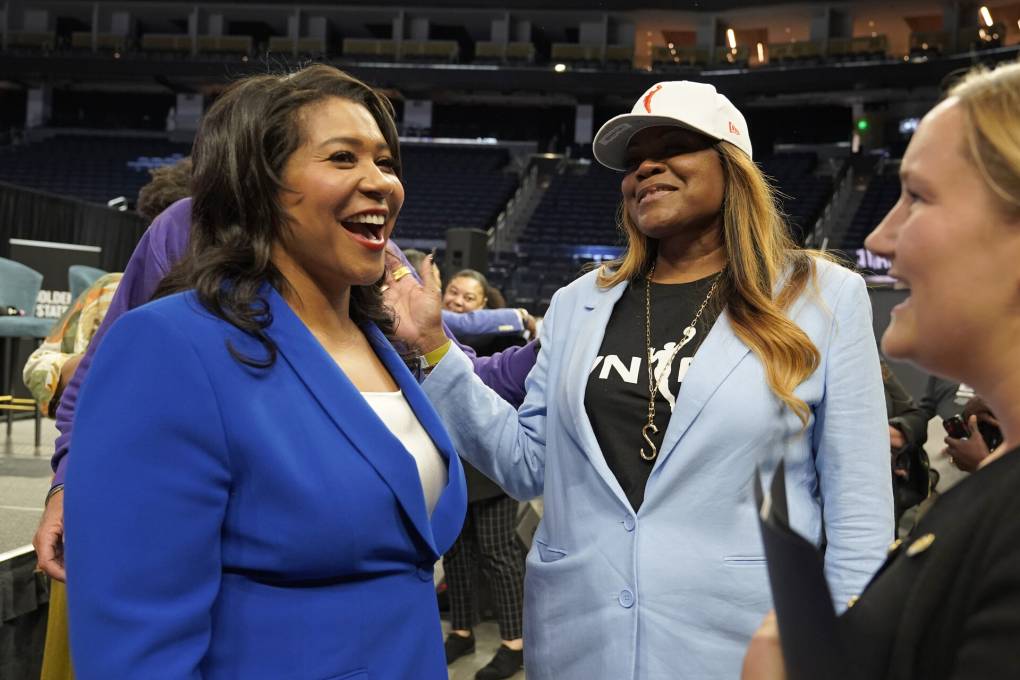
"caption": "San Francisco Mayor London Breed (left) visits with former basketball player Sheryl Swoopes after an WNBA expansion franchise for the San Francisco Bay Area was announced at Chase Center in San Francisco, Thursday, Oct. 5, 2023. The team will begin play in the 2025 season.",
"description": null,
"title": "London Breed, Cheryl Swoopes",
"credit": "Eric Risberg/AP Photo",
"status": "inherit",
"altTag": "Two women stand in a stadium smiling.",
"isLoading": false,
"fetchFailed": false
},
"news_11963415": {
"type": "attachments",
"id": "news_11963415",
"meta": {
"index": "attachments_1716263798",
"site": "news",
"id": "11963415",
"found": true
},
"parent": 0,
"imgSizes": {
"twentyfourteen-full-width": {
"file": "https://ww2.kqed.org/app/uploads/sites/10/2023/10/231004-Mychal-Threets-01-KQED-1038x576.jpg",
"width": 1038,
"mimeType": "image/jpeg",
"height": 576
},
"thumbnail": {
"file": "https://ww2.kqed.org/app/uploads/sites/10/2023/10/231004-Mychal-Threets-01-KQED-160x107.jpg",
"width": 160,
"mimeType": "image/jpeg",
"height": 107
},
"post-thumbnail": {
"file": "https://ww2.kqed.org/app/uploads/sites/10/2023/10/231004-Mychal-Threets-01-KQED-672x372.jpg",
"width": 672,
"mimeType": "image/jpeg",
"height": 372
},
"kqedFullSize": {
"file": "https://ww2.kqed.org/app/uploads/sites/10/2023/10/231004-Mychal-Threets-01-KQED.jpg",
"width": 2000,
"height": 1333
},
"large": {
"file": "https://ww2.kqed.org/app/uploads/sites/10/2023/10/231004-Mychal-Threets-01-KQED-1020x680.jpg",
"width": 1020,
"mimeType": "image/jpeg",
"height": 680
},
"1536x1536": {
"file": "https://ww2.kqed.org/app/uploads/sites/10/2023/10/231004-Mychal-Threets-01-KQED-1536x1024.jpg",
"width": 1536,
"mimeType": "image/jpeg",
"height": 1024
},
"full-width": {
"file": "https://ww2.kqed.org/app/uploads/sites/10/2023/10/231004-Mychal-Threets-01-KQED-1920x1280.jpg",
"width": 1920,
"mimeType": "image/jpeg",
"height": 1280
},
"medium": {
"file": "https://ww2.kqed.org/app/uploads/sites/10/2023/10/231004-Mychal-Threets-01-KQED-800x533.jpg",
"width": 800,
"mimeType": "image/jpeg",
"height": 533
}
},
"publishDate": 1696445984,
"modified": 1696520351,
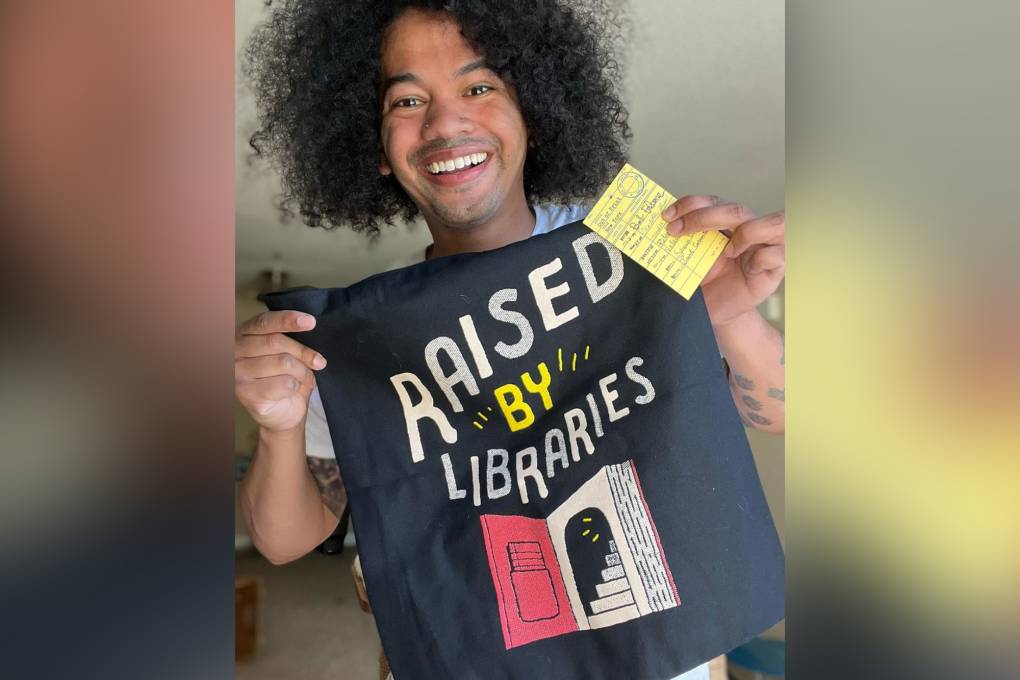
"caption": "A photo from Mychal Threets's Instagram account posted for National Library Week on April 23, 2023.",
"description": null,
"title": "231004-Mychal Threets-01-KQED",
"credit": "Photo via Instagram",
"status": "inherit",
"altTag": "A person holds up a tote bag that reads \"Raised by libraries\" and smiles at the camera.",
"isLoading": false,
"fetchFailed": false
},
"news_11962724": {
"type": "attachments",
"id": "news_11962724",
"meta": {
"index": "attachments_1716263798",
"site": "news",
"id": "11962724",
"found": true
},
"parent": 11962723,
"imgSizes": {
"twentyfourteen-full-width": {
"file": "https://ww2.kqed.org/app/uploads/sites/10/2023/09/gettyimages-1367180769_slide-c1d0c7f1005335e2f19279b20a99e274d7a48c76-1038x576.jpg",
"width": 1038,
"mimeType": "image/jpeg",
"height": 576
},
"thumbnail": {
"file": "https://ww2.kqed.org/app/uploads/sites/10/2023/09/gettyimages-1367180769_slide-c1d0c7f1005335e2f19279b20a99e274d7a48c76-160x107.jpg",
"width": 160,
"mimeType": "image/jpeg",
"height": 107
},
"post-thumbnail": {
"file": "https://ww2.kqed.org/app/uploads/sites/10/2023/09/gettyimages-1367180769_slide-c1d0c7f1005335e2f19279b20a99e274d7a48c76-672x372.jpg",
"width": 672,
"mimeType": "image/jpeg",
"height": 372
},
"kqedFullSize": {
"file": "https://ww2.kqed.org/app/uploads/sites/10/2023/09/gettyimages-1367180769_slide-c1d0c7f1005335e2f19279b20a99e274d7a48c76-scaled.jpg",
"width": 2560,
"height": 1707
},
"2048x2048": {
"file": "https://ww2.kqed.org/app/uploads/sites/10/2023/09/gettyimages-1367180769_slide-c1d0c7f1005335e2f19279b20a99e274d7a48c76-2048x1365.jpg",
"width": 2048,
"mimeType": "image/jpeg",
"height": 1365
},
"large": {
"file": "https://ww2.kqed.org/app/uploads/sites/10/2023/09/gettyimages-1367180769_slide-c1d0c7f1005335e2f19279b20a99e274d7a48c76-1020x680.jpg",
"width": 1020,
"mimeType": "image/jpeg",
"height": 680
},
"1536x1536": {
"file": "https://ww2.kqed.org/app/uploads/sites/10/2023/09/gettyimages-1367180769_slide-c1d0c7f1005335e2f19279b20a99e274d7a48c76-1536x1024.jpg",
"width": 1536,
"mimeType": "image/jpeg",
"height": 1024
},
"full-width": {
"file": "https://ww2.kqed.org/app/uploads/sites/10/2023/09/gettyimages-1367180769_slide-c1d0c7f1005335e2f19279b20a99e274d7a48c76-1920x1280.jpg",
"width": 1920,
"mimeType": "image/jpeg",
"height": 1280
},
"medium": {
"file": "https://ww2.kqed.org/app/uploads/sites/10/2023/09/gettyimages-1367180769_slide-c1d0c7f1005335e2f19279b20a99e274d7a48c76-800x533.jpg",
"width": 800,
"mimeType": "image/jpeg",
"height": 533
}
},
"publishDate": 1695921576,
"modified": 1695925190,
"caption": "'There is nothing valuable about being ripped off or sold on a worthless degree,' US Education Secretary Miguel Cardona said at a press briefing announcing the final rule. He is shown here in January 2022 in Washington, DC.",
"description": "WASHINGTON, DC - JANUARY 27: U.S. Education Secretary Miguel Cardona delivers remarks at the department's Lyndon Baines Johnson Building on January 27, 2022 in Washington, DC. Cardona laid out the department's priorities almost one year after being sworn in as head of the $64 billion agency. (Photo by Chip Somodevilla/Getty Images)",
"title": "\"There is nothing valuable about being ripped off or sold on a worthless degree,\" U.S. Education Secretary Miguel Cardona said at a press briefing announcing the final rule. He is shown here in January 2022 in Washington, D.C.",
"credit": "Chip Somodevilla/Getty Images",
"status": "inherit",
"altTag": "a man in a suit stands at a podium with a flag behind him that says 'Department of Education'",
"isLoading": false,
"fetchFailed": false
},
"news_11962578": {
"type": "attachments",
"id": "news_11962578",
"meta": {
"index": "attachments_1716263798",
"site": "news",
"id": "11962578",
"found": true
},
"parent": 11962557,
"imgSizes": {
"twentyfourteen-full-width": {
"file": "https://ww2.kqed.org/app/uploads/sites/10/2023/09/Sacramento-Community-College-MG-CM-09-1038x576.jpeg",
"width": 1038,
"mimeType": "image/jpeg",
"height": 576
},
"thumbnail": {
"file": "https://ww2.kqed.org/app/uploads/sites/10/2023/09/Sacramento-Community-College-MG-CM-09-160x107.jpeg",
"width": 160,
"mimeType": "image/jpeg",
"height": 107
},
"post-thumbnail": {
"file": "https://ww2.kqed.org/app/uploads/sites/10/2023/09/Sacramento-Community-College-MG-CM-09-672x372.jpeg",
"width": 672,
"mimeType": "image/jpeg",
"height": 372
},
"kqedFullSize": {
"file": "https://ww2.kqed.org/app/uploads/sites/10/2023/09/Sacramento-Community-College-MG-CM-09.jpeg",
"width": 2000,
"height": 1333
},
"large": {
"file": "https://ww2.kqed.org/app/uploads/sites/10/2023/09/Sacramento-Community-College-MG-CM-09-1020x680.jpeg",
"width": 1020,
"mimeType": "image/jpeg",
"height": 680
},
"1536x1536": {
"file": "https://ww2.kqed.org/app/uploads/sites/10/2023/09/Sacramento-Community-College-MG-CM-09-1536x1024.jpeg",
"width": 1536,
"mimeType": "image/jpeg",
"height": 1024
},
"full-width": {
"file": "https://ww2.kqed.org/app/uploads/sites/10/2023/09/Sacramento-Community-College-MG-CM-09-1920x1280.jpeg",
"width": 1920,
"mimeType": "image/jpeg",
"height": 1280
},
"medium": {
"file": "https://ww2.kqed.org/app/uploads/sites/10/2023/09/Sacramento-Community-College-MG-CM-09-800x533.jpeg",
"width": 800,
"mimeType": "image/jpeg",
"height": 533
}
},
"publishDate": 1695840278,
"modified": 1695840325,
"caption": "Students walk through campus at Sacramento City College on Feb. 23, 2022. ",
"description": null,
"title": "Sacramento-Community-College-MG-CM-09",
"credit": "Miguel Gutierrez Jr./CalMatters",
"status": "inherit",
"altTag": "Silhouette of people walking on campus at Sacramento City College.",
"isLoading": false,
"fetchFailed": false
},
"news_11932125": {
"type": "attachments",
"id": "news_11932125",
"meta": {
"index": "attachments_1716263798",
"site": "news",
"id": "11932125",
"found": true
},
"parent": 11932102,
"imgSizes": {
"twentyfourteen-full-width": {
"file": "https://ww2.kqed.org/app/uploads/sites/10/2023/11/GettyImages-1234461404-1024x576.jpg",
"width": 1024,
"mimeType": "image/jpeg",
"height": 576
},
"thumbnail": {
"file": "https://ww2.kqed.org/app/uploads/sites/10/2023/11/GettyImages-1234461404-160x111.jpg",
"width": 160,
"mimeType": "image/jpeg",
"height": 111
},
"post-thumbnail": {
"file": "https://ww2.kqed.org/app/uploads/sites/10/2023/11/GettyImages-1234461404-672x372.jpg",
"width": 672,
"mimeType": "image/jpeg",
"height": 372
},
"kqedFullSize": {
"file": "https://ww2.kqed.org/app/uploads/sites/10/2023/11/GettyImages-1234461404.jpg",
"width": 1024,
"height": 709
},
"large": {
"file": "https://ww2.kqed.org/app/uploads/sites/10/2023/11/GettyImages-1234461404-1020x706.jpg",
"width": 1020,
"mimeType": "image/jpeg",
"height": 706
},
"medium": {
"file": "https://ww2.kqed.org/app/uploads/sites/10/2023/11/GettyImages-1234461404-800x554.jpg",
"width": 800,
"mimeType": "image/jpeg",
"height": 554
}
},
"publishDate": 1668375946,
"modified": 1695761919,
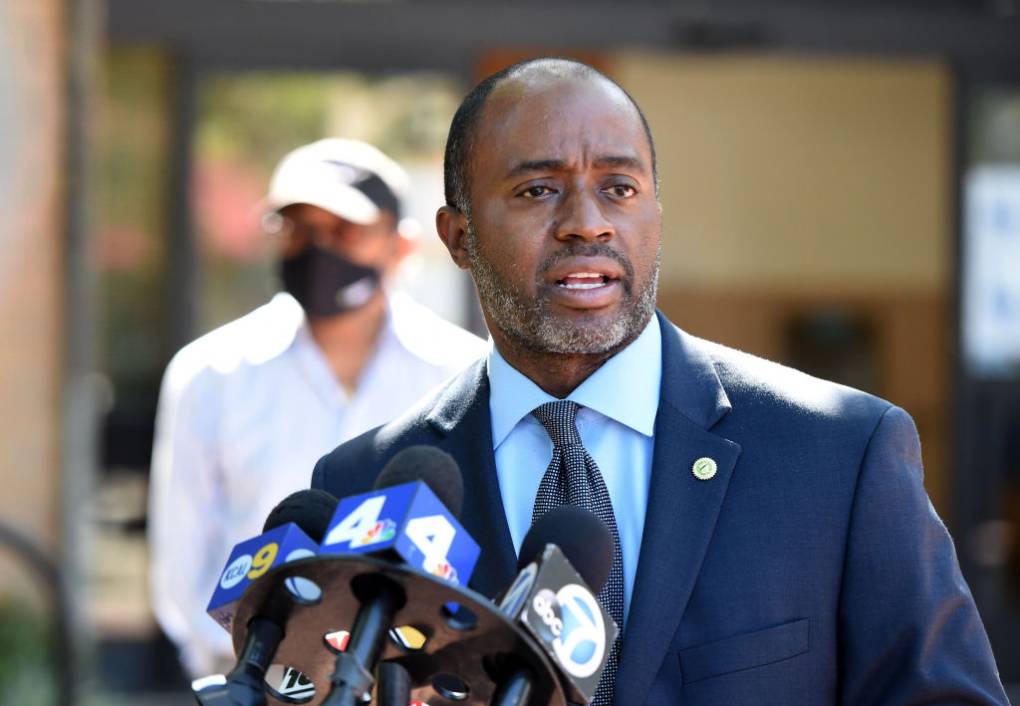
"caption": "State Superintendent of Public Instruction Tony Thurmond speaks to the media at a vaccine clinic at an LA County library in Paramount on Wednesday, Aug. 4, 2021. ",
"description": null,
"title": "State Superintendent of Public Instruction Tony Thurmond visits a vaccine clinic and gives cash incentive.",
"credit": "Brittany Murray/MediaNews Group/Long Beach Press-Telegram via Getty Images",
"status": "inherit",
"altTag": "A man wearing a business suit stands in front of microphones with a man wearing a hat and mask in the background.",
"isLoading": false,
"fetchFailed": false
},
"news_11962465": {
"type": "attachments",
"id": "news_11962465",
"meta": {
"index": "attachments_1716263798",
"site": "news",
"id": "11962465",
"found": true
},
"parent": 11962463,
"imgSizes": {
"twentyfourteen-full-width": {
"file": "https://ww2.kqed.org/app/uploads/sites/10/2023/09/AP23269099212242-1038x576.jpg",
"width": 1038,
"mimeType": "image/jpeg",
"height": 576
},
"thumbnail": {
"file": "https://ww2.kqed.org/app/uploads/sites/10/2023/09/AP23269099212242-160x107.jpg",
"width": 160,
"mimeType": "image/jpeg",
"height": 107
},
"post-thumbnail": {
"file": "https://ww2.kqed.org/app/uploads/sites/10/2023/09/AP23269099212242-672x372.jpg",
"width": 672,
"mimeType": "image/jpeg",
"height": 372
},
"kqedFullSize": {
"file": "https://ww2.kqed.org/app/uploads/sites/10/2023/09/AP23269099212242-scaled.jpg",
"width": 2560,
"height": 1707
},
"2048x2048": {
"file": "https://ww2.kqed.org/app/uploads/sites/10/2023/09/AP23269099212242-2048x1366.jpg",
"width": 2048,
"mimeType": "image/jpeg",
"height": 1366
},
"large": {
"file": "https://ww2.kqed.org/app/uploads/sites/10/2023/09/AP23269099212242-1020x680.jpg",
"width": 1020,
"mimeType": "image/jpeg",
"height": 680
},
"1536x1536": {
"file": "https://ww2.kqed.org/app/uploads/sites/10/2023/09/AP23269099212242-1536x1024.jpg",
"width": 1536,
"mimeType": "image/jpeg",
"height": 1024
},
"full-width": {
"file": "https://ww2.kqed.org/app/uploads/sites/10/2023/09/AP23269099212242-1920x1280.jpg",
"width": 1920,
"mimeType": "image/jpeg",
"height": 1280
},
"medium": {
"file": "https://ww2.kqed.org/app/uploads/sites/10/2023/09/AP23269099212242-800x533.jpg",
"width": 800,
"mimeType": "image/jpeg",
"height": 533
}
},
"publishDate": 1695752097,
"modified": 1695752204,
"caption": "Gov. Gavin Newsom speaks during an interview in Sacramento on Tuesday, Sept. 12, 2023. ",
"description": null,
"title": "California Book Ban Law",
"credit": "Rich Pedroncelli/The Associated Press",
"status": "inherit",
"altTag": "A photo of a white man in a business suit gesturing with both his hands.",
"isLoading": false,
"fetchFailed": false
},
"news_11953203": {
"type": "attachments",
"id": "news_11953203",
"meta": {
"index": "attachments_1716263798",
"site": "news",
"id": "11953203",
"found": true
},
"parent": 0,
"imgSizes": {
"twentyfourteen-full-width": {
"file": "https://ww2.kqed.org/app/uploads/sites/10/2023/06/RS66358_230615-brooklyn-basin-239-ks.NEF-24-ks-KQED-1038x576.jpg",
"width": 1038,
"mimeType": "image/jpeg",
"height": 576
},
"thumbnail": {
"file": "https://ww2.kqed.org/app/uploads/sites/10/2023/06/RS66358_230615-brooklyn-basin-239-ks.NEF-24-ks-KQED-160x106.jpg",
"width": 160,
"mimeType": "image/jpeg",
"height": 106
},
"post-thumbnail": {
"file": "https://ww2.kqed.org/app/uploads/sites/10/2023/06/RS66358_230615-brooklyn-basin-239-ks.NEF-24-ks-KQED-672x372.jpg",
"width": 672,
"mimeType": "image/jpeg",
"height": 372
},
"kqedFullSize": {
"file": "https://ww2.kqed.org/app/uploads/sites/10/2023/06/RS66358_230615-brooklyn-basin-239-ks.NEF-24-ks-KQED.jpg",
"width": 2000,
"height": 1331
},
"large": {
"file": "https://ww2.kqed.org/app/uploads/sites/10/2023/06/RS66358_230615-brooklyn-basin-239-ks.NEF-24-ks-KQED-1020x679.jpg",
"width": 1020,
"mimeType": "image/jpeg",
"height": 679
},
"1536x1536": {
"file": "https://ww2.kqed.org/app/uploads/sites/10/2023/06/RS66358_230615-brooklyn-basin-239-ks.NEF-24-ks-KQED-1536x1022.jpg",
"width": 1536,
"mimeType": "image/jpeg",
"height": 1022
},
"full-width": {
"file": "https://ww2.kqed.org/app/uploads/sites/10/2023/06/RS66358_230615-brooklyn-basin-239-ks.NEF-24-ks-KQED-1920x1278.jpg",
"width": 1920,
"mimeType": "image/jpeg",
"height": 1278
},
"medium": {
"file": "https://ww2.kqed.org/app/uploads/sites/10/2023/06/RS66358_230615-brooklyn-basin-239-ks.NEF-24-ks-KQED-800x532.jpg",
"width": 800,
"mimeType": "image/jpeg",
"height": 532
}
},
"publishDate": 1686941533,
"modified": 1695675168,
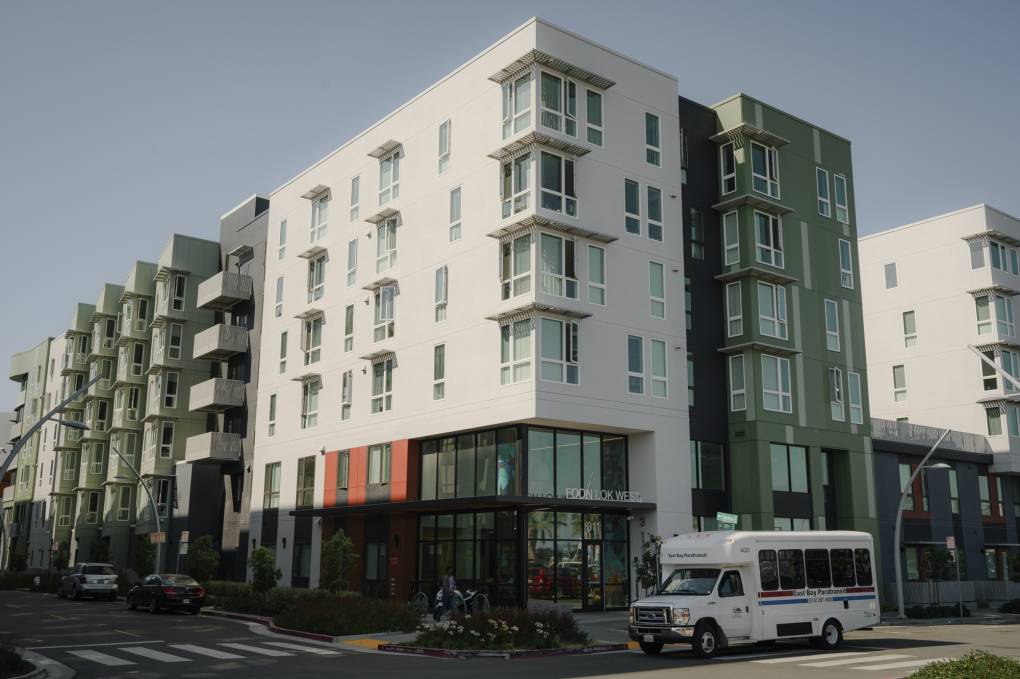
"caption": "The Foon Lok West affordable housing complex is part of the new Brooklyn Basin housing project of Oakland. Brooklyn Basin has added over 1,000 homes to the new neighborhood along the city’s waterfront and plans to add 2,000 more.",
"description": null,
"title": "affordable-housing",
"credit": "Kori Suzuki/KQED",
"status": "inherit",
"altTag": "The facade of a multistory green and white residential building seen from across the street. A white shuttle bus is parked in front.",
"isLoading": false,
"fetchFailed": false
},
"news_11962239": {
"type": "attachments",
"id": "news_11962239",
"meta": {
"index": "attachments_1716263798",
"site": "news",
"id": "11962239",
"found": true
},
"parent": 0,
"imgSizes": {
"twentyfourteen-full-width": {
"file": "https://ww2.kqed.org/app/uploads/sites/10/2023/09/230817-UC-BERKELEY-CAMPUS-MD-06-qut-1038x576.jpg",
"width": 1038,
"mimeType": "image/jpeg",
"height": 576
},
"thumbnail": {
"file": "https://ww2.kqed.org/app/uploads/sites/10/2023/09/230817-UC-BERKELEY-CAMPUS-MD-06-qut-160x107.jpg",
"width": 160,
"mimeType": "image/jpeg",
"height": 107
},
"post-thumbnail": {
"file": "https://ww2.kqed.org/app/uploads/sites/10/2023/09/230817-UC-BERKELEY-CAMPUS-MD-06-qut-672x372.jpg",
"width": 672,
"mimeType": "image/jpeg",
"height": 372
},
"kqedFullSize": {
"file": "https://ww2.kqed.org/app/uploads/sites/10/2023/09/230817-UC-BERKELEY-CAMPUS-MD-06-qut.jpg",
"width": 1920,
"height": 1280
},
"large": {
"file": "https://ww2.kqed.org/app/uploads/sites/10/2023/09/230817-UC-BERKELEY-CAMPUS-MD-06-qut-1020x680.jpg",
"width": 1020,
"mimeType": "image/jpeg",
"height": 680
},
"1536x1536": {
"file": "https://ww2.kqed.org/app/uploads/sites/10/2023/09/230817-UC-BERKELEY-CAMPUS-MD-06-qut-1536x1024.jpg",
"width": 1536,
"mimeType": "image/jpeg",
"height": 1024
},
"medium": {
"file": "https://ww2.kqed.org/app/uploads/sites/10/2023/09/230817-UC-BERKELEY-CAMPUS-MD-06-qut-800x533.jpg",
"width": 800,
"mimeType": "image/jpeg",
"height": 533
}
},
"publishDate": 1695421950,
"modified": 1695663910,
"caption": "The UC Berkeley campus on Aug. 17, 2023.",
"description": null,
"title": "The UC Berkeley Campus in Berkeley on Aug. 17, 2023.",
"credit": "Martin do Nascimento/KQED",
"status": "inherit",
"altTag": "A college campus is pictured with a large building with a pointed clock tower. Students with backpacks are seen walking down a cement pathway on a gray afternoon.",
"isLoading": false,
"fetchFailed": false
},
"news_11961271": {
"type": "attachments",
"id": "news_11961271",
"meta": {
"index": "attachments_1716263798",
"site": "news",
"id": "11961271",
"found": true
},
"parent": 11961256,
"imgSizes": {
"twentyfourteen-full-width": {
"file": "https://ww2.kqed.org/app/uploads/sites/10/2023/09/023_KQED_LaBombaPreschool_04202023-1038x576.jpg",
"width": 1038,
"mimeType": "image/jpeg",
"height": 576
},
"thumbnail": {
"file": "https://ww2.kqed.org/app/uploads/sites/10/2023/09/023_KQED_LaBombaPreschool_04202023-160x107.jpg",
"width": 160,
"mimeType": "image/jpeg",
"height": 107
},
"post-thumbnail": {
"file": "https://ww2.kqed.org/app/uploads/sites/10/2023/09/023_KQED_LaBombaPreschool_04202023-672x372.jpg",
"width": 672,
"mimeType": "image/jpeg",
"height": 372
},
"kqedFullSize": {
"file": "https://ww2.kqed.org/app/uploads/sites/10/2023/09/023_KQED_LaBombaPreschool_04202023-scaled.jpg",
"width": 2560,
"height": 1707
},
"2048x2048": {
"file": "https://ww2.kqed.org/app/uploads/sites/10/2023/09/023_KQED_LaBombaPreschool_04202023-2048x1365.jpg",
"width": 2048,
"mimeType": "image/jpeg",
"height": 1365
},
"large": {
"file": "https://ww2.kqed.org/app/uploads/sites/10/2023/09/023_KQED_LaBombaPreschool_04202023-1020x680.jpg",
"width": 1020,
"mimeType": "image/jpeg",
"height": 680
},
"1536x1536": {
"file": "https://ww2.kqed.org/app/uploads/sites/10/2023/09/023_KQED_LaBombaPreschool_04202023-1536x1024.jpg",
"width": 1536,
"mimeType": "image/jpeg",
"height": 1024
},
"full-width": {
"file": "https://ww2.kqed.org/app/uploads/sites/10/2023/09/023_KQED_LaBombaPreschool_04202023-1920x1280.jpg",
"width": 1920,
"mimeType": "image/jpeg",
"height": 1280
},
"medium": {
"file": "https://ww2.kqed.org/app/uploads/sites/10/2023/09/023_KQED_LaBombaPreschool_04202023-800x533.jpg",
"width": 800,
"mimeType": "image/jpeg",
"height": 533
}
},
"publishDate": 1694735072,
"modified": 1694735214,
"caption": "Teacher Martha Guarnizo works with her students to make art in the backyard at La Bamba daycare in San Francisco on April 20, 2023.",
"description": null,
"title": "023_KQED_LaBombaPreschool_04202023",
"credit": "Beth LaBerge/KQED",
"status": "inherit",
"altTag": "A woman wearing a yellow shirt and black masks leans over a table with small children to draw on a piece of paper in front of a blonde haired child.",
"isLoading": false,
"fetchFailed": false
},
"news_11961148": {
"type": "attachments",
"id": "news_11961148",
"meta": {
"index": "attachments_1716263798",
"site": "news",
"id": "11961148",
"found": true
},
"parent": 0,
"imgSizes": {
"twentyfourteen-full-width": {
"file": "https://ww2.kqed.org/app/uploads/sites/10/2023/09/CSU01-1038x576.jpg",
"width": 1038,
"mimeType": "image/jpeg",
"height": 576
},
"thumbnail": {
"file": "https://ww2.kqed.org/app/uploads/sites/10/2023/09/CSU01-160x90.jpg",
"width": 160,
"mimeType": "image/jpeg",
"height": 90
},
"post-thumbnail": {
"file": "https://ww2.kqed.org/app/uploads/sites/10/2023/09/CSU01-672x372.jpg",
"width": 672,
"mimeType": "image/jpeg",
"height": 372
},
"kqedFullSize": {
"file": "https://ww2.kqed.org/app/uploads/sites/10/2023/09/CSU01.jpg",
"width": 1536,
"height": 864
},
"large": {
"file": "https://ww2.kqed.org/app/uploads/sites/10/2023/09/CSU01-1020x574.jpg",
"width": 1020,
"mimeType": "image/jpeg",
"height": 574
},
"medium": {
"file": "https://ww2.kqed.org/app/uploads/sites/10/2023/09/CSU01-800x450.jpg",
"width": 800,
"mimeType": "image/jpeg",
"height": 450
}
},
"publishDate": 1694710324,
"modified": 1694715353,
"caption": "Students, faculty and staff protest a potential tuition increase across the California State University system on Sept. 12, 2023.",
"description": null,
"title": "CSU01",
"credit": "Courtesy of EdSource",
"status": "inherit",
"altTag": "A protest is happening in this photo with many college students of all ages holding signs that say, \"Students Deserve Smaller Classrooms. California Faculty Association.\"",
"isLoading": false,
"fetchFailed": false
}
},
"audioPlayerReducer": {
"postId": "stream_live",
"isPaused": true,
"isPlaying": false,
"pfsActive": false,
"pledgeModalIsOpen": true,
"playerDrawerIsOpen": false,
"liveAudioPlayStartedAt": 0,
"liveAudioPlayContext": ""
},
"authorsReducer": {
"byline_news_11965181": {
"type": "authors",
"id": "byline_news_11965181",
"meta": {
"override": true
},
"slug": "byline_news_11965181",
"name": "\u003ca href=\"https://edsource.org/author/jfensterwald\">John Fensterwald\u003c/a> and \u003ca href=\"https://edsource.org/author/dwillis\">Daniel J. Willis\u003c/a>",
"isLoading": false
},
"byline_news_11964081": {
"type": "authors",
"id": "byline_news_11964081",
"meta": {
"override": true
},
"slug": "byline_news_11964081",
"name": "Cheyanne Mumphry\u003cbr>The Associated Press",
"isLoading": false
},
"byline_news_11962723": {
"type": "authors",
"id": "byline_news_11962723",
"meta": {
"override": true
},
"slug": "byline_news_11962723",
"name": "\u003ca href=\"https://www.npr.org/people/378865949/elissa-nadworny\">Elissa Nadworny \u003c/a>",
"isLoading": false
},
"byline_news_11962557": {
"type": "authors",
"id": "byline_news_11962557",
"meta": {
"override": true
},
"slug": "byline_news_11962557",
"name": "\u003ca href=\"https://calmatters.org/author/adam-echelman/\">Adam Echelman\u003c/a>",
"isLoading": false
},
"byline_news_11962489": {
"type": "authors",
"id": "byline_news_11962489",
"meta": {
"override": true
},
"slug": "byline_news_11962489",
"name": "The Associated Press",
"isLoading": false
},
"byline_news_11962463": {
"type": "authors",
"id": "byline_news_11962463",
"meta": {
"override": true
},
"slug": "byline_news_11962463",
"name": "Sophie Austin\u003cbr>The Associated Press\u003c/br>",
"isLoading": false
},
"byline_news_11962230": {
"type": "authors",
"id": "byline_news_11962230",
"meta": {
"override": true
},
"slug": "byline_news_11962230",
"name": "\u003ca href=\"https://edsource.org/author/mburke\">Michael Burke\u003c/a>",
"isLoading": false
},
"byline_news_11961149": {
"type": "authors",
"id": "byline_news_11961149",
"meta": {
"override": true
},
"slug": "byline_news_11961149",
"name": "\u003ca href=\"https://edsource.org/author/asmith\">Ashley A. Smith\u003c/a>",
"isLoading": false
},
"bwatt": {
"type": "authors",
"id": "11238",
"meta": {
"index": "authors_1716337520",
"id": "11238",
"found": true
},
"name": "Brian Watt",
"firstName": "Brian",
"lastName": "Watt",
"slug": "bwatt",
"email": "bwatt@KQED.org",
"display_author_email": false,
"staff_mastheads": [
"news"
],
"title": "Morning News Anchor",
"bio": "Brian Watt is KQED's morning radio news anchor. He joined the KQED News team in April of 2016. Prior to that, he worked as a Reporter for KPCC in Los Angeles and a producer at \u003cem>Marketplace.\u003c/em>\r\n\r\nDuring eight years at KPCC, Brian covered business and economics, and his work won several awards. In 2008, he won the Los Angeles Press Club’s first-place award for Business and Financial Reporting, Broadcast. He’s also received honorable mention and been first runner up for the Press Club’s Radio Journalist of the Year. He won two Golden Mike awards from the Radio and TV News Association of Southern California.\r\n\r\nBrian holds degrees in theater from Yale University and the Sorbonne, and has worked as an actor in France, Italy, Brazil, Hungary and . . . Hollywood. He appeared in a few television shows, including \u003cem>The West Wing, Judging Amy\u003c/em> and \u003cem>The District.\u003c/em>\r\n\r\nEmail: bwatt@KQED.org Twitter: @RadioBWatt",
"avatar": "https://secure.gravatar.com/avatar/55393ff57ed34e2be773ba4789dd6a19?s=600&d=blank&r=g",
"twitter": "@RadioBWatt",
"facebook": null,
"instagram": null,
"linkedin": null,
"sites": [
{
"site": "arts",
"roles": [
"contributor"
]
},
{
"site": "news",
"roles": [
"editor"
]
}
],
"headData": {
"title": "Brian Watt | KQED",
"description": "Morning News Anchor",
"ogImgSrc": "https://secure.gravatar.com/avatar/55393ff57ed34e2be773ba4789dd6a19?s=600&d=blank&r=g",
"twImgSrc": "https://secure.gravatar.com/avatar/55393ff57ed34e2be773ba4789dd6a19?s=600&d=blank&r=g"
},
"isLoading": false,
"link": "/author/bwatt"
},
"btorres": {
"type": "authors",
"id": "11666",
"meta": {
"index": "authors_1716337520",
"id": "11666",
"found": true
},
"name": "Blanca Torres",
"firstName": "Blanca",
"lastName": "Torres",
"slug": "btorres",
"email": "btorres@kqed.org",
"display_author_email": true,
"staff_mastheads": [
"news"
],
"title": "Producer, Forum",
"bio": "Blanca Torres brings sharp news judgement and keen sense of lively conversation to her work as producer for Forum. She loves producing shows that leave listeners feeling like they heard distinctive voices, learned something new and gained a fresh perspective.\r\n\r\nShe joined KQED in January of 2020 after 16 years of working as a newspaper reporter most recently at the \u003cem>San Francisco Business Times,\u003c/em> where she wrote about real estate and economic development. Before that, she covered a variety of beats including crime, education, retail, workplace, the economy, consumer issues, and small business for the \u003cem>Contra Costa Times, Baltimore Sun\u003c/em> and\u003cem> The Seattle Times\u003c/em>. In addition to reporting, she worked as an editorial writer and columnist for the \u003cem>Seattle Times\u003c/em>. From 2017 to 2020, Blanca won a total of ten awards from the National Association of Real Estate Editors and won first place for land use reporting from the California News Publishers Association two years in a row. She is also a member and former board member for the National Association of Hispanic Journalists.\r\n\r\nA native of the Pacific Northwest, Blanca earned her bachelor's degree from Vanderbilt University in Nashville and a master's in fine arts in creative writing at Mills College. She lives in the East Bay with her family.",
"avatar": "https://secure.gravatar.com/avatar/50b49d19b14a1eed34f26ebf4681152cdd81574ed21851100871ccd29e578cdc?s=600&d=blank&r=g",
"twitter": "@blancawrites",
"bluesky": null,
"facebook": null,
"instagram": null,
"linkedin": null,
"sites": [
{
"site": "arts",
"roles": [
"editor"
]
},
{
"site": "news",
"roles": [
"editor"
]
},
{
"site": "forum",
"roles": [
"editor"
]
}
],
"headData": {
"title": "Blanca Torres | KQED",
"description": "Producer, Forum",
"ogImgSrc": "https://secure.gravatar.com/avatar/50b49d19b14a1eed34f26ebf4681152cdd81574ed21851100871ccd29e578cdc?s=600&d=blank&r=g",
"twImgSrc": "https://secure.gravatar.com/avatar/50b49d19b14a1eed34f26ebf4681152cdd81574ed21851100871ccd29e578cdc?s=600&d=blank&r=g"
},
"isLoading": false,
"link": "/author/btorres"
},
"agonzalez": {
"type": "authors",
"id": "11724",
"meta": {
"index": "authors_1716337520",
"id": "11724",
"found": true
},
"name": "Alexander Gonzalez",
"firstName": "Alexander",
"lastName": "Gonzalez",
"slug": "agonzalez",
"email": "AlexanderGonzalez@KQED.org",
"display_author_email": false,
"staff_mastheads": [
"news"
],
"title": "KQED Contributor",
"bio": null,
"avatar": "https://secure.gravatar.com/avatar/9e291ed34e154df4c662edf858b641d70b4859939bfe40be478408f9dfd057d2?s=600&d=blank&r=g",
"twitter": null,
"bluesky": null,
"facebook": null,
"instagram": null,
"linkedin": null,
"sites": [
{
"site": "arts",
"roles": [
"editor"
]
},
{
"site": "news",
"roles": [
"editor"
]
},
{
"site": "science",
"roles": [
"editor"
]
}
],
"headData": {
"title": "Alexander Gonzalez | KQED",
"description": "KQED Contributor",
"ogImgSrc": "https://secure.gravatar.com/avatar/9e291ed34e154df4c662edf858b641d70b4859939bfe40be478408f9dfd057d2?s=600&d=blank&r=g",
"twImgSrc": "https://secure.gravatar.com/avatar/9e291ed34e154df4c662edf858b641d70b4859939bfe40be478408f9dfd057d2?s=600&d=blank&r=g"
},
"isLoading": false,
"link": "/author/agonzalez"
},
"daisynguyen": {
"type": "authors",
"id": "11829",
"meta": {
"index": "authors_1716337520",
"id": "11829",
"found": true
},
"name": "Daisy Nguyen",
"firstName": "Daisy",
"lastName": "Nguyen",
"slug": "daisynguyen",
"email": "daisynguyen@kqed.org",
"display_author_email": true,
"staff_mastheads": [
"news"
],
"title": "KQED Contributor",
"bio": "I have covered early childhood education and child care for KQED since 2022. I focus on policies aimed at increasing access to early care and education and how they shape individual lives. I've been a journalist for more than two decades, with most of that time devoted to covering breaking news throughout California for The Associated Press. I grew up in San Francisco and studied at UC Davis and Columbia University's Graduate School of Journalism. I live in Oakland with my husband and two kids.",
"avatar": "https://secure.gravatar.com/avatar/2da2127c27f7143b53ebd419800fd55f?s=600&d=blank&r=g",
"twitter": null,
"facebook": null,
"instagram": null,
"linkedin": "https://www.linkedin.com/in/daisynguyen/",
"sites": [
{
"site": "news",
"roles": [
"author"
]
},
{
"site": "liveblog",
"roles": [
"author"
]
}
],
"headData": {
"title": "Daisy Nguyen | KQED",
"description": "KQED Contributor",
"ogImgSrc": "https://secure.gravatar.com/avatar/2da2127c27f7143b53ebd419800fd55f?s=600&d=blank&r=g",
"twImgSrc": "https://secure.gravatar.com/avatar/2da2127c27f7143b53ebd419800fd55f?s=600&d=blank&r=g"
},
"isLoading": false,
"link": "/author/daisynguyen"
},
"sjohnson": {
"type": "authors",
"id": "11840",
"meta": {
"index": "authors_1716337520",
"id": "11840",
"found": true
},
"name": "Sydney Johnson",
"firstName": "Sydney",
"lastName": "Johnson",
"slug": "sjohnson",
"email": "sjohnson@kqed.org",
"display_author_email": false,
"staff_mastheads": [
"news"
],
"title": "KQED Reporter",
"bio": "Sydney Johnson is a general assignment reporter at KQED. She previously reported on public health and city government at the San Francisco Examiner, and before that, she covered statewide education policy for EdSource. Her reporting has won multiple local, state and national awards. Sydney is a graduate of the University of California, Berkeley and lives in San Francisco.",
"avatar": "https://secure.gravatar.com/avatar/97855f2719b72ad6190b7c535fe642c8?s=600&d=blank&r=g",
"twitter": "sydneyfjohnson",
"facebook": null,
"instagram": null,
"linkedin": null,
"sites": [
{
"site": "news",
"roles": [
"editor"
]
}
],
"headData": {
"title": "Sydney Johnson | KQED",
"description": "KQED Reporter",
"ogImgSrc": "https://secure.gravatar.com/avatar/97855f2719b72ad6190b7c535fe642c8?s=600&d=blank&r=g",
"twImgSrc": "https://secure.gravatar.com/avatar/97855f2719b72ad6190b7c535fe642c8?s=600&d=blank&r=g"
},
"isLoading": false,
"link": "/author/sjohnson"
}
},
"pagesReducer": {
"news_tag_education": {
"type": "terms",
"id": "news_20013",
"meta": {
"index": "terms_1716263798",
"site": "news",
"id": "20013",
"score": 6.9701343
},
"featImg": null,
"name": "education",
"description": null,
"taxonomy": "tag",
"headData": {
"twImgId": null,
"twTitle": null,
"ogTitle": null,
"ogImgId": null,
"twDescription": null,
"description": null,
"title": "education Archives | KQED News",
"ogDescription": null
},
"ttid": 20030,
"slug": "education",
"isLoading": false,
"title": "education",
"pageMeta": {
"site": "news",
"WpPageTemplate": "page-topic-editorial",
"currentPage": 53
},
"blocks": [
{
"blockName": "kqed/post-list",
"attrs": {
"layout": "cardArticle2",
"query": "posts/news?tag=education",
"seeMore": false,
"paginated": true,
"page": 53
}
},
{
"blockName": "kqed/ad"
}
]
}
},
"pfsSessionReducer": {},
"postsReducer": {
"stream_live": {
"type": "live",
"id": "stream_live",
"audioUrl": "https://streams.kqed.org/kqedradio",
"title": "Live Stream",
"excerpt": "Live Stream information currently unavailable.",
"link": "/radio",
"featImg": "",
"label": {
"name": "KQED Live",
"link": "/"
}
},
"stream_kqedNewscast": {
"type": "posts",
"id": "stream_kqedNewscast",
"audioUrl": "https://www.kqed.org/.stream/anon/radio/RDnews/newscast.mp3?_=1",
"title": "KQED Newscast",
"featImg": "",
"label": {
"name": "88.5 FM",
"link": "/"
}
},
"news_11965181": {
"type": "posts",
"id": "news_11965181",
"meta": {
"index": "posts_1716263798",
"site": "news",
"id": "11965181",
"score": null,
"sort": [
1697911403000
]
},
"guestAuthors": [],
"slug": "california-student-test-scores-still-far-behind-pre-covid-levels-of-achievement",
"title": "California Student Test Scores Still Far Behind Pre-COVID Levels of Achievement",
"publishDate": 1697911403,
"format": "standard",
"headTitle": "California Student Test Scores Still Far Behind Pre-COVID Levels of Achievement | KQED",
"labelTerm": {},
"content": "\u003cp class=\"dropcap\">In the second year fully back in school after remote learning, California school districts made negligible progress overall in reversing the steep declines in test scores that have lingered since COVID struck in 2020.\u003c/p>\n\u003cp>There was a slight improvement in math while English language arts declined a smidgeon, and the wide proficiency gap between Black and Latino students and whites and Asians showed little change.\u003c/p>\n\u003cp>Only 34.6% of students met or exceeded standards on the Smarter Balanced math test in 2023, which is 1.2 percentage points higher than a year ago. In 2019, the year before the pandemic, 39.8% of all students were at grade level. Only 16.9% of Black students, 22.7% of Latino students, and 9.9% of English learners were at grade level in 2023.\u003c/p>\n\u003cp>[ad fullwidth]\u003c/p>\n\u003cp>Year-over-year scores in English language arts dropped less than 1 percentage point to 46.7% for students meeting or exceeding standards in 2023; in 2019, it was 51.7%. The large proficiency gaps between Black and Hispanic students compared with Asian and white students showed little change. In 2019, the year before the pandemic, about four in 10 students in the state and three out of four Asian students, the highest-scoring student group, were at grade level in English language arts.\u003c/p>\n\u003cp>Among the state’s nearly 1,000 districts, small districts tended to show more gains, results show.\u003c/p>\n\u003cp>\u003c!-- iframe plugin v.4.3 wordpress.org/plugins/iframe/ -->\u003cbr>\n\u003ciframe loading=\"lazy\" src=\"https://flo.uri.sh/visualisation/15381571/embed\" title=\"Interactive or visual content\" class=\"flourish-embed-iframe\" frameborder=\"0\" scrolling=\"no\" style=\"width:100%;height:900px;\" sandbox=\"allow-same-origin allow-forms allow-scripts allow-downloads allow-popups allow-popups-to-escape-sandbox allow-top-navigation-by-user-activation\" width=\"100%\" height=\"500\">\u003c/iframe>\u003c/p>\n\u003cp>\u003c!-- iframe plugin v.4.3 wordpress.org/plugins/iframe/ -->\u003cbr>\n\u003ciframe loading=\"lazy\" src=\"https://flo.uri.sh/visualisation/15382313/embed\" title=\"Interactive or visual content\" class=\"flourish-embed-iframe\" frameborder=\"0\" scrolling=\"no\" style=\"width:100%;height:900px;\" sandbox=\"allow-same-origin allow-forms allow-scripts allow-downloads allow-popups allow-popups-to-escape-sandbox allow-top-navigation-by-user-activation\" width=\"100%\" height=\"500\">\u003c/iframe>\u003c/p>\n\u003cp>Smarter Balanced tests are given to students in grades three to eight and grade 11.\u003c/p>\n\u003cp>English language arts scores dropped slightly in every grade except 11th and third grades, which showed slight growth. The 0.8% percentage point increase in third grade may reflect that students had two years of face-to-face instruction, which is critical for learning how to read. It could also reflect concerted efforts to focus on and change reading instruction to phonics-focused curriculums in districts like Long Beach, up 4.1 points over 2022 for all third graders, and Palo Alto, where reading scores for lower-income Latino students increased 47 percentage points above pre-pandemic levels.\u003c/p>\n\u003cp>[aside label=\"Related Stories\" postID=\"news_11964081,news_11930171,news_11953408\"]Fewer English learners met or exceeded standards in English language arts this year. In 2023, 10.9% of English learners met or exceeded the standard for English language arts, down from 12.5% in 2022. Among students who were ever English learners, including those who are now proficient, 35.7% met or exceeded the standard in English language arts, down from 36.5% in 2022.\u003c/p>\n\u003cp>In math, English learners were about the same as last year, with 9.9% meeting or exceeding the standard. Among those who were ever English learners, including those who are now proficient, 24.2% met or exceeded the standard, up from 23.4% in 2021-22.\u003c/p>\n\u003cp>A slightly larger share of English learners achieved a proficient score this year on the English Language Proficiency Assessments for California (ELPAC): 16.5%. Students who speak a language other than English at home are required to take the ELPAC every year until they are proficient in English.\u003c/p>\n\u003cp>Shelly Spiegel-Coleman, strategic adviser to Californians Together, an organization that advocates for English learners, said the fact that a higher percentage of English learners are not achieving proficiency each year shows that California needs to invest more in training teachers in how to help students improve their English language skills, especially within other classes.\u003c/p>\n\u003cp>“That’s when we see a big bump in students’ language proficiency — when they’re using language to learn about something, when their language development is taught while they’re learning science, while they’re learning social studies, while they’re doing art,” Spiegel-Coleman said. “There’s been no major funding and no major effort to do this kind of work. It’s time now.”\u003c/p>\n\u003cp>\u003c!-- iframe plugin v.4.3 wordpress.org/plugins/iframe/ -->\u003cbr>\n\u003ciframe loading=\"lazy\" src=\"https://flo.uri.sh/visualisation/15398870/embed\" title=\"Interactive or visual content\" class=\"flourish-embed-iframe\" frameborder=\"0\" scrolling=\"no\" style=\"width:100%;height:600px;\" sandbox=\"allow-same-origin allow-forms allow-scripts allow-downloads allow-popups allow-popups-to-escape-sandbox allow-top-navigation-by-user-activation\" width=\"100%\" height=\"500\">\u003c/iframe>\u003c/p>\n\u003cp>\u003c!-- iframe plugin v.4.3 wordpress.org/plugins/iframe/ -->\u003cbr>\n\u003ciframe loading=\"lazy\" src=\"https://flo.uri.sh/visualisation/15399353/embed\" title=\"Interactive or visual content\" class=\"flourish-embed-iframe\" frameborder=\"0\" scrolling=\"no\" style=\"width:100%;height:600px;\" sandbox=\"allow-same-origin allow-forms allow-scripts allow-downloads allow-popups allow-popups-to-escape-sandbox allow-top-navigation-by-user-activation\" width=\"100%\" height=\"500\">\u003c/iframe>\u003c/p>\n\u003ch2>Shifting demographics\u003c/h2>\n\u003cp>In its news release, the California Department of Education stressed that over the past year, the proportion of lower-income students statewide rose from 60% to 63% of all students and the increase in homeless students who took the test by 2,000 to 94,000, the equivalent of the third-largest district in California.\u003c/p>\n\u003cp>Given “the relationship between student advantage and achievement, California’s statewide scores are particularly promising as the proportion of high-need students has also increased in California schools,” the department said.\u003c/p>\n\u003cp>Christopher Nellum, executive director of The Education Trust–West, an advocacy organization, viewed the results differently.\u003c/p>\n\u003cp>“Seeing only slight improvements in already alarmingly low levels of student achievement is cause for concern, not celebration. In recent years, as in this year’s results, the state’s progress on student outcomes in English and math has been marginal at best. In fact, at no point in the past 9 years have we seen more than 1 out of 5 Black students at grade level in math.\u003c/p>\n\u003cp>“This trend is an indictment not of the efforts of California’s K-12 students but of the efforts and choices of the state’s adult decision-makers,” he said in a statement.\u003c/p>\n\u003cp>Mark Rosenbaum, lead attorney for the public interest law firm Public Counsel, cited the lack of improvement as further evidence of why it \u003ca href=\"https://edsource.org/2023/the-case-of-cayla-j-judge-to-decide-if-california-failed-low-income-students-during-covid/696235\">sued the State Board of Education, the California Department of Education and State Superintendent of Public Instruction Tony Thurmond\u003c/a>, charging the state mishandled remote learning and failed to remedy the harm caused to lower-income and minority students.\u003c/p>\n\u003cp>The latest test results, he said, “are as unsurprising as they are disappointing. What they mean is that California’s most disadvantaged students are falling further and further behind their more affluent counterparts, in large part because the state failed to assure the delivery of remote instruction to their communities during the pandemic and compounded that failure by failing to assure meaningful remediation once schools reopened.”\u003c/p>\n\u003cp>\u003ca class=\"external\" href=\"https://www.documentcloud.org/documents/23908009-caylaj-original-complaint-2020-publiccounsel\" target=\"_blank\" rel=\"noopener\">Cayla J. v. the State of California (DOC)\u003c/a>, is set for trial in December in Alameda County Superior Court.\u003c/p>\n\u003cp>The latest test statewide results will disappoint others who had hoped to appreciably reclaim some of the lost academic ground. That has not happened in California or in neighboring states that also give the Smarter Balanced assessment. In Oregon, English language arts scores also fell less than 1 percentage point to 43% proficient, and math scores increased less than point to 31.6%. In Washington, it was the same story: English language arts scores were flat at 48.8% while math scores rose 1.8 percentage points to 40.8%.\u003c/p>\n\u003cp>A handful of states reached pre-pandemic levels on their state tests. They include Iowa and Mississippi in both reading and math, and Tennessee, which created a statewide tutoring program in reading, according to the \u003ca class=\"external\" href=\"https://assets.ctfassets.net/9fbw4onh0qc1/59ZMlGVC2fkTG4fBCBpneI/516d69b386a8e86858aff5714bcb277e/Press_Release__Dr._Emily_Oster_Launches_the_Most_Comprehensive_Base_of_Data_on_COVID-19_and_Schools.pdf\" target=\"_blank\" rel=\"noopener\">COVID-19 School Data Hub\u003c/a>, an effort led by Brown University economics professor Emily Oster.\u003c/p>\n\u003cp>Before COVID struck, changes in California’s test scores occurred slowly, a percentage point or two annually, said Heather Hough, executive director of PACE, a Stanford-based education research organization. “It took years of dedicated effort, with investments in education and the workforce, with steady increases in achievement over time, and then we had this huge drop. We can’t afford another 10- to 20-year period of slow incremental change, especially when what we know we’re facing is huge inequities in student achievement,” she said. “We have to keep that intensity that we have not fixed this problem, despite investments and despite good intentions.”\u003c/p>\n\u003cp>Los Angeles Unified, the state’s largest district with 429,000 students, is representative of where most districts are. It has seen widespread improvement in math scores across most grade levels, with 30.5% of students meeting or exceeding state standards. Its English language arts scores have been a “mixed bag,” said district Superintendent Alberto Carvalho at Tuesday’s board meeting. Forty-one percent of students in the district met or exceeded standards in English language arts — a drop of less than point from the past year.\u003c/p>\n\u003cp>Carvalho said he was pleased to see third- and fourth-grade English language arts scores moving in the “right direction” — but stressed the need for improvement among upper elementary grades and middle schools. The district has found small-group instruction and “high dosage tutoring” to be critical, and hopes \u003ca href=\"https://edsource.org/updates/carvalho-says-replacing-primary-promise-will-do-more-for-lausd-for-less-money\">changes to the district’s Primary Promise program\u003c/a> will help, he said.\u003c/p>\n\u003ch3>Infusion of funding\u003c/h3>\n\u003cp>California school districts received record levels of one-time and ongoing funding since the start of COVID and had wide discretion on how to use it. This includes the last $12.5 billion in federal pandemic relief, which districts must spend by next September. At least 20% must be spent on learning recovery.\u003c/p>\n\u003cp>Some districts, mainly small ones, saw double-digit gains in 2023. Escondido Union High School District in San Diego County, with 7,000 students, saw its English language arts proficiency rise from 43.5% to 53.7%. The 800-student Wheatland Union High School District in Yuba County raised its proficiency level in English language arts by 21.5 percentage points, to 60%; its math scores rose 13.3 percentage points to nearly the state average for meeting state standards. Math scores in Healdsburg Unified in Sonoma County, with 1,200 students, rose 11.9 percentage points to 39.3% at grade level.\u003c/p>\n\u003cp>But in most districts, record student absences and staff shortages — not only among STEM and special education teachers but also vacant positions for aides and counselors and unfilled jobs for substitute teachers — undermine strategies for recovery. And the problems linger.\u003c/p>\n\u003ch2>Stubbornly high chronic absences\u003c/h2>\n\u003cp>Along with test scores, the state released chronic absenteeism data on Wednesday showing nearly a quarter of all students chronically absent in 2023, double the 12.1% rate in 2019.\u003c/p>\n\u003cp>While the 2023 chronic absenteeism rate is high, it’s a drop from 2022, which saw an unprecedented high rate of nearly a third. Students are counted as chronically absent for missing 10% or more of school days. The rates of the state’s minority groups and most vulnerable students remain disproportionately high: 34.6% for students with disabilities, 40.6% for homeless youths and 28.1% for English learners.\u003c/p>\n\u003cp>\u003c!-- iframe plugin v.4.3 wordpress.org/plugins/iframe/ -->\u003cbr>\n\u003ciframe loading=\"lazy\" src=\"https://flo.uri.sh/visualisation/15399210/embed\" title=\"Interactive or visual content\" class=\"flourish-embed-iframe\" frameborder=\"0\" scrolling=\"no\" style=\"width:100%;height:600px;\" sandbox=\"allow-same-origin allow-forms allow-scripts allow-downloads allow-popups allow-popups-to-escape-sandbox allow-top-navigation-by-user-activation\" width=\"100%\" height=\"500\">\u003c/iframe>\u003c/p>\n\u003cp>“The staffing has been a huge struggle for us, but so has absenteeism,” said Rick Miller, chief executive officer of the CORE districts, a school improvement organization that works with eight urban districts, including Los Angeles, Long Beach, Fresno and Sacramento City. “There was the notion that kids go to school every day. The pandemic changed that. And there’s a mindset we’re working through that you don’t need to be in school every day. You be there when you can.”\u003c/p>\n\u003cp>That appears to be the case in kindergarten, where the chronic absenteeism rate was 40.4% in 2021–22 and 36.3% in 2022–23, compared with 15.6% in 2018–19. Unlike many states, California includes excused absences in its chronic absentee rate calculations.\u003c/p>\n\u003cp>Other factors are working against student learning, PACE’s Hough said. At the same time, teachers need to accelerate learning, they are backfilling the needs of absent students. Some students come to school with mental health issues or lack socialization. Political disputes at school board meetings are diverting attention from districts’ learning priorities.\u003c/p>\n\u003cp>“The basic work of educating kids and running school districts has gotten a lot more complicated,” she said.\u003c/p>\n\u003cp>Amy Slavensky, interim deputy superintendent of San Juan Unified, agreed. “When you’re in schools every day, or nearly every day like we are, we can see the direct impact of that on our students,” she said. “It’s just not the same as it was before. So it’s going to take time.”\u003c/p>\n\u003cp>San Juan Unified, in Sacramento County, has sharply increased training for teachers, added intervention teachers and improved attendance at its schools, but its students’ test scores still have not rebounded to pre-pandemic levels.\u003c/p>\n\u003cp>Nearly 42% of the 49,000 students met or exceeded state standards in English language arts in 2023, down about 1 percentage point from 2022. Math scores were stagnant with 29.6% meeting or exceeding state standards, down 7.5 percentage points from 2019.\u003c/p>\n\u003cp>The district has used multiple tactics to increase achievement, including hiring intervention teachers and expanding training for teachers in reading and math. The district is training grade-level cohorts of teachers using some of the latest research to strengthen their strategies around reading instruction, Slavensky said. The district is seeing gains in kindergarten and first grade at Dyer-Kelly Elementary School, which has been focusing intensely on early literacy, she said.\u003c/p>\n\u003cp>“Anytime you implement a new change initiative, it takes four or five years to really see the impact of that, and especially on a summative assessment like CAASPP,” Slavensky said.\u003c/p>\n\u003cp>To increase math scores, the district is also adding math sections in middle and high school master schedules to reduce class sizes so teachers can offer deeper instruction and differentiated instruction, Slavensky said.\u003c/p>\n\u003cp>But pulling dozens of teachers out of their classrooms for training isn’t always possible during a teacher shortage, said Superintendent Melissa Bassanelli. Training schedules often fall apart when there aren’t enough teachers to fill the classrooms.\u003c/p>\n\u003cp>Garden Grove Unified in Orange County, with 79% lower-income students and 94% students of color, has scored well above state averages on Smarter Balanced tests and ranks highest among the CORE districts, but saw its math scores fall 7.5 percentage points from pre-pandemic 2019. In 2023, it clawed back half of the difference, though it wasn’t easy, Superintendent Gabriela Mafi said. Many families still struggled financially; resurgent COVID kept students at home; and a lack of subs strained schools.\u003c/p>\n\u003cp>But Garden Grove, a highly centralized district, stayed true to its system of deploying teacher coaches to schools and encouraging conversations around math concepts in elementary grades. It is using extended learning time at Boys and Girls Clubs and summer programs for academic interventions and supports, Mafi said. “We haven’t quite rebounded to our pre-COVID, but we’re getting close,” she said.\u003c/p>\n\u003cp>Perhaps no district high-achieving in math took a bigger hit to its Smarter Balanced scores than \u003ca class=\"external\" href=\"https://www.rocketshipschools.org/\" target=\"_blank\" rel=\"noopener\">Rocketship Public Schools\u003c/a>, a network with 13 K–5 Title I charter schools in the Bay Area. In 2018-19, 60% of students were at or above standard. By 2021–22, the proficiency rate, while still above the state average, had fallen to 40%. In 2023, overall scores increased by 2 percentage points with variations among schools.\u003c/p>\n\u003cp>Recovery will entail a multipronged, multiyear strategy, said Danny Echeverry, Rocketship’s Bay Area director of schools. It started with using its community schools funding to hire a Care Corps worker, akin to a social worker, at each site to help families who experienced housing and food insecurity during COVID. “We’ve seen ourselves as a hub of connecting at-risk families with social services in the community,” he said. Chronic absenteeism fell 10 percentage points, and attendance increased 7 percentage points in 2022–23.\u003c/p>\n\u003cp>Students in kindergarten, first grade or second grade during the pandemic had foundational skill gaps that had to be filled before students could handle grade-level content and move to proficiency on state tests, Etcheverry said. The Rocketship model builds in flex time so that teachers can provide one-on-one interventions.\u003c/p>\n\u003cp>Scores increased 2 percentage points overall on the 2023 math test, with variations among schools from a decline of 7.4 percentage points to a gain of 15.8 percentage points. Rocketship Los Sueños in San Jose, which piloted the Eureka Math curriculum, gained 5.4 percentage points in 2023, leading to a decision to adopt it in all Bay Area schools.\u003c/p>\n\u003cp>“We’re building traction, and we have no reason to believe that we’re not going to continue that momentum and see greater gains this year,” Etcheverry said.\u003c/p>\n\u003cp>Twin Rivers Unified, in Sacramento, made incremental gains this year but still has a long way to go before catching up to 2019 scores. More than 80% of the students are from low-income families.\u003c/p>\n\u003cp>“Our scores might be below the state average, but our growth is ahead in both English and math,” said Lori Grace, associate superintendent of school leadership.\u003c/p>\n\u003cp>In 2023, 31.9% of its students met or exceeded state standards in English language arts, up 0.5 points from 2022. In math, 22.7% of the district’s students met or exceeded state standards, an increase of 2.7 points. In 2019, 37% of students were proficient in English language arts and 29% in math.\u003c/p>\n\u003cp>To combat pandemic-related learning loss, the district added a multitiered system of support at schools, a framework that gives targeted support to struggling students, Grace said. To improve literacy skills, the district began a reading intervention program focusing on the science of reading for kindergarten through third grade. The district also tapped its best teachers to offer coaching on the subject to fourth through sixth grade teachers.\u003c/p>\n\u003ch2>Central Valley strategies\u003c/h2>\n\u003cp>Most students in Fresno Unified, the state’s third-largest school district with over 70,000 students, are not meeting standards. Last year, 33.2% of Fresno Unified students met or exceeded English language arts standards, a 1 percentage point gain from a year ago. In math, 23.3% met or exceeded state standards, a 2.5 point increase.\u003c/p>\n\u003cp>“We are definitely not satisfied with our results,” said Zerina Hargrove, the Fresno Unified assistant superintendent of research, evaluation and assessment. “While we had many students grow in their achievement, we had just as many who slid backward, contributing to very little change overall.”\u003c/p>\n\u003cp>Fresno Unified plans to focus on ensuring that every child shows growth, specifically targeting the needs of historically underserved student groups, Hargrove said.\u003c/p>\n\u003cp>One way to do that is by evaluating the “shining stars,” the schools that made significant progress. For example, at Jefferson Elementary, 6.9% more students met or exceeded standards in English, and 15.6% more students met or exceeded math standards. At Bullard High School, 17.6% more students met or exceeded English standards; at Patiño School of Entrepreneurship, 27.5% more students met or exceeded math standards.\u003c/p>\n\u003cp>“We desire to learn from the schools that have made significant gains and dig deeper into the why of those who didn’t,” she said.\u003c/p>\n\u003cp>Fresno Unified’s neighbor, Clovis Unified, has some of the highest student achievement scores in the area.\u003c/p>\n\u003cp>With more than 40,000 students, 72.7% were at or above state standards for English language arts in 2019. By 2022, that percentage dropped to 66.2% and remained flat in 2023. In 2019, 58.7% of Clovis Unified’s students met or exceeded math standards, and in 2022, 49.3% did so. The nearly 2 percentage-point growth in math in 2023 puts the proficiency level at more than 51%.\u003c/p>\n\u003cp>Still, the numbers haven’t returned to their pre-pandemic proficiency levels.\u003c/p>\n\u003cp>“Some of our schools saw student achievement grow by anywhere from 15 to 22% at certain grade levels. We must now work together to replicate that level of achievement across every grade level and school in our district,” said Superintendent Corrine Folmer.\u003c/p>\n\u003cp>The pandemic’s impact persists, district spokesperson Kelly Avants said, citing continuing challenges to learning. They include, she said, “restoring classroom behavior expectations; re-developing the interpersonal relationships between students and between students and their teachers that equates to success in the classroom and facing the impact of decreases in attendance rates has on learning.”\u003c/p>\n\u003cp>\u003cem>EdSource reporters also contributed to this report: Diana Lambert, Lasherica Thornton, Mallika Seshadri and Zaidee Stavely.\u003c/em>\u003c/p>\n\u003cp>\u003ca href=\"https://edsource.org/2023/flat-test-scores-leave-california-far-behind-pre-covid-levels-of-achievement/698895\">\u003cem>This story originally appeared in EdSource.\u003c/em>\u003c/a>\u003c/p>\n\u003cp>[ad floatright]\u003c/p>\n",
"blocks": [],
"excerpt": "California's test scores have yet to recover from steep declines since 2020, with a wide gap remaining between Latino and Black students compared to white and Asian students.",
"status": "publish",
"parent": 0,
"modified": 1721136063,
"stats": {
"hasAudio": false,
"hasVideo": false,
"hasChartOrMap": true,
"iframeSrcs": [
"https://flo.uri.sh/visualisation/15381571/embed",
"https://flo.uri.sh/visualisation/15382313/embed",
"https://flo.uri.sh/visualisation/15398870/embed",
"https://flo.uri.sh/visualisation/15399353/embed",
"https://flo.uri.sh/visualisation/15399210/embed"
],
"hasGoogleForm": false,
"hasGallery": false,
"hasHearkenModule": false,
"hasPolis": false,
"paragraphCount": 70,
"wordCount": 3397
},
"headData": {
"title": "California Student Test Scores Still Far Behind Pre-COVID Levels of Achievement | KQED",
"description": "California's test scores have yet to recover from steep declines since 2020, with a wide gap remaining between Latino and Black students compared to white and Asian students.",
"ogTitle": "",
"ogDescription": "",
"ogImgId": "",
"twTitle": "",
"twDescription": "",
"twImgId": "",
"schema": {
"@context": "https://schema.org",
"@type": "NewsArticle",
"headline": "California Student Test Scores Still Far Behind Pre-COVID Levels of Achievement",
"datePublished": "2023-10-21T11:03:23-07:00",
"dateModified": "2024-07-16T06:21:03-07:00",
"image": "https://cdn.kqed.org/wp-content/uploads/2020/02/KQED-OG-Image@1x.png",
"isAccessibleForFree": "True",
"publisher": {
"@type": "NewsMediaOrganization",
"@id": "https://www.kqed.org/#organization",
"name": "KQED",
"logo": "https://cdn.kqed.org/wp-content/uploads/2020/02/KQED-OG-Image@1x.png",
"url": "https://www.kqed.org",
"sameAs": [
"https://www.facebook.com/KQED",
"https://twitter.com/KQED",
"https://www.instagram.com/kqed/",
"https://www.tiktok.com/@kqedofficial",
"https://www.linkedin.com/company/kqed",
"https://www.youtube.com/channel/UCeC0IOo7i1P_61zVUWbJ4nw"
]
}
}
},
"source": "edsource",
"sourceUrl": "https://edsource.org/",
"sticky": false,
"nprByline": "\u003ca href=\"https://edsource.org/author/jfensterwald\">John Fensterwald\u003c/a> and \u003ca href=\"https://edsource.org/author/dwillis\">Daniel J. Willis\u003c/a>",
"excludeFromSiteSearch": "Include",
"showOnAuthorArchivePages": "No",
"articleAge": "0",
"path": "/news/11965181/california-student-test-scores-still-far-behind-pre-covid-levels-of-achievement",
"audioTrackLength": null,
"parsedContent": [
{
"type": "contentString",
"content": "\u003cdiv class=\"post-body\">\u003cp>\u003cp class=\"dropcap\">In the second year fully back in school after remote learning, California school districts made negligible progress overall in reversing the steep declines in test scores that have lingered since COVID struck in 2020.\u003c/p>\n\u003cp>There was a slight improvement in math while English language arts declined a smidgeon, and the wide proficiency gap between Black and Latino students and whites and Asians showed little change.\u003c/p>\n\u003cp>Only 34.6% of students met or exceeded standards on the Smarter Balanced math test in 2023, which is 1.2 percentage points higher than a year ago. In 2019, the year before the pandemic, 39.8% of all students were at grade level. Only 16.9% of Black students, 22.7% of Latino students, and 9.9% of English learners were at grade level in 2023.\u003c/p>\n\u003cp>\u003c/p>\u003c/div>",
"attributes": {
"named": {},
"numeric": []
}
},
{
"type": "component",
"content": "",
"name": "ad",
"attributes": {
"named": {
"label": "fullwidth"
},
"numeric": [
"fullwidth"
]
}
},
{
"type": "contentString",
"content": "\u003cdiv class=\"post-body\">\u003cp>\u003c/p>\n\u003cp>Year-over-year scores in English language arts dropped less than 1 percentage point to 46.7% for students meeting or exceeding standards in 2023; in 2019, it was 51.7%. The large proficiency gaps between Black and Hispanic students compared with Asian and white students showed little change. In 2019, the year before the pandemic, about four in 10 students in the state and three out of four Asian students, the highest-scoring student group, were at grade level in English language arts.\u003c/p>\n\u003cp>Among the state’s nearly 1,000 districts, small districts tended to show more gains, results show.\u003c/p>\n\u003cp>\u003c!-- iframe plugin v.4.3 wordpress.org/plugins/iframe/ -->\u003cbr>\n\u003ciframe loading=\"lazy\" src=\"https://flo.uri.sh/visualisation/15381571/embed\" title=\"Interactive or visual content\" class=\"flourish-embed-iframe\" frameborder=\"0\" scrolling=\"no\" style=\"width:100%;height:900px;\" sandbox=\"allow-same-origin allow-forms allow-scripts allow-downloads allow-popups allow-popups-to-escape-sandbox allow-top-navigation-by-user-activation\" width=\"100%\" height=\"500\">\u003c/iframe>\u003c/p>\n\u003cp>\u003c!-- iframe plugin v.4.3 wordpress.org/plugins/iframe/ -->\u003cbr>\n\u003ciframe loading=\"lazy\" src=\"https://flo.uri.sh/visualisation/15382313/embed\" title=\"Interactive or visual content\" class=\"flourish-embed-iframe\" frameborder=\"0\" scrolling=\"no\" style=\"width:100%;height:900px;\" sandbox=\"allow-same-origin allow-forms allow-scripts allow-downloads allow-popups allow-popups-to-escape-sandbox allow-top-navigation-by-user-activation\" width=\"100%\" height=\"500\">\u003c/iframe>\u003c/p>\n\u003cp>Smarter Balanced tests are given to students in grades three to eight and grade 11.\u003c/p>\n\u003cp>English language arts scores dropped slightly in every grade except 11th and third grades, which showed slight growth. The 0.8% percentage point increase in third grade may reflect that students had two years of face-to-face instruction, which is critical for learning how to read. It could also reflect concerted efforts to focus on and change reading instruction to phonics-focused curriculums in districts like Long Beach, up 4.1 points over 2022 for all third graders, and Palo Alto, where reading scores for lower-income Latino students increased 47 percentage points above pre-pandemic levels.\u003c/p>\n\u003cp>\u003c/p>\u003c/div>",
"attributes": {
"named": {},
"numeric": []
}
},
{
"type": "component",
"content": "",
"name": "aside",
"attributes": {
"named": {
"label": "Related Stories ",
"postid": "news_11964081,news_11930171,news_11953408"
},
"numeric": []
}
},
{
"type": "contentString",
"content": "\u003cdiv class=\"post-body\">\u003cp>Fewer English learners met or exceeded standards in English language arts this year. In 2023, 10.9% of English learners met or exceeded the standard for English language arts, down from 12.5% in 2022. Among students who were ever English learners, including those who are now proficient, 35.7% met or exceeded the standard in English language arts, down from 36.5% in 2022.\u003c/p>\n\u003cp>In math, English learners were about the same as last year, with 9.9% meeting or exceeding the standard. Among those who were ever English learners, including those who are now proficient, 24.2% met or exceeded the standard, up from 23.4% in 2021-22.\u003c/p>\n\u003cp>A slightly larger share of English learners achieved a proficient score this year on the English Language Proficiency Assessments for California (ELPAC): 16.5%. Students who speak a language other than English at home are required to take the ELPAC every year until they are proficient in English.\u003c/p>\n\u003cp>Shelly Spiegel-Coleman, strategic adviser to Californians Together, an organization that advocates for English learners, said the fact that a higher percentage of English learners are not achieving proficiency each year shows that California needs to invest more in training teachers in how to help students improve their English language skills, especially within other classes.\u003c/p>\n\u003cp>“That’s when we see a big bump in students’ language proficiency — when they’re using language to learn about something, when their language development is taught while they’re learning science, while they’re learning social studies, while they’re doing art,” Spiegel-Coleman said. “There’s been no major funding and no major effort to do this kind of work. It’s time now.”\u003c/p>\n\u003cp>\u003c!-- iframe plugin v.4.3 wordpress.org/plugins/iframe/ -->\u003cbr>\n\u003ciframe loading=\"lazy\" src=\"https://flo.uri.sh/visualisation/15398870/embed\" title=\"Interactive or visual content\" class=\"flourish-embed-iframe\" frameborder=\"0\" scrolling=\"no\" style=\"width:100%;height:600px;\" sandbox=\"allow-same-origin allow-forms allow-scripts allow-downloads allow-popups allow-popups-to-escape-sandbox allow-top-navigation-by-user-activation\" width=\"100%\" height=\"500\">\u003c/iframe>\u003c/p>\n\u003cp>\u003c!-- iframe plugin v.4.3 wordpress.org/plugins/iframe/ -->\u003cbr>\n\u003ciframe loading=\"lazy\" src=\"https://flo.uri.sh/visualisation/15399353/embed\" title=\"Interactive or visual content\" class=\"flourish-embed-iframe\" frameborder=\"0\" scrolling=\"no\" style=\"width:100%;height:600px;\" sandbox=\"allow-same-origin allow-forms allow-scripts allow-downloads allow-popups allow-popups-to-escape-sandbox allow-top-navigation-by-user-activation\" width=\"100%\" height=\"500\">\u003c/iframe>\u003c/p>\n\u003ch2>Shifting demographics\u003c/h2>\n\u003cp>In its news release, the California Department of Education stressed that over the past year, the proportion of lower-income students statewide rose from 60% to 63% of all students and the increase in homeless students who took the test by 2,000 to 94,000, the equivalent of the third-largest district in California.\u003c/p>\n\u003cp>Given “the relationship between student advantage and achievement, California’s statewide scores are particularly promising as the proportion of high-need students has also increased in California schools,” the department said.\u003c/p>\n\u003cp>Christopher Nellum, executive director of The Education Trust–West, an advocacy organization, viewed the results differently.\u003c/p>\n\u003cp>“Seeing only slight improvements in already alarmingly low levels of student achievement is cause for concern, not celebration. In recent years, as in this year’s results, the state’s progress on student outcomes in English and math has been marginal at best. In fact, at no point in the past 9 years have we seen more than 1 out of 5 Black students at grade level in math.\u003c/p>\n\u003cp>“This trend is an indictment not of the efforts of California’s K-12 students but of the efforts and choices of the state’s adult decision-makers,” he said in a statement.\u003c/p>\n\u003cp>Mark Rosenbaum, lead attorney for the public interest law firm Public Counsel, cited the lack of improvement as further evidence of why it \u003ca href=\"https://edsource.org/2023/the-case-of-cayla-j-judge-to-decide-if-california-failed-low-income-students-during-covid/696235\">sued the State Board of Education, the California Department of Education and State Superintendent of Public Instruction Tony Thurmond\u003c/a>, charging the state mishandled remote learning and failed to remedy the harm caused to lower-income and minority students.\u003c/p>\n\u003cp>The latest test results, he said, “are as unsurprising as they are disappointing. What they mean is that California’s most disadvantaged students are falling further and further behind their more affluent counterparts, in large part because the state failed to assure the delivery of remote instruction to their communities during the pandemic and compounded that failure by failing to assure meaningful remediation once schools reopened.”\u003c/p>\n\u003cp>\u003ca class=\"external\" href=\"https://www.documentcloud.org/documents/23908009-caylaj-original-complaint-2020-publiccounsel\" target=\"_blank\" rel=\"noopener\">Cayla J. v. the State of California (DOC)\u003c/a>, is set for trial in December in Alameda County Superior Court.\u003c/p>\n\u003cp>The latest test statewide results will disappoint others who had hoped to appreciably reclaim some of the lost academic ground. That has not happened in California or in neighboring states that also give the Smarter Balanced assessment. In Oregon, English language arts scores also fell less than 1 percentage point to 43% proficient, and math scores increased less than point to 31.6%. In Washington, it was the same story: English language arts scores were flat at 48.8% while math scores rose 1.8 percentage points to 40.8%.\u003c/p>\n\u003cp>A handful of states reached pre-pandemic levels on their state tests. They include Iowa and Mississippi in both reading and math, and Tennessee, which created a statewide tutoring program in reading, according to the \u003ca class=\"external\" href=\"https://assets.ctfassets.net/9fbw4onh0qc1/59ZMlGVC2fkTG4fBCBpneI/516d69b386a8e86858aff5714bcb277e/Press_Release__Dr._Emily_Oster_Launches_the_Most_Comprehensive_Base_of_Data_on_COVID-19_and_Schools.pdf\" target=\"_blank\" rel=\"noopener\">COVID-19 School Data Hub\u003c/a>, an effort led by Brown University economics professor Emily Oster.\u003c/p>\n\u003cp>Before COVID struck, changes in California’s test scores occurred slowly, a percentage point or two annually, said Heather Hough, executive director of PACE, a Stanford-based education research organization. “It took years of dedicated effort, with investments in education and the workforce, with steady increases in achievement over time, and then we had this huge drop. We can’t afford another 10- to 20-year period of slow incremental change, especially when what we know we’re facing is huge inequities in student achievement,” she said. “We have to keep that intensity that we have not fixed this problem, despite investments and despite good intentions.”\u003c/p>\n\u003cp>Los Angeles Unified, the state’s largest district with 429,000 students, is representative of where most districts are. It has seen widespread improvement in math scores across most grade levels, with 30.5% of students meeting or exceeding state standards. Its English language arts scores have been a “mixed bag,” said district Superintendent Alberto Carvalho at Tuesday’s board meeting. Forty-one percent of students in the district met or exceeded standards in English language arts — a drop of less than point from the past year.\u003c/p>\n\u003cp>Carvalho said he was pleased to see third- and fourth-grade English language arts scores moving in the “right direction” — but stressed the need for improvement among upper elementary grades and middle schools. The district has found small-group instruction and “high dosage tutoring” to be critical, and hopes \u003ca href=\"https://edsource.org/updates/carvalho-says-replacing-primary-promise-will-do-more-for-lausd-for-less-money\">changes to the district’s Primary Promise program\u003c/a> will help, he said.\u003c/p>\n\u003ch3>Infusion of funding\u003c/h3>\n\u003cp>California school districts received record levels of one-time and ongoing funding since the start of COVID and had wide discretion on how to use it. This includes the last $12.5 billion in federal pandemic relief, which districts must spend by next September. At least 20% must be spent on learning recovery.\u003c/p>\n\u003cp>Some districts, mainly small ones, saw double-digit gains in 2023. Escondido Union High School District in San Diego County, with 7,000 students, saw its English language arts proficiency rise from 43.5% to 53.7%. The 800-student Wheatland Union High School District in Yuba County raised its proficiency level in English language arts by 21.5 percentage points, to 60%; its math scores rose 13.3 percentage points to nearly the state average for meeting state standards. Math scores in Healdsburg Unified in Sonoma County, with 1,200 students, rose 11.9 percentage points to 39.3% at grade level.\u003c/p>\n\u003cp>But in most districts, record student absences and staff shortages — not only among STEM and special education teachers but also vacant positions for aides and counselors and unfilled jobs for substitute teachers — undermine strategies for recovery. And the problems linger.\u003c/p>\n\u003ch2>Stubbornly high chronic absences\u003c/h2>\n\u003cp>Along with test scores, the state released chronic absenteeism data on Wednesday showing nearly a quarter of all students chronically absent in 2023, double the 12.1% rate in 2019.\u003c/p>\n\u003cp>While the 2023 chronic absenteeism rate is high, it’s a drop from 2022, which saw an unprecedented high rate of nearly a third. Students are counted as chronically absent for missing 10% or more of school days. The rates of the state’s minority groups and most vulnerable students remain disproportionately high: 34.6% for students with disabilities, 40.6% for homeless youths and 28.1% for English learners.\u003c/p>\n\u003cp>\u003c!-- iframe plugin v.4.3 wordpress.org/plugins/iframe/ -->\u003cbr>\n\u003ciframe loading=\"lazy\" src=\"https://flo.uri.sh/visualisation/15399210/embed\" title=\"Interactive or visual content\" class=\"flourish-embed-iframe\" frameborder=\"0\" scrolling=\"no\" style=\"width:100%;height:600px;\" sandbox=\"allow-same-origin allow-forms allow-scripts allow-downloads allow-popups allow-popups-to-escape-sandbox allow-top-navigation-by-user-activation\" width=\"100%\" height=\"500\">\u003c/iframe>\u003c/p>\n\u003cp>“The staffing has been a huge struggle for us, but so has absenteeism,” said Rick Miller, chief executive officer of the CORE districts, a school improvement organization that works with eight urban districts, including Los Angeles, Long Beach, Fresno and Sacramento City. “There was the notion that kids go to school every day. The pandemic changed that. And there’s a mindset we’re working through that you don’t need to be in school every day. You be there when you can.”\u003c/p>\n\u003cp>That appears to be the case in kindergarten, where the chronic absenteeism rate was 40.4% in 2021–22 and 36.3% in 2022–23, compared with 15.6% in 2018–19. Unlike many states, California includes excused absences in its chronic absentee rate calculations.\u003c/p>\n\u003cp>Other factors are working against student learning, PACE’s Hough said. At the same time, teachers need to accelerate learning, they are backfilling the needs of absent students. Some students come to school with mental health issues or lack socialization. Political disputes at school board meetings are diverting attention from districts’ learning priorities.\u003c/p>\n\u003cp>“The basic work of educating kids and running school districts has gotten a lot more complicated,” she said.\u003c/p>\n\u003cp>Amy Slavensky, interim deputy superintendent of San Juan Unified, agreed. “When you’re in schools every day, or nearly every day like we are, we can see the direct impact of that on our students,” she said. “It’s just not the same as it was before. So it’s going to take time.”\u003c/p>\n\u003cp>San Juan Unified, in Sacramento County, has sharply increased training for teachers, added intervention teachers and improved attendance at its schools, but its students’ test scores still have not rebounded to pre-pandemic levels.\u003c/p>\n\u003cp>Nearly 42% of the 49,000 students met or exceeded state standards in English language arts in 2023, down about 1 percentage point from 2022. Math scores were stagnant with 29.6% meeting or exceeding state standards, down 7.5 percentage points from 2019.\u003c/p>\n\u003cp>The district has used multiple tactics to increase achievement, including hiring intervention teachers and expanding training for teachers in reading and math. The district is training grade-level cohorts of teachers using some of the latest research to strengthen their strategies around reading instruction, Slavensky said. The district is seeing gains in kindergarten and first grade at Dyer-Kelly Elementary School, which has been focusing intensely on early literacy, she said.\u003c/p>\n\u003cp>“Anytime you implement a new change initiative, it takes four or five years to really see the impact of that, and especially on a summative assessment like CAASPP,” Slavensky said.\u003c/p>\n\u003cp>To increase math scores, the district is also adding math sections in middle and high school master schedules to reduce class sizes so teachers can offer deeper instruction and differentiated instruction, Slavensky said.\u003c/p>\n\u003cp>But pulling dozens of teachers out of their classrooms for training isn’t always possible during a teacher shortage, said Superintendent Melissa Bassanelli. Training schedules often fall apart when there aren’t enough teachers to fill the classrooms.\u003c/p>\n\u003cp>Garden Grove Unified in Orange County, with 79% lower-income students and 94% students of color, has scored well above state averages on Smarter Balanced tests and ranks highest among the CORE districts, but saw its math scores fall 7.5 percentage points from pre-pandemic 2019. In 2023, it clawed back half of the difference, though it wasn’t easy, Superintendent Gabriela Mafi said. Many families still struggled financially; resurgent COVID kept students at home; and a lack of subs strained schools.\u003c/p>\n\u003cp>But Garden Grove, a highly centralized district, stayed true to its system of deploying teacher coaches to schools and encouraging conversations around math concepts in elementary grades. It is using extended learning time at Boys and Girls Clubs and summer programs for academic interventions and supports, Mafi said. “We haven’t quite rebounded to our pre-COVID, but we’re getting close,” she said.\u003c/p>\n\u003cp>Perhaps no district high-achieving in math took a bigger hit to its Smarter Balanced scores than \u003ca class=\"external\" href=\"https://www.rocketshipschools.org/\" target=\"_blank\" rel=\"noopener\">Rocketship Public Schools\u003c/a>, a network with 13 K–5 Title I charter schools in the Bay Area. In 2018-19, 60% of students were at or above standard. By 2021–22, the proficiency rate, while still above the state average, had fallen to 40%. In 2023, overall scores increased by 2 percentage points with variations among schools.\u003c/p>\n\u003cp>Recovery will entail a multipronged, multiyear strategy, said Danny Echeverry, Rocketship’s Bay Area director of schools. It started with using its community schools funding to hire a Care Corps worker, akin to a social worker, at each site to help families who experienced housing and food insecurity during COVID. “We’ve seen ourselves as a hub of connecting at-risk families with social services in the community,” he said. Chronic absenteeism fell 10 percentage points, and attendance increased 7 percentage points in 2022–23.\u003c/p>\n\u003cp>Students in kindergarten, first grade or second grade during the pandemic had foundational skill gaps that had to be filled before students could handle grade-level content and move to proficiency on state tests, Etcheverry said. The Rocketship model builds in flex time so that teachers can provide one-on-one interventions.\u003c/p>\n\u003cp>Scores increased 2 percentage points overall on the 2023 math test, with variations among schools from a decline of 7.4 percentage points to a gain of 15.8 percentage points. Rocketship Los Sueños in San Jose, which piloted the Eureka Math curriculum, gained 5.4 percentage points in 2023, leading to a decision to adopt it in all Bay Area schools.\u003c/p>\n\u003cp>“We’re building traction, and we have no reason to believe that we’re not going to continue that momentum and see greater gains this year,” Etcheverry said.\u003c/p>\n\u003cp>Twin Rivers Unified, in Sacramento, made incremental gains this year but still has a long way to go before catching up to 2019 scores. More than 80% of the students are from low-income families.\u003c/p>\n\u003cp>“Our scores might be below the state average, but our growth is ahead in both English and math,” said Lori Grace, associate superintendent of school leadership.\u003c/p>\n\u003cp>In 2023, 31.9% of its students met or exceeded state standards in English language arts, up 0.5 points from 2022. In math, 22.7% of the district’s students met or exceeded state standards, an increase of 2.7 points. In 2019, 37% of students were proficient in English language arts and 29% in math.\u003c/p>\n\u003cp>To combat pandemic-related learning loss, the district added a multitiered system of support at schools, a framework that gives targeted support to struggling students, Grace said. To improve literacy skills, the district began a reading intervention program focusing on the science of reading for kindergarten through third grade. The district also tapped its best teachers to offer coaching on the subject to fourth through sixth grade teachers.\u003c/p>\n\u003ch2>Central Valley strategies\u003c/h2>\n\u003cp>Most students in Fresno Unified, the state’s third-largest school district with over 70,000 students, are not meeting standards. Last year, 33.2% of Fresno Unified students met or exceeded English language arts standards, a 1 percentage point gain from a year ago. In math, 23.3% met or exceeded state standards, a 2.5 point increase.\u003c/p>\n\u003cp>“We are definitely not satisfied with our results,” said Zerina Hargrove, the Fresno Unified assistant superintendent of research, evaluation and assessment. “While we had many students grow in their achievement, we had just as many who slid backward, contributing to very little change overall.”\u003c/p>\n\u003cp>Fresno Unified plans to focus on ensuring that every child shows growth, specifically targeting the needs of historically underserved student groups, Hargrove said.\u003c/p>\n\u003cp>One way to do that is by evaluating the “shining stars,” the schools that made significant progress. For example, at Jefferson Elementary, 6.9% more students met or exceeded standards in English, and 15.6% more students met or exceeded math standards. At Bullard High School, 17.6% more students met or exceeded English standards; at Patiño School of Entrepreneurship, 27.5% more students met or exceeded math standards.\u003c/p>\n\u003cp>“We desire to learn from the schools that have made significant gains and dig deeper into the why of those who didn’t,” she said.\u003c/p>\n\u003cp>Fresno Unified’s neighbor, Clovis Unified, has some of the highest student achievement scores in the area.\u003c/p>\n\u003cp>With more than 40,000 students, 72.7% were at or above state standards for English language arts in 2019. By 2022, that percentage dropped to 66.2% and remained flat in 2023. In 2019, 58.7% of Clovis Unified’s students met or exceeded math standards, and in 2022, 49.3% did so. The nearly 2 percentage-point growth in math in 2023 puts the proficiency level at more than 51%.\u003c/p>\n\u003cp>Still, the numbers haven’t returned to their pre-pandemic proficiency levels.\u003c/p>\n\u003cp>“Some of our schools saw student achievement grow by anywhere from 15 to 22% at certain grade levels. We must now work together to replicate that level of achievement across every grade level and school in our district,” said Superintendent Corrine Folmer.\u003c/p>\n\u003cp>The pandemic’s impact persists, district spokesperson Kelly Avants said, citing continuing challenges to learning. They include, she said, “restoring classroom behavior expectations; re-developing the interpersonal relationships between students and between students and their teachers that equates to success in the classroom and facing the impact of decreases in attendance rates has on learning.”\u003c/p>\n\u003cp>\u003cem>EdSource reporters also contributed to this report: Diana Lambert, Lasherica Thornton, Mallika Seshadri and Zaidee Stavely.\u003c/em>\u003c/p>\n\u003cp>\u003ca href=\"https://edsource.org/2023/flat-test-scores-leave-california-far-behind-pre-covid-levels-of-achievement/698895\">\u003cem>This story originally appeared in EdSource.\u003c/em>\u003c/a>\u003c/p>\n\u003cp>\u003c/p>\u003c/div>",
"attributes": {
"named": {},
"numeric": []
}
},
{
"type": "component",
"content": "",
"name": "ad",
"attributes": {
"named": {
"label": "floatright"
},
"numeric": [
"floatright"
]
}
},
{
"type": "contentString",
"content": "\u003cdiv class=\"post-body\">\u003cp>\u003c/p>\n\u003c/div>\u003c/p>",
"attributes": {
"named": {},
"numeric": []
}
}
],
"link": "/news/11965181/california-student-test-scores-still-far-behind-pre-covid-levels-of-achievement",
"authors": [
"byline_news_11965181"
],
"categories": [
"news_31795",
"news_18540",
"news_8"
],
"tags": [
"news_30911",
"news_27989",
"news_20013"
],
"featImg": "news_11965199",
"label": "source_news_11965181"
},
"news_11964081": {
"type": "posts",
"id": "news_11964081",
"meta": {
"index": "posts_1716263798",
"site": "news",
"id": "11964081",
"score": null,
"sort": [
1697055523000
]
},
"parent": 0,
"labelTerm": {
"site": "news"
},
"blocks": [],
"publishDate": 1697055523,
"format": "standard",
"title": "Nationwide ACT Test Scores Drop to 30-Year Low",
"headTitle": "Nationwide ACT Test Scores Drop to 30-Year Low | KQED",
"content": "\u003cp>High school students’ scores on the ACT college admissions test have dropped to their lowest in more than three decades, showing a lack of student \u003ca href=\"https://apnews.com/article/college-math-test-help-6cca6a5e873d5aeb5e75b4f94125d48c\">preparedness for college-level coursework\u003c/a>, according to the nonprofit organization that administers the test.\u003c/p>\n\u003cp>Scores have been falling for six consecutive years, but the trend accelerated during the COVID-19 pandemic. Students in the graduating class of 2023, whose scores were reported Wednesday, were in their first year of high school when \u003ca href=\"https://apnews.com/article/health-education-covid-46cb725e08110f8ad3c1b303ec9eefad\">the virus reached the U.S.\u003c/a>\u003c/p>\n\u003cp>“The hard truth is that we are not doing enough to ensure that graduates are truly ready for postsecondary success in college and career,” said Janet Godwin, CEO for the nonprofit ACT, which stands for American College Testing.\u003c/p>\n\u003cp>The \u003ca href=\"https://leadershipblog.act.org/2023/10/act-scores-decline.html\">average ACT composite score\u003c/a> for U.S. students was 19.5 out of 36. Last year, the average score was 19.8.\u003c/p>\n\u003cp>Among \u003ca href=\"https://www.act.org/content/dam/act/unsecured/documents/2023-Average-ACT-Scores-by-State.pdf\">California’s 2023 high school graduates (PDF)\u003c/a>, the average composite score — of 25.7 — was significantly higher than the national average. But that’s in large part because only an estimated 4% of high school graduates in the state actually took the exam, among the lowest rates in the nation.\u003c/p>\n\u003cp>[ad fullwidth]\u003c/p>\n\u003cp>The average scores in reading, science and math were all below benchmarks the ACT says students must reach to have a high probability of success in first-year college courses. The average score in English was just above the benchmark but still declined compared to last year.\u003c/p>\n\u003cp>Many universities have made \u003ca href=\"https://apnews.com/article/sat-test-going-digital-4887adbfba984e0943de0a0262e9349e\">standardized admissions tests optional\u003c/a> amid criticism that they favor the wealthy and disadvantage students with lower-income. Some, \u003ca href=\"https://www.nytimes.com/2021/05/15/us/SAT-scores-uc-university-of-california.html\">including the University of California system\u003c/a>, have stopped considering the ACT or SAT scores even if submitted.\u003c/p>\n\u003cp>[aside label=\"related coverage\" tag=\"standardized-testing\"]But Godwin said the scores are still helpful for placing students in the right college courses and preparing academic advisors to better support them.\u003c/p>\n\u003cp>“In terms of college readiness, even in a test-optional environment, these kinds of objective test scores about academic readiness are incredibly important,” she said.\u003c/p>\n\u003cp>At Denise Cabrera’s high school in Oahu, Hawaii, all students are required to take the ACT as juniors. She said she would have taken it anyway to improve her chances of getting into college.\u003c/p>\n\u003cp>“Honestly, I’m unsure why the test was ever required because colleges can look at different qualities of the students who are applying outside of just a one-time test score,” said Cabrera, a 17-year-old senior at Waianae High School.\u003c/p>\n\u003cp>About 1.4 million students in the U.S. took the ACT this year, an increase from last year. However, the numbers have not returned to pre-pandemic levels. Godwin said she doesn’t believe those numbers will ever fully recover, partly because of test-optional admission policies.\u003c/p>\n\u003cp>\u003c/p>\n\u003cp>Of students who were tested, only 21% met benchmarks for success in college-level classes in all subjects. Research from Godwin’s group shows students who meet those benchmarks have a 50% chance of earning a B or better and nearly a 75% chance of earning a C or better in corresponding courses.\u003c/p>\n\n",
"stats": {
"hasVideo": false,
"hasChartOrMap": false,
"hasAudio": false,
"hasPolis": false,
"wordCount": 535,
"hasGoogleForm": false,
"hasGallery": false,
"hasHearkenModule": false,
"iframeSrcs": [],
"paragraphCount": 15
},
"modified": 1697058585,
"excerpt": "Scores have been falling for 6 consecutive years, but the trend accelerated during the COVID-19 pandemic. ",
"headData": {
"twImgId": "",
"twTitle": "",
"ogTitle": "",
"ogImgId": "",
"twDescription": "",
"description": "Scores have been falling for 6 consecutive years, but the trend accelerated during the COVID-19 pandemic. ",
"title": "Nationwide ACT Test Scores Drop to 30-Year Low | KQED",
"ogDescription": "",
"schema": {
"@context": "https://schema.org",
"@type": "NewsArticle",
"headline": "Nationwide ACT Test Scores Drop to 30-Year Low",
"datePublished": "2023-10-11T13:18:43-07:00",
"dateModified": "2023-10-11T14:09:45-07:00",
"image": "https://cdn.kqed.org/wp-content/uploads/2020/02/KQED-OG-Image@1x.png",
"isAccessibleForFree": "True",
"publisher": {
"@type": "NewsMediaOrganization",
"@id": "https://www.kqed.org/#organization",
"name": "KQED",
"logo": "https://cdn.kqed.org/wp-content/uploads/2020/02/KQED-OG-Image@1x.png",
"url": "https://www.kqed.org",
"sameAs": [
"https://www.facebook.com/KQED",
"https://twitter.com/KQED",
"https://www.instagram.com/kqed/",
"https://www.tiktok.com/@kqedofficial",
"https://www.linkedin.com/company/kqed",
"https://www.youtube.com/channel/UCeC0IOo7i1P_61zVUWbJ4nw"
]
}
}
},
"guestAuthors": [],
"slug": "nationwide-act-test-scores-drop-to-30-year-low",
"status": "publish",
"nprByline": "Cheyanne Mumphry\u003cbr>The Associated Press",
"excludeFromSiteSearch": "Include",
"showOnAuthorArchivePages": "No",
"articleAge": "0",
"path": "/news/11964081/nationwide-act-test-scores-drop-to-30-year-low",
"audioTrackLength": null,
"parsedContent": [
{
"type": "contentString",
"content": "\u003cdiv class=\"post-body\">\u003cp>\u003cp>High school students’ scores on the ACT college admissions test have dropped to their lowest in more than three decades, showing a lack of student \u003ca href=\"https://apnews.com/article/college-math-test-help-6cca6a5e873d5aeb5e75b4f94125d48c\">preparedness for college-level coursework\u003c/a>, according to the nonprofit organization that administers the test.\u003c/p>\n\u003cp>Scores have been falling for six consecutive years, but the trend accelerated during the COVID-19 pandemic. Students in the graduating class of 2023, whose scores were reported Wednesday, were in their first year of high school when \u003ca href=\"https://apnews.com/article/health-education-covid-46cb725e08110f8ad3c1b303ec9eefad\">the virus reached the U.S.\u003c/a>\u003c/p>\n\u003cp>“The hard truth is that we are not doing enough to ensure that graduates are truly ready for postsecondary success in college and career,” said Janet Godwin, CEO for the nonprofit ACT, which stands for American College Testing.\u003c/p>\n\u003cp>The \u003ca href=\"https://leadershipblog.act.org/2023/10/act-scores-decline.html\">average ACT composite score\u003c/a> for U.S. students was 19.5 out of 36. Last year, the average score was 19.8.\u003c/p>\n\u003cp>Among \u003ca href=\"https://www.act.org/content/dam/act/unsecured/documents/2023-Average-ACT-Scores-by-State.pdf\">California’s 2023 high school graduates (PDF)\u003c/a>, the average composite score — of 25.7 — was significantly higher than the national average. But that’s in large part because only an estimated 4% of high school graduates in the state actually took the exam, among the lowest rates in the nation.\u003c/p>\n\u003cp>\u003c/p>\u003c/div>",
"attributes": {
"named": {},
"numeric": []
}
},
{
"type": "component",
"content": "",
"name": "ad",
"attributes": {
"named": {
"label": "fullwidth"
},
"numeric": [
"fullwidth"
]
}
},
{
"type": "contentString",
"content": "\u003cdiv class=\"post-body\">\u003cp>\u003c/p>\n\u003cp>The average scores in reading, science and math were all below benchmarks the ACT says students must reach to have a high probability of success in first-year college courses. The average score in English was just above the benchmark but still declined compared to last year.\u003c/p>\n\u003cp>Many universities have made \u003ca href=\"https://apnews.com/article/sat-test-going-digital-4887adbfba984e0943de0a0262e9349e\">standardized admissions tests optional\u003c/a> amid criticism that they favor the wealthy and disadvantage students with lower-income. Some, \u003ca href=\"https://www.nytimes.com/2021/05/15/us/SAT-scores-uc-university-of-california.html\">including the University of California system\u003c/a>, have stopped considering the ACT or SAT scores even if submitted.\u003c/p>\n\u003cp>\u003c/p>\u003c/div>",
"attributes": {
"named": {},
"numeric": []
}
},
{
"type": "component",
"content": "",
"name": "aside",
"attributes": {
"named": {
"label": "related coverage ",
"tag": "standardized-testing"
},
"numeric": []
}
},
{
"type": "contentString",
"content": "\u003cdiv class=\"post-body\">\u003cp>But Godwin said the scores are still helpful for placing students in the right college courses and preparing academic advisors to better support them.\u003c/p>\n\u003cp>“In terms of college readiness, even in a test-optional environment, these kinds of objective test scores about academic readiness are incredibly important,” she said.\u003c/p>\n\u003cp>At Denise Cabrera’s high school in Oahu, Hawaii, all students are required to take the ACT as juniors. She said she would have taken it anyway to improve her chances of getting into college.\u003c/p>\n\u003cp>“Honestly, I’m unsure why the test was ever required because colleges can look at different qualities of the students who are applying outside of just a one-time test score,” said Cabrera, a 17-year-old senior at Waianae High School.\u003c/p>\n\u003cp>About 1.4 million students in the U.S. took the ACT this year, an increase from last year. However, the numbers have not returned to pre-pandemic levels. Godwin said she doesn’t believe those numbers will ever fully recover, partly because of test-optional admission policies.\u003c/p>\n\u003cp>\u003c/p>\n\u003cp>Of students who were tested, only 21% met benchmarks for success in college-level classes in all subjects. Research from Godwin’s group shows students who meet those benchmarks have a 50% chance of earning a B or better and nearly a 75% chance of earning a C or better in corresponding courses.\u003c/p>\n\n\u003c/div>\u003c/p>",
"attributes": {
"named": {},
"numeric": []
}
}
],
"link": "/news/11964081/nationwide-act-test-scores-drop-to-30-year-low",
"authors": [
"byline_news_11964081"
],
"categories": [
"news_18540",
"news_8"
],
"tags": [
"news_1505",
"news_33312",
"news_20013",
"news_27626",
"news_22489",
"news_4844"
],
"featImg": "news_11964116",
"label": "news"
},
"news_11963547": {
"type": "posts",
"id": "news_11963547",
"meta": {
"index": "posts_1716263798",
"site": "news",
"id": "11963547",
"score": null,
"sort": [
1696536140000
]
},
"guestAuthors": [],
"slug": "wnba-team-in-the-bay-a-slam-dunk-for-bay-area-basketball",
"title": "WNBA Team in the Bay: A Slam Dunk for Bay Area Basketball",
"publishDate": 1696536140,
"format": "standard",
"headTitle": "WNBA Team in the Bay: A Slam Dunk for Bay Area Basketball | KQED",
"labelTerm": {
"site": "news"
},
"content": "\u003cp>The Bay Area will soon be home to the \u003ca href=\"https://www.kqed.org/news/11962612/its-time-bay-area-sports-fans-buzzing-over-possibility-of-warriors-adding-wnba-team\">WNBA’s first new team in over a decade\u003c/a>, officials from the league announced Thursday.\u003c/p>\n\u003cp>The new professional women’s basketball team is set to begin playing games at Chase Center beginning in 2025. It will be part of the Golden State Warriors franchise, but the team’s official name and brand has yet to be confirmed.\u003c/p>\n\u003cp>[pullquote size=\"medium\" align=\"right\" citation=\"Joe Lacob, co-executive chairman and CEO, Golden State Warriors\"]‘Women’s basketball and women’s sports in general have had a big upswing that’s different than it was five or 10 years ago.’[/pullquote]“We have been interested in a WNBA franchise for several years, due in part to the rich history of women’s basketball in the Bay Area, and believe now is the ideal time to execute that vision and build upon the legacy,” said Warriors Co-Executive Chairman and CEO Joe Lacob in a press announcement on Thursday.\u003c/p>\n\u003cp>While the team will play its games at the San Francisco Warriors facility, their practice venue and business operations headquarters will be at the Warriors’ Oakland facility, where the men’s team practiced from 1997–2019.\u003c/p>\n\u003cp>\u003ca href=\"http://wnba.com/goldenstate\">Season tickets\u003c/a> for the new WNBA team’s 2025 season are already available.\u003c/p>\n\u003cp>But it will still be many months before the team fills its 12 roster spots and nails down a timeline for practices. After the WNBA finals, which kick off this weekend, the league will have a draft lottery followed by an expansion draft to pull in more players to the league.\u003c/p>\n\u003cp>Speaking to reporters on Thursday, WNBA Commissioner Cathy Engelbert called the Bay Area a “hub for women’s sports,” citing successful collegiate programs at Stanford, UC Berkeley and the University of San Francisco.\u003c/p>\n\u003cp>“This is partially to give new opportunities to that next generation coming out of the NCAA,” Engelbert said at Thursday’s press conference. “The depth of the talent in this league has never been better. This is a very good problem to have.”\u003c/p>\n\u003cp>[ad fullwidth]\u003c/p>\n\u003cp>The commissioner confirmed rumors that the WNBA is looking to add a 14th team by 2025, and that she has had conversations with leaders in Denver, Portland, Toronto, Sacramento and Philadelphia.\u003c/p>\n\u003cp>San Francisco Mayor London Breed celebrated the new team alongside the commissioner and Warriors executives.\u003c/p>\n\u003cp>“This is just one step further to making sure that the public understands and realizes the value of San Francisco,” Breed told reporters. “It’s a beacon of hope for the next generation and a big step forward for women.”\u003c/p>\n\u003cp>Basketball fans and local government leaders have long been pushing for the WNBA team. In September 2022, Oakland’s Vice Mayor Rebecca Kaplan introduced a resolution urging the league to make Oakland the home for its newest team.\u003c/p>\n\u003cp>Oakland Mayor Sheng Thao was invited but could not attend Thursday’s press conference, according to Brandon Schneider, chief operating officer for the Warriors.\u003c/p>\n\u003cp>The WNBA team joins a growing list of women’s sports teams in the Bay Area, including the recently-launched second-tier women’s soccer team, the \u003ca href=\"https://www.oaklandsoulsc.com/\">Oakland Soul\u003c/a>, and a professional women’s soccer team, \u003ca href=\"https://bayfc.com/\">Bay FC\u003c/a>, which will begin playing in 2024.\u003c/p>\n\u003cp>Meanwhile, the NFL Raiders left Oakland in 2019 and the city’s baseball team, the A’s, have expressed intentions to leave as well.\u003c/p>\n\u003cp>[aside tag=\"wnba, sports\" label=\"More Related Stories\"]“We’re the Bay’s team,” Schneider said Thursday at the press briefing when pressed about the organization’s presence in Oakland. “We will have one of the best practice facilities in the WNBA,” in Oakland, he said.\u003c/p>\n\u003cp>The Bay Area expansion will be the WNBA’s 13th team and marks the league’s first expansion since 2008 with the Atlanta Dream. The Bay Area has never had a professional women’s basketball team, and Sacramento’s WNBA team, the Monarchs, folded in 2009.\u003c/p>\n\u003cp>Officials did not disclose exactly how much the franchise expansion cost to secure, but Engelbert said more than any deal in the league’s nearly 26-year history.\u003c/p>\n\u003cp>“Women’s basketball and women’s sports in general have had a big upswing that’s different than it was five or 10 years ago,” Lacob told reporters at a press conference. “It’s a very different time. The league is poised to take off in a different way. We are ready, they are ready.”\u003c/p>\n\u003cp>Women’s basketball saw record-breaking viewership in the 2023 regular season. The WNBA finals are taking place this weekend, when the New York Liberty will play off against the 2022 champions, the Las Vegas Aces.\u003c/p>\n\u003cp>Warriors point guard Steph Curry posted a video to social media saying he’s thrilled for the new women’s team. “Can’t wait to see y’all thrive at the highest level,” Curry said. “Let’s get it!”\u003c/p>\n\u003cp>\u003c/p>\n",
"blocks": [],
"excerpt": "The new team is set to begin playing games at Chase Center beginning in 2025.\r\n",
"status": "publish",
"parent": 0,
"modified": 1721101888,
"stats": {
"hasAudio": false,
"hasVideo": false,
"hasChartOrMap": false,
"iframeSrcs": [],
"hasGoogleForm": false,
"hasGallery": false,
"hasHearkenModule": false,
"hasPolis": false,
"paragraphCount": 23,
"wordCount": 874
},
"headData": {
"title": "WNBA Team in the Bay: A Slam Dunk for Bay Area Basketball | KQED",
"description": "The new team is set to begin playing games at Chase Center beginning in 2025.\r\n",
"ogTitle": "",
"ogDescription": "",
"ogImgId": "",
"twTitle": "",
"twDescription": "",
"twImgId": "",
"schema": {
"@context": "https://schema.org",
"@type": "NewsArticle",
"headline": "WNBA Team in the Bay: A Slam Dunk for Bay Area Basketball",
"datePublished": "2023-10-05T13:02:20-07:00",
"dateModified": "2024-07-15T20:51:28-07:00",
"image": "https://cdn.kqed.org/wp-content/uploads/2020/02/KQED-OG-Image@1x.png",
"isAccessibleForFree": "True",
"publisher": {
"@type": "NewsMediaOrganization",
"@id": "https://www.kqed.org/#organization",
"name": "KQED",
"logo": "https://cdn.kqed.org/wp-content/uploads/2020/02/KQED-OG-Image@1x.png",
"url": "https://www.kqed.org",
"sameAs": [
"https://www.facebook.com/KQED",
"https://twitter.com/KQED",
"https://www.instagram.com/kqed/",
"https://www.tiktok.com/@kqedofficial",
"https://www.linkedin.com/company/kqed",
"https://www.youtube.com/channel/UCeC0IOo7i1P_61zVUWbJ4nw"
]
}
}
},
"sticky": false,
"excludeFromSiteSearch": "Include",
"articleAge": "0",
"path": "/news/11963547/wnba-team-in-the-bay-a-slam-dunk-for-bay-area-basketball",
"audioTrackLength": null,
"parsedContent": [
{
"type": "contentString",
"content": "\u003cdiv class=\"post-body\">\u003cp>\u003cp>The Bay Area will soon be home to the \u003ca href=\"https://www.kqed.org/news/11962612/its-time-bay-area-sports-fans-buzzing-over-possibility-of-warriors-adding-wnba-team\">WNBA’s first new team in over a decade\u003c/a>, officials from the league announced Thursday.\u003c/p>\n\u003cp>The new professional women’s basketball team is set to begin playing games at Chase Center beginning in 2025. It will be part of the Golden State Warriors franchise, but the team’s official name and brand has yet to be confirmed.\u003c/p>\n\u003cp>\u003c/p>\u003c/div>",
"attributes": {
"named": {},
"numeric": []
}
},
{
"type": "component",
"content": "‘Women’s basketball and women’s sports in general have had a big upswing that’s different than it was five or 10 years ago.’",
"name": "pullquote",
"attributes": {
"named": {
"size": "medium",
"align": "right",
"citation": "Joe Lacob, co-executive chairman and CEO, Golden State Warriors",
"label": ""
},
"numeric": []
}
},
{
"type": "contentString",
"content": "\u003cdiv class=\"post-body\">\u003cp>“We have been interested in a WNBA franchise for several years, due in part to the rich history of women’s basketball in the Bay Area, and believe now is the ideal time to execute that vision and build upon the legacy,” said Warriors Co-Executive Chairman and CEO Joe Lacob in a press announcement on Thursday.\u003c/p>\n\u003cp>While the team will play its games at the San Francisco Warriors facility, their practice venue and business operations headquarters will be at the Warriors’ Oakland facility, where the men’s team practiced from 1997–2019.\u003c/p>\n\u003cp>\u003ca href=\"http://wnba.com/goldenstate\">Season tickets\u003c/a> for the new WNBA team’s 2025 season are already available.\u003c/p>\n\u003cp>But it will still be many months before the team fills its 12 roster spots and nails down a timeline for practices. After the WNBA finals, which kick off this weekend, the league will have a draft lottery followed by an expansion draft to pull in more players to the league.\u003c/p>\n\u003cp>Speaking to reporters on Thursday, WNBA Commissioner Cathy Engelbert called the Bay Area a “hub for women’s sports,” citing successful collegiate programs at Stanford, UC Berkeley and the University of San Francisco.\u003c/p>\n\u003cp>“This is partially to give new opportunities to that next generation coming out of the NCAA,” Engelbert said at Thursday’s press conference. “The depth of the talent in this league has never been better. This is a very good problem to have.”\u003c/p>\n\u003cp>\u003c/p>\u003c/div>",
"attributes": {
"named": {},
"numeric": []
}
},
{
"type": "component",
"content": "",
"name": "ad",
"attributes": {
"named": {
"label": "fullwidth"
},
"numeric": [
"fullwidth"
]
}
},
{
"type": "contentString",
"content": "\u003cdiv class=\"post-body\">\u003cp>\u003c/p>\n\u003cp>The commissioner confirmed rumors that the WNBA is looking to add a 14th team by 2025, and that she has had conversations with leaders in Denver, Portland, Toronto, Sacramento and Philadelphia.\u003c/p>\n\u003cp>San Francisco Mayor London Breed celebrated the new team alongside the commissioner and Warriors executives.\u003c/p>\n\u003cp>“This is just one step further to making sure that the public understands and realizes the value of San Francisco,” Breed told reporters. “It’s a beacon of hope for the next generation and a big step forward for women.”\u003c/p>\n\u003cp>Basketball fans and local government leaders have long been pushing for the WNBA team. In September 2022, Oakland’s Vice Mayor Rebecca Kaplan introduced a resolution urging the league to make Oakland the home for its newest team.\u003c/p>\n\u003cp>Oakland Mayor Sheng Thao was invited but could not attend Thursday’s press conference, according to Brandon Schneider, chief operating officer for the Warriors.\u003c/p>\n\u003cp>The WNBA team joins a growing list of women’s sports teams in the Bay Area, including the recently-launched second-tier women’s soccer team, the \u003ca href=\"https://www.oaklandsoulsc.com/\">Oakland Soul\u003c/a>, and a professional women’s soccer team, \u003ca href=\"https://bayfc.com/\">Bay FC\u003c/a>, which will begin playing in 2024.\u003c/p>\n\u003cp>Meanwhile, the NFL Raiders left Oakland in 2019 and the city’s baseball team, the A’s, have expressed intentions to leave as well.\u003c/p>\n\u003cp>\u003c/p>\u003c/div>",
"attributes": {
"named": {},
"numeric": []
}
},
{
"type": "component",
"content": "",
"name": "aside",
"attributes": {
"named": {
"tag": "wnba, sports",
"label": "More Related Stories "
},
"numeric": []
}
},
{
"type": "contentString",
"content": "\u003cdiv class=\"post-body\">\u003cp>“We’re the Bay’s team,” Schneider said Thursday at the press briefing when pressed about the organization’s presence in Oakland. “We will have one of the best practice facilities in the WNBA,” in Oakland, he said.\u003c/p>\n\u003cp>The Bay Area expansion will be the WNBA’s 13th team and marks the league’s first expansion since 2008 with the Atlanta Dream. The Bay Area has never had a professional women’s basketball team, and Sacramento’s WNBA team, the Monarchs, folded in 2009.\u003c/p>\n\u003cp>Officials did not disclose exactly how much the franchise expansion cost to secure, but Engelbert said more than any deal in the league’s nearly 26-year history.\u003c/p>\n\u003cp>“Women’s basketball and women’s sports in general have had a big upswing that’s different than it was five or 10 years ago,” Lacob told reporters at a press conference. “It’s a very different time. The league is poised to take off in a different way. We are ready, they are ready.”\u003c/p>\n\u003cp>Women’s basketball saw record-breaking viewership in the 2023 regular season. The WNBA finals are taking place this weekend, when the New York Liberty will play off against the 2022 champions, the Las Vegas Aces.\u003c/p>\n\u003cp>Warriors point guard Steph Curry posted a video to social media saying he’s thrilled for the new women’s team. “Can’t wait to see y’all thrive at the highest level,” Curry said. “Let’s get it!”\u003c/p>\n\u003cp>\u003c/p>\n\u003c/div>\u003c/p>",
"attributes": {
"named": {},
"numeric": []
}
}
],
"link": "/news/11963547/wnba-team-in-the-bay-a-slam-dunk-for-bay-area-basketball",
"authors": [
"11840"
],
"categories": [
"news_31795",
"news_28250",
"news_8",
"news_10"
],
"tags": [
"news_18058",
"news_20013",
"news_27626",
"news_34078",
"news_33257",
"news_1131"
],
"featImg": "news_11963557",
"label": "news"
},
"news_11963461": {
"type": "posts",
"id": "news_11963461",
"meta": {
"index": "posts_1716263798",
"site": "news",
"id": "11963461",
"score": null,
"sort": [
1696516229000
]
},
"guestAuthors": [],
"slug": "this-solano-county-librarian-draws-on-his-viral-social-media-posts-to-promote-book-freedom",
"title": "Amid Book Bans, This Bay Area Librarian Is Focusing on Book Joy",
"publishDate": 1696516229,
"format": "standard",
"headTitle": "Amid Book Bans, This Bay Area Librarian Is Focusing on Book Joy | KQED",
"labelTerm": {
"site": "news"
},
"content": "\u003cp>Many librarians like Mychal Threets have rallied together in support of book freedom, as school districts and state legislatures across the country have attempted to establish book bans of themes related to race and gender.\u003c/p>\n\u003cp>“Books must be accessible. Books are joy,” said Threets, who works at the Fairfield Civic Center branch in Solano County, in a social media video amplified by Gov. Gavin Newsom’s office recently. “Students deserve to see themselves represented on school bookshelves, on library bookshelves, to see their friends, families and classmates represented.”\u003c/p>\n\u003cp>https://www.instagram.com/reel/CxtbM38Sure/?utm_source=ig_web_copy_link&igshid=MzRlODBiNWFlZA==\u003c/p>\n\u003cp>Last week, Newsom signed a bill into law that will block school boards from banning certain textbooks for trying to be inclusive of race and LGBTQ topics. The proposal is meant in part to address situations like one over the summer when the Temecula Valley Unified School District’s school board \u003ca href=\"https://www.kqed.org/news/11953735/task-force-says-california-textbooks-should-reflect-states-diversity\">rejected\u003c/a> a social studies curriculum for elementary students that addressed Harvey Milk — who became the first openly gay man elected to public office in California on San Francisco’s Board of Supervisors.\u003c/p>\n\u003cp>[aside postID=\"forum_2010101893478,news_11961363\" label=\"Related Posts\"]“This banning binge, this cultural purge that we’re experiencing all throughout America and increasingly here in the state of California where we have school districts large and small, banning books, banning free speech, criminalizing librarians and teachers, and we want to do more than just push back rhetorically,” Newsom said in the bill signing posted on social media.\u003c/p>\n\u003cp>The politics have been in the spotlight just as libraries around the country mark the annual Banned Books Week campaign, which runs Oct. 1–7 and highlights the historical and current efforts to censor books.\u003c/p>\n\u003cp>The American Library Association has been tracking attempted book bans for over 20 years, and its Office of Intellectual Freedom recorded nearly 1,270 attempted book bans last year — the highest number since the ALA began compiling this kind of \u003ca href=\"https://www.ala.org/advocacy/bbooks/book-ban-data\">data\u003c/a>.\u003c/p>\n\u003cp>For librarians, like Threets, who are caught in the middle of divisive politics, they see their mission just as vital now. He talked about all this and what libraries have meant to him with KQED’s Brian Watt.\u003c/p>\n\u003cp>Here’s an excerpt of their interview which has been edited for brevity and clarity.\u003c/p>\n\u003cp>\u003cstrong>BRIAN WATT: You have taken your love of books and the library online. You have a huge social media following with over half a million followers combined across Instagram and Tik Tok. What made you want to do this?\u003c/strong>\u003c/p>\n\u003cp>\u003cstrong>MYCHAL THREETS:\u003c/strong> When I first started posting those videos, I was hoping for a thousand views. I think the first one that went “viral” was about a library kid coming up to me at the children’s desk. They said, “Is it … is it a boy librarian or is it a girl librarian?”\u003c/p>\n\u003cp>https://www.instagram.com/reel/Cqo3bETAXot/\u003c/p>\n\u003cp>You could just see, the mom’s eyes widened. I said, “I’m a boy librarian.” And that story just shook up my heart, shook up my soul. I was like, “That was a funny, honest encounter; let me share it with the world. Maybe a thousand people will see it.” It took off. Millions of people saw it. From then on, I started sharing more stories on a weekly basis.\u003c/p>\n\u003cp>\u003cstrong>You work at the same library that you grew up going to. What does it mean to see families coming in and asking for the same books that you once asked for as a kid?\u003c/strong>\u003c/p>\n\u003cp>I was a very shy kid, stricken by anxiety. I’m not as shy as an adult, but I’m still crippled by anxiety and other mental health things. Books and libraries, ever since I can remember, have been my first friends. They’ve been the way that I’ve made friends [and] connections. I feel like when I get around books, get around libraries, I become a whole different person. They just bring out whatever light is inside of me. Those books and libraries have the power to pull it out.\u003c/p>\n\u003cp>Like you said, I got my first library card at the Fairfield Civic Center Library when I was 5 years old. That’s where I got my first library job. It’s where I’m now the supervisor. So to be able to see kids come in and ask for books by Louis Sachar and Beverly Cleary, or they want to check out \u003cem>Encyclopedia Brown\u003c/em>, it’s like a dream come true. It’s a full circle moment for me.\u003c/p>\n\u003cp>[ad fullwidth]\u003c/p>\n\u003cp>\u003cstrong>Let’s talk about the politics. Politicians in the U.S. arguing for banning books is nothing new. That’s been happening for decades now, but this issue has heated up in the last couple of years. So I’m curious to know what you’ve been making of this from where you stand as a librarian.\u003c/strong>\u003c/p>\n\u003cp>From my perspective, as a librarian, what you just asked is just so difficult. So books should not be something that is political. I always go on and on about the joy of books. We should just be talking about putting as many books as possible in the arms, in the backpacks and on the house shelves.\u003c/p>\n\u003cp>\u003cstrong>How has this manifested in your library branch? This uptick in the tension in the issue of banning books.\u003c/strong>\u003c/p>\n\u003cp>It’s rare for my library system. Solano County is one of the most diverse counties in the United States, but we still have issues there. A couple of years ago, we did a Banned Books Month celebration instead of Ban Books Week, where we were encouraging people to exercise their freedom to read. And that meant that we put the banned books on display in the library front and center. Many of the themes of banned books are people of color, LGBTQIA+ themes, and those are all things that people simply \u003cem>are\u003c/em>. And more often than not, we just got words of encouragement. But there were still instances where you could see people shake their head and say under their breath, “Not one of those books I know. I don’t know if the kids should be reading those books.”\u003c/p>\n\u003cp>So for me, fellow like-minded library workers, we’re all just trying to do what we can to ensure that kids, teens, grownups, everybody continues to have access to all the beautiful books that are being created.\u003c/p>\n\u003cp>People are people of color, they are LGBTQ+, and there’s nothing wrong with that. And when I hear books being banned, books being challenged, that is what you’re essentially telling kids, telling teens that there’s something wrong with what they’re reading about, especially in an age where in the last three or four years, libraries, schools have seen an uptick of authors of color, illustrators of color.\u003c/p>\n\u003cp>[ad floatright]\u003c/p>\n",
"blocks": [],
"excerpt": "Mychal Threets has garnered a big following on social media, sharing personal stories and supporting fellow librarians caught in the middle of divisive politics.",
"status": "publish",
"parent": 0,
"modified": 1721118968,
"stats": {
"hasAudio": false,
"hasVideo": false,
"hasChartOrMap": false,
"iframeSrcs": [],
"hasGoogleForm": false,
"hasGallery": false,
"hasHearkenModule": false,
"hasPolis": false,
"paragraphCount": 22,
"wordCount": 1189
},
"headData": {
"title": "Amid Book Bans, This Bay Area Librarian Is Focusing on Book Joy | KQED",
"description": "Mychal Threets has garnered a big following on social media, sharing personal stories and supporting fellow librarians caught in the middle of divisive politics.",
"ogTitle": "",
"ogDescription": "",
"ogImgId": "",
"twTitle": "",
"twDescription": "",
"twImgId": "",
"schema": {
"@context": "https://schema.org",
"@type": "NewsArticle",
"headline": "Amid Book Bans, This Bay Area Librarian Is Focusing on Book Joy",
"datePublished": "2023-10-05T07:30:29-07:00",
"dateModified": "2024-07-16T01:36:08-07:00",
"image": "https://cdn.kqed.org/wp-content/uploads/2020/02/KQED-OG-Image@1x.png",
"isAccessibleForFree": "True",
"publisher": {
"@type": "NewsMediaOrganization",
"@id": "https://www.kqed.org/#organization",
"name": "KQED",
"logo": "https://cdn.kqed.org/wp-content/uploads/2020/02/KQED-OG-Image@1x.png",
"url": "https://www.kqed.org",
"sameAs": [
"https://www.facebook.com/KQED",
"https://twitter.com/KQED",
"https://www.instagram.com/kqed/",
"https://www.tiktok.com/@kqedofficial",
"https://www.linkedin.com/company/kqed",
"https://www.youtube.com/channel/UCeC0IOo7i1P_61zVUWbJ4nw"
]
}
}
},
"audioUrl": "https://ww2.kqed.org/app/uploads/sites/10/2023/10/Bay-Area-Libraries-Celebrate-Banned-Books-Week.mp3",
"sticky": false,
"excludeFromSiteSearch": "Include",
"articleAge": "0",
"path": "/news/11963461/this-solano-county-librarian-draws-on-his-viral-social-media-posts-to-promote-book-freedom",
"audioTrackLength": null,
"parsedContent": [
{
"type": "contentString",
"content": "\u003cdiv class=\"post-body\">\u003cp>\u003cp>Many librarians like Mychal Threets have rallied together in support of book freedom, as school districts and state legislatures across the country have attempted to establish book bans of themes related to race and gender.\u003c/p>\n\u003cp>“Books must be accessible. Books are joy,” said Threets, who works at the Fairfield Civic Center branch in Solano County, in a social media video amplified by Gov. Gavin Newsom’s office recently. “Students deserve to see themselves represented on school bookshelves, on library bookshelves, to see their friends, families and classmates represented.”\u003c/p>\u003c/p>\u003c/div>",
"attributes": {
"named": {},
"numeric": []
}
},
{
"type": "component",
"content": "",
"name": "instagramLink",
"attributes": {
"named": {
"instagramUrl": "https://www.instagram.com/reel/CxtbM38Sure/?utm_source=ig_web_copy_link&igshid=MzRlODBiNWFlZA=="
},
"numeric": []
}
},
{
"type": "contentString",
"content": "\u003cdiv class=\"post-body\">\u003cp>\u003cp>Last week, Newsom signed a bill into law that will block school boards from banning certain textbooks for trying to be inclusive of race and LGBTQ topics. The proposal is meant in part to address situations like one over the summer when the Temecula Valley Unified School District’s school board \u003ca href=\"https://www.kqed.org/news/11953735/task-force-says-california-textbooks-should-reflect-states-diversity\">rejected\u003c/a> a social studies curriculum for elementary students that addressed Harvey Milk — who became the first openly gay man elected to public office in California on San Francisco’s Board of Supervisors.\u003c/p>\n\u003cp>\u003c/p>\u003c/div>",
"attributes": {
"named": {},
"numeric": []
}
},
{
"type": "component",
"content": "",
"name": "aside",
"attributes": {
"named": {
"postid": "forum_2010101893478,news_11961363",
"label": "Related Posts "
},
"numeric": []
}
},
{
"type": "contentString",
"content": "\u003cdiv class=\"post-body\">\u003cp>“This banning binge, this cultural purge that we’re experiencing all throughout America and increasingly here in the state of California where we have school districts large and small, banning books, banning free speech, criminalizing librarians and teachers, and we want to do more than just push back rhetorically,” Newsom said in the bill signing posted on social media.\u003c/p>\n\u003cp>The politics have been in the spotlight just as libraries around the country mark the annual Banned Books Week campaign, which runs Oct. 1–7 and highlights the historical and current efforts to censor books.\u003c/p>\n\u003cp>The American Library Association has been tracking attempted book bans for over 20 years, and its Office of Intellectual Freedom recorded nearly 1,270 attempted book bans last year — the highest number since the ALA began compiling this kind of \u003ca href=\"https://www.ala.org/advocacy/bbooks/book-ban-data\">data\u003c/a>.\u003c/p>\n\u003cp>For librarians, like Threets, who are caught in the middle of divisive politics, they see their mission just as vital now. He talked about all this and what libraries have meant to him with KQED’s Brian Watt.\u003c/p>\n\u003cp>Here’s an excerpt of their interview which has been edited for brevity and clarity.\u003c/p>\n\u003cp>\u003cstrong>BRIAN WATT: You have taken your love of books and the library online. You have a huge social media following with over half a million followers combined across Instagram and Tik Tok. What made you want to do this?\u003c/strong>\u003c/p>\n\u003cp>\u003cstrong>MYCHAL THREETS:\u003c/strong> When I first started posting those videos, I was hoping for a thousand views. I think the first one that went “viral” was about a library kid coming up to me at the children’s desk. They said, “Is it … is it a boy librarian or is it a girl librarian?”\u003c/p>\u003c/p>\u003c/div>",
"attributes": {
"named": {},
"numeric": []
}
},
{
"type": "component",
"content": "",
"name": "instagramLink",
"attributes": {
"named": {
"instagramUrl": "https://www.instagram.com/reel/Cqo3bETAXot/"
},
"numeric": []
}
},
{
"type": "contentString",
"content": "\u003cdiv class=\"post-body\">\u003cp>\u003cp>You could just see, the mom’s eyes widened. I said, “I’m a boy librarian.” And that story just shook up my heart, shook up my soul. I was like, “That was a funny, honest encounter; let me share it with the world. Maybe a thousand people will see it.” It took off. Millions of people saw it. From then on, I started sharing more stories on a weekly basis.\u003c/p>\n\u003cp>\u003cstrong>You work at the same library that you grew up going to. What does it mean to see families coming in and asking for the same books that you once asked for as a kid?\u003c/strong>\u003c/p>\n\u003cp>I was a very shy kid, stricken by anxiety. I’m not as shy as an adult, but I’m still crippled by anxiety and other mental health things. Books and libraries, ever since I can remember, have been my first friends. They’ve been the way that I’ve made friends [and] connections. I feel like when I get around books, get around libraries, I become a whole different person. They just bring out whatever light is inside of me. Those books and libraries have the power to pull it out.\u003c/p>\n\u003cp>Like you said, I got my first library card at the Fairfield Civic Center Library when I was 5 years old. That’s where I got my first library job. It’s where I’m now the supervisor. So to be able to see kids come in and ask for books by Louis Sachar and Beverly Cleary, or they want to check out \u003cem>Encyclopedia Brown\u003c/em>, it’s like a dream come true. It’s a full circle moment for me.\u003c/p>\n\u003cp>\u003c/p>\u003c/div>",
"attributes": {
"named": {},
"numeric": []
}
},
{
"type": "component",
"content": "",
"name": "ad",
"attributes": {
"named": {
"label": "fullwidth"
},
"numeric": [
"fullwidth"
]
}
},
{
"type": "contentString",
"content": "\u003cdiv class=\"post-body\">\u003cp>\u003c/p>\n\u003cp>\u003cstrong>Let’s talk about the politics. Politicians in the U.S. arguing for banning books is nothing new. That’s been happening for decades now, but this issue has heated up in the last couple of years. So I’m curious to know what you’ve been making of this from where you stand as a librarian.\u003c/strong>\u003c/p>\n\u003cp>From my perspective, as a librarian, what you just asked is just so difficult. So books should not be something that is political. I always go on and on about the joy of books. We should just be talking about putting as many books as possible in the arms, in the backpacks and on the house shelves.\u003c/p>\n\u003cp>\u003cstrong>How has this manifested in your library branch? This uptick in the tension in the issue of banning books.\u003c/strong>\u003c/p>\n\u003cp>It’s rare for my library system. Solano County is one of the most diverse counties in the United States, but we still have issues there. A couple of years ago, we did a Banned Books Month celebration instead of Ban Books Week, where we were encouraging people to exercise their freedom to read. And that meant that we put the banned books on display in the library front and center. Many of the themes of banned books are people of color, LGBTQIA+ themes, and those are all things that people simply \u003cem>are\u003c/em>. And more often than not, we just got words of encouragement. But there were still instances where you could see people shake their head and say under their breath, “Not one of those books I know. I don’t know if the kids should be reading those books.”\u003c/p>\n\u003cp>So for me, fellow like-minded library workers, we’re all just trying to do what we can to ensure that kids, teens, grownups, everybody continues to have access to all the beautiful books that are being created.\u003c/p>\n\u003cp>People are people of color, they are LGBTQ+, and there’s nothing wrong with that. And when I hear books being banned, books being challenged, that is what you’re essentially telling kids, telling teens that there’s something wrong with what they’re reading about, especially in an age where in the last three or four years, libraries, schools have seen an uptick of authors of color, illustrators of color.\u003c/p>\n\u003cp>\u003c/p>\u003c/div>",
"attributes": {
"named": {},
"numeric": []
}
},
{
"type": "component",
"content": "",
"name": "ad",
"attributes": {
"named": {
"label": "floatright"
},
"numeric": [
"floatright"
]
}
},
{
"type": "contentString",
"content": "\u003cdiv class=\"post-body\">\u003cp>\u003c/p>\n\u003c/div>\u003c/p>",
"attributes": {
"named": {},
"numeric": []
}
}
],
"link": "/news/11963461/this-solano-county-librarian-draws-on-his-viral-social-media-posts-to-promote-book-freedom",
"authors": [
"11724",
"11238"
],
"categories": [
"news_8"
],
"tags": [
"news_31484",
"news_18880",
"news_20013",
"news_33293",
"news_18179",
"news_23938"
],
"featImg": "news_11963415",
"label": "news"
},
"news_11962723": {
"type": "posts",
"id": "news_11962723",
"meta": {
"index": "posts_1716263798",
"site": "news",
"id": "11962723",
"score": null,
"sort": [
1695925639000
]
},
"guestAuthors": [],
"slug": "feds-announce-new-protections-against-for-profit-schools-that-leave-students-with-a-worthless-degree",
"title": "Feds Announce New Protections Against For-Profit Schools That Leave Students With 'A Worthless Degree'",
"publishDate": 1695925639,
"format": "standard",
"headTitle": "Feds Announce New Protections Against For-Profit Schools That Leave Students With ‘A Worthless Degree’ | KQED",
"labelTerm": {
"term": 253,
"site": "news"
},
"content": "\u003cp>The Biden administration is cracking down on college programs that don’t adequately prepare graduates for gainful employment. On Wednesday, the U.S. Education Department announced new federal regulations that aim to hold for-profit colleges accountable for student outcomes.\u003c/p>\n\u003cp>“Higher education is supposed to be an invaluable investment in your future. There is nothing valuable about being ripped off or sold on a worthless degree,” Education Secretary Miguel Cardona said at a press briefing announcing the final rules.\u003c/p>\n\u003cp>The gainful employment rule is meant to safeguard students from making a bad investment at for-profit institutions and non-degree, certificate programs. If programs don’t earn their graduates adequate pay, or if graduates’ earnings are too low to afford their student loan payments, programs could lose access to federal money.\u003c/p>\n\u003cp>[ad fullwidth]\u003c/p>\n\u003cp>“Too often, students and parents navigate decisions without a clear picture of which schools offer the best value for your money,” Cardona said. “This rule would make sure students know they’re about to take out loans for programs known to leave graduates with unaffordable debt and poor career prospects.”\u003c/p>\n\u003cp>Starting next school year — July 1, 2024 — programs will have to demonstrate that graduates are able to afford their student debt payments and make more money than an adult in their state who didn’t go to college. If a program fails either of those metrics, students will get a warning before they take out federal student loans. If a program fails the same metric twice in a three-year period, it will lose eligibility to collect federal student aid money from students. The first year this could happen to a program is 2026.\u003c/p>\n\u003cp>[pullquote align=\"right\" size=\"medium\" citation=\"US Education Secretary Miguel Cardona\"]‘This rule would make sure students know they’re about to take out loans for programs known to leave graduates with unaffordable debt and poor career prospects.’[/pullquote]“Today’s action … is the strongest action ever taken by an administration to hold low-quality programs accountable,” says Carolyn Fast, the director of higher education at \u003ca href=\"https://tcf.org/content/report/for-profit-colleges-say-the-gainful-employment-rule-will-kill-access-dont-believe-them/\">The Century Foundation\u003c/a>. Fast was also involved in the rulemaking. “It steers students toward high-value programs and holds institutions accountable for what it is they should be doing: offering students quality education and preparing them for stable future careers.”\u003c/p>\n\u003cp>Data from the Education Department anticipates that about \u003ca href=\"https://www2.ed.gov/policy/highered/reg/hearulemaking/2021/gainful-employment-notice-of-final-review-factsheet.pdf\">1,700 programs will fail (PDF)\u003c/a> to meet the thresholds set forth in the rule. While many public and private nonprofit colleges offer non-degree programs, very few would fail, according to the department. Rather, many of the failed programs would be at for-profit schools.\u003c/p>\n\u003cp>The rule applies to all for-profit programs but doesn’t include bachelor’s degrees and most graduate programs at traditional public and nonprofit colleges. Critics of the rule \u003ca href=\"https://www.career.org/releases-and-statements/cecu-statement-on-gainful-employment-final-rule\">say that’s unfair\u003c/a>.\u003c/p>\n\u003cp>“Once again, the Department has rushed the process, overlooking critical issues, to hastily implement and weaponize a final Gainful Employment rule against for-profit institutions,” said Jason Altmire, president of Career Education Colleges and Universities, a national organization that represents for-profit colleges.\u003c/p>\n\u003cp>[aside postID=news_11773028,lowdown_17525,news_72575 label='For-Profit Colleges']Gainful employment first came to be a federal rule under the Obama administration in 2014. It \u003ca href=\"https://www.npr.org/sections/ed/2014/11/07/362069843/for-profit-colleges-sue-the-federal-government\">was met with legal challenges\u003c/a>, and when the Trump administration took over, former Secretary of Education \u003ca href=\"https://www.npr.org/sections/ed/2017/06/17/531930366/devos-rolls-back-for-profit-college-regs-harvards-president-to-step-down\">Betsy Devos \u003c/a>seriously delayed the rule and \u003ca href=\"https://www.nytimes.com/2019/06/28/us/politics/betsy-devos-for-profit-colleges.html\">later scrapped it all together\u003c/a>.\u003c/p>\n\u003cp>This spring, the Biden administration resuscitated the rule with an updated proposal that saw \u003ca href=\"https://www.regulations.gov/comment/ED-2023-OPE-0089-3073\">thousands of comments\u003c/a>, many from organizations related to the \u003ca href=\"https://www.regulations.gov/document/ED-2023-OPE-0089-0001/comment?filter=Cosmetology\">cosmetology industry\u003c/a>, which include schools that\u003ca href=\"https://www.nytimes.com/2018/12/26/business/cosmetology-school-debt-iowa.html\"> have historically struggled with favorable debt-to-earnings ratios\u003c/a>.\u003c/p>\n\u003cp>The new rule’s timeline may put it at odds with political headwinds: A lot could happen between now and 2026, when the first programs could lose eligibility to collect federal student aid — including a Republican winning back the White House.\u003c/p>\n\u003cp>The final rule will be published in the \u003cem>Federal Register\u003c/em> on Oct. 10.\u003c/p>\n\u003cp>\u003cem>Copyright 2023 NPR. To see more, visit \u003ca href=\"https://www.npr.org\">www.npr.org\u003c/a>.\u003c/em>\u003c/p>\n\u003cp>\u003c/p>\n",
"blocks": [],
"excerpt": "The Biden administration is cracking down on for-profit college programs that don't adequately prepare graduates and leave them with unaffordable loans. ",
"status": "publish",
"parent": 0,
"modified": 1740612449,
"stats": {
"hasAudio": false,
"hasVideo": false,
"hasChartOrMap": false,
"iframeSrcs": [],
"hasGoogleForm": false,
"hasGallery": false,
"hasHearkenModule": false,
"hasPolis": false,
"paragraphCount": 16,
"wordCount": 697
},
"headData": {
"title": "Feds Announce New Protections Against For-Profit Schools That Leave Students With 'A Worthless Degree' | KQED",
"description": "The Biden administration is cracking down on for-profit college programs that don't adequately prepare graduates and leave them with unaffordable loans. ",
"ogTitle": "",
"ogDescription": "",
"ogImgId": "",
"twTitle": "",
"twDescription": "",
"twImgId": "",
"schema": {
"@context": "https://schema.org",
"@type": "NewsArticle",
"headline": "Feds Announce New Protections Against For-Profit Schools That Leave Students With 'A Worthless Degree'",
"datePublished": "2023-09-28T11:27:19-07:00",
"dateModified": "2025-02-26T15:27:29-08:00",
"image": "https://cdn.kqed.org/wp-content/uploads/2020/02/KQED-OG-Image@1x.png",
"isAccessibleForFree": "True",
"publisher": {
"@type": "NewsMediaOrganization",
"@id": "https://www.kqed.org/#organization",
"name": "KQED",
"logo": "https://cdn.kqed.org/wp-content/uploads/2020/02/KQED-OG-Image@1x.png",
"url": "https://www.kqed.org",
"sameAs": [
"https://www.facebook.com/KQED",
"https://twitter.com/KQED",
"https://www.instagram.com/kqed/",
"https://www.tiktok.com/@kqedofficial",
"https://www.linkedin.com/company/kqed",
"https://www.youtube.com/channel/UCeC0IOo7i1P_61zVUWbJ4nw"
]
}
}
},
"sticky": false,
"nprImageCredit": "Chip Somodevilla",
"nprByline": "\u003ca href=\"https://www.npr.org/people/378865949/elissa-nadworny\">Elissa Nadworny \u003c/a>",
"nprImageAgency": "Getty Images",
"nprStoryId": "1202291883",
"nprApiLink": "http://api.npr.org/query?id=1202291883&apiKey=MDAxOTAwOTE4MDEyMTkxMDAzNjczZDljZA004",
"nprHtmlLink": "https://www.npr.org/2023/09/28/1202291883/for-profit-colleges-student-loans-affordable?ft=nprml&f=1202291883",
"nprRetrievedStory": "1",
"nprPubDate": "Thu, 28 Sep 2023 11:38:00 -0400",
"nprStoryDate": "Thu, 28 Sep 2023 11:38:48 -0400",
"nprLastModifiedDate": "Thu, 28 Sep 2023 11:38:48 -0400",
"excludeFromSiteSearch": "Include",
"showOnAuthorArchivePages": "No",
"articleAge": "0",
"path": "/news/11962723/feds-announce-new-protections-against-for-profit-schools-that-leave-students-with-a-worthless-degree",
"audioTrackLength": null,
"parsedContent": [
{
"type": "contentString",
"content": "\u003cdiv class=\"post-body\">\u003cp>\u003cp>The Biden administration is cracking down on college programs that don’t adequately prepare graduates for gainful employment. On Wednesday, the U.S. Education Department announced new federal regulations that aim to hold for-profit colleges accountable for student outcomes.\u003c/p>\n\u003cp>“Higher education is supposed to be an invaluable investment in your future. There is nothing valuable about being ripped off or sold on a worthless degree,” Education Secretary Miguel Cardona said at a press briefing announcing the final rules.\u003c/p>\n\u003cp>The gainful employment rule is meant to safeguard students from making a bad investment at for-profit institutions and non-degree, certificate programs. If programs don’t earn their graduates adequate pay, or if graduates’ earnings are too low to afford their student loan payments, programs could lose access to federal money.\u003c/p>\n\u003cp>\u003c/p>\u003c/div>",
"attributes": {
"named": {},
"numeric": []
}
},
{
"type": "component",
"content": "",
"name": "ad",
"attributes": {
"named": {
"label": "fullwidth"
},
"numeric": [
"fullwidth"
]
}
},
{
"type": "contentString",
"content": "\u003cdiv class=\"post-body\">\u003cp>\u003c/p>\n\u003cp>“Too often, students and parents navigate decisions without a clear picture of which schools offer the best value for your money,” Cardona said. “This rule would make sure students know they’re about to take out loans for programs known to leave graduates with unaffordable debt and poor career prospects.”\u003c/p>\n\u003cp>Starting next school year — July 1, 2024 — programs will have to demonstrate that graduates are able to afford their student debt payments and make more money than an adult in their state who didn’t go to college. If a program fails either of those metrics, students will get a warning before they take out federal student loans. If a program fails the same metric twice in a three-year period, it will lose eligibility to collect federal student aid money from students. The first year this could happen to a program is 2026.\u003c/p>\n\u003cp>\u003c/p>\u003c/div>",
"attributes": {
"named": {},
"numeric": []
}
},
{
"type": "component",
"content": "‘This rule would make sure students know they’re about to take out loans for programs known to leave graduates with unaffordable debt and poor career prospects.’",
"name": "pullquote",
"attributes": {
"named": {
"align": "right",
"size": "medium",
"citation": "US Education Secretary Miguel Cardona",
"label": ""
},
"numeric": []
}
},
{
"type": "contentString",
"content": "\u003cdiv class=\"post-body\">\u003cp>“Today’s action … is the strongest action ever taken by an administration to hold low-quality programs accountable,” says Carolyn Fast, the director of higher education at \u003ca href=\"https://tcf.org/content/report/for-profit-colleges-say-the-gainful-employment-rule-will-kill-access-dont-believe-them/\">The Century Foundation\u003c/a>. Fast was also involved in the rulemaking. “It steers students toward high-value programs and holds institutions accountable for what it is they should be doing: offering students quality education and preparing them for stable future careers.”\u003c/p>\n\u003cp>Data from the Education Department anticipates that about \u003ca href=\"https://www2.ed.gov/policy/highered/reg/hearulemaking/2021/gainful-employment-notice-of-final-review-factsheet.pdf\">1,700 programs will fail (PDF)\u003c/a> to meet the thresholds set forth in the rule. While many public and private nonprofit colleges offer non-degree programs, very few would fail, according to the department. Rather, many of the failed programs would be at for-profit schools.\u003c/p>\n\u003cp>The rule applies to all for-profit programs but doesn’t include bachelor’s degrees and most graduate programs at traditional public and nonprofit colleges. Critics of the rule \u003ca href=\"https://www.career.org/releases-and-statements/cecu-statement-on-gainful-employment-final-rule\">say that’s unfair\u003c/a>.\u003c/p>\n\u003cp>“Once again, the Department has rushed the process, overlooking critical issues, to hastily implement and weaponize a final Gainful Employment rule against for-profit institutions,” said Jason Altmire, president of Career Education Colleges and Universities, a national organization that represents for-profit colleges.\u003c/p>\n\u003cp>\u003c/p>\u003c/div>",
"attributes": {
"named": {},
"numeric": []
}
},
{
"type": "component",
"content": "",
"name": "aside",
"attributes": {
"named": {
"postid": "news_11773028,lowdown_17525,news_72575",
"label": "For-Profit Colleges "
},
"numeric": []
}
},
{
"type": "contentString",
"content": "\u003cdiv class=\"post-body\">\u003cp>Gainful employment first came to be a federal rule under the Obama administration in 2014. It \u003ca href=\"https://www.npr.org/sections/ed/2014/11/07/362069843/for-profit-colleges-sue-the-federal-government\">was met with legal challenges\u003c/a>, and when the Trump administration took over, former Secretary of Education \u003ca href=\"https://www.npr.org/sections/ed/2017/06/17/531930366/devos-rolls-back-for-profit-college-regs-harvards-president-to-step-down\">Betsy Devos \u003c/a>seriously delayed the rule and \u003ca href=\"https://www.nytimes.com/2019/06/28/us/politics/betsy-devos-for-profit-colleges.html\">later scrapped it all together\u003c/a>.\u003c/p>\n\u003cp>This spring, the Biden administration resuscitated the rule with an updated proposal that saw \u003ca href=\"https://www.regulations.gov/comment/ED-2023-OPE-0089-3073\">thousands of comments\u003c/a>, many from organizations related to the \u003ca href=\"https://www.regulations.gov/document/ED-2023-OPE-0089-0001/comment?filter=Cosmetology\">cosmetology industry\u003c/a>, which include schools that\u003ca href=\"https://www.nytimes.com/2018/12/26/business/cosmetology-school-debt-iowa.html\"> have historically struggled with favorable debt-to-earnings ratios\u003c/a>.\u003c/p>\n\u003cp>The new rule’s timeline may put it at odds with political headwinds: A lot could happen between now and 2026, when the first programs could lose eligibility to collect federal student aid — including a Republican winning back the White House.\u003c/p>\n\u003cp>The final rule will be published in the \u003cem>Federal Register\u003c/em> on Oct. 10.\u003c/p>\n\u003cp>\u003cem>Copyright 2023 NPR. To see more, visit \u003ca href=\"https://www.npr.org\">www.npr.org\u003c/a>.\u003c/em>\u003c/p>\n\u003cp>\u003c/p>\n\u003c/div>\u003c/p>",
"attributes": {
"named": {},
"numeric": []
}
}
],
"link": "/news/11962723/feds-announce-new-protections-against-for-profit-schools-that-leave-students-with-a-worthless-degree",
"authors": [
"byline_news_11962723"
],
"categories": [
"news_18540",
"news_8"
],
"tags": [
"news_20013",
"news_2924",
"news_717",
"news_25523"
],
"affiliates": [
"news_253"
],
"featImg": "news_11962724",
"label": "news_253"
},
"news_11962557": {
"type": "posts",
"id": "news_11962557",
"meta": {
"index": "posts_1716263798",
"site": "news",
"id": "11962557",
"score": null,
"sort": [
1695844456000
]
},
"parent": 0,
"labelTerm": {
"site": "news",
"term": 18481
},
"blocks": [],
"publishDate": 1695844456,
"format": "standard",
"title": "California Community College Enrollment Is Up, Except for One Group of Students",
"headTitle": "California Community College Enrollment Is Up, Except for One Group of Students | KQED",
"content": "\u003cp>In April 2020, Alejandra Guerra, 23, started working at Amazon while finishing her associate degree in criminal justice at Sacramento City College. Working nights and weekends at the warehouse near the Sacramento airport, she earned $18.70 an hour, nearly five dollars more than she had been making prior to the pandemic as a secretary.\u003c/p>\n\u003cp>The hours were grueling: She finished her last warehouse shift of the week at 5:30 a.m. on Monday and started class, online, at 8 a.m. “I have very bad ADHD, so it’s very hard for me to concentrate when I’m sitting in front of a laptop, especially when I just worked a 10-and-a-half-hour shift,” she said. “I’m just thinking about sleep.”\u003c/p>\n\u003cp>She dropped out of school in May 2020 with about seven classes left to graduate. More than three years later, she still hasn’t returned, making her part of an emerging trend among community college students ages 20 to 30. While other age groups are returning to college following a drop during the COVID-19 pandemic, these twentysomethings are the last holdouts.\u003c/p>\n\u003cp>[pullquote size=\"medium\" align=\"right\" citation=\"Don Miller, Vice President of Academic Affairs at Rio Hondo College\"]‘We’re seeing increased wages in occupations that don’t require a bachelor’s or an associate degree.’[/pullquote]At its lowest point following the start of the pandemic, the California Community Colleges system had lost just over 417,000 students, an 18.5% drop compared to the 2018–19 academic year. That was a 30-year low. The decline means colleges risk losing state funds in the near future, since their funding is pegged in part to enrollment. In the long-term, it means employers may grapple with a less educated or less skilled workforce.\u003c/p>\n\u003cp>Enrollment numbers grew by about 5% in the 2022–23 school year, according to data provided by the California Community Colleges Chancellor’s Office. It’s the most recent data available, though numbers are not yet official. Early estimates from various community college districts show enrollment gains continuing into this fall, too.\u003c/p>\n\u003cp>But that rebound is uneven: it stems largely from high school students who are taking college classes, and to a lesser extent, from adults over 30 who are returning to college after \u003ca href=\"https://calmatters.org/education/higher-education/2023/06/community-college-enrollment-2/\">leaving at record rates\u003c/a> during the pandemic. Meanwhile, students in their 20s, like Guerra, continued to leave college. The state’s 116 community colleges lost more than 13,000 students between the ages of 20 and 30 last year, about a 2% decline in that population compared to the previous year.\u003c/p>\n\u003cp>\u003c!-- iframe plugin v.4.3 wordpress.org/plugins/iframe/ -->\u003cbr>\n\u003ciframe loading=\"lazy\" src=\"https://flo.uri.sh/visualisation/15153595/embed#?secret=63WRe3iOG5\" width=\"1000\" height=\"500\" scrolling=\"yes\" class=\"iframe-class\" frameborder=\"0\">\u003c/iframe>\u003c/p>\n\u003cp>The result is a demographic shift across the community college system. For over a decade, it was students between 20 and 30 years old who made up the plurality of students on campus. Last year, it was students under 20 who represented the largest group. These youth, particularly those in high school, have become central to the strategy of California Community College Chancellor Sonya Christian, who has said she wants to require \u003ca href=\"https://edsource.org/2023/enroll-every-9th-grader-in-a-college-course-says-californias-incoming-community-college-chancellor/691065\">every ninth-grader in California to enroll in a community college course\u003c/a>.\u003c/p>\n\u003ch2>Low unemployment means low enrollment for some colleges\u003c/h2>\n\u003cp>Administrators say there is no single explanation as to why this generation of twentysomethings is lagging behind the rest. For one, the age group isn’t monolithic, and students with different racial or ethnic backgrounds showed differing trends. The population of Asian and Filipino students in their 20s declined by 6% and 12%, respectively, while the number of African American and Native students in the same age group increased by a few percentage points compared to the previous year. Another possible explanation comes from a recent survey of the state’s community college students, which found that \u003ca href=\"https://ccleague.org/sites/default/files/images/basic_needs_among_california_community_college_students-final-2023.pdf?utm_source=CalMatters+Newsletters&utm_campaign=d3f14c6de2-WHATMATTERS&utm_medium=email&utm_term=0_faa7be558d-d3f14c6de2-151973567&mc_cid=d3f14c6de2&mc_eid=cafd8c3942\">roughly one-third of students between the ages of 21 and 30 had experienced homelessness in the past year (PDF)\u003c/a> — a higher rate than any other age group.\u003c/p>\n\u003cp>[ad fullwidth]\u003c/p>\n\u003cp>But most college administrators agree that the economy is often a leading factor. Historically, \u003ca href=\"https://ccrc.tc.columbia.edu/easyblog/why-enrollment-declined-what-can-we-do.html\">college enrollment fluctuates with the economy\u003c/a>. A good economy and ample job opportunities mean students often choose work over school.\u003c/p>\n\u003cp>“We’re seeing increased wages in occupations that don’t require a bachelor’s or an associate degree,” said Don Miller, vice president of academic affairs at Rio Hondo College, located near Whittier in eastern Los Angeles County. He cited rising wages in the service industry, such as at Starbucks, as well as for entry-level openings at logistics companies, such as Amazon or UPS.\u003c/p>\n\u003cp>Logistics in particular has seen \u003ca href=\"https://www.nytimes.com/2020/11/27/technology/pushed-by-pandemic-amazon-goes-on-a-hiring-spree-without-equal.html\">a boost in hiring and wages since the start of the pandemic\u003c/a> as more people shifted to online shopping. New shipping warehouses opened in the Inland Empire, making Amazon the \u003ca href=\"https://www.nytimes.com/2021/02/18/magazine/amazon-workers-employees-covid-19.html#:~:text=Nowhere%20in%20the,logistics%20air%20hubs\">largest private employer in the region\u003c/a>, and some Central Valley cities are close behind.\u003c/p>\n\u003cfigure id=\"attachment_11962569\" class=\"wp-caption alignnone\" style=\"max-width: 800px\">\u003cimg loading=\"lazy\" decoding=\"async\" class=\"size-medium wp-image-11962569\" src=\"https://ww2.kqed.org/app/uploads/sites/10/2023/09/09252023_Amazon_RL_CM_02-800x533.jpeg\" alt=\"External view of Amazon building with blue sky in the background. \" width=\"800\" height=\"533\" srcset=\"https://cdn.kqed.org/wp-content/uploads/sites/10/2023/09/09252023_Amazon_RL_CM_02-800x533.jpeg 800w, https://cdn.kqed.org/wp-content/uploads/sites/10/2023/09/09252023_Amazon_RL_CM_02-1020x680.jpeg 1020w, https://cdn.kqed.org/wp-content/uploads/sites/10/2023/09/09252023_Amazon_RL_CM_02-160x107.jpeg 160w, https://cdn.kqed.org/wp-content/uploads/sites/10/2023/09/09252023_Amazon_RL_CM_02-1536x1024.jpeg 1536w, https://cdn.kqed.org/wp-content/uploads/sites/10/2023/09/09252023_Amazon_RL_CM_02-1920x1280.jpeg 1920w, https://cdn.kqed.org/wp-content/uploads/sites/10/2023/09/09252023_Amazon_RL_CM_02.jpeg 2000w\" sizes=\"(max-width: 800px) 100vw, 800px\">\u003cfigcaption class=\"wp-caption-text\">Amazon SMF1 facility in Sacramento on Sept. 25, 2023. \u003ccite>(Rahul Lal/CalMatters)\u003c/cite>\u003c/figcaption>\u003c/figure>\n\u003cp>At East Los Angeles College, logistics and technology professor Leo Medina said his classes, which prepare students to work at places like Amazon and UPS, used to enroll more than 800 students a year before the pandemic. He lost about a quarter of his students in 2020 but said some are starting to return, often with encouragement or financial incentives from their employers.\u003c/p>\n\u003cp>“You hit the ceiling if you don’t have a certain amount of education or skill,” he said.\u003c/p>\n\u003cp>Guerra started out in an entry-level position at Amazon, but after a year working the night shift, she got promoted. First, she became a data analyst and then an operations supervisor, where she made about $22 an hour.\u003c/p>\n\u003cp>For years, her managers at Amazon encouraged her to go back to school. While the company covers tuition, books, and fees for many of its employees, Guerra said she was unsure whether she wanted to go back to school or instead try to advance internally through more promotions. Her mentality changed this spring, when she lost her job and had to search for a new one.\u003c/p>\n\u003cp>“I have all these skills that I’ve learned, but there’s all these jobs that don’t want to hire me because I don’t have a degree,” she said. She found a position as a receptionist at a property management company in Sacramento and plans to enroll in college at some point next year.\u003c/p>\n\u003ch2>Losing the ‘drive’ for community college\u003c/h2>\n\u003cp>Community colleges have collectively spent millions of dollars, much of it part of COVID relief funds, to draw back students like Guerra. They run recruitment events at churches, community centers and rodeos. They’ve set up call centers to reach out to students and are plastering billboards \u003ca href=\"https://calmatters.org/education/higher-education/2023/08/california-community-colleges-2/\">with eye-catching puns\u003c/a> along highways and on buses. The Sacramento-area community college district flew a drone display in the image of a cap and gown to woo spectators at a professional soccer match. The efficacy of those marketing efforts is up for debate.\u003c/p>\n\u003cp>[aside tag=\"education, community-college\" label=\"More Related Stories\"]But research has found a few clear trends in college recruitment. Only 13% of students who drop out of college re-enroll in school within five years, according to a\u003ca href=\"https://nscresearchcenter.org/wp-content/uploads/SCND_Report_2019.pdf\"> 2019 analysis (PDF)\u003c/a> by the National Student Clearinghouse. Once students leave high school and put off going to college, it becomes \u003ca href=\"https://ccrc.tc.columbia.edu/media/k2/attachments/delaying-college-enrollment-earnings-trajectories.pdf\">harder to convince them to enroll (PDF)\u003c/a>, too.\u003c/p>\n\u003cp>Hunter Garcia, 22, enrolled at Butte College near Chico in the fall of 2019 after seeing a flier that advertised the school. He dropped out in the midst of the pandemic after starting his third semester and soon began working the night shift at a nearby Walmart warehouse. He didn’t feel safe at night near his apartment, and since he didn’t have a car, he walked to work each day around sunset, waiting until 10 p.m. to start his nine-hour shift. After six months, he quit. But by then, he said he felt too isolated and exhausted to restart an online education. “I just lost the drive,” he said.\u003c/p>\n\u003cp>Many colleges are rethinking the structure of college: trying to fit school around the student, instead of the traditional model, which asks students to schedule their lives around school. In one of the most innovative approaches, eight community colleges in California have opted into a pilot program that aims to redesign part of their curricula so students can gain a degree \u003ca href=\"https://calmatters.org/education/higher-education/2023/09/community-colleges/\">without ever attending class\u003c/a>.\u003c/p>\n\u003cp>Most colleges are making simpler changes, such as offering more flexible hours, more online classes and new courses that are more easily applicable in the workforce. One school is offering higher wages for student tutors in an effort to keep them on campus and keep them from seeking higher-paying jobs elsewhere.\u003c/p>\n\u003cp>Garcia has no intentions of going back to school in the near future, though he hasn’t ruled it out entirely. He works as a carpenter now, making around $25 an hour, but he says it’s not much easier than his previous job at Walmart. “My body won’t be able to keep up with this forever,” he said.\u003c/p>\n\u003cp>\u003cem>Erica Yee contributed to this reporting.\u003c/em>\u003c/p>\n\u003cp>\u003cem>Adam Echelman covers California’s community colleges in partnership with Open Campus, a nonprofit newsroom focused on higher education.\u003c/em>\u003c/p>\n\u003cp>[ad floatright]\u003c/p>\n",
"stats": {
"hasVideo": false,
"hasChartOrMap": true,
"hasAudio": false,
"hasPolis": false,
"wordCount": 1589,
"hasGoogleForm": false,
"hasGallery": false,
"hasHearkenModule": false,
"iframeSrcs": [
"https://flo.uri.sh/visualisation/15153595/embed#"
],
"paragraphCount": 27
},
"modified": 1701993568,
"excerpt": "After a historic decline in community college enrollment during the pandemic, students are returning to school again, according to the state’s most recent data. But students between the ages of 20 and 30 are lagging behind.",
"headData": {
"twImgId": "",
"twTitle": "",
"ogTitle": "",
"ogImgId": "",
"twDescription": "",
"description": "After a historic decline in community college enrollment during the pandemic, students are returning to school again, according to the state’s most recent data. But students between the ages of 20 and 30 are lagging behind.",
"title": "California Community College Enrollment Is Up, Except for One Group of Students | KQED",
"ogDescription": "",
"schema": {
"@context": "https://schema.org",
"@type": "NewsArticle",
"headline": "California Community College Enrollment Is Up, Except for One Group of Students",
"datePublished": "2023-09-27T12:54:16-07:00",
"dateModified": "2023-12-07T15:59:28-08:00",
"image": "https://cdn.kqed.org/wp-content/uploads/2020/02/KQED-OG-Image@1x.png",
"isAccessibleForFree": "True",
"publisher": {
"@type": "NewsMediaOrganization",
"@id": "https://www.kqed.org/#organization",
"name": "KQED",
"logo": "https://cdn.kqed.org/wp-content/uploads/2020/02/KQED-OG-Image@1x.png",
"url": "https://www.kqed.org",
"sameAs": [
"https://www.facebook.com/KQED",
"https://twitter.com/KQED",
"https://www.instagram.com/kqed/",
"https://www.tiktok.com/@kqedofficial",
"https://www.linkedin.com/company/kqed",
"https://www.youtube.com/channel/UCeC0IOo7i1P_61zVUWbJ4nw"
]
}
}
},
"guestAuthors": [],
"slug": "california-community-college-enrollment-is-up-except-for-1-group-of-students",
"status": "publish",
"nprByline": "\u003ca href=\"https://calmatters.org/author/adam-echelman/\">Adam Echelman\u003c/a>",
"excludeFromSiteSearch": "Include",
"sticky": false,
"showOnAuthorArchivePages": "No",
"articleAge": "0",
"path": "/news/11962557/california-community-college-enrollment-is-up-except-for-1-group-of-students",
"audioTrackLength": null,
"parsedContent": [
{
"type": "contentString",
"content": "\u003cdiv class=\"post-body\">\u003cp>\u003cp>In April 2020, Alejandra Guerra, 23, started working at Amazon while finishing her associate degree in criminal justice at Sacramento City College. Working nights and weekends at the warehouse near the Sacramento airport, she earned $18.70 an hour, nearly five dollars more than she had been making prior to the pandemic as a secretary.\u003c/p>\n\u003cp>The hours were grueling: She finished her last warehouse shift of the week at 5:30 a.m. on Monday and started class, online, at 8 a.m. “I have very bad ADHD, so it’s very hard for me to concentrate when I’m sitting in front of a laptop, especially when I just worked a 10-and-a-half-hour shift,” she said. “I’m just thinking about sleep.”\u003c/p>\n\u003cp>She dropped out of school in May 2020 with about seven classes left to graduate. More than three years later, she still hasn’t returned, making her part of an emerging trend among community college students ages 20 to 30. While other age groups are returning to college following a drop during the COVID-19 pandemic, these twentysomethings are the last holdouts.\u003c/p>\n\u003cp>\u003c/p>\u003c/div>",
"attributes": {
"named": {},
"numeric": []
}
},
{
"type": "component",
"content": "‘We’re seeing increased wages in occupations that don’t require a bachelor’s or an associate degree.’",
"name": "pullquote",
"attributes": {
"named": {
"size": "medium",
"align": "right",
"citation": "Don Miller, Vice President of Academic Affairs at Rio Hondo College",
"label": ""
},
"numeric": []
}
},
{
"type": "contentString",
"content": "\u003cdiv class=\"post-body\">\u003cp>At its lowest point following the start of the pandemic, the California Community Colleges system had lost just over 417,000 students, an 18.5% drop compared to the 2018–19 academic year. That was a 30-year low. The decline means colleges risk losing state funds in the near future, since their funding is pegged in part to enrollment. In the long-term, it means employers may grapple with a less educated or less skilled workforce.\u003c/p>\n\u003cp>Enrollment numbers grew by about 5% in the 2022–23 school year, according to data provided by the California Community Colleges Chancellor’s Office. It’s the most recent data available, though numbers are not yet official. Early estimates from various community college districts show enrollment gains continuing into this fall, too.\u003c/p>\n\u003cp>But that rebound is uneven: it stems largely from high school students who are taking college classes, and to a lesser extent, from adults over 30 who are returning to college after \u003ca href=\"https://calmatters.org/education/higher-education/2023/06/community-college-enrollment-2/\">leaving at record rates\u003c/a> during the pandemic. Meanwhile, students in their 20s, like Guerra, continued to leave college. The state’s 116 community colleges lost more than 13,000 students between the ages of 20 and 30 last year, about a 2% decline in that population compared to the previous year.\u003c/p>\n\u003cp>\u003c!-- iframe plugin v.4.3 wordpress.org/plugins/iframe/ -->\u003cbr>\n\u003ciframe loading=\"lazy\" src=\"https://flo.uri.sh/visualisation/15153595/embed#?secret=63WRe3iOG5\" width=\"1000\" height=\"500\" scrolling=\"yes\" class=\"iframe-class\" frameborder=\"0\">\u003c/iframe>\u003c/p>\n\u003cp>The result is a demographic shift across the community college system. For over a decade, it was students between 20 and 30 years old who made up the plurality of students on campus. Last year, it was students under 20 who represented the largest group. These youth, particularly those in high school, have become central to the strategy of California Community College Chancellor Sonya Christian, who has said she wants to require \u003ca href=\"https://edsource.org/2023/enroll-every-9th-grader-in-a-college-course-says-californias-incoming-community-college-chancellor/691065\">every ninth-grader in California to enroll in a community college course\u003c/a>.\u003c/p>\n\u003ch2>Low unemployment means low enrollment for some colleges\u003c/h2>\n\u003cp>Administrators say there is no single explanation as to why this generation of twentysomethings is lagging behind the rest. For one, the age group isn’t monolithic, and students with different racial or ethnic backgrounds showed differing trends. The population of Asian and Filipino students in their 20s declined by 6% and 12%, respectively, while the number of African American and Native students in the same age group increased by a few percentage points compared to the previous year. Another possible explanation comes from a recent survey of the state’s community college students, which found that \u003ca href=\"https://ccleague.org/sites/default/files/images/basic_needs_among_california_community_college_students-final-2023.pdf?utm_source=CalMatters+Newsletters&utm_campaign=d3f14c6de2-WHATMATTERS&utm_medium=email&utm_term=0_faa7be558d-d3f14c6de2-151973567&mc_cid=d3f14c6de2&mc_eid=cafd8c3942\">roughly one-third of students between the ages of 21 and 30 had experienced homelessness in the past year (PDF)\u003c/a> — a higher rate than any other age group.\u003c/p>\n\u003cp>\u003c/p>\u003c/div>",
"attributes": {
"named": {},
"numeric": []
}
},
{
"type": "component",
"content": "",
"name": "ad",
"attributes": {
"named": {
"label": "fullwidth"
},
"numeric": [
"fullwidth"
]
}
},
{
"type": "contentString",
"content": "\u003cdiv class=\"post-body\">\u003cp>\u003c/p>\n\u003cp>But most college administrators agree that the economy is often a leading factor. Historically, \u003ca href=\"https://ccrc.tc.columbia.edu/easyblog/why-enrollment-declined-what-can-we-do.html\">college enrollment fluctuates with the economy\u003c/a>. A good economy and ample job opportunities mean students often choose work over school.\u003c/p>\n\u003cp>“We’re seeing increased wages in occupations that don’t require a bachelor’s or an associate degree,” said Don Miller, vice president of academic affairs at Rio Hondo College, located near Whittier in eastern Los Angeles County. He cited rising wages in the service industry, such as at Starbucks, as well as for entry-level openings at logistics companies, such as Amazon or UPS.\u003c/p>\n\u003cp>Logistics in particular has seen \u003ca href=\"https://www.nytimes.com/2020/11/27/technology/pushed-by-pandemic-amazon-goes-on-a-hiring-spree-without-equal.html\">a boost in hiring and wages since the start of the pandemic\u003c/a> as more people shifted to online shopping. New shipping warehouses opened in the Inland Empire, making Amazon the \u003ca href=\"https://www.nytimes.com/2021/02/18/magazine/amazon-workers-employees-covid-19.html#:~:text=Nowhere%20in%20the,logistics%20air%20hubs\">largest private employer in the region\u003c/a>, and some Central Valley cities are close behind.\u003c/p>\n\u003cfigure id=\"attachment_11962569\" class=\"wp-caption alignnone\" style=\"max-width: 800px\">\u003cimg loading=\"lazy\" decoding=\"async\" class=\"size-medium wp-image-11962569\" src=\"https://ww2.kqed.org/app/uploads/sites/10/2023/09/09252023_Amazon_RL_CM_02-800x533.jpeg\" alt=\"External view of Amazon building with blue sky in the background. \" width=\"800\" height=\"533\" srcset=\"https://cdn.kqed.org/wp-content/uploads/sites/10/2023/09/09252023_Amazon_RL_CM_02-800x533.jpeg 800w, https://cdn.kqed.org/wp-content/uploads/sites/10/2023/09/09252023_Amazon_RL_CM_02-1020x680.jpeg 1020w, https://cdn.kqed.org/wp-content/uploads/sites/10/2023/09/09252023_Amazon_RL_CM_02-160x107.jpeg 160w, https://cdn.kqed.org/wp-content/uploads/sites/10/2023/09/09252023_Amazon_RL_CM_02-1536x1024.jpeg 1536w, https://cdn.kqed.org/wp-content/uploads/sites/10/2023/09/09252023_Amazon_RL_CM_02-1920x1280.jpeg 1920w, https://cdn.kqed.org/wp-content/uploads/sites/10/2023/09/09252023_Amazon_RL_CM_02.jpeg 2000w\" sizes=\"(max-width: 800px) 100vw, 800px\">\u003cfigcaption class=\"wp-caption-text\">Amazon SMF1 facility in Sacramento on Sept. 25, 2023. \u003ccite>(Rahul Lal/CalMatters)\u003c/cite>\u003c/figcaption>\u003c/figure>\n\u003cp>At East Los Angeles College, logistics and technology professor Leo Medina said his classes, which prepare students to work at places like Amazon and UPS, used to enroll more than 800 students a year before the pandemic. He lost about a quarter of his students in 2020 but said some are starting to return, often with encouragement or financial incentives from their employers.\u003c/p>\n\u003cp>“You hit the ceiling if you don’t have a certain amount of education or skill,” he said.\u003c/p>\n\u003cp>Guerra started out in an entry-level position at Amazon, but after a year working the night shift, she got promoted. First, she became a data analyst and then an operations supervisor, where she made about $22 an hour.\u003c/p>\n\u003cp>For years, her managers at Amazon encouraged her to go back to school. While the company covers tuition, books, and fees for many of its employees, Guerra said she was unsure whether she wanted to go back to school or instead try to advance internally through more promotions. Her mentality changed this spring, when she lost her job and had to search for a new one.\u003c/p>\n\u003cp>“I have all these skills that I’ve learned, but there’s all these jobs that don’t want to hire me because I don’t have a degree,” she said. She found a position as a receptionist at a property management company in Sacramento and plans to enroll in college at some point next year.\u003c/p>\n\u003ch2>Losing the ‘drive’ for community college\u003c/h2>\n\u003cp>Community colleges have collectively spent millions of dollars, much of it part of COVID relief funds, to draw back students like Guerra. They run recruitment events at churches, community centers and rodeos. They’ve set up call centers to reach out to students and are plastering billboards \u003ca href=\"https://calmatters.org/education/higher-education/2023/08/california-community-colleges-2/\">with eye-catching puns\u003c/a> along highways and on buses. The Sacramento-area community college district flew a drone display in the image of a cap and gown to woo spectators at a professional soccer match. The efficacy of those marketing efforts is up for debate.\u003c/p>\n\u003cp>\u003c/p>\u003c/div>",
"attributes": {
"named": {},
"numeric": []
}
},
{
"type": "component",
"content": "",
"name": "aside",
"attributes": {
"named": {
"tag": "education, community-college",
"label": "More Related Stories "
},
"numeric": []
}
},
{
"type": "contentString",
"content": "\u003cdiv class=\"post-body\">\u003cp>But research has found a few clear trends in college recruitment. Only 13% of students who drop out of college re-enroll in school within five years, according to a\u003ca href=\"https://nscresearchcenter.org/wp-content/uploads/SCND_Report_2019.pdf\"> 2019 analysis (PDF)\u003c/a> by the National Student Clearinghouse. Once students leave high school and put off going to college, it becomes \u003ca href=\"https://ccrc.tc.columbia.edu/media/k2/attachments/delaying-college-enrollment-earnings-trajectories.pdf\">harder to convince them to enroll (PDF)\u003c/a>, too.\u003c/p>\n\u003cp>Hunter Garcia, 22, enrolled at Butte College near Chico in the fall of 2019 after seeing a flier that advertised the school. He dropped out in the midst of the pandemic after starting his third semester and soon began working the night shift at a nearby Walmart warehouse. He didn’t feel safe at night near his apartment, and since he didn’t have a car, he walked to work each day around sunset, waiting until 10 p.m. to start his nine-hour shift. After six months, he quit. But by then, he said he felt too isolated and exhausted to restart an online education. “I just lost the drive,” he said.\u003c/p>\n\u003cp>Many colleges are rethinking the structure of college: trying to fit school around the student, instead of the traditional model, which asks students to schedule their lives around school. In one of the most innovative approaches, eight community colleges in California have opted into a pilot program that aims to redesign part of their curricula so students can gain a degree \u003ca href=\"https://calmatters.org/education/higher-education/2023/09/community-colleges/\">without ever attending class\u003c/a>.\u003c/p>\n\u003cp>Most colleges are making simpler changes, such as offering more flexible hours, more online classes and new courses that are more easily applicable in the workforce. One school is offering higher wages for student tutors in an effort to keep them on campus and keep them from seeking higher-paying jobs elsewhere.\u003c/p>\n\u003cp>Garcia has no intentions of going back to school in the near future, though he hasn’t ruled it out entirely. He works as a carpenter now, making around $25 an hour, but he says it’s not much easier than his previous job at Walmart. “My body won’t be able to keep up with this forever,” he said.\u003c/p>\n\u003cp>\u003cem>Erica Yee contributed to this reporting.\u003c/em>\u003c/p>\n\u003cp>\u003cem>Adam Echelman covers California’s community colleges in partnership with Open Campus, a nonprofit newsroom focused on higher education.\u003c/em>\u003c/p>\n\u003cp>\u003c/p>\u003c/div>",
"attributes": {
"named": {},
"numeric": []
}
},
{
"type": "component",
"content": "",
"name": "ad",
"attributes": {
"named": {
"label": "floatright"
},
"numeric": [
"floatright"
]
}
},
{
"type": "contentString",
"content": "\u003cdiv class=\"post-body\">\u003cp>\u003c/p>\n\u003c/div>\u003c/p>",
"attributes": {
"named": {},
"numeric": []
}
}
],
"link": "/news/11962557/california-community-college-enrollment-is-up-except-for-1-group-of-students",
"authors": [
"byline_news_11962557"
],
"categories": [
"news_31795",
"news_18540",
"news_8"
],
"tags": [
"news_20652",
"news_20013"
],
"affiliates": [
"news_18481"
],
"featImg": "news_11962578",
"label": "news_18481"
},
"news_11962489": {
"type": "posts",
"id": "news_11962489",
"meta": {
"index": "posts_1716263798",
"site": "news",
"id": "11962489",
"score": null,
"sort": [
1695762545000
]
},
"guestAuthors": [],
"slug": "california-education-chief-tony-thurmond-announces-run-for-governor-in-2026-race",
"title": "California Education Chief Tony Thurmond Announces Run for Governor in 2026 Race",
"publishDate": 1695762545,
"format": "standard",
"headTitle": "California Education Chief Tony Thurmond Announces Run for Governor in 2026 Race | KQED",
"labelTerm": {
"site": "news"
},
"content": "\u003cp>California’s top education official, Tony Thurmond, on Tuesday announced his bid for governor in 2026, a move that comes amid debates about the rights of students and parents, and what role the state should play as school boards approve class materials.\u003c/p>\n\u003cp>If elected, Thurmond, the state superintendent of public instruction, would be the first Black person to become California’s governor. He says he wants to address income inequality, ensure schools are better funded and speed up the state’s transition to renewable energy.\u003c/p>\n\u003cp>[aside postID=\"news_11959851,news_11953735,news_11944829\" label=\"Related Stories\"]“Our campaign isn’t about any one person. It’s about people who are struggling across our state,” the Democrat said in an advertisement announcing his campaign. “California should be a place where everyone has a chance to succeed.”\u003c/p>\n\u003cp>He joins an already crowded race for governor, though the election is more than three years away. California \u003ca href=\"https://apnews.com/article/eleni-kounalakis-california-governor-candidate-2e22f7c3567c021a64346591c11b4cac\">Lieutenant Governor Eleni Kounalakis\u003c/a> and former state Controller Betty Yee, both Democrats, also announced their 2026 bids for governor. Democratic State Treasurer Fiona Ma, who previously said she would run for governor, announced earlier this year that she is running for lieutenant governor.\u003c/p>\n\u003cp>Democratic California Gov. Gavin Newsom cannot seek a third term.\u003c/p>\n\u003cp>Before Thurmond became the state’s superintendent in 2019, he served on the West Contra Costa School Board, on the Richmond City Council and in the state Assembly. In 2021, he came under criticism after helping to hire his friend, a psychologist who lived in Philadelphia, as the state’s first superintendent of equity, \u003ca href=\"https://www.politico.com/states/california/story/2021/12/11/he-was-hired-to-fix-california-schools-while-running-a-business-in-philadelphia-1398697?nname=california-playbook&nid=00000150-384f-da43-aff2-bf7fd35a0000&nrid=00000150-42d0-d4aa-a374-5fd282180000&nlid=641189\">Politico reported\u003c/a>. The official later resigned.\u003c/p>\n\u003cp>[ad fullwidth]\u003c/p>\n\u003cp>Thurmond has gotten involved recently in several debates over school board policies and he was kicked out of a Southern California school board meeting over the summer for \u003ca href=\"https://apnews.com/article/transgender-lgbtq-students-school-california-59de7bf833da353b66044d90fd730813\">opposing a policy\u003c/a> to require school staff to notify parents if their child changes their pronouns or gender identity. California Attorney General Rob Bonta \u003ca href=\"https://apnews.com/article/california-sues-chino-valley-parental-notification-transgender-students-03fd6e74c62054d9bb4ba85ee92e850d\">sued the Chino Valley district over the policy\u003c/a>, saying it discriminated against students. A judge then \u003ca href=\"https://apnews.com/article/chino-valley-parental-notification-transgender-students-california-cb4deaab3d29f26bc3705ee3815a5705\">halted the policy\u003c/a> while the litigation plays out.\u003c/p>\n\u003cp>Thurmond supported a bill Newsom signed into law Monday to \u003ca href=\"https://apnews.com/article/california-schools-book-ban-law-a8b4ebefb289a3d843b1757276115d2c\">ban school boards from rejecting textbooks\u003c/a> because they teach about the contributions of people from different racial backgrounds, sexual orientations or gender identities.\u003c/p>\n\u003cp>The legislation garnered more attention this summer when a Southern California school board \u003ca href=\"https://apnews.com/article/gavin-newsom-temecula-harvey-milk-curriculum-6fceefd6ebe1a201749dccfff7ed975a\">rejected a social studies curriculum \u003c/a>for elementary students with supplemental material mentioning Harvey Milk, who was a San Francisco politician and gay rights advocate. Newsom threatened the board with a $1.5 million fine. The school board later reversed course.\u003c/p>\n\u003cp>\u003c/p>\n",
"blocks": [],
"excerpt": "California Superintendent of Public Instruction Tony Thurmond is running for governor in 2026. If elected, he would be the first Black person for the job. ",
"status": "publish",
"parent": 0,
"modified": 1721132112,
"stats": {
"hasAudio": false,
"hasVideo": false,
"hasChartOrMap": false,
"iframeSrcs": [],
"hasGoogleForm": false,
"hasGallery": false,
"hasHearkenModule": false,
"hasPolis": false,
"paragraphCount": 11,
"wordCount": 438
},
"headData": {
"title": "California Education Chief Tony Thurmond Announces Run for Governor in 2026 Race | KQED",
"description": "California Superintendent of Public Instruction Tony Thurmond is running for governor in 2026. If elected, he would be the first Black person for the job. ",
"ogTitle": "",
"ogDescription": "",
"ogImgId": "",
"twTitle": "",
"twDescription": "",
"twImgId": "",
"schema": {
"@context": "https://schema.org",
"@type": "NewsArticle",
"headline": "California Education Chief Tony Thurmond Announces Run for Governor in 2026 Race",
"datePublished": "2023-09-26T14:09:05-07:00",
"dateModified": "2024-07-16T05:15:12-07:00",
"image": "https://cdn.kqed.org/wp-content/uploads/2020/02/KQED-OG-Image@1x.png",
"isAccessibleForFree": "True",
"publisher": {
"@type": "NewsMediaOrganization",
"@id": "https://www.kqed.org/#organization",
"name": "KQED",
"logo": "https://cdn.kqed.org/wp-content/uploads/2020/02/KQED-OG-Image@1x.png",
"url": "https://www.kqed.org",
"sameAs": [
"https://www.facebook.com/KQED",
"https://twitter.com/KQED",
"https://www.instagram.com/kqed/",
"https://www.tiktok.com/@kqedofficial",
"https://www.linkedin.com/company/kqed",
"https://www.youtube.com/channel/UCeC0IOo7i1P_61zVUWbJ4nw"
]
}
}
},
"sticky": false,
"nprByline": "The Associated Press",
"excludeFromSiteSearch": "Include",
"showOnAuthorArchivePages": "No",
"articleAge": "0",
"path": "/news/11962489/california-education-chief-tony-thurmond-announces-run-for-governor-in-2026-race",
"audioTrackLength": null,
"parsedContent": [
{
"type": "contentString",
"content": "\u003cdiv class=\"post-body\">\u003cp>\u003cp>California’s top education official, Tony Thurmond, on Tuesday announced his bid for governor in 2026, a move that comes amid debates about the rights of students and parents, and what role the state should play as school boards approve class materials.\u003c/p>\n\u003cp>If elected, Thurmond, the state superintendent of public instruction, would be the first Black person to become California’s governor. He says he wants to address income inequality, ensure schools are better funded and speed up the state’s transition to renewable energy.\u003c/p>\n\u003cp>\u003c/p>\u003c/div>",
"attributes": {
"named": {},
"numeric": []
}
},
{
"type": "component",
"content": "",
"name": "aside",
"attributes": {
"named": {
"postid": "news_11959851,news_11953735,news_11944829",
"label": "Related Stories "
},
"numeric": []
}
},
{
"type": "contentString",
"content": "\u003cdiv class=\"post-body\">\u003cp>“Our campaign isn’t about any one person. It’s about people who are struggling across our state,” the Democrat said in an advertisement announcing his campaign. “California should be a place where everyone has a chance to succeed.”\u003c/p>\n\u003cp>He joins an already crowded race for governor, though the election is more than three years away. California \u003ca href=\"https://apnews.com/article/eleni-kounalakis-california-governor-candidate-2e22f7c3567c021a64346591c11b4cac\">Lieutenant Governor Eleni Kounalakis\u003c/a> and former state Controller Betty Yee, both Democrats, also announced their 2026 bids for governor. Democratic State Treasurer Fiona Ma, who previously said she would run for governor, announced earlier this year that she is running for lieutenant governor.\u003c/p>\n\u003cp>Democratic California Gov. Gavin Newsom cannot seek a third term.\u003c/p>\n\u003cp>Before Thurmond became the state’s superintendent in 2019, he served on the West Contra Costa School Board, on the Richmond City Council and in the state Assembly. In 2021, he came under criticism after helping to hire his friend, a psychologist who lived in Philadelphia, as the state’s first superintendent of equity, \u003ca href=\"https://www.politico.com/states/california/story/2021/12/11/he-was-hired-to-fix-california-schools-while-running-a-business-in-philadelphia-1398697?nname=california-playbook&nid=00000150-384f-da43-aff2-bf7fd35a0000&nrid=00000150-42d0-d4aa-a374-5fd282180000&nlid=641189\">Politico reported\u003c/a>. The official later resigned.\u003c/p>\n\u003cp>\u003c/p>\u003c/div>",
"attributes": {
"named": {},
"numeric": []
}
},
{
"type": "component",
"content": "",
"name": "ad",
"attributes": {
"named": {
"label": "fullwidth"
},
"numeric": [
"fullwidth"
]
}
},
{
"type": "contentString",
"content": "\u003cdiv class=\"post-body\">\u003cp>\u003c/p>\n\u003cp>Thurmond has gotten involved recently in several debates over school board policies and he was kicked out of a Southern California school board meeting over the summer for \u003ca href=\"https://apnews.com/article/transgender-lgbtq-students-school-california-59de7bf833da353b66044d90fd730813\">opposing a policy\u003c/a> to require school staff to notify parents if their child changes their pronouns or gender identity. California Attorney General Rob Bonta \u003ca href=\"https://apnews.com/article/california-sues-chino-valley-parental-notification-transgender-students-03fd6e74c62054d9bb4ba85ee92e850d\">sued the Chino Valley district over the policy\u003c/a>, saying it discriminated against students. A judge then \u003ca href=\"https://apnews.com/article/chino-valley-parental-notification-transgender-students-california-cb4deaab3d29f26bc3705ee3815a5705\">halted the policy\u003c/a> while the litigation plays out.\u003c/p>\n\u003cp>Thurmond supported a bill Newsom signed into law Monday to \u003ca href=\"https://apnews.com/article/california-schools-book-ban-law-a8b4ebefb289a3d843b1757276115d2c\">ban school boards from rejecting textbooks\u003c/a> because they teach about the contributions of people from different racial backgrounds, sexual orientations or gender identities.\u003c/p>\n\u003cp>The legislation garnered more attention this summer when a Southern California school board \u003ca href=\"https://apnews.com/article/gavin-newsom-temecula-harvey-milk-curriculum-6fceefd6ebe1a201749dccfff7ed975a\">rejected a social studies curriculum \u003c/a>for elementary students with supplemental material mentioning Harvey Milk, who was a San Francisco politician and gay rights advocate. Newsom threatened the board with a $1.5 million fine. The school board later reversed course.\u003c/p>\n\u003cp>\u003c/p>\n\u003c/div>\u003c/p>",
"attributes": {
"named": {},
"numeric": []
}
}
],
"link": "/news/11962489/california-education-chief-tony-thurmond-announces-run-for-governor-in-2026-race",
"authors": [
"byline_news_11962489"
],
"categories": [
"news_18540",
"news_8",
"news_13"
],
"tags": [
"news_31933",
"news_20013",
"news_23313"
],
"featImg": "news_11932125",
"label": "news"
},
"news_11962463": {
"type": "posts",
"id": "news_11962463",
"meta": {
"index": "posts_1716263798",
"site": "news",
"id": "11962463",
"score": null,
"sort": [
1695752632000
]
},
"guestAuthors": [],
"slug": "newsom-signs-law-barring-schoolbook-bans-based-on-racial-gender-teachings",
"title": "Newsom Signs Law Barring Schoolbook Bans Based on Racial, Gender Teachings",
"publishDate": 1695752632,
"format": "standard",
"headTitle": "Newsom Signs Law Barring Schoolbook Bans Based on Racial, Gender Teachings | KQED",
"labelTerm": {
"site": "news"
},
"content": "\u003cp>California Gov. Gavin Newsom signed a bill Monday to ban school boards from rejecting textbooks based on their teachings about the contributions of people from different racial backgrounds, sexual orientations and gender identities.\u003c/p>\n\u003cp>Newsom called the measure “long overdue.”\u003c/p>\n\u003cp>“From Temecula to Tallahassee, fringe ideologues across the country are attempting to whitewash history and ban books from schools,” Newsom said in a statement. “With this new law, we’re cementing California’s role as the true freedom state: a place where families — not political fanatics — have the freedom to decide what’s right for them.”\u003c/p>\n\u003cp>[aside postID=\"forum_2010101893478,mindshift_62083\" label=\"Related Stories\"]The bill takes effect immediately. The topic of banning and censoring books has become a U.S. political flashpoint, cropping up in states around the country. Many of the new restrictions enacted by conservative-dominated school boards have been over textbook representations of sexuality and LGBTQ+ history.\u003c/p>\n\u003cp>The California bill garnered heightened attention when a Southern California school board this summer rejected a social studies curriculum for elementary students that had supplementary material teaching about Harvey Milk, who was a San Francisco politician and gay rights advocate.\u003c/p>\n\u003cp>A 2011 state law requires schools to teach students about the historical contributions of gay, bisexual and transgender Americans. Newsom threatened the school board with a $1.5 million fine and the board later voted to approve a modified curriculum for elementary students that met state requirements.\u003c/p>\n\u003cp>[ad fullwidth]\u003c/p>\n\u003cp>The new legislation bars school boards from banning instructional materials or library books because they provide “inclusive and diverse perspectives in compliance with state law,” according to a press release from Newsom’s office.\u003c/p>\n\u003cp>The bill cleared the state Legislature after intense debates about what role the state should have in curricula approved by local districts and how lawmakers can make sure students are exposed to diverse and accurate portrayals of history.\u003c/p>\n\u003cp>Newsom also signed a bill Monday to increase penalties for child traffickers.\u003c/p>\n\u003cp>Democrats in the Assembly Public Safety Committee blocked the proposal earlier this year. Some lawmakers initially opposed it because they were concerned it could inadvertently punish victims of child trafficking.\u003c/p>\n\u003cp>After it was blocked, Newsom weighed in with his disapproval of the bill’s failure to advance, and lawmakers revived it. Republican state Sen. Shannon Grove, who authored the bill, later amended the bill to protect victims from being criminalized.\u003c/p>\n\u003cp>\u003c/p>\n",
"blocks": [],
"excerpt": "Gov. Gavin Newsom has signed a bill to ban school boards from rejecting textbooks based on their teachings about the contributions of people from different racial backgrounds, sexual orientations and gender identities.",
"status": "publish",
"parent": 0,
"modified": 1721753250,
"stats": {
"hasAudio": false,
"hasVideo": false,
"hasChartOrMap": false,
"iframeSrcs": [],
"hasGoogleForm": false,
"hasGallery": false,
"hasHearkenModule": false,
"hasPolis": false,
"paragraphCount": 13,
"wordCount": 407
},
"headData": {
"title": "Newsom Signs Law Barring Schoolbook Bans Based on Racial, Gender Teachings | KQED",
"description": "Gov. Gavin Newsom has signed a bill to ban school boards from rejecting textbooks based on their teachings about the contributions of people from different racial backgrounds, sexual orientations and gender identities.",
"ogTitle": "",
"ogDescription": "",
"ogImgId": "",
"twTitle": "",
"twDescription": "",
"twImgId": "",
"schema": {
"@context": "https://schema.org",
"@type": "NewsArticle",
"headline": "Newsom Signs Law Barring Schoolbook Bans Based on Racial, Gender Teachings",
"datePublished": "2023-09-26T11:23:52-07:00",
"dateModified": "2024-07-23T09:47:30-07:00",
"image": "https://cdn.kqed.org/wp-content/uploads/2020/02/KQED-OG-Image@1x.png",
"isAccessibleForFree": "True",
"publisher": {
"@type": "NewsMediaOrganization",
"@id": "https://www.kqed.org/#organization",
"name": "KQED",
"logo": "https://cdn.kqed.org/wp-content/uploads/2020/02/KQED-OG-Image@1x.png",
"url": "https://www.kqed.org",
"sameAs": [
"https://www.facebook.com/KQED",
"https://twitter.com/KQED",
"https://www.instagram.com/kqed/",
"https://www.tiktok.com/@kqedofficial",
"https://www.linkedin.com/company/kqed",
"https://www.youtube.com/channel/UCeC0IOo7i1P_61zVUWbJ4nw"
]
}
}
},
"sticky": false,
"nprByline": "Sophie Austin\u003cbr>The Associated Press\u003c/br>",
"excludeFromSiteSearch": "Include",
"showOnAuthorArchivePages": "No",
"articleAge": "0",
"path": "/news/11962463/newsom-signs-law-barring-schoolbook-bans-based-on-racial-gender-teachings",
"audioTrackLength": null,
"parsedContent": [
{
"type": "contentString",
"content": "\u003cdiv class=\"post-body\">\u003cp>\u003cp>California Gov. Gavin Newsom signed a bill Monday to ban school boards from rejecting textbooks based on their teachings about the contributions of people from different racial backgrounds, sexual orientations and gender identities.\u003c/p>\n\u003cp>Newsom called the measure “long overdue.”\u003c/p>\n\u003cp>“From Temecula to Tallahassee, fringe ideologues across the country are attempting to whitewash history and ban books from schools,” Newsom said in a statement. “With this new law, we’re cementing California’s role as the true freedom state: a place where families — not political fanatics — have the freedom to decide what’s right for them.”\u003c/p>\n\u003cp>\u003c/p>\u003c/div>",
"attributes": {
"named": {},
"numeric": []
}
},
{
"type": "component",
"content": "",
"name": "aside",
"attributes": {
"named": {
"postid": "forum_2010101893478,mindshift_62083",
"label": "Related Stories "
},
"numeric": []
}
},
{
"type": "contentString",
"content": "\u003cdiv class=\"post-body\">\u003cp>The bill takes effect immediately. The topic of banning and censoring books has become a U.S. political flashpoint, cropping up in states around the country. Many of the new restrictions enacted by conservative-dominated school boards have been over textbook representations of sexuality and LGBTQ+ history.\u003c/p>\n\u003cp>The California bill garnered heightened attention when a Southern California school board this summer rejected a social studies curriculum for elementary students that had supplementary material teaching about Harvey Milk, who was a San Francisco politician and gay rights advocate.\u003c/p>\n\u003cp>A 2011 state law requires schools to teach students about the historical contributions of gay, bisexual and transgender Americans. Newsom threatened the school board with a $1.5 million fine and the board later voted to approve a modified curriculum for elementary students that met state requirements.\u003c/p>\n\u003cp>\u003c/p>\u003c/div>",
"attributes": {
"named": {},
"numeric": []
}
},
{
"type": "component",
"content": "",
"name": "ad",
"attributes": {
"named": {
"label": "fullwidth"
},
"numeric": [
"fullwidth"
]
}
},
{
"type": "contentString",
"content": "\u003cdiv class=\"post-body\">\u003cp>\u003c/p>\n\u003cp>The new legislation bars school boards from banning instructional materials or library books because they provide “inclusive and diverse perspectives in compliance with state law,” according to a press release from Newsom’s office.\u003c/p>\n\u003cp>The bill cleared the state Legislature after intense debates about what role the state should have in curricula approved by local districts and how lawmakers can make sure students are exposed to diverse and accurate portrayals of history.\u003c/p>\n\u003cp>Newsom also signed a bill Monday to increase penalties for child traffickers.\u003c/p>\n\u003cp>Democrats in the Assembly Public Safety Committee blocked the proposal earlier this year. Some lawmakers initially opposed it because they were concerned it could inadvertently punish victims of child trafficking.\u003c/p>\n\u003cp>After it was blocked, Newsom weighed in with his disapproval of the bill’s failure to advance, and lawmakers revived it. Republican state Sen. Shannon Grove, who authored the bill, later amended the bill to protect victims from being criminalized.\u003c/p>\n\u003cp>\u003c/p>\n\u003c/div>\u003c/p>",
"attributes": {
"named": {},
"numeric": []
}
}
],
"link": "/news/11962463/newsom-signs-law-barring-schoolbook-bans-based-on-racial-gender-teachings",
"authors": [
"byline_news_11962463"
],
"categories": [
"news_8"
],
"tags": [
"news_31485",
"news_20013",
"news_16",
"news_2162",
"news_5653"
],
"featImg": "news_11962465",
"label": "news"
},
"news_11962307": {
"type": "posts",
"id": "news_11962307",
"meta": {
"index": "posts_1716263798",
"site": "news",
"id": "11962307",
"score": null,
"sort": [
1695726039000
]
},
"guestAuthors": [],
"slug": "oaklands-largest-housing-project-aims-to-build-3700-homes-on-site",
"title": "Oakland's Largest Housing Project Aims to Build 3,700 Homes On-Site",
"publishDate": 1695726039,
"format": "standard",
"headTitle": "Oakland’s Largest Housing Project Aims to Build 3,700 Homes On-Site | KQED",
"labelTerm": {
"site": "news"
},
"content": "\u003cp>If you’ve driven south on Interstate 880 past downtown Oakland, you’ve likely seen the cluster of apartment buildings sprouting in \u003ca href=\"https://www.kqed.org/news/11959720/millions-earmarked-for-affordable-housing-in-california\">Brooklyn Basin\u003c/a>, a 64-acre peninsula that juts out into the Oakland Estuary.\u003c/p>\n\u003cp>When Dayona Johnson leased one of the new apartments, she hadn’t even heard the name Brooklyn Basin.\u003c/p>\n\u003cp>During her first visit, the neighborhood felt bare, but she loved the waterfront views, the quiet and the feeling that the area was “up and coming.” Moving to Brooklyn Basin for her 7-year-old son “has been life-changing,” Johnson, 34, said.\u003c/p>\n\u003cp>“I’m a strong believer that your environment and where you live really sets the tone for how your day is going to go,” she added.\u003c/p>\n\u003cfigure id=\"attachment_11953202\" class=\"wp-caption aligncenter\" style=\"max-width: 2000px\">\u003cimg loading=\"lazy\" decoding=\"async\" class=\"size-full wp-image-11953202\" src=\"https://ww2.kqed.org/app/uploads/sites/10/2023/06/RS66352_230615-brooklyn-basin-239-ks.NEF-17-ks-KQED.jpg\" alt=\"A woman wearing a white baseball cap leans against a wall in a kitchen and smiles at the camera.\" width=\"2000\" height=\"1331\" srcset=\"https://cdn.kqed.org/wp-content/uploads/sites/10/2023/06/RS66352_230615-brooklyn-basin-239-ks.NEF-17-ks-KQED.jpg 2000w, https://cdn.kqed.org/wp-content/uploads/sites/10/2023/06/RS66352_230615-brooklyn-basin-239-ks.NEF-17-ks-KQED-800x532.jpg 800w, https://cdn.kqed.org/wp-content/uploads/sites/10/2023/06/RS66352_230615-brooklyn-basin-239-ks.NEF-17-ks-KQED-1020x679.jpg 1020w, https://cdn.kqed.org/wp-content/uploads/sites/10/2023/06/RS66352_230615-brooklyn-basin-239-ks.NEF-17-ks-KQED-160x106.jpg 160w, https://cdn.kqed.org/wp-content/uploads/sites/10/2023/06/RS66352_230615-brooklyn-basin-239-ks.NEF-17-ks-KQED-1536x1022.jpg 1536w, https://cdn.kqed.org/wp-content/uploads/sites/10/2023/06/RS66352_230615-brooklyn-basin-239-ks.NEF-17-ks-KQED-1920x1278.jpg 1920w\" sizes=\"(max-width: 2000px) 100vw, 2000px\">\u003cfigcaption class=\"wp-caption-text\">Dayona Johnson stands for a portrait in her new kitchen at an affordable housing complex in the Brooklyn Basin neighborhood of Oakland on June 15, 2023. \u003ccite>(Kori Suzuki/KQED)\u003c/cite>\u003c/figcaption>\u003c/figure>\n\u003cp>At a time when the Bay Area faces a major housing shortage, megaprojects like Brooklyn Basin create large-scale, high-density housing tucked into an urban area. The master-planned community is the largest residential project under construction in Oakland and promises to add up to 3,700 homes on the site of a former shipping dock.\u003c/p>\n\u003cp>But building any new housing in the Bay Area is challenging, let alone a whole neighborhood from the ground up the way developers are doing at Brooklyn Basin. Megaprojects require years, if not decades, of planning and face challenges such as regulatory hurdles, complex environmental cleanup and difficulty lining up financing. [pullquote size=\"medium\" align=\"right\" citation=\"Dayona Johnson, resident, Brooklyn Basin\"]‘I’m a strong believer that your environment and where you live really sets the tone for how your day is going to go.’[/pullquote]After two decades, Brooklyn Basin is only about one-third of the way through development. Reaching completion could take another decade — and that’s a best-case scenario, which rarely happens with housing development in California.\u003c/p>\n\u003cp>“We always thought [Brooklyn Basin] would be a big project,” said Mike Ghielmetti, CEO of Signature Development, the lead developer of the project. “It has a large acreage. It’s on the waterfront. It’s close to transit. It’s close to jobs. It’s a former industrial site that really wanted to be something different.”\u003c/p>\n\u003cp>The site was once a bustling dock where Mormon travelers from New York disembarked in Oakland off a ship named the Brooklyn in the mid-1800s. Brooklyn was also the name of a town that was later annexed by Oakland.\u003c/p>\n\u003cp>The area’s mix of industrial buildings, warehouses, marinas and a ship terminal were largely abandoned when the Port of Oakland selected Signature Development to buy the land for $18 million in 2001.\u003c/p>\n\u003cp>[ad fullwidth]\u003c/p>\n\u003cp>Five years later, the city approved Signature’s development proposal. Securing more approvals from various state and local agencies took another four years. Then came a series of legal battles from groups claiming the project did not meet state environmental laws. Other opponents wanted to convert the entire site into a park.\u003c/p>\n\u003cp>When the challenges were resolved in 2011, the real estate industry was reeling from the Great Recession, which made it hard to secure a construction loan. Signature finally broke ground in 2014 after Zarsion, a Chinese company, stepped in as a partner with $1.5 billion in financing. [aside postID=news_11956396 hero='https://ww2.kqed.org/app/uploads/sites/10/2023/06/RS66358_230615-brooklyn-basin-239-ks.NEF-24-ks-KQED-1020x679.jpg']“It shouldn’t be this hard to produce housing for our children and grandchildren. And it shouldn’t be this hard to create places where people want to stay and call home,” Ghielmetti said.\u003c/p>\n\u003cp>Brooklyn Basin is slated to include up to 200,000 square feet of commercial space and 30 acres of parks and open space. A total of 13 residential buildings are planned — four of which will be for residents with lower income.\u003c/p>\n\u003cp>Township Commons, a former shipping facility repurposed into a park, draws people from inside and outside the neighborhood for activities ranging from picnics to salsa dancing. The historic Ninth Avenue Terminal building was refurbished into a retail hall for restaurants and shops.\u003c/p>\n\u003cp>A small grocery store, Rocky’s Market, opened in April 2020 but closed two years later citing complications from the pandemic and a lack of foot traffic. The former space, inside the terminal building, will be taken over by The Lumpia Company, a Filipino-inspired restaurant backed by Bay Area rapper E-40. The terminal building also houses an Oaklandish boutique and a California Canoe and Kayak.\u003c/p>\n\u003cfigure id=\"attachment_11953201\" class=\"wp-caption aligncenter\" style=\"max-width: 2000px\">\u003cimg loading=\"lazy\" decoding=\"async\" class=\"size-full wp-image-11953201\" src=\"https://ww2.kqed.org/app/uploads/sites/10/2023/06/RS66345_230615-brooklyn-basin-239-ks.NEF-04-ks-KQED.jpg\" alt=\"A large sunny plaza with a smattering of people set beside a body of water with a sail boat floating in it and others docked on the opposite shore.\" width=\"2000\" height=\"1331\" srcset=\"https://cdn.kqed.org/wp-content/uploads/sites/10/2023/06/RS66345_230615-brooklyn-basin-239-ks.NEF-04-ks-KQED.jpg 2000w, https://cdn.kqed.org/wp-content/uploads/sites/10/2023/06/RS66345_230615-brooklyn-basin-239-ks.NEF-04-ks-KQED-800x532.jpg 800w, https://cdn.kqed.org/wp-content/uploads/sites/10/2023/06/RS66345_230615-brooklyn-basin-239-ks.NEF-04-ks-KQED-1020x679.jpg 1020w, https://cdn.kqed.org/wp-content/uploads/sites/10/2023/06/RS66345_230615-brooklyn-basin-239-ks.NEF-04-ks-KQED-160x106.jpg 160w, https://cdn.kqed.org/wp-content/uploads/sites/10/2023/06/RS66345_230615-brooklyn-basin-239-ks.NEF-04-ks-KQED-1536x1022.jpg 1536w, https://cdn.kqed.org/wp-content/uploads/sites/10/2023/06/RS66345_230615-brooklyn-basin-239-ks.NEF-04-ks-KQED-1920x1278.jpg 1920w\" sizes=\"(max-width: 2000px) 100vw, 2000px\">\u003cfigcaption class=\"wp-caption-text\">The view from one of the apartments in Brooklyn Basin. The project includes redeveloping the former shipping buildings and terminals. \u003ccite>(Kori Suzuki/KQED)\u003c/cite>\u003c/figcaption>\u003c/figure>\n\u003cp>In February, Zocalo Coffee and Kitchen opened on the ground floor of one of the apartment buildings. Owner Sara Ubelhart said the shop does have some regulars, but weekday mornings are lighter than she would like. The shop is an expansion of Zocalo’s original coffee shop and roastery in San Leandro.\u003c/p>\n\u003cp>“I actually didn’t want to open up a new cafe,” she said. “But what really attracted me was the Commons — so much space outside, people outside using it, kids skating and on their bikes, and just all this community happening outside.”\u003c/p>\n\u003cp>The cafe fills up on weekends when people from outside the neighborhood come to hang out along the water. She expects it will take time to build up a larger customer base and is working on hosting more events in the cafe to draw crowds.\u003c/p>\n\u003cp>Setting up in Brooklyn Basin “was definitely risky, is feeling risky. Not felt — \u003cem>feeling,\u003c/em>” she said. “We’ve got the water on one side and the freeway on the other, and then all of our neighborhood and community members are above us. So we’re really trying to figure out how to connect with those folks.”\u003c/p>\n\u003cp>So far, builders have constructed six mid-rise buildings with more than 1,000 apartments — three market-rate buildings and three of the affordable subsidized housing buildings. About 1,500 residents have moved in since leasing began in late 2019.[pullquote size=\"medium\" align=\"right\" citation=\"Sara Ubelhart, owner, Zocalo Coffee and Kitchen\"]‘What really attracted me was the Commons — so much space outside, people outside using it, kids skating and on their bikes, and just all this community happening outside.’[/pullquote]The first was the 241-unit Orion building, which opened just months before the COVID-19 pandemic took hold. Last year, tenants began filling up the 241-unit Artizan Apartments. This month, the first phase of the 378-unit Caspian will welcome its first residents. Rents start around $2,000 per month for a studio and range up to $5,300 for a three-bedroom apartment.\u003c/p>\n\u003cp>“Now that the project is successful, people say, ‘Oh, yeah, I’ve always loved that project,’” Ghielmetti said. “But there were a group of folks that didn’t and sued and delayed it. Those parks could have been opened five, eight years earlier. And the housing should have been there five, eight years earlier.”\u003c/p>\n\u003cp>The Bay Area has not built nearly enough housing to keep up with job and population growth for the past few decades, according to Sarah Karlinsky, a housing and land use policy expert with SPUR, a San Francisco-based planning and urban development think tank.\u003c/p>\n\u003cp>A \u003ca href=\"https://www.spur.org/sites/default/files/2021-05/SPUR_What_It_Will_Really_Take_To_Create_An_Affordable_Bay_Area_Report.pdf\">2021 report from SPUR (PDF)\u003c/a> found that the nine-county Bay Area added about 360,000 homes between 2000 and 2018, about one-third of what was needed. The organization estimates that the Bay Area needs to produce at least 2.2 million more homes by 2070, or roughly 45,000 units per year.\u003c/p>\n\u003cp>When a megaproject can add thousands of homes to a city’s inventory, Karlinsky said, that is significant.\u003c/p>\n\u003cp>“Even if our future population growth is not as strong as our prior population growth, we still have an affordability crisis, we still have incredibly expensive housing,” she said. “We’ve actually pushed out a lot of our low- and middle-income households to either far-flung portions of the region, outside of the region to the Central Valley or to other states entirely. And that is not healthy.”\u003c/p>\n\u003cp>All over the Bay Area, developers and city planners are reimagining numerous sites, including former industrial parks, military bases or massive parking lots. Treasure Island, a former naval station, is slated for more than 8,000 homes. Google is crafting plans for about 5,900 homes in downtown San José near Diridon Station. The San Francisco Giants are converting 28 acres of former surface parking in Mission Bay into 1,200 homes and 1.7 million square feet of commercial space. In San Mateo, developers have turned the former Bay Meadows Racetrack into an urban village now home to tech company offices, 1,000 homes, parks, restaurants and breweries.\u003c/p>\n\u003cp>“[Megaprojects] are not going to solve our housing crisis. But without them, we have no chance of solving our housing crisis,” said Matt Regan, senior vice president of public policy for the Bay Area Council, a business advocacy group.\u003c/p>\n\u003cp>The state’s lengthy and complicated development process could be faster for smaller projects, Karlinsky said, but megaprojects are a different category.\u003c/p>\n\u003cp>“These are going to be people’s homes for generations, right? So you really want to make sure you get the environmental right. You want to make sure that you get the planning right,” she said. “They are the sort of projects that I would say are deserving of more community input and more scrutiny. And so, they do take a really long time to get done.”\u003c/p>\n\u003cp>In 2015, nonprofit developer MidPen Housing signed on to build the affordable housing component of Brooklyn Basin, including four subsidized buildings for older adults with lower-income, families and formerly unhoused people. Those units will make up around 14% of all the homes in Brooklyn Basin.\u003c/p>\n\u003cp>Three of these affordable housing projects, including the one where Johnson lives, are completed and have added 341 homes that are now occupied. The fourth, a 124-unit building, is under construction. The cost of all four buildings, funded by a combination of local, state and federal grants and loans, is around $340 million.\u003c/p>\n\u003cfigure id=\"attachment_11953200\" class=\"wp-caption aligncenter\" style=\"max-width: 2000px\">\u003cimg loading=\"lazy\" decoding=\"async\" class=\"size-full wp-image-11953200\" src=\"https://ww2.kqed.org/app/uploads/sites/10/2023/06/RS66339_230615-brooklyn-basin-239-ks.NEF-08-ks-KQED.jpg\" alt=\"A man in a plaid sport coat leans on a railing while standing in front of the bright green exterior paneling of a building and large windows.\" width=\"2000\" height=\"1331\" srcset=\"https://cdn.kqed.org/wp-content/uploads/sites/10/2023/06/RS66339_230615-brooklyn-basin-239-ks.NEF-08-ks-KQED.jpg 2000w, https://cdn.kqed.org/wp-content/uploads/sites/10/2023/06/RS66339_230615-brooklyn-basin-239-ks.NEF-08-ks-KQED-800x532.jpg 800w, https://cdn.kqed.org/wp-content/uploads/sites/10/2023/06/RS66339_230615-brooklyn-basin-239-ks.NEF-08-ks-KQED-1020x679.jpg 1020w, https://cdn.kqed.org/wp-content/uploads/sites/10/2023/06/RS66339_230615-brooklyn-basin-239-ks.NEF-08-ks-KQED-160x106.jpg 160w, https://cdn.kqed.org/wp-content/uploads/sites/10/2023/06/RS66339_230615-brooklyn-basin-239-ks.NEF-08-ks-KQED-1536x1022.jpg 1536w, https://cdn.kqed.org/wp-content/uploads/sites/10/2023/06/RS66339_230615-brooklyn-basin-239-ks.NEF-08-ks-KQED-1920x1278.jpg 1920w\" sizes=\"(max-width: 2000px) 100vw, 2000px\">\u003cfigcaption class=\"wp-caption-text\">MidPen Housing President Matt Franklin stands for a portrait on the rooftop patio of an affordable housing complex in Brooklyn Basin on June 15, 2023. MidPen has signed on to build 4 buildings of subsidized housing. \u003ccite>(Kori Suzuki/KQED)\u003c/cite>\u003c/figcaption>\u003c/figure>\n\u003cp>“We feel really fortunate to be able to do 465 units in a new neighborhood in this central location in Oakland,” said Matt Franklin, head of MidPen. “We got over 13,000 applications for the three phases that we have done here. That’s just a small representation of how deep the need is here in Oakland and really throughout the Bay Area.”\u003c/p>\n\u003cp>MidPen was drawn in by the waterfront and park space, but also the density of the buildings, Franklin said. Building up to seven or eight stories allows for more residents to access the neighborhood’s views and amenities. [aside label='More on Affordable Housing' tag='affordable-housing']“We’ve done a really nice job collectively for this to really feel like a neighborhood,” Franklin said. “All of the buildings are distinct from one another, but all are of a similar high quality. It’s indistinguishable, what’s a market rate unit or what’s an affordable unit.”\u003c/p>\n\u003cp>On a recent afternoon, Johnson relaxed on a navy sofa in her living room that overlooks a playground she frequents with her son. Her apartment was adorned in soothing blue hues with tasteful decor akin to a Pinterest inspiration board. She gushed over the spaciousness of her two-bedroom unit and the waterfront park where she and her son spend hours walking, biking and riding scooters.\u003c/p>\n\u003cp>Before moving here, Johnson rented a cramped, one-bedroom in East Oakland for several years. The area was noisy thanks in part to frequent sideshows. The worst part was the violence, she said. She packed up and left after a shooting in her building. She and her son were staying in a hotel when she received a call that she had been selected for a home eight months after she put her name on the list. [pullquote size=\"medium\" align=\"right\" citation=\"Dayona Johnson, resident, Brooklyn Basin\"]‘This community has enhanced our overall wellness, mentally and spiritually — just everything. It’s been a great adjustment to our lives.’[/pullquote]“This environment has been a blessing to us,” Johnson said. “I want my son to be very well-rounded. I want him to be a grounded young man. I want him to be a kind person, a mindful person. And it’s difficult to do that in neighborhoods where there’s so much going on. You see so many things — homelessness — and just people not living their best lives.”\u003c/p>\n\u003cp>She is focused on completing an associate’s degree at Laney College, about a half-mile from Brooklyn Basin. Johnson, who has dabbled in podcasting, has three semesters to go. She dreams of working in media production, and eventually becoming a homeowner. For now, she’s grateful she can make a home in Brooklyn Basin.\u003c/p>\n\u003cp>“You feel safe and comfortable,” Johnson said. “This community has enhanced our overall wellness, mentally and spiritually — just everything. It’s been a great adjustment to our lives.”\u003c/p>\n\u003cp>[ad floatright]\u003c/p>\n",
"blocks": [],
"excerpt": "Builders at Brooklyn Basin's housing development have completed 5 mid-rise apartment buildings with a 6th nearing completion on the site of a former shipping dock.",
"status": "publish",
"parent": 0,
"modified": 1721149912,
"stats": {
"hasAudio": false,
"hasVideo": false,
"hasChartOrMap": false,
"iframeSrcs": [],
"hasGoogleForm": false,
"hasGallery": false,
"hasHearkenModule": false,
"hasPolis": false,
"paragraphCount": 38,
"wordCount": 2350
},
"headData": {
"title": "Oakland's Largest Housing Project Aims to Build 3,700 Homes On-Site | KQED",
"description": "Builders at Brooklyn Basin's housing development have completed 5 mid-rise apartment buildings with a 6th nearing completion on the site of a former shipping dock.",
"ogTitle": "",
"ogDescription": "",
"ogImgId": "",
"twTitle": "",
"twDescription": "",
"twImgId": "",
"schema": {
"@context": "https://schema.org",
"@type": "NewsArticle",
"headline": "Oakland's Largest Housing Project Aims to Build 3,700 Homes On-Site",
"datePublished": "2023-09-26T04:00:39-07:00",
"dateModified": "2024-07-16T10:11:52-07:00",
"image": "https://cdn.kqed.org/wp-content/uploads/2020/02/KQED-OG-Image@1x.png",
"isAccessibleForFree": "True",
"publisher": {
"@type": "NewsMediaOrganization",
"@id": "https://www.kqed.org/#organization",
"name": "KQED",
"logo": "https://cdn.kqed.org/wp-content/uploads/2020/02/KQED-OG-Image@1x.png",
"url": "https://www.kqed.org",
"sameAs": [
"https://www.facebook.com/KQED",
"https://twitter.com/KQED",
"https://www.instagram.com/kqed/",
"https://www.tiktok.com/@kqedofficial",
"https://www.linkedin.com/company/kqed",
"https://www.youtube.com/channel/UCeC0IOo7i1P_61zVUWbJ4nw"
]
}
}
},
"sticky": false,
"excludeFromSiteSearch": "Include",
"articleAge": "0",
"path": "/news/11962307/oaklands-largest-housing-project-aims-to-build-3700-homes-on-site",
"audioTrackLength": null,
"parsedContent": [
{
"type": "contentString",
"content": "\u003cdiv class=\"post-body\">\u003cp>\u003cp>If you’ve driven south on Interstate 880 past downtown Oakland, you’ve likely seen the cluster of apartment buildings sprouting in \u003ca href=\"https://www.kqed.org/news/11959720/millions-earmarked-for-affordable-housing-in-california\">Brooklyn Basin\u003c/a>, a 64-acre peninsula that juts out into the Oakland Estuary.\u003c/p>\n\u003cp>When Dayona Johnson leased one of the new apartments, she hadn’t even heard the name Brooklyn Basin.\u003c/p>\n\u003cp>During her first visit, the neighborhood felt bare, but she loved the waterfront views, the quiet and the feeling that the area was “up and coming.” Moving to Brooklyn Basin for her 7-year-old son “has been life-changing,” Johnson, 34, said.\u003c/p>\n\u003cp>“I’m a strong believer that your environment and where you live really sets the tone for how your day is going to go,” she added.\u003c/p>\n\u003cfigure id=\"attachment_11953202\" class=\"wp-caption aligncenter\" style=\"max-width: 2000px\">\u003cimg loading=\"lazy\" decoding=\"async\" class=\"size-full wp-image-11953202\" src=\"https://ww2.kqed.org/app/uploads/sites/10/2023/06/RS66352_230615-brooklyn-basin-239-ks.NEF-17-ks-KQED.jpg\" alt=\"A woman wearing a white baseball cap leans against a wall in a kitchen and smiles at the camera.\" width=\"2000\" height=\"1331\" srcset=\"https://cdn.kqed.org/wp-content/uploads/sites/10/2023/06/RS66352_230615-brooklyn-basin-239-ks.NEF-17-ks-KQED.jpg 2000w, https://cdn.kqed.org/wp-content/uploads/sites/10/2023/06/RS66352_230615-brooklyn-basin-239-ks.NEF-17-ks-KQED-800x532.jpg 800w, https://cdn.kqed.org/wp-content/uploads/sites/10/2023/06/RS66352_230615-brooklyn-basin-239-ks.NEF-17-ks-KQED-1020x679.jpg 1020w, https://cdn.kqed.org/wp-content/uploads/sites/10/2023/06/RS66352_230615-brooklyn-basin-239-ks.NEF-17-ks-KQED-160x106.jpg 160w, https://cdn.kqed.org/wp-content/uploads/sites/10/2023/06/RS66352_230615-brooklyn-basin-239-ks.NEF-17-ks-KQED-1536x1022.jpg 1536w, https://cdn.kqed.org/wp-content/uploads/sites/10/2023/06/RS66352_230615-brooklyn-basin-239-ks.NEF-17-ks-KQED-1920x1278.jpg 1920w\" sizes=\"(max-width: 2000px) 100vw, 2000px\">\u003cfigcaption class=\"wp-caption-text\">Dayona Johnson stands for a portrait in her new kitchen at an affordable housing complex in the Brooklyn Basin neighborhood of Oakland on June 15, 2023. \u003ccite>(Kori Suzuki/KQED)\u003c/cite>\u003c/figcaption>\u003c/figure>\n\u003cp>At a time when the Bay Area faces a major housing shortage, megaprojects like Brooklyn Basin create large-scale, high-density housing tucked into an urban area. The master-planned community is the largest residential project under construction in Oakland and promises to add up to 3,700 homes on the site of a former shipping dock.\u003c/p>\n\u003cp>But building any new housing in the Bay Area is challenging, let alone a whole neighborhood from the ground up the way developers are doing at Brooklyn Basin. Megaprojects require years, if not decades, of planning and face challenges such as regulatory hurdles, complex environmental cleanup and difficulty lining up financing. \u003c/p>\u003c/div>",
"attributes": {
"named": {},
"numeric": []
}
},
{
"type": "component",
"content": "‘I’m a strong believer that your environment and where you live really sets the tone for how your day is going to go.’",
"name": "pullquote",
"attributes": {
"named": {
"size": "medium",
"align": "right",
"citation": "Dayona Johnson, resident, Brooklyn Basin",
"label": ""
},
"numeric": []
}
},
{
"type": "contentString",
"content": "\u003cdiv class=\"post-body\">\u003cp>After two decades, Brooklyn Basin is only about one-third of the way through development. Reaching completion could take another decade — and that’s a best-case scenario, which rarely happens with housing development in California.\u003c/p>\n\u003cp>“We always thought [Brooklyn Basin] would be a big project,” said Mike Ghielmetti, CEO of Signature Development, the lead developer of the project. “It has a large acreage. It’s on the waterfront. It’s close to transit. It’s close to jobs. It’s a former industrial site that really wanted to be something different.”\u003c/p>\n\u003cp>The site was once a bustling dock where Mormon travelers from New York disembarked in Oakland off a ship named the Brooklyn in the mid-1800s. Brooklyn was also the name of a town that was later annexed by Oakland.\u003c/p>\n\u003cp>The area’s mix of industrial buildings, warehouses, marinas and a ship terminal were largely abandoned when the Port of Oakland selected Signature Development to buy the land for $18 million in 2001.\u003c/p>\n\u003cp>\u003c/p>\u003c/div>",
"attributes": {
"named": {},
"numeric": []
}
},
{
"type": "component",
"content": "",
"name": "ad",
"attributes": {
"named": {
"label": "fullwidth"
},
"numeric": [
"fullwidth"
]
}
},
{
"type": "contentString",
"content": "\u003cdiv class=\"post-body\">\u003cp>\u003c/p>\n\u003cp>Five years later, the city approved Signature’s development proposal. Securing more approvals from various state and local agencies took another four years. Then came a series of legal battles from groups claiming the project did not meet state environmental laws. Other opponents wanted to convert the entire site into a park.\u003c/p>\n\u003cp>When the challenges were resolved in 2011, the real estate industry was reeling from the Great Recession, which made it hard to secure a construction loan. Signature finally broke ground in 2014 after Zarsion, a Chinese company, stepped in as a partner with $1.5 billion in financing. \u003c/p>\u003c/div>",
"attributes": {
"named": {},
"numeric": []
}
},
{
"type": "component",
"content": "",
"name": "aside",
"attributes": {
"named": {
"postid": "news_11956396",
"hero": "https://ww2.kqed.org/app/uploads/sites/10/2023/06/RS66358_230615-brooklyn-basin-239-ks.NEF-24-ks-KQED-1020x679.jpg",
"label": ""
},
"numeric": []
}
},
{
"type": "contentString",
"content": "\u003cdiv class=\"post-body\">\u003cp>“It shouldn’t be this hard to produce housing for our children and grandchildren. And it shouldn’t be this hard to create places where people want to stay and call home,” Ghielmetti said.\u003c/p>\n\u003cp>Brooklyn Basin is slated to include up to 200,000 square feet of commercial space and 30 acres of parks and open space. A total of 13 residential buildings are planned — four of which will be for residents with lower income.\u003c/p>\n\u003cp>Township Commons, a former shipping facility repurposed into a park, draws people from inside and outside the neighborhood for activities ranging from picnics to salsa dancing. The historic Ninth Avenue Terminal building was refurbished into a retail hall for restaurants and shops.\u003c/p>\n\u003cp>A small grocery store, Rocky’s Market, opened in April 2020 but closed two years later citing complications from the pandemic and a lack of foot traffic. The former space, inside the terminal building, will be taken over by The Lumpia Company, a Filipino-inspired restaurant backed by Bay Area rapper E-40. The terminal building also houses an Oaklandish boutique and a California Canoe and Kayak.\u003c/p>\n\u003cfigure id=\"attachment_11953201\" class=\"wp-caption aligncenter\" style=\"max-width: 2000px\">\u003cimg loading=\"lazy\" decoding=\"async\" class=\"size-full wp-image-11953201\" src=\"https://ww2.kqed.org/app/uploads/sites/10/2023/06/RS66345_230615-brooklyn-basin-239-ks.NEF-04-ks-KQED.jpg\" alt=\"A large sunny plaza with a smattering of people set beside a body of water with a sail boat floating in it and others docked on the opposite shore.\" width=\"2000\" height=\"1331\" srcset=\"https://cdn.kqed.org/wp-content/uploads/sites/10/2023/06/RS66345_230615-brooklyn-basin-239-ks.NEF-04-ks-KQED.jpg 2000w, https://cdn.kqed.org/wp-content/uploads/sites/10/2023/06/RS66345_230615-brooklyn-basin-239-ks.NEF-04-ks-KQED-800x532.jpg 800w, https://cdn.kqed.org/wp-content/uploads/sites/10/2023/06/RS66345_230615-brooklyn-basin-239-ks.NEF-04-ks-KQED-1020x679.jpg 1020w, https://cdn.kqed.org/wp-content/uploads/sites/10/2023/06/RS66345_230615-brooklyn-basin-239-ks.NEF-04-ks-KQED-160x106.jpg 160w, https://cdn.kqed.org/wp-content/uploads/sites/10/2023/06/RS66345_230615-brooklyn-basin-239-ks.NEF-04-ks-KQED-1536x1022.jpg 1536w, https://cdn.kqed.org/wp-content/uploads/sites/10/2023/06/RS66345_230615-brooklyn-basin-239-ks.NEF-04-ks-KQED-1920x1278.jpg 1920w\" sizes=\"(max-width: 2000px) 100vw, 2000px\">\u003cfigcaption class=\"wp-caption-text\">The view from one of the apartments in Brooklyn Basin. The project includes redeveloping the former shipping buildings and terminals. \u003ccite>(Kori Suzuki/KQED)\u003c/cite>\u003c/figcaption>\u003c/figure>\n\u003cp>In February, Zocalo Coffee and Kitchen opened on the ground floor of one of the apartment buildings. Owner Sara Ubelhart said the shop does have some regulars, but weekday mornings are lighter than she would like. The shop is an expansion of Zocalo’s original coffee shop and roastery in San Leandro.\u003c/p>\n\u003cp>“I actually didn’t want to open up a new cafe,” she said. “But what really attracted me was the Commons — so much space outside, people outside using it, kids skating and on their bikes, and just all this community happening outside.”\u003c/p>\n\u003cp>The cafe fills up on weekends when people from outside the neighborhood come to hang out along the water. She expects it will take time to build up a larger customer base and is working on hosting more events in the cafe to draw crowds.\u003c/p>\n\u003cp>Setting up in Brooklyn Basin “was definitely risky, is feeling risky. Not felt — \u003cem>feeling,\u003c/em>” she said. “We’ve got the water on one side and the freeway on the other, and then all of our neighborhood and community members are above us. So we’re really trying to figure out how to connect with those folks.”\u003c/p>\n\u003cp>So far, builders have constructed six mid-rise buildings with more than 1,000 apartments — three market-rate buildings and three of the affordable subsidized housing buildings. About 1,500 residents have moved in since leasing began in late 2019.\u003c/p>\u003c/div>",
"attributes": {
"named": {},
"numeric": []
}
},
{
"type": "component",
"content": "‘What really attracted me was the Commons — so much space outside, people outside using it, kids skating and on their bikes, and just all this community happening outside.’",
"name": "pullquote",
"attributes": {
"named": {
"size": "medium",
"align": "right",
"citation": "Sara Ubelhart, owner, Zocalo Coffee and Kitchen",
"label": ""
},
"numeric": []
}
},
{
"type": "contentString",
"content": "\u003cdiv class=\"post-body\">\u003cp>The first was the 241-unit Orion building, which opened just months before the COVID-19 pandemic took hold. Last year, tenants began filling up the 241-unit Artizan Apartments. This month, the first phase of the 378-unit Caspian will welcome its first residents. Rents start around $2,000 per month for a studio and range up to $5,300 for a three-bedroom apartment.\u003c/p>\n\u003cp>“Now that the project is successful, people say, ‘Oh, yeah, I’ve always loved that project,’” Ghielmetti said. “But there were a group of folks that didn’t and sued and delayed it. Those parks could have been opened five, eight years earlier. And the housing should have been there five, eight years earlier.”\u003c/p>\n\u003cp>The Bay Area has not built nearly enough housing to keep up with job and population growth for the past few decades, according to Sarah Karlinsky, a housing and land use policy expert with SPUR, a San Francisco-based planning and urban development think tank.\u003c/p>\n\u003cp>A \u003ca href=\"https://www.spur.org/sites/default/files/2021-05/SPUR_What_It_Will_Really_Take_To_Create_An_Affordable_Bay_Area_Report.pdf\">2021 report from SPUR (PDF)\u003c/a> found that the nine-county Bay Area added about 360,000 homes between 2000 and 2018, about one-third of what was needed. The organization estimates that the Bay Area needs to produce at least 2.2 million more homes by 2070, or roughly 45,000 units per year.\u003c/p>\n\u003cp>When a megaproject can add thousands of homes to a city’s inventory, Karlinsky said, that is significant.\u003c/p>\n\u003cp>“Even if our future population growth is not as strong as our prior population growth, we still have an affordability crisis, we still have incredibly expensive housing,” she said. “We’ve actually pushed out a lot of our low- and middle-income households to either far-flung portions of the region, outside of the region to the Central Valley or to other states entirely. And that is not healthy.”\u003c/p>\n\u003cp>All over the Bay Area, developers and city planners are reimagining numerous sites, including former industrial parks, military bases or massive parking lots. Treasure Island, a former naval station, is slated for more than 8,000 homes. Google is crafting plans for about 5,900 homes in downtown San José near Diridon Station. The San Francisco Giants are converting 28 acres of former surface parking in Mission Bay into 1,200 homes and 1.7 million square feet of commercial space. In San Mateo, developers have turned the former Bay Meadows Racetrack into an urban village now home to tech company offices, 1,000 homes, parks, restaurants and breweries.\u003c/p>\n\u003cp>“[Megaprojects] are not going to solve our housing crisis. But without them, we have no chance of solving our housing crisis,” said Matt Regan, senior vice president of public policy for the Bay Area Council, a business advocacy group.\u003c/p>\n\u003cp>The state’s lengthy and complicated development process could be faster for smaller projects, Karlinsky said, but megaprojects are a different category.\u003c/p>\n\u003cp>“These are going to be people’s homes for generations, right? So you really want to make sure you get the environmental right. You want to make sure that you get the planning right,” she said. “They are the sort of projects that I would say are deserving of more community input and more scrutiny. And so, they do take a really long time to get done.”\u003c/p>\n\u003cp>In 2015, nonprofit developer MidPen Housing signed on to build the affordable housing component of Brooklyn Basin, including four subsidized buildings for older adults with lower-income, families and formerly unhoused people. Those units will make up around 14% of all the homes in Brooklyn Basin.\u003c/p>\n\u003cp>Three of these affordable housing projects, including the one where Johnson lives, are completed and have added 341 homes that are now occupied. The fourth, a 124-unit building, is under construction. The cost of all four buildings, funded by a combination of local, state and federal grants and loans, is around $340 million.\u003c/p>\n\u003cfigure id=\"attachment_11953200\" class=\"wp-caption aligncenter\" style=\"max-width: 2000px\">\u003cimg loading=\"lazy\" decoding=\"async\" class=\"size-full wp-image-11953200\" src=\"https://ww2.kqed.org/app/uploads/sites/10/2023/06/RS66339_230615-brooklyn-basin-239-ks.NEF-08-ks-KQED.jpg\" alt=\"A man in a plaid sport coat leans on a railing while standing in front of the bright green exterior paneling of a building and large windows.\" width=\"2000\" height=\"1331\" srcset=\"https://cdn.kqed.org/wp-content/uploads/sites/10/2023/06/RS66339_230615-brooklyn-basin-239-ks.NEF-08-ks-KQED.jpg 2000w, https://cdn.kqed.org/wp-content/uploads/sites/10/2023/06/RS66339_230615-brooklyn-basin-239-ks.NEF-08-ks-KQED-800x532.jpg 800w, https://cdn.kqed.org/wp-content/uploads/sites/10/2023/06/RS66339_230615-brooklyn-basin-239-ks.NEF-08-ks-KQED-1020x679.jpg 1020w, https://cdn.kqed.org/wp-content/uploads/sites/10/2023/06/RS66339_230615-brooklyn-basin-239-ks.NEF-08-ks-KQED-160x106.jpg 160w, https://cdn.kqed.org/wp-content/uploads/sites/10/2023/06/RS66339_230615-brooklyn-basin-239-ks.NEF-08-ks-KQED-1536x1022.jpg 1536w, https://cdn.kqed.org/wp-content/uploads/sites/10/2023/06/RS66339_230615-brooklyn-basin-239-ks.NEF-08-ks-KQED-1920x1278.jpg 1920w\" sizes=\"(max-width: 2000px) 100vw, 2000px\">\u003cfigcaption class=\"wp-caption-text\">MidPen Housing President Matt Franklin stands for a portrait on the rooftop patio of an affordable housing complex in Brooklyn Basin on June 15, 2023. MidPen has signed on to build 4 buildings of subsidized housing. \u003ccite>(Kori Suzuki/KQED)\u003c/cite>\u003c/figcaption>\u003c/figure>\n\u003cp>“We feel really fortunate to be able to do 465 units in a new neighborhood in this central location in Oakland,” said Matt Franklin, head of MidPen. “We got over 13,000 applications for the three phases that we have done here. That’s just a small representation of how deep the need is here in Oakland and really throughout the Bay Area.”\u003c/p>\n\u003cp>MidPen was drawn in by the waterfront and park space, but also the density of the buildings, Franklin said. Building up to seven or eight stories allows for more residents to access the neighborhood’s views and amenities. \u003c/p>\u003c/div>",
"attributes": {
"named": {},
"numeric": []
}
},
{
"type": "component",
"content": "",
"name": "aside",
"attributes": {
"named": {
"label": "More on Affordable Housing ",
"tag": "affordable-housing"
},
"numeric": []
}
},
{
"type": "contentString",
"content": "\u003cdiv class=\"post-body\">\u003cp>“We’ve done a really nice job collectively for this to really feel like a neighborhood,” Franklin said. “All of the buildings are distinct from one another, but all are of a similar high quality. It’s indistinguishable, what’s a market rate unit or what’s an affordable unit.”\u003c/p>\n\u003cp>On a recent afternoon, Johnson relaxed on a navy sofa in her living room that overlooks a playground she frequents with her son. Her apartment was adorned in soothing blue hues with tasteful decor akin to a Pinterest inspiration board. She gushed over the spaciousness of her two-bedroom unit and the waterfront park where she and her son spend hours walking, biking and riding scooters.\u003c/p>\n\u003cp>Before moving here, Johnson rented a cramped, one-bedroom in East Oakland for several years. The area was noisy thanks in part to frequent sideshows. The worst part was the violence, she said. She packed up and left after a shooting in her building. She and her son were staying in a hotel when she received a call that she had been selected for a home eight months after she put her name on the list. \u003c/p>\u003c/div>",
"attributes": {
"named": {},
"numeric": []
}
},
{
"type": "component",
"content": "‘This community has enhanced our overall wellness, mentally and spiritually — just everything. It’s been a great adjustment to our lives.’",
"name": "pullquote",
"attributes": {
"named": {
"size": "medium",
"align": "right",
"citation": "Dayona Johnson, resident, Brooklyn Basin",
"label": ""
},
"numeric": []
}
},
{
"type": "contentString",
"content": "\u003cdiv class=\"post-body\">\u003cp>“This environment has been a blessing to us,” Johnson said. “I want my son to be very well-rounded. I want him to be a grounded young man. I want him to be a kind person, a mindful person. And it’s difficult to do that in neighborhoods where there’s so much going on. You see so many things — homelessness — and just people not living their best lives.”\u003c/p>\n\u003cp>She is focused on completing an associate’s degree at Laney College, about a half-mile from Brooklyn Basin. Johnson, who has dabbled in podcasting, has three semesters to go. She dreams of working in media production, and eventually becoming a homeowner. For now, she’s grateful she can make a home in Brooklyn Basin.\u003c/p>\n\u003cp>“You feel safe and comfortable,” Johnson said. “This community has enhanced our overall wellness, mentally and spiritually — just everything. It’s been a great adjustment to our lives.”\u003c/p>\n\u003cp>\u003c/p>\u003c/div>",
"attributes": {
"named": {},
"numeric": []
}
},
{
"type": "component",
"content": "",
"name": "ad",
"attributes": {
"named": {
"label": "floatright"
},
"numeric": [
"floatright"
]
}
},
{
"type": "contentString",
"content": "\u003cdiv class=\"post-body\">\u003cp>\u003c/p>\n\u003c/div>\u003c/p>",
"attributes": {
"named": {},
"numeric": []
}
}
],
"link": "/news/11962307/oaklands-largest-housing-project-aims-to-build-3700-homes-on-site",
"authors": [
"11666"
],
"categories": [
"news_6266",
"news_8"
],
"tags": [
"news_3921",
"news_1386",
"news_33239",
"news_20013",
"news_27626",
"news_1775",
"news_30796",
"news_32313"
],
"featImg": "news_11953203",
"label": "news"
},
"news_11962230": {
"type": "posts",
"id": "news_11962230",
"meta": {
"index": "posts_1716263798",
"site": "news",
"id": "11962230",
"score": null,
"sort": [
1695495633000
]
},
"guestAuthors": [],
"slug": "uc-to-offer-online-classes-to-low-income-high-school-students-next-winter",
"title": "UC to Offer Online Classes to Lower-Income High School Students Next Winter",
"publishDate": 1695495633,
"format": "standard",
"headTitle": "UC to Offer Online Classes to Lower-Income High School Students Next Winter | KQED",
"labelTerm": {},
"content": "\u003cp>The University of California is joining a national initiative to offer free online courses to students at lower-income high schools across the country beginning next year.\u003c/p>\n\u003cp>The university system is joining the \u003ca href=\"https://edequitylab.org/about/\">National Education Equity Lab\u003c/a> and beginning in the winter term of 2024 will offer two for-credit classes to students enrolled in Title I schools, a federal designation for schools with high numbers of lower-income students, \u003ca href=\"https://regents.universityofcalifornia.edu/regmeet/sept23/a4.pdf\">UC’s board of regents learned Wednesday (PDF).\u003c/a>\u003c/p>\n\u003cp>UC is hopeful that the program will allow students — who might not otherwise have access to college courses — the opportunity to take UC classes and get a taste of college.\u003c/p>\n\u003cp>The classes are free to students, but the participating high schools will need to pay a fee of $250 per student to the equity lab to cover administrative and support costs.\u003c/p>\n\u003cp>[ad fullwidth]\u003c/p>\n\u003cp>The specific classes that will be offered haven’t yet been determined, but they will be for college credit and are existing courses developed by UC faculty. Currently, 12 other universities participate in the national program. The classes available to students include a poetry course from Harvard, an environmental studies course from Howard University and a bioengineering course from Stanford.\u003c/p>\n\u003cp>UC will be the second public university to join the partnership and also the second university from California, \u003ca href=\"https://news.stanford.edu/2021/10/25/stanford-offers-novel-hybrid-college-courses-high-schoolers-expand-pathways-higher-ed/\">joining Stanford. \u003c/a>\u003c/p>\n\u003cp>[pullquote size=\"medium\" align=\"right\" citation=\"Rolin Moe, executive director, UC Online\"]‘These courses are focused on establishing that love of learning and that opportunity to show people that they can succeed in college.’[/pullquote]The program will allow the university to expand access to lower-income high school students who might not otherwise have a chance to take rigorous courses, said Rolin Moe, executive director of UC Online.\u003c/p>\n\u003cp>“These courses are focused on establishing that love of learning and that opportunity to show people that they can succeed in college,” Moe added. “A student who gets to say, ‘I took a course from Berkeley,’ or ‘I took a course from Santa Cruz,’ what that means for somebody internally and intrinsically could be all the difference.”\u003c/p>\n\u003cp>UC faculty will be responsible for creating the course syllabus and course materials as well as developing assessments. Teaching fellows, including UC undergraduate and graduate students, will help facilitate the courses by leading Zoom sessions, grading student work and answering questions. Teachers at the local high schools will also work with UC faculty to help facilitate the courses.\u003c/p>\n\u003cp>Students across the country and in California can already access college courses through dual enrollment programs that are offered mainly by community colleges. One regent, Jose Hernandez, said during Wednesday’s meeting that he’s concerned UC is “late to the game” and that community colleges have already “cornered the market” when it comes to offering college courses to students still enrolled in high school.\u003c/p>\n\u003cp>[aside label='More on the UC System' tag='university-of-california']UC’s courses will be different from traditional dual enrollment courses, said Yvette Gullatt, UC’s vice president for graduate and undergraduate affairs, because they will be classes and subjects that students “can’t get in high school or community college.”\u003c/p>\n\u003cp>She said the courses “resemble our university deep dive courses. These are the things our faculty do so very well. This is their research in the classroom. This is their teaching. So this goes beyond our traditional A through G and our general ed and into those spaces where our faculty’s teaching and research come together.”\u003c/p>\n\u003cp>The program will also be reaching different students. The students who typically enroll in dual enrollment courses “tend to be a much more middle-class constituency,” whereas the UC program will be targeted to students with lower-income, said Katherine Newman, UC’s provost and executive vice president of academic affairs.\u003c/p>\n\u003cp>“And it’s that connection to the university world, the four-year university world, that I think is going to make this particularly attractive,” Newman added.\u003c/p>\n\u003cp>\u003c/p>\n",
"blocks": [],
"excerpt": "The University of California joins a national initiative to offer free online courses to lower-income high school students across the country beginning next year.",
"status": "publish",
"parent": 0,
"modified": 1740613320,
"stats": {
"hasAudio": false,
"hasVideo": false,
"hasChartOrMap": false,
"iframeSrcs": [],
"hasGoogleForm": false,
"hasGallery": false,
"hasHearkenModule": false,
"hasPolis": false,
"paragraphCount": 16,
"wordCount": 693
},
"headData": {
"title": "UC to Offer Online Classes to Lower-Income High School Students Next Winter | KQED",
"description": "The University of California joins a national initiative to offer free online courses to lower-income high school students across the country beginning next year.",
"ogTitle": "",
"ogDescription": "",
"ogImgId": "",
"twTitle": "",
"twDescription": "",
"twImgId": "",
"schema": {
"@context": "https://schema.org",
"@type": "NewsArticle",
"headline": "UC to Offer Online Classes to Lower-Income High School Students Next Winter",
"datePublished": "2023-09-23T12:00:33-07:00",
"dateModified": "2025-02-26T15:42:00-08:00",
"image": "https://cdn.kqed.org/wp-content/uploads/2020/02/KQED-OG-Image@1x.png",
"isAccessibleForFree": "True",
"publisher": {
"@type": "NewsMediaOrganization",
"@id": "https://www.kqed.org/#organization",
"name": "KQED",
"logo": "https://cdn.kqed.org/wp-content/uploads/2020/02/KQED-OG-Image@1x.png",
"url": "https://www.kqed.org",
"sameAs": [
"https://www.facebook.com/KQED",
"https://twitter.com/KQED",
"https://www.instagram.com/kqed/",
"https://www.tiktok.com/@kqedofficial",
"https://www.linkedin.com/company/kqed",
"https://www.youtube.com/channel/UCeC0IOo7i1P_61zVUWbJ4nw"
]
}
}
},
"source": "edsource",
"sourceUrl": "https://edsource.org/2023/university-of-california-to-offer-college-classes-to-low-income-high-school-students/697657",
"sticky": false,
"nprByline": "\u003ca href=\"https://edsource.org/author/mburke\">Michael Burke\u003c/a>",
"excludeFromSiteSearch": "Include",
"showOnAuthorArchivePages": "No",
"articleAge": "0",
"path": "/news/11962230/uc-to-offer-online-classes-to-low-income-high-school-students-next-winter",
"audioTrackLength": null,
"parsedContent": [
{
"type": "contentString",
"content": "\u003cdiv class=\"post-body\">\u003cp>\u003cp>The University of California is joining a national initiative to offer free online courses to students at lower-income high schools across the country beginning next year.\u003c/p>\n\u003cp>The university system is joining the \u003ca href=\"https://edequitylab.org/about/\">National Education Equity Lab\u003c/a> and beginning in the winter term of 2024 will offer two for-credit classes to students enrolled in Title I schools, a federal designation for schools with high numbers of lower-income students, \u003ca href=\"https://regents.universityofcalifornia.edu/regmeet/sept23/a4.pdf\">UC’s board of regents learned Wednesday (PDF).\u003c/a>\u003c/p>\n\u003cp>UC is hopeful that the program will allow students — who might not otherwise have access to college courses — the opportunity to take UC classes and get a taste of college.\u003c/p>\n\u003cp>The classes are free to students, but the participating high schools will need to pay a fee of $250 per student to the equity lab to cover administrative and support costs.\u003c/p>\n\u003cp>\u003c/p>\u003c/div>",
"attributes": {
"named": {},
"numeric": []
}
},
{
"type": "component",
"content": "",
"name": "ad",
"attributes": {
"named": {
"label": "fullwidth"
},
"numeric": [
"fullwidth"
]
}
},
{
"type": "contentString",
"content": "\u003cdiv class=\"post-body\">\u003cp>\u003c/p>\n\u003cp>The specific classes that will be offered haven’t yet been determined, but they will be for college credit and are existing courses developed by UC faculty. Currently, 12 other universities participate in the national program. The classes available to students include a poetry course from Harvard, an environmental studies course from Howard University and a bioengineering course from Stanford.\u003c/p>\n\u003cp>UC will be the second public university to join the partnership and also the second university from California, \u003ca href=\"https://news.stanford.edu/2021/10/25/stanford-offers-novel-hybrid-college-courses-high-schoolers-expand-pathways-higher-ed/\">joining Stanford. \u003c/a>\u003c/p>\n\u003cp>\u003c/p>\u003c/div>",
"attributes": {
"named": {},
"numeric": []
}
},
{
"type": "component",
"content": "‘These courses are focused on establishing that love of learning and that opportunity to show people that they can succeed in college.’",
"name": "pullquote",
"attributes": {
"named": {
"size": "medium",
"align": "right",
"citation": "Rolin Moe, executive director, UC Online",
"label": ""
},
"numeric": []
}
},
{
"type": "contentString",
"content": "\u003cdiv class=\"post-body\">\u003cp>The program will allow the university to expand access to lower-income high school students who might not otherwise have a chance to take rigorous courses, said Rolin Moe, executive director of UC Online.\u003c/p>\n\u003cp>“These courses are focused on establishing that love of learning and that opportunity to show people that they can succeed in college,” Moe added. “A student who gets to say, ‘I took a course from Berkeley,’ or ‘I took a course from Santa Cruz,’ what that means for somebody internally and intrinsically could be all the difference.”\u003c/p>\n\u003cp>UC faculty will be responsible for creating the course syllabus and course materials as well as developing assessments. Teaching fellows, including UC undergraduate and graduate students, will help facilitate the courses by leading Zoom sessions, grading student work and answering questions. Teachers at the local high schools will also work with UC faculty to help facilitate the courses.\u003c/p>\n\u003cp>Students across the country and in California can already access college courses through dual enrollment programs that are offered mainly by community colleges. One regent, Jose Hernandez, said during Wednesday’s meeting that he’s concerned UC is “late to the game” and that community colleges have already “cornered the market” when it comes to offering college courses to students still enrolled in high school.\u003c/p>\n\u003cp>\u003c/p>\u003c/div>",
"attributes": {
"named": {},
"numeric": []
}
},
{
"type": "component",
"content": "",
"name": "aside",
"attributes": {
"named": {
"label": "More on the UC System ",
"tag": "university-of-california"
},
"numeric": []
}
},
{
"type": "contentString",
"content": "\u003cdiv class=\"post-body\">\u003cp>UC’s courses will be different from traditional dual enrollment courses, said Yvette Gullatt, UC’s vice president for graduate and undergraduate affairs, because they will be classes and subjects that students “can’t get in high school or community college.”\u003c/p>\n\u003cp>She said the courses “resemble our university deep dive courses. These are the things our faculty do so very well. This is their research in the classroom. This is their teaching. So this goes beyond our traditional A through G and our general ed and into those spaces where our faculty’s teaching and research come together.”\u003c/p>\n\u003cp>The program will also be reaching different students. The students who typically enroll in dual enrollment courses “tend to be a much more middle-class constituency,” whereas the UC program will be targeted to students with lower-income, said Katherine Newman, UC’s provost and executive vice president of academic affairs.\u003c/p>\n\u003cp>“And it’s that connection to the university world, the four-year university world, that I think is going to make this particularly attractive,” Newman added.\u003c/p>\n\u003cp>\u003c/p>\n\u003c/div>\u003c/p>",
"attributes": {
"named": {},
"numeric": []
}
}
],
"link": "/news/11962230/uc-to-offer-online-classes-to-low-income-high-school-students-next-winter",
"authors": [
"byline_news_11962230"
],
"categories": [
"news_18540",
"news_8"
],
"tags": [
"news_18085",
"news_20013",
"news_3457",
"news_206"
],
"featImg": "news_11962239",
"label": "source_news_11962230"
},
"news_11961256": {
"type": "posts",
"id": "news_11961256",
"meta": {
"index": "posts_1716263798",
"site": "news",
"id": "11961256",
"score": null,
"sort": [
1694775659000
]
},
"guestAuthors": [],
"slug": "newsom-signs-bills-boosting-child-care-for-struggling-californians-and-providers",
"title": "Newsom Signs Legislation Investing $2 Billion in Publicly Funded Child Care",
"publishDate": 1694775659,
"format": "standard",
"headTitle": "Newsom Signs Legislation Investing $2 Billion in Publicly Funded Child Care | KQED",
"labelTerm": {
"site": "news"
},
"content": "\u003cp>Gov. Gavin Newsom has signed a series of early education bills that will boost California’s publicly funded child care and preschool programs right as federal pandemic relief for child care providers runs out at the end of September.\u003c/p>\n\u003cp>The state is budgeting about $2 billion to cover a roughly 20% pay raise for providers who look after the children of parents with lower income — their first salary bump in five years — and extend a few pandemic-era policies that helped them keep their doors open.\u003c/p>\n\u003cp>By signing these bills, Newsom also signed off on establishing \u003ca href=\"https://www.kqed.org/news/11957166/california-close-to-launch-80-billion-dollar-child-care-worker-retirement-plan\">the nation’s first retirement fund for the union representing more than 40,000 family child care providers\u003c/a> and continuing to pay for their health care and professional training.\u003c/p>\n\u003cp>[pullquote size=\"medium\" align=\"right\" citation=\"Nina Buthee, executive director, EveryChild California\"]‘My hope — and the intention of a lot of these rate increases — is to be able to give a living wage to teachers and those individuals working directly with young children.’[/pullquote]“This is a pretty substantial investment acknowledging that early educator workers are underpaid, that they do need more funding, that they are a vital part of the workforce,” said Nina Buthee, executive director of the advocacy group EveryChild California.\u003c/p>\n\u003cp>The state is also extending a few pandemic-era policies that were initially funded by the federal government, including lowering, and in many cases eliminating, “family fees” that families with lower-income must pay to receive state-subsidized child care; and reimbursing providers based on enrollment rather than attendance.\u003c/p>\n\u003cp>Additionally, delinquent fees will be forgiven. For years, advocates \u003ca href=\"https://www.kqed.org/news/11947683/subsidized-child-care-fees-could-be-going-up-in-july-heres-what-to-know\">have criticized these fees as inequitable and unaffordable\u003c/a>. Families had to pay up to 25% of their income, or as much as $600 a month, per child. Advocates worried that if the state reintroduces the fees after waiving them during the pandemic, it would cause families to drop out of state-funded child care programs.\u003c/p>\n\u003cp>[ad fullwidth]\u003c/p>\n\u003cp>These changes will help stabilize California’s beleaguered child care industry over the next 18 months, Buthee said, until broader reform takes hold to solve the shortage of child care in California. When the $24 billion in federal aid for the child care industry in all 50 states ends, an estimated 13,500 child care programs might close in California and child care could be disrupted for more than 84,000 children across the state, according to a \u003ca href=\"https://tcf-ccs-map.netlify.app/assets/factsheets/Child%20Care%20State%20Fact%20Sheet%20-%20California.pdf\">report (PDF)\u003c/a> by The Century Foundation. California hasn’t spent all the federal aid, and is issuing another round of stipends ranging from $500 to $3,000 before the end of November.\u003c/p>\n\u003cp>As part of its contract agreement with the union Child Care Providers United, the state has set a timeline for overhauling its reimbursement system so subsidized child care providers are more fairly paid.\u003c/p>\n\u003cp>These providers have long complained that the state was underpaying them by basing voucher rates on what parents were paying for child care at least five years ago. As a result, the payments failed to reflect the current costs of living and didn’t adequately cover the true cost of providing child care.[aside postID=\"news_11947683,news_11957166,news_11955866\" label=\"Related Stories\"]Zonia Sanchez, a family child care provider from Palmdale who helped negotiate the new contract, said she looks forward to collaborating with the state to develop the new payment system.\u003c/p>\n\u003cp>“We are grateful to the legislature and governor for listening to us, a woman of color-led workforce, and working with us to enact this historic contract,” she said in a statement. “Truly transforming California’s child care system is the goal of this contract.”\u003c/p>\n\u003cp>The rate increases negotiated by the union will extend to all state-funded child care programs, Buthee said, adding that she hopes the changes will incentivize programs that might have hesitated to serve families who qualify for subsidies and enroll them.\u003c/p>\n\u003cp>“My hope — and the intention of a lot of these rate increases — is to be able to give a living wage to teachers and those individuals working directly with young children,” Buthee said.\u003c/p>\n\u003cp>\u003c/p>\n",
"blocks": [],
"excerpt": "The series of early education bills will boost California’s publicly funded child care and preschool programs right as federal pandemic relief for child care providers expires at the end of September.",
"status": "publish",
"parent": 0,
"modified": 1721133000,
"stats": {
"hasAudio": false,
"hasVideo": false,
"hasChartOrMap": false,
"iframeSrcs": [],
"hasGoogleForm": false,
"hasGallery": false,
"hasHearkenModule": false,
"hasPolis": false,
"paragraphCount": 14,
"wordCount": 700
},
"headData": {
"title": "Newsom Signs Legislation Investing $2 Billion in Publicly Funded Child Care | KQED",
"description": "The series of early education bills will boost California’s publicly funded child care and preschool programs right as federal pandemic relief for child care providers expires at the end of September.",
"ogTitle": "",
"ogDescription": "",
"ogImgId": "",
"twTitle": "",
"twDescription": "",
"twImgId": "",
"schema": {
"@context": "https://schema.org",
"@type": "NewsArticle",
"headline": "Newsom Signs Legislation Investing $2 Billion in Publicly Funded Child Care",
"datePublished": "2023-09-15T04:00:59-07:00",
"dateModified": "2024-07-16T05:30:00-07:00",
"image": "https://cdn.kqed.org/wp-content/uploads/2020/02/KQED-OG-Image@1x.png",
"isAccessibleForFree": "True",
"publisher": {
"@type": "NewsMediaOrganization",
"@id": "https://www.kqed.org/#organization",
"name": "KQED",
"logo": "https://cdn.kqed.org/wp-content/uploads/2020/02/KQED-OG-Image@1x.png",
"url": "https://www.kqed.org",
"sameAs": [
"https://www.facebook.com/KQED",
"https://twitter.com/KQED",
"https://www.instagram.com/kqed/",
"https://www.tiktok.com/@kqedofficial",
"https://www.linkedin.com/company/kqed",
"https://www.youtube.com/channel/UCeC0IOo7i1P_61zVUWbJ4nw"
]
}
}
},
"sticky": false,
"excludeFromSiteSearch": "Include",
"articleAge": "0",
"path": "/news/11961256/newsom-signs-bills-boosting-child-care-for-struggling-californians-and-providers",
"audioTrackLength": null,
"parsedContent": [
{
"type": "contentString",
"content": "\u003cdiv class=\"post-body\">\u003cp>\u003cp>Gov. Gavin Newsom has signed a series of early education bills that will boost California’s publicly funded child care and preschool programs right as federal pandemic relief for child care providers runs out at the end of September.\u003c/p>\n\u003cp>The state is budgeting about $2 billion to cover a roughly 20% pay raise for providers who look after the children of parents with lower income — their first salary bump in five years — and extend a few pandemic-era policies that helped them keep their doors open.\u003c/p>\n\u003cp>By signing these bills, Newsom also signed off on establishing \u003ca href=\"https://www.kqed.org/news/11957166/california-close-to-launch-80-billion-dollar-child-care-worker-retirement-plan\">the nation’s first retirement fund for the union representing more than 40,000 family child care providers\u003c/a> and continuing to pay for their health care and professional training.\u003c/p>\n\u003cp>\u003c/p>\u003c/div>",
"attributes": {
"named": {},
"numeric": []
}
},
{
"type": "component",
"content": "‘My hope — and the intention of a lot of these rate increases — is to be able to give a living wage to teachers and those individuals working directly with young children.’",
"name": "pullquote",
"attributes": {
"named": {
"size": "medium",
"align": "right",
"citation": "Nina Buthee, executive director, EveryChild California",
"label": ""
},
"numeric": []
}
},
{
"type": "contentString",
"content": "\u003cdiv class=\"post-body\">\u003cp>“This is a pretty substantial investment acknowledging that early educator workers are underpaid, that they do need more funding, that they are a vital part of the workforce,” said Nina Buthee, executive director of the advocacy group EveryChild California.\u003c/p>\n\u003cp>The state is also extending a few pandemic-era policies that were initially funded by the federal government, including lowering, and in many cases eliminating, “family fees” that families with lower-income must pay to receive state-subsidized child care; and reimbursing providers based on enrollment rather than attendance.\u003c/p>\n\u003cp>Additionally, delinquent fees will be forgiven. For years, advocates \u003ca href=\"https://www.kqed.org/news/11947683/subsidized-child-care-fees-could-be-going-up-in-july-heres-what-to-know\">have criticized these fees as inequitable and unaffordable\u003c/a>. Families had to pay up to 25% of their income, or as much as $600 a month, per child. Advocates worried that if the state reintroduces the fees after waiving them during the pandemic, it would cause families to drop out of state-funded child care programs.\u003c/p>\n\u003cp>\u003c/p>\u003c/div>",
"attributes": {
"named": {},
"numeric": []
}
},
{
"type": "component",
"content": "",
"name": "ad",
"attributes": {
"named": {
"label": "fullwidth"
},
"numeric": [
"fullwidth"
]
}
},
{
"type": "contentString",
"content": "\u003cdiv class=\"post-body\">\u003cp>\u003c/p>\n\u003cp>These changes will help stabilize California’s beleaguered child care industry over the next 18 months, Buthee said, until broader reform takes hold to solve the shortage of child care in California. When the $24 billion in federal aid for the child care industry in all 50 states ends, an estimated 13,500 child care programs might close in California and child care could be disrupted for more than 84,000 children across the state, according to a \u003ca href=\"https://tcf-ccs-map.netlify.app/assets/factsheets/Child%20Care%20State%20Fact%20Sheet%20-%20California.pdf\">report (PDF)\u003c/a> by The Century Foundation. California hasn’t spent all the federal aid, and is issuing another round of stipends ranging from $500 to $3,000 before the end of November.\u003c/p>\n\u003cp>As part of its contract agreement with the union Child Care Providers United, the state has set a timeline for overhauling its reimbursement system so subsidized child care providers are more fairly paid.\u003c/p>\n\u003cp>These providers have long complained that the state was underpaying them by basing voucher rates on what parents were paying for child care at least five years ago. As a result, the payments failed to reflect the current costs of living and didn’t adequately cover the true cost of providing child care.\u003c/p>\u003c/div>",
"attributes": {
"named": {},
"numeric": []
}
},
{
"type": "component",
"content": "",
"name": "aside",
"attributes": {
"named": {
"postid": "news_11947683,news_11957166,news_11955866",
"label": "Related Stories "
},
"numeric": []
}
},
{
"type": "contentString",
"content": "\u003cdiv class=\"post-body\">\u003cp>Zonia Sanchez, a family child care provider from Palmdale who helped negotiate the new contract, said she looks forward to collaborating with the state to develop the new payment system.\u003c/p>\n\u003cp>“We are grateful to the legislature and governor for listening to us, a woman of color-led workforce, and working with us to enact this historic contract,” she said in a statement. “Truly transforming California’s child care system is the goal of this contract.”\u003c/p>\n\u003cp>The rate increases negotiated by the union will extend to all state-funded child care programs, Buthee said, adding that she hopes the changes will incentivize programs that might have hesitated to serve families who qualify for subsidies and enroll them.\u003c/p>\n\u003cp>“My hope — and the intention of a lot of these rate increases — is to be able to give a living wage to teachers and those individuals working directly with young children,” Buthee said.\u003c/p>\n\u003cp>\u003c/p>\n\u003c/div>\u003c/p>",
"attributes": {
"named": {},
"numeric": []
}
}
],
"link": "/news/11961256/newsom-signs-bills-boosting-child-care-for-struggling-californians-and-providers",
"authors": [
"11829"
],
"categories": [
"news_18540",
"news_8"
],
"tags": [
"news_32887",
"news_25966",
"news_32102",
"news_29460",
"news_20013",
"news_27626",
"news_17763"
],
"featImg": "news_11961271",
"label": "news"
},
"news_11961149": {
"type": "posts",
"id": "news_11961149",
"meta": {
"index": "posts_1716263798",
"site": "news",
"id": "11961149",
"score": null,
"sort": [
1694715427000
]
},
"guestAuthors": [],
"slug": "california-state-university-students-to-see-6-tuition-increase-next-fall",
"title": "California State University Students to See 6% Tuition Increase Next Fall",
"publishDate": 1694715427,
"format": "standard",
"headTitle": "California State University Students to See 6% Tuition Increase Next Fall | KQED",
"labelTerm": {},
"content": "\u003cp>California State University students will see a 6% annual tuition increase starting fall 2024.\u003c/p>\n\u003cp>The system’s board of trustees voted 15–5 for the five-year tuition rate hike Wednesday despite vocal opposition from students, faculty and staff during more than 2 hours, 30 minutes of public comment.\u003c/p>\n\u003cp>The rate increase will affect the system’s 460,000 undergraduate and graduate students. The board also agreed to sunset the increase after five years and be reevaluated for the 2029–30 academic year.\u003c/p>\n\u003cp>The vote means that the first annual increase would be $342 to $6,084 for full-time undergraduate students in 2024. Full-time graduate students will see tuition increase by $432 to $7,608.\u003c/p>\n\u003cp>[ad fullwidth]\u003c/p>\n\u003cp>CSU outlined its need for the new revenue from the tuition hike. CSU is facing a $1.5 billion deficit. The increase will generate $148 million in new, ongoing revenue in its first year and about $840 million over the five years.\u003c/p>\n\u003cp>“This is really a difficult decision for all of us,” said trustee Leslie Gilbert-Lurie. “I reluctantly support raising tuition because, for the moment, I don’t feel we have found an alternative path, and I think part of the reason that we heard the anger and the anxiety from the public is that it is shocking that we have created a culture where people don’t expect tuition to be raised.”\u003c/p>\n\u003cfigure id=\"attachment_11961153\" class=\"wp-caption aligncenter\" style=\"max-width: 1374px\">\u003cimg loading=\"lazy\" decoding=\"async\" class=\"size-full wp-image-11961153\" src=\"https://ww2.kqed.org/app/uploads/sites/10/2023/09/CSUgraph01.png\" alt=\"A graph showing California State University's tuition rate approved increases. Students in the fall will see a 6% increase.\" width=\"1374\" height=\"1544\" srcset=\"https://cdn.kqed.org/wp-content/uploads/sites/10/2023/09/CSUgraph01.png 1374w, https://cdn.kqed.org/wp-content/uploads/sites/10/2023/09/CSUgraph01-800x899.png 800w, https://cdn.kqed.org/wp-content/uploads/sites/10/2023/09/CSUgraph01-1020x1146.png 1020w, https://cdn.kqed.org/wp-content/uploads/sites/10/2023/09/CSUgraph01-160x180.png 160w, https://cdn.kqed.org/wp-content/uploads/sites/10/2023/09/CSUgraph01-1367x1536.png 1367w\" sizes=\"(max-width: 1374px) 100vw, 1374px\">\u003cfigcaption class=\"wp-caption-text\">California State University Tuition Rate Approved Increases. \u003ccite>(Courtesy of EdSource)\u003c/cite>\u003c/figcaption>\u003c/figure>\n\u003cp>Cal State tuition has only been raised once in the past 12 years, according to the chancellor’s office.\u003c/p>\n\u003cp>“Somewhere along the way, we gave people the impression that this system is magically going to create money to sustain itself, and what we see instead, as I have toured campuses, is shocking disrepair of buildings and salaries we can’t pay,” Gilbert-Lurie said. [pullquote size=\"medium\" align=\"right\" citation=\"Leslie Gilbert-Lurie, trustee, California State University\"]‘Somewhere along the way, we gave people the impression that this system is magically going to create money to sustain itself, and what we see instead, as I have toured campuses, is shocking disrepair of buildings and salaries we can’t pay.’[/pullquote] The CSU is facing demands to improve its Title IX policies and close equity gaps in student academics and graduation rates. It also has about $30 billion in capital maintenance and construction needs, enrollment challenges and demands to improve employee compensation and wages, trustee Jack McGrory said.\u003c/p>\n\u003cp>“We start with a $1.5 billion structural deficit that accumulated over the years because we didn’t take tough actions along the way,” he added.\u003c/p>\n\u003cp>The board also approved a new tuition policy that requires any future tuition hike to be assessed 18 months before it goes into effect. The policy also increases institutional financial aid by at least a third of any expected additional revenue received from tuition increases or enrollment growth. The trustees will also review the tuition policy every five years because rate increases will not be longer than five years. [aside label='More Stories on the California State University System' tag='california-state-university'] “The system is facing revenue shortfalls,” said interim Chancellor Jolene Koester. “We have also proposed a salary step structure for our staff, and the bottom line is that the total new proposed financial commitments that have been offered to our faculty and staff for the current year, 2023–24, far exceeds the entire amount of new funding available to the CSU in the 2023–24 state budget.”\u003c/p>\n\u003cp>Koester said the university presidents must make “extremely difficult, extremely painful decisions regarding how they’re going to reallocate their already limited financial resources” to meet those compensation obligations.\u003c/p>\n\u003cp>Student-trustee Diana Aguilar-Cruz offered trustees an alternative solution to shorten the tuition rate hike from five years to three or four, but the other trustees rejected that idea.\u003c/p>\n\u003cp>“This will benefit students in the long term and in the years to come,” she said. “But right now, it will harm our students.”\u003c/p>\n\u003cp>With students applying to CSU campuses for admission starting Oct. 1, Steve Relyea, the system’s chief financial officer, said the trustees could not delay voting on a tuition rate increase.\u003c/p>\n\u003cp>\u003cem>\u003ca href=\"https://edsource.org/2023/cal-state-students-will-see-6-tuition-hike/697358?amp=1\">This story was originally published in EdSource.\u003c/a>\u003c/em>\u003c/p>\n\u003cp>\u003c/p>\n",
"blocks": [],
"excerpt": "Despite opposition from students, faculty and staff during nearly 3 hours of public comment, the board voted 15–5 for the 5-year tuition hike Wednesday.",
"status": "publish",
"parent": 0,
"modified": 1721126419,
"stats": {
"hasAudio": false,
"hasVideo": false,
"hasChartOrMap": false,
"iframeSrcs": [],
"hasGoogleForm": false,
"hasGallery": false,
"hasHearkenModule": false,
"hasPolis": false,
"paragraphCount": 17,
"wordCount": 742
},
"headData": {
"title": "California State University Students to See 6% Tuition Increase Next Fall | KQED",
"description": "Despite opposition from students, faculty and staff during nearly 3 hours of public comment, the board voted 15–5 for the 5-year tuition hike Wednesday.",
"ogTitle": "",
"ogDescription": "",
"ogImgId": "",
"twTitle": "",
"twDescription": "",
"twImgId": "",
"schema": {
"@context": "https://schema.org",
"@type": "NewsArticle",
"headline": "California State University Students to See 6% Tuition Increase Next Fall",
"datePublished": "2023-09-14T11:17:07-07:00",
"dateModified": "2024-07-16T03:40:19-07:00",
"image": "https://cdn.kqed.org/wp-content/uploads/2020/02/KQED-OG-Image@1x.png",
"isAccessibleForFree": "True",
"publisher": {
"@type": "NewsMediaOrganization",
"@id": "https://www.kqed.org/#organization",
"name": "KQED",
"logo": "https://cdn.kqed.org/wp-content/uploads/2020/02/KQED-OG-Image@1x.png",
"url": "https://www.kqed.org",
"sameAs": [
"https://www.facebook.com/KQED",
"https://twitter.com/KQED",
"https://www.instagram.com/kqed/",
"https://www.tiktok.com/@kqedofficial",
"https://www.linkedin.com/company/kqed",
"https://www.youtube.com/channel/UCeC0IOo7i1P_61zVUWbJ4nw"
]
}
}
},
"source": "EdSource",
"sourceUrl": "https://edsource.org/",
"sticky": false,
"nprByline": "\u003ca href=\"https://edsource.org/author/asmith\">Ashley A. Smith\u003c/a>",
"excludeFromSiteSearch": "Include",
"showOnAuthorArchivePages": "No",
"articleAge": "0",
"path": "/news/11961149/california-state-university-students-to-see-6-tuition-increase-next-fall",
"audioTrackLength": null,
"parsedContent": [
{
"type": "contentString",
"content": "\u003cdiv class=\"post-body\">\u003cp>\u003cp>California State University students will see a 6% annual tuition increase starting fall 2024.\u003c/p>\n\u003cp>The system’s board of trustees voted 15–5 for the five-year tuition rate hike Wednesday despite vocal opposition from students, faculty and staff during more than 2 hours, 30 minutes of public comment.\u003c/p>\n\u003cp>The rate increase will affect the system’s 460,000 undergraduate and graduate students. The board also agreed to sunset the increase after five years and be reevaluated for the 2029–30 academic year.\u003c/p>\n\u003cp>The vote means that the first annual increase would be $342 to $6,084 for full-time undergraduate students in 2024. Full-time graduate students will see tuition increase by $432 to $7,608.\u003c/p>\n\u003cp>\u003c/p>\u003c/div>",
"attributes": {
"named": {},
"numeric": []
}
},
{
"type": "component",
"content": "",
"name": "ad",
"attributes": {
"named": {
"label": "fullwidth"
},
"numeric": [
"fullwidth"
]
}
},
{
"type": "contentString",
"content": "\u003cdiv class=\"post-body\">\u003cp>\u003c/p>\n\u003cp>CSU outlined its need for the new revenue from the tuition hike. CSU is facing a $1.5 billion deficit. The increase will generate $148 million in new, ongoing revenue in its first year and about $840 million over the five years.\u003c/p>\n\u003cp>“This is really a difficult decision for all of us,” said trustee Leslie Gilbert-Lurie. “I reluctantly support raising tuition because, for the moment, I don’t feel we have found an alternative path, and I think part of the reason that we heard the anger and the anxiety from the public is that it is shocking that we have created a culture where people don’t expect tuition to be raised.”\u003c/p>\n\u003cfigure id=\"attachment_11961153\" class=\"wp-caption aligncenter\" style=\"max-width: 1374px\">\u003cimg loading=\"lazy\" decoding=\"async\" class=\"size-full wp-image-11961153\" src=\"https://ww2.kqed.org/app/uploads/sites/10/2023/09/CSUgraph01.png\" alt=\"A graph showing California State University's tuition rate approved increases. Students in the fall will see a 6% increase.\" width=\"1374\" height=\"1544\" srcset=\"https://cdn.kqed.org/wp-content/uploads/sites/10/2023/09/CSUgraph01.png 1374w, https://cdn.kqed.org/wp-content/uploads/sites/10/2023/09/CSUgraph01-800x899.png 800w, https://cdn.kqed.org/wp-content/uploads/sites/10/2023/09/CSUgraph01-1020x1146.png 1020w, https://cdn.kqed.org/wp-content/uploads/sites/10/2023/09/CSUgraph01-160x180.png 160w, https://cdn.kqed.org/wp-content/uploads/sites/10/2023/09/CSUgraph01-1367x1536.png 1367w\" sizes=\"(max-width: 1374px) 100vw, 1374px\">\u003cfigcaption class=\"wp-caption-text\">California State University Tuition Rate Approved Increases. \u003ccite>(Courtesy of EdSource)\u003c/cite>\u003c/figcaption>\u003c/figure>\n\u003cp>Cal State tuition has only been raised once in the past 12 years, according to the chancellor’s office.\u003c/p>\n\u003cp>“Somewhere along the way, we gave people the impression that this system is magically going to create money to sustain itself, and what we see instead, as I have toured campuses, is shocking disrepair of buildings and salaries we can’t pay,” Gilbert-Lurie said. \u003c/p>\u003c/div>",
"attributes": {
"named": {},
"numeric": []
}
},
{
"type": "component",
"content": "‘Somewhere along the way, we gave people the impression that this system is magically going to create money to sustain itself, and what we see instead, as I have toured campuses, is shocking disrepair of buildings and salaries we can’t pay.’",
"name": "pullquote",
"attributes": {
"named": {
"size": "medium",
"align": "right",
"citation": "Leslie Gilbert-Lurie, trustee, California State University",
"label": ""
},
"numeric": []
}
},
{
"type": "contentString",
"content": "\u003cdiv class=\"post-body\">\u003cp> The CSU is facing demands to improve its Title IX policies and close equity gaps in student academics and graduation rates. It also has about $30 billion in capital maintenance and construction needs, enrollment challenges and demands to improve employee compensation and wages, trustee Jack McGrory said.\u003c/p>\n\u003cp>“We start with a $1.5 billion structural deficit that accumulated over the years because we didn’t take tough actions along the way,” he added.\u003c/p>\n\u003cp>The board also approved a new tuition policy that requires any future tuition hike to be assessed 18 months before it goes into effect. The policy also increases institutional financial aid by at least a third of any expected additional revenue received from tuition increases or enrollment growth. The trustees will also review the tuition policy every five years because rate increases will not be longer than five years. \u003c/p>\u003c/div>",
"attributes": {
"named": {},
"numeric": []
}
},
{
"type": "component",
"content": "",
"name": "aside",
"attributes": {
"named": {
"label": "More Stories on the California State University System ",
"tag": "california-state-university"
},
"numeric": []
}
},
{
"type": "contentString",
"content": "\u003cdiv class=\"post-body\">\u003cp> “The system is facing revenue shortfalls,” said interim Chancellor Jolene Koester. “We have also proposed a salary step structure for our staff, and the bottom line is that the total new proposed financial commitments that have been offered to our faculty and staff for the current year, 2023–24, far exceeds the entire amount of new funding available to the CSU in the 2023–24 state budget.”\u003c/p>\n\u003cp>Koester said the university presidents must make “extremely difficult, extremely painful decisions regarding how they’re going to reallocate their already limited financial resources” to meet those compensation obligations.\u003c/p>\n\u003cp>Student-trustee Diana Aguilar-Cruz offered trustees an alternative solution to shorten the tuition rate hike from five years to three or four, but the other trustees rejected that idea.\u003c/p>\n\u003cp>“This will benefit students in the long term and in the years to come,” she said. “But right now, it will harm our students.”\u003c/p>\n\u003cp>With students applying to CSU campuses for admission starting Oct. 1, Steve Relyea, the system’s chief financial officer, said the trustees could not delay voting on a tuition rate increase.\u003c/p>\n\u003cp>\u003cem>\u003ca href=\"https://edsource.org/2023/cal-state-students-will-see-6-tuition-hike/697358?amp=1\">This story was originally published in EdSource.\u003c/a>\u003c/em>\u003c/p>\n\u003cp>\u003c/p>\n\u003c/div>\u003c/p>",
"attributes": {
"named": {},
"numeric": []
}
}
],
"link": "/news/11961149/california-state-university-students-to-see-6-tuition-increase-next-fall",
"authors": [
"byline_news_11961149"
],
"categories": [
"news_18540",
"news_8"
],
"tags": [
"news_2776",
"news_18085",
"news_22810",
"news_20013",
"news_797"
],
"featImg": "news_11961148",
"label": "source_news_11961149"
}
},
"podcastsReducer": {
"isFetching": false,
"fetchFailed": false,
"hasFetched": false,
"podcasts": {}
},
"radioProgramsReducer": {
"isFetching": false,
"fetchFailed": false,
"hasFetched": false,
"radioPrograms": {}
},
"radioSearchSegmentsReducer": {},
"programsReducer": {
"all-things-considered": {
"id": "all-things-considered",
"title": "All Things Considered",
"info": "Every weekday, \u003cem>All Things Considered\u003c/em> hosts Robert Siegel, Audie Cornish, Ari Shapiro, and Kelly McEvers present the program's trademark mix of news, interviews, commentaries, reviews, and offbeat features. Michel Martin hosts on the weekends.",
"airtime": "MON-FRI 1pm-2pm, 4:30pm-6:30pm\u003cbr />SAT-SUN 5pm-6pm",
"imageSrc": "https://cdn.kqed.org/wp-content/uploads/2024/04/All-Things-Considered-Podcast-Tile-360x360-1.jpg",
"officialWebsiteLink": "https://www.npr.org/programs/all-things-considered/",
"meta": {
"site": "news",
"source": "npr"
},
"link": "/radio/program/all-things-considered"
},
"american-suburb-podcast": {
"id": "american-suburb-podcast",
"title": "American Suburb: The Podcast",
"tagline": "The flip side of gentrification, told through one town",
"info": "Gentrification is changing cities across America, forcing people from neighborhoods they have long called home. Call them the displaced. Now those priced out of the Bay Area are looking for a better life in an unlikely place. American Suburb follows this migration to one California town along the Delta, 45 miles from San Francisco. But is this once sleepy suburb ready for them?",
"imageSrc": "https://cdn.kqed.org/wp-content/uploads/2024/04/American-Suburb-Podcast-Tile-703x703-1.jpg",
"officialWebsiteLink": "/news/series/american-suburb-podcast",
"meta": {
"site": "news",
"source": "kqed",
"order": 19
},
"link": "/news/series/american-suburb-podcast/",
"subscribe": {
"npr": "https://rpb3r.app.goo.gl/RBrW",
"apple": "https://itunes.apple.com/WebObjects/MZStore.woa/wa/viewPodcast?mt=2&id=1287748328",
"tuneIn": "https://tunein.com/radio/American-Suburb-p1086805/",
"rss": "https://ww2.kqed.org/news/series/american-suburb-podcast/feed/podcast",
"google": "https://podcasts.google.com/feed/aHR0cHM6Ly9mZWVkcy5tZWdhcGhvbmUuZm0vS1FJTkMzMDExODgxNjA5"
}
},
"baycurious": {
"id": "baycurious",
"title": "Bay Curious",
"tagline": "Exploring the Bay Area, one question at a time",
"info": "KQED’s new podcast, Bay Curious, gets to the bottom of the mysteries — both profound and peculiar — that give the Bay Area its unique identity. And we’ll do it with your help! You ask the questions. You decide what Bay Curious investigates. And you join us on the journey to find the answers.",
"imageSrc": "https://cdn.kqed.org/wp-content/uploads/2024/04/Bay-Curious-Podcast-Tile-703x703-1.jpg",
"imageAlt": "KQED Bay Curious",
"officialWebsiteLink": "/news/series/baycurious",
"meta": {
"site": "news",
"source": "kqed",
"order": 3
},
"link": "/podcasts/baycurious",
"subscribe": {
"apple": "https://podcasts.apple.com/us/podcast/bay-curious/id1172473406",
"npr": "https://www.npr.org/podcasts/500557090/bay-curious",
"rss": "https://ww2.kqed.org/news/category/bay-curious-podcast/feed/podcast",
"amazon": "https://music.amazon.com/podcasts/9a90d476-aa04-455d-9a4c-0871ed6216d4/bay-curious",
"stitcher": "https://www.stitcher.com/podcast/kqed/bay-curious",
"spotify": "https://open.spotify.com/show/6O76IdmhixfijmhTZLIJ8k"
}
},
"bbc-world-service": {
"id": "bbc-world-service",
"title": "BBC World Service",
"info": "The day's top stories from BBC News compiled twice daily in the week, once at weekends.",
"airtime": "MON-FRI 9pm-10pm, TUE-FRI 1am-2am",
"imageSrc": "https://cdn.kqed.org/wp-content/uploads/2024/04/BBC-World-Service-Podcast-Tile-360x360-1.jpg",
"officialWebsiteLink": "https://www.bbc.co.uk/sounds/play/live:bbc_world_service",
"meta": {
"site": "news",
"source": "BBC World Service"
},
"link": "/radio/program/bbc-world-service",
"subscribe": {
"apple": "https://itunes.apple.com/us/podcast/global-news-podcast/id135067274?mt=2",
"tuneIn": "https://tunein.com/radio/BBC-World-Service-p455581/",
"rss": "https://podcasts.files.bbci.co.uk/p02nq0gn.rss"
}
},
"californiareport": {
"id": "californiareport",
"title": "The California Report",
"tagline": "California, day by day",
"info": "KQED’s statewide radio news program providing daily coverage of issues, trends and public policy decisions.",
"imageSrc": "https://cdn.kqed.org/wp-content/uploads/2024/04/The-California-Report-Podcast-Tile-703x703-1.jpg",
"imageAlt": "KQED The California Report",
"officialWebsiteLink": "/californiareport",
"meta": {
"site": "news",
"source": "kqed",
"order": 8
},
"link": "/californiareport",
"subscribe": {
"apple": "https://podcasts.apple.com/us/podcast/kqeds-the-california-report/id79681292",
"amazon": "https://music.amazon.com/podcasts/26099305-72af-4542-9dde-ac1807fe36d5/kqed-s-the-california-report",
"npr": "https://www.npr.org/podcasts/432285393/the-california-report",
"stitcher": "https://www.stitcher.com/podcast/kqedfm-kqeds-the-california-report-podcast-8838",
"rss": "https://ww2.kqed.org/news/tag/tcram/feed/podcast"
}
},
"californiareportmagazine": {
"id": "californiareportmagazine",
"title": "The California Report Magazine",
"tagline": "Your state, your stories",
"info": "Every week, The California Report Magazine takes you on a road trip for the ears: to visit the places and meet the people who make California unique. The in-depth storytelling podcast from the California Report.",
"airtime": "FRI 4:30pm-5pm, 6:30pm-7pm, 11pm-11:30pm",
"imageSrc": "https://cdn.kqed.org/wp-content/uploads/2024/04/The-California-Report-Magazine-Podcast-Tile-703x703-1.jpg",
"imageAlt": "KQED The California Report Magazine",
"officialWebsiteLink": "/californiareportmagazine",
"meta": {
"site": "news",
"source": "kqed",
"order": 10
},
"link": "/californiareportmagazine",
"subscribe": {
"apple": "https://podcasts.apple.com/us/podcast/the-california-report-magazine/id1314750545",
"google": "https://podcasts.google.com/feed/aHR0cHM6Ly9mZWVkcy5tZWdhcGhvbmUuZm0vS1FJTkM3NjkwNjk1OTAz",
"npr": "https://www.npr.org/podcasts/564733126/the-california-report-magazine",
"stitcher": "https://www.stitcher.com/podcast/kqed/the-california-report-magazine",
"rss": "https://ww2.kqed.org/news/tag/tcrmag/feed/podcast"
}
},
"city-arts": {
"id": "city-arts",
"title": "City Arts & Lectures",
"info": "A one-hour radio program to hear celebrated writers, artists and thinkers address contemporary ideas and values, often discussing the creative process. Please note: tapes or transcripts are not available",
"imageSrc": "https://ww2.kqed.org/radio/wp-content/uploads/sites/50/2018/05/cityartsandlecture-300x300.jpg",
"officialWebsiteLink": "https://www.cityarts.net/",
"airtime": "SUN 1pm-2pm, TUE 10pm, WED 1am",
"meta": {
"site": "news",
"source": "City Arts & Lectures"
},
"link": "https://www.cityarts.net",
"subscribe": {
"tuneIn": "https://tunein.com/radio/City-Arts-and-Lectures-p692/",
"rss": "https://www.cityarts.net/feed/"
}
},
"closealltabs": {
"id": "closealltabs",
"title": "Close All Tabs",
"tagline": "Your irreverent guide to the trends redefining our world",
"info": "Close All Tabs breaks down how digital culture shapes our world through thoughtful insights and irreverent humor.",
"imageSrc": "https://cdn.kqed.org/wp-content/uploads/2025/02/CAT_2_Tile-scaled.jpg",
"imageAlt": "KQED Close All Tabs",
"officialWebsiteLink": "/podcasts/closealltabs",
"meta": {
"site": "news",
"source": "kqed",
"order": 1
},
"link": "/podcasts/closealltabs",
"subscribe": {
"apple": "https://podcasts.apple.com/us/podcast/close-all-tabs/id214663465",
"rss": "https://feeds.megaphone.fm/KQINC6993880386",
"amazon": "https://music.amazon.com/podcasts/92d9d4ac-67a3-4eed-b10a-fb45d45b1ef2/close-all-tabs",
"spotify": "https://open.spotify.com/show/6LAJFHnGK1pYXYzv6SIol6?si=deb0cae19813417c"
}
},
"code-switch-life-kit": {
"id": "code-switch-life-kit",
"title": "Code Switch / Life Kit",
"info": "\u003cem>Code Switch\u003c/em>, which listeners will hear in the first part of the hour, has fearless and much-needed conversations about race. Hosted by journalists of color, the show tackles the subject of race head-on, exploring how it impacts every part of society — from politics and pop culture to history, sports and more.\u003cbr />\u003cbr />\u003cem>Life Kit\u003c/em>, which will be in the second part of the hour, guides you through spaces and feelings no one prepares you for — from finances to mental health, from workplace microaggressions to imposter syndrome, from relationships to parenting. The show features experts with real world experience and shares their knowledge. Because everyone needs a little help being human.\u003cbr />\u003cbr />\u003ca href=\"https://www.npr.org/podcasts/510312/codeswitch\">\u003cem>Code Switch\u003c/em> offical site and podcast\u003c/a>\u003cbr />\u003ca href=\"https://www.npr.org/lifekit\">\u003cem>Life Kit\u003c/em> offical site and podcast\u003c/a>\u003cbr />",
"airtime": "SUN 9pm-10pm",
"imageSrc": "https://cdn.kqed.org/wp-content/uploads/2024/04/Code-Switch-Life-Kit-Podcast-Tile-360x360-1.jpg",
"meta": {
"site": "radio",
"source": "npr"
},
"link": "/radio/program/code-switch-life-kit",
"subscribe": {
"apple": "https://podcasts.apple.com/podcast/1112190608?mt=2&at=11l79Y&ct=nprdirectory",
"google": "https://podcasts.google.com/feed/aHR0cHM6Ly93d3cubnByLm9yZy9yc3MvcG9kY2FzdC5waHA_aWQ9NTEwMzEy",
"spotify": "https://open.spotify.com/show/3bExJ9JQpkwNhoHvaIIuyV",
"rss": "https://feeds.npr.org/510312/podcast.xml"
}
},
"commonwealth-club": {
"id": "commonwealth-club",
"title": "Commonwealth Club of California Podcast",
"info": "The Commonwealth Club of California is the nation's oldest and largest public affairs forum. As a non-partisan forum, The Club brings to the public airwaves diverse viewpoints on important topics. The Club's weekly radio broadcast - the oldest in the U.S., dating back to 1924 - is carried across the nation on public radio stations and is now podcasting. Our website archive features audio of our recent programs, as well as selected speeches from our long and distinguished history. This podcast feed is usually updated twice a week and is always un-edited.",
"airtime": "THU 10pm, FRI 1am",
"imageSrc": "https://cdn.kqed.org/wp-content/uploads/2024/04/Commonwealth-Club-Podcast-Tile-360x360-1.jpg",
"officialWebsiteLink": "https://www.commonwealthclub.org/podcasts",
"meta": {
"site": "news",
"source": "Commonwealth Club of California"
},
"link": "/radio/program/commonwealth-club",
"subscribe": {
"apple": "https://itunes.apple.com/us/podcast/commonwealth-club-of-california-podcast/id976334034?mt=2",
"google": "https://podcasts.google.com/feed/aHR0cDovL3d3dy5jb21tb253ZWFsdGhjbHViLm9yZy9hdWRpby9wb2RjYXN0L3dlZWtseS54bWw",
"tuneIn": "https://tunein.com/radio/Commonwealth-Club-of-California-p1060/"
}
},
"forum": {
"id": "forum",
"title": "Forum",
"tagline": "The conversation starts here",
"info": "KQED’s live call-in program discussing local, state, national and international issues, as well as in-depth interviews.",
"airtime": "MON-FRI 9am-11am, 10pm-11pm",
"imageSrc": "https://cdn.kqed.org/wp-content/uploads/2024/04/Forum-Podcast-Tile-703x703-1.jpg",
"imageAlt": "KQED Forum with Mina Kim and Alexis Madrigal",
"officialWebsiteLink": "/forum",
"meta": {
"site": "news",
"source": "kqed",
"order": 9
},
"link": "/forum",
"subscribe": {
"apple": "https://podcasts.apple.com/us/podcast/kqeds-forum/id73329719",
"google": "https://podcasts.google.com/feed/aHR0cHM6Ly9mZWVkcy5tZWdhcGhvbmUuZm0vS1FJTkM5NTU3MzgxNjMz",
"npr": "https://www.npr.org/podcasts/432307980/forum",
"stitcher": "https://www.stitcher.com/podcast/kqedfm-kqeds-forum-podcast",
"rss": "https://feeds.megaphone.fm/KQINC9557381633"
}
},
"freakonomics-radio": {
"id": "freakonomics-radio",
"title": "Freakonomics Radio",
"info": "Freakonomics Radio is a one-hour award-winning podcast and public-radio project hosted by Stephen Dubner, with co-author Steve Levitt as a regular guest. It is produced in partnership with WNYC.",
"imageSrc": "https://ww2.kqed.org/news/wp-content/uploads/sites/10/2018/05/freakonomicsRadio.png",
"officialWebsiteLink": "http://freakonomics.com/",
"airtime": "SUN 1am-2am, SAT 3pm-4pm",
"meta": {
"site": "radio",
"source": "WNYC"
},
"link": "/radio/program/freakonomics-radio",
"subscribe": {
"npr": "https://rpb3r.app.goo.gl/4s8b",
"apple": "https://itunes.apple.com/us/podcast/freakonomics-radio/id354668519",
"tuneIn": "https://tunein.com/podcasts/WNYC-Podcasts/Freakonomics-Radio-p272293/",
"rss": "https://feeds.feedburner.com/freakonomicsradio"
}
},
"fresh-air": {
"id": "fresh-air",
"title": "Fresh Air",
"info": "Hosted by Terry Gross, \u003cem>Fresh Air from WHYY\u003c/em> is the Peabody Award-winning weekday magazine of contemporary arts and issues. One of public radio's most popular programs, Fresh Air features intimate conversations with today's biggest luminaries.",
"airtime": "MON-FRI 7pm-8pm",
"imageSrc": "https://cdn.kqed.org/wp-content/uploads/2024/04/Fresh-Air-Podcast-Tile-360x360-1.jpg",
"officialWebsiteLink": "https://www.npr.org/programs/fresh-air/",
"meta": {
"site": "radio",
"source": "npr"
},
"link": "/radio/program/fresh-air",
"subscribe": {
"npr": "https://rpb3r.app.goo.gl/4s8b",
"apple": "https://itunes.apple.com/WebObjects/MZStore.woa/wa/viewPodcast?s=143441&mt=2&id=214089682&at=11l79Y&ct=nprdirectory",
"tuneIn": "https://tunein.com/radio/Fresh-Air-p17/",
"rss": "https://feeds.npr.org/381444908/podcast.xml"
}
},
"here-and-now": {
"id": "here-and-now",
"title": "Here & Now",
"info": "A live production of NPR and WBUR Boston, in collaboration with stations across the country, Here & Now reflects the fluid world of news as it's happening in the middle of the day, with timely, in-depth news, interviews and conversation. Hosted by Robin Young, Jeremy Hobson and Tonya Mosley.",
"airtime": "MON-THU 11am-12pm",
"imageSrc": "https://cdn.kqed.org/wp-content/uploads/2024/04/Here-And-Now-Podcast-Tile-360x360-1.jpg",
"officialWebsiteLink": "http://www.wbur.org/hereandnow",
"meta": {
"site": "news",
"source": "npr"
},
"link": "/radio/program/here-and-now",
"subsdcribe": {
"apple": "https://itunes.apple.com/WebObjects/MZStore.woa/wa/viewPodcast?mt=2&id=426698661",
"tuneIn": "https://tunein.com/radio/Here--Now-p211/",
"rss": "https://feeds.npr.org/510051/podcast.xml"
}
},
"hidden-brain": {
"id": "hidden-brain",
"title": "Hidden Brain",
"info": "Shankar Vedantam uses science and storytelling to reveal the unconscious patterns that drive human behavior, shape our choices and direct our relationships.",
"imageSrc": "https://ww2.kqed.org/radio/wp-content/uploads/sites/50/2018/05/hiddenbrain.jpg",
"officialWebsiteLink": "https://www.npr.org/series/423302056/hidden-brain",
"airtime": "SUN 7pm-8pm",
"meta": {
"site": "news",
"source": "NPR"
},
"link": "/radio/program/hidden-brain",
"subscribe": {
"apple": "https://itunes.apple.com/us/podcast/hidden-brain/id1028908750?mt=2",
"tuneIn": "https://tunein.com/podcasts/Science-Podcasts/Hidden-Brain-p787503/",
"rss": "https://feeds.npr.org/510308/podcast.xml"
}
},
"how-i-built-this": {
"id": "how-i-built-this",
"title": "How I Built This with Guy Raz",
"info": "Guy Raz dives into the stories behind some of the world's best known companies. How I Built This weaves a narrative journey about innovators, entrepreneurs and idealists—and the movements they built.",
"imageSrc": "https://ww2.kqed.org/news/wp-content/uploads/sites/10/2018/05/howIBuiltThis.png",
"officialWebsiteLink": "https://www.npr.org/podcasts/510313/how-i-built-this",
"airtime": "SUN 7:30pm-8pm",
"meta": {
"site": "news",
"source": "npr"
},
"link": "/radio/program/how-i-built-this",
"subscribe": {
"npr": "https://rpb3r.app.goo.gl/3zxy",
"apple": "https://itunes.apple.com/us/podcast/how-i-built-this-with-guy-raz/id1150510297?mt=2",
"tuneIn": "https://tunein.com/podcasts/Arts--Culture-Podcasts/How-I-Built-This-p910896/",
"rss": "https://feeds.npr.org/510313/podcast.xml"
}
},
"hyphenacion": {
"id": "hyphenacion",
"title": "Hyphenación",
"tagline": "Where conversation and cultura meet",
"info": "What kind of no sabo word is Hyphenación? For us, it’s about living within a hyphenation. Like being a third-gen Mexican-American from the Texas border now living that Bay Area Chicano life. Like Xorje! Each week we bring together a couple of hyphenated Latinos to talk all about personal life choices: family, careers, relationships, belonging … everything is on the table. ",
"imageSrc": "https://cdn.kqed.org/wp-content/uploads/2025/03/Hyphenacion_FinalAssets_PodcastTile.png",
"imageAlt": "KQED Hyphenación",
"officialWebsiteLink": "/podcasts/hyphenacion",
"meta": {
"site": "news",
"source": "kqed",
"order": 15
},
"link": "/podcasts/hyphenacion",
"subscribe": {
"apple": "https://podcasts.apple.com/us/podcast/hyphenaci%C3%B3n/id1191591838",
"spotify": "https://open.spotify.com/show/2p3Fifq96nw9BPcmFdIq0o?si=39209f7b25774f38",
"youtube": "https://www.youtube.com/c/kqedarts",
"amazon": "https://music.amazon.com/podcasts/6c3dd23c-93fb-4aab-97ba-1725fa6315f1/hyphenaci%C3%B3n",
"rss": "https://feeds.megaphone.fm/KQINC2275451163"
}
},
"jerrybrown": {
"id": "jerrybrown",
"title": "The Political Mind of Jerry Brown",
"tagline": "Lessons from a lifetime in politics",
"info": "The Political Mind of Jerry Brown brings listeners the wisdom of the former Governor, Mayor, and presidential candidate. Scott Shafer interviewed Brown for more than 40 hours, covering the former governor's life and half-century in the political game – and Brown has some lessons he'd like to share. ",
"imageSrc": "https://cdn.kqed.org/wp-content/uploads/2024/04/The-Political-Mind-of-Jerry-Brown-Podcast-Tile-703x703-1.jpg",
"imageAlt": "KQED The Political Mind of Jerry Brown",
"officialWebsiteLink": "/podcasts/jerrybrown",
"meta": {
"site": "news",
"source": "kqed",
"order": 18
},
"link": "/podcasts/jerrybrown",
"subscribe": {
"npr": "https://www.npr.org/podcasts/790253322/the-political-mind-of-jerry-brown",
"apple": "https://itunes.apple.com/us/podcast/id1492194549",
"rss": "https://ww2.kqed.org/news/series/jerrybrown/feed/podcast/",
"tuneIn": "http://tun.in/pjGcK",
"stitcher": "https://www.stitcher.com/podcast/kqed/the-political-mind-of-jerry-brown",
"spotify": "https://open.spotify.com/show/54C1dmuyFyKMFttY6X2j6r?si=K8SgRCoISNK6ZbjpXrX5-w",
"amazon": "https://music.amazon.com/podcasts/44420f75-3b0e-4301-ab3b-16da6b09e543/the-political-mind-of-jerry-brown"
}
},
"latino-usa": {
"id": "latino-usa",
"title": "Latino USA",
"airtime": "MON 1am-2am, SUN 6pm-7pm",
"info": "Latino USA, the radio journal of news and culture, is the only national, English-language radio program produced from a Latino perspective.",
"imageSrc": "https://ww2.kqed.org/radio/wp-content/uploads/sites/50/2018/04/latinoUsa.jpg",
"officialWebsiteLink": "http://latinousa.org/",
"meta": {
"site": "news",
"source": "npr"
},
"link": "/radio/program/latino-usa",
"subscribe": {
"npr": "https://rpb3r.app.goo.gl/xtTd",
"apple": "https://itunes.apple.com/WebObjects/MZStore.woa/wa/viewPodcast?s=143441&mt=2&id=79681317&at=11l79Y&ct=nprdirectory",
"tuneIn": "https://tunein.com/radio/Latino-USA-p621/",
"rss": "https://feeds.npr.org/510016/podcast.xml"
}
},
"marketplace": {
"id": "marketplace",
"title": "Marketplace",
"info": "Our flagship program, helmed by Kai Ryssdal, examines what the day in money delivered, through stories, conversations, newsworthy numbers and more. Updated Monday through Friday at about 3:30 p.m. PT.",
"airtime": "MON-FRI 4pm-4:30pm, MON-WED 6:30pm-7pm",
"imageSrc": "https://cdn.kqed.org/wp-content/uploads/2024/04/Marketplace-Podcast-Tile-360x360-1.jpg",
"officialWebsiteLink": "https://www.marketplace.org/",
"meta": {
"site": "news",
"source": "American Public Media"
},
"link": "/radio/program/marketplace",
"subscribe": {
"apple": "https://itunes.apple.com/WebObjects/MZStore.woa/wa/viewPodcast?s=143441&mt=2&id=201853034&at=11l79Y&ct=nprdirectory",
"tuneIn": "https://tunein.com/radio/APM-Marketplace-p88/",
"rss": "https://feeds.publicradio.org/public_feeds/marketplace-pm/rss/rss"
}
},
"masters-of-scale": {
"id": "masters-of-scale",
"title": "Masters of Scale",
"info": "Masters of Scale is an original podcast in which LinkedIn co-founder and Greylock Partner Reid Hoffman sets out to describe and prove theories that explain how great entrepreneurs take their companies from zero to a gazillion in ingenious fashion.",
"airtime": "Every other Wednesday June 12 through October 16 at 8pm (repeats Thursdays at 2am)",
"imageSrc": "https://cdn.kqed.org/wp-content/uploads/2024/04/Masters-of-Scale-Podcast-Tile-360x360-1.jpg",
"officialWebsiteLink": "https://mastersofscale.com/",
"meta": {
"site": "radio",
"source": "WaitWhat"
},
"link": "/radio/program/masters-of-scale",
"subscribe": {
"apple": "http://mastersofscale.app.link/",
"rss": "https://rss.art19.com/masters-of-scale"
}
},
"mindshift": {
"id": "mindshift",
"title": "MindShift",
"tagline": "A podcast about the future of learning and how we raise our kids",
"info": "The MindShift podcast explores the innovations in education that are shaping how kids learn. Hosts Ki Sung and Katrina Schwartz introduce listeners to educators, researchers, parents and students who are developing effective ways to improve how kids learn. We cover topics like how fed-up administrators are developing surprising tactics to deal with classroom disruptions; how listening to podcasts are helping kids develop reading skills; the consequences of overparenting; and why interdisciplinary learning can engage students on all ends of the traditional achievement spectrum. This podcast is part of the MindShift education site, a division of KQED News. KQED is an NPR/PBS member station based in San Francisco. You can also visit the MindShift website for episodes and supplemental blog posts or tweet us \u003ca href=\"https://twitter.com/MindShiftKQED\">@MindShiftKQED\u003c/a> or visit us at \u003ca href=\"/mindshift\">MindShift.KQED.org\u003c/a>",
"imageSrc": "https://cdn.kqed.org/wp-content/uploads/2024/04/Mindshift-Podcast-Tile-703x703-1.jpg",
"imageAlt": "KQED MindShift: How We Will Learn",
"officialWebsiteLink": "/mindshift/",
"meta": {
"site": "news",
"source": "kqed",
"order": 12
},
"link": "/podcasts/mindshift",
"subscribe": {
"apple": "https://podcasts.apple.com/us/podcast/mindshift-podcast/id1078765985",
"google": "https://podcasts.google.com/feed/aHR0cHM6Ly9mZWVkcy5tZWdhcGhvbmUuZm0vS1FJTkM1NzY0NjAwNDI5",
"npr": "https://www.npr.org/podcasts/464615685/mind-shift-podcast",
"stitcher": "https://www.stitcher.com/podcast/kqed/stories-teachers-share",
"spotify": "https://open.spotify.com/show/0MxSpNYZKNprFLCl7eEtyx"
}
},
"morning-edition": {
"id": "morning-edition",
"title": "Morning Edition",
"info": "\u003cem>Morning Edition\u003c/em> takes listeners around the country and the world with multi-faceted stories and commentaries every weekday. Hosts Steve Inskeep, David Greene and Rachel Martin bring you the latest breaking news and features to prepare you for the day.",
"airtime": "MON-FRI 3am-9am",
"imageSrc": "https://cdn.kqed.org/wp-content/uploads/2024/04/Morning-Edition-Podcast-Tile-360x360-1.jpg",
"officialWebsiteLink": "https://www.npr.org/programs/morning-edition/",
"meta": {
"site": "news",
"source": "npr"
},
"link": "/radio/program/morning-edition"
},
"onourwatch": {
"id": "onourwatch",
"title": "On Our Watch",
"tagline": "Deeply-reported investigative journalism",
"info": "For decades, the process for how police police themselves has been inconsistent – if not opaque. In some states, like California, these proceedings were completely hidden. After a new police transparency law unsealed scores of internal affairs files, our reporters set out to examine these cases and the shadow world of police discipline. On Our Watch brings listeners into the rooms where officers are questioned and witnesses are interrogated to find out who this system is really protecting. Is it the officers, or the public they've sworn to serve?",
"imageSrc": "https://cdn.kqed.org/wp-content/uploads/2024/04/On-Our-Watch-Podcast-Tile-703x703-1.jpg",
"imageAlt": "On Our Watch from NPR and KQED",
"officialWebsiteLink": "/podcasts/onourwatch",
"meta": {
"site": "news",
"source": "kqed",
"order": 11
},
"link": "/podcasts/onourwatch",
"subscribe": {
"apple": "https://podcasts.apple.com/podcast/id1567098962",
"google": "https://podcasts.google.com/feed/aHR0cHM6Ly9mZWVkcy5ucHIub3JnLzUxMDM2MC9wb2RjYXN0LnhtbD9zYz1nb29nbGVwb2RjYXN0cw",
"npr": "https://rpb3r.app.goo.gl/onourwatch",
"spotify": "https://open.spotify.com/show/0OLWoyizopu6tY1XiuX70x",
"tuneIn": "https://tunein.com/radio/On-Our-Watch-p1436229/",
"stitcher": "https://www.stitcher.com/show/on-our-watch",
"rss": "https://feeds.npr.org/510360/podcast.xml"
}
},
"on-the-media": {
"id": "on-the-media",
"title": "On The Media",
"info": "Our weekly podcast explores how the media 'sausage' is made, casts an incisive eye on fluctuations in the marketplace of ideas, and examines threats to the freedom of information and expression in America and abroad. For one hour a week, the show tries to lift the veil from the process of \"making media,\" especially news media, because it's through that lens that we see the world and the world sees us",
"airtime": "SUN 2pm-3pm, MON 12am-1am",
"imageSrc": "https://ww2.kqed.org/radio/wp-content/uploads/sites/50/2018/04/onTheMedia.png",
"officialWebsiteLink": "https://www.wnycstudios.org/shows/otm",
"meta": {
"site": "news",
"source": "wnyc"
},
"link": "/radio/program/on-the-media",
"subscribe": {
"apple": "https://itunes.apple.com/us/podcast/on-the-media/id73330715?mt=2",
"tuneIn": "https://tunein.com/radio/On-the-Media-p69/",
"rss": "http://feeds.wnyc.org/onthemedia"
}
},
"pbs-newshour": {
"id": "pbs-newshour",
"title": "PBS NewsHour",
"info": "Analysis, background reports and updates from the PBS NewsHour putting today's news in context.",
"airtime": "MON-FRI 3pm-4pm",
"imageSrc": "https://cdn.kqed.org/wp-content/uploads/2024/04/PBS-News-Hour-Podcast-Tile-360x360-1.jpg",
"officialWebsiteLink": "https://www.pbs.org/newshour/",
"meta": {
"site": "news",
"source": "pbs"
},
"link": "/radio/program/pbs-newshour",
"subscribe": {
"apple": "https://itunes.apple.com/us/podcast/pbs-newshour-full-show/id394432287?mt=2",
"tuneIn": "https://tunein.com/radio/PBS-NewsHour---Full-Show-p425698/",
"rss": "https://www.pbs.org/newshour/feeds/rss/podcasts/show"
}
},
"perspectives": {
"id": "perspectives",
"title": "Perspectives",
"tagline": "KQED's series of daily listener commentaries since 1991",
"info": "KQED's series of daily listener commentaries since 1991.",
"imageSrc": "https://cdn.kqed.org/wp-content/uploads/2025/01/Perspectives_Tile_Final.jpg",
"imageAlt": "KQED Perspectives",
"officialWebsiteLink": "/perspectives/",
"meta": {
"site": "radio",
"source": "kqed",
"order": 14
},
"link": "/perspectives",
"subscribe": {
"apple": "https://podcasts.apple.com/us/podcast/id73801135",
"npr": "https://www.npr.org/podcasts/432309616/perspectives",
"rss": "https://ww2.kqed.org/perspectives/category/perspectives/feed/",
"google": "https://podcasts.google.com/feed/aHR0cHM6Ly93dzIua3FlZC5vcmcvcGVyc3BlY3RpdmVzL2NhdGVnb3J5L3BlcnNwZWN0aXZlcy9mZWVkLw"
}
},
"planet-money": {
"id": "planet-money",
"title": "Planet Money",
"info": "The economy explained. Imagine you could call up a friend and say, Meet me at the bar and tell me what's going on with the economy. Now imagine that's actually a fun evening.",
"airtime": "SUN 3pm-4pm",
"imageSrc": "https://ww2.kqed.org/radio/wp-content/uploads/sites/50/2018/04/planetmoney.jpg",
"officialWebsiteLink": "https://www.npr.org/sections/money/",
"meta": {
"site": "news",
"source": "npr"
},
"link": "/radio/program/planet-money",
"subscribe": {
"npr": "https://rpb3r.app.goo.gl/M4f5",
"apple": "https://itunes.apple.com/us/podcast/planet-money/id290783428?mt=2",
"tuneIn": "https://tunein.com/podcasts/Business--Economics-Podcasts/Planet-Money-p164680/",
"rss": "https://feeds.npr.org/510289/podcast.xml"
}
},
"politicalbreakdown": {
"id": "politicalbreakdown",
"title": "Political Breakdown",
"tagline": "Politics from a personal perspective",
"info": "Political Breakdown is a new series that explores the political intersection of California and the nation. Each week hosts Scott Shafer and Marisa Lagos are joined with a new special guest to unpack politics -- with personality — and offer an insider’s glimpse at how politics happens.",
"airtime": "THU 6:30pm-7pm",
"imageSrc": "https://cdn.kqed.org/wp-content/uploads/2024/04/Political-Breakdown-2024-Podcast-Tile-703x703-1.jpg",
"imageAlt": "KQED Political Breakdown",
"officialWebsiteLink": "/podcasts/politicalbreakdown",
"meta": {
"site": "radio",
"source": "kqed",
"order": 5
},
"link": "/podcasts/politicalbreakdown",
"subscribe": {
"apple": "https://podcasts.apple.com/us/podcast/political-breakdown/id1327641087",
"amazon": "https://music.amazon.com/podcasts/e0c2d153-ad36-4c8d-901d-f1da6a724824/political-breakdown",
"npr": "https://www.npr.org/podcasts/572155894/political-breakdown",
"stitcher": "https://www.stitcher.com/podcast/kqed/political-breakdown",
"spotify": "https://open.spotify.com/show/07RVyIjIdk2WDuVehvBMoN",
"rss": "https://ww2.kqed.org/news/tag/political-breakdown/feed/podcast"
}
},
"possible": {
"id": "possible",
"title": "Possible",
"info": "Possible is hosted by entrepreneur Reid Hoffman and writer Aria Finger. Together in Possible, Hoffman and Finger lead enlightening discussions about building a brighter collective future. The show features interviews with visionary guests like Trevor Noah, Sam Altman and Janette Sadik-Khan. Possible paints an optimistic portrait of the world we can create through science, policy, business, art and our shared humanity. It asks: What if everything goes right for once? How can we get there? Each episode also includes a short fiction story generated by advanced AI GPT-4, serving as a thought-provoking springboard to speculate how humanity could leverage technology for good.",
"airtime": "SUN 2pm",
"imageSrc": "https://cdn.kqed.org/wp-content/uploads/2024/04/Possible-Podcast-Tile-360x360-1.jpg",
"officialWebsiteLink": "https://www.possible.fm/",
"meta": {
"site": "news",
"source": "Possible"
},
"link": "/radio/program/possible",
"subscribe": {
"apple": "https://podcasts.apple.com/us/podcast/possible/id1677184070",
"spotify": "https://open.spotify.com/show/730YpdUSNlMyPQwNnyjp4k"
}
},
"pri-the-world": {
"id": "pri-the-world",
"title": "PRI's The World: Latest Edition",
"info": "Each weekday, host Marco Werman and his team of producers bring you the world's most interesting stories in an hour of radio that reminds us just how small our planet really is.",
"airtime": "MON-FRI 2pm-3pm",
"imageSrc": "https://cdn.kqed.org/wp-content/uploads/2024/04/The-World-Podcast-Tile-360x360-1.jpg",
"officialWebsiteLink": "https://www.pri.org/programs/the-world",
"meta": {
"site": "news",
"source": "PRI"
},
"link": "/radio/program/pri-the-world",
"subscribe": {
"apple": "https://itunes.apple.com/us/podcast/pris-the-world-latest-edition/id278196007?mt=2",
"tuneIn": "https://tunein.com/podcasts/News--Politics-Podcasts/PRIs-The-World-p24/",
"rss": "http://feeds.feedburner.com/pri/theworld"
}
},
"radiolab": {
"id": "radiolab",
"title": "Radiolab",
"info": "A two-time Peabody Award-winner, Radiolab is an investigation told through sounds and stories, and centered around one big idea. In the Radiolab world, information sounds like music and science and culture collide. Hosted by Jad Abumrad and Robert Krulwich, the show is designed for listeners who demand skepticism, but appreciate wonder. WNYC Studios is the producer of other leading podcasts including Freakonomics Radio, Death, Sex & Money, On the Media and many more.",
"airtime": "SUN 12am-1am, SAT 2pm-3pm",
"imageSrc": "https://ww2.kqed.org/radio/wp-content/uploads/sites/50/2018/04/radiolab1400.png",
"officialWebsiteLink": "https://www.wnycstudios.org/shows/radiolab/",
"meta": {
"site": "science",
"source": "WNYC"
},
"link": "/radio/program/radiolab",
"subscribe": {
"apple": "https://itunes.apple.com/us/podcast/radiolab/id152249110?mt=2",
"tuneIn": "https://tunein.com/radio/RadioLab-p68032/",
"rss": "https://feeds.wnyc.org/radiolab"
}
},
"reveal": {
"id": "reveal",
"title": "Reveal",
"info": "Created by The Center for Investigative Reporting and PRX, Reveal is public radios first one-hour weekly radio show and podcast dedicated to investigative reporting. Credible, fact based and without a partisan agenda, Reveal combines the power and artistry of driveway moment storytelling with data-rich reporting on critically important issues. The result is stories that inform and inspire, arming our listeners with information to right injustices, hold the powerful accountable and improve lives.Reveal is hosted by Al Letson and showcases the award-winning work of CIR and newsrooms large and small across the nation. In a radio and podcast market crowded with choices, Reveal focuses on important and often surprising stories that illuminate the world for our listeners.",
"airtime": "SAT 4pm-5pm",
"imageSrc": "https://ww2.kqed.org/radio/wp-content/uploads/sites/50/2018/04/reveal300px.png",
"officialWebsiteLink": "https://www.revealnews.org/episodes/",
"meta": {
"site": "news",
"source": "npr"
},
"link": "/radio/program/reveal",
"subscribe": {
"apple": "https://itunes.apple.com/us/podcast/reveal/id886009669",
"tuneIn": "https://tunein.com/radio/Reveal-p679597/",
"rss": "http://feeds.revealradio.org/revealpodcast"
}
},
"rightnowish": {
"id": "rightnowish",
"title": "Rightnowish",
"tagline": "Art is where you find it",
"info": "Rightnowish digs into life in the Bay Area right now… ish. Journalist Pendarvis Harshaw takes us to galleries painted on the sides of liquor stores in West Oakland. We'll dance in warehouses in the Bayview, make smoothies with kids in South Berkeley, and listen to classical music in a 1984 Cutlass Supreme in Richmond. Every week, Pen talks to movers and shakers about how the Bay Area shapes what they create, and how they shape the place we call home.",
"imageSrc": "https://cdn.kqed.org/wp-content/uploads/2024/04/Rightnowish-Podcast-Tile-500x500-1.jpg",
"imageAlt": "KQED Rightnowish with Pendarvis Harshaw",
"officialWebsiteLink": "/podcasts/rightnowish",
"meta": {
"site": "arts",
"source": "kqed",
"order": 16
},
"link": "/podcasts/rightnowish",
"subscribe": {
"npr": "https://www.npr.org/podcasts/721590300/rightnowish",
"rss": "https://ww2.kqed.org/arts/programs/rightnowish/feed/podcast",
"apple": "https://podcasts.apple.com/us/podcast/rightnowish/id1482187648",
"stitcher": "https://www.stitcher.com/podcast/kqed/rightnowish",
"google": "https://podcasts.google.com/feed/aHR0cHM6Ly9mZWVkcy5tZWdhcGhvbmUuZm0vS1FJTkMxMjU5MTY3NDc4",
"spotify": "https://open.spotify.com/show/7kEJuafTzTVan7B78ttz1I"
}
},
"science-friday": {
"id": "science-friday",
"title": "Science Friday",
"info": "Science Friday is a weekly science talk show, broadcast live over public radio stations nationwide. Each week, the show focuses on science topics that are in the news and tries to bring an educated, balanced discussion to bear on the scientific issues at hand. Panels of expert guests join host Ira Flatow, a veteran science journalist, to discuss science and to take questions from listeners during the call-in portion of the program.",
"airtime": "FRI 11am-1pm",
"imageSrc": "https://cdn.kqed.org/wp-content/uploads/2024/04/Science-Friday-Podcast-Tile-360x360-1.jpg",
"officialWebsiteLink": "https://www.wnycstudios.org/shows/science-friday",
"meta": {
"site": "news",
"source": "npr"
},
"link": "/radio/program/science-friday",
"subscribe": {
"apple": "https://itunes.apple.com/WebObjects/MZStore.woa/wa/viewPodcast?s=143441&mt=2&id=73329284&at=11l79Y&ct=nprdirectory",
"tuneIn": "https://tunein.com/radio/Science-Friday-p394/",
"rss": "http://feeds.wnyc.org/science-friday"
}
},
"snap-judgment": {
"id": "snap-judgment",
"title": "Snap Judgment",
"tagline": "Real stories with killer beats",
"info": "The Snap Judgment radio show and podcast mixes real stories with killer beats to produce cinematic, dramatic radio. Snap's musical brand of storytelling dares listeners to see the world through the eyes of another. This is storytelling... with a BEAT!! Snap first aired on public radio stations nationwide in July 2010. Today, Snap Judgment airs on over 450 public radio stations and is brought to the airwaves by KQED & PRX.",
"airtime": "SAT 1pm-2pm, 9pm-10pm",
"imageSrc": "https://cdn.kqed.org/wp-content/uploads/2024/05/Snap-Judgment-Podcast-Tile-703x703-1.jpg",
"imageAlt": "KQED Snap Judgment",
"officialWebsiteLink": "https://snapjudgment.org",
"meta": {
"site": "arts",
"source": "kqed",
"order": 4
},
"link": "https://snapjudgment.org",
"subscribe": {
"apple": "https://podcasts.apple.com/us/podcast/snap-judgment/id283657561",
"npr": "https://www.npr.org/podcasts/449018144/snap-judgment",
"stitcher": "https://www.pandora.com/podcast/snap-judgment/PC:241?source=stitcher-sunset",
"spotify": "https://open.spotify.com/show/3Cct7ZWmxHNAtLgBTqjC5v",
"rss": "https://snap.feed.snapjudgment.org/"
}
},
"soldout": {
"id": "soldout",
"title": "SOLD OUT: Rethinking Housing in America",
"tagline": "A new future for housing",
"info": "Sold Out: Rethinking Housing in America",
"imageSrc": "https://cdn.kqed.org/wp-content/uploads/2024/04/Sold-Out-Podcast-Tile-703x703-1.jpg",
"imageAlt": "KQED Sold Out: Rethinking Housing in America",
"officialWebsiteLink": "/podcasts/soldout",
"meta": {
"site": "news",
"source": "kqed",
"order": 13
},
"link": "/podcasts/soldout",
"subscribe": {
"npr": "https://www.npr.org/podcasts/911586047/s-o-l-d-o-u-t-a-new-future-for-housing",
"apple": "https://podcasts.apple.com/us/podcast/introducing-sold-out-rethinking-housing-in-america/id1531354937",
"rss": "https://feeds.megaphone.fm/soldout",
"spotify": "https://open.spotify.com/show/38dTBSk2ISFoPiyYNoKn1X",
"stitcher": "https://www.stitcher.com/podcast/kqed/sold-out-rethinking-housing-in-america",
"tunein": "https://tunein.com/radio/SOLD-OUT-Rethinking-Housing-in-America-p1365871/"
}
},
"spooked": {
"id": "spooked",
"title": "Spooked",
"tagline": "True-life supernatural stories",
"info": "",
"imageSrc": "https://cdn.kqed.org/wp-content/uploads/2024/10/Spooked-Podcast-Tile-703x703-1.jpg",
"imageAlt": "KQED Spooked",
"officialWebsiteLink": "https://spookedpodcast.org/",
"meta": {
"site": "news",
"source": "kqed",
"order": 7
},
"link": "https://spookedpodcast.org/",
"subscribe": {
"apple": "https://podcasts.apple.com/us/podcast/spooked/id1279361017",
"npr": "https://www.npr.org/podcasts/549547848/snap-judgment-presents-spooked",
"spotify": "https://open.spotify.com/show/76571Rfl3m7PLJQZKQIGCT",
"rss": "https://feeds.simplecast.com/TBotaapn"
}
},
"tech-nation": {
"id": "tech-nation",
"title": "Tech Nation Radio Podcast",
"info": "Tech Nation is a weekly public radio program, hosted by Dr. Moira Gunn. Founded in 1993, it has grown from a simple interview show to a multi-faceted production, featuring conversations with noted technology and science leaders, and a weekly science and technology-related commentary.",
"airtime": "FRI 10pm",
"imageSrc": "https://cdn.kqed.org/wp-content/uploads/2024/04/Tech-Nation-Radio-Podcast-Tile-360x360-1.jpg",
"officialWebsiteLink": "http://technation.podomatic.com/",
"meta": {
"site": "science",
"source": "Tech Nation Media"
},
"link": "/radio/program/tech-nation",
"subscribe": {
"rss": "https://technation.podomatic.com/rss2.xml"
}
},
"ted-radio-hour": {
"id": "ted-radio-hour",
"title": "TED Radio Hour",
"info": "The TED Radio Hour is a journey through fascinating ideas, astonishing inventions, fresh approaches to old problems, and new ways to think and create.",
"airtime": "SUN 3pm-4pm, SAT 10pm-11pm",
"imageSrc": "https://ww2.kqed.org/radio/wp-content/uploads/sites/50/2018/04/tedRadioHour.jpg",
"officialWebsiteLink": "https://www.npr.org/programs/ted-radio-hour/?showDate=2018-06-22",
"meta": {
"site": "news",
"source": "npr"
},
"link": "/radio/program/ted-radio-hour",
"subscribe": {
"npr": "https://rpb3r.app.goo.gl/8vsS",
"apple": "https://itunes.apple.com/WebObjects/MZStore.woa/wa/viewPodcast?s=143441&mt=2&id=523121474&at=11l79Y&ct=nprdirectory",
"tuneIn": "https://tunein.com/radio/TED-Radio-Hour-p418021/",
"rss": "https://feeds.npr.org/510298/podcast.xml"
}
},
"thebay": {
"id": "thebay",
"title": "The Bay",
"tagline": "Local news to keep you rooted",
"info": "Host Devin Katayama walks you through the biggest story of the day with reporters and newsmakers.",
"imageSrc": "https://cdn.kqed.org/wp-content/uploads/2024/04/The-Bay-Podcast-Tile-703x703-1.jpg",
"imageAlt": "KQED The Bay",
"officialWebsiteLink": "/podcasts/thebay",
"meta": {
"site": "radio",
"source": "kqed",
"order": 2
},
"link": "/podcasts/thebay",
"subscribe": {
"apple": "https://podcasts.apple.com/us/podcast/the-bay/id1350043452",
"amazon": "https://music.amazon.com/podcasts/d800ea4c-7a2c-42f2-b861-edaf78a5db0b/the-bay",
"npr": "https://www.npr.org/podcasts/586725995/the-bay",
"stitcher": "https://www.stitcher.com/podcast/kqed/the-bay",
"spotify": "https://open.spotify.com/show/4BIKBKIujizLHlIlBNaAqQ",
"rss": "https://feeds.megaphone.fm/KQINC8259786327"
}
},
"thelatest": {
"id": "thelatest",
"title": "The Latest",
"tagline": "Trusted local news in real time",
"info": "",
"imageSrc": "https://cdn.kqed.org/wp-content/uploads/2025/05/The-Latest-2025-Podcast-Tile-703x703-1.jpg",
"imageAlt": "KQED The Latest",
"officialWebsiteLink": "/thelatest",
"meta": {
"site": "news",
"source": "kqed",
"order": 6
},
"link": "/thelatest",
"subscribe": {
"apple": "https://podcasts.apple.com/us/podcast/the-latest-from-kqed/id1197721799",
"npr": "https://www.npr.org/podcasts/1257949365/the-latest-from-k-q-e-d",
"spotify": "https://open.spotify.com/show/5KIIXMgM9GTi5AepwOYvIZ?si=bd3053fec7244dba",
"rss": "https://feeds.megaphone.fm/KQINC9137121918"
}
},
"theleap": {
"id": "theleap",
"title": "The Leap",
"tagline": "What if you closed your eyes, and jumped?",
"info": "Stories about people making dramatic, risky changes, told by award-winning public radio reporter Judy Campbell.",
"imageSrc": "https://cdn.kqed.org/wp-content/uploads/2024/04/The-Leap-Podcast-Tile-703x703-1.jpg",
"imageAlt": "KQED The Leap",
"officialWebsiteLink": "/podcasts/theleap",
"meta": {
"site": "news",
"source": "kqed",
"order": 17
},
"link": "/podcasts/theleap",
"subscribe": {
"apple": "https://podcasts.apple.com/us/podcast/the-leap/id1046668171",
"npr": "https://www.npr.org/podcasts/447248267/the-leap",
"stitcher": "https://www.stitcher.com/podcast/kqed/the-leap",
"spotify": "https://open.spotify.com/show/3sSlVHHzU0ytLwuGs1SD1U",
"rss": "https://ww2.kqed.org/news/programs/the-leap/feed/podcast"
}
},
"the-moth-radio-hour": {
"id": "the-moth-radio-hour",
"title": "The Moth Radio Hour",
"info": "Since its launch in 1997, The Moth has presented thousands of true stories, told live and without notes, to standing-room-only crowds worldwide. Moth storytellers stand alone, under a spotlight, with only a microphone and a roomful of strangers. The storyteller and the audience embark on a high-wire act of shared experience which is both terrifying and exhilarating. Since 2008, The Moth podcast has featured many of our favorite stories told live on Moth stages around the country. For information on all of our programs and live events, visit themoth.org.",
"airtime": "SAT 8pm-9pm and SUN 11am-12pm",
"imageSrc": "https://ww2.kqed.org/radio/wp-content/uploads/sites/50/2018/04/theMoth.jpg",
"officialWebsiteLink": "https://themoth.org/",
"meta": {
"site": "arts",
"source": "prx"
},
"link": "/radio/program/the-moth-radio-hour",
"subscribe": {
"apple": "https://itunes.apple.com/us/podcast/the-moth-podcast/id275699983?mt=2",
"tuneIn": "https://tunein.com/radio/The-Moth-p273888/",
"rss": "http://feeds.themoth.org/themothpodcast"
}
},
"the-new-yorker-radio-hour": {
"id": "the-new-yorker-radio-hour",
"title": "The New Yorker Radio Hour",
"info": "The New Yorker Radio Hour is a weekly program presented by the magazine's editor, David Remnick, and produced by WNYC Studios and The New Yorker. Each episode features a diverse mix of interviews, profiles, storytelling, and an occasional burst of humor inspired by the magazine, and shaped by its writers, artists, and editors. This isn't a radio version of a magazine, but something all its own, reflecting the rich possibilities of audio storytelling and conversation. Theme music for the show was composed and performed by Merrill Garbus of tUnE-YArDs.",
"airtime": "SAT 10am-11am",
"imageSrc": "https://cdn.kqed.org/wp-content/uploads/2024/04/The-New-Yorker-Podcast-Tile-360x360-1.jpg",
"officialWebsiteLink": "https://www.wnycstudios.org/shows/tnyradiohour",
"meta": {
"site": "arts",
"source": "WNYC"
},
"link": "/radio/program/the-new-yorker-radio-hour",
"subscribe": {
"apple": "https://itunes.apple.com/us/podcast/id1050430296",
"tuneIn": "https://tunein.com/podcasts/WNYC-Podcasts/New-Yorker-Radio-Hour-p803804/",
"rss": "https://feeds.feedburner.com/newyorkerradiohour"
}
},
"the-sam-sanders-show": {
"id": "the-sam-sanders-show",
"title": "The Sam Sanders Show",
"info": "One of public radio's most dynamic voices, Sam Sanders helped launch The NPR Politics Podcast and hosted NPR's hit show It's Been A Minute. Now, the award-winning host returns with something brand new, The Sam Sanders Show. Every week, Sam Sanders and friends dig into the culture that shapes our lives: what's driving the biggest trends, how artists really think, and even the memes you can't stop scrolling past. Sam is beloved for his way of unpacking the world and bringing you up close to fresh currents and engaging conversations. The Sam Sanders Show is smart, funny and always a good time.",
"airtime": "FRI 12-1pm AND SAT 11am-12pm",
"imageSrc": "https://cdn.kqed.org/wp-content/uploads/2025/11/The-Sam-Sanders-Show-Podcast-Tile-400x400-1.jpg",
"officialWebsiteLink": "https://www.kcrw.com/shows/the-sam-sanders-show/latest",
"meta": {
"site": "arts",
"source": "KCRW"
},
"link": "https://www.kcrw.com/shows/the-sam-sanders-show/latest",
"subscribe": {
"rss": "https://feed.cdnstream1.com/zjb/feed/download/ac/28/59/ac28594c-e1d0-4231-8728-61865cdc80e8.xml"
}
},
"the-splendid-table": {
"id": "the-splendid-table",
"title": "The Splendid Table",
"info": "\u003cem>The Splendid Table\u003c/em> hosts our nation's conversations about cooking, sustainability and food culture.",
"imageSrc": "https://cdn.kqed.org/wp-content/uploads/2024/04/The-Splendid-Table-Podcast-Tile-360x360-1.jpg",
"officialWebsiteLink": "https://www.splendidtable.org/",
"airtime": "SUN 10-11 pm",
"meta": {
"site": "radio",
"source": "npr"
},
"link": "/radio/program/the-splendid-table"
},
"this-american-life": {
"id": "this-american-life",
"title": "This American Life",
"info": "This American Life is a weekly public radio show, heard by 2.2 million people on more than 500 stations. Another 2.5 million people download the weekly podcast. It is hosted by Ira Glass, produced in collaboration with Chicago Public Media, delivered to stations by PRX The Public Radio Exchange, and has won all of the major broadcasting awards.",
"airtime": "SAT 12pm-1pm, 7pm-8pm",
"imageSrc": "https://ww2.kqed.org/radio/wp-content/uploads/sites/50/2018/04/thisAmericanLife.png",
"officialWebsiteLink": "https://www.thisamericanlife.org/",
"meta": {
"site": "news",
"source": "wbez"
},
"link": "/radio/program/this-american-life",
"subscribe": {
"apple": "https://itunes.apple.com/WebObjects/MZStore.woa/wa/viewPodcast?s=143441&mt=2&id=201671138&at=11l79Y&ct=nprdirectory",
"rss": "https://www.thisamericanlife.org/podcast/rss.xml"
}
},
"tinydeskradio": {
"id": "tinydeskradio",
"title": "Tiny Desk Radio",
"info": "We're bringing the best of Tiny Desk to the airwaves, only on public radio.",
"airtime": "SUN 8pm and SAT 9pm",
"imageSrc": "https://cdn.kqed.org/wp-content/uploads/2025/04/300x300-For-Member-Station-Logo-Tiny-Desk-Radio-@2x.png",
"officialWebsiteLink": "https://www.npr.org/series/g-s1-52030/tiny-desk-radio",
"meta": {
"site": "news",
"source": "npr"
},
"link": "/radio/program/tinydeskradio",
"subscribe": {
"rss": "https://feeds.npr.org/g-s1-52030/rss.xml"
}
},
"wait-wait-dont-tell-me": {
"id": "wait-wait-dont-tell-me",
"title": "Wait Wait... Don't Tell Me!",
"info": "Peter Sagal and Bill Kurtis host the weekly NPR News quiz show alongside some of the best and brightest news and entertainment personalities.",
"airtime": "SUN 10am-11am, SAT 11am-12pm, SAT 6pm-7pm",
"imageSrc": "https://cdn.kqed.org/wp-content/uploads/2024/04/Wait-Wait-Podcast-Tile-300x300-1.jpg",
"officialWebsiteLink": "https://www.npr.org/programs/wait-wait-dont-tell-me/",
"meta": {
"site": "news",
"source": "npr"
},
"link": "/radio/program/wait-wait-dont-tell-me",
"subscribe": {
"npr": "https://rpb3r.app.goo.gl/Xogv",
"apple": "https://itunes.apple.com/WebObjects/MZStore.woa/wa/viewPodcast?s=143441&mt=2&id=121493804&at=11l79Y&ct=nprdirectory",
"tuneIn": "https://tunein.com/radio/Wait-Wait-Dont-Tell-Me-p46/",
"rss": "https://feeds.npr.org/344098539/podcast.xml"
}
},
"weekend-edition-saturday": {
"id": "weekend-edition-saturday",
"title": "Weekend Edition Saturday",
"info": "Weekend Edition Saturday wraps up the week's news and offers a mix of analysis and features on a wide range of topics, including arts, sports, entertainment, and human interest stories. The two-hour program is hosted by NPR's Peabody Award-winning Scott Simon.",
"airtime": "SAT 5am-10am",
"imageSrc": "https://cdn.kqed.org/wp-content/uploads/2024/04/Weekend-Edition-Podcast-Tile-360x360-1.jpg",
"officialWebsiteLink": "https://www.npr.org/programs/weekend-edition-saturday/",
"meta": {
"site": "news",
"source": "npr"
},
"link": "/radio/program/weekend-edition-saturday"
},
"weekend-edition-sunday": {
"id": "weekend-edition-sunday",
"title": "Weekend Edition Sunday",
"info": "Weekend Edition Sunday features interviews with newsmakers, artists, scientists, politicians, musicians, writers, theologians and historians. The program has covered news events from Nelson Mandela's 1990 release from a South African prison to the capture of Saddam Hussein.",
"airtime": "SUN 5am-10am",
"imageSrc": "https://cdn.kqed.org/wp-content/uploads/2024/04/Weekend-Edition-Podcast-Tile-360x360-1.jpg",
"officialWebsiteLink": "https://www.npr.org/programs/weekend-edition-sunday/",
"meta": {
"site": "news",
"source": "npr"
},
"link": "/radio/program/weekend-edition-sunday"
}
},
"racesReducer": {},
"racesGenElectionReducer": {},
"racesGenElection2026Reducer": {},
"racesGenElection2026PresidentialReducer": {},
"radioSchedulesReducer": {},
"listsReducer": {
"posts/news?tag=education": {
"isFetching": false,
"latestQuery": {
"from": 624,
"size": 12
},
"vitalsOnly": false,
"totalRequested": 12,
"isLoading": false,
"isLoadingMore": true,
"total": {
"value": 1523,
"relation": "eq"
},
"items": [
"news_11965181",
"news_11964081",
"news_11963547",
"news_11963461",
"news_11962723",
"news_11962557",
"news_11962489",
"news_11962463",
"news_11962307",
"news_11962230",
"news_11961256",
"news_11961149"
],
"complete": true
}
},
"recallGuideReducer": {
"intros": {},
"policy": {},
"candidates": {}
},
"savedArticleReducer": {
"articles": [],
"status": {}
},
"newslettersReducer": {
"isFetching": false,
"fetchFailed": false,
"hasFetched": false,
"newsletters": {},
"isSubscribing": false,
"isUnsubscribing": false,
"subscribedNewsletters": {}
},
"termsReducer": {
"about": {
"name": "About",
"type": "terms",
"id": "about",
"slug": "about",
"link": "/about",
"taxonomy": "site"
},
"arts": {
"name": "Arts & Culture",
"grouping": [
"arts",
"pop",
"trulyca"
],
"description": "KQED Arts provides daily in-depth coverage of the Bay Area's music, art, film, performing arts, literature and arts news, as well as cultural commentary and criticism.",
"type": "terms",
"id": "arts",
"slug": "arts",
"link": "/arts",
"taxonomy": "site"
},
"artschool": {
"name": "Art School",
"parent": "arts",
"type": "terms",
"id": "artschool",
"slug": "artschool",
"link": "/artschool",
"taxonomy": "site"
},
"bayareabites": {
"name": "KQED food",
"grouping": [
"food",
"bayareabites",
"checkplease"
],
"parent": "food",
"type": "terms",
"id": "bayareabites",
"slug": "bayareabites",
"link": "/food",
"taxonomy": "site"
},
"bayareahiphop": {
"name": "Bay Area Hiphop",
"type": "terms",
"id": "bayareahiphop",
"slug": "bayareahiphop",
"link": "/bayareahiphop",
"taxonomy": "site"
},
"campaign21": {
"name": "Campaign 21",
"type": "terms",
"id": "campaign21",
"slug": "campaign21",
"link": "/campaign21",
"taxonomy": "site"
},
"careers": {
"name": "Careers",
"type": "terms",
"id": "careers",
"slug": "careers",
"link": "/careers",
"taxonomy": "site"
},
"checkplease": {
"name": "KQED food",
"grouping": [
"food",
"bayareabites",
"checkplease"
],
"parent": "food",
"type": "terms",
"id": "checkplease",
"slug": "checkplease",
"link": "/food",
"taxonomy": "site"
},
"education": {
"name": "Education",
"grouping": [
"education"
],
"type": "terms",
"id": "education",
"slug": "education",
"link": "/education",
"taxonomy": "site"
},
"elections": {
"name": "Elections",
"type": "terms",
"id": "elections",
"slug": "elections",
"link": "/elections",
"taxonomy": "site"
},
"events": {
"name": "Events",
"type": "terms",
"id": "events",
"slug": "events",
"link": "/events",
"taxonomy": "site"
},
"event": {
"name": "Event",
"alias": "events",
"type": "terms",
"id": "event",
"slug": "event",
"link": "/event",
"taxonomy": "site"
},
"filmschoolshorts": {
"name": "Film School Shorts",
"type": "terms",
"id": "filmschoolshorts",
"slug": "filmschoolshorts",
"link": "/filmschoolshorts",
"taxonomy": "site"
},
"food": {
"name": "KQED food",
"grouping": [
"food",
"bayareabites",
"checkplease"
],
"type": "terms",
"id": "food",
"slug": "food",
"link": "/food",
"taxonomy": "site"
},
"forum": {
"name": "Forum",
"relatedContentQuery": "posts/forum?",
"parent": "news",
"type": "terms",
"id": "forum",
"slug": "forum",
"link": "/forum",
"taxonomy": "site"
},
"futureofyou": {
"name": "Future of You",
"grouping": [
"science",
"futureofyou"
],
"parent": "science",
"type": "terms",
"id": "futureofyou",
"slug": "futureofyou",
"link": "/futureofyou",
"taxonomy": "site"
},
"jpepinheart": {
"name": "KQED food",
"relatedContentQuery": "posts/food,bayareabites,checkplease",
"parent": "food",
"type": "terms",
"id": "jpepinheart",
"slug": "jpepinheart",
"link": "/food",
"taxonomy": "site"
},
"liveblog": {
"name": "Live Blog",
"type": "terms",
"id": "liveblog",
"slug": "liveblog",
"link": "/liveblog",
"taxonomy": "site"
},
"livetv": {
"name": "Live TV",
"parent": "tv",
"type": "terms",
"id": "livetv",
"slug": "livetv",
"link": "/livetv",
"taxonomy": "site"
},
"lowdown": {
"name": "The Lowdown",
"relatedContentQuery": "posts/lowdown?",
"parent": "news",
"type": "terms",
"id": "lowdown",
"slug": "lowdown",
"link": "/lowdown",
"taxonomy": "site"
},
"mindshift": {
"name": "Mindshift",
"parent": "news",
"description": "MindShift explores the future of education by highlighting the innovative – and sometimes counterintuitive – ways educators and parents are helping all children succeed.",
"type": "terms",
"id": "mindshift",
"slug": "mindshift",
"link": "/mindshift",
"taxonomy": "site"
},
"news": {
"name": "News",
"grouping": [
"news",
"forum"
],
"type": "terms",
"id": "news",
"slug": "news",
"link": "/news",
"taxonomy": "site"
},
"newsletters": {
"name": "newsletters",
"type": "terms",
"id": "newsletters",
"slug": "newsletters",
"link": "/newsletters",
"taxonomy": "site"
},
"perspectives": {
"name": "Perspectives",
"parent": "radio",
"type": "terms",
"id": "perspectives",
"slug": "perspectives",
"link": "/perspectives",
"taxonomy": "site"
},
"podcasts": {
"name": "Podcasts",
"type": "terms",
"id": "podcasts",
"slug": "podcasts",
"link": "/podcasts",
"taxonomy": "site"
},
"pop": {
"name": "Pop",
"parent": "arts",
"type": "terms",
"id": "pop",
"slug": "pop",
"link": "/pop",
"taxonomy": "site"
},
"pressroom": {
"name": "Pressroom",
"type": "terms",
"id": "pressroom",
"slug": "pressroom",
"link": "/pressroom",
"taxonomy": "site"
},
"quest": {
"name": "Quest",
"parent": "science",
"type": "terms",
"id": "quest",
"slug": "quest",
"link": "/quest",
"taxonomy": "site"
},
"radio": {
"name": "Radio",
"grouping": [
"forum",
"perspectives"
],
"description": "Listen to KQED Public Radio – home of Forum and The California Report – on 88.5 FM in San Francisco, 89.3 FM in Sacramento, 88.3 FM in Santa Rosa and 88.1 FM in Martinez.",
"type": "terms",
"id": "radio",
"slug": "radio",
"link": "/radio",
"taxonomy": "site"
},
"root": {
"name": "KQED",
"image": "https://ww2.kqed.org/app/uploads/2020/02/KQED-OG-Image@1x.png",
"imageWidth": 1200,
"imageHeight": 630,
"headData": {
"title": "KQED | News, Radio, Podcasts, TV | Public Media for Northern California",
"description": "KQED provides public radio, television, and independent reporting on issues that matter to the Bay Area. We’re the NPR and PBS member station for Northern California."
},
"type": "terms",
"id": "root",
"slug": "root",
"link": "/root",
"taxonomy": "site"
},
"science": {
"name": "Science",
"grouping": [
"science",
"futureofyou"
],
"description": "KQED Science brings you award-winning science and environment coverage from the Bay Area and beyond.",
"type": "terms",
"id": "science",
"slug": "science",
"link": "/science",
"taxonomy": "site"
},
"stateofhealth": {
"name": "State of Health",
"parent": "science",
"type": "terms",
"id": "stateofhealth",
"slug": "stateofhealth",
"link": "/stateofhealth",
"taxonomy": "site"
},
"support": {
"name": "Support",
"type": "terms",
"id": "support",
"slug": "support",
"link": "/support",
"taxonomy": "site"
},
"thedolist": {
"name": "The Do List",
"parent": "arts",
"type": "terms",
"id": "thedolist",
"slug": "thedolist",
"link": "/thedolist",
"taxonomy": "site"
},
"trulyca": {
"name": "Truly CA",
"grouping": [
"arts",
"pop",
"trulyca"
],
"parent": "arts",
"type": "terms",
"id": "trulyca",
"slug": "trulyca",
"link": "/trulyca",
"taxonomy": "site"
},
"tv": {
"name": "TV",
"type": "terms",
"id": "tv",
"slug": "tv",
"link": "/tv",
"taxonomy": "site"
},
"voterguide": {
"name": "Voter Guide",
"parent": "elections",
"alias": "elections",
"type": "terms",
"id": "voterguide",
"slug": "voterguide",
"link": "/voterguide",
"taxonomy": "site"
},
"guiaelectoral": {
"name": "Guia Electoral",
"parent": "elections",
"alias": "elections",
"type": "terms",
"id": "guiaelectoral",
"slug": "guiaelectoral",
"link": "/guiaelectoral",
"taxonomy": "site"
},
"news_tag_education": {
"isLoading": true
},
"news_20013": {
"type": "terms",
"id": "news_20013",
"meta": {
"index": "terms_1716263798",
"site": "news",
"id": "20013",
"found": true
},
"relationships": {},
"featImg": null,
"name": "education",
"description": null,
"taxonomy": "tag",
"headData": {
"twImgId": null,
"twTitle": null,
"ogTitle": null,
"ogImgId": null,
"twDescription": null,
"description": null,
"title": "education Archives | KQED News",
"ogDescription": null
},
"ttid": 20030,
"slug": "education",
"isLoading": false,
"link": "/news/tag/education"
},
"source_news_11965181": {
"type": "terms",
"id": "source_news_11965181",
"meta": {
"override": true
},
"name": "edsource",
"link": "https://edsource.org/",
"isLoading": false
},
"source_news_11962230": {
"type": "terms",
"id": "source_news_11962230",
"meta": {
"override": true
},
"name": "edsource",
"link": "https://edsource.org/2023/university-of-california-to-offer-college-classes-to-low-income-high-school-students/697657",
"isLoading": false
},
"source_news_11961149": {
"type": "terms",
"id": "source_news_11961149",
"meta": {
"override": true
},
"name": "EdSource",
"link": "https://edsource.org/",
"isLoading": false
},
"news_31795": {
"type": "terms",
"id": "news_31795",
"meta": {
"index": "terms_1716263798",
"site": "news",
"id": "31795",
"found": true
},
"relationships": {},
"featImg": null,
"name": "California",
"description": null,
"taxonomy": "category",
"headData": {
"twImgId": null,
"twTitle": null,
"ogTitle": null,
"ogImgId": null,
"twDescription": null,
"description": null,
"title": "California Archives | KQED News",
"ogDescription": null
},
"ttid": 31812,
"slug": "california",
"isLoading": false,
"link": "/news/category/california"
},
"news_18540": {
"type": "terms",
"id": "news_18540",
"meta": {
"index": "terms_1716263798",
"site": "news",
"id": "18540",
"found": true
},
"relationships": {},
"featImg": null,
"name": "Education",
"description": null,
"taxonomy": "category",
"headData": {
"twImgId": null,
"twTitle": null,
"ogTitle": null,
"ogImgId": null,
"twDescription": null,
"description": null,
"title": "Education Archives | KQED News",
"ogDescription": null
},
"ttid": 2595,
"slug": "education",
"isLoading": false,
"link": "/news/category/education"
},
"news_8": {
"type": "terms",
"id": "news_8",
"meta": {
"index": "terms_1716263798",
"site": "news",
"id": "8",
"found": true
},
"relationships": {},
"featImg": null,
"name": "News",
"description": null,
"taxonomy": "category",
"headData": {
"twImgId": null,
"twTitle": null,
"ogTitle": null,
"ogImgId": null,
"twDescription": null,
"description": null,
"title": "News Archives | KQED News",
"ogDescription": null
},
"ttid": 8,
"slug": "news",
"isLoading": false,
"link": "/news/category/news"
},
"news_30911": {
"type": "terms",
"id": "news_30911",
"meta": {
"index": "terms_1716263798",
"site": "news",
"id": "30911",
"found": true
},
"relationships": {},
"featImg": null,
"name": "california schools",
"description": null,
"taxonomy": "tag",
"headData": {
"twImgId": null,
"twTitle": null,
"ogTitle": null,
"ogImgId": null,
"twDescription": null,
"description": null,
"title": "california schools Archives | KQED News",
"ogDescription": null
},
"ttid": 30928,
"slug": "california-schools",
"isLoading": false,
"link": "/news/tag/california-schools"
},
"news_27989": {
"type": "terms",
"id": "news_27989",
"meta": {
"index": "terms_1716263798",
"site": "news",
"id": "27989",
"found": true
},
"relationships": {},
"featImg": null,
"name": "covid",
"description": null,
"taxonomy": "tag",
"headData": {
"twImgId": null,
"twTitle": null,
"ogTitle": null,
"ogImgId": null,
"twDescription": null,
"description": null,
"title": "covid Archives | KQED News",
"ogDescription": null
},
"ttid": 28006,
"slug": "covid",
"isLoading": false,
"link": "/news/tag/covid"
},
"news_1505": {
"type": "terms",
"id": "news_1505",
"meta": {
"index": "terms_1716263798",
"site": "news",
"id": "1505",
"found": true
},
"relationships": {},
"featImg": null,
"name": "ACT",
"description": null,
"taxonomy": "tag",
"headData": {
"twImgId": null,
"twTitle": null,
"ogTitle": null,
"ogImgId": null,
"twDescription": null,
"description": null,
"title": "ACT Archives | KQED News",
"ogDescription": null
},
"ttid": 1517,
"slug": "act",
"isLoading": false,
"link": "/news/tag/act"
},
"news_27626": {
"type": "terms",
"id": "news_27626",
"meta": {
"index": "terms_1716263798",
"site": "news",
"id": "27626",
"found": true
},
"relationships": {},
"featImg": null,
"name": "featured-news",
"description": null,
"taxonomy": "tag",
"headData": {
"twImgId": null,
"twTitle": null,
"ogTitle": null,
"ogImgId": null,
"twDescription": null,
"description": null,
"title": "featured-news Archives | KQED News",
"ogDescription": null
},
"ttid": 27643,
"slug": "featured-news",
"isLoading": false,
"link": "/news/tag/featured-news"
},
"news_22489": {
"type": "terms",
"id": "news_22489",
"meta": {
"index": "terms_1716263798",
"site": "news",
"id": "22489",
"found": true
},
"relationships": {},
"featImg": null,
"name": "SAT",
"description": null,
"taxonomy": "tag",
"headData": {
"twImgId": null,
"twTitle": null,
"ogTitle": null,
"ogImgId": null,
"twDescription": null,
"description": null,
"title": "SAT Archives | KQED News",
"ogDescription": null
},
"ttid": 22506,
"slug": "sat",
"isLoading": false,
"link": "/news/tag/sat"
},
"news_4844": {
"type": "terms",
"id": "news_4844",
"meta": {
"index": "terms_1716263798",
"site": "news",
"id": "4844",
"found": true
},
"relationships": {},
"featImg": null,
"name": "standardized testing",
"description": null,
"taxonomy": "tag",
"headData": {
"twImgId": null,
"twTitle": null,
"ogTitle": null,
"ogImgId": null,
"twDescription": null,
"description": null,
"title": "standardized testing Archives | KQED News",
"ogDescription": null
},
"ttid": 4863,
"slug": "standardized-testing",
"isLoading": false,
"link": "/news/tag/standardized-testing"
},
"news_28250": {
"type": "terms",
"id": "news_28250",
"meta": {
"index": "terms_1716263798",
"site": "news",
"id": "28250",
"found": true
},
"relationships": {},
"featImg": null,
"name": "Local",
"description": null,
"taxonomy": "category",
"headData": {
"twImgId": null,
"twTitle": null,
"ogTitle": null,
"ogImgId": null,
"twDescription": null,
"description": null,
"title": "Local Archives | KQED News",
"ogDescription": null
},
"ttid": 28267,
"slug": "local",
"isLoading": false,
"link": "/news/category/local"
},
"news_10": {
"type": "terms",
"id": "news_10",
"meta": {
"index": "terms_1716263798",
"site": "news",
"id": "10",
"found": true
},
"relationships": {},
"featImg": null,
"name": "Sports",
"description": null,
"taxonomy": "category",
"headData": {
"twImgId": null,
"twTitle": null,
"ogTitle": null,
"ogImgId": null,
"twDescription": null,
"description": null,
"title": "Sports Archives | KQED News",
"ogDescription": null
},
"ttid": 10,
"slug": "sports",
"isLoading": false,
"link": "/news/category/sports"
},
"news_18058": {
"type": "terms",
"id": "news_18058",
"meta": {
"index": "terms_1716263798",
"site": "news",
"id": "18058",
"found": true
},
"relationships": {},
"featImg": null,
"name": "basketball",
"description": null,
"taxonomy": "tag",
"headData": {
"twImgId": null,
"twTitle": null,
"ogTitle": null,
"ogImgId": null,
"twDescription": null,
"description": null,
"title": "basketball Archives | KQED News",
"ogDescription": null
},
"ttid": 18092,
"slug": "basketball",
"isLoading": false,
"link": "/news/tag/basketball"
},
"news_34078": {
"type": "terms",
"id": "news_34078",
"meta": {
"index": "terms_1716263798",
"site": "news",
"id": "34078",
"found": true
},
"relationships": {},
"featImg": null,
"name": "sports",
"description": null,
"taxonomy": "tag",
"headData": {
"twImgId": null,
"twTitle": null,
"ogTitle": null,
"ogImgId": null,
"twDescription": null,
"description": null,
"title": "sports Archives | KQED News",
"ogDescription": null
},
"ttid": 34095,
"slug": "sports",
"isLoading": false,
"link": "/news/tag/sports"
},
"news_33257": {
"type": "terms",
"id": "news_33257",
"meta": {
"index": "terms_1716263798",
"site": "news",
"id": "33257",
"found": true
},
"relationships": {},
"featImg": null,
"name": "WNBA",
"description": null,
"taxonomy": "tag",
"headData": {
"twImgId": null,
"twTitle": null,
"ogTitle": null,
"ogImgId": null,
"twDescription": null,
"description": null,
"title": "WNBA Archives | KQED News",
"ogDescription": null
},
"ttid": 33274,
"slug": "wnba",
"isLoading": false,
"link": "/news/tag/wnba"
},
"news_1131": {
"type": "terms",
"id": "news_1131",
"meta": {
"index": "terms_1716263798",
"site": "news",
"id": "1131",
"found": true
},
"relationships": {},
"featImg": null,
"name": "women's basketball",
"description": null,
"taxonomy": "tag",
"headData": {
"twImgId": null,
"twTitle": null,
"ogTitle": null,
"ogImgId": null,
"twDescription": null,
"description": null,
"title": "women's basketball Archives | KQED News",
"ogDescription": null
},
"ttid": 1142,
"slug": "womens-basketball",
"isLoading": false,
"link": "/news/tag/womens-basketball"
},
"news_31484": {
"type": "terms",
"id": "news_31484",
"meta": {
"index": "terms_1716263798",
"site": "news",
"id": "31484",
"found": true
},
"relationships": {},
"name": "book bans",
"slug": "book-bans",
"taxonomy": "tag",
"description": null,
"featImg": null,
"headData": {
"title": "book bans | KQED News",
"description": null,
"ogTitle": null,
"ogDescription": null,
"ogImgId": null,
"twTitle": null,
"twDescription": null,
"twImgId": null,
"metaRobotsNoIndex": "noindex"
},
"ttid": 31501,
"isLoading": false,
"link": "/news/tag/book-bans"
},
"news_18880": {
"type": "terms",
"id": "news_18880",
"meta": {
"index": "terms_1716263798",
"site": "news",
"id": "18880",
"found": true
},
"relationships": {},
"featImg": null,
"name": "books",
"description": null,
"taxonomy": "tag",
"headData": {
"twImgId": null,
"twTitle": null,
"ogTitle": null,
"ogImgId": null,
"twDescription": null,
"description": null,
"title": "books Archives | KQED News",
"ogDescription": null
},
"ttid": 18897,
"slug": "books",
"isLoading": false,
"link": "/news/tag/books"
},
"news_33293": {
"type": "terms",
"id": "news_33293",
"meta": {
"index": "terms_1716263798",
"site": "news",
"id": "33293",
"found": true
},
"relationships": {},
"featImg": null,
"name": "Fairfield Civic Center Library",
"description": null,
"taxonomy": "tag",
"headData": {
"twImgId": null,
"twTitle": null,
"ogTitle": null,
"ogImgId": null,
"twDescription": null,
"description": null,
"title": "Fairfield Civic Center Library Archives | KQED News",
"ogDescription": null
},
"ttid": 33310,
"slug": "fairfield-civic-center-library",
"isLoading": false,
"link": "/news/tag/fairfield-civic-center-library"
},
"news_18179": {
"type": "terms",
"id": "news_18179",
"meta": {
"index": "terms_1716263798",
"site": "news",
"id": "18179",
"found": true
},
"relationships": {},
"featImg": null,
"name": "libraries",
"description": null,
"taxonomy": "tag",
"headData": {
"twImgId": null,
"twTitle": null,
"ogTitle": null,
"ogImgId": null,
"twDescription": null,
"description": null,
"title": "libraries Archives | KQED News",
"ogDescription": null
},
"ttid": 18213,
"slug": "libraries",
"isLoading": false,
"link": "/news/tag/libraries"
},
"news_23938": {
"type": "terms",
"id": "news_23938",
"meta": {
"index": "terms_1716263798",
"site": "news",
"id": "23938",
"found": true
},
"relationships": {},
"featImg": null,
"name": "Solano County",
"description": null,
"taxonomy": "tag",
"headData": {
"twImgId": null,
"twTitle": null,
"ogTitle": null,
"ogImgId": null,
"twDescription": null,
"description": null,
"title": "Solano County Archives | KQED News",
"ogDescription": null
},
"ttid": 23955,
"slug": "solano-county",
"isLoading": false,
"link": "/news/tag/solano-county"
},
"news_2924": {
"type": "terms",
"id": "news_2924",
"meta": {
"index": "terms_1716263798",
"site": "news",
"id": "2924",
"found": true
},
"relationships": {},
"featImg": null,
"name": "for-profit colleges",
"description": null,
"taxonomy": "tag",
"headData": {
"twImgId": null,
"twTitle": null,
"ogTitle": null,
"ogImgId": null,
"twDescription": null,
"description": null,
"title": "for-profit colleges Archives | KQED News",
"ogDescription": null
},
"ttid": 2942,
"slug": "for-profit-colleges",
"isLoading": false,
"link": "/news/tag/for-profit-colleges"
},
"news_717": {
"type": "terms",
"id": "news_717",
"meta": {
"index": "terms_1716263798",
"site": "news",
"id": "717",
"found": true
},
"relationships": {},
"featImg": null,
"name": "Joe Biden",
"description": null,
"taxonomy": "tag",
"headData": {
"twImgId": null,
"twTitle": null,
"ogTitle": null,
"ogImgId": null,
"twDescription": null,
"description": null,
"title": "Joe Biden Archives | KQED News",
"ogDescription": null
},
"ttid": 726,
"slug": "joe-biden",
"isLoading": false,
"link": "/news/tag/joe-biden"
},
"news_25523": {
"type": "terms",
"id": "news_25523",
"meta": {
"index": "terms_1716263798",
"site": "news",
"id": "25523",
"found": true
},
"relationships": {},
"featImg": null,
"name": "student loans",
"description": null,
"taxonomy": "tag",
"headData": {
"twImgId": null,
"twTitle": null,
"ogTitle": null,
"ogImgId": null,
"twDescription": null,
"description": null,
"title": "student loans Archives | KQED News",
"ogDescription": null
},
"ttid": 25540,
"slug": "student-loans",
"isLoading": false,
"link": "/news/tag/student-loans"
},
"news_253": {
"type": "terms",
"id": "news_253",
"meta": {
"index": "terms_1716263798",
"site": "news",
"id": "253",
"found": true
},
"relationships": {},
"featImg": null,
"name": "NPR",
"description": null,
"taxonomy": "affiliate",
"headData": {
"twImgId": null,
"twTitle": null,
"ogTitle": null,
"ogImgId": null,
"twDescription": null,
"description": "KQED is the NPR station for the Bay Area, providing award-winning news, programming, and community engagement.",
"title": "NPR Archives - Get the Latest News and Reports from California | KQED",
"ogDescription": null
},
"ttid": 7083,
"slug": "npr",
"isLoading": false,
"link": "/news/affiliate/npr"
},
"news_20652": {
"type": "terms",
"id": "news_20652",
"meta": {
"index": "terms_1716263798",
"site": "news",
"id": "20652",
"found": true
},
"relationships": {},
"featImg": null,
"name": "community college",
"description": null,
"taxonomy": "tag",
"headData": {
"twImgId": null,
"twTitle": null,
"ogTitle": null,
"ogImgId": null,
"twDescription": null,
"description": null,
"title": "community college Archives | KQED News",
"ogDescription": null
},
"ttid": 20669,
"slug": "community-college",
"isLoading": false,
"link": "/news/tag/community-college"
},
"news_18481": {
"type": "terms",
"id": "news_18481",
"meta": {
"index": "terms_1716263798",
"site": "news",
"id": "18481",
"found": true
},
"relationships": {},
"featImg": null,
"name": "CALmatters",
"description": null,
"taxonomy": "affiliate",
"headData": {
"twImgId": null,
"twTitle": null,
"ogTitle": null,
"ogImgId": null,
"twDescription": null,
"description": null,
"title": "CALmatters Archives | KQED Arts",
"ogDescription": null
},
"ttid": 18515,
"slug": "calmatters",
"isLoading": false,
"link": "/news/affiliate/calmatters"
},
"news_13": {
"type": "terms",
"id": "news_13",
"meta": {
"index": "terms_1716263798",
"site": "news",
"id": "13",
"found": true
},
"relationships": {},
"name": "Politics",
"slug": "politics",
"taxonomy": "category",
"description": null,
"featImg": null,
"headData": {
"title": "Politics | KQED News",
"description": null,
"ogTitle": null,
"ogDescription": null,
"ogImgId": null,
"twTitle": null,
"twDescription": null,
"twImgId": null
},
"ttid": 13,
"isLoading": false,
"link": "/news/category/politics"
},
"news_31933": {
"type": "terms",
"id": "news_31933",
"meta": {
"index": "terms_1716263798",
"site": "news",
"id": "31933",
"found": true
},
"relationships": {},
"featImg": null,
"name": "California education",
"description": null,
"taxonomy": "tag",
"headData": {
"twImgId": null,
"twTitle": null,
"ogTitle": null,
"ogImgId": null,
"twDescription": null,
"description": null,
"title": "California education Archives | KQED News",
"ogDescription": null
},
"ttid": 31950,
"slug": "california-education",
"isLoading": false,
"link": "/news/tag/california-education"
},
"news_23313": {
"type": "terms",
"id": "news_23313",
"meta": {
"index": "terms_1716263798",
"site": "news",
"id": "23313",
"found": true
},
"relationships": {},
"featImg": null,
"name": "Tony Thurmond",
"description": null,
"taxonomy": "tag",
"headData": {
"twImgId": null,
"twTitle": null,
"ogTitle": null,
"ogImgId": null,
"twDescription": null,
"description": null,
"title": "Tony Thurmond Archives | KQED News",
"ogDescription": null
},
"ttid": 23330,
"slug": "tony-thurmond",
"isLoading": false,
"link": "/news/tag/tony-thurmond"
},
"news_31485": {
"type": "terms",
"id": "news_31485",
"meta": {
"index": "terms_1716263798",
"site": "news",
"id": "31485",
"found": true
},
"relationships": {},
"name": "book banning",
"slug": "book-banning",
"taxonomy": "tag",
"description": null,
"featImg": null,
"headData": {
"title": "book banning | KQED News",
"description": null,
"ogTitle": null,
"ogDescription": null,
"ogImgId": null,
"twTitle": null,
"twDescription": null,
"twImgId": null,
"metaRobotsNoIndex": "noindex"
},
"ttid": 31502,
"isLoading": false,
"link": "/news/tag/book-banning"
},
"news_16": {
"type": "terms",
"id": "news_16",
"meta": {
"index": "terms_1716263798",
"site": "news",
"id": "16",
"found": true
},
"relationships": {},
"featImg": null,
"name": "Gavin Newsom",
"description": null,
"taxonomy": "tag",
"headData": {
"twImgId": null,
"twTitle": null,
"ogTitle": null,
"ogImgId": null,
"twDescription": null,
"description": null,
"title": "Gavin Newsom Archives | KQED News",
"ogDescription": null
},
"ttid": 16,
"slug": "gavin-newsom",
"isLoading": false,
"link": "/news/tag/gavin-newsom"
},
"news_2162": {
"type": "terms",
"id": "news_2162",
"meta": {
"index": "terms_1716263798",
"site": "news",
"id": "2162",
"found": true
},
"relationships": {},
"featImg": null,
"name": "Racial Issues",
"description": null,
"taxonomy": "tag",
"headData": {
"twImgId": null,
"twTitle": null,
"ogTitle": null,
"ogImgId": null,
"twDescription": null,
"description": null,
"title": "Racial Issues Archives | KQED News",
"ogDescription": null
},
"ttid": 2177,
"slug": "racial-issues",
"isLoading": false,
"link": "/news/tag/racial-issues"
},
"news_5653": {
"type": "terms",
"id": "news_5653",
"meta": {
"index": "terms_1716263798",
"site": "news",
"id": "5653",
"found": true
},
"relationships": {},
"name": "sexual orientation",
"slug": "sexual-orientation",
"taxonomy": "tag",
"description": null,
"featImg": null,
"headData": {
"title": "sexual orientation | KQED News",
"description": null,
"ogTitle": null,
"ogDescription": null,
"ogImgId": null,
"twTitle": null,
"twDescription": null,
"twImgId": null,
"metaRobotsNoIndex": "noindex"
},
"ttid": 5677,
"isLoading": false,
"link": "/news/tag/sexual-orientation"
},
"news_6266": {
"type": "terms",
"id": "news_6266",
"meta": {
"index": "terms_1716263798",
"site": "news",
"id": "6266",
"found": true
},
"relationships": {},
"featImg": null,
"name": "Housing",
"description": null,
"taxonomy": "category",
"headData": {
"twImgId": null,
"twTitle": null,
"ogTitle": null,
"ogImgId": null,
"twDescription": null,
"description": null,
"title": "Housing Archives | KQED News",
"ogDescription": null
},
"ttid": 6290,
"slug": "housing",
"isLoading": false,
"link": "/news/category/housing"
},
"news_3921": {
"type": "terms",
"id": "news_3921",
"meta": {
"index": "terms_1716263798",
"site": "news",
"id": "3921",
"found": true
},
"relationships": {},
"featImg": null,
"name": "affordable housing",
"description": null,
"taxonomy": "tag",
"headData": {
"twImgId": null,
"twTitle": null,
"ogTitle": null,
"ogImgId": null,
"twDescription": null,
"description": null,
"title": "affordable housing Archives | KQED News",
"ogDescription": null
},
"ttid": 3940,
"slug": "affordable-housing",
"isLoading": false,
"link": "/news/tag/affordable-housing"
},
"news_1386": {
"type": "terms",
"id": "news_1386",
"meta": {
"index": "terms_1716263798",
"site": "news",
"id": "1386",
"found": true
},
"relationships": {},
"featImg": null,
"name": "Bay Area",
"description": null,
"taxonomy": "tag",
"headData": {
"twImgId": null,
"twTitle": null,
"ogTitle": null,
"ogImgId": null,
"twDescription": null,
"description": null,
"title": "Bay Area Archives | KQED News",
"ogDescription": null
},
"ttid": 1398,
"slug": "bay-area",
"isLoading": false,
"link": "/news/tag/bay-area"
},
"news_33239": {
"type": "terms",
"id": "news_33239",
"meta": {
"index": "terms_1716263798",
"site": "news",
"id": "33239",
"found": true
},
"relationships": {},
"name": "Brooklyn Basin",
"slug": "brooklyn-basin",
"taxonomy": "tag",
"description": null,
"featImg": null,
"headData": {
"title": "Brooklyn Basin | KQED News",
"description": null,
"ogTitle": null,
"ogDescription": null,
"ogImgId": null,
"twTitle": null,
"twDescription": null,
"twImgId": null,
"metaRobotsNoIndex": "noindex"
},
"ttid": 33256,
"isLoading": false,
"link": "/news/tag/brooklyn-basin"
},
"news_1775": {
"type": "terms",
"id": "news_1775",
"meta": {
"index": "terms_1716263798",
"site": "news",
"id": "1775",
"found": true
},
"relationships": {},
"featImg": null,
"name": "housing",
"description": null,
"taxonomy": "tag",
"headData": {
"twImgId": null,
"twTitle": null,
"ogTitle": null,
"ogImgId": null,
"twDescription": null,
"description": null,
"title": "housing Archives | KQED News",
"ogDescription": null
},
"ttid": 1790,
"slug": "housing",
"isLoading": false,
"link": "/news/tag/housing"
},
"news_30796": {
"type": "terms",
"id": "news_30796",
"meta": {
"index": "terms_1716263798",
"site": "news",
"id": "30796",
"found": true
},
"relationships": {},
"featImg": null,
"name": "housing market",
"description": null,
"taxonomy": "tag",
"headData": {
"twImgId": null,
"twTitle": null,
"ogTitle": null,
"ogImgId": null,
"twDescription": null,
"description": null,
"title": "housing market Archives | KQED News",
"ogDescription": null
},
"ttid": 30813,
"slug": "housing-market",
"isLoading": false,
"link": "/news/tag/housing-market"
},
"news_32313": {
"type": "terms",
"id": "news_32313",
"meta": {
"index": "terms_1716263798",
"site": "news",
"id": "32313",
"found": true
},
"relationships": {},
"name": "multifamily apartments",
"slug": "multifamily-apartments",
"taxonomy": "tag",
"description": null,
"featImg": null,
"headData": {
"title": "multifamily apartments | KQED News",
"description": null,
"ogTitle": null,
"ogDescription": null,
"ogImgId": null,
"twTitle": null,
"twDescription": null,
"twImgId": null,
"metaRobotsNoIndex": "noindex"
},
"ttid": 32330,
"isLoading": false,
"link": "/news/tag/multifamily-apartments"
},
"news_18085": {
"type": "terms",
"id": "news_18085",
"meta": {
"index": "terms_1716263798",
"site": "news",
"id": "18085",
"found": true
},
"relationships": {},
"name": "College",
"slug": "college",
"taxonomy": "tag",
"description": null,
"featImg": null,
"headData": {
"title": "College | KQED News",
"description": null,
"ogTitle": null,
"ogDescription": null,
"ogImgId": null,
"twTitle": null,
"twDescription": null,
"twImgId": null
},
"ttid": 18119,
"isLoading": false,
"link": "/news/tag/college"
},
"news_3457": {
"type": "terms",
"id": "news_3457",
"meta": {
"index": "terms_1716263798",
"site": "news",
"id": "3457",
"found": true
},
"relationships": {},
"name": "Students",
"slug": "students",
"taxonomy": "tag",
"description": null,
"featImg": null,
"headData": {
"title": "Students | KQED News",
"description": null,
"ogTitle": null,
"ogDescription": null,
"ogImgId": null,
"twTitle": null,
"twDescription": null,
"twImgId": null
},
"ttid": 3475,
"isLoading": false,
"link": "/news/tag/students"
},
"news_206": {
"type": "terms",
"id": "news_206",
"meta": {
"index": "terms_1716263798",
"site": "news",
"id": "206",
"found": true
},
"relationships": {},
"featImg": null,
"name": "University of California",
"description": null,
"taxonomy": "tag",
"headData": {
"twImgId": null,
"twTitle": null,
"ogTitle": null,
"ogImgId": null,
"twDescription": null,
"description": null,
"title": "University of California Archives | KQED News",
"ogDescription": null
},
"ttid": 214,
"slug": "university-of-california",
"isLoading": false,
"link": "/news/tag/university-of-california"
},
"news_32887": {
"type": "terms",
"id": "news_32887",
"meta": {
"index": "terms_1716263798",
"site": "news",
"id": "32887",
"found": true
},
"relationships": {},
"featImg": null,
"name": "California child care workers",
"description": null,
"taxonomy": "tag",
"headData": {
"twImgId": null,
"twTitle": null,
"ogTitle": null,
"ogImgId": null,
"twDescription": null,
"description": null,
"title": "California child care workers Archives | KQED News",
"ogDescription": null
},
"ttid": 32904,
"slug": "california-child-care-workers",
"isLoading": false,
"link": "/news/tag/california-child-care-workers"
},
"news_25966": {
"type": "terms",
"id": "news_25966",
"meta": {
"index": "terms_1716263798",
"site": "news",
"id": "25966",
"found": true
},
"relationships": {},
"featImg": null,
"name": "child care providers",
"description": null,
"taxonomy": "tag",
"headData": {
"twImgId": null,
"twTitle": null,
"ogTitle": null,
"ogImgId": null,
"twDescription": null,
"description": null,
"title": "child care providers Archives | KQED News",
"ogDescription": null
},
"ttid": 25983,
"slug": "child-care-providers",
"isLoading": false,
"link": "/news/tag/child-care-providers"
},
"news_32102": {
"type": "terms",
"id": "news_32102",
"meta": {
"index": "terms_1716263798",
"site": "news",
"id": "32102",
"found": true
},
"relationships": {},
"featImg": null,
"name": "early childhood education and care",
"description": null,
"taxonomy": "tag",
"headData": {
"twImgId": null,
"twTitle": null,
"ogTitle": null,
"ogImgId": null,
"twDescription": null,
"description": null,
"title": "early childhood education and care Archives | KQED News",
"ogDescription": null
},
"ttid": 32119,
"slug": "early-childhood-education-and-care",
"isLoading": false,
"link": "/news/tag/early-childhood-education-and-care"
},
"news_29460": {
"type": "terms",
"id": "news_29460",
"meta": {
"index": "terms_1716263798",
"site": "news",
"id": "29460",
"found": true
},
"relationships": {},
"featImg": null,
"name": "early education",
"description": null,
"taxonomy": "tag",
"headData": {
"twImgId": null,
"twTitle": null,
"ogTitle": null,
"ogImgId": null,
"twDescription": null,
"description": null,
"title": "early education Archives | KQED News",
"ogDescription": null
},
"ttid": 29477,
"slug": "early-education",
"isLoading": false,
"link": "/news/tag/early-education"
},
"news_17763": {
"type": "terms",
"id": "news_17763",
"meta": {
"index": "terms_1716263798",
"site": "news",
"id": "17763",
"found": true
},
"relationships": {},
"featImg": null,
"name": "preschool",
"description": null,
"taxonomy": "tag",
"headData": {
"twImgId": null,
"twTitle": null,
"ogTitle": null,
"ogImgId": null,
"twDescription": null,
"description": null,
"title": "preschool Archives | KQED News",
"ogDescription": null
},
"ttid": 17797,
"slug": "preschool",
"isLoading": false,
"link": "/news/tag/preschool"
},
"news_2776": {
"type": "terms",
"id": "news_2776",
"meta": {
"index": "terms_1716263798",
"site": "news",
"id": "2776",
"found": true
},
"relationships": {},
"featImg": null,
"name": "Cal State",
"description": null,
"taxonomy": "tag",
"headData": {
"twImgId": null,
"twTitle": null,
"ogTitle": null,
"ogImgId": null,
"twDescription": null,
"description": null,
"title": "Cal State Archives | KQED News",
"ogDescription": null
},
"ttid": 2794,
"slug": "cal-state",
"isLoading": false,
"link": "/news/tag/cal-state"
},
"news_22810": {
"type": "terms",
"id": "news_22810",
"meta": {
"index": "terms_1716263798",
"site": "news",
"id": "22810",
"found": true
},
"relationships": {},
"featImg": null,
"name": "college access",
"description": null,
"taxonomy": "tag",
"headData": {
"twImgId": null,
"twTitle": null,
"ogTitle": null,
"ogImgId": null,
"twDescription": null,
"description": null,
"title": "college access Archives | KQED News",
"ogDescription": null
},
"ttid": 22827,
"slug": "college-access",
"isLoading": false,
"link": "/news/tag/college-access"
},
"news_797": {
"type": "terms",
"id": "news_797",
"meta": {
"index": "terms_1716263798",
"site": "news",
"id": "797",
"found": true
},
"relationships": {},
"featImg": null,
"name": "tuition",
"description": null,
"taxonomy": "tag",
"headData": {
"twImgId": null,
"twTitle": null,
"ogTitle": null,
"ogImgId": null,
"twDescription": null,
"description": null,
"title": "tuition Archives | KQED News",
"ogDescription": null
},
"ttid": 807,
"slug": "tuition",
"isLoading": false,
"link": "/news/tag/tuition"
}
},
"userPermissionsReducer": {
"wpLoggedIn": false
},
"eventsReducer": {},
"fssReducer": {},
"tvDailyScheduleReducer": {},
"tvWeeklyScheduleReducer": {},
"tvPrimetimeScheduleReducer": {},
"tvMonthlyScheduleReducer": {},
"userAccountReducer": {
"user": {
"email": null,
"emailStatus": "EMAIL_UNVALIDATED",
"loggedStatus": "LOGGED_OUT",
"loggingChecked": false,
"articles": [],
"firstName": null,
"lastName": null,
"phoneNumber": null,
"fetchingMembership": false,
"membershipError": false,
"memberships": [
{
"id": null,
"startDate": null,
"firstName": null,
"lastName": null,
"familyNumber": null,
"memberNumber": null,
"memberSince": null,
"expirationDate": null,
"pfsEligible": false,
"isSustaining": false,
"membershipLevel": "Prospect",
"membershipStatus": "Non Member",
"lastGiftDate": null,
"renewalDate": null,
"lastDonationAmount": null
}
]
},
"authModal": {
"isOpen": false,
"view": "LANDING_VIEW"
},
"error": null
},
"youthMediaReducer": {},
"checkPleaseReducer": {
"filterData": {
"region": {
"key": "Restaurant Region",
"filters": [
"Any Region"
]
},
"cuisine": {
"key": "Restaurant Cuisine",
"filters": [
"Any Cuisine"
]
}
},
"restaurantDataById": {},
"restaurantIdsSorted": [],
"error": null
},
"userAgentReducer": {
"userAgent": "Mozilla/5.0 AppleWebKit/537.36 (KHTML, like Gecko; compatible; ClaudeBot/1.0; +claudebot@anthropic.com)",
"isBot": true
},
"requestOutcomesReducer": {
"notFound": []
}
}