window.__IS_SSR__=true
window.__INITIAL_STATE__={
"attachmentsReducer": {
"audio_0": {
"type": "attachments",
"id": "audio_0",
"imgSizes": {
"kqedFullSize": {
"file": "https://ww2.kqed.org/news/wp-content/themes/KQED-unified/img/audio_bgs/background0.jpg"
}
}
},
"audio_1": {
"type": "attachments",
"id": "audio_1",
"imgSizes": {
"kqedFullSize": {
"file": "https://ww2.kqed.org/news/wp-content/themes/KQED-unified/img/audio_bgs/background1.jpg"
}
}
},
"audio_2": {
"type": "attachments",
"id": "audio_2",
"imgSizes": {
"kqedFullSize": {
"file": "https://ww2.kqed.org/news/wp-content/themes/KQED-unified/img/audio_bgs/background2.jpg"
}
}
},
"audio_3": {
"type": "attachments",
"id": "audio_3",
"imgSizes": {
"kqedFullSize": {
"file": "https://ww2.kqed.org/news/wp-content/themes/KQED-unified/img/audio_bgs/background3.jpg"
}
}
},
"audio_4": {
"type": "attachments",
"id": "audio_4",
"imgSizes": {
"kqedFullSize": {
"file": "https://ww2.kqed.org/news/wp-content/themes/KQED-unified/img/audio_bgs/background4.jpg"
}
}
},
"placeholder": {
"type": "attachments",
"id": "placeholder",
"imgSizes": {
"thumbnail": {
"file": "https://cdn.kqed.org/wp-content/uploads/2024/12/KQED-Default-Image-816638274-2000x1333-1-160x107.jpg",
"width": 160,
"height": 107,
"mimeType": "image/jpeg"
},
"medium": {
"file": "https://cdn.kqed.org/wp-content/uploads/2024/12/KQED-Default-Image-816638274-2000x1333-1-800x533.jpg",
"width": 800,
"height": 533,
"mimeType": "image/jpeg"
},
"medium_large": {
"file": "https://cdn.kqed.org/wp-content/uploads/2024/12/KQED-Default-Image-816638274-2000x1333-1-768x512.jpg",
"width": 768,
"height": 512,
"mimeType": "image/jpeg"
},
"large": {
"file": "https://cdn.kqed.org/wp-content/uploads/2024/12/KQED-Default-Image-816638274-2000x1333-1-1020x680.jpg",
"width": 1020,
"height": 680,
"mimeType": "image/jpeg"
},
"1536x1536": {
"file": "https://cdn.kqed.org/wp-content/uploads/2024/12/KQED-Default-Image-816638274-2000x1333-1-1536x1024.jpg",
"width": 1536,
"height": 1024,
"mimeType": "image/jpeg"
},
"fd-lrg": {
"file": "https://cdn.kqed.org/wp-content/uploads/2024/12/KQED-Default-Image-816638274-2000x1333-1-1536x1024.jpg",
"width": 1536,
"height": 1024,
"mimeType": "image/jpeg"
},
"fd-med": {
"file": "https://cdn.kqed.org/wp-content/uploads/2024/12/KQED-Default-Image-816638274-2000x1333-1-1020x680.jpg",
"width": 1020,
"height": 680,
"mimeType": "image/jpeg"
},
"fd-sm": {
"file": "https://cdn.kqed.org/wp-content/uploads/2024/12/KQED-Default-Image-816638274-2000x1333-1-800x533.jpg",
"width": 800,
"height": 533,
"mimeType": "image/jpeg"
},
"post-thumbnail": {
"file": "https://cdn.kqed.org/wp-content/uploads/2024/12/KQED-Default-Image-816638274-2000x1333-1-672x372.jpg",
"width": 672,
"height": 372,
"mimeType": "image/jpeg"
},
"twentyfourteen-full-width": {
"file": "https://cdn.kqed.org/wp-content/uploads/2024/12/KQED-Default-Image-816638274-2000x1333-1-1038x576.jpg",
"width": 1038,
"height": 576,
"mimeType": "image/jpeg"
},
"xxsmall": {
"file": "https://cdn.kqed.org/wp-content/uploads/2024/12/KQED-Default-Image-816638274-2000x1333-1-160x107.jpg",
"width": 160,
"height": 107,
"mimeType": "image/jpeg"
},
"xsmall": {
"file": "https://cdn.kqed.org/wp-content/uploads/2024/12/KQED-Default-Image-816638274-2000x1333-1-672x372.jpg",
"width": 672,
"height": 372,
"mimeType": "image/jpeg"
},
"small": {
"file": "https://cdn.kqed.org/wp-content/uploads/2024/12/KQED-Default-Image-816638274-2000x1333-1-672x372.jpg",
"width": 672,
"height": 372,
"mimeType": "image/jpeg"
},
"xlarge": {
"file": "https://cdn.kqed.org/wp-content/uploads/2024/12/KQED-Default-Image-816638274-2000x1333-1-1020x680.jpg",
"width": 1020,
"height": 680,
"mimeType": "image/jpeg"
},
"full-width": {
"file": "https://cdn.kqed.org/wp-content/uploads/2024/12/KQED-Default-Image-816638274-2000x1333-1-1920x1280.jpg",
"width": 1920,
"height": 1280,
"mimeType": "image/jpeg"
},
"guest-author-32": {
"file": "https://cdn.kqed.org/wp-content/uploads/2025/01/KQED-Default-Image-816638274-1333x1333-1-160x160.jpg",
"width": 32,
"height": 32,
"mimeType": "image/jpeg"
},
"guest-author-50": {
"file": "https://cdn.kqed.org/wp-content/uploads/2025/01/KQED-Default-Image-816638274-1333x1333-1-160x160.jpg",
"width": 50,
"height": 50,
"mimeType": "image/jpeg"
},
"guest-author-64": {
"file": "https://cdn.kqed.org/wp-content/uploads/2025/01/KQED-Default-Image-816638274-1333x1333-1-160x160.jpg",
"width": 64,
"height": 64,
"mimeType": "image/jpeg"
},
"guest-author-96": {
"file": "https://cdn.kqed.org/wp-content/uploads/2025/01/KQED-Default-Image-816638274-1333x1333-1-160x160.jpg",
"width": 96,
"height": 96,
"mimeType": "image/jpeg"
},
"guest-author-128": {
"file": "https://cdn.kqed.org/wp-content/uploads/2025/01/KQED-Default-Image-816638274-1333x1333-1-160x160.jpg",
"width": 128,
"height": 128,
"mimeType": "image/jpeg"
},
"detail": {
"file": "https://cdn.kqed.org/wp-content/uploads/2025/01/KQED-Default-Image-816638274-1333x1333-1-160x160.jpg",
"width": 160,
"height": 160,
"mimeType": "image/jpeg"
},
"kqedFullSize": {
"file": "https://cdn.kqed.org/wp-content/uploads/2024/12/KQED-Default-Image-816638274-2000x1333-1.jpg",
"width": 2000,
"height": 1333
}
}
},
"news_11986327": {
"type": "attachments",
"id": "news_11986327",
"meta": {
"index": "attachments_1716263798",
"site": "news",
"id": "11986327",
"found": true
},
"parent": 11986306,
"imgSizes": {
"twentyfourteen-full-width": {
"file": "https://cdn.kqed.org/wp-content/uploads/sites/10/2024/05/IMG_5164-MG-01-KQED-1038x576.jpg",
"width": 1038,
"mimeType": "image/jpeg",
"height": 576
},
"thumbnail": {
"file": "https://cdn.kqed.org/wp-content/uploads/sites/10/2024/05/IMG_5164-MG-01-KQED-160x107.jpg",
"width": 160,
"mimeType": "image/jpeg",
"height": 107
},
"post-thumbnail": {
"file": "https://cdn.kqed.org/wp-content/uploads/sites/10/2024/05/IMG_5164-MG-01-KQED-672x372.jpg",
"width": 672,
"mimeType": "image/jpeg",
"height": 372
},
"kqedFullSize": {
"file": "https://cdn.kqed.org/wp-content/uploads/sites/10/2024/05/IMG_5164-MG-01-KQED.jpg",
"width": 2000,
"height": 1333
},
"large": {
"file": "https://cdn.kqed.org/wp-content/uploads/sites/10/2024/05/IMG_5164-MG-01-KQED-1020x680.jpg",
"width": 1020,
"mimeType": "image/jpeg",
"height": 680
},
"1536x1536": {
"file": "https://cdn.kqed.org/wp-content/uploads/sites/10/2024/05/IMG_5164-MG-01-KQED-1536x1024.jpg",
"width": 1536,
"mimeType": "image/jpeg",
"height": 1024
},
"full-width": {
"file": "https://cdn.kqed.org/wp-content/uploads/sites/10/2024/05/IMG_5164-MG-01-KQED-1920x1280.jpg",
"width": 1920,
"mimeType": "image/jpeg",
"height": 1280
},
"medium": {
"file": "https://cdn.kqed.org/wp-content/uploads/sites/10/2024/05/IMG_5164-MG-01-KQED-800x533.jpg",
"width": 800,
"mimeType": "image/jpeg",
"height": 533
}
},
"publishDate": 1715797693,
"modified": 1715797995,
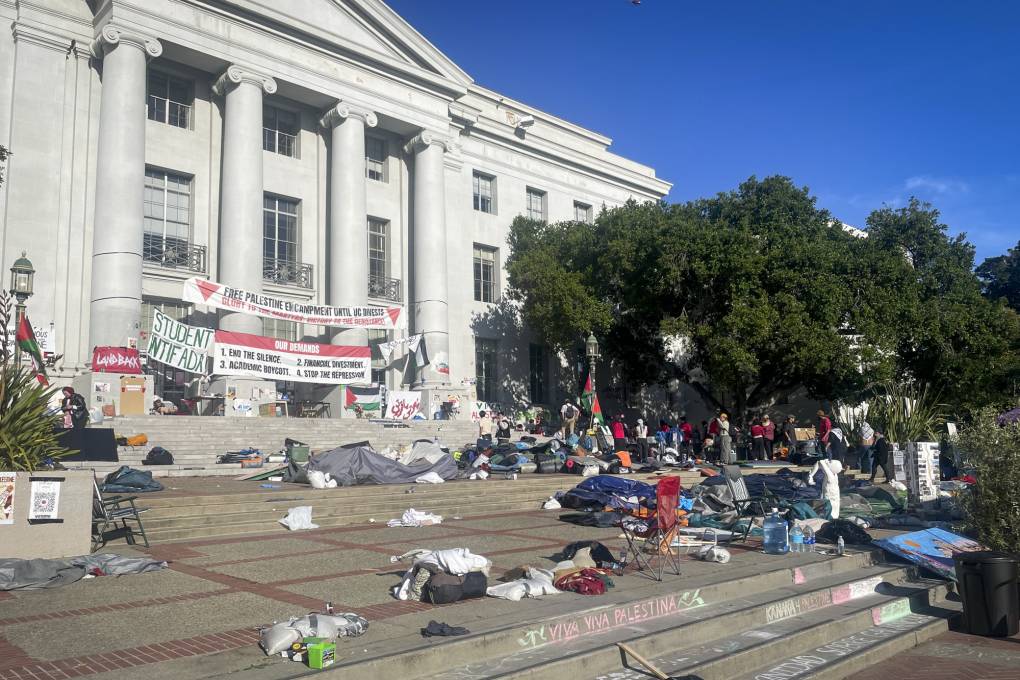
"caption": "The pro-Palestinian protest encampment on UC Berkeley's Sproul Plaza is dismantled on Tuesday, May 14, 2024, after an agreement between students and the university.",
"description": null,
"title": "IMG_5164-MG-01-KQED",
"credit": "Matthew Green/KQED",
"status": "inherit",
"altTag": null,
"isLoading": false,
"fetchFailed": false
},
"news_11986247": {
"type": "attachments",
"id": "news_11986247",
"meta": {
"index": "attachments_1716263798",
"site": "news",
"id": "11986247",
"found": true
},
"parent": 11986246,
"imgSizes": {
"twentyfourteen-full-width": {
"file": "https://cdn.kqed.org/wp-content/uploads/sites/10/2024/05/BCN-20240514-OAKTAXES-01-1038x576.jpg",
"width": 1038,
"mimeType": "image/jpeg",
"height": 576
},
"thumbnail": {
"file": "https://cdn.kqed.org/wp-content/uploads/sites/10/2024/05/BCN-20240514-OAKTAXES-01-160x95.jpg",
"width": 160,
"mimeType": "image/jpeg",
"height": 95
},
"post-thumbnail": {
"file": "https://cdn.kqed.org/wp-content/uploads/sites/10/2024/05/BCN-20240514-OAKTAXES-01-672x372.jpg",
"width": 672,
"mimeType": "image/jpeg",
"height": 372
},
"kqedFullSize": {
"file": "https://cdn.kqed.org/wp-content/uploads/sites/10/2024/05/BCN-20240514-OAKTAXES-01.jpg",
"width": 2048,
"height": 1212
},
"large": {
"file": "https://cdn.kqed.org/wp-content/uploads/sites/10/2024/05/BCN-20240514-OAKTAXES-01-1020x604.jpg",
"width": 1020,
"mimeType": "image/jpeg",
"height": 604
},
"1536x1536": {
"file": "https://cdn.kqed.org/wp-content/uploads/sites/10/2024/05/BCN-20240514-OAKTAXES-01-1536x909.jpg",
"width": 1536,
"mimeType": "image/jpeg",
"height": 909
},
"full-width": {
"file": "https://cdn.kqed.org/wp-content/uploads/sites/10/2024/05/BCN-20240514-OAKTAXES-01-1920x1136.jpg",
"width": 1920,
"mimeType": "image/jpeg",
"height": 1136
},
"medium": {
"file": "https://cdn.kqed.org/wp-content/uploads/sites/10/2024/05/BCN-20240514-OAKTAXES-01-800x473.jpg",
"width": 800,
"mimeType": "image/jpeg",
"height": 473
}
},
"publishDate": 1715732703,
"modified": 1715734824,
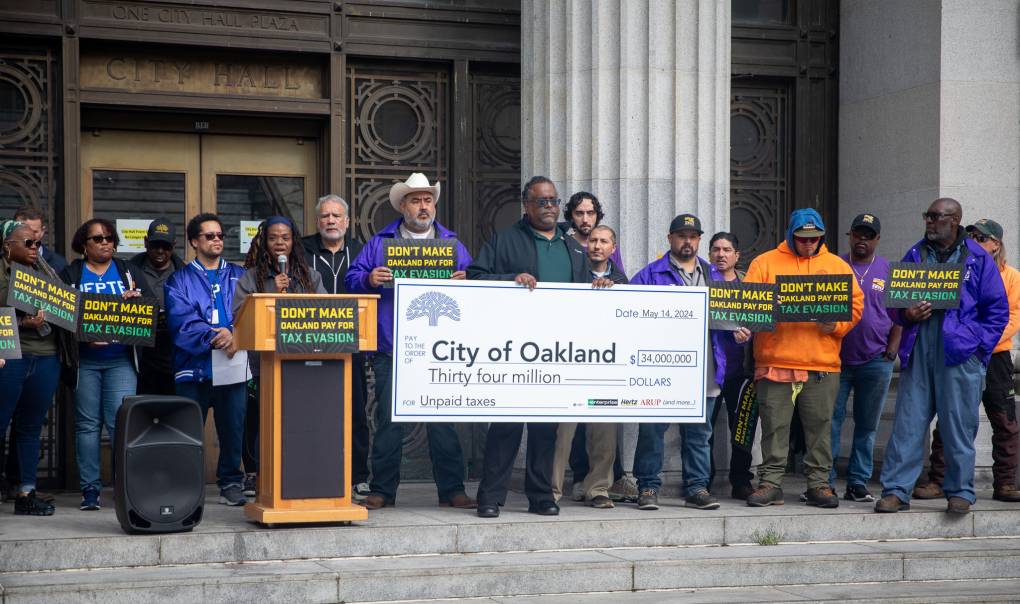
"caption": "Oakland city workers and residents gather in front of City Hall before joining the City’s Finance & Management Committee meeting on May 14, 2024, to deliver public comment. The group believes thousands of businesses did not pay business taxes by the deadline of April 17, 2023, and as much as $34 million in business tax collections from prior years may still be outstanding. ",
"description": null,
"title": "BCN-20240514-OAKTAXES-01",
"credit": "Courtesy of IFPTE Local 21 via Bay City News",
"status": "inherit",
"altTag": null,
"isLoading": false,
"fetchFailed": false
},
"news_11986245": {
"type": "attachments",
"id": "news_11986245",
"meta": {
"index": "attachments_1716263798",
"site": "news",
"id": "11986245",
"found": true
},
"parent": 11986194,
"imgSizes": {
"twentyfourteen-full-width": {
"file": "https://cdn.kqed.org/wp-content/uploads/sites/10/2024/05/9AC167B8-3D82-4AF2-9121-585F5E8B99EB-e1715732459324-828x576.jpg",
"width": 828,
"mimeType": "image/jpeg",
"height": 576
},
"thumbnail": {
"file": "https://cdn.kqed.org/wp-content/uploads/sites/10/2024/05/9AC167B8-3D82-4AF2-9121-585F5E8B99EB-e1715732459324-160x125.jpg",
"width": 160,
"mimeType": "image/jpeg",
"height": 125
},
"post-thumbnail": {
"file": "https://cdn.kqed.org/wp-content/uploads/sites/10/2024/05/9AC167B8-3D82-4AF2-9121-585F5E8B99EB-e1715732459324-672x372.jpg",
"width": 672,
"mimeType": "image/jpeg",
"height": 372
},
"kqedFullSize": {
"file": "https://cdn.kqed.org/wp-content/uploads/sites/10/2024/05/9AC167B8-3D82-4AF2-9121-585F5E8B99EB-e1715732459324.jpg",
"width": 828,
"height": 649
},
"medium": {
"file": "https://cdn.kqed.org/wp-content/uploads/sites/10/2024/05/9AC167B8-3D82-4AF2-9121-585F5E8B99EB-e1715732459324-800x627.jpg",
"width": 800,
"mimeType": "image/jpeg",
"height": 627
}
},
"publishDate": 1715732428,
"modified": 1715734345,
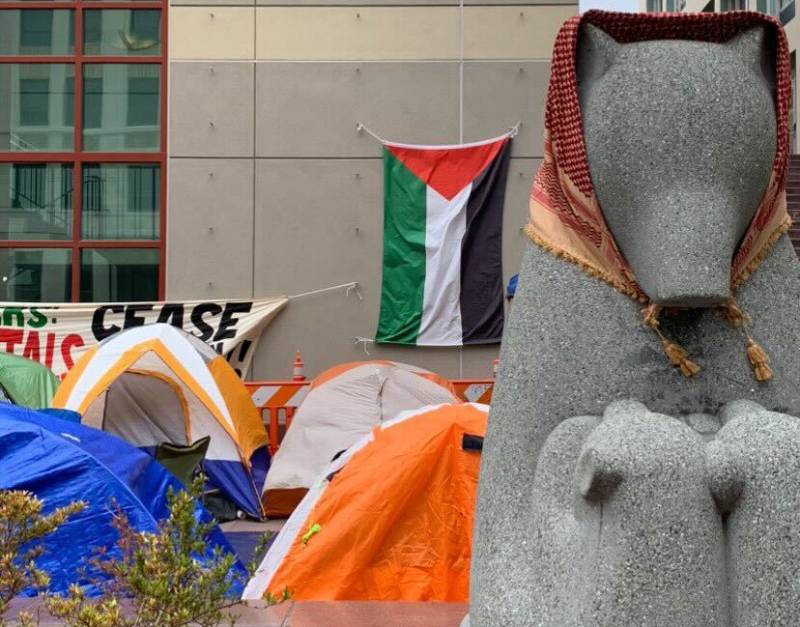
"caption": "The student protest encampment that was set up again Tuesday outside Kalmanovitz Library at the UCSF campus, San Francisco, on May 14, 2024.",
"description": null,
"title": "9AC167B8-3D82-4AF2-9121-585F5E8B99EB",
"credit": "Courtesy of ucsf4palestine via Instagram",
"status": "inherit",
"altTag": null,
"isLoading": false,
"fetchFailed": false
},
"news_11985864": {
"type": "attachments",
"id": "news_11985864",
"meta": {
"index": "attachments_1716263798",
"site": "news",
"id": "11985864",
"found": true
},
"parent": 11985856,
"imgSizes": {
"twentyfourteen-full-width": {
"file": "https://cdn.kqed.org/wp-content/uploads/sites/10/2024/05/DSC8380_qut-1038x576.jpg",
"width": 1038,
"mimeType": "image/jpeg",
"height": 576
},
"thumbnail": {
"file": "https://cdn.kqed.org/wp-content/uploads/sites/10/2024/05/DSC8380_qut-160x107.jpg",
"width": 160,
"mimeType": "image/jpeg",
"height": 107
},
"post-thumbnail": {
"file": "https://cdn.kqed.org/wp-content/uploads/sites/10/2024/05/DSC8380_qut-672x372.jpg",
"width": 672,
"mimeType": "image/jpeg",
"height": 372
},
"kqedFullSize": {
"file": "https://cdn.kqed.org/wp-content/uploads/sites/10/2024/05/DSC8380_qut.jpg",
"width": 1920,
"height": 1280
},
"large": {
"file": "https://cdn.kqed.org/wp-content/uploads/sites/10/2024/05/DSC8380_qut-1020x680.jpg",
"width": 1020,
"mimeType": "image/jpeg",
"height": 680
},
"1536x1536": {
"file": "https://cdn.kqed.org/wp-content/uploads/sites/10/2024/05/DSC8380_qut-1536x1024.jpg",
"width": 1536,
"mimeType": "image/jpeg",
"height": 1024
},
"medium": {
"file": "https://cdn.kqed.org/wp-content/uploads/sites/10/2024/05/DSC8380_qut-800x533.jpg",
"width": 800,
"mimeType": "image/jpeg",
"height": 533
}
},
"publishDate": 1715475606,
"modified": 1715629227,
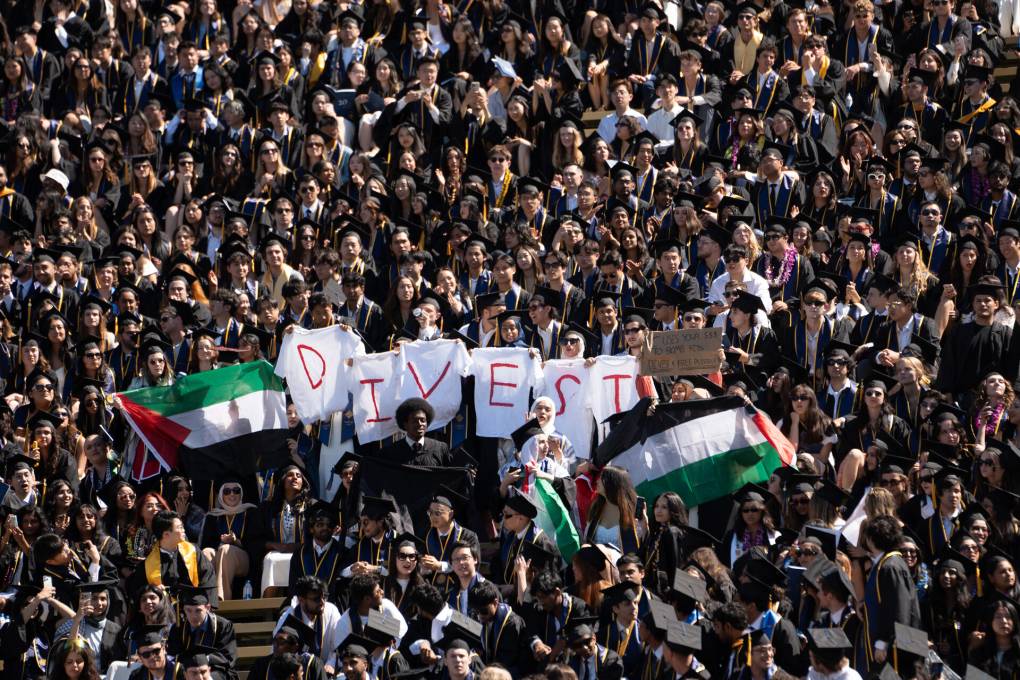
"caption": "Students hold up homemade signs and shirts to protest against UC Berkeley's links to companies in Israel or those that they say profit from Israel's war in Gaza during the 2024 commencement ceremony at the California Memorial Stadium in Berkeley on May 11, 2024.",
"description": null,
"title": "_DSC8380_qut",
"credit": "Aryk Copley/KQED",
"status": "inherit",
"altTag": null,
"isLoading": false,
"fetchFailed": false
},
"news_11985803": {
"type": "attachments",
"id": "news_11985803",
"meta": {
"index": "attachments_1716263798",
"site": "news",
"id": "11985803",
"found": true
},
"parent": 11985802,
"imgSizes": {
"twentyfourteen-full-width": {
"file": "https://cdn.kqed.org/wp-content/uploads/sites/10/2024/05/AP24131131133334-1038x576.jpg",
"width": 1038,
"mimeType": "image/jpeg",
"height": 576
},
"thumbnail": {
"file": "https://cdn.kqed.org/wp-content/uploads/sites/10/2024/05/AP24131131133334-160x107.jpg",
"width": 160,
"mimeType": "image/jpeg",
"height": 107
},
"post-thumbnail": {
"file": "https://cdn.kqed.org/wp-content/uploads/sites/10/2024/05/AP24131131133334-672x372.jpg",
"width": 672,
"mimeType": "image/jpeg",
"height": 372
},
"kqedFullSize": {
"file": "https://cdn.kqed.org/wp-content/uploads/sites/10/2024/05/AP24131131133334-scaled.jpg",
"width": 2560,
"height": 1707
},
"2048x2048": {
"file": "https://cdn.kqed.org/wp-content/uploads/sites/10/2024/05/AP24131131133334-2048x1365.jpg",
"width": 2048,
"mimeType": "image/jpeg",
"height": 1365
},
"large": {
"file": "https://cdn.kqed.org/wp-content/uploads/sites/10/2024/05/AP24131131133334-1020x680.jpg",
"width": 1020,
"mimeType": "image/jpeg",
"height": 680
},
"1536x1536": {
"file": "https://cdn.kqed.org/wp-content/uploads/sites/10/2024/05/AP24131131133334-1536x1024.jpg",
"width": 1536,
"mimeType": "image/jpeg",
"height": 1024
},
"full-width": {
"file": "https://cdn.kqed.org/wp-content/uploads/sites/10/2024/05/AP24131131133334-1920x1280.jpg",
"width": 1920,
"mimeType": "image/jpeg",
"height": 1280
},
"medium": {
"file": "https://cdn.kqed.org/wp-content/uploads/sites/10/2024/05/AP24131131133334-800x533.jpg",
"width": 800,
"mimeType": "image/jpeg",
"height": 533
}
},
"publishDate": 1715389528,
"modified": 1715389590,
"caption": "A Pac-12 logo is shown on the floor of Haas Pavilion as California forward Fardaws Aimaq (00) looks to pass while being defended by UCLA guard Brandon Williams during an NCAA college basketball game in Berkeley, Feb. 10, 2024. The University of California Board of Regents is expected to accept a recommendation that UCLA pay University of California at Berkeley $10 million a year for 6 years as a result of the Bruins’ upcoming move to the Big Ten and the demise of the Pac-12. ",
"description": null,
"title": "Fardaws AimaqBrandon Williams",
"credit": "Jeff Chiu/AP Photo",
"status": "inherit",
"altTag": null,
"isLoading": false,
"fetchFailed": false
},
"news_11985375": {
"type": "attachments",
"id": "news_11985375",
"meta": {
"index": "attachments_1716263798",
"site": "news",
"id": "11985375",
"found": true
},
"parent": 11985335,
"imgSizes": {
"twentyfourteen-full-width": {
"file": "https://cdn.kqed.org/wp-content/uploads/sites/10/2024/05/GettyImages-2152066925-1024x576.jpg",
"width": 1024,
"mimeType": "image/jpeg",
"height": 576
},
"thumbnail": {
"file": "https://cdn.kqed.org/wp-content/uploads/sites/10/2024/05/GettyImages-2152066925-160x107.jpg",
"width": 160,
"mimeType": "image/jpeg",
"height": 107
},
"post-thumbnail": {
"file": "https://cdn.kqed.org/wp-content/uploads/sites/10/2024/05/GettyImages-2152066925-672x372.jpg",
"width": 672,
"mimeType": "image/jpeg",
"height": 372
},
"kqedFullSize": {
"file": "https://cdn.kqed.org/wp-content/uploads/sites/10/2024/05/GettyImages-2152066925.jpg",
"width": 1024,
"height": 683
},
"large": {
"file": "https://cdn.kqed.org/wp-content/uploads/sites/10/2024/05/GettyImages-2152066925-1020x680.jpg",
"width": 1020,
"mimeType": "image/jpeg",
"height": 680
},
"medium": {
"file": "https://cdn.kqed.org/wp-content/uploads/sites/10/2024/05/GettyImages-2152066925-800x534.jpg",
"width": 800,
"mimeType": "image/jpeg",
"height": 534
}
},
"publishDate": 1715196832,
"modified": 1715200335,
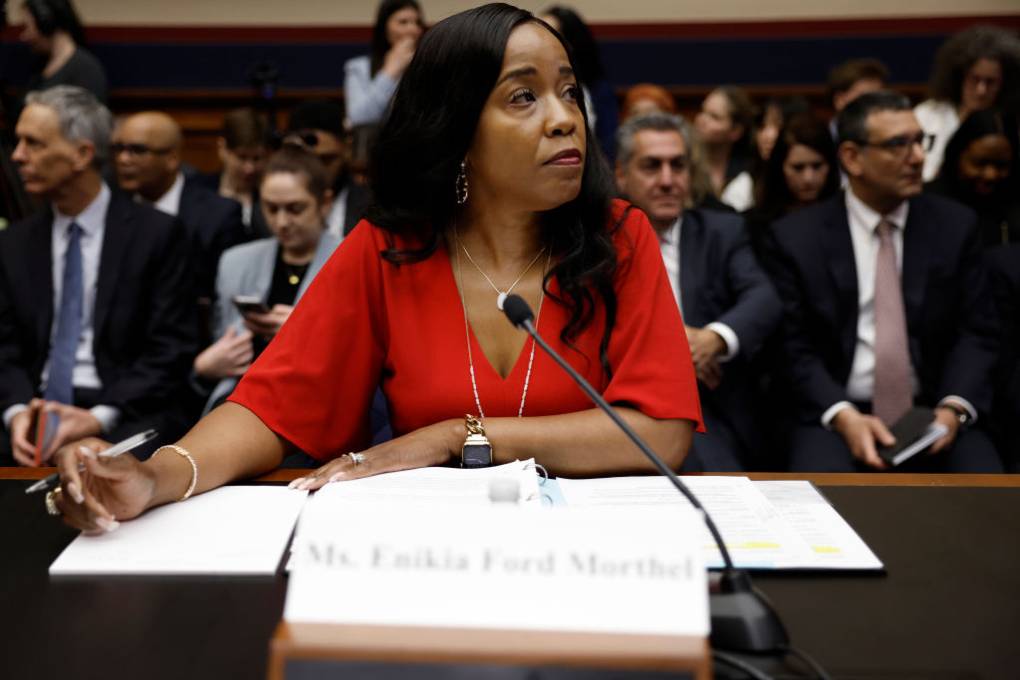
"caption": "Enikia Ford Morthel, superintendent of the Berkeley Unified School District, listens during a hearing with subcommittee members of the House Education and the Workforce Committee on May 8, 2024, in Washington, D.C.",
"description": null,
"title": "House Committee Holds Hearing Examining Antisemitism In K-12 Schools",
"credit": "Anna Moneymaker/Getty Images",
"status": "inherit",
"altTag": "A Black woman in a red dress sits in front of a microphone.",
"isLoading": false,
"fetchFailed": false
},
"news_11985024": {
"type": "attachments",
"id": "news_11985024",
"meta": {
"index": "attachments_1716263798",
"site": "news",
"id": "11985024",
"found": true
},
"parent": 11985022,
"imgSizes": {
"twentyfourteen-full-width": {
"file": "https://cdn.kqed.org/wp-content/uploads/sites/10/2024/05/CMFinance01-1038x576.jpg",
"width": 1038,
"mimeType": "image/jpeg",
"height": 576
},
"thumbnail": {
"file": "https://cdn.kqed.org/wp-content/uploads/sites/10/2024/05/CMFinance01-160x107.jpg",
"width": 160,
"mimeType": "image/jpeg",
"height": 107
},
"post-thumbnail": {
"file": "https://cdn.kqed.org/wp-content/uploads/sites/10/2024/05/CMFinance01-672x372.jpg",
"width": 672,
"mimeType": "image/jpeg",
"height": 372
},
"kqedFullSize": {
"file": "https://cdn.kqed.org/wp-content/uploads/sites/10/2024/05/CMFinance01.jpg",
"width": 2000,
"height": 1333
},
"large": {
"file": "https://cdn.kqed.org/wp-content/uploads/sites/10/2024/05/CMFinance01-1020x680.jpg",
"width": 1020,
"mimeType": "image/jpeg",
"height": 680
},
"1536x1536": {
"file": "https://cdn.kqed.org/wp-content/uploads/sites/10/2024/05/CMFinance01-1536x1024.jpg",
"width": 1536,
"mimeType": "image/jpeg",
"height": 1024
},
"full-width": {
"file": "https://cdn.kqed.org/wp-content/uploads/sites/10/2024/05/CMFinance01-1920x1280.jpg",
"width": 1920,
"mimeType": "image/jpeg",
"height": 1280
},
"medium": {
"file": "https://cdn.kqed.org/wp-content/uploads/sites/10/2024/05/CMFinance01-800x533.jpg",
"width": 800,
"mimeType": "image/jpeg",
"height": 533
}
},
"publishDate": 1714770050,
"modified": 1714770306,
"caption": null,
"description": null,
"title": "CMFinance01",
"credit": "Illustration by Miguel Gutierrez Jr./CalMatters; iStock",
"status": "inherit",
"altTag": null,
"isLoading": false,
"fetchFailed": false
},
"news_11984509": {
"type": "attachments",
"id": "news_11984509",
"meta": {
"index": "attachments_1716263798",
"site": "news",
"id": "11984509",
"found": true
},
"parent": 0,
"imgSizes": {
"twentyfourteen-full-width": {
"file": "https://cdn.kqed.org/wp-content/uploads/sites/10/2024/04/240423-BERKELEY-GAZA-ENCAMPMENT-MD-09-KQED-1038x576.jpg",
"width": 1038,
"mimeType": "image/jpeg",
"height": 576
},
"thumbnail": {
"file": "https://cdn.kqed.org/wp-content/uploads/sites/10/2024/04/240423-BERKELEY-GAZA-ENCAMPMENT-MD-09-KQED-160x107.jpg",
"width": 160,
"mimeType": "image/jpeg",
"height": 107
},
"post-thumbnail": {
"file": "https://cdn.kqed.org/wp-content/uploads/sites/10/2024/04/240423-BERKELEY-GAZA-ENCAMPMENT-MD-09-KQED-672x372.jpg",
"width": 672,
"mimeType": "image/jpeg",
"height": 372
},
"kqedFullSize": {
"file": "https://cdn.kqed.org/wp-content/uploads/sites/10/2024/04/240423-BERKELEY-GAZA-ENCAMPMENT-MD-09-KQED.jpg",
"width": 2000,
"height": 1333
},
"large": {
"file": "https://cdn.kqed.org/wp-content/uploads/sites/10/2024/04/240423-BERKELEY-GAZA-ENCAMPMENT-MD-09-KQED-1020x680.jpg",
"width": 1020,
"mimeType": "image/jpeg",
"height": 680
},
"1536x1536": {
"file": "https://cdn.kqed.org/wp-content/uploads/sites/10/2024/04/240423-BERKELEY-GAZA-ENCAMPMENT-MD-09-KQED-1536x1024.jpg",
"width": 1536,
"mimeType": "image/jpeg",
"height": 1024
},
"full-width": {
"file": "https://cdn.kqed.org/wp-content/uploads/sites/10/2024/04/240423-BERKELEY-GAZA-ENCAMPMENT-MD-09-KQED-1920x1280.jpg",
"width": 1920,
"mimeType": "image/jpeg",
"height": 1280
},
"medium": {
"file": "https://cdn.kqed.org/wp-content/uploads/sites/10/2024/04/240423-BERKELEY-GAZA-ENCAMPMENT-MD-09-KQED-800x533.jpg",
"width": 800,
"mimeType": "image/jpeg",
"height": 533
}
},
"publishDate": 1714504696,
"modified": 1714592908,
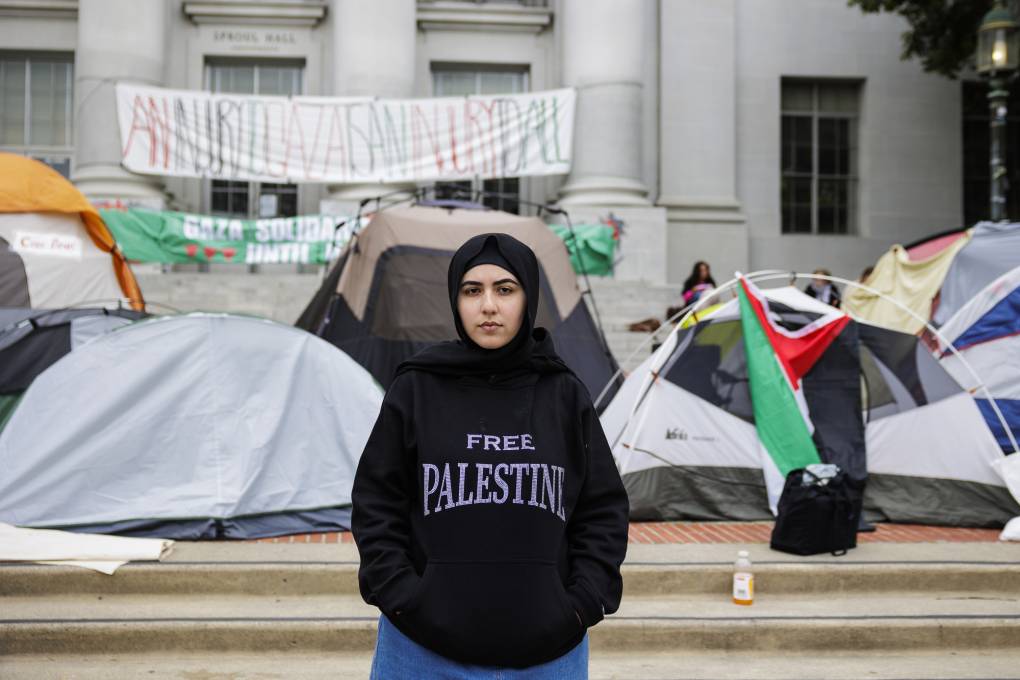
"caption": "Malak Afaneh, a UC Berkeley Law student and co-president of Berkeley Law Students for Justice in Palestine, stands at the Gaza Solidarity Encampment in front of Sproul Hall on April 23.",
"description": null,
"title": "240423-BERKELEY GAZA ENCAMPMENT-MD-09-KQED",
"credit": "Martin do Nascimento/KQED",
"status": "inherit",
"altTag": null,
"isLoading": false,
"fetchFailed": false
},
"news_11983893": {
"type": "attachments",
"id": "news_11983893",
"meta": {
"index": "attachments_1716263798",
"site": "news",
"id": "11983893",
"found": true
},
"parent": 0,
"imgSizes": {
"twentyfourteen-full-width": {
"file": "https://cdn.kqed.org/wp-content/uploads/sites/10/2024/04/240423-SAT-III-MD-06-KQED-1038x576.jpg",
"width": 1038,
"mimeType": "image/jpeg",
"height": 576
},
"thumbnail": {
"file": "https://cdn.kqed.org/wp-content/uploads/sites/10/2024/04/240423-SAT-III-MD-06-KQED-160x107.jpg",
"width": 160,
"mimeType": "image/jpeg",
"height": 107
},
"post-thumbnail": {
"file": "https://cdn.kqed.org/wp-content/uploads/sites/10/2024/04/240423-SAT-III-MD-06-KQED-672x372.jpg",
"width": 672,
"mimeType": "image/jpeg",
"height": 372
},
"kqedFullSize": {
"file": "https://cdn.kqed.org/wp-content/uploads/sites/10/2024/04/240423-SAT-III-MD-06-KQED.jpg",
"width": 2000,
"height": 1333
},
"large": {
"file": "https://cdn.kqed.org/wp-content/uploads/sites/10/2024/04/240423-SAT-III-MD-06-KQED-1020x680.jpg",
"width": 1020,
"mimeType": "image/jpeg",
"height": 680
},
"1536x1536": {
"file": "https://cdn.kqed.org/wp-content/uploads/sites/10/2024/04/240423-SAT-III-MD-06-KQED-1536x1024.jpg",
"width": 1536,
"mimeType": "image/jpeg",
"height": 1024
},
"full-width": {
"file": "https://cdn.kqed.org/wp-content/uploads/sites/10/2024/04/240423-SAT-III-MD-06-KQED-1920x1280.jpg",
"width": 1920,
"mimeType": "image/jpeg",
"height": 1280
},
"medium": {
"file": "https://cdn.kqed.org/wp-content/uploads/sites/10/2024/04/240423-SAT-III-MD-06-KQED-800x533.jpg",
"width": 800,
"mimeType": "image/jpeg",
"height": 533
}
},
"publishDate": 1713977922,
"modified": 1714519565,
"caption": "Leslie Cruz Urquilla sits outside her high school, KIPP San Francisco College Preparatory. When she took the ACT last December, her dad had to take a day off work to drive her to a testing center three hours away.",
"description": null,
"title": "240423-SAT III-MD-06-KQED",
"credit": "Martin do Nascimento/KQED",
"status": "inherit",
"altTag": null,
"isLoading": false,
"fetchFailed": false
},
"news_11984439": {
"type": "attachments",
"id": "news_11984439",
"meta": {
"index": "attachments_1716263798",
"site": "news",
"id": "11984439",
"found": true
},
"parent": 11984807,
"imgSizes": {
"twentyfourteen-full-width": {
"file": "https://cdn.kqed.org/wp-content/uploads/sites/10/2024/04/240429-SFSU-GAZA-ENCAMPMENT-MD-09-KQED-1038x576.jpg",
"width": 1038,
"mimeType": "image/jpeg",
"height": 576
},
"thumbnail": {
"file": "https://cdn.kqed.org/wp-content/uploads/sites/10/2024/04/240429-SFSU-GAZA-ENCAMPMENT-MD-09-KQED-160x107.jpg",
"width": 160,
"mimeType": "image/jpeg",
"height": 107
},
"post-thumbnail": {
"file": "https://cdn.kqed.org/wp-content/uploads/sites/10/2024/04/240429-SFSU-GAZA-ENCAMPMENT-MD-09-KQED-672x372.jpg",
"width": 672,
"mimeType": "image/jpeg",
"height": 372
},
"kqedFullSize": {
"file": "https://cdn.kqed.org/wp-content/uploads/sites/10/2024/04/240429-SFSU-GAZA-ENCAMPMENT-MD-09-KQED.jpg",
"width": 2000,
"height": 1333
},
"large": {
"file": "https://cdn.kqed.org/wp-content/uploads/sites/10/2024/04/240429-SFSU-GAZA-ENCAMPMENT-MD-09-KQED-1020x680.jpg",
"width": 1020,
"mimeType": "image/jpeg",
"height": 680
},
"1536x1536": {
"file": "https://cdn.kqed.org/wp-content/uploads/sites/10/2024/04/240429-SFSU-GAZA-ENCAMPMENT-MD-09-KQED-1536x1024.jpg",
"width": 1536,
"mimeType": "image/jpeg",
"height": 1024
},
"full-width": {
"file": "https://cdn.kqed.org/wp-content/uploads/sites/10/2024/04/240429-SFSU-GAZA-ENCAMPMENT-MD-09-KQED-1920x1280.jpg",
"width": 1920,
"mimeType": "image/jpeg",
"height": 1280
},
"medium": {
"file": "https://cdn.kqed.org/wp-content/uploads/sites/10/2024/04/240429-SFSU-GAZA-ENCAMPMENT-MD-09-KQED-800x533.jpg",
"width": 800,
"mimeType": "image/jpeg",
"height": 533
}
},
"publishDate": 1714436641,
"modified": 1714680079,
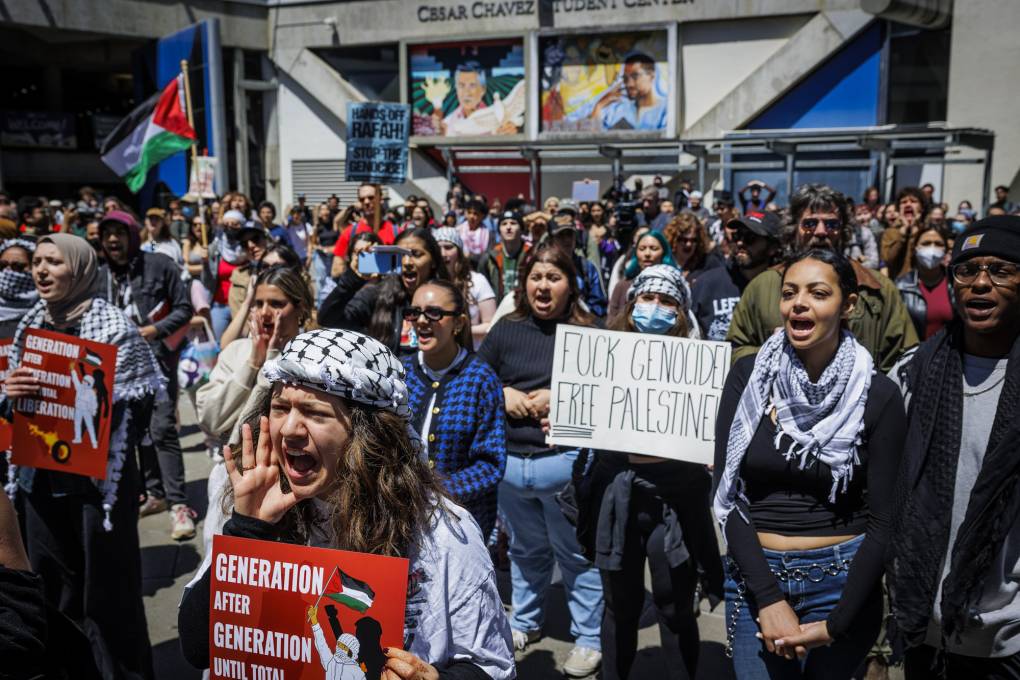
"caption": "San Francisco State University students rally outside the Cesar Chavez Student Center on Monday, calling on the university to disclose its financial ties to Israel and divest from weapons manufacturers.",
"description": null,
"title": "240429-SFSU GAZA ENCAMPMENT-MD-09-KQED",
"credit": "Martin do Nascimento/KQED",
"status": "inherit",
"altTag": null,
"isLoading": false,
"fetchFailed": false
},
"news_11984304": {
"type": "attachments",
"id": "news_11984304",
"meta": {
"index": "attachments_1716263798",
"site": "news",
"id": "11984304",
"found": true
},
"parent": 11984302,
"imgSizes": {
"twentyfourteen-full-width": {
"file": "https://cdn.kqed.org/wp-content/uploads/sites/10/2024/04/AP_5968_country-bus-1200x800-1-1038x576.jpg",
"width": 1038,
"mimeType": "image/jpeg",
"height": 576
},
"thumbnail": {
"file": "https://cdn.kqed.org/wp-content/uploads/sites/10/2024/04/AP_5968_country-bus-1200x800-1-160x107.jpg",
"width": 160,
"mimeType": "image/jpeg",
"height": 107
},
"post-thumbnail": {
"file": "https://cdn.kqed.org/wp-content/uploads/sites/10/2024/04/AP_5968_country-bus-1200x800-1-672x372.jpg",
"width": 672,
"mimeType": "image/jpeg",
"height": 372
},
"kqedFullSize": {
"file": "https://cdn.kqed.org/wp-content/uploads/sites/10/2024/04/AP_5968_country-bus-1200x800-1.jpg",
"width": 1200,
"height": 800
},
"large": {
"file": "https://cdn.kqed.org/wp-content/uploads/sites/10/2024/04/AP_5968_country-bus-1200x800-1-1020x680.jpg",
"width": 1020,
"mimeType": "image/jpeg",
"height": 680
},
"medium": {
"file": "https://cdn.kqed.org/wp-content/uploads/sites/10/2024/04/AP_5968_country-bus-1200x800-1-800x533.jpg",
"width": 800,
"mimeType": "image/jpeg",
"height": 533
}
},
"publishDate": 1714249381,
"modified": 1714249437,
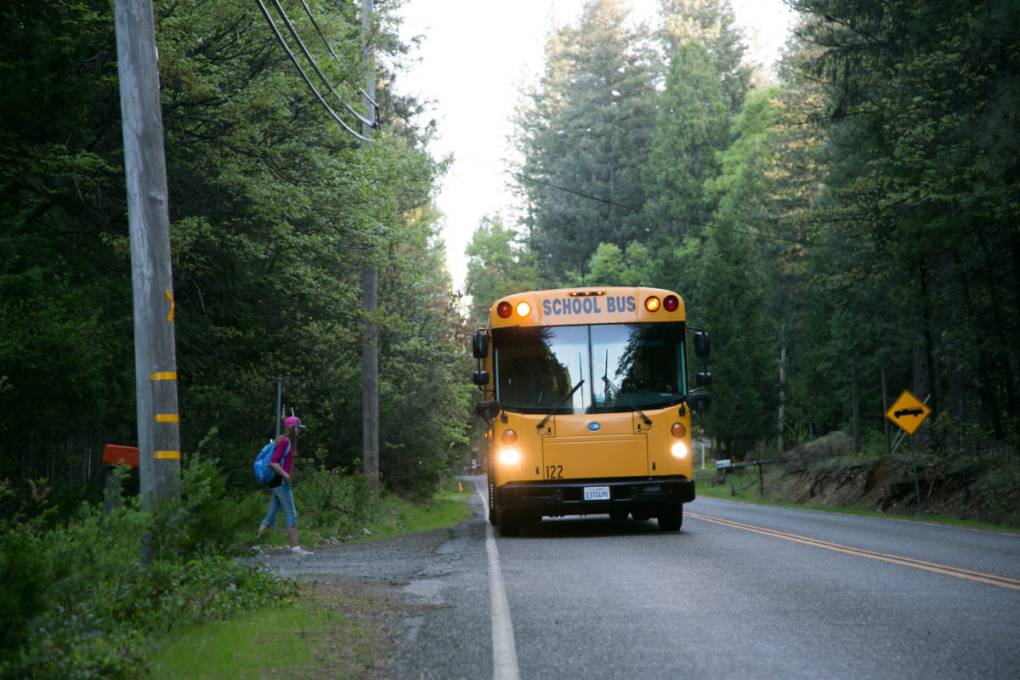
"caption": "Nine rural counties, located more than 60 miles from university teacher preparation programs, struggle to recruit enough teachers to fill classrooms.",
"description": null,
"title": "AP_5968_country-bus-1200x800",
"credit": "Julie Leopo for EdSource",
"status": "inherit",
"altTag": "A school bus seen driving on a tree-lined country road with a student with a backpack preparing to board.",
"isLoading": false,
"fetchFailed": false
},
"news_11984136": {
"type": "attachments",
"id": "news_11984136",
"meta": {
"index": "attachments_1716263798",
"site": "news",
"id": "11984136",
"found": true
},
"parent": 0,
"imgSizes": {
"twentyfourteen-full-width": {
"file": "https://cdn.kqed.org/wp-content/uploads/sites/10/2024/04/240425-StanfordGazaProtest-022-BL-1038x576.jpg",
"width": 1038,
"mimeType": "image/jpeg",
"height": 576
},
"thumbnail": {
"file": "https://cdn.kqed.org/wp-content/uploads/sites/10/2024/04/240425-StanfordGazaProtest-022-BL-160x107.jpg",
"width": 160,
"mimeType": "image/jpeg",
"height": 107
},
"post-thumbnail": {
"file": "https://cdn.kqed.org/wp-content/uploads/sites/10/2024/04/240425-StanfordGazaProtest-022-BL-672x372.jpg",
"width": 672,
"mimeType": "image/jpeg",
"height": 372
},
"kqedFullSize": {
"file": "https://cdn.kqed.org/wp-content/uploads/sites/10/2024/04/240425-StanfordGazaProtest-022-BL.jpg",
"width": 1920,
"height": 1280
},
"large": {
"file": "https://cdn.kqed.org/wp-content/uploads/sites/10/2024/04/240425-StanfordGazaProtest-022-BL-1020x680.jpg",
"width": 1020,
"mimeType": "image/jpeg",
"height": 680
},
"1536x1536": {
"file": "https://cdn.kqed.org/wp-content/uploads/sites/10/2024/04/240425-StanfordGazaProtest-022-BL-1536x1024.jpg",
"width": 1536,
"mimeType": "image/jpeg",
"height": 1024
},
"medium": {
"file": "https://cdn.kqed.org/wp-content/uploads/sites/10/2024/04/240425-StanfordGazaProtest-022-BL-800x533.jpg",
"width": 800,
"mimeType": "image/jpeg",
"height": 533
}
},
"publishDate": 1714149444,
"modified": 1714178507,
"caption": "A pro-Israel counterprotester waves an Israel flag during a pro-Palestinian march through the Stanford University campus on April 25, 2024, calling for the university to divest from Israel. The rally took place during Stanford's Admit Weekend, a time for incoming students to tour the university.",
"description": null,
"title": "240425-StanfordGazaProtest-022-BL",
"credit": "Beth LaBerge/KQED",
"status": "inherit",
"altTag": null,
"isLoading": false,
"fetchFailed": false
}
},
"audioPlayerReducer": {
"postId": "stream_live",
"isPaused": true,
"isPlaying": false,
"pfsActive": false,
"pledgeModalIsOpen": true,
"playerDrawerIsOpen": false,
"liveAudioPlayStartedAt": 0,
"liveAudioPlayContext": ""
},
"authorsReducer": {
"byline_news_11986246": {
"type": "authors",
"id": "byline_news_11986246",
"meta": {
"override": true
},
"slug": "byline_news_11986246",
"name": "Kiley Russell, Bay City News",
"isLoading": false
},
"byline_news_11985802": {
"type": "authors",
"id": "byline_news_11985802",
"meta": {
"override": true
},
"slug": "byline_news_11985802",
"name": "Joe Reedy\u003cbr>Associated Press",
"isLoading": false
},
"byline_news_11985022": {
"type": "authors",
"id": "byline_news_11985022",
"meta": {
"override": true
},
"slug": "byline_news_11985022",
"name": "Carolyn Jones, CalMatters",
"isLoading": false
},
"byline_news_11984302": {
"type": "authors",
"id": "byline_news_11984302",
"meta": {
"override": true
},
"slug": "byline_news_11984302",
"name": "\u003ca href=\"https://edsource.org/author/dlambert\">Diana Lambert\u003c/a>",
"isLoading": false
},
"dmarks": {
"type": "authors",
"id": "182",
"meta": {
"index": "authors_1716337520",
"id": "182",
"found": true
},
"name": "David Marks",
"firstName": "David",
"lastName": "Marks",
"slug": "dmarks",
"email": "dmarks@kqed.org",
"display_author_email": false,
"staff_mastheads": [],
"title": "KQED Editor",
"bio": "David Marks is a senior digital editor for KQED News. \u003c/a>Reach him at dmarks@kqed.org.",
"avatar": "https://secure.gravatar.com/avatar/b88bd6227ce6cb96ae33fefaf42b2a29?s=600&d=mm&r=g",
"twitter": "divadskram",
"facebook": null,
"instagram": null,
"linkedin": null,
"sites": [
{
"site": "news",
"roles": []
},
{
"site": "science",
"roles": []
},
{
"site": "perspectives",
"roles": []
},
{
"site": "liveblog",
"roles": []
}
],
"headData": {
"title": "David Marks | KQED",
"description": "KQED Editor",
"ogImgSrc": "https://secure.gravatar.com/avatar/b88bd6227ce6cb96ae33fefaf42b2a29?s=600&d=mm&r=g",
"twImgSrc": "https://secure.gravatar.com/avatar/b88bd6227ce6cb96ae33fefaf42b2a29?s=600&d=mm&r=g"
},
"isLoading": false,
"link": "/author/dmarks"
},
"kqednewsstaffandwires": {
"type": "authors",
"id": "237",
"meta": {
"index": "authors_1716337520",
"id": "237",
"found": true
},
"name": "KQED News Staff and Wires",
"firstName": "KQED News Staff and Wires",
"lastName": null,
"slug": "kqednewsstaffandwires",
"email": "onlinenewsstaff@kqed.org",
"display_author_email": false,
"staff_mastheads": [],
"title": null,
"bio": null,
"avatar": "https://secure.gravatar.com/avatar/72295af8ebbfbd19a4948f5271285664?s=600&d=blank&r=g",
"twitter": null,
"facebook": null,
"instagram": null,
"linkedin": null,
"sites": [
{
"site": "arts",
"roles": [
"contributor"
]
},
{
"site": "news",
"roles": [
"contributor"
]
},
{
"site": "lowdown",
"roles": [
"author"
]
},
{
"site": "stateofhealth",
"roles": [
"contributor"
]
},
{
"site": "food",
"roles": [
"author"
]
}
],
"headData": {
"title": "KQED News Staff and Wires | KQED",
"description": null,
"ogImgSrc": "https://secure.gravatar.com/avatar/72295af8ebbfbd19a4948f5271285664?s=600&d=blank&r=g",
"twImgSrc": "https://secure.gravatar.com/avatar/72295af8ebbfbd19a4948f5271285664?s=600&d=blank&r=g"
},
"isLoading": false,
"link": "/author/kqednewsstaffandwires"
},
"matthewgreen": {
"type": "authors",
"id": "1263",
"meta": {
"index": "authors_1716337520",
"id": "1263",
"found": true
},
"name": "Matthew Green",
"firstName": "Matthew",
"lastName": "Green",
"slug": "matthewgreen",
"email": "mgreen@kqed.org",
"display_author_email": false,
"staff_mastheads": [],
"title": "KQED Editor/Reporter",
"bio": "Matthew Green is a digital media producer for KQED News. He previously produced \u003ca href=\"http://www.kqed.org/lowdown\">The Lowdown\u003c/a>, KQED’s multimedia news education blog. Matthew's written for numerous Bay Area publications, including the Oakland Tribune and San Francisco Chronicle. He also taught journalism classes at Fremont High School in East Oakland.\r\n\r\nEmail: mgreen@kqed.org; Twitter: @MGreenKQED",
"avatar": "https://secure.gravatar.com/avatar/3bf498d1267ca02c8494f33d8cfc575e?s=600&d=blank&r=g",
"twitter": "MGreenKQED",
"facebook": null,
"instagram": null,
"linkedin": null,
"sites": [
{
"site": "news",
"roles": []
},
{
"site": "lowdown",
"roles": []
},
{
"site": "science",
"roles": []
},
{
"site": "education",
"roles": []
},
{
"site": "quest",
"roles": []
},
{
"site": "liveblog",
"roles": []
}
],
"headData": {
"title": "Matthew Green | KQED",
"description": "KQED Editor/Reporter",
"ogImgSrc": "https://secure.gravatar.com/avatar/3bf498d1267ca02c8494f33d8cfc575e?s=600&d=blank&r=g",
"twImgSrc": "https://secure.gravatar.com/avatar/3bf498d1267ca02c8494f33d8cfc575e?s=600&d=blank&r=g"
},
"isLoading": false,
"link": "/author/matthewgreen"
},
"blaberge": {
"type": "authors",
"id": "11667",
"meta": {
"index": "authors_1716337520",
"id": "11667",
"found": true
},
"name": "Beth LaBerge",
"firstName": "Beth",
"lastName": "LaBerge",
"slug": "blaberge",
"email": "blaberge@KQED.org",
"display_author_email": true,
"staff_mastheads": [
"news"
],
"title": "Photographer, News",
"bio": "Beth LaBerge is a visual journalist for \u003ca href=\"https://www.kqed.org/news\">KQED News\u003c/a>.",
"avatar": "https://secure.gravatar.com/avatar/ce49ecd7a1306685637b45a1f6f5dedfc4ae9481966eb596fea5160466dd6319?s=600&d=blank&r=g",
"twitter": null,
"bluesky": null,
"facebook": null,
"instagram": "https://www.instagram.com/bethlaberge/",
"linkedin": null,
"sites": [
{
"site": "arts",
"roles": [
"editor",
"manage_categories"
]
},
{
"site": "news",
"roles": [
"editor",
"edit_plugins",
"manage_categories"
]
},
{
"site": "science",
"roles": [
"editor",
"contributor",
"author",
"manage_categories"
]
},
{
"site": "perspectives",
"roles": [
"editor"
]
},
{
"site": "liveblog",
"roles": [
"editor"
]
}
],
"headData": {
"title": "Beth LaBerge | KQED",
"description": "Photographer, News",
"ogImgSrc": "https://secure.gravatar.com/avatar/ce49ecd7a1306685637b45a1f6f5dedfc4ae9481966eb596fea5160466dd6319?s=600&d=blank&r=g",
"twImgSrc": "https://secure.gravatar.com/avatar/ce49ecd7a1306685637b45a1f6f5dedfc4ae9481966eb596fea5160466dd6319?s=600&d=blank&r=g"
},
"isLoading": false,
"link": "/author/blaberge"
},
"jlara": {
"type": "authors",
"id": "11761",
"meta": {
"index": "authors_1716337520",
"id": "11761",
"found": true
},
"name": "Juan Carlos Lara",
"firstName": "Juan Carlos",
"lastName": "Lara",
"slug": "jlara",
"email": "jlara@kqed.org",
"display_author_email": false,
"staff_mastheads": [],
"title": "KQED Contributor",
"bio": null,
"avatar": "https://secure.gravatar.com/avatar/19e2052b9b05657c5ff2af2121846e9c?s=600&d=blank&r=g",
"twitter": null,
"facebook": null,
"instagram": null,
"linkedin": null,
"sites": [
{
"site": "arts",
"roles": [
"editor"
]
},
{
"site": "news",
"roles": [
"editor"
]
},
{
"site": "forum",
"roles": [
"editor"
]
},
{
"site": "liveblog",
"roles": [
"contributor"
]
}
],
"headData": {
"title": "Juan Carlos Lara | KQED",
"description": "KQED Contributor",
"ogImgSrc": "https://secure.gravatar.com/avatar/19e2052b9b05657c5ff2af2121846e9c?s=600&d=blank&r=g",
"twImgSrc": "https://secure.gravatar.com/avatar/19e2052b9b05657c5ff2af2121846e9c?s=600&d=blank&r=g"
},
"isLoading": false,
"link": "/author/jlara"
},
"adahlstromeckman": {
"type": "authors",
"id": "11785",
"meta": {
"index": "authors_1716337520",
"id": "11785",
"found": true
},
"name": "Azul Dahlstrom-Eckman",
"firstName": "Azul",
"lastName": "Dahlstrom-Eckman",
"slug": "adahlstromeckman",
"email": "adahlstrom-eckman@kqed.org",
"display_author_email": true,
"staff_mastheads": [],
"title": "Reporter",
"bio": "Azul is a reporter for KQED focusing on transportation and features. He joined KQED in 2021 as an alumna of KALW's Audio Academy radio journalism training program.",
"avatar": "https://secure.gravatar.com/avatar/9cb750298435add7815a777f55bf1f46845c1386bb8452555c60a7b820b5aba3?s=600&d=blank&r=g",
"twitter": "@zuliemann",
"bluesky": "@azul415.bsky.social",
"facebook": null,
"instagram": null,
"linkedin": null,
"sites": [
{
"site": "arts",
"roles": [
"editor"
]
},
{
"site": "news",
"roles": [
"editor"
]
},
{
"site": "science",
"roles": [
"editor"
]
},
{
"site": "liveblog",
"roles": [
"author"
]
}
],
"headData": {
"title": "Azul Dahlstrom-Eckman | KQED",
"description": "Reporter",
"ogImgSrc": "https://secure.gravatar.com/avatar/9cb750298435add7815a777f55bf1f46845c1386bb8452555c60a7b820b5aba3?s=600&d=blank&r=g",
"twImgSrc": "https://secure.gravatar.com/avatar/9cb750298435add7815a777f55bf1f46845c1386bb8452555c60a7b820b5aba3?s=600&d=blank&r=g"
},
"isLoading": false,
"link": "/author/adahlstromeckman"
},
"sjohnson": {
"type": "authors",
"id": "11840",
"meta": {
"index": "authors_1716337520",
"id": "11840",
"found": true
},
"name": "Sydney Johnson",
"firstName": "Sydney",
"lastName": "Johnson",
"slug": "sjohnson",
"email": "sjohnson@kqed.org",
"display_author_email": false,
"staff_mastheads": [
"news"
],
"title": "KQED Reporter",
"bio": "Sydney Johnson is a general assignment reporter at KQED. She previously reported on public health and city government at the San Francisco Examiner, and before that, she covered statewide education policy for EdSource. Her reporting has won multiple local, state and national awards. Sydney is a graduate of the University of California, Berkeley and lives in San Francisco.",
"avatar": "https://secure.gravatar.com/avatar/97855f2719b72ad6190b7c535fe642c8?s=600&d=blank&r=g",
"twitter": "sydneyfjohnson",
"facebook": null,
"instagram": null,
"linkedin": null,
"sites": [
{
"site": "news",
"roles": [
"editor"
]
}
],
"headData": {
"title": "Sydney Johnson | KQED",
"description": "KQED Reporter",
"ogImgSrc": "https://secure.gravatar.com/avatar/97855f2719b72ad6190b7c535fe642c8?s=600&d=blank&r=g",
"twImgSrc": "https://secure.gravatar.com/avatar/97855f2719b72ad6190b7c535fe642c8?s=600&d=blank&r=g"
},
"isLoading": false,
"link": "/author/sjohnson"
},
"mdonascimento": {
"type": "authors",
"id": "11865",
"meta": {
"index": "authors_1716337520",
"id": "11865",
"found": true
},
"name": "Martin do Nascimento",
"firstName": "Martin",
"lastName": "do Nascimento",
"slug": "mdonascimento",
"email": "mdonascimento@kqed.org",
"display_author_email": false,
"staff_mastheads": [
"news",
"science",
"arts"
],
"title": "KQED Contributor",
"bio": null,
"avatar": "https://secure.gravatar.com/avatar/e5337c4df47f2c1c9af0124a4550094c9ba92a05654bb02aea5e72d902b41744?s=600&d=blank&r=g",
"twitter": null,
"bluesky": null,
"facebook": null,
"instagram": null,
"linkedin": null,
"sites": [
{
"site": "arts",
"roles": [
"manage_categories",
"administrator"
]
},
{
"site": "news",
"roles": [
"manage_categories",
"administrator"
]
},
{
"site": "science",
"roles": [
"manage_categories",
"administrator"
]
},
{
"site": "perspectives",
"roles": [
"administrator"
]
},
{
"site": "liveblog",
"roles": [
"administrator"
]
}
],
"headData": {
"title": "Martin do Nascimento | KQED",
"description": "KQED Contributor",
"ogImgSrc": "https://secure.gravatar.com/avatar/e5337c4df47f2c1c9af0124a4550094c9ba92a05654bb02aea5e72d902b41744?s=600&d=blank&r=g",
"twImgSrc": "https://secure.gravatar.com/avatar/e5337c4df47f2c1c9af0124a4550094c9ba92a05654bb02aea5e72d902b41744?s=600&d=blank&r=g"
},
"isLoading": false,
"link": "/author/mdonascimento"
},
"naltenberg": {
"type": "authors",
"id": "11896",
"meta": {
"index": "authors_1716337520",
"id": "11896",
"found": true
},
"name": "Nik Altenberg",
"firstName": "Nik",
"lastName": "Altenberg",
"slug": "naltenberg",
"email": "naltenberg@kqed.org",
"display_author_email": false,
"staff_mastheads": [],
"title": "KQED Contributor",
"bio": "Nik Altenberg is an on-call reporter for KQED and a copy editor and fact checker for Santa Cruz Local. Nik’s reporting interests include policing, public health, environment, immigration, housing and the places where these issues intersect.",
"avatar": "https://secure.gravatar.com/avatar/e391b3a18ce4a53a7ca3f3065c74418b?s=600&d=blank&r=g",
"twitter": null,
"facebook": null,
"instagram": "https://www.instagram.com/nikaltenberg/",
"linkedin": null,
"sites": [
{
"site": "news",
"roles": []
}
],
"headData": {
"title": "Nik Altenberg | KQED",
"description": "KQED Contributor",
"ogImgSrc": "https://secure.gravatar.com/avatar/e391b3a18ce4a53a7ca3f3065c74418b?s=600&d=blank&r=g",
"twImgSrc": "https://secure.gravatar.com/avatar/e391b3a18ce4a53a7ca3f3065c74418b?s=600&d=blank&r=g"
},
"isLoading": false,
"link": "/author/naltenberg"
},
"gcastro": {
"type": "authors",
"id": "11908",
"meta": {
"index": "authors_1716337520",
"id": "11908",
"found": true
},
"name": "Gina Castro",
"firstName": "Gina",
"lastName": "Castro",
"slug": "gcastro",
"email": "gcastro@kqed.org",
"display_author_email": false,
"staff_mastheads": [
"news"
],
"title": "KQED Contributor",
"bio": null,
"avatar": "https://secure.gravatar.com/avatar/27b36c9ac0b86aced91deb0fc63fc510307488fa6761ac6062ac2eb798ed123f?s=600&d=blank&r=g",
"twitter": null,
"bluesky": null,
"facebook": null,
"instagram": null,
"linkedin": null,
"sites": [
{
"site": "arts",
"roles": [
"editor"
]
},
{
"site": "news",
"roles": [
"editor",
"manage_categories"
]
},
{
"site": "science",
"roles": [
"editor"
]
},
{
"site": "perspectives",
"roles": [
"editor"
]
}
],
"headData": {
"title": "Gina Castro | KQED",
"description": "KQED Contributor",
"ogImgSrc": "https://secure.gravatar.com/avatar/27b36c9ac0b86aced91deb0fc63fc510307488fa6761ac6062ac2eb798ed123f?s=600&d=blank&r=g",
"twImgSrc": "https://secure.gravatar.com/avatar/27b36c9ac0b86aced91deb0fc63fc510307488fa6761ac6062ac2eb798ed123f?s=600&d=blank&r=g"
},
"isLoading": false,
"link": "/author/gcastro"
},
"kdebenedetti": {
"type": "authors",
"id": "11913",
"meta": {
"index": "authors_1716337520",
"id": "11913",
"found": true
},
"name": "Katie DeBenedetti",
"firstName": "Katie",
"lastName": "DeBenedetti",
"slug": "kdebenedetti",
"email": "kdebenedetti@kqed.org",
"display_author_email": false,
"staff_mastheads": [
"news",
"science"
],
"title": "KQED Contributor",
"bio": "Katie DeBenedetti is a digital reporter covering daily news for the Express Desk. Prior to joining KQED as a culture reporting intern in January 2024, she covered education and city government for the Napa Valley Register.",
"avatar": "https://secure.gravatar.com/avatar/6e31073cb8f7e4214ab03f42771d0f45?s=600&d=blank&r=g",
"twitter": null,
"facebook": null,
"instagram": null,
"linkedin": null,
"sites": [
{
"site": "news",
"roles": [
"author"
]
},
{
"site": "science",
"roles": [
"author"
]
},
{
"site": "liveblog",
"roles": [
"author"
]
}
],
"headData": {
"title": "Katie DeBenedetti | KQED",
"description": "KQED Contributor",
"ogImgSrc": "https://secure.gravatar.com/avatar/6e31073cb8f7e4214ab03f42771d0f45?s=600&d=blank&r=g",
"twImgSrc": "https://secure.gravatar.com/avatar/6e31073cb8f7e4214ab03f42771d0f45?s=600&d=blank&r=g"
},
"isLoading": false,
"link": "/author/kdebenedetti"
}
},
"pagesReducer": {
"news_tag_education": {
"type": "terms",
"id": "news_20013",
"meta": {
"index": "terms_1716263798",
"site": "news",
"id": "20013",
"score": 6.9701343
},
"featImg": null,
"name": "education",
"description": null,
"taxonomy": "tag",
"headData": {
"twImgId": null,
"twTitle": null,
"ogTitle": null,
"ogImgId": null,
"twDescription": null,
"description": null,
"title": "education Archives | KQED News",
"ogDescription": null
},
"ttid": 20030,
"slug": "education",
"isLoading": false,
"title": "education",
"pageMeta": {
"site": "news",
"WpPageTemplate": "page-topic-editorial",
"currentPage": 45
},
"blocks": [
{
"blockName": "kqed/post-list",
"attrs": {
"layout": "cardArticle2",
"query": "posts/news?tag=education",
"seeMore": false,
"paginated": true,
"page": 45
}
},
{
"blockName": "kqed/ad"
}
]
}
},
"pfsSessionReducer": {},
"postsReducer": {
"stream_live": {
"type": "live",
"id": "stream_live",
"audioUrl": "https://streams.kqed.org/kqedradio",
"title": "Live Stream",
"excerpt": "Live Stream information currently unavailable.",
"link": "/radio",
"featImg": "",
"label": {
"name": "KQED Live",
"link": "/"
}
},
"stream_kqedNewscast": {
"type": "posts",
"id": "stream_kqedNewscast",
"audioUrl": "https://www.kqed.org/.stream/anon/radio/RDnews/newscast.mp3?_=1",
"title": "KQED Newscast",
"featImg": "",
"label": {
"name": "88.5 FM",
"link": "/"
}
},
"news_11986306": {
"type": "posts",
"id": "news_11986306",
"meta": {
"index": "posts_1716263798",
"site": "news",
"id": "11986306",
"score": null,
"sort": [
1715796671000
]
},
"guestAuthors": [],
"slug": "uc-berkeley-encampment-is-packing-up-for-merced-heres-what-admin-agreed-to",
"title": "UC Berkeley Encampment is Packing Up for Merced. Here’s What Admin Agreed To",
"publishDate": 1715796671,
"format": "standard",
"headTitle": "UC Berkeley Encampment is Packing Up for Merced. Here’s What Admin Agreed To | KQED",
"labelTerm": {
"site": "news"
},
"content": "\u003cp>Pro-Palestinian activists at UC Berkeley ended their weekslong encampment on the campus’ central plaza following last week’s commencement ceremonies and a letter from the university detailing steps it had agreed to take based on protesters’ demands.\u003c/p>\n\u003cp>Ria Raniwala, the executive news editor of the Daily Californian, told KQED that as of Wednesday morning, all that remains on Berkeley’s Sproul Plaza is a large sign reading “Off to Merced,” where Berkeley activists are gathering with \u003ca href=\"https://www.kqed.org/news/11986194/pro-palestinian-protesters-stay-put-on-ucsf-campus-a-day-after-initial-police-sweep\">other UC campus coalitions\u003c/a> to protest as the Board of Regents meets there this week.\u003c/p>\n\u003cp>University Chancellor Carol T. Christ said she was greatly relieved to “bring this protest to a peaceful end.” The camp was set up on April 22 to put pressure on the university to divest from companies with ties to Israel.\u003c/p>\n\u003cp>Christ agreed to take steps to review the campus’ investments and develop a transparent process for assessing whether any of its global exchange and internship programs are out of step with the UC’s Anti-Discrimination Policy, according to \u003ca href=\"https://chancellor.berkeley.edu/sites/default/files/encampment_letter_051424.pdf\">a letter Christ sent Tuesday\u003c/a> to the Free Palestine Encampment detailing the agreement between the university and encampment representatives.\u003c/p>\n\u003cp>[ad fullwidth]\u003c/p>\n\u003cp>Christ said in her letter that the campus is committed to ensuring investments are aligned with the UN Principles of Responsible Investments and will be “investigating the alignment of UC Berkeley’s investments with our institution’s core values,” including respect for equality, human rights, and abhorrence of war, although she noted that the University of California Office of the President has stated that “divestment from companies on the basis of whether or not they do business with or in Israel is not supported.” She also said that the decision to sell direct investments is decided by the UC regents, not the university chancellor.\u003c/p>\n\u003cp>“We realized a lot of the power lies with the regents. A lot of this … is not as local as UC Berkeley,” Yousuf, a student organizer who gave only his first name for fear of retaliation, told KQED. “These tents are going down, but, you know, people are going to be here — today, tomorrow, the next day after that, and next semester especially.”\u003c/p>\n\u003cp>As regents hold their bimonthly meetings at UC Merced — including committees related to investment and finance — activists are setting up a joint encampment on the campus, according to Raniwala.\u003c/p>\n\u003cp>“A lot of these tents have packed up and gone to Merced,” Raniwala told KQED. “The California regents have been meeting there yesterday, today and tomorrow to discuss investments, academic policy, and a lot of other things, and I guess the protests across UC campuses plan to congregate there.”\u003c/p>\n\u003cp>[aside label=\"Related Stories\" postID=\"news_11986194,news_11985856,news_11985245\"]Another of the UC Berkeley encampment’s demands was an academic boycott of Israel, which Christ said she did not support. However, the university agreed to review its global exchange and internship programs to ensure they are not violating the UC’s Anti-Discrimination Policy, Christ said in her letter, adding that any programs found in violation will be remedied or terminated.\u003c/p>\n\u003cp>Future programs will also be evaluated on a continuing basis, and the campus will develop a transparent process for reviewing complaints about academic programs by December. Christ said the UCB Divest Coalition and the Academic Senate Committee on Diversity, Equity, and Campus Climate will be invited to participate in the development of this process.\u003c/p>\n\u003cp>Christ also said she would make a public statement “by the end of the month sharing my personal support for government officials’ efforts to secure an immediate and permanent cease-fire. Such support for the plight of Palestinians, including protest, should not be conflated with hatred or antisemitism.”\u003c/p>\n\u003cp>While other universities have called in police or \u003ca href=\"https://www.kqed.org/news/11984762/ucs-campus-safety-plan-under-fire-as-violence-breaks-out-at-ucla-protest\">seen violence at similar protests\u003c/a>, Berkeley’s camp has been largely peaceful.\u003c/p>\n\u003cp>The UC Office of the President, meanwhile, confirmed that the building in Oakland was damaged by vandalism on Saturday and was working with law enforcement to investigate. According to \u003ca href=\"https://www.indybay.org/newsitems/2024/05/14/18866217.php\">an anonymous post on Indybay.org\u003c/a>, a Bay Area independent media collective, people acting “in solidarity with the Palestinian Resistance” said they smashed seven windows, used a fire extinguisher to spray red paint on the building and released hundreds of cockroaches inside.\u003c/p>\n\u003cp>\u003cem>Matthew Green of KQED News contributed to this report.\u003c/em>\u003c/p>\n\u003cp>\u003c/p>\n",
"blocks": [],
"excerpt": "The pro-Palestinian encampment at UC Berkeley is ending after an agreement with the university. Protesters plan to head to UC Merced for the regents meeting.",
"status": "publish",
"parent": 0,
"modified": 1719342940,
"stats": {
"hasAudio": false,
"hasVideo": false,
"hasChartOrMap": false,
"iframeSrcs": [],
"hasGoogleForm": false,
"hasGallery": false,
"hasHearkenModule": false,
"hasPolis": false,
"paragraphCount": 16,
"wordCount": 745
},
"headData": {
"title": "UC Berkeley Encampment is Packing Up for Merced. Here’s What Admin Agreed To | KQED",
"description": "The pro-Palestinian encampment at UC Berkeley is ending after an agreement with the university. Protesters plan to head to UC Merced for the regents meeting.",
"ogTitle": "",
"ogDescription": "",
"ogImgId": "",
"twTitle": "",
"twDescription": "",
"twImgId": "",
"schema": {
"@context": "https://schema.org",
"@type": "NewsArticle",
"headline": "UC Berkeley Encampment is Packing Up for Merced. Here’s What Admin Agreed To",
"datePublished": "2024-05-15T11:11:11-07:00",
"dateModified": "2024-06-25T12:15:40-07:00",
"image": "https://cdn.kqed.org/wp-content/uploads/2020/02/KQED-OG-Image@1x.png",
"isAccessibleForFree": "True",
"publisher": {
"@type": "NewsMediaOrganization",
"@id": "https://www.kqed.org/#organization",
"name": "KQED",
"logo": "https://cdn.kqed.org/wp-content/uploads/2020/02/KQED-OG-Image@1x.png",
"url": "https://www.kqed.org",
"sameAs": [
"https://www.facebook.com/KQED",
"https://twitter.com/KQED",
"https://www.instagram.com/kqed/",
"https://www.tiktok.com/@kqedofficial",
"https://www.linkedin.com/company/kqed",
"https://www.youtube.com/channel/UCeC0IOo7i1P_61zVUWbJ4nw"
]
}
}
},
"sticky": false,
"nprStoryId": "kqed-11986306",
"excludeFromSiteSearch": "Include",
"showOnAuthorArchivePages": "No",
"articleAge": "0",
"path": "/news/11986306/uc-berkeley-encampment-is-packing-up-for-merced-heres-what-admin-agreed-to",
"audioTrackLength": null,
"parsedContent": [
{
"type": "contentString",
"content": "\u003cdiv class=\"post-body\">\u003cp>\u003cp>Pro-Palestinian activists at UC Berkeley ended their weekslong encampment on the campus’ central plaza following last week’s commencement ceremonies and a letter from the university detailing steps it had agreed to take based on protesters’ demands.\u003c/p>\n\u003cp>Ria Raniwala, the executive news editor of the Daily Californian, told KQED that as of Wednesday morning, all that remains on Berkeley’s Sproul Plaza is a large sign reading “Off to Merced,” where Berkeley activists are gathering with \u003ca href=\"https://www.kqed.org/news/11986194/pro-palestinian-protesters-stay-put-on-ucsf-campus-a-day-after-initial-police-sweep\">other UC campus coalitions\u003c/a> to protest as the Board of Regents meets there this week.\u003c/p>\n\u003cp>University Chancellor Carol T. Christ said she was greatly relieved to “bring this protest to a peaceful end.” The camp was set up on April 22 to put pressure on the university to divest from companies with ties to Israel.\u003c/p>\n\u003cp>Christ agreed to take steps to review the campus’ investments and develop a transparent process for assessing whether any of its global exchange and internship programs are out of step with the UC’s Anti-Discrimination Policy, according to \u003ca href=\"https://chancellor.berkeley.edu/sites/default/files/encampment_letter_051424.pdf\">a letter Christ sent Tuesday\u003c/a> to the Free Palestine Encampment detailing the agreement between the university and encampment representatives.\u003c/p>\n\u003cp>\u003c/p>\u003c/div>",
"attributes": {
"named": {},
"numeric": []
}
},
{
"type": "component",
"content": "",
"name": "ad",
"attributes": {
"named": {
"label": "fullwidth"
},
"numeric": [
"fullwidth"
]
}
},
{
"type": "contentString",
"content": "\u003cdiv class=\"post-body\">\u003cp>\u003c/p>\n\u003cp>Christ said in her letter that the campus is committed to ensuring investments are aligned with the UN Principles of Responsible Investments and will be “investigating the alignment of UC Berkeley’s investments with our institution’s core values,” including respect for equality, human rights, and abhorrence of war, although she noted that the University of California Office of the President has stated that “divestment from companies on the basis of whether or not they do business with or in Israel is not supported.” She also said that the decision to sell direct investments is decided by the UC regents, not the university chancellor.\u003c/p>\n\u003cp>“We realized a lot of the power lies with the regents. A lot of this … is not as local as UC Berkeley,” Yousuf, a student organizer who gave only his first name for fear of retaliation, told KQED. “These tents are going down, but, you know, people are going to be here — today, tomorrow, the next day after that, and next semester especially.”\u003c/p>\n\u003cp>As regents hold their bimonthly meetings at UC Merced — including committees related to investment and finance — activists are setting up a joint encampment on the campus, according to Raniwala.\u003c/p>\n\u003cp>“A lot of these tents have packed up and gone to Merced,” Raniwala told KQED. “The California regents have been meeting there yesterday, today and tomorrow to discuss investments, academic policy, and a lot of other things, and I guess the protests across UC campuses plan to congregate there.”\u003c/p>\n\u003cp>\u003c/p>\u003c/div>",
"attributes": {
"named": {},
"numeric": []
}
},
{
"type": "component",
"content": "",
"name": "aside",
"attributes": {
"named": {
"label": "Related Stories ",
"postid": "news_11986194,news_11985856,news_11985245"
},
"numeric": []
}
},
{
"type": "contentString",
"content": "\u003cdiv class=\"post-body\">\u003cp>Another of the UC Berkeley encampment’s demands was an academic boycott of Israel, which Christ said she did not support. However, the university agreed to review its global exchange and internship programs to ensure they are not violating the UC’s Anti-Discrimination Policy, Christ said in her letter, adding that any programs found in violation will be remedied or terminated.\u003c/p>\n\u003cp>Future programs will also be evaluated on a continuing basis, and the campus will develop a transparent process for reviewing complaints about academic programs by December. Christ said the UCB Divest Coalition and the Academic Senate Committee on Diversity, Equity, and Campus Climate will be invited to participate in the development of this process.\u003c/p>\n\u003cp>Christ also said she would make a public statement “by the end of the month sharing my personal support for government officials’ efforts to secure an immediate and permanent cease-fire. Such support for the plight of Palestinians, including protest, should not be conflated with hatred or antisemitism.”\u003c/p>\n\u003cp>While other universities have called in police or \u003ca href=\"https://www.kqed.org/news/11984762/ucs-campus-safety-plan-under-fire-as-violence-breaks-out-at-ucla-protest\">seen violence at similar protests\u003c/a>, Berkeley’s camp has been largely peaceful.\u003c/p>\n\u003cp>The UC Office of the President, meanwhile, confirmed that the building in Oakland was damaged by vandalism on Saturday and was working with law enforcement to investigate. According to \u003ca href=\"https://www.indybay.org/newsitems/2024/05/14/18866217.php\">an anonymous post on Indybay.org\u003c/a>, a Bay Area independent media collective, people acting “in solidarity with the Palestinian Resistance” said they smashed seven windows, used a fire extinguisher to spray red paint on the building and released hundreds of cockroaches inside.\u003c/p>\n\u003cp>\u003cem>Matthew Green of KQED News contributed to this report.\u003c/em>\u003c/p>\n\u003cp>\u003c/p>\n\u003c/div>\u003c/p>",
"attributes": {
"named": {},
"numeric": []
}
}
],
"link": "/news/11986306/uc-berkeley-encampment-is-packing-up-for-merced-heres-what-admin-agreed-to",
"authors": [
"11913"
],
"categories": [
"news_18540",
"news_8"
],
"tags": [
"news_20013",
"news_27626",
"news_33333",
"news_33647",
"news_17597"
],
"featImg": "news_11986327",
"label": "news"
},
"news_11986246": {
"type": "posts",
"id": "news_11986246",
"meta": {
"index": "posts_1716263798",
"site": "news",
"id": "11986246",
"score": null,
"sort": [
1715733926000
]
},
"guestAuthors": [],
"slug": "oakland-city-workers-criticize-administration-over-uncollected-business-taxes",
"title": "Oakland City Workers Criticize Administration Over Uncollected Business Taxes",
"publishDate": 1715733926,
"format": "standard",
"headTitle": "Oakland City Workers Criticize Administration Over Uncollected Business Taxes | KQED",
"labelTerm": {
"site": "news"
},
"content": "\u003cp>A group of city workers and union leaders gathered on the steps of Oakland City Hall on Tuesday morning to demand answers to their allegations regarding tens of millions of dollars in uncollected city taxes.\u003c/p>\n\u003cp>At a time when Oakland is facing a potential budget shortfall of roughly $177 million, union leaders allege that the city’s Finance Department failed to collect taxes from thousands of businesses by the April 17, 2023 deadline and that as much as $34 million in unpaid business taxes from previous years could still be outstanding.\u003c/p>\n\u003cp>During the rally — and in a letter addressed to Mayor Sheng Thao and the City Council’s Finance and Management Committee — the unions said department staff, including Finance Director Erin Roseman, have been evasive or provided information that is “contradictory or untrue” about their tax collection efforts.\u003c/p>\n\u003cp>“The Finance Department is currently projecting a $177 million deficit. This deficit projection is in part based on the assumption that business tax collections for this year will remain at last year’s levels,” according to the letter. “Not only did Director Roseman fail to collect revenues from approximately half of Oakland businesses last year, but Director Roseman is essentially assuming that we will do the same this year, which is driving dramatic service cuts to our community and potential layoffs of union members.”\u003c/p>\n\u003cp>[ad fullwidth]\u003c/p>\n\u003cp>The rally was held prior to the city’s Finance and Management Committee meeting on Tuesday, during which City Councilmember Rebecca Kaplan said she understood that the issue involves both businesses that have filed tax documents with the city and for whom there may be some outstanding taxes and those businesses that haven’t filed tax documents at all.\u003c/p>\n\u003cp>Kaplan said she believes the larger potential for generating tax revenue lies primarily with tracking down businesses that simply don’t file their tax documents with the city.\u003c/p>\n\u003cp>“It’s my understanding that years ago that was a greater focus and that there hasn’t been as much personnel assigned to that task recently, and so that question, identifying non-filers to get them to file and pay their share of the revenue, I think is really important,” she said.\u003c/p>\n\u003cp>Council President Nikki Fortunato Bas said revenue collection is central to the city’s long-term fiscal health.\u003c/p>\n\u003cp>“The city needs to identify and collect the revenue owed to us; each $1 million we successfully collect in owed revenue can maintain several city workers who provide the services we must deliver to Oaklanders — from clean streets to active parks to community safety,” Bas said in an email on Tuesday. “I look forward to the upcoming Revenue Report to the City Council to take action on improving our systems and immediately collecting owed revenue.”\u003c/p>\n\u003cp>Union leaders who signed their names to the letter include those from the International Association of Firefighters Local 55, Service Employees International Union 1021, the International Brotherhood of Electrical Workers Local 1245 and the International Federation of Professional and Technical Engineers Local 21, as well as a representative from the East Bay Alliance for a Sustainable Economy.\u003c/p>\n\u003cp>“It is a failure of government to talk about cuts for first responders when millions of dollars in tax revenues are going uncollected,” IAFF 55 President Zac Unger said. “We demand clear action and accountability from the City Administration to ensure corporations are paying their fair share.”\u003c/p>\n\u003cp>City officials acknowledged that the department has some work to do to modernize and improve its tax collection processes but noted that the estimated amount of uncollected taxes is based on three years of data and represents less than 1% of the city’s overall budget.\u003c/p>\n\u003cp>Also, the city’s initial calculation of the total business taxes it’s owed every year is reliant on annual “gross receipts” estimates provided by individual businesses — estimates that can vary widely based on the health of the overall economy, among other factors.\u003c/p>\n\u003cp>Additionally, a ransomware attack that impacted several city departments delayed the city’s ability to collect taxes in 2023.\u003c/p>\n\u003cp>\u003cem>This is a Bay City News story.\u003c/em>\u003c/p>\n\u003cp>\u003c/p>\n",
"blocks": [],
"excerpt": "The group believes thousands of businesses did not pay business taxes by the April 17, 2023, deadline, and as much as $34 million in business tax collections from prior years may still be outstanding.",
"status": "publish",
"parent": 0,
"modified": 1721103126,
"stats": {
"hasAudio": false,
"hasVideo": false,
"hasChartOrMap": false,
"iframeSrcs": [],
"hasGoogleForm": false,
"hasGallery": false,
"hasHearkenModule": false,
"hasPolis": false,
"paragraphCount": 17,
"wordCount": 710
},
"headData": {
"title": "Oakland City Workers Criticize Administration Over Uncollected Business Taxes | KQED",
"description": "The group believes thousands of businesses did not pay business taxes by the April 17, 2023, deadline, and as much as $34 million in business tax collections from prior years may still be outstanding.",
"ogTitle": "",
"ogDescription": "",
"ogImgId": "",
"twTitle": "",
"twDescription": "",
"twImgId": "",
"schema": {
"@context": "https://schema.org",
"@type": "NewsArticle",
"headline": "Oakland City Workers Criticize Administration Over Uncollected Business Taxes",
"datePublished": "2024-05-14T17:45:26-07:00",
"dateModified": "2024-07-15T21:12:06-07:00",
"image": "https://cdn.kqed.org/wp-content/uploads/2020/02/KQED-OG-Image@1x.png",
"isAccessibleForFree": "True",
"publisher": {
"@type": "NewsMediaOrganization",
"@id": "https://www.kqed.org/#organization",
"name": "KQED",
"logo": "https://cdn.kqed.org/wp-content/uploads/2020/02/KQED-OG-Image@1x.png",
"url": "https://www.kqed.org",
"sameAs": [
"https://www.facebook.com/KQED",
"https://twitter.com/KQED",
"https://www.instagram.com/kqed/",
"https://www.tiktok.com/@kqedofficial",
"https://www.linkedin.com/company/kqed",
"https://www.youtube.com/channel/UCeC0IOo7i1P_61zVUWbJ4nw"
]
}
}
},
"sticky": false,
"nprByline": "Kiley Russell, Bay City News",
"nprStoryId": "kqed-11986246",
"excludeFromSiteSearch": "Include",
"showOnAuthorArchivePages": "No",
"articleAge": "0",
"path": "/news/11986246/oakland-city-workers-criticize-administration-over-uncollected-business-taxes",
"audioTrackLength": null,
"parsedContent": [
{
"type": "contentString",
"content": "\u003cdiv class=\"post-body\">\u003cp>\u003cp>A group of city workers and union leaders gathered on the steps of Oakland City Hall on Tuesday morning to demand answers to their allegations regarding tens of millions of dollars in uncollected city taxes.\u003c/p>\n\u003cp>At a time when Oakland is facing a potential budget shortfall of roughly $177 million, union leaders allege that the city’s Finance Department failed to collect taxes from thousands of businesses by the April 17, 2023 deadline and that as much as $34 million in unpaid business taxes from previous years could still be outstanding.\u003c/p>\n\u003cp>During the rally — and in a letter addressed to Mayor Sheng Thao and the City Council’s Finance and Management Committee — the unions said department staff, including Finance Director Erin Roseman, have been evasive or provided information that is “contradictory or untrue” about their tax collection efforts.\u003c/p>\n\u003cp>“The Finance Department is currently projecting a $177 million deficit. This deficit projection is in part based on the assumption that business tax collections for this year will remain at last year’s levels,” according to the letter. “Not only did Director Roseman fail to collect revenues from approximately half of Oakland businesses last year, but Director Roseman is essentially assuming that we will do the same this year, which is driving dramatic service cuts to our community and potential layoffs of union members.”\u003c/p>\n\u003cp>\u003c/p>\u003c/div>",
"attributes": {
"named": {},
"numeric": []
}
},
{
"type": "component",
"content": "",
"name": "ad",
"attributes": {
"named": {
"label": "fullwidth"
},
"numeric": [
"fullwidth"
]
}
},
{
"type": "contentString",
"content": "\u003cdiv class=\"post-body\">\u003cp>\u003c/p>\n\u003cp>The rally was held prior to the city’s Finance and Management Committee meeting on Tuesday, during which City Councilmember Rebecca Kaplan said she understood that the issue involves both businesses that have filed tax documents with the city and for whom there may be some outstanding taxes and those businesses that haven’t filed tax documents at all.\u003c/p>\n\u003cp>Kaplan said she believes the larger potential for generating tax revenue lies primarily with tracking down businesses that simply don’t file their tax documents with the city.\u003c/p>\n\u003cp>“It’s my understanding that years ago that was a greater focus and that there hasn’t been as much personnel assigned to that task recently, and so that question, identifying non-filers to get them to file and pay their share of the revenue, I think is really important,” she said.\u003c/p>\n\u003cp>Council President Nikki Fortunato Bas said revenue collection is central to the city’s long-term fiscal health.\u003c/p>\n\u003cp>“The city needs to identify and collect the revenue owed to us; each $1 million we successfully collect in owed revenue can maintain several city workers who provide the services we must deliver to Oaklanders — from clean streets to active parks to community safety,” Bas said in an email on Tuesday. “I look forward to the upcoming Revenue Report to the City Council to take action on improving our systems and immediately collecting owed revenue.”\u003c/p>\n\u003cp>Union leaders who signed their names to the letter include those from the International Association of Firefighters Local 55, Service Employees International Union 1021, the International Brotherhood of Electrical Workers Local 1245 and the International Federation of Professional and Technical Engineers Local 21, as well as a representative from the East Bay Alliance for a Sustainable Economy.\u003c/p>\n\u003cp>“It is a failure of government to talk about cuts for first responders when millions of dollars in tax revenues are going uncollected,” IAFF 55 President Zac Unger said. “We demand clear action and accountability from the City Administration to ensure corporations are paying their fair share.”\u003c/p>\n\u003cp>City officials acknowledged that the department has some work to do to modernize and improve its tax collection processes but noted that the estimated amount of uncollected taxes is based on three years of data and represents less than 1% of the city’s overall budget.\u003c/p>\n\u003cp>Also, the city’s initial calculation of the total business taxes it’s owed every year is reliant on annual “gross receipts” estimates provided by individual businesses — estimates that can vary widely based on the health of the overall economy, among other factors.\u003c/p>\n\u003cp>Additionally, a ransomware attack that impacted several city departments delayed the city’s ability to collect taxes in 2023.\u003c/p>\n\u003cp>\u003cem>This is a Bay City News story.\u003c/em>\u003c/p>\n\u003cp>\u003c/p>\n\u003c/div>\u003c/p>",
"attributes": {
"named": {},
"numeric": []
}
}
],
"link": "/news/11986246/oakland-city-workers-criticize-administration-over-uncollected-business-taxes",
"authors": [
"byline_news_11986246"
],
"categories": [
"news_8"
],
"tags": [
"news_20013",
"news_34052",
"news_17968",
"news_423",
"news_4569"
],
"featImg": "news_11986247",
"label": "news"
},
"news_11986194": {
"type": "posts",
"id": "news_11986194",
"meta": {
"index": "posts_1716263798",
"site": "news",
"id": "11986194",
"score": null,
"sort": [
1715728386000
]
},
"parent": 0,
"labelTerm": {
"site": "news"
},
"blocks": [],
"publishDate": 1715728386,
"format": "standard",
"title": "Pro-Palestinian Protesters Stay Put on UCSF Campus a Day After Initial Police Sweep",
"headTitle": "Pro-Palestinian Protesters Stay Put on UCSF Campus a Day After Initial Police Sweep | KQED",
"content": "\u003cp>\u003cem>Updated 5 p.m. Tuesday\u003c/em>\u003c/p>\n\u003cp>Pro-Palestinian protesters who re-established an encampment at UC San Francisco remained there Tuesday afternoon, a day after UC police took down tents and arrested one person.\u003c/p>\n\u003cp>UCSF students and faculty first set up the camp at Kalmanovitz Library on Monday morning to call for the university to disclose its investments and divest from weapons manufacturers and Israeli-affiliated organizations as the Israel-Hamas war and intense bombardment of Gaza continues into its seventh month.\u003c/p>\n\u003cp>On Monday afternoon, UC police removed tents and arrested one person who was given a citation and released, said Hadi, who shared only her first name and described herself only as “affiliated with UCSF” for fear of retaliation. After the police action, at least 20 protesters pitched tents again and stayed the night, she said.\u003c/p>\n\u003cp>[ad fullwidth]\u003c/p>\n\u003cp>“This morning, police told us that they were going to sweep us again if we didn’t take them down,” Hadi said Tuesday. Protestors complied, and removed the tents but remained at the site as of Tuesday afternoon.\u003c/p>\n\u003cp>The response from administration and campus police has been “repressive,” Hadi said, but many protesters intend to stay.\u003c/p>\n\u003cp>“As the first graduate health care institution to set up something like this, we need to show up,” Hadi told KQED. “I know we have a lot at stake but we’re hitting a sore spot and we need to keep escalating because the health care infrastructure in Palestine is being — has been — decimated.”\u003c/p>\n\u003cp>The camp is the latest to spring up at a UC campus, which have now each had a camp protesting the Israeli offensive in Gaza. UCSF’s camp is meant to be in solidarity with those at the other UC campuses and the scores of others at universities across the U.S., said Jess Ghannam, a professor of psychiatry and global health at UCSF.\u003c/p>\n\u003cp>“We’re part of a very large movement right now that is in line with our free speech and academic freedom rights to speak and to demonstrate,” said Ghannam. “What seems really different about what’s happening now is the intensity of the aggressive response, with lack of negotiation, with lack of any attempt to engage in a discussion about what the demands are.”\u003c/p>\n\u003cp>The protesters had been informed multiple times prior to Monday’s police action that their camp was in violation of fire codes and the university’s “policies governing expressive activities,” according to a UCSF statement.\u003c/p>\n\u003cp>An update posted on ucsf4palestine’s Instagram Tuesday said the university has “deep ties and allegiance” to Israel, through partnerships with Israeli-aligned organizations like the Helen Diller Foundation, which has donated at least $1 billion to UCSF, according to its website. The post also listed demands directed at the university’s chancellor including to “divest from all companies, programs, and organizations profiting from and aiding the occupation and genocide.”\u003c/p>\n\u003cp>A UCSF spokesperson declined to comment on the university’s affiliations.\u003c/p>\n\u003cp>The post also said protestors were “alarmed” that an “institution that prides itself as a leader in global health would stay silent at the utter destruction of hospitals in Gaza.”\u003c/p>\n\u003cp>Meanwhile, at the University of San Francisco, administrators gave students a 3 p.m. deadline to voluntarily leave the encampment on Welch Field without facing internal discipline for violating “time, place, and manner restrictions” on protests, university officials wrote to encampment representatives after a meeting Monday.\u003c/p>\n\u003cp>[aside label=\"Related Stories\" postID=\"news_11985856,news_11984845,news_11984914\"]“The university is continuing to look prioritize communication, dialogue, and de-escalation with the protesters. Our conversations have been shaped by the expectation that protesters recognize the need to balance free expression with safety and respectful dialogue,” the university said in a statement Tuesday. “There are no plans to involve law enforcement as long as the encampment is peaceful and nonviolent.”\u003c/p>\n\u003cp>But on Tuesday, USF student and protest organizer Susu Steyteyieh said some demonstrators had no plans to leave.\u003c/p>\n\u003cp>“We got the solid core that’s adamant on staying here indefinitely … we want stuff to get done,” Steyteyieh said. “It’s really on the school on how they’re going to respond, because we’ve been here peacefully protesting for the past 16 days.”\u003c/p>\n\u003cp>At San José State University, students started an encampment with about a dozen tents Monday ahead of graduation ceremonies next week. University officials have asked the students to take down their tents but have not set a deadline.\u003c/p>\n\u003cp>Sang Kil, a professor of justice studies and co-chair of the Palestine, Arab and Muslim Caucus of the California Faculty Association, said she is proud of the students and hopes more faculty members are inspired to join the protest.\u003c/p>\n\u003cp>“Because students are really risking themselves right now,” she said. “They risk doxing. They risk intimidation. They risk counterprotesters.”\u003c/p>\n\u003cp>\u003cem>KQED’s Christopher Alam contributed reporting to this story.\u003c/em>\u003c/p>\n\u003cp>\u003c/p>\n",
"stats": {
"hasVideo": false,
"hasChartOrMap": false,
"hasAudio": false,
"hasPolis": false,
"wordCount": 863,
"hasGoogleForm": false,
"hasGallery": false,
"hasHearkenModule": false,
"iframeSrcs": [],
"paragraphCount": 23
},
"modified": 1715742098,
"excerpt": "A day after UCSF police took down tents and made one arrest, pro-Palestinian student protesters re-encamped outside Kalmanovitz Library, calling for the university to disclose its investments and divest from weapons manufacturers and Israeli-affiliated organizations.",
"headData": {
"twImgId": "",
"twTitle": "",
"ogTitle": "",
"ogImgId": "",
"twDescription": "",
"description": "A day after UCSF police took down tents and made one arrest, pro-Palestinian student protesters re-encamped outside Kalmanovitz Library, calling for the university to disclose its investments and divest from weapons manufacturers and Israeli-affiliated organizations.",
"title": "Pro-Palestinian Protesters Stay Put on UCSF Campus a Day After Initial Police Sweep | KQED",
"ogDescription": "",
"schema": {
"@context": "https://schema.org",
"@type": "NewsArticle",
"headline": "Pro-Palestinian Protesters Stay Put on UCSF Campus a Day After Initial Police Sweep",
"datePublished": "2024-05-14T16:13:06-07:00",
"dateModified": "2024-05-14T20:01:38-07:00",
"image": "https://cdn.kqed.org/wp-content/uploads/2020/02/KQED-OG-Image@1x.png",
"isAccessibleForFree": "True",
"publisher": {
"@type": "NewsMediaOrganization",
"@id": "https://www.kqed.org/#organization",
"name": "KQED",
"logo": "https://cdn.kqed.org/wp-content/uploads/2020/02/KQED-OG-Image@1x.png",
"url": "https://www.kqed.org",
"sameAs": [
"https://www.facebook.com/KQED",
"https://twitter.com/KQED",
"https://www.instagram.com/kqed/",
"https://www.tiktok.com/@kqedofficial",
"https://www.linkedin.com/company/kqed",
"https://www.youtube.com/channel/UCeC0IOo7i1P_61zVUWbJ4nw"
]
}
}
},
"guestAuthors": [],
"slug": "pro-palestinian-protesters-stay-put-on-ucsf-campus-a-day-after-initial-police-sweep",
"status": "publish",
"excludeFromSiteSearch": "Include",
"sticky": false,
"articleAge": "0",
"nprStoryId": "kqed-11986194",
"path": "/news/11986194/pro-palestinian-protesters-stay-put-on-ucsf-campus-a-day-after-initial-police-sweep",
"audioTrackLength": null,
"parsedContent": [
{
"type": "contentString",
"content": "\u003cdiv class=\"post-body\">\u003cp>\u003cp>\u003cem>Updated 5 p.m. Tuesday\u003c/em>\u003c/p>\n\u003cp>Pro-Palestinian protesters who re-established an encampment at UC San Francisco remained there Tuesday afternoon, a day after UC police took down tents and arrested one person.\u003c/p>\n\u003cp>UCSF students and faculty first set up the camp at Kalmanovitz Library on Monday morning to call for the university to disclose its investments and divest from weapons manufacturers and Israeli-affiliated organizations as the Israel-Hamas war and intense bombardment of Gaza continues into its seventh month.\u003c/p>\n\u003cp>On Monday afternoon, UC police removed tents and arrested one person who was given a citation and released, said Hadi, who shared only her first name and described herself only as “affiliated with UCSF” for fear of retaliation. After the police action, at least 20 protesters pitched tents again and stayed the night, she said.\u003c/p>\n\u003cp>\u003c/p>\u003c/div>",
"attributes": {
"named": {},
"numeric": []
}
},
{
"type": "component",
"content": "",
"name": "ad",
"attributes": {
"named": {
"label": "fullwidth"
},
"numeric": [
"fullwidth"
]
}
},
{
"type": "contentString",
"content": "\u003cdiv class=\"post-body\">\u003cp>\u003c/p>\n\u003cp>“This morning, police told us that they were going to sweep us again if we didn’t take them down,” Hadi said Tuesday. Protestors complied, and removed the tents but remained at the site as of Tuesday afternoon.\u003c/p>\n\u003cp>The response from administration and campus police has been “repressive,” Hadi said, but many protesters intend to stay.\u003c/p>\n\u003cp>“As the first graduate health care institution to set up something like this, we need to show up,” Hadi told KQED. “I know we have a lot at stake but we’re hitting a sore spot and we need to keep escalating because the health care infrastructure in Palestine is being — has been — decimated.”\u003c/p>\n\u003cp>The camp is the latest to spring up at a UC campus, which have now each had a camp protesting the Israeli offensive in Gaza. UCSF’s camp is meant to be in solidarity with those at the other UC campuses and the scores of others at universities across the U.S., said Jess Ghannam, a professor of psychiatry and global health at UCSF.\u003c/p>\n\u003cp>“We’re part of a very large movement right now that is in line with our free speech and academic freedom rights to speak and to demonstrate,” said Ghannam. “What seems really different about what’s happening now is the intensity of the aggressive response, with lack of negotiation, with lack of any attempt to engage in a discussion about what the demands are.”\u003c/p>\n\u003cp>The protesters had been informed multiple times prior to Monday’s police action that their camp was in violation of fire codes and the university’s “policies governing expressive activities,” according to a UCSF statement.\u003c/p>\n\u003cp>An update posted on ucsf4palestine’s Instagram Tuesday said the university has “deep ties and allegiance” to Israel, through partnerships with Israeli-aligned organizations like the Helen Diller Foundation, which has donated at least $1 billion to UCSF, according to its website. The post also listed demands directed at the university’s chancellor including to “divest from all companies, programs, and organizations profiting from and aiding the occupation and genocide.”\u003c/p>\n\u003cp>A UCSF spokesperson declined to comment on the university’s affiliations.\u003c/p>\n\u003cp>The post also said protestors were “alarmed” that an “institution that prides itself as a leader in global health would stay silent at the utter destruction of hospitals in Gaza.”\u003c/p>\n\u003cp>Meanwhile, at the University of San Francisco, administrators gave students a 3 p.m. deadline to voluntarily leave the encampment on Welch Field without facing internal discipline for violating “time, place, and manner restrictions” on protests, university officials wrote to encampment representatives after a meeting Monday.\u003c/p>\n\u003cp>\u003c/p>\u003c/div>",
"attributes": {
"named": {},
"numeric": []
}
},
{
"type": "component",
"content": "",
"name": "aside",
"attributes": {
"named": {
"label": "Related Stories ",
"postid": "news_11985856,news_11984845,news_11984914"
},
"numeric": []
}
},
{
"type": "contentString",
"content": "\u003cdiv class=\"post-body\">\u003cp>“The university is continuing to look prioritize communication, dialogue, and de-escalation with the protesters. Our conversations have been shaped by the expectation that protesters recognize the need to balance free expression with safety and respectful dialogue,” the university said in a statement Tuesday. “There are no plans to involve law enforcement as long as the encampment is peaceful and nonviolent.”\u003c/p>\n\u003cp>But on Tuesday, USF student and protest organizer Susu Steyteyieh said some demonstrators had no plans to leave.\u003c/p>\n\u003cp>“We got the solid core that’s adamant on staying here indefinitely … we want stuff to get done,” Steyteyieh said. “It’s really on the school on how they’re going to respond, because we’ve been here peacefully protesting for the past 16 days.”\u003c/p>\n\u003cp>At San José State University, students started an encampment with about a dozen tents Monday ahead of graduation ceremonies next week. University officials have asked the students to take down their tents but have not set a deadline.\u003c/p>\n\u003cp>Sang Kil, a professor of justice studies and co-chair of the Palestine, Arab and Muslim Caucus of the California Faculty Association, said she is proud of the students and hopes more faculty members are inspired to join the protest.\u003c/p>\n\u003cp>“Because students are really risking themselves right now,” she said. “They risk doxing. They risk intimidation. They risk counterprotesters.”\u003c/p>\n\u003cp>\u003cem>KQED’s Christopher Alam contributed reporting to this story.\u003c/em>\u003c/p>\n\u003cp>\u003c/p>\n\u003c/div>\u003c/p>",
"attributes": {
"named": {},
"numeric": []
}
}
],
"link": "/news/11986194/pro-palestinian-protesters-stay-put-on-ucsf-campus-a-day-after-initial-police-sweep",
"authors": [
"11896"
],
"categories": [
"news_18540",
"news_8"
],
"tags": [
"news_34008",
"news_20013",
"news_33647",
"news_922"
],
"featImg": "news_11986245",
"label": "news"
},
"news_11985856": {
"type": "posts",
"id": "news_11985856",
"meta": {
"index": "posts_1716263798",
"site": "news",
"id": "11985856",
"score": null,
"sort": [
1715475618000
]
},
"guestAuthors": [],
"slug": "uc-berkeley-commencement-ceremony-disrupted-by-student-protests",
"title": "UC Berkeley Commencement Ceremony Disrupted by Student Protests",
"publishDate": 1715475618,
"format": "standard",
"headTitle": "UC Berkeley Commencement Ceremony Disrupted by Student Protests | KQED",
"labelTerm": {
"site": "news"
},
"content": "\u003cp>Protesters calling for UC Berkeley to divest from companies in Israel — or those they say profit from Israel’s war in Gaza — disrupted the university’s undergraduate commencement ceremony on Saturday.\u003c/p>\n\u003cp>Minutes after the ceremony began, a few small groups of students stood up holding Palestinian flags, keffiyehs and signs reading “DIVEST.”\u003c/p>\n\u003cp>“UC Regents, what do you say? How many kids have you killed today?” Shouted students in one section.\u003c/p>\n\u003cfigure id=\"attachment_11985862\" class=\"wp-caption alignnone\" style=\"max-width: 1920px\">\u003cimg loading=\"lazy\" decoding=\"async\" class=\"size-full wp-image-11985862\" src=\"https://cdn.kqed.org/wp-content/uploads/sites/10/2024/05/L1004976_qut.jpg\" alt=\"\" width=\"1920\" height=\"1280\" srcset=\"https://cdn.kqed.org/wp-content/uploads/sites/10/2024/05/L1004976_qut.jpg 1920w, https://cdn.kqed.org/wp-content/uploads/sites/10/2024/05/L1004976_qut-800x533.jpg 800w, https://cdn.kqed.org/wp-content/uploads/sites/10/2024/05/L1004976_qut-1020x680.jpg 1020w, https://cdn.kqed.org/wp-content/uploads/sites/10/2024/05/L1004976_qut-160x107.jpg 160w, https://cdn.kqed.org/wp-content/uploads/sites/10/2024/05/L1004976_qut-1536x1024.jpg 1536w\" sizes=\"auto, (max-width: 1920px) 100vw, 1920px\">\u003cfigcaption class=\"wp-caption-text\">Pro-Palestinian protesters march down the stadium steps during UC Berkeley’s undergraduate commencement ceremony at the California Memorial Stadium in Berkeley on May 11, 2024. \u003ccite>(Aryk Copley/KQED)\u003c/cite>\u003c/figcaption>\u003c/figure>\n\u003cp>Security officials walked around and confiscated most of the flags, but the students continued undeterred and soon gathered into a larger group at a section of bleachers near the main stage.\u003c/p>\n\u003cp>The demonstration mirrored a similar event during \u003ca href=\"https://www.kqed.org/news/11982697/confrontation-at-uc-berkeley-law-school-deans-home-highlights-campus-tensions\">Friday’s law school graduation\u003c/a> at Berkeley, where students turned their back on the speakers, revealed shirts that read “DIVEST,” and chanted.\u003c/p>\n\u003cp>A student who asked not to be fully identified out of fear for their safety said that when they heard about a plan to chant and walk out of the ceremony, they immediately decided to join. “Disruption is extremely important, especially in a university institution that gets funding and funds Israel and funds the weapons that they send to bomb children in Gaza,” the student said.\u003c/p>\n\u003cfigure id=\"attachment_11985860\" class=\"wp-caption alignnone\" style=\"max-width: 1920px\">\u003cimg loading=\"lazy\" decoding=\"async\" class=\"size-full wp-image-11985860\" src=\"https://cdn.kqed.org/wp-content/uploads/sites/10/2024/05/DSC8455_qut.jpg\" alt=\"\" width=\"1920\" height=\"1280\" srcset=\"https://cdn.kqed.org/wp-content/uploads/sites/10/2024/05/DSC8455_qut.jpg 1920w, https://cdn.kqed.org/wp-content/uploads/sites/10/2024/05/DSC8455_qut-800x533.jpg 800w, https://cdn.kqed.org/wp-content/uploads/sites/10/2024/05/DSC8455_qut-1020x680.jpg 1020w, https://cdn.kqed.org/wp-content/uploads/sites/10/2024/05/DSC8455_qut-160x107.jpg 160w, https://cdn.kqed.org/wp-content/uploads/sites/10/2024/05/DSC8455_qut-1536x1024.jpg 1536w\" sizes=\"auto, (max-width: 1920px) 100vw, 1920px\">\u003cfigcaption class=\"wp-caption-text\">A protester holds up a homemade sign that reads ‘Antizionist Jews for a Free Palestine’ during the UC Berkeley commencement ceremony. \u003ccite>(Aryk Copley/KQED)\u003c/cite>\u003c/figcaption>\u003c/figure>\n\u003cp>The plan seems to have spread through word of mouth, and even those who didn’t hear the rumors said they were unsurprised, given \u003ca href=\"https://www.theguardian.com/us-news/gallery/2014/nov/15/berkeley-a-history-of-disobedience-in-pictures\">Berkeley’s decades-long history of student activism\u003c/a>.\u003c/p>\n\u003cp>Nolan Kim, an undergraduate excited to receive his degree, did not have prior knowledge of a protest happening but told KQED at the start of the event that he would not be surprised if a protest broke out.\u003c/p>\n\u003cfigure id=\"attachment_11985861\" class=\"wp-caption alignnone\" style=\"max-width: 1920px\">\u003cimg loading=\"lazy\" decoding=\"async\" class=\"size-full wp-image-11985861\" src=\"https://cdn.kqed.org/wp-content/uploads/sites/10/2024/05/L1004820_qut.jpg\" alt=\"\" width=\"1920\" height=\"1280\" srcset=\"https://cdn.kqed.org/wp-content/uploads/sites/10/2024/05/L1004820_qut.jpg 1920w, https://cdn.kqed.org/wp-content/uploads/sites/10/2024/05/L1004820_qut-800x533.jpg 800w, https://cdn.kqed.org/wp-content/uploads/sites/10/2024/05/L1004820_qut-1020x680.jpg 1020w, https://cdn.kqed.org/wp-content/uploads/sites/10/2024/05/L1004820_qut-160x107.jpg 160w, https://cdn.kqed.org/wp-content/uploads/sites/10/2024/05/L1004820_qut-1536x1024.jpg 1536w\" sizes=\"auto, (max-width: 1920px) 100vw, 1920px\">\u003cfigcaption class=\"wp-caption-text\">UC Berkeley students raise Palestinian flags to begin a protest during the 2024 commencement ceremony. \u003ccite>(Aryk Copley/KQED)\u003c/cite>\u003c/figcaption>\u003c/figure>\n\u003cp>“I was saying if there was a way to bet 50 bucks that something was going to happen, I actually would,” Kim said.\u003c/p>\n\u003cp>Kim missed his high school graduation due to the pandemic and lamented the prospect of missing a proper college commencement due to demonstrations, but he also said he understood the motivations of those seeking to disrupt the event.\u003c/p>\n\u003cp>“Obviously, what Hamas did was not right,” Kim said. “But I think what Israel is doing in retaliation to hurt the innocent Palestinian people, which is different, is crazy.”\u003c/p>\n\u003cfigure id=\"attachment_11985858\" class=\"wp-caption alignnone\" style=\"max-width: 1920px\">\u003cimg loading=\"lazy\" decoding=\"async\" class=\"size-full wp-image-11985858\" src=\"https://cdn.kqed.org/wp-content/uploads/sites/10/2024/05/DSC8405_qut.jpg\" alt=\"A young man wearing a graduation gown holds a keffiyeh over his head with a crowd of other students in academic regalia behind him.\" width=\"1920\" height=\"1280\" srcset=\"https://cdn.kqed.org/wp-content/uploads/sites/10/2024/05/DSC8405_qut.jpg 1920w, https://cdn.kqed.org/wp-content/uploads/sites/10/2024/05/DSC8405_qut-800x533.jpg 800w, https://cdn.kqed.org/wp-content/uploads/sites/10/2024/05/DSC8405_qut-1020x680.jpg 1020w, https://cdn.kqed.org/wp-content/uploads/sites/10/2024/05/DSC8405_qut-160x107.jpg 160w, https://cdn.kqed.org/wp-content/uploads/sites/10/2024/05/DSC8405_qut-1536x1024.jpg 1536w\" sizes=\"auto, (max-width: 1920px) 100vw, 1920px\">\u003cfigcaption class=\"wp-caption-text\">An anonymous protester chants along with the crowd during UC Berkeley’s commencement ceremony. \u003ccite>(Aryk Copley/KQED)\u003c/cite>\u003c/figcaption>\u003c/figure>\n\u003cp>When the first wave of protesters gathered together, they numbered in the dozens. But a steady stream of students rose from their seats to join the group until they numbered in the hundreds.\u003c/p>\n\u003cp>Several students said they felt embarrassed trying to focus on the ceremony, while others stood up for what they considered to be a worthy cause.\u003c/p>\n\u003cp>The ceremony continued, but the mass of students chanting and stomping their feet served as an effective distraction and even drowned out the speakers for those sitting nearest to the protests.\u003c/p>\n\u003cfigure id=\"attachment_11985866\" class=\"wp-caption alignnone\" style=\"max-width: 1920px\">\u003cimg loading=\"lazy\" decoding=\"async\" class=\"size-full wp-image-11985866\" src=\"https://cdn.kqed.org/wp-content/uploads/sites/10/2024/05/L1005132_qut.jpg\" alt=\"\" width=\"1920\" height=\"1280\" srcset=\"https://cdn.kqed.org/wp-content/uploads/sites/10/2024/05/L1005132_qut.jpg 1920w, https://cdn.kqed.org/wp-content/uploads/sites/10/2024/05/L1005132_qut-800x533.jpg 800w, https://cdn.kqed.org/wp-content/uploads/sites/10/2024/05/L1005132_qut-1020x680.jpg 1020w, https://cdn.kqed.org/wp-content/uploads/sites/10/2024/05/L1005132_qut-160x107.jpg 160w, https://cdn.kqed.org/wp-content/uploads/sites/10/2024/05/L1005132_qut-1536x1024.jpg 1536w\" sizes=\"auto, (max-width: 1920px) 100vw, 1920px\">\u003cfigcaption class=\"wp-caption-text\">A small crowd of pro-Palestinian protesters grew into the hundreds within 30 minutes, eventually filling an entire column of bleachers during the UC Berkeley commencement ceremony at the California Memorial Stadium in Berkeley. \u003ccite>(Aryk Copley/KQED)\u003c/cite>\u003c/figcaption>\u003c/figure>\n\u003cp>“UC Berkeley strives to celebrate the achievements of our graduates in a safe and respectful environment,” a university spokesperson said in an email. “While today’s commencement was, at times, unfortunately, disrupted, it did not prevent us from honoring the hard work and accomplishments of our students.”\u003c/p>\n\u003cp>Prior to the start of the protest, UC Berkeley Chancellor Carol Christ began her address by discussing the recent protests on the campus, including an ongoing encampment that has been up for nearly three weeks and grown continuously, now spanning dozens of tents.\u003c/p>\n\u003cfigure id=\"attachment_11985879\" class=\"wp-caption alignnone\" style=\"max-width: 1920px\">\u003cimg loading=\"lazy\" decoding=\"async\" class=\"size-full wp-image-11985879\" src=\"https://cdn.kqed.org/wp-content/uploads/sites/10/2024/05/DSC8473_qut.jpg\" alt=\"\" width=\"1920\" height=\"1280\" srcset=\"https://cdn.kqed.org/wp-content/uploads/sites/10/2024/05/DSC8473_qut.jpg 1920w, https://cdn.kqed.org/wp-content/uploads/sites/10/2024/05/DSC8473_qut-800x533.jpg 800w, https://cdn.kqed.org/wp-content/uploads/sites/10/2024/05/DSC8473_qut-1020x680.jpg 1020w, https://cdn.kqed.org/wp-content/uploads/sites/10/2024/05/DSC8473_qut-160x107.jpg 160w, https://cdn.kqed.org/wp-content/uploads/sites/10/2024/05/DSC8473_qut-1536x1024.jpg 1536w\" sizes=\"auto, (max-width: 1920px) 100vw, 1920px\">\u003cfigcaption class=\"wp-caption-text\">Christopher Ying, recipient of UC Berkeley’s 2024 University Medal, gives his commencement ceremony speech while a pro-Palestinian protest goes on in the bleachers behind him at the California Memorial Stadium. \u003ccite>(Aryk Copley/KQED)\u003c/cite>\u003c/figcaption>\u003c/figure>\n\u003cp>“They feel passionately about the brutality of the violence in Gaza. Tens of thousands of Palestinians killed, and the destruction of educational institutions and vital infrastructure. I, too, am deeply troubled by the terrible tragedy unfolding in Gaza,” Christ said to cheers from the crowd.\u003c/p>\n\u003cp>Christ went on to condemn anti-Semitism and anti-Palestinian harassment and called on attendees to “find a way to recognize our shared humanity.”\u003c/p>\n\u003cp>As the chancellor moved on to other remarks, the chants began.\u003c/p>\n\u003cfigure id=\"attachment_11985872\" class=\"wp-caption alignnone\" style=\"max-width: 1920px\">\u003cimg loading=\"lazy\" decoding=\"async\" class=\"size-full wp-image-11985872\" src=\"https://cdn.kqed.org/wp-content/uploads/sites/10/2024/05/DSC8362_qut.jpg\" alt=\"\" width=\"1920\" height=\"1280\" srcset=\"https://cdn.kqed.org/wp-content/uploads/sites/10/2024/05/DSC8362_qut.jpg 1920w, https://cdn.kqed.org/wp-content/uploads/sites/10/2024/05/DSC8362_qut-800x533.jpg 800w, https://cdn.kqed.org/wp-content/uploads/sites/10/2024/05/DSC8362_qut-1020x680.jpg 1020w, https://cdn.kqed.org/wp-content/uploads/sites/10/2024/05/DSC8362_qut-160x107.jpg 160w, https://cdn.kqed.org/wp-content/uploads/sites/10/2024/05/DSC8362_qut-1536x1024.jpg 1536w\" sizes=\"auto, (max-width: 1920px) 100vw, 1920px\">\u003cfigcaption class=\"wp-caption-text\">Chancellor Carol Christ welcomes students and faculty to the UC Berkeley commencement ceremony at the California Memorial Stadium in Berkeley on May 11, 2024. \u003ccite>(Aryk Copley/KQED)\u003c/cite>\u003c/figcaption>\u003c/figure>\n\u003cp>While some said they appreciated that Christ named Gaza, something they felt she had not done enough, others said she should have gone further.\u003c/p>\n\u003cp>The UC Berkeley Divest Coalition, the banner name for the groups operating the on-campus encampment, posted to social media on Saturday afternoon, calling for an emergency rally while referring to the chancellor as “Carol Anti-Christ.”\u003c/p>\n\u003cfigure id=\"attachment_11985873\" class=\"wp-caption alignnone\" style=\"max-width: 1920px\">\u003cimg loading=\"lazy\" decoding=\"async\" class=\"size-full wp-image-11985873\" src=\"https://cdn.kqed.org/wp-content/uploads/sites/10/2024/05/L1004753_qut-1.jpg\" alt=\"\" width=\"1920\" height=\"1280\" srcset=\"https://cdn.kqed.org/wp-content/uploads/sites/10/2024/05/L1004753_qut-1.jpg 1920w, https://cdn.kqed.org/wp-content/uploads/sites/10/2024/05/L1004753_qut-1-800x533.jpg 800w, https://cdn.kqed.org/wp-content/uploads/sites/10/2024/05/L1004753_qut-1-1020x680.jpg 1020w, https://cdn.kqed.org/wp-content/uploads/sites/10/2024/05/L1004753_qut-1-160x107.jpg 160w, https://cdn.kqed.org/wp-content/uploads/sites/10/2024/05/L1004753_qut-1-1536x1024.jpg 1536w\" sizes=\"auto, (max-width: 1920px) 100vw, 1920px\">\u003cfigcaption class=\"wp-caption-text\">Students celebrate the start of the UC Berkeley commencement ceremony at the California Memorial Stadium in Berkeley on May 11, 2024. \u003ccite>(Aryk Copley/KQED)\u003c/cite>\u003c/figcaption>\u003c/figure>\n\u003cp>In the post, the group alleges that they have tried to negotiate for their terms — primarily a disclosure of university investments and a commitment from the university to divest from the aforementioned companies — but that the university has destroyed any attempt to negotiate.\u003c/p>\n\u003cp>“They tried to sedate us, but we cannot be quelled. They tried to silence us, but our screams will not be held … Join us in making our demands as loud as the bombs that are raining down on Rafah.”\u003c/p>\n\u003cfigure id=\"attachment_11985874\" class=\"wp-caption alignnone\" style=\"max-width: 1920px\">\u003cimg loading=\"lazy\" decoding=\"async\" class=\"size-full wp-image-11985874\" src=\"https://cdn.kqed.org/wp-content/uploads/sites/10/2024/05/L1005168_qut.jpg\" alt=\"\" width=\"1920\" height=\"1280\" srcset=\"https://cdn.kqed.org/wp-content/uploads/sites/10/2024/05/L1005168_qut.jpg 1920w, https://cdn.kqed.org/wp-content/uploads/sites/10/2024/05/L1005168_qut-800x533.jpg 800w, https://cdn.kqed.org/wp-content/uploads/sites/10/2024/05/L1005168_qut-1020x680.jpg 1020w, https://cdn.kqed.org/wp-content/uploads/sites/10/2024/05/L1005168_qut-160x107.jpg 160w, https://cdn.kqed.org/wp-content/uploads/sites/10/2024/05/L1005168_qut-1536x1024.jpg 1536w\" sizes=\"auto, (max-width: 1920px) 100vw, 1920px\">\u003cfigcaption class=\"wp-caption-text\">The UC Berkeley pro-Palestinian encampment outside of Sproul Hall continues to grow in size in Berkeley on May 11, 2024. \u003ccite>(Aryk Copley/KQED)\u003c/cite>\u003c/figcaption>\u003c/figure>\n\u003cp>\u003cem>\u003cstrong>Editor’s Note:\u003c/strong> An earlier version of this story included the name of a student protester. It has been removed due to safety concerns. KQED generally does not change published stories, but we made an exception here given the extraordinary circumstances.\u003c/em>\u003c/p>\n\u003cp>[ad fullwidth]\u003c/p>\n\u003cp>[ad floatright]\u003c/p>\n",
"blocks": [],
"excerpt": "Dozens of students began chanting in protest of the university's ties to Israeli companies, their numbers eventually swelling into the hundreds through the ceremony. ",
"status": "publish",
"parent": 0,
"modified": 1758937932,
"stats": {
"hasAudio": false,
"hasVideo": false,
"hasChartOrMap": false,
"iframeSrcs": [],
"hasGoogleForm": false,
"hasGallery": false,
"hasHearkenModule": false,
"hasPolis": false,
"paragraphCount": 26,
"wordCount": 1081
},
"headData": {
"title": "UC Berkeley Commencement Ceremony Disrupted by Student Protests | KQED",
"description": "Dozens of students began chanting in protest of the university's ties to Israeli companies, their numbers eventually swelling into the hundreds through the ceremony. ",
"ogTitle": "",
"ogDescription": "",
"ogImgId": "",
"twTitle": "",
"twDescription": "",
"twImgId": "",
"schema": {
"@context": "https://schema.org",
"@type": "NewsArticle",
"headline": "UC Berkeley Commencement Ceremony Disrupted by Student Protests",
"datePublished": "2024-05-11T18:00:18-07:00",
"dateModified": "2025-09-26T18:52:12-07:00",
"image": "https://cdn.kqed.org/wp-content/uploads/2020/02/KQED-OG-Image@1x.png",
"isAccessibleForFree": "True",
"publisher": {
"@type": "NewsMediaOrganization",
"@id": "https://www.kqed.org/#organization",
"name": "KQED",
"logo": "https://cdn.kqed.org/wp-content/uploads/2020/02/KQED-OG-Image@1x.png",
"url": "https://www.kqed.org",
"sameAs": [
"https://www.facebook.com/KQED",
"https://twitter.com/KQED",
"https://www.instagram.com/kqed/",
"https://www.tiktok.com/@kqedofficial",
"https://www.linkedin.com/company/kqed",
"https://www.youtube.com/channel/UCeC0IOo7i1P_61zVUWbJ4nw"
]
}
}
},
"primaryCategory": {
"termId": 8,
"slug": "news",
"name": "News"
},
"sticky": false,
"nprStoryId": "kqed-11985856",
"templateType": "standard",
"featuredImageType": "standard",
"excludeFromSiteSearch": "Include",
"articleAge": "0",
"path": "/news/11985856/uc-berkeley-commencement-ceremony-disrupted-by-student-protests",
"audioTrackLength": null,
"parsedContent": [
{
"type": "contentString",
"content": "\u003cdiv class=\"post-body\">\u003cp>\u003cp>Protesters calling for UC Berkeley to divest from companies in Israel — or those they say profit from Israel’s war in Gaza — disrupted the university’s undergraduate commencement ceremony on Saturday.\u003c/p>\n\u003cp>Minutes after the ceremony began, a few small groups of students stood up holding Palestinian flags, keffiyehs and signs reading “DIVEST.”\u003c/p>\n\u003cp>“UC Regents, what do you say? How many kids have you killed today?” Shouted students in one section.\u003c/p>\n\u003cfigure id=\"attachment_11985862\" class=\"wp-caption alignnone\" style=\"max-width: 1920px\">\u003cimg loading=\"lazy\" decoding=\"async\" class=\"size-full wp-image-11985862\" src=\"https://cdn.kqed.org/wp-content/uploads/sites/10/2024/05/L1004976_qut.jpg\" alt=\"\" width=\"1920\" height=\"1280\" srcset=\"https://cdn.kqed.org/wp-content/uploads/sites/10/2024/05/L1004976_qut.jpg 1920w, https://cdn.kqed.org/wp-content/uploads/sites/10/2024/05/L1004976_qut-800x533.jpg 800w, https://cdn.kqed.org/wp-content/uploads/sites/10/2024/05/L1004976_qut-1020x680.jpg 1020w, https://cdn.kqed.org/wp-content/uploads/sites/10/2024/05/L1004976_qut-160x107.jpg 160w, https://cdn.kqed.org/wp-content/uploads/sites/10/2024/05/L1004976_qut-1536x1024.jpg 1536w\" sizes=\"auto, (max-width: 1920px) 100vw, 1920px\">\u003cfigcaption class=\"wp-caption-text\">Pro-Palestinian protesters march down the stadium steps during UC Berkeley’s undergraduate commencement ceremony at the California Memorial Stadium in Berkeley on May 11, 2024. \u003ccite>(Aryk Copley/KQED)\u003c/cite>\u003c/figcaption>\u003c/figure>\n\u003cp>Security officials walked around and confiscated most of the flags, but the students continued undeterred and soon gathered into a larger group at a section of bleachers near the main stage.\u003c/p>\n\u003cp>The demonstration mirrored a similar event during \u003ca href=\"https://www.kqed.org/news/11982697/confrontation-at-uc-berkeley-law-school-deans-home-highlights-campus-tensions\">Friday’s law school graduation\u003c/a> at Berkeley, where students turned their back on the speakers, revealed shirts that read “DIVEST,” and chanted.\u003c/p>\n\u003cp>A student who asked not to be fully identified out of fear for their safety said that when they heard about a plan to chant and walk out of the ceremony, they immediately decided to join. “Disruption is extremely important, especially in a university institution that gets funding and funds Israel and funds the weapons that they send to bomb children in Gaza,” the student said.\u003c/p>\n\u003cfigure id=\"attachment_11985860\" class=\"wp-caption alignnone\" style=\"max-width: 1920px\">\u003cimg loading=\"lazy\" decoding=\"async\" class=\"size-full wp-image-11985860\" src=\"https://cdn.kqed.org/wp-content/uploads/sites/10/2024/05/DSC8455_qut.jpg\" alt=\"\" width=\"1920\" height=\"1280\" srcset=\"https://cdn.kqed.org/wp-content/uploads/sites/10/2024/05/DSC8455_qut.jpg 1920w, https://cdn.kqed.org/wp-content/uploads/sites/10/2024/05/DSC8455_qut-800x533.jpg 800w, https://cdn.kqed.org/wp-content/uploads/sites/10/2024/05/DSC8455_qut-1020x680.jpg 1020w, https://cdn.kqed.org/wp-content/uploads/sites/10/2024/05/DSC8455_qut-160x107.jpg 160w, https://cdn.kqed.org/wp-content/uploads/sites/10/2024/05/DSC8455_qut-1536x1024.jpg 1536w\" sizes=\"auto, (max-width: 1920px) 100vw, 1920px\">\u003cfigcaption class=\"wp-caption-text\">A protester holds up a homemade sign that reads ‘Antizionist Jews for a Free Palestine’ during the UC Berkeley commencement ceremony. \u003ccite>(Aryk Copley/KQED)\u003c/cite>\u003c/figcaption>\u003c/figure>\n\u003cp>The plan seems to have spread through word of mouth, and even those who didn’t hear the rumors said they were unsurprised, given \u003ca href=\"https://www.theguardian.com/us-news/gallery/2014/nov/15/berkeley-a-history-of-disobedience-in-pictures\">Berkeley’s decades-long history of student activism\u003c/a>.\u003c/p>\n\u003cp>Nolan Kim, an undergraduate excited to receive his degree, did not have prior knowledge of a protest happening but told KQED at the start of the event that he would not be surprised if a protest broke out.\u003c/p>\n\u003cfigure id=\"attachment_11985861\" class=\"wp-caption alignnone\" style=\"max-width: 1920px\">\u003cimg loading=\"lazy\" decoding=\"async\" class=\"size-full wp-image-11985861\" src=\"https://cdn.kqed.org/wp-content/uploads/sites/10/2024/05/L1004820_qut.jpg\" alt=\"\" width=\"1920\" height=\"1280\" srcset=\"https://cdn.kqed.org/wp-content/uploads/sites/10/2024/05/L1004820_qut.jpg 1920w, https://cdn.kqed.org/wp-content/uploads/sites/10/2024/05/L1004820_qut-800x533.jpg 800w, https://cdn.kqed.org/wp-content/uploads/sites/10/2024/05/L1004820_qut-1020x680.jpg 1020w, https://cdn.kqed.org/wp-content/uploads/sites/10/2024/05/L1004820_qut-160x107.jpg 160w, https://cdn.kqed.org/wp-content/uploads/sites/10/2024/05/L1004820_qut-1536x1024.jpg 1536w\" sizes=\"auto, (max-width: 1920px) 100vw, 1920px\">\u003cfigcaption class=\"wp-caption-text\">UC Berkeley students raise Palestinian flags to begin a protest during the 2024 commencement ceremony. \u003ccite>(Aryk Copley/KQED)\u003c/cite>\u003c/figcaption>\u003c/figure>\n\u003cp>“I was saying if there was a way to bet 50 bucks that something was going to happen, I actually would,” Kim said.\u003c/p>\n\u003cp>Kim missed his high school graduation due to the pandemic and lamented the prospect of missing a proper college commencement due to demonstrations, but he also said he understood the motivations of those seeking to disrupt the event.\u003c/p>\n\u003cp>“Obviously, what Hamas did was not right,” Kim said. “But I think what Israel is doing in retaliation to hurt the innocent Palestinian people, which is different, is crazy.”\u003c/p>\n\u003cfigure id=\"attachment_11985858\" class=\"wp-caption alignnone\" style=\"max-width: 1920px\">\u003cimg loading=\"lazy\" decoding=\"async\" class=\"size-full wp-image-11985858\" src=\"https://cdn.kqed.org/wp-content/uploads/sites/10/2024/05/DSC8405_qut.jpg\" alt=\"A young man wearing a graduation gown holds a keffiyeh over his head with a crowd of other students in academic regalia behind him.\" width=\"1920\" height=\"1280\" srcset=\"https://cdn.kqed.org/wp-content/uploads/sites/10/2024/05/DSC8405_qut.jpg 1920w, https://cdn.kqed.org/wp-content/uploads/sites/10/2024/05/DSC8405_qut-800x533.jpg 800w, https://cdn.kqed.org/wp-content/uploads/sites/10/2024/05/DSC8405_qut-1020x680.jpg 1020w, https://cdn.kqed.org/wp-content/uploads/sites/10/2024/05/DSC8405_qut-160x107.jpg 160w, https://cdn.kqed.org/wp-content/uploads/sites/10/2024/05/DSC8405_qut-1536x1024.jpg 1536w\" sizes=\"auto, (max-width: 1920px) 100vw, 1920px\">\u003cfigcaption class=\"wp-caption-text\">An anonymous protester chants along with the crowd during UC Berkeley’s commencement ceremony. \u003ccite>(Aryk Copley/KQED)\u003c/cite>\u003c/figcaption>\u003c/figure>\n\u003cp>When the first wave of protesters gathered together, they numbered in the dozens. But a steady stream of students rose from their seats to join the group until they numbered in the hundreds.\u003c/p>\n\u003cp>Several students said they felt embarrassed trying to focus on the ceremony, while others stood up for what they considered to be a worthy cause.\u003c/p>\n\u003cp>The ceremony continued, but the mass of students chanting and stomping their feet served as an effective distraction and even drowned out the speakers for those sitting nearest to the protests.\u003c/p>\n\u003cfigure id=\"attachment_11985866\" class=\"wp-caption alignnone\" style=\"max-width: 1920px\">\u003cimg loading=\"lazy\" decoding=\"async\" class=\"size-full wp-image-11985866\" src=\"https://cdn.kqed.org/wp-content/uploads/sites/10/2024/05/L1005132_qut.jpg\" alt=\"\" width=\"1920\" height=\"1280\" srcset=\"https://cdn.kqed.org/wp-content/uploads/sites/10/2024/05/L1005132_qut.jpg 1920w, https://cdn.kqed.org/wp-content/uploads/sites/10/2024/05/L1005132_qut-800x533.jpg 800w, https://cdn.kqed.org/wp-content/uploads/sites/10/2024/05/L1005132_qut-1020x680.jpg 1020w, https://cdn.kqed.org/wp-content/uploads/sites/10/2024/05/L1005132_qut-160x107.jpg 160w, https://cdn.kqed.org/wp-content/uploads/sites/10/2024/05/L1005132_qut-1536x1024.jpg 1536w\" sizes=\"auto, (max-width: 1920px) 100vw, 1920px\">\u003cfigcaption class=\"wp-caption-text\">A small crowd of pro-Palestinian protesters grew into the hundreds within 30 minutes, eventually filling an entire column of bleachers during the UC Berkeley commencement ceremony at the California Memorial Stadium in Berkeley. \u003ccite>(Aryk Copley/KQED)\u003c/cite>\u003c/figcaption>\u003c/figure>\n\u003cp>“UC Berkeley strives to celebrate the achievements of our graduates in a safe and respectful environment,” a university spokesperson said in an email. “While today’s commencement was, at times, unfortunately, disrupted, it did not prevent us from honoring the hard work and accomplishments of our students.”\u003c/p>\n\u003cp>Prior to the start of the protest, UC Berkeley Chancellor Carol Christ began her address by discussing the recent protests on the campus, including an ongoing encampment that has been up for nearly three weeks and grown continuously, now spanning dozens of tents.\u003c/p>\n\u003cfigure id=\"attachment_11985879\" class=\"wp-caption alignnone\" style=\"max-width: 1920px\">\u003cimg loading=\"lazy\" decoding=\"async\" class=\"size-full wp-image-11985879\" src=\"https://cdn.kqed.org/wp-content/uploads/sites/10/2024/05/DSC8473_qut.jpg\" alt=\"\" width=\"1920\" height=\"1280\" srcset=\"https://cdn.kqed.org/wp-content/uploads/sites/10/2024/05/DSC8473_qut.jpg 1920w, https://cdn.kqed.org/wp-content/uploads/sites/10/2024/05/DSC8473_qut-800x533.jpg 800w, https://cdn.kqed.org/wp-content/uploads/sites/10/2024/05/DSC8473_qut-1020x680.jpg 1020w, https://cdn.kqed.org/wp-content/uploads/sites/10/2024/05/DSC8473_qut-160x107.jpg 160w, https://cdn.kqed.org/wp-content/uploads/sites/10/2024/05/DSC8473_qut-1536x1024.jpg 1536w\" sizes=\"auto, (max-width: 1920px) 100vw, 1920px\">\u003cfigcaption class=\"wp-caption-text\">Christopher Ying, recipient of UC Berkeley’s 2024 University Medal, gives his commencement ceremony speech while a pro-Palestinian protest goes on in the bleachers behind him at the California Memorial Stadium. \u003ccite>(Aryk Copley/KQED)\u003c/cite>\u003c/figcaption>\u003c/figure>\n\u003cp>“They feel passionately about the brutality of the violence in Gaza. Tens of thousands of Palestinians killed, and the destruction of educational institutions and vital infrastructure. I, too, am deeply troubled by the terrible tragedy unfolding in Gaza,” Christ said to cheers from the crowd.\u003c/p>\n\u003cp>Christ went on to condemn anti-Semitism and anti-Palestinian harassment and called on attendees to “find a way to recognize our shared humanity.”\u003c/p>\n\u003cp>As the chancellor moved on to other remarks, the chants began.\u003c/p>\n\u003cfigure id=\"attachment_11985872\" class=\"wp-caption alignnone\" style=\"max-width: 1920px\">\u003cimg loading=\"lazy\" decoding=\"async\" class=\"size-full wp-image-11985872\" src=\"https://cdn.kqed.org/wp-content/uploads/sites/10/2024/05/DSC8362_qut.jpg\" alt=\"\" width=\"1920\" height=\"1280\" srcset=\"https://cdn.kqed.org/wp-content/uploads/sites/10/2024/05/DSC8362_qut.jpg 1920w, https://cdn.kqed.org/wp-content/uploads/sites/10/2024/05/DSC8362_qut-800x533.jpg 800w, https://cdn.kqed.org/wp-content/uploads/sites/10/2024/05/DSC8362_qut-1020x680.jpg 1020w, https://cdn.kqed.org/wp-content/uploads/sites/10/2024/05/DSC8362_qut-160x107.jpg 160w, https://cdn.kqed.org/wp-content/uploads/sites/10/2024/05/DSC8362_qut-1536x1024.jpg 1536w\" sizes=\"auto, (max-width: 1920px) 100vw, 1920px\">\u003cfigcaption class=\"wp-caption-text\">Chancellor Carol Christ welcomes students and faculty to the UC Berkeley commencement ceremony at the California Memorial Stadium in Berkeley on May 11, 2024. \u003ccite>(Aryk Copley/KQED)\u003c/cite>\u003c/figcaption>\u003c/figure>\n\u003cp>While some said they appreciated that Christ named Gaza, something they felt she had not done enough, others said she should have gone further.\u003c/p>\n\u003cp>The UC Berkeley Divest Coalition, the banner name for the groups operating the on-campus encampment, posted to social media on Saturday afternoon, calling for an emergency rally while referring to the chancellor as “Carol Anti-Christ.”\u003c/p>\n\u003cfigure id=\"attachment_11985873\" class=\"wp-caption alignnone\" style=\"max-width: 1920px\">\u003cimg loading=\"lazy\" decoding=\"async\" class=\"size-full wp-image-11985873\" src=\"https://cdn.kqed.org/wp-content/uploads/sites/10/2024/05/L1004753_qut-1.jpg\" alt=\"\" width=\"1920\" height=\"1280\" srcset=\"https://cdn.kqed.org/wp-content/uploads/sites/10/2024/05/L1004753_qut-1.jpg 1920w, https://cdn.kqed.org/wp-content/uploads/sites/10/2024/05/L1004753_qut-1-800x533.jpg 800w, https://cdn.kqed.org/wp-content/uploads/sites/10/2024/05/L1004753_qut-1-1020x680.jpg 1020w, https://cdn.kqed.org/wp-content/uploads/sites/10/2024/05/L1004753_qut-1-160x107.jpg 160w, https://cdn.kqed.org/wp-content/uploads/sites/10/2024/05/L1004753_qut-1-1536x1024.jpg 1536w\" sizes=\"auto, (max-width: 1920px) 100vw, 1920px\">\u003cfigcaption class=\"wp-caption-text\">Students celebrate the start of the UC Berkeley commencement ceremony at the California Memorial Stadium in Berkeley on May 11, 2024. \u003ccite>(Aryk Copley/KQED)\u003c/cite>\u003c/figcaption>\u003c/figure>\n\u003cp>In the post, the group alleges that they have tried to negotiate for their terms — primarily a disclosure of university investments and a commitment from the university to divest from the aforementioned companies — but that the university has destroyed any attempt to negotiate.\u003c/p>\n\u003cp>“They tried to sedate us, but we cannot be quelled. They tried to silence us, but our screams will not be held … Join us in making our demands as loud as the bombs that are raining down on Rafah.”\u003c/p>\n\u003cfigure id=\"attachment_11985874\" class=\"wp-caption alignnone\" style=\"max-width: 1920px\">\u003cimg loading=\"lazy\" decoding=\"async\" class=\"size-full wp-image-11985874\" src=\"https://cdn.kqed.org/wp-content/uploads/sites/10/2024/05/L1005168_qut.jpg\" alt=\"\" width=\"1920\" height=\"1280\" srcset=\"https://cdn.kqed.org/wp-content/uploads/sites/10/2024/05/L1005168_qut.jpg 1920w, https://cdn.kqed.org/wp-content/uploads/sites/10/2024/05/L1005168_qut-800x533.jpg 800w, https://cdn.kqed.org/wp-content/uploads/sites/10/2024/05/L1005168_qut-1020x680.jpg 1020w, https://cdn.kqed.org/wp-content/uploads/sites/10/2024/05/L1005168_qut-160x107.jpg 160w, https://cdn.kqed.org/wp-content/uploads/sites/10/2024/05/L1005168_qut-1536x1024.jpg 1536w\" sizes=\"auto, (max-width: 1920px) 100vw, 1920px\">\u003cfigcaption class=\"wp-caption-text\">The UC Berkeley pro-Palestinian encampment outside of Sproul Hall continues to grow in size in Berkeley on May 11, 2024. \u003ccite>(Aryk Copley/KQED)\u003c/cite>\u003c/figcaption>\u003c/figure>\n\u003cp>\u003cem>\u003cstrong>Editor’s Note:\u003c/strong> An earlier version of this story included the name of a student protester. It has been removed due to safety concerns. KQED generally does not change published stories, but we made an exception here given the extraordinary circumstances.\u003c/em>\u003c/p>\n\u003cp>\u003c/p>\u003c/div>",
"attributes": {
"named": {},
"numeric": []
}
},
{
"type": "component",
"content": "",
"name": "ad",
"attributes": {
"named": {
"label": "fullwidth"
},
"numeric": [
"fullwidth"
]
}
},
{
"type": "contentString",
"content": "\u003cdiv class=\"post-body\">\u003cp>\u003c/p>\n\u003cp>\u003c/p>\u003c/div>",
"attributes": {
"named": {},
"numeric": []
}
},
{
"type": "component",
"content": "",
"name": "ad",
"attributes": {
"named": {
"label": "floatright"
},
"numeric": [
"floatright"
]
}
},
{
"type": "contentString",
"content": "\u003cdiv class=\"post-body\">\u003cp>\u003c/p>\n\u003c/div>\u003c/p>",
"attributes": {
"named": {},
"numeric": []
}
}
],
"link": "/news/11985856/uc-berkeley-commencement-ceremony-disrupted-by-student-protests",
"authors": [
"11761"
],
"categories": [
"news_18540",
"news_8"
],
"tags": [
"news_20013",
"news_27626",
"news_33647",
"news_17597"
],
"featImg": "news_11985864",
"label": "news"
},
"news_11985802": {
"type": "posts",
"id": "news_11985802",
"meta": {
"index": "posts_1716263798",
"site": "news",
"id": "11985802",
"score": null,
"sort": [
1715390063000
]
},
"parent": 0,
"labelTerm": {
"site": "news"
},
"blocks": [],
"publishDate": 1715390063,
"format": "standard",
"title": "UC President Recommends UCLA Pay Cal Berkeley $10 Million Per Year for 6 Years Over Bruins' Big Ten Move",
"headTitle": "UC President Recommends UCLA Pay Cal Berkeley $10 Million Per Year for 6 Years Over Bruins’ Big Ten Move | KQED",
"content": "\u003cp>The University of California Board of Regents is expected to accept a recommendation that UCLA pay University of California at Berkeley $10 million a year for six years as a result of the Bruins’ upcoming move to the Big Ten and the demise of the Pac-12.\u003c/p>\n\u003cp>The recommendation was made by UC president Michael Drake and will be voted on during a regents meeting Tuesday at UC Merced.\u003c/p>\n\u003cp>In order for the \u003ca href=\"https://apnews.com/article/sports-education-california-big-ten-conference-4ebdb9c736f46ca0a97610e87f08de97\">Regents to affirm UCLA’s move to the Big Ten\u003c/a> in December, 2022, the university agreed to pay UC Berkeley between $2 million and $10 million because of how the move would affect the Cal athletic program.\u003c/p>\n\u003cp>Cal agreed to join the Atlantic Coast Conference last year after the Pac-12 couldn’t negotiate a media deal, causing eight of its members to leave.\u003c/p>\n\u003cp>[ad fullwidth]\u003c/p>\n\u003cp>Besides increased travel costs, Cal will have a reduced share of the ACC’s media rights deal.\u003c/p>\n\u003cp>According to a report by UC’s president, the difference between UCLA’s annual media rights distribution from the Big Ten and UC Berkeley’s share from the ACC will be approximately $50 million per year.\u003c/p>\n\u003cp>Drake is also recommending that if there is a significant change in revenues and/or expenses for either school, exceeding 10% over 2024–25 projections, UCLA’s contribution can be reevaluated by the regents.\u003c/p>\n\u003cp>UCLA and the University of Southern California announced on June 30, 2022, that they were leaving the Pac-12 for the Big Ten. USC is private and not part of the UC system.\u003c/p>\n\u003cp>The Regents became involved shortly after the announcement when Democratic Gov. Gavin Newsom criticized UCLA’s move because chancellor Gene Block and athletic director Martin Jarmond did not give advance notice to the regents.\u003c/p>\n\u003cp>[aside label=\"Related Stories\" postID=\"forum_2010101893987,news_11959989\"]In 1991, campus chancellors were delegated authority by the UC Office of the President to execute their own contracts, including intercollegiate athletic agreements. But the regents heard during an August 2022, meeting that they retain the authority to review decisions impacting the UC system, meaning they could affirm, overturn or abstain from following up on UCLA’s decision.\u003c/p>\n\u003cp>The Regents voted four months later to let the move go ahead. Besides the payments to its sister school, UCLA agreed to make further investments for athletes, including nutritional support, mental health services, academic support while traveling and charter flights to reduce travel time.\u003c/p>\n\u003cp>“From the very beginning we said we understand we may need to help Berkeley. We’re OK with it and happy it is resolved,” Block said after the regents approved the move.\u003c/p>\n\u003cp>\u003c/p>\n",
"stats": {
"hasVideo": false,
"hasChartOrMap": false,
"hasAudio": false,
"hasPolis": false,
"wordCount": 450,
"hasGoogleForm": false,
"hasGallery": false,
"hasHearkenModule": false,
"iframeSrcs": [],
"paragraphCount": 14
},
"modified": 1715390351,
"excerpt": "UCLA agreed to pay UC Berkeley between $2 million and $10 million because of how the move would affect the Cal athletic program.",
"headData": {
"twImgId": "",
"twTitle": "",
"ogTitle": "",
"ogImgId": "",
"twDescription": "",
"description": "UCLA agreed to pay UC Berkeley between $2 million and $10 million because of how the move would affect the Cal athletic program.",
"title": "UC President Recommends UCLA Pay Cal Berkeley $10 Million Per Year for 6 Years Over Bruins' Big Ten Move | KQED",
"ogDescription": "",
"schema": {
"@context": "https://schema.org",
"@type": "NewsArticle",
"headline": "UC President Recommends UCLA Pay Cal Berkeley $10 Million Per Year for 6 Years Over Bruins' Big Ten Move",
"datePublished": "2024-05-10T18:14:23-07:00",
"dateModified": "2024-05-10T18:19:11-07:00",
"image": "https://cdn.kqed.org/wp-content/uploads/2020/02/KQED-OG-Image@1x.png",
"isAccessibleForFree": "True",
"publisher": {
"@type": "NewsMediaOrganization",
"@id": "https://www.kqed.org/#organization",
"name": "KQED",
"logo": "https://cdn.kqed.org/wp-content/uploads/2020/02/KQED-OG-Image@1x.png",
"url": "https://www.kqed.org",
"sameAs": [
"https://www.facebook.com/KQED",
"https://twitter.com/KQED",
"https://www.instagram.com/kqed/",
"https://www.tiktok.com/@kqedofficial",
"https://www.linkedin.com/company/kqed",
"https://www.youtube.com/channel/UCeC0IOo7i1P_61zVUWbJ4nw"
]
}
}
},
"guestAuthors": [],
"slug": "uc-president-recommends-ucla-pay-cal-berkeley-10-million-per-year-for-6-years-over-bruins-big-ten-move",
"status": "publish",
"nprByline": "Joe Reedy\u003cbr>Associated Press",
"excludeFromSiteSearch": "Include",
"sticky": false,
"showOnAuthorArchivePages": "No",
"articleAge": "0",
"nprStoryId": "kqed-11985802",
"path": "/news/11985802/uc-president-recommends-ucla-pay-cal-berkeley-10-million-per-year-for-6-years-over-bruins-big-ten-move",
"audioTrackLength": null,
"parsedContent": [
{
"type": "contentString",
"content": "\u003cdiv class=\"post-body\">\u003cp>\u003cp>The University of California Board of Regents is expected to accept a recommendation that UCLA pay University of California at Berkeley $10 million a year for six years as a result of the Bruins’ upcoming move to the Big Ten and the demise of the Pac-12.\u003c/p>\n\u003cp>The recommendation was made by UC president Michael Drake and will be voted on during a regents meeting Tuesday at UC Merced.\u003c/p>\n\u003cp>In order for the \u003ca href=\"https://apnews.com/article/sports-education-california-big-ten-conference-4ebdb9c736f46ca0a97610e87f08de97\">Regents to affirm UCLA’s move to the Big Ten\u003c/a> in December, 2022, the university agreed to pay UC Berkeley between $2 million and $10 million because of how the move would affect the Cal athletic program.\u003c/p>\n\u003cp>Cal agreed to join the Atlantic Coast Conference last year after the Pac-12 couldn’t negotiate a media deal, causing eight of its members to leave.\u003c/p>\n\u003cp>\u003c/p>\u003c/div>",
"attributes": {
"named": {},
"numeric": []
}
},
{
"type": "component",
"content": "",
"name": "ad",
"attributes": {
"named": {
"label": "fullwidth"
},
"numeric": [
"fullwidth"
]
}
},
{
"type": "contentString",
"content": "\u003cdiv class=\"post-body\">\u003cp>\u003c/p>\n\u003cp>Besides increased travel costs, Cal will have a reduced share of the ACC’s media rights deal.\u003c/p>\n\u003cp>According to a report by UC’s president, the difference between UCLA’s annual media rights distribution from the Big Ten and UC Berkeley’s share from the ACC will be approximately $50 million per year.\u003c/p>\n\u003cp>Drake is also recommending that if there is a significant change in revenues and/or expenses for either school, exceeding 10% over 2024–25 projections, UCLA’s contribution can be reevaluated by the regents.\u003c/p>\n\u003cp>UCLA and the University of Southern California announced on June 30, 2022, that they were leaving the Pac-12 for the Big Ten. USC is private and not part of the UC system.\u003c/p>\n\u003cp>The Regents became involved shortly after the announcement when Democratic Gov. Gavin Newsom criticized UCLA’s move because chancellor Gene Block and athletic director Martin Jarmond did not give advance notice to the regents.\u003c/p>\n\u003cp>\u003c/p>\u003c/div>",
"attributes": {
"named": {},
"numeric": []
}
},
{
"type": "component",
"content": "",
"name": "aside",
"attributes": {
"named": {
"label": "Related Stories ",
"postid": "forum_2010101893987,news_11959989"
},
"numeric": []
}
},
{
"type": "contentString",
"content": "\u003cdiv class=\"post-body\">\u003cp>In 1991, campus chancellors were delegated authority by the UC Office of the President to execute their own contracts, including intercollegiate athletic agreements. But the regents heard during an August 2022, meeting that they retain the authority to review decisions impacting the UC system, meaning they could affirm, overturn or abstain from following up on UCLA’s decision.\u003c/p>\n\u003cp>The Regents voted four months later to let the move go ahead. Besides the payments to its sister school, UCLA agreed to make further investments for athletes, including nutritional support, mental health services, academic support while traveling and charter flights to reduce travel time.\u003c/p>\n\u003cp>“From the very beginning we said we understand we may need to help Berkeley. We’re OK with it and happy it is resolved,” Block said after the regents approved the move.\u003c/p>\n\u003cp>\u003c/p>\n\u003c/div>\u003c/p>",
"attributes": {
"named": {},
"numeric": []
}
}
],
"link": "/news/11985802/uc-president-recommends-ucla-pay-cal-berkeley-10-million-per-year-for-6-years-over-bruins-big-ten-move",
"authors": [
"byline_news_11985802"
],
"categories": [
"news_18540",
"news_8",
"news_10"
],
"tags": [
"news_20013",
"news_111",
"news_17597",
"news_2792"
],
"featImg": "news_11985803",
"label": "news"
},
"news_11985335": {
"type": "posts",
"id": "news_11985335",
"meta": {
"index": "posts_1716263798",
"site": "news",
"id": "11985335",
"score": null,
"sort": [
1715200247000
]
},
"guestAuthors": [],
"slug": "berkeley-schools-chief-rejects-allegations-of-pervasive-antisemitism-in-capitol-hill-testimony",
"title": "Berkeley Schools Chief Rejects Allegations of 'Pervasive' Antisemitism in Capitol Hill Testimony",
"publishDate": 1715200247,
"format": "standard",
"headTitle": "Berkeley Schools Chief Rejects Allegations of ‘Pervasive’ Antisemitism in Capitol Hill Testimony | KQED",
"labelTerm": {
"site": "news"
},
"content": "\u003cp>The head of Berkeley public schools firmly denied accusations that antisemitism has become “pervasive” in her district, telling a congressional panel on Wednesday that any alleged incidents of discrimination were being proactively addressed through education, restorative justice and, when necessary, discipline.\u003c/p>\n\u003cp>“We take action to teach, correct and redirect our students,” Superintendent Enikia Ford Morthel told members of a House Education and Workforce subcommittee.\u003c/p>\n\u003cp>Ford Morthel testified in Washington, D.C., alongside the leaders of the New York City Public Schools and the Montgomery County Public Schools in Maryland as part of a series of Republican-led hearings on antisemitism. The first such congressional hearing to focus on K-12 education, it comes amid a wave of pro-Palestinian student protests taking place at dozens of U.S. universities and a growing number of middle and high schools.\u003c/p>\n\u003cp>The tense hearing follows a series of similar inquiries into antisemitism on university campuses, the first of which, in December, \u003ca href=\"https://apnews.com/article/ivy-league-presidents-backlash-women-021ec60af6a5a5279c644376de065738\">contributed to the resignations\u003c/a> of the presidents of Harvard University and the University of Pennsylvania. Most recently, the \u003ca href=\"https://www.cnn.com/2024/04/17/business/takeaways-columbia-antisemitism-hearing/index.html\">testimony of Columbia University’s president\u003c/a> last month precipitated weeks of escalated student protests that spread well beyond her campus.\u003c/p>\n\u003cp>In an opening statement on Wednesday, Rep. Aaron Bean, a Florida Republican who leads the subcommittee, said antisemitism has become a “dominant force” in America’s schools, with students as young as second-graders “spewing Nazi propaganda.”\u003c/p>\n\u003cp>“You’ve been accused of doing nothing and turning a blind eye,” he said.\u003c/p>\n\u003cp>All three district leaders took issue with that claim and repeatedly stressed their dedication to the education, well-being and safety of their students.\u003c/p>\n\u003cp>“We recognize the need to teach students to express themselves with respect and compassion,” said Ford Morthel, noting that her district approved a policy against hate speech last year.\u003c/p>\n\u003cp>“Our babies sometimes say hurtful things. We are mindful that all kids make mistakes,” she said. “We know that our staff are not immune to missteps either, and we don’t ignore them when they occur.”\u003c/p>\n\u003cfigure id=\"attachment_11985339\" class=\"wp-caption aligncenter\" style=\"max-width: 2000px\">\u003cimg loading=\"lazy\" decoding=\"async\" class=\"size-full wp-image-11985339\" src=\"https://cdn.kqed.org/wp-content/uploads/sites/10/2024/05/240508-BERKELEY-HIGH-FILE-MD-03-KQED.jpg\" alt=\"\" width=\"2000\" height=\"1333\" srcset=\"https://cdn.kqed.org/wp-content/uploads/sites/10/2024/05/240508-BERKELEY-HIGH-FILE-MD-03-KQED.jpg 2000w, https://cdn.kqed.org/wp-content/uploads/sites/10/2024/05/240508-BERKELEY-HIGH-FILE-MD-03-KQED-800x533.jpg 800w, https://cdn.kqed.org/wp-content/uploads/sites/10/2024/05/240508-BERKELEY-HIGH-FILE-MD-03-KQED-1020x680.jpg 1020w, https://cdn.kqed.org/wp-content/uploads/sites/10/2024/05/240508-BERKELEY-HIGH-FILE-MD-03-KQED-160x107.jpg 160w, https://cdn.kqed.org/wp-content/uploads/sites/10/2024/05/240508-BERKELEY-HIGH-FILE-MD-03-KQED-1536x1024.jpg 1536w, https://cdn.kqed.org/wp-content/uploads/sites/10/2024/05/240508-BERKELEY-HIGH-FILE-MD-03-KQED-1920x1280.jpg 1920w\" sizes=\"(max-width: 2000px) 100vw, 2000px\">\u003cfigcaption class=\"wp-caption-text\">Berkeley High School in Berkeley on May 8, 2024. \u003ccite>(Martin do Nascimento/KQED)\u003c/cite>\u003c/figcaption>\u003c/figure>\n\u003cp>\u003ca href=\"https://www.kqed.org/news/11985234/berkeley-schools-chief-set-to-testify-at-congressional-hearing-on-antisemitism\">Berkeley’s progressive school district\u003c/a> came to the attention of conservative lawmakers in February when the Louis D. Brandeis Center for Human Rights Under Law and the Anti-Defamation League \u003ca href=\"https://url.us.m.mimecastprotect.com/s/IcqICVON1KCgYly7hQ-Uf_?domain=brandeiscenter.com\">filed a federal complaint\u003c/a> with the Department of Education’s Office for Civil Rights. The groups alleged that Jewish students in Berkeley schools had been subject to “severe and persistent” discrimination, citing incidents of bullying and harassment, including one instance in which the phrase “Kill Jews” was found written in a high school bathroom. School leaders “knowingly allowed” a “viciously hostile” anti-Jewish environment and failed to respond to student and parent concerns, the complaint said.\u003c/p>\n\u003cp>The Brandeis Center, run by a former education department official under former President Trump, has filed similar complaints against several universities. It also sued the University of California and UC Berkeley officials in November \u003ca href=\"https://www.latimes.com/california/story/2023-12-01/lawsuit-accuses-uc-berkeley-of-fostering-anti-semitism-dean-calls-accusations-inaccurate\">over allegations of antisemitism on campus\u003c/a>.\u003c/p>\n\u003cp>On Tuesday, the Office for Civil Rights announced it had opened a formal investigation into the Berkeley complaint — consistent with its ongoing investigations of similar complaints at New York City and Montgomery Public Schools. The cases center on whether the districts responded to harassment of students in a manner consistent with Title VI, which prevents harassment based on shared ancestry.\u003c/p>\n\u003cp>Since the Israel-Hamas war began on Oct. 7, Berkeley Unified has received complaints of antisemitism arising from nine incidents, said Ford Morthel, who has led the district for two years.\u003c/p>\n\u003cp>“We do not publish our actions because student information is private and legally protected under federal and state law,” she said. “As a result, some believe we do nothing. This is not true.”\u003c/p>\n\u003cp>Echoing a tactic from the previous hearings, Republican lawmakers peppered the school leaders with questions about what they consider antisemitic. Asked if the phrase “from the river to the sea, Palestine will be free” is antisemitic, all three generally said yes, though with some equivocation.\u003c/p>\n\u003cp>“It is if it is calling for the elimination of the Jewish people in Israel,” Ford Morthel said. “And I will also say that I recognize that it does have different meanings.”\u003c/p>\n\u003cp>In a letter to Berkeley families, sent out just before the start of Wednesday’s hearing, Ford Morthel acknowledged that reports of antisemitism in the district have increased since Oct. 7. But she reiterated that antisemitism was by no means pervasive in Berkeley schools.\u003c/p>\n\u003cp>“Antisemitic incidents in our schools are deeply concerning and unacceptable, as are incidents of Islamophobia, racism, homophobia, bullying, othering, and all forms of hate,” she said in the letter. “As a district, and a community, we stand against hate. This is a deeply held value in Berkeley. Every student deserves to be in schools that are nurturing, responsive, and safe.”\u003c/p>\n\u003cp>[ad fullwidth]\u003c/p>\n\u003cp>All three districts, in predominantly liberal areas, have diverse student populations and a sizable Jewish American community. All three have also seen student-led pro-Palestinian protests. The demonstrations, including several at Berkeley High and some middle schools in the district, have included walkouts during school hours, in which students have chanted certain phrases — including “From the river to the sea, Palestine will be free!” — that can mean widely \u003ca href=\"https://apnews.com/article/river-sea-israel-gaza-hamas-protests-d7abbd756f481fe50b6fa5c0b907cd49\">different things\u003c/a> to different people, and that some argue, cross the line into antisemitism.\u003c/p>\n\u003cp>Throughout the hearing, Republicans demanded tougher consequences for teachers and principals accused of antisemitism. They repeatedly confronted New York City Schools Chancellor David Banks over the case of a high school principal in his district who was reassigned but not fired after a chaotic student demonstration against a pro-Israel teacher.\u003c/p>\n\u003cp>Banks said it was “clearly an act of antisemitism,” and some students were suspended. The principal was removed from the school “for a lack of leadership” and moved to an administrative role, he said.\u003c/p>\n\u003cp>Rep. Burgess Owens, R-Utah, questioned that outcome, saying, “We want results.”\u003c/p>\n\u003cp>“I’m hearing nice words, really nice words here: teaching, redirecting, directing,” Owens said. “What I’m missing is discipline, and I’m missing the word ‘fired.’”\u003c/p>\n\u003cp>Banks cited his district’s actions, including student suspensions and employee terminations. But he also emphasized the role of education, saying the district is building a new curriculum on the contributions of the Jewish community, along with separate lessons about hate crimes and bias.\u003c/p>\n\u003cp>“We cannot simply discipline our way out of this problem,” Banks said. “The true antidote to ignorance and bias is to teach.”\u003c/p>\n\u003cp>[aside label=\"Related Coverage\" postID=\"news_11985234,news_11982697,news_11969165\"]Karla Silvestre, the board president of Montgomery County Public Schools, described a similar approach in her suburban Maryland district. Classrooms have more lessons on the Jewish experience, and the district will now require “hate-based training” for all staff, she said, adding that teachers who don’t provide a safe learning environment “will not remain in Montgomery County public schools.”\u003c/p>\n\u003cp>“Let me be clear — we do not shy away from imposing consequences for hateful behavior, including antisemitism,” Silvestre said.\u003c/p>\n\u003cp>Pressed on firings and suspensions, Silvestre said Montgomery County has taken “disciplinary action” against some teachers, but none has been fired. Bean suggested that wasn’t good enough: “So you allow them to continue to teach hate,” he said.\u003c/p>\n\u003cp>Banks questioned whether the panel’s actions had brought schools any closer to addressing antisemitism on campuses.\u003c/p>\n\u003cp>“This convening feels like the ultimate ‘gotcha’ moment,” he said. “It doesn’t sound like people trying to solve for something we actually solve for.”\u003c/p>\n\u003cp>Speaking to reporters last week, Banks acknowledged that his district had not been perfect in handling issues in schools that have emerged since the start of the war in Gaza but that he was proud of how leadership had responded.\u003c/p>\n\u003cp>Banks seemed critical of how previous hearings were quickly reduced to viral moments and video clips.\u003c/p>\n\u003cp>“I fundamentally believe that if we truly care about solving for antisemitism, you don’t do it through cheap political theater and cheap soundbites,” he said. “Putting a spotlight on any particular individual and sometimes trying to create gotcha moments and viral moments is not how you ultimately solve problems you deeply care about.”\u003c/p>\n\u003cp>\u003cem>This story includes reporting from The Associated Press and KQED’s Sara Hossaini and Matthew Green.\u003c/em>\u003c/p>\n\u003cp>[ad floatright]\u003c/p>\n",
"blocks": [],
"excerpt": "Berkeley Superintendent Enikia Ford Morthel testified alongside the leaders of the New York City Public Schools and the Montgomery County Public Schools in Maryland as part of a series of Republican-led hearings on antisemitism.",
"status": "publish",
"parent": 0,
"modified": 1721146130,
"stats": {
"hasAudio": false,
"hasVideo": false,
"hasChartOrMap": false,
"iframeSrcs": [],
"hasGoogleForm": false,
"hasGallery": false,
"hasHearkenModule": false,
"hasPolis": false,
"paragraphCount": 36,
"wordCount": 1469
},
"headData": {
"title": "Berkeley Schools Chief Rejects Allegations of 'Pervasive' Antisemitism in Capitol Hill Testimony | KQED",
"description": "Berkeley Superintendent Enikia Ford Morthel testified alongside the leaders of the New York City Public Schools and the Montgomery County Public Schools in Maryland as part of a series of Republican-led hearings on antisemitism.",
"ogTitle": "",
"ogDescription": "",
"ogImgId": "",
"twTitle": "",
"twDescription": "",
"twImgId": "",
"schema": {
"@context": "https://schema.org",
"@type": "NewsArticle",
"headline": "Berkeley Schools Chief Rejects Allegations of 'Pervasive' Antisemitism in Capitol Hill Testimony",
"datePublished": "2024-05-08T13:30:47-07:00",
"dateModified": "2024-07-16T09:08:50-07:00",
"image": "https://cdn.kqed.org/wp-content/uploads/2020/02/KQED-OG-Image@1x.png",
"isAccessibleForFree": "True",
"publisher": {
"@type": "NewsMediaOrganization",
"@id": "https://www.kqed.org/#organization",
"name": "KQED",
"logo": "https://cdn.kqed.org/wp-content/uploads/2020/02/KQED-OG-Image@1x.png",
"url": "https://www.kqed.org",
"sameAs": [
"https://www.facebook.com/KQED",
"https://twitter.com/KQED",
"https://www.instagram.com/kqed/",
"https://www.tiktok.com/@kqedofficial",
"https://www.linkedin.com/company/kqed",
"https://www.youtube.com/channel/UCeC0IOo7i1P_61zVUWbJ4nw"
]
}
}
},
"sticky": false,
"nprStoryId": "kqed-11985335",
"excludeFromSiteSearch": "Include",
"articleAge": "0",
"path": "/news/11985335/berkeley-schools-chief-rejects-allegations-of-pervasive-antisemitism-in-capitol-hill-testimony",
"audioTrackLength": null,
"parsedContent": [
{
"type": "contentString",
"content": "\u003cdiv class=\"post-body\">\u003cp>\u003cp>The head of Berkeley public schools firmly denied accusations that antisemitism has become “pervasive” in her district, telling a congressional panel on Wednesday that any alleged incidents of discrimination were being proactively addressed through education, restorative justice and, when necessary, discipline.\u003c/p>\n\u003cp>“We take action to teach, correct and redirect our students,” Superintendent Enikia Ford Morthel told members of a House Education and Workforce subcommittee.\u003c/p>\n\u003cp>Ford Morthel testified in Washington, D.C., alongside the leaders of the New York City Public Schools and the Montgomery County Public Schools in Maryland as part of a series of Republican-led hearings on antisemitism. The first such congressional hearing to focus on K-12 education, it comes amid a wave of pro-Palestinian student protests taking place at dozens of U.S. universities and a growing number of middle and high schools.\u003c/p>\n\u003cp>The tense hearing follows a series of similar inquiries into antisemitism on university campuses, the first of which, in December, \u003ca href=\"https://apnews.com/article/ivy-league-presidents-backlash-women-021ec60af6a5a5279c644376de065738\">contributed to the resignations\u003c/a> of the presidents of Harvard University and the University of Pennsylvania. Most recently, the \u003ca href=\"https://www.cnn.com/2024/04/17/business/takeaways-columbia-antisemitism-hearing/index.html\">testimony of Columbia University’s president\u003c/a> last month precipitated weeks of escalated student protests that spread well beyond her campus.\u003c/p>\n\u003cp>In an opening statement on Wednesday, Rep. Aaron Bean, a Florida Republican who leads the subcommittee, said antisemitism has become a “dominant force” in America’s schools, with students as young as second-graders “spewing Nazi propaganda.”\u003c/p>\n\u003cp>“You’ve been accused of doing nothing and turning a blind eye,” he said.\u003c/p>\n\u003cp>All three district leaders took issue with that claim and repeatedly stressed their dedication to the education, well-being and safety of their students.\u003c/p>\n\u003cp>“We recognize the need to teach students to express themselves with respect and compassion,” said Ford Morthel, noting that her district approved a policy against hate speech last year.\u003c/p>\n\u003cp>“Our babies sometimes say hurtful things. We are mindful that all kids make mistakes,” she said. “We know that our staff are not immune to missteps either, and we don’t ignore them when they occur.”\u003c/p>\n\u003cfigure id=\"attachment_11985339\" class=\"wp-caption aligncenter\" style=\"max-width: 2000px\">\u003cimg loading=\"lazy\" decoding=\"async\" class=\"size-full wp-image-11985339\" src=\"https://cdn.kqed.org/wp-content/uploads/sites/10/2024/05/240508-BERKELEY-HIGH-FILE-MD-03-KQED.jpg\" alt=\"\" width=\"2000\" height=\"1333\" srcset=\"https://cdn.kqed.org/wp-content/uploads/sites/10/2024/05/240508-BERKELEY-HIGH-FILE-MD-03-KQED.jpg 2000w, https://cdn.kqed.org/wp-content/uploads/sites/10/2024/05/240508-BERKELEY-HIGH-FILE-MD-03-KQED-800x533.jpg 800w, https://cdn.kqed.org/wp-content/uploads/sites/10/2024/05/240508-BERKELEY-HIGH-FILE-MD-03-KQED-1020x680.jpg 1020w, https://cdn.kqed.org/wp-content/uploads/sites/10/2024/05/240508-BERKELEY-HIGH-FILE-MD-03-KQED-160x107.jpg 160w, https://cdn.kqed.org/wp-content/uploads/sites/10/2024/05/240508-BERKELEY-HIGH-FILE-MD-03-KQED-1536x1024.jpg 1536w, https://cdn.kqed.org/wp-content/uploads/sites/10/2024/05/240508-BERKELEY-HIGH-FILE-MD-03-KQED-1920x1280.jpg 1920w\" sizes=\"(max-width: 2000px) 100vw, 2000px\">\u003cfigcaption class=\"wp-caption-text\">Berkeley High School in Berkeley on May 8, 2024. \u003ccite>(Martin do Nascimento/KQED)\u003c/cite>\u003c/figcaption>\u003c/figure>\n\u003cp>\u003ca href=\"https://www.kqed.org/news/11985234/berkeley-schools-chief-set-to-testify-at-congressional-hearing-on-antisemitism\">Berkeley’s progressive school district\u003c/a> came to the attention of conservative lawmakers in February when the Louis D. Brandeis Center for Human Rights Under Law and the Anti-Defamation League \u003ca href=\"https://url.us.m.mimecastprotect.com/s/IcqICVON1KCgYly7hQ-Uf_?domain=brandeiscenter.com\">filed a federal complaint\u003c/a> with the Department of Education’s Office for Civil Rights. The groups alleged that Jewish students in Berkeley schools had been subject to “severe and persistent” discrimination, citing incidents of bullying and harassment, including one instance in which the phrase “Kill Jews” was found written in a high school bathroom. School leaders “knowingly allowed” a “viciously hostile” anti-Jewish environment and failed to respond to student and parent concerns, the complaint said.\u003c/p>\n\u003cp>The Brandeis Center, run by a former education department official under former President Trump, has filed similar complaints against several universities. It also sued the University of California and UC Berkeley officials in November \u003ca href=\"https://www.latimes.com/california/story/2023-12-01/lawsuit-accuses-uc-berkeley-of-fostering-anti-semitism-dean-calls-accusations-inaccurate\">over allegations of antisemitism on campus\u003c/a>.\u003c/p>\n\u003cp>On Tuesday, the Office for Civil Rights announced it had opened a formal investigation into the Berkeley complaint — consistent with its ongoing investigations of similar complaints at New York City and Montgomery Public Schools. The cases center on whether the districts responded to harassment of students in a manner consistent with Title VI, which prevents harassment based on shared ancestry.\u003c/p>\n\u003cp>Since the Israel-Hamas war began on Oct. 7, Berkeley Unified has received complaints of antisemitism arising from nine incidents, said Ford Morthel, who has led the district for two years.\u003c/p>\n\u003cp>“We do not publish our actions because student information is private and legally protected under federal and state law,” she said. “As a result, some believe we do nothing. This is not true.”\u003c/p>\n\u003cp>Echoing a tactic from the previous hearings, Republican lawmakers peppered the school leaders with questions about what they consider antisemitic. Asked if the phrase “from the river to the sea, Palestine will be free” is antisemitic, all three generally said yes, though with some equivocation.\u003c/p>\n\u003cp>“It is if it is calling for the elimination of the Jewish people in Israel,” Ford Morthel said. “And I will also say that I recognize that it does have different meanings.”\u003c/p>\n\u003cp>In a letter to Berkeley families, sent out just before the start of Wednesday’s hearing, Ford Morthel acknowledged that reports of antisemitism in the district have increased since Oct. 7. But she reiterated that antisemitism was by no means pervasive in Berkeley schools.\u003c/p>\n\u003cp>“Antisemitic incidents in our schools are deeply concerning and unacceptable, as are incidents of Islamophobia, racism, homophobia, bullying, othering, and all forms of hate,” she said in the letter. “As a district, and a community, we stand against hate. This is a deeply held value in Berkeley. Every student deserves to be in schools that are nurturing, responsive, and safe.”\u003c/p>\n\u003cp>\u003c/p>\u003c/div>",
"attributes": {
"named": {},
"numeric": []
}
},
{
"type": "component",
"content": "",
"name": "ad",
"attributes": {
"named": {
"label": "fullwidth"
},
"numeric": [
"fullwidth"
]
}
},
{
"type": "contentString",
"content": "\u003cdiv class=\"post-body\">\u003cp>\u003c/p>\n\u003cp>All three districts, in predominantly liberal areas, have diverse student populations and a sizable Jewish American community. All three have also seen student-led pro-Palestinian protests. The demonstrations, including several at Berkeley High and some middle schools in the district, have included walkouts during school hours, in which students have chanted certain phrases — including “From the river to the sea, Palestine will be free!” — that can mean widely \u003ca href=\"https://apnews.com/article/river-sea-israel-gaza-hamas-protests-d7abbd756f481fe50b6fa5c0b907cd49\">different things\u003c/a> to different people, and that some argue, cross the line into antisemitism.\u003c/p>\n\u003cp>Throughout the hearing, Republicans demanded tougher consequences for teachers and principals accused of antisemitism. They repeatedly confronted New York City Schools Chancellor David Banks over the case of a high school principal in his district who was reassigned but not fired after a chaotic student demonstration against a pro-Israel teacher.\u003c/p>\n\u003cp>Banks said it was “clearly an act of antisemitism,” and some students were suspended. The principal was removed from the school “for a lack of leadership” and moved to an administrative role, he said.\u003c/p>\n\u003cp>Rep. Burgess Owens, R-Utah, questioned that outcome, saying, “We want results.”\u003c/p>\n\u003cp>“I’m hearing nice words, really nice words here: teaching, redirecting, directing,” Owens said. “What I’m missing is discipline, and I’m missing the word ‘fired.’”\u003c/p>\n\u003cp>Banks cited his district’s actions, including student suspensions and employee terminations. But he also emphasized the role of education, saying the district is building a new curriculum on the contributions of the Jewish community, along with separate lessons about hate crimes and bias.\u003c/p>\n\u003cp>“We cannot simply discipline our way out of this problem,” Banks said. “The true antidote to ignorance and bias is to teach.”\u003c/p>\n\u003cp>\u003c/p>\u003c/div>",
"attributes": {
"named": {},
"numeric": []
}
},
{
"type": "component",
"content": "",
"name": "aside",
"attributes": {
"named": {
"label": "Related Coverage ",
"postid": "news_11985234,news_11982697,news_11969165"
},
"numeric": []
}
},
{
"type": "contentString",
"content": "\u003cdiv class=\"post-body\">\u003cp>Karla Silvestre, the board president of Montgomery County Public Schools, described a similar approach in her suburban Maryland district. Classrooms have more lessons on the Jewish experience, and the district will now require “hate-based training” for all staff, she said, adding that teachers who don’t provide a safe learning environment “will not remain in Montgomery County public schools.”\u003c/p>\n\u003cp>“Let me be clear — we do not shy away from imposing consequences for hateful behavior, including antisemitism,” Silvestre said.\u003c/p>\n\u003cp>Pressed on firings and suspensions, Silvestre said Montgomery County has taken “disciplinary action” against some teachers, but none has been fired. Bean suggested that wasn’t good enough: “So you allow them to continue to teach hate,” he said.\u003c/p>\n\u003cp>Banks questioned whether the panel’s actions had brought schools any closer to addressing antisemitism on campuses.\u003c/p>\n\u003cp>“This convening feels like the ultimate ‘gotcha’ moment,” he said. “It doesn’t sound like people trying to solve for something we actually solve for.”\u003c/p>\n\u003cp>Speaking to reporters last week, Banks acknowledged that his district had not been perfect in handling issues in schools that have emerged since the start of the war in Gaza but that he was proud of how leadership had responded.\u003c/p>\n\u003cp>Banks seemed critical of how previous hearings were quickly reduced to viral moments and video clips.\u003c/p>\n\u003cp>“I fundamentally believe that if we truly care about solving for antisemitism, you don’t do it through cheap political theater and cheap soundbites,” he said. “Putting a spotlight on any particular individual and sometimes trying to create gotcha moments and viral moments is not how you ultimately solve problems you deeply care about.”\u003c/p>\n\u003cp>\u003cem>This story includes reporting from The Associated Press and KQED’s Sara Hossaini and Matthew Green.\u003c/em>\u003c/p>\n\u003cp>\u003c/p>\u003c/div>",
"attributes": {
"named": {},
"numeric": []
}
},
{
"type": "component",
"content": "",
"name": "ad",
"attributes": {
"named": {
"label": "floatright"
},
"numeric": [
"floatright"
]
}
},
{
"type": "contentString",
"content": "\u003cdiv class=\"post-body\">\u003cp>\u003c/p>\n\u003c/div>\u003c/p>",
"attributes": {
"named": {},
"numeric": []
}
}
],
"link": "/news/11985335/berkeley-schools-chief-rejects-allegations-of-pervasive-antisemitism-in-capitol-hill-testimony",
"authors": [
"237"
],
"categories": [
"news_18540",
"news_8"
],
"tags": [
"news_129",
"news_20013",
"news_29026",
"news_27626",
"news_6631"
],
"featImg": "news_11985375",
"label": "news"
},
"news_11985022": {
"type": "posts",
"id": "news_11985022",
"meta": {
"index": "posts_1716263798",
"site": "news",
"id": "11985022",
"score": null,
"sort": [
1714820449000
]
},
"parent": 0,
"labelTerm": {},
"blocks": [],
"publishDate": 1714820449,
"format": "standard",
"title": "Should Kids Learn Financial Literacy in School? California Voters May Decide",
"headTitle": "Should Kids Learn Financial Literacy in School? California Voters May Decide | KQED",
"content": "\u003cp>School curriculum is usually the purview of education experts, but this fall, it could be decided by California voters, who will vote on adding a new requirement for high school students: a one-semester class in managing personal finances.\u003c/p>\n\u003cp>California’s Secretary of State is poised to certify that the \u003ca href=\"https://www.financialed4ca.com/_files/ugd/ddc900_30f9026dbbfc41da84354dffd0155870.pdf\">California Personal Finance Act\u003c/a> is eligible for the November ballot, which would add financial literacy to the list of high school graduation requirements beginning with the class of 2030.\u003c/p>\n\u003cp>Students would learn about paying for college, online banking, taxes, budgeting, credit, retirement accounts, loans, how the stock market works and other topics. The issue is critical, organizers said, as students face a shifting economy and difficult decisions about college, careers and their futures.\u003c/p>\n\u003cp>“No one comes out of the womb knowing how to manage their credit score. It has to be taught,” said Tim Ranzetta, co-founder of a \u003ca href=\"https://www.ngpf.org/\">personal finance education nonprofit\u003c/a> and a chief backer of the initiative. “And right now, there’s a dramatic gap between what students know and what they need to know. We have to change that.”\u003c/p>\n\u003cp>[ad fullwidth]\u003c/p>\n\u003cp>Voters seem to agree with him. A 2022 \u003ca href=\"https://www.nefe.org/news/2022/04/financial-education-mandates.aspx\">survey\u003c/a> of adults nationwide showed that nearly 90% support a financial literacy requirement in high school, and nearly as many wished they had taken such a course when they were students.\u003c/p>\n\u003cp>That’s not surprising, considering the financial woes many people incur. The average \u003ca href=\"https://www.lendingtree.com/credit-cards/credit-card-debt-statistics/\">credit card debt in California\u003c/a> is $8,366, the sixth-highest rate in the country, and 1 in 6 borrowers nationwide are \u003ca href=\"https://www.newamerica.org/education-policy/edcentral/millions-spend-years-in-student-loan-default/#:~:text=Almost%207%20million%20people%2C%20about,270%20days'%20worth%20of%20payments.\">in default on their student loans\u003c/a>.\u003c/p>\n\u003ch2>Financial literacy already in classrooms\u003c/h2>\n\u003cp>However, some education experts have pushed back, not because they’re opposed to financial literacy for students but because they question whether voters are best equipped to dictate what’s taught in classrooms.\u003c/p>\n\u003cp>Currently, the state’s History-Social Studies framework includes a \u003ca href=\"https://www.cde.ca.gov/ci/hs/cf/documents/hssfwchapter18.pdf\">one-semester course in economics\u003c/a>, required for graduation, that covers much of the same material proposed by the financial literacy ballot initiative proponents. Financial literacy is also included in the first, second and ninth grade curriculum. First graders, for example, learn that money can be exchanged for goods and services, and people decide how to spend their money.\u003c/p>\n\u003cp>However, Ranzetta said the curriculum, last updated in 2017, doesn’t focus enough on financial literacy. Personal finance is covered for only a few weeks in the economics course; the rest covers more abstract economic concepts like international trade, resource allocation and the benefits and drawbacks of capitalism. Individual teachers can choose how much they want to focus on certain topics.\u003c/p>\n\u003cp>State Superintendent Tony Thurmond wouldn’t answer questions about the ballot initiative, although he endorsed it. Linda Darling-Hammond, president of the State Board of Education, also wouldn’t answer questions.\u003c/p>\n\u003ch2>Leaving curriculum decisions to voters is ‘a bad idea’\u003c/h2>\n\u003cp>The proposed ballot initiative so far has almost zero opposition, but some are questioning the idea of letting voters — and not education experts — decide what students learn in the classroom. Ordinarily, the curriculum in California is developed by a group of teachers and subject-matter professionals who serve on the \u003ca href=\"https://www.cde.ca.gov/be/cc/cd/\">Instructional Quality Commission\u003c/a>, which meets publicly six times a year. A new curriculum is subject to multiple reviews, edits and public vetting, ultimately going before the \u003ca href=\"https://www.cde.ca.gov/be/\">State Board of Education\u003c/a> for adoption. Local school boards can adjust the curriculum according to the needs of their students.\u003c/p>\n\u003cp>“Most voters don’t know much about education policy, and having them decide what can be taught in schools is a bad idea,” said Morgan Polikoff, an education professor at the University of Southern California. “We already have a process in place for adopting curriculum, and if people are unhappy with it, there are plenty of avenues to have their voices heard — they can go to meetings, they can vote people out of office, they can talk to their representatives.”\u003c/p>\n\u003cp>Polikoff worries that adopting curriculum through ballot initiatives could set a dangerous precedent. Religious or anti-LGBTQ curriculum, for example, could be approved by voters, setting up costly and lengthy legal showdowns with the state Department of Education.\u003c/p>\n\u003cp>Curriculum can be complicated, as well. When writing new curricula, the Instructional Quality Commission looks at the broader context, ensuring students get new material every year that builds on what they learned previously, subjects don’t overlap and topics are flexible enough for teachers to adapt lessons to the individual needs of their students. Textbooks and tests are also taken into consideration.\u003c/p>\n\u003ch2>Legislature weighs in\u003c/h2>\n\u003cp>Most curriculum updates and changes originate with the commission, but sometimes the Legislature weighs in. The state’s new \u003ca href=\"https://calmatters.org/education/k-12-education/2021/10/ethnic-studies-requirement/\">ethnic studies\u003c/a> and \u003ca href=\"https://calmatters.org/education/k-12-education/2023/11/fake-news-california-school/\">media literacy\u003c/a> requirements, for example, stemmed from Assembly bills. Another bill, \u003ca href=\"https://digitaldemocracy.calmatters.org/bills/ca_202320240ab2097?slug=CA_202320240AB2097\">AB 2097\u003c/a>, would add computer science as a graduation requirement.\u003c/p>\n\u003cp>\u003ca href=\"https://digitaldemocracy.calmatters.org/bills/ca_202320240ab2927?slug=CA_202320240AB2927\">AB 2927\u003c/a>, a financial literacy bill proposed by Democrat \u003ca href=\"https://digitaldemocracy.calmatters.org/legislators/kevin-mccarty-22\">Kevin McCarty\u003c/a> of Sacramento, would actually do almost the same thing as the ballot initiative. The bill would require financial literacy as a graduation requirement, although it would go into effect until 2031, a year later than the ballot measure.\u003c/p>\n\u003cp>Bruce Fuller, an education professor at UC Berkeley, said he worries about the increasing politicization of curriculum — either from the Legislature or those pushing for ballot initiatives.\u003c/p>\n\u003cp>“We have these political interests unabashedly trying to control what’s taught in the classroom instead of leaving it up to teachers and locally elected school boards,” Fuller said. “We should trust those folks to devise a thoughtful curriculum that’s appropriate for their students.”\u003c/p>\n\u003cp>He also questioned the ever-growing list of graduation requirements. High schools only offer six or seven class periods a day, and with more required classes, there’s less room for art and other electives. Some districts have started adding an extra period so students can fit in all the classes they need to take to graduate, \u003ca href=\"https://calmatters.org/education/k-12-education/2024/04/career-pathways/\">finish a career pathway\u003c/a> and qualify for California’s public universities.[aside postID=news_11984551 hero='https://cdn.kqed.org/wp-content/uploads/sites/10/2024/04/240423-SAT-III-MD-06-KQED-1020x680.jpg']“I’m not sure how adding more required classes is going to motivate restless teenagers,” Fuller said. “With more requirements, we’re giving them almost no chance to study things they’re actually interested in.”\u003c/p>\n\u003cp>McCarty’s bill is not the Legislature’s first attempt to wade into financial literacy. A dozen bills requiring financial literacy have died or been vetoed in recent years, in most cases because the financial literacy curriculum already exists and the state already has a system for adopting the curriculum.\u003c/p>\n\u003cp>As Gov. Jerry Brown wrote in 2018 when he \u003ca href=\"https://leginfo.legislature.ca.gov/faces/billStatusClient.xhtml?bill_id=201720180AB858\">vetoed a bill\u003c/a> that would have made financial literacy materials available to teachers: “This bill is unnecessary. The History-Social Science Framework already contains financial literacy content for pupils in kindergarten through grade 12, as well as a financial literacy elective.”\u003c/p>\n\u003cp>Ranzetta said the Legislature’s inability to pass a financial literacy curriculum spurred him to take the matter directly to voters.\u003c/p>\n\u003cp>“I recognize the value of the process, but it’s slow, and so far, it hasn’t worked in California,” he said. “The issue is too urgent and too popular to wait any longer.”\u003c/p>\n\u003cp>Ranzetta grew up in New Jersey, where his father was a banker, and his mother was a community volunteer who raised six children. He learned financial literacy from his parents and assumed other young people did, too. It wasn’t until he started volunteering at an East Palo Alto high school that he realized many students are clueless about money and that ignorance can hamper them throughout their lives. But they were eager to learn, he said, and share the information with their parents.\u003c/p>\n\u003cp>That experience inspired him to start NextGen Personal Finance, which offers free financial literacy curriculum and training for teachers. At least 7,000 teachers in California and more than 100,000 nationwide have participated, he said.\u003c/p>\n\u003ch2>A class that demystifies money\u003c/h2>\n\u003cp>At Berkeley High School, Crystal Rigley Janis teaches two economics classes and three personal finance classes. Her classes cover topics she wishes she had known as a young person, such as negotiating a salary, not relying on gut instinct when investing, and avoiding individual stocks in favor of index funds.\u003c/p>\n\u003cp>“It took me 15 years to understand those things, and it probably cost me millions of dollars,” said Rigley, who worked for several years at a wealth management firm before going into teaching. “I don’t want other people to make the mistakes I did.”\u003c/p>\n\u003cfigure id=\"attachment_11985029\" class=\"wp-caption aligncenter\" style=\"max-width: 2000px\">\u003cimg loading=\"lazy\" decoding=\"async\" class=\"size-full wp-image-11985029\" src=\"https://cdn.kqed.org/wp-content/uploads/sites/10/2024/05/CMFinance02.jpg\" alt=\"\" width=\"2000\" height=\"1333\" srcset=\"https://cdn.kqed.org/wp-content/uploads/sites/10/2024/05/CMFinance02.jpg 2000w, https://cdn.kqed.org/wp-content/uploads/sites/10/2024/05/CMFinance02-800x533.jpg 800w, https://cdn.kqed.org/wp-content/uploads/sites/10/2024/05/CMFinance02-1020x680.jpg 1020w, https://cdn.kqed.org/wp-content/uploads/sites/10/2024/05/CMFinance02-160x107.jpg 160w, https://cdn.kqed.org/wp-content/uploads/sites/10/2024/05/CMFinance02-1536x1024.jpg 1536w, https://cdn.kqed.org/wp-content/uploads/sites/10/2024/05/CMFinance02-1920x1280.jpg 1920w\" sizes=\"(max-width: 2000px) 100vw, 2000px\">\u003cfigcaption class=\"wp-caption-text\">Students walk in the main entrance of Berkeley High School in Berkeley on May 1, 2024. \u003ccite>(Laure Andrillon/CalMatters)\u003c/cite>\u003c/figcaption>\u003c/figure>\n\u003cp>Eliza Maier, a senior, was so inspired by Rigley’s class that she opened a Roth IRA when she turned 18 and transferred money from her low-interest savings account. The class, she said, helped demystify money and its role in major life choices.\u003c/p>\n\u003cp>“We learned that money isn’t good or bad — it’s a tool,” Maier said. “It can help you realize your goals. It can help you be prepared for whatever happens in your life. I didn’t know anything about money when I started taking this class, but I think it’s so important, especially for high school students.”\u003c/p>\n\u003cp>[ad floatright]\u003c/p>\n",
"stats": {
"hasVideo": false,
"hasChartOrMap": false,
"hasAudio": false,
"hasPolis": false,
"wordCount": 1626,
"hasGoogleForm": false,
"hasGallery": false,
"hasHearkenModule": false,
"iframeSrcs": [],
"paragraphCount": 31
},
"modified": 1714780996,
"excerpt": "California's Secretary of State is poised to certify the California Personal Finance Act for November’s ballot, which would add financial literacy to high school graduation requirements beginning with the class of 2030.",
"headData": {
"twImgId": "",
"twTitle": "",
"ogTitle": "",
"ogImgId": "",
"twDescription": "",
"description": "California's Secretary of State is poised to certify the California Personal Finance Act for November’s ballot, which would add financial literacy to high school graduation requirements beginning with the class of 2030.",
"title": "Should Kids Learn Financial Literacy in School? California Voters May Decide | KQED",
"ogDescription": "",
"schema": {
"@context": "https://schema.org",
"@type": "NewsArticle",
"headline": "Should Kids Learn Financial Literacy in School? California Voters May Decide",
"datePublished": "2024-05-04T04:00:49-07:00",
"dateModified": "2024-05-03T17:03:16-07:00",
"image": "https://cdn.kqed.org/wp-content/uploads/2020/02/KQED-OG-Image@1x.png",
"isAccessibleForFree": "True",
"publisher": {
"@type": "NewsMediaOrganization",
"@id": "https://www.kqed.org/#organization",
"name": "KQED",
"logo": "https://cdn.kqed.org/wp-content/uploads/2020/02/KQED-OG-Image@1x.png",
"url": "https://www.kqed.org",
"sameAs": [
"https://www.facebook.com/KQED",
"https://twitter.com/KQED",
"https://www.instagram.com/kqed/",
"https://www.tiktok.com/@kqedofficial",
"https://www.linkedin.com/company/kqed",
"https://www.youtube.com/channel/UCeC0IOo7i1P_61zVUWbJ4nw"
]
}
}
},
"guestAuthors": [],
"slug": "california-voters-to-decide-on-adding-financial-literacy-course-to-high-school-curriculum",
"status": "publish",
"sourceUrl": "https://calmatters.org/",
"nprByline": "Carolyn Jones, CalMatters",
"excludeFromSiteSearch": "Include",
"sticky": false,
"source": "CalMatters",
"showOnAuthorArchivePages": "No",
"articleAge": "0",
"path": "/news/11985022/california-voters-to-decide-on-adding-financial-literacy-course-to-high-school-curriculum",
"audioTrackLength": null,
"parsedContent": [
{
"type": "contentString",
"content": "\u003cdiv class=\"post-body\">\u003cp>\u003cp>School curriculum is usually the purview of education experts, but this fall, it could be decided by California voters, who will vote on adding a new requirement for high school students: a one-semester class in managing personal finances.\u003c/p>\n\u003cp>California’s Secretary of State is poised to certify that the \u003ca href=\"https://www.financialed4ca.com/_files/ugd/ddc900_30f9026dbbfc41da84354dffd0155870.pdf\">California Personal Finance Act\u003c/a> is eligible for the November ballot, which would add financial literacy to the list of high school graduation requirements beginning with the class of 2030.\u003c/p>\n\u003cp>Students would learn about paying for college, online banking, taxes, budgeting, credit, retirement accounts, loans, how the stock market works and other topics. The issue is critical, organizers said, as students face a shifting economy and difficult decisions about college, careers and their futures.\u003c/p>\n\u003cp>“No one comes out of the womb knowing how to manage their credit score. It has to be taught,” said Tim Ranzetta, co-founder of a \u003ca href=\"https://www.ngpf.org/\">personal finance education nonprofit\u003c/a> and a chief backer of the initiative. “And right now, there’s a dramatic gap between what students know and what they need to know. We have to change that.”\u003c/p>\n\u003cp>\u003c/p>\u003c/div>",
"attributes": {
"named": {},
"numeric": []
}
},
{
"type": "component",
"content": "",
"name": "ad",
"attributes": {
"named": {
"label": "fullwidth"
},
"numeric": [
"fullwidth"
]
}
},
{
"type": "contentString",
"content": "\u003cdiv class=\"post-body\">\u003cp>\u003c/p>\n\u003cp>Voters seem to agree with him. A 2022 \u003ca href=\"https://www.nefe.org/news/2022/04/financial-education-mandates.aspx\">survey\u003c/a> of adults nationwide showed that nearly 90% support a financial literacy requirement in high school, and nearly as many wished they had taken such a course when they were students.\u003c/p>\n\u003cp>That’s not surprising, considering the financial woes many people incur. The average \u003ca href=\"https://www.lendingtree.com/credit-cards/credit-card-debt-statistics/\">credit card debt in California\u003c/a> is $8,366, the sixth-highest rate in the country, and 1 in 6 borrowers nationwide are \u003ca href=\"https://www.newamerica.org/education-policy/edcentral/millions-spend-years-in-student-loan-default/#:~:text=Almost%207%20million%20people%2C%20about,270%20days'%20worth%20of%20payments.\">in default on their student loans\u003c/a>.\u003c/p>\n\u003ch2>Financial literacy already in classrooms\u003c/h2>\n\u003cp>However, some education experts have pushed back, not because they’re opposed to financial literacy for students but because they question whether voters are best equipped to dictate what’s taught in classrooms.\u003c/p>\n\u003cp>Currently, the state’s History-Social Studies framework includes a \u003ca href=\"https://www.cde.ca.gov/ci/hs/cf/documents/hssfwchapter18.pdf\">one-semester course in economics\u003c/a>, required for graduation, that covers much of the same material proposed by the financial literacy ballot initiative proponents. Financial literacy is also included in the first, second and ninth grade curriculum. First graders, for example, learn that money can be exchanged for goods and services, and people decide how to spend their money.\u003c/p>\n\u003cp>However, Ranzetta said the curriculum, last updated in 2017, doesn’t focus enough on financial literacy. Personal finance is covered for only a few weeks in the economics course; the rest covers more abstract economic concepts like international trade, resource allocation and the benefits and drawbacks of capitalism. Individual teachers can choose how much they want to focus on certain topics.\u003c/p>\n\u003cp>State Superintendent Tony Thurmond wouldn’t answer questions about the ballot initiative, although he endorsed it. Linda Darling-Hammond, president of the State Board of Education, also wouldn’t answer questions.\u003c/p>\n\u003ch2>Leaving curriculum decisions to voters is ‘a bad idea’\u003c/h2>\n\u003cp>The proposed ballot initiative so far has almost zero opposition, but some are questioning the idea of letting voters — and not education experts — decide what students learn in the classroom. Ordinarily, the curriculum in California is developed by a group of teachers and subject-matter professionals who serve on the \u003ca href=\"https://www.cde.ca.gov/be/cc/cd/\">Instructional Quality Commission\u003c/a>, which meets publicly six times a year. A new curriculum is subject to multiple reviews, edits and public vetting, ultimately going before the \u003ca href=\"https://www.cde.ca.gov/be/\">State Board of Education\u003c/a> for adoption. Local school boards can adjust the curriculum according to the needs of their students.\u003c/p>\n\u003cp>“Most voters don’t know much about education policy, and having them decide what can be taught in schools is a bad idea,” said Morgan Polikoff, an education professor at the University of Southern California. “We already have a process in place for adopting curriculum, and if people are unhappy with it, there are plenty of avenues to have their voices heard — they can go to meetings, they can vote people out of office, they can talk to their representatives.”\u003c/p>\n\u003cp>Polikoff worries that adopting curriculum through ballot initiatives could set a dangerous precedent. Religious or anti-LGBTQ curriculum, for example, could be approved by voters, setting up costly and lengthy legal showdowns with the state Department of Education.\u003c/p>\n\u003cp>Curriculum can be complicated, as well. When writing new curricula, the Instructional Quality Commission looks at the broader context, ensuring students get new material every year that builds on what they learned previously, subjects don’t overlap and topics are flexible enough for teachers to adapt lessons to the individual needs of their students. Textbooks and tests are also taken into consideration.\u003c/p>\n\u003ch2>Legislature weighs in\u003c/h2>\n\u003cp>Most curriculum updates and changes originate with the commission, but sometimes the Legislature weighs in. The state’s new \u003ca href=\"https://calmatters.org/education/k-12-education/2021/10/ethnic-studies-requirement/\">ethnic studies\u003c/a> and \u003ca href=\"https://calmatters.org/education/k-12-education/2023/11/fake-news-california-school/\">media literacy\u003c/a> requirements, for example, stemmed from Assembly bills. Another bill, \u003ca href=\"https://digitaldemocracy.calmatters.org/bills/ca_202320240ab2097?slug=CA_202320240AB2097\">AB 2097\u003c/a>, would add computer science as a graduation requirement.\u003c/p>\n\u003cp>\u003ca href=\"https://digitaldemocracy.calmatters.org/bills/ca_202320240ab2927?slug=CA_202320240AB2927\">AB 2927\u003c/a>, a financial literacy bill proposed by Democrat \u003ca href=\"https://digitaldemocracy.calmatters.org/legislators/kevin-mccarty-22\">Kevin McCarty\u003c/a> of Sacramento, would actually do almost the same thing as the ballot initiative. The bill would require financial literacy as a graduation requirement, although it would go into effect until 2031, a year later than the ballot measure.\u003c/p>\n\u003cp>Bruce Fuller, an education professor at UC Berkeley, said he worries about the increasing politicization of curriculum — either from the Legislature or those pushing for ballot initiatives.\u003c/p>\n\u003cp>“We have these political interests unabashedly trying to control what’s taught in the classroom instead of leaving it up to teachers and locally elected school boards,” Fuller said. “We should trust those folks to devise a thoughtful curriculum that’s appropriate for their students.”\u003c/p>\n\u003cp>He also questioned the ever-growing list of graduation requirements. High schools only offer six or seven class periods a day, and with more required classes, there’s less room for art and other electives. Some districts have started adding an extra period so students can fit in all the classes they need to take to graduate, \u003ca href=\"https://calmatters.org/education/k-12-education/2024/04/career-pathways/\">finish a career pathway\u003c/a> and qualify for California’s public universities.\u003c/p>\u003c/div>",
"attributes": {
"named": {},
"numeric": []
}
},
{
"type": "component",
"content": "",
"name": "aside",
"attributes": {
"named": {
"postid": "news_11984551",
"hero": "https://cdn.kqed.org/wp-content/uploads/sites/10/2024/04/240423-SAT-III-MD-06-KQED-1020x680.jpg",
"label": ""
},
"numeric": []
}
},
{
"type": "contentString",
"content": "\u003cdiv class=\"post-body\">\u003cp>“I’m not sure how adding more required classes is going to motivate restless teenagers,” Fuller said. “With more requirements, we’re giving them almost no chance to study things they’re actually interested in.”\u003c/p>\n\u003cp>McCarty’s bill is not the Legislature’s first attempt to wade into financial literacy. A dozen bills requiring financial literacy have died or been vetoed in recent years, in most cases because the financial literacy curriculum already exists and the state already has a system for adopting the curriculum.\u003c/p>\n\u003cp>As Gov. Jerry Brown wrote in 2018 when he \u003ca href=\"https://leginfo.legislature.ca.gov/faces/billStatusClient.xhtml?bill_id=201720180AB858\">vetoed a bill\u003c/a> that would have made financial literacy materials available to teachers: “This bill is unnecessary. The History-Social Science Framework already contains financial literacy content for pupils in kindergarten through grade 12, as well as a financial literacy elective.”\u003c/p>\n\u003cp>Ranzetta said the Legislature’s inability to pass a financial literacy curriculum spurred him to take the matter directly to voters.\u003c/p>\n\u003cp>“I recognize the value of the process, but it’s slow, and so far, it hasn’t worked in California,” he said. “The issue is too urgent and too popular to wait any longer.”\u003c/p>\n\u003cp>Ranzetta grew up in New Jersey, where his father was a banker, and his mother was a community volunteer who raised six children. He learned financial literacy from his parents and assumed other young people did, too. It wasn’t until he started volunteering at an East Palo Alto high school that he realized many students are clueless about money and that ignorance can hamper them throughout their lives. But they were eager to learn, he said, and share the information with their parents.\u003c/p>\n\u003cp>That experience inspired him to start NextGen Personal Finance, which offers free financial literacy curriculum and training for teachers. At least 7,000 teachers in California and more than 100,000 nationwide have participated, he said.\u003c/p>\n\u003ch2>A class that demystifies money\u003c/h2>\n\u003cp>At Berkeley High School, Crystal Rigley Janis teaches two economics classes and three personal finance classes. Her classes cover topics she wishes she had known as a young person, such as negotiating a salary, not relying on gut instinct when investing, and avoiding individual stocks in favor of index funds.\u003c/p>\n\u003cp>“It took me 15 years to understand those things, and it probably cost me millions of dollars,” said Rigley, who worked for several years at a wealth management firm before going into teaching. “I don’t want other people to make the mistakes I did.”\u003c/p>\n\u003cfigure id=\"attachment_11985029\" class=\"wp-caption aligncenter\" style=\"max-width: 2000px\">\u003cimg loading=\"lazy\" decoding=\"async\" class=\"size-full wp-image-11985029\" src=\"https://cdn.kqed.org/wp-content/uploads/sites/10/2024/05/CMFinance02.jpg\" alt=\"\" width=\"2000\" height=\"1333\" srcset=\"https://cdn.kqed.org/wp-content/uploads/sites/10/2024/05/CMFinance02.jpg 2000w, https://cdn.kqed.org/wp-content/uploads/sites/10/2024/05/CMFinance02-800x533.jpg 800w, https://cdn.kqed.org/wp-content/uploads/sites/10/2024/05/CMFinance02-1020x680.jpg 1020w, https://cdn.kqed.org/wp-content/uploads/sites/10/2024/05/CMFinance02-160x107.jpg 160w, https://cdn.kqed.org/wp-content/uploads/sites/10/2024/05/CMFinance02-1536x1024.jpg 1536w, https://cdn.kqed.org/wp-content/uploads/sites/10/2024/05/CMFinance02-1920x1280.jpg 1920w\" sizes=\"(max-width: 2000px) 100vw, 2000px\">\u003cfigcaption class=\"wp-caption-text\">Students walk in the main entrance of Berkeley High School in Berkeley on May 1, 2024. \u003ccite>(Laure Andrillon/CalMatters)\u003c/cite>\u003c/figcaption>\u003c/figure>\n\u003cp>Eliza Maier, a senior, was so inspired by Rigley’s class that she opened a Roth IRA when she turned 18 and transferred money from her low-interest savings account. The class, she said, helped demystify money and its role in major life choices.\u003c/p>\n\u003cp>“We learned that money isn’t good or bad — it’s a tool,” Maier said. “It can help you realize your goals. It can help you be prepared for whatever happens in your life. I didn’t know anything about money when I started taking this class, but I think it’s so important, especially for high school students.”\u003c/p>\n\u003cp>\u003c/p>\u003c/div>",
"attributes": {
"named": {},
"numeric": []
}
},
{
"type": "component",
"content": "",
"name": "ad",
"attributes": {
"named": {
"label": "floatright"
},
"numeric": [
"floatright"
]
}
},
{
"type": "contentString",
"content": "\u003cdiv class=\"post-body\">\u003cp>\u003c/p>\n\u003c/div>\u003c/p>",
"attributes": {
"named": {},
"numeric": []
}
}
],
"link": "/news/11985022/california-voters-to-decide-on-adding-financial-literacy-course-to-high-school-curriculum",
"authors": [
"byline_news_11985022"
],
"categories": [
"news_18540",
"news_8"
],
"tags": [
"news_18538",
"news_20013",
"news_2619"
],
"affiliates": [
"news_18481"
],
"featImg": "news_11985024",
"label": "source_news_11985022"
},
"news_11984645": {
"type": "posts",
"id": "news_11984645",
"meta": {
"index": "posts_1716263798",
"site": "news",
"id": "11984645",
"score": null,
"sort": [
1714599071000
]
},
"parent": 0,
"labelTerm": {
"site": "news"
},
"blocks": [],
"publishDate": 1714599071,
"format": "standard",
"title": "Photos: Campus Protests Grow Across Bay Area",
"headTitle": "Photos: Campus Protests Grow Across Bay Area | KQED",
"content": "\u003cp>As pro-Palestinian demonstrations and encampments continue to sweep across dozens of U.S. college campuses, the Bay Area is no exception to rising student activism.\u003c/p>\n\u003cp>Hundreds of students at colleges and universities around the region rallied and established encampments in the past week, with many demanding their schools divest from companies linked to Israel.\u003c/p>\n\u003cp>Students at UC Berkeley and Stanford University \u003ca href=\"https://www.kqed.org/news/11984203/pro-palestinian-protests-sweep-california-college-campuses-amid-israel-hamas-war\">rallied and set up tents at campus plazas last week\u003c/a>, while new encampments and teach-ins \u003ca href=\"https://www.kqed.org/news/11984403/sfsu-pro-palestinian-encampment-established-as-students-rally-for-divestment\">began at San Francisco State University\u003c/a>, the University of San Francisco and Sonoma State University this week.\u003c/p>\n\u003cp>Student demonstrations in the Bay Area have so far remained peaceful, in sharp contrast to protests elsewhere in the country where pro-Palestinian activists have been met with violence, most recently on UCLA’s campus, where pro-Israel demonstrators \u003ca href=\"https://www.npr.org/2024/05/01/1248433624/protests-campus-ucla-universities-israel-gaza-palestinians\">attacked an encampment overnight,\u003c/a> and subsequent fights between the groups \u003ca href=\"https://www.theguardian.com/us-news/2024/may/01/violence-erupts-ucla-university-campus-clashes-rival-gaza-protest-groups\">continued for hours without intervention from law enforcement\u003c/a>. \u003ca href=\"https://www.kqed.org/news/tag/gaza\">Read more coverage of Israel’s war in Gaza\u003c/a>, which has now killed at least 34,500 Palestinians since Hamas’s Oct. 7 cross-border attack killed 1,200 Israelis and claimed 240 hostages.\u003c/p>\n\u003cp>KQED photojournalists have been documenting these student-led actions across the Bay Area.\u003c/p>\n\u003ch2>UC Berkeley\u003c/h2>\n\u003cfigure id=\"attachment_11984220\" class=\"wp-caption aligncenter\" style=\"max-width: 1920px\">\u003cimg loading=\"lazy\" decoding=\"async\" class=\"size-full wp-image-11984220\" src=\"https://cdn.kqed.org/wp-content/uploads/sites/10/2024/04/240424-BERKELEY-GAZA-ENCAMPMENT-MD-06_qut.jpg\" alt=\"\" width=\"1920\" height=\"1280\" srcset=\"https://cdn.kqed.org/wp-content/uploads/sites/10/2024/04/240424-BERKELEY-GAZA-ENCAMPMENT-MD-06_qut.jpg 1920w, https://cdn.kqed.org/wp-content/uploads/sites/10/2024/04/240424-BERKELEY-GAZA-ENCAMPMENT-MD-06_qut-800x533.jpg 800w, https://cdn.kqed.org/wp-content/uploads/sites/10/2024/04/240424-BERKELEY-GAZA-ENCAMPMENT-MD-06_qut-1020x680.jpg 1020w, https://cdn.kqed.org/wp-content/uploads/sites/10/2024/04/240424-BERKELEY-GAZA-ENCAMPMENT-MD-06_qut-160x107.jpg 160w, https://cdn.kqed.org/wp-content/uploads/sites/10/2024/04/240424-BERKELEY-GAZA-ENCAMPMENT-MD-06_qut-1536x1024.jpg 1536w\" sizes=\"(max-width: 1920px) 100vw, 1920px\">\u003cfigcaption class=\"wp-caption-text\">The UC Berkeley Gaza Solidarity Encampment in front of Sproul Hall in Berkeley on April 24. \u003ccite>(Martin do Nascimento/KQED)\u003c/cite>\u003c/figcaption>\u003c/figure>\n\u003cfigure id=\"attachment_11984215\" class=\"wp-caption aligncenter\" style=\"max-width: 1920px\">\u003cimg loading=\"lazy\" decoding=\"async\" class=\"size-full wp-image-11984215\" src=\"https://cdn.kqed.org/wp-content/uploads/sites/10/2024/04/240423-BERKELEY-GAZA-ENCAMPMENT-MD-05_qut.jpg\" alt=\"\" width=\"1920\" height=\"1280\" srcset=\"https://cdn.kqed.org/wp-content/uploads/sites/10/2024/04/240423-BERKELEY-GAZA-ENCAMPMENT-MD-05_qut.jpg 1920w, https://cdn.kqed.org/wp-content/uploads/sites/10/2024/04/240423-BERKELEY-GAZA-ENCAMPMENT-MD-05_qut-800x533.jpg 800w, https://cdn.kqed.org/wp-content/uploads/sites/10/2024/04/240423-BERKELEY-GAZA-ENCAMPMENT-MD-05_qut-1020x680.jpg 1020w, https://cdn.kqed.org/wp-content/uploads/sites/10/2024/04/240423-BERKELEY-GAZA-ENCAMPMENT-MD-05_qut-160x107.jpg 160w, https://cdn.kqed.org/wp-content/uploads/sites/10/2024/04/240423-BERKELEY-GAZA-ENCAMPMENT-MD-05_qut-1536x1024.jpg 1536w\" sizes=\"(max-width: 1920px) 100vw, 1920px\">\u003cfigcaption class=\"wp-caption-text\">UC Berkeley students sit between the tens at the UC Berkeley Gaza Solidarity Encampment on April 23. \u003ccite>(Martin do Nascimento/KQED)\u003c/cite>\u003c/figcaption>\u003c/figure>\n\u003cfigure id=\"attachment_11984218\" class=\"wp-caption aligncenter\" style=\"max-width: 1920px\">\u003cimg loading=\"lazy\" decoding=\"async\" class=\"size-full wp-image-11984218\" src=\"https://cdn.kqed.org/wp-content/uploads/sites/10/2024/04/240423-BERKELEY-GAZA-ENCAMPMENT-MD-10_qut.jpg\" alt=\"\" width=\"1920\" height=\"1280\" srcset=\"https://cdn.kqed.org/wp-content/uploads/sites/10/2024/04/240423-BERKELEY-GAZA-ENCAMPMENT-MD-10_qut.jpg 1920w, https://cdn.kqed.org/wp-content/uploads/sites/10/2024/04/240423-BERKELEY-GAZA-ENCAMPMENT-MD-10_qut-800x533.jpg 800w, https://cdn.kqed.org/wp-content/uploads/sites/10/2024/04/240423-BERKELEY-GAZA-ENCAMPMENT-MD-10_qut-1020x680.jpg 1020w, https://cdn.kqed.org/wp-content/uploads/sites/10/2024/04/240423-BERKELEY-GAZA-ENCAMPMENT-MD-10_qut-160x107.jpg 160w, https://cdn.kqed.org/wp-content/uploads/sites/10/2024/04/240423-BERKELEY-GAZA-ENCAMPMENT-MD-10_qut-1536x1024.jpg 1536w\" sizes=\"(max-width: 1920px) 100vw, 1920px\">\u003cfigcaption class=\"wp-caption-text\">Stacks of donated supplies for students at the UC Berkeley Gaza Solidarity Encampment on April 23. \u003ccite>(Martin do Nascimento/KQED)\u003c/cite>\u003c/figcaption>\u003c/figure>\n\u003cfigure id=\"attachment_11984222\" class=\"wp-caption aligncenter\" style=\"max-width: 1920px\">\u003cimg loading=\"lazy\" decoding=\"async\" class=\"size-full wp-image-11984222\" src=\"https://cdn.kqed.org/wp-content/uploads/sites/10/2024/04/240424-BERKELEY-GAZA-ENCAMPMENT-MD-09_qut.jpg\" alt=\"\" width=\"1920\" height=\"1280\" srcset=\"https://cdn.kqed.org/wp-content/uploads/sites/10/2024/04/240424-BERKELEY-GAZA-ENCAMPMENT-MD-09_qut.jpg 1920w, https://cdn.kqed.org/wp-content/uploads/sites/10/2024/04/240424-BERKELEY-GAZA-ENCAMPMENT-MD-09_qut-800x533.jpg 800w, https://cdn.kqed.org/wp-content/uploads/sites/10/2024/04/240424-BERKELEY-GAZA-ENCAMPMENT-MD-09_qut-1020x680.jpg 1020w, https://cdn.kqed.org/wp-content/uploads/sites/10/2024/04/240424-BERKELEY-GAZA-ENCAMPMENT-MD-09_qut-160x107.jpg 160w, https://cdn.kqed.org/wp-content/uploads/sites/10/2024/04/240424-BERKELEY-GAZA-ENCAMPMENT-MD-09_qut-1536x1024.jpg 1536w\" sizes=\"(max-width: 1920px) 100vw, 1920px\">\u003cfigcaption class=\"wp-caption-text\">UC Berkeley student Yahya Ahmed prays at the UC Berkeley Gaza Solidarity Encampment on April 23. \u003ccite>(Martin do Nascimento/KQED)\u003c/cite>\u003c/figcaption>\u003c/figure>\n\u003ch2>Stanford University\u003c/h2>\n\u003cfigure id=\"attachment_11984510\" class=\"wp-caption aligncenter\" style=\"max-width: 2000px\">\u003cimg loading=\"lazy\" decoding=\"async\" class=\"size-full wp-image-11984510\" src=\"https://cdn.kqed.org/wp-content/uploads/sites/10/2024/04/240425-STANFORDGAZAPROTEST-011-BL-KQED.jpg\" alt=\"\" width=\"2000\" height=\"1333\" srcset=\"https://cdn.kqed.org/wp-content/uploads/sites/10/2024/04/240425-STANFORDGAZAPROTEST-011-BL-KQED.jpg 2000w, https://cdn.kqed.org/wp-content/uploads/sites/10/2024/04/240425-STANFORDGAZAPROTEST-011-BL-KQED-800x533.jpg 800w, https://cdn.kqed.org/wp-content/uploads/sites/10/2024/04/240425-STANFORDGAZAPROTEST-011-BL-KQED-1020x680.jpg 1020w, https://cdn.kqed.org/wp-content/uploads/sites/10/2024/04/240425-STANFORDGAZAPROTEST-011-BL-KQED-160x107.jpg 160w, https://cdn.kqed.org/wp-content/uploads/sites/10/2024/04/240425-STANFORDGAZAPROTEST-011-BL-KQED-1536x1024.jpg 1536w, https://cdn.kqed.org/wp-content/uploads/sites/10/2024/04/240425-STANFORDGAZAPROTEST-011-BL-KQED-1920x1280.jpg 1920w\" sizes=\"(max-width: 2000px) 100vw, 2000px\">\u003cfigcaption class=\"wp-caption-text\">Pro-Palestinian demonstrators march through the Stanford University campus in Palo Alto on April 25, calling for the university to divest from Israel. \u003ccite>(Beth LaBerge/KQED)\u003c/cite>\u003c/figcaption>\u003c/figure>\n\u003cfigure id=\"attachment_11984523\" class=\"wp-caption aligncenter\" style=\"max-width: 2000px\">\u003cimg loading=\"lazy\" decoding=\"async\" class=\"size-full wp-image-11984523\" src=\"https://cdn.kqed.org/wp-content/uploads/sites/10/2024/04/240425-STANFORDGAZAPROTEST-021-BL-KQED.jpg\" alt=\"\" width=\"2000\" height=\"1333\" srcset=\"https://cdn.kqed.org/wp-content/uploads/sites/10/2024/04/240425-STANFORDGAZAPROTEST-021-BL-KQED.jpg 2000w, https://cdn.kqed.org/wp-content/uploads/sites/10/2024/04/240425-STANFORDGAZAPROTEST-021-BL-KQED-800x533.jpg 800w, https://cdn.kqed.org/wp-content/uploads/sites/10/2024/04/240425-STANFORDGAZAPROTEST-021-BL-KQED-1020x680.jpg 1020w, https://cdn.kqed.org/wp-content/uploads/sites/10/2024/04/240425-STANFORDGAZAPROTEST-021-BL-KQED-160x107.jpg 160w, https://cdn.kqed.org/wp-content/uploads/sites/10/2024/04/240425-STANFORDGAZAPROTEST-021-BL-KQED-1536x1024.jpg 1536w, https://cdn.kqed.org/wp-content/uploads/sites/10/2024/04/240425-STANFORDGAZAPROTEST-021-BL-KQED-1920x1280.jpg 1920w\" sizes=\"(max-width: 2000px) 100vw, 2000px\">\u003cfigcaption class=\"wp-caption-text\">A pro-Israel counterprotester waves an Israeli flag during a pro-Palestinian march through the Stanford University campus on April 25. \u003ccite>(Beth LaBerge/KQED)\u003c/cite>\u003c/figcaption>\u003c/figure>\n\u003cfigure id=\"attachment_11984137\" class=\"wp-caption aligncenter\" style=\"max-width: 1920px\">\u003cimg loading=\"lazy\" decoding=\"async\" class=\"size-full wp-image-11984137\" src=\"https://cdn.kqed.org/wp-content/uploads/sites/10/2024/04/240425-StanfordGazaProtest-023-BL.jpg\" alt=\"\" width=\"1920\" height=\"1280\" srcset=\"https://cdn.kqed.org/wp-content/uploads/sites/10/2024/04/240425-StanfordGazaProtest-023-BL.jpg 1920w, https://cdn.kqed.org/wp-content/uploads/sites/10/2024/04/240425-StanfordGazaProtest-023-BL-800x533.jpg 800w, https://cdn.kqed.org/wp-content/uploads/sites/10/2024/04/240425-StanfordGazaProtest-023-BL-1020x680.jpg 1020w, https://cdn.kqed.org/wp-content/uploads/sites/10/2024/04/240425-StanfordGazaProtest-023-BL-160x107.jpg 160w, https://cdn.kqed.org/wp-content/uploads/sites/10/2024/04/240425-StanfordGazaProtest-023-BL-1536x1024.jpg 1536w\" sizes=\"(max-width: 1920px) 100vw, 1920px\">\u003cfigcaption class=\"wp-caption-text\">Hundreds of pro-Palestinian demonstrators march through the Stanford campus on April 25. \u003ccite>(Beth LaBerge/KQED)\u003c/cite>\u003c/figcaption>\u003c/figure>\n\u003cfigure id=\"attachment_11984513\" class=\"wp-caption aligncenter\" style=\"max-width: 2000px\">\u003cimg loading=\"lazy\" decoding=\"async\" class=\"size-full wp-image-11984513\" src=\"https://cdn.kqed.org/wp-content/uploads/sites/10/2024/04/240425-STANFORDGAZAPROTEST-032-BL-KQED.jpg\" alt=\"\" width=\"2000\" height=\"1333\" srcset=\"https://cdn.kqed.org/wp-content/uploads/sites/10/2024/04/240425-STANFORDGAZAPROTEST-032-BL-KQED.jpg 2000w, https://cdn.kqed.org/wp-content/uploads/sites/10/2024/04/240425-STANFORDGAZAPROTEST-032-BL-KQED-800x533.jpg 800w, https://cdn.kqed.org/wp-content/uploads/sites/10/2024/04/240425-STANFORDGAZAPROTEST-032-BL-KQED-1020x680.jpg 1020w, https://cdn.kqed.org/wp-content/uploads/sites/10/2024/04/240425-STANFORDGAZAPROTEST-032-BL-KQED-160x107.jpg 160w, https://cdn.kqed.org/wp-content/uploads/sites/10/2024/04/240425-STANFORDGAZAPROTEST-032-BL-KQED-1536x1024.jpg 1536w, https://cdn.kqed.org/wp-content/uploads/sites/10/2024/04/240425-STANFORDGAZAPROTEST-032-BL-KQED-1920x1280.jpg 1920w\" sizes=\"(max-width: 2000px) 100vw, 2000px\">\u003cfigcaption class=\"wp-caption-text\">Pro-Palestinian demonstrators protest on the Stanford University campus on April 25. \u003ccite>(Beth LaBerge/KQED)\u003c/cite>\u003c/figcaption>\u003c/figure>\n\u003cfigure id=\"attachment_11984144\" class=\"wp-caption aligncenter\" style=\"max-width: 1920px\">\u003cimg loading=\"lazy\" decoding=\"async\" class=\"size-full wp-image-11984144\" src=\"https://cdn.kqed.org/wp-content/uploads/sites/10/2024/04/240425-StanfordGazaProtest-038-BL.jpg\" alt=\"\" width=\"1920\" height=\"1280\" srcset=\"https://cdn.kqed.org/wp-content/uploads/sites/10/2024/04/240425-StanfordGazaProtest-038-BL.jpg 1920w, https://cdn.kqed.org/wp-content/uploads/sites/10/2024/04/240425-StanfordGazaProtest-038-BL-800x533.jpg 800w, https://cdn.kqed.org/wp-content/uploads/sites/10/2024/04/240425-StanfordGazaProtest-038-BL-1020x680.jpg 1020w, https://cdn.kqed.org/wp-content/uploads/sites/10/2024/04/240425-StanfordGazaProtest-038-BL-160x107.jpg 160w, https://cdn.kqed.org/wp-content/uploads/sites/10/2024/04/240425-StanfordGazaProtest-038-BL-1536x1024.jpg 1536w\" sizes=\"(max-width: 1920px) 100vw, 1920px\">\u003cfigcaption class=\"wp-caption-text\">Pro-Palestinian demonstrators set up a tent encampment during a protest on the Stanford campus on April 25. \u003ccite>(Beth LaBerge/KQED)\u003c/cite>\u003c/figcaption>\u003c/figure>\n\u003ch2>Sonoma State University\u003c/h2>\n\u003cfigure id=\"attachment_11984572\" class=\"wp-caption aligncenter\" style=\"max-width: 2000px\">\u003cimg loading=\"lazy\" decoding=\"async\" class=\"size-full wp-image-11984572\" src=\"https://cdn.kqed.org/wp-content/uploads/sites/10/2024/04/20240429_SSUGAZA-15-KQED.jpg\" alt=\"\" width=\"2000\" height=\"1333\" srcset=\"https://cdn.kqed.org/wp-content/uploads/sites/10/2024/04/20240429_SSUGAZA-15-KQED.jpg 2000w, https://cdn.kqed.org/wp-content/uploads/sites/10/2024/04/20240429_SSUGAZA-15-KQED-800x533.jpg 800w, https://cdn.kqed.org/wp-content/uploads/sites/10/2024/04/20240429_SSUGAZA-15-KQED-1020x680.jpg 1020w, https://cdn.kqed.org/wp-content/uploads/sites/10/2024/04/20240429_SSUGAZA-15-KQED-160x107.jpg 160w, https://cdn.kqed.org/wp-content/uploads/sites/10/2024/04/20240429_SSUGAZA-15-KQED-1536x1024.jpg 1536w, https://cdn.kqed.org/wp-content/uploads/sites/10/2024/04/20240429_SSUGAZA-15-KQED-1920x1280.jpg 1920w\" sizes=\"(max-width: 2000px) 100vw, 2000px\">\u003cfigcaption class=\"wp-caption-text\">A pro-Palestinian tent encampment at Sonoma State University in Rohnert Park on April 29. \u003ccite>(Gina Castro/KQED)\u003c/cite>\u003c/figcaption>\u003c/figure>\n\u003cfigure id=\"attachment_11984571\" class=\"wp-caption aligncenter\" style=\"max-width: 2000px\">\u003cimg loading=\"lazy\" decoding=\"async\" class=\"size-full wp-image-11984571\" src=\"https://cdn.kqed.org/wp-content/uploads/sites/10/2024/04/20240429_SSUGAZA-14-KQED.jpg\" alt=\"\" width=\"2000\" height=\"1333\" srcset=\"https://cdn.kqed.org/wp-content/uploads/sites/10/2024/04/20240429_SSUGAZA-14-KQED.jpg 2000w, https://cdn.kqed.org/wp-content/uploads/sites/10/2024/04/20240429_SSUGAZA-14-KQED-800x533.jpg 800w, https://cdn.kqed.org/wp-content/uploads/sites/10/2024/04/20240429_SSUGAZA-14-KQED-1020x680.jpg 1020w, https://cdn.kqed.org/wp-content/uploads/sites/10/2024/04/20240429_SSUGAZA-14-KQED-160x107.jpg 160w, https://cdn.kqed.org/wp-content/uploads/sites/10/2024/04/20240429_SSUGAZA-14-KQED-1536x1024.jpg 1536w, https://cdn.kqed.org/wp-content/uploads/sites/10/2024/04/20240429_SSUGAZA-14-KQED-1920x1280.jpg 1920w\" sizes=\"(max-width: 2000px) 100vw, 2000px\">\u003cfigcaption class=\"wp-caption-text\">Students walk past the tent encampment set up at Sonoma State University on April 29. \u003ccite>(Gina Castro/KQED)\u003c/cite>\u003c/figcaption>\u003c/figure>\n\u003cfigure id=\"attachment_11984570\" class=\"wp-caption aligncenter\" style=\"max-width: 2000px\">\u003cimg loading=\"lazy\" decoding=\"async\" class=\"size-full wp-image-11984570\" src=\"https://cdn.kqed.org/wp-content/uploads/sites/10/2024/04/20240429_SSUGAZA-12-KQED.jpg\" alt=\"\" width=\"2000\" height=\"1333\" srcset=\"https://cdn.kqed.org/wp-content/uploads/sites/10/2024/04/20240429_SSUGAZA-12-KQED.jpg 2000w, https://cdn.kqed.org/wp-content/uploads/sites/10/2024/04/20240429_SSUGAZA-12-KQED-800x533.jpg 800w, https://cdn.kqed.org/wp-content/uploads/sites/10/2024/04/20240429_SSUGAZA-12-KQED-1020x680.jpg 1020w, https://cdn.kqed.org/wp-content/uploads/sites/10/2024/04/20240429_SSUGAZA-12-KQED-160x107.jpg 160w, https://cdn.kqed.org/wp-content/uploads/sites/10/2024/04/20240429_SSUGAZA-12-KQED-1536x1024.jpg 1536w, https://cdn.kqed.org/wp-content/uploads/sites/10/2024/04/20240429_SSUGAZA-12-KQED-1920x1280.jpg 1920w\" sizes=\"(max-width: 2000px) 100vw, 2000px\">\u003cfigcaption class=\"wp-caption-text\">Sonoma State students Jules M. (left) and Izzy Mauro stand in the tent encampment at Sonoma State University on April 29. \u003ccite>(Gina Castro/KQED)\u003c/cite>\u003c/figcaption>\u003c/figure>\n\u003cfigure id=\"attachment_11984573\" class=\"wp-caption aligncenter\" style=\"max-width: 2000px\">\u003cimg loading=\"lazy\" decoding=\"async\" class=\"size-full wp-image-11984573\" src=\"https://cdn.kqed.org/wp-content/uploads/sites/10/2024/04/20240429_SSUGAZA-18-KQED.jpg\" alt=\"\" width=\"2000\" height=\"1333\" srcset=\"https://cdn.kqed.org/wp-content/uploads/sites/10/2024/04/20240429_SSUGAZA-18-KQED.jpg 2000w, https://cdn.kqed.org/wp-content/uploads/sites/10/2024/04/20240429_SSUGAZA-18-KQED-800x533.jpg 800w, https://cdn.kqed.org/wp-content/uploads/sites/10/2024/04/20240429_SSUGAZA-18-KQED-1020x680.jpg 1020w, https://cdn.kqed.org/wp-content/uploads/sites/10/2024/04/20240429_SSUGAZA-18-KQED-160x107.jpg 160w, https://cdn.kqed.org/wp-content/uploads/sites/10/2024/04/20240429_SSUGAZA-18-KQED-1536x1024.jpg 1536w, https://cdn.kqed.org/wp-content/uploads/sites/10/2024/04/20240429_SSUGAZA-18-KQED-1920x1280.jpg 1920w\" sizes=\"(max-width: 2000px) 100vw, 2000px\">\u003cfigcaption class=\"wp-caption-text\">A student walks past a chalk message on the ground at Sonoma State University on April 29. \u003ccite>(Gina Castro/KQED)\u003c/cite>\u003c/figcaption>\u003c/figure>\n\u003cfigure id=\"attachment_11984567\" class=\"wp-caption aligncenter\" style=\"max-width: 2000px\">\u003cimg loading=\"lazy\" decoding=\"async\" class=\"size-full wp-image-11984567\" src=\"https://cdn.kqed.org/wp-content/uploads/sites/10/2024/04/20240429_SSUGAZA-5-KQED.jpg\" alt=\"\" width=\"2000\" height=\"1333\" srcset=\"https://cdn.kqed.org/wp-content/uploads/sites/10/2024/04/20240429_SSUGAZA-5-KQED.jpg 2000w, https://cdn.kqed.org/wp-content/uploads/sites/10/2024/04/20240429_SSUGAZA-5-KQED-800x533.jpg 800w, https://cdn.kqed.org/wp-content/uploads/sites/10/2024/04/20240429_SSUGAZA-5-KQED-1020x680.jpg 1020w, https://cdn.kqed.org/wp-content/uploads/sites/10/2024/04/20240429_SSUGAZA-5-KQED-160x107.jpg 160w, https://cdn.kqed.org/wp-content/uploads/sites/10/2024/04/20240429_SSUGAZA-5-KQED-1536x1024.jpg 1536w, https://cdn.kqed.org/wp-content/uploads/sites/10/2024/04/20240429_SSUGAZA-5-KQED-1920x1280.jpg 1920w\" sizes=\"(max-width: 2000px) 100vw, 2000px\">\u003cfigcaption class=\"wp-caption-text\">A Palestinian flag hangs near an encampment at Sonoma State University on April 29. \u003ccite>(Gina Castro/KQED)\u003c/cite>\u003c/figcaption>\u003c/figure>\n\u003ch2>The University of San Francisco\u003c/h2>\n\u003cfigure id=\"attachment_11984600\" class=\"wp-caption aligncenter\" style=\"max-width: 2000px\">\u003cimg loading=\"lazy\" decoding=\"async\" class=\"size-full wp-image-11984600\" src=\"https://cdn.kqed.org/wp-content/uploads/sites/10/2024/04/240430-USF-GAZA-ENCAMPMENT-MD-09-KQED.jpg\" alt=\"\" width=\"2000\" height=\"1333\" srcset=\"https://cdn.kqed.org/wp-content/uploads/sites/10/2024/04/240430-USF-GAZA-ENCAMPMENT-MD-09-KQED.jpg 2000w, https://cdn.kqed.org/wp-content/uploads/sites/10/2024/04/240430-USF-GAZA-ENCAMPMENT-MD-09-KQED-800x533.jpg 800w, https://cdn.kqed.org/wp-content/uploads/sites/10/2024/04/240430-USF-GAZA-ENCAMPMENT-MD-09-KQED-1020x680.jpg 1020w, https://cdn.kqed.org/wp-content/uploads/sites/10/2024/04/240430-USF-GAZA-ENCAMPMENT-MD-09-KQED-160x107.jpg 160w, https://cdn.kqed.org/wp-content/uploads/sites/10/2024/04/240430-USF-GAZA-ENCAMPMENT-MD-09-KQED-1536x1024.jpg 1536w, https://cdn.kqed.org/wp-content/uploads/sites/10/2024/04/240430-USF-GAZA-ENCAMPMENT-MD-09-KQED-1920x1280.jpg 1920w\" sizes=\"(max-width: 2000px) 100vw, 2000px\">\u003cfigcaption class=\"wp-caption-text\">A pro-Palestinian student encampment at the University of San Francisco in San Francisco on April 30. \u003ccite>(Martin do Nascimento/KQED)\u003c/cite>\u003c/figcaption>\u003c/figure>\n\u003cfigure id=\"attachment_11984594\" class=\"wp-caption aligncenter\" style=\"max-width: 2000px\">\u003cimg loading=\"lazy\" decoding=\"async\" class=\"size-full wp-image-11984594\" src=\"https://cdn.kqed.org/wp-content/uploads/sites/10/2024/04/240430-USF-GAZA-ENCAMPMENT-MD-02-KQED.jpg\" alt=\"\" width=\"2000\" height=\"1333\" srcset=\"https://cdn.kqed.org/wp-content/uploads/sites/10/2024/04/240430-USF-GAZA-ENCAMPMENT-MD-02-KQED.jpg 2000w, https://cdn.kqed.org/wp-content/uploads/sites/10/2024/04/240430-USF-GAZA-ENCAMPMENT-MD-02-KQED-800x533.jpg 800w, https://cdn.kqed.org/wp-content/uploads/sites/10/2024/04/240430-USF-GAZA-ENCAMPMENT-MD-02-KQED-1020x680.jpg 1020w, https://cdn.kqed.org/wp-content/uploads/sites/10/2024/04/240430-USF-GAZA-ENCAMPMENT-MD-02-KQED-160x107.jpg 160w, https://cdn.kqed.org/wp-content/uploads/sites/10/2024/04/240430-USF-GAZA-ENCAMPMENT-MD-02-KQED-1536x1024.jpg 1536w, https://cdn.kqed.org/wp-content/uploads/sites/10/2024/04/240430-USF-GAZA-ENCAMPMENT-MD-02-KQED-1920x1280.jpg 1920w\" sizes=\"(max-width: 2000px) 100vw, 2000px\">\u003cfigcaption class=\"wp-caption-text\">Students hang out at the pro-Palestinian encampment at the University of San Francisco on April 30. \u003ccite>(Martin do Nascimento/KQED)\u003c/cite>\u003c/figcaption>\u003c/figure>\n\u003cfigure id=\"attachment_11984601\" class=\"wp-caption aligncenter\" style=\"max-width: 2000px\">\u003cimg loading=\"lazy\" decoding=\"async\" class=\"size-full wp-image-11984601\" src=\"https://cdn.kqed.org/wp-content/uploads/sites/10/2024/04/240430-USF-GAZA-ENCAMPMENT-MD-05-KQED.jpg\" alt=\"\" width=\"2000\" height=\"1333\" srcset=\"https://cdn.kqed.org/wp-content/uploads/sites/10/2024/04/240430-USF-GAZA-ENCAMPMENT-MD-05-KQED.jpg 2000w, https://cdn.kqed.org/wp-content/uploads/sites/10/2024/04/240430-USF-GAZA-ENCAMPMENT-MD-05-KQED-800x533.jpg 800w, https://cdn.kqed.org/wp-content/uploads/sites/10/2024/04/240430-USF-GAZA-ENCAMPMENT-MD-05-KQED-1020x680.jpg 1020w, https://cdn.kqed.org/wp-content/uploads/sites/10/2024/04/240430-USF-GAZA-ENCAMPMENT-MD-05-KQED-160x107.jpg 160w, https://cdn.kqed.org/wp-content/uploads/sites/10/2024/04/240430-USF-GAZA-ENCAMPMENT-MD-05-KQED-1536x1024.jpg 1536w, https://cdn.kqed.org/wp-content/uploads/sites/10/2024/04/240430-USF-GAZA-ENCAMPMENT-MD-05-KQED-1920x1280.jpg 1920w\" sizes=\"(max-width: 2000px) 100vw, 2000px\">\u003cfigcaption class=\"wp-caption-text\">University of San Francisco students Lana (left) and Alex paint signs with pro-Palestinian messages at the campus encampment on April 30. \u003ccite>(Martin do Nascimento/KQED)\u003c/cite>\u003c/figcaption>\u003c/figure>\n\u003cfigure id=\"attachment_11984593\" class=\"wp-caption aligncenter\" style=\"max-width: 2000px\">\u003cimg loading=\"lazy\" decoding=\"async\" class=\"size-full wp-image-11984593\" src=\"https://cdn.kqed.org/wp-content/uploads/sites/10/2024/04/240430-USF-GAZA-ENCAMPMENT-MD-01-KQED.jpg\" alt=\"\" width=\"2000\" height=\"1333\" srcset=\"https://cdn.kqed.org/wp-content/uploads/sites/10/2024/04/240430-USF-GAZA-ENCAMPMENT-MD-01-KQED.jpg 2000w, https://cdn.kqed.org/wp-content/uploads/sites/10/2024/04/240430-USF-GAZA-ENCAMPMENT-MD-01-KQED-800x533.jpg 800w, https://cdn.kqed.org/wp-content/uploads/sites/10/2024/04/240430-USF-GAZA-ENCAMPMENT-MD-01-KQED-1020x680.jpg 1020w, https://cdn.kqed.org/wp-content/uploads/sites/10/2024/04/240430-USF-GAZA-ENCAMPMENT-MD-01-KQED-160x107.jpg 160w, https://cdn.kqed.org/wp-content/uploads/sites/10/2024/04/240430-USF-GAZA-ENCAMPMENT-MD-01-KQED-1536x1024.jpg 1536w, https://cdn.kqed.org/wp-content/uploads/sites/10/2024/04/240430-USF-GAZA-ENCAMPMENT-MD-01-KQED-1920x1280.jpg 1920w\" sizes=\"(max-width: 2000px) 100vw, 2000px\">\u003cfigcaption class=\"wp-caption-text\">A supply tent at the University of San Francisco on April 30. \u003ccite>(Martin do Nascimento/KQED)\u003c/cite>\u003c/figcaption>\u003c/figure>\n\u003cfigure id=\"attachment_11984597\" class=\"wp-caption aligncenter\" style=\"max-width: 2000px\">\u003cimg loading=\"lazy\" decoding=\"async\" class=\"size-full wp-image-11984597\" src=\"https://cdn.kqed.org/wp-content/uploads/sites/10/2024/04/240430-USF-GAZA-ENCAMPMENT-MD-06-KQED.jpg\" alt=\"\" width=\"2000\" height=\"1333\" srcset=\"https://cdn.kqed.org/wp-content/uploads/sites/10/2024/04/240430-USF-GAZA-ENCAMPMENT-MD-06-KQED.jpg 2000w, https://cdn.kqed.org/wp-content/uploads/sites/10/2024/04/240430-USF-GAZA-ENCAMPMENT-MD-06-KQED-800x533.jpg 800w, https://cdn.kqed.org/wp-content/uploads/sites/10/2024/04/240430-USF-GAZA-ENCAMPMENT-MD-06-KQED-1020x680.jpg 1020w, https://cdn.kqed.org/wp-content/uploads/sites/10/2024/04/240430-USF-GAZA-ENCAMPMENT-MD-06-KQED-160x107.jpg 160w, https://cdn.kqed.org/wp-content/uploads/sites/10/2024/04/240430-USF-GAZA-ENCAMPMENT-MD-06-KQED-1536x1024.jpg 1536w, https://cdn.kqed.org/wp-content/uploads/sites/10/2024/04/240430-USF-GAZA-ENCAMPMENT-MD-06-KQED-1920x1280.jpg 1920w\" sizes=\"(max-width: 2000px) 100vw, 2000px\">\u003cfigcaption class=\"wp-caption-text\">University of San Francisco students (from left) Miracle Christian, Danielle Asare and Aziza Corley sit together at the pro-Palestinian encampment on April 30. \u003ccite>(Martin do Nascimento/KQED)\u003c/cite>\u003c/figcaption>\u003c/figure>\n\u003ch2>San Francisco State University\u003c/h2>\n\u003cfigure id=\"attachment_11984516\" class=\"wp-caption aligncenter\" style=\"max-width: 2000px\">\u003cimg loading=\"lazy\" decoding=\"async\" class=\"size-full wp-image-11984516\" src=\"https://cdn.kqed.org/wp-content/uploads/sites/10/2024/04/240429-SFSU-GAZA-RALLY-MD-11-KQED.jpg\" alt=\"\" width=\"2000\" height=\"1333\" srcset=\"https://cdn.kqed.org/wp-content/uploads/sites/10/2024/04/240429-SFSU-GAZA-RALLY-MD-11-KQED.jpg 2000w, https://cdn.kqed.org/wp-content/uploads/sites/10/2024/04/240429-SFSU-GAZA-RALLY-MD-11-KQED-800x533.jpg 800w, https://cdn.kqed.org/wp-content/uploads/sites/10/2024/04/240429-SFSU-GAZA-RALLY-MD-11-KQED-1020x680.jpg 1020w, https://cdn.kqed.org/wp-content/uploads/sites/10/2024/04/240429-SFSU-GAZA-RALLY-MD-11-KQED-160x107.jpg 160w, https://cdn.kqed.org/wp-content/uploads/sites/10/2024/04/240429-SFSU-GAZA-RALLY-MD-11-KQED-1536x1024.jpg 1536w, https://cdn.kqed.org/wp-content/uploads/sites/10/2024/04/240429-SFSU-GAZA-RALLY-MD-11-KQED-1920x1280.jpg 1920w\" sizes=\"(max-width: 2000px) 100vw, 2000px\">\u003cfigcaption class=\"wp-caption-text\">San Francisco State University students rally outside SFSU’s Cesar Chavez Student Center, calling on the university to disclose its financial ties to Israel and divest from weapons manufacturers, on April 29. \u003ccite>(Martin do Nascimento/KQED)\u003c/cite>\u003c/figcaption>\u003c/figure>\n\u003cfigure id=\"attachment_11984515\" class=\"wp-caption aligncenter\" style=\"max-width: 2000px\">\u003cimg loading=\"lazy\" decoding=\"async\" class=\"size-full wp-image-11984515\" src=\"https://cdn.kqed.org/wp-content/uploads/sites/10/2024/04/240429-SFSU-GAZA-RALLY-MD-10-KQED.jpg\" alt=\"\" width=\"2000\" height=\"1333\" srcset=\"https://cdn.kqed.org/wp-content/uploads/sites/10/2024/04/240429-SFSU-GAZA-RALLY-MD-10-KQED.jpg 2000w, https://cdn.kqed.org/wp-content/uploads/sites/10/2024/04/240429-SFSU-GAZA-RALLY-MD-10-KQED-800x533.jpg 800w, https://cdn.kqed.org/wp-content/uploads/sites/10/2024/04/240429-SFSU-GAZA-RALLY-MD-10-KQED-1020x680.jpg 1020w, https://cdn.kqed.org/wp-content/uploads/sites/10/2024/04/240429-SFSU-GAZA-RALLY-MD-10-KQED-160x107.jpg 160w, https://cdn.kqed.org/wp-content/uploads/sites/10/2024/04/240429-SFSU-GAZA-RALLY-MD-10-KQED-1536x1024.jpg 1536w, https://cdn.kqed.org/wp-content/uploads/sites/10/2024/04/240429-SFSU-GAZA-RALLY-MD-10-KQED-1920x1280.jpg 1920w\" sizes=\"(max-width: 2000px) 100vw, 2000px\">\u003cfigcaption class=\"wp-caption-text\">San Francisco State University student Zinaib I. speaks at a rally outside the student center on April 29. \u003ccite>(Martin do Nascimento/KQED)\u003c/cite>\u003c/figcaption>\u003c/figure>\n\u003cfigure id=\"attachment_11984518\" class=\"wp-caption aligncenter\" style=\"max-width: 2000px\">\u003cimg loading=\"lazy\" decoding=\"async\" class=\"size-full wp-image-11984518\" src=\"https://cdn.kqed.org/wp-content/uploads/sites/10/2024/04/240429-SFSU-GAZA-RALLY-MD-14-KQED.jpg\" alt=\"\" width=\"2000\" height=\"1333\" srcset=\"https://cdn.kqed.org/wp-content/uploads/sites/10/2024/04/240429-SFSU-GAZA-RALLY-MD-14-KQED.jpg 2000w, https://cdn.kqed.org/wp-content/uploads/sites/10/2024/04/240429-SFSU-GAZA-RALLY-MD-14-KQED-800x533.jpg 800w, https://cdn.kqed.org/wp-content/uploads/sites/10/2024/04/240429-SFSU-GAZA-RALLY-MD-14-KQED-1020x680.jpg 1020w, https://cdn.kqed.org/wp-content/uploads/sites/10/2024/04/240429-SFSU-GAZA-RALLY-MD-14-KQED-160x107.jpg 160w, https://cdn.kqed.org/wp-content/uploads/sites/10/2024/04/240429-SFSU-GAZA-RALLY-MD-14-KQED-1536x1024.jpg 1536w, https://cdn.kqed.org/wp-content/uploads/sites/10/2024/04/240429-SFSU-GAZA-RALLY-MD-14-KQED-1920x1280.jpg 1920w\" sizes=\"(max-width: 2000px) 100vw, 2000px\">\u003cfigcaption class=\"wp-caption-text\">SFSU students rally outside the student center on April 29. \u003ccite>(Martin do Nascimento/KQED)\u003c/cite>\u003c/figcaption>\u003c/figure>\n\u003cfigure id=\"attachment_11984519\" class=\"wp-caption aligncenter\" style=\"max-width: 2000px\">\u003cimg loading=\"lazy\" decoding=\"async\" class=\"size-full wp-image-11984519\" src=\"https://cdn.kqed.org/wp-content/uploads/sites/10/2024/04/240429-SFSU-GAZA-RALLY-MD-17-KQED.jpg\" alt=\"\" width=\"2000\" height=\"1333\" srcset=\"https://cdn.kqed.org/wp-content/uploads/sites/10/2024/04/240429-SFSU-GAZA-RALLY-MD-17-KQED.jpg 2000w, https://cdn.kqed.org/wp-content/uploads/sites/10/2024/04/240429-SFSU-GAZA-RALLY-MD-17-KQED-800x533.jpg 800w, https://cdn.kqed.org/wp-content/uploads/sites/10/2024/04/240429-SFSU-GAZA-RALLY-MD-17-KQED-1020x680.jpg 1020w, https://cdn.kqed.org/wp-content/uploads/sites/10/2024/04/240429-SFSU-GAZA-RALLY-MD-17-KQED-160x107.jpg 160w, https://cdn.kqed.org/wp-content/uploads/sites/10/2024/04/240429-SFSU-GAZA-RALLY-MD-17-KQED-1536x1024.jpg 1536w, https://cdn.kqed.org/wp-content/uploads/sites/10/2024/04/240429-SFSU-GAZA-RALLY-MD-17-KQED-1920x1280.jpg 1920w\" sizes=\"(max-width: 2000px) 100vw, 2000px\">\u003cfigcaption class=\"wp-caption-text\">SFSU students erect tents on campus to demand the university disclose its financial ties to Israel and divest from weapons manufacturers on April 29. \u003ccite>(Martin do Nascimento/KQED)\u003c/cite>\u003c/figcaption>\u003c/figure>\n\u003cfigure id=\"attachment_11984520\" class=\"wp-caption aligncenter\" style=\"max-width: 2000px\">\u003cimg loading=\"lazy\" decoding=\"async\" class=\"size-full wp-image-11984520\" src=\"https://cdn.kqed.org/wp-content/uploads/sites/10/2024/04/240429-SFSU-GAZA-RALLY-MD-21-KQED.jpg\" alt=\"\" width=\"2000\" height=\"1333\" srcset=\"https://cdn.kqed.org/wp-content/uploads/sites/10/2024/04/240429-SFSU-GAZA-RALLY-MD-21-KQED.jpg 2000w, https://cdn.kqed.org/wp-content/uploads/sites/10/2024/04/240429-SFSU-GAZA-RALLY-MD-21-KQED-800x533.jpg 800w, https://cdn.kqed.org/wp-content/uploads/sites/10/2024/04/240429-SFSU-GAZA-RALLY-MD-21-KQED-1020x680.jpg 1020w, https://cdn.kqed.org/wp-content/uploads/sites/10/2024/04/240429-SFSU-GAZA-RALLY-MD-21-KQED-160x107.jpg 160w, https://cdn.kqed.org/wp-content/uploads/sites/10/2024/04/240429-SFSU-GAZA-RALLY-MD-21-KQED-1536x1024.jpg 1536w, https://cdn.kqed.org/wp-content/uploads/sites/10/2024/04/240429-SFSU-GAZA-RALLY-MD-21-KQED-1920x1280.jpg 1920w\" sizes=\"(max-width: 2000px) 100vw, 2000px\">\u003cfigcaption class=\"wp-caption-text\">SFSU students stand arm-in-arm as they assemble an encampment on campus in San Francisco on April 29. \u003ccite>(Martin do Nascimento/KQED)\u003c/cite>\u003c/figcaption>\u003c/figure>\n\u003cp>[ad fullwidth]\u003c/p>\u003cp>\u003c/p>\n",
"stats": {
"hasVideo": false,
"hasChartOrMap": false,
"hasAudio": false,
"hasPolis": false,
"wordCount": 736,
"hasGoogleForm": false,
"hasGallery": false,
"hasHearkenModule": false,
"iframeSrcs": [],
"paragraphCount": 7
},
"modified": 1715119391,
"excerpt": "As pro-Palestinian demonstrations continue to sweep across dozens of U.S. college campuses, the Bay Area is no exception to rising student activism. Hundreds of students at colleges and universities around the region rallied and established encampments in the past week.",
"headData": {
"twImgId": "",
"twTitle": "",
"ogTitle": "",
"ogImgId": "",
"twDescription": "",
"description": "As pro-Palestinian demonstrations continue to sweep across dozens of U.S. college campuses, the Bay Area is no exception to rising student activism. Hundreds of students at colleges and universities around the region rallied and established encampments in the past week.",
"title": "Photos: Campus Protests Grow Across Bay Area | KQED",
"ogDescription": "",
"schema": {
"@context": "https://schema.org",
"@type": "NewsArticle",
"headline": "Photos: Campus Protests Grow Across Bay Area",
"datePublished": "2024-05-01T14:31:11-07:00",
"dateModified": "2024-05-07T15:03:11-07:00",
"image": "https://cdn.kqed.org/wp-content/uploads/2020/02/KQED-OG-Image@1x.png",
"isAccessibleForFree": "True",
"publisher": {
"@type": "NewsMediaOrganization",
"@id": "https://www.kqed.org/#organization",
"name": "KQED",
"logo": "https://cdn.kqed.org/wp-content/uploads/2020/02/KQED-OG-Image@1x.png",
"url": "https://www.kqed.org",
"sameAs": [
"https://www.facebook.com/KQED",
"https://twitter.com/KQED",
"https://www.instagram.com/kqed/",
"https://www.tiktok.com/@kqedofficial",
"https://www.linkedin.com/company/kqed",
"https://www.youtube.com/channel/UCeC0IOo7i1P_61zVUWbJ4nw"
]
}
}
},
"guestAuthors": [],
"slug": "photos-campus-protests-grow-across-bay-area",
"status": "publish",
"excludeFromSiteSearch": "Include",
"sticky": false,
"articleAge": "0",
"nprStoryId": "kqed-11984645",
"path": "/news/11984645/photos-campus-protests-grow-across-bay-area",
"audioTrackLength": null,
"parsedContent": [
{
"type": "contentString",
"content": "\u003cdiv class=\"post-body\">\u003cp>\u003cp>As pro-Palestinian demonstrations and encampments continue to sweep across dozens of U.S. college campuses, the Bay Area is no exception to rising student activism.\u003c/p>\n\u003cp>Hundreds of students at colleges and universities around the region rallied and established encampments in the past week, with many demanding their schools divest from companies linked to Israel.\u003c/p>\n\u003cp>Students at UC Berkeley and Stanford University \u003ca href=\"https://www.kqed.org/news/11984203/pro-palestinian-protests-sweep-california-college-campuses-amid-israel-hamas-war\">rallied and set up tents at campus plazas last week\u003c/a>, while new encampments and teach-ins \u003ca href=\"https://www.kqed.org/news/11984403/sfsu-pro-palestinian-encampment-established-as-students-rally-for-divestment\">began at San Francisco State University\u003c/a>, the University of San Francisco and Sonoma State University this week.\u003c/p>\n\u003cp>Student demonstrations in the Bay Area have so far remained peaceful, in sharp contrast to protests elsewhere in the country where pro-Palestinian activists have been met with violence, most recently on UCLA’s campus, where pro-Israel demonstrators \u003ca href=\"https://www.npr.org/2024/05/01/1248433624/protests-campus-ucla-universities-israel-gaza-palestinians\">attacked an encampment overnight,\u003c/a> and subsequent fights between the groups \u003ca href=\"https://www.theguardian.com/us-news/2024/may/01/violence-erupts-ucla-university-campus-clashes-rival-gaza-protest-groups\">continued for hours without intervention from law enforcement\u003c/a>. \u003ca href=\"https://www.kqed.org/news/tag/gaza\">Read more coverage of Israel’s war in Gaza\u003c/a>, which has now killed at least 34,500 Palestinians since Hamas’s Oct. 7 cross-border attack killed 1,200 Israelis and claimed 240 hostages.\u003c/p>\n\u003cp>KQED photojournalists have been documenting these student-led actions across the Bay Area.\u003c/p>\n\u003ch2>UC Berkeley\u003c/h2>\n\u003cfigure id=\"attachment_11984220\" class=\"wp-caption aligncenter\" style=\"max-width: 1920px\">\u003cimg loading=\"lazy\" decoding=\"async\" class=\"size-full wp-image-11984220\" src=\"https://cdn.kqed.org/wp-content/uploads/sites/10/2024/04/240424-BERKELEY-GAZA-ENCAMPMENT-MD-06_qut.jpg\" alt=\"\" width=\"1920\" height=\"1280\" srcset=\"https://cdn.kqed.org/wp-content/uploads/sites/10/2024/04/240424-BERKELEY-GAZA-ENCAMPMENT-MD-06_qut.jpg 1920w, https://cdn.kqed.org/wp-content/uploads/sites/10/2024/04/240424-BERKELEY-GAZA-ENCAMPMENT-MD-06_qut-800x533.jpg 800w, https://cdn.kqed.org/wp-content/uploads/sites/10/2024/04/240424-BERKELEY-GAZA-ENCAMPMENT-MD-06_qut-1020x680.jpg 1020w, https://cdn.kqed.org/wp-content/uploads/sites/10/2024/04/240424-BERKELEY-GAZA-ENCAMPMENT-MD-06_qut-160x107.jpg 160w, https://cdn.kqed.org/wp-content/uploads/sites/10/2024/04/240424-BERKELEY-GAZA-ENCAMPMENT-MD-06_qut-1536x1024.jpg 1536w\" sizes=\"(max-width: 1920px) 100vw, 1920px\">\u003cfigcaption class=\"wp-caption-text\">The UC Berkeley Gaza Solidarity Encampment in front of Sproul Hall in Berkeley on April 24. \u003ccite>(Martin do Nascimento/KQED)\u003c/cite>\u003c/figcaption>\u003c/figure>\n\u003cfigure id=\"attachment_11984215\" class=\"wp-caption aligncenter\" style=\"max-width: 1920px\">\u003cimg loading=\"lazy\" decoding=\"async\" class=\"size-full wp-image-11984215\" src=\"https://cdn.kqed.org/wp-content/uploads/sites/10/2024/04/240423-BERKELEY-GAZA-ENCAMPMENT-MD-05_qut.jpg\" alt=\"\" width=\"1920\" height=\"1280\" srcset=\"https://cdn.kqed.org/wp-content/uploads/sites/10/2024/04/240423-BERKELEY-GAZA-ENCAMPMENT-MD-05_qut.jpg 1920w, https://cdn.kqed.org/wp-content/uploads/sites/10/2024/04/240423-BERKELEY-GAZA-ENCAMPMENT-MD-05_qut-800x533.jpg 800w, https://cdn.kqed.org/wp-content/uploads/sites/10/2024/04/240423-BERKELEY-GAZA-ENCAMPMENT-MD-05_qut-1020x680.jpg 1020w, https://cdn.kqed.org/wp-content/uploads/sites/10/2024/04/240423-BERKELEY-GAZA-ENCAMPMENT-MD-05_qut-160x107.jpg 160w, https://cdn.kqed.org/wp-content/uploads/sites/10/2024/04/240423-BERKELEY-GAZA-ENCAMPMENT-MD-05_qut-1536x1024.jpg 1536w\" sizes=\"(max-width: 1920px) 100vw, 1920px\">\u003cfigcaption class=\"wp-caption-text\">UC Berkeley students sit between the tens at the UC Berkeley Gaza Solidarity Encampment on April 23. \u003ccite>(Martin do Nascimento/KQED)\u003c/cite>\u003c/figcaption>\u003c/figure>\n\u003cfigure id=\"attachment_11984218\" class=\"wp-caption aligncenter\" style=\"max-width: 1920px\">\u003cimg loading=\"lazy\" decoding=\"async\" class=\"size-full wp-image-11984218\" src=\"https://cdn.kqed.org/wp-content/uploads/sites/10/2024/04/240423-BERKELEY-GAZA-ENCAMPMENT-MD-10_qut.jpg\" alt=\"\" width=\"1920\" height=\"1280\" srcset=\"https://cdn.kqed.org/wp-content/uploads/sites/10/2024/04/240423-BERKELEY-GAZA-ENCAMPMENT-MD-10_qut.jpg 1920w, https://cdn.kqed.org/wp-content/uploads/sites/10/2024/04/240423-BERKELEY-GAZA-ENCAMPMENT-MD-10_qut-800x533.jpg 800w, https://cdn.kqed.org/wp-content/uploads/sites/10/2024/04/240423-BERKELEY-GAZA-ENCAMPMENT-MD-10_qut-1020x680.jpg 1020w, https://cdn.kqed.org/wp-content/uploads/sites/10/2024/04/240423-BERKELEY-GAZA-ENCAMPMENT-MD-10_qut-160x107.jpg 160w, https://cdn.kqed.org/wp-content/uploads/sites/10/2024/04/240423-BERKELEY-GAZA-ENCAMPMENT-MD-10_qut-1536x1024.jpg 1536w\" sizes=\"(max-width: 1920px) 100vw, 1920px\">\u003cfigcaption class=\"wp-caption-text\">Stacks of donated supplies for students at the UC Berkeley Gaza Solidarity Encampment on April 23. \u003ccite>(Martin do Nascimento/KQED)\u003c/cite>\u003c/figcaption>\u003c/figure>\n\u003cfigure id=\"attachment_11984222\" class=\"wp-caption aligncenter\" style=\"max-width: 1920px\">\u003cimg loading=\"lazy\" decoding=\"async\" class=\"size-full wp-image-11984222\" src=\"https://cdn.kqed.org/wp-content/uploads/sites/10/2024/04/240424-BERKELEY-GAZA-ENCAMPMENT-MD-09_qut.jpg\" alt=\"\" width=\"1920\" height=\"1280\" srcset=\"https://cdn.kqed.org/wp-content/uploads/sites/10/2024/04/240424-BERKELEY-GAZA-ENCAMPMENT-MD-09_qut.jpg 1920w, https://cdn.kqed.org/wp-content/uploads/sites/10/2024/04/240424-BERKELEY-GAZA-ENCAMPMENT-MD-09_qut-800x533.jpg 800w, https://cdn.kqed.org/wp-content/uploads/sites/10/2024/04/240424-BERKELEY-GAZA-ENCAMPMENT-MD-09_qut-1020x680.jpg 1020w, https://cdn.kqed.org/wp-content/uploads/sites/10/2024/04/240424-BERKELEY-GAZA-ENCAMPMENT-MD-09_qut-160x107.jpg 160w, https://cdn.kqed.org/wp-content/uploads/sites/10/2024/04/240424-BERKELEY-GAZA-ENCAMPMENT-MD-09_qut-1536x1024.jpg 1536w\" sizes=\"(max-width: 1920px) 100vw, 1920px\">\u003cfigcaption class=\"wp-caption-text\">UC Berkeley student Yahya Ahmed prays at the UC Berkeley Gaza Solidarity Encampment on April 23. \u003ccite>(Martin do Nascimento/KQED)\u003c/cite>\u003c/figcaption>\u003c/figure>\n\u003ch2>Stanford University\u003c/h2>\n\u003cfigure id=\"attachment_11984510\" class=\"wp-caption aligncenter\" style=\"max-width: 2000px\">\u003cimg loading=\"lazy\" decoding=\"async\" class=\"size-full wp-image-11984510\" src=\"https://cdn.kqed.org/wp-content/uploads/sites/10/2024/04/240425-STANFORDGAZAPROTEST-011-BL-KQED.jpg\" alt=\"\" width=\"2000\" height=\"1333\" srcset=\"https://cdn.kqed.org/wp-content/uploads/sites/10/2024/04/240425-STANFORDGAZAPROTEST-011-BL-KQED.jpg 2000w, https://cdn.kqed.org/wp-content/uploads/sites/10/2024/04/240425-STANFORDGAZAPROTEST-011-BL-KQED-800x533.jpg 800w, https://cdn.kqed.org/wp-content/uploads/sites/10/2024/04/240425-STANFORDGAZAPROTEST-011-BL-KQED-1020x680.jpg 1020w, https://cdn.kqed.org/wp-content/uploads/sites/10/2024/04/240425-STANFORDGAZAPROTEST-011-BL-KQED-160x107.jpg 160w, https://cdn.kqed.org/wp-content/uploads/sites/10/2024/04/240425-STANFORDGAZAPROTEST-011-BL-KQED-1536x1024.jpg 1536w, https://cdn.kqed.org/wp-content/uploads/sites/10/2024/04/240425-STANFORDGAZAPROTEST-011-BL-KQED-1920x1280.jpg 1920w\" sizes=\"(max-width: 2000px) 100vw, 2000px\">\u003cfigcaption class=\"wp-caption-text\">Pro-Palestinian demonstrators march through the Stanford University campus in Palo Alto on April 25, calling for the university to divest from Israel. \u003ccite>(Beth LaBerge/KQED)\u003c/cite>\u003c/figcaption>\u003c/figure>\n\u003cfigure id=\"attachment_11984523\" class=\"wp-caption aligncenter\" style=\"max-width: 2000px\">\u003cimg loading=\"lazy\" decoding=\"async\" class=\"size-full wp-image-11984523\" src=\"https://cdn.kqed.org/wp-content/uploads/sites/10/2024/04/240425-STANFORDGAZAPROTEST-021-BL-KQED.jpg\" alt=\"\" width=\"2000\" height=\"1333\" srcset=\"https://cdn.kqed.org/wp-content/uploads/sites/10/2024/04/240425-STANFORDGAZAPROTEST-021-BL-KQED.jpg 2000w, https://cdn.kqed.org/wp-content/uploads/sites/10/2024/04/240425-STANFORDGAZAPROTEST-021-BL-KQED-800x533.jpg 800w, https://cdn.kqed.org/wp-content/uploads/sites/10/2024/04/240425-STANFORDGAZAPROTEST-021-BL-KQED-1020x680.jpg 1020w, https://cdn.kqed.org/wp-content/uploads/sites/10/2024/04/240425-STANFORDGAZAPROTEST-021-BL-KQED-160x107.jpg 160w, https://cdn.kqed.org/wp-content/uploads/sites/10/2024/04/240425-STANFORDGAZAPROTEST-021-BL-KQED-1536x1024.jpg 1536w, https://cdn.kqed.org/wp-content/uploads/sites/10/2024/04/240425-STANFORDGAZAPROTEST-021-BL-KQED-1920x1280.jpg 1920w\" sizes=\"(max-width: 2000px) 100vw, 2000px\">\u003cfigcaption class=\"wp-caption-text\">A pro-Israel counterprotester waves an Israeli flag during a pro-Palestinian march through the Stanford University campus on April 25. \u003ccite>(Beth LaBerge/KQED)\u003c/cite>\u003c/figcaption>\u003c/figure>\n\u003cfigure id=\"attachment_11984137\" class=\"wp-caption aligncenter\" style=\"max-width: 1920px\">\u003cimg loading=\"lazy\" decoding=\"async\" class=\"size-full wp-image-11984137\" src=\"https://cdn.kqed.org/wp-content/uploads/sites/10/2024/04/240425-StanfordGazaProtest-023-BL.jpg\" alt=\"\" width=\"1920\" height=\"1280\" srcset=\"https://cdn.kqed.org/wp-content/uploads/sites/10/2024/04/240425-StanfordGazaProtest-023-BL.jpg 1920w, https://cdn.kqed.org/wp-content/uploads/sites/10/2024/04/240425-StanfordGazaProtest-023-BL-800x533.jpg 800w, https://cdn.kqed.org/wp-content/uploads/sites/10/2024/04/240425-StanfordGazaProtest-023-BL-1020x680.jpg 1020w, https://cdn.kqed.org/wp-content/uploads/sites/10/2024/04/240425-StanfordGazaProtest-023-BL-160x107.jpg 160w, https://cdn.kqed.org/wp-content/uploads/sites/10/2024/04/240425-StanfordGazaProtest-023-BL-1536x1024.jpg 1536w\" sizes=\"(max-width: 1920px) 100vw, 1920px\">\u003cfigcaption class=\"wp-caption-text\">Hundreds of pro-Palestinian demonstrators march through the Stanford campus on April 25. \u003ccite>(Beth LaBerge/KQED)\u003c/cite>\u003c/figcaption>\u003c/figure>\n\u003cfigure id=\"attachment_11984513\" class=\"wp-caption aligncenter\" style=\"max-width: 2000px\">\u003cimg loading=\"lazy\" decoding=\"async\" class=\"size-full wp-image-11984513\" src=\"https://cdn.kqed.org/wp-content/uploads/sites/10/2024/04/240425-STANFORDGAZAPROTEST-032-BL-KQED.jpg\" alt=\"\" width=\"2000\" height=\"1333\" srcset=\"https://cdn.kqed.org/wp-content/uploads/sites/10/2024/04/240425-STANFORDGAZAPROTEST-032-BL-KQED.jpg 2000w, https://cdn.kqed.org/wp-content/uploads/sites/10/2024/04/240425-STANFORDGAZAPROTEST-032-BL-KQED-800x533.jpg 800w, https://cdn.kqed.org/wp-content/uploads/sites/10/2024/04/240425-STANFORDGAZAPROTEST-032-BL-KQED-1020x680.jpg 1020w, https://cdn.kqed.org/wp-content/uploads/sites/10/2024/04/240425-STANFORDGAZAPROTEST-032-BL-KQED-160x107.jpg 160w, https://cdn.kqed.org/wp-content/uploads/sites/10/2024/04/240425-STANFORDGAZAPROTEST-032-BL-KQED-1536x1024.jpg 1536w, https://cdn.kqed.org/wp-content/uploads/sites/10/2024/04/240425-STANFORDGAZAPROTEST-032-BL-KQED-1920x1280.jpg 1920w\" sizes=\"(max-width: 2000px) 100vw, 2000px\">\u003cfigcaption class=\"wp-caption-text\">Pro-Palestinian demonstrators protest on the Stanford University campus on April 25. \u003ccite>(Beth LaBerge/KQED)\u003c/cite>\u003c/figcaption>\u003c/figure>\n\u003cfigure id=\"attachment_11984144\" class=\"wp-caption aligncenter\" style=\"max-width: 1920px\">\u003cimg loading=\"lazy\" decoding=\"async\" class=\"size-full wp-image-11984144\" src=\"https://cdn.kqed.org/wp-content/uploads/sites/10/2024/04/240425-StanfordGazaProtest-038-BL.jpg\" alt=\"\" width=\"1920\" height=\"1280\" srcset=\"https://cdn.kqed.org/wp-content/uploads/sites/10/2024/04/240425-StanfordGazaProtest-038-BL.jpg 1920w, https://cdn.kqed.org/wp-content/uploads/sites/10/2024/04/240425-StanfordGazaProtest-038-BL-800x533.jpg 800w, https://cdn.kqed.org/wp-content/uploads/sites/10/2024/04/240425-StanfordGazaProtest-038-BL-1020x680.jpg 1020w, https://cdn.kqed.org/wp-content/uploads/sites/10/2024/04/240425-StanfordGazaProtest-038-BL-160x107.jpg 160w, https://cdn.kqed.org/wp-content/uploads/sites/10/2024/04/240425-StanfordGazaProtest-038-BL-1536x1024.jpg 1536w\" sizes=\"(max-width: 1920px) 100vw, 1920px\">\u003cfigcaption class=\"wp-caption-text\">Pro-Palestinian demonstrators set up a tent encampment during a protest on the Stanford campus on April 25. \u003ccite>(Beth LaBerge/KQED)\u003c/cite>\u003c/figcaption>\u003c/figure>\n\u003ch2>Sonoma State University\u003c/h2>\n\u003cfigure id=\"attachment_11984572\" class=\"wp-caption aligncenter\" style=\"max-width: 2000px\">\u003cimg loading=\"lazy\" decoding=\"async\" class=\"size-full wp-image-11984572\" src=\"https://cdn.kqed.org/wp-content/uploads/sites/10/2024/04/20240429_SSUGAZA-15-KQED.jpg\" alt=\"\" width=\"2000\" height=\"1333\" srcset=\"https://cdn.kqed.org/wp-content/uploads/sites/10/2024/04/20240429_SSUGAZA-15-KQED.jpg 2000w, https://cdn.kqed.org/wp-content/uploads/sites/10/2024/04/20240429_SSUGAZA-15-KQED-800x533.jpg 800w, https://cdn.kqed.org/wp-content/uploads/sites/10/2024/04/20240429_SSUGAZA-15-KQED-1020x680.jpg 1020w, https://cdn.kqed.org/wp-content/uploads/sites/10/2024/04/20240429_SSUGAZA-15-KQED-160x107.jpg 160w, https://cdn.kqed.org/wp-content/uploads/sites/10/2024/04/20240429_SSUGAZA-15-KQED-1536x1024.jpg 1536w, https://cdn.kqed.org/wp-content/uploads/sites/10/2024/04/20240429_SSUGAZA-15-KQED-1920x1280.jpg 1920w\" sizes=\"(max-width: 2000px) 100vw, 2000px\">\u003cfigcaption class=\"wp-caption-text\">A pro-Palestinian tent encampment at Sonoma State University in Rohnert Park on April 29. \u003ccite>(Gina Castro/KQED)\u003c/cite>\u003c/figcaption>\u003c/figure>\n\u003cfigure id=\"attachment_11984571\" class=\"wp-caption aligncenter\" style=\"max-width: 2000px\">\u003cimg loading=\"lazy\" decoding=\"async\" class=\"size-full wp-image-11984571\" src=\"https://cdn.kqed.org/wp-content/uploads/sites/10/2024/04/20240429_SSUGAZA-14-KQED.jpg\" alt=\"\" width=\"2000\" height=\"1333\" srcset=\"https://cdn.kqed.org/wp-content/uploads/sites/10/2024/04/20240429_SSUGAZA-14-KQED.jpg 2000w, https://cdn.kqed.org/wp-content/uploads/sites/10/2024/04/20240429_SSUGAZA-14-KQED-800x533.jpg 800w, https://cdn.kqed.org/wp-content/uploads/sites/10/2024/04/20240429_SSUGAZA-14-KQED-1020x680.jpg 1020w, https://cdn.kqed.org/wp-content/uploads/sites/10/2024/04/20240429_SSUGAZA-14-KQED-160x107.jpg 160w, https://cdn.kqed.org/wp-content/uploads/sites/10/2024/04/20240429_SSUGAZA-14-KQED-1536x1024.jpg 1536w, https://cdn.kqed.org/wp-content/uploads/sites/10/2024/04/20240429_SSUGAZA-14-KQED-1920x1280.jpg 1920w\" sizes=\"(max-width: 2000px) 100vw, 2000px\">\u003cfigcaption class=\"wp-caption-text\">Students walk past the tent encampment set up at Sonoma State University on April 29. \u003ccite>(Gina Castro/KQED)\u003c/cite>\u003c/figcaption>\u003c/figure>\n\u003cfigure id=\"attachment_11984570\" class=\"wp-caption aligncenter\" style=\"max-width: 2000px\">\u003cimg loading=\"lazy\" decoding=\"async\" class=\"size-full wp-image-11984570\" src=\"https://cdn.kqed.org/wp-content/uploads/sites/10/2024/04/20240429_SSUGAZA-12-KQED.jpg\" alt=\"\" width=\"2000\" height=\"1333\" srcset=\"https://cdn.kqed.org/wp-content/uploads/sites/10/2024/04/20240429_SSUGAZA-12-KQED.jpg 2000w, https://cdn.kqed.org/wp-content/uploads/sites/10/2024/04/20240429_SSUGAZA-12-KQED-800x533.jpg 800w, https://cdn.kqed.org/wp-content/uploads/sites/10/2024/04/20240429_SSUGAZA-12-KQED-1020x680.jpg 1020w, https://cdn.kqed.org/wp-content/uploads/sites/10/2024/04/20240429_SSUGAZA-12-KQED-160x107.jpg 160w, https://cdn.kqed.org/wp-content/uploads/sites/10/2024/04/20240429_SSUGAZA-12-KQED-1536x1024.jpg 1536w, https://cdn.kqed.org/wp-content/uploads/sites/10/2024/04/20240429_SSUGAZA-12-KQED-1920x1280.jpg 1920w\" sizes=\"(max-width: 2000px) 100vw, 2000px\">\u003cfigcaption class=\"wp-caption-text\">Sonoma State students Jules M. (left) and Izzy Mauro stand in the tent encampment at Sonoma State University on April 29. \u003ccite>(Gina Castro/KQED)\u003c/cite>\u003c/figcaption>\u003c/figure>\n\u003cfigure id=\"attachment_11984573\" class=\"wp-caption aligncenter\" style=\"max-width: 2000px\">\u003cimg loading=\"lazy\" decoding=\"async\" class=\"size-full wp-image-11984573\" src=\"https://cdn.kqed.org/wp-content/uploads/sites/10/2024/04/20240429_SSUGAZA-18-KQED.jpg\" alt=\"\" width=\"2000\" height=\"1333\" srcset=\"https://cdn.kqed.org/wp-content/uploads/sites/10/2024/04/20240429_SSUGAZA-18-KQED.jpg 2000w, https://cdn.kqed.org/wp-content/uploads/sites/10/2024/04/20240429_SSUGAZA-18-KQED-800x533.jpg 800w, https://cdn.kqed.org/wp-content/uploads/sites/10/2024/04/20240429_SSUGAZA-18-KQED-1020x680.jpg 1020w, https://cdn.kqed.org/wp-content/uploads/sites/10/2024/04/20240429_SSUGAZA-18-KQED-160x107.jpg 160w, https://cdn.kqed.org/wp-content/uploads/sites/10/2024/04/20240429_SSUGAZA-18-KQED-1536x1024.jpg 1536w, https://cdn.kqed.org/wp-content/uploads/sites/10/2024/04/20240429_SSUGAZA-18-KQED-1920x1280.jpg 1920w\" sizes=\"(max-width: 2000px) 100vw, 2000px\">\u003cfigcaption class=\"wp-caption-text\">A student walks past a chalk message on the ground at Sonoma State University on April 29. \u003ccite>(Gina Castro/KQED)\u003c/cite>\u003c/figcaption>\u003c/figure>\n\u003cfigure id=\"attachment_11984567\" class=\"wp-caption aligncenter\" style=\"max-width: 2000px\">\u003cimg loading=\"lazy\" decoding=\"async\" class=\"size-full wp-image-11984567\" src=\"https://cdn.kqed.org/wp-content/uploads/sites/10/2024/04/20240429_SSUGAZA-5-KQED.jpg\" alt=\"\" width=\"2000\" height=\"1333\" srcset=\"https://cdn.kqed.org/wp-content/uploads/sites/10/2024/04/20240429_SSUGAZA-5-KQED.jpg 2000w, https://cdn.kqed.org/wp-content/uploads/sites/10/2024/04/20240429_SSUGAZA-5-KQED-800x533.jpg 800w, https://cdn.kqed.org/wp-content/uploads/sites/10/2024/04/20240429_SSUGAZA-5-KQED-1020x680.jpg 1020w, https://cdn.kqed.org/wp-content/uploads/sites/10/2024/04/20240429_SSUGAZA-5-KQED-160x107.jpg 160w, https://cdn.kqed.org/wp-content/uploads/sites/10/2024/04/20240429_SSUGAZA-5-KQED-1536x1024.jpg 1536w, https://cdn.kqed.org/wp-content/uploads/sites/10/2024/04/20240429_SSUGAZA-5-KQED-1920x1280.jpg 1920w\" sizes=\"(max-width: 2000px) 100vw, 2000px\">\u003cfigcaption class=\"wp-caption-text\">A Palestinian flag hangs near an encampment at Sonoma State University on April 29. \u003ccite>(Gina Castro/KQED)\u003c/cite>\u003c/figcaption>\u003c/figure>\n\u003ch2>The University of San Francisco\u003c/h2>\n\u003cfigure id=\"attachment_11984600\" class=\"wp-caption aligncenter\" style=\"max-width: 2000px\">\u003cimg loading=\"lazy\" decoding=\"async\" class=\"size-full wp-image-11984600\" src=\"https://cdn.kqed.org/wp-content/uploads/sites/10/2024/04/240430-USF-GAZA-ENCAMPMENT-MD-09-KQED.jpg\" alt=\"\" width=\"2000\" height=\"1333\" srcset=\"https://cdn.kqed.org/wp-content/uploads/sites/10/2024/04/240430-USF-GAZA-ENCAMPMENT-MD-09-KQED.jpg 2000w, https://cdn.kqed.org/wp-content/uploads/sites/10/2024/04/240430-USF-GAZA-ENCAMPMENT-MD-09-KQED-800x533.jpg 800w, https://cdn.kqed.org/wp-content/uploads/sites/10/2024/04/240430-USF-GAZA-ENCAMPMENT-MD-09-KQED-1020x680.jpg 1020w, https://cdn.kqed.org/wp-content/uploads/sites/10/2024/04/240430-USF-GAZA-ENCAMPMENT-MD-09-KQED-160x107.jpg 160w, https://cdn.kqed.org/wp-content/uploads/sites/10/2024/04/240430-USF-GAZA-ENCAMPMENT-MD-09-KQED-1536x1024.jpg 1536w, https://cdn.kqed.org/wp-content/uploads/sites/10/2024/04/240430-USF-GAZA-ENCAMPMENT-MD-09-KQED-1920x1280.jpg 1920w\" sizes=\"(max-width: 2000px) 100vw, 2000px\">\u003cfigcaption class=\"wp-caption-text\">A pro-Palestinian student encampment at the University of San Francisco in San Francisco on April 30. \u003ccite>(Martin do Nascimento/KQED)\u003c/cite>\u003c/figcaption>\u003c/figure>\n\u003cfigure id=\"attachment_11984594\" class=\"wp-caption aligncenter\" style=\"max-width: 2000px\">\u003cimg loading=\"lazy\" decoding=\"async\" class=\"size-full wp-image-11984594\" src=\"https://cdn.kqed.org/wp-content/uploads/sites/10/2024/04/240430-USF-GAZA-ENCAMPMENT-MD-02-KQED.jpg\" alt=\"\" width=\"2000\" height=\"1333\" srcset=\"https://cdn.kqed.org/wp-content/uploads/sites/10/2024/04/240430-USF-GAZA-ENCAMPMENT-MD-02-KQED.jpg 2000w, https://cdn.kqed.org/wp-content/uploads/sites/10/2024/04/240430-USF-GAZA-ENCAMPMENT-MD-02-KQED-800x533.jpg 800w, https://cdn.kqed.org/wp-content/uploads/sites/10/2024/04/240430-USF-GAZA-ENCAMPMENT-MD-02-KQED-1020x680.jpg 1020w, https://cdn.kqed.org/wp-content/uploads/sites/10/2024/04/240430-USF-GAZA-ENCAMPMENT-MD-02-KQED-160x107.jpg 160w, https://cdn.kqed.org/wp-content/uploads/sites/10/2024/04/240430-USF-GAZA-ENCAMPMENT-MD-02-KQED-1536x1024.jpg 1536w, https://cdn.kqed.org/wp-content/uploads/sites/10/2024/04/240430-USF-GAZA-ENCAMPMENT-MD-02-KQED-1920x1280.jpg 1920w\" sizes=\"(max-width: 2000px) 100vw, 2000px\">\u003cfigcaption class=\"wp-caption-text\">Students hang out at the pro-Palestinian encampment at the University of San Francisco on April 30. \u003ccite>(Martin do Nascimento/KQED)\u003c/cite>\u003c/figcaption>\u003c/figure>\n\u003cfigure id=\"attachment_11984601\" class=\"wp-caption aligncenter\" style=\"max-width: 2000px\">\u003cimg loading=\"lazy\" decoding=\"async\" class=\"size-full wp-image-11984601\" src=\"https://cdn.kqed.org/wp-content/uploads/sites/10/2024/04/240430-USF-GAZA-ENCAMPMENT-MD-05-KQED.jpg\" alt=\"\" width=\"2000\" height=\"1333\" srcset=\"https://cdn.kqed.org/wp-content/uploads/sites/10/2024/04/240430-USF-GAZA-ENCAMPMENT-MD-05-KQED.jpg 2000w, https://cdn.kqed.org/wp-content/uploads/sites/10/2024/04/240430-USF-GAZA-ENCAMPMENT-MD-05-KQED-800x533.jpg 800w, https://cdn.kqed.org/wp-content/uploads/sites/10/2024/04/240430-USF-GAZA-ENCAMPMENT-MD-05-KQED-1020x680.jpg 1020w, https://cdn.kqed.org/wp-content/uploads/sites/10/2024/04/240430-USF-GAZA-ENCAMPMENT-MD-05-KQED-160x107.jpg 160w, https://cdn.kqed.org/wp-content/uploads/sites/10/2024/04/240430-USF-GAZA-ENCAMPMENT-MD-05-KQED-1536x1024.jpg 1536w, https://cdn.kqed.org/wp-content/uploads/sites/10/2024/04/240430-USF-GAZA-ENCAMPMENT-MD-05-KQED-1920x1280.jpg 1920w\" sizes=\"(max-width: 2000px) 100vw, 2000px\">\u003cfigcaption class=\"wp-caption-text\">University of San Francisco students Lana (left) and Alex paint signs with pro-Palestinian messages at the campus encampment on April 30. \u003ccite>(Martin do Nascimento/KQED)\u003c/cite>\u003c/figcaption>\u003c/figure>\n\u003cfigure id=\"attachment_11984593\" class=\"wp-caption aligncenter\" style=\"max-width: 2000px\">\u003cimg loading=\"lazy\" decoding=\"async\" class=\"size-full wp-image-11984593\" src=\"https://cdn.kqed.org/wp-content/uploads/sites/10/2024/04/240430-USF-GAZA-ENCAMPMENT-MD-01-KQED.jpg\" alt=\"\" width=\"2000\" height=\"1333\" srcset=\"https://cdn.kqed.org/wp-content/uploads/sites/10/2024/04/240430-USF-GAZA-ENCAMPMENT-MD-01-KQED.jpg 2000w, https://cdn.kqed.org/wp-content/uploads/sites/10/2024/04/240430-USF-GAZA-ENCAMPMENT-MD-01-KQED-800x533.jpg 800w, https://cdn.kqed.org/wp-content/uploads/sites/10/2024/04/240430-USF-GAZA-ENCAMPMENT-MD-01-KQED-1020x680.jpg 1020w, https://cdn.kqed.org/wp-content/uploads/sites/10/2024/04/240430-USF-GAZA-ENCAMPMENT-MD-01-KQED-160x107.jpg 160w, https://cdn.kqed.org/wp-content/uploads/sites/10/2024/04/240430-USF-GAZA-ENCAMPMENT-MD-01-KQED-1536x1024.jpg 1536w, https://cdn.kqed.org/wp-content/uploads/sites/10/2024/04/240430-USF-GAZA-ENCAMPMENT-MD-01-KQED-1920x1280.jpg 1920w\" sizes=\"(max-width: 2000px) 100vw, 2000px\">\u003cfigcaption class=\"wp-caption-text\">A supply tent at the University of San Francisco on April 30. \u003ccite>(Martin do Nascimento/KQED)\u003c/cite>\u003c/figcaption>\u003c/figure>\n\u003cfigure id=\"attachment_11984597\" class=\"wp-caption aligncenter\" style=\"max-width: 2000px\">\u003cimg loading=\"lazy\" decoding=\"async\" class=\"size-full wp-image-11984597\" src=\"https://cdn.kqed.org/wp-content/uploads/sites/10/2024/04/240430-USF-GAZA-ENCAMPMENT-MD-06-KQED.jpg\" alt=\"\" width=\"2000\" height=\"1333\" srcset=\"https://cdn.kqed.org/wp-content/uploads/sites/10/2024/04/240430-USF-GAZA-ENCAMPMENT-MD-06-KQED.jpg 2000w, https://cdn.kqed.org/wp-content/uploads/sites/10/2024/04/240430-USF-GAZA-ENCAMPMENT-MD-06-KQED-800x533.jpg 800w, https://cdn.kqed.org/wp-content/uploads/sites/10/2024/04/240430-USF-GAZA-ENCAMPMENT-MD-06-KQED-1020x680.jpg 1020w, https://cdn.kqed.org/wp-content/uploads/sites/10/2024/04/240430-USF-GAZA-ENCAMPMENT-MD-06-KQED-160x107.jpg 160w, https://cdn.kqed.org/wp-content/uploads/sites/10/2024/04/240430-USF-GAZA-ENCAMPMENT-MD-06-KQED-1536x1024.jpg 1536w, https://cdn.kqed.org/wp-content/uploads/sites/10/2024/04/240430-USF-GAZA-ENCAMPMENT-MD-06-KQED-1920x1280.jpg 1920w\" sizes=\"(max-width: 2000px) 100vw, 2000px\">\u003cfigcaption class=\"wp-caption-text\">University of San Francisco students (from left) Miracle Christian, Danielle Asare and Aziza Corley sit together at the pro-Palestinian encampment on April 30. \u003ccite>(Martin do Nascimento/KQED)\u003c/cite>\u003c/figcaption>\u003c/figure>\n\u003ch2>San Francisco State University\u003c/h2>\n\u003cfigure id=\"attachment_11984516\" class=\"wp-caption aligncenter\" style=\"max-width: 2000px\">\u003cimg loading=\"lazy\" decoding=\"async\" class=\"size-full wp-image-11984516\" src=\"https://cdn.kqed.org/wp-content/uploads/sites/10/2024/04/240429-SFSU-GAZA-RALLY-MD-11-KQED.jpg\" alt=\"\" width=\"2000\" height=\"1333\" srcset=\"https://cdn.kqed.org/wp-content/uploads/sites/10/2024/04/240429-SFSU-GAZA-RALLY-MD-11-KQED.jpg 2000w, https://cdn.kqed.org/wp-content/uploads/sites/10/2024/04/240429-SFSU-GAZA-RALLY-MD-11-KQED-800x533.jpg 800w, https://cdn.kqed.org/wp-content/uploads/sites/10/2024/04/240429-SFSU-GAZA-RALLY-MD-11-KQED-1020x680.jpg 1020w, https://cdn.kqed.org/wp-content/uploads/sites/10/2024/04/240429-SFSU-GAZA-RALLY-MD-11-KQED-160x107.jpg 160w, https://cdn.kqed.org/wp-content/uploads/sites/10/2024/04/240429-SFSU-GAZA-RALLY-MD-11-KQED-1536x1024.jpg 1536w, https://cdn.kqed.org/wp-content/uploads/sites/10/2024/04/240429-SFSU-GAZA-RALLY-MD-11-KQED-1920x1280.jpg 1920w\" sizes=\"(max-width: 2000px) 100vw, 2000px\">\u003cfigcaption class=\"wp-caption-text\">San Francisco State University students rally outside SFSU’s Cesar Chavez Student Center, calling on the university to disclose its financial ties to Israel and divest from weapons manufacturers, on April 29. \u003ccite>(Martin do Nascimento/KQED)\u003c/cite>\u003c/figcaption>\u003c/figure>\n\u003cfigure id=\"attachment_11984515\" class=\"wp-caption aligncenter\" style=\"max-width: 2000px\">\u003cimg loading=\"lazy\" decoding=\"async\" class=\"size-full wp-image-11984515\" src=\"https://cdn.kqed.org/wp-content/uploads/sites/10/2024/04/240429-SFSU-GAZA-RALLY-MD-10-KQED.jpg\" alt=\"\" width=\"2000\" height=\"1333\" srcset=\"https://cdn.kqed.org/wp-content/uploads/sites/10/2024/04/240429-SFSU-GAZA-RALLY-MD-10-KQED.jpg 2000w, https://cdn.kqed.org/wp-content/uploads/sites/10/2024/04/240429-SFSU-GAZA-RALLY-MD-10-KQED-800x533.jpg 800w, https://cdn.kqed.org/wp-content/uploads/sites/10/2024/04/240429-SFSU-GAZA-RALLY-MD-10-KQED-1020x680.jpg 1020w, https://cdn.kqed.org/wp-content/uploads/sites/10/2024/04/240429-SFSU-GAZA-RALLY-MD-10-KQED-160x107.jpg 160w, https://cdn.kqed.org/wp-content/uploads/sites/10/2024/04/240429-SFSU-GAZA-RALLY-MD-10-KQED-1536x1024.jpg 1536w, https://cdn.kqed.org/wp-content/uploads/sites/10/2024/04/240429-SFSU-GAZA-RALLY-MD-10-KQED-1920x1280.jpg 1920w\" sizes=\"(max-width: 2000px) 100vw, 2000px\">\u003cfigcaption class=\"wp-caption-text\">San Francisco State University student Zinaib I. speaks at a rally outside the student center on April 29. \u003ccite>(Martin do Nascimento/KQED)\u003c/cite>\u003c/figcaption>\u003c/figure>\n\u003cfigure id=\"attachment_11984518\" class=\"wp-caption aligncenter\" style=\"max-width: 2000px\">\u003cimg loading=\"lazy\" decoding=\"async\" class=\"size-full wp-image-11984518\" src=\"https://cdn.kqed.org/wp-content/uploads/sites/10/2024/04/240429-SFSU-GAZA-RALLY-MD-14-KQED.jpg\" alt=\"\" width=\"2000\" height=\"1333\" srcset=\"https://cdn.kqed.org/wp-content/uploads/sites/10/2024/04/240429-SFSU-GAZA-RALLY-MD-14-KQED.jpg 2000w, https://cdn.kqed.org/wp-content/uploads/sites/10/2024/04/240429-SFSU-GAZA-RALLY-MD-14-KQED-800x533.jpg 800w, https://cdn.kqed.org/wp-content/uploads/sites/10/2024/04/240429-SFSU-GAZA-RALLY-MD-14-KQED-1020x680.jpg 1020w, https://cdn.kqed.org/wp-content/uploads/sites/10/2024/04/240429-SFSU-GAZA-RALLY-MD-14-KQED-160x107.jpg 160w, https://cdn.kqed.org/wp-content/uploads/sites/10/2024/04/240429-SFSU-GAZA-RALLY-MD-14-KQED-1536x1024.jpg 1536w, https://cdn.kqed.org/wp-content/uploads/sites/10/2024/04/240429-SFSU-GAZA-RALLY-MD-14-KQED-1920x1280.jpg 1920w\" sizes=\"(max-width: 2000px) 100vw, 2000px\">\u003cfigcaption class=\"wp-caption-text\">SFSU students rally outside the student center on April 29. \u003ccite>(Martin do Nascimento/KQED)\u003c/cite>\u003c/figcaption>\u003c/figure>\n\u003cfigure id=\"attachment_11984519\" class=\"wp-caption aligncenter\" style=\"max-width: 2000px\">\u003cimg loading=\"lazy\" decoding=\"async\" class=\"size-full wp-image-11984519\" src=\"https://cdn.kqed.org/wp-content/uploads/sites/10/2024/04/240429-SFSU-GAZA-RALLY-MD-17-KQED.jpg\" alt=\"\" width=\"2000\" height=\"1333\" srcset=\"https://cdn.kqed.org/wp-content/uploads/sites/10/2024/04/240429-SFSU-GAZA-RALLY-MD-17-KQED.jpg 2000w, https://cdn.kqed.org/wp-content/uploads/sites/10/2024/04/240429-SFSU-GAZA-RALLY-MD-17-KQED-800x533.jpg 800w, https://cdn.kqed.org/wp-content/uploads/sites/10/2024/04/240429-SFSU-GAZA-RALLY-MD-17-KQED-1020x680.jpg 1020w, https://cdn.kqed.org/wp-content/uploads/sites/10/2024/04/240429-SFSU-GAZA-RALLY-MD-17-KQED-160x107.jpg 160w, https://cdn.kqed.org/wp-content/uploads/sites/10/2024/04/240429-SFSU-GAZA-RALLY-MD-17-KQED-1536x1024.jpg 1536w, https://cdn.kqed.org/wp-content/uploads/sites/10/2024/04/240429-SFSU-GAZA-RALLY-MD-17-KQED-1920x1280.jpg 1920w\" sizes=\"(max-width: 2000px) 100vw, 2000px\">\u003cfigcaption class=\"wp-caption-text\">SFSU students erect tents on campus to demand the university disclose its financial ties to Israel and divest from weapons manufacturers on April 29. \u003ccite>(Martin do Nascimento/KQED)\u003c/cite>\u003c/figcaption>\u003c/figure>\n\u003cfigure id=\"attachment_11984520\" class=\"wp-caption aligncenter\" style=\"max-width: 2000px\">\u003cimg loading=\"lazy\" decoding=\"async\" class=\"size-full wp-image-11984520\" src=\"https://cdn.kqed.org/wp-content/uploads/sites/10/2024/04/240429-SFSU-GAZA-RALLY-MD-21-KQED.jpg\" alt=\"\" width=\"2000\" height=\"1333\" srcset=\"https://cdn.kqed.org/wp-content/uploads/sites/10/2024/04/240429-SFSU-GAZA-RALLY-MD-21-KQED.jpg 2000w, https://cdn.kqed.org/wp-content/uploads/sites/10/2024/04/240429-SFSU-GAZA-RALLY-MD-21-KQED-800x533.jpg 800w, https://cdn.kqed.org/wp-content/uploads/sites/10/2024/04/240429-SFSU-GAZA-RALLY-MD-21-KQED-1020x680.jpg 1020w, https://cdn.kqed.org/wp-content/uploads/sites/10/2024/04/240429-SFSU-GAZA-RALLY-MD-21-KQED-160x107.jpg 160w, https://cdn.kqed.org/wp-content/uploads/sites/10/2024/04/240429-SFSU-GAZA-RALLY-MD-21-KQED-1536x1024.jpg 1536w, https://cdn.kqed.org/wp-content/uploads/sites/10/2024/04/240429-SFSU-GAZA-RALLY-MD-21-KQED-1920x1280.jpg 1920w\" sizes=\"(max-width: 2000px) 100vw, 2000px\">\u003cfigcaption class=\"wp-caption-text\">SFSU students stand arm-in-arm as they assemble an encampment on campus in San Francisco on April 29. \u003ccite>(Martin do Nascimento/KQED)\u003c/cite>\u003c/figcaption>\u003c/figure>\n\u003cp>\u003c/p>\u003c/div>",
"attributes": {
"named": {},
"numeric": []
}
},
{
"type": "component",
"content": "",
"name": "ad",
"attributes": {
"named": {
"label": "fullwidth"
},
"numeric": [
"fullwidth"
]
}
},
{
"type": "contentString",
"content": "\u003cdiv class=\"post-body\">\u003cp>\u003c/p>\u003cp>\u003c/p>\n\u003c/div>\u003c/p>",
"attributes": {
"named": {},
"numeric": []
}
}
],
"link": "/news/11984645/photos-campus-protests-grow-across-bay-area",
"authors": [
"11865",
"11667",
"11908",
"182"
],
"categories": [
"news_18540",
"news_28250",
"news_8",
"news_13"
],
"tags": [
"news_20013",
"news_6631",
"news_2672",
"news_34025"
],
"featImg": "news_11984509",
"label": "news"
},
"news_11984551": {
"type": "posts",
"id": "news_11984551",
"meta": {
"index": "posts_1716263798",
"site": "news",
"id": "11984551",
"score": null,
"sort": [
1714573856000
]
},
"guestAuthors": [],
"slug": "bay-area-high-school-students-scramble-to-find-seats-to-take-the-sat-and-act",
"title": "Bay Area High School Students Scramble to Find Seats to Take the SAT and ACT",
"publishDate": 1714573856,
"format": "standard",
"headTitle": "Bay Area High School Students Scramble to Find Seats to Take the SAT and ACT | KQED",
"labelTerm": {
"site": "news"
},
"content": "\u003cp>Junior Leslie Cruz Urquilla aspires to attend an Ivy League university and has been busy preparing for the SAT this school year. She wants to take the exam in June, but one of her biggest hurdles has nothing to do with test content: She hasn’t found a seat yet.\u003c/p>\n\u003cp>“It was super stressful. I honestly didn’t want to take it at some point,” said Urquilla, who lives in the city of Richmond and attends KIPP San Francisco College Prep, a charter school. “But I had to remind myself that taking the SAT is a step towards my goals.”\u003c/p>\n\u003cp>According to the College Board, which administers the SAT, there are fewer than half the number of SAT centers in California this year than there were just prior to the COVID-19 pandemic. Many testing centers never reopened after the pandemic, and some cited decreased demand from students as many colleges, including the University of California system, no longer require standardized tests on applications.\u003c/p>\n\u003cp>Nationwide, colleges and universities ditched the test requirement for admissions during the pandemic while schools closed their in-person campuses. And many universities were already moving away from the exams over concerns about equity and how students with more resources are more likely to afford private tutoring and take the exam in general.\u003c/p>\n\u003cp>“The demand has not been as high as it has been in the past,” said Vinh Trinh, who oversees testing at Oakland Unified School District.\u003c/p>\n\u003cp>[ad fullwidth]\u003c/p>\n\u003cp>Plus, this year, \u003ca href=\"https://www.kqed.org/news/11978152/for-the-first-time-the-sat-goes-paperless-for-over-a-million-students\">the SAT switched entirely to a digital test\u003c/a>, which students must take in person at an official testing center. That created an all-new testing system for schools that were used to the previous paper format.\u003c/p>\n\u003cp>“It just kind of feels like [getting an SAT seat] is harder than getting Taylor Swift tickets,” said Sophie Linnet, an SAT tutor for students around the Bay Area.\u003c/p>\n\u003cp>Still, thousands of California students are sitting for these exams to try and stand out in the college admissions process. Recently, some elite universities, like Dartmouth, Harvard, Yale and MIT, have once again begun requiring SAT and ACT scores for students seeking admission.\u003c/p>\n\u003cp>“In the event that the school I want to go to requires SAT scores, I think it would be a good thing to have,” said Jacob Neidleman, a junior at Lowell High School in San Francisco.\u003c/p>\n\u003cp>He signed up to take the SAT at Lowell in May and June, but he almost didn’t get those seats, which were only recently added, he said.\u003c/p>\n\u003cfigure id=\"attachment_11983888\" class=\"wp-caption aligncenter\" style=\"max-width: 2000px\">\u003cimg loading=\"lazy\" decoding=\"async\" class=\"size-full wp-image-11983888\" src=\"https://cdn.kqed.org/wp-content/uploads/sites/10/2024/04/240422-SAT-TEST-CENTERS-J-NEIDLEMAN-KSM-4-KQED.jpg\" alt=\"\" width=\"2000\" height=\"1333\" srcset=\"https://cdn.kqed.org/wp-content/uploads/sites/10/2024/04/240422-SAT-TEST-CENTERS-J-NEIDLEMAN-KSM-4-KQED.jpg 2000w, https://cdn.kqed.org/wp-content/uploads/sites/10/2024/04/240422-SAT-TEST-CENTERS-J-NEIDLEMAN-KSM-4-KQED-800x533.jpg 800w, https://cdn.kqed.org/wp-content/uploads/sites/10/2024/04/240422-SAT-TEST-CENTERS-J-NEIDLEMAN-KSM-4-KQED-1020x680.jpg 1020w, https://cdn.kqed.org/wp-content/uploads/sites/10/2024/04/240422-SAT-TEST-CENTERS-J-NEIDLEMAN-KSM-4-KQED-160x107.jpg 160w, https://cdn.kqed.org/wp-content/uploads/sites/10/2024/04/240422-SAT-TEST-CENTERS-J-NEIDLEMAN-KSM-4-KQED-1536x1024.jpg 1536w, https://cdn.kqed.org/wp-content/uploads/sites/10/2024/04/240422-SAT-TEST-CENTERS-J-NEIDLEMAN-KSM-4-KQED-1920x1280.jpg 1920w\" sizes=\"(max-width: 2000px) 100vw, 2000px\">\u003cfigcaption class=\"wp-caption-text\">Jacob Neidleman, 17, a junior at San Francisco’s Lowell High School, decided to take the SAT in case the college requires it of his choice. \u003ccite>(Kathryn Styer Martínez/KQED)\u003c/cite>\u003c/figcaption>\u003c/figure>\n\u003cp>“It was very difficult to get a seat at Lowell. Back in January, I was unable to find a test center within 100 miles of where I lived. We had planned to travel all the way to Roseville, and that was not an ideal situation for us at all,” said Neidleman, who said his family was prepared to incur costs like an overnight hotel stay and gas.\u003c/p>\n\u003cp>When Cruz Urquilla took the ACT for the first time last December, she had to convince her dad to take a day off from work to drive her to a testing center three hours away at a private boarding school in Monterey and back.\u003c/p>\n\u003cp>“That commute really added to the stress of studying. And I really wanted a good score because of all of the sacrifices my dad was taking and all of the time it took,” she said. “You don’t want it to go to waste.”\u003c/p>\n\u003cp>But she didn’t get the score she hoped for, and she said that could have at least partly been due to the challenges of getting up and commuting so early. She retook the test in February and had to commute over an hour then, too.\u003c/p>\n\u003cp>Linnet, the SAT tutor, said the limited seats have been especially challenging for some of her students who can’t afford to travel long distances or who don’t attend schools that host the exam.\u003c/p>\n\u003cp>“I’ve worked with a lot of students who have very different financial circumstances that would present some real barriers here to being able to travel this far,” she said.\u003c/p>\n\u003cp>Those barriers are not lost on students, either.\u003c/p>\n\u003cp>“The test sites that I commuted to were in rich neighborhoods, and like, I had to go to a private boarding school in order to take it,” Cruz Urquilla said. “It honestly shows the inequality in the education system.”\u003c/p>\n\u003cp>[aside label='More Education Coverage' tag='education']Priscilla Rodriguez, senior vice president of College Readiness Assessments at the College Board, said the organization is well aware of the mismatch between supply and demand for testing slots this year.\u003c/p>\n\u003cp>“We know that this is frustrating for students and families,” Rodriguez said in an email. “We contact closed centers regularly and ask them to reopen, as well as ask existing centers if they are able to add more seats.”\u003c/p>\n\u003cp>The College Board plans to add over 6,000 seats in the Bay Area for the May and June test dates.\u003c/p>\n\u003cp>Cruz Urquilla hopes that will give students a better shot if they don’t have the means to travel to take the test.\u003c/p>\n\u003cp>\u003c/p>\n\u003cp>“I hope in the future that students have more access to these tests so that they could also be stronger candidates for competitive schools,” she said.\u003c/p>\n\n",
"blocks": [],
"excerpt": "A significant decline in standardized testing sites has forced some high school students to drive long distances to sit for exams.",
"status": "publish",
"parent": 0,
"modified": 1721131997,
"stats": {
"hasAudio": false,
"hasVideo": false,
"hasChartOrMap": false,
"iframeSrcs": [],
"hasGoogleForm": false,
"hasGallery": false,
"hasHearkenModule": false,
"hasPolis": false,
"paragraphCount": 25,
"wordCount": 949
},
"headData": {
"title": "Bay Area High School Students Scramble to Find Seats to Take the SAT and ACT | KQED",
"description": "A significant decline in standardized testing sites has forced some high school students to drive long distances to sit for exams.",
"ogTitle": "",
"ogDescription": "",
"ogImgId": "",
"twTitle": "",
"twDescription": "",
"twImgId": "",
"schema": {
"@context": "https://schema.org",
"@type": "NewsArticle",
"headline": "Bay Area High School Students Scramble to Find Seats to Take the SAT and ACT",
"datePublished": "2024-05-01T07:30:56-07:00",
"dateModified": "2024-07-16T05:13:17-07:00",
"image": "https://cdn.kqed.org/wp-content/uploads/2020/02/KQED-OG-Image@1x.png",
"isAccessibleForFree": "True",
"publisher": {
"@type": "NewsMediaOrganization",
"@id": "https://www.kqed.org/#organization",
"name": "KQED",
"logo": "https://cdn.kqed.org/wp-content/uploads/2020/02/KQED-OG-Image@1x.png",
"url": "https://www.kqed.org",
"sameAs": [
"https://www.facebook.com/KQED",
"https://twitter.com/KQED",
"https://www.instagram.com/kqed/",
"https://www.tiktok.com/@kqedofficial",
"https://www.linkedin.com/company/kqed",
"https://www.youtube.com/channel/UCeC0IOo7i1P_61zVUWbJ4nw"
]
}
}
},
"audioUrl": "https://traffic.omny.fm/d/clips/0af137ef-751e-4b19-a055-aaef00d2d578/ffca7e9f-6831-41c5-bcaf-aaef00f5a073/4db24349-3d28-4a3e-a76d-b1630107e27c/audio.mp3",
"sticky": false,
"nprStoryId": "kqed-11984551",
"excludeFromSiteSearch": "Include",
"articleAge": "0",
"path": "/news/11984551/bay-area-high-school-students-scramble-to-find-seats-to-take-the-sat-and-act",
"audioTrackLength": null,
"parsedContent": [
{
"type": "contentString",
"content": "\u003cdiv class=\"post-body\">\u003cp>\u003cp>Junior Leslie Cruz Urquilla aspires to attend an Ivy League university and has been busy preparing for the SAT this school year. She wants to take the exam in June, but one of her biggest hurdles has nothing to do with test content: She hasn’t found a seat yet.\u003c/p>\n\u003cp>“It was super stressful. I honestly didn’t want to take it at some point,” said Urquilla, who lives in the city of Richmond and attends KIPP San Francisco College Prep, a charter school. “But I had to remind myself that taking the SAT is a step towards my goals.”\u003c/p>\n\u003cp>According to the College Board, which administers the SAT, there are fewer than half the number of SAT centers in California this year than there were just prior to the COVID-19 pandemic. Many testing centers never reopened after the pandemic, and some cited decreased demand from students as many colleges, including the University of California system, no longer require standardized tests on applications.\u003c/p>\n\u003cp>Nationwide, colleges and universities ditched the test requirement for admissions during the pandemic while schools closed their in-person campuses. And many universities were already moving away from the exams over concerns about equity and how students with more resources are more likely to afford private tutoring and take the exam in general.\u003c/p>\n\u003cp>“The demand has not been as high as it has been in the past,” said Vinh Trinh, who oversees testing at Oakland Unified School District.\u003c/p>\n\u003cp>\u003c/p>\u003c/div>",
"attributes": {
"named": {},
"numeric": []
}
},
{
"type": "component",
"content": "",
"name": "ad",
"attributes": {
"named": {
"label": "fullwidth"
},
"numeric": [
"fullwidth"
]
}
},
{
"type": "contentString",
"content": "\u003cdiv class=\"post-body\">\u003cp>\u003c/p>\n\u003cp>Plus, this year, \u003ca href=\"https://www.kqed.org/news/11978152/for-the-first-time-the-sat-goes-paperless-for-over-a-million-students\">the SAT switched entirely to a digital test\u003c/a>, which students must take in person at an official testing center. That created an all-new testing system for schools that were used to the previous paper format.\u003c/p>\n\u003cp>“It just kind of feels like [getting an SAT seat] is harder than getting Taylor Swift tickets,” said Sophie Linnet, an SAT tutor for students around the Bay Area.\u003c/p>\n\u003cp>Still, thousands of California students are sitting for these exams to try and stand out in the college admissions process. Recently, some elite universities, like Dartmouth, Harvard, Yale and MIT, have once again begun requiring SAT and ACT scores for students seeking admission.\u003c/p>\n\u003cp>“In the event that the school I want to go to requires SAT scores, I think it would be a good thing to have,” said Jacob Neidleman, a junior at Lowell High School in San Francisco.\u003c/p>\n\u003cp>He signed up to take the SAT at Lowell in May and June, but he almost didn’t get those seats, which were only recently added, he said.\u003c/p>\n\u003cfigure id=\"attachment_11983888\" class=\"wp-caption aligncenter\" style=\"max-width: 2000px\">\u003cimg loading=\"lazy\" decoding=\"async\" class=\"size-full wp-image-11983888\" src=\"https://cdn.kqed.org/wp-content/uploads/sites/10/2024/04/240422-SAT-TEST-CENTERS-J-NEIDLEMAN-KSM-4-KQED.jpg\" alt=\"\" width=\"2000\" height=\"1333\" srcset=\"https://cdn.kqed.org/wp-content/uploads/sites/10/2024/04/240422-SAT-TEST-CENTERS-J-NEIDLEMAN-KSM-4-KQED.jpg 2000w, https://cdn.kqed.org/wp-content/uploads/sites/10/2024/04/240422-SAT-TEST-CENTERS-J-NEIDLEMAN-KSM-4-KQED-800x533.jpg 800w, https://cdn.kqed.org/wp-content/uploads/sites/10/2024/04/240422-SAT-TEST-CENTERS-J-NEIDLEMAN-KSM-4-KQED-1020x680.jpg 1020w, https://cdn.kqed.org/wp-content/uploads/sites/10/2024/04/240422-SAT-TEST-CENTERS-J-NEIDLEMAN-KSM-4-KQED-160x107.jpg 160w, https://cdn.kqed.org/wp-content/uploads/sites/10/2024/04/240422-SAT-TEST-CENTERS-J-NEIDLEMAN-KSM-4-KQED-1536x1024.jpg 1536w, https://cdn.kqed.org/wp-content/uploads/sites/10/2024/04/240422-SAT-TEST-CENTERS-J-NEIDLEMAN-KSM-4-KQED-1920x1280.jpg 1920w\" sizes=\"(max-width: 2000px) 100vw, 2000px\">\u003cfigcaption class=\"wp-caption-text\">Jacob Neidleman, 17, a junior at San Francisco’s Lowell High School, decided to take the SAT in case the college requires it of his choice. \u003ccite>(Kathryn Styer Martínez/KQED)\u003c/cite>\u003c/figcaption>\u003c/figure>\n\u003cp>“It was very difficult to get a seat at Lowell. Back in January, I was unable to find a test center within 100 miles of where I lived. We had planned to travel all the way to Roseville, and that was not an ideal situation for us at all,” said Neidleman, who said his family was prepared to incur costs like an overnight hotel stay and gas.\u003c/p>\n\u003cp>When Cruz Urquilla took the ACT for the first time last December, she had to convince her dad to take a day off from work to drive her to a testing center three hours away at a private boarding school in Monterey and back.\u003c/p>\n\u003cp>“That commute really added to the stress of studying. And I really wanted a good score because of all of the sacrifices my dad was taking and all of the time it took,” she said. “You don’t want it to go to waste.”\u003c/p>\n\u003cp>But she didn’t get the score she hoped for, and she said that could have at least partly been due to the challenges of getting up and commuting so early. She retook the test in February and had to commute over an hour then, too.\u003c/p>\n\u003cp>Linnet, the SAT tutor, said the limited seats have been especially challenging for some of her students who can’t afford to travel long distances or who don’t attend schools that host the exam.\u003c/p>\n\u003cp>“I’ve worked with a lot of students who have very different financial circumstances that would present some real barriers here to being able to travel this far,” she said.\u003c/p>\n\u003cp>Those barriers are not lost on students, either.\u003c/p>\n\u003cp>“The test sites that I commuted to were in rich neighborhoods, and like, I had to go to a private boarding school in order to take it,” Cruz Urquilla said. “It honestly shows the inequality in the education system.”\u003c/p>\n\u003cp>\u003c/p>\u003c/div>",
"attributes": {
"named": {},
"numeric": []
}
},
{
"type": "component",
"content": "",
"name": "aside",
"attributes": {
"named": {
"label": "More Education Coverage ",
"tag": "education"
},
"numeric": []
}
},
{
"type": "contentString",
"content": "\u003cdiv class=\"post-body\">\u003cp>Priscilla Rodriguez, senior vice president of College Readiness Assessments at the College Board, said the organization is well aware of the mismatch between supply and demand for testing slots this year.\u003c/p>\n\u003cp>“We know that this is frustrating for students and families,” Rodriguez said in an email. “We contact closed centers regularly and ask them to reopen, as well as ask existing centers if they are able to add more seats.”\u003c/p>\n\u003cp>The College Board plans to add over 6,000 seats in the Bay Area for the May and June test dates.\u003c/p>\n\u003cp>Cruz Urquilla hopes that will give students a better shot if they don’t have the means to travel to take the test.\u003c/p>\n\u003cp>\u003c/p>\n\u003cp>“I hope in the future that students have more access to these tests so that they could also be stronger candidates for competitive schools,” she said.\u003c/p>\n\n\u003c/div>\u003c/p>",
"attributes": {
"named": {},
"numeric": []
}
}
],
"link": "/news/11984551/bay-area-high-school-students-scramble-to-find-seats-to-take-the-sat-and-act",
"authors": [
"11840"
],
"categories": [
"news_18540",
"news_8"
],
"tags": [
"news_18538",
"news_20013",
"news_21405",
"news_27626",
"news_22489"
],
"featImg": "news_11983893",
"label": "news"
},
"news_11984403": {
"type": "posts",
"id": "news_11984403",
"meta": {
"index": "posts_1716263798",
"site": "news",
"id": "11984403",
"score": null,
"sort": [
1714432411000
]
},
"guestAuthors": [],
"slug": "sfsu-pro-palestinian-encampment-established-as-students-rally-for-divestment",
"title": "SFSU Pro-Palestinian Encampment Established as Students Rally for Divestment",
"publishDate": 1714432411,
"format": "standard",
"headTitle": "SFSU Pro-Palestinian Encampment Established as Students Rally for Divestment | KQED",
"labelTerm": {
"site": "news"
},
"content": "\u003cp>Several hundred San Francisco State University students and faculty rallied on Monday in a central campus plaza, a handful of them setting up tents on a nearby lawn, to demand the California State University system disclose its financial ties to Israel and divest from those holdings.\u003c/p>\n\u003cp>“I’m here today standing in solidarity with students all over the country who have bravely put their bodies and their careers and their lives on the line against this genocide in Palestine, in Gaza,” said Sabreen Imtair, an SFSU graduate student, noting that SF State has a long history of Palestinian-focused student organizing.\u003c/p>\n\u003cp>And so it’s fitting that students here are now joining other campuses around the country that have “become a battlefield of ideas and divestment resolutions,” she said. “And it’s so obvious that young people are leading the way in shifting public sentiment.”\u003c/p>\n\u003cp>[ad fullwidth]\u003c/p>\n\u003cp>The action in Malcolm X Plaza, which drew minimal law enforcement presence, marks the latest in a \u003ca href=\"https://apnews.com/article/gaza-war-campus-protests-966eb531279f8e4381883fc5d79d5466\">slew of fierce protests against Israel\u003c/a> — many involving tent encampments — that have swept campuses across the country over the last week, with the number of arrests nearing 1,000. Sparked by an ongoing student demonstration and clash with police at \u003ca href=\"https://www.npr.org/2024/04/29/1247761719/campus-protests-arrests-suspensions\">Columbia University in New York\u003c/a>, students at scores of colleges have joined the fray, calling for their schools to divest from companies that provide military support to Israel.\u003c/p>\n\u003cp>In recent days, \u003ca href=\"https://www.kqed.org/news/11984203/pro-palestinian-protests-sweep-california-college-campuses-amid-israel-hamas-war\">encampments popped up at a growing number of Bay Area universities\u003c/a>, including UC Berkeley, Stanford and — as of this weekend — \u003ca href=\"https://www.pressdemocrat.com/article/news/sonoma-state-students-protest-violence-in-gaza/\">Sonoma State\u003c/a>.\u003c/p>\n\u003cp>[aside postID=news_11984203]Further north, at Cal Poly Humboldt in Arcata, pro-Palestinian demonstrators last week occupied an administrative building, \u003ca href=\"https://www.sfchronicle.com/bayarea/article/cal-state-humboldt-gaza-protests-19425395.php\">prompting school officials on Friday to close the campus\u003c/a> for the remainder of the academic year.\u003c/p>\n\u003cp>And at the University of Southern California, in Los Angeles, administrators last week \u003ca href=\"https://apnews.com/article/israel-palestine-war-campus-protests-usc-cff0c1e59fc6164f615a2686d7f1b401\">called off the school’s main-stage graduation ceremony\u003c/a>, set for May 10 — after first canceling a commencement speech by its valedictorian who has publicly expressed support for Palestinians — amid ongoing student protests that have roiled its campus and led to some 100 arrests.\u003c/p>\n\u003cp>Most of the protests have been overtly anti-Zionist, with participants, many of whom are Jewish, calling for the liberation of Palestine and the dissolution of the modern state of Israel. That stance has prompted some critics to denounce the actions as antisemitic.\u003c/p>\n\u003cp>But Jewish activists like Alexei Folger, a 59-year-old SF State alumna, who attended Monday’s rally, argued that there’s nothing antisemitic about demanding the U.S. stop supporting Israel.\u003c/p>\n\u003cp>“We don’t consider it part of our Jewish tradition to support genocide or apartheid. And as American Jews, we feel like we have to take a stand,” said Folger, who is a member of the anti-Zionist group Jewish Voice for Peace.\u003c/p>\n\u003cp>She accused the media of presenting the situation as a “false narrative.”\u003c/p>\n\u003cp>“It’s a political question and an ideological question. The people on this side are supporting Israel’s policies that the people on the other side are not,” Folger said. “And that’s when it comes down to. It’s not Jewish on one side and Palestinian students and supporters on the other side.”\u003c/p>\n\u003cfigure id=\"attachment_11984440\" class=\"wp-caption alignnone\" style=\"max-width: 2000px\">\u003cimg loading=\"lazy\" decoding=\"async\" class=\"wp-image-11984440 size-full\" src=\"https://cdn.kqed.org/wp-content/uploads/sites/10/2024/04/240429-SFSU-GAZA-ENCAMPMENT-MD-10-KQED.jpg\" alt=\"\" width=\"2000\" height=\"1333\" srcset=\"https://cdn.kqed.org/wp-content/uploads/sites/10/2024/04/240429-SFSU-GAZA-ENCAMPMENT-MD-10-KQED.jpg 2000w, https://cdn.kqed.org/wp-content/uploads/sites/10/2024/04/240429-SFSU-GAZA-ENCAMPMENT-MD-10-KQED-800x533.jpg 800w, https://cdn.kqed.org/wp-content/uploads/sites/10/2024/04/240429-SFSU-GAZA-ENCAMPMENT-MD-10-KQED-1020x680.jpg 1020w, https://cdn.kqed.org/wp-content/uploads/sites/10/2024/04/240429-SFSU-GAZA-ENCAMPMENT-MD-10-KQED-160x107.jpg 160w, https://cdn.kqed.org/wp-content/uploads/sites/10/2024/04/240429-SFSU-GAZA-ENCAMPMENT-MD-10-KQED-1536x1024.jpg 1536w, https://cdn.kqed.org/wp-content/uploads/sites/10/2024/04/240429-SFSU-GAZA-ENCAMPMENT-MD-10-KQED-1920x1280.jpg 1920w\" sizes=\"(max-width: 2000px) 100vw, 2000px\">\u003cfigcaption class=\"wp-caption-text\">Pro-Palestinian students and faculty at San Francisco State University rally and establish an encampment on campus Monday. \u003ccite>(Martin do Nascimento/KQED)\u003c/cite>\u003c/figcaption>\u003c/figure>\n\u003cp>Student movements have always been a vital component of liberation struggles around the world, Omar Zahzah, an SF State professor of Arab, Muslim, Ethnicities and Diaspora Studies, told demonstrators on Monday.\u003c/p>\n\u003cp>“And today, seeing all of you in all of your splendor and all of your numbers only confirms this fact,” he said. “We are here today to say no to genocide, but ultimately to call for the total liberation of Palestinian land and people.”\u003c/p>\n\u003cp>In an emailed statement to KQED, SFSU spokesperson Kent Bravo said the investment policy of the SF State Foundation “reflects its commitment to the values of the University, prioritizing social and racial justice, environmental sustainability and climate action.”\u003c/p>\n\u003cp>The policy, he said, “does not address single-issue approaches for geopolitical issues” but is instead “designed to be effective in ways which can make a positive impact globally while supporting the enhancement of our students’ education.”\u003c/p>\n\u003cp>Monday’s demonstration comes after nearly seven months of the Israel-Hamas war, a brutal conflict sparked by a Hamas-led attack on Israel on Oct. 7, in which militants killed some 1,200 people, mostly civilians, and took around 240 hostages, according to Israeli authorities. Israel’s retaliatory air, sea and ground offensive in Gaza has been relentless, reducing much of the enclave to rubble, killing at least 34,500 Palestinians, mostly women and children, and prompting a humanitarian disaster, according to Gaza’s Health Ministry. Famine is imminent in Gaza, with 1.1 million people expected to face “catastrophic conditions” by the end of May, \u003ca href=\"https://www.ipcinfo.org/ipcinfo-website/alerts-archive/issue-97/en/\">according to international food insecurity experts\u003c/a>.\u003c/p>\n\u003cfigure id=\"attachment_11984442\" class=\"wp-caption alignnone\" style=\"max-width: 2000px\">\u003cimg loading=\"lazy\" decoding=\"async\" class=\"wp-image-11984442 size-full\" src=\"https://cdn.kqed.org/wp-content/uploads/sites/10/2024/04/240429-SFSU-GAZA-ENCAMPMENT-MD-12-KQED.jpg\" alt=\"\" width=\"2000\" height=\"1333\" srcset=\"https://cdn.kqed.org/wp-content/uploads/sites/10/2024/04/240429-SFSU-GAZA-ENCAMPMENT-MD-12-KQED.jpg 2000w, https://cdn.kqed.org/wp-content/uploads/sites/10/2024/04/240429-SFSU-GAZA-ENCAMPMENT-MD-12-KQED-800x533.jpg 800w, https://cdn.kqed.org/wp-content/uploads/sites/10/2024/04/240429-SFSU-GAZA-ENCAMPMENT-MD-12-KQED-1020x680.jpg 1020w, https://cdn.kqed.org/wp-content/uploads/sites/10/2024/04/240429-SFSU-GAZA-ENCAMPMENT-MD-12-KQED-160x107.jpg 160w, https://cdn.kqed.org/wp-content/uploads/sites/10/2024/04/240429-SFSU-GAZA-ENCAMPMENT-MD-12-KQED-1536x1024.jpg 1536w, https://cdn.kqed.org/wp-content/uploads/sites/10/2024/04/240429-SFSU-GAZA-ENCAMPMENT-MD-12-KQED-1920x1280.jpg 1920w\" sizes=\"(max-width: 2000px) 100vw, 2000px\">\u003cfigcaption class=\"wp-caption-text\">Pro-Palestinian students at SFSU establish an encampment on campus Monday. \u003ccite>(Martin do Nascimento/KQED)\u003c/cite>\u003c/figcaption>\u003c/figure>\n\u003cp>In a statement, the newly formed SFSU chapter of the national Faculty for Justice in Palestine Network (FJP) urged administrators “to respect any and all collective displays of support for the Palestinian liberation struggle that our students undertake” and implored them to not “repeat the shameful, punitive and dangerous forms of repression imposed by universities across the country,” that have led to arrests, suspensions and evictions from campus housing.\u003c/p>\n\u003cp>The group pointed to the university’s \u003ca href=\"https://www.kqed.org/news/11830384/how-the-longest-student-strike-in-u-s-history-created-ethnic-studies\">long and now-celebrated history of student and faculty activism\u003c/a>, including a monthslong strike in the late 1960s that led to the creation of the nation’s first College of Ethnic Studies.\u003c/p>\n\u003cp>[aside postID=news_11830384]“SFSU students are astute observers of history, engaged critical thinkers, and thoughtful political organizers,” the group said. “They know that change doesn’t happen without struggle, and they are taking action in solidarity with a worldwide movement in support of the liberation of the Palestinian people and divestment from entities that support and profit from colonialism, imperialism, ethnic cleansing and genocidal wars.”\u003c/p>\n\u003cp>On Monday, Bravo said the school has long honored the right of community members to peacefully protest “while preserving a safe campus environment, and we expect that will continue today.”\u003c/p>\n\u003cp>Mahmoud E. is a first-year civil engineering student at SF State who joined Monday’s rally. A Palestinian citizen who grew up in the West Bank, he said the situation on the ground in Gaza is even more dire than how the media portray it.\u003c/p>\n\u003cp>“We need to bring attention to this. Status quo isn’t something that should be upheld,” he said. “We will try to make our cause bigger and bigger and bigger until divestment and until liberation.”\u003c/p>\n\u003cp>\u003cem>KQED’s Sam Lim and Sara Hossaini contributed reporting to this story.\u003c/em>\u003c/p>\n\u003cp>\u003cem>This story has been updated.\u003c/em>\u003c/p>\n\u003cp>[ad floatright]\u003c/p>\n",
"blocks": [],
"excerpt": "Hundreds of San Francisco State University students and faculty set up tents during a rally on Monday. It's the latest Bay Area campus to join a growing national movement.",
"status": "publish",
"parent": 0,
"modified": 1721127552,
"stats": {
"hasAudio": false,
"hasVideo": false,
"hasChartOrMap": false,
"iframeSrcs": [],
"hasGoogleForm": false,
"hasGallery": false,
"hasHearkenModule": false,
"hasPolis": false,
"paragraphCount": 27,
"wordCount": 1204
},
"headData": {
"title": "SFSU Pro-Palestinian Encampment Established as Students Rally for Divestment | KQED",
"description": "Hundreds of San Francisco State University students and faculty set up tents during a rally on Monday. It's the latest Bay Area campus to join a growing national movement.",
"ogTitle": "",
"ogDescription": "",
"ogImgId": "",
"twTitle": "",
"twDescription": "",
"twImgId": "",
"schema": {
"@context": "https://schema.org",
"@type": "NewsArticle",
"headline": "SFSU Pro-Palestinian Encampment Established as Students Rally for Divestment",
"datePublished": "2024-04-29T16:13:31-07:00",
"dateModified": "2024-07-16T03:59:12-07:00",
"image": "https://cdn.kqed.org/wp-content/uploads/2020/02/KQED-OG-Image@1x.png",
"isAccessibleForFree": "True",
"publisher": {
"@type": "NewsMediaOrganization",
"@id": "https://www.kqed.org/#organization",
"name": "KQED",
"logo": "https://cdn.kqed.org/wp-content/uploads/2020/02/KQED-OG-Image@1x.png",
"url": "https://www.kqed.org",
"sameAs": [
"https://www.facebook.com/KQED",
"https://twitter.com/KQED",
"https://www.instagram.com/kqed/",
"https://www.tiktok.com/@kqedofficial",
"https://www.linkedin.com/company/kqed",
"https://www.youtube.com/channel/UCeC0IOo7i1P_61zVUWbJ4nw"
]
}
}
},
"sticky": false,
"nprStoryId": "kqed-11984403",
"excludeFromSiteSearch": "Include",
"articleAge": "0",
"path": "/news/11984403/sfsu-pro-palestinian-encampment-established-as-students-rally-for-divestment",
"audioTrackLength": null,
"parsedContent": [
{
"type": "contentString",
"content": "\u003cdiv class=\"post-body\">\u003cp>\u003cp>Several hundred San Francisco State University students and faculty rallied on Monday in a central campus plaza, a handful of them setting up tents on a nearby lawn, to demand the California State University system disclose its financial ties to Israel and divest from those holdings.\u003c/p>\n\u003cp>“I’m here today standing in solidarity with students all over the country who have bravely put their bodies and their careers and their lives on the line against this genocide in Palestine, in Gaza,” said Sabreen Imtair, an SFSU graduate student, noting that SF State has a long history of Palestinian-focused student organizing.\u003c/p>\n\u003cp>And so it’s fitting that students here are now joining other campuses around the country that have “become a battlefield of ideas and divestment resolutions,” she said. “And it’s so obvious that young people are leading the way in shifting public sentiment.”\u003c/p>\n\u003cp>\u003c/p>\u003c/div>",
"attributes": {
"named": {},
"numeric": []
}
},
{
"type": "component",
"content": "",
"name": "ad",
"attributes": {
"named": {
"label": "fullwidth"
},
"numeric": [
"fullwidth"
]
}
},
{
"type": "contentString",
"content": "\u003cdiv class=\"post-body\">\u003cp>\u003c/p>\n\u003cp>The action in Malcolm X Plaza, which drew minimal law enforcement presence, marks the latest in a \u003ca href=\"https://apnews.com/article/gaza-war-campus-protests-966eb531279f8e4381883fc5d79d5466\">slew of fierce protests against Israel\u003c/a> — many involving tent encampments — that have swept campuses across the country over the last week, with the number of arrests nearing 1,000. Sparked by an ongoing student demonstration and clash with police at \u003ca href=\"https://www.npr.org/2024/04/29/1247761719/campus-protests-arrests-suspensions\">Columbia University in New York\u003c/a>, students at scores of colleges have joined the fray, calling for their schools to divest from companies that provide military support to Israel.\u003c/p>\n\u003cp>In recent days, \u003ca href=\"https://www.kqed.org/news/11984203/pro-palestinian-protests-sweep-california-college-campuses-amid-israel-hamas-war\">encampments popped up at a growing number of Bay Area universities\u003c/a>, including UC Berkeley, Stanford and — as of this weekend — \u003ca href=\"https://www.pressdemocrat.com/article/news/sonoma-state-students-protest-violence-in-gaza/\">Sonoma State\u003c/a>.\u003c/p>\n\u003cp>\u003c/p>\u003c/div>",
"attributes": {
"named": {},
"numeric": []
}
},
{
"type": "component",
"content": "",
"name": "aside",
"attributes": {
"named": {
"postid": "news_11984203",
"label": ""
},
"numeric": []
}
},
{
"type": "contentString",
"content": "\u003cdiv class=\"post-body\">\u003cp>Further north, at Cal Poly Humboldt in Arcata, pro-Palestinian demonstrators last week occupied an administrative building, \u003ca href=\"https://www.sfchronicle.com/bayarea/article/cal-state-humboldt-gaza-protests-19425395.php\">prompting school officials on Friday to close the campus\u003c/a> for the remainder of the academic year.\u003c/p>\n\u003cp>And at the University of Southern California, in Los Angeles, administrators last week \u003ca href=\"https://apnews.com/article/israel-palestine-war-campus-protests-usc-cff0c1e59fc6164f615a2686d7f1b401\">called off the school’s main-stage graduation ceremony\u003c/a>, set for May 10 — after first canceling a commencement speech by its valedictorian who has publicly expressed support for Palestinians — amid ongoing student protests that have roiled its campus and led to some 100 arrests.\u003c/p>\n\u003cp>Most of the protests have been overtly anti-Zionist, with participants, many of whom are Jewish, calling for the liberation of Palestine and the dissolution of the modern state of Israel. That stance has prompted some critics to denounce the actions as antisemitic.\u003c/p>\n\u003cp>But Jewish activists like Alexei Folger, a 59-year-old SF State alumna, who attended Monday’s rally, argued that there’s nothing antisemitic about demanding the U.S. stop supporting Israel.\u003c/p>\n\u003cp>“We don’t consider it part of our Jewish tradition to support genocide or apartheid. And as American Jews, we feel like we have to take a stand,” said Folger, who is a member of the anti-Zionist group Jewish Voice for Peace.\u003c/p>\n\u003cp>She accused the media of presenting the situation as a “false narrative.”\u003c/p>\n\u003cp>“It’s a political question and an ideological question. The people on this side are supporting Israel’s policies that the people on the other side are not,” Folger said. “And that’s when it comes down to. It’s not Jewish on one side and Palestinian students and supporters on the other side.”\u003c/p>\n\u003cfigure id=\"attachment_11984440\" class=\"wp-caption alignnone\" style=\"max-width: 2000px\">\u003cimg loading=\"lazy\" decoding=\"async\" class=\"wp-image-11984440 size-full\" src=\"https://cdn.kqed.org/wp-content/uploads/sites/10/2024/04/240429-SFSU-GAZA-ENCAMPMENT-MD-10-KQED.jpg\" alt=\"\" width=\"2000\" height=\"1333\" srcset=\"https://cdn.kqed.org/wp-content/uploads/sites/10/2024/04/240429-SFSU-GAZA-ENCAMPMENT-MD-10-KQED.jpg 2000w, https://cdn.kqed.org/wp-content/uploads/sites/10/2024/04/240429-SFSU-GAZA-ENCAMPMENT-MD-10-KQED-800x533.jpg 800w, https://cdn.kqed.org/wp-content/uploads/sites/10/2024/04/240429-SFSU-GAZA-ENCAMPMENT-MD-10-KQED-1020x680.jpg 1020w, https://cdn.kqed.org/wp-content/uploads/sites/10/2024/04/240429-SFSU-GAZA-ENCAMPMENT-MD-10-KQED-160x107.jpg 160w, https://cdn.kqed.org/wp-content/uploads/sites/10/2024/04/240429-SFSU-GAZA-ENCAMPMENT-MD-10-KQED-1536x1024.jpg 1536w, https://cdn.kqed.org/wp-content/uploads/sites/10/2024/04/240429-SFSU-GAZA-ENCAMPMENT-MD-10-KQED-1920x1280.jpg 1920w\" sizes=\"(max-width: 2000px) 100vw, 2000px\">\u003cfigcaption class=\"wp-caption-text\">Pro-Palestinian students and faculty at San Francisco State University rally and establish an encampment on campus Monday. \u003ccite>(Martin do Nascimento/KQED)\u003c/cite>\u003c/figcaption>\u003c/figure>\n\u003cp>Student movements have always been a vital component of liberation struggles around the world, Omar Zahzah, an SF State professor of Arab, Muslim, Ethnicities and Diaspora Studies, told demonstrators on Monday.\u003c/p>\n\u003cp>“And today, seeing all of you in all of your splendor and all of your numbers only confirms this fact,” he said. “We are here today to say no to genocide, but ultimately to call for the total liberation of Palestinian land and people.”\u003c/p>\n\u003cp>In an emailed statement to KQED, SFSU spokesperson Kent Bravo said the investment policy of the SF State Foundation “reflects its commitment to the values of the University, prioritizing social and racial justice, environmental sustainability and climate action.”\u003c/p>\n\u003cp>The policy, he said, “does not address single-issue approaches for geopolitical issues” but is instead “designed to be effective in ways which can make a positive impact globally while supporting the enhancement of our students’ education.”\u003c/p>\n\u003cp>Monday’s demonstration comes after nearly seven months of the Israel-Hamas war, a brutal conflict sparked by a Hamas-led attack on Israel on Oct. 7, in which militants killed some 1,200 people, mostly civilians, and took around 240 hostages, according to Israeli authorities. Israel’s retaliatory air, sea and ground offensive in Gaza has been relentless, reducing much of the enclave to rubble, killing at least 34,500 Palestinians, mostly women and children, and prompting a humanitarian disaster, according to Gaza’s Health Ministry. Famine is imminent in Gaza, with 1.1 million people expected to face “catastrophic conditions” by the end of May, \u003ca href=\"https://www.ipcinfo.org/ipcinfo-website/alerts-archive/issue-97/en/\">according to international food insecurity experts\u003c/a>.\u003c/p>\n\u003cfigure id=\"attachment_11984442\" class=\"wp-caption alignnone\" style=\"max-width: 2000px\">\u003cimg loading=\"lazy\" decoding=\"async\" class=\"wp-image-11984442 size-full\" src=\"https://cdn.kqed.org/wp-content/uploads/sites/10/2024/04/240429-SFSU-GAZA-ENCAMPMENT-MD-12-KQED.jpg\" alt=\"\" width=\"2000\" height=\"1333\" srcset=\"https://cdn.kqed.org/wp-content/uploads/sites/10/2024/04/240429-SFSU-GAZA-ENCAMPMENT-MD-12-KQED.jpg 2000w, https://cdn.kqed.org/wp-content/uploads/sites/10/2024/04/240429-SFSU-GAZA-ENCAMPMENT-MD-12-KQED-800x533.jpg 800w, https://cdn.kqed.org/wp-content/uploads/sites/10/2024/04/240429-SFSU-GAZA-ENCAMPMENT-MD-12-KQED-1020x680.jpg 1020w, https://cdn.kqed.org/wp-content/uploads/sites/10/2024/04/240429-SFSU-GAZA-ENCAMPMENT-MD-12-KQED-160x107.jpg 160w, https://cdn.kqed.org/wp-content/uploads/sites/10/2024/04/240429-SFSU-GAZA-ENCAMPMENT-MD-12-KQED-1536x1024.jpg 1536w, https://cdn.kqed.org/wp-content/uploads/sites/10/2024/04/240429-SFSU-GAZA-ENCAMPMENT-MD-12-KQED-1920x1280.jpg 1920w\" sizes=\"(max-width: 2000px) 100vw, 2000px\">\u003cfigcaption class=\"wp-caption-text\">Pro-Palestinian students at SFSU establish an encampment on campus Monday. \u003ccite>(Martin do Nascimento/KQED)\u003c/cite>\u003c/figcaption>\u003c/figure>\n\u003cp>In a statement, the newly formed SFSU chapter of the national Faculty for Justice in Palestine Network (FJP) urged administrators “to respect any and all collective displays of support for the Palestinian liberation struggle that our students undertake” and implored them to not “repeat the shameful, punitive and dangerous forms of repression imposed by universities across the country,” that have led to arrests, suspensions and evictions from campus housing.\u003c/p>\n\u003cp>The group pointed to the university’s \u003ca href=\"https://www.kqed.org/news/11830384/how-the-longest-student-strike-in-u-s-history-created-ethnic-studies\">long and now-celebrated history of student and faculty activism\u003c/a>, including a monthslong strike in the late 1960s that led to the creation of the nation’s first College of Ethnic Studies.\u003c/p>\n\u003cp>\u003c/p>\u003c/div>",
"attributes": {
"named": {},
"numeric": []
}
},
{
"type": "component",
"content": "",
"name": "aside",
"attributes": {
"named": {
"postid": "news_11830384",
"label": ""
},
"numeric": []
}
},
{
"type": "contentString",
"content": "\u003cdiv class=\"post-body\">\u003cp>“SFSU students are astute observers of history, engaged critical thinkers, and thoughtful political organizers,” the group said. “They know that change doesn’t happen without struggle, and they are taking action in solidarity with a worldwide movement in support of the liberation of the Palestinian people and divestment from entities that support and profit from colonialism, imperialism, ethnic cleansing and genocidal wars.”\u003c/p>\n\u003cp>On Monday, Bravo said the school has long honored the right of community members to peacefully protest “while preserving a safe campus environment, and we expect that will continue today.”\u003c/p>\n\u003cp>Mahmoud E. is a first-year civil engineering student at SF State who joined Monday’s rally. A Palestinian citizen who grew up in the West Bank, he said the situation on the ground in Gaza is even more dire than how the media portray it.\u003c/p>\n\u003cp>“We need to bring attention to this. Status quo isn’t something that should be upheld,” he said. “We will try to make our cause bigger and bigger and bigger until divestment and until liberation.”\u003c/p>\n\u003cp>\u003cem>KQED’s Sam Lim and Sara Hossaini contributed reporting to this story.\u003c/em>\u003c/p>\n\u003cp>\u003cem>This story has been updated.\u003c/em>\u003c/p>\n\u003cp>\u003c/p>\u003c/div>",
"attributes": {
"named": {},
"numeric": []
}
},
{
"type": "component",
"content": "",
"name": "ad",
"attributes": {
"named": {
"label": "floatright"
},
"numeric": [
"floatright"
]
}
},
{
"type": "contentString",
"content": "\u003cdiv class=\"post-body\">\u003cp>\u003c/p>\n\u003c/div>\u003c/p>",
"attributes": {
"named": {},
"numeric": []
}
}
],
"link": "/news/11984403/sfsu-pro-palestinian-encampment-established-as-students-rally-for-divestment",
"authors": [
"1263"
],
"categories": [
"news_18540",
"news_28250",
"news_8"
],
"tags": [
"news_20013",
"news_27626",
"news_6631",
"news_38",
"news_2200"
],
"featImg": "news_11984439",
"label": "news"
},
"news_11984302": {
"type": "posts",
"id": "news_11984302",
"meta": {
"index": "posts_1716263798",
"site": "news",
"id": "11984302",
"score": null,
"sort": [
1714323602000
]
},
"guestAuthors": [],
"slug": "9-california-counties-far-from-universities-struggle-to-recruit-teachers-says-report",
"title": "9 California Counties Far From Universities Struggle to Recruit Teachers, Says Report",
"publishDate": 1714323602,
"format": "standard",
"headTitle": "9 California Counties Far From Universities Struggle to Recruit Teachers, Says Report | KQED",
"labelTerm": {},
"content": "\u003cp>Nine rural California counties, most struggling with student achievement and teacher recruitment, are in teacher education deserts, according to a report released Tuesday from the UCLA Center for the Transformation of Schools.\u003c/p>\n\u003cp>Alpine, Del Norte, Imperial, Inyo, Lassen, Modoc, Mono, Sierra and Siskiyou counties do not have teacher preparation programs within 60 miles of their county offices of education, according to the report, “\u003ca class=\"external\" href=\"https://transformschools.ucla.edu/research/californias-teacher-education-deserts/\" target=\"_blank\" rel=\"noopener\">California’s Teacher Education Deserts: An Overlooked and Growing Equity Challenge.\u003c/a>”\u003c/p>\n\u003cp>“We know that research suggests that teachers are more likely to complete their student teaching and also secure employment close to where they receive their teacher training,” said Kai Mathews, project director for the UCLA Center for the Transformation of Schools.\u003c/p>\n\u003cp>As a result, six of the nine counties have a higher percentage of underprepared teachers than the state average of 4% to 5%, according to the study. Of the nine counties, Modoc and Lassen have the highest percentage of underprepared teachers at 14% and 17% respectively.\u003c/p>\n\u003cp>[ad fullwidth]\u003c/p>\n\u003cp>Underprepared teachers work on intern credentials or emergency-style permits that don’t require them to complete teacher training, or on waivers that allow them to teach a subject outside their credential.\u003c/p>\n\u003cp>Because the state requires that districts only hire underprepared teachers if fully qualified teachers are not available, high rates of underprepared teachers are an indicator that districts in that county are struggling to recruit and hire qualified teachers, said UCLA researchers.\u003c/p>\n\u003ch2 class=\"wp-block-heading\">Rural teachers scarce\u003c/h2>\n\u003cp>There could be many reasons teachers are hard to find in rural areas, including fewer nearby institutions of higher education, which leads to a lower than average percentage of residents with bachelor’s degrees and therefore a smaller pool of potential teacher candidates, according to the study.\u003c/p>\n\u003cp>Counties that border other states and countries also have significantly higher teacher vacancy rates compared with nonborder districts, said Hui Huang, a researcher on the project. All nine of the California counties classified as teacher education deserts are bordered by either Oregon, Nevada, Arizona or Mexico.\u003c/p>\n\u003cp>“Rural school districts face significant challenges in recruiting and retaining teachers,” said Yuri Calderon, executive director of the Small School Districts’ Association. “In addition to the proximity to teacher educational programs, rural communities face challenges related to competition from higher urban compensation schedules, housing shortages and a lack of support resources commonly found in urban areas.”\u003c/p>\n\u003cp>Rural counties also lose talented young residents who go to urban and suburban areas for more opportunity, Huang said. In small districts, the loss of even one teacher can impact course availability for students, according to \u003ca class=\"external\" href=\"https://learningpolicyinstitute.org/blog/teacher-shortages-take-center-stage\" target=\"_blank\" rel=\"noopener\">Learning Policy Institute\u003c/a> research.\u003c/p>\n\u003ch2 class=\"wp-block-heading\">Teacher shortage affects students\u003c/h2>\n\u003cp>The geographic location of a school district plays a significant role in teacher recruitment and retention, and ultimately in the educational outcomes of the district’s students, according to the report.\u003c/p>\n\u003cp>Students in each of these counties, except Mono, fell below the state average on the English language arts portion of the California Assessment of Student Performance and Progress, also known as CAASPP, in the 2022–23 school year. All nine counties fell below the state average of students who meet standards on the math portion of the test.\u003c/p>\n\u003cp>Low-performing schools may struggle to attract teachers due to negative public perceptions, Huang said. Research also indicates that highly qualified educators are substantially more likely to leave low-performing schools.\u003c/p>\n\u003ch2 class=\"wp-block-heading\">Time for creative solutions\u003c/h2>\n\u003cp>School districts in Mono County have had to get creative to fill teacher positions, despite their prime location near Yosemite National Park and Mammoth Lakes, said Stacey Adler, Mono County superintendent of schools. One district with a dual-immersion program hired teachers from South America to fill open teaching positions, she said.\u003c/p>\n\u003cp>The high cost of housing and a growing disinterest in the profession among young people are the biggest hurdles to hiring new teachers in Mono County, Adler said.\u003c/p>\n\u003cp>“We have got to start them early because, quite frankly, there aren’t a lot of kids that say they want to be teachers these days,” she said.\u003c/p>\n\u003cp>Adler taught child development at Mammoth High School for two years in an attempt to get students interested in teaching, she said. Now the school plans to use a portion of a recent grant to develop a K–12 education pathway at the school.\u003c/p>\n\u003cp>“Our rural students and our rural teacher workforce, as small as it is, is suffering,” said Annamarie Francois, associate dean of public engagement at UCLA and a member of the California Commission on Teacher Credentialing. “We have a responsibility and an obligation to our community to bring our creative solutions and innovations to bear on those parts of our state.”\u003c/p>\n\u003cp>One answer may be creating teacher credentialing programs at community colleges in these counties, according to the study. Although all nine teaching education deserts are not located near a university teacher preparation program, five are within 60 miles of a community college.\u003c/p>\n\u003cp>Early childhood education programs already in place at community colleges could be expanded to K–12 licensing programs, according to the report. The state could also work with county offices of education to develop residency programs so that teacher candidates could earn a credential without leaving the area to take classes or to student teach.\u003c/p>\n\u003cp>Multiple states, like Florida, Texas and Washington, already offer similar credentialing pathways.\u003c/p>\n\u003cp>“Expanding local college programs to include K–12 certification, particularly at community colleges, can be a positive solution to address the challenges faced by rural school districts,” Small School Districts’ Association Director Calderon said. “By growing teachers from within these communities, rural districts can improve recruitment and retention efforts.”\u003c/p>\n\u003cp>[aside label=\"Related Stories\" postID=\"news_11928042,news_11923873,news_11918450\"]Although the study recommended that community college credentialing programs focus on residents who already hold bachelor’s degrees, Steve Bautista of the Center for Teacher Education at Santa Ana College suggested that the 39 bachelor’s degrees already being offered in community colleges be expanded to include degrees that could lead to teacher preparation programs.\u003c/p>\n\u003cp>“Five of the nine TEP deserts will fall away if we were able to utilize, in some capacity, community colleges to license teachers,” UCLA’s Mathews said.\u003c/p>\n\u003cp>UCLA researchers also recommend that the state take a comprehensive approach to recruiting and retaining teachers in these counties, including financial support, mentorship programs and professional development targeted to rural teachers. County offices of education should also collaborate to develop a regional marketing campaign to recruit teachers, according to the report.\u003c/p>\n\u003cp>State policy would have to change to put many of these programs in place, Francois said. Leaders from the state’s community colleges, universities and the California Commission on Teacher Credentialing could work together to produce a feasibility study on how to create a seamless bachelor’s degree and credential program at rural community colleges, she said.\u003c/p>\n\u003cp>“It’s going to take collaboration among folks that maybe haven’t collaborated together in bold thinking, and some courage to think about how we might do this differently in unique spaces,” she said.\u003c/p>\n\u003cp>\u003ca href=\"https://edsource.org/2024/rural-counties-far-from-universities-struggle-to-recruit-teachers/710566\">\u003cem>This story originally appeared in EdSource.\u003c/em>\u003c/a>\u003c/p>\n\u003cp>[ad floatright]\u003c/p>\n",
"blocks": [],
"excerpt": "The UCLA report defines 9 rural counties as 'teacher education deserts' and says allowing community colleges to offer K–12 credentials could be a solution.",
"status": "publish",
"parent": 0,
"modified": 1721146422,
"stats": {
"hasAudio": false,
"hasVideo": false,
"hasChartOrMap": false,
"iframeSrcs": [],
"hasGoogleForm": false,
"hasGallery": false,
"hasHearkenModule": false,
"hasPolis": false,
"paragraphCount": 30,
"wordCount": 1214
},
"headData": {
"title": "9 California Counties Far From Universities Struggle to Recruit Teachers, Says Report | KQED",
"description": "The UCLA report defines 9 rural counties as 'teacher education deserts' and says allowing community colleges to offer K–12 credentials could be a solution.",
"ogTitle": "",
"ogDescription": "",
"ogImgId": "",
"twTitle": "",
"twDescription": "",
"twImgId": "",
"schema": {
"@context": "https://schema.org",
"@type": "NewsArticle",
"headline": "9 California Counties Far From Universities Struggle to Recruit Teachers, Says Report",
"datePublished": "2024-04-28T10:00:02-07:00",
"dateModified": "2024-07-16T09:13:42-07:00",
"image": "https://cdn.kqed.org/wp-content/uploads/2020/02/KQED-OG-Image@1x.png",
"isAccessibleForFree": "True",
"publisher": {
"@type": "NewsMediaOrganization",
"@id": "https://www.kqed.org/#organization",
"name": "KQED",
"logo": "https://cdn.kqed.org/wp-content/uploads/2020/02/KQED-OG-Image@1x.png",
"url": "https://www.kqed.org",
"sameAs": [
"https://www.facebook.com/KQED",
"https://twitter.com/KQED",
"https://www.instagram.com/kqed/",
"https://www.tiktok.com/@kqedofficial",
"https://www.linkedin.com/company/kqed",
"https://www.youtube.com/channel/UCeC0IOo7i1P_61zVUWbJ4nw"
]
}
}
},
"source": "EdSource",
"sourceUrl": "https://edsource.org/",
"sticky": false,
"nprByline": "\u003ca href=\"https://edsource.org/author/dlambert\">Diana Lambert\u003c/a>",
"excludeFromSiteSearch": "Include",
"showOnAuthorArchivePages": "No",
"articleAge": "0",
"path": "/news/11984302/9-california-counties-far-from-universities-struggle-to-recruit-teachers-says-report",
"audioTrackLength": null,
"parsedContent": [
{
"type": "contentString",
"content": "\u003cdiv class=\"post-body\">\u003cp>\u003cp>Nine rural California counties, most struggling with student achievement and teacher recruitment, are in teacher education deserts, according to a report released Tuesday from the UCLA Center for the Transformation of Schools.\u003c/p>\n\u003cp>Alpine, Del Norte, Imperial, Inyo, Lassen, Modoc, Mono, Sierra and Siskiyou counties do not have teacher preparation programs within 60 miles of their county offices of education, according to the report, “\u003ca class=\"external\" href=\"https://transformschools.ucla.edu/research/californias-teacher-education-deserts/\" target=\"_blank\" rel=\"noopener\">California’s Teacher Education Deserts: An Overlooked and Growing Equity Challenge.\u003c/a>”\u003c/p>\n\u003cp>“We know that research suggests that teachers are more likely to complete their student teaching and also secure employment close to where they receive their teacher training,” said Kai Mathews, project director for the UCLA Center for the Transformation of Schools.\u003c/p>\n\u003cp>As a result, six of the nine counties have a higher percentage of underprepared teachers than the state average of 4% to 5%, according to the study. Of the nine counties, Modoc and Lassen have the highest percentage of underprepared teachers at 14% and 17% respectively.\u003c/p>\n\u003cp>\u003c/p>\u003c/div>",
"attributes": {
"named": {},
"numeric": []
}
},
{
"type": "component",
"content": "",
"name": "ad",
"attributes": {
"named": {
"label": "fullwidth"
},
"numeric": [
"fullwidth"
]
}
},
{
"type": "contentString",
"content": "\u003cdiv class=\"post-body\">\u003cp>\u003c/p>\n\u003cp>Underprepared teachers work on intern credentials or emergency-style permits that don’t require them to complete teacher training, or on waivers that allow them to teach a subject outside their credential.\u003c/p>\n\u003cp>Because the state requires that districts only hire underprepared teachers if fully qualified teachers are not available, high rates of underprepared teachers are an indicator that districts in that county are struggling to recruit and hire qualified teachers, said UCLA researchers.\u003c/p>\n\u003ch2 class=\"wp-block-heading\">Rural teachers scarce\u003c/h2>\n\u003cp>There could be many reasons teachers are hard to find in rural areas, including fewer nearby institutions of higher education, which leads to a lower than average percentage of residents with bachelor’s degrees and therefore a smaller pool of potential teacher candidates, according to the study.\u003c/p>\n\u003cp>Counties that border other states and countries also have significantly higher teacher vacancy rates compared with nonborder districts, said Hui Huang, a researcher on the project. All nine of the California counties classified as teacher education deserts are bordered by either Oregon, Nevada, Arizona or Mexico.\u003c/p>\n\u003cp>“Rural school districts face significant challenges in recruiting and retaining teachers,” said Yuri Calderon, executive director of the Small School Districts’ Association. “In addition to the proximity to teacher educational programs, rural communities face challenges related to competition from higher urban compensation schedules, housing shortages and a lack of support resources commonly found in urban areas.”\u003c/p>\n\u003cp>Rural counties also lose talented young residents who go to urban and suburban areas for more opportunity, Huang said. In small districts, the loss of even one teacher can impact course availability for students, according to \u003ca class=\"external\" href=\"https://learningpolicyinstitute.org/blog/teacher-shortages-take-center-stage\" target=\"_blank\" rel=\"noopener\">Learning Policy Institute\u003c/a> research.\u003c/p>\n\u003ch2 class=\"wp-block-heading\">Teacher shortage affects students\u003c/h2>\n\u003cp>The geographic location of a school district plays a significant role in teacher recruitment and retention, and ultimately in the educational outcomes of the district’s students, according to the report.\u003c/p>\n\u003cp>Students in each of these counties, except Mono, fell below the state average on the English language arts portion of the California Assessment of Student Performance and Progress, also known as CAASPP, in the 2022–23 school year. All nine counties fell below the state average of students who meet standards on the math portion of the test.\u003c/p>\n\u003cp>Low-performing schools may struggle to attract teachers due to negative public perceptions, Huang said. Research also indicates that highly qualified educators are substantially more likely to leave low-performing schools.\u003c/p>\n\u003ch2 class=\"wp-block-heading\">Time for creative solutions\u003c/h2>\n\u003cp>School districts in Mono County have had to get creative to fill teacher positions, despite their prime location near Yosemite National Park and Mammoth Lakes, said Stacey Adler, Mono County superintendent of schools. One district with a dual-immersion program hired teachers from South America to fill open teaching positions, she said.\u003c/p>\n\u003cp>The high cost of housing and a growing disinterest in the profession among young people are the biggest hurdles to hiring new teachers in Mono County, Adler said.\u003c/p>\n\u003cp>“We have got to start them early because, quite frankly, there aren’t a lot of kids that say they want to be teachers these days,” she said.\u003c/p>\n\u003cp>Adler taught child development at Mammoth High School for two years in an attempt to get students interested in teaching, she said. Now the school plans to use a portion of a recent grant to develop a K–12 education pathway at the school.\u003c/p>\n\u003cp>“Our rural students and our rural teacher workforce, as small as it is, is suffering,” said Annamarie Francois, associate dean of public engagement at UCLA and a member of the California Commission on Teacher Credentialing. “We have a responsibility and an obligation to our community to bring our creative solutions and innovations to bear on those parts of our state.”\u003c/p>\n\u003cp>One answer may be creating teacher credentialing programs at community colleges in these counties, according to the study. Although all nine teaching education deserts are not located near a university teacher preparation program, five are within 60 miles of a community college.\u003c/p>\n\u003cp>Early childhood education programs already in place at community colleges could be expanded to K–12 licensing programs, according to the report. The state could also work with county offices of education to develop residency programs so that teacher candidates could earn a credential without leaving the area to take classes or to student teach.\u003c/p>\n\u003cp>Multiple states, like Florida, Texas and Washington, already offer similar credentialing pathways.\u003c/p>\n\u003cp>“Expanding local college programs to include K–12 certification, particularly at community colleges, can be a positive solution to address the challenges faced by rural school districts,” Small School Districts’ Association Director Calderon said. “By growing teachers from within these communities, rural districts can improve recruitment and retention efforts.”\u003c/p>\n\u003cp>\u003c/p>\u003c/div>",
"attributes": {
"named": {},
"numeric": []
}
},
{
"type": "component",
"content": "",
"name": "aside",
"attributes": {
"named": {
"label": "Related Stories ",
"postid": "news_11928042,news_11923873,news_11918450"
},
"numeric": []
}
},
{
"type": "contentString",
"content": "\u003cdiv class=\"post-body\">\u003cp>Although the study recommended that community college credentialing programs focus on residents who already hold bachelor’s degrees, Steve Bautista of the Center for Teacher Education at Santa Ana College suggested that the 39 bachelor’s degrees already being offered in community colleges be expanded to include degrees that could lead to teacher preparation programs.\u003c/p>\n\u003cp>“Five of the nine TEP deserts will fall away if we were able to utilize, in some capacity, community colleges to license teachers,” UCLA’s Mathews said.\u003c/p>\n\u003cp>UCLA researchers also recommend that the state take a comprehensive approach to recruiting and retaining teachers in these counties, including financial support, mentorship programs and professional development targeted to rural teachers. County offices of education should also collaborate to develop a regional marketing campaign to recruit teachers, according to the report.\u003c/p>\n\u003cp>State policy would have to change to put many of these programs in place, Francois said. Leaders from the state’s community colleges, universities and the California Commission on Teacher Credentialing could work together to produce a feasibility study on how to create a seamless bachelor’s degree and credential program at rural community colleges, she said.\u003c/p>\n\u003cp>“It’s going to take collaboration among folks that maybe haven’t collaborated together in bold thinking, and some courage to think about how we might do this differently in unique spaces,” she said.\u003c/p>\n\u003cp>\u003ca href=\"https://edsource.org/2024/rural-counties-far-from-universities-struggle-to-recruit-teachers/710566\">\u003cem>This story originally appeared in EdSource.\u003c/em>\u003c/a>\u003c/p>\n\u003cp>\u003c/p>\u003c/div>",
"attributes": {
"named": {},
"numeric": []
}
},
{
"type": "component",
"content": "",
"name": "ad",
"attributes": {
"named": {
"label": "floatright"
},
"numeric": [
"floatright"
]
}
},
{
"type": "contentString",
"content": "\u003cdiv class=\"post-body\">\u003cp>\u003c/p>\n\u003c/div>\u003c/p>",
"attributes": {
"named": {},
"numeric": []
}
}
],
"link": "/news/11984302/9-california-counties-far-from-universities-struggle-to-recruit-teachers-says-report",
"authors": [
"byline_news_11984302"
],
"categories": [
"news_18540",
"news_8"
],
"tags": [
"news_18538",
"news_20013",
"news_27626",
"news_21603"
],
"featImg": "news_11984304",
"label": "source_news_11984302"
},
"news_11984203": {
"type": "posts",
"id": "news_11984203",
"meta": {
"index": "posts_1716263798",
"site": "news",
"id": "11984203",
"score": null,
"sort": [
1714226413000
]
},
"parent": 0,
"labelTerm": {
"site": "news"
},
"blocks": [],
"publishDate": 1714226413,
"format": "standard",
"title": "Pro-Palestinian Protests Sweep Bay Area College Campuses Amid Surging National Movement",
"headTitle": "Pro-Palestinian Protests Sweep Bay Area College Campuses Amid Surging National Movement | KQED",
"content": "\u003cp>Capping a week where student protesters at colleges across California staged actions decrying their universities’ business dealings with Israeli-linked companies, students at Stanford University became the latest to join the fray on Thursday evening.\u003c/p>\n\u003cp>This week, students at Cal Poly Humboldt began occupying a building on that campus, police clashed with student protesters at the University of Southern California and UC Berkeley attendees started an encampment in front of Sproul Hall.\u003c/p>\n\u003cp>On Thursday, around 200 students peacefully marched around the Stanford campus for over an hour. The protest coincided with the university’s “Admit Weekend,” when prospective students are on campus for orientation activities.\u003c/p>\n\u003cfigure id=\"attachment_11984137\" class=\"wp-caption aligncenter\" style=\"max-width: 1920px\">\u003cimg loading=\"lazy\" decoding=\"async\" class=\"size-full wp-image-11984137\" src=\"https://cdn.kqed.org/wp-content/uploads/sites/10/2024/04/240425-StanfordGazaProtest-023-BL.jpg\" alt=\"\" width=\"1920\" height=\"1280\" srcset=\"https://cdn.kqed.org/wp-content/uploads/sites/10/2024/04/240425-StanfordGazaProtest-023-BL.jpg 1920w, https://cdn.kqed.org/wp-content/uploads/sites/10/2024/04/240425-StanfordGazaProtest-023-BL-800x533.jpg 800w, https://cdn.kqed.org/wp-content/uploads/sites/10/2024/04/240425-StanfordGazaProtest-023-BL-1020x680.jpg 1020w, https://cdn.kqed.org/wp-content/uploads/sites/10/2024/04/240425-StanfordGazaProtest-023-BL-160x107.jpg 160w, https://cdn.kqed.org/wp-content/uploads/sites/10/2024/04/240425-StanfordGazaProtest-023-BL-1536x1024.jpg 1536w\" sizes=\"(max-width: 1920px) 100vw, 1920px\">\u003cfigcaption class=\"wp-caption-text\">Hundreds of pro-Palestinian demonstrators march through the Stanford University campus on April 25, 2024, calling for the university to divest from Israel. \u003ccite>(Beth LaBerge/KQED)\u003c/cite>\u003c/figcaption>\u003c/figure>\n\u003cp>Once the protest passed White Plaza, what the university calls its “designated free speech zone,” students rushed to quickly form a perimeter around the plaza and throw down tents and tarps. Yungsu Kim, a student at Stanford and one of the organizers of the protest there, said they were setting up a “People’s University” and planned to stay at least through Friday and hold free classes on the subjects of Palestine and the effect of United States imperialism.\u003c/p>\n\u003cp>https://twitter.com/zuliemann/status/1783651064425877558\u003c/p>\n\u003cp>Students like Kim are not only calling on the University to divest but to first disclose their investments, saying there is a lack of transparency by Stanford in its investments.\u003c/p>\n\u003cp>“They play this shadowy game where they refuse to shed any light on which companies the university is actually invested in,” Kim said.\u003c/p>\n\u003cfigure id=\"attachment_11984143\" class=\"wp-caption aligncenter\" style=\"max-width: 1920px\">\u003cimg loading=\"lazy\" decoding=\"async\" class=\"wp-image-11984143 size-full\" src=\"https://cdn.kqed.org/wp-content/uploads/sites/10/2024/04/240425-StanfordGazaProtest-014-BL.jpg\" alt=\"\" width=\"1920\" height=\"1280\" srcset=\"https://cdn.kqed.org/wp-content/uploads/sites/10/2024/04/240425-StanfordGazaProtest-014-BL.jpg 1920w, https://cdn.kqed.org/wp-content/uploads/sites/10/2024/04/240425-StanfordGazaProtest-014-BL-800x533.jpg 800w, https://cdn.kqed.org/wp-content/uploads/sites/10/2024/04/240425-StanfordGazaProtest-014-BL-1020x680.jpg 1020w, https://cdn.kqed.org/wp-content/uploads/sites/10/2024/04/240425-StanfordGazaProtest-014-BL-160x107.jpg 160w, https://cdn.kqed.org/wp-content/uploads/sites/10/2024/04/240425-StanfordGazaProtest-014-BL-1536x1024.jpg 1536w\" sizes=\"(max-width: 1920px) 100vw, 1920px\">\u003cfigcaption class=\"wp-caption-text\">Pro-Palestinian demonstrators march through the Stanford University campus on April 25, 2024. \u003ccite>(Beth LaBerge/KQED)\u003c/cite>\u003c/figcaption>\u003c/figure>\n\u003cp>In a statement to KQED, director of university public relations Charlene Gage wrote:\u003c/p>\n\u003cp>“The university’s endowment has no direct holdings in Israeli companies, or direct holdings in defense contractors, beyond small exposures resulting from passive funds that track broad indexes such as the S&P 500,” Gage wrote.\u003c/p>\n\u003cp>But that doesn’t necessarily mean that the university doesn’t invest in companies that do business in Israel.\u003c/p>\n\u003cp>“Divestment decisions are made by Stanford’s Board of Trustees. In 2015, the Board declined a proposal to divest of certain companies doing business in Israel. The Board has not received another formal divestment petition on this subject, and its 2015 decision remains in place,” wrote Gage.\u003c/p>\n\u003cfigure id=\"attachment_11984142\" class=\"wp-caption aligncenter\" style=\"max-width: 1920px\">\u003cimg loading=\"lazy\" decoding=\"async\" class=\"wp-image-11984142 size-full\" src=\"https://cdn.kqed.org/wp-content/uploads/sites/10/2024/04/240425-StanfordGazaProtest-009-BL.jpg\" alt=\"\" width=\"1920\" height=\"1280\" srcset=\"https://cdn.kqed.org/wp-content/uploads/sites/10/2024/04/240425-StanfordGazaProtest-009-BL.jpg 1920w, https://cdn.kqed.org/wp-content/uploads/sites/10/2024/04/240425-StanfordGazaProtest-009-BL-800x533.jpg 800w, https://cdn.kqed.org/wp-content/uploads/sites/10/2024/04/240425-StanfordGazaProtest-009-BL-1020x680.jpg 1020w, https://cdn.kqed.org/wp-content/uploads/sites/10/2024/04/240425-StanfordGazaProtest-009-BL-160x107.jpg 160w, https://cdn.kqed.org/wp-content/uploads/sites/10/2024/04/240425-StanfordGazaProtest-009-BL-1536x1024.jpg 1536w\" sizes=\"(max-width: 1920px) 100vw, 1920px\">\u003cfigcaption class=\"wp-caption-text\">Pro-Palestinian demonstrators listen to speakers before marching through the Stanford University campus in Stanford on April 25, 2024. \u003ccite>(Beth LaBerge/KQED)\u003c/cite>\u003c/figcaption>\u003c/figure>\n\u003cp>Beheshta Kohistani was among the new students on campus on Thursday for Admit Weekend. The prospective student plans to study biology at Stanford and said that watching how universities respond to peaceful protests like these is “very telling,” especially after seeing how police violently arrested at least 100 people at a student encampment at Columbia University in New York City last week.\u003c/p>\n\u003cp>“I think the violent response from Columbia is very telling of the environment, and I wouldn’t want to be in that type of environment learning. So I’m really interested to see how Stanford responds to these student protests because they are largely peaceful, and I think they’re for the good,” Kohistani said.\u003c/p>\n\u003cp>[ad fullwidth]\u003c/p>\n\u003cp>Stanford has maintained that the university “respects the interest of students in advocating for their views” but has maintained that overnight camping on the campus is prohibited and poses a safety risk.\u003c/p>\n\u003cp>On Friday, Stanford President Richard Saller and Provost Jenny Martinez released a statement that said, “Last night after 8 p.m., university staff handed out letters signed by the two of us to approximately 60 students who remained on White Plaza, notifying them of the university policies they were violating.”\u003c/p>\n\u003cp>The letter said: “The submission of students’ names to the Office of Community Standards (OCS) has begun.” As graduation approaches, a previous letter from the University noted that “the initiation of an OCS proceeding at this time of year may inhibit the timely conferral of a diploma.”\u003c/p>\n\u003cfigure id=\"attachment_11984134\" class=\"wp-caption aligncenter\" style=\"max-width: 1920px\">\u003cimg loading=\"lazy\" decoding=\"async\" class=\"wp-image-11984134 size-full\" src=\"https://cdn.kqed.org/wp-content/uploads/sites/10/2024/04/240425-StanfordGazaProtest-020-BL.jpg\" alt=\"\" width=\"1920\" height=\"1280\" srcset=\"https://cdn.kqed.org/wp-content/uploads/sites/10/2024/04/240425-StanfordGazaProtest-020-BL.jpg 1920w, https://cdn.kqed.org/wp-content/uploads/sites/10/2024/04/240425-StanfordGazaProtest-020-BL-800x533.jpg 800w, https://cdn.kqed.org/wp-content/uploads/sites/10/2024/04/240425-StanfordGazaProtest-020-BL-1020x680.jpg 1020w, https://cdn.kqed.org/wp-content/uploads/sites/10/2024/04/240425-StanfordGazaProtest-020-BL-160x107.jpg 160w, https://cdn.kqed.org/wp-content/uploads/sites/10/2024/04/240425-StanfordGazaProtest-020-BL-1536x1024.jpg 1536w\" sizes=\"(max-width: 1920px) 100vw, 1920px\">\u003cfigcaption class=\"wp-caption-text\">Pro-Palestinian demonstrators march through the Stanford University campus on April 25, 2024. \u003ccite>(Beth LaBerge/KQED)\u003c/cite>\u003c/figcaption>\u003c/figure>\n\u003cp>Organizer Yungsu Kim said he is aware of the risks of protesting.\u003c/p>\n\u003cp>“I am also continuing a legacy of sorts of student involvement in mass movements, where all sectors of society are involved because they know that things like this just cannot continue. Injustice like this can’t continue,” Kim said.\u003c/p>\n\u003cp>An encampment that began Monday is ongoing and growing at UC Berkeley’s Sproul Plaza.\u003c/p>\n\u003cfigure id=\"attachment_11984220\" class=\"wp-caption aligncenter\" style=\"max-width: 1920px\">\u003cimg loading=\"lazy\" decoding=\"async\" class=\"wp-image-11984220 size-full\" src=\"https://cdn.kqed.org/wp-content/uploads/sites/10/2024/04/240424-BERKELEY-GAZA-ENCAMPMENT-MD-06_qut.jpg\" alt=\"\" width=\"1920\" height=\"1280\" srcset=\"https://cdn.kqed.org/wp-content/uploads/sites/10/2024/04/240424-BERKELEY-GAZA-ENCAMPMENT-MD-06_qut.jpg 1920w, https://cdn.kqed.org/wp-content/uploads/sites/10/2024/04/240424-BERKELEY-GAZA-ENCAMPMENT-MD-06_qut-800x533.jpg 800w, https://cdn.kqed.org/wp-content/uploads/sites/10/2024/04/240424-BERKELEY-GAZA-ENCAMPMENT-MD-06_qut-1020x680.jpg 1020w, https://cdn.kqed.org/wp-content/uploads/sites/10/2024/04/240424-BERKELEY-GAZA-ENCAMPMENT-MD-06_qut-160x107.jpg 160w, https://cdn.kqed.org/wp-content/uploads/sites/10/2024/04/240424-BERKELEY-GAZA-ENCAMPMENT-MD-06_qut-1536x1024.jpg 1536w\" sizes=\"(max-width: 1920px) 100vw, 1920px\">\u003cfigcaption class=\"wp-caption-text\">The UC Berkeley Gaza Solidarity Encampment in front of Sproul Hall on April 24, 2024. \u003ccite>(Martin do Nascimento/KQED)\u003c/cite>\u003c/figcaption>\u003c/figure>\n\u003cp>On Monday, students like Lev Collins unfurled their tents across the iconic Sproul steps, home to the 1960s Free Speech movement, which made an indelible mark on campus activism and the country at large.\u003c/p>\n\u003cp>“I am here because of the genocide that’s going on in Gaza. It is completely unacceptable and tragic, and it’s upsetting that our tuition money and our tax dollars are funding this genocide,” Collins said.\u003c/p>\n\u003cp>Students have vowed to stay there until UC stops investing in companies that benefit Israel.\u003c/p>\n\u003cfigure id=\"attachment_11984215\" class=\"wp-caption aligncenter\" style=\"max-width: 1920px\">\u003cimg loading=\"lazy\" decoding=\"async\" class=\"wp-image-11984215 size-full\" src=\"https://cdn.kqed.org/wp-content/uploads/sites/10/2024/04/240423-BERKELEY-GAZA-ENCAMPMENT-MD-05_qut.jpg\" alt=\"\" width=\"1920\" height=\"1280\" srcset=\"https://cdn.kqed.org/wp-content/uploads/sites/10/2024/04/240423-BERKELEY-GAZA-ENCAMPMENT-MD-05_qut.jpg 1920w, https://cdn.kqed.org/wp-content/uploads/sites/10/2024/04/240423-BERKELEY-GAZA-ENCAMPMENT-MD-05_qut-800x533.jpg 800w, https://cdn.kqed.org/wp-content/uploads/sites/10/2024/04/240423-BERKELEY-GAZA-ENCAMPMENT-MD-05_qut-1020x680.jpg 1020w, https://cdn.kqed.org/wp-content/uploads/sites/10/2024/04/240423-BERKELEY-GAZA-ENCAMPMENT-MD-05_qut-160x107.jpg 160w, https://cdn.kqed.org/wp-content/uploads/sites/10/2024/04/240423-BERKELEY-GAZA-ENCAMPMENT-MD-05_qut-1536x1024.jpg 1536w\" sizes=\"(max-width: 1920px) 100vw, 1920px\">\u003cfigcaption class=\"wp-caption-text\">UC Berkeley students at the UC Berkeley Gaza Solidarity Encampment in front of Sproul Hall on April 23, 2024. \u003ccite>(Martin do Nascimento/KQED)\u003c/cite>\u003c/figcaption>\u003c/figure>\n\u003cp>Yousuf Abubakr studies mechanical engineering at Cal. He has just three weeks left to graduate and said he’s doing his best to juggle his studies while running security for the new overnight encampment.\u003c/p>\n\u003cp>“A lot of us are falling behind in school, whatever. But, you know, you look at the struggles that we’re seeing on the other side of the world, and we can’t let that go,” Abubakr said.\u003c/p>\n\u003cfigure id=\"attachment_11984219\" class=\"wp-caption aligncenter\" style=\"max-width: 1920px\">\u003cimg loading=\"lazy\" decoding=\"async\" class=\"wp-image-11984219 size-full\" src=\"https://cdn.kqed.org/wp-content/uploads/sites/10/2024/04/240424-BERKELEY-GAZA-ENCAMPMENT-MD-03_qut.jpg\" alt=\"\" width=\"1920\" height=\"1280\" srcset=\"https://cdn.kqed.org/wp-content/uploads/sites/10/2024/04/240424-BERKELEY-GAZA-ENCAMPMENT-MD-03_qut.jpg 1920w, https://cdn.kqed.org/wp-content/uploads/sites/10/2024/04/240424-BERKELEY-GAZA-ENCAMPMENT-MD-03_qut-800x533.jpg 800w, https://cdn.kqed.org/wp-content/uploads/sites/10/2024/04/240424-BERKELEY-GAZA-ENCAMPMENT-MD-03_qut-1020x680.jpg 1020w, https://cdn.kqed.org/wp-content/uploads/sites/10/2024/04/240424-BERKELEY-GAZA-ENCAMPMENT-MD-03_qut-160x107.jpg 160w, https://cdn.kqed.org/wp-content/uploads/sites/10/2024/04/240424-BERKELEY-GAZA-ENCAMPMENT-MD-03_qut-1536x1024.jpg 1536w\" sizes=\"(max-width: 1920px) 100vw, 1920px\">\u003cfigcaption class=\"wp-caption-text\">Signs set beside tents at UC Berkeley Gaza Solidarity Encampment in front of Sproul Hall on April 24, 2024. \u003ccite>(Martin do Nascimento/KQED)\u003c/cite>\u003c/figcaption>\u003c/figure>\n\u003cp>In a statement, UC Berkeley said it has no plans to change its investment policies and practices, and UC’s Office of the Chief Investment Officer declined to comment.\u003c/p>\n\u003cp>\u003cem>KQED’s \u003ca href=\"https://www.kqed.org/author/shossaini\">Sara Hossaini\u003c/a> contributed reporting to this story.\u003c/em>\u003c/p>\n\u003cp>\u003c/p>\n",
"stats": {
"hasVideo": false,
"hasChartOrMap": false,
"hasAudio": false,
"hasPolis": false,
"wordCount": 1065,
"hasGoogleForm": false,
"hasGallery": false,
"hasHearkenModule": false,
"iframeSrcs": [],
"paragraphCount": 27
},
"modified": 1714506942,
"excerpt": "Protests on college campuses over the Israel-Hamas War in Gaza are spreading throughout California. KQED captured images of demonstrations taking place at UC Berkeley and Stanford University.",
"headData": {
"twImgId": "",
"twTitle": "",
"ogTitle": "",
"ogImgId": "",
"twDescription": "",
"description": "Protests on college campuses over the Israel-Hamas War in Gaza are spreading throughout California. KQED captured images of demonstrations taking place at UC Berkeley and Stanford University.",
"title": "Pro-Palestinian Protests Sweep Bay Area College Campuses Amid Surging National Movement | KQED",
"ogDescription": "",
"schema": {
"@context": "https://schema.org",
"@type": "NewsArticle",
"headline": "Pro-Palestinian Protests Sweep Bay Area College Campuses Amid Surging National Movement",
"datePublished": "2024-04-27T07:00:13-07:00",
"dateModified": "2024-04-30T12:55:42-07:00",
"image": "https://cdn.kqed.org/wp-content/uploads/2020/02/KQED-OG-Image@1x.png",
"isAccessibleForFree": "True",
"publisher": {
"@type": "NewsMediaOrganization",
"@id": "https://www.kqed.org/#organization",
"name": "KQED",
"logo": "https://cdn.kqed.org/wp-content/uploads/2020/02/KQED-OG-Image@1x.png",
"url": "https://www.kqed.org",
"sameAs": [
"https://www.facebook.com/KQED",
"https://twitter.com/KQED",
"https://www.instagram.com/kqed/",
"https://www.tiktok.com/@kqedofficial",
"https://www.linkedin.com/company/kqed",
"https://www.youtube.com/channel/UCeC0IOo7i1P_61zVUWbJ4nw"
]
}
}
},
"guestAuthors": [],
"slug": "pro-palestinian-protests-sweep-california-college-campuses-amid-israel-hamas-war",
"status": "publish",
"excludeFromSiteSearch": "Include",
"sticky": false,
"articleAge": "0",
"nprStoryId": "kqed-11984203",
"path": "/news/11984203/pro-palestinian-protests-sweep-california-college-campuses-amid-israel-hamas-war",
"audioTrackLength": null,
"parsedContent": [
{
"type": "contentString",
"content": "\u003cdiv class=\"post-body\">\u003cp>\u003cp>Capping a week where student protesters at colleges across California staged actions decrying their universities’ business dealings with Israeli-linked companies, students at Stanford University became the latest to join the fray on Thursday evening.\u003c/p>\n\u003cp>This week, students at Cal Poly Humboldt began occupying a building on that campus, police clashed with student protesters at the University of Southern California and UC Berkeley attendees started an encampment in front of Sproul Hall.\u003c/p>\n\u003cp>On Thursday, around 200 students peacefully marched around the Stanford campus for over an hour. The protest coincided with the university’s “Admit Weekend,” when prospective students are on campus for orientation activities.\u003c/p>\n\u003cfigure id=\"attachment_11984137\" class=\"wp-caption aligncenter\" style=\"max-width: 1920px\">\u003cimg loading=\"lazy\" decoding=\"async\" class=\"size-full wp-image-11984137\" src=\"https://cdn.kqed.org/wp-content/uploads/sites/10/2024/04/240425-StanfordGazaProtest-023-BL.jpg\" alt=\"\" width=\"1920\" height=\"1280\" srcset=\"https://cdn.kqed.org/wp-content/uploads/sites/10/2024/04/240425-StanfordGazaProtest-023-BL.jpg 1920w, https://cdn.kqed.org/wp-content/uploads/sites/10/2024/04/240425-StanfordGazaProtest-023-BL-800x533.jpg 800w, https://cdn.kqed.org/wp-content/uploads/sites/10/2024/04/240425-StanfordGazaProtest-023-BL-1020x680.jpg 1020w, https://cdn.kqed.org/wp-content/uploads/sites/10/2024/04/240425-StanfordGazaProtest-023-BL-160x107.jpg 160w, https://cdn.kqed.org/wp-content/uploads/sites/10/2024/04/240425-StanfordGazaProtest-023-BL-1536x1024.jpg 1536w\" sizes=\"(max-width: 1920px) 100vw, 1920px\">\u003cfigcaption class=\"wp-caption-text\">Hundreds of pro-Palestinian demonstrators march through the Stanford University campus on April 25, 2024, calling for the university to divest from Israel. \u003ccite>(Beth LaBerge/KQED)\u003c/cite>\u003c/figcaption>\u003c/figure>\n\u003cp>Once the protest passed White Plaza, what the university calls its “designated free speech zone,” students rushed to quickly form a perimeter around the plaza and throw down tents and tarps. Yungsu Kim, a student at Stanford and one of the organizers of the protest there, said they were setting up a “People’s University” and planned to stay at least through Friday and hold free classes on the subjects of Palestine and the effect of United States imperialism.\u003c/p>\u003c/p>\u003c/div>",
"attributes": {
"named": {},
"numeric": []
}
},
{
"type": "component",
"content": "",
"name": "singleTwitterStatus",
"attributes": {
"named": {
"id": "1783651064425877558"
},
"numeric": []
}
},
{
"type": "contentString",
"content": "\u003cdiv class=\"post-body\">\u003cp>\n\u003cp>Students like Kim are not only calling on the University to divest but to first disclose their investments, saying there is a lack of transparency by Stanford in its investments.\u003c/p>\n\u003cp>“They play this shadowy game where they refuse to shed any light on which companies the university is actually invested in,” Kim said.\u003c/p>\n\u003cfigure id=\"attachment_11984143\" class=\"wp-caption aligncenter\" style=\"max-width: 1920px\">\u003cimg loading=\"lazy\" decoding=\"async\" class=\"wp-image-11984143 size-full\" src=\"https://cdn.kqed.org/wp-content/uploads/sites/10/2024/04/240425-StanfordGazaProtest-014-BL.jpg\" alt=\"\" width=\"1920\" height=\"1280\" srcset=\"https://cdn.kqed.org/wp-content/uploads/sites/10/2024/04/240425-StanfordGazaProtest-014-BL.jpg 1920w, https://cdn.kqed.org/wp-content/uploads/sites/10/2024/04/240425-StanfordGazaProtest-014-BL-800x533.jpg 800w, https://cdn.kqed.org/wp-content/uploads/sites/10/2024/04/240425-StanfordGazaProtest-014-BL-1020x680.jpg 1020w, https://cdn.kqed.org/wp-content/uploads/sites/10/2024/04/240425-StanfordGazaProtest-014-BL-160x107.jpg 160w, https://cdn.kqed.org/wp-content/uploads/sites/10/2024/04/240425-StanfordGazaProtest-014-BL-1536x1024.jpg 1536w\" sizes=\"(max-width: 1920px) 100vw, 1920px\">\u003cfigcaption class=\"wp-caption-text\">Pro-Palestinian demonstrators march through the Stanford University campus on April 25, 2024. \u003ccite>(Beth LaBerge/KQED)\u003c/cite>\u003c/figcaption>\u003c/figure>\n\u003cp>In a statement to KQED, director of university public relations Charlene Gage wrote:\u003c/p>\n\u003cp>“The university’s endowment has no direct holdings in Israeli companies, or direct holdings in defense contractors, beyond small exposures resulting from passive funds that track broad indexes such as the S&P 500,” Gage wrote.\u003c/p>\n\u003cp>But that doesn’t necessarily mean that the university doesn’t invest in companies that do business in Israel.\u003c/p>\n\u003cp>“Divestment decisions are made by Stanford’s Board of Trustees. In 2015, the Board declined a proposal to divest of certain companies doing business in Israel. The Board has not received another formal divestment petition on this subject, and its 2015 decision remains in place,” wrote Gage.\u003c/p>\n\u003cfigure id=\"attachment_11984142\" class=\"wp-caption aligncenter\" style=\"max-width: 1920px\">\u003cimg loading=\"lazy\" decoding=\"async\" class=\"wp-image-11984142 size-full\" src=\"https://cdn.kqed.org/wp-content/uploads/sites/10/2024/04/240425-StanfordGazaProtest-009-BL.jpg\" alt=\"\" width=\"1920\" height=\"1280\" srcset=\"https://cdn.kqed.org/wp-content/uploads/sites/10/2024/04/240425-StanfordGazaProtest-009-BL.jpg 1920w, https://cdn.kqed.org/wp-content/uploads/sites/10/2024/04/240425-StanfordGazaProtest-009-BL-800x533.jpg 800w, https://cdn.kqed.org/wp-content/uploads/sites/10/2024/04/240425-StanfordGazaProtest-009-BL-1020x680.jpg 1020w, https://cdn.kqed.org/wp-content/uploads/sites/10/2024/04/240425-StanfordGazaProtest-009-BL-160x107.jpg 160w, https://cdn.kqed.org/wp-content/uploads/sites/10/2024/04/240425-StanfordGazaProtest-009-BL-1536x1024.jpg 1536w\" sizes=\"(max-width: 1920px) 100vw, 1920px\">\u003cfigcaption class=\"wp-caption-text\">Pro-Palestinian demonstrators listen to speakers before marching through the Stanford University campus in Stanford on April 25, 2024. \u003ccite>(Beth LaBerge/KQED)\u003c/cite>\u003c/figcaption>\u003c/figure>\n\u003cp>Beheshta Kohistani was among the new students on campus on Thursday for Admit Weekend. The prospective student plans to study biology at Stanford and said that watching how universities respond to peaceful protests like these is “very telling,” especially after seeing how police violently arrested at least 100 people at a student encampment at Columbia University in New York City last week.\u003c/p>\n\u003cp>“I think the violent response from Columbia is very telling of the environment, and I wouldn’t want to be in that type of environment learning. So I’m really interested to see how Stanford responds to these student protests because they are largely peaceful, and I think they’re for the good,” Kohistani said.\u003c/p>\n\u003cp>\u003c/p>\u003c/div>",
"attributes": {
"named": {},
"numeric": []
}
},
{
"type": "component",
"content": "",
"name": "ad",
"attributes": {
"named": {
"label": "fullwidth"
},
"numeric": [
"fullwidth"
]
}
},
{
"type": "contentString",
"content": "\u003cdiv class=\"post-body\">\u003cp>\u003c/p>\n\u003cp>Stanford has maintained that the university “respects the interest of students in advocating for their views” but has maintained that overnight camping on the campus is prohibited and poses a safety risk.\u003c/p>\n\u003cp>On Friday, Stanford President Richard Saller and Provost Jenny Martinez released a statement that said, “Last night after 8 p.m., university staff handed out letters signed by the two of us to approximately 60 students who remained on White Plaza, notifying them of the university policies they were violating.”\u003c/p>\n\u003cp>The letter said: “The submission of students’ names to the Office of Community Standards (OCS) has begun.” As graduation approaches, a previous letter from the University noted that “the initiation of an OCS proceeding at this time of year may inhibit the timely conferral of a diploma.”\u003c/p>\n\u003cfigure id=\"attachment_11984134\" class=\"wp-caption aligncenter\" style=\"max-width: 1920px\">\u003cimg loading=\"lazy\" decoding=\"async\" class=\"wp-image-11984134 size-full\" src=\"https://cdn.kqed.org/wp-content/uploads/sites/10/2024/04/240425-StanfordGazaProtest-020-BL.jpg\" alt=\"\" width=\"1920\" height=\"1280\" srcset=\"https://cdn.kqed.org/wp-content/uploads/sites/10/2024/04/240425-StanfordGazaProtest-020-BL.jpg 1920w, https://cdn.kqed.org/wp-content/uploads/sites/10/2024/04/240425-StanfordGazaProtest-020-BL-800x533.jpg 800w, https://cdn.kqed.org/wp-content/uploads/sites/10/2024/04/240425-StanfordGazaProtest-020-BL-1020x680.jpg 1020w, https://cdn.kqed.org/wp-content/uploads/sites/10/2024/04/240425-StanfordGazaProtest-020-BL-160x107.jpg 160w, https://cdn.kqed.org/wp-content/uploads/sites/10/2024/04/240425-StanfordGazaProtest-020-BL-1536x1024.jpg 1536w\" sizes=\"(max-width: 1920px) 100vw, 1920px\">\u003cfigcaption class=\"wp-caption-text\">Pro-Palestinian demonstrators march through the Stanford University campus on April 25, 2024. \u003ccite>(Beth LaBerge/KQED)\u003c/cite>\u003c/figcaption>\u003c/figure>\n\u003cp>Organizer Yungsu Kim said he is aware of the risks of protesting.\u003c/p>\n\u003cp>“I am also continuing a legacy of sorts of student involvement in mass movements, where all sectors of society are involved because they know that things like this just cannot continue. Injustice like this can’t continue,” Kim said.\u003c/p>\n\u003cp>An encampment that began Monday is ongoing and growing at UC Berkeley’s Sproul Plaza.\u003c/p>\n\u003cfigure id=\"attachment_11984220\" class=\"wp-caption aligncenter\" style=\"max-width: 1920px\">\u003cimg loading=\"lazy\" decoding=\"async\" class=\"wp-image-11984220 size-full\" src=\"https://cdn.kqed.org/wp-content/uploads/sites/10/2024/04/240424-BERKELEY-GAZA-ENCAMPMENT-MD-06_qut.jpg\" alt=\"\" width=\"1920\" height=\"1280\" srcset=\"https://cdn.kqed.org/wp-content/uploads/sites/10/2024/04/240424-BERKELEY-GAZA-ENCAMPMENT-MD-06_qut.jpg 1920w, https://cdn.kqed.org/wp-content/uploads/sites/10/2024/04/240424-BERKELEY-GAZA-ENCAMPMENT-MD-06_qut-800x533.jpg 800w, https://cdn.kqed.org/wp-content/uploads/sites/10/2024/04/240424-BERKELEY-GAZA-ENCAMPMENT-MD-06_qut-1020x680.jpg 1020w, https://cdn.kqed.org/wp-content/uploads/sites/10/2024/04/240424-BERKELEY-GAZA-ENCAMPMENT-MD-06_qut-160x107.jpg 160w, https://cdn.kqed.org/wp-content/uploads/sites/10/2024/04/240424-BERKELEY-GAZA-ENCAMPMENT-MD-06_qut-1536x1024.jpg 1536w\" sizes=\"(max-width: 1920px) 100vw, 1920px\">\u003cfigcaption class=\"wp-caption-text\">The UC Berkeley Gaza Solidarity Encampment in front of Sproul Hall on April 24, 2024. \u003ccite>(Martin do Nascimento/KQED)\u003c/cite>\u003c/figcaption>\u003c/figure>\n\u003cp>On Monday, students like Lev Collins unfurled their tents across the iconic Sproul steps, home to the 1960s Free Speech movement, which made an indelible mark on campus activism and the country at large.\u003c/p>\n\u003cp>“I am here because of the genocide that’s going on in Gaza. It is completely unacceptable and tragic, and it’s upsetting that our tuition money and our tax dollars are funding this genocide,” Collins said.\u003c/p>\n\u003cp>Students have vowed to stay there until UC stops investing in companies that benefit Israel.\u003c/p>\n\u003cfigure id=\"attachment_11984215\" class=\"wp-caption aligncenter\" style=\"max-width: 1920px\">\u003cimg loading=\"lazy\" decoding=\"async\" class=\"wp-image-11984215 size-full\" src=\"https://cdn.kqed.org/wp-content/uploads/sites/10/2024/04/240423-BERKELEY-GAZA-ENCAMPMENT-MD-05_qut.jpg\" alt=\"\" width=\"1920\" height=\"1280\" srcset=\"https://cdn.kqed.org/wp-content/uploads/sites/10/2024/04/240423-BERKELEY-GAZA-ENCAMPMENT-MD-05_qut.jpg 1920w, https://cdn.kqed.org/wp-content/uploads/sites/10/2024/04/240423-BERKELEY-GAZA-ENCAMPMENT-MD-05_qut-800x533.jpg 800w, https://cdn.kqed.org/wp-content/uploads/sites/10/2024/04/240423-BERKELEY-GAZA-ENCAMPMENT-MD-05_qut-1020x680.jpg 1020w, https://cdn.kqed.org/wp-content/uploads/sites/10/2024/04/240423-BERKELEY-GAZA-ENCAMPMENT-MD-05_qut-160x107.jpg 160w, https://cdn.kqed.org/wp-content/uploads/sites/10/2024/04/240423-BERKELEY-GAZA-ENCAMPMENT-MD-05_qut-1536x1024.jpg 1536w\" sizes=\"(max-width: 1920px) 100vw, 1920px\">\u003cfigcaption class=\"wp-caption-text\">UC Berkeley students at the UC Berkeley Gaza Solidarity Encampment in front of Sproul Hall on April 23, 2024. \u003ccite>(Martin do Nascimento/KQED)\u003c/cite>\u003c/figcaption>\u003c/figure>\n\u003cp>Yousuf Abubakr studies mechanical engineering at Cal. He has just three weeks left to graduate and said he’s doing his best to juggle his studies while running security for the new overnight encampment.\u003c/p>\n\u003cp>“A lot of us are falling behind in school, whatever. But, you know, you look at the struggles that we’re seeing on the other side of the world, and we can’t let that go,” Abubakr said.\u003c/p>\n\u003cfigure id=\"attachment_11984219\" class=\"wp-caption aligncenter\" style=\"max-width: 1920px\">\u003cimg loading=\"lazy\" decoding=\"async\" class=\"wp-image-11984219 size-full\" src=\"https://cdn.kqed.org/wp-content/uploads/sites/10/2024/04/240424-BERKELEY-GAZA-ENCAMPMENT-MD-03_qut.jpg\" alt=\"\" width=\"1920\" height=\"1280\" srcset=\"https://cdn.kqed.org/wp-content/uploads/sites/10/2024/04/240424-BERKELEY-GAZA-ENCAMPMENT-MD-03_qut.jpg 1920w, https://cdn.kqed.org/wp-content/uploads/sites/10/2024/04/240424-BERKELEY-GAZA-ENCAMPMENT-MD-03_qut-800x533.jpg 800w, https://cdn.kqed.org/wp-content/uploads/sites/10/2024/04/240424-BERKELEY-GAZA-ENCAMPMENT-MD-03_qut-1020x680.jpg 1020w, https://cdn.kqed.org/wp-content/uploads/sites/10/2024/04/240424-BERKELEY-GAZA-ENCAMPMENT-MD-03_qut-160x107.jpg 160w, https://cdn.kqed.org/wp-content/uploads/sites/10/2024/04/240424-BERKELEY-GAZA-ENCAMPMENT-MD-03_qut-1536x1024.jpg 1536w\" sizes=\"(max-width: 1920px) 100vw, 1920px\">\u003cfigcaption class=\"wp-caption-text\">Signs set beside tents at UC Berkeley Gaza Solidarity Encampment in front of Sproul Hall on April 24, 2024. \u003ccite>(Martin do Nascimento/KQED)\u003c/cite>\u003c/figcaption>\u003c/figure>\n\u003cp>In a statement, UC Berkeley said it has no plans to change its investment policies and practices, and UC’s Office of the Chief Investment Officer declined to comment.\u003c/p>\n\u003cp>\u003cem>KQED’s \u003ca href=\"https://www.kqed.org/author/shossaini\">Sara Hossaini\u003c/a> contributed reporting to this story.\u003c/em>\u003c/p>\n\u003cp>\u003c/p>\n\u003c/div>\u003c/p>",
"attributes": {
"named": {},
"numeric": []
}
}
],
"link": "/news/11984203/pro-palestinian-protests-sweep-california-college-campuses-amid-israel-hamas-war",
"authors": [
"11785"
],
"categories": [
"news_18540",
"news_8"
],
"tags": [
"news_1386",
"news_18538",
"news_20013",
"news_27626",
"news_6631",
"news_33333",
"news_745",
"news_1928",
"news_17597",
"news_33765"
],
"featImg": "news_11984136",
"label": "news"
}
},
"podcastsReducer": {
"isFetching": false,
"fetchFailed": false,
"hasFetched": false,
"podcasts": {}
},
"radioProgramsReducer": {
"isFetching": false,
"fetchFailed": false,
"hasFetched": false,
"radioPrograms": {}
},
"radioSearchSegmentsReducer": {},
"programsReducer": {
"all-things-considered": {
"id": "all-things-considered",
"title": "All Things Considered",
"info": "Every weekday, \u003cem>All Things Considered\u003c/em> hosts Robert Siegel, Audie Cornish, Ari Shapiro, and Kelly McEvers present the program's trademark mix of news, interviews, commentaries, reviews, and offbeat features. Michel Martin hosts on the weekends.",
"airtime": "MON-FRI 1pm-2pm, 4:30pm-6:30pm\u003cbr />SAT-SUN 5pm-6pm",
"imageSrc": "https://cdn.kqed.org/wp-content/uploads/2024/04/All-Things-Considered-Podcast-Tile-360x360-1.jpg",
"officialWebsiteLink": "https://www.npr.org/programs/all-things-considered/",
"meta": {
"site": "news",
"source": "npr"
},
"link": "/radio/program/all-things-considered"
},
"american-suburb-podcast": {
"id": "american-suburb-podcast",
"title": "American Suburb: The Podcast",
"tagline": "The flip side of gentrification, told through one town",
"info": "Gentrification is changing cities across America, forcing people from neighborhoods they have long called home. Call them the displaced. Now those priced out of the Bay Area are looking for a better life in an unlikely place. American Suburb follows this migration to one California town along the Delta, 45 miles from San Francisco. But is this once sleepy suburb ready for them?",
"imageSrc": "https://cdn.kqed.org/wp-content/uploads/2024/04/American-Suburb-Podcast-Tile-703x703-1.jpg",
"officialWebsiteLink": "/news/series/american-suburb-podcast",
"meta": {
"site": "news",
"source": "kqed",
"order": 19
},
"link": "/news/series/american-suburb-podcast/",
"subscribe": {
"npr": "https://rpb3r.app.goo.gl/RBrW",
"apple": "https://itunes.apple.com/WebObjects/MZStore.woa/wa/viewPodcast?mt=2&id=1287748328",
"tuneIn": "https://tunein.com/radio/American-Suburb-p1086805/",
"rss": "https://ww2.kqed.org/news/series/american-suburb-podcast/feed/podcast",
"google": "https://podcasts.google.com/feed/aHR0cHM6Ly9mZWVkcy5tZWdhcGhvbmUuZm0vS1FJTkMzMDExODgxNjA5"
}
},
"baycurious": {
"id": "baycurious",
"title": "Bay Curious",
"tagline": "Exploring the Bay Area, one question at a time",
"info": "KQED’s new podcast, Bay Curious, gets to the bottom of the mysteries — both profound and peculiar — that give the Bay Area its unique identity. And we’ll do it with your help! You ask the questions. You decide what Bay Curious investigates. And you join us on the journey to find the answers.",
"imageSrc": "https://cdn.kqed.org/wp-content/uploads/2024/04/Bay-Curious-Podcast-Tile-703x703-1.jpg",
"imageAlt": "KQED Bay Curious",
"officialWebsiteLink": "/news/series/baycurious",
"meta": {
"site": "news",
"source": "kqed",
"order": 3
},
"link": "/podcasts/baycurious",
"subscribe": {
"apple": "https://podcasts.apple.com/us/podcast/bay-curious/id1172473406",
"npr": "https://www.npr.org/podcasts/500557090/bay-curious",
"rss": "https://ww2.kqed.org/news/category/bay-curious-podcast/feed/podcast",
"amazon": "https://music.amazon.com/podcasts/9a90d476-aa04-455d-9a4c-0871ed6216d4/bay-curious",
"stitcher": "https://www.stitcher.com/podcast/kqed/bay-curious",
"spotify": "https://open.spotify.com/show/6O76IdmhixfijmhTZLIJ8k"
}
},
"bbc-world-service": {
"id": "bbc-world-service",
"title": "BBC World Service",
"info": "The day's top stories from BBC News compiled twice daily in the week, once at weekends.",
"airtime": "MON-FRI 9pm-10pm, TUE-FRI 1am-2am",
"imageSrc": "https://cdn.kqed.org/wp-content/uploads/2024/04/BBC-World-Service-Podcast-Tile-360x360-1.jpg",
"officialWebsiteLink": "https://www.bbc.co.uk/sounds/play/live:bbc_world_service",
"meta": {
"site": "news",
"source": "BBC World Service"
},
"link": "/radio/program/bbc-world-service",
"subscribe": {
"apple": "https://itunes.apple.com/us/podcast/global-news-podcast/id135067274?mt=2",
"tuneIn": "https://tunein.com/radio/BBC-World-Service-p455581/",
"rss": "https://podcasts.files.bbci.co.uk/p02nq0gn.rss"
}
},
"californiareport": {
"id": "californiareport",
"title": "The California Report",
"tagline": "California, day by day",
"info": "KQED’s statewide radio news program providing daily coverage of issues, trends and public policy decisions.",
"imageSrc": "https://cdn.kqed.org/wp-content/uploads/2024/04/The-California-Report-Podcast-Tile-703x703-1.jpg",
"imageAlt": "KQED The California Report",
"officialWebsiteLink": "/californiareport",
"meta": {
"site": "news",
"source": "kqed",
"order": 8
},
"link": "/californiareport",
"subscribe": {
"apple": "https://podcasts.apple.com/us/podcast/kqeds-the-california-report/id79681292",
"amazon": "https://music.amazon.com/podcasts/26099305-72af-4542-9dde-ac1807fe36d5/kqed-s-the-california-report",
"npr": "https://www.npr.org/podcasts/432285393/the-california-report",
"stitcher": "https://www.stitcher.com/podcast/kqedfm-kqeds-the-california-report-podcast-8838",
"rss": "https://ww2.kqed.org/news/tag/tcram/feed/podcast"
}
},
"californiareportmagazine": {
"id": "californiareportmagazine",
"title": "The California Report Magazine",
"tagline": "Your state, your stories",
"info": "Every week, The California Report Magazine takes you on a road trip for the ears: to visit the places and meet the people who make California unique. The in-depth storytelling podcast from the California Report.",
"airtime": "FRI 4:30pm-5pm, 6:30pm-7pm, 11pm-11:30pm",
"imageSrc": "https://cdn.kqed.org/wp-content/uploads/2024/04/The-California-Report-Magazine-Podcast-Tile-703x703-1.jpg",
"imageAlt": "KQED The California Report Magazine",
"officialWebsiteLink": "/californiareportmagazine",
"meta": {
"site": "news",
"source": "kqed",
"order": 10
},
"link": "/californiareportmagazine",
"subscribe": {
"apple": "https://podcasts.apple.com/us/podcast/the-california-report-magazine/id1314750545",
"google": "https://podcasts.google.com/feed/aHR0cHM6Ly9mZWVkcy5tZWdhcGhvbmUuZm0vS1FJTkM3NjkwNjk1OTAz",
"npr": "https://www.npr.org/podcasts/564733126/the-california-report-magazine",
"stitcher": "https://www.stitcher.com/podcast/kqed/the-california-report-magazine",
"rss": "https://ww2.kqed.org/news/tag/tcrmag/feed/podcast"
}
},
"city-arts": {
"id": "city-arts",
"title": "City Arts & Lectures",
"info": "A one-hour radio program to hear celebrated writers, artists and thinkers address contemporary ideas and values, often discussing the creative process. Please note: tapes or transcripts are not available",
"imageSrc": "https://ww2.kqed.org/radio/wp-content/uploads/sites/50/2018/05/cityartsandlecture-300x300.jpg",
"officialWebsiteLink": "https://www.cityarts.net/",
"airtime": "SUN 1pm-2pm, TUE 10pm, WED 1am",
"meta": {
"site": "news",
"source": "City Arts & Lectures"
},
"link": "https://www.cityarts.net",
"subscribe": {
"tuneIn": "https://tunein.com/radio/City-Arts-and-Lectures-p692/",
"rss": "https://www.cityarts.net/feed/"
}
},
"closealltabs": {
"id": "closealltabs",
"title": "Close All Tabs",
"tagline": "Your irreverent guide to the trends redefining our world",
"info": "Close All Tabs breaks down how digital culture shapes our world through thoughtful insights and irreverent humor.",
"imageSrc": "https://cdn.kqed.org/wp-content/uploads/2025/02/CAT_2_Tile-scaled.jpg",
"imageAlt": "KQED Close All Tabs",
"officialWebsiteLink": "/podcasts/closealltabs",
"meta": {
"site": "news",
"source": "kqed",
"order": 1
},
"link": "/podcasts/closealltabs",
"subscribe": {
"apple": "https://podcasts.apple.com/us/podcast/close-all-tabs/id214663465",
"rss": "https://feeds.megaphone.fm/KQINC6993880386",
"amazon": "https://music.amazon.com/podcasts/92d9d4ac-67a3-4eed-b10a-fb45d45b1ef2/close-all-tabs",
"spotify": "https://open.spotify.com/show/6LAJFHnGK1pYXYzv6SIol6?si=deb0cae19813417c"
}
},
"code-switch-life-kit": {
"id": "code-switch-life-kit",
"title": "Code Switch / Life Kit",
"info": "\u003cem>Code Switch\u003c/em>, which listeners will hear in the first part of the hour, has fearless and much-needed conversations about race. Hosted by journalists of color, the show tackles the subject of race head-on, exploring how it impacts every part of society — from politics and pop culture to history, sports and more.\u003cbr />\u003cbr />\u003cem>Life Kit\u003c/em>, which will be in the second part of the hour, guides you through spaces and feelings no one prepares you for — from finances to mental health, from workplace microaggressions to imposter syndrome, from relationships to parenting. The show features experts with real world experience and shares their knowledge. Because everyone needs a little help being human.\u003cbr />\u003cbr />\u003ca href=\"https://www.npr.org/podcasts/510312/codeswitch\">\u003cem>Code Switch\u003c/em> offical site and podcast\u003c/a>\u003cbr />\u003ca href=\"https://www.npr.org/lifekit\">\u003cem>Life Kit\u003c/em> offical site and podcast\u003c/a>\u003cbr />",
"airtime": "SUN 9pm-10pm",
"imageSrc": "https://cdn.kqed.org/wp-content/uploads/2024/04/Code-Switch-Life-Kit-Podcast-Tile-360x360-1.jpg",
"meta": {
"site": "radio",
"source": "npr"
},
"link": "/radio/program/code-switch-life-kit",
"subscribe": {
"apple": "https://podcasts.apple.com/podcast/1112190608?mt=2&at=11l79Y&ct=nprdirectory",
"google": "https://podcasts.google.com/feed/aHR0cHM6Ly93d3cubnByLm9yZy9yc3MvcG9kY2FzdC5waHA_aWQ9NTEwMzEy",
"spotify": "https://open.spotify.com/show/3bExJ9JQpkwNhoHvaIIuyV",
"rss": "https://feeds.npr.org/510312/podcast.xml"
}
},
"commonwealth-club": {
"id": "commonwealth-club",
"title": "Commonwealth Club of California Podcast",
"info": "The Commonwealth Club of California is the nation's oldest and largest public affairs forum. As a non-partisan forum, The Club brings to the public airwaves diverse viewpoints on important topics. The Club's weekly radio broadcast - the oldest in the U.S., dating back to 1924 - is carried across the nation on public radio stations and is now podcasting. Our website archive features audio of our recent programs, as well as selected speeches from our long and distinguished history. This podcast feed is usually updated twice a week and is always un-edited.",
"airtime": "THU 10pm, FRI 1am",
"imageSrc": "https://cdn.kqed.org/wp-content/uploads/2024/04/Commonwealth-Club-Podcast-Tile-360x360-1.jpg",
"officialWebsiteLink": "https://www.commonwealthclub.org/podcasts",
"meta": {
"site": "news",
"source": "Commonwealth Club of California"
},
"link": "/radio/program/commonwealth-club",
"subscribe": {
"apple": "https://itunes.apple.com/us/podcast/commonwealth-club-of-california-podcast/id976334034?mt=2",
"google": "https://podcasts.google.com/feed/aHR0cDovL3d3dy5jb21tb253ZWFsdGhjbHViLm9yZy9hdWRpby9wb2RjYXN0L3dlZWtseS54bWw",
"tuneIn": "https://tunein.com/radio/Commonwealth-Club-of-California-p1060/"
}
},
"forum": {
"id": "forum",
"title": "Forum",
"tagline": "The conversation starts here",
"info": "KQED’s live call-in program discussing local, state, national and international issues, as well as in-depth interviews.",
"airtime": "MON-FRI 9am-11am, 10pm-11pm",
"imageSrc": "https://cdn.kqed.org/wp-content/uploads/2024/04/Forum-Podcast-Tile-703x703-1.jpg",
"imageAlt": "KQED Forum with Mina Kim and Alexis Madrigal",
"officialWebsiteLink": "/forum",
"meta": {
"site": "news",
"source": "kqed",
"order": 9
},
"link": "/forum",
"subscribe": {
"apple": "https://podcasts.apple.com/us/podcast/kqeds-forum/id73329719",
"google": "https://podcasts.google.com/feed/aHR0cHM6Ly9mZWVkcy5tZWdhcGhvbmUuZm0vS1FJTkM5NTU3MzgxNjMz",
"npr": "https://www.npr.org/podcasts/432307980/forum",
"stitcher": "https://www.stitcher.com/podcast/kqedfm-kqeds-forum-podcast",
"rss": "https://feeds.megaphone.fm/KQINC9557381633"
}
},
"freakonomics-radio": {
"id": "freakonomics-radio",
"title": "Freakonomics Radio",
"info": "Freakonomics Radio is a one-hour award-winning podcast and public-radio project hosted by Stephen Dubner, with co-author Steve Levitt as a regular guest. It is produced in partnership with WNYC.",
"imageSrc": "https://ww2.kqed.org/news/wp-content/uploads/sites/10/2018/05/freakonomicsRadio.png",
"officialWebsiteLink": "http://freakonomics.com/",
"airtime": "SUN 1am-2am, SAT 3pm-4pm",
"meta": {
"site": "radio",
"source": "WNYC"
},
"link": "/radio/program/freakonomics-radio",
"subscribe": {
"npr": "https://rpb3r.app.goo.gl/4s8b",
"apple": "https://itunes.apple.com/us/podcast/freakonomics-radio/id354668519",
"tuneIn": "https://tunein.com/podcasts/WNYC-Podcasts/Freakonomics-Radio-p272293/",
"rss": "https://feeds.feedburner.com/freakonomicsradio"
}
},
"fresh-air": {
"id": "fresh-air",
"title": "Fresh Air",
"info": "Hosted by Terry Gross, \u003cem>Fresh Air from WHYY\u003c/em> is the Peabody Award-winning weekday magazine of contemporary arts and issues. One of public radio's most popular programs, Fresh Air features intimate conversations with today's biggest luminaries.",
"airtime": "MON-FRI 7pm-8pm",
"imageSrc": "https://cdn.kqed.org/wp-content/uploads/2024/04/Fresh-Air-Podcast-Tile-360x360-1.jpg",
"officialWebsiteLink": "https://www.npr.org/programs/fresh-air/",
"meta": {
"site": "radio",
"source": "npr"
},
"link": "/radio/program/fresh-air",
"subscribe": {
"npr": "https://rpb3r.app.goo.gl/4s8b",
"apple": "https://itunes.apple.com/WebObjects/MZStore.woa/wa/viewPodcast?s=143441&mt=2&id=214089682&at=11l79Y&ct=nprdirectory",
"tuneIn": "https://tunein.com/radio/Fresh-Air-p17/",
"rss": "https://feeds.npr.org/381444908/podcast.xml"
}
},
"here-and-now": {
"id": "here-and-now",
"title": "Here & Now",
"info": "A live production of NPR and WBUR Boston, in collaboration with stations across the country, Here & Now reflects the fluid world of news as it's happening in the middle of the day, with timely, in-depth news, interviews and conversation. Hosted by Robin Young, Jeremy Hobson and Tonya Mosley.",
"airtime": "MON-THU 11am-12pm",
"imageSrc": "https://cdn.kqed.org/wp-content/uploads/2024/04/Here-And-Now-Podcast-Tile-360x360-1.jpg",
"officialWebsiteLink": "http://www.wbur.org/hereandnow",
"meta": {
"site": "news",
"source": "npr"
},
"link": "/radio/program/here-and-now",
"subsdcribe": {
"apple": "https://itunes.apple.com/WebObjects/MZStore.woa/wa/viewPodcast?mt=2&id=426698661",
"tuneIn": "https://tunein.com/radio/Here--Now-p211/",
"rss": "https://feeds.npr.org/510051/podcast.xml"
}
},
"hidden-brain": {
"id": "hidden-brain",
"title": "Hidden Brain",
"info": "Shankar Vedantam uses science and storytelling to reveal the unconscious patterns that drive human behavior, shape our choices and direct our relationships.",
"imageSrc": "https://ww2.kqed.org/radio/wp-content/uploads/sites/50/2018/05/hiddenbrain.jpg",
"officialWebsiteLink": "https://www.npr.org/series/423302056/hidden-brain",
"airtime": "SUN 7pm-8pm",
"meta": {
"site": "news",
"source": "NPR"
},
"link": "/radio/program/hidden-brain",
"subscribe": {
"apple": "https://itunes.apple.com/us/podcast/hidden-brain/id1028908750?mt=2",
"tuneIn": "https://tunein.com/podcasts/Science-Podcasts/Hidden-Brain-p787503/",
"rss": "https://feeds.npr.org/510308/podcast.xml"
}
},
"how-i-built-this": {
"id": "how-i-built-this",
"title": "How I Built This with Guy Raz",
"info": "Guy Raz dives into the stories behind some of the world's best known companies. How I Built This weaves a narrative journey about innovators, entrepreneurs and idealists—and the movements they built.",
"imageSrc": "https://ww2.kqed.org/news/wp-content/uploads/sites/10/2018/05/howIBuiltThis.png",
"officialWebsiteLink": "https://www.npr.org/podcasts/510313/how-i-built-this",
"airtime": "SUN 7:30pm-8pm",
"meta": {
"site": "news",
"source": "npr"
},
"link": "/radio/program/how-i-built-this",
"subscribe": {
"npr": "https://rpb3r.app.goo.gl/3zxy",
"apple": "https://itunes.apple.com/us/podcast/how-i-built-this-with-guy-raz/id1150510297?mt=2",
"tuneIn": "https://tunein.com/podcasts/Arts--Culture-Podcasts/How-I-Built-This-p910896/",
"rss": "https://feeds.npr.org/510313/podcast.xml"
}
},
"hyphenacion": {
"id": "hyphenacion",
"title": "Hyphenación",
"tagline": "Where conversation and cultura meet",
"info": "What kind of no sabo word is Hyphenación? For us, it’s about living within a hyphenation. Like being a third-gen Mexican-American from the Texas border now living that Bay Area Chicano life. Like Xorje! Each week we bring together a couple of hyphenated Latinos to talk all about personal life choices: family, careers, relationships, belonging … everything is on the table. ",
"imageSrc": "https://cdn.kqed.org/wp-content/uploads/2025/03/Hyphenacion_FinalAssets_PodcastTile.png",
"imageAlt": "KQED Hyphenación",
"officialWebsiteLink": "/podcasts/hyphenacion",
"meta": {
"site": "news",
"source": "kqed",
"order": 15
},
"link": "/podcasts/hyphenacion",
"subscribe": {
"apple": "https://podcasts.apple.com/us/podcast/hyphenaci%C3%B3n/id1191591838",
"spotify": "https://open.spotify.com/show/2p3Fifq96nw9BPcmFdIq0o?si=39209f7b25774f38",
"youtube": "https://www.youtube.com/c/kqedarts",
"amazon": "https://music.amazon.com/podcasts/6c3dd23c-93fb-4aab-97ba-1725fa6315f1/hyphenaci%C3%B3n",
"rss": "https://feeds.megaphone.fm/KQINC2275451163"
}
},
"jerrybrown": {
"id": "jerrybrown",
"title": "The Political Mind of Jerry Brown",
"tagline": "Lessons from a lifetime in politics",
"info": "The Political Mind of Jerry Brown brings listeners the wisdom of the former Governor, Mayor, and presidential candidate. Scott Shafer interviewed Brown for more than 40 hours, covering the former governor's life and half-century in the political game – and Brown has some lessons he'd like to share. ",
"imageSrc": "https://cdn.kqed.org/wp-content/uploads/2024/04/The-Political-Mind-of-Jerry-Brown-Podcast-Tile-703x703-1.jpg",
"imageAlt": "KQED The Political Mind of Jerry Brown",
"officialWebsiteLink": "/podcasts/jerrybrown",
"meta": {
"site": "news",
"source": "kqed",
"order": 18
},
"link": "/podcasts/jerrybrown",
"subscribe": {
"npr": "https://www.npr.org/podcasts/790253322/the-political-mind-of-jerry-brown",
"apple": "https://itunes.apple.com/us/podcast/id1492194549",
"rss": "https://ww2.kqed.org/news/series/jerrybrown/feed/podcast/",
"tuneIn": "http://tun.in/pjGcK",
"stitcher": "https://www.stitcher.com/podcast/kqed/the-political-mind-of-jerry-brown",
"spotify": "https://open.spotify.com/show/54C1dmuyFyKMFttY6X2j6r?si=K8SgRCoISNK6ZbjpXrX5-w",
"amazon": "https://music.amazon.com/podcasts/44420f75-3b0e-4301-ab3b-16da6b09e543/the-political-mind-of-jerry-brown"
}
},
"latino-usa": {
"id": "latino-usa",
"title": "Latino USA",
"airtime": "MON 1am-2am, SUN 6pm-7pm",
"info": "Latino USA, the radio journal of news and culture, is the only national, English-language radio program produced from a Latino perspective.",
"imageSrc": "https://ww2.kqed.org/radio/wp-content/uploads/sites/50/2018/04/latinoUsa.jpg",
"officialWebsiteLink": "http://latinousa.org/",
"meta": {
"site": "news",
"source": "npr"
},
"link": "/radio/program/latino-usa",
"subscribe": {
"npr": "https://rpb3r.app.goo.gl/xtTd",
"apple": "https://itunes.apple.com/WebObjects/MZStore.woa/wa/viewPodcast?s=143441&mt=2&id=79681317&at=11l79Y&ct=nprdirectory",
"tuneIn": "https://tunein.com/radio/Latino-USA-p621/",
"rss": "https://feeds.npr.org/510016/podcast.xml"
}
},
"marketplace": {
"id": "marketplace",
"title": "Marketplace",
"info": "Our flagship program, helmed by Kai Ryssdal, examines what the day in money delivered, through stories, conversations, newsworthy numbers and more. Updated Monday through Friday at about 3:30 p.m. PT.",
"airtime": "MON-FRI 4pm-4:30pm, MON-WED 6:30pm-7pm",
"imageSrc": "https://cdn.kqed.org/wp-content/uploads/2024/04/Marketplace-Podcast-Tile-360x360-1.jpg",
"officialWebsiteLink": "https://www.marketplace.org/",
"meta": {
"site": "news",
"source": "American Public Media"
},
"link": "/radio/program/marketplace",
"subscribe": {
"apple": "https://itunes.apple.com/WebObjects/MZStore.woa/wa/viewPodcast?s=143441&mt=2&id=201853034&at=11l79Y&ct=nprdirectory",
"tuneIn": "https://tunein.com/radio/APM-Marketplace-p88/",
"rss": "https://feeds.publicradio.org/public_feeds/marketplace-pm/rss/rss"
}
},
"masters-of-scale": {
"id": "masters-of-scale",
"title": "Masters of Scale",
"info": "Masters of Scale is an original podcast in which LinkedIn co-founder and Greylock Partner Reid Hoffman sets out to describe and prove theories that explain how great entrepreneurs take their companies from zero to a gazillion in ingenious fashion.",
"airtime": "Every other Wednesday June 12 through October 16 at 8pm (repeats Thursdays at 2am)",
"imageSrc": "https://cdn.kqed.org/wp-content/uploads/2024/04/Masters-of-Scale-Podcast-Tile-360x360-1.jpg",
"officialWebsiteLink": "https://mastersofscale.com/",
"meta": {
"site": "radio",
"source": "WaitWhat"
},
"link": "/radio/program/masters-of-scale",
"subscribe": {
"apple": "http://mastersofscale.app.link/",
"rss": "https://rss.art19.com/masters-of-scale"
}
},
"mindshift": {
"id": "mindshift",
"title": "MindShift",
"tagline": "A podcast about the future of learning and how we raise our kids",
"info": "The MindShift podcast explores the innovations in education that are shaping how kids learn. Hosts Ki Sung and Katrina Schwartz introduce listeners to educators, researchers, parents and students who are developing effective ways to improve how kids learn. We cover topics like how fed-up administrators are developing surprising tactics to deal with classroom disruptions; how listening to podcasts are helping kids develop reading skills; the consequences of overparenting; and why interdisciplinary learning can engage students on all ends of the traditional achievement spectrum. This podcast is part of the MindShift education site, a division of KQED News. KQED is an NPR/PBS member station based in San Francisco. You can also visit the MindShift website for episodes and supplemental blog posts or tweet us \u003ca href=\"https://twitter.com/MindShiftKQED\">@MindShiftKQED\u003c/a> or visit us at \u003ca href=\"/mindshift\">MindShift.KQED.org\u003c/a>",
"imageSrc": "https://cdn.kqed.org/wp-content/uploads/2024/04/Mindshift-Podcast-Tile-703x703-1.jpg",
"imageAlt": "KQED MindShift: How We Will Learn",
"officialWebsiteLink": "/mindshift/",
"meta": {
"site": "news",
"source": "kqed",
"order": 12
},
"link": "/podcasts/mindshift",
"subscribe": {
"apple": "https://podcasts.apple.com/us/podcast/mindshift-podcast/id1078765985",
"google": "https://podcasts.google.com/feed/aHR0cHM6Ly9mZWVkcy5tZWdhcGhvbmUuZm0vS1FJTkM1NzY0NjAwNDI5",
"npr": "https://www.npr.org/podcasts/464615685/mind-shift-podcast",
"stitcher": "https://www.stitcher.com/podcast/kqed/stories-teachers-share",
"spotify": "https://open.spotify.com/show/0MxSpNYZKNprFLCl7eEtyx"
}
},
"morning-edition": {
"id": "morning-edition",
"title": "Morning Edition",
"info": "\u003cem>Morning Edition\u003c/em> takes listeners around the country and the world with multi-faceted stories and commentaries every weekday. Hosts Steve Inskeep, David Greene and Rachel Martin bring you the latest breaking news and features to prepare you for the day.",
"airtime": "MON-FRI 3am-9am",
"imageSrc": "https://cdn.kqed.org/wp-content/uploads/2024/04/Morning-Edition-Podcast-Tile-360x360-1.jpg",
"officialWebsiteLink": "https://www.npr.org/programs/morning-edition/",
"meta": {
"site": "news",
"source": "npr"
},
"link": "/radio/program/morning-edition"
},
"onourwatch": {
"id": "onourwatch",
"title": "On Our Watch",
"tagline": "Deeply-reported investigative journalism",
"info": "For decades, the process for how police police themselves has been inconsistent – if not opaque. In some states, like California, these proceedings were completely hidden. After a new police transparency law unsealed scores of internal affairs files, our reporters set out to examine these cases and the shadow world of police discipline. On Our Watch brings listeners into the rooms where officers are questioned and witnesses are interrogated to find out who this system is really protecting. Is it the officers, or the public they've sworn to serve?",
"imageSrc": "https://cdn.kqed.org/wp-content/uploads/2024/04/On-Our-Watch-Podcast-Tile-703x703-1.jpg",
"imageAlt": "On Our Watch from NPR and KQED",
"officialWebsiteLink": "/podcasts/onourwatch",
"meta": {
"site": "news",
"source": "kqed",
"order": 11
},
"link": "/podcasts/onourwatch",
"subscribe": {
"apple": "https://podcasts.apple.com/podcast/id1567098962",
"google": "https://podcasts.google.com/feed/aHR0cHM6Ly9mZWVkcy5ucHIub3JnLzUxMDM2MC9wb2RjYXN0LnhtbD9zYz1nb29nbGVwb2RjYXN0cw",
"npr": "https://rpb3r.app.goo.gl/onourwatch",
"spotify": "https://open.spotify.com/show/0OLWoyizopu6tY1XiuX70x",
"tuneIn": "https://tunein.com/radio/On-Our-Watch-p1436229/",
"stitcher": "https://www.stitcher.com/show/on-our-watch",
"rss": "https://feeds.npr.org/510360/podcast.xml"
}
},
"on-the-media": {
"id": "on-the-media",
"title": "On The Media",
"info": "Our weekly podcast explores how the media 'sausage' is made, casts an incisive eye on fluctuations in the marketplace of ideas, and examines threats to the freedom of information and expression in America and abroad. For one hour a week, the show tries to lift the veil from the process of \"making media,\" especially news media, because it's through that lens that we see the world and the world sees us",
"airtime": "SUN 2pm-3pm, MON 12am-1am",
"imageSrc": "https://ww2.kqed.org/radio/wp-content/uploads/sites/50/2018/04/onTheMedia.png",
"officialWebsiteLink": "https://www.wnycstudios.org/shows/otm",
"meta": {
"site": "news",
"source": "wnyc"
},
"link": "/radio/program/on-the-media",
"subscribe": {
"apple": "https://itunes.apple.com/us/podcast/on-the-media/id73330715?mt=2",
"tuneIn": "https://tunein.com/radio/On-the-Media-p69/",
"rss": "http://feeds.wnyc.org/onthemedia"
}
},
"pbs-newshour": {
"id": "pbs-newshour",
"title": "PBS NewsHour",
"info": "Analysis, background reports and updates from the PBS NewsHour putting today's news in context.",
"airtime": "MON-FRI 3pm-4pm",
"imageSrc": "https://cdn.kqed.org/wp-content/uploads/2024/04/PBS-News-Hour-Podcast-Tile-360x360-1.jpg",
"officialWebsiteLink": "https://www.pbs.org/newshour/",
"meta": {
"site": "news",
"source": "pbs"
},
"link": "/radio/program/pbs-newshour",
"subscribe": {
"apple": "https://itunes.apple.com/us/podcast/pbs-newshour-full-show/id394432287?mt=2",
"tuneIn": "https://tunein.com/radio/PBS-NewsHour---Full-Show-p425698/",
"rss": "https://www.pbs.org/newshour/feeds/rss/podcasts/show"
}
},
"perspectives": {
"id": "perspectives",
"title": "Perspectives",
"tagline": "KQED's series of daily listener commentaries since 1991",
"info": "KQED's series of daily listener commentaries since 1991.",
"imageSrc": "https://cdn.kqed.org/wp-content/uploads/2025/01/Perspectives_Tile_Final.jpg",
"imageAlt": "KQED Perspectives",
"officialWebsiteLink": "/perspectives/",
"meta": {
"site": "radio",
"source": "kqed",
"order": 14
},
"link": "/perspectives",
"subscribe": {
"apple": "https://podcasts.apple.com/us/podcast/id73801135",
"npr": "https://www.npr.org/podcasts/432309616/perspectives",
"rss": "https://ww2.kqed.org/perspectives/category/perspectives/feed/",
"google": "https://podcasts.google.com/feed/aHR0cHM6Ly93dzIua3FlZC5vcmcvcGVyc3BlY3RpdmVzL2NhdGVnb3J5L3BlcnNwZWN0aXZlcy9mZWVkLw"
}
},
"planet-money": {
"id": "planet-money",
"title": "Planet Money",
"info": "The economy explained. Imagine you could call up a friend and say, Meet me at the bar and tell me what's going on with the economy. Now imagine that's actually a fun evening.",
"airtime": "SUN 3pm-4pm",
"imageSrc": "https://ww2.kqed.org/radio/wp-content/uploads/sites/50/2018/04/planetmoney.jpg",
"officialWebsiteLink": "https://www.npr.org/sections/money/",
"meta": {
"site": "news",
"source": "npr"
},
"link": "/radio/program/planet-money",
"subscribe": {
"npr": "https://rpb3r.app.goo.gl/M4f5",
"apple": "https://itunes.apple.com/us/podcast/planet-money/id290783428?mt=2",
"tuneIn": "https://tunein.com/podcasts/Business--Economics-Podcasts/Planet-Money-p164680/",
"rss": "https://feeds.npr.org/510289/podcast.xml"
}
},
"politicalbreakdown": {
"id": "politicalbreakdown",
"title": "Political Breakdown",
"tagline": "Politics from a personal perspective",
"info": "Political Breakdown is a new series that explores the political intersection of California and the nation. Each week hosts Scott Shafer and Marisa Lagos are joined with a new special guest to unpack politics -- with personality — and offer an insider’s glimpse at how politics happens.",
"airtime": "THU 6:30pm-7pm",
"imageSrc": "https://cdn.kqed.org/wp-content/uploads/2024/04/Political-Breakdown-2024-Podcast-Tile-703x703-1.jpg",
"imageAlt": "KQED Political Breakdown",
"officialWebsiteLink": "/podcasts/politicalbreakdown",
"meta": {
"site": "radio",
"source": "kqed",
"order": 5
},
"link": "/podcasts/politicalbreakdown",
"subscribe": {
"apple": "https://podcasts.apple.com/us/podcast/political-breakdown/id1327641087",
"amazon": "https://music.amazon.com/podcasts/e0c2d153-ad36-4c8d-901d-f1da6a724824/political-breakdown",
"npr": "https://www.npr.org/podcasts/572155894/political-breakdown",
"stitcher": "https://www.stitcher.com/podcast/kqed/political-breakdown",
"spotify": "https://open.spotify.com/show/07RVyIjIdk2WDuVehvBMoN",
"rss": "https://ww2.kqed.org/news/tag/political-breakdown/feed/podcast"
}
},
"possible": {
"id": "possible",
"title": "Possible",
"info": "Possible is hosted by entrepreneur Reid Hoffman and writer Aria Finger. Together in Possible, Hoffman and Finger lead enlightening discussions about building a brighter collective future. The show features interviews with visionary guests like Trevor Noah, Sam Altman and Janette Sadik-Khan. Possible paints an optimistic portrait of the world we can create through science, policy, business, art and our shared humanity. It asks: What if everything goes right for once? How can we get there? Each episode also includes a short fiction story generated by advanced AI GPT-4, serving as a thought-provoking springboard to speculate how humanity could leverage technology for good.",
"airtime": "SUN 2pm",
"imageSrc": "https://cdn.kqed.org/wp-content/uploads/2024/04/Possible-Podcast-Tile-360x360-1.jpg",
"officialWebsiteLink": "https://www.possible.fm/",
"meta": {
"site": "news",
"source": "Possible"
},
"link": "/radio/program/possible",
"subscribe": {
"apple": "https://podcasts.apple.com/us/podcast/possible/id1677184070",
"spotify": "https://open.spotify.com/show/730YpdUSNlMyPQwNnyjp4k"
}
},
"pri-the-world": {
"id": "pri-the-world",
"title": "PRI's The World: Latest Edition",
"info": "Each weekday, host Marco Werman and his team of producers bring you the world's most interesting stories in an hour of radio that reminds us just how small our planet really is.",
"airtime": "MON-FRI 2pm-3pm",
"imageSrc": "https://cdn.kqed.org/wp-content/uploads/2024/04/The-World-Podcast-Tile-360x360-1.jpg",
"officialWebsiteLink": "https://www.pri.org/programs/the-world",
"meta": {
"site": "news",
"source": "PRI"
},
"link": "/radio/program/pri-the-world",
"subscribe": {
"apple": "https://itunes.apple.com/us/podcast/pris-the-world-latest-edition/id278196007?mt=2",
"tuneIn": "https://tunein.com/podcasts/News--Politics-Podcasts/PRIs-The-World-p24/",
"rss": "http://feeds.feedburner.com/pri/theworld"
}
},
"radiolab": {
"id": "radiolab",
"title": "Radiolab",
"info": "A two-time Peabody Award-winner, Radiolab is an investigation told through sounds and stories, and centered around one big idea. In the Radiolab world, information sounds like music and science and culture collide. Hosted by Jad Abumrad and Robert Krulwich, the show is designed for listeners who demand skepticism, but appreciate wonder. WNYC Studios is the producer of other leading podcasts including Freakonomics Radio, Death, Sex & Money, On the Media and many more.",
"airtime": "SUN 12am-1am, SAT 2pm-3pm",
"imageSrc": "https://ww2.kqed.org/radio/wp-content/uploads/sites/50/2018/04/radiolab1400.png",
"officialWebsiteLink": "https://www.wnycstudios.org/shows/radiolab/",
"meta": {
"site": "science",
"source": "WNYC"
},
"link": "/radio/program/radiolab",
"subscribe": {
"apple": "https://itunes.apple.com/us/podcast/radiolab/id152249110?mt=2",
"tuneIn": "https://tunein.com/radio/RadioLab-p68032/",
"rss": "https://feeds.wnyc.org/radiolab"
}
},
"reveal": {
"id": "reveal",
"title": "Reveal",
"info": "Created by The Center for Investigative Reporting and PRX, Reveal is public radios first one-hour weekly radio show and podcast dedicated to investigative reporting. Credible, fact based and without a partisan agenda, Reveal combines the power and artistry of driveway moment storytelling with data-rich reporting on critically important issues. The result is stories that inform and inspire, arming our listeners with information to right injustices, hold the powerful accountable and improve lives.Reveal is hosted by Al Letson and showcases the award-winning work of CIR and newsrooms large and small across the nation. In a radio and podcast market crowded with choices, Reveal focuses on important and often surprising stories that illuminate the world for our listeners.",
"airtime": "SAT 4pm-5pm",
"imageSrc": "https://ww2.kqed.org/radio/wp-content/uploads/sites/50/2018/04/reveal300px.png",
"officialWebsiteLink": "https://www.revealnews.org/episodes/",
"meta": {
"site": "news",
"source": "npr"
},
"link": "/radio/program/reveal",
"subscribe": {
"apple": "https://itunes.apple.com/us/podcast/reveal/id886009669",
"tuneIn": "https://tunein.com/radio/Reveal-p679597/",
"rss": "http://feeds.revealradio.org/revealpodcast"
}
},
"rightnowish": {
"id": "rightnowish",
"title": "Rightnowish",
"tagline": "Art is where you find it",
"info": "Rightnowish digs into life in the Bay Area right now… ish. Journalist Pendarvis Harshaw takes us to galleries painted on the sides of liquor stores in West Oakland. We'll dance in warehouses in the Bayview, make smoothies with kids in South Berkeley, and listen to classical music in a 1984 Cutlass Supreme in Richmond. Every week, Pen talks to movers and shakers about how the Bay Area shapes what they create, and how they shape the place we call home.",
"imageSrc": "https://cdn.kqed.org/wp-content/uploads/2024/04/Rightnowish-Podcast-Tile-500x500-1.jpg",
"imageAlt": "KQED Rightnowish with Pendarvis Harshaw",
"officialWebsiteLink": "/podcasts/rightnowish",
"meta": {
"site": "arts",
"source": "kqed",
"order": 16
},
"link": "/podcasts/rightnowish",
"subscribe": {
"npr": "https://www.npr.org/podcasts/721590300/rightnowish",
"rss": "https://ww2.kqed.org/arts/programs/rightnowish/feed/podcast",
"apple": "https://podcasts.apple.com/us/podcast/rightnowish/id1482187648",
"stitcher": "https://www.stitcher.com/podcast/kqed/rightnowish",
"google": "https://podcasts.google.com/feed/aHR0cHM6Ly9mZWVkcy5tZWdhcGhvbmUuZm0vS1FJTkMxMjU5MTY3NDc4",
"spotify": "https://open.spotify.com/show/7kEJuafTzTVan7B78ttz1I"
}
},
"science-friday": {
"id": "science-friday",
"title": "Science Friday",
"info": "Science Friday is a weekly science talk show, broadcast live over public radio stations nationwide. Each week, the show focuses on science topics that are in the news and tries to bring an educated, balanced discussion to bear on the scientific issues at hand. Panels of expert guests join host Ira Flatow, a veteran science journalist, to discuss science and to take questions from listeners during the call-in portion of the program.",
"airtime": "FRI 11am-1pm",
"imageSrc": "https://cdn.kqed.org/wp-content/uploads/2024/04/Science-Friday-Podcast-Tile-360x360-1.jpg",
"officialWebsiteLink": "https://www.wnycstudios.org/shows/science-friday",
"meta": {
"site": "news",
"source": "npr"
},
"link": "/radio/program/science-friday",
"subscribe": {
"apple": "https://itunes.apple.com/WebObjects/MZStore.woa/wa/viewPodcast?s=143441&mt=2&id=73329284&at=11l79Y&ct=nprdirectory",
"tuneIn": "https://tunein.com/radio/Science-Friday-p394/",
"rss": "http://feeds.wnyc.org/science-friday"
}
},
"snap-judgment": {
"id": "snap-judgment",
"title": "Snap Judgment",
"tagline": "Real stories with killer beats",
"info": "The Snap Judgment radio show and podcast mixes real stories with killer beats to produce cinematic, dramatic radio. Snap's musical brand of storytelling dares listeners to see the world through the eyes of another. This is storytelling... with a BEAT!! Snap first aired on public radio stations nationwide in July 2010. Today, Snap Judgment airs on over 450 public radio stations and is brought to the airwaves by KQED & PRX.",
"airtime": "SAT 1pm-2pm, 9pm-10pm",
"imageSrc": "https://cdn.kqed.org/wp-content/uploads/2024/05/Snap-Judgment-Podcast-Tile-703x703-1.jpg",
"imageAlt": "KQED Snap Judgment",
"officialWebsiteLink": "https://snapjudgment.org",
"meta": {
"site": "arts",
"source": "kqed",
"order": 4
},
"link": "https://snapjudgment.org",
"subscribe": {
"apple": "https://podcasts.apple.com/us/podcast/snap-judgment/id283657561",
"npr": "https://www.npr.org/podcasts/449018144/snap-judgment",
"stitcher": "https://www.pandora.com/podcast/snap-judgment/PC:241?source=stitcher-sunset",
"spotify": "https://open.spotify.com/show/3Cct7ZWmxHNAtLgBTqjC5v",
"rss": "https://snap.feed.snapjudgment.org/"
}
},
"soldout": {
"id": "soldout",
"title": "SOLD OUT: Rethinking Housing in America",
"tagline": "A new future for housing",
"info": "Sold Out: Rethinking Housing in America",
"imageSrc": "https://cdn.kqed.org/wp-content/uploads/2024/04/Sold-Out-Podcast-Tile-703x703-1.jpg",
"imageAlt": "KQED Sold Out: Rethinking Housing in America",
"officialWebsiteLink": "/podcasts/soldout",
"meta": {
"site": "news",
"source": "kqed",
"order": 13
},
"link": "/podcasts/soldout",
"subscribe": {
"npr": "https://www.npr.org/podcasts/911586047/s-o-l-d-o-u-t-a-new-future-for-housing",
"apple": "https://podcasts.apple.com/us/podcast/introducing-sold-out-rethinking-housing-in-america/id1531354937",
"rss": "https://feeds.megaphone.fm/soldout",
"spotify": "https://open.spotify.com/show/38dTBSk2ISFoPiyYNoKn1X",
"stitcher": "https://www.stitcher.com/podcast/kqed/sold-out-rethinking-housing-in-america",
"tunein": "https://tunein.com/radio/SOLD-OUT-Rethinking-Housing-in-America-p1365871/"
}
},
"spooked": {
"id": "spooked",
"title": "Spooked",
"tagline": "True-life supernatural stories",
"info": "",
"imageSrc": "https://cdn.kqed.org/wp-content/uploads/2024/10/Spooked-Podcast-Tile-703x703-1.jpg",
"imageAlt": "KQED Spooked",
"officialWebsiteLink": "https://spookedpodcast.org/",
"meta": {
"site": "news",
"source": "kqed",
"order": 7
},
"link": "https://spookedpodcast.org/",
"subscribe": {
"apple": "https://podcasts.apple.com/us/podcast/spooked/id1279361017",
"npr": "https://www.npr.org/podcasts/549547848/snap-judgment-presents-spooked",
"spotify": "https://open.spotify.com/show/76571Rfl3m7PLJQZKQIGCT",
"rss": "https://feeds.simplecast.com/TBotaapn"
}
},
"tech-nation": {
"id": "tech-nation",
"title": "Tech Nation Radio Podcast",
"info": "Tech Nation is a weekly public radio program, hosted by Dr. Moira Gunn. Founded in 1993, it has grown from a simple interview show to a multi-faceted production, featuring conversations with noted technology and science leaders, and a weekly science and technology-related commentary.",
"airtime": "FRI 10pm",
"imageSrc": "https://cdn.kqed.org/wp-content/uploads/2024/04/Tech-Nation-Radio-Podcast-Tile-360x360-1.jpg",
"officialWebsiteLink": "http://technation.podomatic.com/",
"meta": {
"site": "science",
"source": "Tech Nation Media"
},
"link": "/radio/program/tech-nation",
"subscribe": {
"rss": "https://technation.podomatic.com/rss2.xml"
}
},
"ted-radio-hour": {
"id": "ted-radio-hour",
"title": "TED Radio Hour",
"info": "The TED Radio Hour is a journey through fascinating ideas, astonishing inventions, fresh approaches to old problems, and new ways to think and create.",
"airtime": "SUN 3pm-4pm, SAT 10pm-11pm",
"imageSrc": "https://ww2.kqed.org/radio/wp-content/uploads/sites/50/2018/04/tedRadioHour.jpg",
"officialWebsiteLink": "https://www.npr.org/programs/ted-radio-hour/?showDate=2018-06-22",
"meta": {
"site": "news",
"source": "npr"
},
"link": "/radio/program/ted-radio-hour",
"subscribe": {
"npr": "https://rpb3r.app.goo.gl/8vsS",
"apple": "https://itunes.apple.com/WebObjects/MZStore.woa/wa/viewPodcast?s=143441&mt=2&id=523121474&at=11l79Y&ct=nprdirectory",
"tuneIn": "https://tunein.com/radio/TED-Radio-Hour-p418021/",
"rss": "https://feeds.npr.org/510298/podcast.xml"
}
},
"thebay": {
"id": "thebay",
"title": "The Bay",
"tagline": "Local news to keep you rooted",
"info": "Host Devin Katayama walks you through the biggest story of the day with reporters and newsmakers.",
"imageSrc": "https://cdn.kqed.org/wp-content/uploads/2024/04/The-Bay-Podcast-Tile-703x703-1.jpg",
"imageAlt": "KQED The Bay",
"officialWebsiteLink": "/podcasts/thebay",
"meta": {
"site": "radio",
"source": "kqed",
"order": 2
},
"link": "/podcasts/thebay",
"subscribe": {
"apple": "https://podcasts.apple.com/us/podcast/the-bay/id1350043452",
"amazon": "https://music.amazon.com/podcasts/d800ea4c-7a2c-42f2-b861-edaf78a5db0b/the-bay",
"npr": "https://www.npr.org/podcasts/586725995/the-bay",
"stitcher": "https://www.stitcher.com/podcast/kqed/the-bay",
"spotify": "https://open.spotify.com/show/4BIKBKIujizLHlIlBNaAqQ",
"rss": "https://feeds.megaphone.fm/KQINC8259786327"
}
},
"thelatest": {
"id": "thelatest",
"title": "The Latest",
"tagline": "Trusted local news in real time",
"info": "",
"imageSrc": "https://cdn.kqed.org/wp-content/uploads/2025/05/The-Latest-2025-Podcast-Tile-703x703-1.jpg",
"imageAlt": "KQED The Latest",
"officialWebsiteLink": "/thelatest",
"meta": {
"site": "news",
"source": "kqed",
"order": 6
},
"link": "/thelatest",
"subscribe": {
"apple": "https://podcasts.apple.com/us/podcast/the-latest-from-kqed/id1197721799",
"npr": "https://www.npr.org/podcasts/1257949365/the-latest-from-k-q-e-d",
"spotify": "https://open.spotify.com/show/5KIIXMgM9GTi5AepwOYvIZ?si=bd3053fec7244dba",
"rss": "https://feeds.megaphone.fm/KQINC9137121918"
}
},
"theleap": {
"id": "theleap",
"title": "The Leap",
"tagline": "What if you closed your eyes, and jumped?",
"info": "Stories about people making dramatic, risky changes, told by award-winning public radio reporter Judy Campbell.",
"imageSrc": "https://cdn.kqed.org/wp-content/uploads/2024/04/The-Leap-Podcast-Tile-703x703-1.jpg",
"imageAlt": "KQED The Leap",
"officialWebsiteLink": "/podcasts/theleap",
"meta": {
"site": "news",
"source": "kqed",
"order": 17
},
"link": "/podcasts/theleap",
"subscribe": {
"apple": "https://podcasts.apple.com/us/podcast/the-leap/id1046668171",
"npr": "https://www.npr.org/podcasts/447248267/the-leap",
"stitcher": "https://www.stitcher.com/podcast/kqed/the-leap",
"spotify": "https://open.spotify.com/show/3sSlVHHzU0ytLwuGs1SD1U",
"rss": "https://ww2.kqed.org/news/programs/the-leap/feed/podcast"
}
},
"the-moth-radio-hour": {
"id": "the-moth-radio-hour",
"title": "The Moth Radio Hour",
"info": "Since its launch in 1997, The Moth has presented thousands of true stories, told live and without notes, to standing-room-only crowds worldwide. Moth storytellers stand alone, under a spotlight, with only a microphone and a roomful of strangers. The storyteller and the audience embark on a high-wire act of shared experience which is both terrifying and exhilarating. Since 2008, The Moth podcast has featured many of our favorite stories told live on Moth stages around the country. For information on all of our programs and live events, visit themoth.org.",
"airtime": "SAT 8pm-9pm and SUN 11am-12pm",
"imageSrc": "https://ww2.kqed.org/radio/wp-content/uploads/sites/50/2018/04/theMoth.jpg",
"officialWebsiteLink": "https://themoth.org/",
"meta": {
"site": "arts",
"source": "prx"
},
"link": "/radio/program/the-moth-radio-hour",
"subscribe": {
"apple": "https://itunes.apple.com/us/podcast/the-moth-podcast/id275699983?mt=2",
"tuneIn": "https://tunein.com/radio/The-Moth-p273888/",
"rss": "http://feeds.themoth.org/themothpodcast"
}
},
"the-new-yorker-radio-hour": {
"id": "the-new-yorker-radio-hour",
"title": "The New Yorker Radio Hour",
"info": "The New Yorker Radio Hour is a weekly program presented by the magazine's editor, David Remnick, and produced by WNYC Studios and The New Yorker. Each episode features a diverse mix of interviews, profiles, storytelling, and an occasional burst of humor inspired by the magazine, and shaped by its writers, artists, and editors. This isn't a radio version of a magazine, but something all its own, reflecting the rich possibilities of audio storytelling and conversation. Theme music for the show was composed and performed by Merrill Garbus of tUnE-YArDs.",
"airtime": "SAT 10am-11am",
"imageSrc": "https://cdn.kqed.org/wp-content/uploads/2024/04/The-New-Yorker-Podcast-Tile-360x360-1.jpg",
"officialWebsiteLink": "https://www.wnycstudios.org/shows/tnyradiohour",
"meta": {
"site": "arts",
"source": "WNYC"
},
"link": "/radio/program/the-new-yorker-radio-hour",
"subscribe": {
"apple": "https://itunes.apple.com/us/podcast/id1050430296",
"tuneIn": "https://tunein.com/podcasts/WNYC-Podcasts/New-Yorker-Radio-Hour-p803804/",
"rss": "https://feeds.feedburner.com/newyorkerradiohour"
}
},
"the-sam-sanders-show": {
"id": "the-sam-sanders-show",
"title": "The Sam Sanders Show",
"info": "One of public radio's most dynamic voices, Sam Sanders helped launch The NPR Politics Podcast and hosted NPR's hit show It's Been A Minute. Now, the award-winning host returns with something brand new, The Sam Sanders Show. Every week, Sam Sanders and friends dig into the culture that shapes our lives: what's driving the biggest trends, how artists really think, and even the memes you can't stop scrolling past. Sam is beloved for his way of unpacking the world and bringing you up close to fresh currents and engaging conversations. The Sam Sanders Show is smart, funny and always a good time.",
"airtime": "FRI 12-1pm AND SAT 11am-12pm",
"imageSrc": "https://cdn.kqed.org/wp-content/uploads/2025/11/The-Sam-Sanders-Show-Podcast-Tile-400x400-1.jpg",
"officialWebsiteLink": "https://www.kcrw.com/shows/the-sam-sanders-show/latest",
"meta": {
"site": "arts",
"source": "KCRW"
},
"link": "https://www.kcrw.com/shows/the-sam-sanders-show/latest",
"subscribe": {
"rss": "https://feed.cdnstream1.com/zjb/feed/download/ac/28/59/ac28594c-e1d0-4231-8728-61865cdc80e8.xml"
}
},
"the-splendid-table": {
"id": "the-splendid-table",
"title": "The Splendid Table",
"info": "\u003cem>The Splendid Table\u003c/em> hosts our nation's conversations about cooking, sustainability and food culture.",
"imageSrc": "https://cdn.kqed.org/wp-content/uploads/2024/04/The-Splendid-Table-Podcast-Tile-360x360-1.jpg",
"officialWebsiteLink": "https://www.splendidtable.org/",
"airtime": "SUN 10-11 pm",
"meta": {
"site": "radio",
"source": "npr"
},
"link": "/radio/program/the-splendid-table"
},
"this-american-life": {
"id": "this-american-life",
"title": "This American Life",
"info": "This American Life is a weekly public radio show, heard by 2.2 million people on more than 500 stations. Another 2.5 million people download the weekly podcast. It is hosted by Ira Glass, produced in collaboration with Chicago Public Media, delivered to stations by PRX The Public Radio Exchange, and has won all of the major broadcasting awards.",
"airtime": "SAT 12pm-1pm, 7pm-8pm",
"imageSrc": "https://ww2.kqed.org/radio/wp-content/uploads/sites/50/2018/04/thisAmericanLife.png",
"officialWebsiteLink": "https://www.thisamericanlife.org/",
"meta": {
"site": "news",
"source": "wbez"
},
"link": "/radio/program/this-american-life",
"subscribe": {
"apple": "https://itunes.apple.com/WebObjects/MZStore.woa/wa/viewPodcast?s=143441&mt=2&id=201671138&at=11l79Y&ct=nprdirectory",
"rss": "https://www.thisamericanlife.org/podcast/rss.xml"
}
},
"tinydeskradio": {
"id": "tinydeskradio",
"title": "Tiny Desk Radio",
"info": "We're bringing the best of Tiny Desk to the airwaves, only on public radio.",
"airtime": "SUN 8pm and SAT 9pm",
"imageSrc": "https://cdn.kqed.org/wp-content/uploads/2025/04/300x300-For-Member-Station-Logo-Tiny-Desk-Radio-@2x.png",
"officialWebsiteLink": "https://www.npr.org/series/g-s1-52030/tiny-desk-radio",
"meta": {
"site": "news",
"source": "npr"
},
"link": "/radio/program/tinydeskradio",
"subscribe": {
"rss": "https://feeds.npr.org/g-s1-52030/rss.xml"
}
},
"wait-wait-dont-tell-me": {
"id": "wait-wait-dont-tell-me",
"title": "Wait Wait... Don't Tell Me!",
"info": "Peter Sagal and Bill Kurtis host the weekly NPR News quiz show alongside some of the best and brightest news and entertainment personalities.",
"airtime": "SUN 10am-11am, SAT 11am-12pm, SAT 6pm-7pm",
"imageSrc": "https://cdn.kqed.org/wp-content/uploads/2024/04/Wait-Wait-Podcast-Tile-300x300-1.jpg",
"officialWebsiteLink": "https://www.npr.org/programs/wait-wait-dont-tell-me/",
"meta": {
"site": "news",
"source": "npr"
},
"link": "/radio/program/wait-wait-dont-tell-me",
"subscribe": {
"npr": "https://rpb3r.app.goo.gl/Xogv",
"apple": "https://itunes.apple.com/WebObjects/MZStore.woa/wa/viewPodcast?s=143441&mt=2&id=121493804&at=11l79Y&ct=nprdirectory",
"tuneIn": "https://tunein.com/radio/Wait-Wait-Dont-Tell-Me-p46/",
"rss": "https://feeds.npr.org/344098539/podcast.xml"
}
},
"weekend-edition-saturday": {
"id": "weekend-edition-saturday",
"title": "Weekend Edition Saturday",
"info": "Weekend Edition Saturday wraps up the week's news and offers a mix of analysis and features on a wide range of topics, including arts, sports, entertainment, and human interest stories. The two-hour program is hosted by NPR's Peabody Award-winning Scott Simon.",
"airtime": "SAT 5am-10am",
"imageSrc": "https://cdn.kqed.org/wp-content/uploads/2024/04/Weekend-Edition-Podcast-Tile-360x360-1.jpg",
"officialWebsiteLink": "https://www.npr.org/programs/weekend-edition-saturday/",
"meta": {
"site": "news",
"source": "npr"
},
"link": "/radio/program/weekend-edition-saturday"
},
"weekend-edition-sunday": {
"id": "weekend-edition-sunday",
"title": "Weekend Edition Sunday",
"info": "Weekend Edition Sunday features interviews with newsmakers, artists, scientists, politicians, musicians, writers, theologians and historians. The program has covered news events from Nelson Mandela's 1990 release from a South African prison to the capture of Saddam Hussein.",
"airtime": "SUN 5am-10am",
"imageSrc": "https://cdn.kqed.org/wp-content/uploads/2024/04/Weekend-Edition-Podcast-Tile-360x360-1.jpg",
"officialWebsiteLink": "https://www.npr.org/programs/weekend-edition-sunday/",
"meta": {
"site": "news",
"source": "npr"
},
"link": "/radio/program/weekend-edition-sunday"
}
},
"racesReducer": {},
"racesGenElectionReducer": {},
"racesGenElection2026Reducer": {},
"racesGenElection2026PresidentialReducer": {},
"radioSchedulesReducer": {},
"listsReducer": {
"posts/news?tag=education": {
"isFetching": false,
"latestQuery": {
"from": 528,
"size": 12
},
"vitalsOnly": false,
"totalRequested": 12,
"isLoading": false,
"isLoadingMore": true,
"total": {
"value": 1523,
"relation": "eq"
},
"items": [
"news_11986306",
"news_11986246",
"news_11986194",
"news_11985856",
"news_11985802",
"news_11985335",
"news_11985022",
"news_11984645",
"news_11984551",
"news_11984403",
"news_11984302",
"news_11984203"
],
"complete": true
}
},
"recallGuideReducer": {
"intros": {},
"policy": {},
"candidates": {}
},
"savedArticleReducer": {
"articles": [],
"status": {}
},
"newslettersReducer": {
"isFetching": false,
"fetchFailed": false,
"hasFetched": false,
"newsletters": {},
"isSubscribing": false,
"isUnsubscribing": false,
"subscribedNewsletters": {}
},
"termsReducer": {
"about": {
"name": "About",
"type": "terms",
"id": "about",
"slug": "about",
"link": "/about",
"taxonomy": "site"
},
"arts": {
"name": "Arts & Culture",
"grouping": [
"arts",
"pop",
"trulyca"
],
"description": "KQED Arts provides daily in-depth coverage of the Bay Area's music, art, film, performing arts, literature and arts news, as well as cultural commentary and criticism.",
"type": "terms",
"id": "arts",
"slug": "arts",
"link": "/arts",
"taxonomy": "site"
},
"artschool": {
"name": "Art School",
"parent": "arts",
"type": "terms",
"id": "artschool",
"slug": "artschool",
"link": "/artschool",
"taxonomy": "site"
},
"bayareabites": {
"name": "KQED food",
"grouping": [
"food",
"bayareabites",
"checkplease"
],
"parent": "food",
"type": "terms",
"id": "bayareabites",
"slug": "bayareabites",
"link": "/food",
"taxonomy": "site"
},
"bayareahiphop": {
"name": "Bay Area Hiphop",
"type": "terms",
"id": "bayareahiphop",
"slug": "bayareahiphop",
"link": "/bayareahiphop",
"taxonomy": "site"
},
"campaign21": {
"name": "Campaign 21",
"type": "terms",
"id": "campaign21",
"slug": "campaign21",
"link": "/campaign21",
"taxonomy": "site"
},
"careers": {
"name": "Careers",
"type": "terms",
"id": "careers",
"slug": "careers",
"link": "/careers",
"taxonomy": "site"
},
"checkplease": {
"name": "KQED food",
"grouping": [
"food",
"bayareabites",
"checkplease"
],
"parent": "food",
"type": "terms",
"id": "checkplease",
"slug": "checkplease",
"link": "/food",
"taxonomy": "site"
},
"education": {
"name": "Education",
"grouping": [
"education"
],
"type": "terms",
"id": "education",
"slug": "education",
"link": "/education",
"taxonomy": "site"
},
"elections": {
"name": "Elections",
"type": "terms",
"id": "elections",
"slug": "elections",
"link": "/elections",
"taxonomy": "site"
},
"events": {
"name": "Events",
"type": "terms",
"id": "events",
"slug": "events",
"link": "/events",
"taxonomy": "site"
},
"event": {
"name": "Event",
"alias": "events",
"type": "terms",
"id": "event",
"slug": "event",
"link": "/event",
"taxonomy": "site"
},
"filmschoolshorts": {
"name": "Film School Shorts",
"type": "terms",
"id": "filmschoolshorts",
"slug": "filmschoolshorts",
"link": "/filmschoolshorts",
"taxonomy": "site"
},
"food": {
"name": "KQED food",
"grouping": [
"food",
"bayareabites",
"checkplease"
],
"type": "terms",
"id": "food",
"slug": "food",
"link": "/food",
"taxonomy": "site"
},
"forum": {
"name": "Forum",
"relatedContentQuery": "posts/forum?",
"parent": "news",
"type": "terms",
"id": "forum",
"slug": "forum",
"link": "/forum",
"taxonomy": "site"
},
"futureofyou": {
"name": "Future of You",
"grouping": [
"science",
"futureofyou"
],
"parent": "science",
"type": "terms",
"id": "futureofyou",
"slug": "futureofyou",
"link": "/futureofyou",
"taxonomy": "site"
},
"jpepinheart": {
"name": "KQED food",
"relatedContentQuery": "posts/food,bayareabites,checkplease",
"parent": "food",
"type": "terms",
"id": "jpepinheart",
"slug": "jpepinheart",
"link": "/food",
"taxonomy": "site"
},
"liveblog": {
"name": "Live Blog",
"type": "terms",
"id": "liveblog",
"slug": "liveblog",
"link": "/liveblog",
"taxonomy": "site"
},
"livetv": {
"name": "Live TV",
"parent": "tv",
"type": "terms",
"id": "livetv",
"slug": "livetv",
"link": "/livetv",
"taxonomy": "site"
},
"lowdown": {
"name": "The Lowdown",
"relatedContentQuery": "posts/lowdown?",
"parent": "news",
"type": "terms",
"id": "lowdown",
"slug": "lowdown",
"link": "/lowdown",
"taxonomy": "site"
},
"mindshift": {
"name": "Mindshift",
"parent": "news",
"description": "MindShift explores the future of education by highlighting the innovative – and sometimes counterintuitive – ways educators and parents are helping all children succeed.",
"type": "terms",
"id": "mindshift",
"slug": "mindshift",
"link": "/mindshift",
"taxonomy": "site"
},
"news": {
"name": "News",
"grouping": [
"news",
"forum"
],
"type": "terms",
"id": "news",
"slug": "news",
"link": "/news",
"taxonomy": "site"
},
"newsletters": {
"name": "newsletters",
"type": "terms",
"id": "newsletters",
"slug": "newsletters",
"link": "/newsletters",
"taxonomy": "site"
},
"perspectives": {
"name": "Perspectives",
"parent": "radio",
"type": "terms",
"id": "perspectives",
"slug": "perspectives",
"link": "/perspectives",
"taxonomy": "site"
},
"podcasts": {
"name": "Podcasts",
"type": "terms",
"id": "podcasts",
"slug": "podcasts",
"link": "/podcasts",
"taxonomy": "site"
},
"pop": {
"name": "Pop",
"parent": "arts",
"type": "terms",
"id": "pop",
"slug": "pop",
"link": "/pop",
"taxonomy": "site"
},
"pressroom": {
"name": "Pressroom",
"type": "terms",
"id": "pressroom",
"slug": "pressroom",
"link": "/pressroom",
"taxonomy": "site"
},
"quest": {
"name": "Quest",
"parent": "science",
"type": "terms",
"id": "quest",
"slug": "quest",
"link": "/quest",
"taxonomy": "site"
},
"radio": {
"name": "Radio",
"grouping": [
"forum",
"perspectives"
],
"description": "Listen to KQED Public Radio – home of Forum and The California Report – on 88.5 FM in San Francisco, 89.3 FM in Sacramento, 88.3 FM in Santa Rosa and 88.1 FM in Martinez.",
"type": "terms",
"id": "radio",
"slug": "radio",
"link": "/radio",
"taxonomy": "site"
},
"root": {
"name": "KQED",
"image": "https://ww2.kqed.org/app/uploads/2020/02/KQED-OG-Image@1x.png",
"imageWidth": 1200,
"imageHeight": 630,
"headData": {
"title": "KQED | News, Radio, Podcasts, TV | Public Media for Northern California",
"description": "KQED provides public radio, television, and independent reporting on issues that matter to the Bay Area. We’re the NPR and PBS member station for Northern California."
},
"type": "terms",
"id": "root",
"slug": "root",
"link": "/root",
"taxonomy": "site"
},
"science": {
"name": "Science",
"grouping": [
"science",
"futureofyou"
],
"description": "KQED Science brings you award-winning science and environment coverage from the Bay Area and beyond.",
"type": "terms",
"id": "science",
"slug": "science",
"link": "/science",
"taxonomy": "site"
},
"stateofhealth": {
"name": "State of Health",
"parent": "science",
"type": "terms",
"id": "stateofhealth",
"slug": "stateofhealth",
"link": "/stateofhealth",
"taxonomy": "site"
},
"support": {
"name": "Support",
"type": "terms",
"id": "support",
"slug": "support",
"link": "/support",
"taxonomy": "site"
},
"thedolist": {
"name": "The Do List",
"parent": "arts",
"type": "terms",
"id": "thedolist",
"slug": "thedolist",
"link": "/thedolist",
"taxonomy": "site"
},
"trulyca": {
"name": "Truly CA",
"grouping": [
"arts",
"pop",
"trulyca"
],
"parent": "arts",
"type": "terms",
"id": "trulyca",
"slug": "trulyca",
"link": "/trulyca",
"taxonomy": "site"
},
"tv": {
"name": "TV",
"type": "terms",
"id": "tv",
"slug": "tv",
"link": "/tv",
"taxonomy": "site"
},
"voterguide": {
"name": "Voter Guide",
"parent": "elections",
"alias": "elections",
"type": "terms",
"id": "voterguide",
"slug": "voterguide",
"link": "/voterguide",
"taxonomy": "site"
},
"guiaelectoral": {
"name": "Guia Electoral",
"parent": "elections",
"alias": "elections",
"type": "terms",
"id": "guiaelectoral",
"slug": "guiaelectoral",
"link": "/guiaelectoral",
"taxonomy": "site"
},
"news_tag_education": {
"isLoading": true
},
"news_20013": {
"type": "terms",
"id": "news_20013",
"meta": {
"index": "terms_1716263798",
"site": "news",
"id": "20013",
"found": true
},
"relationships": {},
"featImg": null,
"name": "education",
"description": null,
"taxonomy": "tag",
"headData": {
"twImgId": null,
"twTitle": null,
"ogTitle": null,
"ogImgId": null,
"twDescription": null,
"description": null,
"title": "education Archives | KQED News",
"ogDescription": null
},
"ttid": 20030,
"slug": "education",
"isLoading": false,
"link": "/news/tag/education"
},
"source_news_11985022": {
"type": "terms",
"id": "source_news_11985022",
"meta": {
"override": true
},
"name": "CalMatters",
"link": "https://calmatters.org/",
"isLoading": false
},
"source_news_11984302": {
"type": "terms",
"id": "source_news_11984302",
"meta": {
"override": true
},
"name": "EdSource",
"link": "https://edsource.org/",
"isLoading": false
},
"news_18540": {
"type": "terms",
"id": "news_18540",
"meta": {
"index": "terms_1716263798",
"site": "news",
"id": "18540",
"found": true
},
"relationships": {},
"featImg": null,
"name": "Education",
"description": null,
"taxonomy": "category",
"headData": {
"twImgId": null,
"twTitle": null,
"ogTitle": null,
"ogImgId": null,
"twDescription": null,
"description": null,
"title": "Education Archives | KQED News",
"ogDescription": null
},
"ttid": 2595,
"slug": "education",
"isLoading": false,
"link": "/news/category/education"
},
"news_8": {
"type": "terms",
"id": "news_8",
"meta": {
"index": "terms_1716263798",
"site": "news",
"id": "8",
"found": true
},
"relationships": {},
"featImg": null,
"name": "News",
"description": null,
"taxonomy": "category",
"headData": {
"twImgId": null,
"twTitle": null,
"ogTitle": null,
"ogImgId": null,
"twDescription": null,
"description": null,
"title": "News Archives | KQED News",
"ogDescription": null
},
"ttid": 8,
"slug": "news",
"isLoading": false,
"link": "/news/category/news"
},
"news_27626": {
"type": "terms",
"id": "news_27626",
"meta": {
"index": "terms_1716263798",
"site": "news",
"id": "27626",
"found": true
},
"relationships": {},
"featImg": null,
"name": "featured-news",
"description": null,
"taxonomy": "tag",
"headData": {
"twImgId": null,
"twTitle": null,
"ogTitle": null,
"ogImgId": null,
"twDescription": null,
"description": null,
"title": "featured-news Archives | KQED News",
"ogDescription": null
},
"ttid": 27643,
"slug": "featured-news",
"isLoading": false,
"link": "/news/tag/featured-news"
},
"news_33333": {
"type": "terms",
"id": "news_33333",
"meta": {
"index": "terms_1716263798",
"site": "news",
"id": "33333",
"found": true
},
"relationships": {},
"featImg": null,
"name": "Israel-Hamas War",
"description": null,
"taxonomy": "tag",
"headData": {
"twImgId": null,
"twTitle": null,
"ogTitle": null,
"ogImgId": null,
"twDescription": null,
"description": null,
"title": "Israel-Hamas War Archives | KQED News",
"ogDescription": null
},
"ttid": 33350,
"slug": "israel-hamas-war",
"isLoading": false,
"link": "/news/tag/israel-hamas-war"
},
"news_33647": {
"type": "terms",
"id": "news_33647",
"meta": {
"index": "terms_1716263798",
"site": "news",
"id": "33647",
"found": true
},
"relationships": {},
"featImg": null,
"name": "pro-palestinian protest",
"description": null,
"taxonomy": "tag",
"headData": {
"twImgId": null,
"twTitle": null,
"ogTitle": null,
"ogImgId": null,
"twDescription": null,
"description": null,
"title": "pro-palestinian protest Archives | KQED News",
"ogDescription": null
},
"ttid": 33664,
"slug": "pro-palestinian-protest",
"isLoading": false,
"link": "/news/tag/pro-palestinian-protest"
},
"news_17597": {
"type": "terms",
"id": "news_17597",
"meta": {
"index": "terms_1716263798",
"site": "news",
"id": "17597",
"found": true
},
"relationships": {},
"featImg": null,
"name": "UC Berkeley",
"description": null,
"taxonomy": "tag",
"headData": {
"twImgId": null,
"twTitle": null,
"ogTitle": null,
"ogImgId": null,
"twDescription": null,
"description": null,
"title": "UC Berkeley Archives | KQED News",
"ogDescription": null
},
"ttid": 17631,
"slug": "uc-berkeley",
"isLoading": false,
"link": "/news/tag/uc-berkeley"
},
"news_33742": {
"type": "terms",
"id": "news_33742",
"meta": {
"index": "terms_1716263798",
"site": "news",
"id": "33742",
"found": true
},
"relationships": {},
"featImg": null,
"name": "Berkeley",
"description": null,
"taxonomy": "interest",
"headData": {
"twImgId": null,
"twTitle": null,
"ogTitle": null,
"ogImgId": null,
"twDescription": null,
"description": null,
"title": "Berkeley Archives | KQED News",
"ogDescription": null
},
"ttid": 33759,
"slug": "berkeley",
"isLoading": false,
"link": "/news/interest/berkeley"
},
"news_33738": {
"type": "terms",
"id": "news_33738",
"meta": {
"index": "terms_1716263798",
"site": "news",
"id": "33738",
"found": true
},
"relationships": {},
"featImg": null,
"name": "California",
"description": null,
"taxonomy": "interest",
"headData": {
"twImgId": null,
"twTitle": null,
"ogTitle": null,
"ogImgId": null,
"twDescription": null,
"description": null,
"title": "California Archives | KQED News",
"ogDescription": null
},
"ttid": 33755,
"slug": "california",
"isLoading": false,
"link": "/news/interest/california"
},
"news_33741": {
"type": "terms",
"id": "news_33741",
"meta": {
"index": "terms_1716263798",
"site": "news",
"id": "33741",
"found": true
},
"relationships": {},
"featImg": null,
"name": "East Bay",
"description": null,
"taxonomy": "interest",
"headData": {
"twImgId": null,
"twTitle": null,
"ogTitle": null,
"ogImgId": null,
"twDescription": null,
"description": null,
"title": "East Bay Archives | KQED News",
"ogDescription": null
},
"ttid": 33758,
"slug": "east-bay",
"isLoading": false,
"link": "/news/interest/east-bay"
},
"news_33746": {
"type": "terms",
"id": "news_33746",
"meta": {
"index": "terms_1716263798",
"site": "news",
"id": "33746",
"found": true
},
"relationships": {},
"featImg": null,
"name": "Education",
"description": null,
"taxonomy": "interest",
"headData": {
"twImgId": null,
"twTitle": null,
"ogTitle": null,
"ogImgId": null,
"twDescription": null,
"description": null,
"title": "Education Archives | KQED News",
"ogDescription": null
},
"ttid": 33763,
"slug": "education",
"isLoading": false,
"link": "/news/interest/education"
},
"news_33733": {
"type": "terms",
"id": "news_33733",
"meta": {
"index": "terms_1716263798",
"site": "news",
"id": "33733",
"found": true
},
"relationships": {},
"featImg": null,
"name": "News",
"description": null,
"taxonomy": "interest",
"headData": {
"twImgId": null,
"twTitle": null,
"ogTitle": null,
"ogImgId": null,
"twDescription": null,
"description": null,
"title": "News Archives | KQED News",
"ogDescription": null
},
"ttid": 33750,
"slug": "news",
"isLoading": false,
"link": "/news/interest/news"
},
"news_34052": {
"type": "terms",
"id": "news_34052",
"meta": {
"index": "terms_1716263798",
"site": "news",
"id": "34052",
"found": true
},
"relationships": {},
"featImg": null,
"name": "labor union",
"description": null,
"taxonomy": "tag",
"headData": {
"twImgId": null,
"twTitle": null,
"ogTitle": null,
"ogImgId": null,
"twDescription": null,
"description": null,
"title": "labor union Archives | KQED News",
"ogDescription": null
},
"ttid": 34069,
"slug": "labor-union",
"isLoading": false,
"link": "/news/tag/labor-union"
},
"news_17968": {
"type": "terms",
"id": "news_17968",
"meta": {
"index": "terms_1716263798",
"site": "news",
"id": "17968",
"found": true
},
"relationships": {},
"name": "Politics",
"slug": "politics",
"taxonomy": "tag",
"description": null,
"featImg": null,
"headData": {
"title": "Politics | KQED News",
"description": null,
"ogTitle": null,
"ogDescription": null,
"ogImgId": null,
"twTitle": null,
"twDescription": null,
"twImgId": null
},
"ttid": 18002,
"isLoading": false,
"link": "/news/tag/politics"
},
"news_423": {
"type": "terms",
"id": "news_423",
"meta": {
"index": "terms_1716263798",
"site": "news",
"id": "423",
"found": true
},
"relationships": {},
"featImg": null,
"name": "taxes",
"description": null,
"taxonomy": "tag",
"headData": {
"twImgId": null,
"twTitle": null,
"ogTitle": null,
"ogImgId": null,
"twDescription": null,
"description": null,
"title": "taxes Archives | KQED News",
"ogDescription": null
},
"ttid": 432,
"slug": "taxes",
"isLoading": false,
"link": "/news/tag/taxes"
},
"news_4569": {
"type": "terms",
"id": "news_4569",
"meta": {
"index": "terms_1716263798",
"site": "news",
"id": "4569",
"found": true
},
"relationships": {},
"featImg": null,
"name": "Workers",
"description": null,
"taxonomy": "tag",
"headData": {
"twImgId": null,
"twTitle": null,
"ogTitle": null,
"ogImgId": null,
"twDescription": null,
"description": null,
"title": "Workers Archives | KQED News",
"ogDescription": null
},
"ttid": 4588,
"slug": "workers",
"isLoading": false,
"link": "/news/tag/workers"
},
"news_33730": {
"type": "terms",
"id": "news_33730",
"meta": {
"index": "terms_1716263798",
"site": "news",
"id": "33730",
"found": true
},
"relationships": {},
"featImg": null,
"name": "Oakland",
"description": null,
"taxonomy": "interest",
"headData": {
"twImgId": null,
"twTitle": null,
"ogTitle": null,
"ogImgId": null,
"twDescription": null,
"description": null,
"title": "Oakland Archives | KQED News",
"ogDescription": null
},
"ttid": 33747,
"slug": "oakland",
"isLoading": false,
"link": "/news/interest/oakland"
},
"news_34008": {
"type": "terms",
"id": "news_34008",
"meta": {
"index": "terms_1716263798",
"site": "news",
"id": "34008",
"found": true
},
"relationships": {},
"featImg": null,
"name": "campus protests",
"description": null,
"taxonomy": "tag",
"headData": {
"twImgId": null,
"twTitle": null,
"ogTitle": null,
"ogImgId": null,
"twDescription": null,
"description": null,
"title": "campus protests Archives | KQED News",
"ogDescription": null
},
"ttid": 34025,
"slug": "campus-protests",
"isLoading": false,
"link": "/news/tag/campus-protests"
},
"news_922": {
"type": "terms",
"id": "news_922",
"meta": {
"index": "terms_1716263798",
"site": "news",
"id": "922",
"found": true
},
"relationships": {},
"featImg": null,
"name": "ucsf",
"description": null,
"taxonomy": "tag",
"headData": {
"twImgId": null,
"twTitle": null,
"ogTitle": null,
"ogImgId": null,
"twDescription": null,
"description": null,
"title": "ucsf Archives | KQED News",
"ogDescription": null
},
"ttid": 932,
"slug": "ucsf",
"isLoading": false,
"link": "/news/tag/ucsf"
},
"news_33729": {
"type": "terms",
"id": "news_33729",
"meta": {
"index": "terms_1716263798",
"site": "news",
"id": "33729",
"found": true
},
"relationships": {},
"featImg": null,
"name": "San Francisco",
"description": null,
"taxonomy": "interest",
"headData": {
"twImgId": null,
"twTitle": null,
"ogTitle": null,
"ogImgId": null,
"twDescription": null,
"description": null,
"title": "San Francisco Archives | KQED News",
"ogDescription": null
},
"ttid": 33746,
"slug": "san-francisco",
"isLoading": false,
"link": "/news/interest/san-francisco"
},
"news_33736": {
"type": "terms",
"id": "news_33736",
"meta": {
"index": "terms_1716263798",
"site": "news",
"id": "33736",
"found": true
},
"relationships": {},
"featImg": null,
"name": "Arts and Culture",
"description": null,
"taxonomy": "interest",
"headData": {
"twImgId": null,
"twTitle": null,
"ogTitle": null,
"ogImgId": null,
"twDescription": null,
"description": null,
"title": "Arts and Culture Archives | KQED News",
"ogDescription": null
},
"ttid": 33753,
"slug": "arts-and-culture",
"isLoading": false,
"link": "/news/interest/arts-and-culture"
},
"news_10": {
"type": "terms",
"id": "news_10",
"meta": {
"index": "terms_1716263798",
"site": "news",
"id": "10",
"found": true
},
"relationships": {},
"featImg": null,
"name": "Sports",
"description": null,
"taxonomy": "category",
"headData": {
"twImgId": null,
"twTitle": null,
"ogTitle": null,
"ogImgId": null,
"twDescription": null,
"description": null,
"title": "Sports Archives | KQED News",
"ogDescription": null
},
"ttid": 10,
"slug": "sports",
"isLoading": false,
"link": "/news/category/sports"
},
"news_2792": {
"type": "terms",
"id": "news_2792",
"meta": {
"index": "terms_1716263798",
"site": "news",
"id": "2792",
"found": true
},
"relationships": {},
"featImg": null,
"name": "UCLA",
"description": null,
"taxonomy": "tag",
"headData": {
"twImgId": null,
"twTitle": null,
"ogTitle": null,
"ogImgId": null,
"twDescription": null,
"description": null,
"title": "UCLA Archives | KQED News",
"ogDescription": null
},
"ttid": 2810,
"slug": "ucla",
"isLoading": false,
"link": "/news/tag/ucla"
},
"news_129": {
"type": "terms",
"id": "news_129",
"meta": {
"index": "terms_1716263798",
"site": "news",
"id": "129",
"found": true
},
"relationships": {},
"featImg": null,
"name": "Berkeley",
"description": null,
"taxonomy": "tag",
"headData": {
"twImgId": null,
"twTitle": null,
"ogTitle": null,
"ogImgId": null,
"twDescription": null,
"description": null,
"title": "Berkeley Archives | KQED News",
"ogDescription": null
},
"ttid": 133,
"slug": "berkeley",
"isLoading": false,
"link": "/news/tag/berkeley"
},
"news_29026": {
"type": "terms",
"id": "news_29026",
"meta": {
"index": "terms_1716263798",
"site": "news",
"id": "29026",
"found": true
},
"relationships": {},
"featImg": null,
"name": "extremism",
"description": null,
"taxonomy": "tag",
"headData": {
"twImgId": null,
"twTitle": null,
"ogTitle": null,
"ogImgId": null,
"twDescription": null,
"description": null,
"title": "extremism Archives | KQED News",
"ogDescription": null
},
"ttid": 29043,
"slug": "extremism",
"isLoading": false,
"link": "/news/tag/extremism"
},
"news_6631": {
"type": "terms",
"id": "news_6631",
"meta": {
"index": "terms_1716263798",
"site": "news",
"id": "6631",
"found": true
},
"relationships": {},
"featImg": null,
"name": "Gaza",
"description": null,
"taxonomy": "tag",
"headData": {
"twImgId": null,
"twTitle": null,
"ogTitle": null,
"ogImgId": null,
"twDescription": null,
"description": null,
"title": "Gaza Archives | KQED News",
"ogDescription": null
},
"ttid": 6655,
"slug": "gaza",
"isLoading": false,
"link": "/news/tag/gaza"
},
"news_18538": {
"type": "terms",
"id": "news_18538",
"meta": {
"index": "terms_1716263798",
"site": "news",
"id": "18538",
"found": true
},
"relationships": {},
"featImg": null,
"name": "California",
"description": null,
"taxonomy": "tag",
"headData": {
"twImgId": null,
"twTitle": null,
"ogTitle": null,
"ogImgId": null,
"twDescription": null,
"description": null,
"title": "California Archives | KQED News",
"ogDescription": null
},
"ttid": 31,
"slug": "california",
"isLoading": false,
"link": "/news/tag/california"
},
"news_2619": {
"type": "terms",
"id": "news_2619",
"meta": {
"index": "terms_1716263798",
"site": "news",
"id": "2619",
"found": true
},
"relationships": {},
"featImg": null,
"name": "finance",
"description": null,
"taxonomy": "tag",
"headData": {
"twImgId": null,
"twTitle": null,
"ogTitle": null,
"ogImgId": null,
"twDescription": null,
"description": null,
"title": "finance Archives | KQED News",
"ogDescription": null
},
"ttid": 2635,
"slug": "finance",
"isLoading": false,
"link": "/news/tag/finance"
},
"news_18481": {
"type": "terms",
"id": "news_18481",
"meta": {
"index": "terms_1716263798",
"site": "news",
"id": "18481",
"found": true
},
"relationships": {},
"featImg": null,
"name": "CALmatters",
"description": null,
"taxonomy": "affiliate",
"headData": {
"twImgId": null,
"twTitle": null,
"ogTitle": null,
"ogImgId": null,
"twDescription": null,
"description": null,
"title": "CALmatters Archives | KQED Arts",
"ogDescription": null
},
"ttid": 18515,
"slug": "calmatters",
"isLoading": false,
"link": "/news/affiliate/calmatters"
},
"news_28250": {
"type": "terms",
"id": "news_28250",
"meta": {
"index": "terms_1716263798",
"site": "news",
"id": "28250",
"found": true
},
"relationships": {},
"featImg": null,
"name": "Local",
"description": null,
"taxonomy": "category",
"headData": {
"twImgId": null,
"twTitle": null,
"ogTitle": null,
"ogImgId": null,
"twDescription": null,
"description": null,
"title": "Local Archives | KQED News",
"ogDescription": null
},
"ttid": 28267,
"slug": "local",
"isLoading": false,
"link": "/news/category/local"
},
"news_13": {
"type": "terms",
"id": "news_13",
"meta": {
"index": "terms_1716263798",
"site": "news",
"id": "13",
"found": true
},
"relationships": {},
"name": "Politics",
"slug": "politics",
"taxonomy": "category",
"description": null,
"featImg": null,
"headData": {
"title": "Politics | KQED News",
"description": null,
"ogTitle": null,
"ogDescription": null,
"ogImgId": null,
"twTitle": null,
"twDescription": null,
"twImgId": null
},
"ttid": 13,
"isLoading": false,
"link": "/news/category/politics"
},
"news_2672": {
"type": "terms",
"id": "news_2672",
"meta": {
"index": "terms_1716263798",
"site": "news",
"id": "2672",
"found": true
},
"relationships": {},
"featImg": null,
"name": "Photography",
"description": "Witness the Bay Area through captivating images and compelling narratives. Explore the latest visually-driven storytelling by KQED and immerse yourself in the heart of our community.",
"taxonomy": "tag",
"headData": {
"twImgId": null,
"twTitle": null,
"ogTitle": null,
"ogImgId": null,
"twDescription": null,
"description": "Witness the Bay Area through captivating images and compelling narratives. Explore the latest visually-driven storytelling by KQED and immerse yourself in the heart of our community.",
"title": "Photography Archives | KQED News",
"ogDescription": null
},
"ttid": 2689,
"slug": "photography",
"isLoading": false,
"link": "/news/tag/photography"
},
"news_34025": {
"type": "terms",
"id": "news_34025",
"meta": {
"index": "terms_1716263798",
"site": "news",
"id": "34025",
"found": true
},
"relationships": {},
"name": "photography-featured",
"slug": "photography-featured",
"taxonomy": "tag",
"description": null,
"featImg": null,
"headData": {
"title": "photography-featured | KQED News",
"description": null,
"ogTitle": null,
"ogDescription": null,
"ogImgId": null,
"twTitle": null,
"twDescription": null,
"twImgId": null,
"metaRobotsNoIndex": "noindex"
},
"ttid": 34042,
"isLoading": false,
"link": "/news/tag/photography-featured"
},
"news_33734": {
"type": "terms",
"id": "news_33734",
"meta": {
"index": "terms_1716263798",
"site": "news",
"id": "33734",
"found": true
},
"relationships": {},
"featImg": null,
"name": "Local Politics",
"description": null,
"taxonomy": "interest",
"headData": {
"twImgId": null,
"twTitle": null,
"ogTitle": null,
"ogImgId": null,
"twDescription": null,
"description": null,
"title": "Local Politics Archives | KQED News",
"ogDescription": null
},
"ttid": 33751,
"slug": "local-politics",
"isLoading": false,
"link": "/news/interest/local-politics"
},
"news_21405": {
"type": "terms",
"id": "news_21405",
"meta": {
"index": "terms_1716263798",
"site": "news",
"id": "21405",
"found": true
},
"relationships": {},
"featImg": null,
"name": "equity",
"description": null,
"taxonomy": "tag",
"headData": {
"twImgId": null,
"twTitle": null,
"ogTitle": null,
"ogImgId": null,
"twDescription": null,
"description": null,
"title": "equity Archives | KQED News",
"ogDescription": null
},
"ttid": 21422,
"slug": "equity",
"isLoading": false,
"link": "/news/tag/equity"
},
"news_22489": {
"type": "terms",
"id": "news_22489",
"meta": {
"index": "terms_1716263798",
"site": "news",
"id": "22489",
"found": true
},
"relationships": {},
"featImg": null,
"name": "SAT",
"description": null,
"taxonomy": "tag",
"headData": {
"twImgId": null,
"twTitle": null,
"ogTitle": null,
"ogImgId": null,
"twDescription": null,
"description": null,
"title": "SAT Archives | KQED News",
"ogDescription": null
},
"ttid": 22506,
"slug": "sat",
"isLoading": false,
"link": "/news/tag/sat"
},
"news_38": {
"type": "terms",
"id": "news_38",
"meta": {
"index": "terms_1716263798",
"site": "news",
"id": "38",
"found": true
},
"relationships": {},
"featImg": null,
"name": "San Francisco",
"description": null,
"taxonomy": "tag",
"headData": {
"twImgId": null,
"twTitle": null,
"ogTitle": null,
"ogImgId": null,
"twDescription": null,
"description": null,
"title": "San Francisco Archives | KQED News",
"ogDescription": null
},
"ttid": 58,
"slug": "san-francisco",
"isLoading": false,
"link": "/news/tag/san-francisco"
},
"news_2200": {
"type": "terms",
"id": "news_2200",
"meta": {
"index": "terms_1716263798",
"site": "news",
"id": "2200",
"found": true
},
"relationships": {},
"featImg": null,
"name": "San Francisco State University",
"description": null,
"taxonomy": "tag",
"headData": {
"twImgId": null,
"twTitle": null,
"ogTitle": null,
"ogImgId": null,
"twDescription": null,
"description": null,
"title": "San Francisco State University Archives | KQED News",
"ogDescription": null
},
"ttid": 2215,
"slug": "san-francisco-state-university",
"isLoading": false,
"link": "/news/tag/san-francisco-state-university"
},
"news_21603": {
"type": "terms",
"id": "news_21603",
"meta": {
"index": "terms_1716263798",
"site": "news",
"id": "21603",
"found": true
},
"relationships": {},
"featImg": null,
"name": "rural California",
"description": null,
"taxonomy": "tag",
"headData": {
"twImgId": null,
"twTitle": null,
"ogTitle": null,
"ogImgId": null,
"twDescription": null,
"description": null,
"title": "rural California Archives | KQED News",
"ogDescription": null
},
"ttid": 21620,
"slug": "rural-california",
"isLoading": false,
"link": "/news/tag/rural-california"
},
"news_1386": {
"type": "terms",
"id": "news_1386",
"meta": {
"index": "terms_1716263798",
"site": "news",
"id": "1386",
"found": true
},
"relationships": {},
"featImg": null,
"name": "Bay Area",
"description": null,
"taxonomy": "tag",
"headData": {
"twImgId": null,
"twTitle": null,
"ogTitle": null,
"ogImgId": null,
"twDescription": null,
"description": null,
"title": "Bay Area Archives | KQED News",
"ogDescription": null
},
"ttid": 1398,
"slug": "bay-area",
"isLoading": false,
"link": "/news/tag/bay-area"
},
"news_745": {
"type": "terms",
"id": "news_745",
"meta": {
"index": "terms_1716263798",
"site": "news",
"id": "745",
"found": true
},
"relationships": {},
"featImg": null,
"name": "protests",
"description": null,
"taxonomy": "tag",
"headData": {
"twImgId": null,
"twTitle": null,
"ogTitle": null,
"ogImgId": null,
"twDescription": null,
"description": null,
"title": "protests Archives | KQED News",
"ogDescription": null
},
"ttid": 754,
"slug": "protests",
"isLoading": false,
"link": "/news/tag/protests"
},
"news_1928": {
"type": "terms",
"id": "news_1928",
"meta": {
"index": "terms_1716263798",
"site": "news",
"id": "1928",
"found": true
},
"relationships": {},
"featImg": null,
"name": "Stanford University",
"description": null,
"taxonomy": "tag",
"headData": {
"twImgId": null,
"twTitle": null,
"ogTitle": null,
"ogImgId": null,
"twDescription": null,
"description": null,
"title": "Stanford University Archives | KQED News",
"ogDescription": null
},
"ttid": 1943,
"slug": "stanford-university",
"isLoading": false,
"link": "/news/tag/stanford-university"
},
"news_33765": {
"type": "terms",
"id": "news_33765",
"meta": {
"index": "terms_1716263798",
"site": "news",
"id": "33765",
"found": true
},
"relationships": {},
"featImg": null,
"name": "universities",
"description": null,
"taxonomy": "tag",
"headData": {
"twImgId": null,
"twTitle": null,
"ogTitle": null,
"ogImgId": null,
"twDescription": null,
"description": null,
"title": "universities Archives | KQED News",
"ogDescription": null
},
"ttid": 33782,
"slug": "universities",
"isLoading": false,
"link": "/news/tag/universities"
}
},
"userPermissionsReducer": {
"wpLoggedIn": false
},
"eventsReducer": {},
"fssReducer": {},
"tvDailyScheduleReducer": {},
"tvWeeklyScheduleReducer": {},
"tvPrimetimeScheduleReducer": {},
"tvMonthlyScheduleReducer": {},
"userAccountReducer": {
"user": {
"email": null,
"emailStatus": "EMAIL_UNVALIDATED",
"loggedStatus": "LOGGED_OUT",
"loggingChecked": false,
"articles": [],
"firstName": null,
"lastName": null,
"phoneNumber": null,
"fetchingMembership": false,
"membershipError": false,
"memberships": [
{
"id": null,
"startDate": null,
"firstName": null,
"lastName": null,
"familyNumber": null,
"memberNumber": null,
"memberSince": null,
"expirationDate": null,
"pfsEligible": false,
"isSustaining": false,
"membershipLevel": "Prospect",
"membershipStatus": "Non Member",
"lastGiftDate": null,
"renewalDate": null,
"lastDonationAmount": null
}
]
},
"authModal": {
"isOpen": false,
"view": "LANDING_VIEW"
},
"error": null
},
"youthMediaReducer": {},
"checkPleaseReducer": {
"filterData": {
"region": {
"key": "Restaurant Region",
"filters": [
"Any Region"
]
},
"cuisine": {
"key": "Restaurant Cuisine",
"filters": [
"Any Cuisine"
]
}
},
"restaurantDataById": {},
"restaurantIdsSorted": [],
"error": null
},
"userAgentReducer": {
"userAgent": "Mozilla/5.0 AppleWebKit/537.36 (KHTML, like Gecko; compatible; ClaudeBot/1.0; +claudebot@anthropic.com)",
"isBot": true
},
"requestOutcomesReducer": {
"notFound": []
}
}