window.__IS_SSR__=true
window.__INITIAL_STATE__={
"attachmentsReducer": {
"audio_0": {
"type": "attachments",
"id": "audio_0",
"imgSizes": {
"kqedFullSize": {
"file": "https://ww2.kqed.org/news/wp-content/themes/KQED-unified/img/audio_bgs/background0.jpg"
}
}
},
"audio_1": {
"type": "attachments",
"id": "audio_1",
"imgSizes": {
"kqedFullSize": {
"file": "https://ww2.kqed.org/news/wp-content/themes/KQED-unified/img/audio_bgs/background1.jpg"
}
}
},
"audio_2": {
"type": "attachments",
"id": "audio_2",
"imgSizes": {
"kqedFullSize": {
"file": "https://ww2.kqed.org/news/wp-content/themes/KQED-unified/img/audio_bgs/background2.jpg"
}
}
},
"audio_3": {
"type": "attachments",
"id": "audio_3",
"imgSizes": {
"kqedFullSize": {
"file": "https://ww2.kqed.org/news/wp-content/themes/KQED-unified/img/audio_bgs/background3.jpg"
}
}
},
"audio_4": {
"type": "attachments",
"id": "audio_4",
"imgSizes": {
"kqedFullSize": {
"file": "https://ww2.kqed.org/news/wp-content/themes/KQED-unified/img/audio_bgs/background4.jpg"
}
}
},
"placeholder": {
"type": "attachments",
"id": "placeholder",
"imgSizes": {
"thumbnail": {
"file": "https://cdn.kqed.org/wp-content/uploads/2024/12/KQED-Default-Image-816638274-2000x1333-1-160x107.jpg",
"width": 160,
"height": 107,
"mimeType": "image/jpeg"
},
"medium": {
"file": "https://cdn.kqed.org/wp-content/uploads/2024/12/KQED-Default-Image-816638274-2000x1333-1-800x533.jpg",
"width": 800,
"height": 533,
"mimeType": "image/jpeg"
},
"medium_large": {
"file": "https://cdn.kqed.org/wp-content/uploads/2024/12/KQED-Default-Image-816638274-2000x1333-1-768x512.jpg",
"width": 768,
"height": 512,
"mimeType": "image/jpeg"
},
"large": {
"file": "https://cdn.kqed.org/wp-content/uploads/2024/12/KQED-Default-Image-816638274-2000x1333-1-1020x680.jpg",
"width": 1020,
"height": 680,
"mimeType": "image/jpeg"
},
"1536x1536": {
"file": "https://cdn.kqed.org/wp-content/uploads/2024/12/KQED-Default-Image-816638274-2000x1333-1-1536x1024.jpg",
"width": 1536,
"height": 1024,
"mimeType": "image/jpeg"
},
"fd-lrg": {
"file": "https://cdn.kqed.org/wp-content/uploads/2024/12/KQED-Default-Image-816638274-2000x1333-1-1536x1024.jpg",
"width": 1536,
"height": 1024,
"mimeType": "image/jpeg"
},
"fd-med": {
"file": "https://cdn.kqed.org/wp-content/uploads/2024/12/KQED-Default-Image-816638274-2000x1333-1-1020x680.jpg",
"width": 1020,
"height": 680,
"mimeType": "image/jpeg"
},
"fd-sm": {
"file": "https://cdn.kqed.org/wp-content/uploads/2024/12/KQED-Default-Image-816638274-2000x1333-1-800x533.jpg",
"width": 800,
"height": 533,
"mimeType": "image/jpeg"
},
"post-thumbnail": {
"file": "https://cdn.kqed.org/wp-content/uploads/2024/12/KQED-Default-Image-816638274-2000x1333-1-672x372.jpg",
"width": 672,
"height": 372,
"mimeType": "image/jpeg"
},
"twentyfourteen-full-width": {
"file": "https://cdn.kqed.org/wp-content/uploads/2024/12/KQED-Default-Image-816638274-2000x1333-1-1038x576.jpg",
"width": 1038,
"height": 576,
"mimeType": "image/jpeg"
},
"xxsmall": {
"file": "https://cdn.kqed.org/wp-content/uploads/2024/12/KQED-Default-Image-816638274-2000x1333-1-160x107.jpg",
"width": 160,
"height": 107,
"mimeType": "image/jpeg"
},
"xsmall": {
"file": "https://cdn.kqed.org/wp-content/uploads/2024/12/KQED-Default-Image-816638274-2000x1333-1-672x372.jpg",
"width": 672,
"height": 372,
"mimeType": "image/jpeg"
},
"small": {
"file": "https://cdn.kqed.org/wp-content/uploads/2024/12/KQED-Default-Image-816638274-2000x1333-1-672x372.jpg",
"width": 672,
"height": 372,
"mimeType": "image/jpeg"
},
"xlarge": {
"file": "https://cdn.kqed.org/wp-content/uploads/2024/12/KQED-Default-Image-816638274-2000x1333-1-1020x680.jpg",
"width": 1020,
"height": 680,
"mimeType": "image/jpeg"
},
"full-width": {
"file": "https://cdn.kqed.org/wp-content/uploads/2024/12/KQED-Default-Image-816638274-2000x1333-1-1920x1280.jpg",
"width": 1920,
"height": 1280,
"mimeType": "image/jpeg"
},
"guest-author-32": {
"file": "https://cdn.kqed.org/wp-content/uploads/2025/01/KQED-Default-Image-816638274-1333x1333-1-160x160.jpg",
"width": 32,
"height": 32,
"mimeType": "image/jpeg"
},
"guest-author-50": {
"file": "https://cdn.kqed.org/wp-content/uploads/2025/01/KQED-Default-Image-816638274-1333x1333-1-160x160.jpg",
"width": 50,
"height": 50,
"mimeType": "image/jpeg"
},
"guest-author-64": {
"file": "https://cdn.kqed.org/wp-content/uploads/2025/01/KQED-Default-Image-816638274-1333x1333-1-160x160.jpg",
"width": 64,
"height": 64,
"mimeType": "image/jpeg"
},
"guest-author-96": {
"file": "https://cdn.kqed.org/wp-content/uploads/2025/01/KQED-Default-Image-816638274-1333x1333-1-160x160.jpg",
"width": 96,
"height": 96,
"mimeType": "image/jpeg"
},
"guest-author-128": {
"file": "https://cdn.kqed.org/wp-content/uploads/2025/01/KQED-Default-Image-816638274-1333x1333-1-160x160.jpg",
"width": 128,
"height": 128,
"mimeType": "image/jpeg"
},
"detail": {
"file": "https://cdn.kqed.org/wp-content/uploads/2025/01/KQED-Default-Image-816638274-1333x1333-1-160x160.jpg",
"width": 160,
"height": 160,
"mimeType": "image/jpeg"
},
"kqedFullSize": {
"file": "https://cdn.kqed.org/wp-content/uploads/2024/12/KQED-Default-Image-816638274-2000x1333-1.jpg",
"width": 2000,
"height": 1333
}
}
},
"news_12062678": {
"type": "attachments",
"id": "news_12062678",
"meta": {
"index": "attachments_1716263798",
"site": "news",
"id": "12062678",
"found": true
},
"title": "251103-NewsomProp50Rally-77-BL",
"publishDate": 1762211240,
"status": "inherit",
"parent": 0,
"modified": 1762293718,
"caption": "Attendees hold signs during a rally in support of Proposition 50 with Gov. Gavin Newsom, Speaker Emerita Nancy Pelosi and local elected officials at IBEW Local 6 in San Francisco on Nov. 3, 2025.",
"credit": "Beth LaBerge/KQED",
"altTag": null,
"description": null,
"imgSizes": {
"thumbnail": {
"file": "https://cdn.kqed.org/wp-content/uploads/sites/10/2025/11/251103-NewsomProp50Rally-77-BL-160x107.jpg",
"width": 160,
"height": 107,
"mimeType": "image/jpeg"
},
"1536x1536": {
"file": "https://cdn.kqed.org/wp-content/uploads/sites/10/2025/11/251103-NewsomProp50Rally-77-BL-1536x1024.jpg",
"width": 1536,
"height": 1024,
"mimeType": "image/jpeg"
},
"post-thumbnail": {
"file": "https://cdn.kqed.org/wp-content/uploads/sites/10/2025/11/251103-NewsomProp50Rally-77-BL-672x372.jpg",
"width": 672,
"height": 372,
"mimeType": "image/jpeg"
},
"twentyfourteen-full-width": {
"file": "https://cdn.kqed.org/wp-content/uploads/sites/10/2025/11/251103-NewsomProp50Rally-77-BL-1038x576.jpg",
"width": 1038,
"height": 576,
"mimeType": "image/jpeg"
},
"npr-cds-wide": {
"file": "https://cdn.kqed.org/wp-content/uploads/sites/10/2025/11/251103-NewsomProp50Rally-77-BL-1200x675.jpg",
"width": 1200,
"height": 675,
"mimeType": "image/jpeg"
},
"kqedFullSize": {
"file": "https://cdn.kqed.org/wp-content/uploads/sites/10/2025/11/251103-NewsomProp50Rally-77-BL.jpg",
"width": 2000,
"height": 1333
}
},
"isLoading": false,
"fetchFailed": false
},
"news_12062986": {
"type": "attachments",
"id": "news_12062986",
"meta": {
"index": "attachments_1716263798",
"site": "news",
"id": "12062986",
"found": true
},
"title": "251104-MEASUREA-JG-1_qed",
"publishDate": 1762319901,
"status": "inherit",
"parent": 12062794,
"modified": 1762319974,
"caption": "Santa Clara County Supervisors Betty Duong, left, and Susan Ellenberg, right, speak to supporters of Measure A at a watch party in San Jose’s Willow Glen neighborhood shortly after initial voting results were released on Tuesday, Nov. 4, 2025.",
"credit": "Joseph Geha/KQED",
"altTag": null,
"description": null,
"imgSizes": {
"thumbnail": {
"file": "https://cdn.kqed.org/wp-content/uploads/sites/10/2025/11/251104-MEASUREA-JG-1_qed-160x107.jpg",
"width": 160,
"height": 107,
"mimeType": "image/jpeg"
},
"1536x1536": {
"file": "https://cdn.kqed.org/wp-content/uploads/sites/10/2025/11/251104-MEASUREA-JG-1_qed-1536x1024.jpg",
"width": 1536,
"height": 1024,
"mimeType": "image/jpeg"
},
"post-thumbnail": {
"file": "https://cdn.kqed.org/wp-content/uploads/sites/10/2025/11/251104-MEASUREA-JG-1_qed-672x372.jpg",
"width": 672,
"height": 372,
"mimeType": "image/jpeg"
},
"twentyfourteen-full-width": {
"file": "https://cdn.kqed.org/wp-content/uploads/sites/10/2025/11/251104-MEASUREA-JG-1_qed-1038x576.jpg",
"width": 1038,
"height": 576,
"mimeType": "image/jpeg"
},
"npr-cds-wide": {
"file": "https://cdn.kqed.org/wp-content/uploads/sites/10/2025/11/251104-MEASUREA-JG-1_qed-1200x675.jpg",
"width": 1200,
"height": 675,
"mimeType": "image/jpeg"
},
"kqedFullSize": {
"file": "https://cdn.kqed.org/wp-content/uploads/sites/10/2025/11/251104-MEASUREA-JG-1_qed.jpg",
"width": 1999,
"height": 1333
}
},
"isLoading": false,
"fetchFailed": false
},
"news_12062667": {
"type": "attachments",
"id": "news_12062667",
"meta": {
"index": "attachments_1716263798",
"site": "news",
"id": "12062667",
"found": true
},
"title": "251103-NewsomProp50Rally-60-BL",
"publishDate": 1762210485,
"status": "inherit",
"parent": 0,
"modified": 1762301841,
"caption": "Boxinett King (right) cheers during a rally in support of Proposition 50 with Gov. Gavin Newsom, Speaker Emerita Nancy Pelosi and local elected officials at IBEW Local 6 in San Francisco on Nov. 3, 2025.",
"credit": "Beth LaBerge/KQED",
"altTag": null,
"description": null,
"imgSizes": {
"thumbnail": {
"file": "https://cdn.kqed.org/wp-content/uploads/sites/10/2025/11/251103-NewsomProp50Rally-60-BL-160x107.jpg",
"width": 160,
"height": 107,
"mimeType": "image/jpeg"
},
"1536x1536": {
"file": "https://cdn.kqed.org/wp-content/uploads/sites/10/2025/11/251103-NewsomProp50Rally-60-BL-1536x1024.jpg",
"width": 1536,
"height": 1024,
"mimeType": "image/jpeg"
},
"post-thumbnail": {
"file": "https://cdn.kqed.org/wp-content/uploads/sites/10/2025/11/251103-NewsomProp50Rally-60-BL-672x372.jpg",
"width": 672,
"height": 372,
"mimeType": "image/jpeg"
},
"twentyfourteen-full-width": {
"file": "https://cdn.kqed.org/wp-content/uploads/sites/10/2025/11/251103-NewsomProp50Rally-60-BL-1038x576.jpg",
"width": 1038,
"height": 576,
"mimeType": "image/jpeg"
},
"npr-cds-wide": {
"file": "https://cdn.kqed.org/wp-content/uploads/sites/10/2025/11/251103-NewsomProp50Rally-60-BL-1200x675.jpg",
"width": 1200,
"height": 675,
"mimeType": "image/jpeg"
},
"kqedFullSize": {
"file": "https://cdn.kqed.org/wp-content/uploads/sites/10/2025/11/251103-NewsomProp50Rally-60-BL.jpg",
"width": 2000,
"height": 1333
}
},
"isLoading": false,
"fetchFailed": false
},
"news_12062365": {
"type": "attachments",
"id": "news_12062365",
"meta": {
"index": "attachments_1716263798",
"site": "news",
"id": "12062365",
"found": true
},
"title": "251030-BAYAREAVOTERS-06-BL-KQED",
"publishDate": 1761860785,
"status": "inherit",
"parent": 12088883,
"modified": 1782436531,
"caption": "A voter is given a sticker after dropping his ballot at City Hall in San Francisco on Oct. 30, 2025, ahead of the statewide special election.",
"credit": "Beth LaBerge/KQED",
"altTag": null,
"description": null,
"imgSizes": {
"thumbnail": {
"file": "https://cdn.kqed.org/wp-content/uploads/sites/10/2025/10/251030-BAYAREAVOTERS-06-BL-KQED-160x107.jpg",
"width": 160,
"height": 107,
"mimeType": "image/jpeg"
},
"1536x1536": {
"file": "https://cdn.kqed.org/wp-content/uploads/sites/10/2025/10/251030-BAYAREAVOTERS-06-BL-KQED-1536x1024.jpg",
"width": 1536,
"height": 1024,
"mimeType": "image/jpeg"
},
"post-thumbnail": {
"file": "https://cdn.kqed.org/wp-content/uploads/sites/10/2025/10/251030-BAYAREAVOTERS-06-BL-KQED-672x372.jpg",
"width": 672,
"height": 372,
"mimeType": "image/jpeg"
},
"twentyfourteen-full-width": {
"file": "https://cdn.kqed.org/wp-content/uploads/sites/10/2025/10/251030-BAYAREAVOTERS-06-BL-KQED-1038x576.jpg",
"width": 1038,
"height": 576,
"mimeType": "image/jpeg"
},
"npr-cds-wide": {
"file": "https://cdn.kqed.org/wp-content/uploads/sites/10/2025/10/251030-BAYAREAVOTERS-06-BL-KQED-1200x675.jpg",
"width": 1200,
"height": 675,
"mimeType": "image/jpeg"
},
"kqedFullSize": {
"file": "https://cdn.kqed.org/wp-content/uploads/sites/10/2025/10/251030-BAYAREAVOTERS-06-BL-KQED.jpg",
"width": 2000,
"height": 1333
}
},
"isLoading": false,
"fetchFailed": false
},
"news_12062874": {
"type": "attachments",
"id": "news_12062874",
"meta": {
"index": "attachments_1716263798",
"site": "news",
"id": "12062874",
"found": true
},
"title": "Federal Enforcement San Francisco",
"publishDate": 1762293562,
"status": "inherit",
"parent": 12062859,
"modified": 1762293588,
"caption": "Police officers examine a U-Haul truck involved in a shooting at the entrance to Coast Guard Base Alameda, according to an officer at the scene, Friday, Oct. 24, 2025, in Oakland, California.",
"credit": "Noah Berger/AP Photo",
"altTag": null,
"description": null,
"imgSizes": {
"thumbnail": {
"file": "https://cdn.kqed.org/wp-content/uploads/sites/10/2025/11/UHaulCoastGuardAlamedaAP-160x107.jpg",
"width": 160,
"height": 107,
"mimeType": "image/jpeg"
},
"1536x1536": {
"file": "https://cdn.kqed.org/wp-content/uploads/sites/10/2025/11/UHaulCoastGuardAlamedaAP-1536x1024.jpg",
"width": 1536,
"height": 1024,
"mimeType": "image/jpeg"
},
"post-thumbnail": {
"file": "https://cdn.kqed.org/wp-content/uploads/sites/10/2025/11/UHaulCoastGuardAlamedaAP-672x372.jpg",
"width": 672,
"height": 372,
"mimeType": "image/jpeg"
},
"twentyfourteen-full-width": {
"file": "https://cdn.kqed.org/wp-content/uploads/sites/10/2025/11/UHaulCoastGuardAlamedaAP-1038x576.jpg",
"width": 1038,
"height": 576,
"mimeType": "image/jpeg"
},
"npr-cds-wide": {
"file": "https://cdn.kqed.org/wp-content/uploads/sites/10/2025/11/UHaulCoastGuardAlamedaAP-1200x675.jpg",
"width": 1200,
"height": 675,
"mimeType": "image/jpeg"
},
"kqedFullSize": {
"file": "https://cdn.kqed.org/wp-content/uploads/sites/10/2025/11/UHaulCoastGuardAlamedaAP.jpg",
"width": 2000,
"height": 1333
}
},
"isLoading": false,
"fetchFailed": false
},
"news_12062739": {
"type": "attachments",
"id": "news_12062739",
"meta": {
"index": "attachments_1716263798",
"site": "news",
"id": "12062739",
"found": true
},
"title": "Em-J Staples and her sons August and Mo in San Rafael on Nov. 3, 2025.",
"publishDate": 1762275434,
"status": "inherit",
"parent": 0,
"modified": 1762294787,
"caption": "Em-J Staples and her sons, August and Mo, in San Rafael on Nov. 3, 2025.",
"credit": "Martin do Nascimento/KQED",
"altTag": null,
"description": null,
"imgSizes": {
"thumbnail": {
"file": "https://cdn.kqed.org/wp-content/uploads/sites/10/2025/11/251103-SNAP-RECIPIENTS-MD-03-KQED-160x107.jpg",
"width": 160,
"height": 107,
"mimeType": "image/jpeg"
},
"1536x1536": {
"file": "https://cdn.kqed.org/wp-content/uploads/sites/10/2025/11/251103-SNAP-RECIPIENTS-MD-03-KQED-1536x1025.jpg",
"width": 1536,
"height": 1025,
"mimeType": "image/jpeg"
},
"post-thumbnail": {
"file": "https://cdn.kqed.org/wp-content/uploads/sites/10/2025/11/251103-SNAP-RECIPIENTS-MD-03-KQED-672x372.jpg",
"width": 672,
"height": 372,
"mimeType": "image/jpeg"
},
"twentyfourteen-full-width": {
"file": "https://cdn.kqed.org/wp-content/uploads/sites/10/2025/11/251103-SNAP-RECIPIENTS-MD-03-KQED-1038x576.jpg",
"width": 1038,
"height": 576,
"mimeType": "image/jpeg"
},
"npr-cds-wide": {
"file": "https://cdn.kqed.org/wp-content/uploads/sites/10/2025/11/251103-SNAP-RECIPIENTS-MD-03-KQED-1200x675.jpg",
"width": 1200,
"height": 675,
"mimeType": "image/jpeg"
},
"kqedFullSize": {
"file": "https://cdn.kqed.org/wp-content/uploads/sites/10/2025/11/251103-SNAP-RECIPIENTS-MD-03-KQED.jpg",
"width": 2000,
"height": 1334
}
},
"isLoading": false,
"fetchFailed": false
},
"news_12062637": {
"type": "attachments",
"id": "news_12062637",
"meta": {
"index": "attachments_1716263798",
"site": "news",
"id": "12062637",
"found": true
},
"title": "California Attorney General Rob Bonta will hold a news conference in Los Angeles ``to discuss the stakes in his lawsuit challenging the Trump Administration's unlawful decision to indefinitely suspend Supplemental Nutrition Assistance Program (SNAP) benef",
"publishDate": 1762188477,
"status": "inherit",
"parent": 12062631,
"modified": 1762188547,
"caption": "California Attorney General Rob Bonta speaks at a news conference ``to discuss the stakes in his lawsuit challenging the Trump Administration's unlawful decision to indefinitely suspend Supplemental Nutrition Assistance Program (SNAP) benefits during the federal government shutdown.'' CalFresh is the California version of SNAP. Bonta will be joined by Michael Flood, president/CEO of the Los Angeles Regional Food Bank. Photo taken at Los Angeles Regional Food Bank in Los Angeles Thursday, Oct. 30, 2025. (Allen J. Schaben / Los Angeles Times via Getty Images)",
"credit": null,
"altTag": null,
"description": null,
"imgSizes": {
"medium": {
"file": "https://cdn.kqed.org/wp-content/uploads/sites/10/2025/11/GettyImages-2243675996-2000x1333.jpg",
"width": 2000,
"height": 1333,
"mimeType": "image/jpeg"
},
"large": {
"file": "https://cdn.kqed.org/wp-content/uploads/sites/10/2025/11/GettyImages-2243675996-2000x1333.jpg",
"width": 2000,
"height": 1333,
"mimeType": "image/jpeg"
},
"thumbnail": {
"file": "https://cdn.kqed.org/wp-content/uploads/sites/10/2025/11/GettyImages-2243675996-160x107.jpg",
"width": 160,
"height": 107,
"mimeType": "image/jpeg"
},
"1536x1536": {
"file": "https://cdn.kqed.org/wp-content/uploads/sites/10/2025/11/GettyImages-2243675996-1536x1024.jpg",
"width": 1536,
"height": 1024,
"mimeType": "image/jpeg"
},
"2048x2048": {
"file": "https://cdn.kqed.org/wp-content/uploads/sites/10/2025/11/GettyImages-2243675996-2048x1365.jpg",
"width": 2048,
"height": 1365,
"mimeType": "image/jpeg"
},
"post-thumbnail": {
"file": "https://cdn.kqed.org/wp-content/uploads/sites/10/2025/11/GettyImages-2243675996-672x372.jpg",
"width": 672,
"height": 372,
"mimeType": "image/jpeg"
},
"twentyfourteen-full-width": {
"file": "https://cdn.kqed.org/wp-content/uploads/sites/10/2025/11/GettyImages-2243675996-1038x576.jpg",
"width": 1038,
"height": 576,
"mimeType": "image/jpeg"
},
"full-width": {
"file": "https://cdn.kqed.org/wp-content/uploads/sites/10/2025/11/GettyImages-2243675996-2000x1333.jpg",
"width": 2000,
"height": 1333,
"mimeType": "image/jpeg"
},
"npr-cds-wide": {
"file": "https://cdn.kqed.org/wp-content/uploads/sites/10/2025/11/GettyImages-2243675996-1200x675.jpg",
"width": 1200,
"height": 675,
"mimeType": "image/jpeg"
},
"kqedFullSize": {
"file": "https://cdn.kqed.org/wp-content/uploads/sites/10/2025/11/GettyImages-2243675996-scaled.jpg",
"width": 2560,
"height": 1707
}
},
"isLoading": false,
"fetchFailed": false
},
"news_12062533": {
"type": "attachments",
"id": "news_12062533",
"meta": {
"index": "attachments_1716263798",
"site": "news",
"id": "12062533",
"found": true
},
"title": "APTOPIX US Government Shutdown-SNAP",
"publishDate": 1761936832,
"status": "inherit",
"parent": 12062530,
"modified": 1761936864,
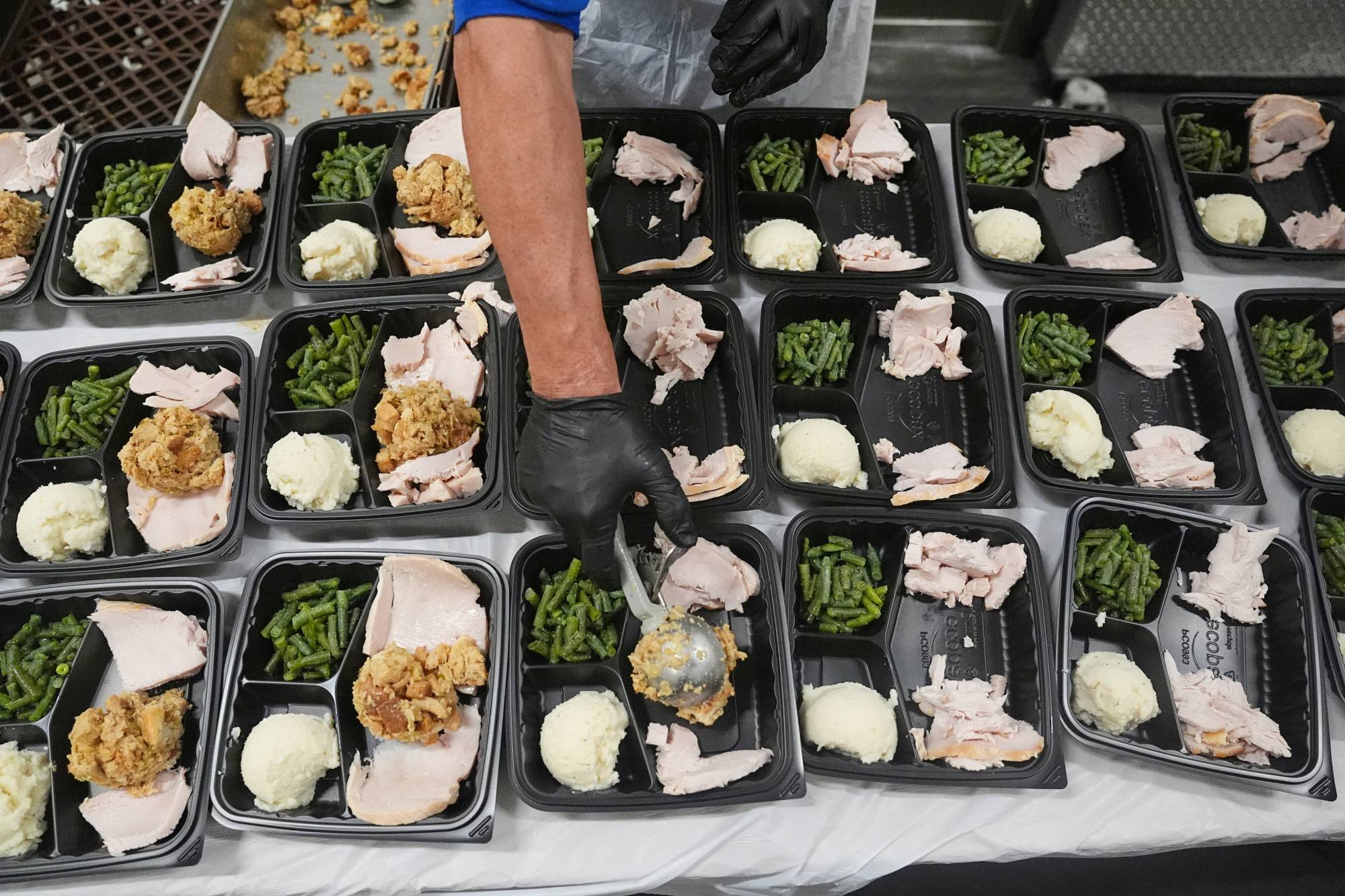
"caption": "A volunteer prepares meals at the Philabundance Community Kitchen in Philadelphia, Oct. 30, 2025. ",
"credit": "AP Photo/Matt Rourke",
"altTag": null,
"description": null,
"imgSizes": {
"medium": {
"file": "https://cdn.kqed.org/wp-content/uploads/sites/10/2025/10/AP25303685099353-2000x1333.jpg",
"width": 2000,
"height": 1333,
"mimeType": "image/jpeg"
},
"large": {
"file": "https://cdn.kqed.org/wp-content/uploads/sites/10/2025/10/AP25303685099353-2000x1333.jpg",
"width": 2000,
"height": 1333,
"mimeType": "image/jpeg"
},
"thumbnail": {
"file": "https://cdn.kqed.org/wp-content/uploads/sites/10/2025/10/AP25303685099353-160x107.jpg",
"width": 160,
"height": 107,
"mimeType": "image/jpeg"
},
"1536x1536": {
"file": "https://cdn.kqed.org/wp-content/uploads/sites/10/2025/10/AP25303685099353-1536x1024.jpg",
"width": 1536,
"height": 1024,
"mimeType": "image/jpeg"
},
"2048x2048": {
"file": "https://cdn.kqed.org/wp-content/uploads/sites/10/2025/10/AP25303685099353-2048x1365.jpg",
"width": 2048,
"height": 1365,
"mimeType": "image/jpeg"
},
"post-thumbnail": {
"file": "https://cdn.kqed.org/wp-content/uploads/sites/10/2025/10/AP25303685099353-672x372.jpg",
"width": 672,
"height": 372,
"mimeType": "image/jpeg"
},
"twentyfourteen-full-width": {
"file": "https://cdn.kqed.org/wp-content/uploads/sites/10/2025/10/AP25303685099353-1038x576.jpg",
"width": 1038,
"height": 576,
"mimeType": "image/jpeg"
},
"full-width": {
"file": "https://cdn.kqed.org/wp-content/uploads/sites/10/2025/10/AP25303685099353-2000x1333.jpg",
"width": 2000,
"height": 1333,
"mimeType": "image/jpeg"
},
"npr-cds-wide": {
"file": "https://cdn.kqed.org/wp-content/uploads/sites/10/2025/10/AP25303685099353-1200x675.jpg",
"width": 1200,
"height": 675,
"mimeType": "image/jpeg"
},
"kqedFullSize": {
"file": "https://cdn.kqed.org/wp-content/uploads/sites/10/2025/10/AP25303685099353-scaled-e1761936872193.jpg",
"width": 2000,
"height": 1334
}
},
"isLoading": false,
"fetchFailed": false
},
"news_12062225": {
"type": "attachments",
"id": "news_12062225",
"meta": {
"index": "attachments_1716263798",
"site": "news",
"id": "12062225",
"found": true
},
"title": "251028-YOSEMITESHUTDOWN-114-BL_QED-KQED",
"publishDate": 1761842896,
"status": "inherit",
"parent": 12065737,
"modified": 1765292883,
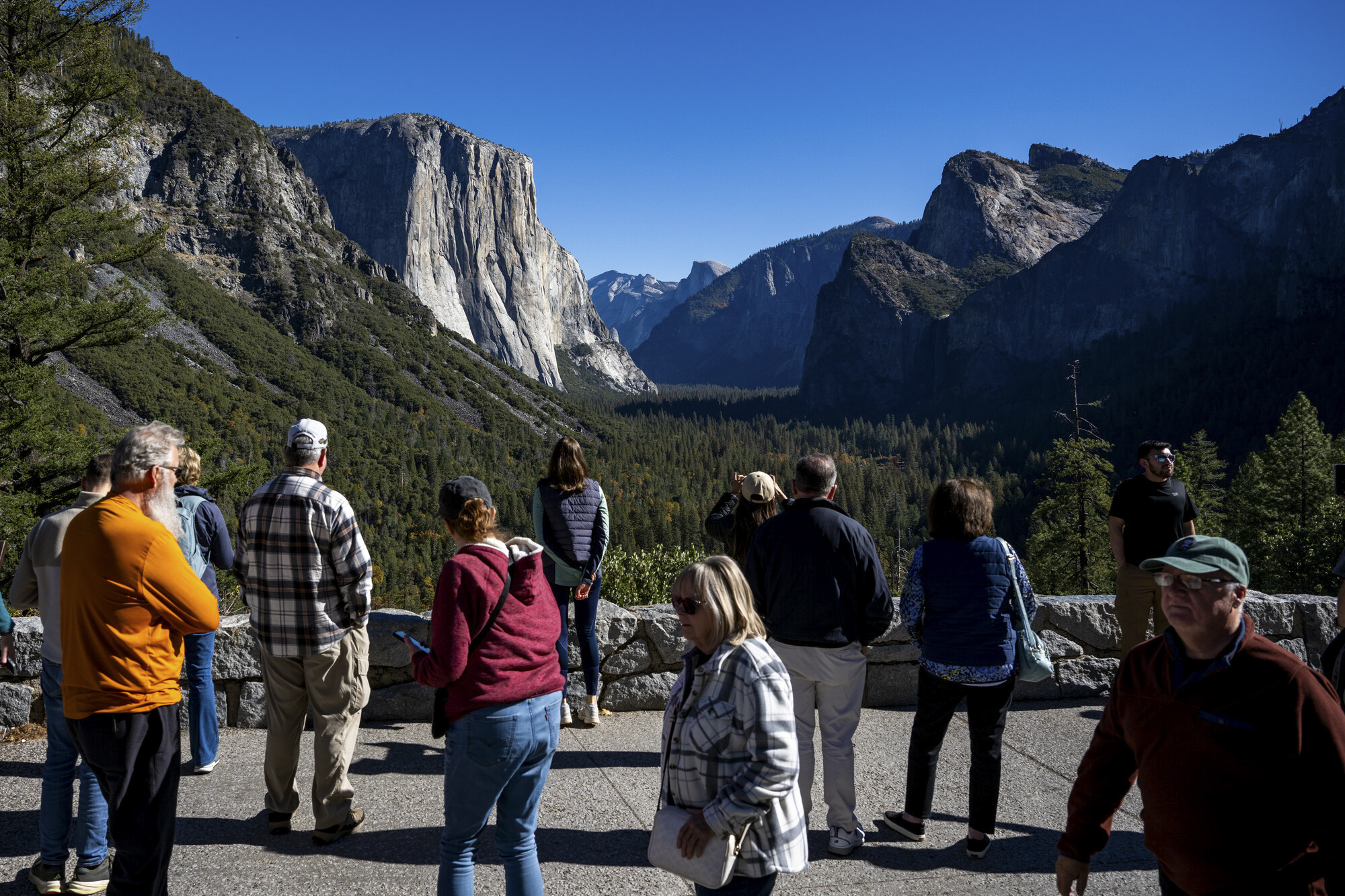
"caption": "Visitors stand at Tunnel View overlook in Yosemite National Park in the Sierra Nevada Mountains on Oct. 28, 2025. ",
"credit": "Beth LaBerge/KQED",
"altTag": null,
"description": null,
"imgSizes": {
"thumbnail": {
"file": "https://cdn.kqed.org/wp-content/uploads/sites/10/2025/10/251028-YOSEMITESHUTDOWN-114-BL_QED-KQED-160x107.jpg",
"width": 160,
"height": 107,
"mimeType": "image/jpeg"
},
"1536x1536": {
"file": "https://cdn.kqed.org/wp-content/uploads/sites/10/2025/10/251028-YOSEMITESHUTDOWN-114-BL_QED-KQED-1536x1024.jpg",
"width": 1536,
"height": 1024,
"mimeType": "image/jpeg"
},
"post-thumbnail": {
"file": "https://cdn.kqed.org/wp-content/uploads/sites/10/2025/10/251028-YOSEMITESHUTDOWN-114-BL_QED-KQED-672x372.jpg",
"width": 672,
"height": 372,
"mimeType": "image/jpeg"
},
"twentyfourteen-full-width": {
"file": "https://cdn.kqed.org/wp-content/uploads/sites/10/2025/10/251028-YOSEMITESHUTDOWN-114-BL_QED-KQED-1038x576.jpg",
"width": 1038,
"height": 576,
"mimeType": "image/jpeg"
},
"npr-cds-wide": {
"file": "https://cdn.kqed.org/wp-content/uploads/sites/10/2025/10/251028-YOSEMITESHUTDOWN-114-BL_QED-KQED-1600x900.jpg",
"width": 1600,
"height": 900,
"mimeType": "image/jpeg"
},
"kqedFullSize": {
"file": "https://cdn.kqed.org/wp-content/uploads/sites/10/2025/10/251028-YOSEMITESHUTDOWN-114-BL_QED-KQED.jpg",
"width": 2000,
"height": 1333
}
},
"isLoading": false,
"fetchFailed": false
},
"news_12044809": {
"type": "attachments",
"id": "news_12044809",
"meta": {
"index": "attachments_1716263798",
"site": "news",
"id": "12044809",
"found": true
},
"title": "250617-FOODBANKS-JG-06_qed",
"publishDate": 1750200928,
"status": "inherit",
"parent": 12044713,
"modified": 1750200944,
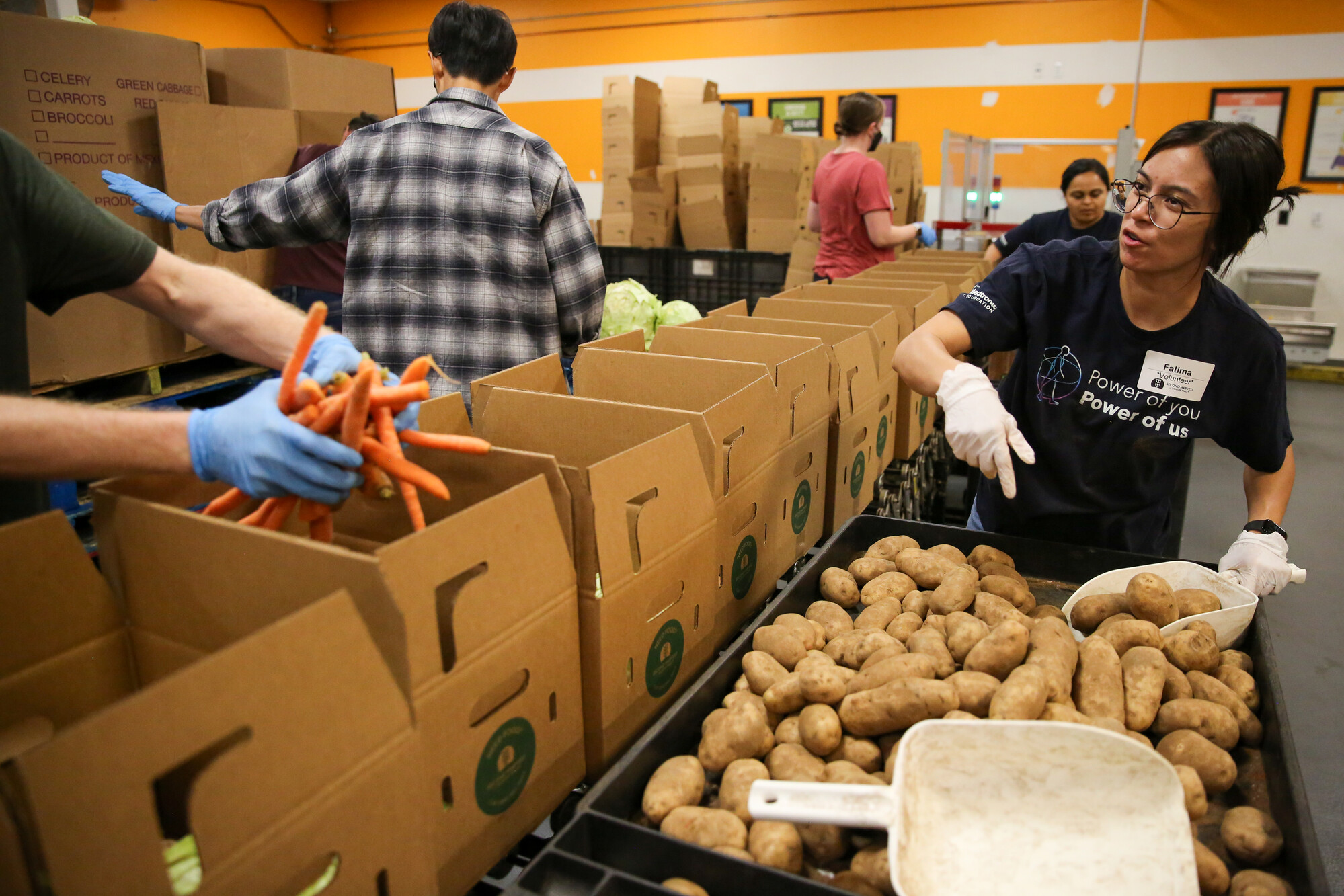
"caption": "Volunteers pack potatoes and carrots into food boxes inside the Second Harvest of Silicon Valley warehouse in San José on June 17, 2025.",
"credit": "Joseph Geha/KQED",
"altTag": null,
"description": null,
"imgSizes": {
"thumbnail": {
"file": "https://cdn.kqed.org/wp-content/uploads/sites/10/2025/06/250617-FOODBANKS-JG-06_qed-160x107.jpg",
"width": 160,
"height": 107,
"mimeType": "image/jpeg"
},
"1536x1536": {
"file": "https://cdn.kqed.org/wp-content/uploads/sites/10/2025/06/250617-FOODBANKS-JG-06_qed-1536x1024.jpg",
"width": 1536,
"height": 1024,
"mimeType": "image/jpeg"
},
"post-thumbnail": {
"file": "https://cdn.kqed.org/wp-content/uploads/sites/10/2025/06/250617-FOODBANKS-JG-06_qed-672x372.jpg",
"width": 672,
"height": 372,
"mimeType": "image/jpeg"
},
"twentyfourteen-full-width": {
"file": "https://cdn.kqed.org/wp-content/uploads/sites/10/2025/06/250617-FOODBANKS-JG-06_qed-1038x576.jpg",
"width": 1038,
"height": 576,
"mimeType": "image/jpeg"
},
"kqedFullSize": {
"file": "https://cdn.kqed.org/wp-content/uploads/sites/10/2025/06/250617-FOODBANKS-JG-06_qed.jpg",
"width": 1999,
"height": 1333
}
},
"isLoading": false,
"fetchFailed": false
},
"news_12058101": {
"type": "attachments",
"id": "news_12058101",
"meta": {
"index": "attachments_1716263798",
"site": "news",
"id": "12058101",
"found": true
},
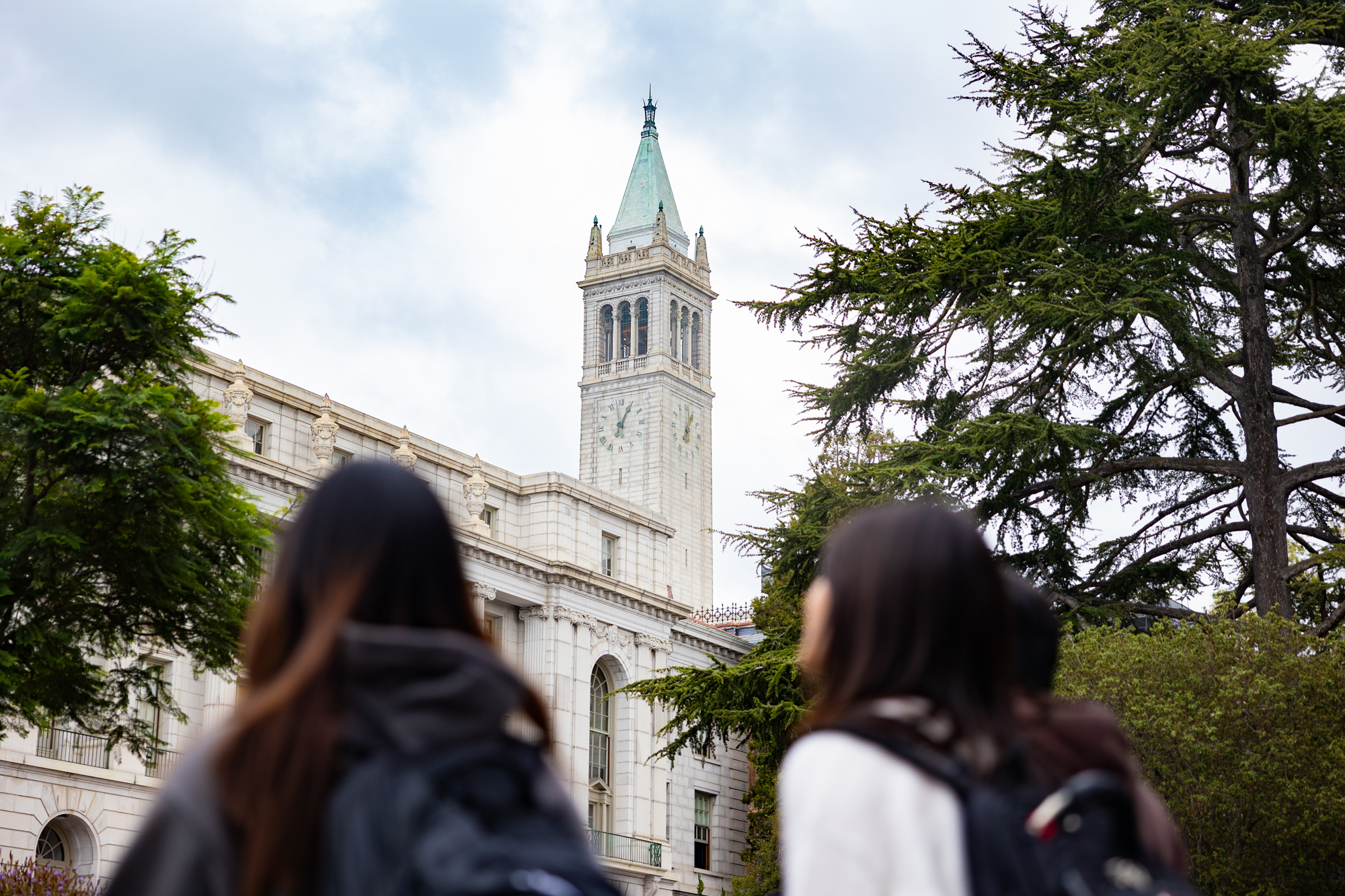
"title": "Students walk on campus at UC Berkeley in Berkeley on Sept. 29, 2025.",
"publishDate": 1759255323,
"status": "inherit",
"parent": 0,
"modified": 1759255359,
"caption": "Students walk on campus at UC Berkeley in Berkeley on Sept. 29, 2025.",
"credit": "Gina Castro/KQED",
"altTag": null,
"description": null,
"imgSizes": {
"thumbnail": {
"file": "https://cdn.kqed.org/wp-content/uploads/sites/10/2025/09/20250929_UCBERKELEY_GC-5-KQED-160x107.jpg",
"width": 160,
"height": 107,
"mimeType": "image/jpeg"
},
"1536x1536": {
"file": "https://cdn.kqed.org/wp-content/uploads/sites/10/2025/09/20250929_UCBERKELEY_GC-5-KQED-1536x1024.jpg",
"width": 1536,
"height": 1024,
"mimeType": "image/jpeg"
},
"post-thumbnail": {
"file": "https://cdn.kqed.org/wp-content/uploads/sites/10/2025/09/20250929_UCBERKELEY_GC-5-KQED-672x372.jpg",
"width": 672,
"height": 372,
"mimeType": "image/jpeg"
},
"twentyfourteen-full-width": {
"file": "https://cdn.kqed.org/wp-content/uploads/sites/10/2025/09/20250929_UCBERKELEY_GC-5-KQED-1038x576.jpg",
"width": 1038,
"height": 576,
"mimeType": "image/jpeg"
},
"kqedFullSize": {
"file": "https://cdn.kqed.org/wp-content/uploads/sites/10/2025/09/20250929_UCBERKELEY_GC-5-KQED.jpg",
"width": 2000,
"height": 1333
}
},
"isLoading": false,
"fetchFailed": false
},
"news_12062054": {
"type": "attachments",
"id": "news_12062054",
"meta": {
"index": "attachments_1716263798",
"site": "news",
"id": "12062054",
"found": true
},
"title": "250924-SJICE-JG-1_qed",
"publishDate": 1761763574,
"status": "inherit",
"parent": 12061923,
"modified": 1761763597,
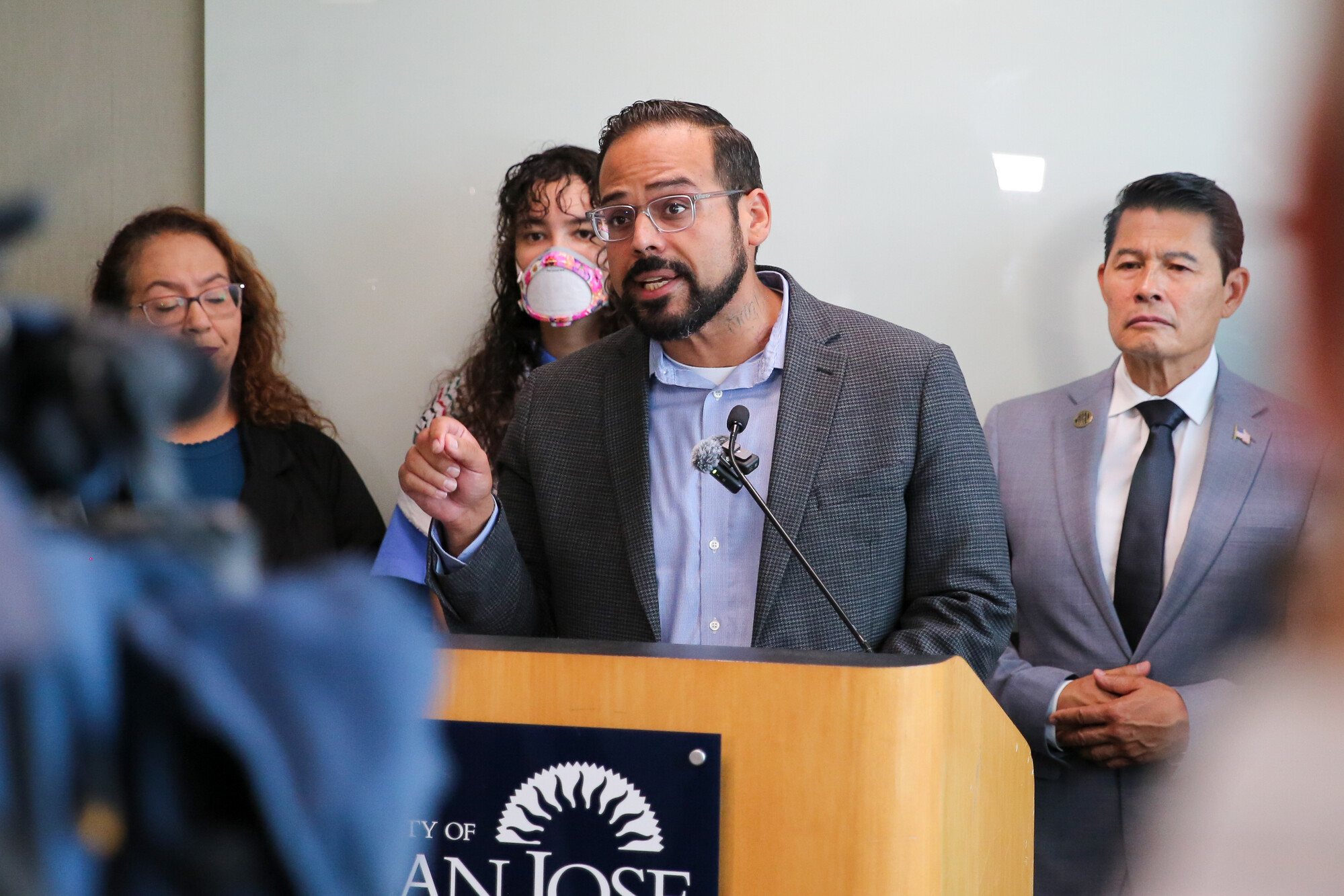
"caption": "San José District 5 City Councilmember Peter Ortiz speaks during a Sept. 24, 2025, press conference about an immigration arrest at a local nonprofit.",
"credit": "Joseph Geha/KQED",
"altTag": null,
"description": null,
"imgSizes": {
"thumbnail": {
"file": "https://cdn.kqed.org/wp-content/uploads/sites/10/2025/10/250924-SJICE-JG-1_qed-160x107.jpg",
"width": 160,
"height": 107,
"mimeType": "image/jpeg"
},
"1536x1536": {
"file": "https://cdn.kqed.org/wp-content/uploads/sites/10/2025/10/250924-SJICE-JG-1_qed-1536x1024.jpg",
"width": 1536,
"height": 1024,
"mimeType": "image/jpeg"
},
"post-thumbnail": {
"file": "https://cdn.kqed.org/wp-content/uploads/sites/10/2025/10/250924-SJICE-JG-1_qed-672x372.jpg",
"width": 672,
"height": 372,
"mimeType": "image/jpeg"
},
"twentyfourteen-full-width": {
"file": "https://cdn.kqed.org/wp-content/uploads/sites/10/2025/10/250924-SJICE-JG-1_qed-1038x576.jpg",
"width": 1038,
"height": 576,
"mimeType": "image/jpeg"
},
"npr-cds-wide": {
"file": "https://cdn.kqed.org/wp-content/uploads/sites/10/2025/10/250924-SJICE-JG-1_qed-1600x900.jpg",
"width": 1600,
"height": 900,
"mimeType": "image/jpeg"
},
"kqedFullSize": {
"file": "https://cdn.kqed.org/wp-content/uploads/sites/10/2025/10/250924-SJICE-JG-1_qed.jpg",
"width": 1999,
"height": 1333
}
},
"isLoading": false,
"fetchFailed": false
}
},
"audioPlayerReducer": {
"postId": "stream_live",
"isPaused": true,
"isPlaying": false,
"pfsActive": false,
"pledgeModalIsOpen": true,
"playerDrawerIsOpen": false,
"liveAudioPlayStartedAt": 0,
"liveAudioPlayContext": ""
},
"authorsReducer": {
"byline_news_12062530": {
"type": "authors",
"id": "byline_news_12062530",
"meta": {
"override": true
},
"slug": "byline_news_12062530",
"name": "Michael Casey, Geoff Mulvihill and Kimberlee Kruesi, The Associated Press ",
"isLoading": false
},
"danbrekke": {
"type": "authors",
"id": "222",
"meta": {
"index": "authors_1716337520",
"id": "222",
"found": true
},
"name": "Dan Brekke",
"firstName": "Dan",
"lastName": "Brekke",
"slug": "danbrekke",
"email": "dbrekke@kqed.org",
"display_author_email": true,
"staff_mastheads": [
"news",
"science"
],
"title": "KQED Editor and Reporter",
"bio": "Dan Brekke is a reporter and editor for KQED News, responsible for coverage of topics ranging from California water issues to the Bay Area's transportation challenges. In a newsroom career that began in Chicago in 1972, Dan has worked for \u003cem>The San Francisco Examiner,\u003c/em> Wired and TechTV and has been published in The New York Times, The New York Times Magazine, Business 2.0, Salon and elsewhere.\r\n\r\nSince joining KQED in 2007, Dan has reported, edited and produced both radio and online features and breaking news pieces. He has shared as both editor and reporter in four Society of Professional Journalists Norcal Excellence in Journalism awards and one Edward R. Murrow regional award. He was chosen for a spring 2017 residency at the Mesa Refuge to advance his research on California salmon.\r\n\r\nEmail Dan at: \u003ca href=\"mailto:dbrekke@kqed.org\">dbrekke@kqed.org\u003c/a>\r\n\r\n\u003cstrong>Twitter:\u003c/strong> \u003ca href=\"https://twitter.com/danbrekke\" rel=\"noopener noreferrer\">twitter.com/danbrekke\u003c/a>\r\n\u003cstrong>Facebook:\u003c/strong> \u003ca href=\"https://www.facebook.com/danbrekke\" rel=\"noopener noreferrer\">www.facebook.com/danbrekke\u003c/a>\r\n\u003cstrong>LinkedIn:\u003c/strong> \u003ca href=\"https://www.linkedin.com/in/danbrekke\" rel=\"noopener noreferrer\">www.linkedin.com/in/danbrekke\u003c/a>",
"avatar": "https://secure.gravatar.com/avatar/c8126230345efca3f7aa89b1a402be45?s=600&d=mm&r=g",
"twitter": "danbrekke",
"facebook": null,
"instagram": "https://www.instagram.com/dan.brekke/",
"linkedin": "https://www.linkedin.com/in/danbrekke/",
"sites": [
{
"site": "news",
"roles": [
"administrator",
"create_posts"
]
},
{
"site": "stateofhealth",
"roles": [
"editor"
]
},
{
"site": "science",
"roles": [
"editor"
]
},
{
"site": "quest",
"roles": [
"contributor"
]
},
{
"site": "food",
"roles": [
"contributor"
]
},
{
"site": "forum",
"roles": [
"contributor"
]
},
{
"site": "liveblog",
"roles": [
"editor"
]
}
],
"headData": {
"title": "Dan Brekke | KQED",
"description": "KQED Editor and Reporter",
"ogImgSrc": "https://secure.gravatar.com/avatar/c8126230345efca3f7aa89b1a402be45?s=600&d=mm&r=g",
"twImgSrc": "https://secure.gravatar.com/avatar/c8126230345efca3f7aa89b1a402be45?s=600&d=mm&r=g"
},
"isLoading": false,
"link": "/author/danbrekke"
},
"gmarzorati": {
"type": "authors",
"id": "227",
"meta": {
"index": "authors_1716337520",
"id": "227",
"found": true
},
"name": "Guy Marzorati",
"firstName": "Guy",
"lastName": "Marzorati",
"slug": "gmarzorati",
"email": "gmarzorati@KQED.org",
"display_author_email": true,
"staff_mastheads": [
"news"
],
"title": "Correspondent",
"bio": "Guy Marzorati is a correspondent on KQED's California Politics and Government Desk, based in San Jose. A graduate of Santa Clara University, Guy joined KQED in 2013. He reports on state and local politics and produces KQED's digital voter guide.",
"avatar": "https://secure.gravatar.com/avatar/e7038b8dbfd55b104369b76b1cd0b9de?s=600&d=blank&r=g",
"twitter": "guymarzorati",
"facebook": null,
"instagram": null,
"linkedin": null,
"sites": [
{
"site": "",
"roles": [
"editor"
]
},
{
"site": "news",
"roles": [
"editor"
]
},
{
"site": "science",
"roles": [
"editor"
]
},
{
"site": "forum",
"roles": [
"editor"
]
},
{
"site": "elections",
"roles": [
"editor"
]
},
{
"site": "liveblog",
"roles": [
"editor"
]
}
],
"headData": {
"title": "Guy Marzorati | KQED",
"description": "Correspondent",
"ogImgSrc": "https://secure.gravatar.com/avatar/e7038b8dbfd55b104369b76b1cd0b9de?s=600&d=blank&r=g",
"twImgSrc": "https://secure.gravatar.com/avatar/e7038b8dbfd55b104369b76b1cd0b9de?s=600&d=blank&r=g"
},
"isLoading": false,
"link": "/author/gmarzorati"
},
"mlagos": {
"type": "authors",
"id": "3239",
"meta": {
"index": "authors_1716337520",
"id": "3239",
"found": true
},
"name": "Marisa Lagos",
"firstName": "Marisa",
"lastName": "Lagos",
"slug": "mlagos",
"email": "mlagos@kqed.org",
"display_author_email": false,
"staff_mastheads": [
"news"
],
"title": "KQED Contributor",
"bio": "Marisa Lagos is a correspondent for KQED’s California Politics and Government Desk and co-hosts the award-winning show and podcast, Political Breakdown. At KQED, Lagos also conducts reporting, analysis and investigations into state, local and national politics for radio, TV, online and onstage. In 2022, she and co-host, Scott Shafer, moderated the only gubernatorial debate in California. In 2020, the \u003ci>Washington Post\u003c/i> named her one of the top political journalists in California; she was nominated for a Peabody and won several other awards for her work investigating the 2017 California wildfires. She has worked at the \u003ci>San Francisco Chronicle\u003c/i>, \u003ci>San Francisco Examiner\u003c/i> and \u003ci>Los Angeles Times\u003c/i>. A UC Santa Barbara graduate, she lives in San Francisco with her two sons and husband.",
"avatar": "https://secure.gravatar.com/avatar/a261a0d3696fc066871ef96b85b5e7d2?s=600&d=blank&r=g",
"twitter": "@mlagos",
"facebook": null,
"instagram": null,
"linkedin": null,
"sites": [
{
"site": "arts",
"roles": [
"author"
]
},
{
"site": "news",
"roles": [
"editor"
]
},
{
"site": "science",
"roles": [
"editor"
]
},
{
"site": "forum",
"roles": [
"author"
]
},
{
"site": "liveblog",
"roles": [
"author"
]
}
],
"headData": {
"title": "Marisa Lagos | KQED",
"description": "KQED Contributor",
"ogImgSrc": "https://secure.gravatar.com/avatar/a261a0d3696fc066871ef96b85b5e7d2?s=600&d=blank&r=g",
"twImgSrc": "https://secure.gravatar.com/avatar/a261a0d3696fc066871ef96b85b5e7d2?s=600&d=blank&r=g"
},
"isLoading": false,
"link": "/author/mlagos"
},
"carlysevern": {
"type": "authors",
"id": "3243",
"meta": {
"index": "authors_1716337520",
"id": "3243",
"found": true
},
"name": "Carly Severn",
"firstName": "Carly",
"lastName": "Severn",
"slug": "carlysevern",
"email": "csevern@kqed.org",
"display_author_email": false,
"staff_mastheads": [
"news"
],
"title": "Senior Editor, Audience News ",
"bio": "Carly is KQED's Senior Editor of Audience News on the Digital News team, and has reported for the California Report Magazine, Bay Curious and KQED Arts. She's formerly the host of \u003ca href=\"http://ww2.kqed.org/pop/category/the-cooler/\" rel=\"noopener noreferrer\">The Cooler\u003c/a> podcast.",
"avatar": "https://secure.gravatar.com/avatar/54037bf5c128fe678f0ef26cec97a93f2e7f220a22d7285703328f12c42c1b1d?s=600&d=blank&r=g",
"twitter": "teacupinthebay",
"bluesky": null,
"facebook": null,
"instagram": null,
"linkedin": null,
"sites": [
{
"site": "",
"roles": [
"editor"
]
},
{
"site": "arts",
"roles": [
"editor"
]
},
{
"site": "news",
"roles": [
"administrator"
]
},
{
"site": "pop",
"roles": [
"editor"
]
},
{
"site": "futureofyou",
"roles": [
"editor"
]
},
{
"site": "about",
"roles": [
"administrator"
]
},
{
"site": "mindshift",
"roles": [
"editor"
]
},
{
"site": "bayareabites",
"roles": [
"editor"
]
},
{
"site": "stateofhealth",
"roles": [
"editor"
]
},
{
"site": "science",
"roles": [
"editor"
]
},
{
"site": "food",
"roles": [
"contributor"
]
},
{
"site": "forum",
"roles": [
"editor"
]
},
{
"site": "perspectives",
"roles": [
"administrator"
]
},
{
"site": "liveblog",
"roles": [
"editor"
]
}
],
"headData": {
"title": "Carly Severn | KQED",
"description": "Senior Editor, Audience News ",
"ogImgSrc": "https://secure.gravatar.com/avatar/54037bf5c128fe678f0ef26cec97a93f2e7f220a22d7285703328f12c42c1b1d?s=600&d=blank&r=g",
"twImgSrc": "https://secure.gravatar.com/avatar/54037bf5c128fe678f0ef26cec97a93f2e7f220a22d7285703328f12c42c1b1d?s=600&d=blank&r=g"
},
"isLoading": false,
"link": "/author/carlysevern"
},
"ecruzguevarra": {
"type": "authors",
"id": "8654",
"meta": {
"index": "authors_1716337520",
"id": "8654",
"found": true
},
"name": "Ericka Cruz Guevarra",
"firstName": "Ericka",
"lastName": "Cruz Guevarra",
"slug": "ecruzguevarra",
"email": "ecruzguevarra@kqed.org",
"display_author_email": true,
"staff_mastheads": [
"news"
],
"title": "Producer, The Bay Podcast",
"bio": "Ericka Cruz Guevarra is host of \u003ca href=\"https://www.kqed.org/podcasts/thebay\">\u003cem>The Bay\u003c/em>\u003c/a> podcast at KQED. Before host, she was the show’s producer. Her work in that capacity includes a three-part reported series on policing in Vallejo, which won a 2020 excellence in journalism award from the Society of Professional Journalists. Ericka has worked as a breaking news reporter at Oregon Public Broadcasting, helped produce the Code Switch podcast, and was KQED’s inaugural Raul Ramirez Diversity Fund intern. She’s also an alumna of NPR’s Next Generation Radio program. Send her an email if you have strong feelings about whether Fairfield and Suisun City are the Bay. Ericka is represented by SAG-AFTRA.",
"avatar": "https://secure.gravatar.com/avatar/accefc1de4bafc7e234b69bcb9b6f6536c130fd84709bc3069ef11a78787e1bb?s=600&d=blank&r=g",
"twitter": "NotoriousECG",
"bluesky": null,
"facebook": null,
"instagram": null,
"linkedin": null,
"sites": [
{
"site": "arts",
"roles": [
"subscriber"
]
},
{
"site": "news",
"roles": [
"editor",
"manage_categories"
]
},
{
"site": "futureofyou",
"roles": [
"subscriber"
]
},
{
"site": "stateofhealth",
"roles": [
"subscriber"
]
},
{
"site": "science",
"roles": [
"editor"
]
},
{
"site": "forum",
"roles": [
"subscriber"
]
}
],
"headData": {
"title": "Ericka Cruz Guevarra | KQED",
"description": "Producer, The Bay Podcast",
"ogImgSrc": "https://secure.gravatar.com/avatar/accefc1de4bafc7e234b69bcb9b6f6536c130fd84709bc3069ef11a78787e1bb?s=600&d=blank&r=g",
"twImgSrc": "https://secure.gravatar.com/avatar/accefc1de4bafc7e234b69bcb9b6f6536c130fd84709bc3069ef11a78787e1bb?s=600&d=blank&r=g"
},
"isLoading": false,
"link": "/author/ecruzguevarra"
},
"amontecillo": {
"type": "authors",
"id": "11649",
"meta": {
"index": "authors_1716337520",
"id": "11649",
"found": true
},
"name": "Alan Montecillo",
"firstName": "Alan",
"lastName": "Montecillo",
"slug": "amontecillo",
"email": "amontecillo@kqed.org",
"display_author_email": false,
"staff_mastheads": [
"news"
],
"title": "KQED Contributor",
"bio": "Alan Montecillo is the senior editor of \u003cem>\u003ca href=\"http://kqed.org/thebay\">The Bay\u003c/a>, \u003c/em> KQED's local news podcast. Before moving to the Bay Area, he worked as a senior talk show producer for WILL in Champaign-Urbana, Illinois and at Oregon Public Broadcasting in Portland, Oregon. He has won journalism awards from the Society of Professional Journalists Northern California, the Public Media Journalists Association, The Signal Awards, and has also received a regional Edward R. Murrow award. Alan is a Filipino American from Hong Kong and a graduate of Reed College.",
"avatar": "https://secure.gravatar.com/avatar/268f53a2066899ea9efdd8a5900218b17c822d9862cbc9326cccec53ef41d349?s=600&d=blank&r=g",
"twitter": "alanmontecillo",
"bluesky": null,
"facebook": null,
"instagram": null,
"linkedin": null,
"sites": [
{
"site": "",
"roles": [
"editor"
]
},
{
"site": "news",
"roles": [
"editor",
"manage_categories"
]
}
],
"headData": {
"title": "Alan Montecillo | KQED",
"description": "KQED Contributor",
"ogImgSrc": "https://secure.gravatar.com/avatar/268f53a2066899ea9efdd8a5900218b17c822d9862cbc9326cccec53ef41d349?s=600&d=blank&r=g",
"twImgSrc": "https://secure.gravatar.com/avatar/268f53a2066899ea9efdd8a5900218b17c822d9862cbc9326cccec53ef41d349?s=600&d=blank&r=g"
},
"isLoading": false,
"link": "/author/amontecillo"
},
"adahlstromeckman": {
"type": "authors",
"id": "11785",
"meta": {
"index": "authors_1716337520",
"id": "11785",
"found": true
},
"name": "Azul Dahlstrom-Eckman",
"firstName": "Azul",
"lastName": "Dahlstrom-Eckman",
"slug": "adahlstromeckman",
"email": "adahlstrom-eckman@kqed.org",
"display_author_email": true,
"staff_mastheads": [],
"title": "Reporter",
"bio": "Azul is a reporter for KQED focusing on transportation and features. He joined KQED in 2021 as an alumna of KALW's Audio Academy radio journalism training program.",
"avatar": "https://secure.gravatar.com/avatar/9cb750298435add7815a777f55bf1f46845c1386bb8452555c60a7b820b5aba3?s=600&d=blank&r=g",
"twitter": "@zuliemann",
"bluesky": "@azul415.bsky.social",
"facebook": null,
"instagram": null,
"linkedin": null,
"sites": [
{
"site": "arts",
"roles": [
"editor"
]
},
{
"site": "news",
"roles": [
"editor"
]
},
{
"site": "science",
"roles": [
"editor"
]
},
{
"site": "liveblog",
"roles": [
"author"
]
}
],
"headData": {
"title": "Azul Dahlstrom-Eckman | KQED",
"description": "Reporter",
"ogImgSrc": "https://secure.gravatar.com/avatar/9cb750298435add7815a777f55bf1f46845c1386bb8452555c60a7b820b5aba3?s=600&d=blank&r=g",
"twImgSrc": "https://secure.gravatar.com/avatar/9cb750298435add7815a777f55bf1f46845c1386bb8452555c60a7b820b5aba3?s=600&d=blank&r=g"
},
"isLoading": false,
"link": "/author/adahlstromeckman"
},
"jessicakariisa": {
"type": "authors",
"id": "11831",
"meta": {
"index": "authors_1716337520",
"id": "11831",
"found": true
},
"name": "Jessica Kariisa",
"firstName": "Jessica",
"lastName": "Kariisa",
"slug": "jessicakariisa",
"email": "jkariisa@kqed.org",
"display_author_email": false,
"staff_mastheads": [],
"title": "Producer, The Bay",
"bio": "Jessica Kariisa is the producer of The Bay. She first joined KQED as an intern for The California Report Magazine, after which she became an on-call producer. She reported a Bay Curious episode on the use of rap lyrics in criminal trials which won a Society of Professional Journalists award in 2023 for Excellence in Features Journalism and the 2023 Signal Award for Best Conversation Starter. She’s worked on podcasts for Snap Judgment and American Public Media. Before embarking on her audio career, she was a music journalist.\r\n\r\nJessica Kariisa is represented by SAG-AFTRA.",
"avatar": "https://secure.gravatar.com/avatar/522e97b28ac0b3d411621c0fde8f3419c7b71ea2c5c262c57c4bb600963f328c?s=600&d=blank&r=g",
"twitter": null,
"bluesky": null,
"facebook": null,
"instagram": null,
"linkedin": null,
"sites": [
{
"site": "arts",
"roles": [
"author"
]
},
{
"site": "news",
"roles": [
"editor",
"manage_categories"
]
}
],
"headData": {
"title": "Jessica Kariisa | KQED",
"description": "Producer, The Bay",
"ogImgSrc": "https://secure.gravatar.com/avatar/522e97b28ac0b3d411621c0fde8f3419c7b71ea2c5c262c57c4bb600963f328c?s=600&d=blank&r=g",
"twImgSrc": "https://secure.gravatar.com/avatar/522e97b28ac0b3d411621c0fde8f3419c7b71ea2c5c262c57c4bb600963f328c?s=600&d=blank&r=g"
},
"isLoading": false,
"link": "/author/jessicakariisa"
},
"bsiavoshy": {
"type": "authors",
"id": "11890",
"meta": {
"index": "authors_1716337520",
"id": "11890",
"found": true
},
"name": "Bejan Siavoshy",
"firstName": "Bejan",
"lastName": "Siavoshy",
"slug": "bsiavoshy",
"email": "bsiavoshy@kqed.org",
"display_author_email": false,
"staff_mastheads": [],
"title": "KQED Contributor",
"bio": null,
"avatar": "https://secure.gravatar.com/avatar/ead3e7c509634b37a73b1f57677e49f9?s=600&d=blank&r=g",
"twitter": null,
"facebook": null,
"instagram": null,
"linkedin": null,
"sites": [
{
"site": "news",
"roles": [
"editor"
]
}
],
"headData": {
"title": "Bejan Siavoshy | KQED",
"description": "KQED Contributor",
"ogImgSrc": "https://secure.gravatar.com/avatar/ead3e7c509634b37a73b1f57677e49f9?s=600&d=blank&r=g",
"twImgSrc": "https://secure.gravatar.com/avatar/ead3e7c509634b37a73b1f57677e49f9?s=600&d=blank&r=g"
},
"isLoading": false,
"link": "/author/bsiavoshy"
},
"jgeha": {
"type": "authors",
"id": "11906",
"meta": {
"index": "authors_1716337520",
"id": "11906",
"found": true
},
"name": "Joseph Geha",
"firstName": "Joseph",
"lastName": "Geha",
"slug": "jgeha",
"email": "jgeha@kqed.org",
"display_author_email": false,
"staff_mastheads": [
"news",
"science"
],
"title": "KQED Contributor",
"bio": null,
"avatar": "https://secure.gravatar.com/avatar/ea84d2b6dd93d6369d453edf19dd583f117cd1759d2d9c9c92f9de77017354fe?s=600&d=blank&r=g",
"twitter": null,
"bluesky": null,
"facebook": null,
"instagram": null,
"linkedin": null,
"sites": [
{
"site": "news",
"roles": [
"editor"
]
},
{
"site": "liveblog",
"roles": [
"author"
]
}
],
"headData": {
"title": "Joseph Geha | KQED",
"description": "KQED Contributor",
"ogImgSrc": "https://secure.gravatar.com/avatar/ea84d2b6dd93d6369d453edf19dd583f117cd1759d2d9c9c92f9de77017354fe?s=600&d=blank&r=g",
"twImgSrc": "https://secure.gravatar.com/avatar/ea84d2b6dd93d6369d453edf19dd583f117cd1759d2d9c9c92f9de77017354fe?s=600&d=blank&r=g"
},
"isLoading": false,
"link": "/author/jgeha"
},
"kdebenedetti": {
"type": "authors",
"id": "11913",
"meta": {
"index": "authors_1716337520",
"id": "11913",
"found": true
},
"name": "Katie DeBenedetti",
"firstName": "Katie",
"lastName": "DeBenedetti",
"slug": "kdebenedetti",
"email": "kdebenedetti@kqed.org",
"display_author_email": false,
"staff_mastheads": [
"news",
"science"
],
"title": "KQED Contributor",
"bio": "Katie DeBenedetti is a digital reporter covering daily news for the Express Desk. Prior to joining KQED as a culture reporting intern in January 2024, she covered education and city government for the Napa Valley Register.",
"avatar": "https://secure.gravatar.com/avatar/6e31073cb8f7e4214ab03f42771d0f45?s=600&d=blank&r=g",
"twitter": null,
"facebook": null,
"instagram": null,
"linkedin": null,
"sites": [
{
"site": "news",
"roles": [
"author"
]
},
{
"site": "science",
"roles": [
"author"
]
},
{
"site": "liveblog",
"roles": [
"author"
]
}
],
"headData": {
"title": "Katie DeBenedetti | KQED",
"description": "KQED Contributor",
"ogImgSrc": "https://secure.gravatar.com/avatar/6e31073cb8f7e4214ab03f42771d0f45?s=600&d=blank&r=g",
"twImgSrc": "https://secure.gravatar.com/avatar/6e31073cb8f7e4214ab03f42771d0f45?s=600&d=blank&r=g"
},
"isLoading": false,
"link": "/author/kdebenedetti"
},
"sarahwright": {
"type": "authors",
"id": "11956",
"meta": {
"index": "authors_1716337520",
"id": "11956",
"found": true
},
"name": "Sarah Wright",
"firstName": "Sarah",
"lastName": "Wright",
"slug": "sarahwright",
"email": "swright@kqed.org",
"display_author_email": true,
"staff_mastheads": [],
"title": "Outdoors Engagement Reporter",
"bio": "Sarah Wright is KQED's Outdoors Engagement Reporter. Originally from Lake Tahoe, she completed a thru-hike of the Pacific Crest Trail in 2019 and was a U.S. Fulbright Program grantee to Argentina in 2023. Her journalism has appeared in The Guardian, The San Francisco Standard, The Palo Alto Weekly and the Half Moon Bay Review.",
"avatar": "https://secure.gravatar.com/avatar/c161a3d6441865cba25e6db4fa561099ad665799e9432e34da2b84d7e371524c?s=600&d=blank&r=g",
"twitter": null,
"bluesky": null,
"facebook": null,
"instagram": null,
"linkedin": null,
"sites": [
{
"site": "arts",
"roles": [
"editor"
]
},
{
"site": "news",
"roles": [
"editor"
]
},
{
"site": "science",
"roles": [
"contributor",
"author"
]
},
{
"site": "forum",
"roles": [
"editor"
]
}
],
"headData": {
"title": "Sarah Wright | KQED",
"description": "Outdoors Engagement Reporter",
"ogImgSrc": "https://secure.gravatar.com/avatar/c161a3d6441865cba25e6db4fa561099ad665799e9432e34da2b84d7e371524c?s=600&d=blank&r=g",
"twImgSrc": "https://secure.gravatar.com/avatar/c161a3d6441865cba25e6db4fa561099ad665799e9432e34da2b84d7e371524c?s=600&d=blank&r=g"
},
"isLoading": false,
"link": "/author/sarahwright"
}
},
"pagesReducer": {
"news_tag_donald-trump": {
"type": "terms",
"id": "news_1323",
"meta": {
"index": "terms_1716263798",
"site": "news",
"id": "1323",
"score": 8.557362
},
"featImg": null,
"name": "Donald Trump",
"description": null,
"taxonomy": "tag",
"headData": {
"twImgId": null,
"twTitle": null,
"ogTitle": null,
"ogImgId": null,
"twDescription": null,
"description": null,
"title": "Donald Trump Archives | KQED News",
"ogDescription": null
},
"ttid": 1335,
"slug": "donald-trump",
"isLoading": false,
"title": "Donald Trump",
"pageMeta": {
"site": "news",
"WpPageTemplate": "page-topic-editorial",
"currentPage": 17
},
"blocks": [
{
"blockName": "kqed/post-list",
"attrs": {
"layout": "cardArticle2",
"query": "posts/news?tag=donald-trump",
"seeMore": false,
"paginated": true,
"page": 17
}
},
{
"blockName": "kqed/ad"
}
]
}
},
"pfsSessionReducer": {},
"postsReducer": {
"stream_live": {
"type": "live",
"id": "stream_live",
"audioUrl": "https://streams.kqed.org/kqedradio",
"title": "Live Stream",
"excerpt": "Live Stream information currently unavailable.",
"link": "/radio",
"featImg": "",
"label": {
"name": "KQED Live",
"link": "/"
}
},
"stream_kqedNewscast": {
"type": "posts",
"id": "stream_kqedNewscast",
"audioUrl": "https://www.kqed.org/.stream/anon/radio/RDnews/newscast.mp3?_=1",
"title": "KQED Newscast",
"featImg": "",
"label": {
"name": "88.5 FM",
"link": "/"
}
},
"news_12063029": {
"type": "posts",
"id": "news_12063029",
"meta": {
"index": "posts_1716263798",
"site": "news",
"id": "12063029",
"score": null,
"sort": [
1762370591000
]
},
"guestAuthors": [],
"slug": "proposition-50-sails-to-a-win-in-californias-special-election",
"title": "Proposition 50 Sails to a Win in California's Special Election",
"publishDate": 1762370591,
"format": "audio",
"headTitle": "Proposition 50 Sails to a Win in California’s Special Election | KQED",
"labelTerm": {},
"content": "\u003cp>\u003cstrong>Here are your headlines for the morning of Wednesday, November 5th, 2025:\u003c/strong>\u003c/p>\n\u003cul>\n\u003cli>California voters pass Proposition 50, setting the state up to redraw its congressional district maps, challenging a move by Texas to redraw its maps to give Republicans an edge in next year’s mid-term elections.\u003c/li>\n\u003cli>California Senator Alex Padilla has squashed any rumors that he has eyes on his state’s Governor’s seat. Yesterday, he announced his intentions not to run in California’s governor’s race in 2026.\u003c/li>\n\u003c/ul>\n\u003cp>\u003ca href=\"https://www.kqed.org/news/12062781/proposition-50-passes-in-california-boosting-democrats-in-fight-for-us-house-control\">\u003cstrong>Voters Approve the Redistricting Measure, Setting Up Bigger Political Battle Next Year\u003c/strong>\u003c/a>\u003c/p>\n\u003cp>Voters in California have passed \u003ca href=\"https://www.kqed.org/proposition-50\">Proposition 50\u003c/a> in yesterday’s special election, approving a measure that would reconfigure the state’s congressional district maps ahead of next year’s mid-term elections.\u003c/p>\n\u003cp>Prop. 50 would sideline the current maps drawn up by the state’s independent redistricting committee starting next year, in favor of maps drawn to potentially hand the Democrats three to five more seats in the House next November.\u003c/p>\n\u003cp>The legislation is one Governor Newsom and Democrats throughout the state started touting \u003ca href=\"https://www.npr.org/2025/09/13/nx-s1-5527103/california-redistricting-ballot-measure-language-texas\">after Texas lawmakers decided to redraw their map\u003c/a> to secure more House seats for the GOP, acquiescing to demands from President Donald Trump.\u003c/p>\n\u003cp>[ad fullwidth]\u003c/p>\n\u003cp>Prop. 50 secured about 64 percent of the vote when the race was called in its favor–although ballots are still being counted. \u003ca href=\"https://www.youtube.com/watch?v=Ct5RlU1HK6Q\">Speaking to the Sacramento press last night\u003c/a>, Gov. Newsom said the win is one for both California and the United States as a whole.\u003c/p>\n\u003cp>“In a 90 day sprint, people from all over the United States of America contributed their voices and their support for this initiative. We stood tall and we stood firm in response to Donald Trump’s recklessness,” the governor said. “And tonight, after poking the bear, this bear roared with an unprecedented turnout, in a special election with an extraordinary result.”\u003c/p>\n\u003cp>He also struck something of a somber tone during last night’s speech, warning that President Trump will try and cast doubt on the results of the election–in an attempt to “rig” next year’s mid-term elections.\u003c/p>\n\u003cp>“Our founding fathers did not live and die to see the kind of vandalism to this Republic and our democracy that Donald Trump is trying to perpetuate,” Newsom said. “We need to see other states, with their remarkable leaders, that have been doing remarkable things, to meet this moment head on as well–to recognize what we are up against in 2026.”\u003c/p>\n\u003cp>\u003c/p>\n\u003cp>Within two hours of California opening its polls yesterday, President Trump said via his Truth Social account that \u003ca href=\"https://www.politico.com/news/2025/11/04/trump-california-mail-in-ballot-policy-under-legal-and-criminal-review-00635096\">Prop. 50 was “a GIANT scam.”\u003c/a> White House Press Secretary, Karoline Leavitt, said later in the day that the administration is exploring an executive order to contest the legitimacy of California’s mail-in ballots.\u003c/p>\n\u003cdiv class=\"post-body\">\n\u003cp>\u003cstrong>\u003ca href=\"https://www.kqed.org/news/12062840/alex-padilla-says-he-wont-run-for-california-governor-in-2026\">Senator Alex Padilla Says He Won’t Jump into 2026 California Governor’s Race\u003c/a>\u003c/strong>\u003c/p>\n\u003c/div>\n\u003cdiv class=\"post-body\">\n\u003cdiv class=\"post-body\">\n\u003cp>Sen. \u003ca href=\"https://www.kqed.org/news/tag/alex-padilla\">Alex Padilla\u003c/a> will not run for \u003ca href=\"https://www.kqed.org/news/tag/california-governor\">California governor\u003c/a>, he said Tuesday, adding that he wants to “stay in this fight” as a member of the U.S. Senate.\u003c/p>\n\u003cp>The decision by Padilla, a former California secretary of state and state lawmaker, ends weeks of speculation that he could shake up the relatively low-key 2026 race to lead the nation’s largest state. Padilla was seen as a strong contender given his strong support from the state’s labor unions, his statewide name recognition and his close relationship with Gov. Gavin Newsom.\u003c/p>\n\u003cp>He is California’s first Latino senator.\u003c/p>\n\u003c/div>\n\u003cdiv class=\"post-body\">\n\u003cp>The move is likely to benefit other Democratic candidates, namely former Rep. Katie Porter, who has led in \u003ca href=\"https://escholarship.org/uc/item/0ph594n5\">early polling\u003c/a> but \u003ca href=\"https://www.kqed.org/news/12059961/katie-porter-apologizes-for-behavior-in-viral-videos-at-first-public-forum\">stumbled last month\u003c/a> after the release of controversial videos. One showed a tense exchange with a reporter; another showed her snapping at a staff member several years ago.\u003c/p>\n\u003c/div>\n\u003c/div>\n\n",
"blocks": [],
"excerpt": null,
"status": "publish",
"parent": 0,
"modified": 1762370591,
"stats": {
"hasAudio": false,
"hasVideo": false,
"hasChartOrMap": false,
"iframeSrcs": [],
"hasGoogleForm": false,
"hasGallery": false,
"hasHearkenModule": false,
"hasPolis": false,
"paragraphCount": 17,
"wordCount": 671
},
"headData": {
"title": "Proposition 50 Sails to a Win in California's Special Election | KQED",
"description": "Here are your headlines for the morning of Wednesday, November 5th, 2025: California voters pass Proposition 50, setting the state up to redraw its congressional district maps, challenging a move by Texas to redraw its maps to give Republicans an edge in next year's mid-term elections. California Senator Alex Padilla has squashed any rumors that he has eyes on his state's Governor's seat. Yesterday, he announced his intentions not to run in California's governor's race in 2026. Voters Approve the Redistricting Measure, Setting Up Bigger Political Battle Next Year Voters in California have passed Proposition 50 in yesterday's special election,",
"ogTitle": "",
"ogDescription": "",
"ogImgId": "",
"twTitle": "",
"twDescription": "",
"twImgId": "",
"schema": {
"@context": "https://schema.org",
"@type": "NewsArticle",
"headline": "Proposition 50 Sails to a Win in California's Special Election",
"datePublished": "2025-11-05T11:23:11-08:00",
"dateModified": "2025-11-05T11:23:11-08:00",
"image": "https://cdn.kqed.org/wp-content/uploads/2020/02/KQED-OG-Image@1x.png",
"isAccessibleForFree": "True",
"publisher": {
"@type": "NewsMediaOrganization",
"@id": "https://www.kqed.org/#organization",
"name": "KQED",
"logo": "https://cdn.kqed.org/wp-content/uploads/2020/02/KQED-OG-Image@1x.png",
"url": "https://www.kqed.org",
"sameAs": [
"https://www.facebook.com/KQED",
"https://twitter.com/KQED",
"https://www.instagram.com/kqed/",
"https://www.tiktok.com/@kqedofficial",
"https://www.linkedin.com/company/kqed",
"https://www.youtube.com/channel/UCeC0IOo7i1P_61zVUWbJ4nw"
]
}
}
},
"primaryCategory": {
"termId": 34018,
"slug": "tcr",
"name": "tcr"
},
"source": "The California Report",
"sourceUrl": "https://www.kqed.org/news/tag/tcrarchive/",
"audioUrl": "https://www.podtrac.com/pts/redirect.mp3/chrt.fm/track/G6C7C3/traffic.megaphone.fm/KQINC5049292470.mp3?updated=1762370268",
"sticky": false,
"nprStoryId": "kqed-12063029",
"templateType": "standard",
"featuredImageType": "standard",
"excludeFromSiteSearch": "Include",
"articleAge": "0",
"path": "/news/12063029/proposition-50-sails-to-a-win-in-californias-special-election",
"audioTrackLength": null,
"parsedContent": [
{
"type": "contentString",
"content": "\u003cdiv class=\"post-body\">\u003cp>\u003cp>\u003cstrong>Here are your headlines for the morning of Wednesday, November 5th, 2025:\u003c/strong>\u003c/p>\n\u003cul>\n\u003cli>California voters pass Proposition 50, setting the state up to redraw its congressional district maps, challenging a move by Texas to redraw its maps to give Republicans an edge in next year’s mid-term elections.\u003c/li>\n\u003cli>California Senator Alex Padilla has squashed any rumors that he has eyes on his state’s Governor’s seat. Yesterday, he announced his intentions not to run in California’s governor’s race in 2026.\u003c/li>\n\u003c/ul>\n\u003cp>\u003ca href=\"https://www.kqed.org/news/12062781/proposition-50-passes-in-california-boosting-democrats-in-fight-for-us-house-control\">\u003cstrong>Voters Approve the Redistricting Measure, Setting Up Bigger Political Battle Next Year\u003c/strong>\u003c/a>\u003c/p>\n\u003cp>Voters in California have passed \u003ca href=\"https://www.kqed.org/proposition-50\">Proposition 50\u003c/a> in yesterday’s special election, approving a measure that would reconfigure the state’s congressional district maps ahead of next year’s mid-term elections.\u003c/p>\n\u003cp>Prop. 50 would sideline the current maps drawn up by the state’s independent redistricting committee starting next year, in favor of maps drawn to potentially hand the Democrats three to five more seats in the House next November.\u003c/p>\n\u003cp>The legislation is one Governor Newsom and Democrats throughout the state started touting \u003ca href=\"https://www.npr.org/2025/09/13/nx-s1-5527103/california-redistricting-ballot-measure-language-texas\">after Texas lawmakers decided to redraw their map\u003c/a> to secure more House seats for the GOP, acquiescing to demands from President Donald Trump.\u003c/p>\n\u003cp>\u003c/p>\u003c/div>",
"attributes": {
"named": {},
"numeric": []
}
},
{
"type": "component",
"content": "",
"name": "ad",
"attributes": {
"named": {
"label": "fullwidth"
},
"numeric": [
"fullwidth"
]
}
},
{
"type": "contentString",
"content": "\u003cdiv class=\"post-body\">\u003cp>\u003c/p>\n\u003cp>Prop. 50 secured about 64 percent of the vote when the race was called in its favor–although ballots are still being counted. \u003ca href=\"https://www.youtube.com/watch?v=Ct5RlU1HK6Q\">Speaking to the Sacramento press last night\u003c/a>, Gov. Newsom said the win is one for both California and the United States as a whole.\u003c/p>\n\u003cp>“In a 90 day sprint, people from all over the United States of America contributed their voices and their support for this initiative. We stood tall and we stood firm in response to Donald Trump’s recklessness,” the governor said. “And tonight, after poking the bear, this bear roared with an unprecedented turnout, in a special election with an extraordinary result.”\u003c/p>\n\u003cp>He also struck something of a somber tone during last night’s speech, warning that President Trump will try and cast doubt on the results of the election–in an attempt to “rig” next year’s mid-term elections.\u003c/p>\n\u003cp>“Our founding fathers did not live and die to see the kind of vandalism to this Republic and our democracy that Donald Trump is trying to perpetuate,” Newsom said. “We need to see other states, with their remarkable leaders, that have been doing remarkable things, to meet this moment head on as well–to recognize what we are up against in 2026.”\u003c/p>\n\u003cp>\u003c/p>\n\u003cp>Within two hours of California opening its polls yesterday, President Trump said via his Truth Social account that \u003ca href=\"https://www.politico.com/news/2025/11/04/trump-california-mail-in-ballot-policy-under-legal-and-criminal-review-00635096\">Prop. 50 was “a GIANT scam.”\u003c/a> White House Press Secretary, Karoline Leavitt, said later in the day that the administration is exploring an executive order to contest the legitimacy of California’s mail-in ballots.\u003c/p>\n\u003cdiv class=\"post-body\">\n\u003cp>\u003cstrong>\u003ca href=\"https://www.kqed.org/news/12062840/alex-padilla-says-he-wont-run-for-california-governor-in-2026\">Senator Alex Padilla Says He Won’t Jump into 2026 California Governor’s Race\u003c/a>\u003c/strong>\u003c/p>\n\u003c/div>\n\u003cdiv class=\"post-body\">\n\u003cdiv class=\"post-body\">\n\u003cp>Sen. \u003ca href=\"https://www.kqed.org/news/tag/alex-padilla\">Alex Padilla\u003c/a> will not run for \u003ca href=\"https://www.kqed.org/news/tag/california-governor\">California governor\u003c/a>, he said Tuesday, adding that he wants to “stay in this fight” as a member of the U.S. Senate.\u003c/p>\n\u003cp>The decision by Padilla, a former California secretary of state and state lawmaker, ends weeks of speculation that he could shake up the relatively low-key 2026 race to lead the nation’s largest state. Padilla was seen as a strong contender given his strong support from the state’s labor unions, his statewide name recognition and his close relationship with Gov. Gavin Newsom.\u003c/p>\n\u003cp>He is California’s first Latino senator.\u003c/p>\n\u003c/div>\n\u003cdiv class=\"post-body\">\n\u003cp>The move is likely to benefit other Democratic candidates, namely former Rep. Katie Porter, who has led in \u003ca href=\"https://escholarship.org/uc/item/0ph594n5\">early polling\u003c/a> but \u003ca href=\"https://www.kqed.org/news/12059961/katie-porter-apologizes-for-behavior-in-viral-videos-at-first-public-forum\">stumbled last month\u003c/a> after the release of controversial videos. One showed a tense exchange with a reporter; another showed her snapping at a staff member several years ago.\u003c/p>\n\u003c/div>\n\u003c/div>\n\n\u003c/div>\u003c/p>",
"attributes": {
"named": {},
"numeric": []
}
}
],
"link": "/news/12063029/proposition-50-sails-to-a-win-in-californias-special-election",
"authors": [
"11890"
],
"programs": [
"news_72"
],
"categories": [
"news_33520",
"news_34018"
],
"tags": [
"news_36061",
"news_36063",
"news_20149",
"news_36048",
"news_1323",
"news_36046",
"news_36035",
"news_36060",
"news_16",
"news_36059",
"news_36050",
"news_36065",
"news_36067",
"news_36066",
"news_36064",
"news_36062",
"news_34564",
"news_36069",
"news_35255",
"news_35913",
"news_35928",
"news_35794",
"news_282",
"news_36057",
"news_36045",
"news_17286",
"news_21998",
"news_21540",
"news_36058",
"news_35336",
"news_36068"
],
"featImg": "news_12062678",
"label": "source_news_12063029"
},
"news_12062794": {
"type": "posts",
"id": "news_12062794",
"meta": {
"index": "posts_1716263798",
"site": "news",
"id": "12062794",
"score": null,
"sort": [
1762316981000
]
},
"guestAuthors": [],
"slug": "santa-clara-county-sales-tax-measure-appears-poised-to-pass-amid-federal-cuts",
"title": "Santa Clara County Sales Tax Measure Appears Poised to Pass Amid Federal Cuts",
"publishDate": 1762316981,
"format": "standard",
"headTitle": "Santa Clara County Sales Tax Measure Appears Poised to Pass Amid Federal Cuts | KQED",
"labelTerm": {
"site": "news"
},
"content": "\u003cp>A sales tax increase in Santa Clara County appeared headed for victory on Tuesday, signaling a willingness among South Bay voters to help backfill federal cuts to food and health care safety net programs.\u003c/p>\n\u003cp>\u003ca href=\"https://www.kqed.org/measure-a\">Measure A\u003c/a> was leading 57% to 43% in early returns on Tuesday.\u003c/p>\n\u003cp>“We’re calling it!” Supervisors Betty Duong and Susan Ellenberg said after results flashed across a flatscreen TV at a Yes on Measure A party in San José’s Willow Glen neighborhood.\u003c/p>\n\u003cp>[ad fullwidth]\u003c/p>\n\u003cp>The measure would increase the county sales tax by five-eighths of a cent for every one dollar spent, raising roughly $330 million annually. County leaders \u003ca href=\"https://www.kqed.org/news/12051250/santa-clara-county-voters-could-pay-more-sales-tax-due-to-trump-cuts\">placed it on the ballot\u003c/a> after President Donald Trump approved cuts to Medicaid and SNAP that will reduce county revenues by $1 billion a year by the end of the decade.\u003c/p>\n\u003cp>Home to four public hospitals, Santa Clara County \u003ca href=\"https://www.kqed.org/news/12059539/with-measure-a-santa-clara-county-hopes-to-keep-hospitals-afloat\">was uniquely vulnerable\u003c/a> to the historic cuts to Medicaid, the nation’s health care program for low-income residents and people with disabilities. Supporters of Measure A billed the measure as an opportunity for residents of the liberal county to push back against Republicans in Washington. The campaign closely aligned its messaging with the successful measure to redraw the state’s congressional lines to help Democrats win control of the U.S. House of Representatives.\u003c/p>\n\u003cp>“This is affirmation that the people of Santa Clara County are going to determine their own future, and they’ve decided that we will not allow for our health care system to go down,” Duong told KQED. “Had we not had the results we had tonight, had Measure A gone the other way, we would be looking at which hospital to close right now.”\u003c/p>\n\u003cp>Backers of Measure A acknowledged the new revenue would not fully make up for the loss of federal funding. The One Big Beautiful Bill Act that Trump signed this summer is expected to \u003ca href=\"https://www.kqed.org/science/1997707/how-will-trumps-mega-bill-impact-health-care-in-california\">reduce the number of people\u003c/a> eligible for Medicaid, known as Medi-Cal in California. As a result, the county will receive fewer direct payments and reimbursements for services, and county leaders said cuts to county health services are likely.\u003c/p>\n\u003cp>“The road ahead of us is daunting,” said Santa Clara County Executive James Williams. “We are facing hundreds of millions in cuts even with the passage of Measure A, but this gives us the fight.”\u003c/p>\n\u003cfigure id=\"attachment_12016848\" class=\"wp-caption aligncenter\" style=\"max-width: 1024px\">\u003cimg loading=\"lazy\" decoding=\"async\" class=\"size-full wp-image-12016848\" src=\"https://cdn.kqed.org/wp-content/uploads/sites/10/2024/12/GettyImages-1230183080.jpg\" alt=\"A large hospital building that says 'Santa Clara Valley Medical Center' in front.\" width=\"1024\" height=\"682\" srcset=\"https://cdn.kqed.org/wp-content/uploads/sites/10/2024/12/GettyImages-1230183080.jpg 1024w, https://cdn.kqed.org/wp-content/uploads/sites/10/2024/12/GettyImages-1230183080-800x533.jpg 800w, https://cdn.kqed.org/wp-content/uploads/sites/10/2024/12/GettyImages-1230183080-1020x679.jpg 1020w, https://cdn.kqed.org/wp-content/uploads/sites/10/2024/12/GettyImages-1230183080-160x107.jpg 160w\" sizes=\"auto, (max-width: 1024px) 100vw, 1024px\">\u003cfigcaption class=\"wp-caption-text\">Santa Clara Valley Medical Center stands on 751 South Bascom Avenue in San José on Sept. 29, 2025. \u003ccite>(Neal Waters/Anadolu Agency via Getty Images)\u003c/cite>\u003c/figcaption>\u003c/figure>\n\u003cp>Still, Measure A supporters argued the sales tax would allow the county to keep all four of its public hospitals open. In recent years, the county expanded its health system beyond Valley Medical Center to acquire struggling hospitals in the region: O’Connor Hospital and Regional Medical Center in San José and St. Louise Regional Hospital in Gilroy.\u003c/p>\n\u003cp>Politicians from across the South Bay’s political spectrum endorsed Measure A, including Assemblymember Patrick Ahrens, Rep. Ro Khanna, San José Mayor Matt Mahan and the entire Santa Clara County Board of Supervisors.[aside label=\"2025 California Special Election\" link1='https://www.kqed.org/measure-a,Learn about Measure A in Santa Clara County' hero=https://cdn.kqed.org/wp-content/uploads/2025/09/Aside-2025-Special-Election-Voter-Guide-Santa-Clara-County-Measure-A-1200x675-1.png]Opponents of Measure A included Cupertino Mayor Liang-Fang Chao and a handful of former mayors and city council members, including Rishi Kumar of Saratoga and Lydia Kou of Palo Alto.\u003c/p>\n\u003cp>They noted that because Measure A is a general tax, the revenue can technically be spent on any county service. They also argued a sales tax would fall disproportionately on lower-income residents.\u003c/p>\n\u003cp>Opponents also questioned the long-term viability of the county’s health system after the Medicaid cuts. The three hospital acquisitions have ballooned county health care spending, they said, and the sales tax increase was a Band-Aid solution that sidestepped a more serious reevaluation of county health spending.\u003c/p>\n\u003cp>Those messages were largely drowned out by a well-funded campaign in support of Measure A. The main campaign committee raised over $2.6 million through Oct. 31, including $525,000 from the Valley Health Foundation, a nonprofit supporting the county health system.\u003c/p>\n\u003cp>The campaign against Measure A reported virtually no fundraising beyond a $357 loan.\u003c/p>\n\u003cp>In the closing weeks of the campaign, opponents accused county leaders of improperly advocating for the sales tax hike.\u003c/p>\n\u003cp>Kumar \u003ca href=\"https://www.kqed.org/news/12060326/measure-a-opponents-criticize-county-mailer-ahead-of-election\">criticized a taxpayer-funded mailer\u003c/a> from the county that warned residents of looming health cuts in language closely mirroring the pro-Measure A arguments. The No on Measure A also filed a complaint last week with campaign finance regulators, accusing Sheriff Bob Jonsen of improperly campaigning for the measure while wearing his uniform.\u003c/p>\n\u003cp>“The people have spoken and I hope the county will spend the money judiciously,” Kumar said in a statement after Tuesday’s results.\u003c/p>\n\u003cp>The Yes on Measure A campaign sought to project unity with the popular redistricting measure, \u003ca href=\"https://www.kqed.org/news/12062781/proposition-50-passes-in-california-boosting-democrats-in-fight-for-us-house-control\">Proposition 50\u003c/a>.\u003c/p>\n\u003cp>A mailer in the final days of the campaign showed a shield inscribed with Measure A and Proposition 50 fending off an arrow labeled “Trump’s Agenda.”\u003c/p>\n\u003cp>“One Election, Two Ballot Measures to Protect California,” the mailer read.\u003c/p>\n\u003cp>\u003cem>KQED’s \u003ca href=\"https://www.kqed.org/author/jgeha\">Joseph Geha\u003c/a> contributed to this report.\u003c/em>\u003c/p>\n\u003cp>\u003c/p>\n",
"blocks": [],
"excerpt": "Santa Clara County voters appear to approve Measure A, a sales tax increase aimed at raising $330 million annually to offset deep federal cuts to Medicaid and food assistance programs that threaten local health services.",
"status": "publish",
"parent": 0,
"modified": 1762321986,
"stats": {
"hasAudio": false,
"hasVideo": false,
"hasChartOrMap": false,
"iframeSrcs": [],
"hasGoogleForm": false,
"hasGallery": false,
"hasHearkenModule": false,
"hasPolis": false,
"paragraphCount": 23,
"wordCount": 911
},
"headData": {
"title": "Santa Clara County Sales Tax Measure Appears Poised to Pass Amid Federal Cuts | KQED",
"description": "Santa Clara County voters appear to approve Measure A, a sales tax increase aimed at raising $330 million annually to offset deep federal cuts to Medicaid and food assistance programs that threaten local health services.",
"ogTitle": "",
"ogDescription": "",
"ogImgId": "",
"twTitle": "",
"twDescription": "",
"twImgId": "",
"schema": {
"@context": "https://schema.org",
"@type": "NewsArticle",
"headline": "Santa Clara County Sales Tax Measure Appears Poised to Pass Amid Federal Cuts",
"datePublished": "2025-11-04T20:29:41-08:00",
"dateModified": "2025-11-04T21:53:06-08:00",
"image": "https://cdn.kqed.org/wp-content/uploads/2020/02/KQED-OG-Image@1x.png",
"isAccessibleForFree": "True",
"publisher": {
"@type": "NewsMediaOrganization",
"@id": "https://www.kqed.org/#organization",
"name": "KQED",
"logo": "https://cdn.kqed.org/wp-content/uploads/2020/02/KQED-OG-Image@1x.png",
"url": "https://www.kqed.org",
"sameAs": [
"https://www.facebook.com/KQED",
"https://twitter.com/KQED",
"https://www.instagram.com/kqed/",
"https://www.tiktok.com/@kqedofficial",
"https://www.linkedin.com/company/kqed",
"https://www.youtube.com/channel/UCeC0IOo7i1P_61zVUWbJ4nw"
]
}
}
},
"primaryCategory": {
"termId": 13,
"slug": "politics",
"name": "Politics"
},
"sticky": false,
"nprStoryId": "kqed-12062794",
"templateType": "standard",
"featuredImageType": "standard",
"excludeFromSiteSearch": "Include",
"articleAge": "0",
"path": "/news/12062794/santa-clara-county-sales-tax-measure-appears-poised-to-pass-amid-federal-cuts",
"audioTrackLength": null,
"parsedContent": [
{
"type": "contentString",
"content": "\u003cdiv class=\"post-body\">\u003cp>\u003cp>A sales tax increase in Santa Clara County appeared headed for victory on Tuesday, signaling a willingness among South Bay voters to help backfill federal cuts to food and health care safety net programs.\u003c/p>\n\u003cp>\u003ca href=\"https://www.kqed.org/measure-a\">Measure A\u003c/a> was leading 57% to 43% in early returns on Tuesday.\u003c/p>\n\u003cp>“We’re calling it!” Supervisors Betty Duong and Susan Ellenberg said after results flashed across a flatscreen TV at a Yes on Measure A party in San José’s Willow Glen neighborhood.\u003c/p>\n\u003cp>\u003c/p>\u003c/div>",
"attributes": {
"named": {},
"numeric": []
}
},
{
"type": "component",
"content": "",
"name": "ad",
"attributes": {
"named": {
"label": "fullwidth"
},
"numeric": [
"fullwidth"
]
}
},
{
"type": "contentString",
"content": "\u003cdiv class=\"post-body\">\u003cp>\u003c/p>\n\u003cp>The measure would increase the county sales tax by five-eighths of a cent for every one dollar spent, raising roughly $330 million annually. County leaders \u003ca href=\"https://www.kqed.org/news/12051250/santa-clara-county-voters-could-pay-more-sales-tax-due-to-trump-cuts\">placed it on the ballot\u003c/a> after President Donald Trump approved cuts to Medicaid and SNAP that will reduce county revenues by $1 billion a year by the end of the decade.\u003c/p>\n\u003cp>Home to four public hospitals, Santa Clara County \u003ca href=\"https://www.kqed.org/news/12059539/with-measure-a-santa-clara-county-hopes-to-keep-hospitals-afloat\">was uniquely vulnerable\u003c/a> to the historic cuts to Medicaid, the nation’s health care program for low-income residents and people with disabilities. Supporters of Measure A billed the measure as an opportunity for residents of the liberal county to push back against Republicans in Washington. The campaign closely aligned its messaging with the successful measure to redraw the state’s congressional lines to help Democrats win control of the U.S. House of Representatives.\u003c/p>\n\u003cp>“This is affirmation that the people of Santa Clara County are going to determine their own future, and they’ve decided that we will not allow for our health care system to go down,” Duong told KQED. “Had we not had the results we had tonight, had Measure A gone the other way, we would be looking at which hospital to close right now.”\u003c/p>\n\u003cp>Backers of Measure A acknowledged the new revenue would not fully make up for the loss of federal funding. The One Big Beautiful Bill Act that Trump signed this summer is expected to \u003ca href=\"https://www.kqed.org/science/1997707/how-will-trumps-mega-bill-impact-health-care-in-california\">reduce the number of people\u003c/a> eligible for Medicaid, known as Medi-Cal in California. As a result, the county will receive fewer direct payments and reimbursements for services, and county leaders said cuts to county health services are likely.\u003c/p>\n\u003cp>“The road ahead of us is daunting,” said Santa Clara County Executive James Williams. “We are facing hundreds of millions in cuts even with the passage of Measure A, but this gives us the fight.”\u003c/p>\n\u003cfigure id=\"attachment_12016848\" class=\"wp-caption aligncenter\" style=\"max-width: 1024px\">\u003cimg loading=\"lazy\" decoding=\"async\" class=\"size-full wp-image-12016848\" src=\"https://cdn.kqed.org/wp-content/uploads/sites/10/2024/12/GettyImages-1230183080.jpg\" alt=\"A large hospital building that says 'Santa Clara Valley Medical Center' in front.\" width=\"1024\" height=\"682\" srcset=\"https://cdn.kqed.org/wp-content/uploads/sites/10/2024/12/GettyImages-1230183080.jpg 1024w, https://cdn.kqed.org/wp-content/uploads/sites/10/2024/12/GettyImages-1230183080-800x533.jpg 800w, https://cdn.kqed.org/wp-content/uploads/sites/10/2024/12/GettyImages-1230183080-1020x679.jpg 1020w, https://cdn.kqed.org/wp-content/uploads/sites/10/2024/12/GettyImages-1230183080-160x107.jpg 160w\" sizes=\"auto, (max-width: 1024px) 100vw, 1024px\">\u003cfigcaption class=\"wp-caption-text\">Santa Clara Valley Medical Center stands on 751 South Bascom Avenue in San José on Sept. 29, 2025. \u003ccite>(Neal Waters/Anadolu Agency via Getty Images)\u003c/cite>\u003c/figcaption>\u003c/figure>\n\u003cp>Still, Measure A supporters argued the sales tax would allow the county to keep all four of its public hospitals open. In recent years, the county expanded its health system beyond Valley Medical Center to acquire struggling hospitals in the region: O’Connor Hospital and Regional Medical Center in San José and St. Louise Regional Hospital in Gilroy.\u003c/p>\n\u003cp>Politicians from across the South Bay’s political spectrum endorsed Measure A, including Assemblymember Patrick Ahrens, Rep. Ro Khanna, San José Mayor Matt Mahan and the entire Santa Clara County Board of Supervisors.\u003c/p>\u003c/div>",
"attributes": {
"named": {},
"numeric": []
}
},
{
"type": "component",
"content": "",
"name": "aside",
"attributes": {
"named": {
"label": "2025 California Special Election ",
"link1": "https://www.kqed.org/measure-a,Learn about Measure A in Santa Clara County",
"hero": "https://cdn.kqed.org/wp-content/uploads/2025/09/Aside-2025-Special-Election-Voter-Guide-Santa-Clara-County-Measure-A-1200x675-1.png"
},
"numeric": []
}
},
{
"type": "contentString",
"content": "\u003cdiv class=\"post-body\">\u003cp>Opponents of Measure A included Cupertino Mayor Liang-Fang Chao and a handful of former mayors and city council members, including Rishi Kumar of Saratoga and Lydia Kou of Palo Alto.\u003c/p>\n\u003cp>They noted that because Measure A is a general tax, the revenue can technically be spent on any county service. They also argued a sales tax would fall disproportionately on lower-income residents.\u003c/p>\n\u003cp>Opponents also questioned the long-term viability of the county’s health system after the Medicaid cuts. The three hospital acquisitions have ballooned county health care spending, they said, and the sales tax increase was a Band-Aid solution that sidestepped a more serious reevaluation of county health spending.\u003c/p>\n\u003cp>Those messages were largely drowned out by a well-funded campaign in support of Measure A. The main campaign committee raised over $2.6 million through Oct. 31, including $525,000 from the Valley Health Foundation, a nonprofit supporting the county health system.\u003c/p>\n\u003cp>The campaign against Measure A reported virtually no fundraising beyond a $357 loan.\u003c/p>\n\u003cp>In the closing weeks of the campaign, opponents accused county leaders of improperly advocating for the sales tax hike.\u003c/p>\n\u003cp>Kumar \u003ca href=\"https://www.kqed.org/news/12060326/measure-a-opponents-criticize-county-mailer-ahead-of-election\">criticized a taxpayer-funded mailer\u003c/a> from the county that warned residents of looming health cuts in language closely mirroring the pro-Measure A arguments. The No on Measure A also filed a complaint last week with campaign finance regulators, accusing Sheriff Bob Jonsen of improperly campaigning for the measure while wearing his uniform.\u003c/p>\n\u003cp>“The people have spoken and I hope the county will spend the money judiciously,” Kumar said in a statement after Tuesday’s results.\u003c/p>\n\u003cp>The Yes on Measure A campaign sought to project unity with the popular redistricting measure, \u003ca href=\"https://www.kqed.org/news/12062781/proposition-50-passes-in-california-boosting-democrats-in-fight-for-us-house-control\">Proposition 50\u003c/a>.\u003c/p>\n\u003cp>A mailer in the final days of the campaign showed a shield inscribed with Measure A and Proposition 50 fending off an arrow labeled “Trump’s Agenda.”\u003c/p>\n\u003cp>“One Election, Two Ballot Measures to Protect California,” the mailer read.\u003c/p>\n\u003cp>\u003cem>KQED’s \u003ca href=\"https://www.kqed.org/author/jgeha\">Joseph Geha\u003c/a> contributed to this report.\u003c/em>\u003c/p>\n\u003cp>\u003c/p>\n\u003c/div>\u003c/p>",
"attributes": {
"named": {},
"numeric": []
}
}
],
"link": "/news/12062794/santa-clara-county-sales-tax-measure-appears-poised-to-pass-amid-federal-cuts",
"authors": [
"227"
],
"categories": [
"news_31795",
"news_457",
"news_28250",
"news_8",
"news_13"
],
"tags": [
"news_18538",
"news_1323",
"news_35929",
"news_18543",
"news_35118",
"news_18659",
"news_2605",
"news_20666",
"news_17968",
"news_18541",
"news_1749",
"news_18188",
"news_35930",
"news_21285",
"news_423"
],
"featImg": "news_12062986",
"label": "news"
},
"news_12062781": {
"type": "posts",
"id": "news_12062781",
"meta": {
"index": "posts_1716263798",
"site": "news",
"id": "12062781",
"score": null,
"sort": [
1762315557000
]
},
"guestAuthors": [],
"slug": "proposition-50-passes-in-california-boosting-democrats-in-fight-for-us-house-control",
"title": "Proposition 50 Passes in California, Boosting Democrats in Fight for US House Control",
"publishDate": 1762315557,
"format": "standard",
"headTitle": "Proposition 50 Passes in California, Boosting Democrats in Fight for US House Control | KQED",
"labelTerm": {
"site": "news"
},
"content": "\u003cp>\u003ca href=\"https://www.kqed.org/news/tag/california\">California\u003c/a> voters resoundingly approved \u003ca href=\"https://www.kqed.org/proposition-50\">Proposition 50\u003c/a>, the ballot measure championed by Democrats to enact new congressional maps ahead of the 2026 midterms — a fight that became as much a referendum on President Donald Trump as a question of redistricting.\u003c/p>\n\u003cp>In passing Proposition 50, voters agreed to temporarily set aside the maps drawn just a few years ago by the state’s popular independent redistricting commission and approve congressional boundaries aimed at giving Democrats five more seats in the House of Representatives.\u003c/p>\n\u003cp>The measure, championed by Gov. Gavin Newsom, was a direct response to Trump’s demands that GOP-led states, including Texas, rework their congressional boundaries to benefit the president’s party ahead of the midterm elections.\u003c/p>\n\u003cp>[ad fullwidth]\u003c/p>\n\u003cp>Newsom and Democrats framed the fight as a way to safeguard democracy and check the president’s power, while Republican opponents focused their message on the popularity of the independent commission, the cost of an off-year special election and what they described as the unfairness of the new maps.\u003c/p>\n\u003cp>The race was called within moments of polls closing Tuesday evening. Speaking a short time later at the California Democratic Party headquarters in Sacramento, Newsom said he was proud of Californians for sending a “powerful message to an historic president.”\u003c/p>\n\u003cp>“It was not just a victory tonight for the Democratic Party, it was a victory for the United States of America, for the people of this country and the principles that our founding fathers lived and died for,” he said.\u003c/p>\n\u003cfigure id=\"attachment_12062992\" class=\"wp-caption aligncenter\" style=\"max-width: 1999px\">\u003cimg loading=\"lazy\" decoding=\"async\" class=\"size-full wp-image-12062992\" src=\"https://cdn.kqed.org/wp-content/uploads/sites/10/2025/11/GettyImages-2244069197_qed.jpg\" alt=\"\" width=\"1999\" height=\"1333\" srcset=\"https://cdn.kqed.org/wp-content/uploads/sites/10/2025/11/GettyImages-2244069197_qed.jpg 1999w, https://cdn.kqed.org/wp-content/uploads/sites/10/2025/11/GettyImages-2244069197_qed-160x107.jpg 160w, https://cdn.kqed.org/wp-content/uploads/sites/10/2025/11/GettyImages-2244069197_qed-1536x1024.jpg 1536w\" sizes=\"auto, (max-width: 1999px) 100vw, 1999px\">\u003cfigcaption class=\"wp-caption-text\">California Gov. Gavin Newsom speaks at a “Yes On Prop. 50” volunteer event at the L.A. Convention Center on Nov. 1, 2025. (Jill Connelly/Getty Images)\u003c/figcaption>\u003c/figure>\n\u003cp>Newsom devoted much of his speech to attacking Trump and linking the president’s redistricting push to broader assaults on democratic norms, including aggressive immigration raids and deploying troops to Democratic-led cities such as Los Angeles. He noted that on Tuesday, as Californians headed to the polls, Trump issued a statement calling the vote a “giant scam” and threatening investigations.\u003c/p>\n\u003cp>“Instead of agonizing over the state of our nation, we organized in an unprecedented way,” Newsom said. “We stood tall and we stood firm in response to Donald Trump’s recklessness. And tonight, after poking the bear, this bear roared — with an unprecedented turnout, in a special election with an extraordinary result. None of us, however, are naive. This is a pattern. This is practice. Donald Trump’s efforts to rig the midterm election continue to this day.”\u003c/p>\n\u003cp>Republicans, however, were fuming. GOP Assemblymember David Tangipa, who represents a district stretching south from the Sierra foothills along the eastern edge of Central California, accused Newsom and Democrats of misleading voters with “emotionally charged arguments.”\u003c/p>\n\u003cp>“It’s a sad day,” he said. “The people of California have been lied to. They’ve been lied to by Gov. Newsom and the elites here in Sacramento to get people to vote against their best interests.”\u003c/p>\n\u003cp>In a state where Democrats hold a 20-point voter registration advantage over Republicans, defeating the measure was always an uphill battle for the GOP.\u003c/p>\n\u003cp>Mark Baldassare, director of the Public Policy Institute of California’s statewide poll, said that’s in part because voters viewed Proposition 50 through an unusually partisan lens for a ballot measure.[aside label=\"2025 California Special Election\" link1='https://www.kqed.org/proposition-50,Learn about Proposition 50' hero=https://cdn.kqed.org/wp-content/uploads/2025/09/Aside-2025-Special-Election-Voter-Guide-Proposition-50-1200x675-1.png]“The polarization is very much in line with what we have seen in candidate races,” he said.\u003c/p>\n\u003cp>Baldassare said that for 20 years, the PPIC poll has asked voters the same question when there’s a ballot measure: How important is the outcome to you?\u003c/p>\n\u003cp>“In the case of Proposition 50, 68% of likely voters said that the outcome of this election is very important to them,” he said. “I’ve never seen a number this high. And I think it’s this high because Proposition 50 is not just about what’s going on in the state. It’s about what is going on in the nation.”\u003c/p>\n\u003cp>Supporters of Proposition 50 said that was the message they carried to voters during the shortened campaign. SEIU California President David Huerta said union members knocked on nearly 160,000 doors and sent millions of texts and calls in recent weeks.\u003c/p>\n\u003cp>“This election proves what SEIU members know: People power will be the way to stop fascism and save democracy,” he said. “As Trump and MAGA Republicans aim to rig the midterm election to amass more power, escalate their attacks on our communities and march us down the path to unchecked authoritarianism, SEIU members’ thousands of volunteer hours helped Californians send a resounding message back to Washington, D.C.: Not on our watch.”\u003c/p>\n\u003cp>But Bakersfield Republican Rep. Vince Fong said the ballot measure will leave large parts of the state without representation.\u003c/p>\n\u003cp>“If Prop. 50 has shown us anything, it’s that Gavin Newsom is so desperate to be president that he’s willing to steamroll the state constitution and rural communities in pursuit of his personal ambition,” Fong said.\u003c/p>\n\u003cp>The passage of the measure now kicks off a scramble in the five newly drawn districts. Congressional hopefuls must declare their candidacy by early March to appear on the June primary ballot.\u003c/p>\n\u003cp>Erin Covey, who leads The Cook Political Report’s coverage of the U.S. House, said California could be hugely consequential next year as Democrats and Republicans fight for control of Congress.\u003c/p>\n\u003cp>That’s because, in addition to the five districts drawn to give Democrats an edge, the new maps made eight other congressional districts already held by Democrats even safer.\u003c/p>\n\u003cp>“So this could certainly determine who controls the house in 2027,” she said.\u003c/p>\n\u003cp>\u003c/p>\n",
"blocks": [],
"excerpt": "California voters backed Proposition 50, a Newsom-led measure redrawing congressional districts to strengthen Democrats in 2026.",
"status": "publish",
"parent": 0,
"modified": 1762323178,
"stats": {
"hasAudio": false,
"hasVideo": false,
"hasChartOrMap": false,
"iframeSrcs": [],
"hasGoogleForm": false,
"hasGallery": false,
"hasHearkenModule": false,
"hasPolis": false,
"paragraphCount": 24,
"wordCount": 1023
},
"headData": {
"title": "Proposition 50 Passes in California, Boosting Democrats in Fight for US House Control | KQED",
"description": "California voters backed Proposition 50, a Newsom-led measure redrawing congressional districts to strengthen Democrats in 2026.",
"ogTitle": "",
"ogDescription": "",
"ogImgId": "",
"twTitle": "",
"twDescription": "",
"twImgId": "",
"schema": {
"@context": "https://schema.org",
"@type": "NewsArticle",
"headline": "Proposition 50 Passes in California, Boosting Democrats in Fight for US House Control",
"datePublished": "2025-11-04T20:05:57-08:00",
"dateModified": "2025-11-04T22:12:58-08:00",
"image": "https://cdn.kqed.org/wp-content/uploads/2020/02/KQED-OG-Image@1x.png",
"isAccessibleForFree": "True",
"publisher": {
"@type": "NewsMediaOrganization",
"@id": "https://www.kqed.org/#organization",
"name": "KQED",
"logo": "https://cdn.kqed.org/wp-content/uploads/2020/02/KQED-OG-Image@1x.png",
"url": "https://www.kqed.org",
"sameAs": [
"https://www.facebook.com/KQED",
"https://twitter.com/KQED",
"https://www.instagram.com/kqed/",
"https://www.tiktok.com/@kqedofficial",
"https://www.linkedin.com/company/kqed",
"https://www.youtube.com/channel/UCeC0IOo7i1P_61zVUWbJ4nw"
]
}
}
},
"primaryCategory": {
"termId": 13,
"slug": "politics",
"name": "Politics"
},
"sticky": false,
"nprStoryId": "kqed-12062781",
"templateType": "standard",
"featuredImageType": "standard",
"excludeFromSiteSearch": "Include",
"articleAge": "0",
"path": "/news/12062781/proposition-50-passes-in-california-boosting-democrats-in-fight-for-us-house-control",
"audioTrackLength": null,
"parsedContent": [
{
"type": "contentString",
"content": "\u003cdiv class=\"post-body\">\u003cp>\u003cp>\u003ca href=\"https://www.kqed.org/news/tag/california\">California\u003c/a> voters resoundingly approved \u003ca href=\"https://www.kqed.org/proposition-50\">Proposition 50\u003c/a>, the ballot measure championed by Democrats to enact new congressional maps ahead of the 2026 midterms — a fight that became as much a referendum on President Donald Trump as a question of redistricting.\u003c/p>\n\u003cp>In passing Proposition 50, voters agreed to temporarily set aside the maps drawn just a few years ago by the state’s popular independent redistricting commission and approve congressional boundaries aimed at giving Democrats five more seats in the House of Representatives.\u003c/p>\n\u003cp>The measure, championed by Gov. Gavin Newsom, was a direct response to Trump’s demands that GOP-led states, including Texas, rework their congressional boundaries to benefit the president’s party ahead of the midterm elections.\u003c/p>\n\u003cp>\u003c/p>\u003c/div>",
"attributes": {
"named": {},
"numeric": []
}
},
{
"type": "component",
"content": "",
"name": "ad",
"attributes": {
"named": {
"label": "fullwidth"
},
"numeric": [
"fullwidth"
]
}
},
{
"type": "contentString",
"content": "\u003cdiv class=\"post-body\">\u003cp>\u003c/p>\n\u003cp>Newsom and Democrats framed the fight as a way to safeguard democracy and check the president’s power, while Republican opponents focused their message on the popularity of the independent commission, the cost of an off-year special election and what they described as the unfairness of the new maps.\u003c/p>\n\u003cp>The race was called within moments of polls closing Tuesday evening. Speaking a short time later at the California Democratic Party headquarters in Sacramento, Newsom said he was proud of Californians for sending a “powerful message to an historic president.”\u003c/p>\n\u003cp>“It was not just a victory tonight for the Democratic Party, it was a victory for the United States of America, for the people of this country and the principles that our founding fathers lived and died for,” he said.\u003c/p>\n\u003cfigure id=\"attachment_12062992\" class=\"wp-caption aligncenter\" style=\"max-width: 1999px\">\u003cimg loading=\"lazy\" decoding=\"async\" class=\"size-full wp-image-12062992\" src=\"https://cdn.kqed.org/wp-content/uploads/sites/10/2025/11/GettyImages-2244069197_qed.jpg\" alt=\"\" width=\"1999\" height=\"1333\" srcset=\"https://cdn.kqed.org/wp-content/uploads/sites/10/2025/11/GettyImages-2244069197_qed.jpg 1999w, https://cdn.kqed.org/wp-content/uploads/sites/10/2025/11/GettyImages-2244069197_qed-160x107.jpg 160w, https://cdn.kqed.org/wp-content/uploads/sites/10/2025/11/GettyImages-2244069197_qed-1536x1024.jpg 1536w\" sizes=\"auto, (max-width: 1999px) 100vw, 1999px\">\u003cfigcaption class=\"wp-caption-text\">California Gov. Gavin Newsom speaks at a “Yes On Prop. 50” volunteer event at the L.A. Convention Center on Nov. 1, 2025. (Jill Connelly/Getty Images)\u003c/figcaption>\u003c/figure>\n\u003cp>Newsom devoted much of his speech to attacking Trump and linking the president’s redistricting push to broader assaults on democratic norms, including aggressive immigration raids and deploying troops to Democratic-led cities such as Los Angeles. He noted that on Tuesday, as Californians headed to the polls, Trump issued a statement calling the vote a “giant scam” and threatening investigations.\u003c/p>\n\u003cp>“Instead of agonizing over the state of our nation, we organized in an unprecedented way,” Newsom said. “We stood tall and we stood firm in response to Donald Trump’s recklessness. And tonight, after poking the bear, this bear roared — with an unprecedented turnout, in a special election with an extraordinary result. None of us, however, are naive. This is a pattern. This is practice. Donald Trump’s efforts to rig the midterm election continue to this day.”\u003c/p>\n\u003cp>Republicans, however, were fuming. GOP Assemblymember David Tangipa, who represents a district stretching south from the Sierra foothills along the eastern edge of Central California, accused Newsom and Democrats of misleading voters with “emotionally charged arguments.”\u003c/p>\n\u003cp>“It’s a sad day,” he said. “The people of California have been lied to. They’ve been lied to by Gov. Newsom and the elites here in Sacramento to get people to vote against their best interests.”\u003c/p>\n\u003cp>In a state where Democrats hold a 20-point voter registration advantage over Republicans, defeating the measure was always an uphill battle for the GOP.\u003c/p>\n\u003cp>Mark Baldassare, director of the Public Policy Institute of California’s statewide poll, said that’s in part because voters viewed Proposition 50 through an unusually partisan lens for a ballot measure.\u003c/p>\u003c/div>",
"attributes": {
"named": {},
"numeric": []
}
},
{
"type": "component",
"content": "",
"name": "aside",
"attributes": {
"named": {
"label": "2025 California Special Election ",
"link1": "https://www.kqed.org/proposition-50,Learn about Proposition 50",
"hero": "https://cdn.kqed.org/wp-content/uploads/2025/09/Aside-2025-Special-Election-Voter-Guide-Proposition-50-1200x675-1.png"
},
"numeric": []
}
},
{
"type": "contentString",
"content": "\u003cdiv class=\"post-body\">\u003cp>“The polarization is very much in line with what we have seen in candidate races,” he said.\u003c/p>\n\u003cp>Baldassare said that for 20 years, the PPIC poll has asked voters the same question when there’s a ballot measure: How important is the outcome to you?\u003c/p>\n\u003cp>“In the case of Proposition 50, 68% of likely voters said that the outcome of this election is very important to them,” he said. “I’ve never seen a number this high. And I think it’s this high because Proposition 50 is not just about what’s going on in the state. It’s about what is going on in the nation.”\u003c/p>\n\u003cp>Supporters of Proposition 50 said that was the message they carried to voters during the shortened campaign. SEIU California President David Huerta said union members knocked on nearly 160,000 doors and sent millions of texts and calls in recent weeks.\u003c/p>\n\u003cp>“This election proves what SEIU members know: People power will be the way to stop fascism and save democracy,” he said. “As Trump and MAGA Republicans aim to rig the midterm election to amass more power, escalate their attacks on our communities and march us down the path to unchecked authoritarianism, SEIU members’ thousands of volunteer hours helped Californians send a resounding message back to Washington, D.C.: Not on our watch.”\u003c/p>\n\u003cp>But Bakersfield Republican Rep. Vince Fong said the ballot measure will leave large parts of the state without representation.\u003c/p>\n\u003cp>“If Prop. 50 has shown us anything, it’s that Gavin Newsom is so desperate to be president that he’s willing to steamroll the state constitution and rural communities in pursuit of his personal ambition,” Fong said.\u003c/p>\n\u003cp>The passage of the measure now kicks off a scramble in the five newly drawn districts. Congressional hopefuls must declare their candidacy by early March to appear on the June primary ballot.\u003c/p>\n\u003cp>Erin Covey, who leads The Cook Political Report’s coverage of the U.S. House, said California could be hugely consequential next year as Democrats and Republicans fight for control of Congress.\u003c/p>\n\u003cp>That’s because, in addition to the five districts drawn to give Democrats an edge, the new maps made eight other congressional districts already held by Democrats even safer.\u003c/p>\n\u003cp>“So this could certainly determine who controls the house in 2027,” she said.\u003c/p>\n\u003cp>\u003c/p>\n\u003c/div>\u003c/p>",
"attributes": {
"named": {},
"numeric": []
}
}
],
"link": "/news/12062781/proposition-50-passes-in-california-boosting-democrats-in-fight-for-us-house-control",
"authors": [
"3239"
],
"categories": [
"news_31795",
"news_8",
"news_13"
],
"tags": [
"news_18538",
"news_1323",
"news_35929",
"news_27626",
"news_34377",
"news_16",
"news_17968",
"news_35928",
"news_282"
],
"featImg": "news_12062667",
"label": "news"
},
"news_12062703": {
"type": "posts",
"id": "news_12062703",
"meta": {
"index": "posts_1716263798",
"site": "news",
"id": "12062703",
"score": null,
"sort": [
1762309633000
]
},
"guestAuthors": [],
"slug": "in-californias-proposition-50-voters-see-a-battle-for-democracys-future",
"title": "In California’s Proposition 50, Voters See a Battle for Democracy’s Future",
"publishDate": 1762309633,
"format": "standard",
"headTitle": "In California’s Proposition 50, Voters See a Battle for Democracy’s Future | KQED",
"labelTerm": {
"site": "news"
},
"content": "\u003cp>\u003cspan style=\"font-weight: 400;\">Wedrell James has fond memories of \u003c/span>\u003ca href=\"https://www.kqed.org/news/tag/san-francisco\">\u003cspan style=\"font-weight: 400;\">San Francisco\u003c/span>\u003c/a>\u003cspan style=\"font-weight: 400;\"> City Hall. \u003c/span>\u003c/p>\n\u003cp>\u003cspan style=\"font-weight: 400;\">His father worked as a custodian in the building, and James remembers walking down the marbled halls with him, listening to stories about the workings of local government. \u003c/span>\u003c/p>\n\u003cp>\u003cspan style=\"font-weight: 400;\">“So I have a great feeling about this place,” said James, 71. “My parents always voted, so it was just something I grew up with.”\u003c/span>\u003c/p>\n\u003cp>\u003cspan style=\"font-weight: 400;\">James, a resident of the city’s Bayview neighborhood, returned to those same marbled halls on Thursday to cast his ballot in favor of \u003c/span>\u003ca href=\"https://www.kqed.org/proposition-50\">\u003cspan style=\"font-weight: 400;\">California’s Proposition 50\u003c/span>\u003c/a>\u003cspan style=\"font-weight: 400;\">.\u003c/span>\u003c/p>\n\u003cp>[ad fullwidth]\u003c/p>\n\u003cp>\u003cspan style=\"font-weight: 400;\">He characterized the ballot measure as a fight for the future of democracy itself. \u003c/span>\u003c/p>\n\u003cp>\u003cspan style=\"font-weight: 400;\">“ They’re trying to steal our government from us. And if we don’t do something, we’re going to lose it,” James said. \u003c/span>\u003c/p>\n\u003cfigure id=\"attachment_12062362\" class=\"wp-caption aligncenter\" style=\"max-width: 2000px\">\u003cimg loading=\"lazy\" decoding=\"async\" class=\"size-full wp-image-12062362\" src=\"https://cdn.kqed.org/wp-content/uploads/sites/10/2025/10/251030-BAYAREAVOTERS-03-BL-KQED.jpg\" alt=\"\" width=\"2000\" height=\"1333\" srcset=\"https://cdn.kqed.org/wp-content/uploads/sites/10/2025/10/251030-BAYAREAVOTERS-03-BL-KQED.jpg 2000w, https://cdn.kqed.org/wp-content/uploads/sites/10/2025/10/251030-BAYAREAVOTERS-03-BL-KQED-160x107.jpg 160w, https://cdn.kqed.org/wp-content/uploads/sites/10/2025/10/251030-BAYAREAVOTERS-03-BL-KQED-1536x1024.jpg 1536w\" sizes=\"auto, (max-width: 2000px) 100vw, 2000px\">\u003cfigcaption class=\"wp-caption-text\">Wedrell James stands near the City Hall Voting Center in San Francisco on Oct. 30, 2025, after casting a ballot in the statewide special election. \u003ccite>(Beth LaBerge/KQED)\u003c/cite>\u003c/figcaption>\u003c/figure>\n\u003cp>\u003cspan style=\"font-weight: 400;\">Across the Bay Area and beyond, Californians turned out Tuesday in the final day of voting in this statewide special election. \u003c/span>\u003cspan style=\"font-weight: 400;\">At issue is \u003c/span>\u003ca href=\"https://www.kqed.org/news/12061715/california-divided-heres-whats-at-stake-for-californians-whose-districts-could-get-rewritten-by-prop-50\">\u003cspan style=\"font-weight: 400;\">Proposition 50\u003c/span>\u003c/a>\u003cspan style=\"font-weight: 400;\">, which would temporarily redraw current congressional maps in the state to favor Democrats. The new maps would be in effect for the 2026, 2028 and 2030 House elections. \u003c/span>\u003c/p>\n\u003cp>\u003cspan style=\"font-weight: 400;\">Ordinarily, California’s redistricting is handled at the end of each decade by a nonpartisan, citizen-led commission. \u003c/span>\u003cspan style=\"font-weight: 400;\">State legislators \u003c/span>\u003ca href=\"https://www.kqed.org/news/12053140/california-lawmakers-pass-redistricting-plan-now-it-heads-to-voters\">\u003cspan style=\"font-weight: 400;\">moved to change that over the summer\u003c/span>\u003c/a>\u003cspan style=\"font-weight: 400;\"> by putting Proposition 50 on the ballot after Texas Gov. Greg Abbot and lawmakers made good on a request from President Trump to redraw that state’s congressional maps to favor Republicans.\u003c/span>\u003c/p>\n\u003cp>The ballot measure would move the boundaries of multiple congressional districts in the Bay Area. Over 100,000 voters in Antioch and Pittsburg would be shuffled out of the current \u003ca href=\"https://www.kqed.org/news/12060266/proposition-50-would-shift-antioch-pittsburg-to-aid-democrats-in-congress\">8th Congressional District\u003c/a>, which includes other cities along the Carquinez Strait, into the 9th Congressional District, in an attempt to safeguard the seat of Rep. Josh Harder, a Central Valley Democrat seen as politically vulnerable.[aside postID=news_12062572 hero='https://cdn.kqed.org/wp-content/uploads/sites/10/2025/10/GettyImages-2242991186-2000x1333.jpg']Much of Sonoma County would be moved into the \u003ca href=\"https://www.kqed.org/news/12052702/california-redistricting-plan-may-swing-on-this-sonoma-county-shakeup\">1st Congressional District\u003c/a>, an injection of Democratic voters that could unseat Rep. Doug LaMalfa, a Republican who represents a wide swath of northeastern California.\u003c/p>\n\u003cp>San Francisco resident Sarah Mohr voted no, but when she emerged from her polling place in the Dogpatch neighborhood around 8:30 a.m. on Tuesday, she was conflicted.\u003c/p>\n\u003cp>“I felt like it was kind of a decision between what I felt was morally right and what I wanted to see happen at the federal level,” she said, adding that she flip-flopped out on how to vote for weeks, unsure even as she ate her morning oatmeal Tuesday.\u003c/p>\n\u003cp>She believes gerrymandering anywhere is wrong, and congressional maps shouldn’t be redrawn outside of their usual timelines. But she’s also aware that her decision to vote no, which she felt was “morally” right, could have consequences.\u003c/p>\n\u003cp>“I do feel kind of guilty, to be completely honest, because I see what’s happening at the federal level and I don’t like what I see,” she told KQED. “I know that if Prop 50 were not to be passed, I think what’s currently happening would just continue to happen more extremely.”\u003c/p>\n\u003cp>Jimmy Tran of Oakland, who works in the city, also voted no on the measure last week. Dropping off his ballot at City Hall, he said he too is opposed to gerrymandering in both Texas and California, but that Proposition 50 would lead to less representation in California for Republicans like himself.\u003c/p>\n\u003cfigure id=\"attachment_12062368\" class=\"wp-caption aligncenter\" style=\"max-width: 2000px\">\u003cimg loading=\"lazy\" decoding=\"async\" class=\"size-full wp-image-12062368\" src=\"https://cdn.kqed.org/wp-content/uploads/sites/10/2025/10/251030-BAYAREAVOTERS-19-BL-KQED.jpg\" alt=\"\" width=\"2000\" height=\"1333\" srcset=\"https://cdn.kqed.org/wp-content/uploads/sites/10/2025/10/251030-BAYAREAVOTERS-19-BL-KQED.jpg 2000w, https://cdn.kqed.org/wp-content/uploads/sites/10/2025/10/251030-BAYAREAVOTERS-19-BL-KQED-160x107.jpg 160w, https://cdn.kqed.org/wp-content/uploads/sites/10/2025/10/251030-BAYAREAVOTERS-19-BL-KQED-1536x1024.jpg 1536w\" sizes=\"auto, (max-width: 2000px) 100vw, 2000px\">\u003cfigcaption class=\"wp-caption-text\">Alameda County voter Jimmy Tran drops off a ballot at City Hall in San Francisco on Oct. 30, 2025, ahead of the statewide special election. \u003ccite>(Beth LaBerge/KQED)\u003c/cite>\u003c/figcaption>\u003c/figure>\n\u003cp>“The people that I’m around, their views are more Republican, but I don’t think the [Legislature] in California represents that, and I think the [Legislature] of California should represent the people of California,” said Tran, who voted for President Donald Trump in the last election.\u003c/p>\n\u003cp>Many voters who ultimately made a different decision, voting in support of the measure, admitted that they agreed with Mohr’s and Tran’s dislike of gerrymandering generally.\u003c/p>\n\u003cp>Alexandra Wolfe of Oakland said after casting her vote: “There are times where the practical reality of your life is more important than your philosophies, and this feels like one of them.”\u003c/p>\n\u003cp>“I don’t think there’s a good result out of this,” said Norbert Szmyt, who voted in the Dogpatch.\u003c/p>\n\u003cp>Still, he said, Democrats have put a lot of focus on “just trying to do the quote-unquote right thing. And that’s just caused everybody on the other side to do whatever they want. They haven’t followed the rules, so we [have] got to do something and stop being walked over.”[aside postID=news_12062201 hero='https://cdn.kqed.org/wp-content/uploads/sites/10/2025/05/SUPERVISORCOE-KQED-1020x680.jpg']Others, like Mark Salomon, who lives in the city’s Mission District, blamed Democrats for putting voters in the position to have to support Prop 50.\u003c/p>\n\u003cp>“If the Democrats had put together a political and economic appeal that resonated with voters then they wouldn’t need to be doing this,” he said, casting his ballot at City Hall last week. “Instead of coming forth with a political program on Medicare for all, expanding social security, education and housing issues, they’ve got nothing. So instead they have to rig the game to fight a guy who’s rigging the game.”\u003c/p>\n\u003cp>\u003ca href=\"https://www.kqed.org/news/12062049/polls-show-prop-50-leading-ahead-of-tuesdays-election\">Polls\u003c/a> are indicating that Proposition 50 is likely to pass. Gov. Gavin Newsom has campaigned heavily in support of the measure, also known as the Election Rigging Response Act. Speaking on Monday at a get-out-the-vote event in San Francisco, he framed it as a way to fight back against the Trump administration.\u003c/p>\n\u003cp>\u003cspan style=\"font-weight: 400;\">“ People are on edge. Communities of color are on edge. Folks [are] scared to death to go out trick or treating, scared to walk their dogs, go to a playground, go to a loved one’s funeral because they might be disappeared on the basis of what they look like, where they congregate, the language they speak in the United States of America today,” Newsom said, referencing increased immigration enforcement by the Trump administration.\u003c/span>\u003c/p>\n\u003cfigure id=\"attachment_12062671\" class=\"wp-caption aligncenter\" style=\"max-width: 2000px\">\u003cimg loading=\"lazy\" decoding=\"async\" class=\"size-full wp-image-12062671\" src=\"https://cdn.kqed.org/wp-content/uploads/sites/10/2025/11/251103-NewsomProp50Rally-37-BL.jpg\" alt=\"\" width=\"2000\" height=\"1333\" srcset=\"https://cdn.kqed.org/wp-content/uploads/sites/10/2025/11/251103-NewsomProp50Rally-37-BL.jpg 2000w, https://cdn.kqed.org/wp-content/uploads/sites/10/2025/11/251103-NewsomProp50Rally-37-BL-160x107.jpg 160w, https://cdn.kqed.org/wp-content/uploads/sites/10/2025/11/251103-NewsomProp50Rally-37-BL-1536x1024.jpg 1536w\" sizes=\"auto, (max-width: 2000px) 100vw, 2000px\">\u003cfigcaption class=\"wp-caption-text\">Gov. Gavin Newsom speaks at a rally in support of Proposition 50 at IBEW Local 6 in San Francisco on Nov. 3, 2025. \u003ccite>(Beth LaBerge/KQED)\u003c/cite>\u003c/figcaption>\u003c/figure>\n\u003cp>Shidume Lozada, said given the stakes, she had no misgivings about voting yes on 50.\u003c/p>\n\u003cp>“I feel like extreme measures need to be taken right now,” Lozada said, who voted early. “I feel like the Republican Party is playing extremely dirty. It’s beyond un-American. So if this is what needs to happen, then this is what needs to happen.”\u003c/p>\n\u003cp>Neither did Jenny Morales in Oakland, who said she was voting for her friends who rely on Supplemental Nutrition Assistance Program benefits, which are being impacted by the federal government shutdown, and immigrants like her parents, who are being targeted by increased immigration enforcement.\u003c/p>\n\u003cp>“This is giving me a slight little hope as a chance to fight back,” she said.\u003c/p>\n\u003cp>\u003cem>KQED’s \u003c/em>\u003ca href=\"https://www.kqed.org/author/mlagos\">\u003cem>Marisa Lagos\u003c/em>\u003c/a>\u003cem> and \u003c/em>\u003ca href=\"https://www.kqed.org/author/shossaini\">\u003cem>Sara Hossaini\u003c/em>\u003c/a>\u003cem> contributed to this report. \u003c/em>\u003c/p>\n\u003cp>[ad floatright]\u003c/p>\n",
"blocks": [],
"excerpt": "Bay Area voters on both sides of the issue see Proposition 50 as a referendum on the future of government and fair representation in Congress.",
"status": "publish",
"parent": 0,
"modified": 1762315048,
"stats": {
"hasAudio": false,
"hasVideo": false,
"hasChartOrMap": false,
"iframeSrcs": [],
"hasGoogleForm": false,
"hasGallery": false,
"hasHearkenModule": false,
"hasPolis": false,
"paragraphCount": 29,
"wordCount": 1298
},
"headData": {
"title": "In California’s Proposition 50, Voters See a Battle for Democracy’s Future | KQED",
"description": "Bay Area voters on both sides of the issue see Proposition 50 as a referendum on the future of government and fair representation in Congress.",
"ogTitle": "",
"ogDescription": "",
"ogImgId": "",
"twTitle": "",
"twDescription": "",
"twImgId": "",
"schema": {
"@context": "https://schema.org",
"@type": "NewsArticle",
"headline": "In California’s Proposition 50, Voters See a Battle for Democracy’s Future",
"datePublished": "2025-11-04T18:27:13-08:00",
"dateModified": "2025-11-04T19:57:28-08:00",
"image": "https://cdn.kqed.org/wp-content/uploads/2020/02/KQED-OG-Image@1x.png",
"isAccessibleForFree": "True",
"publisher": {
"@type": "NewsMediaOrganization",
"@id": "https://www.kqed.org/#organization",
"name": "KQED",
"logo": "https://cdn.kqed.org/wp-content/uploads/2020/02/KQED-OG-Image@1x.png",
"url": "https://www.kqed.org",
"sameAs": [
"https://www.facebook.com/KQED",
"https://twitter.com/KQED",
"https://www.instagram.com/kqed/",
"https://www.tiktok.com/@kqedofficial",
"https://www.linkedin.com/company/kqed",
"https://www.youtube.com/channel/UCeC0IOo7i1P_61zVUWbJ4nw"
]
}
}
},
"primaryCategory": {
"termId": 13,
"slug": "politics",
"name": "Politics"
},
"audioUrl": "https://traffic.omny.fm/d/clips/0af137ef-751e-4b19-a055-aaef00d2d578/ffca7e9f-6831-41c5-bcaf-aaef00f5a073/8010b8a0-c87f-4b31-b4a9-b38b01222b30/audio.mp3",
"sticky": false,
"nprStoryId": "kqed-12062703",
"templateType": "standard",
"featuredImageType": "standard",
"excludeFromSiteSearch": "Include",
"articleAge": "0",
"path": "/news/12062703/in-californias-proposition-50-voters-see-a-battle-for-democracys-future",
"audioTrackLength": null,
"parsedContent": [
{
"type": "contentString",
"content": "\u003cdiv class=\"post-body\">\u003cp>\u003cp>\u003cspan style=\"font-weight: 400;\">Wedrell James has fond memories of \u003c/span>\u003ca href=\"https://www.kqed.org/news/tag/san-francisco\">\u003cspan style=\"font-weight: 400;\">San Francisco\u003c/span>\u003c/a>\u003cspan style=\"font-weight: 400;\"> City Hall. \u003c/span>\u003c/p>\n\u003cp>\u003cspan style=\"font-weight: 400;\">His father worked as a custodian in the building, and James remembers walking down the marbled halls with him, listening to stories about the workings of local government. \u003c/span>\u003c/p>\n\u003cp>\u003cspan style=\"font-weight: 400;\">“So I have a great feeling about this place,” said James, 71. “My parents always voted, so it was just something I grew up with.”\u003c/span>\u003c/p>\n\u003cp>\u003cspan style=\"font-weight: 400;\">James, a resident of the city’s Bayview neighborhood, returned to those same marbled halls on Thursday to cast his ballot in favor of \u003c/span>\u003ca href=\"https://www.kqed.org/proposition-50\">\u003cspan style=\"font-weight: 400;\">California’s Proposition 50\u003c/span>\u003c/a>\u003cspan style=\"font-weight: 400;\">.\u003c/span>\u003c/p>\n\u003cp>\u003c/p>\u003c/div>",
"attributes": {
"named": {},
"numeric": []
}
},
{
"type": "component",
"content": "",
"name": "ad",
"attributes": {
"named": {
"label": "fullwidth"
},
"numeric": [
"fullwidth"
]
}
},
{
"type": "contentString",
"content": "\u003cdiv class=\"post-body\">\u003cp>\u003c/p>\n\u003cp>\u003cspan style=\"font-weight: 400;\">He characterized the ballot measure as a fight for the future of democracy itself. \u003c/span>\u003c/p>\n\u003cp>\u003cspan style=\"font-weight: 400;\">“ They’re trying to steal our government from us. And if we don’t do something, we’re going to lose it,” James said. \u003c/span>\u003c/p>\n\u003cfigure id=\"attachment_12062362\" class=\"wp-caption aligncenter\" style=\"max-width: 2000px\">\u003cimg loading=\"lazy\" decoding=\"async\" class=\"size-full wp-image-12062362\" src=\"https://cdn.kqed.org/wp-content/uploads/sites/10/2025/10/251030-BAYAREAVOTERS-03-BL-KQED.jpg\" alt=\"\" width=\"2000\" height=\"1333\" srcset=\"https://cdn.kqed.org/wp-content/uploads/sites/10/2025/10/251030-BAYAREAVOTERS-03-BL-KQED.jpg 2000w, https://cdn.kqed.org/wp-content/uploads/sites/10/2025/10/251030-BAYAREAVOTERS-03-BL-KQED-160x107.jpg 160w, https://cdn.kqed.org/wp-content/uploads/sites/10/2025/10/251030-BAYAREAVOTERS-03-BL-KQED-1536x1024.jpg 1536w\" sizes=\"auto, (max-width: 2000px) 100vw, 2000px\">\u003cfigcaption class=\"wp-caption-text\">Wedrell James stands near the City Hall Voting Center in San Francisco on Oct. 30, 2025, after casting a ballot in the statewide special election. \u003ccite>(Beth LaBerge/KQED)\u003c/cite>\u003c/figcaption>\u003c/figure>\n\u003cp>\u003cspan style=\"font-weight: 400;\">Across the Bay Area and beyond, Californians turned out Tuesday in the final day of voting in this statewide special election. \u003c/span>\u003cspan style=\"font-weight: 400;\">At issue is \u003c/span>\u003ca href=\"https://www.kqed.org/news/12061715/california-divided-heres-whats-at-stake-for-californians-whose-districts-could-get-rewritten-by-prop-50\">\u003cspan style=\"font-weight: 400;\">Proposition 50\u003c/span>\u003c/a>\u003cspan style=\"font-weight: 400;\">, which would temporarily redraw current congressional maps in the state to favor Democrats. The new maps would be in effect for the 2026, 2028 and 2030 House elections. \u003c/span>\u003c/p>\n\u003cp>\u003cspan style=\"font-weight: 400;\">Ordinarily, California’s redistricting is handled at the end of each decade by a nonpartisan, citizen-led commission. \u003c/span>\u003cspan style=\"font-weight: 400;\">State legislators \u003c/span>\u003ca href=\"https://www.kqed.org/news/12053140/california-lawmakers-pass-redistricting-plan-now-it-heads-to-voters\">\u003cspan style=\"font-weight: 400;\">moved to change that over the summer\u003c/span>\u003c/a>\u003cspan style=\"font-weight: 400;\"> by putting Proposition 50 on the ballot after Texas Gov. Greg Abbot and lawmakers made good on a request from President Trump to redraw that state’s congressional maps to favor Republicans.\u003c/span>\u003c/p>\n\u003cp>The ballot measure would move the boundaries of multiple congressional districts in the Bay Area. Over 100,000 voters in Antioch and Pittsburg would be shuffled out of the current \u003ca href=\"https://www.kqed.org/news/12060266/proposition-50-would-shift-antioch-pittsburg-to-aid-democrats-in-congress\">8th Congressional District\u003c/a>, which includes other cities along the Carquinez Strait, into the 9th Congressional District, in an attempt to safeguard the seat of Rep. Josh Harder, a Central Valley Democrat seen as politically vulnerable.\u003c/p>\u003c/div>",
"attributes": {
"named": {},
"numeric": []
}
},
{
"type": "component",
"content": "",
"name": "aside",
"attributes": {
"named": {
"postid": "news_12062572",
"hero": "https://cdn.kqed.org/wp-content/uploads/sites/10/2025/10/GettyImages-2242991186-2000x1333.jpg",
"label": ""
},
"numeric": []
}
},
{
"type": "contentString",
"content": "\u003cdiv class=\"post-body\">\u003cp>Much of Sonoma County would be moved into the \u003ca href=\"https://www.kqed.org/news/12052702/california-redistricting-plan-may-swing-on-this-sonoma-county-shakeup\">1st Congressional District\u003c/a>, an injection of Democratic voters that could unseat Rep. Doug LaMalfa, a Republican who represents a wide swath of northeastern California.\u003c/p>\n\u003cp>San Francisco resident Sarah Mohr voted no, but when she emerged from her polling place in the Dogpatch neighborhood around 8:30 a.m. on Tuesday, she was conflicted.\u003c/p>\n\u003cp>“I felt like it was kind of a decision between what I felt was morally right and what I wanted to see happen at the federal level,” she said, adding that she flip-flopped out on how to vote for weeks, unsure even as she ate her morning oatmeal Tuesday.\u003c/p>\n\u003cp>She believes gerrymandering anywhere is wrong, and congressional maps shouldn’t be redrawn outside of their usual timelines. But she’s also aware that her decision to vote no, which she felt was “morally” right, could have consequences.\u003c/p>\n\u003cp>“I do feel kind of guilty, to be completely honest, because I see what’s happening at the federal level and I don’t like what I see,” she told KQED. “I know that if Prop 50 were not to be passed, I think what’s currently happening would just continue to happen more extremely.”\u003c/p>\n\u003cp>Jimmy Tran of Oakland, who works in the city, also voted no on the measure last week. Dropping off his ballot at City Hall, he said he too is opposed to gerrymandering in both Texas and California, but that Proposition 50 would lead to less representation in California for Republicans like himself.\u003c/p>\n\u003cfigure id=\"attachment_12062368\" class=\"wp-caption aligncenter\" style=\"max-width: 2000px\">\u003cimg loading=\"lazy\" decoding=\"async\" class=\"size-full wp-image-12062368\" src=\"https://cdn.kqed.org/wp-content/uploads/sites/10/2025/10/251030-BAYAREAVOTERS-19-BL-KQED.jpg\" alt=\"\" width=\"2000\" height=\"1333\" srcset=\"https://cdn.kqed.org/wp-content/uploads/sites/10/2025/10/251030-BAYAREAVOTERS-19-BL-KQED.jpg 2000w, https://cdn.kqed.org/wp-content/uploads/sites/10/2025/10/251030-BAYAREAVOTERS-19-BL-KQED-160x107.jpg 160w, https://cdn.kqed.org/wp-content/uploads/sites/10/2025/10/251030-BAYAREAVOTERS-19-BL-KQED-1536x1024.jpg 1536w\" sizes=\"auto, (max-width: 2000px) 100vw, 2000px\">\u003cfigcaption class=\"wp-caption-text\">Alameda County voter Jimmy Tran drops off a ballot at City Hall in San Francisco on Oct. 30, 2025, ahead of the statewide special election. \u003ccite>(Beth LaBerge/KQED)\u003c/cite>\u003c/figcaption>\u003c/figure>\n\u003cp>“The people that I’m around, their views are more Republican, but I don’t think the [Legislature] in California represents that, and I think the [Legislature] of California should represent the people of California,” said Tran, who voted for President Donald Trump in the last election.\u003c/p>\n\u003cp>Many voters who ultimately made a different decision, voting in support of the measure, admitted that they agreed with Mohr’s and Tran’s dislike of gerrymandering generally.\u003c/p>\n\u003cp>Alexandra Wolfe of Oakland said after casting her vote: “There are times where the practical reality of your life is more important than your philosophies, and this feels like one of them.”\u003c/p>\n\u003cp>“I don’t think there’s a good result out of this,” said Norbert Szmyt, who voted in the Dogpatch.\u003c/p>\n\u003cp>Still, he said, Democrats have put a lot of focus on “just trying to do the quote-unquote right thing. And that’s just caused everybody on the other side to do whatever they want. They haven’t followed the rules, so we [have] got to do something and stop being walked over.”\u003c/p>\u003c/div>",
"attributes": {
"named": {},
"numeric": []
}
},
{
"type": "component",
"content": "",
"name": "aside",
"attributes": {
"named": {
"postid": "news_12062201",
"hero": "https://cdn.kqed.org/wp-content/uploads/sites/10/2025/05/SUPERVISORCOE-KQED-1020x680.jpg",
"label": ""
},
"numeric": []
}
},
{
"type": "contentString",
"content": "\u003cdiv class=\"post-body\">\u003cp>Others, like Mark Salomon, who lives in the city’s Mission District, blamed Democrats for putting voters in the position to have to support Prop 50.\u003c/p>\n\u003cp>“If the Democrats had put together a political and economic appeal that resonated with voters then they wouldn’t need to be doing this,” he said, casting his ballot at City Hall last week. “Instead of coming forth with a political program on Medicare for all, expanding social security, education and housing issues, they’ve got nothing. So instead they have to rig the game to fight a guy who’s rigging the game.”\u003c/p>\n\u003cp>\u003ca href=\"https://www.kqed.org/news/12062049/polls-show-prop-50-leading-ahead-of-tuesdays-election\">Polls\u003c/a> are indicating that Proposition 50 is likely to pass. Gov. Gavin Newsom has campaigned heavily in support of the measure, also known as the Election Rigging Response Act. Speaking on Monday at a get-out-the-vote event in San Francisco, he framed it as a way to fight back against the Trump administration.\u003c/p>\n\u003cp>\u003cspan style=\"font-weight: 400;\">“ People are on edge. Communities of color are on edge. Folks [are] scared to death to go out trick or treating, scared to walk their dogs, go to a playground, go to a loved one’s funeral because they might be disappeared on the basis of what they look like, where they congregate, the language they speak in the United States of America today,” Newsom said, referencing increased immigration enforcement by the Trump administration.\u003c/span>\u003c/p>\n\u003cfigure id=\"attachment_12062671\" class=\"wp-caption aligncenter\" style=\"max-width: 2000px\">\u003cimg loading=\"lazy\" decoding=\"async\" class=\"size-full wp-image-12062671\" src=\"https://cdn.kqed.org/wp-content/uploads/sites/10/2025/11/251103-NewsomProp50Rally-37-BL.jpg\" alt=\"\" width=\"2000\" height=\"1333\" srcset=\"https://cdn.kqed.org/wp-content/uploads/sites/10/2025/11/251103-NewsomProp50Rally-37-BL.jpg 2000w, https://cdn.kqed.org/wp-content/uploads/sites/10/2025/11/251103-NewsomProp50Rally-37-BL-160x107.jpg 160w, https://cdn.kqed.org/wp-content/uploads/sites/10/2025/11/251103-NewsomProp50Rally-37-BL-1536x1024.jpg 1536w\" sizes=\"auto, (max-width: 2000px) 100vw, 2000px\">\u003cfigcaption class=\"wp-caption-text\">Gov. Gavin Newsom speaks at a rally in support of Proposition 50 at IBEW Local 6 in San Francisco on Nov. 3, 2025. \u003ccite>(Beth LaBerge/KQED)\u003c/cite>\u003c/figcaption>\u003c/figure>\n\u003cp>Shidume Lozada, said given the stakes, she had no misgivings about voting yes on 50.\u003c/p>\n\u003cp>“I feel like extreme measures need to be taken right now,” Lozada said, who voted early. “I feel like the Republican Party is playing extremely dirty. It’s beyond un-American. So if this is what needs to happen, then this is what needs to happen.”\u003c/p>\n\u003cp>Neither did Jenny Morales in Oakland, who said she was voting for her friends who rely on Supplemental Nutrition Assistance Program benefits, which are being impacted by the federal government shutdown, and immigrants like her parents, who are being targeted by increased immigration enforcement.\u003c/p>\n\u003cp>“This is giving me a slight little hope as a chance to fight back,” she said.\u003c/p>\n\u003cp>\u003cem>KQED’s \u003c/em>\u003ca href=\"https://www.kqed.org/author/mlagos\">\u003cem>Marisa Lagos\u003c/em>\u003c/a>\u003cem> and \u003c/em>\u003ca href=\"https://www.kqed.org/author/shossaini\">\u003cem>Sara Hossaini\u003c/em>\u003c/a>\u003cem> contributed to this report. \u003c/em>\u003c/p>\n\u003cp>\u003c/p>\u003c/div>",
"attributes": {
"named": {},
"numeric": []
}
},
{
"type": "component",
"content": "",
"name": "ad",
"attributes": {
"named": {
"label": "floatright"
},
"numeric": [
"floatright"
]
}
},
{
"type": "contentString",
"content": "\u003cdiv class=\"post-body\">\u003cp>\u003c/p>\n\u003c/div>\u003c/p>",
"attributes": {
"named": {},
"numeric": []
}
}
],
"link": "/news/12062703/in-californias-proposition-50-voters-see-a-battle-for-democracys-future",
"authors": [
"11785",
"11913"
],
"categories": [
"news_31795",
"news_8",
"news_13"
],
"tags": [
"news_1323",
"news_35929",
"news_36035",
"news_27626",
"news_34377",
"news_16",
"news_17996",
"news_17968",
"news_35913",
"news_20147"
],
"featImg": "news_12062365",
"label": "news"
},
"news_12062859": {
"type": "posts",
"id": "news_12062859",
"meta": {
"index": "posts_1716263798",
"site": "news",
"id": "12062859",
"score": null,
"sort": [
1762296266000
]
},
"guestAuthors": [],
"slug": "suspected-u-haul-driver-charged-with-assaulting-federal-officers-after-bay-area-protest",
"title": "Suspected U-Haul Driver Charged With Assaulting Federal Officers After Bay Area Protest",
"publishDate": 1762296266,
"format": "standard",
"headTitle": "Suspected U-Haul Driver Charged With Assaulting Federal Officers After Bay Area Protest | KQED",
"labelTerm": {
"site": "news"
},
"content": "\u003cp>Federal prosecutors on Tuesday announced charges against the person accused of backing a U-Haul truck toward a blockade of U.S. Coast Guard officers in Alameda, \u003ca href=\"https://www.kqed.org/news/12061436/2-injured-after-officers-shoot-at-truck-outside-alameda-base-following-day-of-protests\">leading them to open fire\u003c/a>, after protests over what was expected to be a major immigration enforcement escalation in the Bay Area last month.\u003c/p>\n\u003cp>Bella Thompson, 26, is charged with assaulting federal officers with a deadly or dangerous weapon by reversing the truck onto the bridge that leads to the island Coast Guard base around 10 p.m. Oct. 23.\u003c/p>\n\u003cp>Authorities said she accelerated toward the line of officers and law enforcement vehicles, shutting off access to the island, which is usually closed to the public. The erratic movement caused officers “to fear the possibility that the truck would strike them or their colleagues, or that it contained explosives or had an explosive device,” the U.S. attorney’s office said in a press release announcing Thompson’s arrest on Tuesday.\u003c/p>\n\u003cp>[ad fullwidth]\u003c/p>\n\u003cp>When she defied orders to stop, authorities said, Coast Guard personnel shot at the truck. At the time, the Department of Homeland Security said the U-Haul driver and a bystander were injured in the shooting and taken to local hospitals.\u003c/p>\n\u003cp>Thompson was treated at Highland Hospital, where she was detained. She was then taken to John George Psychiatric Hospital, where she was evaluated before being booked into Santa Rita Jail.\u003c/p>\n\u003cfigure id=\"attachment_12062868\" class=\"wp-caption aligncenter\" style=\"max-width: 2000px\">\u003ca href=\"https://cdn.kqed.org/wp-content/uploads/sites/10/2025/11/251024-CoastGuard-12-BL_qed.jpg\">\u003cimg loading=\"lazy\" decoding=\"async\" class=\"size-full wp-image-12062868\" src=\"https://cdn.kqed.org/wp-content/uploads/sites/10/2025/11/251024-CoastGuard-12-BL_qed.jpg\" alt=\"\" width=\"2000\" height=\"1333\" srcset=\"https://cdn.kqed.org/wp-content/uploads/sites/10/2025/11/251024-CoastGuard-12-BL_qed.jpg 2000w, https://cdn.kqed.org/wp-content/uploads/sites/10/2025/11/251024-CoastGuard-12-BL_qed-160x107.jpg 160w, https://cdn.kqed.org/wp-content/uploads/sites/10/2025/11/251024-CoastGuard-12-BL_qed-1536x1024.jpg 1536w\" sizes=\"auto, (max-width: 2000px) 100vw, 2000px\">\u003c/a>\u003cfigcaption class=\"wp-caption-text\">U.S. Coast Guard security personnel stand at the intersection of Dennison Street and Embarcadero in front of Coast Guard Island in Oakland on Oct. 24, 2025, following a shooting in which security personnel opened fire on a U-Haul near the base. \u003ccite>(Beth LaBerge/KQED)\u003c/cite>\u003c/figcaption>\u003c/figure>\n\u003cp>The incident came after \u003ca href=\"https://www.kqed.org/news/12061191/activists-federal-agents-clash-at-coast-guard-base-during-immigration-crackdown\">a day of protest\u003c/a> near Alameda’s Coast Guard Island, which was set to be used as a “place of operations” for federal immigration agents ahead of what the Trump administration was calling a “surge” into San Francisco that weekend.\u003c/p>\n\u003cp>Escalated immigration enforcement — which many warned was likely a precursor to National Guard deployment — was called off in \u003ca href=\"https://www.kqed.org/news/12061224/oakland-braces-for-possible-federal-action-after-san-francisco-dodges-trumps-attention\">San Francisco\u003c/a> and the \u003ca href=\"https://www.kqed.org/news/12061545/bay-area-spared-from-federal-immigration-enforcement-surge-officials-say\">wider Bay Area\u003c/a>, but tensions still flared near the base that day after Border Patrol agents rolled onto the island around 7 a.m.\u003c/p>\n\u003cp>Hundreds of protesters attempted to block access to and from the base, which is only accessible via bridge, for hours.\u003c/p>\n\u003cp>One officer threw what appeared to be a flash-bang grenade into the crowd, and a van drove over the ankle of an organizer who was trying to speak with the agents inside, according to activists. Another agent exited their vehicle and shot pepper powder at a local faith leader trying to block the road, according to Penny Nixon, co-director of the Peninsula Solidarity Cohort.[aside postID=news_12061191 hero='https://cdn.kqed.org/wp-content/uploads/sites/10/2025/10/GETTYIMAGES-2242445000-KQED.jpg']Hours later, when California Highway Patrol officers cleared the road, two protesters \u003ca href=\"https://www.kqed.org/news/12061191/activists-federal-agents-clash-at-coast-guard-base-during-immigration-crackdown\">were arrested\u003c/a>. The crowd mostly dispersed in the afternoon, but federal officers continued to mount a blockade of the bridge late into the night.\u003c/p>\n\u003cp>Video footage shows that shortly before 10 p.m., a U-Haul truck arrives at Embarcadero and Dennison Street, the Oakland entrance to the island base. The driver appears to get out of the vehicle and join a few remaining protesters for about five minutes, then get back into the truck.\u003c/p>\n\u003cp>After lining up facing away from the bridge, the truck begins to slowly reverse.\u003c/p>\n\u003cp>Officers can be heard yelling at the driver before shooting repeatedly at the truck. After the initial gunshots, the van reverses more quickly for another few seconds before coming to a halt and quickly pulling forward.\u003c/p>\n\u003cp>The vehicle appears to pause for about 30 seconds at the intersection leading off the bridge before driving away.\u003c/p>\n\u003cp>“Attempting to use a truck to assault federal officers performing their lawful duties is not protest, it is a violent and serious federal crime,” FBI Acting Special Agent in Charge Matt Cobo said in a statement. “Federal officers must be able to carry out their mission without fear of violence, and we will continue to support efforts to ensure that anyone who commits violence against them is held fully accountable under the law.”\u003c/p>\n\u003cp>Thompson, who lives in Oakland, appears to have been experiencing a mental health crisis prior to the incident. According to a \u003ca href=\"https://www.gofundme.com/f/help-bella-secure-housing\">GoFundMe page\u003c/a> set up in October, she had recently lost housing and income during a “bipolar disorder episode.”\u003c/p>\n\u003cp>“Bella is community oriented, dedicated to art and mutual aid — hosting fundraisers, art events, skill shares, and more through her self started community collective: \u003ca href=\"https://www.kqed.org/arts/13961701/diy-museum-queer-collective-oakland-accessibilitiy\">DIY Museum\u003c/a>,” the page reads.\u003c/p>\n\u003cp>Thompson, who grew up in Los Angeles’ San Fernando Valley and moved permanently to the East Bay in 2023, \u003ca href=\"https://www.kqed.org/arts/13961701/diy-museum-queer-collective-oakland-accessibilitiy\">previously worked as a substitute teacher\u003c/a> and organizer of the DIY Museum, a queer arts collective.\u003c/p>\n\u003cp>If convicted, she faces a maximum sentence of 20 years in prison and a $250,000 fine.\u003c/p>\n\u003cp>\u003c/p>\n",
"blocks": [],
"excerpt": "Federal prosecutors announced charges against the person accused of backing a truck toward a blockade of U.S. Coast Guard officers, leading them to open fire.",
"status": "publish",
"parent": 0,
"modified": 1762309803,
"stats": {
"hasAudio": false,
"hasVideo": false,
"hasChartOrMap": false,
"iframeSrcs": [],
"hasGoogleForm": false,
"hasGallery": false,
"hasHearkenModule": false,
"hasPolis": false,
"paragraphCount": 20,
"wordCount": 842
},
"headData": {
"title": "Suspected U-Haul Driver Charged With Assaulting Federal Officers After Bay Area Protest | KQED",
"description": "Federal prosecutors announced charges against the person accused of backing a truck toward a blockade of U.S. Coast Guard officers, leading them to open fire.",
"ogTitle": "",
"ogDescription": "",
"ogImgId": "",
"twTitle": "",
"twDescription": "",
"twImgId": "",
"schema": {
"@context": "https://schema.org",
"@type": "NewsArticle",
"headline": "Suspected U-Haul Driver Charged With Assaulting Federal Officers After Bay Area Protest",
"datePublished": "2025-11-04T14:44:26-08:00",
"dateModified": "2025-11-04T18:30:03-08:00",
"image": "https://cdn.kqed.org/wp-content/uploads/2020/02/KQED-OG-Image@1x.png",
"isAccessibleForFree": "True",
"publisher": {
"@type": "NewsMediaOrganization",
"@id": "https://www.kqed.org/#organization",
"name": "KQED",
"logo": "https://cdn.kqed.org/wp-content/uploads/2020/02/KQED-OG-Image@1x.png",
"url": "https://www.kqed.org",
"sameAs": [
"https://www.facebook.com/KQED",
"https://twitter.com/KQED",
"https://www.instagram.com/kqed/",
"https://www.tiktok.com/@kqedofficial",
"https://www.linkedin.com/company/kqed",
"https://www.youtube.com/channel/UCeC0IOo7i1P_61zVUWbJ4nw"
]
}
}
},
"primaryCategory": {
"termId": 34167,
"slug": "criminal-justice",
"name": "Criminal Justice"
},
"sticky": false,
"nprStoryId": "kqed-12062859",
"templateType": "standard",
"featuredImageType": "standard",
"excludeFromSiteSearch": "Include",
"articleAge": "0",
"path": "/news/12062859/suspected-u-haul-driver-charged-with-assaulting-federal-officers-after-bay-area-protest",
"audioTrackLength": null,
"parsedContent": [
{
"type": "contentString",
"content": "\u003cdiv class=\"post-body\">\u003cp>\u003cp>Federal prosecutors on Tuesday announced charges against the person accused of backing a U-Haul truck toward a blockade of U.S. Coast Guard officers in Alameda, \u003ca href=\"https://www.kqed.org/news/12061436/2-injured-after-officers-shoot-at-truck-outside-alameda-base-following-day-of-protests\">leading them to open fire\u003c/a>, after protests over what was expected to be a major immigration enforcement escalation in the Bay Area last month.\u003c/p>\n\u003cp>Bella Thompson, 26, is charged with assaulting federal officers with a deadly or dangerous weapon by reversing the truck onto the bridge that leads to the island Coast Guard base around 10 p.m. Oct. 23.\u003c/p>\n\u003cp>Authorities said she accelerated toward the line of officers and law enforcement vehicles, shutting off access to the island, which is usually closed to the public. The erratic movement caused officers “to fear the possibility that the truck would strike them or their colleagues, or that it contained explosives or had an explosive device,” the U.S. attorney’s office said in a press release announcing Thompson’s arrest on Tuesday.\u003c/p>\n\u003cp>\u003c/p>\u003c/div>",
"attributes": {
"named": {},
"numeric": []
}
},
{
"type": "component",
"content": "",
"name": "ad",
"attributes": {
"named": {
"label": "fullwidth"
},
"numeric": [
"fullwidth"
]
}
},
{
"type": "contentString",
"content": "\u003cdiv class=\"post-body\">\u003cp>\u003c/p>\n\u003cp>When she defied orders to stop, authorities said, Coast Guard personnel shot at the truck. At the time, the Department of Homeland Security said the U-Haul driver and a bystander were injured in the shooting and taken to local hospitals.\u003c/p>\n\u003cp>Thompson was treated at Highland Hospital, where she was detained. She was then taken to John George Psychiatric Hospital, where she was evaluated before being booked into Santa Rita Jail.\u003c/p>\n\u003cfigure id=\"attachment_12062868\" class=\"wp-caption aligncenter\" style=\"max-width: 2000px\">\u003ca href=\"https://cdn.kqed.org/wp-content/uploads/sites/10/2025/11/251024-CoastGuard-12-BL_qed.jpg\">\u003cimg loading=\"lazy\" decoding=\"async\" class=\"size-full wp-image-12062868\" src=\"https://cdn.kqed.org/wp-content/uploads/sites/10/2025/11/251024-CoastGuard-12-BL_qed.jpg\" alt=\"\" width=\"2000\" height=\"1333\" srcset=\"https://cdn.kqed.org/wp-content/uploads/sites/10/2025/11/251024-CoastGuard-12-BL_qed.jpg 2000w, https://cdn.kqed.org/wp-content/uploads/sites/10/2025/11/251024-CoastGuard-12-BL_qed-160x107.jpg 160w, https://cdn.kqed.org/wp-content/uploads/sites/10/2025/11/251024-CoastGuard-12-BL_qed-1536x1024.jpg 1536w\" sizes=\"auto, (max-width: 2000px) 100vw, 2000px\">\u003c/a>\u003cfigcaption class=\"wp-caption-text\">U.S. Coast Guard security personnel stand at the intersection of Dennison Street and Embarcadero in front of Coast Guard Island in Oakland on Oct. 24, 2025, following a shooting in which security personnel opened fire on a U-Haul near the base. \u003ccite>(Beth LaBerge/KQED)\u003c/cite>\u003c/figcaption>\u003c/figure>\n\u003cp>The incident came after \u003ca href=\"https://www.kqed.org/news/12061191/activists-federal-agents-clash-at-coast-guard-base-during-immigration-crackdown\">a day of protest\u003c/a> near Alameda’s Coast Guard Island, which was set to be used as a “place of operations” for federal immigration agents ahead of what the Trump administration was calling a “surge” into San Francisco that weekend.\u003c/p>\n\u003cp>Escalated immigration enforcement — which many warned was likely a precursor to National Guard deployment — was called off in \u003ca href=\"https://www.kqed.org/news/12061224/oakland-braces-for-possible-federal-action-after-san-francisco-dodges-trumps-attention\">San Francisco\u003c/a> and the \u003ca href=\"https://www.kqed.org/news/12061545/bay-area-spared-from-federal-immigration-enforcement-surge-officials-say\">wider Bay Area\u003c/a>, but tensions still flared near the base that day after Border Patrol agents rolled onto the island around 7 a.m.\u003c/p>\n\u003cp>Hundreds of protesters attempted to block access to and from the base, which is only accessible via bridge, for hours.\u003c/p>\n\u003cp>One officer threw what appeared to be a flash-bang grenade into the crowd, and a van drove over the ankle of an organizer who was trying to speak with the agents inside, according to activists. Another agent exited their vehicle and shot pepper powder at a local faith leader trying to block the road, according to Penny Nixon, co-director of the Peninsula Solidarity Cohort.\u003c/p>\u003c/div>",
"attributes": {
"named": {},
"numeric": []
}
},
{
"type": "component",
"content": "",
"name": "aside",
"attributes": {
"named": {
"postid": "news_12061191",
"hero": "https://cdn.kqed.org/wp-content/uploads/sites/10/2025/10/GETTYIMAGES-2242445000-KQED.jpg",
"label": ""
},
"numeric": []
}
},
{
"type": "contentString",
"content": "\u003cdiv class=\"post-body\">\u003cp>Hours later, when California Highway Patrol officers cleared the road, two protesters \u003ca href=\"https://www.kqed.org/news/12061191/activists-federal-agents-clash-at-coast-guard-base-during-immigration-crackdown\">were arrested\u003c/a>. The crowd mostly dispersed in the afternoon, but federal officers continued to mount a blockade of the bridge late into the night.\u003c/p>\n\u003cp>Video footage shows that shortly before 10 p.m., a U-Haul truck arrives at Embarcadero and Dennison Street, the Oakland entrance to the island base. The driver appears to get out of the vehicle and join a few remaining protesters for about five minutes, then get back into the truck.\u003c/p>\n\u003cp>After lining up facing away from the bridge, the truck begins to slowly reverse.\u003c/p>\n\u003cp>Officers can be heard yelling at the driver before shooting repeatedly at the truck. After the initial gunshots, the van reverses more quickly for another few seconds before coming to a halt and quickly pulling forward.\u003c/p>\n\u003cp>The vehicle appears to pause for about 30 seconds at the intersection leading off the bridge before driving away.\u003c/p>\n\u003cp>“Attempting to use a truck to assault federal officers performing their lawful duties is not protest, it is a violent and serious federal crime,” FBI Acting Special Agent in Charge Matt Cobo said in a statement. “Federal officers must be able to carry out their mission without fear of violence, and we will continue to support efforts to ensure that anyone who commits violence against them is held fully accountable under the law.”\u003c/p>\n\u003cp>Thompson, who lives in Oakland, appears to have been experiencing a mental health crisis prior to the incident. According to a \u003ca href=\"https://www.gofundme.com/f/help-bella-secure-housing\">GoFundMe page\u003c/a> set up in October, she had recently lost housing and income during a “bipolar disorder episode.”\u003c/p>\n\u003cp>“Bella is community oriented, dedicated to art and mutual aid — hosting fundraisers, art events, skill shares, and more through her self started community collective: \u003ca href=\"https://www.kqed.org/arts/13961701/diy-museum-queer-collective-oakland-accessibilitiy\">DIY Museum\u003c/a>,” the page reads.\u003c/p>\n\u003cp>Thompson, who grew up in Los Angeles’ San Fernando Valley and moved permanently to the East Bay in 2023, \u003ca href=\"https://www.kqed.org/arts/13961701/diy-museum-queer-collective-oakland-accessibilitiy\">previously worked as a substitute teacher\u003c/a> and organizer of the DIY Museum, a queer arts collective.\u003c/p>\n\u003cp>If convicted, she faces a maximum sentence of 20 years in prison and a $250,000 fine.\u003c/p>\n\u003cp>\u003c/p>\n\u003c/div>\u003c/p>",
"attributes": {
"named": {},
"numeric": []
}
}
],
"link": "/news/12062859/suspected-u-haul-driver-charged-with-assaulting-federal-officers-after-bay-area-protest",
"authors": [
"11913"
],
"categories": [
"news_34167",
"news_1169",
"news_28250",
"news_8",
"news_13"
],
"tags": [
"news_260",
"news_21130",
"news_1323",
"news_35606",
"news_20202",
"news_17968",
"news_22923"
],
"featImg": "news_12062874",
"label": "news"
},
"news_12062685": {
"type": "posts",
"id": "news_12062685",
"meta": {
"index": "posts_1716263798",
"site": "news",
"id": "12062685",
"score": null,
"sort": [
1762283194000
]
},
"guestAuthors": [],
"slug": "eating-for-survival-with-november-snap-delays-how-will-bay-area-families-cope",
"title": "‘Eating For Survival’: With November SNAP Delays, How Will Bay Area Families Cope?",
"publishDate": 1762283194,
"format": "standard",
"headTitle": "‘Eating For Survival’: With November SNAP Delays, How Will Bay Area Families Cope? | KQED",
"labelTerm": {
"site": "news"
},
"content": "\u003cp>When Em-J Staples heard that her family wouldn’t receive their food benefits at the start of the month through \u003ca href=\"https://www.kqed.org/news/12060770/snap-calfresh-food-stamps-government-shutdown-november-payments-ebt\">the Supplemental Nutrition Assistance Program\u003c/a>, she was shocked.\u003c/p>\n\u003cp>“I guess I never thought it would actually come to the point that it says it’s running out,” she said.\u003c/p>\n\u003cp>The government shutdown, now in its second month, meant that the people using the federally funded SNAP program — sometimes still referred to as food stamps and known in California as CalFresh — would face unspecified “delays” in their November payments. Around the Bay Area, where more than 644,000 people receive SNAP benefits, households like Staples’ found themselves planning how they’d cope with not having enough money for food.\u003c/p>\n\u003cp>[ad fullwidth]\u003c/p>\n\u003cp>Staples, who lives in San Rafael and previously “worked in Big Tech and startups,” lost her job at the same time while she was pregnant with her second child, now 6 months old. While her husband still works as a teacher and musician, Staples describes her family as feeling like part of a “broken middle” — and CalFresh has allowed them to keep accessing fresh, nutritious food.\u003c/p>\n\u003cp>On Monday, President Donald Trump’s administration said it would \u003ca href=\"https://www.npr.org/2025/11/03/nx-s1-5596121/snap-food-benefits-trump-government-shutdown\">use the U.S. Department of Agriculture’s contingency fund\u003c/a> to provide SNAP payments in November, after \u003ca href=\"https://www.kqed.org/news/12062530/judges-order-the-trump-administration-to-use-contingency-funds-for-snap-payments-during-the-shutdown\">two federal judges ruled Friday\u003c/a> that the administration must continue to fund food benefits.\u003c/p>\n\u003cp>But the White House warned that payments would only be half of people’s regular benefits, and there could still be lengthy delays before EBT cards are reloaded, the administration said. And on Tuesday, \u003ca href=\"https://www.nytimes.com/live/2025/11/04/us/trump-shutdown-news#cities-nonprofits-food-stamp-snap-payments\">Trump threatened to once again withhold SNAP payments\u003c/a> entirely.\u003c/p>\n\u003cp>CalFresh benefits are paid to recipients over the first 10 days of the month, and Staples’ family was meant to receive theirs on the first. For Staples, the imminent impact on the holidays is something she’s already “grieving.”\u003c/p>\n\u003cfigure id=\"attachment_11953002\" class=\"wp-caption aligncenter\" style=\"max-width: 2000px\">\u003ca href=\"https://cdn.kqed.org/wp-content/uploads/sites/10/2023/06/RS66300_230613-SFMarinFoodPantry-11-BL-KQED.jpg\">\u003cimg loading=\"lazy\" decoding=\"async\" class=\"size-full wp-image-11953002\" src=\"https://cdn.kqed.org/wp-content/uploads/sites/10/2023/06/RS66300_230613-SFMarinFoodPantry-11-BL-KQED.jpg\" alt=\"A woman with white hair and a warm coat picks through a huge box of ears of corn in a paved outdoor area where lots of other people are also circulating.\" width=\"2000\" height=\"1333\" srcset=\"https://cdn.kqed.org/wp-content/uploads/sites/10/2023/06/RS66300_230613-SFMarinFoodPantry-11-BL-KQED.jpg 2000w, https://cdn.kqed.org/wp-content/uploads/sites/10/2023/06/RS66300_230613-SFMarinFoodPantry-11-BL-KQED-800x533.jpg 800w, https://cdn.kqed.org/wp-content/uploads/sites/10/2023/06/RS66300_230613-SFMarinFoodPantry-11-BL-KQED-1020x680.jpg 1020w, https://cdn.kqed.org/wp-content/uploads/sites/10/2023/06/RS66300_230613-SFMarinFoodPantry-11-BL-KQED-160x107.jpg 160w, https://cdn.kqed.org/wp-content/uploads/sites/10/2023/06/RS66300_230613-SFMarinFoodPantry-11-BL-KQED-1536x1024.jpg 1536w, https://cdn.kqed.org/wp-content/uploads/sites/10/2023/06/RS66300_230613-SFMarinFoodPantry-11-BL-KQED-1920x1280.jpg 1920w\" sizes=\"auto, (max-width: 2000px) 100vw, 2000px\">\u003c/a>\u003cfigcaption class=\"wp-caption-text\">Volunteers distribute food items at a San Francisco-Marin Food Bank pop-up pantry in the Richmond District of San Francisco on June 13, 2023. \u003ccite>(Beth LaBerge/KQED)\u003c/cite>\u003c/figcaption>\u003c/figure>\n\u003cp>“I’m still working through that, I guess, if I’m being honest,” she said. “Because I was excited about having a beautiful Thanksgiving … and I just don’t know now. That uncertainty is obviously really stressful, and I’m figuring out what I’m going to do.”\u003c/p>\n\u003cp>Staples said her family will use the services of nearby food banks, but “it’s the worst timing,” she said — not least because her 6-month-old child just began to eat solids a week ago. “I’ve been breastfeeding, but now I’m buying for another child,” she said.\u003c/p>\n\u003cp>“Tough times are temporary, and that’s what I’m believing in,” Staples said.\u003c/p>\n\u003ch2>‘Using as little as I can’\u003c/h2>\n\u003cp>Roughly 5.5 million Californians use CalFresh, according to June data from the state — including 2 million children. In the Bay Area, the highest share of SNAP recipients lives in Alameda County.\u003c/p>\n\u003cp>To be eligible for CalFresh, households must usually have a total gross monthly income less than or equal to 200% of the federal poverty level. For a family of four,\u003ca href=\"https://aspe.hhs.gov/sites/default/files/documents/dd73d4f00d8a819d10b2fdb70d254f7b/detailed-guidelines-2025.pdf\"> that means a household income of $64,300 or less.\u003c/a> A person living alone must earn $31,300 or less to qualify for CalFresh.[aside postID=news_12062018 hero='https://cdn.kqed.org/wp-content/uploads/sites/10/2025/10/FoodPantryGetty1.jpg']Many SNAP recipients describe difficulties securing the food they need that existed even before the November delays were announced.\u003c/p>\n\u003cp>Retired teacher January Handl, who lives in Glen Ellen, received CalFresh benefits of $200 a month before the delays hit. “But if my Social Security goes up with cost of living, they bring my CalFresh down,” she said.\u003c/p>\n\u003cp>Even with her regular CalFresh funds, Handl describes a constant state of vigilance over prices and stretching a household budget. Most people on SNAP “are really careful with our food budgets,” she said. “We have to be, right? So we do buy in bulk. We do buy on sale.”\u003c/p>\n\u003cp>And with \u003ca href=\"https://www.npr.org/2025/09/19/nx-s1-5539547/grocery-prices-tariffs-food-inflation\">ever-rising grocery prices\u003c/a>, certain foods are rationed or off-limits for Handl. “I mean, forget eggs,” she said. “That used to be a cheap source of protein for me.” Coffee, as well, is “a luxury now” for Handl.\u003c/p>\n\u003cp>UC Berkeley transfer student LisaMarie Fusco, who is disabled, described herself as “broken-hearted” by the SNAP delays. Fusco already relies on home deliveries from the Berkeley Food Network. “I’m so amazed they do deliveries,” she said in praise of the food bank’s services. “My goal is to get through this somehow, with leaning on the Berkeley Food Network.”\u003c/p>\n\u003cp>But “the food stamp administration has been such a problem for me,” said Fusco, who described having “no access” to her online SNAP account for years due to technical issues in the system. “They don’t make it easy for you.”\u003c/p>\n\u003cp>San Francisco resident Helen Tran has been waiting for her CalFresh benefits to resume ever since she recertified her eligibility back in August \u003cspan style=\"font-weight: 400\">—\u003c/span> and was counting on SNAP backpayments from this period finally coming through in November. Having been told “about a month ago” that funds would soon appear on her EBT card, “then they said every time they try to process it, there would be an error, and they weren’t sure what the error was,” Tran said.\u003c/p>\n\u003cp>After her mother — who also uses SNAP — had a stroke in June, Tran quit work to care for her. With Tran in San Francisco and her mother in Oakland, “my money is going towards gas a lot more than it is anything else,” she said — and given her longstanding CalFresh payment delays, “I’m basically paying everything out of pocket.”\u003c/p>\n\u003cp>Tran is nervous that with her administrative issues, she won’t receive \u003ca href=\"https://www.kqed.org/news/12062034/san-francisco-will-cover-full-snap-benefits-for-november-amid-federal-shutdown\">the grocery cards that San Francisco mayor Daniel Lurie has promised\u003c/a> the city’s SNAP recipients this month — and the closest food pantries to her all have waitlists, she said.\u003c/p>\n\u003cfigure id=\"attachment_12062725\" class=\"wp-caption aligncenter\" style=\"max-width: 2000px\">\u003ca href=\"https://cdn.kqed.org/wp-content/uploads/sites/10/2025/11/251103-SOLANO-FREE-FOOD-01-KQED-1_1.jpg\">\u003cimg loading=\"lazy\" decoding=\"async\" class=\"size-full wp-image-12062725\" src=\"https://cdn.kqed.org/wp-content/uploads/sites/10/2025/11/251103-SOLANO-FREE-FOOD-01-KQED-1_1.jpg\" alt=\"\" width=\"2000\" height=\"1334\" srcset=\"https://cdn.kqed.org/wp-content/uploads/sites/10/2025/11/251103-SOLANO-FREE-FOOD-01-KQED-1_1.jpg 2000w, https://cdn.kqed.org/wp-content/uploads/sites/10/2025/11/251103-SOLANO-FREE-FOOD-01-KQED-1_1-160x107.jpg 160w, https://cdn.kqed.org/wp-content/uploads/sites/10/2025/11/251103-SOLANO-FREE-FOOD-01-KQED-1_1-1536x1025.jpg 1536w\" sizes=\"auto, (max-width: 2000px) 100vw, 2000px\">\u003c/a>\u003cfigcaption class=\"wp-caption-text\">Natalie DeNicholas inspects food donations at the Food is Free Solano facility at the Solano County Fairgrounds on Nov. 3, 2025. \u003ccite>(Martin do Nascimento/KQED)\u003c/cite>\u003c/figcaption>\u003c/figure>\n\u003cp>So with three children of her own to feed, Tran said she’ll keep borrowing money from her siblings to make it through this period, “saving as much as I can by using as little as I can.”\u003c/p>\n\u003cp>“With our culture, the older siblings are supposed to be the ones to take care of the younger siblings,” she said. “I feel bad and a little embarrassed that I have to ask my sister for help. But at this time, anything helps at this point.”\u003c/p>\n\u003ch2>‘We’re eating for survival’\u003c/h2>\n\u003cp>Shantesha Fluker’s plan to get her family through November’s SNAP delays involves “buying foods that can stretch” —“a lot of beans and rice, a lot of spaghetti without meat,” she said.\u003c/p>\n\u003cp>Fluker, a West Oakland community advocate with two children, had to leave her job recently for medical reasons. And while she’s “pretty sure” her children are aware of this month’s lack of SNAP funds from social media, Fluker said she didn’t want it to impact them.[aside postID=news_12062743 hero='https://cdn.kqed.org/wp-content/uploads/sites/10/2025/10/251031-SFMARINFOODBANK-03-BL-KQED.jpg']“I’m going to try to do my best to make sure that … it isn’t such a difference for them,” she said. “That means also utilizing local area food banks and just being creative with the way that we cook.\u003c/p>\n\u003cp>“If we have to eat beans and rice and cornbread for three days, that’s what we’re going to have to do — or don’t eat,” she said. “We’re eating for survival, not necessarily for, you know, the taste.”\u003c/p>\n\u003cp>SNAP recipients are already working out the other sacrifices they’ll make this month to be able to eat. Fluker anticipates she won’t be able to pay her cellphone bill. Handl plans to keep the heating off in her home, “because PG&E here is so expensive.”\u003c/p>\n\u003cp>“We wear sweaters and pile up the blankets, because that’s one way we can save a little bit,” she said.\u003c/p>\n\u003cp>Berkeley student Fusco plans to take out an emergency loan to cover her food expenses this month — a situation she feels is especially unfair.\u003c/p>\n\u003cp>“I shouldn’t have to be taking out a damn loan,” she said.\u003c/p>\n\u003cp>And while \u003ca href=\"https://www.kqed.org/news/12061440/calfresh-snap-ebt-shutdown-find-food-banks-near-me-san-francisco-bay-area-alameda-oakland-contra-costa-newsom-national-guard\">the Bay Area’s food banks\u003c/a> have already become a lifeline for many during the shutdown, these places can’t answer every specific nutritional need — especially for those with medical conditions.\u003c/p>\n\u003cp>Fluker’s adult child is diabetic, “so obviously with that, I have to cook differently in a more healthy manner … the type of foods that I have to prepare for her are a little bit more expensive,” she said.\u003c/p>\n\u003cp>Handl also requires a specific diet due to her autoimmune issues — and using food banks is “not the same as getting to shop for what you eat,” she said. And while she appreciates the lack of judgment for being on SNAP, she’s felt that when using food banks in the past, “I won’t necessarily get the food that I need for my specialized diet,” Handl said.\u003c/p>\n\u003ch2>‘Look out for one another’\u003c/h2>\n\u003cp>San Rafael’s Staples said the anxiety and stigma SNAP users often feel can seem particularly acute in the Bay Area, with its high cost of living — and stark income inequality between CalFresh recipients and the highest earners in their region.\u003c/p>\n\u003cp>“It took me a month of feeling uncomfortable shopping at the farmers market with my [EBT] tokens and feeling judged, even though probably no one saw anything of it,” she said. “This is Marin County. There’s a lot of that floating around; it’s like this unspoken level hierarchy of who can afford what.”\u003c/p>\n\u003cfigure id=\"attachment_12062564\" class=\"wp-caption aligncenter\" style=\"max-width: 2000px\">\u003ca href=\"https://cdn.kqed.org/wp-content/uploads/sites/10/2025/10/251031-SFMARINFOODBANK-11-BL-KQED.jpg\">\u003cimg loading=\"lazy\" decoding=\"async\" class=\"size-full wp-image-12062564\" src=\"https://cdn.kqed.org/wp-content/uploads/sites/10/2025/10/251031-SFMARINFOODBANK-11-BL-KQED.jpg\" alt=\"\" width=\"2000\" height=\"1333\" srcset=\"https://cdn.kqed.org/wp-content/uploads/sites/10/2025/10/251031-SFMARINFOODBANK-11-BL-KQED.jpg 2000w, https://cdn.kqed.org/wp-content/uploads/sites/10/2025/10/251031-SFMARINFOODBANK-11-BL-KQED-160x107.jpg 160w, https://cdn.kqed.org/wp-content/uploads/sites/10/2025/10/251031-SFMARINFOODBANK-11-BL-KQED-1536x1024.jpg 1536w\" sizes=\"auto, (max-width: 2000px) 100vw, 2000px\">\u003c/a>\u003cfigcaption class=\"wp-caption-text\">Filmark Bernante (left) and Megan Feria sort fresh produce into boxes at the San Francisco‑Marin Food Bank warehouse in San Francisco on Oct. 31, 2025. \u003ccite>(Beth LaBerge/KQED)\u003c/cite>\u003c/figcaption>\u003c/figure>\n\u003cp>Handl, who remembers weeping the first time she applied for SNAP, said she now wants to talk publicly about being a CalFresh recipient to raise awareness of just how widespread its usage is around the state. “To me, it’s trying to use my white privilege to get people to realize that the people on SNAP aren’t trying to cheat anybody out of anything,” she said. “They’re not lazy. They’re often working one to two full-time jobs, and it’s not enough.”\u003c/p>\n\u003cp>“I just want to shake people and say, ‘Any one of us can be disabled in a moment’ … ‘Any one of us can be bankrupted with medical fees,’” she said. “We more live on the edge than we realize,” she said.\u003c/p>\n\u003cp>Fluker also hears stereotypes about people on SNAP benefits, many of them directed at Black and brown people — like assumptions that “we buy a lot of processed foods and a lot of junk foods with them,” she said.\u003c/p>\n\u003cp>But “I frequent the stores just as much as other members in my community,” Fluker said. “We try to cook as best as possible.”\u003c/p>\n\u003cp>“What keeps me going is knowing that there are other people doing it with me,” Fusco, the Cal student, said. “It does help having a community.”\u003c/p>\n\u003cp>It’s a sentiment Fluker echoed. “It’s stressful,” she said. “But we, as a people, we just have to go through the motions and look out for one another — and do the best that we can.”\u003c/p>\n\u003cp>[ad floatright]\u003c/p>\n",
"blocks": [],
"excerpt": "As the Trump administration threatens to withhold SNAP payments despite a court order, hundreds of thousands of Bay Area residents using CalFresh are planning for uncertainty.",
"status": "publish",
"parent": 0,
"modified": 1762297149,
"stats": {
"hasAudio": false,
"hasVideo": false,
"hasChartOrMap": false,
"iframeSrcs": [],
"hasGoogleForm": false,
"hasGallery": false,
"hasHearkenModule": false,
"hasPolis": false,
"paragraphCount": 42,
"wordCount": 2119
},
"headData": {
"title": "‘Eating For Survival’: With November SNAP Delays, How Will Bay Area Families Cope? | KQED",
"description": "As the Trump administration threatens to withhold SNAP payments despite a court order, hundreds of thousands of Bay Area residents using CalFresh are planning for uncertainty.",
"ogTitle": "",
"ogDescription": "",
"ogImgId": "",
"twTitle": "",
"twDescription": "",
"twImgId": "",
"schema": {
"@context": "https://schema.org",
"@type": "NewsArticle",
"headline": "‘Eating For Survival’: With November SNAP Delays, How Will Bay Area Families Cope?",
"datePublished": "2025-11-04T11:06:34-08:00",
"dateModified": "2025-11-04T14:59:09-08:00",
"image": "https://cdn.kqed.org/wp-content/uploads/2020/02/KQED-OG-Image@1x.png",
"isAccessibleForFree": "True",
"publisher": {
"@type": "NewsMediaOrganization",
"@id": "https://www.kqed.org/#organization",
"name": "KQED",
"logo": "https://cdn.kqed.org/wp-content/uploads/2020/02/KQED-OG-Image@1x.png",
"url": "https://www.kqed.org",
"sameAs": [
"https://www.facebook.com/KQED",
"https://twitter.com/KQED",
"https://www.instagram.com/kqed/",
"https://www.tiktok.com/@kqedofficial",
"https://www.linkedin.com/company/kqed",
"https://www.youtube.com/channel/UCeC0IOo7i1P_61zVUWbJ4nw"
]
}
}
},
"primaryCategory": {
"termId": 8,
"slug": "news",
"name": "News"
},
"sticky": false,
"nprStoryId": "kqed-12062685",
"templateType": "standard",
"featuredImageType": "standard",
"excludeFromSiteSearch": "Include",
"articleAge": "0",
"path": "/news/12062685/eating-for-survival-with-november-snap-delays-how-will-bay-area-families-cope",
"audioTrackLength": null,
"parsedContent": [
{
"type": "contentString",
"content": "\u003cdiv class=\"post-body\">\u003cp>\u003cp>When Em-J Staples heard that her family wouldn’t receive their food benefits at the start of the month through \u003ca href=\"https://www.kqed.org/news/12060770/snap-calfresh-food-stamps-government-shutdown-november-payments-ebt\">the Supplemental Nutrition Assistance Program\u003c/a>, she was shocked.\u003c/p>\n\u003cp>“I guess I never thought it would actually come to the point that it says it’s running out,” she said.\u003c/p>\n\u003cp>The government shutdown, now in its second month, meant that the people using the federally funded SNAP program — sometimes still referred to as food stamps and known in California as CalFresh — would face unspecified “delays” in their November payments. Around the Bay Area, where more than 644,000 people receive SNAP benefits, households like Staples’ found themselves planning how they’d cope with not having enough money for food.\u003c/p>\n\u003cp>\u003c/p>\u003c/div>",
"attributes": {
"named": {},
"numeric": []
}
},
{
"type": "component",
"content": "",
"name": "ad",
"attributes": {
"named": {
"label": "fullwidth"
},
"numeric": [
"fullwidth"
]
}
},
{
"type": "contentString",
"content": "\u003cdiv class=\"post-body\">\u003cp>\u003c/p>\n\u003cp>Staples, who lives in San Rafael and previously “worked in Big Tech and startups,” lost her job at the same time while she was pregnant with her second child, now 6 months old. While her husband still works as a teacher and musician, Staples describes her family as feeling like part of a “broken middle” — and CalFresh has allowed them to keep accessing fresh, nutritious food.\u003c/p>\n\u003cp>On Monday, President Donald Trump’s administration said it would \u003ca href=\"https://www.npr.org/2025/11/03/nx-s1-5596121/snap-food-benefits-trump-government-shutdown\">use the U.S. Department of Agriculture’s contingency fund\u003c/a> to provide SNAP payments in November, after \u003ca href=\"https://www.kqed.org/news/12062530/judges-order-the-trump-administration-to-use-contingency-funds-for-snap-payments-during-the-shutdown\">two federal judges ruled Friday\u003c/a> that the administration must continue to fund food benefits.\u003c/p>\n\u003cp>But the White House warned that payments would only be half of people’s regular benefits, and there could still be lengthy delays before EBT cards are reloaded, the administration said. And on Tuesday, \u003ca href=\"https://www.nytimes.com/live/2025/11/04/us/trump-shutdown-news#cities-nonprofits-food-stamp-snap-payments\">Trump threatened to once again withhold SNAP payments\u003c/a> entirely.\u003c/p>\n\u003cp>CalFresh benefits are paid to recipients over the first 10 days of the month, and Staples’ family was meant to receive theirs on the first. For Staples, the imminent impact on the holidays is something she’s already “grieving.”\u003c/p>\n\u003cfigure id=\"attachment_11953002\" class=\"wp-caption aligncenter\" style=\"max-width: 2000px\">\u003ca href=\"https://cdn.kqed.org/wp-content/uploads/sites/10/2023/06/RS66300_230613-SFMarinFoodPantry-11-BL-KQED.jpg\">\u003cimg loading=\"lazy\" decoding=\"async\" class=\"size-full wp-image-11953002\" src=\"https://cdn.kqed.org/wp-content/uploads/sites/10/2023/06/RS66300_230613-SFMarinFoodPantry-11-BL-KQED.jpg\" alt=\"A woman with white hair and a warm coat picks through a huge box of ears of corn in a paved outdoor area where lots of other people are also circulating.\" width=\"2000\" height=\"1333\" srcset=\"https://cdn.kqed.org/wp-content/uploads/sites/10/2023/06/RS66300_230613-SFMarinFoodPantry-11-BL-KQED.jpg 2000w, https://cdn.kqed.org/wp-content/uploads/sites/10/2023/06/RS66300_230613-SFMarinFoodPantry-11-BL-KQED-800x533.jpg 800w, https://cdn.kqed.org/wp-content/uploads/sites/10/2023/06/RS66300_230613-SFMarinFoodPantry-11-BL-KQED-1020x680.jpg 1020w, https://cdn.kqed.org/wp-content/uploads/sites/10/2023/06/RS66300_230613-SFMarinFoodPantry-11-BL-KQED-160x107.jpg 160w, https://cdn.kqed.org/wp-content/uploads/sites/10/2023/06/RS66300_230613-SFMarinFoodPantry-11-BL-KQED-1536x1024.jpg 1536w, https://cdn.kqed.org/wp-content/uploads/sites/10/2023/06/RS66300_230613-SFMarinFoodPantry-11-BL-KQED-1920x1280.jpg 1920w\" sizes=\"auto, (max-width: 2000px) 100vw, 2000px\">\u003c/a>\u003cfigcaption class=\"wp-caption-text\">Volunteers distribute food items at a San Francisco-Marin Food Bank pop-up pantry in the Richmond District of San Francisco on June 13, 2023. \u003ccite>(Beth LaBerge/KQED)\u003c/cite>\u003c/figcaption>\u003c/figure>\n\u003cp>“I’m still working through that, I guess, if I’m being honest,” she said. “Because I was excited about having a beautiful Thanksgiving … and I just don’t know now. That uncertainty is obviously really stressful, and I’m figuring out what I’m going to do.”\u003c/p>\n\u003cp>Staples said her family will use the services of nearby food banks, but “it’s the worst timing,” she said — not least because her 6-month-old child just began to eat solids a week ago. “I’ve been breastfeeding, but now I’m buying for another child,” she said.\u003c/p>\n\u003cp>“Tough times are temporary, and that’s what I’m believing in,” Staples said.\u003c/p>\n\u003ch2>‘Using as little as I can’\u003c/h2>\n\u003cp>Roughly 5.5 million Californians use CalFresh, according to June data from the state — including 2 million children. In the Bay Area, the highest share of SNAP recipients lives in Alameda County.\u003c/p>\n\u003cp>To be eligible for CalFresh, households must usually have a total gross monthly income less than or equal to 200% of the federal poverty level. For a family of four,\u003ca href=\"https://aspe.hhs.gov/sites/default/files/documents/dd73d4f00d8a819d10b2fdb70d254f7b/detailed-guidelines-2025.pdf\"> that means a household income of $64,300 or less.\u003c/a> A person living alone must earn $31,300 or less to qualify for CalFresh.\u003c/p>\u003c/div>",
"attributes": {
"named": {},
"numeric": []
}
},
{
"type": "component",
"content": "",
"name": "aside",
"attributes": {
"named": {
"postid": "news_12062018",
"hero": "https://cdn.kqed.org/wp-content/uploads/sites/10/2025/10/FoodPantryGetty1.jpg",
"label": ""
},
"numeric": []
}
},
{
"type": "contentString",
"content": "\u003cdiv class=\"post-body\">\u003cp>Many SNAP recipients describe difficulties securing the food they need that existed even before the November delays were announced.\u003c/p>\n\u003cp>Retired teacher January Handl, who lives in Glen Ellen, received CalFresh benefits of $200 a month before the delays hit. “But if my Social Security goes up with cost of living, they bring my CalFresh down,” she said.\u003c/p>\n\u003cp>Even with her regular CalFresh funds, Handl describes a constant state of vigilance over prices and stretching a household budget. Most people on SNAP “are really careful with our food budgets,” she said. “We have to be, right? So we do buy in bulk. We do buy on sale.”\u003c/p>\n\u003cp>And with \u003ca href=\"https://www.npr.org/2025/09/19/nx-s1-5539547/grocery-prices-tariffs-food-inflation\">ever-rising grocery prices\u003c/a>, certain foods are rationed or off-limits for Handl. “I mean, forget eggs,” she said. “That used to be a cheap source of protein for me.” Coffee, as well, is “a luxury now” for Handl.\u003c/p>\n\u003cp>UC Berkeley transfer student LisaMarie Fusco, who is disabled, described herself as “broken-hearted” by the SNAP delays. Fusco already relies on home deliveries from the Berkeley Food Network. “I’m so amazed they do deliveries,” she said in praise of the food bank’s services. “My goal is to get through this somehow, with leaning on the Berkeley Food Network.”\u003c/p>\n\u003cp>But “the food stamp administration has been such a problem for me,” said Fusco, who described having “no access” to her online SNAP account for years due to technical issues in the system. “They don’t make it easy for you.”\u003c/p>\n\u003cp>San Francisco resident Helen Tran has been waiting for her CalFresh benefits to resume ever since she recertified her eligibility back in August \u003cspan style=\"font-weight: 400\">—\u003c/span> and was counting on SNAP backpayments from this period finally coming through in November. Having been told “about a month ago” that funds would soon appear on her EBT card, “then they said every time they try to process it, there would be an error, and they weren’t sure what the error was,” Tran said.\u003c/p>\n\u003cp>After her mother — who also uses SNAP — had a stroke in June, Tran quit work to care for her. With Tran in San Francisco and her mother in Oakland, “my money is going towards gas a lot more than it is anything else,” she said — and given her longstanding CalFresh payment delays, “I’m basically paying everything out of pocket.”\u003c/p>\n\u003cp>Tran is nervous that with her administrative issues, she won’t receive \u003ca href=\"https://www.kqed.org/news/12062034/san-francisco-will-cover-full-snap-benefits-for-november-amid-federal-shutdown\">the grocery cards that San Francisco mayor Daniel Lurie has promised\u003c/a> the city’s SNAP recipients this month — and the closest food pantries to her all have waitlists, she said.\u003c/p>\n\u003cfigure id=\"attachment_12062725\" class=\"wp-caption aligncenter\" style=\"max-width: 2000px\">\u003ca href=\"https://cdn.kqed.org/wp-content/uploads/sites/10/2025/11/251103-SOLANO-FREE-FOOD-01-KQED-1_1.jpg\">\u003cimg loading=\"lazy\" decoding=\"async\" class=\"size-full wp-image-12062725\" src=\"https://cdn.kqed.org/wp-content/uploads/sites/10/2025/11/251103-SOLANO-FREE-FOOD-01-KQED-1_1.jpg\" alt=\"\" width=\"2000\" height=\"1334\" srcset=\"https://cdn.kqed.org/wp-content/uploads/sites/10/2025/11/251103-SOLANO-FREE-FOOD-01-KQED-1_1.jpg 2000w, https://cdn.kqed.org/wp-content/uploads/sites/10/2025/11/251103-SOLANO-FREE-FOOD-01-KQED-1_1-160x107.jpg 160w, https://cdn.kqed.org/wp-content/uploads/sites/10/2025/11/251103-SOLANO-FREE-FOOD-01-KQED-1_1-1536x1025.jpg 1536w\" sizes=\"auto, (max-width: 2000px) 100vw, 2000px\">\u003c/a>\u003cfigcaption class=\"wp-caption-text\">Natalie DeNicholas inspects food donations at the Food is Free Solano facility at the Solano County Fairgrounds on Nov. 3, 2025. \u003ccite>(Martin do Nascimento/KQED)\u003c/cite>\u003c/figcaption>\u003c/figure>\n\u003cp>So with three children of her own to feed, Tran said she’ll keep borrowing money from her siblings to make it through this period, “saving as much as I can by using as little as I can.”\u003c/p>\n\u003cp>“With our culture, the older siblings are supposed to be the ones to take care of the younger siblings,” she said. “I feel bad and a little embarrassed that I have to ask my sister for help. But at this time, anything helps at this point.”\u003c/p>\n\u003ch2>‘We’re eating for survival’\u003c/h2>\n\u003cp>Shantesha Fluker’s plan to get her family through November’s SNAP delays involves “buying foods that can stretch” —“a lot of beans and rice, a lot of spaghetti without meat,” she said.\u003c/p>\n\u003cp>Fluker, a West Oakland community advocate with two children, had to leave her job recently for medical reasons. And while she’s “pretty sure” her children are aware of this month’s lack of SNAP funds from social media, Fluker said she didn’t want it to impact them.\u003c/p>\u003c/div>",
"attributes": {
"named": {},
"numeric": []
}
},
{
"type": "component",
"content": "",
"name": "aside",
"attributes": {
"named": {
"postid": "news_12062743",
"hero": "https://cdn.kqed.org/wp-content/uploads/sites/10/2025/10/251031-SFMARINFOODBANK-03-BL-KQED.jpg",
"label": ""
},
"numeric": []
}
},
{
"type": "contentString",
"content": "\u003cdiv class=\"post-body\">\u003cp>“I’m going to try to do my best to make sure that … it isn’t such a difference for them,” she said. “That means also utilizing local area food banks and just being creative with the way that we cook.\u003c/p>\n\u003cp>“If we have to eat beans and rice and cornbread for three days, that’s what we’re going to have to do — or don’t eat,” she said. “We’re eating for survival, not necessarily for, you know, the taste.”\u003c/p>\n\u003cp>SNAP recipients are already working out the other sacrifices they’ll make this month to be able to eat. Fluker anticipates she won’t be able to pay her cellphone bill. Handl plans to keep the heating off in her home, “because PG&E here is so expensive.”\u003c/p>\n\u003cp>“We wear sweaters and pile up the blankets, because that’s one way we can save a little bit,” she said.\u003c/p>\n\u003cp>Berkeley student Fusco plans to take out an emergency loan to cover her food expenses this month — a situation she feels is especially unfair.\u003c/p>\n\u003cp>“I shouldn’t have to be taking out a damn loan,” she said.\u003c/p>\n\u003cp>And while \u003ca href=\"https://www.kqed.org/news/12061440/calfresh-snap-ebt-shutdown-find-food-banks-near-me-san-francisco-bay-area-alameda-oakland-contra-costa-newsom-national-guard\">the Bay Area’s food banks\u003c/a> have already become a lifeline for many during the shutdown, these places can’t answer every specific nutritional need — especially for those with medical conditions.\u003c/p>\n\u003cp>Fluker’s adult child is diabetic, “so obviously with that, I have to cook differently in a more healthy manner … the type of foods that I have to prepare for her are a little bit more expensive,” she said.\u003c/p>\n\u003cp>Handl also requires a specific diet due to her autoimmune issues — and using food banks is “not the same as getting to shop for what you eat,” she said. And while she appreciates the lack of judgment for being on SNAP, she’s felt that when using food banks in the past, “I won’t necessarily get the food that I need for my specialized diet,” Handl said.\u003c/p>\n\u003ch2>‘Look out for one another’\u003c/h2>\n\u003cp>San Rafael’s Staples said the anxiety and stigma SNAP users often feel can seem particularly acute in the Bay Area, with its high cost of living — and stark income inequality between CalFresh recipients and the highest earners in their region.\u003c/p>\n\u003cp>“It took me a month of feeling uncomfortable shopping at the farmers market with my [EBT] tokens and feeling judged, even though probably no one saw anything of it,” she said. “This is Marin County. There’s a lot of that floating around; it’s like this unspoken level hierarchy of who can afford what.”\u003c/p>\n\u003cfigure id=\"attachment_12062564\" class=\"wp-caption aligncenter\" style=\"max-width: 2000px\">\u003ca href=\"https://cdn.kqed.org/wp-content/uploads/sites/10/2025/10/251031-SFMARINFOODBANK-11-BL-KQED.jpg\">\u003cimg loading=\"lazy\" decoding=\"async\" class=\"size-full wp-image-12062564\" src=\"https://cdn.kqed.org/wp-content/uploads/sites/10/2025/10/251031-SFMARINFOODBANK-11-BL-KQED.jpg\" alt=\"\" width=\"2000\" height=\"1333\" srcset=\"https://cdn.kqed.org/wp-content/uploads/sites/10/2025/10/251031-SFMARINFOODBANK-11-BL-KQED.jpg 2000w, https://cdn.kqed.org/wp-content/uploads/sites/10/2025/10/251031-SFMARINFOODBANK-11-BL-KQED-160x107.jpg 160w, https://cdn.kqed.org/wp-content/uploads/sites/10/2025/10/251031-SFMARINFOODBANK-11-BL-KQED-1536x1024.jpg 1536w\" sizes=\"auto, (max-width: 2000px) 100vw, 2000px\">\u003c/a>\u003cfigcaption class=\"wp-caption-text\">Filmark Bernante (left) and Megan Feria sort fresh produce into boxes at the San Francisco‑Marin Food Bank warehouse in San Francisco on Oct. 31, 2025. \u003ccite>(Beth LaBerge/KQED)\u003c/cite>\u003c/figcaption>\u003c/figure>\n\u003cp>Handl, who remembers weeping the first time she applied for SNAP, said she now wants to talk publicly about being a CalFresh recipient to raise awareness of just how widespread its usage is around the state. “To me, it’s trying to use my white privilege to get people to realize that the people on SNAP aren’t trying to cheat anybody out of anything,” she said. “They’re not lazy. They’re often working one to two full-time jobs, and it’s not enough.”\u003c/p>\n\u003cp>“I just want to shake people and say, ‘Any one of us can be disabled in a moment’ … ‘Any one of us can be bankrupted with medical fees,’” she said. “We more live on the edge than we realize,” she said.\u003c/p>\n\u003cp>Fluker also hears stereotypes about people on SNAP benefits, many of them directed at Black and brown people — like assumptions that “we buy a lot of processed foods and a lot of junk foods with them,” she said.\u003c/p>\n\u003cp>But “I frequent the stores just as much as other members in my community,” Fluker said. “We try to cook as best as possible.”\u003c/p>\n\u003cp>“What keeps me going is knowing that there are other people doing it with me,” Fusco, the Cal student, said. “It does help having a community.”\u003c/p>\n\u003cp>It’s a sentiment Fluker echoed. “It’s stressful,” she said. “But we, as a people, we just have to go through the motions and look out for one another — and do the best that we can.”\u003c/p>\n\u003cp>\u003c/p>\u003c/div>",
"attributes": {
"named": {},
"numeric": []
}
},
{
"type": "component",
"content": "",
"name": "ad",
"attributes": {
"named": {
"label": "floatright"
},
"numeric": [
"floatright"
]
}
},
{
"type": "contentString",
"content": "\u003cdiv class=\"post-body\">\u003cp>\u003c/p>\n\u003c/div>\u003c/p>",
"attributes": {
"named": {},
"numeric": []
}
}
],
"link": "/news/12062685/eating-for-survival-with-november-snap-delays-how-will-bay-area-families-cope",
"authors": [
"3243"
],
"categories": [
"news_31795",
"news_1758",
"news_24114",
"news_34168",
"news_457",
"news_8"
],
"tags": [
"news_32707",
"news_36020",
"news_1323",
"news_35888",
"news_21602",
"news_1204",
"news_17996",
"news_1861",
"news_22992"
],
"featImg": "news_12062739",
"label": "news"
},
"news_12062631": {
"type": "posts",
"id": "news_12062631",
"meta": {
"index": "posts_1716263798",
"site": "news",
"id": "12062631",
"score": null,
"sort": [
1762190344000
]
},
"guestAuthors": [],
"slug": "californias-food-pantries-mobilize-to-fill-benefits-gap-left-by-gov-shutdown",
"title": "California's Food Banks Mobilize to Fill Benefits Gap Left by Gov. Shutdown",
"publishDate": 1762190344,
"format": "audio",
"headTitle": "California’s Food Banks Mobilize to Fill Benefits Gap Left by Gov. Shutdown | KQED",
"labelTerm": {},
"content": "\u003cp>\u003cstrong>Here are this morning’s headlines for the morning of November 3rd, 2025: \u003c/strong>\u003c/p>\n\u003cul>\n\u003cli>The government shutdown has left the federal Supplemental Nutrition Assistance Program in funding limbo–after two judges on Friday ordered a reticent Trump Administration to fund the food aid program with the $5 billion in contingency funds the USDA has on hand. Meanwhile, millions of Californians who rely on the state’s version of SNAP–CalFresh–to stay fed are left wondering where their next meals will come from. Food pantries throughout the state are gearing up to meet the demand.\u003c/li>\n\u003cli>Meanwhile, Democratic Senator, Adam Schiff says his party is pushing to get SNAP funded while also ending the political stalemate in Washington.\u003c/li>\n\u003c/ul>\n\u003cp>\u003ca href=\"https://www.kqed.org/news/12061440/calfresh-snap-ebt-shutdown-find-food-banks-near-me-san-francisco-bay-area-alameda-oakland-contra-costa-newsom-national-guard\">\u003cstrong>What You Need to Know as California Food Pantries Get Ready for a Surge in Demand\u003c/strong>\u003c/a>\u003c/p>\n\u003cp>If you’re one of the 5.5 million Californians who use CalFresh — the state’s version of the Supplemental Nutrition Assistance Program — you should now expect \u003ca href=\"https://www.kqed.org/news/12060770/snap-calfresh-food-stamps-government-shutdown-november-payments-ebt\">your November SNAP payments on your EBT card to be “delayed” \u003c/a>due to the \u003ca href=\"https://www.kqed.org/news/tag/government-shutdown\">ongoing federal government shutdown\u003c/a>, according to the state.\u003c/p>\n\u003cp>That somber revelation has foodbanks throughout California marshalling up all available resources to meet the coming surge in demand, especially ahead of the Thanksgiving holiday. We’ll walk you through how to find your nearest foodbank, what to expect and how to get involved in donations–while SNAP funding lingers in legal limbo.\u003c/p>\n\u003cp>On Friday, \u003ca href=\"https://apnews.com/live/donald-trump-news-updates-10-31-2025?utm_source=copy&utm_medium=share\">two federal judges ruled\u003c/a> that President Donald Trump’s administration must continue to fund SNAP, and\u003ca href=\"https://apnews.com/live/donald-trump-news-updates-10-31-2025#0000019a-3b85-db90-a7de-3bb7cfb00000\"> gave the administration’s deadline to make its decision is today\u003c/a>. President\u003c/p>\n\u003cp>[ad fullwidth]\u003c/p>\n\u003cp>Trump \u003ca href=\"https://truthsocial.com/@realDonaldTrump/posts/115471065919157533\">responded on social media\u003c/a> that he had “instructed our lawyers to ask the Court to clarify how we can legally fund SNAP as soon as possible,” but that “even if we get immediate guidance, it will unfortunately be delayed while States get the money out.” The administration had previously claimed that \u003ca href=\"https://www.kqed.org/news/12061823/california-sues-trump-administration-over-suspension-of-snap-benefits-during-shutdown\">it could not use the USDA’s contingency fund\u003c/a> of around $6 billion to fund SNAP benefits in November.\u003c/p>\n\u003cp>\u003cstrong>Senator Schiff Says President Trump Key to Breaking Shutdown Stalemate, Fund SNAP\u003c/strong>\u003c/p>\n\u003cp>California Senator Adam Schiff is calling on President Trump to get involved in congressional negotiations to fund SNAP and end the government shutdown in DC.\u003c/p>\n\u003cp>During an interview with \u003ca href=\"https://www.kcra.com/article/adam-schiff-shutdown-talks-president-trump-california-politics-360/69221541\">KCRA in Los Angeles over the weekend,\u003c/a> Schiff said, once President Trump returns from his trip overseas, he may be more receptive to striking a deal to end the shutdown, because “now that I think Americans are seeing their insurance costs, I think it is really increasing the pressure on the White House to try to fix this.”\u003c/p>\n\u003cp>President Trump spent\u003ca href=\"https://www.npr.org/2025/11/01/nx-s1-5593444/trump-government-shutdown-travel\"> nearly half the duration of the shutdown traveling outside of Washington. \u003c/a>\u003c/p>\n\u003cp> \u003c/p>\n\u003cp>\u003c/p>\n\u003cp> \u003c/p>\n\n",
"blocks": [],
"excerpt": null,
"status": "publish",
"parent": 0,
"modified": 1762190879,
"stats": {
"hasAudio": false,
"hasVideo": false,
"hasChartOrMap": false,
"iframeSrcs": [],
"hasGoogleForm": false,
"hasGallery": false,
"hasHearkenModule": false,
"hasPolis": false,
"paragraphCount": 12,
"wordCount": 483
},
"headData": {
"title": "California's Food Banks Mobilize to Fill Benefits Gap Left by Gov. Shutdown | KQED",
"description": "Here are this morning's headlines for the morning of November 3rd, 2025: The government shutdown has left the federal Supplemental Nutrition Assistance Program in funding limbo--after two judges on Friday ordered a reticent Trump Administration to fund the food aid program with the $5 billion in contingency funds the USDA has on hand. Meanwhile, millions of Californians who rely on the state's version of SNAP--CalFresh--to stay fed are left wondering where their next meals will come from. Food pantries throughout the state are gearing up to meet the demand. Meanwhile, Democratic Senator, Adam Schiff says his party is pushing to",
"ogTitle": "",
"ogDescription": "",
"ogImgId": "",
"twTitle": "",
"twDescription": "",
"twImgId": "",
"schema": {
"@context": "https://schema.org",
"@type": "NewsArticle",
"headline": "California's Food Banks Mobilize to Fill Benefits Gap Left by Gov. Shutdown",
"datePublished": "2025-11-03T09:19:04-08:00",
"dateModified": "2025-11-03T09:27:59-08:00",
"image": "https://cdn.kqed.org/wp-content/uploads/2020/02/KQED-OG-Image@1x.png",
"isAccessibleForFree": "True",
"publisher": {
"@type": "NewsMediaOrganization",
"@id": "https://www.kqed.org/#organization",
"name": "KQED",
"logo": "https://cdn.kqed.org/wp-content/uploads/2020/02/KQED-OG-Image@1x.png",
"url": "https://www.kqed.org",
"sameAs": [
"https://www.facebook.com/KQED",
"https://twitter.com/KQED",
"https://www.instagram.com/kqed/",
"https://www.tiktok.com/@kqedofficial",
"https://www.linkedin.com/company/kqed",
"https://www.youtube.com/channel/UCeC0IOo7i1P_61zVUWbJ4nw"
]
}
}
},
"primaryCategory": {
"termId": 34018,
"slug": "tcr",
"name": "tcr"
},
"source": "The California Report",
"sourceUrl": "https://www.kqed.org/news/tag/tcrarchive/",
"audioUrl": "https://www.podtrac.com/pts/redirect.mp3/chrt.fm/track/G6C7C3/traffic.megaphone.fm/KQINC6152937858.mp3?updated=1762189265",
"sticky": false,
"nprStoryId": "kqed-12062631",
"templateType": "standard",
"featuredImageType": "standard",
"excludeFromSiteSearch": "Include",
"articleAge": "0",
"path": "/news/12062631/californias-food-pantries-mobilize-to-fill-benefits-gap-left-by-gov-shutdown",
"audioTrackLength": null,
"parsedContent": [
{
"type": "contentString",
"content": "\u003cdiv class=\"post-body\">\u003cp>\u003cp>\u003cstrong>Here are this morning’s headlines for the morning of November 3rd, 2025: \u003c/strong>\u003c/p>\n\u003cul>\n\u003cli>The government shutdown has left the federal Supplemental Nutrition Assistance Program in funding limbo–after two judges on Friday ordered a reticent Trump Administration to fund the food aid program with the $5 billion in contingency funds the USDA has on hand. Meanwhile, millions of Californians who rely on the state’s version of SNAP–CalFresh–to stay fed are left wondering where their next meals will come from. Food pantries throughout the state are gearing up to meet the demand.\u003c/li>\n\u003cli>Meanwhile, Democratic Senator, Adam Schiff says his party is pushing to get SNAP funded while also ending the political stalemate in Washington.\u003c/li>\n\u003c/ul>\n\u003cp>\u003ca href=\"https://www.kqed.org/news/12061440/calfresh-snap-ebt-shutdown-find-food-banks-near-me-san-francisco-bay-area-alameda-oakland-contra-costa-newsom-national-guard\">\u003cstrong>What You Need to Know as California Food Pantries Get Ready for a Surge in Demand\u003c/strong>\u003c/a>\u003c/p>\n\u003cp>If you’re one of the 5.5 million Californians who use CalFresh — the state’s version of the Supplemental Nutrition Assistance Program — you should now expect \u003ca href=\"https://www.kqed.org/news/12060770/snap-calfresh-food-stamps-government-shutdown-november-payments-ebt\">your November SNAP payments on your EBT card to be “delayed” \u003c/a>due to the \u003ca href=\"https://www.kqed.org/news/tag/government-shutdown\">ongoing federal government shutdown\u003c/a>, according to the state.\u003c/p>\n\u003cp>That somber revelation has foodbanks throughout California marshalling up all available resources to meet the coming surge in demand, especially ahead of the Thanksgiving holiday. We’ll walk you through how to find your nearest foodbank, what to expect and how to get involved in donations–while SNAP funding lingers in legal limbo.\u003c/p>\n\u003cp>On Friday, \u003ca href=\"https://apnews.com/live/donald-trump-news-updates-10-31-2025?utm_source=copy&utm_medium=share\">two federal judges ruled\u003c/a> that President Donald Trump’s administration must continue to fund SNAP, and\u003ca href=\"https://apnews.com/live/donald-trump-news-updates-10-31-2025#0000019a-3b85-db90-a7de-3bb7cfb00000\"> gave the administration’s deadline to make its decision is today\u003c/a>. President\u003c/p>\n\u003cp>\u003c/p>\u003c/div>",
"attributes": {
"named": {},
"numeric": []
}
},
{
"type": "component",
"content": "",
"name": "ad",
"attributes": {
"named": {
"label": "fullwidth"
},
"numeric": [
"fullwidth"
]
}
},
{
"type": "contentString",
"content": "\u003cdiv class=\"post-body\">\u003cp>\u003c/p>\n\u003cp>Trump \u003ca href=\"https://truthsocial.com/@realDonaldTrump/posts/115471065919157533\">responded on social media\u003c/a> that he had “instructed our lawyers to ask the Court to clarify how we can legally fund SNAP as soon as possible,” but that “even if we get immediate guidance, it will unfortunately be delayed while States get the money out.” The administration had previously claimed that \u003ca href=\"https://www.kqed.org/news/12061823/california-sues-trump-administration-over-suspension-of-snap-benefits-during-shutdown\">it could not use the USDA’s contingency fund\u003c/a> of around $6 billion to fund SNAP benefits in November.\u003c/p>\n\u003cp>\u003cstrong>Senator Schiff Says President Trump Key to Breaking Shutdown Stalemate, Fund SNAP\u003c/strong>\u003c/p>\n\u003cp>California Senator Adam Schiff is calling on President Trump to get involved in congressional negotiations to fund SNAP and end the government shutdown in DC.\u003c/p>\n\u003cp>During an interview with \u003ca href=\"https://www.kcra.com/article/adam-schiff-shutdown-talks-president-trump-california-politics-360/69221541\">KCRA in Los Angeles over the weekend,\u003c/a> Schiff said, once President Trump returns from his trip overseas, he may be more receptive to striking a deal to end the shutdown, because “now that I think Americans are seeing their insurance costs, I think it is really increasing the pressure on the White House to try to fix this.”\u003c/p>\n\u003cp>President Trump spent\u003ca href=\"https://www.npr.org/2025/11/01/nx-s1-5593444/trump-government-shutdown-travel\"> nearly half the duration of the shutdown traveling outside of Washington. \u003c/a>\u003c/p>\n\u003cp> \u003c/p>\n\u003cp>\u003c/p>\n\u003cp> \u003c/p>\n\n\u003c/div>\u003c/p>",
"attributes": {
"named": {},
"numeric": []
}
}
],
"link": "/news/12062631/californias-food-pantries-mobilize-to-fill-benefits-gap-left-by-gov-shutdown",
"authors": [
"11890"
],
"programs": [
"news_72"
],
"categories": [
"news_33520",
"news_34018"
],
"tags": [
"news_31080",
"news_22578",
"news_18538",
"news_1323",
"news_29806",
"news_23122",
"news_36040",
"news_20337",
"news_19994",
"news_36038",
"news_1204",
"news_79",
"news_35255",
"news_22992",
"news_36039",
"news_17286",
"news_21998",
"news_20851"
],
"featImg": "news_12062637",
"label": "source_news_12062631"
},
"news_12062530": {
"type": "posts",
"id": "news_12062530",
"meta": {
"index": "posts_1716263798",
"site": "news",
"id": "12062530",
"score": null,
"sort": [
1761937296000
]
},
"guestAuthors": [],
"slug": "judges-order-the-trump-administration-to-use-contingency-funds-for-snap-payments-during-the-shutdown",
"title": "Judges Order the Trump Administration to Fund Snap Payments During Shutdown",
"publishDate": 1761937296,
"format": "standard",
"headTitle": "Judges Order the Trump Administration to Fund Snap Payments During Shutdown | KQED",
"labelTerm": {
"site": "news"
},
"content": "\u003cp>Two federal judges ruled nearly simultaneously on Friday that \u003ca href=\"https://www.kqed.org/news/tag/donald-trump\">President Donald Trump’s\u003c/a> administration must continue to \u003ca href=\"https://www.kqed.org/news/12060770/snap-calfresh-food-stamps-government-shutdown-november-payments-ebt\">fund SNAP, the nation’s biggest food aid program\u003c/a>, using contingency funds during the government shutdown.\u003c/p>\n\u003cp>The judges in Massachusetts and Rhode Island gave the administration leeway on whether to fund the program partially or in full for November.\u003c/p>\n\u003cp>The rulings came a day before the U.S. Department of Agriculture planned to freeze payments to the Supplemental Nutrition Assistance Program because it said it could no longer keep funding it due to the shutdown.\u003c/p>\n\u003cp>[ad fullwidth]\u003c/p>\n\u003cp>The program serves about 1 in 8 Americans and is a major piece of the nation’s social safety net — and it costs about $8 billion per month nationally.\u003c/p>\n\u003cp>Democratic state attorneys general or governors from 25 states, as well as the District of Columbia, challenged the plan to pause the program, contending that the administration has a legal obligation to keep it running in their jurisdictions.\u003c/p>\n\u003cfigure id=\"attachment_12062532\" class=\"wp-caption aligncenter\" style=\"max-width: 2000px\">\u003ca href=\"https://cdn.kqed.org/wp-content/uploads/sites/10/2025/10/AP25304635007787-scaled-e1761936895845.jpg\">\u003cimg loading=\"lazy\" decoding=\"async\" class=\"size-full wp-image-12062532\" src=\"https://cdn.kqed.org/wp-content/uploads/sites/10/2025/10/AP25304635007787-scaled-e1761936895845.jpg\" alt=\"\" width=\"2000\" height=\"1334\">\u003c/a>\u003cfigcaption class=\"wp-caption-text\">Brock Brooks, a disable Marine Corps veteran, cries while describing the impending SNAP shutdowns while waiting in line to enter the food pantry service at Calvary Episcopal Church on Thursday, Oct. 30, 2025, in Louisville, Ky. \u003ccite>(AP Photo/Jon Cherry)\u003c/cite>\u003c/figcaption>\u003c/figure>\n\u003cp>The administration said it wasn’t allowed to use a contingency fund with about $5 billion in it for the program, which reversed a USDA plan from before the shutdown that said money would be tapped to keep SNAP running. The Democratic officials argued that not only could that money be used, but it must be. They also said a separate fund with around $23 billion is available for the cause.\u003c/p>\n\u003cp>In Providence, Rhode Island, U.S. District Judge John J. McConnell ruled from the bench in a case filed by cities and nonprofits that the program must be funded using at least the contingency funds, and he asked for an update on progress by Monday.\u003c/p>\n\u003cp>Along with ordering the federal government to use emergency reserves to backfill SNAP benefits, McConnell ruled that all previous work requirement waivers must continue to be honored. The USDA during the shutdown has terminated existing waivers that exempted work requirements for older adults, veterans and others.\u003c/p>\n\u003cp>“The court’s ruling protects millions of families, seniors, and veterans from being used as leverage in a political fight and upholds the principle that no one in America should go hungry,” Skye Perryman, president and CEO of Democracy Forward, said of the Rhode Island decision.[aside postID='news_12060770,news_12062018,news_12061440,arts_13982957,news_12061005' label='More CalFresh Guides']There were similar elements in the Boston case, where U.S. District Judge Indira Talwani ruled in a written opinion that the USDA has to pay for SNAP, calling the suspension “unlawful.” She ordered the federal government to advise the court by Monday as to whether they will use the contingency funds to provide reduced SNAP benefits for November or fully fund the program “using both contingency funds and additional available funds.\u003c/p>\n\u003cp>“Defendants’ suspension of SNAP payments was based on the erroneous conclusion that the Contingency Funds could not be used to ensure continuation of SNAP payments,” she wrote. “This court has now clarified that Defendants are required to use those Contingency Funds as necessary for the SNAP program.”\u003c/p>\n\u003cp>It wasn’t immediately clear how quickly the debit cards that beneficiaries use to buy groceries could be reloaded after the ruling. That process often takes one to two weeks.\u003c/p>\n\u003cp>The rulings are likely to face appeals.\u003c/p>\n\u003cp>States, food banks and SNAP recipients have been bracing for an abrupt shift in how low-income people can get groceries. Advocates and beneficiaries say halting the food aid would force people to choose between buying groceries and paying other bills.\u003c/p>\n\u003cp>The majority of states have announced more or expedited funding for food banks or novel ways to load at least some benefits onto the debit cards used in the program.\u003c/p>\n\u003cp>At a Washington news conference earlier Friday, Agriculture Secretary Brooke Rollins, whose department runs SNAP, said the contingency funds in question would not cover the cost of SNAP for long. Speaking at a press conference with House Speaker Mike Johnson at the Capitol, she blamed Democrats for conducting a “disgusting dereliction of duty” by refusing to end their Senate filibuster as they hold out for an extension of health care funds.\u003c/p>\n\u003cp>A push this week to continue SNAP funding during the shutdown \u003ca href=\"https://apnews.com/article/snap-benefits-government-shutdown-democrats-0cb0858eca47c90e2379f823d360083b\">failed in Congress\u003c/a>.\u003c/p>\n\u003cp>To qualify for SNAP in 2025, a family of four’s net income after certain expenses can’t exceed the federal poverty line, which is about $31,000 per year. Last year, SNAP provided assistance to 41 million people, nearly two-thirds of whom were families with children.\u003c/p>\n\u003cp>\u003cem>Mulvihill reported from Haddonfield, New Jersey; and Kruesi from Providence, Rhode Island. Associated Press reporter Lisa Mascaro in Washington, D.C., contributed.\u003c/em>\u003c/p>\n\u003cp>\u003c/p>\n",
"blocks": [],
"excerpt": "Two federal judge have ruled that the Trump administration must continue to fund the SNAP food aid program using contingency funds during the government shutdown.",
"status": "publish",
"parent": 0,
"modified": 1761940555,
"stats": {
"hasAudio": false,
"hasVideo": false,
"hasChartOrMap": false,
"iframeSrcs": [],
"hasGoogleForm": false,
"hasGallery": false,
"hasHearkenModule": false,
"hasPolis": false,
"paragraphCount": 20,
"wordCount": 825
},
"headData": {
"title": "Judges Order the Trump Administration to Fund Snap Payments During Shutdown | KQED",
"description": "Two federal judge have ruled that the Trump administration must continue to fund the SNAP food aid program using contingency funds during the government shutdown.",
"ogTitle": "",
"ogDescription": "",
"ogImgId": "",
"twTitle": "",
"twDescription": "",
"twImgId": "",
"schema": {
"@context": "https://schema.org",
"@type": "NewsArticle",
"headline": "Judges Order the Trump Administration to Fund Snap Payments During Shutdown",
"datePublished": "2025-10-31T12:01:36-07:00",
"dateModified": "2025-10-31T12:55:55-07:00",
"image": "https://cdn.kqed.org/wp-content/uploads/2020/02/KQED-OG-Image@1x.png",
"isAccessibleForFree": "True",
"publisher": {
"@type": "NewsMediaOrganization",
"@id": "https://www.kqed.org/#organization",
"name": "KQED",
"logo": "https://cdn.kqed.org/wp-content/uploads/2020/02/KQED-OG-Image@1x.png",
"url": "https://www.kqed.org",
"sameAs": [
"https://www.facebook.com/KQED",
"https://twitter.com/KQED",
"https://www.instagram.com/kqed/",
"https://www.tiktok.com/@kqedofficial",
"https://www.linkedin.com/company/kqed",
"https://www.youtube.com/channel/UCeC0IOo7i1P_61zVUWbJ4nw"
]
}
}
},
"primaryCategory": {
"termId": 13,
"slug": "politics",
"name": "Politics"
},
"sticky": false,
"nprByline": "Michael Casey, Geoff Mulvihill and Kimberlee Kruesi, The Associated Press ",
"nprStoryId": "kqed-12062530",
"templateType": "standard",
"featuredImageType": "standard",
"excludeFromSiteSearch": "Include",
"showOnAuthorArchivePages": "No",
"articleAge": "0",
"path": "/news/12062530/judges-order-the-trump-administration-to-use-contingency-funds-for-snap-payments-during-the-shutdown",
"audioTrackLength": null,
"parsedContent": [
{
"type": "contentString",
"content": "\u003cdiv class=\"post-body\">\u003cp>\u003cp>Two federal judges ruled nearly simultaneously on Friday that \u003ca href=\"https://www.kqed.org/news/tag/donald-trump\">President Donald Trump’s\u003c/a> administration must continue to \u003ca href=\"https://www.kqed.org/news/12060770/snap-calfresh-food-stamps-government-shutdown-november-payments-ebt\">fund SNAP, the nation’s biggest food aid program\u003c/a>, using contingency funds during the government shutdown.\u003c/p>\n\u003cp>The judges in Massachusetts and Rhode Island gave the administration leeway on whether to fund the program partially or in full for November.\u003c/p>\n\u003cp>The rulings came a day before the U.S. Department of Agriculture planned to freeze payments to the Supplemental Nutrition Assistance Program because it said it could no longer keep funding it due to the shutdown.\u003c/p>\n\u003cp>\u003c/p>\u003c/div>",
"attributes": {
"named": {},
"numeric": []
}
},
{
"type": "component",
"content": "",
"name": "ad",
"attributes": {
"named": {
"label": "fullwidth"
},
"numeric": [
"fullwidth"
]
}
},
{
"type": "contentString",
"content": "\u003cdiv class=\"post-body\">\u003cp>\u003c/p>\n\u003cp>The program serves about 1 in 8 Americans and is a major piece of the nation’s social safety net — and it costs about $8 billion per month nationally.\u003c/p>\n\u003cp>Democratic state attorneys general or governors from 25 states, as well as the District of Columbia, challenged the plan to pause the program, contending that the administration has a legal obligation to keep it running in their jurisdictions.\u003c/p>\n\u003cfigure id=\"attachment_12062532\" class=\"wp-caption aligncenter\" style=\"max-width: 2000px\">\u003ca href=\"https://cdn.kqed.org/wp-content/uploads/sites/10/2025/10/AP25304635007787-scaled-e1761936895845.jpg\">\u003cimg loading=\"lazy\" decoding=\"async\" class=\"size-full wp-image-12062532\" src=\"https://cdn.kqed.org/wp-content/uploads/sites/10/2025/10/AP25304635007787-scaled-e1761936895845.jpg\" alt=\"\" width=\"2000\" height=\"1334\">\u003c/a>\u003cfigcaption class=\"wp-caption-text\">Brock Brooks, a disable Marine Corps veteran, cries while describing the impending SNAP shutdowns while waiting in line to enter the food pantry service at Calvary Episcopal Church on Thursday, Oct. 30, 2025, in Louisville, Ky. \u003ccite>(AP Photo/Jon Cherry)\u003c/cite>\u003c/figcaption>\u003c/figure>\n\u003cp>The administration said it wasn’t allowed to use a contingency fund with about $5 billion in it for the program, which reversed a USDA plan from before the shutdown that said money would be tapped to keep SNAP running. The Democratic officials argued that not only could that money be used, but it must be. They also said a separate fund with around $23 billion is available for the cause.\u003c/p>\n\u003cp>In Providence, Rhode Island, U.S. District Judge John J. McConnell ruled from the bench in a case filed by cities and nonprofits that the program must be funded using at least the contingency funds, and he asked for an update on progress by Monday.\u003c/p>\n\u003cp>Along with ordering the federal government to use emergency reserves to backfill SNAP benefits, McConnell ruled that all previous work requirement waivers must continue to be honored. The USDA during the shutdown has terminated existing waivers that exempted work requirements for older adults, veterans and others.\u003c/p>\n\u003cp>“The court’s ruling protects millions of families, seniors, and veterans from being used as leverage in a political fight and upholds the principle that no one in America should go hungry,” Skye Perryman, president and CEO of Democracy Forward, said of the Rhode Island decision.\u003c/p>\u003c/div>",
"attributes": {
"named": {},
"numeric": []
}
},
{
"type": "component",
"content": "",
"name": "aside",
"attributes": {
"named": {
"postid": "news_12060770,news_12062018,news_12061440,arts_13982957,news_12061005",
"label": "More CalFresh Guides "
},
"numeric": []
}
},
{
"type": "contentString",
"content": "\u003cdiv class=\"post-body\">\u003cp>There were similar elements in the Boston case, where U.S. District Judge Indira Talwani ruled in a written opinion that the USDA has to pay for SNAP, calling the suspension “unlawful.” She ordered the federal government to advise the court by Monday as to whether they will use the contingency funds to provide reduced SNAP benefits for November or fully fund the program “using both contingency funds and additional available funds.\u003c/p>\n\u003cp>“Defendants’ suspension of SNAP payments was based on the erroneous conclusion that the Contingency Funds could not be used to ensure continuation of SNAP payments,” she wrote. “This court has now clarified that Defendants are required to use those Contingency Funds as necessary for the SNAP program.”\u003c/p>\n\u003cp>It wasn’t immediately clear how quickly the debit cards that beneficiaries use to buy groceries could be reloaded after the ruling. That process often takes one to two weeks.\u003c/p>\n\u003cp>The rulings are likely to face appeals.\u003c/p>\n\u003cp>States, food banks and SNAP recipients have been bracing for an abrupt shift in how low-income people can get groceries. Advocates and beneficiaries say halting the food aid would force people to choose between buying groceries and paying other bills.\u003c/p>\n\u003cp>The majority of states have announced more or expedited funding for food banks or novel ways to load at least some benefits onto the debit cards used in the program.\u003c/p>\n\u003cp>At a Washington news conference earlier Friday, Agriculture Secretary Brooke Rollins, whose department runs SNAP, said the contingency funds in question would not cover the cost of SNAP for long. Speaking at a press conference with House Speaker Mike Johnson at the Capitol, she blamed Democrats for conducting a “disgusting dereliction of duty” by refusing to end their Senate filibuster as they hold out for an extension of health care funds.\u003c/p>\n\u003cp>A push this week to continue SNAP funding during the shutdown \u003ca href=\"https://apnews.com/article/snap-benefits-government-shutdown-democrats-0cb0858eca47c90e2379f823d360083b\">failed in Congress\u003c/a>.\u003c/p>\n\u003cp>To qualify for SNAP in 2025, a family of four’s net income after certain expenses can’t exceed the federal poverty line, which is about $31,000 per year. Last year, SNAP provided assistance to 41 million people, nearly two-thirds of whom were families with children.\u003c/p>\n\u003cp>\u003cem>Mulvihill reported from Haddonfield, New Jersey; and Kruesi from Providence, Rhode Island. Associated Press reporter Lisa Mascaro in Washington, D.C., contributed.\u003c/em>\u003c/p>\n\u003cp>\u003c/p>\n\u003c/div>\u003c/p>",
"attributes": {
"named": {},
"numeric": []
}
}
],
"link": "/news/12062530/judges-order-the-trump-administration-to-use-contingency-funds-for-snap-payments-during-the-shutdown",
"authors": [
"byline_news_12062530"
],
"categories": [
"news_31795",
"news_24114",
"news_8",
"news_13"
],
"tags": [
"news_22578",
"news_18538",
"news_1323",
"news_24796",
"news_23122",
"news_19994",
"news_1204"
],
"featImg": "news_12062533",
"label": "news"
},
"news_12062476": {
"type": "posts",
"id": "news_12062476",
"meta": {
"index": "posts_1716263798",
"site": "news",
"id": "12062476",
"score": null,
"sort": [
1761937225000
]
},
"guestAuthors": [],
"slug": "at-yosemite-youd-barely-know-a-shutdown-was-happening-why-advocates-say-that-matters",
"title": "At Yosemite, You’d Barely Know a Shutdown Was Happening. Why Advocates Say That Matters",
"publishDate": 1761937225,
"format": "standard",
"headTitle": "At Yosemite, You’d Barely Know a Shutdown Was Happening. Why Advocates Say That Matters | KQED",
"labelTerm": {
"site": "news"
},
"content": "\u003cp>Before they visited Yosemite National Park this week, Susan Bennett and Katie Cook had heard all sorts of stories about a kind of chaos permeating the park during the government shutdown. \u003ca href=\"https://www.kqed.org/news/12060120/what-is-the-shutdown-doing-to-yosemite\">People squatting in others’ campgrounds\u003c/a>. Hikers \u003ca href=\"https://www.backpacker.com/news-and-events/government-shutdown-brings-waves-of-illegal-activity-to-yosemite-national-park/\">ascending Half Dome without a permit\u003c/a>. Even \u003ca href=\"https://x.com/YosemiteNPS/status/1984285545648812479\">illegal BASE jumping\u003c/a>.\u003c/p>\n\u003cp>Standing outside the Yosemite Valley Lodge — one of the park’s two hotels, still fully operational during the shutdown — sisters-in-law Bennett and Cook, visiting from Monterey and North Lake Tahoe respectively, told me they’d even considered canceling their much-anticipated trip. “We didn’t want to be part of the problem,” Cook said.\u003c/p>\n\u003cp>But having heard from a friend that at least Yosemite’s bathrooms were open, the pair made the trek. And when they arrived in the park, they were far from disappointed.\u003c/p>\n\u003cp>[ad fullwidth]\u003c/p>\n\u003cp>In addition to the “gorgeous” fall foliage at its peak and flowing waterfalls surging due to recent storms, Bennett said they saw little sign of the chaotic scenes they had imagined.\u003c/p>\n\u003cp>“I knew \u003ca href=\"https://www.kqed.org/news/12058508/yes-yosemite-is-open-during-the-shutdown-but-with-lots-of-changes-for-visitors\">there wouldn’t be anybody at the main gate\u003c/a>, but we had a ranger at the campground, so it’s all good,” she said.\u003c/p>\n\u003cp>During the month-long government shutdown, \u003ca href=\"https://www.kqed.org/news/12058508/yes-yosemite-is-open-during-the-shutdown-but-with-lots-of-changes-for-visitors\">Yosemite has remained open\u003c/a>, but with a drastically reduced federal workforce. Only staff deemed “essential” are working in the park, and for the most part, they’re focused on law enforcement, search-and-rescue and maintenance.\u003c/p>\n\u003cfigure id=\"attachment_12062213\" class=\"wp-caption aligncenter\" style=\"max-width: 2000px\">\u003cimg loading=\"lazy\" decoding=\"async\" class=\"size-full wp-image-12062213\" src=\"https://cdn.kqed.org/wp-content/uploads/sites/10/2025/10/251027-YOSEMITESHUTDOWN-31-BL_QED-KQED.jpg\" alt=\"\" width=\"2000\" height=\"1333\" srcset=\"https://cdn.kqed.org/wp-content/uploads/sites/10/2025/10/251027-YOSEMITESHUTDOWN-31-BL_QED-KQED.jpg 2000w, https://cdn.kqed.org/wp-content/uploads/sites/10/2025/10/251027-YOSEMITESHUTDOWN-31-BL_QED-KQED-160x107.jpg 160w, https://cdn.kqed.org/wp-content/uploads/sites/10/2025/10/251027-YOSEMITESHUTDOWN-31-BL_QED-KQED-1536x1024.jpg 1536w\" sizes=\"auto, (max-width: 2000px) 100vw, 2000px\">\u003cfigcaption class=\"wp-caption-text\">Visitors photograph El Capitan, a granite wall popular with rock climbers, at Yosemite National Park in the Sierra Nevada Mountains on Oct. 27, 2025. The park remains open despite the federal government shutdown, but is operating with reduced staffing after more than half of its workforce was furloughed. It draws millions of visitors each year to its granite cliffs, waterfalls, and ancient sequoia groves. \u003ccite>(Beth LaBerge/KQED)\u003c/cite>\u003c/figcaption>\u003c/figure>\n\u003cp>As Bennett and Cook saw, no rangers are posted at entrances to collect fees, give out maps or help tourists plan their itineraries.\u003c/p>\n\u003cp>National Park Service staffers dedicated to research or conservation are currently furloughed, joining the 64% of national NPS staff who are not working during the shutdown.\u003c/p>\n\u003cp>And in the absence of so many federal workers, the majority of the “park staff” Yosemite tourists will encounter during the shutdown actually work for private businesses or organizations that were already present in the park before the shutdown — and have now assumed almost all visitor-facing duties.\u003c/p>\n\u003cfigure id=\"attachment_12062210\" class=\"wp-caption aligncenter\" style=\"max-width: 2000px\">\u003cimg loading=\"lazy\" decoding=\"async\" class=\"size-full wp-image-12062210\" src=\"https://cdn.kqed.org/wp-content/uploads/sites/10/2025/10/251027-YOSEMITESHUTDOWN-06-BL_QED-KQED.jpg\" alt=\"\" width=\"2000\" height=\"1333\" srcset=\"https://cdn.kqed.org/wp-content/uploads/sites/10/2025/10/251027-YOSEMITESHUTDOWN-06-BL_QED-KQED.jpg 2000w, https://cdn.kqed.org/wp-content/uploads/sites/10/2025/10/251027-YOSEMITESHUTDOWN-06-BL_QED-KQED-160x107.jpg 160w, https://cdn.kqed.org/wp-content/uploads/sites/10/2025/10/251027-YOSEMITESHUTDOWN-06-BL_QED-KQED-1536x1024.jpg 1536w\" sizes=\"auto, (max-width: 2000px) 100vw, 2000px\">\u003cfigcaption class=\"wp-caption-text\">Empty fee booths at the entrance to Yosemite National Park in the Sierra Nevada Mountains on Oct. 27, 2025. The park remains open despite the federal government shutdown, but is operating with reduced staffing after more than half of its workforce was furloughed. It draws millions of visitors each year to its granite cliffs, waterfalls, and ancient sequoia groves. \u003ccite>(Beth LaBerge/KQED)\u003c/cite>\u003c/figcaption>\u003c/figure>\n\u003cp>But underneath the general air of normalcy, a crisis is looming, say a coalition of advocacy groups and former parks leaders who have repeatedly \u003ca href=\"https://www.kqed.org/news/12058137/government-shutdown-2025-national-parks-planning-memo\">called to close the national parks at this time.\u003c/a>\u003c/p>\n\u003cp>Seemingly small transgressions like the ones Yosemite staff and visitors report are going to have a cumulative effect, they warn.\u003c/p>\n\u003cp>“Our parks don’t run themselves,” wrote the coalition in a \u003ca href=\"https://protectnps.org/2025/10/23/protect-our-parks-former-nps-employees-warn-of-escalating-dangers-during-shutdown/\">letter last week\u003c/a> to Interior Secretary Doug Burgum.\u003c/p>\n\u003ch2>Business as usual?\u003c/h2>\n\u003cp>At \u003ca href=\"https://www.kqed.org/news/12058592/alcatraz-island-is-open-again-after-several-false-starts\">Alcatraz Island\u003c/a> and \u003ca href=\"https://www.kqed.org/news/12061286/muir-woods-reopens-amid-government-shutdown-temporarily\">Muir Woods National Monument\u003c/a>, private companies and nonprofits that operate in the parks have outright donated money to keep their doors open during the shutdown, as permitted by \u003ca href=\"https://www.kqed.org/news/12058137/government-shutdown-2025-national-parks-planning-memo\">the NPS shutdown contingency plan. \u003c/a>\u003c/p>\n\u003cp>This is happening at Yosemite, too. In an email to KQED, the National Park Service confirmed that the nonprofit Yosemite Conservancy, which has been keeping the park’s Welcome Center and The Depot at Mariposa Grove open, is “working with the [NPS] to establish short-term agreements with donations to help maintain operations during the lapse in appropriations.”\u003c/p>\n\u003cp>My own experience visiting Yosemite this week reflected what I was hearing from the tourists I met there —- that operations within the park during the shutdown seemed very much like business as usual.\u003c/p>\n\u003cfigure id=\"attachment_12062211\" class=\"wp-caption aligncenter\" style=\"max-width: 1999px\">\u003cimg loading=\"lazy\" decoding=\"async\" class=\"size-full wp-image-12062211\" src=\"https://cdn.kqed.org/wp-content/uploads/sites/10/2025/10/251027-YOSEMITESHUTDOWN-18-BL_QED-KQED.jpg\" alt=\"\" width=\"1999\" height=\"1333\" srcset=\"https://cdn.kqed.org/wp-content/uploads/sites/10/2025/10/251027-YOSEMITESHUTDOWN-18-BL_QED-KQED.jpg 1999w, https://cdn.kqed.org/wp-content/uploads/sites/10/2025/10/251027-YOSEMITESHUTDOWN-18-BL_QED-KQED-160x107.jpg 160w, https://cdn.kqed.org/wp-content/uploads/sites/10/2025/10/251027-YOSEMITESHUTDOWN-18-BL_QED-KQED-1536x1024.jpg 1536w\" sizes=\"auto, (max-width: 1999px) 100vw, 1999px\">\u003cfigcaption class=\"wp-caption-text\">Visitors look at a welcome at the entrance to Yosemite National Park in the Sierra Nevada Mountains on Oct. 27, 2025. The park remains open despite the federal government shutdown, but is operating with reduced staffing after more than half of its workforce was furloughed. It draws millions of visitors each year to its granite cliffs, waterfalls, and ancient sequoia groves. \u003ccite>(Beth LaBerge/KQED)\u003c/cite>\u003c/figcaption>\u003c/figure>\n\u003cp>To a casual observer, the only clue that anything might be different was those unstaffed entry gates, normally humming with activity, which drivers are now blowing right through, as they can no longer pick up park maps and expert ranger advice for their trip.\u003c/p>\n\u003cp>And the Yosemite Valley Welcome Center, which was initially closed at the start of the shutdown, has been reopened to the public. When I visited, the center was abuzz with tourists buying merchandise and lining up to get park information, just like any other day outside of a full federal shutdown — albeit with no rangers at their normal stations, leading to slightly longer lines than usual, according to one Conservancy staffer.[aside postID=news_12061908 hero='https://cdn.kqed.org/wp-content/uploads/sites/10/2025/10/YosemiteGetty-1.jpg']Yosemite’s crowds seemed a little larger than what I’d previously observed for this time of year, and parking at the base of El Capitan — where visitors can watch climbers scaling the iconic rock face —- was more scarce than usual.\u003c/p>\n\u003cp>But elsewhere, I saw several park rangers roaming on foot and in cars, all working without pay during the shutdown.\u003c/p>\n\u003cp>Maintenance staff could be seen at work, and there was even someone collecting campground fees and distributing maps at the Big Oak Flat entrance to the park.\u003c/p>\n\u003cp>And those bathrooms in Yosemite Valley — \u003ca href=\"https://www.theguardian.com/environment/2018/dec/31/national-parks-shutdown-impact-joshua-tree-yosemite-yellowstone\">a notorious casualty of previous NPS shutdowns\u003c/a> — were generally clean, with no sign of piled-up trash.\u003c/p>\n\u003cp>“This shutdown, compared to others, is much more smooth,” said William Fontana Sr., an Aramark employee who has been giving tours in the park for 40 years — and who attributed what he was seeing to the fact that law enforcement rangers and essential facilities staff \u003cem>are \u003c/em>still working in Yosemite.\u003c/p>\n\u003cfigure id=\"attachment_12062223\" class=\"wp-caption aligncenter\" style=\"max-width: 1999px\">\u003cimg loading=\"lazy\" decoding=\"async\" class=\"size-full wp-image-12062223\" src=\"https://cdn.kqed.org/wp-content/uploads/sites/10/2025/10/251028-YOSEMITESHUTDOWN-93-BL_QED-KQED.jpg\" alt=\"\" width=\"1999\" height=\"1333\" srcset=\"https://cdn.kqed.org/wp-content/uploads/sites/10/2025/10/251028-YOSEMITESHUTDOWN-93-BL_QED-KQED.jpg 1999w, https://cdn.kqed.org/wp-content/uploads/sites/10/2025/10/251028-YOSEMITESHUTDOWN-93-BL_QED-KQED-160x107.jpg 160w, https://cdn.kqed.org/wp-content/uploads/sites/10/2025/10/251028-YOSEMITESHUTDOWN-93-BL_QED-KQED-1536x1024.jpg 1536w\" sizes=\"auto, (max-width: 1999px) 100vw, 1999px\">\u003cfigcaption class=\"wp-caption-text\">Tour guide William Fontana points visitors to climbers on El Capitan during a tour of the Yosemite Valley in Yosemite National Park in the Sierra Nevada Mountains on Oct. 28, 2025. The park remains open despite the federal government shutdown, but is operating with reduced staffing after more than half of its workforce was furloughed. \u003ccite>(Beth LaBerge/KQED)\u003c/cite>\u003c/figcaption>\u003c/figure>\n\u003cp>As a non-federal worker, Fontana Sr. usually works alongside NPS rangers in the park, supplementing their numbers and knowledge to show visitors around. But during the shutdown, it’s just him and his Aramark colleagues to guide tourists.\u003c/p>\n\u003cp>“I expected to have overcrowded conditions and an absolute zoo here, but it has not happened,” he said.\u003c/p>\n\u003cp>“The public seem to be very respectful in Yosemite, and understand that if they abuse the park, they could lose the opportunity to come during the shutdown.”\u003c/p>\n\u003ch2>‘Protect the park’\u003c/h2>\n\u003cp>Fontana Sr. said he had nonetheless seen “a little more” aggressive driving and \u003ca href=\"https://www.nytimes.com/2025/10/21/travel/yosemite-shutdown-base-jumping.html\">witnessed BASE jumpers\u003c/a> leap off El Capitan this month.\u003c/p>\n\u003cp>“I immediately called park dispatch, and I believe they were apprehended,” he said. “We all work together to protect the park.”\u003c/p>\n\u003cp>George Hargis, a volunteer for the advocacy group \u003ca href=\"https://www.baseaccess.org/\">BASE Access\u003c/a>, disputes the now-widespread claim that the extreme sport has been taking place more often in Yosemite during the shutdown, telling KQED by email, “I can very confidently state that the BASE jumping in the National Parks has not increased during the shut down,” and that “one or two jumps were posted online and that really began the narrative that BASE jumpers are taking advantage of the shutdown.”\u003c/p>\n\u003cfigure id=\"attachment_12062218\" class=\"wp-caption aligncenter\" style=\"max-width: 2000px\">\u003cimg loading=\"lazy\" decoding=\"async\" class=\"size-full wp-image-12062218\" src=\"https://cdn.kqed.org/wp-content/uploads/sites/10/2025/10/251027-YOSEMITESHUTDOWN-47-BL_QED-KQED.jpg\" alt=\"\" width=\"2000\" height=\"1333\" srcset=\"https://cdn.kqed.org/wp-content/uploads/sites/10/2025/10/251027-YOSEMITESHUTDOWN-47-BL_QED-KQED.jpg 2000w, https://cdn.kqed.org/wp-content/uploads/sites/10/2025/10/251027-YOSEMITESHUTDOWN-47-BL_QED-KQED-160x107.jpg 160w, https://cdn.kqed.org/wp-content/uploads/sites/10/2025/10/251027-YOSEMITESHUTDOWN-47-BL_QED-KQED-1536x1024.jpg 1536w\" sizes=\"auto, (max-width: 2000px) 100vw, 2000px\">\u003cfigcaption class=\"wp-caption-text\">Yosemite Conservancy staff answer questions at the Welcome Center at Yosemite National Park in the Sierra Nevada Mountains on Oct. 27, 2025. The park remains open despite the federal government shutdown, but is operating with reduced staffing after more than half of its workforce was furloughed. It draws millions of visitors each year to its granite cliffs, waterfalls, and ancient sequoia groves. \u003ccite>(Beth LaBerge/KQED)\u003c/cite>\u003c/figcaption>\u003c/figure>\n\u003cp>U.S Secretary of the Interior Doug Burgum has also pushed back against \u003ca href=\"https://www.eenews.net/articles/burgum-pans-reports-of-illegal-cliff-jumping-in-yosemite/\">what he called “false claims” from “grifters”\u003c/a> about conditions in Yosemite during the shutdown. \u003ca href=\"https://x.com/SecretaryBurgum/status/1978266696893735094\">Burgum claimed on social media \u003c/a>that “Contrary to recent reports, the park remains fully staffed to ensure visitor safety and protect natural resources” and that “unauthorized camping, squatting and illegal activities like BASE jumping are being addressed with firm, appropriate law enforcement action.”\u003c/p>\n\u003cp>But Yosemite sprawls across 1,200 square miles, much of it wilderness territory. So even though enforcement rangers are on duty, it’s not possible to keep track of every visitor’s activity — even outside of a shutdown, but especially while research- and education-focused rangers, often found on trails, are missing.\u003c/p>\n\u003cp>John DeGrazio, owner of YExplore, which runs private tours in the park, agreed that he hasn’t seen as much unruly behavior or “abuse” this shutdown as during past ones. But he said he has seen more people than usual sleeping in their cars in the park and bringing their dogs on unpaved trails, both of which are not allowed in Yosemite.\u003c/p>\n\u003cfigure id=\"attachment_12062215\" class=\"wp-caption aligncenter\" style=\"max-width: 2000px\">\u003cimg loading=\"lazy\" decoding=\"async\" class=\"size-full wp-image-12062215\" src=\"https://cdn.kqed.org/wp-content/uploads/sites/10/2025/10/251027-YOSEMITESHUTDOWN-37-BL_QED-KQED.jpg\" alt=\"\" width=\"2000\" height=\"1333\" srcset=\"https://cdn.kqed.org/wp-content/uploads/sites/10/2025/10/251027-YOSEMITESHUTDOWN-37-BL_QED-KQED.jpg 2000w, https://cdn.kqed.org/wp-content/uploads/sites/10/2025/10/251027-YOSEMITESHUTDOWN-37-BL_QED-KQED-160x107.jpg 160w, https://cdn.kqed.org/wp-content/uploads/sites/10/2025/10/251027-YOSEMITESHUTDOWN-37-BL_QED-KQED-1536x1024.jpg 1536w\" sizes=\"auto, (max-width: 2000px) 100vw, 2000px\">\u003cfigcaption class=\"wp-caption-text\">John DeGrazio, owner of YExplore, a hiking tour company, sits outside the Yosemite Valley Lodge at Yosemite National Park in the Sierra Nevada Mountains on Oct. 27, 2025. The park remains open despite the federal government shutdown, but is operating with reduced staffing after more than half of its workforce was furloughed. \u003ccite>(Beth LaBerge/KQED)\u003c/cite>\u003c/figcaption>\u003c/figure>\n\u003cp>He even met a couple last week on their honeymoon who told him they wanted to thank President Donald Trump for the opportunity to camp in Yosemite for free, said DeGrazio\u003c/p>\n\u003cp>“There are people who know how to take advantage of the system,” he said.\u003c/p>\n\u003cp>As big wall climber Cadence Brown sat in El Capitan Meadow watching his friends scale “The Nose,” he said he, too, had noticed the park seemed busier than usual for fall.[aside postID=news_12060120 hero='https://cdn.kqed.org/wp-content/uploads/sites/10/2025/10/YosemiteGetty3.jpg']At night, he said, El Cap’s 3,000 feet of sheer granite has looked far more illuminated with climbers’ headlamps.\u003c/p>\n\u003cp>Beyond experiencing the same difficulties finding parking I did, Brown said the only sign things might be different at Yosemite right now was the visitors he witnessed traipsing off-trail in the park’s meadows, seemingly emboldened by the lack of rangers to stop them. But for him, search-and-rescue crews still being fully active was key. “So as long as they’re here, we’re stoked,” he said.\u003c/p>\n\u003cp>While DeGrazio, too, is grateful the park is still open to keep his tours and his business running, he said he doesn’t know what the future holds.\u003c/p>\n\u003cp>“I think there’s always a question of allowing access versus having that access being abused,” he said. “There’s going to be that concern of: How much abuse is actually happening long-term?”\u003c/p>\n\u003ch2>‘No long-term planning’\u003c/h2>\n\u003cp>Mark Rose, Sierra Nevada program manager for the National Parks Conservation Association, said his visit to the park earlier this month only confirmed his worries.\u003c/p>\n\u003cp>“Really small things like visitors trampling through meadows — that builds up more and more over time,” he said. “Even if 99% of folks visiting the park right now are being responsible and doing what they’re supposed to, all it takes is that 1% of visitors who see this as being this free-for-all.”\u003c/p>\n\u003cp>Like the coalition of former park leaders and advocates, Rose also sounded an alarm about the lack of conservation and biological data being collected within the park while federal scientists working here are furloughed.\u003c/p>\n\u003cp>All kinds of behind-the-scenes work that goes unseen by visitors is completely on pause — work that was already being impacted by an estimated \u003ca href=\"https://www.npca.org/articles/9551-staffing-crisis-at-national-parks-reaches-breaking-point-new-data-shows-24\">24% reduction\u003c/a> in NPS staff since Trump’s inauguration in January.\u003c/p>\n\u003cfigure id=\"attachment_12062216\" class=\"wp-caption aligncenter\" style=\"max-width: 2000px\">\u003cimg loading=\"lazy\" decoding=\"async\" class=\"size-full wp-image-12062216\" src=\"https://cdn.kqed.org/wp-content/uploads/sites/10/2025/10/251027-YOSEMITESHUTDOWN-42-BL_QED-KQED.jpg\" alt=\"\" width=\"2000\" height=\"1333\" srcset=\"https://cdn.kqed.org/wp-content/uploads/sites/10/2025/10/251027-YOSEMITESHUTDOWN-42-BL_QED-KQED.jpg 2000w, https://cdn.kqed.org/wp-content/uploads/sites/10/2025/10/251027-YOSEMITESHUTDOWN-42-BL_QED-KQED-160x107.jpg 160w, https://cdn.kqed.org/wp-content/uploads/sites/10/2025/10/251027-YOSEMITESHUTDOWN-42-BL_QED-KQED-1536x1024.jpg 1536w\" sizes=\"auto, (max-width: 2000px) 100vw, 2000px\">\u003cfigcaption class=\"wp-caption-text\">A park ranger empties the garbage bins near the Welcome Center at Yosemite National Park in the Sierra Nevada Mountains on Oct. 27, 2025. The park remains open despite the federal government shutdown, but is operating with reduced staffing after more than half of its workforce was furloughed. \u003ccite>(Beth LaBerge/KQED)\u003c/cite>\u003c/figcaption>\u003c/figure>\n\u003cp>Right now, Yosemite is operating without a Chief of Resources, Rose said, a crucial role that heads up all of the park’s science and restoration work around its natural resources. And with Trump \u003ca href=\"https://www.kqed.org/news/12060911/new-trump-layoffs-could-put-hundreds-more-national-park-service-employees-on-the-chopping-block\">threatening to fire furloughed workers\u003c/a> after the shutdown ends, the staffing crisis will only deepen, he warned.\u003c/p>\n\u003cp>“They’ve let go so many of their scientists and [natural] resource and cultural resource staff,” he said. “There’s no long-term planning being done; all the science that was happening has mostly just been put on pause and/or completely cut.”\u003c/p>\n\u003cp>“There’s a lot that’s piling up now that the government’s shut down that they’re going to have to take care of,” he said.\u003c/p>\n\u003cp>Rose also expressed concern that the pot of money currently being used to pay for basic operations and materials like fuel and cleaning supplies — which is keeping the visitor experience feeling so comparatively smooth during the shutdown— may even be being used illegally.\u003c/p>\n\u003cfigure id=\"attachment_12062224\" class=\"wp-caption aligncenter\" style=\"max-width: 1999px\">\u003cimg loading=\"lazy\" decoding=\"async\" class=\"size-full wp-image-12062224\" src=\"https://cdn.kqed.org/wp-content/uploads/sites/10/2025/10/251028-YOSEMITESHUTDOWN-112-BL_QED-KQED.jpg\" alt=\"\" width=\"1999\" height=\"1333\" srcset=\"https://cdn.kqed.org/wp-content/uploads/sites/10/2025/10/251028-YOSEMITESHUTDOWN-112-BL_QED-KQED.jpg 1999w, https://cdn.kqed.org/wp-content/uploads/sites/10/2025/10/251028-YOSEMITESHUTDOWN-112-BL_QED-KQED-160x107.jpg 160w, https://cdn.kqed.org/wp-content/uploads/sites/10/2025/10/251028-YOSEMITESHUTDOWN-112-BL_QED-KQED-1536x1024.jpg 1536w\" sizes=\"auto, (max-width: 1999px) 100vw, 1999px\">\u003cfigcaption class=\"wp-caption-text\">A person fishes in the Yosemite Valley in Yosemite National Park in the Sierra Nevada Mountains on Oct. 28, 2025. The park remains open despite the federal government shutdown, but is operating with reduced staffing after more than half of its workforce was furloughed. \u003ccite>(Beth LaBerge/KQED)\u003c/cite>\u003c/figcaption>\u003c/figure>\n\u003cp>After the last shutdown, the \u003ca href=\"https://wildlife.org/interior-fee-use-during-shutdown-was-against-the-law-gao-says/\">Government Accountability Office determined\u003c/a> that these fee dollars are supposed to go toward park projects, while Congress should fund the park’s general operations.\u003c/p>\n\u003cp>And at some point, with no fees being collected at entrance gates, it’s going to run out. “We’re draining those accounts,” he said.\u003c/p>\n\u003cp>When I told Rose that I had seen much of what he did at Yosemite — meaning, not much on the surface — he warned that it’s really too soon to tell.\u003c/p>\n\u003cp>“We don’t know to what degree the backcountry, other areas of the park, might be impacted — because that’s just not being monitored and reported out on by the park service,” he said.\u003c/p>\n\u003ch2>‘Eyes on the horizon’\u003c/h2>\n\u003cp>The ripple effect from the shutdown will be felt for generations to come, warns Jesse Chakrin, executive director of the Fund for People in Parks.\u003c/p>\n\u003cp>The moment Chakrin learned I’d just returned from visiting Yosemite, he didn’t hold back about his thoughts on the current situation during the shutdown, employing phrases like “facade management” and “veneer.”\u003c/p>\n\u003cp>“These impacts, it’s a lagging indicator,” he said. “It’s not the canary in the coal mine. When we notice the impact, it’s probably too late.”\u003c/p>\n\u003cfigure id=\"attachment_12062214\" class=\"wp-caption aligncenter\" style=\"max-width: 2000px\">\u003cimg loading=\"lazy\" decoding=\"async\" class=\"size-full wp-image-12062214\" src=\"https://cdn.kqed.org/wp-content/uploads/sites/10/2025/10/251027-YOSEMITESHUTDOWN-36-BL_QED-KQED.jpg\" alt=\"\" width=\"2000\" height=\"1333\" srcset=\"https://cdn.kqed.org/wp-content/uploads/sites/10/2025/10/251027-YOSEMITESHUTDOWN-36-BL_QED-KQED.jpg 2000w, https://cdn.kqed.org/wp-content/uploads/sites/10/2025/10/251027-YOSEMITESHUTDOWN-36-BL_QED-KQED-160x107.jpg 160w, https://cdn.kqed.org/wp-content/uploads/sites/10/2025/10/251027-YOSEMITESHUTDOWN-36-BL_QED-KQED-1536x1024.jpg 1536w\" sizes=\"auto, (max-width: 2000px) 100vw, 2000px\">\u003cfigcaption class=\"wp-caption-text\">Mary-Michal Rawling, a public affairs manager for YARTS, stands near a bus stop at the Yosemite Valley Lodge at Yosemite National Park in the Sierra Nevada Mountains on Oct. 27, 2025. The park remains open despite the federal government shutdown, but is operating with reduced staffing after more than half of its workforce was furloughed. \u003ccite>(Beth LaBerge/KQED)\u003c/cite>\u003c/figcaption>\u003c/figure>\n\u003cp>Chakrin said he isn’t just worried that \u003ca href=\"https://www.outsideonline.com/adventure-travel/national-parks/trump-national-parks-yosemite/\">the Trump administration’s razor-sharp focus on continuing to allow parks to generate revenue\u003c/a> harms park resources today and tomorrow.\u003c/p>\n\u003cp>He’s also deeply concerned by the fact that critical operations like law enforcement, cleanliness and some visitor-facing services being maintained — in large part thanks to nonprofit dollars from the Yosemite Conservancy — could also be \u003ca href=\"https://subscriber.politicopro.com/article/eenews/2025/10/03/burgum-touts-chance-to-slash-government-amid-shutdown-00593040\">used as an argument to even further cut the staffing and budgets of national parks\u003c/a>, and turn them over to further privatization.\u003c/p>\n\u003cp>“It’s a precedent that I think has some danger in it,” he said. “I think it opens the door for this idea that maybe a passable experience is possible through privately run, privately funded, ‘national’ parks.”\u003c/p>\n\u003cp>“This government seems very willing to privatize the things that are in the commons,” warned Chakrin.\u003c/p>\n\u003cp>Don Neubacher, retired Yosemite superintendent, said while he, too, gives credit to nonprofits for their work to fill gaps in funding, “parks take sustained money over time,” he said.\u003c/p>\n\u003cfigure id=\"attachment_12062221\" class=\"wp-caption aligncenter\" style=\"max-width: 2000px\">\u003cimg loading=\"lazy\" decoding=\"async\" class=\"size-full wp-image-12062221\" src=\"https://cdn.kqed.org/wp-content/uploads/sites/10/2025/10/251028-YOSEMITESHUTDOWN-61-BL_QED-KQED.jpg\" alt=\"\" width=\"2000\" height=\"1333\" srcset=\"https://cdn.kqed.org/wp-content/uploads/sites/10/2025/10/251028-YOSEMITESHUTDOWN-61-BL_QED-KQED.jpg 2000w, https://cdn.kqed.org/wp-content/uploads/sites/10/2025/10/251028-YOSEMITESHUTDOWN-61-BL_QED-KQED-160x107.jpg 160w, https://cdn.kqed.org/wp-content/uploads/sites/10/2025/10/251028-YOSEMITESHUTDOWN-61-BL_QED-KQED-1536x1024.jpg 1536w\" sizes=\"auto, (max-width: 2000px) 100vw, 2000px\">\u003cfigcaption class=\"wp-caption-text\">Visitors stand at Tunnel View overlook in Yosemite National Park in the Sierra Nevada Mountains on Oct. 28, 2025. The park remains open despite the federal government shutdown, but is operating with reduced staffing after more than half of its workforce was furloughed. \u003ccite>(Beth LaBerge/KQED)\u003c/cite>\u003c/figcaption>\u003c/figure>\n\u003cp>“There is very little evidence that nonprofits and these private groups can fund these parks in the long term,” he said, noting \u003ca href=\"https://www.nytimes.com/2025/03/01/us/yosemite-job-cuts-trump.html\">the $30 million\u003c/a> yearly allocated to Yosemite from Congress. “That’s a tall order to have any nonprofit raise that kind of money and continue to manage Yosemite the way it should be.”\u003c/p>\n\u003cp>What visitors enjoying the park in its limited state today need to understand, Chakrin said, is that it’s the oftentimes invisible work of currently furloughed federal workers that makes parks like Yosemite so treasured — and fulfills their mission to leave these natural areas “\u003ca href=\"https://www.nps.gov/grba/learn/management/organic-act-of-1916.htm\">unimpaired for the enjoyment of future generations\u003c/a>.” The kind of things that go beyond a well-run Yosemite Valley tour, or a functioning bookstore.\u003c/p>\n\u003cp>“You’re making decadal policy with a blindfold on,” said Chakrin. “We need people with their eyes on the horizon.”\u003c/p>\n\u003cp>“We need the American public to understand what’s happening to their treasures,” he said.\u003c/p>\n\u003cp>[ad floatright]\u003c/p>\n",
"blocks": [],
"excerpt": "A casual visit to this national park right now feels frictionless. But what could Yosemite lose in the future?",
"status": "publish",
"parent": 0,
"modified": 1765485565,
"stats": {
"hasAudio": false,
"hasVideo": false,
"hasChartOrMap": false,
"iframeSrcs": [],
"hasGoogleForm": false,
"hasGallery": false,
"hasHearkenModule": false,
"hasPolis": false,
"paragraphCount": 62,
"wordCount": 3071
},
"headData": {
"title": "At Yosemite, You’d Barely Know a Shutdown Was Happening. Why Advocates Say That Matters | KQED",
"description": "A casual visit to this national park right now feels frictionless. But what could Yosemite lose in the future?",
"ogTitle": "",
"ogDescription": "",
"ogImgId": "",
"twTitle": "",
"twDescription": "",
"twImgId": "",
"schema": {
"@context": "https://schema.org",
"@type": "NewsArticle",
"headline": "At Yosemite, You’d Barely Know a Shutdown Was Happening. Why Advocates Say That Matters",
"datePublished": "2025-10-31T12:00:25-07:00",
"dateModified": "2025-12-11T12:39:25-08:00",
"image": "https://cdn.kqed.org/wp-content/uploads/2020/02/KQED-OG-Image@1x.png",
"isAccessibleForFree": "True",
"publisher": {
"@type": "NewsMediaOrganization",
"@id": "https://www.kqed.org/#organization",
"name": "KQED",
"logo": "https://cdn.kqed.org/wp-content/uploads/2020/02/KQED-OG-Image@1x.png",
"url": "https://www.kqed.org",
"sameAs": [
"https://www.facebook.com/KQED",
"https://twitter.com/KQED",
"https://www.instagram.com/kqed/",
"https://www.tiktok.com/@kqedofficial",
"https://www.linkedin.com/company/kqed",
"https://www.youtube.com/channel/UCeC0IOo7i1P_61zVUWbJ4nw"
]
}
}
},
"primaryCategory": {
"termId": 19906,
"slug": "environment",
"name": "Environment"
},
"audioUrl": "https://traffic.omny.fm/d/clips/0af137ef-751e-4b19-a055-aaef00d2d578/ffca7e9f-6831-41c5-bcaf-aaef00f5a073/5b512257-7393-498c-9628-b387010a694d/audio.mp3",
"sticky": false,
"nprStoryId": "kqed-12062476",
"templateType": "standard",
"featuredImageType": "standard",
"excludeFromSiteSearch": "Include",
"articleAge": "0",
"path": "/news/12062476/at-yosemite-youd-barely-know-a-shutdown-was-happening-why-advocates-say-that-matters",
"audioTrackLength": null,
"parsedContent": [
{
"type": "contentString",
"content": "\u003cdiv class=\"post-body\">\u003cp>\u003cp>Before they visited Yosemite National Park this week, Susan Bennett and Katie Cook had heard all sorts of stories about a kind of chaos permeating the park during the government shutdown. \u003ca href=\"https://www.kqed.org/news/12060120/what-is-the-shutdown-doing-to-yosemite\">People squatting in others’ campgrounds\u003c/a>. Hikers \u003ca href=\"https://www.backpacker.com/news-and-events/government-shutdown-brings-waves-of-illegal-activity-to-yosemite-national-park/\">ascending Half Dome without a permit\u003c/a>. Even \u003ca href=\"https://x.com/YosemiteNPS/status/1984285545648812479\">illegal BASE jumping\u003c/a>.\u003c/p>\n\u003cp>Standing outside the Yosemite Valley Lodge — one of the park’s two hotels, still fully operational during the shutdown — sisters-in-law Bennett and Cook, visiting from Monterey and North Lake Tahoe respectively, told me they’d even considered canceling their much-anticipated trip. “We didn’t want to be part of the problem,” Cook said.\u003c/p>\n\u003cp>But having heard from a friend that at least Yosemite’s bathrooms were open, the pair made the trek. And when they arrived in the park, they were far from disappointed.\u003c/p>\n\u003cp>\u003c/p>\u003c/div>",
"attributes": {
"named": {},
"numeric": []
}
},
{
"type": "component",
"content": "",
"name": "ad",
"attributes": {
"named": {
"label": "fullwidth"
},
"numeric": [
"fullwidth"
]
}
},
{
"type": "contentString",
"content": "\u003cdiv class=\"post-body\">\u003cp>\u003c/p>\n\u003cp>In addition to the “gorgeous” fall foliage at its peak and flowing waterfalls surging due to recent storms, Bennett said they saw little sign of the chaotic scenes they had imagined.\u003c/p>\n\u003cp>“I knew \u003ca href=\"https://www.kqed.org/news/12058508/yes-yosemite-is-open-during-the-shutdown-but-with-lots-of-changes-for-visitors\">there wouldn’t be anybody at the main gate\u003c/a>, but we had a ranger at the campground, so it’s all good,” she said.\u003c/p>\n\u003cp>During the month-long government shutdown, \u003ca href=\"https://www.kqed.org/news/12058508/yes-yosemite-is-open-during-the-shutdown-but-with-lots-of-changes-for-visitors\">Yosemite has remained open\u003c/a>, but with a drastically reduced federal workforce. Only staff deemed “essential” are working in the park, and for the most part, they’re focused on law enforcement, search-and-rescue and maintenance.\u003c/p>\n\u003cfigure id=\"attachment_12062213\" class=\"wp-caption aligncenter\" style=\"max-width: 2000px\">\u003cimg loading=\"lazy\" decoding=\"async\" class=\"size-full wp-image-12062213\" src=\"https://cdn.kqed.org/wp-content/uploads/sites/10/2025/10/251027-YOSEMITESHUTDOWN-31-BL_QED-KQED.jpg\" alt=\"\" width=\"2000\" height=\"1333\" srcset=\"https://cdn.kqed.org/wp-content/uploads/sites/10/2025/10/251027-YOSEMITESHUTDOWN-31-BL_QED-KQED.jpg 2000w, https://cdn.kqed.org/wp-content/uploads/sites/10/2025/10/251027-YOSEMITESHUTDOWN-31-BL_QED-KQED-160x107.jpg 160w, https://cdn.kqed.org/wp-content/uploads/sites/10/2025/10/251027-YOSEMITESHUTDOWN-31-BL_QED-KQED-1536x1024.jpg 1536w\" sizes=\"auto, (max-width: 2000px) 100vw, 2000px\">\u003cfigcaption class=\"wp-caption-text\">Visitors photograph El Capitan, a granite wall popular with rock climbers, at Yosemite National Park in the Sierra Nevada Mountains on Oct. 27, 2025. The park remains open despite the federal government shutdown, but is operating with reduced staffing after more than half of its workforce was furloughed. It draws millions of visitors each year to its granite cliffs, waterfalls, and ancient sequoia groves. \u003ccite>(Beth LaBerge/KQED)\u003c/cite>\u003c/figcaption>\u003c/figure>\n\u003cp>As Bennett and Cook saw, no rangers are posted at entrances to collect fees, give out maps or help tourists plan their itineraries.\u003c/p>\n\u003cp>National Park Service staffers dedicated to research or conservation are currently furloughed, joining the 64% of national NPS staff who are not working during the shutdown.\u003c/p>\n\u003cp>And in the absence of so many federal workers, the majority of the “park staff” Yosemite tourists will encounter during the shutdown actually work for private businesses or organizations that were already present in the park before the shutdown — and have now assumed almost all visitor-facing duties.\u003c/p>\n\u003cfigure id=\"attachment_12062210\" class=\"wp-caption aligncenter\" style=\"max-width: 2000px\">\u003cimg loading=\"lazy\" decoding=\"async\" class=\"size-full wp-image-12062210\" src=\"https://cdn.kqed.org/wp-content/uploads/sites/10/2025/10/251027-YOSEMITESHUTDOWN-06-BL_QED-KQED.jpg\" alt=\"\" width=\"2000\" height=\"1333\" srcset=\"https://cdn.kqed.org/wp-content/uploads/sites/10/2025/10/251027-YOSEMITESHUTDOWN-06-BL_QED-KQED.jpg 2000w, https://cdn.kqed.org/wp-content/uploads/sites/10/2025/10/251027-YOSEMITESHUTDOWN-06-BL_QED-KQED-160x107.jpg 160w, https://cdn.kqed.org/wp-content/uploads/sites/10/2025/10/251027-YOSEMITESHUTDOWN-06-BL_QED-KQED-1536x1024.jpg 1536w\" sizes=\"auto, (max-width: 2000px) 100vw, 2000px\">\u003cfigcaption class=\"wp-caption-text\">Empty fee booths at the entrance to Yosemite National Park in the Sierra Nevada Mountains on Oct. 27, 2025. The park remains open despite the federal government shutdown, but is operating with reduced staffing after more than half of its workforce was furloughed. It draws millions of visitors each year to its granite cliffs, waterfalls, and ancient sequoia groves. \u003ccite>(Beth LaBerge/KQED)\u003c/cite>\u003c/figcaption>\u003c/figure>\n\u003cp>But underneath the general air of normalcy, a crisis is looming, say a coalition of advocacy groups and former parks leaders who have repeatedly \u003ca href=\"https://www.kqed.org/news/12058137/government-shutdown-2025-national-parks-planning-memo\">called to close the national parks at this time.\u003c/a>\u003c/p>\n\u003cp>Seemingly small transgressions like the ones Yosemite staff and visitors report are going to have a cumulative effect, they warn.\u003c/p>\n\u003cp>“Our parks don’t run themselves,” wrote the coalition in a \u003ca href=\"https://protectnps.org/2025/10/23/protect-our-parks-former-nps-employees-warn-of-escalating-dangers-during-shutdown/\">letter last week\u003c/a> to Interior Secretary Doug Burgum.\u003c/p>\n\u003ch2>Business as usual?\u003c/h2>\n\u003cp>At \u003ca href=\"https://www.kqed.org/news/12058592/alcatraz-island-is-open-again-after-several-false-starts\">Alcatraz Island\u003c/a> and \u003ca href=\"https://www.kqed.org/news/12061286/muir-woods-reopens-amid-government-shutdown-temporarily\">Muir Woods National Monument\u003c/a>, private companies and nonprofits that operate in the parks have outright donated money to keep their doors open during the shutdown, as permitted by \u003ca href=\"https://www.kqed.org/news/12058137/government-shutdown-2025-national-parks-planning-memo\">the NPS shutdown contingency plan. \u003c/a>\u003c/p>\n\u003cp>This is happening at Yosemite, too. In an email to KQED, the National Park Service confirmed that the nonprofit Yosemite Conservancy, which has been keeping the park’s Welcome Center and The Depot at Mariposa Grove open, is “working with the [NPS] to establish short-term agreements with donations to help maintain operations during the lapse in appropriations.”\u003c/p>\n\u003cp>My own experience visiting Yosemite this week reflected what I was hearing from the tourists I met there —- that operations within the park during the shutdown seemed very much like business as usual.\u003c/p>\n\u003cfigure id=\"attachment_12062211\" class=\"wp-caption aligncenter\" style=\"max-width: 1999px\">\u003cimg loading=\"lazy\" decoding=\"async\" class=\"size-full wp-image-12062211\" src=\"https://cdn.kqed.org/wp-content/uploads/sites/10/2025/10/251027-YOSEMITESHUTDOWN-18-BL_QED-KQED.jpg\" alt=\"\" width=\"1999\" height=\"1333\" srcset=\"https://cdn.kqed.org/wp-content/uploads/sites/10/2025/10/251027-YOSEMITESHUTDOWN-18-BL_QED-KQED.jpg 1999w, https://cdn.kqed.org/wp-content/uploads/sites/10/2025/10/251027-YOSEMITESHUTDOWN-18-BL_QED-KQED-160x107.jpg 160w, https://cdn.kqed.org/wp-content/uploads/sites/10/2025/10/251027-YOSEMITESHUTDOWN-18-BL_QED-KQED-1536x1024.jpg 1536w\" sizes=\"auto, (max-width: 1999px) 100vw, 1999px\">\u003cfigcaption class=\"wp-caption-text\">Visitors look at a welcome at the entrance to Yosemite National Park in the Sierra Nevada Mountains on Oct. 27, 2025. The park remains open despite the federal government shutdown, but is operating with reduced staffing after more than half of its workforce was furloughed. It draws millions of visitors each year to its granite cliffs, waterfalls, and ancient sequoia groves. \u003ccite>(Beth LaBerge/KQED)\u003c/cite>\u003c/figcaption>\u003c/figure>\n\u003cp>To a casual observer, the only clue that anything might be different was those unstaffed entry gates, normally humming with activity, which drivers are now blowing right through, as they can no longer pick up park maps and expert ranger advice for their trip.\u003c/p>\n\u003cp>And the Yosemite Valley Welcome Center, which was initially closed at the start of the shutdown, has been reopened to the public. When I visited, the center was abuzz with tourists buying merchandise and lining up to get park information, just like any other day outside of a full federal shutdown — albeit with no rangers at their normal stations, leading to slightly longer lines than usual, according to one Conservancy staffer.\u003c/p>\u003c/div>",
"attributes": {
"named": {},
"numeric": []
}
},
{
"type": "component",
"content": "",
"name": "aside",
"attributes": {
"named": {
"postid": "news_12061908",
"hero": "https://cdn.kqed.org/wp-content/uploads/sites/10/2025/10/YosemiteGetty-1.jpg",
"label": ""
},
"numeric": []
}
},
{
"type": "contentString",
"content": "\u003cdiv class=\"post-body\">\u003cp>Yosemite’s crowds seemed a little larger than what I’d previously observed for this time of year, and parking at the base of El Capitan — where visitors can watch climbers scaling the iconic rock face —- was more scarce than usual.\u003c/p>\n\u003cp>But elsewhere, I saw several park rangers roaming on foot and in cars, all working without pay during the shutdown.\u003c/p>\n\u003cp>Maintenance staff could be seen at work, and there was even someone collecting campground fees and distributing maps at the Big Oak Flat entrance to the park.\u003c/p>\n\u003cp>And those bathrooms in Yosemite Valley — \u003ca href=\"https://www.theguardian.com/environment/2018/dec/31/national-parks-shutdown-impact-joshua-tree-yosemite-yellowstone\">a notorious casualty of previous NPS shutdowns\u003c/a> — were generally clean, with no sign of piled-up trash.\u003c/p>\n\u003cp>“This shutdown, compared to others, is much more smooth,” said William Fontana Sr., an Aramark employee who has been giving tours in the park for 40 years — and who attributed what he was seeing to the fact that law enforcement rangers and essential facilities staff \u003cem>are \u003c/em>still working in Yosemite.\u003c/p>\n\u003cfigure id=\"attachment_12062223\" class=\"wp-caption aligncenter\" style=\"max-width: 1999px\">\u003cimg loading=\"lazy\" decoding=\"async\" class=\"size-full wp-image-12062223\" src=\"https://cdn.kqed.org/wp-content/uploads/sites/10/2025/10/251028-YOSEMITESHUTDOWN-93-BL_QED-KQED.jpg\" alt=\"\" width=\"1999\" height=\"1333\" srcset=\"https://cdn.kqed.org/wp-content/uploads/sites/10/2025/10/251028-YOSEMITESHUTDOWN-93-BL_QED-KQED.jpg 1999w, https://cdn.kqed.org/wp-content/uploads/sites/10/2025/10/251028-YOSEMITESHUTDOWN-93-BL_QED-KQED-160x107.jpg 160w, https://cdn.kqed.org/wp-content/uploads/sites/10/2025/10/251028-YOSEMITESHUTDOWN-93-BL_QED-KQED-1536x1024.jpg 1536w\" sizes=\"auto, (max-width: 1999px) 100vw, 1999px\">\u003cfigcaption class=\"wp-caption-text\">Tour guide William Fontana points visitors to climbers on El Capitan during a tour of the Yosemite Valley in Yosemite National Park in the Sierra Nevada Mountains on Oct. 28, 2025. The park remains open despite the federal government shutdown, but is operating with reduced staffing after more than half of its workforce was furloughed. \u003ccite>(Beth LaBerge/KQED)\u003c/cite>\u003c/figcaption>\u003c/figure>\n\u003cp>As a non-federal worker, Fontana Sr. usually works alongside NPS rangers in the park, supplementing their numbers and knowledge to show visitors around. But during the shutdown, it’s just him and his Aramark colleagues to guide tourists.\u003c/p>\n\u003cp>“I expected to have overcrowded conditions and an absolute zoo here, but it has not happened,” he said.\u003c/p>\n\u003cp>“The public seem to be very respectful in Yosemite, and understand that if they abuse the park, they could lose the opportunity to come during the shutdown.”\u003c/p>\n\u003ch2>‘Protect the park’\u003c/h2>\n\u003cp>Fontana Sr. said he had nonetheless seen “a little more” aggressive driving and \u003ca href=\"https://www.nytimes.com/2025/10/21/travel/yosemite-shutdown-base-jumping.html\">witnessed BASE jumpers\u003c/a> leap off El Capitan this month.\u003c/p>\n\u003cp>“I immediately called park dispatch, and I believe they were apprehended,” he said. “We all work together to protect the park.”\u003c/p>\n\u003cp>George Hargis, a volunteer for the advocacy group \u003ca href=\"https://www.baseaccess.org/\">BASE Access\u003c/a>, disputes the now-widespread claim that the extreme sport has been taking place more often in Yosemite during the shutdown, telling KQED by email, “I can very confidently state that the BASE jumping in the National Parks has not increased during the shut down,” and that “one or two jumps were posted online and that really began the narrative that BASE jumpers are taking advantage of the shutdown.”\u003c/p>\n\u003cfigure id=\"attachment_12062218\" class=\"wp-caption aligncenter\" style=\"max-width: 2000px\">\u003cimg loading=\"lazy\" decoding=\"async\" class=\"size-full wp-image-12062218\" src=\"https://cdn.kqed.org/wp-content/uploads/sites/10/2025/10/251027-YOSEMITESHUTDOWN-47-BL_QED-KQED.jpg\" alt=\"\" width=\"2000\" height=\"1333\" srcset=\"https://cdn.kqed.org/wp-content/uploads/sites/10/2025/10/251027-YOSEMITESHUTDOWN-47-BL_QED-KQED.jpg 2000w, https://cdn.kqed.org/wp-content/uploads/sites/10/2025/10/251027-YOSEMITESHUTDOWN-47-BL_QED-KQED-160x107.jpg 160w, https://cdn.kqed.org/wp-content/uploads/sites/10/2025/10/251027-YOSEMITESHUTDOWN-47-BL_QED-KQED-1536x1024.jpg 1536w\" sizes=\"auto, (max-width: 2000px) 100vw, 2000px\">\u003cfigcaption class=\"wp-caption-text\">Yosemite Conservancy staff answer questions at the Welcome Center at Yosemite National Park in the Sierra Nevada Mountains on Oct. 27, 2025. The park remains open despite the federal government shutdown, but is operating with reduced staffing after more than half of its workforce was furloughed. It draws millions of visitors each year to its granite cliffs, waterfalls, and ancient sequoia groves. \u003ccite>(Beth LaBerge/KQED)\u003c/cite>\u003c/figcaption>\u003c/figure>\n\u003cp>U.S Secretary of the Interior Doug Burgum has also pushed back against \u003ca href=\"https://www.eenews.net/articles/burgum-pans-reports-of-illegal-cliff-jumping-in-yosemite/\">what he called “false claims” from “grifters”\u003c/a> about conditions in Yosemite during the shutdown. \u003ca href=\"https://x.com/SecretaryBurgum/status/1978266696893735094\">Burgum claimed on social media \u003c/a>that “Contrary to recent reports, the park remains fully staffed to ensure visitor safety and protect natural resources” and that “unauthorized camping, squatting and illegal activities like BASE jumping are being addressed with firm, appropriate law enforcement action.”\u003c/p>\n\u003cp>But Yosemite sprawls across 1,200 square miles, much of it wilderness territory. So even though enforcement rangers are on duty, it’s not possible to keep track of every visitor’s activity — even outside of a shutdown, but especially while research- and education-focused rangers, often found on trails, are missing.\u003c/p>\n\u003cp>John DeGrazio, owner of YExplore, which runs private tours in the park, agreed that he hasn’t seen as much unruly behavior or “abuse” this shutdown as during past ones. But he said he has seen more people than usual sleeping in their cars in the park and bringing their dogs on unpaved trails, both of which are not allowed in Yosemite.\u003c/p>\n\u003cfigure id=\"attachment_12062215\" class=\"wp-caption aligncenter\" style=\"max-width: 2000px\">\u003cimg loading=\"lazy\" decoding=\"async\" class=\"size-full wp-image-12062215\" src=\"https://cdn.kqed.org/wp-content/uploads/sites/10/2025/10/251027-YOSEMITESHUTDOWN-37-BL_QED-KQED.jpg\" alt=\"\" width=\"2000\" height=\"1333\" srcset=\"https://cdn.kqed.org/wp-content/uploads/sites/10/2025/10/251027-YOSEMITESHUTDOWN-37-BL_QED-KQED.jpg 2000w, https://cdn.kqed.org/wp-content/uploads/sites/10/2025/10/251027-YOSEMITESHUTDOWN-37-BL_QED-KQED-160x107.jpg 160w, https://cdn.kqed.org/wp-content/uploads/sites/10/2025/10/251027-YOSEMITESHUTDOWN-37-BL_QED-KQED-1536x1024.jpg 1536w\" sizes=\"auto, (max-width: 2000px) 100vw, 2000px\">\u003cfigcaption class=\"wp-caption-text\">John DeGrazio, owner of YExplore, a hiking tour company, sits outside the Yosemite Valley Lodge at Yosemite National Park in the Sierra Nevada Mountains on Oct. 27, 2025. The park remains open despite the federal government shutdown, but is operating with reduced staffing after more than half of its workforce was furloughed. \u003ccite>(Beth LaBerge/KQED)\u003c/cite>\u003c/figcaption>\u003c/figure>\n\u003cp>He even met a couple last week on their honeymoon who told him they wanted to thank President Donald Trump for the opportunity to camp in Yosemite for free, said DeGrazio\u003c/p>\n\u003cp>“There are people who know how to take advantage of the system,” he said.\u003c/p>\n\u003cp>As big wall climber Cadence Brown sat in El Capitan Meadow watching his friends scale “The Nose,” he said he, too, had noticed the park seemed busier than usual for fall.\u003c/p>\u003c/div>",
"attributes": {
"named": {},
"numeric": []
}
},
{
"type": "component",
"content": "",
"name": "aside",
"attributes": {
"named": {
"postid": "news_12060120",
"hero": "https://cdn.kqed.org/wp-content/uploads/sites/10/2025/10/YosemiteGetty3.jpg",
"label": ""
},
"numeric": []
}
},
{
"type": "contentString",
"content": "\u003cdiv class=\"post-body\">\u003cp>At night, he said, El Cap’s 3,000 feet of sheer granite has looked far more illuminated with climbers’ headlamps.\u003c/p>\n\u003cp>Beyond experiencing the same difficulties finding parking I did, Brown said the only sign things might be different at Yosemite right now was the visitors he witnessed traipsing off-trail in the park’s meadows, seemingly emboldened by the lack of rangers to stop them. But for him, search-and-rescue crews still being fully active was key. “So as long as they’re here, we’re stoked,” he said.\u003c/p>\n\u003cp>While DeGrazio, too, is grateful the park is still open to keep his tours and his business running, he said he doesn’t know what the future holds.\u003c/p>\n\u003cp>“I think there’s always a question of allowing access versus having that access being abused,” he said. “There’s going to be that concern of: How much abuse is actually happening long-term?”\u003c/p>\n\u003ch2>‘No long-term planning’\u003c/h2>\n\u003cp>Mark Rose, Sierra Nevada program manager for the National Parks Conservation Association, said his visit to the park earlier this month only confirmed his worries.\u003c/p>\n\u003cp>“Really small things like visitors trampling through meadows — that builds up more and more over time,” he said. “Even if 99% of folks visiting the park right now are being responsible and doing what they’re supposed to, all it takes is that 1% of visitors who see this as being this free-for-all.”\u003c/p>\n\u003cp>Like the coalition of former park leaders and advocates, Rose also sounded an alarm about the lack of conservation and biological data being collected within the park while federal scientists working here are furloughed.\u003c/p>\n\u003cp>All kinds of behind-the-scenes work that goes unseen by visitors is completely on pause — work that was already being impacted by an estimated \u003ca href=\"https://www.npca.org/articles/9551-staffing-crisis-at-national-parks-reaches-breaking-point-new-data-shows-24\">24% reduction\u003c/a> in NPS staff since Trump’s inauguration in January.\u003c/p>\n\u003cfigure id=\"attachment_12062216\" class=\"wp-caption aligncenter\" style=\"max-width: 2000px\">\u003cimg loading=\"lazy\" decoding=\"async\" class=\"size-full wp-image-12062216\" src=\"https://cdn.kqed.org/wp-content/uploads/sites/10/2025/10/251027-YOSEMITESHUTDOWN-42-BL_QED-KQED.jpg\" alt=\"\" width=\"2000\" height=\"1333\" srcset=\"https://cdn.kqed.org/wp-content/uploads/sites/10/2025/10/251027-YOSEMITESHUTDOWN-42-BL_QED-KQED.jpg 2000w, https://cdn.kqed.org/wp-content/uploads/sites/10/2025/10/251027-YOSEMITESHUTDOWN-42-BL_QED-KQED-160x107.jpg 160w, https://cdn.kqed.org/wp-content/uploads/sites/10/2025/10/251027-YOSEMITESHUTDOWN-42-BL_QED-KQED-1536x1024.jpg 1536w\" sizes=\"auto, (max-width: 2000px) 100vw, 2000px\">\u003cfigcaption class=\"wp-caption-text\">A park ranger empties the garbage bins near the Welcome Center at Yosemite National Park in the Sierra Nevada Mountains on Oct. 27, 2025. The park remains open despite the federal government shutdown, but is operating with reduced staffing after more than half of its workforce was furloughed. \u003ccite>(Beth LaBerge/KQED)\u003c/cite>\u003c/figcaption>\u003c/figure>\n\u003cp>Right now, Yosemite is operating without a Chief of Resources, Rose said, a crucial role that heads up all of the park’s science and restoration work around its natural resources. And with Trump \u003ca href=\"https://www.kqed.org/news/12060911/new-trump-layoffs-could-put-hundreds-more-national-park-service-employees-on-the-chopping-block\">threatening to fire furloughed workers\u003c/a> after the shutdown ends, the staffing crisis will only deepen, he warned.\u003c/p>\n\u003cp>“They’ve let go so many of their scientists and [natural] resource and cultural resource staff,” he said. “There’s no long-term planning being done; all the science that was happening has mostly just been put on pause and/or completely cut.”\u003c/p>\n\u003cp>“There’s a lot that’s piling up now that the government’s shut down that they’re going to have to take care of,” he said.\u003c/p>\n\u003cp>Rose also expressed concern that the pot of money currently being used to pay for basic operations and materials like fuel and cleaning supplies — which is keeping the visitor experience feeling so comparatively smooth during the shutdown— may even be being used illegally.\u003c/p>\n\u003cfigure id=\"attachment_12062224\" class=\"wp-caption aligncenter\" style=\"max-width: 1999px\">\u003cimg loading=\"lazy\" decoding=\"async\" class=\"size-full wp-image-12062224\" src=\"https://cdn.kqed.org/wp-content/uploads/sites/10/2025/10/251028-YOSEMITESHUTDOWN-112-BL_QED-KQED.jpg\" alt=\"\" width=\"1999\" height=\"1333\" srcset=\"https://cdn.kqed.org/wp-content/uploads/sites/10/2025/10/251028-YOSEMITESHUTDOWN-112-BL_QED-KQED.jpg 1999w, https://cdn.kqed.org/wp-content/uploads/sites/10/2025/10/251028-YOSEMITESHUTDOWN-112-BL_QED-KQED-160x107.jpg 160w, https://cdn.kqed.org/wp-content/uploads/sites/10/2025/10/251028-YOSEMITESHUTDOWN-112-BL_QED-KQED-1536x1024.jpg 1536w\" sizes=\"auto, (max-width: 1999px) 100vw, 1999px\">\u003cfigcaption class=\"wp-caption-text\">A person fishes in the Yosemite Valley in Yosemite National Park in the Sierra Nevada Mountains on Oct. 28, 2025. The park remains open despite the federal government shutdown, but is operating with reduced staffing after more than half of its workforce was furloughed. \u003ccite>(Beth LaBerge/KQED)\u003c/cite>\u003c/figcaption>\u003c/figure>\n\u003cp>After the last shutdown, the \u003ca href=\"https://wildlife.org/interior-fee-use-during-shutdown-was-against-the-law-gao-says/\">Government Accountability Office determined\u003c/a> that these fee dollars are supposed to go toward park projects, while Congress should fund the park’s general operations.\u003c/p>\n\u003cp>And at some point, with no fees being collected at entrance gates, it’s going to run out. “We’re draining those accounts,” he said.\u003c/p>\n\u003cp>When I told Rose that I had seen much of what he did at Yosemite — meaning, not much on the surface — he warned that it’s really too soon to tell.\u003c/p>\n\u003cp>“We don’t know to what degree the backcountry, other areas of the park, might be impacted — because that’s just not being monitored and reported out on by the park service,” he said.\u003c/p>\n\u003ch2>‘Eyes on the horizon’\u003c/h2>\n\u003cp>The ripple effect from the shutdown will be felt for generations to come, warns Jesse Chakrin, executive director of the Fund for People in Parks.\u003c/p>\n\u003cp>The moment Chakrin learned I’d just returned from visiting Yosemite, he didn’t hold back about his thoughts on the current situation during the shutdown, employing phrases like “facade management” and “veneer.”\u003c/p>\n\u003cp>“These impacts, it’s a lagging indicator,” he said. “It’s not the canary in the coal mine. When we notice the impact, it’s probably too late.”\u003c/p>\n\u003cfigure id=\"attachment_12062214\" class=\"wp-caption aligncenter\" style=\"max-width: 2000px\">\u003cimg loading=\"lazy\" decoding=\"async\" class=\"size-full wp-image-12062214\" src=\"https://cdn.kqed.org/wp-content/uploads/sites/10/2025/10/251027-YOSEMITESHUTDOWN-36-BL_QED-KQED.jpg\" alt=\"\" width=\"2000\" height=\"1333\" srcset=\"https://cdn.kqed.org/wp-content/uploads/sites/10/2025/10/251027-YOSEMITESHUTDOWN-36-BL_QED-KQED.jpg 2000w, https://cdn.kqed.org/wp-content/uploads/sites/10/2025/10/251027-YOSEMITESHUTDOWN-36-BL_QED-KQED-160x107.jpg 160w, https://cdn.kqed.org/wp-content/uploads/sites/10/2025/10/251027-YOSEMITESHUTDOWN-36-BL_QED-KQED-1536x1024.jpg 1536w\" sizes=\"auto, (max-width: 2000px) 100vw, 2000px\">\u003cfigcaption class=\"wp-caption-text\">Mary-Michal Rawling, a public affairs manager for YARTS, stands near a bus stop at the Yosemite Valley Lodge at Yosemite National Park in the Sierra Nevada Mountains on Oct. 27, 2025. The park remains open despite the federal government shutdown, but is operating with reduced staffing after more than half of its workforce was furloughed. \u003ccite>(Beth LaBerge/KQED)\u003c/cite>\u003c/figcaption>\u003c/figure>\n\u003cp>Chakrin said he isn’t just worried that \u003ca href=\"https://www.outsideonline.com/adventure-travel/national-parks/trump-national-parks-yosemite/\">the Trump administration’s razor-sharp focus on continuing to allow parks to generate revenue\u003c/a> harms park resources today and tomorrow.\u003c/p>\n\u003cp>He’s also deeply concerned by the fact that critical operations like law enforcement, cleanliness and some visitor-facing services being maintained — in large part thanks to nonprofit dollars from the Yosemite Conservancy — could also be \u003ca href=\"https://subscriber.politicopro.com/article/eenews/2025/10/03/burgum-touts-chance-to-slash-government-amid-shutdown-00593040\">used as an argument to even further cut the staffing and budgets of national parks\u003c/a>, and turn them over to further privatization.\u003c/p>\n\u003cp>“It’s a precedent that I think has some danger in it,” he said. “I think it opens the door for this idea that maybe a passable experience is possible through privately run, privately funded, ‘national’ parks.”\u003c/p>\n\u003cp>“This government seems very willing to privatize the things that are in the commons,” warned Chakrin.\u003c/p>\n\u003cp>Don Neubacher, retired Yosemite superintendent, said while he, too, gives credit to nonprofits for their work to fill gaps in funding, “parks take sustained money over time,” he said.\u003c/p>\n\u003cfigure id=\"attachment_12062221\" class=\"wp-caption aligncenter\" style=\"max-width: 2000px\">\u003cimg loading=\"lazy\" decoding=\"async\" class=\"size-full wp-image-12062221\" src=\"https://cdn.kqed.org/wp-content/uploads/sites/10/2025/10/251028-YOSEMITESHUTDOWN-61-BL_QED-KQED.jpg\" alt=\"\" width=\"2000\" height=\"1333\" srcset=\"https://cdn.kqed.org/wp-content/uploads/sites/10/2025/10/251028-YOSEMITESHUTDOWN-61-BL_QED-KQED.jpg 2000w, https://cdn.kqed.org/wp-content/uploads/sites/10/2025/10/251028-YOSEMITESHUTDOWN-61-BL_QED-KQED-160x107.jpg 160w, https://cdn.kqed.org/wp-content/uploads/sites/10/2025/10/251028-YOSEMITESHUTDOWN-61-BL_QED-KQED-1536x1024.jpg 1536w\" sizes=\"auto, (max-width: 2000px) 100vw, 2000px\">\u003cfigcaption class=\"wp-caption-text\">Visitors stand at Tunnel View overlook in Yosemite National Park in the Sierra Nevada Mountains on Oct. 28, 2025. The park remains open despite the federal government shutdown, but is operating with reduced staffing after more than half of its workforce was furloughed. \u003ccite>(Beth LaBerge/KQED)\u003c/cite>\u003c/figcaption>\u003c/figure>\n\u003cp>“There is very little evidence that nonprofits and these private groups can fund these parks in the long term,” he said, noting \u003ca href=\"https://www.nytimes.com/2025/03/01/us/yosemite-job-cuts-trump.html\">the $30 million\u003c/a> yearly allocated to Yosemite from Congress. “That’s a tall order to have any nonprofit raise that kind of money and continue to manage Yosemite the way it should be.”\u003c/p>\n\u003cp>What visitors enjoying the park in its limited state today need to understand, Chakrin said, is that it’s the oftentimes invisible work of currently furloughed federal workers that makes parks like Yosemite so treasured — and fulfills their mission to leave these natural areas “\u003ca href=\"https://www.nps.gov/grba/learn/management/organic-act-of-1916.htm\">unimpaired for the enjoyment of future generations\u003c/a>.” The kind of things that go beyond a well-run Yosemite Valley tour, or a functioning bookstore.\u003c/p>\n\u003cp>“You’re making decadal policy with a blindfold on,” said Chakrin. “We need people with their eyes on the horizon.”\u003c/p>\n\u003cp>“We need the American public to understand what’s happening to their treasures,” he said.\u003c/p>\n\u003cp>\u003c/p>\u003c/div>",
"attributes": {
"named": {},
"numeric": []
}
},
{
"type": "component",
"content": "",
"name": "ad",
"attributes": {
"named": {
"label": "floatright"
},
"numeric": [
"floatright"
]
}
},
{
"type": "contentString",
"content": "\u003cdiv class=\"post-body\">\u003cp>\u003c/p>\n\u003c/div>\u003c/p>",
"attributes": {
"named": {},
"numeric": []
}
}
],
"link": "/news/12062476/at-yosemite-youd-barely-know-a-shutdown-was-happening-why-advocates-say-that-matters",
"authors": [
"11956"
],
"categories": [
"news_31795",
"news_34165",
"news_19906",
"news_34551",
"news_8"
],
"tags": [
"news_32707",
"news_1323",
"news_24796",
"news_35725",
"news_17996",
"news_2905",
"news_2672",
"news_1855",
"news_17603"
],
"featImg": "news_12062225",
"label": "news"
},
"news_12062314": {
"type": "posts",
"id": "news_12062314",
"meta": {
"index": "posts_1716263798",
"site": "news",
"id": "12062314",
"score": null,
"sort": [
1761904844000
]
},
"guestAuthors": [],
"slug": "snap-benefits-uber-enters-the-robotaxi-race-and-the-condor-comeback",
"title": "SNAP Benefits, Uber Enters the Robotaxi Race, and the Condor Comeback",
"publishDate": 1761904844,
"format": "audio",
"headTitle": "SNAP Benefits, Uber Enters the Robotaxi Race, and the Condor Comeback | KQED",
"labelTerm": {},
"content": "\u003cp>In this October edition of The Bay’s monthly news roundup, we discuss the impact of the federal government shutdown on hunger in the Bay Area, and how local governments are responding. We also discuss Uber’s plans to enter the driverless vehicle market, and how the California condor is making a comeback after near-extinction. \u003cspan data-slate-fragment=\"JTVCJTdCJTIydHlwZSUyMiUzQSUyMnBhcmFncmFwaCUyMiUyQyUyMmNoaWxkcmVuJTIyJTNBJTVCJTdCJTIydGV4dCUyMiUzQSUyMlBsdXMlMkMlMjB3ZSUyMHBheSUyMHRyaWJ1dGUlMjB0byUyMEtRRUQlMjB0cmFuc3BvcnRhdGlvbiUyMGVkaXRvciUyMERhbiUyMEJyZWtrZSUyQyUyMHdobyUyMGlzJTIwcmV0aXJpbmclMjBhZnRlciUyMG5lYXJseSUyMDUwJTIweWVhcnMlMjBpbiUyMEJheSUyMEFyZWElMjBqb3VybmFsaXNtLiUyMiU3RCU1RCU3RCU1RA==\">Plus, we pay tribute to KQED transportation editor Dan Brekke, who is retiring after nearly 50 years in Bay Area journalism.\u003c/span>\u003c/p>\n\u003cp>\u003c!-- iframe plugin v.4.3 wordpress.org/plugins/iframe/ -->\u003cbr>\n\u003ciframe loading=\"lazy\" frameborder=\"0\" height=\"200\" scrolling=\"no\" src=\"https://playlist.megaphone.fm?e=KQINC5978954594\" width=\"100%\" class=\"iframe-class\">\u003c/iframe>\u003c/p>\n\u003cp>\u003cstrong>Links:\u003c/strong>\u003c/p>\n\u003cul>\n\u003cli>\u003ca href=\"https://richmondside.org/2025/10/29/contra-costa-food-bank-calfresh-snap-benefit-cuts/\">Contra Costa County plans to give CalFresh recipients food money if SNAP is paused\u003c/a>\u003c/li>\n\u003cli>\u003ca href=\"https://www.kqed.org/news/12062034/san-francisco-will-cover-full-snap-benefits-for-november-amid-federal-shutdown\">San Francisco Will Cover SNAP Benefits for November Amid Federal Shutdown\u003c/a>\u003c/li>\n\u003cli>\u003ca href=\"https://www.kqed.org/arts/13982957/snap-calfresh-ebt-november-shutdown-meals-food-assistance-san-francisco-bay-area\">With SNAP Benefits Delayed, Restaurants Step Up to Feed Bay Area Families\u003c/a>\u003c/li>\n\u003cli>\u003ca href=\"https://www.theverge.com/news/808743/uber-lucid-nuro-robotaxi-san-francisco-2026\">Uber will challenge Waymo’s robotaxi dominance in San Francisco\u003c/a>\u003c/li>\n\u003cli>\u003ca href=\"https://www.mercurynews.com/2025/10/20/for-a-century-they-were-gone-but-california-condors-are-making-a-comeback-in-these-parts-of-the-bay-area/?campaign=sjmnbreakingnews&utm_email=A4A5B403457285D525DA14E7D1&active=no&lctg=A4A5B403457285D525DA14E7D1\">For a century, they were gone. But California condors are making a comeback in these parts of the Bay Area\u003c/a>\u003c/li>\n\u003c/ul>\n\u003cp>\u003ci>Some members of the KQED podcast team are represented by The Screen Actors Guild, American Federation of Television and Radio Artists, San Francisco-Northern California Local.\u003c/i>\u003c/p>\n\u003cp>\u003cem>This is a computer-generated transcript. While our team has reviewed it, there may be errors.\u003c/em>\u003c/p>\n\u003cp>[ad fullwidth]\u003c/p>\n\u003cp>\u003cstrong>Ericka Cruz Guevarra \u003c/strong>[00:00:02] I’m Ericka Cruz Guevarra and welcome to The Bay local news to keep you rooted and welcome to our October news roundup. I’m joined today by The Bay senior editor, Alan Montecillo. What’s up, Alan?\u003c/p>\n\u003cp>\u003cstrong>Alan Montecillo \u003c/strong>[00:00:14] Hey, good morning.\u003c/p>\n\u003cp>\u003cstrong>Ericka Cruz Guevarra \u003c/strong>[00:00:15] And our very, very special guest this month, transportation editor Dan Brekke.\u003c/p>\n\u003cp>\u003cstrong>Dan Brekke \u003c/strong>[00:00:22] Hi Ericka.\u003c/p>\n\u003cp>\u003cstrong>Ericka Cruz Guevarra \u003c/strong>[00:00:23] Hi! Happy Halloween!\u003c/p>\n\u003cp>\u003cstrong>Dan Brekke \u003c/strong>[00:00:26] Is it Halloween already? Oh yeah, it is.\u003c/p>\n\u003cp>\u003cstrong>Ericka Cruz Guevarra \u003c/strong>[00:00:28] Yeah, spooky season. Actually, we wanted to have you on as our guest for this month because you are retiring. And I want to take it back a little bit because I feel like for longtime listeners of The Bay, they’re probably familiar with you, but maybe not so much of your backstory. Can you talk a little about how long you’ve been a reporter here in the Bay Area?\u003c/p>\n\u003cp>\u003cstrong>Dan Brekke \u003c/strong>[00:00:52] In the Bay Area, I’ve been doing some media or other since about 1980. And I am going to include the Daily Cal. Daily Cal, of course, is the student newspaper at UC Berkeley. And before that, I had been lucky enough to actually get a newsroom job in Chicago, my hometown, right out of high school. And so I was impressionable. And the impression that the newsroom laid down on me was this is a really fun thing to do. You wanna keep coming back and doing this. And here we are today.\u003c/p>\n\u003cp>\u003cstrong>Ericka Cruz Guevarra \u003c/strong>[00:01:27] 50 years later. Yeah on your last day at KQED.\u003c/p>\n\u003cp>\u003cstrong>Alan Montecillo \u003c/strong>[00:01:32] Listeners of the show know you for your knowledge of transportation, especially public transit. Have you been covering transit this whole time or how did your passion for transit begin?\u003c/p>\n\u003cp>\u003cstrong>Dan Brekke \u003c/strong>[00:01:42] It’s always been present in my life. I grew up in the suburbs mostly in Chicago, a town called Park Forest. Even out there in the suburb, we had a bus line, South Suburban Safeway Lines, and I believe that it cost us a nickel. And that first job I had that I was talking about, I got to commute all the way to the other end in downtown Chicago. I mean, I thought that was the greatest thing ever, that you didn’t have to drive. And you could sleep. And then it just kind of grew from there. First time I came out to the Bay Area in 1973 was on Amtrak, you know, landed at the 16th Street Station in West Oakland, and that was really cool. And yeah, so the rest is history.\u003c/p>\n\u003cp>\u003cstrong>Alan Montecillo \u003c/strong>[00:02:31] So, I mean, you’ve covered the Bay Area for a long time. Are there any Bay Area stories you’ve covered that really stand out to you?\u003c/p>\n\u003cp>\u003cstrong>Dan Brekke \u003c/strong>[00:02:39] Two of the epic occurrences in the Bay Area during my career, one was the earthquake in 1989, which was a terribly traumatic incident. And then just two years later, almost to the day, there was a terrible fire in the Oakland Hills. And yeah, if you worked in a daily newsroom, as I did then, I was at the San Francisco Examiner with a bunch of really good people. You find yourself right in the middle of it.\u003c/p>\n\u003cp>\u003cstrong>Ericka Cruz Guevarra \u003c/strong>[00:03:09] Wow, I mean, it’s incredible to think about all the stories you’ve witnessed and lived through in the Bay Area in the last 50 years as a journalist. Dan and I, just to transition, imagine you’ve probably seen many a government shutdown in your lifetime as well. Of course, it’s been almost a month now since the government shutdown first began, and Alan, I want to stick with you and the shutdown impacts. You’re bringing a story today about the end of the month, and that means SNAP recipients won’t be getting any money next month as a result of the shutdown, right?\u003c/p>\n\u003cp>\u003cstrong>Alan Montecillo \u003c/strong>[00:03:46] Yeah, I mean, I feel like, at least in my life, this is all anyone’s talking about. This episode comes out a day before SNAP benefits are supposed to begin being dispersed for the month of November. But roughly 5.5 million Californians, about 42 million residents in the U.S. are set to not receive those benefits for actually the first time in the program’s history. So this is really, I mean, this is really code red in terms of food insecurity, in terms of people just struggling to get by. We’ve seen huge spikes in demand at food banks, lots of efforts to sort of help and fill in the gaps, but there’s really no substitute for the federal government with a program like SNAP.\u003c/p>\n\u003cp>\u003cstrong>Dan Brekke \u003c/strong>[00:04:27] There are visible signs of this in either people’s lives or out on the street. In Berkeley, we live around the corner from a food pantry. And there was a long line outside there yesterday. And so, I mean, that’s one sign. We know that there’s a record demand for a lot of food banks. And this is another sign of that. And I’ll also say, just on a personal level, we have a family member who sent us a text. And he and his family are dependent on SNAP, and his message to us a couple days ago was, we’re effed, and people are afraid. And then there’s some efforts on the local government front, which have far fewer resources of course than the federal government, to try to answer the need.\u003c/p>\n\u003cp>\u003cstrong>Alan Montecillo \u003c/strong>[00:05:13] That’s right. We are seeing efforts from local businesses, local governments, KQED and other news outlets have stories up listing the many restaurants that have volunteered to provide either free or discounted meals to the public. And then in terms of local government, San Francisco is actually going to cover the cost of SNAP benefits for. San Francisco residents only, for the month of November. Costs about $18 million, half of that coming from city money, half of it coming from private foundation money. The Alameda County Board of Supervisors has approved about 10 million extra dollars for the Alamedo County Community Food Bank. But, you know, I think everyone’s scrambling here and trying to do what they can.\u003c/p>\n\u003cp>\u003cstrong>Ericka Cruz Guevarra \u003c/strong>[00:05:57] Yeah, I mean, as you said, there’s no real replacement to these benefits at the federal level, but it seems like some stuff is happening locally. And I know Contra Costa County is also planning to give CalFresh recipients some food money if SNAP is paused as well. But I mean is there any sort of relief in sight at the dederal level for SNAP recipients?\u003c/p>\n\u003cp>\u003cstrong>Alan Montecillo \u003c/strong>[00:06:23] Well, the most straightforward way is for the shutdown to end. As of this taping, there is no indication that that is going to happen soon. There is currently a lawsuit. I mean, even as we’re taping this, there is a hearing in the US District Court in Boston. About two dozen states have sued the Trump administration, accusing them essentially of illegally withholding funds for SNAP in November. There is about $5 billion in contingency funds that the USDA has. Basically, these states are saying you can and should spend this money. The Trump administration actually originally said they would use these funds for the continuation of SNAP, but now says they can only be used for natural disasters. So that hearing is happening as we’re taping this, and obviously it’s coming down to the wire here with November 1st coming very, very soon.\u003c/p>\n\u003cp>\u003cstrong>Ericka Cruz Guevarra \u003c/strong>[00:07:13] Well, I’m sure many people will be watching what happens with that very closely. Thanks so much for bringing that story, Alan. And we’re gonna take a quick break, but when we come back, we’re going to get into the stories that Dan and I have been following this month. We’ll be right back.\u003c/p>\n\u003cp>\u003cstrong>Ericka Cruz Guevarra \u003c/strong>[00:07:38] Welcome back to the Bay’s October News Roundup, where we talk about some of the other stories that we’ve been following this month. And we’re gonna turn to you and your story now, Dan, which is about robo-taxis and driverless cars, which I feel like we’ve talked a lot about here on the show, but your story is about even more driverless vehicles coming to the bay area potentially.\u003c/p>\n\u003cp>\u003cstrong>Dan Brekke \u003c/strong>[00:08:01] You know, if you are in the KQED neighborhood anytime soon, any day of the week, you see a lot of these things, right? Waymo is going around the block, it seems like, all the time. But Uber and a couple of other companies announced that they are going to bring sort of a Uber-branded robotaxi to the San Francisco Bay Area. There’s a lot that’s not known about this, but we know who the partners are. It’s a company called Neuro. Which is down on the peninsula, and the other company is Lucid, and Lucid may not be a really familiar name, but we’ve seen their cars on the streets. They are kind of cool-looking electric cars, and Uber has a deal with them to deliver as many as 20,000 new vehicles, which will have this driving system, autonomous driving system from Neuro. And put them on the street in various markets. And we know that their plan first is to come to the San Francisco Bay Area. We don’t know exactly where yet, but that’ll come out probably over the next year.\u003c/p>\n\u003cp>\u003cstrong>Alan Montecillo \u003c/strong>[00:09:10] Uber has talked about robotaxis forever through multiple CEOs. This has been a dream of theirs, of the companies to have robotaxis and tech giants make pronouncements all the time. We’re going to do this. We’re gonna shake things up. We’re to change everything. So why is this announcement significant?\u003c/p>\n\u003cp>\u003cstrong>Dan Brekke \u003c/strong>[00:09:28] Well, I think there are a couple of reasons. I think one, it shows that the technology has matured to the point where it could actually be adopted on a much wider basis than it has in the past. When Uber is starting to talk about putting 20,000 cars on the street and Waymo is always talking about expanding, and they are expanding, throughout the United States, I mean, these are all demonstrations that this is becoming a much more widely adopted thing that customers are ready for. But the other thing is it raises a lot of questions about what’s happening to the Uber and Lyft drivers, the humans who have joined this workforce by the hundreds of thousands. There’s an estimate that there are 800,000 Uber and lyft drivers in California. What happens to them? And most of these people are doing gig work to fill in sort of a mosaic of employment. Roles that they have that they’re really depending on. To me, those are sort of the major issues that are raised by the increasingly rapid adoption of autonomous taxi services.\u003c/p>\n\u003cp>\u003cstrong>Ericka Cruz Guevarra \u003c/strong>[00:10:39] So what has to happen before these Uber-Robo taxis can hit the streets?\u003c/p>\n\u003cp>\u003cstrong>Dan Brekke \u003c/strong>[00:10:44] It may be a year or two before this actually is in business. They have all sorts of regulatory stuff to get passed first, right? The DMV actually has to look at the vehicle. They have to look the driving system and they have to sort of assign what they call an operational design domain. These are the areas that a company is actually allowed to operate within. So, you know, this venture by Uber we’ll still need to get you know, that kind of clearance before they can move on and then get permission to carry paying passengers in a driverless vehicle from the California Public Utilities Commission. Those approvals can take time, but the technology has matured and that there’s more market acceptance is one level of importance. And I also think that this is pointing the way toward the future of transportation in cities. We’ll see many, many more autonomous vehicles on the street over the next 10 years.\u003c/p>\n\u003cp>\u003cstrong>Ericka Cruz Guevarra \u003c/strong>[00:11:47] Well, Dan, thank you so much for bringing that story.\u003c/p>\n\u003cp>\u003cstrong>Dan Brekke \u003c/strong>[00:11:49] You’re welcome, my pleasure.\u003c/p>\n\u003cp>\u003cstrong>Ericka Cruz Guevarra \u003c/strong>[00:11:57] And we’ll finish up with my story about the comeback of the California condor, which is sort of a spooky Halloween-y resurrection story, if you will. After facing near extinction, the California Condor is making a comeback in the Bay Area. These birds are really important to the ecosystem. You know, they’re the ones who pick at dead carcasses and clean up the streets of-\u003c/p>\n\u003cp>\u003cstrong>Dan Brekke \u003c/strong>[00:12:30] They’re scavenger birds.\u003c/p>\n\u003cp>\u003cstrong>Alan Montecillo \u003c/strong>[00:12:32] It is gross, but it’s important.\u003c/p>\n\u003cp>\u003cstrong>Ericka Cruz Guevarra \u003c/strong>[00:12:34] And about a century ago, the proliferation of poisons for wolves and grizzly bears and other predators by sort of early pioneers led to higher death rates among these condors, who would eat these dead carcasses that were filled with poison. Have any of you seen what these birds look like, by the way?\u003c/p>\n\u003cp>\u003cstrong>Dan Brekke \u003c/strong>[00:12:58] I’ve seen them in the wild.\u003c/p>\n\u003cp>\u003cstrong>Ericka Cruz Guevarra \u003c/strong>[00:12:59] Really? Yeah. That’s very rare, I hear.\u003c/p>\n\u003cp>\u003cstrong>Dan Brekke \u003c/strong>[00:13:02] Well, maybe the best place to see them, relatively close to the Bay Area, is Pinnacles National Park, which is about 100 miles straight south of San Francisco.\u003c/p>\n\u003cp>\u003cstrong>Ericka Cruz Guevarra \u003c/strong>[00:13:12] But you gotta be pretty up there to see them, right?\u003c/p>\n\u003cp>\u003cstrong>Dan Brekke \u003c/strong>[00:13:14] Well, yes and no. I mean, the one time I saw them there, I was, we visited and we were in the parking lot and there were six really big birds circling slowly, slowly, slowly going up into the air. And they are pretty, as you described them, sort of Halloweeny, kind of spooky looking birds. You have this naked pink head and a big kind of ugly hook beak and… You’re really seeing a very old piece of history when you see these things.\u003c/p>\n\u003cp>\u003cstrong>Alan Montecillo \u003c/strong>[00:13:45] I have not seen the California condor, Ericka, can you explain why they’re coming back?\u003c/p>\n\u003cp>\u003cstrong>Ericka Cruz Guevarra \u003c/strong>[00:13:52] Yes, so I mean these are very, very rare birds to catch a glimpse of nowadays and they haven’t been seen in the Bay Area for more than a century now, but an effort to bring them back seems to have been working. There is a group called the Ventana Wildlife Society based in Monterey and they focus on trapping and breeding. And rehabbing these condors for release. So far, the Ventana Wildlife Society has tracked 30 different condors that took multiple trips to parts of Alameda and Contra Costa County in the last two years. And I mean, these are the first sort of movements of these condor in the Bay Area documented in over 100 years, if you can believe it.\u003c/p>\n\u003cp>\u003cstrong>Alan Montecillo \u003c/strong>[00:14:44] How does one rehab condors?\u003c/p>\n\u003cp>\u003cstrong>Ericka Cruz Guevarra \u003c/strong>[00:14:47] It’s really hard to do, actually, because these condors reproduce notoriously slow compared to other animals, actually. One condor will lay a single egg roughly every two years, and then they spend a year hatching and raising that chick before hatching another.\u003c/p>\n\u003cp>\u003cstrong>Dan Brekke \u003c/strong>[00:15:10] You know, this is one of the great come back stories, as you’ve said. I mean, there were, I mean I’ve heard different numbers, but there were about 17 condors left in the wild in the 1980s and they were brought in. They were all captured and brought in and subject to a captive breeding program. And now we have about 400 that are free flying. That Ventana group you talked about, they’ve been releasing condors and managing condors down there along the Big Sur coast. Sometimes I’ve heard, I haven’t seen this, you’re driving down highway one and there’ll be a condor sitting on the guard rail looking at you. Anyway, just the fact that they survived and the fact they’re still very, very fragile I think makes this a really cool story that they’ve made it back here.\u003c/p>\n\u003cp>\u003cstrong>Ericka Cruz Guevarra \u003c/strong>[00:15:56] And it definitely is a challenge keeping them alive. And while their return to the Bay is, I mean, really exciting because it hasn’t happened for so long, biologists believe that until their population grows substantially bigger, their work is really cut out for them.\u003c/p>\n\u003cp>\u003cstrong>Dan Brekke \u003c/strong>[00:16:13] You know, one of the threats to them ongoing has been the presence of lead in the environment. And one of sources of lead is a shot that hunters use. So there’s been an effort to sort of replace lead ammunition and shot with steel or copper. And so places like the Ventana Society are, they actually, you know, try to give them a smorgasbord to pick apart, instead of let them go out and. And get into a carcass that might be contaminated.\u003c/p>\n\u003cp>\u003cstrong>Ericka Cruz Guevarra \u003c/strong>[00:16:46] I will say, I just found out actually this morning that the Ventana Society has live camera, did you know this Dan? They have live streamed cameras of condors eating the dead carcasses of baby calves.\u003c/p>\n\u003cp>\u003cstrong>Dan Brekke \u003c/strong>[00:17:03] Yes, they’re being fed, right, you know, the circle of life.\u003c/p>\n\u003cp>\u003cstrong>Ericka Cruz Guevarra \u003c/strong>[00:17:11] Well, I guess if you need anything to watch this Halloween, check out that live stream. That’s it for my story and that’s also it for this edition of the Bay’s Monthly News Roundup. Before we let you go, Dan, any retirement plans for you?\u003c/p>\n\u003cp>\u003cstrong>Dan Brekke \u003c/strong>[00:17:32] Well, you know, I’m not sure journalists can ever retire. So I feel like I’m going to still be involved in journalism in some way. And because I’m a transportation editor, I’m gonna be using modes of transportation to travel. We’ll see where, maybe up to the Sierra right soon. I’m go to visit the Dallas area for Thanksgiving and then maybe, you now, visit these islands I’ve heard are out in the middle of the Pacific Ocean. Of 50th state, I think, and maybe we’ll see what’s happening out there.\u003c/p>\n\u003cp>\u003cstrong>Alan Montecillo \u003c/strong>[00:18:06] I went back and counted the number of times you were on the bay. I did not ask AI for this, I went and checked. And I believe this is your 21st appearance on the Bay. I don’t know if that’s the most appearances, it’s got to be in the top three. And I know how much you hate receiving direct praise on mic, but we’ve so appreciated your work with us. Every time you come on, we always learn so much. And I know our listeners appreciate it too.\u003c/p>\n\u003cp>\u003cstrong>Dan Brekke \u003c/strong>[00:18:31] Well, you know, 21 is a great number in Las Vegas, okay, I’ll say that, and for my part, I’ll just say that I really appreciate how seriously you’ve taken the mission of serving our audience and really getting into aspects of stories that sometimes we can’t tell as completely as we want to. And I absolutely love the way you can turn sometimes a halting account of something from somebody like me into something that sounds like such good radio, and you’re also really nice folks.\u003c/p>\n\u003cp>\u003cstrong>Ericka Cruz Guevarra \u003c/strong>[00:19:13] Well, our show is nothing without reporters like you, Dan. So, thank you so much for everything.\u003c/p>\n\u003cp>[ad floatright]\u003c/p>\n\u003cp>\u003cstrong>Dan Brekke \u003c/strong>[00:19:19] You’re very, very welcome.\u003c/p>\n\n",
"blocks": [],
"excerpt": "In this October edition of The Bay’s monthly news roundup, we discuss the looming lapse in SNAP benefits, Uber’s plans to enter the driverless vehicle market, and how the California condor is making a comeback.",
"status": "publish",
"parent": 0,
"modified": 1761935271,
"stats": {
"hasAudio": true,
"hasVideo": false,
"hasChartOrMap": false,
"iframeSrcs": [],
"hasGoogleForm": false,
"hasGallery": false,
"hasHearkenModule": false,
"hasPolis": false,
"paragraphCount": 59,
"wordCount": 3716
},
"headData": {
"title": "SNAP Benefits, Uber Enters the Robotaxi Race, and the Condor Comeback | KQED",
"description": "In this October edition of The Bay’s monthly news roundup, we discuss the looming lapse in SNAP benefits, Uber’s plans to enter the driverless vehicle market, and how the California condor is making a comeback.",
"ogTitle": "",
"ogDescription": "",
"ogImgId": "",
"twTitle": "",
"twDescription": "",
"twImgId": "",
"schema": {
"@context": "https://schema.org",
"@type": "NewsArticle",
"headline": "SNAP Benefits, Uber Enters the Robotaxi Race, and the Condor Comeback",
"datePublished": "2025-10-31T03:00:44-07:00",
"dateModified": "2025-10-31T11:27:51-07:00",
"image": "https://cdn.kqed.org/wp-content/uploads/2020/02/KQED-OG-Image@1x.png",
"isAccessibleForFree": "True",
"publisher": {
"@type": "NewsMediaOrganization",
"@id": "https://www.kqed.org/#organization",
"name": "KQED",
"logo": "https://cdn.kqed.org/wp-content/uploads/2020/02/KQED-OG-Image@1x.png",
"url": "https://www.kqed.org",
"sameAs": [
"https://www.facebook.com/KQED",
"https://twitter.com/KQED",
"https://www.instagram.com/kqed/",
"https://www.tiktok.com/@kqedofficial",
"https://www.linkedin.com/company/kqed",
"https://www.youtube.com/channel/UCeC0IOo7i1P_61zVUWbJ4nw"
]
}
}
},
"primaryCategory": {
"termId": 8,
"slug": "news",
"name": "News"
},
"source": "The Bay",
"sourceUrl": "https://www.kqed.org/podcasts/thebay",
"audioUrl": "https://www.podtrac.com/pts/redirect.mp3/chrt.fm/track/G6C7C3/traffic.megaphone.fm/KQINC5978954594.mp3",
"sticky": false,
"nprStoryId": "kqed-12062314",
"templateType": "standard",
"featuredImageType": "standard",
"excludeFromSiteSearch": "Include",
"articleAge": "0",
"path": "/news/12062314/snap-benefits-uber-enters-the-robotaxi-race-and-the-condor-comeback",
"audioTrackLength": null,
"parsedContent": [
{
"type": "contentString",
"content": "\u003cdiv class=\"post-body\">\u003cp>\u003cp>In this October edition of The Bay’s monthly news roundup, we discuss the impact of the federal government shutdown on hunger in the Bay Area, and how local governments are responding. We also discuss Uber’s plans to enter the driverless vehicle market, and how the California condor is making a comeback after near-extinction. \u003cspan data-slate-fragment=\"JTVCJTdCJTIydHlwZSUyMiUzQSUyMnBhcmFncmFwaCUyMiUyQyUyMmNoaWxkcmVuJTIyJTNBJTVCJTdCJTIydGV4dCUyMiUzQSUyMlBsdXMlMkMlMjB3ZSUyMHBheSUyMHRyaWJ1dGUlMjB0byUyMEtRRUQlMjB0cmFuc3BvcnRhdGlvbiUyMGVkaXRvciUyMERhbiUyMEJyZWtrZSUyQyUyMHdobyUyMGlzJTIwcmV0aXJpbmclMjBhZnRlciUyMG5lYXJseSUyMDUwJTIweWVhcnMlMjBpbiUyMEJheSUyMEFyZWElMjBqb3VybmFsaXNtLiUyMiU3RCU1RCU3RCU1RA==\">Plus, we pay tribute to KQED transportation editor Dan Brekke, who is retiring after nearly 50 years in Bay Area journalism.\u003c/span>\u003c/p>\n\u003cp>\u003c!-- iframe plugin v.4.3 wordpress.org/plugins/iframe/ -->\u003cbr>\n\u003ciframe loading=\"lazy\" frameborder=\"0\" height=\"200\" scrolling=\"no\" src=\"https://playlist.megaphone.fm?e=KQINC5978954594\" width=\"100%\" class=\"iframe-class\">\u003c/iframe>\u003c/p>\n\u003cp>\u003cstrong>Links:\u003c/strong>\u003c/p>\n\u003cul>\n\u003cli>\u003ca href=\"https://richmondside.org/2025/10/29/contra-costa-food-bank-calfresh-snap-benefit-cuts/\">Contra Costa County plans to give CalFresh recipients food money if SNAP is paused\u003c/a>\u003c/li>\n\u003cli>\u003ca href=\"https://www.kqed.org/news/12062034/san-francisco-will-cover-full-snap-benefits-for-november-amid-federal-shutdown\">San Francisco Will Cover SNAP Benefits for November Amid Federal Shutdown\u003c/a>\u003c/li>\n\u003cli>\u003ca href=\"https://www.kqed.org/arts/13982957/snap-calfresh-ebt-november-shutdown-meals-food-assistance-san-francisco-bay-area\">With SNAP Benefits Delayed, Restaurants Step Up to Feed Bay Area Families\u003c/a>\u003c/li>\n\u003cli>\u003ca href=\"https://www.theverge.com/news/808743/uber-lucid-nuro-robotaxi-san-francisco-2026\">Uber will challenge Waymo’s robotaxi dominance in San Francisco\u003c/a>\u003c/li>\n\u003cli>\u003ca href=\"https://www.mercurynews.com/2025/10/20/for-a-century-they-were-gone-but-california-condors-are-making-a-comeback-in-these-parts-of-the-bay-area/?campaign=sjmnbreakingnews&utm_email=A4A5B403457285D525DA14E7D1&active=no&lctg=A4A5B403457285D525DA14E7D1\">For a century, they were gone. But California condors are making a comeback in these parts of the Bay Area\u003c/a>\u003c/li>\n\u003c/ul>\n\u003cp>\u003ci>Some members of the KQED podcast team are represented by The Screen Actors Guild, American Federation of Television and Radio Artists, San Francisco-Northern California Local.\u003c/i>\u003c/p>\n\u003cp>\u003cem>This is a computer-generated transcript. While our team has reviewed it, there may be errors.\u003c/em>\u003c/p>\n\u003cp>\u003c/p>\u003c/div>",
"attributes": {
"named": {},
"numeric": []
}
},
{
"type": "component",
"content": "",
"name": "ad",
"attributes": {
"named": {
"label": "fullwidth"
},
"numeric": [
"fullwidth"
]
}
},
{
"type": "contentString",
"content": "\u003cdiv class=\"post-body\">\u003cp>\u003c/p>\n\u003cp>\u003cstrong>Ericka Cruz Guevarra \u003c/strong>[00:00:02] I’m Ericka Cruz Guevarra and welcome to The Bay local news to keep you rooted and welcome to our October news roundup. I’m joined today by The Bay senior editor, Alan Montecillo. What’s up, Alan?\u003c/p>\n\u003cp>\u003cstrong>Alan Montecillo \u003c/strong>[00:00:14] Hey, good morning.\u003c/p>\n\u003cp>\u003cstrong>Ericka Cruz Guevarra \u003c/strong>[00:00:15] And our very, very special guest this month, transportation editor Dan Brekke.\u003c/p>\n\u003cp>\u003cstrong>Dan Brekke \u003c/strong>[00:00:22] Hi Ericka.\u003c/p>\n\u003cp>\u003cstrong>Ericka Cruz Guevarra \u003c/strong>[00:00:23] Hi! Happy Halloween!\u003c/p>\n\u003cp>\u003cstrong>Dan Brekke \u003c/strong>[00:00:26] Is it Halloween already? Oh yeah, it is.\u003c/p>\n\u003cp>\u003cstrong>Ericka Cruz Guevarra \u003c/strong>[00:00:28] Yeah, spooky season. Actually, we wanted to have you on as our guest for this month because you are retiring. And I want to take it back a little bit because I feel like for longtime listeners of The Bay, they’re probably familiar with you, but maybe not so much of your backstory. Can you talk a little about how long you’ve been a reporter here in the Bay Area?\u003c/p>\n\u003cp>\u003cstrong>Dan Brekke \u003c/strong>[00:00:52] In the Bay Area, I’ve been doing some media or other since about 1980. And I am going to include the Daily Cal. Daily Cal, of course, is the student newspaper at UC Berkeley. And before that, I had been lucky enough to actually get a newsroom job in Chicago, my hometown, right out of high school. And so I was impressionable. And the impression that the newsroom laid down on me was this is a really fun thing to do. You wanna keep coming back and doing this. And here we are today.\u003c/p>\n\u003cp>\u003cstrong>Ericka Cruz Guevarra \u003c/strong>[00:01:27] 50 years later. Yeah on your last day at KQED.\u003c/p>\n\u003cp>\u003cstrong>Alan Montecillo \u003c/strong>[00:01:32] Listeners of the show know you for your knowledge of transportation, especially public transit. Have you been covering transit this whole time or how did your passion for transit begin?\u003c/p>\n\u003cp>\u003cstrong>Dan Brekke \u003c/strong>[00:01:42] It’s always been present in my life. I grew up in the suburbs mostly in Chicago, a town called Park Forest. Even out there in the suburb, we had a bus line, South Suburban Safeway Lines, and I believe that it cost us a nickel. And that first job I had that I was talking about, I got to commute all the way to the other end in downtown Chicago. I mean, I thought that was the greatest thing ever, that you didn’t have to drive. And you could sleep. And then it just kind of grew from there. First time I came out to the Bay Area in 1973 was on Amtrak, you know, landed at the 16th Street Station in West Oakland, and that was really cool. And yeah, so the rest is history.\u003c/p>\n\u003cp>\u003cstrong>Alan Montecillo \u003c/strong>[00:02:31] So, I mean, you’ve covered the Bay Area for a long time. Are there any Bay Area stories you’ve covered that really stand out to you?\u003c/p>\n\u003cp>\u003cstrong>Dan Brekke \u003c/strong>[00:02:39] Two of the epic occurrences in the Bay Area during my career, one was the earthquake in 1989, which was a terribly traumatic incident. And then just two years later, almost to the day, there was a terrible fire in the Oakland Hills. And yeah, if you worked in a daily newsroom, as I did then, I was at the San Francisco Examiner with a bunch of really good people. You find yourself right in the middle of it.\u003c/p>\n\u003cp>\u003cstrong>Ericka Cruz Guevarra \u003c/strong>[00:03:09] Wow, I mean, it’s incredible to think about all the stories you’ve witnessed and lived through in the Bay Area in the last 50 years as a journalist. Dan and I, just to transition, imagine you’ve probably seen many a government shutdown in your lifetime as well. Of course, it’s been almost a month now since the government shutdown first began, and Alan, I want to stick with you and the shutdown impacts. You’re bringing a story today about the end of the month, and that means SNAP recipients won’t be getting any money next month as a result of the shutdown, right?\u003c/p>\n\u003cp>\u003cstrong>Alan Montecillo \u003c/strong>[00:03:46] Yeah, I mean, I feel like, at least in my life, this is all anyone’s talking about. This episode comes out a day before SNAP benefits are supposed to begin being dispersed for the month of November. But roughly 5.5 million Californians, about 42 million residents in the U.S. are set to not receive those benefits for actually the first time in the program’s history. So this is really, I mean, this is really code red in terms of food insecurity, in terms of people just struggling to get by. We’ve seen huge spikes in demand at food banks, lots of efforts to sort of help and fill in the gaps, but there’s really no substitute for the federal government with a program like SNAP.\u003c/p>\n\u003cp>\u003cstrong>Dan Brekke \u003c/strong>[00:04:27] There are visible signs of this in either people’s lives or out on the street. In Berkeley, we live around the corner from a food pantry. And there was a long line outside there yesterday. And so, I mean, that’s one sign. We know that there’s a record demand for a lot of food banks. And this is another sign of that. And I’ll also say, just on a personal level, we have a family member who sent us a text. And he and his family are dependent on SNAP, and his message to us a couple days ago was, we’re effed, and people are afraid. And then there’s some efforts on the local government front, which have far fewer resources of course than the federal government, to try to answer the need.\u003c/p>\n\u003cp>\u003cstrong>Alan Montecillo \u003c/strong>[00:05:13] That’s right. We are seeing efforts from local businesses, local governments, KQED and other news outlets have stories up listing the many restaurants that have volunteered to provide either free or discounted meals to the public. And then in terms of local government, San Francisco is actually going to cover the cost of SNAP benefits for. San Francisco residents only, for the month of November. Costs about $18 million, half of that coming from city money, half of it coming from private foundation money. The Alameda County Board of Supervisors has approved about 10 million extra dollars for the Alamedo County Community Food Bank. But, you know, I think everyone’s scrambling here and trying to do what they can.\u003c/p>\n\u003cp>\u003cstrong>Ericka Cruz Guevarra \u003c/strong>[00:05:57] Yeah, I mean, as you said, there’s no real replacement to these benefits at the federal level, but it seems like some stuff is happening locally. And I know Contra Costa County is also planning to give CalFresh recipients some food money if SNAP is paused as well. But I mean is there any sort of relief in sight at the dederal level for SNAP recipients?\u003c/p>\n\u003cp>\u003cstrong>Alan Montecillo \u003c/strong>[00:06:23] Well, the most straightforward way is for the shutdown to end. As of this taping, there is no indication that that is going to happen soon. There is currently a lawsuit. I mean, even as we’re taping this, there is a hearing in the US District Court in Boston. About two dozen states have sued the Trump administration, accusing them essentially of illegally withholding funds for SNAP in November. There is about $5 billion in contingency funds that the USDA has. Basically, these states are saying you can and should spend this money. The Trump administration actually originally said they would use these funds for the continuation of SNAP, but now says they can only be used for natural disasters. So that hearing is happening as we’re taping this, and obviously it’s coming down to the wire here with November 1st coming very, very soon.\u003c/p>\n\u003cp>\u003cstrong>Ericka Cruz Guevarra \u003c/strong>[00:07:13] Well, I’m sure many people will be watching what happens with that very closely. Thanks so much for bringing that story, Alan. And we’re gonna take a quick break, but when we come back, we’re going to get into the stories that Dan and I have been following this month. We’ll be right back.\u003c/p>\n\u003cp>\u003cstrong>Ericka Cruz Guevarra \u003c/strong>[00:07:38] Welcome back to the Bay’s October News Roundup, where we talk about some of the other stories that we’ve been following this month. And we’re gonna turn to you and your story now, Dan, which is about robo-taxis and driverless cars, which I feel like we’ve talked a lot about here on the show, but your story is about even more driverless vehicles coming to the bay area potentially.\u003c/p>\n\u003cp>\u003cstrong>Dan Brekke \u003c/strong>[00:08:01] You know, if you are in the KQED neighborhood anytime soon, any day of the week, you see a lot of these things, right? Waymo is going around the block, it seems like, all the time. But Uber and a couple of other companies announced that they are going to bring sort of a Uber-branded robotaxi to the San Francisco Bay Area. There’s a lot that’s not known about this, but we know who the partners are. It’s a company called Neuro. Which is down on the peninsula, and the other company is Lucid, and Lucid may not be a really familiar name, but we’ve seen their cars on the streets. They are kind of cool-looking electric cars, and Uber has a deal with them to deliver as many as 20,000 new vehicles, which will have this driving system, autonomous driving system from Neuro. And put them on the street in various markets. And we know that their plan first is to come to the San Francisco Bay Area. We don’t know exactly where yet, but that’ll come out probably over the next year.\u003c/p>\n\u003cp>\u003cstrong>Alan Montecillo \u003c/strong>[00:09:10] Uber has talked about robotaxis forever through multiple CEOs. This has been a dream of theirs, of the companies to have robotaxis and tech giants make pronouncements all the time. We’re going to do this. We’re gonna shake things up. We’re to change everything. So why is this announcement significant?\u003c/p>\n\u003cp>\u003cstrong>Dan Brekke \u003c/strong>[00:09:28] Well, I think there are a couple of reasons. I think one, it shows that the technology has matured to the point where it could actually be adopted on a much wider basis than it has in the past. When Uber is starting to talk about putting 20,000 cars on the street and Waymo is always talking about expanding, and they are expanding, throughout the United States, I mean, these are all demonstrations that this is becoming a much more widely adopted thing that customers are ready for. But the other thing is it raises a lot of questions about what’s happening to the Uber and Lyft drivers, the humans who have joined this workforce by the hundreds of thousands. There’s an estimate that there are 800,000 Uber and lyft drivers in California. What happens to them? And most of these people are doing gig work to fill in sort of a mosaic of employment. Roles that they have that they’re really depending on. To me, those are sort of the major issues that are raised by the increasingly rapid adoption of autonomous taxi services.\u003c/p>\n\u003cp>\u003cstrong>Ericka Cruz Guevarra \u003c/strong>[00:10:39] So what has to happen before these Uber-Robo taxis can hit the streets?\u003c/p>\n\u003cp>\u003cstrong>Dan Brekke \u003c/strong>[00:10:44] It may be a year or two before this actually is in business. They have all sorts of regulatory stuff to get passed first, right? The DMV actually has to look at the vehicle. They have to look the driving system and they have to sort of assign what they call an operational design domain. These are the areas that a company is actually allowed to operate within. So, you know, this venture by Uber we’ll still need to get you know, that kind of clearance before they can move on and then get permission to carry paying passengers in a driverless vehicle from the California Public Utilities Commission. Those approvals can take time, but the technology has matured and that there’s more market acceptance is one level of importance. And I also think that this is pointing the way toward the future of transportation in cities. We’ll see many, many more autonomous vehicles on the street over the next 10 years.\u003c/p>\n\u003cp>\u003cstrong>Ericka Cruz Guevarra \u003c/strong>[00:11:47] Well, Dan, thank you so much for bringing that story.\u003c/p>\n\u003cp>\u003cstrong>Dan Brekke \u003c/strong>[00:11:49] You’re welcome, my pleasure.\u003c/p>\n\u003cp>\u003cstrong>Ericka Cruz Guevarra \u003c/strong>[00:11:57] And we’ll finish up with my story about the comeback of the California condor, which is sort of a spooky Halloween-y resurrection story, if you will. After facing near extinction, the California Condor is making a comeback in the Bay Area. These birds are really important to the ecosystem. You know, they’re the ones who pick at dead carcasses and clean up the streets of-\u003c/p>\n\u003cp>\u003cstrong>Dan Brekke \u003c/strong>[00:12:30] They’re scavenger birds.\u003c/p>\n\u003cp>\u003cstrong>Alan Montecillo \u003c/strong>[00:12:32] It is gross, but it’s important.\u003c/p>\n\u003cp>\u003cstrong>Ericka Cruz Guevarra \u003c/strong>[00:12:34] And about a century ago, the proliferation of poisons for wolves and grizzly bears and other predators by sort of early pioneers led to higher death rates among these condors, who would eat these dead carcasses that were filled with poison. Have any of you seen what these birds look like, by the way?\u003c/p>\n\u003cp>\u003cstrong>Dan Brekke \u003c/strong>[00:12:58] I’ve seen them in the wild.\u003c/p>\n\u003cp>\u003cstrong>Ericka Cruz Guevarra \u003c/strong>[00:12:59] Really? Yeah. That’s very rare, I hear.\u003c/p>\n\u003cp>\u003cstrong>Dan Brekke \u003c/strong>[00:13:02] Well, maybe the best place to see them, relatively close to the Bay Area, is Pinnacles National Park, which is about 100 miles straight south of San Francisco.\u003c/p>\n\u003cp>\u003cstrong>Ericka Cruz Guevarra \u003c/strong>[00:13:12] But you gotta be pretty up there to see them, right?\u003c/p>\n\u003cp>\u003cstrong>Dan Brekke \u003c/strong>[00:13:14] Well, yes and no. I mean, the one time I saw them there, I was, we visited and we were in the parking lot and there were six really big birds circling slowly, slowly, slowly going up into the air. And they are pretty, as you described them, sort of Halloweeny, kind of spooky looking birds. You have this naked pink head and a big kind of ugly hook beak and… You’re really seeing a very old piece of history when you see these things.\u003c/p>\n\u003cp>\u003cstrong>Alan Montecillo \u003c/strong>[00:13:45] I have not seen the California condor, Ericka, can you explain why they’re coming back?\u003c/p>\n\u003cp>\u003cstrong>Ericka Cruz Guevarra \u003c/strong>[00:13:52] Yes, so I mean these are very, very rare birds to catch a glimpse of nowadays and they haven’t been seen in the Bay Area for more than a century now, but an effort to bring them back seems to have been working. There is a group called the Ventana Wildlife Society based in Monterey and they focus on trapping and breeding. And rehabbing these condors for release. So far, the Ventana Wildlife Society has tracked 30 different condors that took multiple trips to parts of Alameda and Contra Costa County in the last two years. And I mean, these are the first sort of movements of these condor in the Bay Area documented in over 100 years, if you can believe it.\u003c/p>\n\u003cp>\u003cstrong>Alan Montecillo \u003c/strong>[00:14:44] How does one rehab condors?\u003c/p>\n\u003cp>\u003cstrong>Ericka Cruz Guevarra \u003c/strong>[00:14:47] It’s really hard to do, actually, because these condors reproduce notoriously slow compared to other animals, actually. One condor will lay a single egg roughly every two years, and then they spend a year hatching and raising that chick before hatching another.\u003c/p>\n\u003cp>\u003cstrong>Dan Brekke \u003c/strong>[00:15:10] You know, this is one of the great come back stories, as you’ve said. I mean, there were, I mean I’ve heard different numbers, but there were about 17 condors left in the wild in the 1980s and they were brought in. They were all captured and brought in and subject to a captive breeding program. And now we have about 400 that are free flying. That Ventana group you talked about, they’ve been releasing condors and managing condors down there along the Big Sur coast. Sometimes I’ve heard, I haven’t seen this, you’re driving down highway one and there’ll be a condor sitting on the guard rail looking at you. Anyway, just the fact that they survived and the fact they’re still very, very fragile I think makes this a really cool story that they’ve made it back here.\u003c/p>\n\u003cp>\u003cstrong>Ericka Cruz Guevarra \u003c/strong>[00:15:56] And it definitely is a challenge keeping them alive. And while their return to the Bay is, I mean, really exciting because it hasn’t happened for so long, biologists believe that until their population grows substantially bigger, their work is really cut out for them.\u003c/p>\n\u003cp>\u003cstrong>Dan Brekke \u003c/strong>[00:16:13] You know, one of the threats to them ongoing has been the presence of lead in the environment. And one of sources of lead is a shot that hunters use. So there’s been an effort to sort of replace lead ammunition and shot with steel or copper. And so places like the Ventana Society are, they actually, you know, try to give them a smorgasbord to pick apart, instead of let them go out and. And get into a carcass that might be contaminated.\u003c/p>\n\u003cp>\u003cstrong>Ericka Cruz Guevarra \u003c/strong>[00:16:46] I will say, I just found out actually this morning that the Ventana Society has live camera, did you know this Dan? They have live streamed cameras of condors eating the dead carcasses of baby calves.\u003c/p>\n\u003cp>\u003cstrong>Dan Brekke \u003c/strong>[00:17:03] Yes, they’re being fed, right, you know, the circle of life.\u003c/p>\n\u003cp>\u003cstrong>Ericka Cruz Guevarra \u003c/strong>[00:17:11] Well, I guess if you need anything to watch this Halloween, check out that live stream. That’s it for my story and that’s also it for this edition of the Bay’s Monthly News Roundup. Before we let you go, Dan, any retirement plans for you?\u003c/p>\n\u003cp>\u003cstrong>Dan Brekke \u003c/strong>[00:17:32] Well, you know, I’m not sure journalists can ever retire. So I feel like I’m going to still be involved in journalism in some way. And because I’m a transportation editor, I’m gonna be using modes of transportation to travel. We’ll see where, maybe up to the Sierra right soon. I’m go to visit the Dallas area for Thanksgiving and then maybe, you now, visit these islands I’ve heard are out in the middle of the Pacific Ocean. Of 50th state, I think, and maybe we’ll see what’s happening out there.\u003c/p>\n\u003cp>\u003cstrong>Alan Montecillo \u003c/strong>[00:18:06] I went back and counted the number of times you were on the bay. I did not ask AI for this, I went and checked. And I believe this is your 21st appearance on the Bay. I don’t know if that’s the most appearances, it’s got to be in the top three. And I know how much you hate receiving direct praise on mic, but we’ve so appreciated your work with us. Every time you come on, we always learn so much. And I know our listeners appreciate it too.\u003c/p>\n\u003cp>\u003cstrong>Dan Brekke \u003c/strong>[00:18:31] Well, you know, 21 is a great number in Las Vegas, okay, I’ll say that, and for my part, I’ll just say that I really appreciate how seriously you’ve taken the mission of serving our audience and really getting into aspects of stories that sometimes we can’t tell as completely as we want to. And I absolutely love the way you can turn sometimes a halting account of something from somebody like me into something that sounds like such good radio, and you’re also really nice folks.\u003c/p>\n\u003cp>\u003cstrong>Ericka Cruz Guevarra \u003c/strong>[00:19:13] Well, our show is nothing without reporters like you, Dan. So, thank you so much for everything.\u003c/p>\n\u003cp>\u003c/p>\u003c/div>",
"attributes": {
"named": {},
"numeric": []
}
},
{
"type": "component",
"content": "",
"name": "ad",
"attributes": {
"named": {
"label": "floatright"
},
"numeric": [
"floatright"
]
}
},
{
"type": "contentString",
"content": "\u003cdiv class=\"post-body\">\u003cp>\u003c/p>\n\u003cp>\u003cstrong>Dan Brekke \u003c/strong>[00:19:19] You’re very, very welcome.\u003c/p>\n\n\u003c/div>\u003c/p>",
"attributes": {
"named": {},
"numeric": []
}
}
],
"link": "/news/12062314/snap-benefits-uber-enters-the-robotaxi-race-and-the-condor-comeback",
"authors": [
"8654",
"222",
"11649",
"11831"
],
"categories": [
"news_8"
],
"tags": [
"news_34043",
"news_2426",
"news_1323",
"news_33010",
"news_21602",
"news_19994",
"news_1204",
"news_21161",
"news_33812",
"news_21950",
"news_33028",
"news_22992",
"news_1631",
"news_22598",
"news_20517",
"news_4523",
"news_20576"
],
"featImg": "news_12044809",
"label": "source_news_12062314"
},
"news_12062080": {
"type": "posts",
"id": "news_12062080",
"meta": {
"index": "posts_1716263798",
"site": "news",
"id": "12062080",
"score": null,
"sort": [
1761774779000
]
},
"guestAuthors": [],
"slug": "uc-workers-call-on-university-to-ban-ice-agents-from-campuses",
"title": "UC Workers Call on University to Ban ICE Agents From Campuses",
"publishDate": 1761774779,
"format": "standard",
"headTitle": "UC Workers Call on University to Ban ICE Agents From Campuses | KQED",
"labelTerm": {
"site": "news"
},
"content": "\u003cp>\u003ca href=\"https://www.kqed.org/news/tag/university-of-california\">University of California\u003c/a> union members are urging the system to take more concrete steps to protect international workers by barring federal agents from campuses and providing financial and legal assistance for workers facing immigration status changes.\u003c/p>\n\u003cp>More than 13,000 members of United Auto Workers Local 4811, which represents 48,000 student researchers, employees and postdoctoral researchers, sent a petition to the UC Office of the President last week demanding that it “protect vulnerable international workers from the Trump administration’s racist and xenophobic policies.”\u003c/p>\n\u003cp>Their petition comes as the Trump administration has moved to terminate some student visas and ramped up immigration enforcement around the state. So far this year, at least 100 scholars and recent graduates across the UC system have had their \u003ca href=\"https://www.kqed.org/news/12037114/student-visa-cancellations-uc-berkeley-beyond-could-hurt-us-innovation\">visas or exchange visitor status revoked\u003c/a> “with no valid justification,” according to the union. Some students and graduate workers have had their visas revoked and reinstated, \u003ca href=\"https://calmatters.org/education/2025/08/international-students-california-universities/\">according to \u003cem>CalMatters\u003c/em>\u003c/a>\u003cem>.\u003c/em>\u003c/p>\n\u003cp>[ad fullwidth]\u003c/p>\n\u003cp>UCSF postdoctoral researcher Atreya Dey, who is from India, said the union began circulating the petition after first hearing that peoples’ exchange visitor status or student visas had been revoked.\u003c/p>\n\u003cp>“We think since there’s so many attacks on immigrants happening right now, the UC needs to take some steps to protect basically its core working research group,” he said.\u003c/p>\n\u003cp>Across the UC system, \u003ca href=\"https://www.universityofcalifornia.edu/about-us/information-center/uc-workforce-diversity\">61.5% of postdoctoral scholars\u003c/a> are international workers.\u003c/p>\n\u003cfigure id=\"attachment_12037908\" class=\"wp-caption aligncenter\" style=\"max-width: 2000px\">\u003cimg loading=\"lazy\" decoding=\"async\" class=\"size-full wp-image-12037908\" src=\"https://cdn.kqed.org/wp-content/uploads/sites/10/2025/04/20250424_UCSFFILE_GC-12-KQED.jpg\" alt=\"\" width=\"2000\" height=\"1236\" srcset=\"https://cdn.kqed.org/wp-content/uploads/sites/10/2025/04/20250424_UCSFFILE_GC-12-KQED.jpg 2000w, https://cdn.kqed.org/wp-content/uploads/sites/10/2025/04/20250424_UCSFFILE_GC-12-KQED-800x494.jpg 800w, https://cdn.kqed.org/wp-content/uploads/sites/10/2025/04/20250424_UCSFFILE_GC-12-KQED-1020x630.jpg 1020w, https://cdn.kqed.org/wp-content/uploads/sites/10/2025/04/20250424_UCSFFILE_GC-12-KQED-160x99.jpg 160w, https://cdn.kqed.org/wp-content/uploads/sites/10/2025/04/20250424_UCSFFILE_GC-12-KQED-1536x949.jpg 1536w, https://cdn.kqed.org/wp-content/uploads/sites/10/2025/04/20250424_UCSFFILE_GC-12-KQED-1920x1187.jpg 1920w\" sizes=\"auto, (max-width: 2000px) 100vw, 2000px\">\u003cfigcaption class=\"wp-caption-text\">UCSF Medical Center at Mission Bay in San Francisco on April 24, 2025. \u003ccite>(Gina Castro/KQED)\u003c/cite>\u003c/figcaption>\u003c/figure>\n\u003cp>UAW 4811 is calling on the UC to establish a legal defense fund for those affected by changes to their immigration status; provide financial assistance for people who lose a job, fellowship or living accommodations based on a status change; and deny immigration officials access to university property.\u003c/p>\n\u003cp>“The University of California has long been at the forefront of the fight for immigrant rights in higher education,” the petition reads. “UC must live up to this history by joining other universities in their opposition to the Trump Administration’s blatantly illegal attacks on higher education and immigrants.”\u003c/p>\n\u003cp>UAW 4811 graduate students are currently in contract negotiations with the UC, bargaining over fair pay and job security on behalf of graduate students.\u003c/p>\n\u003cp>The UC \u003ca href=\"https://www.universityofcalifornia.edu/frequently-asked-questions-university-employees-about-possible-federal-immigration-enforcement#questiontwo\">said on its website\u003c/a> that while it cannot broadly prohibit immigration officers from coming onto campus, it does limit public access to certain areas, including those restricted by key card or locked doors, such as dormitories.[aside postID=news_12056908 hero='https://cdn.kqed.org/wp-content/uploads/sites/10/2024/07/230817-UC-BERKELEY-CAMPUS-MD-03-1020x680.jpg']Access to other areas that are generally unlocked can also be restricted, such as lecture halls where class is in session, hospital exam and inpatient rooms, laboratories and kitchens and food preparation areas.\u003c/p>\n\u003cp>Spokesperson Rachel Zaentz said the university system provides “know your rights” information cards that detail the information students are legally obligated to provide if stopped by federal immigration enforcement agents.\u003c/p>\n\u003cp>“International students can reach out to their International Student Services Office for legal and resource referrals,” Zaentz wrote via email. “ [UC Immigrant Legal Services Center California] is also available for legal consultations and referrals for UC’s international students with immigration related questions.”\u003c/p>\n\u003cp>Dey said so far, the UC hasn’t responded to the petition or taken any “concrete steps” in ongoing negotiations on immigration-related demands.\u003c/p>\n\u003cp>“The petition is just to get the university to do something to protect its workers, which they haven’t really done much,” he said.\u003c/p>\n\u003cp>Dey’s current F-1 visa, a non-immigrant visa for full-time students, expires next year. He had planned to apply for an H1-B visa to continue biomedical research at the UC’s San Francisco campus, but after the Trump administration introduced a \u003ca href=\"https://www.uscis.gov/working-in-the-united-states/h-1b-specialty-occupations\">new $100,000 fee\u003c/a> for people applying from outside the country in September, he said he’s more worried about how changing \u003ca href=\"https://www.kqed.org/news/12058586/silicon-valley-dreams-at-risk-current-h-1bs-sidestep-trumps-100k-fee-for-now\">restrictions to H1-B\u003c/a> and other work visas could prevent him from continuing his research.\u003c/p>\n\u003cp>“UCSF sees, at least it seems like they see, that my research is important, but they have so far still not taken any concrete steps to protect immigrants like me,” he told KQED.\u003c/p>\n\u003cp>\u003cem>KQED’s \u003c/em>\u003ca href=\"https://www.kqed.org/author/jlara\">\u003cem>Juan Carlos Lara\u003c/em>\u003c/a>\u003cem> contributed to this report. \u003c/em>\u003c/p>\n\u003cp>\u003c/p>\n",
"blocks": [],
"excerpt": "The petition from unionized University of California researchers and others also demands concrete steps to protect international workers, including financial and legal aid.",
"status": "publish",
"parent": 0,
"modified": 1761781469,
"stats": {
"hasAudio": false,
"hasVideo": false,
"hasChartOrMap": false,
"iframeSrcs": [],
"hasGoogleForm": false,
"hasGallery": false,
"hasHearkenModule": false,
"hasPolis": false,
"paragraphCount": 19,
"wordCount": 738
},
"headData": {
"title": "UC Workers Call on University to Ban ICE Agents From Campuses | KQED",
"description": "The petition from unionized University of California researchers and others also demands concrete steps to protect international workers, including financial and legal aid.",
"ogTitle": "",
"ogDescription": "",
"ogImgId": "",
"twTitle": "",
"twDescription": "",
"twImgId": "",
"schema": {
"@context": "https://schema.org",
"@type": "NewsArticle",
"headline": "UC Workers Call on University to Ban ICE Agents From Campuses",
"datePublished": "2025-10-29T14:52:59-07:00",
"dateModified": "2025-10-29T16:44:29-07:00",
"image": "https://cdn.kqed.org/wp-content/uploads/2020/02/KQED-OG-Image@1x.png",
"isAccessibleForFree": "True",
"publisher": {
"@type": "NewsMediaOrganization",
"@id": "https://www.kqed.org/#organization",
"name": "KQED",
"logo": "https://cdn.kqed.org/wp-content/uploads/2020/02/KQED-OG-Image@1x.png",
"url": "https://www.kqed.org",
"sameAs": [
"https://www.facebook.com/KQED",
"https://twitter.com/KQED",
"https://www.instagram.com/kqed/",
"https://www.tiktok.com/@kqedofficial",
"https://www.linkedin.com/company/kqed",
"https://www.youtube.com/channel/UCeC0IOo7i1P_61zVUWbJ4nw"
]
}
}
},
"primaryCategory": {
"termId": 18540,
"slug": "education",
"name": "Education"
},
"sticky": false,
"nprStoryId": "kqed-12062080",
"templateType": "standard",
"featuredImageType": "standard",
"excludeFromSiteSearch": "Include",
"articleAge": "0",
"path": "/news/12062080/uc-workers-call-on-university-to-ban-ice-agents-from-campuses",
"audioTrackLength": null,
"parsedContent": [
{
"type": "contentString",
"content": "\u003cdiv class=\"post-body\">\u003cp>\u003cp>\u003ca href=\"https://www.kqed.org/news/tag/university-of-california\">University of California\u003c/a> union members are urging the system to take more concrete steps to protect international workers by barring federal agents from campuses and providing financial and legal assistance for workers facing immigration status changes.\u003c/p>\n\u003cp>More than 13,000 members of United Auto Workers Local 4811, which represents 48,000 student researchers, employees and postdoctoral researchers, sent a petition to the UC Office of the President last week demanding that it “protect vulnerable international workers from the Trump administration’s racist and xenophobic policies.”\u003c/p>\n\u003cp>Their petition comes as the Trump administration has moved to terminate some student visas and ramped up immigration enforcement around the state. So far this year, at least 100 scholars and recent graduates across the UC system have had their \u003ca href=\"https://www.kqed.org/news/12037114/student-visa-cancellations-uc-berkeley-beyond-could-hurt-us-innovation\">visas or exchange visitor status revoked\u003c/a> “with no valid justification,” according to the union. Some students and graduate workers have had their visas revoked and reinstated, \u003ca href=\"https://calmatters.org/education/2025/08/international-students-california-universities/\">according to \u003cem>CalMatters\u003c/em>\u003c/a>\u003cem>.\u003c/em>\u003c/p>\n\u003cp>\u003c/p>\u003c/div>",
"attributes": {
"named": {},
"numeric": []
}
},
{
"type": "component",
"content": "",
"name": "ad",
"attributes": {
"named": {
"label": "fullwidth"
},
"numeric": [
"fullwidth"
]
}
},
{
"type": "contentString",
"content": "\u003cdiv class=\"post-body\">\u003cp>\u003c/p>\n\u003cp>UCSF postdoctoral researcher Atreya Dey, who is from India, said the union began circulating the petition after first hearing that peoples’ exchange visitor status or student visas had been revoked.\u003c/p>\n\u003cp>“We think since there’s so many attacks on immigrants happening right now, the UC needs to take some steps to protect basically its core working research group,” he said.\u003c/p>\n\u003cp>Across the UC system, \u003ca href=\"https://www.universityofcalifornia.edu/about-us/information-center/uc-workforce-diversity\">61.5% of postdoctoral scholars\u003c/a> are international workers.\u003c/p>\n\u003cfigure id=\"attachment_12037908\" class=\"wp-caption aligncenter\" style=\"max-width: 2000px\">\u003cimg loading=\"lazy\" decoding=\"async\" class=\"size-full wp-image-12037908\" src=\"https://cdn.kqed.org/wp-content/uploads/sites/10/2025/04/20250424_UCSFFILE_GC-12-KQED.jpg\" alt=\"\" width=\"2000\" height=\"1236\" srcset=\"https://cdn.kqed.org/wp-content/uploads/sites/10/2025/04/20250424_UCSFFILE_GC-12-KQED.jpg 2000w, https://cdn.kqed.org/wp-content/uploads/sites/10/2025/04/20250424_UCSFFILE_GC-12-KQED-800x494.jpg 800w, https://cdn.kqed.org/wp-content/uploads/sites/10/2025/04/20250424_UCSFFILE_GC-12-KQED-1020x630.jpg 1020w, https://cdn.kqed.org/wp-content/uploads/sites/10/2025/04/20250424_UCSFFILE_GC-12-KQED-160x99.jpg 160w, https://cdn.kqed.org/wp-content/uploads/sites/10/2025/04/20250424_UCSFFILE_GC-12-KQED-1536x949.jpg 1536w, https://cdn.kqed.org/wp-content/uploads/sites/10/2025/04/20250424_UCSFFILE_GC-12-KQED-1920x1187.jpg 1920w\" sizes=\"auto, (max-width: 2000px) 100vw, 2000px\">\u003cfigcaption class=\"wp-caption-text\">UCSF Medical Center at Mission Bay in San Francisco on April 24, 2025. \u003ccite>(Gina Castro/KQED)\u003c/cite>\u003c/figcaption>\u003c/figure>\n\u003cp>UAW 4811 is calling on the UC to establish a legal defense fund for those affected by changes to their immigration status; provide financial assistance for people who lose a job, fellowship or living accommodations based on a status change; and deny immigration officials access to university property.\u003c/p>\n\u003cp>“The University of California has long been at the forefront of the fight for immigrant rights in higher education,” the petition reads. “UC must live up to this history by joining other universities in their opposition to the Trump Administration’s blatantly illegal attacks on higher education and immigrants.”\u003c/p>\n\u003cp>UAW 4811 graduate students are currently in contract negotiations with the UC, bargaining over fair pay and job security on behalf of graduate students.\u003c/p>\n\u003cp>The UC \u003ca href=\"https://www.universityofcalifornia.edu/frequently-asked-questions-university-employees-about-possible-federal-immigration-enforcement#questiontwo\">said on its website\u003c/a> that while it cannot broadly prohibit immigration officers from coming onto campus, it does limit public access to certain areas, including those restricted by key card or locked doors, such as dormitories.\u003c/p>\u003c/div>",
"attributes": {
"named": {},
"numeric": []
}
},
{
"type": "component",
"content": "",
"name": "aside",
"attributes": {
"named": {
"postid": "news_12056908",
"hero": "https://cdn.kqed.org/wp-content/uploads/sites/10/2024/07/230817-UC-BERKELEY-CAMPUS-MD-03-1020x680.jpg",
"label": ""
},
"numeric": []
}
},
{
"type": "contentString",
"content": "\u003cdiv class=\"post-body\">\u003cp>Access to other areas that are generally unlocked can also be restricted, such as lecture halls where class is in session, hospital exam and inpatient rooms, laboratories and kitchens and food preparation areas.\u003c/p>\n\u003cp>Spokesperson Rachel Zaentz said the university system provides “know your rights” information cards that detail the information students are legally obligated to provide if stopped by federal immigration enforcement agents.\u003c/p>\n\u003cp>“International students can reach out to their International Student Services Office for legal and resource referrals,” Zaentz wrote via email. “ [UC Immigrant Legal Services Center California] is also available for legal consultations and referrals for UC’s international students with immigration related questions.”\u003c/p>\n\u003cp>Dey said so far, the UC hasn’t responded to the petition or taken any “concrete steps” in ongoing negotiations on immigration-related demands.\u003c/p>\n\u003cp>“The petition is just to get the university to do something to protect its workers, which they haven’t really done much,” he said.\u003c/p>\n\u003cp>Dey’s current F-1 visa, a non-immigrant visa for full-time students, expires next year. He had planned to apply for an H1-B visa to continue biomedical research at the UC’s San Francisco campus, but after the Trump administration introduced a \u003ca href=\"https://www.uscis.gov/working-in-the-united-states/h-1b-specialty-occupations\">new $100,000 fee\u003c/a> for people applying from outside the country in September, he said he’s more worried about how changing \u003ca href=\"https://www.kqed.org/news/12058586/silicon-valley-dreams-at-risk-current-h-1bs-sidestep-trumps-100k-fee-for-now\">restrictions to H1-B\u003c/a> and other work visas could prevent him from continuing his research.\u003c/p>\n\u003cp>“UCSF sees, at least it seems like they see, that my research is important, but they have so far still not taken any concrete steps to protect immigrants like me,” he told KQED.\u003c/p>\n\u003cp>\u003cem>KQED’s \u003c/em>\u003ca href=\"https://www.kqed.org/author/jlara\">\u003cem>Juan Carlos Lara\u003c/em>\u003c/a>\u003cem> contributed to this report. \u003c/em>\u003c/p>\n\u003cp>\u003c/p>\n\u003c/div>\u003c/p>",
"attributes": {
"named": {},
"numeric": []
}
}
],
"link": "/news/12062080/uc-workers-call-on-university-to-ban-ice-agents-from-campuses",
"authors": [
"11913"
],
"categories": [
"news_31795",
"news_18540",
"news_34551",
"news_8",
"news_13"
],
"tags": [
"news_18538",
"news_1323",
"news_20013",
"news_35606",
"news_27924",
"news_20202",
"news_19904",
"news_17968",
"news_20529",
"news_35285",
"news_33765",
"news_206"
],
"featImg": "news_12058101",
"label": "news"
},
"news_12061923": {
"type": "posts",
"id": "news_12061923",
"meta": {
"index": "posts_1716263798",
"site": "news",
"id": "12061923",
"score": null,
"sort": [
1761773467000
]
},
"guestAuthors": [],
"slug": "san-jose-aims-to-thwart-ice-with-new-policies-on-masks-and-public-properties",
"title": "San José Aims to Thwart ICE With New Policies on Masks and Public Properties",
"publishDate": 1761773467,
"format": "standard",
"headTitle": "San José Aims to Thwart ICE With New Policies on Masks and Public Properties | KQED",
"labelTerm": {
"site": "news"
},
"content": "\u003cp>\u003ca href=\"https://www.kqed.org/news/tag/san-jose\">San José\u003c/a> leaders, in a bid to protect immigrants amid sweeping federal crackdowns, are moving ahead with a pair of local policies aimed at restricting how and where \u003ca href=\"https://www.kqed.org/news/tag/immigration\">immigration\u003c/a> authorities can do their work in the city.\u003c/p>\n\u003cp>The City Council unanimously voted to approve a local law on Tuesday that bans all law enforcement officers, including Immigration and Customs Enforcement agents, from wearing face coverings that \u003ca href=\"https://www.kqed.org/news/12058155/san-jose-city-council-supports-ice-mask-ban-after-plainclothes-arrest\">obscure their identity\u003c/a> and requires them to wear clearly visible identification.\u003c/p>\n\u003cp>The council also advanced a plan to put restrictions on city-owned properties like parking lots, garages and land, barring them from being used for some immigration enforcement operations.\u003c/p>\n\u003cp>[ad fullwidth]\u003c/p>\n\u003cp>District 5 Councilmember Peter Ortiz, who represents a chunk of the East Side with significant Latino and Asian immigrant populations, led the charge on both policies, and said they reflect the city’s commitment to immigrants, community safety and accountability as fear of deportations and federal surges rise.\u003c/p>\n\u003cp>“When ICE and other federal agencies operate without transparency, and when they use local property as staging grounds, that fear multiplies in our communities. It erodes the trust we’ve worked so hard to build,” Ortiz said. “This is what local leadership looks like. When the federal government chooses fear, we choose community. When others look away, we act.”\u003c/p>\n\u003cfigure id=\"attachment_12053489\" class=\"wp-caption aligncenter\" style=\"max-width: 2000px\">\u003cimg loading=\"lazy\" decoding=\"async\" class=\"size-full wp-image-12053489\" src=\"https://cdn.kqed.org/wp-content/uploads/sites/10/2025/08/250128-SFImmigration-08-BL_qed-1.jpg\" alt=\"\" width=\"2000\" height=\"1333\" srcset=\"https://cdn.kqed.org/wp-content/uploads/sites/10/2025/08/250128-SFImmigration-08-BL_qed-1.jpg 2000w, https://cdn.kqed.org/wp-content/uploads/sites/10/2025/08/250128-SFImmigration-08-BL_qed-1-160x107.jpg 160w, https://cdn.kqed.org/wp-content/uploads/sites/10/2025/08/250128-SFImmigration-08-BL_qed-1-1536x1024.jpg 1536w\" sizes=\"auto, (max-width: 2000px) 100vw, 2000px\">\u003cfigcaption class=\"wp-caption-text\">A group of elected and public safety officials, labor leaders, and community members fills the steps in front of City Hall in San Francisco on Jan. 28, 2025, during a press conference to reaffirm San Francisco’s commitment to being a Sanctuary City. \u003ccite>(Beth LaBerge/KQED)\u003c/cite>\u003c/figcaption>\u003c/figure>\n\u003cp>The actions come less than a week after President Donald Trump said he was targeting San Francisco as the next city where he planned to deploy the National Guard, before backing off the threat after conversations with Mayor Daniel Lurie and billionaire tech CEOs.\u003c/p>\n\u003cp>The local masking law closely resembles the state law approved by the legislature and signed by Gov. Gavin Newsom last month, which will go into effect in January.[aside postID=news_12060893 hero='https://cdn.kqed.org/wp-content/uploads/sites/10/2025/10/PeterOrtizKQED.jpg']San José’s plan to limit how immigration authorities can use public properties is modeled after the “ICE Free Zones” executive order issued by Chicago Mayor Brandon Johnson earlier this month. Trump sent the National Guard to Chicago in early October, but a court has paused the deployment.\u003c/p>\n\u003cp>The council on Tuesday approved asking city staff to inventory the myriad properties that could be “commandeered for civil immigration enforcement activities like staging, processing, or establishing an operational base” and to have the city attorney’s office draft a policy to restrict those activities. The policy is expected to come back to the council for another approval vote later in the year.\u003c/p>\n\u003cp>Santa Clara County Supervisors, in a coordinated effort, \u003ca href=\"https://www.kqed.org/news/12060893/south-bay-leaders-aim-to-create-ice-free-zones\">approved a similar plan\u003c/a> to restrict federal agents from using facilities and land for immigration enforcement last week. San Francisco Supervisor Bilal Mahmood on Tuesday also \u003ca href=\"https://x.com/bilalmahmood/status/1983244608722354479\">said\u003c/a> he wants to see a similar plan put in place there.\u003c/p>\n\u003cp>Residents and immigrant support organizations in the South Bay, such as Amigos de Guadalupe, broadly supported the policies.\u003c/p>\n\u003cp>Dilza Gonzalez, head of organizing for the nonprofit Sacred Heart Community Services, said city leaders have a responsibility to protect all residents, regardless of background.\u003c/p>\n\u003cfigure id=\"attachment_12048135\" class=\"wp-caption aligncenter\" style=\"max-width: 2000px\">\u003cimg loading=\"lazy\" decoding=\"async\" class=\"size-full wp-image-12048135\" src=\"https://cdn.kqed.org/wp-content/uploads/sites/10/2025/07/GettyImages-2220045842-scaled-e1752857672682.jpg\" alt=\"\" width=\"2000\" height=\"1334\">\u003cfigcaption class=\"wp-caption-text\">Federal agents guard outside of a federal building and Immigration and Customs Enforcement (ICE) detention center in downtown Los Angeles as demonstrations continue after a series of immigration raids began last Friday, June 13, 2025, in Los Angeles. Tensions in the city remain high after the Trump administration called in the National Guard and the Marines against the wishes of city leaders. \u003ccite>(Spencer Platt/Getty Images)\u003c/cite>\u003c/figcaption>\u003c/figure>\n\u003cp>“Right now, many of our immigrant communities, and anybody that speaks a different language or doesn’t look American enough…we are in constant fear of getting kidnapped, of getting taken away from our families,” Gonzalez told the council. “You need to show us and our families that San José stands with them, not against them.”\u003c/p>\n\u003cp>While officials say the local rules and policies are aimed primarily at making sure immigrant residents feel supported by their local leaders, it’s unclear how much the restrictions would thwart federal immigration authorities’ work on the ground.[aside postID=news_12061844 hero='https://cdn.kqed.org/wp-content/uploads/sites/10/2025/05/008_KQED_630Sansome_02052020_1470_qed-1020x680.jpg']Federal officials, like the US Attorney for California’s Central District, Bill Essayli, have said federal agencies will simply \u003ca href=\"https://www.kqed.org/news/12059900/san-jose-could-soon-ban-ice-from-wearing-masks\">ignore the masking law\u003c/a> in the state, and even local leaders acknowledge the laws could be subject to \u003ca href=\"https://x.com/USAttyEssayli/status/1971625330722119843\">court challenges\u003c/a>.\u003c/p>\n\u003cp>City Attorney Nora Frimann told the council that the public property policy would likely only apply to places that could be used as staging areas and would need to have signs and physical barriers like chains to help restrict their use.\u003c/p>\n\u003cp>“There are some city properties that are open to the public, and we really cannot impede enforcement efforts in those areas that are public,” Frimann said.\u003c/p>\n\u003cp>Mayor Matt Mahan said public safety is built on trust, and praised local policing efforts, noting local officers rarely wear masks when working in the city.\u003c/p>\n\u003cp>“And I would like to see our federal government emulate the approach taken here,” Mahan said.\u003c/p>\n\u003cp>“And I do understand ICE’s responsibility for enforcing immigration laws, but I think we can all agree that it could be done in a much clearer, more consistent, more transparent, fairer, kinder way without the level of fear and uncertainty that’s been injected into all of our communities.”\u003c/p>\n\u003cp>\u003cem>\u003cstrong>Correction, Nov. 3:\u003c/strong> A previous version of this story incorrectly reported a community organization’s support for these policies. The name of the organization has been removed from the story.\u003c/em>\u003c/p>\n\u003cp>\u003c/p>\n",
"blocks": [],
"excerpt": "San José’s City Council approved two policies aimed at restricting how and where immigration authorities do their work in the city. ",
"status": "publish",
"parent": 0,
"modified": 1762217156,
"stats": {
"hasAudio": false,
"hasVideo": false,
"hasChartOrMap": false,
"iframeSrcs": [],
"hasGoogleForm": false,
"hasGallery": false,
"hasHearkenModule": false,
"hasPolis": false,
"paragraphCount": 21,
"wordCount": 991
},
"headData": {
"title": "San José Aims to Thwart ICE With New Policies on Masks and Public Properties | KQED",
"description": "San José’s City Council approved two policies aimed at restricting how and where immigration authorities do their work in the city. ",
"ogTitle": "",
"ogDescription": "",
"ogImgId": "",
"twTitle": "",
"twDescription": "",
"twImgId": "",
"schema": {
"@context": "https://schema.org",
"@type": "NewsArticle",
"headline": "San José Aims to Thwart ICE With New Policies on Masks and Public Properties",
"datePublished": "2025-10-29T14:31:07-07:00",
"dateModified": "2025-11-03T16:45:56-08:00",
"image": "https://cdn.kqed.org/wp-content/uploads/2020/02/KQED-OG-Image@1x.png",
"isAccessibleForFree": "True",
"publisher": {
"@type": "NewsMediaOrganization",
"@id": "https://www.kqed.org/#organization",
"name": "KQED",
"logo": "https://cdn.kqed.org/wp-content/uploads/2020/02/KQED-OG-Image@1x.png",
"url": "https://www.kqed.org",
"sameAs": [
"https://www.facebook.com/KQED",
"https://twitter.com/KQED",
"https://www.instagram.com/kqed/",
"https://www.tiktok.com/@kqedofficial",
"https://www.linkedin.com/company/kqed",
"https://www.youtube.com/channel/UCeC0IOo7i1P_61zVUWbJ4nw"
]
}
}
},
"primaryCategory": {
"termId": 1169,
"slug": "immigration",
"name": "Immigration"
},
"sticky": false,
"nprStoryId": "kqed-12061923",
"templateType": "standard",
"featuredImageType": "standard",
"excludeFromSiteSearch": "Include",
"articleAge": "0",
"path": "/news/12061923/san-jose-aims-to-thwart-ice-with-new-policies-on-masks-and-public-properties",
"audioTrackLength": null,
"parsedContent": [
{
"type": "contentString",
"content": "\u003cdiv class=\"post-body\">\u003cp>\u003cp>\u003ca href=\"https://www.kqed.org/news/tag/san-jose\">San José\u003c/a> leaders, in a bid to protect immigrants amid sweeping federal crackdowns, are moving ahead with a pair of local policies aimed at restricting how and where \u003ca href=\"https://www.kqed.org/news/tag/immigration\">immigration\u003c/a> authorities can do their work in the city.\u003c/p>\n\u003cp>The City Council unanimously voted to approve a local law on Tuesday that bans all law enforcement officers, including Immigration and Customs Enforcement agents, from wearing face coverings that \u003ca href=\"https://www.kqed.org/news/12058155/san-jose-city-council-supports-ice-mask-ban-after-plainclothes-arrest\">obscure their identity\u003c/a> and requires them to wear clearly visible identification.\u003c/p>\n\u003cp>The council also advanced a plan to put restrictions on city-owned properties like parking lots, garages and land, barring them from being used for some immigration enforcement operations.\u003c/p>\n\u003cp>\u003c/p>\u003c/div>",
"attributes": {
"named": {},
"numeric": []
}
},
{
"type": "component",
"content": "",
"name": "ad",
"attributes": {
"named": {
"label": "fullwidth"
},
"numeric": [
"fullwidth"
]
}
},
{
"type": "contentString",
"content": "\u003cdiv class=\"post-body\">\u003cp>\u003c/p>\n\u003cp>District 5 Councilmember Peter Ortiz, who represents a chunk of the East Side with significant Latino and Asian immigrant populations, led the charge on both policies, and said they reflect the city’s commitment to immigrants, community safety and accountability as fear of deportations and federal surges rise.\u003c/p>\n\u003cp>“When ICE and other federal agencies operate without transparency, and when they use local property as staging grounds, that fear multiplies in our communities. It erodes the trust we’ve worked so hard to build,” Ortiz said. “This is what local leadership looks like. When the federal government chooses fear, we choose community. When others look away, we act.”\u003c/p>\n\u003cfigure id=\"attachment_12053489\" class=\"wp-caption aligncenter\" style=\"max-width: 2000px\">\u003cimg loading=\"lazy\" decoding=\"async\" class=\"size-full wp-image-12053489\" src=\"https://cdn.kqed.org/wp-content/uploads/sites/10/2025/08/250128-SFImmigration-08-BL_qed-1.jpg\" alt=\"\" width=\"2000\" height=\"1333\" srcset=\"https://cdn.kqed.org/wp-content/uploads/sites/10/2025/08/250128-SFImmigration-08-BL_qed-1.jpg 2000w, https://cdn.kqed.org/wp-content/uploads/sites/10/2025/08/250128-SFImmigration-08-BL_qed-1-160x107.jpg 160w, https://cdn.kqed.org/wp-content/uploads/sites/10/2025/08/250128-SFImmigration-08-BL_qed-1-1536x1024.jpg 1536w\" sizes=\"auto, (max-width: 2000px) 100vw, 2000px\">\u003cfigcaption class=\"wp-caption-text\">A group of elected and public safety officials, labor leaders, and community members fills the steps in front of City Hall in San Francisco on Jan. 28, 2025, during a press conference to reaffirm San Francisco’s commitment to being a Sanctuary City. \u003ccite>(Beth LaBerge/KQED)\u003c/cite>\u003c/figcaption>\u003c/figure>\n\u003cp>The actions come less than a week after President Donald Trump said he was targeting San Francisco as the next city where he planned to deploy the National Guard, before backing off the threat after conversations with Mayor Daniel Lurie and billionaire tech CEOs.\u003c/p>\n\u003cp>The local masking law closely resembles the state law approved by the legislature and signed by Gov. Gavin Newsom last month, which will go into effect in January.\u003c/p>\u003c/div>",
"attributes": {
"named": {},
"numeric": []
}
},
{
"type": "component",
"content": "",
"name": "aside",
"attributes": {
"named": {
"postid": "news_12060893",
"hero": "https://cdn.kqed.org/wp-content/uploads/sites/10/2025/10/PeterOrtizKQED.jpg",
"label": ""
},
"numeric": []
}
},
{
"type": "contentString",
"content": "\u003cdiv class=\"post-body\">\u003cp>San José’s plan to limit how immigration authorities can use public properties is modeled after the “ICE Free Zones” executive order issued by Chicago Mayor Brandon Johnson earlier this month. Trump sent the National Guard to Chicago in early October, but a court has paused the deployment.\u003c/p>\n\u003cp>The council on Tuesday approved asking city staff to inventory the myriad properties that could be “commandeered for civil immigration enforcement activities like staging, processing, or establishing an operational base” and to have the city attorney’s office draft a policy to restrict those activities. The policy is expected to come back to the council for another approval vote later in the year.\u003c/p>\n\u003cp>Santa Clara County Supervisors, in a coordinated effort, \u003ca href=\"https://www.kqed.org/news/12060893/south-bay-leaders-aim-to-create-ice-free-zones\">approved a similar plan\u003c/a> to restrict federal agents from using facilities and land for immigration enforcement last week. San Francisco Supervisor Bilal Mahmood on Tuesday also \u003ca href=\"https://x.com/bilalmahmood/status/1983244608722354479\">said\u003c/a> he wants to see a similar plan put in place there.\u003c/p>\n\u003cp>Residents and immigrant support organizations in the South Bay, such as Amigos de Guadalupe, broadly supported the policies.\u003c/p>\n\u003cp>Dilza Gonzalez, head of organizing for the nonprofit Sacred Heart Community Services, said city leaders have a responsibility to protect all residents, regardless of background.\u003c/p>\n\u003cfigure id=\"attachment_12048135\" class=\"wp-caption aligncenter\" style=\"max-width: 2000px\">\u003cimg loading=\"lazy\" decoding=\"async\" class=\"size-full wp-image-12048135\" src=\"https://cdn.kqed.org/wp-content/uploads/sites/10/2025/07/GettyImages-2220045842-scaled-e1752857672682.jpg\" alt=\"\" width=\"2000\" height=\"1334\">\u003cfigcaption class=\"wp-caption-text\">Federal agents guard outside of a federal building and Immigration and Customs Enforcement (ICE) detention center in downtown Los Angeles as demonstrations continue after a series of immigration raids began last Friday, June 13, 2025, in Los Angeles. Tensions in the city remain high after the Trump administration called in the National Guard and the Marines against the wishes of city leaders. \u003ccite>(Spencer Platt/Getty Images)\u003c/cite>\u003c/figcaption>\u003c/figure>\n\u003cp>“Right now, many of our immigrant communities, and anybody that speaks a different language or doesn’t look American enough…we are in constant fear of getting kidnapped, of getting taken away from our families,” Gonzalez told the council. “You need to show us and our families that San José stands with them, not against them.”\u003c/p>\n\u003cp>While officials say the local rules and policies are aimed primarily at making sure immigrant residents feel supported by their local leaders, it’s unclear how much the restrictions would thwart federal immigration authorities’ work on the ground.\u003c/p>\u003c/div>",
"attributes": {
"named": {},
"numeric": []
}
},
{
"type": "component",
"content": "",
"name": "aside",
"attributes": {
"named": {
"postid": "news_12061844",
"hero": "https://cdn.kqed.org/wp-content/uploads/sites/10/2025/05/008_KQED_630Sansome_02052020_1470_qed-1020x680.jpg",
"label": ""
},
"numeric": []
}
},
{
"type": "contentString",
"content": "\u003cdiv class=\"post-body\">\u003cp>Federal officials, like the US Attorney for California’s Central District, Bill Essayli, have said federal agencies will simply \u003ca href=\"https://www.kqed.org/news/12059900/san-jose-could-soon-ban-ice-from-wearing-masks\">ignore the masking law\u003c/a> in the state, and even local leaders acknowledge the laws could be subject to \u003ca href=\"https://x.com/USAttyEssayli/status/1971625330722119843\">court challenges\u003c/a>.\u003c/p>\n\u003cp>City Attorney Nora Frimann told the council that the public property policy would likely only apply to places that could be used as staging areas and would need to have signs and physical barriers like chains to help restrict their use.\u003c/p>\n\u003cp>“There are some city properties that are open to the public, and we really cannot impede enforcement efforts in those areas that are public,” Frimann said.\u003c/p>\n\u003cp>Mayor Matt Mahan said public safety is built on trust, and praised local policing efforts, noting local officers rarely wear masks when working in the city.\u003c/p>\n\u003cp>“And I would like to see our federal government emulate the approach taken here,” Mahan said.\u003c/p>\n\u003cp>“And I do understand ICE’s responsibility for enforcing immigration laws, but I think we can all agree that it could be done in a much clearer, more consistent, more transparent, fairer, kinder way without the level of fear and uncertainty that’s been injected into all of our communities.”\u003c/p>\n\u003cp>\u003cem>\u003cstrong>Correction, Nov. 3:\u003c/strong> A previous version of this story incorrectly reported a community organization’s support for these policies. The name of the organization has been removed from the story.\u003c/em>\u003c/p>\n\u003cp>\u003c/p>\n\u003c/div>\u003c/p>",
"attributes": {
"named": {},
"numeric": []
}
}
],
"link": "/news/12061923/san-jose-aims-to-thwart-ice-with-new-policies-on-masks-and-public-properties",
"authors": [
"11906"
],
"categories": [
"news_1169",
"news_8",
"news_13"
],
"tags": [
"news_21200",
"news_1323",
"news_35606",
"news_20202",
"news_18541",
"news_21285",
"news_20529"
],
"featImg": "news_12062054",
"label": "news"
}
},
"podcastsReducer": {
"isFetching": false,
"fetchFailed": false,
"hasFetched": false,
"podcasts": {}
},
"radioProgramsReducer": {
"isFetching": false,
"fetchFailed": false,
"hasFetched": false,
"radioPrograms": {}
},
"radioSearchSegmentsReducer": {},
"programsReducer": {
"all-things-considered": {
"id": "all-things-considered",
"title": "All Things Considered",
"info": "Every weekday, \u003cem>All Things Considered\u003c/em> hosts Robert Siegel, Audie Cornish, Ari Shapiro, and Kelly McEvers present the program's trademark mix of news, interviews, commentaries, reviews, and offbeat features. Michel Martin hosts on the weekends.",
"airtime": "MON-FRI 1pm-2pm, 4:30pm-6:30pm\u003cbr />SAT-SUN 5pm-6pm",
"imageSrc": "https://cdn.kqed.org/wp-content/uploads/2024/04/All-Things-Considered-Podcast-Tile-360x360-1.jpg",
"officialWebsiteLink": "https://www.npr.org/programs/all-things-considered/",
"meta": {
"site": "news",
"source": "npr"
},
"link": "/radio/program/all-things-considered"
},
"american-suburb-podcast": {
"id": "american-suburb-podcast",
"title": "American Suburb: The Podcast",
"tagline": "The flip side of gentrification, told through one town",
"info": "Gentrification is changing cities across America, forcing people from neighborhoods they have long called home. Call them the displaced. Now those priced out of the Bay Area are looking for a better life in an unlikely place. American Suburb follows this migration to one California town along the Delta, 45 miles from San Francisco. But is this once sleepy suburb ready for them?",
"imageSrc": "https://cdn.kqed.org/wp-content/uploads/2024/04/American-Suburb-Podcast-Tile-703x703-1.jpg",
"officialWebsiteLink": "/news/series/american-suburb-podcast",
"meta": {
"site": "news",
"source": "kqed",
"order": 19
},
"link": "/news/series/american-suburb-podcast/",
"subscribe": {
"npr": "https://rpb3r.app.goo.gl/RBrW",
"apple": "https://itunes.apple.com/WebObjects/MZStore.woa/wa/viewPodcast?mt=2&id=1287748328",
"tuneIn": "https://tunein.com/radio/American-Suburb-p1086805/",
"rss": "https://ww2.kqed.org/news/series/american-suburb-podcast/feed/podcast",
"google": "https://podcasts.google.com/feed/aHR0cHM6Ly9mZWVkcy5tZWdhcGhvbmUuZm0vS1FJTkMzMDExODgxNjA5"
}
},
"baycurious": {
"id": "baycurious",
"title": "Bay Curious",
"tagline": "Exploring the Bay Area, one question at a time",
"info": "KQED’s new podcast, Bay Curious, gets to the bottom of the mysteries — both profound and peculiar — that give the Bay Area its unique identity. And we’ll do it with your help! You ask the questions. You decide what Bay Curious investigates. And you join us on the journey to find the answers.",
"imageSrc": "https://cdn.kqed.org/wp-content/uploads/2024/04/Bay-Curious-Podcast-Tile-703x703-1.jpg",
"imageAlt": "KQED Bay Curious",
"officialWebsiteLink": "/news/series/baycurious",
"meta": {
"site": "news",
"source": "kqed",
"order": 3
},
"link": "/podcasts/baycurious",
"subscribe": {
"apple": "https://podcasts.apple.com/us/podcast/bay-curious/id1172473406",
"npr": "https://www.npr.org/podcasts/500557090/bay-curious",
"rss": "https://ww2.kqed.org/news/category/bay-curious-podcast/feed/podcast",
"amazon": "https://music.amazon.com/podcasts/9a90d476-aa04-455d-9a4c-0871ed6216d4/bay-curious",
"stitcher": "https://www.stitcher.com/podcast/kqed/bay-curious",
"spotify": "https://open.spotify.com/show/6O76IdmhixfijmhTZLIJ8k"
}
},
"bbc-world-service": {
"id": "bbc-world-service",
"title": "BBC World Service",
"info": "The day's top stories from BBC News compiled twice daily in the week, once at weekends.",
"airtime": "MON-FRI 9pm-10pm, TUE-FRI 1am-2am",
"imageSrc": "https://cdn.kqed.org/wp-content/uploads/2024/04/BBC-World-Service-Podcast-Tile-360x360-1.jpg",
"officialWebsiteLink": "https://www.bbc.co.uk/sounds/play/live:bbc_world_service",
"meta": {
"site": "news",
"source": "BBC World Service"
},
"link": "/radio/program/bbc-world-service",
"subscribe": {
"apple": "https://itunes.apple.com/us/podcast/global-news-podcast/id135067274?mt=2",
"tuneIn": "https://tunein.com/radio/BBC-World-Service-p455581/",
"rss": "https://podcasts.files.bbci.co.uk/p02nq0gn.rss"
}
},
"californiareport": {
"id": "californiareport",
"title": "The California Report",
"tagline": "California, day by day",
"info": "KQED’s statewide radio news program providing daily coverage of issues, trends and public policy decisions.",
"imageSrc": "https://cdn.kqed.org/wp-content/uploads/2024/04/The-California-Report-Podcast-Tile-703x703-1.jpg",
"imageAlt": "KQED The California Report",
"officialWebsiteLink": "/californiareport",
"meta": {
"site": "news",
"source": "kqed",
"order": 8
},
"link": "/californiareport",
"subscribe": {
"apple": "https://podcasts.apple.com/us/podcast/kqeds-the-california-report/id79681292",
"amazon": "https://music.amazon.com/podcasts/26099305-72af-4542-9dde-ac1807fe36d5/kqed-s-the-california-report",
"npr": "https://www.npr.org/podcasts/432285393/the-california-report",
"stitcher": "https://www.stitcher.com/podcast/kqedfm-kqeds-the-california-report-podcast-8838",
"rss": "https://ww2.kqed.org/news/tag/tcram/feed/podcast"
}
},
"californiareportmagazine": {
"id": "californiareportmagazine",
"title": "The California Report Magazine",
"tagline": "Your state, your stories",
"info": "Every week, The California Report Magazine takes you on a road trip for the ears: to visit the places and meet the people who make California unique. The in-depth storytelling podcast from the California Report.",
"airtime": "FRI 4:30pm-5pm, 6:30pm-7pm, 11pm-11:30pm",
"imageSrc": "https://cdn.kqed.org/wp-content/uploads/2024/04/The-California-Report-Magazine-Podcast-Tile-703x703-1.jpg",
"imageAlt": "KQED The California Report Magazine",
"officialWebsiteLink": "/californiareportmagazine",
"meta": {
"site": "news",
"source": "kqed",
"order": 10
},
"link": "/californiareportmagazine",
"subscribe": {
"apple": "https://podcasts.apple.com/us/podcast/the-california-report-magazine/id1314750545",
"google": "https://podcasts.google.com/feed/aHR0cHM6Ly9mZWVkcy5tZWdhcGhvbmUuZm0vS1FJTkM3NjkwNjk1OTAz",
"npr": "https://www.npr.org/podcasts/564733126/the-california-report-magazine",
"stitcher": "https://www.stitcher.com/podcast/kqed/the-california-report-magazine",
"rss": "https://ww2.kqed.org/news/tag/tcrmag/feed/podcast"
}
},
"city-arts": {
"id": "city-arts",
"title": "City Arts & Lectures",
"info": "A one-hour radio program to hear celebrated writers, artists and thinkers address contemporary ideas and values, often discussing the creative process. Please note: tapes or transcripts are not available",
"imageSrc": "https://ww2.kqed.org/radio/wp-content/uploads/sites/50/2018/05/cityartsandlecture-300x300.jpg",
"officialWebsiteLink": "https://www.cityarts.net/",
"airtime": "SUN 1pm-2pm, TUE 10pm, WED 1am",
"meta": {
"site": "news",
"source": "City Arts & Lectures"
},
"link": "https://www.cityarts.net",
"subscribe": {
"tuneIn": "https://tunein.com/radio/City-Arts-and-Lectures-p692/",
"rss": "https://www.cityarts.net/feed/"
}
},
"closealltabs": {
"id": "closealltabs",
"title": "Close All Tabs",
"tagline": "Your irreverent guide to the trends redefining our world",
"info": "Close All Tabs breaks down how digital culture shapes our world through thoughtful insights and irreverent humor.",
"imageSrc": "https://cdn.kqed.org/wp-content/uploads/2025/02/CAT_2_Tile-scaled.jpg",
"imageAlt": "KQED Close All Tabs",
"officialWebsiteLink": "/podcasts/closealltabs",
"meta": {
"site": "news",
"source": "kqed",
"order": 1
},
"link": "/podcasts/closealltabs",
"subscribe": {
"apple": "https://podcasts.apple.com/us/podcast/close-all-tabs/id214663465",
"rss": "https://feeds.megaphone.fm/KQINC6993880386",
"amazon": "https://music.amazon.com/podcasts/92d9d4ac-67a3-4eed-b10a-fb45d45b1ef2/close-all-tabs",
"spotify": "https://open.spotify.com/show/6LAJFHnGK1pYXYzv6SIol6?si=deb0cae19813417c"
}
},
"code-switch-life-kit": {
"id": "code-switch-life-kit",
"title": "Code Switch / Life Kit",
"info": "\u003cem>Code Switch\u003c/em>, which listeners will hear in the first part of the hour, has fearless and much-needed conversations about race. Hosted by journalists of color, the show tackles the subject of race head-on, exploring how it impacts every part of society — from politics and pop culture to history, sports and more.\u003cbr />\u003cbr />\u003cem>Life Kit\u003c/em>, which will be in the second part of the hour, guides you through spaces and feelings no one prepares you for — from finances to mental health, from workplace microaggressions to imposter syndrome, from relationships to parenting. The show features experts with real world experience and shares their knowledge. Because everyone needs a little help being human.\u003cbr />\u003cbr />\u003ca href=\"https://www.npr.org/podcasts/510312/codeswitch\">\u003cem>Code Switch\u003c/em> offical site and podcast\u003c/a>\u003cbr />\u003ca href=\"https://www.npr.org/lifekit\">\u003cem>Life Kit\u003c/em> offical site and podcast\u003c/a>\u003cbr />",
"airtime": "SUN 9pm-10pm",
"imageSrc": "https://cdn.kqed.org/wp-content/uploads/2024/04/Code-Switch-Life-Kit-Podcast-Tile-360x360-1.jpg",
"meta": {
"site": "radio",
"source": "npr"
},
"link": "/radio/program/code-switch-life-kit",
"subscribe": {
"apple": "https://podcasts.apple.com/podcast/1112190608?mt=2&at=11l79Y&ct=nprdirectory",
"google": "https://podcasts.google.com/feed/aHR0cHM6Ly93d3cubnByLm9yZy9yc3MvcG9kY2FzdC5waHA_aWQ9NTEwMzEy",
"spotify": "https://open.spotify.com/show/3bExJ9JQpkwNhoHvaIIuyV",
"rss": "https://feeds.npr.org/510312/podcast.xml"
}
},
"commonwealth-club": {
"id": "commonwealth-club",
"title": "Commonwealth Club of California Podcast",
"info": "The Commonwealth Club of California is the nation's oldest and largest public affairs forum. As a non-partisan forum, The Club brings to the public airwaves diverse viewpoints on important topics. The Club's weekly radio broadcast - the oldest in the U.S., dating back to 1924 - is carried across the nation on public radio stations and is now podcasting. Our website archive features audio of our recent programs, as well as selected speeches from our long and distinguished history. This podcast feed is usually updated twice a week and is always un-edited.",
"airtime": "THU 10pm, FRI 1am",
"imageSrc": "https://cdn.kqed.org/wp-content/uploads/2024/04/Commonwealth-Club-Podcast-Tile-360x360-1.jpg",
"officialWebsiteLink": "https://www.commonwealthclub.org/podcasts",
"meta": {
"site": "news",
"source": "Commonwealth Club of California"
},
"link": "/radio/program/commonwealth-club",
"subscribe": {
"apple": "https://itunes.apple.com/us/podcast/commonwealth-club-of-california-podcast/id976334034?mt=2",
"google": "https://podcasts.google.com/feed/aHR0cDovL3d3dy5jb21tb253ZWFsdGhjbHViLm9yZy9hdWRpby9wb2RjYXN0L3dlZWtseS54bWw",
"tuneIn": "https://tunein.com/radio/Commonwealth-Club-of-California-p1060/"
}
},
"forum": {
"id": "forum",
"title": "Forum",
"tagline": "The conversation starts here",
"info": "KQED’s live call-in program discussing local, state, national and international issues, as well as in-depth interviews.",
"airtime": "MON-FRI 9am-11am, 10pm-11pm",
"imageSrc": "https://cdn.kqed.org/wp-content/uploads/2024/04/Forum-Podcast-Tile-703x703-1.jpg",
"imageAlt": "KQED Forum with Mina Kim and Alexis Madrigal",
"officialWebsiteLink": "/forum",
"meta": {
"site": "news",
"source": "kqed",
"order": 9
},
"link": "/forum",
"subscribe": {
"apple": "https://podcasts.apple.com/us/podcast/kqeds-forum/id73329719",
"google": "https://podcasts.google.com/feed/aHR0cHM6Ly9mZWVkcy5tZWdhcGhvbmUuZm0vS1FJTkM5NTU3MzgxNjMz",
"npr": "https://www.npr.org/podcasts/432307980/forum",
"stitcher": "https://www.stitcher.com/podcast/kqedfm-kqeds-forum-podcast",
"rss": "https://feeds.megaphone.fm/KQINC9557381633"
}
},
"freakonomics-radio": {
"id": "freakonomics-radio",
"title": "Freakonomics Radio",
"info": "Freakonomics Radio is a one-hour award-winning podcast and public-radio project hosted by Stephen Dubner, with co-author Steve Levitt as a regular guest. It is produced in partnership with WNYC.",
"imageSrc": "https://ww2.kqed.org/news/wp-content/uploads/sites/10/2018/05/freakonomicsRadio.png",
"officialWebsiteLink": "http://freakonomics.com/",
"airtime": "SUN 1am-2am, SAT 3pm-4pm",
"meta": {
"site": "radio",
"source": "WNYC"
},
"link": "/radio/program/freakonomics-radio",
"subscribe": {
"npr": "https://rpb3r.app.goo.gl/4s8b",
"apple": "https://itunes.apple.com/us/podcast/freakonomics-radio/id354668519",
"tuneIn": "https://tunein.com/podcasts/WNYC-Podcasts/Freakonomics-Radio-p272293/",
"rss": "https://feeds.feedburner.com/freakonomicsradio"
}
},
"fresh-air": {
"id": "fresh-air",
"title": "Fresh Air",
"info": "Hosted by Terry Gross, \u003cem>Fresh Air from WHYY\u003c/em> is the Peabody Award-winning weekday magazine of contemporary arts and issues. One of public radio's most popular programs, Fresh Air features intimate conversations with today's biggest luminaries.",
"airtime": "MON-FRI 7pm-8pm",
"imageSrc": "https://cdn.kqed.org/wp-content/uploads/2024/04/Fresh-Air-Podcast-Tile-360x360-1.jpg",
"officialWebsiteLink": "https://www.npr.org/programs/fresh-air/",
"meta": {
"site": "radio",
"source": "npr"
},
"link": "/radio/program/fresh-air",
"subscribe": {
"npr": "https://rpb3r.app.goo.gl/4s8b",
"apple": "https://itunes.apple.com/WebObjects/MZStore.woa/wa/viewPodcast?s=143441&mt=2&id=214089682&at=11l79Y&ct=nprdirectory",
"tuneIn": "https://tunein.com/radio/Fresh-Air-p17/",
"rss": "https://feeds.npr.org/381444908/podcast.xml"
}
},
"here-and-now": {
"id": "here-and-now",
"title": "Here & Now",
"info": "A live production of NPR and WBUR Boston, in collaboration with stations across the country, Here & Now reflects the fluid world of news as it's happening in the middle of the day, with timely, in-depth news, interviews and conversation. Hosted by Robin Young, Jeremy Hobson and Tonya Mosley.",
"airtime": "MON-THU 11am-12pm",
"imageSrc": "https://cdn.kqed.org/wp-content/uploads/2024/04/Here-And-Now-Podcast-Tile-360x360-1.jpg",
"officialWebsiteLink": "http://www.wbur.org/hereandnow",
"meta": {
"site": "news",
"source": "npr"
},
"link": "/radio/program/here-and-now",
"subsdcribe": {
"apple": "https://itunes.apple.com/WebObjects/MZStore.woa/wa/viewPodcast?mt=2&id=426698661",
"tuneIn": "https://tunein.com/radio/Here--Now-p211/",
"rss": "https://feeds.npr.org/510051/podcast.xml"
}
},
"hidden-brain": {
"id": "hidden-brain",
"title": "Hidden Brain",
"info": "Shankar Vedantam uses science and storytelling to reveal the unconscious patterns that drive human behavior, shape our choices and direct our relationships.",
"imageSrc": "https://ww2.kqed.org/radio/wp-content/uploads/sites/50/2018/05/hiddenbrain.jpg",
"officialWebsiteLink": "https://www.npr.org/series/423302056/hidden-brain",
"airtime": "SUN 7pm-8pm",
"meta": {
"site": "news",
"source": "NPR"
},
"link": "/radio/program/hidden-brain",
"subscribe": {
"apple": "https://itunes.apple.com/us/podcast/hidden-brain/id1028908750?mt=2",
"tuneIn": "https://tunein.com/podcasts/Science-Podcasts/Hidden-Brain-p787503/",
"rss": "https://feeds.npr.org/510308/podcast.xml"
}
},
"how-i-built-this": {
"id": "how-i-built-this",
"title": "How I Built This with Guy Raz",
"info": "Guy Raz dives into the stories behind some of the world's best known companies. How I Built This weaves a narrative journey about innovators, entrepreneurs and idealists—and the movements they built.",
"imageSrc": "https://ww2.kqed.org/news/wp-content/uploads/sites/10/2018/05/howIBuiltThis.png",
"officialWebsiteLink": "https://www.npr.org/podcasts/510313/how-i-built-this",
"airtime": "SUN 7:30pm-8pm",
"meta": {
"site": "news",
"source": "npr"
},
"link": "/radio/program/how-i-built-this",
"subscribe": {
"npr": "https://rpb3r.app.goo.gl/3zxy",
"apple": "https://itunes.apple.com/us/podcast/how-i-built-this-with-guy-raz/id1150510297?mt=2",
"tuneIn": "https://tunein.com/podcasts/Arts--Culture-Podcasts/How-I-Built-This-p910896/",
"rss": "https://feeds.npr.org/510313/podcast.xml"
}
},
"hyphenacion": {
"id": "hyphenacion",
"title": "Hyphenación",
"tagline": "Where conversation and cultura meet",
"info": "What kind of no sabo word is Hyphenación? For us, it’s about living within a hyphenation. Like being a third-gen Mexican-American from the Texas border now living that Bay Area Chicano life. Like Xorje! Each week we bring together a couple of hyphenated Latinos to talk all about personal life choices: family, careers, relationships, belonging … everything is on the table. ",
"imageSrc": "https://cdn.kqed.org/wp-content/uploads/2025/03/Hyphenacion_FinalAssets_PodcastTile.png",
"imageAlt": "KQED Hyphenación",
"officialWebsiteLink": "/podcasts/hyphenacion",
"meta": {
"site": "news",
"source": "kqed",
"order": 15
},
"link": "/podcasts/hyphenacion",
"subscribe": {
"apple": "https://podcasts.apple.com/us/podcast/hyphenaci%C3%B3n/id1191591838",
"spotify": "https://open.spotify.com/show/2p3Fifq96nw9BPcmFdIq0o?si=39209f7b25774f38",
"youtube": "https://www.youtube.com/c/kqedarts",
"amazon": "https://music.amazon.com/podcasts/6c3dd23c-93fb-4aab-97ba-1725fa6315f1/hyphenaci%C3%B3n",
"rss": "https://feeds.megaphone.fm/KQINC2275451163"
}
},
"jerrybrown": {
"id": "jerrybrown",
"title": "The Political Mind of Jerry Brown",
"tagline": "Lessons from a lifetime in politics",
"info": "The Political Mind of Jerry Brown brings listeners the wisdom of the former Governor, Mayor, and presidential candidate. Scott Shafer interviewed Brown for more than 40 hours, covering the former governor's life and half-century in the political game – and Brown has some lessons he'd like to share. ",
"imageSrc": "https://cdn.kqed.org/wp-content/uploads/2024/04/The-Political-Mind-of-Jerry-Brown-Podcast-Tile-703x703-1.jpg",
"imageAlt": "KQED The Political Mind of Jerry Brown",
"officialWebsiteLink": "/podcasts/jerrybrown",
"meta": {
"site": "news",
"source": "kqed",
"order": 18
},
"link": "/podcasts/jerrybrown",
"subscribe": {
"npr": "https://www.npr.org/podcasts/790253322/the-political-mind-of-jerry-brown",
"apple": "https://itunes.apple.com/us/podcast/id1492194549",
"rss": "https://ww2.kqed.org/news/series/jerrybrown/feed/podcast/",
"tuneIn": "http://tun.in/pjGcK",
"stitcher": "https://www.stitcher.com/podcast/kqed/the-political-mind-of-jerry-brown",
"spotify": "https://open.spotify.com/show/54C1dmuyFyKMFttY6X2j6r?si=K8SgRCoISNK6ZbjpXrX5-w",
"amazon": "https://music.amazon.com/podcasts/44420f75-3b0e-4301-ab3b-16da6b09e543/the-political-mind-of-jerry-brown"
}
},
"latino-usa": {
"id": "latino-usa",
"title": "Latino USA",
"airtime": "MON 1am-2am, SUN 6pm-7pm",
"info": "Latino USA, the radio journal of news and culture, is the only national, English-language radio program produced from a Latino perspective.",
"imageSrc": "https://ww2.kqed.org/radio/wp-content/uploads/sites/50/2018/04/latinoUsa.jpg",
"officialWebsiteLink": "http://latinousa.org/",
"meta": {
"site": "news",
"source": "npr"
},
"link": "/radio/program/latino-usa",
"subscribe": {
"npr": "https://rpb3r.app.goo.gl/xtTd",
"apple": "https://itunes.apple.com/WebObjects/MZStore.woa/wa/viewPodcast?s=143441&mt=2&id=79681317&at=11l79Y&ct=nprdirectory",
"tuneIn": "https://tunein.com/radio/Latino-USA-p621/",
"rss": "https://feeds.npr.org/510016/podcast.xml"
}
},
"marketplace": {
"id": "marketplace",
"title": "Marketplace",
"info": "Our flagship program, helmed by Kai Ryssdal, examines what the day in money delivered, through stories, conversations, newsworthy numbers and more. Updated Monday through Friday at about 3:30 p.m. PT.",
"airtime": "MON-FRI 4pm-4:30pm, MON-WED 6:30pm-7pm",
"imageSrc": "https://cdn.kqed.org/wp-content/uploads/2024/04/Marketplace-Podcast-Tile-360x360-1.jpg",
"officialWebsiteLink": "https://www.marketplace.org/",
"meta": {
"site": "news",
"source": "American Public Media"
},
"link": "/radio/program/marketplace",
"subscribe": {
"apple": "https://itunes.apple.com/WebObjects/MZStore.woa/wa/viewPodcast?s=143441&mt=2&id=201853034&at=11l79Y&ct=nprdirectory",
"tuneIn": "https://tunein.com/radio/APM-Marketplace-p88/",
"rss": "https://feeds.publicradio.org/public_feeds/marketplace-pm/rss/rss"
}
},
"masters-of-scale": {
"id": "masters-of-scale",
"title": "Masters of Scale",
"info": "Masters of Scale is an original podcast in which LinkedIn co-founder and Greylock Partner Reid Hoffman sets out to describe and prove theories that explain how great entrepreneurs take their companies from zero to a gazillion in ingenious fashion.",
"airtime": "Every other Wednesday June 12 through October 16 at 8pm (repeats Thursdays at 2am)",
"imageSrc": "https://cdn.kqed.org/wp-content/uploads/2024/04/Masters-of-Scale-Podcast-Tile-360x360-1.jpg",
"officialWebsiteLink": "https://mastersofscale.com/",
"meta": {
"site": "radio",
"source": "WaitWhat"
},
"link": "/radio/program/masters-of-scale",
"subscribe": {
"apple": "http://mastersofscale.app.link/",
"rss": "https://rss.art19.com/masters-of-scale"
}
},
"mindshift": {
"id": "mindshift",
"title": "MindShift",
"tagline": "A podcast about the future of learning and how we raise our kids",
"info": "The MindShift podcast explores the innovations in education that are shaping how kids learn. Hosts Ki Sung and Katrina Schwartz introduce listeners to educators, researchers, parents and students who are developing effective ways to improve how kids learn. We cover topics like how fed-up administrators are developing surprising tactics to deal with classroom disruptions; how listening to podcasts are helping kids develop reading skills; the consequences of overparenting; and why interdisciplinary learning can engage students on all ends of the traditional achievement spectrum. This podcast is part of the MindShift education site, a division of KQED News. KQED is an NPR/PBS member station based in San Francisco. You can also visit the MindShift website for episodes and supplemental blog posts or tweet us \u003ca href=\"https://twitter.com/MindShiftKQED\">@MindShiftKQED\u003c/a> or visit us at \u003ca href=\"/mindshift\">MindShift.KQED.org\u003c/a>",
"imageSrc": "https://cdn.kqed.org/wp-content/uploads/2024/04/Mindshift-Podcast-Tile-703x703-1.jpg",
"imageAlt": "KQED MindShift: How We Will Learn",
"officialWebsiteLink": "/mindshift/",
"meta": {
"site": "news",
"source": "kqed",
"order": 12
},
"link": "/podcasts/mindshift",
"subscribe": {
"apple": "https://podcasts.apple.com/us/podcast/mindshift-podcast/id1078765985",
"google": "https://podcasts.google.com/feed/aHR0cHM6Ly9mZWVkcy5tZWdhcGhvbmUuZm0vS1FJTkM1NzY0NjAwNDI5",
"npr": "https://www.npr.org/podcasts/464615685/mind-shift-podcast",
"stitcher": "https://www.stitcher.com/podcast/kqed/stories-teachers-share",
"spotify": "https://open.spotify.com/show/0MxSpNYZKNprFLCl7eEtyx"
}
},
"morning-edition": {
"id": "morning-edition",
"title": "Morning Edition",
"info": "\u003cem>Morning Edition\u003c/em> takes listeners around the country and the world with multi-faceted stories and commentaries every weekday. Hosts Steve Inskeep, David Greene and Rachel Martin bring you the latest breaking news and features to prepare you for the day.",
"airtime": "MON-FRI 3am-9am",
"imageSrc": "https://cdn.kqed.org/wp-content/uploads/2024/04/Morning-Edition-Podcast-Tile-360x360-1.jpg",
"officialWebsiteLink": "https://www.npr.org/programs/morning-edition/",
"meta": {
"site": "news",
"source": "npr"
},
"link": "/radio/program/morning-edition"
},
"onourwatch": {
"id": "onourwatch",
"title": "On Our Watch",
"tagline": "Deeply-reported investigative journalism",
"info": "For decades, the process for how police police themselves has been inconsistent – if not opaque. In some states, like California, these proceedings were completely hidden. After a new police transparency law unsealed scores of internal affairs files, our reporters set out to examine these cases and the shadow world of police discipline. On Our Watch brings listeners into the rooms where officers are questioned and witnesses are interrogated to find out who this system is really protecting. Is it the officers, or the public they've sworn to serve?",
"imageSrc": "https://cdn.kqed.org/wp-content/uploads/2024/04/On-Our-Watch-Podcast-Tile-703x703-1.jpg",
"imageAlt": "On Our Watch from NPR and KQED",
"officialWebsiteLink": "/podcasts/onourwatch",
"meta": {
"site": "news",
"source": "kqed",
"order": 11
},
"link": "/podcasts/onourwatch",
"subscribe": {
"apple": "https://podcasts.apple.com/podcast/id1567098962",
"google": "https://podcasts.google.com/feed/aHR0cHM6Ly9mZWVkcy5ucHIub3JnLzUxMDM2MC9wb2RjYXN0LnhtbD9zYz1nb29nbGVwb2RjYXN0cw",
"npr": "https://rpb3r.app.goo.gl/onourwatch",
"spotify": "https://open.spotify.com/show/0OLWoyizopu6tY1XiuX70x",
"tuneIn": "https://tunein.com/radio/On-Our-Watch-p1436229/",
"stitcher": "https://www.stitcher.com/show/on-our-watch",
"rss": "https://feeds.npr.org/510360/podcast.xml"
}
},
"on-the-media": {
"id": "on-the-media",
"title": "On The Media",
"info": "Our weekly podcast explores how the media 'sausage' is made, casts an incisive eye on fluctuations in the marketplace of ideas, and examines threats to the freedom of information and expression in America and abroad. For one hour a week, the show tries to lift the veil from the process of \"making media,\" especially news media, because it's through that lens that we see the world and the world sees us",
"airtime": "SUN 2pm-3pm, MON 12am-1am",
"imageSrc": "https://ww2.kqed.org/radio/wp-content/uploads/sites/50/2018/04/onTheMedia.png",
"officialWebsiteLink": "https://www.wnycstudios.org/shows/otm",
"meta": {
"site": "news",
"source": "wnyc"
},
"link": "/radio/program/on-the-media",
"subscribe": {
"apple": "https://itunes.apple.com/us/podcast/on-the-media/id73330715?mt=2",
"tuneIn": "https://tunein.com/radio/On-the-Media-p69/",
"rss": "http://feeds.wnyc.org/onthemedia"
}
},
"pbs-newshour": {
"id": "pbs-newshour",
"title": "PBS NewsHour",
"info": "Analysis, background reports and updates from the PBS NewsHour putting today's news in context.",
"airtime": "MON-FRI 3pm-4pm",
"imageSrc": "https://cdn.kqed.org/wp-content/uploads/2024/04/PBS-News-Hour-Podcast-Tile-360x360-1.jpg",
"officialWebsiteLink": "https://www.pbs.org/newshour/",
"meta": {
"site": "news",
"source": "pbs"
},
"link": "/radio/program/pbs-newshour",
"subscribe": {
"apple": "https://itunes.apple.com/us/podcast/pbs-newshour-full-show/id394432287?mt=2",
"tuneIn": "https://tunein.com/radio/PBS-NewsHour---Full-Show-p425698/",
"rss": "https://www.pbs.org/newshour/feeds/rss/podcasts/show"
}
},
"perspectives": {
"id": "perspectives",
"title": "Perspectives",
"tagline": "KQED's series of daily listener commentaries since 1991",
"info": "KQED's series of daily listener commentaries since 1991.",
"imageSrc": "https://cdn.kqed.org/wp-content/uploads/2025/01/Perspectives_Tile_Final.jpg",
"imageAlt": "KQED Perspectives",
"officialWebsiteLink": "/perspectives/",
"meta": {
"site": "radio",
"source": "kqed",
"order": 14
},
"link": "/perspectives",
"subscribe": {
"apple": "https://podcasts.apple.com/us/podcast/id73801135",
"npr": "https://www.npr.org/podcasts/432309616/perspectives",
"rss": "https://ww2.kqed.org/perspectives/category/perspectives/feed/",
"google": "https://podcasts.google.com/feed/aHR0cHM6Ly93dzIua3FlZC5vcmcvcGVyc3BlY3RpdmVzL2NhdGVnb3J5L3BlcnNwZWN0aXZlcy9mZWVkLw"
}
},
"planet-money": {
"id": "planet-money",
"title": "Planet Money",
"info": "The economy explained. Imagine you could call up a friend and say, Meet me at the bar and tell me what's going on with the economy. Now imagine that's actually a fun evening.",
"airtime": "SUN 3pm-4pm",
"imageSrc": "https://ww2.kqed.org/radio/wp-content/uploads/sites/50/2018/04/planetmoney.jpg",
"officialWebsiteLink": "https://www.npr.org/sections/money/",
"meta": {
"site": "news",
"source": "npr"
},
"link": "/radio/program/planet-money",
"subscribe": {
"npr": "https://rpb3r.app.goo.gl/M4f5",
"apple": "https://itunes.apple.com/us/podcast/planet-money/id290783428?mt=2",
"tuneIn": "https://tunein.com/podcasts/Business--Economics-Podcasts/Planet-Money-p164680/",
"rss": "https://feeds.npr.org/510289/podcast.xml"
}
},
"politicalbreakdown": {
"id": "politicalbreakdown",
"title": "Political Breakdown",
"tagline": "Politics from a personal perspective",
"info": "Political Breakdown is a new series that explores the political intersection of California and the nation. Each week hosts Scott Shafer and Marisa Lagos are joined with a new special guest to unpack politics -- with personality — and offer an insider’s glimpse at how politics happens.",
"airtime": "THU 6:30pm-7pm",
"imageSrc": "https://cdn.kqed.org/wp-content/uploads/2024/04/Political-Breakdown-2024-Podcast-Tile-703x703-1.jpg",
"imageAlt": "KQED Political Breakdown",
"officialWebsiteLink": "/podcasts/politicalbreakdown",
"meta": {
"site": "radio",
"source": "kqed",
"order": 5
},
"link": "/podcasts/politicalbreakdown",
"subscribe": {
"apple": "https://podcasts.apple.com/us/podcast/political-breakdown/id1327641087",
"amazon": "https://music.amazon.com/podcasts/e0c2d153-ad36-4c8d-901d-f1da6a724824/political-breakdown",
"npr": "https://www.npr.org/podcasts/572155894/political-breakdown",
"stitcher": "https://www.stitcher.com/podcast/kqed/political-breakdown",
"spotify": "https://open.spotify.com/show/07RVyIjIdk2WDuVehvBMoN",
"rss": "https://ww2.kqed.org/news/tag/political-breakdown/feed/podcast"
}
},
"possible": {
"id": "possible",
"title": "Possible",
"info": "Possible is hosted by entrepreneur Reid Hoffman and writer Aria Finger. Together in Possible, Hoffman and Finger lead enlightening discussions about building a brighter collective future. The show features interviews with visionary guests like Trevor Noah, Sam Altman and Janette Sadik-Khan. Possible paints an optimistic portrait of the world we can create through science, policy, business, art and our shared humanity. It asks: What if everything goes right for once? How can we get there? Each episode also includes a short fiction story generated by advanced AI GPT-4, serving as a thought-provoking springboard to speculate how humanity could leverage technology for good.",
"airtime": "SUN 2pm",
"imageSrc": "https://cdn.kqed.org/wp-content/uploads/2024/04/Possible-Podcast-Tile-360x360-1.jpg",
"officialWebsiteLink": "https://www.possible.fm/",
"meta": {
"site": "news",
"source": "Possible"
},
"link": "/radio/program/possible",
"subscribe": {
"apple": "https://podcasts.apple.com/us/podcast/possible/id1677184070",
"spotify": "https://open.spotify.com/show/730YpdUSNlMyPQwNnyjp4k"
}
},
"pri-the-world": {
"id": "pri-the-world",
"title": "PRI's The World: Latest Edition",
"info": "Each weekday, host Marco Werman and his team of producers bring you the world's most interesting stories in an hour of radio that reminds us just how small our planet really is.",
"airtime": "MON-FRI 2pm-3pm",
"imageSrc": "https://cdn.kqed.org/wp-content/uploads/2024/04/The-World-Podcast-Tile-360x360-1.jpg",
"officialWebsiteLink": "https://www.pri.org/programs/the-world",
"meta": {
"site": "news",
"source": "PRI"
},
"link": "/radio/program/pri-the-world",
"subscribe": {
"apple": "https://itunes.apple.com/us/podcast/pris-the-world-latest-edition/id278196007?mt=2",
"tuneIn": "https://tunein.com/podcasts/News--Politics-Podcasts/PRIs-The-World-p24/",
"rss": "http://feeds.feedburner.com/pri/theworld"
}
},
"radiolab": {
"id": "radiolab",
"title": "Radiolab",
"info": "A two-time Peabody Award-winner, Radiolab is an investigation told through sounds and stories, and centered around one big idea. In the Radiolab world, information sounds like music and science and culture collide. Hosted by Jad Abumrad and Robert Krulwich, the show is designed for listeners who demand skepticism, but appreciate wonder. WNYC Studios is the producer of other leading podcasts including Freakonomics Radio, Death, Sex & Money, On the Media and many more.",
"airtime": "SUN 12am-1am, SAT 2pm-3pm",
"imageSrc": "https://ww2.kqed.org/radio/wp-content/uploads/sites/50/2018/04/radiolab1400.png",
"officialWebsiteLink": "https://www.wnycstudios.org/shows/radiolab/",
"meta": {
"site": "science",
"source": "WNYC"
},
"link": "/radio/program/radiolab",
"subscribe": {
"apple": "https://itunes.apple.com/us/podcast/radiolab/id152249110?mt=2",
"tuneIn": "https://tunein.com/radio/RadioLab-p68032/",
"rss": "https://feeds.wnyc.org/radiolab"
}
},
"reveal": {
"id": "reveal",
"title": "Reveal",
"info": "Created by The Center for Investigative Reporting and PRX, Reveal is public radios first one-hour weekly radio show and podcast dedicated to investigative reporting. Credible, fact based and without a partisan agenda, Reveal combines the power and artistry of driveway moment storytelling with data-rich reporting on critically important issues. The result is stories that inform and inspire, arming our listeners with information to right injustices, hold the powerful accountable and improve lives.Reveal is hosted by Al Letson and showcases the award-winning work of CIR and newsrooms large and small across the nation. In a radio and podcast market crowded with choices, Reveal focuses on important and often surprising stories that illuminate the world for our listeners.",
"airtime": "SAT 4pm-5pm",
"imageSrc": "https://ww2.kqed.org/radio/wp-content/uploads/sites/50/2018/04/reveal300px.png",
"officialWebsiteLink": "https://www.revealnews.org/episodes/",
"meta": {
"site": "news",
"source": "npr"
},
"link": "/radio/program/reveal",
"subscribe": {
"apple": "https://itunes.apple.com/us/podcast/reveal/id886009669",
"tuneIn": "https://tunein.com/radio/Reveal-p679597/",
"rss": "http://feeds.revealradio.org/revealpodcast"
}
},
"rightnowish": {
"id": "rightnowish",
"title": "Rightnowish",
"tagline": "Art is where you find it",
"info": "Rightnowish digs into life in the Bay Area right now… ish. Journalist Pendarvis Harshaw takes us to galleries painted on the sides of liquor stores in West Oakland. We'll dance in warehouses in the Bayview, make smoothies with kids in South Berkeley, and listen to classical music in a 1984 Cutlass Supreme in Richmond. Every week, Pen talks to movers and shakers about how the Bay Area shapes what they create, and how they shape the place we call home.",
"imageSrc": "https://cdn.kqed.org/wp-content/uploads/2024/04/Rightnowish-Podcast-Tile-500x500-1.jpg",
"imageAlt": "KQED Rightnowish with Pendarvis Harshaw",
"officialWebsiteLink": "/podcasts/rightnowish",
"meta": {
"site": "arts",
"source": "kqed",
"order": 16
},
"link": "/podcasts/rightnowish",
"subscribe": {
"npr": "https://www.npr.org/podcasts/721590300/rightnowish",
"rss": "https://ww2.kqed.org/arts/programs/rightnowish/feed/podcast",
"apple": "https://podcasts.apple.com/us/podcast/rightnowish/id1482187648",
"stitcher": "https://www.stitcher.com/podcast/kqed/rightnowish",
"google": "https://podcasts.google.com/feed/aHR0cHM6Ly9mZWVkcy5tZWdhcGhvbmUuZm0vS1FJTkMxMjU5MTY3NDc4",
"spotify": "https://open.spotify.com/show/7kEJuafTzTVan7B78ttz1I"
}
},
"science-friday": {
"id": "science-friday",
"title": "Science Friday",
"info": "Science Friday is a weekly science talk show, broadcast live over public radio stations nationwide. Each week, the show focuses on science topics that are in the news and tries to bring an educated, balanced discussion to bear on the scientific issues at hand. Panels of expert guests join host Ira Flatow, a veteran science journalist, to discuss science and to take questions from listeners during the call-in portion of the program.",
"airtime": "FRI 11am-1pm",
"imageSrc": "https://cdn.kqed.org/wp-content/uploads/2024/04/Science-Friday-Podcast-Tile-360x360-1.jpg",
"officialWebsiteLink": "https://www.wnycstudios.org/shows/science-friday",
"meta": {
"site": "news",
"source": "npr"
},
"link": "/radio/program/science-friday",
"subscribe": {
"apple": "https://itunes.apple.com/WebObjects/MZStore.woa/wa/viewPodcast?s=143441&mt=2&id=73329284&at=11l79Y&ct=nprdirectory",
"tuneIn": "https://tunein.com/radio/Science-Friday-p394/",
"rss": "http://feeds.wnyc.org/science-friday"
}
},
"snap-judgment": {
"id": "snap-judgment",
"title": "Snap Judgment",
"tagline": "Real stories with killer beats",
"info": "The Snap Judgment radio show and podcast mixes real stories with killer beats to produce cinematic, dramatic radio. Snap's musical brand of storytelling dares listeners to see the world through the eyes of another. This is storytelling... with a BEAT!! Snap first aired on public radio stations nationwide in July 2010. Today, Snap Judgment airs on over 450 public radio stations and is brought to the airwaves by KQED & PRX.",
"airtime": "SAT 1pm-2pm, 9pm-10pm",
"imageSrc": "https://cdn.kqed.org/wp-content/uploads/2024/05/Snap-Judgment-Podcast-Tile-703x703-1.jpg",
"imageAlt": "KQED Snap Judgment",
"officialWebsiteLink": "https://snapjudgment.org",
"meta": {
"site": "arts",
"source": "kqed",
"order": 4
},
"link": "https://snapjudgment.org",
"subscribe": {
"apple": "https://podcasts.apple.com/us/podcast/snap-judgment/id283657561",
"npr": "https://www.npr.org/podcasts/449018144/snap-judgment",
"stitcher": "https://www.pandora.com/podcast/snap-judgment/PC:241?source=stitcher-sunset",
"spotify": "https://open.spotify.com/show/3Cct7ZWmxHNAtLgBTqjC5v",
"rss": "https://snap.feed.snapjudgment.org/"
}
},
"soldout": {
"id": "soldout",
"title": "SOLD OUT: Rethinking Housing in America",
"tagline": "A new future for housing",
"info": "Sold Out: Rethinking Housing in America",
"imageSrc": "https://cdn.kqed.org/wp-content/uploads/2024/04/Sold-Out-Podcast-Tile-703x703-1.jpg",
"imageAlt": "KQED Sold Out: Rethinking Housing in America",
"officialWebsiteLink": "/podcasts/soldout",
"meta": {
"site": "news",
"source": "kqed",
"order": 13
},
"link": "/podcasts/soldout",
"subscribe": {
"npr": "https://www.npr.org/podcasts/911586047/s-o-l-d-o-u-t-a-new-future-for-housing",
"apple": "https://podcasts.apple.com/us/podcast/introducing-sold-out-rethinking-housing-in-america/id1531354937",
"rss": "https://feeds.megaphone.fm/soldout",
"spotify": "https://open.spotify.com/show/38dTBSk2ISFoPiyYNoKn1X",
"stitcher": "https://www.stitcher.com/podcast/kqed/sold-out-rethinking-housing-in-america",
"tunein": "https://tunein.com/radio/SOLD-OUT-Rethinking-Housing-in-America-p1365871/"
}
},
"spooked": {
"id": "spooked",
"title": "Spooked",
"tagline": "True-life supernatural stories",
"info": "",
"imageSrc": "https://cdn.kqed.org/wp-content/uploads/2024/10/Spooked-Podcast-Tile-703x703-1.jpg",
"imageAlt": "KQED Spooked",
"officialWebsiteLink": "https://spookedpodcast.org/",
"meta": {
"site": "news",
"source": "kqed",
"order": 7
},
"link": "https://spookedpodcast.org/",
"subscribe": {
"apple": "https://podcasts.apple.com/us/podcast/spooked/id1279361017",
"npr": "https://www.npr.org/podcasts/549547848/snap-judgment-presents-spooked",
"spotify": "https://open.spotify.com/show/76571Rfl3m7PLJQZKQIGCT",
"rss": "https://feeds.simplecast.com/TBotaapn"
}
},
"tech-nation": {
"id": "tech-nation",
"title": "Tech Nation Radio Podcast",
"info": "Tech Nation is a weekly public radio program, hosted by Dr. Moira Gunn. Founded in 1993, it has grown from a simple interview show to a multi-faceted production, featuring conversations with noted technology and science leaders, and a weekly science and technology-related commentary.",
"airtime": "FRI 10pm",
"imageSrc": "https://cdn.kqed.org/wp-content/uploads/2024/04/Tech-Nation-Radio-Podcast-Tile-360x360-1.jpg",
"officialWebsiteLink": "http://technation.podomatic.com/",
"meta": {
"site": "science",
"source": "Tech Nation Media"
},
"link": "/radio/program/tech-nation",
"subscribe": {
"rss": "https://technation.podomatic.com/rss2.xml"
}
},
"ted-radio-hour": {
"id": "ted-radio-hour",
"title": "TED Radio Hour",
"info": "The TED Radio Hour is a journey through fascinating ideas, astonishing inventions, fresh approaches to old problems, and new ways to think and create.",
"airtime": "SUN 3pm-4pm, SAT 10pm-11pm",
"imageSrc": "https://ww2.kqed.org/radio/wp-content/uploads/sites/50/2018/04/tedRadioHour.jpg",
"officialWebsiteLink": "https://www.npr.org/programs/ted-radio-hour/?showDate=2018-06-22",
"meta": {
"site": "news",
"source": "npr"
},
"link": "/radio/program/ted-radio-hour",
"subscribe": {
"npr": "https://rpb3r.app.goo.gl/8vsS",
"apple": "https://itunes.apple.com/WebObjects/MZStore.woa/wa/viewPodcast?s=143441&mt=2&id=523121474&at=11l79Y&ct=nprdirectory",
"tuneIn": "https://tunein.com/radio/TED-Radio-Hour-p418021/",
"rss": "https://feeds.npr.org/510298/podcast.xml"
}
},
"thebay": {
"id": "thebay",
"title": "The Bay",
"tagline": "Local news to keep you rooted",
"info": "Host Devin Katayama walks you through the biggest story of the day with reporters and newsmakers.",
"imageSrc": "https://cdn.kqed.org/wp-content/uploads/2024/04/The-Bay-Podcast-Tile-703x703-1.jpg",
"imageAlt": "KQED The Bay",
"officialWebsiteLink": "/podcasts/thebay",
"meta": {
"site": "radio",
"source": "kqed",
"order": 2
},
"link": "/podcasts/thebay",
"subscribe": {
"apple": "https://podcasts.apple.com/us/podcast/the-bay/id1350043452",
"amazon": "https://music.amazon.com/podcasts/d800ea4c-7a2c-42f2-b861-edaf78a5db0b/the-bay",
"npr": "https://www.npr.org/podcasts/586725995/the-bay",
"stitcher": "https://www.stitcher.com/podcast/kqed/the-bay",
"spotify": "https://open.spotify.com/show/4BIKBKIujizLHlIlBNaAqQ",
"rss": "https://feeds.megaphone.fm/KQINC8259786327"
}
},
"thelatest": {
"id": "thelatest",
"title": "The Latest",
"tagline": "Trusted local news in real time",
"info": "",
"imageSrc": "https://cdn.kqed.org/wp-content/uploads/2025/05/The-Latest-2025-Podcast-Tile-703x703-1.jpg",
"imageAlt": "KQED The Latest",
"officialWebsiteLink": "/thelatest",
"meta": {
"site": "news",
"source": "kqed",
"order": 6
},
"link": "/thelatest",
"subscribe": {
"apple": "https://podcasts.apple.com/us/podcast/the-latest-from-kqed/id1197721799",
"npr": "https://www.npr.org/podcasts/1257949365/the-latest-from-k-q-e-d",
"spotify": "https://open.spotify.com/show/5KIIXMgM9GTi5AepwOYvIZ?si=bd3053fec7244dba",
"rss": "https://feeds.megaphone.fm/KQINC9137121918"
}
},
"theleap": {
"id": "theleap",
"title": "The Leap",
"tagline": "What if you closed your eyes, and jumped?",
"info": "Stories about people making dramatic, risky changes, told by award-winning public radio reporter Judy Campbell.",
"imageSrc": "https://cdn.kqed.org/wp-content/uploads/2024/04/The-Leap-Podcast-Tile-703x703-1.jpg",
"imageAlt": "KQED The Leap",
"officialWebsiteLink": "/podcasts/theleap",
"meta": {
"site": "news",
"source": "kqed",
"order": 17
},
"link": "/podcasts/theleap",
"subscribe": {
"apple": "https://podcasts.apple.com/us/podcast/the-leap/id1046668171",
"npr": "https://www.npr.org/podcasts/447248267/the-leap",
"stitcher": "https://www.stitcher.com/podcast/kqed/the-leap",
"spotify": "https://open.spotify.com/show/3sSlVHHzU0ytLwuGs1SD1U",
"rss": "https://ww2.kqed.org/news/programs/the-leap/feed/podcast"
}
},
"the-moth-radio-hour": {
"id": "the-moth-radio-hour",
"title": "The Moth Radio Hour",
"info": "Since its launch in 1997, The Moth has presented thousands of true stories, told live and without notes, to standing-room-only crowds worldwide. Moth storytellers stand alone, under a spotlight, with only a microphone and a roomful of strangers. The storyteller and the audience embark on a high-wire act of shared experience which is both terrifying and exhilarating. Since 2008, The Moth podcast has featured many of our favorite stories told live on Moth stages around the country. For information on all of our programs and live events, visit themoth.org.",
"airtime": "SAT 8pm-9pm and SUN 11am-12pm",
"imageSrc": "https://ww2.kqed.org/radio/wp-content/uploads/sites/50/2018/04/theMoth.jpg",
"officialWebsiteLink": "https://themoth.org/",
"meta": {
"site": "arts",
"source": "prx"
},
"link": "/radio/program/the-moth-radio-hour",
"subscribe": {
"apple": "https://itunes.apple.com/us/podcast/the-moth-podcast/id275699983?mt=2",
"tuneIn": "https://tunein.com/radio/The-Moth-p273888/",
"rss": "http://feeds.themoth.org/themothpodcast"
}
},
"the-new-yorker-radio-hour": {
"id": "the-new-yorker-radio-hour",
"title": "The New Yorker Radio Hour",
"info": "The New Yorker Radio Hour is a weekly program presented by the magazine's editor, David Remnick, and produced by WNYC Studios and The New Yorker. Each episode features a diverse mix of interviews, profiles, storytelling, and an occasional burst of humor inspired by the magazine, and shaped by its writers, artists, and editors. This isn't a radio version of a magazine, but something all its own, reflecting the rich possibilities of audio storytelling and conversation. Theme music for the show was composed and performed by Merrill Garbus of tUnE-YArDs.",
"airtime": "SAT 10am-11am",
"imageSrc": "https://cdn.kqed.org/wp-content/uploads/2024/04/The-New-Yorker-Podcast-Tile-360x360-1.jpg",
"officialWebsiteLink": "https://www.wnycstudios.org/shows/tnyradiohour",
"meta": {
"site": "arts",
"source": "WNYC"
},
"link": "/radio/program/the-new-yorker-radio-hour",
"subscribe": {
"apple": "https://itunes.apple.com/us/podcast/id1050430296",
"tuneIn": "https://tunein.com/podcasts/WNYC-Podcasts/New-Yorker-Radio-Hour-p803804/",
"rss": "https://feeds.feedburner.com/newyorkerradiohour"
}
},
"the-sam-sanders-show": {
"id": "the-sam-sanders-show",
"title": "The Sam Sanders Show",
"info": "One of public radio's most dynamic voices, Sam Sanders helped launch The NPR Politics Podcast and hosted NPR's hit show It's Been A Minute. Now, the award-winning host returns with something brand new, The Sam Sanders Show. Every week, Sam Sanders and friends dig into the culture that shapes our lives: what's driving the biggest trends, how artists really think, and even the memes you can't stop scrolling past. Sam is beloved for his way of unpacking the world and bringing you up close to fresh currents and engaging conversations. The Sam Sanders Show is smart, funny and always a good time.",
"airtime": "FRI 12-1pm AND SAT 11am-12pm",
"imageSrc": "https://cdn.kqed.org/wp-content/uploads/2025/11/The-Sam-Sanders-Show-Podcast-Tile-400x400-1.jpg",
"officialWebsiteLink": "https://www.kcrw.com/shows/the-sam-sanders-show/latest",
"meta": {
"site": "arts",
"source": "KCRW"
},
"link": "https://www.kcrw.com/shows/the-sam-sanders-show/latest",
"subscribe": {
"rss": "https://feed.cdnstream1.com/zjb/feed/download/ac/28/59/ac28594c-e1d0-4231-8728-61865cdc80e8.xml"
}
},
"the-splendid-table": {
"id": "the-splendid-table",
"title": "The Splendid Table",
"info": "\u003cem>The Splendid Table\u003c/em> hosts our nation's conversations about cooking, sustainability and food culture.",
"imageSrc": "https://cdn.kqed.org/wp-content/uploads/2024/04/The-Splendid-Table-Podcast-Tile-360x360-1.jpg",
"officialWebsiteLink": "https://www.splendidtable.org/",
"airtime": "SUN 10-11 pm",
"meta": {
"site": "radio",
"source": "npr"
},
"link": "/radio/program/the-splendid-table"
},
"this-american-life": {
"id": "this-american-life",
"title": "This American Life",
"info": "This American Life is a weekly public radio show, heard by 2.2 million people on more than 500 stations. Another 2.5 million people download the weekly podcast. It is hosted by Ira Glass, produced in collaboration with Chicago Public Media, delivered to stations by PRX The Public Radio Exchange, and has won all of the major broadcasting awards.",
"airtime": "SAT 12pm-1pm, 7pm-8pm",
"imageSrc": "https://ww2.kqed.org/radio/wp-content/uploads/sites/50/2018/04/thisAmericanLife.png",
"officialWebsiteLink": "https://www.thisamericanlife.org/",
"meta": {
"site": "news",
"source": "wbez"
},
"link": "/radio/program/this-american-life",
"subscribe": {
"apple": "https://itunes.apple.com/WebObjects/MZStore.woa/wa/viewPodcast?s=143441&mt=2&id=201671138&at=11l79Y&ct=nprdirectory",
"rss": "https://www.thisamericanlife.org/podcast/rss.xml"
}
},
"tinydeskradio": {
"id": "tinydeskradio",
"title": "Tiny Desk Radio",
"info": "We're bringing the best of Tiny Desk to the airwaves, only on public radio.",
"airtime": "SUN 8pm and SAT 9pm",
"imageSrc": "https://cdn.kqed.org/wp-content/uploads/2025/04/300x300-For-Member-Station-Logo-Tiny-Desk-Radio-@2x.png",
"officialWebsiteLink": "https://www.npr.org/series/g-s1-52030/tiny-desk-radio",
"meta": {
"site": "news",
"source": "npr"
},
"link": "/radio/program/tinydeskradio",
"subscribe": {
"rss": "https://feeds.npr.org/g-s1-52030/rss.xml"
}
},
"wait-wait-dont-tell-me": {
"id": "wait-wait-dont-tell-me",
"title": "Wait Wait... Don't Tell Me!",
"info": "Peter Sagal and Bill Kurtis host the weekly NPR News quiz show alongside some of the best and brightest news and entertainment personalities.",
"airtime": "SUN 10am-11am, SAT 11am-12pm, SAT 6pm-7pm",
"imageSrc": "https://cdn.kqed.org/wp-content/uploads/2024/04/Wait-Wait-Podcast-Tile-300x300-1.jpg",
"officialWebsiteLink": "https://www.npr.org/programs/wait-wait-dont-tell-me/",
"meta": {
"site": "news",
"source": "npr"
},
"link": "/radio/program/wait-wait-dont-tell-me",
"subscribe": {
"npr": "https://rpb3r.app.goo.gl/Xogv",
"apple": "https://itunes.apple.com/WebObjects/MZStore.woa/wa/viewPodcast?s=143441&mt=2&id=121493804&at=11l79Y&ct=nprdirectory",
"tuneIn": "https://tunein.com/radio/Wait-Wait-Dont-Tell-Me-p46/",
"rss": "https://feeds.npr.org/344098539/podcast.xml"
}
},
"weekend-edition-saturday": {
"id": "weekend-edition-saturday",
"title": "Weekend Edition Saturday",
"info": "Weekend Edition Saturday wraps up the week's news and offers a mix of analysis and features on a wide range of topics, including arts, sports, entertainment, and human interest stories. The two-hour program is hosted by NPR's Peabody Award-winning Scott Simon.",
"airtime": "SAT 5am-10am",
"imageSrc": "https://cdn.kqed.org/wp-content/uploads/2024/04/Weekend-Edition-Podcast-Tile-360x360-1.jpg",
"officialWebsiteLink": "https://www.npr.org/programs/weekend-edition-saturday/",
"meta": {
"site": "news",
"source": "npr"
},
"link": "/radio/program/weekend-edition-saturday"
},
"weekend-edition-sunday": {
"id": "weekend-edition-sunday",
"title": "Weekend Edition Sunday",
"info": "Weekend Edition Sunday features interviews with newsmakers, artists, scientists, politicians, musicians, writers, theologians and historians. The program has covered news events from Nelson Mandela's 1990 release from a South African prison to the capture of Saddam Hussein.",
"airtime": "SUN 5am-10am",
"imageSrc": "https://cdn.kqed.org/wp-content/uploads/2024/04/Weekend-Edition-Podcast-Tile-360x360-1.jpg",
"officialWebsiteLink": "https://www.npr.org/programs/weekend-edition-sunday/",
"meta": {
"site": "news",
"source": "npr"
},
"link": "/radio/program/weekend-edition-sunday"
}
},
"racesReducer": {},
"racesGenElectionReducer": {},
"racesGenElection2026Reducer": {},
"radioSchedulesReducer": {},
"listsReducer": {
"posts/news?tag=donald-trump": {
"isFetching": false,
"latestQuery": {
"from": 192,
"size": 12
},
"vitalsOnly": false,
"totalRequested": 12,
"isLoading": false,
"isLoadingMore": true,
"total": {
"value": 2292,
"relation": "eq"
},
"items": [
"news_12063029",
"news_12062794",
"news_12062781",
"news_12062703",
"news_12062859",
"news_12062685",
"news_12062631",
"news_12062530",
"news_12062476",
"news_12062314",
"news_12062080",
"news_12061923"
],
"complete": true
}
},
"recallGuideReducer": {
"intros": {},
"policy": {},
"candidates": {}
},
"savedArticleReducer": {
"articles": [],
"status": {}
},
"newslettersReducer": {
"isFetching": false,
"fetchFailed": false,
"hasFetched": false,
"newsletters": {},
"isSubscribing": false,
"isUnsubscribing": false,
"subscribedNewsletters": {}
},
"termsReducer": {
"about": {
"name": "About",
"type": "terms",
"id": "about",
"slug": "about",
"link": "/about",
"taxonomy": "site"
},
"arts": {
"name": "Arts & Culture",
"grouping": [
"arts",
"pop",
"trulyca"
],
"description": "KQED Arts provides daily in-depth coverage of the Bay Area's music, art, film, performing arts, literature and arts news, as well as cultural commentary and criticism.",
"type": "terms",
"id": "arts",
"slug": "arts",
"link": "/arts",
"taxonomy": "site"
},
"artschool": {
"name": "Art School",
"parent": "arts",
"type": "terms",
"id": "artschool",
"slug": "artschool",
"link": "/artschool",
"taxonomy": "site"
},
"bayareabites": {
"name": "KQED food",
"grouping": [
"food",
"bayareabites",
"checkplease"
],
"parent": "food",
"type": "terms",
"id": "bayareabites",
"slug": "bayareabites",
"link": "/food",
"taxonomy": "site"
},
"bayareahiphop": {
"name": "Bay Area Hiphop",
"type": "terms",
"id": "bayareahiphop",
"slug": "bayareahiphop",
"link": "/bayareahiphop",
"taxonomy": "site"
},
"campaign21": {
"name": "Campaign 21",
"type": "terms",
"id": "campaign21",
"slug": "campaign21",
"link": "/campaign21",
"taxonomy": "site"
},
"careers": {
"name": "Careers",
"type": "terms",
"id": "careers",
"slug": "careers",
"link": "/careers",
"taxonomy": "site"
},
"checkplease": {
"name": "KQED food",
"grouping": [
"food",
"bayareabites",
"checkplease"
],
"parent": "food",
"type": "terms",
"id": "checkplease",
"slug": "checkplease",
"link": "/food",
"taxonomy": "site"
},
"education": {
"name": "Education",
"grouping": [
"education"
],
"type": "terms",
"id": "education",
"slug": "education",
"link": "/education",
"taxonomy": "site"
},
"elections": {
"name": "Elections",
"type": "terms",
"id": "elections",
"slug": "elections",
"link": "/elections",
"taxonomy": "site"
},
"events": {
"name": "Events",
"type": "terms",
"id": "events",
"slug": "events",
"link": "/events",
"taxonomy": "site"
},
"event": {
"name": "Event",
"alias": "events",
"type": "terms",
"id": "event",
"slug": "event",
"link": "/event",
"taxonomy": "site"
},
"filmschoolshorts": {
"name": "Film School Shorts",
"type": "terms",
"id": "filmschoolshorts",
"slug": "filmschoolshorts",
"link": "/filmschoolshorts",
"taxonomy": "site"
},
"food": {
"name": "KQED food",
"grouping": [
"food",
"bayareabites",
"checkplease"
],
"type": "terms",
"id": "food",
"slug": "food",
"link": "/food",
"taxonomy": "site"
},
"forum": {
"name": "Forum",
"relatedContentQuery": "posts/forum?",
"parent": "news",
"type": "terms",
"id": "forum",
"slug": "forum",
"link": "/forum",
"taxonomy": "site"
},
"futureofyou": {
"name": "Future of You",
"grouping": [
"science",
"futureofyou"
],
"parent": "science",
"type": "terms",
"id": "futureofyou",
"slug": "futureofyou",
"link": "/futureofyou",
"taxonomy": "site"
},
"jpepinheart": {
"name": "KQED food",
"relatedContentQuery": "posts/food,bayareabites,checkplease",
"parent": "food",
"type": "terms",
"id": "jpepinheart",
"slug": "jpepinheart",
"link": "/food",
"taxonomy": "site"
},
"liveblog": {
"name": "Live Blog",
"type": "terms",
"id": "liveblog",
"slug": "liveblog",
"link": "/liveblog",
"taxonomy": "site"
},
"livetv": {
"name": "Live TV",
"parent": "tv",
"type": "terms",
"id": "livetv",
"slug": "livetv",
"link": "/livetv",
"taxonomy": "site"
},
"lowdown": {
"name": "The Lowdown",
"relatedContentQuery": "posts/lowdown?",
"parent": "news",
"type": "terms",
"id": "lowdown",
"slug": "lowdown",
"link": "/lowdown",
"taxonomy": "site"
},
"mindshift": {
"name": "Mindshift",
"parent": "news",
"description": "MindShift explores the future of education by highlighting the innovative – and sometimes counterintuitive – ways educators and parents are helping all children succeed.",
"type": "terms",
"id": "mindshift",
"slug": "mindshift",
"link": "/mindshift",
"taxonomy": "site"
},
"news": {
"name": "News",
"grouping": [
"news",
"forum"
],
"type": "terms",
"id": "news",
"slug": "news",
"link": "/news",
"taxonomy": "site"
},
"newsletters": {
"name": "newsletters",
"type": "terms",
"id": "newsletters",
"slug": "newsletters",
"link": "/newsletters",
"taxonomy": "site"
},
"perspectives": {
"name": "Perspectives",
"parent": "radio",
"type": "terms",
"id": "perspectives",
"slug": "perspectives",
"link": "/perspectives",
"taxonomy": "site"
},
"podcasts": {
"name": "Podcasts",
"type": "terms",
"id": "podcasts",
"slug": "podcasts",
"link": "/podcasts",
"taxonomy": "site"
},
"pop": {
"name": "Pop",
"parent": "arts",
"type": "terms",
"id": "pop",
"slug": "pop",
"link": "/pop",
"taxonomy": "site"
},
"pressroom": {
"name": "Pressroom",
"type": "terms",
"id": "pressroom",
"slug": "pressroom",
"link": "/pressroom",
"taxonomy": "site"
},
"quest": {
"name": "Quest",
"parent": "science",
"type": "terms",
"id": "quest",
"slug": "quest",
"link": "/quest",
"taxonomy": "site"
},
"radio": {
"name": "Radio",
"grouping": [
"forum",
"perspectives"
],
"description": "Listen to KQED Public Radio – home of Forum and The California Report – on 88.5 FM in San Francisco, 89.3 FM in Sacramento, 88.3 FM in Santa Rosa and 88.1 FM in Martinez.",
"type": "terms",
"id": "radio",
"slug": "radio",
"link": "/radio",
"taxonomy": "site"
},
"root": {
"name": "KQED",
"image": "https://ww2.kqed.org/app/uploads/2020/02/KQED-OG-Image@1x.png",
"imageWidth": 1200,
"imageHeight": 630,
"headData": {
"title": "KQED | News, Radio, Podcasts, TV | Public Media for Northern California",
"description": "KQED provides public radio, television, and independent reporting on issues that matter to the Bay Area. We’re the NPR and PBS member station for Northern California."
},
"type": "terms",
"id": "root",
"slug": "root",
"link": "/root",
"taxonomy": "site"
},
"science": {
"name": "Science",
"grouping": [
"science",
"futureofyou"
],
"description": "KQED Science brings you award-winning science and environment coverage from the Bay Area and beyond.",
"type": "terms",
"id": "science",
"slug": "science",
"link": "/science",
"taxonomy": "site"
},
"stateofhealth": {
"name": "State of Health",
"parent": "science",
"type": "terms",
"id": "stateofhealth",
"slug": "stateofhealth",
"link": "/stateofhealth",
"taxonomy": "site"
},
"support": {
"name": "Support",
"type": "terms",
"id": "support",
"slug": "support",
"link": "/support",
"taxonomy": "site"
},
"thedolist": {
"name": "The Do List",
"parent": "arts",
"type": "terms",
"id": "thedolist",
"slug": "thedolist",
"link": "/thedolist",
"taxonomy": "site"
},
"trulyca": {
"name": "Truly CA",
"grouping": [
"arts",
"pop",
"trulyca"
],
"parent": "arts",
"type": "terms",
"id": "trulyca",
"slug": "trulyca",
"link": "/trulyca",
"taxonomy": "site"
},
"tv": {
"name": "TV",
"type": "terms",
"id": "tv",
"slug": "tv",
"link": "/tv",
"taxonomy": "site"
},
"voterguide": {
"name": "Voter Guide",
"parent": "elections",
"alias": "elections",
"type": "terms",
"id": "voterguide",
"slug": "voterguide",
"link": "/voterguide",
"taxonomy": "site"
},
"guiaelectoral": {
"name": "Guia Electoral",
"parent": "elections",
"alias": "elections",
"type": "terms",
"id": "guiaelectoral",
"slug": "guiaelectoral",
"link": "/guiaelectoral",
"taxonomy": "site"
},
"news_tag_donald-trump": {
"isLoading": true
},
"news_1323": {
"type": "terms",
"id": "news_1323",
"meta": {
"index": "terms_1716263798",
"site": "news",
"id": "1323",
"found": true
},
"relationships": {},
"featImg": null,
"name": "Donald Trump",
"description": null,
"taxonomy": "tag",
"headData": {
"twImgId": null,
"twTitle": null,
"ogTitle": null,
"ogImgId": null,
"twDescription": null,
"description": null,
"title": "Donald Trump Archives | KQED News",
"ogDescription": null
},
"ttid": 1335,
"slug": "donald-trump",
"isLoading": false,
"link": "/news/tag/donald-trump"
},
"source_news_12063029": {
"type": "terms",
"id": "source_news_12063029",
"meta": {
"override": true
},
"name": "The California Report",
"link": "https://www.kqed.org/news/tag/tcrarchive/",
"isLoading": false
},
"source_news_12062631": {
"type": "terms",
"id": "source_news_12062631",
"meta": {
"override": true
},
"name": "The California Report",
"link": "https://www.kqed.org/news/tag/tcrarchive/",
"isLoading": false
},
"source_news_12062314": {
"type": "terms",
"id": "source_news_12062314",
"meta": {
"override": true
},
"name": "The Bay",
"link": "https://www.kqed.org/podcasts/thebay",
"isLoading": false
},
"news_72": {
"type": "terms",
"id": "news_72",
"meta": {
"index": "terms_1716263798",
"site": "news",
"id": "72",
"found": true
},
"relationships": {},
"featImg": "https://ww2.kqed.org/app/uploads/sites/10/2014/10/TCR-2-Logo-Web-Banners-03.png",
"name": "The California Report",
"description": null,
"taxonomy": "program",
"headData": {
"twImgId": null,
"twTitle": null,
"ogTitle": null,
"ogImgId": null,
"twDescription": null,
"description": null,
"title": "The California Report Archives | KQED News",
"ogDescription": null
},
"ttid": 6969,
"slug": "the-california-report",
"isLoading": false,
"link": "/news/program/the-california-report"
},
"news_33520": {
"type": "terms",
"id": "news_33520",
"meta": {
"index": "terms_1716263798",
"site": "news",
"id": "33520",
"found": true
},
"relationships": {},
"featImg": null,
"name": "Podcast",
"description": null,
"taxonomy": "category",
"headData": {
"twImgId": null,
"twTitle": null,
"ogTitle": null,
"ogImgId": null,
"twDescription": null,
"description": null,
"title": "Podcast Archives | KQED News",
"ogDescription": null
},
"ttid": 33537,
"slug": "podcast",
"isLoading": false,
"link": "/news/category/podcast"
},
"news_34018": {
"type": "terms",
"id": "news_34018",
"meta": {
"index": "terms_1716263798",
"site": "news",
"id": "34018",
"found": true
},
"relationships": {},
"featImg": null,
"name": "tcr",
"description": null,
"taxonomy": "category",
"headData": {
"twImgId": null,
"twTitle": null,
"ogTitle": null,
"ogImgId": null,
"twDescription": null,
"description": null,
"title": "tcr Archives | KQED News",
"ogDescription": null
},
"ttid": 34035,
"slug": "tcr",
"isLoading": false,
"link": "/news/category/tcr"
},
"news_36061": {
"type": "terms",
"id": "news_36061",
"meta": {
"index": "terms_1716263798",
"site": "news",
"id": "36061",
"found": true
},
"relationships": {},
"name": "2026",
"slug": "2026",
"taxonomy": "tag",
"description": null,
"featImg": null,
"headData": {
"title": "2026 | KQED News",
"description": null,
"ogTitle": null,
"ogDescription": null,
"ogImgId": null,
"twTitle": null,
"twDescription": null,
"twImgId": null
},
"ttid": 36078,
"isLoading": false,
"link": "/news/tag/2026"
},
"news_36063": {
"type": "terms",
"id": "news_36063",
"meta": {
"index": "terms_1716263798",
"site": "news",
"id": "36063",
"found": true
},
"relationships": {},
"name": "2026 Mid-Terms",
"slug": "2026-mid-terms",
"taxonomy": "tag",
"description": null,
"featImg": null,
"headData": {
"title": "2026 Mid-Terms | KQED News",
"description": null,
"ogTitle": null,
"ogDescription": null,
"ogImgId": null,
"twTitle": null,
"twDescription": null,
"twImgId": null
},
"ttid": 36080,
"isLoading": false,
"link": "/news/tag/2026-mid-terms"
},
"news_20149": {
"type": "terms",
"id": "news_20149",
"meta": {
"index": "terms_1716263798",
"site": "news",
"id": "20149",
"found": true
},
"relationships": {},
"featImg": null,
"name": "Congress",
"description": null,
"taxonomy": "tag",
"headData": {
"twImgId": null,
"twTitle": null,
"ogTitle": null,
"ogImgId": null,
"twDescription": null,
"description": null,
"title": "Congress Archives | KQED News",
"ogDescription": null
},
"ttid": 20166,
"slug": "congress",
"isLoading": false,
"link": "/news/tag/congress"
},
"news_36048": {
"type": "terms",
"id": "news_36048",
"meta": {
"index": "terms_1716263798",
"site": "news",
"id": "36048",
"found": true
},
"relationships": {},
"name": "congressional district",
"slug": "congressional-district",
"taxonomy": "tag",
"description": null,
"featImg": null,
"headData": {
"title": "congressional district | KQED News",
"description": null,
"ogTitle": null,
"ogDescription": null,
"ogImgId": null,
"twTitle": null,
"twDescription": null,
"twImgId": null
},
"ttid": 36065,
"isLoading": false,
"link": "/news/tag/congressional-district"
},
"news_36046": {
"type": "terms",
"id": "news_36046",
"meta": {
"index": "terms_1716263798",
"site": "news",
"id": "36046",
"found": true
},
"relationships": {},
"name": "election",
"slug": "election",
"taxonomy": "tag",
"description": null,
"featImg": null,
"headData": {
"title": "election | KQED News",
"description": null,
"ogTitle": null,
"ogDescription": null,
"ogImgId": null,
"twTitle": null,
"twDescription": null,
"twImgId": null
},
"ttid": 36063,
"isLoading": false,
"link": "/news/tag/election"
},
"news_36035": {
"type": "terms",
"id": "news_36035",
"meta": {
"index": "terms_1716263798",
"site": "news",
"id": "36035",
"found": true
},
"relationships": {},
"name": "election day",
"slug": "election-day",
"taxonomy": "tag",
"description": null,
"featImg": null,
"headData": {
"title": "election day | KQED News",
"description": null,
"ogTitle": null,
"ogDescription": null,
"ogImgId": null,
"twTitle": null,
"twDescription": null,
"twImgId": null
},
"ttid": 36052,
"isLoading": false,
"link": "/news/tag/election-day"
},
"news_36060": {
"type": "terms",
"id": "news_36060",
"meta": {
"index": "terms_1716263798",
"site": "news",
"id": "36060",
"found": true
},
"relationships": {},
"name": "Gavin",
"slug": "gavin",
"taxonomy": "tag",
"description": null,
"featImg": null,
"headData": {
"title": "Gavin | KQED News",
"description": null,
"ogTitle": null,
"ogDescription": null,
"ogImgId": null,
"twTitle": null,
"twDescription": null,
"twImgId": null
},
"ttid": 36077,
"isLoading": false,
"link": "/news/tag/gavin"
},
"news_16": {
"type": "terms",
"id": "news_16",
"meta": {
"index": "terms_1716263798",
"site": "news",
"id": "16",
"found": true
},
"relationships": {},
"featImg": null,
"name": "Gavin Newsom",
"description": null,
"taxonomy": "tag",
"headData": {
"twImgId": null,
"twTitle": null,
"ogTitle": null,
"ogImgId": null,
"twDescription": null,
"description": null,
"title": "Gavin Newsom Archives | KQED News",
"ogDescription": null
},
"ttid": 16,
"slug": "gavin-newsom",
"isLoading": false,
"link": "/news/tag/gavin-newsom"
},
"news_36059": {
"type": "terms",
"id": "news_36059",
"meta": {
"index": "terms_1716263798",
"site": "news",
"id": "36059",
"found": true
},
"relationships": {},
"name": "Gov. Gavin Newsom",
"slug": "gov-gavin-newsom",
"taxonomy": "tag",
"description": null,
"featImg": null,
"headData": {
"title": "Gov. Gavin Newsom | KQED News",
"description": null,
"ogTitle": null,
"ogDescription": null,
"ogImgId": null,
"twTitle": null,
"twDescription": null,
"twImgId": null
},
"ttid": 36076,
"isLoading": false,
"link": "/news/tag/gov-gavin-newsom"
},
"news_36050": {
"type": "terms",
"id": "news_36050",
"meta": {
"index": "terms_1716263798",
"site": "news",
"id": "36050",
"found": true
},
"relationships": {},
"name": "Gov. Newsom",
"slug": "gov-newsom",
"taxonomy": "tag",
"description": null,
"featImg": null,
"headData": {
"title": "Gov. Newsom | KQED News",
"description": null,
"ogTitle": null,
"ogDescription": null,
"ogImgId": null,
"twTitle": null,
"twDescription": null,
"twImgId": null
},
"ttid": 36067,
"isLoading": false,
"link": "/news/tag/gov-newsom"
},
"news_36065": {
"type": "terms",
"id": "news_36065",
"meta": {
"index": "terms_1716263798",
"site": "news",
"id": "36065",
"found": true
},
"relationships": {},
"name": "House",
"slug": "house",
"taxonomy": "tag",
"description": null,
"featImg": null,
"headData": {
"title": "House | KQED News",
"description": null,
"ogTitle": null,
"ogDescription": null,
"ogImgId": null,
"twTitle": null,
"twDescription": null,
"twImgId": null
},
"ttid": 36082,
"isLoading": false,
"link": "/news/tag/house"
},
"news_36067": {
"type": "terms",
"id": "news_36067",
"meta": {
"index": "terms_1716263798",
"site": "news",
"id": "36067",
"found": true
},
"relationships": {},
"name": "House of Representatives",
"slug": "house-of-representatives",
"taxonomy": "tag",
"description": null,
"featImg": null,
"headData": {
"title": "House of Representatives | KQED News",
"description": null,
"ogTitle": null,
"ogDescription": null,
"ogImgId": null,
"twTitle": null,
"twDescription": null,
"twImgId": null
},
"ttid": 36084,
"isLoading": false,
"link": "/news/tag/house-of-representatives"
},
"news_36066": {
"type": "terms",
"id": "news_36066",
"meta": {
"index": "terms_1716263798",
"site": "news",
"id": "36066",
"found": true
},
"relationships": {},
"name": "House of Reps",
"slug": "house-of-reps",
"taxonomy": "tag",
"description": null,
"featImg": null,
"headData": {
"title": "House of Reps | KQED News",
"description": null,
"ogTitle": null,
"ogDescription": null,
"ogImgId": null,
"twTitle": null,
"twDescription": null,
"twImgId": null
},
"ttid": 36083,
"isLoading": false,
"link": "/news/tag/house-of-reps"
},
"news_36064": {
"type": "terms",
"id": "news_36064",
"meta": {
"index": "terms_1716263798",
"site": "news",
"id": "36064",
"found": true
},
"relationships": {},
"name": "Mid-Term Elections",
"slug": "mid-term-elections",
"taxonomy": "tag",
"description": null,
"featImg": null,
"headData": {
"title": "Mid-Term Elections | KQED News",
"description": null,
"ogTitle": null,
"ogDescription": null,
"ogImgId": null,
"twTitle": null,
"twDescription": null,
"twImgId": null
},
"ttid": 36081,
"isLoading": false,
"link": "/news/tag/mid-term-elections"
},
"news_36062": {
"type": "terms",
"id": "news_36062",
"meta": {
"index": "terms_1716263798",
"site": "news",
"id": "36062",
"found": true
},
"relationships": {},
"name": "Mid-Terms",
"slug": "mid-terms",
"taxonomy": "tag",
"description": null,
"featImg": null,
"headData": {
"title": "Mid-Terms | KQED News",
"description": null,
"ogTitle": null,
"ogDescription": null,
"ogImgId": null,
"twTitle": null,
"twDescription": null,
"twImgId": null
},
"ttid": 36079,
"isLoading": false,
"link": "/news/tag/mid-terms"
},
"news_34564": {
"type": "terms",
"id": "news_34564",
"meta": {
"index": "terms_1716263798",
"site": "news",
"id": "34564",
"found": true
},
"relationships": {},
"name": "newsom",
"slug": "newsom",
"taxonomy": "tag",
"description": null,
"featImg": null,
"headData": {
"title": "newsom | KQED News",
"description": null,
"ogTitle": null,
"ogDescription": null,
"ogImgId": null,
"twTitle": null,
"twDescription": null,
"twImgId": null
},
"ttid": 34581,
"isLoading": false,
"link": "/news/tag/newsom"
},
"news_36069": {
"type": "terms",
"id": "news_36069",
"meta": {
"index": "terms_1716263798",
"site": "news",
"id": "36069",
"found": true
},
"relationships": {},
"name": "No on 50",
"slug": "no-on-50",
"taxonomy": "tag",
"description": null,
"featImg": null,
"headData": {
"title": "No on 50 | KQED News",
"description": null,
"ogTitle": null,
"ogDescription": null,
"ogImgId": null,
"twTitle": null,
"twDescription": null,
"twImgId": null
},
"ttid": 36086,
"isLoading": false,
"link": "/news/tag/no-on-50"
},
"news_35255": {
"type": "terms",
"id": "news_35255",
"meta": {
"index": "terms_1716263798",
"site": "news",
"id": "35255",
"found": true
},
"relationships": {},
"name": "President Trump",
"slug": "president-trump",
"taxonomy": "tag",
"description": null,
"featImg": null,
"headData": {
"title": "President Trump | KQED News",
"description": null,
"ogTitle": null,
"ogDescription": null,
"ogImgId": null,
"twTitle": null,
"twDescription": null,
"twImgId": null
},
"ttid": 35272,
"isLoading": false,
"link": "/news/tag/president-trump"
},
"news_35913": {
"type": "terms",
"id": "news_35913",
"meta": {
"index": "terms_1716263798",
"site": "news",
"id": "35913",
"found": true
},
"relationships": {},
"name": "prop 50",
"slug": "prop-50",
"taxonomy": "tag",
"description": null,
"featImg": null,
"headData": {
"title": "prop 50 | KQED News",
"description": null,
"ogTitle": null,
"ogDescription": null,
"ogImgId": null,
"twTitle": null,
"twDescription": null,
"twImgId": null
},
"ttid": 35930,
"isLoading": false,
"link": "/news/tag/prop-50"
},
"news_35928": {
"type": "terms",
"id": "news_35928",
"meta": {
"index": "terms_1716263798",
"site": "news",
"id": "35928",
"found": true
},
"relationships": {},
"name": "Proposition 50",
"slug": "proposition-50",
"taxonomy": "tag",
"description": null,
"featImg": null,
"headData": {
"title": "Proposition 50 | KQED News",
"description": null,
"ogTitle": null,
"ogDescription": null,
"ogImgId": null,
"twTitle": null,
"twDescription": null,
"twImgId": null
},
"ttid": 35945,
"isLoading": false,
"link": "/news/tag/proposition-50"
},
"news_35794": {
"type": "terms",
"id": "news_35794",
"meta": {
"index": "terms_1716263798",
"site": "news",
"id": "35794",
"found": true
},
"relationships": {},
"name": "redistrict",
"slug": "redistrict",
"taxonomy": "tag",
"description": null,
"featImg": null,
"headData": {
"title": "redistrict | KQED News",
"description": null,
"ogTitle": null,
"ogDescription": null,
"ogImgId": null,
"twTitle": null,
"twDescription": null,
"twImgId": null
},
"ttid": 35811,
"isLoading": false,
"link": "/news/tag/redistrict"
},
"news_282": {
"type": "terms",
"id": "news_282",
"meta": {
"index": "terms_1716263798",
"site": "news",
"id": "282",
"found": true
},
"relationships": {},
"featImg": null,
"name": "redistricting",
"description": null,
"taxonomy": "tag",
"headData": {
"twImgId": null,
"twTitle": null,
"ogTitle": null,
"ogImgId": null,
"twDescription": null,
"description": null,
"title": "redistricting Archives | KQED News",
"ogDescription": null
},
"ttid": 290,
"slug": "redistricting",
"isLoading": false,
"link": "/news/tag/redistricting"
},
"news_36057": {
"type": "terms",
"id": "news_36057",
"meta": {
"index": "terms_1716263798",
"site": "news",
"id": "36057",
"found": true
},
"relationships": {},
"name": "redrawing",
"slug": "redrawing",
"taxonomy": "tag",
"description": null,
"featImg": null,
"headData": {
"title": "redrawing | KQED News",
"description": null,
"ogTitle": null,
"ogDescription": null,
"ogImgId": null,
"twTitle": null,
"twDescription": null,
"twImgId": null
},
"ttid": 36074,
"isLoading": false,
"link": "/news/tag/redrawing"
},
"news_36045": {
"type": "terms",
"id": "news_36045",
"meta": {
"index": "terms_1716263798",
"site": "news",
"id": "36045",
"found": true
},
"relationships": {},
"name": "Special Election",
"slug": "special-election",
"taxonomy": "tag",
"description": null,
"featImg": null,
"headData": {
"title": "Special Election | KQED News",
"description": null,
"ogTitle": null,
"ogDescription": null,
"ogImgId": null,
"twTitle": null,
"twDescription": null,
"twImgId": null
},
"ttid": 36062,
"isLoading": false,
"link": "/news/tag/special-election"
},
"news_17286": {
"type": "terms",
"id": "news_17286",
"meta": {
"index": "terms_1716263798",
"site": "news",
"id": "17286",
"found": true
},
"relationships": {},
"featImg": null,
"name": "tcr",
"description": null,
"taxonomy": "tag",
"headData": {
"twImgId": null,
"twTitle": null,
"ogTitle": null,
"ogImgId": null,
"twDescription": null,
"description": null,
"title": "tcr Archives | KQED News",
"ogDescription": null
},
"ttid": 17318,
"slug": "tcr",
"isLoading": false,
"link": "/news/tag/tcr"
},
"news_21998": {
"type": "terms",
"id": "news_21998",
"meta": {
"index": "terms_1716263798",
"site": "news",
"id": "21998",
"found": true
},
"relationships": {},
"featImg": null,
"name": "TCRAM",
"description": null,
"taxonomy": "tag",
"headData": {
"twImgId": null,
"twTitle": null,
"ogTitle": null,
"ogImgId": null,
"twDescription": null,
"description": null,
"title": "TCRAM Archives | KQED News",
"ogDescription": null
},
"ttid": 22015,
"slug": "tcram",
"isLoading": false,
"link": "/news/tag/tcram"
},
"news_21540": {
"type": "terms",
"id": "news_21540",
"meta": {
"index": "terms_1716263798",
"site": "news",
"id": "21540",
"found": true
},
"relationships": {},
"featImg": null,
"name": "Texas",
"description": null,
"taxonomy": "tag",
"headData": {
"twImgId": null,
"twTitle": null,
"ogTitle": null,
"ogImgId": null,
"twDescription": null,
"description": null,
"title": "Texas Archives | KQED News",
"ogDescription": null
},
"ttid": 21557,
"slug": "texas",
"isLoading": false,
"link": "/news/tag/texas"
},
"news_36058": {
"type": "terms",
"id": "news_36058",
"meta": {
"index": "terms_1716263798",
"site": "news",
"id": "36058",
"found": true
},
"relationships": {},
"name": "Texas State Legislature",
"slug": "texas-state-legislature",
"taxonomy": "tag",
"description": null,
"featImg": null,
"headData": {
"title": "Texas State Legislature | KQED News",
"description": null,
"ogTitle": null,
"ogDescription": null,
"ogImgId": null,
"twTitle": null,
"twDescription": null,
"twImgId": null
},
"ttid": 36075,
"isLoading": false,
"link": "/news/tag/texas-state-legislature"
},
"news_35336": {
"type": "terms",
"id": "news_35336",
"meta": {
"index": "terms_1716263798",
"site": "news",
"id": "35336",
"found": true
},
"relationships": {},
"name": "Trump",
"slug": "trump",
"taxonomy": "tag",
"description": null,
"featImg": null,
"headData": {
"title": "Trump | KQED News",
"description": null,
"ogTitle": null,
"ogDescription": null,
"ogImgId": null,
"twTitle": null,
"twDescription": null,
"twImgId": null
},
"ttid": 35353,
"isLoading": false,
"link": "/news/tag/trump"
},
"news_36068": {
"type": "terms",
"id": "news_36068",
"meta": {
"index": "terms_1716263798",
"site": "news",
"id": "36068",
"found": true
},
"relationships": {},
"name": "Yes on 50",
"slug": "yes-on-50",
"taxonomy": "tag",
"description": null,
"featImg": null,
"headData": {
"title": "Yes on 50 | KQED News",
"description": null,
"ogTitle": null,
"ogDescription": null,
"ogImgId": null,
"twTitle": null,
"twDescription": null,
"twImgId": null
},
"ttid": 36085,
"isLoading": false,
"link": "/news/tag/yes-on-50"
},
"news_31795": {
"type": "terms",
"id": "news_31795",
"meta": {
"index": "terms_1716263798",
"site": "news",
"id": "31795",
"found": true
},
"relationships": {},
"featImg": null,
"name": "California",
"description": null,
"taxonomy": "category",
"headData": {
"twImgId": null,
"twTitle": null,
"ogTitle": null,
"ogImgId": null,
"twDescription": null,
"description": null,
"title": "California Archives | KQED News",
"ogDescription": null
},
"ttid": 31812,
"slug": "california",
"isLoading": false,
"link": "/news/category/california"
},
"news_457": {
"type": "terms",
"id": "news_457",
"meta": {
"index": "terms_1716263798",
"site": "news",
"id": "457",
"found": true
},
"relationships": {},
"featImg": null,
"name": "Health",
"description": null,
"taxonomy": "category",
"headData": {
"twImgId": null,
"twTitle": null,
"ogTitle": null,
"ogImgId": null,
"twDescription": null,
"description": null,
"title": "Health Archives | KQED News",
"ogDescription": null
},
"ttid": 16998,
"slug": "health",
"isLoading": false,
"link": "/news/category/health"
},
"news_28250": {
"type": "terms",
"id": "news_28250",
"meta": {
"index": "terms_1716263798",
"site": "news",
"id": "28250",
"found": true
},
"relationships": {},
"featImg": null,
"name": "Local",
"description": null,
"taxonomy": "category",
"headData": {
"twImgId": null,
"twTitle": null,
"ogTitle": null,
"ogImgId": null,
"twDescription": null,
"description": null,
"title": "Local Archives | KQED News",
"ogDescription": null
},
"ttid": 28267,
"slug": "local",
"isLoading": false,
"link": "/news/category/local"
},
"news_8": {
"type": "terms",
"id": "news_8",
"meta": {
"index": "terms_1716263798",
"site": "news",
"id": "8",
"found": true
},
"relationships": {},
"featImg": null,
"name": "News",
"description": null,
"taxonomy": "category",
"headData": {
"twImgId": null,
"twTitle": null,
"ogTitle": null,
"ogImgId": null,
"twDescription": null,
"description": null,
"title": "News Archives | KQED News",
"ogDescription": null
},
"ttid": 8,
"slug": "news",
"isLoading": false,
"link": "/news/category/news"
},
"news_13": {
"type": "terms",
"id": "news_13",
"meta": {
"index": "terms_1716263798",
"site": "news",
"id": "13",
"found": true
},
"relationships": {},
"name": "Politics",
"slug": "politics",
"taxonomy": "category",
"description": null,
"featImg": null,
"headData": {
"title": "Politics | KQED News",
"description": null,
"ogTitle": null,
"ogDescription": null,
"ogImgId": null,
"twTitle": null,
"twDescription": null,
"twImgId": null
},
"ttid": 13,
"isLoading": false,
"link": "/news/category/politics"
},
"news_18538": {
"type": "terms",
"id": "news_18538",
"meta": {
"index": "terms_1716263798",
"site": "news",
"id": "18538",
"found": true
},
"relationships": {},
"featImg": null,
"name": "California",
"description": null,
"taxonomy": "tag",
"headData": {
"twImgId": null,
"twTitle": null,
"ogTitle": null,
"ogImgId": null,
"twDescription": null,
"description": null,
"title": "California Archives | KQED News",
"ogDescription": null
},
"ttid": 31,
"slug": "california",
"isLoading": false,
"link": "/news/tag/california"
},
"news_35929": {
"type": "terms",
"id": "news_35929",
"meta": {
"index": "terms_1716263798",
"site": "news",
"id": "35929",
"found": true
},
"relationships": {},
"name": "Election 2025",
"slug": "election-2025",
"taxonomy": "tag",
"description": null,
"featImg": null,
"headData": {
"title": "Election 2025 | KQED News",
"description": null,
"ogTitle": null,
"ogDescription": null,
"ogImgId": null,
"twTitle": null,
"twDescription": null,
"twImgId": null
},
"ttid": 35946,
"isLoading": false,
"link": "/news/tag/election-2025"
},
"news_18543": {
"type": "terms",
"id": "news_18543",
"meta": {
"index": "terms_1716263798",
"site": "news",
"id": "18543",
"found": true
},
"relationships": {},
"featImg": null,
"name": "Health",
"description": null,
"taxonomy": "tag",
"headData": {
"twImgId": null,
"twTitle": null,
"ogTitle": null,
"ogImgId": null,
"twDescription": null,
"description": null,
"title": "Health Archives | KQED News",
"ogDescription": null
},
"ttid": 466,
"slug": "health",
"isLoading": false,
"link": "/news/tag/health"
},
"news_35118": {
"type": "terms",
"id": "news_35118",
"meta": {
"index": "terms_1716263798",
"site": "news",
"id": "35118",
"found": true
},
"relationships": {},
"name": "health care",
"slug": "health-care",
"taxonomy": "tag",
"description": null,
"featImg": null,
"headData": {
"title": "health care | KQED News",
"description": null,
"ogTitle": null,
"ogDescription": null,
"ogImgId": null,
"twTitle": null,
"twDescription": null,
"twImgId": null
},
"ttid": 35135,
"isLoading": false,
"link": "/news/tag/health-care"
},
"news_18659": {
"type": "terms",
"id": "news_18659",
"meta": {
"index": "terms_1716263798",
"site": "news",
"id": "18659",
"found": true
},
"relationships": {},
"featImg": null,
"name": "hospitals",
"description": null,
"taxonomy": "tag",
"headData": {
"twImgId": null,
"twTitle": null,
"ogTitle": null,
"ogImgId": null,
"twDescription": null,
"description": null,
"title": "hospitals Archives | KQED News",
"ogDescription": null
},
"ttid": 18676,
"slug": "hospitals",
"isLoading": false,
"link": "/news/tag/hospitals"
},
"news_2605": {
"type": "terms",
"id": "news_2605",
"meta": {
"index": "terms_1716263798",
"site": "news",
"id": "2605",
"found": true
},
"relationships": {},
"featImg": null,
"name": "Medi-Cal",
"description": null,
"taxonomy": "tag",
"headData": {
"twImgId": null,
"twTitle": null,
"ogTitle": null,
"ogImgId": null,
"twDescription": null,
"description": null,
"title": "Medi-Cal Archives | KQED News",
"ogDescription": null
},
"ttid": 2621,
"slug": "medi-cal",
"isLoading": false,
"link": "/news/tag/medi-cal"
},
"news_20666": {
"type": "terms",
"id": "news_20666",
"meta": {
"index": "terms_1716263798",
"site": "news",
"id": "20666",
"found": true
},
"relationships": {},
"featImg": null,
"name": "Medicaid",
"description": null,
"taxonomy": "tag",
"headData": {
"twImgId": null,
"twTitle": null,
"ogTitle": null,
"ogImgId": null,
"twDescription": null,
"description": null,
"title": "Medicaid Archives | KQED News",
"ogDescription": null
},
"ttid": 20683,
"slug": "medicaid",
"isLoading": false,
"link": "/news/tag/medicaid"
},
"news_17968": {
"type": "terms",
"id": "news_17968",
"meta": {
"index": "terms_1716263798",
"site": "news",
"id": "17968",
"found": true
},
"relationships": {},
"name": "Politics",
"slug": "politics",
"taxonomy": "tag",
"description": null,
"featImg": null,
"headData": {
"title": "Politics | KQED News",
"description": null,
"ogTitle": null,
"ogDescription": null,
"ogImgId": null,
"twTitle": null,
"twDescription": null,
"twImgId": null
},
"ttid": 18002,
"isLoading": false,
"link": "/news/tag/politics"
},
"news_18541": {
"type": "terms",
"id": "news_18541",
"meta": {
"index": "terms_1716263798",
"site": "news",
"id": "18541",
"found": true
},
"relationships": {},
"featImg": null,
"name": "San Jose",
"description": null,
"taxonomy": "tag",
"headData": {
"twImgId": null,
"twTitle": null,
"ogTitle": null,
"ogImgId": null,
"twDescription": null,
"description": null,
"title": "San Jose Archives | KQED News",
"ogDescription": null
},
"ttid": 91,
"slug": "san-jose",
"isLoading": false,
"link": "/news/tag/san-jose"
},
"news_1749": {
"type": "terms",
"id": "news_1749",
"meta": {
"index": "terms_1716263798",
"site": "news",
"id": "1749",
"found": true
},
"relationships": {},
"featImg": null,
"name": "Santa Clara",
"description": null,
"taxonomy": "tag",
"headData": {
"twImgId": null,
"twTitle": null,
"ogTitle": null,
"ogImgId": null,
"twDescription": null,
"description": null,
"title": "Santa Clara Archives | KQED News",
"ogDescription": null
},
"ttid": 1761,
"slug": "santa-clara",
"isLoading": false,
"link": "/news/tag/santa-clara"
},
"news_18188": {
"type": "terms",
"id": "news_18188",
"meta": {
"index": "terms_1716263798",
"site": "news",
"id": "18188",
"found": true
},
"relationships": {},
"featImg": null,
"name": "Santa Clara County",
"description": null,
"taxonomy": "tag",
"headData": {
"twImgId": null,
"twTitle": null,
"ogTitle": null,
"ogImgId": null,
"twDescription": null,
"description": null,
"title": "Santa Clara County Archives | KQED News",
"ogDescription": null
},
"ttid": 18222,
"slug": "santa-clara-county",
"isLoading": false,
"link": "/news/tag/santa-clara-county"
},
"news_35930": {
"type": "terms",
"id": "news_35930",
"meta": {
"index": "terms_1716263798",
"site": "news",
"id": "35930",
"found": true
},
"relationships": {},
"name": "Santa Clara Measure A",
"slug": "santa-clara-measure-a",
"taxonomy": "tag",
"description": null,
"featImg": null,
"headData": {
"title": "Santa Clara Measure A | KQED News",
"description": null,
"ogTitle": null,
"ogDescription": null,
"ogImgId": null,
"twTitle": null,
"twDescription": null,
"twImgId": null
},
"ttid": 35947,
"isLoading": false,
"link": "/news/tag/santa-clara-measure-a"
},
"news_21285": {
"type": "terms",
"id": "news_21285",
"meta": {
"index": "terms_1716263798",
"site": "news",
"id": "21285",
"found": true
},
"relationships": {},
"featImg": null,
"name": "South Bay",
"description": null,
"taxonomy": "tag",
"headData": {
"twImgId": null,
"twTitle": null,
"ogTitle": null,
"ogImgId": null,
"twDescription": null,
"description": null,
"title": "South Bay Archives | KQED News",
"ogDescription": null
},
"ttid": 21302,
"slug": "south-bay",
"isLoading": false,
"link": "/news/tag/south-bay"
},
"news_423": {
"type": "terms",
"id": "news_423",
"meta": {
"index": "terms_1716263798",
"site": "news",
"id": "423",
"found": true
},
"relationships": {},
"featImg": null,
"name": "taxes",
"description": null,
"taxonomy": "tag",
"headData": {
"twImgId": null,
"twTitle": null,
"ogTitle": null,
"ogImgId": null,
"twDescription": null,
"description": null,
"title": "taxes Archives | KQED News",
"ogDescription": null
},
"ttid": 432,
"slug": "taxes",
"isLoading": false,
"link": "/news/tag/taxes"
},
"news_33734": {
"type": "terms",
"id": "news_33734",
"meta": {
"index": "terms_1716263798",
"site": "news",
"id": "33734",
"found": true
},
"relationships": {},
"featImg": null,
"name": "Local Politics",
"description": null,
"taxonomy": "interest",
"headData": {
"twImgId": null,
"twTitle": null,
"ogTitle": null,
"ogImgId": null,
"twDescription": null,
"description": null,
"title": "Local Politics Archives | KQED News",
"ogDescription": null
},
"ttid": 33751,
"slug": "local-politics",
"isLoading": false,
"link": "/news/interest/local-politics"
},
"news_33733": {
"type": "terms",
"id": "news_33733",
"meta": {
"index": "terms_1716263798",
"site": "news",
"id": "33733",
"found": true
},
"relationships": {},
"featImg": null,
"name": "News",
"description": null,
"taxonomy": "interest",
"headData": {
"twImgId": null,
"twTitle": null,
"ogTitle": null,
"ogImgId": null,
"twDescription": null,
"description": null,
"title": "News Archives | KQED News",
"ogDescription": null
},
"ttid": 33750,
"slug": "news",
"isLoading": false,
"link": "/news/interest/news"
},
"news_33731": {
"type": "terms",
"id": "news_33731",
"meta": {
"index": "terms_1716263798",
"site": "news",
"id": "33731",
"found": true
},
"relationships": {},
"featImg": null,
"name": "South Bay",
"description": null,
"taxonomy": "interest",
"headData": {
"twImgId": null,
"twTitle": null,
"ogTitle": null,
"ogImgId": null,
"twDescription": null,
"description": null,
"title": "South Bay Archives | KQED News",
"ogDescription": null
},
"ttid": 33748,
"slug": "south-bay",
"isLoading": false,
"link": "/news/interest/south-bay"
},
"news_27626": {
"type": "terms",
"id": "news_27626",
"meta": {
"index": "terms_1716263798",
"site": "news",
"id": "27626",
"found": true
},
"relationships": {},
"featImg": null,
"name": "featured-news",
"description": null,
"taxonomy": "tag",
"headData": {
"twImgId": null,
"twTitle": null,
"ogTitle": null,
"ogImgId": null,
"twDescription": null,
"description": null,
"title": "featured-news Archives | KQED News",
"ogDescription": null
},
"ttid": 27643,
"slug": "featured-news",
"isLoading": false,
"link": "/news/tag/featured-news"
},
"news_34377": {
"type": "terms",
"id": "news_34377",
"meta": {
"index": "terms_1716263798",
"site": "news",
"id": "34377",
"found": true
},
"relationships": {},
"name": "featured-politics",
"slug": "featured-politics",
"taxonomy": "tag",
"description": null,
"featImg": null,
"headData": {
"title": "featured-politics Archives | KQED News",
"description": null,
"ogTitle": null,
"ogDescription": null,
"ogImgId": null,
"twTitle": null,
"twDescription": null,
"twImgId": null
},
"ttid": 34394,
"isLoading": false,
"link": "/news/tag/featured-politics"
},
"news_33738": {
"type": "terms",
"id": "news_33738",
"meta": {
"index": "terms_1716263798",
"site": "news",
"id": "33738",
"found": true
},
"relationships": {},
"featImg": null,
"name": "California",
"description": null,
"taxonomy": "interest",
"headData": {
"twImgId": null,
"twTitle": null,
"ogTitle": null,
"ogImgId": null,
"twDescription": null,
"description": null,
"title": "California Archives | KQED News",
"ogDescription": null
},
"ttid": 33755,
"slug": "california",
"isLoading": false,
"link": "/news/interest/california"
},
"news_17996": {
"type": "terms",
"id": "news_17996",
"meta": {
"index": "terms_1716263798",
"site": "news",
"id": "17996",
"found": true
},
"relationships": {},
"featImg": null,
"name": "News",
"description": null,
"taxonomy": "tag",
"headData": {
"twImgId": null,
"twTitle": null,
"ogTitle": null,
"ogImgId": null,
"twDescription": null,
"description": null,
"title": "News Archives | KQED News",
"ogDescription": null
},
"ttid": 18030,
"slug": "news",
"isLoading": false,
"link": "/news/tag/news"
},
"news_20147": {
"type": "terms",
"id": "news_20147",
"meta": {
"index": "terms_1716263798",
"site": "news",
"id": "20147",
"found": true
},
"relationships": {},
"featImg": null,
"name": "voters",
"description": null,
"taxonomy": "tag",
"headData": {
"twImgId": null,
"twTitle": null,
"ogTitle": null,
"ogImgId": null,
"twDescription": null,
"description": null,
"title": "voters Archives | KQED News",
"ogDescription": null
},
"ttid": 20164,
"slug": "voters",
"isLoading": false,
"link": "/news/tag/voters"
},
"news_34167": {
"type": "terms",
"id": "news_34167",
"meta": {
"index": "terms_1716263798",
"site": "news",
"id": "34167",
"found": true
},
"relationships": {},
"name": "Criminal Justice",
"slug": "criminal-justice",
"taxonomy": "category",
"description": null,
"featImg": null,
"headData": {
"title": "Criminal Justice Archives | KQED News",
"description": null,
"ogTitle": null,
"ogDescription": null,
"ogImgId": null,
"twTitle": null,
"twDescription": null,
"twImgId": null
},
"ttid": 34184,
"isLoading": false,
"link": "/news/category/criminal-justice"
},
"news_1169": {
"type": "terms",
"id": "news_1169",
"meta": {
"index": "terms_1716263798",
"site": "news",
"id": "1169",
"found": true
},
"relationships": {},
"featImg": null,
"name": "Immigration",
"description": null,
"taxonomy": "category",
"headData": {
"twImgId": null,
"twTitle": null,
"ogTitle": null,
"ogImgId": null,
"twDescription": null,
"description": null,
"title": "Immigration Archives | KQED News",
"ogDescription": null
},
"ttid": 1180,
"slug": "immigration",
"isLoading": false,
"link": "/news/category/immigration"
},
"news_260": {
"type": "terms",
"id": "news_260",
"meta": {
"index": "terms_1716263798",
"site": "news",
"id": "260",
"found": true
},
"relationships": {},
"featImg": null,
"name": "Alameda County",
"description": null,
"taxonomy": "tag",
"headData": {
"twImgId": null,
"twTitle": null,
"ogTitle": null,
"ogImgId": null,
"twDescription": null,
"description": null,
"title": "Alameda County Archives | KQED News",
"ogDescription": null
},
"ttid": 268,
"slug": "alameda-county",
"isLoading": false,
"link": "/news/tag/alameda-county"
},
"news_21130": {
"type": "terms",
"id": "news_21130",
"meta": {
"index": "terms_1716263798",
"site": "news",
"id": "21130",
"found": true
},
"relationships": {},
"name": "Coast Guard",
"slug": "coast-guard",
"taxonomy": "tag",
"description": null,
"featImg": null,
"headData": {
"title": "Coast Guard | KQED News",
"description": null,
"ogTitle": null,
"ogDescription": null,
"ogImgId": null,
"twTitle": null,
"twDescription": null,
"twImgId": null,
"metaRobotsNoIndex": "noindex"
},
"ttid": 21147,
"isLoading": false,
"link": "/news/tag/coast-guard"
},
"news_35606": {
"type": "terms",
"id": "news_35606",
"meta": {
"index": "terms_1716263798",
"site": "news",
"id": "35606",
"found": true
},
"relationships": {},
"name": "ICE raids",
"slug": "ice-raids",
"taxonomy": "tag",
"description": null,
"featImg": null,
"headData": {
"title": "ICE raids | KQED News",
"description": null,
"ogTitle": null,
"ogDescription": null,
"ogImgId": null,
"twTitle": null,
"twDescription": null,
"twImgId": null
},
"ttid": 35623,
"isLoading": false,
"link": "/news/tag/ice-raids"
},
"news_20202": {
"type": "terms",
"id": "news_20202",
"meta": {
"index": "terms_1716263798",
"site": "news",
"id": "20202",
"found": true
},
"relationships": {},
"featImg": null,
"name": "immigration",
"description": null,
"taxonomy": "tag",
"headData": {
"twImgId": null,
"twTitle": null,
"ogTitle": null,
"ogImgId": null,
"twDescription": null,
"description": null,
"title": "immigration Archives | KQED News",
"ogDescription": null
},
"ttid": 20219,
"slug": "immigration",
"isLoading": false,
"link": "/news/tag/immigration"
},
"news_22923": {
"type": "terms",
"id": "news_22923",
"meta": {
"index": "terms_1716263798",
"site": "news",
"id": "22923",
"found": true
},
"relationships": {},
"name": "U.S. Coast Guard",
"slug": "u-s-coast-guard",
"taxonomy": "tag",
"description": null,
"featImg": null,
"headData": {
"title": "U.S. Coast Guard | KQED News",
"description": null,
"ogTitle": null,
"ogDescription": null,
"ogImgId": null,
"twTitle": null,
"twDescription": null,
"twImgId": null,
"metaRobotsNoIndex": "noindex"
},
"ttid": 22940,
"isLoading": false,
"link": "/news/tag/u-s-coast-guard"
},
"news_33745": {
"type": "terms",
"id": "news_33745",
"meta": {
"index": "terms_1716263798",
"site": "news",
"id": "33745",
"found": true
},
"relationships": {},
"featImg": null,
"name": "Criminal Justice",
"description": null,
"taxonomy": "interest",
"headData": {
"twImgId": null,
"twTitle": null,
"ogTitle": null,
"ogImgId": null,
"twDescription": null,
"description": null,
"title": "Criminal Justice Archives | KQED News",
"ogDescription": null
},
"ttid": 33762,
"slug": "criminal-justice",
"isLoading": false,
"link": "/news/interest/criminal-justice"
},
"news_1758": {
"type": "terms",
"id": "news_1758",
"meta": {
"index": "terms_1716263798",
"site": "news",
"id": "1758",
"found": true
},
"relationships": {},
"featImg": null,
"name": "Economy",
"description": null,
"taxonomy": "category",
"headData": {
"twImgId": null,
"twTitle": null,
"ogTitle": null,
"ogImgId": null,
"twDescription": null,
"description": "Full coverage of the economy",
"title": "Economy Archives | KQED News",
"ogDescription": null
},
"ttid": 2648,
"slug": "economy",
"isLoading": false,
"link": "/news/category/economy"
},
"news_24114": {
"type": "terms",
"id": "news_24114",
"meta": {
"index": "terms_1716263798",
"site": "news",
"id": "24114",
"found": true
},
"relationships": {},
"featImg": null,
"name": "Food",
"description": null,
"taxonomy": "category",
"headData": {
"twImgId": null,
"twTitle": null,
"ogTitle": null,
"ogImgId": null,
"twDescription": null,
"description": null,
"title": "Food Archives | KQED News",
"ogDescription": null
},
"ttid": 24131,
"slug": "food",
"isLoading": false,
"link": "/news/category/food"
},
"news_34168": {
"type": "terms",
"id": "news_34168",
"meta": {
"index": "terms_1716263798",
"site": "news",
"id": "34168",
"found": true
},
"relationships": {},
"name": "Guides and Explainers",
"slug": "guides-and-explainers",
"taxonomy": "category",
"description": null,
"featImg": null,
"headData": {
"title": "Guides and Explainers Archives | KQED News",
"description": null,
"ogTitle": null,
"ogDescription": null,
"ogImgId": null,
"twTitle": null,
"twDescription": null,
"twImgId": null
},
"ttid": 34185,
"isLoading": false,
"link": "/news/category/guides-and-explainers"
},
"news_32707": {
"type": "terms",
"id": "news_32707",
"meta": {
"index": "terms_1716263798",
"site": "news",
"id": "32707",
"found": true
},
"relationships": {},
"featImg": null,
"name": "audience-news",
"description": null,
"taxonomy": "tag",
"headData": {
"twImgId": null,
"twTitle": null,
"ogTitle": null,
"ogImgId": null,
"twDescription": null,
"description": null,
"title": "audience-news Archives | KQED News",
"ogDescription": null
},
"ttid": 32724,
"slug": "audience-news",
"isLoading": false,
"link": "/news/tag/audience-news"
},
"news_36020": {
"type": "terms",
"id": "news_36020",
"meta": {
"index": "terms_1716263798",
"site": "news",
"id": "36020",
"found": true
},
"relationships": {},
"name": "audience-shutdown",
"slug": "audience-shutdown",
"taxonomy": "tag",
"description": null,
"featImg": null,
"headData": {
"title": "audience-shutdown | KQED News",
"description": null,
"ogTitle": null,
"ogDescription": null,
"ogImgId": null,
"twTitle": null,
"twDescription": null,
"twImgId": null
},
"ttid": 36037,
"isLoading": false,
"link": "/news/tag/audience-shutdown"
},
"news_35888": {
"type": "terms",
"id": "news_35888",
"meta": {
"index": "terms_1716263798",
"site": "news",
"id": "35888",
"found": true
},
"relationships": {},
"name": "featured-audience-news",
"slug": "featured-audience-news",
"taxonomy": "tag",
"description": null,
"featImg": null,
"headData": {
"title": "featured-audience-news | KQED News",
"description": null,
"ogTitle": null,
"ogDescription": null,
"ogImgId": null,
"twTitle": null,
"twDescription": null,
"twImgId": null
},
"ttid": 35905,
"isLoading": false,
"link": "/news/tag/featured-audience-news"
},
"news_21602": {
"type": "terms",
"id": "news_21602",
"meta": {
"index": "terms_1716263798",
"site": "news",
"id": "21602",
"found": true
},
"relationships": {},
"featImg": null,
"name": "food insecurity",
"description": null,
"taxonomy": "tag",
"headData": {
"twImgId": null,
"twTitle": null,
"ogTitle": null,
"ogImgId": null,
"twDescription": null,
"description": null,
"title": "food insecurity Archives | KQED News",
"ogDescription": null
},
"ttid": 21619,
"slug": "food-insecurity",
"isLoading": false,
"link": "/news/tag/food-insecurity"
},
"news_1204": {
"type": "terms",
"id": "news_1204",
"meta": {
"index": "terms_1716263798",
"site": "news",
"id": "1204",
"found": true
},
"relationships": {},
"featImg": null,
"name": "government shutdown",
"description": null,
"taxonomy": "tag",
"headData": {
"twImgId": null,
"twTitle": null,
"ogTitle": null,
"ogImgId": null,
"twDescription": null,
"description": null,
"title": "government shutdown Archives | KQED News",
"ogDescription": null
},
"ttid": 1216,
"slug": "government-shutdown",
"isLoading": false,
"link": "/news/tag/government-shutdown"
},
"news_1861": {
"type": "terms",
"id": "news_1861",
"meta": {
"index": "terms_1716263798",
"site": "news",
"id": "1861",
"found": true
},
"relationships": {},
"featImg": null,
"name": "San Francisco Bay",
"description": null,
"taxonomy": "tag",
"headData": {
"twImgId": null,
"twTitle": null,
"ogTitle": null,
"ogImgId": null,
"twDescription": null,
"description": null,
"title": "San Francisco Bay Archives | KQED News",
"ogDescription": null
},
"ttid": 1876,
"slug": "san-francisco-bay",
"isLoading": false,
"link": "/news/tag/san-francisco-bay"
},
"news_22992": {
"type": "terms",
"id": "news_22992",
"meta": {
"index": "terms_1716263798",
"site": "news",
"id": "22992",
"found": true
},
"relationships": {},
"featImg": null,
"name": "snap",
"description": null,
"taxonomy": "tag",
"headData": {
"twImgId": null,
"twTitle": null,
"ogTitle": null,
"ogImgId": null,
"twDescription": null,
"description": null,
"title": "snap Archives | KQED News",
"ogDescription": null
},
"ttid": 23009,
"slug": "snap",
"isLoading": false,
"link": "/news/tag/snap"
},
"news_33747": {
"type": "terms",
"id": "news_33747",
"meta": {
"index": "terms_1716263798",
"site": "news",
"id": "33747",
"found": true
},
"relationships": {},
"featImg": null,
"name": "Health",
"description": null,
"taxonomy": "interest",
"headData": {
"twImgId": null,
"twTitle": null,
"ogTitle": null,
"ogImgId": null,
"twDescription": null,
"description": null,
"title": "Health Archives | KQED News",
"ogDescription": null
},
"ttid": 33764,
"slug": "health",
"isLoading": false,
"link": "/news/interest/health"
},
"news_31080": {
"type": "terms",
"id": "news_31080",
"meta": {
"index": "terms_1716263798",
"site": "news",
"id": "31080",
"found": true
},
"relationships": {},
"featImg": null,
"name": "benefits",
"description": null,
"taxonomy": "tag",
"headData": {
"twImgId": null,
"twTitle": null,
"ogTitle": null,
"ogImgId": null,
"twDescription": null,
"description": null,
"title": "benefits Archives | KQED News",
"ogDescription": null
},
"ttid": 31097,
"slug": "benefits",
"isLoading": false,
"link": "/news/tag/benefits"
},
"news_22578": {
"type": "terms",
"id": "news_22578",
"meta": {
"index": "terms_1716263798",
"site": "news",
"id": "22578",
"found": true
},
"relationships": {},
"featImg": null,
"name": "CalFresh",
"description": null,
"taxonomy": "tag",
"headData": {
"twImgId": null,
"twTitle": null,
"ogTitle": null,
"ogImgId": null,
"twDescription": null,
"description": null,
"title": "CalFresh Archives | KQED News",
"ogDescription": null
},
"ttid": 22595,
"slug": "calfresh",
"isLoading": false,
"link": "/news/tag/calfresh"
},
"news_29806": {
"type": "terms",
"id": "news_29806",
"meta": {
"index": "terms_1716263798",
"site": "news",
"id": "29806",
"found": true
},
"relationships": {},
"name": "EBT",
"slug": "ebt",
"taxonomy": "tag",
"description": null,
"featImg": null,
"headData": {
"title": "EBT | KQED News",
"description": null,
"ogTitle": null,
"ogDescription": null,
"ogImgId": null,
"twTitle": null,
"twDescription": null,
"twImgId": null,
"metaRobotsNoIndex": "noindex"
},
"ttid": 29823,
"isLoading": false,
"link": "/news/tag/ebt"
},
"news_23122": {
"type": "terms",
"id": "news_23122",
"meta": {
"index": "terms_1716263798",
"site": "news",
"id": "23122",
"found": true
},
"relationships": {},
"featImg": null,
"name": "food assistance",
"description": null,
"taxonomy": "tag",
"headData": {
"twImgId": null,
"twTitle": null,
"ogTitle": null,
"ogImgId": null,
"twDescription": null,
"description": null,
"title": "food assistance Archives | KQED News",
"ogDescription": null
},
"ttid": 23139,
"slug": "food-assistance",
"isLoading": false,
"link": "/news/tag/food-assistance"
},
"news_36040": {
"type": "terms",
"id": "news_36040",
"meta": {
"index": "terms_1716263798",
"site": "news",
"id": "36040",
"found": true
},
"relationships": {},
"name": "Food Bank",
"slug": "food-bank",
"taxonomy": "tag",
"description": null,
"featImg": null,
"headData": {
"title": "Food Bank | KQED News",
"description": null,
"ogTitle": null,
"ogDescription": null,
"ogImgId": null,
"twTitle": null,
"twDescription": null,
"twImgId": null
},
"ttid": 36057,
"isLoading": false,
"link": "/news/tag/food-bank"
},
"news_20337": {
"type": "terms",
"id": "news_20337",
"meta": {
"index": "terms_1716263798",
"site": "news",
"id": "20337",
"found": true
},
"relationships": {},
"featImg": null,
"name": "food banks",
"description": null,
"taxonomy": "tag",
"headData": {
"twImgId": null,
"twTitle": null,
"ogTitle": null,
"ogImgId": null,
"twDescription": null,
"description": null,
"title": "food banks Archives | KQED News",
"ogDescription": null
},
"ttid": 20354,
"slug": "food-banks",
"isLoading": false,
"link": "/news/tag/food-banks"
},
"news_19994": {
"type": "terms",
"id": "news_19994",
"meta": {
"index": "terms_1716263798",
"site": "news",
"id": "19994",
"found": true
},
"relationships": {},
"featImg": null,
"name": "food stamps",
"description": null,
"taxonomy": "tag",
"headData": {
"twImgId": null,
"twTitle": null,
"ogTitle": null,
"ogImgId": null,
"twDescription": null,
"description": null,
"title": "food stamps Archives | KQED News",
"ogDescription": null
},
"ttid": 20011,
"slug": "food-stamps",
"isLoading": false,
"link": "/news/tag/food-stamps"
},
"news_36038": {
"type": "terms",
"id": "news_36038",
"meta": {
"index": "terms_1716263798",
"site": "news",
"id": "36038",
"found": true
},
"relationships": {},
"name": "Government Benefits",
"slug": "government-benefits",
"taxonomy": "tag",
"description": null,
"featImg": null,
"headData": {
"title": "Government Benefits | KQED News",
"description": null,
"ogTitle": null,
"ogDescription": null,
"ogImgId": null,
"twTitle": null,
"twDescription": null,
"twImgId": null
},
"ttid": 36055,
"isLoading": false,
"link": "/news/tag/government-benefits"
},
"news_79": {
"type": "terms",
"id": "news_79",
"meta": {
"index": "terms_1716263798",
"site": "news",
"id": "79",
"found": true
},
"relationships": {},
"featImg": null,
"name": "National Guard",
"description": null,
"taxonomy": "tag",
"headData": {
"twImgId": null,
"twTitle": null,
"ogTitle": null,
"ogImgId": null,
"twDescription": null,
"description": null,
"title": "National Guard Archives | KQED News",
"ogDescription": null
},
"ttid": 80,
"slug": "national-guard",
"isLoading": false,
"link": "/news/tag/national-guard"
},
"news_36039": {
"type": "terms",
"id": "news_36039",
"meta": {
"index": "terms_1716263798",
"site": "news",
"id": "36039",
"found": true
},
"relationships": {},
"name": "Supplemental Nutrition Assistance Program",
"slug": "supplemental-nutrition-assistance-program",
"taxonomy": "tag",
"description": null,
"featImg": null,
"headData": {
"title": "Supplemental Nutrition Assistance Program | KQED News",
"description": null,
"ogTitle": null,
"ogDescription": null,
"ogImgId": null,
"twTitle": null,
"twDescription": null,
"twImgId": null
},
"ttid": 36056,
"isLoading": false,
"link": "/news/tag/supplemental-nutrition-assistance-program"
},
"news_20851": {
"type": "terms",
"id": "news_20851",
"meta": {
"index": "terms_1716263798",
"site": "news",
"id": "20851",
"found": true
},
"relationships": {},
"featImg": null,
"name": "The California Report",
"description": null,
"taxonomy": "tag",
"headData": {
"twImgId": null,
"twTitle": null,
"ogTitle": null,
"ogImgId": null,
"twDescription": null,
"description": null,
"title": "The California Report Archives | KQED News",
"ogDescription": null
},
"ttid": 20868,
"slug": "the-california-report",
"isLoading": false,
"link": "/news/tag/the-california-report"
},
"news_24796": {
"type": "terms",
"id": "news_24796",
"meta": {
"index": "terms_1716263798",
"site": "news",
"id": "24796",
"found": true
},
"relationships": {},
"featImg": null,
"name": "Federal government shutdown",
"description": null,
"taxonomy": "tag",
"headData": {
"twImgId": null,
"twTitle": null,
"ogTitle": null,
"ogImgId": null,
"twDescription": null,
"description": null,
"title": "Federal government shutdown Archives | KQED News",
"ogDescription": null
},
"ttid": 24813,
"slug": "federal-government-shutdown",
"isLoading": false,
"link": "/news/tag/federal-government-shutdown"
},
"news_34165": {
"type": "terms",
"id": "news_34165",
"meta": {
"index": "terms_1716263798",
"site": "news",
"id": "34165",
"found": true
},
"relationships": {},
"name": "Climate",
"slug": "climate",
"taxonomy": "category",
"description": null,
"featImg": null,
"headData": {
"title": "Climate Archives | KQED News",
"description": null,
"ogTitle": null,
"ogDescription": null,
"ogImgId": null,
"twTitle": null,
"twDescription": null,
"twImgId": null
},
"ttid": 34182,
"isLoading": false,
"link": "/news/category/climate"
},
"news_19906": {
"type": "terms",
"id": "news_19906",
"meta": {
"index": "terms_1716263798",
"site": "news",
"id": "19906",
"found": true
},
"relationships": {},
"featImg": null,
"name": "Environment",
"description": null,
"taxonomy": "category",
"headData": {
"twImgId": null,
"twTitle": null,
"ogTitle": null,
"ogImgId": null,
"twDescription": null,
"description": null,
"title": "Environment Archives | KQED News",
"ogDescription": null
},
"ttid": 19923,
"slug": "environment",
"isLoading": false,
"link": "/news/category/environment"
},
"news_34551": {
"type": "terms",
"id": "news_34551",
"meta": {
"index": "terms_1716263798",
"site": "news",
"id": "34551",
"found": true
},
"relationships": {},
"name": "Labor",
"slug": "labor",
"taxonomy": "category",
"description": "We examine worker safety, workplace regulation, employment trends and union organizing.",
"featImg": null,
"headData": {
"title": "Labor | KQED News",
"description": "We examine worker safety, workplace regulation, employment trends and union organizing.",
"ogTitle": null,
"ogDescription": null,
"ogImgId": null,
"twTitle": null,
"twDescription": null,
"twImgId": null
},
"ttid": 34568,
"isLoading": false,
"link": "/news/category/labor"
},
"news_35725": {
"type": "terms",
"id": "news_35725",
"meta": {
"index": "terms_1716263798",
"site": "news",
"id": "35725",
"found": true
},
"relationships": {},
"name": "National Parks Service",
"slug": "national-parks-service",
"taxonomy": "tag",
"description": null,
"featImg": null,
"headData": {
"title": "National Parks Service | KQED News",
"description": null,
"ogTitle": null,
"ogDescription": null,
"ogImgId": null,
"twTitle": null,
"twDescription": null,
"twImgId": null
},
"ttid": 35742,
"isLoading": false,
"link": "/news/tag/national-parks-service"
},
"news_2905": {
"type": "terms",
"id": "news_2905",
"meta": {
"index": "terms_1716263798",
"site": "news",
"id": "2905",
"found": true
},
"relationships": {},
"featImg": null,
"name": "parks",
"description": null,
"taxonomy": "tag",
"headData": {
"twImgId": null,
"twTitle": null,
"ogTitle": null,
"ogImgId": null,
"twDescription": null,
"description": null,
"title": "parks Archives | KQED News",
"ogDescription": null
},
"ttid": 2923,
"slug": "parks",
"isLoading": false,
"link": "/news/tag/parks"
},
"news_2672": {
"type": "terms",
"id": "news_2672",
"meta": {
"index": "terms_1716263798",
"site": "news",
"id": "2672",
"found": true
},
"relationships": {},
"featImg": null,
"name": "Photography",
"description": "Witness the Bay Area through captivating images and compelling narratives. Explore the latest visually-driven storytelling by KQED and immerse yourself in the heart of our community.",
"taxonomy": "tag",
"headData": {
"twImgId": null,
"twTitle": null,
"ogTitle": null,
"ogImgId": null,
"twDescription": null,
"description": "Witness the Bay Area through captivating images and compelling narratives. Explore the latest visually-driven storytelling by KQED and immerse yourself in the heart of our community.",
"title": "Photography Archives | KQED News",
"ogDescription": null
},
"ttid": 2689,
"slug": "photography",
"isLoading": false,
"link": "/news/tag/photography"
},
"news_1855": {
"type": "terms",
"id": "news_1855",
"meta": {
"index": "terms_1716263798",
"site": "news",
"id": "1855",
"found": true
},
"relationships": {},
"featImg": null,
"name": "travel",
"description": null,
"taxonomy": "tag",
"headData": {
"twImgId": null,
"twTitle": null,
"ogTitle": null,
"ogImgId": null,
"twDescription": null,
"description": null,
"title": "travel Archives | KQED News",
"ogDescription": null
},
"ttid": 1870,
"slug": "travel",
"isLoading": false,
"link": "/news/tag/travel"
},
"news_17603": {
"type": "terms",
"id": "news_17603",
"meta": {
"index": "terms_1716263798",
"site": "news",
"id": "17603",
"found": true
},
"relationships": {},
"featImg": null,
"name": "Yosemite",
"description": null,
"taxonomy": "tag",
"headData": {
"twImgId": null,
"twTitle": null,
"ogTitle": null,
"ogImgId": null,
"twDescription": null,
"description": null,
"title": "Yosemite Archives | KQED News",
"ogDescription": null
},
"ttid": 17637,
"slug": "yosemite",
"isLoading": false,
"link": "/news/tag/yosemite"
},
"news_33750": {
"type": "terms",
"id": "news_33750",
"meta": {
"index": "terms_1716263798",
"site": "news",
"id": "33750",
"found": true
},
"relationships": {},
"featImg": null,
"name": "Climate",
"description": null,
"taxonomy": "interest",
"headData": {
"twImgId": null,
"twTitle": null,
"ogTitle": null,
"ogImgId": null,
"twDescription": null,
"description": null,
"title": "Climate Archives | KQED News",
"ogDescription": null
},
"ttid": 33767,
"slug": "climate",
"isLoading": false,
"link": "/news/interest/climate"
},
"news_34043": {
"type": "terms",
"id": "news_34043",
"meta": {
"index": "terms_1716263798",
"site": "news",
"id": "34043",
"found": true
},
"relationships": {},
"featImg": null,
"name": "autonomous vehicles",
"description": null,
"taxonomy": "tag",
"headData": {
"twImgId": null,
"twTitle": null,
"ogTitle": null,
"ogImgId": null,
"twDescription": null,
"description": null,
"title": "autonomous vehicles Archives | KQED News",
"ogDescription": null
},
"ttid": 34060,
"slug": "autonomous-vehicles",
"isLoading": false,
"link": "/news/tag/autonomous-vehicles"
},
"news_2426": {
"type": "terms",
"id": "news_2426",
"meta": {
"index": "terms_1716263798",
"site": "news",
"id": "2426",
"found": true
},
"relationships": {},
"featImg": null,
"name": "birds",
"description": null,
"taxonomy": "tag",
"headData": {
"twImgId": null,
"twTitle": null,
"ogTitle": null,
"ogImgId": null,
"twDescription": null,
"description": null,
"title": "birds Archives | KQED News",
"ogDescription": null
},
"ttid": 2441,
"slug": "birds",
"isLoading": false,
"link": "/news/tag/birds"
},
"news_33010": {
"type": "terms",
"id": "news_33010",
"meta": {
"index": "terms_1716263798",
"site": "news",
"id": "33010",
"found": true
},
"relationships": {},
"featImg": null,
"name": "driverless taxis",
"description": null,
"taxonomy": "tag",
"headData": {
"twImgId": null,
"twTitle": null,
"ogTitle": null,
"ogImgId": null,
"twDescription": null,
"description": null,
"title": "driverless taxis Archives | KQED News",
"ogDescription": null
},
"ttid": 33027,
"slug": "driverless-taxis",
"isLoading": false,
"link": "/news/tag/driverless-taxis"
},
"news_21161": {
"type": "terms",
"id": "news_21161",
"meta": {
"index": "terms_1716263798",
"site": "news",
"id": "21161",
"found": true
},
"relationships": {},
"featImg": null,
"name": "hunger",
"description": null,
"taxonomy": "tag",
"headData": {
"twImgId": null,
"twTitle": null,
"ogTitle": null,
"ogImgId": null,
"twDescription": null,
"description": null,
"title": "hunger Archives | KQED News",
"ogDescription": null
},
"ttid": 21178,
"slug": "hunger",
"isLoading": false,
"link": "/news/tag/hunger"
},
"news_33812": {
"type": "terms",
"id": "news_33812",
"meta": {
"index": "terms_1716263798",
"site": "news",
"id": "33812",
"found": true
},
"relationships": {},
"featImg": null,
"name": "Interests",
"description": null,
"taxonomy": "tag",
"headData": {
"twImgId": null,
"twTitle": null,
"ogTitle": null,
"ogImgId": null,
"twDescription": null,
"description": null,
"title": "Interests Archives | KQED News",
"ogDescription": null
},
"ttid": 33829,
"slug": "interests",
"isLoading": false,
"link": "/news/tag/interests"
},
"news_21950": {
"type": "terms",
"id": "news_21950",
"meta": {
"index": "terms_1716263798",
"site": "news",
"id": "21950",
"found": true
},
"relationships": {},
"featImg": null,
"name": "nature",
"description": null,
"taxonomy": "tag",
"headData": {
"twImgId": null,
"twTitle": null,
"ogTitle": null,
"ogImgId": null,
"twDescription": null,
"description": null,
"title": "nature Archives | KQED News",
"ogDescription": null
},
"ttid": 21967,
"slug": "nature",
"isLoading": false,
"link": "/news/tag/nature"
},
"news_33028": {
"type": "terms",
"id": "news_33028",
"meta": {
"index": "terms_1716263798",
"site": "news",
"id": "33028",
"found": true
},
"relationships": {},
"featImg": null,
"name": "robotaxis",
"description": null,
"taxonomy": "tag",
"headData": {
"twImgId": null,
"twTitle": null,
"ogTitle": null,
"ogImgId": null,
"twDescription": null,
"description": null,
"title": "robotaxis Archives | KQED News",
"ogDescription": null
},
"ttid": 33045,
"slug": "robotaxis",
"isLoading": false,
"link": "/news/tag/robotaxis"
},
"news_1631": {
"type": "terms",
"id": "news_1631",
"meta": {
"index": "terms_1716263798",
"site": "news",
"id": "1631",
"found": true
},
"relationships": {},
"name": "Technology",
"slug": "technology",
"taxonomy": "tag",
"description": null,
"featImg": null,
"headData": {
"title": "Technology | KQED News",
"description": null,
"ogTitle": null,
"ogDescription": null,
"ogImgId": null,
"twTitle": null,
"twDescription": null,
"twImgId": null
},
"ttid": 1643,
"isLoading": false,
"link": "/news/tag/technology"
},
"news_22598": {
"type": "terms",
"id": "news_22598",
"meta": {
"index": "terms_1716263798",
"site": "news",
"id": "22598",
"found": true
},
"relationships": {},
"featImg": null,
"name": "The Bay",
"description": "\u003cimg class=\"alignnone size-medium wp-image-11638190\" src=\"https://ww2.kqed.org/news/wp-content/uploads/sites/10/2018/02/TheBay_1200x6301.png\" alt=\"\" />\r\n\u003cbr/>\r\n\r\nEvery good story starts local. So that’s where we start. \u003ci>The Bay\u003c/i> is storytelling for daily news. KQED host Devin Katayama talks with reporters to help us make sense of what’s happening in the Bay Area. One story. One conversation. One idea.\r\n\r\n\u003cstrong>Subscribe to The Bay:\u003c/strong>\r\n\r\n\u003ca href=\"https://itunes.apple.com/us/podcast/the-bay/id1350043452?mt=2\">\u003cimg src=\"https://ww2.kqed.org/news/wp-content/uploads/sites/10/2018/01/Listen_on_Apple_Podcasts_sRGB_US-e1515635079510.png\" />\u003c/a>",
"taxonomy": "tag",
"headData": {
"twImgId": null,
"twTitle": null,
"ogTitle": null,
"ogImgId": null,
"twDescription": null,
"description": "Every good story starts local. So that’s where we start. The Bay is storytelling for daily news. KQED host Devin Katayama talks with reporters to help us make sense of what’s happening in the Bay Area. One story. One conversation. One idea. Subscribe to The Bay:",
"title": "The Bay Archives | KQED News",
"ogDescription": null
},
"ttid": 22615,
"slug": "the-bay",
"isLoading": false,
"link": "/news/tag/the-bay"
},
"news_20517": {
"type": "terms",
"id": "news_20517",
"meta": {
"index": "terms_1716263798",
"site": "news",
"id": "20517",
"found": true
},
"relationships": {},
"featImg": null,
"name": "transportation",
"description": null,
"taxonomy": "tag",
"headData": {
"twImgId": null,
"twTitle": null,
"ogTitle": null,
"ogImgId": null,
"twDescription": null,
"description": null,
"title": "transportation Archives | KQED News",
"ogDescription": null
},
"ttid": 20534,
"slug": "transportation",
"isLoading": false,
"link": "/news/tag/transportation"
},
"news_4523": {
"type": "terms",
"id": "news_4523",
"meta": {
"index": "terms_1716263798",
"site": "news",
"id": "4523",
"found": true
},
"relationships": {},
"featImg": null,
"name": "Uber",
"description": null,
"taxonomy": "tag",
"headData": {
"twImgId": null,
"twTitle": null,
"ogTitle": null,
"ogImgId": null,
"twDescription": null,
"description": null,
"title": "Uber Archives | KQED News",
"ogDescription": null
},
"ttid": 4542,
"slug": "uber",
"isLoading": false,
"link": "/news/tag/uber"
},
"news_20576": {
"type": "terms",
"id": "news_20576",
"meta": {
"index": "terms_1716263798",
"site": "news",
"id": "20576",
"found": true
},
"relationships": {},
"featImg": null,
"name": "Waymo",
"description": null,
"taxonomy": "tag",
"headData": {
"twImgId": null,
"twTitle": null,
"ogTitle": null,
"ogImgId": null,
"twDescription": null,
"description": null,
"title": "Waymo Archives | KQED News",
"ogDescription": null
},
"ttid": 20593,
"slug": "waymo",
"isLoading": false,
"link": "/news/tag/waymo"
},
"news_18540": {
"type": "terms",
"id": "news_18540",
"meta": {
"index": "terms_1716263798",
"site": "news",
"id": "18540",
"found": true
},
"relationships": {},
"featImg": null,
"name": "Education",
"description": null,
"taxonomy": "category",
"headData": {
"twImgId": null,
"twTitle": null,
"ogTitle": null,
"ogImgId": null,
"twDescription": null,
"description": null,
"title": "Education Archives | KQED News",
"ogDescription": null
},
"ttid": 2595,
"slug": "education",
"isLoading": false,
"link": "/news/category/education"
},
"news_20013": {
"type": "terms",
"id": "news_20013",
"meta": {
"index": "terms_1716263798",
"site": "news",
"id": "20013",
"found": true
},
"relationships": {},
"featImg": null,
"name": "education",
"description": null,
"taxonomy": "tag",
"headData": {
"twImgId": null,
"twTitle": null,
"ogTitle": null,
"ogImgId": null,
"twDescription": null,
"description": null,
"title": "education Archives | KQED News",
"ogDescription": null
},
"ttid": 20030,
"slug": "education",
"isLoading": false,
"link": "/news/tag/education"
},
"news_27924": {
"type": "terms",
"id": "news_27924",
"meta": {
"index": "terms_1716263798",
"site": "news",
"id": "27924",
"found": true
},
"relationships": {},
"featImg": null,
"name": "immigrant students",
"description": null,
"taxonomy": "tag",
"headData": {
"twImgId": null,
"twTitle": null,
"ogTitle": null,
"ogImgId": null,
"twDescription": null,
"description": null,
"title": "immigrant students Archives | KQED News",
"ogDescription": null
},
"ttid": 27941,
"slug": "immigrant-students",
"isLoading": false,
"link": "/news/tag/immigrant-students"
},
"news_19904": {
"type": "terms",
"id": "news_19904",
"meta": {
"index": "terms_1716263798",
"site": "news",
"id": "19904",
"found": true
},
"relationships": {},
"name": "Labor",
"slug": "labor",
"taxonomy": "tag",
"description": null,
"featImg": null,
"headData": {
"title": "Labor | KQED News",
"description": null,
"ogTitle": null,
"ogDescription": null,
"ogImgId": null,
"twTitle": null,
"twDescription": null,
"twImgId": null
},
"ttid": 19921,
"isLoading": false,
"link": "/news/tag/labor"
},
"news_20529": {
"type": "terms",
"id": "news_20529",
"meta": {
"index": "terms_1716263798",
"site": "news",
"id": "20529",
"found": true
},
"relationships": {},
"featImg": null,
"name": "U.S. Immigration and Customs Enforcement",
"description": null,
"taxonomy": "tag",
"headData": {
"twImgId": null,
"twTitle": null,
"ogTitle": null,
"ogImgId": null,
"twDescription": null,
"description": null,
"title": "U.S. Immigration and Customs Enforcement Archives | KQED News",
"ogDescription": null
},
"ttid": 20546,
"slug": "u-s-immigration-and-customs-enforcement",
"isLoading": false,
"link": "/news/tag/u-s-immigration-and-customs-enforcement"
},
"news_35285": {
"type": "terms",
"id": "news_35285",
"meta": {
"index": "terms_1716263798",
"site": "news",
"id": "35285",
"found": true
},
"relationships": {},
"name": "undocumented students",
"slug": "undocumented-students",
"taxonomy": "tag",
"description": null,
"featImg": null,
"headData": {
"title": "undocumented students | KQED News",
"description": null,
"ogTitle": null,
"ogDescription": null,
"ogImgId": null,
"twTitle": null,
"twDescription": null,
"twImgId": null
},
"ttid": 35302,
"isLoading": false,
"link": "/news/tag/undocumented-students"
},
"news_33765": {
"type": "terms",
"id": "news_33765",
"meta": {
"index": "terms_1716263798",
"site": "news",
"id": "33765",
"found": true
},
"relationships": {},
"featImg": null,
"name": "universities",
"description": null,
"taxonomy": "tag",
"headData": {
"twImgId": null,
"twTitle": null,
"ogTitle": null,
"ogImgId": null,
"twDescription": null,
"description": null,
"title": "universities Archives | KQED News",
"ogDescription": null
},
"ttid": 33782,
"slug": "universities",
"isLoading": false,
"link": "/news/tag/universities"
},
"news_206": {
"type": "terms",
"id": "news_206",
"meta": {
"index": "terms_1716263798",
"site": "news",
"id": "206",
"found": true
},
"relationships": {},
"featImg": null,
"name": "University of California",
"description": null,
"taxonomy": "tag",
"headData": {
"twImgId": null,
"twTitle": null,
"ogTitle": null,
"ogImgId": null,
"twDescription": null,
"description": null,
"title": "University of California Archives | KQED News",
"ogDescription": null
},
"ttid": 214,
"slug": "university-of-california",
"isLoading": false,
"link": "/news/tag/university-of-california"
},
"news_33746": {
"type": "terms",
"id": "news_33746",
"meta": {
"index": "terms_1716263798",
"site": "news",
"id": "33746",
"found": true
},
"relationships": {},
"featImg": null,
"name": "Education",
"description": null,
"taxonomy": "interest",
"headData": {
"twImgId": null,
"twTitle": null,
"ogTitle": null,
"ogImgId": null,
"twDescription": null,
"description": null,
"title": "Education Archives | KQED News",
"ogDescription": null
},
"ttid": 33763,
"slug": "education",
"isLoading": false,
"link": "/news/interest/education"
},
"news_21200": {
"type": "terms",
"id": "news_21200",
"meta": {
"index": "terms_1716263798",
"site": "news",
"id": "21200",
"found": true
},
"relationships": {},
"featImg": null,
"name": "Customs and Border Protection",
"description": null,
"taxonomy": "tag",
"headData": {
"twImgId": null,
"twTitle": null,
"ogTitle": null,
"ogImgId": null,
"twDescription": null,
"description": null,
"title": "Customs and Border Protection Archives | KQED News",
"ogDescription": null
},
"ttid": 21217,
"slug": "customs-and-border-protection",
"isLoading": false,
"link": "/news/tag/customs-and-border-protection"
},
"news_33748": {
"type": "terms",
"id": "news_33748",
"meta": {
"index": "terms_1716263798",
"site": "news",
"id": "33748",
"found": true
},
"relationships": {},
"featImg": null,
"name": "Immigration",
"description": null,
"taxonomy": "interest",
"headData": {
"twImgId": null,
"twTitle": null,
"ogTitle": null,
"ogImgId": null,
"twDescription": null,
"description": null,
"title": "Immigration Archives | KQED News",
"ogDescription": null
},
"ttid": 33765,
"slug": "immigration",
"isLoading": false,
"link": "/news/interest/immigration"
}
},
"userPermissionsReducer": {
"wpLoggedIn": false
},
"eventsReducer": {},
"fssReducer": {},
"tvDailyScheduleReducer": {},
"tvWeeklyScheduleReducer": {},
"tvPrimetimeScheduleReducer": {},
"tvMonthlyScheduleReducer": {},
"userAccountReducer": {
"user": {
"email": null,
"emailStatus": "EMAIL_UNVALIDATED",
"loggedStatus": "LOGGED_OUT",
"loggingChecked": false,
"articles": [],
"firstName": null,
"lastName": null,
"phoneNumber": null,
"fetchingMembership": false,
"membershipError": false,
"memberships": [
{
"id": null,
"startDate": null,
"firstName": null,
"lastName": null,
"familyNumber": null,
"memberNumber": null,
"memberSince": null,
"expirationDate": null,
"pfsEligible": false,
"isSustaining": false,
"membershipLevel": "Prospect",
"membershipStatus": "Non Member",
"lastGiftDate": null,
"renewalDate": null,
"lastDonationAmount": null
}
]
},
"authModal": {
"isOpen": false,
"view": "LANDING_VIEW"
},
"error": null
},
"youthMediaReducer": {},
"checkPleaseReducer": {
"filterData": {
"region": {
"key": "Restaurant Region",
"filters": [
"Any Region"
]
},
"cuisine": {
"key": "Restaurant Cuisine",
"filters": [
"Any Cuisine"
]
}
},
"restaurantDataById": {},
"restaurantIdsSorted": [],
"error": null
},
"userAgentReducer": {
"userAgent": "Mozilla/5.0 AppleWebKit/537.36 (KHTML, like Gecko; compatible; ClaudeBot/1.0; +claudebot@anthropic.com)",
"isBot": true
},
"requestOutcomesReducer": {
"notFound": []
}
}