window.__IS_SSR__=true
window.__INITIAL_STATE__={
"attachmentsReducer": {
"audio_0": {
"type": "attachments",
"id": "audio_0",
"imgSizes": {
"kqedFullSize": {
"file": "https://ww2.kqed.org/news/wp-content/themes/KQED-unified/img/audio_bgs/background0.jpg"
}
}
},
"audio_1": {
"type": "attachments",
"id": "audio_1",
"imgSizes": {
"kqedFullSize": {
"file": "https://ww2.kqed.org/news/wp-content/themes/KQED-unified/img/audio_bgs/background1.jpg"
}
}
},
"audio_2": {
"type": "attachments",
"id": "audio_2",
"imgSizes": {
"kqedFullSize": {
"file": "https://ww2.kqed.org/news/wp-content/themes/KQED-unified/img/audio_bgs/background2.jpg"
}
}
},
"audio_3": {
"type": "attachments",
"id": "audio_3",
"imgSizes": {
"kqedFullSize": {
"file": "https://ww2.kqed.org/news/wp-content/themes/KQED-unified/img/audio_bgs/background3.jpg"
}
}
},
"audio_4": {
"type": "attachments",
"id": "audio_4",
"imgSizes": {
"kqedFullSize": {
"file": "https://ww2.kqed.org/news/wp-content/themes/KQED-unified/img/audio_bgs/background4.jpg"
}
}
},
"placeholder": {
"type": "attachments",
"id": "placeholder",
"imgSizes": {
"thumbnail": {
"file": "https://cdn.kqed.org/wp-content/uploads/2024/12/KQED-Default-Image-816638274-2000x1333-1-160x107.jpg",
"width": 160,
"height": 107,
"mimeType": "image/jpeg"
},
"medium": {
"file": "https://cdn.kqed.org/wp-content/uploads/2024/12/KQED-Default-Image-816638274-2000x1333-1-800x533.jpg",
"width": 800,
"height": 533,
"mimeType": "image/jpeg"
},
"medium_large": {
"file": "https://cdn.kqed.org/wp-content/uploads/2024/12/KQED-Default-Image-816638274-2000x1333-1-768x512.jpg",
"width": 768,
"height": 512,
"mimeType": "image/jpeg"
},
"large": {
"file": "https://cdn.kqed.org/wp-content/uploads/2024/12/KQED-Default-Image-816638274-2000x1333-1-1020x680.jpg",
"width": 1020,
"height": 680,
"mimeType": "image/jpeg"
},
"1536x1536": {
"file": "https://cdn.kqed.org/wp-content/uploads/2024/12/KQED-Default-Image-816638274-2000x1333-1-1536x1024.jpg",
"width": 1536,
"height": 1024,
"mimeType": "image/jpeg"
},
"fd-lrg": {
"file": "https://cdn.kqed.org/wp-content/uploads/2024/12/KQED-Default-Image-816638274-2000x1333-1-1536x1024.jpg",
"width": 1536,
"height": 1024,
"mimeType": "image/jpeg"
},
"fd-med": {
"file": "https://cdn.kqed.org/wp-content/uploads/2024/12/KQED-Default-Image-816638274-2000x1333-1-1020x680.jpg",
"width": 1020,
"height": 680,
"mimeType": "image/jpeg"
},
"fd-sm": {
"file": "https://cdn.kqed.org/wp-content/uploads/2024/12/KQED-Default-Image-816638274-2000x1333-1-800x533.jpg",
"width": 800,
"height": 533,
"mimeType": "image/jpeg"
},
"post-thumbnail": {
"file": "https://cdn.kqed.org/wp-content/uploads/2024/12/KQED-Default-Image-816638274-2000x1333-1-672x372.jpg",
"width": 672,
"height": 372,
"mimeType": "image/jpeg"
},
"twentyfourteen-full-width": {
"file": "https://cdn.kqed.org/wp-content/uploads/2024/12/KQED-Default-Image-816638274-2000x1333-1-1038x576.jpg",
"width": 1038,
"height": 576,
"mimeType": "image/jpeg"
},
"xxsmall": {
"file": "https://cdn.kqed.org/wp-content/uploads/2024/12/KQED-Default-Image-816638274-2000x1333-1-160x107.jpg",
"width": 160,
"height": 107,
"mimeType": "image/jpeg"
},
"xsmall": {
"file": "https://cdn.kqed.org/wp-content/uploads/2024/12/KQED-Default-Image-816638274-2000x1333-1-672x372.jpg",
"width": 672,
"height": 372,
"mimeType": "image/jpeg"
},
"small": {
"file": "https://cdn.kqed.org/wp-content/uploads/2024/12/KQED-Default-Image-816638274-2000x1333-1-672x372.jpg",
"width": 672,
"height": 372,
"mimeType": "image/jpeg"
},
"xlarge": {
"file": "https://cdn.kqed.org/wp-content/uploads/2024/12/KQED-Default-Image-816638274-2000x1333-1-1020x680.jpg",
"width": 1020,
"height": 680,
"mimeType": "image/jpeg"
},
"full-width": {
"file": "https://cdn.kqed.org/wp-content/uploads/2024/12/KQED-Default-Image-816638274-2000x1333-1-1920x1280.jpg",
"width": 1920,
"height": 1280,
"mimeType": "image/jpeg"
},
"guest-author-32": {
"file": "https://cdn.kqed.org/wp-content/uploads/2025/01/KQED-Default-Image-816638274-1333x1333-1-160x160.jpg",
"width": 32,
"height": 32,
"mimeType": "image/jpeg"
},
"guest-author-50": {
"file": "https://cdn.kqed.org/wp-content/uploads/2025/01/KQED-Default-Image-816638274-1333x1333-1-160x160.jpg",
"width": 50,
"height": 50,
"mimeType": "image/jpeg"
},
"guest-author-64": {
"file": "https://cdn.kqed.org/wp-content/uploads/2025/01/KQED-Default-Image-816638274-1333x1333-1-160x160.jpg",
"width": 64,
"height": 64,
"mimeType": "image/jpeg"
},
"guest-author-96": {
"file": "https://cdn.kqed.org/wp-content/uploads/2025/01/KQED-Default-Image-816638274-1333x1333-1-160x160.jpg",
"width": 96,
"height": 96,
"mimeType": "image/jpeg"
},
"guest-author-128": {
"file": "https://cdn.kqed.org/wp-content/uploads/2025/01/KQED-Default-Image-816638274-1333x1333-1-160x160.jpg",
"width": 128,
"height": 128,
"mimeType": "image/jpeg"
},
"detail": {
"file": "https://cdn.kqed.org/wp-content/uploads/2025/01/KQED-Default-Image-816638274-1333x1333-1-160x160.jpg",
"width": 160,
"height": 160,
"mimeType": "image/jpeg"
},
"kqedFullSize": {
"file": "https://cdn.kqed.org/wp-content/uploads/2024/12/KQED-Default-Image-816638274-2000x1333-1.jpg",
"width": 2000,
"height": 1333
}
}
},
"news_12054567": {
"type": "attachments",
"id": "news_12054567",
"meta": {
"index": "attachments_1716263798",
"site": "news",
"id": "12054567",
"found": true
},
"title": "US-POLITICS-IMMIGRATION",
"publishDate": 1756941444,
"status": "inherit",
"parent": 12054544,
"modified": 1769006278,
"caption": "The CoreCivic, Inc. California City Immigration Processing Center stands in the Kern County desert awaiting reopening as a federal immigrant detention facility under contract with the U.S. Immigration and Customs Enforcement in California City, California, on July 10, 2025. The Trump administration is holding a record number of people in immigration jails — 69,000 as of December 2025. \r\n",
"credit": "Patrick T. Fallon/AFP via Getty Images",
"altTag": null,
"description": null,
"imgSizes": {
"thumbnail": {
"file": "https://cdn.kqed.org/wp-content/uploads/sites/10/2025/09/KernCountyICEDetentionGetty-160x107.jpg",
"width": 160,
"height": 107,
"mimeType": "image/jpeg"
},
"1536x1536": {
"file": "https://cdn.kqed.org/wp-content/uploads/sites/10/2025/09/KernCountyICEDetentionGetty-1536x1024.jpg",
"width": 1536,
"height": 1024,
"mimeType": "image/jpeg"
},
"post-thumbnail": {
"file": "https://cdn.kqed.org/wp-content/uploads/sites/10/2025/09/KernCountyICEDetentionGetty-672x372.jpg",
"width": 672,
"height": 372,
"mimeType": "image/jpeg"
},
"twentyfourteen-full-width": {
"file": "https://cdn.kqed.org/wp-content/uploads/sites/10/2025/09/KernCountyICEDetentionGetty-1038x576.jpg",
"width": 1038,
"height": 576,
"mimeType": "image/jpeg"
},
"kqedFullSize": {
"file": "https://cdn.kqed.org/wp-content/uploads/sites/10/2025/09/KernCountyICEDetentionGetty.jpg",
"width": 2000,
"height": 1333
}
},
"isLoading": false,
"fetchFailed": false
},
"news_11804662": {
"type": "attachments",
"id": "news_11804662",
"meta": {
"index": "attachments_1716263798",
"site": "news",
"id": "11804662",
"found": true
},
"title": "John-Garamendi",
"publishDate": 1583198835,
"status": "inherit",
"parent": 11804430,
"modified": 1751487973,
"caption": "North Bay Rep. John Garamendi (right), pictured in 2011. ",
"credit": "Chip Somodevilla/Getty Images",
"altTag": "North Bay Rep. John Garamendi (right), pictured in 2011. Garamendi and two other California congressmen want clarity from federal health officials in the wake of a whistleblower complaint.",
"description": "North Bay Rep. John Garamendi (right), pictured in 2011. Garamendi and two other California congressmen want clarity from federal health officials in the wake of a whistleblower complaint.",
"imgSizes": {
"thumbnail": {
"file": "https://cdn.kqed.org/wp-content/uploads/sites/10/2020/03/John-Garamendi-160x94.jpg",
"width": 160,
"height": 94,
"mimeType": "image/jpeg"
},
"medium": {
"file": "https://cdn.kqed.org/wp-content/uploads/sites/10/2020/03/John-Garamendi-800x470.jpg",
"width": 800,
"height": 470,
"mimeType": "image/jpeg"
},
"large": {
"file": "https://cdn.kqed.org/wp-content/uploads/sites/10/2020/03/John-Garamendi-1020x599.jpg",
"width": 1020,
"height": 599,
"mimeType": "image/jpeg"
},
"post-thumbnail": {
"file": "https://cdn.kqed.org/wp-content/uploads/sites/10/2020/03/John-Garamendi-672x372.jpg",
"width": 672,
"height": 372,
"mimeType": "image/jpeg"
},
"twentyfourteen-full-width": {
"file": "https://cdn.kqed.org/wp-content/uploads/sites/10/2020/03/John-Garamendi-1038x576.jpg",
"width": 1038,
"height": 576,
"mimeType": "image/jpeg"
},
"full-width": {
"file": "https://cdn.kqed.org/wp-content/uploads/sites/10/2020/03/John-Garamendi-1920x1128.jpg",
"width": 1920,
"height": 1128,
"mimeType": "image/jpeg"
},
"apple_news_ca_landscape_12_9": {
"file": "https://cdn.kqed.org/wp-content/uploads/sites/10/2020/03/John-Garamendi-1832x1128.jpg",
"width": 1832,
"height": 1128,
"mimeType": "image/jpeg"
},
"apple_news_ca_landscape_9_7": {
"file": "https://cdn.kqed.org/wp-content/uploads/sites/10/2020/03/John-Garamendi-1376x1032.jpg",
"width": 1376,
"height": 1032,
"mimeType": "image/jpeg"
},
"apple_news_ca_landscape_5_5": {
"file": "https://cdn.kqed.org/wp-content/uploads/sites/10/2020/03/John-Garamendi-1044x783.jpg",
"width": 1044,
"height": 783,
"mimeType": "image/jpeg"
},
"apple_news_ca_landscape_4_7": {
"file": "https://cdn.kqed.org/wp-content/uploads/sites/10/2020/03/John-Garamendi-632x474.jpg",
"width": 632,
"height": 474,
"mimeType": "image/jpeg"
},
"apple_news_ca_landscape_4_0": {
"file": "https://cdn.kqed.org/wp-content/uploads/sites/10/2020/03/John-Garamendi-536x402.jpg",
"width": 536,
"height": 402,
"mimeType": "image/jpeg"
},
"apple_news_ca_portrait_12_9": {
"file": "https://cdn.kqed.org/wp-content/uploads/sites/10/2020/03/John-Garamendi-1122x1128.jpg",
"width": 1122,
"height": 1128,
"mimeType": "image/jpeg"
},
"apple_news_ca_portrait_9_7": {
"file": "https://cdn.kqed.org/wp-content/uploads/sites/10/2020/03/John-Garamendi-840x1120.jpg",
"width": 840,
"height": 1120,
"mimeType": "image/jpeg"
},
"apple_news_ca_portrait_5_5": {
"file": "https://cdn.kqed.org/wp-content/uploads/sites/10/2020/03/John-Garamendi-687x916.jpg",
"width": 687,
"height": 916,
"mimeType": "image/jpeg"
},
"apple_news_ca_portrait_4_7": {
"file": "https://cdn.kqed.org/wp-content/uploads/sites/10/2020/03/John-Garamendi-414x552.jpg",
"width": 414,
"height": 552,
"mimeType": "image/jpeg"
},
"apple_news_ca_portrait_4_0": {
"file": "https://cdn.kqed.org/wp-content/uploads/sites/10/2020/03/John-Garamendi-354x472.jpg",
"width": 354,
"height": 472,
"mimeType": "image/jpeg"
},
"apple_news_ca_square_12_9": {
"file": "https://cdn.kqed.org/wp-content/uploads/sites/10/2020/03/John-Garamendi-1472x1128.jpg",
"width": 1472,
"height": 1128,
"mimeType": "image/jpeg"
},
"apple_news_ca_square_9_7": {
"file": "https://cdn.kqed.org/wp-content/uploads/sites/10/2020/03/John-Garamendi-1104x1104.jpg",
"width": 1104,
"height": 1104,
"mimeType": "image/jpeg"
},
"apple_news_ca_square_5_5": {
"file": "https://cdn.kqed.org/wp-content/uploads/sites/10/2020/03/John-Garamendi-912x912.jpg",
"width": 912,
"height": 912,
"mimeType": "image/jpeg"
},
"apple_news_ca_square_4_7": {
"file": "https://cdn.kqed.org/wp-content/uploads/sites/10/2020/03/John-Garamendi-550x550.jpg",
"width": 550,
"height": 550,
"mimeType": "image/jpeg"
},
"apple_news_ca_square_4_0": {
"file": "https://cdn.kqed.org/wp-content/uploads/sites/10/2020/03/John-Garamendi-470x470.jpg",
"width": 470,
"height": 470,
"mimeType": "image/jpeg"
},
"kqedFullSize": {
"file": "https://cdn.kqed.org/wp-content/uploads/sites/10/2020/03/John-Garamendi.jpg",
"width": 1920,
"height": 1128
}
},
"isLoading": false,
"fetchFailed": false
},
"news_11721432": {
"type": "attachments",
"id": "news_11721432",
"meta": {
"index": "attachments_1716263798",
"site": "news",
"id": "11721432",
"found": true
},
"title": "Children of Mexican immigrants wait to receive a free health checkup inside a mobile clinic at the Mexican Consulate in Denver, Colo., in 2009. The Trump administration wants to ratchet up scrutiny of the use of social services by immigrants. That's already led some worried parents to avoid family health care.",
"publishDate": 1548610147,
"status": "inherit",
"parent": 11721431,
"modified": 1755645180,
"caption": "Children of Mexican immigrants wait to receive a free health checkup inside a mobile clinic at the Mexican Consulate in Denver, Colorado, in 2009. The Trump administration wants to ratchet up scrutiny of the use of social services by immigrants. That's already led some worried parents to avoid family health care.",
"credit": "John Moore/Getty Images",
"altTag": null,
"description": "Children of Mexican immigrants wait to receive a free health checkup inside a mobile clinic at the Mexican Consulate in Denver, Colo., in 2009. The Trump administration wants to ratchet up scrutiny of the use of social services by immigrants. That's already led some worried parents to avoid family health care.",
"imgSizes": {
"thumbnail": {
"file": "https://cdn.kqed.org/wp-content/uploads/sites/10/2019/01/gettyimages-91547950_slide-4d6100270cc91128d1beb27eca778a6dcd952acd-160x107.jpg",
"width": 160,
"height": 107,
"mimeType": "image/jpeg"
},
"medium": {
"file": "https://cdn.kqed.org/wp-content/uploads/sites/10/2019/01/gettyimages-91547950_slide-4d6100270cc91128d1beb27eca778a6dcd952acd-800x533.jpg",
"width": 800,
"height": 533,
"mimeType": "image/jpeg"
},
"large": {
"file": "https://cdn.kqed.org/wp-content/uploads/sites/10/2019/01/gettyimages-91547950_slide-4d6100270cc91128d1beb27eca778a6dcd952acd-1020x680.jpg",
"width": 1020,
"height": 680,
"mimeType": "image/jpeg"
},
"complete_open_graph": {
"file": "https://cdn.kqed.org/wp-content/uploads/sites/10/2019/01/gettyimages-91547950_slide-4d6100270cc91128d1beb27eca778a6dcd952acd-1200x800.jpg",
"width": 1200,
"height": 800,
"mimeType": "image/jpeg"
},
"post-thumbnail": {
"file": "https://cdn.kqed.org/wp-content/uploads/sites/10/2019/01/gettyimages-91547950_slide-4d6100270cc91128d1beb27eca778a6dcd952acd-672x372.jpg",
"width": 672,
"height": 372,
"mimeType": "image/jpeg"
},
"twentyfourteen-full-width": {
"file": "https://cdn.kqed.org/wp-content/uploads/sites/10/2019/01/gettyimages-91547950_slide-4d6100270cc91128d1beb27eca778a6dcd952acd-1038x576.jpg",
"width": 1038,
"height": 576,
"mimeType": "image/jpeg"
},
"full-width": {
"file": "https://cdn.kqed.org/wp-content/uploads/sites/10/2019/01/gettyimages-91547950_slide-4d6100270cc91128d1beb27eca778a6dcd952acd-1920x1280.jpg",
"width": 1920,
"height": 1280,
"mimeType": "image/jpeg"
},
"guest-author-32": {
"file": "https://cdn.kqed.org/wp-content/uploads/sites/10/2019/01/gettyimages-91547950_slide-4d6100270cc91128d1beb27eca778a6dcd952acd-32x32.jpg",
"width": 32,
"height": 32,
"mimeType": "image/jpeg"
},
"guest-author-50": {
"file": "https://cdn.kqed.org/wp-content/uploads/sites/10/2019/01/gettyimages-91547950_slide-4d6100270cc91128d1beb27eca778a6dcd952acd-50x50.jpg",
"width": 50,
"height": 50,
"mimeType": "image/jpeg"
},
"guest-author-64": {
"file": "https://cdn.kqed.org/wp-content/uploads/sites/10/2019/01/gettyimages-91547950_slide-4d6100270cc91128d1beb27eca778a6dcd952acd-64x64.jpg",
"width": 64,
"height": 64,
"mimeType": "image/jpeg"
},
"guest-author-96": {
"file": "https://cdn.kqed.org/wp-content/uploads/sites/10/2019/01/gettyimages-91547950_slide-4d6100270cc91128d1beb27eca778a6dcd952acd-96x96.jpg",
"width": 96,
"height": 96,
"mimeType": "image/jpeg"
},
"guest-author-128": {
"file": "https://cdn.kqed.org/wp-content/uploads/sites/10/2019/01/gettyimages-91547950_slide-4d6100270cc91128d1beb27eca778a6dcd952acd-128x128.jpg",
"width": 128,
"height": 128,
"mimeType": "image/jpeg"
},
"detail": {
"file": "https://cdn.kqed.org/wp-content/uploads/sites/10/2019/01/gettyimages-91547950_slide-4d6100270cc91128d1beb27eca778a6dcd952acd-150x150.jpg",
"width": 150,
"height": 150,
"mimeType": "image/jpeg"
},
"kqedFullSize": {
"file": "https://cdn.kqed.org/wp-content/uploads/sites/10/2019/01/gettyimages-91547950_slide-4d6100270cc91128d1beb27eca778a6dcd952acd-e1548610211215.jpg",
"width": 1920,
"height": 1280
}
},
"isLoading": false,
"fetchFailed": false
},
"news_12047111": {
"type": "attachments",
"id": "news_12047111",
"meta": {
"index": "attachments_1716263798",
"site": "news",
"id": "12047111",
"found": true
},
"title": "default",
"publishDate": 1751651145,
"status": "inherit",
"parent": 12047108,
"modified": 1751651174,
"caption": "From an aerial view, the US-Mexico border fence ends with a gap on Jan. 20, 2025 near Sasabe, Ariz. Republicans' tax and spending bill includes $46.5 billion for border wall projects.",
"credit": "John Moore/Getty Images",
"altTag": null,
"description": null,
"imgSizes": {
"thumbnail": {
"file": "https://cdn.kqed.org/wp-content/uploads/sites/10/2025/07/npr.brightspotcdn-copy-160x90.jpg",
"width": 160,
"height": 90,
"mimeType": "image/jpeg"
},
"1536x1536": {
"file": "https://cdn.kqed.org/wp-content/uploads/sites/10/2025/07/npr.brightspotcdn-copy-1536x864.jpg",
"width": 1536,
"height": 864,
"mimeType": "image/jpeg"
},
"post-thumbnail": {
"file": "https://cdn.kqed.org/wp-content/uploads/sites/10/2025/07/npr.brightspotcdn-copy-672x372.jpg",
"width": 672,
"height": 372,
"mimeType": "image/jpeg"
},
"twentyfourteen-full-width": {
"file": "https://cdn.kqed.org/wp-content/uploads/sites/10/2025/07/npr.brightspotcdn-copy-1038x576.jpg",
"width": 1038,
"height": 576,
"mimeType": "image/jpeg"
},
"kqedFullSize": {
"file": "https://cdn.kqed.org/wp-content/uploads/sites/10/2025/07/npr.brightspotcdn-copy.jpg",
"width": 1800,
"height": 1013
}
},
"isLoading": false,
"fetchFailed": false
},
"news_12043007": {
"type": "attachments",
"id": "news_12043007",
"meta": {
"index": "attachments_1716263798",
"site": "news",
"id": "12043007",
"found": true
},
"title": "npr.brightspotcdn copy",
"publishDate": 1749166683,
"status": "inherit",
"parent": 12043004,
"modified": 1749166704,
"caption": "People place white carnation flowers on the fence of the Krome Detention Center during a vigil protesting US Immigration and Customs Enforcement custody and mass deportations in Miami on May 24, 2025.",
"credit": "Giorgio Viera/AFP via Getty Images",
"altTag": null,
"description": null,
"imgSizes": {
"thumbnail": {
"file": "https://cdn.kqed.org/wp-content/uploads/sites/10/2025/06/npr.brightspotcdn-copy-1-160x107.jpg",
"width": 160,
"height": 107,
"mimeType": "image/jpeg"
},
"1536x1536": {
"file": "https://cdn.kqed.org/wp-content/uploads/sites/10/2025/06/npr.brightspotcdn-copy-1-1536x1024.jpg",
"width": 1536,
"height": 1024,
"mimeType": "image/jpeg"
},
"post-thumbnail": {
"file": "https://cdn.kqed.org/wp-content/uploads/sites/10/2025/06/npr.brightspotcdn-copy-1-672x372.jpg",
"width": 672,
"height": 372,
"mimeType": "image/jpeg"
},
"twentyfourteen-full-width": {
"file": "https://cdn.kqed.org/wp-content/uploads/sites/10/2025/06/npr.brightspotcdn-copy-1-1038x576.jpg",
"width": 1038,
"height": 576,
"mimeType": "image/jpeg"
},
"kqedFullSize": {
"file": "https://cdn.kqed.org/wp-content/uploads/sites/10/2025/06/npr.brightspotcdn-copy-1.jpg",
"width": 1800,
"height": 1200
}
},
"isLoading": false,
"fetchFailed": false
},
"news_12037936": {
"type": "attachments",
"id": "news_12037936",
"meta": {
"index": "attachments_1716263798",
"site": "news",
"id": "12037936",
"found": true
},
"title": "A KC-10 Extender is parked on the ramp as a C-5M Super Galaxy takes off at Travis Air Force Base, Calif., March 16, 2017.",
"publishDate": 1745868668,
"status": "inherit",
"parent": 12037889,
"modified": 1765567012,
"caption": "A KC-10 Extender is parked on the ramp as a C-5M Super Galaxy takes off at Travis Air Force Base, California, on March 16, 2017.",
"credit": "Hum Images/Universal Images Group via Getty Images",
"altTag": null,
"description": null,
"imgSizes": {
"medium": {
"file": "https://cdn.kqed.org/wp-content/uploads/sites/10/2025/04/TravisAirForceBaseGetty2-800x534.jpg",
"width": 800,
"height": 534,
"mimeType": "image/jpeg"
},
"large": {
"file": "https://cdn.kqed.org/wp-content/uploads/sites/10/2025/04/TravisAirForceBaseGetty2-1020x680.jpg",
"width": 1020,
"height": 680,
"mimeType": "image/jpeg"
},
"thumbnail": {
"file": "https://cdn.kqed.org/wp-content/uploads/sites/10/2025/04/TravisAirForceBaseGetty2-160x107.jpg",
"width": 160,
"height": 107,
"mimeType": "image/jpeg"
},
"1536x1536": {
"file": "https://cdn.kqed.org/wp-content/uploads/sites/10/2025/04/TravisAirForceBaseGetty2-1536x1025.jpg",
"width": 1536,
"height": 1025,
"mimeType": "image/jpeg"
},
"post-thumbnail": {
"file": "https://cdn.kqed.org/wp-content/uploads/sites/10/2025/04/TravisAirForceBaseGetty2-672x372.jpg",
"width": 672,
"height": 372,
"mimeType": "image/jpeg"
},
"twentyfourteen-full-width": {
"file": "https://cdn.kqed.org/wp-content/uploads/sites/10/2025/04/TravisAirForceBaseGetty2-1038x576.jpg",
"width": 1038,
"height": 576,
"mimeType": "image/jpeg"
},
"full-width": {
"file": "https://cdn.kqed.org/wp-content/uploads/sites/10/2025/04/TravisAirForceBaseGetty2-1920x1281.jpg",
"width": 1920,
"height": 1281,
"mimeType": "image/jpeg"
},
"kqedFullSize": {
"file": "https://cdn.kqed.org/wp-content/uploads/sites/10/2025/04/TravisAirForceBaseGetty2.jpg",
"width": 2000,
"height": 1334
}
},
"isLoading": false,
"fetchFailed": false
},
"news_12038090": {
"type": "attachments",
"id": "news_12038090",
"meta": {
"index": "attachments_1716263798",
"site": "news",
"id": "12038090",
"found": true
},
"title": "CMDetentionICE1",
"publishDate": 1745956729,
"status": "inherit",
"parent": 12038087,
"modified": 1745956768,
"caption": "People detained inside the Golden State Annex, a U.S. Immigration and Customs Enforcement detention facility run by The GEO Group, in McFarland on March 9, 2025.",
"credit": "Larry Valenzuela/CalMatters/CatchLight Local",
"altTag": null,
"description": null,
"imgSizes": {
"medium": {
"file": "https://cdn.kqed.org/wp-content/uploads/sites/10/2025/04/CMDetentionICE1-800x533.jpg",
"width": 800,
"height": 533,
"mimeType": "image/jpeg"
},
"large": {
"file": "https://cdn.kqed.org/wp-content/uploads/sites/10/2025/04/CMDetentionICE1-1020x680.jpg",
"width": 1020,
"height": 680,
"mimeType": "image/jpeg"
},
"thumbnail": {
"file": "https://cdn.kqed.org/wp-content/uploads/sites/10/2025/04/CMDetentionICE1-160x107.jpg",
"width": 160,
"height": 107,
"mimeType": "image/jpeg"
},
"1536x1536": {
"file": "https://cdn.kqed.org/wp-content/uploads/sites/10/2025/04/CMDetentionICE1-1536x1024.jpg",
"width": 1536,
"height": 1024,
"mimeType": "image/jpeg"
},
"post-thumbnail": {
"file": "https://cdn.kqed.org/wp-content/uploads/sites/10/2025/04/CMDetentionICE1-672x372.jpg",
"width": 672,
"height": 372,
"mimeType": "image/jpeg"
},
"twentyfourteen-full-width": {
"file": "https://cdn.kqed.org/wp-content/uploads/sites/10/2025/04/CMDetentionICE1-1038x576.jpg",
"width": 1038,
"height": 576,
"mimeType": "image/jpeg"
},
"full-width": {
"file": "https://cdn.kqed.org/wp-content/uploads/sites/10/2025/04/CMDetentionICE1-1920x1280.jpg",
"width": 1920,
"height": 1280,
"mimeType": "image/jpeg"
},
"kqedFullSize": {
"file": "https://cdn.kqed.org/wp-content/uploads/sites/10/2025/04/CMDetentionICE1.jpg",
"width": 2000,
"height": 1333
}
},
"isLoading": false,
"fetchFailed": false
},
"news_12037935": {
"type": "attachments",
"id": "news_12037935",
"meta": {
"index": "attachments_1716263798",
"site": "news",
"id": "12037935",
"found": true
},
"title": "US-TECH-LAND",
"publishDate": 1745868501,
"status": "inherit",
"parent": 12037889,
"modified": 1745931977,
"caption": "Travis Air Force Base in Fairfield on Sept. 15, 2023. Rep. John Garamendi said he has “serious opposition” to using Travis Air Force base to lock up immigrants for deportation, a move he says would compromise military readiness and national security.",
"credit": "Josh Edelson/AFP via Getty Images",
"altTag": null,
"description": null,
"imgSizes": {
"medium": {
"file": "https://cdn.kqed.org/wp-content/uploads/sites/10/2025/04/TravisAirForceBaseGetty-800x472.jpg",
"width": 800,
"height": 472,
"mimeType": "image/jpeg"
},
"large": {
"file": "https://cdn.kqed.org/wp-content/uploads/sites/10/2025/04/TravisAirForceBaseGetty-1020x602.jpg",
"width": 1020,
"height": 602,
"mimeType": "image/jpeg"
},
"thumbnail": {
"file": "https://cdn.kqed.org/wp-content/uploads/sites/10/2025/04/TravisAirForceBaseGetty-160x94.jpg",
"width": 160,
"height": 94,
"mimeType": "image/jpeg"
},
"1536x1536": {
"file": "https://cdn.kqed.org/wp-content/uploads/sites/10/2025/04/TravisAirForceBaseGetty-1536x907.jpg",
"width": 1536,
"height": 907,
"mimeType": "image/jpeg"
},
"post-thumbnail": {
"file": "https://cdn.kqed.org/wp-content/uploads/sites/10/2025/04/TravisAirForceBaseGetty-672x372.jpg",
"width": 672,
"height": 372,
"mimeType": "image/jpeg"
},
"twentyfourteen-full-width": {
"file": "https://cdn.kqed.org/wp-content/uploads/sites/10/2025/04/TravisAirForceBaseGetty-1038x576.jpg",
"width": 1038,
"height": 576,
"mimeType": "image/jpeg"
},
"full-width": {
"file": "https://cdn.kqed.org/wp-content/uploads/sites/10/2025/04/TravisAirForceBaseGetty-1920x1134.jpg",
"width": 1920,
"height": 1134,
"mimeType": "image/jpeg"
},
"kqedFullSize": {
"file": "https://cdn.kqed.org/wp-content/uploads/sites/10/2025/04/TravisAirForceBaseGetty.jpg",
"width": 2000,
"height": 1181
}
},
"isLoading": false,
"fetchFailed": false
},
"news_11961523": {
"type": "attachments",
"id": "news_11961523",
"meta": {
"index": "attachments_1716263798",
"site": "news",
"id": "11961523",
"found": true
},
"title": "California State Capital",
"publishDate": 1694885522,
"status": "inherit",
"parent": 11961519,
"modified": 1694885652,
"caption": "The California State Capitol in Sacramento.",
"credit": "iStock/Getty Images Plus",
"altTag": "The California state flag with the Capitol cupola in Sacramento behind it.",
"description": null,
"imgSizes": {
"medium": {
"file": "https://cdn.kqed.org/wp-content/uploads/sites/10/2023/09/GettyImages-186653928-800x533.jpg",
"width": 800,
"height": 533,
"mimeType": "image/jpeg"
},
"large": {
"file": "https://cdn.kqed.org/wp-content/uploads/sites/10/2023/09/GettyImages-186653928-1020x680.jpg",
"width": 1020,
"height": 680,
"mimeType": "image/jpeg"
},
"thumbnail": {
"file": "https://cdn.kqed.org/wp-content/uploads/sites/10/2023/09/GettyImages-186653928-160x107.jpg",
"width": 160,
"height": 107,
"mimeType": "image/jpeg"
},
"1536x1536": {
"file": "https://cdn.kqed.org/wp-content/uploads/sites/10/2023/09/GettyImages-186653928-1536x1024.jpg",
"width": 1536,
"height": 1024,
"mimeType": "image/jpeg"
},
"2048x2048": {
"file": "https://cdn.kqed.org/wp-content/uploads/sites/10/2023/09/GettyImages-186653928-2048x1365.jpg",
"width": 2048,
"height": 1365,
"mimeType": "image/jpeg"
},
"post-thumbnail": {
"file": "https://cdn.kqed.org/wp-content/uploads/sites/10/2023/09/GettyImages-186653928-672x372.jpg",
"width": 672,
"height": 372,
"mimeType": "image/jpeg"
},
"twentyfourteen-full-width": {
"file": "https://cdn.kqed.org/wp-content/uploads/sites/10/2023/09/GettyImages-186653928-1038x576.jpg",
"width": 1038,
"height": 576,
"mimeType": "image/jpeg"
},
"full-width": {
"file": "https://cdn.kqed.org/wp-content/uploads/sites/10/2023/09/GettyImages-186653928-1920x1280.jpg",
"width": 1920,
"height": 1280,
"mimeType": "image/jpeg"
},
"kqedFullSize": {
"file": "https://cdn.kqed.org/wp-content/uploads/sites/10/2023/09/GettyImages-186653928-e1737496719981.jpg",
"width": 2000,
"height": 1333
}
},
"isLoading": false,
"fetchFailed": false
},
"news_12002183": {
"type": "attachments",
"id": "news_12002183",
"meta": {
"index": "attachments_1716263798",
"site": "news",
"id": "12002183",
"found": true
},
"title": "240828-ICEDETAINEES-15-BL-KQED",
"publishDate": 1724876552,
"status": "inherit",
"parent": 0,
"modified": 1724956845,
"caption": "Natalia Peña (center left) rallies outside the U.S. Customs and Immigration Enforcement offices in San Francisco on Aug. 28, 2024, in support of labor and hunger strikers inside two detention centers in Kern County.",
"credit": "Beth LaBerge/KQED",
"altTag": null,
"description": null,
"imgSizes": {
"medium": {
"file": "https://cdn.kqed.org/wp-content/uploads/sites/10/2024/08/240828-ICEDETAINEES-15-BL-KQED-800x533.jpg",
"width": 800,
"height": 533,
"mimeType": "image/jpeg"
},
"large": {
"file": "https://cdn.kqed.org/wp-content/uploads/sites/10/2024/08/240828-ICEDETAINEES-15-BL-KQED-1020x680.jpg",
"width": 1020,
"height": 680,
"mimeType": "image/jpeg"
},
"thumbnail": {
"file": "https://cdn.kqed.org/wp-content/uploads/sites/10/2024/08/240828-ICEDETAINEES-15-BL-KQED-160x107.jpg",
"width": 160,
"height": 107,
"mimeType": "image/jpeg"
},
"1536x1536": {
"file": "https://cdn.kqed.org/wp-content/uploads/sites/10/2024/08/240828-ICEDETAINEES-15-BL-KQED-1536x1024.jpg",
"width": 1536,
"height": 1024,
"mimeType": "image/jpeg"
},
"post-thumbnail": {
"file": "https://cdn.kqed.org/wp-content/uploads/sites/10/2024/08/240828-ICEDETAINEES-15-BL-KQED-672x372.jpg",
"width": 672,
"height": 372,
"mimeType": "image/jpeg"
},
"twentyfourteen-full-width": {
"file": "https://cdn.kqed.org/wp-content/uploads/sites/10/2024/08/240828-ICEDETAINEES-15-BL-KQED-1038x576.jpg",
"width": 1038,
"height": 576,
"mimeType": "image/jpeg"
},
"full-width": {
"file": "https://cdn.kqed.org/wp-content/uploads/sites/10/2024/08/240828-ICEDETAINEES-15-BL-KQED-1920x1280.jpg",
"width": 1920,
"height": 1280,
"mimeType": "image/jpeg"
},
"kqedFullSize": {
"file": "https://cdn.kqed.org/wp-content/uploads/sites/10/2024/08/240828-ICEDETAINEES-15-BL-KQED.jpg",
"width": 2000,
"height": 1333
}
},
"isLoading": false,
"fetchFailed": false
},
"news_11869381": {
"type": "attachments",
"id": "news_11869381",
"meta": {
"index": "attachments_1716263798",
"site": "news",
"id": "11869381",
"found": true
},
"title": "ICE-Holds-Immigrants-At-Adelanto-Detention-Facility",
"publishDate": 1618373261,
"status": "inherit",
"parent": 11869046,
"modified": 1618422196,
"caption": "The Adelanto Detention Facility is the largest U.S. Immigration and Customs Enforcement detention center in California. The facility is managed by the private GEO Group. Organizers signal that distrust of for-profit prison operators like GEO Group and Core Civic among detained migrants could complicate the process to vaccinate this population.",
"credit": "John Moore/Getty Images",
"altTag": null,
"description": "A family member walks into the Adelanto Detention Facility on November 15, 2013 in Adelanto, California. The facility is the largest Immigration and Customs Enforcement (ICE) detention center in California.",
"imgSizes": {
"medium": {
"file": "https://cdn.kqed.org/wp-content/uploads/sites/10/2021/04/GettyImages-450371267-1-800x533.jpg",
"width": 800,
"height": 533,
"mimeType": "image/jpeg"
},
"large": {
"file": "https://cdn.kqed.org/wp-content/uploads/sites/10/2021/04/GettyImages-450371267-1-1020x680.jpg",
"width": 1020,
"height": 680,
"mimeType": "image/jpeg"
},
"thumbnail": {
"file": "https://cdn.kqed.org/wp-content/uploads/sites/10/2021/04/GettyImages-450371267-1-160x107.jpg",
"width": 160,
"height": 107,
"mimeType": "image/jpeg"
},
"1536x1536": {
"file": "https://cdn.kqed.org/wp-content/uploads/sites/10/2021/04/GettyImages-450371267-1-1536x1024.jpg",
"width": 1536,
"height": 1024,
"mimeType": "image/jpeg"
},
"2048x2048": {
"file": "https://cdn.kqed.org/wp-content/uploads/sites/10/2021/04/GettyImages-450371267-1-2048x1365.jpg",
"width": 2048,
"height": 1365,
"mimeType": "image/jpeg"
},
"post-thumbnail": {
"file": "https://cdn.kqed.org/wp-content/uploads/sites/10/2021/04/GettyImages-450371267-1-672x372.jpg",
"width": 672,
"height": 372,
"mimeType": "image/jpeg"
},
"twentyfourteen-full-width": {
"file": "https://cdn.kqed.org/wp-content/uploads/sites/10/2021/04/GettyImages-450371267-1-1038x576.jpg",
"width": 1038,
"height": 576,
"mimeType": "image/jpeg"
},
"full-width": {
"file": "https://cdn.kqed.org/wp-content/uploads/sites/10/2021/04/GettyImages-450371267-1-1920x1280.jpg",
"width": 1920,
"height": 1280,
"mimeType": "image/jpeg"
},
"kqedFullSize": {
"file": "https://cdn.kqed.org/wp-content/uploads/sites/10/2021/04/GettyImages-450371267-1-scaled-e1778784968650.jpg",
"width": 2000,
"height": 1334
}
},
"isLoading": false,
"fetchFailed": false
},
"news_11866061": {
"type": "attachments",
"id": "news_11866061",
"meta": {
"index": "attachments_1716263798",
"site": "news",
"id": "11866061",
"found": true
},
"parent": 11866029,
"imgSizes": {
"twentyfourteen-full-width": {
"file": "https://ww2.kqed.org/app/uploads/sites/10/2021/03/1000w_q95-1-1000x576.jpg",
"width": 1000,
"mimeType": "image/jpeg",
"height": 576
},
"thumbnail": {
"file": "https://ww2.kqed.org/app/uploads/sites/10/2021/03/1000w_q95-1-160x107.jpg",
"width": 160,
"mimeType": "image/jpeg",
"height": 107
},
"post-thumbnail": {
"file": "https://ww2.kqed.org/app/uploads/sites/10/2021/03/1000w_q95-1-672x372.jpg",
"width": 672,
"mimeType": "image/jpeg",
"height": 372
},
"kqedFullSize": {
"file": "https://ww2.kqed.org/app/uploads/sites/10/2021/03/1000w_q95-1.jpg",
"width": 1000,
"height": 667
},
"medium": {
"file": "https://ww2.kqed.org/app/uploads/sites/10/2021/03/1000w_q95-1-800x534.jpg",
"width": 800,
"mimeType": "image/jpeg",
"height": 534
}
},
"publishDate": 1616537005,
"modified": 1616537536,
"caption": "One of the photos U.S. Customs and Border Protection released this Tuesday, showing the conditions inside the temporary processing facilities in Donna, Texas on February 25, 2021.",
"description": "One of the photos U.S. Customs and Border Protection released this Tuesday, showing the conditions inside the temporary processing facilities in Donna, Texas on February 25, 2021. What appears to be a mother and child sit and wait on a blue chair, their faces turned away from the camera. Immigration agents stand together at a nearby table.",
"title": "1000w_q95 (1)",
"credit": "Jerry Glaser/U.S. Customs and Border Protection",
"status": "inherit",
"altTag": null,
"isLoading": false,
"fetchFailed": false
}
},
"audioPlayerReducer": {
"postId": "stream_live",
"isPaused": true,
"isPlaying": false,
"pfsActive": false,
"pledgeModalIsOpen": true,
"playerDrawerIsOpen": false,
"liveAudioPlayStartedAt": 0,
"liveAudioPlayContext": ""
},
"authorsReducer": {
"byline_news_12047108": {
"type": "authors",
"id": "byline_news_12047108",
"meta": {
"override": true
},
"slug": "byline_news_12047108",
"name": "Juliana Kim, NPR",
"isLoading": false
},
"byline_news_12043004": {
"type": "authors",
"id": "byline_news_12043004",
"meta": {
"override": true
},
"slug": "byline_news_12043004",
"name": "\u003ca href=\"https://www.npr.org/people/297147616/jasmine-garsd\">Jasmine Garsd\u003c/a>, NPR",
"isLoading": false
},
"byline_news_12038087": {
"type": "authors",
"id": "byline_news_12038087",
"meta": {
"override": true
},
"slug": "byline_news_12038087",
"name": "\u003ca href=\"https://calmatters.org/author/wendy-fry/\" target=\"_blank\" rel=\"noopener\">Wendy Fry\u003c/a>, CalMatters",
"isLoading": false
},
"byline_news_11866029": {
"type": "authors",
"id": "byline_news_11866029",
"meta": {
"override": true
},
"slug": "byline_news_11866029",
"name": "\u003ca href=\"https://www.npr.org/people/131724812/scott-neuman\">Scott Neuman\u003c/a>",
"isLoading": false
},
"tychehendricks": {
"type": "authors",
"id": "259",
"meta": {
"index": "authors_1716337520",
"id": "259",
"found": true
},
"name": "Tyche Hendricks",
"firstName": "Tyche",
"lastName": "Hendricks",
"slug": "tychehendricks",
"email": "thendricks@kqed.org",
"display_author_email": true,
"staff_mastheads": [
"news"
],
"title": "KQED Senior Editor, Immigration",
"bio": "Tyche Hendricks is KQED’s senior editor for immigration, leading coverage of the policy and politics that affect California’s immigrant communities. Her work for KQED’s radio and online audiences is also carried on NPR and other national outlets. She has been recognized with awards from the Radio and Television News Directors Association, the Society for Professional Journalists; the Education Writers Association; the Best of the West and the National Federation of Community Broadcasters. Before joining KQED in 2010, Tyche spent more than a dozen years as a newspaper reporter, notably at the \u003ci>San Francisco Chronicle\u003c/i>. At different times she has covered criminal justice, government and politics and urban planning. Tyche has taught in the MFA Creative Writing program at the University of San Francisco and at UC Berkeley’s Graduate School of Journalism, where she was co-director of a national immigration symposium for professional journalists. She is the author of \u003ci>The Wind Doesn't Need a Passport: Stories from the U.S.-Mexico Borderlands\u003c/i> (University of California Press). ",
"avatar": "https://secure.gravatar.com/avatar/2a0bd7f2418d4be9198f23bf99a161f3f7a98fb9bf6d3820763d49b5c5f8fc81?s=600&d=blank&r=g",
"twitter": "tychehendricks",
"bluesky": null,
"facebook": null,
"instagram": null,
"linkedin": null,
"sites": [
{
"site": "news",
"roles": [
"editor"
]
},
{
"site": "stateofhealth",
"roles": [
"editor"
]
},
{
"site": "liveblog",
"roles": [
"author"
]
}
],
"headData": {
"title": "Tyche Hendricks | KQED",
"description": "KQED Senior Editor, Immigration",
"ogImgSrc": "https://secure.gravatar.com/avatar/2a0bd7f2418d4be9198f23bf99a161f3f7a98fb9bf6d3820763d49b5c5f8fc81?s=600&d=blank&r=g",
"twImgSrc": "https://secure.gravatar.com/avatar/2a0bd7f2418d4be9198f23bf99a161f3f7a98fb9bf6d3820763d49b5c5f8fc81?s=600&d=blank&r=g"
},
"isLoading": false,
"link": "/author/tychehendricks"
},
"mwiley": {
"type": "authors",
"id": "11526",
"meta": {
"index": "authors_1716337520",
"id": "11526",
"found": true
},
"name": "Michelle Wiley",
"firstName": "Michelle",
"lastName": "Wiley",
"slug": "mwiley",
"email": "mwiley@KQED.org",
"display_author_email": true,
"staff_mastheads": [],
"title": null,
"bio": "Michelle Wiley was the senior editor of weekends.",
"avatar": "https://secure.gravatar.com/avatar/3b897d82a09e8587e8e73fa69fbcc635?s=600&d=blank&r=g",
"twitter": "michelleewiley",
"facebook": null,
"instagram": null,
"linkedin": null,
"sites": [
{
"site": "",
"roles": [
"editor"
]
},
{
"site": "arts",
"roles": [
"editor"
]
},
{
"site": "news",
"roles": [
"subscriber"
]
},
{
"site": "lowdown",
"roles": [
"editor"
]
},
{
"site": "science",
"roles": [
"editor"
]
},
{
"site": "podcasts",
"roles": [
"editor"
]
}
],
"headData": {
"title": "Michelle Wiley | KQED",
"description": null,
"ogImgSrc": "https://secure.gravatar.com/avatar/3b897d82a09e8587e8e73fa69fbcc635?s=600&d=blank&r=g",
"twImgSrc": "https://secure.gravatar.com/avatar/3b897d82a09e8587e8e73fa69fbcc635?s=600&d=blank&r=g"
},
"isLoading": false,
"link": "/author/mwiley"
},
"kmizuguchi": {
"type": "authors",
"id": "11739",
"meta": {
"index": "authors_1716337520",
"id": "11739",
"found": true
},
"name": "Keith Mizuguchi",
"firstName": "Keith",
"lastName": "Mizuguchi",
"slug": "kmizuguchi",
"email": "kmizuguchi@kqed.org",
"display_author_email": false,
"staff_mastheads": [],
"title": "KQED Contributor",
"bio": null,
"avatar": "https://secure.gravatar.com/avatar/64d8a7de0723d4099b9fe4e915136103febcc20809abce228ee4415bcb237023?s=600&d=blank&r=g",
"twitter": null,
"bluesky": null,
"facebook": null,
"instagram": null,
"linkedin": null,
"sites": [
{
"site": "news",
"roles": [
"editor"
]
},
{
"site": "science",
"roles": [
"editor"
]
}
],
"headData": {
"title": "Keith Mizuguchi | KQED",
"description": "KQED Contributor",
"ogImgSrc": "https://secure.gravatar.com/avatar/64d8a7de0723d4099b9fe4e915136103febcc20809abce228ee4415bcb237023?s=600&d=blank&r=g",
"twImgSrc": "https://secure.gravatar.com/avatar/64d8a7de0723d4099b9fe4e915136103febcc20809abce228ee4415bcb237023?s=600&d=blank&r=g"
},
"isLoading": false,
"link": "/author/kmizuguchi"
},
"skennedy": {
"type": "authors",
"id": "11935",
"meta": {
"index": "authors_1716337520",
"id": "11935",
"found": true
},
"name": "Samantha Kennedy",
"firstName": "Samantha",
"lastName": "Kennedy",
"slug": "skennedy",
"email": "SKennedy@kqed.org",
"display_author_email": false,
"staff_mastheads": [],
"title": "KQED Contributor",
"bio": null,
"avatar": "https://secure.gravatar.com/avatar/adc7b14bf1e801793202a156ecc864d4ad505b0fd63162a2f3da0e5ba57222d0?s=600&d=blank&r=g",
"twitter": null,
"bluesky": null,
"facebook": null,
"instagram": null,
"linkedin": null,
"sites": [
{
"site": "arts",
"roles": [
"author"
]
},
{
"site": "news",
"roles": [
"editor"
]
},
{
"site": "science",
"roles": [
"editor"
]
}
],
"headData": {
"title": "Samantha Kennedy | KQED",
"description": "KQED Contributor",
"ogImgSrc": "https://secure.gravatar.com/avatar/adc7b14bf1e801793202a156ecc864d4ad505b0fd63162a2f3da0e5ba57222d0?s=600&d=blank&r=g",
"twImgSrc": "https://secure.gravatar.com/avatar/adc7b14bf1e801793202a156ecc864d4ad505b0fd63162a2f3da0e5ba57222d0?s=600&d=blank&r=g"
},
"isLoading": false,
"link": "/author/skennedy"
}
},
"pagesReducer": {
"news_tag_detention-centers": {
"type": "terms",
"id": "news_27240",
"meta": {
"index": "terms_1716263798",
"site": "news",
"id": "27240",
"score": 10.407741
},
"featImg": null,
"name": "detention centers",
"description": null,
"taxonomy": "tag",
"headData": {
"twImgId": null,
"twTitle": null,
"ogTitle": null,
"ogImgId": null,
"twDescription": null,
"description": null,
"title": "detention centers Archives | KQED News",
"ogDescription": null
},
"ttid": 27257,
"slug": "detention-centers",
"isLoading": false,
"title": "detention centers",
"pageMeta": {
"site": "news",
"WpPageTemplate": "page-topic-editorial",
"currentPage": 2
},
"blocks": [
{
"blockName": "kqed/post-list",
"attrs": {
"layout": "cardArticle2",
"query": "posts/news?tag=detention-centers",
"seeMore": false,
"paginated": true,
"page": 2
}
},
{
"blockName": "kqed/ad"
}
]
}
},
"pfsSessionReducer": {},
"postsReducer": {
"stream_live": {
"type": "live",
"id": "stream_live",
"audioUrl": "https://hls.kqed.org/hls/kqed_app/playlist.m3u8",
"title": "Live Stream",
"excerpt": "Live Stream information currently unavailable.",
"link": "/radio",
"featImg": "",
"label": {
"name": "KQED Live",
"link": "/"
}
},
"stream_kqedNewscast": {
"type": "posts",
"id": "stream_kqedNewscast",
"audioUrl": "https://www.kqed.org/.stream/anon/radio/RDnews/newscast.mp3?_=1",
"title": "KQED Newscast",
"featImg": "",
"label": {
"name": "88.5 FM",
"link": "/"
}
},
"news_12069220": {
"type": "posts",
"id": "news_12069220",
"meta": {
"index": "posts_1716263798",
"site": "news",
"id": "12069220",
"score": null,
"sort": [
1768046454000
]
},
"guestAuthors": [],
"slug": "south-bay-rep-ro-khanna-horrified-after-visit-to-california-city-ice-detention-center",
"title": "South Bay Rep. Ro Khanna ‘Horrified’ After Visit to California City ICE Detention Center",
"publishDate": 1768046454,
"format": "standard",
"headTitle": "South Bay Rep. Ro Khanna ‘Horrified’ After Visit to California City ICE Detention Center | KQED",
"labelTerm": {
"site": "news"
},
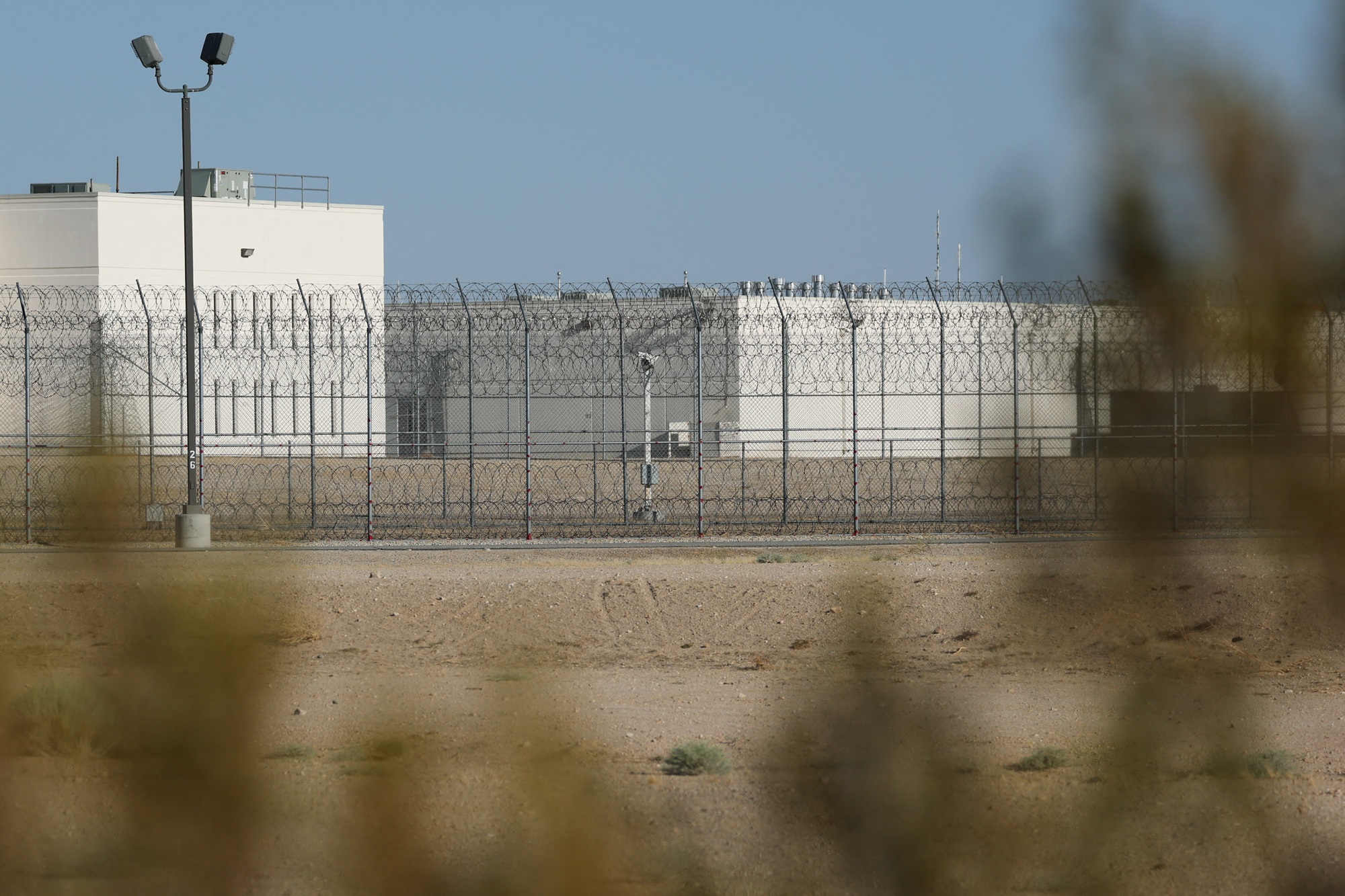
"content": "\u003cp>A Bay Area lawmaker said conditions at the \u003ca href=\"https://www.kqed.org/news/12054544/californias-newest-immigration-facility-is-also-its-biggest-is-it-operating-legally\">newest immigration jail\u003c/a> in California amounted to “a violation of human rights” after an oversight visit this week.\u003c/p>\n\u003cp>South Bay Rep. Ro Khanna described what he called the “systemic neglect” of more than 900 people currently held at the California City Detention Facility, a private prison in the Mojave Desert, which opened in late August under a contract with U.S. Immigration and Customs Enforcement.\u003c/p>\n\u003cp>“We’re treating these people like animals, not like human beings … It’s an embarrassment for the country,” he told KQED. “Whatever you think about the consequences for people who are undocumented, we should all agree that you treat people with dignity.”\u003c/p>\n\u003cp>[ad fullwidth]\u003c/p>\n\u003cp>Khanna’s visit comes at a time when ICE is locking up more people than ever in its history — roughly 69,000 as of late December — as the Trump administration continues its massive ramp-up in immigration enforcement as part of an aggressive campaign to deport millions of non-citizens.\u003c/p>\n\u003cp>Advocates have raised alarms over poor conditions in ICE detention as the number of in-custody deaths\u003ca href=\"https://www.theguardian.com/us-news/ng-interactive/2026/jan/04/ice-2025-deaths-timeline\"> surged\u003c/a> to its highest level in more than 20 years, with 32 people dying in 2025.\u003c/p>\n\u003cp>Congress has a legal right to inspect immigration detention centers, even unannounced. But over the past year, ICE has repeatedly denied access to politicians who have tried to exercise their power of oversight. Last July, several House \u003ca href=\"https://www.texasobserver.org/dems-congress-ice-detention-oversight-lawsuit/\">Democrats sued\u003c/a> the Trump administration after ICE issued a policy requiring seven days advance notice to schedule a visit. Last month, a federal judge \u003ca href=\"https://www.politico.com/news/2025/12/17/ice-lawmaker-visits-policy-ruling-00695801\">blocked \u003c/a>that policy while the case unfolded.\u003c/p>\n\u003cfigure id=\"attachment_12069262\" class=\"wp-caption aligncenter\" style=\"max-width: 1500px\">\u003cimg loading=\"lazy\" decoding=\"async\" class=\"size-full wp-image-12069262\" src=\"https://cdn.kqed.org/wp-content/uploads/sites/10/2026/01/G9_jv3KW0AMIDK3_a.jpg\" alt=\"\" width=\"1500\" height=\"1000\" srcset=\"https://cdn.kqed.org/wp-content/uploads/sites/10/2026/01/G9_jv3KW0AMIDK3_a.jpg 1500w, https://cdn.kqed.org/wp-content/uploads/sites/10/2026/01/G9_jv3KW0AMIDK3_a-160x107.jpg 160w\" sizes=\"auto, (max-width: 1500px) 100vw, 1500px\">\u003cfigcaption class=\"wp-caption-text\">South Bay Democrat Rep. Ro Khanna and his staff member, Yvonne Inciarte, stand outside of the ICE California City Detention Center on Jan. 5, 2025. \u003ccite>(Courtesy Ro Khanna's office)\u003c/cite>\u003c/figcaption>\u003c/figure>\n\u003cp>Khanna’s visit to the California City facility was pre-arranged. His office first reached out to ICE on Dec. 4 to set up the visit, which took place Jan. 5, a staff member said.\u003c/p>\n\u003cp>Khanna said he and an aide spent about three hours there, and took an official tour of the facility — which is set to become ICE’s largest in the state, with capacity for nearly 2,600 detainees. Khanna was reportedly told there were 1,428 detainees, including 215 women. The most recently available ICE data available, from Dec. 26, shows 922 detainees — although that number could have increased over the past two weeks.\u003c/p>\n\u003cp>The lawmaker said he also had two group sessions where he was able to talk with 47 detained people who had signed up to meet him. No prison staff was present in the meetings, he said.\u003c/p>\n\u003cp>“During the tour, [the warden and other prison officials] were showing us they were going by the book, and they took standards really seriously,” he said. “Then when we met the detainees, I was just floored.”[aside postID=news_12068663 hero='https://cdn.kqed.org/wp-content/uploads/sites/10/2026/01/260105-VenezuelaCalifornia-06-BL_qed.jpg']Khanna said he spoke with a man who said he had blood in his urine and was still waiting for medical care after seven days. He said people described rocks in their food, undrinkable water, punishing lockdowns four times a day and no-contact visits with family members.\u003c/p>\n\u003cp>“It was really dehumanizing, and many of them were in tears,” he said. “Some of them had been in this country for over a decade, paying taxes, and they’re just shocked that they had been sent to this facility.”\u003c/p>\n\u003cp>Khanna said he was particularly alarmed by the lack of medical care. On the day he visited, he said, he saw only one doctor handling a clinic waiting room filled with roughly 40 patients.\u003c/p>\n\u003cp>CoreCivic, the company that owns and operates the facility, said the safety and health of people in its custody is its top priority.\u003c/p>\n\u003cp>The facility employs licensed health care providers, who “[take] seriously their role and responsibility to provide high-quality healthcare, available 24/7, to the individuals in our care,” said CoreCivic public affairs director Ryan Gustin, in a statement emailed to KQED. “Our health services teams follow both CoreCivic’s standards for medical care and the standards set forth by our government partners. All individuals have daily access to sign up for medical care, including mental health services.”\u003c/p>\n\u003cp>Gustin added that the company’s immigration facilities are closely monitored by ICE and required to undergo regular reviews and audits “to ensure an appropriate standard of living and care for all detainees.”\u003c/p>\n\u003cfigure id=\"attachment_12054617\" class=\"wp-caption aligncenter\" style=\"max-width: 2000px\">\u003cimg loading=\"lazy\" decoding=\"async\" class=\"size-full wp-image-12054617\" src=\"https://cdn.kqed.org/wp-content/uploads/sites/10/2025/09/CoreCivicKQED3.jpg\" alt=\"\" width=\"2000\" height=\"1125\" srcset=\"https://cdn.kqed.org/wp-content/uploads/sites/10/2025/09/CoreCivicKQED3.jpg 2000w, https://cdn.kqed.org/wp-content/uploads/sites/10/2025/09/CoreCivicKQED3-160x90.jpg 160w, https://cdn.kqed.org/wp-content/uploads/sites/10/2025/09/CoreCivicKQED3-1536x864.jpg 1536w\" sizes=\"auto, (max-width: 2000px) 100vw, 2000px\">\u003cfigcaption class=\"wp-caption-text\">The CoreCivic Inc. California City Immigration Processing Center in California City, California, in June 2025. \u003ccite>(Saul Gonzalez/KQED)\u003c/cite>\u003c/figcaption>\u003c/figure>\n\u003cp>ICE did not respond to repeated requests for comment. But information the agency is legally required to make public indicates that, as of Dec. 26, 2025, the most recent inspection of the California City facility took place “pre-occupancy,” with another inspection due at an unspecified date in 2026.\u003c/p>\n\u003cp>A state-authorized \u003ca href=\"https://www.kqed.org/news/12062774/conditions-at-massive-new-california-immigration-facility-are-alarming-report-finds\">inspection was conducted\u003c/a> in September by Disability Rights California, a nonprofit watchdog organization with \u003ca href=\"https://www.disabilityrightsca.org/publications/summary-of-disability-rights-californias-authority-under-state-and-federal-law\">investigative powers\u003c/a> under state and federal law to protect the rights of people with physical, developmental and psychiatric disabilities. The group found that conditions at the detention center were dangerous for disabled people and that health care access was broadly lacking.\u003c/p>\n\u003cp>In October, immigrant rights organizations filed a lawsuit alleging that CoreCivic began operating the ICE facility without first obtaining state and local permits. Then, in November, detainees at the facility\u003ca href=\"https://calmatters.org/justice/2025/11/ice-california-city-detainee-lawsuit/\"> sued\u003c/a>, alleging the place is polluted by sewage leaks and insect infestations, and that detainees can’t get proper medical attention for life-threatening conditions.[aside postID=news_12069104 hero='https://cdn.kqed.org/wp-content/uploads/sites/10/2026/01/ReneeGoodProtestOaklandGetty.jpg']Last month, the California Attorney General’s office sent out its own inspection team, as mandated under state law, and then \u003ca href=\"https://oag.ca.gov/news/press-releases/attorney-general-bonta-warns-dangerous-conditions-california-city-detention\">issued \u003c/a>a sharply worded letter to Homeland Security Secretary Kristi Noem, calling out “dangerous and inadequate living conditions.”\u003c/p>\n\u003cp>Attorney General Rob Bonta said the facility had “opened prematurely and was not prepared to handle the needs of the incoming population.”\u003c/p>\n\u003cp>ICE’s $130 million two-year contract with CoreCivic for the California City facility — formerly used as a state prison but vacant since 2023 — was enabled by Congress’s passage last summer of a budget bill that included $170 billion for President Donald Trump’s immigration enforcement priorities — including $45 billion specifically for detention facilities. Analysts estimate the money could allow for as many as 116,000 detention beds. By comparison, ICE held about 39,000 people in the final days of the Biden administration.\u003c/p>\n\u003cp>Khanna said he decided to see the inside of the facility for himself after residents in his Santa Clara County district expressed concern for loved ones who were held there. The lawmaker said he wants more of Congress to visit detention centers and hold ICE accountable.\u003c/p>\n\u003cp>“I think more members need to go in,” he said. “Get access to these facilities and talk to the detainees. And then we need to tell their stories. That’s our job in oversight. I did it because my constituents faced it, and I’m really glad I did and horrified to see what I discovered.”\u003c/p>\n\u003cp>[ad floatright]\u003c/p>\n",
"blocks": [],
"excerpt": "The Trump administration is holding a record number of people in immigration jails — 69,000 as of December 2025.",
"status": "publish",
"parent": 0,
"modified": 1768868659,
"stats": {
"hasAudio": false,
"hasVideo": false,
"hasChartOrMap": false,
"iframeSrcs": [],
"hasGoogleForm": false,
"hasGallery": false,
"hasHearkenModule": false,
"hasPolis": false,
"paragraphCount": 24,
"wordCount": 1255
},
"headData": {
"title": "South Bay Rep. Ro Khanna ‘Horrified’ After Visit to California City ICE Detention Center | KQED",
"description": "The Trump administration is holding a record number of people in immigration jails — 69,000 as of December 2025.",
"ogTitle": "",
"ogDescription": "",
"ogImgId": "",
"twTitle": "",
"twDescription": "",
"twImgId": "",
"schema": {
"@context": "https://schema.org",
"@type": "NewsArticle",
"headline": "South Bay Rep. Ro Khanna ‘Horrified’ After Visit to California City ICE Detention Center",
"datePublished": "2026-01-10T04:00:54-08:00",
"dateModified": "2026-01-19T16:24:19-08:00",
"image": "https://cdn.kqed.org/wp-content/uploads/2020/02/KQED-OG-Image@1x.png",
"isAccessibleForFree": "True",
"publisher": {
"@type": "NewsMediaOrganization",
"@id": "https://www.kqed.org/#organization",
"name": "KQED",
"logo": "https://cdn.kqed.org/wp-content/uploads/2020/02/KQED-OG-Image@1x.png",
"url": "https://www.kqed.org",
"sameAs": [
"https://www.facebook.com/KQED",
"https://twitter.com/KQED",
"https://www.instagram.com/kqed/",
"https://www.tiktok.com/@kqedofficial",
"https://www.linkedin.com/company/kqed",
"https://www.youtube.com/channel/UCeC0IOo7i1P_61zVUWbJ4nw"
]
}
}
},
"primaryCategory": {
"termId": 1169,
"slug": "immigration",
"name": "Immigration"
},
"audioUrl": "https://traffic.omny.fm/d/clips/0af137ef-751e-4b19-a055-aaef00d2d578/ffca7e9f-6831-41c5-bcaf-aaef00f5a073/ff7b4c58-eed4-4c19-8c43-b3d2011f73b4/audio.mp3",
"sticky": false,
"nprStoryId": "kqed-12069220",
"templateType": "standard",
"featuredImageType": "standard",
"excludeFromSiteSearch": "Include",
"articleAge": "0",
"path": "/news/12069220/south-bay-rep-ro-khanna-horrified-after-visit-to-california-city-ice-detention-center",
"audioTrackLength": null,
"parsedContent": [
{
"type": "contentString",
"content": "\u003cdiv class=\"post-body\">\u003cp>\u003cp>A Bay Area lawmaker said conditions at the \u003ca href=\"https://www.kqed.org/news/12054544/californias-newest-immigration-facility-is-also-its-biggest-is-it-operating-legally\">newest immigration jail\u003c/a> in California amounted to “a violation of human rights” after an oversight visit this week.\u003c/p>\n\u003cp>South Bay Rep. Ro Khanna described what he called the “systemic neglect” of more than 900 people currently held at the California City Detention Facility, a private prison in the Mojave Desert, which opened in late August under a contract with U.S. Immigration and Customs Enforcement.\u003c/p>\n\u003cp>“We’re treating these people like animals, not like human beings … It’s an embarrassment for the country,” he told KQED. “Whatever you think about the consequences for people who are undocumented, we should all agree that you treat people with dignity.”\u003c/p>\n\u003cp>\u003c/p>\u003c/div>",
"attributes": {
"named": {},
"numeric": []
}
},
{
"type": "component",
"content": "",
"name": "ad",
"attributes": {
"named": {
"label": "fullwidth"
},
"numeric": [
"fullwidth"
]
}
},
{
"type": "contentString",
"content": "\u003cdiv class=\"post-body\">\u003cp>\u003c/p>\n\u003cp>Khanna’s visit comes at a time when ICE is locking up more people than ever in its history — roughly 69,000 as of late December — as the Trump administration continues its massive ramp-up in immigration enforcement as part of an aggressive campaign to deport millions of non-citizens.\u003c/p>\n\u003cp>Advocates have raised alarms over poor conditions in ICE detention as the number of in-custody deaths\u003ca href=\"https://www.theguardian.com/us-news/ng-interactive/2026/jan/04/ice-2025-deaths-timeline\"> surged\u003c/a> to its highest level in more than 20 years, with 32 people dying in 2025.\u003c/p>\n\u003cp>Congress has a legal right to inspect immigration detention centers, even unannounced. But over the past year, ICE has repeatedly denied access to politicians who have tried to exercise their power of oversight. Last July, several House \u003ca href=\"https://www.texasobserver.org/dems-congress-ice-detention-oversight-lawsuit/\">Democrats sued\u003c/a> the Trump administration after ICE issued a policy requiring seven days advance notice to schedule a visit. Last month, a federal judge \u003ca href=\"https://www.politico.com/news/2025/12/17/ice-lawmaker-visits-policy-ruling-00695801\">blocked \u003c/a>that policy while the case unfolded.\u003c/p>\n\u003cfigure id=\"attachment_12069262\" class=\"wp-caption aligncenter\" style=\"max-width: 1500px\">\u003cimg loading=\"lazy\" decoding=\"async\" class=\"size-full wp-image-12069262\" src=\"https://cdn.kqed.org/wp-content/uploads/sites/10/2026/01/G9_jv3KW0AMIDK3_a.jpg\" alt=\"\" width=\"1500\" height=\"1000\" srcset=\"https://cdn.kqed.org/wp-content/uploads/sites/10/2026/01/G9_jv3KW0AMIDK3_a.jpg 1500w, https://cdn.kqed.org/wp-content/uploads/sites/10/2026/01/G9_jv3KW0AMIDK3_a-160x107.jpg 160w\" sizes=\"auto, (max-width: 1500px) 100vw, 1500px\">\u003cfigcaption class=\"wp-caption-text\">South Bay Democrat Rep. Ro Khanna and his staff member, Yvonne Inciarte, stand outside of the ICE California City Detention Center on Jan. 5, 2025. \u003ccite>(Courtesy Ro Khanna's office)\u003c/cite>\u003c/figcaption>\u003c/figure>\n\u003cp>Khanna’s visit to the California City facility was pre-arranged. His office first reached out to ICE on Dec. 4 to set up the visit, which took place Jan. 5, a staff member said.\u003c/p>\n\u003cp>Khanna said he and an aide spent about three hours there, and took an official tour of the facility — which is set to become ICE’s largest in the state, with capacity for nearly 2,600 detainees. Khanna was reportedly told there were 1,428 detainees, including 215 women. The most recently available ICE data available, from Dec. 26, shows 922 detainees — although that number could have increased over the past two weeks.\u003c/p>\n\u003cp>The lawmaker said he also had two group sessions where he was able to talk with 47 detained people who had signed up to meet him. No prison staff was present in the meetings, he said.\u003c/p>\n\u003cp>“During the tour, [the warden and other prison officials] were showing us they were going by the book, and they took standards really seriously,” he said. “Then when we met the detainees, I was just floored.”\u003c/p>\u003c/div>",
"attributes": {
"named": {},
"numeric": []
}
},
{
"type": "component",
"content": "",
"name": "aside",
"attributes": {
"named": {
"postid": "news_12068663",
"hero": "https://cdn.kqed.org/wp-content/uploads/sites/10/2026/01/260105-VenezuelaCalifornia-06-BL_qed.jpg",
"label": ""
},
"numeric": []
}
},
{
"type": "contentString",
"content": "\u003cdiv class=\"post-body\">\u003cp>Khanna said he spoke with a man who said he had blood in his urine and was still waiting for medical care after seven days. He said people described rocks in their food, undrinkable water, punishing lockdowns four times a day and no-contact visits with family members.\u003c/p>\n\u003cp>“It was really dehumanizing, and many of them were in tears,” he said. “Some of them had been in this country for over a decade, paying taxes, and they’re just shocked that they had been sent to this facility.”\u003c/p>\n\u003cp>Khanna said he was particularly alarmed by the lack of medical care. On the day he visited, he said, he saw only one doctor handling a clinic waiting room filled with roughly 40 patients.\u003c/p>\n\u003cp>CoreCivic, the company that owns and operates the facility, said the safety and health of people in its custody is its top priority.\u003c/p>\n\u003cp>The facility employs licensed health care providers, who “[take] seriously their role and responsibility to provide high-quality healthcare, available 24/7, to the individuals in our care,” said CoreCivic public affairs director Ryan Gustin, in a statement emailed to KQED. “Our health services teams follow both CoreCivic’s standards for medical care and the standards set forth by our government partners. All individuals have daily access to sign up for medical care, including mental health services.”\u003c/p>\n\u003cp>Gustin added that the company’s immigration facilities are closely monitored by ICE and required to undergo regular reviews and audits “to ensure an appropriate standard of living and care for all detainees.”\u003c/p>\n\u003cfigure id=\"attachment_12054617\" class=\"wp-caption aligncenter\" style=\"max-width: 2000px\">\u003cimg loading=\"lazy\" decoding=\"async\" class=\"size-full wp-image-12054617\" src=\"https://cdn.kqed.org/wp-content/uploads/sites/10/2025/09/CoreCivicKQED3.jpg\" alt=\"\" width=\"2000\" height=\"1125\" srcset=\"https://cdn.kqed.org/wp-content/uploads/sites/10/2025/09/CoreCivicKQED3.jpg 2000w, https://cdn.kqed.org/wp-content/uploads/sites/10/2025/09/CoreCivicKQED3-160x90.jpg 160w, https://cdn.kqed.org/wp-content/uploads/sites/10/2025/09/CoreCivicKQED3-1536x864.jpg 1536w\" sizes=\"auto, (max-width: 2000px) 100vw, 2000px\">\u003cfigcaption class=\"wp-caption-text\">The CoreCivic Inc. California City Immigration Processing Center in California City, California, in June 2025. \u003ccite>(Saul Gonzalez/KQED)\u003c/cite>\u003c/figcaption>\u003c/figure>\n\u003cp>ICE did not respond to repeated requests for comment. But information the agency is legally required to make public indicates that, as of Dec. 26, 2025, the most recent inspection of the California City facility took place “pre-occupancy,” with another inspection due at an unspecified date in 2026.\u003c/p>\n\u003cp>A state-authorized \u003ca href=\"https://www.kqed.org/news/12062774/conditions-at-massive-new-california-immigration-facility-are-alarming-report-finds\">inspection was conducted\u003c/a> in September by Disability Rights California, a nonprofit watchdog organization with \u003ca href=\"https://www.disabilityrightsca.org/publications/summary-of-disability-rights-californias-authority-under-state-and-federal-law\">investigative powers\u003c/a> under state and federal law to protect the rights of people with physical, developmental and psychiatric disabilities. The group found that conditions at the detention center were dangerous for disabled people and that health care access was broadly lacking.\u003c/p>\n\u003cp>In October, immigrant rights organizations filed a lawsuit alleging that CoreCivic began operating the ICE facility without first obtaining state and local permits. Then, in November, detainees at the facility\u003ca href=\"https://calmatters.org/justice/2025/11/ice-california-city-detainee-lawsuit/\"> sued\u003c/a>, alleging the place is polluted by sewage leaks and insect infestations, and that detainees can’t get proper medical attention for life-threatening conditions.\u003c/p>\u003c/div>",
"attributes": {
"named": {},
"numeric": []
}
},
{
"type": "component",
"content": "",
"name": "aside",
"attributes": {
"named": {
"postid": "news_12069104",
"hero": "https://cdn.kqed.org/wp-content/uploads/sites/10/2026/01/ReneeGoodProtestOaklandGetty.jpg",
"label": ""
},
"numeric": []
}
},
{
"type": "contentString",
"content": "\u003cdiv class=\"post-body\">\u003cp>Last month, the California Attorney General’s office sent out its own inspection team, as mandated under state law, and then \u003ca href=\"https://oag.ca.gov/news/press-releases/attorney-general-bonta-warns-dangerous-conditions-california-city-detention\">issued \u003c/a>a sharply worded letter to Homeland Security Secretary Kristi Noem, calling out “dangerous and inadequate living conditions.”\u003c/p>\n\u003cp>Attorney General Rob Bonta said the facility had “opened prematurely and was not prepared to handle the needs of the incoming population.”\u003c/p>\n\u003cp>ICE’s $130 million two-year contract with CoreCivic for the California City facility — formerly used as a state prison but vacant since 2023 — was enabled by Congress’s passage last summer of a budget bill that included $170 billion for President Donald Trump’s immigration enforcement priorities — including $45 billion specifically for detention facilities. Analysts estimate the money could allow for as many as 116,000 detention beds. By comparison, ICE held about 39,000 people in the final days of the Biden administration.\u003c/p>\n\u003cp>Khanna said he decided to see the inside of the facility for himself after residents in his Santa Clara County district expressed concern for loved ones who were held there. The lawmaker said he wants more of Congress to visit detention centers and hold ICE accountable.\u003c/p>\n\u003cp>“I think more members need to go in,” he said. “Get access to these facilities and talk to the detainees. And then we need to tell their stories. That’s our job in oversight. I did it because my constituents faced it, and I’m really glad I did and horrified to see what I discovered.”\u003c/p>\n\u003cp>\u003c/p>\u003c/div>",
"attributes": {
"named": {},
"numeric": []
}
},
{
"type": "component",
"content": "",
"name": "ad",
"attributes": {
"named": {
"label": "floatright"
},
"numeric": [
"floatright"
]
}
},
{
"type": "contentString",
"content": "\u003cdiv class=\"post-body\">\u003cp>\u003c/p>\n\u003c/div>\u003c/p>",
"attributes": {
"named": {},
"numeric": []
}
}
],
"link": "/news/12069220/south-bay-rep-ro-khanna-horrified-after-visit-to-california-city-ice-detention-center",
"authors": [
"259"
],
"categories": [
"news_1169",
"news_6188",
"news_28250",
"news_8"
],
"tags": [
"news_18538",
"news_35600",
"news_27240",
"news_1323",
"news_27626",
"news_21027",
"news_20606",
"news_22215",
"news_20579",
"news_20202",
"news_17996",
"news_6238",
"news_38",
"news_23744",
"news_20529"
],
"featImg": "news_12054567",
"label": "news"
},
"news_12066906": {
"type": "posts",
"id": "news_12066906",
"meta": {
"index": "posts_1716263798",
"site": "news",
"id": "12066906",
"score": null,
"sort": [
1765567254000
]
},
"guestAuthors": [],
"slug": "pentagon-diverted-2b-of-military-spending-to-immigration-enforcement-democrats-say",
"title": "Pentagon Diverted $2 Billion of Military Spending to Immigration Enforcement, Democrats Say",
"publishDate": 1765567254,
"format": "standard",
"headTitle": "Pentagon Diverted $2 Billion of Military Spending to Immigration Enforcement, Democrats Say | KQED",
"labelTerm": {
"site": "news"
},
"content": "\u003cp>A Bay Area lawmaker is among a group of Democrats who say the Pentagon has diverted more than $2 billion in military funds toward \u003ca href=\"https://www.kqed.org/news/12058799/trumps-national-guard-moves-are-part-of-a-dangerous-plan-california-ag-warns\">the Trump administration’s aggressive immigration enforcement\u003c/a> agenda.\u003c/p>\n\u003cp>\u003ca href=\"https://www.kqed.org/news/tag/john-garamendi\">Rep. John Garamendi, D-Fairfield,\u003c/a> whose district includes Travis Air Force Base, on Thursday said deploying soldiers and funding to the Southern border undermines national security and threatens military readiness.\u003c/p>\n\u003cp>\u003cstrong>“\u003c/strong>The [Army’s] 101st Division, which is one of the three divisions that we keep always ready to go in a moment’s notice, has been \u003ca href=\"https://www.northcom.mil/Newsroom/Press-Releases/Article/4323057/joint-task-forcesouthern-border-conducts-transfer-of-authority-from-10th-mounta/\">diverted\u003c/a> to border activities,” said Garamendi, who serves as the ranking Democrat on the House Armed Services Committee. “So the management, the infrastructure, the logistics — all of that is totally disrupted. And they are not prepared to depart at a moment’s notice to some urgency around the world.”\u003c/p>\n\u003cp>[ad fullwidth]\u003c/p>\n\u003cp>The \u003ca href=\"https://www.warren.senate.gov/imo/media/doc/cost_report_on_diverting_military_resources_for_immigration_enforcement.pdf\">review \u003c/a>of Pentagon border funding, co-authored by Massachusetts Sen. Elizabeth Warren, California Sens. Alex Padilla and Adam Schiff and nine other members of Congress, found that the Department of Defense has committed $1.3 billion for border enforcement, including troops and wall construction. And the agency’s budget \u003ca href=\"https://comptroller.war.gov/Portals/45/Documents/defbudget/FY2026/FY2026_Budget_Request_Overview_Book.pdf\">request\u003c/a> for fiscal year 2026 indicated plans to spend an additional $5 billion on southern border operations alone.\u003c/p>\n\u003cp>The report also highlighted the Pentagon’s commitment to spend:\u003c/p>\n\u003cul>\n\u003cli>$250 million to deploy troops in U.S. cities, aiding immigration operations\u003c/li>\n\u003cli>$420 million for detention operations on military bases, including Guantanamo\u003c/li>\n\u003cli>$55 million to reassign military lawyers as immigration judges\u003c/li>\n\u003cli>$40 million for air transport of detainees, including deportation flights\u003c/li>\n\u003c/ul>\n\u003cp>“What is clear is that the public can expect DoD to spend billions more on immigration enforcement in the near future,” the report stated.\u003c/p>\n\u003cp>The Democrats called the diversion of funds a waste of taxpayer resources and “baffling,” in light of the Republican-controlled Congress’s unprecedented $170 billion allocation to the Department of Homeland Security earlier this year.\u003c/p>\n\u003cfigure id=\"attachment_12037936\" class=\"wp-caption aligncenter\" style=\"max-width: 2000px\">\u003cimg loading=\"lazy\" decoding=\"async\" class=\"size-full wp-image-12037936\" src=\"https://cdn.kqed.org/wp-content/uploads/sites/10/2025/04/TravisAirForceBaseGetty2.jpg\" alt=\"\" width=\"2000\" height=\"1334\" srcset=\"https://cdn.kqed.org/wp-content/uploads/sites/10/2025/04/TravisAirForceBaseGetty2.jpg 2000w, https://cdn.kqed.org/wp-content/uploads/sites/10/2025/04/TravisAirForceBaseGetty2-800x534.jpg 800w, https://cdn.kqed.org/wp-content/uploads/sites/10/2025/04/TravisAirForceBaseGetty2-1020x680.jpg 1020w, https://cdn.kqed.org/wp-content/uploads/sites/10/2025/04/TravisAirForceBaseGetty2-160x107.jpg 160w, https://cdn.kqed.org/wp-content/uploads/sites/10/2025/04/TravisAirForceBaseGetty2-1536x1025.jpg 1536w, https://cdn.kqed.org/wp-content/uploads/sites/10/2025/04/TravisAirForceBaseGetty2-1920x1281.jpg 1920w\" sizes=\"auto, (max-width: 2000px) 100vw, 2000px\">\u003cfigcaption class=\"wp-caption-text\">A KC-10 Extender is parked on the ramp as a C-5M Super Galaxy takes off at Travis Air Force Base, California, on March 16, 2017. \u003ccite>(Hum Images/Universal Images Group via Getty Images)\u003c/cite>\u003c/figcaption>\u003c/figure>\n\u003cp>This year, Garamendi has strenuously resisted the Pentagon’s use of military aircraft for deportation flights, the use of the U.S. naval base at Guantanamo Bay, Cuba, for immigration detention, and a proposal — first reported by KQED — to build \u003ca href=\"https://www.kqed.org/news/12037889/trump-administration-considers-immigration-detention-bay-area-military-base-records-show\">an immigration detention center at Travis\u003c/a>. After he and North Bay Democratic Rep. Mike Thompson raised questions, Garamendi said military officials told them the plan had been \u003ca href=\"https://www.kqed.org/news/12055651/trump-administrations-plans-for-ice-detention-on-bay-area-military-base-are-on-hold\">put on hold\u003c/a>.\u003c/p>\n\u003cp>The lawmaker also said he believes redirecting troops to immigration efforts at the border and in cities such as Los Angeles is a violation of \u003ca href=\"https://www.kqed.org/news/12066202/california-renews-push-to-bring-national-guard-back-under-newsoms-command\">the Posse Comitatus Act\u003c/a>, an 1878 law that limits the use of military personnel to police domestic laws.\u003c/p>\n\u003cp>“One of the things we’ve learned about the Trump administration is they don’t much care what the law is. They simply will do what they want to do, regardless of the law. It’s kind of like, ‘catch me if you can,’” he said\u003cem>.\u003c/em> “We’re gonna call it out. We’re gonna say it’s illegal. It’s the use of the military for domestic law enforcement purposes.”[aside postID=news_12066492 hero='https://cdn.kqed.org/wp-content/uploads/sites/10/2024/03/240212-ImmigrationCourt-31-BL_qut-1020x680.jpg']The Defense Department has not addressed the question of legality. But in a statement, Press Secretary Kingsley Wilson affirmed that the Pentagon is committing resources to immigration efforts. With a nearly $1 trillion defense budget, there’s plenty of money to go around, she said.\u003c/p>\n\u003cp>“Operations with the Department of Homeland Security wouldn’t be necessary if Joe Biden didn’t turn the Southern Border into a national security threat, but this administration is proud to fix the problem Democrats started,” she said. “Spending allocated money on one mission does not mean other missions become depleted. That’s ludicrous and just plain stupid.”\u003c/p>\n\u003cp>The Department of Homeland Security did not respond to a request for comment.\u003c/p>\n\u003cp>In a Dec. 9 \u003ca href=\"https://www.warren.senate.gov/imo/media/doc/cover_letter_to_pentagon_on_immigration_deployment_costs_report.pdf\">letter\u003c/a>, the Democrats shared the report with Defense Secretary Pete Hegseth and asked a series of pointed questions about how the military funds are being used. They also cited news reports that the deployments in support of Homeland Security operations are hurting troop morale and raising concerns about retention and recruitment.\u003c/p>\n\u003cp>“Similar deployments during the first Trump administration led to higher instances of alcohol and drug abuse amongst servicemembers assigned to these missions, and potentially contributed to several tragic suicides,” the letter said. “We urge you to uphold the commitment you made to the Senate during your confirmation process and stop using the military for these political stunts.”\u003c/p>\n\u003cp>Padilla noted that the report comes on the heels of a \u003ca href=\"https://www.kqed.org/news/12066625/federal-judge-orders-trump-to-return-national-guard-troops-in-la-to-state-control\">federal judge’s ruling on \u003c/a>Wednesday ordering the Trump administration to end the National Guard deployment in Los Angeles and return the federalized troops to California’s control.\u003c/p>\n\u003cp>On Thursday, the Senate Armed Services Committee held a \u003ca href=\"https://www.armed-services.senate.gov/hearings/to-receive-testimony-on-the-administrations-deployment-of-the-national-guard-across-the-united-states\">hearing\u003c/a> on the deployment of the National Guard across the U.S.\u003c/p>\n\u003cp>\u003c/p>\n",
"blocks": [],
"excerpt": "A new investigation, led by Bay Area Rep. John Garamendi and Massachusetts Sen. Elizabeth Warren, says the President’s immigration agenda may come at the cost of military readiness and morale. ",
"status": "publish",
"parent": 0,
"modified": 1765571388,
"stats": {
"hasAudio": false,
"hasVideo": false,
"hasChartOrMap": false,
"iframeSrcs": [],
"hasGoogleForm": false,
"hasGallery": false,
"hasHearkenModule": false,
"hasPolis": false,
"paragraphCount": 18,
"wordCount": 892
},
"headData": {
"title": "Pentagon Diverted $2 Billion of Military Spending to Immigration Enforcement, Democrats Say | KQED",
"description": "A new investigation, led by Bay Area Rep. John Garamendi and Massachusetts Sen. Elizabeth Warren, says the President’s immigration agenda may come at the cost of military readiness and morale. ",
"ogTitle": "",
"ogDescription": "",
"ogImgId": "",
"twTitle": "",
"twDescription": "",
"twImgId": "",
"schema": {
"@context": "https://schema.org",
"@type": "NewsArticle",
"headline": "Pentagon Diverted $2 Billion of Military Spending to Immigration Enforcement, Democrats Say",
"datePublished": "2025-12-12T11:20:54-08:00",
"dateModified": "2025-12-12T12:29:48-08:00",
"image": "https://cdn.kqed.org/wp-content/uploads/2020/02/KQED-OG-Image@1x.png",
"isAccessibleForFree": "True",
"publisher": {
"@type": "NewsMediaOrganization",
"@id": "https://www.kqed.org/#organization",
"name": "KQED",
"logo": "https://cdn.kqed.org/wp-content/uploads/2020/02/KQED-OG-Image@1x.png",
"url": "https://www.kqed.org",
"sameAs": [
"https://www.facebook.com/KQED",
"https://twitter.com/KQED",
"https://www.instagram.com/kqed/",
"https://www.tiktok.com/@kqedofficial",
"https://www.linkedin.com/company/kqed",
"https://www.youtube.com/channel/UCeC0IOo7i1P_61zVUWbJ4nw"
]
}
}
},
"primaryCategory": {
"termId": 1169,
"slug": "immigration",
"name": "Immigration"
},
"audioUrl": "https://traffic.omny.fm/d/clips/0af137ef-751e-4b19-a055-aaef00d2d578/ffca7e9f-6831-4[…]f-aaef00f5a073/4aa53f61-f91b-46bc-8d82-b3b1013df6a9/audio.mp3",
"sticky": false,
"nprStoryId": "kqed-12066906",
"templateType": "standard",
"featuredImageType": "standard",
"excludeFromSiteSearch": "Include",
"articleAge": "0",
"path": "/news/12066906/pentagon-diverted-2b-of-military-spending-to-immigration-enforcement-democrats-say",
"audioTrackLength": null,
"parsedContent": [
{
"type": "contentString",
"content": "\u003cdiv class=\"post-body\">\u003cp>\u003cp>A Bay Area lawmaker is among a group of Democrats who say the Pentagon has diverted more than $2 billion in military funds toward \u003ca href=\"https://www.kqed.org/news/12058799/trumps-national-guard-moves-are-part-of-a-dangerous-plan-california-ag-warns\">the Trump administration’s aggressive immigration enforcement\u003c/a> agenda.\u003c/p>\n\u003cp>\u003ca href=\"https://www.kqed.org/news/tag/john-garamendi\">Rep. John Garamendi, D-Fairfield,\u003c/a> whose district includes Travis Air Force Base, on Thursday said deploying soldiers and funding to the Southern border undermines national security and threatens military readiness.\u003c/p>\n\u003cp>\u003cstrong>“\u003c/strong>The [Army’s] 101st Division, which is one of the three divisions that we keep always ready to go in a moment’s notice, has been \u003ca href=\"https://www.northcom.mil/Newsroom/Press-Releases/Article/4323057/joint-task-forcesouthern-border-conducts-transfer-of-authority-from-10th-mounta/\">diverted\u003c/a> to border activities,” said Garamendi, who serves as the ranking Democrat on the House Armed Services Committee. “So the management, the infrastructure, the logistics — all of that is totally disrupted. And they are not prepared to depart at a moment’s notice to some urgency around the world.”\u003c/p>\n\u003cp>\u003c/p>\u003c/div>",
"attributes": {
"named": {},
"numeric": []
}
},
{
"type": "component",
"content": "",
"name": "ad",
"attributes": {
"named": {
"label": "fullwidth"
},
"numeric": [
"fullwidth"
]
}
},
{
"type": "contentString",
"content": "\u003cdiv class=\"post-body\">\u003cp>\u003c/p>\n\u003cp>The \u003ca href=\"https://www.warren.senate.gov/imo/media/doc/cost_report_on_diverting_military_resources_for_immigration_enforcement.pdf\">review \u003c/a>of Pentagon border funding, co-authored by Massachusetts Sen. Elizabeth Warren, California Sens. Alex Padilla and Adam Schiff and nine other members of Congress, found that the Department of Defense has committed $1.3 billion for border enforcement, including troops and wall construction. And the agency’s budget \u003ca href=\"https://comptroller.war.gov/Portals/45/Documents/defbudget/FY2026/FY2026_Budget_Request_Overview_Book.pdf\">request\u003c/a> for fiscal year 2026 indicated plans to spend an additional $5 billion on southern border operations alone.\u003c/p>\n\u003cp>The report also highlighted the Pentagon’s commitment to spend:\u003c/p>\n\u003cul>\n\u003cli>$250 million to deploy troops in U.S. cities, aiding immigration operations\u003c/li>\n\u003cli>$420 million for detention operations on military bases, including Guantanamo\u003c/li>\n\u003cli>$55 million to reassign military lawyers as immigration judges\u003c/li>\n\u003cli>$40 million for air transport of detainees, including deportation flights\u003c/li>\n\u003c/ul>\n\u003cp>“What is clear is that the public can expect DoD to spend billions more on immigration enforcement in the near future,” the report stated.\u003c/p>\n\u003cp>The Democrats called the diversion of funds a waste of taxpayer resources and “baffling,” in light of the Republican-controlled Congress’s unprecedented $170 billion allocation to the Department of Homeland Security earlier this year.\u003c/p>\n\u003cfigure id=\"attachment_12037936\" class=\"wp-caption aligncenter\" style=\"max-width: 2000px\">\u003cimg loading=\"lazy\" decoding=\"async\" class=\"size-full wp-image-12037936\" src=\"https://cdn.kqed.org/wp-content/uploads/sites/10/2025/04/TravisAirForceBaseGetty2.jpg\" alt=\"\" width=\"2000\" height=\"1334\" srcset=\"https://cdn.kqed.org/wp-content/uploads/sites/10/2025/04/TravisAirForceBaseGetty2.jpg 2000w, https://cdn.kqed.org/wp-content/uploads/sites/10/2025/04/TravisAirForceBaseGetty2-800x534.jpg 800w, https://cdn.kqed.org/wp-content/uploads/sites/10/2025/04/TravisAirForceBaseGetty2-1020x680.jpg 1020w, https://cdn.kqed.org/wp-content/uploads/sites/10/2025/04/TravisAirForceBaseGetty2-160x107.jpg 160w, https://cdn.kqed.org/wp-content/uploads/sites/10/2025/04/TravisAirForceBaseGetty2-1536x1025.jpg 1536w, https://cdn.kqed.org/wp-content/uploads/sites/10/2025/04/TravisAirForceBaseGetty2-1920x1281.jpg 1920w\" sizes=\"auto, (max-width: 2000px) 100vw, 2000px\">\u003cfigcaption class=\"wp-caption-text\">A KC-10 Extender is parked on the ramp as a C-5M Super Galaxy takes off at Travis Air Force Base, California, on March 16, 2017. \u003ccite>(Hum Images/Universal Images Group via Getty Images)\u003c/cite>\u003c/figcaption>\u003c/figure>\n\u003cp>This year, Garamendi has strenuously resisted the Pentagon’s use of military aircraft for deportation flights, the use of the U.S. naval base at Guantanamo Bay, Cuba, for immigration detention, and a proposal — first reported by KQED — to build \u003ca href=\"https://www.kqed.org/news/12037889/trump-administration-considers-immigration-detention-bay-area-military-base-records-show\">an immigration detention center at Travis\u003c/a>. After he and North Bay Democratic Rep. Mike Thompson raised questions, Garamendi said military officials told them the plan had been \u003ca href=\"https://www.kqed.org/news/12055651/trump-administrations-plans-for-ice-detention-on-bay-area-military-base-are-on-hold\">put on hold\u003c/a>.\u003c/p>\n\u003cp>The lawmaker also said he believes redirecting troops to immigration efforts at the border and in cities such as Los Angeles is a violation of \u003ca href=\"https://www.kqed.org/news/12066202/california-renews-push-to-bring-national-guard-back-under-newsoms-command\">the Posse Comitatus Act\u003c/a>, an 1878 law that limits the use of military personnel to police domestic laws.\u003c/p>\n\u003cp>“One of the things we’ve learned about the Trump administration is they don’t much care what the law is. They simply will do what they want to do, regardless of the law. It’s kind of like, ‘catch me if you can,’” he said\u003cem>.\u003c/em> “We’re gonna call it out. We’re gonna say it’s illegal. It’s the use of the military for domestic law enforcement purposes.”\u003c/p>\u003c/div>",
"attributes": {
"named": {},
"numeric": []
}
},
{
"type": "component",
"content": "",
"name": "aside",
"attributes": {
"named": {
"postid": "news_12066492",
"hero": "https://cdn.kqed.org/wp-content/uploads/sites/10/2024/03/240212-ImmigrationCourt-31-BL_qut-1020x680.jpg",
"label": ""
},
"numeric": []
}
},
{
"type": "contentString",
"content": "\u003cdiv class=\"post-body\">\u003cp>The Defense Department has not addressed the question of legality. But in a statement, Press Secretary Kingsley Wilson affirmed that the Pentagon is committing resources to immigration efforts. With a nearly $1 trillion defense budget, there’s plenty of money to go around, she said.\u003c/p>\n\u003cp>“Operations with the Department of Homeland Security wouldn’t be necessary if Joe Biden didn’t turn the Southern Border into a national security threat, but this administration is proud to fix the problem Democrats started,” she said. “Spending allocated money on one mission does not mean other missions become depleted. That’s ludicrous and just plain stupid.”\u003c/p>\n\u003cp>The Department of Homeland Security did not respond to a request for comment.\u003c/p>\n\u003cp>In a Dec. 9 \u003ca href=\"https://www.warren.senate.gov/imo/media/doc/cover_letter_to_pentagon_on_immigration_deployment_costs_report.pdf\">letter\u003c/a>, the Democrats shared the report with Defense Secretary Pete Hegseth and asked a series of pointed questions about how the military funds are being used. They also cited news reports that the deployments in support of Homeland Security operations are hurting troop morale and raising concerns about retention and recruitment.\u003c/p>\n\u003cp>“Similar deployments during the first Trump administration led to higher instances of alcohol and drug abuse amongst servicemembers assigned to these missions, and potentially contributed to several tragic suicides,” the letter said. “We urge you to uphold the commitment you made to the Senate during your confirmation process and stop using the military for these political stunts.”\u003c/p>\n\u003cp>Padilla noted that the report comes on the heels of a \u003ca href=\"https://www.kqed.org/news/12066625/federal-judge-orders-trump-to-return-national-guard-troops-in-la-to-state-control\">federal judge’s ruling on \u003c/a>Wednesday ordering the Trump administration to end the National Guard deployment in Los Angeles and return the federalized troops to California’s control.\u003c/p>\n\u003cp>On Thursday, the Senate Armed Services Committee held a \u003ca href=\"https://www.armed-services.senate.gov/hearings/to-receive-testimony-on-the-administrations-deployment-of-the-national-guard-across-the-united-states\">hearing\u003c/a> on the deployment of the National Guard across the U.S.\u003c/p>\n\u003cp>\u003c/p>\n\u003c/div>\u003c/p>",
"attributes": {
"named": {},
"numeric": []
}
}
],
"link": "/news/12066906/pentagon-diverted-2b-of-military-spending-to-immigration-enforcement-democrats-say",
"authors": [
"259"
],
"categories": [
"news_1169",
"news_8",
"news_13"
],
"tags": [
"news_20716",
"news_19112",
"news_27240",
"news_1323",
"news_24972",
"news_22215",
"news_20202",
"news_21791",
"news_1537",
"news_20100",
"news_17968",
"news_21140",
"news_20529",
"news_21417"
],
"featImg": "news_11804662",
"label": "news"
},
"news_12052815": {
"type": "posts",
"id": "news_12052815",
"meta": {
"index": "posts_1716263798",
"site": "news",
"id": "12052815",
"score": null,
"sort": [
1755644233000
]
},
"guestAuthors": [],
"slug": "oakland-attorneys-say-immigrant-children-are-being-held-in-prison-like-conditions",
"title": "Oakland Attorneys Say Immigrant Children Are Being Held in Prison-Like Conditions",
"publishDate": 1755644233,
"format": "standard",
"headTitle": "Oakland Attorneys Say Immigrant Children Are Being Held in Prison-Like Conditions | KQED",
"labelTerm": {
"site": "news"
},
"content": "\u003cp>Oakland-based attorneys pushing back against the Trump administration in federal court raised alarms as they said they have evidence of children being held for weeks in prison-like conditions in \u003ca href=\"https://www.kqed.org/news/tag/customs-and-border-protection\">U.S. Customs and Border Protection\u003c/a> custody.\u003c/p>\n\u003cp>Now, a federal judge is reaffirming those allegations and upholding the federal government’s responsibility to process detained immigrant children as expeditiously as possible. The ruling comes after the Trump administration again sought to end a settlement requiring \u003ca href=\"https://www.kqed.org/news/11982020/judge-rules-border-patrol-must-care-for-migrant-children-waiting-in-open-air-camps\">humane treatment of children in federal custody\u003c/a>.\u003c/p>\n\u003cp>U.S. District Judge Dolly Gee on Friday rejected the administration’s bid to throw out the 1997 Flores Settlement Agreement, which requires the government to transfer detained children to a guardian or a licensed facility within three days. Gee’s ruling, which she also enforced in a Monday motion, requires that the government also improve the current conditions of facilities.\u003c/p>\n\u003cp>[ad fullwidth]\u003c/p>\n\u003cp>“The judge recognized that the conditions that are currently in CBP custody are unacceptable for kids to be held in for any length of time,” said Becky Wolozin, a senior attorney at the National Center for Youth Law in Oakland, one of the plaintiffs working to uphold the settlement terms. “She continues to recognize that children deserve at least the bare minimum in terms of humanitarian conditions and dignity if the government chooses to hold them in detention.”\u003c/p>\n\u003cp>The Trump administration in May moved to terminate the Flores settlement, saying it was not necessary because the government had already \u003ca href=\"https://www.kqed.org/news/11769437/whats-in-new-trump-immigration-rule-overriding-flores-agreement-3-key-changes\">put in place such policies\u003c/a>. The agreement had actually “ossified immigration policy,” the administration argued in its motion, by increasing the number of children entering the country.\u003c/p>\n\u003cfigure id=\"attachment_12015881\" class=\"wp-caption aligncenter\" style=\"max-width: 2560px\">\u003cimg loading=\"lazy\" decoding=\"async\" class=\"size-full wp-image-12015881\" src=\"https://cdn.kqed.org/wp-content/uploads/sites/10/2024/11/GettyImages-2167160569-scaled.jpg\" alt=\"\" width=\"2560\" height=\"1696\" srcset=\"https://cdn.kqed.org/wp-content/uploads/sites/10/2024/11/GettyImages-2167160569-scaled.jpg 2560w, https://cdn.kqed.org/wp-content/uploads/sites/10/2024/11/GettyImages-2167160569-800x530.jpg 800w, https://cdn.kqed.org/wp-content/uploads/sites/10/2024/11/GettyImages-2167160569-1020x676.jpg 1020w, https://cdn.kqed.org/wp-content/uploads/sites/10/2024/11/GettyImages-2167160569-160x106.jpg 160w, https://cdn.kqed.org/wp-content/uploads/sites/10/2024/11/GettyImages-2167160569-1536x1017.jpg 1536w, https://cdn.kqed.org/wp-content/uploads/sites/10/2024/11/GettyImages-2167160569-2048x1357.jpg 2048w, https://cdn.kqed.org/wp-content/uploads/sites/10/2024/11/GettyImages-2167160569-1920x1272.jpg 1920w\" sizes=\"auto, (max-width: 2560px) 100vw, 2560px\">\u003cfigcaption class=\"wp-caption-text\">Then-former U.S. President Donald Trump speaks about immigration and border security near Coronado National Memorial in Montezuma Pass, Arizona, on Aug. 22, 2024. \u003ccite>(Olivier Touron/AFP via Getty Images)\u003c/cite>\u003c/figcaption>\u003c/figure>\n\u003cp>The agreement has “changed the immigration landscape by removing some of the disincentives for families to enter the U.S. unlawfully,” the administration said in the motion. “Unlawful family migration barely existed in 1997.”\u003c/p>\n\u003cp>Plaintiffs fired back against the administration, moving for the court to enforce the longstanding agreement and arguing that the government violated the agreement because it had kept children at border stations for weeks to months in poor conditions.\u003c/p>\n\u003cp>Gee, however, said it appeared that the government was trying to reduce the amount of time children may be held at a Border Patrol station. In the most recent report by the CBP’s juvenile coordinator that tracks time in custody, the average time detained at family facilities had decreased in the last few months.\u003c/p>\n\u003cp>“This indicates that CBP is aware of the issue and is working to resolve it,” Gee said.[aside postID=news_12026817 hero='https://cdn.kqed.org/wp-content/uploads/sites/10/2025/02/GettyImages-2197914000-1020x680.jpg']Still, the judge said current times in custody are too long, Wolozin said.\u003c/p>\n\u003cp>“She was very clear that weeks, months in these facilities is a blatant violation of the settlement agreement and the children’s basic rights,” Wolozin said.\u003c/p>\n\u003cp>\u003ca href=\"https://www.kqed.org/news/11769455/lengthy-detention-of-migrant-children-may-create-lasting-trauma-say-researchers\">Children in CBP detention\u003c/a> sometimes don’t see the sun “for days at a time” and talk about being very cold and separated from their families, Wolozin said.\u003c/p>\n\u003cp>Additional families say that detention facilities sometimes lack the ability to flush toilets, provide infrequent showers for children and have inadequate access to medical care, according to claims by individuals in detention facilities.\u003c/p>\n\u003cp>“This underscores precisely why the prolonged times in CBP custody remain a significant problem,” Gee said in her ruling enforcing the agreement. “CBP facilities, by design, are not suitable for minors for long periods of time.”\u003c/p>\n\u003cp>President Donald Trump first tried to do away with the settlement during his first term before Gee blocked the changes. The Department of Homeland Security asked in 2018 to exempt it from provisions regarding release and exempt U.S. Immigration and Customs Enforcement’s family facilities from the agreement’s state license requirement.\u003c/p>\n\u003cp>By the time children reach these facilities, Wolozin said, they are at the end of an already “difficult, traumatic journey” where they’re often fleeing violence.\u003c/p>\n\u003cp>“When they’re placed in these restrictive settings that don’t treat them like children but instead treat them like criminals, it compounds all of the harms they’re trying to escape,” Wolozin said. “It also causes them to stay in this really heightened sense of anxiety and awareness of their surroundings — sort of a hypervigilance — that is really bad for children and their bodies.”\u003c/p>\n\u003cp>\u003cem>KQED’s \u003c/em>\u003ca href=\"https://www.kqed.org/author/tychehendricks\">\u003cem>Tyche Hendricks\u003c/em>\u003c/a>\u003cem> contributed to this report. \u003c/em>\u003c/p>\n\u003cp>\u003c/p>\n",
"blocks": [],
"excerpt": "The National Center for Youth Law is among the plaintiffs pushing the Trump administration to uphold the Flores settlement, which requires humane treatment of children in federal custody.",
"status": "publish",
"parent": 0,
"modified": 1755714872,
"stats": {
"hasAudio": false,
"hasVideo": false,
"hasChartOrMap": false,
"iframeSrcs": [],
"hasGoogleForm": false,
"hasGallery": false,
"hasHearkenModule": false,
"hasPolis": false,
"paragraphCount": 19,
"wordCount": 797
},
"headData": {
"title": "Oakland Attorneys Say Immigrant Children Are Being Held in Prison-Like Conditions | KQED",
"description": "The National Center for Youth Law is among the plaintiffs pushing the Trump administration to uphold the Flores settlement, which requires humane treatment of children in federal custody.",
"ogTitle": "",
"ogDescription": "",
"ogImgId": "",
"twTitle": "",
"twDescription": "",
"twImgId": "",
"schema": {
"@context": "https://schema.org",
"@type": "NewsArticle",
"headline": "Oakland Attorneys Say Immigrant Children Are Being Held in Prison-Like Conditions",
"datePublished": "2025-08-19T15:57:13-07:00",
"dateModified": "2025-08-20T11:34:32-07:00",
"image": "https://cdn.kqed.org/wp-content/uploads/2020/02/KQED-OG-Image@1x.png",
"isAccessibleForFree": "True",
"publisher": {
"@type": "NewsMediaOrganization",
"@id": "https://www.kqed.org/#organization",
"name": "KQED",
"logo": "https://cdn.kqed.org/wp-content/uploads/2020/02/KQED-OG-Image@1x.png",
"url": "https://www.kqed.org",
"sameAs": [
"https://www.facebook.com/KQED",
"https://twitter.com/KQED",
"https://www.instagram.com/kqed/",
"https://www.tiktok.com/@kqedofficial",
"https://www.linkedin.com/company/kqed",
"https://www.youtube.com/channel/UCeC0IOo7i1P_61zVUWbJ4nw"
]
}
}
},
"primaryCategory": {
"termId": 8,
"slug": "news",
"name": "News"
},
"audioUrl": "https://traffic.omny.fm/d/clips/0af137ef-751e-4b19-a055-aaef00d2d578/ffca7e9f-6831-41c5-bcaf-aaef00f5a073/2e40bf55-9673-4baa-b974-b33f0118fdd4/audio.mp3",
"sticky": false,
"nprStoryId": "kqed-12052815",
"templateType": "standard",
"featuredImageType": "standard",
"excludeFromSiteSearch": "Include",
"articleAge": "0",
"path": "/news/12052815/oakland-attorneys-say-immigrant-children-are-being-held-in-prison-like-conditions",
"audioTrackLength": null,
"parsedContent": [
{
"type": "contentString",
"content": "\u003cdiv class=\"post-body\">\u003cp>\u003cp>Oakland-based attorneys pushing back against the Trump administration in federal court raised alarms as they said they have evidence of children being held for weeks in prison-like conditions in \u003ca href=\"https://www.kqed.org/news/tag/customs-and-border-protection\">U.S. Customs and Border Protection\u003c/a> custody.\u003c/p>\n\u003cp>Now, a federal judge is reaffirming those allegations and upholding the federal government’s responsibility to process detained immigrant children as expeditiously as possible. The ruling comes after the Trump administration again sought to end a settlement requiring \u003ca href=\"https://www.kqed.org/news/11982020/judge-rules-border-patrol-must-care-for-migrant-children-waiting-in-open-air-camps\">humane treatment of children in federal custody\u003c/a>.\u003c/p>\n\u003cp>U.S. District Judge Dolly Gee on Friday rejected the administration’s bid to throw out the 1997 Flores Settlement Agreement, which requires the government to transfer detained children to a guardian or a licensed facility within three days. Gee’s ruling, which she also enforced in a Monday motion, requires that the government also improve the current conditions of facilities.\u003c/p>\n\u003cp>\u003c/p>\u003c/div>",
"attributes": {
"named": {},
"numeric": []
}
},
{
"type": "component",
"content": "",
"name": "ad",
"attributes": {
"named": {
"label": "fullwidth"
},
"numeric": [
"fullwidth"
]
}
},
{
"type": "contentString",
"content": "\u003cdiv class=\"post-body\">\u003cp>\u003c/p>\n\u003cp>“The judge recognized that the conditions that are currently in CBP custody are unacceptable for kids to be held in for any length of time,” said Becky Wolozin, a senior attorney at the National Center for Youth Law in Oakland, one of the plaintiffs working to uphold the settlement terms. “She continues to recognize that children deserve at least the bare minimum in terms of humanitarian conditions and dignity if the government chooses to hold them in detention.”\u003c/p>\n\u003cp>The Trump administration in May moved to terminate the Flores settlement, saying it was not necessary because the government had already \u003ca href=\"https://www.kqed.org/news/11769437/whats-in-new-trump-immigration-rule-overriding-flores-agreement-3-key-changes\">put in place such policies\u003c/a>. The agreement had actually “ossified immigration policy,” the administration argued in its motion, by increasing the number of children entering the country.\u003c/p>\n\u003cfigure id=\"attachment_12015881\" class=\"wp-caption aligncenter\" style=\"max-width: 2560px\">\u003cimg loading=\"lazy\" decoding=\"async\" class=\"size-full wp-image-12015881\" src=\"https://cdn.kqed.org/wp-content/uploads/sites/10/2024/11/GettyImages-2167160569-scaled.jpg\" alt=\"\" width=\"2560\" height=\"1696\" srcset=\"https://cdn.kqed.org/wp-content/uploads/sites/10/2024/11/GettyImages-2167160569-scaled.jpg 2560w, https://cdn.kqed.org/wp-content/uploads/sites/10/2024/11/GettyImages-2167160569-800x530.jpg 800w, https://cdn.kqed.org/wp-content/uploads/sites/10/2024/11/GettyImages-2167160569-1020x676.jpg 1020w, https://cdn.kqed.org/wp-content/uploads/sites/10/2024/11/GettyImages-2167160569-160x106.jpg 160w, https://cdn.kqed.org/wp-content/uploads/sites/10/2024/11/GettyImages-2167160569-1536x1017.jpg 1536w, https://cdn.kqed.org/wp-content/uploads/sites/10/2024/11/GettyImages-2167160569-2048x1357.jpg 2048w, https://cdn.kqed.org/wp-content/uploads/sites/10/2024/11/GettyImages-2167160569-1920x1272.jpg 1920w\" sizes=\"auto, (max-width: 2560px) 100vw, 2560px\">\u003cfigcaption class=\"wp-caption-text\">Then-former U.S. President Donald Trump speaks about immigration and border security near Coronado National Memorial in Montezuma Pass, Arizona, on Aug. 22, 2024. \u003ccite>(Olivier Touron/AFP via Getty Images)\u003c/cite>\u003c/figcaption>\u003c/figure>\n\u003cp>The agreement has “changed the immigration landscape by removing some of the disincentives for families to enter the U.S. unlawfully,” the administration said in the motion. “Unlawful family migration barely existed in 1997.”\u003c/p>\n\u003cp>Plaintiffs fired back against the administration, moving for the court to enforce the longstanding agreement and arguing that the government violated the agreement because it had kept children at border stations for weeks to months in poor conditions.\u003c/p>\n\u003cp>Gee, however, said it appeared that the government was trying to reduce the amount of time children may be held at a Border Patrol station. In the most recent report by the CBP’s juvenile coordinator that tracks time in custody, the average time detained at family facilities had decreased in the last few months.\u003c/p>\n\u003cp>“This indicates that CBP is aware of the issue and is working to resolve it,” Gee said.\u003c/p>\u003c/div>",
"attributes": {
"named": {},
"numeric": []
}
},
{
"type": "component",
"content": "",
"name": "aside",
"attributes": {
"named": {
"postid": "news_12026817",
"hero": "https://cdn.kqed.org/wp-content/uploads/sites/10/2025/02/GettyImages-2197914000-1020x680.jpg",
"label": ""
},
"numeric": []
}
},
{
"type": "contentString",
"content": "\u003cdiv class=\"post-body\">\u003cp>Still, the judge said current times in custody are too long, Wolozin said.\u003c/p>\n\u003cp>“She was very clear that weeks, months in these facilities is a blatant violation of the settlement agreement and the children’s basic rights,” Wolozin said.\u003c/p>\n\u003cp>\u003ca href=\"https://www.kqed.org/news/11769455/lengthy-detention-of-migrant-children-may-create-lasting-trauma-say-researchers\">Children in CBP detention\u003c/a> sometimes don’t see the sun “for days at a time” and talk about being very cold and separated from their families, Wolozin said.\u003c/p>\n\u003cp>Additional families say that detention facilities sometimes lack the ability to flush toilets, provide infrequent showers for children and have inadequate access to medical care, according to claims by individuals in detention facilities.\u003c/p>\n\u003cp>“This underscores precisely why the prolonged times in CBP custody remain a significant problem,” Gee said in her ruling enforcing the agreement. “CBP facilities, by design, are not suitable for minors for long periods of time.”\u003c/p>\n\u003cp>President Donald Trump first tried to do away with the settlement during his first term before Gee blocked the changes. The Department of Homeland Security asked in 2018 to exempt it from provisions regarding release and exempt U.S. Immigration and Customs Enforcement’s family facilities from the agreement’s state license requirement.\u003c/p>\n\u003cp>By the time children reach these facilities, Wolozin said, they are at the end of an already “difficult, traumatic journey” where they’re often fleeing violence.\u003c/p>\n\u003cp>“When they’re placed in these restrictive settings that don’t treat them like children but instead treat them like criminals, it compounds all of the harms they’re trying to escape,” Wolozin said. “It also causes them to stay in this really heightened sense of anxiety and awareness of their surroundings — sort of a hypervigilance — that is really bad for children and their bodies.”\u003c/p>\n\u003cp>\u003cem>KQED’s \u003c/em>\u003ca href=\"https://www.kqed.org/author/tychehendricks\">\u003cem>Tyche Hendricks\u003c/em>\u003c/a>\u003cem> contributed to this report. \u003c/em>\u003c/p>\n\u003cp>\u003c/p>\n\u003c/div>\u003c/p>",
"attributes": {
"named": {},
"numeric": []
}
}
],
"link": "/news/12052815/oakland-attorneys-say-immigrant-children-are-being-held-in-prison-like-conditions",
"authors": [
"11935"
],
"categories": [
"news_31795",
"news_1169",
"news_28250",
"news_8",
"news_13"
],
"tags": [
"news_18538",
"news_27240",
"news_34377",
"news_34944",
"news_35606",
"news_6904",
"news_22215",
"news_20202",
"news_17968",
"news_20529"
],
"featImg": "news_11721432",
"label": "news"
},
"news_12047108": {
"type": "posts",
"id": "news_12047108",
"meta": {
"index": "posts_1716263798",
"site": "news",
"id": "12047108",
"score": null,
"sort": [
1751652019000
]
},
"guestAuthors": [],
"slug": "how-trumps-tax-cut-and-policy-bill-aims-to-supercharge-immigration-enforcement",
"title": "How Trump's Tax Cut and Policy Bill Aims to 'Supercharge' Immigration Enforcement",
"publishDate": 1751652019,
"format": "standard",
"headTitle": "How Trump’s Tax Cut and Policy Bill Aims to ‘Supercharge’ Immigration Enforcement | KQED",
"labelTerm": {
"term": 253,
"site": "news"
},
"content": "\u003cp>President Trump’s \u003ca href=\"https://www.npr.org/2025/07/03/nx-s1-5454841/house-republicans-trump-tax-bill-medicaid\">signature domestic policy bill\u003c/a> is headed to his desk, marking a historic federal investment in immigration enforcement.\u003c/p>\n\u003cp>The House \u003ca href=\"https://www.congress.gov/bill/119th-congress/house-bill/1/text\">cleared\u003c/a> Trump’s “big, beautiful bill” on Thursday — meeting the president’s self-imposed deadline of July 4.\u003c/p>\n\u003cp>The massive package sets aside \u003ca href=\"https://www.npr.org/2025/06/29/nx-s1-5445352/trumps-mass-deportation-policy-could-cost-the-economy\">about $170 billion\u003c/a> to support the Trump’s administration’s border and immigration goals, which includes detaining and deporting a record number of people from the U.S.\u003c/p>\n\u003cp>[ad fullwidth]\u003c/p>\n\u003cp>Earlier this week, White House border czar Tom Homan told reporters that Congress needed to pass the bill in order for the federal government to buy more detention beds.\u003c/p>\n\u003cp>“The more beds that we have, the more bad guys we arrest,” he added.\u003c/p>\n\u003cp>Both critics and supporters say carrying out Trump’s immigration agenda will depend on how effectively federal agencies implement and deploy those resources.\u003c/p>\n\u003cp>“It will absolutely supercharge immigration enforcement over time, but it’s not gonna happen overnight,” said Kathleen Bush-Joseph, a policy analyst at the Migration Policy Institute. “So how quickly the Trump administration is able to use this money to fuel its mass deportations campaign is a real question.”\u003c/p>\n\u003ch2>Immigration enforcement\u003c/h2>\n\u003cp>The final bill allocates $45 billion for immigration detention centers, as well as about $30 billion to hire more ICE personnel, for transportation costs, and to maintain ICE facilities, among other spending. It comes as detention centers operate \u003ca href=\"https://www.npr.org/2025/06/04/nx-s1-5417980/private-prisons-and-local-jails-are-ramping-up-as-ice-detention-exceeds-capacity\">beyond their capacity\u003c/a>.\u003c/p>\n\u003cp>The American Immigration Council \u003ca href=\"https://www.americanimmigrationcouncil.org/fact-sheet/house-reconciliation-bill-immigration-border-security/\">estimates\u003c/a> that the new funding could expand detention capacity to “at least 116,000 beds.”\u003c/p>\n\u003cp>[aside postID=news_12047037 hero='https://cdn.kqed.org/wp-content/uploads/sites/10/2025/07/NancyPelosiGetty2.jpg']\u003c/p>\n\u003cp>Bush-Joseph said the money may help reduce overcrowding and improve staffing. But she is also concerned that it will lead to a broader use of detention.\u003c/p>\n\u003cp>After migrants are identified as removable from the U.S., they may be released ahead of their court dates, held in \u003ca href=\"https://www.npr.org/2025/06/04/nx-s1-5417980/private-prisons-and-local-jails-are-ramping-up-as-ice-detention-exceeds-capacity\">local jails\u003c/a>, or placed in ICE detention. The Trump administration \u003ca href=\"https://www.npr.org/2025/01/20/g-s1-43650/trump-inauguration-day-one-immigration\">has made plans\u003c/a> to end the policy known as “catch and release” — which allows people to be released from detention while they await an immigration court hearing — but ending it would require more detention space.\u003c/p>\n\u003cp>Bush-Joseph said that individuals in immigration custody tend to face greater challenges with communication, obtaining counsel, interpretation, and understanding their rights.\u003c/p>\n\u003cp>“The nature of immigration detention in and of itself is that it’s harder for people to win relief in immigration court,” she said.\u003c/p>\n\u003ch2>Border security\u003c/h2>\n\u003cp>The bill provides roughly $46.5 billion to complete Trump’s border wall. It also sets aside $5 billion for Customs and Border Protection facilities and $10 billion for border security initiatives more broadly.\u003c/p>\n\u003cp>About $13.5 billion is put toward reimbursing states and local governments engaging in immigration and border-related enforcement.\u003c/p>\n\u003cp>Some critics have questioned the need for more border security funding, given that the number of people crossing the southern border has fallen to \u003ca href=\"https://www.whitehouse.gov/articles/2025/07/extraordinary-president-trump-drives-illegal-border-crossings-to-a-new-historic-low/\">its lowest level in decades\u003c/a> — with slightly over 6,000 apprehensions in June, according to \u003ca href=\"https://www.dhs.gov/news/2025/07/02/dhs-shatters-nationwide-border-records-once-again-delivering-most-secure-border\">preliminary figures\u003c/a> released by the Department of Homeland Security.\u003c/p>\n\u003cp>But Andrew Arthur, a fellow at the Center for Immigration Studies, a think tank that supports restricting immigration, argued that its better to invest in border infrastructure now than wait until another surge in crossings.\u003c/p>\n\u003cp>“If we wait until 250,000 people arrive per month, it’s going to be too late,” he added, referring to the \u003ca href=\"https://www.npr.org/2024/06/04/nx-s1-4991917/biden-executive-order-asylum-migration-border\">peak of monthly arrests\u003c/a> hit under former President Joe Biden.\u003c/p>\n\u003ch2>Immigration fees\u003c/h2>\n\u003cp>Republicans also sought to make the immigration process more expensive with increased or new fees.\u003c/p>\n\u003cp>Among the biggest changes to the immigration provisions from the House to the Senate version is the reduction in the minimum fee required to apply for asylum: \u003ca href=\"https://www.npr.org/2025/05/28/nx-s1-5403815/congress-reconciliation-immigrants-benefits\">from $1,000 in the initial House version\u003c/a> to $100 in the final bill. The adjustment came after the Senate parliamentarian determined that the higher fee did not meet the rules needed to qualify for a simple majority vote.[aside postID=news_12044974 hero='https://cdn.kqed.org/wp-content/uploads/sites/10/2025/01/Presser_IMG_5746-1020x765.jpg']Arthur said adjudicating each application can be costly. “ It’s not unreasonable to expect them to pay at least $100 for their asylum application if only to cover a portion — and a very small portion of that — of the processing and adjudication fees,” he added, speaking about migrants seeking asylum to stay in the U.S.\u003c/p>\n\u003cp>But Heidi Altman, vice president of policy at the National Immigration Law Center, argued that the new or increased fees will put an “unaffordable price tag on due process” for many immigrants. According to Altman, among the biggest increases is the fee to appeal an immigration judge’s decision: from the current $110 to $900.\u003c/p>\n\u003cp>“Many of these fees are going to become barriers or obstacles to people making their way through the very basic requirements of the immigration court system,” she said.\u003c/p>\n\u003ch2>Safety net programs\u003c/h2>\n\u003cp>The initial House bill \u003ca href=\"https://www.npr.org/2025/05/28/nx-s1-5403815/congress-reconciliation-immigrants-benefits\">already stripped health coverage\u003c/a> under Affordable Care Act marketplaces and Medicare for a range of lawfully present immigrants including refugees, asylees, and those with other humanitarian protections. It also restricted eligibility for the Supplemental Nutrition Assistance Program.\u003c/p>\n\u003cp>The final version maintains those cuts while extending similar limitations to federal funding for Medicaid and the Children’s Health Insurance Program, according to Shelby Gonzales, the vice president for immigration policy at the left-leaning think tank Center on Budget and Policy Priorities.\u003c/p>\n\u003cp>“The truth is that already a lot of people are barred from insurance just based off of not having the right kind of immigration status,” Gonzales said. “The changes that are made in this law go even further.”\u003c/p>\n\u003cp>Those remaining eligible for these public benefits are green card holders who have completed the five-year waiting period, certain Cubans and Haitians, and individuals residing in the U.S. under the Compacts of Free Association, which includes people from Micronesia, Palau and the Marshall Islands.\u003c/p>\n\u003cp>Arthur from the Center for Immigration Studies argued that the U.S. already faces a challenge supporting a large number of low-income citizens — even without the additional strain on the country’s social safety nets.\u003c/p>\n\u003cp>“It is reasonable to expect those who come to this country to be able to provide for themselves,” he said. Arthur added that states who want to provide benefits should be able to fund them.\u003c/p>\n\u003cp>Gonzales said her most immediate concern is the limits to SNAP benefits, adding that she is worried whether food banks can meet potential increased demand in the future. “I don’t think that they have the capacity to help people in huge numbers that might be losing access to food immediately,” she said.\u003c/p>\n\u003cp>The bill’s changes to the Child Tax Credit will also have an impact on immigrant families. Currently, only the child needs to have a Social Security number to qualify for the benefit. While the House initially proposed requiring both parents to have a Social Security number, the final version requires just one parent to do so.\u003c/p>\n\u003cp>“The child tax credit will be effectively cut off for kids with two undocumented parents,” said Tara Watson, director of the Center for Economic Security and Opportunity at the Brookings Institution. “That’s a significant amount of money that assists with the wellbeing of citizen children and it will be gone.”\u003c/p>\n\u003ch2>Immigration courts\u003c/h2>\n\u003cp>Over $3 billion is allocated to the Justice Department for immigration-related activities. That includes the hiring of more immigration judges to address the growing case backlog, which was at \u003ca href=\"https://www.justice.gov/eoir/media/1344791/dl?inline\">nearly 4 million cases\u003c/a> as of April, the latest data available.\u003c/p>\n\u003cp>Bush-Joseph from the Migration Policy Institute said the immigration court system is vastly underfunded compared to ICE and CBP, therefore the additional funding is promising. But she noted that the bill caps the number of judges to 800, which may fall short of what’s needed.\u003c/p>\n\u003cp>Bush-Joseph pointed to a 2023 analysis by the \u003ca href=\"https://www.congress.gov/crs-product/R47637\">Congressional Research Service\u003c/a>, which estimated that over 1,300 judges would be necessary to eliminate the backlog over the next several years.\u003c/p>\n\u003cp>“To my mind, immigration courts will likely continue to struggle to keep up because the backlog is so huge,” she added.\u003c/p>\n\u003cp>[ad floatright]\u003c/p>\n",
"blocks": [],
"excerpt": "Trump's massive \"big, beautiful bill\" package sets aside about $170 billion to support the Trump administration's border and immigration goals, which includes detaining and deporting a record number of people from the U.S.",
"status": "publish",
"parent": 0,
"modified": 1751663110,
"stats": {
"hasAudio": false,
"hasVideo": false,
"hasChartOrMap": false,
"iframeSrcs": [],
"hasGoogleForm": false,
"hasGallery": false,
"hasHearkenModule": false,
"hasPolis": false,
"paragraphCount": 38,
"wordCount": 1454
},
"headData": {
"title": "How Trump's Tax Cut and Policy Bill Aims to 'Supercharge' Immigration Enforcement | KQED",
"description": "Trump's massive "big, beautiful bill" package sets aside about $170 billion to support the Trump administration's border and immigration goals, which includes detaining and deporting a record number of people from the U.S.",
"ogTitle": "",
"ogDescription": "",
"ogImgId": "",
"twTitle": "",
"twDescription": "",
"twImgId": "",
"schema": {
"@context": "https://schema.org",
"@type": "NewsArticle",
"headline": "How Trump's Tax Cut and Policy Bill Aims to 'Supercharge' Immigration Enforcement",
"datePublished": "2025-07-04T11:00:19-07:00",
"dateModified": "2025-07-04T14:05:10-07:00",
"image": "https://cdn.kqed.org/wp-content/uploads/2020/02/KQED-OG-Image@1x.png",
"isAccessibleForFree": "True",
"publisher": {
"@type": "NewsMediaOrganization",
"@id": "https://www.kqed.org/#organization",
"name": "KQED",
"logo": "https://cdn.kqed.org/wp-content/uploads/2020/02/KQED-OG-Image@1x.png",
"url": "https://www.kqed.org",
"sameAs": [
"https://www.facebook.com/KQED",
"https://twitter.com/KQED",
"https://www.instagram.com/kqed/",
"https://www.tiktok.com/@kqedofficial",
"https://www.linkedin.com/company/kqed",
"https://www.youtube.com/channel/UCeC0IOo7i1P_61zVUWbJ4nw"
]
}
}
},
"primaryCategory": {
"termId": 8,
"slug": "news",
"name": "News"
},
"sticky": false,
"nprByline": "Juliana Kim, NPR",
"nprStoryId": "kqed-12047108",
"templateType": "standard",
"featuredImageType": "standard",
"excludeFromSiteSearch": "Include",
"showOnAuthorArchivePages": "No",
"articleAge": "0",
"path": "/news/12047108/how-trumps-tax-cut-and-policy-bill-aims-to-supercharge-immigration-enforcement",
"audioTrackLength": null,
"parsedContent": [
{
"type": "contentString",
"content": "\u003cdiv class=\"post-body\">\u003cp>\u003cp>President Trump’s \u003ca href=\"https://www.npr.org/2025/07/03/nx-s1-5454841/house-republicans-trump-tax-bill-medicaid\">signature domestic policy bill\u003c/a> is headed to his desk, marking a historic federal investment in immigration enforcement.\u003c/p>\n\u003cp>The House \u003ca href=\"https://www.congress.gov/bill/119th-congress/house-bill/1/text\">cleared\u003c/a> Trump’s “big, beautiful bill” on Thursday — meeting the president’s self-imposed deadline of July 4.\u003c/p>\n\u003cp>The massive package sets aside \u003ca href=\"https://www.npr.org/2025/06/29/nx-s1-5445352/trumps-mass-deportation-policy-could-cost-the-economy\">about $170 billion\u003c/a> to support the Trump’s administration’s border and immigration goals, which includes detaining and deporting a record number of people from the U.S.\u003c/p>\n\u003cp>\u003c/p>\u003c/div>",
"attributes": {
"named": {},
"numeric": []
}
},
{
"type": "component",
"content": "",
"name": "ad",
"attributes": {
"named": {
"label": "fullwidth"
},
"numeric": [
"fullwidth"
]
}
},
{
"type": "contentString",
"content": "\u003cdiv class=\"post-body\">\u003cp>\u003c/p>\n\u003cp>Earlier this week, White House border czar Tom Homan told reporters that Congress needed to pass the bill in order for the federal government to buy more detention beds.\u003c/p>\n\u003cp>“The more beds that we have, the more bad guys we arrest,” he added.\u003c/p>\n\u003cp>Both critics and supporters say carrying out Trump’s immigration agenda will depend on how effectively federal agencies implement and deploy those resources.\u003c/p>\n\u003cp>“It will absolutely supercharge immigration enforcement over time, but it’s not gonna happen overnight,” said Kathleen Bush-Joseph, a policy analyst at the Migration Policy Institute. “So how quickly the Trump administration is able to use this money to fuel its mass deportations campaign is a real question.”\u003c/p>\n\u003ch2>Immigration enforcement\u003c/h2>\n\u003cp>The final bill allocates $45 billion for immigration detention centers, as well as about $30 billion to hire more ICE personnel, for transportation costs, and to maintain ICE facilities, among other spending. It comes as detention centers operate \u003ca href=\"https://www.npr.org/2025/06/04/nx-s1-5417980/private-prisons-and-local-jails-are-ramping-up-as-ice-detention-exceeds-capacity\">beyond their capacity\u003c/a>.\u003c/p>\n\u003cp>The American Immigration Council \u003ca href=\"https://www.americanimmigrationcouncil.org/fact-sheet/house-reconciliation-bill-immigration-border-security/\">estimates\u003c/a> that the new funding could expand detention capacity to “at least 116,000 beds.”\u003c/p>\n\u003cp>\u003c/p>\u003c/div>",
"attributes": {
"named": {},
"numeric": []
}
},
{
"type": "component",
"content": "",
"name": "aside",
"attributes": {
"named": {
"postid": "news_12047037",
"hero": "https://cdn.kqed.org/wp-content/uploads/sites/10/2025/07/NancyPelosiGetty2.jpg",
"label": ""
},
"numeric": []
}
},
{
"type": "contentString",
"content": "\u003cdiv class=\"post-body\">\u003cp>\u003c/p>\n\u003cp>Bush-Joseph said the money may help reduce overcrowding and improve staffing. But she is also concerned that it will lead to a broader use of detention.\u003c/p>\n\u003cp>After migrants are identified as removable from the U.S., they may be released ahead of their court dates, held in \u003ca href=\"https://www.npr.org/2025/06/04/nx-s1-5417980/private-prisons-and-local-jails-are-ramping-up-as-ice-detention-exceeds-capacity\">local jails\u003c/a>, or placed in ICE detention. The Trump administration \u003ca href=\"https://www.npr.org/2025/01/20/g-s1-43650/trump-inauguration-day-one-immigration\">has made plans\u003c/a> to end the policy known as “catch and release” — which allows people to be released from detention while they await an immigration court hearing — but ending it would require more detention space.\u003c/p>\n\u003cp>Bush-Joseph said that individuals in immigration custody tend to face greater challenges with communication, obtaining counsel, interpretation, and understanding their rights.\u003c/p>\n\u003cp>“The nature of immigration detention in and of itself is that it’s harder for people to win relief in immigration court,” she said.\u003c/p>\n\u003ch2>Border security\u003c/h2>\n\u003cp>The bill provides roughly $46.5 billion to complete Trump’s border wall. It also sets aside $5 billion for Customs and Border Protection facilities and $10 billion for border security initiatives more broadly.\u003c/p>\n\u003cp>About $13.5 billion is put toward reimbursing states and local governments engaging in immigration and border-related enforcement.\u003c/p>\n\u003cp>Some critics have questioned the need for more border security funding, given that the number of people crossing the southern border has fallen to \u003ca href=\"https://www.whitehouse.gov/articles/2025/07/extraordinary-president-trump-drives-illegal-border-crossings-to-a-new-historic-low/\">its lowest level in decades\u003c/a> — with slightly over 6,000 apprehensions in June, according to \u003ca href=\"https://www.dhs.gov/news/2025/07/02/dhs-shatters-nationwide-border-records-once-again-delivering-most-secure-border\">preliminary figures\u003c/a> released by the Department of Homeland Security.\u003c/p>\n\u003cp>But Andrew Arthur, a fellow at the Center for Immigration Studies, a think tank that supports restricting immigration, argued that its better to invest in border infrastructure now than wait until another surge in crossings.\u003c/p>\n\u003cp>“If we wait until 250,000 people arrive per month, it’s going to be too late,” he added, referring to the \u003ca href=\"https://www.npr.org/2024/06/04/nx-s1-4991917/biden-executive-order-asylum-migration-border\">peak of monthly arrests\u003c/a> hit under former President Joe Biden.\u003c/p>\n\u003ch2>Immigration fees\u003c/h2>\n\u003cp>Republicans also sought to make the immigration process more expensive with increased or new fees.\u003c/p>\n\u003cp>Among the biggest changes to the immigration provisions from the House to the Senate version is the reduction in the minimum fee required to apply for asylum: \u003ca href=\"https://www.npr.org/2025/05/28/nx-s1-5403815/congress-reconciliation-immigrants-benefits\">from $1,000 in the initial House version\u003c/a> to $100 in the final bill. The adjustment came after the Senate parliamentarian determined that the higher fee did not meet the rules needed to qualify for a simple majority vote.\u003c/p>\u003c/div>",
"attributes": {
"named": {},
"numeric": []
}
},
{
"type": "component",
"content": "",
"name": "aside",
"attributes": {
"named": {
"postid": "news_12044974",
"hero": "https://cdn.kqed.org/wp-content/uploads/sites/10/2025/01/Presser_IMG_5746-1020x765.jpg",
"label": ""
},
"numeric": []
}
},
{
"type": "contentString",
"content": "\u003cdiv class=\"post-body\">\u003cp>Arthur said adjudicating each application can be costly. “ It’s not unreasonable to expect them to pay at least $100 for their asylum application if only to cover a portion — and a very small portion of that — of the processing and adjudication fees,” he added, speaking about migrants seeking asylum to stay in the U.S.\u003c/p>\n\u003cp>But Heidi Altman, vice president of policy at the National Immigration Law Center, argued that the new or increased fees will put an “unaffordable price tag on due process” for many immigrants. According to Altman, among the biggest increases is the fee to appeal an immigration judge’s decision: from the current $110 to $900.\u003c/p>\n\u003cp>“Many of these fees are going to become barriers or obstacles to people making their way through the very basic requirements of the immigration court system,” she said.\u003c/p>\n\u003ch2>Safety net programs\u003c/h2>\n\u003cp>The initial House bill \u003ca href=\"https://www.npr.org/2025/05/28/nx-s1-5403815/congress-reconciliation-immigrants-benefits\">already stripped health coverage\u003c/a> under Affordable Care Act marketplaces and Medicare for a range of lawfully present immigrants including refugees, asylees, and those with other humanitarian protections. It also restricted eligibility for the Supplemental Nutrition Assistance Program.\u003c/p>\n\u003cp>The final version maintains those cuts while extending similar limitations to federal funding for Medicaid and the Children’s Health Insurance Program, according to Shelby Gonzales, the vice president for immigration policy at the left-leaning think tank Center on Budget and Policy Priorities.\u003c/p>\n\u003cp>“The truth is that already a lot of people are barred from insurance just based off of not having the right kind of immigration status,” Gonzales said. “The changes that are made in this law go even further.”\u003c/p>\n\u003cp>Those remaining eligible for these public benefits are green card holders who have completed the five-year waiting period, certain Cubans and Haitians, and individuals residing in the U.S. under the Compacts of Free Association, which includes people from Micronesia, Palau and the Marshall Islands.\u003c/p>\n\u003cp>Arthur from the Center for Immigration Studies argued that the U.S. already faces a challenge supporting a large number of low-income citizens — even without the additional strain on the country’s social safety nets.\u003c/p>\n\u003cp>“It is reasonable to expect those who come to this country to be able to provide for themselves,” he said. Arthur added that states who want to provide benefits should be able to fund them.\u003c/p>\n\u003cp>Gonzales said her most immediate concern is the limits to SNAP benefits, adding that she is worried whether food banks can meet potential increased demand in the future. “I don’t think that they have the capacity to help people in huge numbers that might be losing access to food immediately,” she said.\u003c/p>\n\u003cp>The bill’s changes to the Child Tax Credit will also have an impact on immigrant families. Currently, only the child needs to have a Social Security number to qualify for the benefit. While the House initially proposed requiring both parents to have a Social Security number, the final version requires just one parent to do so.\u003c/p>\n\u003cp>“The child tax credit will be effectively cut off for kids with two undocumented parents,” said Tara Watson, director of the Center for Economic Security and Opportunity at the Brookings Institution. “That’s a significant amount of money that assists with the wellbeing of citizen children and it will be gone.”\u003c/p>\n\u003ch2>Immigration courts\u003c/h2>\n\u003cp>Over $3 billion is allocated to the Justice Department for immigration-related activities. That includes the hiring of more immigration judges to address the growing case backlog, which was at \u003ca href=\"https://www.justice.gov/eoir/media/1344791/dl?inline\">nearly 4 million cases\u003c/a> as of April, the latest data available.\u003c/p>\n\u003cp>Bush-Joseph from the Migration Policy Institute said the immigration court system is vastly underfunded compared to ICE and CBP, therefore the additional funding is promising. But she noted that the bill caps the number of judges to 800, which may fall short of what’s needed.\u003c/p>\n\u003cp>Bush-Joseph pointed to a 2023 analysis by the \u003ca href=\"https://www.congress.gov/crs-product/R47637\">Congressional Research Service\u003c/a>, which estimated that over 1,300 judges would be necessary to eliminate the backlog over the next several years.\u003c/p>\n\u003cp>“To my mind, immigration courts will likely continue to struggle to keep up because the backlog is so huge,” she added.\u003c/p>\n\u003cp>\u003c/p>\u003c/div>",
"attributes": {
"named": {},
"numeric": []
}
},
{
"type": "component",
"content": "",
"name": "ad",
"attributes": {
"named": {
"label": "floatright"
},
"numeric": [
"floatright"
]
}
},
{
"type": "contentString",
"content": "\u003cdiv class=\"post-body\">\u003cp>\u003c/p>\n\u003c/div>\u003c/p>",
"attributes": {
"named": {},
"numeric": []
}
}
],
"link": "/news/12047108/how-trumps-tax-cut-and-policy-bill-aims-to-supercharge-immigration-enforcement",
"authors": [
"byline_news_12047108"
],
"categories": [
"news_1169",
"news_8",
"news_13"
],
"tags": [
"news_27240",
"news_27626",
"news_20202",
"news_20584",
"news_21791",
"news_35256",
"news_20529"
],
"affiliates": [
"news_253"
],
"featImg": "news_12047111",
"label": "news_253"
},
"news_12043004": {
"type": "posts",
"id": "news_12043004",
"meta": {
"index": "posts_1716263798",
"site": "news",
"id": "12043004",
"score": null,
"sort": [
1749232824000
]
},
"guestAuthors": [],
"slug": "in-recorded-calls-reports-of-overcrowding-and-lack-of-food-at-ice-detention-centers",
"title": "In Recorded Calls, Reports of Overcrowding and Lack of Food at ICE Detention Centers",
"publishDate": 1749232824,
"format": "standard",
"headTitle": "In Recorded Calls, Reports of Overcrowding and Lack of Food at ICE Detention Centers | KQED",
"labelTerm": {
"term": 253,
"site": "news"
},
"content": "\u003cp>The text message sent to NPR came in early May:\u003c/p>\n\u003cfigure id=\"attachment_12043008\" class=\"wp-caption aligncenter\" style=\"max-width: 1800px\">\u003cimg loading=\"lazy\" decoding=\"async\" class=\"size-full wp-image-12043008\" src=\"https://cdn.kqed.org/wp-content/uploads/sites/10/2025/06/npr.brightspotcdn-copy-2.jpg\" alt=\"\" width=\"1800\" height=\"663\" srcset=\"https://cdn.kqed.org/wp-content/uploads/sites/10/2025/06/npr.brightspotcdn-copy-2.jpg 1800w, https://cdn.kqed.org/wp-content/uploads/sites/10/2025/06/npr.brightspotcdn-copy-2-160x59.jpg 160w, https://cdn.kqed.org/wp-content/uploads/sites/10/2025/06/npr.brightspotcdn-copy-2-1536x566.jpg 1536w\" sizes=\"auto, (max-width: 1800px) 100vw, 1800px\">\u003cfigcaption class=\"wp-caption-text\">In early May, NPR began receiving desperate messages from family members of detainees in Florida. \u003ccite>(Jasmine Garsd/NPR)\u003c/cite>\u003c/figcaption>\u003c/figure>\n\u003cp>It was accompanied by a screenshot of a photo of a man with swollen red eyes, with another screenshot of his full detainee information.\u003c/p>\n\u003cp>“Please help me. Im desperate.”\u003c/p>\n\u003cp>The woman who sent it, Maria, was texting about her brother at the Krome Detention Center in Miami. She requested their last name be withheld for fear of retaliation against her brother, who has been held in detention for more than two months.\u003c/p>\n\u003cp>She told NPR he had a fever, a serious eye infection for almost two weeks, and says he was denied medication for both.\u003c/p>\n\u003cp>“There are a lot of sick people there, and they aren’t getting medical attention,” she said in a phone interview. “They are sleeping on the floor and sometimes don’t get meals.”\u003c/p>\n\u003cfigure id=\"attachment_12043009\" class=\"wp-caption aligncenter\" style=\"max-width: 1800px\">\u003cimg loading=\"lazy\" decoding=\"async\" class=\"size-full wp-image-12043009\" src=\"https://cdn.kqed.org/wp-content/uploads/sites/10/2025/06/npr.brightspotcdn-1-copy.jpg\" alt=\"\" width=\"1800\" height=\"1178\" srcset=\"https://cdn.kqed.org/wp-content/uploads/sites/10/2025/06/npr.brightspotcdn-1-copy.jpg 1800w, https://cdn.kqed.org/wp-content/uploads/sites/10/2025/06/npr.brightspotcdn-1-copy-160x105.jpg 160w, https://cdn.kqed.org/wp-content/uploads/sites/10/2025/06/npr.brightspotcdn-1-copy-1536x1005.jpg 1536w\" sizes=\"auto, (max-width: 1800px) 100vw, 1800px\">\u003cfigcaption class=\"wp-caption-text\">Florida Gov. Ron DeSantis speaks during a May 1 press conference at the ICE-Enforcement and Removal Operation office in Miramar, Fla. DeSantis talked about an immigration enforcement effort called Operation Tidal Wave that officials say resulted in more than 1,100 arrests in a week in Florida. \u003ccite>(Joe Raedle/Getty Images/Getty Images North America)\u003c/cite>\u003c/figcaption>\u003c/figure>\n\u003cp>Florida has pledged to be a national model for state cooperation with President Trump’s immigration crackdown. As detention centers here and across the country fill up, NPR has received an outpouring of messages about severe overcrowding and inhumane conditions in immigration facilities across the state.\u003c/p>\n\u003cp>More than a dozen detainees, family members and lawyers described similar issues as Maria, including detainees underfed and in ill health. Krome, \u003ca href=\"https://www.oig.dhs.gov/sites/default/files/assets/2024-04/OIG-24-21-Apr24.pdf\" target=\"_blank\" rel=\"noopener\">which is run by U.S. Immigration and Customs Enforcement\u003c/a>, has been dogged for years by allegations of inhumane conditions and \u003ca href=\"https://www.nytimes.com/2000/10/05/us/sexual-abuse-reported-at-an-immigration-center.html\">investigated by the Department of Justice in 2000\u003c/a> on accusations of sexual abuse. This year alone, there have been two deaths at the facility: Ukrainian immigrant \u003ca href=\"https://www.ice.gov/doclib/foia/reports/ddrMaksymChernyak.pdf\" target=\"_blank\" rel=\"noopener\">Maksym Chernayak\u003c/a> and \u003ca href=\"https://www.ice.gov/doclib/foia/reports/ddr-GenryRuizGuillen.pdf\" target=\"_blank\" rel=\"noopener\">Genry Ruiz Guillen\u003c/a> of Honduras.\u003c/p>\n\u003cp>This morning, a group of Krome detainees assembled in the patio to form a human “SOS” sign.\u003c/p>\n\u003cp>[ad fullwidth]\u003c/p>\n\u003cp>In a written statement, ICE told NPR that “a group of detainees at the Krome Service Processing Center (Krome) decided to stage a peaceful sit-in in the center’s recreation area. There has been no injuries or use of force of any kind during this demonstration.” It added, “U.S. Immigration and Customs Enforcement (ICE) is committed to ensuring that all those in the agency’s custody reside in safe, secure, and humane environments under appropriate conditions of confinement.”\u003c/p>\n\u003cp>“I had a client who was at Krome,” says Miami based lawyer Jeff Botelho, who adds the client recently told him that “they had been sleeping on the floor for a week or two. For food, he said they were given a cup of rice and a glass of water a day. It was very concerning.”\u003c/p>\n\u003cp>Lawyers, advocates and experts are warning that overcrowding is the new normal across the country. The federal government is holding more than 48,000 people in immigration detention, about a 20% increase since January. But deportations are not keeping pace. Experts say that’s largely what’s driving the overcrowding in detention centers.\u003c/p>\n\u003cp>“There’s incredible pressure to ramp up arrests inside the interior of the United States,” says Adam Isacson of the Washington Office on Latin America (WOLA), a nonprofit immigrant advocacy group. He estimates that ICE is at 125% detention capacity. “And so far, there has been, if anything, just a slight increase in the capacity to actually deport people.”\u003c/p>\n\u003cp>ICE told NPR that “some ICE facilities are experiencing temporary overcrowding due to recent increases in detention populations. We are actively implementing measures to manage capacity while maintaining compliance with federal standards and our commitment to humane treatment. The reality is that these accusations do not reflect ICE’s policies or practices.”\u003c/p>\n\u003ch2>What do the detention and deportation numbers say?\u003c/h2>\n\u003cp>The increase to nearly 50,000 detainees marks a sharp increase from the number of detentions during the Biden administration, which climbed to \u003ca href=\"https://tracreports.org/reports/753/\">39,703 in January 2025\u003c/a>.\u003c/p>\n\u003cp>Syracuse University \u003ca href=\"https://newhouse.syracuse.edu/people/austin-kocher\">professor Austin Kocher\u003c/a>, who tracks immigration statistics, notes that immigration arrest numbers are simply not made available by local or federal officials.[aside postID=news_12002260 hero='https://cdn.kqed.org/wp-content/uploads/sites/10/2024/08/240828-ICEDETAINEES-15-BL-KQED-1020x680.jpg']ICE did not respond to NPR’s questions about Florida’s detention numbers so far this year.\u003c/p>\n\u003cp>Deportation numbers are even trickier to come by. The government claims it has deported more than \u003ca href=\"https://www.ice.gov/news/releases/ice-conducts-single-adult-family-unit-removal-flights-nov-1-0#:~:text=Since%20the%20Presidential%20Proclamation%20and,airports%20or%20the%20northern%20border.\">160,000 people\u003c/a> since Trump took office for a second term in January. Some experts are skeptical that those figures are accurate.\u003c/p>\n\u003cp>“Up until about three weeks ago or so, things were pretty consistent with what they were in terms of the end of the Biden Administration,” says \u003ca href=\"https://witnessattheborder.org/\">Tom Cartwright\u003c/a>, who has been tracking deportation flights for years. “Typically four to five deportation flights per day.”\u003c/p>\n\u003cp>But Cartwright says that number has increased in the last few weeks to six to seven flights a day, mostly to Central America. And while he has no way of knowing how many people are in each airplane, he calculates each plane has the capacity to carry between 120 and 150 people.\u003c/p>\n\u003cp>At most, that’s an estimated 1,050 people being deported every day out of the 50,000 or so who are detained.\u003c/p>\n\u003ch2>Overcrowding, illness and hunger reported in detention facilities\u003c/h2>\n\u003cp>“They’re serving rotten food. People are getting sick. My spouse is not eating,” J. told NPR in May. His loved one was being held at Glades County Detention Center in Moore Haven, Fla. He asked that we refer to him by his first initial because he fears retaliation against his loved one.\u003c/p>\n\u003cp>J. is one of the many family members of detainees who called NPR to report their loved ones not receiving meals or getting rotten food. Detainees who NPR spoke to over the phone confirmed this, and many said they’d had to sleep on the floor for weeks.[aside postID=forum_2010101909406 hero='https://cdn.kqed.org/wp-content/uploads/sites/43/2025/03/immigration-1020x574.jpg']The situation at Krome Detention Center is believed to have gotten so dire, Democratic Rep. Debbie Wasserman-Schultz of Florida paid \u003ca href=\"https://www.wlrn.org/immigration/2025-05-29/krome-miami-wasserman-schultz\">a surprise visit\u003c/a> there last week. She told NPR that in the intake area, two to three dozen men are “crammed into the perimeter of a very tiny room for up to 48 hours. They defecate in front of each other, they eat, they sleep on stone floors. It’s really inhumane.”\u003c/p>\n\u003cp>Advocates say this situation is playing out nationally.\u003c/p>\n\u003cp>“We have seen a rapid deterioration over the last few months,” says Setareh Ghandehari, advocacy director at the nonprofit advocacy group Detention Watch Network. “We’re hearing reports … that there isn’t enough food.” She says she’s increasingly been hearing accounts from people in detention going hungry. “I’ve heard people use the word ‘starving.’ ”\u003c/p>\n\u003cp>There have been \u003ca href=\"https://www.aa.com.tr/en/americas/ice-acting-director-says-9-people-died-in-custody-since-january/3567956\">nine deaths in ICE detention since January\u003c/a>, which is on track to be the deadliest year \u003ca href=\"https://www.ice.gov/detain/detainee-death-reporting\">since 2020\u003c/a>. At least three of those deaths have been in Florida.\u003c/p>\n\u003ch2>Major expansion of detention facilities coming\u003c/h2>\n\u003cp>The Trump administration is promising to increase the rate of arrests of immigrants to 3,000 people a day. “President Trump is going to keep pushing to get that number up higher each and every single day,” White House Deputy Chief of Staff Stephen Miller told Fox News \u003ca href=\"https://www.youtube.com/watch?v=MJNXsOqFSZs&list=RDNSMJNXsOqFSZs&start_radio=1\">last week\u003c/a>.\u003c/p>\n\u003cp>Miller was discussing the sweeping budget bill passed by the House and now before the Senate. It would provide $75 billion over the next couple of years in additional funding for ICE, including $45 billion for detention facilities and $14.4 billion for removal operations.\u003c/p>\n\u003cp>“We can have, permanently, the safest, strongest, most secure system in American history,” Miller told the network.\u003c/p>\n\u003cp>But immigrant advocates warn the measure will expand mass detention and surveillance.\u003c/p>\n\u003cp>“I think that it is not designed to increase the removals of people who are not legally allowed to be here,” says Deborah Fleischaker, former acting chief of staff for ICE during the Biden administration. “It is designed to hold more people for longer.”\u003c/p>\n\u003cp>Fleischaker believes ICE has historically been underfunded. But she says the bill as written “is so significant and so extreme. What they’re trying to enable … I don’t think it is within the imagination of the American people when they voted for Donald Trump.”\u003c/p>\n\u003cp>Isacson of WOLA adds that the actions occurring now will multiply. “Plainclothes people using rough tactics and covering their faces to take people off the streets and sort of muscle them into vehicles,” he says. “This is going to be common. And it’s going to become much more common to see that all around the country military bases may have detention facilities.”\u003c/p>\n\u003ch2>‘What are the chances my deportation flight will make a wrong turn?’\u003c/h2>\n\u003cp>“I am anguished. I have not heard anything about my son.”\u003c/p>\n\u003cp>Late in May, NPR began receiving messages from Vivian Ortega, a mother in Venezuela, regarding her son, Jhonkleiver Ortega.\u003c/p>\n\u003cp>Jhonkleiver Ortega came to the U.S. three years ago and was working in construction. He was picked up while driving in November 2024 for not having a license, which under Florida state law is not available to immigrants without legal status. She told us she had sold her house in Venezuela to pay for his $7,000 bond in January. When he went to his next court hearing in February, he was detained.\u003c/p>\n\u003cp>Vivian had heard from him infrequently, and she was terrified “he was barely eating in there.”\u003c/p>\n\u003cp>Data trackers and policy experts say the Trump administration’s goal of deporting one million migrants a year is so high that encouraging self-deportation is paramount. “The fact that [detention] is often so unsafe and unhealthy leads me to believe that there’s also a desire to wear people down,” says Isacson.\u003c/p>\n\u003cp>High-profile flights — with migrants sent to the U.S. naval base in Guantanamo, Cuba, and to El Salvador’s notorious detention center CECOT and, more recently, a flight headed to South Sudan — have sent a strong message. For Vivian, the possibility was a source of constant anguish.\u003c/p>\n\u003cp>On June 3, NPR was able to locate Jhonkleiver Ortega at Glades Detention Center in Florida. He had been to immigration court the day before. NPR was given permission by the family to record his conversation with his mother.\u003c/p>\n\u003cp>“They told me they had to review my asylum case,” Ortega told his mother. “They told me I have to send proof that I was tortured in Venezuela. And in four months they would give me an answer. And I said I can’t anymore. It’s been months of this. They barely feed us here. I can’t anymore. I asked to be deported. This week or next I will be on a flight to Venezuela. If they give me a call from Louisiana I’ll call you before the flight.”\u003c/p>\n\u003cp>“What?” his mother asks.\u003c/p>\n\u003cp>“I asked the judge what are the chances that my flight will get lost and accidentally end up in another country? And she said if that happens you call the deporter. Or email me.”\u003c/p>\n\u003cp>\u003cem>If you have immigration tips you can contact our tip line, on Whatsapp and Signal: 202-713-6697 or reporter Jasmine Garsd: jgarsd@npr.org \u003c/em>\u003c/p>\n\u003cp>[ad floatright]\u003c/p>\n",
"blocks": [],
"excerpt": "Lawyers, advocates and experts are warning that overcrowding is the new normal across the country as the federal government is holding more than 48,000 people in immigration detention, but deportations are not keeping pace. ",
"status": "publish",
"parent": 0,
"modified": 1749167917,
"stats": {
"hasAudio": false,
"hasVideo": false,
"hasChartOrMap": false,
"iframeSrcs": [],
"hasGoogleForm": false,
"hasGallery": false,
"hasHearkenModule": false,
"hasPolis": false,
"paragraphCount": 45,
"wordCount": 2036
},
"headData": {
"title": "In Recorded Calls, Reports of Overcrowding and Lack of Food at ICE Detention Centers | KQED",
"description": "Lawyers, advocates and experts are warning that overcrowding is the new normal across the country as the federal government is holding more than 48,000 people in immigration detention, but deportations are not keeping pace. ",
"ogTitle": "",
"ogDescription": "",
"ogImgId": "",
"twTitle": "",
"twDescription": "",
"twImgId": "",
"schema": {
"@context": "https://schema.org",
"@type": "NewsArticle",
"headline": "In Recorded Calls, Reports of Overcrowding and Lack of Food at ICE Detention Centers",
"datePublished": "2025-06-06T11:00:24-07:00",
"dateModified": "2025-06-05T16:58:37-07:00",
"image": "https://cdn.kqed.org/wp-content/uploads/2020/02/KQED-OG-Image@1x.png",
"isAccessibleForFree": "True",
"publisher": {
"@type": "NewsMediaOrganization",
"@id": "https://www.kqed.org/#organization",
"name": "KQED",
"logo": "https://cdn.kqed.org/wp-content/uploads/2020/02/KQED-OG-Image@1x.png",
"url": "https://www.kqed.org",
"sameAs": [
"https://www.facebook.com/KQED",
"https://twitter.com/KQED",
"https://www.instagram.com/kqed/",
"https://www.tiktok.com/@kqedofficial",
"https://www.linkedin.com/company/kqed",
"https://www.youtube.com/channel/UCeC0IOo7i1P_61zVUWbJ4nw"
]
}
}
},
"sticky": false,
"nprByline": "\u003ca href=\"https://www.npr.org/people/297147616/jasmine-garsd\">Jasmine Garsd\u003c/a>, NPR",
"templateType": "standard",
"featuredImageType": "standard",
"excludeFromSiteSearch": "Include",
"showOnAuthorArchivePages": "No",
"articleAge": "0",
"path": "/news/12043004/in-recorded-calls-reports-of-overcrowding-and-lack-of-food-at-ice-detention-centers",
"audioTrackLength": null,
"parsedContent": [
{
"type": "contentString",
"content": "\u003cdiv class=\"post-body\">\u003cp>\u003cp>The text message sent to NPR came in early May:\u003c/p>\n\u003cfigure id=\"attachment_12043008\" class=\"wp-caption aligncenter\" style=\"max-width: 1800px\">\u003cimg loading=\"lazy\" decoding=\"async\" class=\"size-full wp-image-12043008\" src=\"https://cdn.kqed.org/wp-content/uploads/sites/10/2025/06/npr.brightspotcdn-copy-2.jpg\" alt=\"\" width=\"1800\" height=\"663\" srcset=\"https://cdn.kqed.org/wp-content/uploads/sites/10/2025/06/npr.brightspotcdn-copy-2.jpg 1800w, https://cdn.kqed.org/wp-content/uploads/sites/10/2025/06/npr.brightspotcdn-copy-2-160x59.jpg 160w, https://cdn.kqed.org/wp-content/uploads/sites/10/2025/06/npr.brightspotcdn-copy-2-1536x566.jpg 1536w\" sizes=\"auto, (max-width: 1800px) 100vw, 1800px\">\u003cfigcaption class=\"wp-caption-text\">In early May, NPR began receiving desperate messages from family members of detainees in Florida. \u003ccite>(Jasmine Garsd/NPR)\u003c/cite>\u003c/figcaption>\u003c/figure>\n\u003cp>It was accompanied by a screenshot of a photo of a man with swollen red eyes, with another screenshot of his full detainee information.\u003c/p>\n\u003cp>“Please help me. Im desperate.”\u003c/p>\n\u003cp>The woman who sent it, Maria, was texting about her brother at the Krome Detention Center in Miami. She requested their last name be withheld for fear of retaliation against her brother, who has been held in detention for more than two months.\u003c/p>\n\u003cp>She told NPR he had a fever, a serious eye infection for almost two weeks, and says he was denied medication for both.\u003c/p>\n\u003cp>“There are a lot of sick people there, and they aren’t getting medical attention,” she said in a phone interview. “They are sleeping on the floor and sometimes don’t get meals.”\u003c/p>\n\u003cfigure id=\"attachment_12043009\" class=\"wp-caption aligncenter\" style=\"max-width: 1800px\">\u003cimg loading=\"lazy\" decoding=\"async\" class=\"size-full wp-image-12043009\" src=\"https://cdn.kqed.org/wp-content/uploads/sites/10/2025/06/npr.brightspotcdn-1-copy.jpg\" alt=\"\" width=\"1800\" height=\"1178\" srcset=\"https://cdn.kqed.org/wp-content/uploads/sites/10/2025/06/npr.brightspotcdn-1-copy.jpg 1800w, https://cdn.kqed.org/wp-content/uploads/sites/10/2025/06/npr.brightspotcdn-1-copy-160x105.jpg 160w, https://cdn.kqed.org/wp-content/uploads/sites/10/2025/06/npr.brightspotcdn-1-copy-1536x1005.jpg 1536w\" sizes=\"auto, (max-width: 1800px) 100vw, 1800px\">\u003cfigcaption class=\"wp-caption-text\">Florida Gov. Ron DeSantis speaks during a May 1 press conference at the ICE-Enforcement and Removal Operation office in Miramar, Fla. DeSantis talked about an immigration enforcement effort called Operation Tidal Wave that officials say resulted in more than 1,100 arrests in a week in Florida. \u003ccite>(Joe Raedle/Getty Images/Getty Images North America)\u003c/cite>\u003c/figcaption>\u003c/figure>\n\u003cp>Florida has pledged to be a national model for state cooperation with President Trump’s immigration crackdown. As detention centers here and across the country fill up, NPR has received an outpouring of messages about severe overcrowding and inhumane conditions in immigration facilities across the state.\u003c/p>\n\u003cp>More than a dozen detainees, family members and lawyers described similar issues as Maria, including detainees underfed and in ill health. Krome, \u003ca href=\"https://www.oig.dhs.gov/sites/default/files/assets/2024-04/OIG-24-21-Apr24.pdf\" target=\"_blank\" rel=\"noopener\">which is run by U.S. Immigration and Customs Enforcement\u003c/a>, has been dogged for years by allegations of inhumane conditions and \u003ca href=\"https://www.nytimes.com/2000/10/05/us/sexual-abuse-reported-at-an-immigration-center.html\">investigated by the Department of Justice in 2000\u003c/a> on accusations of sexual abuse. This year alone, there have been two deaths at the facility: Ukrainian immigrant \u003ca href=\"https://www.ice.gov/doclib/foia/reports/ddrMaksymChernyak.pdf\" target=\"_blank\" rel=\"noopener\">Maksym Chernayak\u003c/a> and \u003ca href=\"https://www.ice.gov/doclib/foia/reports/ddr-GenryRuizGuillen.pdf\" target=\"_blank\" rel=\"noopener\">Genry Ruiz Guillen\u003c/a> of Honduras.\u003c/p>\n\u003cp>This morning, a group of Krome detainees assembled in the patio to form a human “SOS” sign.\u003c/p>\n\u003cp>\u003c/p>\u003c/div>",
"attributes": {
"named": {},
"numeric": []
}
},
{
"type": "component",
"content": "",
"name": "ad",
"attributes": {
"named": {
"label": "fullwidth"
},
"numeric": [
"fullwidth"
]
}
},
{
"type": "contentString",
"content": "\u003cdiv class=\"post-body\">\u003cp>\u003c/p>\n\u003cp>In a written statement, ICE told NPR that “a group of detainees at the Krome Service Processing Center (Krome) decided to stage a peaceful sit-in in the center’s recreation area. There has been no injuries or use of force of any kind during this demonstration.” It added, “U.S. Immigration and Customs Enforcement (ICE) is committed to ensuring that all those in the agency’s custody reside in safe, secure, and humane environments under appropriate conditions of confinement.”\u003c/p>\n\u003cp>“I had a client who was at Krome,” says Miami based lawyer Jeff Botelho, who adds the client recently told him that “they had been sleeping on the floor for a week or two. For food, he said they were given a cup of rice and a glass of water a day. It was very concerning.”\u003c/p>\n\u003cp>Lawyers, advocates and experts are warning that overcrowding is the new normal across the country. The federal government is holding more than 48,000 people in immigration detention, about a 20% increase since January. But deportations are not keeping pace. Experts say that’s largely what’s driving the overcrowding in detention centers.\u003c/p>\n\u003cp>“There’s incredible pressure to ramp up arrests inside the interior of the United States,” says Adam Isacson of the Washington Office on Latin America (WOLA), a nonprofit immigrant advocacy group. He estimates that ICE is at 125% detention capacity. “And so far, there has been, if anything, just a slight increase in the capacity to actually deport people.”\u003c/p>\n\u003cp>ICE told NPR that “some ICE facilities are experiencing temporary overcrowding due to recent increases in detention populations. We are actively implementing measures to manage capacity while maintaining compliance with federal standards and our commitment to humane treatment. The reality is that these accusations do not reflect ICE’s policies or practices.”\u003c/p>\n\u003ch2>What do the detention and deportation numbers say?\u003c/h2>\n\u003cp>The increase to nearly 50,000 detainees marks a sharp increase from the number of detentions during the Biden administration, which climbed to \u003ca href=\"https://tracreports.org/reports/753/\">39,703 in January 2025\u003c/a>.\u003c/p>\n\u003cp>Syracuse University \u003ca href=\"https://newhouse.syracuse.edu/people/austin-kocher\">professor Austin Kocher\u003c/a>, who tracks immigration statistics, notes that immigration arrest numbers are simply not made available by local or federal officials.\u003c/p>\u003c/div>",
"attributes": {
"named": {},
"numeric": []
}
},
{
"type": "component",
"content": "",
"name": "aside",
"attributes": {
"named": {
"postid": "news_12002260",
"hero": "https://cdn.kqed.org/wp-content/uploads/sites/10/2024/08/240828-ICEDETAINEES-15-BL-KQED-1020x680.jpg",
"label": ""
},
"numeric": []
}
},
{
"type": "contentString",
"content": "\u003cdiv class=\"post-body\">\u003cp>ICE did not respond to NPR’s questions about Florida’s detention numbers so far this year.\u003c/p>\n\u003cp>Deportation numbers are even trickier to come by. The government claims it has deported more than \u003ca href=\"https://www.ice.gov/news/releases/ice-conducts-single-adult-family-unit-removal-flights-nov-1-0#:~:text=Since%20the%20Presidential%20Proclamation%20and,airports%20or%20the%20northern%20border.\">160,000 people\u003c/a> since Trump took office for a second term in January. Some experts are skeptical that those figures are accurate.\u003c/p>\n\u003cp>“Up until about three weeks ago or so, things were pretty consistent with what they were in terms of the end of the Biden Administration,” says \u003ca href=\"https://witnessattheborder.org/\">Tom Cartwright\u003c/a>, who has been tracking deportation flights for years. “Typically four to five deportation flights per day.”\u003c/p>\n\u003cp>But Cartwright says that number has increased in the last few weeks to six to seven flights a day, mostly to Central America. And while he has no way of knowing how many people are in each airplane, he calculates each plane has the capacity to carry between 120 and 150 people.\u003c/p>\n\u003cp>At most, that’s an estimated 1,050 people being deported every day out of the 50,000 or so who are detained.\u003c/p>\n\u003ch2>Overcrowding, illness and hunger reported in detention facilities\u003c/h2>\n\u003cp>“They’re serving rotten food. People are getting sick. My spouse is not eating,” J. told NPR in May. His loved one was being held at Glades County Detention Center in Moore Haven, Fla. He asked that we refer to him by his first initial because he fears retaliation against his loved one.\u003c/p>\n\u003cp>J. is one of the many family members of detainees who called NPR to report their loved ones not receiving meals or getting rotten food. Detainees who NPR spoke to over the phone confirmed this, and many said they’d had to sleep on the floor for weeks.\u003c/p>\u003c/div>",
"attributes": {
"named": {},
"numeric": []
}
},
{
"type": "component",
"content": "",
"name": "aside",
"attributes": {
"named": {
"postid": "forum_2010101909406",
"hero": "https://cdn.kqed.org/wp-content/uploads/sites/43/2025/03/immigration-1020x574.jpg",
"label": ""
},
"numeric": []
}
},
{
"type": "contentString",
"content": "\u003cdiv class=\"post-body\">\u003cp>The situation at Krome Detention Center is believed to have gotten so dire, Democratic Rep. Debbie Wasserman-Schultz of Florida paid \u003ca href=\"https://www.wlrn.org/immigration/2025-05-29/krome-miami-wasserman-schultz\">a surprise visit\u003c/a> there last week. She told NPR that in the intake area, two to three dozen men are “crammed into the perimeter of a very tiny room for up to 48 hours. They defecate in front of each other, they eat, they sleep on stone floors. It’s really inhumane.”\u003c/p>\n\u003cp>Advocates say this situation is playing out nationally.\u003c/p>\n\u003cp>“We have seen a rapid deterioration over the last few months,” says Setareh Ghandehari, advocacy director at the nonprofit advocacy group Detention Watch Network. “We’re hearing reports … that there isn’t enough food.” She says she’s increasingly been hearing accounts from people in detention going hungry. “I’ve heard people use the word ‘starving.’ ”\u003c/p>\n\u003cp>There have been \u003ca href=\"https://www.aa.com.tr/en/americas/ice-acting-director-says-9-people-died-in-custody-since-january/3567956\">nine deaths in ICE detention since January\u003c/a>, which is on track to be the deadliest year \u003ca href=\"https://www.ice.gov/detain/detainee-death-reporting\">since 2020\u003c/a>. At least three of those deaths have been in Florida.\u003c/p>\n\u003ch2>Major expansion of detention facilities coming\u003c/h2>\n\u003cp>The Trump administration is promising to increase the rate of arrests of immigrants to 3,000 people a day. “President Trump is going to keep pushing to get that number up higher each and every single day,” White House Deputy Chief of Staff Stephen Miller told Fox News \u003ca href=\"https://www.youtube.com/watch?v=MJNXsOqFSZs&list=RDNSMJNXsOqFSZs&start_radio=1\">last week\u003c/a>.\u003c/p>\n\u003cp>Miller was discussing the sweeping budget bill passed by the House and now before the Senate. It would provide $75 billion over the next couple of years in additional funding for ICE, including $45 billion for detention facilities and $14.4 billion for removal operations.\u003c/p>\n\u003cp>“We can have, permanently, the safest, strongest, most secure system in American history,” Miller told the network.\u003c/p>\n\u003cp>But immigrant advocates warn the measure will expand mass detention and surveillance.\u003c/p>\n\u003cp>“I think that it is not designed to increase the removals of people who are not legally allowed to be here,” says Deborah Fleischaker, former acting chief of staff for ICE during the Biden administration. “It is designed to hold more people for longer.”\u003c/p>\n\u003cp>Fleischaker believes ICE has historically been underfunded. But she says the bill as written “is so significant and so extreme. What they’re trying to enable … I don’t think it is within the imagination of the American people when they voted for Donald Trump.”\u003c/p>\n\u003cp>Isacson of WOLA adds that the actions occurring now will multiply. “Plainclothes people using rough tactics and covering their faces to take people off the streets and sort of muscle them into vehicles,” he says. “This is going to be common. And it’s going to become much more common to see that all around the country military bases may have detention facilities.”\u003c/p>\n\u003ch2>‘What are the chances my deportation flight will make a wrong turn?’\u003c/h2>\n\u003cp>“I am anguished. I have not heard anything about my son.”\u003c/p>\n\u003cp>Late in May, NPR began receiving messages from Vivian Ortega, a mother in Venezuela, regarding her son, Jhonkleiver Ortega.\u003c/p>\n\u003cp>Jhonkleiver Ortega came to the U.S. three years ago and was working in construction. He was picked up while driving in November 2024 for not having a license, which under Florida state law is not available to immigrants without legal status. She told us she had sold her house in Venezuela to pay for his $7,000 bond in January. When he went to his next court hearing in February, he was detained.\u003c/p>\n\u003cp>Vivian had heard from him infrequently, and she was terrified “he was barely eating in there.”\u003c/p>\n\u003cp>Data trackers and policy experts say the Trump administration’s goal of deporting one million migrants a year is so high that encouraging self-deportation is paramount. “The fact that [detention] is often so unsafe and unhealthy leads me to believe that there’s also a desire to wear people down,” says Isacson.\u003c/p>\n\u003cp>High-profile flights — with migrants sent to the U.S. naval base in Guantanamo, Cuba, and to El Salvador’s notorious detention center CECOT and, more recently, a flight headed to South Sudan — have sent a strong message. For Vivian, the possibility was a source of constant anguish.\u003c/p>\n\u003cp>On June 3, NPR was able to locate Jhonkleiver Ortega at Glades Detention Center in Florida. He had been to immigration court the day before. NPR was given permission by the family to record his conversation with his mother.\u003c/p>\n\u003cp>“They told me they had to review my asylum case,” Ortega told his mother. “They told me I have to send proof that I was tortured in Venezuela. And in four months they would give me an answer. And I said I can’t anymore. It’s been months of this. They barely feed us here. I can’t anymore. I asked to be deported. This week or next I will be on a flight to Venezuela. If they give me a call from Louisiana I’ll call you before the flight.”\u003c/p>\n\u003cp>“What?” his mother asks.\u003c/p>\n\u003cp>“I asked the judge what are the chances that my flight will get lost and accidentally end up in another country? And she said if that happens you call the deporter. Or email me.”\u003c/p>\n\u003cp>\u003cem>If you have immigration tips you can contact our tip line, on Whatsapp and Signal: 202-713-6697 or reporter Jasmine Garsd: jgarsd@npr.org \u003c/em>\u003c/p>\n\u003cp>\u003c/p>\u003c/div>",
"attributes": {
"named": {},
"numeric": []
}
},
{
"type": "component",
"content": "",
"name": "ad",
"attributes": {
"named": {
"label": "floatright"
},
"numeric": [
"floatright"
]
}
},
{
"type": "contentString",
"content": "\u003cdiv class=\"post-body\">\u003cp>\u003c/p>\n\u003c/div>\u003c/p>",
"attributes": {
"named": {},
"numeric": []
}
}
],
"link": "/news/12043004/in-recorded-calls-reports-of-overcrowding-and-lack-of-food-at-ice-detention-centers",
"authors": [
"byline_news_12043004"
],
"categories": [
"news_1169",
"news_6188",
"news_8",
"news_13"
],
"tags": [
"news_27240",
"news_4691",
"news_6884",
"news_23687",
"news_20202",
"news_20529"
],
"affiliates": [
"news_253"
],
"featImg": "news_12043007",
"label": "news_253"
},
"news_12039137": {
"type": "posts",
"id": "news_12039137",
"meta": {
"index": "posts_1716263798",
"site": "news",
"id": "12039137",
"score": null,
"sort": [
1746703857000
]
},
"guestAuthors": [],
"slug": "bay-area-democrats-decry-trump-administrations-outrageous-plan-to-use-military-base-for-immigration-detention",
"title": "Bay Area Democrats Decry Trump Administration’s ‘Outrageous’ Plan to Use Military Base for Immigration Detention",
"publishDate": 1746703857,
"format": "standard",
"headTitle": "Bay Area Democrats Decry Trump Administration’s ‘Outrageous’ Plan to Use Military Base for Immigration Detention | KQED",
"labelTerm": {
"site": "news"
},
"content": "\u003cp>Two Bay Area Democratic members of Congress are demanding answers from U.S. Secretary of Defense Pete Hegseth about a proposal, \u003ca href=\"https://www.kqed.org/news/12037889/trump-administration-considers-immigration-detention-bay-area-military-base-records-show\">first reported by KQED\u003c/a>, to place an immigration detention facility on Travis Air Force Base in Fairfield.\u003c/p>\n\u003cp>Rep. John Garamendi, whose district includes the base, said Travis is a key staging site from which U.S. military aid is flown to Ukraine and other parts of the world, a mission he said would be harmed if part of the base is turned over to the Department of Homeland Security.\u003c/p>\n\u003cp>“It is outrageous and it is inappropriate for the administration to use Travis Air Force Base as an immigration detention facility,” he told KQED. “There are dozens of flights that leave Travis every day, moving equipment, personnel and munitions around the world. It is an absolutely critical base.”\u003c/p>\n\u003cp>[ad fullwidth]\u003c/p>\n\u003cp>Garamendi was joined by Rep. Mike Thompson, whose district flanks the base on three sides, in sending a letter to Hegseth on Monday saying they are “deeply frustrated and gravely concerned” by reports of the proposed use.\u003c/p>\n\u003cp>Among the questions they posed in the letter, Garamendi and Thompson asked:\u003c/p>\n\u003cul>\n\u003cli>How diverting space and resources for a detention center would impact Travis’s operations;\u003c/li>\n\u003cli>Whether military funds and personnel would be deployed for detention operations;\u003c/li>\n\u003cli>How the Department of Defense would ensure military personnel would not perform law enforcement activities.\u003c/li>\n\u003c/ul>\n\u003cp>Garamendi has expressed particular alarm in recent months that the Trump administration could be violating the Posse Comitatus Act, a 19th-century law that restricts federal troops from participating in civilian law enforcement.\u003c/p>\n\u003cfigure id=\"attachment_12037935\" class=\"wp-caption aligncenter\" style=\"max-width: 2000px\">\u003ca href=\"https://cdn.kqed.org/wp-content/uploads/sites/10/2025/04/TravisAirForceBaseGetty.jpg\">\u003cimg loading=\"lazy\" decoding=\"async\" class=\"size-full wp-image-12037935\" src=\"https://cdn.kqed.org/wp-content/uploads/sites/10/2025/04/TravisAirForceBaseGetty.jpg\" alt=\"\" width=\"2000\" height=\"1181\" srcset=\"https://cdn.kqed.org/wp-content/uploads/sites/10/2025/04/TravisAirForceBaseGetty.jpg 2000w, https://cdn.kqed.org/wp-content/uploads/sites/10/2025/04/TravisAirForceBaseGetty-800x472.jpg 800w, https://cdn.kqed.org/wp-content/uploads/sites/10/2025/04/TravisAirForceBaseGetty-1020x602.jpg 1020w, https://cdn.kqed.org/wp-content/uploads/sites/10/2025/04/TravisAirForceBaseGetty-160x94.jpg 160w, https://cdn.kqed.org/wp-content/uploads/sites/10/2025/04/TravisAirForceBaseGetty-1536x907.jpg 1536w, https://cdn.kqed.org/wp-content/uploads/sites/10/2025/04/TravisAirForceBaseGetty-1920x1134.jpg 1920w\" sizes=\"auto, (max-width: 2000px) 100vw, 2000px\">\u003c/a>\u003cfigcaption class=\"wp-caption-text\">Travis Air Force Base in Fairfield on Sept. 15, 2023. Rep. John Garamendi said he has “serious opposition” to using Travis Air Force base to lock up immigrants for deportation, a move he says would compromise military readiness and national security. \u003ccite>(Josh Edelson/AFP via Getty Images)\u003c/cite>\u003c/figcaption>\u003c/figure>\n\u003cp>“Assigning resources toward immigration enforcement risks blurring this crucial distinction and setting a concerning precedent for the use of military installations for purposes beyond their intended scope,” Garamendi and Thompson wrote in the letter.\u003c/p>\n\u003cp>The Department of Defense declined to respond to KQED’s request for comment on the letter, saying it would only reply to the authors.\u003c/p>\n\u003cp>The Congressmembers’ letter follows reporting based on a series of internal government emails obtained by KQED that show Defense and Homeland Security officials coordinating to evaluate several military installations, including Travis Air Force Base, for immigration detention and removal operations.\u003c/p>\n\u003cp>In February, \u003ca href=\"https://www.npr.org/2025/02/24/nx-s1-5307156/immigration-dhs-memo-trump-migrant-detention-military-bases\">NPR reported\u003c/a> on an internal Homeland Security memo that described a plan to set up an immigration detention facility at Fort Bliss, near El Paso, Texas, and use it as a model for future sites on as many as 10 other military bases.\u003c/p>\n\u003cp>In March, Garamendi and eight other Democratic members of Congress wrote to Hegseth and President Donald Trump with “staunch objection to plans to use our nation’s military installations as migrant detention centers.” A Defense official replied that Hegseth had already approved the Fort Bliss plan and said the department was actively coordinating with Homeland Security on other immigration enforcement efforts.\u003c/p>\n\u003cp>[aside postID=news_12038872 hero='https://cdn.kqed.org/wp-content/uploads/sites/10/2025/04/gettyimages-2210243092-1020x680.jpeg']\u003c/p>\n\u003cp>“In support of DHS activities, DoD maintains strict oversight to ensure that such support does not degrade overall military readiness, operational availability, or the military’s ability to respond to global contingencies,” wrote Mark Roosevelt Ditlevson, Acting Assistant Secretary of Defense for Homeland Defense and Hemispheric Affairs.\u003c/p>\n\u003cp>The budget reconciliation bill, \u003ca href=\"https://breakingdefense.com/2025/04/hasc-approves-150b-defense-increase-as-gop-shuts-down-amendments-to-curb-hegseth-doge/\">recently passed\u003c/a> out of the House Armed Services Committee with unanimous Republican support, includes language explicitly authorizing the use of military resources for immigration purposes, according to Garamendi, who is a senior member of the committee.\u003c/p>\n\u003cp>Since the start of the year, Garamendi has repeatedly criticized other moves by the Trump administration to divert military resources from Travis and elsewhere to immigration enforcement.\u003c/p>\n\u003cp>In January, Garamendi \u003ca href=\"https://garamendi.house.gov/sites/evo-subsites/garamendi.house.gov/files/evo-media-document/Letter-20250124-Military_and_EO_Deportation-1545.pdf\">wrote\u003c/a> to the Department of Defense challenging the use of military aircraft from Travis Air Force Base for deportation flights. And in February, Garamendi sent \u003ca href=\"https://garamendi.house.gov/sites/evo-subsites/garamendi.house.gov/files/evo-media-document/Letter-20250219-Travis-Medical-Deployment-GTMO.pdf\">a letter\u003c/a> raising concerns over a plan to deploy medical personnel from Travis Air Force Base’s David Grant Medical Center to the naval base at Guantanamo Bay for an immigration detention center there.\u003c/p>\n\u003cp>The flights appear to have been \u003ca href=\"https://www.wsj.com/politics/national-security/trump-deportation-flights-paused-cost-c37c577a\">halted\u003c/a>, \u003ca href=\"https://www.stripes.com/theaters/us/2025-03-05/military-deportation-flights%C2%A0migrants-17048119.html\">at least temporarily\u003c/a>. As to Guantanamo, the military has \u003ca href=\"https://www.nytimes.com/2025/05/05/us/politics/guantanamo-migrants-trump.html\">drastically scaled back\u003c/a> the planned detention operation there. And in a reply to Garamendi last month, Defense officials denied that medical personnel would be sent there from Travis.\u003c/p>\n\u003cp>Meanwhile, the Congress members were not letting up on their scrutiny or their criticism.\u003c/p>\n\u003cp>“We are deeply alarmed by Trump’s blatant abuse of presidential power and his indifference to the rule of law,” Garamendi and Thompson said in a statement on Wednesday. “We will continue Congress’s oversight role and work to ensure the American people understand the unlawful, wasteful, and dangerous path Trump is pursuing.”\u003c/p>\n\u003cp>\u003c/p>\n",
"blocks": [],
"excerpt": "In a letter this week to U.S. Secretary of Defense Pete Hegseth, two Bay Area Democrats — who represent the area that includes Travis Air Force Base — said they were “gravely concerned” over reports of the proposed use.",
"status": "publish",
"parent": 0,
"modified": 1746739562,
"stats": {
"hasAudio": false,
"hasVideo": false,
"hasChartOrMap": false,
"iframeSrcs": [],
"hasGoogleForm": false,
"hasGallery": false,
"hasHearkenModule": false,
"hasPolis": false,
"paragraphCount": 21,
"wordCount": 845
},
"headData": {
"title": "Bay Area Democrats Decry Trump Administration’s ‘Outrageous’ Plan to Use Military Base for Immigration Detention | KQED",
"description": "In a letter this week to U.S. Secretary of Defense Pete Hegseth, two Bay Area Democrats — who represent the area that includes Travis Air Force Base — said they were “gravely concerned” over reports of the proposed use.",
"ogTitle": "",
"ogDescription": "",
"ogImgId": "",
"twTitle": "",
"twDescription": "",
"twImgId": "",
"schema": {
"@context": "https://schema.org",
"@type": "NewsArticle",
"headline": "Bay Area Democrats Decry Trump Administration’s ‘Outrageous’ Plan to Use Military Base for Immigration Detention",
"datePublished": "2025-05-08T04:30:57-07:00",
"dateModified": "2025-05-08T14:26:02-07:00",
"image": "https://cdn.kqed.org/wp-content/uploads/2020/02/KQED-OG-Image@1x.png",
"isAccessibleForFree": "True",
"publisher": {
"@type": "NewsMediaOrganization",
"@id": "https://www.kqed.org/#organization",
"name": "KQED",
"logo": "https://cdn.kqed.org/wp-content/uploads/2020/02/KQED-OG-Image@1x.png",
"url": "https://www.kqed.org",
"sameAs": [
"https://www.facebook.com/KQED",
"https://twitter.com/KQED",
"https://www.instagram.com/kqed/",
"https://www.tiktok.com/@kqedofficial",
"https://www.linkedin.com/company/kqed",
"https://www.youtube.com/channel/UCeC0IOo7i1P_61zVUWbJ4nw"
]
}
}
},
"audioUrl": "https://traffic.omny.fm/d/clips/0af137ef-751e-4b19-a055-aaef00d2d578/ffca7e9f-6831-41c5-bcaf-aaef00f5a073/15602f9d-ada7-42df-8bb1-b2d70116e0e4/audio.mp3",
"sticky": false,
"nprStoryId": "kqed-12039137",
"templateType": "standard",
"featuredImageType": "standard",
"excludeFromSiteSearch": "Include",
"articleAge": "0",
"path": "/news/12039137/bay-area-democrats-decry-trump-administrations-outrageous-plan-to-use-military-base-for-immigration-detention",
"audioTrackLength": null,
"parsedContent": [
{
"type": "contentString",
"content": "\u003cdiv class=\"post-body\">\u003cp>\u003cp>Two Bay Area Democratic members of Congress are demanding answers from U.S. Secretary of Defense Pete Hegseth about a proposal, \u003ca href=\"https://www.kqed.org/news/12037889/trump-administration-considers-immigration-detention-bay-area-military-base-records-show\">first reported by KQED\u003c/a>, to place an immigration detention facility on Travis Air Force Base in Fairfield.\u003c/p>\n\u003cp>Rep. John Garamendi, whose district includes the base, said Travis is a key staging site from which U.S. military aid is flown to Ukraine and other parts of the world, a mission he said would be harmed if part of the base is turned over to the Department of Homeland Security.\u003c/p>\n\u003cp>“It is outrageous and it is inappropriate for the administration to use Travis Air Force Base as an immigration detention facility,” he told KQED. “There are dozens of flights that leave Travis every day, moving equipment, personnel and munitions around the world. It is an absolutely critical base.”\u003c/p>\n\u003cp>\u003c/p>\u003c/div>",
"attributes": {
"named": {},
"numeric": []
}
},
{
"type": "component",
"content": "",
"name": "ad",
"attributes": {
"named": {
"label": "fullwidth"
},
"numeric": [
"fullwidth"
]
}
},
{
"type": "contentString",
"content": "\u003cdiv class=\"post-body\">\u003cp>\u003c/p>\n\u003cp>Garamendi was joined by Rep. Mike Thompson, whose district flanks the base on three sides, in sending a letter to Hegseth on Monday saying they are “deeply frustrated and gravely concerned” by reports of the proposed use.\u003c/p>\n\u003cp>Among the questions they posed in the letter, Garamendi and Thompson asked:\u003c/p>\n\u003cul>\n\u003cli>How diverting space and resources for a detention center would impact Travis’s operations;\u003c/li>\n\u003cli>Whether military funds and personnel would be deployed for detention operations;\u003c/li>\n\u003cli>How the Department of Defense would ensure military personnel would not perform law enforcement activities.\u003c/li>\n\u003c/ul>\n\u003cp>Garamendi has expressed particular alarm in recent months that the Trump administration could be violating the Posse Comitatus Act, a 19th-century law that restricts federal troops from participating in civilian law enforcement.\u003c/p>\n\u003cfigure id=\"attachment_12037935\" class=\"wp-caption aligncenter\" style=\"max-width: 2000px\">\u003ca href=\"https://cdn.kqed.org/wp-content/uploads/sites/10/2025/04/TravisAirForceBaseGetty.jpg\">\u003cimg loading=\"lazy\" decoding=\"async\" class=\"size-full wp-image-12037935\" src=\"https://cdn.kqed.org/wp-content/uploads/sites/10/2025/04/TravisAirForceBaseGetty.jpg\" alt=\"\" width=\"2000\" height=\"1181\" srcset=\"https://cdn.kqed.org/wp-content/uploads/sites/10/2025/04/TravisAirForceBaseGetty.jpg 2000w, https://cdn.kqed.org/wp-content/uploads/sites/10/2025/04/TravisAirForceBaseGetty-800x472.jpg 800w, https://cdn.kqed.org/wp-content/uploads/sites/10/2025/04/TravisAirForceBaseGetty-1020x602.jpg 1020w, https://cdn.kqed.org/wp-content/uploads/sites/10/2025/04/TravisAirForceBaseGetty-160x94.jpg 160w, https://cdn.kqed.org/wp-content/uploads/sites/10/2025/04/TravisAirForceBaseGetty-1536x907.jpg 1536w, https://cdn.kqed.org/wp-content/uploads/sites/10/2025/04/TravisAirForceBaseGetty-1920x1134.jpg 1920w\" sizes=\"auto, (max-width: 2000px) 100vw, 2000px\">\u003c/a>\u003cfigcaption class=\"wp-caption-text\">Travis Air Force Base in Fairfield on Sept. 15, 2023. Rep. John Garamendi said he has “serious opposition” to using Travis Air Force base to lock up immigrants for deportation, a move he says would compromise military readiness and national security. \u003ccite>(Josh Edelson/AFP via Getty Images)\u003c/cite>\u003c/figcaption>\u003c/figure>\n\u003cp>“Assigning resources toward immigration enforcement risks blurring this crucial distinction and setting a concerning precedent for the use of military installations for purposes beyond their intended scope,” Garamendi and Thompson wrote in the letter.\u003c/p>\n\u003cp>The Department of Defense declined to respond to KQED’s request for comment on the letter, saying it would only reply to the authors.\u003c/p>\n\u003cp>The Congressmembers’ letter follows reporting based on a series of internal government emails obtained by KQED that show Defense and Homeland Security officials coordinating to evaluate several military installations, including Travis Air Force Base, for immigration detention and removal operations.\u003c/p>\n\u003cp>In February, \u003ca href=\"https://www.npr.org/2025/02/24/nx-s1-5307156/immigration-dhs-memo-trump-migrant-detention-military-bases\">NPR reported\u003c/a> on an internal Homeland Security memo that described a plan to set up an immigration detention facility at Fort Bliss, near El Paso, Texas, and use it as a model for future sites on as many as 10 other military bases.\u003c/p>\n\u003cp>In March, Garamendi and eight other Democratic members of Congress wrote to Hegseth and President Donald Trump with “staunch objection to plans to use our nation’s military installations as migrant detention centers.” A Defense official replied that Hegseth had already approved the Fort Bliss plan and said the department was actively coordinating with Homeland Security on other immigration enforcement efforts.\u003c/p>\n\u003cp>\u003c/p>\u003c/div>",
"attributes": {
"named": {},
"numeric": []
}
},
{
"type": "component",
"content": "",
"name": "aside",
"attributes": {
"named": {
"postid": "news_12038872",
"hero": "https://cdn.kqed.org/wp-content/uploads/sites/10/2025/04/gettyimages-2210243092-1020x680.jpeg",
"label": ""
},
"numeric": []
}
},
{
"type": "contentString",
"content": "\u003cdiv class=\"post-body\">\u003cp>\u003c/p>\n\u003cp>“In support of DHS activities, DoD maintains strict oversight to ensure that such support does not degrade overall military readiness, operational availability, or the military’s ability to respond to global contingencies,” wrote Mark Roosevelt Ditlevson, Acting Assistant Secretary of Defense for Homeland Defense and Hemispheric Affairs.\u003c/p>\n\u003cp>The budget reconciliation bill, \u003ca href=\"https://breakingdefense.com/2025/04/hasc-approves-150b-defense-increase-as-gop-shuts-down-amendments-to-curb-hegseth-doge/\">recently passed\u003c/a> out of the House Armed Services Committee with unanimous Republican support, includes language explicitly authorizing the use of military resources for immigration purposes, according to Garamendi, who is a senior member of the committee.\u003c/p>\n\u003cp>Since the start of the year, Garamendi has repeatedly criticized other moves by the Trump administration to divert military resources from Travis and elsewhere to immigration enforcement.\u003c/p>\n\u003cp>In January, Garamendi \u003ca href=\"https://garamendi.house.gov/sites/evo-subsites/garamendi.house.gov/files/evo-media-document/Letter-20250124-Military_and_EO_Deportation-1545.pdf\">wrote\u003c/a> to the Department of Defense challenging the use of military aircraft from Travis Air Force Base for deportation flights. And in February, Garamendi sent \u003ca href=\"https://garamendi.house.gov/sites/evo-subsites/garamendi.house.gov/files/evo-media-document/Letter-20250219-Travis-Medical-Deployment-GTMO.pdf\">a letter\u003c/a> raising concerns over a plan to deploy medical personnel from Travis Air Force Base’s David Grant Medical Center to the naval base at Guantanamo Bay for an immigration detention center there.\u003c/p>\n\u003cp>The flights appear to have been \u003ca href=\"https://www.wsj.com/politics/national-security/trump-deportation-flights-paused-cost-c37c577a\">halted\u003c/a>, \u003ca href=\"https://www.stripes.com/theaters/us/2025-03-05/military-deportation-flights%C2%A0migrants-17048119.html\">at least temporarily\u003c/a>. As to Guantanamo, the military has \u003ca href=\"https://www.nytimes.com/2025/05/05/us/politics/guantanamo-migrants-trump.html\">drastically scaled back\u003c/a> the planned detention operation there. And in a reply to Garamendi last month, Defense officials denied that medical personnel would be sent there from Travis.\u003c/p>\n\u003cp>Meanwhile, the Congress members were not letting up on their scrutiny or their criticism.\u003c/p>\n\u003cp>“We are deeply alarmed by Trump’s blatant abuse of presidential power and his indifference to the rule of law,” Garamendi and Thompson said in a statement on Wednesday. “We will continue Congress’s oversight role and work to ensure the American people understand the unlawful, wasteful, and dangerous path Trump is pursuing.”\u003c/p>\n\u003cp>\u003c/p>\n\u003c/div>\u003c/p>",
"attributes": {
"named": {},
"numeric": []
}
}
],
"link": "/news/12039137/bay-area-democrats-decry-trump-administrations-outrageous-plan-to-use-military-base-for-immigration-detention",
"authors": [
"259"
],
"categories": [
"news_31795",
"news_1169",
"news_8",
"news_13"
],
"tags": [
"news_18538",
"news_27240",
"news_1323",
"news_20466",
"news_27626",
"news_34377",
"news_22215",
"news_20202",
"news_17968",
"news_21140",
"news_20529"
],
"featImg": "news_12037936",
"label": "news"
},
"news_12038087": {
"type": "posts",
"id": "news_12038087",
"meta": {
"index": "posts_1716263798",
"site": "news",
"id": "12038087",
"score": null,
"sort": [
1745958636000
]
},
"guestAuthors": [],
"slug": "california-sent-investigators-ice-facilities-found-more-detainees-health-care-gaps",
"title": "California Sent Investigators to ICE Facilities. They Found More Detainees, and Health Care Gaps",
"publishDate": 1745958636,
"format": "standard",
"headTitle": "California Sent Investigators to ICE Facilities. They Found More Detainees, and Health Care Gaps | KQED",
"labelTerm": {},
"content": "\u003cp>\u003cem>This story was originally published by \u003ca href=\"https://calmatters.org/\">CalMatters\u003c/a>. \u003ca href=\"https://calmatters.org/subscribe-to-calmatters/\">Sign up\u003c/a> for their newsletters.\u003c/em>\u003c/p>\n\u003cp>A new report from the California Department of Justice finds that \u003ca href=\"https://www.kqed.org/news/tag/immigration\">immigration\u003c/a> detention facilities across the state continue to fall short in providing basic mental health care, with gaps in suicide prevention and treatment, recordkeeping, and use of force incidents against mentally ill detainees.\u003c/p>\n\u003cp>The report’s release today comes alongside an aggressive expansion of immigration enforcement and broader changes to immigration policy under President Donald Trump’s second administration. The timing of the report’s release signals California officials plan to continue oversight as federal officials move to expand immigration detention capacity in the state.\u003c/p>\n\u003cp>It flagged that California’s detainee population has grown since the state’s last review: more than 3,100 people were held in immigration detention statewide as of April 16, up from the daily average of about 1,750 in 2021, the report found. About 75% of those detained had no documented criminal history.\u003c/p>\n\u003cp>[ad fullwidth]\u003c/p>\n\u003cp>Investigators with the state’s Department of Justice inspected all six active immigration facilities in California. The inspections were conducted \u003ca href=\"https://legiscan.com/CA/text/AB103/id/1637414\">under a 2017 state law\u003c/a> that mandated the Attorney General’s office review and report on immigration detention facilities operating in California. It’s the fourth report to be released on conditions in facilities where noncitizens are detained in California by federal Immigration and Customs Enforcement authorities.\u003c/p>\n\u003cp>The findings come amid broader concerns about federal oversight: the report notes that the federal Department of Homeland Security recently moved to shutter internal offices tasked with investigating\u003ca href=\"https://news.bgov.com/bloomberg-government-news/civil-rights-advocates-brace-for-cuts-in-homeland-security-unit\"> civil rights complaints\u003c/a> and detention conditions. Last week, the homeland security department quietly removed more than 100 civil rights and civil liberties records from its website, sparking concerns about transparency and accountability in immigration enforcement.\u003c/p>\n\u003cfigure id=\"attachment_11959336\" class=\"wp-caption aligncenter\" style=\"max-width: 2000px\">\u003cimg loading=\"lazy\" decoding=\"async\" class=\"size-full wp-image-11959336\" src=\"https://cdn.kqed.org/wp-content/uploads/sites/10/2023/08/230828-ROB-BONTA-AP-MJS-KQED.jpg\" alt=\"California's Attorney General Rob Bonta speaks into a microphone.\" width=\"2000\" height=\"1333\" srcset=\"https://cdn.kqed.org/wp-content/uploads/sites/10/2023/08/230828-ROB-BONTA-AP-MJS-KQED.jpg 2000w, https://cdn.kqed.org/wp-content/uploads/sites/10/2023/08/230828-ROB-BONTA-AP-MJS-KQED-800x533.jpg 800w, https://cdn.kqed.org/wp-content/uploads/sites/10/2023/08/230828-ROB-BONTA-AP-MJS-KQED-1020x680.jpg 1020w, https://cdn.kqed.org/wp-content/uploads/sites/10/2023/08/230828-ROB-BONTA-AP-MJS-KQED-160x107.jpg 160w, https://cdn.kqed.org/wp-content/uploads/sites/10/2023/08/230828-ROB-BONTA-AP-MJS-KQED-1536x1024.jpg 1536w, https://cdn.kqed.org/wp-content/uploads/sites/10/2023/08/230828-ROB-BONTA-AP-MJS-KQED-1920x1280.jpg 1920w\" sizes=\"auto, (max-width: 2000px) 100vw, 2000px\">\u003cfigcaption class=\"wp-caption-text\">California Attorney General Rob Bonta fields questions during a press conference on Monday, Aug. 28, 2023, in Los Angeles. \u003ccite>(Marcio Jose Sanchez/AP Photo)\u003c/cite>\u003c/figcaption>\u003c/figure>\n\u003cp>“California’s facility reviews remain especially critical in light of efforts by the Trump Administration to both eliminate oversight of conditions at immigration detention facilities and increase its inhumane campaign of mass immigration enforcement, potentially exacerbating critical issues already present in these facilities by packing them with more people,” said Attorney General Rob Bonta.\u003c/p>\n\u003cp>The 165-page report details conditions at privately operated facilities where federal immigration officials detain people facing deportation. State investigators found “deficiencies in suicide prevention and intervention strategies” at every site, including missed mental health screenings and improper clinical decisions about when to release detainees from suicide watch.\u003c/p>\n\u003cp>Staffing shortages, poor coordination between medical and mental health care providers, and widespread problems with record-keeping contributed to the risks for detainees, many of whom suffer from depression, anxiety, and post-traumatic stress disorder, according to the report.[aside postID=news_12037889 hero='https://cdn.kqed.org/wp-content/uploads/sites/10/2025/04/TravisAirForceBaseGetty-1020x602.jpg']Conditions that can worsen mental health, such as solitary confinement, remain common, the report found. At facilities known as Desert View Annex, Imperial, and Otay Mesa, investigators found that force was disproportionately used against individuals with mental health conditions, including cases where chemical agents were deployed. At the Mesa Verde facility in Bakersfield, officials failed to properly document or report the forced transfer of detainees who had participated in a peaceful hunger strike, the report said.\u003c/p>\n\u003cp>Despite federal guidelines discouraging the isolation of detainees with mental illness, the California review found people with serious mental health conditions were routinely placed in segregation, sometimes for months at a time. Investigators found some facilities failed to properly inform detainees about protections under a federal court settlement that requires legal representation for people with severe mental health disorders.\u003c/p>\n\u003cp>Pat-down policies at the Mesa Verde center discouraged detainees from seeking health care, the review found. Detainees reported feeling that invasive searches deterred them from attending medical appointments or accessing other services.\u003c/p>\n\u003cp>A spokesman for Geo Group, the private company that operates several of the facilities, did not immediately respond to a request for comment on the just-released report, but previously told CalMatters that the company provides high-quality medical services including “around-the-clock access to medical care, which is governed by the \u003ca href=\"https://protect-us.mimecast.com/s/83yMC5y4qOUYRgA3SzbK9z?domain=ice.gov\">Performance-Based National Detention Standards\u003c/a> set by the U.S. Department of Homeland Security and independently accredited by the National Commission on Correctional Health Care.”\u003c/p>\n\u003cp>“In all instances, our contracted services are monitored by the federal government to ensure strict compliance with \u003ca href=\"https://protect-us.mimecast.com/s/UwYVCXDljNhjWwgkc6Xw7d?domain=urldefense.us\">Performance-Based National Detention Standards\u003c/a>, which apply to all ICE Processing Centers,” Geo spokesman Christopher Ferreira said in December.\u003c/p>\n\u003cp>ICE did not immediately respond to a request for comment.\u003c/p>\n\u003cp>\u003c/p>\n",
"blocks": [],
"excerpt": "A California law empowers state investigators to check on conditions at ICE detention centers. A new report raises concerns about health care inside them.",
"status": "publish",
"parent": 0,
"modified": 1745958654,
"stats": {
"hasAudio": false,
"hasVideo": false,
"hasChartOrMap": false,
"iframeSrcs": [],
"hasGoogleForm": false,
"hasGallery": false,
"hasHearkenModule": false,
"hasPolis": false,
"paragraphCount": 16,
"wordCount": 786
},
"headData": {
"title": "California Sent Investigators to ICE Facilities. They Found More Detainees, and Health Care Gaps | KQED",
"description": "A California law empowers state investigators to check on conditions at ICE detention centers. A new report raises concerns about health care inside them.",
"ogTitle": "",
"ogDescription": "",
"ogImgId": "",
"twTitle": "",
"twDescription": "",
"twImgId": "",
"schema": {
"@context": "https://schema.org",
"@type": "NewsArticle",
"headline": "California Sent Investigators to ICE Facilities. They Found More Detainees, and Health Care Gaps",
"datePublished": "2025-04-29T13:30:36-07:00",
"dateModified": "2025-04-29T13:30:54-07:00",
"image": "https://cdn.kqed.org/wp-content/uploads/2020/02/KQED-OG-Image@1x.png",
"isAccessibleForFree": "True",
"publisher": {
"@type": "NewsMediaOrganization",
"@id": "https://www.kqed.org/#organization",
"name": "KQED",
"logo": "https://cdn.kqed.org/wp-content/uploads/2020/02/KQED-OG-Image@1x.png",
"url": "https://www.kqed.org",
"sameAs": [
"https://www.facebook.com/KQED",
"https://twitter.com/KQED",
"https://www.instagram.com/kqed/",
"https://www.tiktok.com/@kqedofficial",
"https://www.linkedin.com/company/kqed",
"https://www.youtube.com/channel/UCeC0IOo7i1P_61zVUWbJ4nw"
]
}
}
},
"source": "CalMatters",
"sourceUrl": "https://calmatters.org/",
"sticky": false,
"nprByline": "\u003ca href=\"https://calmatters.org/author/wendy-fry/\" target=\"_blank\" rel=\"noopener\">Wendy Fry\u003c/a>, CalMatters",
"nprStoryId": "kqed-12038087",
"templateType": "standard",
"featuredImageType": "standard",
"excludeFromSiteSearch": "Include",
"showOnAuthorArchivePages": "No",
"articleAge": "0",
"path": "/news/12038087/california-sent-investigators-ice-facilities-found-more-detainees-health-care-gaps",
"audioTrackLength": null,
"parsedContent": [
{
"type": "contentString",
"content": "\u003cdiv class=\"post-body\">\u003cp>\u003cp>\u003cem>This story was originally published by \u003ca href=\"https://calmatters.org/\">CalMatters\u003c/a>. \u003ca href=\"https://calmatters.org/subscribe-to-calmatters/\">Sign up\u003c/a> for their newsletters.\u003c/em>\u003c/p>\n\u003cp>A new report from the California Department of Justice finds that \u003ca href=\"https://www.kqed.org/news/tag/immigration\">immigration\u003c/a> detention facilities across the state continue to fall short in providing basic mental health care, with gaps in suicide prevention and treatment, recordkeeping, and use of force incidents against mentally ill detainees.\u003c/p>\n\u003cp>The report’s release today comes alongside an aggressive expansion of immigration enforcement and broader changes to immigration policy under President Donald Trump’s second administration. The timing of the report’s release signals California officials plan to continue oversight as federal officials move to expand immigration detention capacity in the state.\u003c/p>\n\u003cp>It flagged that California’s detainee population has grown since the state’s last review: more than 3,100 people were held in immigration detention statewide as of April 16, up from the daily average of about 1,750 in 2021, the report found. About 75% of those detained had no documented criminal history.\u003c/p>\n\u003cp>\u003c/p>\u003c/div>",
"attributes": {
"named": {},
"numeric": []
}
},
{
"type": "component",
"content": "",
"name": "ad",
"attributes": {
"named": {
"label": "fullwidth"
},
"numeric": [
"fullwidth"
]
}
},
{
"type": "contentString",
"content": "\u003cdiv class=\"post-body\">\u003cp>\u003c/p>\n\u003cp>Investigators with the state’s Department of Justice inspected all six active immigration facilities in California. The inspections were conducted \u003ca href=\"https://legiscan.com/CA/text/AB103/id/1637414\">under a 2017 state law\u003c/a> that mandated the Attorney General’s office review and report on immigration detention facilities operating in California. It’s the fourth report to be released on conditions in facilities where noncitizens are detained in California by federal Immigration and Customs Enforcement authorities.\u003c/p>\n\u003cp>The findings come amid broader concerns about federal oversight: the report notes that the federal Department of Homeland Security recently moved to shutter internal offices tasked with investigating\u003ca href=\"https://news.bgov.com/bloomberg-government-news/civil-rights-advocates-brace-for-cuts-in-homeland-security-unit\"> civil rights complaints\u003c/a> and detention conditions. Last week, the homeland security department quietly removed more than 100 civil rights and civil liberties records from its website, sparking concerns about transparency and accountability in immigration enforcement.\u003c/p>\n\u003cfigure id=\"attachment_11959336\" class=\"wp-caption aligncenter\" style=\"max-width: 2000px\">\u003cimg loading=\"lazy\" decoding=\"async\" class=\"size-full wp-image-11959336\" src=\"https://cdn.kqed.org/wp-content/uploads/sites/10/2023/08/230828-ROB-BONTA-AP-MJS-KQED.jpg\" alt=\"California's Attorney General Rob Bonta speaks into a microphone.\" width=\"2000\" height=\"1333\" srcset=\"https://cdn.kqed.org/wp-content/uploads/sites/10/2023/08/230828-ROB-BONTA-AP-MJS-KQED.jpg 2000w, https://cdn.kqed.org/wp-content/uploads/sites/10/2023/08/230828-ROB-BONTA-AP-MJS-KQED-800x533.jpg 800w, https://cdn.kqed.org/wp-content/uploads/sites/10/2023/08/230828-ROB-BONTA-AP-MJS-KQED-1020x680.jpg 1020w, https://cdn.kqed.org/wp-content/uploads/sites/10/2023/08/230828-ROB-BONTA-AP-MJS-KQED-160x107.jpg 160w, https://cdn.kqed.org/wp-content/uploads/sites/10/2023/08/230828-ROB-BONTA-AP-MJS-KQED-1536x1024.jpg 1536w, https://cdn.kqed.org/wp-content/uploads/sites/10/2023/08/230828-ROB-BONTA-AP-MJS-KQED-1920x1280.jpg 1920w\" sizes=\"auto, (max-width: 2000px) 100vw, 2000px\">\u003cfigcaption class=\"wp-caption-text\">California Attorney General Rob Bonta fields questions during a press conference on Monday, Aug. 28, 2023, in Los Angeles. \u003ccite>(Marcio Jose Sanchez/AP Photo)\u003c/cite>\u003c/figcaption>\u003c/figure>\n\u003cp>“California’s facility reviews remain especially critical in light of efforts by the Trump Administration to both eliminate oversight of conditions at immigration detention facilities and increase its inhumane campaign of mass immigration enforcement, potentially exacerbating critical issues already present in these facilities by packing them with more people,” said Attorney General Rob Bonta.\u003c/p>\n\u003cp>The 165-page report details conditions at privately operated facilities where federal immigration officials detain people facing deportation. State investigators found “deficiencies in suicide prevention and intervention strategies” at every site, including missed mental health screenings and improper clinical decisions about when to release detainees from suicide watch.\u003c/p>\n\u003cp>Staffing shortages, poor coordination between medical and mental health care providers, and widespread problems with record-keeping contributed to the risks for detainees, many of whom suffer from depression, anxiety, and post-traumatic stress disorder, according to the report.\u003c/p>\u003c/div>",
"attributes": {
"named": {},
"numeric": []
}
},
{
"type": "component",
"content": "",
"name": "aside",
"attributes": {
"named": {
"postid": "news_12037889",
"hero": "https://cdn.kqed.org/wp-content/uploads/sites/10/2025/04/TravisAirForceBaseGetty-1020x602.jpg",
"label": ""
},
"numeric": []
}
},
{
"type": "contentString",
"content": "\u003cdiv class=\"post-body\">\u003cp>Conditions that can worsen mental health, such as solitary confinement, remain common, the report found. At facilities known as Desert View Annex, Imperial, and Otay Mesa, investigators found that force was disproportionately used against individuals with mental health conditions, including cases where chemical agents were deployed. At the Mesa Verde facility in Bakersfield, officials failed to properly document or report the forced transfer of detainees who had participated in a peaceful hunger strike, the report said.\u003c/p>\n\u003cp>Despite federal guidelines discouraging the isolation of detainees with mental illness, the California review found people with serious mental health conditions were routinely placed in segregation, sometimes for months at a time. Investigators found some facilities failed to properly inform detainees about protections under a federal court settlement that requires legal representation for people with severe mental health disorders.\u003c/p>\n\u003cp>Pat-down policies at the Mesa Verde center discouraged detainees from seeking health care, the review found. Detainees reported feeling that invasive searches deterred them from attending medical appointments or accessing other services.\u003c/p>\n\u003cp>A spokesman for Geo Group, the private company that operates several of the facilities, did not immediately respond to a request for comment on the just-released report, but previously told CalMatters that the company provides high-quality medical services including “around-the-clock access to medical care, which is governed by the \u003ca href=\"https://protect-us.mimecast.com/s/83yMC5y4qOUYRgA3SzbK9z?domain=ice.gov\">Performance-Based National Detention Standards\u003c/a> set by the U.S. Department of Homeland Security and independently accredited by the National Commission on Correctional Health Care.”\u003c/p>\n\u003cp>“In all instances, our contracted services are monitored by the federal government to ensure strict compliance with \u003ca href=\"https://protect-us.mimecast.com/s/UwYVCXDljNhjWwgkc6Xw7d?domain=urldefense.us\">Performance-Based National Detention Standards\u003c/a>, which apply to all ICE Processing Centers,” Geo spokesman Christopher Ferreira said in December.\u003c/p>\n\u003cp>ICE did not immediately respond to a request for comment.\u003c/p>\n\u003cp>\u003c/p>\n\u003c/div>\u003c/p>",
"attributes": {
"named": {},
"numeric": []
}
}
],
"link": "/news/12038087/california-sent-investigators-ice-facilities-found-more-detainees-health-care-gaps",
"authors": [
"byline_news_12038087"
],
"categories": [
"news_31795",
"news_1169",
"news_8",
"news_13"
],
"tags": [
"news_18538",
"news_4750",
"news_27240",
"news_1323",
"news_34377",
"news_6884",
"news_20202",
"news_20857",
"news_17968",
"news_20529"
],
"affiliates": [
"news_18481"
],
"featImg": "news_12038090",
"label": "source_news_12038087"
},
"news_12037889": {
"type": "posts",
"id": "news_12037889",
"meta": {
"index": "posts_1716263798",
"site": "news",
"id": "12037889",
"score": null,
"sort": [
1745924447000
]
},
"guestAuthors": [],
"slug": "trump-administration-considers-immigration-detention-bay-area-military-base-records-show",
"title": "Trump Administration Considers Immigration Detention on Bay Area Military Base, Records Show",
"publishDate": 1745924447,
"format": "standard",
"headTitle": "Trump Administration Considers Immigration Detention on Bay Area Military Base, Records Show | KQED",
"labelTerm": {
"site": "news"
},
"content": "\u003cp>The Trump administration is looking to build an immigration detention facility at Travis Air Force Base in Fairfield, California, and pushing to speed up a review process, according to internal government communications obtained by KQED.\u003c/p>\n\u003cp>The proposed installation is part of \u003ca href=\"https://www.kqed.org/news/12016823/ice-plans-new-detention-center-near-san-francisco-can-california-stop-it\">an aggressive effort to expand immigration detention \u003c/a>nationally, and specifically to use property owned by the U.S. Department of Defense in service of President Donald Trump’s stated goal of deporting 1 million people in his first year in office.\u003c/p>\n\u003cp>In the early April emails, federal officials discussed efforts to evaluate several military installations, including Travis Air Force Base, for Homeland Security’s immigration detention and removal operations — and tee them up for approval by Defense Secretary Pete Hegseth.\u003c/p>\n\u003cp>[ad fullwidth]\u003c/p>\n\u003cp>The emails show significant coordination among Department of Defense and Homeland Security officials to expedite the plans. The emails do not describe the scope or design of the proposed detention compound at Travis Air Force Base, nor how many people it would be expected to hold.\u003c/p>\n\u003cp>A spokesperson for U.S. Immigration and Customs Enforcement did not respond directly to questions about Travis Air Force Base, but he did affirm that ICE is actively working to expand detention capacity.\u003c/p>\n\u003cp>\u003cstrong>“\u003c/strong>While we cannot confirm individual pre-decisional conversations, we can confirm that ICE is exploring all options in California to meet its current and future detention requirements, which include new detention facilities and possible support from partner agencies,” a written statement from the agency said.\u003c/p>\n\u003cfigure id=\"attachment_12037937\" class=\"wp-caption aligncenter\" style=\"max-width: 2000px\">\u003cimg loading=\"lazy\" decoding=\"async\" class=\"size-full wp-image-12037937\" src=\"https://cdn.kqed.org/wp-content/uploads/sites/10/2025/04/TravisAirForceBaseGetty3.jpg\" alt=\"\" width=\"2000\" height=\"1182\" srcset=\"https://cdn.kqed.org/wp-content/uploads/sites/10/2025/04/TravisAirForceBaseGetty3.jpg 2000w, https://cdn.kqed.org/wp-content/uploads/sites/10/2025/04/TravisAirForceBaseGetty3-800x473.jpg 800w, https://cdn.kqed.org/wp-content/uploads/sites/10/2025/04/TravisAirForceBaseGetty3-1020x603.jpg 1020w, https://cdn.kqed.org/wp-content/uploads/sites/10/2025/04/TravisAirForceBaseGetty3-160x95.jpg 160w, https://cdn.kqed.org/wp-content/uploads/sites/10/2025/04/TravisAirForceBaseGetty3-1536x908.jpg 1536w, https://cdn.kqed.org/wp-content/uploads/sites/10/2025/04/TravisAirForceBaseGetty3-1920x1135.jpg 1920w\" sizes=\"auto, (max-width: 2000px) 100vw, 2000px\">\u003cfigcaption class=\"wp-caption-text\">A U.S. Air Force C-5 Galaxy and a C-17 Globemaster sit on the tarmac at Travis Air Force Base in Fairfield, California, on July 17, 2008. \u003ccite>(Saul Loeb/AFP via Getty Images)\u003c/cite>\u003c/figcaption>\u003c/figure>\n\u003cp>Officials at Travis Air Force Base declined to comment, and the Department of Defense did not respond to KQED’s request for comment by press time.\u003c/p>\n\u003cp>Homeland Security officials have been considering at least 10 military bases around the country for immigration detention, \u003ca href=\"https://www.npr.org/2025/02/24/nx-s1-5307156/immigration-dhs-memo-trump-migrant-detention-military-bases\">NPR has reported\u003c/a>. A February Homeland Security memo obtained by NPR described a plan to use Fort Bliss, near El Paso, TX, as a model for other facilities, with up to 1,000 people initially detained there, eventually expanding to as many as 10,000.\u003c/p>\n\u003cp>The revelation that Travis is on the list of military facilities came as a shock to East Bay Rep. John Garamendi, a Democrat and senior member of the House Armed Services Committee whose district includes the Fairfield base.\u003c/p>\n\u003cp>“Travis Air Force Base is absolutely inappropriate for an immigration detention facility,” Garamendi told KQED. “Travis has a critical national security role of providing worldwide transportation services for personnel and material around the world. An immigration facility would significantly hamper the national security work that Travis is responsible for.”[aside postID=news_12037508 hero='https://cdn.kqed.org/wp-content/uploads/sites/10/2021/12/026_SanJose_Immigration_08232021-1020x680.jpg']Earlier this year, Garamendi and other members of Congress \u003ca href=\"https://garamendi.house.gov/media/press-releases/garamendi-sends-letter-demanding-answers-pentagon-over-use-military-assets-0\">raised strenuous opposition\u003c/a> when military aircraft from the base — C-17 planes typically meant for troops or cargo — were used for deportation flights to remove immigrants from the country.\u003c/p>\n\u003cp>“Just in terms of the cost factor, to say nothing of the readiness, every time you take a military aircraft and you use it for purposes that are not directly related to the national security work, that degrades the ability of the military to do what it’s supposed to do,” he said.\u003c/p>\n\u003cp>Meanwhile, \u003ca href=\"https://www.whitehouse.gov/presidential-actions/2025/01/expanding-migrant-operations-center-at-naval-station-guantanamo-bay-to-full-capacity/\">a plan to use the U.S. naval base at Guantanamo Bay, Cuba\u003c/a>, to detain as many as 30,000 immigrants appears to have been \u003ca href=\"https://www.nbcnews.com/politics/national-security/trump-admin-rethinking-guantanamo-immigrant-detention-plan-rcna194274\">scaled back drastically\u003c/a> in the face of obstacles, including public outcry over the \u003ca href=\"https://www.kqed.org/news/12033989/guantanamo-ice-detention-costs-40-million-in-1st-month-padilla-calls-spending-exorbitant\">$40 million pricetag\u003c/a> to lock up a couple of hundred men during its first month of operation.\u003c/p>\n\u003cp>ICE is currently holding nearly 48,000 immigrants in detention facilities nationwide. Last year, ICE’s detention capacity was 41,500 beds. However, last month, \u003ca href=\"https://www.americanimmigrationcouncil.org/news/congress-approves-even-more-funding-detention-deportation\">Congress added $430,000\u003c/a> to ICE’s current-year detention budget, allowing the agency to \u003ca href=\"https://www.migrationpolicy.org/article/trump-2-immigration-first-100-days\">increase capacity to 54,500 beds\u003c/a>.\u003c/p>\n\u003cp>The number of detention beds is one factor limiting the Trump administration’s ability to increase deportations. ICE would also need to increase staffing and other resources, beyond last year’s $3.4 billion detention budget, which \u003ca href=\"https://nipnlg.org/news/press-releases/200-ngos-oppose-bidens-historic-expansion-ice-detention-system-detention-should\">advocates say was already a historic high\u003c/a>. The administration is looking to the Republican-controlled Congress to vastly expand the Homeland Security budget, and \u003ca href=\"https://www.nytimes.com/2025/04/07/us/politics/trump-administration-immigrant-detention-facilities-services.html\">\u003cem>The New York Times\u003c/em> has reported\u003c/a> that ICE has already solicited proposals from contractors worth as much as $45 billion for the next two years.\u003c/p>\n\u003cfigure id=\"attachment_12037936\" class=\"wp-caption aligncenter\" style=\"max-width: 2000px\">\u003cimg loading=\"lazy\" decoding=\"async\" class=\"size-full wp-image-12037936\" src=\"https://cdn.kqed.org/wp-content/uploads/sites/10/2025/04/TravisAirForceBaseGetty2.jpg\" alt=\"\" width=\"2000\" height=\"1334\" srcset=\"https://cdn.kqed.org/wp-content/uploads/sites/10/2025/04/TravisAirForceBaseGetty2.jpg 2000w, https://cdn.kqed.org/wp-content/uploads/sites/10/2025/04/TravisAirForceBaseGetty2-800x534.jpg 800w, https://cdn.kqed.org/wp-content/uploads/sites/10/2025/04/TravisAirForceBaseGetty2-1020x680.jpg 1020w, https://cdn.kqed.org/wp-content/uploads/sites/10/2025/04/TravisAirForceBaseGetty2-160x107.jpg 160w, https://cdn.kqed.org/wp-content/uploads/sites/10/2025/04/TravisAirForceBaseGetty2-1536x1025.jpg 1536w, https://cdn.kqed.org/wp-content/uploads/sites/10/2025/04/TravisAirForceBaseGetty2-1920x1281.jpg 1920w\" sizes=\"auto, (max-width: 2000px) 100vw, 2000px\">\u003cfigcaption class=\"wp-caption-text\">A KC-10 Extender is parked on the ramp as a C-5M Super Galaxy takes off at Travis Air Force Base, California, March 16, 2017. \u003ccite>(Hum Images/Universal Images Group via Getty Images)\u003c/cite>\u003c/figcaption>\u003c/figure>\n\u003cp>Previous administrations have \u003ca href=\"https://www.congress.gov/crs-product/IN10937\">used military bases to temporarily house \u003c/a>arriving refugees and have \u003ca href=\"https://cis.org/Arthur/Brief-History-Military-Assistance-Immigration-Enforcement\">deployed soldiers to provide logistical support to the U.S. Border Patrol\u003c/a>. But the plan to use Travis and other military facilities for ICE detention represents a more substantial move toward militarizing immigration enforcement.\u003c/p>\n\u003cp>Trump’s “border czar,” Tom Homan, has called the Department of Defense a \u003ca href=\"https://www.facebook.com/watch/?v=1712826589498788\">“force multiplier”\u003c/a> for his deportation plans.\u003c/p>\n\u003cp>However, Jehan Laner, a senior staff attorney at the Immigrant Legal Resource Center in San Francisco, argues that using military bases for ICE detention violates the Posse Comitatus Act, a 19th-century law that limits the use of military personnel to enforce domestic policies within the U.S.\u003c/p>\n\u003cp>“Our country is kind of turning towards authoritarianism when you have the military starting to do civil law enforcement,” she said. “It becomes a very scary prospect.”\u003c/p>\n\u003cp>\u003cem>\u003ca href=\"https://www.kqed.org/californianewsroom#:~:text=About%20the%20California%20Newsroom&text=The%20California%20Newsroom%3A&text=provides%20one%2Don%2Done%20mentorship,UC%20Berkeley%20Journalism%20Fellows%20program.\">The California Newsroom\u003c/a> provided editorial support for this story\u003c/em>.\u003c/p>\n\u003cp>\u003c/p>\n",
"blocks": [],
"excerpt": "Rep. John Garamendi said he has “serious opposition” to using Travis Air Force base to lock up immigrants for deportation, a move he says would compromise military readiness and national security.",
"status": "publish",
"parent": 0,
"modified": 1745947735,
"stats": {
"hasAudio": false,
"hasVideo": false,
"hasChartOrMap": false,
"iframeSrcs": [],
"hasGoogleForm": false,
"hasGallery": false,
"hasHearkenModule": false,
"hasPolis": false,
"paragraphCount": 21,
"wordCount": 966
},
"headData": {
"title": "Trump Administration Considers Immigration Detention on Bay Area Military Base, Records Show | KQED",
"description": "Rep. John Garamendi said he has “serious opposition” to using Travis Air Force base to lock up immigrants for deportation, a move he says would compromise military readiness and national security.",
"ogTitle": "",
"ogDescription": "",
"ogImgId": "",
"twTitle": "",
"twDescription": "",
"twImgId": "",
"schema": {
"@context": "https://schema.org",
"@type": "NewsArticle",
"headline": "Trump Administration Considers Immigration Detention on Bay Area Military Base, Records Show",
"datePublished": "2025-04-29T04:00:47-07:00",
"dateModified": "2025-04-29T10:28:55-07:00",
"image": "https://cdn.kqed.org/wp-content/uploads/2020/02/KQED-OG-Image@1x.png",
"isAccessibleForFree": "True",
"publisher": {
"@type": "NewsMediaOrganization",
"@id": "https://www.kqed.org/#organization",
"name": "KQED",
"logo": "https://cdn.kqed.org/wp-content/uploads/2020/02/KQED-OG-Image@1x.png",
"url": "https://www.kqed.org",
"sameAs": [
"https://www.facebook.com/KQED",
"https://twitter.com/KQED",
"https://www.instagram.com/kqed/",
"https://www.tiktok.com/@kqedofficial",
"https://www.linkedin.com/company/kqed",
"https://www.youtube.com/channel/UCeC0IOo7i1P_61zVUWbJ4nw"
]
}
}
},
"audioUrl": "https://traffic.omny.fm/d/clips/0af137ef-751e-4b19-a055-aaef00d2d578/ffca7e9f-6831-4[…]f-aaef00f5a073/6bbe2594-1697-41f6-ac22-b2ce00fc61aa/audio.mp3",
"sticky": false,
"nprStoryId": "kqed-12037889",
"templateType": "standard",
"featuredImageType": "standard",
"excludeFromSiteSearch": "Include",
"articleAge": "0",
"path": "/news/12037889/trump-administration-considers-immigration-detention-bay-area-military-base-records-show",
"audioTrackLength": null,
"parsedContent": [
{
"type": "contentString",
"content": "\u003cdiv class=\"post-body\">\u003cp>\u003cp>The Trump administration is looking to build an immigration detention facility at Travis Air Force Base in Fairfield, California, and pushing to speed up a review process, according to internal government communications obtained by KQED.\u003c/p>\n\u003cp>The proposed installation is part of \u003ca href=\"https://www.kqed.org/news/12016823/ice-plans-new-detention-center-near-san-francisco-can-california-stop-it\">an aggressive effort to expand immigration detention \u003c/a>nationally, and specifically to use property owned by the U.S. Department of Defense in service of President Donald Trump’s stated goal of deporting 1 million people in his first year in office.\u003c/p>\n\u003cp>In the early April emails, federal officials discussed efforts to evaluate several military installations, including Travis Air Force Base, for Homeland Security’s immigration detention and removal operations — and tee them up for approval by Defense Secretary Pete Hegseth.\u003c/p>\n\u003cp>\u003c/p>\u003c/div>",
"attributes": {
"named": {},
"numeric": []
}
},
{
"type": "component",
"content": "",
"name": "ad",
"attributes": {
"named": {
"label": "fullwidth"
},
"numeric": [
"fullwidth"
]
}
},
{
"type": "contentString",
"content": "\u003cdiv class=\"post-body\">\u003cp>\u003c/p>\n\u003cp>The emails show significant coordination among Department of Defense and Homeland Security officials to expedite the plans. The emails do not describe the scope or design of the proposed detention compound at Travis Air Force Base, nor how many people it would be expected to hold.\u003c/p>\n\u003cp>A spokesperson for U.S. Immigration and Customs Enforcement did not respond directly to questions about Travis Air Force Base, but he did affirm that ICE is actively working to expand detention capacity.\u003c/p>\n\u003cp>\u003cstrong>“\u003c/strong>While we cannot confirm individual pre-decisional conversations, we can confirm that ICE is exploring all options in California to meet its current and future detention requirements, which include new detention facilities and possible support from partner agencies,” a written statement from the agency said.\u003c/p>\n\u003cfigure id=\"attachment_12037937\" class=\"wp-caption aligncenter\" style=\"max-width: 2000px\">\u003cimg loading=\"lazy\" decoding=\"async\" class=\"size-full wp-image-12037937\" src=\"https://cdn.kqed.org/wp-content/uploads/sites/10/2025/04/TravisAirForceBaseGetty3.jpg\" alt=\"\" width=\"2000\" height=\"1182\" srcset=\"https://cdn.kqed.org/wp-content/uploads/sites/10/2025/04/TravisAirForceBaseGetty3.jpg 2000w, https://cdn.kqed.org/wp-content/uploads/sites/10/2025/04/TravisAirForceBaseGetty3-800x473.jpg 800w, https://cdn.kqed.org/wp-content/uploads/sites/10/2025/04/TravisAirForceBaseGetty3-1020x603.jpg 1020w, https://cdn.kqed.org/wp-content/uploads/sites/10/2025/04/TravisAirForceBaseGetty3-160x95.jpg 160w, https://cdn.kqed.org/wp-content/uploads/sites/10/2025/04/TravisAirForceBaseGetty3-1536x908.jpg 1536w, https://cdn.kqed.org/wp-content/uploads/sites/10/2025/04/TravisAirForceBaseGetty3-1920x1135.jpg 1920w\" sizes=\"auto, (max-width: 2000px) 100vw, 2000px\">\u003cfigcaption class=\"wp-caption-text\">A U.S. Air Force C-5 Galaxy and a C-17 Globemaster sit on the tarmac at Travis Air Force Base in Fairfield, California, on July 17, 2008. \u003ccite>(Saul Loeb/AFP via Getty Images)\u003c/cite>\u003c/figcaption>\u003c/figure>\n\u003cp>Officials at Travis Air Force Base declined to comment, and the Department of Defense did not respond to KQED’s request for comment by press time.\u003c/p>\n\u003cp>Homeland Security officials have been considering at least 10 military bases around the country for immigration detention, \u003ca href=\"https://www.npr.org/2025/02/24/nx-s1-5307156/immigration-dhs-memo-trump-migrant-detention-military-bases\">NPR has reported\u003c/a>. A February Homeland Security memo obtained by NPR described a plan to use Fort Bliss, near El Paso, TX, as a model for other facilities, with up to 1,000 people initially detained there, eventually expanding to as many as 10,000.\u003c/p>\n\u003cp>The revelation that Travis is on the list of military facilities came as a shock to East Bay Rep. John Garamendi, a Democrat and senior member of the House Armed Services Committee whose district includes the Fairfield base.\u003c/p>\n\u003cp>“Travis Air Force Base is absolutely inappropriate for an immigration detention facility,” Garamendi told KQED. “Travis has a critical national security role of providing worldwide transportation services for personnel and material around the world. An immigration facility would significantly hamper the national security work that Travis is responsible for.”\u003c/p>\u003c/div>",
"attributes": {
"named": {},
"numeric": []
}
},
{
"type": "component",
"content": "",
"name": "aside",
"attributes": {
"named": {
"postid": "news_12037508",
"hero": "https://cdn.kqed.org/wp-content/uploads/sites/10/2021/12/026_SanJose_Immigration_08232021-1020x680.jpg",
"label": ""
},
"numeric": []
}
},
{
"type": "contentString",
"content": "\u003cdiv class=\"post-body\">\u003cp>Earlier this year, Garamendi and other members of Congress \u003ca href=\"https://garamendi.house.gov/media/press-releases/garamendi-sends-letter-demanding-answers-pentagon-over-use-military-assets-0\">raised strenuous opposition\u003c/a> when military aircraft from the base — C-17 planes typically meant for troops or cargo — were used for deportation flights to remove immigrants from the country.\u003c/p>\n\u003cp>“Just in terms of the cost factor, to say nothing of the readiness, every time you take a military aircraft and you use it for purposes that are not directly related to the national security work, that degrades the ability of the military to do what it’s supposed to do,” he said.\u003c/p>\n\u003cp>Meanwhile, \u003ca href=\"https://www.whitehouse.gov/presidential-actions/2025/01/expanding-migrant-operations-center-at-naval-station-guantanamo-bay-to-full-capacity/\">a plan to use the U.S. naval base at Guantanamo Bay, Cuba\u003c/a>, to detain as many as 30,000 immigrants appears to have been \u003ca href=\"https://www.nbcnews.com/politics/national-security/trump-admin-rethinking-guantanamo-immigrant-detention-plan-rcna194274\">scaled back drastically\u003c/a> in the face of obstacles, including public outcry over the \u003ca href=\"https://www.kqed.org/news/12033989/guantanamo-ice-detention-costs-40-million-in-1st-month-padilla-calls-spending-exorbitant\">$40 million pricetag\u003c/a> to lock up a couple of hundred men during its first month of operation.\u003c/p>\n\u003cp>ICE is currently holding nearly 48,000 immigrants in detention facilities nationwide. Last year, ICE’s detention capacity was 41,500 beds. However, last month, \u003ca href=\"https://www.americanimmigrationcouncil.org/news/congress-approves-even-more-funding-detention-deportation\">Congress added $430,000\u003c/a> to ICE’s current-year detention budget, allowing the agency to \u003ca href=\"https://www.migrationpolicy.org/article/trump-2-immigration-first-100-days\">increase capacity to 54,500 beds\u003c/a>.\u003c/p>\n\u003cp>The number of detention beds is one factor limiting the Trump administration’s ability to increase deportations. ICE would also need to increase staffing and other resources, beyond last year’s $3.4 billion detention budget, which \u003ca href=\"https://nipnlg.org/news/press-releases/200-ngos-oppose-bidens-historic-expansion-ice-detention-system-detention-should\">advocates say was already a historic high\u003c/a>. The administration is looking to the Republican-controlled Congress to vastly expand the Homeland Security budget, and \u003ca href=\"https://www.nytimes.com/2025/04/07/us/politics/trump-administration-immigrant-detention-facilities-services.html\">\u003cem>The New York Times\u003c/em> has reported\u003c/a> that ICE has already solicited proposals from contractors worth as much as $45 billion for the next two years.\u003c/p>\n\u003cfigure id=\"attachment_12037936\" class=\"wp-caption aligncenter\" style=\"max-width: 2000px\">\u003cimg loading=\"lazy\" decoding=\"async\" class=\"size-full wp-image-12037936\" src=\"https://cdn.kqed.org/wp-content/uploads/sites/10/2025/04/TravisAirForceBaseGetty2.jpg\" alt=\"\" width=\"2000\" height=\"1334\" srcset=\"https://cdn.kqed.org/wp-content/uploads/sites/10/2025/04/TravisAirForceBaseGetty2.jpg 2000w, https://cdn.kqed.org/wp-content/uploads/sites/10/2025/04/TravisAirForceBaseGetty2-800x534.jpg 800w, https://cdn.kqed.org/wp-content/uploads/sites/10/2025/04/TravisAirForceBaseGetty2-1020x680.jpg 1020w, https://cdn.kqed.org/wp-content/uploads/sites/10/2025/04/TravisAirForceBaseGetty2-160x107.jpg 160w, https://cdn.kqed.org/wp-content/uploads/sites/10/2025/04/TravisAirForceBaseGetty2-1536x1025.jpg 1536w, https://cdn.kqed.org/wp-content/uploads/sites/10/2025/04/TravisAirForceBaseGetty2-1920x1281.jpg 1920w\" sizes=\"auto, (max-width: 2000px) 100vw, 2000px\">\u003cfigcaption class=\"wp-caption-text\">A KC-10 Extender is parked on the ramp as a C-5M Super Galaxy takes off at Travis Air Force Base, California, March 16, 2017. \u003ccite>(Hum Images/Universal Images Group via Getty Images)\u003c/cite>\u003c/figcaption>\u003c/figure>\n\u003cp>Previous administrations have \u003ca href=\"https://www.congress.gov/crs-product/IN10937\">used military bases to temporarily house \u003c/a>arriving refugees and have \u003ca href=\"https://cis.org/Arthur/Brief-History-Military-Assistance-Immigration-Enforcement\">deployed soldiers to provide logistical support to the U.S. Border Patrol\u003c/a>. But the plan to use Travis and other military facilities for ICE detention represents a more substantial move toward militarizing immigration enforcement.\u003c/p>\n\u003cp>Trump’s “border czar,” Tom Homan, has called the Department of Defense a \u003ca href=\"https://www.facebook.com/watch/?v=1712826589498788\">“force multiplier”\u003c/a> for his deportation plans.\u003c/p>\n\u003cp>However, Jehan Laner, a senior staff attorney at the Immigrant Legal Resource Center in San Francisco, argues that using military bases for ICE detention violates the Posse Comitatus Act, a 19th-century law that limits the use of military personnel to enforce domestic policies within the U.S.\u003c/p>\n\u003cp>“Our country is kind of turning towards authoritarianism when you have the military starting to do civil law enforcement,” she said. “It becomes a very scary prospect.”\u003c/p>\n\u003cp>\u003cem>\u003ca href=\"https://www.kqed.org/californianewsroom#:~:text=About%20the%20California%20Newsroom&text=The%20California%20Newsroom%3A&text=provides%20one%2Don%2Done%20mentorship,UC%20Berkeley%20Journalism%20Fellows%20program.\">The California Newsroom\u003c/a> provided editorial support for this story\u003c/em>.\u003c/p>\n\u003cp>\u003c/p>\n\u003c/div>\u003c/p>",
"attributes": {
"named": {},
"numeric": []
}
}
],
"link": "/news/12037889/trump-administration-considers-immigration-detention-bay-area-military-base-records-show",
"authors": [
"259"
],
"categories": [
"news_31795",
"news_1169",
"news_8",
"news_13"
],
"tags": [
"news_1386",
"news_18538",
"news_27240",
"news_1323",
"news_27626",
"news_34944",
"news_22215",
"news_20202",
"news_20857",
"news_21140"
],
"featImg": "news_12037935",
"label": "news"
},
"news_12002300": {
"type": "posts",
"id": "news_12002300",
"meta": {
"index": "posts_1716263798",
"site": "news",
"id": "12002300",
"score": null,
"sort": [
1724953694000
]
},
"guestAuthors": [],
"slug": "democrats-accuse-newsom-administration-of-inflating-cost-of-failed-bills",
"title": "Democrats Accuse Newsom Administration Of Inflating Cost Of Failed Bills",
"publishDate": 1724953694,
"format": "standard",
"headTitle": "Democrats Accuse Newsom Administration Of Inflating Cost Of Failed Bills | KQED",
"labelTerm": {},
"content": "\u003cp>\u003cb>Here are the morning’s top stories on Thursday, August 29, 2024…\u003c/b>\u003c/p>\n\u003cul>\n\u003cli style=\"font-weight: 400\">\u003cspan style=\"font-weight: 400\">When California is dealing with a big budget deficit, it’s harder to get bills with big price tags approved. But now, \u003c/span>\u003ca href=\"https://calmatters.org/digital-democracy/2024/08/newsom-healthcare-costs-inflated-estimates/\">\u003cspan style=\"font-weight: 400\">a handful of lawmakers\u003c/span>\u003c/a>\u003cspan style=\"font-weight: 400\"> say they think the Newsom administration purposely overestimated how much their bills would cost to help ensure they wouldn’t advance in the legislature. \u003c/span>\u003c/li>\n\u003cli style=\"font-weight: 400\">\u003cspan style=\"font-weight: 400\">A milestone in the largest dam removal in U.S. history \u003c/span>\u003ca href=\"https://www.ijpr.org/environment-energy-and-transportation/2024-08-28/klamath-river-flows-in-historic-channel-for-the-first-time-in-a-century\">\u003cspan style=\"font-weight: 400\">happened early Wednesday.\u003c/span>\u003c/a>\u003cspan style=\"font-weight: 400\"> Two temporary dams were breached, directing the Klamath River back into its historic channel for the first time in more than a century. \u003c/span>\u003c/li>\n\u003cli>Immigration advocates \u003ca href=\"https://www.kqed.org/news/12002260/protesters-decry-conditions-at-ice-detention-centers-as-aclu-report-detail-alleged-abuses\">this week \u003c/a>rallied outside the San Francisco Immigrations and Customs Enforcement field office in support of detainees who say they’re being mistreated. Dozens of people resumed a hunger and labor strike at two detention facilities near Bakersfield, after ICE ended free legal phone calls there earlier this month.\u003c/li>\n\u003c/ul>\n\u003ch2>\u003ca href=\"https://calmatters.org/digital-democracy/2024/08/newsom-healthcare-costs-inflated-estimates/\">\u003cb>Lawmakers Say Newsom Staff ‘Inflated’ Cost Of Failed Health Care Bills\u003c/b>\u003c/a>\u003c/h2>\n\u003cp>\u003cspan style=\"font-weight: 400\">Lawmakers and advocates say Gov. Gavin Newsom’s administration is making inflated estimates about the cost of legislation, with some suggesting his subordinates have been trying to kill the bills without making the governor politically accountable for the outcome.\u003c/span>\u003c/p>\n\u003cp>\u003cspan style=\"font-weight: 400\">“While people are dying on the streets from a lack of access to behavioral health care treatment, state agencies continue to fabricate exorbitant cost estimates,” Sen. \u003c/span>\u003ca href=\"https://digitaldemocracy.calmatters.org/legislators/dave-cortese-164699\">\u003cspan style=\"font-weight: 400\">Dave Cortese\u003c/span>\u003c/a>\u003cspan style=\"font-weight: 400\">, a Democrat from Campbell, told CalMatters after one of his mental health proposals died recently in the Assembly Appropriations Committee.\u003c/span>\u003c/p>\n\u003cp>\u003cspan style=\"font-weight: 400\">Sen. \u003c/span>\u003ca href=\"https://digitaldemocracy.calmatters.org/legislators/scott-wiener-100936\">\u003cspan style=\"font-weight: 400\">Scott Wiener\u003c/span>\u003c/a>\u003cspan style=\"font-weight: 400\">, a Democrat from San Francisco who authored another mental health bill that died recently, \u003c/span>\u003ca href=\"https://digitaldemocracy.calmatters.org/hearings/258192?t=295&f=a2f15a64e9e6ef40221b60296d414495\">\u003cspan style=\"font-weight: 400\">said in a public hearing last month\u003c/span>\u003c/a>\u003cspan style=\"font-weight: 400\"> that the administration’s cost estimate of his bill was “extreme and outrageous.”\u003c/span>\u003c/p>\n\u003cp>\u003cspan style=\"font-weight: 400\">The pointed accusations from Democratic lawmakers and health care advocates who tend to be friendly with the Democratic governor are extraordinary because such criticism is rarely made in public. The examples also stand out because they challenge the administration’s response on one of the governor’s top priorities, \u003c/span>\u003ca href=\"https://calmatters.org/tag/mental-health/\">\u003cspan style=\"font-weight: 400\">mental health\u003c/span>\u003c/a>\u003cspan style=\"font-weight: 400\">. The administration did not accept an interview request with CalMatters and would not provide more detail – to CalMatters or to lawmakers – to explain the cost estimates. By email, however, a spokesperson insisted the costs were accurate and rejected the idea that they were intentionally inflated.\u003c/span>\u003c/p>\n\u003ch2>\u003cstrong>\u003ca href=\"https://www.ijpr.org/environment-energy-and-transportation/2024-08-28/klamath-river-flows-in-historic-channel-for-the-first-time-in-a-century\">Klamath River Flows In Historic Channel For The First Time In A Century\u003c/a>\u003c/strong>\u003c/h2>\n\u003cp>\u003cspan style=\"font-weight: 400\">Now that two temporary cofferdams—one at Iron Gate dam; one at Copco 1—have been breached, \u003c/span>\u003ca href=\"https://www.gov.ca.gov/2024/08/28/fish-are-swimming-the-klamath-river-freely-for-the-first-time-in-more-than-a-century/#:~:text=In%20June%2C%20Governor%20Gavin%20Newsom,salmon%20and%20steelhead%2C%20when%20completed.\">\u003cspan style=\"font-weight: 400\">the Klamath River is running freely\u003c/span>\u003c/a>\u003cspan style=\"font-weight: 400\">, and salmon will be able to access 420 miles of habitat that had been blocked by the dams.\u003c/span>\u003c/p>\n\u003cp>[ad fullwidth]\u003c/p>\n\u003cp>\u003cspan style=\"font-weight: 400\">The massive earthen barrier that was Iron Gate dam is gone. Only the gate tower remains. On Wednesday morning, crews dug out a notch in the temporary earthen structure that was holding the river back from its historic channel.\u003c/span>\u003c/p>\n\u003cp>\u003cspan style=\"font-weight: 400\">Sisters and Yurok Tribal members Amy Cordalis and Ashley Bowers were among those who had gathered to witness history. “What’s remarkable to me observing the river, is [that] it knows what to do,” said Cordalis. “It’s just been waiting all these years to be set free, and finally the humans have done the right thing and facilitated its freedom.”\u003c/span>\u003c/p>\n\u003cp>\u003cspan style=\"font-weight: 400\">The Klamath \u003c/span>\u003ca href=\"https://apnews.com/article/klamath-dam-removal-oregon-california-salmon-7fb51916375df492049670c6b2a61760\">\u003cspan style=\"font-weight: 400\">was once known as the third-largest salmon-producing river on the West Coast. \u003c/span>\u003c/a>\u003cspan style=\"font-weight: 400\">But after power company PacifiCorp built the dams to generate electricity between 1918 and 1962, the structures halted the natural flow of the river and disrupted the lifecycle of the region’s salmon, which spend most of their life in the Pacific Ocean but return up their natal rivers to spawn.\u003c/span>\u003c/p>\n\u003ch2>\u003ca href=\"https://www.kqed.org/news/12002260/protesters-decry-conditions-at-ice-detention-centers-as-aclu-report-detail-alleged-abuses\">\u003cb>Protesters Decry Conditions At ICE Detention Centers As ACLU Report Detail Alleged Abuses\u003c/b>\u003c/a>\u003c/h2>\n\u003cp>\u003cspan style=\"font-weight: 400\">Advocates are escalating their condemnation of federal immigration authorities and a private prison company that operates ICE detention facilities in California, where dozens of detained men have waged months-long protests over what they say are sub-standard and abusive conditions.\u003c/span>\u003c/p>\n\u003cp>\u003cspan style=\"font-weight: 400\">At a protest in San Francisco Wednesday outside the office of the U.S. Immigration and Customs Enforcement agency, several dozen activists called on the agency’s field director to meet with detainees who are waging hunger and labor strikes inside two Kern County facilities: Mesa Verde ICE Processing Center and Golden State Annex. \u003c/span>\u003c/p>\n\u003cp>\u003c/p>\n\u003cp>\u003cspan style=\"font-weight: 400\">After ICE \u003c/span>\u003ca href=\"https://www.kqed.org/news/11998413/ice-cuts-off-free-calls-to-lawyers-for-immigrant-detainees-in-california\">\u003cspan style=\"font-weight: 400\">ended free phone calls earlier this month\u003c/span>\u003c/a>\u003cspan style=\"font-weight: 400\">, dozens of people resumed a hunger and labor strike they have waged intermittently for more than two years. The detainees began by protesting $1/day pay for cleaning dormitories and bathrooms and then used the strikes to call attention to what they say are sexually abusive pat-downs, retaliatory use of solitary confinement and substandard care and conditions. Advocates say eight people are still refusing food.\u003c/span>\u003c/p>\n\n",
"blocks": [],
"excerpt": null,
"status": "publish",
"parent": 0,
"modified": 1724953694,
"stats": {
"hasAudio": false,
"hasVideo": false,
"hasChartOrMap": false,
"iframeSrcs": [],
"hasGoogleForm": false,
"hasGallery": false,
"hasHearkenModule": false,
"hasPolis": false,
"paragraphCount": 14,
"wordCount": 817
},
"headData": {
"title": "Democrats Accuse Newsom Administration Of Inflating Cost Of Failed Bills | KQED",
"description": "Here are the morning's top stories on Thursday, August 29, 2024… When California is dealing with a big budget deficit, it's harder to get bills with big price tags approved. But now, a handful of lawmakers say they think the Newsom administration purposely overestimated how much their bills would cost to help ensure they wouldn't advance in the legislature. A milestone in the largest dam removal in U.S. history happened early Wednesday. Two temporary dams were breached, directing the Klamath River back into its historic channel for the first time in more than a century. Immigration advocates this week rallied",
"ogTitle": "",
"ogDescription": "",
"ogImgId": "",
"twTitle": "",
"twDescription": "",
"twImgId": "",
"schema": {
"@context": "https://schema.org",
"@type": "NewsArticle",
"headline": "Democrats Accuse Newsom Administration Of Inflating Cost Of Failed Bills",
"datePublished": "2024-08-29T10:48:14-07:00",
"dateModified": "2024-08-29T10:48:14-07:00",
"image": "https://cdn.kqed.org/wp-content/uploads/2020/02/KQED-OG-Image@1x.png",
"isAccessibleForFree": "True",
"publisher": {
"@type": "NewsMediaOrganization",
"@id": "https://www.kqed.org/#organization",
"name": "KQED",
"logo": "https://cdn.kqed.org/wp-content/uploads/2020/02/KQED-OG-Image@1x.png",
"url": "https://www.kqed.org",
"sameAs": [
"https://www.facebook.com/KQED",
"https://twitter.com/KQED",
"https://www.instagram.com/kqed/",
"https://www.tiktok.com/@kqedofficial",
"https://www.linkedin.com/company/kqed",
"https://www.youtube.com/channel/UCeC0IOo7i1P_61zVUWbJ4nw"
]
}
}
},
"source": "The California Report",
"sourceUrl": "https://www.kqed.org/news/tag/tcrarchive/",
"audioUrl": "https://www.podtrac.com/pts/redirect.mp3/chrt.fm/track/G6C7C3/traffic.megaphone.fm/KQINC1300900733.mp3?updated=1724940519",
"sticky": false,
"nprStoryId": "kqed-12002300",
"excludeFromSiteSearch": "Include",
"articleAge": "0",
"path": "/news/12002300/democrats-accuse-newsom-administration-of-inflating-cost-of-failed-bills",
"audioTrackLength": null,
"parsedContent": [
{
"type": "contentString",
"content": "\u003cdiv class=\"post-body\">\u003cp>\u003cp>\u003cb>Here are the morning’s top stories on Thursday, August 29, 2024…\u003c/b>\u003c/p>\n\u003cul>\n\u003cli style=\"font-weight: 400\">\u003cspan style=\"font-weight: 400\">When California is dealing with a big budget deficit, it’s harder to get bills with big price tags approved. But now, \u003c/span>\u003ca href=\"https://calmatters.org/digital-democracy/2024/08/newsom-healthcare-costs-inflated-estimates/\">\u003cspan style=\"font-weight: 400\">a handful of lawmakers\u003c/span>\u003c/a>\u003cspan style=\"font-weight: 400\"> say they think the Newsom administration purposely overestimated how much their bills would cost to help ensure they wouldn’t advance in the legislature. \u003c/span>\u003c/li>\n\u003cli style=\"font-weight: 400\">\u003cspan style=\"font-weight: 400\">A milestone in the largest dam removal in U.S. history \u003c/span>\u003ca href=\"https://www.ijpr.org/environment-energy-and-transportation/2024-08-28/klamath-river-flows-in-historic-channel-for-the-first-time-in-a-century\">\u003cspan style=\"font-weight: 400\">happened early Wednesday.\u003c/span>\u003c/a>\u003cspan style=\"font-weight: 400\"> Two temporary dams were breached, directing the Klamath River back into its historic channel for the first time in more than a century. \u003c/span>\u003c/li>\n\u003cli>Immigration advocates \u003ca href=\"https://www.kqed.org/news/12002260/protesters-decry-conditions-at-ice-detention-centers-as-aclu-report-detail-alleged-abuses\">this week \u003c/a>rallied outside the San Francisco Immigrations and Customs Enforcement field office in support of detainees who say they’re being mistreated. Dozens of people resumed a hunger and labor strike at two detention facilities near Bakersfield, after ICE ended free legal phone calls there earlier this month.\u003c/li>\n\u003c/ul>\n\u003ch2>\u003ca href=\"https://calmatters.org/digital-democracy/2024/08/newsom-healthcare-costs-inflated-estimates/\">\u003cb>Lawmakers Say Newsom Staff ‘Inflated’ Cost Of Failed Health Care Bills\u003c/b>\u003c/a>\u003c/h2>\n\u003cp>\u003cspan style=\"font-weight: 400\">Lawmakers and advocates say Gov. Gavin Newsom’s administration is making inflated estimates about the cost of legislation, with some suggesting his subordinates have been trying to kill the bills without making the governor politically accountable for the outcome.\u003c/span>\u003c/p>\n\u003cp>\u003cspan style=\"font-weight: 400\">“While people are dying on the streets from a lack of access to behavioral health care treatment, state agencies continue to fabricate exorbitant cost estimates,” Sen. \u003c/span>\u003ca href=\"https://digitaldemocracy.calmatters.org/legislators/dave-cortese-164699\">\u003cspan style=\"font-weight: 400\">Dave Cortese\u003c/span>\u003c/a>\u003cspan style=\"font-weight: 400\">, a Democrat from Campbell, told CalMatters after one of his mental health proposals died recently in the Assembly Appropriations Committee.\u003c/span>\u003c/p>\n\u003cp>\u003cspan style=\"font-weight: 400\">Sen. \u003c/span>\u003ca href=\"https://digitaldemocracy.calmatters.org/legislators/scott-wiener-100936\">\u003cspan style=\"font-weight: 400\">Scott Wiener\u003c/span>\u003c/a>\u003cspan style=\"font-weight: 400\">, a Democrat from San Francisco who authored another mental health bill that died recently, \u003c/span>\u003ca href=\"https://digitaldemocracy.calmatters.org/hearings/258192?t=295&f=a2f15a64e9e6ef40221b60296d414495\">\u003cspan style=\"font-weight: 400\">said in a public hearing last month\u003c/span>\u003c/a>\u003cspan style=\"font-weight: 400\"> that the administration’s cost estimate of his bill was “extreme and outrageous.”\u003c/span>\u003c/p>\n\u003cp>\u003cspan style=\"font-weight: 400\">The pointed accusations from Democratic lawmakers and health care advocates who tend to be friendly with the Democratic governor are extraordinary because such criticism is rarely made in public. The examples also stand out because they challenge the administration’s response on one of the governor’s top priorities, \u003c/span>\u003ca href=\"https://calmatters.org/tag/mental-health/\">\u003cspan style=\"font-weight: 400\">mental health\u003c/span>\u003c/a>\u003cspan style=\"font-weight: 400\">. The administration did not accept an interview request with CalMatters and would not provide more detail – to CalMatters or to lawmakers – to explain the cost estimates. By email, however, a spokesperson insisted the costs were accurate and rejected the idea that they were intentionally inflated.\u003c/span>\u003c/p>\n\u003ch2>\u003cstrong>\u003ca href=\"https://www.ijpr.org/environment-energy-and-transportation/2024-08-28/klamath-river-flows-in-historic-channel-for-the-first-time-in-a-century\">Klamath River Flows In Historic Channel For The First Time In A Century\u003c/a>\u003c/strong>\u003c/h2>\n\u003cp>\u003cspan style=\"font-weight: 400\">Now that two temporary cofferdams—one at Iron Gate dam; one at Copco 1—have been breached, \u003c/span>\u003ca href=\"https://www.gov.ca.gov/2024/08/28/fish-are-swimming-the-klamath-river-freely-for-the-first-time-in-more-than-a-century/#:~:text=In%20June%2C%20Governor%20Gavin%20Newsom,salmon%20and%20steelhead%2C%20when%20completed.\">\u003cspan style=\"font-weight: 400\">the Klamath River is running freely\u003c/span>\u003c/a>\u003cspan style=\"font-weight: 400\">, and salmon will be able to access 420 miles of habitat that had been blocked by the dams.\u003c/span>\u003c/p>\n\u003cp>\u003c/p>\u003c/div>",
"attributes": {
"named": {},
"numeric": []
}
},
{
"type": "component",
"content": "",
"name": "ad",
"attributes": {
"named": {
"label": "fullwidth"
},
"numeric": [
"fullwidth"
]
}
},
{
"type": "contentString",
"content": "\u003cdiv class=\"post-body\">\u003cp>\u003c/p>\n\u003cp>\u003cspan style=\"font-weight: 400\">The massive earthen barrier that was Iron Gate dam is gone. Only the gate tower remains. On Wednesday morning, crews dug out a notch in the temporary earthen structure that was holding the river back from its historic channel.\u003c/span>\u003c/p>\n\u003cp>\u003cspan style=\"font-weight: 400\">Sisters and Yurok Tribal members Amy Cordalis and Ashley Bowers were among those who had gathered to witness history. “What’s remarkable to me observing the river, is [that] it knows what to do,” said Cordalis. “It’s just been waiting all these years to be set free, and finally the humans have done the right thing and facilitated its freedom.”\u003c/span>\u003c/p>\n\u003cp>\u003cspan style=\"font-weight: 400\">The Klamath \u003c/span>\u003ca href=\"https://apnews.com/article/klamath-dam-removal-oregon-california-salmon-7fb51916375df492049670c6b2a61760\">\u003cspan style=\"font-weight: 400\">was once known as the third-largest salmon-producing river on the West Coast. \u003c/span>\u003c/a>\u003cspan style=\"font-weight: 400\">But after power company PacifiCorp built the dams to generate electricity between 1918 and 1962, the structures halted the natural flow of the river and disrupted the lifecycle of the region’s salmon, which spend most of their life in the Pacific Ocean but return up their natal rivers to spawn.\u003c/span>\u003c/p>\n\u003ch2>\u003ca href=\"https://www.kqed.org/news/12002260/protesters-decry-conditions-at-ice-detention-centers-as-aclu-report-detail-alleged-abuses\">\u003cb>Protesters Decry Conditions At ICE Detention Centers As ACLU Report Detail Alleged Abuses\u003c/b>\u003c/a>\u003c/h2>\n\u003cp>\u003cspan style=\"font-weight: 400\">Advocates are escalating their condemnation of federal immigration authorities and a private prison company that operates ICE detention facilities in California, where dozens of detained men have waged months-long protests over what they say are sub-standard and abusive conditions.\u003c/span>\u003c/p>\n\u003cp>\u003cspan style=\"font-weight: 400\">At a protest in San Francisco Wednesday outside the office of the U.S. Immigration and Customs Enforcement agency, several dozen activists called on the agency’s field director to meet with detainees who are waging hunger and labor strikes inside two Kern County facilities: Mesa Verde ICE Processing Center and Golden State Annex. \u003c/span>\u003c/p>\n\u003cp>\u003c/p>\n\u003cp>\u003cspan style=\"font-weight: 400\">After ICE \u003c/span>\u003ca href=\"https://www.kqed.org/news/11998413/ice-cuts-off-free-calls-to-lawyers-for-immigrant-detainees-in-california\">\u003cspan style=\"font-weight: 400\">ended free phone calls earlier this month\u003c/span>\u003c/a>\u003cspan style=\"font-weight: 400\">, dozens of people resumed a hunger and labor strike they have waged intermittently for more than two years. The detainees began by protesting $1/day pay for cleaning dormitories and bathrooms and then used the strikes to call attention to what they say are sexually abusive pat-downs, retaliatory use of solitary confinement and substandard care and conditions. Advocates say eight people are still refusing food.\u003c/span>\u003c/p>\n\n\u003c/div>\u003c/p>",
"attributes": {
"named": {},
"numeric": []
}
}
],
"link": "/news/12002300/democrats-accuse-newsom-administration-of-inflating-cost-of-failed-bills",
"authors": [
"11739"
],
"programs": [
"news_72"
],
"categories": [
"news_34018"
],
"tags": [
"news_34473",
"news_1759",
"news_27240",
"news_34474",
"news_21027",
"news_6801",
"news_3531",
"news_21998",
"news_21268"
],
"featImg": "news_11961523",
"label": "source_news_12002300"
},
"news_12002260": {
"type": "posts",
"id": "news_12002260",
"meta": {
"index": "posts_1716263798",
"site": "news",
"id": "12002260",
"score": null,
"sort": [
1724929207000
]
},
"guestAuthors": [],
"slug": "protesters-decry-conditions-at-ice-detention-centers-as-aclu-report-detail-alleged-abuses",
"title": "Protesters Decry Conditions at ICE Detention Centers as ACLU Report Details Alleged Abuses",
"publishDate": 1724929207,
"format": "standard",
"headTitle": "Protesters Decry Conditions at ICE Detention Centers as ACLU Report Details Alleged Abuses | KQED",
"labelTerm": {
"site": "news"
},
"content": "\u003cp>Advocates are escalating their condemnation of federal immigration authorities and a private prison company that operates ICE detention facilities in California, where dozens of detained men have waged months-long protests over what they say are sub-standard and abusive conditions.\u003c/p>\n\u003cp>At a protest in San Francisco Wednesday outside the office of the U.S. Immigration and Customs Enforcement agency, several dozen activists called on the agency’s field director to meet with detainees who are waging hunger and labor strikes inside two Kern County facilities: Mesa Verde ICE Processing Center and Golden State Annex.\u003c/p>\n\u003cp>After ICE ended free phone calls earlier this month, dozens of people resumed a hunger and labor strike they have waged intermittently for more than two years. The detainees began by \u003ca href=\"https://www.kqed.org/news/11917597/immigrant-detainees-strike-over-working-conditions-california-regulators-investigate\">protesting $1/day pay\u003c/a> for cleaning dormitories and bathrooms and then used the strikes to call attention to what they say are \u003ca href=\"https://www.kqed.org/news/11942414/with-detainee-hunger-strike-in-third-week-ice-is-failing-to-review-requests-for-freedom-advocates-say\">sexually abusive pat-downs, retaliatory use of solitary confinement and substandard care \u003c/a>and conditions. Advocates say eight people are still refusing food.\u003c/p>\n\u003cp>Eunice Hernandez Chenier, an organizer with Pangea Legal Services, said waging a hunger strike shows how serious the concerns are for people living inside the two privately operated immigration jails.\u003c/p>\n\u003cp>“It is obviously a very big sacrifice and a decision that one does not take lightly,” said Hernandez Chenier. “So you can imagine how terrible conditions and treatment are in the facilities in order for someone to make such a decision.”\u003c/p>\n\u003cp>[ad fullwidth]\u003c/p>\n\u003cp>Hernandez Chenier added that two hunger strikers were transferred to a different ICE facility in Tacoma, WA, last week, a move she called retaliation.\u003c/p>\n\u003cp>“Retaliatory transfers are common when folks are striking or when folks are just asserting their rights,” she said.[aside label=\"Related Stories\" tag=\"immigrant-detention-centers\"]Protesters called on ICE to end their contracts with GEO Group for both Mesa Verde and Golden State Annex this December, \u003ca href=\"https://www.businesswire.com/news/home/20191223005099/en/\">when the contracts are up for a 5-year review and renewal\u003c/a>. The publicly traded, multinational corrections corporation holds contracts to operate four out of six ICE detention centers in California.\u003c/p>\n\u003cp>In response to the protesters, an ICE spokeswoman referred KQED to a statement issued last year that reads in part: “ICE fully respects the rights of all people to voice their opinion without interference. ICE does not retaliate in any way against hunger strikers.”\u003c/p>\n\u003cp>The spokeswoman, Alethea Smock, also pointed to the agency’s recent statement that it had ended a pandemic-era free phone call program as a result of budget constraints. ICE “would gladly reinstate the 520 minutes calling program with adequate appropriated funds” from Congress, \u003ca href=\"https://www.ice.gov/news/releases/statement-free-cell-phone-minutes-provided-during-covid-19-public-health-emergency\">the statement said\u003c/a>.\u003c/p>\n\u003cp>And she referenced \u003ca href=\"https://www.ice.gov/doclib/detention-standards/2011/2-12.pdf\">ICE’s detention standards regarding solitary confinement\u003c/a>, which governs the use of cells for “disciplinary segregation” or “administrative segregation.” The standards say segregation must be reviewed every 30 days if it stretches longer than that. It also states that “every effort” shall be made to place detainees with “serious mental illness” in an alternate setting where they can receive care.\u003c/p>\n\u003ch2>Grievances Reveal Abuse and Neglect, Advocates Say\u003c/h2>\n\u003cp>The protest in San Francisco occurred on the same day that the ACLU of Northern California \u003ca href=\"https://www.aclunc.org/sites/default/files/Resistance%20Retaliation%20Repression%20-%20Two%20Years%20in%20California%20Immigration%20Detention.pdf\">released a report\u003c/a> documenting what it called a pattern of hazardous, inhumane conditions, medical neglect and retaliation across all six ICE facilities in California, which have a combined capacity to hold nearly 7,200 people.\u003c/p>\n\u003cp>The report is based on a database of 485 grievance claims filed over the past two years by immigrants held at all six ICE facilities in California. The claim records were obtained through a federal Freedom of Information Act lawsuit or directly from the people who filed them. According to the ACLU’s report, ICE determined that only 8% of the grievances were well-founded.\u003c/p>\n\u003cfigure id=\"attachment_12002182\" class=\"wp-caption aligncenter\" style=\"max-width: 2000px\">\u003cimg loading=\"lazy\" decoding=\"async\" src=\"https://cdn.kqed.org/wp-content/uploads/sites/10/2024/08/240828-ICEDETAINEES-04-BL-KQED.jpg\" alt=\"\" width=\"2000\" height=\"1333\" class=\"size-full wp-image-12002182\" srcset=\"https://cdn.kqed.org/wp-content/uploads/sites/10/2024/08/240828-ICEDETAINEES-04-BL-KQED.jpg 2000w, https://cdn.kqed.org/wp-content/uploads/sites/10/2024/08/240828-ICEDETAINEES-04-BL-KQED-800x533.jpg 800w, https://cdn.kqed.org/wp-content/uploads/sites/10/2024/08/240828-ICEDETAINEES-04-BL-KQED-1020x680.jpg 1020w, https://cdn.kqed.org/wp-content/uploads/sites/10/2024/08/240828-ICEDETAINEES-04-BL-KQED-160x107.jpg 160w, https://cdn.kqed.org/wp-content/uploads/sites/10/2024/08/240828-ICEDETAINEES-04-BL-KQED-1536x1024.jpg 1536w, https://cdn.kqed.org/wp-content/uploads/sites/10/2024/08/240828-ICEDETAINEES-04-BL-KQED-1920x1280.jpg 1920w\" sizes=\"(max-width: 2000px) 100vw, 2000px\">\u003cfigcaption class=\"wp-caption-text\">Jesse Lucas rallies outside the U.S. Customs and Immigraiton Enforcement offices in San Francisco on Aug. 28, 2024, in support of labor and hunger strikers inside two detention centers in Kern County. \u003ccite>(Beth LaBerge/KQED)\u003c/cite>\u003c/figcaption>\u003c/figure>\n\u003cp>Last year, ICE officials said in a statement that it is “committed to ensuring that all those in its custody reside in safe, secure, and humane environments under appropriate \u003ca href=\"https://protect-us.mimecast.com/s/7S-VCPNYRAu5q15KHzj81M?domain=ice.gov\">conditions of confinement\u003c/a>.” They added that “the agency takes allegations of misconduct very seriously – personnel are held to the highest standards of professional and ethical behavior, and when a complaint is received, it is investigated thoroughly to determine veracity and ensure comprehensive standards are strictly maintained and enforced.”\u003c/p>\n\u003cp>An \u003ca href=\"https://www.oig.dhs.gov/sites/default/files/assets/2024-04/OIG-24-23-Apr24.pdf\">unannounced federal inspection\u003c/a> at Golden State Annex in April found the facility “generally complied” with health care and other standards but failed to allow recreation for people in solitary confinement and did not meet requirements for responding to grievances. An \u003ca href=\"https://www.oig.dhs.gov/sites/default/files/assets/2023-11/OIG-24-03-Nov23.pdf\">inspection\u003c/a> last November at the Mesa Verde facility found staff did not accurately report a use of force incident.\u003c/p>\n\u003ch2>Complaint Charges Sexual Abuse\u003c/h2>\n\u003cp>On Tuesday, the day before the protest, half a dozen detained immigrants at Golden State Annex filed a \u003ca href=\"https://cdn.craft.cloud/5cd1c590-65ba-4ad2-a52c-b55e67f8f04b/assets/media/Programs/Immigrant-Rights/CRCL-Complaint-IR-08272024.pdf\">federal civil rights complaint \u003c/a>alleging sexual abuse, harassment and discrimination, based on their sexual orientation, gender expression or as retaliation for speaking out over poor conditions. The complaint charges that guards repeatedly made sexually suggestive and threatening comments to a gay couple who had fled violence in Colombia, subjected a transgender woman to sexually intrusive pat-down searches and waged a campaign of sexually degrading comments against a man after he protested medical neglect and mistreatment.\u003c/p>\n\u003cp>The detainees filing the complaint are asking the Department of Homeland Security’s Office of Civil Rights and Civil Liberties to investigate and ensure that staff members charged with abuse are barred from working with detained individuals, according to attorney Lee Ann Felder-Heim with the Asian Law Caucus in San Francisco.\u003c/p>\n\u003cp>She said the six people involved only filed the complaint after waiting months for a response to earlier reports of the abusive behavior.\u003c/p>\n\u003cp>“We’re aware of reports of sexual abuse and harassment in many facilities across the country,” Felder-Heim said. “So this is definitely not an isolated incident.”\u003c/p>\n\u003cp>In an emailed statement, GEO Group spokesman Christopher Ferreira said the company takes all allegations of sexual abuse and harassment “with the utmost seriousness.”\u003c/p>\n\u003cp>“We have a zero-tolerance policy as it relates to such matters and take steps to ensure a thorough investigation of all related complaints,” he said, adding that GEO is committed to providing services to the Department of Homeland Security “in accordance with all established federal standards.”\u003c/p>\n\u003ch2>Alternatives to Detention Are Cheaper\u003c/h2>\n\u003cp>ICE currently has \u003ca href=\"https://www.aila.org/library/featured-issue-immigration-detention\">funding to hold 41,500 people\u003c/a> in immigration detention at any given time at an annual cost of $3.4 billion. Just over \u003ca href=\"https://trac.syr.edu/immigration/quickfacts/\">36,000 people were in custody\u003c/a> as of Aug. 11. The American Immigration Lawyers Association estimates the \u003ca href=\"https://www.aila.org/library/featured-issue-immigration-detention\">cost of detention at $165/day\u003c/a> per person. ICE’s “Alternatives to Detention” program, involving community-based supervision, has \u003ca href=\"https://www.ice.gov/features/atd\">a cost of $8/day\u003c/a> per individual.[aside label=\"More Immigration Coverage\" tag=\"asylum-seeker\"]Immigration detention is not a punishment for a crime but a form of civil detention to ensure individuals appear for court proceedings and to protect the public from those who could be considered a safety risk. \u003ca href=\"https://crsreports.congress.gov/product/pdf/IF/IF11343\">Immigration law requires mandatory detention\u003c/a> for certain immigrants who are in deportation proceedings because of their criminal record, and in some cases for those seeking asylum.\u003c/p>\n\u003cp>Civil liberties advocates argue that it’s not necessary to detain people who are fighting deportation, as there are fairer and much less expensive \u003ca href=\"https://www.americanimmigrationcouncil.org/research/alternatives-immigration-detention-overview\">alternatives to detention\u003c/a>. They say immigration detention is harmful and inhumane. And they point to evidence that the \u003ca href=\"https://www.americanimmigrationcouncil.org/news/11-years-government-data-reveal-immigrants-do-show-court\">vast majority of non-detained people show up\u003c/a> for their immigration court appearances.\u003c/p>\n\u003cp>But many conservatives – and some moderates – insist that immigration detention is a necessary part of strengthening border enforcement and removing more of the estimated 11 million undocumented immigrants from the country. \u003c/p>\n\u003cp>[ad floatright]\u003c/p>\n\u003cp>Republican presidential nominee Donald Trump has pledged \u003ca href=\"https://www.politico.com/video/2024/01/10/trump-promises-largest-deportation-effort-in-the-history-of-our-country-1184677\">“the largest deportation effort in the history of our country,”\u003c/a> if elected in November. To carry that out would likely require a massive expansion of detention capacity if authorities plan to jail people while they await hearings in the backlogged immigration courts.\u003c/p>\n\n",
"blocks": [],
"excerpt": "The protest Wednesday came as the ACLU released a report documenting what it calls a pattern of inhumane conditions at all California ICE facilities, and immigrants at one of them filed a civil rights complaint over sexual abuse.",
"status": "publish",
"parent": 0,
"modified": 1724959906,
"stats": {
"hasAudio": false,
"hasVideo": false,
"hasChartOrMap": false,
"iframeSrcs": [],
"hasGoogleForm": false,
"hasGallery": false,
"hasHearkenModule": false,
"hasPolis": false,
"paragraphCount": 26,
"wordCount": 1397
},
"headData": {
"title": "Protesters Decry Conditions at ICE Detention Centers as ACLU Report Details Alleged Abuses | KQED",
"description": "The protest Wednesday came as the ACLU released a report documenting what it calls a pattern of inhumane conditions at all California ICE facilities, and immigrants at one of them filed a civil rights complaint over sexual abuse.",
"ogTitle": "",
"ogDescription": "",
"ogImgId": "",
"twTitle": "",
"twDescription": "",
"twImgId": "",
"schema": {
"@context": "https://schema.org",
"@type": "NewsArticle",
"headline": "Protesters Decry Conditions at ICE Detention Centers as ACLU Report Details Alleged Abuses",
"datePublished": "2024-08-29T04:00:07-07:00",
"dateModified": "2024-08-29T12:31:46-07:00",
"image": "https://cdn.kqed.org/wp-content/uploads/2020/02/KQED-OG-Image@1x.png",
"isAccessibleForFree": "True",
"publisher": {
"@type": "NewsMediaOrganization",
"@id": "https://www.kqed.org/#organization",
"name": "KQED",
"logo": "https://cdn.kqed.org/wp-content/uploads/2020/02/KQED-OG-Image@1x.png",
"url": "https://www.kqed.org",
"sameAs": [
"https://www.facebook.com/KQED",
"https://twitter.com/KQED",
"https://www.instagram.com/kqed/",
"https://www.tiktok.com/@kqedofficial",
"https://www.linkedin.com/company/kqed",
"https://www.youtube.com/channel/UCeC0IOo7i1P_61zVUWbJ4nw"
]
}
}
},
"sticky": false,
"nprStoryId": "kqed-12002260",
"excludeFromSiteSearch": "Include",
"articleAge": "0",
"path": "/news/12002260/protesters-decry-conditions-at-ice-detention-centers-as-aclu-report-detail-alleged-abuses",
"audioTrackLength": null,
"parsedContent": [
{
"type": "contentString",
"content": "\u003cdiv class=\"post-body\">\u003cp>\u003cp>Advocates are escalating their condemnation of federal immigration authorities and a private prison company that operates ICE detention facilities in California, where dozens of detained men have waged months-long protests over what they say are sub-standard and abusive conditions.\u003c/p>\n\u003cp>At a protest in San Francisco Wednesday outside the office of the U.S. Immigration and Customs Enforcement agency, several dozen activists called on the agency’s field director to meet with detainees who are waging hunger and labor strikes inside two Kern County facilities: Mesa Verde ICE Processing Center and Golden State Annex.\u003c/p>\n\u003cp>After ICE ended free phone calls earlier this month, dozens of people resumed a hunger and labor strike they have waged intermittently for more than two years. The detainees began by \u003ca href=\"https://www.kqed.org/news/11917597/immigrant-detainees-strike-over-working-conditions-california-regulators-investigate\">protesting $1/day pay\u003c/a> for cleaning dormitories and bathrooms and then used the strikes to call attention to what they say are \u003ca href=\"https://www.kqed.org/news/11942414/with-detainee-hunger-strike-in-third-week-ice-is-failing-to-review-requests-for-freedom-advocates-say\">sexually abusive pat-downs, retaliatory use of solitary confinement and substandard care \u003c/a>and conditions. Advocates say eight people are still refusing food.\u003c/p>\n\u003cp>Eunice Hernandez Chenier, an organizer with Pangea Legal Services, said waging a hunger strike shows how serious the concerns are for people living inside the two privately operated immigration jails.\u003c/p>\n\u003cp>“It is obviously a very big sacrifice and a decision that one does not take lightly,” said Hernandez Chenier. “So you can imagine how terrible conditions and treatment are in the facilities in order for someone to make such a decision.”\u003c/p>\n\u003cp>\u003c/p>\u003c/div>",
"attributes": {
"named": {},
"numeric": []
}
},
{
"type": "component",
"content": "",
"name": "ad",
"attributes": {
"named": {
"label": "fullwidth"
},
"numeric": [
"fullwidth"
]
}
},
{
"type": "contentString",
"content": "\u003cdiv class=\"post-body\">\u003cp>\u003c/p>\n\u003cp>Hernandez Chenier added that two hunger strikers were transferred to a different ICE facility in Tacoma, WA, last week, a move she called retaliation.\u003c/p>\n\u003cp>“Retaliatory transfers are common when folks are striking or when folks are just asserting their rights,” she said.\u003c/p>\u003c/div>",
"attributes": {
"named": {},
"numeric": []
}
},
{
"type": "component",
"content": "",
"name": "aside",
"attributes": {
"named": {
"label": "Related Stories ",
"tag": "immigrant-detention-centers"
},
"numeric": []
}
},
{
"type": "contentString",
"content": "\u003cdiv class=\"post-body\">\u003cp>Protesters called on ICE to end their contracts with GEO Group for both Mesa Verde and Golden State Annex this December, \u003ca href=\"https://www.businesswire.com/news/home/20191223005099/en/\">when the contracts are up for a 5-year review and renewal\u003c/a>. The publicly traded, multinational corrections corporation holds contracts to operate four out of six ICE detention centers in California.\u003c/p>\n\u003cp>In response to the protesters, an ICE spokeswoman referred KQED to a statement issued last year that reads in part: “ICE fully respects the rights of all people to voice their opinion without interference. ICE does not retaliate in any way against hunger strikers.”\u003c/p>\n\u003cp>The spokeswoman, Alethea Smock, also pointed to the agency’s recent statement that it had ended a pandemic-era free phone call program as a result of budget constraints. ICE “would gladly reinstate the 520 minutes calling program with adequate appropriated funds” from Congress, \u003ca href=\"https://www.ice.gov/news/releases/statement-free-cell-phone-minutes-provided-during-covid-19-public-health-emergency\">the statement said\u003c/a>.\u003c/p>\n\u003cp>And she referenced \u003ca href=\"https://www.ice.gov/doclib/detention-standards/2011/2-12.pdf\">ICE’s detention standards regarding solitary confinement\u003c/a>, which governs the use of cells for “disciplinary segregation” or “administrative segregation.” The standards say segregation must be reviewed every 30 days if it stretches longer than that. It also states that “every effort” shall be made to place detainees with “serious mental illness” in an alternate setting where they can receive care.\u003c/p>\n\u003ch2>Grievances Reveal Abuse and Neglect, Advocates Say\u003c/h2>\n\u003cp>The protest in San Francisco occurred on the same day that the ACLU of Northern California \u003ca href=\"https://www.aclunc.org/sites/default/files/Resistance%20Retaliation%20Repression%20-%20Two%20Years%20in%20California%20Immigration%20Detention.pdf\">released a report\u003c/a> documenting what it called a pattern of hazardous, inhumane conditions, medical neglect and retaliation across all six ICE facilities in California, which have a combined capacity to hold nearly 7,200 people.\u003c/p>\n\u003cp>The report is based on a database of 485 grievance claims filed over the past two years by immigrants held at all six ICE facilities in California. The claim records were obtained through a federal Freedom of Information Act lawsuit or directly from the people who filed them. According to the ACLU’s report, ICE determined that only 8% of the grievances were well-founded.\u003c/p>\n\u003cfigure id=\"attachment_12002182\" class=\"wp-caption aligncenter\" style=\"max-width: 2000px\">\u003cimg loading=\"lazy\" decoding=\"async\" src=\"https://cdn.kqed.org/wp-content/uploads/sites/10/2024/08/240828-ICEDETAINEES-04-BL-KQED.jpg\" alt=\"\" width=\"2000\" height=\"1333\" class=\"size-full wp-image-12002182\" srcset=\"https://cdn.kqed.org/wp-content/uploads/sites/10/2024/08/240828-ICEDETAINEES-04-BL-KQED.jpg 2000w, https://cdn.kqed.org/wp-content/uploads/sites/10/2024/08/240828-ICEDETAINEES-04-BL-KQED-800x533.jpg 800w, https://cdn.kqed.org/wp-content/uploads/sites/10/2024/08/240828-ICEDETAINEES-04-BL-KQED-1020x680.jpg 1020w, https://cdn.kqed.org/wp-content/uploads/sites/10/2024/08/240828-ICEDETAINEES-04-BL-KQED-160x107.jpg 160w, https://cdn.kqed.org/wp-content/uploads/sites/10/2024/08/240828-ICEDETAINEES-04-BL-KQED-1536x1024.jpg 1536w, https://cdn.kqed.org/wp-content/uploads/sites/10/2024/08/240828-ICEDETAINEES-04-BL-KQED-1920x1280.jpg 1920w\" sizes=\"(max-width: 2000px) 100vw, 2000px\">\u003cfigcaption class=\"wp-caption-text\">Jesse Lucas rallies outside the U.S. Customs and Immigraiton Enforcement offices in San Francisco on Aug. 28, 2024, in support of labor and hunger strikers inside two detention centers in Kern County. \u003ccite>(Beth LaBerge/KQED)\u003c/cite>\u003c/figcaption>\u003c/figure>\n\u003cp>Last year, ICE officials said in a statement that it is “committed to ensuring that all those in its custody reside in safe, secure, and humane environments under appropriate \u003ca href=\"https://protect-us.mimecast.com/s/7S-VCPNYRAu5q15KHzj81M?domain=ice.gov\">conditions of confinement\u003c/a>.” They added that “the agency takes allegations of misconduct very seriously – personnel are held to the highest standards of professional and ethical behavior, and when a complaint is received, it is investigated thoroughly to determine veracity and ensure comprehensive standards are strictly maintained and enforced.”\u003c/p>\n\u003cp>An \u003ca href=\"https://www.oig.dhs.gov/sites/default/files/assets/2024-04/OIG-24-23-Apr24.pdf\">unannounced federal inspection\u003c/a> at Golden State Annex in April found the facility “generally complied” with health care and other standards but failed to allow recreation for people in solitary confinement and did not meet requirements for responding to grievances. An \u003ca href=\"https://www.oig.dhs.gov/sites/default/files/assets/2023-11/OIG-24-03-Nov23.pdf\">inspection\u003c/a> last November at the Mesa Verde facility found staff did not accurately report a use of force incident.\u003c/p>\n\u003ch2>Complaint Charges Sexual Abuse\u003c/h2>\n\u003cp>On Tuesday, the day before the protest, half a dozen detained immigrants at Golden State Annex filed a \u003ca href=\"https://cdn.craft.cloud/5cd1c590-65ba-4ad2-a52c-b55e67f8f04b/assets/media/Programs/Immigrant-Rights/CRCL-Complaint-IR-08272024.pdf\">federal civil rights complaint \u003c/a>alleging sexual abuse, harassment and discrimination, based on their sexual orientation, gender expression or as retaliation for speaking out over poor conditions. The complaint charges that guards repeatedly made sexually suggestive and threatening comments to a gay couple who had fled violence in Colombia, subjected a transgender woman to sexually intrusive pat-down searches and waged a campaign of sexually degrading comments against a man after he protested medical neglect and mistreatment.\u003c/p>\n\u003cp>The detainees filing the complaint are asking the Department of Homeland Security’s Office of Civil Rights and Civil Liberties to investigate and ensure that staff members charged with abuse are barred from working with detained individuals, according to attorney Lee Ann Felder-Heim with the Asian Law Caucus in San Francisco.\u003c/p>\n\u003cp>She said the six people involved only filed the complaint after waiting months for a response to earlier reports of the abusive behavior.\u003c/p>\n\u003cp>“We’re aware of reports of sexual abuse and harassment in many facilities across the country,” Felder-Heim said. “So this is definitely not an isolated incident.”\u003c/p>\n\u003cp>In an emailed statement, GEO Group spokesman Christopher Ferreira said the company takes all allegations of sexual abuse and harassment “with the utmost seriousness.”\u003c/p>\n\u003cp>“We have a zero-tolerance policy as it relates to such matters and take steps to ensure a thorough investigation of all related complaints,” he said, adding that GEO is committed to providing services to the Department of Homeland Security “in accordance with all established federal standards.”\u003c/p>\n\u003ch2>Alternatives to Detention Are Cheaper\u003c/h2>\n\u003cp>ICE currently has \u003ca href=\"https://www.aila.org/library/featured-issue-immigration-detention\">funding to hold 41,500 people\u003c/a> in immigration detention at any given time at an annual cost of $3.4 billion. Just over \u003ca href=\"https://trac.syr.edu/immigration/quickfacts/\">36,000 people were in custody\u003c/a> as of Aug. 11. The American Immigration Lawyers Association estimates the \u003ca href=\"https://www.aila.org/library/featured-issue-immigration-detention\">cost of detention at $165/day\u003c/a> per person. ICE’s “Alternatives to Detention” program, involving community-based supervision, has \u003ca href=\"https://www.ice.gov/features/atd\">a cost of $8/day\u003c/a> per individual.\u003c/p>\u003c/div>",
"attributes": {
"named": {},
"numeric": []
}
},
{
"type": "component",
"content": "",
"name": "aside",
"attributes": {
"named": {
"label": "More Immigration Coverage ",
"tag": "asylum-seeker"
},
"numeric": []
}
},
{
"type": "contentString",
"content": "\u003cdiv class=\"post-body\">\u003cp>Immigration detention is not a punishment for a crime but a form of civil detention to ensure individuals appear for court proceedings and to protect the public from those who could be considered a safety risk. \u003ca href=\"https://crsreports.congress.gov/product/pdf/IF/IF11343\">Immigration law requires mandatory detention\u003c/a> for certain immigrants who are in deportation proceedings because of their criminal record, and in some cases for those seeking asylum.\u003c/p>\n\u003cp>Civil liberties advocates argue that it’s not necessary to detain people who are fighting deportation, as there are fairer and much less expensive \u003ca href=\"https://www.americanimmigrationcouncil.org/research/alternatives-immigration-detention-overview\">alternatives to detention\u003c/a>. They say immigration detention is harmful and inhumane. And they point to evidence that the \u003ca href=\"https://www.americanimmigrationcouncil.org/news/11-years-government-data-reveal-immigrants-do-show-court\">vast majority of non-detained people show up\u003c/a> for their immigration court appearances.\u003c/p>\n\u003cp>But many conservatives – and some moderates – insist that immigration detention is a necessary part of strengthening border enforcement and removing more of the estimated 11 million undocumented immigrants from the country. \u003c/p>\n\u003cp>\u003c/p>\u003c/div>",
"attributes": {
"named": {},
"numeric": []
}
},
{
"type": "component",
"content": "",
"name": "ad",
"attributes": {
"named": {
"label": "floatright"
},
"numeric": [
"floatright"
]
}
},
{
"type": "contentString",
"content": "\u003cdiv class=\"post-body\">\u003cp>\u003c/p>\n\u003cp>Republican presidential nominee Donald Trump has pledged \u003ca href=\"https://www.politico.com/video/2024/01/10/trump-promises-largest-deportation-effort-in-the-history-of-our-country-1184677\">“the largest deportation effort in the history of our country,”\u003c/a> if elected in November. To carry that out would likely require a massive expansion of detention capacity if authorities plan to jail people while they await hearings in the backlogged immigration courts.\u003c/p>\n\n\u003c/div>\u003c/p>",
"attributes": {
"named": {},
"numeric": []
}
}
],
"link": "/news/12002260/protesters-decry-conditions-at-ice-detention-centers-as-aclu-report-detail-alleged-abuses",
"authors": [
"259"
],
"categories": [
"news_1169",
"news_8"
],
"tags": [
"news_23087",
"news_26233",
"news_27240",
"news_6884",
"news_20606",
"news_23687",
"news_22215",
"news_20202"
],
"featImg": "news_12002183",
"label": "news"
},
"news_11869046": {
"type": "posts",
"id": "news_11869046",
"meta": {
"index": "posts_1716263798",
"site": "news",
"id": "11869046",
"score": null,
"sort": [
1618405258000
]
},
"parent": 0,
"labelTerm": {
"site": "news"
},
"blocks": [],
"publishDate": 1618405258,
"format": "standard",
"disqusTitle": "Advocates Work to Combat Vaccine Distrust in ICE Detention Facilities",
"title": "Advocates Work to Combat Vaccine Distrust in ICE Detention Facilities",
"headTitle": "KQED News",
"content": "\u003cp>Immigrant advocates are pushing state officials to increase outreach at facilities where U.S. Immigration and Customs Enforcement detainees are being held, to combat distrust over the COVID-19 vaccine.\u003c/p>\n\u003cp>\"Immigrants inside were saying, 'Hey, they're offering us a vaccine, but we have no information. We have no idea what it's about, if there are any side effects,' \" said Edwin Carmona-Cruz, director of community engagement at the California Collaborative for Immigrant Justice, a coalition of pro-bono legal service providers that offer support to immigrants in detention facilities.\u003c/p>\n\u003cp>While federal, state and local officials have engaged in a public outreach campaign for months to ensure that residents are aware of the facts about the vaccine, advocates say similar efforts have not been made within detention facilities.\u003c/p>\n\u003cp>[pullquote align=\"right\" size=\"medium\" citation=\"Joaquin Arambula, state Assemblymember, D-Fresno\"]'Individuals in detention harbor serious fears and mistrust towards detention operators, and as a result may not feel safe accepting vaccines from these operators.'[/pullquote]And even when information is provided by ICE — or the subcontractors that run their facilities — there is often widespread distrust. There have been \u003ca href=\"https://news.usc.edu/180906/covid-19-suicide-and-substandard-medical-care-driving-high-rate-of-death-among-ice-detainees/\">numerous reports\u003c/a> of the substandard health care provided at ICE facilities, and advocates say detainees may be skeptical of what immigration officials are telling them.\u003c/p>\n\u003cp>\"Individuals in detention harbor serious fears and mistrust toward detention operators, and as a result may not feel safe accepting vaccines from these operators,\" said state Assemblymember Joaquin Arambula, D-Fresno, at a press conference on Monday.\u003c/p>\n\u003cp>\"Given these serious challenges around trust towards detention operators, it is clear that the public health officials and the community can play a vital role with respect to how vaccinations and information are presented and shared with individuals inside these facilities.\"\u003c/p>\n\u003cp>Arambula has introduced \u003ca href=\"https://leginfo.legislature.ca.gov/faces/billNavClient.xhtml?bill_id=202120220AB263\">Assembly Bill 263\u003c/a>, which would \"require a private detention facility operator to comply with, and adhere to, all local and state public health orders and occupational safety and health regulations.\"\u003c/p>\n\u003cp>\"There is no trust — and there's mistrust — in both ICE and for-profit prison operators like GEO Group and Core Civic,\" Carmona-Cruz said. \"How are they going to believe that the information that they're giving to them is true when ... the medical care and medical negligence that happens in these facilities runs rampant.\"\u003c/p>\n\u003cp>[aside postID=\"news_11856995\" hero=\"https://ww2.kqed.org/app/uploads/sites/10/2021/01/Herrera-1020x771.jpg\"]After hearing these concerns from detainees, Carmona-Cruz and others took on another approach. For three weeks, they've operated a hotline — staffed by health care professionals — that people in ICE detention could call to get any of their questions answered.\u003c/p>\n\u003cp>So far, the program has only been in place at a few facilities: the Yuba County Jail, Golden State Annex and the Mesa Verde ICE Processing Facility. But advocates say it's the state's responsibility to expand these efforts.\u003c/p>\n\u003cp>Dr. Daniel Turner-Lloveras, a physician at Harbor-UCLA Medical Center, is one of the health care providers who's been staffing these calls. He says a systematic approach is needed to address \"medical mistrust\" in detention facilities, since any infection hot spots will \"contribute to the spread of COVID-19.\"\u003c/p>\n\u003cp>\"We must try our best to counteract this misinformation by educating our patients in a way that they're going to understand, in a cultural and linguistically appropriate, patient-centered fashion,\" Turner-Lloveras said.\u003c/p>\n\u003cp>In a statement, a spokesperson for CoreCivic — which runs the Otay Mesa Detention Center in San Diego — said it has \"rigorously followed the guidance of local, state and federal health authorities, as well as our government partners.\"\u003c/p>\n\u003cp>The Management & Training Corporation, which operates the Imperial Regional Detention Facility in Calexico, said it is providing the vaccine to \"all detainees who have expressed their desire to be vaccinated,\" and is providing informational sessions and documents about the vaccine in English, Spanish and other languages.\u003c/p>\n\u003cp>[pullquote align=\"right\" size=\"medium\" citation=\"Jackie Gonzalez, policy director of Immigrant Defense Advocates\"]'Report after report came out that the federal government and the state government essentially played a game of hot potato.'[/pullquote]In a statement, ICE said it is \"firmly committed to the health and welfare of all those in its custody.\"\u003c/p>\n\u003cp>People in immigration detention facilities became eligible for the vaccine back in March. Advocates said there were \u003ca href=\"https://www.kqed.org/news/11857822/advocates-fear-immigrant-detainees-could-be-left-out-of-vaccination-plans\">months of back and forth\u003c/a> over who was responsible for providing the vaccine — the state or the federal government.\u003c/p>\n\u003cp>\"Report after report came out that the federal government and the state government essentially played a game of hot potato,\" said Jackie Gonzalez, policy director of Immigrant Defense Advocates.\u003c/p>\n\u003cp>This caused widespread concerns among advocates that detainees would be left out.\u003c/p>\n\u003cp>[aside tag=\"mesa-verde\" label=\"more coverage\"]Eventually, on March 11, \u003ca href=\"https://www.kqed.org/news/11864820/ice-detainees-in-california-now-eligible-for-covid-19-vaccine\">state officials opted to include the immigrant detention centers\u003c/a> in their March 15 rollout of the vaccine — since they are considered to be in high-risk congregate care facilities. This meant that the state would provide vaccine doses for detainees to county health departments, who would in turn provide them to detention centers to administer to the people held there.\u003c/p>\n\u003cp>Overall, Carmona-Cruz said, California should recognize that vaccinating people in detention will ultimately help the state achieve its goals.\u003c/p>\n\u003cp>\"Immigrants in detention are also our neighbors, our friends, our family members, [they're] residents of the state. And they're also contributing to the success of how the state does. So we definitely need to consider and characterize it that way,\" he said.\u003c/p>\n\u003cp>As of April 12, 777 people in ICE detention in California have contracted the coronavirus since the pandemic started.\u003cbr>\n[ad fullwidth]\u003c/p>\n\u003cp>\u003c/p>\n",
"disqusIdentifier": "11869046 https://ww2.kqed.org/news/?p=11869046",
"disqusUrl": "https://ww2.kqed.org/news/2021/04/14/advocates-work-to-combat-vaccine-distrust-in-ice-detention-facilities/",
"stats": {
"hasVideo": false,
"hasChartOrMap": false,
"hasAudio": false,
"hasPolis": false,
"wordCount": 951,
"hasGoogleForm": false,
"hasGallery": false,
"hasHearkenModule": false,
"iframeSrcs": [],
"paragraphCount": 23
},
"modified": 1618422200,
"excerpt": "California currently provides COVID-19 vaccines to immigrants detained in ICE detention centers. Advocates argue that authorities are not doing enough to provide adequate information about the vaccine to this vulnerable group.",
"headData": {
"twImgId": "",
"twTitle": "",
"ogTitle": "",
"ogImgId": "",
"twDescription": "",
"description": "California currently provides COVID-19 vaccines to immigrants detained in ICE detention centers. Advocates argue that authorities are not doing enough to provide adequate information about the vaccine to this vulnerable group.",
"title": "Advocates Work to Combat Vaccine Distrust in ICE Detention Facilities | KQED",
"ogDescription": "",
"schema": {
"@context": "https://schema.org",
"@type": "NewsArticle",
"headline": "Advocates Work to Combat Vaccine Distrust in ICE Detention Facilities",
"datePublished": "2021-04-14T06:00:58-07:00",
"dateModified": "2021-04-14T10:43:20-07:00",
"image": "https://cdn.kqed.org/wp-content/uploads/2020/02/KQED-OG-Image@1x.png",
"isAccessibleForFree": "True",
"publisher": {
"@type": "NewsMediaOrganization",
"@id": "https://www.kqed.org/#organization",
"name": "KQED",
"logo": "https://cdn.kqed.org/wp-content/uploads/2020/02/KQED-OG-Image@1x.png",
"url": "https://www.kqed.org",
"sameAs": [
"https://www.facebook.com/KQED",
"https://twitter.com/KQED",
"https://www.instagram.com/kqed/",
"https://www.tiktok.com/@kqedofficial",
"https://www.linkedin.com/company/kqed",
"https://www.youtube.com/channel/UCeC0IOo7i1P_61zVUWbJ4nw"
]
}
}
},
"guestAuthors": [],
"slug": "advocates-work-to-combat-vaccine-distrust-in-ice-detention-facilities",
"status": "publish",
"path": "/news/11869046/advocates-work-to-combat-vaccine-distrust-in-ice-detention-facilities",
"audioTrackLength": null,
"parsedContent": [
{
"type": "contentString",
"content": "\u003cdiv class=\"post-body\">\u003cp>\u003cp>Immigrant advocates are pushing state officials to increase outreach at facilities where U.S. Immigration and Customs Enforcement detainees are being held, to combat distrust over the COVID-19 vaccine.\u003c/p>\n\u003cp>\"Immigrants inside were saying, 'Hey, they're offering us a vaccine, but we have no information. We have no idea what it's about, if there are any side effects,' \" said Edwin Carmona-Cruz, director of community engagement at the California Collaborative for Immigrant Justice, a coalition of pro-bono legal service providers that offer support to immigrants in detention facilities.\u003c/p>\n\u003cp>While federal, state and local officials have engaged in a public outreach campaign for months to ensure that residents are aware of the facts about the vaccine, advocates say similar efforts have not been made within detention facilities.\u003c/p>\n\u003cp>\u003c/p>\u003c/div>",
"attributes": {
"named": {},
"numeric": []
}
},
{
"type": "component",
"content": "'Individuals in detention harbor serious fears and mistrust towards detention operators, and as a result may not feel safe accepting vaccines from these operators.'",
"name": "pullquote",
"attributes": {
"named": {
"align": "right",
"size": "medium",
"citation": "Joaquin Arambula, state Assemblymember, D-Fresno",
"label": ""
},
"numeric": []
}
},
{
"type": "contentString",
"content": "\u003cdiv class=\"post-body\">\u003cp>And even when information is provided by ICE — or the subcontractors that run their facilities — there is often widespread distrust. There have been \u003ca href=\"https://news.usc.edu/180906/covid-19-suicide-and-substandard-medical-care-driving-high-rate-of-death-among-ice-detainees/\">numerous reports\u003c/a> of the substandard health care provided at ICE facilities, and advocates say detainees may be skeptical of what immigration officials are telling them.\u003c/p>\n\u003cp>\"Individuals in detention harbor serious fears and mistrust toward detention operators, and as a result may not feel safe accepting vaccines from these operators,\" said state Assemblymember Joaquin Arambula, D-Fresno, at a press conference on Monday.\u003c/p>\n\u003cp>\"Given these serious challenges around trust towards detention operators, it is clear that the public health officials and the community can play a vital role with respect to how vaccinations and information are presented and shared with individuals inside these facilities.\"\u003c/p>\n\u003cp>Arambula has introduced \u003ca href=\"https://leginfo.legislature.ca.gov/faces/billNavClient.xhtml?bill_id=202120220AB263\">Assembly Bill 263\u003c/a>, which would \"require a private detention facility operator to comply with, and adhere to, all local and state public health orders and occupational safety and health regulations.\"\u003c/p>\n\u003cp>\"There is no trust — and there's mistrust — in both ICE and for-profit prison operators like GEO Group and Core Civic,\" Carmona-Cruz said. \"How are they going to believe that the information that they're giving to them is true when ... the medical care and medical negligence that happens in these facilities runs rampant.\"\u003c/p>\n\u003cp>\u003c/p>\u003c/div>",
"attributes": {
"named": {},
"numeric": []
}
},
{
"type": "component",
"content": "",
"name": "aside",
"attributes": {
"named": {
"postid": "news_11856995",
"hero": "https://ww2.kqed.org/app/uploads/sites/10/2021/01/Herrera-1020x771.jpg",
"label": ""
},
"numeric": []
}
},
{
"type": "contentString",
"content": "\u003cdiv class=\"post-body\">\u003cp>After hearing these concerns from detainees, Carmona-Cruz and others took on another approach. For three weeks, they've operated a hotline — staffed by health care professionals — that people in ICE detention could call to get any of their questions answered.\u003c/p>\n\u003cp>So far, the program has only been in place at a few facilities: the Yuba County Jail, Golden State Annex and the Mesa Verde ICE Processing Facility. But advocates say it's the state's responsibility to expand these efforts.\u003c/p>\n\u003cp>Dr. Daniel Turner-Lloveras, a physician at Harbor-UCLA Medical Center, is one of the health care providers who's been staffing these calls. He says a systematic approach is needed to address \"medical mistrust\" in detention facilities, since any infection hot spots will \"contribute to the spread of COVID-19.\"\u003c/p>\n\u003cp>\"We must try our best to counteract this misinformation by educating our patients in a way that they're going to understand, in a cultural and linguistically appropriate, patient-centered fashion,\" Turner-Lloveras said.\u003c/p>\n\u003cp>In a statement, a spokesperson for CoreCivic — which runs the Otay Mesa Detention Center in San Diego — said it has \"rigorously followed the guidance of local, state and federal health authorities, as well as our government partners.\"\u003c/p>\n\u003cp>The Management & Training Corporation, which operates the Imperial Regional Detention Facility in Calexico, said it is providing the vaccine to \"all detainees who have expressed their desire to be vaccinated,\" and is providing informational sessions and documents about the vaccine in English, Spanish and other languages.\u003c/p>\n\u003cp>\u003c/p>\u003c/div>",
"attributes": {
"named": {},
"numeric": []
}
},
{
"type": "component",
"content": "'Report after report came out that the federal government and the state government essentially played a game of hot potato.'",
"name": "pullquote",
"attributes": {
"named": {
"align": "right",
"size": "medium",
"citation": "Jackie Gonzalez, policy director of Immigrant Defense Advocates",
"label": ""
},
"numeric": []
}
},
{
"type": "contentString",
"content": "\u003cdiv class=\"post-body\">\u003cp>In a statement, ICE said it is \"firmly committed to the health and welfare of all those in its custody.\"\u003c/p>\n\u003cp>People in immigration detention facilities became eligible for the vaccine back in March. Advocates said there were \u003ca href=\"https://www.kqed.org/news/11857822/advocates-fear-immigrant-detainees-could-be-left-out-of-vaccination-plans\">months of back and forth\u003c/a> over who was responsible for providing the vaccine — the state or the federal government.\u003c/p>\n\u003cp>\"Report after report came out that the federal government and the state government essentially played a game of hot potato,\" said Jackie Gonzalez, policy director of Immigrant Defense Advocates.\u003c/p>\n\u003cp>This caused widespread concerns among advocates that detainees would be left out.\u003c/p>\n\u003cp>\u003c/p>\u003c/div>",
"attributes": {
"named": {},
"numeric": []
}
},
{
"type": "component",
"content": "",
"name": "aside",
"attributes": {
"named": {
"tag": "mesa-verde",
"label": "more coverage "
},
"numeric": []
}
},
{
"type": "contentString",
"content": "\u003cdiv class=\"post-body\">\u003cp>Eventually, on March 11, \u003ca href=\"https://www.kqed.org/news/11864820/ice-detainees-in-california-now-eligible-for-covid-19-vaccine\">state officials opted to include the immigrant detention centers\u003c/a> in their March 15 rollout of the vaccine — since they are considered to be in high-risk congregate care facilities. This meant that the state would provide vaccine doses for detainees to county health departments, who would in turn provide them to detention centers to administer to the people held there.\u003c/p>\n\u003cp>Overall, Carmona-Cruz said, California should recognize that vaccinating people in detention will ultimately help the state achieve its goals.\u003c/p>\n\u003cp>\"Immigrants in detention are also our neighbors, our friends, our family members, [they're] residents of the state. And they're also contributing to the success of how the state does. So we definitely need to consider and characterize it that way,\" he said.\u003c/p>\n\u003cp>As of April 12, 777 people in ICE detention in California have contracted the coronavirus since the pandemic started.\u003cbr>\n\u003c/p>\u003c/div>",
"attributes": {
"named": {},
"numeric": []
}
},
{
"type": "component",
"content": "",
"name": "ad",
"attributes": {
"named": {
"label": "fullwidth"
},
"numeric": [
"fullwidth"
]
}
},
{
"type": "contentString",
"content": "\u003cdiv class=\"post-body\">\u003cp>\u003c/p>\n\u003cp>\u003c/p>\n\u003c/div>\u003c/p>",
"attributes": {
"named": {},
"numeric": []
}
}
],
"link": "/news/11869046/advocates-work-to-combat-vaccine-distrust-in-ice-detention-facilities",
"authors": [
"11526"
],
"categories": [
"news_457",
"news_1169",
"news_8"
],
"tags": [
"news_27240",
"news_21027",
"news_6884",
"news_17708",
"news_20202",
"news_27797",
"news_20529"
],
"featImg": "news_11869381",
"label": "news"
},
"news_11866029": {
"type": "posts",
"id": "news_11866029",
"meta": {
"index": "posts_1716263798",
"site": "news",
"id": "11866029",
"score": null,
"sort": [
1616540659000
]
},
"parent": 0,
"labelTerm": {},
"blocks": [],
"publishDate": 1616540659,
"format": "standard",
"disqusTitle": "Biden Administration on the Defensive Over Conditions at Border Detention Centers",
"title": "Biden Administration on the Defensive Over Conditions at Border Detention Centers",
"headTitle": "NPR | KQED News",
"content": "\u003cp>U.S. Customs and Border Protection on Tuesday released photos and video of South Texas immigrant processing centers that have become a renewed focus of criticism for continued poor conditions despite President Biden's \u003ca href=\"https://www.npr.org/2020/09/14/912060869/biden-pledges-to-dismantle-trumps-sweeping-immigration-changes-but-can-he-do-tha\">promises to fix Trump-era problems\u003c/a>.\u003c/p>\n\u003cp>The \u003ca href=\"https://www.dvidshub.net/image/6566913/temporary-processing-facilities\">images appear\u003c/a> partly in response to photos released by Rep. Henry Cuellar and \u003ca href=\"https://www.axios.com/photos-overcrowded-border-patrol-migrant-tents-0525a96b-0dc8-473f-b59c-38b0b3e52760.html\">published by Axios\u003c/a> on Monday showing migrants crammed into \"pods\" divided only by plastic sheathing. Cuellar, a Democrat who represents the border town of Laredo, Texas, said he recently witnessed \"terrible conditions for the children\" at the Donna Processing Center.\u003c/p>\n\u003cfigure id=\"attachment_11866032\" class=\"wp-caption alignnone\" style=\"max-width: 1404px\">\u003cimg class=\"wp-image-11866032 size-full\" src=\"https://ww2.kqed.org/app/uploads/sites/10/2021/03/6566898-edit_custom-f2755c4f91fdb7308eba9a226dae5f7f74331cd8-s1600-c85.jpg\" alt=\"\" width=\"1404\" height=\"936\" srcset=\"https://ww2.kqed.org/app/uploads/sites/10/2021/03/6566898-edit_custom-f2755c4f91fdb7308eba9a226dae5f7f74331cd8-s1600-c85.jpg 1404w, https://ww2.kqed.org/app/uploads/sites/10/2021/03/6566898-edit_custom-f2755c4f91fdb7308eba9a226dae5f7f74331cd8-s1600-c85-800x533.jpg 800w, https://ww2.kqed.org/app/uploads/sites/10/2021/03/6566898-edit_custom-f2755c4f91fdb7308eba9a226dae5f7f74331cd8-s1600-c85-1020x680.jpg 1020w, https://ww2.kqed.org/app/uploads/sites/10/2021/03/6566898-edit_custom-f2755c4f91fdb7308eba9a226dae5f7f74331cd8-s1600-c85-160x107.jpg 160w\" sizes=\"(max-width: 1404px) 100vw, 1404px\">\u003cfigcaption class=\"wp-caption-text\">One of the photos released by Customs and Border Protection (CBP) shows detained families and unaccompanied children sit in areas divided by plastic sheathing at a temporary processing facility in Donna, Texas. \u003ccite>(Office of Congressman Henry Cuellar via AP)\u003c/cite>\u003c/figcaption>\u003c/figure>\n\u003cp>Cuellar said the \"pods\" were meant to house 260 individuals, but that one of them held more than 400 unaccompanied male minors. He said the children needed to be quickly moved from the facility into the care of the Department of Health and Human Services.\u003c/p>\n\u003cp>\"We ought to take care of those kids like they're our own kids,\" he said.\u003c/p>\n\u003cp>The controversy comes barely two months into the Biden presidency, amid a surge in migrants coming to the U.S. from Central America that began late last year. The new administration says it sees ending a Trump-era policy of forcing migrants to remain in Mexico while their cases adjudicated as \"a moral imperative.\"\u003c/p>\n\u003cblockquote class=\"twitter-tweet\">\n\u003cp dir=\"ltr\" lang=\"en\">More has to be done to address this growing humanitarian crisis.\u003c/p>\n\u003cp>These migrant children need our help right now. Not later. \u003ca href=\"https://t.co/hbeLnfIxNF\">https://t.co/hbeLnfIxNF\u003c/a>\u003c/p>\n\u003cp>— Rep. Henry Cuellar (@RepCuellar) \u003ca href=\"https://twitter.com/RepCuellar/status/1374090306392580097?ref_src=twsrc%5Etfw\">March 22, 2021\u003c/a>\u003c/p>\u003c/blockquote>\n\u003cp>Cuellar said one reason he released the photos was because the Biden administration had refused media access to the facility in Donna, Texas.\u003c/p>\n\u003cp>The new White House says the Trump administration handed it a crumbling immigration and asylum system.\u003c/p>\n\u003cfigure id=\"attachment_11866047\" class=\"wp-caption alignnone\" style=\"max-width: 1600px\">\u003cimg class=\"wp-image-11866047 size-full\" src=\"https://ww2.kqed.org/app/uploads/sites/10/2021/03/ap21081535252917-ae89aa29f0df959b069a3eadecd501bafb6b6007-s1600-c85.jpg\" alt=\"\" width=\"1600\" height=\"1066\" srcset=\"https://ww2.kqed.org/app/uploads/sites/10/2021/03/ap21081535252917-ae89aa29f0df959b069a3eadecd501bafb6b6007-s1600-c85.jpg 1600w, https://ww2.kqed.org/app/uploads/sites/10/2021/03/ap21081535252917-ae89aa29f0df959b069a3eadecd501bafb6b6007-s1600-c85-800x533.jpg 800w, https://ww2.kqed.org/app/uploads/sites/10/2021/03/ap21081535252917-ae89aa29f0df959b069a3eadecd501bafb6b6007-s1600-c85-1020x680.jpg 1020w, https://ww2.kqed.org/app/uploads/sites/10/2021/03/ap21081535252917-ae89aa29f0df959b069a3eadecd501bafb6b6007-s1600-c85-160x107.jpg 160w, https://ww2.kqed.org/app/uploads/sites/10/2021/03/ap21081535252917-ae89aa29f0df959b069a3eadecd501bafb6b6007-s1600-c85-1536x1023.jpg 1536w\" sizes=\"(max-width: 1600px) 100vw, 1600px\">\u003cfigcaption class=\"wp-caption-text\">Texas Rep. Henry Cuellar (D) released a series of photos this Monday that show migrant families and unaccompanied minors detained in a temporary overflow facility in Donna, Texas on March 20, 2021. Cuellar has said the some spaces were meant to house 260 individuals, but that one of them held more than 400 unaccompanied male minors. \u003ccite>(Courtesy of the Office of Congressman Henry Cuellar via AP)\u003c/cite>\u003c/figcaption>\u003c/figure>\n\u003cp>The images appear to show migrants undergoing processing and general living conditions, such as rows of migrants sleeping on mattresses on the ground, covered in silver emergency blankets. Other images show unaccompanied minors and families in line for processing or to receive meals.\u003c/p>\n\u003cp>In a brief statement accompanying their release, Customs and Border Protection said it \"continues to transfer unaccompanied minors to the U.S. Department of Health and Human Services (HHS) as quickly and efficiently as possible after they are apprehended on the Southwest Border.\"\u003c/p>\n\u003cp>[pullquote align=\"right\" size=\"medium\" citation=\"Sen. Chris Murphy, D-Connecticut\"]'The rise in children coming to the border has happened so quickly that it has been difficult to move them out of these detention facilities in under three days.'[/pullquote]In apparent response to journalists being denied access to the facilities, CBP said that in order \"to protect the health and safety of our workforce and those in our care we continue to discourage external visitors in our facilities.\"\u003c/p>\n\u003cp>Secretary of Homeland Security Alejandro Mayorkas, appearing on NBC's Meet the Press on Sunday, blamed COVID-19 for restricting access by the news media. \"Let's be clear here, we are in the midst of a pandemic,\" he said.\u003c/p>\n\u003cp>Last week, \u003ca href=\"https://www.npr.org/2021/03/18/979014713/hundreds-of-migrant-children-held-in-border-detention-for-more-than-10-days\">NPR reported\u003c/a> that a DHS document indicated more than 500 unaccompanied migrant children and teens had been held in detention centers for more than 10 days in violation of a policy that says they should be moved within 72 hours. \u003c/p>\n\u003cfigure id=\"attachment_11866049\" class=\"wp-caption alignnone\" style=\"max-width: 1599px\">\u003cimg class=\"size-full wp-image-11866049\" src=\"https://ww2.kqed.org/app/uploads/sites/10/2021/03/6566900-edit_custom-23e65f4c7da67889850a9eda3dee2fbb692b06da-s1600-c85.jpg\" alt=\"\" width=\"1599\" height=\"1067\" srcset=\"https://ww2.kqed.org/app/uploads/sites/10/2021/03/6566900-edit_custom-23e65f4c7da67889850a9eda3dee2fbb692b06da-s1600-c85.jpg 1599w, https://ww2.kqed.org/app/uploads/sites/10/2021/03/6566900-edit_custom-23e65f4c7da67889850a9eda3dee2fbb692b06da-s1600-c85-800x534.jpg 800w, https://ww2.kqed.org/app/uploads/sites/10/2021/03/6566900-edit_custom-23e65f4c7da67889850a9eda3dee2fbb692b06da-s1600-c85-1020x681.jpg 1020w, https://ww2.kqed.org/app/uploads/sites/10/2021/03/6566900-edit_custom-23e65f4c7da67889850a9eda3dee2fbb692b06da-s1600-c85-160x107.jpg 160w, https://ww2.kqed.org/app/uploads/sites/10/2021/03/6566900-edit_custom-23e65f4c7da67889850a9eda3dee2fbb692b06da-s1600-c85-1536x1025.jpg 1536w\" sizes=\"(max-width: 1599px) 100vw, 1599px\">\u003cfigcaption class=\"wp-caption-text\">Unaccompanied minors and families wait in line for processing at the temporary processing facilities in Donna, Texas on March 17, 2021. \u003ccite>(Jaime Rodriguez Sr/U.S. Customs and Border Protection)\u003c/cite>\u003c/figcaption>\u003c/figure>\n\u003cp>Asked about the report, Connecticut Democratic Sen. Chris Murphy, \u003ca href=\"https://www.npr.org/2021/03/20/979491354/senators-visit-southern-border-amidst-increase-of-unaccompanied-minors\">speaking on NPR's Weekend Edition Saturday\u003c/a>, defended the administration's efforts to address the problems at facilities and to speed up the processing of minors.\u003c/p>\n\u003cp>\"The rise in children coming to the border has happened so quickly that it has been difficult to move them out of these detention facilities in under three days,\" said Murphy, who recently returned from a visit to the Southern border.\u003c/p>\n\u003cp>\"Right now, as we speak, they are building new capacity to help house these children and filling new slots in the HHS system,\" he added.\u003c/p>\n\u003cp>Murphy said that the Biden administration had \"inherited an absolute mess and wreck\" of an immigration system from the Trump administration.\u003c/p>\n\u003cp>Asked about conditions in the facilities, Murphy said they are \"better than what we saw in 2019.\"\u003c/p>\n\u003cfigure id=\"attachment_11866051\" class=\"wp-caption alignnone\" style=\"max-width: 1347px\">\u003cimg class=\"size-full wp-image-11866051\" src=\"https://ww2.kqed.org/app/uploads/sites/10/2021/03/6566912-edit_wide-07ed586d2c56bce79b623b033676fa35bcaad59c-s1600-c85.jpg\" alt=\"\" width=\"1347\" height=\"899\" srcset=\"https://ww2.kqed.org/app/uploads/sites/10/2021/03/6566912-edit_wide-07ed586d2c56bce79b623b033676fa35bcaad59c-s1600-c85.jpg 1347w, https://ww2.kqed.org/app/uploads/sites/10/2021/03/6566912-edit_wide-07ed586d2c56bce79b623b033676fa35bcaad59c-s1600-c85-800x534.jpg 800w, https://ww2.kqed.org/app/uploads/sites/10/2021/03/6566912-edit_wide-07ed586d2c56bce79b623b033676fa35bcaad59c-s1600-c85-1020x681.jpg 1020w, https://ww2.kqed.org/app/uploads/sites/10/2021/03/6566912-edit_wide-07ed586d2c56bce79b623b033676fa35bcaad59c-s1600-c85-160x107.jpg 160w\" sizes=\"(max-width: 1347px) 100vw, 1347px\">\u003cfigcaption class=\"wp-caption-text\">Children and families arrive at a temporary processing facility in Donna, Texas, on March 17. \u003ccite>(Jaime Rodríguez Sr./U.S. Customs and Border Protection)\u003c/cite>\u003c/figcaption>\u003c/figure>\n\u003cp>[aside label ='Related Coverage' tag='immigration']\"These are not kids in so-called cages. They are not being separated from their family at the border,\" he said, acknowledging, \"But these are facilities that you wouldn't want your child in for more than 10 minutes. They are big rooms. Kids are sleeping on thin mattresses on the floor. They are sort of bunched about six inches to a foot from each other.\"\u003c/p>\n\u003cp>Republicans have been quick to blame Biden for the rise in migrants at the border, saying his promise to end Trump-era policies invited a massive influx.\u003c/p>\n\u003cp>After visiting the border earlier this month, Rep. John Katko, R-New York, the ranking member on the House Homeland Security Committee, \u003ca href=\"https://katko.house.gov/media-center/press-releases/katko-mccarthy-lead-delegation-southern-border\">said in a statement\u003c/a> that his experience as a federal prosecutor of organized crime taught him \"that the cartels know when to exploit the southern border, and they're doing it now masterfully. They're doing it because President Biden rolled back a lot of the orders of the previous administration that were working.\"\u003cbr>\n[ad fullwidth]\u003c/p>\n\u003cp>\u003c/p>\n",
"disqusIdentifier": "11866029 https://ww2.kqed.org/news/?p=11866029",
"disqusUrl": "https://ww2.kqed.org/news/2021/03/23/biden-administration-on-the-defensive-over-conditions-at-border-detention-centers/",
"stats": {
"hasVideo": false,
"hasChartOrMap": false,
"hasAudio": false,
"hasPolis": false,
"wordCount": 1006,
"hasGoogleForm": false,
"hasGallery": false,
"hasHearkenModule": false,
"iframeSrcs": [],
"paragraphCount": 23
},
"modified": 1616542442,
"excerpt": "Criticism of the Biden administration's immigration policy is growing louder as new images show the conditions of the processing centers migrant families and minors are kept in.",
"headData": {
"twImgId": "",
"twTitle": "",
"ogTitle": "",
"ogImgId": "",
"twDescription": "",
"description": "Criticism of the Biden administration's immigration policy is growing louder as new images show the conditions of the processing centers migrant families and minors are kept in.",
"title": "Biden Administration on the Defensive Over Conditions at Border Detention Centers | KQED",
"ogDescription": "",
"schema": {
"@context": "https://schema.org",
"@type": "NewsArticle",
"headline": "Biden Administration on the Defensive Over Conditions at Border Detention Centers",
"datePublished": "2021-03-23T16:04:19-07:00",
"dateModified": "2021-03-23T16:34:02-07:00",
"image": "https://cdn.kqed.org/wp-content/uploads/2020/02/KQED-OG-Image@1x.png",
"isAccessibleForFree": "True",
"publisher": {
"@type": "NewsMediaOrganization",
"@id": "https://www.kqed.org/#organization",
"name": "KQED",
"logo": "https://cdn.kqed.org/wp-content/uploads/2020/02/KQED-OG-Image@1x.png",
"url": "https://www.kqed.org",
"sameAs": [
"https://www.facebook.com/KQED",
"https://twitter.com/KQED",
"https://www.instagram.com/kqed/",
"https://www.tiktok.com/@kqedofficial",
"https://www.linkedin.com/company/kqed",
"https://www.youtube.com/channel/UCeC0IOo7i1P_61zVUWbJ4nw"
]
}
}
},
"guestAuthors": [],
"slug": "biden-administration-on-the-defensive-over-conditions-at-border-detention-centers",
"status": "publish",
"sourceUrl": "https://www.npr.org/",
"nprByline": "\u003ca href=\"https://www.npr.org/people/131724812/scott-neuman\">Scott Neuman\u003c/a>",
"source": "NPR",
"path": "/news/11866029/biden-administration-on-the-defensive-over-conditions-at-border-detention-centers",
"audioTrackLength": null,
"parsedContent": [
{
"type": "contentString",
"content": "\u003cdiv class=\"post-body\">\u003cp>\u003cp>U.S. Customs and Border Protection on Tuesday released photos and video of South Texas immigrant processing centers that have become a renewed focus of criticism for continued poor conditions despite President Biden's \u003ca href=\"https://www.npr.org/2020/09/14/912060869/biden-pledges-to-dismantle-trumps-sweeping-immigration-changes-but-can-he-do-tha\">promises to fix Trump-era problems\u003c/a>.\u003c/p>\n\u003cp>The \u003ca href=\"https://www.dvidshub.net/image/6566913/temporary-processing-facilities\">images appear\u003c/a> partly in response to photos released by Rep. Henry Cuellar and \u003ca href=\"https://www.axios.com/photos-overcrowded-border-patrol-migrant-tents-0525a96b-0dc8-473f-b59c-38b0b3e52760.html\">published by Axios\u003c/a> on Monday showing migrants crammed into \"pods\" divided only by plastic sheathing. Cuellar, a Democrat who represents the border town of Laredo, Texas, said he recently witnessed \"terrible conditions for the children\" at the Donna Processing Center.\u003c/p>\n\u003cfigure id=\"attachment_11866032\" class=\"wp-caption alignnone\" style=\"max-width: 1404px\">\u003cimg class=\"wp-image-11866032 size-full\" src=\"https://ww2.kqed.org/app/uploads/sites/10/2021/03/6566898-edit_custom-f2755c4f91fdb7308eba9a226dae5f7f74331cd8-s1600-c85.jpg\" alt=\"\" width=\"1404\" height=\"936\" srcset=\"https://ww2.kqed.org/app/uploads/sites/10/2021/03/6566898-edit_custom-f2755c4f91fdb7308eba9a226dae5f7f74331cd8-s1600-c85.jpg 1404w, https://ww2.kqed.org/app/uploads/sites/10/2021/03/6566898-edit_custom-f2755c4f91fdb7308eba9a226dae5f7f74331cd8-s1600-c85-800x533.jpg 800w, https://ww2.kqed.org/app/uploads/sites/10/2021/03/6566898-edit_custom-f2755c4f91fdb7308eba9a226dae5f7f74331cd8-s1600-c85-1020x680.jpg 1020w, https://ww2.kqed.org/app/uploads/sites/10/2021/03/6566898-edit_custom-f2755c4f91fdb7308eba9a226dae5f7f74331cd8-s1600-c85-160x107.jpg 160w\" sizes=\"(max-width: 1404px) 100vw, 1404px\">\u003cfigcaption class=\"wp-caption-text\">One of the photos released by Customs and Border Protection (CBP) shows detained families and unaccompanied children sit in areas divided by plastic sheathing at a temporary processing facility in Donna, Texas. \u003ccite>(Office of Congressman Henry Cuellar via AP)\u003c/cite>\u003c/figcaption>\u003c/figure>\n\u003cp>Cuellar said the \"pods\" were meant to house 260 individuals, but that one of them held more than 400 unaccompanied male minors. He said the children needed to be quickly moved from the facility into the care of the Department of Health and Human Services.\u003c/p>\n\u003cp>\"We ought to take care of those kids like they're our own kids,\" he said.\u003c/p>\n\u003cp>The controversy comes barely two months into the Biden presidency, amid a surge in migrants coming to the U.S. from Central America that began late last year. The new administration says it sees ending a Trump-era policy of forcing migrants to remain in Mexico while their cases adjudicated as \"a moral imperative.\"\u003c/p>\n\u003cblockquote class=\"twitter-tweet\">\n\u003cp dir=\"ltr\" lang=\"en\">More has to be done to address this growing humanitarian crisis.\u003c/p>\n\u003cp>These migrant children need our help right now. Not later. \u003ca href=\"https://t.co/hbeLnfIxNF\">https://t.co/hbeLnfIxNF\u003c/a>\u003c/p>\n\u003cp>— Rep. Henry Cuellar (@RepCuellar) \u003ca href=\"https://twitter.com/RepCuellar/status/1374090306392580097?ref_src=twsrc%5Etfw\">March 22, 2021\u003c/a>\u003c/p>\u003c/blockquote>\n\u003cp>Cuellar said one reason he released the photos was because the Biden administration had refused media access to the facility in Donna, Texas.\u003c/p>\n\u003cp>The new White House says the Trump administration handed it a crumbling immigration and asylum system.\u003c/p>\n\u003cfigure id=\"attachment_11866047\" class=\"wp-caption alignnone\" style=\"max-width: 1600px\">\u003cimg class=\"wp-image-11866047 size-full\" src=\"https://ww2.kqed.org/app/uploads/sites/10/2021/03/ap21081535252917-ae89aa29f0df959b069a3eadecd501bafb6b6007-s1600-c85.jpg\" alt=\"\" width=\"1600\" height=\"1066\" srcset=\"https://ww2.kqed.org/app/uploads/sites/10/2021/03/ap21081535252917-ae89aa29f0df959b069a3eadecd501bafb6b6007-s1600-c85.jpg 1600w, https://ww2.kqed.org/app/uploads/sites/10/2021/03/ap21081535252917-ae89aa29f0df959b069a3eadecd501bafb6b6007-s1600-c85-800x533.jpg 800w, https://ww2.kqed.org/app/uploads/sites/10/2021/03/ap21081535252917-ae89aa29f0df959b069a3eadecd501bafb6b6007-s1600-c85-1020x680.jpg 1020w, https://ww2.kqed.org/app/uploads/sites/10/2021/03/ap21081535252917-ae89aa29f0df959b069a3eadecd501bafb6b6007-s1600-c85-160x107.jpg 160w, https://ww2.kqed.org/app/uploads/sites/10/2021/03/ap21081535252917-ae89aa29f0df959b069a3eadecd501bafb6b6007-s1600-c85-1536x1023.jpg 1536w\" sizes=\"(max-width: 1600px) 100vw, 1600px\">\u003cfigcaption class=\"wp-caption-text\">Texas Rep. Henry Cuellar (D) released a series of photos this Monday that show migrant families and unaccompanied minors detained in a temporary overflow facility in Donna, Texas on March 20, 2021. Cuellar has said the some spaces were meant to house 260 individuals, but that one of them held more than 400 unaccompanied male minors. \u003ccite>(Courtesy of the Office of Congressman Henry Cuellar via AP)\u003c/cite>\u003c/figcaption>\u003c/figure>\n\u003cp>The images appear to show migrants undergoing processing and general living conditions, such as rows of migrants sleeping on mattresses on the ground, covered in silver emergency blankets. Other images show unaccompanied minors and families in line for processing or to receive meals.\u003c/p>\n\u003cp>In a brief statement accompanying their release, Customs and Border Protection said it \"continues to transfer unaccompanied minors to the U.S. Department of Health and Human Services (HHS) as quickly and efficiently as possible after they are apprehended on the Southwest Border.\"\u003c/p>\n\u003cp>\u003c/p>\u003c/div>",
"attributes": {
"named": {},
"numeric": []
}
},
{
"type": "component",
"content": "'The rise in children coming to the border has happened so quickly that it has been difficult to move them out of these detention facilities in under three days.'",
"name": "pullquote",
"attributes": {
"named": {
"align": "right",
"size": "medium",
"citation": "Sen. Chris Murphy, D-Connecticut",
"label": ""
},
"numeric": []
}
},
{
"type": "contentString",
"content": "\u003cdiv class=\"post-body\">\u003cp>In apparent response to journalists being denied access to the facilities, CBP said that in order \"to protect the health and safety of our workforce and those in our care we continue to discourage external visitors in our facilities.\"\u003c/p>\n\u003cp>Secretary of Homeland Security Alejandro Mayorkas, appearing on NBC's Meet the Press on Sunday, blamed COVID-19 for restricting access by the news media. \"Let's be clear here, we are in the midst of a pandemic,\" he said.\u003c/p>\n\u003cp>Last week, \u003ca href=\"https://www.npr.org/2021/03/18/979014713/hundreds-of-migrant-children-held-in-border-detention-for-more-than-10-days\">NPR reported\u003c/a> that a DHS document indicated more than 500 unaccompanied migrant children and teens had been held in detention centers for more than 10 days in violation of a policy that says they should be moved within 72 hours. \u003c/p>\n\u003cfigure id=\"attachment_11866049\" class=\"wp-caption alignnone\" style=\"max-width: 1599px\">\u003cimg class=\"size-full wp-image-11866049\" src=\"https://ww2.kqed.org/app/uploads/sites/10/2021/03/6566900-edit_custom-23e65f4c7da67889850a9eda3dee2fbb692b06da-s1600-c85.jpg\" alt=\"\" width=\"1599\" height=\"1067\" srcset=\"https://ww2.kqed.org/app/uploads/sites/10/2021/03/6566900-edit_custom-23e65f4c7da67889850a9eda3dee2fbb692b06da-s1600-c85.jpg 1599w, https://ww2.kqed.org/app/uploads/sites/10/2021/03/6566900-edit_custom-23e65f4c7da67889850a9eda3dee2fbb692b06da-s1600-c85-800x534.jpg 800w, https://ww2.kqed.org/app/uploads/sites/10/2021/03/6566900-edit_custom-23e65f4c7da67889850a9eda3dee2fbb692b06da-s1600-c85-1020x681.jpg 1020w, https://ww2.kqed.org/app/uploads/sites/10/2021/03/6566900-edit_custom-23e65f4c7da67889850a9eda3dee2fbb692b06da-s1600-c85-160x107.jpg 160w, https://ww2.kqed.org/app/uploads/sites/10/2021/03/6566900-edit_custom-23e65f4c7da67889850a9eda3dee2fbb692b06da-s1600-c85-1536x1025.jpg 1536w\" sizes=\"(max-width: 1599px) 100vw, 1599px\">\u003cfigcaption class=\"wp-caption-text\">Unaccompanied minors and families wait in line for processing at the temporary processing facilities in Donna, Texas on March 17, 2021. \u003ccite>(Jaime Rodriguez Sr/U.S. Customs and Border Protection)\u003c/cite>\u003c/figcaption>\u003c/figure>\n\u003cp>Asked about the report, Connecticut Democratic Sen. Chris Murphy, \u003ca href=\"https://www.npr.org/2021/03/20/979491354/senators-visit-southern-border-amidst-increase-of-unaccompanied-minors\">speaking on NPR's Weekend Edition Saturday\u003c/a>, defended the administration's efforts to address the problems at facilities and to speed up the processing of minors.\u003c/p>\n\u003cp>\"The rise in children coming to the border has happened so quickly that it has been difficult to move them out of these detention facilities in under three days,\" said Murphy, who recently returned from a visit to the Southern border.\u003c/p>\n\u003cp>\"Right now, as we speak, they are building new capacity to help house these children and filling new slots in the HHS system,\" he added.\u003c/p>\n\u003cp>Murphy said that the Biden administration had \"inherited an absolute mess and wreck\" of an immigration system from the Trump administration.\u003c/p>\n\u003cp>Asked about conditions in the facilities, Murphy said they are \"better than what we saw in 2019.\"\u003c/p>\n\u003cfigure id=\"attachment_11866051\" class=\"wp-caption alignnone\" style=\"max-width: 1347px\">\u003cimg class=\"size-full wp-image-11866051\" src=\"https://ww2.kqed.org/app/uploads/sites/10/2021/03/6566912-edit_wide-07ed586d2c56bce79b623b033676fa35bcaad59c-s1600-c85.jpg\" alt=\"\" width=\"1347\" height=\"899\" srcset=\"https://ww2.kqed.org/app/uploads/sites/10/2021/03/6566912-edit_wide-07ed586d2c56bce79b623b033676fa35bcaad59c-s1600-c85.jpg 1347w, https://ww2.kqed.org/app/uploads/sites/10/2021/03/6566912-edit_wide-07ed586d2c56bce79b623b033676fa35bcaad59c-s1600-c85-800x534.jpg 800w, https://ww2.kqed.org/app/uploads/sites/10/2021/03/6566912-edit_wide-07ed586d2c56bce79b623b033676fa35bcaad59c-s1600-c85-1020x681.jpg 1020w, https://ww2.kqed.org/app/uploads/sites/10/2021/03/6566912-edit_wide-07ed586d2c56bce79b623b033676fa35bcaad59c-s1600-c85-160x107.jpg 160w\" sizes=\"(max-width: 1347px) 100vw, 1347px\">\u003cfigcaption class=\"wp-caption-text\">Children and families arrive at a temporary processing facility in Donna, Texas, on March 17. \u003ccite>(Jaime Rodríguez Sr./U.S. Customs and Border Protection)\u003c/cite>\u003c/figcaption>\u003c/figure>\n\u003cp>\u003c/p>\u003c/div>",
"attributes": {
"named": {},
"numeric": []
}
},
{
"type": "component",
"content": "",
"name": "aside",
"attributes": {
"named": {
"label": "Related Coverage ",
"tag": "immigration"
},
"numeric": []
}
},
{
"type": "contentString",
"content": "\u003cdiv class=\"post-body\">\u003cp>\"These are not kids in so-called cages. They are not being separated from their family at the border,\" he said, acknowledging, \"But these are facilities that you wouldn't want your child in for more than 10 minutes. They are big rooms. Kids are sleeping on thin mattresses on the floor. They are sort of bunched about six inches to a foot from each other.\"\u003c/p>\n\u003cp>Republicans have been quick to blame Biden for the rise in migrants at the border, saying his promise to end Trump-era policies invited a massive influx.\u003c/p>\n\u003cp>After visiting the border earlier this month, Rep. John Katko, R-New York, the ranking member on the House Homeland Security Committee, \u003ca href=\"https://katko.house.gov/media-center/press-releases/katko-mccarthy-lead-delegation-southern-border\">said in a statement\u003c/a> that his experience as a federal prosecutor of organized crime taught him \"that the cartels know when to exploit the southern border, and they're doing it now masterfully. They're doing it because President Biden rolled back a lot of the orders of the previous administration that were working.\"\u003cbr>\n\u003c/p>\u003c/div>",
"attributes": {
"named": {},
"numeric": []
}
},
{
"type": "component",
"content": "",
"name": "ad",
"attributes": {
"named": {
"label": "fullwidth"
},
"numeric": [
"fullwidth"
]
}
},
{
"type": "contentString",
"content": "\u003cdiv class=\"post-body\">\u003cp>\u003c/p>\n\u003cp>\u003c/p>\n\u003c/div>\u003c/p>",
"attributes": {
"named": {},
"numeric": []
}
}
],
"link": "/news/11866029/biden-administration-on-the-defensive-over-conditions-at-border-detention-centers",
"authors": [
"byline_news_11866029"
],
"categories": [
"news_1169",
"news_8"
],
"tags": [
"news_29052",
"news_25969",
"news_23629",
"news_20595",
"news_29275",
"news_27240",
"news_21027",
"news_22215",
"news_20202",
"news_21540",
"news_6886"
],
"affiliates": [
"news_253"
],
"featImg": "news_11866061",
"label": "source_news_11866029"
}
},
"podcastsReducer": {
"isFetching": false,
"fetchFailed": false,
"hasFetched": false,
"podcasts": {}
},
"radioProgramsReducer": {
"isFetching": false,
"fetchFailed": false,
"hasFetched": false,
"radioPrograms": {}
},
"radioSearchSegmentsReducer": {},
"programsReducer": {
"all-things-considered": {
"id": "all-things-considered",
"title": "All Things Considered",
"info": "Every weekday, \u003cem>All Things Considered\u003c/em> hosts Robert Siegel, Audie Cornish, Ari Shapiro, and Kelly McEvers present the program's trademark mix of news, interviews, commentaries, reviews, and offbeat features. Michel Martin hosts on the weekends.",
"airtime": "MON-FRI 1pm-2pm, 4:30pm-6:30pm\u003cbr />SAT-SUN 5pm-6pm",
"imageSrc": "https://cdn.kqed.org/wp-content/uploads/2024/04/All-Things-Considered-Podcast-Tile-360x360-1.jpg",
"officialWebsiteLink": "https://www.npr.org/programs/all-things-considered/",
"meta": {
"site": "news",
"source": "npr"
},
"link": "/radio/program/all-things-considered"
},
"american-suburb-podcast": {
"id": "american-suburb-podcast",
"title": "American Suburb: The Podcast",
"tagline": "The flip side of gentrification, told through one town",
"info": "Gentrification is changing cities across America, forcing people from neighborhoods they have long called home. Call them the displaced. Now those priced out of the Bay Area are looking for a better life in an unlikely place. American Suburb follows this migration to one California town along the Delta, 45 miles from San Francisco. But is this once sleepy suburb ready for them?",
"imageSrc": "https://cdn.kqed.org/wp-content/uploads/2024/04/American-Suburb-Podcast-Tile-703x703-1.jpg",
"officialWebsiteLink": "/news/series/american-suburb-podcast",
"meta": {
"site": "news",
"source": "kqed",
"order": 19
},
"link": "/news/series/american-suburb-podcast/",
"subscribe": {
"npr": "https://rpb3r.app.goo.gl/RBrW",
"apple": "https://itunes.apple.com/WebObjects/MZStore.woa/wa/viewPodcast?mt=2&id=1287748328",
"tuneIn": "https://tunein.com/radio/American-Suburb-p1086805/",
"rss": "https://ww2.kqed.org/news/series/american-suburb-podcast/feed/podcast",
"google": "https://podcasts.google.com/feed/aHR0cHM6Ly9mZWVkcy5tZWdhcGhvbmUuZm0vS1FJTkMzMDExODgxNjA5"
}
},
"baycurious": {
"id": "baycurious",
"title": "Bay Curious",
"tagline": "Exploring the Bay Area, one question at a time",
"info": "KQED’s new podcast, Bay Curious, gets to the bottom of the mysteries — both profound and peculiar — that give the Bay Area its unique identity. And we’ll do it with your help! You ask the questions. You decide what Bay Curious investigates. And you join us on the journey to find the answers.",
"imageSrc": "https://cdn.kqed.org/wp-content/uploads/2024/04/Bay-Curious-Podcast-Tile-703x703-1.jpg",
"imageAlt": "KQED Bay Curious",
"officialWebsiteLink": "/news/series/baycurious",
"meta": {
"site": "news",
"source": "kqed",
"order": 3
},
"link": "/podcasts/baycurious",
"subscribe": {
"apple": "https://podcasts.apple.com/us/podcast/bay-curious/id1172473406",
"npr": "https://www.npr.org/podcasts/500557090/bay-curious",
"rss": "https://ww2.kqed.org/news/category/bay-curious-podcast/feed/podcast",
"amazon": "https://music.amazon.com/podcasts/9a90d476-aa04-455d-9a4c-0871ed6216d4/bay-curious",
"stitcher": "https://www.stitcher.com/podcast/kqed/bay-curious",
"spotify": "https://open.spotify.com/show/6O76IdmhixfijmhTZLIJ8k"
}
},
"bbc-world-service": {
"id": "bbc-world-service",
"title": "BBC World Service",
"info": "The day's top stories from BBC News compiled twice daily in the week, once at weekends.",
"airtime": "MON-FRI 9pm-10pm, TUE-FRI 1am-2am",
"imageSrc": "https://cdn.kqed.org/wp-content/uploads/2024/04/BBC-World-Service-Podcast-Tile-360x360-1.jpg",
"officialWebsiteLink": "https://www.bbc.co.uk/sounds/play/live:bbc_world_service",
"meta": {
"site": "news",
"source": "BBC World Service"
},
"link": "/radio/program/bbc-world-service",
"subscribe": {
"apple": "https://itunes.apple.com/us/podcast/global-news-podcast/id135067274?mt=2",
"tuneIn": "https://tunein.com/radio/BBC-World-Service-p455581/",
"rss": "https://podcasts.files.bbci.co.uk/p02nq0gn.rss"
}
},
"californiareport": {
"id": "californiareport",
"title": "The California Report",
"tagline": "California, day by day",
"info": "KQED’s statewide radio news program providing daily coverage of issues, trends and public policy decisions.",
"imageSrc": "https://cdn.kqed.org/wp-content/uploads/2024/04/The-California-Report-Podcast-Tile-703x703-1.jpg",
"imageAlt": "KQED The California Report",
"officialWebsiteLink": "/californiareport",
"meta": {
"site": "news",
"source": "kqed",
"order": 8
},
"link": "/californiareport",
"subscribe": {
"apple": "https://podcasts.apple.com/us/podcast/kqeds-the-california-report/id79681292",
"amazon": "https://music.amazon.com/podcasts/26099305-72af-4542-9dde-ac1807fe36d5/kqed-s-the-california-report",
"npr": "https://www.npr.org/podcasts/432285393/the-california-report",
"stitcher": "https://www.stitcher.com/podcast/kqedfm-kqeds-the-california-report-podcast-8838",
"rss": "https://ww2.kqed.org/news/tag/tcram/feed/podcast"
}
},
"californiareportmagazine": {
"id": "californiareportmagazine",
"title": "The California Report Magazine",
"tagline": "Your state, your stories",
"info": "Every week, The California Report Magazine takes you on a road trip for the ears: to visit the places and meet the people who make California unique. The in-depth storytelling podcast from the California Report.",
"airtime": "FRI 4:30pm-5pm, 6:30pm-7pm, 11pm-11:30pm",
"imageSrc": "https://cdn.kqed.org/wp-content/uploads/2024/04/The-California-Report-Magazine-Podcast-Tile-703x703-1.jpg",
"imageAlt": "KQED The California Report Magazine",
"officialWebsiteLink": "/californiareportmagazine",
"meta": {
"site": "news",
"source": "kqed",
"order": 10
},
"link": "/californiareportmagazine",
"subscribe": {
"apple": "https://podcasts.apple.com/us/podcast/the-california-report-magazine/id1314750545",
"google": "https://podcasts.google.com/feed/aHR0cHM6Ly9mZWVkcy5tZWdhcGhvbmUuZm0vS1FJTkM3NjkwNjk1OTAz",
"npr": "https://www.npr.org/podcasts/564733126/the-california-report-magazine",
"stitcher": "https://www.stitcher.com/podcast/kqed/the-california-report-magazine",
"rss": "https://ww2.kqed.org/news/tag/tcrmag/feed/podcast"
}
},
"city-arts": {
"id": "city-arts",
"title": "City Arts & Lectures",
"info": "A one-hour radio program to hear celebrated writers, artists and thinkers address contemporary ideas and values, often discussing the creative process. Please note: tapes or transcripts are not available",
"imageSrc": "https://ww2.kqed.org/radio/wp-content/uploads/sites/50/2018/05/cityartsandlecture-300x300.jpg",
"officialWebsiteLink": "https://www.cityarts.net/",
"airtime": "SUN 1pm-2pm, TUE 10pm, WED 1am",
"meta": {
"site": "news",
"source": "City Arts & Lectures"
},
"link": "https://www.cityarts.net",
"subscribe": {
"tuneIn": "https://tunein.com/radio/City-Arts-and-Lectures-p692/",
"rss": "https://www.cityarts.net/feed/"
}
},
"closealltabs": {
"id": "closealltabs",
"title": "Close All Tabs",
"tagline": "Your irreverent guide to the trends redefining our world",
"info": "Close All Tabs breaks down how digital culture shapes our world through thoughtful insights and irreverent humor.",
"imageSrc": "https://cdn.kqed.org/wp-content/uploads/2025/02/CAT_2_Tile-scaled.jpg",
"imageAlt": "KQED Close All Tabs",
"officialWebsiteLink": "/podcasts/closealltabs",
"meta": {
"site": "news",
"source": "kqed",
"order": 1
},
"link": "/podcasts/closealltabs",
"subscribe": {
"apple": "https://podcasts.apple.com/us/podcast/close-all-tabs/id214663465",
"rss": "https://feeds.megaphone.fm/KQINC6993880386",
"amazon": "https://music.amazon.com/podcasts/92d9d4ac-67a3-4eed-b10a-fb45d45b1ef2/close-all-tabs",
"spotify": "https://open.spotify.com/show/6LAJFHnGK1pYXYzv6SIol6?si=deb0cae19813417c"
}
},
"code-switch-life-kit": {
"id": "code-switch-life-kit",
"title": "Code Switch / Life Kit",
"info": "\u003cem>Code Switch\u003c/em>, which listeners will hear in the first part of the hour, has fearless and much-needed conversations about race. Hosted by journalists of color, the show tackles the subject of race head-on, exploring how it impacts every part of society — from politics and pop culture to history, sports and more.\u003cbr />\u003cbr />\u003cem>Life Kit\u003c/em>, which will be in the second part of the hour, guides you through spaces and feelings no one prepares you for — from finances to mental health, from workplace microaggressions to imposter syndrome, from relationships to parenting. The show features experts with real world experience and shares their knowledge. Because everyone needs a little help being human.\u003cbr />\u003cbr />\u003ca href=\"https://www.npr.org/podcasts/510312/codeswitch\">\u003cem>Code Switch\u003c/em> offical site and podcast\u003c/a>\u003cbr />\u003ca href=\"https://www.npr.org/lifekit\">\u003cem>Life Kit\u003c/em> offical site and podcast\u003c/a>\u003cbr />",
"airtime": "SUN 9pm-10pm",
"imageSrc": "https://cdn.kqed.org/wp-content/uploads/2024/04/Code-Switch-Life-Kit-Podcast-Tile-360x360-1.jpg",
"meta": {
"site": "radio",
"source": "npr"
},
"link": "/radio/program/code-switch-life-kit",
"subscribe": {
"apple": "https://podcasts.apple.com/podcast/1112190608?mt=2&at=11l79Y&ct=nprdirectory",
"google": "https://podcasts.google.com/feed/aHR0cHM6Ly93d3cubnByLm9yZy9yc3MvcG9kY2FzdC5waHA_aWQ9NTEwMzEy",
"spotify": "https://open.spotify.com/show/3bExJ9JQpkwNhoHvaIIuyV",
"rss": "https://feeds.npr.org/510312/podcast.xml"
}
},
"commonwealth-club": {
"id": "commonwealth-club",
"title": "Commonwealth Club of California Podcast",
"info": "The Commonwealth Club of California is the nation's oldest and largest public affairs forum. As a non-partisan forum, The Club brings to the public airwaves diverse viewpoints on important topics. The Club's weekly radio broadcast - the oldest in the U.S., dating back to 1924 - is carried across the nation on public radio stations and is now podcasting. Our website archive features audio of our recent programs, as well as selected speeches from our long and distinguished history. This podcast feed is usually updated twice a week and is always un-edited.",
"airtime": "THU 10pm, FRI 1am",
"imageSrc": "https://cdn.kqed.org/wp-content/uploads/2024/04/Commonwealth-Club-Podcast-Tile-360x360-1.jpg",
"officialWebsiteLink": "https://www.commonwealthclub.org/podcasts",
"meta": {
"site": "news",
"source": "Commonwealth Club of California"
},
"link": "/radio/program/commonwealth-club",
"subscribe": {
"apple": "https://itunes.apple.com/us/podcast/commonwealth-club-of-california-podcast/id976334034?mt=2",
"google": "https://podcasts.google.com/feed/aHR0cDovL3d3dy5jb21tb253ZWFsdGhjbHViLm9yZy9hdWRpby9wb2RjYXN0L3dlZWtseS54bWw",
"tuneIn": "https://tunein.com/radio/Commonwealth-Club-of-California-p1060/"
}
},
"forum": {
"id": "forum",
"title": "Forum",
"tagline": "The conversation starts here",
"info": "KQED’s live call-in program discussing local, state, national and international issues, as well as in-depth interviews.",
"airtime": "MON-FRI 9am-11am, 10pm-11pm",
"imageSrc": "https://cdn.kqed.org/wp-content/uploads/2024/04/Forum-Podcast-Tile-703x703-1.jpg",
"imageAlt": "KQED Forum with Mina Kim and Alexis Madrigal",
"officialWebsiteLink": "/forum",
"meta": {
"site": "news",
"source": "kqed",
"order": 9
},
"link": "/forum",
"subscribe": {
"apple": "https://podcasts.apple.com/us/podcast/kqeds-forum/id73329719",
"google": "https://podcasts.google.com/feed/aHR0cHM6Ly9mZWVkcy5tZWdhcGhvbmUuZm0vS1FJTkM5NTU3MzgxNjMz",
"npr": "https://www.npr.org/podcasts/432307980/forum",
"stitcher": "https://www.stitcher.com/podcast/kqedfm-kqeds-forum-podcast",
"rss": "https://feeds.megaphone.fm/KQINC9557381633"
}
},
"freakonomics-radio": {
"id": "freakonomics-radio",
"title": "Freakonomics Radio",
"info": "Freakonomics Radio is a one-hour award-winning podcast and public-radio project hosted by Stephen Dubner, with co-author Steve Levitt as a regular guest. It is produced in partnership with WNYC.",
"imageSrc": "https://ww2.kqed.org/news/wp-content/uploads/sites/10/2018/05/freakonomicsRadio.png",
"officialWebsiteLink": "http://freakonomics.com/",
"airtime": "SUN 1am-2am, SAT 3pm-4pm",
"meta": {
"site": "radio",
"source": "WNYC"
},
"link": "/radio/program/freakonomics-radio",
"subscribe": {
"npr": "https://rpb3r.app.goo.gl/4s8b",
"apple": "https://itunes.apple.com/us/podcast/freakonomics-radio/id354668519",
"tuneIn": "https://tunein.com/podcasts/WNYC-Podcasts/Freakonomics-Radio-p272293/",
"rss": "https://feeds.feedburner.com/freakonomicsradio"
}
},
"fresh-air": {
"id": "fresh-air",
"title": "Fresh Air",
"info": "Hosted by Terry Gross, \u003cem>Fresh Air from WHYY\u003c/em> is the Peabody Award-winning weekday magazine of contemporary arts and issues. One of public radio's most popular programs, Fresh Air features intimate conversations with today's biggest luminaries.",
"airtime": "MON-FRI 7pm-8pm",
"imageSrc": "https://cdn.kqed.org/wp-content/uploads/2024/04/Fresh-Air-Podcast-Tile-360x360-1.jpg",
"officialWebsiteLink": "https://www.npr.org/programs/fresh-air/",
"meta": {
"site": "radio",
"source": "npr"
},
"link": "/radio/program/fresh-air",
"subscribe": {
"npr": "https://rpb3r.app.goo.gl/4s8b",
"apple": "https://itunes.apple.com/WebObjects/MZStore.woa/wa/viewPodcast?s=143441&mt=2&id=214089682&at=11l79Y&ct=nprdirectory",
"tuneIn": "https://tunein.com/radio/Fresh-Air-p17/",
"rss": "https://feeds.npr.org/381444908/podcast.xml"
}
},
"here-and-now": {
"id": "here-and-now",
"title": "Here & Now",
"info": "A live production of NPR and WBUR Boston, in collaboration with stations across the country, Here & Now reflects the fluid world of news as it's happening in the middle of the day, with timely, in-depth news, interviews and conversation. Hosted by Robin Young, Jeremy Hobson and Tonya Mosley.",
"airtime": "MON-THU 11am-12pm",
"imageSrc": "https://cdn.kqed.org/wp-content/uploads/2024/04/Here-And-Now-Podcast-Tile-360x360-1.jpg",
"officialWebsiteLink": "http://www.wbur.org/hereandnow",
"meta": {
"site": "news",
"source": "npr"
},
"link": "/radio/program/here-and-now",
"subsdcribe": {
"apple": "https://itunes.apple.com/WebObjects/MZStore.woa/wa/viewPodcast?mt=2&id=426698661",
"tuneIn": "https://tunein.com/radio/Here--Now-p211/",
"rss": "https://feeds.npr.org/510051/podcast.xml"
}
},
"hidden-brain": {
"id": "hidden-brain",
"title": "Hidden Brain",
"info": "Shankar Vedantam uses science and storytelling to reveal the unconscious patterns that drive human behavior, shape our choices and direct our relationships.",
"imageSrc": "https://ww2.kqed.org/radio/wp-content/uploads/sites/50/2018/05/hiddenbrain.jpg",
"officialWebsiteLink": "https://www.npr.org/series/423302056/hidden-brain",
"airtime": "SUN 7pm-8pm",
"meta": {
"site": "news",
"source": "NPR"
},
"link": "/radio/program/hidden-brain",
"subscribe": {
"apple": "https://itunes.apple.com/us/podcast/hidden-brain/id1028908750?mt=2",
"tuneIn": "https://tunein.com/podcasts/Science-Podcasts/Hidden-Brain-p787503/",
"rss": "https://feeds.npr.org/510308/podcast.xml"
}
},
"how-i-built-this": {
"id": "how-i-built-this",
"title": "How I Built This with Guy Raz",
"info": "Guy Raz dives into the stories behind some of the world's best known companies. How I Built This weaves a narrative journey about innovators, entrepreneurs and idealists—and the movements they built.",
"imageSrc": "https://ww2.kqed.org/news/wp-content/uploads/sites/10/2018/05/howIBuiltThis.png",
"officialWebsiteLink": "https://www.npr.org/podcasts/510313/how-i-built-this",
"airtime": "SUN 7:30pm-8pm",
"meta": {
"site": "news",
"source": "npr"
},
"link": "/radio/program/how-i-built-this",
"subscribe": {
"npr": "https://rpb3r.app.goo.gl/3zxy",
"apple": "https://itunes.apple.com/us/podcast/how-i-built-this-with-guy-raz/id1150510297?mt=2",
"tuneIn": "https://tunein.com/podcasts/Arts--Culture-Podcasts/How-I-Built-This-p910896/",
"rss": "https://feeds.npr.org/510313/podcast.xml"
}
},
"hyphenacion": {
"id": "hyphenacion",
"title": "Hyphenación",
"tagline": "Where conversation and cultura meet",
"info": "What kind of no sabo word is Hyphenación? For us, it’s about living within a hyphenation. Like being a third-gen Mexican-American from the Texas border now living that Bay Area Chicano life. Like Xorje! Each week we bring together a couple of hyphenated Latinos to talk all about personal life choices: family, careers, relationships, belonging … everything is on the table. ",
"imageSrc": "https://cdn.kqed.org/wp-content/uploads/2025/03/Hyphenacion_FinalAssets_PodcastTile.png",
"imageAlt": "KQED Hyphenación",
"officialWebsiteLink": "/podcasts/hyphenacion",
"meta": {
"site": "news",
"source": "kqed",
"order": 15
},
"link": "/podcasts/hyphenacion",
"subscribe": {
"apple": "https://podcasts.apple.com/us/podcast/hyphenaci%C3%B3n/id1191591838",
"spotify": "https://open.spotify.com/show/2p3Fifq96nw9BPcmFdIq0o?si=39209f7b25774f38",
"youtube": "https://www.youtube.com/c/kqedarts",
"amazon": "https://music.amazon.com/podcasts/6c3dd23c-93fb-4aab-97ba-1725fa6315f1/hyphenaci%C3%B3n",
"rss": "https://feeds.megaphone.fm/KQINC2275451163"
}
},
"jerrybrown": {
"id": "jerrybrown",
"title": "The Political Mind of Jerry Brown",
"tagline": "Lessons from a lifetime in politics",
"info": "The Political Mind of Jerry Brown brings listeners the wisdom of the former Governor, Mayor, and presidential candidate. Scott Shafer interviewed Brown for more than 40 hours, covering the former governor's life and half-century in the political game – and Brown has some lessons he'd like to share. ",
"imageSrc": "https://cdn.kqed.org/wp-content/uploads/2024/04/The-Political-Mind-of-Jerry-Brown-Podcast-Tile-703x703-1.jpg",
"imageAlt": "KQED The Political Mind of Jerry Brown",
"officialWebsiteLink": "/podcasts/jerrybrown",
"meta": {
"site": "news",
"source": "kqed",
"order": 18
},
"link": "/podcasts/jerrybrown",
"subscribe": {
"npr": "https://www.npr.org/podcasts/790253322/the-political-mind-of-jerry-brown",
"apple": "https://itunes.apple.com/us/podcast/id1492194549",
"rss": "https://ww2.kqed.org/news/series/jerrybrown/feed/podcast/",
"tuneIn": "http://tun.in/pjGcK",
"stitcher": "https://www.stitcher.com/podcast/kqed/the-political-mind-of-jerry-brown",
"spotify": "https://open.spotify.com/show/54C1dmuyFyKMFttY6X2j6r?si=K8SgRCoISNK6ZbjpXrX5-w",
"amazon": "https://music.amazon.com/podcasts/44420f75-3b0e-4301-ab3b-16da6b09e543/the-political-mind-of-jerry-brown"
}
},
"latino-usa": {
"id": "latino-usa",
"title": "Latino USA",
"airtime": "MON 1am-2am, SUN 6pm-7pm",
"info": "Latino USA, the radio journal of news and culture, is the only national, English-language radio program produced from a Latino perspective.",
"imageSrc": "https://ww2.kqed.org/radio/wp-content/uploads/sites/50/2018/04/latinoUsa.jpg",
"officialWebsiteLink": "http://latinousa.org/",
"meta": {
"site": "news",
"source": "npr"
},
"link": "/radio/program/latino-usa",
"subscribe": {
"npr": "https://rpb3r.app.goo.gl/xtTd",
"apple": "https://itunes.apple.com/WebObjects/MZStore.woa/wa/viewPodcast?s=143441&mt=2&id=79681317&at=11l79Y&ct=nprdirectory",
"tuneIn": "https://tunein.com/radio/Latino-USA-p621/",
"rss": "https://feeds.npr.org/510016/podcast.xml"
}
},
"marketplace": {
"id": "marketplace",
"title": "Marketplace",
"info": "Our flagship program, helmed by Kai Ryssdal, examines what the day in money delivered, through stories, conversations, newsworthy numbers and more. Updated Monday through Friday at about 3:30 p.m. PT.",
"airtime": "MON-FRI 4pm-4:30pm, MON-WED 6:30pm-7pm",
"imageSrc": "https://cdn.kqed.org/wp-content/uploads/2024/04/Marketplace-Podcast-Tile-360x360-1.jpg",
"officialWebsiteLink": "https://www.marketplace.org/",
"meta": {
"site": "news",
"source": "American Public Media"
},
"link": "/radio/program/marketplace",
"subscribe": {
"apple": "https://itunes.apple.com/WebObjects/MZStore.woa/wa/viewPodcast?s=143441&mt=2&id=201853034&at=11l79Y&ct=nprdirectory",
"tuneIn": "https://tunein.com/radio/APM-Marketplace-p88/",
"rss": "https://feeds.publicradio.org/public_feeds/marketplace-pm/rss/rss"
}
},
"masters-of-scale": {
"id": "masters-of-scale",
"title": "Masters of Scale",
"info": "Masters of Scale is an original podcast in which LinkedIn co-founder and Greylock Partner Reid Hoffman sets out to describe and prove theories that explain how great entrepreneurs take their companies from zero to a gazillion in ingenious fashion.",
"airtime": "Every other Wednesday June 12 through October 16 at 8pm (repeats Thursdays at 2am)",
"imageSrc": "https://cdn.kqed.org/wp-content/uploads/2024/04/Masters-of-Scale-Podcast-Tile-360x360-1.jpg",
"officialWebsiteLink": "https://mastersofscale.com/",
"meta": {
"site": "radio",
"source": "WaitWhat"
},
"link": "/radio/program/masters-of-scale",
"subscribe": {
"apple": "http://mastersofscale.app.link/",
"rss": "https://rss.art19.com/masters-of-scale"
}
},
"mindshift": {
"id": "mindshift",
"title": "MindShift",
"tagline": "A podcast about the future of learning and how we raise our kids",
"info": "The MindShift podcast explores the innovations in education that are shaping how kids learn. Hosts Ki Sung and Katrina Schwartz introduce listeners to educators, researchers, parents and students who are developing effective ways to improve how kids learn. We cover topics like how fed-up administrators are developing surprising tactics to deal with classroom disruptions; how listening to podcasts are helping kids develop reading skills; the consequences of overparenting; and why interdisciplinary learning can engage students on all ends of the traditional achievement spectrum. This podcast is part of the MindShift education site, a division of KQED News. KQED is an NPR/PBS member station based in San Francisco. You can also visit the MindShift website for episodes and supplemental blog posts or tweet us \u003ca href=\"https://twitter.com/MindShiftKQED\">@MindShiftKQED\u003c/a> or visit us at \u003ca href=\"/mindshift\">MindShift.KQED.org\u003c/a>",
"imageSrc": "https://cdn.kqed.org/wp-content/uploads/2024/04/Mindshift-Podcast-Tile-703x703-1.jpg",
"imageAlt": "KQED MindShift: How We Will Learn",
"officialWebsiteLink": "/mindshift/",
"meta": {
"site": "news",
"source": "kqed",
"order": 12
},
"link": "/podcasts/mindshift",
"subscribe": {
"apple": "https://podcasts.apple.com/us/podcast/mindshift-podcast/id1078765985",
"google": "https://podcasts.google.com/feed/aHR0cHM6Ly9mZWVkcy5tZWdhcGhvbmUuZm0vS1FJTkM1NzY0NjAwNDI5",
"npr": "https://www.npr.org/podcasts/464615685/mind-shift-podcast",
"stitcher": "https://www.stitcher.com/podcast/kqed/stories-teachers-share",
"spotify": "https://open.spotify.com/show/0MxSpNYZKNprFLCl7eEtyx"
}
},
"morning-edition": {
"id": "morning-edition",
"title": "Morning Edition",
"info": "\u003cem>Morning Edition\u003c/em> takes listeners around the country and the world with multi-faceted stories and commentaries every weekday. Hosts Steve Inskeep, David Greene and Rachel Martin bring you the latest breaking news and features to prepare you for the day.",
"airtime": "MON-FRI 3am-9am",
"imageSrc": "https://cdn.kqed.org/wp-content/uploads/2024/04/Morning-Edition-Podcast-Tile-360x360-1.jpg",
"officialWebsiteLink": "https://www.npr.org/programs/morning-edition/",
"meta": {
"site": "news",
"source": "npr"
},
"link": "/radio/program/morning-edition"
},
"onourwatch": {
"id": "onourwatch",
"title": "On Our Watch",
"tagline": "Deeply-reported investigative journalism",
"info": "For decades, the process for how police police themselves has been inconsistent – if not opaque. In some states, like California, these proceedings were completely hidden. After a new police transparency law unsealed scores of internal affairs files, our reporters set out to examine these cases and the shadow world of police discipline. On Our Watch brings listeners into the rooms where officers are questioned and witnesses are interrogated to find out who this system is really protecting. Is it the officers, or the public they've sworn to serve?",
"imageSrc": "https://cdn.kqed.org/wp-content/uploads/2024/04/On-Our-Watch-Podcast-Tile-703x703-1.jpg",
"imageAlt": "On Our Watch from NPR and KQED",
"officialWebsiteLink": "/podcasts/onourwatch",
"meta": {
"site": "news",
"source": "kqed",
"order": 11
},
"link": "/podcasts/onourwatch",
"subscribe": {
"apple": "https://podcasts.apple.com/podcast/id1567098962",
"google": "https://podcasts.google.com/feed/aHR0cHM6Ly9mZWVkcy5ucHIub3JnLzUxMDM2MC9wb2RjYXN0LnhtbD9zYz1nb29nbGVwb2RjYXN0cw",
"npr": "https://rpb3r.app.goo.gl/onourwatch",
"spotify": "https://open.spotify.com/show/0OLWoyizopu6tY1XiuX70x",
"tuneIn": "https://tunein.com/radio/On-Our-Watch-p1436229/",
"stitcher": "https://www.stitcher.com/show/on-our-watch",
"rss": "https://feeds.npr.org/510360/podcast.xml"
}
},
"on-the-media": {
"id": "on-the-media",
"title": "On The Media",
"info": "Our weekly podcast explores how the media 'sausage' is made, casts an incisive eye on fluctuations in the marketplace of ideas, and examines threats to the freedom of information and expression in America and abroad. For one hour a week, the show tries to lift the veil from the process of \"making media,\" especially news media, because it's through that lens that we see the world and the world sees us",
"airtime": "SUN 2pm-3pm, MON 12am-1am",
"imageSrc": "https://ww2.kqed.org/radio/wp-content/uploads/sites/50/2018/04/onTheMedia.png",
"officialWebsiteLink": "https://www.wnycstudios.org/shows/otm",
"meta": {
"site": "news",
"source": "wnyc"
},
"link": "/radio/program/on-the-media",
"subscribe": {
"apple": "https://itunes.apple.com/us/podcast/on-the-media/id73330715?mt=2",
"tuneIn": "https://tunein.com/radio/On-the-Media-p69/",
"rss": "http://feeds.wnyc.org/onthemedia"
}
},
"pbs-newshour": {
"id": "pbs-newshour",
"title": "PBS NewsHour",
"info": "Analysis, background reports and updates from the PBS NewsHour putting today's news in context.",
"airtime": "MON-FRI 3pm-4pm",
"imageSrc": "https://cdn.kqed.org/wp-content/uploads/2024/04/PBS-News-Hour-Podcast-Tile-360x360-1.jpg",
"officialWebsiteLink": "https://www.pbs.org/newshour/",
"meta": {
"site": "news",
"source": "pbs"
},
"link": "/radio/program/pbs-newshour",
"subscribe": {
"apple": "https://itunes.apple.com/us/podcast/pbs-newshour-full-show/id394432287?mt=2",
"tuneIn": "https://tunein.com/radio/PBS-NewsHour---Full-Show-p425698/",
"rss": "https://www.pbs.org/newshour/feeds/rss/podcasts/show"
}
},
"perspectives": {
"id": "perspectives",
"title": "Perspectives",
"tagline": "KQED's series of daily listener commentaries since 1991",
"info": "KQED's series of daily listener commentaries since 1991.",
"imageSrc": "https://cdn.kqed.org/wp-content/uploads/2025/01/Perspectives_Tile_Final.jpg",
"imageAlt": "KQED Perspectives",
"officialWebsiteLink": "/perspectives/",
"meta": {
"site": "radio",
"source": "kqed",
"order": 14
},
"link": "/perspectives",
"subscribe": {
"apple": "https://podcasts.apple.com/us/podcast/id73801135",
"npr": "https://www.npr.org/podcasts/432309616/perspectives",
"rss": "https://ww2.kqed.org/perspectives/category/perspectives/feed/",
"google": "https://podcasts.google.com/feed/aHR0cHM6Ly93dzIua3FlZC5vcmcvcGVyc3BlY3RpdmVzL2NhdGVnb3J5L3BlcnNwZWN0aXZlcy9mZWVkLw"
}
},
"planet-money": {
"id": "planet-money",
"title": "Planet Money",
"info": "The economy explained. Imagine you could call up a friend and say, Meet me at the bar and tell me what's going on with the economy. Now imagine that's actually a fun evening.",
"airtime": "SUN 3pm-4pm",
"imageSrc": "https://ww2.kqed.org/radio/wp-content/uploads/sites/50/2018/04/planetmoney.jpg",
"officialWebsiteLink": "https://www.npr.org/sections/money/",
"meta": {
"site": "news",
"source": "npr"
},
"link": "/radio/program/planet-money",
"subscribe": {
"npr": "https://rpb3r.app.goo.gl/M4f5",
"apple": "https://itunes.apple.com/us/podcast/planet-money/id290783428?mt=2",
"tuneIn": "https://tunein.com/podcasts/Business--Economics-Podcasts/Planet-Money-p164680/",
"rss": "https://feeds.npr.org/510289/podcast.xml"
}
},
"politicalbreakdown": {
"id": "politicalbreakdown",
"title": "Political Breakdown",
"tagline": "Politics from a personal perspective",
"info": "Political Breakdown is a new series that explores the political intersection of California and the nation. Each week hosts Scott Shafer and Marisa Lagos are joined with a new special guest to unpack politics -- with personality — and offer an insider’s glimpse at how politics happens.",
"airtime": "THU 6:30pm-7pm",
"imageSrc": "https://cdn.kqed.org/wp-content/uploads/2024/04/Political-Breakdown-2024-Podcast-Tile-703x703-1.jpg",
"imageAlt": "KQED Political Breakdown",
"officialWebsiteLink": "/podcasts/politicalbreakdown",
"meta": {
"site": "radio",
"source": "kqed",
"order": 5
},
"link": "/podcasts/politicalbreakdown",
"subscribe": {
"apple": "https://podcasts.apple.com/us/podcast/political-breakdown/id1327641087",
"amazon": "https://music.amazon.com/podcasts/e0c2d153-ad36-4c8d-901d-f1da6a724824/political-breakdown",
"npr": "https://www.npr.org/podcasts/572155894/political-breakdown",
"stitcher": "https://www.stitcher.com/podcast/kqed/political-breakdown",
"spotify": "https://open.spotify.com/show/07RVyIjIdk2WDuVehvBMoN",
"rss": "https://ww2.kqed.org/news/tag/political-breakdown/feed/podcast"
}
},
"possible": {
"id": "possible",
"title": "Possible",
"info": "Possible is hosted by entrepreneur Reid Hoffman and writer Aria Finger. Together in Possible, Hoffman and Finger lead enlightening discussions about building a brighter collective future. The show features interviews with visionary guests like Trevor Noah, Sam Altman and Janette Sadik-Khan. Possible paints an optimistic portrait of the world we can create through science, policy, business, art and our shared humanity. It asks: What if everything goes right for once? How can we get there? Each episode also includes a short fiction story generated by advanced AI GPT-4, serving as a thought-provoking springboard to speculate how humanity could leverage technology for good.",
"airtime": "SUN 2pm",
"imageSrc": "https://cdn.kqed.org/wp-content/uploads/2024/04/Possible-Podcast-Tile-360x360-1.jpg",
"officialWebsiteLink": "https://www.possible.fm/",
"meta": {
"site": "news",
"source": "Possible"
},
"link": "/radio/program/possible",
"subscribe": {
"apple": "https://podcasts.apple.com/us/podcast/possible/id1677184070",
"spotify": "https://open.spotify.com/show/730YpdUSNlMyPQwNnyjp4k"
}
},
"pri-the-world": {
"id": "pri-the-world",
"title": "PRI's The World: Latest Edition",
"info": "Each weekday, host Marco Werman and his team of producers bring you the world's most interesting stories in an hour of radio that reminds us just how small our planet really is.",
"airtime": "MON-FRI 2pm-3pm",
"imageSrc": "https://cdn.kqed.org/wp-content/uploads/2024/04/The-World-Podcast-Tile-360x360-1.jpg",
"officialWebsiteLink": "https://www.pri.org/programs/the-world",
"meta": {
"site": "news",
"source": "PRI"
},
"link": "/radio/program/pri-the-world",
"subscribe": {
"apple": "https://itunes.apple.com/us/podcast/pris-the-world-latest-edition/id278196007?mt=2",
"tuneIn": "https://tunein.com/podcasts/News--Politics-Podcasts/PRIs-The-World-p24/",
"rss": "http://feeds.feedburner.com/pri/theworld"
}
},
"radiolab": {
"id": "radiolab",
"title": "Radiolab",
"info": "A two-time Peabody Award-winner, Radiolab is an investigation told through sounds and stories, and centered around one big idea. In the Radiolab world, information sounds like music and science and culture collide. Hosted by Jad Abumrad and Robert Krulwich, the show is designed for listeners who demand skepticism, but appreciate wonder. WNYC Studios is the producer of other leading podcasts including Freakonomics Radio, Death, Sex & Money, On the Media and many more.",
"airtime": "SUN 12am-1am, SAT 2pm-3pm",
"imageSrc": "https://ww2.kqed.org/radio/wp-content/uploads/sites/50/2018/04/radiolab1400.png",
"officialWebsiteLink": "https://www.wnycstudios.org/shows/radiolab/",
"meta": {
"site": "science",
"source": "WNYC"
},
"link": "/radio/program/radiolab",
"subscribe": {
"apple": "https://itunes.apple.com/us/podcast/radiolab/id152249110?mt=2",
"tuneIn": "https://tunein.com/radio/RadioLab-p68032/",
"rss": "https://feeds.wnyc.org/radiolab"
}
},
"reveal": {
"id": "reveal",
"title": "Reveal",
"info": "Created by The Center for Investigative Reporting and PRX, Reveal is public radios first one-hour weekly radio show and podcast dedicated to investigative reporting. Credible, fact based and without a partisan agenda, Reveal combines the power and artistry of driveway moment storytelling with data-rich reporting on critically important issues. The result is stories that inform and inspire, arming our listeners with information to right injustices, hold the powerful accountable and improve lives.Reveal is hosted by Al Letson and showcases the award-winning work of CIR and newsrooms large and small across the nation. In a radio and podcast market crowded with choices, Reveal focuses on important and often surprising stories that illuminate the world for our listeners.",
"airtime": "SAT 4pm-5pm",
"imageSrc": "https://ww2.kqed.org/radio/wp-content/uploads/sites/50/2018/04/reveal300px.png",
"officialWebsiteLink": "https://www.revealnews.org/episodes/",
"meta": {
"site": "news",
"source": "npr"
},
"link": "/radio/program/reveal",
"subscribe": {
"apple": "https://itunes.apple.com/us/podcast/reveal/id886009669",
"tuneIn": "https://tunein.com/radio/Reveal-p679597/",
"rss": "http://feeds.revealradio.org/revealpodcast"
}
},
"rightnowish": {
"id": "rightnowish",
"title": "Rightnowish",
"tagline": "Art is where you find it",
"info": "Rightnowish digs into life in the Bay Area right now… ish. Journalist Pendarvis Harshaw takes us to galleries painted on the sides of liquor stores in West Oakland. We'll dance in warehouses in the Bayview, make smoothies with kids in South Berkeley, and listen to classical music in a 1984 Cutlass Supreme in Richmond. Every week, Pen talks to movers and shakers about how the Bay Area shapes what they create, and how they shape the place we call home.",
"imageSrc": "https://cdn.kqed.org/wp-content/uploads/2024/04/Rightnowish-Podcast-Tile-500x500-1.jpg",
"imageAlt": "KQED Rightnowish with Pendarvis Harshaw",
"officialWebsiteLink": "/podcasts/rightnowish",
"meta": {
"site": "arts",
"source": "kqed",
"order": 16
},
"link": "/podcasts/rightnowish",
"subscribe": {
"npr": "https://www.npr.org/podcasts/721590300/rightnowish",
"rss": "https://ww2.kqed.org/arts/programs/rightnowish/feed/podcast",
"apple": "https://podcasts.apple.com/us/podcast/rightnowish/id1482187648",
"stitcher": "https://www.stitcher.com/podcast/kqed/rightnowish",
"google": "https://podcasts.google.com/feed/aHR0cHM6Ly9mZWVkcy5tZWdhcGhvbmUuZm0vS1FJTkMxMjU5MTY3NDc4",
"spotify": "https://open.spotify.com/show/7kEJuafTzTVan7B78ttz1I"
}
},
"science-friday": {
"id": "science-friday",
"title": "Science Friday",
"info": "Science Friday is a weekly science talk show, broadcast live over public radio stations nationwide. Each week, the show focuses on science topics that are in the news and tries to bring an educated, balanced discussion to bear on the scientific issues at hand. Panels of expert guests join host Ira Flatow, a veteran science journalist, to discuss science and to take questions from listeners during the call-in portion of the program.",
"airtime": "FRI 11am-1pm",
"imageSrc": "https://cdn.kqed.org/wp-content/uploads/2024/04/Science-Friday-Podcast-Tile-360x360-1.jpg",
"officialWebsiteLink": "https://www.wnycstudios.org/shows/science-friday",
"meta": {
"site": "news",
"source": "npr"
},
"link": "/radio/program/science-friday",
"subscribe": {
"apple": "https://itunes.apple.com/WebObjects/MZStore.woa/wa/viewPodcast?s=143441&mt=2&id=73329284&at=11l79Y&ct=nprdirectory",
"tuneIn": "https://tunein.com/radio/Science-Friday-p394/",
"rss": "http://feeds.wnyc.org/science-friday"
}
},
"snap-judgment": {
"id": "snap-judgment",
"title": "Snap Judgment",
"tagline": "Real stories with killer beats",
"info": "The Snap Judgment radio show and podcast mixes real stories with killer beats to produce cinematic, dramatic radio. Snap's musical brand of storytelling dares listeners to see the world through the eyes of another. This is storytelling... with a BEAT!! Snap first aired on public radio stations nationwide in July 2010. Today, Snap Judgment airs on over 450 public radio stations and is brought to the airwaves by KQED & PRX.",
"airtime": "SAT 1pm-2pm, 9pm-10pm",
"imageSrc": "https://cdn.kqed.org/wp-content/uploads/2024/05/Snap-Judgment-Podcast-Tile-703x703-1.jpg",
"imageAlt": "KQED Snap Judgment",
"officialWebsiteLink": "https://snapjudgment.org",
"meta": {
"site": "arts",
"source": "kqed",
"order": 4
},
"link": "https://snapjudgment.org",
"subscribe": {
"apple": "https://podcasts.apple.com/us/podcast/snap-judgment/id283657561",
"npr": "https://www.npr.org/podcasts/449018144/snap-judgment",
"stitcher": "https://www.pandora.com/podcast/snap-judgment/PC:241?source=stitcher-sunset",
"spotify": "https://open.spotify.com/show/3Cct7ZWmxHNAtLgBTqjC5v",
"rss": "https://snap.feed.snapjudgment.org/"
}
},
"soldout": {
"id": "soldout",
"title": "SOLD OUT: Rethinking Housing in America",
"tagline": "A new future for housing",
"info": "Sold Out: Rethinking Housing in America",
"imageSrc": "https://cdn.kqed.org/wp-content/uploads/2024/04/Sold-Out-Podcast-Tile-703x703-1.jpg",
"imageAlt": "KQED Sold Out: Rethinking Housing in America",
"officialWebsiteLink": "/podcasts/soldout",
"meta": {
"site": "news",
"source": "kqed",
"order": 13
},
"link": "/podcasts/soldout",
"subscribe": {
"npr": "https://www.npr.org/podcasts/911586047/s-o-l-d-o-u-t-a-new-future-for-housing",
"apple": "https://podcasts.apple.com/us/podcast/introducing-sold-out-rethinking-housing-in-america/id1531354937",
"rss": "https://feeds.megaphone.fm/soldout",
"spotify": "https://open.spotify.com/show/38dTBSk2ISFoPiyYNoKn1X",
"stitcher": "https://www.stitcher.com/podcast/kqed/sold-out-rethinking-housing-in-america",
"tunein": "https://tunein.com/radio/SOLD-OUT-Rethinking-Housing-in-America-p1365871/"
}
},
"spooked": {
"id": "spooked",
"title": "Spooked",
"tagline": "True-life supernatural stories",
"info": "",
"imageSrc": "https://cdn.kqed.org/wp-content/uploads/2024/10/Spooked-Podcast-Tile-703x703-1.jpg",
"imageAlt": "KQED Spooked",
"officialWebsiteLink": "https://spookedpodcast.org/",
"meta": {
"site": "news",
"source": "kqed",
"order": 7
},
"link": "https://spookedpodcast.org/",
"subscribe": {
"apple": "https://podcasts.apple.com/us/podcast/spooked/id1279361017",
"npr": "https://www.npr.org/podcasts/549547848/snap-judgment-presents-spooked",
"spotify": "https://open.spotify.com/show/76571Rfl3m7PLJQZKQIGCT",
"rss": "https://feeds.simplecast.com/TBotaapn"
}
},
"tech-nation": {
"id": "tech-nation",
"title": "Tech Nation Radio Podcast",
"info": "Tech Nation is a weekly public radio program, hosted by Dr. Moira Gunn. Founded in 1993, it has grown from a simple interview show to a multi-faceted production, featuring conversations with noted technology and science leaders, and a weekly science and technology-related commentary.",
"airtime": "FRI 10pm",
"imageSrc": "https://cdn.kqed.org/wp-content/uploads/2024/04/Tech-Nation-Radio-Podcast-Tile-360x360-1.jpg",
"officialWebsiteLink": "http://technation.podomatic.com/",
"meta": {
"site": "science",
"source": "Tech Nation Media"
},
"link": "/radio/program/tech-nation",
"subscribe": {
"rss": "https://technation.podomatic.com/rss2.xml"
}
},
"ted-radio-hour": {
"id": "ted-radio-hour",
"title": "TED Radio Hour",
"info": "The TED Radio Hour is a journey through fascinating ideas, astonishing inventions, fresh approaches to old problems, and new ways to think and create.",
"airtime": "SUN 3pm-4pm, SAT 10pm-11pm",
"imageSrc": "https://ww2.kqed.org/radio/wp-content/uploads/sites/50/2018/04/tedRadioHour.jpg",
"officialWebsiteLink": "https://www.npr.org/programs/ted-radio-hour/?showDate=2018-06-22",
"meta": {
"site": "news",
"source": "npr"
},
"link": "/radio/program/ted-radio-hour",
"subscribe": {
"npr": "https://rpb3r.app.goo.gl/8vsS",
"apple": "https://itunes.apple.com/WebObjects/MZStore.woa/wa/viewPodcast?s=143441&mt=2&id=523121474&at=11l79Y&ct=nprdirectory",
"tuneIn": "https://tunein.com/radio/TED-Radio-Hour-p418021/",
"rss": "https://feeds.npr.org/510298/podcast.xml"
}
},
"thebay": {
"id": "thebay",
"title": "The Bay",
"tagline": "Local news to keep you rooted",
"info": "Host Devin Katayama walks you through the biggest story of the day with reporters and newsmakers.",
"imageSrc": "https://cdn.kqed.org/wp-content/uploads/2024/04/The-Bay-Podcast-Tile-703x703-1.jpg",
"imageAlt": "KQED The Bay",
"officialWebsiteLink": "/podcasts/thebay",
"meta": {
"site": "radio",
"source": "kqed",
"order": 2
},
"link": "/podcasts/thebay",
"subscribe": {
"apple": "https://podcasts.apple.com/us/podcast/the-bay/id1350043452",
"amazon": "https://music.amazon.com/podcasts/d800ea4c-7a2c-42f2-b861-edaf78a5db0b/the-bay",
"npr": "https://www.npr.org/podcasts/586725995/the-bay",
"stitcher": "https://www.stitcher.com/podcast/kqed/the-bay",
"spotify": "https://open.spotify.com/show/4BIKBKIujizLHlIlBNaAqQ",
"rss": "https://feeds.megaphone.fm/KQINC8259786327"
}
},
"thelatest": {
"id": "thelatest",
"title": "The Latest",
"tagline": "Trusted local news in real time",
"info": "",
"imageSrc": "https://cdn.kqed.org/wp-content/uploads/2025/05/The-Latest-2025-Podcast-Tile-703x703-1.jpg",
"imageAlt": "KQED The Latest",
"officialWebsiteLink": "/thelatest",
"meta": {
"site": "news",
"source": "kqed",
"order": 6
},
"link": "/thelatest",
"subscribe": {
"apple": "https://podcasts.apple.com/us/podcast/the-latest-from-kqed/id1197721799",
"npr": "https://www.npr.org/podcasts/1257949365/the-latest-from-k-q-e-d",
"spotify": "https://open.spotify.com/show/5KIIXMgM9GTi5AepwOYvIZ?si=bd3053fec7244dba",
"rss": "https://feeds.megaphone.fm/KQINC9137121918"
}
},
"theleap": {
"id": "theleap",
"title": "The Leap",
"tagline": "What if you closed your eyes, and jumped?",
"info": "Stories about people making dramatic, risky changes, told by award-winning public radio reporter Judy Campbell.",
"imageSrc": "https://cdn.kqed.org/wp-content/uploads/2024/04/The-Leap-Podcast-Tile-703x703-1.jpg",
"imageAlt": "KQED The Leap",
"officialWebsiteLink": "/podcasts/theleap",
"meta": {
"site": "news",
"source": "kqed",
"order": 17
},
"link": "/podcasts/theleap",
"subscribe": {
"apple": "https://podcasts.apple.com/us/podcast/the-leap/id1046668171",
"npr": "https://www.npr.org/podcasts/447248267/the-leap",
"stitcher": "https://www.stitcher.com/podcast/kqed/the-leap",
"spotify": "https://open.spotify.com/show/3sSlVHHzU0ytLwuGs1SD1U",
"rss": "https://ww2.kqed.org/news/programs/the-leap/feed/podcast"
}
},
"the-moth-radio-hour": {
"id": "the-moth-radio-hour",
"title": "The Moth Radio Hour",
"info": "Since its launch in 1997, The Moth has presented thousands of true stories, told live and without notes, to standing-room-only crowds worldwide. Moth storytellers stand alone, under a spotlight, with only a microphone and a roomful of strangers. The storyteller and the audience embark on a high-wire act of shared experience which is both terrifying and exhilarating. Since 2008, The Moth podcast has featured many of our favorite stories told live on Moth stages around the country. For information on all of our programs and live events, visit themoth.org.",
"airtime": "SAT 8pm-9pm and SUN 11am-12pm",
"imageSrc": "https://ww2.kqed.org/radio/wp-content/uploads/sites/50/2018/04/theMoth.jpg",
"officialWebsiteLink": "https://themoth.org/",
"meta": {
"site": "arts",
"source": "prx"
},
"link": "/radio/program/the-moth-radio-hour",
"subscribe": {
"apple": "https://itunes.apple.com/us/podcast/the-moth-podcast/id275699983?mt=2",
"tuneIn": "https://tunein.com/radio/The-Moth-p273888/",
"rss": "http://feeds.themoth.org/themothpodcast"
}
},
"the-new-yorker-radio-hour": {
"id": "the-new-yorker-radio-hour",
"title": "The New Yorker Radio Hour",
"info": "The New Yorker Radio Hour is a weekly program presented by the magazine's editor, David Remnick, and produced by WNYC Studios and The New Yorker. Each episode features a diverse mix of interviews, profiles, storytelling, and an occasional burst of humor inspired by the magazine, and shaped by its writers, artists, and editors. This isn't a radio version of a magazine, but something all its own, reflecting the rich possibilities of audio storytelling and conversation. Theme music for the show was composed and performed by Merrill Garbus of tUnE-YArDs.",
"airtime": "SAT 10am-11am",
"imageSrc": "https://cdn.kqed.org/wp-content/uploads/2024/04/The-New-Yorker-Podcast-Tile-360x360-1.jpg",
"officialWebsiteLink": "https://www.wnycstudios.org/shows/tnyradiohour",
"meta": {
"site": "arts",
"source": "WNYC"
},
"link": "/radio/program/the-new-yorker-radio-hour",
"subscribe": {
"apple": "https://itunes.apple.com/us/podcast/id1050430296",
"tuneIn": "https://tunein.com/podcasts/WNYC-Podcasts/New-Yorker-Radio-Hour-p803804/",
"rss": "https://feeds.feedburner.com/newyorkerradiohour"
}
},
"the-sam-sanders-show": {
"id": "the-sam-sanders-show",
"title": "The Sam Sanders Show",
"info": "One of public radio's most dynamic voices, Sam Sanders helped launch The NPR Politics Podcast and hosted NPR's hit show It's Been A Minute. Now, the award-winning host returns with something brand new, The Sam Sanders Show. Every week, Sam Sanders and friends dig into the culture that shapes our lives: what's driving the biggest trends, how artists really think, and even the memes you can't stop scrolling past. Sam is beloved for his way of unpacking the world and bringing you up close to fresh currents and engaging conversations. The Sam Sanders Show is smart, funny and always a good time.",
"airtime": "FRI 12-1pm AND SAT 11am-12pm",
"imageSrc": "https://cdn.kqed.org/wp-content/uploads/2025/11/The-Sam-Sanders-Show-Podcast-Tile-400x400-1.jpg",
"officialWebsiteLink": "https://www.kcrw.com/shows/the-sam-sanders-show/latest",
"meta": {
"site": "arts",
"source": "KCRW"
},
"link": "https://www.kcrw.com/shows/the-sam-sanders-show/latest",
"subscribe": {
"rss": "https://feed.cdnstream1.com/zjb/feed/download/ac/28/59/ac28594c-e1d0-4231-8728-61865cdc80e8.xml"
}
},
"the-splendid-table": {
"id": "the-splendid-table",
"title": "The Splendid Table",
"info": "\u003cem>The Splendid Table\u003c/em> hosts our nation's conversations about cooking, sustainability and food culture.",
"imageSrc": "https://cdn.kqed.org/wp-content/uploads/2024/04/The-Splendid-Table-Podcast-Tile-360x360-1.jpg",
"officialWebsiteLink": "https://www.splendidtable.org/",
"airtime": "SUN 10-11 pm",
"meta": {
"site": "radio",
"source": "npr"
},
"link": "/radio/program/the-splendid-table"
},
"this-american-life": {
"id": "this-american-life",
"title": "This American Life",
"info": "This American Life is a weekly public radio show, heard by 2.2 million people on more than 500 stations. Another 2.5 million people download the weekly podcast. It is hosted by Ira Glass, produced in collaboration with Chicago Public Media, delivered to stations by PRX The Public Radio Exchange, and has won all of the major broadcasting awards.",
"airtime": "SAT 12pm-1pm, 7pm-8pm",
"imageSrc": "https://ww2.kqed.org/radio/wp-content/uploads/sites/50/2018/04/thisAmericanLife.png",
"officialWebsiteLink": "https://www.thisamericanlife.org/",
"meta": {
"site": "news",
"source": "wbez"
},
"link": "/radio/program/this-american-life",
"subscribe": {
"apple": "https://itunes.apple.com/WebObjects/MZStore.woa/wa/viewPodcast?s=143441&mt=2&id=201671138&at=11l79Y&ct=nprdirectory",
"rss": "https://www.thisamericanlife.org/podcast/rss.xml"
}
},
"tinydeskradio": {
"id": "tinydeskradio",
"title": "Tiny Desk Radio",
"info": "We're bringing the best of Tiny Desk to the airwaves, only on public radio.",
"airtime": "SUN 8pm and SAT 9pm",
"imageSrc": "https://cdn.kqed.org/wp-content/uploads/2025/04/300x300-For-Member-Station-Logo-Tiny-Desk-Radio-@2x.png",
"officialWebsiteLink": "https://www.npr.org/series/g-s1-52030/tiny-desk-radio",
"meta": {
"site": "news",
"source": "npr"
},
"link": "/radio/program/tinydeskradio",
"subscribe": {
"rss": "https://feeds.npr.org/g-s1-52030/rss.xml"
}
},
"wait-wait-dont-tell-me": {
"id": "wait-wait-dont-tell-me",
"title": "Wait Wait... Don't Tell Me!",
"info": "Peter Sagal and Bill Kurtis host the weekly NPR News quiz show alongside some of the best and brightest news and entertainment personalities.",
"airtime": "SUN 10am-11am, SAT 11am-12pm, SAT 6pm-7pm",
"imageSrc": "https://cdn.kqed.org/wp-content/uploads/2024/04/Wait-Wait-Podcast-Tile-300x300-1.jpg",
"officialWebsiteLink": "https://www.npr.org/programs/wait-wait-dont-tell-me/",
"meta": {
"site": "news",
"source": "npr"
},
"link": "/radio/program/wait-wait-dont-tell-me",
"subscribe": {
"npr": "https://rpb3r.app.goo.gl/Xogv",
"apple": "https://itunes.apple.com/WebObjects/MZStore.woa/wa/viewPodcast?s=143441&mt=2&id=121493804&at=11l79Y&ct=nprdirectory",
"tuneIn": "https://tunein.com/radio/Wait-Wait-Dont-Tell-Me-p46/",
"rss": "https://feeds.npr.org/344098539/podcast.xml"
}
},
"weekend-edition-saturday": {
"id": "weekend-edition-saturday",
"title": "Weekend Edition Saturday",
"info": "Weekend Edition Saturday wraps up the week's news and offers a mix of analysis and features on a wide range of topics, including arts, sports, entertainment, and human interest stories. The two-hour program is hosted by NPR's Peabody Award-winning Scott Simon.",
"airtime": "SAT 5am-10am",
"imageSrc": "https://cdn.kqed.org/wp-content/uploads/2024/04/Weekend-Edition-Podcast-Tile-360x360-1.jpg",
"officialWebsiteLink": "https://www.npr.org/programs/weekend-edition-saturday/",
"meta": {
"site": "news",
"source": "npr"
},
"link": "/radio/program/weekend-edition-saturday"
},
"weekend-edition-sunday": {
"id": "weekend-edition-sunday",
"title": "Weekend Edition Sunday",
"info": "Weekend Edition Sunday features interviews with newsmakers, artists, scientists, politicians, musicians, writers, theologians and historians. The program has covered news events from Nelson Mandela's 1990 release from a South African prison to the capture of Saddam Hussein.",
"airtime": "SUN 5am-10am",
"imageSrc": "https://cdn.kqed.org/wp-content/uploads/2024/04/Weekend-Edition-Podcast-Tile-360x360-1.jpg",
"officialWebsiteLink": "https://www.npr.org/programs/weekend-edition-sunday/",
"meta": {
"site": "news",
"source": "npr"
},
"link": "/radio/program/weekend-edition-sunday"
}
},
"racesReducer": {},
"racesGenElectionReducer": {},
"racesGenElection2026Reducer": {},
"racesGeneralEl2026Reducer": {},
"radioSchedulesReducer": {},
"listsReducer": {
"posts/news?tag=detention-centers": {
"isFetching": false,
"latestQuery": {
"from": 12,
"size": 12
},
"vitalsOnly": false,
"totalRequested": 12,
"isLoading": false,
"isLoadingMore": true,
"total": {
"value": 28,
"relation": "eq"
},
"items": [
"news_12069220",
"news_12066906",
"news_12052815",
"news_12047108",
"news_12043004",
"news_12039137",
"news_12038087",
"news_12037889",
"news_12002300",
"news_12002260",
"news_11869046",
"news_11866029"
],
"complete": true
}
},
"recallGuideReducer": {
"intros": {},
"policy": {},
"candidates": {}
},
"savedArticleReducer": {
"articles": [],
"status": {}
},
"newslettersReducer": {
"isFetching": false,
"fetchFailed": false,
"hasFetched": false,
"newsletters": {},
"isSubscribing": false,
"isUnsubscribing": false,
"subscribedNewsletters": {}
},
"termsReducer": {
"about": {
"name": "About",
"type": "terms",
"id": "about",
"slug": "about",
"link": "/about",
"taxonomy": "site"
},
"arts": {
"name": "Arts & Culture",
"grouping": [
"arts",
"pop",
"trulyca"
],
"description": "KQED Arts provides daily in-depth coverage of the Bay Area's music, art, film, performing arts, literature and arts news, as well as cultural commentary and criticism.",
"type": "terms",
"id": "arts",
"slug": "arts",
"link": "/arts",
"taxonomy": "site"
},
"artschool": {
"name": "Art School",
"parent": "arts",
"type": "terms",
"id": "artschool",
"slug": "artschool",
"link": "/artschool",
"taxonomy": "site"
},
"bayareabites": {
"name": "KQED food",
"grouping": [
"food",
"bayareabites",
"checkplease"
],
"parent": "food",
"type": "terms",
"id": "bayareabites",
"slug": "bayareabites",
"link": "/food",
"taxonomy": "site"
},
"bayareahiphop": {
"name": "Bay Area Hiphop",
"type": "terms",
"id": "bayareahiphop",
"slug": "bayareahiphop",
"link": "/bayareahiphop",
"taxonomy": "site"
},
"campaign21": {
"name": "Campaign 21",
"type": "terms",
"id": "campaign21",
"slug": "campaign21",
"link": "/campaign21",
"taxonomy": "site"
},
"careers": {
"name": "Careers",
"type": "terms",
"id": "careers",
"slug": "careers",
"link": "/careers",
"taxonomy": "site"
},
"checkplease": {
"name": "KQED food",
"grouping": [
"food",
"bayareabites",
"checkplease"
],
"parent": "food",
"type": "terms",
"id": "checkplease",
"slug": "checkplease",
"link": "/food",
"taxonomy": "site"
},
"education": {
"name": "Education",
"grouping": [
"education"
],
"type": "terms",
"id": "education",
"slug": "education",
"link": "/education",
"taxonomy": "site"
},
"elections": {
"name": "Elections",
"type": "terms",
"id": "elections",
"slug": "elections",
"link": "/elections",
"taxonomy": "site"
},
"events": {
"name": "Events",
"type": "terms",
"id": "events",
"slug": "events",
"link": "/events",
"taxonomy": "site"
},
"event": {
"name": "Event",
"alias": "events",
"type": "terms",
"id": "event",
"slug": "event",
"link": "/event",
"taxonomy": "site"
},
"filmschoolshorts": {
"name": "Film School Shorts",
"type": "terms",
"id": "filmschoolshorts",
"slug": "filmschoolshorts",
"link": "/filmschoolshorts",
"taxonomy": "site"
},
"food": {
"name": "KQED food",
"grouping": [
"food",
"bayareabites",
"checkplease"
],
"type": "terms",
"id": "food",
"slug": "food",
"link": "/food",
"taxonomy": "site"
},
"forum": {
"name": "Forum",
"relatedContentQuery": "posts/forum?",
"parent": "news",
"type": "terms",
"id": "forum",
"slug": "forum",
"link": "/forum",
"taxonomy": "site"
},
"futureofyou": {
"name": "Future of You",
"grouping": [
"science",
"futureofyou"
],
"parent": "science",
"type": "terms",
"id": "futureofyou",
"slug": "futureofyou",
"link": "/futureofyou",
"taxonomy": "site"
},
"jpepinheart": {
"name": "KQED food",
"relatedContentQuery": "posts/food,bayareabites,checkplease",
"parent": "food",
"type": "terms",
"id": "jpepinheart",
"slug": "jpepinheart",
"link": "/food",
"taxonomy": "site"
},
"liveblog": {
"name": "Live Blog",
"type": "terms",
"id": "liveblog",
"slug": "liveblog",
"link": "/liveblog",
"taxonomy": "site"
},
"livetv": {
"name": "Live TV",
"parent": "tv",
"type": "terms",
"id": "livetv",
"slug": "livetv",
"link": "/livetv",
"taxonomy": "site"
},
"lowdown": {
"name": "The Lowdown",
"relatedContentQuery": "posts/lowdown?",
"parent": "news",
"type": "terms",
"id": "lowdown",
"slug": "lowdown",
"link": "/lowdown",
"taxonomy": "site"
},
"mindshift": {
"name": "Mindshift",
"parent": "news",
"description": "MindShift explores the future of education by highlighting the innovative – and sometimes counterintuitive – ways educators and parents are helping all children succeed.",
"type": "terms",
"id": "mindshift",
"slug": "mindshift",
"link": "/mindshift",
"taxonomy": "site"
},
"news": {
"name": "News",
"grouping": [
"news",
"forum"
],
"type": "terms",
"id": "news",
"slug": "news",
"link": "/news",
"taxonomy": "site"
},
"newsletters": {
"name": "newsletters",
"type": "terms",
"id": "newsletters",
"slug": "newsletters",
"link": "/newsletters",
"taxonomy": "site"
},
"perspectives": {
"name": "Perspectives",
"parent": "radio",
"type": "terms",
"id": "perspectives",
"slug": "perspectives",
"link": "/perspectives",
"taxonomy": "site"
},
"podcasts": {
"name": "Podcasts",
"type": "terms",
"id": "podcasts",
"slug": "podcasts",
"link": "/podcasts",
"taxonomy": "site"
},
"pop": {
"name": "Pop",
"parent": "arts",
"type": "terms",
"id": "pop",
"slug": "pop",
"link": "/pop",
"taxonomy": "site"
},
"pressroom": {
"name": "Pressroom",
"type": "terms",
"id": "pressroom",
"slug": "pressroom",
"link": "/pressroom",
"taxonomy": "site"
},
"quest": {
"name": "Quest",
"parent": "science",
"type": "terms",
"id": "quest",
"slug": "quest",
"link": "/quest",
"taxonomy": "site"
},
"radio": {
"name": "Radio",
"grouping": [
"forum",
"perspectives"
],
"description": "Listen to KQED Public Radio – home of Forum and The California Report – on 88.5 FM in San Francisco, 89.3 FM in Sacramento, 88.3 FM in Santa Rosa and 88.1 FM in Martinez.",
"type": "terms",
"id": "radio",
"slug": "radio",
"link": "/radio",
"taxonomy": "site"
},
"root": {
"name": "KQED",
"image": "https://ww2.kqed.org/app/uploads/2020/02/KQED-OG-Image@1x.png",
"imageWidth": 1200,
"imageHeight": 630,
"headData": {
"title": "KQED | News, Radio, Podcasts, TV | Public Media for Northern California",
"description": "KQED provides public radio, television, and independent reporting on issues that matter to the Bay Area. We’re the NPR and PBS member station for Northern California."
},
"type": "terms",
"id": "root",
"slug": "root",
"link": "/root",
"taxonomy": "site"
},
"science": {
"name": "Science",
"grouping": [
"science",
"futureofyou"
],
"description": "KQED Science brings you award-winning science and environment coverage from the Bay Area and beyond.",
"type": "terms",
"id": "science",
"slug": "science",
"link": "/science",
"taxonomy": "site"
},
"stateofhealth": {
"name": "State of Health",
"parent": "science",
"type": "terms",
"id": "stateofhealth",
"slug": "stateofhealth",
"link": "/stateofhealth",
"taxonomy": "site"
},
"support": {
"name": "Support",
"type": "terms",
"id": "support",
"slug": "support",
"link": "/support",
"taxonomy": "site"
},
"thedolist": {
"name": "The Do List",
"parent": "arts",
"type": "terms",
"id": "thedolist",
"slug": "thedolist",
"link": "/thedolist",
"taxonomy": "site"
},
"trulyca": {
"name": "Truly CA",
"grouping": [
"arts",
"pop",
"trulyca"
],
"parent": "arts",
"type": "terms",
"id": "trulyca",
"slug": "trulyca",
"link": "/trulyca",
"taxonomy": "site"
},
"tv": {
"name": "TV",
"type": "terms",
"id": "tv",
"slug": "tv",
"link": "/tv",
"taxonomy": "site"
},
"voterguide": {
"name": "Voter Guide",
"parent": "elections",
"alias": "elections",
"type": "terms",
"id": "voterguide",
"slug": "voterguide",
"link": "/voterguide",
"taxonomy": "site"
},
"guiaelectoral": {
"name": "Guia Electoral",
"parent": "elections",
"alias": "elections",
"type": "terms",
"id": "guiaelectoral",
"slug": "guiaelectoral",
"link": "/guiaelectoral",
"taxonomy": "site"
},
"news_tag_detention-centers": {
"isLoading": true
},
"news_27240": {
"type": "terms",
"id": "news_27240",
"meta": {
"index": "terms_1716263798",
"site": "news",
"id": "27240",
"found": true
},
"relationships": {},
"featImg": null,
"name": "detention centers",
"description": null,
"taxonomy": "tag",
"headData": {
"twImgId": null,
"twTitle": null,
"ogTitle": null,
"ogImgId": null,
"twDescription": null,
"description": null,
"title": "detention centers Archives | KQED News",
"ogDescription": null
},
"ttid": 27257,
"slug": "detention-centers",
"isLoading": false,
"link": "/news/tag/detention-centers"
},
"source_news_12038087": {
"type": "terms",
"id": "source_news_12038087",
"meta": {
"override": true
},
"name": "CalMatters",
"link": "https://calmatters.org/",
"isLoading": false
},
"source_news_12002300": {
"type": "terms",
"id": "source_news_12002300",
"meta": {
"override": true
},
"name": "The California Report",
"link": "https://www.kqed.org/news/tag/tcrarchive/",
"isLoading": false
},
"source_news_11866029": {
"type": "terms",
"id": "source_news_11866029",
"meta": {
"override": true
},
"name": "NPR",
"link": "https://www.npr.org/",
"isLoading": false
},
"news_1169": {
"type": "terms",
"id": "news_1169",
"meta": {
"index": "terms_1716263798",
"site": "news",
"id": "1169",
"found": true
},
"relationships": {},
"featImg": null,
"name": "Immigration",
"description": null,
"taxonomy": "category",
"headData": {
"twImgId": null,
"twTitle": null,
"ogTitle": null,
"ogImgId": null,
"twDescription": null,
"description": null,
"title": "Immigration Archives | KQED News",
"ogDescription": null
},
"ttid": 1180,
"slug": "immigration",
"isLoading": false,
"link": "/news/category/immigration"
},
"news_6188": {
"type": "terms",
"id": "news_6188",
"meta": {
"index": "terms_1716263798",
"site": "news",
"id": "6188",
"found": true
},
"relationships": {},
"featImg": null,
"name": "Law and Justice",
"description": null,
"taxonomy": "category",
"headData": {
"twImgId": null,
"twTitle": null,
"ogTitle": null,
"ogImgId": null,
"twDescription": null,
"description": null,
"title": "Law and Justice Archives | KQED News",
"ogDescription": null
},
"ttid": 6212,
"slug": "law-and-justice",
"isLoading": false,
"link": "/news/category/law-and-justice"
},
"news_28250": {
"type": "terms",
"id": "news_28250",
"meta": {
"index": "terms_1716263798",
"site": "news",
"id": "28250",
"found": true
},
"relationships": {},
"featImg": null,
"name": "Local",
"description": null,
"taxonomy": "category",
"headData": {
"twImgId": null,
"twTitle": null,
"ogTitle": null,
"ogImgId": null,
"twDescription": null,
"description": null,
"title": "Local Archives | KQED News",
"ogDescription": null
},
"ttid": 28267,
"slug": "local",
"isLoading": false,
"link": "/news/category/local"
},
"news_8": {
"type": "terms",
"id": "news_8",
"meta": {
"index": "terms_1716263798",
"site": "news",
"id": "8",
"found": true
},
"relationships": {},
"featImg": null,
"name": "News",
"description": null,
"taxonomy": "category",
"headData": {
"twImgId": null,
"twTitle": null,
"ogTitle": null,
"ogImgId": null,
"twDescription": null,
"description": null,
"title": "News Archives | KQED News",
"ogDescription": null
},
"ttid": 8,
"slug": "news",
"isLoading": false,
"link": "/news/category/news"
},
"news_18538": {
"type": "terms",
"id": "news_18538",
"meta": {
"index": "terms_1716263798",
"site": "news",
"id": "18538",
"found": true
},
"relationships": {},
"featImg": null,
"name": "California",
"description": null,
"taxonomy": "tag",
"headData": {
"twImgId": null,
"twTitle": null,
"ogTitle": null,
"ogImgId": null,
"twDescription": null,
"description": null,
"title": "California Archives | KQED News",
"ogDescription": null
},
"ttid": 31,
"slug": "california",
"isLoading": false,
"link": "/news/tag/california"
},
"news_35600": {
"type": "terms",
"id": "news_35600",
"meta": {
"index": "terms_1716263798",
"site": "news",
"id": "35600",
"found": true
},
"relationships": {},
"name": "California City",
"slug": "california-city",
"taxonomy": "tag",
"description": null,
"featImg": null,
"headData": {
"title": "California City | KQED News",
"description": null,
"ogTitle": null,
"ogDescription": null,
"ogImgId": null,
"twTitle": null,
"twDescription": null,
"twImgId": null
},
"ttid": 35617,
"isLoading": false,
"link": "/news/tag/california-city"
},
"news_1323": {
"type": "terms",
"id": "news_1323",
"meta": {
"index": "terms_1716263798",
"site": "news",
"id": "1323",
"found": true
},
"relationships": {},
"featImg": null,
"name": "Donald Trump",
"description": null,
"taxonomy": "tag",
"headData": {
"twImgId": null,
"twTitle": null,
"ogTitle": null,
"ogImgId": null,
"twDescription": null,
"description": null,
"title": "Donald Trump Archives | KQED News",
"ogDescription": null
},
"ttid": 1335,
"slug": "donald-trump",
"isLoading": false,
"link": "/news/tag/donald-trump"
},
"news_27626": {
"type": "terms",
"id": "news_27626",
"meta": {
"index": "terms_1716263798",
"site": "news",
"id": "27626",
"found": true
},
"relationships": {},
"featImg": null,
"name": "featured-news",
"description": null,
"taxonomy": "tag",
"headData": {
"twImgId": null,
"twTitle": null,
"ogTitle": null,
"ogImgId": null,
"twDescription": null,
"description": null,
"title": "featured-news Archives | KQED News",
"ogDescription": null
},
"ttid": 27643,
"slug": "featured-news",
"isLoading": false,
"link": "/news/tag/featured-news"
},
"news_21027": {
"type": "terms",
"id": "news_21027",
"meta": {
"index": "terms_1716263798",
"site": "news",
"id": "21027",
"found": true
},
"relationships": {},
"featImg": null,
"name": "ICE",
"description": null,
"taxonomy": "tag",
"headData": {
"twImgId": null,
"twTitle": null,
"ogTitle": null,
"ogImgId": null,
"twDescription": null,
"description": null,
"title": "ICE Archives | KQED News",
"ogDescription": null
},
"ttid": 21044,
"slug": "ice",
"isLoading": false,
"link": "/news/tag/ice"
},
"news_20606": {
"type": "terms",
"id": "news_20606",
"meta": {
"index": "terms_1716263798",
"site": "news",
"id": "20606",
"found": true
},
"relationships": {},
"featImg": null,
"name": "immigrant detainees",
"description": null,
"taxonomy": "tag",
"headData": {
"twImgId": null,
"twTitle": null,
"ogTitle": null,
"ogImgId": null,
"twDescription": null,
"description": null,
"title": "immigrant detainees Archives | KQED News",
"ogDescription": null
},
"ttid": 20623,
"slug": "immigrant-detainees",
"isLoading": false,
"link": "/news/tag/immigrant-detainees"
},
"news_22215": {
"type": "terms",
"id": "news_22215",
"meta": {
"index": "terms_1716263798",
"site": "news",
"id": "22215",
"found": true
},
"relationships": {},
"featImg": null,
"name": "immigrant detention centers",
"description": null,
"taxonomy": "tag",
"headData": {
"twImgId": null,
"twTitle": null,
"ogTitle": null,
"ogImgId": null,
"twDescription": null,
"description": null,
"title": "immigrant detention centers Archives | KQED News",
"ogDescription": null
},
"ttid": 22232,
"slug": "immigrant-detention-centers",
"isLoading": false,
"link": "/news/tag/immigrant-detention-centers"
},
"news_20579": {
"type": "terms",
"id": "news_20579",
"meta": {
"index": "terms_1716263798",
"site": "news",
"id": "20579",
"found": true
},
"relationships": {},
"featImg": null,
"name": "immigrant rights",
"description": null,
"taxonomy": "tag",
"headData": {
"twImgId": null,
"twTitle": null,
"ogTitle": null,
"ogImgId": null,
"twDescription": null,
"description": null,
"title": "immigrant rights Archives | KQED News",
"ogDescription": null
},
"ttid": 20596,
"slug": "immigrant-rights",
"isLoading": false,
"link": "/news/tag/immigrant-rights"
},
"news_20202": {
"type": "terms",
"id": "news_20202",
"meta": {
"index": "terms_1716263798",
"site": "news",
"id": "20202",
"found": true
},
"relationships": {},
"featImg": null,
"name": "immigration",
"description": null,
"taxonomy": "tag",
"headData": {
"twImgId": null,
"twTitle": null,
"ogTitle": null,
"ogImgId": null,
"twDescription": null,
"description": null,
"title": "immigration Archives | KQED News",
"ogDescription": null
},
"ttid": 20219,
"slug": "immigration",
"isLoading": false,
"link": "/news/tag/immigration"
},
"news_17996": {
"type": "terms",
"id": "news_17996",
"meta": {
"index": "terms_1716263798",
"site": "news",
"id": "17996",
"found": true
},
"relationships": {},
"featImg": null,
"name": "News",
"description": null,
"taxonomy": "tag",
"headData": {
"twImgId": null,
"twTitle": null,
"ogTitle": null,
"ogImgId": null,
"twDescription": null,
"description": null,
"title": "News Archives | KQED News",
"ogDescription": null
},
"ttid": 18030,
"slug": "news",
"isLoading": false,
"link": "/news/tag/news"
},
"news_6238": {
"type": "terms",
"id": "news_6238",
"meta": {
"index": "terms_1716263798",
"site": "news",
"id": "6238",
"found": true
},
"relationships": {},
"featImg": null,
"name": "Ro Khanna",
"description": null,
"taxonomy": "tag",
"headData": {
"twImgId": null,
"twTitle": null,
"ogTitle": null,
"ogImgId": null,
"twDescription": null,
"description": null,
"title": "Ro Khanna Archives | KQED News",
"ogDescription": null
},
"ttid": 6262,
"slug": "ro-khanna",
"isLoading": false,
"link": "/news/tag/ro-khanna"
},
"news_38": {
"type": "terms",
"id": "news_38",
"meta": {
"index": "terms_1716263798",
"site": "news",
"id": "38",
"found": true
},
"relationships": {},
"featImg": null,
"name": "San Francisco",
"description": null,
"taxonomy": "tag",
"headData": {
"twImgId": null,
"twTitle": null,
"ogTitle": null,
"ogImgId": null,
"twDescription": null,
"description": null,
"title": "San Francisco Archives | KQED News",
"ogDescription": null
},
"ttid": 58,
"slug": "san-francisco",
"isLoading": false,
"link": "/news/tag/san-francisco"
},
"news_23744": {
"type": "terms",
"id": "news_23744",
"meta": {
"index": "terms_1716263798",
"site": "news",
"id": "23744",
"found": true
},
"relationships": {},
"featImg": null,
"name": "U.S. Customs and Border Enforcement",
"description": null,
"taxonomy": "tag",
"headData": {
"twImgId": null,
"twTitle": null,
"ogTitle": null,
"ogImgId": null,
"twDescription": null,
"description": null,
"title": "U.S. Customs and Border Enforcement Archives | KQED News",
"ogDescription": null
},
"ttid": 23761,
"slug": "u-s-customs-and-border-enforcement",
"isLoading": false,
"link": "/news/tag/u-s-customs-and-border-enforcement"
},
"news_20529": {
"type": "terms",
"id": "news_20529",
"meta": {
"index": "terms_1716263798",
"site": "news",
"id": "20529",
"found": true
},
"relationships": {},
"featImg": null,
"name": "U.S. Immigration and Customs Enforcement",
"description": null,
"taxonomy": "tag",
"headData": {
"twImgId": null,
"twTitle": null,
"ogTitle": null,
"ogImgId": null,
"twDescription": null,
"description": null,
"title": "U.S. Immigration and Customs Enforcement Archives | KQED News",
"ogDescription": null
},
"ttid": 20546,
"slug": "u-s-immigration-and-customs-enforcement",
"isLoading": false,
"link": "/news/tag/u-s-immigration-and-customs-enforcement"
},
"news_33738": {
"type": "terms",
"id": "news_33738",
"meta": {
"index": "terms_1716263798",
"site": "news",
"id": "33738",
"found": true
},
"relationships": {},
"featImg": null,
"name": "California",
"description": null,
"taxonomy": "interest",
"headData": {
"twImgId": null,
"twTitle": null,
"ogTitle": null,
"ogImgId": null,
"twDescription": null,
"description": null,
"title": "California Archives | KQED News",
"ogDescription": null
},
"ttid": 33755,
"slug": "california",
"isLoading": false,
"link": "/news/interest/california"
},
"news_33748": {
"type": "terms",
"id": "news_33748",
"meta": {
"index": "terms_1716263798",
"site": "news",
"id": "33748",
"found": true
},
"relationships": {},
"featImg": null,
"name": "Immigration",
"description": null,
"taxonomy": "interest",
"headData": {
"twImgId": null,
"twTitle": null,
"ogTitle": null,
"ogImgId": null,
"twDescription": null,
"description": null,
"title": "Immigration Archives | KQED News",
"ogDescription": null
},
"ttid": 33765,
"slug": "immigration",
"isLoading": false,
"link": "/news/interest/immigration"
},
"news_33729": {
"type": "terms",
"id": "news_33729",
"meta": {
"index": "terms_1716263798",
"site": "news",
"id": "33729",
"found": true
},
"relationships": {},
"featImg": null,
"name": "San Francisco",
"description": null,
"taxonomy": "interest",
"headData": {
"twImgId": null,
"twTitle": null,
"ogTitle": null,
"ogImgId": null,
"twDescription": null,
"description": null,
"title": "San Francisco Archives | KQED News",
"ogDescription": null
},
"ttid": 33746,
"slug": "san-francisco",
"isLoading": false,
"link": "/news/interest/san-francisco"
},
"news_13": {
"type": "terms",
"id": "news_13",
"meta": {
"index": "terms_1716263798",
"site": "news",
"id": "13",
"found": true
},
"relationships": {},
"name": "Politics",
"slug": "politics",
"taxonomy": "category",
"description": null,
"featImg": null,
"headData": {
"title": "Politics | KQED News",
"description": null,
"ogTitle": null,
"ogDescription": null,
"ogImgId": null,
"twTitle": null,
"twDescription": null,
"twImgId": null
},
"ttid": 13,
"isLoading": false,
"link": "/news/category/politics"
},
"news_20716": {
"type": "terms",
"id": "news_20716",
"meta": {
"index": "terms_1716263798",
"site": "news",
"id": "20716",
"found": true
},
"relationships": {},
"featImg": null,
"name": "Adam Schiff",
"description": null,
"taxonomy": "tag",
"headData": {
"twImgId": null,
"twTitle": null,
"ogTitle": null,
"ogImgId": null,
"twDescription": null,
"description": null,
"title": "Adam Schiff Archives | KQED News",
"ogDescription": null
},
"ttid": 20733,
"slug": "adam-schiff",
"isLoading": false,
"link": "/news/tag/adam-schiff"
},
"news_19112": {
"type": "terms",
"id": "news_19112",
"meta": {
"index": "terms_1716263798",
"site": "news",
"id": "19112",
"found": true
},
"relationships": {},
"featImg": null,
"name": "Alex Padilla",
"description": null,
"taxonomy": "tag",
"headData": {
"twImgId": null,
"twTitle": null,
"ogTitle": null,
"ogImgId": null,
"twDescription": null,
"description": null,
"title": "Alex Padilla Archives | KQED News",
"ogDescription": null
},
"ttid": 19129,
"slug": "alex-padilla",
"isLoading": false,
"link": "/news/tag/alex-padilla"
},
"news_24972": {
"type": "terms",
"id": "news_24972",
"meta": {
"index": "terms_1716263798",
"site": "news",
"id": "24972",
"found": true
},
"relationships": {},
"featImg": null,
"name": "Elizabeth Warren",
"description": null,
"taxonomy": "tag",
"headData": {
"twImgId": null,
"twTitle": null,
"ogTitle": null,
"ogImgId": null,
"twDescription": null,
"description": null,
"title": "Elizabeth Warren Archives | KQED News",
"ogDescription": null
},
"ttid": 24989,
"slug": "elizabeth-warren",
"isLoading": false,
"link": "/news/tag/elizabeth-warren"
},
"news_21791": {
"type": "terms",
"id": "news_21791",
"meta": {
"index": "terms_1716263798",
"site": "news",
"id": "21791",
"found": true
},
"relationships": {},
"featImg": null,
"name": "immigration enforcement",
"description": null,
"taxonomy": "tag",
"headData": {
"twImgId": null,
"twTitle": null,
"ogTitle": null,
"ogImgId": null,
"twDescription": null,
"description": null,
"title": "immigration enforcement Archives | KQED News",
"ogDescription": null
},
"ttid": 21808,
"slug": "immigration-enforcement",
"isLoading": false,
"link": "/news/tag/immigration-enforcement"
},
"news_1537": {
"type": "terms",
"id": "news_1537",
"meta": {
"index": "terms_1716263798",
"site": "news",
"id": "1537",
"found": true
},
"relationships": {},
"featImg": null,
"name": "John Garamendi",
"description": null,
"taxonomy": "tag",
"headData": {
"twImgId": null,
"twTitle": null,
"ogTitle": null,
"ogImgId": null,
"twDescription": null,
"description": null,
"title": "John Garamendi Archives | KQED News",
"ogDescription": null
},
"ttid": 1549,
"slug": "john-garamendi",
"isLoading": false,
"link": "/news/tag/john-garamendi"
},
"news_20100": {
"type": "terms",
"id": "news_20100",
"meta": {
"index": "terms_1716263798",
"site": "news",
"id": "20100",
"found": true
},
"relationships": {},
"featImg": null,
"name": "Pentagon",
"description": null,
"taxonomy": "tag",
"headData": {
"twImgId": null,
"twTitle": null,
"ogTitle": null,
"ogImgId": null,
"twDescription": null,
"description": null,
"title": "Pentagon Archives | KQED News",
"ogDescription": null
},
"ttid": 20117,
"slug": "pentagon",
"isLoading": false,
"link": "/news/tag/pentagon"
},
"news_17968": {
"type": "terms",
"id": "news_17968",
"meta": {
"index": "terms_1716263798",
"site": "news",
"id": "17968",
"found": true
},
"relationships": {},
"name": "Politics",
"slug": "politics",
"taxonomy": "tag",
"description": null,
"featImg": null,
"headData": {
"title": "Politics | KQED News",
"description": null,
"ogTitle": null,
"ogDescription": null,
"ogImgId": null,
"twTitle": null,
"twDescription": null,
"twImgId": null
},
"ttid": 18002,
"isLoading": false,
"link": "/news/tag/politics"
},
"news_21140": {
"type": "terms",
"id": "news_21140",
"meta": {
"index": "terms_1716263798",
"site": "news",
"id": "21140",
"found": true
},
"relationships": {},
"featImg": null,
"name": "Travis Air Force Base",
"description": null,
"taxonomy": "tag",
"headData": {
"twImgId": null,
"twTitle": null,
"ogTitle": null,
"ogImgId": null,
"twDescription": null,
"description": null,
"title": "Travis Air Force Base Archives | KQED News",
"ogDescription": null
},
"ttid": 21157,
"slug": "travis-air-force-base",
"isLoading": false,
"link": "/news/tag/travis-air-force-base"
},
"news_21417": {
"type": "terms",
"id": "news_21417",
"meta": {
"index": "terms_1716263798",
"site": "news",
"id": "21417",
"found": true
},
"relationships": {},
"featImg": null,
"name": "U.S. Military",
"description": null,
"taxonomy": "tag",
"headData": {
"twImgId": null,
"twTitle": null,
"ogTitle": null,
"ogImgId": null,
"twDescription": null,
"description": null,
"title": "U.S. Military Archives | KQED News",
"ogDescription": null
},
"ttid": 21434,
"slug": "u-s-military",
"isLoading": false,
"link": "/news/tag/u-s-military"
},
"news_33734": {
"type": "terms",
"id": "news_33734",
"meta": {
"index": "terms_1716263798",
"site": "news",
"id": "33734",
"found": true
},
"relationships": {},
"featImg": null,
"name": "Local Politics",
"description": null,
"taxonomy": "interest",
"headData": {
"twImgId": null,
"twTitle": null,
"ogTitle": null,
"ogImgId": null,
"twDescription": null,
"description": null,
"title": "Local Politics Archives | KQED News",
"ogDescription": null
},
"ttid": 33751,
"slug": "local-politics",
"isLoading": false,
"link": "/news/interest/local-politics"
},
"news_33733": {
"type": "terms",
"id": "news_33733",
"meta": {
"index": "terms_1716263798",
"site": "news",
"id": "33733",
"found": true
},
"relationships": {},
"featImg": null,
"name": "News",
"description": null,
"taxonomy": "interest",
"headData": {
"twImgId": null,
"twTitle": null,
"ogTitle": null,
"ogImgId": null,
"twDescription": null,
"description": null,
"title": "News Archives | KQED News",
"ogDescription": null
},
"ttid": 33750,
"slug": "news",
"isLoading": false,
"link": "/news/interest/news"
},
"news_31795": {
"type": "terms",
"id": "news_31795",
"meta": {
"index": "terms_1716263798",
"site": "news",
"id": "31795",
"found": true
},
"relationships": {},
"featImg": null,
"name": "California",
"description": null,
"taxonomy": "category",
"headData": {
"twImgId": null,
"twTitle": null,
"ogTitle": null,
"ogImgId": null,
"twDescription": null,
"description": null,
"title": "California Archives | KQED News",
"ogDescription": null
},
"ttid": 31812,
"slug": "california",
"isLoading": false,
"link": "/news/category/california"
},
"news_34377": {
"type": "terms",
"id": "news_34377",
"meta": {
"index": "terms_1716263798",
"site": "news",
"id": "34377",
"found": true
},
"relationships": {},
"name": "featured-politics",
"slug": "featured-politics",
"taxonomy": "tag",
"description": null,
"featImg": null,
"headData": {
"title": "featured-politics Archives | KQED News",
"description": null,
"ogTitle": null,
"ogDescription": null,
"ogImgId": null,
"twTitle": null,
"twDescription": null,
"twImgId": null
},
"ttid": 34394,
"isLoading": false,
"link": "/news/tag/featured-politics"
},
"news_34944": {
"type": "terms",
"id": "news_34944",
"meta": {
"index": "terms_1716263798",
"site": "news",
"id": "34944",
"found": true
},
"relationships": {},
"name": "ICE detention facility",
"slug": "ice-detention-facility",
"taxonomy": "tag",
"description": null,
"featImg": null,
"headData": {
"title": "ICE detention facility | KQED News",
"description": null,
"ogTitle": null,
"ogDescription": null,
"ogImgId": null,
"twTitle": null,
"twDescription": null,
"twImgId": null
},
"ttid": 34961,
"isLoading": false,
"link": "/news/tag/ice-detention-facility"
},
"news_35606": {
"type": "terms",
"id": "news_35606",
"meta": {
"index": "terms_1716263798",
"site": "news",
"id": "35606",
"found": true
},
"relationships": {},
"name": "ICE raids",
"slug": "ice-raids",
"taxonomy": "tag",
"description": null,
"featImg": null,
"headData": {
"title": "ICE raids | KQED News",
"description": null,
"ogTitle": null,
"ogDescription": null,
"ogImgId": null,
"twTitle": null,
"twDescription": null,
"twImgId": null
},
"ttid": 35623,
"isLoading": false,
"link": "/news/tag/ice-raids"
},
"news_6904": {
"type": "terms",
"id": "news_6904",
"meta": {
"index": "terms_1716263798",
"site": "news",
"id": "6904",
"found": true
},
"relationships": {},
"featImg": null,
"name": "immigrant children",
"description": null,
"taxonomy": "tag",
"headData": {
"twImgId": null,
"twTitle": null,
"ogTitle": null,
"ogImgId": null,
"twDescription": null,
"description": null,
"title": "immigrant children Archives | KQED News",
"ogDescription": null
},
"ttid": 6928,
"slug": "immigrant-children",
"isLoading": false,
"link": "/news/tag/immigrant-children"
},
"news_20584": {
"type": "terms",
"id": "news_20584",
"meta": {
"index": "terms_1716263798",
"site": "news",
"id": "20584",
"found": true
},
"relationships": {},
"featImg": null,
"name": "immigration detention",
"description": null,
"taxonomy": "tag",
"headData": {
"twImgId": null,
"twTitle": null,
"ogTitle": null,
"ogImgId": null,
"twDescription": null,
"description": null,
"title": "immigration detention Archives | KQED News",
"ogDescription": null
},
"ttid": 20601,
"slug": "immigration-detention",
"isLoading": false,
"link": "/news/tag/immigration-detention"
},
"news_35256": {
"type": "terms",
"id": "news_35256",
"meta": {
"index": "terms_1716263798",
"site": "news",
"id": "35256",
"found": true
},
"relationships": {},
"name": "Trump Administration",
"slug": "trump-administration",
"taxonomy": "tag",
"description": null,
"featImg": null,
"headData": {
"title": "Trump Administration | KQED News",
"description": null,
"ogTitle": null,
"ogDescription": null,
"ogImgId": null,
"twTitle": null,
"twDescription": null,
"twImgId": null
},
"ttid": 35273,
"isLoading": false,
"link": "/news/tag/trump-administration"
},
"news_253": {
"type": "terms",
"id": "news_253",
"meta": {
"index": "terms_1716263798",
"site": "news",
"id": "253",
"found": true
},
"relationships": {},
"featImg": null,
"name": "NPR",
"description": null,
"taxonomy": "affiliate",
"headData": {
"twImgId": null,
"twTitle": null,
"ogTitle": null,
"ogImgId": null,
"twDescription": null,
"description": "KQED is the NPR station for the Bay Area, providing award-winning news, programming, and community engagement.",
"title": "NPR Archives - Get the Latest News and Reports from California | KQED",
"ogDescription": null
},
"ttid": 7083,
"slug": "npr",
"isLoading": false,
"link": "/news/affiliate/npr"
},
"news_4691": {
"type": "terms",
"id": "news_4691",
"meta": {
"index": "terms_1716263798",
"site": "news",
"id": "4691",
"found": true
},
"relationships": {},
"featImg": null,
"name": "human rights",
"description": null,
"taxonomy": "tag",
"headData": {
"twImgId": null,
"twTitle": null,
"ogTitle": null,
"ogImgId": null,
"twDescription": null,
"description": null,
"title": "human rights Archives | KQED News",
"ogDescription": null
},
"ttid": 4710,
"slug": "human-rights-2",
"isLoading": false,
"link": "/news/tag/human-rights-2"
},
"news_6884": {
"type": "terms",
"id": "news_6884",
"meta": {
"index": "terms_1716263798",
"site": "news",
"id": "6884",
"found": true
},
"relationships": {},
"featImg": null,
"name": "ICE detention",
"description": null,
"taxonomy": "tag",
"headData": {
"twImgId": null,
"twTitle": null,
"ogTitle": null,
"ogImgId": null,
"twDescription": null,
"description": null,
"title": "ICE detention Archives | KQED News",
"ogDescription": null
},
"ttid": 6908,
"slug": "ice-detention",
"isLoading": false,
"link": "/news/tag/ice-detention"
},
"news_23687": {
"type": "terms",
"id": "news_23687",
"meta": {
"index": "terms_1716263798",
"site": "news",
"id": "23687",
"found": true
},
"relationships": {},
"featImg": null,
"name": "immigrant detention",
"description": null,
"taxonomy": "tag",
"headData": {
"twImgId": null,
"twTitle": null,
"ogTitle": null,
"ogImgId": null,
"twDescription": null,
"description": null,
"title": "immigrant detention Archives | KQED News",
"ogDescription": null
},
"ttid": 23704,
"slug": "immigrant-detention",
"isLoading": false,
"link": "/news/tag/immigrant-detention"
},
"news_20466": {
"type": "terms",
"id": "news_20466",
"meta": {
"index": "terms_1716263798",
"site": "news",
"id": "20466",
"found": true
},
"relationships": {},
"featImg": null,
"name": "Executive Order",
"description": null,
"taxonomy": "tag",
"headData": {
"twImgId": null,
"twTitle": null,
"ogTitle": null,
"ogImgId": null,
"twDescription": null,
"description": null,
"title": "Executive Order Archives | KQED News",
"ogDescription": null
},
"ttid": 20483,
"slug": "executive-order",
"isLoading": false,
"link": "/news/tag/executive-order"
},
"news_4750": {
"type": "terms",
"id": "news_4750",
"meta": {
"index": "terms_1716263798",
"site": "news",
"id": "4750",
"found": true
},
"relationships": {},
"featImg": null,
"name": "civil rights",
"description": null,
"taxonomy": "tag",
"headData": {
"twImgId": null,
"twTitle": null,
"ogTitle": null,
"ogImgId": null,
"twDescription": null,
"description": null,
"title": "civil rights Archives | KQED News",
"ogDescription": null
},
"ttid": 4769,
"slug": "civil-rights",
"isLoading": false,
"link": "/news/tag/civil-rights"
},
"news_20857": {
"type": "terms",
"id": "news_20857",
"meta": {
"index": "terms_1716263798",
"site": "news",
"id": "20857",
"found": true
},
"relationships": {},
"featImg": null,
"name": "Immigration Customs and Enforcement",
"description": null,
"taxonomy": "tag",
"headData": {
"twImgId": null,
"twTitle": null,
"ogTitle": null,
"ogImgId": null,
"twDescription": null,
"description": null,
"title": "Immigration Customs and Enforcement Archives | KQED News",
"ogDescription": null
},
"ttid": 20874,
"slug": "immigration-customs-and-enforcement",
"isLoading": false,
"link": "/news/tag/immigration-customs-and-enforcement"
},
"news_18481": {
"type": "terms",
"id": "news_18481",
"meta": {
"index": "terms_1716263798",
"site": "news",
"id": "18481",
"found": true
},
"relationships": {},
"featImg": null,
"name": "CALmatters",
"description": null,
"taxonomy": "affiliate",
"headData": {
"twImgId": null,
"twTitle": null,
"ogTitle": null,
"ogImgId": null,
"twDescription": null,
"description": null,
"title": "CALmatters Archives | KQED Arts",
"ogDescription": null
},
"ttid": 18515,
"slug": "calmatters",
"isLoading": false,
"link": "/news/affiliate/calmatters"
},
"news_1386": {
"type": "terms",
"id": "news_1386",
"meta": {
"index": "terms_1716263798",
"site": "news",
"id": "1386",
"found": true
},
"relationships": {},
"featImg": null,
"name": "Bay Area",
"description": null,
"taxonomy": "tag",
"headData": {
"twImgId": null,
"twTitle": null,
"ogTitle": null,
"ogImgId": null,
"twDescription": null,
"description": null,
"title": "Bay Area Archives | KQED News",
"ogDescription": null
},
"ttid": 1398,
"slug": "bay-area",
"isLoading": false,
"link": "/news/tag/bay-area"
},
"news_72": {
"type": "terms",
"id": "news_72",
"meta": {
"index": "terms_1716263798",
"site": "news",
"id": "72",
"found": true
},
"relationships": {},
"featImg": "https://ww2.kqed.org/app/uploads/sites/10/2014/10/TCR-2-Logo-Web-Banners-03.png",
"name": "The California Report",
"description": null,
"taxonomy": "program",
"headData": {
"twImgId": null,
"twTitle": null,
"ogTitle": null,
"ogImgId": null,
"twDescription": null,
"description": null,
"title": "The California Report Archives | KQED News",
"ogDescription": null
},
"ttid": 6969,
"slug": "the-california-report",
"isLoading": false,
"link": "/news/program/the-california-report"
},
"news_34018": {
"type": "terms",
"id": "news_34018",
"meta": {
"index": "terms_1716263798",
"site": "news",
"id": "34018",
"found": true
},
"relationships": {},
"featImg": null,
"name": "tcr",
"description": null,
"taxonomy": "category",
"headData": {
"twImgId": null,
"twTitle": null,
"ogTitle": null,
"ogImgId": null,
"twDescription": null,
"description": null,
"title": "tcr Archives | KQED News",
"ogDescription": null
},
"ttid": 34035,
"slug": "tcr",
"isLoading": false,
"link": "/news/category/tcr"
},
"news_34473": {
"type": "terms",
"id": "news_34473",
"meta": {
"index": "terms_1716263798",
"site": "news",
"id": "34473",
"found": true
},
"relationships": {},
"name": "bills",
"slug": "bills",
"taxonomy": "tag",
"description": null,
"featImg": null,
"headData": {
"title": "bills | KQED News",
"description": null,
"ogTitle": null,
"ogDescription": null,
"ogImgId": null,
"twTitle": null,
"twDescription": null,
"twImgId": null
},
"ttid": 34490,
"isLoading": false,
"link": "/news/tag/bills"
},
"news_1759": {
"type": "terms",
"id": "news_1759",
"meta": {
"index": "terms_1716263798",
"site": "news",
"id": "1759",
"found": true
},
"relationships": {},
"featImg": null,
"name": "budget",
"description": null,
"taxonomy": "tag",
"headData": {
"twImgId": null,
"twTitle": null,
"ogTitle": null,
"ogImgId": null,
"twDescription": null,
"description": null,
"title": "budget Archives | KQED News",
"ogDescription": null
},
"ttid": 1772,
"slug": "budget",
"isLoading": false,
"link": "/news/tag/budget"
},
"news_34474": {
"type": "terms",
"id": "news_34474",
"meta": {
"index": "terms_1716263798",
"site": "news",
"id": "34474",
"found": true
},
"relationships": {},
"name": "Governor Newsom",
"slug": "governor-newsom",
"taxonomy": "tag",
"description": null,
"featImg": null,
"headData": {
"title": "Governor Newsom | KQED News",
"description": null,
"ogTitle": null,
"ogDescription": null,
"ogImgId": null,
"twTitle": null,
"twDescription": null,
"twImgId": null
},
"ttid": 34491,
"isLoading": false,
"link": "/news/tag/governor-newsom"
},
"news_6801": {
"type": "terms",
"id": "news_6801",
"meta": {
"index": "terms_1716263798",
"site": "news",
"id": "6801",
"found": true
},
"relationships": {},
"featImg": null,
"name": "Klamath River",
"description": null,
"taxonomy": "tag",
"headData": {
"twImgId": null,
"twTitle": null,
"ogTitle": null,
"ogImgId": null,
"twDescription": null,
"description": null,
"title": "Klamath River Archives | KQED News",
"ogDescription": null
},
"ttid": 6825,
"slug": "klamath-river",
"isLoading": false,
"link": "/news/tag/klamath-river"
},
"news_3531": {
"type": "terms",
"id": "news_3531",
"meta": {
"index": "terms_1716263798",
"site": "news",
"id": "3531",
"found": true
},
"relationships": {},
"featImg": null,
"name": "salmon",
"description": null,
"taxonomy": "tag",
"headData": {
"twImgId": null,
"twTitle": null,
"ogTitle": null,
"ogImgId": null,
"twDescription": null,
"description": null,
"title": "salmon Archives | KQED News",
"ogDescription": null
},
"ttid": 3549,
"slug": "salmon",
"isLoading": false,
"link": "/news/tag/salmon"
},
"news_21998": {
"type": "terms",
"id": "news_21998",
"meta": {
"index": "terms_1716263798",
"site": "news",
"id": "21998",
"found": true
},
"relationships": {},
"featImg": null,
"name": "TCRAM",
"description": null,
"taxonomy": "tag",
"headData": {
"twImgId": null,
"twTitle": null,
"ogTitle": null,
"ogImgId": null,
"twDescription": null,
"description": null,
"title": "TCRAM Archives | KQED News",
"ogDescription": null
},
"ttid": 22015,
"slug": "tcram",
"isLoading": false,
"link": "/news/tag/tcram"
},
"news_21268": {
"type": "terms",
"id": "news_21268",
"meta": {
"index": "terms_1716263798",
"site": "news",
"id": "21268",
"found": true
},
"relationships": {},
"featImg": null,
"name": "tcrarchive",
"description": null,
"taxonomy": "tag",
"headData": {
"twImgId": null,
"twTitle": null,
"ogTitle": null,
"ogImgId": null,
"twDescription": null,
"description": null,
"title": "tcrarchive Archives | KQED News",
"ogDescription": null
},
"ttid": 21285,
"slug": "tcrarchive",
"isLoading": false,
"link": "/news/tag/tcrarchive"
},
"news_23087": {
"type": "terms",
"id": "news_23087",
"meta": {
"index": "terms_1716263798",
"site": "news",
"id": "23087",
"found": true
},
"relationships": {},
"featImg": null,
"name": "Asylum",
"description": null,
"taxonomy": "tag",
"headData": {
"twImgId": null,
"twTitle": null,
"ogTitle": null,
"ogImgId": null,
"twDescription": null,
"description": null,
"title": "Asylum Archives | KQED News",
"ogDescription": null
},
"ttid": 23104,
"slug": "asylum",
"isLoading": false,
"link": "/news/tag/asylum"
},
"news_26233": {
"type": "terms",
"id": "news_26233",
"meta": {
"index": "terms_1716263798",
"site": "news",
"id": "26233",
"found": true
},
"relationships": {},
"featImg": null,
"name": "asylum seeker",
"description": null,
"taxonomy": "tag",
"headData": {
"twImgId": null,
"twTitle": null,
"ogTitle": null,
"ogImgId": null,
"twDescription": null,
"description": null,
"title": "asylum seeker Archives | KQED News",
"ogDescription": null
},
"ttid": 26250,
"slug": "asylum-seeker",
"isLoading": false,
"link": "/news/tag/asylum-seeker"
},
"news_457": {
"type": "terms",
"id": "news_457",
"meta": {
"index": "terms_1716263798",
"site": "news",
"id": "457",
"found": true
},
"relationships": {},
"featImg": null,
"name": "Health",
"description": null,
"taxonomy": "category",
"headData": {
"twImgId": null,
"twTitle": null,
"ogTitle": null,
"ogImgId": null,
"twDescription": null,
"description": null,
"title": "Health Archives | KQED News",
"ogDescription": null
},
"ttid": 16998,
"slug": "health",
"isLoading": false,
"link": "/news/category/health"
},
"news_17708": {
"type": "terms",
"id": "news_17708",
"meta": {
"index": "terms_1716263798",
"site": "news",
"id": "17708",
"found": true
},
"relationships": {},
"featImg": null,
"name": "immigrants",
"description": null,
"taxonomy": "tag",
"headData": {
"twImgId": null,
"twTitle": null,
"ogTitle": null,
"ogImgId": null,
"twDescription": null,
"description": null,
"title": "immigrants Archives | KQED News",
"ogDescription": null
},
"ttid": 17742,
"slug": "immigrants",
"isLoading": false,
"link": "/news/tag/immigrants"
},
"news_27797": {
"type": "terms",
"id": "news_27797",
"meta": {
"index": "terms_1716263798",
"site": "news",
"id": "27797",
"found": true
},
"relationships": {},
"featImg": null,
"name": "Mesa Verde",
"description": null,
"taxonomy": "tag",
"headData": {
"twImgId": null,
"twTitle": null,
"ogTitle": null,
"ogImgId": null,
"twDescription": null,
"description": null,
"title": "Mesa Verde Archives | KQED News",
"ogDescription": null
},
"ttid": 27814,
"slug": "mesa-verde",
"isLoading": false,
"link": "/news/tag/mesa-verde"
},
"news_29052": {
"type": "terms",
"id": "news_29052",
"meta": {
"index": "terms_1716263798",
"site": "news",
"id": "29052",
"found": true
},
"relationships": {},
"featImg": null,
"name": "biden administration",
"description": null,
"taxonomy": "tag",
"headData": {
"twImgId": null,
"twTitle": null,
"ogTitle": null,
"ogImgId": null,
"twDescription": null,
"description": null,
"title": "biden administration Archives | KQED News",
"ogDescription": null
},
"ttid": 29069,
"slug": "biden-administration",
"isLoading": false,
"link": "/news/tag/biden-administration"
},
"news_25969": {
"type": "terms",
"id": "news_25969",
"meta": {
"index": "terms_1716263798",
"site": "news",
"id": "25969",
"found": true
},
"relationships": {},
"featImg": null,
"name": "border crisis",
"description": null,
"taxonomy": "tag",
"headData": {
"twImgId": null,
"twTitle": null,
"ogTitle": null,
"ogImgId": null,
"twDescription": null,
"description": null,
"title": "border crisis Archives | KQED News",
"ogDescription": null
},
"ttid": 25986,
"slug": "border-crisis",
"isLoading": false,
"link": "/news/tag/border-crisis"
},
"news_23629": {
"type": "terms",
"id": "news_23629",
"meta": {
"index": "terms_1716263798",
"site": "news",
"id": "23629",
"found": true
},
"relationships": {},
"featImg": null,
"name": "border crossings",
"description": null,
"taxonomy": "tag",
"headData": {
"twImgId": null,
"twTitle": null,
"ogTitle": null,
"ogImgId": null,
"twDescription": null,
"description": null,
"title": "border crossings Archives | KQED News",
"ogDescription": null
},
"ttid": 23646,
"slug": "border-crossings",
"isLoading": false,
"link": "/news/tag/border-crossings"
},
"news_20595": {
"type": "terms",
"id": "news_20595",
"meta": {
"index": "terms_1716263798",
"site": "news",
"id": "20595",
"found": true
},
"relationships": {},
"featImg": null,
"name": "border patrol",
"description": null,
"taxonomy": "tag",
"headData": {
"twImgId": null,
"twTitle": null,
"ogTitle": null,
"ogImgId": null,
"twDescription": null,
"description": null,
"title": "border patrol Archives | KQED News",
"ogDescription": null
},
"ttid": 20612,
"slug": "border-patrol",
"isLoading": false,
"link": "/news/tag/border-patrol"
},
"news_21540": {
"type": "terms",
"id": "news_21540",
"meta": {
"index": "terms_1716263798",
"site": "news",
"id": "21540",
"found": true
},
"relationships": {},
"featImg": null,
"name": "Texas",
"description": null,
"taxonomy": "tag",
"headData": {
"twImgId": null,
"twTitle": null,
"ogTitle": null,
"ogImgId": null,
"twDescription": null,
"description": null,
"title": "Texas Archives | KQED News",
"ogDescription": null
},
"ttid": 21557,
"slug": "texas",
"isLoading": false,
"link": "/news/tag/texas"
},
"news_6886": {
"type": "terms",
"id": "news_6886",
"meta": {
"index": "terms_1716263798",
"site": "news",
"id": "6886",
"found": true
},
"relationships": {},
"featImg": null,
"name": "unaccompanied minors",
"description": null,
"taxonomy": "tag",
"headData": {
"twImgId": null,
"twTitle": null,
"ogTitle": null,
"ogImgId": null,
"twDescription": null,
"description": null,
"title": "unaccompanied minors Archives | KQED News",
"ogDescription": null
},
"ttid": 6910,
"slug": "unaccompanied-minors",
"isLoading": false,
"link": "/news/tag/unaccompanied-minors"
}
},
"userPermissionsReducer": {
"wpLoggedIn": false
},
"eventsReducer": {},
"fssReducer": {},
"tvDailyScheduleReducer": {},
"tvWeeklyScheduleReducer": {},
"tvPrimetimeScheduleReducer": {},
"tvMonthlyScheduleReducer": {},
"userAccountReducer": {
"user": {
"email": null,
"emailStatus": "EMAIL_UNVALIDATED",
"loggedStatus": "LOGGED_OUT",
"loggingChecked": false,
"articles": [],
"firstName": null,
"lastName": null,
"phoneNumber": null,
"fetchingMembership": false,
"membershipError": false,
"memberships": [
{
"id": null,
"startDate": null,
"firstName": null,
"lastName": null,
"familyNumber": null,
"memberNumber": null,
"memberSince": null,
"expirationDate": null,
"pfsEligible": false,
"isSustaining": false,
"membershipLevel": "Prospect",
"membershipStatus": "Non Member",
"lastGiftDate": null,
"renewalDate": null,
"lastDonationAmount": null
}
]
},
"authModal": {
"isOpen": false,
"view": "LANDING_VIEW"
},
"error": null
},
"youthMediaReducer": {},
"checkPleaseReducer": {
"filterData": {
"region": {
"key": "Restaurant Region",
"filters": [
"Any Region"
]
},
"cuisine": {
"key": "Restaurant Cuisine",
"filters": [
"Any Cuisine"
]
}
},
"restaurantDataById": {},
"restaurantIdsSorted": [],
"error": null
},
"userAgentReducer": {
"userAgent": "Mozilla/5.0 AppleWebKit/537.36 (KHTML, like Gecko; compatible; ClaudeBot/1.0; +claudebot@anthropic.com)",
"isBot": true
},
"requestOutcomesReducer": {
"notFound": []
},
"navPromosReducer": {
"isFetching": false,
"fetchFailed": false,
"hasFetched": true,
"promos": {
"news": {},
"podcasts-radio": {},
"video-tv": {},
"events": {},
"support": {
"name": "Shop exclusive Bay Area offers",
"link": "https://shop.kqed.org/",
"imageURL": "https://cdn.kqed.org/wp-content/uploads/2026/11/Nav-Support-KQED-Marketplace@2x-e29b8111.png",
"description": "100% of net proceeds go to support KQED’s mission."
}
}
}
}