window.__IS_SSR__=true
window.__INITIAL_STATE__={
"attachmentsReducer": {
"audio_0": {
"type": "attachments",
"id": "audio_0",
"imgSizes": {
"kqedFullSize": {
"file": "https://ww2.kqed.org/news/wp-content/themes/KQED-unified/img/audio_bgs/background0.jpg"
}
}
},
"audio_1": {
"type": "attachments",
"id": "audio_1",
"imgSizes": {
"kqedFullSize": {
"file": "https://ww2.kqed.org/news/wp-content/themes/KQED-unified/img/audio_bgs/background1.jpg"
}
}
},
"audio_2": {
"type": "attachments",
"id": "audio_2",
"imgSizes": {
"kqedFullSize": {
"file": "https://ww2.kqed.org/news/wp-content/themes/KQED-unified/img/audio_bgs/background2.jpg"
}
}
},
"audio_3": {
"type": "attachments",
"id": "audio_3",
"imgSizes": {
"kqedFullSize": {
"file": "https://ww2.kqed.org/news/wp-content/themes/KQED-unified/img/audio_bgs/background3.jpg"
}
}
},
"audio_4": {
"type": "attachments",
"id": "audio_4",
"imgSizes": {
"kqedFullSize": {
"file": "https://ww2.kqed.org/news/wp-content/themes/KQED-unified/img/audio_bgs/background4.jpg"
}
}
},
"placeholder": {
"type": "attachments",
"id": "placeholder",
"imgSizes": {
"thumbnail": {
"file": "https://cdn.kqed.org/wp-content/uploads/2024/12/KQED-Default-Image-816638274-2000x1333-1-160x107.jpg",
"width": 160,
"height": 107,
"mimeType": "image/jpeg"
},
"medium": {
"file": "https://cdn.kqed.org/wp-content/uploads/2024/12/KQED-Default-Image-816638274-2000x1333-1-800x533.jpg",
"width": 800,
"height": 533,
"mimeType": "image/jpeg"
},
"medium_large": {
"file": "https://cdn.kqed.org/wp-content/uploads/2024/12/KQED-Default-Image-816638274-2000x1333-1-768x512.jpg",
"width": 768,
"height": 512,
"mimeType": "image/jpeg"
},
"large": {
"file": "https://cdn.kqed.org/wp-content/uploads/2024/12/KQED-Default-Image-816638274-2000x1333-1-1020x680.jpg",
"width": 1020,
"height": 680,
"mimeType": "image/jpeg"
},
"1536x1536": {
"file": "https://cdn.kqed.org/wp-content/uploads/2024/12/KQED-Default-Image-816638274-2000x1333-1-1536x1024.jpg",
"width": 1536,
"height": 1024,
"mimeType": "image/jpeg"
},
"fd-lrg": {
"file": "https://cdn.kqed.org/wp-content/uploads/2024/12/KQED-Default-Image-816638274-2000x1333-1-1536x1024.jpg",
"width": 1536,
"height": 1024,
"mimeType": "image/jpeg"
},
"fd-med": {
"file": "https://cdn.kqed.org/wp-content/uploads/2024/12/KQED-Default-Image-816638274-2000x1333-1-1020x680.jpg",
"width": 1020,
"height": 680,
"mimeType": "image/jpeg"
},
"fd-sm": {
"file": "https://cdn.kqed.org/wp-content/uploads/2024/12/KQED-Default-Image-816638274-2000x1333-1-800x533.jpg",
"width": 800,
"height": 533,
"mimeType": "image/jpeg"
},
"post-thumbnail": {
"file": "https://cdn.kqed.org/wp-content/uploads/2024/12/KQED-Default-Image-816638274-2000x1333-1-672x372.jpg",
"width": 672,
"height": 372,
"mimeType": "image/jpeg"
},
"twentyfourteen-full-width": {
"file": "https://cdn.kqed.org/wp-content/uploads/2024/12/KQED-Default-Image-816638274-2000x1333-1-1038x576.jpg",
"width": 1038,
"height": 576,
"mimeType": "image/jpeg"
},
"xxsmall": {
"file": "https://cdn.kqed.org/wp-content/uploads/2024/12/KQED-Default-Image-816638274-2000x1333-1-160x107.jpg",
"width": 160,
"height": 107,
"mimeType": "image/jpeg"
},
"xsmall": {
"file": "https://cdn.kqed.org/wp-content/uploads/2024/12/KQED-Default-Image-816638274-2000x1333-1-672x372.jpg",
"width": 672,
"height": 372,
"mimeType": "image/jpeg"
},
"small": {
"file": "https://cdn.kqed.org/wp-content/uploads/2024/12/KQED-Default-Image-816638274-2000x1333-1-672x372.jpg",
"width": 672,
"height": 372,
"mimeType": "image/jpeg"
},
"xlarge": {
"file": "https://cdn.kqed.org/wp-content/uploads/2024/12/KQED-Default-Image-816638274-2000x1333-1-1020x680.jpg",
"width": 1020,
"height": 680,
"mimeType": "image/jpeg"
},
"full-width": {
"file": "https://cdn.kqed.org/wp-content/uploads/2024/12/KQED-Default-Image-816638274-2000x1333-1-1920x1280.jpg",
"width": 1920,
"height": 1280,
"mimeType": "image/jpeg"
},
"guest-author-32": {
"file": "https://cdn.kqed.org/wp-content/uploads/2025/01/KQED-Default-Image-816638274-1333x1333-1-160x160.jpg",
"width": 32,
"height": 32,
"mimeType": "image/jpeg"
},
"guest-author-50": {
"file": "https://cdn.kqed.org/wp-content/uploads/2025/01/KQED-Default-Image-816638274-1333x1333-1-160x160.jpg",
"width": 50,
"height": 50,
"mimeType": "image/jpeg"
},
"guest-author-64": {
"file": "https://cdn.kqed.org/wp-content/uploads/2025/01/KQED-Default-Image-816638274-1333x1333-1-160x160.jpg",
"width": 64,
"height": 64,
"mimeType": "image/jpeg"
},
"guest-author-96": {
"file": "https://cdn.kqed.org/wp-content/uploads/2025/01/KQED-Default-Image-816638274-1333x1333-1-160x160.jpg",
"width": 96,
"height": 96,
"mimeType": "image/jpeg"
},
"guest-author-128": {
"file": "https://cdn.kqed.org/wp-content/uploads/2025/01/KQED-Default-Image-816638274-1333x1333-1-160x160.jpg",
"width": 128,
"height": 128,
"mimeType": "image/jpeg"
},
"detail": {
"file": "https://cdn.kqed.org/wp-content/uploads/2025/01/KQED-Default-Image-816638274-1333x1333-1-160x160.jpg",
"width": 160,
"height": 160,
"mimeType": "image/jpeg"
},
"kqedFullSize": {
"file": "https://cdn.kqed.org/wp-content/uploads/2024/12/KQED-Default-Image-816638274-2000x1333-1.jpg",
"width": 2000,
"height": 1333
}
}
},
"news_12060430": {
"type": "attachments",
"id": "news_12060430",
"meta": {
"index": "attachments_1716263798",
"site": "news",
"id": "12060430",
"found": true
},
"title": "California Reparations Task Force meets to hear public input on reparations at the California Science Center in Los Angeles on Sept. 22, 2022.",
"publishDate": 1760737868,
"status": "inherit",
"parent": 0,
"modified": 1760737909,
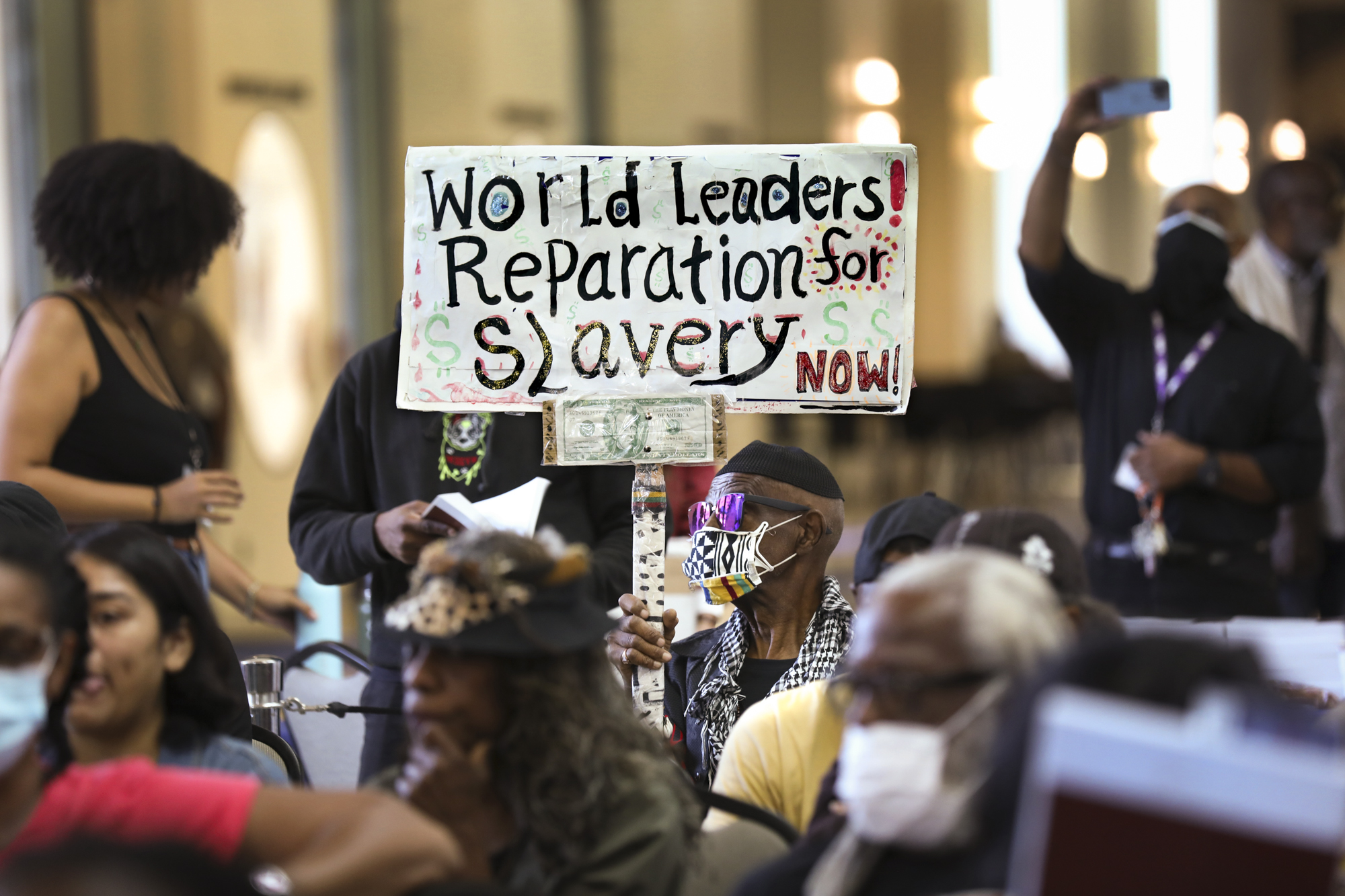
"caption": "Los Angeles long-time resident Walter Foster holds up a sign as the Reparations Task Force meets to hear public input on reparations at the California Science Center in Los Angeles on Sept. 22, 2022. California's new laws strengthen the state's commitment to repair the harms of slavery, signaling a long-term effort that’s gaining power and purpose.",
"credit": "Carolyn Cole/Los Angeles Times via Getty Images",
"altTag": null,
"description": null,
"imgSizes": {
"thumbnail": {
"file": "https://cdn.kqed.org/wp-content/uploads/sites/10/2025/10/GETTYIMAGES-1243475910-KQED-160x107.jpg",
"width": 160,
"height": 107,
"mimeType": "image/jpeg"
},
"1536x1536": {
"file": "https://cdn.kqed.org/wp-content/uploads/sites/10/2025/10/GETTYIMAGES-1243475910-KQED-1536x1024.jpg",
"width": 1536,
"height": 1024,
"mimeType": "image/jpeg"
},
"post-thumbnail": {
"file": "https://cdn.kqed.org/wp-content/uploads/sites/10/2025/10/GETTYIMAGES-1243475910-KQED-672x372.jpg",
"width": 672,
"height": 372,
"mimeType": "image/jpeg"
},
"twentyfourteen-full-width": {
"file": "https://cdn.kqed.org/wp-content/uploads/sites/10/2025/10/GETTYIMAGES-1243475910-KQED-1038x576.jpg",
"width": 1038,
"height": 576,
"mimeType": "image/jpeg"
},
"kqedFullSize": {
"file": "https://cdn.kqed.org/wp-content/uploads/sites/10/2025/10/GETTYIMAGES-1243475910-KQED.jpg",
"width": 2000,
"height": 1333
}
},
"isLoading": false,
"fetchFailed": false
},
"news_12059850": {
"type": "attachments",
"id": "news_12059850",
"meta": {
"index": "attachments_1716263798",
"site": "news",
"id": "12059850",
"found": true
},
"title": "251014-KAISER STRIKE START-MD-06-KQED",
"publishDate": 1760463342,
"status": "inherit",
"parent": 12059890,
"modified": 1760482077,
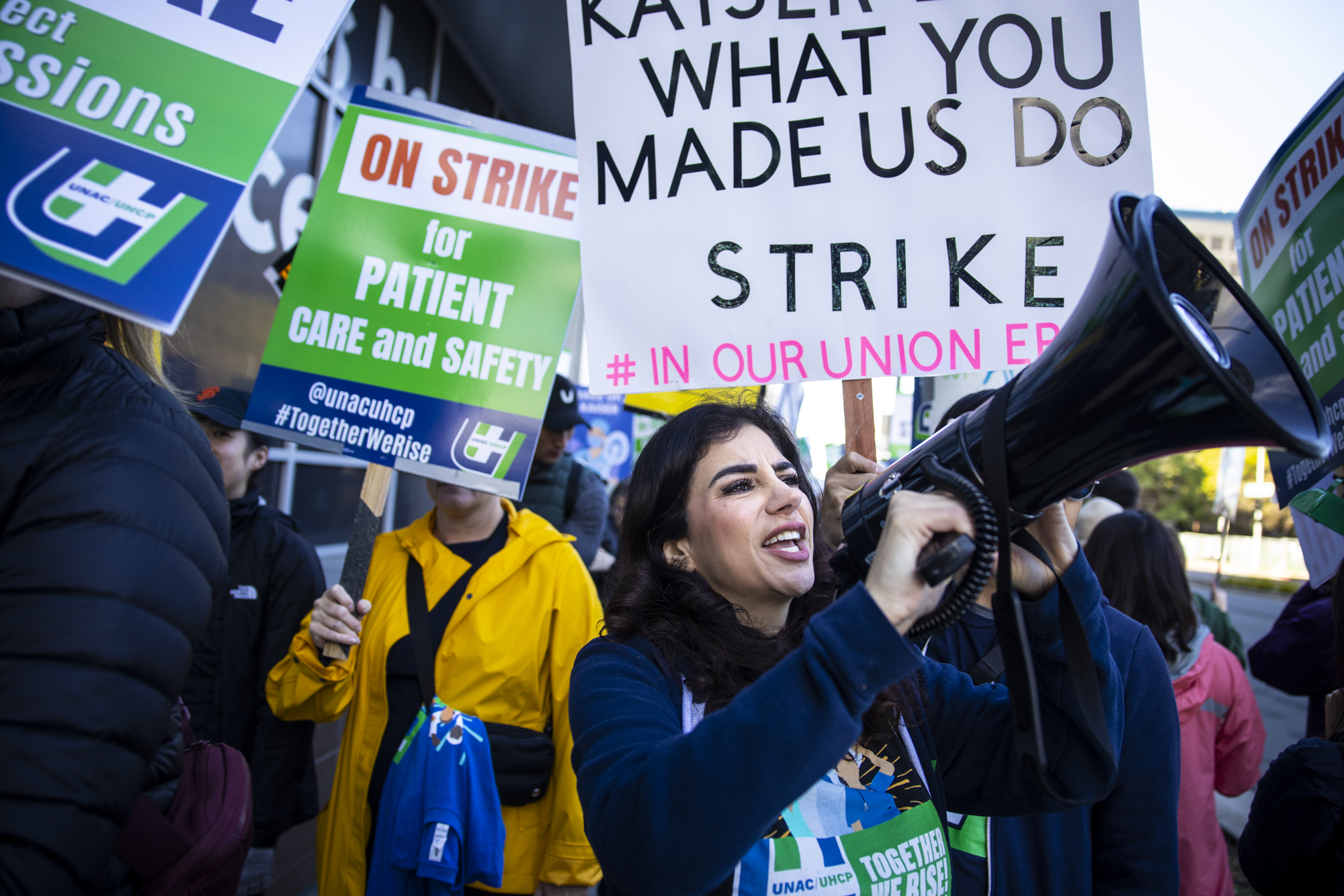
"caption": "Arezou Mansourian leads workers in chanting as they strike outside of the Kaiser Permanente Oakland Medical Center in Oakland on Oct. 14, 2025.",
"credit": "Martin do Nascimento/KQED",
"altTag": null,
"description": null,
"imgSizes": {
"thumbnail": {
"file": "https://cdn.kqed.org/wp-content/uploads/sites/10/2025/10/251014-KAISER-STRIKE-START-MD-06-KQED-160x107.jpg",
"width": 160,
"height": 107,
"mimeType": "image/jpeg"
},
"1536x1536": {
"file": "https://cdn.kqed.org/wp-content/uploads/sites/10/2025/10/251014-KAISER-STRIKE-START-MD-06-KQED-1536x1025.jpg",
"width": 1536,
"height": 1025,
"mimeType": "image/jpeg"
},
"post-thumbnail": {
"file": "https://cdn.kqed.org/wp-content/uploads/sites/10/2025/10/251014-KAISER-STRIKE-START-MD-06-KQED-672x372.jpg",
"width": 672,
"height": 372,
"mimeType": "image/jpeg"
},
"twentyfourteen-full-width": {
"file": "https://cdn.kqed.org/wp-content/uploads/sites/10/2025/10/251014-KAISER-STRIKE-START-MD-06-KQED-1038x576.jpg",
"width": 1038,
"height": 576,
"mimeType": "image/jpeg"
},
"kqedFullSize": {
"file": "https://cdn.kqed.org/wp-content/uploads/sites/10/2025/10/251014-KAISER-STRIKE-START-MD-06-KQED.jpg",
"width": 2000,
"height": 1334
}
},
"isLoading": false,
"fetchFailed": false
},
"news_12060338": {
"type": "attachments",
"id": "news_12060338",
"meta": {
"index": "attachments_1716263798",
"site": "news",
"id": "12060338",
"found": true
},
"title": "Unrecognizable Couple Paying Bills at Home",
"publishDate": 1760726619,
"status": "inherit",
"parent": 12060292,
"modified": 1760726739,
"caption": "Close up photo of man holding bill while doing finances. ",
"credit": "via Getty images",
"altTag": null,
"description": null,
"imgSizes": {
"thumbnail": {
"file": "https://cdn.kqed.org/wp-content/uploads/sites/10/2025/10/ClimateBill_lede-160x107.jpg",
"width": 160,
"height": 107,
"mimeType": "image/jpeg"
},
"1536x1536": {
"file": "https://cdn.kqed.org/wp-content/uploads/sites/10/2025/10/ClimateBill_lede-1536x1025.jpg",
"width": 1536,
"height": 1025,
"mimeType": "image/jpeg"
},
"post-thumbnail": {
"file": "https://cdn.kqed.org/wp-content/uploads/sites/10/2025/10/ClimateBill_lede-672x372.jpg",
"width": 672,
"height": 372,
"mimeType": "image/jpeg"
},
"twentyfourteen-full-width": {
"file": "https://cdn.kqed.org/wp-content/uploads/sites/10/2025/10/ClimateBill_lede-1038x576.jpg",
"width": 1038,
"height": 576,
"mimeType": "image/jpeg"
},
"kqedFullSize": {
"file": "https://cdn.kqed.org/wp-content/uploads/sites/10/2025/10/ClimateBill_lede.jpg",
"width": 1950,
"height": 1301
}
},
"isLoading": false,
"fetchFailed": false
},
"news_12044465": {
"type": "attachments",
"id": "news_12044465",
"meta": {
"index": "attachments_1716263798",
"site": "news",
"id": "12044465",
"found": true
},
"title": "250614-NO-KINGS-SF-MD-11-KQED",
"publishDate": 1749940390,
"status": "inherit",
"parent": 0,
"modified": 1749940553,
"caption": "Thousands of protesters rally in front of City Hall in San Francisco as part of the No Kings protest on June 14, 2025.",
"credit": "Martin do Nascimento/KQED",
"altTag": null,
"description": null,
"imgSizes": {
"thumbnail": {
"file": "https://cdn.kqed.org/wp-content/uploads/sites/10/2025/06/250614-NO-KINGS-SF-MD-11-KQED-160x107.jpg",
"width": 160,
"height": 107,
"mimeType": "image/jpeg"
},
"1536x1536": {
"file": "https://cdn.kqed.org/wp-content/uploads/sites/10/2025/06/250614-NO-KINGS-SF-MD-11-KQED-1536x1025.jpg",
"width": 1536,
"height": 1025,
"mimeType": "image/jpeg"
},
"post-thumbnail": {
"file": "https://cdn.kqed.org/wp-content/uploads/sites/10/2025/06/250614-NO-KINGS-SF-MD-11-KQED-672x372.jpg",
"width": 672,
"height": 372,
"mimeType": "image/jpeg"
},
"twentyfourteen-full-width": {
"file": "https://cdn.kqed.org/wp-content/uploads/sites/10/2025/06/250614-NO-KINGS-SF-MD-11-KQED-1038x576.jpg",
"width": 1038,
"height": 576,
"mimeType": "image/jpeg"
},
"kqedFullSize": {
"file": "https://cdn.kqed.org/wp-content/uploads/sites/10/2025/06/250614-NO-KINGS-SF-MD-11-KQED.jpg",
"width": 2000,
"height": 1334
}
},
"isLoading": false,
"fetchFailed": false
},
"news_12060145": {
"type": "attachments",
"id": "news_12060145",
"meta": {
"index": "attachments_1716263798",
"site": "news",
"id": "12060145",
"found": true
},
"title": "251016-MEASURE A MAILER-01-KQED-KQED",
"publishDate": 1760641314,
"status": "inherit",
"parent": 0,
"modified": 1760641326,
"caption": "A mailer sent out by Santa Clara County warning of federal budget cuts, photographed on Oct. 16, 2025.",
"credit": "Martin do Nascimento/KQED",
"altTag": null,
"description": null,
"imgSizes": {
"thumbnail": {
"file": "https://cdn.kqed.org/wp-content/uploads/sites/10/2025/10/251016-MEASURE-A-MAILER-01-KQED-KQED-160x107.jpg",
"width": 160,
"height": 107,
"mimeType": "image/jpeg"
},
"1536x1536": {
"file": "https://cdn.kqed.org/wp-content/uploads/sites/10/2025/10/251016-MEASURE-A-MAILER-01-KQED-KQED-1536x1025.jpg",
"width": 1536,
"height": 1025,
"mimeType": "image/jpeg"
},
"post-thumbnail": {
"file": "https://cdn.kqed.org/wp-content/uploads/sites/10/2025/10/251016-MEASURE-A-MAILER-01-KQED-KQED-672x372.jpg",
"width": 672,
"height": 372,
"mimeType": "image/jpeg"
},
"twentyfourteen-full-width": {
"file": "https://cdn.kqed.org/wp-content/uploads/sites/10/2025/10/251016-MEASURE-A-MAILER-01-KQED-KQED-1038x576.jpg",
"width": 1038,
"height": 576,
"mimeType": "image/jpeg"
},
"kqedFullSize": {
"file": "https://cdn.kqed.org/wp-content/uploads/sites/10/2025/10/251016-MEASURE-A-MAILER-01-KQED-KQED.jpg",
"width": 2000,
"height": 1334
}
},
"isLoading": false,
"fetchFailed": false
},
"news_12020448": {
"type": "attachments",
"id": "news_12020448",
"meta": {
"index": "attachments_1716263798",
"site": "news",
"id": "12020448",
"found": true
},
"title": "20250106_KishiBashi_DMB_00206",
"publishDate": 1736198069,
"status": "inherit",
"parent": 12026067,
"modified": 1738886858,
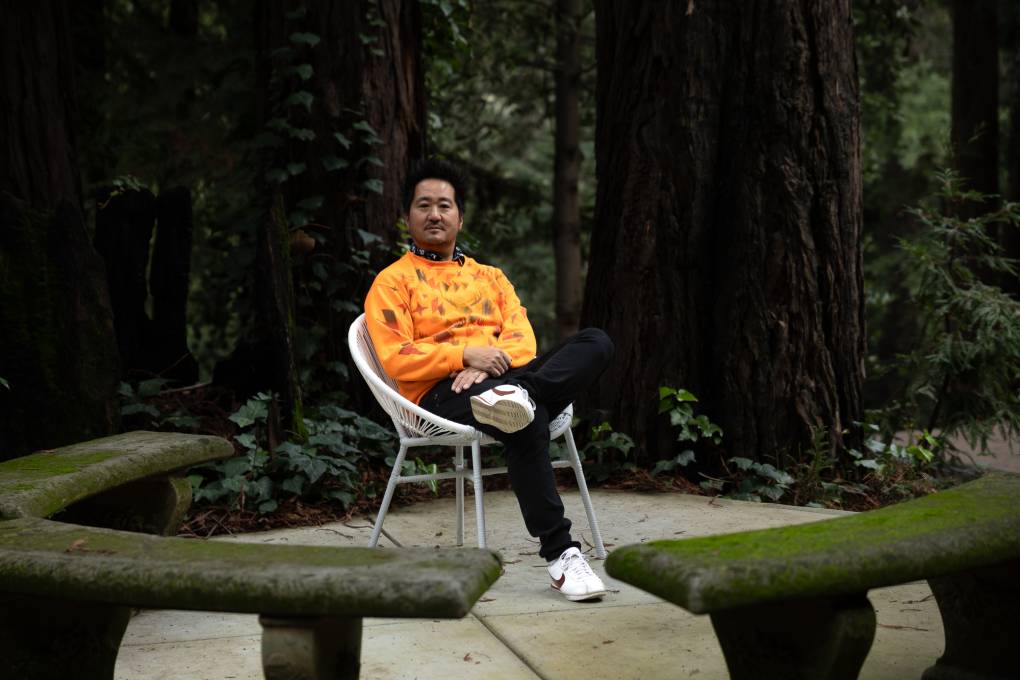
"caption": "Composer Kishi Bashi poses for a portrait at his home in the Santa Cruz Mountains of Los Gatos, Calif., Jan. 6, 2025.",
"credit": "David M. Barreda/KQED",
"altTag": null,
"description": null,
"imgSizes": {
"medium": {
"file": "https://cdn.kqed.org/wp-content/uploads/sites/10/2025/01/20250106_KishiBashi_DMB_00206-800x533.jpg",
"width": 800,
"height": 533,
"mimeType": "image/jpeg"
},
"large": {
"file": "https://cdn.kqed.org/wp-content/uploads/sites/10/2025/01/20250106_KishiBashi_DMB_00206-1020x680.jpg",
"width": 1020,
"height": 680,
"mimeType": "image/jpeg"
},
"thumbnail": {
"file": "https://cdn.kqed.org/wp-content/uploads/sites/10/2025/01/20250106_KishiBashi_DMB_00206-160x107.jpg",
"width": 160,
"height": 107,
"mimeType": "image/jpeg"
},
"1536x1536": {
"file": "https://cdn.kqed.org/wp-content/uploads/sites/10/2025/01/20250106_KishiBashi_DMB_00206-1536x1024.jpg",
"width": 1536,
"height": 1024,
"mimeType": "image/jpeg"
},
"post-thumbnail": {
"file": "https://cdn.kqed.org/wp-content/uploads/sites/10/2025/01/20250106_KishiBashi_DMB_00206-672x372.jpg",
"width": 672,
"height": 372,
"mimeType": "image/jpeg"
},
"twentyfourteen-full-width": {
"file": "https://cdn.kqed.org/wp-content/uploads/sites/10/2025/01/20250106_KishiBashi_DMB_00206-1038x576.jpg",
"width": 1038,
"height": 576,
"mimeType": "image/jpeg"
},
"full-width": {
"file": "https://cdn.kqed.org/wp-content/uploads/sites/10/2025/01/20250106_KishiBashi_DMB_00206-1920x1280.jpg",
"width": 1920,
"height": 1280,
"mimeType": "image/jpeg"
},
"kqedFullSize": {
"file": "https://cdn.kqed.org/wp-content/uploads/sites/10/2025/01/20250106_KishiBashi_DMB_00206.jpg",
"width": 2000,
"height": 1333
}
},
"isLoading": false,
"fetchFailed": false
},
"news_12044676": {
"type": "attachments",
"id": "news_12044676",
"meta": {
"index": "attachments_1716263798",
"site": "news",
"id": "12044676",
"found": true
},
"title": "20250616_UNHOUSEDCREEKRESTORATION_GC-37-KQED",
"publishDate": 1750184018,
"status": "inherit",
"parent": 12058952,
"modified": 1760397367,
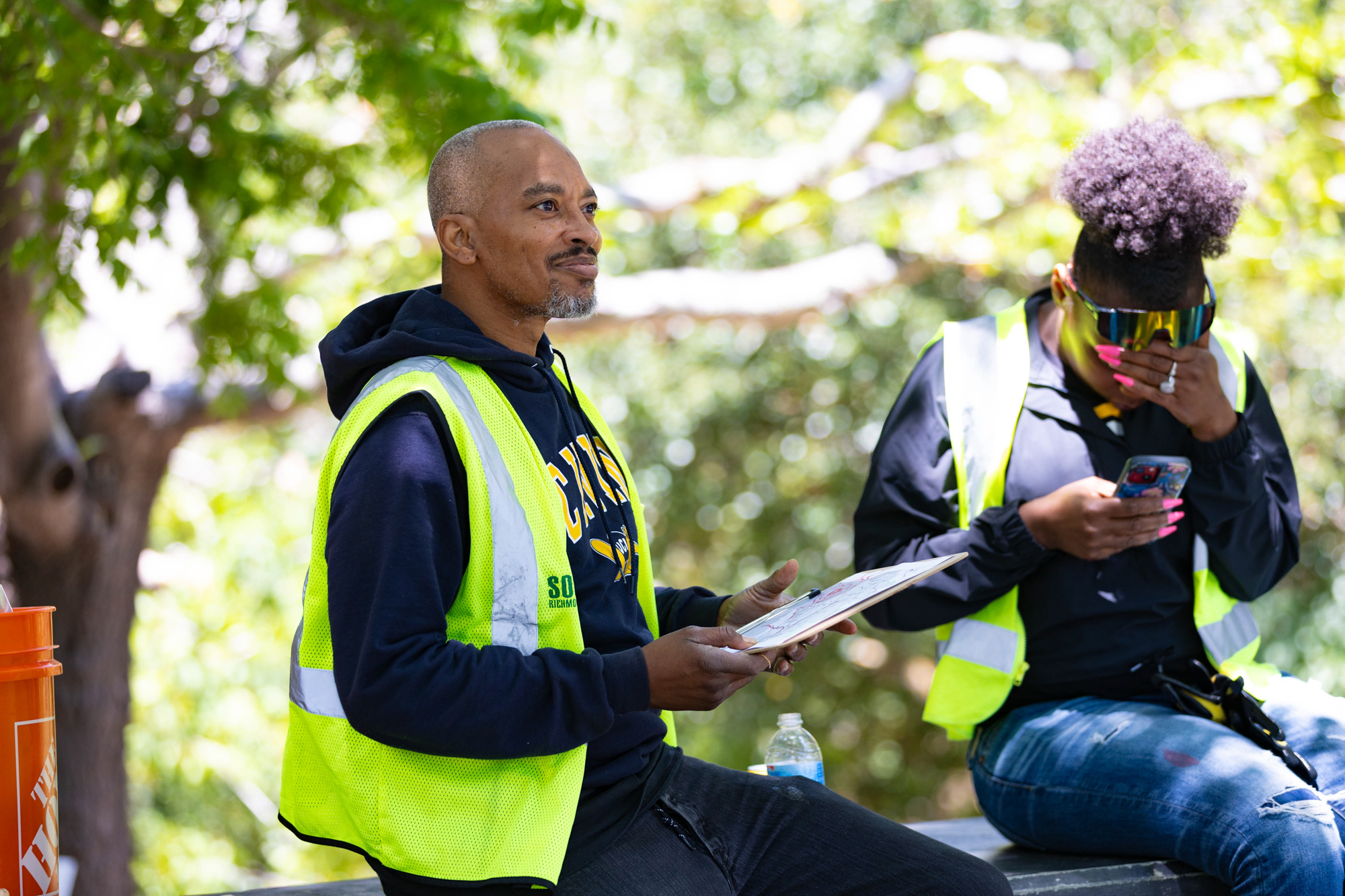
"caption": "Eric Adams, a participant of the Pinole Creek Unhoused Stewards Pilot Program, listens during a classroom session outside of Pinole Library in Pinole on June 16, 2025.",
"credit": "Gina Castro/KQED",
"altTag": null,
"description": null,
"imgSizes": {
"thumbnail": {
"file": "https://cdn.kqed.org/wp-content/uploads/sites/10/2025/06/20250616_UNHOUSEDCREEKRESTORATION_GC-37-KQED-160x107.jpg",
"width": 160,
"height": 107,
"mimeType": "image/jpeg"
},
"1536x1536": {
"file": "https://cdn.kqed.org/wp-content/uploads/sites/10/2025/06/20250616_UNHOUSEDCREEKRESTORATION_GC-37-KQED-1536x1024.jpg",
"width": 1536,
"height": 1024,
"mimeType": "image/jpeg"
},
"post-thumbnail": {
"file": "https://cdn.kqed.org/wp-content/uploads/sites/10/2025/06/20250616_UNHOUSEDCREEKRESTORATION_GC-37-KQED-672x372.jpg",
"width": 672,
"height": 372,
"mimeType": "image/jpeg"
},
"twentyfourteen-full-width": {
"file": "https://cdn.kqed.org/wp-content/uploads/sites/10/2025/06/20250616_UNHOUSEDCREEKRESTORATION_GC-37-KQED-1038x576.jpg",
"width": 1038,
"height": 576,
"mimeType": "image/jpeg"
},
"kqedFullSize": {
"file": "https://cdn.kqed.org/wp-content/uploads/sites/10/2025/06/20250616_UNHOUSEDCREEKRESTORATION_GC-37-KQED.jpg",
"width": 2000,
"height": 1333
}
},
"isLoading": false,
"fetchFailed": false
},
"news_12060142": {
"type": "attachments",
"id": "news_12060142",
"meta": {
"index": "attachments_1716263798",
"site": "news",
"id": "12060142",
"found": true
},
"title": "Border Patrol Agents Detain Migrants Near US-Mexico Border",
"publishDate": 1760641072,
"status": "inherit",
"parent": 12060135,
"modified": 1760643684,
"caption": "A 2-year-old Honduran asylum seeker cries as her mother is searched and detained near the U.S.-Mexico border on June 12, 2018, in McAllen, Texas. ",
"credit": "John Moore/Getty Images",
"altTag": null,
"description": null,
"imgSizes": {
"thumbnail": {
"file": "https://cdn.kqed.org/wp-content/uploads/sites/10/2025/10/FamilySeparationGetty1-160x107.jpg",
"width": 160,
"height": 107,
"mimeType": "image/jpeg"
},
"1536x1536": {
"file": "https://cdn.kqed.org/wp-content/uploads/sites/10/2025/10/FamilySeparationGetty1-1536x1024.jpg",
"width": 1536,
"height": 1024,
"mimeType": "image/jpeg"
},
"post-thumbnail": {
"file": "https://cdn.kqed.org/wp-content/uploads/sites/10/2025/10/FamilySeparationGetty1-672x372.jpg",
"width": 672,
"height": 372,
"mimeType": "image/jpeg"
},
"twentyfourteen-full-width": {
"file": "https://cdn.kqed.org/wp-content/uploads/sites/10/2025/10/FamilySeparationGetty1-1038x576.jpg",
"width": 1038,
"height": 576,
"mimeType": "image/jpeg"
},
"kqedFullSize": {
"file": "https://cdn.kqed.org/wp-content/uploads/sites/10/2025/10/FamilySeparationGetty1.jpg",
"width": 2000,
"height": 1333
}
},
"isLoading": false,
"fetchFailed": false
},
"news_12060218": {
"type": "attachments",
"id": "news_12060218",
"meta": {
"index": "attachments_1716263798",
"site": "news",
"id": "12060218",
"found": true
},
"title": "SFFireDeptLomaPrieta1",
"publishDate": 1760659262,
"status": "inherit",
"parent": 12060130,
"modified": 1760659307,
"caption": "San Francisco Fire Department firefighters test the city's Emergency Firefighting Water System on Oct. 16, 2025 on the north tip of Van Ness Avenue.",
"credit": "Nibras Suliman/KQED",
"altTag": null,
"description": null,
"imgSizes": {
"thumbnail": {
"file": "https://cdn.kqed.org/wp-content/uploads/sites/10/2025/10/SFFireDeptLomaPrieta1-160x120.jpg",
"width": 160,
"height": 120,
"mimeType": "image/jpeg"
},
"1536x1536": {
"file": "https://cdn.kqed.org/wp-content/uploads/sites/10/2025/10/SFFireDeptLomaPrieta1-1536x1152.jpg",
"width": 1536,
"height": 1152,
"mimeType": "image/jpeg"
},
"post-thumbnail": {
"file": "https://cdn.kqed.org/wp-content/uploads/sites/10/2025/10/SFFireDeptLomaPrieta1-672x372.jpg",
"width": 672,
"height": 372,
"mimeType": "image/jpeg"
},
"twentyfourteen-full-width": {
"file": "https://cdn.kqed.org/wp-content/uploads/sites/10/2025/10/SFFireDeptLomaPrieta1-1038x576.jpg",
"width": 1038,
"height": 576,
"mimeType": "image/jpeg"
},
"kqedFullSize": {
"file": "https://cdn.kqed.org/wp-content/uploads/sites/10/2025/10/SFFireDeptLomaPrieta1.jpg",
"width": 2000,
"height": 1500
}
},
"isLoading": false,
"fetchFailed": false
},
"news_12060184": {
"type": "attachments",
"id": "news_12060184",
"meta": {
"index": "attachments_1716263798",
"site": "news",
"id": "12060184",
"found": true
},
"title": "251016_FOODBANKSHUTDOWN-_GH-5-KQED",
"publishDate": 1760648914,
"status": "inherit",
"parent": 0,
"modified": 1760649072,
"caption": "TSA officer Leandro Banuelos Jr., center, helps colleagues unload boxes of food at Oakland International Airport on Oct. 16, 2025. The Alameda County Community Food Bank provided produce and pantry staples to TSA staff during the federal shutdown.",
"credit": "Gustavo Hernandez/KQED",
"altTag": null,
"description": null,
"imgSizes": {
"thumbnail": {
"file": "https://cdn.kqed.org/wp-content/uploads/sites/10/2025/10/251016_FOODBANKSHUTDOWN-_GH-5-KQED-160x107.jpg",
"width": 160,
"height": 107,
"mimeType": "image/jpeg"
},
"1536x1536": {
"file": "https://cdn.kqed.org/wp-content/uploads/sites/10/2025/10/251016_FOODBANKSHUTDOWN-_GH-5-KQED-1536x1024.jpg",
"width": 1536,
"height": 1024,
"mimeType": "image/jpeg"
},
"post-thumbnail": {
"file": "https://cdn.kqed.org/wp-content/uploads/sites/10/2025/10/251016_FOODBANKSHUTDOWN-_GH-5-KQED-672x372.jpg",
"width": 672,
"height": 372,
"mimeType": "image/jpeg"
},
"twentyfourteen-full-width": {
"file": "https://cdn.kqed.org/wp-content/uploads/sites/10/2025/10/251016_FOODBANKSHUTDOWN-_GH-5-KQED-1038x576.jpg",
"width": 1038,
"height": 576,
"mimeType": "image/jpeg"
},
"kqedFullSize": {
"file": "https://cdn.kqed.org/wp-content/uploads/sites/10/2025/10/251016_FOODBANKSHUTDOWN-_GH-5-KQED.jpg",
"width": 2000,
"height": 1333
}
},
"isLoading": false,
"fetchFailed": false
},
"news_12060163": {
"type": "attachments",
"id": "news_12060163",
"meta": {
"index": "attachments_1716263798",
"site": "news",
"id": "12060163",
"found": true
},
"title": "Views over the Yosemite Valley floor at sunset.",
"publishDate": 1760644001,
"status": "inherit",
"parent": 12060120,
"modified": 1760644029,
"caption": "Views over the Yosemite Valley floor at sunset.",
"credit": "Matthew Micah Wright/Getty Images",
"altTag": null,
"description": null,
"imgSizes": {
"thumbnail": {
"file": "https://cdn.kqed.org/wp-content/uploads/sites/10/2025/10/YosemiteGetty3-160x107.jpg",
"width": 160,
"height": 107,
"mimeType": "image/jpeg"
},
"1536x1536": {
"file": "https://cdn.kqed.org/wp-content/uploads/sites/10/2025/10/YosemiteGetty3-1536x1024.jpg",
"width": 1536,
"height": 1024,
"mimeType": "image/jpeg"
},
"post-thumbnail": {
"file": "https://cdn.kqed.org/wp-content/uploads/sites/10/2025/10/YosemiteGetty3-672x372.jpg",
"width": 672,
"height": 372,
"mimeType": "image/jpeg"
},
"twentyfourteen-full-width": {
"file": "https://cdn.kqed.org/wp-content/uploads/sites/10/2025/10/YosemiteGetty3-1038x576.jpg",
"width": 1038,
"height": 576,
"mimeType": "image/jpeg"
},
"kqedFullSize": {
"file": "https://cdn.kqed.org/wp-content/uploads/sites/10/2025/10/YosemiteGetty3.jpg",
"width": 2000,
"height": 1333
}
},
"isLoading": false,
"fetchFailed": false
},
"news_12059706": {
"type": "attachments",
"id": "news_12059706",
"meta": {
"index": "attachments_1716263798",
"site": "news",
"id": "12059706",
"found": true
},
"title": "MyShake_WP",
"publishDate": 1760381926,
"status": "inherit",
"parent": 12059704,
"modified": 1760382317,
"caption": "If you’re one of the over 4 million Californians who have the MyShake earthquake warning app downloaded, you might get a loud alert on Thursday morning. This test will be part of the Annual Great ShakeOut quake preparedness drill, taking place across the globe.",
"credit": "Courtesy of Suresh Raman",
"altTag": null,
"description": null,
"imgSizes": {
"thumbnail": {
"file": "https://cdn.kqed.org/wp-content/uploads/sites/10/2025/10/MyShake_WP-160x105.png",
"width": 160,
"height": 105,
"mimeType": "image/png"
},
"1536x1536": {
"file": "https://cdn.kqed.org/wp-content/uploads/sites/10/2025/10/MyShake_WP-1536x1009.png",
"width": 1536,
"height": 1009,
"mimeType": "image/png"
},
"post-thumbnail": {
"file": "https://cdn.kqed.org/wp-content/uploads/sites/10/2025/10/MyShake_WP-672x372.png",
"width": 672,
"height": 372,
"mimeType": "image/png"
},
"twentyfourteen-full-width": {
"file": "https://cdn.kqed.org/wp-content/uploads/sites/10/2025/10/MyShake_WP-1038x576.png",
"width": 1038,
"height": 576,
"mimeType": "image/png"
},
"kqedFullSize": {
"file": "https://cdn.kqed.org/wp-content/uploads/sites/10/2025/10/MyShake_WP.png",
"width": 1920,
"height": 1261
}
},
"isLoading": false,
"fetchFailed": false
}
},
"audioPlayerReducer": {
"postId": "stream_live",
"isPaused": true,
"isPlaying": false,
"pfsActive": false,
"pledgeModalIsOpen": true,
"playerDrawerIsOpen": false,
"liveAudioPlayStartedAt": 0,
"liveAudioPlayContext": ""
},
"authorsReducer": {
"byline_news_12060403": {
"type": "authors",
"id": "byline_news_12060403",
"meta": {
"override": true
},
"slug": "byline_news_12060403",
"name": "Virginie Ladisch",
"isLoading": false
},
"byline_news_12060135": {
"type": "authors",
"id": "byline_news_12060135",
"meta": {
"override": true
},
"slug": "byline_news_12060135",
"name": "Mark Betancourt, The California Newsroom",
"isLoading": false
},
"shotchkiss": {
"type": "authors",
"id": "61",
"meta": {
"index": "authors_1716337520",
"id": "61",
"found": true
},
"name": "Sarah Hotchkiss",
"firstName": "Sarah",
"lastName": "Hotchkiss",
"slug": "shotchkiss",
"email": "shotchkiss@kqed.org",
"display_author_email": true,
"staff_mastheads": [
"arts"
],
"title": "Senior Editor",
"bio": "Sarah Hotchkiss is a San Francisco \u003ca href=\"http://www.sarahhotchkiss.com\">artist\u003c/a> and arts writer. In 2019, she received the Dorothea & Leo Rabkin Foundation grant for visual art journalism and in 2020 she received a Society of Professional Journalists, Northern California award for excellence in arts and culture reporting.",
"avatar": "https://secure.gravatar.com/avatar/bc662df144b3d27fd8b1b6f1c2a420d34e91e53154d411bb7ad353cc8b6cea8d?s=600&d=blank&r=g",
"twitter": null,
"bluesky": null,
"facebook": null,
"instagram": null,
"linkedin": null,
"sites": [
{
"site": "",
"roles": [
"editor"
]
},
{
"site": "arts",
"roles": [
"Contributor",
"administrator"
]
},
{
"site": "artschool",
"roles": [
"administrator"
]
},
{
"site": "news",
"roles": [
"editor"
]
},
{
"site": "pop",
"roles": [
"administrator"
]
},
{
"site": "bayareabites",
"roles": [
"editor"
]
},
{
"site": "spark",
"roles": [
"editor"
]
},
{
"site": "checkplease",
"roles": [
"editor"
]
}
],
"headData": {
"title": "Sarah Hotchkiss | KQED",
"description": "Senior Editor",
"ogImgSrc": "https://secure.gravatar.com/avatar/bc662df144b3d27fd8b1b6f1c2a420d34e91e53154d411bb7ad353cc8b6cea8d?s=600&d=blank&r=g",
"twImgSrc": "https://secure.gravatar.com/avatar/bc662df144b3d27fd8b1b6f1c2a420d34e91e53154d411bb7ad353cc8b6cea8d?s=600&d=blank&r=g"
},
"isLoading": false,
"link": "/author/shotchkiss"
},
"gmarzorati": {
"type": "authors",
"id": "227",
"meta": {
"index": "authors_1716337520",
"id": "227",
"found": true
},
"name": "Guy Marzorati",
"firstName": "Guy",
"lastName": "Marzorati",
"slug": "gmarzorati",
"email": "gmarzorati@KQED.org",
"display_author_email": true,
"staff_mastheads": [
"news"
],
"title": "Correspondent",
"bio": "Guy Marzorati is a correspondent on KQED's California Politics and Government Desk, based in San Jose. A graduate of Santa Clara University, Guy joined KQED in 2013. He reports on state and local politics and produces KQED's digital voter guide.",
"avatar": "https://secure.gravatar.com/avatar/e7038b8dbfd55b104369b76b1cd0b9de?s=600&d=blank&r=g",
"twitter": "guymarzorati",
"facebook": null,
"instagram": null,
"linkedin": null,
"sites": [
{
"site": "",
"roles": [
"editor"
]
},
{
"site": "news",
"roles": [
"editor"
]
},
{
"site": "science",
"roles": [
"editor"
]
},
{
"site": "forum",
"roles": [
"editor"
]
},
{
"site": "elections",
"roles": [
"editor"
]
},
{
"site": "liveblog",
"roles": [
"editor"
]
}
],
"headData": {
"title": "Guy Marzorati | KQED",
"description": "Correspondent",
"ogImgSrc": "https://secure.gravatar.com/avatar/e7038b8dbfd55b104369b76b1cd0b9de?s=600&d=blank&r=g",
"twImgSrc": "https://secure.gravatar.com/avatar/e7038b8dbfd55b104369b76b1cd0b9de?s=600&d=blank&r=g"
},
"isLoading": false,
"link": "/author/gmarzorati"
},
"kqed": {
"type": "authors",
"id": "236",
"meta": {
"index": "authors_1716337520",
"id": "236",
"found": true
},
"name": "KQED News Staff",
"firstName": "KQED News Staff",
"lastName": null,
"slug": "kqed",
"email": "faq@kqed.org",
"display_author_email": false,
"staff_mastheads": [],
"title": null,
"bio": null,
"avatar": "https://secure.gravatar.com/avatar/ef0e801a68c4c54afa9180db14084167?s=600&d=blank&r=g",
"twitter": null,
"facebook": null,
"instagram": null,
"linkedin": null,
"sites": [
{
"site": "arts",
"roles": [
"contributor"
]
},
{
"site": "news",
"roles": [
"editor"
]
},
{
"site": "futureofyou",
"roles": [
"author"
]
}
],
"headData": {
"title": "KQED News Staff | KQED",
"description": null,
"ogImgSrc": "https://secure.gravatar.com/avatar/ef0e801a68c4c54afa9180db14084167?s=600&d=blank&r=g",
"twImgSrc": "https://secure.gravatar.com/avatar/ef0e801a68c4c54afa9180db14084167?s=600&d=blank&r=g"
},
"isLoading": false,
"link": "/author/kqed"
},
"fjhabvala": {
"type": "authors",
"id": "8659",
"meta": {
"index": "authors_1716337520",
"id": "8659",
"found": true
},
"name": "Farida Jhabvala Romero",
"firstName": "Farida",
"lastName": "Jhabvala Romero",
"slug": "fjhabvala",
"email": "fjhabvala@kqed.org",
"display_author_email": true,
"staff_mastheads": [
"news"
],
"title": "KQED Contributor",
"bio": "\u003cspan style=\"font-weight: 400;\">Farida Jhabvala Romero is a Labor Correspondent for KQED. She previously covered immigration. Farida was \u003ca href=\"https://www.ccnma.org/2022-most-influential-latina-journalists\">named\u003c/a> one of the 10 Most Influential Latina Journalists in California in 2022 by the California Chicano News Media Association. Her work has won awards from the Society of Professional Journalists (Northern California), as well as a national and regional Edward M. Murrow Award for the collaborative reporting projects “Dangerous Air” and “Graying California.” \u003c/span>\u003cspan style=\"font-weight: 400;\">Before joining KQED, Farida worked as a producer at Radio Bilingüe, a national public radio network. Farida earned her master’s degree in journalism from Stanford University.\u003c/span>",
"avatar": "https://secure.gravatar.com/avatar/c3ab27c5554b67b478f80971e515aa02?s=600&d=blank&r=g",
"twitter": "FaridaJhabvala",
"facebook": null,
"instagram": null,
"linkedin": "https://www.linkedin.com/in/faridajhabvala/",
"sites": [
{
"site": "news",
"roles": [
"editor"
]
},
{
"site": "stateofhealth",
"roles": [
"author"
]
}
],
"headData": {
"title": "Farida Jhabvala Romero | KQED",
"description": "KQED Contributor",
"ogImgSrc": "https://secure.gravatar.com/avatar/c3ab27c5554b67b478f80971e515aa02?s=600&d=blank&r=g",
"twImgSrc": "https://secure.gravatar.com/avatar/c3ab27c5554b67b478f80971e515aa02?s=600&d=blank&r=g"
},
"isLoading": false,
"link": "/author/fjhabvala"
},
"vrancano": {
"type": "authors",
"id": "11276",
"meta": {
"index": "authors_1716337520",
"id": "11276",
"found": true
},
"name": "Vanessa Rancaño",
"firstName": "Vanessa",
"lastName": "Rancaño",
"slug": "vrancano",
"email": "vrancano@kqed.org",
"display_author_email": false,
"staff_mastheads": [
"news"
],
"title": "Reporter",
"bio": "Vanessa Rancaño is a features reporter for KQED. She’s also covered homelessness and education for the station and reported from the Central Valley. Her work has aired across public radio, from flagship national news shows to longform narrative podcasts. Before taking up a mic, she worked as a freelance print journalist. She’s been recognized with a number of national and regional awards. Vanessa grew up in California's Central Valley. She's a former NPR Kroc Fellow, and a graduate of the UC Berkeley Graduate School of Journalism.",
"avatar": "https://secure.gravatar.com/avatar/b3a383dfb0e7ee1c17568f2cf067904ab654d6e3de9743fc661f3c788ade1bed?s=600&d=blank&r=g",
"twitter": "vanessarancano",
"bluesky": null,
"facebook": null,
"instagram": null,
"linkedin": null,
"sites": [
{
"site": "arts",
"roles": [
"editor"
]
},
{
"site": "news",
"roles": [
"editor"
]
},
{
"site": "liveblog",
"roles": [
"contributor"
]
}
],
"headData": {
"title": "Vanessa Rancaño | KQED",
"description": "Reporter",
"ogImgSrc": "https://secure.gravatar.com/avatar/b3a383dfb0e7ee1c17568f2cf067904ab654d6e3de9743fc661f3c788ade1bed?s=600&d=blank&r=g",
"twImgSrc": "https://secure.gravatar.com/avatar/b3a383dfb0e7ee1c17568f2cf067904ab654d6e3de9743fc661f3c788ade1bed?s=600&d=blank&r=g"
},
"isLoading": false,
"link": "/author/vrancano"
},
"smohamad": {
"type": "authors",
"id": "11631",
"meta": {
"index": "authors_1716337520",
"id": "11631",
"found": true
},
"name": "Sarah Mohamad",
"firstName": "Sarah",
"lastName": "Mohamad",
"slug": "smohamad",
"email": "smohamad@KQED.org",
"display_author_email": true,
"staff_mastheads": [],
"title": "Engagement Producer and Reporter, KQED Science",
"bio": "Sarah Mohamad is an audience engagement reporter and producer for KQED Science. She reports on audience-focused science and environment stories and manages the team's social media, newsletter, and engagement efforts. Prior to this role, she played a key role as project manager for NSF's \u003ca href=\"https://www.kqed.org/crackingthecode\">\u003cem>Cracking the Code: Influencing Millennial Science Engagement\u003c/em> \u003c/a>audience research.",
"avatar": "https://secure.gravatar.com/avatar/e6224957cd82d015183756ddde1f928013a563d7ca2e4565f8c4de1ec64886c5?s=600&d=blank&r=g",
"twitter": "sarahkmohamad",
"bluesky": null,
"facebook": null,
"instagram": null,
"linkedin": null,
"sites": [
{
"site": "arts",
"roles": [
"editor"
]
},
{
"site": "news",
"roles": [
"editor"
]
},
{
"site": "about",
"roles": [
"editor"
]
},
{
"site": "science",
"roles": [
"editor"
]
}
],
"headData": {
"title": "Sarah Mohamad | KQED",
"description": "Engagement Producer and Reporter, KQED Science",
"ogImgSrc": "https://secure.gravatar.com/avatar/e6224957cd82d015183756ddde1f928013a563d7ca2e4565f8c4de1ec64886c5?s=600&d=blank&r=g",
"twImgSrc": "https://secure.gravatar.com/avatar/e6224957cd82d015183756ddde1f928013a563d7ca2e4565f8c4de1ec64886c5?s=600&d=blank&r=g"
},
"isLoading": false,
"link": "/author/smohamad"
},
"ccabreralomeli": {
"type": "authors",
"id": "11708",
"meta": {
"index": "authors_1716337520",
"id": "11708",
"found": true
},
"name": "Carlos Cabrera-Lomelí",
"firstName": "Carlos",
"lastName": "Cabrera-Lomelí",
"slug": "ccabreralomeli",
"email": "ccabreralomeli@KQED.org",
"display_author_email": true,
"staff_mastheads": [
"news"
],
"title": "Community Reporter",
"bio": "Carlos Cabrera-Lomelí is a community reporter with KQED's digital engagement team. He also reports and co-produces for KQED's bilingual news hub KQED en Español. He grew up in San Francisco's Mission District and has previously worked with Univision, 48 Hills and REFORMA in Mexico City.",
"avatar": "https://secure.gravatar.com/avatar/c309be9665e484f887b818c89e273ecc673004f426f36b24d00a4d813a2e0518?s=600&d=blank&r=g",
"twitter": "@LomeliCabrera",
"bluesky": null,
"facebook": null,
"instagram": null,
"linkedin": null,
"sites": [
{
"site": "arts",
"roles": [
"editor"
]
},
{
"site": "news",
"roles": [
"editor"
]
},
{
"site": "about",
"roles": [
"editor"
]
},
{
"site": "science",
"roles": [
"editor"
]
},
{
"site": "perspectives",
"roles": [
"editor"
]
},
{
"site": "elections",
"roles": [
"editor"
]
},
{
"site": "liveblog",
"roles": [
"contributor"
]
}
],
"headData": {
"title": "Carlos Cabrera-Lomelí | KQED",
"description": "Community Reporter",
"ogImgSrc": "https://secure.gravatar.com/avatar/c309be9665e484f887b818c89e273ecc673004f426f36b24d00a4d813a2e0518?s=600&d=blank&r=g",
"twImgSrc": "https://secure.gravatar.com/avatar/c309be9665e484f887b818c89e273ecc673004f426f36b24d00a4d813a2e0518?s=600&d=blank&r=g"
},
"isLoading": false,
"link": "/author/ccabreralomeli"
},
"jlara": {
"type": "authors",
"id": "11761",
"meta": {
"index": "authors_1716337520",
"id": "11761",
"found": true
},
"name": "Juan Carlos Lara",
"firstName": "Juan Carlos",
"lastName": "Lara",
"slug": "jlara",
"email": "jlara@kqed.org",
"display_author_email": false,
"staff_mastheads": [],
"title": "KQED Contributor",
"bio": null,
"avatar": "https://secure.gravatar.com/avatar/19e2052b9b05657c5ff2af2121846e9c?s=600&d=blank&r=g",
"twitter": null,
"facebook": null,
"instagram": null,
"linkedin": null,
"sites": [
{
"site": "arts",
"roles": [
"editor"
]
},
{
"site": "news",
"roles": [
"editor"
]
},
{
"site": "forum",
"roles": [
"editor"
]
},
{
"site": "liveblog",
"roles": [
"contributor"
]
}
],
"headData": {
"title": "Juan Carlos Lara | KQED",
"description": "KQED Contributor",
"ogImgSrc": "https://secure.gravatar.com/avatar/19e2052b9b05657c5ff2af2121846e9c?s=600&d=blank&r=g",
"twImgSrc": "https://secure.gravatar.com/avatar/19e2052b9b05657c5ff2af2121846e9c?s=600&d=blank&r=g"
},
"isLoading": false,
"link": "/author/jlara"
},
"sarahwright": {
"type": "authors",
"id": "11956",
"meta": {
"index": "authors_1716337520",
"id": "11956",
"found": true
},
"name": "Sarah Wright",
"firstName": "Sarah",
"lastName": "Wright",
"slug": "sarahwright",
"email": "swright@kqed.org",
"display_author_email": true,
"staff_mastheads": [],
"title": "Outdoors Engagement Reporter",
"bio": "Sarah Wright is KQED's Outdoors Engagement Reporter. Originally from Lake Tahoe, she completed a thru-hike of the Pacific Crest Trail in 2019 and was a U.S. Fulbright Program grantee to Argentina in 2023. Her journalism has appeared in The Guardian, The San Francisco Standard, The Palo Alto Weekly and the Half Moon Bay Review.",
"avatar": "https://secure.gravatar.com/avatar/c161a3d6441865cba25e6db4fa561099ad665799e9432e34da2b84d7e371524c?s=600&d=blank&r=g",
"twitter": null,
"bluesky": null,
"facebook": null,
"instagram": null,
"linkedin": null,
"sites": [
{
"site": "arts",
"roles": [
"editor"
]
},
{
"site": "news",
"roles": [
"editor"
]
},
{
"site": "science",
"roles": [
"contributor",
"author"
]
},
{
"site": "forum",
"roles": [
"editor"
]
}
],
"headData": {
"title": "Sarah Wright | KQED",
"description": "Outdoors Engagement Reporter",
"ogImgSrc": "https://secure.gravatar.com/avatar/c161a3d6441865cba25e6db4fa561099ad665799e9432e34da2b84d7e371524c?s=600&d=blank&r=g",
"twImgSrc": "https://secure.gravatar.com/avatar/c161a3d6441865cba25e6db4fa561099ad665799e9432e34da2b84d7e371524c?s=600&d=blank&r=g"
},
"isLoading": false,
"link": "/author/sarahwright"
},
"nsuliman": {
"type": "authors",
"id": "11985",
"meta": {
"index": "authors_1716337520",
"id": "11985",
"found": true
},
"name": "Nibras Suliman",
"firstName": "Nibras",
"lastName": "Suliman",
"slug": "nsuliman",
"email": "nsuliman@kqed.org",
"display_author_email": false,
"staff_mastheads": [],
"title": "KQED Contributor",
"bio": null,
"avatar": "https://secure.gravatar.com/avatar/581946774e0249b1fcdfb01d4f143d12?s=600&d=blank&r=g",
"twitter": null,
"facebook": null,
"instagram": null,
"linkedin": null,
"sites": [
{
"site": "news",
"roles": []
}
],
"headData": {
"title": "Nibras Suliman | KQED",
"description": "KQED Contributor",
"ogImgSrc": "https://secure.gravatar.com/avatar/581946774e0249b1fcdfb01d4f143d12?s=600&d=blank&r=g",
"twImgSrc": "https://secure.gravatar.com/avatar/581946774e0249b1fcdfb01d4f143d12?s=600&d=blank&r=g"
},
"isLoading": false,
"link": "/author/nsuliman"
}
},
"pagesReducer": {
"news_tag_california": {
"type": "terms",
"id": "news_18538",
"meta": {
"index": "terms_1716263798",
"site": "news",
"id": "18538",
"score": 6.8450828
},
"featImg": null,
"name": "California",
"description": null,
"taxonomy": "tag",
"headData": {
"twImgId": null,
"twTitle": null,
"ogTitle": null,
"ogImgId": null,
"twDescription": null,
"description": null,
"title": "California Archives | KQED News",
"ogDescription": null
},
"ttid": 31,
"slug": "california",
"isLoading": false,
"title": "California",
"pageMeta": {
"site": "news",
"WpPageTemplate": "page-topic-editorial",
"currentPage": 49
},
"blocks": [
{
"blockName": "kqed/post-list",
"attrs": {
"layout": "cardArticle2",
"query": "posts/news?tag=california",
"seeMore": false,
"paginated": true,
"page": 49
}
},
{
"blockName": "kqed/ad"
}
]
}
},
"pfsSessionReducer": {},
"postsReducer": {
"stream_live": {
"type": "live",
"id": "stream_live",
"audioUrl": "https://streams.kqed.org/kqedradio",
"title": "Live Stream",
"excerpt": "Live Stream information currently unavailable.",
"link": "/radio",
"featImg": "",
"label": {
"name": "KQED Live",
"link": "/"
}
},
"stream_kqedNewscast": {
"type": "posts",
"id": "stream_kqedNewscast",
"audioUrl": "https://www.kqed.org/.stream/anon/radio/RDnews/newscast.mp3?_=1",
"title": "KQED Newscast",
"featImg": "",
"label": {
"name": "88.5 FM",
"link": "/"
}
},
"news_12060403": {
"type": "posts",
"id": "news_12060403",
"meta": {
"index": "posts_1716263798",
"site": "news",
"id": "12060403",
"score": null,
"sort": [
1760896807000
]
},
"guestAuthors": [],
"slug": "reparations-bills-establish-foundation-to-turn-californias-vision-into-reality",
"title": "Reparations Bills Establish Foundation to Turn California’s Vision Into Reality",
"publishDate": 1760896807,
"format": "standard",
"headTitle": "Reparations Bills Establish Foundation to Turn California’s Vision Into Reality | KQED",
"labelTerm": {},
"content": "\u003cp>Gov. Gavin Newsom \u003ca href=\"https://www.kqed.org/news/12059600/newsom-vetoes-stall-californias-reparations-push-for-black-descendants\">advanced California’s reparations efforts\u003c/a> by signing five bills from the Legislative Black Caucus’ Road to Repair 2025 \u003ca href=\"https://blackcaucus.legislature.ca.gov/news/california-legislative-black-caucus-announces-signing-several-key-legislative-priorities\">package\u003c/a> into law, with additional measures to be revisited next legislative cycle.\u003c/p>\n\u003cp>Key among them is SB 518 (Weber‑Pierson), which creates the Bureau for Descendants of American Slavery and lays the foundation needed to move reparations from theory to reality. Too many news outlets have framed this as a loss, but the outcome should be seen in the context of many wins already achieved in California — another step forward in this journey.\u003c/p>\n\u003cp>Cities and states across the nation are taking inspiration from California, the first state to establish a reparations task force to address the legacy of slavery and its enduring consequences. While progress may seem slow, California’s advances are groundbreaking. They align with established global practices in international law, where states provide reparations for violations committed against their citizens or for failing to protect them from harm.\u003c/p>\n\u003cp>[ad fullwidth]\u003c/p>\n\u003cp>From my work listening to harmed communities around the globe collectively tell their stories, I’ve learned that reparations are about the journey — not just the destination.\u003c/p>\n\u003cp>At the highest level, “reparations” is the process of the state making amends for harm. While many people think of reparations solely as compensation, it also includes a broader range of material, systemic and symbolic repair for victims, their families and society at large.\u003c/p>\n\u003cp>Following the \u003ca href=\"https://www.ohchr.org/en/instruments-mechanisms/instruments/basic-principles-and-guidelines-right-remedy-and-reparation\">United Nations Guidelines on the Right to a Remedy and Reparation,\u003c/a> these bills are part of the comprehensive reparations package clearly articulated in the California Reparations Task Force’s final report, including restitution, compensation, satisfaction (stopping violations, revealing the truth, public apology), rehabilitation (medical and psychological care as well as legal and social services) and guarantees of non-recurrence.\u003c/p>\n\u003cfigure id=\"attachment_11976639\" class=\"wp-caption aligncenter\" style=\"max-width: 2000px\">\u003cimg loading=\"lazy\" decoding=\"async\" class=\"size-full wp-image-11976639\" src=\"https://cdn.kqed.org/wp-content/uploads/sites/10/2024/02/AP24032786348814-scaled-e1760735466495.jpg\" alt=\"A group of men and women pose for a photo onstage.\" width=\"2000\" height=\"1334\">\u003cfigcaption class=\"wp-caption-text\">From left, state Sen. Steven Bradford, Secretary of State Shirley Weber, task force member Lisa Holder and Assemblymember Reggie Jones-Sawyer hold up a final report of the California Task Force to Study and Develop Reparation Proposals for African Americans during a hearing in Sacramento on June 29, 2023. \u003ccite>(Haven Daley/AP)\u003c/cite>\u003c/figcaption>\u003c/figure>\n\u003cp>A multi-generational, multi-racial coalition of lawyers, advocates and academics — called The Alliance for Reparations, Reconciliation and Truth (ARRT) — is the driving force behind this long-term strategy towards full repair.\u003c/p>\n\u003cp>As highlighted in a recent \u003ca href=\"https://drive.google.com/file/d/1vAdD6ctYmAMGWEhblWLoE2xXNrJVlC1w/view\">poll\u003c/a> from \u003ca href=\"https://www.liberationventures.org/\">Liberation Ventures\u003c/a>, a nonprofit dedicated to racial repair, 45% of Californians express support for comprehensive reparations that include direct payments alongside an apology, healing services and other investments in Black communities, while another 18% are neutral. Over half of respondents support investments in education, healthcare, land restitution, and economic development targeted to Black communities.\u003c/p>\n\u003cp>This growing public support mirrors significant legislative and public policy advances. Last year, Newsom signed \u003ca href=\"https://www.gov.ca.gov/2024/09/26/governor-newsom-signs-california-legislative-black-caucus-priority-bills-including-a-formal-bipartisan-apology-for-the-states-role-in-slavery/\">10 bills\u003c/a> as part of the “Road to Repair” package. Key among them was a public \u003ca href=\"https://www.gov.ca.gov/wp-content/uploads/2024/09/9.26.24-California-Apology.pdf\">apology\u003c/a> in which the state of California recognized and accepted responsibility for the harms of slavery and its enduring legacy, including systemic structures of discrimination, and pledged to restore and repair affected communities with actions beyond the apology itself.[aside postID=news_12059600 hero='https://cdn.kqed.org/wp-content/uploads/sites/10/2025/10/CaliforniaReparationsGetty.jpg']This acknowledgment is an essential step towards reparations, signaling the state’s commitment to taking concrete actions to make things right.\u003c/p>\n\u003cp>Globally, we have seen the crucial role apologies play in paving the way for comprehensive reparations. In Canada, for example, standing outside the Parliament building in June 2008 when Prime Minister Stephen Harper \u003ca href=\"https://nctr.ca/exhibits/indian-residential-school-apology/\">apologized\u003c/a> for Indian Residential Schools and its assimilationist policy designed to “kill the Indian in the child,” I witnessed the impact it had on the members of different tribal nations present — and how it spurred the Truth and Reconciliation Commission, and ongoing efforts to achieve comprehensive reparations for Indigenous Canadians.\u003c/p>\n\u003cp>Looking beyond our borders underscores that reparations require many steps and iterations. In Chile, it took over 30 years of negotiations and several rounds of legislation to implement reparations through health care benefits, pension plans, educational scholarships and other measures.\u003c/p>\n\u003cp>In the U.S., it took nearly 50 years of advocacy for reparations for Japanese Americans to become a reality. After Congress and President Jimmy Carter established the Commission on Wartime Relocation and Internment in 1980, it took almost a decade before President Ronald Reagan signed the Civil Liberties Act in 1988, leading to the first payment being issued in 1990.\u003c/p>\n\u003cfigure id=\"attachment_12037638\" class=\"wp-caption aligncenter\" style=\"max-width: 2000px\">\u003cimg loading=\"lazy\" decoding=\"async\" class=\"size-full wp-image-12037638\" src=\"https://cdn.kqed.org/wp-content/uploads/sites/10/2025/04/011_Oakland_ReparationsMarch_10162021_qed.jpg\" alt=\"\" width=\"2000\" height=\"1333\" srcset=\"https://cdn.kqed.org/wp-content/uploads/sites/10/2025/04/011_Oakland_ReparationsMarch_10162021_qed.jpg 2000w, https://cdn.kqed.org/wp-content/uploads/sites/10/2025/04/011_Oakland_ReparationsMarch_10162021_qed-800x533.jpg 800w, https://cdn.kqed.org/wp-content/uploads/sites/10/2025/04/011_Oakland_ReparationsMarch_10162021_qed-1020x680.jpg 1020w, https://cdn.kqed.org/wp-content/uploads/sites/10/2025/04/011_Oakland_ReparationsMarch_10162021_qed-160x107.jpg 160w, https://cdn.kqed.org/wp-content/uploads/sites/10/2025/04/011_Oakland_ReparationsMarch_10162021_qed-1536x1024.jpg 1536w, https://cdn.kqed.org/wp-content/uploads/sites/10/2025/04/011_Oakland_ReparationsMarch_10162021_qed-1920x1280.jpg 1920w\" sizes=\"auto, (max-width: 2000px) 100vw, 2000px\">\u003cfigcaption class=\"wp-caption-text\">Demonstrators march in support of reparations for African people in Oakland on Oct. 16, 2021, organized by the Uhuru Movement. \u003ccite>(Beth LaBerge/KQED)\u003c/cite>\u003c/figcaption>\u003c/figure>\n\u003cp>Considering that the country’s violations against Black Americans spanned more than 400 years, it will take more than one or two legislative cycles to redress and repair these harms.\u003c/p>\n\u003cp>While this work takes time, those whose rights have been and continue to be violated deserve to see meaningful changes now. We all share a responsibility to make this journey — this process — reparatory itself by staying unified, respectful and focused on progress. In this political landscape, all eyes are on California and Newsom. His follow-through on the commitment he made in 2021 when he convened the task force is pivotal to the process.\u003c/p>\n\u003cp>By leading by example, he can continue to distinguish himself by guiding a reparatory process that unites and makes reparations both common sense and commonplace. Together, we can — and we will — build a more just and equitable society for all.\u003c/p>\n\u003cfigure id=\"attachment_12060425\" class=\"wp-caption alignleft\" style=\"max-width: 250px\">\u003cimg loading=\"lazy\" decoding=\"async\" class=\"size-full wp-image-12060425\" src=\"https://cdn.kqed.org/wp-content/uploads/sites/10/2025/10/Virginie-Ladisch-head-shot.jpg.jpeg\" alt=\"\" width=\"250\" height=\"250\" srcset=\"https://cdn.kqed.org/wp-content/uploads/sites/10/2025/10/Virginie-Ladisch-head-shot.jpg.jpeg 250w, https://cdn.kqed.org/wp-content/uploads/sites/10/2025/10/Virginie-Ladisch-head-shot.jpg-160x160.jpeg 160w\" sizes=\"auto, (max-width: 250px) 100vw, 250px\">\u003cfigcaption class=\"wp-caption-text\">Virginie Ladisch\u003c/figcaption>\u003c/figure>\n\u003cp>\u003cem>Virginie Ladisch is senior director of state and local initiatives at \u003ca href=\"https://www.liberationventures.org/\">Liberation Ventures\u003c/a>, a field catalyst in the U.S. movement for reparations for slavery and its legacies. She has over 20 years of experience supporting truth-telling and reparations processes around the world, including in Australia, Canada, Chile, Colombia, Côte d’Ivoire, The Gambia, Kenya, Tunisia and Uganda.\u003c/em>\u003c/p>\n\u003cp>\u003c/p>\n",
"blocks": [],
"excerpt": "The new laws strengthen California’s commitment to repairing the harms of slavery, signaling a long-term effort that’s gaining power and purpose.",
"status": "publish",
"parent": 0,
"modified": 1760903877,
"stats": {
"hasAudio": false,
"hasVideo": false,
"hasChartOrMap": false,
"iframeSrcs": [],
"hasGoogleForm": false,
"hasGallery": false,
"hasHearkenModule": false,
"hasPolis": false,
"paragraphCount": 18,
"wordCount": 986
},
"headData": {
"title": "Reparations Bills Establish Foundation to Turn California’s Vision Into Reality | KQED",
"description": "The new laws strengthen California’s commitment to repairing the harms of slavery, signaling a long-term effort that’s gaining power and purpose.",
"ogTitle": "",
"ogDescription": "",
"ogImgId": "",
"twTitle": "",
"twDescription": "",
"twImgId": "",
"schema": {
"@context": "https://schema.org",
"@type": "NewsArticle",
"headline": "Reparations Bills Establish Foundation to Turn California’s Vision Into Reality",
"datePublished": "2025-10-19T11:00:07-07:00",
"dateModified": "2025-10-19T12:57:57-07:00",
"image": "https://cdn.kqed.org/wp-content/uploads/2020/02/KQED-OG-Image@1x.png",
"isAccessibleForFree": "True",
"publisher": {
"@type": "NewsMediaOrganization",
"@id": "https://www.kqed.org/#organization",
"name": "KQED",
"logo": "https://cdn.kqed.org/wp-content/uploads/2020/02/KQED-OG-Image@1x.png",
"url": "https://www.kqed.org",
"sameAs": [
"https://www.facebook.com/KQED",
"https://twitter.com/KQED",
"https://www.instagram.com/kqed/",
"https://www.tiktok.com/@kqedofficial",
"https://www.linkedin.com/company/kqed",
"https://www.youtube.com/channel/UCeC0IOo7i1P_61zVUWbJ4nw"
]
}
}
},
"primaryCategory": {
"termId": 34199,
"slug": "reparations",
"name": "Reparations"
},
"source": "Commentary",
"sticky": false,
"nprByline": "Virginie Ladisch",
"nprStoryId": "kqed-12060403",
"templateType": "standard",
"featuredImageType": "standard",
"excludeFromSiteSearch": "Include",
"showOnAuthorArchivePages": "No",
"articleAge": "0",
"path": "/news/12060403/reparations-bills-establish-foundation-to-turn-californias-vision-into-reality",
"audioTrackLength": null,
"parsedContent": [
{
"type": "contentString",
"content": "\u003cdiv class=\"post-body\">\u003cp>\u003cp>Gov. Gavin Newsom \u003ca href=\"https://www.kqed.org/news/12059600/newsom-vetoes-stall-californias-reparations-push-for-black-descendants\">advanced California’s reparations efforts\u003c/a> by signing five bills from the Legislative Black Caucus’ Road to Repair 2025 \u003ca href=\"https://blackcaucus.legislature.ca.gov/news/california-legislative-black-caucus-announces-signing-several-key-legislative-priorities\">package\u003c/a> into law, with additional measures to be revisited next legislative cycle.\u003c/p>\n\u003cp>Key among them is SB 518 (Weber‑Pierson), which creates the Bureau for Descendants of American Slavery and lays the foundation needed to move reparations from theory to reality. Too many news outlets have framed this as a loss, but the outcome should be seen in the context of many wins already achieved in California — another step forward in this journey.\u003c/p>\n\u003cp>Cities and states across the nation are taking inspiration from California, the first state to establish a reparations task force to address the legacy of slavery and its enduring consequences. While progress may seem slow, California’s advances are groundbreaking. They align with established global practices in international law, where states provide reparations for violations committed against their citizens or for failing to protect them from harm.\u003c/p>\n\u003cp>\u003c/p>\u003c/div>",
"attributes": {
"named": {},
"numeric": []
}
},
{
"type": "component",
"content": "",
"name": "ad",
"attributes": {
"named": {
"label": "fullwidth"
},
"numeric": [
"fullwidth"
]
}
},
{
"type": "contentString",
"content": "\u003cdiv class=\"post-body\">\u003cp>\u003c/p>\n\u003cp>From my work listening to harmed communities around the globe collectively tell their stories, I’ve learned that reparations are about the journey — not just the destination.\u003c/p>\n\u003cp>At the highest level, “reparations” is the process of the state making amends for harm. While many people think of reparations solely as compensation, it also includes a broader range of material, systemic and symbolic repair for victims, their families and society at large.\u003c/p>\n\u003cp>Following the \u003ca href=\"https://www.ohchr.org/en/instruments-mechanisms/instruments/basic-principles-and-guidelines-right-remedy-and-reparation\">United Nations Guidelines on the Right to a Remedy and Reparation,\u003c/a> these bills are part of the comprehensive reparations package clearly articulated in the California Reparations Task Force’s final report, including restitution, compensation, satisfaction (stopping violations, revealing the truth, public apology), rehabilitation (medical and psychological care as well as legal and social services) and guarantees of non-recurrence.\u003c/p>\n\u003cfigure id=\"attachment_11976639\" class=\"wp-caption aligncenter\" style=\"max-width: 2000px\">\u003cimg loading=\"lazy\" decoding=\"async\" class=\"size-full wp-image-11976639\" src=\"https://cdn.kqed.org/wp-content/uploads/sites/10/2024/02/AP24032786348814-scaled-e1760735466495.jpg\" alt=\"A group of men and women pose for a photo onstage.\" width=\"2000\" height=\"1334\">\u003cfigcaption class=\"wp-caption-text\">From left, state Sen. Steven Bradford, Secretary of State Shirley Weber, task force member Lisa Holder and Assemblymember Reggie Jones-Sawyer hold up a final report of the California Task Force to Study and Develop Reparation Proposals for African Americans during a hearing in Sacramento on June 29, 2023. \u003ccite>(Haven Daley/AP)\u003c/cite>\u003c/figcaption>\u003c/figure>\n\u003cp>A multi-generational, multi-racial coalition of lawyers, advocates and academics — called The Alliance for Reparations, Reconciliation and Truth (ARRT) — is the driving force behind this long-term strategy towards full repair.\u003c/p>\n\u003cp>As highlighted in a recent \u003ca href=\"https://drive.google.com/file/d/1vAdD6ctYmAMGWEhblWLoE2xXNrJVlC1w/view\">poll\u003c/a> from \u003ca href=\"https://www.liberationventures.org/\">Liberation Ventures\u003c/a>, a nonprofit dedicated to racial repair, 45% of Californians express support for comprehensive reparations that include direct payments alongside an apology, healing services and other investments in Black communities, while another 18% are neutral. Over half of respondents support investments in education, healthcare, land restitution, and economic development targeted to Black communities.\u003c/p>\n\u003cp>This growing public support mirrors significant legislative and public policy advances. Last year, Newsom signed \u003ca href=\"https://www.gov.ca.gov/2024/09/26/governor-newsom-signs-california-legislative-black-caucus-priority-bills-including-a-formal-bipartisan-apology-for-the-states-role-in-slavery/\">10 bills\u003c/a> as part of the “Road to Repair” package. Key among them was a public \u003ca href=\"https://www.gov.ca.gov/wp-content/uploads/2024/09/9.26.24-California-Apology.pdf\">apology\u003c/a> in which the state of California recognized and accepted responsibility for the harms of slavery and its enduring legacy, including systemic structures of discrimination, and pledged to restore and repair affected communities with actions beyond the apology itself.\u003c/p>\u003c/div>",
"attributes": {
"named": {},
"numeric": []
}
},
{
"type": "component",
"content": "",
"name": "aside",
"attributes": {
"named": {
"postid": "news_12059600",
"hero": "https://cdn.kqed.org/wp-content/uploads/sites/10/2025/10/CaliforniaReparationsGetty.jpg",
"label": ""
},
"numeric": []
}
},
{
"type": "contentString",
"content": "\u003cdiv class=\"post-body\">\u003cp>This acknowledgment is an essential step towards reparations, signaling the state’s commitment to taking concrete actions to make things right.\u003c/p>\n\u003cp>Globally, we have seen the crucial role apologies play in paving the way for comprehensive reparations. In Canada, for example, standing outside the Parliament building in June 2008 when Prime Minister Stephen Harper \u003ca href=\"https://nctr.ca/exhibits/indian-residential-school-apology/\">apologized\u003c/a> for Indian Residential Schools and its assimilationist policy designed to “kill the Indian in the child,” I witnessed the impact it had on the members of different tribal nations present — and how it spurred the Truth and Reconciliation Commission, and ongoing efforts to achieve comprehensive reparations for Indigenous Canadians.\u003c/p>\n\u003cp>Looking beyond our borders underscores that reparations require many steps and iterations. In Chile, it took over 30 years of negotiations and several rounds of legislation to implement reparations through health care benefits, pension plans, educational scholarships and other measures.\u003c/p>\n\u003cp>In the U.S., it took nearly 50 years of advocacy for reparations for Japanese Americans to become a reality. After Congress and President Jimmy Carter established the Commission on Wartime Relocation and Internment in 1980, it took almost a decade before President Ronald Reagan signed the Civil Liberties Act in 1988, leading to the first payment being issued in 1990.\u003c/p>\n\u003cfigure id=\"attachment_12037638\" class=\"wp-caption aligncenter\" style=\"max-width: 2000px\">\u003cimg loading=\"lazy\" decoding=\"async\" class=\"size-full wp-image-12037638\" src=\"https://cdn.kqed.org/wp-content/uploads/sites/10/2025/04/011_Oakland_ReparationsMarch_10162021_qed.jpg\" alt=\"\" width=\"2000\" height=\"1333\" srcset=\"https://cdn.kqed.org/wp-content/uploads/sites/10/2025/04/011_Oakland_ReparationsMarch_10162021_qed.jpg 2000w, https://cdn.kqed.org/wp-content/uploads/sites/10/2025/04/011_Oakland_ReparationsMarch_10162021_qed-800x533.jpg 800w, https://cdn.kqed.org/wp-content/uploads/sites/10/2025/04/011_Oakland_ReparationsMarch_10162021_qed-1020x680.jpg 1020w, https://cdn.kqed.org/wp-content/uploads/sites/10/2025/04/011_Oakland_ReparationsMarch_10162021_qed-160x107.jpg 160w, https://cdn.kqed.org/wp-content/uploads/sites/10/2025/04/011_Oakland_ReparationsMarch_10162021_qed-1536x1024.jpg 1536w, https://cdn.kqed.org/wp-content/uploads/sites/10/2025/04/011_Oakland_ReparationsMarch_10162021_qed-1920x1280.jpg 1920w\" sizes=\"auto, (max-width: 2000px) 100vw, 2000px\">\u003cfigcaption class=\"wp-caption-text\">Demonstrators march in support of reparations for African people in Oakland on Oct. 16, 2021, organized by the Uhuru Movement. \u003ccite>(Beth LaBerge/KQED)\u003c/cite>\u003c/figcaption>\u003c/figure>\n\u003cp>Considering that the country’s violations against Black Americans spanned more than 400 years, it will take more than one or two legislative cycles to redress and repair these harms.\u003c/p>\n\u003cp>While this work takes time, those whose rights have been and continue to be violated deserve to see meaningful changes now. We all share a responsibility to make this journey — this process — reparatory itself by staying unified, respectful and focused on progress. In this political landscape, all eyes are on California and Newsom. His follow-through on the commitment he made in 2021 when he convened the task force is pivotal to the process.\u003c/p>\n\u003cp>By leading by example, he can continue to distinguish himself by guiding a reparatory process that unites and makes reparations both common sense and commonplace. Together, we can — and we will — build a more just and equitable society for all.\u003c/p>\n\u003cfigure id=\"attachment_12060425\" class=\"wp-caption alignleft\" style=\"max-width: 250px\">\u003cimg loading=\"lazy\" decoding=\"async\" class=\"size-full wp-image-12060425\" src=\"https://cdn.kqed.org/wp-content/uploads/sites/10/2025/10/Virginie-Ladisch-head-shot.jpg.jpeg\" alt=\"\" width=\"250\" height=\"250\" srcset=\"https://cdn.kqed.org/wp-content/uploads/sites/10/2025/10/Virginie-Ladisch-head-shot.jpg.jpeg 250w, https://cdn.kqed.org/wp-content/uploads/sites/10/2025/10/Virginie-Ladisch-head-shot.jpg-160x160.jpeg 160w\" sizes=\"auto, (max-width: 250px) 100vw, 250px\">\u003cfigcaption class=\"wp-caption-text\">Virginie Ladisch\u003c/figcaption>\u003c/figure>\n\u003cp>\u003cem>Virginie Ladisch is senior director of state and local initiatives at \u003ca href=\"https://www.liberationventures.org/\">Liberation Ventures\u003c/a>, a field catalyst in the U.S. movement for reparations for slavery and its legacies. She has over 20 years of experience supporting truth-telling and reparations processes around the world, including in Australia, Canada, Chile, Colombia, Côte d’Ivoire, The Gambia, Kenya, Tunisia and Uganda.\u003c/em>\u003c/p>\n\u003cp>\u003c/p>\n\u003c/div>\u003c/p>",
"attributes": {
"named": {},
"numeric": []
}
}
],
"link": "/news/12060403/reparations-bills-establish-foundation-to-turn-californias-vision-into-reality",
"authors": [
"byline_news_12060403"
],
"categories": [
"news_31795",
"news_8",
"news_13",
"news_34199"
],
"tags": [
"news_18538",
"news_30652",
"news_31116",
"news_33935",
"news_27626",
"news_34377",
"news_34512",
"news_17968",
"news_2923"
],
"featImg": "news_12060430",
"label": "source_news_12060403"
},
"news_12060288": {
"type": "posts",
"id": "news_12060288",
"meta": {
"index": "posts_1716263798",
"site": "news",
"id": "12060288",
"score": null,
"sort": [
1760796013000
]
},
"guestAuthors": [],
"slug": "kaiser-strike-ends-sunday-as-union-and-management-plan-to-resume-wage-talks",
"title": "Kaiser Strike Ends Sunday as Union and Management Plan to Resume Wage Talks",
"publishDate": 1760796013,
"format": "standard",
"headTitle": "Kaiser Strike Ends Sunday as Union and Management Plan to Resume Wage Talks | KQED",
"labelTerm": {
"site": "news"
},
"content": "\u003cp>As \u003ca href=\"https://www.kqed.org/news/12059890/kaiser-strike-hits-several-bay-area-locations-as-thousands-walk-off-the-job\">tens of thousands of Kaiser Permanente health care employees\u003c/a> approach the end of a five-day, multi-state walkout on Sunday, both sides said they’ll return to the bargaining table over the central dispute: how much of the union’s pay-hike demands the nonprofit’s executives will agree to.\u003c/p>\n\u003cp>The stakes are high for Kaiser, the \u003ca href=\"https://about.kaiserpermanente.org/expertise-and-impact/public-policy/our-impact/news-perspectives-on-public-policy-california#:~:text=Kaiser%20Permanente%20was%20founded%20in,with%20many%20top%2Drated%20hospitals.\">largest private employer\u003c/a> in the state. The national contract, \u003ca href=\"https://www.kqed.org/news/12059551/california-kaiser-health-care-workers-reaching-breaking-point-set-to-strike-next-week\">months in negotiation\u003c/a> with the Alliance of Healthcare Unions, covers nearly 61,000 nurses, physician assistants, pharmacists and other frontline workers — about a third of Kaiser’s workforce — though roughly a quarter of those represented declined to go on strike.\u003c/p>\n\u003cp>Experts say the organization must tread carefully in talks amid rising costs and economic headwinds.\u003c/p>\n\u003cp>[ad fullwidth]\u003c/p>\n\u003cp>“We remain committed to reaching an agreement, if possible, that provides strong wage increases that are sustainable while balancing our obligation to deliver high-quality care that remains affordable,” Kaiser said in a statement.\u003c/p>\n\u003cp>The two sides appear close on paper. The Alliance seeks a 25% wage boost over four years for employees, it said are underpaid. Kaiser, which maintains that workers already earn above-market wages, has drawn the line at 21.5%. The difference, which adds up to roughly $300 million a year in salary costs, is what Kaiser said could force it to raise rates among its 12.6 million members, most of them in California.\u003c/p>\n\u003cp>“It’s the traditional labor-management battle,” said Dr. Robert Pearl, a former top executive at Kaiser who now teaches at Stanford University’s medicine and business schools. “My own view is that’s not the best thing for patients, this strike … It’s a sign of failure to not be able to work together for the good of all.”\u003c/p>\n\u003cfigure id=\"attachment_12059848\" class=\"wp-caption aligncenter\" style=\"max-width: 2000px\">\u003cimg loading=\"lazy\" decoding=\"async\" class=\"size-full wp-image-12059848\" src=\"https://cdn.kqed.org/wp-content/uploads/sites/10/2025/10/251014-KAISER-STRIKE-START-MD-04-KQED.jpg\" alt=\"\" width=\"2000\" height=\"1334\" srcset=\"https://cdn.kqed.org/wp-content/uploads/sites/10/2025/10/251014-KAISER-STRIKE-START-MD-04-KQED.jpg 2000w, https://cdn.kqed.org/wp-content/uploads/sites/10/2025/10/251014-KAISER-STRIKE-START-MD-04-KQED-160x107.jpg 160w, https://cdn.kqed.org/wp-content/uploads/sites/10/2025/10/251014-KAISER-STRIKE-START-MD-04-KQED-1536x1025.jpg 1536w\" sizes=\"auto, (max-width: 2000px) 100vw, 2000px\">\u003cfigcaption class=\"wp-caption-text\">Workers strike outside of the Kaiser Permanente Oakland Medical Center in Oakland on Oct. 14, 2025. \u003ccite>(Martin do Nascimento/KQED)\u003c/cite>\u003c/figcaption>\u003c/figure>\n\u003cp>Since Tuesday, Kaiser has hired thousands of temporary nurses, clinicians and other staff to minimize disruptions in California, Hawaii and Oregon. In Northern California, only 3% of all appointments, surgeries and procedures were rescheduled, according to Kaiser. Medical centers, offices and pharmacies remain open.\u003c/p>\n\u003cp>The walkout caused more disruptions in Southern California, temporarily closing pharmacies in Riverside and Ventura Canyon, as well as laboratories and target clinics in San Bernardino and Riverside. The union said dozens of pharmacies were shuttered in Los Angeles, Orange, Kern and other counties. Ambulances were diverted from Kaiser to nearby hospitals in Irvine and San Diego, according to picketers.\u003c/p>\n\u003cp>Temporary nurses and other professionals brought in from across the country posted on social media about being stranded in buses and hotels for many hours. Their staffing company, AMN Healthcare, later apologized over “logistical and communication breakdowns over the last few days [that] created regrettable delays, stress, and confusion for the AMN teams supporting the Kaiser Permanente strike in SoCal,” according to a letter shared with KQED.[aside postID=news_12059890 hero='https://cdn.kqed.org/wp-content/uploads/sites/10/2025/10/251014-KAISER-STRIKE-START-MD-03-KQED-1.jpg']The company did not respond to requests for comment but offered a $1,200 bonus for those who covered out-of-pocket travel or lodging expenses.\u003c/p>\n\u003cp>Union representatives maintain that Kaiser, which has expanded to other states in recent years, can meet their demands given its profits and an estimated $66 billion in reserves. Workers say colleagues are leaving for better pay and lighter workloads, straining those who remain.\u003c/p>\n\u003cp>“They’re sitting on a lot of money. And that money seems to be not meant for their staff that are currently out here today,” said Jeff Cathcart, a nurse anesthetist at Kaiser San Francisco who is in the union’s bargaining team and joined the picket line outside the Oakland Medical Center. “This pay increase is pretty vital.”\u003c/p>\n\u003cp>Union leaders say many workers accepted smaller raises during the pandemic and need to catch up with inflation and the high cost of living. Their latest proposal would boost wages by 9% in the first year, 5% in the second, 7% in the third and 4% in the fourth.\u003c/p>\n\u003cp>“Kaiser Permanente can absolutely not only afford it based off of the money they have in the bank and the revenues they have coming in — I would say that Kaiser Permanente cannot afford not to do it,” said Jane Carter, research director for the United Nurses Associations of California/Union of Health Care Professionals, the largest of 23 unions in the Alliance.\u003c/p>\n\u003cfigure id=\"attachment_12059845\" class=\"wp-caption aligncenter\" style=\"max-width: 2000px\">\u003cimg loading=\"lazy\" decoding=\"async\" class=\"size-full wp-image-12059845\" src=\"https://cdn.kqed.org/wp-content/uploads/sites/10/2025/10/251014-KAISER-STRIKE-START-MD-01-KQED.jpg\" alt=\"\" width=\"2000\" height=\"1333\" srcset=\"https://cdn.kqed.org/wp-content/uploads/sites/10/2025/10/251014-KAISER-STRIKE-START-MD-01-KQED.jpg 2000w, https://cdn.kqed.org/wp-content/uploads/sites/10/2025/10/251014-KAISER-STRIKE-START-MD-01-KQED-160x107.jpg 160w, https://cdn.kqed.org/wp-content/uploads/sites/10/2025/10/251014-KAISER-STRIKE-START-MD-01-KQED-1536x1024.jpg 1536w\" sizes=\"auto, (max-width: 2000px) 100vw, 2000px\">\u003cfigcaption class=\"wp-caption-text\">Workers strike outside of the Kaiser Permanente Oakland Medical Center in Oakland on Oct. 14, 2025. \u003ccite>(Martin do Nascimento/KQED)\u003c/cite>\u003c/figcaption>\u003c/figure>\n\u003cp>“If they want to continue to be the standard bearer and the gold standard of care delivery in this country, then they have to make sure that they pay to get the healthcare professionals that can properly do the care,” she said.\u003c/p>\n\u003cp>Kaiser’s top Medicare rating fell from five stars in 2023 to 4.5 last year, which the union blames on staffing shortages. The drop matters because five-star plans receive higher government payments and can enroll members for longer each year.\u003c/p>\n\u003cp>Kaiser Permanente was founded in California in 1945. As a nonprofit, Kaiser said it reinvests most of its insurance income into its hospital and clinic operations, instead of generating returns for shareholders as for-profit companies aim to do. Its 3% operating income margin — about $2 billion in the first half of this year — is lower than that of other major health systems.\u003c/p>\n\u003cp>That makes its warning that higher wages could lead to higher consumer costs plausible, said Joanne Spetz, a health economist and labor expert at UCSF.\u003c/p>\n\u003cp>“They don’t have as much wiggle room as one might think when you look at how large their operating revenue and expenses are,” said Spetz, noting Kaiser’s 2024 operating revenue of $115.8 billion and expenses of $115.2 billion, a \u003ca href=\"https://about.kaiserpermanente.org/news/press-release-archive/kaiser-foundation-health-plan-hospitals-risant-health-report-2024-financial-results\">0.5%\u003c/a> income margin.\u003c/p>\n\u003cfigure id=\"attachment_12060095\" class=\"wp-caption aligncenter\" style=\"max-width: 2000px\">\u003cimg loading=\"lazy\" decoding=\"async\" class=\"size-full wp-image-12060095\" src=\"https://cdn.kqed.org/wp-content/uploads/sites/10/2025/10/251014-KAISER-STRIKE-START-MD-05-KQED.jpg\" alt=\"\" width=\"2000\" height=\"1334\" srcset=\"https://cdn.kqed.org/wp-content/uploads/sites/10/2025/10/251014-KAISER-STRIKE-START-MD-05-KQED.jpg 2000w, https://cdn.kqed.org/wp-content/uploads/sites/10/2025/10/251014-KAISER-STRIKE-START-MD-05-KQED-160x107.jpg 160w, https://cdn.kqed.org/wp-content/uploads/sites/10/2025/10/251014-KAISER-STRIKE-START-MD-05-KQED-1536x1025.jpg 1536w\" sizes=\"auto, (max-width: 2000px) 100vw, 2000px\">\u003cfigcaption class=\"wp-caption-text\">Workers strike outside of the Kaiser Permanente Oakland Medical Center in Oakland on Oct. 14, 2025. \u003ccite>(Martin do Nascimento/KQED)\u003c/cite>\u003c/figcaption>\u003c/figure>\n\u003cp>Kaiser claims that its $66 billion in reserves are earmarked for employee pensions, building maintenance and other obligations and financial stability. Organizations of its size — with 180,000 employees across eight states and Washington, D.C., should have a financial cushion to weather unexpected challenges, according to Pearl.\u003c/p>\n\u003cp>“Let’s say the markets will go into a recession for the next five years. You can’t build the hospitals you need. You can’t buy the machines that you need. So you want to make sure you have reserves,” Pearl said. “If I were the CEO of the whole organization, I would basically say my job is to make sure I never have to compromise care and never tell a worker I can’t pay you.”\u003c/p>\n\u003cp>Kaiser said any wage hikes for Alliance members must come from the operating income, not investments. The union disputes that, accusing Kaiser of hoarding cash while expanding. Kaiser acquired hospital systems in Pennsylvania and North Carolina in recent years and announced an expansion to Nevada next year.\u003c/p>\n\u003cfigure id=\"attachment_11963409\" class=\"wp-caption aligncenter\" style=\"max-width: 2000px\">\u003cimg loading=\"lazy\" decoding=\"async\" class=\"size-full wp-image-11963409\" src=\"https://cdn.kqed.org/wp-content/uploads/sites/10/2023/10/231004-KAISER-STRIKE-MD-10-KQED.jpg\" alt='A large modern building with the words \"Kaiser Permanente\" across the top.' width=\"2000\" height=\"1333\" srcset=\"https://cdn.kqed.org/wp-content/uploads/sites/10/2023/10/231004-KAISER-STRIKE-MD-10-KQED.jpg 2000w, https://cdn.kqed.org/wp-content/uploads/sites/10/2023/10/231004-KAISER-STRIKE-MD-10-KQED-800x533.jpg 800w, https://cdn.kqed.org/wp-content/uploads/sites/10/2023/10/231004-KAISER-STRIKE-MD-10-KQED-1020x680.jpg 1020w, https://cdn.kqed.org/wp-content/uploads/sites/10/2023/10/231004-KAISER-STRIKE-MD-10-KQED-160x107.jpg 160w, https://cdn.kqed.org/wp-content/uploads/sites/10/2023/10/231004-KAISER-STRIKE-MD-10-KQED-1536x1024.jpg 1536w, https://cdn.kqed.org/wp-content/uploads/sites/10/2023/10/231004-KAISER-STRIKE-MD-10-KQED-1920x1280.jpg 1920w\" sizes=\"auto, (max-width: 2000px) 100vw, 2000px\">\u003cfigcaption class=\"wp-caption-text\">The Kaiser Permanente Oakland Medical Center in Oakland on Oct. 4, 2023. \u003ccite>(Martin do Nascimento/KQED)\u003c/cite>\u003c/figcaption>\u003c/figure>\n\u003cp>Traditionally seen as a West Coast institution, Kaiser is now seeking national influence against competitors such as Amazon, CVS and Walmart, which are spending billions to buy health care companies, according to Pearl.\u003c/p>\n\u003cp>“If you don’t have a national presence, it’s hard to convince legislators to pass laws that are gonna be better for the members of Kaiser Permanente,” he said. “I don’t mean the providers, I mean the patients of Kaiser Permanente.”\u003c/p>\n\u003cp>The negotiations come as the Trump administration moves to restrict Medicare eligibility and Congress debates whether to renew subsidies central to the current government funding fight. Without them, health insurance prices are expected to rise for lower- and middle-income families. Kaiser could face reduced earnings as consumers drop coverage, Spetz said.\u003c/p>\n\u003cp>“They might also be concerned that they’re going to have some increased costs that could come from emergency care,” she said. “I suspect that losing revenue because of people dropping health insurance is the much bigger risk for them.”\u003c/p>\n\u003cp>[ad floatright]\u003c/p>\n",
"blocks": [],
"excerpt": "Union and Kaiser Permanente prepare to continue negotiations on pay increases after a multi-state strike ends Sunday.",
"status": "publish",
"parent": 0,
"modified": 1760992490,
"stats": {
"hasAudio": false,
"hasVideo": false,
"hasChartOrMap": false,
"iframeSrcs": [],
"hasGoogleForm": false,
"hasGallery": false,
"hasHearkenModule": false,
"hasPolis": false,
"paragraphCount": 27,
"wordCount": 1423
},
"headData": {
"title": "Kaiser Strike Ends Sunday as Union and Management Plan to Resume Wage Talks | KQED",
"description": "Union and Kaiser Permanente prepare to continue negotiations on pay increases after a multi-state strike ends Sunday.",
"ogTitle": "",
"ogDescription": "",
"ogImgId": "",
"twTitle": "",
"twDescription": "",
"twImgId": "",
"schema": {
"@context": "https://schema.org",
"@type": "NewsArticle",
"headline": "Kaiser Strike Ends Sunday as Union and Management Plan to Resume Wage Talks",
"datePublished": "2025-10-18T07:00:13-07:00",
"dateModified": "2025-10-20T13:34:50-07:00",
"image": "https://cdn.kqed.org/wp-content/uploads/2020/02/KQED-OG-Image@1x.png",
"isAccessibleForFree": "True",
"publisher": {
"@type": "NewsMediaOrganization",
"@id": "https://www.kqed.org/#organization",
"name": "KQED",
"logo": "https://cdn.kqed.org/wp-content/uploads/2020/02/KQED-OG-Image@1x.png",
"url": "https://www.kqed.org",
"sameAs": [
"https://www.facebook.com/KQED",
"https://twitter.com/KQED",
"https://www.instagram.com/kqed/",
"https://www.tiktok.com/@kqedofficial",
"https://www.linkedin.com/company/kqed",
"https://www.youtube.com/channel/UCeC0IOo7i1P_61zVUWbJ4nw"
]
}
}
},
"primaryCategory": {
"termId": 34551,
"slug": "labor",
"name": "Labor"
},
"audioUrl": "https://traffic.omny.fm/d/clips/0af137ef-751e-4b19-a055-aaef00d2d578/ffca7e9f-6831-4[…]f-aaef00f5a073/e167ef32-62de-415c-9b66-b379010f33d5/audio.mp3",
"sticky": false,
"nprStoryId": "kqed-12060288",
"templateType": "standard",
"featuredImageType": "standard",
"excludeFromSiteSearch": "Include",
"articleAge": "0",
"path": "/news/12060288/kaiser-strike-ends-sunday-as-union-and-management-plan-to-resume-wage-talks",
"audioTrackLength": null,
"parsedContent": [
{
"type": "contentString",
"content": "\u003cdiv class=\"post-body\">\u003cp>\u003cp>As \u003ca href=\"https://www.kqed.org/news/12059890/kaiser-strike-hits-several-bay-area-locations-as-thousands-walk-off-the-job\">tens of thousands of Kaiser Permanente health care employees\u003c/a> approach the end of a five-day, multi-state walkout on Sunday, both sides said they’ll return to the bargaining table over the central dispute: how much of the union’s pay-hike demands the nonprofit’s executives will agree to.\u003c/p>\n\u003cp>The stakes are high for Kaiser, the \u003ca href=\"https://about.kaiserpermanente.org/expertise-and-impact/public-policy/our-impact/news-perspectives-on-public-policy-california#:~:text=Kaiser%20Permanente%20was%20founded%20in,with%20many%20top%2Drated%20hospitals.\">largest private employer\u003c/a> in the state. The national contract, \u003ca href=\"https://www.kqed.org/news/12059551/california-kaiser-health-care-workers-reaching-breaking-point-set-to-strike-next-week\">months in negotiation\u003c/a> with the Alliance of Healthcare Unions, covers nearly 61,000 nurses, physician assistants, pharmacists and other frontline workers — about a third of Kaiser’s workforce — though roughly a quarter of those represented declined to go on strike.\u003c/p>\n\u003cp>Experts say the organization must tread carefully in talks amid rising costs and economic headwinds.\u003c/p>\n\u003cp>\u003c/p>\u003c/div>",
"attributes": {
"named": {},
"numeric": []
}
},
{
"type": "component",
"content": "",
"name": "ad",
"attributes": {
"named": {
"label": "fullwidth"
},
"numeric": [
"fullwidth"
]
}
},
{
"type": "contentString",
"content": "\u003cdiv class=\"post-body\">\u003cp>\u003c/p>\n\u003cp>“We remain committed to reaching an agreement, if possible, that provides strong wage increases that are sustainable while balancing our obligation to deliver high-quality care that remains affordable,” Kaiser said in a statement.\u003c/p>\n\u003cp>The two sides appear close on paper. The Alliance seeks a 25% wage boost over four years for employees, it said are underpaid. Kaiser, which maintains that workers already earn above-market wages, has drawn the line at 21.5%. The difference, which adds up to roughly $300 million a year in salary costs, is what Kaiser said could force it to raise rates among its 12.6 million members, most of them in California.\u003c/p>\n\u003cp>“It’s the traditional labor-management battle,” said Dr. Robert Pearl, a former top executive at Kaiser who now teaches at Stanford University’s medicine and business schools. “My own view is that’s not the best thing for patients, this strike … It’s a sign of failure to not be able to work together for the good of all.”\u003c/p>\n\u003cfigure id=\"attachment_12059848\" class=\"wp-caption aligncenter\" style=\"max-width: 2000px\">\u003cimg loading=\"lazy\" decoding=\"async\" class=\"size-full wp-image-12059848\" src=\"https://cdn.kqed.org/wp-content/uploads/sites/10/2025/10/251014-KAISER-STRIKE-START-MD-04-KQED.jpg\" alt=\"\" width=\"2000\" height=\"1334\" srcset=\"https://cdn.kqed.org/wp-content/uploads/sites/10/2025/10/251014-KAISER-STRIKE-START-MD-04-KQED.jpg 2000w, https://cdn.kqed.org/wp-content/uploads/sites/10/2025/10/251014-KAISER-STRIKE-START-MD-04-KQED-160x107.jpg 160w, https://cdn.kqed.org/wp-content/uploads/sites/10/2025/10/251014-KAISER-STRIKE-START-MD-04-KQED-1536x1025.jpg 1536w\" sizes=\"auto, (max-width: 2000px) 100vw, 2000px\">\u003cfigcaption class=\"wp-caption-text\">Workers strike outside of the Kaiser Permanente Oakland Medical Center in Oakland on Oct. 14, 2025. \u003ccite>(Martin do Nascimento/KQED)\u003c/cite>\u003c/figcaption>\u003c/figure>\n\u003cp>Since Tuesday, Kaiser has hired thousands of temporary nurses, clinicians and other staff to minimize disruptions in California, Hawaii and Oregon. In Northern California, only 3% of all appointments, surgeries and procedures were rescheduled, according to Kaiser. Medical centers, offices and pharmacies remain open.\u003c/p>\n\u003cp>The walkout caused more disruptions in Southern California, temporarily closing pharmacies in Riverside and Ventura Canyon, as well as laboratories and target clinics in San Bernardino and Riverside. The union said dozens of pharmacies were shuttered in Los Angeles, Orange, Kern and other counties. Ambulances were diverted from Kaiser to nearby hospitals in Irvine and San Diego, according to picketers.\u003c/p>\n\u003cp>Temporary nurses and other professionals brought in from across the country posted on social media about being stranded in buses and hotels for many hours. Their staffing company, AMN Healthcare, later apologized over “logistical and communication breakdowns over the last few days [that] created regrettable delays, stress, and confusion for the AMN teams supporting the Kaiser Permanente strike in SoCal,” according to a letter shared with KQED.\u003c/p>\u003c/div>",
"attributes": {
"named": {},
"numeric": []
}
},
{
"type": "component",
"content": "",
"name": "aside",
"attributes": {
"named": {
"postid": "news_12059890",
"hero": "https://cdn.kqed.org/wp-content/uploads/sites/10/2025/10/251014-KAISER-STRIKE-START-MD-03-KQED-1.jpg",
"label": ""
},
"numeric": []
}
},
{
"type": "contentString",
"content": "\u003cdiv class=\"post-body\">\u003cp>The company did not respond to requests for comment but offered a $1,200 bonus for those who covered out-of-pocket travel or lodging expenses.\u003c/p>\n\u003cp>Union representatives maintain that Kaiser, which has expanded to other states in recent years, can meet their demands given its profits and an estimated $66 billion in reserves. Workers say colleagues are leaving for better pay and lighter workloads, straining those who remain.\u003c/p>\n\u003cp>“They’re sitting on a lot of money. And that money seems to be not meant for their staff that are currently out here today,” said Jeff Cathcart, a nurse anesthetist at Kaiser San Francisco who is in the union’s bargaining team and joined the picket line outside the Oakland Medical Center. “This pay increase is pretty vital.”\u003c/p>\n\u003cp>Union leaders say many workers accepted smaller raises during the pandemic and need to catch up with inflation and the high cost of living. Their latest proposal would boost wages by 9% in the first year, 5% in the second, 7% in the third and 4% in the fourth.\u003c/p>\n\u003cp>“Kaiser Permanente can absolutely not only afford it based off of the money they have in the bank and the revenues they have coming in — I would say that Kaiser Permanente cannot afford not to do it,” said Jane Carter, research director for the United Nurses Associations of California/Union of Health Care Professionals, the largest of 23 unions in the Alliance.\u003c/p>\n\u003cfigure id=\"attachment_12059845\" class=\"wp-caption aligncenter\" style=\"max-width: 2000px\">\u003cimg loading=\"lazy\" decoding=\"async\" class=\"size-full wp-image-12059845\" src=\"https://cdn.kqed.org/wp-content/uploads/sites/10/2025/10/251014-KAISER-STRIKE-START-MD-01-KQED.jpg\" alt=\"\" width=\"2000\" height=\"1333\" srcset=\"https://cdn.kqed.org/wp-content/uploads/sites/10/2025/10/251014-KAISER-STRIKE-START-MD-01-KQED.jpg 2000w, https://cdn.kqed.org/wp-content/uploads/sites/10/2025/10/251014-KAISER-STRIKE-START-MD-01-KQED-160x107.jpg 160w, https://cdn.kqed.org/wp-content/uploads/sites/10/2025/10/251014-KAISER-STRIKE-START-MD-01-KQED-1536x1024.jpg 1536w\" sizes=\"auto, (max-width: 2000px) 100vw, 2000px\">\u003cfigcaption class=\"wp-caption-text\">Workers strike outside of the Kaiser Permanente Oakland Medical Center in Oakland on Oct. 14, 2025. \u003ccite>(Martin do Nascimento/KQED)\u003c/cite>\u003c/figcaption>\u003c/figure>\n\u003cp>“If they want to continue to be the standard bearer and the gold standard of care delivery in this country, then they have to make sure that they pay to get the healthcare professionals that can properly do the care,” she said.\u003c/p>\n\u003cp>Kaiser’s top Medicare rating fell from five stars in 2023 to 4.5 last year, which the union blames on staffing shortages. The drop matters because five-star plans receive higher government payments and can enroll members for longer each year.\u003c/p>\n\u003cp>Kaiser Permanente was founded in California in 1945. As a nonprofit, Kaiser said it reinvests most of its insurance income into its hospital and clinic operations, instead of generating returns for shareholders as for-profit companies aim to do. Its 3% operating income margin — about $2 billion in the first half of this year — is lower than that of other major health systems.\u003c/p>\n\u003cp>That makes its warning that higher wages could lead to higher consumer costs plausible, said Joanne Spetz, a health economist and labor expert at UCSF.\u003c/p>\n\u003cp>“They don’t have as much wiggle room as one might think when you look at how large their operating revenue and expenses are,” said Spetz, noting Kaiser’s 2024 operating revenue of $115.8 billion and expenses of $115.2 billion, a \u003ca href=\"https://about.kaiserpermanente.org/news/press-release-archive/kaiser-foundation-health-plan-hospitals-risant-health-report-2024-financial-results\">0.5%\u003c/a> income margin.\u003c/p>\n\u003cfigure id=\"attachment_12060095\" class=\"wp-caption aligncenter\" style=\"max-width: 2000px\">\u003cimg loading=\"lazy\" decoding=\"async\" class=\"size-full wp-image-12060095\" src=\"https://cdn.kqed.org/wp-content/uploads/sites/10/2025/10/251014-KAISER-STRIKE-START-MD-05-KQED.jpg\" alt=\"\" width=\"2000\" height=\"1334\" srcset=\"https://cdn.kqed.org/wp-content/uploads/sites/10/2025/10/251014-KAISER-STRIKE-START-MD-05-KQED.jpg 2000w, https://cdn.kqed.org/wp-content/uploads/sites/10/2025/10/251014-KAISER-STRIKE-START-MD-05-KQED-160x107.jpg 160w, https://cdn.kqed.org/wp-content/uploads/sites/10/2025/10/251014-KAISER-STRIKE-START-MD-05-KQED-1536x1025.jpg 1536w\" sizes=\"auto, (max-width: 2000px) 100vw, 2000px\">\u003cfigcaption class=\"wp-caption-text\">Workers strike outside of the Kaiser Permanente Oakland Medical Center in Oakland on Oct. 14, 2025. \u003ccite>(Martin do Nascimento/KQED)\u003c/cite>\u003c/figcaption>\u003c/figure>\n\u003cp>Kaiser claims that its $66 billion in reserves are earmarked for employee pensions, building maintenance and other obligations and financial stability. Organizations of its size — with 180,000 employees across eight states and Washington, D.C., should have a financial cushion to weather unexpected challenges, according to Pearl.\u003c/p>\n\u003cp>“Let’s say the markets will go into a recession for the next five years. You can’t build the hospitals you need. You can’t buy the machines that you need. So you want to make sure you have reserves,” Pearl said. “If I were the CEO of the whole organization, I would basically say my job is to make sure I never have to compromise care and never tell a worker I can’t pay you.”\u003c/p>\n\u003cp>Kaiser said any wage hikes for Alliance members must come from the operating income, not investments. The union disputes that, accusing Kaiser of hoarding cash while expanding. Kaiser acquired hospital systems in Pennsylvania and North Carolina in recent years and announced an expansion to Nevada next year.\u003c/p>\n\u003cfigure id=\"attachment_11963409\" class=\"wp-caption aligncenter\" style=\"max-width: 2000px\">\u003cimg loading=\"lazy\" decoding=\"async\" class=\"size-full wp-image-11963409\" src=\"https://cdn.kqed.org/wp-content/uploads/sites/10/2023/10/231004-KAISER-STRIKE-MD-10-KQED.jpg\" alt='A large modern building with the words \"Kaiser Permanente\" across the top.' width=\"2000\" height=\"1333\" srcset=\"https://cdn.kqed.org/wp-content/uploads/sites/10/2023/10/231004-KAISER-STRIKE-MD-10-KQED.jpg 2000w, https://cdn.kqed.org/wp-content/uploads/sites/10/2023/10/231004-KAISER-STRIKE-MD-10-KQED-800x533.jpg 800w, https://cdn.kqed.org/wp-content/uploads/sites/10/2023/10/231004-KAISER-STRIKE-MD-10-KQED-1020x680.jpg 1020w, https://cdn.kqed.org/wp-content/uploads/sites/10/2023/10/231004-KAISER-STRIKE-MD-10-KQED-160x107.jpg 160w, https://cdn.kqed.org/wp-content/uploads/sites/10/2023/10/231004-KAISER-STRIKE-MD-10-KQED-1536x1024.jpg 1536w, https://cdn.kqed.org/wp-content/uploads/sites/10/2023/10/231004-KAISER-STRIKE-MD-10-KQED-1920x1280.jpg 1920w\" sizes=\"auto, (max-width: 2000px) 100vw, 2000px\">\u003cfigcaption class=\"wp-caption-text\">The Kaiser Permanente Oakland Medical Center in Oakland on Oct. 4, 2023. \u003ccite>(Martin do Nascimento/KQED)\u003c/cite>\u003c/figcaption>\u003c/figure>\n\u003cp>Traditionally seen as a West Coast institution, Kaiser is now seeking national influence against competitors such as Amazon, CVS and Walmart, which are spending billions to buy health care companies, according to Pearl.\u003c/p>\n\u003cp>“If you don’t have a national presence, it’s hard to convince legislators to pass laws that are gonna be better for the members of Kaiser Permanente,” he said. “I don’t mean the providers, I mean the patients of Kaiser Permanente.”\u003c/p>\n\u003cp>The negotiations come as the Trump administration moves to restrict Medicare eligibility and Congress debates whether to renew subsidies central to the current government funding fight. Without them, health insurance prices are expected to rise for lower- and middle-income families. Kaiser could face reduced earnings as consumers drop coverage, Spetz said.\u003c/p>\n\u003cp>“They might also be concerned that they’re going to have some increased costs that could come from emergency care,” she said. “I suspect that losing revenue because of people dropping health insurance is the much bigger risk for them.”\u003c/p>\n\u003cp>\u003c/p>\u003c/div>",
"attributes": {
"named": {},
"numeric": []
}
},
{
"type": "component",
"content": "",
"name": "ad",
"attributes": {
"named": {
"label": "floatright"
},
"numeric": [
"floatright"
]
}
},
{
"type": "contentString",
"content": "\u003cdiv class=\"post-body\">\u003cp>\u003c/p>\n\u003c/div>\u003c/p>",
"attributes": {
"named": {},
"numeric": []
}
}
],
"link": "/news/12060288/kaiser-strike-ends-sunday-as-union-and-management-plan-to-resume-wage-talks",
"authors": [
"8659"
],
"categories": [
"news_31795",
"news_457",
"news_34551",
"news_28250",
"news_8"
],
"tags": [
"news_1386",
"news_18538",
"news_18543",
"news_35118",
"news_24939",
"news_21790",
"news_421",
"news_33310",
"news_19904",
"news_34054",
"news_17968"
],
"featImg": "news_12059850",
"label": "news"
},
"news_12060292": {
"type": "posts",
"id": "news_12060292",
"meta": {
"index": "posts_1716263798",
"site": "news",
"id": "12060292",
"score": null,
"sort": [
1760785222000
]
},
"guestAuthors": [],
"slug": "discount-october-electricity-bill-california-pge-climate-credit",
"title": "Did You Get a Discount on This Month’s Electricity Bill? Here's How to Check",
"publishDate": 1760785222,
"format": "standard",
"headTitle": "Did You Get a Discount on This Month’s Electricity Bill? Here’s How to Check | KQED",
"labelTerm": {
"site": "news"
},
"content": "\u003cp>Before you start carving pumpkins and putting on \u003ca href=\"https://www.kqed.org/arts/13979698/10-best-bay-area-san-francisco-oakland-san-jose-halloween-events-guide-2025\">your Halloween costume\u003c/a>, check this month’s electricity bill: There may be an extra $58.23 waiting for you.\u003c/p>\n\u003cp>This month, most energy users in the state should have received the \u003ca href=\"https://www.cpuc.ca.gov/climatecredit\">California Climate Credit\u003c/a> — a sum that shows up in your electricity bill twice a year.\u003c/p>\n\u003cp>This program is financed by \u003ca href=\"https://www.kqed.org/news/12055907/california-lawmakers-will-vote-on-extending-the-cap-and-trade-program-and-boosting-grid-reliability\">the state’s Cap-and-Trade program\u003c/a>, which allows major polluters like power plants and oil refineries to release greenhouse gases as long as they buy allowances equivalent to what they emit.\u003c/p>\n\u003cp>But how much you actually get from the credit depends on who your electric utility is. PG&E, which covers most of California, gave its customers a $58.23 credit in this month’s utility bill.\u003c/p>\n\u003cp>[ad fullwidth]\u003c/p>\n\u003cp>Southern California Edison, serving huge swathes of the Inland Empire and the Central Valley, passed on $86 to their ratepayers. And folks in communities near the Oregon border — like Crescent City — qualified for the largest credit amount in the whole state: $174 from Pacific Power.\u003c/p>\n\u003cp>This credit is only distributed twice a year, in April and October. And this year, state officials estimate that residents will receive a combined total of \u003ca href=\"https://www.gov.ca.gov/2025/03/18/millions-of-californians-to-get-average-of-137-in-credits-on-their-april-utility-bills-thanks-to-states-climate-program/?utm_source=chatgpt.com\">$1.4 billion on their utility bills\u003c/a>. Natural gas customers also received an additional credit back in April.\u003c/p>\n\u003cp>What you need to know about the credit that will show up on your PG&E bill this month:\u003c/p>\n\u003ch2>How do I know I received the credit?\u003c/h2>\n\u003cp>Look for the electricity bill that you received at the start of October. If you didn’t receive one in your mailbox and you’re a PG&E customer, you can \u003ca href=\"https://myaccount.pge.com/myaccount/s/login/?language=en_US\">check your account balance online\u003c/a> or by calling 1-877-704-8470.\u003c/p>\n\u003cp>Once you have your bill handy — either in printed or electronic form — check the upper right corner, under a section titled “Your Account Summary.”\u003c/p>\n\u003cfigure id=\"attachment_11972924\" class=\"wp-caption aligncenter\" style=\"max-width: 1920px\">\u003cimg loading=\"lazy\" decoding=\"async\" class=\"size-full wp-image-11972924\" src=\"https://cdn.kqed.org/wp-content/uploads/sites/10/2024/01/GettyImages-1032614258.jpg\" alt=\"A woman on the phone while looking over her bills.\" width=\"1920\" height=\"1280\" srcset=\"https://cdn.kqed.org/wp-content/uploads/sites/10/2024/01/GettyImages-1032614258.jpg 1920w, https://cdn.kqed.org/wp-content/uploads/sites/10/2024/01/GettyImages-1032614258-800x533.jpg 800w, https://cdn.kqed.org/wp-content/uploads/sites/10/2024/01/GettyImages-1032614258-1020x680.jpg 1020w, https://cdn.kqed.org/wp-content/uploads/sites/10/2024/01/GettyImages-1032614258-160x107.jpg 160w, https://cdn.kqed.org/wp-content/uploads/sites/10/2024/01/GettyImages-1032614258-1536x1024.jpg 1536w\" sizes=\"auto, (max-width: 1920px) 100vw, 1920px\">\u003cfigcaption class=\"wp-caption-text\">As of Jan. 1, 2024, PG&E’s new rate hikes went into effect, increasing the average Californian household’s gas and electricity bills by 13%, translating into a monthly increase of $34.50 — or $414 on the year. \u003ccite>(Stock image/Getty Images)\u003c/cite>\u003c/figcaption>\u003c/figure>\n\u003cp>There should be a negative amount labeled as “Electric Adjustments.” This will be subtracted from the sum of the other fees in your bill, like the electricity and gas delivery fees, along with city- or county-level dues.\u003c/p>\n\u003cp>PG&E customers should also see a message directly below their total amount due that reads: “Current charges include a discount of $58.23 for CA Climate Credit.”\u003c/p>\n\u003cp>And if you’re wondering whether the Climate Credit counts as income for tax purposes, a spokesperson for the California Public Utilities Commission confirmed that it doesn’t. “The Climate Credit is not counted as income, it is part of your utility bill (a bill credit),” they told KQED by email.\u003c/p>\n\u003ch2>What if I didn’t receive this credit?\u003c/h2>\n\u003cp>The California Climate Credit is automatically delivered to all customers of investor-owned utility companies, and you do not need to do anything to receive these funds.\u003c/p>\n\u003cp>Public utilities — Los Angeles Department of Water and Power, for example — are not part of this program and therefore their ratepayers do not qualify for this credit.\u003c/p>\n\u003cp>If your power is provided by an investor-owned utility, which includes PG&E, you \u003cem>should\u003c/em> have received an amount in your favor for this month’s bill. San Diego Gas & Electric customers, however, received the credit in September.[aside postID=news_12055461 hero='https://cdn.kqed.org/wp-content/uploads/sites/10/2025/09/250509-BeniciaRefinery-31-BL_qed.jpg']But if this credit did not get to you at all, state officials recommend you first contact your utility directly.\u003c/p>\n\u003cp>“That is because your utility can directly access your records, tell you whether you’re receiving the credit, and correct any errors directly,” stated the California Public Utilities Commission, which manages the program, on its website.\u003c/p>\n\u003cp>The customer service lines for the state’s privately owned utilities are:\u003c/p>\n\u003cul>\n\u003cli>PG&E: 1-877-660-6789\u003c/li>\n\u003cli>SCE: 1-800-655-4555\u003c/li>\n\u003cli>SDG&E: 1-800-411-7343\u003c/li>\n\u003cli>Liberty Utilities: 1-800-782-2506\u003c/li>\n\u003cli>Pacific Power: 1-888-221-7070\u003c/li>\n\u003c/ul>\n\u003cp>A spokesperson for the CPUC suggested you can also call the CPUC directly (1-800-649-7570) if you don’t see this credit in your monthly bill.\u003c/p>\n\u003cp>If you are unable to contact your utility’s customer service team — or they have, and they couldn’t help you — and you still have not received your Climate Credit, you can \u003ca href=\"https://www.cpuc.ca.gov/consumer-support/file-a-complaint/utility-complaint\">file a complaint directly with the CPUC\u003c/a>. Keep in mind that this is an informal complaint and a CPUC caseworker will step in to mediate between you and your utility.\u003c/p>\n\u003ch2>What if I live in an apartment building with a ‘master meter’?\u003c/h2>\n\u003cp>If your landlord or building management company is the one that manages the electricity bills for your apartment, you should still get your share of the credit.\u003c/p>\n\u003cfigure id=\"attachment_12024802\" class=\"wp-caption aligncenter\" style=\"max-width: 2000px\">\u003cimg loading=\"lazy\" decoding=\"async\" class=\"size-full wp-image-12024802\" src=\"https://cdn.kqed.org/wp-content/uploads/sites/10/2025/01/20250127_CSUMB-Electricity_DB_00471.jpg\" alt=\"\" width=\"2000\" height=\"1333\" srcset=\"https://cdn.kqed.org/wp-content/uploads/sites/10/2025/01/20250127_CSUMB-Electricity_DB_00471.jpg 2000w, https://cdn.kqed.org/wp-content/uploads/sites/10/2025/01/20250127_CSUMB-Electricity_DB_00471-800x533.jpg 800w, https://cdn.kqed.org/wp-content/uploads/sites/10/2025/01/20250127_CSUMB-Electricity_DB_00471-1020x680.jpg 1020w, https://cdn.kqed.org/wp-content/uploads/sites/10/2025/01/20250127_CSUMB-Electricity_DB_00471-160x107.jpg 160w, https://cdn.kqed.org/wp-content/uploads/sites/10/2025/01/20250127_CSUMB-Electricity_DB_00471-1536x1024.jpg 1536w, https://cdn.kqed.org/wp-content/uploads/sites/10/2025/01/20250127_CSUMB-Electricity_DB_00471-1920x1280.jpg 1920w\" sizes=\"auto, (max-width: 2000px) 100vw, 2000px\">\u003cfigcaption class=\"wp-caption-text\">Electric lines run overhead of the East Campus housing development of California State University, Monterey Bay in Marina, California, Monday, Jan. 27, 2025. PG&E canceled an ambitious plan to electrify the East Campus housing development at a community scale. \u003ccite>(David M. Barreda/KQED)\u003c/cite>\u003c/figcaption>\u003c/figure>\n\u003cp>According to \u003ca href=\"https://leginfo.legislature.ca.gov/faces/codes_displaySection.xhtml?sectionNum=739.5.&lawCode=PUC\">state rules\u003c/a>, your landlord is obligated to pass on any state rebates to individual submetered customers.\u003c/p>\n\u003cp>If you are unsure that your building owner passed on the credit, you can request they provide you with an itemized statement that includes your billing rate and the total charges for the billing period, which should include the most recent Climate Credit amount.\u003c/p>\n\u003ch2>Will I get this credit forever?\u003c/h2>\n\u003cp>When it was first created, the state’s Cap-and-Trade program was originally scheduled to end in 2030. But lawmakers reached a deal last month \u003ca href=\"https://www.kqed.org/news/12055907/california-lawmakers-will-vote-on-extending-the-cap-and-trade-program-and-boosting-grid-reliability\">extending it to 2045 \u003c/a>—which also extended the Climate Credit, financed by what major polluters pay the state.\u003c/p>\n\u003cp>Both Gov. Gavin Newsom and Democrats in the state Legislature are very supportive of cap-and-trade, with Newsom calling it a critical part of California’s transition \u003ca href=\"https://www.kqed.org/news/12055907/california-lawmakers-will-vote-on-extending-the-cap-and-trade-program-and-boosting-grid-reliability\">to a greener economy\u003c/a>. Extending cap-and-trade, Newsom said, “will save money on your electric bills, stabilize gas supply, and slash toxic air pollution.”\u003c/p>\n\u003cfigure id=\"attachment_11402283\" class=\"wp-caption aligncenter\" style=\"max-width: 1920px\">\u003cimg loading=\"lazy\" decoding=\"async\" class=\"size-full wp-image-11402283\" src=\"https://cdn.kqed.org/wp-content/uploads/sites/10/2017/04/PumpingGas.jpg\" alt=\"It's an open question whether cap and trade can survive a bruising political battle and the likelihood of tacking on more to the price of gas at the pump.\" width=\"1920\" height=\"1265\" srcset=\"https://cdn.kqed.org/wp-content/uploads/sites/10/2017/04/PumpingGas.jpg 1920w, https://cdn.kqed.org/wp-content/uploads/sites/10/2017/04/PumpingGas-160x105.jpg 160w, https://cdn.kqed.org/wp-content/uploads/sites/10/2017/04/PumpingGas-800x527.jpg 800w, https://cdn.kqed.org/wp-content/uploads/sites/10/2017/04/PumpingGas-1020x672.jpg 1020w, https://cdn.kqed.org/wp-content/uploads/sites/10/2017/04/PumpingGas-1180x777.jpg 1180w, https://cdn.kqed.org/wp-content/uploads/sites/10/2017/04/PumpingGas-960x633.jpg 960w, https://cdn.kqed.org/wp-content/uploads/sites/10/2017/04/PumpingGas-240x158.jpg 240w, https://cdn.kqed.org/wp-content/uploads/sites/10/2017/04/PumpingGas-375x247.jpg 375w, https://cdn.kqed.org/wp-content/uploads/sites/10/2017/04/PumpingGas-520x343.jpg 520w\" sizes=\"auto, (max-width: 1920px) 100vw, 1920px\">\u003cfigcaption class=\"wp-caption-text\">It’s an open question whether cap and trade can survive a bruising political battle and the likelihood of tacking on more to the price of gas at the pump. \u003ccite>(Justin Sullivan/Getty Images)\u003c/cite>\u003c/figcaption>\u003c/figure>\n\u003cp>Since the Climate Credit began in 2014, the amount individual customers receive each year has consistently increased.\u003c/p>\n\u003cp>Republicans — a minority in both chambers of the state Legislature — argue that cap-and-trade raises the costs for all residents.\u003c/p>\n\u003cp>A February report from the \u003ca href=\"https://calepa.ca.gov/wp-content/uploads/2025/02/2024-ANNUAL-REPORT-OF-THE-IEMAC-final.pdf\">Independent Emissions Market Advisory Committee\u003c/a> did find that the program \u003cem>has\u003c/em> increased gas costs statewide by about 26 cents per gallon, but the effect on electricity rates has been minimal, as the state’s grid isn’t very carbon-intensive.\u003c/p>\n\u003cp>\u003cem>This story includes reporting from The Associated Press.\u003c/em>\u003c/p>\n\u003cp>[ad floatright]\u003c/p>\n",
"blocks": [],
"excerpt": "PG&E customers should have received a credit of almost $60 on their utility bill this month. Here's how to make sure you got yours.",
"status": "publish",
"parent": 0,
"modified": 1760994127,
"stats": {
"hasAudio": false,
"hasVideo": false,
"hasChartOrMap": false,
"iframeSrcs": [],
"hasGoogleForm": false,
"hasGallery": false,
"hasHearkenModule": false,
"hasPolis": false,
"paragraphCount": 30,
"wordCount": 1214
},
"headData": {
"title": "Did You Get a Discount on This Month’s Electricity Bill? Here's How to Check | KQED",
"description": "PG&E customers should have received a credit of almost $60 on their utility bill this month. Here's how to make sure you got yours.",
"ogTitle": "",
"ogDescription": "",
"ogImgId": "",
"twTitle": "",
"twDescription": "",
"twImgId": "",
"schema": {
"@context": "https://schema.org",
"@type": "NewsArticle",
"headline": "Did You Get a Discount on This Month’s Electricity Bill? Here's How to Check",
"datePublished": "2025-10-18T04:00:22-07:00",
"dateModified": "2025-10-20T14:02:07-07:00",
"image": "https://cdn.kqed.org/wp-content/uploads/2020/02/KQED-OG-Image@1x.png",
"isAccessibleForFree": "True",
"publisher": {
"@type": "NewsMediaOrganization",
"@id": "https://www.kqed.org/#organization",
"name": "KQED",
"logo": "https://cdn.kqed.org/wp-content/uploads/2020/02/KQED-OG-Image@1x.png",
"url": "https://www.kqed.org",
"sameAs": [
"https://www.facebook.com/KQED",
"https://twitter.com/KQED",
"https://www.instagram.com/kqed/",
"https://www.tiktok.com/@kqedofficial",
"https://www.linkedin.com/company/kqed",
"https://www.youtube.com/channel/UCeC0IOo7i1P_61zVUWbJ4nw"
]
}
}
},
"primaryCategory": {
"termId": 34168,
"slug": "guides-and-explainers",
"name": "Guides and Explainers"
},
"sticky": false,
"nprStoryId": "kqed-12060292",
"templateType": "standard",
"featuredImageType": "standard",
"excludeFromSiteSearch": "Include",
"articleAge": "0",
"path": "/news/12060292/discount-october-electricity-bill-california-pge-climate-credit",
"audioTrackLength": null,
"parsedContent": [
{
"type": "contentString",
"content": "\u003cdiv class=\"post-body\">\u003cp>\u003cp>Before you start carving pumpkins and putting on \u003ca href=\"https://www.kqed.org/arts/13979698/10-best-bay-area-san-francisco-oakland-san-jose-halloween-events-guide-2025\">your Halloween costume\u003c/a>, check this month’s electricity bill: There may be an extra $58.23 waiting for you.\u003c/p>\n\u003cp>This month, most energy users in the state should have received the \u003ca href=\"https://www.cpuc.ca.gov/climatecredit\">California Climate Credit\u003c/a> — a sum that shows up in your electricity bill twice a year.\u003c/p>\n\u003cp>This program is financed by \u003ca href=\"https://www.kqed.org/news/12055907/california-lawmakers-will-vote-on-extending-the-cap-and-trade-program-and-boosting-grid-reliability\">the state’s Cap-and-Trade program\u003c/a>, which allows major polluters like power plants and oil refineries to release greenhouse gases as long as they buy allowances equivalent to what they emit.\u003c/p>\n\u003cp>But how much you actually get from the credit depends on who your electric utility is. PG&E, which covers most of California, gave its customers a $58.23 credit in this month’s utility bill.\u003c/p>\n\u003cp>\u003c/p>\u003c/div>",
"attributes": {
"named": {},
"numeric": []
}
},
{
"type": "component",
"content": "",
"name": "ad",
"attributes": {
"named": {
"label": "fullwidth"
},
"numeric": [
"fullwidth"
]
}
},
{
"type": "contentString",
"content": "\u003cdiv class=\"post-body\">\u003cp>\u003c/p>\n\u003cp>Southern California Edison, serving huge swathes of the Inland Empire and the Central Valley, passed on $86 to their ratepayers. And folks in communities near the Oregon border — like Crescent City — qualified for the largest credit amount in the whole state: $174 from Pacific Power.\u003c/p>\n\u003cp>This credit is only distributed twice a year, in April and October. And this year, state officials estimate that residents will receive a combined total of \u003ca href=\"https://www.gov.ca.gov/2025/03/18/millions-of-californians-to-get-average-of-137-in-credits-on-their-april-utility-bills-thanks-to-states-climate-program/?utm_source=chatgpt.com\">$1.4 billion on their utility bills\u003c/a>. Natural gas customers also received an additional credit back in April.\u003c/p>\n\u003cp>What you need to know about the credit that will show up on your PG&E bill this month:\u003c/p>\n\u003ch2>How do I know I received the credit?\u003c/h2>\n\u003cp>Look for the electricity bill that you received at the start of October. If you didn’t receive one in your mailbox and you’re a PG&E customer, you can \u003ca href=\"https://myaccount.pge.com/myaccount/s/login/?language=en_US\">check your account balance online\u003c/a> or by calling 1-877-704-8470.\u003c/p>\n\u003cp>Once you have your bill handy — either in printed or electronic form — check the upper right corner, under a section titled “Your Account Summary.”\u003c/p>\n\u003cfigure id=\"attachment_11972924\" class=\"wp-caption aligncenter\" style=\"max-width: 1920px\">\u003cimg loading=\"lazy\" decoding=\"async\" class=\"size-full wp-image-11972924\" src=\"https://cdn.kqed.org/wp-content/uploads/sites/10/2024/01/GettyImages-1032614258.jpg\" alt=\"A woman on the phone while looking over her bills.\" width=\"1920\" height=\"1280\" srcset=\"https://cdn.kqed.org/wp-content/uploads/sites/10/2024/01/GettyImages-1032614258.jpg 1920w, https://cdn.kqed.org/wp-content/uploads/sites/10/2024/01/GettyImages-1032614258-800x533.jpg 800w, https://cdn.kqed.org/wp-content/uploads/sites/10/2024/01/GettyImages-1032614258-1020x680.jpg 1020w, https://cdn.kqed.org/wp-content/uploads/sites/10/2024/01/GettyImages-1032614258-160x107.jpg 160w, https://cdn.kqed.org/wp-content/uploads/sites/10/2024/01/GettyImages-1032614258-1536x1024.jpg 1536w\" sizes=\"auto, (max-width: 1920px) 100vw, 1920px\">\u003cfigcaption class=\"wp-caption-text\">As of Jan. 1, 2024, PG&E’s new rate hikes went into effect, increasing the average Californian household’s gas and electricity bills by 13%, translating into a monthly increase of $34.50 — or $414 on the year. \u003ccite>(Stock image/Getty Images)\u003c/cite>\u003c/figcaption>\u003c/figure>\n\u003cp>There should be a negative amount labeled as “Electric Adjustments.” This will be subtracted from the sum of the other fees in your bill, like the electricity and gas delivery fees, along with city- or county-level dues.\u003c/p>\n\u003cp>PG&E customers should also see a message directly below their total amount due that reads: “Current charges include a discount of $58.23 for CA Climate Credit.”\u003c/p>\n\u003cp>And if you’re wondering whether the Climate Credit counts as income for tax purposes, a spokesperson for the California Public Utilities Commission confirmed that it doesn’t. “The Climate Credit is not counted as income, it is part of your utility bill (a bill credit),” they told KQED by email.\u003c/p>\n\u003ch2>What if I didn’t receive this credit?\u003c/h2>\n\u003cp>The California Climate Credit is automatically delivered to all customers of investor-owned utility companies, and you do not need to do anything to receive these funds.\u003c/p>\n\u003cp>Public utilities — Los Angeles Department of Water and Power, for example — are not part of this program and therefore their ratepayers do not qualify for this credit.\u003c/p>\n\u003cp>If your power is provided by an investor-owned utility, which includes PG&E, you \u003cem>should\u003c/em> have received an amount in your favor for this month’s bill. San Diego Gas & Electric customers, however, received the credit in September.\u003c/p>\u003c/div>",
"attributes": {
"named": {},
"numeric": []
}
},
{
"type": "component",
"content": "",
"name": "aside",
"attributes": {
"named": {
"postid": "news_12055461",
"hero": "https://cdn.kqed.org/wp-content/uploads/sites/10/2025/09/250509-BeniciaRefinery-31-BL_qed.jpg",
"label": ""
},
"numeric": []
}
},
{
"type": "contentString",
"content": "\u003cdiv class=\"post-body\">\u003cp>But if this credit did not get to you at all, state officials recommend you first contact your utility directly.\u003c/p>\n\u003cp>“That is because your utility can directly access your records, tell you whether you’re receiving the credit, and correct any errors directly,” stated the California Public Utilities Commission, which manages the program, on its website.\u003c/p>\n\u003cp>The customer service lines for the state’s privately owned utilities are:\u003c/p>\n\u003cul>\n\u003cli>PG&E: 1-877-660-6789\u003c/li>\n\u003cli>SCE: 1-800-655-4555\u003c/li>\n\u003cli>SDG&E: 1-800-411-7343\u003c/li>\n\u003cli>Liberty Utilities: 1-800-782-2506\u003c/li>\n\u003cli>Pacific Power: 1-888-221-7070\u003c/li>\n\u003c/ul>\n\u003cp>A spokesperson for the CPUC suggested you can also call the CPUC directly (1-800-649-7570) if you don’t see this credit in your monthly bill.\u003c/p>\n\u003cp>If you are unable to contact your utility’s customer service team — or they have, and they couldn’t help you — and you still have not received your Climate Credit, you can \u003ca href=\"https://www.cpuc.ca.gov/consumer-support/file-a-complaint/utility-complaint\">file a complaint directly with the CPUC\u003c/a>. Keep in mind that this is an informal complaint and a CPUC caseworker will step in to mediate between you and your utility.\u003c/p>\n\u003ch2>What if I live in an apartment building with a ‘master meter’?\u003c/h2>\n\u003cp>If your landlord or building management company is the one that manages the electricity bills for your apartment, you should still get your share of the credit.\u003c/p>\n\u003cfigure id=\"attachment_12024802\" class=\"wp-caption aligncenter\" style=\"max-width: 2000px\">\u003cimg loading=\"lazy\" decoding=\"async\" class=\"size-full wp-image-12024802\" src=\"https://cdn.kqed.org/wp-content/uploads/sites/10/2025/01/20250127_CSUMB-Electricity_DB_00471.jpg\" alt=\"\" width=\"2000\" height=\"1333\" srcset=\"https://cdn.kqed.org/wp-content/uploads/sites/10/2025/01/20250127_CSUMB-Electricity_DB_00471.jpg 2000w, https://cdn.kqed.org/wp-content/uploads/sites/10/2025/01/20250127_CSUMB-Electricity_DB_00471-800x533.jpg 800w, https://cdn.kqed.org/wp-content/uploads/sites/10/2025/01/20250127_CSUMB-Electricity_DB_00471-1020x680.jpg 1020w, https://cdn.kqed.org/wp-content/uploads/sites/10/2025/01/20250127_CSUMB-Electricity_DB_00471-160x107.jpg 160w, https://cdn.kqed.org/wp-content/uploads/sites/10/2025/01/20250127_CSUMB-Electricity_DB_00471-1536x1024.jpg 1536w, https://cdn.kqed.org/wp-content/uploads/sites/10/2025/01/20250127_CSUMB-Electricity_DB_00471-1920x1280.jpg 1920w\" sizes=\"auto, (max-width: 2000px) 100vw, 2000px\">\u003cfigcaption class=\"wp-caption-text\">Electric lines run overhead of the East Campus housing development of California State University, Monterey Bay in Marina, California, Monday, Jan. 27, 2025. PG&E canceled an ambitious plan to electrify the East Campus housing development at a community scale. \u003ccite>(David M. Barreda/KQED)\u003c/cite>\u003c/figcaption>\u003c/figure>\n\u003cp>According to \u003ca href=\"https://leginfo.legislature.ca.gov/faces/codes_displaySection.xhtml?sectionNum=739.5.&lawCode=PUC\">state rules\u003c/a>, your landlord is obligated to pass on any state rebates to individual submetered customers.\u003c/p>\n\u003cp>If you are unsure that your building owner passed on the credit, you can request they provide you with an itemized statement that includes your billing rate and the total charges for the billing period, which should include the most recent Climate Credit amount.\u003c/p>\n\u003ch2>Will I get this credit forever?\u003c/h2>\n\u003cp>When it was first created, the state’s Cap-and-Trade program was originally scheduled to end in 2030. But lawmakers reached a deal last month \u003ca href=\"https://www.kqed.org/news/12055907/california-lawmakers-will-vote-on-extending-the-cap-and-trade-program-and-boosting-grid-reliability\">extending it to 2045 \u003c/a>—which also extended the Climate Credit, financed by what major polluters pay the state.\u003c/p>\n\u003cp>Both Gov. Gavin Newsom and Democrats in the state Legislature are very supportive of cap-and-trade, with Newsom calling it a critical part of California’s transition \u003ca href=\"https://www.kqed.org/news/12055907/california-lawmakers-will-vote-on-extending-the-cap-and-trade-program-and-boosting-grid-reliability\">to a greener economy\u003c/a>. Extending cap-and-trade, Newsom said, “will save money on your electric bills, stabilize gas supply, and slash toxic air pollution.”\u003c/p>\n\u003cfigure id=\"attachment_11402283\" class=\"wp-caption aligncenter\" style=\"max-width: 1920px\">\u003cimg loading=\"lazy\" decoding=\"async\" class=\"size-full wp-image-11402283\" src=\"https://cdn.kqed.org/wp-content/uploads/sites/10/2017/04/PumpingGas.jpg\" alt=\"It's an open question whether cap and trade can survive a bruising political battle and the likelihood of tacking on more to the price of gas at the pump.\" width=\"1920\" height=\"1265\" srcset=\"https://cdn.kqed.org/wp-content/uploads/sites/10/2017/04/PumpingGas.jpg 1920w, https://cdn.kqed.org/wp-content/uploads/sites/10/2017/04/PumpingGas-160x105.jpg 160w, https://cdn.kqed.org/wp-content/uploads/sites/10/2017/04/PumpingGas-800x527.jpg 800w, https://cdn.kqed.org/wp-content/uploads/sites/10/2017/04/PumpingGas-1020x672.jpg 1020w, https://cdn.kqed.org/wp-content/uploads/sites/10/2017/04/PumpingGas-1180x777.jpg 1180w, https://cdn.kqed.org/wp-content/uploads/sites/10/2017/04/PumpingGas-960x633.jpg 960w, https://cdn.kqed.org/wp-content/uploads/sites/10/2017/04/PumpingGas-240x158.jpg 240w, https://cdn.kqed.org/wp-content/uploads/sites/10/2017/04/PumpingGas-375x247.jpg 375w, https://cdn.kqed.org/wp-content/uploads/sites/10/2017/04/PumpingGas-520x343.jpg 520w\" sizes=\"auto, (max-width: 1920px) 100vw, 1920px\">\u003cfigcaption class=\"wp-caption-text\">It’s an open question whether cap and trade can survive a bruising political battle and the likelihood of tacking on more to the price of gas at the pump. \u003ccite>(Justin Sullivan/Getty Images)\u003c/cite>\u003c/figcaption>\u003c/figure>\n\u003cp>Since the Climate Credit began in 2014, the amount individual customers receive each year has consistently increased.\u003c/p>\n\u003cp>Republicans — a minority in both chambers of the state Legislature — argue that cap-and-trade raises the costs for all residents.\u003c/p>\n\u003cp>A February report from the \u003ca href=\"https://calepa.ca.gov/wp-content/uploads/2025/02/2024-ANNUAL-REPORT-OF-THE-IEMAC-final.pdf\">Independent Emissions Market Advisory Committee\u003c/a> did find that the program \u003cem>has\u003c/em> increased gas costs statewide by about 26 cents per gallon, but the effect on electricity rates has been minimal, as the state’s grid isn’t very carbon-intensive.\u003c/p>\n\u003cp>\u003cem>This story includes reporting from The Associated Press.\u003c/em>\u003c/p>\n\u003cp>\u003c/p>\u003c/div>",
"attributes": {
"named": {},
"numeric": []
}
},
{
"type": "component",
"content": "",
"name": "ad",
"attributes": {
"named": {
"label": "floatright"
},
"numeric": [
"floatright"
]
}
},
{
"type": "contentString",
"content": "\u003cdiv class=\"post-body\">\u003cp>\u003c/p>\n\u003c/div>\u003c/p>",
"attributes": {
"named": {},
"numeric": []
}
}
],
"link": "/news/12060292/discount-october-electricity-bill-california-pge-climate-credit",
"authors": [
"11708"
],
"categories": [
"news_31795",
"news_34165",
"news_1758",
"news_34168",
"news_8"
],
"tags": [
"news_32707",
"news_18538",
"news_35876",
"news_18545",
"news_35070",
"news_35888",
"news_27626",
"news_17996",
"news_140"
],
"featImg": "news_12060338",
"label": "news"
},
"news_12060116": {
"type": "posts",
"id": "news_12060116",
"meta": {
"index": "posts_1716263798",
"site": "news",
"id": "12060116",
"score": null,
"sort": [
1760736596000
]
},
"guestAuthors": [],
"slug": "no-kings-what-to-expect-at-protests-planned-across-the-bay-area-saturday",
"title": "No Kings: What to Expect at Protests Planned Across the Bay Area on Saturday",
"publishDate": 1760736596,
"format": "standard",
"headTitle": "No Kings: What to Expect at Protests Planned Across the Bay Area on Saturday | KQED",
"labelTerm": {
"site": "news"
},
"content": "\u003cp>“No Kings” protests large and small, are planned across the \u003ca href=\"https://www.kqed.org/news/tag/bay-area\">Bay Area’s nine counties\u003c/a> on Saturday.\u003c/p>\n\u003cp>Organizers said the Trump administration’s threats to immigrants’ rights, health care coverage and the First Amendment are just some of the issues galvanizing protesters.\u003c/p>\n\u003cp>They expect larger crowds — and more gatherings — than the\u003ca href=\"https://www.kqed.org/news/12044426/no-kings-protests-draw-thousands-across-the-bay-area-to-rally-against-president-trump\"> first “No Kings” event on June 14\u003c/a>.\u003c/p>\n\u003cp>[ad fullwidth]\u003c/p>\n\u003cp>Nationally, more than 2,500 protests are expected to take place on Saturday.\u003c/p>\n\u003cp>“There is, I think, an increasing awareness by the general public that the Trump atrocities are not slowing down, they’re not going away,” IdaRose Sylvester, a Silicon Valley organizer and founder of Together We Will, told KQED. She will join activists across the South Bay at protests taking place at 16 intersections along eight miles of El Camino Real.\u003c/p>\n\u003ch2>Why are people protesting?\u003c/h2>\n\u003cp>While the protests are framed as a broad rejection of President Donald Trump’s presidency, organizers cited the ramp-up of immigration enforcement, cuts to essential services like nutrition assistance and health care.\u003c/p>\n\u003cp>“We are very concerned with immigration status. We’re concerned with the billionaires that seem to think, along with Trump, that they can run this country. We’re concerned with working families with collective bargaining rights for unions,” said Diane McClure, vice president of National Nurses United, the largest union representing registered nurses.\u003c/p>\n\u003cfigure id=\"attachment_12044487\" class=\"wp-caption aligncenter\" style=\"max-width: 2000px\">\u003cimg loading=\"lazy\" decoding=\"async\" class=\"size-full wp-image-12044487\" src=\"https://cdn.kqed.org/wp-content/uploads/sites/10/2025/06/20250614_NOKINGSOAKLAND_GC-44-KQED.jpg\" alt=\"\" width=\"2000\" height=\"1333\" srcset=\"https://cdn.kqed.org/wp-content/uploads/sites/10/2025/06/20250614_NOKINGSOAKLAND_GC-44-KQED.jpg 2000w, https://cdn.kqed.org/wp-content/uploads/sites/10/2025/06/20250614_NOKINGSOAKLAND_GC-44-KQED-160x107.jpg 160w, https://cdn.kqed.org/wp-content/uploads/sites/10/2025/06/20250614_NOKINGSOAKLAND_GC-44-KQED-1536x1024.jpg 1536w\" sizes=\"auto, (max-width: 2000px) 100vw, 2000px\">\u003cfigcaption class=\"wp-caption-text\">U.S. Rep. Lateefah Simon addresses hundreds of protesters at Frank H. Ogawa Plaza during the No Kings protest in Oakland on June 14, 2025. \u003ccite>(Gina Castro/KQED)\u003c/cite>\u003c/figcaption>\u003c/figure>\n\u003cp>Many in the Bay Area are also responding to Trump’s recent threats to send \u003ca href=\"https://www.kqed.org/news/12060033/trump-calls-out-san-francisco-as-next-target-for-national-guard-deployment\">National Guard Troops to San Francisco\u003c/a>. The concern followed comments Trump made at the White House in an Oct. 15 meeting with FBI Director Kash Patel.\u003c/p>\n\u003cp>Trump called San Francisco “a mess” and said he is encouraging his administration to consider the city for future federal law enforcement interventions.\u003c/p>\n\u003cp>“Seeing what’s happening in Chicago, what’s happened in LA, the blowing up of ships in Venezuela — everything is just sending us lots and lots of people to attend,” said Patty Hoyt, one of the organizers of the Marin County “No Kings” rally.\u003c/p>\n\u003cp>Alongside the slogan “No Kings,” many of the Bay Area protests will be promoting a “Yes on Prop. 50” message. The measure seeks to \u003ca href=\"https://www.kqed.org/news/12053140/california-lawmakers-pass-redistricting-plan-now-it-heads-to-voters\">redraw current congressional maps\u003c/a> to favor Democrats in hopes of winning back the House of Representatives.\u003c/p>\n\u003ch2>Where can I find my local ‘No Kings’ protests?\u003c/h2>\n\u003cp>Protests are planned across the Bay.\u003c/p>\n\u003cp>\u003cstrong>In San Francisco \u003c/strong>\u003c/p>\n\u003cp>Protest attendees will start gathering at\u003ca href=\"https://url.us.m.mimecastprotect.com/s/CsNAC73Al2SyRmR7TRuDuoVPEu?domain=maps.app.goo.gl\"> Sue Bierman Park\u003c/a> at 1:30 p.m. The march will begin at 2 p.m., moving down Market Street toward\u003ca href=\"https://url.us.m.mimecastprotect.com/s/JEY_C829m0uQkjk4szCPuyLm3Q?domain=maps.app.goo.gl\"> Civic Center Plaza\u003c/a>. The rally will take place at the Civic Center Plaza from 3:30 p.m.–4:30 p.m.\u003c/p>\n\u003cp>\u003cstrong>In the Tri-Valley area \u003c/strong>\u003c/p>\n\u003cp>Residents are gathering in Pleasanton from 1:30 p.m.–3 p.m. at the park at Hopyard Road and Valley Avenue.[aside postID=news_12044545 hero='https://cdn.kqed.org/wp-content/uploads/sites/10/2025/06/GettyImages-2219709001-2000x1333.jpg']\u003c/p>\n\u003cp>\u003cstrong>In the North Bay\u003c/strong>\u003c/p>\n\u003cp>Some protesters will meet at the Marin Center Exhibit Hall lot at 10:30 a.m. in San Rafael. In Santa Rosa, two marches sponsored by Indivisible Sonoma County will start from Santa Rosa Junior College at 9 a.m. and from Julliard Park at 10 a.m. Both will end at Doyle Park at 11 a.m., where organizers and state Sen. Mark McGuire, D-Sonoma, will speak about climate change and immigrants’ rights.\u003c/p>\n\u003cp>\u003cstrong>In the South Bay\u003c/strong>\u003c/p>\n\u003cp>Residents will gather at 16 \u003ca href=\"https://www.mobilize.us/nokings/event/842759/\">different\u003c/a> intersections on El Camino Real, from Sunnyvale to Palo Alto.\u003c/p>\n\u003cp>\u003cstrong>In the East Bay\u003c/strong>\u003c/p>\n\u003cp>Protesters will march from Wilma Chan Park to the Lake Merritt Amphitheater at noon in Oakland. In Berkeley, demonstrators will cross the University Avenue Bridge at 1 p.m. and display signs to passing traffic.\u003c/p>\n\u003ch2>What safety measures are in place?\u003c/h2>\n\u003cp>San Francisco city officials said Friday they expected the protest to be largely peaceful, like the June event. Still, the march is anticipated to bring thousands onto Market Street, the city’s main artery, where a 69-year-old marcher \u003ca href=\"https://www.kqed.org/news/12045304/tesla-driver-charged-with-running-into-69-year-old-no-kings-protester-in-sf\">was run over by a Tesla\u003c/a> during the last “No Kings” protest.\u003c/p>\n\u003cp>Ahead of the weekend protest, the city’s Department of Emergency Management said it will closely monitor 911 call volume, EMS availability and police and fire resources. The San Francisco Municipal Transportation Agency has coordinated transit reroutes throughout the city, which will impact multiple lines.\u003c/p>\n\u003cfigure id=\"attachment_12042524\" class=\"wp-caption aligncenter\" style=\"max-width: 2000px\">\u003cimg loading=\"lazy\" decoding=\"async\" class=\"size-full wp-image-12042524\" src=\"https://cdn.kqed.org/wp-content/uploads/sites/10/2025/06/250418-SFPDFile-45-BL_qed.jpg\" alt=\"\" width=\"2000\" height=\"1333\" srcset=\"https://cdn.kqed.org/wp-content/uploads/sites/10/2025/06/250418-SFPDFile-45-BL_qed.jpg 2000w, https://cdn.kqed.org/wp-content/uploads/sites/10/2025/06/250418-SFPDFile-45-BL_qed-800x533.jpg 800w, https://cdn.kqed.org/wp-content/uploads/sites/10/2025/06/250418-SFPDFile-45-BL_qed-1020x680.jpg 1020w, https://cdn.kqed.org/wp-content/uploads/sites/10/2025/06/250418-SFPDFile-45-BL_qed-160x107.jpg 160w, https://cdn.kqed.org/wp-content/uploads/sites/10/2025/06/250418-SFPDFile-45-BL_qed-1536x1024.jpg 1536w, https://cdn.kqed.org/wp-content/uploads/sites/10/2025/06/250418-SFPDFile-45-BL_qed-1920x1280.jpg 1920w\" sizes=\"auto, (max-width: 2000px) 100vw, 2000px\">\u003cfigcaption class=\"wp-caption-text\">Mayor Daniel Lurie walks with Captain Liza Johansen, from the Mission Police Station, and Santiago Lerma, with the Department of Emergency Management, during a public safety walk in San Francisco’s Mission District on April 18, 2025. \u003ccite>(Beth LaBerge/KQED)\u003c/cite>\u003c/figcaption>\u003c/figure>\n\u003cp>San Francisco Police Department Deputy Chief Derrick Lew said at a Friday press conference that all public safety departments “will be fully staffed and ready for anything that may occur.”\u003c/p>\n\u003cp>Public officials encouraged protesters to exercise their right to protest — peacefully.\u003c/p>\n\u003cp>“We will always, always protect the right to free speech and peaceful protests … But I also wanna be very clear,” said San Francisco Mayor Daniel Lurie. “We will not tolerate any violent or destructive behavior, whether it’s directed at an attendee or one of our local businesses or one of our members of law enforcement. If you commit an act of violence, you will be arrested.”[aside postID=news_12060033 hero='https://cdn.kqed.org/wp-content/uploads/sites/10/2025/10/250609-LuriePresser-04-BL_qed.jpg']Organizers said they are coordinating with city officials to keep the protests peaceful — even family-friendly. In Pleasanton, the “No Kings” event will feature an art-making station, a playlist of songs of dissent and opportunities for people to show off their homemade protest signs. Costumes are encouraged.\u003c/p>\n\u003cp>Michele Brynjulson, an organizer and member of Indivisible Tri-Valley, formed after the 2024 election, said she’s seen the “No Kings” movement grow over the past year, both nationally and locally.\u003c/p>\n\u003cp>“A lot of us protested in the ’60s, a lot of us are retired,” she said. “But outreach to the local high schools and community colleges in the area has gotten the young people involved.”\u003c/p>\n\u003cp>Looking at the map of Saturday’s events, even in just the East Bay, she said, “It seems like we have about double the amount of protest rallies that we had before.”\u003c/p>\n\u003cp>Hoyt said Marin County drew about 6,000 people in June and expects even more this weekend.\u003c/p>\n\u003cp>“I have to thank the right wing for calling it a ‘hate America rally,’ because we’re just getting more and more people signing up to attend,” Hoyt said, referring to comments by House Speaker Mike Johnson. “Really, it’s nothing about hating America.”\u003c/p>\n\u003cp>\u003cem>KQED’s Amanda Hernandez and \u003c/em>\u003ca href=\"https://www.kqed.org/author/emanoukian\">\u003cem>Elize Manoukian\u003c/em>\u003c/a>\u003cem> contributed to this report. \u003c/em>\u003c/p>\n\u003cp>[ad floatright]\u003c/p>\n",
"blocks": [],
"excerpt": "Organizers expect big numbers, with protesters citing concerns about immigration enforcement, limits on free speech and an increase in authoritarian rhetoric from the Trump administration.",
"status": "publish",
"parent": 0,
"modified": 1760741355,
"stats": {
"hasAudio": false,
"hasVideo": false,
"hasChartOrMap": false,
"iframeSrcs": [],
"hasGoogleForm": false,
"hasGallery": false,
"hasHearkenModule": false,
"hasPolis": false,
"paragraphCount": 35,
"wordCount": 1218
},
"headData": {
"title": "No Kings: What to Expect at Protests Planned Across the Bay Area on Saturday | KQED",
"description": "Organizers expect big numbers, with protesters citing concerns about immigration enforcement, limits on free speech and an increase in authoritarian rhetoric from the Trump administration.",
"ogTitle": "",
"ogDescription": "",
"ogImgId": "",
"twTitle": "",
"twDescription": "",
"twImgId": "",
"schema": {
"@context": "https://schema.org",
"@type": "NewsArticle",
"headline": "No Kings: What to Expect at Protests Planned Across the Bay Area on Saturday",
"datePublished": "2025-10-17T14:29:56-07:00",
"dateModified": "2025-10-17T15:49:15-07:00",
"image": "https://cdn.kqed.org/wp-content/uploads/2020/02/KQED-OG-Image@1x.png",
"isAccessibleForFree": "True",
"publisher": {
"@type": "NewsMediaOrganization",
"@id": "https://www.kqed.org/#organization",
"name": "KQED",
"logo": "https://cdn.kqed.org/wp-content/uploads/2020/02/KQED-OG-Image@1x.png",
"url": "https://www.kqed.org",
"sameAs": [
"https://www.facebook.com/KQED",
"https://twitter.com/KQED",
"https://www.instagram.com/kqed/",
"https://www.tiktok.com/@kqedofficial",
"https://www.linkedin.com/company/kqed",
"https://www.youtube.com/channel/UCeC0IOo7i1P_61zVUWbJ4nw"
]
}
}
},
"primaryCategory": {
"termId": 13,
"slug": "politics",
"name": "Politics"
},
"sticky": false,
"nprStoryId": "kqed-12060116",
"templateType": "standard",
"featuredImageType": "standard",
"excludeFromSiteSearch": "Include",
"articleAge": "0",
"path": "/news/12060116/no-kings-what-to-expect-at-protests-planned-across-the-bay-area-saturday",
"audioTrackLength": null,
"parsedContent": [
{
"type": "contentString",
"content": "\u003cdiv class=\"post-body\">\u003cp>\u003cp>“No Kings” protests large and small, are planned across the \u003ca href=\"https://www.kqed.org/news/tag/bay-area\">Bay Area’s nine counties\u003c/a> on Saturday.\u003c/p>\n\u003cp>Organizers said the Trump administration’s threats to immigrants’ rights, health care coverage and the First Amendment are just some of the issues galvanizing protesters.\u003c/p>\n\u003cp>They expect larger crowds — and more gatherings — than the\u003ca href=\"https://www.kqed.org/news/12044426/no-kings-protests-draw-thousands-across-the-bay-area-to-rally-against-president-trump\"> first “No Kings” event on June 14\u003c/a>.\u003c/p>\n\u003cp>\u003c/p>\u003c/div>",
"attributes": {
"named": {},
"numeric": []
}
},
{
"type": "component",
"content": "",
"name": "ad",
"attributes": {
"named": {
"label": "fullwidth"
},
"numeric": [
"fullwidth"
]
}
},
{
"type": "contentString",
"content": "\u003cdiv class=\"post-body\">\u003cp>\u003c/p>\n\u003cp>Nationally, more than 2,500 protests are expected to take place on Saturday.\u003c/p>\n\u003cp>“There is, I think, an increasing awareness by the general public that the Trump atrocities are not slowing down, they’re not going away,” IdaRose Sylvester, a Silicon Valley organizer and founder of Together We Will, told KQED. She will join activists across the South Bay at protests taking place at 16 intersections along eight miles of El Camino Real.\u003c/p>\n\u003ch2>Why are people protesting?\u003c/h2>\n\u003cp>While the protests are framed as a broad rejection of President Donald Trump’s presidency, organizers cited the ramp-up of immigration enforcement, cuts to essential services like nutrition assistance and health care.\u003c/p>\n\u003cp>“We are very concerned with immigration status. We’re concerned with the billionaires that seem to think, along with Trump, that they can run this country. We’re concerned with working families with collective bargaining rights for unions,” said Diane McClure, vice president of National Nurses United, the largest union representing registered nurses.\u003c/p>\n\u003cfigure id=\"attachment_12044487\" class=\"wp-caption aligncenter\" style=\"max-width: 2000px\">\u003cimg loading=\"lazy\" decoding=\"async\" class=\"size-full wp-image-12044487\" src=\"https://cdn.kqed.org/wp-content/uploads/sites/10/2025/06/20250614_NOKINGSOAKLAND_GC-44-KQED.jpg\" alt=\"\" width=\"2000\" height=\"1333\" srcset=\"https://cdn.kqed.org/wp-content/uploads/sites/10/2025/06/20250614_NOKINGSOAKLAND_GC-44-KQED.jpg 2000w, https://cdn.kqed.org/wp-content/uploads/sites/10/2025/06/20250614_NOKINGSOAKLAND_GC-44-KQED-160x107.jpg 160w, https://cdn.kqed.org/wp-content/uploads/sites/10/2025/06/20250614_NOKINGSOAKLAND_GC-44-KQED-1536x1024.jpg 1536w\" sizes=\"auto, (max-width: 2000px) 100vw, 2000px\">\u003cfigcaption class=\"wp-caption-text\">U.S. Rep. Lateefah Simon addresses hundreds of protesters at Frank H. Ogawa Plaza during the No Kings protest in Oakland on June 14, 2025. \u003ccite>(Gina Castro/KQED)\u003c/cite>\u003c/figcaption>\u003c/figure>\n\u003cp>Many in the Bay Area are also responding to Trump’s recent threats to send \u003ca href=\"https://www.kqed.org/news/12060033/trump-calls-out-san-francisco-as-next-target-for-national-guard-deployment\">National Guard Troops to San Francisco\u003c/a>. The concern followed comments Trump made at the White House in an Oct. 15 meeting with FBI Director Kash Patel.\u003c/p>\n\u003cp>Trump called San Francisco “a mess” and said he is encouraging his administration to consider the city for future federal law enforcement interventions.\u003c/p>\n\u003cp>“Seeing what’s happening in Chicago, what’s happened in LA, the blowing up of ships in Venezuela — everything is just sending us lots and lots of people to attend,” said Patty Hoyt, one of the organizers of the Marin County “No Kings” rally.\u003c/p>\n\u003cp>Alongside the slogan “No Kings,” many of the Bay Area protests will be promoting a “Yes on Prop. 50” message. The measure seeks to \u003ca href=\"https://www.kqed.org/news/12053140/california-lawmakers-pass-redistricting-plan-now-it-heads-to-voters\">redraw current congressional maps\u003c/a> to favor Democrats in hopes of winning back the House of Representatives.\u003c/p>\n\u003ch2>Where can I find my local ‘No Kings’ protests?\u003c/h2>\n\u003cp>Protests are planned across the Bay.\u003c/p>\n\u003cp>\u003cstrong>In San Francisco \u003c/strong>\u003c/p>\n\u003cp>Protest attendees will start gathering at\u003ca href=\"https://url.us.m.mimecastprotect.com/s/CsNAC73Al2SyRmR7TRuDuoVPEu?domain=maps.app.goo.gl\"> Sue Bierman Park\u003c/a> at 1:30 p.m. The march will begin at 2 p.m., moving down Market Street toward\u003ca href=\"https://url.us.m.mimecastprotect.com/s/JEY_C829m0uQkjk4szCPuyLm3Q?domain=maps.app.goo.gl\"> Civic Center Plaza\u003c/a>. The rally will take place at the Civic Center Plaza from 3:30 p.m.–4:30 p.m.\u003c/p>\n\u003cp>\u003cstrong>In the Tri-Valley area \u003c/strong>\u003c/p>\n\u003cp>Residents are gathering in Pleasanton from 1:30 p.m.–3 p.m. at the park at Hopyard Road and Valley Avenue.\u003c/p>\u003c/div>",
"attributes": {
"named": {},
"numeric": []
}
},
{
"type": "component",
"content": "",
"name": "aside",
"attributes": {
"named": {
"postid": "news_12044545",
"hero": "https://cdn.kqed.org/wp-content/uploads/sites/10/2025/06/GettyImages-2219709001-2000x1333.jpg",
"label": ""
},
"numeric": []
}
},
{
"type": "contentString",
"content": "\u003cdiv class=\"post-body\">\u003cp>\u003c/p>\n\u003cp>\u003cstrong>In the North Bay\u003c/strong>\u003c/p>\n\u003cp>Some protesters will meet at the Marin Center Exhibit Hall lot at 10:30 a.m. in San Rafael. In Santa Rosa, two marches sponsored by Indivisible Sonoma County will start from Santa Rosa Junior College at 9 a.m. and from Julliard Park at 10 a.m. Both will end at Doyle Park at 11 a.m., where organizers and state Sen. Mark McGuire, D-Sonoma, will speak about climate change and immigrants’ rights.\u003c/p>\n\u003cp>\u003cstrong>In the South Bay\u003c/strong>\u003c/p>\n\u003cp>Residents will gather at 16 \u003ca href=\"https://www.mobilize.us/nokings/event/842759/\">different\u003c/a> intersections on El Camino Real, from Sunnyvale to Palo Alto.\u003c/p>\n\u003cp>\u003cstrong>In the East Bay\u003c/strong>\u003c/p>\n\u003cp>Protesters will march from Wilma Chan Park to the Lake Merritt Amphitheater at noon in Oakland. In Berkeley, demonstrators will cross the University Avenue Bridge at 1 p.m. and display signs to passing traffic.\u003c/p>\n\u003ch2>What safety measures are in place?\u003c/h2>\n\u003cp>San Francisco city officials said Friday they expected the protest to be largely peaceful, like the June event. Still, the march is anticipated to bring thousands onto Market Street, the city’s main artery, where a 69-year-old marcher \u003ca href=\"https://www.kqed.org/news/12045304/tesla-driver-charged-with-running-into-69-year-old-no-kings-protester-in-sf\">was run over by a Tesla\u003c/a> during the last “No Kings” protest.\u003c/p>\n\u003cp>Ahead of the weekend protest, the city’s Department of Emergency Management said it will closely monitor 911 call volume, EMS availability and police and fire resources. The San Francisco Municipal Transportation Agency has coordinated transit reroutes throughout the city, which will impact multiple lines.\u003c/p>\n\u003cfigure id=\"attachment_12042524\" class=\"wp-caption aligncenter\" style=\"max-width: 2000px\">\u003cimg loading=\"lazy\" decoding=\"async\" class=\"size-full wp-image-12042524\" src=\"https://cdn.kqed.org/wp-content/uploads/sites/10/2025/06/250418-SFPDFile-45-BL_qed.jpg\" alt=\"\" width=\"2000\" height=\"1333\" srcset=\"https://cdn.kqed.org/wp-content/uploads/sites/10/2025/06/250418-SFPDFile-45-BL_qed.jpg 2000w, https://cdn.kqed.org/wp-content/uploads/sites/10/2025/06/250418-SFPDFile-45-BL_qed-800x533.jpg 800w, https://cdn.kqed.org/wp-content/uploads/sites/10/2025/06/250418-SFPDFile-45-BL_qed-1020x680.jpg 1020w, https://cdn.kqed.org/wp-content/uploads/sites/10/2025/06/250418-SFPDFile-45-BL_qed-160x107.jpg 160w, https://cdn.kqed.org/wp-content/uploads/sites/10/2025/06/250418-SFPDFile-45-BL_qed-1536x1024.jpg 1536w, https://cdn.kqed.org/wp-content/uploads/sites/10/2025/06/250418-SFPDFile-45-BL_qed-1920x1280.jpg 1920w\" sizes=\"auto, (max-width: 2000px) 100vw, 2000px\">\u003cfigcaption class=\"wp-caption-text\">Mayor Daniel Lurie walks with Captain Liza Johansen, from the Mission Police Station, and Santiago Lerma, with the Department of Emergency Management, during a public safety walk in San Francisco’s Mission District on April 18, 2025. \u003ccite>(Beth LaBerge/KQED)\u003c/cite>\u003c/figcaption>\u003c/figure>\n\u003cp>San Francisco Police Department Deputy Chief Derrick Lew said at a Friday press conference that all public safety departments “will be fully staffed and ready for anything that may occur.”\u003c/p>\n\u003cp>Public officials encouraged protesters to exercise their right to protest — peacefully.\u003c/p>\n\u003cp>“We will always, always protect the right to free speech and peaceful protests … But I also wanna be very clear,” said San Francisco Mayor Daniel Lurie. “We will not tolerate any violent or destructive behavior, whether it’s directed at an attendee or one of our local businesses or one of our members of law enforcement. If you commit an act of violence, you will be arrested.”\u003c/p>\u003c/div>",
"attributes": {
"named": {},
"numeric": []
}
},
{
"type": "component",
"content": "",
"name": "aside",
"attributes": {
"named": {
"postid": "news_12060033",
"hero": "https://cdn.kqed.org/wp-content/uploads/sites/10/2025/10/250609-LuriePresser-04-BL_qed.jpg",
"label": ""
},
"numeric": []
}
},
{
"type": "contentString",
"content": "\u003cdiv class=\"post-body\">\u003cp>Organizers said they are coordinating with city officials to keep the protests peaceful — even family-friendly. In Pleasanton, the “No Kings” event will feature an art-making station, a playlist of songs of dissent and opportunities for people to show off their homemade protest signs. Costumes are encouraged.\u003c/p>\n\u003cp>Michele Brynjulson, an organizer and member of Indivisible Tri-Valley, formed after the 2024 election, said she’s seen the “No Kings” movement grow over the past year, both nationally and locally.\u003c/p>\n\u003cp>“A lot of us protested in the ’60s, a lot of us are retired,” she said. “But outreach to the local high schools and community colleges in the area has gotten the young people involved.”\u003c/p>\n\u003cp>Looking at the map of Saturday’s events, even in just the East Bay, she said, “It seems like we have about double the amount of protest rallies that we had before.”\u003c/p>\n\u003cp>Hoyt said Marin County drew about 6,000 people in June and expects even more this weekend.\u003c/p>\n\u003cp>“I have to thank the right wing for calling it a ‘hate America rally,’ because we’re just getting more and more people signing up to attend,” Hoyt said, referring to comments by House Speaker Mike Johnson. “Really, it’s nothing about hating America.”\u003c/p>\n\u003cp>\u003cem>KQED’s Amanda Hernandez and \u003c/em>\u003ca href=\"https://www.kqed.org/author/emanoukian\">\u003cem>Elize Manoukian\u003c/em>\u003c/a>\u003cem> contributed to this report. \u003c/em>\u003c/p>\n\u003cp>\u003c/p>\u003c/div>",
"attributes": {
"named": {},
"numeric": []
}
},
{
"type": "component",
"content": "",
"name": "ad",
"attributes": {
"named": {
"label": "floatright"
},
"numeric": [
"floatright"
]
}
},
{
"type": "contentString",
"content": "\u003cdiv class=\"post-body\">\u003cp>\u003c/p>\n\u003c/div>\u003c/p>",
"attributes": {
"named": {},
"numeric": []
}
}
],
"link": "/news/12060116/no-kings-what-to-expect-at-protests-planned-across-the-bay-area-saturday",
"authors": [
"61"
],
"categories": [
"news_31795",
"news_28250",
"news_8",
"news_13"
],
"tags": [
"news_1386",
"news_18538",
"news_1323",
"news_27626",
"news_34377",
"news_17996",
"news_35549",
"news_34054",
"news_17968",
"news_745",
"news_38"
],
"featImg": "news_12044465",
"label": "news"
},
"news_12060326": {
"type": "posts",
"id": "news_12060326",
"meta": {
"index": "posts_1716263798",
"site": "news",
"id": "12060326",
"score": null,
"sort": [
1760729704000
]
},
"guestAuthors": [],
"slug": "measure-a-opponents-criticize-county-mailer-ahead-of-election",
"title": "Measure A Opponents Criticize County Mailer Ahead of Election",
"publishDate": 1760729704,
"format": "standard",
"headTitle": "Measure A Opponents Criticize County Mailer Ahead of Election | KQED",
"labelTerm": {
"site": "news"
},
"content": "\u003cp>Opponents of a sales tax measure on the November ballot have accused Santa Clara County leaders of improperly urging a yes vote on \u003ca href=\"https://www.kqed.org/measure-a\">Measure A\u003c/a>, through a taxpayer-funded mailer sent to every household in the county.\u003c/p>\n\u003cp>At issue is a letter from Santa Clara County Executive James Williams to residents that warned local hospitals and clinics could close as a result of the federal budget cuts approved by President Donald Trump earlier this year. The letter arrived in mailboxes last week — just as \u003ca href=\"https://www.kqed.org/news/12058418/santa-clara-county-sales-tax-measure-a-pitched-to-offset-deep-medicaid-cuts-measure-a\">voters are deciding on Measure A\u003c/a>, a 0.625% sales tax increase touted by county leaders as a way to keep hospitals open and soften the blow of those federal cuts.\u003c/p>\n\u003cp>“It’s a covert, sleight of hand campaign that they’re running,” said Rishi Kumar, a former Saratoga councilmember who is chairing the No on Measure A campaign. “They are spending taxpayer dollars trying to influence people with messaging, which is a doom-and-gloom messaging about health care.”\u003c/p>\n\u003cp>[ad fullwidth]\u003c/p>\n\u003cp>Kumar said the campaign was considering legal action against the county, which is barred from using public resources to promote or oppose any measure on the ballot.\u003c/p>\n\u003cp>In an interview, Williams defended the mailer as part of a legal information campaign and said the county has a responsibility to tell residents about such a large drop in revenue.\u003c/p>\n\u003cp>“We are in a fiscal crisis that’s been caused by these federal cuts,” Williams said. “That’s something that people need to know about.”\u003c/p>\n\u003cfigure id=\"attachment_12058485\" class=\"wp-caption aligncenter\" style=\"max-width: 2000px\">\u003cimg loading=\"lazy\" decoding=\"async\" class=\"size-full wp-image-12058485\" src=\"https://cdn.kqed.org/wp-content/uploads/sites/10/2025/10/250924-ELECTION-SJ-MEASURE-A_00613_TV-KQED.jpg\" alt=\"\" width=\"2000\" height=\"1333\" srcset=\"https://cdn.kqed.org/wp-content/uploads/sites/10/2025/10/250924-ELECTION-SJ-MEASURE-A_00613_TV-KQED.jpg 2000w, https://cdn.kqed.org/wp-content/uploads/sites/10/2025/10/250924-ELECTION-SJ-MEASURE-A_00613_TV-KQED-160x107.jpg 160w, https://cdn.kqed.org/wp-content/uploads/sites/10/2025/10/250924-ELECTION-SJ-MEASURE-A_00613_TV-KQED-1536x1024.jpg 1536w\" sizes=\"auto, (max-width: 2000px) 100vw, 2000px\">\u003cfigcaption class=\"wp-caption-text\">A sign reads, “Vote yes on A, nurses and doctors agree,” outside Santa Clara Valley Medical Center in San José on Sept. 29, 2025. \u003ccite>(Tâm Vũ/KQED)\u003c/cite>\u003c/figcaption>\u003c/figure>\n\u003cp>County officials estimate that the reductions to Medicaid (known as Medi-Cal in California) and SNAP food assistance included in the One Big Beautiful Bill Act will result in losses of over $1 billion annually to the county by the end of the decade. The Board of Supervisors \u003ca href=\"https://www.kqed.org/news/12051250/santa-clara-county-voters-could-pay-more-sales-tax-due-to-trump-cuts\">voted unanimously\u003c/a> in August to place Measure A on the ballot, which will raise an estimated $330 million a year.\u003c/p>\n\u003cp>Williams said the mailer cost roughly $250,000 to send to over 700,000 households in the county. Under the headline “An Important Update from Santa Clara County,” Williams wrote that “due to the federal Medi-Cal cuts, our County-run hospitals and clinics are at risk of closure.”\u003c/p>\n\u003cp>The county currently operates four public hospitals: O’Connor Hospital, Regional Medical Center and Valley Medical Center in San José, and Saint Louise Regional Hospital in Gilroy. The Yes on A campaign has \u003ca href=\"https://www.kqed.org/news/12059539/with-measure-a-santa-clara-county-hopes-to-keep-hospitals-afloat\">run on a message\u003c/a> of “Save Our Local Hospitals,” leaning heavily on the potential threat to these medical centers.[aside label=\"2025 California Special Election\" link1='https://www.kqed.org/measure-a,Learn about Measure A in Santa Clara County' hero=https://cdn.kqed.org/wp-content/uploads/2025/09/Aside-2025-Special-Election-Voter-Guide-Santa-Clara-County-Measure-A-1200x675-1.png]Local government officials are not allowed to use taxpayer dollars to explicitly advocate for or against a ballot measure or candidate, but they can provide residents with informational materials about issues on the ballot.\u003c/p>\n\u003cp>“This doesn’t even do that — it doesn’t mention the measure,” Williams said. “This is talking about the federal cuts, and we unquestionably have the ability to do that, but more importantly, the responsibility.”\u003c/p>\n\u003cp>California’s Supreme Court has ruled that judges should evaluate claims of illegal electioneering by analyzing whether the \u003ca href=\"https://scocal.stanford.edu/opinion/stanson-v-mott-27987\">“style, tenor, and timing”\u003c/a> of the communication makes it campaign-related or informational.\u003c/p>\n\u003cp>Davina Hurt, director of government ethics at the Markkula Center for Applied Ethics at Santa Clara University, said the Santa Clara County mailer “gets right up to the borderline” between ethical and unethical behavior.\u003c/p>\n\u003cp>“The timing and the tone truly matter,” she said. “And here, there are definitely language and words used that make you question whether this is more advocacy rather than informing.”\u003c/p>\n\u003cp>Hurt, the former mayor of Belmont, said it is also important to consider whether similar community updates are regularly sent to residents.\u003c/p>\n\u003cp>Williams said the county has generally provided updates alongside property tax bills. But he said the unprecedented nature of the federal cuts required broader communication — including the creation of a web page with information on the funding loss and multiple town hall meetings.\u003c/p>\n\u003cp>Still, Hurt said it’s important for government officials to take extra care when their messaging overlaps with an election issue.\u003c/p>\n\u003cp>“Even the perception of advocacy undermines confidence in the process,” she said.\u003c/p>\n\u003cp>\u003c/p>\n",
"blocks": [],
"excerpt": "A letter from Santa Clara County Executive James Williams warning that federal cuts could close hospitals landed in mailboxes just as voters are considering a sales tax increase. ",
"status": "publish",
"parent": 0,
"modified": 1760741919,
"stats": {
"hasAudio": false,
"hasVideo": false,
"hasChartOrMap": false,
"iframeSrcs": [],
"hasGoogleForm": false,
"hasGallery": false,
"hasHearkenModule": false,
"hasPolis": false,
"paragraphCount": 19,
"wordCount": 798
},
"headData": {
"title": "Measure A Opponents Criticize County Mailer Ahead of Election | KQED",
"description": "A letter from Santa Clara County Executive James Williams warning that federal cuts could close hospitals landed in mailboxes just as voters are considering a sales tax increase. ",
"ogTitle": "",
"ogDescription": "",
"ogImgId": "",
"twTitle": "",
"twDescription": "",
"twImgId": "",
"schema": {
"@context": "https://schema.org",
"@type": "NewsArticle",
"headline": "Measure A Opponents Criticize County Mailer Ahead of Election",
"datePublished": "2025-10-17T12:35:04-07:00",
"dateModified": "2025-10-17T15:58:39-07:00",
"image": "https://cdn.kqed.org/wp-content/uploads/2020/02/KQED-OG-Image@1x.png",
"isAccessibleForFree": "True",
"publisher": {
"@type": "NewsMediaOrganization",
"@id": "https://www.kqed.org/#organization",
"name": "KQED",
"logo": "https://cdn.kqed.org/wp-content/uploads/2020/02/KQED-OG-Image@1x.png",
"url": "https://www.kqed.org",
"sameAs": [
"https://www.facebook.com/KQED",
"https://twitter.com/KQED",
"https://www.instagram.com/kqed/",
"https://www.tiktok.com/@kqedofficial",
"https://www.linkedin.com/company/kqed",
"https://www.youtube.com/channel/UCeC0IOo7i1P_61zVUWbJ4nw"
]
}
}
},
"primaryCategory": {
"termId": 13,
"slug": "politics",
"name": "Politics"
},
"sticky": false,
"nprStoryId": "kqed-12060326",
"templateType": "standard",
"featuredImageType": "standard",
"excludeFromSiteSearch": "Include",
"articleAge": "0",
"path": "/news/12060326/measure-a-opponents-criticize-county-mailer-ahead-of-election",
"audioTrackLength": null,
"parsedContent": [
{
"type": "contentString",
"content": "\u003cdiv class=\"post-body\">\u003cp>\u003cp>Opponents of a sales tax measure on the November ballot have accused Santa Clara County leaders of improperly urging a yes vote on \u003ca href=\"https://www.kqed.org/measure-a\">Measure A\u003c/a>, through a taxpayer-funded mailer sent to every household in the county.\u003c/p>\n\u003cp>At issue is a letter from Santa Clara County Executive James Williams to residents that warned local hospitals and clinics could close as a result of the federal budget cuts approved by President Donald Trump earlier this year. The letter arrived in mailboxes last week — just as \u003ca href=\"https://www.kqed.org/news/12058418/santa-clara-county-sales-tax-measure-a-pitched-to-offset-deep-medicaid-cuts-measure-a\">voters are deciding on Measure A\u003c/a>, a 0.625% sales tax increase touted by county leaders as a way to keep hospitals open and soften the blow of those federal cuts.\u003c/p>\n\u003cp>“It’s a covert, sleight of hand campaign that they’re running,” said Rishi Kumar, a former Saratoga councilmember who is chairing the No on Measure A campaign. “They are spending taxpayer dollars trying to influence people with messaging, which is a doom-and-gloom messaging about health care.”\u003c/p>\n\u003cp>\u003c/p>\u003c/div>",
"attributes": {
"named": {},
"numeric": []
}
},
{
"type": "component",
"content": "",
"name": "ad",
"attributes": {
"named": {
"label": "fullwidth"
},
"numeric": [
"fullwidth"
]
}
},
{
"type": "contentString",
"content": "\u003cdiv class=\"post-body\">\u003cp>\u003c/p>\n\u003cp>Kumar said the campaign was considering legal action against the county, which is barred from using public resources to promote or oppose any measure on the ballot.\u003c/p>\n\u003cp>In an interview, Williams defended the mailer as part of a legal information campaign and said the county has a responsibility to tell residents about such a large drop in revenue.\u003c/p>\n\u003cp>“We are in a fiscal crisis that’s been caused by these federal cuts,” Williams said. “That’s something that people need to know about.”\u003c/p>\n\u003cfigure id=\"attachment_12058485\" class=\"wp-caption aligncenter\" style=\"max-width: 2000px\">\u003cimg loading=\"lazy\" decoding=\"async\" class=\"size-full wp-image-12058485\" src=\"https://cdn.kqed.org/wp-content/uploads/sites/10/2025/10/250924-ELECTION-SJ-MEASURE-A_00613_TV-KQED.jpg\" alt=\"\" width=\"2000\" height=\"1333\" srcset=\"https://cdn.kqed.org/wp-content/uploads/sites/10/2025/10/250924-ELECTION-SJ-MEASURE-A_00613_TV-KQED.jpg 2000w, https://cdn.kqed.org/wp-content/uploads/sites/10/2025/10/250924-ELECTION-SJ-MEASURE-A_00613_TV-KQED-160x107.jpg 160w, https://cdn.kqed.org/wp-content/uploads/sites/10/2025/10/250924-ELECTION-SJ-MEASURE-A_00613_TV-KQED-1536x1024.jpg 1536w\" sizes=\"auto, (max-width: 2000px) 100vw, 2000px\">\u003cfigcaption class=\"wp-caption-text\">A sign reads, “Vote yes on A, nurses and doctors agree,” outside Santa Clara Valley Medical Center in San José on Sept. 29, 2025. \u003ccite>(Tâm Vũ/KQED)\u003c/cite>\u003c/figcaption>\u003c/figure>\n\u003cp>County officials estimate that the reductions to Medicaid (known as Medi-Cal in California) and SNAP food assistance included in the One Big Beautiful Bill Act will result in losses of over $1 billion annually to the county by the end of the decade. The Board of Supervisors \u003ca href=\"https://www.kqed.org/news/12051250/santa-clara-county-voters-could-pay-more-sales-tax-due-to-trump-cuts\">voted unanimously\u003c/a> in August to place Measure A on the ballot, which will raise an estimated $330 million a year.\u003c/p>\n\u003cp>Williams said the mailer cost roughly $250,000 to send to over 700,000 households in the county. Under the headline “An Important Update from Santa Clara County,” Williams wrote that “due to the federal Medi-Cal cuts, our County-run hospitals and clinics are at risk of closure.”\u003c/p>\n\u003cp>The county currently operates four public hospitals: O’Connor Hospital, Regional Medical Center and Valley Medical Center in San José, and Saint Louise Regional Hospital in Gilroy. The Yes on A campaign has \u003ca href=\"https://www.kqed.org/news/12059539/with-measure-a-santa-clara-county-hopes-to-keep-hospitals-afloat\">run on a message\u003c/a> of “Save Our Local Hospitals,” leaning heavily on the potential threat to these medical centers.\u003c/p>\u003c/div>",
"attributes": {
"named": {},
"numeric": []
}
},
{
"type": "component",
"content": "",
"name": "aside",
"attributes": {
"named": {
"label": "2025 California Special Election ",
"link1": "https://www.kqed.org/measure-a,Learn about Measure A in Santa Clara County",
"hero": "https://cdn.kqed.org/wp-content/uploads/2025/09/Aside-2025-Special-Election-Voter-Guide-Santa-Clara-County-Measure-A-1200x675-1.png"
},
"numeric": []
}
},
{
"type": "contentString",
"content": "\u003cdiv class=\"post-body\">\u003cp>Local government officials are not allowed to use taxpayer dollars to explicitly advocate for or against a ballot measure or candidate, but they can provide residents with informational materials about issues on the ballot.\u003c/p>\n\u003cp>“This doesn’t even do that — it doesn’t mention the measure,” Williams said. “This is talking about the federal cuts, and we unquestionably have the ability to do that, but more importantly, the responsibility.”\u003c/p>\n\u003cp>California’s Supreme Court has ruled that judges should evaluate claims of illegal electioneering by analyzing whether the \u003ca href=\"https://scocal.stanford.edu/opinion/stanson-v-mott-27987\">“style, tenor, and timing”\u003c/a> of the communication makes it campaign-related or informational.\u003c/p>\n\u003cp>Davina Hurt, director of government ethics at the Markkula Center for Applied Ethics at Santa Clara University, said the Santa Clara County mailer “gets right up to the borderline” between ethical and unethical behavior.\u003c/p>\n\u003cp>“The timing and the tone truly matter,” she said. “And here, there are definitely language and words used that make you question whether this is more advocacy rather than informing.”\u003c/p>\n\u003cp>Hurt, the former mayor of Belmont, said it is also important to consider whether similar community updates are regularly sent to residents.\u003c/p>\n\u003cp>Williams said the county has generally provided updates alongside property tax bills. But he said the unprecedented nature of the federal cuts required broader communication — including the creation of a web page with information on the funding loss and multiple town hall meetings.\u003c/p>\n\u003cp>Still, Hurt said it’s important for government officials to take extra care when their messaging overlaps with an election issue.\u003c/p>\n\u003cp>“Even the perception of advocacy undermines confidence in the process,” she said.\u003c/p>\n\u003cp>\u003c/p>\n\u003c/div>\u003c/p>",
"attributes": {
"named": {},
"numeric": []
}
}
],
"link": "/news/12060326/measure-a-opponents-criticize-county-mailer-ahead-of-election",
"authors": [
"227"
],
"categories": [
"news_31795",
"news_457",
"news_8",
"news_13"
],
"tags": [
"news_18538",
"news_35929",
"news_18543",
"news_35118",
"news_17968",
"news_1749",
"news_18188",
"news_35930",
"news_34586",
"news_21285"
],
"featImg": "news_12060145",
"label": "news"
},
"news_12060121": {
"type": "posts",
"id": "news_12060121",
"meta": {
"index": "posts_1716263798",
"site": "news",
"id": "12060121",
"score": null,
"sort": [
1760724011000
]
},
"guestAuthors": [],
"slug": "celebrating-30-years-of-the-california-report-with-kishi-bashi-and-california-foodways",
"title": "Celebrating 30 Years of The California Report with Kishi Bashi and California Foodways",
"publishDate": 1760724011,
"format": "standard",
"headTitle": "Celebrating 30 Years of The California Report with Kishi Bashi and California Foodways | KQED",
"labelTerm": {},
"content": "\u003cp>\u003cem>\u003ca href=\"http://itunes.apple.com/us/podcast/the-california-report-magazine/id1314750545?mt=2\" target=\"_blank\" rel=\"noopener noreferrer\">Listen to this and more in-depth storytelling by subscribing to The California Report Magazine podcast.\u003c/a>\u003c/em>\u003c/p>\n\u003cdiv class=\"routes-Site-routes-Post-SinglePost-__SinglePost__mpost_Title\">\n\u003cp>\u003ci>\u003cspan style=\"font-weight: 400\">The California Report just turned 30! On November 4, we’re \u003c/span>\u003c/i>\u003ca href=\"https://www.kqed.org/event/5670\">\u003ci>\u003cspan style=\"font-weight: 400\">throwing a party\u003c/span>\u003c/i>\u003c/a>\u003ci>\u003cspan style=\"font-weight: 400\"> to celebrate, at KQED in San Francisco, with special guests whose stories we’ve featured on our show. This week we’re reprising two of those stories.\u003c/span>\u003c/i>\u003c/p>\n\u003ch2>\u003ca href=\"https://www.kqed.org/news/12026067/how-experimental-composer-and-performer-kishi-bashi-brings-new-ideas-to-life\">\u003cb>How Experimental Composer and Performer Kishi Bashi Brings New Ideas to Life\u003c/b>\u003c/a>\u003c/h2>\n\u003cp>\u003cspan style=\"font-weight: 400\">Kishi Bashi has been releasing music for over a decade. The Santa Cruz-based musician and composer defies genre, and it’s hard even for his fans to describe his work – yet they feel deeply connected to his music. For our series on California Composers, we sent reporter Lusen Mendel to one of his shows in San Francisco to see if they could figure it out. \u003c/span>\u003c/p>\n\u003ch2>\u003ca href=\"https://www.kqed.org/news/11973699/this-stockton-park-is-a-weekend-haven-for-hmong-and-cambodian-bites\">\u003cb>This Stockton Park Is a Weekend Haven for Hmong and Cambodian Bites\u003c/b>\u003cb>\u003cbr>\n\u003c/b>\u003c/a>\u003c/h2>\n\u003cp>\u003cspan style=\"font-weight: 400\">On the northern end of Stockton, you’ll find Angel Cruz Park. Most weekends it’s lined with food vendors, many of them Hmong and Cambodian immigrants. For more than 30 years, this has been a destination for made-to-order dishes, where locals argue over who has the best beef sticks or papaya salad. For her series California Foodways, Lisa Morehouse spent a day at the park, learning about the people behind the food.\u003c/span>\u003c/p>\n\u003ch2>\u003cspan style=\"font-size: 16px;font-weight: 400\">[ad fullwidth]\u003c/span>\u003c/h2>\n\u003c/div>\n\u003cp>\u003c/p>\n",
"blocks": [],
"excerpt": "The California Report just turned 30! On November 4, we’re throwing a party at KQED in San Francisco, with special guests including musician Kishi Bashi and reporter Lisa Morehouse whose stories we’ve featured on our show. ",
"status": "publish",
"parent": 0,
"modified": 1760738653,
"stats": {
"hasAudio": false,
"hasVideo": false,
"hasChartOrMap": false,
"iframeSrcs": [],
"hasGoogleForm": false,
"hasGallery": false,
"hasHearkenModule": false,
"hasPolis": false,
"paragraphCount": 5,
"wordCount": 231
},
"headData": {
"title": "Celebrating 30 Years of The California Report with Kishi Bashi and California Foodways | KQED",
"description": "The California Report just turned 30! On November 4, we’re throwing a party at KQED in San Francisco, with special guests including musician Kishi Bashi and reporter Lisa Morehouse whose stories we’ve featured on our show. ",
"ogTitle": "",
"ogDescription": "",
"ogImgId": "",
"twTitle": "",
"twDescription": "",
"twImgId": "",
"schema": {
"@context": "https://schema.org",
"@type": "NewsArticle",
"headline": "Celebrating 30 Years of The California Report with Kishi Bashi and California Foodways",
"datePublished": "2025-10-17T11:00:11-07:00",
"dateModified": "2025-10-17T15:04:13-07:00",
"image": "https://cdn.kqed.org/wp-content/uploads/2020/02/KQED-OG-Image@1x.png",
"isAccessibleForFree": "True",
"publisher": {
"@type": "NewsMediaOrganization",
"@id": "https://www.kqed.org/#organization",
"name": "KQED",
"logo": "https://cdn.kqed.org/wp-content/uploads/2020/02/KQED-OG-Image@1x.png",
"url": "https://www.kqed.org",
"sameAs": [
"https://www.facebook.com/KQED",
"https://twitter.com/KQED",
"https://www.instagram.com/kqed/",
"https://www.tiktok.com/@kqedofficial",
"https://www.linkedin.com/company/kqed",
"https://www.youtube.com/channel/UCeC0IOo7i1P_61zVUWbJ4nw"
]
}
}
},
"primaryCategory": {
"termId": 31795,
"slug": "california",
"name": "California"
},
"source": "The California Report Magazine",
"sourceUrl": "https://www.kqed.org/news/tag/tcrmag/ ",
"audioUrl": "https://www.podtrac.com/pts/redirect.mp3/chrt.fm/track/G6C7C3/traffic.megaphone.fm/KQINC3655935277.mp3",
"sticky": false,
"templateType": "standard",
"featuredImageType": "standard",
"excludeFromSiteSearch": "Include",
"articleAge": "0",
"path": "/news/12060121/celebrating-30-years-of-the-california-report-with-kishi-bashi-and-california-foodways",
"audioTrackLength": null,
"parsedContent": [
{
"type": "contentString",
"content": "\u003cdiv class=\"post-body\">\u003cp>\u003cp>\u003cem>\u003ca href=\"http://itunes.apple.com/us/podcast/the-california-report-magazine/id1314750545?mt=2\" target=\"_blank\" rel=\"noopener noreferrer\">Listen to this and more in-depth storytelling by subscribing to The California Report Magazine podcast.\u003c/a>\u003c/em>\u003c/p>\n\u003cdiv class=\"routes-Site-routes-Post-SinglePost-__SinglePost__mpost_Title\">\n\u003cp>\u003ci>\u003cspan style=\"font-weight: 400\">The California Report just turned 30! On November 4, we’re \u003c/span>\u003c/i>\u003ca href=\"https://www.kqed.org/event/5670\">\u003ci>\u003cspan style=\"font-weight: 400\">throwing a party\u003c/span>\u003c/i>\u003c/a>\u003ci>\u003cspan style=\"font-weight: 400\"> to celebrate, at KQED in San Francisco, with special guests whose stories we’ve featured on our show. This week we’re reprising two of those stories.\u003c/span>\u003c/i>\u003c/p>\n\u003ch2>\u003ca href=\"https://www.kqed.org/news/12026067/how-experimental-composer-and-performer-kishi-bashi-brings-new-ideas-to-life\">\u003cb>How Experimental Composer and Performer Kishi Bashi Brings New Ideas to Life\u003c/b>\u003c/a>\u003c/h2>\n\u003cp>\u003cspan style=\"font-weight: 400\">Kishi Bashi has been releasing music for over a decade. The Santa Cruz-based musician and composer defies genre, and it’s hard even for his fans to describe his work – yet they feel deeply connected to his music. For our series on California Composers, we sent reporter Lusen Mendel to one of his shows in San Francisco to see if they could figure it out. \u003c/span>\u003c/p>\n\u003ch2>\u003ca href=\"https://www.kqed.org/news/11973699/this-stockton-park-is-a-weekend-haven-for-hmong-and-cambodian-bites\">\u003cb>This Stockton Park Is a Weekend Haven for Hmong and Cambodian Bites\u003c/b>\u003cb>\u003cbr>\n\u003c/b>\u003c/a>\u003c/h2>\n\u003cp>\u003cspan style=\"font-weight: 400\">On the northern end of Stockton, you’ll find Angel Cruz Park. Most weekends it’s lined with food vendors, many of them Hmong and Cambodian immigrants. For more than 30 years, this has been a destination for made-to-order dishes, where locals argue over who has the best beef sticks or papaya salad. For her series California Foodways, Lisa Morehouse spent a day at the park, learning about the people behind the food.\u003c/span>\u003c/p>\n\u003ch2>\u003cspan style=\"font-size: 16px;font-weight: 400\">\u003c/p>\u003c/div>",
"attributes": {
"named": {},
"numeric": []
}
},
{
"type": "component",
"content": "",
"name": "ad",
"attributes": {
"named": {
"label": "fullwidth"
},
"numeric": [
"fullwidth"
]
}
},
{
"type": "contentString",
"content": "\u003cdiv class=\"post-body\">\u003cp>\u003c/span>\u003c/h2>\n\u003c/div>\n\u003cp>\u003c/p>\n\u003c/div>\u003c/p>",
"attributes": {
"named": {},
"numeric": []
}
}
],
"link": "/news/12060121/celebrating-30-years-of-the-california-report-with-kishi-bashi-and-california-foodways",
"authors": [
"236"
],
"programs": [
"news_72",
"news_26731"
],
"categories": [
"news_31795",
"news_33520"
],
"tags": [
"news_18538"
],
"featImg": "news_12020448",
"label": "source_news_12060121"
},
"news_12058952": {
"type": "posts",
"id": "news_12058952",
"meta": {
"index": "posts_1716263798",
"site": "news",
"id": "12058952",
"score": null,
"sort": [
1760716847000
]
},
"guestAuthors": [],
"slug": "encampments-are-polluting-bay-area-creeks-can-those-who-live-there-help-restore-them",
"title": "How a Bay Area Program Helps Unhoused Residents Become Protectors of Their Environment",
"publishDate": 1760716847,
"format": "standard",
"headTitle": "How a Bay Area Program Helps Unhoused Residents Become Protectors of Their Environment | KQED",
"labelTerm": {
"site": "news"
},
"content": "\u003cp>Outside his tent, among the dead leaves and saplings, Eric Adams keeps a neat stack of bags stuffed with garbage.\u003c/p>\n\u003cp>“I just try to pick it up and try to do the best that I can,” he said.\u003c/p>\n\u003cp>Adams is one of twenty-some people who live on a wooded strip of land tucked between a freeway and a busy street in \u003ca href=\"https://www.kqed.org/news/tag/el-sobrante\">El Sobrante\u003c/a>.\u003c/p>\n\u003cp>The 48-year-old keeps his patch tidy, but all around him the ground is strewn with plastic bags, food wrappers, even a mattress and a tire. He’s so fed up that he’s started confronting his neighbors.\u003c/p>\n\u003cp>[ad fullwidth]\u003c/p>\n\u003cp>“I’m like, ‘This is nasty,’” he said. “‘I don’t want to pick up this mess for you to throw it all back.’”\u003c/p>\n\u003cp>Adams doesn’t just pick up garbage. He pulls debris from the creek nearby and yanks out invasive ivy, “because I enjoy it,” he said.\u003c/p>\n\u003cp>He wasn’t always like this.\u003c/p>\n\u003cp>“I never thought I would give a damn,” he said. “I’m aware now.”\u003c/p>\n\u003cfigure id=\"attachment_12044675\" class=\"wp-caption aligncenter\" style=\"max-width: 2000px\">\u003cimg loading=\"lazy\" decoding=\"async\" class=\"size-full wp-image-12044675\" src=\"https://cdn.kqed.org/wp-content/uploads/sites/10/2025/06/20250616_UNHOUSEDCREEKRESTORATION_GC-34-KQED.jpg\" alt=\"\" width=\"2000\" height=\"1333\" srcset=\"https://cdn.kqed.org/wp-content/uploads/sites/10/2025/06/20250616_UNHOUSEDCREEKRESTORATION_GC-34-KQED.jpg 2000w, https://cdn.kqed.org/wp-content/uploads/sites/10/2025/06/20250616_UNHOUSEDCREEKRESTORATION_GC-34-KQED-160x107.jpg 160w, https://cdn.kqed.org/wp-content/uploads/sites/10/2025/06/20250616_UNHOUSEDCREEKRESTORATION_GC-34-KQED-1536x1024.jpg 1536w\" sizes=\"auto, (max-width: 2000px) 100vw, 2000px\">\u003cfigcaption class=\"wp-caption-text\">Participants of the Pinole Creek Unhoused Stewards Pilot Program remove English Ivy, an invasive species, along Pinole Creek, in Pinole on June 16, 2025. \u003ccite>(Gina Castro/KQED)\u003c/cite>\u003c/figcaption>\u003c/figure>\n\u003cp>That changed after Adams joined a pilot program teaching unhoused residents ecological literacy and creek restoration. It’s a novel approach to addressing the environmental harms brought on by the growing number of people setting up camp along creeks and canals as homelessness surges in California.\u003c/p>\n\u003cp>The eight-week program was put on this summer by the Contra Costa Resource Conservation District, the nonprofit \u003ca href=\"https://www.motherjones.com/politics/2025/05/sos-richmond-housing-crisis-california-homelessness/\">Safe Organized Spaces Richmond\u003c/a> and a pair of researchers. It’s part of \u003ca href=\"https://pasternack.ucdavis.edu/research/projects/stream-side-encampments\">a larger study\u003c/a> examining the intersection of homelessness, climate change, and urban streams across the Bay Area’s nine counties.\u003c/p>\n\u003cp>The researchers estimate 10% of California’s unhoused population — about 18,700 people — lives along waterways. In the absence of enough affordable housing and shelter, it feels like the best of bad options for many.\u003c/p>\n\u003cfigure id=\"attachment_12044669\" class=\"wp-caption aligncenter\" style=\"max-width: 2000px\">\u003cimg loading=\"lazy\" decoding=\"async\" class=\"wp-image-12044669 size-full\" src=\"https://cdn.kqed.org/wp-content/uploads/sites/10/2025/06/20250616_UNHOUSEDCREEKRESTORATION_GC-13-KQED.jpg\" alt=\"\" width=\"2000\" height=\"1333\" srcset=\"https://cdn.kqed.org/wp-content/uploads/sites/10/2025/06/20250616_UNHOUSEDCREEKRESTORATION_GC-13-KQED.jpg 2000w, https://cdn.kqed.org/wp-content/uploads/sites/10/2025/06/20250616_UNHOUSEDCREEKRESTORATION_GC-13-KQED-160x107.jpg 160w, https://cdn.kqed.org/wp-content/uploads/sites/10/2025/06/20250616_UNHOUSEDCREEKRESTORATION_GC-13-KQED-1536x1024.jpg 1536w\" sizes=\"auto, (max-width: 2000px) 100vw, 2000px\">\u003cfigcaption class=\"wp-caption-text\">A sign reading “Pinole Creek don’t trash it” is posted by Pinole Creek in Pinole on June 16, 2025. \u003ccite>(Gina Castro/KQED)\u003c/cite>\u003c/figcaption>\u003c/figure>\n\u003cp>“People like to be along streams because they’re out of sight, out of mind,” said Costanza Rampini, an environmental studies professor at San José State University and one of the study leads. She and her students interviewed more than 300 people living along waterways. “They’re not on our sidewalks where they’re going to be confronted more with local residents, with local law enforcement.”\u003c/p>\n\u003cp>That’s even more true since cities started cracking down on encampments last year. But people are also seeking out water for drinking, bathing and washing clothes, and for shade and softer ground to sleep on.\u003c/p>\n\u003cp>“The problem is it’s polluting the water,” said Eileen White, executive officer of the San Francisco Bay Regional Water Quality Control Board. “We want to protect our waterways, for the beauty, for the environment, for the wildlife.”\u003c/p>\n\u003ch2>Stewards of their streams\u003c/h2>\n\u003cp>The pilot program Adams joined was designed to test whether encampment residents could become partners in protecting streams.\u003c/p>\n\u003cp>Rampini’s hope is that the program can benefit the environment while improving people’s well-being and helping them stabilize their lives. “Can we provide opportunities for them to maybe make some income and feel a sense of usefulness and agency?” she said.\u003c/p>\n\u003cfigure id=\"attachment_12044672\" class=\"wp-caption aligncenter\" style=\"max-width: 2000px\">\u003cimg loading=\"lazy\" decoding=\"async\" class=\"size-full wp-image-12044672\" src=\"https://cdn.kqed.org/wp-content/uploads/sites/10/2025/06/20250616_UNHOUSEDCREEKRESTORATION_GC-20-KQED.jpg\" alt=\"\" width=\"2000\" height=\"1333\" srcset=\"https://cdn.kqed.org/wp-content/uploads/sites/10/2025/06/20250616_UNHOUSEDCREEKRESTORATION_GC-20-KQED.jpg 2000w, https://cdn.kqed.org/wp-content/uploads/sites/10/2025/06/20250616_UNHOUSEDCREEKRESTORATION_GC-20-KQED-160x107.jpg 160w, https://cdn.kqed.org/wp-content/uploads/sites/10/2025/06/20250616_UNHOUSEDCREEKRESTORATION_GC-20-KQED-1536x1024.jpg 1536w\" sizes=\"auto, (max-width: 2000px) 100vw, 2000px\">\u003cfigcaption class=\"wp-caption-text\">Ronnie Walker, a participant of the Pinole Creek Unhoused Stewards Pilot Program, pulls out English Ivy, an invasive species, along Pinole Creek in Pinole on June 16, 2025. \u003ccite>(Gina Castro/KQED)\u003c/cite>\u003c/figcaption>\u003c/figure>\n\u003cp>On a Friday afternoon this summer, Adams and a group of unhoused and formerly homeless men and women gathered along a stream behind the Pinole Library. They had just finished a class on erosion control and were putting it into practice.\u003c/p>\n\u003cp>Standing in the shade of tall trees, they trimmed willow branches into stakes and hammered them into the soil to stabilize the banks.\u003c/p>\n\u003cp>“Ooh! This is the kid in me now,” Adams said, scrambling down to the water.\u003c/p>\n\u003cp>Knee-deep in the creek, he and classmates Brianni Peters and Ronnie Walker scouted spots to drive the stakes.\u003c/p>\n\u003cp>“Hey, Eric! Look where I put mine,” Peters shouted. “I did it!”\u003c/p>\n\u003cfigure id=\"attachment_12044674\" class=\"wp-caption aligncenter\" style=\"max-width: 2000px\">\u003cimg loading=\"lazy\" decoding=\"async\" class=\"size-full wp-image-12044674\" src=\"https://cdn.kqed.org/wp-content/uploads/sites/10/2025/06/20250616_UNHOUSEDCREEKRESTORATION_GC-31-KQED.jpg\" alt=\"\" width=\"2000\" height=\"1333\" srcset=\"https://cdn.kqed.org/wp-content/uploads/sites/10/2025/06/20250616_UNHOUSEDCREEKRESTORATION_GC-31-KQED.jpg 2000w, https://cdn.kqed.org/wp-content/uploads/sites/10/2025/06/20250616_UNHOUSEDCREEKRESTORATION_GC-31-KQED-160x107.jpg 160w, https://cdn.kqed.org/wp-content/uploads/sites/10/2025/06/20250616_UNHOUSEDCREEKRESTORATION_GC-31-KQED-1536x1024.jpg 1536w\" sizes=\"auto, (max-width: 2000px) 100vw, 2000px\">\u003cfigcaption class=\"wp-caption-text\">Brianni Peters, a participant of the Pinole Creek Unhoused Stewards Pilot Program, right, speaks during a classroom session, outside of the Pinole Library, in Pinole on June 16, 2025. \u003ccite>(Gina Castro/KQED)\u003c/cite>\u003c/figcaption>\u003c/figure>\n\u003cp>They laughed as water splashed into Walker’s boots.\u003c/p>\n\u003cp>“My bad!” Adams said with a mischievous grin.\u003c/p>\n\u003cp>“I’m having fun, man,” Walker said. “I’m here for the journey.”\u003c/p>\n\u003cp>The group has also learned about steelhead trout and their habitat, studied invasive and native plants, and practiced other restoration techniques.\u003c/p>\n\u003cp>“I feel like I’m halfway a botanist right now,” said Walker, who’s 36 and has been homeless for three years. “I love the environment. I love being outside.”\u003c/p>\n\u003ch2>A dire need for cleanups\u003c/h2>\n\u003cp>As more encampments spring up along streams and canals, trash, human waste and chemicals are taking a toll on water quality, drawing pressure from regulators.\u003c/p>\n\u003cp>Nowhere in the Bay Area is this challenge more evident than in San José, where \u003ca href=\"https://sanjose.legistar.com/View.ashx?M=F&ID=14775079&GUID=75AEB53E-EE69-472A-AF32-C23354EC09CA\">at least 1,200 people\u003c/a> were living along streams earlier this year.\u003c/p>\n\u003cfigure id=\"attachment_12044671\" class=\"wp-caption aligncenter\" style=\"max-width: 2000px\">\u003cimg loading=\"lazy\" decoding=\"async\" class=\"size-full wp-image-12044671\" src=\"https://cdn.kqed.org/wp-content/uploads/sites/10/2025/06/20250616_UNHOUSEDCREEKRESTORATION_GC-18-KQED.jpg\" alt=\"\" width=\"2000\" height=\"1333\" srcset=\"https://cdn.kqed.org/wp-content/uploads/sites/10/2025/06/20250616_UNHOUSEDCREEKRESTORATION_GC-18-KQED.jpg 2000w, https://cdn.kqed.org/wp-content/uploads/sites/10/2025/06/20250616_UNHOUSEDCREEKRESTORATION_GC-18-KQED-160x107.jpg 160w, https://cdn.kqed.org/wp-content/uploads/sites/10/2025/06/20250616_UNHOUSEDCREEKRESTORATION_GC-18-KQED-1536x1024.jpg 1536w\" sizes=\"auto, (max-width: 2000px) 100vw, 2000px\">\u003cfigcaption class=\"wp-caption-text\">Participants of the Pinole Creek Unhoused Stewards Pilot Program remove English Ivy, an invasive species, along Pinole Creek, in Pinole on June 16, 2025. \u003ccite>(Gina Castro/KQED)\u003c/cite>\u003c/figcaption>\u003c/figure>\n\u003cp>“It was just unmanageable,” said Rajani Nair, deputy director of the Watershed Protection Division of the city’s Environmental Services Department. “The best solution was really to ensure these encampments are not living in the waterways.”\u003c/p>\n\u003cp>Under pressure from regulators, the \u003ca href=\"https://sanjose.legistar.com/LegislationDetail.aspx?ID=7652910&GUID=D042E67C-69C8-4595-9BD6-00019551F223&Options=&Search=\">city cleared encampments\u003c/a> from 16 miles of waterways last fiscal year. Workers hauled away almost 2,000 tons of trash and set up no-encampment zones.\u003c/p>\n\u003cp>It cost the city nearly $64 million, including the cost of building new shelters.\u003c/p>\n\u003cp>Officials say their efforts have led to healthier streams. But despite new shelter investments, there are still \u003ca href=\"https://news.santaclaracounty.gov/county-santa-clara-releases-preliminary-results-2025-point-time-homeless-count\">far more unsheltered people\u003c/a> than \u003ca href=\"https://sanjosespotlight.com/santa-clara-county-has-1-shelter-bed-for-every-3-homeless-people/\">beds in San José\u003c/a> and across the state. And, advocates say, what is available doesn’t work for everyone.\u003c/p>\n\u003cp>For some, the city’s tiny homes, motel shelters and sanctioned campgrounds offer a welcome alternative to creekside life. For others, giving up their belongings for a short-term placement is a losing bet, said Tristia Bauman, directing attorney of housing at the Law Foundation of Silicon Valley. “There are also many people who are in far worse situations, who will be far less able to be self-sufficient, who lost a lot of money and lost a lot of trust in the system,” Bauman said.\u003c/p>\n\u003cfigure id=\"attachment_12044668\" class=\"wp-caption aligncenter\" style=\"max-width: 2000px\">\u003cimg loading=\"lazy\" decoding=\"async\" class=\"size-full wp-image-12044668\" src=\"https://cdn.kqed.org/wp-content/uploads/sites/10/2025/06/20250616_UNHOUSEDCREEKRESTORATION_GC-10-KQED.jpg\" alt=\"\" width=\"2000\" height=\"1333\" srcset=\"https://cdn.kqed.org/wp-content/uploads/sites/10/2025/06/20250616_UNHOUSEDCREEKRESTORATION_GC-10-KQED.jpg 2000w, https://cdn.kqed.org/wp-content/uploads/sites/10/2025/06/20250616_UNHOUSEDCREEKRESTORATION_GC-10-KQED-160x107.jpg 160w, https://cdn.kqed.org/wp-content/uploads/sites/10/2025/06/20250616_UNHOUSEDCREEKRESTORATION_GC-10-KQED-1536x1024.jpg 1536w\" sizes=\"auto, (max-width: 2000px) 100vw, 2000px\">\u003cfigcaption class=\"wp-caption-text\">Adam Gelfand, Habitat Restoration Manager at Contra Costa Resource Conservation District, center, leads a classroom session for Pinole Creek Unhoused Stewards Pilot Program participants, outside of the Pinole Library, in Pinole on June 16, 2025. \u003ccite>(Gina Castro/KQED)\u003c/cite>\u003c/figcaption>\u003c/figure>\n\u003cp>As long as that’s the case, the researchers say people will find their way back to waterways.\u003c/p>\n\u003cp>“People are voting with their feet where they want to be,” UC Davis hydrology professor and study co-lead Greg Pasternack said. That’s why he and Rampini are looking for a way to work with encampment residents where they are.\u003c/p>\n\u003cp>“We have to find a way that the environmental goals of our society and the social goals of our society can coexist,” he said.\u003c/p>\n\u003cp>As a scientist who’s spent nearly three decades working in environmental restoration, Pasternack admits he didn’t always see things this way.\u003c/p>\n\u003cp>“I’ve dedicated my life — made major sacrifices — to try to help support the environment,” he said.\u003c/p>\n\u003cp>The time he’s spent studying encampments and talking with the people who live in them, shifted his perspective.\u003c/p>\n\u003cp>“I can’t look at the suffering of people and say that we should just ignore that, that the stream in and of itself is more important,” he said.\u003c/p>\n\u003ch2>Restoration as recovery\u003c/h2>\n\u003cp>There’s plenty of evidence that spending time in nature improves mental and physical health.\u003c/p>\n\u003cp>But, Rampini pointed out, “We haven’t really extended that idea to people experiencing homelessness, who may actually be dealing with … more mental and physical health issues than a majority of housed folks.”\u003c/p>\n\u003cp>She said the goal isn’t to turn restoration into a career track out of homelessness, but to test whether it can be beneficial for those living along waterways and at the fringes of society.\u003c/p>\n\u003cfigure id=\"attachment_12044670\" class=\"wp-caption aligncenter\" style=\"max-width: 2000px\">\u003cimg loading=\"lazy\" decoding=\"async\" class=\"size-full wp-image-12044670\" src=\"https://cdn.kqed.org/wp-content/uploads/sites/10/2025/06/20250616_UNHOUSEDCREEKRESTORATION_GC-14-KQED.jpg\" alt=\"\" width=\"2000\" height=\"1333\" srcset=\"https://cdn.kqed.org/wp-content/uploads/sites/10/2025/06/20250616_UNHOUSEDCREEKRESTORATION_GC-14-KQED.jpg 2000w, https://cdn.kqed.org/wp-content/uploads/sites/10/2025/06/20250616_UNHOUSEDCREEKRESTORATION_GC-14-KQED-160x107.jpg 160w, https://cdn.kqed.org/wp-content/uploads/sites/10/2025/06/20250616_UNHOUSEDCREEKRESTORATION_GC-14-KQED-1536x1024.jpg 1536w\" sizes=\"auto, (max-width: 2000px) 100vw, 2000px\">\u003cfigcaption class=\"wp-caption-text\">Participants of the Pinole Creek Unhoused Stewards Pilot Program do a group activity during a classroom session, outside of the Pinole Library, in Pinole on June 16, 2025. \u003ccite>(Gina Castro/KQED)\u003c/cite>\u003c/figcaption>\u003c/figure>\n\u003cp>Walker and Adams say it has.\u003c/p>\n\u003cp>“I never thought in a million years I’d be out here doing what I’m doing now. It’s so surreal. And it’s so relaxing,” Adams said. “There are a lot of things that went on in my lifetime, and I just get to sit here and just think about it and realize everything’s not all that bad.”\u003c/p>\n\u003cp>A few years ago, Adams said he was working as a substitute teacher. He has a college degree, a teenage son and he had a partner. Then his life unraveled. He said he got shot, his relationship fell apart, and he lost his closest family members.\u003c/p>\n\u003cp>“I lost my crutch, my grandmother, and I lost my dad, who was my best friend,” he said. His father had himself been homeless for much of Adams’ life.[aside postID=news_12054270 hero='https://cdn.kqed.org/wp-content/uploads/sites/10/2025/08/250820-HOUSINGFIRST_02100_TV-KQED.jpg']After his father’s death, Adams began spending more time on the streets with people who’d known him. He went from couch surfing to sleeping in his car to pitching a tent. He stopped working, and his drug problem got worse.\u003c/p>\n\u003cp>“I literally just gave up. I sat down,” he said.\u003c/p>\n\u003cp>After five years of homelessness and often-debilitating depression, he said the creek restoration program has given him motivation again. He was one of three participants kept on after the initial training and now earns $19 an hour doing part-time restoration work.\u003c/p>\n\u003cp>“They saw something inside of us, regardless of our living situation,” he said.\u003c/p>\n\u003cp>So far, the part-time work isn’t enough to get Adams out of his tent. But it’s given him something else.\u003c/p>\n\u003cp>“I feel like I got a purpose now in life,” he said.\u003c/p>\n\u003cp>Adams said he wants to keep learning ecology. He knows jobs in the field aren’t easy to come by, but if he could, he’d work full-time for the county conservation district — restoring the same creek he lives beside.\u003c/p>\n\u003cp>“I want this to be my creek,” he said. “I want to take pride in cleaning up this creek.”\u003c/p>\n\u003cp>[ad floatright]\u003c/p>\n",
"blocks": [],
"excerpt": "Thousands of unhoused Californians live along streams, creeks and canals, often in conflict with environmental goals. A Bay Area program is betting it can be part of the solution.",
"status": "publish",
"parent": 0,
"modified": 1760717039,
"stats": {
"hasAudio": false,
"hasVideo": false,
"hasChartOrMap": false,
"iframeSrcs": [],
"hasGoogleForm": false,
"hasGallery": false,
"hasHearkenModule": false,
"hasPolis": false,
"paragraphCount": 56,
"wordCount": 1934
},
"headData": {
"title": "How a Bay Area Program Helps Unhoused Residents Become Protectors of Their Environment | KQED",
"description": "Thousands of unhoused Californians live along streams, creeks and canals, often in conflict with environmental goals. A Bay Area program is betting it can be part of the solution.",
"ogTitle": "",
"ogDescription": "",
"ogImgId": "",
"twTitle": "",
"twDescription": "",
"twImgId": "",
"schema": {
"@context": "https://schema.org",
"@type": "NewsArticle",
"headline": "How a Bay Area Program Helps Unhoused Residents Become Protectors of Their Environment",
"datePublished": "2025-10-17T09:00:47-07:00",
"dateModified": "2025-10-17T09:03:59-07:00",
"image": "https://cdn.kqed.org/wp-content/uploads/2020/02/KQED-OG-Image@1x.png",
"isAccessibleForFree": "True",
"publisher": {
"@type": "NewsMediaOrganization",
"@id": "https://www.kqed.org/#organization",
"name": "KQED",
"logo": "https://cdn.kqed.org/wp-content/uploads/2020/02/KQED-OG-Image@1x.png",
"url": "https://www.kqed.org",
"sameAs": [
"https://www.facebook.com/KQED",
"https://twitter.com/KQED",
"https://www.instagram.com/kqed/",
"https://www.tiktok.com/@kqedofficial",
"https://www.linkedin.com/company/kqed",
"https://www.youtube.com/channel/UCeC0IOo7i1P_61zVUWbJ4nw"
]
}
}
},
"primaryCategory": {
"termId": 6266,
"slug": "housing",
"name": "Housing"
},
"audioUrl": "https://traffic.omny.fm/d/clips/0af137ef-751e-4b19-a055-aaef00d2d578/ffca7e9f-6831-41c5-bcaf-aaef00f5a073/4bab00d8-e94f-45c9-9602-b376011051e0/audio.mp3",
"sticky": false,
"nprStoryId": "kqed-12058952",
"templateType": "standard",
"featuredImageType": "standard",
"excludeFromSiteSearch": "Include",
"articleAge": "0",
"path": "/news/12058952/encampments-are-polluting-bay-area-creeks-can-those-who-live-there-help-restore-them",
"audioTrackLength": null,
"parsedContent": [
{
"type": "contentString",
"content": "\u003cdiv class=\"post-body\">\u003cp>\u003cp>Outside his tent, among the dead leaves and saplings, Eric Adams keeps a neat stack of bags stuffed with garbage.\u003c/p>\n\u003cp>“I just try to pick it up and try to do the best that I can,” he said.\u003c/p>\n\u003cp>Adams is one of twenty-some people who live on a wooded strip of land tucked between a freeway and a busy street in \u003ca href=\"https://www.kqed.org/news/tag/el-sobrante\">El Sobrante\u003c/a>.\u003c/p>\n\u003cp>The 48-year-old keeps his patch tidy, but all around him the ground is strewn with plastic bags, food wrappers, even a mattress and a tire. He’s so fed up that he’s started confronting his neighbors.\u003c/p>\n\u003cp>\u003c/p>\u003c/div>",
"attributes": {
"named": {},
"numeric": []
}
},
{
"type": "component",
"content": "",
"name": "ad",
"attributes": {
"named": {
"label": "fullwidth"
},
"numeric": [
"fullwidth"
]
}
},
{
"type": "contentString",
"content": "\u003cdiv class=\"post-body\">\u003cp>\u003c/p>\n\u003cp>“I’m like, ‘This is nasty,’” he said. “‘I don’t want to pick up this mess for you to throw it all back.’”\u003c/p>\n\u003cp>Adams doesn’t just pick up garbage. He pulls debris from the creek nearby and yanks out invasive ivy, “because I enjoy it,” he said.\u003c/p>\n\u003cp>He wasn’t always like this.\u003c/p>\n\u003cp>“I never thought I would give a damn,” he said. “I’m aware now.”\u003c/p>\n\u003cfigure id=\"attachment_12044675\" class=\"wp-caption aligncenter\" style=\"max-width: 2000px\">\u003cimg loading=\"lazy\" decoding=\"async\" class=\"size-full wp-image-12044675\" src=\"https://cdn.kqed.org/wp-content/uploads/sites/10/2025/06/20250616_UNHOUSEDCREEKRESTORATION_GC-34-KQED.jpg\" alt=\"\" width=\"2000\" height=\"1333\" srcset=\"https://cdn.kqed.org/wp-content/uploads/sites/10/2025/06/20250616_UNHOUSEDCREEKRESTORATION_GC-34-KQED.jpg 2000w, https://cdn.kqed.org/wp-content/uploads/sites/10/2025/06/20250616_UNHOUSEDCREEKRESTORATION_GC-34-KQED-160x107.jpg 160w, https://cdn.kqed.org/wp-content/uploads/sites/10/2025/06/20250616_UNHOUSEDCREEKRESTORATION_GC-34-KQED-1536x1024.jpg 1536w\" sizes=\"auto, (max-width: 2000px) 100vw, 2000px\">\u003cfigcaption class=\"wp-caption-text\">Participants of the Pinole Creek Unhoused Stewards Pilot Program remove English Ivy, an invasive species, along Pinole Creek, in Pinole on June 16, 2025. \u003ccite>(Gina Castro/KQED)\u003c/cite>\u003c/figcaption>\u003c/figure>\n\u003cp>That changed after Adams joined a pilot program teaching unhoused residents ecological literacy and creek restoration. It’s a novel approach to addressing the environmental harms brought on by the growing number of people setting up camp along creeks and canals as homelessness surges in California.\u003c/p>\n\u003cp>The eight-week program was put on this summer by the Contra Costa Resource Conservation District, the nonprofit \u003ca href=\"https://www.motherjones.com/politics/2025/05/sos-richmond-housing-crisis-california-homelessness/\">Safe Organized Spaces Richmond\u003c/a> and a pair of researchers. It’s part of \u003ca href=\"https://pasternack.ucdavis.edu/research/projects/stream-side-encampments\">a larger study\u003c/a> examining the intersection of homelessness, climate change, and urban streams across the Bay Area’s nine counties.\u003c/p>\n\u003cp>The researchers estimate 10% of California’s unhoused population — about 18,700 people — lives along waterways. In the absence of enough affordable housing and shelter, it feels like the best of bad options for many.\u003c/p>\n\u003cfigure id=\"attachment_12044669\" class=\"wp-caption aligncenter\" style=\"max-width: 2000px\">\u003cimg loading=\"lazy\" decoding=\"async\" class=\"wp-image-12044669 size-full\" src=\"https://cdn.kqed.org/wp-content/uploads/sites/10/2025/06/20250616_UNHOUSEDCREEKRESTORATION_GC-13-KQED.jpg\" alt=\"\" width=\"2000\" height=\"1333\" srcset=\"https://cdn.kqed.org/wp-content/uploads/sites/10/2025/06/20250616_UNHOUSEDCREEKRESTORATION_GC-13-KQED.jpg 2000w, https://cdn.kqed.org/wp-content/uploads/sites/10/2025/06/20250616_UNHOUSEDCREEKRESTORATION_GC-13-KQED-160x107.jpg 160w, https://cdn.kqed.org/wp-content/uploads/sites/10/2025/06/20250616_UNHOUSEDCREEKRESTORATION_GC-13-KQED-1536x1024.jpg 1536w\" sizes=\"auto, (max-width: 2000px) 100vw, 2000px\">\u003cfigcaption class=\"wp-caption-text\">A sign reading “Pinole Creek don’t trash it” is posted by Pinole Creek in Pinole on June 16, 2025. \u003ccite>(Gina Castro/KQED)\u003c/cite>\u003c/figcaption>\u003c/figure>\n\u003cp>“People like to be along streams because they’re out of sight, out of mind,” said Costanza Rampini, an environmental studies professor at San José State University and one of the study leads. She and her students interviewed more than 300 people living along waterways. “They’re not on our sidewalks where they’re going to be confronted more with local residents, with local law enforcement.”\u003c/p>\n\u003cp>That’s even more true since cities started cracking down on encampments last year. But people are also seeking out water for drinking, bathing and washing clothes, and for shade and softer ground to sleep on.\u003c/p>\n\u003cp>“The problem is it’s polluting the water,” said Eileen White, executive officer of the San Francisco Bay Regional Water Quality Control Board. “We want to protect our waterways, for the beauty, for the environment, for the wildlife.”\u003c/p>\n\u003ch2>Stewards of their streams\u003c/h2>\n\u003cp>The pilot program Adams joined was designed to test whether encampment residents could become partners in protecting streams.\u003c/p>\n\u003cp>Rampini’s hope is that the program can benefit the environment while improving people’s well-being and helping them stabilize their lives. “Can we provide opportunities for them to maybe make some income and feel a sense of usefulness and agency?” she said.\u003c/p>\n\u003cfigure id=\"attachment_12044672\" class=\"wp-caption aligncenter\" style=\"max-width: 2000px\">\u003cimg loading=\"lazy\" decoding=\"async\" class=\"size-full wp-image-12044672\" src=\"https://cdn.kqed.org/wp-content/uploads/sites/10/2025/06/20250616_UNHOUSEDCREEKRESTORATION_GC-20-KQED.jpg\" alt=\"\" width=\"2000\" height=\"1333\" srcset=\"https://cdn.kqed.org/wp-content/uploads/sites/10/2025/06/20250616_UNHOUSEDCREEKRESTORATION_GC-20-KQED.jpg 2000w, https://cdn.kqed.org/wp-content/uploads/sites/10/2025/06/20250616_UNHOUSEDCREEKRESTORATION_GC-20-KQED-160x107.jpg 160w, https://cdn.kqed.org/wp-content/uploads/sites/10/2025/06/20250616_UNHOUSEDCREEKRESTORATION_GC-20-KQED-1536x1024.jpg 1536w\" sizes=\"auto, (max-width: 2000px) 100vw, 2000px\">\u003cfigcaption class=\"wp-caption-text\">Ronnie Walker, a participant of the Pinole Creek Unhoused Stewards Pilot Program, pulls out English Ivy, an invasive species, along Pinole Creek in Pinole on June 16, 2025. \u003ccite>(Gina Castro/KQED)\u003c/cite>\u003c/figcaption>\u003c/figure>\n\u003cp>On a Friday afternoon this summer, Adams and a group of unhoused and formerly homeless men and women gathered along a stream behind the Pinole Library. They had just finished a class on erosion control and were putting it into practice.\u003c/p>\n\u003cp>Standing in the shade of tall trees, they trimmed willow branches into stakes and hammered them into the soil to stabilize the banks.\u003c/p>\n\u003cp>“Ooh! This is the kid in me now,” Adams said, scrambling down to the water.\u003c/p>\n\u003cp>Knee-deep in the creek, he and classmates Brianni Peters and Ronnie Walker scouted spots to drive the stakes.\u003c/p>\n\u003cp>“Hey, Eric! Look where I put mine,” Peters shouted. “I did it!”\u003c/p>\n\u003cfigure id=\"attachment_12044674\" class=\"wp-caption aligncenter\" style=\"max-width: 2000px\">\u003cimg loading=\"lazy\" decoding=\"async\" class=\"size-full wp-image-12044674\" src=\"https://cdn.kqed.org/wp-content/uploads/sites/10/2025/06/20250616_UNHOUSEDCREEKRESTORATION_GC-31-KQED.jpg\" alt=\"\" width=\"2000\" height=\"1333\" srcset=\"https://cdn.kqed.org/wp-content/uploads/sites/10/2025/06/20250616_UNHOUSEDCREEKRESTORATION_GC-31-KQED.jpg 2000w, https://cdn.kqed.org/wp-content/uploads/sites/10/2025/06/20250616_UNHOUSEDCREEKRESTORATION_GC-31-KQED-160x107.jpg 160w, https://cdn.kqed.org/wp-content/uploads/sites/10/2025/06/20250616_UNHOUSEDCREEKRESTORATION_GC-31-KQED-1536x1024.jpg 1536w\" sizes=\"auto, (max-width: 2000px) 100vw, 2000px\">\u003cfigcaption class=\"wp-caption-text\">Brianni Peters, a participant of the Pinole Creek Unhoused Stewards Pilot Program, right, speaks during a classroom session, outside of the Pinole Library, in Pinole on June 16, 2025. \u003ccite>(Gina Castro/KQED)\u003c/cite>\u003c/figcaption>\u003c/figure>\n\u003cp>They laughed as water splashed into Walker’s boots.\u003c/p>\n\u003cp>“My bad!” Adams said with a mischievous grin.\u003c/p>\n\u003cp>“I’m having fun, man,” Walker said. “I’m here for the journey.”\u003c/p>\n\u003cp>The group has also learned about steelhead trout and their habitat, studied invasive and native plants, and practiced other restoration techniques.\u003c/p>\n\u003cp>“I feel like I’m halfway a botanist right now,” said Walker, who’s 36 and has been homeless for three years. “I love the environment. I love being outside.”\u003c/p>\n\u003ch2>A dire need for cleanups\u003c/h2>\n\u003cp>As more encampments spring up along streams and canals, trash, human waste and chemicals are taking a toll on water quality, drawing pressure from regulators.\u003c/p>\n\u003cp>Nowhere in the Bay Area is this challenge more evident than in San José, where \u003ca href=\"https://sanjose.legistar.com/View.ashx?M=F&ID=14775079&GUID=75AEB53E-EE69-472A-AF32-C23354EC09CA\">at least 1,200 people\u003c/a> were living along streams earlier this year.\u003c/p>\n\u003cfigure id=\"attachment_12044671\" class=\"wp-caption aligncenter\" style=\"max-width: 2000px\">\u003cimg loading=\"lazy\" decoding=\"async\" class=\"size-full wp-image-12044671\" src=\"https://cdn.kqed.org/wp-content/uploads/sites/10/2025/06/20250616_UNHOUSEDCREEKRESTORATION_GC-18-KQED.jpg\" alt=\"\" width=\"2000\" height=\"1333\" srcset=\"https://cdn.kqed.org/wp-content/uploads/sites/10/2025/06/20250616_UNHOUSEDCREEKRESTORATION_GC-18-KQED.jpg 2000w, https://cdn.kqed.org/wp-content/uploads/sites/10/2025/06/20250616_UNHOUSEDCREEKRESTORATION_GC-18-KQED-160x107.jpg 160w, https://cdn.kqed.org/wp-content/uploads/sites/10/2025/06/20250616_UNHOUSEDCREEKRESTORATION_GC-18-KQED-1536x1024.jpg 1536w\" sizes=\"auto, (max-width: 2000px) 100vw, 2000px\">\u003cfigcaption class=\"wp-caption-text\">Participants of the Pinole Creek Unhoused Stewards Pilot Program remove English Ivy, an invasive species, along Pinole Creek, in Pinole on June 16, 2025. \u003ccite>(Gina Castro/KQED)\u003c/cite>\u003c/figcaption>\u003c/figure>\n\u003cp>“It was just unmanageable,” said Rajani Nair, deputy director of the Watershed Protection Division of the city’s Environmental Services Department. “The best solution was really to ensure these encampments are not living in the waterways.”\u003c/p>\n\u003cp>Under pressure from regulators, the \u003ca href=\"https://sanjose.legistar.com/LegislationDetail.aspx?ID=7652910&GUID=D042E67C-69C8-4595-9BD6-00019551F223&Options=&Search=\">city cleared encampments\u003c/a> from 16 miles of waterways last fiscal year. Workers hauled away almost 2,000 tons of trash and set up no-encampment zones.\u003c/p>\n\u003cp>It cost the city nearly $64 million, including the cost of building new shelters.\u003c/p>\n\u003cp>Officials say their efforts have led to healthier streams. But despite new shelter investments, there are still \u003ca href=\"https://news.santaclaracounty.gov/county-santa-clara-releases-preliminary-results-2025-point-time-homeless-count\">far more unsheltered people\u003c/a> than \u003ca href=\"https://sanjosespotlight.com/santa-clara-county-has-1-shelter-bed-for-every-3-homeless-people/\">beds in San José\u003c/a> and across the state. And, advocates say, what is available doesn’t work for everyone.\u003c/p>\n\u003cp>For some, the city’s tiny homes, motel shelters and sanctioned campgrounds offer a welcome alternative to creekside life. For others, giving up their belongings for a short-term placement is a losing bet, said Tristia Bauman, directing attorney of housing at the Law Foundation of Silicon Valley. “There are also many people who are in far worse situations, who will be far less able to be self-sufficient, who lost a lot of money and lost a lot of trust in the system,” Bauman said.\u003c/p>\n\u003cfigure id=\"attachment_12044668\" class=\"wp-caption aligncenter\" style=\"max-width: 2000px\">\u003cimg loading=\"lazy\" decoding=\"async\" class=\"size-full wp-image-12044668\" src=\"https://cdn.kqed.org/wp-content/uploads/sites/10/2025/06/20250616_UNHOUSEDCREEKRESTORATION_GC-10-KQED.jpg\" alt=\"\" width=\"2000\" height=\"1333\" srcset=\"https://cdn.kqed.org/wp-content/uploads/sites/10/2025/06/20250616_UNHOUSEDCREEKRESTORATION_GC-10-KQED.jpg 2000w, https://cdn.kqed.org/wp-content/uploads/sites/10/2025/06/20250616_UNHOUSEDCREEKRESTORATION_GC-10-KQED-160x107.jpg 160w, https://cdn.kqed.org/wp-content/uploads/sites/10/2025/06/20250616_UNHOUSEDCREEKRESTORATION_GC-10-KQED-1536x1024.jpg 1536w\" sizes=\"auto, (max-width: 2000px) 100vw, 2000px\">\u003cfigcaption class=\"wp-caption-text\">Adam Gelfand, Habitat Restoration Manager at Contra Costa Resource Conservation District, center, leads a classroom session for Pinole Creek Unhoused Stewards Pilot Program participants, outside of the Pinole Library, in Pinole on June 16, 2025. \u003ccite>(Gina Castro/KQED)\u003c/cite>\u003c/figcaption>\u003c/figure>\n\u003cp>As long as that’s the case, the researchers say people will find their way back to waterways.\u003c/p>\n\u003cp>“People are voting with their feet where they want to be,” UC Davis hydrology professor and study co-lead Greg Pasternack said. That’s why he and Rampini are looking for a way to work with encampment residents where they are.\u003c/p>\n\u003cp>“We have to find a way that the environmental goals of our society and the social goals of our society can coexist,” he said.\u003c/p>\n\u003cp>As a scientist who’s spent nearly three decades working in environmental restoration, Pasternack admits he didn’t always see things this way.\u003c/p>\n\u003cp>“I’ve dedicated my life — made major sacrifices — to try to help support the environment,” he said.\u003c/p>\n\u003cp>The time he’s spent studying encampments and talking with the people who live in them, shifted his perspective.\u003c/p>\n\u003cp>“I can’t look at the suffering of people and say that we should just ignore that, that the stream in and of itself is more important,” he said.\u003c/p>\n\u003ch2>Restoration as recovery\u003c/h2>\n\u003cp>There’s plenty of evidence that spending time in nature improves mental and physical health.\u003c/p>\n\u003cp>But, Rampini pointed out, “We haven’t really extended that idea to people experiencing homelessness, who may actually be dealing with … more mental and physical health issues than a majority of housed folks.”\u003c/p>\n\u003cp>She said the goal isn’t to turn restoration into a career track out of homelessness, but to test whether it can be beneficial for those living along waterways and at the fringes of society.\u003c/p>\n\u003cfigure id=\"attachment_12044670\" class=\"wp-caption aligncenter\" style=\"max-width: 2000px\">\u003cimg loading=\"lazy\" decoding=\"async\" class=\"size-full wp-image-12044670\" src=\"https://cdn.kqed.org/wp-content/uploads/sites/10/2025/06/20250616_UNHOUSEDCREEKRESTORATION_GC-14-KQED.jpg\" alt=\"\" width=\"2000\" height=\"1333\" srcset=\"https://cdn.kqed.org/wp-content/uploads/sites/10/2025/06/20250616_UNHOUSEDCREEKRESTORATION_GC-14-KQED.jpg 2000w, https://cdn.kqed.org/wp-content/uploads/sites/10/2025/06/20250616_UNHOUSEDCREEKRESTORATION_GC-14-KQED-160x107.jpg 160w, https://cdn.kqed.org/wp-content/uploads/sites/10/2025/06/20250616_UNHOUSEDCREEKRESTORATION_GC-14-KQED-1536x1024.jpg 1536w\" sizes=\"auto, (max-width: 2000px) 100vw, 2000px\">\u003cfigcaption class=\"wp-caption-text\">Participants of the Pinole Creek Unhoused Stewards Pilot Program do a group activity during a classroom session, outside of the Pinole Library, in Pinole on June 16, 2025. \u003ccite>(Gina Castro/KQED)\u003c/cite>\u003c/figcaption>\u003c/figure>\n\u003cp>Walker and Adams say it has.\u003c/p>\n\u003cp>“I never thought in a million years I’d be out here doing what I’m doing now. It’s so surreal. And it’s so relaxing,” Adams said. “There are a lot of things that went on in my lifetime, and I just get to sit here and just think about it and realize everything’s not all that bad.”\u003c/p>\n\u003cp>A few years ago, Adams said he was working as a substitute teacher. He has a college degree, a teenage son and he had a partner. Then his life unraveled. He said he got shot, his relationship fell apart, and he lost his closest family members.\u003c/p>\n\u003cp>“I lost my crutch, my grandmother, and I lost my dad, who was my best friend,” he said. His father had himself been homeless for much of Adams’ life.\u003c/p>\u003c/div>",
"attributes": {
"named": {},
"numeric": []
}
},
{
"type": "component",
"content": "",
"name": "aside",
"attributes": {
"named": {
"postid": "news_12054270",
"hero": "https://cdn.kqed.org/wp-content/uploads/sites/10/2025/08/250820-HOUSINGFIRST_02100_TV-KQED.jpg",
"label": ""
},
"numeric": []
}
},
{
"type": "contentString",
"content": "\u003cdiv class=\"post-body\">\u003cp>After his father’s death, Adams began spending more time on the streets with people who’d known him. He went from couch surfing to sleeping in his car to pitching a tent. He stopped working, and his drug problem got worse.\u003c/p>\n\u003cp>“I literally just gave up. I sat down,” he said.\u003c/p>\n\u003cp>After five years of homelessness and often-debilitating depression, he said the creek restoration program has given him motivation again. He was one of three participants kept on after the initial training and now earns $19 an hour doing part-time restoration work.\u003c/p>\n\u003cp>“They saw something inside of us, regardless of our living situation,” he said.\u003c/p>\n\u003cp>So far, the part-time work isn’t enough to get Adams out of his tent. But it’s given him something else.\u003c/p>\n\u003cp>“I feel like I got a purpose now in life,” he said.\u003c/p>\n\u003cp>Adams said he wants to keep learning ecology. He knows jobs in the field aren’t easy to come by, but if he could, he’d work full-time for the county conservation district — restoring the same creek he lives beside.\u003c/p>\n\u003cp>“I want this to be my creek,” he said. “I want to take pride in cleaning up this creek.”\u003c/p>\n\u003cp>\u003c/p>\u003c/div>",
"attributes": {
"named": {},
"numeric": []
}
},
{
"type": "component",
"content": "",
"name": "ad",
"attributes": {
"named": {
"label": "floatright"
},
"numeric": [
"floatright"
]
}
},
{
"type": "contentString",
"content": "\u003cdiv class=\"post-body\">\u003cp>\u003c/p>\n\u003c/div>\u003c/p>",
"attributes": {
"named": {},
"numeric": []
}
}
],
"link": "/news/12058952/encampments-are-polluting-bay-area-creeks-can-those-who-live-there-help-restore-them",
"authors": [
"11276"
],
"categories": [
"news_31795",
"news_6266",
"news_8"
],
"tags": [
"news_3921",
"news_1386",
"news_18538",
"news_20447",
"news_25968",
"news_18352",
"news_20023",
"news_31830",
"news_27626",
"news_4020",
"news_1775",
"news_26225",
"news_483"
],
"featImg": "news_12044676",
"label": "news"
},
"news_12060135": {
"type": "posts",
"id": "news_12060135",
"meta": {
"index": "posts_1716263798",
"site": "news",
"id": "12060135",
"score": null,
"sort": [
1760706056000
]
},
"guestAuthors": [],
"slug": "families-once-torn-apart-at-border-face-renewed-threat-of-separation",
"title": "Families Once Torn Apart at Border Face Renewed Threat of Separation",
"publishDate": 1760706056,
"format": "standard",
"headTitle": "Families Once Torn Apart at Border Face Renewed Threat of Separation | KQED",
"labelTerm": {
"site": "news"
},
"content": "\u003cp>Seven years ago, the first Trump administration triggered \u003ca href=\"https://www.npr.org/2018/06/01/616257822/immigration-rights-activists-protest-trump-administration-child-separation-polic\">global condemnation\u003c/a> when news broke that it was\u003ca href=\"https://www.npr.org/2018/06/19/621065383/what-we-know-family-separation-and-zero-tolerance-at-the-border\"> forcibly separating children\u003c/a> from their families at the U.S.-Mexico Border. The outcry led the administration to \u003ca href=\"https://www.npr.org/2018/06/20/621798823/speaker-ryan-plans-immigration-votes-amid-doubts-that-bills-can-pass\">shutter the program\u003c/a>, but thousands of families remained shattered.\u003c/p>\n\u003cp>The American Academy of Pediatrics called the policy “government-sanctioned child abuse.” Physicians who examined statements from many separated parents and children noted that most met the diagnostic criteria for major mental health disorders as a result of their experience at the border.\u003c/p>\n\u003cp>A class-action lawsuit followed, and the Biden administration later \u003ca href=\"https://www.aclu.org/documents/ms-l-amended-settlement\">settled the case.\u003c/a> In the settlement agreement, the federal government promised to repair some of the damage by reuniting the families in the U.S. and providing them with a path to asylum.\u003c/p>\n\u003cp>[ad fullwidth]\u003c/p>\n\u003cp>Now the second Trump administration is \u003ca href=\"https://www.kqed.org/news/12026959/families-separated-at-the-border-are-protected-by-a-2023-settlement-will-trump-honor-it\">quietly abandoning that promise\u003c/a>, putting thousands of once-separated families at risk of being split up a second time. At least four families have been deported already.\u003c/p>\n\u003cp>That’s according to the American Civil Liberties Union, which brought the original lawsuit, known as \u003cem>Ms. L. v. ICE\u003c/em>, on behalf of separated families. The ACLU filed a motion in federal court on Tuesday asking for the recently deported families to be returned to the U.S., alleging that at least one of the deportations violated an explicit court order.\u003c/p>\n\u003cp>It’s only one skirmish in a pitched battle that the ACLU and advocates across the country have been fighting since Trump was reelected. The organization said the settlement agreement is now in danger of unraveling.\u003c/p>\n\u003cfigure id=\"attachment_12060144\" class=\"wp-caption aligncenter\" style=\"max-width: 2000px\">\u003cimg loading=\"lazy\" decoding=\"async\" class=\"wp-image-12060144 size-full\" src=\"https://cdn.kqed.org/wp-content/uploads/sites/10/2025/10/FamilySeparationGetty2.jpg\" alt=\"\" width=\"2000\" height=\"1403\" srcset=\"https://cdn.kqed.org/wp-content/uploads/sites/10/2025/10/FamilySeparationGetty2.jpg 2000w, https://cdn.kqed.org/wp-content/uploads/sites/10/2025/10/FamilySeparationGetty2-160x112.jpg 160w, https://cdn.kqed.org/wp-content/uploads/sites/10/2025/10/FamilySeparationGetty2-1536x1078.jpg 1536w\" sizes=\"auto, (max-width: 2000px) 100vw, 2000px\">\u003cfigcaption class=\"wp-caption-text\">Protesters stand outside the James A. Musick Facility, a detention center that houses unauthorized immigrants, to protest President Trump’s immigration policies and demand that children be reunited with their families in Irvine on Saturday, June 30, 2018. \u003ccite>(Kevin Sullivan/Orange County Register via Getty Images)\u003c/cite>\u003c/figcaption>\u003c/figure>\n\u003cp>Since April, the administration has chipped away at \u003cem>Ms. L.\u003c/em> in a series of technical maneuvers that have profoundly impacted families covered by the settlement, according to ACLU filings. Most notably, the government pulled funding for services laid out in the agreement — like help navigating the complex immigration process, assistance with housing and medical costs, and mental health treatment. Defending its actions in court, government lawyers cited the president’s agenda to cut costs and purge contractors with diversity, equity and inclusion policies.\u003c/p>\n\u003cp>While the services were eventually restored, the families are still facing the consequences of the lapse, and the government has only continued to make things harder for them.\u003c/p>\n\u003cp>Despite orders from a judge to give \u003cem>Ms. L.\u003c/em> class members more time to stay in the country legally while plodding through the asylum process, court filings say the administration has failed to demonstrate that it is doing so.\u003c/p>\n\u003cp>“It started off slowly, but now we’re seeing breach after breach” of the settlement agreement, said Lee Gelernt, the ACLU’s lead attorney in the case. “The administration, while claiming the settlement is still in place, is trying to undermine it in various ways that will have the effect of allowing families to be reseparated and deported.”[aside postID=news_12026959 hero='https://ww2.kqed.org/app/uploads/sites/10/2020/10/CBP-family-border-1020x680.jpg']It’s not unusual or improper for the government to renegotiate court-ordered settlement agreements, said David Super, an administrative law expert at Georgetown University who has litigated against both Democratic and Republican administrations. But, he said, it’s “extraordinary” for the government to change its policy before receiving permission from the court, as the DOJ has done in \u003cem>Ms. L.\u003c/em> this year.\u003c/p>\n\u003cp>“When the government unilaterally stops complying, that’s not negotiation,” he said. “That’s contempt of court.”\u003c/p>\n\u003cp>The Department of Justice declined to answer questions about its challenges to the settlement agreement, saying it doesn’t comment on matters that are in litigation. But in hearings before Judge Dana M. Sabraw, of the U.S. District Court for the Southern District of California in San Diego, DOJ attorneys have maintained that government agencies are “trying to meet their obligations under the settlement agreement,” and that the deportations are legal.\u003c/p>\n\u003cp>The California Newsroom also asked the Department of Homeland Security, which oversees Immigration and Customs Enforcement, how it avoids reseparating families that are entitled to protection under the \u003cem>Ms. L.\u003c/em> agreement.\u003c/p>\n\u003cp>“ICE does not separate families,” an unnamed DHS spokesperson wrote in an email. “Parents are asked if they want to be removed with their children or ICE will place the children with a safe person the parent designates.”\u003c/p>\n\u003cp>Among those deported was a mother of five who was detained at a routine ICE check-in, along with her two youngest children, according to an ACLU court filing. The woman, whose family members had been separated during the first Trump presidency, had permission to stay in the United States under the terms of the settlement. She and the toddlers were deported to Honduras anyway, while the rest of their family was left behind in the U.S.\u003c/p>\n\u003cp>“My two youngest children cry for their father and siblings every day,” the woman, who was identified only by her initials, wrote in a declaration to the court. “It breaks my heart to see them in such pain.”\u003c/p>\n\u003ch2>‘The sole purpose of causing them harm’\u003c/h2>\n\u003cp>Upon approving the \u003cem>Ms. L.\u003c/em> settlement agreement in December 2023, Sabraw called family separation “one of the most shameful chapters in the history of our country.”\u003c/p>\n\u003cp>For decades, the federal government\u003ca href=\"https://www.congress.gov/crs-product/R45266\"> rarely separated families\u003c/a> at the border, often allowing them to stay in the country together while they pursued asylum. But soon after Trump took office in 2017, immigration officials began a coordinated effort to apprehend all adults who crossed without authorization, including those with children in tow. While adults were detained and deported, kids — \u003ca href=\"https://www.nytimes.com/2019/06/14/the-weekly/trump-immigration-border-separation-family.html\">some only a few months old\u003c/a> — were placed in federal custody. They \u003ca href=\"https://www.npr.org/2018/06/19/621065383/what-we-know-family-separation-and-zero-tolerance-at-the-border\">slept on the floors\u003c/a> of \u003ca href=\"https://www.nbcnews.com/storyline/immigration-border-crisis/trump-admin-s-tent-cities-cost-more-keeping-migrant-kids-n884871\">makeshift detention centers\u003c/a> and were later sent to other relatives or foster homes.\u003c/p>\n\u003cfigure id=\"attachment_11844000\" class=\"wp-caption aligncenter\" style=\"max-width: 1920px\">\u003cimg loading=\"lazy\" decoding=\"async\" class=\"size-full wp-image-11844000\" src=\"https://cdn.kqed.org/wp-content/uploads/sites/10/2020/10/CBPAgent.jpg\" alt=\"CBP agent detains migrants\" width=\"1920\" height=\"1280\" srcset=\"https://cdn.kqed.org/wp-content/uploads/sites/10/2020/10/CBPAgent.jpg 1920w, https://cdn.kqed.org/wp-content/uploads/sites/10/2020/10/CBPAgent-800x533.jpg 800w, https://cdn.kqed.org/wp-content/uploads/sites/10/2020/10/CBPAgent-1020x680.jpg 1020w, https://cdn.kqed.org/wp-content/uploads/sites/10/2020/10/CBPAgent-160x107.jpg 160w, https://cdn.kqed.org/wp-content/uploads/sites/10/2020/10/CBPAgent-1536x1024.jpg 1536w\" sizes=\"auto, (max-width: 1920px) 100vw, 1920px\">\u003cfigcaption class=\"wp-caption-text\">Central American asylum seekers wait as U.S. Border Patrol agents take them into custody in 2018 near McAllen, Texas. The families were then sent to a U.S. Customs and Border Protection (CBP) processing center for possible separation as part of the Trump administration’s “zero tolerance” policy toward undocumented immigrants. \u003ccite>(John Moore/Getty Images)\u003c/cite>\u003c/figcaption>\u003c/figure>\n\u003cp>The Trump administration called the policy “zero tolerance.”\u003c/p>\n\u003cp>In its rush to scale up the campaign, the government \u003ca href=\"https://www.cnn.com/2018/09/19/politics/undocumented-immigrant-children-not-located-detention-released\">lost track\u003c/a> of which children belonged to which families. Anguished parents were \u003ca href=\"https://www.buzzfeednews.com/article/zoetillman/migrant-parents-in-their-own-words-tell-a-judge-whats-like\">kept in the dark\u003c/a> about where immigration officials had taken their kids — and when they could see them again. Families \u003ca href=\"https://www.hrw.org/report/2024/12/16/we-need-take-away-children/zero-accountability-six-years-after-zero-tolerance\">remained separated\u003c/a> for weeks, months, and in some cases even years. As many as 1,000 children, parents and guardians may still be separated today, according to the ACLU, which is struggling to locate and reunite them all.\u003c/p>\n\u003cp>Trump officials have said, both during and since “zero tolerance,” that the explicit purpose of family separation was to make the crossing so painful that it would discourage other families from trying.\u003c/p>\n\u003cp>The pain has lasted.\u003c/p>\n\u003cp>“These events caused by the government have integrated into the psyche,” said Alfonso Mercado, a psychologist in South Texas who has done clinical research and consulted as an expert witness in family separation cases at the border. The trauma, he added, makes it difficult for families to function as they struggle to move on with a new life in the U.S.\u003c/p>\n\u003cfigure id=\"attachment_11331900\" class=\"wp-caption aligncenter\" style=\"max-width: 1920px\">\u003cimg loading=\"lazy\" decoding=\"async\" class=\"size-full wp-image-11331900\" src=\"https://cdn.kqed.org/wp-content/uploads/sites/10/2017/02/ChildBorderPatrol.jpg\" alt=\"Border Patrol agents take Central American immigrants into custody on January 4, 2017 near McAllen, Texas. Thousands of families and unaccompanied children, most from Central America, are crossing the border illegally to request asylum in the U.S. from violence and poverty in their home countries.\" width=\"1920\" height=\"1280\" srcset=\"https://cdn.kqed.org/wp-content/uploads/sites/10/2017/02/ChildBorderPatrol.jpg 1920w, https://cdn.kqed.org/wp-content/uploads/sites/10/2017/02/ChildBorderPatrol-160x107.jpg 160w, https://cdn.kqed.org/wp-content/uploads/sites/10/2017/02/ChildBorderPatrol-800x533.jpg 800w, https://cdn.kqed.org/wp-content/uploads/sites/10/2017/02/ChildBorderPatrol-1020x680.jpg 1020w, https://cdn.kqed.org/wp-content/uploads/sites/10/2017/02/ChildBorderPatrol-1180x787.jpg 1180w, https://cdn.kqed.org/wp-content/uploads/sites/10/2017/02/ChildBorderPatrol-960x640.jpg 960w, https://cdn.kqed.org/wp-content/uploads/sites/10/2017/02/ChildBorderPatrol-240x160.jpg 240w, https://cdn.kqed.org/wp-content/uploads/sites/10/2017/02/ChildBorderPatrol-375x250.jpg 375w, https://cdn.kqed.org/wp-content/uploads/sites/10/2017/02/ChildBorderPatrol-520x347.jpg 520w\" sizes=\"auto, (max-width: 1920px) 100vw, 1920px\">\u003cfigcaption class=\"wp-caption-text\">Border Patrol agents take Central American immigrants into custody on Jan. 4, 2017, near McAllen, Texas. \u003ccite>(John Moore/Getty Images)\u003c/cite>\u003c/figcaption>\u003c/figure>\n\u003cp>“We were intentionally tearing parents and kids from each other with the sole purpose of causing them harm,” said Sara Van Hofwegen of Acacia Center for Justice, the main contractor tasked with providing separated families with legal help. “Part of what the government did through \u003cem>Ms. L.\u003c/em> was it promised to help people rebuild their lives and give them a small piece of redress for everything that they went through.”\u003c/p>\n\u003cp>In all, the \u003cem>Ms. L.\u003c/em> settlement agreement applies to roughly 8,000 people, including close family members who were affected by the separation. California is home to the largest proportion — about 12% — of class members with known addresses, according to Acacia. The organization placed two of its eight contractors in California to manage the heavier caseload.\u003c/p>\n\u003cp>The vast majority of the families came to the U.S. seeking refuge from violence or persecution in their home countries, Van Hofwegen said. But before pursuing asylum cases, attorneys working with families through Acacia’s legal-services contract have helped them establish temporary immigration status and get permission to work, so they can support themselves and not worry about being deported during the asylum process, which can take years.\u003c/p>\n\u003cp>That work ground to a halt with little warning in April, when the Trump administration \u003ca href=\"https://www.kqed.org/news/12037508/aclu-fights-trump-court-preserve-legal-aid-border-separated-families\">abruptly cut off funding\u003c/a> for Acacia’s legal services.\u003c/p>\n\u003ch2>Rolling back protections\u003c/h2>\n\u003cp>Pulling the plug on the Acacia contract was only the first of a series of government steps that have made it more difficult for formerly separated families to stay in the U.S., according to the ACLU’s court filings and advocates who provide services to them.\u003c/p>\n\u003cp>In May, for example, the government stopped paying travel expenses for reuniting families. It also lets invoices pile up from an adjudicator who handles disputes about who qualifies for protections. Both services are required under the settlement agreement.\u003c/p>\n\u003cfigure id=\"attachment_12060151\" class=\"wp-caption aligncenter\" style=\"max-width: 2000px\">\u003cimg loading=\"lazy\" decoding=\"async\" class=\"wp-image-12060151 size-full\" src=\"https://cdn.kqed.org/wp-content/uploads/sites/10/2025/10/FamilySeparationGetty3.jpg\" alt=\"\" width=\"2000\" height=\"1333\" srcset=\"https://cdn.kqed.org/wp-content/uploads/sites/10/2025/10/FamilySeparationGetty3.jpg 2000w, https://cdn.kqed.org/wp-content/uploads/sites/10/2025/10/FamilySeparationGetty3-160x107.jpg 160w, https://cdn.kqed.org/wp-content/uploads/sites/10/2025/10/FamilySeparationGetty3-1536x1024.jpg 1536w\" sizes=\"auto, (max-width: 2000px) 100vw, 2000px\">\u003cfigcaption class=\"wp-caption-text\">A Honduran migrant and his daughter, who are taking part in a caravan heading to the U.S., rest as they wait to cross the border from Ciudad Tecun Uman in Guatemala to Ciudad Hidalgo, Mexico, on Oct. 22, 2018. \u003ccite>(Orlando Sierra/AFP via Getty Images)\u003c/cite>\u003c/figcaption>\u003c/figure>\n\u003cp>The next month, the DOJ let another contract lapse, this one with Oakland-based Seneca Family of Agencies, which provided mental health care, medical copays and general case management for separated families.\u003c/p>\n\u003cp>While the ACLU fought to get funding reinstated, some families couldn’t afford medications or access mental health care on their own. Some parents, who should have been flying to reunite with their children, were stuck in their home countries. One of the deported mothers searched for legal help to keep her family in the country, but none was available during the lapse of Acacia’s contract, according to the recent ACLU filing.\u003c/p>\n\u003cp>“One of the M.O.s of the Trump administration in this case has been to wait until there’s almost no time to fix things and then force us to rush into court,” said Gelernt, the ACLU attorney. “But while we’re litigating that issue, there’s this lapse in services.”\u003c/p>\n\u003cp>DOJ lawyers defended cutting off the Acacia contract by saying it would be cheaper for the agency to provide some legal services itself and let pro bono lawyers do the rest. The ACLU argued there aren’t enough private lawyers with the willingness and expertise to do that. The Justice Department also told the court that the government had only “temporarily paused” the travel and adjudication payments while officials reviewed the contracts for cost savings.\u003c/p>\n\u003cfigure id=\"attachment_11692190\" class=\"wp-caption aligncenter\" style=\"max-width: 1920px\">\u003cimg loading=\"lazy\" decoding=\"async\" class=\"size-full wp-image-11692190\" src=\"https://cdn.kqed.org/wp-content/uploads/sites/10/2018/09/ap_18207644894177-bf4e7bceee939dda2a4262cf80ca6777a3d16a80-e1536865057762.jpg\" alt=\"Asylum seekers line up at the San Ysidro port of entry in Tijuana, Mexico. The ACLU announced today a preliminary agreement with the Trump administration to allow some parents already in the U.S. but separated from their children at the border to apply for asylum.\" width=\"1920\" height=\"1440\">\u003cfigcaption class=\"wp-caption-text\">Asylum seekers line up at the San Ysidro port of entry in Tijuana, Mexico, on Sept. 13, 2018. The ACLU announced on Tuesday a preliminary agreement with the Trump administration to allow some parents already in the U.S. but separated from their children at the border to apply for asylum. \u003ccite>(Gregory Bull/AP Photo)\u003c/cite>\u003c/figcaption>\u003c/figure>\n\u003cp>As for the checks the government stopped cutting to Seneca, the administration suggested the organization’s efforts to hire a diverse staff may have violated anti-discrimination laws, an allegation that Seneca rejected.\u003c/p>\n\u003cp>“We take pride in our compliance with civil rights and employment laws and have received no specific evidence of any violations,” Seneca wrote in a June statement. “Should such information emerge, we would welcome the opportunity to review and address it.”\u003c/p>\n\u003cp>In four separate orders throughout the summer, Sabraw found the government was in breach of the settlement agreement by withholding funding for services. After a series of failed attempts to push back, the DOJ finally reinstated the Acacia and Seneca contracts and paid for the other lapsed services.\u003c/p>\n\u003cp>Advocates say they welcome the reversal, but don’t expect the government to give up its fight against the settlement agreement.\u003c/p>\n\u003cp>“While we’re really grateful that our contract is reinstated and that people are getting services,” Acacia’s Van Hofwegen said, “we’re prepared for ongoing attempts to roll back protections for class members.”\u003c/p>\n\u003ch2>‘In real jeopardy’\u003c/h2>\n\u003cp>In fact, while Acacia and Seneca scramble to rebuild teams they were forced to lay off during the lapse in services, slog through their backlog of cases and attempt to reach families they’d turned away, the government has continued to undermine the settlement agreement and fight the court on multiple fronts.\u003c/p>\n\u003cp>Last month, it challenged Sabraw’s standing order that requires DHS to notify the ACLU within 24 hours if it detains anyone covered by the settlement agreement, and to provide a list of those already in ICE custody or required to check in with the agency. The DOJ told Sabraw that following the orders would be too “operationally challenging,” and in early September, it appealed them in the 9th Circuit. The case is not scheduled to be heard until December.\u003c/p>\n\u003cfigure id=\"attachment_11868594\" class=\"wp-caption aligncenter\" style=\"max-width: 2000px\">\u003cimg loading=\"lazy\" decoding=\"async\" class=\"size-full wp-image-11868594\" src=\"https://cdn.kqed.org/wp-content/uploads/sites/10/2021/04/ap21089772775412-a8735e2cecb75d66dc4f6b59c06f7845a07e1342-scaled-e1760642201475.jpg\" alt=\"\" width=\"2000\" height=\"1500\">\u003cfigcaption class=\"wp-caption-text\">Young migrants lie down inside a pod at a Department of Homeland Security holding facility in Donna, Texas, the main detention center for unaccompanied children in the Rio Grande Valley, on March 30, 2021. The minors are housed by the hundreds in eight pods that are about 3,200 square feet in size. Many of the pods have more than 500 children in them. \u003ccite>(Dario Lopez-Mills/AP/Pool)\u003c/cite>\u003c/figcaption>\u003c/figure>\n\u003cp>Meanwhile, the ACLU remains in the dark about how many \u003cem>Ms. L.\u003c/em> families are at risk of being swept up by immigration enforcement.\u003c/p>\n\u003cp>“Everyone’s entitled to notice and everyone’s entitled to good faith in the exercise of their contractual rights,” Sabraw told DOJ lawyers during a July 17 hearing. “The fear, of course, is that the government is detaining and removing people, and to the extent they fall within the corners of the settlement agreement, it seems to me it would have an obligation, no matter how burdensome, to get it right.”\u003c/p>\n\u003cp>The DOJ also recently opened an entirely new objection to the settlement agreement, arguing that noncitizens applying for legal status — including \u003cem>Ms. L.\u003c/em> families — should pay hundreds of dollars in fees per person and be required to reapply annually, as laid out in the One Big Beautiful Bill Act passed in July. Under the settlement agreement, applying should be free and status should last for three years at a time, according to an ACLU court filing.\u003c/p>\n\u003cp>In declarations filed with the court, legal services providers wrote that nearly 30 people protected by the settlement agreement have already been denied work authorization renewals over the fees, even though Sabraw has not yet ruled on whether they should have to pay. According to one example in the ACLU’s court filings, a family of 10 could not come up with the $2,475 to renew their papers. Several of them have lost their jobs because their work authorization expired during the lapse in legal services.[aside postID=news_12038327 hero='https://cdn.kqed.org/wp-content/uploads/sites/10/2021/09/GettyImages-1031228044-1020x680.jpg']If the chaos continues, Van Hofwegen said, the added burden of renewing status more often will also tax legal-services providers, delay asylum applications and ultimately eat away at the support the settlement agreement is supposed to provide for separated families.\u003c/p>\n\u003cp>“It makes every piece of this legal process that’s supposed to exist for them harder and harder, with the goal of denying permanency in the U.S. to as many class members as possible,” she said.\u003c/p>\n\u003cp>Given the lapse in legal services, Sabraw recently extended deadlines for class members to apply for immigration documents and ordered the government to reinstate their legal status or work authorizations that expired during the stoppage.\u003c/p>\n\u003cp>But it’s unclear if the government has complied with that order, according to the filings. Attorneys advising class members say the administration has not responded to their requests for proof of the extension. Without official documents, the attorneys said, \u003cem>Ms. L.\u003c/em> families can’t show they have a right to be in the country if they’re stopped by law enforcement.\u003c/p>\n\u003cp>Even if the administration eventually complies with the court’s orders, say advocates, formerly separated families can only be protected by the settlement agreement if the government is willing to honor it.\u003c/p>\n\u003cp>“All the work the court did and all the work the parties did over two years to reach this settlement is in real jeopardy,” Gelernt told the court during one of many hearings this summer. “We cannot leave these families drifting.”\u003c/p>\n\u003cp>\u003cem>This story was produced with \u003c/em>\u003ca href=\"https://www.kqed.org/californianewsroom\">\u003cem>The California Newsroom\u003c/em>\u003c/a>\u003cem>, a collaboration of public media outlets throughout the state. \u003c/em>\u003c/p>\n\u003cp>[ad floatright]\u003c/p>\n",
"blocks": [],
"excerpt": "The Trump administration is quietly unraveling a court settlement meant to reunite and help families separated at the U.S.-Mexico border, the ACLU says, putting thousands at risk of being torn apart again.",
"status": "publish",
"parent": 0,
"modified": 1760711688,
"stats": {
"hasAudio": false,
"hasVideo": false,
"hasChartOrMap": false,
"iframeSrcs": [],
"hasGoogleForm": false,
"hasGallery": false,
"hasHearkenModule": false,
"hasPolis": false,
"paragraphCount": 52,
"wordCount": 2933
},
"headData": {
"title": "Families Once Torn Apart at Border Face Renewed Threat of Separation | KQED",
"description": "The Trump administration is quietly unraveling a court settlement meant to reunite and help families separated at the U.S.-Mexico border, the ACLU says, putting thousands at risk of being torn apart again.",
"ogTitle": "",
"ogDescription": "",
"ogImgId": "",
"twTitle": "",
"twDescription": "",
"twImgId": "",
"schema": {
"@context": "https://schema.org",
"@type": "NewsArticle",
"headline": "Families Once Torn Apart at Border Face Renewed Threat of Separation",
"datePublished": "2025-10-17T06:00:56-07:00",
"dateModified": "2025-10-17T07:34:48-07:00",
"image": "https://cdn.kqed.org/wp-content/uploads/2020/02/KQED-OG-Image@1x.png",
"isAccessibleForFree": "True",
"publisher": {
"@type": "NewsMediaOrganization",
"@id": "https://www.kqed.org/#organization",
"name": "KQED",
"logo": "https://cdn.kqed.org/wp-content/uploads/2020/02/KQED-OG-Image@1x.png",
"url": "https://www.kqed.org",
"sameAs": [
"https://www.facebook.com/KQED",
"https://twitter.com/KQED",
"https://www.instagram.com/kqed/",
"https://www.tiktok.com/@kqedofficial",
"https://www.linkedin.com/company/kqed",
"https://www.youtube.com/channel/UCeC0IOo7i1P_61zVUWbJ4nw"
]
}
}
},
"primaryCategory": {
"termId": 1169,
"slug": "immigration",
"name": "Immigration"
},
"sticky": false,
"nprByline": "Mark Betancourt, The California Newsroom",
"nprStoryId": "kqed-12060135",
"templateType": "standard",
"featuredImageType": "standard",
"excludeFromSiteSearch": "Include",
"showOnAuthorArchivePages": "No",
"articleAge": "0",
"path": "/news/12060135/families-once-torn-apart-at-border-face-renewed-threat-of-separation",
"audioTrackLength": null,
"parsedContent": [
{
"type": "contentString",
"content": "\u003cdiv class=\"post-body\">\u003cp>\u003cp>Seven years ago, the first Trump administration triggered \u003ca href=\"https://www.npr.org/2018/06/01/616257822/immigration-rights-activists-protest-trump-administration-child-separation-polic\">global condemnation\u003c/a> when news broke that it was\u003ca href=\"https://www.npr.org/2018/06/19/621065383/what-we-know-family-separation-and-zero-tolerance-at-the-border\"> forcibly separating children\u003c/a> from their families at the U.S.-Mexico Border. The outcry led the administration to \u003ca href=\"https://www.npr.org/2018/06/20/621798823/speaker-ryan-plans-immigration-votes-amid-doubts-that-bills-can-pass\">shutter the program\u003c/a>, but thousands of families remained shattered.\u003c/p>\n\u003cp>The American Academy of Pediatrics called the policy “government-sanctioned child abuse.” Physicians who examined statements from many separated parents and children noted that most met the diagnostic criteria for major mental health disorders as a result of their experience at the border.\u003c/p>\n\u003cp>A class-action lawsuit followed, and the Biden administration later \u003ca href=\"https://www.aclu.org/documents/ms-l-amended-settlement\">settled the case.\u003c/a> In the settlement agreement, the federal government promised to repair some of the damage by reuniting the families in the U.S. and providing them with a path to asylum.\u003c/p>\n\u003cp>\u003c/p>\u003c/div>",
"attributes": {
"named": {},
"numeric": []
}
},
{
"type": "component",
"content": "",
"name": "ad",
"attributes": {
"named": {
"label": "fullwidth"
},
"numeric": [
"fullwidth"
]
}
},
{
"type": "contentString",
"content": "\u003cdiv class=\"post-body\">\u003cp>\u003c/p>\n\u003cp>Now the second Trump administration is \u003ca href=\"https://www.kqed.org/news/12026959/families-separated-at-the-border-are-protected-by-a-2023-settlement-will-trump-honor-it\">quietly abandoning that promise\u003c/a>, putting thousands of once-separated families at risk of being split up a second time. At least four families have been deported already.\u003c/p>\n\u003cp>That’s according to the American Civil Liberties Union, which brought the original lawsuit, known as \u003cem>Ms. L. v. ICE\u003c/em>, on behalf of separated families. The ACLU filed a motion in federal court on Tuesday asking for the recently deported families to be returned to the U.S., alleging that at least one of the deportations violated an explicit court order.\u003c/p>\n\u003cp>It’s only one skirmish in a pitched battle that the ACLU and advocates across the country have been fighting since Trump was reelected. The organization said the settlement agreement is now in danger of unraveling.\u003c/p>\n\u003cfigure id=\"attachment_12060144\" class=\"wp-caption aligncenter\" style=\"max-width: 2000px\">\u003cimg loading=\"lazy\" decoding=\"async\" class=\"wp-image-12060144 size-full\" src=\"https://cdn.kqed.org/wp-content/uploads/sites/10/2025/10/FamilySeparationGetty2.jpg\" alt=\"\" width=\"2000\" height=\"1403\" srcset=\"https://cdn.kqed.org/wp-content/uploads/sites/10/2025/10/FamilySeparationGetty2.jpg 2000w, https://cdn.kqed.org/wp-content/uploads/sites/10/2025/10/FamilySeparationGetty2-160x112.jpg 160w, https://cdn.kqed.org/wp-content/uploads/sites/10/2025/10/FamilySeparationGetty2-1536x1078.jpg 1536w\" sizes=\"auto, (max-width: 2000px) 100vw, 2000px\">\u003cfigcaption class=\"wp-caption-text\">Protesters stand outside the James A. Musick Facility, a detention center that houses unauthorized immigrants, to protest President Trump’s immigration policies and demand that children be reunited with their families in Irvine on Saturday, June 30, 2018. \u003ccite>(Kevin Sullivan/Orange County Register via Getty Images)\u003c/cite>\u003c/figcaption>\u003c/figure>\n\u003cp>Since April, the administration has chipped away at \u003cem>Ms. L.\u003c/em> in a series of technical maneuvers that have profoundly impacted families covered by the settlement, according to ACLU filings. Most notably, the government pulled funding for services laid out in the agreement — like help navigating the complex immigration process, assistance with housing and medical costs, and mental health treatment. Defending its actions in court, government lawyers cited the president’s agenda to cut costs and purge contractors with diversity, equity and inclusion policies.\u003c/p>\n\u003cp>While the services were eventually restored, the families are still facing the consequences of the lapse, and the government has only continued to make things harder for them.\u003c/p>\n\u003cp>Despite orders from a judge to give \u003cem>Ms. L.\u003c/em> class members more time to stay in the country legally while plodding through the asylum process, court filings say the administration has failed to demonstrate that it is doing so.\u003c/p>\n\u003cp>“It started off slowly, but now we’re seeing breach after breach” of the settlement agreement, said Lee Gelernt, the ACLU’s lead attorney in the case. “The administration, while claiming the settlement is still in place, is trying to undermine it in various ways that will have the effect of allowing families to be reseparated and deported.”\u003c/p>\u003c/div>",
"attributes": {
"named": {},
"numeric": []
}
},
{
"type": "component",
"content": "",
"name": "aside",
"attributes": {
"named": {
"postid": "news_12026959",
"hero": "https://ww2.kqed.org/app/uploads/sites/10/2020/10/CBP-family-border-1020x680.jpg",
"label": ""
},
"numeric": []
}
},
{
"type": "contentString",
"content": "\u003cdiv class=\"post-body\">\u003cp>It’s not unusual or improper for the government to renegotiate court-ordered settlement agreements, said David Super, an administrative law expert at Georgetown University who has litigated against both Democratic and Republican administrations. But, he said, it’s “extraordinary” for the government to change its policy before receiving permission from the court, as the DOJ has done in \u003cem>Ms. L.\u003c/em> this year.\u003c/p>\n\u003cp>“When the government unilaterally stops complying, that’s not negotiation,” he said. “That’s contempt of court.”\u003c/p>\n\u003cp>The Department of Justice declined to answer questions about its challenges to the settlement agreement, saying it doesn’t comment on matters that are in litigation. But in hearings before Judge Dana M. Sabraw, of the U.S. District Court for the Southern District of California in San Diego, DOJ attorneys have maintained that government agencies are “trying to meet their obligations under the settlement agreement,” and that the deportations are legal.\u003c/p>\n\u003cp>The California Newsroom also asked the Department of Homeland Security, which oversees Immigration and Customs Enforcement, how it avoids reseparating families that are entitled to protection under the \u003cem>Ms. L.\u003c/em> agreement.\u003c/p>\n\u003cp>“ICE does not separate families,” an unnamed DHS spokesperson wrote in an email. “Parents are asked if they want to be removed with their children or ICE will place the children with a safe person the parent designates.”\u003c/p>\n\u003cp>Among those deported was a mother of five who was detained at a routine ICE check-in, along with her two youngest children, according to an ACLU court filing. The woman, whose family members had been separated during the first Trump presidency, had permission to stay in the United States under the terms of the settlement. She and the toddlers were deported to Honduras anyway, while the rest of their family was left behind in the U.S.\u003c/p>\n\u003cp>“My two youngest children cry for their father and siblings every day,” the woman, who was identified only by her initials, wrote in a declaration to the court. “It breaks my heart to see them in such pain.”\u003c/p>\n\u003ch2>‘The sole purpose of causing them harm’\u003c/h2>\n\u003cp>Upon approving the \u003cem>Ms. L.\u003c/em> settlement agreement in December 2023, Sabraw called family separation “one of the most shameful chapters in the history of our country.”\u003c/p>\n\u003cp>For decades, the federal government\u003ca href=\"https://www.congress.gov/crs-product/R45266\"> rarely separated families\u003c/a> at the border, often allowing them to stay in the country together while they pursued asylum. But soon after Trump took office in 2017, immigration officials began a coordinated effort to apprehend all adults who crossed without authorization, including those with children in tow. While adults were detained and deported, kids — \u003ca href=\"https://www.nytimes.com/2019/06/14/the-weekly/trump-immigration-border-separation-family.html\">some only a few months old\u003c/a> — were placed in federal custody. They \u003ca href=\"https://www.npr.org/2018/06/19/621065383/what-we-know-family-separation-and-zero-tolerance-at-the-border\">slept on the floors\u003c/a> of \u003ca href=\"https://www.nbcnews.com/storyline/immigration-border-crisis/trump-admin-s-tent-cities-cost-more-keeping-migrant-kids-n884871\">makeshift detention centers\u003c/a> and were later sent to other relatives or foster homes.\u003c/p>\n\u003cfigure id=\"attachment_11844000\" class=\"wp-caption aligncenter\" style=\"max-width: 1920px\">\u003cimg loading=\"lazy\" decoding=\"async\" class=\"size-full wp-image-11844000\" src=\"https://cdn.kqed.org/wp-content/uploads/sites/10/2020/10/CBPAgent.jpg\" alt=\"CBP agent detains migrants\" width=\"1920\" height=\"1280\" srcset=\"https://cdn.kqed.org/wp-content/uploads/sites/10/2020/10/CBPAgent.jpg 1920w, https://cdn.kqed.org/wp-content/uploads/sites/10/2020/10/CBPAgent-800x533.jpg 800w, https://cdn.kqed.org/wp-content/uploads/sites/10/2020/10/CBPAgent-1020x680.jpg 1020w, https://cdn.kqed.org/wp-content/uploads/sites/10/2020/10/CBPAgent-160x107.jpg 160w, https://cdn.kqed.org/wp-content/uploads/sites/10/2020/10/CBPAgent-1536x1024.jpg 1536w\" sizes=\"auto, (max-width: 1920px) 100vw, 1920px\">\u003cfigcaption class=\"wp-caption-text\">Central American asylum seekers wait as U.S. Border Patrol agents take them into custody in 2018 near McAllen, Texas. The families were then sent to a U.S. Customs and Border Protection (CBP) processing center for possible separation as part of the Trump administration’s “zero tolerance” policy toward undocumented immigrants. \u003ccite>(John Moore/Getty Images)\u003c/cite>\u003c/figcaption>\u003c/figure>\n\u003cp>The Trump administration called the policy “zero tolerance.”\u003c/p>\n\u003cp>In its rush to scale up the campaign, the government \u003ca href=\"https://www.cnn.com/2018/09/19/politics/undocumented-immigrant-children-not-located-detention-released\">lost track\u003c/a> of which children belonged to which families. Anguished parents were \u003ca href=\"https://www.buzzfeednews.com/article/zoetillman/migrant-parents-in-their-own-words-tell-a-judge-whats-like\">kept in the dark\u003c/a> about where immigration officials had taken their kids — and when they could see them again. Families \u003ca href=\"https://www.hrw.org/report/2024/12/16/we-need-take-away-children/zero-accountability-six-years-after-zero-tolerance\">remained separated\u003c/a> for weeks, months, and in some cases even years. As many as 1,000 children, parents and guardians may still be separated today, according to the ACLU, which is struggling to locate and reunite them all.\u003c/p>\n\u003cp>Trump officials have said, both during and since “zero tolerance,” that the explicit purpose of family separation was to make the crossing so painful that it would discourage other families from trying.\u003c/p>\n\u003cp>The pain has lasted.\u003c/p>\n\u003cp>“These events caused by the government have integrated into the psyche,” said Alfonso Mercado, a psychologist in South Texas who has done clinical research and consulted as an expert witness in family separation cases at the border. The trauma, he added, makes it difficult for families to function as they struggle to move on with a new life in the U.S.\u003c/p>\n\u003cfigure id=\"attachment_11331900\" class=\"wp-caption aligncenter\" style=\"max-width: 1920px\">\u003cimg loading=\"lazy\" decoding=\"async\" class=\"size-full wp-image-11331900\" src=\"https://cdn.kqed.org/wp-content/uploads/sites/10/2017/02/ChildBorderPatrol.jpg\" alt=\"Border Patrol agents take Central American immigrants into custody on January 4, 2017 near McAllen, Texas. Thousands of families and unaccompanied children, most from Central America, are crossing the border illegally to request asylum in the U.S. from violence and poverty in their home countries.\" width=\"1920\" height=\"1280\" srcset=\"https://cdn.kqed.org/wp-content/uploads/sites/10/2017/02/ChildBorderPatrol.jpg 1920w, https://cdn.kqed.org/wp-content/uploads/sites/10/2017/02/ChildBorderPatrol-160x107.jpg 160w, https://cdn.kqed.org/wp-content/uploads/sites/10/2017/02/ChildBorderPatrol-800x533.jpg 800w, https://cdn.kqed.org/wp-content/uploads/sites/10/2017/02/ChildBorderPatrol-1020x680.jpg 1020w, https://cdn.kqed.org/wp-content/uploads/sites/10/2017/02/ChildBorderPatrol-1180x787.jpg 1180w, https://cdn.kqed.org/wp-content/uploads/sites/10/2017/02/ChildBorderPatrol-960x640.jpg 960w, https://cdn.kqed.org/wp-content/uploads/sites/10/2017/02/ChildBorderPatrol-240x160.jpg 240w, https://cdn.kqed.org/wp-content/uploads/sites/10/2017/02/ChildBorderPatrol-375x250.jpg 375w, https://cdn.kqed.org/wp-content/uploads/sites/10/2017/02/ChildBorderPatrol-520x347.jpg 520w\" sizes=\"auto, (max-width: 1920px) 100vw, 1920px\">\u003cfigcaption class=\"wp-caption-text\">Border Patrol agents take Central American immigrants into custody on Jan. 4, 2017, near McAllen, Texas. \u003ccite>(John Moore/Getty Images)\u003c/cite>\u003c/figcaption>\u003c/figure>\n\u003cp>“We were intentionally tearing parents and kids from each other with the sole purpose of causing them harm,” said Sara Van Hofwegen of Acacia Center for Justice, the main contractor tasked with providing separated families with legal help. “Part of what the government did through \u003cem>Ms. L.\u003c/em> was it promised to help people rebuild their lives and give them a small piece of redress for everything that they went through.”\u003c/p>\n\u003cp>In all, the \u003cem>Ms. L.\u003c/em> settlement agreement applies to roughly 8,000 people, including close family members who were affected by the separation. California is home to the largest proportion — about 12% — of class members with known addresses, according to Acacia. The organization placed two of its eight contractors in California to manage the heavier caseload.\u003c/p>\n\u003cp>The vast majority of the families came to the U.S. seeking refuge from violence or persecution in their home countries, Van Hofwegen said. But before pursuing asylum cases, attorneys working with families through Acacia’s legal-services contract have helped them establish temporary immigration status and get permission to work, so they can support themselves and not worry about being deported during the asylum process, which can take years.\u003c/p>\n\u003cp>That work ground to a halt with little warning in April, when the Trump administration \u003ca href=\"https://www.kqed.org/news/12037508/aclu-fights-trump-court-preserve-legal-aid-border-separated-families\">abruptly cut off funding\u003c/a> for Acacia’s legal services.\u003c/p>\n\u003ch2>Rolling back protections\u003c/h2>\n\u003cp>Pulling the plug on the Acacia contract was only the first of a series of government steps that have made it more difficult for formerly separated families to stay in the U.S., according to the ACLU’s court filings and advocates who provide services to them.\u003c/p>\n\u003cp>In May, for example, the government stopped paying travel expenses for reuniting families. It also lets invoices pile up from an adjudicator who handles disputes about who qualifies for protections. Both services are required under the settlement agreement.\u003c/p>\n\u003cfigure id=\"attachment_12060151\" class=\"wp-caption aligncenter\" style=\"max-width: 2000px\">\u003cimg loading=\"lazy\" decoding=\"async\" class=\"wp-image-12060151 size-full\" src=\"https://cdn.kqed.org/wp-content/uploads/sites/10/2025/10/FamilySeparationGetty3.jpg\" alt=\"\" width=\"2000\" height=\"1333\" srcset=\"https://cdn.kqed.org/wp-content/uploads/sites/10/2025/10/FamilySeparationGetty3.jpg 2000w, https://cdn.kqed.org/wp-content/uploads/sites/10/2025/10/FamilySeparationGetty3-160x107.jpg 160w, https://cdn.kqed.org/wp-content/uploads/sites/10/2025/10/FamilySeparationGetty3-1536x1024.jpg 1536w\" sizes=\"auto, (max-width: 2000px) 100vw, 2000px\">\u003cfigcaption class=\"wp-caption-text\">A Honduran migrant and his daughter, who are taking part in a caravan heading to the U.S., rest as they wait to cross the border from Ciudad Tecun Uman in Guatemala to Ciudad Hidalgo, Mexico, on Oct. 22, 2018. \u003ccite>(Orlando Sierra/AFP via Getty Images)\u003c/cite>\u003c/figcaption>\u003c/figure>\n\u003cp>The next month, the DOJ let another contract lapse, this one with Oakland-based Seneca Family of Agencies, which provided mental health care, medical copays and general case management for separated families.\u003c/p>\n\u003cp>While the ACLU fought to get funding reinstated, some families couldn’t afford medications or access mental health care on their own. Some parents, who should have been flying to reunite with their children, were stuck in their home countries. One of the deported mothers searched for legal help to keep her family in the country, but none was available during the lapse of Acacia’s contract, according to the recent ACLU filing.\u003c/p>\n\u003cp>“One of the M.O.s of the Trump administration in this case has been to wait until there’s almost no time to fix things and then force us to rush into court,” said Gelernt, the ACLU attorney. “But while we’re litigating that issue, there’s this lapse in services.”\u003c/p>\n\u003cp>DOJ lawyers defended cutting off the Acacia contract by saying it would be cheaper for the agency to provide some legal services itself and let pro bono lawyers do the rest. The ACLU argued there aren’t enough private lawyers with the willingness and expertise to do that. The Justice Department also told the court that the government had only “temporarily paused” the travel and adjudication payments while officials reviewed the contracts for cost savings.\u003c/p>\n\u003cfigure id=\"attachment_11692190\" class=\"wp-caption aligncenter\" style=\"max-width: 1920px\">\u003cimg loading=\"lazy\" decoding=\"async\" class=\"size-full wp-image-11692190\" src=\"https://cdn.kqed.org/wp-content/uploads/sites/10/2018/09/ap_18207644894177-bf4e7bceee939dda2a4262cf80ca6777a3d16a80-e1536865057762.jpg\" alt=\"Asylum seekers line up at the San Ysidro port of entry in Tijuana, Mexico. The ACLU announced today a preliminary agreement with the Trump administration to allow some parents already in the U.S. but separated from their children at the border to apply for asylum.\" width=\"1920\" height=\"1440\">\u003cfigcaption class=\"wp-caption-text\">Asylum seekers line up at the San Ysidro port of entry in Tijuana, Mexico, on Sept. 13, 2018. The ACLU announced on Tuesday a preliminary agreement with the Trump administration to allow some parents already in the U.S. but separated from their children at the border to apply for asylum. \u003ccite>(Gregory Bull/AP Photo)\u003c/cite>\u003c/figcaption>\u003c/figure>\n\u003cp>As for the checks the government stopped cutting to Seneca, the administration suggested the organization’s efforts to hire a diverse staff may have violated anti-discrimination laws, an allegation that Seneca rejected.\u003c/p>\n\u003cp>“We take pride in our compliance with civil rights and employment laws and have received no specific evidence of any violations,” Seneca wrote in a June statement. “Should such information emerge, we would welcome the opportunity to review and address it.”\u003c/p>\n\u003cp>In four separate orders throughout the summer, Sabraw found the government was in breach of the settlement agreement by withholding funding for services. After a series of failed attempts to push back, the DOJ finally reinstated the Acacia and Seneca contracts and paid for the other lapsed services.\u003c/p>\n\u003cp>Advocates say they welcome the reversal, but don’t expect the government to give up its fight against the settlement agreement.\u003c/p>\n\u003cp>“While we’re really grateful that our contract is reinstated and that people are getting services,” Acacia’s Van Hofwegen said, “we’re prepared for ongoing attempts to roll back protections for class members.”\u003c/p>\n\u003ch2>‘In real jeopardy’\u003c/h2>\n\u003cp>In fact, while Acacia and Seneca scramble to rebuild teams they were forced to lay off during the lapse in services, slog through their backlog of cases and attempt to reach families they’d turned away, the government has continued to undermine the settlement agreement and fight the court on multiple fronts.\u003c/p>\n\u003cp>Last month, it challenged Sabraw’s standing order that requires DHS to notify the ACLU within 24 hours if it detains anyone covered by the settlement agreement, and to provide a list of those already in ICE custody or required to check in with the agency. The DOJ told Sabraw that following the orders would be too “operationally challenging,” and in early September, it appealed them in the 9th Circuit. The case is not scheduled to be heard until December.\u003c/p>\n\u003cfigure id=\"attachment_11868594\" class=\"wp-caption aligncenter\" style=\"max-width: 2000px\">\u003cimg loading=\"lazy\" decoding=\"async\" class=\"size-full wp-image-11868594\" src=\"https://cdn.kqed.org/wp-content/uploads/sites/10/2021/04/ap21089772775412-a8735e2cecb75d66dc4f6b59c06f7845a07e1342-scaled-e1760642201475.jpg\" alt=\"\" width=\"2000\" height=\"1500\">\u003cfigcaption class=\"wp-caption-text\">Young migrants lie down inside a pod at a Department of Homeland Security holding facility in Donna, Texas, the main detention center for unaccompanied children in the Rio Grande Valley, on March 30, 2021. The minors are housed by the hundreds in eight pods that are about 3,200 square feet in size. Many of the pods have more than 500 children in them. \u003ccite>(Dario Lopez-Mills/AP/Pool)\u003c/cite>\u003c/figcaption>\u003c/figure>\n\u003cp>Meanwhile, the ACLU remains in the dark about how many \u003cem>Ms. L.\u003c/em> families are at risk of being swept up by immigration enforcement.\u003c/p>\n\u003cp>“Everyone’s entitled to notice and everyone’s entitled to good faith in the exercise of their contractual rights,” Sabraw told DOJ lawyers during a July 17 hearing. “The fear, of course, is that the government is detaining and removing people, and to the extent they fall within the corners of the settlement agreement, it seems to me it would have an obligation, no matter how burdensome, to get it right.”\u003c/p>\n\u003cp>The DOJ also recently opened an entirely new objection to the settlement agreement, arguing that noncitizens applying for legal status — including \u003cem>Ms. L.\u003c/em> families — should pay hundreds of dollars in fees per person and be required to reapply annually, as laid out in the One Big Beautiful Bill Act passed in July. Under the settlement agreement, applying should be free and status should last for three years at a time, according to an ACLU court filing.\u003c/p>\n\u003cp>In declarations filed with the court, legal services providers wrote that nearly 30 people protected by the settlement agreement have already been denied work authorization renewals over the fees, even though Sabraw has not yet ruled on whether they should have to pay. According to one example in the ACLU’s court filings, a family of 10 could not come up with the $2,475 to renew their papers. Several of them have lost their jobs because their work authorization expired during the lapse in legal services.\u003c/p>\u003c/div>",
"attributes": {
"named": {},
"numeric": []
}
},
{
"type": "component",
"content": "",
"name": "aside",
"attributes": {
"named": {
"postid": "news_12038327",
"hero": "https://cdn.kqed.org/wp-content/uploads/sites/10/2021/09/GettyImages-1031228044-1020x680.jpg",
"label": ""
},
"numeric": []
}
},
{
"type": "contentString",
"content": "\u003cdiv class=\"post-body\">\u003cp>If the chaos continues, Van Hofwegen said, the added burden of renewing status more often will also tax legal-services providers, delay asylum applications and ultimately eat away at the support the settlement agreement is supposed to provide for separated families.\u003c/p>\n\u003cp>“It makes every piece of this legal process that’s supposed to exist for them harder and harder, with the goal of denying permanency in the U.S. to as many class members as possible,” she said.\u003c/p>\n\u003cp>Given the lapse in legal services, Sabraw recently extended deadlines for class members to apply for immigration documents and ordered the government to reinstate their legal status or work authorizations that expired during the stoppage.\u003c/p>\n\u003cp>But it’s unclear if the government has complied with that order, according to the filings. Attorneys advising class members say the administration has not responded to their requests for proof of the extension. Without official documents, the attorneys said, \u003cem>Ms. L.\u003c/em> families can’t show they have a right to be in the country if they’re stopped by law enforcement.\u003c/p>\n\u003cp>Even if the administration eventually complies with the court’s orders, say advocates, formerly separated families can only be protected by the settlement agreement if the government is willing to honor it.\u003c/p>\n\u003cp>“All the work the court did and all the work the parties did over two years to reach this settlement is in real jeopardy,” Gelernt told the court during one of many hearings this summer. “We cannot leave these families drifting.”\u003c/p>\n\u003cp>\u003cem>This story was produced with \u003c/em>\u003ca href=\"https://www.kqed.org/californianewsroom\">\u003cem>The California Newsroom\u003c/em>\u003c/a>\u003cem>, a collaboration of public media outlets throughout the state. \u003c/em>\u003c/p>\n\u003cp>\u003c/p>\u003c/div>",
"attributes": {
"named": {},
"numeric": []
}
},
{
"type": "component",
"content": "",
"name": "ad",
"attributes": {
"named": {
"label": "floatright"
},
"numeric": [
"floatright"
]
}
},
{
"type": "contentString",
"content": "\u003cdiv class=\"post-body\">\u003cp>\u003c/p>\n\u003c/div>\u003c/p>",
"attributes": {
"named": {},
"numeric": []
}
}
],
"link": "/news/12060135/families-once-torn-apart-at-border-face-renewed-threat-of-separation",
"authors": [
"byline_news_12060135"
],
"categories": [
"news_31795",
"news_1169",
"news_8",
"news_13"
],
"tags": [
"news_350",
"news_18538",
"news_1323",
"news_23456",
"news_27626",
"news_34377",
"news_35606",
"news_35558",
"news_20202",
"news_17968",
"news_22226",
"news_20058",
"news_20529"
],
"featImg": "news_12060142",
"label": "news"
},
"news_12060130": {
"type": "posts",
"id": "news_12060130",
"meta": {
"index": "posts_1716263798",
"site": "news",
"id": "12060130",
"score": null,
"sort": [
1760702401000
]
},
"guestAuthors": [],
"slug": "san-francisco-reveals-new-earthquake-firefighting-system-36-years-after-loma-prieta",
"title": "San Francisco Reveals Upgraded Earthquake Firefighting System, 36 Years After Loma Prieta",
"publishDate": 1760702401,
"format": "standard",
"headTitle": "San Francisco Reveals Upgraded Earthquake Firefighting System, 36 Years After Loma Prieta | KQED",
"labelTerm": {
"site": "news"
},
"content": "\u003cp>Just minutes after a minor earthquake shook the \u003ca href=\"https://www.kqed.org/news/tag/bay-area\">Bay Area\u003c/a>, San Francisco officials demonstrated the city’s preparedness for a more serious natural disaster — with what they called the nation’s only dedicated emergency firefighting system.\u003c/p>\n\u003cp>The demonstration also commemorated the anniversary of the 1989 \u003ca href=\"https://www.kqed.org/news/tag/loma-prieta\">Loma Prieta\u003c/a> earthquake — which caused catastrophic consequences to Bay Area residents.\u003c/p>\n\u003cp>The 6.9 magnitude disaster, 36 years ago on Friday, killed 63 people, injured 3,800 and led to the collapse of the upper deck of the San Francisco-Oakland Bay Bridge. A natural gas main rupture in the Marina District caused a \u003ca href=\"http://www.sfmuseum.org/hist2/presidio.html\" target=\"_blank\" rel=\"noopener\">fire\u003c/a> to break out, and the neighborhood’s hydrants ran dry.\u003c/p>\n\u003cp>[ad fullwidth]\u003c/p>\n\u003cp>Standing on a fire truck parked outside of Pump Station 2, at 3455 Van Ness Ave., firefighters pumped water from the San Francisco Bay through the pipes, and back into the Bay in a large stream.\u003c/p>\n\u003cp>The test marked the end of an eight-year, $20 million upgrade to Pump Station 2, part of the city’s auxiliary water supply system. The system should now be able to withstand a 7.9 magnitude earthquake, and will allow the city to have a limitless supply of water to respond to fires when a similar quake were to occur again here.\u003c/p>\n\u003cp>\u003cstrong>“\u003c/strong>This building has strengthened walls, a new roof, a new generator, and is designed to withstand a 7.9 magnitude earthquake, and it can operate even when the electric grid is down,” said Dennis Herrera, general manager at the San Francisco Public Utilities Commission.\u003c/p>\n\u003cfigure id=\"attachment_11804757\" class=\"wp-caption aligncenter\" style=\"max-width: 1920px\">\u003cimg loading=\"lazy\" decoding=\"async\" class=\"size-full wp-image-11804757\" src=\"https://cdn.kqed.org/wp-content/uploads/sites/10/2021/02/RS41727_earthquake-qut.jpg\" alt=\"Firefighters extinguish fire in the Marina District in San Francisco in October 1989 after the Loma Prieta earthquake erupted in the city.\" width=\"1920\" height=\"1294\" srcset=\"https://cdn.kqed.org/wp-content/uploads/sites/10/2021/02/RS41727_earthquake-qut.jpg 1920w, https://cdn.kqed.org/wp-content/uploads/sites/10/2021/02/RS41727_earthquake-qut-160x108.jpg 160w, https://cdn.kqed.org/wp-content/uploads/sites/10/2021/02/RS41727_earthquake-qut-800x539.jpg 800w, https://cdn.kqed.org/wp-content/uploads/sites/10/2021/02/RS41727_earthquake-qut-1020x687.jpg 1020w\" sizes=\"auto, (max-width: 1920px) 100vw, 1920px\">\u003cfigcaption class=\"wp-caption-text\">Firefighters extinguish fires in the Marina District in San Francisco in October 1989 after the Loma Prieta earthquake erupted in the city. \u003ccite>(Jonathan Nourok/AFP/Getty Images)\u003c/cite>\u003c/figcaption>\u003c/figure>\n\u003cp>But the water won’t reach all parts of the city equally. In bracing for “the big one,” city officials admit that some parts of the city are more prepared than others.\u003c/p>\n\u003cp>Katie Miller, the director of water capital programs at the San Francisco Public Utilities Commission, said that the western and southern parts of the city, like the Sunset and Richmond districts, have fewer pipes connected to the city’s water supply. Most of the pipe is in older parts of the city, like downtown.\u003c/p>\n\u003cp>“We have already installed about two miles of the pipe, and we have additional funding available for another four miles in the Sunset. But we’re looking to future emergency safety and earthquake response bond funding that will come to the voters in 2026 or 2028,” she said.\u003c/p>\n\u003cp>Mayor Daniel Lurie attended Thursday’s demonstration and told attendees the city is “always preparing” for the “Big One.”\u003c/p>\n\u003cp>“We have made real progress. We’ve upgraded our emergency water systems, strengthened our fire stations, and improved public safety infrastructure,” he said.\u003c/p>\n\u003cp>\u003c/p>\n",
"blocks": [],
"excerpt": "The test capped upgrades to a pump station, which will withstand a 7.9 magnitude earthquake in San Francisco. ",
"status": "publish",
"parent": 0,
"modified": 1767641855,
"stats": {
"hasAudio": false,
"hasVideo": false,
"hasChartOrMap": false,
"iframeSrcs": [],
"hasGoogleForm": false,
"hasGallery": false,
"hasHearkenModule": false,
"hasPolis": false,
"paragraphCount": 13,
"wordCount": 481
},
"headData": {
"title": "San Francisco Reveals Upgraded Earthquake Firefighting System, 36 Years After Loma Prieta | KQED",
"description": "The test capped upgrades to a pump station, which will withstand a 7.9 magnitude earthquake in San Francisco. ",
"ogTitle": "",
"ogDescription": "",
"ogImgId": "",
"twTitle": "",
"twDescription": "",
"twImgId": "",
"schema": {
"@context": "https://schema.org",
"@type": "NewsArticle",
"headline": "San Francisco Reveals Upgraded Earthquake Firefighting System, 36 Years After Loma Prieta",
"datePublished": "2025-10-17T05:00:01-07:00",
"dateModified": "2026-01-05T11:37:35-08:00",
"image": "https://cdn.kqed.org/wp-content/uploads/2020/02/KQED-OG-Image@1x.png",
"isAccessibleForFree": "True",
"publisher": {
"@type": "NewsMediaOrganization",
"@id": "https://www.kqed.org/#organization",
"name": "KQED",
"logo": "https://cdn.kqed.org/wp-content/uploads/2020/02/KQED-OG-Image@1x.png",
"url": "https://www.kqed.org",
"sameAs": [
"https://www.facebook.com/KQED",
"https://twitter.com/KQED",
"https://www.instagram.com/kqed/",
"https://www.tiktok.com/@kqedofficial",
"https://www.linkedin.com/company/kqed",
"https://www.youtube.com/channel/UCeC0IOo7i1P_61zVUWbJ4nw"
]
}
}
},
"primaryCategory": {
"termId": 28250,
"slug": "local",
"name": "Local"
},
"sticky": false,
"nprStoryId": "kqed-12060130",
"templateType": "standard",
"featuredImageType": "standard",
"excludeFromSiteSearch": "Include",
"showOnAuthorArchivePages": "No",
"articleAge": "0",
"path": "/news/12060130/san-francisco-reveals-new-earthquake-firefighting-system-36-years-after-loma-prieta",
"audioTrackLength": null,
"parsedContent": [
{
"type": "contentString",
"content": "\u003cdiv class=\"post-body\">\u003cp>\u003cp>Just minutes after a minor earthquake shook the \u003ca href=\"https://www.kqed.org/news/tag/bay-area\">Bay Area\u003c/a>, San Francisco officials demonstrated the city’s preparedness for a more serious natural disaster — with what they called the nation’s only dedicated emergency firefighting system.\u003c/p>\n\u003cp>The demonstration also commemorated the anniversary of the 1989 \u003ca href=\"https://www.kqed.org/news/tag/loma-prieta\">Loma Prieta\u003c/a> earthquake — which caused catastrophic consequences to Bay Area residents.\u003c/p>\n\u003cp>The 6.9 magnitude disaster, 36 years ago on Friday, killed 63 people, injured 3,800 and led to the collapse of the upper deck of the San Francisco-Oakland Bay Bridge. A natural gas main rupture in the Marina District caused a \u003ca href=\"http://www.sfmuseum.org/hist2/presidio.html\" target=\"_blank\" rel=\"noopener\">fire\u003c/a> to break out, and the neighborhood’s hydrants ran dry.\u003c/p>\n\u003cp>\u003c/p>\u003c/div>",
"attributes": {
"named": {},
"numeric": []
}
},
{
"type": "component",
"content": "",
"name": "ad",
"attributes": {
"named": {
"label": "fullwidth"
},
"numeric": [
"fullwidth"
]
}
},
{
"type": "contentString",
"content": "\u003cdiv class=\"post-body\">\u003cp>\u003c/p>\n\u003cp>Standing on a fire truck parked outside of Pump Station 2, at 3455 Van Ness Ave., firefighters pumped water from the San Francisco Bay through the pipes, and back into the Bay in a large stream.\u003c/p>\n\u003cp>The test marked the end of an eight-year, $20 million upgrade to Pump Station 2, part of the city’s auxiliary water supply system. The system should now be able to withstand a 7.9 magnitude earthquake, and will allow the city to have a limitless supply of water to respond to fires when a similar quake were to occur again here.\u003c/p>\n\u003cp>\u003cstrong>“\u003c/strong>This building has strengthened walls, a new roof, a new generator, and is designed to withstand a 7.9 magnitude earthquake, and it can operate even when the electric grid is down,” said Dennis Herrera, general manager at the San Francisco Public Utilities Commission.\u003c/p>\n\u003cfigure id=\"attachment_11804757\" class=\"wp-caption aligncenter\" style=\"max-width: 1920px\">\u003cimg loading=\"lazy\" decoding=\"async\" class=\"size-full wp-image-11804757\" src=\"https://cdn.kqed.org/wp-content/uploads/sites/10/2021/02/RS41727_earthquake-qut.jpg\" alt=\"Firefighters extinguish fire in the Marina District in San Francisco in October 1989 after the Loma Prieta earthquake erupted in the city.\" width=\"1920\" height=\"1294\" srcset=\"https://cdn.kqed.org/wp-content/uploads/sites/10/2021/02/RS41727_earthquake-qut.jpg 1920w, https://cdn.kqed.org/wp-content/uploads/sites/10/2021/02/RS41727_earthquake-qut-160x108.jpg 160w, https://cdn.kqed.org/wp-content/uploads/sites/10/2021/02/RS41727_earthquake-qut-800x539.jpg 800w, https://cdn.kqed.org/wp-content/uploads/sites/10/2021/02/RS41727_earthquake-qut-1020x687.jpg 1020w\" sizes=\"auto, (max-width: 1920px) 100vw, 1920px\">\u003cfigcaption class=\"wp-caption-text\">Firefighters extinguish fires in the Marina District in San Francisco in October 1989 after the Loma Prieta earthquake erupted in the city. \u003ccite>(Jonathan Nourok/AFP/Getty Images)\u003c/cite>\u003c/figcaption>\u003c/figure>\n\u003cp>But the water won’t reach all parts of the city equally. In bracing for “the big one,” city officials admit that some parts of the city are more prepared than others.\u003c/p>\n\u003cp>Katie Miller, the director of water capital programs at the San Francisco Public Utilities Commission, said that the western and southern parts of the city, like the Sunset and Richmond districts, have fewer pipes connected to the city’s water supply. Most of the pipe is in older parts of the city, like downtown.\u003c/p>\n\u003cp>“We have already installed about two miles of the pipe, and we have additional funding available for another four miles in the Sunset. But we’re looking to future emergency safety and earthquake response bond funding that will come to the voters in 2026 or 2028,” she said.\u003c/p>\n\u003cp>Mayor Daniel Lurie attended Thursday’s demonstration and told attendees the city is “always preparing” for the “Big One.”\u003c/p>\n\u003cp>“We have made real progress. We’ve upgraded our emergency water systems, strengthened our fire stations, and improved public safety infrastructure,” he said.\u003c/p>\n\u003cp>\u003c/p>\n\u003c/div>\u003c/p>",
"attributes": {
"named": {},
"numeric": []
}
}
],
"link": "/news/12060130/san-francisco-reveals-new-earthquake-firefighting-system-36-years-after-loma-prieta",
"authors": [
"11985"
],
"categories": [
"news_31795",
"news_19906",
"news_28250",
"news_8",
"news_356"
],
"tags": [
"news_1386",
"news_18538",
"news_20397",
"news_17826",
"news_20023",
"news_27626",
"news_26807",
"news_881",
"news_1256",
"news_6627"
],
"featImg": "news_12060218",
"label": "news"
},
"news_12060106": {
"type": "posts",
"id": "news_12060106",
"meta": {
"index": "posts_1716263798",
"site": "news",
"id": "12060106",
"score": null,
"sort": [
1760656600000
]
},
"guestAuthors": [],
"slug": "alameda-county-food-bank-delivers-to-tsa-employees-working-without-pay-at-oakland-airport",
"title": "Alameda County Food Bank Delivers to TSA Employees Working Without Pay at Oakland Airport",
"publishDate": 1760656600,
"format": "standard",
"headTitle": "Alameda County Food Bank Delivers to TSA Employees Working Without Pay at Oakland Airport | KQED",
"labelTerm": {
"site": "news"
},
"content": "\u003cp>As the \u003ca href=\"https://www.kqed.org/news/tag/government-shutdown\">government shutdown\u003c/a> continues into its third week, Transportation and Security Administration officers in Northern California are worried about continuing to work without pay.\u003c/p>\n\u003cp>The longer the deadlock continues, the more dire the circumstances for TSA workers, union officials said.\u003c/p>\n\u003cp>“I’m nearing retirement age and I’ve got some things saved up … but a lot of our people, especially the younger ones, don’t,” said James Mudrock, president of the American Federation of Government Employees Local 1230, which represents TSA officers across Northern California. “A lot of the younger employees, particularly, are working paycheck to paycheck. You miss one, it’s bad. You miss two, it is really a problem.”\u003c/p>\n\u003cp>[ad fullwidth]\u003c/p>\n\u003cp>Mudrock says since the start of October, employees have only received half of a paycheck — the pay owed for the last week of work before the start of the shutdown.\u003c/p>\n\u003cp>On Thursday, the Alameda County Community Food Bank delivered free food packages to TSA workers in Oakland after the food bank said it received a request for support from the agency.\u003c/p>\n\u003cp>“One of the big challenges for a number of federal employees throughout this time frame is that if their dollars are cut, well, then they do not have the ability to just recover from that really quickly, right?” said Regi Young, the food bank’s executive director. “So a lot of it is really just an emergency need, and we’re happy to fill that need.”\u003c/p>\n\u003cfigure id=\"attachment_12060186\" class=\"wp-caption aligncenter\" style=\"max-width: 2000px\">\u003cimg loading=\"lazy\" decoding=\"async\" class=\"size-full wp-image-12060186\" src=\"https://cdn.kqed.org/wp-content/uploads/sites/10/2025/10/251016_FOODBANKSHUTDOWN-_GH-15-KQED.jpg\" alt=\"\" width=\"2000\" height=\"1333\" srcset=\"https://cdn.kqed.org/wp-content/uploads/sites/10/2025/10/251016_FOODBANKSHUTDOWN-_GH-15-KQED.jpg 2000w, https://cdn.kqed.org/wp-content/uploads/sites/10/2025/10/251016_FOODBANKSHUTDOWN-_GH-15-KQED-160x107.jpg 160w, https://cdn.kqed.org/wp-content/uploads/sites/10/2025/10/251016_FOODBANKSHUTDOWN-_GH-15-KQED-1536x1024.jpg 1536w\" sizes=\"auto, (max-width: 2000px) 100vw, 2000px\">\u003cfigcaption class=\"wp-caption-text\">Regi Young, executive director of the Alameda County Community Food Bank, stands outside a terminal building at Oakland International Airport on Oct. 16, 2025. The food bank partnered with TSA to support federal employees during the shutdown. \u003ccite>(Gustavo Hernandez/KQED)\u003c/cite>\u003c/figcaption>\u003c/figure>\n\u003cp>The packages, brought to Oakland San Francisco Bay International Airport, contained enough food for more than 300 employees. Each package includes a dozen eggs, a box of mixed produce, coffee and dry goods including pasta, rice and beans.\u003c/p>\n\u003cp>To greet the food bank staff, TSA workers formed a human chain, passing the boxes from one person to the next until they formed neat stacks in a nearby breakroom for employees to collect at the end of their shifts.\u003c/p>\n\u003cp>“We appreciate Alameda County Community Food Bank for their generous contribution to our TSA officers here at OAK,” said Kaley Skantz, the airport’s public information officer. “They provide a very essential service to us here at the OAK, and we’re glad that they’re able to receive some relief from the food bank.” Mudrock said the support from the food bank means a lot, but he expressed frustration at the position workers are now in.[aside postID=news_12056927 hero='https://cdn.kqed.org/wp-content/uploads/sites/10/2025/09/250730-COMMUNITYFARM-10-KQED.jpg']“It’s just disgraceful that people who are working to serve the public are put in a position where they’re having to rely on food banks to feed themselves or their family. There’s absolutely no excuse for this,” Mudrock said.\u003c/p>\n\u003cp>The food bank also said it supported around 1,200 federal employees — including TSA officers, Coast Guard, Federal Bureau of Prisons and IRS employees — with groceries during a lapse in federal funding in 2018. Young said the food bank is also prepared for the possibility that the current deadlock could drag on.\u003c/p>\n\u003cp>“One of the things that we saw back in 2018 is that when something continues to go on, the need increases dramatically,” Young said. “So we are absolutely prepared for what we may need to do in the future.”\u003c/p>\n\u003cp>Even with food assistance, Mudrock said a prolonged lack of pay could have serious consequences for workers.\u003c/p>\n\u003cp>“You can’t just go to the company that’s holding your mortgage and say, ‘Well, I’ll probably get a check in like a month or so, maybe, just hold off until then.’ Things don’t work that way,” Mudrock said.\u003c/p>\n\u003cp>TSA officials did not respond to a request for comment.\u003c/p>\n\u003cfigure id=\"attachment_12060185\" class=\"wp-caption aligncenter\" style=\"max-width: 2000px\">\u003cimg loading=\"lazy\" decoding=\"async\" class=\"size-full wp-image-12060185\" src=\"https://cdn.kqed.org/wp-content/uploads/sites/10/2025/10/251016_FOODBANKSHUTDOWN-_GH-13-KQED.jpg\" alt=\"\" width=\"2000\" height=\"1333\" srcset=\"https://cdn.kqed.org/wp-content/uploads/sites/10/2025/10/251016_FOODBANKSHUTDOWN-_GH-13-KQED.jpg 2000w, https://cdn.kqed.org/wp-content/uploads/sites/10/2025/10/251016_FOODBANKSHUTDOWN-_GH-13-KQED-160x107.jpg 160w, https://cdn.kqed.org/wp-content/uploads/sites/10/2025/10/251016_FOODBANKSHUTDOWN-_GH-13-KQED-1536x1024.jpg 1536w\" sizes=\"auto, (max-width: 2000px) 100vw, 2000px\">\u003cfigcaption class=\"wp-caption-text\">TSA officers organize cartons of eggs in a breakroom refrigerator at Oakland International Airport on Oct. 16, 2025. \u003ccite>(Gustavo Hernandez/KQED)\u003c/cite>\u003c/figcaption>\u003c/figure>\n\u003cp>Along with TSA officers, Skantz said air traffic controllers with the Federal Aviation Administration and some employees with Customs and Border Protection are also currently working at the airport without pay.\u003c/p>\n\u003cp>“So far, we’ve been fortunate in that we have not had any significant impacts to airport operations as a result of the shutdown,” Skantz said. “Obviously, we are continuing to monitor the situation closely just to ensure that passengers and cargo are able to pass through OAK safely throughout the shutdown.”\u003c/p>\n\u003cp>OAK is one of several airports in the Bay Area that are not playing a video from Department of Homeland Security Secretary Kristi Noem blaming congressional Democrats for the lapse in federal funding, Skantz said earlier this week.\u003c/p>\n\u003cp>“Democrats in Congress refuse to fund the federal government, and because of this, many of our operations are impacted, and most of our TSA employees are working without pay,” Noem said in the video.\u003c/p>\n\u003cp>Airport leaders around the country have declined to show the video, fearing it violates state or federal laws prohibiting the use of public resources for political messages.\u003c/p>\n\u003cp>\u003c/p>\n",
"blocks": [],
"excerpt": "As the government shutdown drags on, an Alameda County food bank delivered food for about 300 federal employees, working without pay.",
"status": "publish",
"parent": 0,
"modified": 1760725387,
"stats": {
"hasAudio": false,
"hasVideo": false,
"hasChartOrMap": false,
"iframeSrcs": [],
"hasGoogleForm": false,
"hasGallery": false,
"hasHearkenModule": false,
"hasPolis": false,
"paragraphCount": 21,
"wordCount": 910
},
"headData": {
"title": "Alameda County Food Bank Delivers to TSA Employees Working Without Pay at Oakland Airport | KQED",
"description": "As the government shutdown drags on, an Alameda County food bank delivered food for about 300 federal employees, working without pay.",
"ogTitle": "",
"ogDescription": "",
"ogImgId": "",
"twTitle": "",
"twDescription": "",
"twImgId": "",
"schema": {
"@context": "https://schema.org",
"@type": "NewsArticle",
"headline": "Alameda County Food Bank Delivers to TSA Employees Working Without Pay at Oakland Airport",
"datePublished": "2025-10-16T16:16:40-07:00",
"dateModified": "2025-10-17T11:23:07-07:00",
"image": "https://cdn.kqed.org/wp-content/uploads/2020/02/KQED-OG-Image@1x.png",
"isAccessibleForFree": "True",
"publisher": {
"@type": "NewsMediaOrganization",
"@id": "https://www.kqed.org/#organization",
"name": "KQED",
"logo": "https://cdn.kqed.org/wp-content/uploads/2020/02/KQED-OG-Image@1x.png",
"url": "https://www.kqed.org",
"sameAs": [
"https://www.facebook.com/KQED",
"https://twitter.com/KQED",
"https://www.instagram.com/kqed/",
"https://www.tiktok.com/@kqedofficial",
"https://www.linkedin.com/company/kqed",
"https://www.youtube.com/channel/UCeC0IOo7i1P_61zVUWbJ4nw"
]
}
}
},
"primaryCategory": {
"termId": 8,
"slug": "news",
"name": "News"
},
"sticky": false,
"nprStoryId": "kqed-12060106",
"templateType": "standard",
"featuredImageType": "standard",
"excludeFromSiteSearch": "Include",
"articleAge": "0",
"path": "/news/12060106/alameda-county-food-bank-delivers-to-tsa-employees-working-without-pay-at-oakland-airport",
"audioTrackLength": null,
"parsedContent": [
{
"type": "contentString",
"content": "\u003cdiv class=\"post-body\">\u003cp>\u003cp>As the \u003ca href=\"https://www.kqed.org/news/tag/government-shutdown\">government shutdown\u003c/a> continues into its third week, Transportation and Security Administration officers in Northern California are worried about continuing to work without pay.\u003c/p>\n\u003cp>The longer the deadlock continues, the more dire the circumstances for TSA workers, union officials said.\u003c/p>\n\u003cp>“I’m nearing retirement age and I’ve got some things saved up … but a lot of our people, especially the younger ones, don’t,” said James Mudrock, president of the American Federation of Government Employees Local 1230, which represents TSA officers across Northern California. “A lot of the younger employees, particularly, are working paycheck to paycheck. You miss one, it’s bad. You miss two, it is really a problem.”\u003c/p>\n\u003cp>\u003c/p>\u003c/div>",
"attributes": {
"named": {},
"numeric": []
}
},
{
"type": "component",
"content": "",
"name": "ad",
"attributes": {
"named": {
"label": "fullwidth"
},
"numeric": [
"fullwidth"
]
}
},
{
"type": "contentString",
"content": "\u003cdiv class=\"post-body\">\u003cp>\u003c/p>\n\u003cp>Mudrock says since the start of October, employees have only received half of a paycheck — the pay owed for the last week of work before the start of the shutdown.\u003c/p>\n\u003cp>On Thursday, the Alameda County Community Food Bank delivered free food packages to TSA workers in Oakland after the food bank said it received a request for support from the agency.\u003c/p>\n\u003cp>“One of the big challenges for a number of federal employees throughout this time frame is that if their dollars are cut, well, then they do not have the ability to just recover from that really quickly, right?” said Regi Young, the food bank’s executive director. “So a lot of it is really just an emergency need, and we’re happy to fill that need.”\u003c/p>\n\u003cfigure id=\"attachment_12060186\" class=\"wp-caption aligncenter\" style=\"max-width: 2000px\">\u003cimg loading=\"lazy\" decoding=\"async\" class=\"size-full wp-image-12060186\" src=\"https://cdn.kqed.org/wp-content/uploads/sites/10/2025/10/251016_FOODBANKSHUTDOWN-_GH-15-KQED.jpg\" alt=\"\" width=\"2000\" height=\"1333\" srcset=\"https://cdn.kqed.org/wp-content/uploads/sites/10/2025/10/251016_FOODBANKSHUTDOWN-_GH-15-KQED.jpg 2000w, https://cdn.kqed.org/wp-content/uploads/sites/10/2025/10/251016_FOODBANKSHUTDOWN-_GH-15-KQED-160x107.jpg 160w, https://cdn.kqed.org/wp-content/uploads/sites/10/2025/10/251016_FOODBANKSHUTDOWN-_GH-15-KQED-1536x1024.jpg 1536w\" sizes=\"auto, (max-width: 2000px) 100vw, 2000px\">\u003cfigcaption class=\"wp-caption-text\">Regi Young, executive director of the Alameda County Community Food Bank, stands outside a terminal building at Oakland International Airport on Oct. 16, 2025. The food bank partnered with TSA to support federal employees during the shutdown. \u003ccite>(Gustavo Hernandez/KQED)\u003c/cite>\u003c/figcaption>\u003c/figure>\n\u003cp>The packages, brought to Oakland San Francisco Bay International Airport, contained enough food for more than 300 employees. Each package includes a dozen eggs, a box of mixed produce, coffee and dry goods including pasta, rice and beans.\u003c/p>\n\u003cp>To greet the food bank staff, TSA workers formed a human chain, passing the boxes from one person to the next until they formed neat stacks in a nearby breakroom for employees to collect at the end of their shifts.\u003c/p>\n\u003cp>“We appreciate Alameda County Community Food Bank for their generous contribution to our TSA officers here at OAK,” said Kaley Skantz, the airport’s public information officer. “They provide a very essential service to us here at the OAK, and we’re glad that they’re able to receive some relief from the food bank.” Mudrock said the support from the food bank means a lot, but he expressed frustration at the position workers are now in.\u003c/p>\u003c/div>",
"attributes": {
"named": {},
"numeric": []
}
},
{
"type": "component",
"content": "",
"name": "aside",
"attributes": {
"named": {
"postid": "news_12056927",
"hero": "https://cdn.kqed.org/wp-content/uploads/sites/10/2025/09/250730-COMMUNITYFARM-10-KQED.jpg",
"label": ""
},
"numeric": []
}
},
{
"type": "contentString",
"content": "\u003cdiv class=\"post-body\">\u003cp>“It’s just disgraceful that people who are working to serve the public are put in a position where they’re having to rely on food banks to feed themselves or their family. There’s absolutely no excuse for this,” Mudrock said.\u003c/p>\n\u003cp>The food bank also said it supported around 1,200 federal employees — including TSA officers, Coast Guard, Federal Bureau of Prisons and IRS employees — with groceries during a lapse in federal funding in 2018. Young said the food bank is also prepared for the possibility that the current deadlock could drag on.\u003c/p>\n\u003cp>“One of the things that we saw back in 2018 is that when something continues to go on, the need increases dramatically,” Young said. “So we are absolutely prepared for what we may need to do in the future.”\u003c/p>\n\u003cp>Even with food assistance, Mudrock said a prolonged lack of pay could have serious consequences for workers.\u003c/p>\n\u003cp>“You can’t just go to the company that’s holding your mortgage and say, ‘Well, I’ll probably get a check in like a month or so, maybe, just hold off until then.’ Things don’t work that way,” Mudrock said.\u003c/p>\n\u003cp>TSA officials did not respond to a request for comment.\u003c/p>\n\u003cfigure id=\"attachment_12060185\" class=\"wp-caption aligncenter\" style=\"max-width: 2000px\">\u003cimg loading=\"lazy\" decoding=\"async\" class=\"size-full wp-image-12060185\" src=\"https://cdn.kqed.org/wp-content/uploads/sites/10/2025/10/251016_FOODBANKSHUTDOWN-_GH-13-KQED.jpg\" alt=\"\" width=\"2000\" height=\"1333\" srcset=\"https://cdn.kqed.org/wp-content/uploads/sites/10/2025/10/251016_FOODBANKSHUTDOWN-_GH-13-KQED.jpg 2000w, https://cdn.kqed.org/wp-content/uploads/sites/10/2025/10/251016_FOODBANKSHUTDOWN-_GH-13-KQED-160x107.jpg 160w, https://cdn.kqed.org/wp-content/uploads/sites/10/2025/10/251016_FOODBANKSHUTDOWN-_GH-13-KQED-1536x1024.jpg 1536w\" sizes=\"auto, (max-width: 2000px) 100vw, 2000px\">\u003cfigcaption class=\"wp-caption-text\">TSA officers organize cartons of eggs in a breakroom refrigerator at Oakland International Airport on Oct. 16, 2025. \u003ccite>(Gustavo Hernandez/KQED)\u003c/cite>\u003c/figcaption>\u003c/figure>\n\u003cp>Along with TSA officers, Skantz said air traffic controllers with the Federal Aviation Administration and some employees with Customs and Border Protection are also currently working at the airport without pay.\u003c/p>\n\u003cp>“So far, we’ve been fortunate in that we have not had any significant impacts to airport operations as a result of the shutdown,” Skantz said. “Obviously, we are continuing to monitor the situation closely just to ensure that passengers and cargo are able to pass through OAK safely throughout the shutdown.”\u003c/p>\n\u003cp>OAK is one of several airports in the Bay Area that are not playing a video from Department of Homeland Security Secretary Kristi Noem blaming congressional Democrats for the lapse in federal funding, Skantz said earlier this week.\u003c/p>\n\u003cp>“Democrats in Congress refuse to fund the federal government, and because of this, many of our operations are impacted, and most of our TSA employees are working without pay,” Noem said in the video.\u003c/p>\n\u003cp>Airport leaders around the country have declined to show the video, fearing it violates state or federal laws prohibiting the use of public resources for political messages.\u003c/p>\n\u003cp>\u003c/p>\n\u003c/div>\u003c/p>",
"attributes": {
"named": {},
"numeric": []
}
}
],
"link": "/news/12060106/alameda-county-food-bank-delivers-to-tsa-employees-working-without-pay-at-oakland-airport",
"authors": [
"11761"
],
"categories": [
"news_31795",
"news_24114",
"news_28250",
"news_8",
"news_13"
],
"tags": [
"news_260",
"news_1386",
"news_18538",
"news_23122",
"news_20337",
"news_1204",
"news_19904"
],
"featImg": "news_12060184",
"label": "news"
},
"news_12060120": {
"type": "posts",
"id": "news_12060120",
"meta": {
"index": "posts_1716263798",
"site": "news",
"id": "12060120",
"score": null,
"sort": [
1760644618000
]
},
"guestAuthors": [],
"slug": "what-is-the-shutdown-doing-to-yosemite",
"title": "What Is the Government Shutdown Doing to Yosemite?",
"publishDate": 1760644618,
"format": "standard",
"headTitle": "What Is the Government Shutdown Doing to Yosemite? | KQED",
"labelTerm": {
"site": "news"
},
"content": "\u003cp>When Santa Rosa resident Sean Jennings arrived at Yosemite National Park last week on a weekday during the ongoing \u003ca href=\"https://www.kqed.org/news/tag/government-shutdown\">government shutdown\u003c/a>, he was shocked by how busy the park was: “There were people everywhere,” he said.\u003c/p>\n\u003cp>Jennings had planned a leaf peeping trip through the Sierra with his daughter Sugar and had reserved one night’s stay in Yosemite itself at Porcupine Flats campground, near Tioga Pass.\u003c/p>\n\u003cp>As frequent visitors to national parks, Jennings said he and his daughter were surprised to find bumper-to-bumper traffic, full parking lots and piled-up garbage — especially for a Monday in October. He also reported “a general undercurrent of, I wouldn’t say hostility, but unease” among their fellow visitors.\u003c/p>\n\u003cp>[ad fullwidth]\u003c/p>\n\u003cp>And on top of it all, when the family pulled into their campground, with no rangers around to check in campground guests and enforce bookings, there was somebody already set up in the spot that they had reserved and paid for weeks ago.\u003c/p>\n\u003cp>Jennings said the person did politely pack up and leave when confronted. But overall, “there was definitely a level of brusqueness” to most of his interactions with other visitors in the park, he said.\u003c/p>\n\u003cfigure id=\"attachment_11970738\" class=\"wp-caption aligncenter\" style=\"max-width: 2000px\">\u003cimg loading=\"lazy\" decoding=\"async\" class=\"size-full wp-image-11970738\" src=\"https://cdn.kqed.org/wp-content/uploads/sites/10/2023/12/GettyImages-1846156476-scaled-e1759449061670.jpg\" alt=\"state parks\" width=\"2000\" height=\"1334\">\u003cfigcaption class=\"wp-caption-text\">A welcome sign is seen at the Yosemite National Park on Dec. 13, 2023. \u003ccite>(Tayfun Coskun/Anadolu via Getty Images)\u003c/cite>\u003c/figcaption>\u003c/figure>\n\u003cp>“It didn’t feel as welcoming, as open as it has in the past for us,” he said. “It felt disorganized and had sort of a ‘first-come-first-serve,’ ‘screw you’ type of feeling to it.”\u003c/p>\n\u003cp>\u003ca href=\"https://www.kqed.org/news/12058298/at-muir-woods-tourists-heartbroken-over-national-park-closure-during-shutdown\">Unlike other national parks\u003c/a>, \u003ca href=\"https://www.kqed.org/news/12058508/yes-yosemite-is-open-during-the-shutdown-but-with-lots-of-changes-for-visitors\">Yosemite has remained open during the federal government shutdown\u003c/a>, albeit with a drastically reduced workforce. And more than two weeks in, with many of their workers off the job, \u003ca href=\"http://kqed.org/news/12059380/should-i-still-visit-yosemite-and-other-questions-about-national-parks-during-the-shutdown\">national parks are starting to feel the effects\u003c/a> of the federal government shutdown.\u003c/p>\n\u003cp>While some say reports of unpermitted activity at Yosemite National Park are overblown, others say an uptick in visitors has been significant and noticeable – so much that they’re worried about the long-term effects not just on the park, but on the behavior of future park visitors.\u003c/p>\n\u003ch2>‘Eerie’ in the Valley\u003c/h2>\n\u003cp>Mark Rose, Sierra Nevada program manager for the National Parks Conservation Association, visited Yosemite late last week and said most things appeared normal. For the most part, the bathrooms he saw were clean, and the trash had been taken out, and a volunteer was even on duty as his campground host. But the park had an “eerie” feel, Rose said.\u003c/p>\n\u003cp>“It almost felt like you showed up to class and none of the teachers were there,” he said. “I didn’t see a single National Park Service employee — not a single ranger wearing a ranger suit, walking around or helping visitors.”\u003c/p>\n\u003cfigure id=\"attachment_12059383\" class=\"wp-caption aligncenter\" style=\"max-width: 2000px\">\u003cimg loading=\"lazy\" decoding=\"async\" class=\"size-full wp-image-12059383\" src=\"https://cdn.kqed.org/wp-content/uploads/sites/10/2025/10/YosemiteGetty-1.jpg\" alt=\"\" width=\"2000\" height=\"1334\" srcset=\"https://cdn.kqed.org/wp-content/uploads/sites/10/2025/10/YosemiteGetty-1.jpg 2000w, https://cdn.kqed.org/wp-content/uploads/sites/10/2025/10/YosemiteGetty-1-160x107.jpg 160w, https://cdn.kqed.org/wp-content/uploads/sites/10/2025/10/YosemiteGetty-1-1536x1025.jpg 1536w\" sizes=\"auto, (max-width: 2000px) 100vw, 2000px\">\u003cfigcaption class=\"wp-caption-text\">A motorist passes through the Tioga Pass fee station at the eastern entrance to Yosemite National Park, which is vacant of available employees to collect fees that help fund the park, on the first day of the government shutdown on Oct. 1, 2025, in Yosemite National Park, California. \u003ccite>(David McNew/Getty Images)\u003c/cite>\u003c/figcaption>\u003c/figure>\n\u003cp>That’s because most park rangers, particularly “interpretive rangers” — those that share park information with the public — \u003ca href=\"https://www.kqed.org/news/12057777/government-shutdown-who-affected-bay-area-california-social-security-airports-national-parks-courts-fleet-week-sf\">have been furloughed during the shutdown\u003c/a>.\u003c/p>\n\u003cp>In the interim, volunteers and employees from the nonprofit Yosemite Conservancy are staffing a single welcome center in the Valley. But all other visitor centers and museums, as well as the park entrance kiosks, are closed. There are no ranger programs, no maps being handed out and some Yosemite campgrounds don’t even have a volunteer making sure that reservations are being honored — or that \u003ca href=\"https://www.kqed.org/news/12002429/california-camping-tahoe-yosemite-bears-safety-what-to-do-bear-spray\">people are storing their food away from bears \u003c/a>and other wildlife.\u003c/p>\n\u003cp>Many weekend visitors to Yosemite posting \u003ca href=\"https://www.reddit.com/r/Yosemite/comments/1o6mltd/current_state_of_campgrounds/\">to Reddit\u003c/a> reported that, like Rose, they saw nothing out of the ordinary in the park during the shutdown. But nonetheless, Rose said, just one bad actor can have a major impact — and with \u003ca href=\"https://www.kqed.org/forum/2010101910047/yosemite-and-other-ca-national-parks-underfunded-understaffed-this-summer\">staffing already down this year\u003c/a> in national parks, added to President Donald Trump’s threats to cut even more employees during the shutdown, Rose is worried about the bigger picture.\u003c/p>\n\u003cp>“We saw before the shutdown and during the shutdown, \u003ca href=\"https://www.nytimes.com/2025/08/27/us/politics/trump-cuts-national-parks.html\">we don’t have adequate levels of staffing\u003c/a> to protect visitors and protect resources,” Rose said. “The concern is the longer this drags on, the more of these impacts we’re going to continue to see.”\u003c/p>\n\u003ch2>Short on staff\u003c/h2>\n\u003cp>As the shutdown loomed in late September, \u003ca href=\"https://www.kqed.org/news/12058137/government-shutdown-2025-national-parks-planning-memo\">a group of former national parks superintendents sounded the alarm\u003c/a> about the effect that keeping parks open without full staff could have.\u003c/p>\n\u003cp>With so many of their colleagues off the job, the few people deemed essential and still working in Yosemite — including fire and search-and-rescue crews — are under strain. One federal worker in the park, who spoke to KQED on condition of anonymity for fear of retaliation and losing their job, said the park has been busy, “like all the time,” since the shutdown, with visitorship more resembling the park’s summer peaks.\u003c/p>\n\u003cfigure id=\"attachment_12058519\" class=\"wp-caption aligncenter\" style=\"max-width: 2000px\">\u003cimg loading=\"lazy\" decoding=\"async\" class=\"size-full wp-image-12058519\" src=\"https://cdn.kqed.org/wp-content/uploads/sites/10/2025/10/YosemiteGetty.jpg\" alt=\"\" width=\"2000\" height=\"1298\" srcset=\"https://cdn.kqed.org/wp-content/uploads/sites/10/2025/10/YosemiteGetty.jpg 2000w, https://cdn.kqed.org/wp-content/uploads/sites/10/2025/10/YosemiteGetty-160x104.jpg 160w, https://cdn.kqed.org/wp-content/uploads/sites/10/2025/10/YosemiteGetty-1536x997.jpg 1536w\" sizes=\"auto, (max-width: 2000px) 100vw, 2000px\">\u003cfigcaption class=\"wp-caption-text\">Visitors look up at El Capitan from El Capitan Meadow in Yosemite National Park, California, on May 20, 2025. \u003ccite>(Carlos Avila Gonzalez/San Francisco Chronicle via Getty Images)\u003c/cite>\u003c/figcaption>\u003c/figure>\n\u003cp>“There’s nobody to stop them at the gate,” they said. With nobody on duty to collect entrance fees, “everybody knows that it’s free, so they’re just coming.” KQED reached out to Yosemite National Park representatives for comment, but received no response.\u003c/p>\n\u003cp>Also still working are law enforcement rangers, essentially the police at parks, but Elisabeth Barton, founding member and CEO of tour company Echo Adventure Cooperative, said they are doing “double duty,” as they attempt to enforce rules that visitors were never apprised of.\u003c/p>\n\u003cp>Barton, whose group guides trips in Yosemite and Stanislaus National Forest, described the scene in Yosemite during the last two weeks as “wild.”[aside postID=news_12059380 hero='https://cdn.kqed.org/wp-content/uploads/sites/10/2025/10/251001-NATIONAL-PARKS-SHUTDOWN-MD-04-KQED-1536x1024.jpg']Barton said she fears the shutdown has actually attracted a more “aggressive” type of visitor — one that saw that parks would be open but unstaffed, and decided to come anyway. And for some, to take the opportunity to do an activity that’s normally banned or requires a permit.\u003c/p>\n\u003cp>The \u003ca href=\"https://theoxfordblue.co.uk/why-does-everyone-suddenly-want-to-rock-climb/\">soaring popularity of climbing as a sport\u003c/a>, which is in one of its \u003ca href=\"https://wildlandtrekking.com/blog/the-ultimate-guide-to-rock-climbing-in-yosemite/\">peak seasons\u003c/a> in the park, may explain the lines she’s seen during the shutdown at popular Yosemite routes like “The Nose” of El Capitan, she said. And while you’ll find people doing unpermitted things in the park all year round, Barton said, she thinks people have gotten more bold — \u003ca href=\"https://www.usatoday.com/story/news/nation/2025/10/15/yosemite-national-park-base-jumpers-government-shutdown/86703269007/\">BASE jumping off cliffs without a permit in broad daylight\u003c/a> and flying drones, \u003ca href=\"https://www.nps.gov/yose/learn/news/use-of-unmanned-aircraft-systems-drones-prohibited-in-yosemite-national-park.htm%3Fcmpid%3Dpscau\">an activity that’s banned in national parks\u003c/a> — knowing there aren’t enough staff to enforce the rules.\u003c/p>\n\u003cp>Members of her guiding company have “been trying to do our part and just remind people that [drones are] illegal, and they do not care,” she said. “And they have told us such.”\u003c/p>\n\u003cp>“This past weekend felt like the Fourth of July, it was so busy,” the anonymous park worker said — and is especially concerned about the unchecked visitor behavior they’ve witnessed during the shutdown. “There are so many people parked all over the place, parked in the dirt, parked on plants and other resources.”\u003c/p>\n\u003cp>In the campgrounds themselves, “there’s definitely been an uptick in people squatting,” they said — just like the Jennings family encountered at Porcupine Flats.\u003c/p>\n\u003ch2>A bad standard\u003c/h2>\n\u003cp>The Yosemite shutdown crowds have Barton feeling “very conflicted,” she said. On the one hand, her co-op’s guiding business, hotel and outdoor shop have thrived during this period. “It’s incredibly beneficial to my company to have the shutdown when it’s happening, because the shoulder season is now busier than it’s ever been,” she said.\u003c/p>\n\u003cp>And Barton believes everyone should experience the beauty of national parks, especially those who’ve never been to one before.\u003c/p>\n\u003cfigure id=\"attachment_11740802\" class=\"wp-caption aligncenter\" style=\"max-width: 1920px\">\u003cimg loading=\"lazy\" decoding=\"async\" class=\"size-full wp-image-11740802\" src=\"https://cdn.kqed.org/wp-content/uploads/sites/10/2019/04/RS1491_STA_629-e1555526819429.jpg\" alt=\"El Capitan in Yosemite National Park.\" width=\"1920\" height=\"1440\">\u003cfigcaption class=\"wp-caption-text\">El Capitan in Yosemite National Park. \u003ccite>(Craig Miller/KQED)\u003c/cite>\u003c/figcaption>\u003c/figure>\n\u003cp>“But at the same time, I’m seeing unprecedented damage to my park,” she said. And while the number of people actually breaking the rules — intentionally or unintentionally — may be relatively small, Barton worries that bad actors are setting a particularly bad example for those first-time visitors, who may build undesirable habits and cause damage at parks in the future.\u003c/p>\n\u003cp>“There is a standard being set for a national park visitor — the folks who would never dare pull a drone out of their vehicle because it’s just against the rules and they know it,” she said. “While they’re in the park, they’re seeing all these drones moving and they’re like, ‘You know what, maybe it’s not that big of a deal?’”\u003c/p>\n\u003cp>The anonymous park worker said there’s not much they can do to stop the behavior. Law enforcement is generally too busy to ticket everyone, and they’re skeptical they’ll receive word of changes from park leadership anytime soon. “Information is not being disseminated,” they said — and the leadership above them “doesn’t know anything.”\u003c/p>\n\u003cp>Rose, too, worries this may just be the start of bigger impacts for national parks.\u003c/p>\n\u003cp>“The last shutdown was 35 days,” he said. “And it wasn’t until we got about 3 weeks into it that you really started to see some of the impacts.”\u003c/p>\n\u003cp>[ad floatright]\u003c/p>\n",
"blocks": [],
"excerpt": "During the government shutdown, some parkgoers are being flagrant about unpermitted activity, according to visitors, workers and advocates.",
"status": "publish",
"parent": 0,
"modified": 1761760248,
"stats": {
"hasAudio": false,
"hasVideo": false,
"hasChartOrMap": false,
"iframeSrcs": [],
"hasGoogleForm": false,
"hasGallery": false,
"hasHearkenModule": false,
"hasPolis": false,
"paragraphCount": 32,
"wordCount": 1689
},
"headData": {
"title": "What Is the Government Shutdown Doing to Yosemite? | KQED",
"description": "During the government shutdown, some parkgoers are being flagrant about unpermitted activity, according to visitors, workers and advocates.",
"ogTitle": "",
"ogDescription": "",
"ogImgId": "",
"twTitle": "",
"twDescription": "",
"twImgId": "",
"schema": {
"@context": "https://schema.org",
"@type": "NewsArticle",
"headline": "What Is the Government Shutdown Doing to Yosemite?",
"datePublished": "2025-10-16T12:56:58-07:00",
"dateModified": "2025-10-29T10:50:48-07:00",
"image": "https://cdn.kqed.org/wp-content/uploads/2020/02/KQED-OG-Image@1x.png",
"isAccessibleForFree": "True",
"publisher": {
"@type": "NewsMediaOrganization",
"@id": "https://www.kqed.org/#organization",
"name": "KQED",
"logo": "https://cdn.kqed.org/wp-content/uploads/2020/02/KQED-OG-Image@1x.png",
"url": "https://www.kqed.org",
"sameAs": [
"https://www.facebook.com/KQED",
"https://twitter.com/KQED",
"https://www.instagram.com/kqed/",
"https://www.tiktok.com/@kqedofficial",
"https://www.linkedin.com/company/kqed",
"https://www.youtube.com/channel/UCeC0IOo7i1P_61zVUWbJ4nw"
]
}
}
},
"primaryCategory": {
"termId": 34168,
"slug": "guides-and-explainers",
"name": "Guides and Explainers"
},
"sticky": false,
"nprStoryId": "kqed-12060120",
"templateType": "standard",
"featuredImageType": "standard",
"excludeFromSiteSearch": "Include",
"articleAge": "0",
"path": "/news/12060120/what-is-the-shutdown-doing-to-yosemite",
"audioTrackLength": null,
"parsedContent": [
{
"type": "contentString",
"content": "\u003cdiv class=\"post-body\">\u003cp>\u003cp>When Santa Rosa resident Sean Jennings arrived at Yosemite National Park last week on a weekday during the ongoing \u003ca href=\"https://www.kqed.org/news/tag/government-shutdown\">government shutdown\u003c/a>, he was shocked by how busy the park was: “There were people everywhere,” he said.\u003c/p>\n\u003cp>Jennings had planned a leaf peeping trip through the Sierra with his daughter Sugar and had reserved one night’s stay in Yosemite itself at Porcupine Flats campground, near Tioga Pass.\u003c/p>\n\u003cp>As frequent visitors to national parks, Jennings said he and his daughter were surprised to find bumper-to-bumper traffic, full parking lots and piled-up garbage — especially for a Monday in October. He also reported “a general undercurrent of, I wouldn’t say hostility, but unease” among their fellow visitors.\u003c/p>\n\u003cp>\u003c/p>\u003c/div>",
"attributes": {
"named": {},
"numeric": []
}
},
{
"type": "component",
"content": "",
"name": "ad",
"attributes": {
"named": {
"label": "fullwidth"
},
"numeric": [
"fullwidth"
]
}
},
{
"type": "contentString",
"content": "\u003cdiv class=\"post-body\">\u003cp>\u003c/p>\n\u003cp>And on top of it all, when the family pulled into their campground, with no rangers around to check in campground guests and enforce bookings, there was somebody already set up in the spot that they had reserved and paid for weeks ago.\u003c/p>\n\u003cp>Jennings said the person did politely pack up and leave when confronted. But overall, “there was definitely a level of brusqueness” to most of his interactions with other visitors in the park, he said.\u003c/p>\n\u003cfigure id=\"attachment_11970738\" class=\"wp-caption aligncenter\" style=\"max-width: 2000px\">\u003cimg loading=\"lazy\" decoding=\"async\" class=\"size-full wp-image-11970738\" src=\"https://cdn.kqed.org/wp-content/uploads/sites/10/2023/12/GettyImages-1846156476-scaled-e1759449061670.jpg\" alt=\"state parks\" width=\"2000\" height=\"1334\">\u003cfigcaption class=\"wp-caption-text\">A welcome sign is seen at the Yosemite National Park on Dec. 13, 2023. \u003ccite>(Tayfun Coskun/Anadolu via Getty Images)\u003c/cite>\u003c/figcaption>\u003c/figure>\n\u003cp>“It didn’t feel as welcoming, as open as it has in the past for us,” he said. “It felt disorganized and had sort of a ‘first-come-first-serve,’ ‘screw you’ type of feeling to it.”\u003c/p>\n\u003cp>\u003ca href=\"https://www.kqed.org/news/12058298/at-muir-woods-tourists-heartbroken-over-national-park-closure-during-shutdown\">Unlike other national parks\u003c/a>, \u003ca href=\"https://www.kqed.org/news/12058508/yes-yosemite-is-open-during-the-shutdown-but-with-lots-of-changes-for-visitors\">Yosemite has remained open during the federal government shutdown\u003c/a>, albeit with a drastically reduced workforce. And more than two weeks in, with many of their workers off the job, \u003ca href=\"http://kqed.org/news/12059380/should-i-still-visit-yosemite-and-other-questions-about-national-parks-during-the-shutdown\">national parks are starting to feel the effects\u003c/a> of the federal government shutdown.\u003c/p>\n\u003cp>While some say reports of unpermitted activity at Yosemite National Park are overblown, others say an uptick in visitors has been significant and noticeable – so much that they’re worried about the long-term effects not just on the park, but on the behavior of future park visitors.\u003c/p>\n\u003ch2>‘Eerie’ in the Valley\u003c/h2>\n\u003cp>Mark Rose, Sierra Nevada program manager for the National Parks Conservation Association, visited Yosemite late last week and said most things appeared normal. For the most part, the bathrooms he saw were clean, and the trash had been taken out, and a volunteer was even on duty as his campground host. But the park had an “eerie” feel, Rose said.\u003c/p>\n\u003cp>“It almost felt like you showed up to class and none of the teachers were there,” he said. “I didn’t see a single National Park Service employee — not a single ranger wearing a ranger suit, walking around or helping visitors.”\u003c/p>\n\u003cfigure id=\"attachment_12059383\" class=\"wp-caption aligncenter\" style=\"max-width: 2000px\">\u003cimg loading=\"lazy\" decoding=\"async\" class=\"size-full wp-image-12059383\" src=\"https://cdn.kqed.org/wp-content/uploads/sites/10/2025/10/YosemiteGetty-1.jpg\" alt=\"\" width=\"2000\" height=\"1334\" srcset=\"https://cdn.kqed.org/wp-content/uploads/sites/10/2025/10/YosemiteGetty-1.jpg 2000w, https://cdn.kqed.org/wp-content/uploads/sites/10/2025/10/YosemiteGetty-1-160x107.jpg 160w, https://cdn.kqed.org/wp-content/uploads/sites/10/2025/10/YosemiteGetty-1-1536x1025.jpg 1536w\" sizes=\"auto, (max-width: 2000px) 100vw, 2000px\">\u003cfigcaption class=\"wp-caption-text\">A motorist passes through the Tioga Pass fee station at the eastern entrance to Yosemite National Park, which is vacant of available employees to collect fees that help fund the park, on the first day of the government shutdown on Oct. 1, 2025, in Yosemite National Park, California. \u003ccite>(David McNew/Getty Images)\u003c/cite>\u003c/figcaption>\u003c/figure>\n\u003cp>That’s because most park rangers, particularly “interpretive rangers” — those that share park information with the public — \u003ca href=\"https://www.kqed.org/news/12057777/government-shutdown-who-affected-bay-area-california-social-security-airports-national-parks-courts-fleet-week-sf\">have been furloughed during the shutdown\u003c/a>.\u003c/p>\n\u003cp>In the interim, volunteers and employees from the nonprofit Yosemite Conservancy are staffing a single welcome center in the Valley. But all other visitor centers and museums, as well as the park entrance kiosks, are closed. There are no ranger programs, no maps being handed out and some Yosemite campgrounds don’t even have a volunteer making sure that reservations are being honored — or that \u003ca href=\"https://www.kqed.org/news/12002429/california-camping-tahoe-yosemite-bears-safety-what-to-do-bear-spray\">people are storing their food away from bears \u003c/a>and other wildlife.\u003c/p>\n\u003cp>Many weekend visitors to Yosemite posting \u003ca href=\"https://www.reddit.com/r/Yosemite/comments/1o6mltd/current_state_of_campgrounds/\">to Reddit\u003c/a> reported that, like Rose, they saw nothing out of the ordinary in the park during the shutdown. But nonetheless, Rose said, just one bad actor can have a major impact — and with \u003ca href=\"https://www.kqed.org/forum/2010101910047/yosemite-and-other-ca-national-parks-underfunded-understaffed-this-summer\">staffing already down this year\u003c/a> in national parks, added to President Donald Trump’s threats to cut even more employees during the shutdown, Rose is worried about the bigger picture.\u003c/p>\n\u003cp>“We saw before the shutdown and during the shutdown, \u003ca href=\"https://www.nytimes.com/2025/08/27/us/politics/trump-cuts-national-parks.html\">we don’t have adequate levels of staffing\u003c/a> to protect visitors and protect resources,” Rose said. “The concern is the longer this drags on, the more of these impacts we’re going to continue to see.”\u003c/p>\n\u003ch2>Short on staff\u003c/h2>\n\u003cp>As the shutdown loomed in late September, \u003ca href=\"https://www.kqed.org/news/12058137/government-shutdown-2025-national-parks-planning-memo\">a group of former national parks superintendents sounded the alarm\u003c/a> about the effect that keeping parks open without full staff could have.\u003c/p>\n\u003cp>With so many of their colleagues off the job, the few people deemed essential and still working in Yosemite — including fire and search-and-rescue crews — are under strain. One federal worker in the park, who spoke to KQED on condition of anonymity for fear of retaliation and losing their job, said the park has been busy, “like all the time,” since the shutdown, with visitorship more resembling the park’s summer peaks.\u003c/p>\n\u003cfigure id=\"attachment_12058519\" class=\"wp-caption aligncenter\" style=\"max-width: 2000px\">\u003cimg loading=\"lazy\" decoding=\"async\" class=\"size-full wp-image-12058519\" src=\"https://cdn.kqed.org/wp-content/uploads/sites/10/2025/10/YosemiteGetty.jpg\" alt=\"\" width=\"2000\" height=\"1298\" srcset=\"https://cdn.kqed.org/wp-content/uploads/sites/10/2025/10/YosemiteGetty.jpg 2000w, https://cdn.kqed.org/wp-content/uploads/sites/10/2025/10/YosemiteGetty-160x104.jpg 160w, https://cdn.kqed.org/wp-content/uploads/sites/10/2025/10/YosemiteGetty-1536x997.jpg 1536w\" sizes=\"auto, (max-width: 2000px) 100vw, 2000px\">\u003cfigcaption class=\"wp-caption-text\">Visitors look up at El Capitan from El Capitan Meadow in Yosemite National Park, California, on May 20, 2025. \u003ccite>(Carlos Avila Gonzalez/San Francisco Chronicle via Getty Images)\u003c/cite>\u003c/figcaption>\u003c/figure>\n\u003cp>“There’s nobody to stop them at the gate,” they said. With nobody on duty to collect entrance fees, “everybody knows that it’s free, so they’re just coming.” KQED reached out to Yosemite National Park representatives for comment, but received no response.\u003c/p>\n\u003cp>Also still working are law enforcement rangers, essentially the police at parks, but Elisabeth Barton, founding member and CEO of tour company Echo Adventure Cooperative, said they are doing “double duty,” as they attempt to enforce rules that visitors were never apprised of.\u003c/p>\n\u003cp>Barton, whose group guides trips in Yosemite and Stanislaus National Forest, described the scene in Yosemite during the last two weeks as “wild.”\u003c/p>\u003c/div>",
"attributes": {
"named": {},
"numeric": []
}
},
{
"type": "component",
"content": "",
"name": "aside",
"attributes": {
"named": {
"postid": "news_12059380",
"hero": "https://cdn.kqed.org/wp-content/uploads/sites/10/2025/10/251001-NATIONAL-PARKS-SHUTDOWN-MD-04-KQED-1536x1024.jpg",
"label": ""
},
"numeric": []
}
},
{
"type": "contentString",
"content": "\u003cdiv class=\"post-body\">\u003cp>Barton said she fears the shutdown has actually attracted a more “aggressive” type of visitor — one that saw that parks would be open but unstaffed, and decided to come anyway. And for some, to take the opportunity to do an activity that’s normally banned or requires a permit.\u003c/p>\n\u003cp>The \u003ca href=\"https://theoxfordblue.co.uk/why-does-everyone-suddenly-want-to-rock-climb/\">soaring popularity of climbing as a sport\u003c/a>, which is in one of its \u003ca href=\"https://wildlandtrekking.com/blog/the-ultimate-guide-to-rock-climbing-in-yosemite/\">peak seasons\u003c/a> in the park, may explain the lines she’s seen during the shutdown at popular Yosemite routes like “The Nose” of El Capitan, she said. And while you’ll find people doing unpermitted things in the park all year round, Barton said, she thinks people have gotten more bold — \u003ca href=\"https://www.usatoday.com/story/news/nation/2025/10/15/yosemite-national-park-base-jumpers-government-shutdown/86703269007/\">BASE jumping off cliffs without a permit in broad daylight\u003c/a> and flying drones, \u003ca href=\"https://www.nps.gov/yose/learn/news/use-of-unmanned-aircraft-systems-drones-prohibited-in-yosemite-national-park.htm%3Fcmpid%3Dpscau\">an activity that’s banned in national parks\u003c/a> — knowing there aren’t enough staff to enforce the rules.\u003c/p>\n\u003cp>Members of her guiding company have “been trying to do our part and just remind people that [drones are] illegal, and they do not care,” she said. “And they have told us such.”\u003c/p>\n\u003cp>“This past weekend felt like the Fourth of July, it was so busy,” the anonymous park worker said — and is especially concerned about the unchecked visitor behavior they’ve witnessed during the shutdown. “There are so many people parked all over the place, parked in the dirt, parked on plants and other resources.”\u003c/p>\n\u003cp>In the campgrounds themselves, “there’s definitely been an uptick in people squatting,” they said — just like the Jennings family encountered at Porcupine Flats.\u003c/p>\n\u003ch2>A bad standard\u003c/h2>\n\u003cp>The Yosemite shutdown crowds have Barton feeling “very conflicted,” she said. On the one hand, her co-op’s guiding business, hotel and outdoor shop have thrived during this period. “It’s incredibly beneficial to my company to have the shutdown when it’s happening, because the shoulder season is now busier than it’s ever been,” she said.\u003c/p>\n\u003cp>And Barton believes everyone should experience the beauty of national parks, especially those who’ve never been to one before.\u003c/p>\n\u003cfigure id=\"attachment_11740802\" class=\"wp-caption aligncenter\" style=\"max-width: 1920px\">\u003cimg loading=\"lazy\" decoding=\"async\" class=\"size-full wp-image-11740802\" src=\"https://cdn.kqed.org/wp-content/uploads/sites/10/2019/04/RS1491_STA_629-e1555526819429.jpg\" alt=\"El Capitan in Yosemite National Park.\" width=\"1920\" height=\"1440\">\u003cfigcaption class=\"wp-caption-text\">El Capitan in Yosemite National Park. \u003ccite>(Craig Miller/KQED)\u003c/cite>\u003c/figcaption>\u003c/figure>\n\u003cp>“But at the same time, I’m seeing unprecedented damage to my park,” she said. And while the number of people actually breaking the rules — intentionally or unintentionally — may be relatively small, Barton worries that bad actors are setting a particularly bad example for those first-time visitors, who may build undesirable habits and cause damage at parks in the future.\u003c/p>\n\u003cp>“There is a standard being set for a national park visitor — the folks who would never dare pull a drone out of their vehicle because it’s just against the rules and they know it,” she said. “While they’re in the park, they’re seeing all these drones moving and they’re like, ‘You know what, maybe it’s not that big of a deal?’”\u003c/p>\n\u003cp>The anonymous park worker said there’s not much they can do to stop the behavior. Law enforcement is generally too busy to ticket everyone, and they’re skeptical they’ll receive word of changes from park leadership anytime soon. “Information is not being disseminated,” they said — and the leadership above them “doesn’t know anything.”\u003c/p>\n\u003cp>Rose, too, worries this may just be the start of bigger impacts for national parks.\u003c/p>\n\u003cp>“The last shutdown was 35 days,” he said. “And it wasn’t until we got about 3 weeks into it that you really started to see some of the impacts.”\u003c/p>\n\u003cp>\u003c/p>\u003c/div>",
"attributes": {
"named": {},
"numeric": []
}
},
{
"type": "component",
"content": "",
"name": "ad",
"attributes": {
"named": {
"label": "floatright"
},
"numeric": [
"floatright"
]
}
},
{
"type": "contentString",
"content": "\u003cdiv class=\"post-body\">\u003cp>\u003c/p>\n\u003c/div>\u003c/p>",
"attributes": {
"named": {},
"numeric": []
}
}
],
"link": "/news/12060120/what-is-the-shutdown-doing-to-yosemite",
"authors": [
"11956"
],
"categories": [
"news_31795",
"news_34168",
"news_8",
"news_13"
],
"tags": [
"news_32707",
"news_36020",
"news_18538",
"news_35888",
"news_1204",
"news_3971",
"news_2715",
"news_35725",
"news_21950",
"news_1419",
"news_4746"
],
"featImg": "news_12060163",
"label": "news"
},
"news_12059704": {
"type": "posts",
"id": "news_12059704",
"meta": {
"index": "posts_1716263798",
"site": "news",
"id": "12059704",
"score": null,
"sort": [
1760633446000
]
},
"guestAuthors": [],
"slug": "why-your-phone-may-get-a-loud-earthquake-test-alert-this-week-and-how-the-myshake-app-works",
"title": "Why Your Phone May Get a Loud Earthquake Test Alert Today — and How the MyShake App Works",
"publishDate": 1760633446,
"format": "standard",
"headTitle": "Why Your Phone May Get a Loud Earthquake Test Alert Today — and How the MyShake App Works | KQED",
"labelTerm": {
"site": "news"
},
"content": "\u003cp>A heads-up: your phone might be getting a loud \u003ca href=\"https://www.kqed.org/news/tag/earthquake\">earthquake\u003c/a> test alert this morning.\u003c/p>\n\u003cp>At least, you will if you’re one of the over 4 million Californians who have the \u003ca href=\"https://www.kqed.org/science/1977213/heres-where-to-download-californias-earthquake-early-warning-app\">MyShake earthquake warning app downloaded\u003c/a> on your cellphone. And this test alert will be part of the \u003ca href=\"https://www.shakeout.org/\">Annual Great ShakeOut\u003c/a> quake preparedness drill that takes place across the globe.\u003c/p>\n\u003cp>The practice run is particularly aptly timed for East Bay residents, who felt \u003ca href=\"https://earthquake.usgs.gov/earthquakes/eventpage/nc75250206/executive\">a 3.1 quake for real on Thursday\u003c/a>, located on the UC Berkeley campus.\u003c/p>\n\u003cp>The drill also takes place on the day before the 36th anniversary of\u003ca href=\"https://www.kqed.org/news/11780552/when-the-big-one-hit-unearthed-images-of-loma-prieta\"> the devastating Loma Prieta earthquake, \u003c/a>a 6.9 magnitude quake on the San Andreas fault in 1989 that killed 63 people, injured nearly 3,800 more and caused an estimated $6 billion in property damage.\u003c/p>\n\u003cp>Every second counts when an earthquake strikes. And that’s where the MyShake app, developed at \u003ca href=\"https://earthquakes.berkeley.edu/\">UC Berkeley’s Seismology Lab\u003c/a> and funded by the \u003ca href=\"https://www.caloes.ca.gov/\">California Governor’s Office of Emergency Services (Cal OES)\u003c/a>, comes in.\u003c/p>\n\u003cp>[ad fullwidth]\u003c/p>\n\u003cp>\u003cstrong>Jump straight to:\u003c/strong>\u003c/p>\n\u003cul>\n\u003cli>\u003cstrong>\u003ca href=\"#Whenwilltheearthquaketestalert\">When will the earthquake test alert hit my phone on Thursday?\u003c/a>\u003c/strong>\u003c/li>\n\u003c/ul>\n\u003cp>Since its launch in 2019, MyShake has sent early warning alerts to more than 5.5 million devices across California, Oregon and Washington for over 170 earthquakes. The app delivers crucial seconds of warning before shaking begins, allowing users to take life-saving actions — drop, cover and hold on — before the ground moves.\u003c/p>\n\u003cp>“We can’t predict earthquakes,” said Julien Marty, operations manager at the Berkeley Seismology Lab. “But we can detect them as soon as they start and alert the public within seconds.”\u003c/p>\n\u003cp>“MyShake really excels at making that time as short as possible,” he said.\u003c/p>\n\u003ch2>Are you ready for an earthquake?\u003c/h2>\n\u003cp>The app is powered by the \u003ca href=\"https://www.shakealert.org/media-kit/\">U.S. Geological Survey’s (USGS) ShakeAlert system\u003c/a>, which uses a network of seismic sensors to detect earthquakes in real time. Once an event is detected, MyShake pushes alerts to users’ phones almost instantly, giving them anywhere from a few seconds to half a minute to react.\u003c/p>\n\u003cp>MyShake is the only app officially delivering earthquake early warnings on behalf of the state. But beyond alerts, it’s also intended as an educational tool.[aside postID=news_12057001 hero='https://cdn.kqed.org/wp-content/uploads/sites/10/2025/09/250922-BERKELEY-EARTHQUAKE-KQED-1.jpg']Users can explore recent quakes on an interactive map, learn about earthquake safety and receive guidance on how to prepare their homes and families. “There’s lots of safety information in the app for educating people how to prepare their area for better protection in the event of an earthquake, and also on how to respond to an earthquake properly,” said Suresh Raman, who manages the MyShake team at the Berkeley Seismology Lab.\u003c/p>\n\u003cp>However, Raman and Marty emphasized that \u003ca href=\"https://www.kqed.org/science/1949019/its-about-time-how-to-get-ready-for-the-next-emergency\">preparation goes beyond drills\u003c/a>. Secure heavy furniture, build an emergency kit and know what to do when the next quake hits. “It has been well-documented that in the case of the Loma Prieta event or the Northridge event, more than 50% of the injuries were caused by things falling on people or people falling on things,” Marty said. “If everyone takes a few simple steps to prepare, we can really reduce injuries and save lives.” \u003ca href=\"https://www.kqed.org/science/1949019/its-about-time-how-to-get-ready-for-the-next-emergency\">Read more from KQED about how to prep your home for an earthquake.\u003c/a>\u003c/p>\n\u003cp>Here’s what you need to know about this latest test alert that’s happening on Thursday — and more ways to get these earthquake warnings for real.\u003c/p>\n\u003ch2>\u003ca id=\"Whenwilltheearthquaketestalert\">\u003c/a>When will the earthquake test alert happen?\u003c/h2>\n\u003cp>The \u003ca href=\"https://www.kqed.org/science/1977213/heres-where-to-download-californias-earthquake-early-warning-app\">MyShake app\u003c/a> will send the test alert at 10:16 a.m. Thursday.\u003c/p>\n\u003cp>This phone alert will only be received by people with the MyShake app who live in California, Oregon and Washington.\u003c/p>\n\u003ch2>What will the alert look and sound like?\u003c/h2>\n\u003cp>The \u003ca href=\"https://myshake.berkeley.edu/FAQ_en.html#shakeout2\">MyShake test alert\u003c/a> will say “Drill: Drop! Cover! Hold On!” You’ll also get an audio alert that will signify that this is an earthquake drill.\u003c/p>\n\u003ch2>I want this alert — how can I make sure I get it?\u003c/h2>\n\u003cp>If you have an iPhone, you can \u003ca href=\"https://apps.apple.com/us/app/myshake/id1467058529\">download the MyShake app from the Apple App Store\u003c/a>.\u003c/p>\n\u003cp>If you have an Android phone, you can\u003ca href=\"https://play.google.com/store/apps/details?id=edu.berkeley.bsl.myshake&pli=1\"> download MyShake from the Google Play store\u003c/a>.\u003c/p>\n\u003ch2>How will this system be used when a real earthquake is detected?\u003c/h2>\n\u003cp>When an earthquake occurs, multiple earthquake stations will detect the shaking of the ground. Algorithms then estimate the earthquake’s location and expected magnitude.\u003c/p>\n\u003cp>\u003ca href=\"https://myshake.berkeley.edu/faq.html#troubleshooting\">If the earthquake is estimated to be magnitude 4.5 or greater,\u003c/a> MyShake will send an alert to phones in the affected area.\u003c/p>\n\u003cp>https://www.youtube.com/watch?v=y1p0pFFbH8M\u003c/p>\n\u003cp>“Just this year, there have been 15 such events greater than magnitude 4.5,” Raman said. December 2024 saw the year’s largest magnitude: a \u003ca href=\"https://earthquake.usgs.gov/earthquakes/eventpage/us7000nw7b/executive\">7.0 earthquake in Cape Mendocino.\u003c/a>\u003c/p>\n\u003cp>“It is important for the public to understand that earthquakes do happen throughout the state, and whatever they can do to prepare would be beneficial at some point,” he said.\u003c/p>\n\u003ch2>I have the app, but what if I don’t get the test alert?\u003c/h2>\n\u003cp>If you have the MyShake app and you still don’t get the alert on your phone on Thursday, don’t worry: It might be due to a few reasons.\u003c/p>\n\u003cp>Your alerts and notifications might be disabled for the MyShake app, or MyShake may not have permission to run in your phone’s background. Since the alert will be sent to phones in California, Oregon and Washington, the app will rely on your location data in order to send you the test alert.\u003c/p>\n\u003cp>This means that if you have your location services turned off, you might not be able to receive the alert. You can \u003ca href=\"https://www.kqed.org/science/1994754/myshake-info@berkeley.edu\">contact MyShake suppor\u003c/a>t if you think you’ve encountered a problem with the app.\u003c/p>\n\u003cp>(If you did install MyShake in the past on your iPhone, but you still don’t receive the alert, check that you don’t have the “Offload Unused Apps” turned on. This feature could have automatically uninstalled MyShake to save storage space if you haven’t used it in a while.)\u003c/p>\n\u003ch2>If my phone is off or on airplane mode, will I receive the alert?\u003c/h2>\n\u003cp>Just like a normal alert, MyShake is unable to send test alerts to phones that are off or in airplane mode.\u003c/p>\n\u003cp>For people who have the MyShake app and prefer not to receive the alerts on Thursday, \u003ca href=\"https://myshake.berkeley.edu/faq.html#shakeout\">MyShake advises people to turn off notifications on their phones\u003c/a> from 10:00 a.m. to 11:00 a.m. on that day.\u003c/p>\n\u003cp>\u003ca href=\"https://myshake.berkeley.edu/FAQ_en.html#science\">Find more frequently asked questions about MyShake here.\u003c/a>\u003c/p>\n\u003ch2>What are other ways than MyShake to get an alert if a real earthquake hits?\u003c/h2>\n\u003cp>The ShakeAlert Earthquake Early Warning System (EEW) from USGS and the Federal Emergency Management Agency sends \u003ca href=\"https://www.usgs.gov/faqs/how-do-i-sign-shakealertr-earthquake-early-warning-system\">earthquake alerts to people’s phones in multiple ways.\u003c/a>[aside postID=news_12027026 hero='https://cdn.kqed.org/wp-content/uploads/sites/10/2023/08/Bridges_2412527-e1692820851937-1020x765.jpg']The most widespread way is through Wireless Emergency Alerts (WEA), which sends loud alerts to all cellphones. If an earthquake is expected to be magnitude 5 or greater, \u003ca href=\"https://earthquake.ca.gov/wireless-emergency-alerts/#:~:text=WEA%20alerts%20will%20be%20sent,5.0%20with%20shaking%20intensity%204.\">USGS and FEMA will send a WEA to all capable devices.\u003c/a>\u003c/p>\n\u003cp>ShakeAlert also powers other systems like MyShake alerts and \u003ca href=\"https://www.readysandiego.org/SDEmergencyApp/\">the ShakeReadySD app for San Diego residents.\u003c/a>\u003c/p>\n\u003cp>Since 2020, \u003ca href=\"https://www.kqed.org/science/1968352/android-phones-will-now-automatically-receive-california-earthquake-warnings\">Android phones have also been capable of receiving earthquake early warning alerts\u003c/a> through Google’s Android operating system — though users should still check their settings to make sure that earthquake alerts are enabled.\u003c/p>\n\u003cp>MyShake differs from other alert delivery tools in that it collects user experience reports for earthquakes greater than magnitude 3.5 and uses motion data captured by phones for research purposes.\u003c/p>\n\u003cp>The hope for this test alert is that when people receive it, they drop, cover and hold on.\u003c/p>\n\u003cp>[ad floatright]\u003c/p>\n",
"blocks": [],
"excerpt": "California’s annual earthquake drill happens today. Get the details and learn how to be prepared. ",
"status": "publish",
"parent": 0,
"modified": 1760635528,
"stats": {
"hasAudio": false,
"hasVideo": true,
"hasChartOrMap": false,
"iframeSrcs": [],
"hasGoogleForm": false,
"hasGallery": false,
"hasHearkenModule": false,
"hasPolis": false,
"paragraphCount": 36,
"wordCount": 1347
},
"headData": {
"title": "Why Your Phone May Get a Loud Earthquake Test Alert Today — and How the MyShake App Works | KQED",
"description": "California’s annual earthquake drill happens today. Get the details and learn how to be prepared. ",
"ogTitle": "",
"ogDescription": "",
"ogImgId": "",
"twTitle": "",
"twDescription": "",
"twImgId": "",
"schema": {
"@context": "https://schema.org",
"@type": "NewsArticle",
"headline": "Why Your Phone May Get a Loud Earthquake Test Alert Today — and How the MyShake App Works",
"datePublished": "2025-10-16T09:50:46-07:00",
"dateModified": "2025-10-16T10:25:28-07:00",
"image": "https://cdn.kqed.org/wp-content/uploads/2020/02/KQED-OG-Image@1x.png",
"isAccessibleForFree": "True",
"publisher": {
"@type": "NewsMediaOrganization",
"@id": "https://www.kqed.org/#organization",
"name": "KQED",
"logo": "https://cdn.kqed.org/wp-content/uploads/2020/02/KQED-OG-Image@1x.png",
"url": "https://www.kqed.org",
"sameAs": [
"https://www.facebook.com/KQED",
"https://twitter.com/KQED",
"https://www.instagram.com/kqed/",
"https://www.tiktok.com/@kqedofficial",
"https://www.linkedin.com/company/kqed",
"https://www.youtube.com/channel/UCeC0IOo7i1P_61zVUWbJ4nw"
]
}
}
},
"primaryCategory": {
"termId": 34168,
"slug": "guides-and-explainers",
"name": "Guides and Explainers"
},
"sticky": false,
"nprStoryId": "kqed-12059704",
"templateType": "standard",
"featuredImageType": "standard",
"excludeFromSiteSearch": "Include",
"articleAge": "0",
"path": "/news/12059704/why-your-phone-may-get-a-loud-earthquake-test-alert-this-week-and-how-the-myshake-app-works",
"audioTrackLength": null,
"parsedContent": [
{
"type": "contentString",
"content": "\u003cdiv class=\"post-body\">\u003cp>\u003cp>A heads-up: your phone might be getting a loud \u003ca href=\"https://www.kqed.org/news/tag/earthquake\">earthquake\u003c/a> test alert this morning.\u003c/p>\n\u003cp>At least, you will if you’re one of the over 4 million Californians who have the \u003ca href=\"https://www.kqed.org/science/1977213/heres-where-to-download-californias-earthquake-early-warning-app\">MyShake earthquake warning app downloaded\u003c/a> on your cellphone. And this test alert will be part of the \u003ca href=\"https://www.shakeout.org/\">Annual Great ShakeOut\u003c/a> quake preparedness drill that takes place across the globe.\u003c/p>\n\u003cp>The practice run is particularly aptly timed for East Bay residents, who felt \u003ca href=\"https://earthquake.usgs.gov/earthquakes/eventpage/nc75250206/executive\">a 3.1 quake for real on Thursday\u003c/a>, located on the UC Berkeley campus.\u003c/p>\n\u003cp>The drill also takes place on the day before the 36th anniversary of\u003ca href=\"https://www.kqed.org/news/11780552/when-the-big-one-hit-unearthed-images-of-loma-prieta\"> the devastating Loma Prieta earthquake, \u003c/a>a 6.9 magnitude quake on the San Andreas fault in 1989 that killed 63 people, injured nearly 3,800 more and caused an estimated $6 billion in property damage.\u003c/p>\n\u003cp>Every second counts when an earthquake strikes. And that’s where the MyShake app, developed at \u003ca href=\"https://earthquakes.berkeley.edu/\">UC Berkeley’s Seismology Lab\u003c/a> and funded by the \u003ca href=\"https://www.caloes.ca.gov/\">California Governor’s Office of Emergency Services (Cal OES)\u003c/a>, comes in.\u003c/p>\n\u003cp>\u003c/p>\u003c/div>",
"attributes": {
"named": {},
"numeric": []
}
},
{
"type": "component",
"content": "",
"name": "ad",
"attributes": {
"named": {
"label": "fullwidth"
},
"numeric": [
"fullwidth"
]
}
},
{
"type": "contentString",
"content": "\u003cdiv class=\"post-body\">\u003cp>\u003c/p>\n\u003cp>\u003cstrong>Jump straight to:\u003c/strong>\u003c/p>\n\u003cul>\n\u003cli>\u003cstrong>\u003ca href=\"#Whenwilltheearthquaketestalert\">When will the earthquake test alert hit my phone on Thursday?\u003c/a>\u003c/strong>\u003c/li>\n\u003c/ul>\n\u003cp>Since its launch in 2019, MyShake has sent early warning alerts to more than 5.5 million devices across California, Oregon and Washington for over 170 earthquakes. The app delivers crucial seconds of warning before shaking begins, allowing users to take life-saving actions — drop, cover and hold on — before the ground moves.\u003c/p>\n\u003cp>“We can’t predict earthquakes,” said Julien Marty, operations manager at the Berkeley Seismology Lab. “But we can detect them as soon as they start and alert the public within seconds.”\u003c/p>\n\u003cp>“MyShake really excels at making that time as short as possible,” he said.\u003c/p>\n\u003ch2>Are you ready for an earthquake?\u003c/h2>\n\u003cp>The app is powered by the \u003ca href=\"https://www.shakealert.org/media-kit/\">U.S. Geological Survey’s (USGS) ShakeAlert system\u003c/a>, which uses a network of seismic sensors to detect earthquakes in real time. Once an event is detected, MyShake pushes alerts to users’ phones almost instantly, giving them anywhere from a few seconds to half a minute to react.\u003c/p>\n\u003cp>MyShake is the only app officially delivering earthquake early warnings on behalf of the state. But beyond alerts, it’s also intended as an educational tool.\u003c/p>\u003c/div>",
"attributes": {
"named": {},
"numeric": []
}
},
{
"type": "component",
"content": "",
"name": "aside",
"attributes": {
"named": {
"postid": "news_12057001",
"hero": "https://cdn.kqed.org/wp-content/uploads/sites/10/2025/09/250922-BERKELEY-EARTHQUAKE-KQED-1.jpg",
"label": ""
},
"numeric": []
}
},
{
"type": "contentString",
"content": "\u003cdiv class=\"post-body\">\u003cp>Users can explore recent quakes on an interactive map, learn about earthquake safety and receive guidance on how to prepare their homes and families. “There’s lots of safety information in the app for educating people how to prepare their area for better protection in the event of an earthquake, and also on how to respond to an earthquake properly,” said Suresh Raman, who manages the MyShake team at the Berkeley Seismology Lab.\u003c/p>\n\u003cp>However, Raman and Marty emphasized that \u003ca href=\"https://www.kqed.org/science/1949019/its-about-time-how-to-get-ready-for-the-next-emergency\">preparation goes beyond drills\u003c/a>. Secure heavy furniture, build an emergency kit and know what to do when the next quake hits. “It has been well-documented that in the case of the Loma Prieta event or the Northridge event, more than 50% of the injuries were caused by things falling on people or people falling on things,” Marty said. “If everyone takes a few simple steps to prepare, we can really reduce injuries and save lives.” \u003ca href=\"https://www.kqed.org/science/1949019/its-about-time-how-to-get-ready-for-the-next-emergency\">Read more from KQED about how to prep your home for an earthquake.\u003c/a>\u003c/p>\n\u003cp>Here’s what you need to know about this latest test alert that’s happening on Thursday — and more ways to get these earthquake warnings for real.\u003c/p>\n\u003ch2>\u003ca id=\"Whenwilltheearthquaketestalert\">\u003c/a>When will the earthquake test alert happen?\u003c/h2>\n\u003cp>The \u003ca href=\"https://www.kqed.org/science/1977213/heres-where-to-download-californias-earthquake-early-warning-app\">MyShake app\u003c/a> will send the test alert at 10:16 a.m. Thursday.\u003c/p>\n\u003cp>This phone alert will only be received by people with the MyShake app who live in California, Oregon and Washington.\u003c/p>\n\u003ch2>What will the alert look and sound like?\u003c/h2>\n\u003cp>The \u003ca href=\"https://myshake.berkeley.edu/FAQ_en.html#shakeout2\">MyShake test alert\u003c/a> will say “Drill: Drop! Cover! Hold On!” You’ll also get an audio alert that will signify that this is an earthquake drill.\u003c/p>\n\u003ch2>I want this alert — how can I make sure I get it?\u003c/h2>\n\u003cp>If you have an iPhone, you can \u003ca href=\"https://apps.apple.com/us/app/myshake/id1467058529\">download the MyShake app from the Apple App Store\u003c/a>.\u003c/p>\n\u003cp>If you have an Android phone, you can\u003ca href=\"https://play.google.com/store/apps/details?id=edu.berkeley.bsl.myshake&pli=1\"> download MyShake from the Google Play store\u003c/a>.\u003c/p>\n\u003ch2>How will this system be used when a real earthquake is detected?\u003c/h2>\n\u003cp>When an earthquake occurs, multiple earthquake stations will detect the shaking of the ground. Algorithms then estimate the earthquake’s location and expected magnitude.\u003c/p>\n\u003cp>\u003ca href=\"https://myshake.berkeley.edu/faq.html#troubleshooting\">If the earthquake is estimated to be magnitude 4.5 or greater,\u003c/a> MyShake will send an alert to phones in the affected area.\u003c/p>\u003c/p>\u003cp>\u003cspan class='utils-parseShortcode-shortcodes-__youtubeShortcode__embedYoutube'>\n \u003cspan class='utils-parseShortcode-shortcodes-__youtubeShortcode__embedYoutubeInside'>\n \u003ciframe\n loading='lazy'\n class='utils-parseShortcode-shortcodes-__youtubeShortcode__youtubePlayer'\n type='text/html'\n src='//www.youtube.com/embed/y1p0pFFbH8M'\n title='//www.youtube.com/embed/y1p0pFFbH8M'\n allowfullscreen='true'\n style='border:0;'>\u003c/iframe>\n \u003c/span>\n \u003c/span>\u003c/p>\u003cp>\u003cp>“Just this year, there have been 15 such events greater than magnitude 4.5,” Raman said. December 2024 saw the year’s largest magnitude: a \u003ca href=\"https://earthquake.usgs.gov/earthquakes/eventpage/us7000nw7b/executive\">7.0 earthquake in Cape Mendocino.\u003c/a>\u003c/p>\n\u003cp>“It is important for the public to understand that earthquakes do happen throughout the state, and whatever they can do to prepare would be beneficial at some point,” he said.\u003c/p>\n\u003ch2>I have the app, but what if I don’t get the test alert?\u003c/h2>\n\u003cp>If you have the MyShake app and you still don’t get the alert on your phone on Thursday, don’t worry: It might be due to a few reasons.\u003c/p>\n\u003cp>Your alerts and notifications might be disabled for the MyShake app, or MyShake may not have permission to run in your phone’s background. Since the alert will be sent to phones in California, Oregon and Washington, the app will rely on your location data in order to send you the test alert.\u003c/p>\n\u003cp>This means that if you have your location services turned off, you might not be able to receive the alert. You can \u003ca href=\"https://www.kqed.org/science/1994754/myshake-info@berkeley.edu\">contact MyShake suppor\u003c/a>t if you think you’ve encountered a problem with the app.\u003c/p>\n\u003cp>(If you did install MyShake in the past on your iPhone, but you still don’t receive the alert, check that you don’t have the “Offload Unused Apps” turned on. This feature could have automatically uninstalled MyShake to save storage space if you haven’t used it in a while.)\u003c/p>\n\u003ch2>If my phone is off or on airplane mode, will I receive the alert?\u003c/h2>\n\u003cp>Just like a normal alert, MyShake is unable to send test alerts to phones that are off or in airplane mode.\u003c/p>\n\u003cp>For people who have the MyShake app and prefer not to receive the alerts on Thursday, \u003ca href=\"https://myshake.berkeley.edu/faq.html#shakeout\">MyShake advises people to turn off notifications on their phones\u003c/a> from 10:00 a.m. to 11:00 a.m. on that day.\u003c/p>\n\u003cp>\u003ca href=\"https://myshake.berkeley.edu/FAQ_en.html#science\">Find more frequently asked questions about MyShake here.\u003c/a>\u003c/p>\n\u003ch2>What are other ways than MyShake to get an alert if a real earthquake hits?\u003c/h2>\n\u003cp>The ShakeAlert Earthquake Early Warning System (EEW) from USGS and the Federal Emergency Management Agency sends \u003ca href=\"https://www.usgs.gov/faqs/how-do-i-sign-shakealertr-earthquake-early-warning-system\">earthquake alerts to people’s phones in multiple ways.\u003c/a>\u003c/p>\u003c/div>",
"attributes": {
"named": {},
"numeric": []
}
},
{
"type": "component",
"content": "",
"name": "aside",
"attributes": {
"named": {
"postid": "news_12027026",
"hero": "https://cdn.kqed.org/wp-content/uploads/sites/10/2023/08/Bridges_2412527-e1692820851937-1020x765.jpg",
"label": ""
},
"numeric": []
}
},
{
"type": "contentString",
"content": "\u003cdiv class=\"post-body\">\u003cp>The most widespread way is through Wireless Emergency Alerts (WEA), which sends loud alerts to all cellphones. If an earthquake is expected to be magnitude 5 or greater, \u003ca href=\"https://earthquake.ca.gov/wireless-emergency-alerts/#:~:text=WEA%20alerts%20will%20be%20sent,5.0%20with%20shaking%20intensity%204.\">USGS and FEMA will send a WEA to all capable devices.\u003c/a>\u003c/p>\n\u003cp>ShakeAlert also powers other systems like MyShake alerts and \u003ca href=\"https://www.readysandiego.org/SDEmergencyApp/\">the ShakeReadySD app for San Diego residents.\u003c/a>\u003c/p>\n\u003cp>Since 2020, \u003ca href=\"https://www.kqed.org/science/1968352/android-phones-will-now-automatically-receive-california-earthquake-warnings\">Android phones have also been capable of receiving earthquake early warning alerts\u003c/a> through Google’s Android operating system — though users should still check their settings to make sure that earthquake alerts are enabled.\u003c/p>\n\u003cp>MyShake differs from other alert delivery tools in that it collects user experience reports for earthquakes greater than magnitude 3.5 and uses motion data captured by phones for research purposes.\u003c/p>\n\u003cp>The hope for this test alert is that when people receive it, they drop, cover and hold on.\u003c/p>\n\u003cp>\u003c/p>\u003c/div>",
"attributes": {
"named": {},
"numeric": []
}
},
{
"type": "component",
"content": "",
"name": "ad",
"attributes": {
"named": {
"label": "floatright"
},
"numeric": [
"floatright"
]
}
},
{
"type": "contentString",
"content": "\u003cdiv class=\"post-body\">\u003cp>\u003c/p>\n\u003c/div>\u003c/p>",
"attributes": {
"named": {},
"numeric": []
}
}
],
"link": "/news/12059704/why-your-phone-may-get-a-loud-earthquake-test-alert-this-week-and-how-the-myshake-app-works",
"authors": [
"11631"
],
"categories": [
"news_31795",
"news_34165",
"news_19906",
"news_34168",
"news_28250",
"news_8"
],
"tags": [
"news_32707",
"news_1386",
"news_18538",
"news_1012",
"news_35888",
"news_3091",
"news_17597"
],
"featImg": "news_12059706",
"label": "news"
}
},
"podcastsReducer": {
"isFetching": false,
"fetchFailed": false,
"hasFetched": false,
"podcasts": {}
},
"radioProgramsReducer": {
"isFetching": false,
"fetchFailed": false,
"hasFetched": false,
"radioPrograms": {}
},
"programsReducer": {
"all-things-considered": {
"id": "all-things-considered",
"title": "All Things Considered",
"info": "Every weekday, \u003cem>All Things Considered\u003c/em> hosts Robert Siegel, Audie Cornish, Ari Shapiro, and Kelly McEvers present the program's trademark mix of news, interviews, commentaries, reviews, and offbeat features. Michel Martin hosts on the weekends.",
"airtime": "MON-FRI 1pm-2pm, 4:30pm-6:30pm\u003cbr />SAT-SUN 5pm-6pm",
"imageSrc": "https://cdn.kqed.org/wp-content/uploads/2024/04/All-Things-Considered-Podcast-Tile-360x360-1.jpg",
"officialWebsiteLink": "https://www.npr.org/programs/all-things-considered/",
"meta": {
"site": "news",
"source": "npr"
},
"link": "/radio/program/all-things-considered"
},
"american-suburb-podcast": {
"id": "american-suburb-podcast",
"title": "American Suburb: The Podcast",
"tagline": "The flip side of gentrification, told through one town",
"info": "Gentrification is changing cities across America, forcing people from neighborhoods they have long called home. Call them the displaced. Now those priced out of the Bay Area are looking for a better life in an unlikely place. American Suburb follows this migration to one California town along the Delta, 45 miles from San Francisco. But is this once sleepy suburb ready for them?",
"imageSrc": "https://cdn.kqed.org/wp-content/uploads/2024/04/American-Suburb-Podcast-Tile-703x703-1.jpg",
"officialWebsiteLink": "/news/series/american-suburb-podcast",
"meta": {
"site": "news",
"source": "kqed",
"order": 19
},
"link": "/news/series/american-suburb-podcast/",
"subscribe": {
"npr": "https://rpb3r.app.goo.gl/RBrW",
"apple": "https://itunes.apple.com/WebObjects/MZStore.woa/wa/viewPodcast?mt=2&id=1287748328",
"tuneIn": "https://tunein.com/radio/American-Suburb-p1086805/",
"rss": "https://ww2.kqed.org/news/series/american-suburb-podcast/feed/podcast",
"google": "https://podcasts.google.com/feed/aHR0cHM6Ly9mZWVkcy5tZWdhcGhvbmUuZm0vS1FJTkMzMDExODgxNjA5"
}
},
"baycurious": {
"id": "baycurious",
"title": "Bay Curious",
"tagline": "Exploring the Bay Area, one question at a time",
"info": "KQED’s new podcast, Bay Curious, gets to the bottom of the mysteries — both profound and peculiar — that give the Bay Area its unique identity. And we’ll do it with your help! You ask the questions. You decide what Bay Curious investigates. And you join us on the journey to find the answers.",
"imageSrc": "https://cdn.kqed.org/wp-content/uploads/2024/04/Bay-Curious-Podcast-Tile-703x703-1.jpg",
"imageAlt": "KQED Bay Curious",
"officialWebsiteLink": "/news/series/baycurious",
"meta": {
"site": "news",
"source": "kqed",
"order": 3
},
"link": "/podcasts/baycurious",
"subscribe": {
"apple": "https://podcasts.apple.com/us/podcast/bay-curious/id1172473406",
"npr": "https://www.npr.org/podcasts/500557090/bay-curious",
"rss": "https://ww2.kqed.org/news/category/bay-curious-podcast/feed/podcast",
"amazon": "https://music.amazon.com/podcasts/9a90d476-aa04-455d-9a4c-0871ed6216d4/bay-curious",
"stitcher": "https://www.stitcher.com/podcast/kqed/bay-curious",
"spotify": "https://open.spotify.com/show/6O76IdmhixfijmhTZLIJ8k"
}
},
"bbc-world-service": {
"id": "bbc-world-service",
"title": "BBC World Service",
"info": "The day's top stories from BBC News compiled twice daily in the week, once at weekends.",
"airtime": "MON-FRI 9pm-10pm, TUE-FRI 1am-2am",
"imageSrc": "https://cdn.kqed.org/wp-content/uploads/2024/04/BBC-World-Service-Podcast-Tile-360x360-1.jpg",
"officialWebsiteLink": "https://www.bbc.co.uk/sounds/play/live:bbc_world_service",
"meta": {
"site": "news",
"source": "BBC World Service"
},
"link": "/radio/program/bbc-world-service",
"subscribe": {
"apple": "https://itunes.apple.com/us/podcast/global-news-podcast/id135067274?mt=2",
"tuneIn": "https://tunein.com/radio/BBC-World-Service-p455581/",
"rss": "https://podcasts.files.bbci.co.uk/p02nq0gn.rss"
}
},
"californiareport": {
"id": "californiareport",
"title": "The California Report",
"tagline": "California, day by day",
"info": "KQED’s statewide radio news program providing daily coverage of issues, trends and public policy decisions.",
"imageSrc": "https://cdn.kqed.org/wp-content/uploads/2024/04/The-California-Report-Podcast-Tile-703x703-1.jpg",
"imageAlt": "KQED The California Report",
"officialWebsiteLink": "/californiareport",
"meta": {
"site": "news",
"source": "kqed",
"order": 8
},
"link": "/californiareport",
"subscribe": {
"apple": "https://podcasts.apple.com/us/podcast/kqeds-the-california-report/id79681292",
"amazon": "https://music.amazon.com/podcasts/26099305-72af-4542-9dde-ac1807fe36d5/kqed-s-the-california-report",
"npr": "https://www.npr.org/podcasts/432285393/the-california-report",
"stitcher": "https://www.stitcher.com/podcast/kqedfm-kqeds-the-california-report-podcast-8838",
"rss": "https://ww2.kqed.org/news/tag/tcram/feed/podcast"
}
},
"californiareportmagazine": {
"id": "californiareportmagazine",
"title": "The California Report Magazine",
"tagline": "Your state, your stories",
"info": "Every week, The California Report Magazine takes you on a road trip for the ears: to visit the places and meet the people who make California unique. The in-depth storytelling podcast from the California Report.",
"airtime": "FRI 4:30pm-5pm, 6:30pm-7pm, 11pm-11:30pm",
"imageSrc": "https://cdn.kqed.org/wp-content/uploads/2024/04/The-California-Report-Magazine-Podcast-Tile-703x703-1.jpg",
"imageAlt": "KQED The California Report Magazine",
"officialWebsiteLink": "/californiareportmagazine",
"meta": {
"site": "news",
"source": "kqed",
"order": 10
},
"link": "/californiareportmagazine",
"subscribe": {
"apple": "https://podcasts.apple.com/us/podcast/the-california-report-magazine/id1314750545",
"google": "https://podcasts.google.com/feed/aHR0cHM6Ly9mZWVkcy5tZWdhcGhvbmUuZm0vS1FJTkM3NjkwNjk1OTAz",
"npr": "https://www.npr.org/podcasts/564733126/the-california-report-magazine",
"stitcher": "https://www.stitcher.com/podcast/kqed/the-california-report-magazine",
"rss": "https://ww2.kqed.org/news/tag/tcrmag/feed/podcast"
}
},
"city-arts": {
"id": "city-arts",
"title": "City Arts & Lectures",
"info": "A one-hour radio program to hear celebrated writers, artists and thinkers address contemporary ideas and values, often discussing the creative process. Please note: tapes or transcripts are not available",
"imageSrc": "https://ww2.kqed.org/radio/wp-content/uploads/sites/50/2018/05/cityartsandlecture-300x300.jpg",
"officialWebsiteLink": "https://www.cityarts.net/",
"airtime": "SUN 1pm-2pm, TUE 10pm, WED 1am",
"meta": {
"site": "news",
"source": "City Arts & Lectures"
},
"link": "https://www.cityarts.net",
"subscribe": {
"tuneIn": "https://tunein.com/radio/City-Arts-and-Lectures-p692/",
"rss": "https://www.cityarts.net/feed/"
}
},
"closealltabs": {
"id": "closealltabs",
"title": "Close All Tabs",
"tagline": "Your irreverent guide to the trends redefining our world",
"info": "Close All Tabs breaks down how digital culture shapes our world through thoughtful insights and irreverent humor.",
"imageSrc": "https://cdn.kqed.org/wp-content/uploads/2025/02/CAT_2_Tile-scaled.jpg",
"imageAlt": "KQED Close All Tabs",
"officialWebsiteLink": "/podcasts/closealltabs",
"meta": {
"site": "news",
"source": "kqed",
"order": 1
},
"link": "/podcasts/closealltabs",
"subscribe": {
"apple": "https://podcasts.apple.com/us/podcast/close-all-tabs/id214663465",
"rss": "https://feeds.megaphone.fm/KQINC6993880386",
"amazon": "https://music.amazon.com/podcasts/92d9d4ac-67a3-4eed-b10a-fb45d45b1ef2/close-all-tabs",
"spotify": "https://open.spotify.com/show/6LAJFHnGK1pYXYzv6SIol6?si=deb0cae19813417c"
}
},
"code-switch-life-kit": {
"id": "code-switch-life-kit",
"title": "Code Switch / Life Kit",
"info": "\u003cem>Code Switch\u003c/em>, which listeners will hear in the first part of the hour, has fearless and much-needed conversations about race. Hosted by journalists of color, the show tackles the subject of race head-on, exploring how it impacts every part of society — from politics and pop culture to history, sports and more.\u003cbr />\u003cbr />\u003cem>Life Kit\u003c/em>, which will be in the second part of the hour, guides you through spaces and feelings no one prepares you for — from finances to mental health, from workplace microaggressions to imposter syndrome, from relationships to parenting. The show features experts with real world experience and shares their knowledge. Because everyone needs a little help being human.\u003cbr />\u003cbr />\u003ca href=\"https://www.npr.org/podcasts/510312/codeswitch\">\u003cem>Code Switch\u003c/em> offical site and podcast\u003c/a>\u003cbr />\u003ca href=\"https://www.npr.org/lifekit\">\u003cem>Life Kit\u003c/em> offical site and podcast\u003c/a>\u003cbr />",
"airtime": "SUN 9pm-10pm",
"imageSrc": "https://cdn.kqed.org/wp-content/uploads/2024/04/Code-Switch-Life-Kit-Podcast-Tile-360x360-1.jpg",
"meta": {
"site": "radio",
"source": "npr"
},
"link": "/radio/program/code-switch-life-kit",
"subscribe": {
"apple": "https://podcasts.apple.com/podcast/1112190608?mt=2&at=11l79Y&ct=nprdirectory",
"google": "https://podcasts.google.com/feed/aHR0cHM6Ly93d3cubnByLm9yZy9yc3MvcG9kY2FzdC5waHA_aWQ9NTEwMzEy",
"spotify": "https://open.spotify.com/show/3bExJ9JQpkwNhoHvaIIuyV",
"rss": "https://feeds.npr.org/510312/podcast.xml"
}
},
"commonwealth-club": {
"id": "commonwealth-club",
"title": "Commonwealth Club of California Podcast",
"info": "The Commonwealth Club of California is the nation's oldest and largest public affairs forum. As a non-partisan forum, The Club brings to the public airwaves diverse viewpoints on important topics. The Club's weekly radio broadcast - the oldest in the U.S., dating back to 1924 - is carried across the nation on public radio stations and is now podcasting. Our website archive features audio of our recent programs, as well as selected speeches from our long and distinguished history. This podcast feed is usually updated twice a week and is always un-edited.",
"airtime": "THU 10pm, FRI 1am",
"imageSrc": "https://cdn.kqed.org/wp-content/uploads/2024/04/Commonwealth-Club-Podcast-Tile-360x360-1.jpg",
"officialWebsiteLink": "https://www.commonwealthclub.org/podcasts",
"meta": {
"site": "news",
"source": "Commonwealth Club of California"
},
"link": "/radio/program/commonwealth-club",
"subscribe": {
"apple": "https://itunes.apple.com/us/podcast/commonwealth-club-of-california-podcast/id976334034?mt=2",
"google": "https://podcasts.google.com/feed/aHR0cDovL3d3dy5jb21tb253ZWFsdGhjbHViLm9yZy9hdWRpby9wb2RjYXN0L3dlZWtseS54bWw",
"tuneIn": "https://tunein.com/radio/Commonwealth-Club-of-California-p1060/"
}
},
"forum": {
"id": "forum",
"title": "Forum",
"tagline": "The conversation starts here",
"info": "KQED’s live call-in program discussing local, state, national and international issues, as well as in-depth interviews.",
"airtime": "MON-FRI 9am-11am, 10pm-11pm",
"imageSrc": "https://cdn.kqed.org/wp-content/uploads/2024/04/Forum-Podcast-Tile-703x703-1.jpg",
"imageAlt": "KQED Forum with Mina Kim and Alexis Madrigal",
"officialWebsiteLink": "/forum",
"meta": {
"site": "news",
"source": "kqed",
"order": 9
},
"link": "/forum",
"subscribe": {
"apple": "https://podcasts.apple.com/us/podcast/kqeds-forum/id73329719",
"google": "https://podcasts.google.com/feed/aHR0cHM6Ly9mZWVkcy5tZWdhcGhvbmUuZm0vS1FJTkM5NTU3MzgxNjMz",
"npr": "https://www.npr.org/podcasts/432307980/forum",
"stitcher": "https://www.stitcher.com/podcast/kqedfm-kqeds-forum-podcast",
"rss": "https://feeds.megaphone.fm/KQINC9557381633"
}
},
"freakonomics-radio": {
"id": "freakonomics-radio",
"title": "Freakonomics Radio",
"info": "Freakonomics Radio is a one-hour award-winning podcast and public-radio project hosted by Stephen Dubner, with co-author Steve Levitt as a regular guest. It is produced in partnership with WNYC.",
"imageSrc": "https://ww2.kqed.org/news/wp-content/uploads/sites/10/2018/05/freakonomicsRadio.png",
"officialWebsiteLink": "http://freakonomics.com/",
"airtime": "SUN 1am-2am, SAT 3pm-4pm",
"meta": {
"site": "radio",
"source": "WNYC"
},
"link": "/radio/program/freakonomics-radio",
"subscribe": {
"npr": "https://rpb3r.app.goo.gl/4s8b",
"apple": "https://itunes.apple.com/us/podcast/freakonomics-radio/id354668519",
"tuneIn": "https://tunein.com/podcasts/WNYC-Podcasts/Freakonomics-Radio-p272293/",
"rss": "https://feeds.feedburner.com/freakonomicsradio"
}
},
"fresh-air": {
"id": "fresh-air",
"title": "Fresh Air",
"info": "Hosted by Terry Gross, \u003cem>Fresh Air from WHYY\u003c/em> is the Peabody Award-winning weekday magazine of contemporary arts and issues. One of public radio's most popular programs, Fresh Air features intimate conversations with today's biggest luminaries.",
"airtime": "MON-FRI 7pm-8pm",
"imageSrc": "https://cdn.kqed.org/wp-content/uploads/2024/04/Fresh-Air-Podcast-Tile-360x360-1.jpg",
"officialWebsiteLink": "https://www.npr.org/programs/fresh-air/",
"meta": {
"site": "radio",
"source": "npr"
},
"link": "/radio/program/fresh-air",
"subscribe": {
"npr": "https://rpb3r.app.goo.gl/4s8b",
"apple": "https://itunes.apple.com/WebObjects/MZStore.woa/wa/viewPodcast?s=143441&mt=2&id=214089682&at=11l79Y&ct=nprdirectory",
"tuneIn": "https://tunein.com/radio/Fresh-Air-p17/",
"rss": "https://feeds.npr.org/381444908/podcast.xml"
}
},
"here-and-now": {
"id": "here-and-now",
"title": "Here & Now",
"info": "A live production of NPR and WBUR Boston, in collaboration with stations across the country, Here & Now reflects the fluid world of news as it's happening in the middle of the day, with timely, in-depth news, interviews and conversation. Hosted by Robin Young, Jeremy Hobson and Tonya Mosley.",
"airtime": "MON-THU 11am-12pm",
"imageSrc": "https://cdn.kqed.org/wp-content/uploads/2024/04/Here-And-Now-Podcast-Tile-360x360-1.jpg",
"officialWebsiteLink": "http://www.wbur.org/hereandnow",
"meta": {
"site": "news",
"source": "npr"
},
"link": "/radio/program/here-and-now",
"subsdcribe": {
"apple": "https://itunes.apple.com/WebObjects/MZStore.woa/wa/viewPodcast?mt=2&id=426698661",
"tuneIn": "https://tunein.com/radio/Here--Now-p211/",
"rss": "https://feeds.npr.org/510051/podcast.xml"
}
},
"hidden-brain": {
"id": "hidden-brain",
"title": "Hidden Brain",
"info": "Shankar Vedantam uses science and storytelling to reveal the unconscious patterns that drive human behavior, shape our choices and direct our relationships.",
"imageSrc": "https://ww2.kqed.org/radio/wp-content/uploads/sites/50/2018/05/hiddenbrain.jpg",
"officialWebsiteLink": "https://www.npr.org/series/423302056/hidden-brain",
"airtime": "SUN 7pm-8pm",
"meta": {
"site": "news",
"source": "NPR"
},
"link": "/radio/program/hidden-brain",
"subscribe": {
"apple": "https://itunes.apple.com/us/podcast/hidden-brain/id1028908750?mt=2",
"tuneIn": "https://tunein.com/podcasts/Science-Podcasts/Hidden-Brain-p787503/",
"rss": "https://feeds.npr.org/510308/podcast.xml"
}
},
"how-i-built-this": {
"id": "how-i-built-this",
"title": "How I Built This with Guy Raz",
"info": "Guy Raz dives into the stories behind some of the world's best known companies. How I Built This weaves a narrative journey about innovators, entrepreneurs and idealists—and the movements they built.",
"imageSrc": "https://ww2.kqed.org/news/wp-content/uploads/sites/10/2018/05/howIBuiltThis.png",
"officialWebsiteLink": "https://www.npr.org/podcasts/510313/how-i-built-this",
"airtime": "SUN 7:30pm-8pm",
"meta": {
"site": "news",
"source": "npr"
},
"link": "/radio/program/how-i-built-this",
"subscribe": {
"npr": "https://rpb3r.app.goo.gl/3zxy",
"apple": "https://itunes.apple.com/us/podcast/how-i-built-this-with-guy-raz/id1150510297?mt=2",
"tuneIn": "https://tunein.com/podcasts/Arts--Culture-Podcasts/How-I-Built-This-p910896/",
"rss": "https://feeds.npr.org/510313/podcast.xml"
}
},
"hyphenacion": {
"id": "hyphenacion",
"title": "Hyphenación",
"tagline": "Where conversation and cultura meet",
"info": "What kind of no sabo word is Hyphenación? For us, it’s about living within a hyphenation. Like being a third-gen Mexican-American from the Texas border now living that Bay Area Chicano life. Like Xorje! Each week we bring together a couple of hyphenated Latinos to talk all about personal life choices: family, careers, relationships, belonging … everything is on the table. ",
"imageSrc": "https://cdn.kqed.org/wp-content/uploads/2025/03/Hyphenacion_FinalAssets_PodcastTile.png",
"imageAlt": "KQED Hyphenación",
"officialWebsiteLink": "/podcasts/hyphenacion",
"meta": {
"site": "news",
"source": "kqed",
"order": 15
},
"link": "/podcasts/hyphenacion",
"subscribe": {
"apple": "https://podcasts.apple.com/us/podcast/hyphenaci%C3%B3n/id1191591838",
"spotify": "https://open.spotify.com/show/2p3Fifq96nw9BPcmFdIq0o?si=39209f7b25774f38",
"youtube": "https://www.youtube.com/c/kqedarts",
"amazon": "https://music.amazon.com/podcasts/6c3dd23c-93fb-4aab-97ba-1725fa6315f1/hyphenaci%C3%B3n",
"rss": "https://feeds.megaphone.fm/KQINC2275451163"
}
},
"jerrybrown": {
"id": "jerrybrown",
"title": "The Political Mind of Jerry Brown",
"tagline": "Lessons from a lifetime in politics",
"info": "The Political Mind of Jerry Brown brings listeners the wisdom of the former Governor, Mayor, and presidential candidate. Scott Shafer interviewed Brown for more than 40 hours, covering the former governor's life and half-century in the political game – and Brown has some lessons he'd like to share. ",
"imageSrc": "https://cdn.kqed.org/wp-content/uploads/2024/04/The-Political-Mind-of-Jerry-Brown-Podcast-Tile-703x703-1.jpg",
"imageAlt": "KQED The Political Mind of Jerry Brown",
"officialWebsiteLink": "/podcasts/jerrybrown",
"meta": {
"site": "news",
"source": "kqed",
"order": 18
},
"link": "/podcasts/jerrybrown",
"subscribe": {
"npr": "https://www.npr.org/podcasts/790253322/the-political-mind-of-jerry-brown",
"apple": "https://itunes.apple.com/us/podcast/id1492194549",
"rss": "https://ww2.kqed.org/news/series/jerrybrown/feed/podcast/",
"tuneIn": "http://tun.in/pjGcK",
"stitcher": "https://www.stitcher.com/podcast/kqed/the-political-mind-of-jerry-brown",
"spotify": "https://open.spotify.com/show/54C1dmuyFyKMFttY6X2j6r?si=K8SgRCoISNK6ZbjpXrX5-w",
"amazon": "https://music.amazon.com/podcasts/44420f75-3b0e-4301-ab3b-16da6b09e543/the-political-mind-of-jerry-brown"
}
},
"latino-usa": {
"id": "latino-usa",
"title": "Latino USA",
"airtime": "MON 1am-2am, SUN 6pm-7pm",
"info": "Latino USA, the radio journal of news and culture, is the only national, English-language radio program produced from a Latino perspective.",
"imageSrc": "https://ww2.kqed.org/radio/wp-content/uploads/sites/50/2018/04/latinoUsa.jpg",
"officialWebsiteLink": "http://latinousa.org/",
"meta": {
"site": "news",
"source": "npr"
},
"link": "/radio/program/latino-usa",
"subscribe": {
"npr": "https://rpb3r.app.goo.gl/xtTd",
"apple": "https://itunes.apple.com/WebObjects/MZStore.woa/wa/viewPodcast?s=143441&mt=2&id=79681317&at=11l79Y&ct=nprdirectory",
"tuneIn": "https://tunein.com/radio/Latino-USA-p621/",
"rss": "https://feeds.npr.org/510016/podcast.xml"
}
},
"marketplace": {
"id": "marketplace",
"title": "Marketplace",
"info": "Our flagship program, helmed by Kai Ryssdal, examines what the day in money delivered, through stories, conversations, newsworthy numbers and more. Updated Monday through Friday at about 3:30 p.m. PT.",
"airtime": "MON-FRI 4pm-4:30pm, MON-WED 6:30pm-7pm",
"imageSrc": "https://cdn.kqed.org/wp-content/uploads/2024/04/Marketplace-Podcast-Tile-360x360-1.jpg",
"officialWebsiteLink": "https://www.marketplace.org/",
"meta": {
"site": "news",
"source": "American Public Media"
},
"link": "/radio/program/marketplace",
"subscribe": {
"apple": "https://itunes.apple.com/WebObjects/MZStore.woa/wa/viewPodcast?s=143441&mt=2&id=201853034&at=11l79Y&ct=nprdirectory",
"tuneIn": "https://tunein.com/radio/APM-Marketplace-p88/",
"rss": "https://feeds.publicradio.org/public_feeds/marketplace-pm/rss/rss"
}
},
"masters-of-scale": {
"id": "masters-of-scale",
"title": "Masters of Scale",
"info": "Masters of Scale is an original podcast in which LinkedIn co-founder and Greylock Partner Reid Hoffman sets out to describe and prove theories that explain how great entrepreneurs take their companies from zero to a gazillion in ingenious fashion.",
"airtime": "Every other Wednesday June 12 through October 16 at 8pm (repeats Thursdays at 2am)",
"imageSrc": "https://cdn.kqed.org/wp-content/uploads/2024/04/Masters-of-Scale-Podcast-Tile-360x360-1.jpg",
"officialWebsiteLink": "https://mastersofscale.com/",
"meta": {
"site": "radio",
"source": "WaitWhat"
},
"link": "/radio/program/masters-of-scale",
"subscribe": {
"apple": "http://mastersofscale.app.link/",
"rss": "https://rss.art19.com/masters-of-scale"
}
},
"mindshift": {
"id": "mindshift",
"title": "MindShift",
"tagline": "A podcast about the future of learning and how we raise our kids",
"info": "The MindShift podcast explores the innovations in education that are shaping how kids learn. Hosts Ki Sung and Katrina Schwartz introduce listeners to educators, researchers, parents and students who are developing effective ways to improve how kids learn. We cover topics like how fed-up administrators are developing surprising tactics to deal with classroom disruptions; how listening to podcasts are helping kids develop reading skills; the consequences of overparenting; and why interdisciplinary learning can engage students on all ends of the traditional achievement spectrum. This podcast is part of the MindShift education site, a division of KQED News. KQED is an NPR/PBS member station based in San Francisco. You can also visit the MindShift website for episodes and supplemental blog posts or tweet us \u003ca href=\"https://twitter.com/MindShiftKQED\">@MindShiftKQED\u003c/a> or visit us at \u003ca href=\"/mindshift\">MindShift.KQED.org\u003c/a>",
"imageSrc": "https://cdn.kqed.org/wp-content/uploads/2024/04/Mindshift-Podcast-Tile-703x703-1.jpg",
"imageAlt": "KQED MindShift: How We Will Learn",
"officialWebsiteLink": "/mindshift/",
"meta": {
"site": "news",
"source": "kqed",
"order": 12
},
"link": "/podcasts/mindshift",
"subscribe": {
"apple": "https://podcasts.apple.com/us/podcast/mindshift-podcast/id1078765985",
"google": "https://podcasts.google.com/feed/aHR0cHM6Ly9mZWVkcy5tZWdhcGhvbmUuZm0vS1FJTkM1NzY0NjAwNDI5",
"npr": "https://www.npr.org/podcasts/464615685/mind-shift-podcast",
"stitcher": "https://www.stitcher.com/podcast/kqed/stories-teachers-share",
"spotify": "https://open.spotify.com/show/0MxSpNYZKNprFLCl7eEtyx"
}
},
"morning-edition": {
"id": "morning-edition",
"title": "Morning Edition",
"info": "\u003cem>Morning Edition\u003c/em> takes listeners around the country and the world with multi-faceted stories and commentaries every weekday. Hosts Steve Inskeep, David Greene and Rachel Martin bring you the latest breaking news and features to prepare you for the day.",
"airtime": "MON-FRI 3am-9am",
"imageSrc": "https://cdn.kqed.org/wp-content/uploads/2024/04/Morning-Edition-Podcast-Tile-360x360-1.jpg",
"officialWebsiteLink": "https://www.npr.org/programs/morning-edition/",
"meta": {
"site": "news",
"source": "npr"
},
"link": "/radio/program/morning-edition"
},
"onourwatch": {
"id": "onourwatch",
"title": "On Our Watch",
"tagline": "Deeply-reported investigative journalism",
"info": "For decades, the process for how police police themselves has been inconsistent – if not opaque. In some states, like California, these proceedings were completely hidden. After a new police transparency law unsealed scores of internal affairs files, our reporters set out to examine these cases and the shadow world of police discipline. On Our Watch brings listeners into the rooms where officers are questioned and witnesses are interrogated to find out who this system is really protecting. Is it the officers, or the public they've sworn to serve?",
"imageSrc": "https://cdn.kqed.org/wp-content/uploads/2024/04/On-Our-Watch-Podcast-Tile-703x703-1.jpg",
"imageAlt": "On Our Watch from NPR and KQED",
"officialWebsiteLink": "/podcasts/onourwatch",
"meta": {
"site": "news",
"source": "kqed",
"order": 11
},
"link": "/podcasts/onourwatch",
"subscribe": {
"apple": "https://podcasts.apple.com/podcast/id1567098962",
"google": "https://podcasts.google.com/feed/aHR0cHM6Ly9mZWVkcy5ucHIub3JnLzUxMDM2MC9wb2RjYXN0LnhtbD9zYz1nb29nbGVwb2RjYXN0cw",
"npr": "https://rpb3r.app.goo.gl/onourwatch",
"spotify": "https://open.spotify.com/show/0OLWoyizopu6tY1XiuX70x",
"tuneIn": "https://tunein.com/radio/On-Our-Watch-p1436229/",
"stitcher": "https://www.stitcher.com/show/on-our-watch",
"rss": "https://feeds.npr.org/510360/podcast.xml"
}
},
"on-the-media": {
"id": "on-the-media",
"title": "On The Media",
"info": "Our weekly podcast explores how the media 'sausage' is made, casts an incisive eye on fluctuations in the marketplace of ideas, and examines threats to the freedom of information and expression in America and abroad. For one hour a week, the show tries to lift the veil from the process of \"making media,\" especially news media, because it's through that lens that we see the world and the world sees us",
"airtime": "SUN 2pm-3pm, MON 12am-1am",
"imageSrc": "https://ww2.kqed.org/radio/wp-content/uploads/sites/50/2018/04/onTheMedia.png",
"officialWebsiteLink": "https://www.wnycstudios.org/shows/otm",
"meta": {
"site": "news",
"source": "wnyc"
},
"link": "/radio/program/on-the-media",
"subscribe": {
"apple": "https://itunes.apple.com/us/podcast/on-the-media/id73330715?mt=2",
"tuneIn": "https://tunein.com/radio/On-the-Media-p69/",
"rss": "http://feeds.wnyc.org/onthemedia"
}
},
"pbs-newshour": {
"id": "pbs-newshour",
"title": "PBS NewsHour",
"info": "Analysis, background reports and updates from the PBS NewsHour putting today's news in context.",
"airtime": "MON-FRI 3pm-4pm",
"imageSrc": "https://cdn.kqed.org/wp-content/uploads/2024/04/PBS-News-Hour-Podcast-Tile-360x360-1.jpg",
"officialWebsiteLink": "https://www.pbs.org/newshour/",
"meta": {
"site": "news",
"source": "pbs"
},
"link": "/radio/program/pbs-newshour",
"subscribe": {
"apple": "https://itunes.apple.com/us/podcast/pbs-newshour-full-show/id394432287?mt=2",
"tuneIn": "https://tunein.com/radio/PBS-NewsHour---Full-Show-p425698/",
"rss": "https://www.pbs.org/newshour/feeds/rss/podcasts/show"
}
},
"perspectives": {
"id": "perspectives",
"title": "Perspectives",
"tagline": "KQED's series of daily listener commentaries since 1991",
"info": "KQED's series of daily listener commentaries since 1991.",
"imageSrc": "https://cdn.kqed.org/wp-content/uploads/2025/01/Perspectives_Tile_Final.jpg",
"imageAlt": "KQED Perspectives",
"officialWebsiteLink": "/perspectives/",
"meta": {
"site": "radio",
"source": "kqed",
"order": 14
},
"link": "/perspectives",
"subscribe": {
"apple": "https://podcasts.apple.com/us/podcast/id73801135",
"npr": "https://www.npr.org/podcasts/432309616/perspectives",
"rss": "https://ww2.kqed.org/perspectives/category/perspectives/feed/",
"google": "https://podcasts.google.com/feed/aHR0cHM6Ly93dzIua3FlZC5vcmcvcGVyc3BlY3RpdmVzL2NhdGVnb3J5L3BlcnNwZWN0aXZlcy9mZWVkLw"
}
},
"planet-money": {
"id": "planet-money",
"title": "Planet Money",
"info": "The economy explained. Imagine you could call up a friend and say, Meet me at the bar and tell me what's going on with the economy. Now imagine that's actually a fun evening.",
"airtime": "SUN 3pm-4pm",
"imageSrc": "https://ww2.kqed.org/radio/wp-content/uploads/sites/50/2018/04/planetmoney.jpg",
"officialWebsiteLink": "https://www.npr.org/sections/money/",
"meta": {
"site": "news",
"source": "npr"
},
"link": "/radio/program/planet-money",
"subscribe": {
"npr": "https://rpb3r.app.goo.gl/M4f5",
"apple": "https://itunes.apple.com/us/podcast/planet-money/id290783428?mt=2",
"tuneIn": "https://tunein.com/podcasts/Business--Economics-Podcasts/Planet-Money-p164680/",
"rss": "https://feeds.npr.org/510289/podcast.xml"
}
},
"politicalbreakdown": {
"id": "politicalbreakdown",
"title": "Political Breakdown",
"tagline": "Politics from a personal perspective",
"info": "Political Breakdown is a new series that explores the political intersection of California and the nation. Each week hosts Scott Shafer and Marisa Lagos are joined with a new special guest to unpack politics -- with personality — and offer an insider’s glimpse at how politics happens.",
"airtime": "THU 6:30pm-7pm",
"imageSrc": "https://cdn.kqed.org/wp-content/uploads/2024/04/Political-Breakdown-2024-Podcast-Tile-703x703-1.jpg",
"imageAlt": "KQED Political Breakdown",
"officialWebsiteLink": "/podcasts/politicalbreakdown",
"meta": {
"site": "radio",
"source": "kqed",
"order": 5
},
"link": "/podcasts/politicalbreakdown",
"subscribe": {
"apple": "https://podcasts.apple.com/us/podcast/political-breakdown/id1327641087",
"amazon": "https://music.amazon.com/podcasts/e0c2d153-ad36-4c8d-901d-f1da6a724824/political-breakdown",
"npr": "https://www.npr.org/podcasts/572155894/political-breakdown",
"stitcher": "https://www.stitcher.com/podcast/kqed/political-breakdown",
"spotify": "https://open.spotify.com/show/07RVyIjIdk2WDuVehvBMoN",
"rss": "https://ww2.kqed.org/news/tag/political-breakdown/feed/podcast"
}
},
"possible": {
"id": "possible",
"title": "Possible",
"info": "Possible is hosted by entrepreneur Reid Hoffman and writer Aria Finger. Together in Possible, Hoffman and Finger lead enlightening discussions about building a brighter collective future. The show features interviews with visionary guests like Trevor Noah, Sam Altman and Janette Sadik-Khan. Possible paints an optimistic portrait of the world we can create through science, policy, business, art and our shared humanity. It asks: What if everything goes right for once? How can we get there? Each episode also includes a short fiction story generated by advanced AI GPT-4, serving as a thought-provoking springboard to speculate how humanity could leverage technology for good.",
"airtime": "SUN 2pm",
"imageSrc": "https://cdn.kqed.org/wp-content/uploads/2024/04/Possible-Podcast-Tile-360x360-1.jpg",
"officialWebsiteLink": "https://www.possible.fm/",
"meta": {
"site": "news",
"source": "Possible"
},
"link": "/radio/program/possible",
"subscribe": {
"apple": "https://podcasts.apple.com/us/podcast/possible/id1677184070",
"spotify": "https://open.spotify.com/show/730YpdUSNlMyPQwNnyjp4k"
}
},
"pri-the-world": {
"id": "pri-the-world",
"title": "PRI's The World: Latest Edition",
"info": "Each weekday, host Marco Werman and his team of producers bring you the world's most interesting stories in an hour of radio that reminds us just how small our planet really is.",
"airtime": "MON-FRI 2pm-3pm",
"imageSrc": "https://cdn.kqed.org/wp-content/uploads/2024/04/The-World-Podcast-Tile-360x360-1.jpg",
"officialWebsiteLink": "https://www.pri.org/programs/the-world",
"meta": {
"site": "news",
"source": "PRI"
},
"link": "/radio/program/pri-the-world",
"subscribe": {
"apple": "https://itunes.apple.com/us/podcast/pris-the-world-latest-edition/id278196007?mt=2",
"tuneIn": "https://tunein.com/podcasts/News--Politics-Podcasts/PRIs-The-World-p24/",
"rss": "http://feeds.feedburner.com/pri/theworld"
}
},
"radiolab": {
"id": "radiolab",
"title": "Radiolab",
"info": "A two-time Peabody Award-winner, Radiolab is an investigation told through sounds and stories, and centered around one big idea. In the Radiolab world, information sounds like music and science and culture collide. Hosted by Jad Abumrad and Robert Krulwich, the show is designed for listeners who demand skepticism, but appreciate wonder. WNYC Studios is the producer of other leading podcasts including Freakonomics Radio, Death, Sex & Money, On the Media and many more.",
"airtime": "SUN 12am-1am, SAT 2pm-3pm",
"imageSrc": "https://ww2.kqed.org/radio/wp-content/uploads/sites/50/2018/04/radiolab1400.png",
"officialWebsiteLink": "https://www.wnycstudios.org/shows/radiolab/",
"meta": {
"site": "science",
"source": "WNYC"
},
"link": "/radio/program/radiolab",
"subscribe": {
"apple": "https://itunes.apple.com/us/podcast/radiolab/id152249110?mt=2",
"tuneIn": "https://tunein.com/radio/RadioLab-p68032/",
"rss": "https://feeds.wnyc.org/radiolab"
}
},
"reveal": {
"id": "reveal",
"title": "Reveal",
"info": "Created by The Center for Investigative Reporting and PRX, Reveal is public radios first one-hour weekly radio show and podcast dedicated to investigative reporting. Credible, fact based and without a partisan agenda, Reveal combines the power and artistry of driveway moment storytelling with data-rich reporting on critically important issues. The result is stories that inform and inspire, arming our listeners with information to right injustices, hold the powerful accountable and improve lives.Reveal is hosted by Al Letson and showcases the award-winning work of CIR and newsrooms large and small across the nation. In a radio and podcast market crowded with choices, Reveal focuses on important and often surprising stories that illuminate the world for our listeners.",
"airtime": "SAT 4pm-5pm",
"imageSrc": "https://ww2.kqed.org/radio/wp-content/uploads/sites/50/2018/04/reveal300px.png",
"officialWebsiteLink": "https://www.revealnews.org/episodes/",
"meta": {
"site": "news",
"source": "npr"
},
"link": "/radio/program/reveal",
"subscribe": {
"apple": "https://itunes.apple.com/us/podcast/reveal/id886009669",
"tuneIn": "https://tunein.com/radio/Reveal-p679597/",
"rss": "http://feeds.revealradio.org/revealpodcast"
}
},
"rightnowish": {
"id": "rightnowish",
"title": "Rightnowish",
"tagline": "Art is where you find it",
"info": "Rightnowish digs into life in the Bay Area right now… ish. Journalist Pendarvis Harshaw takes us to galleries painted on the sides of liquor stores in West Oakland. We'll dance in warehouses in the Bayview, make smoothies with kids in South Berkeley, and listen to classical music in a 1984 Cutlass Supreme in Richmond. Every week, Pen talks to movers and shakers about how the Bay Area shapes what they create, and how they shape the place we call home.",
"imageSrc": "https://cdn.kqed.org/wp-content/uploads/2024/04/Rightnowish-Podcast-Tile-500x500-1.jpg",
"imageAlt": "KQED Rightnowish with Pendarvis Harshaw",
"officialWebsiteLink": "/podcasts/rightnowish",
"meta": {
"site": "arts",
"source": "kqed",
"order": 16
},
"link": "/podcasts/rightnowish",
"subscribe": {
"npr": "https://www.npr.org/podcasts/721590300/rightnowish",
"rss": "https://ww2.kqed.org/arts/programs/rightnowish/feed/podcast",
"apple": "https://podcasts.apple.com/us/podcast/rightnowish/id1482187648",
"stitcher": "https://www.stitcher.com/podcast/kqed/rightnowish",
"google": "https://podcasts.google.com/feed/aHR0cHM6Ly9mZWVkcy5tZWdhcGhvbmUuZm0vS1FJTkMxMjU5MTY3NDc4",
"spotify": "https://open.spotify.com/show/7kEJuafTzTVan7B78ttz1I"
}
},
"science-friday": {
"id": "science-friday",
"title": "Science Friday",
"info": "Science Friday is a weekly science talk show, broadcast live over public radio stations nationwide. Each week, the show focuses on science topics that are in the news and tries to bring an educated, balanced discussion to bear on the scientific issues at hand. Panels of expert guests join host Ira Flatow, a veteran science journalist, to discuss science and to take questions from listeners during the call-in portion of the program.",
"airtime": "FRI 11am-1pm",
"imageSrc": "https://cdn.kqed.org/wp-content/uploads/2024/04/Science-Friday-Podcast-Tile-360x360-1.jpg",
"officialWebsiteLink": "https://www.wnycstudios.org/shows/science-friday",
"meta": {
"site": "news",
"source": "npr"
},
"link": "/radio/program/science-friday",
"subscribe": {
"apple": "https://itunes.apple.com/WebObjects/MZStore.woa/wa/viewPodcast?s=143441&mt=2&id=73329284&at=11l79Y&ct=nprdirectory",
"tuneIn": "https://tunein.com/radio/Science-Friday-p394/",
"rss": "http://feeds.wnyc.org/science-friday"
}
},
"snap-judgment": {
"id": "snap-judgment",
"title": "Snap Judgment",
"tagline": "Real stories with killer beats",
"info": "The Snap Judgment radio show and podcast mixes real stories with killer beats to produce cinematic, dramatic radio. Snap's musical brand of storytelling dares listeners to see the world through the eyes of another. This is storytelling... with a BEAT!! Snap first aired on public radio stations nationwide in July 2010. Today, Snap Judgment airs on over 450 public radio stations and is brought to the airwaves by KQED & PRX.",
"airtime": "SAT 1pm-2pm, 9pm-10pm",
"imageSrc": "https://cdn.kqed.org/wp-content/uploads/2024/05/Snap-Judgment-Podcast-Tile-703x703-1.jpg",
"imageAlt": "KQED Snap Judgment",
"officialWebsiteLink": "https://snapjudgment.org",
"meta": {
"site": "arts",
"source": "kqed",
"order": 4
},
"link": "https://snapjudgment.org",
"subscribe": {
"apple": "https://podcasts.apple.com/us/podcast/snap-judgment/id283657561",
"npr": "https://www.npr.org/podcasts/449018144/snap-judgment",
"stitcher": "https://www.pandora.com/podcast/snap-judgment/PC:241?source=stitcher-sunset",
"spotify": "https://open.spotify.com/show/3Cct7ZWmxHNAtLgBTqjC5v",
"rss": "https://snap.feed.snapjudgment.org/"
}
},
"soldout": {
"id": "soldout",
"title": "SOLD OUT: Rethinking Housing in America",
"tagline": "A new future for housing",
"info": "Sold Out: Rethinking Housing in America",
"imageSrc": "https://cdn.kqed.org/wp-content/uploads/2024/04/Sold-Out-Podcast-Tile-703x703-1.jpg",
"imageAlt": "KQED Sold Out: Rethinking Housing in America",
"officialWebsiteLink": "/podcasts/soldout",
"meta": {
"site": "news",
"source": "kqed",
"order": 13
},
"link": "/podcasts/soldout",
"subscribe": {
"npr": "https://www.npr.org/podcasts/911586047/s-o-l-d-o-u-t-a-new-future-for-housing",
"apple": "https://podcasts.apple.com/us/podcast/introducing-sold-out-rethinking-housing-in-america/id1531354937",
"rss": "https://feeds.megaphone.fm/soldout",
"spotify": "https://open.spotify.com/show/38dTBSk2ISFoPiyYNoKn1X",
"stitcher": "https://www.stitcher.com/podcast/kqed/sold-out-rethinking-housing-in-america",
"tunein": "https://tunein.com/radio/SOLD-OUT-Rethinking-Housing-in-America-p1365871/"
}
},
"spooked": {
"id": "spooked",
"title": "Spooked",
"tagline": "True-life supernatural stories",
"info": "",
"imageSrc": "https://cdn.kqed.org/wp-content/uploads/2024/10/Spooked-Podcast-Tile-703x703-1.jpg",
"imageAlt": "KQED Spooked",
"officialWebsiteLink": "https://spookedpodcast.org/",
"meta": {
"site": "news",
"source": "kqed",
"order": 7
},
"link": "https://spookedpodcast.org/",
"subscribe": {
"apple": "https://podcasts.apple.com/us/podcast/spooked/id1279361017",
"npr": "https://www.npr.org/podcasts/549547848/snap-judgment-presents-spooked",
"spotify": "https://open.spotify.com/show/76571Rfl3m7PLJQZKQIGCT",
"rss": "https://feeds.simplecast.com/TBotaapn"
}
},
"tech-nation": {
"id": "tech-nation",
"title": "Tech Nation Radio Podcast",
"info": "Tech Nation is a weekly public radio program, hosted by Dr. Moira Gunn. Founded in 1993, it has grown from a simple interview show to a multi-faceted production, featuring conversations with noted technology and science leaders, and a weekly science and technology-related commentary.",
"airtime": "FRI 10pm",
"imageSrc": "https://cdn.kqed.org/wp-content/uploads/2024/04/Tech-Nation-Radio-Podcast-Tile-360x360-1.jpg",
"officialWebsiteLink": "http://technation.podomatic.com/",
"meta": {
"site": "science",
"source": "Tech Nation Media"
},
"link": "/radio/program/tech-nation",
"subscribe": {
"rss": "https://technation.podomatic.com/rss2.xml"
}
},
"ted-radio-hour": {
"id": "ted-radio-hour",
"title": "TED Radio Hour",
"info": "The TED Radio Hour is a journey through fascinating ideas, astonishing inventions, fresh approaches to old problems, and new ways to think and create.",
"airtime": "SUN 3pm-4pm, SAT 10pm-11pm",
"imageSrc": "https://ww2.kqed.org/radio/wp-content/uploads/sites/50/2018/04/tedRadioHour.jpg",
"officialWebsiteLink": "https://www.npr.org/programs/ted-radio-hour/?showDate=2018-06-22",
"meta": {
"site": "news",
"source": "npr"
},
"link": "/radio/program/ted-radio-hour",
"subscribe": {
"npr": "https://rpb3r.app.goo.gl/8vsS",
"apple": "https://itunes.apple.com/WebObjects/MZStore.woa/wa/viewPodcast?s=143441&mt=2&id=523121474&at=11l79Y&ct=nprdirectory",
"tuneIn": "https://tunein.com/radio/TED-Radio-Hour-p418021/",
"rss": "https://feeds.npr.org/510298/podcast.xml"
}
},
"thebay": {
"id": "thebay",
"title": "The Bay",
"tagline": "Local news to keep you rooted",
"info": "Host Devin Katayama walks you through the biggest story of the day with reporters and newsmakers.",
"imageSrc": "https://cdn.kqed.org/wp-content/uploads/2024/04/The-Bay-Podcast-Tile-703x703-1.jpg",
"imageAlt": "KQED The Bay",
"officialWebsiteLink": "/podcasts/thebay",
"meta": {
"site": "radio",
"source": "kqed",
"order": 2
},
"link": "/podcasts/thebay",
"subscribe": {
"apple": "https://podcasts.apple.com/us/podcast/the-bay/id1350043452",
"amazon": "https://music.amazon.com/podcasts/d800ea4c-7a2c-42f2-b861-edaf78a5db0b/the-bay",
"npr": "https://www.npr.org/podcasts/586725995/the-bay",
"stitcher": "https://www.stitcher.com/podcast/kqed/the-bay",
"spotify": "https://open.spotify.com/show/4BIKBKIujizLHlIlBNaAqQ",
"rss": "https://feeds.megaphone.fm/KQINC8259786327"
}
},
"thelatest": {
"id": "thelatest",
"title": "The Latest",
"tagline": "Trusted local news in real time",
"info": "",
"imageSrc": "https://cdn.kqed.org/wp-content/uploads/2025/05/The-Latest-2025-Podcast-Tile-703x703-1.jpg",
"imageAlt": "KQED The Latest",
"officialWebsiteLink": "/thelatest",
"meta": {
"site": "news",
"source": "kqed",
"order": 6
},
"link": "/thelatest",
"subscribe": {
"apple": "https://podcasts.apple.com/us/podcast/the-latest-from-kqed/id1197721799",
"npr": "https://www.npr.org/podcasts/1257949365/the-latest-from-k-q-e-d",
"spotify": "https://open.spotify.com/show/5KIIXMgM9GTi5AepwOYvIZ?si=bd3053fec7244dba",
"rss": "https://feeds.megaphone.fm/KQINC9137121918"
}
},
"theleap": {
"id": "theleap",
"title": "The Leap",
"tagline": "What if you closed your eyes, and jumped?",
"info": "Stories about people making dramatic, risky changes, told by award-winning public radio reporter Judy Campbell.",
"imageSrc": "https://cdn.kqed.org/wp-content/uploads/2024/04/The-Leap-Podcast-Tile-703x703-1.jpg",
"imageAlt": "KQED The Leap",
"officialWebsiteLink": "/podcasts/theleap",
"meta": {
"site": "news",
"source": "kqed",
"order": 17
},
"link": "/podcasts/theleap",
"subscribe": {
"apple": "https://podcasts.apple.com/us/podcast/the-leap/id1046668171",
"npr": "https://www.npr.org/podcasts/447248267/the-leap",
"stitcher": "https://www.stitcher.com/podcast/kqed/the-leap",
"spotify": "https://open.spotify.com/show/3sSlVHHzU0ytLwuGs1SD1U",
"rss": "https://ww2.kqed.org/news/programs/the-leap/feed/podcast"
}
},
"the-moth-radio-hour": {
"id": "the-moth-radio-hour",
"title": "The Moth Radio Hour",
"info": "Since its launch in 1997, The Moth has presented thousands of true stories, told live and without notes, to standing-room-only crowds worldwide. Moth storytellers stand alone, under a spotlight, with only a microphone and a roomful of strangers. The storyteller and the audience embark on a high-wire act of shared experience which is both terrifying and exhilarating. Since 2008, The Moth podcast has featured many of our favorite stories told live on Moth stages around the country. For information on all of our programs and live events, visit themoth.org.",
"airtime": "SAT 8pm-9pm and SUN 11am-12pm",
"imageSrc": "https://ww2.kqed.org/radio/wp-content/uploads/sites/50/2018/04/theMoth.jpg",
"officialWebsiteLink": "https://themoth.org/",
"meta": {
"site": "arts",
"source": "prx"
},
"link": "/radio/program/the-moth-radio-hour",
"subscribe": {
"apple": "https://itunes.apple.com/us/podcast/the-moth-podcast/id275699983?mt=2",
"tuneIn": "https://tunein.com/radio/The-Moth-p273888/",
"rss": "http://feeds.themoth.org/themothpodcast"
}
},
"the-new-yorker-radio-hour": {
"id": "the-new-yorker-radio-hour",
"title": "The New Yorker Radio Hour",
"info": "The New Yorker Radio Hour is a weekly program presented by the magazine's editor, David Remnick, and produced by WNYC Studios and The New Yorker. Each episode features a diverse mix of interviews, profiles, storytelling, and an occasional burst of humor inspired by the magazine, and shaped by its writers, artists, and editors. This isn't a radio version of a magazine, but something all its own, reflecting the rich possibilities of audio storytelling and conversation. Theme music for the show was composed and performed by Merrill Garbus of tUnE-YArDs.",
"airtime": "SAT 10am-11am",
"imageSrc": "https://cdn.kqed.org/wp-content/uploads/2024/04/The-New-Yorker-Podcast-Tile-360x360-1.jpg",
"officialWebsiteLink": "https://www.wnycstudios.org/shows/tnyradiohour",
"meta": {
"site": "arts",
"source": "WNYC"
},
"link": "/radio/program/the-new-yorker-radio-hour",
"subscribe": {
"apple": "https://itunes.apple.com/us/podcast/id1050430296",
"tuneIn": "https://tunein.com/podcasts/WNYC-Podcasts/New-Yorker-Radio-Hour-p803804/",
"rss": "https://feeds.feedburner.com/newyorkerradiohour"
}
},
"the-sam-sanders-show": {
"id": "the-sam-sanders-show",
"title": "The Sam Sanders Show",
"info": "One of public radio's most dynamic voices, Sam Sanders helped launch The NPR Politics Podcast and hosted NPR's hit show It's Been A Minute. Now, the award-winning host returns with something brand new, The Sam Sanders Show. Every week, Sam Sanders and friends dig into the culture that shapes our lives: what's driving the biggest trends, how artists really think, and even the memes you can't stop scrolling past. Sam is beloved for his way of unpacking the world and bringing you up close to fresh currents and engaging conversations. The Sam Sanders Show is smart, funny and always a good time.",
"airtime": "FRI 12-1pm AND SAT 11am-12pm",
"imageSrc": "https://cdn.kqed.org/wp-content/uploads/2025/11/The-Sam-Sanders-Show-Podcast-Tile-400x400-1.jpg",
"officialWebsiteLink": "https://www.kcrw.com/shows/the-sam-sanders-show/latest",
"meta": {
"site": "arts",
"source": "KCRW"
},
"link": "https://www.kcrw.com/shows/the-sam-sanders-show/latest",
"subscribe": {
"rss": "https://feed.cdnstream1.com/zjb/feed/download/ac/28/59/ac28594c-e1d0-4231-8728-61865cdc80e8.xml"
}
},
"the-splendid-table": {
"id": "the-splendid-table",
"title": "The Splendid Table",
"info": "\u003cem>The Splendid Table\u003c/em> hosts our nation's conversations about cooking, sustainability and food culture.",
"imageSrc": "https://cdn.kqed.org/wp-content/uploads/2024/04/The-Splendid-Table-Podcast-Tile-360x360-1.jpg",
"officialWebsiteLink": "https://www.splendidtable.org/",
"airtime": "SUN 10-11 pm",
"meta": {
"site": "radio",
"source": "npr"
},
"link": "/radio/program/the-splendid-table"
},
"this-american-life": {
"id": "this-american-life",
"title": "This American Life",
"info": "This American Life is a weekly public radio show, heard by 2.2 million people on more than 500 stations. Another 2.5 million people download the weekly podcast. It is hosted by Ira Glass, produced in collaboration with Chicago Public Media, delivered to stations by PRX The Public Radio Exchange, and has won all of the major broadcasting awards.",
"airtime": "SAT 12pm-1pm, 7pm-8pm",
"imageSrc": "https://ww2.kqed.org/radio/wp-content/uploads/sites/50/2018/04/thisAmericanLife.png",
"officialWebsiteLink": "https://www.thisamericanlife.org/",
"meta": {
"site": "news",
"source": "wbez"
},
"link": "/radio/program/this-american-life",
"subscribe": {
"apple": "https://itunes.apple.com/WebObjects/MZStore.woa/wa/viewPodcast?s=143441&mt=2&id=201671138&at=11l79Y&ct=nprdirectory",
"rss": "https://www.thisamericanlife.org/podcast/rss.xml"
}
},
"tinydeskradio": {
"id": "tinydeskradio",
"title": "Tiny Desk Radio",
"info": "We're bringing the best of Tiny Desk to the airwaves, only on public radio.",
"airtime": "SUN 8pm and SAT 9pm",
"imageSrc": "https://cdn.kqed.org/wp-content/uploads/2025/04/300x300-For-Member-Station-Logo-Tiny-Desk-Radio-@2x.png",
"officialWebsiteLink": "https://www.npr.org/series/g-s1-52030/tiny-desk-radio",
"meta": {
"site": "news",
"source": "npr"
},
"link": "/radio/program/tinydeskradio",
"subscribe": {
"rss": "https://feeds.npr.org/g-s1-52030/rss.xml"
}
},
"wait-wait-dont-tell-me": {
"id": "wait-wait-dont-tell-me",
"title": "Wait Wait... Don't Tell Me!",
"info": "Peter Sagal and Bill Kurtis host the weekly NPR News quiz show alongside some of the best and brightest news and entertainment personalities.",
"airtime": "SUN 10am-11am, SAT 11am-12pm, SAT 6pm-7pm",
"imageSrc": "https://cdn.kqed.org/wp-content/uploads/2024/04/Wait-Wait-Podcast-Tile-300x300-1.jpg",
"officialWebsiteLink": "https://www.npr.org/programs/wait-wait-dont-tell-me/",
"meta": {
"site": "news",
"source": "npr"
},
"link": "/radio/program/wait-wait-dont-tell-me",
"subscribe": {
"npr": "https://rpb3r.app.goo.gl/Xogv",
"apple": "https://itunes.apple.com/WebObjects/MZStore.woa/wa/viewPodcast?s=143441&mt=2&id=121493804&at=11l79Y&ct=nprdirectory",
"tuneIn": "https://tunein.com/radio/Wait-Wait-Dont-Tell-Me-p46/",
"rss": "https://feeds.npr.org/344098539/podcast.xml"
}
},
"weekend-edition-saturday": {
"id": "weekend-edition-saturday",
"title": "Weekend Edition Saturday",
"info": "Weekend Edition Saturday wraps up the week's news and offers a mix of analysis and features on a wide range of topics, including arts, sports, entertainment, and human interest stories. The two-hour program is hosted by NPR's Peabody Award-winning Scott Simon.",
"airtime": "SAT 5am-10am",
"imageSrc": "https://cdn.kqed.org/wp-content/uploads/2024/04/Weekend-Edition-Podcast-Tile-360x360-1.jpg",
"officialWebsiteLink": "https://www.npr.org/programs/weekend-edition-saturday/",
"meta": {
"site": "news",
"source": "npr"
},
"link": "/radio/program/weekend-edition-saturday"
},
"weekend-edition-sunday": {
"id": "weekend-edition-sunday",
"title": "Weekend Edition Sunday",
"info": "Weekend Edition Sunday features interviews with newsmakers, artists, scientists, politicians, musicians, writers, theologians and historians. The program has covered news events from Nelson Mandela's 1990 release from a South African prison to the capture of Saddam Hussein.",
"airtime": "SUN 5am-10am",
"imageSrc": "https://cdn.kqed.org/wp-content/uploads/2024/04/Weekend-Edition-Podcast-Tile-360x360-1.jpg",
"officialWebsiteLink": "https://www.npr.org/programs/weekend-edition-sunday/",
"meta": {
"site": "news",
"source": "npr"
},
"link": "/radio/program/weekend-edition-sunday"
}
},
"racesReducer": {},
"racesGenElectionReducer": {},
"racesGenElection2026Reducer": {},
"radioSchedulesReducer": {},
"listsReducer": {
"posts/news?tag=california": {
"isFetching": false,
"latestQuery": {
"from": 576,
"size": 12
},
"vitalsOnly": false,
"totalRequested": 12,
"isLoading": false,
"isLoadingMore": true,
"total": {
"value": 2770,
"relation": "eq"
},
"items": [
"news_12060403",
"news_12060288",
"news_12060292",
"news_12060116",
"news_12060326",
"news_12060121",
"news_12058952",
"news_12060135",
"news_12060130",
"news_12060106",
"news_12060120",
"news_12059704"
],
"complete": true
}
},
"recallGuideReducer": {
"intros": {},
"policy": {},
"candidates": {}
},
"savedArticleReducer": {
"articles": [],
"status": {}
},
"newslettersReducer": {
"isFetching": false,
"fetchFailed": false,
"hasFetched": false,
"newsletters": {},
"isSubscribing": false,
"isUnsubscribing": false,
"subscribedNewsletters": {}
},
"termsReducer": {
"about": {
"name": "About",
"type": "terms",
"id": "about",
"slug": "about",
"link": "/about",
"taxonomy": "site"
},
"arts": {
"name": "Arts & Culture",
"grouping": [
"arts",
"pop",
"trulyca"
],
"description": "KQED Arts provides daily in-depth coverage of the Bay Area's music, art, film, performing arts, literature and arts news, as well as cultural commentary and criticism.",
"type": "terms",
"id": "arts",
"slug": "arts",
"link": "/arts",
"taxonomy": "site"
},
"artschool": {
"name": "Art School",
"parent": "arts",
"type": "terms",
"id": "artschool",
"slug": "artschool",
"link": "/artschool",
"taxonomy": "site"
},
"bayareabites": {
"name": "KQED food",
"grouping": [
"food",
"bayareabites",
"checkplease"
],
"parent": "food",
"type": "terms",
"id": "bayareabites",
"slug": "bayareabites",
"link": "/food",
"taxonomy": "site"
},
"bayareahiphop": {
"name": "Bay Area Hiphop",
"type": "terms",
"id": "bayareahiphop",
"slug": "bayareahiphop",
"link": "/bayareahiphop",
"taxonomy": "site"
},
"campaign21": {
"name": "Campaign 21",
"type": "terms",
"id": "campaign21",
"slug": "campaign21",
"link": "/campaign21",
"taxonomy": "site"
},
"careers": {
"name": "Careers",
"type": "terms",
"id": "careers",
"slug": "careers",
"link": "/careers",
"taxonomy": "site"
},
"checkplease": {
"name": "KQED food",
"grouping": [
"food",
"bayareabites",
"checkplease"
],
"parent": "food",
"type": "terms",
"id": "checkplease",
"slug": "checkplease",
"link": "/food",
"taxonomy": "site"
},
"education": {
"name": "Education",
"grouping": [
"education"
],
"type": "terms",
"id": "education",
"slug": "education",
"link": "/education",
"taxonomy": "site"
},
"elections": {
"name": "Elections",
"type": "terms",
"id": "elections",
"slug": "elections",
"link": "/elections",
"taxonomy": "site"
},
"events": {
"name": "Events",
"type": "terms",
"id": "events",
"slug": "events",
"link": "/events",
"taxonomy": "site"
},
"event": {
"name": "Event",
"alias": "events",
"type": "terms",
"id": "event",
"slug": "event",
"link": "/event",
"taxonomy": "site"
},
"filmschoolshorts": {
"name": "Film School Shorts",
"type": "terms",
"id": "filmschoolshorts",
"slug": "filmschoolshorts",
"link": "/filmschoolshorts",
"taxonomy": "site"
},
"food": {
"name": "KQED food",
"grouping": [
"food",
"bayareabites",
"checkplease"
],
"type": "terms",
"id": "food",
"slug": "food",
"link": "/food",
"taxonomy": "site"
},
"forum": {
"name": "Forum",
"relatedContentQuery": "posts/forum?",
"parent": "news",
"type": "terms",
"id": "forum",
"slug": "forum",
"link": "/forum",
"taxonomy": "site"
},
"futureofyou": {
"name": "Future of You",
"grouping": [
"science",
"futureofyou"
],
"parent": "science",
"type": "terms",
"id": "futureofyou",
"slug": "futureofyou",
"link": "/futureofyou",
"taxonomy": "site"
},
"jpepinheart": {
"name": "KQED food",
"relatedContentQuery": "posts/food,bayareabites,checkplease",
"parent": "food",
"type": "terms",
"id": "jpepinheart",
"slug": "jpepinheart",
"link": "/food",
"taxonomy": "site"
},
"liveblog": {
"name": "Live Blog",
"type": "terms",
"id": "liveblog",
"slug": "liveblog",
"link": "/liveblog",
"taxonomy": "site"
},
"livetv": {
"name": "Live TV",
"parent": "tv",
"type": "terms",
"id": "livetv",
"slug": "livetv",
"link": "/livetv",
"taxonomy": "site"
},
"lowdown": {
"name": "The Lowdown",
"relatedContentQuery": "posts/lowdown?",
"parent": "news",
"type": "terms",
"id": "lowdown",
"slug": "lowdown",
"link": "/lowdown",
"taxonomy": "site"
},
"mindshift": {
"name": "Mindshift",
"parent": "news",
"description": "MindShift explores the future of education by highlighting the innovative – and sometimes counterintuitive – ways educators and parents are helping all children succeed.",
"type": "terms",
"id": "mindshift",
"slug": "mindshift",
"link": "/mindshift",
"taxonomy": "site"
},
"news": {
"name": "News",
"grouping": [
"news",
"forum"
],
"type": "terms",
"id": "news",
"slug": "news",
"link": "/news",
"taxonomy": "site"
},
"newsletters": {
"name": "newsletters",
"type": "terms",
"id": "newsletters",
"slug": "newsletters",
"link": "/newsletters",
"taxonomy": "site"
},
"perspectives": {
"name": "Perspectives",
"parent": "radio",
"type": "terms",
"id": "perspectives",
"slug": "perspectives",
"link": "/perspectives",
"taxonomy": "site"
},
"podcasts": {
"name": "Podcasts",
"type": "terms",
"id": "podcasts",
"slug": "podcasts",
"link": "/podcasts",
"taxonomy": "site"
},
"pop": {
"name": "Pop",
"parent": "arts",
"type": "terms",
"id": "pop",
"slug": "pop",
"link": "/pop",
"taxonomy": "site"
},
"pressroom": {
"name": "Pressroom",
"type": "terms",
"id": "pressroom",
"slug": "pressroom",
"link": "/pressroom",
"taxonomy": "site"
},
"quest": {
"name": "Quest",
"parent": "science",
"type": "terms",
"id": "quest",
"slug": "quest",
"link": "/quest",
"taxonomy": "site"
},
"radio": {
"name": "Radio",
"grouping": [
"forum",
"perspectives"
],
"description": "Listen to KQED Public Radio – home of Forum and The California Report – on 88.5 FM in San Francisco, 89.3 FM in Sacramento, 88.3 FM in Santa Rosa and 88.1 FM in Martinez.",
"type": "terms",
"id": "radio",
"slug": "radio",
"link": "/radio",
"taxonomy": "site"
},
"root": {
"name": "KQED",
"image": "https://ww2.kqed.org/app/uploads/2020/02/KQED-OG-Image@1x.png",
"imageWidth": 1200,
"imageHeight": 630,
"headData": {
"title": "KQED | News, Radio, Podcasts, TV | Public Media for Northern California",
"description": "KQED provides public radio, television, and independent reporting on issues that matter to the Bay Area. We’re the NPR and PBS member station for Northern California."
},
"type": "terms",
"id": "root",
"slug": "root",
"link": "/root",
"taxonomy": "site"
},
"science": {
"name": "Science",
"grouping": [
"science",
"futureofyou"
],
"description": "KQED Science brings you award-winning science and environment coverage from the Bay Area and beyond.",
"type": "terms",
"id": "science",
"slug": "science",
"link": "/science",
"taxonomy": "site"
},
"stateofhealth": {
"name": "State of Health",
"parent": "science",
"type": "terms",
"id": "stateofhealth",
"slug": "stateofhealth",
"link": "/stateofhealth",
"taxonomy": "site"
},
"support": {
"name": "Support",
"type": "terms",
"id": "support",
"slug": "support",
"link": "/support",
"taxonomy": "site"
},
"thedolist": {
"name": "The Do List",
"parent": "arts",
"type": "terms",
"id": "thedolist",
"slug": "thedolist",
"link": "/thedolist",
"taxonomy": "site"
},
"trulyca": {
"name": "Truly CA",
"grouping": [
"arts",
"pop",
"trulyca"
],
"parent": "arts",
"type": "terms",
"id": "trulyca",
"slug": "trulyca",
"link": "/trulyca",
"taxonomy": "site"
},
"tv": {
"name": "TV",
"type": "terms",
"id": "tv",
"slug": "tv",
"link": "/tv",
"taxonomy": "site"
},
"voterguide": {
"name": "Voter Guide",
"parent": "elections",
"alias": "elections",
"type": "terms",
"id": "voterguide",
"slug": "voterguide",
"link": "/voterguide",
"taxonomy": "site"
},
"guiaelectoral": {
"name": "Guia Electoral",
"parent": "elections",
"alias": "elections",
"type": "terms",
"id": "guiaelectoral",
"slug": "guiaelectoral",
"link": "/guiaelectoral",
"taxonomy": "site"
},
"news_tag_california": {
"isLoading": true
},
"news_18538": {
"type": "terms",
"id": "news_18538",
"meta": {
"index": "terms_1716263798",
"site": "news",
"id": "18538",
"found": true
},
"relationships": {},
"featImg": null,
"name": "California",
"description": null,
"taxonomy": "tag",
"headData": {
"twImgId": null,
"twTitle": null,
"ogTitle": null,
"ogImgId": null,
"twDescription": null,
"description": null,
"title": "California Archives | KQED News",
"ogDescription": null
},
"ttid": 31,
"slug": "california",
"isLoading": false,
"link": "/news/tag/california"
},
"source_news_12060403": {
"type": "terms",
"id": "source_news_12060403",
"meta": {
"override": true
},
"name": "Commentary",
"isLoading": false
},
"source_news_12060121": {
"type": "terms",
"id": "source_news_12060121",
"meta": {
"override": true
},
"name": "The California Report Magazine",
"link": "https://www.kqed.org/news/tag/tcrmag/ ",
"isLoading": false
},
"news_31795": {
"type": "terms",
"id": "news_31795",
"meta": {
"index": "terms_1716263798",
"site": "news",
"id": "31795",
"found": true
},
"relationships": {},
"featImg": null,
"name": "California",
"description": null,
"taxonomy": "category",
"headData": {
"twImgId": null,
"twTitle": null,
"ogTitle": null,
"ogImgId": null,
"twDescription": null,
"description": null,
"title": "California Archives | KQED News",
"ogDescription": null
},
"ttid": 31812,
"slug": "california",
"isLoading": false,
"link": "/news/category/california"
},
"news_8": {
"type": "terms",
"id": "news_8",
"meta": {
"index": "terms_1716263798",
"site": "news",
"id": "8",
"found": true
},
"relationships": {},
"featImg": null,
"name": "News",
"description": null,
"taxonomy": "category",
"headData": {
"twImgId": null,
"twTitle": null,
"ogTitle": null,
"ogImgId": null,
"twDescription": null,
"description": null,
"title": "News Archives | KQED News",
"ogDescription": null
},
"ttid": 8,
"slug": "news",
"isLoading": false,
"link": "/news/category/news"
},
"news_13": {
"type": "terms",
"id": "news_13",
"meta": {
"index": "terms_1716263798",
"site": "news",
"id": "13",
"found": true
},
"relationships": {},
"name": "Politics",
"slug": "politics",
"taxonomy": "category",
"description": null,
"featImg": null,
"headData": {
"title": "Politics | KQED News",
"description": null,
"ogTitle": null,
"ogDescription": null,
"ogImgId": null,
"twTitle": null,
"twDescription": null,
"twImgId": null
},
"ttid": 13,
"isLoading": false,
"link": "/news/category/politics"
},
"news_34199": {
"type": "terms",
"id": "news_34199",
"meta": {
"index": "terms_1716263798",
"site": "news",
"id": "34199",
"found": true
},
"relationships": {},
"name": "Reparations",
"slug": "reparations",
"taxonomy": "category",
"description": null,
"featImg": null,
"headData": {
"title": "Reparations Archives | KQED News",
"description": null,
"ogTitle": null,
"ogDescription": null,
"ogImgId": null,
"twTitle": null,
"twDescription": null,
"twImgId": null
},
"ttid": 34216,
"isLoading": false,
"link": "/news/category/reparations"
},
"news_30652": {
"type": "terms",
"id": "news_30652",
"meta": {
"index": "terms_1716263798",
"site": "news",
"id": "30652",
"found": true
},
"relationships": {},
"featImg": null,
"name": "california-reparations",
"description": null,
"taxonomy": "tag",
"headData": {
"twImgId": null,
"twTitle": null,
"ogTitle": null,
"ogImgId": null,
"twDescription": null,
"description": null,
"title": "california-reparations Archives | KQED News",
"ogDescription": null
},
"ttid": 30669,
"slug": "california-reparations",
"isLoading": false,
"link": "/news/tag/california-reparations"
},
"news_31116": {
"type": "terms",
"id": "news_31116",
"meta": {
"index": "terms_1716263798",
"site": "news",
"id": "31116",
"found": true
},
"relationships": {},
"featImg": null,
"name": "commentary",
"description": null,
"taxonomy": "tag",
"headData": {
"twImgId": null,
"twTitle": null,
"ogTitle": null,
"ogImgId": null,
"twDescription": null,
"description": null,
"title": "commentary Archives | KQED News",
"ogDescription": null
},
"ttid": 31133,
"slug": "commentary",
"isLoading": false,
"link": "/news/tag/commentary"
},
"news_33935": {
"type": "terms",
"id": "news_33935",
"meta": {
"index": "terms_1716263798",
"site": "news",
"id": "33935",
"found": true
},
"relationships": {},
"featImg": null,
"name": "featured-california-reparations",
"description": null,
"taxonomy": "tag",
"headData": {
"twImgId": null,
"twTitle": null,
"ogTitle": null,
"ogImgId": null,
"twDescription": null,
"description": null,
"title": "featured-california-reparations Archives | KQED News",
"ogDescription": null
},
"ttid": 33952,
"slug": "featured-california-reparations",
"isLoading": false,
"link": "/news/tag/featured-california-reparations"
},
"news_27626": {
"type": "terms",
"id": "news_27626",
"meta": {
"index": "terms_1716263798",
"site": "news",
"id": "27626",
"found": true
},
"relationships": {},
"featImg": null,
"name": "featured-news",
"description": null,
"taxonomy": "tag",
"headData": {
"twImgId": null,
"twTitle": null,
"ogTitle": null,
"ogImgId": null,
"twDescription": null,
"description": null,
"title": "featured-news Archives | KQED News",
"ogDescription": null
},
"ttid": 27643,
"slug": "featured-news",
"isLoading": false,
"link": "/news/tag/featured-news"
},
"news_34377": {
"type": "terms",
"id": "news_34377",
"meta": {
"index": "terms_1716263798",
"site": "news",
"id": "34377",
"found": true
},
"relationships": {},
"name": "featured-politics",
"slug": "featured-politics",
"taxonomy": "tag",
"description": null,
"featImg": null,
"headData": {
"title": "featured-politics Archives | KQED News",
"description": null,
"ogTitle": null,
"ogDescription": null,
"ogImgId": null,
"twTitle": null,
"twDescription": null,
"twImgId": null
},
"ttid": 34394,
"isLoading": false,
"link": "/news/tag/featured-politics"
},
"news_34512": {
"type": "terms",
"id": "news_34512",
"meta": {
"index": "terms_1716263798",
"site": "news",
"id": "34512",
"found": true
},
"relationships": {},
"name": "featured-reparations",
"slug": "featured-reparations",
"taxonomy": "tag",
"description": null,
"featImg": null,
"headData": {
"title": "featured-reparations | KQED News",
"description": null,
"ogTitle": null,
"ogDescription": null,
"ogImgId": null,
"twTitle": null,
"twDescription": null,
"twImgId": null
},
"ttid": 34529,
"isLoading": false,
"link": "/news/tag/featured-reparations"
},
"news_17968": {
"type": "terms",
"id": "news_17968",
"meta": {
"index": "terms_1716263798",
"site": "news",
"id": "17968",
"found": true
},
"relationships": {},
"name": "Politics",
"slug": "politics",
"taxonomy": "tag",
"description": null,
"featImg": null,
"headData": {
"title": "Politics | KQED News",
"description": null,
"ogTitle": null,
"ogDescription": null,
"ogImgId": null,
"twTitle": null,
"twDescription": null,
"twImgId": null
},
"ttid": 18002,
"isLoading": false,
"link": "/news/tag/politics"
},
"news_2923": {
"type": "terms",
"id": "news_2923",
"meta": {
"index": "terms_1716263798",
"site": "news",
"id": "2923",
"found": true
},
"relationships": {},
"featImg": null,
"name": "reparations",
"description": null,
"taxonomy": "tag",
"headData": {
"twImgId": null,
"twTitle": null,
"ogTitle": null,
"ogImgId": null,
"twDescription": null,
"description": null,
"title": "reparations Archives | KQED News",
"ogDescription": null
},
"ttid": 2941,
"slug": "reparations",
"isLoading": false,
"link": "/news/tag/reparations"
},
"news_33738": {
"type": "terms",
"id": "news_33738",
"meta": {
"index": "terms_1716263798",
"site": "news",
"id": "33738",
"found": true
},
"relationships": {},
"featImg": null,
"name": "California",
"description": null,
"taxonomy": "interest",
"headData": {
"twImgId": null,
"twTitle": null,
"ogTitle": null,
"ogImgId": null,
"twDescription": null,
"description": null,
"title": "California Archives | KQED News",
"ogDescription": null
},
"ttid": 33755,
"slug": "california",
"isLoading": false,
"link": "/news/interest/california"
},
"news_33734": {
"type": "terms",
"id": "news_33734",
"meta": {
"index": "terms_1716263798",
"site": "news",
"id": "33734",
"found": true
},
"relationships": {},
"featImg": null,
"name": "Local Politics",
"description": null,
"taxonomy": "interest",
"headData": {
"twImgId": null,
"twTitle": null,
"ogTitle": null,
"ogImgId": null,
"twDescription": null,
"description": null,
"title": "Local Politics Archives | KQED News",
"ogDescription": null
},
"ttid": 33751,
"slug": "local-politics",
"isLoading": false,
"link": "/news/interest/local-politics"
},
"news_33733": {
"type": "terms",
"id": "news_33733",
"meta": {
"index": "terms_1716263798",
"site": "news",
"id": "33733",
"found": true
},
"relationships": {},
"featImg": null,
"name": "News",
"description": null,
"taxonomy": "interest",
"headData": {
"twImgId": null,
"twTitle": null,
"ogTitle": null,
"ogImgId": null,
"twDescription": null,
"description": null,
"title": "News Archives | KQED News",
"ogDescription": null
},
"ttid": 33750,
"slug": "news",
"isLoading": false,
"link": "/news/interest/news"
},
"news_457": {
"type": "terms",
"id": "news_457",
"meta": {
"index": "terms_1716263798",
"site": "news",
"id": "457",
"found": true
},
"relationships": {},
"featImg": null,
"name": "Health",
"description": null,
"taxonomy": "category",
"headData": {
"twImgId": null,
"twTitle": null,
"ogTitle": null,
"ogImgId": null,
"twDescription": null,
"description": null,
"title": "Health Archives | KQED News",
"ogDescription": null
},
"ttid": 16998,
"slug": "health",
"isLoading": false,
"link": "/news/category/health"
},
"news_34551": {
"type": "terms",
"id": "news_34551",
"meta": {
"index": "terms_1716263798",
"site": "news",
"id": "34551",
"found": true
},
"relationships": {},
"name": "Labor",
"slug": "labor",
"taxonomy": "category",
"description": "We examine worker safety, workplace regulation, employment trends and union organizing.",
"featImg": null,
"headData": {
"title": "Labor | KQED News",
"description": "We examine worker safety, workplace regulation, employment trends and union organizing.",
"ogTitle": null,
"ogDescription": null,
"ogImgId": null,
"twTitle": null,
"twDescription": null,
"twImgId": null
},
"ttid": 34568,
"isLoading": false,
"link": "/news/category/labor"
},
"news_28250": {
"type": "terms",
"id": "news_28250",
"meta": {
"index": "terms_1716263798",
"site": "news",
"id": "28250",
"found": true
},
"relationships": {},
"featImg": null,
"name": "Local",
"description": null,
"taxonomy": "category",
"headData": {
"twImgId": null,
"twTitle": null,
"ogTitle": null,
"ogImgId": null,
"twDescription": null,
"description": null,
"title": "Local Archives | KQED News",
"ogDescription": null
},
"ttid": 28267,
"slug": "local",
"isLoading": false,
"link": "/news/category/local"
},
"news_1386": {
"type": "terms",
"id": "news_1386",
"meta": {
"index": "terms_1716263798",
"site": "news",
"id": "1386",
"found": true
},
"relationships": {},
"featImg": null,
"name": "Bay Area",
"description": null,
"taxonomy": "tag",
"headData": {
"twImgId": null,
"twTitle": null,
"ogTitle": null,
"ogImgId": null,
"twDescription": null,
"description": null,
"title": "Bay Area Archives | KQED News",
"ogDescription": null
},
"ttid": 1398,
"slug": "bay-area",
"isLoading": false,
"link": "/news/tag/bay-area"
},
"news_18543": {
"type": "terms",
"id": "news_18543",
"meta": {
"index": "terms_1716263798",
"site": "news",
"id": "18543",
"found": true
},
"relationships": {},
"featImg": null,
"name": "Health",
"description": null,
"taxonomy": "tag",
"headData": {
"twImgId": null,
"twTitle": null,
"ogTitle": null,
"ogImgId": null,
"twDescription": null,
"description": null,
"title": "Health Archives | KQED News",
"ogDescription": null
},
"ttid": 466,
"slug": "health",
"isLoading": false,
"link": "/news/tag/health"
},
"news_35118": {
"type": "terms",
"id": "news_35118",
"meta": {
"index": "terms_1716263798",
"site": "news",
"id": "35118",
"found": true
},
"relationships": {},
"name": "health care",
"slug": "health-care",
"taxonomy": "tag",
"description": null,
"featImg": null,
"headData": {
"title": "health care | KQED News",
"description": null,
"ogTitle": null,
"ogDescription": null,
"ogImgId": null,
"twTitle": null,
"twDescription": null,
"twImgId": null
},
"ttid": 35135,
"isLoading": false,
"link": "/news/tag/health-care"
},
"news_24939": {
"type": "terms",
"id": "news_24939",
"meta": {
"index": "terms_1716263798",
"site": "news",
"id": "24939",
"found": true
},
"relationships": {},
"featImg": null,
"name": "health care workers",
"description": null,
"taxonomy": "tag",
"headData": {
"twImgId": null,
"twTitle": null,
"ogTitle": null,
"ogImgId": null,
"twDescription": null,
"description": null,
"title": "health care workers Archives | KQED News",
"ogDescription": null
},
"ttid": 24956,
"slug": "health-care-workers",
"isLoading": false,
"link": "/news/tag/health-care-workers"
},
"news_21790": {
"type": "terms",
"id": "news_21790",
"meta": {
"index": "terms_1716263798",
"site": "news",
"id": "21790",
"found": true
},
"relationships": {},
"featImg": null,
"name": "Kaiser",
"description": null,
"taxonomy": "tag",
"headData": {
"twImgId": null,
"twTitle": null,
"ogTitle": null,
"ogImgId": null,
"twDescription": null,
"description": null,
"title": "Kaiser Archives | KQED News",
"ogDescription": null
},
"ttid": 21807,
"slug": "kaiser",
"isLoading": false,
"link": "/news/tag/kaiser"
},
"news_421": {
"type": "terms",
"id": "news_421",
"meta": {
"index": "terms_1716263798",
"site": "news",
"id": "421",
"found": true
},
"relationships": {},
"featImg": null,
"name": "Kaiser Permanente",
"description": null,
"taxonomy": "tag",
"headData": {
"twImgId": null,
"twTitle": null,
"ogTitle": null,
"ogImgId": null,
"twDescription": null,
"description": null,
"title": "Kaiser Permanente Archives | KQED News",
"ogDescription": null
},
"ttid": 430,
"slug": "kaiser-permanente",
"isLoading": false,
"link": "/news/tag/kaiser-permanente"
},
"news_33310": {
"type": "terms",
"id": "news_33310",
"meta": {
"index": "terms_1716263798",
"site": "news",
"id": "33310",
"found": true
},
"relationships": {},
"name": "kaiser workers",
"slug": "kaiser-workers",
"taxonomy": "tag",
"description": null,
"featImg": null,
"headData": {
"title": "kaiser workers | KQED News",
"description": null,
"ogTitle": null,
"ogDescription": null,
"ogImgId": null,
"twTitle": null,
"twDescription": null,
"twImgId": null,
"metaRobotsNoIndex": "noindex"
},
"ttid": 33327,
"isLoading": false,
"link": "/news/tag/kaiser-workers"
},
"news_19904": {
"type": "terms",
"id": "news_19904",
"meta": {
"index": "terms_1716263798",
"site": "news",
"id": "19904",
"found": true
},
"relationships": {},
"name": "Labor",
"slug": "labor",
"taxonomy": "tag",
"description": null,
"featImg": null,
"headData": {
"title": "Labor | KQED News",
"description": null,
"ogTitle": null,
"ogDescription": null,
"ogImgId": null,
"twTitle": null,
"twDescription": null,
"twImgId": null
},
"ttid": 19921,
"isLoading": false,
"link": "/news/tag/labor"
},
"news_34054": {
"type": "terms",
"id": "news_34054",
"meta": {
"index": "terms_1716263798",
"site": "news",
"id": "34054",
"found": true
},
"relationships": {},
"featImg": null,
"name": "oakland",
"description": null,
"taxonomy": "tag",
"headData": {
"twImgId": null,
"twTitle": null,
"ogTitle": null,
"ogImgId": null,
"twDescription": null,
"description": null,
"title": "oakland Archives | KQED News",
"ogDescription": null
},
"ttid": 34071,
"slug": "oakland",
"isLoading": false,
"link": "/news/tag/oakland"
},
"news_33747": {
"type": "terms",
"id": "news_33747",
"meta": {
"index": "terms_1716263798",
"site": "news",
"id": "33747",
"found": true
},
"relationships": {},
"featImg": null,
"name": "Health",
"description": null,
"taxonomy": "interest",
"headData": {
"twImgId": null,
"twTitle": null,
"ogTitle": null,
"ogImgId": null,
"twDescription": null,
"description": null,
"title": "Health Archives | KQED News",
"ogDescription": null
},
"ttid": 33764,
"slug": "health",
"isLoading": false,
"link": "/news/interest/health"
},
"news_34165": {
"type": "terms",
"id": "news_34165",
"meta": {
"index": "terms_1716263798",
"site": "news",
"id": "34165",
"found": true
},
"relationships": {},
"name": "Climate",
"slug": "climate",
"taxonomy": "category",
"description": null,
"featImg": null,
"headData": {
"title": "Climate Archives | KQED News",
"description": null,
"ogTitle": null,
"ogDescription": null,
"ogImgId": null,
"twTitle": null,
"twDescription": null,
"twImgId": null
},
"ttid": 34182,
"isLoading": false,
"link": "/news/category/climate"
},
"news_1758": {
"type": "terms",
"id": "news_1758",
"meta": {
"index": "terms_1716263798",
"site": "news",
"id": "1758",
"found": true
},
"relationships": {},
"featImg": null,
"name": "Economy",
"description": null,
"taxonomy": "category",
"headData": {
"twImgId": null,
"twTitle": null,
"ogTitle": null,
"ogImgId": null,
"twDescription": null,
"description": "Full coverage of the economy",
"title": "Economy Archives | KQED News",
"ogDescription": null
},
"ttid": 2648,
"slug": "economy",
"isLoading": false,
"link": "/news/category/economy"
},
"news_34168": {
"type": "terms",
"id": "news_34168",
"meta": {
"index": "terms_1716263798",
"site": "news",
"id": "34168",
"found": true
},
"relationships": {},
"name": "Guides and Explainers",
"slug": "guides-and-explainers",
"taxonomy": "category",
"description": null,
"featImg": null,
"headData": {
"title": "Guides and Explainers Archives | KQED News",
"description": null,
"ogTitle": null,
"ogDescription": null,
"ogImgId": null,
"twTitle": null,
"twDescription": null,
"twImgId": null
},
"ttid": 34185,
"isLoading": false,
"link": "/news/category/guides-and-explainers"
},
"news_32707": {
"type": "terms",
"id": "news_32707",
"meta": {
"index": "terms_1716263798",
"site": "news",
"id": "32707",
"found": true
},
"relationships": {},
"featImg": null,
"name": "audience-news",
"description": null,
"taxonomy": "tag",
"headData": {
"twImgId": null,
"twTitle": null,
"ogTitle": null,
"ogImgId": null,
"twDescription": null,
"description": null,
"title": "audience-news Archives | KQED News",
"ogDescription": null
},
"ttid": 32724,
"slug": "audience-news",
"isLoading": false,
"link": "/news/tag/audience-news"
},
"news_35876": {
"type": "terms",
"id": "news_35876",
"meta": {
"index": "terms_1716263798",
"site": "news",
"id": "35876",
"found": true
},
"relationships": {},
"name": "climate bills",
"slug": "climate-bills",
"taxonomy": "tag",
"description": null,
"featImg": null,
"headData": {
"title": "climate bills | KQED News",
"description": null,
"ogTitle": null,
"ogDescription": null,
"ogImgId": null,
"twTitle": null,
"twDescription": null,
"twImgId": null
},
"ttid": 35893,
"isLoading": false,
"link": "/news/tag/climate-bills"
},
"news_18545": {
"type": "terms",
"id": "news_18545",
"meta": {
"index": "terms_1716263798",
"site": "news",
"id": "18545",
"found": true
},
"relationships": {},
"featImg": null,
"name": "Economy",
"description": null,
"taxonomy": "tag",
"headData": {
"twImgId": null,
"twTitle": null,
"ogTitle": null,
"ogImgId": null,
"twDescription": null,
"description": null,
"title": "Economy Archives | KQED News",
"ogDescription": null
},
"ttid": 1771,
"slug": "economy",
"isLoading": false,
"link": "/news/tag/economy"
},
"news_35070": {
"type": "terms",
"id": "news_35070",
"meta": {
"index": "terms_1716263798",
"site": "news",
"id": "35070",
"found": true
},
"relationships": {},
"name": "electricity bills",
"slug": "electricity-bills",
"taxonomy": "tag",
"description": null,
"featImg": null,
"headData": {
"title": "electricity bills | KQED News",
"description": null,
"ogTitle": null,
"ogDescription": null,
"ogImgId": null,
"twTitle": null,
"twDescription": null,
"twImgId": null
},
"ttid": 35087,
"isLoading": false,
"link": "/news/tag/electricity-bills"
},
"news_35888": {
"type": "terms",
"id": "news_35888",
"meta": {
"index": "terms_1716263798",
"site": "news",
"id": "35888",
"found": true
},
"relationships": {},
"name": "featured-audience-news",
"slug": "featured-audience-news",
"taxonomy": "tag",
"description": null,
"featImg": null,
"headData": {
"title": "featured-audience-news | KQED News",
"description": null,
"ogTitle": null,
"ogDescription": null,
"ogImgId": null,
"twTitle": null,
"twDescription": null,
"twImgId": null
},
"ttid": 35905,
"isLoading": false,
"link": "/news/tag/featured-audience-news"
},
"news_17996": {
"type": "terms",
"id": "news_17996",
"meta": {
"index": "terms_1716263798",
"site": "news",
"id": "17996",
"found": true
},
"relationships": {},
"featImg": null,
"name": "News",
"description": null,
"taxonomy": "tag",
"headData": {
"twImgId": null,
"twTitle": null,
"ogTitle": null,
"ogImgId": null,
"twDescription": null,
"description": null,
"title": "News Archives | KQED News",
"ogDescription": null
},
"ttid": 18030,
"slug": "news",
"isLoading": false,
"link": "/news/tag/news"
},
"news_140": {
"type": "terms",
"id": "news_140",
"meta": {
"index": "terms_1716263798",
"site": "news",
"id": "140",
"found": true
},
"relationships": {},
"featImg": null,
"name": "PG&E",
"description": null,
"taxonomy": "tag",
"headData": {
"twImgId": null,
"twTitle": null,
"ogTitle": null,
"ogImgId": null,
"twDescription": null,
"description": null,
"title": "PG&E Archives | KQED News",
"ogDescription": null
},
"ttid": 144,
"slug": "pge",
"isLoading": false,
"link": "/news/tag/pge"
},
"news_33750": {
"type": "terms",
"id": "news_33750",
"meta": {
"index": "terms_1716263798",
"site": "news",
"id": "33750",
"found": true
},
"relationships": {},
"featImg": null,
"name": "Climate",
"description": null,
"taxonomy": "interest",
"headData": {
"twImgId": null,
"twTitle": null,
"ogTitle": null,
"ogImgId": null,
"twDescription": null,
"description": null,
"title": "Climate Archives | KQED News",
"ogDescription": null
},
"ttid": 33767,
"slug": "climate",
"isLoading": false,
"link": "/news/interest/climate"
},
"news_1323": {
"type": "terms",
"id": "news_1323",
"meta": {
"index": "terms_1716263798",
"site": "news",
"id": "1323",
"found": true
},
"relationships": {},
"featImg": null,
"name": "Donald Trump",
"description": null,
"taxonomy": "tag",
"headData": {
"twImgId": null,
"twTitle": null,
"ogTitle": null,
"ogImgId": null,
"twDescription": null,
"description": null,
"title": "Donald Trump Archives | KQED News",
"ogDescription": null
},
"ttid": 1335,
"slug": "donald-trump",
"isLoading": false,
"link": "/news/tag/donald-trump"
},
"news_35549": {
"type": "terms",
"id": "news_35549",
"meta": {
"index": "terms_1716263798",
"site": "news",
"id": "35549",
"found": true
},
"relationships": {},
"name": "No Kings Protest",
"slug": "no-kings-protest",
"taxonomy": "tag",
"description": null,
"featImg": null,
"headData": {
"title": "No Kings Protest | KQED News",
"description": null,
"ogTitle": null,
"ogDescription": null,
"ogImgId": null,
"twTitle": null,
"twDescription": null,
"twImgId": null
},
"ttid": 35566,
"isLoading": false,
"link": "/news/tag/no-kings-protest"
},
"news_745": {
"type": "terms",
"id": "news_745",
"meta": {
"index": "terms_1716263798",
"site": "news",
"id": "745",
"found": true
},
"relationships": {},
"featImg": null,
"name": "protests",
"description": null,
"taxonomy": "tag",
"headData": {
"twImgId": null,
"twTitle": null,
"ogTitle": null,
"ogImgId": null,
"twDescription": null,
"description": null,
"title": "protests Archives | KQED News",
"ogDescription": null
},
"ttid": 754,
"slug": "protests",
"isLoading": false,
"link": "/news/tag/protests"
},
"news_38": {
"type": "terms",
"id": "news_38",
"meta": {
"index": "terms_1716263798",
"site": "news",
"id": "38",
"found": true
},
"relationships": {},
"featImg": null,
"name": "San Francisco",
"description": null,
"taxonomy": "tag",
"headData": {
"twImgId": null,
"twTitle": null,
"ogTitle": null,
"ogImgId": null,
"twDescription": null,
"description": null,
"title": "San Francisco Archives | KQED News",
"ogDescription": null
},
"ttid": 58,
"slug": "san-francisco",
"isLoading": false,
"link": "/news/tag/san-francisco"
},
"news_35929": {
"type": "terms",
"id": "news_35929",
"meta": {
"index": "terms_1716263798",
"site": "news",
"id": "35929",
"found": true
},
"relationships": {},
"name": "Election 2025",
"slug": "election-2025",
"taxonomy": "tag",
"description": null,
"featImg": null,
"headData": {
"title": "Election 2025 | KQED News",
"description": null,
"ogTitle": null,
"ogDescription": null,
"ogImgId": null,
"twTitle": null,
"twDescription": null,
"twImgId": null
},
"ttid": 35946,
"isLoading": false,
"link": "/news/tag/election-2025"
},
"news_1749": {
"type": "terms",
"id": "news_1749",
"meta": {
"index": "terms_1716263798",
"site": "news",
"id": "1749",
"found": true
},
"relationships": {},
"featImg": null,
"name": "Santa Clara",
"description": null,
"taxonomy": "tag",
"headData": {
"twImgId": null,
"twTitle": null,
"ogTitle": null,
"ogImgId": null,
"twDescription": null,
"description": null,
"title": "Santa Clara Archives | KQED News",
"ogDescription": null
},
"ttid": 1761,
"slug": "santa-clara",
"isLoading": false,
"link": "/news/tag/santa-clara"
},
"news_18188": {
"type": "terms",
"id": "news_18188",
"meta": {
"index": "terms_1716263798",
"site": "news",
"id": "18188",
"found": true
},
"relationships": {},
"featImg": null,
"name": "Santa Clara County",
"description": null,
"taxonomy": "tag",
"headData": {
"twImgId": null,
"twTitle": null,
"ogTitle": null,
"ogImgId": null,
"twDescription": null,
"description": null,
"title": "Santa Clara County Archives | KQED News",
"ogDescription": null
},
"ttid": 18222,
"slug": "santa-clara-county",
"isLoading": false,
"link": "/news/tag/santa-clara-county"
},
"news_35930": {
"type": "terms",
"id": "news_35930",
"meta": {
"index": "terms_1716263798",
"site": "news",
"id": "35930",
"found": true
},
"relationships": {},
"name": "Santa Clara Measure A",
"slug": "santa-clara-measure-a",
"taxonomy": "tag",
"description": null,
"featImg": null,
"headData": {
"title": "Santa Clara Measure A | KQED News",
"description": null,
"ogTitle": null,
"ogDescription": null,
"ogImgId": null,
"twTitle": null,
"twDescription": null,
"twImgId": null
},
"ttid": 35947,
"isLoading": false,
"link": "/news/tag/santa-clara-measure-a"
},
"news_34586": {
"type": "terms",
"id": "news_34586",
"meta": {
"index": "terms_1716263798",
"site": "news",
"id": "34586",
"found": true
},
"relationships": {},
"name": "Silicon Valley",
"slug": "silicon-valley",
"taxonomy": "tag",
"description": null,
"featImg": null,
"headData": {
"title": "Silicon Valley | KQED News",
"description": null,
"ogTitle": null,
"ogDescription": null,
"ogImgId": null,
"twTitle": null,
"twDescription": null,
"twImgId": null
},
"ttid": 34603,
"isLoading": false,
"link": "/news/tag/silicon-valley"
},
"news_21285": {
"type": "terms",
"id": "news_21285",
"meta": {
"index": "terms_1716263798",
"site": "news",
"id": "21285",
"found": true
},
"relationships": {},
"featImg": null,
"name": "South Bay",
"description": null,
"taxonomy": "tag",
"headData": {
"twImgId": null,
"twTitle": null,
"ogTitle": null,
"ogImgId": null,
"twDescription": null,
"description": null,
"title": "South Bay Archives | KQED News",
"ogDescription": null
},
"ttid": 21302,
"slug": "south-bay",
"isLoading": false,
"link": "/news/tag/south-bay"
},
"news_33731": {
"type": "terms",
"id": "news_33731",
"meta": {
"index": "terms_1716263798",
"site": "news",
"id": "33731",
"found": true
},
"relationships": {},
"featImg": null,
"name": "South Bay",
"description": null,
"taxonomy": "interest",
"headData": {
"twImgId": null,
"twTitle": null,
"ogTitle": null,
"ogImgId": null,
"twDescription": null,
"description": null,
"title": "South Bay Archives | KQED News",
"ogDescription": null
},
"ttid": 33748,
"slug": "south-bay",
"isLoading": false,
"link": "/news/interest/south-bay"
},
"news_72": {
"type": "terms",
"id": "news_72",
"meta": {
"index": "terms_1716263798",
"site": "news",
"id": "72",
"found": true
},
"relationships": {},
"featImg": "https://ww2.kqed.org/app/uploads/sites/10/2014/10/TCR-2-Logo-Web-Banners-03.png",
"name": "The California Report",
"description": null,
"taxonomy": "program",
"headData": {
"twImgId": null,
"twTitle": null,
"ogTitle": null,
"ogImgId": null,
"twDescription": null,
"description": null,
"title": "The California Report Archives | KQED News",
"ogDescription": null
},
"ttid": 6969,
"slug": "the-california-report",
"isLoading": false,
"link": "/news/program/the-california-report"
},
"news_26731": {
"type": "terms",
"id": "news_26731",
"meta": {
"index": "terms_1716263798",
"site": "news",
"id": "26731",
"found": true
},
"relationships": {},
"featImg": null,
"name": "The California Report Magazine",
"description": null,
"taxonomy": "program",
"headData": {
"twImgId": null,
"twTitle": null,
"ogTitle": null,
"ogImgId": null,
"twDescription": null,
"description": null,
"title": "The California Report Magazine Archives | KQED News",
"ogDescription": null
},
"ttid": 26748,
"slug": "the-california-report-magazine",
"isLoading": false,
"link": "/news/program/the-california-report-magazine"
},
"news_33520": {
"type": "terms",
"id": "news_33520",
"meta": {
"index": "terms_1716263798",
"site": "news",
"id": "33520",
"found": true
},
"relationships": {},
"featImg": null,
"name": "Podcast",
"description": null,
"taxonomy": "category",
"headData": {
"twImgId": null,
"twTitle": null,
"ogTitle": null,
"ogImgId": null,
"twDescription": null,
"description": null,
"title": "Podcast Archives | KQED News",
"ogDescription": null
},
"ttid": 33537,
"slug": "podcast",
"isLoading": false,
"link": "/news/category/podcast"
},
"news_6266": {
"type": "terms",
"id": "news_6266",
"meta": {
"index": "terms_1716263798",
"site": "news",
"id": "6266",
"found": true
},
"relationships": {},
"featImg": null,
"name": "Housing",
"description": null,
"taxonomy": "category",
"headData": {
"twImgId": null,
"twTitle": null,
"ogTitle": null,
"ogImgId": null,
"twDescription": null,
"description": null,
"title": "Housing Archives | KQED News",
"ogDescription": null
},
"ttid": 6290,
"slug": "housing",
"isLoading": false,
"link": "/news/category/housing"
},
"news_3921": {
"type": "terms",
"id": "news_3921",
"meta": {
"index": "terms_1716263798",
"site": "news",
"id": "3921",
"found": true
},
"relationships": {},
"featImg": null,
"name": "affordable housing",
"description": null,
"taxonomy": "tag",
"headData": {
"twImgId": null,
"twTitle": null,
"ogTitle": null,
"ogImgId": null,
"twDescription": null,
"description": null,
"title": "affordable housing Archives | KQED News",
"ogDescription": null
},
"ttid": 3940,
"slug": "affordable-housing",
"isLoading": false,
"link": "/news/tag/affordable-housing"
},
"news_20447": {
"type": "terms",
"id": "news_20447",
"meta": {
"index": "terms_1716263798",
"site": "news",
"id": "20447",
"found": true
},
"relationships": {},
"featImg": null,
"name": "California water",
"description": null,
"taxonomy": "tag",
"headData": {
"twImgId": null,
"twTitle": null,
"ogTitle": null,
"ogImgId": null,
"twDescription": null,
"description": null,
"title": "California water Archives | KQED News",
"ogDescription": null
},
"ttid": 20464,
"slug": "california-water",
"isLoading": false,
"link": "/news/tag/california-water"
},
"news_25968": {
"type": "terms",
"id": "news_25968",
"meta": {
"index": "terms_1716263798",
"site": "news",
"id": "25968",
"found": true
},
"relationships": {},
"featImg": null,
"name": "drug addiction",
"description": null,
"taxonomy": "tag",
"headData": {
"twImgId": null,
"twTitle": null,
"ogTitle": null,
"ogImgId": null,
"twDescription": null,
"description": null,
"title": "drug addiction Archives | KQED News",
"ogDescription": null
},
"ttid": 25985,
"slug": "drug-addiction",
"isLoading": false,
"link": "/news/tag/drug-addiction"
},
"news_18352": {
"type": "terms",
"id": "news_18352",
"meta": {
"index": "terms_1716263798",
"site": "news",
"id": "18352",
"found": true
},
"relationships": {},
"featImg": null,
"name": "East Bay",
"description": null,
"taxonomy": "tag",
"headData": {
"twImgId": null,
"twTitle": null,
"ogTitle": null,
"ogImgId": null,
"twDescription": null,
"description": null,
"title": "East Bay Archives | KQED News",
"ogDescription": null
},
"ttid": 18386,
"slug": "east-bay",
"isLoading": false,
"link": "/news/tag/east-bay"
},
"news_20023": {
"type": "terms",
"id": "news_20023",
"meta": {
"index": "terms_1716263798",
"site": "news",
"id": "20023",
"found": true
},
"relationships": {},
"featImg": null,
"name": "environment",
"description": null,
"taxonomy": "tag",
"headData": {
"twImgId": null,
"twTitle": null,
"ogTitle": null,
"ogImgId": null,
"twDescription": null,
"description": null,
"title": "environment Archives | KQED News",
"ogDescription": null
},
"ttid": 20040,
"slug": "environment",
"isLoading": false,
"link": "/news/tag/environment"
},
"news_31830": {
"type": "terms",
"id": "news_31830",
"meta": {
"index": "terms_1716263798",
"site": "news",
"id": "31830",
"found": true
},
"relationships": {},
"featImg": null,
"name": "environmental pollution",
"description": null,
"taxonomy": "tag",
"headData": {
"twImgId": null,
"twTitle": null,
"ogTitle": null,
"ogImgId": null,
"twDescription": null,
"description": null,
"title": "environmental pollution Archives | KQED News",
"ogDescription": null
},
"ttid": 31847,
"slug": "environmental-pollution",
"isLoading": false,
"link": "/news/tag/environmental-pollution"
},
"news_4020": {
"type": "terms",
"id": "news_4020",
"meta": {
"index": "terms_1716263798",
"site": "news",
"id": "4020",
"found": true
},
"relationships": {},
"name": "Homelessness",
"slug": "homelessness",
"taxonomy": "tag",
"description": null,
"featImg": null,
"headData": {
"title": "Homelessness | KQED News",
"description": null,
"ogTitle": null,
"ogDescription": null,
"ogImgId": null,
"twTitle": null,
"twDescription": null,
"twImgId": null,
"metaRobotsNoIndex": "index"
},
"ttid": 4039,
"isLoading": false,
"link": "/news/tag/homelessness"
},
"news_1775": {
"type": "terms",
"id": "news_1775",
"meta": {
"index": "terms_1716263798",
"site": "news",
"id": "1775",
"found": true
},
"relationships": {},
"featImg": null,
"name": "housing",
"description": null,
"taxonomy": "tag",
"headData": {
"twImgId": null,
"twTitle": null,
"ogTitle": null,
"ogImgId": null,
"twDescription": null,
"description": null,
"title": "housing Archives | KQED News",
"ogDescription": null
},
"ttid": 1790,
"slug": "housing",
"isLoading": false,
"link": "/news/tag/housing"
},
"news_26225": {
"type": "terms",
"id": "news_26225",
"meta": {
"index": "terms_1716263798",
"site": "news",
"id": "26225",
"found": true
},
"relationships": {},
"name": "Pinole",
"slug": "pinole",
"taxonomy": "tag",
"description": null,
"featImg": null,
"headData": {
"title": "Pinole | KQED News",
"description": null,
"ogTitle": null,
"ogDescription": null,
"ogImgId": null,
"twTitle": null,
"twDescription": null,
"twImgId": null,
"metaRobotsNoIndex": "noindex"
},
"ttid": 26242,
"isLoading": false,
"link": "/news/tag/pinole"
},
"news_483": {
"type": "terms",
"id": "news_483",
"meta": {
"index": "terms_1716263798",
"site": "news",
"id": "483",
"found": true
},
"relationships": {},
"featImg": null,
"name": "water",
"description": null,
"taxonomy": "tag",
"headData": {
"twImgId": null,
"twTitle": null,
"ogTitle": null,
"ogImgId": null,
"twDescription": null,
"description": null,
"title": "water Archives | KQED News",
"ogDescription": null
},
"ttid": 492,
"slug": "water-2",
"isLoading": false,
"link": "/news/tag/water-2"
},
"news_33739": {
"type": "terms",
"id": "news_33739",
"meta": {
"index": "terms_1716263798",
"site": "news",
"id": "33739",
"found": true
},
"relationships": {},
"featImg": null,
"name": "Housing",
"description": null,
"taxonomy": "interest",
"headData": {
"twImgId": null,
"twTitle": null,
"ogTitle": null,
"ogImgId": null,
"twDescription": null,
"description": null,
"title": "Housing Archives | KQED News",
"ogDescription": null
},
"ttid": 33756,
"slug": "housing",
"isLoading": false,
"link": "/news/interest/housing"
},
"news_1169": {
"type": "terms",
"id": "news_1169",
"meta": {
"index": "terms_1716263798",
"site": "news",
"id": "1169",
"found": true
},
"relationships": {},
"featImg": null,
"name": "Immigration",
"description": null,
"taxonomy": "category",
"headData": {
"twImgId": null,
"twTitle": null,
"ogTitle": null,
"ogImgId": null,
"twDescription": null,
"description": null,
"title": "Immigration Archives | KQED News",
"ogDescription": null
},
"ttid": 1180,
"slug": "immigration",
"isLoading": false,
"link": "/news/category/immigration"
},
"news_350": {
"type": "terms",
"id": "news_350",
"meta": {
"index": "terms_1716263798",
"site": "news",
"id": "350",
"found": true
},
"relationships": {},
"featImg": null,
"name": "ACLU",
"description": null,
"taxonomy": "tag",
"headData": {
"twImgId": null,
"twTitle": null,
"ogTitle": null,
"ogImgId": null,
"twDescription": null,
"description": null,
"title": "ACLU Archives | KQED News",
"ogDescription": null
},
"ttid": 358,
"slug": "aclu",
"isLoading": false,
"link": "/news/tag/aclu"
},
"news_23456": {
"type": "terms",
"id": "news_23456",
"meta": {
"index": "terms_1716263798",
"site": "news",
"id": "23456",
"found": true
},
"relationships": {},
"featImg": null,
"name": "family separation",
"description": null,
"taxonomy": "tag",
"headData": {
"twImgId": null,
"twTitle": null,
"ogTitle": null,
"ogImgId": null,
"twDescription": null,
"description": null,
"title": "family separation Archives | KQED News",
"ogDescription": null
},
"ttid": 23473,
"slug": "family-separation",
"isLoading": false,
"link": "/news/tag/family-separation"
},
"news_35606": {
"type": "terms",
"id": "news_35606",
"meta": {
"index": "terms_1716263798",
"site": "news",
"id": "35606",
"found": true
},
"relationships": {},
"name": "ICE raids",
"slug": "ice-raids",
"taxonomy": "tag",
"description": null,
"featImg": null,
"headData": {
"title": "ICE raids | KQED News",
"description": null,
"ogTitle": null,
"ogDescription": null,
"ogImgId": null,
"twTitle": null,
"twDescription": null,
"twImgId": null
},
"ttid": 35623,
"isLoading": false,
"link": "/news/tag/ice-raids"
},
"news_35558": {
"type": "terms",
"id": "news_35558",
"meta": {
"index": "terms_1716263798",
"site": "news",
"id": "35558",
"found": true
},
"relationships": {},
"name": "immigrant families",
"slug": "immigrant-families",
"taxonomy": "tag",
"description": null,
"featImg": null,
"headData": {
"title": "immigrant families | KQED News",
"description": null,
"ogTitle": null,
"ogDescription": null,
"ogImgId": null,
"twTitle": null,
"twDescription": null,
"twImgId": null
},
"ttid": 35575,
"isLoading": false,
"link": "/news/tag/immigrant-families"
},
"news_20202": {
"type": "terms",
"id": "news_20202",
"meta": {
"index": "terms_1716263798",
"site": "news",
"id": "20202",
"found": true
},
"relationships": {},
"featImg": null,
"name": "immigration",
"description": null,
"taxonomy": "tag",
"headData": {
"twImgId": null,
"twTitle": null,
"ogTitle": null,
"ogImgId": null,
"twDescription": null,
"description": null,
"title": "immigration Archives | KQED News",
"ogDescription": null
},
"ttid": 20219,
"slug": "immigration",
"isLoading": false,
"link": "/news/tag/immigration"
},
"news_22226": {
"type": "terms",
"id": "news_22226",
"meta": {
"index": "terms_1716263798",
"site": "news",
"id": "22226",
"found": true
},
"relationships": {},
"featImg": null,
"name": "U.S. Department of Homeland Security",
"description": null,
"taxonomy": "tag",
"headData": {
"twImgId": null,
"twTitle": null,
"ogTitle": null,
"ogImgId": null,
"twDescription": null,
"description": null,
"title": "U.S. Department of Homeland Security Archives | KQED News",
"ogDescription": null
},
"ttid": 22243,
"slug": "u-s-department-of-homeland-security",
"isLoading": false,
"link": "/news/tag/u-s-department-of-homeland-security"
},
"news_20058": {
"type": "terms",
"id": "news_20058",
"meta": {
"index": "terms_1716263798",
"site": "news",
"id": "20058",
"found": true
},
"relationships": {},
"featImg": null,
"name": "U.S. Department of Justice",
"description": null,
"taxonomy": "tag",
"headData": {
"twImgId": null,
"twTitle": null,
"ogTitle": null,
"ogImgId": null,
"twDescription": null,
"description": null,
"title": "U.S. Department of Justice Archives | KQED News",
"ogDescription": null
},
"ttid": 20075,
"slug": "u-s-department-of-justice",
"isLoading": false,
"link": "/news/tag/u-s-department-of-justice"
},
"news_20529": {
"type": "terms",
"id": "news_20529",
"meta": {
"index": "terms_1716263798",
"site": "news",
"id": "20529",
"found": true
},
"relationships": {},
"featImg": null,
"name": "U.S. Immigration and Customs Enforcement",
"description": null,
"taxonomy": "tag",
"headData": {
"twImgId": null,
"twTitle": null,
"ogTitle": null,
"ogImgId": null,
"twDescription": null,
"description": null,
"title": "U.S. Immigration and Customs Enforcement Archives | KQED News",
"ogDescription": null
},
"ttid": 20546,
"slug": "u-s-immigration-and-customs-enforcement",
"isLoading": false,
"link": "/news/tag/u-s-immigration-and-customs-enforcement"
},
"news_33748": {
"type": "terms",
"id": "news_33748",
"meta": {
"index": "terms_1716263798",
"site": "news",
"id": "33748",
"found": true
},
"relationships": {},
"featImg": null,
"name": "Immigration",
"description": null,
"taxonomy": "interest",
"headData": {
"twImgId": null,
"twTitle": null,
"ogTitle": null,
"ogImgId": null,
"twDescription": null,
"description": null,
"title": "Immigration Archives | KQED News",
"ogDescription": null
},
"ttid": 33765,
"slug": "immigration",
"isLoading": false,
"link": "/news/interest/immigration"
},
"news_19906": {
"type": "terms",
"id": "news_19906",
"meta": {
"index": "terms_1716263798",
"site": "news",
"id": "19906",
"found": true
},
"relationships": {},
"featImg": null,
"name": "Environment",
"description": null,
"taxonomy": "category",
"headData": {
"twImgId": null,
"twTitle": null,
"ogTitle": null,
"ogImgId": null,
"twDescription": null,
"description": null,
"title": "Environment Archives | KQED News",
"ogDescription": null
},
"ttid": 19923,
"slug": "environment",
"isLoading": false,
"link": "/news/category/environment"
},
"news_356": {
"type": "terms",
"id": "news_356",
"meta": {
"index": "terms_1716263798",
"site": "news",
"id": "356",
"found": true
},
"relationships": {},
"featImg": null,
"name": "Science",
"description": null,
"taxonomy": "category",
"headData": {
"twImgId": null,
"twTitle": null,
"ogTitle": null,
"ogImgId": null,
"twDescription": null,
"description": null,
"title": "Science Archives | KQED News",
"ogDescription": null
},
"ttid": 364,
"slug": "science",
"isLoading": false,
"link": "/news/category/science"
},
"news_20397": {
"type": "terms",
"id": "news_20397",
"meta": {
"index": "terms_1716263798",
"site": "news",
"id": "20397",
"found": true
},
"relationships": {},
"featImg": null,
"name": "California history",
"description": null,
"taxonomy": "tag",
"headData": {
"twImgId": null,
"twTitle": null,
"ogTitle": null,
"ogImgId": null,
"twDescription": null,
"description": null,
"title": "California history Archives | KQED News",
"ogDescription": null
},
"ttid": 20414,
"slug": "california-history",
"isLoading": false,
"link": "/news/tag/california-history"
},
"news_17826": {
"type": "terms",
"id": "news_17826",
"meta": {
"index": "terms_1716263798",
"site": "news",
"id": "17826",
"found": true
},
"relationships": {},
"featImg": null,
"name": "earthquakes",
"description": null,
"taxonomy": "tag",
"headData": {
"twImgId": null,
"twTitle": null,
"ogTitle": null,
"ogImgId": null,
"twDescription": null,
"description": null,
"title": "earthquakes Archives | KQED News",
"ogDescription": null
},
"ttid": 17860,
"slug": "earthquakes",
"isLoading": false,
"link": "/news/tag/earthquakes"
},
"news_26807": {
"type": "terms",
"id": "news_26807",
"meta": {
"index": "terms_1716263798",
"site": "news",
"id": "26807",
"found": true
},
"relationships": {},
"featImg": null,
"name": "Loma Prieta",
"description": null,
"taxonomy": "tag",
"headData": {
"twImgId": null,
"twTitle": null,
"ogTitle": null,
"ogImgId": null,
"twDescription": null,
"description": null,
"title": "Loma Prieta Archives | KQED News",
"ogDescription": null
},
"ttid": 26824,
"slug": "loma-prieta",
"isLoading": false,
"link": "/news/tag/loma-prieta"
},
"news_881": {
"type": "terms",
"id": "news_881",
"meta": {
"index": "terms_1716263798",
"site": "news",
"id": "881",
"found": true
},
"relationships": {},
"featImg": null,
"name": "Natural Disasters",
"description": null,
"taxonomy": "tag",
"headData": {
"twImgId": null,
"twTitle": null,
"ogTitle": null,
"ogImgId": null,
"twDescription": null,
"description": null,
"title": "Natural Disasters Archives | KQED News",
"ogDescription": null
},
"ttid": 891,
"slug": "natural-disasters",
"isLoading": false,
"link": "/news/tag/natural-disasters"
},
"news_1256": {
"type": "terms",
"id": "news_1256",
"meta": {
"index": "terms_1716263798",
"site": "news",
"id": "1256",
"found": true
},
"relationships": {},
"name": "San Francisco Earthquake",
"slug": "san-francisco-earthquake",
"taxonomy": "tag",
"description": null,
"featImg": null,
"headData": {
"title": "San Francisco Earthquake | KQED News",
"description": null,
"ogTitle": null,
"ogDescription": null,
"ogImgId": null,
"twTitle": null,
"twDescription": null,
"twImgId": null,
"metaRobotsNoIndex": "noindex"
},
"ttid": 1268,
"isLoading": false,
"link": "/news/tag/san-francisco-earthquake"
},
"news_6627": {
"type": "terms",
"id": "news_6627",
"meta": {
"index": "terms_1716263798",
"site": "news",
"id": "6627",
"found": true
},
"relationships": {},
"featImg": null,
"name": "San Francisco history",
"description": null,
"taxonomy": "tag",
"headData": {
"twImgId": null,
"twTitle": null,
"ogTitle": null,
"ogImgId": null,
"twDescription": null,
"description": null,
"title": "San Francisco history Archives | KQED News",
"ogDescription": null
},
"ttid": 6651,
"slug": "san-francisco-history",
"isLoading": false,
"link": "/news/tag/san-francisco-history"
},
"news_33729": {
"type": "terms",
"id": "news_33729",
"meta": {
"index": "terms_1716263798",
"site": "news",
"id": "33729",
"found": true
},
"relationships": {},
"featImg": null,
"name": "San Francisco",
"description": null,
"taxonomy": "interest",
"headData": {
"twImgId": null,
"twTitle": null,
"ogTitle": null,
"ogImgId": null,
"twDescription": null,
"description": null,
"title": "San Francisco Archives | KQED News",
"ogDescription": null
},
"ttid": 33746,
"slug": "san-francisco",
"isLoading": false,
"link": "/news/interest/san-francisco"
},
"news_24114": {
"type": "terms",
"id": "news_24114",
"meta": {
"index": "terms_1716263798",
"site": "news",
"id": "24114",
"found": true
},
"relationships": {},
"featImg": null,
"name": "Food",
"description": null,
"taxonomy": "category",
"headData": {
"twImgId": null,
"twTitle": null,
"ogTitle": null,
"ogImgId": null,
"twDescription": null,
"description": null,
"title": "Food Archives | KQED News",
"ogDescription": null
},
"ttid": 24131,
"slug": "food",
"isLoading": false,
"link": "/news/category/food"
},
"news_260": {
"type": "terms",
"id": "news_260",
"meta": {
"index": "terms_1716263798",
"site": "news",
"id": "260",
"found": true
},
"relationships": {},
"featImg": null,
"name": "Alameda County",
"description": null,
"taxonomy": "tag",
"headData": {
"twImgId": null,
"twTitle": null,
"ogTitle": null,
"ogImgId": null,
"twDescription": null,
"description": null,
"title": "Alameda County Archives | KQED News",
"ogDescription": null
},
"ttid": 268,
"slug": "alameda-county",
"isLoading": false,
"link": "/news/tag/alameda-county"
},
"news_23122": {
"type": "terms",
"id": "news_23122",
"meta": {
"index": "terms_1716263798",
"site": "news",
"id": "23122",
"found": true
},
"relationships": {},
"featImg": null,
"name": "food assistance",
"description": null,
"taxonomy": "tag",
"headData": {
"twImgId": null,
"twTitle": null,
"ogTitle": null,
"ogImgId": null,
"twDescription": null,
"description": null,
"title": "food assistance Archives | KQED News",
"ogDescription": null
},
"ttid": 23139,
"slug": "food-assistance",
"isLoading": false,
"link": "/news/tag/food-assistance"
},
"news_20337": {
"type": "terms",
"id": "news_20337",
"meta": {
"index": "terms_1716263798",
"site": "news",
"id": "20337",
"found": true
},
"relationships": {},
"featImg": null,
"name": "food banks",
"description": null,
"taxonomy": "tag",
"headData": {
"twImgId": null,
"twTitle": null,
"ogTitle": null,
"ogImgId": null,
"twDescription": null,
"description": null,
"title": "food banks Archives | KQED News",
"ogDescription": null
},
"ttid": 20354,
"slug": "food-banks",
"isLoading": false,
"link": "/news/tag/food-banks"
},
"news_1204": {
"type": "terms",
"id": "news_1204",
"meta": {
"index": "terms_1716263798",
"site": "news",
"id": "1204",
"found": true
},
"relationships": {},
"featImg": null,
"name": "government shutdown",
"description": null,
"taxonomy": "tag",
"headData": {
"twImgId": null,
"twTitle": null,
"ogTitle": null,
"ogImgId": null,
"twDescription": null,
"description": null,
"title": "government shutdown Archives | KQED News",
"ogDescription": null
},
"ttid": 1216,
"slug": "government-shutdown",
"isLoading": false,
"link": "/news/tag/government-shutdown"
},
"news_33741": {
"type": "terms",
"id": "news_33741",
"meta": {
"index": "terms_1716263798",
"site": "news",
"id": "33741",
"found": true
},
"relationships": {},
"featImg": null,
"name": "East Bay",
"description": null,
"taxonomy": "interest",
"headData": {
"twImgId": null,
"twTitle": null,
"ogTitle": null,
"ogImgId": null,
"twDescription": null,
"description": null,
"title": "East Bay Archives | KQED News",
"ogDescription": null
},
"ttid": 33758,
"slug": "east-bay",
"isLoading": false,
"link": "/news/interest/east-bay"
},
"news_36020": {
"type": "terms",
"id": "news_36020",
"meta": {
"index": "terms_1716263798",
"site": "news",
"id": "36020",
"found": true
},
"relationships": {},
"name": "audience-shutdown",
"slug": "audience-shutdown",
"taxonomy": "tag",
"description": null,
"featImg": null,
"headData": {
"title": "audience-shutdown | KQED News",
"description": null,
"ogTitle": null,
"ogDescription": null,
"ogImgId": null,
"twTitle": null,
"twDescription": null,
"twImgId": null
},
"ttid": 36037,
"isLoading": false,
"link": "/news/tag/audience-shutdown"
},
"news_3971": {
"type": "terms",
"id": "news_3971",
"meta": {
"index": "terms_1716263798",
"site": "news",
"id": "3971",
"found": true
},
"relationships": {},
"featImg": null,
"name": "muir woods",
"description": null,
"taxonomy": "tag",
"headData": {
"twImgId": null,
"twTitle": null,
"ogTitle": null,
"ogImgId": null,
"twDescription": null,
"description": null,
"title": "muir woods Archives | KQED News",
"ogDescription": null
},
"ttid": 3990,
"slug": "muir-woods",
"isLoading": false,
"link": "/news/tag/muir-woods"
},
"news_2715": {
"type": "terms",
"id": "news_2715",
"meta": {
"index": "terms_1716263798",
"site": "news",
"id": "2715",
"found": true
},
"relationships": {},
"featImg": null,
"name": "national parks",
"description": null,
"taxonomy": "tag",
"headData": {
"twImgId": null,
"twTitle": null,
"ogTitle": null,
"ogImgId": null,
"twDescription": null,
"description": null,
"title": "national parks Archives | KQED News",
"ogDescription": null
},
"ttid": 2733,
"slug": "national-parks",
"isLoading": false,
"link": "/news/tag/national-parks"
},
"news_35725": {
"type": "terms",
"id": "news_35725",
"meta": {
"index": "terms_1716263798",
"site": "news",
"id": "35725",
"found": true
},
"relationships": {},
"name": "National Parks Service",
"slug": "national-parks-service",
"taxonomy": "tag",
"description": null,
"featImg": null,
"headData": {
"title": "National Parks Service | KQED News",
"description": null,
"ogTitle": null,
"ogDescription": null,
"ogImgId": null,
"twTitle": null,
"twDescription": null,
"twImgId": null
},
"ttid": 35742,
"isLoading": false,
"link": "/news/tag/national-parks-service"
},
"news_21950": {
"type": "terms",
"id": "news_21950",
"meta": {
"index": "terms_1716263798",
"site": "news",
"id": "21950",
"found": true
},
"relationships": {},
"featImg": null,
"name": "nature",
"description": null,
"taxonomy": "tag",
"headData": {
"twImgId": null,
"twTitle": null,
"ogTitle": null,
"ogImgId": null,
"twDescription": null,
"description": null,
"title": "nature Archives | KQED News",
"ogDescription": null
},
"ttid": 21967,
"slug": "nature",
"isLoading": false,
"link": "/news/tag/nature"
},
"news_1419": {
"type": "terms",
"id": "news_1419",
"meta": {
"index": "terms_1716263798",
"site": "news",
"id": "1419",
"found": true
},
"relationships": {},
"featImg": null,
"name": "state parks",
"description": null,
"taxonomy": "tag",
"headData": {
"twImgId": null,
"twTitle": null,
"ogTitle": null,
"ogImgId": null,
"twDescription": null,
"description": null,
"title": "state parks Archives | KQED News",
"ogDescription": null
},
"ttid": 1431,
"slug": "state-parks",
"isLoading": false,
"link": "/news/tag/state-parks"
},
"news_4746": {
"type": "terms",
"id": "news_4746",
"meta": {
"index": "terms_1716263798",
"site": "news",
"id": "4746",
"found": true
},
"relationships": {},
"featImg": null,
"name": "Yosemite National Park",
"description": null,
"taxonomy": "tag",
"headData": {
"twImgId": null,
"twTitle": null,
"ogTitle": null,
"ogImgId": null,
"twDescription": null,
"description": null,
"title": "Yosemite National Park Archives | KQED News",
"ogDescription": null
},
"ttid": 4765,
"slug": "yosemite-national-park",
"isLoading": false,
"link": "/news/tag/yosemite-national-park"
},
"news_1012": {
"type": "terms",
"id": "news_1012",
"meta": {
"index": "terms_1716263798",
"site": "news",
"id": "1012",
"found": true
},
"relationships": {},
"featImg": null,
"name": "earthquake",
"description": null,
"taxonomy": "tag",
"headData": {
"twImgId": null,
"twTitle": null,
"ogTitle": null,
"ogImgId": null,
"twDescription": null,
"description": null,
"title": "earthquake Archives | KQED News",
"ogDescription": null
},
"ttid": 1022,
"slug": "earthquake",
"isLoading": false,
"link": "/news/tag/earthquake"
},
"news_3091": {
"type": "terms",
"id": "news_3091",
"meta": {
"index": "terms_1716263798",
"site": "news",
"id": "3091",
"found": true
},
"relationships": {},
"featImg": null,
"name": "seismic safety",
"description": null,
"taxonomy": "tag",
"headData": {
"twImgId": null,
"twTitle": null,
"ogTitle": null,
"ogImgId": null,
"twDescription": null,
"description": null,
"title": "seismic safety Archives | KQED News",
"ogDescription": null
},
"ttid": 3109,
"slug": "seismic-safety",
"isLoading": false,
"link": "/news/tag/seismic-safety"
},
"news_17597": {
"type": "terms",
"id": "news_17597",
"meta": {
"index": "terms_1716263798",
"site": "news",
"id": "17597",
"found": true
},
"relationships": {},
"featImg": null,
"name": "UC Berkeley",
"description": null,
"taxonomy": "tag",
"headData": {
"twImgId": null,
"twTitle": null,
"ogTitle": null,
"ogImgId": null,
"twDescription": null,
"description": null,
"title": "UC Berkeley Archives | KQED News",
"ogDescription": null
},
"ttid": 17631,
"slug": "uc-berkeley",
"isLoading": false,
"link": "/news/tag/uc-berkeley"
}
},
"userPermissionsReducer": {
"wpLoggedIn": false
},
"eventsReducer": {},
"fssReducer": {},
"tvDailyScheduleReducer": {},
"tvWeeklyScheduleReducer": {},
"tvPrimetimeScheduleReducer": {},
"tvMonthlyScheduleReducer": {},
"userAccountReducer": {
"user": {
"email": null,
"emailStatus": "EMAIL_UNVALIDATED",
"loggedStatus": "LOGGED_OUT",
"loggingChecked": false,
"articles": [],
"firstName": null,
"lastName": null,
"phoneNumber": null,
"fetchingMembership": false,
"membershipError": false,
"memberships": [
{
"id": null,
"startDate": null,
"firstName": null,
"lastName": null,
"familyNumber": null,
"memberNumber": null,
"memberSince": null,
"expirationDate": null,
"pfsEligible": false,
"isSustaining": false,
"membershipLevel": "Prospect",
"membershipStatus": "Non Member",
"lastGiftDate": null,
"renewalDate": null,
"lastDonationAmount": null
}
]
},
"authModal": {
"isOpen": false,
"view": "LANDING_VIEW"
},
"error": null
},
"youthMediaReducer": {},
"checkPleaseReducer": {
"filterData": {
"region": {
"key": "Restaurant Region",
"filters": [
"Any Region"
]
},
"cuisine": {
"key": "Restaurant Cuisine",
"filters": [
"Any Cuisine"
]
}
},
"restaurantDataById": {},
"restaurantIdsSorted": [],
"error": null
},
"userAgentReducer": {
"userAgent": "Mozilla/5.0 AppleWebKit/537.36 (KHTML, like Gecko; compatible; ClaudeBot/1.0; +claudebot@anthropic.com)",
"isBot": true
}
}