window.__IS_SSR__=true
window.__INITIAL_STATE__={
"attachmentsReducer": {
"audio_0": {
"type": "attachments",
"id": "audio_0",
"imgSizes": {
"kqedFullSize": {
"file": "https://ww2.kqed.org/news/wp-content/themes/KQED-unified/img/audio_bgs/background0.jpg"
}
}
},
"audio_1": {
"type": "attachments",
"id": "audio_1",
"imgSizes": {
"kqedFullSize": {
"file": "https://ww2.kqed.org/news/wp-content/themes/KQED-unified/img/audio_bgs/background1.jpg"
}
}
},
"audio_2": {
"type": "attachments",
"id": "audio_2",
"imgSizes": {
"kqedFullSize": {
"file": "https://ww2.kqed.org/news/wp-content/themes/KQED-unified/img/audio_bgs/background2.jpg"
}
}
},
"audio_3": {
"type": "attachments",
"id": "audio_3",
"imgSizes": {
"kqedFullSize": {
"file": "https://ww2.kqed.org/news/wp-content/themes/KQED-unified/img/audio_bgs/background3.jpg"
}
}
},
"audio_4": {
"type": "attachments",
"id": "audio_4",
"imgSizes": {
"kqedFullSize": {
"file": "https://ww2.kqed.org/news/wp-content/themes/KQED-unified/img/audio_bgs/background4.jpg"
}
}
},
"placeholder": {
"type": "attachments",
"id": "placeholder",
"imgSizes": {
"thumbnail": {
"file": "https://cdn.kqed.org/wp-content/uploads/2024/12/KQED-Default-Image-816638274-2000x1333-1-160x107.jpg",
"width": 160,
"height": 107,
"mimeType": "image/jpeg"
},
"medium": {
"file": "https://cdn.kqed.org/wp-content/uploads/2024/12/KQED-Default-Image-816638274-2000x1333-1-800x533.jpg",
"width": 800,
"height": 533,
"mimeType": "image/jpeg"
},
"medium_large": {
"file": "https://cdn.kqed.org/wp-content/uploads/2024/12/KQED-Default-Image-816638274-2000x1333-1-768x512.jpg",
"width": 768,
"height": 512,
"mimeType": "image/jpeg"
},
"large": {
"file": "https://cdn.kqed.org/wp-content/uploads/2024/12/KQED-Default-Image-816638274-2000x1333-1-1020x680.jpg",
"width": 1020,
"height": 680,
"mimeType": "image/jpeg"
},
"1536x1536": {
"file": "https://cdn.kqed.org/wp-content/uploads/2024/12/KQED-Default-Image-816638274-2000x1333-1-1536x1024.jpg",
"width": 1536,
"height": 1024,
"mimeType": "image/jpeg"
},
"fd-lrg": {
"file": "https://cdn.kqed.org/wp-content/uploads/2024/12/KQED-Default-Image-816638274-2000x1333-1-1536x1024.jpg",
"width": 1536,
"height": 1024,
"mimeType": "image/jpeg"
},
"fd-med": {
"file": "https://cdn.kqed.org/wp-content/uploads/2024/12/KQED-Default-Image-816638274-2000x1333-1-1020x680.jpg",
"width": 1020,
"height": 680,
"mimeType": "image/jpeg"
},
"fd-sm": {
"file": "https://cdn.kqed.org/wp-content/uploads/2024/12/KQED-Default-Image-816638274-2000x1333-1-800x533.jpg",
"width": 800,
"height": 533,
"mimeType": "image/jpeg"
},
"post-thumbnail": {
"file": "https://cdn.kqed.org/wp-content/uploads/2024/12/KQED-Default-Image-816638274-2000x1333-1-672x372.jpg",
"width": 672,
"height": 372,
"mimeType": "image/jpeg"
},
"twentyfourteen-full-width": {
"file": "https://cdn.kqed.org/wp-content/uploads/2024/12/KQED-Default-Image-816638274-2000x1333-1-1038x576.jpg",
"width": 1038,
"height": 576,
"mimeType": "image/jpeg"
},
"xxsmall": {
"file": "https://cdn.kqed.org/wp-content/uploads/2024/12/KQED-Default-Image-816638274-2000x1333-1-160x107.jpg",
"width": 160,
"height": 107,
"mimeType": "image/jpeg"
},
"xsmall": {
"file": "https://cdn.kqed.org/wp-content/uploads/2024/12/KQED-Default-Image-816638274-2000x1333-1-672x372.jpg",
"width": 672,
"height": 372,
"mimeType": "image/jpeg"
},
"small": {
"file": "https://cdn.kqed.org/wp-content/uploads/2024/12/KQED-Default-Image-816638274-2000x1333-1-672x372.jpg",
"width": 672,
"height": 372,
"mimeType": "image/jpeg"
},
"xlarge": {
"file": "https://cdn.kqed.org/wp-content/uploads/2024/12/KQED-Default-Image-816638274-2000x1333-1-1020x680.jpg",
"width": 1020,
"height": 680,
"mimeType": "image/jpeg"
},
"full-width": {
"file": "https://cdn.kqed.org/wp-content/uploads/2024/12/KQED-Default-Image-816638274-2000x1333-1-1920x1280.jpg",
"width": 1920,
"height": 1280,
"mimeType": "image/jpeg"
},
"guest-author-32": {
"file": "https://cdn.kqed.org/wp-content/uploads/2025/01/KQED-Default-Image-816638274-1333x1333-1-160x160.jpg",
"width": 32,
"height": 32,
"mimeType": "image/jpeg"
},
"guest-author-50": {
"file": "https://cdn.kqed.org/wp-content/uploads/2025/01/KQED-Default-Image-816638274-1333x1333-1-160x160.jpg",
"width": 50,
"height": 50,
"mimeType": "image/jpeg"
},
"guest-author-64": {
"file": "https://cdn.kqed.org/wp-content/uploads/2025/01/KQED-Default-Image-816638274-1333x1333-1-160x160.jpg",
"width": 64,
"height": 64,
"mimeType": "image/jpeg"
},
"guest-author-96": {
"file": "https://cdn.kqed.org/wp-content/uploads/2025/01/KQED-Default-Image-816638274-1333x1333-1-160x160.jpg",
"width": 96,
"height": 96,
"mimeType": "image/jpeg"
},
"guest-author-128": {
"file": "https://cdn.kqed.org/wp-content/uploads/2025/01/KQED-Default-Image-816638274-1333x1333-1-160x160.jpg",
"width": 128,
"height": 128,
"mimeType": "image/jpeg"
},
"detail": {
"file": "https://cdn.kqed.org/wp-content/uploads/2025/01/KQED-Default-Image-816638274-1333x1333-1-160x160.jpg",
"width": 160,
"height": 160,
"mimeType": "image/jpeg"
},
"kqedFullSize": {
"file": "https://cdn.kqed.org/wp-content/uploads/2024/12/KQED-Default-Image-816638274-2000x1333-1.jpg",
"width": 2000,
"height": 1333
}
}
},
"news_11722356": {
"type": "attachments",
"id": "news_11722356",
"meta": {
"index": "attachments_1716263798",
"site": "news",
"id": "11722356",
"found": true
},
"parent": 11722223,
"imgSizes": {
"twentyfourteen-full-width": {
"file": "https://ww2.kqed.org/app/uploads/sites/10/2019/01/Sindy_Ortiz_Flores_reunion_013019-1038x576.jpg",
"width": 1038,
"mimeType": "image/jpeg",
"height": 576
},
"thumbnail": {
"file": "https://ww2.kqed.org/app/uploads/sites/10/2019/01/Sindy_Ortiz_Flores_reunion_013019-160x120.jpg",
"width": 160,
"mimeType": "image/jpeg",
"height": 120
},
"post-thumbnail": {
"file": "https://ww2.kqed.org/app/uploads/sites/10/2019/01/Sindy_Ortiz_Flores_reunion_013019-672x372.jpg",
"width": 672,
"mimeType": "image/jpeg",
"height": 372
},
"kqedFullSize": {
"file": "https://ww2.kqed.org/app/uploads/sites/10/2019/01/Sindy_Ortiz_Flores_reunion_013019.jpg",
"width": 1290,
"height": 968
},
"large": {
"file": "https://ww2.kqed.org/app/uploads/sites/10/2019/01/Sindy_Ortiz_Flores_reunion_013019-1020x765.jpg",
"width": 1020,
"mimeType": "image/jpeg",
"height": 765
},
"complete_open_graph": {
"file": "https://ww2.kqed.org/app/uploads/sites/10/2019/01/Sindy_Ortiz_Flores_reunion_013019-1200x900.jpg",
"width": 1200,
"mimeType": "image/jpeg",
"height": 900
},
"guest-author-50": {
"file": "https://ww2.kqed.org/app/uploads/sites/10/2019/01/Sindy_Ortiz_Flores_reunion_013019-50x50.jpg",
"width": 50,
"mimeType": "image/jpeg",
"height": 50
},
"guest-author-96": {
"file": "https://ww2.kqed.org/app/uploads/sites/10/2019/01/Sindy_Ortiz_Flores_reunion_013019-96x96.jpg",
"width": 96,
"mimeType": "image/jpeg",
"height": 96
},
"medium": {
"file": "https://ww2.kqed.org/app/uploads/sites/10/2019/01/Sindy_Ortiz_Flores_reunion_013019-800x600.jpg",
"width": 800,
"mimeType": "image/jpeg",
"height": 600
},
"guest-author-64": {
"file": "https://ww2.kqed.org/app/uploads/sites/10/2019/01/Sindy_Ortiz_Flores_reunion_013019-64x64.jpg",
"width": 64,
"mimeType": "image/jpeg",
"height": 64
},
"guest-author-32": {
"file": "https://ww2.kqed.org/app/uploads/sites/10/2019/01/Sindy_Ortiz_Flores_reunion_013019-32x32.jpg",
"width": 32,
"mimeType": "image/jpeg",
"height": 32
},
"detail": {
"file": "https://ww2.kqed.org/app/uploads/sites/10/2019/01/Sindy_Ortiz_Flores_reunion_013019-150x150.jpg",
"width": 150,
"mimeType": "image/jpeg",
"height": 150
},
"guest-author-128": {
"file": "https://ww2.kqed.org/app/uploads/sites/10/2019/01/Sindy_Ortiz_Flores_reunion_013019-128x128.jpg",
"width": 128,
"mimeType": "image/jpeg",
"height": 128
}
},
"publishDate": 1548898576,
"modified": 1548901477,
"caption": "Sindy Ortiz Flores hugs her to toddler at San Francisco International Airport as cameras surround them on Jan. 29, 2019. The girl, Grethshell Juliet, spent a month under government custody, after immigration authorities separated her from her father at the border.",
"description": null,
"title": "Sindy_Ortiz_Flores_reunion_013019",
"credit": "Farida Jhabvala Romero/KQED",
"status": "inherit",
"isLoading": false,
"fetchFailed": false
},
"news_11722192": {
"type": "attachments",
"id": "news_11722192",
"meta": {
"index": "attachments_1716263798",
"site": "news",
"id": "11722192",
"found": true
},
"parent": 11722189,
"imgSizes": {
"twentyfourteen-full-width": {
"file": "https://ww2.kqed.org/app/uploads/sites/10/2019/01/AsylumSeekers-1038x576.jpg",
"width": 1038,
"mimeType": "image/jpeg",
"height": 576
},
"thumbnail": {
"file": "https://ww2.kqed.org/app/uploads/sites/10/2019/01/AsylumSeekers-160x106.jpg",
"width": 160,
"mimeType": "image/jpeg",
"height": 106
},
"post-thumbnail": {
"file": "https://ww2.kqed.org/app/uploads/sites/10/2019/01/AsylumSeekers-672x372.jpg",
"width": 672,
"mimeType": "image/jpeg",
"height": 372
},
"kqedFullSize": {
"file": "https://ww2.kqed.org/app/uploads/sites/10/2019/01/AsylumSeekers.jpg",
"width": 1800,
"height": 1198
},
"large": {
"file": "https://ww2.kqed.org/app/uploads/sites/10/2019/01/AsylumSeekers-1020x679.jpg",
"width": 1020,
"mimeType": "image/jpeg",
"height": 679
},
"complete_open_graph": {
"file": "https://ww2.kqed.org/app/uploads/sites/10/2019/01/AsylumSeekers-1200x799.jpg",
"width": 1200,
"mimeType": "image/jpeg",
"height": 799
},
"guest-author-50": {
"file": "https://ww2.kqed.org/app/uploads/sites/10/2019/01/AsylumSeekers-50x50.jpg",
"width": 50,
"mimeType": "image/jpeg",
"height": 50
},
"guest-author-96": {
"file": "https://ww2.kqed.org/app/uploads/sites/10/2019/01/AsylumSeekers-96x96.jpg",
"width": 96,
"mimeType": "image/jpeg",
"height": 96
},
"medium": {
"file": "https://ww2.kqed.org/app/uploads/sites/10/2019/01/AsylumSeekers-800x532.jpg",
"width": 800,
"mimeType": "image/jpeg",
"height": 532
},
"guest-author-64": {
"file": "https://ww2.kqed.org/app/uploads/sites/10/2019/01/AsylumSeekers-64x64.jpg",
"width": 64,
"mimeType": "image/jpeg",
"height": 64
},
"guest-author-32": {
"file": "https://ww2.kqed.org/app/uploads/sites/10/2019/01/AsylumSeekers-32x32.jpg",
"width": 32,
"mimeType": "image/jpeg",
"height": 32
},
"detail": {
"file": "https://ww2.kqed.org/app/uploads/sites/10/2019/01/AsylumSeekers-150x150.jpg",
"width": 150,
"mimeType": "image/jpeg",
"height": 150
},
"guest-author-128": {
"file": "https://ww2.kqed.org/app/uploads/sites/10/2019/01/AsylumSeekers-128x128.jpg",
"width": 128,
"mimeType": "image/jpeg",
"height": 128
}
},
"publishDate": 1548878481,
"modified": 1548878732,
"caption": "A woman and child wait to hear their position on a list of asylum-seekers waiting at the U.S.-Mexico border on Nov. 21, 2018. ",
"description": "A woman and child wait to hear their position on a list of asylum-seekers waiting at the U.S.-Mexico border on Nov. 21, 2018. ",
"title": "AsylumSeekers",
"credit": "David Maung/KQED",
"status": "inherit",
"isLoading": false,
"fetchFailed": false
},
"news_11719028": {
"type": "attachments",
"id": "news_11719028",
"meta": {
"index": "attachments_1716263798",
"site": "news",
"id": "11719028",
"found": true
},
"parent": 11718987,
"imgSizes": {
"twentyfourteen-full-width": {
"file": "https://ww2.kqed.org/app/uploads/sites/10/2019/01/GettyImages-1026536026-e1547762507389-1038x576.jpg",
"width": 1038,
"mimeType": "image/jpeg",
"height": 576
},
"thumbnail": {
"file": "https://ww2.kqed.org/app/uploads/sites/10/2019/01/GettyImages-1026536026-e1547762507389-160x107.jpg",
"width": 160,
"mimeType": "image/jpeg",
"height": 107
},
"post-thumbnail": {
"file": "https://ww2.kqed.org/app/uploads/sites/10/2019/01/GettyImages-1026536026-e1547762507389-672x372.jpg",
"width": 672,
"mimeType": "image/jpeg",
"height": 372
},
"kqedFullSize": {
"file": "https://ww2.kqed.org/app/uploads/sites/10/2019/01/GettyImages-1026536026-e1547762507389.jpg",
"width": 1920,
"height": 1280
},
"large": {
"file": "https://ww2.kqed.org/app/uploads/sites/10/2019/01/GettyImages-1026536026-e1547762507389-1020x680.jpg",
"width": 1020,
"mimeType": "image/jpeg",
"height": 680
},
"complete_open_graph": {
"file": "https://ww2.kqed.org/app/uploads/sites/10/2019/01/GettyImages-1026536026-e1547762507389-1200x800.jpg",
"width": 1200,
"mimeType": "image/jpeg",
"height": 800
},
"guest-author-50": {
"file": "https://ww2.kqed.org/app/uploads/sites/10/2019/01/GettyImages-1026536026-e1547762507389-50x50.jpg",
"width": 50,
"mimeType": "image/jpeg",
"height": 50
},
"guest-author-96": {
"file": "https://ww2.kqed.org/app/uploads/sites/10/2019/01/GettyImages-1026536026-e1547762507389-96x96.jpg",
"width": 96,
"mimeType": "image/jpeg",
"height": 96
},
"medium": {
"file": "https://ww2.kqed.org/app/uploads/sites/10/2019/01/GettyImages-1026536026-e1547762507389-800x533.jpg",
"width": 800,
"mimeType": "image/jpeg",
"height": 533
},
"guest-author-64": {
"file": "https://ww2.kqed.org/app/uploads/sites/10/2019/01/GettyImages-1026536026-e1547762507389-64x64.jpg",
"width": 64,
"mimeType": "image/jpeg",
"height": 64
},
"guest-author-32": {
"file": "https://ww2.kqed.org/app/uploads/sites/10/2019/01/GettyImages-1026536026-e1547762507389-32x32.jpg",
"width": 32,
"mimeType": "image/jpeg",
"height": 32
},
"full-width": {
"file": "https://ww2.kqed.org/app/uploads/sites/10/2019/01/GettyImages-1026536026-e1547762507389-1920x1280.jpg",
"width": 1920,
"mimeType": "image/jpeg",
"height": 1280
},
"detail": {
"file": "https://ww2.kqed.org/app/uploads/sites/10/2019/01/GettyImages-1026536026-e1547762507389-150x150.jpg",
"width": 150,
"mimeType": "image/jpeg",
"height": 150
},
"guest-author-128": {
"file": "https://ww2.kqed.org/app/uploads/sites/10/2019/01/GettyImages-1026536026-e1547762507389-128x128.jpg",
"width": 128,
"mimeType": "image/jpeg",
"height": 128
}
},
"publishDate": 1547762229,
"modified": 1553818461,
"caption": "An immigrant who identified herself only as Vioney (L), was released after spending six months in an ICE detention facility. She hugged her sister Yadira while being reunited with family on Sept. 2, 2018, in Oregon. Vioney, originally from Mexico, crossed the San Ysidro Port of Entry with three of her children in February, and asked for asylum. She was separated from her three children the same day and held in detention in California until August 31. Her children, who are U.S. citizens, were immediately freed. A group of mothers known as Immigrant Families Together posted her bond, and she will remain in the country with her family while her case is adjudicated. ",
"description": "An immigrant who identified herself only as Vioney (L), was released after spending six months in an ICE detention facility. She hugged her sister Yadira while being reunited with family on Sept. 2, 2018, in Oregon. Vioney, originally from Mexico, crossed the San Ysidro Port of Entry with three of her children in February, and asked for asylum. She was separated from her three children the same day and held in detention in California until August 31. Her children, who are U.S. citizens, were immediately freed. A group of mothers known as Immigrant Families Together posted her bond, and she will remain in the country with her family while her case is adjudicated. ",
"title": "Asylum-Seeking Mexican Immigrant Reunited With Family After Months Of Detainment",
"credit": "Mario Tama/Getty Images",
"status": "inherit",
"isLoading": false,
"fetchFailed": false
},
"news_11717098": {
"type": "attachments",
"id": "news_11717098",
"meta": {
"index": "attachments_1716263798",
"site": "news",
"id": "11717098",
"found": true
},
"parent": 11717093,
"imgSizes": {
"twentyfourteen-full-width": {
"file": "https://ww2.kqed.org/app/uploads/sites/10/2019/01/RS34051_chaparral-FINAL-01-1038x576.jpg",
"width": 1038,
"mimeType": "image/jpeg",
"height": 576
},
"thumbnail": {
"file": "https://ww2.kqed.org/app/uploads/sites/10/2019/01/RS34051_chaparral-FINAL-01-160x106.jpg",
"width": 160,
"mimeType": "image/jpeg",
"height": 106
},
"post-thumbnail": {
"file": "https://ww2.kqed.org/app/uploads/sites/10/2019/01/RS34051_chaparral-FINAL-01-672x372.jpg",
"width": 672,
"mimeType": "image/jpeg",
"height": 372
},
"kqedFullSize": {
"file": "https://ww2.kqed.org/app/uploads/sites/10/2019/01/RS34051_chaparral-FINAL-01.jpg",
"width": 1800,
"height": 1198
},
"large": {
"file": "https://ww2.kqed.org/app/uploads/sites/10/2019/01/RS34051_chaparral-FINAL-01-1020x679.jpg",
"width": 1020,
"mimeType": "image/jpeg",
"height": 679
},
"complete_open_graph": {
"file": "https://ww2.kqed.org/app/uploads/sites/10/2019/01/RS34051_chaparral-FINAL-01-1200x799.jpg",
"width": 1200,
"mimeType": "image/jpeg",
"height": 799
},
"guest-author-50": {
"file": "https://ww2.kqed.org/app/uploads/sites/10/2019/01/RS34051_chaparral-FINAL-01-50x50.jpg",
"width": 50,
"mimeType": "image/jpeg",
"height": 50
},
"guest-author-96": {
"file": "https://ww2.kqed.org/app/uploads/sites/10/2019/01/RS34051_chaparral-FINAL-01-96x96.jpg",
"width": 96,
"mimeType": "image/jpeg",
"height": 96
},
"medium": {
"file": "https://ww2.kqed.org/app/uploads/sites/10/2019/01/RS34051_chaparral-FINAL-01-800x532.jpg",
"width": 800,
"mimeType": "image/jpeg",
"height": 532
},
"guest-author-64": {
"file": "https://ww2.kqed.org/app/uploads/sites/10/2019/01/RS34051_chaparral-FINAL-01-64x64.jpg",
"width": 64,
"mimeType": "image/jpeg",
"height": 64
},
"guest-author-32": {
"file": "https://ww2.kqed.org/app/uploads/sites/10/2019/01/RS34051_chaparral-FINAL-01-32x32.jpg",
"width": 32,
"mimeType": "image/jpeg",
"height": 32
},
"detail": {
"file": "https://ww2.kqed.org/app/uploads/sites/10/2019/01/RS34051_chaparral-FINAL-01-150x150.jpg",
"width": 150,
"mimeType": "image/jpeg",
"height": 150
},
"guest-author-128": {
"file": "https://ww2.kqed.org/app/uploads/sites/10/2019/01/RS34051_chaparral-FINAL-01-128x128.jpg",
"width": 128,
"mimeType": "image/jpeg",
"height": 128
}
},
"publishDate": 1547070232,
"modified": 1547167270,
"caption": "People listen as a volunteer calls out the names on a waiting list for asylum-seekers waiting to see U.S. authorities on Nov. 21, 2018. The list is being kept by asylum-seekers themselves to maintain order for those waiting and for those who have just arrived at the port of entry.",
"description": "People listen as a volunteer calls out the names on a waiting list for asylum-seekers waiting to see U.S. authorities on Nov. 21, 2018. The list is being kept by asylum-seekers themselves to maintain order for those waiting and for those who have just arrived at the port of entry.",
"title": "RS34051_chaparral FINAL 01",
"credit": "David Maung/KQED",
"status": "inherit",
"isLoading": false,
"fetchFailed": false
},
"news_11717084": {
"type": "attachments",
"id": "news_11717084",
"meta": {
"index": "attachments_1716263798",
"site": "news",
"id": "11717084",
"found": true
},
"parent": 11717074,
"imgSizes": {
"twentyfourteen-full-width": {
"file": "https://ww2.kqed.org/app/uploads/sites/10/2019/01/RS34142_chaparral-FINAL-11-e1547066130744-1038x576.jpg",
"width": 1038,
"mimeType": "image/jpeg",
"height": 576
},
"thumbnail": {
"file": "https://ww2.kqed.org/app/uploads/sites/10/2019/01/RS34142_chaparral-FINAL-11-e1547066130744-160x106.jpg",
"width": 160,
"mimeType": "image/jpeg",
"height": 106
},
"post-thumbnail": {
"file": "https://ww2.kqed.org/app/uploads/sites/10/2019/01/RS34142_chaparral-FINAL-11-e1547066130744-672x372.jpg",
"width": 672,
"mimeType": "image/jpeg",
"height": 372
},
"kqedFullSize": {
"file": "https://ww2.kqed.org/app/uploads/sites/10/2019/01/RS34142_chaparral-FINAL-11-e1547066130744.jpg",
"width": 1800,
"height": 1198
},
"large": {
"file": "https://ww2.kqed.org/app/uploads/sites/10/2019/01/RS34142_chaparral-FINAL-11-e1547066130744-1020x679.jpg",
"width": 1020,
"mimeType": "image/jpeg",
"height": 679
},
"complete_open_graph": {
"file": "https://ww2.kqed.org/app/uploads/sites/10/2019/01/RS34142_chaparral-FINAL-11-e1547066130744-1200x799.jpg",
"width": 1200,
"mimeType": "image/jpeg",
"height": 799
},
"guest-author-50": {
"file": "https://ww2.kqed.org/app/uploads/sites/10/2019/01/RS34142_chaparral-FINAL-11-e1547066130744-50x50.jpg",
"width": 50,
"mimeType": "image/jpeg",
"height": 50
},
"guest-author-96": {
"file": "https://ww2.kqed.org/app/uploads/sites/10/2019/01/RS34142_chaparral-FINAL-11-e1547066130744-96x96.jpg",
"width": 96,
"mimeType": "image/jpeg",
"height": 96
},
"medium": {
"file": "https://ww2.kqed.org/app/uploads/sites/10/2019/01/RS34142_chaparral-FINAL-11-e1547066130744-800x532.jpg",
"width": 800,
"mimeType": "image/jpeg",
"height": 532
},
"guest-author-64": {
"file": "https://ww2.kqed.org/app/uploads/sites/10/2019/01/RS34142_chaparral-FINAL-11-e1547066130744-64x64.jpg",
"width": 64,
"mimeType": "image/jpeg",
"height": 64
},
"guest-author-32": {
"file": "https://ww2.kqed.org/app/uploads/sites/10/2019/01/RS34142_chaparral-FINAL-11-e1547066130744-32x32.jpg",
"width": 32,
"mimeType": "image/jpeg",
"height": 32
},
"detail": {
"file": "https://ww2.kqed.org/app/uploads/sites/10/2019/01/RS34142_chaparral-FINAL-11-e1547066130744-150x150.jpg",
"width": 150,
"mimeType": "image/jpeg",
"height": 150
},
"guest-author-128": {
"file": "https://ww2.kqed.org/app/uploads/sites/10/2019/01/RS34142_chaparral-FINAL-11-e1547066130744-128x128.jpg",
"width": 128,
"mimeType": "image/jpeg",
"height": 128
}
},
"publishDate": 1547065702,
"modified": 1547069155,
"caption": "A woman waits to hear her position on a list of people waiting at the U.S.-Mexico border to seek asylum in the U.S. on November 21, 2018. The list is being kept by the asylum seekers themselves in order to maintain order for those waiting and for those who have just arrived.",
"description": "A woman waits to hear her position on a list of people waiting at the U.S.-Mexico border to seek asylum in the U.S. on November 21, 2018. The list is being kept by the asylum seekers themselves in order to maintain order for those waiting and for those who have just arrived.\nThe list is being kept by the asylum seekers themselves in order to maintain order for those waiting and for those who have just arrived.",
"title": null,
"credit": "David Maung",
"status": "inherit",
"isLoading": false,
"fetchFailed": false
},
"news_11716369": {
"type": "attachments",
"id": "news_11716369",
"meta": {
"index": "attachments_1716263798",
"site": "news",
"id": "11716369",
"found": true
},
"parent": 11716368,
"imgSizes": {
"twentyfourteen-full-width": {
"file": "https://ww2.kqed.org/app/uploads/sites/10/2019/01/gettyimages-1078224596_custom-883705f44a27ed1e7f332f914068690f91314f93-e1546890051936-1038x576.jpg",
"width": 1038,
"mimeType": "image/jpeg",
"height": 576
},
"thumbnail": {
"file": "https://ww2.kqed.org/app/uploads/sites/10/2019/01/gettyimages-1078224596_custom-883705f44a27ed1e7f332f914068690f91314f93-e1546890051936-160x107.jpg",
"width": 160,
"mimeType": "image/jpeg",
"height": 107
},
"post-thumbnail": {
"file": "https://ww2.kqed.org/app/uploads/sites/10/2019/01/gettyimages-1078224596_custom-883705f44a27ed1e7f332f914068690f91314f93-e1546890051936-672x372.jpg",
"width": 672,
"mimeType": "image/jpeg",
"height": 372
},
"kqedFullSize": {
"file": "https://ww2.kqed.org/app/uploads/sites/10/2019/01/gettyimages-1078224596_custom-883705f44a27ed1e7f332f914068690f91314f93-e1546890051936.jpg",
"width": 1920,
"height": 1279
},
"large": {
"file": "https://ww2.kqed.org/app/uploads/sites/10/2019/01/gettyimages-1078224596_custom-883705f44a27ed1e7f332f914068690f91314f93-e1546890051936-1020x679.jpg",
"width": 1020,
"mimeType": "image/jpeg",
"height": 679
},
"complete_open_graph": {
"file": "https://ww2.kqed.org/app/uploads/sites/10/2019/01/gettyimages-1078224596_custom-883705f44a27ed1e7f332f914068690f91314f93-e1546890051936-1200x799.jpg",
"width": 1200,
"mimeType": "image/jpeg",
"height": 799
},
"guest-author-50": {
"file": "https://ww2.kqed.org/app/uploads/sites/10/2019/01/gettyimages-1078224596_custom-883705f44a27ed1e7f332f914068690f91314f93-e1546890051936-50x50.jpg",
"width": 50,
"mimeType": "image/jpeg",
"height": 50
},
"guest-author-96": {
"file": "https://ww2.kqed.org/app/uploads/sites/10/2019/01/gettyimages-1078224596_custom-883705f44a27ed1e7f332f914068690f91314f93-e1546890051936-96x96.jpg",
"width": 96,
"mimeType": "image/jpeg",
"height": 96
},
"medium": {
"file": "https://ww2.kqed.org/app/uploads/sites/10/2019/01/gettyimages-1078224596_custom-883705f44a27ed1e7f332f914068690f91314f93-e1546890051936-800x533.jpg",
"width": 800,
"mimeType": "image/jpeg",
"height": 533
},
"guest-author-64": {
"file": "https://ww2.kqed.org/app/uploads/sites/10/2019/01/gettyimages-1078224596_custom-883705f44a27ed1e7f332f914068690f91314f93-e1546890051936-64x64.jpg",
"width": 64,
"mimeType": "image/jpeg",
"height": 64
},
"guest-author-32": {
"file": "https://ww2.kqed.org/app/uploads/sites/10/2019/01/gettyimages-1078224596_custom-883705f44a27ed1e7f332f914068690f91314f93-e1546890051936-32x32.jpg",
"width": 32,
"mimeType": "image/jpeg",
"height": 32
},
"full-width": {
"file": "https://ww2.kqed.org/app/uploads/sites/10/2019/01/gettyimages-1078224596_custom-883705f44a27ed1e7f332f914068690f91314f93-e1546890051936-1920x1279.jpg",
"width": 1920,
"mimeType": "image/jpeg",
"height": 1279
},
"detail": {
"file": "https://ww2.kqed.org/app/uploads/sites/10/2019/01/gettyimages-1078224596_custom-883705f44a27ed1e7f332f914068690f91314f93-e1546890051936-150x150.jpg",
"width": 150,
"mimeType": "image/jpeg",
"height": 150
},
"guest-author-128": {
"file": "https://ww2.kqed.org/app/uploads/sites/10/2019/01/gettyimages-1078224596_custom-883705f44a27ed1e7f332f914068690f91314f93-e1546890051936-128x128.jpg",
"width": 128,
"mimeType": "image/jpeg",
"height": 128
}
},
"publishDate": 1546889977,
"modified": 1546901579,
"caption": "President Trump speaks as he leaves the White House for meetings at Camp David on Sunday, Jan. 6. Trump stood firm on his demand for billions of dollars to fund a border wall with Mexico, which has forced a shutdown of the government now entering its third week.",
"description": "President Trump speaks as he leaves the White House for meetings at Camp David on Sunday. Trump stood firm on his demand for billions of dollars to fund a border wall with Mexico, which has forced a shutdown of the government now entering its third week.",
"title": "President Trump speaks as he leaves the White House for meetings at Camp David on Sunday. Trump stood firm on his demand for billions of dollars to fund a border wall with Mexico, which has forced a shutdown of the government now entering its third week.",
"credit": "Jim Watson/AFP/Getty Images ",
"status": "inherit",
"isLoading": false,
"fetchFailed": false
},
"news_11715607": {
"type": "attachments",
"id": "news_11715607",
"meta": {
"index": "attachments_1716263798",
"site": "news",
"id": "11715607",
"found": true
},
"parent": 11715576,
"imgSizes": {
"twentyfourteen-full-width": {
"file": "https://ww2.kqed.org/app/uploads/sites/10/2019/01/RS34133_chaparral-FINAL-02-qut-1038x576.jpg",
"width": 1038,
"mimeType": "image/jpeg",
"height": 576
},
"thumbnail": {
"file": "https://ww2.kqed.org/app/uploads/sites/10/2019/01/RS34133_chaparral-FINAL-02-qut-160x106.jpg",
"width": 160,
"mimeType": "image/jpeg",
"height": 106
},
"post-thumbnail": {
"file": "https://ww2.kqed.org/app/uploads/sites/10/2019/01/RS34133_chaparral-FINAL-02-qut-672x372.jpg",
"width": 672,
"mimeType": "image/jpeg",
"height": 372
},
"kqedFullSize": {
"file": "https://ww2.kqed.org/app/uploads/sites/10/2019/01/RS34133_chaparral-FINAL-02-qut.jpg",
"width": 1800,
"height": 1196
},
"large": {
"file": "https://ww2.kqed.org/app/uploads/sites/10/2019/01/RS34133_chaparral-FINAL-02-qut-1020x678.jpg",
"width": 1020,
"mimeType": "image/jpeg",
"height": 678
},
"complete_open_graph": {
"file": "https://ww2.kqed.org/app/uploads/sites/10/2019/01/RS34133_chaparral-FINAL-02-qut-1200x797.jpg",
"width": 1200,
"mimeType": "image/jpeg",
"height": 797
},
"guest-author-50": {
"file": "https://ww2.kqed.org/app/uploads/sites/10/2019/01/RS34133_chaparral-FINAL-02-qut-50x50.jpg",
"width": 50,
"mimeType": "image/jpeg",
"height": 50
},
"guest-author-96": {
"file": "https://ww2.kqed.org/app/uploads/sites/10/2019/01/RS34133_chaparral-FINAL-02-qut-96x96.jpg",
"width": 96,
"mimeType": "image/jpeg",
"height": 96
},
"medium": {
"file": "https://ww2.kqed.org/app/uploads/sites/10/2019/01/RS34133_chaparral-FINAL-02-qut-800x532.jpg",
"width": 800,
"mimeType": "image/jpeg",
"height": 532
},
"guest-author-64": {
"file": "https://ww2.kqed.org/app/uploads/sites/10/2019/01/RS34133_chaparral-FINAL-02-qut-64x64.jpg",
"width": 64,
"mimeType": "image/jpeg",
"height": 64
},
"guest-author-32": {
"file": "https://ww2.kqed.org/app/uploads/sites/10/2019/01/RS34133_chaparral-FINAL-02-qut-32x32.jpg",
"width": 32,
"mimeType": "image/jpeg",
"height": 32
},
"detail": {
"file": "https://ww2.kqed.org/app/uploads/sites/10/2019/01/RS34133_chaparral-FINAL-02-qut-150x150.jpg",
"width": 150,
"mimeType": "image/jpeg",
"height": 150
},
"guest-author-128": {
"file": "https://ww2.kqed.org/app/uploads/sites/10/2019/01/RS34133_chaparral-FINAL-02-qut-128x128.jpg",
"width": 128,
"mimeType": "image/jpeg",
"height": 128
}
},
"publishDate": 1546470768,
"modified": 1546471351,
"caption": "Three young men stand in line to add their names to a waiting list for people seeking asylum on Nov. 21, 2018, in Tijuana, Mexico.",
"description": null,
"title": "RS34133_chaparral FINAL 02-qut",
"credit": "David Maung/KQED",
"status": "inherit",
"isLoading": false,
"fetchFailed": false
},
"news_11715610": {
"type": "attachments",
"id": "news_11715610",
"meta": {
"index": "attachments_1716263798",
"site": "news",
"id": "11715610",
"found": true
},
"parent": 11715526,
"imgSizes": {
"twentyfourteen-full-width": {
"file": "https://ww2.kqed.org/app/uploads/sites/10/2019/01/GettyImages-1076372096-e1546471234796-1038x576.jpg",
"width": 1038,
"mimeType": "image/jpeg",
"height": 576
},
"thumbnail": {
"file": "https://ww2.kqed.org/app/uploads/sites/10/2019/01/GettyImages-1076372096-e1546471234796-160x107.jpg",
"width": 160,
"mimeType": "image/jpeg",
"height": 107
},
"post-thumbnail": {
"file": "https://ww2.kqed.org/app/uploads/sites/10/2019/01/GettyImages-1076372096-e1546471234796-672x372.jpg",
"width": 672,
"mimeType": "image/jpeg",
"height": 372
},
"kqedFullSize": {
"file": "https://ww2.kqed.org/app/uploads/sites/10/2019/01/GettyImages-1076372096-e1546471234796.jpg",
"width": 1920,
"height": 1280
},
"large": {
"file": "https://ww2.kqed.org/app/uploads/sites/10/2019/01/GettyImages-1076372096-e1546471234796-1020x680.jpg",
"width": 1020,
"mimeType": "image/jpeg",
"height": 680
},
"complete_open_graph": {
"file": "https://ww2.kqed.org/app/uploads/sites/10/2019/01/GettyImages-1076372096-e1546471234796-1200x800.jpg",
"width": 1200,
"mimeType": "image/jpeg",
"height": 800
},
"guest-author-50": {
"file": "https://ww2.kqed.org/app/uploads/sites/10/2019/01/GettyImages-1076372096-e1546471234796-50x50.jpg",
"width": 50,
"mimeType": "image/jpeg",
"height": 50
},
"guest-author-96": {
"file": "https://ww2.kqed.org/app/uploads/sites/10/2019/01/GettyImages-1076372096-e1546471234796-96x96.jpg",
"width": 96,
"mimeType": "image/jpeg",
"height": 96
},
"medium": {
"file": "https://ww2.kqed.org/app/uploads/sites/10/2019/01/GettyImages-1076372096-e1546471234796-800x533.jpg",
"width": 800,
"mimeType": "image/jpeg",
"height": 533
},
"guest-author-64": {
"file": "https://ww2.kqed.org/app/uploads/sites/10/2019/01/GettyImages-1076372096-e1546471234796-64x64.jpg",
"width": 64,
"mimeType": "image/jpeg",
"height": 64
},
"guest-author-32": {
"file": "https://ww2.kqed.org/app/uploads/sites/10/2019/01/GettyImages-1076372096-e1546471234796-32x32.jpg",
"width": 32,
"mimeType": "image/jpeg",
"height": 32
},
"full-width": {
"file": "https://ww2.kqed.org/app/uploads/sites/10/2019/01/GettyImages-1076372096-e1546471234796-1920x1280.jpg",
"width": 1920,
"mimeType": "image/jpeg",
"height": 1280
},
"detail": {
"file": "https://ww2.kqed.org/app/uploads/sites/10/2019/01/GettyImages-1076372096-e1546471234796-150x150.jpg",
"width": 150,
"mimeType": "image/jpeg",
"height": 150
},
"guest-author-128": {
"file": "https://ww2.kqed.org/app/uploads/sites/10/2019/01/GettyImages-1076372096-e1546471234796-128x128.jpg",
"width": 128,
"mimeType": "image/jpeg",
"height": 128
}
},
"publishDate": 1546471116,
"modified": 1546471224,
"caption": "Central American migrants run away from tear gas thrown by the US border patrol, after they tried to cross from Tijuana to San Diego in the U.S., as seen from Tijuana, Mexico on January 1, 2019.",
"description": null,
"title": "MEXICO-HONDURAS-US-MIGRATION",
"credit": "Guillermo Arias/AFP/Getty Images)",
"status": "inherit",
"isLoading": false,
"fetchFailed": false
},
"news_11715427": {
"type": "attachments",
"id": "news_11715427",
"meta": {
"index": "attachments_1716263798",
"site": "news",
"id": "11715427",
"found": true
},
"parent": 11715117,
"imgSizes": {
"twentyfourteen-full-width": {
"file": "https://ww2.kqed.org/app/uploads/sites/10/2018/12/RS34586_IMG_3726-qut-1038x576.jpg",
"width": 1038,
"mimeType": "image/jpeg",
"height": 576
},
"thumbnail": {
"file": "https://ww2.kqed.org/app/uploads/sites/10/2018/12/RS34586_IMG_3726-qut-160x118.jpg",
"width": 160,
"mimeType": "image/jpeg",
"height": 118
},
"post-thumbnail": {
"file": "https://ww2.kqed.org/app/uploads/sites/10/2018/12/RS34586_IMG_3726-qut-672x372.jpg",
"width": 672,
"mimeType": "image/jpeg",
"height": 372
},
"kqedFullSize": {
"file": "https://ww2.kqed.org/app/uploads/sites/10/2018/12/RS34586_IMG_3726-qut.jpg",
"width": 1920,
"height": 1415
},
"large": {
"file": "https://ww2.kqed.org/app/uploads/sites/10/2018/12/RS34586_IMG_3726-qut-1020x752.jpg",
"width": 1020,
"mimeType": "image/jpeg",
"height": 752
},
"complete_open_graph": {
"file": "https://ww2.kqed.org/app/uploads/sites/10/2018/12/RS34586_IMG_3726-qut-1200x884.jpg",
"width": 1200,
"mimeType": "image/jpeg",
"height": 884
},
"guest-author-50": {
"file": "https://ww2.kqed.org/app/uploads/sites/10/2018/12/RS34586_IMG_3726-qut-50x50.jpg",
"width": 50,
"mimeType": "image/jpeg",
"height": 50
},
"guest-author-96": {
"file": "https://ww2.kqed.org/app/uploads/sites/10/2018/12/RS34586_IMG_3726-qut-96x96.jpg",
"width": 96,
"mimeType": "image/jpeg",
"height": 96
},
"medium": {
"file": "https://ww2.kqed.org/app/uploads/sites/10/2018/12/RS34586_IMG_3726-qut-800x590.jpg",
"width": 800,
"mimeType": "image/jpeg",
"height": 590
},
"guest-author-64": {
"file": "https://ww2.kqed.org/app/uploads/sites/10/2018/12/RS34586_IMG_3726-qut-64x64.jpg",
"width": 64,
"mimeType": "image/jpeg",
"height": 64
},
"guest-author-32": {
"file": "https://ww2.kqed.org/app/uploads/sites/10/2018/12/RS34586_IMG_3726-qut-32x32.jpg",
"width": 32,
"mimeType": "image/jpeg",
"height": 32
},
"full-width": {
"file": "https://ww2.kqed.org/app/uploads/sites/10/2018/12/RS34586_IMG_3726-qut-1920x1415.jpg",
"width": 1920,
"mimeType": "image/jpeg",
"height": 1415
},
"detail": {
"file": "https://ww2.kqed.org/app/uploads/sites/10/2018/12/RS34586_IMG_3726-qut-150x150.jpg",
"width": 150,
"mimeType": "image/jpeg",
"height": 150
},
"guest-author-128": {
"file": "https://ww2.kqed.org/app/uploads/sites/10/2018/12/RS34586_IMG_3726-qut-128x128.jpg",
"width": 128,
"mimeType": "image/jpeg",
"height": 128
}
},
"publishDate": 1546284788,
"modified": 1546304645,
"caption": "S.F. therapist Alicia Cruz's sons, Ozzie (7) and Rio (11), collect toys to give to children released from immigrant detention in Texas.",
"description": null,
"title": "RS34586_IMG_3726-qut",
"credit": "Courtesy of the Cruz-Hunt family",
"status": "inherit",
"isLoading": false,
"fetchFailed": false
},
"news_11660927": {
"type": "attachments",
"id": "news_11660927",
"meta": {
"index": "attachments_1716263798",
"site": "news",
"id": "11660927",
"found": true
},
"parent": 11660911,
"imgSizes": {
"small": {
"file": "https://ww2.kqed.org/app/uploads/sites/10/2018/04/RS6733_2504549-520x358.jpg",
"width": 520,
"mimeType": "image/jpeg",
"height": 358
},
"twentyfourteen-full-width": {
"file": "https://ww2.kqed.org/app/uploads/sites/10/2018/04/RS6733_2504549-1038x576.jpg",
"width": 1038,
"mimeType": "image/jpeg",
"height": 576
},
"thumbnail": {
"file": "https://ww2.kqed.org/app/uploads/sites/10/2018/04/RS6733_2504549-160x110.jpg",
"width": 160,
"mimeType": "image/jpeg",
"height": 110
},
"fd-sm": {
"file": "https://ww2.kqed.org/app/uploads/sites/10/2018/04/RS6733_2504549-960x662.jpg",
"width": 960,
"mimeType": "image/jpeg",
"height": 662
},
"post-thumbnail": {
"file": "https://ww2.kqed.org/app/uploads/sites/10/2018/04/RS6733_2504549-672x372.jpg",
"width": 672,
"mimeType": "image/jpeg",
"height": 372
},
"xsmall": {
"file": "https://ww2.kqed.org/app/uploads/sites/10/2018/04/RS6733_2504549-375x259.jpg",
"width": 375,
"mimeType": "image/jpeg",
"height": 259
},
"kqedFullSize": {
"file": "https://ww2.kqed.org/app/uploads/sites/10/2018/04/RS6733_2504549-e1523313689955.jpg",
"width": 1920,
"height": 1324
},
"large": {
"file": "https://ww2.kqed.org/app/uploads/sites/10/2018/04/RS6733_2504549-1020x703.jpg",
"width": 1020,
"mimeType": "image/jpeg",
"height": 703
},
"xlarge": {
"file": "https://ww2.kqed.org/app/uploads/sites/10/2018/04/RS6733_2504549-1180x813.jpg",
"width": 1180,
"mimeType": "image/jpeg",
"height": 813
},
"guest-author-50": {
"file": "https://ww2.kqed.org/app/uploads/sites/10/2018/04/RS6733_2504549-50x50.jpg",
"width": 50,
"mimeType": "image/jpeg",
"height": 50
},
"guest-author-96": {
"file": "https://ww2.kqed.org/app/uploads/sites/10/2018/04/RS6733_2504549-96x96.jpg",
"width": 96,
"mimeType": "image/jpeg",
"height": 96
},
"medium": {
"file": "https://ww2.kqed.org/app/uploads/sites/10/2018/04/RS6733_2504549-800x551.jpg",
"width": 800,
"mimeType": "image/jpeg",
"height": 551
},
"guest-author-64": {
"file": "https://ww2.kqed.org/app/uploads/sites/10/2018/04/RS6733_2504549-64x64.jpg",
"width": 64,
"mimeType": "image/jpeg",
"height": 64
},
"guest-author-32": {
"file": "https://ww2.kqed.org/app/uploads/sites/10/2018/04/RS6733_2504549-32x32.jpg",
"width": 32,
"mimeType": "image/jpeg",
"height": 32
},
"fd-lrg": {
"file": "https://ww2.kqed.org/app/uploads/sites/10/2018/04/RS6733_2504549-1920x1324.jpg",
"width": 1920,
"mimeType": "image/jpeg",
"height": 1324
},
"fd-med": {
"file": "https://ww2.kqed.org/app/uploads/sites/10/2018/04/RS6733_2504549-1180x813.jpg",
"width": 1180,
"mimeType": "image/jpeg",
"height": 813
},
"full-width": {
"file": "https://ww2.kqed.org/app/uploads/sites/10/2018/04/RS6733_2504549-1920x1324.jpg",
"width": 1920,
"mimeType": "image/jpeg",
"height": 1324
},
"detail": {
"file": "https://ww2.kqed.org/app/uploads/sites/10/2018/04/RS6733_2504549-150x150.jpg",
"width": 150,
"mimeType": "image/jpeg",
"height": 150
},
"guest-author-128": {
"file": "https://ww2.kqed.org/app/uploads/sites/10/2018/04/RS6733_2504549-128x128.jpg",
"width": 128,
"mimeType": "image/jpeg",
"height": 128
},
"xxsmall": {
"file": "https://ww2.kqed.org/app/uploads/sites/10/2018/04/RS6733_2504549-240x165.jpg",
"width": 240,
"mimeType": "image/jpeg",
"height": 165
}
},
"publishDate": 1523313625,
"modified": 1544658331,
"caption": "The 9th U.S. Circuit Court of Appeals in San Francisco.",
"description": "The Ninth Circuit Court of Appeals is seen September 17, 2003 in San Francisco, California. The court ruled that employers cannot pay women less than men for the same work based on difference in their salaries at previous jobs.",
"title": "RS6733_2504549",
"credit": "Justin Sullivan/Getty Images",
"status": "inherit",
"isLoading": false,
"fetchFailed": false
},
"news_11708345": {
"type": "attachments",
"id": "news_11708345",
"meta": {
"index": "attachments_1716263798",
"site": "news",
"id": "11708345",
"found": true
},
"parent": 11708306,
"imgSizes": {
"twentyfourteen-full-width": {
"file": "https://ww2.kqed.org/app/uploads/sites/10/2018/11/TearGas1920-1038x576.jpg",
"width": 1038,
"mimeType": "image/jpeg",
"height": 576
},
"thumbnail": {
"file": "https://ww2.kqed.org/app/uploads/sites/10/2018/11/TearGas1920-160x107.jpg",
"width": 160,
"mimeType": "image/jpeg",
"height": 107
},
"post-thumbnail": {
"file": "https://ww2.kqed.org/app/uploads/sites/10/2018/11/TearGas1920-672x372.jpg",
"width": 672,
"mimeType": "image/jpeg",
"height": 372
},
"kqedFullSize": {
"file": "https://ww2.kqed.org/app/uploads/sites/10/2018/11/TearGas1920.jpg",
"width": 1920,
"height": 1280
},
"large": {
"file": "https://ww2.kqed.org/app/uploads/sites/10/2018/11/TearGas1920-1020x680.jpg",
"width": 1020,
"mimeType": "image/jpeg",
"height": 680
},
"complete_open_graph": {
"file": "https://ww2.kqed.org/app/uploads/sites/10/2018/11/TearGas1920-1200x800.jpg",
"width": 1200,
"mimeType": "image/jpeg",
"height": 800
},
"guest-author-50": {
"file": "https://ww2.kqed.org/app/uploads/sites/10/2018/11/TearGas1920-50x50.jpg",
"width": 50,
"mimeType": "image/jpeg",
"height": 50
},
"guest-author-96": {
"file": "https://ww2.kqed.org/app/uploads/sites/10/2018/11/TearGas1920-96x96.jpg",
"width": 96,
"mimeType": "image/jpeg",
"height": 96
},
"medium": {
"file": "https://ww2.kqed.org/app/uploads/sites/10/2018/11/TearGas1920-800x533.jpg",
"width": 800,
"mimeType": "image/jpeg",
"height": 533
},
"guest-author-64": {
"file": "https://ww2.kqed.org/app/uploads/sites/10/2018/11/TearGas1920-64x64.jpg",
"width": 64,
"mimeType": "image/jpeg",
"height": 64
},
"guest-author-32": {
"file": "https://ww2.kqed.org/app/uploads/sites/10/2018/11/TearGas1920-32x32.jpg",
"width": 32,
"mimeType": "image/jpeg",
"height": 32
},
"full-width": {
"file": "https://ww2.kqed.org/app/uploads/sites/10/2018/11/TearGas1920-1920x1280.jpg",
"width": 1920,
"mimeType": "image/jpeg",
"height": 1280
},
"detail": {
"file": "https://ww2.kqed.org/app/uploads/sites/10/2018/11/TearGas1920-150x150.jpg",
"width": 150,
"mimeType": "image/jpeg",
"height": 150
},
"guest-author-128": {
"file": "https://ww2.kqed.org/app/uploads/sites/10/2018/11/TearGas1920-128x128.jpg",
"width": 128,
"mimeType": "image/jpeg",
"height": 128
}
},
"publishDate": 1543282449,
"modified": 1543283840,
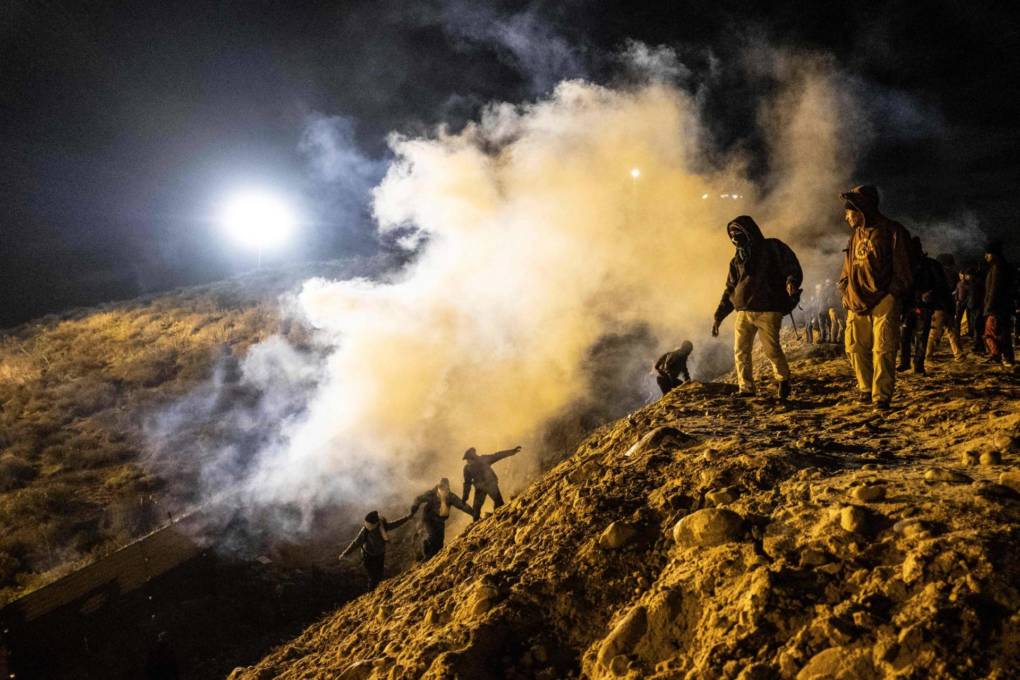
"caption": "Central American migrants run along the Tijuana River near the El Chaparral border crossing in Tijuana, Mexico, after U.S. border agents launched tear gas to disperse them on Nov. 25, 2018.",
"description": "Central American migrants run along the Tijuana River near the El Chaparral border crossing in Tijuana, Mexico, after the U.S. border patrol launched tear gas to disperse them on Nov. 25, 2018.",
"title": "TearGas1920",
"credit": "GUILLERMO ARIAS/AFP/Getty Images",
"status": "inherit",
"isLoading": false,
"fetchFailed": false
},
"news_11708229": {
"type": "attachments",
"id": "news_11708229",
"meta": {
"index": "attachments_1716263798",
"site": "news",
"id": "11708229",
"found": true
},
"parent": 11708219,
"imgSizes": {
"twentyfourteen-full-width": {
"file": "https://ww2.kqed.org/app/uploads/sites/10/2018/11/running_112618_final-1038x576.jpg",
"width": 1038,
"mimeType": "image/jpeg",
"height": 576
},
"thumbnail": {
"file": "https://ww2.kqed.org/app/uploads/sites/10/2018/11/running_112618_final-160x103.jpg",
"width": 160,
"mimeType": "image/jpeg",
"height": 103
},
"post-thumbnail": {
"file": "https://ww2.kqed.org/app/uploads/sites/10/2018/11/running_112618_final-672x372.jpg",
"width": 672,
"mimeType": "image/jpeg",
"height": 372
},
"kqedFullSize": {
"file": "https://ww2.kqed.org/app/uploads/sites/10/2018/11/running_112618_final.jpg",
"width": 1920,
"height": 1234
},
"large": {
"file": "https://ww2.kqed.org/app/uploads/sites/10/2018/11/running_112618_final-1020x656.jpg",
"width": 1020,
"mimeType": "image/jpeg",
"height": 656
},
"complete_open_graph": {
"file": "https://ww2.kqed.org/app/uploads/sites/10/2018/11/running_112618_final-1200x771.jpg",
"width": 1200,
"mimeType": "image/jpeg",
"height": 771
},
"guest-author-50": {
"file": "https://ww2.kqed.org/app/uploads/sites/10/2018/11/running_112618_final-50x50.jpg",
"width": 50,
"mimeType": "image/jpeg",
"height": 50
},
"guest-author-96": {
"file": "https://ww2.kqed.org/app/uploads/sites/10/2018/11/running_112618_final-96x96.jpg",
"width": 96,
"mimeType": "image/jpeg",
"height": 96
},
"medium": {
"file": "https://ww2.kqed.org/app/uploads/sites/10/2018/11/running_112618_final-800x514.jpg",
"width": 800,
"mimeType": "image/jpeg",
"height": 514
},
"guest-author-64": {
"file": "https://ww2.kqed.org/app/uploads/sites/10/2018/11/running_112618_final-64x64.jpg",
"width": 64,
"mimeType": "image/jpeg",
"height": 64
},
"guest-author-32": {
"file": "https://ww2.kqed.org/app/uploads/sites/10/2018/11/running_112618_final-32x32.jpg",
"width": 32,
"mimeType": "image/jpeg",
"height": 32
},
"full-width": {
"file": "https://ww2.kqed.org/app/uploads/sites/10/2018/11/running_112618_final-1920x1234.jpg",
"width": 1920,
"mimeType": "image/jpeg",
"height": 1234
},
"detail": {
"file": "https://ww2.kqed.org/app/uploads/sites/10/2018/11/running_112618_final-150x150.jpg",
"width": 150,
"mimeType": "image/jpeg",
"height": 150
},
"guest-author-128": {
"file": "https://ww2.kqed.org/app/uploads/sites/10/2018/11/running_112618_final-128x128.jpg",
"width": 128,
"mimeType": "image/jpeg",
"height": 128
}
},
"publishDate": 1543267886,
"modified": 1543267918,
"caption": null,
"description": null,
"title": "running_112618_final",
"credit": null,
"status": "inherit",
"isLoading": false,
"fetchFailed": false
}
},
"audioPlayerReducer": {
"postId": "stream_live",
"isPaused": true,
"isPlaying": false,
"pfsActive": false,
"pledgeModalIsOpen": true,
"playerDrawerIsOpen": false,
"liveAudioPlayStartedAt": 0,
"liveAudioPlayContext": ""
},
"authorsReducer": {
"byline_news_11722189": {
"type": "authors",
"id": "byline_news_11722189",
"meta": {
"override": true
},
"slug": "byline_news_11722189",
"name": "Elliot Spagat \u003cbr> Associated Press",
"isLoading": false
},
"byline_news_11718987": {
"type": "authors",
"id": "byline_news_11718987",
"meta": {
"override": true
},
"slug": "byline_news_11718987",
"name": "Colleen Long\u003cbr>Ricardo Alonzo-Zaldivar\u003cbr>Associated Press",
"isLoading": false
},
"byline_news_11717093": {
"type": "authors",
"id": "byline_news_11717093",
"meta": {
"override": true
},
"slug": "byline_news_11717093",
"name": "Max Rivlin-Nadler",
"isLoading": false
},
"byline_news_11717074": {
"type": "authors",
"id": "byline_news_11717074",
"meta": {
"override": true
},
"slug": "byline_news_11717074",
"name": "NPR\u003cbr>David Wagner",
"isLoading": false
},
"byline_news_11716368": {
"type": "authors",
"id": "byline_news_11716368",
"meta": {
"override": true
},
"slug": "byline_news_11716368",
"name": "Marie Andrusewicz",
"isLoading": false
},
"byline_news_11715576": {
"type": "authors",
"id": "byline_news_11715576",
"meta": {
"override": true
},
"slug": "byline_news_11715576",
"name": "Amy Taxin and Deepti Hajela \u003cbr> Associated Press",
"isLoading": false
},
"byline_news_11715526": {
"type": "authors",
"id": "byline_news_11715526",
"meta": {
"override": true
},
"slug": "byline_news_11715526",
"name": "Daniella Cheslow \u003cbr> \u003cstrong>\u003ca href=\"https://www.npr.org\">NPR\u003c/a>\u003c/strong>",
"isLoading": false
},
"kqed": {
"type": "authors",
"id": "236",
"meta": {
"index": "authors_1716337520",
"id": "236",
"found": true
},
"name": "KQED News Staff",
"firstName": "KQED News Staff",
"lastName": null,
"slug": "kqed",
"email": "faq@kqed.org",
"display_author_email": false,
"staff_mastheads": [],
"title": null,
"bio": null,
"avatar": "https://secure.gravatar.com/avatar/ef0e801a68c4c54afa9180db14084167?s=600&d=blank&r=g",
"twitter": null,
"facebook": null,
"instagram": null,
"linkedin": null,
"sites": [
{
"site": "arts",
"roles": [
"contributor"
]
},
{
"site": "news",
"roles": [
"editor"
]
},
{
"site": "futureofyou",
"roles": [
"author"
]
}
],
"headData": {
"title": "KQED News Staff | KQED",
"description": null,
"ogImgSrc": "https://secure.gravatar.com/avatar/ef0e801a68c4c54afa9180db14084167?s=600&d=blank&r=g",
"twImgSrc": "https://secure.gravatar.com/avatar/ef0e801a68c4c54afa9180db14084167?s=600&d=blank&r=g"
},
"isLoading": false,
"link": "/author/kqed"
},
"markfiore": {
"type": "authors",
"id": "3236",
"meta": {
"index": "authors_1716337520",
"id": "3236",
"found": true
},
"name": "Mark Fiore",
"firstName": "Mark",
"lastName": "Fiore",
"slug": "markfiore",
"email": "mark@markfiore.com",
"display_author_email": false,
"staff_mastheads": [
"news"
],
"title": "KQED News Cartoonist",
"bio": "\u003ca href=\"http://www.MarkFiore.com\">MarkFiore.com\u003c/a> | \u003ca href=\"https://twitter.com/markfiore\">Follow on Twitter\u003c/a> | \u003ca href=\"https://www.facebook.com/pages/Mark-Fiore-Animated-Political-Cartoons/94451707396?ref=bookmarks\">Facebook\u003c/a> | \u003ca href=\"mailto:mark@markfiore.com\">email\u003c/a>\r\n\r\nPulitzer Prize-winner, Mark Fiore, who the Wall Street Journal has called “the undisputed guru of the form,” creates animated political cartoons in San Francisco, where his work has been featured regularly on the San Francisco Chronicle’s web site, SFGate.com. His work has appeared on Newsweek.com, Slate.com, CBSNews.com, MotherJones.com, DailyKos.com and NPR’s web site. Fiore’s political animation has appeared on CNN, Frontline, Bill Moyers Journal, Salon.com and cable and broadcast outlets across the globe.\r\n\r\nBeginning his professional life by drawing traditional political cartoons for newspapers, Fiore’s work appeared in publications ranging from the Washington Post to the Los Angeles Times. In the late 1990s, he began to experiment with animating political cartoons and, after a short stint at the San Jose Mercury News as their staff cartoonist, Fiore devoted all his energies to animation.\r\nGrowing up in California, Fiore also spent a good portion of his life in the backwoods of Idaho. It was this combination that shaped him politically. Mark majored in political science at Colorado College, where, in a perfect send-off for a cartoonist, he received his diploma in 1991 as commencement speaker Dick Cheney smiled approvingly.\r\nMark Fiore was awarded the Pulitzer Prize for political cartooning in 2010, a Robert F. Kennedy Journalism Award in 2004 and has twice received an Online Journalism Award for commentary from the Online News Association (2002, 2008). Fiore has received two awards for his work in new media from the National Cartoonists Society (2001, 2002), and in 2006 received The James Madison Freedom of Information Award from The Society of Professional Journalists.",
"avatar": "https://secure.gravatar.com/avatar/fc4e2a612b15b67bad0c6f0e1db4ca9b?s=600&d=blank&r=g",
"twitter": "MarkFiore",
"facebook": null,
"instagram": "https://www.instagram.com/markfiore/?hl=en",
"linkedin": null,
"sites": [
{
"site": "arts",
"roles": [
"contributor"
]
},
{
"site": "news",
"roles": [
"editor"
]
},
{
"site": "futureofyou",
"roles": [
"editor"
]
},
{
"site": "science",
"roles": [
"editor"
]
}
],
"headData": {
"title": "Mark Fiore | KQED",
"description": "KQED News Cartoonist",
"ogImgSrc": "https://secure.gravatar.com/avatar/fc4e2a612b15b67bad0c6f0e1db4ca9b?s=600&d=blank&r=g",
"twImgSrc": "https://secure.gravatar.com/avatar/fc4e2a612b15b67bad0c6f0e1db4ca9b?s=600&d=blank&r=g"
},
"isLoading": false,
"link": "/author/markfiore"
},
"jsmall": {
"type": "authors",
"id": "6625",
"meta": {
"index": "authors_1716337520",
"id": "6625",
"found": true
},
"name": "Julie Small",
"firstName": "Julie",
"lastName": "Small",
"slug": "jsmall",
"email": "jsmall@kqed.org",
"display_author_email": true,
"staff_mastheads": [
"news"
],
"title": "KQED Contributor",
"bio": "Julie Small reports on criminal justice and immigration.\r\n\r\nShe was part of a team at KQED awarded a regional 2019 Edward R. Murrow award for continuing coverage of the Trump Administration's family separation policy.\r\n\r\nThe Society for Professional Journalists recognized Julie's 2018 \u003ca href=\"https://www.kqed.org/news/11636262/the-officer-tased-him-31-times-the-sheriff-called-his-death-an-accident\">reporting\u003c/a> on the San Joaquin County Sheriff's \u003ca href=\"https://www.kqed.org/news/11634689/autopsy-doctors-sheriff-overrode-death-findings-to-protect-law-enforcement\">interference\u003c/a> in death investigations with an Excellence in Journalism Award for Ongoing Coverage.\r\n\r\nJulie's\u003ca href=\"https://www.kqed.org/news/11039666/two-mentally-ill-inmates-died-one-month-in-santa-clara\"> reporting\u003c/a> with Lisa Pickoff-White on the treatment of mentally ill offenders in California jails earned a 2017 regional Edward R. Murrow Award for news reporting and an investigative reporting award from the SPJ of Northern California.\r\n\r\nBefore joining KQED, Julie covered government and politics in Sacramento for Southern California Public Radio (SCPR). Her 2010 \u003ca href=\"https://www.scpr.org/specials/prisonmedical/\">series\u003c/a> on lapses in California’s prison medical care also won a regional Edward R. Murrow Award for investigative reporting and a Golden Mic Award from the RTNDA of Southern California.\r\n\r\nJulie began her career in journalism in 2000 as the deputy foreign editor for public radio's \u003cem>Marketplace, \u003c/em>while earning her master's degree in journalism from USC’s Annenberg School of Communication.",
"avatar": "https://secure.gravatar.com/avatar/4baedf201468df97be97c2a9dd7585d0?s=600&d=blank&r=g",
"twitter": "@SmallRadio2",
"facebook": null,
"instagram": null,
"linkedin": null,
"sites": [
{
"site": "news",
"roles": [
"editor"
]
},
{
"site": "stateofhealth",
"roles": [
"author"
]
},
{
"site": "science",
"roles": [
"author"
]
}
],
"headData": {
"title": "Julie Small | KQED",
"description": "KQED Contributor",
"ogImgSrc": "https://secure.gravatar.com/avatar/4baedf201468df97be97c2a9dd7585d0?s=600&d=blank&r=g",
"twImgSrc": "https://secure.gravatar.com/avatar/4baedf201468df97be97c2a9dd7585d0?s=600&d=blank&r=g"
},
"isLoading": false,
"link": "/author/jsmall"
},
"fjhabvala": {
"type": "authors",
"id": "8659",
"meta": {
"index": "authors_1716337520",
"id": "8659",
"found": true
},
"name": "Farida Jhabvala Romero",
"firstName": "Farida",
"lastName": "Jhabvala Romero",
"slug": "fjhabvala",
"email": "fjhabvala@kqed.org",
"display_author_email": true,
"staff_mastheads": [
"news"
],
"title": "KQED Contributor",
"bio": "Farida Jhabvala Romero is a Labor Correspondent for KQED. She previously covered immigration. Farida was \u003ca href=\"https://www.ccnma.org/2022-most-influential-latina-journalists\">named\u003c/a> one of the 10 Most Influential Latina Journalists in California in 2022 by the California Chicano News Media Association. Her work has won awards from the Society of Professional Journalists (Northern California), as well as a national and regional Edward M. Murrow Award for the collaborative reporting projects “Dangerous Air” and “Graying California.” Before joining KQED, Farida worked as a producer at Radio Bilingüe, a national public radio network. Farida earned her master’s degree in journalism from Stanford University.",
"avatar": "https://secure.gravatar.com/avatar/f9f022d4e2609741874222a1e9d41f48fea74011aa7c615eef91d9a50c944ebe?s=600&d=blank&r=g",
"twitter": "FaridaJhabvala",
"bluesky": null,
"facebook": null,
"instagram": null,
"linkedin": "https://www.linkedin.com/in/faridajhabvala/",
"sites": [
{
"site": "news",
"roles": [
"editor"
]
},
{
"site": "stateofhealth",
"roles": [
"author"
]
},
{
"site": "liveblog",
"roles": [
"author"
]
}
],
"headData": {
"title": "Farida Jhabvala Romero | KQED",
"description": "KQED Contributor",
"ogImgSrc": "https://secure.gravatar.com/avatar/f9f022d4e2609741874222a1e9d41f48fea74011aa7c615eef91d9a50c944ebe?s=600&d=blank&r=g",
"twImgSrc": "https://secure.gravatar.com/avatar/f9f022d4e2609741874222a1e9d41f48fea74011aa7c615eef91d9a50c944ebe?s=600&d=blank&r=g"
},
"isLoading": false,
"link": "/author/fjhabvala"
}
},
"pagesReducer": {
"news_tag_asylum-seekers": {
"type": "terms",
"id": "news_23653",
"meta": {
"index": "terms_1716263798",
"site": "news",
"id": "23653",
"score": 9.892588
},
"featImg": null,
"name": "Asylum-seekers",
"description": null,
"taxonomy": "tag",
"headData": {
"twImgId": null,
"twTitle": null,
"ogTitle": null,
"ogImgId": null,
"twDescription": null,
"description": null,
"title": "Asylum-seekers Archives | KQED News",
"ogDescription": null
},
"ttid": 23670,
"slug": "asylum-seekers",
"isLoading": false,
"title": "Asylum-seekers",
"pageMeta": {
"site": "news",
"WpPageTemplate": "page-topic-editorial",
"currentPage": 7
},
"blocks": [
{
"blockName": "kqed/post-list",
"attrs": {
"layout": "cardArticle2",
"query": "posts/news?tag=asylum-seekers",
"seeMore": false,
"paginated": true,
"page": 7
}
},
{
"blockName": "kqed/ad"
}
]
}
},
"pfsSessionReducer": {},
"postsReducer": {
"stream_live": {
"type": "live",
"id": "stream_live",
"audioUrl": "https://streams.kqed.org/kqedradio",
"title": "Live Stream",
"excerpt": "Live Stream information currently unavailable.",
"link": "/radio",
"featImg": "",
"label": {
"name": "KQED Live",
"link": "/"
}
},
"stream_kqedNewscast": {
"type": "posts",
"id": "stream_kqedNewscast",
"audioUrl": "https://www.kqed.org/.stream/anon/radio/RDnews/newscast.mp3?_=1",
"title": "KQED Newscast",
"featImg": "",
"label": {
"name": "88.5 FM",
"link": "/"
}
},
"news_11722223": {
"type": "posts",
"id": "news_11722223",
"meta": {
"index": "posts_1716263798",
"site": "news",
"id": "11722223",
"score": null,
"sort": [
1548900019000
]
},
"parent": 0,
"labelTerm": {
"site": "news",
"term": 72
},
"blocks": [],
"publishDate": 1548900019,
"format": "audio",
"disqusTitle": "Toddler Separated From Family at Border Reunited with Mom in San Francisco",
"title": "Toddler Separated From Family at Border Reunited with Mom in San Francisco",
"headTitle": "The California Report | KQED News",
"content": "\u003cp>Sindy Ortiz Flores, 23, waited anxiously at San Francisco International Airport's Terminal 1 on Tuesday night, her gaze fixed on the stream of arriving passengers. Then Ortiz let out a sigh -- she had spotted her 18-month-old daughter, Grethshell Juliet.\u003c/p>\n\u003cp>As a woman carrying Grethshell from the plane handed her to her mother, the little girl began to wail. Ortiz also burst into tears, clutching her baby tight for the first time in more than a month.\u003c/p>\n\u003cp>U.S. Border Patrol agents took Grethshell from her father, Kevin Ventura Corrales, on Dec. 28, after arresting him and the baby near Calexico. The government moved to prosecute Ventura for illegally re-entering the United States. Grethshell was turned over to the U.S. Department of Health and Human Services' Office of Refugee Resettlement, which placed her in a shelter in Texas.\u003c/p>\n\u003cp>The move comes seven months after President Donald Trump signed an \u003ca href=\"https://www.whitehouse.gov/presidential-actions/affording-congress-opportunity-address-family-separation/\">executive order\u003c/a> halting most family separations at the border, and a federal judge in San Diego \u003ca href=\"https://www.lawfareblog.com/document-federal-judge-orders-government-reunite-families\">ordered\u003c/a> the administration to end family separations, except in cases when the parent is unfit or a danger to the child.\u003c/p>\n\u003cp>Government records say Grethshell's family left Honduras on October 2018, fearing persecution if they returned.\u003c/p>\n\u003cp>Ortiz and her two older children got split up from her husband and Grethshell while in Mexico. Ortiz and the older kids made it to San Francisco, where relatives live. She said she is in the process of applying for asylum.\u003c/p>\n\u003caside class=\"alignright\">\n\u003ch3>\u003ca href=\"https://www.kqed.org/news/11714666/migrant-boy-8-dies-in-government-custody-in-new-mexico-hospital\">Migrant Boy, 8, Dies in Government Custody in New Mexico Hospital\u003c/a>\u003c/h3>\n\u003cfigure>\u003ca href=\"https://www.kqed.org/news/11714666/migrant-boy-8-dies-in-government-custody-in-new-mexico-hospital\">\u003cimg src=\"https://ww2.kqed.org/news/wp-content/uploads/sites/10/2018/12/gettyimages-1074813798_slide-540fd76cc9a78d0f54abeba6bd4348fdc5d1a3e8-1180x786.jpg\" alt=\"\">\u003c/a>\u003c/figure>\n\u003c/aside>\n\u003cp>Ortiz said their separation had been extremely difficult.\u003c/p>\n\u003cp>\"I felt desperate and helpless, not knowing what do do,\" said Ortiz, as she waited for her baby at San Francisco International Airport. \"I've been so nervous, wondering whether they were going to give her back to me or not.\"\u003c/p>\n\u003cp>Ortiz said she spent long weeks calling government agencies, first trying to locate Grethshell and then struggling to get her back.\u003c/p>\n\u003cp>Lisa Castellanos, who works with the immigrant advocacy group Mijente, said the government initially demanded Ortiz pay $4,000 and provide a credit card number — neither of which Ortiz has — to cover the cost of her toddler's travel. Castellanos said that after the case \u003ca href=\"https://www.newyorker.com/news/news-desk/an-asylum-seekers-quest-to-get-her-toddler-back\">attracted media attention\u003c/a>, officials agreed to deliver the toddler to her mother without charge.\u003c/p>\n\u003cp>Meanwhile, Ventura, Grethshell's father, who is also seeking asylum, remained in immigration detention in Arizona as of Monday.\u003c/p>\n\u003cp>U.S. Immigration and Customs Enforcement officials said Ventura was charged with illegal re-entry into the U.S., a felony with potential jail time if convicted, and had been previously removed from the country four times.\u003c/p>\n\u003caside class=\"alignleft\">\n\u003ch3>\u003ca href=\"https://www.kqed.org/news/11718987/thousands-more-migrant-children-may-have-been-separated-from-families\">Thousands More Migrant Children May Have Been Separated From Families\u003c/a>\u003c/h3>\n\u003cfigure>\u003ca href=\"https://www.kqed.org/news/11718987/thousands-more-migrant-children-may-have-been-separated-from-families\">\u003cimg src=\"https://ww2.kqed.org/news/wp-content/uploads/sites/10/2019/01/GettyImages-1026536026-e1547762507389.jpg\" alt=\"\">\u003c/a>\u003c/figure>\n\u003c/aside>\n\u003cp>Ventura also had a previous misdemeanor for which he served less than a year in jail, said Assistant Chief Patrol Agent David Kim of the Border Patrol's El Centro sector.\u003c/p>\n\u003cp>\"The father was separated from the child because he was being criminally prosecuted for felony 8 USC 1326 (illegal re-entry),\" said Kim in a statement. \"Once a person is charged with a felony and they get rolled into the criminal process, a child is not going to accompany them.\"\u003c/p>\n\u003cp>Kim and U.S. Customs and Border Protection officials did not further explain how Ventura was unfit or posed a danger to his child, the standard which would justify their separation under U.S. District Judge Dana Sabraw's order.\u003c/p>\n\u003cp>Eric Fish, an attorney with Federal Defenders of San Diego, who represented Ventura in federal court, said the charge of illegal re-entry has been dropped.\u003c/p>\n\u003cp>At the airport Tuesday night, Ortiz had a message for Trump: \"Stop hurting families,\" she said.\u003c/p>\n\u003cp>[ad fullwidth]\u003c/p>\n\u003cp>\u003c/p>\n",
"disqusIdentifier": "11722223 https://ww2.kqed.org/news/?p=11722223",
"disqusUrl": "https://ww2.kqed.org/news/2019/01/30/toddler-separated-from-family-at-border-is-returned-in-san-francisco/",
"stats": {
"hasVideo": false,
"hasChartOrMap": false,
"hasAudio": false,
"hasPolis": false,
"wordCount": 622,
"hasGoogleForm": false,
"hasGallery": false,
"hasHearkenModule": false,
"iframeSrcs": [],
"paragraphCount": 19
},
"modified": 1548901625,
"excerpt": "Months after a judge ordered an end to most migrant family separations, an 18-month-old girl spent a month in government custody in Texas.",
"headData": {
"twImgId": "",
"twTitle": "",
"ogTitle": "",
"ogImgId": "",
"twDescription": "",
"description": "Months after a judge ordered an end to most migrant family separations, an 18-month-old girl spent a month in government custody in Texas.",
"title": "Toddler Separated From Family at Border Reunited with Mom in San Francisco | KQED",
"ogDescription": "",
"schema": {
"@context": "https://schema.org",
"@type": "NewsArticle",
"headline": "Toddler Separated From Family at Border Reunited with Mom in San Francisco",
"datePublished": "2019-01-30T18:00:19-08:00",
"dateModified": "2019-01-30T18:27:05-08:00",
"image": "https://cdn.kqed.org/wp-content/uploads/2020/02/KQED-OG-Image@1x.png",
"isAccessibleForFree": "True",
"publisher": {
"@type": "NewsMediaOrganization",
"@id": "https://www.kqed.org/#organization",
"name": "KQED",
"logo": "https://cdn.kqed.org/wp-content/uploads/2020/02/KQED-OG-Image@1x.png",
"url": "https://www.kqed.org",
"sameAs": [
"https://www.facebook.com/KQED",
"https://twitter.com/KQED",
"https://www.instagram.com/kqed/",
"https://www.tiktok.com/@kqedofficial",
"https://www.linkedin.com/company/kqed",
"https://www.youtube.com/channel/UCeC0IOo7i1P_61zVUWbJ4nw"
]
}
}
},
"guestAuthors": [],
"slug": "toddler-separated-from-family-at-border-is-returned-in-san-francisco",
"status": "publish",
"audioUrl": "https://www.kqed.org/.stream/anon/radio/tcr/2019/01/TCRAMFaridaReunited.mp3",
"audioTrackLength": 101,
"path": "/news/11722223/toddler-separated-from-family-at-border-is-returned-in-san-francisco",
"audioDuration": 103000,
"parsedContent": [
{
"type": "contentString",
"content": "\u003cdiv class=\"post-body\">\u003cp>\u003cp>Sindy Ortiz Flores, 23, waited anxiously at San Francisco International Airport's Terminal 1 on Tuesday night, her gaze fixed on the stream of arriving passengers. Then Ortiz let out a sigh -- she had spotted her 18-month-old daughter, Grethshell Juliet.\u003c/p>\n\u003cp>As a woman carrying Grethshell from the plane handed her to her mother, the little girl began to wail. Ortiz also burst into tears, clutching her baby tight for the first time in more than a month.\u003c/p>\n\u003cp>U.S. Border Patrol agents took Grethshell from her father, Kevin Ventura Corrales, on Dec. 28, after arresting him and the baby near Calexico. The government moved to prosecute Ventura for illegally re-entering the United States. Grethshell was turned over to the U.S. Department of Health and Human Services' Office of Refugee Resettlement, which placed her in a shelter in Texas.\u003c/p>\n\u003cp>The move comes seven months after President Donald Trump signed an \u003ca href=\"https://www.whitehouse.gov/presidential-actions/affording-congress-opportunity-address-family-separation/\">executive order\u003c/a> halting most family separations at the border, and a federal judge in San Diego \u003ca href=\"https://www.lawfareblog.com/document-federal-judge-orders-government-reunite-families\">ordered\u003c/a> the administration to end family separations, except in cases when the parent is unfit or a danger to the child.\u003c/p>\n\u003cp>Government records say Grethshell's family left Honduras on October 2018, fearing persecution if they returned.\u003c/p>\n\u003cp>Ortiz and her two older children got split up from her husband and Grethshell while in Mexico. Ortiz and the older kids made it to San Francisco, where relatives live. She said she is in the process of applying for asylum.\u003c/p>\n\u003caside class=\"alignright\">\n\u003ch3>\u003ca href=\"https://www.kqed.org/news/11714666/migrant-boy-8-dies-in-government-custody-in-new-mexico-hospital\">Migrant Boy, 8, Dies in Government Custody in New Mexico Hospital\u003c/a>\u003c/h3>\n\u003cfigure>\u003ca href=\"https://www.kqed.org/news/11714666/migrant-boy-8-dies-in-government-custody-in-new-mexico-hospital\">\u003cimg src=\"https://ww2.kqed.org/news/wp-content/uploads/sites/10/2018/12/gettyimages-1074813798_slide-540fd76cc9a78d0f54abeba6bd4348fdc5d1a3e8-1180x786.jpg\" alt=\"\">\u003c/a>\u003c/figure>\n\u003c/aside>\n\u003cp>Ortiz said their separation had been extremely difficult.\u003c/p>\n\u003cp>\"I felt desperate and helpless, not knowing what do do,\" said Ortiz, as she waited for her baby at San Francisco International Airport. \"I've been so nervous, wondering whether they were going to give her back to me or not.\"\u003c/p>\n\u003cp>Ortiz said she spent long weeks calling government agencies, first trying to locate Grethshell and then struggling to get her back.\u003c/p>\n\u003cp>Lisa Castellanos, who works with the immigrant advocacy group Mijente, said the government initially demanded Ortiz pay $4,000 and provide a credit card number — neither of which Ortiz has — to cover the cost of her toddler's travel. Castellanos said that after the case \u003ca href=\"https://www.newyorker.com/news/news-desk/an-asylum-seekers-quest-to-get-her-toddler-back\">attracted media attention\u003c/a>, officials agreed to deliver the toddler to her mother without charge.\u003c/p>\n\u003cp>Meanwhile, Ventura, Grethshell's father, who is also seeking asylum, remained in immigration detention in Arizona as of Monday.\u003c/p>\n\u003cp>U.S. Immigration and Customs Enforcement officials said Ventura was charged with illegal re-entry into the U.S., a felony with potential jail time if convicted, and had been previously removed from the country four times.\u003c/p>\n\u003caside class=\"alignleft\">\n\u003ch3>\u003ca href=\"https://www.kqed.org/news/11718987/thousands-more-migrant-children-may-have-been-separated-from-families\">Thousands More Migrant Children May Have Been Separated From Families\u003c/a>\u003c/h3>\n\u003cfigure>\u003ca href=\"https://www.kqed.org/news/11718987/thousands-more-migrant-children-may-have-been-separated-from-families\">\u003cimg src=\"https://ww2.kqed.org/news/wp-content/uploads/sites/10/2019/01/GettyImages-1026536026-e1547762507389.jpg\" alt=\"\">\u003c/a>\u003c/figure>\n\u003c/aside>\n\u003cp>Ventura also had a previous misdemeanor for which he served less than a year in jail, said Assistant Chief Patrol Agent David Kim of the Border Patrol's El Centro sector.\u003c/p>\n\u003cp>\"The father was separated from the child because he was being criminally prosecuted for felony 8 USC 1326 (illegal re-entry),\" said Kim in a statement. \"Once a person is charged with a felony and they get rolled into the criminal process, a child is not going to accompany them.\"\u003c/p>\n\u003cp>Kim and U.S. Customs and Border Protection officials did not further explain how Ventura was unfit or posed a danger to his child, the standard which would justify their separation under U.S. District Judge Dana Sabraw's order.\u003c/p>\n\u003cp>Eric Fish, an attorney with Federal Defenders of San Diego, who represented Ventura in federal court, said the charge of illegal re-entry has been dropped.\u003c/p>\n\u003cp>At the airport Tuesday night, Ortiz had a message for Trump: \"Stop hurting families,\" she said.\u003c/p>\n\u003cp>\u003c/p>\u003c/div>",
"attributes": {
"named": {},
"numeric": []
}
},
{
"type": "component",
"content": "",
"name": "ad",
"attributes": {
"named": {
"label": "fullwidth"
},
"numeric": [
"fullwidth"
]
}
},
{
"type": "contentString",
"content": "\u003cdiv class=\"post-body\">\u003cp>\u003c/p>\n\u003cp>\u003c/p>\n\u003c/div>\u003c/p>",
"attributes": {
"named": {},
"numeric": []
}
}
],
"link": "/news/11722223/toddler-separated-from-family-at-border-is-returned-in-san-francisco",
"authors": [
"8659"
],
"programs": [
"news_72"
],
"categories": [
"news_1169",
"news_8"
],
"tags": [
"news_23087",
"news_23653",
"news_20458",
"news_23456",
"news_20202",
"news_17041"
],
"featImg": "news_11722356",
"label": "news_72"
},
"news_11722189": {
"type": "posts",
"id": "news_11722189",
"meta": {
"index": "posts_1716263798",
"site": "news",
"id": "11722189",
"score": null,
"sort": [
1548880064000
]
},
"parent": 0,
"labelTerm": {
"site": "news",
"term": 72
},
"blocks": [],
"publishDate": 1548880064,
"format": "image",
"disqusTitle": "Trump Administration Starts Returning Asylum-Seekers to Tijuana",
"title": "Trump Administration Starts Returning Asylum-Seekers to Tijuana",
"headTitle": "The California Report | KQED News",
"content": "\u003cp>The Trump administration on Tuesday quietly launched an effort to make asylum-seekers wait in Mexico while their cases wind through U.S. immigration courts, despite clear reservations and conflicting messages from the Mexican government.\u003c/p>\n\u003cp>The U.S. returned one asylum-seeker to Mexico — a Honduran man named Carlos Gomez — on the first day of what would be one of the most dramatic changes to the U.S. immigration system of Donald Trump's presidency, if the policy survives an anticipated legal challenge. Gomez, 55, arrived in Tijuana around midday and asked authorities for a ride to a migrant shelter.\u003c/p>\n\u003cp>Mexican and U.S. authorities are asking San Diego-based nonprofits for help connecting asylum-seekers to legal services after they’re returned to Mexico. But Andrea Guerrero of Alliance San Diego said that's unrealistic, and that migrant advocacy groups don’t have the capacity to deal with this.\u003c/p>\n\u003cp>“It's unreasonable to expect that they're going to be making international phone calls to access U.S.-based legal service providers who may or may not have the capacity to cross an international border,\" Guerrero said. She added that the new program \"undermines\" the due process rights of asylum-seekers.\u003c/p>\n\u003caside class=\"alignright\">\n\u003ch3>\u003ca href=\"https://www.kqed.org/news/11721178/one-shutdown-ends-another-begins\">One Shutdown Ends, Another Begins\u003c/a>\u003c/h3>\n\u003cfigure>\u003ca href=\"https://www.kqed.org/news/11721178/one-shutdown-ends-another-begins\">\u003cimg src=\"https://ww2.kqed.org/news/wp-content/uploads/sites/10/2019/01/shut_012519_final-1020x767.jpg\" alt=\"\">\u003c/a>\u003c/figure>\n\u003c/aside>\n\u003cp>The only pro bono legal service provider in Tijuana is Al Otro Lado. Nicole Ramos, an attorney with the nonprofit, said it doesn't have the capacity to represent the number of individuals that the U.S. plans to return to Mexico, and that this program \"will complicate even the most basic presentation of a case,\" as well as expose asylum-seekers to historically high levels of violence in Tijuana.\u003c/p>\n\u003cp>Mexican officials sent mixed signals on the crucial point of whether Mexico would impose limits on accepting families. Tonatiuh Guillen, commissioner of Mexico's National Immigration Institute, said Mexico would accept only people 18 to 60 years old, which rules out families with young children.\u003c/p>\n\u003cp>But Roberto Velasco, spokesman for Mexico's foreign relations secretary, said Friday that families would be considered case by case. And a Mexican official with direct knowledge of the process said Mexico requested that families be excluded from the policy but that the U.S. declined to make any commitment, conceding only to start with single adults. The official spoke on condition of anonymity because the deliberations were not public.\u003c/p>\n\u003cp>The launch is limited to San Diego's San Ysidro border crossing, the nation's busiest, though Customs and Border Protection Commissioner Kevin McAleenan wrote in a memo released Tuesday that it is expected to expand to other crossings \"in the near future.\" Adding to a sense of confusion, Guillen said Mexico will allow it only at the one crossing that connects San Diego and Tijuana.\u003c/p>\n\u003cp>Katie Waldman, a Department of Homeland Security spokeswoman, insisted families will be included. A sharp increase in Central American families seeking asylum in the U.S. led to the Trump administration's dramatic move, and limiting families would diminish the impact.\u003c/p>\n\u003cp>\"It will be expanded across the entire Southwest border, and it will apply to family groups,\" Waldman said.\u003c/p>\n\u003cp>[ad fullwidth]\u003c/p>\n\u003cp>Homeland Security Secretary Kirstjen Nielsen was in San Diego on Tuesday to observe the launch but had no public appearances. The U.S. Embassy in Mexico said in a news release that the program began Tuesday.\u003c/p>\n\u003cp>Mexico's foreign relations secretary said Friday that the U.S. would start with 20 people a day. Two U.S. officials, who spoke on condition of anonymity because the deliberations were not public, said shortly before the launch that the policy would start with about 100 people a week in a trial period of up to 90 days in San Diego.\u003c/p>\n\u003cp>The launch followed months of delicate talks between the U.S. and Mexico and marked a change to the U.S. asylum system that both the administration and asylum experts said was unprecedented.\u003c/p>\n\u003caside class=\"pullquote alignright\">'With this policy, the Trump administration is purposefully keeping Central Americans in unsafe conditions without access to counsel and evidence in an effort to send them straight back to the hands of their persecutors.'\u003ccite>Dree Collopy, immigration lawyer and asylum expert\u003c/cite>\u003c/aside>\n\u003cp>Velasco, writing Monday in an opinion article in The Washington Post, outlined Mexico's doubts and said there \"are several technical-level questions ... that our two governments need to address to guarantee an adequate implementation of this unilateral policy.\" Mexico has repeatedly said the U.S. is acting alone, but it has pledged to issue temporary visas to the asylum-seekers, with permission to seek work authorization.\u003c/p>\n\u003cp>\"The operational complexity of receiving asylum-seekers from the United States opens the door to new potential drawbacks,\" Velasco wrote. \"Mexico will keep raising these concerns to the United States, to adequately manage the situation while guaranteeing the orderly functioning of our border.\"\u003c/p>\n\u003cp>On Monday, U.S. Citizenship and Immigration Services said in a memo to employees that asylum officers would interview migrants to determine if they are \"more likely than not\" to be persecuted or tortured in Mexico while waiting for hearings in the U.S.\u003c/p>\n\u003cp>If they are not, they will be returned to Mexico.\u003c/p>\n\u003cp>Asylum-seekers will not be allowed to have attorneys at that initial screening held at border crossings \"given the limited capacity and resources,\" drawing swift criticism from immigration attorneys.\u003c/p>\n\u003cp>\"With this policy, the Trump administration is purposefully keeping Central Americans in unsafe conditions without access to counsel and evidence in an effort to send them straight back to the hands of their persecutors,\" Dree Collopy, an immigration lawyer and asylum expert in Washington, wrote in an email. She regards the practice as illegal and contrary to U.S. obligations under domestic and international law.\u003c/p>\n\u003caside class=\"alignright\">\n\u003ch3>\u003ca href=\"https://www.kqed.org/news/11711704/after-eight-month-separation-an-salvadoran-asylum-seeker-reconnects-with-4-year-old-son\">After 8-Month Separation, Asylum-Seeker Reconnects With 4-Year-Old Son\u003c/a>\u003c/h3>\n\u003cfigure>\u003ca href=\"https://www.kqed.org/news/11711704/after-eight-month-separation-an-salvadoran-asylum-seeker-reconnects-with-4-year-old-son\">\u003cimg src=\"https://ww2.kqed.org/news/wp-content/uploads/sites/10/2018/12/Migrant-Family-Reunited-IMG_1608-e1544576284259-1020x825.jpg\" alt=\"\">\u003c/a>\u003c/figure>\n\u003c/aside>\n\u003cp>Due largely to a court-imposed 20-day limit on detaining children, families are typically released in the U.S. with a notice to appear in immigration court. With a backlog of more than 800,000 cases, it can take years to settle cases, giving rise to what the administration calls \"catch and release.\"\u003c/p>\n\u003cp>Nielsen said last week that the \"migrant protection protocols\" being introduced in San Diego are a \"methodical common-sense\" approach to what she calls a humanitarian and security crisis on the Mexican border.\u003c/p>\n\u003cp>\"For far too long, our immigration system has been exploited by smugglers, traffickers and those who have no legal right to remain in the United States,\" she said.\u003c/p>\n\u003cp>Children traveling alone and Mexican asylum-seekers will be exempt from the program, as will \"criminals,\" people with a \"history of violence\" and those with physical or mental health issues, according to guidelines issued Tuesday by Customs and Border Protection.\u003c/p>\n\u003cp>Customs and Border Protection said asylum-seekers would be given a sheet with information on the process and a list of free or low-cost legal service providers. U.S. authorities will provide transportation between the border and the courtroom.\u003c/p>\n\u003cp>Guillen said Mexico's temporary visas would last for a maximum of 120 days. The Mexican official said U.S. asylum judges are expected to render final decisions within 90 days.\u003c/p>\n\u003cp>\u003cem>This post includes reporting from KPBS reporter \u003ca href=\"https://www.kpbs.org/staff/jean-guerrero/\" target=\"_blank\" rel=\"noopener\">Jean Guerrero\u003c/a>.\u003c/em>\u003c/p>\n\u003cp>[ad floatright]\u003c/p>\n",
"disqusIdentifier": "11722189 https://ww2.kqed.org/news/?p=11722189",
"disqusUrl": "https://ww2.kqed.org/news/2019/01/30/trump-administration-starts-returning-asylum-seekers-to-tijuana/",
"stats": {
"hasVideo": false,
"hasChartOrMap": false,
"hasAudio": false,
"hasPolis": false,
"wordCount": 1203,
"hasGoogleForm": false,
"hasGallery": false,
"hasHearkenModule": false,
"iframeSrcs": [],
"paragraphCount": 28
},
"modified": 1548890174,
"excerpt": "An effort was quietly launched Tuesday to make asylum-seekers wait in Mexico while their cases wind through U.S. immigration courts, despite clear reservations and conflicting messages from the Mexican government.",
"headData": {
"twImgId": "",
"twTitle": "",
"ogTitle": "",
"ogImgId": "",
"twDescription": "",
"description": "An effort was quietly launched Tuesday to make asylum-seekers wait in Mexico while their cases wind through U.S. immigration courts, despite clear reservations and conflicting messages from the Mexican government.",
"title": "Trump Administration Starts Returning Asylum-Seekers to Tijuana | KQED",
"ogDescription": "",
"schema": {
"@context": "https://schema.org",
"@type": "NewsArticle",
"headline": "Trump Administration Starts Returning Asylum-Seekers to Tijuana",
"datePublished": "2019-01-30T12:27:44-08:00",
"dateModified": "2019-01-30T15:16:14-08:00",
"image": "https://cdn.kqed.org/wp-content/uploads/2020/02/KQED-OG-Image@1x.png",
"isAccessibleForFree": "True",
"publisher": {
"@type": "NewsMediaOrganization",
"@id": "https://www.kqed.org/#organization",
"name": "KQED",
"logo": "https://cdn.kqed.org/wp-content/uploads/2020/02/KQED-OG-Image@1x.png",
"url": "https://www.kqed.org",
"sameAs": [
"https://www.facebook.com/KQED",
"https://twitter.com/KQED",
"https://www.instagram.com/kqed/",
"https://www.tiktok.com/@kqedofficial",
"https://www.linkedin.com/company/kqed",
"https://www.youtube.com/channel/UCeC0IOo7i1P_61zVUWbJ4nw"
]
}
}
},
"guestAuthors": [],
"slug": "trump-administration-starts-returning-asylum-seekers-to-tijuana",
"status": "publish",
"audioUrl": "https://www.kqed.org/.stream/anon/radio/tcr/2019/01/TCRAMGuerreroBorder.mp3",
"nprByline": "Elliot Spagat \u003cbr> Associated Press",
"audioTrackLength": 94,
"path": "/news/11722189/trump-administration-starts-returning-asylum-seekers-to-tijuana",
"audioDuration": 97000,
"parsedContent": [
{
"type": "contentString",
"content": "\u003cdiv class=\"post-body\">\u003cp>\u003cp>The Trump administration on Tuesday quietly launched an effort to make asylum-seekers wait in Mexico while their cases wind through U.S. immigration courts, despite clear reservations and conflicting messages from the Mexican government.\u003c/p>\n\u003cp>The U.S. returned one asylum-seeker to Mexico — a Honduran man named Carlos Gomez — on the first day of what would be one of the most dramatic changes to the U.S. immigration system of Donald Trump's presidency, if the policy survives an anticipated legal challenge. Gomez, 55, arrived in Tijuana around midday and asked authorities for a ride to a migrant shelter.\u003c/p>\n\u003cp>Mexican and U.S. authorities are asking San Diego-based nonprofits for help connecting asylum-seekers to legal services after they’re returned to Mexico. But Andrea Guerrero of Alliance San Diego said that's unrealistic, and that migrant advocacy groups don’t have the capacity to deal with this.\u003c/p>\n\u003cp>“It's unreasonable to expect that they're going to be making international phone calls to access U.S.-based legal service providers who may or may not have the capacity to cross an international border,\" Guerrero said. She added that the new program \"undermines\" the due process rights of asylum-seekers.\u003c/p>\n\u003caside class=\"alignright\">\n\u003ch3>\u003ca href=\"https://www.kqed.org/news/11721178/one-shutdown-ends-another-begins\">One Shutdown Ends, Another Begins\u003c/a>\u003c/h3>\n\u003cfigure>\u003ca href=\"https://www.kqed.org/news/11721178/one-shutdown-ends-another-begins\">\u003cimg src=\"https://ww2.kqed.org/news/wp-content/uploads/sites/10/2019/01/shut_012519_final-1020x767.jpg\" alt=\"\">\u003c/a>\u003c/figure>\n\u003c/aside>\n\u003cp>The only pro bono legal service provider in Tijuana is Al Otro Lado. Nicole Ramos, an attorney with the nonprofit, said it doesn't have the capacity to represent the number of individuals that the U.S. plans to return to Mexico, and that this program \"will complicate even the most basic presentation of a case,\" as well as expose asylum-seekers to historically high levels of violence in Tijuana.\u003c/p>\n\u003cp>Mexican officials sent mixed signals on the crucial point of whether Mexico would impose limits on accepting families. Tonatiuh Guillen, commissioner of Mexico's National Immigration Institute, said Mexico would accept only people 18 to 60 years old, which rules out families with young children.\u003c/p>\n\u003cp>But Roberto Velasco, spokesman for Mexico's foreign relations secretary, said Friday that families would be considered case by case. And a Mexican official with direct knowledge of the process said Mexico requested that families be excluded from the policy but that the U.S. declined to make any commitment, conceding only to start with single adults. The official spoke on condition of anonymity because the deliberations were not public.\u003c/p>\n\u003cp>The launch is limited to San Diego's San Ysidro border crossing, the nation's busiest, though Customs and Border Protection Commissioner Kevin McAleenan wrote in a memo released Tuesday that it is expected to expand to other crossings \"in the near future.\" Adding to a sense of confusion, Guillen said Mexico will allow it only at the one crossing that connects San Diego and Tijuana.\u003c/p>\n\u003cp>Katie Waldman, a Department of Homeland Security spokeswoman, insisted families will be included. A sharp increase in Central American families seeking asylum in the U.S. led to the Trump administration's dramatic move, and limiting families would diminish the impact.\u003c/p>\n\u003cp>\"It will be expanded across the entire Southwest border, and it will apply to family groups,\" Waldman said.\u003c/p>\n\u003cp>\u003c/p>\u003c/div>",
"attributes": {
"named": {},
"numeric": []
}
},
{
"type": "component",
"content": "",
"name": "ad",
"attributes": {
"named": {
"label": "fullwidth"
},
"numeric": [
"fullwidth"
]
}
},
{
"type": "contentString",
"content": "\u003cdiv class=\"post-body\">\u003cp>\u003c/p>\n\u003cp>Homeland Security Secretary Kirstjen Nielsen was in San Diego on Tuesday to observe the launch but had no public appearances. The U.S. Embassy in Mexico said in a news release that the program began Tuesday.\u003c/p>\n\u003cp>Mexico's foreign relations secretary said Friday that the U.S. would start with 20 people a day. Two U.S. officials, who spoke on condition of anonymity because the deliberations were not public, said shortly before the launch that the policy would start with about 100 people a week in a trial period of up to 90 days in San Diego.\u003c/p>\n\u003cp>The launch followed months of delicate talks between the U.S. and Mexico and marked a change to the U.S. asylum system that both the administration and asylum experts said was unprecedented.\u003c/p>\n\u003caside class=\"pullquote alignright\">'With this policy, the Trump administration is purposefully keeping Central Americans in unsafe conditions without access to counsel and evidence in an effort to send them straight back to the hands of their persecutors.'\u003ccite>Dree Collopy, immigration lawyer and asylum expert\u003c/cite>\u003c/aside>\n\u003cp>Velasco, writing Monday in an opinion article in The Washington Post, outlined Mexico's doubts and said there \"are several technical-level questions ... that our two governments need to address to guarantee an adequate implementation of this unilateral policy.\" Mexico has repeatedly said the U.S. is acting alone, but it has pledged to issue temporary visas to the asylum-seekers, with permission to seek work authorization.\u003c/p>\n\u003cp>\"The operational complexity of receiving asylum-seekers from the United States opens the door to new potential drawbacks,\" Velasco wrote. \"Mexico will keep raising these concerns to the United States, to adequately manage the situation while guaranteeing the orderly functioning of our border.\"\u003c/p>\n\u003cp>On Monday, U.S. Citizenship and Immigration Services said in a memo to employees that asylum officers would interview migrants to determine if they are \"more likely than not\" to be persecuted or tortured in Mexico while waiting for hearings in the U.S.\u003c/p>\n\u003cp>If they are not, they will be returned to Mexico.\u003c/p>\n\u003cp>Asylum-seekers will not be allowed to have attorneys at that initial screening held at border crossings \"given the limited capacity and resources,\" drawing swift criticism from immigration attorneys.\u003c/p>\n\u003cp>\"With this policy, the Trump administration is purposefully keeping Central Americans in unsafe conditions without access to counsel and evidence in an effort to send them straight back to the hands of their persecutors,\" Dree Collopy, an immigration lawyer and asylum expert in Washington, wrote in an email. She regards the practice as illegal and contrary to U.S. obligations under domestic and international law.\u003c/p>\n\u003caside class=\"alignright\">\n\u003ch3>\u003ca href=\"https://www.kqed.org/news/11711704/after-eight-month-separation-an-salvadoran-asylum-seeker-reconnects-with-4-year-old-son\">After 8-Month Separation, Asylum-Seeker Reconnects With 4-Year-Old Son\u003c/a>\u003c/h3>\n\u003cfigure>\u003ca href=\"https://www.kqed.org/news/11711704/after-eight-month-separation-an-salvadoran-asylum-seeker-reconnects-with-4-year-old-son\">\u003cimg src=\"https://ww2.kqed.org/news/wp-content/uploads/sites/10/2018/12/Migrant-Family-Reunited-IMG_1608-e1544576284259-1020x825.jpg\" alt=\"\">\u003c/a>\u003c/figure>\n\u003c/aside>\n\u003cp>Due largely to a court-imposed 20-day limit on detaining children, families are typically released in the U.S. with a notice to appear in immigration court. With a backlog of more than 800,000 cases, it can take years to settle cases, giving rise to what the administration calls \"catch and release.\"\u003c/p>\n\u003cp>Nielsen said last week that the \"migrant protection protocols\" being introduced in San Diego are a \"methodical common-sense\" approach to what she calls a humanitarian and security crisis on the Mexican border.\u003c/p>\n\u003cp>\"For far too long, our immigration system has been exploited by smugglers, traffickers and those who have no legal right to remain in the United States,\" she said.\u003c/p>\n\u003cp>Children traveling alone and Mexican asylum-seekers will be exempt from the program, as will \"criminals,\" people with a \"history of violence\" and those with physical or mental health issues, according to guidelines issued Tuesday by Customs and Border Protection.\u003c/p>\n\u003cp>Customs and Border Protection said asylum-seekers would be given a sheet with information on the process and a list of free or low-cost legal service providers. U.S. authorities will provide transportation between the border and the courtroom.\u003c/p>\n\u003cp>Guillen said Mexico's temporary visas would last for a maximum of 120 days. The Mexican official said U.S. asylum judges are expected to render final decisions within 90 days.\u003c/p>\n\u003cp>\u003cem>This post includes reporting from KPBS reporter \u003ca href=\"https://www.kpbs.org/staff/jean-guerrero/\" target=\"_blank\" rel=\"noopener\">Jean Guerrero\u003c/a>.\u003c/em>\u003c/p>\n\u003cp>\u003c/p>\u003c/div>",
"attributes": {
"named": {},
"numeric": []
}
},
{
"type": "component",
"content": "",
"name": "ad",
"attributes": {
"named": {
"label": "floatright"
},
"numeric": [
"floatright"
]
}
},
{
"type": "contentString",
"content": "\u003cdiv class=\"post-body\">\u003cp>\u003c/p>\n\u003c/div>\u003c/p>",
"attributes": {
"named": {},
"numeric": []
}
}
],
"link": "/news/11722189/trump-administration-starts-returning-asylum-seekers-to-tijuana",
"authors": [
"byline_news_11722189"
],
"programs": [
"news_72"
],
"categories": [
"news_1169",
"news_6188",
"news_8",
"news_13"
],
"tags": [
"news_23087",
"news_23653",
"news_20446",
"news_1323",
"news_23138",
"news_18121",
"news_21038"
],
"affiliates": [
"news_7054"
],
"featImg": "news_11722192",
"label": "news_72"
},
"news_11718987": {
"type": "posts",
"id": "news_11718987",
"meta": {
"index": "posts_1716263798",
"site": "news",
"id": "11718987",
"score": null,
"sort": [
1547771858000
]
},
"parent": 0,
"labelTerm": {
"site": "news",
"term": 72
},
"blocks": [],
"publishDate": 1547771858,
"format": "image",
"disqusTitle": "Thousands More Migrant Children May Have Been Separated From Families",
"title": "Thousands More Migrant Children May Have Been Separated From Families",
"headTitle": "The California Report | KQED News",
"content": "\u003cp>It seems likely that thousands more migrant children were split from their families than the Trump administration previously reported, in part because officials were stepping up family separations long before the border policy that prompted international outrage last spring, a government watchdog said Thursday.\u003c/p>\n\u003cp>It's unclear just how many family separations occurred at the U.S.-Mexico border as immigration officials are allowed under longstanding policy to separate families under certain circumstances. Health and Human Services, the agency tasked with caring for migrant children, did not adequately track them until after a judge ruled that children must be reunited with their families, according to the \u003ca href=\"https://oig.hhs.gov/newsroom/news-releases/2019/uac.asp\">report by the agency's inspector general\u003c/a>.\u003c/p>\n\u003cp>Ann Maxwell, assistant inspector general for evaluations, said the number of children removed from their parents was certainly larger than the 2,737 listed by the government in court documents. Those documents chronicled separations that took place as parents were criminally prosecuted for illegally entering the country under President Donald Trump's \"zero tolerance\" policy.\u003c/p>\n\u003cp>\"It's certainly more,\" Maxwell said. \"But precisely how much more is unknown.\"\u003c/p>\n\u003caside class=\"alignright\">\n\u003ch3>\u003ca href=\"https://www.kqed.org/news/11714666/migrant-boy-8-dies-in-government-custody-in-new-mexico-hospital\">Migrant Boy, 8, Dies in Government Custody in New Mexico Hospital\u003c/a>\u003c/h3>\n\u003cfigure>\u003ca href=\"https://www.kqed.org/news/11714666/migrant-boy-8-dies-in-government-custody-in-new-mexico-hospital\">\u003cimg src=\"https://ww2.kqed.org/news/wp-content/uploads/sites/10/2018/12/gettyimages-1074813798_slide-540fd76cc9a78d0f54abeba6bd4348fdc5d1a3e8-1180x786.jpg\" alt=\"\">\u003c/a>\u003c/figure>\n\u003c/aside>\n\u003cp>Maxwell said investigators didn't have specific numbers, but that Health and Human Services staff had estimated the tally to be in the thousands.\u003c/p>\n\u003cp>Lee Gelernt, an American Civil Liberties Union attorney who sued on behalf of a mother separated from her son, said the separation policy \"was a cruel disaster from the start. This report reaffirms that the government never had a clear picture of how many children it ripped from their parents.\"\u003c/p>\n\u003cp>Most of the tens of thousands of children who come into government custody cross the border alone. But the report found that in late 2016, 0.3 percent of children turned over to Health and Human Services had crossed with a parent and were separated. By the summer of 2017, that percentage had grown to 3.6 percent, officials said. The watchdog did not have exact numbers, but the total number of migrant children who passed through the agency's care during the 2017 budget year was 40,810. The separated children had already been released to sponsors, who are generally parents or other close relatives.\u003c/p>\n\u003cp>The inspector general did not say why the children had been separated before the zero-tolerance policy. Immigration officials are allowed to take a child from a parent in certain cases such as serious criminal charges against a parent, concerns over the health and welfare of a child or medical concerns. That policy has long been in place.\u003c/p>\n\u003cp>[ad fullwidth]\u003c/p>\n\u003cp>Katie Waldman, a spokeswoman for Homeland Security, said the report reinforced what officials have long said. \u003c/p>\n\u003cp>\"For more than a decade it was and continues to be standard for apprehended minors to be separated when the adult is not the parent or legal guardian, the child's safety is at risk\" or there's a record of a \"serious criminal activity by the adult,\" she said.\u003c/p>\n\u003cp>In some cases, however, Homeland Security officials said a parent had a criminal history but did not offer details on the crimes, the watchdog reported.\u003c/p>\n\u003cp>The Administration for Children and Families, the division under Health and Human Services that manages the care of unaccompanied minors, said it generally agreed with the findings and noted the report did not find that the agency lost track of children under its care. It also noted new policies were in place to help track newly separated children. The court never instructed officials to determine the number of children separated before the June 26 ruling.\u003c/p>\n\u003cp>Last spring, then-Attorney General Jeff Sessions said anyone caught crossing the border illegally would be criminally prosecuted. Families were brought into custody by U.S. Customs and Border Protection officials, then their parents taken to criminal court.\u003c/p>\n\u003caside class=\"alignright\">\n\u003ch3>\u003ca href=\"https://www.kqed.org/news/11717702/thousands-of-immigrants-in-court-limbo-due-to-government-shutdown\">Thousands of Immigrants in Court Limbo Due to Government Shutdown\u003c/a>\u003c/h3>\n\u003cfigure>\u003ca href=\"https://www.kqed.org/news/11717702/thousands-of-immigrants-in-court-limbo-due-to-government-shutdown\">\u003cimg src=\"https://ww2.kqed.org/news/wp-content/uploads/sites/10/2019/01/GettyImages-923834000-1180x787.jpg\" alt=\"\">\u003c/a>\u003c/figure>\n\u003c/aside>\n\u003cp>If the parents were gone longer than 72 hours — the length of time Border Patrol is allowed to hold children — the children were transferred to the custody of Health and Human Services.\u003c/p>\n\u003cp>The practice prompted an outcry with church groups and lawmakers calling the separations inhumane. Trump ordered an end to the separations on June 20. At the time, a federal judge who was already hearing the case of a mother separated from her son ruled that children must be reunited with their parents.\u003c/p>\n\u003cp>Despite \"considerable\" effort by Health and Human Services to locate all the children placed in its care, the report said officials were still finding new cases as long as five months after the judge's order requiring reunifications.\u003c/p>\n\u003cp>\"There is even less visibility for separated children who fall outside the court case,\" investigators concluded.\u003c/p>\n\u003cp>They said it's not clear the system put in place to track separated children is good enough. The lack of detail from immigration authorities continues to be an issue.\u003c/p>\n\u003cp>The border remains a crucible for the Trump administration, with a partial government shutdown that has dragged on nearly a month over the president's demand for $5.7 billion for a border wall that congressional Democrats are unwilling to provide.\u003c/p>\n\u003cp>The inspector general's office was also looking into other aspects of the separations, including the health and mental well-being of the children who had been separated. It expects to have other reports on the topic.\u003c/p>\n\u003cp>Democratic Rep. Bennie Thompson of Mississippi, chairman of the House Homeland Security Committee, said he would hold the government accountable in the matter. \"The Trump administration, with its unique blend of incompetence, cruelty and disregard for basic decency, misled the American public on one of its most heinous policies to date,\" he said in a statement.\u003c/p>\n\u003cp>\u003c/p>\n",
"disqusIdentifier": "11718987 https://ww2.kqed.org/news/?p=11718987",
"disqusUrl": "https://ww2.kqed.org/news/2019/01/17/thousands-more-migrant-children-may-have-been-separated-from-families/",
"stats": {
"hasVideo": false,
"hasChartOrMap": false,
"hasAudio": false,
"hasPolis": false,
"wordCount": 949,
"hasGoogleForm": false,
"hasGallery": false,
"hasHearkenModule": false,
"iframeSrcs": [],
"paragraphCount": 23
},
"modified": 1547839280,
"excerpt": "A government watchdog agency said it was likely that thousands more migrant children were separated from their families by U.S. authorities than the Trump administration previously reported.",
"headData": {
"twImgId": "",
"twTitle": "",
"ogTitle": "",
"ogImgId": "",
"twDescription": "",
"description": "A government watchdog agency said it was likely that thousands more migrant children were separated from their families by U.S. authorities than the Trump administration previously reported.",
"title": "Thousands More Migrant Children May Have Been Separated From Families | KQED",
"ogDescription": "",
"schema": {
"@context": "https://schema.org",
"@type": "NewsArticle",
"headline": "Thousands More Migrant Children May Have Been Separated From Families",
"datePublished": "2019-01-17T16:37:38-08:00",
"dateModified": "2019-01-18T11:21:20-08:00",
"image": "https://cdn.kqed.org/wp-content/uploads/2020/02/KQED-OG-Image@1x.png",
"isAccessibleForFree": "True",
"publisher": {
"@type": "NewsMediaOrganization",
"@id": "https://www.kqed.org/#organization",
"name": "KQED",
"logo": "https://cdn.kqed.org/wp-content/uploads/2020/02/KQED-OG-Image@1x.png",
"url": "https://www.kqed.org",
"sameAs": [
"https://www.facebook.com/KQED",
"https://twitter.com/KQED",
"https://www.instagram.com/kqed/",
"https://www.tiktok.com/@kqedofficial",
"https://www.linkedin.com/company/kqed",
"https://www.youtube.com/channel/UCeC0IOo7i1P_61zVUWbJ4nw"
]
}
}
},
"guestAuthors": [],
"slug": "thousands-more-migrant-children-may-have-been-separated-from-families",
"status": "publish",
"audioUrl": "https://www.kqed.org/.stream/anon/radio/tcr/2019/01/SeparatedFamiliesSmalltcram190118.mp3",
"nprByline": "Colleen Long\u003cbr>Ricardo Alonzo-Zaldivar\u003cbr>Associated Press",
"audioTrackLength": 86,
"path": "/news/11718987/thousands-more-migrant-children-may-have-been-separated-from-families",
"audioDuration": 88000,
"parsedContent": [
{
"type": "contentString",
"content": "\u003cdiv class=\"post-body\">\u003cp>\u003cp>It seems likely that thousands more migrant children were split from their families than the Trump administration previously reported, in part because officials were stepping up family separations long before the border policy that prompted international outrage last spring, a government watchdog said Thursday.\u003c/p>\n\u003cp>It's unclear just how many family separations occurred at the U.S.-Mexico border as immigration officials are allowed under longstanding policy to separate families under certain circumstances. Health and Human Services, the agency tasked with caring for migrant children, did not adequately track them until after a judge ruled that children must be reunited with their families, according to the \u003ca href=\"https://oig.hhs.gov/newsroom/news-releases/2019/uac.asp\">report by the agency's inspector general\u003c/a>.\u003c/p>\n\u003cp>Ann Maxwell, assistant inspector general for evaluations, said the number of children removed from their parents was certainly larger than the 2,737 listed by the government in court documents. Those documents chronicled separations that took place as parents were criminally prosecuted for illegally entering the country under President Donald Trump's \"zero tolerance\" policy.\u003c/p>\n\u003cp>\"It's certainly more,\" Maxwell said. \"But precisely how much more is unknown.\"\u003c/p>\n\u003caside class=\"alignright\">\n\u003ch3>\u003ca href=\"https://www.kqed.org/news/11714666/migrant-boy-8-dies-in-government-custody-in-new-mexico-hospital\">Migrant Boy, 8, Dies in Government Custody in New Mexico Hospital\u003c/a>\u003c/h3>\n\u003cfigure>\u003ca href=\"https://www.kqed.org/news/11714666/migrant-boy-8-dies-in-government-custody-in-new-mexico-hospital\">\u003cimg src=\"https://ww2.kqed.org/news/wp-content/uploads/sites/10/2018/12/gettyimages-1074813798_slide-540fd76cc9a78d0f54abeba6bd4348fdc5d1a3e8-1180x786.jpg\" alt=\"\">\u003c/a>\u003c/figure>\n\u003c/aside>\n\u003cp>Maxwell said investigators didn't have specific numbers, but that Health and Human Services staff had estimated the tally to be in the thousands.\u003c/p>\n\u003cp>Lee Gelernt, an American Civil Liberties Union attorney who sued on behalf of a mother separated from her son, said the separation policy \"was a cruel disaster from the start. This report reaffirms that the government never had a clear picture of how many children it ripped from their parents.\"\u003c/p>\n\u003cp>Most of the tens of thousands of children who come into government custody cross the border alone. But the report found that in late 2016, 0.3 percent of children turned over to Health and Human Services had crossed with a parent and were separated. By the summer of 2017, that percentage had grown to 3.6 percent, officials said. The watchdog did not have exact numbers, but the total number of migrant children who passed through the agency's care during the 2017 budget year was 40,810. The separated children had already been released to sponsors, who are generally parents or other close relatives.\u003c/p>\n\u003cp>The inspector general did not say why the children had been separated before the zero-tolerance policy. Immigration officials are allowed to take a child from a parent in certain cases such as serious criminal charges against a parent, concerns over the health and welfare of a child or medical concerns. That policy has long been in place.\u003c/p>\n\u003cp>\u003c/p>\u003c/div>",
"attributes": {
"named": {},
"numeric": []
}
},
{
"type": "component",
"content": "",
"name": "ad",
"attributes": {
"named": {
"label": "fullwidth"
},
"numeric": [
"fullwidth"
]
}
},
{
"type": "contentString",
"content": "\u003cdiv class=\"post-body\">\u003cp>\u003c/p>\n\u003cp>Katie Waldman, a spokeswoman for Homeland Security, said the report reinforced what officials have long said. \u003c/p>\n\u003cp>\"For more than a decade it was and continues to be standard for apprehended minors to be separated when the adult is not the parent or legal guardian, the child's safety is at risk\" or there's a record of a \"serious criminal activity by the adult,\" she said.\u003c/p>\n\u003cp>In some cases, however, Homeland Security officials said a parent had a criminal history but did not offer details on the crimes, the watchdog reported.\u003c/p>\n\u003cp>The Administration for Children and Families, the division under Health and Human Services that manages the care of unaccompanied minors, said it generally agreed with the findings and noted the report did not find that the agency lost track of children under its care. It also noted new policies were in place to help track newly separated children. The court never instructed officials to determine the number of children separated before the June 26 ruling.\u003c/p>\n\u003cp>Last spring, then-Attorney General Jeff Sessions said anyone caught crossing the border illegally would be criminally prosecuted. Families were brought into custody by U.S. Customs and Border Protection officials, then their parents taken to criminal court.\u003c/p>\n\u003caside class=\"alignright\">\n\u003ch3>\u003ca href=\"https://www.kqed.org/news/11717702/thousands-of-immigrants-in-court-limbo-due-to-government-shutdown\">Thousands of Immigrants in Court Limbo Due to Government Shutdown\u003c/a>\u003c/h3>\n\u003cfigure>\u003ca href=\"https://www.kqed.org/news/11717702/thousands-of-immigrants-in-court-limbo-due-to-government-shutdown\">\u003cimg src=\"https://ww2.kqed.org/news/wp-content/uploads/sites/10/2019/01/GettyImages-923834000-1180x787.jpg\" alt=\"\">\u003c/a>\u003c/figure>\n\u003c/aside>\n\u003cp>If the parents were gone longer than 72 hours — the length of time Border Patrol is allowed to hold children — the children were transferred to the custody of Health and Human Services.\u003c/p>\n\u003cp>The practice prompted an outcry with church groups and lawmakers calling the separations inhumane. Trump ordered an end to the separations on June 20. At the time, a federal judge who was already hearing the case of a mother separated from her son ruled that children must be reunited with their parents.\u003c/p>\n\u003cp>Despite \"considerable\" effort by Health and Human Services to locate all the children placed in its care, the report said officials were still finding new cases as long as five months after the judge's order requiring reunifications.\u003c/p>\n\u003cp>\"There is even less visibility for separated children who fall outside the court case,\" investigators concluded.\u003c/p>\n\u003cp>They said it's not clear the system put in place to track separated children is good enough. The lack of detail from immigration authorities continues to be an issue.\u003c/p>\n\u003cp>The border remains a crucible for the Trump administration, with a partial government shutdown that has dragged on nearly a month over the president's demand for $5.7 billion for a border wall that congressional Democrats are unwilling to provide.\u003c/p>\n\u003cp>The inspector general's office was also looking into other aspects of the separations, including the health and mental well-being of the children who had been separated. It expects to have other reports on the topic.\u003c/p>\n\u003cp>Democratic Rep. Bennie Thompson of Mississippi, chairman of the House Homeland Security Committee, said he would hold the government accountable in the matter. \"The Trump administration, with its unique blend of incompetence, cruelty and disregard for basic decency, misled the American public on one of its most heinous policies to date,\" he said in a statement.\u003c/p>\n\u003cp>\u003c/p>\n\u003c/div>\u003c/p>",
"attributes": {
"named": {},
"numeric": []
}
}
],
"link": "/news/11718987/thousands-more-migrant-children-may-have-been-separated-from-families",
"authors": [
"byline_news_11718987"
],
"programs": [
"news_72"
],
"categories": [
"news_1169",
"news_6188",
"news_8",
"news_13"
],
"tags": [
"news_23653",
"news_1323",
"news_23456",
"news_6904",
"news_23138",
"news_23524",
"news_23978",
"news_17041",
"news_21038"
],
"featImg": "news_11719028",
"label": "news_72"
},
"news_11717093": {
"type": "posts",
"id": "news_11717093",
"meta": {
"index": "posts_1716263798",
"site": "news",
"id": "11717093",
"score": null,
"sort": [
1547164894000
]
},
"parent": 0,
"labelTerm": {
"site": "news",
"term": 72
},
"blocks": [],
"publishDate": 1547164894,
"format": "audio",
"disqusTitle": "Fewer Asylum-Seekers Checking Waitlist Status at U.S.-Mexico Border in Tijuana",
"title": "Fewer Asylum-Seekers Checking Waitlist Status at U.S.-Mexico Border in Tijuana",
"headTitle": "The California Report | KQED News",
"content": "\u003cp>Since late November, asylum-seeking migrants have been \u003ca href=\"https://www.kqed.org/news/11707927/long-waits-in-tijuana-for-migrants-seeking-u-s-refuge\">gathering regularly\u003c/a> in the early hours near the El Chaparral Plaza at the San Ysidro Port of Entry in Tijuana, hoping to hear their names read from a very, very long list.\u003c/p>\n\u003cp>The list, which still has nearly 4,000 names on it and is maintained by the asylum-seekers themselves, determines who may line up to legally enter the United States on a given day to apply for asylum.\u003c/p>\n\u003cp>Recently, the number of migrants turning up when their names are called has been thinning.\u003c/p>\n\u003cp>Many of the migrants are from the so-called migrant caravan of Central Americans, which arrived at the U.S.-Mexico border at the end of November. Some have been \u003ca href=\"https://www.kqed.org/news/11708380/with-thousands-of-migrants-reaching-border-the-waiting-list-for-asylum-grows\">waiting for weeks, even months,\u003c/a> for their names to be called.\u003c/p>\n\u003cp>Volunteers working to help asylum-seekers — many of whom are fleeing gang and domestic violence in their home countries — cited \u003ca href=\"https://www.kqed.org/news/11710164/caravan-migrants-settle-into-new-shelter-in-tijuana\">shelter shutdowns\u003c/a> and simply the \u003ca href=\"https://www.kqed.org/news/11708668/migrants-cope-with-close-quarters-squalid-conditions-at-border\">challenging state\u003c/a> the migrants were forced to wait in, as some of the reasons why migrants were not showing up in greater numbers.\u003c/p>\n\u003cp>Adelita Simone, who volunteers with the asylum-seekers, talked about the impact of shelter closures.\u003c/p>\n\u003cp>“They just shut down Benito Juarez, one of the shelters here close by, where people were staying,” she said. “They had to move people to different shelters. [Migrants] don’t know how to get here. They have to pay for transportation to get here.”\u003c/p>\n\u003cp>[ad fullwidth]\u003c/p>\n\u003cp>Simone has been helping coordinate travel for migrants between a large shelter on the east side of Tijuana and the San Ysidro Port of Entry.\u003c/p>\n\u003cp>If someone's number is called and they are not present, Simone and other volunteers have tried to locate that person so they can enter the next day.\u003c/p>\n\u003cp>“Sometimes they’ve gone as high as 400 names, and that was two days ago, in order for 40 people to pass,” said Rebecca Brogdon, a retired nurse from Santa Cruz volunteering to help asylum-seekers keep their place in line.\u003c/p>\n\u003cp>On Jan. 8, for example, 30 people who were not present previously were allowed to cross the U.S. border. A total of 60 people were allowed to enter the United States that day.\u003c/p>\n\u003cp>The list is read until all available slots being offered by the U.S. government that day are filled. Overall, the number of asylum-seekers processed each day has gone down since the fall.\u003c/p>\n\u003caside class=\"alignright\">\n\u003ch3>\u003ca href=\"https://www.kqed.org/news/11714240/new-policy-adds-to-complexity-for-migrants-in-mexico-seeking-u-s-asylum\">New Policy Adds to Complexity for Migrants in Mexico Seeking U.S. Asylum\u003c/a>\u003c/h3>\n\u003cfigure>\u003ca href=\"https://www.kqed.org/news/11714240/new-policy-adds-to-complexity-for-migrants-in-mexico-seeking-u-s-asylum\">\u003cimg src=\"https://ww2.kqed.org/news/wp-content/uploads/sites/10/2018/12/RS34155_Nolvia-Romero-FINAL-01-qut-1180x785.jpg\" alt=\"\">\u003c/a>\u003c/figure>\n\u003c/aside>\n\u003cp>Limiting the number of people who can enter each day was enacted under a policy dubbed “metering.” The slowdown in processing has forced asylum-seekers to study options other than waiting around for weeks and months to be processed in Tijuana.\u003c/p>\n\u003cp>“We know people who have taken all different types of migration strategies,” said Jillian White, another volunteer. “Some people who have truly found it uncomfortable here had to make very difficult decisions about going back to countries where they don’t feel safe.”\u003c/p>\n\u003cp>White also said there are people who aren't able to wait around to be called from the list, and “do whatever they can to access their legal right to ask for asylum.”\u003c/p>\n\u003cp>Families apprehended crossing the U.S. between ports of entry have risen every month since the Trump administration began its metering policy.\u003c/p>\n\u003cp>With almost 4,000 numbers still on the list, there are still enough people showing up every day to fill the slots that the U.S. government has made available, even as the crowd waiting in the plaza has begun to thin out.\u003c/p>\n\u003cp>“This week feels emptier than even last week, which feels a little emptier than a week before,” said White.\u003c/p>\n\u003cp>Due to the ongoing partial government shutdown, U.S. Customs and Border Protection did not respond to a request for comment.\u003c/p>\n\u003cp>\u003c/p>\n",
"disqusIdentifier": "11717093 https://ww2.kqed.org/news/?p=11717093",
"disqusUrl": "https://ww2.kqed.org/news/2019/01/10/fewer-asylum-seekers-checking-waitlist-status-at-u-s-mexico-border-in-tijuana/",
"stats": {
"hasVideo": false,
"hasChartOrMap": false,
"hasAudio": false,
"hasPolis": false,
"wordCount": 662,
"hasGoogleForm": false,
"hasGallery": false,
"hasHearkenModule": false,
"iframeSrcs": [],
"paragraphCount": 21
},
"modified": 1547167276,
"excerpt": "Trump administration’s policy of limiting number of migrants who may enter U.S. each day to apply for asylum has led many to explore other options instead of waiting weeks or months for their names to be called.",
"headData": {
"twImgId": "",
"twTitle": "",
"ogTitle": "",
"ogImgId": "",
"twDescription": "",
"description": "Trump administration’s policy of limiting number of migrants who may enter U.S. each day to apply for asylum has led many to explore other options instead of waiting weeks or months for their names to be called.",
"title": "Fewer Asylum-Seekers Checking Waitlist Status at U.S.-Mexico Border in Tijuana | KQED",
"ogDescription": "",
"schema": {
"@context": "https://schema.org",
"@type": "NewsArticle",
"headline": "Fewer Asylum-Seekers Checking Waitlist Status at U.S.-Mexico Border in Tijuana",
"datePublished": "2019-01-10T16:01:34-08:00",
"dateModified": "2019-01-10T16:41:16-08:00",
"image": "https://cdn.kqed.org/wp-content/uploads/2020/02/KQED-OG-Image@1x.png",
"isAccessibleForFree": "True",
"publisher": {
"@type": "NewsMediaOrganization",
"@id": "https://www.kqed.org/#organization",
"name": "KQED",
"logo": "https://cdn.kqed.org/wp-content/uploads/2020/02/KQED-OG-Image@1x.png",
"url": "https://www.kqed.org",
"sameAs": [
"https://www.facebook.com/KQED",
"https://twitter.com/KQED",
"https://www.instagram.com/kqed/",
"https://www.tiktok.com/@kqedofficial",
"https://www.linkedin.com/company/kqed",
"https://www.youtube.com/channel/UCeC0IOo7i1P_61zVUWbJ4nw"
]
}
}
},
"guestAuthors": [],
"slug": "fewer-asylum-seekers-checking-waitlist-status-at-u-s-mexico-border-in-tijuana",
"status": "publish",
"audioUrl": "https://www.kqed.org/.stream/anon/radio/tcr/2019/01/AsylumNoShowRivlinNadlertcram190109.mp3",
"nprByline": "Max Rivlin-Nadler",
"audioTrackLength": 149,
"path": "/news/11717093/fewer-asylum-seekers-checking-waitlist-status-at-u-s-mexico-border-in-tijuana",
"audioDuration": 151000,
"parsedContent": [
{
"type": "contentString",
"content": "\u003cdiv class=\"post-body\">\u003cp>\u003cp>Since late November, asylum-seeking migrants have been \u003ca href=\"https://www.kqed.org/news/11707927/long-waits-in-tijuana-for-migrants-seeking-u-s-refuge\">gathering regularly\u003c/a> in the early hours near the El Chaparral Plaza at the San Ysidro Port of Entry in Tijuana, hoping to hear their names read from a very, very long list.\u003c/p>\n\u003cp>The list, which still has nearly 4,000 names on it and is maintained by the asylum-seekers themselves, determines who may line up to legally enter the United States on a given day to apply for asylum.\u003c/p>\n\u003cp>Recently, the number of migrants turning up when their names are called has been thinning.\u003c/p>\n\u003cp>Many of the migrants are from the so-called migrant caravan of Central Americans, which arrived at the U.S.-Mexico border at the end of November. Some have been \u003ca href=\"https://www.kqed.org/news/11708380/with-thousands-of-migrants-reaching-border-the-waiting-list-for-asylum-grows\">waiting for weeks, even months,\u003c/a> for their names to be called.\u003c/p>\n\u003cp>Volunteers working to help asylum-seekers — many of whom are fleeing gang and domestic violence in their home countries — cited \u003ca href=\"https://www.kqed.org/news/11710164/caravan-migrants-settle-into-new-shelter-in-tijuana\">shelter shutdowns\u003c/a> and simply the \u003ca href=\"https://www.kqed.org/news/11708668/migrants-cope-with-close-quarters-squalid-conditions-at-border\">challenging state\u003c/a> the migrants were forced to wait in, as some of the reasons why migrants were not showing up in greater numbers.\u003c/p>\n\u003cp>Adelita Simone, who volunteers with the asylum-seekers, talked about the impact of shelter closures.\u003c/p>\n\u003cp>“They just shut down Benito Juarez, one of the shelters here close by, where people were staying,” she said. “They had to move people to different shelters. [Migrants] don’t know how to get here. They have to pay for transportation to get here.”\u003c/p>\n\u003cp>\u003c/p>\u003c/div>",
"attributes": {
"named": {},
"numeric": []
}
},
{
"type": "component",
"content": "",
"name": "ad",
"attributes": {
"named": {
"label": "fullwidth"
},
"numeric": [
"fullwidth"
]
}
},
{
"type": "contentString",
"content": "\u003cdiv class=\"post-body\">\u003cp>\u003c/p>\n\u003cp>Simone has been helping coordinate travel for migrants between a large shelter on the east side of Tijuana and the San Ysidro Port of Entry.\u003c/p>\n\u003cp>If someone's number is called and they are not present, Simone and other volunteers have tried to locate that person so they can enter the next day.\u003c/p>\n\u003cp>“Sometimes they’ve gone as high as 400 names, and that was two days ago, in order for 40 people to pass,” said Rebecca Brogdon, a retired nurse from Santa Cruz volunteering to help asylum-seekers keep their place in line.\u003c/p>\n\u003cp>On Jan. 8, for example, 30 people who were not present previously were allowed to cross the U.S. border. A total of 60 people were allowed to enter the United States that day.\u003c/p>\n\u003cp>The list is read until all available slots being offered by the U.S. government that day are filled. Overall, the number of asylum-seekers processed each day has gone down since the fall.\u003c/p>\n\u003caside class=\"alignright\">\n\u003ch3>\u003ca href=\"https://www.kqed.org/news/11714240/new-policy-adds-to-complexity-for-migrants-in-mexico-seeking-u-s-asylum\">New Policy Adds to Complexity for Migrants in Mexico Seeking U.S. Asylum\u003c/a>\u003c/h3>\n\u003cfigure>\u003ca href=\"https://www.kqed.org/news/11714240/new-policy-adds-to-complexity-for-migrants-in-mexico-seeking-u-s-asylum\">\u003cimg src=\"https://ww2.kqed.org/news/wp-content/uploads/sites/10/2018/12/RS34155_Nolvia-Romero-FINAL-01-qut-1180x785.jpg\" alt=\"\">\u003c/a>\u003c/figure>\n\u003c/aside>\n\u003cp>Limiting the number of people who can enter each day was enacted under a policy dubbed “metering.” The slowdown in processing has forced asylum-seekers to study options other than waiting around for weeks and months to be processed in Tijuana.\u003c/p>\n\u003cp>“We know people who have taken all different types of migration strategies,” said Jillian White, another volunteer. “Some people who have truly found it uncomfortable here had to make very difficult decisions about going back to countries where they don’t feel safe.”\u003c/p>\n\u003cp>White also said there are people who aren't able to wait around to be called from the list, and “do whatever they can to access their legal right to ask for asylum.”\u003c/p>\n\u003cp>Families apprehended crossing the U.S. between ports of entry have risen every month since the Trump administration began its metering policy.\u003c/p>\n\u003cp>With almost 4,000 numbers still on the list, there are still enough people showing up every day to fill the slots that the U.S. government has made available, even as the crowd waiting in the plaza has begun to thin out.\u003c/p>\n\u003cp>“This week feels emptier than even last week, which feels a little emptier than a week before,” said White.\u003c/p>\n\u003cp>Due to the ongoing partial government shutdown, U.S. Customs and Border Protection did not respond to a request for comment.\u003c/p>\n\u003cp>\u003c/p>\n\u003c/div>\u003c/p>",
"attributes": {
"named": {},
"numeric": []
}
}
],
"link": "/news/11717093/fewer-asylum-seekers-checking-waitlist-status-at-u-s-mexico-border-in-tijuana",
"authors": [
"byline_news_11717093"
],
"programs": [
"news_72"
],
"categories": [
"news_1169",
"news_8",
"news_13"
],
"tags": [
"news_23087",
"news_23653",
"news_1323",
"news_17708",
"news_23138",
"news_4486",
"news_18121"
],
"featImg": "news_11717098",
"label": "news_72"
},
"news_11717074": {
"type": "posts",
"id": "news_11717074",
"meta": {
"index": "posts_1716263798",
"site": "news",
"id": "11717074",
"score": null,
"sort": [
1547076629000
]
},
"parent": 0,
"labelTerm": {},
"blocks": [],
"publishDate": 1547076629,
"format": "standard",
"disqusTitle": "Asylum-Seekers in California Wait for Their Day in Immigration Court",
"title": "Asylum-Seekers in California Wait for Their Day in Immigration Court",
"headTitle": "The California Report | KQED News",
"content": "\u003cp>In recent months, thousands of migrants have gathered in Tijuana, hoping for asylum in the United States. Some will be deported before ever stepping foot in the U.S. Others will be detained by U.S. immigration authorities as they wait for their hearings.\u003c/p>\n\u003cp>But some will be allowed to live in the U.S. while their cases wind through the system. Legal experts say if they stay in California, they'll be lucky. The state has a cadre of pro bono attorneys eager to help them navigate the complicated asylum process.\u003c/p>\n\u003cp>In 2017, California lawmakers approved a state budget that included $45 million in funding for immigrant legal services. With that increased funding, the state's Department of Social Services has contracted dozens of nonprofits to offer legal help to \u003ca href=\"http://www.cdss.ca.gov/Portals/9/Immigration/ISF%20Fact%20Sheet%20May%202018.pdf?ver=2018-05-11-135436-710\">thousands of immigrants\u003c/a> every year.\u003c/p>\n\u003cp>The state money is spread to organizations throughout California. But \u003ca href=\"http://www.cdss.ca.gov/Portals/9/Immigration/FY%202017-18%20Immigration%20Services%20Funding%20Award%20Announcement.pdf?ver=2017-10-31-092359-893\">regional breakdowns\u003c/a> show that nonprofits in Los Angeles and the Bay Area have received the largest chunks of money. These areas may be expensive for migrants, but the data show that having access to legal aid makes a huge difference in asylum cases.\u003c/p>\n\u003cp>Still California's high cost of living continues to push families out of the very places offering the most help.\u003c/p>\n\u003cp>\"A lot of our immigrant community are finding themselves having to move outside of Los Angeles so that they can afford to live,\" said \u003ca href=\"https://www.esperanza-la.org/patricia-ortiz\">Patricia Ortiz\u003c/a>, a lawyer with the Esperanza Immigrant Rights Project.\u003c/p>\n\u003cp>\"But once they're there, there is not quite the same amount of resources or support that they would have here,\" she said.\u003c/p>\n\u003caside class=\"alignright\">\n\u003ch3>\u003ca href=\"https://www.kqed.org/news/11710236/bay-area-asylum-seeker-anxious-as-grandmother-escorts-teen-son-to-border\">Bay Area Asylum-Seeker Anxious as Her Teen Son Is Escorted to Border by His Grandmother\u003c/a>\u003c/h3>\n\u003cfigure>\u003ca href=\"https://www.kqed.org/news/11710236/bay-area-asylum-seeker-anxious-as-grandmother-escorts-teen-son-to-border\">\u003cimg src=\"https://ww2.kqed.org/news/wp-content/uploads/sites/10/2018/12/RS34304_alt_806-1-1180x885.jpg\" alt=\"\">\u003c/a>\u003c/figure>\n\u003c/aside>\n\u003cp>\u003cstrong>Rosa\u003c/strong>\u003c/p>\n\u003cp>One of Ortiz's clients, Rosa, has been in Los Angeles for about two months. She fled gang violence in El Salvador with her two children.\u003c/p>\n\u003cp>Before Rosa arrived, she pictured Los Angeles as a place full of luxury and natural beauty. Some areas of the city are like that, Rosa said. But her corner of Los Angeles looks and feels like the place she escaped from.\u003c/p>\n\u003cp>\"I sometimes feel as if I were in the capital of El Salvador,\" said Rosa, who requested that her last name be withheld because her asylum case is ongoing.\u003c/p>\n\u003cp>She was surprised by how much housing costs here. During their first month in Los Angeles, Rosa and her family lived in cramped quarters with another family sleeping right next to the bathroom.\u003c/p>\n\u003cp>\"We chose to move because we could not access the bathroom,\" she said. \"We did not feel comfortable entering it.\"\u003c/p>\n\u003cp>Since then, Rosa has found a studio apartment near downtown LA that rents for $800 per month. But even coming up with that amount will be a struggle. Asylum-seekers are not eligible for a work permit until at least six months into their cases. Many work under the table to get by.\u003c/p>\n\u003cp>Despite these hurdles, Rosa said California provides what she didn't have in El Salvador: Safety, and the chance of a better life for her kids.\u003c/p>\n\u003cp>\"There is opportunity here,\" she said. \"Here, you can realize any dream you want.\"\u003c/p>\n\u003cp>Ortiz said even though it is an expensive place to live, asylum-seekers in Los Angeles have access to people who want to help. For instance, she said, \"Getting our clients connected to mental health resources outside of the LA region is very difficult. It's something that we are always struggling with.\"\u003c/p>\n\u003cp>\u003c!-- iframe plugin v.4.3 wordpress.org/plugins/iframe/ -->\u003cbr>\n\u003ciframe src=\"https://www.npr.org/player/embed/683328305/683501501\" width=\"100%\" height=\"290\" frameborder=\"0\" scrolling=\"no\" title=\"NPR embedded audio player\" class=\"iframe-class\">\u003c/iframe>\u003c/p>\n\u003cp>\u003ca href=\"https://www.humanrightsfirst.org/biography/jenna-gilbert\">Jenna Gilbert\u003c/a>, a pro bono asylum attorney at Human Rights First, said it's heartbreaking to get calls from clients who plan to leave California months into their case, because they can't afford to stay.\u003c/p>\n\u003cp>She tells them they're not just losing their lawyer. They're leaving behind California's Ninth Circuit for courts that may be more likely to deny asylum claims.\u003c/p>\n\u003cp>\"If you move to a small town in Texas, housing is going to be much cheaper,\" Gilbert said. \"But you probably won't have the legal resources. And you also will be in a circuit that is much less favorable to asylum-seekers.\"\u003c/p>\n\u003cp>\"Finding a lawyer is powerfully associated with positive outcomes,\" said \u003ca href=\"https://law.ucla.edu/faculty/faculty-profiles/ingrid-v-eagly/\">UCLA law professor Ingrid Eagly\u003c/a>.\u003c/p>\n\u003cp>In \u003ca href=\"http://www.californialawreview.org/wp-content/uploads/2018/06/4-Eagly_Shafer_Whalley.pdf\">a study\u003c/a> that tracked outcomes for families after being released from detention, Eagly and her colleagues found that between 2001 and 2016, released families that did not have a lawyer were only allowed to stay in the country 7 percent of the time. Those who had a lawyer increased their odds to 49 percent.\u003c/p>\n\u003cp>\"They're more likely to be able to gather evidence, to work collaboratively with their lawyer and to otherwise prepare and find witnesses who can testify in their case,\" Eagly said.\u003c/p>\n\u003cp>The data from Eagly's study does not include cases since President Trump took office. Under his administration, \u003ca href=\"http://trac.syr.edu/immigration/reports/539/\">asylum denial rates have been increasing\u003c/a>.\u003c/p>\n\u003cp>\u003cstrong>Lizeth\u003c/strong>\u003c/p>\n\u003cp>Even on a day off from her job at an El Pollo Loco, Lizeth finds herself cooking. While her kids are at school, she stirs a big pot of \u003cem>caldo de res\u003c/em>, or beef soup.\u003c/p>\n\u003cp>\"I've always cooked,\" she said. \"I like it.\"\u003c/p>\n\u003cfigure id=\"attachment_11717076\" class=\"wp-caption aligncenter\" style=\"max-width: 695px\">\u003cimg src=\"https://ww2.kqed.org/news/wp-content/uploads/sites/10/2019/01/5c199117948d9c000a5a3dd8-eight-39d9b6c2f21337f6a9d2b760bd30aa547c0afb9c.jpg\" alt=\"Lizeth, an immigrant from Honduras, looks out the window of her studio apartment in Los Angeles.\" width=\"695\" height=\"521\" class=\"size-full wp-image-11717076\" srcset=\"https://ww2.kqed.org/app/uploads/sites/10/2019/01/5c199117948d9c000a5a3dd8-eight-39d9b6c2f21337f6a9d2b760bd30aa547c0afb9c.jpg 695w, https://ww2.kqed.org/app/uploads/sites/10/2019/01/5c199117948d9c000a5a3dd8-eight-39d9b6c2f21337f6a9d2b760bd30aa547c0afb9c-160x120.jpg 160w\" sizes=\"(max-width: 695px) 100vw, 695px\">\u003cfigcaption class=\"wp-caption-text\">Lizeth, an immigrant from Honduras, looks out the window of her studio apartment in Los Angeles. \u003ccite>(David Wagner/KPCC)\u003c/cite>\u003c/figcaption>\u003c/figure>\n\u003cp>Lizeth, who only wants to use her middle name, had a small business selling food out of her home in Honduras. But she said gangs threatened her for refusing to pay a \"war tax,\" a local form of extortion. She fled with her husband and two of her children, now aged 6 and 14.\u003c/p>\n\u003cp>They've been living in Los Angeles for more than two years, and they're still awaiting a decision in their asylum case. By now, they've settled into a routine.\u003c/p>\n\u003cp>\"At six o'clock, we get up and get ready,\" Lizeth said. They need to be out the door by 7:20 a.m., so Lizeth can get to work by 8:30 a.m.\u003c/p>\n\u003cp>It took Lizeth a year and a half to get her work permit. Her husband just received his. Like other asylum-seekers, they started off renting rooms in houses crammed with other occupants.\u003c/p>\n\u003cp>But now, they can afford the $1,000 rent for their own studio apartment in the San Fernando Valley. It doesn't offer much privacy, Lizeth said. A simple room divider separates the living room from the bedroom. But their home is decked out with festive Christmas decorations.\u003c/p>\n\u003cp>\"It's 1,000 percent better,\" than anything she expected to have, Lizeth said.\u003c/p>\n\u003cp>\"I have dreams. I have goals. And I know I can achieve them. In my country, you have goals. You have hope. But everything remains a dream,\" she said.\u003c/p>\n\u003cp>Two years may sound like a long time to wait for an asylum decision. But Lizeth's attorney Jenna Gilbert said these days \"two years is on the shorter end.\"\u003c/p>\n\u003cp>As years go by, Gilbert worries that judges may start to think her clients no longer have a credible fear of gang members in their home country. She says a claim that may have been strong a few years ago, \"maybe today isn't so strong.\"\u003c/p>\n\u003cp>\"Things are changing so rapidly, there's really no way to provide your clients with any kind of comfort, any kind of understanding of what the road ahead might look like,\" Gilbert said.\u003c/p>\n\u003caside class=\"pullquote alignright\">'I have dreams. I have goals. And I know I can achieve them. In my country, you have goals. You have hope. But everything remains a dream.'\u003ccite>Lizeth, immigrant from Honduras living in L.A.\u003c/cite>\u003c/aside>\n\u003cp>At this point, Gilbert is hoping that a decision in Lizeth's case is delayed until 2020 or later, when there could be a new president in the White House with more favorable asylum policies.\u003c/p>\n\u003cp>\"Now that we're kind of at the halfway point, I'm hoping that cases slow down as much as possible until we can see the end of this administration,\" Gilbert said. \"Hopefully.\"\u003c/p>\n\u003cp>In the meantime, Lizeth and her family grow more comfortable in California every day. They've put a down payment on a car. Their kids are picking up English in school. Lizeth worries what would happen if they were deported back to Honduras.\u003c/p>\n\u003cp>\"They think those of us coming from the United States are carrying a lot of money,\" she said. \"There are many cases of people who went back to Honduras and didn't live more than a month.\"\u003c/p>\n\u003cp>But for now, Lizeth said, the future is bright. In Honduras, holidays were hard. She could afford to give her kids gifts or a nice meal, but never both. This year, in the U.S., she was able to make a big Christmas dinner and give her children new clothes and shoes. A nice Christmas, she said, like she hadn't had in a long time.\u003cbr>\n[ad fullwidth]\u003c/p>\n\u003cp>[ad floatright]\u003c/p>\n",
"disqusIdentifier": "11717074 https://ww2.kqed.org/news/?p=11717074",
"disqusUrl": "https://ww2.kqed.org/news/2019/01/09/asylum-seekers-in-california-wait-for-their-day-in-immigration-court/",
"stats": {
"hasVideo": false,
"hasChartOrMap": false,
"hasAudio": false,
"hasPolis": false,
"wordCount": 1481,
"hasGoogleForm": false,
"hasGallery": false,
"hasHearkenModule": false,
"iframeSrcs": [],
"paragraphCount": 44
},
"modified": 1547076629,
"excerpt": "Immigrants who manage to make it to cities in California face a high cost of living, but they also have access to legal aid which makes a huge difference in asylum cases.",
"headData": {
"twImgId": "",
"twTitle": "",
"ogTitle": "",
"ogImgId": "",
"twDescription": "",
"description": "Immigrants who manage to make it to cities in California face a high cost of living, but they also have access to legal aid which makes a huge difference in asylum cases.",
"title": "Asylum-Seekers in California Wait for Their Day in Immigration Court | KQED",
"ogDescription": "",
"schema": {
"@context": "https://schema.org",
"@type": "NewsArticle",
"headline": "Asylum-Seekers in California Wait for Their Day in Immigration Court",
"datePublished": "2019-01-09T15:30:29-08:00",
"dateModified": "2019-01-09T15:30:29-08:00",
"image": "https://cdn.kqed.org/wp-content/uploads/2020/02/KQED-OG-Image@1x.png",
"isAccessibleForFree": "True",
"publisher": {
"@type": "NewsMediaOrganization",
"@id": "https://www.kqed.org/#organization",
"name": "KQED",
"logo": "https://cdn.kqed.org/wp-content/uploads/2020/02/KQED-OG-Image@1x.png",
"url": "https://www.kqed.org",
"sameAs": [
"https://www.facebook.com/KQED",
"https://twitter.com/KQED",
"https://www.instagram.com/kqed/",
"https://www.tiktok.com/@kqedofficial",
"https://www.linkedin.com/company/kqed",
"https://www.youtube.com/channel/UCeC0IOo7i1P_61zVUWbJ4nw"
]
}
}
},
"guestAuthors": [],
"slug": "asylum-seekers-in-california-wait-for-their-day-in-immigration-court",
"status": "publish",
"nprApiLink": "http://api.npr.org/query?id=683328305&apiKey=MDAxOTAwOTE4MDEyMTkxMDAzNjczZDljZA004",
"nprStoryDate": "Wed, 09 Jan 2019 05:25:00 -0500",
"nprLastModifiedDate": "Wed, 09 Jan 2019 05:50:46 -0500",
"nprHtmlLink": "https://www.npr.org/2019/01/09/683328305/asylum-seekers-in-california-wait-for-their-day-in-immigration-court?ft=nprml&f=683328305",
"nprAudio": "https://ondemand.npr.org/anon.npr-mp3/npr/me/2019/01/20190109_me_asylum_seekers_in_california_waiting_for_their_day_in_immigration_court.mp3?orgId=144&topicId=1003&d=228&p=3&story=683328305&ft=nprml&f=683328305",
"nprImageAgency": "KPCC",
"source": "NPR",
"nprAudioM3u": "http://api.npr.org/m3u/1683501501-bed8c1.m3u?orgId=144&topicId=1003&d=228&p=3&story=683328305&ft=nprml&f=683328305",
"nprStoryId": "683328305",
"nprByline": "NPR\u003cbr>David Wagner",
"audioTrackLength": 229,
"nprImageCredit": "David Wagner",
"nprRetrievedStory": "1",
"nprPubDate": "Wed, 09 Jan 2019 11:02:00 -0500",
"path": "/news/11717074/asylum-seekers-in-california-wait-for-their-day-in-immigration-court",
"audioUrl": "https://ondemand.npr.org/anon.npr-mp3/npr/me/2019/01/20190109_me_asylum_seekers_in_california_waiting_for_their_day_in_immigration_court.mp3?orgId=144&topicId=1003&d=228&p=3&story=683328305&ft=nprml&f=683328305",
"parsedContent": [
{
"type": "contentString",
"content": "\u003cdiv class=\"post-body\">\u003cp>\u003cp>In recent months, thousands of migrants have gathered in Tijuana, hoping for asylum in the United States. Some will be deported before ever stepping foot in the U.S. Others will be detained by U.S. immigration authorities as they wait for their hearings.\u003c/p>\n\u003cp>But some will be allowed to live in the U.S. while their cases wind through the system. Legal experts say if they stay in California, they'll be lucky. The state has a cadre of pro bono attorneys eager to help them navigate the complicated asylum process.\u003c/p>\n\u003cp>In 2017, California lawmakers approved a state budget that included $45 million in funding for immigrant legal services. With that increased funding, the state's Department of Social Services has contracted dozens of nonprofits to offer legal help to \u003ca href=\"http://www.cdss.ca.gov/Portals/9/Immigration/ISF%20Fact%20Sheet%20May%202018.pdf?ver=2018-05-11-135436-710\">thousands of immigrants\u003c/a> every year.\u003c/p>\n\u003cp>The state money is spread to organizations throughout California. But \u003ca href=\"http://www.cdss.ca.gov/Portals/9/Immigration/FY%202017-18%20Immigration%20Services%20Funding%20Award%20Announcement.pdf?ver=2017-10-31-092359-893\">regional breakdowns\u003c/a> show that nonprofits in Los Angeles and the Bay Area have received the largest chunks of money. These areas may be expensive for migrants, but the data show that having access to legal aid makes a huge difference in asylum cases.\u003c/p>\n\u003cp>Still California's high cost of living continues to push families out of the very places offering the most help.\u003c/p>\n\u003cp>\"A lot of our immigrant community are finding themselves having to move outside of Los Angeles so that they can afford to live,\" said \u003ca href=\"https://www.esperanza-la.org/patricia-ortiz\">Patricia Ortiz\u003c/a>, a lawyer with the Esperanza Immigrant Rights Project.\u003c/p>\n\u003cp>\"But once they're there, there is not quite the same amount of resources or support that they would have here,\" she said.\u003c/p>\n\u003caside class=\"alignright\">\n\u003ch3>\u003ca href=\"https://www.kqed.org/news/11710236/bay-area-asylum-seeker-anxious-as-grandmother-escorts-teen-son-to-border\">Bay Area Asylum-Seeker Anxious as Her Teen Son Is Escorted to Border by His Grandmother\u003c/a>\u003c/h3>\n\u003cfigure>\u003ca href=\"https://www.kqed.org/news/11710236/bay-area-asylum-seeker-anxious-as-grandmother-escorts-teen-son-to-border\">\u003cimg src=\"https://ww2.kqed.org/news/wp-content/uploads/sites/10/2018/12/RS34304_alt_806-1-1180x885.jpg\" alt=\"\">\u003c/a>\u003c/figure>\n\u003c/aside>\n\u003cp>\u003cstrong>Rosa\u003c/strong>\u003c/p>\n\u003cp>One of Ortiz's clients, Rosa, has been in Los Angeles for about two months. She fled gang violence in El Salvador with her two children.\u003c/p>\n\u003cp>Before Rosa arrived, she pictured Los Angeles as a place full of luxury and natural beauty. Some areas of the city are like that, Rosa said. But her corner of Los Angeles looks and feels like the place she escaped from.\u003c/p>\n\u003cp>\"I sometimes feel as if I were in the capital of El Salvador,\" said Rosa, who requested that her last name be withheld because her asylum case is ongoing.\u003c/p>\n\u003cp>She was surprised by how much housing costs here. During their first month in Los Angeles, Rosa and her family lived in cramped quarters with another family sleeping right next to the bathroom.\u003c/p>\n\u003cp>\"We chose to move because we could not access the bathroom,\" she said. \"We did not feel comfortable entering it.\"\u003c/p>\n\u003cp>Since then, Rosa has found a studio apartment near downtown LA that rents for $800 per month. But even coming up with that amount will be a struggle. Asylum-seekers are not eligible for a work permit until at least six months into their cases. Many work under the table to get by.\u003c/p>\n\u003cp>Despite these hurdles, Rosa said California provides what she didn't have in El Salvador: Safety, and the chance of a better life for her kids.\u003c/p>\n\u003cp>\"There is opportunity here,\" she said. \"Here, you can realize any dream you want.\"\u003c/p>\n\u003cp>Ortiz said even though it is an expensive place to live, asylum-seekers in Los Angeles have access to people who want to help. For instance, she said, \"Getting our clients connected to mental health resources outside of the LA region is very difficult. It's something that we are always struggling with.\"\u003c/p>\n\u003cp>\u003c!-- iframe plugin v.4.3 wordpress.org/plugins/iframe/ -->\u003cbr>\n\u003ciframe src=\"https://www.npr.org/player/embed/683328305/683501501\" width=\"100%\" height=\"290\" frameborder=\"0\" scrolling=\"no\" title=\"NPR embedded audio player\" class=\"iframe-class\">\u003c/iframe>\u003c/p>\n\u003cp>\u003ca href=\"https://www.humanrightsfirst.org/biography/jenna-gilbert\">Jenna Gilbert\u003c/a>, a pro bono asylum attorney at Human Rights First, said it's heartbreaking to get calls from clients who plan to leave California months into their case, because they can't afford to stay.\u003c/p>\n\u003cp>She tells them they're not just losing their lawyer. They're leaving behind California's Ninth Circuit for courts that may be more likely to deny asylum claims.\u003c/p>\n\u003cp>\"If you move to a small town in Texas, housing is going to be much cheaper,\" Gilbert said. \"But you probably won't have the legal resources. And you also will be in a circuit that is much less favorable to asylum-seekers.\"\u003c/p>\n\u003cp>\"Finding a lawyer is powerfully associated with positive outcomes,\" said \u003ca href=\"https://law.ucla.edu/faculty/faculty-profiles/ingrid-v-eagly/\">UCLA law professor Ingrid Eagly\u003c/a>.\u003c/p>\n\u003cp>In \u003ca href=\"http://www.californialawreview.org/wp-content/uploads/2018/06/4-Eagly_Shafer_Whalley.pdf\">a study\u003c/a> that tracked outcomes for families after being released from detention, Eagly and her colleagues found that between 2001 and 2016, released families that did not have a lawyer were only allowed to stay in the country 7 percent of the time. Those who had a lawyer increased their odds to 49 percent.\u003c/p>\n\u003cp>\"They're more likely to be able to gather evidence, to work collaboratively with their lawyer and to otherwise prepare and find witnesses who can testify in their case,\" Eagly said.\u003c/p>\n\u003cp>The data from Eagly's study does not include cases since President Trump took office. Under his administration, \u003ca href=\"http://trac.syr.edu/immigration/reports/539/\">asylum denial rates have been increasing\u003c/a>.\u003c/p>\n\u003cp>\u003cstrong>Lizeth\u003c/strong>\u003c/p>\n\u003cp>Even on a day off from her job at an El Pollo Loco, Lizeth finds herself cooking. While her kids are at school, she stirs a big pot of \u003cem>caldo de res\u003c/em>, or beef soup.\u003c/p>\n\u003cp>\"I've always cooked,\" she said. \"I like it.\"\u003c/p>\n\u003cfigure id=\"attachment_11717076\" class=\"wp-caption aligncenter\" style=\"max-width: 695px\">\u003cimg src=\"https://ww2.kqed.org/news/wp-content/uploads/sites/10/2019/01/5c199117948d9c000a5a3dd8-eight-39d9b6c2f21337f6a9d2b760bd30aa547c0afb9c.jpg\" alt=\"Lizeth, an immigrant from Honduras, looks out the window of her studio apartment in Los Angeles.\" width=\"695\" height=\"521\" class=\"size-full wp-image-11717076\" srcset=\"https://ww2.kqed.org/app/uploads/sites/10/2019/01/5c199117948d9c000a5a3dd8-eight-39d9b6c2f21337f6a9d2b760bd30aa547c0afb9c.jpg 695w, https://ww2.kqed.org/app/uploads/sites/10/2019/01/5c199117948d9c000a5a3dd8-eight-39d9b6c2f21337f6a9d2b760bd30aa547c0afb9c-160x120.jpg 160w\" sizes=\"(max-width: 695px) 100vw, 695px\">\u003cfigcaption class=\"wp-caption-text\">Lizeth, an immigrant from Honduras, looks out the window of her studio apartment in Los Angeles. \u003ccite>(David Wagner/KPCC)\u003c/cite>\u003c/figcaption>\u003c/figure>\n\u003cp>Lizeth, who only wants to use her middle name, had a small business selling food out of her home in Honduras. But she said gangs threatened her for refusing to pay a \"war tax,\" a local form of extortion. She fled with her husband and two of her children, now aged 6 and 14.\u003c/p>\n\u003cp>They've been living in Los Angeles for more than two years, and they're still awaiting a decision in their asylum case. By now, they've settled into a routine.\u003c/p>\n\u003cp>\"At six o'clock, we get up and get ready,\" Lizeth said. They need to be out the door by 7:20 a.m., so Lizeth can get to work by 8:30 a.m.\u003c/p>\n\u003cp>It took Lizeth a year and a half to get her work permit. Her husband just received his. Like other asylum-seekers, they started off renting rooms in houses crammed with other occupants.\u003c/p>\n\u003cp>But now, they can afford the $1,000 rent for their own studio apartment in the San Fernando Valley. It doesn't offer much privacy, Lizeth said. A simple room divider separates the living room from the bedroom. But their home is decked out with festive Christmas decorations.\u003c/p>\n\u003cp>\"It's 1,000 percent better,\" than anything she expected to have, Lizeth said.\u003c/p>\n\u003cp>\"I have dreams. I have goals. And I know I can achieve them. In my country, you have goals. You have hope. But everything remains a dream,\" she said.\u003c/p>\n\u003cp>Two years may sound like a long time to wait for an asylum decision. But Lizeth's attorney Jenna Gilbert said these days \"two years is on the shorter end.\"\u003c/p>\n\u003cp>As years go by, Gilbert worries that judges may start to think her clients no longer have a credible fear of gang members in their home country. She says a claim that may have been strong a few years ago, \"maybe today isn't so strong.\"\u003c/p>\n\u003cp>\"Things are changing so rapidly, there's really no way to provide your clients with any kind of comfort, any kind of understanding of what the road ahead might look like,\" Gilbert said.\u003c/p>\n\u003caside class=\"pullquote alignright\">'I have dreams. I have goals. And I know I can achieve them. In my country, you have goals. You have hope. But everything remains a dream.'\u003ccite>Lizeth, immigrant from Honduras living in L.A.\u003c/cite>\u003c/aside>\n\u003cp>At this point, Gilbert is hoping that a decision in Lizeth's case is delayed until 2020 or later, when there could be a new president in the White House with more favorable asylum policies.\u003c/p>\n\u003cp>\"Now that we're kind of at the halfway point, I'm hoping that cases slow down as much as possible until we can see the end of this administration,\" Gilbert said. \"Hopefully.\"\u003c/p>\n\u003cp>In the meantime, Lizeth and her family grow more comfortable in California every day. They've put a down payment on a car. Their kids are picking up English in school. Lizeth worries what would happen if they were deported back to Honduras.\u003c/p>\n\u003cp>\"They think those of us coming from the United States are carrying a lot of money,\" she said. \"There are many cases of people who went back to Honduras and didn't live more than a month.\"\u003c/p>\n\u003cp>But for now, Lizeth said, the future is bright. In Honduras, holidays were hard. She could afford to give her kids gifts or a nice meal, but never both. This year, in the U.S., she was able to make a big Christmas dinner and give her children new clothes and shoes. A nice Christmas, she said, like she hadn't had in a long time.\u003cbr>\n\u003c/p>\u003c/div>",
"attributes": {
"named": {},
"numeric": []
}
},
{
"type": "component",
"content": "",
"name": "ad",
"attributes": {
"named": {
"label": "fullwidth"
},
"numeric": [
"fullwidth"
]
}
},
{
"type": "contentString",
"content": "\u003cdiv class=\"post-body\">\u003cp>\u003c/p>\n\u003cp>\u003c/p>\u003c/div>",
"attributes": {
"named": {},
"numeric": []
}
},
{
"type": "component",
"content": "",
"name": "ad",
"attributes": {
"named": {
"label": "floatright"
},
"numeric": [
"floatright"
]
}
},
{
"type": "contentString",
"content": "\u003cdiv class=\"post-body\">\u003cp>\u003c/p>\n\u003c/div>\u003c/p>",
"attributes": {
"named": {},
"numeric": []
}
}
],
"link": "/news/11717074/asylum-seekers-in-california-wait-for-their-day-in-immigration-court",
"authors": [
"byline_news_11717074"
],
"programs": [
"news_72"
],
"categories": [
"news_1169",
"news_6188",
"news_8",
"news_13"
],
"tags": [
"news_23653",
"news_20446",
"news_17708",
"news_23138",
"news_18121",
"news_244"
],
"affiliates": [
"news_7055",
"news_253"
],
"featImg": "news_11717084",
"label": "source_news_11717074"
},
"news_11716368": {
"type": "posts",
"id": "news_11716368",
"meta": {
"index": "posts_1716263798",
"site": "news",
"id": "11716368",
"score": null,
"sort": [
1546900200000
]
},
"parent": 0,
"labelTerm": {},
"blocks": [],
"publishDate": 1546900200,
"format": "standard",
"disqusTitle": "Trump Will Address Nation About Border as Shutdown Drags Into 3rd Week",
"title": "Trump Will Address Nation About Border as Shutdown Drags Into 3rd Week",
"headTitle": "The California Report | KQED News",
"content": "\u003cp>\u003cstrong>Updated at 5:31 p.m. ET\u003c/strong>\u003c/p>\n\u003cp>The White House is planning a media blitz as President Trump pushes for a wall along the southern border, which congressional Democrats have repeatedly rebuffed. This week's events involving the president come as a partial shutdown of the federal government drags into its third week with no apparent end in sight to the impasse.\u003c/p>\n\u003cp>Trump tweeted he will \"Address the Nation on the Humanitarian and National Security crisis on our Southern Border\" on Tuesday night. It will be his first Oval Office address as president. White House press secretary Sarah Sanders \u003ca href=\"https://twitter.com/PressSec/status/1082319456246923267\">also announced\u003c/a> that Trump will travel to the border on Thursday \"to meet with those on the frontlines of the national security and humanitarian crisis.\"\u003c/p>\n\u003cp>https://twitter.com/realDonaldTrump/status/1082347305699889157\u003c/p>\n\u003cp>A wall on the southern border with Mexico was Trump's hallmark campaign promise, and he's under pressure from his base and conservative commentators to deliver. But, unable to obtain the funding he desired for it under a GOP-controlled Congress for the past two years, Trump last month said he would not sign any spending measure that did not contain sufficient funding for construction of the wall. As a result of the standoff, about a quarter of the government shut down on Dec. 22. In 2019, the president's now hitting even more resistance from the newly-installed Democratic House after a bruising midterm election cycle where Democrats won 40 House seats.\u003c/p>\n\u003cp>[ad fullwidth]\u003c/p>\n\u003cp>And it's an argument Trump and his allies have struggled to make since before they took office, but now they'll try to use his bully pulpit to move public opinion. \u003ca href=\"https://www.npr.org/2018/12/11/675334306/poll-americans-want-trump-to-compromise-on-border-wall-amid-possible-shutdown\">An NPR/PBS NewsHour/Marist Poll last month\u003c/a> found Americans — By a 21-point margin of 57 percent to 36 percent — wanted Trump to compromise on the wall instead of shutting down the government. Over two-thirds also said a wall shouldn't be an immediate priority for Congress.\u003c/p>\n\u003cp>Weekend talks to resolve the shutdown stalemate between Vice President Pence and congressional staffers produced no breakthrough. Although Trump characterized the talks as \"\u003ca href=\"https://twitter.com/realDonaldTrump/status/1082032550112047104\">productive\u003c/a>,\" Democrats said there was no progress.\u003c/p>\n\u003cp>Pence told reporters at the White House on Monday that Trump was \"considering\" declaring a national emergency — the option is being \"looked at and examined\" — which could allow him to begin construction of the wall.\u003c/p>\n\u003cp>Over the weekend, the White House did formalize its request for $5.7 billion to fund Trump's border wall — a number Pence said Monday Trump will not retreat from. In a letter to lawmakers, the administration said that sum would pay for 234 miles of new barrier — at a cost of roughly $24 million per mile. The material used would now be steel, not concrete.\u003c/p>\n\u003caside class=\"alignright\">\n\u003ch3>\u003ca href=\"https://www.kqed.org/news/11716115/locals-pick-up-the-slack-and-the-trash-as-government-shutdown-continues\">Locals Pick Up the Slack (and the Trash) as Government Shutdown Continues\u003c/a>\u003c/h3>\n\u003cfigure>\u003ca href=\"https://www.kqed.org/news/11716115/locals-pick-up-the-slack-and-the-trash-as-government-shutdown-continues\">\u003cimg src=\"https://ww2.kqed.org/news/wp-content/uploads/sites/10/2019/01/RS34624_10773544416_IMG_0235-qut-1038x576.jpg\" alt=\"\">\u003c/a>\u003c/figure>\n\u003c/aside>\n\u003cp>The administration is also seeking hundreds of millions of dollars for additional Border Patrol agents, immigration judges, detention beds, drug detection equipment and to address what it calls \"urgent humanitarian needs.\"\u003c/p>\n\u003cp>Pence argued that this approach represented a compromise on the White House's part, to go beyond just a wall and fund things Democrats want too. And he pushed back on criticism this was just a way to appeal to Trump's \"base.\u003cstrong>\" \u003c/strong>\u003c/p>\n\u003cp>\"This isn't about [the] base. This is about the American people. This is about human trafficking, this is about a humanitarian crisis, this is about the flow of illegal drugs, illegal immigrants and the president's determination to address that issue with action and with resources,\" Pence said.\u003c/p>\n\u003cp>Congressional Democrats are resisting the president's demand for wall funding. In an exercise in political messaging, the House is expected to begin voting Tuesday on a series of bills to reopen shuttered government agencies without additional money for a border barrier. Although a handful of Republican senators from swing states have expressed a desire to end the partial shutdown, Senate Majority Leader Mitch McConnell, R-Ky., is adamant that the Senate will not vote on funding bills that don't have support from the president.\u003c/p>\n\u003cp>Meanwhile, Senate Democrats say they will block even bringing up the start of legislative business this week. According to a senior Democratic aide, Minority Leader Chuck Schumer, D-N.Y., has notified the caucus he will vote against proceeding to the first bill of the session because Senate Republicans should instead be bringing up the Democratic-led House-passed bills to reopen the government.\u003c/p>\n\u003cp>Friday is a scheduled payday for federal workers. If the impasse is not resolved by then, some 800,000 federal employees will miss being paid for the first time during the shutdown.\u003c/p>\n\u003cp>If the standoff continues into the weekend, it will be the longest shutdown in recent history. It also has the potential to impact February food stamp benefits provided by the Supplemental Nutrition Assistance Program (SNAP). Upcoming tax refund checks might have been disrupted too, but the White House said Monday the IRS would issue refunds during the shutdown.\u003c/p>\n\u003cp>\u003c/p>\n\u003cp>\u003cem>NPR congressional correspondent Scott Detrow and NPR White House correspondent Tamara Keith contributed to this report.\u003c/em>\u003c/p>\n\u003cdiv class=\"fullattribution\">Copyright 2019 NPR. To see more, visit https://www.npr.org.\u003cimg src=\"https://www.google-analytics.com/__utm.gif?utmac=UA-5828686-4&utmdt=Trump+Will+Address+Nation+About+Border+As+Shutdown+Drags+Into+3rd+Week+&utme=8(APIKey)9(MDAxOTAwOTE4MDEyMTkxMDAzNjczZDljZA004)\">\u003c/div>\n\n",
"disqusIdentifier": "11716368 https://ww2.kqed.org/news/?p=11716368",
"disqusUrl": "https://ww2.kqed.org/news/2019/01/07/trump-will-address-nation-about-border-as-shutdown-drags-into-third-week/",
"stats": {
"hasVideo": false,
"hasChartOrMap": false,
"hasAudio": false,
"hasPolis": false,
"wordCount": 866,
"hasGoogleForm": false,
"hasGallery": false,
"hasHearkenModule": false,
"iframeSrcs": [],
"paragraphCount": 18
},
"modified": 1546906118,
"excerpt": "Trump announced that he will speak to the country Tuesday. He is also set to visit the southern border Thursday. Over the weekend, the administration sent its formal budget request to lawmakers.",
"headData": {
"twImgId": "",
"twTitle": "",
"ogTitle": "",
"ogImgId": "",
"twDescription": "",
"description": "Trump announced that he will speak to the country Tuesday. He is also set to visit the southern border Thursday. Over the weekend, the administration sent its formal budget request to lawmakers.",
"title": "Trump Will Address Nation About Border as Shutdown Drags Into 3rd Week | KQED",
"ogDescription": "",
"schema": {
"@context": "https://schema.org",
"@type": "NewsArticle",
"headline": "Trump Will Address Nation About Border as Shutdown Drags Into 3rd Week",
"datePublished": "2019-01-07T14:30:00-08:00",
"dateModified": "2019-01-07T16:08:38-08:00",
"image": "https://cdn.kqed.org/wp-content/uploads/2020/02/KQED-OG-Image@1x.png",
"isAccessibleForFree": "True",
"publisher": {
"@type": "NewsMediaOrganization",
"@id": "https://www.kqed.org/#organization",
"name": "KQED",
"logo": "https://cdn.kqed.org/wp-content/uploads/2020/02/KQED-OG-Image@1x.png",
"url": "https://www.kqed.org",
"sameAs": [
"https://www.facebook.com/KQED",
"https://twitter.com/KQED",
"https://www.instagram.com/kqed/",
"https://www.tiktok.com/@kqedofficial",
"https://www.linkedin.com/company/kqed",
"https://www.youtube.com/channel/UCeC0IOo7i1P_61zVUWbJ4nw"
]
}
}
},
"guestAuthors": [],
"slug": "trump-will-address-nation-about-border-as-shutdown-drags-into-third-week",
"status": "publish",
"nprApiLink": "http://api.npr.org/query?id=682806059&apiKey=MDAxOTAwOTE4MDEyMTkxMDAzNjczZDljZA004",
"nprByline": "Marie Andrusewicz",
"nprStoryDate": "Mon, 07 Jan 2019 04:15:00 -0500",
"nprLastModifiedDate": "Mon, 07 Jan 2019 17:32:05 -0500",
"nprHtmlLink": "https://www.npr.org/2019/01/07/682806059/white-house-adds-to-list-of-border-demands-as-shutdown-continues?ft=nprml&f=682806059",
"nprImageAgency": "AFP/Getty Images",
"nprImageCredit": "Jim Watson",
"source": "NPR",
"nprStoryId": "682806059",
"nprRetrievedStory": "1",
"nprPubDate": "Mon, 07 Jan 2019 17:32:00 -0500",
"path": "/news/11716368/trump-will-address-nation-about-border-as-shutdown-drags-into-third-week",
"audioTrackLength": null,
"parsedContent": [
{
"type": "contentString",
"content": "\u003cdiv class=\"post-body\">\u003cp>\u003cp>\u003cstrong>Updated at 5:31 p.m. ET\u003c/strong>\u003c/p>\n\u003cp>The White House is planning a media blitz as President Trump pushes for a wall along the southern border, which congressional Democrats have repeatedly rebuffed. This week's events involving the president come as a partial shutdown of the federal government drags into its third week with no apparent end in sight to the impasse.\u003c/p>\n\u003cp>Trump tweeted he will \"Address the Nation on the Humanitarian and National Security crisis on our Southern Border\" on Tuesday night. It will be his first Oval Office address as president. White House press secretary Sarah Sanders \u003ca href=\"https://twitter.com/PressSec/status/1082319456246923267\">also announced\u003c/a> that Trump will travel to the border on Thursday \"to meet with those on the frontlines of the national security and humanitarian crisis.\"\u003c/p>\u003c/p>\u003c/div>",
"attributes": {
"named": {},
"numeric": []
}
},
{
"type": "component",
"content": "",
"name": "singleTwitterStatus",
"attributes": {
"named": {
"id": "1082347305699889157"
},
"numeric": []
}
},
{
"type": "contentString",
"content": "\u003cdiv class=\"post-body\">\u003cp>\n\u003cp>A wall on the southern border with Mexico was Trump's hallmark campaign promise, and he's under pressure from his base and conservative commentators to deliver. But, unable to obtain the funding he desired for it under a GOP-controlled Congress for the past two years, Trump last month said he would not sign any spending measure that did not contain sufficient funding for construction of the wall. As a result of the standoff, about a quarter of the government shut down on Dec. 22. In 2019, the president's now hitting even more resistance from the newly-installed Democratic House after a bruising midterm election cycle where Democrats won 40 House seats.\u003c/p>\n\u003cp>\u003c/p>\u003c/div>",
"attributes": {
"named": {},
"numeric": []
}
},
{
"type": "component",
"content": "",
"name": "ad",
"attributes": {
"named": {
"label": "fullwidth"
},
"numeric": [
"fullwidth"
]
}
},
{
"type": "contentString",
"content": "\u003cdiv class=\"post-body\">\u003cp>\u003c/p>\n\u003cp>And it's an argument Trump and his allies have struggled to make since before they took office, but now they'll try to use his bully pulpit to move public opinion. \u003ca href=\"https://www.npr.org/2018/12/11/675334306/poll-americans-want-trump-to-compromise-on-border-wall-amid-possible-shutdown\">An NPR/PBS NewsHour/Marist Poll last month\u003c/a> found Americans — By a 21-point margin of 57 percent to 36 percent — wanted Trump to compromise on the wall instead of shutting down the government. Over two-thirds also said a wall shouldn't be an immediate priority for Congress.\u003c/p>\n\u003cp>Weekend talks to resolve the shutdown stalemate between Vice President Pence and congressional staffers produced no breakthrough. Although Trump characterized the talks as \"\u003ca href=\"https://twitter.com/realDonaldTrump/status/1082032550112047104\">productive\u003c/a>,\" Democrats said there was no progress.\u003c/p>\n\u003cp>Pence told reporters at the White House on Monday that Trump was \"considering\" declaring a national emergency — the option is being \"looked at and examined\" — which could allow him to begin construction of the wall.\u003c/p>\n\u003cp>Over the weekend, the White House did formalize its request for $5.7 billion to fund Trump's border wall — a number Pence said Monday Trump will not retreat from. In a letter to lawmakers, the administration said that sum would pay for 234 miles of new barrier — at a cost of roughly $24 million per mile. The material used would now be steel, not concrete.\u003c/p>\n\u003caside class=\"alignright\">\n\u003ch3>\u003ca href=\"https://www.kqed.org/news/11716115/locals-pick-up-the-slack-and-the-trash-as-government-shutdown-continues\">Locals Pick Up the Slack (and the Trash) as Government Shutdown Continues\u003c/a>\u003c/h3>\n\u003cfigure>\u003ca href=\"https://www.kqed.org/news/11716115/locals-pick-up-the-slack-and-the-trash-as-government-shutdown-continues\">\u003cimg src=\"https://ww2.kqed.org/news/wp-content/uploads/sites/10/2019/01/RS34624_10773544416_IMG_0235-qut-1038x576.jpg\" alt=\"\">\u003c/a>\u003c/figure>\n\u003c/aside>\n\u003cp>The administration is also seeking hundreds of millions of dollars for additional Border Patrol agents, immigration judges, detention beds, drug detection equipment and to address what it calls \"urgent humanitarian needs.\"\u003c/p>\n\u003cp>Pence argued that this approach represented a compromise on the White House's part, to go beyond just a wall and fund things Democrats want too. And he pushed back on criticism this was just a way to appeal to Trump's \"base.\u003cstrong>\" \u003c/strong>\u003c/p>\n\u003cp>\"This isn't about [the] base. This is about the American people. This is about human trafficking, this is about a humanitarian crisis, this is about the flow of illegal drugs, illegal immigrants and the president's determination to address that issue with action and with resources,\" Pence said.\u003c/p>\n\u003cp>Congressional Democrats are resisting the president's demand for wall funding. In an exercise in political messaging, the House is expected to begin voting Tuesday on a series of bills to reopen shuttered government agencies without additional money for a border barrier. Although a handful of Republican senators from swing states have expressed a desire to end the partial shutdown, Senate Majority Leader Mitch McConnell, R-Ky., is adamant that the Senate will not vote on funding bills that don't have support from the president.\u003c/p>\n\u003cp>Meanwhile, Senate Democrats say they will block even bringing up the start of legislative business this week. According to a senior Democratic aide, Minority Leader Chuck Schumer, D-N.Y., has notified the caucus he will vote against proceeding to the first bill of the session because Senate Republicans should instead be bringing up the Democratic-led House-passed bills to reopen the government.\u003c/p>\n\u003cp>Friday is a scheduled payday for federal workers. If the impasse is not resolved by then, some 800,000 federal employees will miss being paid for the first time during the shutdown.\u003c/p>\n\u003cp>If the standoff continues into the weekend, it will be the longest shutdown in recent history. It also has the potential to impact February food stamp benefits provided by the Supplemental Nutrition Assistance Program (SNAP). Upcoming tax refund checks might have been disrupted too, but the White House said Monday the IRS would issue refunds during the shutdown.\u003c/p>\n\u003cp>\u003c/p>\n\u003cp>\u003cem>NPR congressional correspondent Scott Detrow and NPR White House correspondent Tamara Keith contributed to this report.\u003c/em>\u003c/p>\n\u003cdiv class=\"fullattribution\">Copyright 2019 NPR. To see more, visit https://www.npr.org.\u003cimg src=\"https://www.google-analytics.com/__utm.gif?utmac=UA-5828686-4&utmdt=Trump+Will+Address+Nation+About+Border+As+Shutdown+Drags+Into+3rd+Week+&utme=8(APIKey)9(MDAxOTAwOTE4MDEyMTkxMDAzNjczZDljZA004)\">\u003c/div>\n\n\u003c/div>\u003c/p>",
"attributes": {
"named": {},
"numeric": []
}
}
],
"link": "/news/11716368/trump-will-address-nation-about-border-as-shutdown-drags-into-third-week",
"authors": [
"byline_news_11716368"
],
"programs": [
"news_72"
],
"categories": [
"news_1169",
"news_6188",
"news_8",
"news_13"
],
"tags": [
"news_23653",
"news_20446",
"news_1323",
"news_1204",
"news_23138",
"news_244"
],
"affiliates": [
"news_253"
],
"featImg": "news_11716369",
"label": "source_news_11716368"
},
"news_11715576": {
"type": "posts",
"id": "news_11715576",
"meta": {
"index": "posts_1716263798",
"site": "news",
"id": "11715576",
"score": null,
"sort": [
1546472355000
]
},
"guestAuthors": [],
"slug": "administration-denies-status-to-young-immigrants-due-to-age",
"title": "Administration Denies Status to Young Immigrants Due to Age",
"publishDate": 1546472355,
"format": "standard",
"headTitle": "Administration Denies Status to Young Immigrants Due to Age | KQED",
"labelTerm": {
"term": 72,
"site": "news"
},
"content": "\u003cp>Some immigrant youth looking to start over in the United States after fleeing abusive homes are seeing their applications for green cards rejected because the Trump administration says they’re too old.\u003c/p>\n\u003cp>A U.S. government program in place since 1990 has let young immigrants subject to abuse, abandonment or neglect by a parent seek a court-appointed guardian and a green card to stay in the country.\u003c/p>\n\u003cp>While applicants must file paperwork before age 21, the Trump administration has said some are too old to qualify once they turn 18, prompting a flurry of denial notices over the past year in New York, Texas and California, and additional questions of applicants in New Jersey.\u003c/p>\n\u003caside class=\"pullquote alignright\">‘This administration is literally going after some of the most vulnerable people trying to seek relief.’\u003ccite>Mary Tanagho Ross, an appellate staff attorney at Los Angeles-based Public Counsel’s immigrant rights project\u003c/cite>\u003c/aside>\n\u003cp>Immigrant advocates have filed lawsuits in New York and California and said hundreds of young people could be affected by the change.\u003c/p>\n\u003cp>“This administration is literally going after some of the most vulnerable people trying to seek relief,” said Mary Tanagho Ross, an appellate staff attorney at Los Angeles-based Public Counsel’s immigrant rights project.\u003c/p>\n\u003cp>[ad fullwidth]\u003c/p>\n\u003cp>The Trump administration has been pushing to harden the U.S. border and slash immigration with a \u003ca href=\"https://www.kqed.org/news/11712226/almost-15000-migrant-children-now-held-at-nearly-full-shelters\">series of steps targeting Central American children\u003c/a> who arrive on the border alone or with relatives.\u003c/p>\n\u003cp>Former Attorney General Jeff Sessions sought to make it tougher for young immigrants fleeing gangs or domestic violence to win asylum — though some guidance he issued on such cases was \u003ca href=\"https://www.kqed.org/news/11713574/judge-blocks-trump-policies-on-who-can-apply-for-asylum\">recently blocked by a federal judge\u003c/a>. And the U.S. government has been slower to release immigrant children caught on the border to family in the country.\u003c/p>\n\u003caside class=\"alignright\">\n\u003ch3>\u003ca href=\"https://www.kqed.org/news/11713863/migrant-kids-in-government-custody-could-be-released-to-families-more-quickly\">Migrant Kids in Government Custody Could Be Released to Families More Quickly\u003c/a>\u003c/h3>\n\u003cfigure>\u003ca href=\"https://www.kqed.org/news/11713863/migrant-kids-in-government-custody-could-be-released-to-families-more-quickly\">\u003cimg decoding=\"async\" src=\"https://ww2.kqed.org/news/wp-content/uploads/sites/10/2018/06/gettyimages-978851868_wide-681c4d234d5dd786cd95ba86f2f66243967a4d05-1180x663.jpg\" alt=\"\">\u003c/a>\u003c/figure>\n\u003c/aside>\n\u003cp>The program is the best chance for many of the thousands of young immigrants arriving on the border to be allowed to stay in the U.S. Under U.S. law, they can apply for green cards after a designated court in the U.S. state where they live assigns them a guardian and declares they are eligible to apply.\u003c/p>\n\u003cp>A now-22-year-old woman in Northern California, who requested anonymity out of fear the U.S. government will retaliate against her for speaking out, fled her Mexican immigrant parents’ home in high school after her father repeatedly beat her.\u003c/p>\n\u003cp>She was taken in by a teacher, who helped her get started in college and took care of her when she was diagnosed with cancer. When a judge formally named the teacher her legal guardian, it was a huge relief, she said. But she later learned the U.S. government wouldn’t accept the court’s order for her green card application. She dropped to the floor and sobbed, she said.\u003c/p>\n\u003cp>“I just couldn’t believe I was going to have to try to defend myself again,” she said. “I don’t refer to her by her name or that she’s my guardian — I just call her mom.”\u003c/p>\n\u003caside class=\"alignright\">\n\u003ch3>\u003ca href=\"https://www.kqed.org/news/11715117/s-f-therapist-offers-compassion-care-to-families-released-from-ice-detention\">S.F. Therapist Offers Compassion, Care to Families Released From ICE Detention\u003c/a>\u003c/h3>\n\u003cfigure>\u003ca href=\"https://www.kqed.org/news/11715117/s-f-therapist-offers-compassion-care-to-families-released-from-ice-detention\">\u003cimg decoding=\"async\" src=\"https://ww2.kqed.org/news/wp-content/uploads/sites/10/2018/12/RS34586_IMG_3726-qut.jpg\" alt=\"\">\u003c/a>\u003c/figure>\n\u003c/aside>\n\u003cp>More than 50,000 young immigrants have obtained green cards by qualifying for special immigrant juvenile status since 2010. The overwhelming majority of applications have been approved by U.S. Citizenship and Immigration Services, making the program a safer bet for many immigrant children seeking refuge in the United States than pleading a case for asylum before an immigration officer or judge.\u003c/p>\n\u003cp>Applications to the program have surged in recent years, rising more than threefold between the 2014 and 2017 fiscal years, federal data show. During that time, the number of denials also increased, with 2,000 applications rejected over the past two fiscal years — more than all of the previous seven years combined.\u003c/p>\n\u003cp>The change was most notable in the nine months ending in June 2018, when one in five applications that were decided were denied, the data show. About 7 percent of application decisions in the 2017 fiscal year and 4 percent of decisions in the 2016 fiscal year were denials.\u003c/p>\n\u003cp>The U.S. government started reviewing applications at a centralized location in late 2016 to improve efficiency. The following year, U.S. Citizenship and Immigration Services sought legal guidance from the agency’s Office of Chief Counsel for cases involving immigrant children who turned 18 before their paperwork had been completed and determined that a state court order is valid only if that court has the authority to reunite children with their parents, which many don’t, according to agency officials.\u003c/p>\n\u003caside class=\"alignright\">\n\u003ch3>\u003ca href=\"https://www.kqed.org/news/11698174/immigrants-using-public-benefits-could-be-denied-green-cards-under-new-proposal\">Immigrants Using Public Benefits Could Be Denied Green Cards Under New Proposal\u003c/a>\u003c/h3>\n\u003cfigure>\u003ca href=\"https://www.kqed.org/news/11698174/immigrants-using-public-benefits-could-be-denied-green-cards-under-new-proposal\">\u003cimg decoding=\"async\" src=\"https://ww2.kqed.org/news/wp-content/uploads/sites/10/2018/10/ImmigrantsLine.jpg\" alt=\"\">\u003c/a>\u003c/figure>\n\u003c/aside>\n\u003cp>As a result, 260 cases were denied, they said, adding that the agency may have previously approved some cases that it should not have.\u003cbr>\nUSCIS officials said they could not comment on pending litigation.\u003cbr>\nBeth Krause, supervising attorney of the Immigrant Youth Project at Legal Aid in New York, said the federal immigration agency doesn’t have the authority to question state law, which in New York expressly allows courts to issue guardianship orders to cover this age group.\u003c/p>\n\u003cp>“USCIS changed their policy and they changed their policy in a way that is arbitrary and capricious because it doesn’t comport with the federal statute” that says young people have until age 21, said Krause, who is representing young immigrants in the New York filing. “They’re getting it wrong.”\u003c/p>\n\u003cp>In California, a federal judge has blocked the U.S. government from denying the young immigrants’ cases for now. The state enacted a law several years ago expressly allowing probate courts to issue orders for immigrants who are between 18 and 21 so they can apply to participate in the federal program.\u003c/p>\n\u003cp>In response to the Trump administration’s changes, immigrant advocates said they are also changing how they try to help these young applicants. Often, attorneys are looking into alternative ways to get these youth on stable legal footing in the United States, for example, applying for asylum in addition to special immigrant juvenile status, said Priya Konings, deputy director of legal services at Kids in Need of Defense.\u003c/p>\n\u003cp>[ad floatright]\u003c/p>\n\u003cp>“It is just creating extra work for us — which is fine —but overburdening an already almost broken system,” Konings said. “It’s incredibly obvious that the administration is targeting immigrants at large, particularly unaccompanied minors, and they’re doing it on every front.”\u003cbr>\n___\u003cbr>\n\u003cem>Deepti Hajela reported from New York.\u003c/em>\u003c/p>\n\n",
"blocks": [],
"excerpt": "Immigrant advocates have filed lawsuits in New York and California, and say hundreds of young people could be affected by the change.",
"status": "publish",
"parent": 0,
"modified": 1721119307,
"stats": {
"hasAudio": false,
"hasVideo": false,
"hasChartOrMap": false,
"iframeSrcs": [],
"hasGoogleForm": false,
"hasGallery": false,
"hasHearkenModule": false,
"hasPolis": false,
"paragraphCount": 22,
"wordCount": 1127
},
"headData": {
"title": "Administration Denies Status to Young Immigrants Due to Age | KQED",
"description": "Immigrant advocates have filed lawsuits in New York and California, and say hundreds of young people could be affected by the change.",
"ogTitle": "",
"ogDescription": "",
"ogImgId": "",
"twTitle": "",
"twDescription": "",
"twImgId": "",
"schema": {
"@context": "https://schema.org",
"@type": "NewsArticle",
"headline": "Administration Denies Status to Young Immigrants Due to Age",
"datePublished": "2019-01-02T15:39:15-08:00",
"dateModified": "2024-07-16T01:41:47-07:00",
"image": "https://cdn.kqed.org/wp-content/uploads/2020/02/KQED-OG-Image@1x.png",
"isAccessibleForFree": "True",
"publisher": {
"@type": "NewsMediaOrganization",
"@id": "https://www.kqed.org/#organization",
"name": "KQED",
"logo": "https://cdn.kqed.org/wp-content/uploads/2020/02/KQED-OG-Image@1x.png",
"url": "https://www.kqed.org",
"sameAs": [
"https://www.facebook.com/KQED",
"https://twitter.com/KQED",
"https://www.instagram.com/kqed/",
"https://www.tiktok.com/@kqedofficial",
"https://www.linkedin.com/company/kqed",
"https://www.youtube.com/channel/UCeC0IOo7i1P_61zVUWbJ4nw"
]
}
}
},
"sticky": false,
"nprByline": "Amy Taxin and Deepti Hajela \u003cbr> Associated Press",
"path": "/news/11715576/administration-denies-status-to-young-immigrants-due-to-age",
"audioTrackLength": null,
"parsedContent": [
{
"type": "contentString",
"content": "\u003cdiv class=\"post-body\">\u003cp>\u003cp>Some immigrant youth looking to start over in the United States after fleeing abusive homes are seeing their applications for green cards rejected because the Trump administration says they’re too old.\u003c/p>\n\u003cp>A U.S. government program in place since 1990 has let young immigrants subject to abuse, abandonment or neglect by a parent seek a court-appointed guardian and a green card to stay in the country.\u003c/p>\n\u003cp>While applicants must file paperwork before age 21, the Trump administration has said some are too old to qualify once they turn 18, prompting a flurry of denial notices over the past year in New York, Texas and California, and additional questions of applicants in New Jersey.\u003c/p>\n\u003caside class=\"pullquote alignright\">‘This administration is literally going after some of the most vulnerable people trying to seek relief.’\u003ccite>Mary Tanagho Ross, an appellate staff attorney at Los Angeles-based Public Counsel’s immigrant rights project\u003c/cite>\u003c/aside>\n\u003cp>Immigrant advocates have filed lawsuits in New York and California and said hundreds of young people could be affected by the change.\u003c/p>\n\u003cp>“This administration is literally going after some of the most vulnerable people trying to seek relief,” said Mary Tanagho Ross, an appellate staff attorney at Los Angeles-based Public Counsel’s immigrant rights project.\u003c/p>\n\u003cp>\u003c/p>\u003c/div>",
"attributes": {
"named": {},
"numeric": []
}
},
{
"type": "component",
"content": "",
"name": "ad",
"attributes": {
"named": {
"label": "fullwidth"
},
"numeric": [
"fullwidth"
]
}
},
{
"type": "contentString",
"content": "\u003cdiv class=\"post-body\">\u003cp>\u003c/p>\n\u003cp>The Trump administration has been pushing to harden the U.S. border and slash immigration with a \u003ca href=\"https://www.kqed.org/news/11712226/almost-15000-migrant-children-now-held-at-nearly-full-shelters\">series of steps targeting Central American children\u003c/a> who arrive on the border alone or with relatives.\u003c/p>\n\u003cp>Former Attorney General Jeff Sessions sought to make it tougher for young immigrants fleeing gangs or domestic violence to win asylum — though some guidance he issued on such cases was \u003ca href=\"https://www.kqed.org/news/11713574/judge-blocks-trump-policies-on-who-can-apply-for-asylum\">recently blocked by a federal judge\u003c/a>. And the U.S. government has been slower to release immigrant children caught on the border to family in the country.\u003c/p>\n\u003caside class=\"alignright\">\n\u003ch3>\u003ca href=\"https://www.kqed.org/news/11713863/migrant-kids-in-government-custody-could-be-released-to-families-more-quickly\">Migrant Kids in Government Custody Could Be Released to Families More Quickly\u003c/a>\u003c/h3>\n\u003cfigure>\u003ca href=\"https://www.kqed.org/news/11713863/migrant-kids-in-government-custody-could-be-released-to-families-more-quickly\">\u003cimg decoding=\"async\" src=\"https://ww2.kqed.org/news/wp-content/uploads/sites/10/2018/06/gettyimages-978851868_wide-681c4d234d5dd786cd95ba86f2f66243967a4d05-1180x663.jpg\" alt=\"\">\u003c/a>\u003c/figure>\n\u003c/aside>\n\u003cp>The program is the best chance for many of the thousands of young immigrants arriving on the border to be allowed to stay in the U.S. Under U.S. law, they can apply for green cards after a designated court in the U.S. state where they live assigns them a guardian and declares they are eligible to apply.\u003c/p>\n\u003cp>A now-22-year-old woman in Northern California, who requested anonymity out of fear the U.S. government will retaliate against her for speaking out, fled her Mexican immigrant parents’ home in high school after her father repeatedly beat her.\u003c/p>\n\u003cp>She was taken in by a teacher, who helped her get started in college and took care of her when she was diagnosed with cancer. When a judge formally named the teacher her legal guardian, it was a huge relief, she said. But she later learned the U.S. government wouldn’t accept the court’s order for her green card application. She dropped to the floor and sobbed, she said.\u003c/p>\n\u003cp>“I just couldn’t believe I was going to have to try to defend myself again,” she said. “I don’t refer to her by her name or that she’s my guardian — I just call her mom.”\u003c/p>\n\u003caside class=\"alignright\">\n\u003ch3>\u003ca href=\"https://www.kqed.org/news/11715117/s-f-therapist-offers-compassion-care-to-families-released-from-ice-detention\">S.F. Therapist Offers Compassion, Care to Families Released From ICE Detention\u003c/a>\u003c/h3>\n\u003cfigure>\u003ca href=\"https://www.kqed.org/news/11715117/s-f-therapist-offers-compassion-care-to-families-released-from-ice-detention\">\u003cimg decoding=\"async\" src=\"https://ww2.kqed.org/news/wp-content/uploads/sites/10/2018/12/RS34586_IMG_3726-qut.jpg\" alt=\"\">\u003c/a>\u003c/figure>\n\u003c/aside>\n\u003cp>More than 50,000 young immigrants have obtained green cards by qualifying for special immigrant juvenile status since 2010. The overwhelming majority of applications have been approved by U.S. Citizenship and Immigration Services, making the program a safer bet for many immigrant children seeking refuge in the United States than pleading a case for asylum before an immigration officer or judge.\u003c/p>\n\u003cp>Applications to the program have surged in recent years, rising more than threefold between the 2014 and 2017 fiscal years, federal data show. During that time, the number of denials also increased, with 2,000 applications rejected over the past two fiscal years — more than all of the previous seven years combined.\u003c/p>\n\u003cp>The change was most notable in the nine months ending in June 2018, when one in five applications that were decided were denied, the data show. About 7 percent of application decisions in the 2017 fiscal year and 4 percent of decisions in the 2016 fiscal year were denials.\u003c/p>\n\u003cp>The U.S. government started reviewing applications at a centralized location in late 2016 to improve efficiency. The following year, U.S. Citizenship and Immigration Services sought legal guidance from the agency’s Office of Chief Counsel for cases involving immigrant children who turned 18 before their paperwork had been completed and determined that a state court order is valid only if that court has the authority to reunite children with their parents, which many don’t, according to agency officials.\u003c/p>\n\u003caside class=\"alignright\">\n\u003ch3>\u003ca href=\"https://www.kqed.org/news/11698174/immigrants-using-public-benefits-could-be-denied-green-cards-under-new-proposal\">Immigrants Using Public Benefits Could Be Denied Green Cards Under New Proposal\u003c/a>\u003c/h3>\n\u003cfigure>\u003ca href=\"https://www.kqed.org/news/11698174/immigrants-using-public-benefits-could-be-denied-green-cards-under-new-proposal\">\u003cimg decoding=\"async\" src=\"https://ww2.kqed.org/news/wp-content/uploads/sites/10/2018/10/ImmigrantsLine.jpg\" alt=\"\">\u003c/a>\u003c/figure>\n\u003c/aside>\n\u003cp>As a result, 260 cases were denied, they said, adding that the agency may have previously approved some cases that it should not have.\u003cbr>\nUSCIS officials said they could not comment on pending litigation.\u003cbr>\nBeth Krause, supervising attorney of the Immigrant Youth Project at Legal Aid in New York, said the federal immigration agency doesn’t have the authority to question state law, which in New York expressly allows courts to issue guardianship orders to cover this age group.\u003c/p>\n\u003cp>“USCIS changed their policy and they changed their policy in a way that is arbitrary and capricious because it doesn’t comport with the federal statute” that says young people have until age 21, said Krause, who is representing young immigrants in the New York filing. “They’re getting it wrong.”\u003c/p>\n\u003cp>In California, a federal judge has blocked the U.S. government from denying the young immigrants’ cases for now. The state enacted a law several years ago expressly allowing probate courts to issue orders for immigrants who are between 18 and 21 so they can apply to participate in the federal program.\u003c/p>\n\u003cp>In response to the Trump administration’s changes, immigrant advocates said they are also changing how they try to help these young applicants. Often, attorneys are looking into alternative ways to get these youth on stable legal footing in the United States, for example, applying for asylum in addition to special immigrant juvenile status, said Priya Konings, deputy director of legal services at Kids in Need of Defense.\u003c/p>\n\u003cp>\u003c/p>\u003c/div>",
"attributes": {
"named": {},
"numeric": []
}
},
{
"type": "component",
"content": "",
"name": "ad",
"attributes": {
"named": {
"label": "floatright"
},
"numeric": [
"floatright"
]
}
},
{
"type": "contentString",
"content": "\u003cdiv class=\"post-body\">\u003cp>\u003c/p>\n\u003cp>“It is just creating extra work for us — which is fine —but overburdening an already almost broken system,” Konings said. “It’s incredibly obvious that the administration is targeting immigrants at large, particularly unaccompanied minors, and they’re doing it on every front.”\u003cbr>\n___\u003cbr>\n\u003cem>Deepti Hajela reported from New York.\u003c/em>\u003c/p>\n\n\u003c/div>\u003c/p>",
"attributes": {
"named": {},
"numeric": []
}
}
],
"link": "/news/11715576/administration-denies-status-to-young-immigrants-due-to-age",
"authors": [
"byline_news_11715576"
],
"programs": [
"news_72"
],
"categories": [
"news_1169",
"news_6188",
"news_8",
"news_13"
],
"tags": [
"news_23653",
"news_20575",
"news_1323",
"news_20202",
"news_23138",
"news_21038"
],
"featImg": "news_11715607",
"label": "news_72"
},
"news_11715526": {
"type": "posts",
"id": "news_11715526",
"meta": {
"index": "posts_1716263798",
"site": "news",
"id": "11715526",
"score": null,
"sort": [
1546459056000
]
},
"parent": 0,
"labelTerm": {
"site": "news",
"term": 72
},
"blocks": [],
"publishDate": 1546459056,
"format": "image",
"disqusTitle": "U.S. Agents Fire Tear Gas at Migrants Trying to Cross Mexico Border",
"title": "U.S. Agents Fire Tear Gas at Migrants Trying to Cross Mexico Border",
"headTitle": "The California Report | KQED News",
"content": "\u003cp>U.S. border protection agents fired tear gas into Mexico early Tuesday aimed at about 150 migrants who were trying to scale over and crawl under a border fence to cross into the U.S., according to The \u003ca href=\"https://apnews.com/3f2a5aba2a8844dcb05816a24402739e\">Associated Press\u003c/a>.\u003c/p>\n\u003cp>White clouds of acrid smoke could be seen wafting over the migrants' heads in video captured by \u003ca href=\"https://www.reuters.com/article/us-usa-immigration-border/us-agents-fire-tear-gas-at-violent-mob-near-mexico-border-idUSKCN1OV1TG\">Reuters\u003c/a>. Migrants coughed and bent over as they walked through the haze. At least one person hurled a canister back toward U.S. agents.\u003c/p>\n\u003cp>A spokeswoman for the Department of Homeland Security said the migrants were part of \"a violent mob\" that attacked U.S. agents with projectiles. Katie Waldman \u003ca href=\"https://www.latimes.com/local/lanow/la-me-ln-tear-gas-border-crossing-20190101-story.html\">told\u003c/a> reporter Wendy Fry \"the mob began pushing women and minors to the front, forcing minors to climb dangerous concertina wire, and encouraged conveniently invited media to begin filming their illegal acts.\"\u003c/p>\n\u003cblockquote class=\"twitter-tweet\">\n\u003cp dir=\"ltr\" lang=\"en\">Statement from \u003ca href=\"https://twitter.com/DHSgov?ref_src=twsrc%5Etfw\">@DHSgov\u003c/a> spokeswoman about U.S. border agents firing tear gas on migrant group trying to cross border fence when some in group threw rocks at \u003ca href=\"https://twitter.com/CBP?ref_src=twsrc%5Etfw\">@CBP\u003c/a> officers in San Diego \u003ca href=\"https://twitter.com/CBPSanDiego?ref_src=twsrc%5Etfw\">@CBPSanDiego\u003c/a> \u003ca href=\"https://t.co/OF3pyet7d0\">pic.twitter.com/OF3pyet7d0\u003c/a>\u003c/p>\n\u003cp>— WendyFry (@WendyFry_) \u003ca href=\"https://twitter.com/WendyFry_/status/1080300351150931970?ref_src=twsrc%5Etfw\">January 2, 2019\u003c/a>\u003c/p>\u003c/blockquote>\n\u003cp>An AP photographer at the scene \u003ca href=\"https://apnews.com/3f2a5aba2a8844dcb05816a24402739e\">said\u003c/a> the migrants began throwing rocks after the tear gas was fired.\u003c/p>\n\u003cp>The men, women and children on the Mexico side of the border arrived with \u003ca href=\"https://www.npr.org/2018/12/24/679895410/in-2018-thousands-of-migrants-traveled-to-the-u-s-in-caravans-escaping-violence-\">the caravan\u003c/a> of thousands of migrants who say they are fleeing violence and poverty in Central America. Most have been stopped in Mexico and have been waiting in shelters in Tijuana for weeks for a chance to apply for asylum in the U.S. Several of the migrants \u003ca href=\"https://www.latimes.com/local/lanow/la-me-ln-tear-gas-border-crossing-20190101-story.html\">told\u003c/a> the Los Angeles Times they tried to cross the border illegally after growing frustrated with the deadlocked process.\u003c/p>\n\u003cp>[ad fullwidth]\u003c/p>\n\u003cp>Amnesty International deputy director of research Justin Mazzola \u003ca href=\"https://www.amnestyusa.org/press-releases/amnesty-usa-reaction-to-use-of-tear-gas-along-us-mexico-border/\">condemned \u003c/a>the firing of tear gas as \"cruel and inhumane\" and called for an investigation into the incident.\u003c/p>\n\u003caside class=\"alignright\">\n\u003ch3>\u003ca href=\"https://www.kqed.org/news/11708219/tear-gassing-asylum-seekers\">Tear-Gassing Asylum-Seekers\u003c/a>\u003c/h3>\n\u003cfigure>\u003ca href=\"https://www.kqed.org/news/11708219/tear-gassing-asylum-seekers\">\u003cimg src=\"https://ww2.kqed.org/news/wp-content/uploads/sites/10/2018/11/running_112618_final-1180x758.jpg\" alt=\"\">\u003c/a>\u003c/figure>\n\u003c/aside>\n\u003cp>\"The Trump administration is defying international law and orchestrating a crisis by deliberately turning asylum-seekers away from ports of entry, endangering families who see no choice but to take desperate measures in their search for protection,\" Mazzola said in a statement.\u003c/p>\n\u003cp>In November, U.S. border agents \u003ca href=\"https://www.kqed.org/news/11708306/bay-area-lawmakers-criticize-border-patrols-use-of-tear-gas-on-migrants\">fired tear gas at a crowd of migrants\u003c/a> moving toward the U.S.-Mexico border. After that clash, the U.S. temporarily closed the San Ysidro border crossing.\u003c/p>\n\u003cp>The issue of border security has paralyzed the government after President Trump demanded an additional $5 billion in funding for securing the frontier and Democrats refused. The federal government\u003ca href=\"https://www.npr.org/2019/01/01/681441666/trump-invites-congressional-leaders-for-talks-as-shutdown-continues\"> began its 12th day of a partial shutdown\u003c/a> Wednesday; it is unlikely to end before Congress resumes on Jan. 3. That's the day Democrats take control of the House of Representatives, and the chamber is expected to vote on a bill to end the shutdown.\u003c/p>\n\u003cfigure id=\"attachment_11715540\" class=\"wp-caption alignright\" style=\"max-width: 1920px\">\u003ca href=\"https://ww2.kqed.org/news/wp-content/uploads/sites/10/2019/01/GettyImages-1071233102-e1546471281398.jpg\">\u003cimg class=\"size-full wp-image-11715540\" src=\"https://ww2.kqed.org/news/wp-content/uploads/sites/10/2019/01/GettyImages-1071233102-e1546471281398.jpg\" alt=\"\" width=\"1920\" height=\"1186\" srcset=\"https://ww2.kqed.org/app/uploads/sites/10/2019/01/GettyImages-1071233102-e1546471281398.jpg 1920w, https://ww2.kqed.org/app/uploads/sites/10/2019/01/GettyImages-1071233102-e1546471281398-160x99.jpg 160w, https://ww2.kqed.org/app/uploads/sites/10/2019/01/GettyImages-1071233102-e1546471281398-800x494.jpg 800w, https://ww2.kqed.org/app/uploads/sites/10/2019/01/GettyImages-1071233102-e1546471281398-1020x630.jpg 1020w, https://ww2.kqed.org/app/uploads/sites/10/2019/01/GettyImages-1071233102-e1546471281398-1200x741.jpg 1200w\" sizes=\"(max-width: 1920px) 100vw, 1920px\">\u003c/a>\u003cfigcaption class=\"wp-caption-text\">U.S. Customs and Border Protection (CBP) agents stand guard on the U.S. side of the San Ysidro Port of Entry. \u003ccite>(Mario Tama/Getty Images)\u003c/cite>\u003c/figcaption>\u003c/figure>\n\u003cp>DHS spokeswoman Waldman added in her statement, \"Congress needs to fully fund the border wall.\"\u003c/p>\n\u003cp>DHS Secretary Kirstjen Nielsen \u003ca href=\"https://www.npr.org/2018/12/29/680950631/dhs-secretary-kirstjen-nielsen-visits-u-s-border-after-second-migrant-childs-dea\">visited the border\u003c/a> over the weekend in Texas to inspect migrant processing facilities and medical screenings of children. Her visit came after two Guatemalan children died in U.S. custody in December.\u003c/p>\n\u003cp>Independent of border funding, the Trump administration has taken steps to tighten rules around asylum-seekers. The White House \u003ca href=\"https://www.npr.org/2018/12/21/679237244/asylum-lawyer-discusses-new-u-s-policy-changes\">announced in December that Mexico\u003c/a>, rather than the U.S., will house migrants while they wait for their asylum cases to be processed.\u003c/p>\n\u003caside class=\"alignright\">\n\u003ch3>\u003ca href=\"https://www.kqed.org/news/11714240/new-policy-adds-to-complexity-for-migrants-in-mexico-seeking-u-s-asylum\">New Policy Adds to Complexity for Migrants in Mexico Seeking U.S. Asylum\u003c/a>\u003c/h3>\n\u003cfigure>\u003ca href=\"https://www.kqed.org/news/11714240/new-policy-adds-to-complexity-for-migrants-in-mexico-seeking-u-s-asylum\">\u003cimg src=\"https://ww2.kqed.org/news/wp-content/uploads/sites/10/2018/12/RS34155_Nolvia-Romero-FINAL-01-qut-1180x785.jpg\" alt=\"\">\u003c/a>\u003c/figure>\n\u003c/aside>\n\u003cp>Secretary of State Mike Pompeo told NPR's \u003ca href=\"https://www.npr.org/2018/12/21/679057325/trump-administration-changes-border-policy-to-discourage-asylum-seekers\">Steve Inskeep\u003c/a>, \"We think this will disincentivize folks who think that if they can make the transit through Mexico — a very difficult and arduous journey where terrible things often happen to these migrants — we think they will realize that they won't be able to stay in the United States and disappear into our country.\"\u003c/p>\n\u003cp>\u003c/p>\n\u003cp>The White House has also attempted to prevent migrants from applying for asylum if they cross the border illegally, and to rule that domestic abuse or gang violence does not qualify migrants for asylum. Judges in California and Washington, D.C., \u003ca href=\"https://www.npr.org/2018/12/20/678557703/latest-court-rulings-deal-setbacks-to-trump-s-attempt-to-thwart-asylum-seekers\">struck down both of those measures\u003c/a>.\u003c/p>\n\u003cdiv class=\"fullattribution\">Copyright 2019 NPR. To see more, visit \u003ca href=\"https://www.npr.org\">https://www.npr.org\u003c/a>.\u003cimg src=\"https://www.google-analytics.com/__utm.gif?utmac=UA-5828686-4&utmdt=U.S.+Agents+Fire+Tear+Gas+At+Migrants+Trying+To+Cross+Mexico+Border&utme=8(APIKey)9(MDAxOTAwOTE4MDEyMTkxMDAzNjczZDljZA004)\">\u003c/div>\n\n",
"disqusIdentifier": "11715526 https://ww2.kqed.org/news/?p=11715526",
"disqusUrl": "https://ww2.kqed.org/news/2019/01/02/u-s-agents-fire-tear-gas-at-migrants-trying-to-cross-mexico-border/",
"stats": {
"hasVideo": false,
"hasChartOrMap": false,
"hasAudio": false,
"hasPolis": false,
"wordCount": 719,
"hasGoogleForm": false,
"hasGallery": false,
"hasHearkenModule": false,
"iframeSrcs": [],
"paragraphCount": 17
},
"modified": 1546471392,
"excerpt": "U.S. Customs and Border Protection authorities say they fired tear gas to deter about 150 Central American migrants from climbing over or under the U.S.-Mexico border fence into California.",
"headData": {
"twImgId": "",
"twTitle": "",
"ogTitle": "",
"ogImgId": "",
"twDescription": "",
"description": "U.S. Customs and Border Protection authorities say they fired tear gas to deter about 150 Central American migrants from climbing over or under the U.S.-Mexico border fence into California.",
"title": "U.S. Agents Fire Tear Gas at Migrants Trying to Cross Mexico Border | KQED",
"ogDescription": "",
"schema": {
"@context": "https://schema.org",
"@type": "NewsArticle",
"headline": "U.S. Agents Fire Tear Gas at Migrants Trying to Cross Mexico Border",
"datePublished": "2019-01-02T11:57:36-08:00",
"dateModified": "2019-01-02T15:23:12-08:00",
"image": "https://cdn.kqed.org/wp-content/uploads/2020/02/KQED-OG-Image@1x.png",
"isAccessibleForFree": "True",
"publisher": {
"@type": "NewsMediaOrganization",
"@id": "https://www.kqed.org/#organization",
"name": "KQED",
"logo": "https://cdn.kqed.org/wp-content/uploads/2020/02/KQED-OG-Image@1x.png",
"url": "https://www.kqed.org",
"sameAs": [
"https://www.facebook.com/KQED",
"https://twitter.com/KQED",
"https://www.instagram.com/kqed/",
"https://www.tiktok.com/@kqedofficial",
"https://www.linkedin.com/company/kqed",
"https://www.youtube.com/channel/UCeC0IOo7i1P_61zVUWbJ4nw"
]
}
}
},
"guestAuthors": [],
"slug": "u-s-agents-fire-tear-gas-at-migrants-trying-to-cross-mexico-border",
"status": "publish",
"nprApiLink": "http://api.npr.org/query?id=681513362&apiKey=MDAxOTAwOTE4MDEyMTkxMDAzNjczZDljZA004",
"nprStoryDate": "Wed, 02 Jan 2019 02:21:00 -0500",
"nprLastModifiedDate": "Wed, 02 Jan 2019 13:34:26 -0500",
"nprHtmlLink": "https://www.npr.org/2019/01/02/681513362/us-agents-fire-tear-gas-at-migrants-trying-to-cross-mexico-border?ft=nprml&f=681513362",
"nprAudio": "https://ondemand.npr.org/anon.npr-mp3/npr/me/2019/01/20190102_me_us_agents_fire_tear_gas_at_migrants_trying_to_cross_mexico_border.mp3?orgId=1&topicId=1001&d=137&p=3&story=681513362&ft=nprml&f=681513362",
"nprImageAgency": "AP",
"nprAudioM3u": "http://api.npr.org/m3u/1681535295-4aa64e.m3u?orgId=1&topicId=1001&d=137&p=3&story=681513362&ft=nprml&f=681513362",
"nprStoryId": "681513362",
"nprByline": "Daniella Cheslow \u003cbr> \u003cstrong>\u003ca href=\"https://www.npr.org\">NPR\u003c/a>\u003c/strong>",
"audioTrackLength": 137,
"nprImageCredit": "Daniel Ochoa de Olza",
"nprRetrievedStory": "1",
"nprPubDate": "Wed, 02 Jan 2019 13:34:00 -0500",
"path": "/news/11715526/u-s-agents-fire-tear-gas-at-migrants-trying-to-cross-mexico-border",
"audioUrl": "https://ondemand.npr.org/anon.npr-mp3/npr/me/2019/01/20190102_me_us_agents_fire_tear_gas_at_migrants_trying_to_cross_mexico_border.mp3?orgId=1&topicId=1001&d=137&p=3&story=681513362&ft=nprml&f=681513362",
"parsedContent": [
{
"type": "contentString",
"content": "\u003cdiv class=\"post-body\">\u003cp>\u003cp>U.S. border protection agents fired tear gas into Mexico early Tuesday aimed at about 150 migrants who were trying to scale over and crawl under a border fence to cross into the U.S., according to The \u003ca href=\"https://apnews.com/3f2a5aba2a8844dcb05816a24402739e\">Associated Press\u003c/a>.\u003c/p>\n\u003cp>White clouds of acrid smoke could be seen wafting over the migrants' heads in video captured by \u003ca href=\"https://www.reuters.com/article/us-usa-immigration-border/us-agents-fire-tear-gas-at-violent-mob-near-mexico-border-idUSKCN1OV1TG\">Reuters\u003c/a>. Migrants coughed and bent over as they walked through the haze. At least one person hurled a canister back toward U.S. agents.\u003c/p>\n\u003cp>A spokeswoman for the Department of Homeland Security said the migrants were part of \"a violent mob\" that attacked U.S. agents with projectiles. Katie Waldman \u003ca href=\"https://www.latimes.com/local/lanow/la-me-ln-tear-gas-border-crossing-20190101-story.html\">told\u003c/a> reporter Wendy Fry \"the mob began pushing women and minors to the front, forcing minors to climb dangerous concertina wire, and encouraged conveniently invited media to begin filming their illegal acts.\"\u003c/p>\n\u003cblockquote class=\"twitter-tweet\">\n\u003cp dir=\"ltr\" lang=\"en\">Statement from \u003ca href=\"https://twitter.com/DHSgov?ref_src=twsrc%5Etfw\">@DHSgov\u003c/a> spokeswoman about U.S. border agents firing tear gas on migrant group trying to cross border fence when some in group threw rocks at \u003ca href=\"https://twitter.com/CBP?ref_src=twsrc%5Etfw\">@CBP\u003c/a> officers in San Diego \u003ca href=\"https://twitter.com/CBPSanDiego?ref_src=twsrc%5Etfw\">@CBPSanDiego\u003c/a> \u003ca href=\"https://t.co/OF3pyet7d0\">pic.twitter.com/OF3pyet7d0\u003c/a>\u003c/p>\n\u003cp>— WendyFry (@WendyFry_) \u003ca href=\"https://twitter.com/WendyFry_/status/1080300351150931970?ref_src=twsrc%5Etfw\">January 2, 2019\u003c/a>\u003c/p>\u003c/blockquote>\n\u003cp>An AP photographer at the scene \u003ca href=\"https://apnews.com/3f2a5aba2a8844dcb05816a24402739e\">said\u003c/a> the migrants began throwing rocks after the tear gas was fired.\u003c/p>\n\u003cp>The men, women and children on the Mexico side of the border arrived with \u003ca href=\"https://www.npr.org/2018/12/24/679895410/in-2018-thousands-of-migrants-traveled-to-the-u-s-in-caravans-escaping-violence-\">the caravan\u003c/a> of thousands of migrants who say they are fleeing violence and poverty in Central America. Most have been stopped in Mexico and have been waiting in shelters in Tijuana for weeks for a chance to apply for asylum in the U.S. Several of the migrants \u003ca href=\"https://www.latimes.com/local/lanow/la-me-ln-tear-gas-border-crossing-20190101-story.html\">told\u003c/a> the Los Angeles Times they tried to cross the border illegally after growing frustrated with the deadlocked process.\u003c/p>\n\u003cp>\u003c/p>\u003c/div>",
"attributes": {
"named": {},
"numeric": []
}
},
{
"type": "component",
"content": "",
"name": "ad",
"attributes": {
"named": {
"label": "fullwidth"
},
"numeric": [
"fullwidth"
]
}
},
{
"type": "contentString",
"content": "\u003cdiv class=\"post-body\">\u003cp>\u003c/p>\n\u003cp>Amnesty International deputy director of research Justin Mazzola \u003ca href=\"https://www.amnestyusa.org/press-releases/amnesty-usa-reaction-to-use-of-tear-gas-along-us-mexico-border/\">condemned \u003c/a>the firing of tear gas as \"cruel and inhumane\" and called for an investigation into the incident.\u003c/p>\n\u003caside class=\"alignright\">\n\u003ch3>\u003ca href=\"https://www.kqed.org/news/11708219/tear-gassing-asylum-seekers\">Tear-Gassing Asylum-Seekers\u003c/a>\u003c/h3>\n\u003cfigure>\u003ca href=\"https://www.kqed.org/news/11708219/tear-gassing-asylum-seekers\">\u003cimg src=\"https://ww2.kqed.org/news/wp-content/uploads/sites/10/2018/11/running_112618_final-1180x758.jpg\" alt=\"\">\u003c/a>\u003c/figure>\n\u003c/aside>\n\u003cp>\"The Trump administration is defying international law and orchestrating a crisis by deliberately turning asylum-seekers away from ports of entry, endangering families who see no choice but to take desperate measures in their search for protection,\" Mazzola said in a statement.\u003c/p>\n\u003cp>In November, U.S. border agents \u003ca href=\"https://www.kqed.org/news/11708306/bay-area-lawmakers-criticize-border-patrols-use-of-tear-gas-on-migrants\">fired tear gas at a crowd of migrants\u003c/a> moving toward the U.S.-Mexico border. After that clash, the U.S. temporarily closed the San Ysidro border crossing.\u003c/p>\n\u003cp>The issue of border security has paralyzed the government after President Trump demanded an additional $5 billion in funding for securing the frontier and Democrats refused. The federal government\u003ca href=\"https://www.npr.org/2019/01/01/681441666/trump-invites-congressional-leaders-for-talks-as-shutdown-continues\"> began its 12th day of a partial shutdown\u003c/a> Wednesday; it is unlikely to end before Congress resumes on Jan. 3. That's the day Democrats take control of the House of Representatives, and the chamber is expected to vote on a bill to end the shutdown.\u003c/p>\n\u003cfigure id=\"attachment_11715540\" class=\"wp-caption alignright\" style=\"max-width: 1920px\">\u003ca href=\"https://ww2.kqed.org/news/wp-content/uploads/sites/10/2019/01/GettyImages-1071233102-e1546471281398.jpg\">\u003cimg class=\"size-full wp-image-11715540\" src=\"https://ww2.kqed.org/news/wp-content/uploads/sites/10/2019/01/GettyImages-1071233102-e1546471281398.jpg\" alt=\"\" width=\"1920\" height=\"1186\" srcset=\"https://ww2.kqed.org/app/uploads/sites/10/2019/01/GettyImages-1071233102-e1546471281398.jpg 1920w, https://ww2.kqed.org/app/uploads/sites/10/2019/01/GettyImages-1071233102-e1546471281398-160x99.jpg 160w, https://ww2.kqed.org/app/uploads/sites/10/2019/01/GettyImages-1071233102-e1546471281398-800x494.jpg 800w, https://ww2.kqed.org/app/uploads/sites/10/2019/01/GettyImages-1071233102-e1546471281398-1020x630.jpg 1020w, https://ww2.kqed.org/app/uploads/sites/10/2019/01/GettyImages-1071233102-e1546471281398-1200x741.jpg 1200w\" sizes=\"(max-width: 1920px) 100vw, 1920px\">\u003c/a>\u003cfigcaption class=\"wp-caption-text\">U.S. Customs and Border Protection (CBP) agents stand guard on the U.S. side of the San Ysidro Port of Entry. \u003ccite>(Mario Tama/Getty Images)\u003c/cite>\u003c/figcaption>\u003c/figure>\n\u003cp>DHS spokeswoman Waldman added in her statement, \"Congress needs to fully fund the border wall.\"\u003c/p>\n\u003cp>DHS Secretary Kirstjen Nielsen \u003ca href=\"https://www.npr.org/2018/12/29/680950631/dhs-secretary-kirstjen-nielsen-visits-u-s-border-after-second-migrant-childs-dea\">visited the border\u003c/a> over the weekend in Texas to inspect migrant processing facilities and medical screenings of children. Her visit came after two Guatemalan children died in U.S. custody in December.\u003c/p>\n\u003cp>Independent of border funding, the Trump administration has taken steps to tighten rules around asylum-seekers. The White House \u003ca href=\"https://www.npr.org/2018/12/21/679237244/asylum-lawyer-discusses-new-u-s-policy-changes\">announced in December that Mexico\u003c/a>, rather than the U.S., will house migrants while they wait for their asylum cases to be processed.\u003c/p>\n\u003caside class=\"alignright\">\n\u003ch3>\u003ca href=\"https://www.kqed.org/news/11714240/new-policy-adds-to-complexity-for-migrants-in-mexico-seeking-u-s-asylum\">New Policy Adds to Complexity for Migrants in Mexico Seeking U.S. Asylum\u003c/a>\u003c/h3>\n\u003cfigure>\u003ca href=\"https://www.kqed.org/news/11714240/new-policy-adds-to-complexity-for-migrants-in-mexico-seeking-u-s-asylum\">\u003cimg src=\"https://ww2.kqed.org/news/wp-content/uploads/sites/10/2018/12/RS34155_Nolvia-Romero-FINAL-01-qut-1180x785.jpg\" alt=\"\">\u003c/a>\u003c/figure>\n\u003c/aside>\n\u003cp>Secretary of State Mike Pompeo told NPR's \u003ca href=\"https://www.npr.org/2018/12/21/679057325/trump-administration-changes-border-policy-to-discourage-asylum-seekers\">Steve Inskeep\u003c/a>, \"We think this will disincentivize folks who think that if they can make the transit through Mexico — a very difficult and arduous journey where terrible things often happen to these migrants — we think they will realize that they won't be able to stay in the United States and disappear into our country.\"\u003c/p>\n\u003cp>\u003c/p>\n\u003cp>The White House has also attempted to prevent migrants from applying for asylum if they cross the border illegally, and to rule that domestic abuse or gang violence does not qualify migrants for asylum. Judges in California and Washington, D.C., \u003ca href=\"https://www.npr.org/2018/12/20/678557703/latest-court-rulings-deal-setbacks-to-trump-s-attempt-to-thwart-asylum-seekers\">struck down both of those measures\u003c/a>.\u003c/p>\n\u003cdiv class=\"fullattribution\">Copyright 2019 NPR. To see more, visit \u003ca href=\"https://www.npr.org\">https://www.npr.org\u003c/a>.\u003cimg src=\"https://www.google-analytics.com/__utm.gif?utmac=UA-5828686-4&utmdt=U.S.+Agents+Fire+Tear+Gas+At+Migrants+Trying+To+Cross+Mexico+Border&utme=8(APIKey)9(MDAxOTAwOTE4MDEyMTkxMDAzNjczZDljZA004)\">\u003c/div>\n\n\u003c/div>\u003c/p>",
"attributes": {
"named": {},
"numeric": []
}
}
],
"link": "/news/11715526/u-s-agents-fire-tear-gas-at-migrants-trying-to-cross-mexico-border",
"authors": [
"byline_news_11715526"
],
"programs": [
"news_72"
],
"categories": [
"news_1169",
"news_6188",
"news_8"
],
"tags": [
"news_23653",
"news_20594",
"news_20575",
"news_23138",
"news_21038"
],
"affiliates": [
"news_253"
],
"featImg": "news_11715610",
"label": "news_72"
},
"news_11715117": {
"type": "posts",
"id": "news_11715117",
"meta": {
"index": "posts_1716263798",
"site": "news",
"id": "11715117",
"score": null,
"sort": [
1546455320000
]
},
"guestAuthors": [],
"slug": "s-f-therapist-offers-compassion-care-to-families-released-from-ice-detention",
"title": "S.F. Therapist Offers Compassion, Care to Families Released From ICE Detention",
"publishDate": 1546455320,
"format": "audio",
"headTitle": "S.F. Therapist Offers Compassion, Care to Families Released From ICE Detention | KQED",
"labelTerm": {
"term": 72,
"site": "news"
},
"content": "\u003cfigure id=\"attachment_11715427\" class=\"wp-caption alignnone\" style=\"max-width: 1920px\">\u003ca href=\"https://ww2.kqed.org/news/wp-content/uploads/sites/10/2018/12/RS34586_IMG_3726-qut.jpg\">\u003cimg loading=\"lazy\" decoding=\"async\" class=\"size-full wp-image-11715427\" src=\"https://ww2.kqed.org/news/wp-content/uploads/sites/10/2018/12/RS34586_IMG_3726-qut.jpg\" alt=\"\" width=\"1920\" height=\"1415\" srcset=\"https://cdn.kqed.org/wp-content/uploads/sites/10/2018/12/RS34586_IMG_3726-qut.jpg 1920w, https://cdn.kqed.org/wp-content/uploads/sites/10/2018/12/RS34586_IMG_3726-qut-160x118.jpg 160w, https://cdn.kqed.org/wp-content/uploads/sites/10/2018/12/RS34586_IMG_3726-qut-800x590.jpg 800w, https://cdn.kqed.org/wp-content/uploads/sites/10/2018/12/RS34586_IMG_3726-qut-1020x752.jpg 1020w, https://cdn.kqed.org/wp-content/uploads/sites/10/2018/12/RS34586_IMG_3726-qut-1200x884.jpg 1200w\" sizes=\"auto, (max-width: 1920px) 100vw, 1920px\">\u003c/a>\u003cfigcaption class=\"wp-caption-text\">S.F. therapist Alicia Cruz’s sons, Ozzie (7) and Rio (11), collect toys to give to children released from immigrant detention in Texas. \u003ccite>(Courtesy of the Cruz-Hunt family)\u003c/cite>\u003c/figcaption>\u003c/figure>\n\u003cp>On a recent Friday, on the playground of the Creative Arts Charter School in San Francisco, Alicia Cruz watched as her son, Rio, stepped to the microphone during morning announcements.\u003c/p>\n\u003cp>“My mom is going to work in Texas to help the families in detention and families seeking asylum,” the fifth-grader told the crowd of students and teachers. “Please donate toys, like yo-yo’s, Legos, Slinkies or any small toys for kids.”\u003c/p>\n\u003cp>It wasn’t the first time Rio had collected toys for children coming out of Immigration and Customs Enforcement detention centers. Rio’s mom, a marriage and family therapist for Kaiser San Francisco, was moved to volunteer last year, when she learned that federal officials were taking infants and children away from their parents at the border.\u003c/p>\n\u003caside class=\"alignright\">\n\u003ch3>\u003ca href=\"https://www.kqed.org/news/11714145/migrant-children-across-the-u-s\">Migrant Children Across the U.S.\u003c/a>\u003c/h3>\n\u003cfigure>\u003ca href=\"https://www.kqed.org/news/11714145/migrant-children-across-the-u-s\">\u003cimg decoding=\"async\" src=\"https://ww2.kqed.org/news/wp-content/uploads/sites/10/2018/12/trauma_122018_final-1180x764.jpg\" alt=\"\">\u003c/a>\u003c/figure>\n\u003c/aside>\n\u003cp>At Kaiser, Cruz specializes in adolescent trauma. She knew those family separations would create crises, especially for families who had fled violence in their home countries in Central America.\u003c/p>\n\u003cp>“The idea of being separated, to a parent, it’s just unimaginable,” Cruz said.\u003c/p>\n\u003cp>Rio cannot imagine it either.\u003c/p>\n\u003cp>“It would just be super hard if I got separated from my mom,” said the 11-year-old. “That’s why we’re trying to make a difference in this community.”\u003c/p>\n\u003cp>Cruz made the trip to Texas twice last year, using vacation time, as well as money and frequent flyer miles donated by other parents at the school. She brought the migrant children toys that Rio had collected, and gave small cash donations to their parents. Cruz heads to Texas again on Wednesday, Jan. 2.\u003c/p>\n\u003caside class=\"alignright\">\n\u003ch3>\u003ca href=\"https://www.kqed.org/news/11710491/migrant-family-separations-didnt-end-despite-executive-order\">Migrant Family Separations Didn’t End Despite Executive Order\u003c/a>\u003c/h3>\n\u003cfigure>\u003ca href=\"https://www.kqed.org/news/11710491/migrant-family-separations-didnt-end-despite-executive-order\">\u003cimg decoding=\"async\" src=\"https://ww2.kqed.org/news/wp-content/uploads/sites/10/2018/12/GettyImages-973124260-e1544131091680.jpg\" alt=\"\">\u003c/a>\u003c/figure>\n\u003c/aside>\n\u003cp>“I’m going to go as often as I can because it’s amazing work and it’s much needed,” Cruz said. “I wish there were more therapists who could come.”\u003c/p>\n\u003cp>In June, \u003ca href=\"https://www.kqed.org/news/11677646/judge-bars-migrant-family-separations-orders-return-of-children-within-30-days\">a court forced the government to end the policy\u003c/a> that led to almost 2,700 family separations. And more than 90 percent of those kids have since been reunited. But immigration authorities continue to detain thousands of migrant families — most of them at two ICE facilities in Texas.\u003c/p>\n\u003cp>After parents pass an initial asylum screening, called a credible fear interview, most families are released from custody, typically after several weeks in detention. Each day, ICE agents \u003ca href=\"https://www.kqed.org/news/11701728/advocates-question-timing-of-change-in-migrant-families-releases\" target=\"_blank\" rel=\"noopener\">drop off\u003c/a> dozens of families at the Greyhound station in San Antonio, where they wait for buses that will take them to sponsors or family members across the country.\u003c/p>\n\u003cp>When Cruz gets to Texas, she will join other volunteers who hand out food, water, blankets and backpacks at the bus station and help guide migrants on the next leg of their journey.\u003c/p>\n\u003cp>The Refugee and Immigrant Center for Education and Legal Services, a local nonprofit group, has devised a bare-bones, 10-minute legal orientation.\u003c/p>\n\u003caside class=\"pullquote alignright\">‘It is really a front-line, grassroots effort at the bus station. You have the families come in and you are squatting, you’re sitting on the floor with them, you are interacting with their children.’\u003ccite>Juan Rocha, The Refugee and Immigrant Center for Education and Legal Services\u003c/cite>\u003c/aside>\n\u003cp>“It is really a front-line, grassroots effort at the bus station,” said Juan Rocha, who runs the program for the group, known as \u003ca href=\"https://www.raicestexas.org/about/\" target=\"_blank\" rel=\"noopener\">RAICES\u003c/a>. “You have the families come in and you are squatting, you’re sitting on the floor with them, you are interacting with their children.”\u003c/p>\n\u003cp>Last year, RAICES provided its “know your rights” legal orientation to 1,972 parents who passed through the San Antonio Greyhound station.\u003c/p>\n\u003cp>Most of the people arriving at the station are Central Americans who have been released from ICE’s largest family detention facilities, each about an hour outside San Antonio. Fathers with sons come from the Karnes County Residential Center, and mothers with children arrive from the South Texas Family Residential Center in Dilley.\u003c/p>\n\u003cp>[ad fullwidth]\u003c/p>\n\u003cp>Rocha said the families have been through a lot.\u003c/p>\n\u003cp>“There is so much trauma experienced by the time that they get to the bus stations that all we can do is be cognizant of it, provide some simple comfort, and then get them on their way with as much knowledge as possible,” he said.\u003c/p>\n\u003caside class=\"alignright\">\n\u003ch3>\u003ca href=\"https://www.kqed.org/news/11711704/after-eight-month-separation-an-salvadoran-asylum-seeker-reconnects-with-4-year-old-son\">After 8-Month Separation, Salvadoran Asylum-Seeker Reconnects With 4-Year-Old Son\u003c/a>\u003c/h3>\n\u003cfigure>\u003c/figure>\n\u003c/aside>\n\u003cp>On her last trip to San Antonio, Cruz said, she counseled parents on how to respond when their children act out their anger or anxiety from what they’ve been through — experiences that can include witnessing acts of violence, a harrowing trip through unfamiliar countries and weeks in jail-like conditions. Cruz said she hands out pamphlets in Spanish on post-traumatic stress disorder and looks up contact information for psychological services in the cities where the migrants are heading.\u003c/p>\n\u003cp>With some families, Cruz only has a few minutes before their bus arrives. With other families she may spend hours.\u003c/p>\n\u003cp>When there was time, Cruz said, she took families to San Antonio’s River Walk, just a few blocks from the station, where they could stroll under the trees or let the kids romp in the grass.\u003c/p>\n\u003cp>She said this was often the family’s first experience in the United States, free from detention.\u003c/p>\n\u003cp>“They are in awe,” she said. “I get to see some hope and life in them.”\u003c/p>\n\u003cp>\u003c/p>\n",
"blocks": [],
"excerpt": "A Kaiser psychologist uses vacation time and donations to fly to Texas, where she provides curbside counseling to migrants at a Greyhound bus station. ",
"status": "publish",
"parent": 0,
"modified": 1738716009,
"stats": {
"hasAudio": false,
"hasVideo": false,
"hasChartOrMap": false,
"iframeSrcs": [],
"hasGoogleForm": false,
"hasGallery": false,
"hasHearkenModule": false,
"hasPolis": false,
"paragraphCount": 25,
"wordCount": 960
},
"headData": {
"title": "S.F. Therapist Offers Compassion, Care to Families Released From ICE Detention | KQED",
"description": "A Kaiser psychologist uses vacation time and donations to fly to Texas, where she provides curbside counseling to migrants at a Greyhound bus station. ",
"ogTitle": "",
"ogDescription": "",
"ogImgId": "",
"twTitle": "",
"twDescription": "",
"twImgId": "",
"schema": {
"@context": "https://schema.org",
"@type": "NewsArticle",
"headline": "S.F. Therapist Offers Compassion, Care to Families Released From ICE Detention",
"datePublished": "2019-01-02T10:55:20-08:00",
"dateModified": "2025-02-04T16:40:09-08:00",
"image": "https://cdn.kqed.org/wp-content/uploads/2020/02/KQED-OG-Image@1x.png",
"isAccessibleForFree": "True",
"publisher": {
"@type": "NewsMediaOrganization",
"@id": "https://www.kqed.org/#organization",
"name": "KQED",
"logo": "https://cdn.kqed.org/wp-content/uploads/2020/02/KQED-OG-Image@1x.png",
"url": "https://www.kqed.org",
"sameAs": [
"https://www.facebook.com/KQED",
"https://twitter.com/KQED",
"https://www.instagram.com/kqed/",
"https://www.tiktok.com/@kqedofficial",
"https://www.linkedin.com/company/kqed",
"https://www.youtube.com/channel/UCeC0IOo7i1P_61zVUWbJ4nw"
]
}
}
},
"videoEmbed": "https://ww2.kqed.org/news/wp-content/uploads/sites/10/2018/12/IMG_8844.mov",
"audioUrl": "https://www.kqed.org/.stream/anon/radio/RDnews/2019/01/SmallMigrantTherapist.mp3",
"sticky": false,
"audioTrackLength": 172,
"path": "/news/11715117/s-f-therapist-offers-compassion-care-to-families-released-from-ice-detention",
"parsedContent": [
{
"type": "contentString",
"content": "\u003cdiv class=\"post-body\">\u003cp>\u003cfigure id=\"attachment_11715427\" class=\"wp-caption alignnone\" style=\"max-width: 1920px\">\u003ca href=\"https://ww2.kqed.org/news/wp-content/uploads/sites/10/2018/12/RS34586_IMG_3726-qut.jpg\">\u003cimg loading=\"lazy\" decoding=\"async\" class=\"size-full wp-image-11715427\" src=\"https://ww2.kqed.org/news/wp-content/uploads/sites/10/2018/12/RS34586_IMG_3726-qut.jpg\" alt=\"\" width=\"1920\" height=\"1415\" srcset=\"https://cdn.kqed.org/wp-content/uploads/sites/10/2018/12/RS34586_IMG_3726-qut.jpg 1920w, https://cdn.kqed.org/wp-content/uploads/sites/10/2018/12/RS34586_IMG_3726-qut-160x118.jpg 160w, https://cdn.kqed.org/wp-content/uploads/sites/10/2018/12/RS34586_IMG_3726-qut-800x590.jpg 800w, https://cdn.kqed.org/wp-content/uploads/sites/10/2018/12/RS34586_IMG_3726-qut-1020x752.jpg 1020w, https://cdn.kqed.org/wp-content/uploads/sites/10/2018/12/RS34586_IMG_3726-qut-1200x884.jpg 1200w\" sizes=\"auto, (max-width: 1920px) 100vw, 1920px\">\u003c/a>\u003cfigcaption class=\"wp-caption-text\">S.F. therapist Alicia Cruz’s sons, Ozzie (7) and Rio (11), collect toys to give to children released from immigrant detention in Texas. \u003ccite>(Courtesy of the Cruz-Hunt family)\u003c/cite>\u003c/figcaption>\u003c/figure>\n\u003cp>On a recent Friday, on the playground of the Creative Arts Charter School in San Francisco, Alicia Cruz watched as her son, Rio, stepped to the microphone during morning announcements.\u003c/p>\n\u003cp>“My mom is going to work in Texas to help the families in detention and families seeking asylum,” the fifth-grader told the crowd of students and teachers. “Please donate toys, like yo-yo’s, Legos, Slinkies or any small toys for kids.”\u003c/p>\n\u003cp>It wasn’t the first time Rio had collected toys for children coming out of Immigration and Customs Enforcement detention centers. Rio’s mom, a marriage and family therapist for Kaiser San Francisco, was moved to volunteer last year, when she learned that federal officials were taking infants and children away from their parents at the border.\u003c/p>\n\u003caside class=\"alignright\">\n\u003ch3>\u003ca href=\"https://www.kqed.org/news/11714145/migrant-children-across-the-u-s\">Migrant Children Across the U.S.\u003c/a>\u003c/h3>\n\u003cfigure>\u003ca href=\"https://www.kqed.org/news/11714145/migrant-children-across-the-u-s\">\u003cimg decoding=\"async\" src=\"https://ww2.kqed.org/news/wp-content/uploads/sites/10/2018/12/trauma_122018_final-1180x764.jpg\" alt=\"\">\u003c/a>\u003c/figure>\n\u003c/aside>\n\u003cp>At Kaiser, Cruz specializes in adolescent trauma. She knew those family separations would create crises, especially for families who had fled violence in their home countries in Central America.\u003c/p>\n\u003cp>“The idea of being separated, to a parent, it’s just unimaginable,” Cruz said.\u003c/p>\n\u003cp>Rio cannot imagine it either.\u003c/p>\n\u003cp>“It would just be super hard if I got separated from my mom,” said the 11-year-old. “That’s why we’re trying to make a difference in this community.”\u003c/p>\n\u003cp>Cruz made the trip to Texas twice last year, using vacation time, as well as money and frequent flyer miles donated by other parents at the school. She brought the migrant children toys that Rio had collected, and gave small cash donations to their parents. Cruz heads to Texas again on Wednesday, Jan. 2.\u003c/p>\n\u003caside class=\"alignright\">\n\u003ch3>\u003ca href=\"https://www.kqed.org/news/11710491/migrant-family-separations-didnt-end-despite-executive-order\">Migrant Family Separations Didn’t End Despite Executive Order\u003c/a>\u003c/h3>\n\u003cfigure>\u003ca href=\"https://www.kqed.org/news/11710491/migrant-family-separations-didnt-end-despite-executive-order\">\u003cimg decoding=\"async\" src=\"https://ww2.kqed.org/news/wp-content/uploads/sites/10/2018/12/GettyImages-973124260-e1544131091680.jpg\" alt=\"\">\u003c/a>\u003c/figure>\n\u003c/aside>\n\u003cp>“I’m going to go as often as I can because it’s amazing work and it’s much needed,” Cruz said. “I wish there were more therapists who could come.”\u003c/p>\n\u003cp>In June, \u003ca href=\"https://www.kqed.org/news/11677646/judge-bars-migrant-family-separations-orders-return-of-children-within-30-days\">a court forced the government to end the policy\u003c/a> that led to almost 2,700 family separations. And more than 90 percent of those kids have since been reunited. But immigration authorities continue to detain thousands of migrant families — most of them at two ICE facilities in Texas.\u003c/p>\n\u003cp>After parents pass an initial asylum screening, called a credible fear interview, most families are released from custody, typically after several weeks in detention. Each day, ICE agents \u003ca href=\"https://www.kqed.org/news/11701728/advocates-question-timing-of-change-in-migrant-families-releases\" target=\"_blank\" rel=\"noopener\">drop off\u003c/a> dozens of families at the Greyhound station in San Antonio, where they wait for buses that will take them to sponsors or family members across the country.\u003c/p>\n\u003cp>When Cruz gets to Texas, she will join other volunteers who hand out food, water, blankets and backpacks at the bus station and help guide migrants on the next leg of their journey.\u003c/p>\n\u003cp>The Refugee and Immigrant Center for Education and Legal Services, a local nonprofit group, has devised a bare-bones, 10-minute legal orientation.\u003c/p>\n\u003caside class=\"pullquote alignright\">‘It is really a front-line, grassroots effort at the bus station. You have the families come in and you are squatting, you’re sitting on the floor with them, you are interacting with their children.’\u003ccite>Juan Rocha, The Refugee and Immigrant Center for Education and Legal Services\u003c/cite>\u003c/aside>\n\u003cp>“It is really a front-line, grassroots effort at the bus station,” said Juan Rocha, who runs the program for the group, known as \u003ca href=\"https://www.raicestexas.org/about/\" target=\"_blank\" rel=\"noopener\">RAICES\u003c/a>. “You have the families come in and you are squatting, you’re sitting on the floor with them, you are interacting with their children.”\u003c/p>\n\u003cp>Last year, RAICES provided its “know your rights” legal orientation to 1,972 parents who passed through the San Antonio Greyhound station.\u003c/p>\n\u003cp>Most of the people arriving at the station are Central Americans who have been released from ICE’s largest family detention facilities, each about an hour outside San Antonio. Fathers with sons come from the Karnes County Residential Center, and mothers with children arrive from the South Texas Family Residential Center in Dilley.\u003c/p>\n\u003cp>\u003c/p>\u003c/div>",
"attributes": {
"named": {},
"numeric": []
}
},
{
"type": "component",
"content": "",
"name": "ad",
"attributes": {
"named": {
"label": "fullwidth"
},
"numeric": [
"fullwidth"
]
}
},
{
"type": "contentString",
"content": "\u003cdiv class=\"post-body\">\u003cp>\u003c/p>\n\u003cp>Rocha said the families have been through a lot.\u003c/p>\n\u003cp>“There is so much trauma experienced by the time that they get to the bus stations that all we can do is be cognizant of it, provide some simple comfort, and then get them on their way with as much knowledge as possible,” he said.\u003c/p>\n\u003caside class=\"alignright\">\n\u003ch3>\u003ca href=\"https://www.kqed.org/news/11711704/after-eight-month-separation-an-salvadoran-asylum-seeker-reconnects-with-4-year-old-son\">After 8-Month Separation, Salvadoran Asylum-Seeker Reconnects With 4-Year-Old Son\u003c/a>\u003c/h3>\n\u003cfigure>\u003c/figure>\n\u003c/aside>\n\u003cp>On her last trip to San Antonio, Cruz said, she counseled parents on how to respond when their children act out their anger or anxiety from what they’ve been through — experiences that can include witnessing acts of violence, a harrowing trip through unfamiliar countries and weeks in jail-like conditions. Cruz said she hands out pamphlets in Spanish on post-traumatic stress disorder and looks up contact information for psychological services in the cities where the migrants are heading.\u003c/p>\n\u003cp>With some families, Cruz only has a few minutes before their bus arrives. With other families she may spend hours.\u003c/p>\n\u003cp>When there was time, Cruz said, she took families to San Antonio’s River Walk, just a few blocks from the station, where they could stroll under the trees or let the kids romp in the grass.\u003c/p>\n\u003cp>She said this was often the family’s first experience in the United States, free from detention.\u003c/p>\n\u003cp>“They are in awe,” she said. “I get to see some hope and life in them.”\u003c/p>\n\u003cp>\u003c/p>\n\u003c/div>\u003c/p>",
"attributes": {
"named": {},
"numeric": []
}
}
],
"link": "/news/11715117/s-f-therapist-offers-compassion-care-to-families-released-from-ice-detention",
"authors": [
"6625"
],
"programs": [
"news_72"
],
"categories": [
"news_1169",
"news_8",
"news_33520"
],
"tags": [
"news_23653",
"news_21027",
"news_2109",
"news_23138",
"news_21540",
"news_17041",
"news_21038"
],
"featImg": "news_11715427",
"label": "news_72"
},
"news_11711925": {
"type": "posts",
"id": "news_11711925",
"meta": {
"index": "posts_1716263798",
"site": "news",
"id": "11711925",
"score": null,
"sort": [
1544637911000
]
},
"parent": 0,
"labelTerm": {
"site": "news",
"term": 72
},
"blocks": [],
"publishDate": 1544637911,
"format": "audio",
"disqusTitle": "Federal Appeals Court in S.F. Weighs Legal Rights of Kids Facing Deportation",
"title": "Federal Appeals Court in S.F. Weighs Legal Rights of Kids Facing Deportation",
"headTitle": "The California Report | KQED News",
"content": "\u003cp>\u003cspan style=\"font-weight: 400\">In a rare move, a federal appeals court in San Francisco reheard a lawsuit Monday on whether children facing deportation have the right to a government-appointed attorney in immigration court.\u003c/span>\u003c/p>\n\u003cp>\u003cspan style=\"font-weight: 400\">The teenager at the center of the case, referred to in court documents by his initials C. J., fled Honduras at the age of 13 after a gang tried to recruit him at gunpoint, according to his attorneys. But his claim for asylum was subsequently rejected by a U.S. immigration court.\u003c/span>\u003c/p>\n\u003cp>\u003cspan style=\"font-weight: 400\">Attorneys with the \u003ca href=\"https://www.aclusocal.org/en/press-releases/federal-court-re-hear-cjlg-lawsuit-behalf-child-refugee\">American Civil Liberties Union contend\u003c/a> that the teenager did not get a fair hearing because he could not afford an attorney and the government did not provide one.\u003c/span>\u003c/p>\n\u003cp>\u003cspan style=\"font-weight: 400\">Unlike in criminal court, neither children nor adults in immigration court are entitled to a government-provided attorney if they can’t otherwise afford to obtain one.\u003c/span>\u003c/p>\n\u003cp>\u003cspan style=\"font-weight: 400\">After a three-judge panel of the 9th U.S. Circuit Court of Appeals initially rejected C.J.’s claim for a lawyer earlier this year, the boy’s legal team requested a review of the arguments by a full panel of 11 judges.\u003c/span>\u003c/p>\n\u003cp>[ad fullwidth]\u003c/p>\n\u003cp>\u003cspan style=\"font-weight: 400\">At Monday's rehearing, the full panel of judges peppered attorneys on both sides of the case -- \u003cem>C.J.L.G v. Whitaker\u003c/em> -- with rapid-fire questions. \u003c/span>\u003c/p>\n\u003cp>\u003cspan style=\"font-weight: 400\">Ahilan Arulanantham, senior counsel with the American Civil Liberties Union of Southern California, told the panel that the immigration judge who rejected C.J.’s claim failed to inform the teenager that he could be eligible for U.S. residency under the Special Immigrant Juvenile Status program. C.J.’s case, he said, is a good example of why children need attorneys in asylum proceedings. \u003c/span>\u003c/p>\n\u003cp>\u003cspan style=\"font-weight: 400\">“Most of these children are eligible for some form of relief in the current system,” Arulanantham said. “If they’re going to have any serious possibility of obtaining it, they need legal representation.” \u003c/span>\u003c/p>\n\u003cp>\u003cspan style=\"font-weight: 400\">But Deputy Assistant Attorney General Scott Stewart told the judges that minors in immigration court have no categorical right to an attorney.\u003c/span>\u003c/p>\n\u003cp>\u003cspan style=\"font-weight: 400\">“I couldn't commit to a particular case where it would be constitutionally required to appoint counsel,” Stewart said, rejecting the notion that a subset of children might require counsel in order to get a fair hearing, such as very young children or those with particularly complex cases.\u003c/span>\u003c/p>\n\u003cp>\u003cspan style=\"font-weight: 400\">“I mean, what the law requires, your honor, due process in this context, requires it's a fundamentally fair proceeding,” Stewart said.\u003c/span>\u003c/p>\n\u003cp>\u003cspan style=\"font-weight: 400\">That prompted a response of disbelief from Judge Andrew Hurwitz, an Obama appointee to the appeals court. “So in your view there can be a ‘fundamentally fair proceeding’ with a 2-year-old in front of an immigration judge, with no representation at all,” he said\u003c/span>\u003c/p>\n\u003cp>\u003cspan style=\"font-weight: 400\">Stewart argued that immigration judges are neutral arbiters, committed to the welfare of the child. And, he said, the judge in C.J.’s case had thoroughly investigated his claim before deciding to deny it.\u003c/span>\u003c/p>\n\u003cp>Just one in 10 asylum-seekers (of any age) who lack legal representation win their cases, while asylum-seekers who have lawyers win almost half the time, according to \u003ca href=\"http://trac.syr.edu/immigration/reports/491/\">research\u003c/a> by Syracuse University's Transactional Records Access Clearinghouse.\u003c/p>\n\u003cp>\u003c/p>\n\u003cp>\u003cspan style=\"font-weight: 400\">A ruling is expected in the next several months, and could affect \u003ca href=\"http://trac.syr.edu/phptools/immigration/juvenile/\">tens of thousands of children\u003c/a> seeking asylum or other protections from deportation.\u003c/span>\u003c/p>\n\n",
"disqusIdentifier": "11711925 https://ww2.kqed.org/news/?p=11711925",
"disqusUrl": "https://ww2.kqed.org/news/2018/12/12/federal-appeals-court-in-s-f-reconsiders-whether-kids-facing-deportation-have-right-to-a-lawyer/",
"stats": {
"hasVideo": false,
"hasChartOrMap": false,
"hasAudio": false,
"hasPolis": false,
"wordCount": 568,
"hasGoogleForm": false,
"hasGallery": false,
"hasHearkenModule": false,
"iframeSrcs": [],
"paragraphCount": 17
},
"modified": 1553667031,
"excerpt": "Unlike in criminal court, neither children nor adults in immigration court are entitled to a government-provided attorney if they can’t otherwise afford to obtain one.",
"headData": {
"twImgId": "",
"twTitle": "",
"ogTitle": "",
"ogImgId": "",
"twDescription": "",
"description": "Unlike in criminal court, neither children nor adults in immigration court are entitled to a government-provided attorney if they can’t otherwise afford to obtain one.",
"title": "Federal Appeals Court in S.F. Weighs Legal Rights of Kids Facing Deportation | KQED",
"ogDescription": "",
"schema": {
"@context": "https://schema.org",
"@type": "NewsArticle",
"headline": "Federal Appeals Court in S.F. Weighs Legal Rights of Kids Facing Deportation",
"datePublished": "2018-12-12T10:05:11-08:00",
"dateModified": "2019-03-26T23:10:31-07:00",
"image": "https://cdn.kqed.org/wp-content/uploads/2020/02/KQED-OG-Image@1x.png",
"isAccessibleForFree": "True",
"publisher": {
"@type": "NewsMediaOrganization",
"@id": "https://www.kqed.org/#organization",
"name": "KQED",
"logo": "https://cdn.kqed.org/wp-content/uploads/2020/02/KQED-OG-Image@1x.png",
"url": "https://www.kqed.org",
"sameAs": [
"https://www.facebook.com/KQED",
"https://twitter.com/KQED",
"https://www.instagram.com/kqed/",
"https://www.tiktok.com/@kqedofficial",
"https://www.linkedin.com/company/kqed",
"https://www.youtube.com/channel/UCeC0IOo7i1P_61zVUWbJ4nw"
]
}
}
},
"guestAuthors": [],
"slug": "federal-appeals-court-in-s-f-reconsiders-whether-kids-facing-deportation-have-right-to-a-lawyer",
"status": "publish",
"audioUrl": "https://www.kqed.org/.stream/anon/radio/tcr/2018/12/TCRAM20181211Small9thCircuit.mp3",
"audioTrackLength": 103,
"path": "/news/11711925/federal-appeals-court-in-s-f-reconsiders-whether-kids-facing-deportation-have-right-to-a-lawyer",
"parsedContent": [
{
"type": "contentString",
"content": "\u003cdiv class=\"post-body\">\u003cp>\u003cp>\u003cspan style=\"font-weight: 400\">In a rare move, a federal appeals court in San Francisco reheard a lawsuit Monday on whether children facing deportation have the right to a government-appointed attorney in immigration court.\u003c/span>\u003c/p>\n\u003cp>\u003cspan style=\"font-weight: 400\">The teenager at the center of the case, referred to in court documents by his initials C. J., fled Honduras at the age of 13 after a gang tried to recruit him at gunpoint, according to his attorneys. But his claim for asylum was subsequently rejected by a U.S. immigration court.\u003c/span>\u003c/p>\n\u003cp>\u003cspan style=\"font-weight: 400\">Attorneys with the \u003ca href=\"https://www.aclusocal.org/en/press-releases/federal-court-re-hear-cjlg-lawsuit-behalf-child-refugee\">American Civil Liberties Union contend\u003c/a> that the teenager did not get a fair hearing because he could not afford an attorney and the government did not provide one.\u003c/span>\u003c/p>\n\u003cp>\u003cspan style=\"font-weight: 400\">Unlike in criminal court, neither children nor adults in immigration court are entitled to a government-provided attorney if they can’t otherwise afford to obtain one.\u003c/span>\u003c/p>\n\u003cp>\u003cspan style=\"font-weight: 400\">After a three-judge panel of the 9th U.S. Circuit Court of Appeals initially rejected C.J.’s claim for a lawyer earlier this year, the boy’s legal team requested a review of the arguments by a full panel of 11 judges.\u003c/span>\u003c/p>\n\u003cp>\u003c/p>\u003c/div>",
"attributes": {
"named": {},
"numeric": []
}
},
{
"type": "component",
"content": "",
"name": "ad",
"attributes": {
"named": {
"label": "fullwidth"
},
"numeric": [
"fullwidth"
]
}
},
{
"type": "contentString",
"content": "\u003cdiv class=\"post-body\">\u003cp>\u003c/p>\n\u003cp>\u003cspan style=\"font-weight: 400\">At Monday's rehearing, the full panel of judges peppered attorneys on both sides of the case -- \u003cem>C.J.L.G v. Whitaker\u003c/em> -- with rapid-fire questions. \u003c/span>\u003c/p>\n\u003cp>\u003cspan style=\"font-weight: 400\">Ahilan Arulanantham, senior counsel with the American Civil Liberties Union of Southern California, told the panel that the immigration judge who rejected C.J.’s claim failed to inform the teenager that he could be eligible for U.S. residency under the Special Immigrant Juvenile Status program. C.J.’s case, he said, is a good example of why children need attorneys in asylum proceedings. \u003c/span>\u003c/p>\n\u003cp>\u003cspan style=\"font-weight: 400\">“Most of these children are eligible for some form of relief in the current system,” Arulanantham said. “If they’re going to have any serious possibility of obtaining it, they need legal representation.” \u003c/span>\u003c/p>\n\u003cp>\u003cspan style=\"font-weight: 400\">But Deputy Assistant Attorney General Scott Stewart told the judges that minors in immigration court have no categorical right to an attorney.\u003c/span>\u003c/p>\n\u003cp>\u003cspan style=\"font-weight: 400\">“I couldn't commit to a particular case where it would be constitutionally required to appoint counsel,” Stewart said, rejecting the notion that a subset of children might require counsel in order to get a fair hearing, such as very young children or those with particularly complex cases.\u003c/span>\u003c/p>\n\u003cp>\u003cspan style=\"font-weight: 400\">“I mean, what the law requires, your honor, due process in this context, requires it's a fundamentally fair proceeding,” Stewart said.\u003c/span>\u003c/p>\n\u003cp>\u003cspan style=\"font-weight: 400\">That prompted a response of disbelief from Judge Andrew Hurwitz, an Obama appointee to the appeals court. “So in your view there can be a ‘fundamentally fair proceeding’ with a 2-year-old in front of an immigration judge, with no representation at all,” he said\u003c/span>\u003c/p>\n\u003cp>\u003cspan style=\"font-weight: 400\">Stewart argued that immigration judges are neutral arbiters, committed to the welfare of the child. And, he said, the judge in C.J.’s case had thoroughly investigated his claim before deciding to deny it.\u003c/span>\u003c/p>\n\u003cp>Just one in 10 asylum-seekers (of any age) who lack legal representation win their cases, while asylum-seekers who have lawyers win almost half the time, according to \u003ca href=\"http://trac.syr.edu/immigration/reports/491/\">research\u003c/a> by Syracuse University's Transactional Records Access Clearinghouse.\u003c/p>\n\u003cp>\u003c/p>\n\u003cp>\u003cspan style=\"font-weight: 400\">A ruling is expected in the next several months, and could affect \u003ca href=\"http://trac.syr.edu/phptools/immigration/juvenile/\">tens of thousands of children\u003c/a> seeking asylum or other protections from deportation.\u003c/span>\u003c/p>\n\n\u003c/div>\u003c/p>",
"attributes": {
"named": {},
"numeric": []
}
}
],
"link": "/news/11711925/federal-appeals-court-in-s-f-reconsiders-whether-kids-facing-deportation-have-right-to-a-lawyer",
"authors": [
"6625"
],
"programs": [
"news_72"
],
"categories": [
"news_1169",
"news_6188",
"news_8"
],
"tags": [
"news_350",
"news_23653",
"news_20202",
"news_6883",
"news_17907",
"news_6886"
],
"featImg": "news_11660927",
"label": "news_72"
},
"news_11708306": {
"type": "posts",
"id": "news_11708306",
"meta": {
"index": "posts_1716263798",
"site": "news",
"id": "11708306",
"score": null,
"sort": [
1543282938000
]
},
"parent": 0,
"labelTerm": {
"site": "news"
},
"blocks": [],
"publishDate": 1543282938,
"format": "image",
"disqusTitle": "Bay Area Lawmakers Criticize Border Agents' Use of Tear Gas on Migrants",
"title": "Bay Area Lawmakers Criticize Border Agents' Use of Tear Gas on Migrants",
"headTitle": "KQED News",
"content": "\u003cp>Bay Area members of Congress responded on Monday to the U.S. Customs and Border Protection's \u003ca href=\"https://www.kqed.org/news/11708082/u-s-agents-spray-tear-gas-at-migrants-briefly-close-tijuana-border-entry\">use of tear gas on migrants\u003c/a> at the U.S.-Mexico border over the weekend.\u003c/p>\n\u003cp>Agents reportedly used tear gas at the San Ysidro Land Port of Entry, which was shut down for some time Sunday. \u003ca href=\"https://www.kqed.org/news/11707927/long-waits-in-tijuana-for-migrants-seeking-u-s-refuge\">Tensions flared\u003c/a> after scores of migrants broke off from a protest march in Tijuana and tried to get over the border and into the United States. The migrants who continued to the border were met by U.S. border agents who sprayed tear gas.\u003c/p>\n\u003cp>Peninsula congresswoman Jackie Speier called for an investigation into whether Sunday’s use of tear gas constitutes undue force.\u003c/p>\n\u003cp>\"Seeing moms with children in diapers being repelled by it doesn’t seem appropriate,\" she said.\u003c/p>\n\u003cp>Meanwhile, East Bay Rep. Eric Swalwell said the incident raises serious questions.\u003c/p>\n\u003cp>[ad fullwidth]\u003c/p>\n\u003cp>\"Tear gas is a form of chemical weapon and I’m interested in learning more about whether any treaties were violated,\" he said.\u003c/p>\n\u003cp>Swalwell added that Democrats will take a look at the situation at the border after they take control of the U.S. House of Representatives in January.\u003c/p>\n\u003cp>\"In a new Congress, we will make sure that we do all we can to use our leverage to make sure that families at the border are not separated, that we are not funding the use of tear gas or any other type of weapon and that we are conducting oversight to make sure that we are not violating any international laws by using our military either to engage with another country at the border or to have our military perform law enforcement duties without being properly being designated to do so,\" he said.\u003c/p>\n\u003cp>In a tweet, East Bay congresswoman Barbara Lee repeated her call for United Nations inspectors on the border.\u003c/p>\n\u003cp>https://twitter.com/RepBarbaraLee/status/1067154930866229264\u003c/p>\n\u003cp>In recent months, thousands of migrants from Central America have arrived in Tijuana, many hoping to seek asylum in the U.S. But that process is extremely slow.\u003c/p>\n\u003cp>KQED reported on Nov. 21 that there were \u003ca href=\"https://www.kqed.org/news/11707927/long-waits-in-tijuana-for-migrants-seeking-u-s-refuge\">already more than 4,000 names on a list of people waiting to be processed for asylum\u003c/a>.\u003c/p>\n\u003cp>\u003c/p>\n\u003cp>Mexican officials are calling for the U.S. to improve the process. But the Trump administration has focused on \"hardening\" the border and preventing illegal entries.\u003c/p>\n\n",
"disqusIdentifier": "11708306 https://ww2.kqed.org/news/?p=11708306",
"disqusUrl": "https://ww2.kqed.org/news/2018/11/26/bay-area-lawmakers-criticize-border-patrols-use-of-tear-gas-on-migrants/",
"stats": {
"hasVideo": false,
"hasChartOrMap": false,
"hasAudio": false,
"hasPolis": false,
"wordCount": 396,
"hasGoogleForm": false,
"hasGallery": false,
"hasHearkenModule": false,
"iframeSrcs": [],
"paragraphCount": 14
},
"modified": 1543337012,
"excerpt": "Bay Area members of Congress are responding to the U.S. Customs and Border Protection's use of tear gas on migrants in Tijuana over the weekend.\r\n",
"headData": {
"twImgId": "",
"twTitle": "",
"ogTitle": "",
"ogImgId": "",
"twDescription": "",
"description": "Bay Area members of Congress are responding to the U.S. Customs and Border Protection's use of tear gas on migrants in Tijuana over the weekend.\r\n",
"title": "Bay Area Lawmakers Criticize Border Agents' Use of Tear Gas on Migrants | KQED",
"ogDescription": "",
"schema": {
"@context": "https://schema.org",
"@type": "NewsArticle",
"headline": "Bay Area Lawmakers Criticize Border Agents' Use of Tear Gas on Migrants",
"datePublished": "2018-11-26T17:42:18-08:00",
"dateModified": "2018-11-27T08:43:32-08:00",
"image": "https://cdn.kqed.org/wp-content/uploads/2020/02/KQED-OG-Image@1x.png",
"isAccessibleForFree": "True",
"publisher": {
"@type": "NewsMediaOrganization",
"@id": "https://www.kqed.org/#organization",
"name": "KQED",
"logo": "https://cdn.kqed.org/wp-content/uploads/2020/02/KQED-OG-Image@1x.png",
"url": "https://www.kqed.org",
"sameAs": [
"https://www.facebook.com/KQED",
"https://twitter.com/KQED",
"https://www.instagram.com/kqed/",
"https://www.tiktok.com/@kqedofficial",
"https://www.linkedin.com/company/kqed",
"https://www.youtube.com/channel/UCeC0IOo7i1P_61zVUWbJ4nw"
]
}
}
},
"guestAuthors": [],
"slug": "bay-area-lawmakers-criticize-border-patrols-use-of-tear-gas-on-migrants",
"status": "publish",
"path": "/news/11708306/bay-area-lawmakers-criticize-border-patrols-use-of-tear-gas-on-migrants",
"audioTrackLength": null,
"parsedContent": [
{
"type": "contentString",
"content": "\u003cdiv class=\"post-body\">\u003cp>\u003cp>Bay Area members of Congress responded on Monday to the U.S. Customs and Border Protection's \u003ca href=\"https://www.kqed.org/news/11708082/u-s-agents-spray-tear-gas-at-migrants-briefly-close-tijuana-border-entry\">use of tear gas on migrants\u003c/a> at the U.S.-Mexico border over the weekend.\u003c/p>\n\u003cp>Agents reportedly used tear gas at the San Ysidro Land Port of Entry, which was shut down for some time Sunday. \u003ca href=\"https://www.kqed.org/news/11707927/long-waits-in-tijuana-for-migrants-seeking-u-s-refuge\">Tensions flared\u003c/a> after scores of migrants broke off from a protest march in Tijuana and tried to get over the border and into the United States. The migrants who continued to the border were met by U.S. border agents who sprayed tear gas.\u003c/p>\n\u003cp>Peninsula congresswoman Jackie Speier called for an investigation into whether Sunday’s use of tear gas constitutes undue force.\u003c/p>\n\u003cp>\"Seeing moms with children in diapers being repelled by it doesn’t seem appropriate,\" she said.\u003c/p>\n\u003cp>Meanwhile, East Bay Rep. Eric Swalwell said the incident raises serious questions.\u003c/p>\n\u003cp>\u003c/p>\u003c/div>",
"attributes": {
"named": {},
"numeric": []
}
},
{
"type": "component",
"content": "",
"name": "ad",
"attributes": {
"named": {
"label": "fullwidth"
},
"numeric": [
"fullwidth"
]
}
},
{
"type": "contentString",
"content": "\u003cdiv class=\"post-body\">\u003cp>\u003c/p>\n\u003cp>\"Tear gas is a form of chemical weapon and I’m interested in learning more about whether any treaties were violated,\" he said.\u003c/p>\n\u003cp>Swalwell added that Democrats will take a look at the situation at the border after they take control of the U.S. House of Representatives in January.\u003c/p>\n\u003cp>\"In a new Congress, we will make sure that we do all we can to use our leverage to make sure that families at the border are not separated, that we are not funding the use of tear gas or any other type of weapon and that we are conducting oversight to make sure that we are not violating any international laws by using our military either to engage with another country at the border or to have our military perform law enforcement duties without being properly being designated to do so,\" he said.\u003c/p>\n\u003cp>In a tweet, East Bay congresswoman Barbara Lee repeated her call for United Nations inspectors on the border.\u003c/p>\u003c/p>\u003c/div>",
"attributes": {
"named": {},
"numeric": []
}
},
{
"type": "component",
"content": "",
"name": "singleTwitterStatus",
"attributes": {
"named": {
"id": "1067154930866229264"
},
"numeric": []
}
},
{
"type": "contentString",
"content": "\u003cdiv class=\"post-body\">\u003cp>\n\u003cp>In recent months, thousands of migrants from Central America have arrived in Tijuana, many hoping to seek asylum in the U.S. But that process is extremely slow.\u003c/p>\n\u003cp>KQED reported on Nov. 21 that there were \u003ca href=\"https://www.kqed.org/news/11707927/long-waits-in-tijuana-for-migrants-seeking-u-s-refuge\">already more than 4,000 names on a list of people waiting to be processed for asylum\u003c/a>.\u003c/p>\n\u003cp>\u003c/p>\n\u003cp>Mexican officials are calling for the U.S. to improve the process. But the Trump administration has focused on \"hardening\" the border and preventing illegal entries.\u003c/p>\n\n\u003c/div>\u003c/p>",
"attributes": {
"named": {},
"numeric": []
}
}
],
"link": "/news/11708306/bay-area-lawmakers-criticize-border-patrols-use-of-tear-gas-on-migrants",
"authors": [
"236"
],
"categories": [
"news_1169",
"news_6188",
"news_8",
"news_13"
],
"tags": [
"news_23087",
"news_23653",
"news_22185",
"news_20458",
"news_20910",
"news_602",
"news_23138",
"news_23796",
"news_21038"
],
"featImg": "news_11708345",
"label": "news"
},
"news_11708219": {
"type": "posts",
"id": "news_11708219",
"meta": {
"index": "posts_1716263798",
"site": "news",
"id": "11708219",
"score": null,
"sort": [
1543275645000
]
},
"guestAuthors": [],
"slug": "tear-gassing-asylum-seekers",
"title": "Tear-Gassing Asylum Seekers",
"publishDate": 1543275645,
"format": "standard",
"headTitle": "Tear-Gassing Asylum Seekers | KQED",
"labelTerm": {
"term": 72,
"site": "news"
},
"content": "\u003cp>U.S. agents \u003ca href=\"https://www.kqed.org/news/11708082/u-s-agents-spray-tear-gas-at-migrants-briefly-close-tijuana-border-entry\" target=\"_blank\" rel=\"noopener\">fired tear gas\u003c/a> at a group of migrants on Sunday.\u003c/p>\n\u003cp>Fewer than 100 asylum applications are being processed each day as \u003ca href=\"http://bit.ly/fioreasylumwait\" target=\"_blank\" rel=\"noopener\">over 4,000 asylum seekers wait in Tijuana\u003c/a>.\u003c/p>\n\u003cp>Guillén López, the incoming director of Mexico’s immigration agency said, “it looks like we are at the border between North and South Korea,” while a U.S. Customs and Border Protection spokesman said the agency processes undocumented migrants as “expeditiously as possible.”\u003c/p>\n\u003cp>[ad fullwidth]\u003c/p>\u003cp>\u003c/p>\n",
"blocks": [],
"excerpt": "U.S. agents fired tear gas at a group of migrants on Sunday. Fewer than 100 asylum applications are being processed each day as over 4,000 asylum seekers wait in Tijuana.",
"status": "publish",
"parent": 0,
"modified": 1738715393,
"stats": {
"hasAudio": false,
"hasVideo": false,
"hasChartOrMap": false,
"iframeSrcs": [],
"hasGoogleForm": false,
"hasGallery": false,
"hasHearkenModule": false,
"hasPolis": false,
"paragraphCount": 5,
"wordCount": 90
},
"headData": {
"title": "Tear-Gassing Asylum Seekers | KQED",
"description": "U.S. agents fired tear gas at a group of migrants on Sunday. Fewer than 100 asylum applications are being processed each day as over 4,000 asylum seekers wait in Tijuana.",
"ogTitle": "",
"ogDescription": "",
"ogImgId": "",
"twTitle": "",
"twDescription": "",
"twImgId": "",
"schema": {
"@context": "https://schema.org",
"@type": "NewsArticle",
"headline": "Tear-Gassing Asylum Seekers",
"datePublished": "2018-11-26T15:40:45-08:00",
"dateModified": "2025-02-04T16:29:53-08:00",
"image": "https://cdn.kqed.org/wp-content/uploads/2020/02/KQED-OG-Image@1x.png",
"isAccessibleForFree": "True",
"publisher": {
"@type": "NewsMediaOrganization",
"@id": "https://www.kqed.org/#organization",
"name": "KQED",
"logo": "https://cdn.kqed.org/wp-content/uploads/2020/02/KQED-OG-Image@1x.png",
"url": "https://www.kqed.org",
"sameAs": [
"https://www.facebook.com/KQED",
"https://twitter.com/KQED",
"https://www.instagram.com/kqed/",
"https://www.tiktok.com/@kqedofficial",
"https://www.linkedin.com/company/kqed",
"https://www.youtube.com/channel/UCeC0IOo7i1P_61zVUWbJ4nw"
]
}
}
},
"sticky": false,
"path": "/news/11708219/tear-gassing-asylum-seekers",
"audioTrackLength": null,
"parsedContent": [
{
"type": "contentString",
"content": "\u003cdiv class=\"post-body\">\u003cp>\u003cp>U.S. agents \u003ca href=\"https://www.kqed.org/news/11708082/u-s-agents-spray-tear-gas-at-migrants-briefly-close-tijuana-border-entry\" target=\"_blank\" rel=\"noopener\">fired tear gas\u003c/a> at a group of migrants on Sunday.\u003c/p>\n\u003cp>Fewer than 100 asylum applications are being processed each day as \u003ca href=\"http://bit.ly/fioreasylumwait\" target=\"_blank\" rel=\"noopener\">over 4,000 asylum seekers wait in Tijuana\u003c/a>.\u003c/p>\n\u003cp>Guillén López, the incoming director of Mexico’s immigration agency said, “it looks like we are at the border between North and South Korea,” while a U.S. Customs and Border Protection spokesman said the agency processes undocumented migrants as “expeditiously as possible.”\u003c/p>\n\u003cp>\u003c/p>\u003c/div>",
"attributes": {
"named": {},
"numeric": []
}
},
{
"type": "component",
"content": "",
"name": "ad",
"attributes": {
"named": {
"label": "fullwidth"
},
"numeric": [
"fullwidth"
]
}
},
{
"type": "contentString",
"content": "\u003cdiv class=\"post-body\">\u003cp>\u003c/p>\u003cp>\u003c/p>\n\u003c/div>\u003c/p>",
"attributes": {
"named": {},
"numeric": []
}
}
],
"link": "/news/11708219/tear-gassing-asylum-seekers",
"authors": [
"3236"
],
"programs": [
"news_72"
],
"series": [
"news_18515"
],
"categories": [
"news_1169",
"news_6188",
"news_8",
"news_33520",
"news_13"
],
"tags": [
"news_23087",
"news_23653",
"news_1323",
"news_686",
"news_6904",
"news_20579",
"news_20202",
"news_20949",
"news_23138",
"news_23792",
"news_23744",
"news_244"
],
"featImg": "news_11708229",
"label": "news_72"
}
},
"podcastsReducer": {
"isFetching": false,
"fetchFailed": false,
"hasFetched": false,
"podcasts": {}
},
"radioProgramsReducer": {
"isFetching": false,
"fetchFailed": false,
"hasFetched": false,
"radioPrograms": {}
},
"radioSearchSegmentsReducer": {},
"programsReducer": {
"all-things-considered": {
"id": "all-things-considered",
"title": "All Things Considered",
"info": "Every weekday, \u003cem>All Things Considered\u003c/em> hosts Robert Siegel, Audie Cornish, Ari Shapiro, and Kelly McEvers present the program's trademark mix of news, interviews, commentaries, reviews, and offbeat features. Michel Martin hosts on the weekends.",
"airtime": "MON-FRI 1pm-2pm, 4:30pm-6:30pm\u003cbr />SAT-SUN 5pm-6pm",
"imageSrc": "https://cdn.kqed.org/wp-content/uploads/2024/04/All-Things-Considered-Podcast-Tile-360x360-1.jpg",
"officialWebsiteLink": "https://www.npr.org/programs/all-things-considered/",
"meta": {
"site": "news",
"source": "npr"
},
"link": "/radio/program/all-things-considered"
},
"american-suburb-podcast": {
"id": "american-suburb-podcast",
"title": "American Suburb: The Podcast",
"tagline": "The flip side of gentrification, told through one town",
"info": "Gentrification is changing cities across America, forcing people from neighborhoods they have long called home. Call them the displaced. Now those priced out of the Bay Area are looking for a better life in an unlikely place. American Suburb follows this migration to one California town along the Delta, 45 miles from San Francisco. But is this once sleepy suburb ready for them?",
"imageSrc": "https://cdn.kqed.org/wp-content/uploads/2024/04/American-Suburb-Podcast-Tile-703x703-1.jpg",
"officialWebsiteLink": "/news/series/american-suburb-podcast",
"meta": {
"site": "news",
"source": "kqed",
"order": 19
},
"link": "/news/series/american-suburb-podcast/",
"subscribe": {
"npr": "https://rpb3r.app.goo.gl/RBrW",
"apple": "https://itunes.apple.com/WebObjects/MZStore.woa/wa/viewPodcast?mt=2&id=1287748328",
"tuneIn": "https://tunein.com/radio/American-Suburb-p1086805/",
"rss": "https://ww2.kqed.org/news/series/american-suburb-podcast/feed/podcast",
"google": "https://podcasts.google.com/feed/aHR0cHM6Ly9mZWVkcy5tZWdhcGhvbmUuZm0vS1FJTkMzMDExODgxNjA5"
}
},
"baycurious": {
"id": "baycurious",
"title": "Bay Curious",
"tagline": "Exploring the Bay Area, one question at a time",
"info": "KQED’s new podcast, Bay Curious, gets to the bottom of the mysteries — both profound and peculiar — that give the Bay Area its unique identity. And we’ll do it with your help! You ask the questions. You decide what Bay Curious investigates. And you join us on the journey to find the answers.",
"imageSrc": "https://cdn.kqed.org/wp-content/uploads/2024/04/Bay-Curious-Podcast-Tile-703x703-1.jpg",
"imageAlt": "KQED Bay Curious",
"officialWebsiteLink": "/news/series/baycurious",
"meta": {
"site": "news",
"source": "kqed",
"order": 3
},
"link": "/podcasts/baycurious",
"subscribe": {
"apple": "https://podcasts.apple.com/us/podcast/bay-curious/id1172473406",
"npr": "https://www.npr.org/podcasts/500557090/bay-curious",
"rss": "https://ww2.kqed.org/news/category/bay-curious-podcast/feed/podcast",
"amazon": "https://music.amazon.com/podcasts/9a90d476-aa04-455d-9a4c-0871ed6216d4/bay-curious",
"stitcher": "https://www.stitcher.com/podcast/kqed/bay-curious",
"spotify": "https://open.spotify.com/show/6O76IdmhixfijmhTZLIJ8k"
}
},
"bbc-world-service": {
"id": "bbc-world-service",
"title": "BBC World Service",
"info": "The day's top stories from BBC News compiled twice daily in the week, once at weekends.",
"airtime": "MON-FRI 9pm-10pm, TUE-FRI 1am-2am",
"imageSrc": "https://cdn.kqed.org/wp-content/uploads/2024/04/BBC-World-Service-Podcast-Tile-360x360-1.jpg",
"officialWebsiteLink": "https://www.bbc.co.uk/sounds/play/live:bbc_world_service",
"meta": {
"site": "news",
"source": "BBC World Service"
},
"link": "/radio/program/bbc-world-service",
"subscribe": {
"apple": "https://itunes.apple.com/us/podcast/global-news-podcast/id135067274?mt=2",
"tuneIn": "https://tunein.com/radio/BBC-World-Service-p455581/",
"rss": "https://podcasts.files.bbci.co.uk/p02nq0gn.rss"
}
},
"californiareport": {
"id": "californiareport",
"title": "The California Report",
"tagline": "California, day by day",
"info": "KQED’s statewide radio news program providing daily coverage of issues, trends and public policy decisions.",
"imageSrc": "https://cdn.kqed.org/wp-content/uploads/2024/04/The-California-Report-Podcast-Tile-703x703-1.jpg",
"imageAlt": "KQED The California Report",
"officialWebsiteLink": "/californiareport",
"meta": {
"site": "news",
"source": "kqed",
"order": 8
},
"link": "/californiareport",
"subscribe": {
"apple": "https://podcasts.apple.com/us/podcast/kqeds-the-california-report/id79681292",
"amazon": "https://music.amazon.com/podcasts/26099305-72af-4542-9dde-ac1807fe36d5/kqed-s-the-california-report",
"npr": "https://www.npr.org/podcasts/432285393/the-california-report",
"stitcher": "https://www.stitcher.com/podcast/kqedfm-kqeds-the-california-report-podcast-8838",
"rss": "https://ww2.kqed.org/news/tag/tcram/feed/podcast"
}
},
"californiareportmagazine": {
"id": "californiareportmagazine",
"title": "The California Report Magazine",
"tagline": "Your state, your stories",
"info": "Every week, The California Report Magazine takes you on a road trip for the ears: to visit the places and meet the people who make California unique. The in-depth storytelling podcast from the California Report.",
"airtime": "FRI 4:30pm-5pm, 6:30pm-7pm, 11pm-11:30pm",
"imageSrc": "https://cdn.kqed.org/wp-content/uploads/2024/04/The-California-Report-Magazine-Podcast-Tile-703x703-1.jpg",
"imageAlt": "KQED The California Report Magazine",
"officialWebsiteLink": "/californiareportmagazine",
"meta": {
"site": "news",
"source": "kqed",
"order": 10
},
"link": "/californiareportmagazine",
"subscribe": {
"apple": "https://podcasts.apple.com/us/podcast/the-california-report-magazine/id1314750545",
"google": "https://podcasts.google.com/feed/aHR0cHM6Ly9mZWVkcy5tZWdhcGhvbmUuZm0vS1FJTkM3NjkwNjk1OTAz",
"npr": "https://www.npr.org/podcasts/564733126/the-california-report-magazine",
"stitcher": "https://www.stitcher.com/podcast/kqed/the-california-report-magazine",
"rss": "https://ww2.kqed.org/news/tag/tcrmag/feed/podcast"
}
},
"city-arts": {
"id": "city-arts",
"title": "City Arts & Lectures",
"info": "A one-hour radio program to hear celebrated writers, artists and thinkers address contemporary ideas and values, often discussing the creative process. Please note: tapes or transcripts are not available",
"imageSrc": "https://ww2.kqed.org/radio/wp-content/uploads/sites/50/2018/05/cityartsandlecture-300x300.jpg",
"officialWebsiteLink": "https://www.cityarts.net/",
"airtime": "SUN 1pm-2pm, TUE 10pm, WED 1am",
"meta": {
"site": "news",
"source": "City Arts & Lectures"
},
"link": "https://www.cityarts.net",
"subscribe": {
"tuneIn": "https://tunein.com/radio/City-Arts-and-Lectures-p692/",
"rss": "https://www.cityarts.net/feed/"
}
},
"closealltabs": {
"id": "closealltabs",
"title": "Close All Tabs",
"tagline": "Your irreverent guide to the trends redefining our world",
"info": "Close All Tabs breaks down how digital culture shapes our world through thoughtful insights and irreverent humor.",
"imageSrc": "https://cdn.kqed.org/wp-content/uploads/2025/02/CAT_2_Tile-scaled.jpg",
"imageAlt": "KQED Close All Tabs",
"officialWebsiteLink": "/podcasts/closealltabs",
"meta": {
"site": "news",
"source": "kqed",
"order": 1
},
"link": "/podcasts/closealltabs",
"subscribe": {
"apple": "https://podcasts.apple.com/us/podcast/close-all-tabs/id214663465",
"rss": "https://feeds.megaphone.fm/KQINC6993880386",
"amazon": "https://music.amazon.com/podcasts/92d9d4ac-67a3-4eed-b10a-fb45d45b1ef2/close-all-tabs",
"spotify": "https://open.spotify.com/show/6LAJFHnGK1pYXYzv6SIol6?si=deb0cae19813417c"
}
},
"code-switch-life-kit": {
"id": "code-switch-life-kit",
"title": "Code Switch / Life Kit",
"info": "\u003cem>Code Switch\u003c/em>, which listeners will hear in the first part of the hour, has fearless and much-needed conversations about race. Hosted by journalists of color, the show tackles the subject of race head-on, exploring how it impacts every part of society — from politics and pop culture to history, sports and more.\u003cbr />\u003cbr />\u003cem>Life Kit\u003c/em>, which will be in the second part of the hour, guides you through spaces and feelings no one prepares you for — from finances to mental health, from workplace microaggressions to imposter syndrome, from relationships to parenting. The show features experts with real world experience and shares their knowledge. Because everyone needs a little help being human.\u003cbr />\u003cbr />\u003ca href=\"https://www.npr.org/podcasts/510312/codeswitch\">\u003cem>Code Switch\u003c/em> offical site and podcast\u003c/a>\u003cbr />\u003ca href=\"https://www.npr.org/lifekit\">\u003cem>Life Kit\u003c/em> offical site and podcast\u003c/a>\u003cbr />",
"airtime": "SUN 9pm-10pm",
"imageSrc": "https://cdn.kqed.org/wp-content/uploads/2024/04/Code-Switch-Life-Kit-Podcast-Tile-360x360-1.jpg",
"meta": {
"site": "radio",
"source": "npr"
},
"link": "/radio/program/code-switch-life-kit",
"subscribe": {
"apple": "https://podcasts.apple.com/podcast/1112190608?mt=2&at=11l79Y&ct=nprdirectory",
"google": "https://podcasts.google.com/feed/aHR0cHM6Ly93d3cubnByLm9yZy9yc3MvcG9kY2FzdC5waHA_aWQ9NTEwMzEy",
"spotify": "https://open.spotify.com/show/3bExJ9JQpkwNhoHvaIIuyV",
"rss": "https://feeds.npr.org/510312/podcast.xml"
}
},
"commonwealth-club": {
"id": "commonwealth-club",
"title": "Commonwealth Club of California Podcast",
"info": "The Commonwealth Club of California is the nation's oldest and largest public affairs forum. As a non-partisan forum, The Club brings to the public airwaves diverse viewpoints on important topics. The Club's weekly radio broadcast - the oldest in the U.S., dating back to 1924 - is carried across the nation on public radio stations and is now podcasting. Our website archive features audio of our recent programs, as well as selected speeches from our long and distinguished history. This podcast feed is usually updated twice a week and is always un-edited.",
"airtime": "THU 10pm, FRI 1am",
"imageSrc": "https://cdn.kqed.org/wp-content/uploads/2024/04/Commonwealth-Club-Podcast-Tile-360x360-1.jpg",
"officialWebsiteLink": "https://www.commonwealthclub.org/podcasts",
"meta": {
"site": "news",
"source": "Commonwealth Club of California"
},
"link": "/radio/program/commonwealth-club",
"subscribe": {
"apple": "https://itunes.apple.com/us/podcast/commonwealth-club-of-california-podcast/id976334034?mt=2",
"google": "https://podcasts.google.com/feed/aHR0cDovL3d3dy5jb21tb253ZWFsdGhjbHViLm9yZy9hdWRpby9wb2RjYXN0L3dlZWtseS54bWw",
"tuneIn": "https://tunein.com/radio/Commonwealth-Club-of-California-p1060/"
}
},
"forum": {
"id": "forum",
"title": "Forum",
"tagline": "The conversation starts here",
"info": "KQED’s live call-in program discussing local, state, national and international issues, as well as in-depth interviews.",
"airtime": "MON-FRI 9am-11am, 10pm-11pm",
"imageSrc": "https://cdn.kqed.org/wp-content/uploads/2024/04/Forum-Podcast-Tile-703x703-1.jpg",
"imageAlt": "KQED Forum with Mina Kim and Alexis Madrigal",
"officialWebsiteLink": "/forum",
"meta": {
"site": "news",
"source": "kqed",
"order": 9
},
"link": "/forum",
"subscribe": {
"apple": "https://podcasts.apple.com/us/podcast/kqeds-forum/id73329719",
"google": "https://podcasts.google.com/feed/aHR0cHM6Ly9mZWVkcy5tZWdhcGhvbmUuZm0vS1FJTkM5NTU3MzgxNjMz",
"npr": "https://www.npr.org/podcasts/432307980/forum",
"stitcher": "https://www.stitcher.com/podcast/kqedfm-kqeds-forum-podcast",
"rss": "https://feeds.megaphone.fm/KQINC9557381633"
}
},
"freakonomics-radio": {
"id": "freakonomics-radio",
"title": "Freakonomics Radio",
"info": "Freakonomics Radio is a one-hour award-winning podcast and public-radio project hosted by Stephen Dubner, with co-author Steve Levitt as a regular guest. It is produced in partnership with WNYC.",
"imageSrc": "https://ww2.kqed.org/news/wp-content/uploads/sites/10/2018/05/freakonomicsRadio.png",
"officialWebsiteLink": "http://freakonomics.com/",
"airtime": "SUN 1am-2am, SAT 3pm-4pm",
"meta": {
"site": "radio",
"source": "WNYC"
},
"link": "/radio/program/freakonomics-radio",
"subscribe": {
"npr": "https://rpb3r.app.goo.gl/4s8b",
"apple": "https://itunes.apple.com/us/podcast/freakonomics-radio/id354668519",
"tuneIn": "https://tunein.com/podcasts/WNYC-Podcasts/Freakonomics-Radio-p272293/",
"rss": "https://feeds.feedburner.com/freakonomicsradio"
}
},
"fresh-air": {
"id": "fresh-air",
"title": "Fresh Air",
"info": "Hosted by Terry Gross, \u003cem>Fresh Air from WHYY\u003c/em> is the Peabody Award-winning weekday magazine of contemporary arts and issues. One of public radio's most popular programs, Fresh Air features intimate conversations with today's biggest luminaries.",
"airtime": "MON-FRI 7pm-8pm",
"imageSrc": "https://cdn.kqed.org/wp-content/uploads/2024/04/Fresh-Air-Podcast-Tile-360x360-1.jpg",
"officialWebsiteLink": "https://www.npr.org/programs/fresh-air/",
"meta": {
"site": "radio",
"source": "npr"
},
"link": "/radio/program/fresh-air",
"subscribe": {
"npr": "https://rpb3r.app.goo.gl/4s8b",
"apple": "https://itunes.apple.com/WebObjects/MZStore.woa/wa/viewPodcast?s=143441&mt=2&id=214089682&at=11l79Y&ct=nprdirectory",
"tuneIn": "https://tunein.com/radio/Fresh-Air-p17/",
"rss": "https://feeds.npr.org/381444908/podcast.xml"
}
},
"here-and-now": {
"id": "here-and-now",
"title": "Here & Now",
"info": "A live production of NPR and WBUR Boston, in collaboration with stations across the country, Here & Now reflects the fluid world of news as it's happening in the middle of the day, with timely, in-depth news, interviews and conversation. Hosted by Robin Young, Jeremy Hobson and Tonya Mosley.",
"airtime": "MON-THU 11am-12pm",
"imageSrc": "https://cdn.kqed.org/wp-content/uploads/2024/04/Here-And-Now-Podcast-Tile-360x360-1.jpg",
"officialWebsiteLink": "http://www.wbur.org/hereandnow",
"meta": {
"site": "news",
"source": "npr"
},
"link": "/radio/program/here-and-now",
"subsdcribe": {
"apple": "https://itunes.apple.com/WebObjects/MZStore.woa/wa/viewPodcast?mt=2&id=426698661",
"tuneIn": "https://tunein.com/radio/Here--Now-p211/",
"rss": "https://feeds.npr.org/510051/podcast.xml"
}
},
"hidden-brain": {
"id": "hidden-brain",
"title": "Hidden Brain",
"info": "Shankar Vedantam uses science and storytelling to reveal the unconscious patterns that drive human behavior, shape our choices and direct our relationships.",
"imageSrc": "https://ww2.kqed.org/radio/wp-content/uploads/sites/50/2018/05/hiddenbrain.jpg",
"officialWebsiteLink": "https://www.npr.org/series/423302056/hidden-brain",
"airtime": "SUN 7pm-8pm",
"meta": {
"site": "news",
"source": "NPR"
},
"link": "/radio/program/hidden-brain",
"subscribe": {
"apple": "https://itunes.apple.com/us/podcast/hidden-brain/id1028908750?mt=2",
"tuneIn": "https://tunein.com/podcasts/Science-Podcasts/Hidden-Brain-p787503/",
"rss": "https://feeds.npr.org/510308/podcast.xml"
}
},
"how-i-built-this": {
"id": "how-i-built-this",
"title": "How I Built This with Guy Raz",
"info": "Guy Raz dives into the stories behind some of the world's best known companies. How I Built This weaves a narrative journey about innovators, entrepreneurs and idealists—and the movements they built.",
"imageSrc": "https://ww2.kqed.org/news/wp-content/uploads/sites/10/2018/05/howIBuiltThis.png",
"officialWebsiteLink": "https://www.npr.org/podcasts/510313/how-i-built-this",
"airtime": "SUN 7:30pm-8pm",
"meta": {
"site": "news",
"source": "npr"
},
"link": "/radio/program/how-i-built-this",
"subscribe": {
"npr": "https://rpb3r.app.goo.gl/3zxy",
"apple": "https://itunes.apple.com/us/podcast/how-i-built-this-with-guy-raz/id1150510297?mt=2",
"tuneIn": "https://tunein.com/podcasts/Arts--Culture-Podcasts/How-I-Built-This-p910896/",
"rss": "https://feeds.npr.org/510313/podcast.xml"
}
},
"hyphenacion": {
"id": "hyphenacion",
"title": "Hyphenación",
"tagline": "Where conversation and cultura meet",
"info": "What kind of no sabo word is Hyphenación? For us, it’s about living within a hyphenation. Like being a third-gen Mexican-American from the Texas border now living that Bay Area Chicano life. Like Xorje! Each week we bring together a couple of hyphenated Latinos to talk all about personal life choices: family, careers, relationships, belonging … everything is on the table. ",
"imageSrc": "https://cdn.kqed.org/wp-content/uploads/2025/03/Hyphenacion_FinalAssets_PodcastTile.png",
"imageAlt": "KQED Hyphenación",
"officialWebsiteLink": "/podcasts/hyphenacion",
"meta": {
"site": "news",
"source": "kqed",
"order": 15
},
"link": "/podcasts/hyphenacion",
"subscribe": {
"apple": "https://podcasts.apple.com/us/podcast/hyphenaci%C3%B3n/id1191591838",
"spotify": "https://open.spotify.com/show/2p3Fifq96nw9BPcmFdIq0o?si=39209f7b25774f38",
"youtube": "https://www.youtube.com/c/kqedarts",
"amazon": "https://music.amazon.com/podcasts/6c3dd23c-93fb-4aab-97ba-1725fa6315f1/hyphenaci%C3%B3n",
"rss": "https://feeds.megaphone.fm/KQINC2275451163"
}
},
"jerrybrown": {
"id": "jerrybrown",
"title": "The Political Mind of Jerry Brown",
"tagline": "Lessons from a lifetime in politics",
"info": "The Political Mind of Jerry Brown brings listeners the wisdom of the former Governor, Mayor, and presidential candidate. Scott Shafer interviewed Brown for more than 40 hours, covering the former governor's life and half-century in the political game – and Brown has some lessons he'd like to share. ",
"imageSrc": "https://cdn.kqed.org/wp-content/uploads/2024/04/The-Political-Mind-of-Jerry-Brown-Podcast-Tile-703x703-1.jpg",
"imageAlt": "KQED The Political Mind of Jerry Brown",
"officialWebsiteLink": "/podcasts/jerrybrown",
"meta": {
"site": "news",
"source": "kqed",
"order": 18
},
"link": "/podcasts/jerrybrown",
"subscribe": {
"npr": "https://www.npr.org/podcasts/790253322/the-political-mind-of-jerry-brown",
"apple": "https://itunes.apple.com/us/podcast/id1492194549",
"rss": "https://ww2.kqed.org/news/series/jerrybrown/feed/podcast/",
"tuneIn": "http://tun.in/pjGcK",
"stitcher": "https://www.stitcher.com/podcast/kqed/the-political-mind-of-jerry-brown",
"spotify": "https://open.spotify.com/show/54C1dmuyFyKMFttY6X2j6r?si=K8SgRCoISNK6ZbjpXrX5-w",
"amazon": "https://music.amazon.com/podcasts/44420f75-3b0e-4301-ab3b-16da6b09e543/the-political-mind-of-jerry-brown"
}
},
"latino-usa": {
"id": "latino-usa",
"title": "Latino USA",
"airtime": "MON 1am-2am, SUN 6pm-7pm",
"info": "Latino USA, the radio journal of news and culture, is the only national, English-language radio program produced from a Latino perspective.",
"imageSrc": "https://ww2.kqed.org/radio/wp-content/uploads/sites/50/2018/04/latinoUsa.jpg",
"officialWebsiteLink": "http://latinousa.org/",
"meta": {
"site": "news",
"source": "npr"
},
"link": "/radio/program/latino-usa",
"subscribe": {
"npr": "https://rpb3r.app.goo.gl/xtTd",
"apple": "https://itunes.apple.com/WebObjects/MZStore.woa/wa/viewPodcast?s=143441&mt=2&id=79681317&at=11l79Y&ct=nprdirectory",
"tuneIn": "https://tunein.com/radio/Latino-USA-p621/",
"rss": "https://feeds.npr.org/510016/podcast.xml"
}
},
"marketplace": {
"id": "marketplace",
"title": "Marketplace",
"info": "Our flagship program, helmed by Kai Ryssdal, examines what the day in money delivered, through stories, conversations, newsworthy numbers and more. Updated Monday through Friday at about 3:30 p.m. PT.",
"airtime": "MON-FRI 4pm-4:30pm, MON-WED 6:30pm-7pm",
"imageSrc": "https://cdn.kqed.org/wp-content/uploads/2024/04/Marketplace-Podcast-Tile-360x360-1.jpg",
"officialWebsiteLink": "https://www.marketplace.org/",
"meta": {
"site": "news",
"source": "American Public Media"
},
"link": "/radio/program/marketplace",
"subscribe": {
"apple": "https://itunes.apple.com/WebObjects/MZStore.woa/wa/viewPodcast?s=143441&mt=2&id=201853034&at=11l79Y&ct=nprdirectory",
"tuneIn": "https://tunein.com/radio/APM-Marketplace-p88/",
"rss": "https://feeds.publicradio.org/public_feeds/marketplace-pm/rss/rss"
}
},
"masters-of-scale": {
"id": "masters-of-scale",
"title": "Masters of Scale",
"info": "Masters of Scale is an original podcast in which LinkedIn co-founder and Greylock Partner Reid Hoffman sets out to describe and prove theories that explain how great entrepreneurs take their companies from zero to a gazillion in ingenious fashion.",
"airtime": "Every other Wednesday June 12 through October 16 at 8pm (repeats Thursdays at 2am)",
"imageSrc": "https://cdn.kqed.org/wp-content/uploads/2024/04/Masters-of-Scale-Podcast-Tile-360x360-1.jpg",
"officialWebsiteLink": "https://mastersofscale.com/",
"meta": {
"site": "radio",
"source": "WaitWhat"
},
"link": "/radio/program/masters-of-scale",
"subscribe": {
"apple": "http://mastersofscale.app.link/",
"rss": "https://rss.art19.com/masters-of-scale"
}
},
"mindshift": {
"id": "mindshift",
"title": "MindShift",
"tagline": "A podcast about the future of learning and how we raise our kids",
"info": "The MindShift podcast explores the innovations in education that are shaping how kids learn. Hosts Ki Sung and Katrina Schwartz introduce listeners to educators, researchers, parents and students who are developing effective ways to improve how kids learn. We cover topics like how fed-up administrators are developing surprising tactics to deal with classroom disruptions; how listening to podcasts are helping kids develop reading skills; the consequences of overparenting; and why interdisciplinary learning can engage students on all ends of the traditional achievement spectrum. This podcast is part of the MindShift education site, a division of KQED News. KQED is an NPR/PBS member station based in San Francisco. You can also visit the MindShift website for episodes and supplemental blog posts or tweet us \u003ca href=\"https://twitter.com/MindShiftKQED\">@MindShiftKQED\u003c/a> or visit us at \u003ca href=\"/mindshift\">MindShift.KQED.org\u003c/a>",
"imageSrc": "https://cdn.kqed.org/wp-content/uploads/2024/04/Mindshift-Podcast-Tile-703x703-1.jpg",
"imageAlt": "KQED MindShift: How We Will Learn",
"officialWebsiteLink": "/mindshift/",
"meta": {
"site": "news",
"source": "kqed",
"order": 12
},
"link": "/podcasts/mindshift",
"subscribe": {
"apple": "https://podcasts.apple.com/us/podcast/mindshift-podcast/id1078765985",
"google": "https://podcasts.google.com/feed/aHR0cHM6Ly9mZWVkcy5tZWdhcGhvbmUuZm0vS1FJTkM1NzY0NjAwNDI5",
"npr": "https://www.npr.org/podcasts/464615685/mind-shift-podcast",
"stitcher": "https://www.stitcher.com/podcast/kqed/stories-teachers-share",
"spotify": "https://open.spotify.com/show/0MxSpNYZKNprFLCl7eEtyx"
}
},
"morning-edition": {
"id": "morning-edition",
"title": "Morning Edition",
"info": "\u003cem>Morning Edition\u003c/em> takes listeners around the country and the world with multi-faceted stories and commentaries every weekday. Hosts Steve Inskeep, David Greene and Rachel Martin bring you the latest breaking news and features to prepare you for the day.",
"airtime": "MON-FRI 3am-9am",
"imageSrc": "https://cdn.kqed.org/wp-content/uploads/2024/04/Morning-Edition-Podcast-Tile-360x360-1.jpg",
"officialWebsiteLink": "https://www.npr.org/programs/morning-edition/",
"meta": {
"site": "news",
"source": "npr"
},
"link": "/radio/program/morning-edition"
},
"onourwatch": {
"id": "onourwatch",
"title": "On Our Watch",
"tagline": "Deeply-reported investigative journalism",
"info": "For decades, the process for how police police themselves has been inconsistent – if not opaque. In some states, like California, these proceedings were completely hidden. After a new police transparency law unsealed scores of internal affairs files, our reporters set out to examine these cases and the shadow world of police discipline. On Our Watch brings listeners into the rooms where officers are questioned and witnesses are interrogated to find out who this system is really protecting. Is it the officers, or the public they've sworn to serve?",
"imageSrc": "https://cdn.kqed.org/wp-content/uploads/2024/04/On-Our-Watch-Podcast-Tile-703x703-1.jpg",
"imageAlt": "On Our Watch from NPR and KQED",
"officialWebsiteLink": "/podcasts/onourwatch",
"meta": {
"site": "news",
"source": "kqed",
"order": 11
},
"link": "/podcasts/onourwatch",
"subscribe": {
"apple": "https://podcasts.apple.com/podcast/id1567098962",
"google": "https://podcasts.google.com/feed/aHR0cHM6Ly9mZWVkcy5ucHIub3JnLzUxMDM2MC9wb2RjYXN0LnhtbD9zYz1nb29nbGVwb2RjYXN0cw",
"npr": "https://rpb3r.app.goo.gl/onourwatch",
"spotify": "https://open.spotify.com/show/0OLWoyizopu6tY1XiuX70x",
"tuneIn": "https://tunein.com/radio/On-Our-Watch-p1436229/",
"stitcher": "https://www.stitcher.com/show/on-our-watch",
"rss": "https://feeds.npr.org/510360/podcast.xml"
}
},
"on-the-media": {
"id": "on-the-media",
"title": "On The Media",
"info": "Our weekly podcast explores how the media 'sausage' is made, casts an incisive eye on fluctuations in the marketplace of ideas, and examines threats to the freedom of information and expression in America and abroad. For one hour a week, the show tries to lift the veil from the process of \"making media,\" especially news media, because it's through that lens that we see the world and the world sees us",
"airtime": "SUN 2pm-3pm, MON 12am-1am",
"imageSrc": "https://ww2.kqed.org/radio/wp-content/uploads/sites/50/2018/04/onTheMedia.png",
"officialWebsiteLink": "https://www.wnycstudios.org/shows/otm",
"meta": {
"site": "news",
"source": "wnyc"
},
"link": "/radio/program/on-the-media",
"subscribe": {
"apple": "https://itunes.apple.com/us/podcast/on-the-media/id73330715?mt=2",
"tuneIn": "https://tunein.com/radio/On-the-Media-p69/",
"rss": "http://feeds.wnyc.org/onthemedia"
}
},
"pbs-newshour": {
"id": "pbs-newshour",
"title": "PBS NewsHour",
"info": "Analysis, background reports and updates from the PBS NewsHour putting today's news in context.",
"airtime": "MON-FRI 3pm-4pm",
"imageSrc": "https://cdn.kqed.org/wp-content/uploads/2024/04/PBS-News-Hour-Podcast-Tile-360x360-1.jpg",
"officialWebsiteLink": "https://www.pbs.org/newshour/",
"meta": {
"site": "news",
"source": "pbs"
},
"link": "/radio/program/pbs-newshour",
"subscribe": {
"apple": "https://itunes.apple.com/us/podcast/pbs-newshour-full-show/id394432287?mt=2",
"tuneIn": "https://tunein.com/radio/PBS-NewsHour---Full-Show-p425698/",
"rss": "https://www.pbs.org/newshour/feeds/rss/podcasts/show"
}
},
"perspectives": {
"id": "perspectives",
"title": "Perspectives",
"tagline": "KQED's series of daily listener commentaries since 1991",
"info": "KQED's series of daily listener commentaries since 1991.",
"imageSrc": "https://cdn.kqed.org/wp-content/uploads/2025/01/Perspectives_Tile_Final.jpg",
"imageAlt": "KQED Perspectives",
"officialWebsiteLink": "/perspectives/",
"meta": {
"site": "radio",
"source": "kqed",
"order": 14
},
"link": "/perspectives",
"subscribe": {
"apple": "https://podcasts.apple.com/us/podcast/id73801135",
"npr": "https://www.npr.org/podcasts/432309616/perspectives",
"rss": "https://ww2.kqed.org/perspectives/category/perspectives/feed/",
"google": "https://podcasts.google.com/feed/aHR0cHM6Ly93dzIua3FlZC5vcmcvcGVyc3BlY3RpdmVzL2NhdGVnb3J5L3BlcnNwZWN0aXZlcy9mZWVkLw"
}
},
"planet-money": {
"id": "planet-money",
"title": "Planet Money",
"info": "The economy explained. Imagine you could call up a friend and say, Meet me at the bar and tell me what's going on with the economy. Now imagine that's actually a fun evening.",
"airtime": "SUN 3pm-4pm",
"imageSrc": "https://ww2.kqed.org/radio/wp-content/uploads/sites/50/2018/04/planetmoney.jpg",
"officialWebsiteLink": "https://www.npr.org/sections/money/",
"meta": {
"site": "news",
"source": "npr"
},
"link": "/radio/program/planet-money",
"subscribe": {
"npr": "https://rpb3r.app.goo.gl/M4f5",
"apple": "https://itunes.apple.com/us/podcast/planet-money/id290783428?mt=2",
"tuneIn": "https://tunein.com/podcasts/Business--Economics-Podcasts/Planet-Money-p164680/",
"rss": "https://feeds.npr.org/510289/podcast.xml"
}
},
"politicalbreakdown": {
"id": "politicalbreakdown",
"title": "Political Breakdown",
"tagline": "Politics from a personal perspective",
"info": "Political Breakdown is a new series that explores the political intersection of California and the nation. Each week hosts Scott Shafer and Marisa Lagos are joined with a new special guest to unpack politics -- with personality — and offer an insider’s glimpse at how politics happens.",
"airtime": "THU 6:30pm-7pm",
"imageSrc": "https://cdn.kqed.org/wp-content/uploads/2024/04/Political-Breakdown-2024-Podcast-Tile-703x703-1.jpg",
"imageAlt": "KQED Political Breakdown",
"officialWebsiteLink": "/podcasts/politicalbreakdown",
"meta": {
"site": "radio",
"source": "kqed",
"order": 5
},
"link": "/podcasts/politicalbreakdown",
"subscribe": {
"apple": "https://podcasts.apple.com/us/podcast/political-breakdown/id1327641087",
"amazon": "https://music.amazon.com/podcasts/e0c2d153-ad36-4c8d-901d-f1da6a724824/political-breakdown",
"npr": "https://www.npr.org/podcasts/572155894/political-breakdown",
"stitcher": "https://www.stitcher.com/podcast/kqed/political-breakdown",
"spotify": "https://open.spotify.com/show/07RVyIjIdk2WDuVehvBMoN",
"rss": "https://ww2.kqed.org/news/tag/political-breakdown/feed/podcast"
}
},
"possible": {
"id": "possible",
"title": "Possible",
"info": "Possible is hosted by entrepreneur Reid Hoffman and writer Aria Finger. Together in Possible, Hoffman and Finger lead enlightening discussions about building a brighter collective future. The show features interviews with visionary guests like Trevor Noah, Sam Altman and Janette Sadik-Khan. Possible paints an optimistic portrait of the world we can create through science, policy, business, art and our shared humanity. It asks: What if everything goes right for once? How can we get there? Each episode also includes a short fiction story generated by advanced AI GPT-4, serving as a thought-provoking springboard to speculate how humanity could leverage technology for good.",
"airtime": "SUN 2pm",
"imageSrc": "https://cdn.kqed.org/wp-content/uploads/2024/04/Possible-Podcast-Tile-360x360-1.jpg",
"officialWebsiteLink": "https://www.possible.fm/",
"meta": {
"site": "news",
"source": "Possible"
},
"link": "/radio/program/possible",
"subscribe": {
"apple": "https://podcasts.apple.com/us/podcast/possible/id1677184070",
"spotify": "https://open.spotify.com/show/730YpdUSNlMyPQwNnyjp4k"
}
},
"pri-the-world": {
"id": "pri-the-world",
"title": "PRI's The World: Latest Edition",
"info": "Each weekday, host Marco Werman and his team of producers bring you the world's most interesting stories in an hour of radio that reminds us just how small our planet really is.",
"airtime": "MON-FRI 2pm-3pm",
"imageSrc": "https://cdn.kqed.org/wp-content/uploads/2024/04/The-World-Podcast-Tile-360x360-1.jpg",
"officialWebsiteLink": "https://www.pri.org/programs/the-world",
"meta": {
"site": "news",
"source": "PRI"
},
"link": "/radio/program/pri-the-world",
"subscribe": {
"apple": "https://itunes.apple.com/us/podcast/pris-the-world-latest-edition/id278196007?mt=2",
"tuneIn": "https://tunein.com/podcasts/News--Politics-Podcasts/PRIs-The-World-p24/",
"rss": "http://feeds.feedburner.com/pri/theworld"
}
},
"radiolab": {
"id": "radiolab",
"title": "Radiolab",
"info": "A two-time Peabody Award-winner, Radiolab is an investigation told through sounds and stories, and centered around one big idea. In the Radiolab world, information sounds like music and science and culture collide. Hosted by Jad Abumrad and Robert Krulwich, the show is designed for listeners who demand skepticism, but appreciate wonder. WNYC Studios is the producer of other leading podcasts including Freakonomics Radio, Death, Sex & Money, On the Media and many more.",
"airtime": "SUN 12am-1am, SAT 2pm-3pm",
"imageSrc": "https://ww2.kqed.org/radio/wp-content/uploads/sites/50/2018/04/radiolab1400.png",
"officialWebsiteLink": "https://www.wnycstudios.org/shows/radiolab/",
"meta": {
"site": "science",
"source": "WNYC"
},
"link": "/radio/program/radiolab",
"subscribe": {
"apple": "https://itunes.apple.com/us/podcast/radiolab/id152249110?mt=2",
"tuneIn": "https://tunein.com/radio/RadioLab-p68032/",
"rss": "https://feeds.wnyc.org/radiolab"
}
},
"reveal": {
"id": "reveal",
"title": "Reveal",
"info": "Created by The Center for Investigative Reporting and PRX, Reveal is public radios first one-hour weekly radio show and podcast dedicated to investigative reporting. Credible, fact based and without a partisan agenda, Reveal combines the power and artistry of driveway moment storytelling with data-rich reporting on critically important issues. The result is stories that inform and inspire, arming our listeners with information to right injustices, hold the powerful accountable and improve lives.Reveal is hosted by Al Letson and showcases the award-winning work of CIR and newsrooms large and small across the nation. In a radio and podcast market crowded with choices, Reveal focuses on important and often surprising stories that illuminate the world for our listeners.",
"airtime": "SAT 4pm-5pm",
"imageSrc": "https://ww2.kqed.org/radio/wp-content/uploads/sites/50/2018/04/reveal300px.png",
"officialWebsiteLink": "https://www.revealnews.org/episodes/",
"meta": {
"site": "news",
"source": "npr"
},
"link": "/radio/program/reveal",
"subscribe": {
"apple": "https://itunes.apple.com/us/podcast/reveal/id886009669",
"tuneIn": "https://tunein.com/radio/Reveal-p679597/",
"rss": "http://feeds.revealradio.org/revealpodcast"
}
},
"rightnowish": {
"id": "rightnowish",
"title": "Rightnowish",
"tagline": "Art is where you find it",
"info": "Rightnowish digs into life in the Bay Area right now… ish. Journalist Pendarvis Harshaw takes us to galleries painted on the sides of liquor stores in West Oakland. We'll dance in warehouses in the Bayview, make smoothies with kids in South Berkeley, and listen to classical music in a 1984 Cutlass Supreme in Richmond. Every week, Pen talks to movers and shakers about how the Bay Area shapes what they create, and how they shape the place we call home.",
"imageSrc": "https://cdn.kqed.org/wp-content/uploads/2024/04/Rightnowish-Podcast-Tile-500x500-1.jpg",
"imageAlt": "KQED Rightnowish with Pendarvis Harshaw",
"officialWebsiteLink": "/podcasts/rightnowish",
"meta": {
"site": "arts",
"source": "kqed",
"order": 16
},
"link": "/podcasts/rightnowish",
"subscribe": {
"npr": "https://www.npr.org/podcasts/721590300/rightnowish",
"rss": "https://ww2.kqed.org/arts/programs/rightnowish/feed/podcast",
"apple": "https://podcasts.apple.com/us/podcast/rightnowish/id1482187648",
"stitcher": "https://www.stitcher.com/podcast/kqed/rightnowish",
"google": "https://podcasts.google.com/feed/aHR0cHM6Ly9mZWVkcy5tZWdhcGhvbmUuZm0vS1FJTkMxMjU5MTY3NDc4",
"spotify": "https://open.spotify.com/show/7kEJuafTzTVan7B78ttz1I"
}
},
"science-friday": {
"id": "science-friday",
"title": "Science Friday",
"info": "Science Friday is a weekly science talk show, broadcast live over public radio stations nationwide. Each week, the show focuses on science topics that are in the news and tries to bring an educated, balanced discussion to bear on the scientific issues at hand. Panels of expert guests join host Ira Flatow, a veteran science journalist, to discuss science and to take questions from listeners during the call-in portion of the program.",
"airtime": "FRI 11am-1pm",
"imageSrc": "https://cdn.kqed.org/wp-content/uploads/2024/04/Science-Friday-Podcast-Tile-360x360-1.jpg",
"officialWebsiteLink": "https://www.wnycstudios.org/shows/science-friday",
"meta": {
"site": "news",
"source": "npr"
},
"link": "/radio/program/science-friday",
"subscribe": {
"apple": "https://itunes.apple.com/WebObjects/MZStore.woa/wa/viewPodcast?s=143441&mt=2&id=73329284&at=11l79Y&ct=nprdirectory",
"tuneIn": "https://tunein.com/radio/Science-Friday-p394/",
"rss": "http://feeds.wnyc.org/science-friday"
}
},
"snap-judgment": {
"id": "snap-judgment",
"title": "Snap Judgment",
"tagline": "Real stories with killer beats",
"info": "The Snap Judgment radio show and podcast mixes real stories with killer beats to produce cinematic, dramatic radio. Snap's musical brand of storytelling dares listeners to see the world through the eyes of another. This is storytelling... with a BEAT!! Snap first aired on public radio stations nationwide in July 2010. Today, Snap Judgment airs on over 450 public radio stations and is brought to the airwaves by KQED & PRX.",
"airtime": "SAT 1pm-2pm, 9pm-10pm",
"imageSrc": "https://cdn.kqed.org/wp-content/uploads/2024/05/Snap-Judgment-Podcast-Tile-703x703-1.jpg",
"imageAlt": "KQED Snap Judgment",
"officialWebsiteLink": "https://snapjudgment.org",
"meta": {
"site": "arts",
"source": "kqed",
"order": 4
},
"link": "https://snapjudgment.org",
"subscribe": {
"apple": "https://podcasts.apple.com/us/podcast/snap-judgment/id283657561",
"npr": "https://www.npr.org/podcasts/449018144/snap-judgment",
"stitcher": "https://www.pandora.com/podcast/snap-judgment/PC:241?source=stitcher-sunset",
"spotify": "https://open.spotify.com/show/3Cct7ZWmxHNAtLgBTqjC5v",
"rss": "https://snap.feed.snapjudgment.org/"
}
},
"soldout": {
"id": "soldout",
"title": "SOLD OUT: Rethinking Housing in America",
"tagline": "A new future for housing",
"info": "Sold Out: Rethinking Housing in America",
"imageSrc": "https://cdn.kqed.org/wp-content/uploads/2024/04/Sold-Out-Podcast-Tile-703x703-1.jpg",
"imageAlt": "KQED Sold Out: Rethinking Housing in America",
"officialWebsiteLink": "/podcasts/soldout",
"meta": {
"site": "news",
"source": "kqed",
"order": 13
},
"link": "/podcasts/soldout",
"subscribe": {
"npr": "https://www.npr.org/podcasts/911586047/s-o-l-d-o-u-t-a-new-future-for-housing",
"apple": "https://podcasts.apple.com/us/podcast/introducing-sold-out-rethinking-housing-in-america/id1531354937",
"rss": "https://feeds.megaphone.fm/soldout",
"spotify": "https://open.spotify.com/show/38dTBSk2ISFoPiyYNoKn1X",
"stitcher": "https://www.stitcher.com/podcast/kqed/sold-out-rethinking-housing-in-america",
"tunein": "https://tunein.com/radio/SOLD-OUT-Rethinking-Housing-in-America-p1365871/"
}
},
"spooked": {
"id": "spooked",
"title": "Spooked",
"tagline": "True-life supernatural stories",
"info": "",
"imageSrc": "https://cdn.kqed.org/wp-content/uploads/2024/10/Spooked-Podcast-Tile-703x703-1.jpg",
"imageAlt": "KQED Spooked",
"officialWebsiteLink": "https://spookedpodcast.org/",
"meta": {
"site": "news",
"source": "kqed",
"order": 7
},
"link": "https://spookedpodcast.org/",
"subscribe": {
"apple": "https://podcasts.apple.com/us/podcast/spooked/id1279361017",
"npr": "https://www.npr.org/podcasts/549547848/snap-judgment-presents-spooked",
"spotify": "https://open.spotify.com/show/76571Rfl3m7PLJQZKQIGCT",
"rss": "https://feeds.simplecast.com/TBotaapn"
}
},
"tech-nation": {
"id": "tech-nation",
"title": "Tech Nation Radio Podcast",
"info": "Tech Nation is a weekly public radio program, hosted by Dr. Moira Gunn. Founded in 1993, it has grown from a simple interview show to a multi-faceted production, featuring conversations with noted technology and science leaders, and a weekly science and technology-related commentary.",
"airtime": "FRI 10pm",
"imageSrc": "https://cdn.kqed.org/wp-content/uploads/2024/04/Tech-Nation-Radio-Podcast-Tile-360x360-1.jpg",
"officialWebsiteLink": "http://technation.podomatic.com/",
"meta": {
"site": "science",
"source": "Tech Nation Media"
},
"link": "/radio/program/tech-nation",
"subscribe": {
"rss": "https://technation.podomatic.com/rss2.xml"
}
},
"ted-radio-hour": {
"id": "ted-radio-hour",
"title": "TED Radio Hour",
"info": "The TED Radio Hour is a journey through fascinating ideas, astonishing inventions, fresh approaches to old problems, and new ways to think and create.",
"airtime": "SUN 3pm-4pm, SAT 10pm-11pm",
"imageSrc": "https://ww2.kqed.org/radio/wp-content/uploads/sites/50/2018/04/tedRadioHour.jpg",
"officialWebsiteLink": "https://www.npr.org/programs/ted-radio-hour/?showDate=2018-06-22",
"meta": {
"site": "news",
"source": "npr"
},
"link": "/radio/program/ted-radio-hour",
"subscribe": {
"npr": "https://rpb3r.app.goo.gl/8vsS",
"apple": "https://itunes.apple.com/WebObjects/MZStore.woa/wa/viewPodcast?s=143441&mt=2&id=523121474&at=11l79Y&ct=nprdirectory",
"tuneIn": "https://tunein.com/radio/TED-Radio-Hour-p418021/",
"rss": "https://feeds.npr.org/510298/podcast.xml"
}
},
"thebay": {
"id": "thebay",
"title": "The Bay",
"tagline": "Local news to keep you rooted",
"info": "Host Devin Katayama walks you through the biggest story of the day with reporters and newsmakers.",
"imageSrc": "https://cdn.kqed.org/wp-content/uploads/2024/04/The-Bay-Podcast-Tile-703x703-1.jpg",
"imageAlt": "KQED The Bay",
"officialWebsiteLink": "/podcasts/thebay",
"meta": {
"site": "radio",
"source": "kqed",
"order": 2
},
"link": "/podcasts/thebay",
"subscribe": {
"apple": "https://podcasts.apple.com/us/podcast/the-bay/id1350043452",
"amazon": "https://music.amazon.com/podcasts/d800ea4c-7a2c-42f2-b861-edaf78a5db0b/the-bay",
"npr": "https://www.npr.org/podcasts/586725995/the-bay",
"stitcher": "https://www.stitcher.com/podcast/kqed/the-bay",
"spotify": "https://open.spotify.com/show/4BIKBKIujizLHlIlBNaAqQ",
"rss": "https://feeds.megaphone.fm/KQINC8259786327"
}
},
"thelatest": {
"id": "thelatest",
"title": "The Latest",
"tagline": "Trusted local news in real time",
"info": "",
"imageSrc": "https://cdn.kqed.org/wp-content/uploads/2025/05/The-Latest-2025-Podcast-Tile-703x703-1.jpg",
"imageAlt": "KQED The Latest",
"officialWebsiteLink": "/thelatest",
"meta": {
"site": "news",
"source": "kqed",
"order": 6
},
"link": "/thelatest",
"subscribe": {
"apple": "https://podcasts.apple.com/us/podcast/the-latest-from-kqed/id1197721799",
"npr": "https://www.npr.org/podcasts/1257949365/the-latest-from-k-q-e-d",
"spotify": "https://open.spotify.com/show/5KIIXMgM9GTi5AepwOYvIZ?si=bd3053fec7244dba",
"rss": "https://feeds.megaphone.fm/KQINC9137121918"
}
},
"theleap": {
"id": "theleap",
"title": "The Leap",
"tagline": "What if you closed your eyes, and jumped?",
"info": "Stories about people making dramatic, risky changes, told by award-winning public radio reporter Judy Campbell.",
"imageSrc": "https://cdn.kqed.org/wp-content/uploads/2024/04/The-Leap-Podcast-Tile-703x703-1.jpg",
"imageAlt": "KQED The Leap",
"officialWebsiteLink": "/podcasts/theleap",
"meta": {
"site": "news",
"source": "kqed",
"order": 17
},
"link": "/podcasts/theleap",
"subscribe": {
"apple": "https://podcasts.apple.com/us/podcast/the-leap/id1046668171",
"npr": "https://www.npr.org/podcasts/447248267/the-leap",
"stitcher": "https://www.stitcher.com/podcast/kqed/the-leap",
"spotify": "https://open.spotify.com/show/3sSlVHHzU0ytLwuGs1SD1U",
"rss": "https://ww2.kqed.org/news/programs/the-leap/feed/podcast"
}
},
"the-moth-radio-hour": {
"id": "the-moth-radio-hour",
"title": "The Moth Radio Hour",
"info": "Since its launch in 1997, The Moth has presented thousands of true stories, told live and without notes, to standing-room-only crowds worldwide. Moth storytellers stand alone, under a spotlight, with only a microphone and a roomful of strangers. The storyteller and the audience embark on a high-wire act of shared experience which is both terrifying and exhilarating. Since 2008, The Moth podcast has featured many of our favorite stories told live on Moth stages around the country. For information on all of our programs and live events, visit themoth.org.",
"airtime": "SAT 8pm-9pm and SUN 11am-12pm",
"imageSrc": "https://ww2.kqed.org/radio/wp-content/uploads/sites/50/2018/04/theMoth.jpg",
"officialWebsiteLink": "https://themoth.org/",
"meta": {
"site": "arts",
"source": "prx"
},
"link": "/radio/program/the-moth-radio-hour",
"subscribe": {
"apple": "https://itunes.apple.com/us/podcast/the-moth-podcast/id275699983?mt=2",
"tuneIn": "https://tunein.com/radio/The-Moth-p273888/",
"rss": "http://feeds.themoth.org/themothpodcast"
}
},
"the-new-yorker-radio-hour": {
"id": "the-new-yorker-radio-hour",
"title": "The New Yorker Radio Hour",
"info": "The New Yorker Radio Hour is a weekly program presented by the magazine's editor, David Remnick, and produced by WNYC Studios and The New Yorker. Each episode features a diverse mix of interviews, profiles, storytelling, and an occasional burst of humor inspired by the magazine, and shaped by its writers, artists, and editors. This isn't a radio version of a magazine, but something all its own, reflecting the rich possibilities of audio storytelling and conversation. Theme music for the show was composed and performed by Merrill Garbus of tUnE-YArDs.",
"airtime": "SAT 10am-11am",
"imageSrc": "https://cdn.kqed.org/wp-content/uploads/2024/04/The-New-Yorker-Podcast-Tile-360x360-1.jpg",
"officialWebsiteLink": "https://www.wnycstudios.org/shows/tnyradiohour",
"meta": {
"site": "arts",
"source": "WNYC"
},
"link": "/radio/program/the-new-yorker-radio-hour",
"subscribe": {
"apple": "https://itunes.apple.com/us/podcast/id1050430296",
"tuneIn": "https://tunein.com/podcasts/WNYC-Podcasts/New-Yorker-Radio-Hour-p803804/",
"rss": "https://feeds.feedburner.com/newyorkerradiohour"
}
},
"the-sam-sanders-show": {
"id": "the-sam-sanders-show",
"title": "The Sam Sanders Show",
"info": "One of public radio's most dynamic voices, Sam Sanders helped launch The NPR Politics Podcast and hosted NPR's hit show It's Been A Minute. Now, the award-winning host returns with something brand new, The Sam Sanders Show. Every week, Sam Sanders and friends dig into the culture that shapes our lives: what's driving the biggest trends, how artists really think, and even the memes you can't stop scrolling past. Sam is beloved for his way of unpacking the world and bringing you up close to fresh currents and engaging conversations. The Sam Sanders Show is smart, funny and always a good time.",
"airtime": "FRI 12-1pm AND SAT 11am-12pm",
"imageSrc": "https://cdn.kqed.org/wp-content/uploads/2025/11/The-Sam-Sanders-Show-Podcast-Tile-400x400-1.jpg",
"officialWebsiteLink": "https://www.kcrw.com/shows/the-sam-sanders-show/latest",
"meta": {
"site": "arts",
"source": "KCRW"
},
"link": "https://www.kcrw.com/shows/the-sam-sanders-show/latest",
"subscribe": {
"rss": "https://feed.cdnstream1.com/zjb/feed/download/ac/28/59/ac28594c-e1d0-4231-8728-61865cdc80e8.xml"
}
},
"the-splendid-table": {
"id": "the-splendid-table",
"title": "The Splendid Table",
"info": "\u003cem>The Splendid Table\u003c/em> hosts our nation's conversations about cooking, sustainability and food culture.",
"imageSrc": "https://cdn.kqed.org/wp-content/uploads/2024/04/The-Splendid-Table-Podcast-Tile-360x360-1.jpg",
"officialWebsiteLink": "https://www.splendidtable.org/",
"airtime": "SUN 10-11 pm",
"meta": {
"site": "radio",
"source": "npr"
},
"link": "/radio/program/the-splendid-table"
},
"this-american-life": {
"id": "this-american-life",
"title": "This American Life",
"info": "This American Life is a weekly public radio show, heard by 2.2 million people on more than 500 stations. Another 2.5 million people download the weekly podcast. It is hosted by Ira Glass, produced in collaboration with Chicago Public Media, delivered to stations by PRX The Public Radio Exchange, and has won all of the major broadcasting awards.",
"airtime": "SAT 12pm-1pm, 7pm-8pm",
"imageSrc": "https://ww2.kqed.org/radio/wp-content/uploads/sites/50/2018/04/thisAmericanLife.png",
"officialWebsiteLink": "https://www.thisamericanlife.org/",
"meta": {
"site": "news",
"source": "wbez"
},
"link": "/radio/program/this-american-life",
"subscribe": {
"apple": "https://itunes.apple.com/WebObjects/MZStore.woa/wa/viewPodcast?s=143441&mt=2&id=201671138&at=11l79Y&ct=nprdirectory",
"rss": "https://www.thisamericanlife.org/podcast/rss.xml"
}
},
"tinydeskradio": {
"id": "tinydeskradio",
"title": "Tiny Desk Radio",
"info": "We're bringing the best of Tiny Desk to the airwaves, only on public radio.",
"airtime": "SUN 8pm and SAT 9pm",
"imageSrc": "https://cdn.kqed.org/wp-content/uploads/2025/04/300x300-For-Member-Station-Logo-Tiny-Desk-Radio-@2x.png",
"officialWebsiteLink": "https://www.npr.org/series/g-s1-52030/tiny-desk-radio",
"meta": {
"site": "news",
"source": "npr"
},
"link": "/radio/program/tinydeskradio",
"subscribe": {
"rss": "https://feeds.npr.org/g-s1-52030/rss.xml"
}
},
"wait-wait-dont-tell-me": {
"id": "wait-wait-dont-tell-me",
"title": "Wait Wait... Don't Tell Me!",
"info": "Peter Sagal and Bill Kurtis host the weekly NPR News quiz show alongside some of the best and brightest news and entertainment personalities.",
"airtime": "SUN 10am-11am, SAT 11am-12pm, SAT 6pm-7pm",
"imageSrc": "https://cdn.kqed.org/wp-content/uploads/2024/04/Wait-Wait-Podcast-Tile-300x300-1.jpg",
"officialWebsiteLink": "https://www.npr.org/programs/wait-wait-dont-tell-me/",
"meta": {
"site": "news",
"source": "npr"
},
"link": "/radio/program/wait-wait-dont-tell-me",
"subscribe": {
"npr": "https://rpb3r.app.goo.gl/Xogv",
"apple": "https://itunes.apple.com/WebObjects/MZStore.woa/wa/viewPodcast?s=143441&mt=2&id=121493804&at=11l79Y&ct=nprdirectory",
"tuneIn": "https://tunein.com/radio/Wait-Wait-Dont-Tell-Me-p46/",
"rss": "https://feeds.npr.org/344098539/podcast.xml"
}
},
"weekend-edition-saturday": {
"id": "weekend-edition-saturday",
"title": "Weekend Edition Saturday",
"info": "Weekend Edition Saturday wraps up the week's news and offers a mix of analysis and features on a wide range of topics, including arts, sports, entertainment, and human interest stories. The two-hour program is hosted by NPR's Peabody Award-winning Scott Simon.",
"airtime": "SAT 5am-10am",
"imageSrc": "https://cdn.kqed.org/wp-content/uploads/2024/04/Weekend-Edition-Podcast-Tile-360x360-1.jpg",
"officialWebsiteLink": "https://www.npr.org/programs/weekend-edition-saturday/",
"meta": {
"site": "news",
"source": "npr"
},
"link": "/radio/program/weekend-edition-saturday"
},
"weekend-edition-sunday": {
"id": "weekend-edition-sunday",
"title": "Weekend Edition Sunday",
"info": "Weekend Edition Sunday features interviews with newsmakers, artists, scientists, politicians, musicians, writers, theologians and historians. The program has covered news events from Nelson Mandela's 1990 release from a South African prison to the capture of Saddam Hussein.",
"airtime": "SUN 5am-10am",
"imageSrc": "https://cdn.kqed.org/wp-content/uploads/2024/04/Weekend-Edition-Podcast-Tile-360x360-1.jpg",
"officialWebsiteLink": "https://www.npr.org/programs/weekend-edition-sunday/",
"meta": {
"site": "news",
"source": "npr"
},
"link": "/radio/program/weekend-edition-sunday"
}
},
"racesReducer": {},
"racesGenElectionReducer": {},
"racesGenElection2026Reducer": {},
"radioSchedulesReducer": {},
"listsReducer": {
"posts/news?tag=asylum-seekers": {
"isFetching": false,
"latestQuery": {
"from": 72,
"size": 12
},
"vitalsOnly": false,
"totalRequested": 12,
"isLoading": false,
"isLoadingMore": true,
"total": {
"value": 92,
"relation": "eq"
},
"items": [
"news_11722223",
"news_11722189",
"news_11718987",
"news_11717093",
"news_11717074",
"news_11716368",
"news_11715576",
"news_11715526",
"news_11715117",
"news_11711925",
"news_11708306",
"news_11708219"
],
"complete": true
}
},
"recallGuideReducer": {
"intros": {},
"policy": {},
"candidates": {}
},
"savedArticleReducer": {
"articles": [],
"status": {}
},
"newslettersReducer": {
"isFetching": false,
"fetchFailed": false,
"hasFetched": false,
"newsletters": {},
"isSubscribing": false,
"isUnsubscribing": false,
"subscribedNewsletters": {}
},
"termsReducer": {
"about": {
"name": "About",
"type": "terms",
"id": "about",
"slug": "about",
"link": "/about",
"taxonomy": "site"
},
"arts": {
"name": "Arts & Culture",
"grouping": [
"arts",
"pop",
"trulyca"
],
"description": "KQED Arts provides daily in-depth coverage of the Bay Area's music, art, film, performing arts, literature and arts news, as well as cultural commentary and criticism.",
"type": "terms",
"id": "arts",
"slug": "arts",
"link": "/arts",
"taxonomy": "site"
},
"artschool": {
"name": "Art School",
"parent": "arts",
"type": "terms",
"id": "artschool",
"slug": "artschool",
"link": "/artschool",
"taxonomy": "site"
},
"bayareabites": {
"name": "KQED food",
"grouping": [
"food",
"bayareabites",
"checkplease"
],
"parent": "food",
"type": "terms",
"id": "bayareabites",
"slug": "bayareabites",
"link": "/food",
"taxonomy": "site"
},
"bayareahiphop": {
"name": "Bay Area Hiphop",
"type": "terms",
"id": "bayareahiphop",
"slug": "bayareahiphop",
"link": "/bayareahiphop",
"taxonomy": "site"
},
"campaign21": {
"name": "Campaign 21",
"type": "terms",
"id": "campaign21",
"slug": "campaign21",
"link": "/campaign21",
"taxonomy": "site"
},
"careers": {
"name": "Careers",
"type": "terms",
"id": "careers",
"slug": "careers",
"link": "/careers",
"taxonomy": "site"
},
"checkplease": {
"name": "KQED food",
"grouping": [
"food",
"bayareabites",
"checkplease"
],
"parent": "food",
"type": "terms",
"id": "checkplease",
"slug": "checkplease",
"link": "/food",
"taxonomy": "site"
},
"education": {
"name": "Education",
"grouping": [
"education"
],
"type": "terms",
"id": "education",
"slug": "education",
"link": "/education",
"taxonomy": "site"
},
"elections": {
"name": "Elections",
"type": "terms",
"id": "elections",
"slug": "elections",
"link": "/elections",
"taxonomy": "site"
},
"events": {
"name": "Events",
"type": "terms",
"id": "events",
"slug": "events",
"link": "/events",
"taxonomy": "site"
},
"event": {
"name": "Event",
"alias": "events",
"type": "terms",
"id": "event",
"slug": "event",
"link": "/event",
"taxonomy": "site"
},
"filmschoolshorts": {
"name": "Film School Shorts",
"type": "terms",
"id": "filmschoolshorts",
"slug": "filmschoolshorts",
"link": "/filmschoolshorts",
"taxonomy": "site"
},
"food": {
"name": "KQED food",
"grouping": [
"food",
"bayareabites",
"checkplease"
],
"type": "terms",
"id": "food",
"slug": "food",
"link": "/food",
"taxonomy": "site"
},
"forum": {
"name": "Forum",
"relatedContentQuery": "posts/forum?",
"parent": "news",
"type": "terms",
"id": "forum",
"slug": "forum",
"link": "/forum",
"taxonomy": "site"
},
"futureofyou": {
"name": "Future of You",
"grouping": [
"science",
"futureofyou"
],
"parent": "science",
"type": "terms",
"id": "futureofyou",
"slug": "futureofyou",
"link": "/futureofyou",
"taxonomy": "site"
},
"jpepinheart": {
"name": "KQED food",
"relatedContentQuery": "posts/food,bayareabites,checkplease",
"parent": "food",
"type": "terms",
"id": "jpepinheart",
"slug": "jpepinheart",
"link": "/food",
"taxonomy": "site"
},
"liveblog": {
"name": "Live Blog",
"type": "terms",
"id": "liveblog",
"slug": "liveblog",
"link": "/liveblog",
"taxonomy": "site"
},
"livetv": {
"name": "Live TV",
"parent": "tv",
"type": "terms",
"id": "livetv",
"slug": "livetv",
"link": "/livetv",
"taxonomy": "site"
},
"lowdown": {
"name": "The Lowdown",
"relatedContentQuery": "posts/lowdown?",
"parent": "news",
"type": "terms",
"id": "lowdown",
"slug": "lowdown",
"link": "/lowdown",
"taxonomy": "site"
},
"mindshift": {
"name": "Mindshift",
"parent": "news",
"description": "MindShift explores the future of education by highlighting the innovative – and sometimes counterintuitive – ways educators and parents are helping all children succeed.",
"type": "terms",
"id": "mindshift",
"slug": "mindshift",
"link": "/mindshift",
"taxonomy": "site"
},
"news": {
"name": "News",
"grouping": [
"news",
"forum"
],
"type": "terms",
"id": "news",
"slug": "news",
"link": "/news",
"taxonomy": "site"
},
"newsletters": {
"name": "newsletters",
"type": "terms",
"id": "newsletters",
"slug": "newsletters",
"link": "/newsletters",
"taxonomy": "site"
},
"perspectives": {
"name": "Perspectives",
"parent": "radio",
"type": "terms",
"id": "perspectives",
"slug": "perspectives",
"link": "/perspectives",
"taxonomy": "site"
},
"podcasts": {
"name": "Podcasts",
"type": "terms",
"id": "podcasts",
"slug": "podcasts",
"link": "/podcasts",
"taxonomy": "site"
},
"pop": {
"name": "Pop",
"parent": "arts",
"type": "terms",
"id": "pop",
"slug": "pop",
"link": "/pop",
"taxonomy": "site"
},
"pressroom": {
"name": "Pressroom",
"type": "terms",
"id": "pressroom",
"slug": "pressroom",
"link": "/pressroom",
"taxonomy": "site"
},
"quest": {
"name": "Quest",
"parent": "science",
"type": "terms",
"id": "quest",
"slug": "quest",
"link": "/quest",
"taxonomy": "site"
},
"radio": {
"name": "Radio",
"grouping": [
"forum",
"perspectives"
],
"description": "Listen to KQED Public Radio – home of Forum and The California Report – on 88.5 FM in San Francisco, 89.3 FM in Sacramento, 88.3 FM in Santa Rosa and 88.1 FM in Martinez.",
"type": "terms",
"id": "radio",
"slug": "radio",
"link": "/radio",
"taxonomy": "site"
},
"root": {
"name": "KQED",
"image": "https://ww2.kqed.org/app/uploads/2020/02/KQED-OG-Image@1x.png",
"imageWidth": 1200,
"imageHeight": 630,
"headData": {
"title": "KQED | News, Radio, Podcasts, TV | Public Media for Northern California",
"description": "KQED provides public radio, television, and independent reporting on issues that matter to the Bay Area. We’re the NPR and PBS member station for Northern California."
},
"type": "terms",
"id": "root",
"slug": "root",
"link": "/root",
"taxonomy": "site"
},
"science": {
"name": "Science",
"grouping": [
"science",
"futureofyou"
],
"description": "KQED Science brings you award-winning science and environment coverage from the Bay Area and beyond.",
"type": "terms",
"id": "science",
"slug": "science",
"link": "/science",
"taxonomy": "site"
},
"stateofhealth": {
"name": "State of Health",
"parent": "science",
"type": "terms",
"id": "stateofhealth",
"slug": "stateofhealth",
"link": "/stateofhealth",
"taxonomy": "site"
},
"support": {
"name": "Support",
"type": "terms",
"id": "support",
"slug": "support",
"link": "/support",
"taxonomy": "site"
},
"thedolist": {
"name": "The Do List",
"parent": "arts",
"type": "terms",
"id": "thedolist",
"slug": "thedolist",
"link": "/thedolist",
"taxonomy": "site"
},
"trulyca": {
"name": "Truly CA",
"grouping": [
"arts",
"pop",
"trulyca"
],
"parent": "arts",
"type": "terms",
"id": "trulyca",
"slug": "trulyca",
"link": "/trulyca",
"taxonomy": "site"
},
"tv": {
"name": "TV",
"type": "terms",
"id": "tv",
"slug": "tv",
"link": "/tv",
"taxonomy": "site"
},
"voterguide": {
"name": "Voter Guide",
"parent": "elections",
"alias": "elections",
"type": "terms",
"id": "voterguide",
"slug": "voterguide",
"link": "/voterguide",
"taxonomy": "site"
},
"guiaelectoral": {
"name": "Guia Electoral",
"parent": "elections",
"alias": "elections",
"type": "terms",
"id": "guiaelectoral",
"slug": "guiaelectoral",
"link": "/guiaelectoral",
"taxonomy": "site"
},
"news_tag_asylum-seekers": {
"isLoading": true
},
"news_23653": {
"type": "terms",
"id": "news_23653",
"meta": {
"index": "terms_1716263798",
"site": "news",
"id": "23653",
"found": true
},
"relationships": {},
"featImg": null,
"name": "Asylum-seekers",
"description": null,
"taxonomy": "tag",
"headData": {
"twImgId": null,
"twTitle": null,
"ogTitle": null,
"ogImgId": null,
"twDescription": null,
"description": null,
"title": "Asylum-seekers Archives | KQED News",
"ogDescription": null
},
"ttid": 23670,
"slug": "asylum-seekers",
"isLoading": false,
"link": "/news/tag/asylum-seekers"
},
"source_news_11717074": {
"type": "terms",
"id": "source_news_11717074",
"meta": {
"override": true
},
"name": "NPR",
"isLoading": false
},
"source_news_11716368": {
"type": "terms",
"id": "source_news_11716368",
"meta": {
"override": true
},
"name": "NPR",
"isLoading": false
},
"news_72": {
"type": "terms",
"id": "news_72",
"meta": {
"index": "terms_1716263798",
"site": "news",
"id": "72",
"found": true
},
"relationships": {},
"featImg": "https://ww2.kqed.org/app/uploads/sites/10/2014/10/TCR-2-Logo-Web-Banners-03.png",
"name": "The California Report",
"description": null,
"taxonomy": "program",
"headData": {
"twImgId": null,
"twTitle": null,
"ogTitle": null,
"ogImgId": null,
"twDescription": null,
"description": null,
"title": "The California Report Archives | KQED News",
"ogDescription": null
},
"ttid": 6969,
"slug": "the-california-report",
"isLoading": false,
"link": "/news/program/the-california-report"
},
"news_1169": {
"type": "terms",
"id": "news_1169",
"meta": {
"index": "terms_1716263798",
"site": "news",
"id": "1169",
"found": true
},
"relationships": {},
"featImg": null,
"name": "Immigration",
"description": null,
"taxonomy": "category",
"headData": {
"twImgId": null,
"twTitle": null,
"ogTitle": null,
"ogImgId": null,
"twDescription": null,
"description": null,
"title": "Immigration Archives | KQED News",
"ogDescription": null
},
"ttid": 1180,
"slug": "immigration",
"isLoading": false,
"link": "/news/category/immigration"
},
"news_8": {
"type": "terms",
"id": "news_8",
"meta": {
"index": "terms_1716263798",
"site": "news",
"id": "8",
"found": true
},
"relationships": {},
"featImg": null,
"name": "News",
"description": null,
"taxonomy": "category",
"headData": {
"twImgId": null,
"twTitle": null,
"ogTitle": null,
"ogImgId": null,
"twDescription": null,
"description": null,
"title": "News Archives | KQED News",
"ogDescription": null
},
"ttid": 8,
"slug": "news",
"isLoading": false,
"link": "/news/category/news"
},
"news_23087": {
"type": "terms",
"id": "news_23087",
"meta": {
"index": "terms_1716263798",
"site": "news",
"id": "23087",
"found": true
},
"relationships": {},
"featImg": null,
"name": "Asylum",
"description": null,
"taxonomy": "tag",
"headData": {
"twImgId": null,
"twTitle": null,
"ogTitle": null,
"ogImgId": null,
"twDescription": null,
"description": null,
"title": "Asylum Archives | KQED News",
"ogDescription": null
},
"ttid": 23104,
"slug": "asylum",
"isLoading": false,
"link": "/news/tag/asylum"
},
"news_20458": {
"type": "terms",
"id": "news_20458",
"meta": {
"index": "terms_1716263798",
"site": "news",
"id": "20458",
"found": true
},
"relationships": {},
"featImg": null,
"name": "border",
"description": null,
"taxonomy": "tag",
"headData": {
"twImgId": null,
"twTitle": null,
"ogTitle": null,
"ogImgId": null,
"twDescription": null,
"description": null,
"title": "border Archives | KQED News",
"ogDescription": null
},
"ttid": 20475,
"slug": "border",
"isLoading": false,
"link": "/news/tag/border"
},
"news_23456": {
"type": "terms",
"id": "news_23456",
"meta": {
"index": "terms_1716263798",
"site": "news",
"id": "23456",
"found": true
},
"relationships": {},
"featImg": null,
"name": "family separation",
"description": null,
"taxonomy": "tag",
"headData": {
"twImgId": null,
"twTitle": null,
"ogTitle": null,
"ogImgId": null,
"twDescription": null,
"description": null,
"title": "family separation Archives | KQED News",
"ogDescription": null
},
"ttid": 23473,
"slug": "family-separation",
"isLoading": false,
"link": "/news/tag/family-separation"
},
"news_20202": {
"type": "terms",
"id": "news_20202",
"meta": {
"index": "terms_1716263798",
"site": "news",
"id": "20202",
"found": true
},
"relationships": {},
"featImg": null,
"name": "immigration",
"description": null,
"taxonomy": "tag",
"headData": {
"twImgId": null,
"twTitle": null,
"ogTitle": null,
"ogImgId": null,
"twDescription": null,
"description": null,
"title": "immigration Archives | KQED News",
"ogDescription": null
},
"ttid": 20219,
"slug": "immigration",
"isLoading": false,
"link": "/news/tag/immigration"
},
"news_17041": {
"type": "terms",
"id": "news_17041",
"meta": {
"index": "terms_1716263798",
"site": "news",
"id": "17041",
"found": true
},
"relationships": {},
"featImg": null,
"name": "the-california-report-featured",
"description": null,
"taxonomy": "tag",
"headData": {
"twImgId": null,
"twTitle": null,
"ogTitle": null,
"ogImgId": null,
"twDescription": null,
"description": null,
"title": "the-california-report-featured Archives | KQED News",
"ogDescription": null
},
"ttid": 17067,
"slug": "the-california-report-featured",
"isLoading": false,
"link": "/news/tag/the-california-report-featured"
},
"news_6188": {
"type": "terms",
"id": "news_6188",
"meta": {
"index": "terms_1716263798",
"site": "news",
"id": "6188",
"found": true
},
"relationships": {},
"featImg": null,
"name": "Law and Justice",
"description": null,
"taxonomy": "category",
"headData": {
"twImgId": null,
"twTitle": null,
"ogTitle": null,
"ogImgId": null,
"twDescription": null,
"description": null,
"title": "Law and Justice Archives | KQED News",
"ogDescription": null
},
"ttid": 6212,
"slug": "law-and-justice",
"isLoading": false,
"link": "/news/category/law-and-justice"
},
"news_13": {
"type": "terms",
"id": "news_13",
"meta": {
"index": "terms_1716263798",
"site": "news",
"id": "13",
"found": true
},
"relationships": {},
"name": "Politics",
"slug": "politics",
"taxonomy": "category",
"description": null,
"featImg": null,
"headData": {
"title": "Politics | KQED News",
"description": null,
"ogTitle": null,
"ogDescription": null,
"ogImgId": null,
"twTitle": null,
"twDescription": null,
"twImgId": null
},
"ttid": 13,
"isLoading": false,
"link": "/news/category/politics"
},
"news_20446": {
"type": "terms",
"id": "news_20446",
"meta": {
"index": "terms_1716263798",
"site": "news",
"id": "20446",
"found": true
},
"relationships": {},
"featImg": null,
"name": "Border Wall",
"description": null,
"taxonomy": "tag",
"headData": {
"twImgId": null,
"twTitle": null,
"ogTitle": null,
"ogImgId": null,
"twDescription": null,
"description": null,
"title": "Border Wall Archives | KQED News",
"ogDescription": null
},
"ttid": 20463,
"slug": "border-wall",
"isLoading": false,
"link": "/news/tag/border-wall"
},
"news_1323": {
"type": "terms",
"id": "news_1323",
"meta": {
"index": "terms_1716263798",
"site": "news",
"id": "1323",
"found": true
},
"relationships": {},
"featImg": null,
"name": "Donald Trump",
"description": null,
"taxonomy": "tag",
"headData": {
"twImgId": null,
"twTitle": null,
"ogTitle": null,
"ogImgId": null,
"twDescription": null,
"description": null,
"title": "Donald Trump Archives | KQED News",
"ogDescription": null
},
"ttid": 1335,
"slug": "donald-trump",
"isLoading": false,
"link": "/news/tag/donald-trump"
},
"news_23138": {
"type": "terms",
"id": "news_23138",
"meta": {
"index": "terms_1716263798",
"site": "news",
"id": "23138",
"found": true
},
"relationships": {},
"featImg": null,
"name": "migrant caravan",
"description": null,
"taxonomy": "tag",
"headData": {
"twImgId": null,
"twTitle": null,
"ogTitle": null,
"ogImgId": null,
"twDescription": null,
"description": null,
"title": "migrant caravan Archives | KQED News",
"ogDescription": null
},
"ttid": 23155,
"slug": "migrant-caravan",
"isLoading": false,
"link": "/news/tag/migrant-caravan"
},
"news_18121": {
"type": "terms",
"id": "news_18121",
"meta": {
"index": "terms_1716263798",
"site": "news",
"id": "18121",
"found": true
},
"relationships": {},
"featImg": null,
"name": "Tijuana",
"description": null,
"taxonomy": "tag",
"headData": {
"twImgId": null,
"twTitle": null,
"ogTitle": null,
"ogImgId": null,
"twDescription": null,
"description": null,
"title": "Tijuana Archives | KQED News",
"ogDescription": null
},
"ttid": 18155,
"slug": "tijuana",
"isLoading": false,
"link": "/news/tag/tijuana"
},
"news_21038": {
"type": "terms",
"id": "news_21038",
"meta": {
"index": "terms_1716263798",
"site": "news",
"id": "21038",
"found": true
},
"relationships": {},
"featImg": null,
"name": "U.S. Mexico border",
"description": null,
"taxonomy": "tag",
"headData": {
"twImgId": null,
"twTitle": null,
"ogTitle": null,
"ogImgId": null,
"twDescription": null,
"description": null,
"title": "U.S. Mexico border Archives | KQED News",
"ogDescription": null
},
"ttid": 21055,
"slug": "u-s-mexico-border",
"isLoading": false,
"link": "/news/tag/u-s-mexico-border"
},
"news_7054": {
"type": "terms",
"id": "news_7054",
"meta": {
"index": "terms_1716263798",
"site": "news",
"id": "7054",
"found": true
},
"relationships": {},
"featImg": null,
"name": "KPBS",
"description": null,
"taxonomy": "affiliate",
"headData": {
"twImgId": null,
"twTitle": null,
"ogTitle": null,
"ogImgId": null,
"twDescription": null,
"description": null,
"title": "KPBS Archives | KQED Arts",
"ogDescription": null
},
"ttid": 7081,
"slug": "kpbs",
"isLoading": false,
"link": "/news/affiliate/kpbs"
},
"news_6904": {
"type": "terms",
"id": "news_6904",
"meta": {
"index": "terms_1716263798",
"site": "news",
"id": "6904",
"found": true
},
"relationships": {},
"featImg": null,
"name": "immigrant children",
"description": null,
"taxonomy": "tag",
"headData": {
"twImgId": null,
"twTitle": null,
"ogTitle": null,
"ogImgId": null,
"twDescription": null,
"description": null,
"title": "immigrant children Archives | KQED News",
"ogDescription": null
},
"ttid": 6928,
"slug": "immigrant-children",
"isLoading": false,
"link": "/news/tag/immigrant-children"
},
"news_23524": {
"type": "terms",
"id": "news_23524",
"meta": {
"index": "terms_1716263798",
"site": "news",
"id": "23524",
"found": true
},
"relationships": {},
"featImg": null,
"name": "migrant children",
"description": null,
"taxonomy": "tag",
"headData": {
"twImgId": null,
"twTitle": null,
"ogTitle": null,
"ogImgId": null,
"twDescription": null,
"description": null,
"title": "migrant children Archives | KQED News",
"ogDescription": null
},
"ttid": 23541,
"slug": "migrant-children",
"isLoading": false,
"link": "/news/tag/migrant-children"
},
"news_23978": {
"type": "terms",
"id": "news_23978",
"meta": {
"index": "terms_1716263798",
"site": "news",
"id": "23978",
"found": true
},
"relationships": {},
"featImg": null,
"name": "migrants",
"description": null,
"taxonomy": "tag",
"headData": {
"twImgId": null,
"twTitle": null,
"ogTitle": null,
"ogImgId": null,
"twDescription": null,
"description": null,
"title": "migrants Archives | KQED News",
"ogDescription": null
},
"ttid": 23995,
"slug": "migrants",
"isLoading": false,
"link": "/news/tag/migrants"
},
"news_17708": {
"type": "terms",
"id": "news_17708",
"meta": {
"index": "terms_1716263798",
"site": "news",
"id": "17708",
"found": true
},
"relationships": {},
"featImg": null,
"name": "immigrants",
"description": null,
"taxonomy": "tag",
"headData": {
"twImgId": null,
"twTitle": null,
"ogTitle": null,
"ogImgId": null,
"twDescription": null,
"description": null,
"title": "immigrants Archives | KQED News",
"ogDescription": null
},
"ttid": 17742,
"slug": "immigrants",
"isLoading": false,
"link": "/news/tag/immigrants"
},
"news_4486": {
"type": "terms",
"id": "news_4486",
"meta": {
"index": "terms_1716263798",
"site": "news",
"id": "4486",
"found": true
},
"relationships": {},
"featImg": null,
"name": "San Diego",
"description": null,
"taxonomy": "tag",
"headData": {
"twImgId": null,
"twTitle": null,
"ogTitle": null,
"ogImgId": null,
"twDescription": null,
"description": null,
"title": "San Diego Archives | KQED News",
"ogDescription": null
},
"ttid": 4505,
"slug": "san-diego",
"isLoading": false,
"link": "/news/tag/san-diego"
},
"news_244": {
"type": "terms",
"id": "news_244",
"meta": {
"index": "terms_1716263798",
"site": "news",
"id": "244",
"found": true
},
"relationships": {},
"featImg": null,
"name": "undocumented immigrants",
"description": null,
"taxonomy": "tag",
"headData": {
"twImgId": null,
"twTitle": null,
"ogTitle": null,
"ogImgId": null,
"twDescription": null,
"description": null,
"title": "undocumented immigrants Archives | KQED News",
"ogDescription": null
},
"ttid": 252,
"slug": "undocumented-immigrants",
"isLoading": false,
"link": "/news/tag/undocumented-immigrants"
},
"news_7055": {
"type": "terms",
"id": "news_7055",
"meta": {
"index": "terms_1716263798",
"site": "news",
"id": "7055",
"found": true
},
"relationships": {},
"featImg": null,
"name": "KPCC",
"description": null,
"taxonomy": "affiliate",
"headData": {
"twImgId": null,
"twTitle": null,
"ogTitle": null,
"ogImgId": null,
"twDescription": null,
"description": null,
"title": "KPCC Archives | KQED Arts",
"ogDescription": null
},
"ttid": 7082,
"slug": "kpcc",
"isLoading": false,
"link": "/news/affiliate/kpcc"
},
"news_253": {
"type": "terms",
"id": "news_253",
"meta": {
"index": "terms_1716263798",
"site": "news",
"id": "253",
"found": true
},
"relationships": {},
"featImg": null,
"name": "NPR",
"description": null,
"taxonomy": "affiliate",
"headData": {
"twImgId": null,
"twTitle": null,
"ogTitle": null,
"ogImgId": null,
"twDescription": null,
"description": "KQED is the NPR station for the Bay Area, providing award-winning news, programming, and community engagement.",
"title": "NPR Archives - Get the Latest News and Reports from California | KQED",
"ogDescription": null
},
"ttid": 7083,
"slug": "npr",
"isLoading": false,
"link": "/news/affiliate/npr"
},
"news_1204": {
"type": "terms",
"id": "news_1204",
"meta": {
"index": "terms_1716263798",
"site": "news",
"id": "1204",
"found": true
},
"relationships": {},
"featImg": null,
"name": "government shutdown",
"description": null,
"taxonomy": "tag",
"headData": {
"twImgId": null,
"twTitle": null,
"ogTitle": null,
"ogImgId": null,
"twDescription": null,
"description": null,
"title": "government shutdown Archives | KQED News",
"ogDescription": null
},
"ttid": 1216,
"slug": "government-shutdown",
"isLoading": false,
"link": "/news/tag/government-shutdown"
},
"news_20575": {
"type": "terms",
"id": "news_20575",
"meta": {
"index": "terms_1716263798",
"site": "news",
"id": "20575",
"found": true
},
"relationships": {},
"featImg": null,
"name": "Central America",
"description": null,
"taxonomy": "tag",
"headData": {
"twImgId": null,
"twTitle": null,
"ogTitle": null,
"ogImgId": null,
"twDescription": null,
"description": null,
"title": "Central America Archives | KQED News",
"ogDescription": null
},
"ttid": 20592,
"slug": "central-america",
"isLoading": false,
"link": "/news/tag/central-america"
},
"news_20594": {
"type": "terms",
"id": "news_20594",
"meta": {
"index": "terms_1716263798",
"site": "news",
"id": "20594",
"found": true
},
"relationships": {},
"featImg": null,
"name": "border security",
"description": null,
"taxonomy": "tag",
"headData": {
"twImgId": null,
"twTitle": null,
"ogTitle": null,
"ogImgId": null,
"twDescription": null,
"description": null,
"title": "border security Archives | KQED News",
"ogDescription": null
},
"ttid": 20611,
"slug": "border-security",
"isLoading": false,
"link": "/news/tag/border-security"
},
"news_33520": {
"type": "terms",
"id": "news_33520",
"meta": {
"index": "terms_1716263798",
"site": "news",
"id": "33520",
"found": true
},
"relationships": {},
"featImg": null,
"name": "Podcast",
"description": null,
"taxonomy": "category",
"headData": {
"twImgId": null,
"twTitle": null,
"ogTitle": null,
"ogImgId": null,
"twDescription": null,
"description": null,
"title": "Podcast Archives | KQED News",
"ogDescription": null
},
"ttid": 33537,
"slug": "podcast",
"isLoading": false,
"link": "/news/category/podcast"
},
"news_21027": {
"type": "terms",
"id": "news_21027",
"meta": {
"index": "terms_1716263798",
"site": "news",
"id": "21027",
"found": true
},
"relationships": {},
"featImg": null,
"name": "ICE",
"description": null,
"taxonomy": "tag",
"headData": {
"twImgId": null,
"twTitle": null,
"ogTitle": null,
"ogImgId": null,
"twDescription": null,
"description": null,
"title": "ICE Archives | KQED News",
"ogDescription": null
},
"ttid": 21044,
"slug": "ice",
"isLoading": false,
"link": "/news/tag/ice"
},
"news_2109": {
"type": "terms",
"id": "news_2109",
"meta": {
"index": "terms_1716263798",
"site": "news",
"id": "2109",
"found": true
},
"relationships": {},
"featImg": null,
"name": "mental health",
"description": null,
"taxonomy": "tag",
"headData": {
"twImgId": null,
"twTitle": null,
"ogTitle": null,
"ogImgId": null,
"twDescription": null,
"description": null,
"title": "mental health Archives | KQED News",
"ogDescription": null
},
"ttid": 2124,
"slug": "mental-health",
"isLoading": false,
"link": "/news/tag/mental-health"
},
"news_21540": {
"type": "terms",
"id": "news_21540",
"meta": {
"index": "terms_1716263798",
"site": "news",
"id": "21540",
"found": true
},
"relationships": {},
"featImg": null,
"name": "Texas",
"description": null,
"taxonomy": "tag",
"headData": {
"twImgId": null,
"twTitle": null,
"ogTitle": null,
"ogImgId": null,
"twDescription": null,
"description": null,
"title": "Texas Archives | KQED News",
"ogDescription": null
},
"ttid": 21557,
"slug": "texas",
"isLoading": false,
"link": "/news/tag/texas"
},
"news_350": {
"type": "terms",
"id": "news_350",
"meta": {
"index": "terms_1716263798",
"site": "news",
"id": "350",
"found": true
},
"relationships": {},
"featImg": null,
"name": "ACLU",
"description": null,
"taxonomy": "tag",
"headData": {
"twImgId": null,
"twTitle": null,
"ogTitle": null,
"ogImgId": null,
"twDescription": null,
"description": null,
"title": "ACLU Archives | KQED News",
"ogDescription": null
},
"ttid": 358,
"slug": "aclu",
"isLoading": false,
"link": "/news/tag/aclu"
},
"news_6883": {
"type": "terms",
"id": "news_6883",
"meta": {
"index": "terms_1716263798",
"site": "news",
"id": "6883",
"found": true
},
"relationships": {},
"featImg": null,
"name": "immigration courts",
"description": null,
"taxonomy": "tag",
"headData": {
"twImgId": null,
"twTitle": null,
"ogTitle": null,
"ogImgId": null,
"twDescription": null,
"description": null,
"title": "immigration courts Archives | KQED News",
"ogDescription": null
},
"ttid": 6907,
"slug": "immigration-courts",
"isLoading": false,
"link": "/news/tag/immigration-courts"
},
"news_17907": {
"type": "terms",
"id": "news_17907",
"meta": {
"index": "terms_1716263798",
"site": "news",
"id": "17907",
"found": true
},
"relationships": {},
"featImg": null,
"name": "U.S. 9th Circuit Court of Appeals",
"description": null,
"taxonomy": "tag",
"headData": {
"twImgId": null,
"twTitle": null,
"ogTitle": null,
"ogImgId": null,
"twDescription": null,
"description": null,
"title": "U.S. 9th Circuit Court of Appeals Archives | KQED News",
"ogDescription": null
},
"ttid": 17941,
"slug": "u-s-9th-circuit-court-of-appeals",
"isLoading": false,
"link": "/news/tag/u-s-9th-circuit-court-of-appeals"
},
"news_6886": {
"type": "terms",
"id": "news_6886",
"meta": {
"index": "terms_1716263798",
"site": "news",
"id": "6886",
"found": true
},
"relationships": {},
"featImg": null,
"name": "unaccompanied minors",
"description": null,
"taxonomy": "tag",
"headData": {
"twImgId": null,
"twTitle": null,
"ogTitle": null,
"ogImgId": null,
"twDescription": null,
"description": null,
"title": "unaccompanied minors Archives | KQED News",
"ogDescription": null
},
"ttid": 6910,
"slug": "unaccompanied-minors",
"isLoading": false,
"link": "/news/tag/unaccompanied-minors"
},
"news_22185": {
"type": "terms",
"id": "news_22185",
"meta": {
"index": "terms_1716263798",
"site": "news",
"id": "22185",
"found": true
},
"relationships": {},
"featImg": null,
"name": "Barbara Lee",
"description": null,
"taxonomy": "tag",
"headData": {
"twImgId": null,
"twTitle": null,
"ogTitle": null,
"ogImgId": null,
"twDescription": null,
"description": null,
"title": "Barbara Lee Archives | KQED News",
"ogDescription": null
},
"ttid": 22202,
"slug": "barbara-lee",
"isLoading": false,
"link": "/news/tag/barbara-lee"
},
"news_20910": {
"type": "terms",
"id": "news_20910",
"meta": {
"index": "terms_1716263798",
"site": "news",
"id": "20910",
"found": true
},
"relationships": {},
"featImg": null,
"name": "Eric Swalwell",
"description": null,
"taxonomy": "tag",
"headData": {
"twImgId": null,
"twTitle": null,
"ogTitle": null,
"ogImgId": null,
"twDescription": null,
"description": null,
"title": "Eric Swalwell Archives | KQED News",
"ogDescription": null
},
"ttid": 20927,
"slug": "eric-swalwell",
"isLoading": false,
"link": "/news/tag/eric-swalwell"
},
"news_602": {
"type": "terms",
"id": "news_602",
"meta": {
"index": "terms_1716263798",
"site": "news",
"id": "602",
"found": true
},
"relationships": {},
"featImg": null,
"name": "Jackie Speier",
"description": null,
"taxonomy": "tag",
"headData": {
"twImgId": null,
"twTitle": null,
"ogTitle": null,
"ogImgId": null,
"twDescription": null,
"description": null,
"title": "Jackie Speier Archives | KQED News",
"ogDescription": null
},
"ttid": 611,
"slug": "jackie-speier",
"isLoading": false,
"link": "/news/tag/jackie-speier"
},
"news_23796": {
"type": "terms",
"id": "news_23796",
"meta": {
"index": "terms_1716263798",
"site": "news",
"id": "23796",
"found": true
},
"relationships": {},
"featImg": null,
"name": "U.S. Border Patrol",
"description": null,
"taxonomy": "tag",
"headData": {
"twImgId": null,
"twTitle": null,
"ogTitle": null,
"ogImgId": null,
"twDescription": null,
"description": null,
"title": "U.S. Border Patrol Archives | KQED News",
"ogDescription": null
},
"ttid": 23813,
"slug": "u-s-border-patrol",
"isLoading": false,
"link": "/news/tag/u-s-border-patrol"
},
"news_18515": {
"type": "terms",
"id": "news_18515",
"meta": {
"index": "terms_1716263798",
"site": "news",
"id": "18515",
"found": true
},
"relationships": {},
"featImg": "https://ww2.kqed.org/app/uploads/sites/10/2015/09/DrawnBayHeader.jpg",
"name": "Mark Fiore: Drawn to the Bay",
"description": "\"Mark Fiore: Drawn to the Bay\" is a look at the Bay Area through the eyes of a longtime local cartoonist. Sometimes current, sometimes quirky, always interesting and engaging, you can find Drawn to the Bay here and on KQED’s Facebook, Twitter and Instagram feeds Monday through Friday. Mark Fiore is a Pulitzer Prize-winning political animator and cartoonist who hatched in California before the Intertubes were even invented.\r\n",
"taxonomy": "series",
"headData": {
"twImgId": null,
"twTitle": null,
"ogTitle": null,
"ogImgId": null,
"twDescription": null,
"description": "\"Mark Fiore: Drawn to the Bay\" is a look at the Bay Area through the eyes of a longtime local cartoonist. Sometimes current, sometimes quirky, always interesting and engaging, you can find Drawn to the Bay here and on KQED’s Facebook, Twitter and Instagram feeds Monday through Friday. Mark Fiore is a Pulitzer Prize-winning political animator and cartoonist who hatched in California before the Intertubes were even invented.",
"title": "Mark Fiore: Drawn to the Bay Archives | KQED News",
"ogDescription": null
},
"ttid": 18549,
"slug": "mark-fiore-drawn-to-the-bay",
"isLoading": false,
"link": "/news/series/mark-fiore-drawn-to-the-bay"
},
"news_686": {
"type": "terms",
"id": "news_686",
"meta": {
"index": "terms_1716263798",
"site": "news",
"id": "686",
"found": true
},
"relationships": {},
"featImg": null,
"name": "Human Rights",
"description": null,
"taxonomy": "tag",
"headData": {
"twImgId": null,
"twTitle": null,
"ogTitle": null,
"ogImgId": null,
"twDescription": null,
"description": null,
"title": "Human Rights Archives | KQED News",
"ogDescription": null
},
"ttid": 695,
"slug": "human-rights",
"isLoading": false,
"link": "/news/tag/human-rights"
},
"news_20579": {
"type": "terms",
"id": "news_20579",
"meta": {
"index": "terms_1716263798",
"site": "news",
"id": "20579",
"found": true
},
"relationships": {},
"featImg": null,
"name": "immigrant rights",
"description": null,
"taxonomy": "tag",
"headData": {
"twImgId": null,
"twTitle": null,
"ogTitle": null,
"ogImgId": null,
"twDescription": null,
"description": null,
"title": "immigrant rights Archives | KQED News",
"ogDescription": null
},
"ttid": 20596,
"slug": "immigrant-rights",
"isLoading": false,
"link": "/news/tag/immigrant-rights"
},
"news_20949": {
"type": "terms",
"id": "news_20949",
"meta": {
"index": "terms_1716263798",
"site": "news",
"id": "20949",
"found": true
},
"relationships": {},
"featImg": null,
"name": "mark-fiore-drawn-to-the-bay-featured",
"description": null,
"taxonomy": "tag",
"headData": {
"twImgId": null,
"twTitle": null,
"ogTitle": null,
"ogImgId": null,
"twDescription": null,
"description": null,
"title": "mark-fiore-drawn-to-the-bay-featured Archives | KQED News",
"ogDescription": null
},
"ttid": 20966,
"slug": "mark-fiore-drawn-to-the-bay-featured",
"isLoading": false,
"link": "/news/tag/mark-fiore-drawn-to-the-bay-featured"
},
"news_23792": {
"type": "terms",
"id": "news_23792",
"meta": {
"index": "terms_1716263798",
"site": "news",
"id": "23792",
"found": true
},
"relationships": {},
"featImg": null,
"name": "migrant families",
"description": null,
"taxonomy": "tag",
"headData": {
"twImgId": null,
"twTitle": null,
"ogTitle": null,
"ogImgId": null,
"twDescription": null,
"description": null,
"title": "migrant families Archives | KQED News",
"ogDescription": null
},
"ttid": 23809,
"slug": "migrant-families",
"isLoading": false,
"link": "/news/tag/migrant-families"
},
"news_23744": {
"type": "terms",
"id": "news_23744",
"meta": {
"index": "terms_1716263798",
"site": "news",
"id": "23744",
"found": true
},
"relationships": {},
"featImg": null,
"name": "U.S. Customs and Border Enforcement",
"description": null,
"taxonomy": "tag",
"headData": {
"twImgId": null,
"twTitle": null,
"ogTitle": null,
"ogImgId": null,
"twDescription": null,
"description": null,
"title": "U.S. Customs and Border Enforcement Archives | KQED News",
"ogDescription": null
},
"ttid": 23761,
"slug": "u-s-customs-and-border-enforcement",
"isLoading": false,
"link": "/news/tag/u-s-customs-and-border-enforcement"
}
},
"userPermissionsReducer": {
"wpLoggedIn": false
},
"eventsReducer": {},
"fssReducer": {},
"tvDailyScheduleReducer": {},
"tvWeeklyScheduleReducer": {},
"tvPrimetimeScheduleReducer": {},
"tvMonthlyScheduleReducer": {},
"userAccountReducer": {
"user": {
"email": null,
"emailStatus": "EMAIL_UNVALIDATED",
"loggedStatus": "LOGGED_OUT",
"loggingChecked": false,
"articles": [],
"firstName": null,
"lastName": null,
"phoneNumber": null,
"fetchingMembership": false,
"membershipError": false,
"memberships": [
{
"id": null,
"startDate": null,
"firstName": null,
"lastName": null,
"familyNumber": null,
"memberNumber": null,
"memberSince": null,
"expirationDate": null,
"pfsEligible": false,
"isSustaining": false,
"membershipLevel": "Prospect",
"membershipStatus": "Non Member",
"lastGiftDate": null,
"renewalDate": null,
"lastDonationAmount": null
}
]
},
"authModal": {
"isOpen": false,
"view": "LANDING_VIEW"
},
"error": null
},
"youthMediaReducer": {},
"checkPleaseReducer": {
"filterData": {
"region": {
"key": "Restaurant Region",
"filters": [
"Any Region"
]
},
"cuisine": {
"key": "Restaurant Cuisine",
"filters": [
"Any Cuisine"
]
}
},
"restaurantDataById": {},
"restaurantIdsSorted": [],
"error": null
},
"userAgentReducer": {
"userAgent": "Mozilla/5.0 AppleWebKit/537.36 (KHTML, like Gecko; compatible; ClaudeBot/1.0; +claudebot@anthropic.com)",
"isBot": true
},
"requestOutcomesReducer": {
"notFound": []
}
}