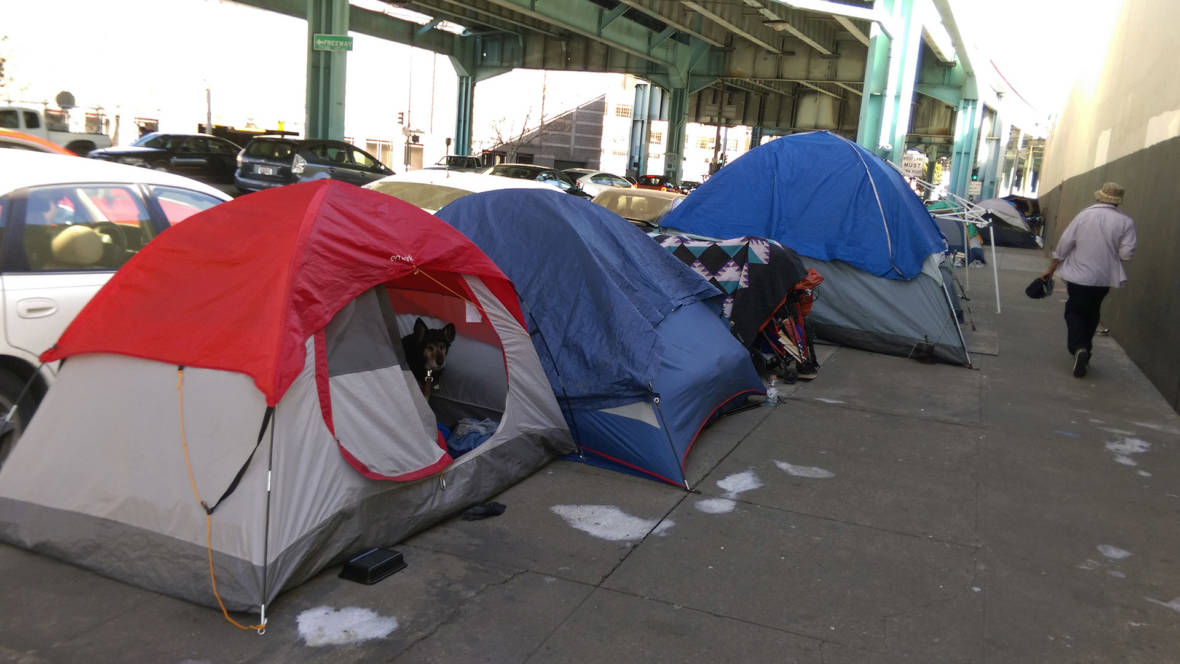
Thousands of people are homeless in San Francisco, and even more throughout the Bay Area. Despite years of concern and millions of dollars of investment, the problem persists.
Who are the people who live on the streets and on the edge of homelessness? Why have we failed to create lasting change? And are there solutions that offer hope for the future? As part of a collaboration with dozens of Bay Area news organizations, KQED is exploring these questions, and more.
Special Broadcast: The Politics of Homelessness
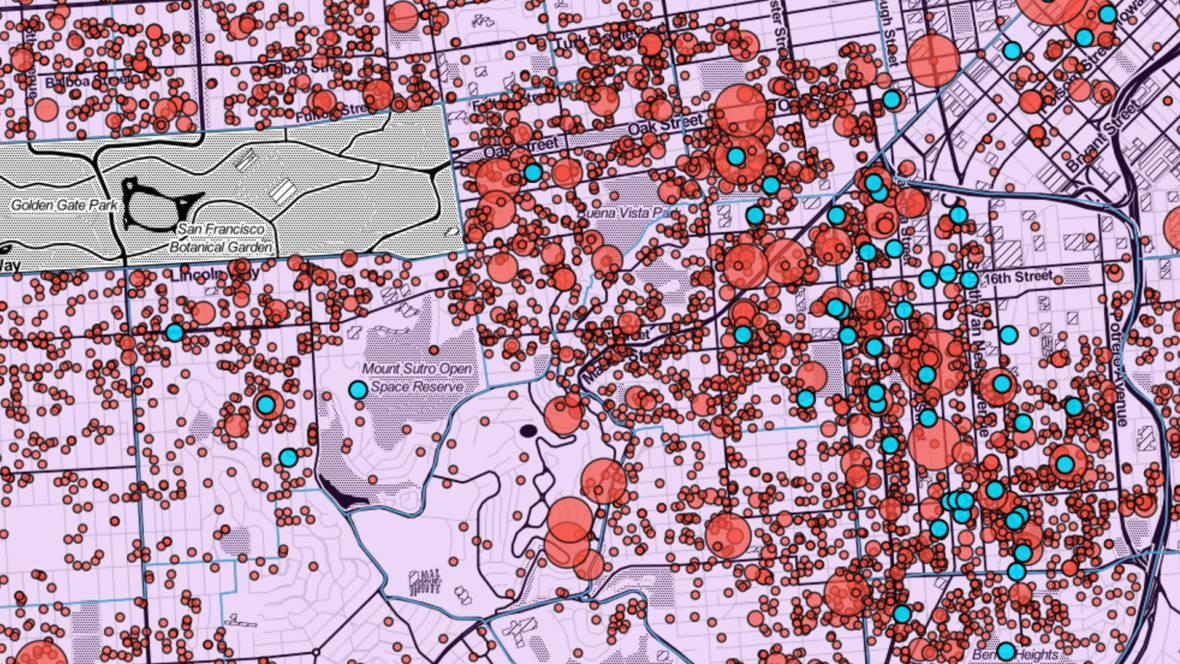
‘We Have a Right to Live Here’: Stories from San Francisco’s Evicted
Homelessness More Complex Since San Jose Shut Down 'The Jungle'
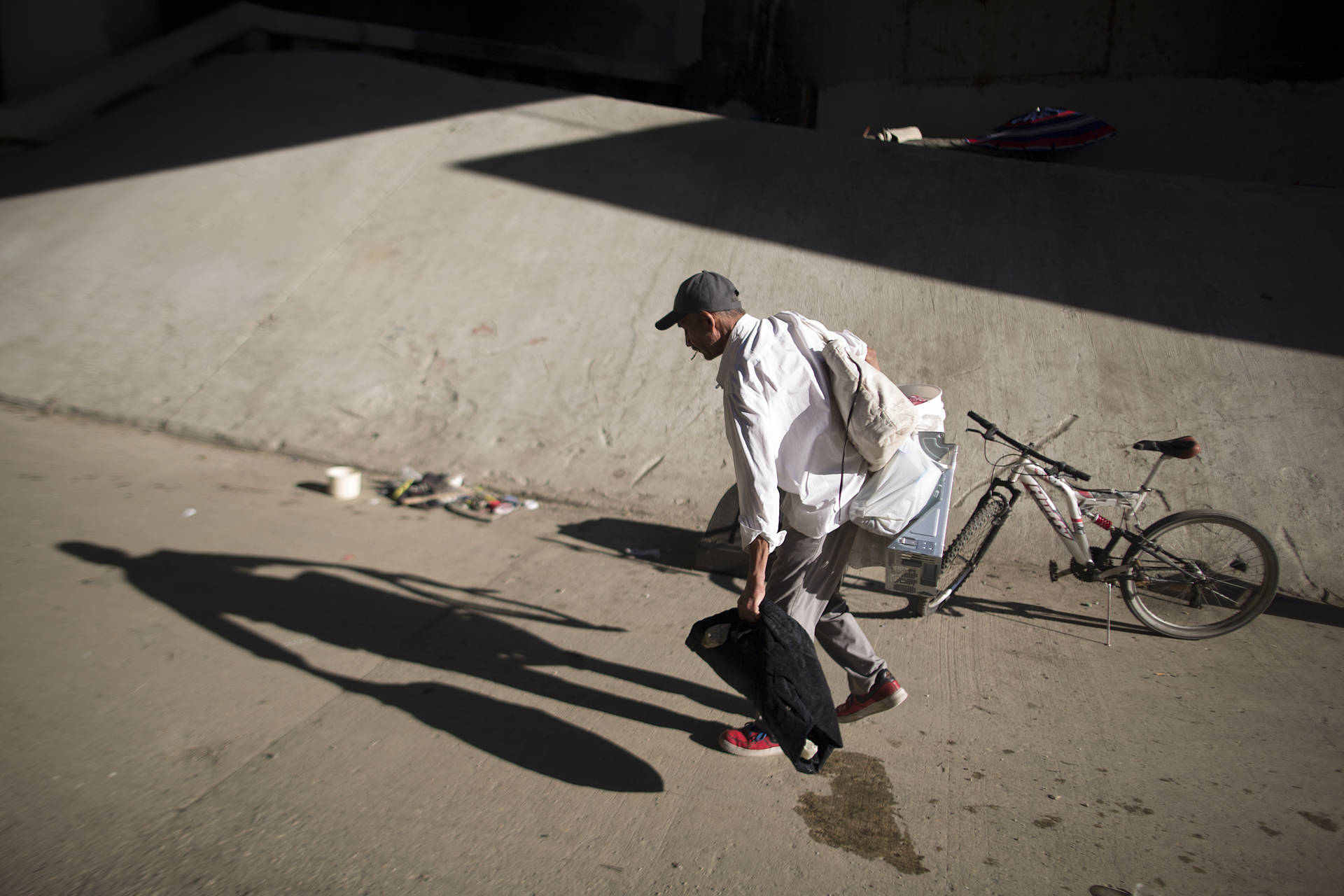
How San Francisco and L.A. Are Addressing Homelessness
Searching for the Hows, Whats and Whys of Homelessness
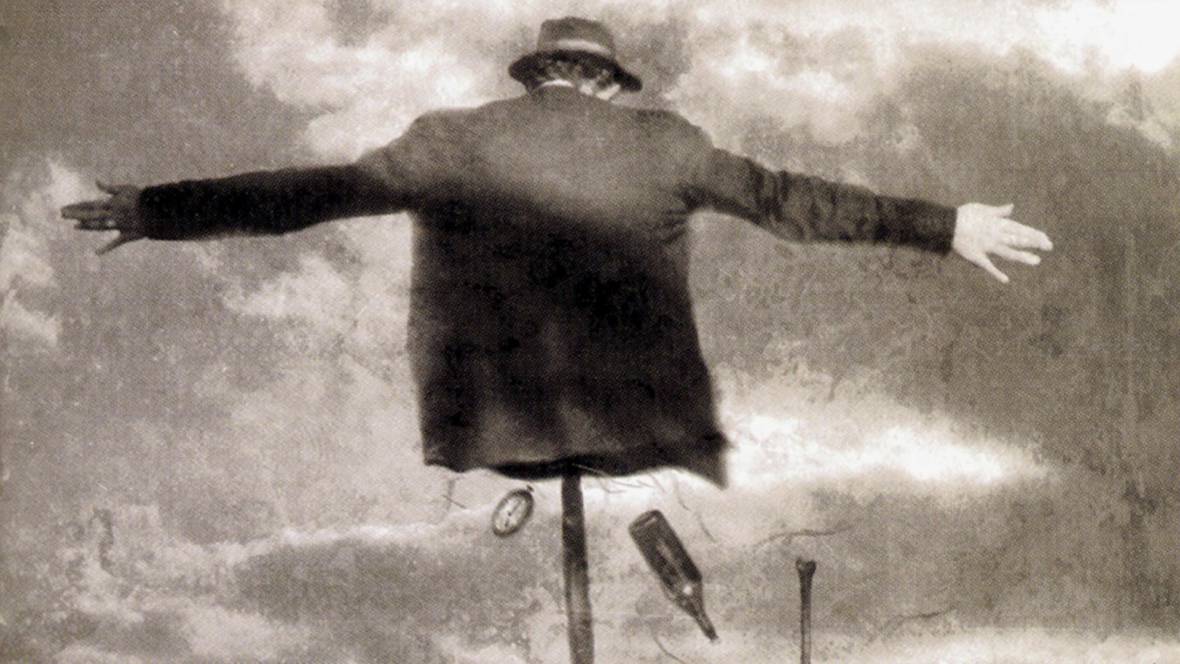
Five Songs for People Who've Been Homeless: The Bay Area's Empathy on Record
Homeless Blanket Project 'Undercover' Extends Long Past Super Bowl City
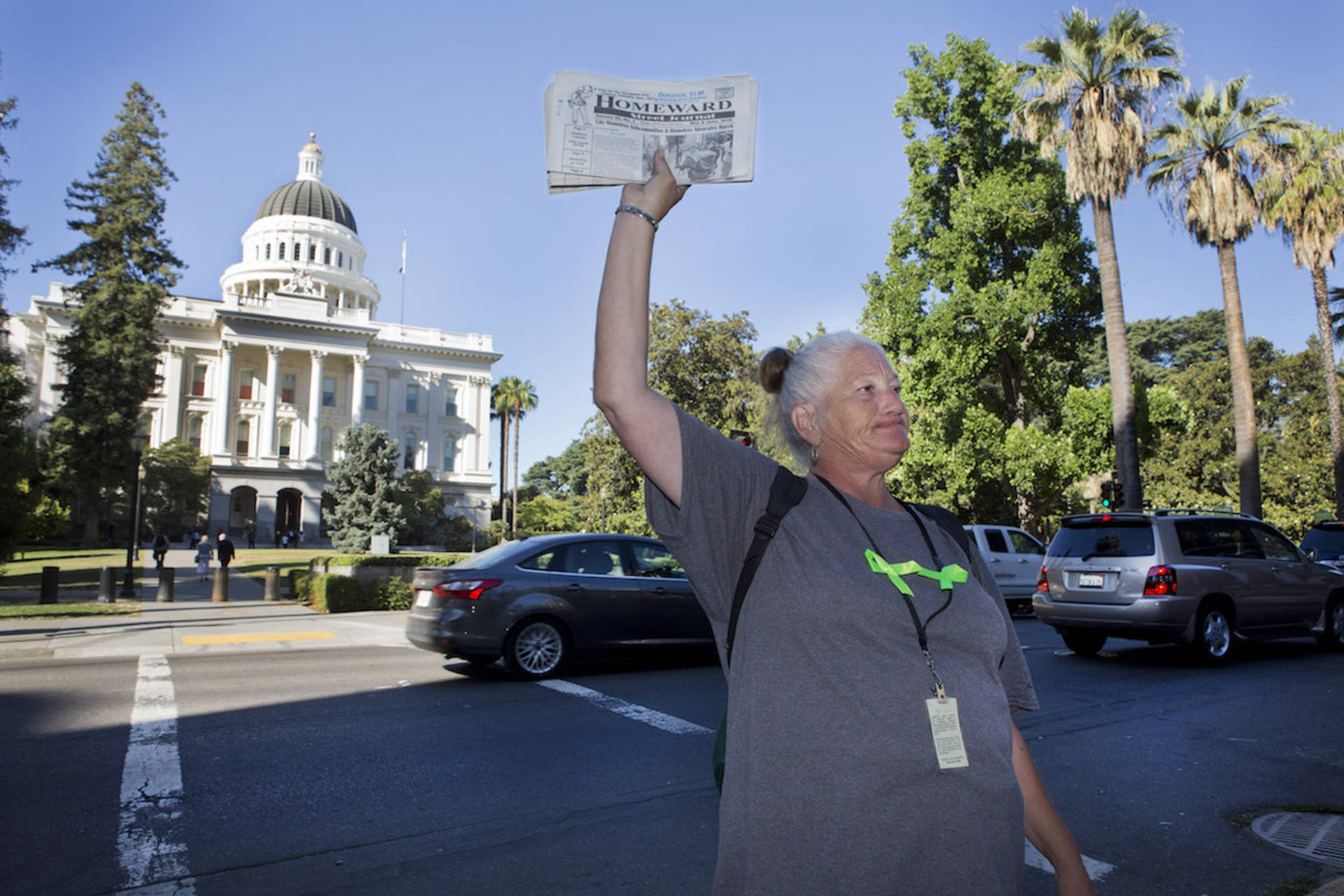
At the Corner of Power and Poverty
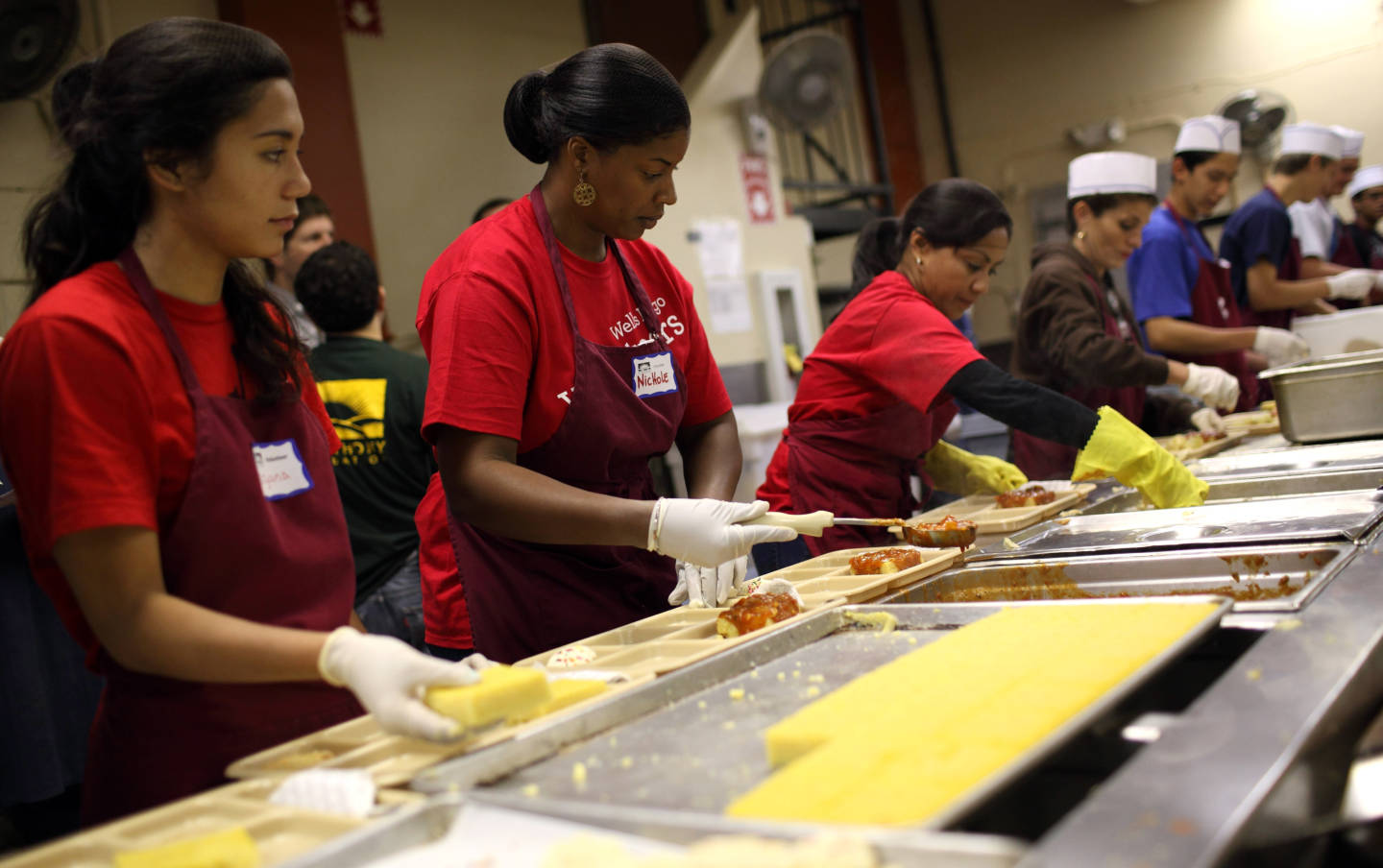
Where Homeless People Can Get Free Meals in the Bay Area
In Contra Costa, One Man's Homeless Outreach Mission Comes to an End
San Francisco Creates New Department to Address Homelessness
Start the Conversation: What Are Your Ideas For Addressing Homelessness?
window.__IS_SSR__=true
window.__INITIAL_STATE__={
"attachmentsReducer": {
"audio_0": {
"type": "attachments",
"id": "audio_0",
"imgSizes": {
"kqedFullSize": {
"file": "https://ww2.kqed.org/news/wp-content/themes/KQED-unified/img/audio_bgs/background0.jpg"
}
}
},
"audio_1": {
"type": "attachments",
"id": "audio_1",
"imgSizes": {
"kqedFullSize": {
"file": "https://ww2.kqed.org/news/wp-content/themes/KQED-unified/img/audio_bgs/background1.jpg"
}
}
},
"audio_2": {
"type": "attachments",
"id": "audio_2",
"imgSizes": {
"kqedFullSize": {
"file": "https://ww2.kqed.org/news/wp-content/themes/KQED-unified/img/audio_bgs/background2.jpg"
}
}
},
"audio_3": {
"type": "attachments",
"id": "audio_3",
"imgSizes": {
"kqedFullSize": {
"file": "https://ww2.kqed.org/news/wp-content/themes/KQED-unified/img/audio_bgs/background3.jpg"
}
}
},
"audio_4": {
"type": "attachments",
"id": "audio_4",
"imgSizes": {
"kqedFullSize": {
"file": "https://ww2.kqed.org/news/wp-content/themes/KQED-unified/img/audio_bgs/background4.jpg"
}
}
},
"placeholder": {
"type": "attachments",
"id": "placeholder",
"imgSizes": {
"thumbnail": {
"file": "https://cdn.kqed.org/wp-content/uploads/2024/12/KQED-Default-Image-816638274-2000x1333-1-160x107.jpg",
"width": 160,
"height": 107,
"mimeType": "image/jpeg"
},
"medium": {
"file": "https://cdn.kqed.org/wp-content/uploads/2024/12/KQED-Default-Image-816638274-2000x1333-1-800x533.jpg",
"width": 800,
"height": 533,
"mimeType": "image/jpeg"
},
"medium_large": {
"file": "https://cdn.kqed.org/wp-content/uploads/2024/12/KQED-Default-Image-816638274-2000x1333-1-768x512.jpg",
"width": 768,
"height": 512,
"mimeType": "image/jpeg"
},
"large": {
"file": "https://cdn.kqed.org/wp-content/uploads/2024/12/KQED-Default-Image-816638274-2000x1333-1-1020x680.jpg",
"width": 1020,
"height": 680,
"mimeType": "image/jpeg"
},
"1536x1536": {
"file": "https://cdn.kqed.org/wp-content/uploads/2024/12/KQED-Default-Image-816638274-2000x1333-1-1536x1024.jpg",
"width": 1536,
"height": 1024,
"mimeType": "image/jpeg"
},
"fd-lrg": {
"file": "https://cdn.kqed.org/wp-content/uploads/2024/12/KQED-Default-Image-816638274-2000x1333-1-1536x1024.jpg",
"width": 1536,
"height": 1024,
"mimeType": "image/jpeg"
},
"fd-med": {
"file": "https://cdn.kqed.org/wp-content/uploads/2024/12/KQED-Default-Image-816638274-2000x1333-1-1020x680.jpg",
"width": 1020,
"height": 680,
"mimeType": "image/jpeg"
},
"fd-sm": {
"file": "https://cdn.kqed.org/wp-content/uploads/2024/12/KQED-Default-Image-816638274-2000x1333-1-800x533.jpg",
"width": 800,
"height": 533,
"mimeType": "image/jpeg"
},
"post-thumbnail": {
"file": "https://cdn.kqed.org/wp-content/uploads/2024/12/KQED-Default-Image-816638274-2000x1333-1-672x372.jpg",
"width": 672,
"height": 372,
"mimeType": "image/jpeg"
},
"twentyfourteen-full-width": {
"file": "https://cdn.kqed.org/wp-content/uploads/2024/12/KQED-Default-Image-816638274-2000x1333-1-1038x576.jpg",
"width": 1038,
"height": 576,
"mimeType": "image/jpeg"
},
"xxsmall": {
"file": "https://cdn.kqed.org/wp-content/uploads/2024/12/KQED-Default-Image-816638274-2000x1333-1-160x107.jpg",
"width": 160,
"height": 107,
"mimeType": "image/jpeg"
},
"xsmall": {
"file": "https://cdn.kqed.org/wp-content/uploads/2024/12/KQED-Default-Image-816638274-2000x1333-1-672x372.jpg",
"width": 672,
"height": 372,
"mimeType": "image/jpeg"
},
"small": {
"file": "https://cdn.kqed.org/wp-content/uploads/2024/12/KQED-Default-Image-816638274-2000x1333-1-672x372.jpg",
"width": 672,
"height": 372,
"mimeType": "image/jpeg"
},
"xlarge": {
"file": "https://cdn.kqed.org/wp-content/uploads/2024/12/KQED-Default-Image-816638274-2000x1333-1-1020x680.jpg",
"width": 1020,
"height": 680,
"mimeType": "image/jpeg"
},
"full-width": {
"file": "https://cdn.kqed.org/wp-content/uploads/2024/12/KQED-Default-Image-816638274-2000x1333-1-1920x1280.jpg",
"width": 1920,
"height": 1280,
"mimeType": "image/jpeg"
},
"guest-author-32": {
"file": "https://cdn.kqed.org/wp-content/uploads/2025/01/KQED-Default-Image-816638274-1333x1333-1-160x160.jpg",
"width": 32,
"height": 32,
"mimeType": "image/jpeg"
},
"guest-author-50": {
"file": "https://cdn.kqed.org/wp-content/uploads/2025/01/KQED-Default-Image-816638274-1333x1333-1-160x160.jpg",
"width": 50,
"height": 50,
"mimeType": "image/jpeg"
},
"guest-author-64": {
"file": "https://cdn.kqed.org/wp-content/uploads/2025/01/KQED-Default-Image-816638274-1333x1333-1-160x160.jpg",
"width": 64,
"height": 64,
"mimeType": "image/jpeg"
},
"guest-author-96": {
"file": "https://cdn.kqed.org/wp-content/uploads/2025/01/KQED-Default-Image-816638274-1333x1333-1-160x160.jpg",
"width": 96,
"height": 96,
"mimeType": "image/jpeg"
},
"guest-author-128": {
"file": "https://cdn.kqed.org/wp-content/uploads/2025/01/KQED-Default-Image-816638274-1333x1333-1-160x160.jpg",
"width": 128,
"height": 128,
"mimeType": "image/jpeg"
},
"detail": {
"file": "https://cdn.kqed.org/wp-content/uploads/2025/01/KQED-Default-Image-816638274-1333x1333-1-160x160.jpg",
"width": 160,
"height": 160,
"mimeType": "image/jpeg"
},
"kqedFullSize": {
"file": "https://cdn.kqed.org/wp-content/uploads/2024/12/KQED-Default-Image-816638274-2000x1333-1.jpg",
"width": 2000,
"height": 1333
}
}
},
"news_11003998": {
"type": "attachments",
"id": "news_11003998",
"meta": {
"index": "attachments_1716263798",
"site": "news",
"id": "11003998",
"found": true
},
"parent": 11003958,
"imgSizes": {
"twentyfourteen-full-width": {
"file": "https://ww2.kqed.org/app/uploads/sites/10/2016/06/Homelessness_Parks_29oct2013_0162_web-1038x576.jpg",
"width": 1038,
"mimeType": "image/jpeg",
"height": 576
},
"thumbnail": {
"file": "https://ww2.kqed.org/app/uploads/sites/10/2016/06/Homelessness_Parks_29oct2013_0162_web-400x225.jpg",
"width": 400,
"mimeType": "image/jpeg",
"height": 225
},
"fd-sm": {
"file": "https://ww2.kqed.org/app/uploads/sites/10/2016/06/Homelessness_Parks_29oct2013_0162_web-960x540.jpg",
"width": 960,
"mimeType": "image/jpeg",
"height": 540
},
"post-thumbnail": {
"file": "https://ww2.kqed.org/app/uploads/sites/10/2016/06/Homelessness_Parks_29oct2013_0162_web-672x372.jpg",
"width": 672,
"mimeType": "image/jpeg",
"height": 372
},
"kqedFullSize": {
"file": "https://ww2.kqed.org/app/uploads/sites/10/2016/06/Homelessness_Parks_29oct2013_0162_web.jpg",
"width": 1382,
"height": 777
},
"guest-author-50": {
"file": "https://ww2.kqed.org/app/uploads/sites/10/2016/06/Homelessness_Parks_29oct2013_0162_web-50x50.jpg",
"width": 50,
"mimeType": "image/jpeg",
"height": 50
},
"guest-author-96": {
"file": "https://ww2.kqed.org/app/uploads/sites/10/2016/06/Homelessness_Parks_29oct2013_0162_web-96x96.jpg",
"width": 96,
"mimeType": "image/jpeg",
"height": 96
},
"medium": {
"file": "https://ww2.kqed.org/app/uploads/sites/10/2016/06/Homelessness_Parks_29oct2013_0162_web-800x450.jpg",
"width": 800,
"mimeType": "image/jpeg",
"height": 450
},
"guest-author-64": {
"file": "https://ww2.kqed.org/app/uploads/sites/10/2016/06/Homelessness_Parks_29oct2013_0162_web-64x64.jpg",
"width": 64,
"mimeType": "image/jpeg",
"height": 64
},
"guest-author-32": {
"file": "https://ww2.kqed.org/app/uploads/sites/10/2016/06/Homelessness_Parks_29oct2013_0162_web-32x32.jpg",
"width": 32,
"mimeType": "image/jpeg",
"height": 32
},
"jmtc-small-thumb": {
"file": "https://ww2.kqed.org/app/uploads/sites/10/2016/06/Homelessness_Parks_29oct2013_0162_web-280x150.jpg",
"width": 280,
"mimeType": "image/jpeg",
"height": 150
},
"fd-med": {
"file": "https://ww2.kqed.org/app/uploads/sites/10/2016/06/Homelessness_Parks_29oct2013_0162_web-1180x663.jpg",
"width": 1180,
"mimeType": "image/jpeg",
"height": 663
},
"detail": {
"file": "https://ww2.kqed.org/app/uploads/sites/10/2016/06/Homelessness_Parks_29oct2013_0162_web-150x150.jpg",
"width": 150,
"mimeType": "image/jpeg",
"height": 150
},
"guest-author-128": {
"file": "https://ww2.kqed.org/app/uploads/sites/10/2016/06/Homelessness_Parks_29oct2013_0162_web-128x128.jpg",
"width": 128,
"mimeType": "image/jpeg",
"height": 128
}
},
"publishDate": 1467171651,
"modified": 1467238359,
"caption": "The coalition on homelessness holds a press conference on Oct. 29, 2013, at San Francisco City Hall to protest legislation sponsored by Supervisor Scott Wiener to close all city parks at night.",
"description": "A homemade sign that reads \"Legalize Sleep.\"",
"title": "Homelessness_Parks_29oct2013_0162_web",
"credit": "Photo: Sara Bloomberg/KQED",
"status": "inherit",
"isLoading": false,
"fetchFailed": false
},
"arts_11741659": {
"type": "attachments",
"id": "arts_11741659",
"meta": {
"index": "attachments_1716263798",
"site": "arts",
"id": "11741659",
"found": true
},
"parent": 11740971,
"imgSizes": {
"twentyfourteen-full-width": {
"file": "https://ww2.kqed.org/app/uploads/sites/2/2016/06/NarrativesCover-1038x576.jpg",
"width": 1038,
"mimeType": "image/jpeg",
"height": 576
},
"thumbnail": {
"file": "https://ww2.kqed.org/app/uploads/sites/2/2016/06/NarrativesCover-400x225.jpg",
"width": 400,
"mimeType": "image/jpeg",
"height": 225
},
"fd-sm": {
"file": "https://ww2.kqed.org/app/uploads/sites/2/2016/06/NarrativesCover-960x540.jpg",
"width": 960,
"mimeType": "image/jpeg",
"height": 540
},
"post-thumbnail": {
"file": "https://ww2.kqed.org/app/uploads/sites/2/2016/06/NarrativesCover-672x372.jpg",
"width": 672,
"mimeType": "image/jpeg",
"height": 372
},
"kqedFullSize": {
"file": "https://ww2.kqed.org/app/uploads/sites/2/2016/06/NarrativesCover.jpg",
"width": 1920,
"height": 1080
},
"large": {
"file": "https://ww2.kqed.org/app/uploads/sites/2/2016/06/NarrativesCover-1180x664.jpg",
"width": 1180,
"mimeType": "image/jpeg",
"height": 664
},
"guest-author-50": {
"file": "https://ww2.kqed.org/app/uploads/sites/2/2016/06/NarrativesCover-50x50.jpg",
"width": 50,
"mimeType": "image/jpeg",
"height": 50
},
"guest-author-96": {
"file": "https://ww2.kqed.org/app/uploads/sites/2/2016/06/NarrativesCover-96x96.jpg",
"width": 96,
"mimeType": "image/jpeg",
"height": 96
},
"medium": {
"file": "https://ww2.kqed.org/app/uploads/sites/2/2016/06/NarrativesCover-800x450.jpg",
"width": 800,
"mimeType": "image/jpeg",
"height": 450
},
"guest-author-64": {
"file": "https://ww2.kqed.org/app/uploads/sites/2/2016/06/NarrativesCover-64x64.jpg",
"width": 64,
"mimeType": "image/jpeg",
"height": 64
},
"guest-author-32": {
"file": "https://ww2.kqed.org/app/uploads/sites/2/2016/06/NarrativesCover-32x32.jpg",
"width": 32,
"mimeType": "image/jpeg",
"height": 32
},
"fd-lrg": {
"file": "https://ww2.kqed.org/app/uploads/sites/2/2016/06/NarrativesCover-1920x1080.jpg",
"width": 1920,
"mimeType": "image/jpeg",
"height": 1080
},
"fd-med": {
"file": "https://ww2.kqed.org/app/uploads/sites/2/2016/06/NarrativesCover-1180x664.jpg",
"width": 1180,
"mimeType": "image/jpeg",
"height": 664
},
"detail": {
"file": "https://ww2.kqed.org/app/uploads/sites/2/2016/06/NarrativesCover-150x150.jpg",
"width": 150,
"mimeType": "image/jpeg",
"height": 150
},
"medium_large": {
"file": "https://ww2.kqed.org/app/uploads/sites/2/2016/06/NarrativesCover-768x432.jpg",
"width": 768,
"mimeType": "image/jpeg",
"height": 432
},
"guest-author-128": {
"file": "https://ww2.kqed.org/app/uploads/sites/2/2016/06/NarrativesCover-128x128.jpg",
"width": 128,
"mimeType": "image/jpeg",
"height": 128
}
},
"publishDate": 1467002280,
"modified": 1467002376,
"caption": "Detail from the Narratives of Displacement and Resistance Map",
"description": null,
"title": "NarrativesCover",
"credit": "Courtesy of the Anti-Eviction Mapping Project",
"status": "inherit",
"isLoading": false,
"fetchFailed": false
},
"news_11004701": {
"type": "attachments",
"id": "news_11004701",
"meta": {
"index": "attachments_1716263798",
"site": "news",
"id": "11004701",
"found": true
},
"parent": 11004644,
"imgSizes": {
"twentyfourteen-full-width": {
"file": "https://ww2.kqed.org/app/uploads/sites/10/2016/06/RS13379_20141204_jungle_jt_014-e1467231986596-1038x576.jpg",
"width": 1038,
"mimeType": "image/jpeg",
"height": 576
},
"thumbnail": {
"file": "https://ww2.kqed.org/app/uploads/sites/10/2016/06/RS13379_20141204_jungle_jt_014-e1467231986596-400x225.jpg",
"width": 400,
"mimeType": "image/jpeg",
"height": 225
},
"fd-sm": {
"file": "https://ww2.kqed.org/app/uploads/sites/10/2016/06/RS13379_20141204_jungle_jt_014-e1467231986596-960x540.jpg",
"width": 960,
"mimeType": "image/jpeg",
"height": 540
},
"post-thumbnail": {
"file": "https://ww2.kqed.org/app/uploads/sites/10/2016/06/RS13379_20141204_jungle_jt_014-e1467231986596-672x372.jpg",
"width": 672,
"mimeType": "image/jpeg",
"height": 372
},
"kqedFullSize": {
"file": "https://ww2.kqed.org/app/uploads/sites/10/2016/06/RS13379_20141204_jungle_jt_014-e1467231986596.jpg",
"width": 1920,
"height": 1080
},
"large": {
"file": "https://ww2.kqed.org/app/uploads/sites/10/2016/06/RS13379_20141204_jungle_jt_014-e1467231986596-1920x1080.jpg",
"width": 1920,
"mimeType": "image/jpeg",
"height": 1080
},
"guest-author-50": {
"file": "https://ww2.kqed.org/app/uploads/sites/10/2016/06/RS13379_20141204_jungle_jt_014-e1467231986596-50x50.jpg",
"width": 50,
"mimeType": "image/jpeg",
"height": 50
},
"guest-author-96": {
"file": "https://ww2.kqed.org/app/uploads/sites/10/2016/06/RS13379_20141204_jungle_jt_014-e1467231986596-96x96.jpg",
"width": 96,
"mimeType": "image/jpeg",
"height": 96
},
"medium": {
"file": "https://ww2.kqed.org/app/uploads/sites/10/2016/06/RS13379_20141204_jungle_jt_014-e1467231986596-800x450.jpg",
"width": 800,
"mimeType": "image/jpeg",
"height": 450
},
"guest-author-64": {
"file": "https://ww2.kqed.org/app/uploads/sites/10/2016/06/RS13379_20141204_jungle_jt_014-e1467231986596-64x64.jpg",
"width": 64,
"mimeType": "image/jpeg",
"height": 64
},
"guest-author-32": {
"file": "https://ww2.kqed.org/app/uploads/sites/10/2016/06/RS13379_20141204_jungle_jt_014-e1467231986596-32x32.jpg",
"width": 32,
"mimeType": "image/jpeg",
"height": 32
},
"jmtc-small-thumb": {
"file": "https://ww2.kqed.org/app/uploads/sites/10/2016/06/RS13379_20141204_jungle_jt_014-e1467231986596-280x150.jpg",
"width": 280,
"mimeType": "image/jpeg",
"height": 150
},
"fd-lrg": {
"file": "https://ww2.kqed.org/app/uploads/sites/10/2016/06/RS13379_20141204_jungle_jt_014-e1467231986596-1920x1080.jpg",
"width": 1920,
"mimeType": "image/jpeg",
"height": 1080
},
"fd-med": {
"file": "https://ww2.kqed.org/app/uploads/sites/10/2016/06/RS13379_20141204_jungle_jt_014-e1467231986596-1180x664.jpg",
"width": 1180,
"mimeType": "image/jpeg",
"height": 664
},
"detail": {
"file": "https://ww2.kqed.org/app/uploads/sites/10/2016/06/RS13379_20141204_jungle_jt_014-e1467231986596-150x150.jpg",
"width": 150,
"mimeType": "image/jpeg",
"height": 150
},
"guest-author-128": {
"file": "https://ww2.kqed.org/app/uploads/sites/10/2016/06/RS13379_20141204_jungle_jt_014-e1467231986596-128x128.jpg",
"width": 128,
"mimeType": "image/jpeg",
"height": 128
}
},
"publishDate": 1467231874,
"modified": 1467240443,
"caption": "Workers clean out the Jungle in San Jose, California, on Wednesday, Dec. 4, 2014. The city of San Jose cleared out the part of Coyote Creek that was home to around 300 people.",
"description": "Workers clean out the Jungle in San Jose, Calif. on Wednesday, Dec. 4, 2014. The city of San Jose cleared out the part of Coyote Creek that was home to around 300 people.",
"title": "RS13379_20141204_jungle_jt_014",
"credit": "James Tensuan/KQED",
"status": "inherit",
"isLoading": false,
"fetchFailed": false
},
"news_11004844": {
"type": "attachments",
"id": "news_11004844",
"meta": {
"index": "attachments_1716263798",
"site": "news",
"id": "11004844",
"found": true
},
"parent": 11004757,
"imgSizes": {
"twentyfourteen-full-width": {
"file": "https://ww2.kqed.org/app/uploads/sites/10/2016/06/GettyImages-498136152-1038x576.jpg",
"width": 1038,
"mimeType": "image/jpeg",
"height": 576
},
"thumbnail": {
"file": "https://ww2.kqed.org/app/uploads/sites/10/2016/06/GettyImages-498136152-400x267.jpg",
"width": 400,
"mimeType": "image/jpeg",
"height": 267
},
"fd-sm": {
"file": "https://ww2.kqed.org/app/uploads/sites/10/2016/06/GettyImages-498136152-960x640.jpg",
"width": 960,
"mimeType": "image/jpeg",
"height": 640
},
"post-thumbnail": {
"file": "https://ww2.kqed.org/app/uploads/sites/10/2016/06/GettyImages-498136152-672x372.jpg",
"width": 672,
"mimeType": "image/jpeg",
"height": 372
},
"kqedFullSize": {
"file": "https://ww2.kqed.org/app/uploads/sites/10/2016/06/GettyImages-498136152.jpg",
"width": 1920,
"height": 1280
},
"large": {
"file": "https://ww2.kqed.org/app/uploads/sites/10/2016/06/GettyImages-498136152-1920x1280.jpg",
"width": 1920,
"mimeType": "image/jpeg",
"height": 1280
},
"guest-author-50": {
"file": "https://ww2.kqed.org/app/uploads/sites/10/2016/06/GettyImages-498136152-50x50.jpg",
"width": 50,
"mimeType": "image/jpeg",
"height": 50
},
"guest-author-96": {
"file": "https://ww2.kqed.org/app/uploads/sites/10/2016/06/GettyImages-498136152-96x96.jpg",
"width": 96,
"mimeType": "image/jpeg",
"height": 96
},
"medium": {
"file": "https://ww2.kqed.org/app/uploads/sites/10/2016/06/GettyImages-498136152-800x533.jpg",
"width": 800,
"mimeType": "image/jpeg",
"height": 533
},
"guest-author-64": {
"file": "https://ww2.kqed.org/app/uploads/sites/10/2016/06/GettyImages-498136152-64x64.jpg",
"width": 64,
"mimeType": "image/jpeg",
"height": 64
},
"guest-author-32": {
"file": "https://ww2.kqed.org/app/uploads/sites/10/2016/06/GettyImages-498136152-32x32.jpg",
"width": 32,
"mimeType": "image/jpeg",
"height": 32
},
"jmtc-small-thumb": {
"file": "https://ww2.kqed.org/app/uploads/sites/10/2016/06/GettyImages-498136152-280x150.jpg",
"width": 280,
"mimeType": "image/jpeg",
"height": 150
},
"fd-lrg": {
"file": "https://ww2.kqed.org/app/uploads/sites/10/2016/06/GettyImages-498136152-1920x1280.jpg",
"width": 1920,
"mimeType": "image/jpeg",
"height": 1280
},
"fd-med": {
"file": "https://ww2.kqed.org/app/uploads/sites/10/2016/06/GettyImages-498136152-1180x787.jpg",
"width": 1180,
"mimeType": "image/jpeg",
"height": 787
},
"detail": {
"file": "https://ww2.kqed.org/app/uploads/sites/10/2016/06/GettyImages-498136152-150x150.jpg",
"width": 150,
"mimeType": "image/jpeg",
"height": 150
},
"guest-author-128": {
"file": "https://ww2.kqed.org/app/uploads/sites/10/2016/06/GettyImages-498136152-128x128.jpg",
"width": 128,
"mimeType": "image/jpeg",
"height": 128
}
},
"publishDate": 1467237756,
"modified": 1467247293,
"caption": "Fernando Lopez carries possessions from the Los Angeles River on Nov. 20, 2015, in Los Angeles, California. Many of the estimated 26,000 homeless in L.A. live in riverbeds and storm drains that could quickly turn deadly during powerful storms. ",
"description": null,
"title": "GettyImages-498136152",
"credit": "David McNew/Getty Images",
"status": "inherit",
"isLoading": false,
"fetchFailed": false
},
"forum_2010101855429": {
"type": "attachments",
"id": "forum_2010101855429",
"meta": {
"index": "attachments_1716263798",
"site": "forum",
"id": "2010101855429",
"found": true
},
"parent": 2010101855428,
"imgSizes": {
"twentyfourteen-full-width": {
"file": "https://ww2.kqed.org/app/uploads/sites/43/2016/06/homeless-man-1038x576.jpg",
"width": 1038,
"mimeType": "image/jpeg",
"height": 576
},
"thumbnail": {
"file": "https://ww2.kqed.org/app/uploads/sites/43/2016/06/homeless-man-400x225.jpg",
"width": 400,
"mimeType": "image/jpeg",
"height": 225
},
"fd-sm": {
"file": "https://ww2.kqed.org/app/uploads/sites/43/2016/06/homeless-man-960x541.jpg",
"width": 960,
"mimeType": "image/jpeg",
"height": 541
},
"post-thumbnail": {
"file": "https://ww2.kqed.org/app/uploads/sites/43/2016/06/homeless-man-672x372.jpg",
"width": 672,
"mimeType": "image/jpeg",
"height": 372
},
"kqedFullSize": {
"file": "https://ww2.kqed.org/app/uploads/sites/43/2016/06/homeless-man.jpg",
"width": 1920,
"height": 1081
},
"large": {
"file": "https://ww2.kqed.org/app/uploads/sites/43/2016/06/homeless-man-1180x664.jpg",
"width": 1180,
"mimeType": "image/jpeg",
"height": 664
},
"guest-author-50": {
"file": "https://ww2.kqed.org/app/uploads/sites/43/2016/06/homeless-man-50x50.jpg",
"width": 50,
"mimeType": "image/jpeg",
"height": 50
},
"guest-author-96": {
"file": "https://ww2.kqed.org/app/uploads/sites/43/2016/06/homeless-man-96x96.jpg",
"width": 96,
"mimeType": "image/jpeg",
"height": 96
},
"medium": {
"file": "https://ww2.kqed.org/app/uploads/sites/43/2016/06/homeless-man-800x450.jpg",
"width": 800,
"mimeType": "image/jpeg",
"height": 450
},
"guest-author-64": {
"file": "https://ww2.kqed.org/app/uploads/sites/43/2016/06/homeless-man-64x64.jpg",
"width": 64,
"mimeType": "image/jpeg",
"height": 64
},
"guest-author-32": {
"file": "https://ww2.kqed.org/app/uploads/sites/43/2016/06/homeless-man-32x32.jpg",
"width": 32,
"mimeType": "image/jpeg",
"height": 32
},
"fd-lrg": {
"file": "https://ww2.kqed.org/app/uploads/sites/43/2016/06/homeless-man-1920x1081.jpg",
"width": 1920,
"mimeType": "image/jpeg",
"height": 1081
},
"fd-med": {
"file": "https://ww2.kqed.org/app/uploads/sites/43/2016/06/homeless-man-1180x664.jpg",
"width": 1180,
"mimeType": "image/jpeg",
"height": 664
},
"detail": {
"file": "https://ww2.kqed.org/app/uploads/sites/43/2016/06/homeless-man-150x150.jpg",
"width": 150,
"mimeType": "image/jpeg",
"height": 150
},
"medium_large": {
"file": "https://ww2.kqed.org/app/uploads/sites/43/2016/06/homeless-man-768x432.jpg",
"width": 768,
"mimeType": "image/jpeg",
"height": 432
},
"guest-author-128": {
"file": "https://ww2.kqed.org/app/uploads/sites/43/2016/06/homeless-man-128x128.jpg",
"width": 128,
"mimeType": "image/jpeg",
"height": 128
}
},
"publishDate": 1467158765,
"modified": 1467158814,
"caption": "A homeless man begs for change on December 10, 2012 in San Francisco, California. ",
"description": "A homeless man begs for change on December 10, 2012 in San Francisco, California. ",
"title": "Homeless Numbers Remain Unchanged From 2011 Despite Increase In Funding",
"credit": "Photo: Justin Sullivan/Getty Images",
"status": "inherit",
"isLoading": false,
"fetchFailed": false
},
"arts_11746716": {
"type": "attachments",
"id": "arts_11746716",
"meta": {
"index": "attachments_1716263798",
"site": "arts",
"id": "11746716",
"found": true
},
"parent": 11727091,
"imgSizes": {
"twentyfourteen-full-width": {
"file": "https://ww2.kqed.org/app/uploads/sites/2/2016/06/Waits.MAIN_-1038x576.jpg",
"width": 1038,
"mimeType": "image/jpeg",
"height": 576
},
"thumbnail": {
"file": "https://ww2.kqed.org/app/uploads/sites/2/2016/06/Waits.MAIN_-400x225.jpg",
"width": 400,
"mimeType": "image/jpeg",
"height": 225
},
"fd-sm": {
"file": "https://ww2.kqed.org/app/uploads/sites/2/2016/06/Waits.MAIN_-960x540.jpg",
"width": 960,
"mimeType": "image/jpeg",
"height": 540
},
"post-thumbnail": {
"file": "https://ww2.kqed.org/app/uploads/sites/2/2016/06/Waits.MAIN_-672x372.jpg",
"width": 672,
"mimeType": "image/jpeg",
"height": 372
},
"kqedFullSize": {
"file": "https://ww2.kqed.org/app/uploads/sites/2/2016/06/Waits.MAIN_.jpg",
"width": 1920,
"height": 1080
},
"large": {
"file": "https://ww2.kqed.org/app/uploads/sites/2/2016/06/Waits.MAIN_-1180x664.jpg",
"width": 1180,
"mimeType": "image/jpeg",
"height": 664
},
"guest-author-50": {
"file": "https://ww2.kqed.org/app/uploads/sites/2/2016/06/Waits.MAIN_-50x50.jpg",
"width": 50,
"mimeType": "image/jpeg",
"height": 50
},
"guest-author-96": {
"file": "https://ww2.kqed.org/app/uploads/sites/2/2016/06/Waits.MAIN_-96x96.jpg",
"width": 96,
"mimeType": "image/jpeg",
"height": 96
},
"medium": {
"file": "https://ww2.kqed.org/app/uploads/sites/2/2016/06/Waits.MAIN_-800x450.jpg",
"width": 800,
"mimeType": "image/jpeg",
"height": 450
},
"guest-author-64": {
"file": "https://ww2.kqed.org/app/uploads/sites/2/2016/06/Waits.MAIN_-64x64.jpg",
"width": 64,
"mimeType": "image/jpeg",
"height": 64
},
"guest-author-32": {
"file": "https://ww2.kqed.org/app/uploads/sites/2/2016/06/Waits.MAIN_-32x32.jpg",
"width": 32,
"mimeType": "image/jpeg",
"height": 32
},
"fd-lrg": {
"file": "https://ww2.kqed.org/app/uploads/sites/2/2016/06/Waits.MAIN_-1920x1080.jpg",
"width": 1920,
"mimeType": "image/jpeg",
"height": 1080
},
"fd-med": {
"file": "https://ww2.kqed.org/app/uploads/sites/2/2016/06/Waits.MAIN_-1180x664.jpg",
"width": 1180,
"mimeType": "image/jpeg",
"height": 664
},
"detail": {
"file": "https://ww2.kqed.org/app/uploads/sites/2/2016/06/Waits.MAIN_-150x150.jpg",
"width": 150,
"mimeType": "image/jpeg",
"height": 150
},
"medium_large": {
"file": "https://ww2.kqed.org/app/uploads/sites/2/2016/06/Waits.MAIN_-768x432.jpg",
"width": 768,
"mimeType": "image/jpeg",
"height": 432
},
"guest-author-128": {
"file": "https://ww2.kqed.org/app/uploads/sites/2/2016/06/Waits.MAIN_-128x128.jpg",
"width": 128,
"mimeType": "image/jpeg",
"height": 128
}
},
"publishDate": 1467097244,
"modified": 1467097348,
"caption": "Tom Waits is among many Bay Area musicians who approach homelessness with understanding instead of scorn.",
"description": "Tom Waits is among many Bay Area musicians who approach homelessness with understanding instead of scorn.",
"title": "Waits.MAIN",
"credit": "Photo: Matt Mahurin",
"status": "inherit",
"isLoading": false,
"fetchFailed": false
},
"arts_11751227": {
"type": "attachments",
"id": "arts_11751227",
"meta": {
"index": "attachments_1716263798",
"site": "arts",
"id": "11751227",
"found": true
},
"parent": 11749308,
"imgSizes": {
"twentyfourteen-full-width": {
"file": "https://ww2.kqed.org/app/uploads/sites/2/2016/06/blanketsposterimage-1038x576.jpg",
"width": 1038,
"mimeType": "image/jpeg",
"height": 576
},
"thumbnail": {
"file": "https://ww2.kqed.org/app/uploads/sites/2/2016/06/blanketsposterimage-400x225.jpg",
"width": 400,
"mimeType": "image/jpeg",
"height": 225
},
"fd-sm": {
"file": "https://ww2.kqed.org/app/uploads/sites/2/2016/06/blanketsposterimage-960x540.jpg",
"width": 960,
"mimeType": "image/jpeg",
"height": 540
},
"post-thumbnail": {
"file": "https://ww2.kqed.org/app/uploads/sites/2/2016/06/blanketsposterimage-672x372.jpg",
"width": 672,
"mimeType": "image/jpeg",
"height": 372
},
"kqedFullSize": {
"file": "https://ww2.kqed.org/app/uploads/sites/2/2016/06/blanketsposterimage.jpg",
"width": 2539,
"height": 1429
},
"large": {
"file": "https://ww2.kqed.org/app/uploads/sites/2/2016/06/blanketsposterimage-1180x664.jpg",
"width": 1180,
"mimeType": "image/jpeg",
"height": 664
},
"guest-author-50": {
"file": "https://ww2.kqed.org/app/uploads/sites/2/2016/06/blanketsposterimage-50x50.jpg",
"width": 50,
"mimeType": "image/jpeg",
"height": 50
},
"guest-author-96": {
"file": "https://ww2.kqed.org/app/uploads/sites/2/2016/06/blanketsposterimage-96x96.jpg",
"width": 96,
"mimeType": "image/jpeg",
"height": 96
},
"medium": {
"file": "https://ww2.kqed.org/app/uploads/sites/2/2016/06/blanketsposterimage-800x450.jpg",
"width": 800,
"mimeType": "image/jpeg",
"height": 450
},
"guest-author-64": {
"file": "https://ww2.kqed.org/app/uploads/sites/2/2016/06/blanketsposterimage-64x64.jpg",
"width": 64,
"mimeType": "image/jpeg",
"height": 64
},
"guest-author-32": {
"file": "https://ww2.kqed.org/app/uploads/sites/2/2016/06/blanketsposterimage-32x32.jpg",
"width": 32,
"mimeType": "image/jpeg",
"height": 32
},
"fd-lrg": {
"file": "https://ww2.kqed.org/app/uploads/sites/2/2016/06/blanketsposterimage-1920x1081.jpg",
"width": 1920,
"mimeType": "image/jpeg",
"height": 1081
},
"fd-med": {
"file": "https://ww2.kqed.org/app/uploads/sites/2/2016/06/blanketsposterimage-1180x664.jpg",
"width": 1180,
"mimeType": "image/jpeg",
"height": 664
},
"detail": {
"file": "https://ww2.kqed.org/app/uploads/sites/2/2016/06/blanketsposterimage-150x150.jpg",
"width": 150,
"mimeType": "image/jpeg",
"height": 150
},
"medium_large": {
"file": "https://ww2.kqed.org/app/uploads/sites/2/2016/06/blanketsposterimage-768x432.jpg",
"width": 768,
"mimeType": "image/jpeg",
"height": 432
},
"guest-author-128": {
"file": "https://ww2.kqed.org/app/uploads/sites/2/2016/06/blanketsposterimage-128x128.jpg",
"width": 128,
"mimeType": "image/jpeg",
"height": 128
}
},
"publishDate": 1467180208,
"modified": 1467180208,
"caption": null,
"description": null,
"title": "blanketsposterimage",
"credit": null,
"status": "inherit",
"isLoading": false,
"fetchFailed": false
},
"news_11003527": {
"type": "attachments",
"id": "news_11003527",
"meta": {
"index": "attachments_1716263798",
"site": "news",
"id": "11003527",
"found": true
},
"parent": 11003427,
"imgSizes": {
"twentyfourteen-full-width": {
"file": "https://ww2.kqed.org/app/uploads/sites/10/2016/06/Bartley1-1038x576.jpg",
"width": 1038,
"mimeType": "image/jpeg",
"height": 576
},
"thumbnail": {
"file": "https://ww2.kqed.org/app/uploads/sites/10/2016/06/Bartley1-400x267.jpg",
"width": 400,
"mimeType": "image/jpeg",
"height": 267
},
"fd-sm": {
"file": "https://ww2.kqed.org/app/uploads/sites/10/2016/06/Bartley1-960x640.jpg",
"width": 960,
"mimeType": "image/jpeg",
"height": 640
},
"post-thumbnail": {
"file": "https://ww2.kqed.org/app/uploads/sites/10/2016/06/Bartley1-672x372.jpg",
"width": 672,
"mimeType": "image/jpeg",
"height": 372
},
"kqedFullSize": {
"file": "https://ww2.kqed.org/app/uploads/sites/10/2016/06/Bartley1.jpg",
"width": 1920,
"height": 1280
},
"large": {
"file": "https://ww2.kqed.org/app/uploads/sites/10/2016/06/Bartley1-1920x1280.jpg",
"width": 1920,
"mimeType": "image/jpeg",
"height": 1280
},
"guest-author-50": {
"file": "https://ww2.kqed.org/app/uploads/sites/10/2016/06/Bartley1-50x50.jpg",
"width": 50,
"mimeType": "image/jpeg",
"height": 50
},
"guest-author-96": {
"file": "https://ww2.kqed.org/app/uploads/sites/10/2016/06/Bartley1-96x96.jpg",
"width": 96,
"mimeType": "image/jpeg",
"height": 96
},
"medium": {
"file": "https://ww2.kqed.org/app/uploads/sites/10/2016/06/Bartley1-800x533.jpg",
"width": 800,
"mimeType": "image/jpeg",
"height": 533
},
"guest-author-64": {
"file": "https://ww2.kqed.org/app/uploads/sites/10/2016/06/Bartley1-64x64.jpg",
"width": 64,
"mimeType": "image/jpeg",
"height": 64
},
"guest-author-32": {
"file": "https://ww2.kqed.org/app/uploads/sites/10/2016/06/Bartley1-32x32.jpg",
"width": 32,
"mimeType": "image/jpeg",
"height": 32
},
"jmtc-small-thumb": {
"file": "https://ww2.kqed.org/app/uploads/sites/10/2016/06/Bartley1-280x150.jpg",
"width": 280,
"mimeType": "image/jpeg",
"height": 150
},
"fd-lrg": {
"file": "https://ww2.kqed.org/app/uploads/sites/10/2016/06/Bartley1-1920x1280.jpg",
"width": 1920,
"mimeType": "image/jpeg",
"height": 1280
},
"fd-med": {
"file": "https://ww2.kqed.org/app/uploads/sites/10/2016/06/Bartley1-1180x787.jpg",
"width": 1180,
"mimeType": "image/jpeg",
"height": 787
},
"detail": {
"file": "https://ww2.kqed.org/app/uploads/sites/10/2016/06/Bartley1-150x150.jpg",
"width": 150,
"mimeType": "image/jpeg",
"height": 150
},
"guest-author-128": {
"file": "https://ww2.kqed.org/app/uploads/sites/10/2016/06/Bartley1-128x128.jpg",
"width": 128,
"mimeType": "image/jpeg",
"height": 128
}
},
"publishDate": 1467140467,
"modified": 1467140501,
"caption": "Debbie Bartley sells the Homeward newspaper near the state Capitol in Sacramento. ",
"description": null,
"title": "Bartley1",
"credit": "Steve Yeater/CALmatters",
"status": "inherit",
"isLoading": false,
"fetchFailed": false
},
"bayareabites_110378": {
"type": "attachments",
"id": "bayareabites_110378",
"meta": {
"index": "attachments_1716263798",
"site": "bayareabites",
"id": "110378",
"found": true
},
"parent": 110356,
"imgSizes": {
"twentyfourteen-full-width": {
"file": "https://ww2.kqed.org/app/uploads/sites/24/2016/06/RS549_104161743-1038x576.jpg",
"width": 1038,
"mimeType": "image/jpeg",
"height": 576
},
"thumbnail": {
"file": "https://ww2.kqed.org/app/uploads/sites/24/2016/06/RS549_104161743-400x251.jpg",
"width": 400,
"mimeType": "image/jpeg",
"height": 251
},
"fd-sm": {
"file": "https://ww2.kqed.org/app/uploads/sites/24/2016/06/RS549_104161743-960x603.jpg",
"width": 960,
"mimeType": "image/jpeg",
"height": 603
},
"post-thumbnail": {
"file": "https://ww2.kqed.org/app/uploads/sites/24/2016/06/RS549_104161743-672x372.jpg",
"width": 672,
"mimeType": "image/jpeg",
"height": 372
},
"kqedFullSize": {
"file": "https://ww2.kqed.org/app/uploads/sites/24/2016/06/RS549_104161743.jpg",
"width": 5480,
"height": 3440
},
"large": {
"file": "https://ww2.kqed.org/app/uploads/sites/24/2016/06/RS549_104161743-1440x904.jpg",
"width": 1440,
"mimeType": "image/jpeg",
"height": 904
},
"guest-author-50": {
"file": "https://ww2.kqed.org/app/uploads/sites/24/2016/06/RS549_104161743-50x50.jpg",
"width": 50,
"mimeType": "image/jpeg",
"height": 50
},
"guest-author-96": {
"file": "https://ww2.kqed.org/app/uploads/sites/24/2016/06/RS549_104161743-96x96.jpg",
"width": 96,
"mimeType": "image/jpeg",
"height": 96
},
"medium": {
"file": "https://ww2.kqed.org/app/uploads/sites/24/2016/06/RS549_104161743-800x502.jpg",
"width": 800,
"mimeType": "image/jpeg",
"height": 502
},
"guest-author-64": {
"file": "https://ww2.kqed.org/app/uploads/sites/24/2016/06/RS549_104161743-64x64.jpg",
"width": 64,
"mimeType": "image/jpeg",
"height": 64
},
"guest-author-32": {
"file": "https://ww2.kqed.org/app/uploads/sites/24/2016/06/RS549_104161743-32x32.jpg",
"width": 32,
"mimeType": "image/jpeg",
"height": 32
},
"cat_post_thumb_sizecategory-posts-2": {
"file": "https://ww2.kqed.org/app/uploads/sites/24/2016/06/RS549_104161743-150x150.jpg",
"width": 150,
"mimeType": "image/jpeg",
"height": 150
},
"fd-lrg": {
"file": "https://ww2.kqed.org/app/uploads/sites/24/2016/06/RS549_104161743-1920x1205.jpg",
"width": 1920,
"mimeType": "image/jpeg",
"height": 1205
},
"fd-med": {
"file": "https://ww2.kqed.org/app/uploads/sites/24/2016/06/RS549_104161743-1180x741.jpg",
"width": 1180,
"mimeType": "image/jpeg",
"height": 741
},
"detail": {
"file": "https://ww2.kqed.org/app/uploads/sites/24/2016/06/RS549_104161743-150x150.jpg",
"width": 150,
"mimeType": "image/jpeg",
"height": 150
},
"medium_large": {
"file": "https://ww2.kqed.org/app/uploads/sites/24/2016/06/RS549_104161743-768x482.jpg",
"width": 768,
"mimeType": "image/jpeg",
"height": 482
},
"guest-author-128": {
"file": "https://ww2.kqed.org/app/uploads/sites/24/2016/06/RS549_104161743-128x128.jpg",
"width": 128,
"mimeType": "image/jpeg",
"height": 128
}
},
"publishDate": 1467139443,
"modified": 1467139487,
"caption": "Volunteers prepare meals at St. Anthony's.",
"description": "Volunteers prepare meals at St. Anthony's.",
"title": "Poverty Rate Rises To 15 Year High",
"credit": "Justin Sullivan/Getty Images",
"status": "inherit",
"isLoading": false,
"fetchFailed": false
},
"news_10999055": {
"type": "attachments",
"id": "news_10999055",
"meta": {
"index": "attachments_1716263798",
"site": "news",
"id": "10999055",
"found": true
},
"parent": 10982851,
"imgSizes": {
"twentyfourteen-full-width": {
"file": "https://ww2.kqed.org/app/uploads/sites/10/2016/06/coco-outreach-1038x576.jpg",
"width": 1038,
"mimeType": "image/jpeg",
"height": 576
},
"thumbnail": {
"file": "https://ww2.kqed.org/app/uploads/sites/10/2016/06/coco-outreach-400x225.jpg",
"width": 400,
"mimeType": "image/jpeg",
"height": 225
},
"fd-sm": {
"file": "https://ww2.kqed.org/app/uploads/sites/10/2016/06/coco-outreach-960x540.jpg",
"width": 960,
"mimeType": "image/jpeg",
"height": 540
},
"post-thumbnail": {
"file": "https://ww2.kqed.org/app/uploads/sites/10/2016/06/coco-outreach-672x372.jpg",
"width": 672,
"mimeType": "image/jpeg",
"height": 372
},
"kqedFullSize": {
"file": "https://ww2.kqed.org/app/uploads/sites/10/2016/06/coco-outreach.jpg",
"width": 1920,
"height": 1080
},
"large": {
"file": "https://ww2.kqed.org/app/uploads/sites/10/2016/06/coco-outreach-1920x1080.jpg",
"width": 1920,
"mimeType": "image/jpeg",
"height": 1080
},
"guest-author-50": {
"file": "https://ww2.kqed.org/app/uploads/sites/10/2016/06/coco-outreach-50x50.jpg",
"width": 50,
"mimeType": "image/jpeg",
"height": 50
},
"guest-author-96": {
"file": "https://ww2.kqed.org/app/uploads/sites/10/2016/06/coco-outreach-96x96.jpg",
"width": 96,
"mimeType": "image/jpeg",
"height": 96
},
"medium": {
"file": "https://ww2.kqed.org/app/uploads/sites/10/2016/06/coco-outreach-800x450.jpg",
"width": 800,
"mimeType": "image/jpeg",
"height": 450
},
"guest-author-64": {
"file": "https://ww2.kqed.org/app/uploads/sites/10/2016/06/coco-outreach-64x64.jpg",
"width": 64,
"mimeType": "image/jpeg",
"height": 64
},
"guest-author-32": {
"file": "https://ww2.kqed.org/app/uploads/sites/10/2016/06/coco-outreach-32x32.jpg",
"width": 32,
"mimeType": "image/jpeg",
"height": 32
},
"jmtc-small-thumb": {
"file": "https://ww2.kqed.org/app/uploads/sites/10/2016/06/coco-outreach-280x150.jpg",
"width": 280,
"mimeType": "image/jpeg",
"height": 150
},
"fd-lrg": {
"file": "https://ww2.kqed.org/app/uploads/sites/10/2016/06/coco-outreach-1920x1080.jpg",
"width": 1920,
"mimeType": "image/jpeg",
"height": 1080
},
"fd-med": {
"file": "https://ww2.kqed.org/app/uploads/sites/10/2016/06/coco-outreach-1180x664.jpg",
"width": 1180,
"mimeType": "image/jpeg",
"height": 664
},
"detail": {
"file": "https://ww2.kqed.org/app/uploads/sites/10/2016/06/coco-outreach-150x150.jpg",
"width": 150,
"mimeType": "image/jpeg",
"height": 150
},
"guest-author-128": {
"file": "https://ww2.kqed.org/app/uploads/sites/10/2016/06/coco-outreach-128x128.jpg",
"width": 128,
"mimeType": "image/jpeg",
"height": 128
}
},
"publishDate": 1466709476,
"modified": 1466812114,
"caption": "Doug Stewart and fellow outreach worker Mike Callanan on a recent late-night shift.",
"description": null,
"title": "coco-outreach",
"credit": "Adam Grossberg/KQED",
"status": "inherit",
"isLoading": false,
"fetchFailed": false
},
"forum_2010101855403": {
"type": "attachments",
"id": "forum_2010101855403",
"meta": {
"index": "attachments_1716263798",
"site": "forum",
"id": "2010101855403",
"found": true
},
"parent": 2010101855402,
"imgSizes": {
"twentyfourteen-full-width": {
"file": "https://ww2.kqed.org/app/uploads/sites/43/2016/06/homeless-encampment-dog-in-tent-1038x576.jpg",
"width": 1038,
"mimeType": "image/jpeg",
"height": 576
},
"thumbnail": {
"file": "https://ww2.kqed.org/app/uploads/sites/43/2016/06/homeless-encampment-dog-in-tent-400x225.jpg",
"width": 400,
"mimeType": "image/jpeg",
"height": 225
},
"fd-sm": {
"file": "https://ww2.kqed.org/app/uploads/sites/43/2016/06/homeless-encampment-dog-in-tent-960x540.jpg",
"width": 960,
"mimeType": "image/jpeg",
"height": 540
},
"post-thumbnail": {
"file": "https://ww2.kqed.org/app/uploads/sites/43/2016/06/homeless-encampment-dog-in-tent-672x372.jpg",
"width": 672,
"mimeType": "image/jpeg",
"height": 372
},
"kqedFullSize": {
"file": "https://ww2.kqed.org/app/uploads/sites/43/2016/06/homeless-encampment-dog-in-tent.jpg",
"width": 1920,
"height": 1080
},
"large": {
"file": "https://ww2.kqed.org/app/uploads/sites/43/2016/06/homeless-encampment-dog-in-tent-1180x664.jpg",
"width": 1180,
"mimeType": "image/jpeg",
"height": 664
},
"guest-author-50": {
"file": "https://ww2.kqed.org/app/uploads/sites/43/2016/06/homeless-encampment-dog-in-tent-50x50.jpg",
"width": 50,
"mimeType": "image/jpeg",
"height": 50
},
"guest-author-96": {
"file": "https://ww2.kqed.org/app/uploads/sites/43/2016/06/homeless-encampment-dog-in-tent-96x96.jpg",
"width": 96,
"mimeType": "image/jpeg",
"height": 96
},
"medium": {
"file": "https://ww2.kqed.org/app/uploads/sites/43/2016/06/homeless-encampment-dog-in-tent-800x450.jpg",
"width": 800,
"mimeType": "image/jpeg",
"height": 450
},
"guest-author-64": {
"file": "https://ww2.kqed.org/app/uploads/sites/43/2016/06/homeless-encampment-dog-in-tent-64x64.jpg",
"width": 64,
"mimeType": "image/jpeg",
"height": 64
},
"guest-author-32": {
"file": "https://ww2.kqed.org/app/uploads/sites/43/2016/06/homeless-encampment-dog-in-tent-32x32.jpg",
"width": 32,
"mimeType": "image/jpeg",
"height": 32
},
"fd-lrg": {
"file": "https://ww2.kqed.org/app/uploads/sites/43/2016/06/homeless-encampment-dog-in-tent-1920x1080.jpg",
"width": 1920,
"mimeType": "image/jpeg",
"height": 1080
},
"fd-med": {
"file": "https://ww2.kqed.org/app/uploads/sites/43/2016/06/homeless-encampment-dog-in-tent-1180x664.jpg",
"width": 1180,
"mimeType": "image/jpeg",
"height": 664
},
"detail": {
"file": "https://ww2.kqed.org/app/uploads/sites/43/2016/06/homeless-encampment-dog-in-tent-150x150.jpg",
"width": 150,
"mimeType": "image/jpeg",
"height": 150
},
"medium_large": {
"file": "https://ww2.kqed.org/app/uploads/sites/43/2016/06/homeless-encampment-dog-in-tent-768x432.jpg",
"width": 768,
"mimeType": "image/jpeg",
"height": 432
},
"guest-author-128": {
"file": "https://ww2.kqed.org/app/uploads/sites/43/2016/06/homeless-encampment-dog-in-tent-128x128.jpg",
"width": 128,
"mimeType": "image/jpeg",
"height": 128
}
},
"publishDate": 1467070343,
"modified": 1467070404,
"caption": null,
"description": null,
"title": "homeless encampment dog in tent",
"credit": "Photo: Amy Mustasfa/KQED",
"status": "inherit",
"isLoading": false,
"fetchFailed": false
},
"news_10999322": {
"type": "attachments",
"id": "news_10999322",
"meta": {
"index": "attachments_1716263798",
"site": "news",
"id": "10999322",
"found": true
},
"parent": 10999317,
"imgSizes": {
"twentyfourteen-full-width": {
"file": "https://ww2.kqed.org/app/uploads/sites/10/2016/06/RS19838__MG_0890-qut-1038x576.jpg",
"width": 1038,
"mimeType": "image/jpeg",
"height": 576
},
"thumbnail": {
"file": "https://ww2.kqed.org/app/uploads/sites/10/2016/06/RS19838__MG_0890-qut-400x267.jpg",
"width": 400,
"mimeType": "image/jpeg",
"height": 267
},
"fd-sm": {
"file": "https://ww2.kqed.org/app/uploads/sites/10/2016/06/RS19838__MG_0890-qut-960x640.jpg",
"width": 960,
"mimeType": "image/jpeg",
"height": 640
},
"post-thumbnail": {
"file": "https://ww2.kqed.org/app/uploads/sites/10/2016/06/RS19838__MG_0890-qut-672x372.jpg",
"width": 672,
"mimeType": "image/jpeg",
"height": 372
},
"kqedFullSize": {
"file": "https://ww2.kqed.org/app/uploads/sites/10/2016/06/RS19838__MG_0890-qut.jpg",
"width": 1920,
"height": 1280
},
"large": {
"file": "https://ww2.kqed.org/app/uploads/sites/10/2016/06/RS19838__MG_0890-qut-1920x1280.jpg",
"width": 1920,
"mimeType": "image/jpeg",
"height": 1280
},
"guest-author-50": {
"file": "https://ww2.kqed.org/app/uploads/sites/10/2016/06/RS19838__MG_0890-qut-50x50.jpg",
"width": 50,
"mimeType": "image/jpeg",
"height": 50
},
"guest-author-96": {
"file": "https://ww2.kqed.org/app/uploads/sites/10/2016/06/RS19838__MG_0890-qut-96x96.jpg",
"width": 96,
"mimeType": "image/jpeg",
"height": 96
},
"medium": {
"file": "https://ww2.kqed.org/app/uploads/sites/10/2016/06/RS19838__MG_0890-qut-800x533.jpg",
"width": 800,
"mimeType": "image/jpeg",
"height": 533
},
"guest-author-64": {
"file": "https://ww2.kqed.org/app/uploads/sites/10/2016/06/RS19838__MG_0890-qut-64x64.jpg",
"width": 64,
"mimeType": "image/jpeg",
"height": 64
},
"guest-author-32": {
"file": "https://ww2.kqed.org/app/uploads/sites/10/2016/06/RS19838__MG_0890-qut-32x32.jpg",
"width": 32,
"mimeType": "image/jpeg",
"height": 32
},
"jmtc-small-thumb": {
"file": "https://ww2.kqed.org/app/uploads/sites/10/2016/06/RS19838__MG_0890-qut-280x150.jpg",
"width": 280,
"mimeType": "image/jpeg",
"height": 150
},
"fd-lrg": {
"file": "https://ww2.kqed.org/app/uploads/sites/10/2016/06/RS19838__MG_0890-qut-1920x1280.jpg",
"width": 1920,
"mimeType": "image/jpeg",
"height": 1280
},
"fd-med": {
"file": "https://ww2.kqed.org/app/uploads/sites/10/2016/06/RS19838__MG_0890-qut-1180x787.jpg",
"width": 1180,
"mimeType": "image/jpeg",
"height": 787
},
"detail": {
"file": "https://ww2.kqed.org/app/uploads/sites/10/2016/06/RS19838__MG_0890-qut-150x150.jpg",
"width": 150,
"mimeType": "image/jpeg",
"height": 150
},
"guest-author-128": {
"file": "https://ww2.kqed.org/app/uploads/sites/10/2016/06/RS19838__MG_0890-qut-128x128.jpg",
"width": 128,
"mimeType": "image/jpeg",
"height": 128
}
},
"publishDate": 1466728598,
"modified": 1467067860,
"caption": "Harold Pyne has lived at the Navigation Center on Mission Street for a year. The Navigation Center is one way that San Francisco is trying to help homeless people get into more stable housing. The city plans to open six more in the next two years. ",
"description": null,
"title": "RS19838__MG_0890-qut",
"credit": "Deborah Svoboda/KQED",
"status": "inherit",
"isLoading": false,
"fetchFailed": false
}
},
"audioPlayerReducer": {
"postId": "stream_live",
"isPaused": true,
"isPlaying": false,
"pfsActive": false,
"pledgeModalIsOpen": true,
"playerDrawerIsOpen": false,
"liveAudioPlayStartedAt": 0,
"liveAudioPlayContext": ""
},
"authorsReducer": {
"byline_news_11004644": {
"type": "authors",
"id": "byline_news_11004644",
"meta": {
"override": true
},
"slug": "byline_news_11004644",
"name": "KQED Newsroom Staff",
"isLoading": false
},
"byline_news_11003427": {
"type": "authors",
"id": "byline_news_11003427",
"meta": {
"override": true
},
"slug": "byline_news_11003427",
"name": "\u003cstrong>Laurel Rosenhall\u003cbr>CALMatters\u003c/strong>",
"isLoading": false
},
"shotchkiss": {
"type": "authors",
"id": "61",
"meta": {
"index": "authors_1716337520",
"id": "61",
"found": true
},
"name": "Sarah Hotchkiss",
"firstName": "Sarah",
"lastName": "Hotchkiss",
"slug": "shotchkiss",
"email": "shotchkiss@kqed.org",
"display_author_email": true,
"staff_mastheads": [
"arts"
],
"title": "Senior Editor",
"bio": "Sarah Hotchkiss is a San Francisco \u003ca href=\"http://www.sarahhotchkiss.com\">artist\u003c/a> and arts writer. In 2019, she received the Dorothea & Leo Rabkin Foundation grant for visual art journalism and in 2020 she received a Society of Professional Journalists, Northern California award for excellence in arts and culture reporting.",
"avatar": "https://secure.gravatar.com/avatar/bc662df144b3d27fd8b1b6f1c2a420d34e91e53154d411bb7ad353cc8b6cea8d?s=600&d=blank&r=g",
"twitter": null,
"bluesky": null,
"facebook": null,
"instagram": null,
"linkedin": null,
"sites": [
{
"site": "",
"roles": [
"editor"
]
},
{
"site": "arts",
"roles": [
"Contributor",
"administrator"
]
},
{
"site": "artschool",
"roles": [
"administrator"
]
},
{
"site": "news",
"roles": [
"editor"
]
},
{
"site": "pop",
"roles": [
"administrator"
]
},
{
"site": "bayareabites",
"roles": [
"editor"
]
},
{
"site": "spark",
"roles": [
"editor"
]
},
{
"site": "checkplease",
"roles": [
"editor"
]
}
],
"headData": {
"title": "Sarah Hotchkiss | KQED",
"description": "Senior Editor",
"ogImgSrc": "https://secure.gravatar.com/avatar/bc662df144b3d27fd8b1b6f1c2a420d34e91e53154d411bb7ad353cc8b6cea8d?s=600&d=blank&r=g",
"twImgSrc": "https://secure.gravatar.com/avatar/bc662df144b3d27fd8b1b6f1c2a420d34e91e53154d411bb7ad353cc8b6cea8d?s=600&d=blank&r=g"
},
"isLoading": false,
"link": "/author/shotchkiss"
},
"smartin": {
"type": "authors",
"id": "89",
"meta": {
"index": "authors_1716337520",
"id": "89",
"found": true
},
"name": "Stephanie Martin Taylor",
"firstName": "Stephanie Martin",
"lastName": "Taylor",
"slug": "smartin",
"email": "smartin@kqed.org",
"display_author_email": false,
"staff_mastheads": [],
"title": null,
"bio": "Stephanie Martin is a radio news reporter and anchor, and an occasional host of the \u003cem>KQED Newsroom \u003c/em>television program. While she currently focuses on housing and development issues, she has also reported on topics ranging from state and local politics to religion to arts and culture.\r\n\r\nPrior to joining KQED in 2005, Stephanie was an anchor and reporter for WFDD, the NPR affiliate in Winston-Salem, NC. She also spent several years as a television anchor, reporter and producer at various stations around the country.\r\n\r\nStephanie has received numerous awards for her reporting, including two National Headliner Awards, the Religion Newswriters Association's Best Radio Reporting Award and honors from the Associated Press and the Radio and Television Digital News Association. A series she produced from Iraq in 2005 earned a Best of Radio Award from the Society of Professional Journalists.\r\n\r\nStephanie received a graduate degree in Journalism from Columbia University. As an undergraduate at Colgate University, she worked and studied in Paris and Dijon, France, and spent a summer interning in the White House Press Office.\r\n\r\nStephanie grew up in Dallas, TX, and now lives with her husband in San Francisco.",
"avatar": "https://secure.gravatar.com/avatar/9fd3f8e9af01e14afde39822c19646e0?s=600&d=blank&r=g",
"twitter": "SMartinTaylor",
"facebook": null,
"instagram": null,
"linkedin": null,
"sites": [
{
"site": "arts",
"roles": [
"Contributor",
"subscriber"
]
},
{
"site": "news",
"roles": [
"subscriber"
]
},
{
"site": "stateofhealth",
"roles": [
"subscriber"
]
}
],
"headData": {
"title": "Stephanie Martin Taylor | KQED",
"description": null,
"ogImgSrc": "https://secure.gravatar.com/avatar/9fd3f8e9af01e14afde39822c19646e0?s=600&d=blank&r=g",
"twImgSrc": "https://secure.gravatar.com/avatar/9fd3f8e9af01e14afde39822c19646e0?s=600&d=blank&r=g"
},
"isLoading": false,
"link": "/author/smartin"
},
"gmeline": {
"type": "authors",
"id": "185",
"meta": {
"index": "authors_1716337520",
"id": "185",
"found": true
},
"name": "Gabe Meline",
"firstName": "Gabe",
"lastName": "Meline",
"slug": "gmeline",
"email": "gmeline@kqed.org",
"display_author_email": true,
"staff_mastheads": [
"arts"
],
"title": "Senior Editor, KQED Arts & Culture",
"bio": "Gabe Meline entered journalism at age 15 making photocopied zines, and has since earned awards from the Edward R. Murrow Awards, the Society for Professional Journalists, the Online Journalism Awards, the Association of Alternative Newsweeklies and the California Newspaper Publishers Association. Prior to KQED, he was the editor of the \u003cem>North Bay Bohemian\u003c/em> and a touring musician. He lives with his wife and daughter in his hometown of Santa Rosa, CA.",
"avatar": "https://secure.gravatar.com/avatar/5bebe57be0d8bc2dd318934feb47299e2d2d10cba28d09d8d7afb389a2ce2bdd?s=600&d=blank&r=g",
"twitter": null,
"bluesky": null,
"facebook": null,
"instagram": null,
"linkedin": null,
"sites": [
{
"site": "",
"roles": [
"editor"
]
},
{
"site": "arts",
"roles": [
"administrator"
]
},
{
"site": "artschool",
"roles": [
"editor"
]
},
{
"site": "news",
"roles": [
"author"
]
},
{
"site": "pop",
"roles": [
"editor"
]
},
{
"site": "bayareabites",
"roles": [
"editor"
]
},
{
"site": "food",
"roles": [
"editor"
]
},
{
"site": "forum",
"roles": [
"administrator"
]
},
{
"site": "liveblog",
"roles": [
"editor"
]
},
{
"site": "hiphop",
"roles": [
"editor"
]
}
],
"headData": {
"title": "Gabe Meline | KQED",
"description": "Senior Editor, KQED Arts & Culture",
"ogImgSrc": "https://secure.gravatar.com/avatar/5bebe57be0d8bc2dd318934feb47299e2d2d10cba28d09d8d7afb389a2ce2bdd?s=600&d=blank&r=g",
"twImgSrc": "https://secure.gravatar.com/avatar/5bebe57be0d8bc2dd318934feb47299e2d2d10cba28d09d8d7afb389a2ce2bdd?s=600&d=blank&r=g"
},
"isLoading": false,
"link": "/author/gmeline"
},
"agrossberg": {
"type": "authors",
"id": "188",
"meta": {
"index": "authors_1716337520",
"id": "188",
"found": true
},
"name": "Adam Grossberg",
"firstName": "Adam",
"lastName": "Grossberg",
"slug": "agrossberg",
"email": "agrossberg@KQED.org",
"display_author_email": false,
"staff_mastheads": [],
"title": "KQED Contributor",
"bio": "Adam Grossberg is a former video producer at KQED News. Prior to coming to KQED, he produced videos for PBS, The New York Times, Current TV and The Center for Investigative Reporting. His work has received an Excellence in Journalism award from the Society of Professional Journalists, a regional Murrow award and two Northern California Emmy awards. He is a graduate of the UC Berkeley Graduate School of Journalism.",
"avatar": "https://secure.gravatar.com/avatar/8e96dbdaaf98f5959a2c778289e0f9b5?s=600&d=blank&r=g",
"twitter": null,
"facebook": null,
"instagram": null,
"linkedin": null,
"sites": [
{
"site": "arts",
"roles": [
"contributor"
]
},
{
"site": "news",
"roles": [
"subscriber"
]
},
{
"site": "stateofhealth",
"roles": [
"editor"
]
},
{
"site": "science",
"roles": [
"editor"
]
}
],
"headData": {
"title": "Adam Grossberg | KQED",
"description": "KQED Contributor",
"ogImgSrc": "https://secure.gravatar.com/avatar/8e96dbdaaf98f5959a2c778289e0f9b5?s=600&d=blank&r=g",
"twImgSrc": "https://secure.gravatar.com/avatar/8e96dbdaaf98f5959a2c778289e0f9b5?s=600&d=blank&r=g"
},
"isLoading": false,
"link": "/author/agrossberg"
},
"kqed": {
"type": "authors",
"id": "236",
"meta": {
"index": "authors_1716337520",
"id": "236",
"found": true
},
"name": "KQED News Staff",
"firstName": "KQED News Staff",
"lastName": null,
"slug": "kqed",
"email": "faq@kqed.org",
"display_author_email": false,
"staff_mastheads": [],
"title": null,
"bio": null,
"avatar": "https://secure.gravatar.com/avatar/ef0e801a68c4c54afa9180db14084167?s=600&d=blank&r=g",
"twitter": null,
"facebook": null,
"instagram": null,
"linkedin": null,
"sites": [
{
"site": "arts",
"roles": [
"contributor"
]
},
{
"site": "news",
"roles": [
"editor"
]
},
{
"site": "futureofyou",
"roles": [
"author"
]
}
],
"headData": {
"title": "KQED News Staff | KQED",
"description": null,
"ogImgSrc": "https://secure.gravatar.com/avatar/ef0e801a68c4c54afa9180db14084167?s=600&d=blank&r=g",
"twImgSrc": "https://secure.gravatar.com/avatar/ef0e801a68c4c54afa9180db14084167?s=600&d=blank&r=g"
},
"isLoading": false,
"link": "/author/kqed"
},
"scottshafer": {
"type": "authors",
"id": "255",
"meta": {
"index": "authors_1716337520",
"id": "255",
"found": true
},
"name": "Scott Shafer",
"firstName": "Scott",
"lastName": "Shafer",
"slug": "scottshafer",
"email": "sshafer@kqed.org",
"display_author_email": false,
"staff_mastheads": [
"news"
],
"title": "KQED Contributor",
"bio": "Scott Shafer is a senior editor with the KQED Politics and Government desk. He is co-host of Political Breakdown, the award-winning radio show and podcast with a personal take on the world of politics. Scott came to KQED in 1998 to host the statewide\u003cem> California Report\u003c/em>. Prior to that he had extended stints in politics and government\u003cem>.\u003c/em> He uses that inside experience at KQED in his, reporting, hosting and analysis for the politics desk. Scott collaborated \u003cem>Political Breakdown a\u003c/em>nd on \u003cem>The Political Mind of Jerry Brown, \u003c/em>an eight-part series about the life and extraordinary political career of the former governor. For fun, he plays water polo with the San Francisco Tsunami.",
"avatar": "https://secure.gravatar.com/avatar/a62ebae45b79d7aed1a39a0e3bf68104?s=600&d=blank&r=g",
"twitter": "scottshafer",
"bluesky": null,
"facebook": null,
"instagram": null,
"linkedin": null,
"sites": [
{
"site": "news",
"roles": [
"editor"
]
},
{
"site": "stateofhealth",
"roles": [
"author"
]
},
{
"site": "science",
"roles": [
"author"
]
},
{
"site": "forum",
"roles": [
"subscriber"
]
},
{
"site": "liveblog",
"roles": [
"author"
]
}
],
"headData": {
"title": "Scott Shafer | KQED",
"description": "KQED Contributor",
"ogImgSrc": "https://secure.gravatar.com/avatar/a62ebae45b79d7aed1a39a0e3bf68104?s=600&d=blank&r=g",
"twImgSrc": "https://secure.gravatar.com/avatar/a62ebae45b79d7aed1a39a0e3bf68104?s=600&d=blank&r=g"
},
"isLoading": false,
"link": "/author/scottshafer"
},
"kdomara": {
"type": "authors",
"id": "1459",
"meta": {
"index": "authors_1716337520",
"id": "1459",
"found": true
},
"name": "Kelly O'Mara",
"firstName": "Kelly",
"lastName": "O'Mara",
"slug": "kdomara",
"email": "komara@kqed.org",
"display_author_email": false,
"staff_mastheads": [
"news"
],
"title": "KQED Contributor",
"bio": "Kelly O'Mara is a writer and reporter in the San Francisco Bay Area. She writes about food, health, sports, travel, business and California news. Her work has appeared on KQED, online for Outside Magazine, epsnW, VICE and in Competitor Magazine, among others. Follow Kelly on Twitter \u003ca href=\"https://twitter.com/kellydomara\">@kellydomara\u003c/a>.",
"avatar": "https://secure.gravatar.com/avatar/768fec7412028b72f13bdd0f5f9d8186?s=600&d=blank&r=g",
"twitter": null,
"facebook": null,
"instagram": null,
"linkedin": null,
"sites": [
{
"site": "arts",
"roles": []
},
{
"site": "news",
"roles": []
},
{
"site": "bayareabites",
"roles": []
},
{
"site": "stateofhealth",
"roles": []
},
{
"site": "science",
"roles": []
},
{
"site": "checkplease",
"roles": [
"editor"
]
},
{
"site": "food",
"roles": []
},
{
"site": "forum",
"roles": [
"editor"
]
},
{
"site": "liveblog",
"roles": [
"editor"
]
}
],
"headData": {
"title": "Kelly O'Mara | KQED",
"description": "KQED Contributor",
"ogImgSrc": "https://secure.gravatar.com/avatar/768fec7412028b72f13bdd0f5f9d8186?s=600&d=blank&r=g",
"twImgSrc": "https://secure.gravatar.com/avatar/768fec7412028b72f13bdd0f5f9d8186?s=600&d=blank&r=g"
},
"isLoading": false,
"link": "/author/kdomara"
},
"scuevas": {
"type": "authors",
"id": "2600",
"meta": {
"index": "authors_1716337520",
"id": "2600",
"found": true
},
"name": "Steven Cuevas",
"firstName": "Steven",
"lastName": "Cuevas",
"slug": "scuevas",
"email": "scuevas@kqed.org",
"display_author_email": false,
"staff_mastheads": [],
"title": "KQED Contributor",
"bio": "Steven is a former Los Angeles bureau chief for The California Report.\r\n\r\nHe reports on an array of issues across the Southland, from immigration and regional politics to religion, the performing arts and pop culture.\r\n\r\nPrior to joining KQED in 2012, Steven covered Inland southern California for KPCC in Pasadena. He also helped establish the first newsroom at \u003ca href=\"http://kut.org/\">KUT\u003c/a> in Austin, Texas where he was a general assignment reporter.\r\n\r\nSteven has received numerous awards for his reporting including an RTNDA Edward R. Murrow Award for investigative reporting in addition to awards from the LA Press Club, the Associated Press and the Society for Professional Journalists.\r\n\r\nSteven grew up in and around San Francisco and now lives in Pasadena just a short jog from the foot of the San Gabriel Mountains.",
"avatar": "https://secure.gravatar.com/avatar/2d253580794f8e026100fae05cfabbbd4889b4fe15146146cacb82a01974c538?s=600&d=blank&r=g",
"twitter": null,
"bluesky": null,
"facebook": null,
"instagram": null,
"linkedin": null,
"sites": [
{
"site": "news",
"roles": [
"subscriber"
]
}
],
"headData": {
"title": "Steven Cuevas | KQED",
"description": "KQED Contributor",
"ogImgSrc": "https://secure.gravatar.com/avatar/2d253580794f8e026100fae05cfabbbd4889b4fe15146146cacb82a01974c538?s=600&d=blank&r=g",
"twImgSrc": "https://secure.gravatar.com/avatar/2d253580794f8e026100fae05cfabbbd4889b4fe15146146cacb82a01974c538?s=600&d=blank&r=g"
},
"isLoading": false,
"link": "/author/scuevas"
},
"dkatayama": {
"type": "authors",
"id": "7240",
"meta": {
"index": "authors_1716337520",
"id": "7240",
"found": true
},
"name": "Devin Katayama",
"firstName": "Devin",
"lastName": "Katayama",
"slug": "dkatayama",
"email": "dkatayama@kqed.org",
"display_author_email": true,
"staff_mastheads": [
"news"
],
"title": "Editor of Talent and Development",
"bio": "Devin Katayama is former Editor of Talent and Development for KQED. He supported our internship program and on-call staff by looking for equitable opportunities to improve the newsroom.\r\n\r\nHe previously hosted The Bay and American Suburb podcasts from KQED News. Prior to returning to the Bay Area in 2015, Devin was the education reporter for WFPL in Louisville and worked as a producer with radio stations in Chicago and Portland, OR. His work has appeared on NPR’s \u003cem>Morning Edition, All Things Considered, The Takeaway\u003c/em> and \u003cem>Here and Now.\u003c/em>\r\n\r\nDevin earned his MA in Journalism from Columbia College Chicago, where he was a Follett Fellow and the recipient of the 2011 Studs Terkel Community Media Workshop Scholarship for his story on Chicago's homeless youth. He won WBUR's 2014 Daniel Schorr award and a regional RTNDA Edward R. Murrow Award for his documentary \"At Risk\" that looked at issues facing some of Louisville's students. Devin has also received numerous local awards from the Associated Press and the Society of Professional Journalists.",
"avatar": "https://secure.gravatar.com/avatar/d0d2978a31002fb2de107921a8e18405?s=600&d=blank&r=g",
"twitter": "RadioDevin",
"facebook": null,
"instagram": null,
"linkedin": null,
"sites": [
{
"site": "arts",
"roles": []
},
{
"site": "news",
"roles": [
"author"
]
},
{
"site": "stateofhealth",
"roles": [
"author"
]
},
{
"site": "forum",
"roles": [
"editor"
]
},
{
"site": "perspectives",
"roles": [
"editor"
]
}
],
"headData": {
"title": "Devin Katayama | KQED",
"description": "Editor of Talent and Development",
"ogImgSrc": "https://secure.gravatar.com/avatar/d0d2978a31002fb2de107921a8e18405?s=600&d=blank&r=g",
"twImgSrc": "https://secure.gravatar.com/avatar/d0d2978a31002fb2de107921a8e18405?s=600&d=blank&r=g"
},
"isLoading": false,
"link": "/author/dkatayama"
},
"crnoveno": {
"type": "authors",
"id": "11208",
"meta": {
"index": "authors_1716337520",
"id": "11208",
"found": true
},
"name": "Creo Noveno",
"firstName": "Creo",
"lastName": "Noveno",
"slug": "crnoveno",
"email": "creonoveno@gmail.com",
"display_author_email": false,
"staff_mastheads": [],
"title": "KQED Contributor",
"bio": null,
"avatar": "https://secure.gravatar.com/avatar/0df6606b8e36036309fd287052246d01?s=600&d=blank&r=g",
"twitter": null,
"facebook": null,
"instagram": null,
"linkedin": null,
"sites": [
{
"site": "arts",
"roles": [
"subscriber"
]
},
{
"site": "pop",
"roles": [
"contributor"
]
}
],
"headData": {
"title": "Creo Noveno | KQED",
"description": "KQED Contributor",
"ogImgSrc": "https://secure.gravatar.com/avatar/0df6606b8e36036309fd287052246d01?s=600&d=blank&r=g",
"twImgSrc": "https://secure.gravatar.com/avatar/0df6606b8e36036309fd287052246d01?s=600&d=blank&r=g"
},
"isLoading": false,
"link": "/author/crnoveno"
},
"mkrasny": {
"type": "authors",
"id": "11247",
"meta": {
"index": "authors_1716337520",
"id": "11247",
"found": true
},
"name": "Michael Krasny",
"firstName": "Michael",
"lastName": "Krasny",
"slug": "mkrasny",
"email": "mkrasny@kqed.org",
"display_author_email": false,
"staff_mastheads": [],
"title": "KQED Contributor",
"bio": "Michael Krasny was the former host of the program, Forum. He was with ABC in both radio and television and migrated to public broadcasting in 1993. He was a Professor of English at San Francisco State University and also taught at Stanford, the University of San Francisco and the University of California, as well as in the Fulbright International Institutes. A veteran interviewer for the nationally broadcast City Arts and Lectures, he is the author of a number of books, including “Off Mike: A Memoir of Talk Radio and Literary Life” (Stanford University Press) “Spiritual Envy” (New World); “Sound Ideas” (with M.E. Sokolik/ McGraw-Hill); “Let There Be Laughter” (Harper-Collins) as well as the twenty-four lecture series in DVD, audio and book, “Short Story Masterpieces” (The Teaching Company). He has interviewed many of the world’s leading political, cultural, literary, science and technology figures, as well as major figures from the world of entertainment. He is the recipient of many awards and honors including the S.Y. Agnon Medal for Intellectual Achievement; The Eugene Block Award for Human Rights Journalism; the James Madison Freedom of Information Award; the Excellence in Journalism Award from the National Lesbian and Gay Journalists Association; Career Achievement Award from the Society of Professional Journalists and an award from the Radio and Television News Directors Association. He holds a B.A. (cum laude) and M.A. from Ohio University and a PhD from the University of Wisconsin.",
"avatar": "https://secure.gravatar.com/avatar/243c9ef51f3b90a42850d3a766d24865?s=600&d=blank&r=g",
"twitter": null,
"facebook": null,
"instagram": null,
"linkedin": null,
"sites": [
{
"site": "forum",
"roles": [
"subscriber"
]
}
],
"headData": {
"title": "Michael Krasny | KQED",
"description": "KQED Contributor",
"ogImgSrc": "https://secure.gravatar.com/avatar/243c9ef51f3b90a42850d3a766d24865?s=600&d=blank&r=g",
"twImgSrc": "https://secure.gravatar.com/avatar/243c9ef51f3b90a42850d3a766d24865?s=600&d=blank&r=g"
},
"isLoading": false,
"link": "/author/mkrasny"
}
},
"pagesReducer": {
"news_series_sf-homeless-project": {
"type": "terms",
"id": "news_19491",
"meta": {
"index": "terms_1716263798",
"site": "news",
"id": "19491",
"score": 14.283614
},
"featImg": "https://ww2.kqed.org/app/uploads/sites/10/2016/06/SFHomeless_long_Horizontal-02-e1467163328567.png",
"name": "SF Homeless Project",
"description": "Thousands of people are homeless in San Francisco, and even more throughout the Bay Area. Despite years of concern and millions of dollars of investment, the problem persists.\r\n\r\nWho are the people who live on the streets and on the edge of homelessness? Why have we failed to create lasting change? And are there solutions that offer hope for the future? \u003cstrong>As part of a collaboration with dozens of Bay Area news organizations, KQED is exploring these questions, and more.\u003c/strong>",
"taxonomy": "series",
"headData": {
"twImgId": null,
"twTitle": null,
"ogTitle": null,
"ogImgId": null,
"twDescription": null,
"description": "KQED's SF Homeless Project is an in-depth look at homelessness in SF. We explore the causes, the challenges, and the efforts being made to address this crisis.",
"title": "SF Homeless Project: Diving into Homelessness in SF | KQED",
"ogDescription": null
},
"ttid": 19508,
"slug": "sf-homeless-project",
"isLoading": false,
"title": "SF Homeless Project",
"pageMeta": {
"site": "news",
"WpPageTemplate": "page-topic-editorial",
"currentPage": 6
},
"blocks": [
{
"blockName": "kqed/company-paragraph",
"content": "Thousands of people are homeless in San Francisco, and even more throughout the Bay Area. Despite years of concern and millions of dollars of investment, the problem persists.\r\n\r\nWho are the people who live on the streets and on the edge of homelessness? Why have we failed to create lasting change? And are there solutions that offer hope for the future? \u003cstrong>As part of a collaboration with dozens of Bay Area news organizations, KQED is exploring these questions, and more.\u003c/strong>"
},
{
"blockName": "kqed/post-list",
"attrs": {
"layout": "cardArticle2",
"query": "posts/news?series=sf-homeless-project",
"seeMore": false,
"paginated": true,
"page": 6
}
},
{
"blockName": "kqed/ad"
}
]
}
},
"pfsSessionReducer": {},
"postsReducer": {
"stream_live": {
"type": "live",
"id": "stream_live",
"audioUrl": "https://streams.kqed.org/kqedradio",
"title": "Live Stream",
"excerpt": "Live Stream information currently unavailable.",
"link": "/radio",
"featImg": "",
"label": {
"name": "KQED Live",
"link": "/"
}
},
"stream_kqedNewscast": {
"type": "posts",
"id": "stream_kqedNewscast",
"audioUrl": "https://www.kqed.org/.stream/anon/radio/RDnews/newscast.mp3?_=1",
"title": "KQED Newscast",
"featImg": "",
"label": {
"name": "88.5 FM",
"link": "/"
}
},
"news_11003958": {
"type": "posts",
"id": "news_11003958",
"meta": {
"index": "posts_1716263798",
"site": "news",
"id": "11003958",
"score": null,
"sort": [
1467244918000
]
},
"parent": 0,
"labelTerm": {
"site": "news",
"term": 19491
},
"blocks": [],
"publishDate": 1467244918,
"format": "standard",
"disqusTitle": "Special Broadcast: The Politics of Homelessness",
"title": "Special Broadcast: The Politics of Homelessness",
"headTitle": "SF Homeless Project | KQED News",
"content": "\u003cp>[soundcloud url=\"https://api.soundcloud.com/tracks/271509710\" params=\"color=ff5500&auto_play=false&hide_related=false&show_comments=true&show_user=true&show_reposts=false\" width=\"100%\" height=\"166\" iframe=\"true\" /]\u003c/p>\n\u003cp>Panhandling, tents, people passed out on sidewalks, mental illness -- it’s all there on San Francisco streets, in good economic times and bad. No matter what politicians do or say, the problem doesn’t seem to go away. In this special live broadcast, we’ll explore the political forces that make homelessness such a persistent problem and hear about the latest propositions put forth by members of the San Francisco Board of Supervisors. And we want to hear from you: If you could make politicians take one action regarding homelessness, what would it be?\u003c/p>\n\u003caside class=\"aligncenter\">\u003cstrong>Homelessness is a complex issue. \u003ca href=\"http://ww2.kqed.org/news/series/sf-homeless-project\" target=\"_blank\">Learn more >>\u003c/a>\u003c/strong>\u003ca href=\"http://ww2.kqed.org/news/series/sf-homeless-project\" target=\"_blank\">\u003cimg class=\"aligncenter size-medium wp-image-11004769\" src=\"http://ww2.kqed.org/news/wp-content/uploads/sites/10/2016/06/sfproject3-800x240.jpg\" alt=\"sfproject3\" width=\"800\" height=\"240\" srcset=\"https://ww2.kqed.org/app/uploads/sites/10/2016/06/sfproject3.jpg 800w, https://ww2.kqed.org/app/uploads/sites/10/2016/06/sfproject3-400x120.jpg 400w\" sizes=\"(max-width: 800px) 100vw, 800px\">\u003c/a>\n\u003c/aside>\n\u003cp>We invite you to join the conversation by posting in the comments below, calling in at 866-733-6786 during the live broadcast or tweeting us at @KQEDNews and following the hashtag #sfhomelessproject.\u003c/p>\n\u003cp>Guests for the hour include:\u003c/p>\n\u003cul>\n\u003cli>\u003cstrong>Bevan Dufty\u003c/strong>, former San Francisco supervisor and former director of HOPE SF\u003c/li>\n\u003cli>\u003cstrong>Jennifer Friedenbach\u003c/strong>, executive director of the Coalition on Homelessness\u003c/li>\n\u003cli>\u003cstrong>Gwen Kaplan\u003c/strong>, founder of the North East Mission Business Association and ACE Mailing\u003c/li>\n\u003cli>\u003cstrong>Jennifer Loving\u003c/strong>, executive director of Destination Home, a public-private partnership to fight homelessness in Santa Clara County\u003c/li>\n\u003cli>\u003cstrong>Jim Ross\u003c/strong>, political consultant, a co-sponsor of Care Not Cash in 2002\u003c/li>\n\u003c/ul>\n\u003cp>\u003cstrong>Related Coverage:\u003c/strong>\u003c/p>\n\u003cul>\n\u003cli>\u003ca href=\"http://ww2.kqed.org/news/series/sf-homeless-project\">SF Homeless Project\u003c/a>\u003c/li>\n\u003cli>\u003ca href=\"http://ww2.kqed.org/forum/2016/06/27/san-francisco-creates-new-department-to-address-homelessness/\">San Francisco Creates New Department to Address Homelessness\u003c/a>\u003c/li>\n\u003cli>\u003ca href=\"http://ww2.kqed.org/news/2016/06/28/homelessness-youve-got-questions-weve-got-answers\">Homelessness: You've Got Questions, We've Got Answers\u003c/a>\u003c/li>\n\u003cli>\u003ca href=\"http://ww2.kqed.org/news/2016/06/24/start-the-conversation-what-are-your-ideas-for-addressing-homelessness\">Start the Conversation: What Are Your Ideas For Addressing Homelessness?\u003c/a>\u003c/li>\n\u003c/ul>\n\u003cp>[ad fullwidth]\u003c/p>\u003cp>\u003c/p>\n",
"disqusIdentifier": "11003958 http://ww2.kqed.org/news/?p=11003958",
"disqusUrl": "https://ww2.kqed.org/news/2016/06/29/special-broadcast-the-politics-of-homelessness/",
"stats": {
"hasVideo": false,
"hasChartOrMap": false,
"hasAudio": false,
"hasPolis": false,
"wordCount": 280,
"hasGoogleForm": false,
"hasGallery": false,
"hasHearkenModule": false,
"iframeSrcs": [],
"paragraphCount": 7
},
"modified": 1469601771,
"excerpt": null,
"headData": {
"twImgId": "",
"twTitle": "",
"ogTitle": "",
"ogImgId": "",
"twDescription": "",
"description": " Panhandling, tents, people passed out on sidewalks, mental illness -- it’s all there on San Francisco streets, in good economic times and bad. No matter what politicians do or say, the problem doesn’t seem to go away. In this special live broadcast, we’ll explore the political forces that",
"title": "Special Broadcast: The Politics of Homelessness | KQED",
"ogDescription": "",
"schema": {
"@context": "https://schema.org",
"@type": "NewsArticle",
"headline": "Special Broadcast: The Politics of Homelessness",
"datePublished": "2016-06-29T17:01:58-07:00",
"dateModified": "2016-07-26T23:42:51-07:00",
"image": "https://cdn.kqed.org/wp-content/uploads/2020/02/KQED-OG-Image@1x.png",
"isAccessibleForFree": "True",
"publisher": {
"@type": "NewsMediaOrganization",
"@id": "https://www.kqed.org/#organization",
"name": "KQED",
"logo": "https://cdn.kqed.org/wp-content/uploads/2020/02/KQED-OG-Image@1x.png",
"url": "https://www.kqed.org",
"sameAs": [
"https://www.facebook.com/KQED",
"https://twitter.com/KQED",
"https://www.instagram.com/kqed/",
"https://www.tiktok.com/@kqedofficial",
"https://www.linkedin.com/company/kqed",
"https://www.youtube.com/channel/UCeC0IOo7i1P_61zVUWbJ4nw"
]
}
}
},
"guestAuthors": [],
"slug": "special-broadcast-the-politics-of-homelessness",
"status": "publish",
"customPermalink": "2016/06/28/special-broadcast-the-politics-of-homelessness/",
"path": "/news/11003958/special-broadcast-the-politics-of-homelessness",
"audioTrackLength": null,
"parsedContent": [
{
"type": "contentString",
"content": "\u003cdiv class=\"post-body\">\u003cp>\u003cp>\u003c/p>\u003cp>\u003cdiv class='utils-parseShortcode-shortcodes-__shortcodes__shortcodeWrapper'>\n \u003ciframe width='100%' height='166'\n scrolling='no' frameborder='no'\n src='https://w.soundcloud.com/player/?url=https://api.soundcloud.com/tracks/271509710&visual=true&color=ff5500&auto_play=false&hide_related=false&show_comments=true&show_user=true&show_reposts=false'\n title='https://api.soundcloud.com/tracks/271509710'>\n \u003c/iframe>\n \u003c/div>\u003c/p>\u003cp>\u003c/p>\n\u003cp>Panhandling, tents, people passed out on sidewalks, mental illness -- it’s all there on San Francisco streets, in good economic times and bad. No matter what politicians do or say, the problem doesn’t seem to go away. In this special live broadcast, we’ll explore the political forces that make homelessness such a persistent problem and hear about the latest propositions put forth by members of the San Francisco Board of Supervisors. And we want to hear from you: If you could make politicians take one action regarding homelessness, what would it be?\u003c/p>\n\u003caside class=\"aligncenter\">\u003cstrong>Homelessness is a complex issue. \u003ca href=\"http://ww2.kqed.org/news/series/sf-homeless-project\" target=\"_blank\">Learn more >>\u003c/a>\u003c/strong>\u003ca href=\"http://ww2.kqed.org/news/series/sf-homeless-project\" target=\"_blank\">\u003cimg class=\"aligncenter size-medium wp-image-11004769\" src=\"http://ww2.kqed.org/news/wp-content/uploads/sites/10/2016/06/sfproject3-800x240.jpg\" alt=\"sfproject3\" width=\"800\" height=\"240\" srcset=\"https://ww2.kqed.org/app/uploads/sites/10/2016/06/sfproject3.jpg 800w, https://ww2.kqed.org/app/uploads/sites/10/2016/06/sfproject3-400x120.jpg 400w\" sizes=\"(max-width: 800px) 100vw, 800px\">\u003c/a>\n\u003c/aside>\n\u003cp>We invite you to join the conversation by posting in the comments below, calling in at 866-733-6786 during the live broadcast or tweeting us at @KQEDNews and following the hashtag #sfhomelessproject.\u003c/p>\n\u003cp>Guests for the hour include:\u003c/p>\n\u003cul>\n\u003cli>\u003cstrong>Bevan Dufty\u003c/strong>, former San Francisco supervisor and former director of HOPE SF\u003c/li>\n\u003cli>\u003cstrong>Jennifer Friedenbach\u003c/strong>, executive director of the Coalition on Homelessness\u003c/li>\n\u003cli>\u003cstrong>Gwen Kaplan\u003c/strong>, founder of the North East Mission Business Association and ACE Mailing\u003c/li>\n\u003cli>\u003cstrong>Jennifer Loving\u003c/strong>, executive director of Destination Home, a public-private partnership to fight homelessness in Santa Clara County\u003c/li>\n\u003cli>\u003cstrong>Jim Ross\u003c/strong>, political consultant, a co-sponsor of Care Not Cash in 2002\u003c/li>\n\u003c/ul>\n\u003cp>\u003cstrong>Related Coverage:\u003c/strong>\u003c/p>\n\u003cul>\n\u003cli>\u003ca href=\"http://ww2.kqed.org/news/series/sf-homeless-project\">SF Homeless Project\u003c/a>\u003c/li>\n\u003cli>\u003ca href=\"http://ww2.kqed.org/forum/2016/06/27/san-francisco-creates-new-department-to-address-homelessness/\">San Francisco Creates New Department to Address Homelessness\u003c/a>\u003c/li>\n\u003cli>\u003ca href=\"http://ww2.kqed.org/news/2016/06/28/homelessness-youve-got-questions-weve-got-answers\">Homelessness: You've Got Questions, We've Got Answers\u003c/a>\u003c/li>\n\u003cli>\u003ca href=\"http://ww2.kqed.org/news/2016/06/24/start-the-conversation-what-are-your-ideas-for-addressing-homelessness\">Start the Conversation: What Are Your Ideas For Addressing Homelessness?\u003c/a>\u003c/li>\n\u003c/ul>\n\u003cp>\u003c/p>\u003c/div>",
"attributes": {
"named": {},
"numeric": []
}
},
{
"type": "component",
"content": "",
"name": "ad",
"attributes": {
"named": {
"label": "fullwidth"
},
"numeric": [
"fullwidth"
]
}
},
{
"type": "contentString",
"content": "\u003cdiv class=\"post-body\">\u003cp>\u003c/p>\u003cp>\u003c/p>\n\u003c/div>\u003c/p>",
"attributes": {
"named": {},
"numeric": []
}
}
],
"link": "/news/11003958/special-broadcast-the-politics-of-homelessness",
"authors": [
"255"
],
"series": [
"news_19491"
],
"categories": [
"news_6266",
"news_8",
"news_13"
],
"tags": [
"news_4020",
"news_1775",
"news_17968",
"news_38"
],
"featImg": "news_11003998",
"label": "news_19491"
},
"arts_11740971": {
"type": "posts",
"id": "arts_11740971",
"meta": {
"index": "posts_1716263798",
"site": "arts",
"id": "11740971",
"score": null,
"sort": [
1467244831000
]
},
"guestAuthors": [],
"slug": "we-have-a-right-to-live-here-personal-stories-from-san-franciscos-evicted",
"title": "‘We Have a Right to Live Here’: Stories from San Francisco’s Evicted",
"publishDate": 1467244831,
"format": "image",
"headTitle": "‘We Have a Right to Live Here’: Stories from San Francisco’s Evicted | KQED",
"labelTerm": {
"site": "arts"
},
"content": "\u003cp>Maps, whether printed or pixelated, are purely utilitarian for most people. But to the \u003ca href=\"http://antievictionmappingproject.net\" target=\"_blank\" rel=\"noopener\">Anti-Eviction Mapping Project\u003c/a>, maps are a powerful, immediate way to measure change.\u003c/p>\n\u003cp>The collective’s animated map of \u003ca href=\"http://www.antievictionmappingproject.net/ellis.html\" target=\"_blank\" rel=\"noopener\">Ellis Act evictions\u003c/a> in San Francisco between 1994 and 2014 looks like a time lapse of a city-wide military proving grounds, evictions blooming outward in circular explosions from SOMA, the Mission and — really — everywhere within San Francisco’s 49 square miles. The data-visualization depicts evictions as sites of violence, with rippling aftereffects.\u003c/p>\n\u003cfigure id=\"attachment_11741656\" class=\"wp-caption aligncenter\" style=\"max-width: 1200px\">\u003cimg loading=\"lazy\" decoding=\"async\" src=\"http://ww2.kqed.org/arts/wp-content/uploads/sites/2/2016/06/EllisActEvictions.jpg\" alt=\"Ellis Act Evictions map\" width=\"1200\" height=\"684\" class=\"size-full wp-image-11741656\" srcset=\"https://cdn.kqed.org/wp-content/uploads/sites/2/2016/06/EllisActEvictions.jpg 1200w, https://cdn.kqed.org/wp-content/uploads/sites/2/2016/06/EllisActEvictions-400x228.jpg 400w, https://cdn.kqed.org/wp-content/uploads/sites/2/2016/06/EllisActEvictions-800x456.jpg 800w, https://cdn.kqed.org/wp-content/uploads/sites/2/2016/06/EllisActEvictions-768x438.jpg 768w, https://cdn.kqed.org/wp-content/uploads/sites/2/2016/06/EllisActEvictions-1180x673.jpg 1180w, https://cdn.kqed.org/wp-content/uploads/sites/2/2016/06/EllisActEvictions-960x547.jpg 960w\" sizes=\"(max-width: 1200px) 100vw, 1200px\">\u003cfigcaption class=\"wp-caption-text\">Ellis Act Evictions map \u003ccite>(Courtesy of Anti-Eviction Mapping Project)\u003c/cite>\u003c/figcaption>\u003c/figure>\n\u003cp>As effective as this type of mapping is in providing a sense of history, scale and geographic trends, the data remain abstract: number of tenants evicted, addresses and dates. But the A(E)MP collective, a shifting group of mostly volunteer housing rights activists, community organizers and artists, doesn’t stop with numbers. Alongside number crunching and data-visualization, they operate a storytelling and qualitative side of their work, collecting \u003ca href=\"http://www.antievictionmappingproject.net/narratives.html\" target=\"_blank\" rel=\"noopener\">narratives of displacement and resistance\u003c/a>.\u003c/p>\n\u003cp>Allowing people to tell their own stories — of changing neighborhoods, fights against eviction, and experiences of homelessness — in their own words, the A(E)MP profiles the differences and similarities between lived experiences in the current Bay Area housing crisis. Close to 100 oral histories, most around 1 hour in length, dot A(E)MP’s narrative map. I dove in for some deep listening with suggestions from Erin McElroy, one of A(E)MP’s founding members.\u003c/p>\n\u003cfigure id=\"attachment_11741660\" class=\"wp-caption alignright\" style=\"max-width: 500px\">\u003cimg loading=\"lazy\" decoding=\"async\" src=\"http://ww2.kqed.org/arts/wp-content/uploads/sites/2/2016/06/Tiye.jpg\" alt=\"Tiye Silon Shepard, interviewed by Caleb Smith\" width=\"500\" height=\"500\" class=\"size-full wp-image-11741660\" srcset=\"https://cdn.kqed.org/wp-content/uploads/sites/2/2016/06/Tiye.jpg 500w, https://cdn.kqed.org/wp-content/uploads/sites/2/2016/06/Tiye-400x400.jpg 400w, https://cdn.kqed.org/wp-content/uploads/sites/2/2016/06/Tiye-32x32.jpg 32w, https://cdn.kqed.org/wp-content/uploads/sites/2/2016/06/Tiye-50x50.jpg 50w, https://cdn.kqed.org/wp-content/uploads/sites/2/2016/06/Tiye-64x64.jpg 64w, https://cdn.kqed.org/wp-content/uploads/sites/2/2016/06/Tiye-96x96.jpg 96w, https://cdn.kqed.org/wp-content/uploads/sites/2/2016/06/Tiye-128x128.jpg 128w, https://cdn.kqed.org/wp-content/uploads/sites/2/2016/06/Tiye-150x150.jpg 150w\" sizes=\"(max-width: 500px) 100vw, 500px\">\u003cfigcaption class=\"wp-caption-text\">Tiye Silon Shepard, interviewed by Caleb Smith \u003ccite>(Courtesy of the Anti-Eviction Mapping Project)\u003c/cite>\u003c/figcaption>\u003c/figure>\n\u003ch3>‘This is next-level’\u003c/h3>\n\u003cp>In Caleb Smith’s interview of \u003ca href=\"https://soundcloud.com/anti-evictionmappingproject/sets/tiye-silon-shepard\" target=\"_blank\" rel=\"noopener\">Tiye Silon Shepard\u003c/a>, the native San Franciscan compares her childhood in the Mission with her relationship to the swiftly changing neighborhood today. Semi-seriously, Shepard, who is Black, points to the appearance of white joggers near her apartment as “the end.” \u003c/p>\n\u003cp>[ad fullwidth]\u003c/p>\n\u003cp>Her outlook on the neighborhood’s future is bleak. “The second they started building condos on Mission Street, we just all need to find a new place to go,” she says. \u003c/p>\n\u003cp>“I like not hearing gunshots outside my window at night,” she says, but change is not categorically good. “Of course neighborhoods change over time, but this is next-level, this is organized, this is purposeful,” she says of the displacement she sees around her.\u003c/p>\n\u003cp>For her, gentrification is a new form of colonization. Instead of violence, she sees the effects as emotional distress. “The folks who for the last 20 years have lived in that neighborhood all come from a colonized background,” she says. “So to have that trauma again hurts on an even deeper level because you always feel like you’re being pushed out of what you’ve tried to make your own.” \u003c/p>\n\u003caside class=\"pullquote alignright\">“People feel politically disenfranchised.” \u003ccite>Caleb Smith\u003c/cite>\u003c/aside>\n\u003cp>Asked about the social and political effects of gentrification on San Francisco, Shepard predicts, “I just think it’s going to turn into a place where it’s gonna be a bunch of people who have no real emotional investment in the city.”\u003c/p>\n\u003cp>Shepard’s interviewer wasn’t surprised by her outlook. Smith just graduated with a degree in politics from University of San Francisco and is spending the summer on a public policy fellowship in Sacramento. “People feel politically disenfranchised,” he says. “There are measures to try and slow gentrification and they don’t even pass. It’s hard to identify anything that could potentially stop it.”\u003c/p>\n\u003cfigure id=\"attachment_11741658\" class=\"wp-caption alignright\" style=\"max-width: 500px\">\u003cimg loading=\"lazy\" decoding=\"async\" src=\"http://ww2.kqed.org/arts/wp-content/uploads/sites/2/2016/06/Mira.jpg\" alt=\"Mira Ingram, interviewed by Zeph Fishlyn\" width=\"500\" height=\"500\" class=\"size-full wp-image-11741658\" srcset=\"https://cdn.kqed.org/wp-content/uploads/sites/2/2016/06/Mira.jpg 500w, https://cdn.kqed.org/wp-content/uploads/sites/2/2016/06/Mira-400x400.jpg 400w, https://cdn.kqed.org/wp-content/uploads/sites/2/2016/06/Mira-32x32.jpg 32w, https://cdn.kqed.org/wp-content/uploads/sites/2/2016/06/Mira-50x50.jpg 50w, https://cdn.kqed.org/wp-content/uploads/sites/2/2016/06/Mira-64x64.jpg 64w, https://cdn.kqed.org/wp-content/uploads/sites/2/2016/06/Mira-96x96.jpg 96w, https://cdn.kqed.org/wp-content/uploads/sites/2/2016/06/Mira-128x128.jpg 128w, https://cdn.kqed.org/wp-content/uploads/sites/2/2016/06/Mira-150x150.jpg 150w\" sizes=\"(max-width: 500px) 100vw, 500px\">\u003cfigcaption class=\"wp-caption-text\">Mira Ingram, interviewed by Zeph Fishlyn \u003ccite>(Courtesy of the Anti-Eviction Mapping Project)\u003c/cite>\u003c/figcaption>\u003c/figure>\n\u003ch3>‘This is my family and my home and everything’\u003c/h3>\n\u003cp>For \u003ca href=\"https://soundcloud.com/anti-evictionmappingproject/sets/mira-ingram\" target=\"_blank\" rel=\"noopener\">Mira Ingram\u003c/a>, who moved to San Francisco when she was 25, the city was always a safe haven, where she could be queer and punk and politically active without fear of retribution. “I’m grateful every day that I’m here,” she says to her interviewer \u003ca href=\"http://zephrocious.com/filter/highlights\" target=\"_blank\" rel=\"noopener\">Zeph Fishlyn\u003c/a>. “I always have some bit of gratitude that I’m at a place where people understand me.”\u003c/p>\n\u003cp>In 1997 Ingram suffered an injury that ultimately caused her to become disabled; she now uses a wheelchair. At almost the same time, she was evicted from her Mission district apartment during the Bay Area’s first tech boom. “It wasn’t a big deal then,” she says of the eviction in retrospect. “It was more of a rare occurrence.” Today? “I would say probably half or more of my close friends have been Ellis Acted out of the city,” she says.\u003c/p>\n\u003cp>The tech buses that transport employees to and from Silicon Valley are more than just symbols of a changing economy and population for Ingram — they’re physical obstacles she can’t surmount in her wheelchair. \u003c/p>\n\u003caside class=\"pullquote alignright\">“It’s a loss of consciousness and awareness.” \u003ccite>Mira Ingram\u003c/cite>\u003c/aside>\n\u003cp>“The city just lets the tech buses operate here, but they don’t pay any attention to how it violates the rights of people with disabilities like me,” she says. When tech buses pull up to curbs, Ingram explains, MUNI buses are often forced to stop in the middle of the street, making it impossible for them to lower their wheelchair ramps. \u003c/p>\n\u003cp>“I can’t tell you how many doctor’s appointments I’ve missed because the tech buses are there,” she says. Beyond this serious inconvenience, she see the buses as emblematic of an even larger problem: “It’s a loss of consciousness and awareness that’s missing too. And that’s really sad.”\u003c/p>\n\u003cp>For now, Ingram’s living situation is stable, but she worries about what might happen if she lost her place in public housing. “I don’t have anywhere else to go,” she says. “This is my family and my home and everything. I’ve got tons of medical problems and this is where I’ve got it all set up.\u003c/p>\n\u003cp>“I would be here, and homeless,” she says, “before I would go somewhere else.” \u003c/p>\n\u003cfigure id=\"attachment_11741661\" class=\"wp-caption aligncenter\" style=\"max-width: 954px\">\u003cimg loading=\"lazy\" decoding=\"async\" src=\"http://ww2.kqed.org/arts/wp-content/uploads/sites/2/2016/06/wide-front_o72.jpg\" alt=\"Zeph Fishlyn, 'Fabric: Raveling/Unraveling,' 2014. A participatory visual arts project exploring LGBTQI experiences of home.\" width=\"954\" height=\"1005\" class=\"size-full wp-image-11741661\" srcset=\"https://cdn.kqed.org/wp-content/uploads/sites/2/2016/06/wide-front_o72.jpg 954w, https://cdn.kqed.org/wp-content/uploads/sites/2/2016/06/wide-front_o72-400x421.jpg 400w, https://cdn.kqed.org/wp-content/uploads/sites/2/2016/06/wide-front_o72-570x600.jpg 570w, https://cdn.kqed.org/wp-content/uploads/sites/2/2016/06/wide-front_o72-768x809.jpg 768w\" sizes=\"(max-width: 954px) 100vw, 954px\">\u003cfigcaption class=\"wp-caption-text\">Zeph Fishlyn, ‘Fabric: Raveling/Unraveling,’ 2014.\u003cbr>A participatory visual arts project exploring LGBTQI experiences of home. \u003ccite>(Courtesy of the artist)\u003c/cite>\u003c/figcaption>\u003c/figure>\n\u003cp>For Ingram’s interviewer, Ingram’s story hit very close to home. Fishlyn has been evicted three times in the last four years, helping 35 people move out of their homes in 2012 alone. In addition to Ingram, Fishlyn interviewed about a dozen other subjects as part of \u003ci>Fabric: Raveling/Unraveling\u003c/i>, a visual art project for the 2014 National Queer Arts Festival.\u003c/p>\n\u003cp>“The process of doing the interviews in some ways felt like one of the most powerful pieces of it,” Fishlyn says of their artwork, which brought together multiple stories of displacement to connect those experiences of isolation. “It felt like therapy.”\u003c/p>\n\u003cfigure id=\"attachment_11741655\" class=\"wp-caption alignright\" style=\"max-width: 500px\">\u003cimg loading=\"lazy\" decoding=\"async\" src=\"http://ww2.kqed.org/arts/wp-content/uploads/sites/2/2016/06/Claudia.jpg\" alt=\"Claudia Tirado, interviewed by Manissa Maharawal\" width=\"500\" height=\"500\" class=\"size-full wp-image-11741655\" srcset=\"https://cdn.kqed.org/wp-content/uploads/sites/2/2016/06/Claudia.jpg 500w, https://cdn.kqed.org/wp-content/uploads/sites/2/2016/06/Claudia-400x400.jpg 400w, https://cdn.kqed.org/wp-content/uploads/sites/2/2016/06/Claudia-32x32.jpg 32w, https://cdn.kqed.org/wp-content/uploads/sites/2/2016/06/Claudia-50x50.jpg 50w, https://cdn.kqed.org/wp-content/uploads/sites/2/2016/06/Claudia-64x64.jpg 64w, https://cdn.kqed.org/wp-content/uploads/sites/2/2016/06/Claudia-96x96.jpg 96w, https://cdn.kqed.org/wp-content/uploads/sites/2/2016/06/Claudia-128x128.jpg 128w, https://cdn.kqed.org/wp-content/uploads/sites/2/2016/06/Claudia-150x150.jpg 150w\" sizes=\"(max-width: 500px) 100vw, 500px\">\u003cfigcaption class=\"wp-caption-text\">Claudia Tirado, interviewed by Manissa Maharawal \u003ccite>(Courtesy of the Anti-Eviction Mapping Project)\u003c/cite>\u003c/figcaption>\u003c/figure>\n\u003ch3>‘I shouldn’t be doing this’\u003c/h3>\n\u003cp>\u003ca href=\"https://soundcloud.com/anti-evictionmappingproject/sets/claudia-tirado\" target=\"_blank\" rel=\"noopener\">Claudia Tirado\u003c/a> was busy fighting an eviction notice from her landlord (the late Google attorney \u003ca href=\"http://valleywag.gawker.com/protestors-target-home-of-google-exec-accused-of-evicti-1562273315\" target=\"_blank\" rel=\"noopener\">Jack Halprin\u003c/a>) when Manissa Maharawal interviewed her for A(E)MP. A mother and veteran third-grade teacher, Tirado, like Ingram, points to a growing empathy gap in the city. \u003c/p>\n\u003cp>“People don’t understand the difficulty of eviction if they have money,” she says of those who can rely on financial support from family and friends. “I don’t have funds. I’m a self-raised person.”\u003c/p>\n\u003cp>Tirado wants San Francisco to retain its spirit of acceptance and celebration of diversity. “We all have to respect each other and our differences. That’s what makes San Francisco awesome,” she says. Different worlds — and different classes — can and should coexist in the city. \u003c/p>\n\u003cp>“We have a right to live here \u003ci>and\u003c/i> to work here,” she adds. “There’s nothing wrong with being a janitor, a teacher, a bus driver, a taxi driver or a maid. What’s wrong is the lack of humanity and respect that we get.”\u003c/p>\n\u003caside class=\"pullquote alignright\">“I just feel like a mother protecting her baby.” \u003ccite>Claudia Tirado\u003c/cite>\u003c/aside>\n\u003cp>The eviction was a threat not just to Tirado’s home, but to her relationship with her son’s father and to her own emotional well-being. When Maharawal asks if the community organizing around Tirado’s eviction is empowering, she says, “I don’t feel empowered at all. I still feel like it’s a stronger force than I can rally up energy to fight sometimes.”\u003c/p>\n\u003cp>“I feel like…” she says before she trails off. Her voice breaks with emotion. “I just feel like a mother protecting her baby.\u003c/p>\n\u003cp>“All this energy that I should be putting into my child and my classroom, I have to put into fighting [Halprin]. I shouldn’t be doing this.”\u003c/p>\n\u003cp>Maharawal, who has an \u003ca href=\"https://soundcloud.com/anti-evictionmappingproject/manissa-clip\" target=\"_blank\" rel=\"noopener\">oral history of her own\u003c/a> on the A(E)MP page, says their two-hour interview was “a deeply personal and intense experience.”\u003c/p>\n\u003cp>“Claudia told me that the interview was cathartic for her,” she says, citing the oral history project’s overarching goals. “Eviction is a destabilizing and alienating process. The interviews aim to create space for solidarity, support and reflection.”\u003c/p>\n\u003cfigure id=\"attachment_11741657\" class=\"wp-caption alignright\" style=\"max-width: 500px\">\u003cimg loading=\"lazy\" decoding=\"async\" src=\"http://ww2.kqed.org/arts/wp-content/uploads/sites/2/2016/06/Michael.jpg\" alt=\"Michael Rouppet, interviewed by Manon Vergerio\" width=\"500\" height=\"500\" class=\"size-full wp-image-11741657\" srcset=\"https://cdn.kqed.org/wp-content/uploads/sites/2/2016/06/Michael.jpg 500w, https://cdn.kqed.org/wp-content/uploads/sites/2/2016/06/Michael-400x400.jpg 400w, https://cdn.kqed.org/wp-content/uploads/sites/2/2016/06/Michael-32x32.jpg 32w, https://cdn.kqed.org/wp-content/uploads/sites/2/2016/06/Michael-50x50.jpg 50w, https://cdn.kqed.org/wp-content/uploads/sites/2/2016/06/Michael-64x64.jpg 64w, https://cdn.kqed.org/wp-content/uploads/sites/2/2016/06/Michael-96x96.jpg 96w, https://cdn.kqed.org/wp-content/uploads/sites/2/2016/06/Michael-128x128.jpg 128w, https://cdn.kqed.org/wp-content/uploads/sites/2/2016/06/Michael-150x150.jpg 150w\" sizes=\"(max-width: 500px) 100vw, 500px\">\u003cfigcaption class=\"wp-caption-text\">Michael Rouppet, interviewed by Manon Vergerio \u003ccite>(Courtesy of the Anti-Eviction Mapping Project)\u003c/cite>\u003c/figcaption>\u003c/figure>\n\u003ch3>‘That was me’\u003c/h3>\n\u003cp>\u003ca href=\"https://soundcloud.com/anti-evictionmappingproject/sets/michael-rouppet\" target=\"_blank\" rel=\"noopener\">Michael Rouppet\u003c/a>, an HIV positive man who was homeless for nearly a year after being evicted from his Alamo Square apartment, now volunteers with the \u003ca href=\"http://www.sfaf.org/\" target=\"_blank\" rel=\"noopener\">San Francisco AIDS Foundation\u003c/a>, providing services and resources to the city’s most disenfranchised people. \u003c/p>\n\u003cp>Locked out of his apartment with just his dog, one satchel and the clothes on his back, Rouppet is still trying to find out what happened to all of his possessions. “I’d like to know and I’ve been asking the court for two years, where are my things?” he says. “My wedding ring, my family photos, my mother’s recipes, not just my clothes and my underwear and my medication. My grandmother’s silver set. I’d like to know where these things are.”\u003c/p>\n\u003cp>On the street, Rouppet suffered debilitating cellulitis. It was other homeless people who took care of him. “The humanity that homeless people show each other, they taught me so much,” he says. \u003c/p>\n\u003caside class=\"pullquote alignright\">“He’s setting the example we should all live by.” \u003ccite>Vince Crisostomo\u003c/cite>\u003c/aside>\n\u003cp>Rouppet says volunteering with the SF AIDS Foundation helped him find his bearings. Vince Crisostomo, manager of the foundation’s \u003ca href=\"http://sfaf.org/client-services/50-plus/?referrer=http://sfaf.org/hiv-info/hot-topics/from-the-experts/whats-new-with-50-plus.html\" target=\"_blank\" rel=\"noopener\">50-Plus Network\u003c/a>, interjects in the recording. “When Michael talks about volunteering, it goes so far beyond that,” he says. “It just makes me cry thinking about it.” \u003c/p>\n\u003cp>When out in the field working with the city’s homeless population, Crisostomo explains, Rouppet always reaches out to even the most isolated individuals, saying, “That was me.” \u003c/p>\n\u003cp>“He’s setting the example we should all live by,” Crisostomo says. “We should remember that that could be us.”\u003c/p>\n\u003cfigure id=\"attachment_11741668\" class=\"wp-caption aligncenter\" style=\"max-width: 1200px\">\u003cimg loading=\"lazy\" decoding=\"async\" src=\"http://ww2.kqed.org/arts/wp-content/uploads/sites/2/2016/06/Screen-Shot-2016-06-26-at-2.09.41-PM-e1467004823386.png\" alt=\"Narratives of Displacement and Resistance map. Red dots mark no-fault evictions in San Francisco 1997-2015 and foreclosures in Alameda 2005-2015; blue dots mark oral histories.\" width=\"1200\" height=\"669\" class=\"size-full wp-image-11741668\">\u003cfigcaption class=\"wp-caption-text\">Narratives of Displacement and Resistance map. Red dots mark no-fault evictions in San Francisco 1997-2015 and foreclosures in Alameda 2005-2015; blue dots mark oral histories. \u003ccite>(Courtesy of the Anti-Eviction Mapping Project)\u003c/cite>\u003c/figcaption>\u003c/figure>\n\u003cp>While A(E)MP’s maps, murals and community events make visible the connections between global capital, real estate, high tech and the local political economy, what emerges from the oral history project are the effects of these entanglements on the city’s most vulnerable individuals. To listen to someone’s story, told plainly and honestly, is to momentarily inhabit their world, their struggles and goals. Empathy, a quality so many of the oral history interviewees wish to see more of in San Francisco, is the inevitable result. \u003c/p>\n\u003cp>[ad floatright]\u003c/p>\n\u003cp>When Rouppet’s interviewer Manon Vergerio asks what newcomers to the Bay Area could do to better understand each other, and the homeless population more specifically, he says, “Talk to them. Rather than speaking for a population that doesn’t have representation, talk to them.”\u003c/p>\n\n",
"blocks": [],
"excerpt": "The Anti-Eviction Mapping Project provides more than just numbers in its ongoing quest to make visible the effects of our current Bay Area tech boom. ",
"status": "publish",
"parent": 0,
"modified": 1726771137,
"stats": {
"hasAudio": false,
"hasVideo": false,
"hasChartOrMap": false,
"iframeSrcs": [],
"hasGoogleForm": false,
"hasGallery": false,
"hasHearkenModule": false,
"hasPolis": false,
"paragraphCount": 38,
"wordCount": 2117
},
"headData": {
"title": "‘We Have a Right to Live Here’: Stories from San Francisco’s Evicted | KQED",
"description": "The Anti-Eviction Mapping Project provides more than just numbers in its ongoing quest to make visible the effects of our current Bay Area tech boom. ",
"ogTitle": "",
"ogDescription": "",
"ogImgId": "",
"twTitle": "",
"twDescription": "",
"twImgId": "",
"schema": {
"@context": "https://schema.org",
"@type": "Article",
"headline": "‘We Have a Right to Live Here’: Stories from San Francisco’s Evicted",
"datePublished": "2016-06-29T17:00:31-07:00",
"dateModified": "2024-09-19T11:38:57-07:00",
"image": "https://cdn.kqed.org/wp-content/uploads/2020/02/KQED-OG-Image@1x.png"
}
},
"sticky": false,
"path": "/arts/11740971/we-have-a-right-to-live-here-personal-stories-from-san-franciscos-evicted",
"audioTrackLength": null,
"parsedContent": [
{
"type": "contentString",
"content": "\u003cdiv class=\"post-body\">\u003cp>\u003cp>Maps, whether printed or pixelated, are purely utilitarian for most people. But to the \u003ca href=\"http://antievictionmappingproject.net\" target=\"_blank\" rel=\"noopener\">Anti-Eviction Mapping Project\u003c/a>, maps are a powerful, immediate way to measure change.\u003c/p>\n\u003cp>The collective’s animated map of \u003ca href=\"http://www.antievictionmappingproject.net/ellis.html\" target=\"_blank\" rel=\"noopener\">Ellis Act evictions\u003c/a> in San Francisco between 1994 and 2014 looks like a time lapse of a city-wide military proving grounds, evictions blooming outward in circular explosions from SOMA, the Mission and — really — everywhere within San Francisco’s 49 square miles. The data-visualization depicts evictions as sites of violence, with rippling aftereffects.\u003c/p>\n\u003cfigure id=\"attachment_11741656\" class=\"wp-caption aligncenter\" style=\"max-width: 1200px\">\u003cimg loading=\"lazy\" decoding=\"async\" src=\"http://ww2.kqed.org/arts/wp-content/uploads/sites/2/2016/06/EllisActEvictions.jpg\" alt=\"Ellis Act Evictions map\" width=\"1200\" height=\"684\" class=\"size-full wp-image-11741656\" srcset=\"https://cdn.kqed.org/wp-content/uploads/sites/2/2016/06/EllisActEvictions.jpg 1200w, https://cdn.kqed.org/wp-content/uploads/sites/2/2016/06/EllisActEvictions-400x228.jpg 400w, https://cdn.kqed.org/wp-content/uploads/sites/2/2016/06/EllisActEvictions-800x456.jpg 800w, https://cdn.kqed.org/wp-content/uploads/sites/2/2016/06/EllisActEvictions-768x438.jpg 768w, https://cdn.kqed.org/wp-content/uploads/sites/2/2016/06/EllisActEvictions-1180x673.jpg 1180w, https://cdn.kqed.org/wp-content/uploads/sites/2/2016/06/EllisActEvictions-960x547.jpg 960w\" sizes=\"(max-width: 1200px) 100vw, 1200px\">\u003cfigcaption class=\"wp-caption-text\">Ellis Act Evictions map \u003ccite>(Courtesy of Anti-Eviction Mapping Project)\u003c/cite>\u003c/figcaption>\u003c/figure>\n\u003cp>As effective as this type of mapping is in providing a sense of history, scale and geographic trends, the data remain abstract: number of tenants evicted, addresses and dates. But the A(E)MP collective, a shifting group of mostly volunteer housing rights activists, community organizers and artists, doesn’t stop with numbers. Alongside number crunching and data-visualization, they operate a storytelling and qualitative side of their work, collecting \u003ca href=\"http://www.antievictionmappingproject.net/narratives.html\" target=\"_blank\" rel=\"noopener\">narratives of displacement and resistance\u003c/a>.\u003c/p>\n\u003cp>Allowing people to tell their own stories — of changing neighborhoods, fights against eviction, and experiences of homelessness — in their own words, the A(E)MP profiles the differences and similarities between lived experiences in the current Bay Area housing crisis. Close to 100 oral histories, most around 1 hour in length, dot A(E)MP’s narrative map. I dove in for some deep listening with suggestions from Erin McElroy, one of A(E)MP’s founding members.\u003c/p>\n\u003cfigure id=\"attachment_11741660\" class=\"wp-caption alignright\" style=\"max-width: 500px\">\u003cimg loading=\"lazy\" decoding=\"async\" src=\"http://ww2.kqed.org/arts/wp-content/uploads/sites/2/2016/06/Tiye.jpg\" alt=\"Tiye Silon Shepard, interviewed by Caleb Smith\" width=\"500\" height=\"500\" class=\"size-full wp-image-11741660\" srcset=\"https://cdn.kqed.org/wp-content/uploads/sites/2/2016/06/Tiye.jpg 500w, https://cdn.kqed.org/wp-content/uploads/sites/2/2016/06/Tiye-400x400.jpg 400w, https://cdn.kqed.org/wp-content/uploads/sites/2/2016/06/Tiye-32x32.jpg 32w, https://cdn.kqed.org/wp-content/uploads/sites/2/2016/06/Tiye-50x50.jpg 50w, https://cdn.kqed.org/wp-content/uploads/sites/2/2016/06/Tiye-64x64.jpg 64w, https://cdn.kqed.org/wp-content/uploads/sites/2/2016/06/Tiye-96x96.jpg 96w, https://cdn.kqed.org/wp-content/uploads/sites/2/2016/06/Tiye-128x128.jpg 128w, https://cdn.kqed.org/wp-content/uploads/sites/2/2016/06/Tiye-150x150.jpg 150w\" sizes=\"(max-width: 500px) 100vw, 500px\">\u003cfigcaption class=\"wp-caption-text\">Tiye Silon Shepard, interviewed by Caleb Smith \u003ccite>(Courtesy of the Anti-Eviction Mapping Project)\u003c/cite>\u003c/figcaption>\u003c/figure>\n\u003ch3>‘This is next-level’\u003c/h3>\n\u003cp>In Caleb Smith’s interview of \u003ca href=\"https://soundcloud.com/anti-evictionmappingproject/sets/tiye-silon-shepard\" target=\"_blank\" rel=\"noopener\">Tiye Silon Shepard\u003c/a>, the native San Franciscan compares her childhood in the Mission with her relationship to the swiftly changing neighborhood today. Semi-seriously, Shepard, who is Black, points to the appearance of white joggers near her apartment as “the end.” \u003c/p>\n\u003cp>\u003c/p>\u003c/div>",
"attributes": {
"named": {},
"numeric": []
}
},
{
"type": "component",
"content": "",
"name": "ad",
"attributes": {
"named": {
"label": "fullwidth"
},
"numeric": [
"fullwidth"
]
}
},
{
"type": "contentString",
"content": "\u003cdiv class=\"post-body\">\u003cp>\u003c/p>\n\u003cp>Her outlook on the neighborhood’s future is bleak. “The second they started building condos on Mission Street, we just all need to find a new place to go,” she says. \u003c/p>\n\u003cp>“I like not hearing gunshots outside my window at night,” she says, but change is not categorically good. “Of course neighborhoods change over time, but this is next-level, this is organized, this is purposeful,” she says of the displacement she sees around her.\u003c/p>\n\u003cp>For her, gentrification is a new form of colonization. Instead of violence, she sees the effects as emotional distress. “The folks who for the last 20 years have lived in that neighborhood all come from a colonized background,” she says. “So to have that trauma again hurts on an even deeper level because you always feel like you’re being pushed out of what you’ve tried to make your own.” \u003c/p>\n\u003caside class=\"pullquote alignright\">“People feel politically disenfranchised.” \u003ccite>Caleb Smith\u003c/cite>\u003c/aside>\n\u003cp>Asked about the social and political effects of gentrification on San Francisco, Shepard predicts, “I just think it’s going to turn into a place where it’s gonna be a bunch of people who have no real emotional investment in the city.”\u003c/p>\n\u003cp>Shepard’s interviewer wasn’t surprised by her outlook. Smith just graduated with a degree in politics from University of San Francisco and is spending the summer on a public policy fellowship in Sacramento. “People feel politically disenfranchised,” he says. “There are measures to try and slow gentrification and they don’t even pass. It’s hard to identify anything that could potentially stop it.”\u003c/p>\n\u003cfigure id=\"attachment_11741658\" class=\"wp-caption alignright\" style=\"max-width: 500px\">\u003cimg loading=\"lazy\" decoding=\"async\" src=\"http://ww2.kqed.org/arts/wp-content/uploads/sites/2/2016/06/Mira.jpg\" alt=\"Mira Ingram, interviewed by Zeph Fishlyn\" width=\"500\" height=\"500\" class=\"size-full wp-image-11741658\" srcset=\"https://cdn.kqed.org/wp-content/uploads/sites/2/2016/06/Mira.jpg 500w, https://cdn.kqed.org/wp-content/uploads/sites/2/2016/06/Mira-400x400.jpg 400w, https://cdn.kqed.org/wp-content/uploads/sites/2/2016/06/Mira-32x32.jpg 32w, https://cdn.kqed.org/wp-content/uploads/sites/2/2016/06/Mira-50x50.jpg 50w, https://cdn.kqed.org/wp-content/uploads/sites/2/2016/06/Mira-64x64.jpg 64w, https://cdn.kqed.org/wp-content/uploads/sites/2/2016/06/Mira-96x96.jpg 96w, https://cdn.kqed.org/wp-content/uploads/sites/2/2016/06/Mira-128x128.jpg 128w, https://cdn.kqed.org/wp-content/uploads/sites/2/2016/06/Mira-150x150.jpg 150w\" sizes=\"(max-width: 500px) 100vw, 500px\">\u003cfigcaption class=\"wp-caption-text\">Mira Ingram, interviewed by Zeph Fishlyn \u003ccite>(Courtesy of the Anti-Eviction Mapping Project)\u003c/cite>\u003c/figcaption>\u003c/figure>\n\u003ch3>‘This is my family and my home and everything’\u003c/h3>\n\u003cp>For \u003ca href=\"https://soundcloud.com/anti-evictionmappingproject/sets/mira-ingram\" target=\"_blank\" rel=\"noopener\">Mira Ingram\u003c/a>, who moved to San Francisco when she was 25, the city was always a safe haven, where she could be queer and punk and politically active without fear of retribution. “I’m grateful every day that I’m here,” she says to her interviewer \u003ca href=\"http://zephrocious.com/filter/highlights\" target=\"_blank\" rel=\"noopener\">Zeph Fishlyn\u003c/a>. “I always have some bit of gratitude that I’m at a place where people understand me.”\u003c/p>\n\u003cp>In 1997 Ingram suffered an injury that ultimately caused her to become disabled; she now uses a wheelchair. At almost the same time, she was evicted from her Mission district apartment during the Bay Area’s first tech boom. “It wasn’t a big deal then,” she says of the eviction in retrospect. “It was more of a rare occurrence.” Today? “I would say probably half or more of my close friends have been Ellis Acted out of the city,” she says.\u003c/p>\n\u003cp>The tech buses that transport employees to and from Silicon Valley are more than just symbols of a changing economy and population for Ingram — they’re physical obstacles she can’t surmount in her wheelchair. \u003c/p>\n\u003caside class=\"pullquote alignright\">“It’s a loss of consciousness and awareness.” \u003ccite>Mira Ingram\u003c/cite>\u003c/aside>\n\u003cp>“The city just lets the tech buses operate here, but they don’t pay any attention to how it violates the rights of people with disabilities like me,” she says. When tech buses pull up to curbs, Ingram explains, MUNI buses are often forced to stop in the middle of the street, making it impossible for them to lower their wheelchair ramps. \u003c/p>\n\u003cp>“I can’t tell you how many doctor’s appointments I’ve missed because the tech buses are there,” she says. Beyond this serious inconvenience, she see the buses as emblematic of an even larger problem: “It’s a loss of consciousness and awareness that’s missing too. And that’s really sad.”\u003c/p>\n\u003cp>For now, Ingram’s living situation is stable, but she worries about what might happen if she lost her place in public housing. “I don’t have anywhere else to go,” she says. “This is my family and my home and everything. I’ve got tons of medical problems and this is where I’ve got it all set up.\u003c/p>\n\u003cp>“I would be here, and homeless,” she says, “before I would go somewhere else.” \u003c/p>\n\u003cfigure id=\"attachment_11741661\" class=\"wp-caption aligncenter\" style=\"max-width: 954px\">\u003cimg loading=\"lazy\" decoding=\"async\" src=\"http://ww2.kqed.org/arts/wp-content/uploads/sites/2/2016/06/wide-front_o72.jpg\" alt=\"Zeph Fishlyn, 'Fabric: Raveling/Unraveling,' 2014. A participatory visual arts project exploring LGBTQI experiences of home.\" width=\"954\" height=\"1005\" class=\"size-full wp-image-11741661\" srcset=\"https://cdn.kqed.org/wp-content/uploads/sites/2/2016/06/wide-front_o72.jpg 954w, https://cdn.kqed.org/wp-content/uploads/sites/2/2016/06/wide-front_o72-400x421.jpg 400w, https://cdn.kqed.org/wp-content/uploads/sites/2/2016/06/wide-front_o72-570x600.jpg 570w, https://cdn.kqed.org/wp-content/uploads/sites/2/2016/06/wide-front_o72-768x809.jpg 768w\" sizes=\"(max-width: 954px) 100vw, 954px\">\u003cfigcaption class=\"wp-caption-text\">Zeph Fishlyn, ‘Fabric: Raveling/Unraveling,’ 2014.\u003cbr>A participatory visual arts project exploring LGBTQI experiences of home. \u003ccite>(Courtesy of the artist)\u003c/cite>\u003c/figcaption>\u003c/figure>\n\u003cp>For Ingram’s interviewer, Ingram’s story hit very close to home. Fishlyn has been evicted three times in the last four years, helping 35 people move out of their homes in 2012 alone. In addition to Ingram, Fishlyn interviewed about a dozen other subjects as part of \u003ci>Fabric: Raveling/Unraveling\u003c/i>, a visual art project for the 2014 National Queer Arts Festival.\u003c/p>\n\u003cp>“The process of doing the interviews in some ways felt like one of the most powerful pieces of it,” Fishlyn says of their artwork, which brought together multiple stories of displacement to connect those experiences of isolation. “It felt like therapy.”\u003c/p>\n\u003cfigure id=\"attachment_11741655\" class=\"wp-caption alignright\" style=\"max-width: 500px\">\u003cimg loading=\"lazy\" decoding=\"async\" src=\"http://ww2.kqed.org/arts/wp-content/uploads/sites/2/2016/06/Claudia.jpg\" alt=\"Claudia Tirado, interviewed by Manissa Maharawal\" width=\"500\" height=\"500\" class=\"size-full wp-image-11741655\" srcset=\"https://cdn.kqed.org/wp-content/uploads/sites/2/2016/06/Claudia.jpg 500w, https://cdn.kqed.org/wp-content/uploads/sites/2/2016/06/Claudia-400x400.jpg 400w, https://cdn.kqed.org/wp-content/uploads/sites/2/2016/06/Claudia-32x32.jpg 32w, https://cdn.kqed.org/wp-content/uploads/sites/2/2016/06/Claudia-50x50.jpg 50w, https://cdn.kqed.org/wp-content/uploads/sites/2/2016/06/Claudia-64x64.jpg 64w, https://cdn.kqed.org/wp-content/uploads/sites/2/2016/06/Claudia-96x96.jpg 96w, https://cdn.kqed.org/wp-content/uploads/sites/2/2016/06/Claudia-128x128.jpg 128w, https://cdn.kqed.org/wp-content/uploads/sites/2/2016/06/Claudia-150x150.jpg 150w\" sizes=\"(max-width: 500px) 100vw, 500px\">\u003cfigcaption class=\"wp-caption-text\">Claudia Tirado, interviewed by Manissa Maharawal \u003ccite>(Courtesy of the Anti-Eviction Mapping Project)\u003c/cite>\u003c/figcaption>\u003c/figure>\n\u003ch3>‘I shouldn’t be doing this’\u003c/h3>\n\u003cp>\u003ca href=\"https://soundcloud.com/anti-evictionmappingproject/sets/claudia-tirado\" target=\"_blank\" rel=\"noopener\">Claudia Tirado\u003c/a> was busy fighting an eviction notice from her landlord (the late Google attorney \u003ca href=\"http://valleywag.gawker.com/protestors-target-home-of-google-exec-accused-of-evicti-1562273315\" target=\"_blank\" rel=\"noopener\">Jack Halprin\u003c/a>) when Manissa Maharawal interviewed her for A(E)MP. A mother and veteran third-grade teacher, Tirado, like Ingram, points to a growing empathy gap in the city. \u003c/p>\n\u003cp>“People don’t understand the difficulty of eviction if they have money,” she says of those who can rely on financial support from family and friends. “I don’t have funds. I’m a self-raised person.”\u003c/p>\n\u003cp>Tirado wants San Francisco to retain its spirit of acceptance and celebration of diversity. “We all have to respect each other and our differences. That’s what makes San Francisco awesome,” she says. Different worlds — and different classes — can and should coexist in the city. \u003c/p>\n\u003cp>“We have a right to live here \u003ci>and\u003c/i> to work here,” she adds. “There’s nothing wrong with being a janitor, a teacher, a bus driver, a taxi driver or a maid. What’s wrong is the lack of humanity and respect that we get.”\u003c/p>\n\u003caside class=\"pullquote alignright\">“I just feel like a mother protecting her baby.” \u003ccite>Claudia Tirado\u003c/cite>\u003c/aside>\n\u003cp>The eviction was a threat not just to Tirado’s home, but to her relationship with her son’s father and to her own emotional well-being. When Maharawal asks if the community organizing around Tirado’s eviction is empowering, she says, “I don’t feel empowered at all. I still feel like it’s a stronger force than I can rally up energy to fight sometimes.”\u003c/p>\n\u003cp>“I feel like…” she says before she trails off. Her voice breaks with emotion. “I just feel like a mother protecting her baby.\u003c/p>\n\u003cp>“All this energy that I should be putting into my child and my classroom, I have to put into fighting [Halprin]. I shouldn’t be doing this.”\u003c/p>\n\u003cp>Maharawal, who has an \u003ca href=\"https://soundcloud.com/anti-evictionmappingproject/manissa-clip\" target=\"_blank\" rel=\"noopener\">oral history of her own\u003c/a> on the A(E)MP page, says their two-hour interview was “a deeply personal and intense experience.”\u003c/p>\n\u003cp>“Claudia told me that the interview was cathartic for her,” she says, citing the oral history project’s overarching goals. “Eviction is a destabilizing and alienating process. The interviews aim to create space for solidarity, support and reflection.”\u003c/p>\n\u003cfigure id=\"attachment_11741657\" class=\"wp-caption alignright\" style=\"max-width: 500px\">\u003cimg loading=\"lazy\" decoding=\"async\" src=\"http://ww2.kqed.org/arts/wp-content/uploads/sites/2/2016/06/Michael.jpg\" alt=\"Michael Rouppet, interviewed by Manon Vergerio\" width=\"500\" height=\"500\" class=\"size-full wp-image-11741657\" srcset=\"https://cdn.kqed.org/wp-content/uploads/sites/2/2016/06/Michael.jpg 500w, https://cdn.kqed.org/wp-content/uploads/sites/2/2016/06/Michael-400x400.jpg 400w, https://cdn.kqed.org/wp-content/uploads/sites/2/2016/06/Michael-32x32.jpg 32w, https://cdn.kqed.org/wp-content/uploads/sites/2/2016/06/Michael-50x50.jpg 50w, https://cdn.kqed.org/wp-content/uploads/sites/2/2016/06/Michael-64x64.jpg 64w, https://cdn.kqed.org/wp-content/uploads/sites/2/2016/06/Michael-96x96.jpg 96w, https://cdn.kqed.org/wp-content/uploads/sites/2/2016/06/Michael-128x128.jpg 128w, https://cdn.kqed.org/wp-content/uploads/sites/2/2016/06/Michael-150x150.jpg 150w\" sizes=\"(max-width: 500px) 100vw, 500px\">\u003cfigcaption class=\"wp-caption-text\">Michael Rouppet, interviewed by Manon Vergerio \u003ccite>(Courtesy of the Anti-Eviction Mapping Project)\u003c/cite>\u003c/figcaption>\u003c/figure>\n\u003ch3>‘That was me’\u003c/h3>\n\u003cp>\u003ca href=\"https://soundcloud.com/anti-evictionmappingproject/sets/michael-rouppet\" target=\"_blank\" rel=\"noopener\">Michael Rouppet\u003c/a>, an HIV positive man who was homeless for nearly a year after being evicted from his Alamo Square apartment, now volunteers with the \u003ca href=\"http://www.sfaf.org/\" target=\"_blank\" rel=\"noopener\">San Francisco AIDS Foundation\u003c/a>, providing services and resources to the city’s most disenfranchised people. \u003c/p>\n\u003cp>Locked out of his apartment with just his dog, one satchel and the clothes on his back, Rouppet is still trying to find out what happened to all of his possessions. “I’d like to know and I’ve been asking the court for two years, where are my things?” he says. “My wedding ring, my family photos, my mother’s recipes, not just my clothes and my underwear and my medication. My grandmother’s silver set. I’d like to know where these things are.”\u003c/p>\n\u003cp>On the street, Rouppet suffered debilitating cellulitis. It was other homeless people who took care of him. “The humanity that homeless people show each other, they taught me so much,” he says. \u003c/p>\n\u003caside class=\"pullquote alignright\">“He’s setting the example we should all live by.” \u003ccite>Vince Crisostomo\u003c/cite>\u003c/aside>\n\u003cp>Rouppet says volunteering with the SF AIDS Foundation helped him find his bearings. Vince Crisostomo, manager of the foundation’s \u003ca href=\"http://sfaf.org/client-services/50-plus/?referrer=http://sfaf.org/hiv-info/hot-topics/from-the-experts/whats-new-with-50-plus.html\" target=\"_blank\" rel=\"noopener\">50-Plus Network\u003c/a>, interjects in the recording. “When Michael talks about volunteering, it goes so far beyond that,” he says. “It just makes me cry thinking about it.” \u003c/p>\n\u003cp>When out in the field working with the city’s homeless population, Crisostomo explains, Rouppet always reaches out to even the most isolated individuals, saying, “That was me.” \u003c/p>\n\u003cp>“He’s setting the example we should all live by,” Crisostomo says. “We should remember that that could be us.”\u003c/p>\n\u003cfigure id=\"attachment_11741668\" class=\"wp-caption aligncenter\" style=\"max-width: 1200px\">\u003cimg loading=\"lazy\" decoding=\"async\" src=\"http://ww2.kqed.org/arts/wp-content/uploads/sites/2/2016/06/Screen-Shot-2016-06-26-at-2.09.41-PM-e1467004823386.png\" alt=\"Narratives of Displacement and Resistance map. Red dots mark no-fault evictions in San Francisco 1997-2015 and foreclosures in Alameda 2005-2015; blue dots mark oral histories.\" width=\"1200\" height=\"669\" class=\"size-full wp-image-11741668\">\u003cfigcaption class=\"wp-caption-text\">Narratives of Displacement and Resistance map. Red dots mark no-fault evictions in San Francisco 1997-2015 and foreclosures in Alameda 2005-2015; blue dots mark oral histories. \u003ccite>(Courtesy of the Anti-Eviction Mapping Project)\u003c/cite>\u003c/figcaption>\u003c/figure>\n\u003cp>While A(E)MP’s maps, murals and community events make visible the connections between global capital, real estate, high tech and the local political economy, what emerges from the oral history project are the effects of these entanglements on the city’s most vulnerable individuals. To listen to someone’s story, told plainly and honestly, is to momentarily inhabit their world, their struggles and goals. Empathy, a quality so many of the oral history interviewees wish to see more of in San Francisco, is the inevitable result. \u003c/p>\n\u003cp>\u003c/p>\u003c/div>",
"attributes": {
"named": {},
"numeric": []
}
},
{
"type": "component",
"content": "",
"name": "ad",
"attributes": {
"named": {
"label": "floatright"
},
"numeric": [
"floatright"
]
}
},
{
"type": "contentString",
"content": "\u003cdiv class=\"post-body\">\u003cp>\u003c/p>\n\u003cp>When Rouppet’s interviewer Manon Vergerio asks what newcomers to the Bay Area could do to better understand each other, and the homeless population more specifically, he says, “Talk to them. Rather than speaking for a population that doesn’t have representation, talk to them.”\u003c/p>\n\n\u003c/div>\u003c/p>",
"attributes": {
"named": {},
"numeric": []
}
}
],
"link": "/arts/11740971/we-have-a-right-to-live-here-personal-stories-from-san-franciscos-evicted",
"authors": [
"61"
],
"categories": [
"arts_235"
],
"tags": [
"arts_1119",
"arts_1118",
"arts_596"
],
"featImg": "arts_11741659",
"label": "arts"
},
"news_11004644": {
"type": "posts",
"id": "news_11004644",
"meta": {
"index": "posts_1716263798",
"site": "news",
"id": "11004644",
"score": null,
"sort": [
1467241538000
]
},
"parent": 0,
"labelTerm": {
"site": "news",
"term": 7052
},
"blocks": [],
"publishDate": 1467241538,
"format": "standard",
"disqusTitle": "Homelessness More Complex Since San Jose Shut Down 'The Jungle'",
"title": "Homelessness More Complex Since San Jose Shut Down 'The Jungle'",
"headTitle": "SF Homeless Project | KQED Newsroom | KQED News",
"content": "\u003cp>San Jose sits in Silicon Valley -- one of the wealthiest regions in the country -- yet homelessness is a persistent problem. Take a look around some of the biggest streets in East San Jose and you’ll notice what are essentially modern nomadic villages. On Lucretia Avenue, right across from Yerba Buena High School, we found numerous people living out of cars and campers.\u003c/p>\n\u003caside class=\"aligncenter\">\n\u003cstrong>Homelessness is a complex issue. \u003ca href=\"http://ww2.kqed.org/news/series/sf-homeless-project\" target=\"_blank\">Learn more >>\u003c/a>\u003c/strong>\n\u003cp>\u003ca href=\"http://ww2.kqed.org/news/series/sf-homeless-project\" target=\"_blank\">\u003cimg src=\"http://ww2.kqed.org/news/wp-content/uploads/sites/10/2016/06/sfproject3-800x240.jpg\" alt=\"sfproject3\" width=\"800\" height=\"240\" class=\"aligncenter size-medium wp-image-11004769\" srcset=\"https://ww2.kqed.org/app/uploads/sites/10/2016/06/sfproject3.jpg 800w, https://ww2.kqed.org/app/uploads/sites/10/2016/06/sfproject3-400x120.jpg 400w\" sizes=\"(max-width: 800px) 100vw, 800px\">\u003c/a>\u003c/p>\u003c/aside>\n\u003cp>That’s where we spotted Joseph Luprete sweeping the sidewalk in front of his camper. He bought it about a month ago for $690 and recently blacked out the windows.\u003c/p>\n\u003cp>“At night with the lights on, the cops will drive by and try to ticket me or tell me to move along because it’s illegal to live in your car, “ Luprete says. \"I blacked it out so, at night, it doesn’t look like anyone is in here.”\u003c/p>\n\u003cp>[youtube https://www.youtube.com/watch?v=JqwqxsbkBls&w=560&h=315]\u003c/p>\n\u003cp>Luprete works nearly full time as a valet parking cars and makes $2,500 a month. He says it’s not enough to afford a one-bedroom apartment in San Jose, so he takes his chances every night living on the streets, knowing he’ll probably get cited by the police. “Oh yeah, they will bang on the door at 2, 3 in the morning and look at you like a homeless piece of crap. They just say, 'You gotta move, you can’t be here.' ”\u003c/p>\n\u003cp>[ad fullwidth]\u003c/p>\n\u003cp>It’s estimated there are more than 4,000 homeless people in San Jose. About 500 of them are living out of their vehicles, according to Ray Bramson, San Jose’s \u003ca href=\"https://www.sanjoseca.gov/index.aspx?NID=738\">homelessness response manager\u003c/a>.\u003c/p>\n\u003cp>“One of the solutions the city is looking at is finding safe parking lots where people can park and get connected to housing and long-term services,” Bramson says. He notes the city has identified one potential partner and is working out some issues to have it as a pilot site.\u003c/p>\n\u003cp>Unlike San Francisco, where tent encampments are easily spotted on sidewalks and under freeway overpasses, many of San Jose’s homeless stay out of sight by setting up shelter deep along the city’s 140 miles of trails, creeks and riverbeds.\u003c/p>\n\u003cp>This was the case with \u003ca href=\"http://ww2.kqed.org/news/2014/12/04/homeless-evicted-from-the-jungle-in-san-jose\">The Jungle\u003c/a>, which was one of the nation’s largest homeless encampments until the city shut it down in 2014. More than 300 people were moved out and the area was fenced off.\u003c/p>\n\u003cp>We returned to the site of The Jungle recently with Leonard Jackson, who says he spent five years living there. The area is now overgrown with weeds. But when Jackson called it home, The Jungle resembled a small community.\u003c/p>\n\u003cfigure id=\"attachment_11004748\" class=\"wp-caption alignright\" style=\"max-width: 400px\">\u003cimg class=\"wp-image-11004748 size-thumbnail\" src=\"http://ww2.kqed.org/news/wp-content/uploads/sites/10/2016/06/RS13381_20141204_jungle_jt_016-sfi-400x267.jpg\" alt=\"Goods that cannot be hauled away by residents are left at the Jungle in San Jose, Calif. on Wednesday, Dec. 4, 2014. The city of San Jose cleared out the part of Coyote Creek that was home to around 300 people.\" width=\"400\" height=\"267\" srcset=\"https://ww2.kqed.org/app/uploads/sites/10/2016/06/RS13381_20141204_jungle_jt_016-sfi-400x267.jpg 400w, https://ww2.kqed.org/app/uploads/sites/10/2016/06/RS13381_20141204_jungle_jt_016-sfi.jpg 540w\" sizes=\"(max-width: 400px) 100vw, 400px\">\u003cfigcaption class=\"wp-caption-text\">Goods that cannot be hauled away by residents are left at the Jungle in San Jose, California, on Wednesday, Dec. 4, 2014. The city of San Jose cleared out the part of Coyote Creek that was home to around 300 people. \u003ccite>(James Tensuan/KQED)\u003c/cite>\u003c/figcaption>\u003c/figure>\n\u003cp>“It was tents. It was couches, tarps, stoves, it was motor homes,” he says.\u003c/p>\n\u003cp>Jackson ended up homeless due to drug addiction. He says many people in the Jungle struggled with drugs and mental health issues, but there were also plenty of people who were working and barely surviving.\u003c/p>\n\u003cp>“9-to-5 good paying jobs. They just didn’t have no place to live,” Jackson says. “I knew people who worked for Google, who worked for Cisco, and they were homeless right here in The Jungle with us.”\u003c/p>\n\u003cp>The Jungle’s closure led to new doors opening for Jackson. Outreach workers helped him get off drugs, find a job and move into a new home subsidized by the city. According to San Jose housing officials,\u003ca href=\"http://ww2.kqed.org/news/2015/11/20/a-year-after-the-jungle-san-joses-new-approach-to-homelessness\"> more than 200 former residents of The Jungle now have homes,\u003c/a> but the city still faces a daunting challenge.\u003c/p>\n\u003cp>“People can’t find units in the market. The vacancy rate for rentals hovers around 4 percent,” says Bramson. “We’re doing everything we can, rehabbing a lot of hotels and motels, buying manufactured housing that’s assembled elsewhere and bringing it on site to get people into supportive services that they need to keep them stable and safe.”\u003c/p>\n\u003cp>[youtube https://www.youtube.com/watch?v=OGEk1e88JyU&w=560&h=315]\u003cbr>\nIn what’s being hailed as the largest effort yet to end regional homelessness in the South Bay, the Santa Clara County Board of Supervisors recently approved a $950 million affordable housing bond measure for the November ballot. A 2015 survey found that Santa Clara County has more than 6,500 homeless people, which would make it the fourth-largest homeless population in the nation.\u003c/p>\n\u003cp>Leonard Jackson is grateful he won’t have to wait until November to find out if more help is coming. He says he’s thankful every day for the outreach workers who found him in The Jungle.\u003c/p>\n\u003cp>“By the grace of God, these people came along and saved a lot of us,” Jackson says. “It feels great to have my own place, my own job, security. It feels like I am on top of the world.”\u003c/p>\n\u003cp>\u003c/p>\n\u003cp>\u003cem>Thuy Vu reported on this story for \"KQED Newsroom,\" a weekly news magazine program on television, radio and online. Watch Fridays at 8 p.m. on KQED Public Television 9, listen on Sundays at 6 p.m. on KQED Public Radio 88.5 FM and watch on demand here.\u003c/em>\u003c/p>\n\n",
"disqusIdentifier": "11004644 http://ww2.kqed.org/news/?p=11004644",
"disqusUrl": "https://ww2.kqed.org/news/2016/06/29/homelessness-more-complex-since-san-jose-shut-down-the-jungle/",
"stats": {
"hasVideo": true,
"hasChartOrMap": false,
"hasAudio": false,
"hasPolis": false,
"wordCount": 948,
"hasGoogleForm": false,
"hasGallery": false,
"hasHearkenModule": false,
"iframeSrcs": [],
"paragraphCount": 22
},
"modified": 1467241818,
"excerpt": "Homeless residents in San Jose struggle to find places to live two years after the city shut down The Jungle homeless encampment. ",
"headData": {
"twImgId": "",
"twTitle": "",
"ogTitle": "",
"ogImgId": "",
"twDescription": "",
"description": "Homeless residents in San Jose struggle to find places to live two years after the city shut down The Jungle homeless encampment. ",
"title": "Homelessness More Complex Since San Jose Shut Down 'The Jungle' | KQED",
"ogDescription": "",
"schema": {
"@context": "https://schema.org",
"@type": "NewsArticle",
"headline": "Homelessness More Complex Since San Jose Shut Down 'The Jungle'",
"datePublished": "2016-06-29T16:05:38-07:00",
"dateModified": "2016-06-29T16:10:18-07:00",
"image": "https://cdn.kqed.org/wp-content/uploads/2020/02/KQED-OG-Image@1x.png",
"isAccessibleForFree": "True",
"publisher": {
"@type": "NewsMediaOrganization",
"@id": "https://www.kqed.org/#organization",
"name": "KQED",
"logo": "https://cdn.kqed.org/wp-content/uploads/2020/02/KQED-OG-Image@1x.png",
"url": "https://www.kqed.org",
"sameAs": [
"https://www.facebook.com/KQED",
"https://twitter.com/KQED",
"https://www.instagram.com/kqed/",
"https://www.tiktok.com/@kqedofficial",
"https://www.linkedin.com/company/kqed",
"https://www.youtube.com/channel/UCeC0IOo7i1P_61zVUWbJ4nw"
]
}
}
},
"guestAuthors": [],
"slug": "homelessness-more-complex-since-san-jose-shut-down-the-jungle",
"status": "publish",
"nprByline": "KQED Newsroom Staff",
"path": "/news/11004644/homelessness-more-complex-since-san-jose-shut-down-the-jungle",
"audioTrackLength": null,
"parsedContent": [
{
"type": "contentString",
"content": "\u003cdiv class=\"post-body\">\u003cp>\u003cp>San Jose sits in Silicon Valley -- one of the wealthiest regions in the country -- yet homelessness is a persistent problem. Take a look around some of the biggest streets in East San Jose and you’ll notice what are essentially modern nomadic villages. On Lucretia Avenue, right across from Yerba Buena High School, we found numerous people living out of cars and campers.\u003c/p>\n\u003caside class=\"aligncenter\">\n\u003cstrong>Homelessness is a complex issue. \u003ca href=\"http://ww2.kqed.org/news/series/sf-homeless-project\" target=\"_blank\">Learn more >>\u003c/a>\u003c/strong>\n\u003cp>\u003ca href=\"http://ww2.kqed.org/news/series/sf-homeless-project\" target=\"_blank\">\u003cimg src=\"http://ww2.kqed.org/news/wp-content/uploads/sites/10/2016/06/sfproject3-800x240.jpg\" alt=\"sfproject3\" width=\"800\" height=\"240\" class=\"aligncenter size-medium wp-image-11004769\" srcset=\"https://ww2.kqed.org/app/uploads/sites/10/2016/06/sfproject3.jpg 800w, https://ww2.kqed.org/app/uploads/sites/10/2016/06/sfproject3-400x120.jpg 400w\" sizes=\"(max-width: 800px) 100vw, 800px\">\u003c/a>\u003c/p>\u003c/aside>\n\u003cp>That’s where we spotted Joseph Luprete sweeping the sidewalk in front of his camper. He bought it about a month ago for $690 and recently blacked out the windows.\u003c/p>\n\u003cp>“At night with the lights on, the cops will drive by and try to ticket me or tell me to move along because it’s illegal to live in your car, “ Luprete says. \"I blacked it out so, at night, it doesn’t look like anyone is in here.”\u003c/p>\n\u003cp>\u003c/p>\u003cp>\u003cspan class='utils-parseShortcode-shortcodes-__youtubeShortcode__embedYoutube'>\n \u003cspan class='utils-parseShortcode-shortcodes-__youtubeShortcode__embedYoutubeInside'>\n \u003ciframe\n loading='lazy'\n class='utils-parseShortcode-shortcodes-__youtubeShortcode__youtubePlayer'\n type='text/html'\n src='//www.youtube.com/embed/JqwqxsbkBls'\n title='//www.youtube.com/embed/JqwqxsbkBls'\n allowfullscreen='true'\n style='border:0;'>\u003c/iframe>\n \u003c/span>\n \u003c/span>\u003c/p>\u003cp>\u003c/p>\n\u003cp>Luprete works nearly full time as a valet parking cars and makes $2,500 a month. He says it’s not enough to afford a one-bedroom apartment in San Jose, so he takes his chances every night living on the streets, knowing he’ll probably get cited by the police. “Oh yeah, they will bang on the door at 2, 3 in the morning and look at you like a homeless piece of crap. They just say, 'You gotta move, you can’t be here.' ”\u003c/p>\n\u003cp>\u003c/p>\u003c/div>",
"attributes": {
"named": {},
"numeric": []
}
},
{
"type": "component",
"content": "",
"name": "ad",
"attributes": {
"named": {
"label": "fullwidth"
},
"numeric": [
"fullwidth"
]
}
},
{
"type": "contentString",
"content": "\u003cdiv class=\"post-body\">\u003cp>\u003c/p>\n\u003cp>It’s estimated there are more than 4,000 homeless people in San Jose. About 500 of them are living out of their vehicles, according to Ray Bramson, San Jose’s \u003ca href=\"https://www.sanjoseca.gov/index.aspx?NID=738\">homelessness response manager\u003c/a>.\u003c/p>\n\u003cp>“One of the solutions the city is looking at is finding safe parking lots where people can park and get connected to housing and long-term services,” Bramson says. He notes the city has identified one potential partner and is working out some issues to have it as a pilot site.\u003c/p>\n\u003cp>Unlike San Francisco, where tent encampments are easily spotted on sidewalks and under freeway overpasses, many of San Jose’s homeless stay out of sight by setting up shelter deep along the city’s 140 miles of trails, creeks and riverbeds.\u003c/p>\n\u003cp>This was the case with \u003ca href=\"http://ww2.kqed.org/news/2014/12/04/homeless-evicted-from-the-jungle-in-san-jose\">The Jungle\u003c/a>, which was one of the nation’s largest homeless encampments until the city shut it down in 2014. More than 300 people were moved out and the area was fenced off.\u003c/p>\n\u003cp>We returned to the site of The Jungle recently with Leonard Jackson, who says he spent five years living there. The area is now overgrown with weeds. But when Jackson called it home, The Jungle resembled a small community.\u003c/p>\n\u003cfigure id=\"attachment_11004748\" class=\"wp-caption alignright\" style=\"max-width: 400px\">\u003cimg class=\"wp-image-11004748 size-thumbnail\" src=\"http://ww2.kqed.org/news/wp-content/uploads/sites/10/2016/06/RS13381_20141204_jungle_jt_016-sfi-400x267.jpg\" alt=\"Goods that cannot be hauled away by residents are left at the Jungle in San Jose, Calif. on Wednesday, Dec. 4, 2014. The city of San Jose cleared out the part of Coyote Creek that was home to around 300 people.\" width=\"400\" height=\"267\" srcset=\"https://ww2.kqed.org/app/uploads/sites/10/2016/06/RS13381_20141204_jungle_jt_016-sfi-400x267.jpg 400w, https://ww2.kqed.org/app/uploads/sites/10/2016/06/RS13381_20141204_jungle_jt_016-sfi.jpg 540w\" sizes=\"(max-width: 400px) 100vw, 400px\">\u003cfigcaption class=\"wp-caption-text\">Goods that cannot be hauled away by residents are left at the Jungle in San Jose, California, on Wednesday, Dec. 4, 2014. The city of San Jose cleared out the part of Coyote Creek that was home to around 300 people. \u003ccite>(James Tensuan/KQED)\u003c/cite>\u003c/figcaption>\u003c/figure>\n\u003cp>“It was tents. It was couches, tarps, stoves, it was motor homes,” he says.\u003c/p>\n\u003cp>Jackson ended up homeless due to drug addiction. He says many people in the Jungle struggled with drugs and mental health issues, but there were also plenty of people who were working and barely surviving.\u003c/p>\n\u003cp>“9-to-5 good paying jobs. They just didn’t have no place to live,” Jackson says. “I knew people who worked for Google, who worked for Cisco, and they were homeless right here in The Jungle with us.”\u003c/p>\n\u003cp>The Jungle’s closure led to new doors opening for Jackson. Outreach workers helped him get off drugs, find a job and move into a new home subsidized by the city. According to San Jose housing officials,\u003ca href=\"http://ww2.kqed.org/news/2015/11/20/a-year-after-the-jungle-san-joses-new-approach-to-homelessness\"> more than 200 former residents of The Jungle now have homes,\u003c/a> but the city still faces a daunting challenge.\u003c/p>\n\u003cp>“People can’t find units in the market. The vacancy rate for rentals hovers around 4 percent,” says Bramson. “We’re doing everything we can, rehabbing a lot of hotels and motels, buying manufactured housing that’s assembled elsewhere and bringing it on site to get people into supportive services that they need to keep them stable and safe.”\u003c/p>\n\u003cp>\u003c/p>\u003cp>\u003cspan class='utils-parseShortcode-shortcodes-__youtubeShortcode__embedYoutube'>\n \u003cspan class='utils-parseShortcode-shortcodes-__youtubeShortcode__embedYoutubeInside'>\n \u003ciframe\n loading='lazy'\n class='utils-parseShortcode-shortcodes-__youtubeShortcode__youtubePlayer'\n type='text/html'\n src='//www.youtube.com/embed/OGEk1e88JyU'\n title='//www.youtube.com/embed/OGEk1e88JyU'\n allowfullscreen='true'\n style='border:0;'>\u003c/iframe>\n \u003c/span>\n \u003c/span>\u003c/p>\u003cp>\u003cbr>\nIn what’s being hailed as the largest effort yet to end regional homelessness in the South Bay, the Santa Clara County Board of Supervisors recently approved a $950 million affordable housing bond measure for the November ballot. A 2015 survey found that Santa Clara County has more than 6,500 homeless people, which would make it the fourth-largest homeless population in the nation.\u003c/p>\n\u003cp>Leonard Jackson is grateful he won’t have to wait until November to find out if more help is coming. He says he’s thankful every day for the outreach workers who found him in The Jungle.\u003c/p>\n\u003cp>“By the grace of God, these people came along and saved a lot of us,” Jackson says. “It feels great to have my own place, my own job, security. It feels like I am on top of the world.”\u003c/p>\n\u003cp>\u003c/p>\n\u003cp>\u003cem>Thuy Vu reported on this story for \"KQED Newsroom,\" a weekly news magazine program on television, radio and online. Watch Fridays at 8 p.m. on KQED Public Television 9, listen on Sundays at 6 p.m. on KQED Public Radio 88.5 FM and watch on demand here.\u003c/em>\u003c/p>\n\n\u003c/div>\u003c/p>",
"attributes": {
"named": {},
"numeric": []
}
}
],
"link": "/news/11004644/homelessness-more-complex-since-san-jose-shut-down-the-jungle",
"authors": [
"byline_news_11004644"
],
"programs": [
"news_7052"
],
"series": [
"news_19491"
],
"categories": [
"news_6266",
"news_8"
],
"tags": [
"news_3921",
"news_4020",
"news_1775",
"news_18541"
],
"featImg": "news_11004701",
"label": "news_7052"
},
"news_11004757": {
"type": "posts",
"id": "news_11004757",
"meta": {
"index": "posts_1716263798",
"site": "news",
"id": "11004757",
"score": null,
"sort": [
1467240925000
]
},
"parent": 0,
"labelTerm": {
"site": "news",
"term": 72
},
"blocks": [],
"publishDate": 1467240925,
"format": "image",
"disqusTitle": "How San Francisco and L.A. Are Addressing Homelessness",
"title": "How San Francisco and L.A. Are Addressing Homelessness",
"headTitle": "SF Homeless Project | The California Report | KQED News",
"content": "\u003cp>After being rousted from his makeshift encampment beneath the 101 freeway in San Francisco, Tommy Hughes moved on to another street and pitched camp there.\u003c/p>\n\u003cp>\"The sign says you have to move from Van Ness to 10th,\" he said. \"We're just going to move to Ninth.\"\u003c/p>\n\u003cp>Some people did go to shelters, but many others, like Hughes, just relocated.\u003c/p>\n\u003cp>Instead of hundreds of tents concentrated on and around one San Francisco street, they're appearing more and more on various alleyways and sidewalks -- to the frustration of residents and merchants. It’s the latest in the city's long, frequently controversial, and always frustrating relationship with the homeless people living on its streets.\u003c/p>\n\u003caside class=\"aligncenter\">\u003cstrong>Homelessness is a complex issue. \u003ca href=\"http://ww2.kqed.org/news/series/sf-homeless-project\" target=\"_blank\">Learn more >>\u003c/a>\u003c/strong>\u003ca href=\"http://ww2.kqed.org/news/series/sf-homeless-project\" target=\"_blank\">\u003cimg class=\"aligncenter size-medium wp-image-11004769\" src=\"http://ww2.kqed.org/news/wp-content/uploads/sites/10/2016/06/sfproject3-800x240.jpg\" alt=\"sfproject3\" width=\"800\" height=\"240\" srcset=\"https://ww2.kqed.org/app/uploads/sites/10/2016/06/sfproject3.jpg 800w, https://ww2.kqed.org/app/uploads/sites/10/2016/06/sfproject3-400x120.jpg 400w\" sizes=\"(max-width: 800px) 100vw, 800px\">\u003c/a>\u003c/aside>\n\u003cp>L.A.’s Skid Row, by contrast, is a roughly 50-square-block area of downtown that’s home to several thousand people either living on the streets or in one of many shelters and transitional supportive housing complexes.\u003c/p>\n\u003cp>[ad fullwidth]\u003c/p>\n\u003cp>To the visitor -- and even to longtime residents and advocates -- the sight of so many people, block after block, living in the open, out in the street beneath tarps, tents and lean-to’s, is shocking. But it’s also where someone without shelter, in need of mental health services, a hot meal or drug rehab, is most likely to find help.\u003c/p>\n\u003cp>The lion’s share of the city’s homeless services is concentrated in Skid Row. This happened decades ago by design as L.A.’s transient population blossomed. The homeless and the services they needed were directed to one part of the city that, at least at one time, was mostly a ghost town after government offices and garment factories shut down for the night.\u003c/p>\n\u003cp>“While it may appear to be a convenient solution, in the end it doesn't work,\" says Mike Alvidrez, director of the Skid Row Housing Trust, \"unless you address the root cause, which is homelessness. Whether you put them in a concentrated a place like Skid Row or scatter (them) all over, you're not addressing what is the final solution -- and that is to create more housing, in this case for a population that has other needs as well.”\u003c/p>\n\u003cp>The problem in Skid Row is that bed space and services have never been able to keep pace with the surge in homelessness.\u003c/p>\n\u003cfigure id=\"attachment_11004882\" class=\"wp-caption aligncenter\" style=\"max-width: 800px\">\u003cimg class=\"wp-image-11004882 size-medium\" src=\"http://ww2.kqed.org/news/wp-content/uploads/sites/10/2016/06/GettyImages-489709076-800x581.jpg\" alt=\"A homeless woman waits in line to receive groceries and clothing from Los Angeles-based non-profit My Friend's House Foundation September 23, 2015, in the skid row section of Los Angeles, California. \" width=\"800\" height=\"581\" srcset=\"https://ww2.kqed.org/app/uploads/sites/10/2016/06/GettyImages-489709076-800x581.jpg 800w, https://ww2.kqed.org/app/uploads/sites/10/2016/06/GettyImages-489709076-400x291.jpg 400w, https://ww2.kqed.org/app/uploads/sites/10/2016/06/GettyImages-489709076.jpg 1920w, https://ww2.kqed.org/app/uploads/sites/10/2016/06/GettyImages-489709076-1180x857.jpg 1180w, https://ww2.kqed.org/app/uploads/sites/10/2016/06/GettyImages-489709076-960x698.jpg 960w\" sizes=\"(max-width: 800px) 100vw, 800px\">\u003cfigcaption class=\"wp-caption-text\">A homeless woman waits in line to receive groceries and clothing from Los Angeles-based nonprofit My Friend's House Foundation Sept. 23, 2015, in the skid row section of Los Angeles. \u003ccite>(Kevork Djansezian/Getty Images)\u003c/cite>\u003c/figcaption>\u003c/figure>\n\u003cp>\u003cstrong>Proposed Solutions\u003c/strong>\u003c/p>\n\u003cp>The city of Los Angeles is proposing a 10-year, $1.2 billion bond measure to help pay for an expansion of transitional housing and other services across the city.\u003c/p>\n\u003cp>L.A. County also has a proposal to generate more homeless funding, with an emphasis on housing, by taxing its most wealthy residents. People who earn over $1 million a year would see their taxes rise by one-half percent.\u003c/p>\n\u003cp>Supervisor Mike Antonovich is one of the lone voices opposing the so-called millionaire’s tax. He says the county already has one of the highest tax rates in the U.S. He doesn’t think the proposal fully addresses the root causes of homelessness.\u003c/p>\n\u003cp>At a recent hearing he pointed to outreach the county did on public buses and metro lines, trying to steer homeless people to available shelters and other services.\u003c/p>\n\u003cp>“(Most) refuse treatment and walk away. I have called in on the homeless I see, driving to and from work. Regardless how hot it is or how cool, they refuse shelter,” says Antonovich. “They are mentally ill. They need assistance; they need medical help. Having just another revenue source to build another house is not addressing the root cause of the problem for those people who are mentally and physically ill.”\u003c/p>\n\u003cp>In San Francisco, a group of supervisors has introduced a November ballot measure designed to ban street encampments.\u003c/p>\n\u003cfigure id=\"attachment_11004893\" class=\"wp-caption aligncenter\" style=\"max-width: 800px\">\u003cimg class=\"wp-image-11004893 size-medium\" src=\"http://ww2.kqed.org/news/wp-content/uploads/sites/10/2016/06/tent-800x510.jpg\" alt=\"A homeless man sleeps in front of his tent along Van Ness Avenue in downtown San Francisco, California on June, 27 2016. \" width=\"800\" height=\"510\" srcset=\"https://ww2.kqed.org/app/uploads/sites/10/2016/06/tent-800x510.jpg 800w, https://ww2.kqed.org/app/uploads/sites/10/2016/06/tent-400x255.jpg 400w, https://ww2.kqed.org/app/uploads/sites/10/2016/06/tent.jpg 1920w, https://ww2.kqed.org/app/uploads/sites/10/2016/06/tent-1180x753.jpg 1180w, https://ww2.kqed.org/app/uploads/sites/10/2016/06/tent-960x613.jpg 960w\" sizes=\"(max-width: 800px) 100vw, 800px\">\u003cfigcaption class=\"wp-caption-text\">A homeless man sleeps in front of his tent along Van Ness Avenue in downtown San Francisco, California, on June, 27 2016. \u003ccite>(Josh Edelson/AFP/Getty Images))\u003c/cite>\u003c/figcaption>\u003c/figure>\n\u003cp>If approved by voters, those living in tents and other makeshift shelters could be forcibly removed if they declined to move to an available shelter or transitional housing facility. Supporters of the proposed crackdown argue the tents pose health and safety risks, both for the people who live in them and residents who have to live and work around them.\u003c/p>\n\u003cp>\"As a city, we need to have a policy that we're not enabling individuals or groups of people to set up tents and allow the city to be complacent in that issue,” says Supervisor Mark Farrell, who authored the measure.\u003c/p>\n\u003cp>“Again, I don't think it's healthy for anybody,\" he adds.\u003c/p>\n\u003cp>But critics say the city doesn't have nearly enough shelter beds to accommodate the number of people currently living on the street, and that the move is nothing more than political grandstanding.\u003cbr>\nIn Los Angeles, there is also criticism that the city is funneling the lion’s share of money currently budgeted for homelessness to police enforcement in places like Skid Row.\u003c/p>\n\u003cp>“We're going to go after bond measures, millionaire's taxes, but at the same time we continue to create costly ordinances that are going to cost us in the court of law,” says Pete White, director of the Los Angeles Community Action Network based in Skid Row.\u003c/p>\n\u003cp>A new ordinance approved by the L.A. City Council aims to prohibit homeless people from “lodging” in vehicles parked near homes and schools. But people will be allowed to sleep in their vehicles -- sedans, trucks or RV’s -- from 9 p.m. to 6 a.m. in commercial areas and in the parking lots of certain churches and nonprofits.\u003c/p>\n\u003cp>That crackdown coincides with a seemingly contradictory move by the Los Angeles Police Commission, directing officers to show more “compassion and empathy” when it comes to day-to-day encounters with the homeless.\u003c/p>\n\u003cp>But many officers, especially those with the challenge of patrolling Skid Row, argue they already show a great deal of patience and compassion when working a part of the city with the highest concentration of mental illness, street violence and drug abuse.\u003c/p>\n\u003cp>“The enforcement costs us a lot of money. We are pursuing policies to criminalize people who are living in their vehicles, but we clearly don't have anywhere else for people to go,” says L.A. Community Action Network's White.\u003c/p>\n\u003cp>San Francisco already spends about a quarter-billion dollars a year on homelessness, but services have been difficult and confusing for many people to access.\u003c/p>\n\u003cp>“The resources? OK, if there's so many resources, where are they?” asks Rebecca Padilla, a tent encampment resident. “You've got to do your research. You've got to go place to place. Not everybody can do that.”\u003c/p>\n\u003cp>To streamline services and better track the homeless people who use them, the city has created a new Department of Homeless Services. It’s also expanding its successful homeless Navigation Center -- begun as a pilot program in the city’s Mission District -- to other locations around the city.\u003c/p>\n\u003cp>[ad floatright]\u003c/p>\n\u003cp>\u003cstrong>ABOUT THE SERIES:\u003c/strong>\u003cbr>\n\u003cem>This story is part of a remarkable media collaboration highlighting the issue of homelessness in the Bay Area. On Wednesday, June 29, more than 70 news organizations, including KQED, have come together to ask some crucial questions: Why do we seem to be seeing so many more individuals living in tents on our streets? What is being done to address the growing housing affordability and availability crisis? See all KQED's coverage \u003ca href=\"http://ww2.kqed.org/news/series/sf-homeless-project\" target=\"_blank\">here\u003c/a>. \u003c/em>\u003c/p>\n\n",
"disqusIdentifier": "11004757 http://ww2.kqed.org/news/?p=11004757",
"disqusUrl": "https://ww2.kqed.org/news/2016/06/29/how-san-francisco-and-la-are-addressing-homelessness/",
"stats": {
"hasVideo": false,
"hasChartOrMap": false,
"hasAudio": false,
"hasPolis": false,
"wordCount": 1323,
"hasGoogleForm": false,
"hasGallery": false,
"hasHearkenModule": false,
"iframeSrcs": [],
"paragraphCount": 31
},
"modified": 1467247298,
"excerpt": "The similarities and differences of how two of California's biggest cities confront the homeless issue. ",
"headData": {
"twImgId": "",
"twTitle": "",
"ogTitle": "",
"ogImgId": "",
"twDescription": "",
"description": "The similarities and differences of how two of California's biggest cities confront the homeless issue. ",
"title": "How San Francisco and L.A. Are Addressing Homelessness | KQED",
"ogDescription": "",
"schema": {
"@context": "https://schema.org",
"@type": "NewsArticle",
"headline": "How San Francisco and L.A. Are Addressing Homelessness",
"datePublished": "2016-06-29T15:55:25-07:00",
"dateModified": "2016-06-29T17:41:38-07:00",
"image": "https://cdn.kqed.org/wp-content/uploads/2020/02/KQED-OG-Image@1x.png",
"isAccessibleForFree": "True",
"publisher": {
"@type": "NewsMediaOrganization",
"@id": "https://www.kqed.org/#organization",
"name": "KQED",
"logo": "https://cdn.kqed.org/wp-content/uploads/2020/02/KQED-OG-Image@1x.png",
"url": "https://www.kqed.org",
"sameAs": [
"https://www.facebook.com/KQED",
"https://twitter.com/KQED",
"https://www.instagram.com/kqed/",
"https://www.tiktok.com/@kqedofficial",
"https://www.linkedin.com/company/kqed",
"https://www.youtube.com/channel/UCeC0IOo7i1P_61zVUWbJ4nw"
]
}
}
},
"guestAuthors": [],
"slug": "how-san-francisco-and-la-are-addressing-homelessness",
"status": "publish",
"path": "/news/11004757/how-san-francisco-and-la-are-addressing-homelessness",
"audioTrackLength": null,
"parsedContent": [
{
"type": "contentString",
"content": "\u003cdiv class=\"post-body\">\u003cp>\u003cp>After being rousted from his makeshift encampment beneath the 101 freeway in San Francisco, Tommy Hughes moved on to another street and pitched camp there.\u003c/p>\n\u003cp>\"The sign says you have to move from Van Ness to 10th,\" he said. \"We're just going to move to Ninth.\"\u003c/p>\n\u003cp>Some people did go to shelters, but many others, like Hughes, just relocated.\u003c/p>\n\u003cp>Instead of hundreds of tents concentrated on and around one San Francisco street, they're appearing more and more on various alleyways and sidewalks -- to the frustration of residents and merchants. It’s the latest in the city's long, frequently controversial, and always frustrating relationship with the homeless people living on its streets.\u003c/p>\n\u003caside class=\"aligncenter\">\u003cstrong>Homelessness is a complex issue. \u003ca href=\"http://ww2.kqed.org/news/series/sf-homeless-project\" target=\"_blank\">Learn more >>\u003c/a>\u003c/strong>\u003ca href=\"http://ww2.kqed.org/news/series/sf-homeless-project\" target=\"_blank\">\u003cimg class=\"aligncenter size-medium wp-image-11004769\" src=\"http://ww2.kqed.org/news/wp-content/uploads/sites/10/2016/06/sfproject3-800x240.jpg\" alt=\"sfproject3\" width=\"800\" height=\"240\" srcset=\"https://ww2.kqed.org/app/uploads/sites/10/2016/06/sfproject3.jpg 800w, https://ww2.kqed.org/app/uploads/sites/10/2016/06/sfproject3-400x120.jpg 400w\" sizes=\"(max-width: 800px) 100vw, 800px\">\u003c/a>\u003c/aside>\n\u003cp>L.A.’s Skid Row, by contrast, is a roughly 50-square-block area of downtown that’s home to several thousand people either living on the streets or in one of many shelters and transitional supportive housing complexes.\u003c/p>\n\u003cp>\u003c/p>\u003c/div>",
"attributes": {
"named": {},
"numeric": []
}
},
{
"type": "component",
"content": "",
"name": "ad",
"attributes": {
"named": {
"label": "fullwidth"
},
"numeric": [
"fullwidth"
]
}
},
{
"type": "contentString",
"content": "\u003cdiv class=\"post-body\">\u003cp>\u003c/p>\n\u003cp>To the visitor -- and even to longtime residents and advocates -- the sight of so many people, block after block, living in the open, out in the street beneath tarps, tents and lean-to’s, is shocking. But it’s also where someone without shelter, in need of mental health services, a hot meal or drug rehab, is most likely to find help.\u003c/p>\n\u003cp>The lion’s share of the city’s homeless services is concentrated in Skid Row. This happened decades ago by design as L.A.’s transient population blossomed. The homeless and the services they needed were directed to one part of the city that, at least at one time, was mostly a ghost town after government offices and garment factories shut down for the night.\u003c/p>\n\u003cp>“While it may appear to be a convenient solution, in the end it doesn't work,\" says Mike Alvidrez, director of the Skid Row Housing Trust, \"unless you address the root cause, which is homelessness. Whether you put them in a concentrated a place like Skid Row or scatter (them) all over, you're not addressing what is the final solution -- and that is to create more housing, in this case for a population that has other needs as well.”\u003c/p>\n\u003cp>The problem in Skid Row is that bed space and services have never been able to keep pace with the surge in homelessness.\u003c/p>\n\u003cfigure id=\"attachment_11004882\" class=\"wp-caption aligncenter\" style=\"max-width: 800px\">\u003cimg class=\"wp-image-11004882 size-medium\" src=\"http://ww2.kqed.org/news/wp-content/uploads/sites/10/2016/06/GettyImages-489709076-800x581.jpg\" alt=\"A homeless woman waits in line to receive groceries and clothing from Los Angeles-based non-profit My Friend's House Foundation September 23, 2015, in the skid row section of Los Angeles, California. \" width=\"800\" height=\"581\" srcset=\"https://ww2.kqed.org/app/uploads/sites/10/2016/06/GettyImages-489709076-800x581.jpg 800w, https://ww2.kqed.org/app/uploads/sites/10/2016/06/GettyImages-489709076-400x291.jpg 400w, https://ww2.kqed.org/app/uploads/sites/10/2016/06/GettyImages-489709076.jpg 1920w, https://ww2.kqed.org/app/uploads/sites/10/2016/06/GettyImages-489709076-1180x857.jpg 1180w, https://ww2.kqed.org/app/uploads/sites/10/2016/06/GettyImages-489709076-960x698.jpg 960w\" sizes=\"(max-width: 800px) 100vw, 800px\">\u003cfigcaption class=\"wp-caption-text\">A homeless woman waits in line to receive groceries and clothing from Los Angeles-based nonprofit My Friend's House Foundation Sept. 23, 2015, in the skid row section of Los Angeles. \u003ccite>(Kevork Djansezian/Getty Images)\u003c/cite>\u003c/figcaption>\u003c/figure>\n\u003cp>\u003cstrong>Proposed Solutions\u003c/strong>\u003c/p>\n\u003cp>The city of Los Angeles is proposing a 10-year, $1.2 billion bond measure to help pay for an expansion of transitional housing and other services across the city.\u003c/p>\n\u003cp>L.A. County also has a proposal to generate more homeless funding, with an emphasis on housing, by taxing its most wealthy residents. People who earn over $1 million a year would see their taxes rise by one-half percent.\u003c/p>\n\u003cp>Supervisor Mike Antonovich is one of the lone voices opposing the so-called millionaire’s tax. He says the county already has one of the highest tax rates in the U.S. He doesn’t think the proposal fully addresses the root causes of homelessness.\u003c/p>\n\u003cp>At a recent hearing he pointed to outreach the county did on public buses and metro lines, trying to steer homeless people to available shelters and other services.\u003c/p>\n\u003cp>“(Most) refuse treatment and walk away. I have called in on the homeless I see, driving to and from work. Regardless how hot it is or how cool, they refuse shelter,” says Antonovich. “They are mentally ill. They need assistance; they need medical help. Having just another revenue source to build another house is not addressing the root cause of the problem for those people who are mentally and physically ill.”\u003c/p>\n\u003cp>In San Francisco, a group of supervisors has introduced a November ballot measure designed to ban street encampments.\u003c/p>\n\u003cfigure id=\"attachment_11004893\" class=\"wp-caption aligncenter\" style=\"max-width: 800px\">\u003cimg class=\"wp-image-11004893 size-medium\" src=\"http://ww2.kqed.org/news/wp-content/uploads/sites/10/2016/06/tent-800x510.jpg\" alt=\"A homeless man sleeps in front of his tent along Van Ness Avenue in downtown San Francisco, California on June, 27 2016. \" width=\"800\" height=\"510\" srcset=\"https://ww2.kqed.org/app/uploads/sites/10/2016/06/tent-800x510.jpg 800w, https://ww2.kqed.org/app/uploads/sites/10/2016/06/tent-400x255.jpg 400w, https://ww2.kqed.org/app/uploads/sites/10/2016/06/tent.jpg 1920w, https://ww2.kqed.org/app/uploads/sites/10/2016/06/tent-1180x753.jpg 1180w, https://ww2.kqed.org/app/uploads/sites/10/2016/06/tent-960x613.jpg 960w\" sizes=\"(max-width: 800px) 100vw, 800px\">\u003cfigcaption class=\"wp-caption-text\">A homeless man sleeps in front of his tent along Van Ness Avenue in downtown San Francisco, California, on June, 27 2016. \u003ccite>(Josh Edelson/AFP/Getty Images))\u003c/cite>\u003c/figcaption>\u003c/figure>\n\u003cp>If approved by voters, those living in tents and other makeshift shelters could be forcibly removed if they declined to move to an available shelter or transitional housing facility. Supporters of the proposed crackdown argue the tents pose health and safety risks, both for the people who live in them and residents who have to live and work around them.\u003c/p>\n\u003cp>\"As a city, we need to have a policy that we're not enabling individuals or groups of people to set up tents and allow the city to be complacent in that issue,” says Supervisor Mark Farrell, who authored the measure.\u003c/p>\n\u003cp>“Again, I don't think it's healthy for anybody,\" he adds.\u003c/p>\n\u003cp>But critics say the city doesn't have nearly enough shelter beds to accommodate the number of people currently living on the street, and that the move is nothing more than political grandstanding.\u003cbr>\nIn Los Angeles, there is also criticism that the city is funneling the lion’s share of money currently budgeted for homelessness to police enforcement in places like Skid Row.\u003c/p>\n\u003cp>“We're going to go after bond measures, millionaire's taxes, but at the same time we continue to create costly ordinances that are going to cost us in the court of law,” says Pete White, director of the Los Angeles Community Action Network based in Skid Row.\u003c/p>\n\u003cp>A new ordinance approved by the L.A. City Council aims to prohibit homeless people from “lodging” in vehicles parked near homes and schools. But people will be allowed to sleep in their vehicles -- sedans, trucks or RV’s -- from 9 p.m. to 6 a.m. in commercial areas and in the parking lots of certain churches and nonprofits.\u003c/p>\n\u003cp>That crackdown coincides with a seemingly contradictory move by the Los Angeles Police Commission, directing officers to show more “compassion and empathy” when it comes to day-to-day encounters with the homeless.\u003c/p>\n\u003cp>But many officers, especially those with the challenge of patrolling Skid Row, argue they already show a great deal of patience and compassion when working a part of the city with the highest concentration of mental illness, street violence and drug abuse.\u003c/p>\n\u003cp>“The enforcement costs us a lot of money. We are pursuing policies to criminalize people who are living in their vehicles, but we clearly don't have anywhere else for people to go,” says L.A. Community Action Network's White.\u003c/p>\n\u003cp>San Francisco already spends about a quarter-billion dollars a year on homelessness, but services have been difficult and confusing for many people to access.\u003c/p>\n\u003cp>“The resources? OK, if there's so many resources, where are they?” asks Rebecca Padilla, a tent encampment resident. “You've got to do your research. You've got to go place to place. Not everybody can do that.”\u003c/p>\n\u003cp>To streamline services and better track the homeless people who use them, the city has created a new Department of Homeless Services. It’s also expanding its successful homeless Navigation Center -- begun as a pilot program in the city’s Mission District -- to other locations around the city.\u003c/p>\n\u003cp>\u003c/p>\u003c/div>",
"attributes": {
"named": {},
"numeric": []
}
},
{
"type": "component",
"content": "",
"name": "ad",
"attributes": {
"named": {
"label": "floatright"
},
"numeric": [
"floatright"
]
}
},
{
"type": "contentString",
"content": "\u003cdiv class=\"post-body\">\u003cp>\u003c/p>\n\u003cp>\u003cstrong>ABOUT THE SERIES:\u003c/strong>\u003cbr>\n\u003cem>This story is part of a remarkable media collaboration highlighting the issue of homelessness in the Bay Area. On Wednesday, June 29, more than 70 news organizations, including KQED, have come together to ask some crucial questions: Why do we seem to be seeing so many more individuals living in tents on our streets? What is being done to address the growing housing affordability and availability crisis? See all KQED's coverage \u003ca href=\"http://ww2.kqed.org/news/series/sf-homeless-project\" target=\"_blank\">here\u003c/a>. \u003c/em>\u003c/p>\n\n\u003c/div>\u003c/p>",
"attributes": {
"named": {},
"numeric": []
}
}
],
"link": "/news/11004757/how-san-francisco-and-la-are-addressing-homelessness",
"authors": [
"89",
"2600"
],
"programs": [
"news_72"
],
"series": [
"news_19491"
],
"categories": [
"news_6266",
"news_8"
],
"tags": [
"news_4020",
"news_17041"
],
"featImg": "news_11004844",
"label": "news_72"
},
"forum_2010101855428": {
"type": "posts",
"id": "forum_2010101855428",
"meta": {
"index": "posts_1716263798",
"site": "forum",
"id": "2010101855428",
"score": null,
"sort": [
1467216000000
]
},
"parent": 0,
"labelTerm": {
"site": "forum",
"term": 3
},
"blocks": [],
"publishDate": 1467159095,
"format": "audio",
"title": "Searching for the Hows, Whats and Whys of Homelessness",
"headTitle": "Searching for the Hows, Whats and Whys of Homelessness | KQED",
"content": "\u003cp>As part of SF Project Homeless, a week of coordinated media coverage on homelessness in the Bay Area, KQED asked our listeners what questions they have about homelessness. We received more than 1,200 responses, with questions ranging from what are the root causes of homelessness to how to respond when someone is passed out on the sidewalk. In this hour, we’ve gathered a group of people who work with the homeless across a variety of disciplines to answer those questions.\u003c/p>\n\u003ch3>Interview Highlights\u003c/h3>\n\u003cp>\u003cstrong>On What Causes Homelessness\u003c/strong>\u003c/p>\n\u003cp>“We have a poverty problem in this country. Thirty percent of Americans are at or near the poverty level. When you have that level of poverty, you’re not going to eliminate homelessness; you’re fixing homelessness on the other end. If we had the kind of affordable housing funding we had way back, decades ago, it’d be a different picture. If the minimum wage paid what it paid decades ago, instead of half what it did in 1980 in terms of buying power, we’d have a different picture. So we’re essentially bailing the tide out.” – Kevin Fagan\u003c/p>\n\u003cp>\u003cstrong>On Other Cities Sending Homeless People to the Bay Area\u003c/strong>\u003c/p>\n\u003cp>“Through my years of coverage, I’ve visited homeless enclaves all over the country. Every city says that people are sending their homeless people to them, even cold cities. The weather’s good out here, so you get a few more. But I don’t think there’s a giant influx of people coming out here … I just don’t buy the idea that if you do better, you’re going to become the Disneyland of Homelessness.” -Kevin Fagan\u003c/p>\n\u003cp>[ad fullwidth]\u003c/p>\n\u003cp>\u003cstrong>On Why San Francisco’s Homeless Problem Seems So Bad\u003c/strong>\u003c/p>\n\u003cp>“It is very visible here, I think in part because we’re in such a small confined space. The more we develop the city, the more people will come out of the shadows and become more visible.” -Scott Prentice\u003c/p>\n\u003cp>“We have the most visible homeless problem in the country, because it’s right downtown.” -Kevin Fagane\u003c/p>\n\u003cp>\u003cstrong>On Whether to Call 9-1-1 or 3-1-1\u003c/strong>\u003c/p>\n\u003cp>“If [the person] appears to be in any type of distress whatsoever or you have any doubts whatsoever, just call 9-1-1. An ambulance can respond much faster than the homeless outreach team. If the person’s okay, the ambulance or police responder may just call us afterwards.\u003c/p>\n\u003cp>Personally, I’m more interested in connecting people to services. I encourage people to call 3-1-1 and get in touch with the [Homeless Outreach Team] if they’re concerned about someone on the street.” -Scott Prentice\u003c/p>\n\u003cp>\u003cstrong>On How SF’s Homeless Outreach Team Responds to Calls\u003c/strong>\u003c/p>\n\u003cp>“We’ll send somebody out, hopefully that day, to check on them. We’ll come back in, we’ll discuss them, we’ll reengage them time and time again until we’ve built a relationship with that person, and then we’ll try our best to either get them into a shelter or medical care.” -Scott Prentice\u003c/p>\n\u003cp>\u003c/p>\n\u003cp>\u003cstrong>Resources and Related Links\u003c/strong>\u003c/p>\n\u003cul>\n\u003cli>311\u003c/li>\n\u003cli>San Francisco Homeless Outreach Team: 415-734-4233\u003c/li>\n\u003cli>\u003ca href=\"http://ww2.kqed.org/news/2014/07/help-homeless-san-francisco/\">When Do You Call for Help for the Homeless?\u003c/a> (KQED News)\u003c/li>\n\u003cli>\u003ca href=\"http://ww2.kqed.org/news/2016/06/27/endless-efforts-meager-results\">S.F. Homeless Problem Looks the Same as It Did 20 Years Ago\u003c/a> (San Francisco Chronicle)\u003c/li>\n\u003c/ul>\n\n",
"stats": {
"hasVideo": false,
"hasChartOrMap": false,
"hasAudio": false,
"hasPolis": false,
"wordCount": 594,
"hasGoogleForm": false,
"hasGallery": false,
"hasHearkenModule": false,
"iframeSrcs": [],
"paragraphCount": 16
},
"modified": 1704435596,
"excerpt": "As part of SF Project Homeless, a week of coordinated media coverage on homelessness in the Bay Area, KQED asked our listeners what questions they have about homelessness. We received more than 1,200 responses, with questions ranging from what are the root causes of homelessness to how to respond when someone is passed out on the sidewalk. In this hour, we've gathered a group of people who work with the homeless across a variety of disciplines to answer those questions.",
"headData": {
"twImgId": "",
"twTitle": "",
"ogTitle": "",
"ogImgId": "",
"twDescription": "",
"description": "As part of SF Project Homeless, a week of coordinated media coverage on homelessness in the Bay Area, KQED asked our listeners what questions they have about homelessness. We received more than 1,200 responses, with questions ranging from what are the root causes of homelessness to how to respond when someone is passed out on the sidewalk. In this hour, we've gathered a group of people who work with the homeless across a variety of disciplines to answer those questions.",
"title": "Searching for the Hows, Whats and Whys of Homelessness | KQED",
"ogDescription": "",
"schema": {
"@context": "https://schema.org",
"@type": "Article",
"headline": "Searching for the Hows, Whats and Whys of Homelessness",
"datePublished": "2016-06-28T17:11:35-07:00",
"dateModified": "2024-01-04T22:19:56-08:00",
"image": "https://cdn.kqed.org/wp-content/uploads/2020/02/KQED-OG-Image@1x.png"
}
},
"guestAuthors": [],
"slug": "searching-for-the-hows-whats-and-whys-of-homelessness",
"status": "publish",
"audioUrl": "https://www.kqed.org/.stream/mp3splice/radio/forum/2016/06/Forum20160629A.mp3",
"forumGuests": [
{
"name": "Kevin Fagan",
"bio": "reporter, San Francisco Chronicle"
},
{
"name": "Scott Prentice",
"bio": "program coordinator, SF Homeless Outreach Team"
},
{
"name": "Ken Reggio",
"bio": "executive director, Episcopal Community Services"
},
{
"name": "Dr. Pamela Swedlow ",
"bio": "director of behavioral health, Tom Waddell Urban Health Clinic "
}
],
"airdate": 1467216000,
"sticky": false,
"path": "/forum/2010101855428/searching-for-the-hows-whats-and-whys-of-homelessness",
"audioDuration": 3169000,
"audioTrackLength": null,
"parsedContent": [
{
"type": "contentString",
"content": "\u003cdiv class=\"post-body\">\u003cp>\u003cp>As part of SF Project Homeless, a week of coordinated media coverage on homelessness in the Bay Area, KQED asked our listeners what questions they have about homelessness. We received more than 1,200 responses, with questions ranging from what are the root causes of homelessness to how to respond when someone is passed out on the sidewalk. In this hour, we’ve gathered a group of people who work with the homeless across a variety of disciplines to answer those questions.\u003c/p>\n\u003ch3>Interview Highlights\u003c/h3>\n\u003cp>\u003cstrong>On What Causes Homelessness\u003c/strong>\u003c/p>\n\u003cp>“We have a poverty problem in this country. Thirty percent of Americans are at or near the poverty level. When you have that level of poverty, you’re not going to eliminate homelessness; you’re fixing homelessness on the other end. If we had the kind of affordable housing funding we had way back, decades ago, it’d be a different picture. If the minimum wage paid what it paid decades ago, instead of half what it did in 1980 in terms of buying power, we’d have a different picture. So we’re essentially bailing the tide out.” – Kevin Fagan\u003c/p>\n\u003cp>\u003cstrong>On Other Cities Sending Homeless People to the Bay Area\u003c/strong>\u003c/p>\n\u003cp>“Through my years of coverage, I’ve visited homeless enclaves all over the country. Every city says that people are sending their homeless people to them, even cold cities. The weather’s good out here, so you get a few more. But I don’t think there’s a giant influx of people coming out here … I just don’t buy the idea that if you do better, you’re going to become the Disneyland of Homelessness.” -Kevin Fagan\u003c/p>\n\u003cp>\u003c/p>\u003c/div>",
"attributes": {
"named": {},
"numeric": []
}
},
{
"type": "component",
"content": "",
"name": "ad",
"attributes": {
"named": {
"label": "fullwidth"
},
"numeric": [
"fullwidth"
]
}
},
{
"type": "contentString",
"content": "\u003cdiv class=\"post-body\">\u003cp>\u003c/p>\n\u003cp>\u003cstrong>On Why San Francisco’s Homeless Problem Seems So Bad\u003c/strong>\u003c/p>\n\u003cp>“It is very visible here, I think in part because we’re in such a small confined space. The more we develop the city, the more people will come out of the shadows and become more visible.” -Scott Prentice\u003c/p>\n\u003cp>“We have the most visible homeless problem in the country, because it’s right downtown.” -Kevin Fagane\u003c/p>\n\u003cp>\u003cstrong>On Whether to Call 9-1-1 or 3-1-1\u003c/strong>\u003c/p>\n\u003cp>“If [the person] appears to be in any type of distress whatsoever or you have any doubts whatsoever, just call 9-1-1. An ambulance can respond much faster than the homeless outreach team. If the person’s okay, the ambulance or police responder may just call us afterwards.\u003c/p>\n\u003cp>Personally, I’m more interested in connecting people to services. I encourage people to call 3-1-1 and get in touch with the [Homeless Outreach Team] if they’re concerned about someone on the street.” -Scott Prentice\u003c/p>\n\u003cp>\u003cstrong>On How SF’s Homeless Outreach Team Responds to Calls\u003c/strong>\u003c/p>\n\u003cp>“We’ll send somebody out, hopefully that day, to check on them. We’ll come back in, we’ll discuss them, we’ll reengage them time and time again until we’ve built a relationship with that person, and then we’ll try our best to either get them into a shelter or medical care.” -Scott Prentice\u003c/p>\n\u003cp>\u003c/p>\n\u003cp>\u003cstrong>Resources and Related Links\u003c/strong>\u003c/p>\n\u003cul>\n\u003cli>311\u003c/li>\n\u003cli>San Francisco Homeless Outreach Team: 415-734-4233\u003c/li>\n\u003cli>\u003ca href=\"http://ww2.kqed.org/news/2014/07/help-homeless-san-francisco/\">When Do You Call for Help for the Homeless?\u003c/a> (KQED News)\u003c/li>\n\u003cli>\u003ca href=\"http://ww2.kqed.org/news/2016/06/27/endless-efforts-meager-results\">S.F. Homeless Problem Looks the Same as It Did 20 Years Ago\u003c/a> (San Francisco Chronicle)\u003c/li>\n\u003c/ul>\n\n\u003c/div>\u003c/p>",
"attributes": {
"named": {},
"numeric": []
}
}
],
"link": "/forum/2010101855428/searching-for-the-hows-whats-and-whys-of-homelessness",
"authors": [
"11247"
],
"programs": [
"forum_3"
],
"series": [
"forum_211"
],
"categories": [
"forum_1623"
],
"tags": [
"forum_168",
"forum_207"
],
"featImg": "forum_2010101855429",
"label": "forum_3"
},
"arts_11727091": {
"type": "posts",
"id": "arts_11727091",
"meta": {
"index": "posts_1716263798",
"site": "arts",
"id": "11727091",
"score": null,
"sort": [
1719589239000
]
},
"guestAuthors": [],
"slug": "five-songs-for-the-homeless-the-bay-areas-empathy-on-record",
"title": "Five Songs for People Who've Been Homeless: The Bay Area's Empathy on Record",
"publishDate": 1719589239,
"format": "image",
"headTitle": "Five Songs for People Who’ve Been Homeless: The Bay Area’s Empathy on Record | KQED",
"labelTerm": {
"site": "arts"
},
"content": "\u003cp>\u003cem>\u003cstrong>This story was originally published in 2016.\u003c/strong>\u003c/em>\u003c/p>\n\u003cp>You might have seen it, tucked into a recent \u003ca href=\"http://www.nytimes.com/2016/05/16/us/san-francisco-homelessness.html\" target=\"_blank\" rel=\"noopener\">\u003cem>New York Times\u003c/em> report\u003c/a>: the phrase “clumps of humanity,” referring to San Francisco’s homeless population.\u003c/p>\n\u003cp>My KQED coworkers and I \u003ca href=\"http://www.salon.com/2016/05/16/clumps_of_humanity_this_new_york_times_article_treated_homelessness_in_just_about_the_worst_way_possible/\" target=\"_blank\" rel=\"noopener\">weren’t the only ones\u003c/a> who noticed the \u003cem>Times\u003c/em>’ term, a denigration to those down on their luck. But it was especially strange to someone who covers music. Immediately, I thought of the many songs from the Bay Area that treat homelessness not with scorn, but with understanding and empathy.\u003c/p>\n\u003cp>Some of those songs are by musicians who’ve been homeless themselves. Nearly all are by artists who’ve found ways to either give back to the organizations that helped them, or to help others without a roof over their head.\u003c/p>\n\u003ch2>Crimpshrine, ‘Sleep, What’s That?’\u003c/h2>\n\u003cp>https://www.youtube.com/watch?v=BPIXlsXurdI\u003c/p>\n\u003cp>[ad fullwidth]\u003c/p>\n\u003cp>San Francisco punk bands had sung about being homeless before — DRI’s “\u003ca href=\"http://genius.com/Dri-soup-kitchen-lyrics\" target=\"_blank\" rel=\"noopener\">Soup Kitchen Blues\u003c/a>” and MDC’s “\u003ca href=\"http://genius.com/Mdc-no-place-to-piss-lyrics\" target=\"_blank\" rel=\"noopener\">No Place to Piss\u003c/a>” were both products of band members’ experiences squatting and couch-surfing in mid-’80s San Francisco. But Crimpshrine’s \u003cem>Sleep, What’s That?\u003c/em> EP, released in 1988 by a fledgling new record label called Lookout Records, tackled the issue head-on in its title track. Singer/guitarist Jeff Ott was himself homeless at the time, singing:\u003c/p>\n\u003cblockquote>\u003cp>So much food to eat, so many homes to sleep in\u003cbr>\nStores so full of food, so why must I eat from a garbage bin?\u003cbr>\nThere’s 1,600 people walking around today, thinking life’s a little game to play\u003cbr>\nTrying to avoid police abduction, trying to avoid hunger and self-destruction\u003c/p>\u003c/blockquote>\n\u003cp>During \u003ca href=\"https://www.youtube.com/watch?v=adbbq2-w2WY\" target=\"_blank\" rel=\"noopener\">a show at 924 Gilman\u003c/a> in 1989, Ott introduced the song by saying: “It’s about myself and all my friends on Telegraph Avenue who have no place to live, and who go without enough food every day. And there’s places they could be sleeping, and they get busted for it.”\u003c/p>\n\u003cp>Lookout Records would go on to international renown with bands like Green Day and Operation Ivy. When Crimpshrine’s EPs were reissued, the band took the opportunity to give back to the organizations that’d helped them when they were on the streets, donating royalties to \u003ca href=\"http://ebfnb.org/\" target=\"_blank\" rel=\"noopener\">Food Not Bombs\u003c/a> and the \u003ca href=\"http://www.berkeleyfreeclinic.org/\" target=\"_blank\" rel=\"noopener\">Berkeley Free Clinic\u003c/a>.\u003c/p>\n\u003ch2>Tom Waits, ‘Cold Water’\u003c/h2>\n\u003cp>https://www.youtube.com/watch?v=DgwJQj2E6So\u003c/p>\n\u003cp>Tom Waits has long been an advocate for the homeless, whether in songs like “On the Nickel” — a beautiful ballad from \u003cem>Heartattack and Vine\u003c/em> about Los Angeles’ Fifth Street — or in lending a song to the soundtrack of \u003cem>Streetwise\u003c/em>, a 1984 documentary about homeless teenagers in Seattle.\u003c/p>\n\u003cp>For his 1999 album \u003cem>Mule Variations\u003c/em>, Waits penned the sympathetic ode “Cold Water,” a lovely and sad song in the voice of a homeless teenager:\u003c/p>\n\u003cblockquote>\u003cp>I look 47 but I’m 24\u003cbr>\nWell they shooed me away from here the time before\u003cbr>\nTurned their backs and they locked their doors\u003cbr>\nI’m watchin’ TV in the window of a furniture store\u003c/p>\u003c/blockquote>\n\u003cp>In 2011, Waits released \u003cem>Seeds on Hard Ground\u003c/em>, a limited-edition chapbook of his poetry about homelessness. All proceeds were donated to the \u003ca href=\"http://www.refb.org/\" target=\"_blank\" rel=\"noopener\">Redwood Empire Food Bank\u003c/a>, \u003ca href=\"http://sonomacountyhomeless.org/\" target=\"_blank\" rel=\"noopener\">Sonoma County Homeless Referral Services\u003c/a> and \u003ca href=\"http://www.srcharities.org/get-help/shelter-housing\" target=\"_blank\" rel=\"noopener\">Family Support Center\u003c/a> run by the Catholic Charities of Santa Rosa.\u003c/p>\n\u003ch2>2Pac, ‘Changes’\u003c/h2>\n\u003cp>https://www.youtube.com/watch?v=eXvBjCO19QY\u003c/p>\n\u003cp>Before he moved to Oakland, Tupac Shakur grew up around tough neighborhoods in the Bronx, Harlem and Baltimore. Oftentimes, without a steady income, his single mother Afeni brought Shakur to stay at homeless shelters. The experience helped inspire “Changes,” originally recorded in 1993:\u003c/p>\n\u003cblockquote>\u003cp>And still I see no changes\u003cbr>\nCan’t a brother get a little peace?\u003cbr>\nIt’s war on the streets and a war in the Middle East\u003cbr>\nInstead of war on poverty\u003cbr>\nThey got a war on drugs so the police can bother me\u003c/p>\u003c/blockquote>\n\u003cp>Shakur put his money where his mouth was, \u003ca href=\"http://articles.latimes.com/1996-08-30/local/me-38987_1_safe-house\" target=\"_blank\" rel=\"noopener\">planning a high-profile benefit concert\u003c/a> for the brand-new community center \u003ca href=\"http://www.apch.org/\" target=\"_blank\" rel=\"noopener\">A Place Called Home\u003c/a>, serving impoverished and at-risk children in South Central Los Angeles. Shakur was murdered just weeks before the concert, but he greatly raised the center’s visibility. A Place Called Home is still going strong.\u003c/p>\n\u003ch2>Metallica, ‘Low Man’s Lyric’\u003c/h2>\n\u003cp>https://www.youtube.com/watch?v=k2Qq_tBhDsQ\u003c/p>\n\u003cp>You might assume that James Hetfield doesn’t have much exposure to homelessness, living as he did for years in one of the wealthiest per-capita counties in the nation. And yet a \u003ca href=\"https://ww2.kqed.org/forum/2016/06/21/forum-on-the-road-san-rafael-s-homeless-plan-stirs-debate/\" target=\"_blank\" rel=\"noopener\">KQED Forum broadcast from Marin County\u003c/a> showed that amidst Marin’s multi-million dollar homes and shiny Maseratis lives a sizeable homeless population on the street. Some are there due to drug addiction, a group Hetfield sings for in “Low Man’s Lyric”:\u003c/p>\n\u003cblockquote>\u003cp>The trash fire is warm\u003cbr>\nBut nowhere safe from the storm\u003cbr>\nAnd I can’t bear to see\u003cbr>\nWhat I’ve let me be\u003cbr>\nSo wicked and worn\u003c/p>\u003c/blockquote>\n\u003cp>Marin is an interesting case study for homelessness in areas with a vast senior-citizen population; the vicious resistance to affordable housing in the region is leaving many of advanced age out in the cold. While organizations like \u003ca href=\"https://hbofm.org/\" target=\"_blank\" rel=\"noopener\">Homeward Bound\u003c/a> and the \u003ca href=\"http://www.rittercenter.org/\" target=\"_blank\" rel=\"noopener\">Ritter Center\u003c/a> provide for Marin’s homeless, Metallica bassist Robert Trujilo recently \u003ca href=\"http://www.ktvu.com/news/134956135-story\" target=\"_blank\" rel=\"noopener\">took part in a benefit\u003c/a> for San Francisco’s St. Anthony’s Foundation, which provides services and meals to those in need.\u003c/p>\n\u003ch2>Dead Kennedys, ‘Kill the Poor’\u003c/h2>\n\u003cp>https://www.youtube.com/watch?v=sgpa7wEAz7I\u003c/p>\n\u003cp>It wouldn’t be the Bay Area without a heavy dose of satire, would it? With “Kill the Poor,” Dead Kennedys singer Jello Biafra takes intensive homeless eradication (like San Francisco’s \u003ca href=\"http://ww2.kqed.org/news/2016/03/01/s-f-clearing-homeless-holdouts-from-division-street-neighborhood\" target=\"_blank\" rel=\"noopener\">recent encampment sweeps\u003c/a>) to its logical conclusion:\u003c/p>\n\u003cblockquote>\u003cp>The sun beams down on a brand new day\u003cbr>\nNo more welfare tax to pay\u003cbr>\nUnsightly slums gone up in flashing light\u003cbr>\nJobless millions whisked away\u003cbr>\nAt last we have more room to play\u003cbr>\nAll systems go: kill the poor tonight!\u003c/p>\u003c/blockquote>\n\u003cp>[ad floatright]\u003c/p>\n\u003cp>It couldn’t happen here, could it? And yet after witnessing a \u003ca href=\"http://ww2.kqed.org/news/2016/03/01/s-f-clearing-homeless-holdouts-from-division-street-neighborhood\" target=\"_blank\" rel=\"noopener\">complete sweep of the homeless on Division Street\u003c/a> — complete with tents removed, personal possessions hauled away and barricades erected to block public land — one can’t help but wonder how many steps away we are, really, from Biafra’s over-the-top proposal.\u003c/p>\n\n",
"blocks": [],
"excerpt": "For decades, Bay Area musicians have sung about homelessness with understanding, instead of scorn.",
"status": "publish",
"parent": 0,
"modified": 1719590870,
"stats": {
"hasAudio": false,
"hasVideo": true,
"hasChartOrMap": false,
"iframeSrcs": [],
"hasGoogleForm": false,
"hasGallery": false,
"hasHearkenModule": false,
"hasPolis": false,
"paragraphCount": 23,
"wordCount": 1111
},
"headData": {
"title": "Five Songs for People Who've Been Homeless: The Bay Area's Empathy on Record | KQED",
"description": "For decades, Bay Area musicians have sung about homelessness with understanding, instead of scorn.",
"ogTitle": "",
"ogDescription": "",
"ogImgId": "",
"twTitle": "",
"twDescription": "",
"twImgId": "",
"schema": {
"@context": "https://schema.org",
"@type": "Article",
"headline": "Five Songs for People Who've Been Homeless: The Bay Area's Empathy on Record",
"datePublished": "2024-06-28T08:40:39-07:00",
"dateModified": "2024-06-28T09:07:50-07:00",
"image": "https://cdn.kqed.org/wp-content/uploads/2020/02/KQED-OG-Image@1x.png"
}
},
"sticky": false,
"templateType": "standard",
"featuredImageType": "standard",
"excludeFromSiteSearch": "Include",
"articleAge": "0",
"path": "/arts/11727091/five-songs-for-the-homeless-the-bay-areas-empathy-on-record",
"audioTrackLength": null,
"parsedContent": [
{
"type": "contentString",
"content": "\u003cdiv class=\"post-body\">\u003cp>\u003cp>\u003cem>\u003cstrong>This story was originally published in 2016.\u003c/strong>\u003c/em>\u003c/p>\n\u003cp>You might have seen it, tucked into a recent \u003ca href=\"http://www.nytimes.com/2016/05/16/us/san-francisco-homelessness.html\" target=\"_blank\" rel=\"noopener\">\u003cem>New York Times\u003c/em> report\u003c/a>: the phrase “clumps of humanity,” referring to San Francisco’s homeless population.\u003c/p>\n\u003cp>My KQED coworkers and I \u003ca href=\"http://www.salon.com/2016/05/16/clumps_of_humanity_this_new_york_times_article_treated_homelessness_in_just_about_the_worst_way_possible/\" target=\"_blank\" rel=\"noopener\">weren’t the only ones\u003c/a> who noticed the \u003cem>Times\u003c/em>’ term, a denigration to those down on their luck. But it was especially strange to someone who covers music. Immediately, I thought of the many songs from the Bay Area that treat homelessness not with scorn, but with understanding and empathy.\u003c/p>\n\u003cp>Some of those songs are by musicians who’ve been homeless themselves. Nearly all are by artists who’ve found ways to either give back to the organizations that helped them, or to help others without a roof over their head.\u003c/p>\n\u003ch2>Crimpshrine, ‘Sleep, What’s That?’\u003c/h2>\u003c/p>\u003cp>\u003cspan class='utils-parseShortcode-shortcodes-__youtubeShortcode__embedYoutube'>\n \u003cspan class='utils-parseShortcode-shortcodes-__youtubeShortcode__embedYoutubeInside'>\n \u003ciframe\n loading='lazy'\n class='utils-parseShortcode-shortcodes-__youtubeShortcode__youtubePlayer'\n type='text/html'\n src='//www.youtube.com/embed/BPIXlsXurdI'\n title='//www.youtube.com/embed/BPIXlsXurdI'\n allowfullscreen='true'\n style='border:0;'>\u003c/iframe>\n \u003c/span>\n \u003c/span>\u003c/p>\u003cp>\u003cp>\u003c/p>\u003c/div>",
"attributes": {
"named": {},
"numeric": []
}
},
{
"type": "component",
"content": "",
"name": "ad",
"attributes": {
"named": {
"label": "fullwidth"
},
"numeric": [
"fullwidth"
]
}
},
{
"type": "contentString",
"content": "\u003cdiv class=\"post-body\">\u003cp>\u003c/p>\n\u003cp>San Francisco punk bands had sung about being homeless before — DRI’s “\u003ca href=\"http://genius.com/Dri-soup-kitchen-lyrics\" target=\"_blank\" rel=\"noopener\">Soup Kitchen Blues\u003c/a>” and MDC’s “\u003ca href=\"http://genius.com/Mdc-no-place-to-piss-lyrics\" target=\"_blank\" rel=\"noopener\">No Place to Piss\u003c/a>” were both products of band members’ experiences squatting and couch-surfing in mid-’80s San Francisco. But Crimpshrine’s \u003cem>Sleep, What’s That?\u003c/em> EP, released in 1988 by a fledgling new record label called Lookout Records, tackled the issue head-on in its title track. Singer/guitarist Jeff Ott was himself homeless at the time, singing:\u003c/p>\n\u003cblockquote>\u003cp>So much food to eat, so many homes to sleep in\u003cbr>\nStores so full of food, so why must I eat from a garbage bin?\u003cbr>\nThere’s 1,600 people walking around today, thinking life’s a little game to play\u003cbr>\nTrying to avoid police abduction, trying to avoid hunger and self-destruction\u003c/p>\u003c/blockquote>\n\u003cp>During \u003ca href=\"https://www.youtube.com/watch?v=adbbq2-w2WY\" target=\"_blank\" rel=\"noopener\">a show at 924 Gilman\u003c/a> in 1989, Ott introduced the song by saying: “It’s about myself and all my friends on Telegraph Avenue who have no place to live, and who go without enough food every day. And there’s places they could be sleeping, and they get busted for it.”\u003c/p>\n\u003cp>Lookout Records would go on to international renown with bands like Green Day and Operation Ivy. When Crimpshrine’s EPs were reissued, the band took the opportunity to give back to the organizations that’d helped them when they were on the streets, donating royalties to \u003ca href=\"http://ebfnb.org/\" target=\"_blank\" rel=\"noopener\">Food Not Bombs\u003c/a> and the \u003ca href=\"http://www.berkeleyfreeclinic.org/\" target=\"_blank\" rel=\"noopener\">Berkeley Free Clinic\u003c/a>.\u003c/p>\n\u003ch2>Tom Waits, ‘Cold Water’\u003c/h2>\u003c/p>\u003cp>\u003cspan class='utils-parseShortcode-shortcodes-__youtubeShortcode__embedYoutube'>\n \u003cspan class='utils-parseShortcode-shortcodes-__youtubeShortcode__embedYoutubeInside'>\n \u003ciframe\n loading='lazy'\n class='utils-parseShortcode-shortcodes-__youtubeShortcode__youtubePlayer'\n type='text/html'\n src='//www.youtube.com/embed/DgwJQj2E6So'\n title='//www.youtube.com/embed/DgwJQj2E6So'\n allowfullscreen='true'\n style='border:0;'>\u003c/iframe>\n \u003c/span>\n \u003c/span>\u003c/p>\u003cp>\u003cp>Tom Waits has long been an advocate for the homeless, whether in songs like “On the Nickel” — a beautiful ballad from \u003cem>Heartattack and Vine\u003c/em> about Los Angeles’ Fifth Street — or in lending a song to the soundtrack of \u003cem>Streetwise\u003c/em>, a 1984 documentary about homeless teenagers in Seattle.\u003c/p>\n\u003cp>For his 1999 album \u003cem>Mule Variations\u003c/em>, Waits penned the sympathetic ode “Cold Water,” a lovely and sad song in the voice of a homeless teenager:\u003c/p>\n\u003cblockquote>\u003cp>I look 47 but I’m 24\u003cbr>\nWell they shooed me away from here the time before\u003cbr>\nTurned their backs and they locked their doors\u003cbr>\nI’m watchin’ TV in the window of a furniture store\u003c/p>\u003c/blockquote>\n\u003cp>In 2011, Waits released \u003cem>Seeds on Hard Ground\u003c/em>, a limited-edition chapbook of his poetry about homelessness. All proceeds were donated to the \u003ca href=\"http://www.refb.org/\" target=\"_blank\" rel=\"noopener\">Redwood Empire Food Bank\u003c/a>, \u003ca href=\"http://sonomacountyhomeless.org/\" target=\"_blank\" rel=\"noopener\">Sonoma County Homeless Referral Services\u003c/a> and \u003ca href=\"http://www.srcharities.org/get-help/shelter-housing\" target=\"_blank\" rel=\"noopener\">Family Support Center\u003c/a> run by the Catholic Charities of Santa Rosa.\u003c/p>\n\u003ch2>2Pac, ‘Changes’\u003c/h2>\u003c/p>\u003cp>\u003cspan class='utils-parseShortcode-shortcodes-__youtubeShortcode__embedYoutube'>\n \u003cspan class='utils-parseShortcode-shortcodes-__youtubeShortcode__embedYoutubeInside'>\n \u003ciframe\n loading='lazy'\n class='utils-parseShortcode-shortcodes-__youtubeShortcode__youtubePlayer'\n type='text/html'\n src='//www.youtube.com/embed/eXvBjCO19QY'\n title='//www.youtube.com/embed/eXvBjCO19QY'\n allowfullscreen='true'\n style='border:0;'>\u003c/iframe>\n \u003c/span>\n \u003c/span>\u003c/p>\u003cp>\u003cp>Before he moved to Oakland, Tupac Shakur grew up around tough neighborhoods in the Bronx, Harlem and Baltimore. Oftentimes, without a steady income, his single mother Afeni brought Shakur to stay at homeless shelters. The experience helped inspire “Changes,” originally recorded in 1993:\u003c/p>\n\u003cblockquote>\u003cp>And still I see no changes\u003cbr>\nCan’t a brother get a little peace?\u003cbr>\nIt’s war on the streets and a war in the Middle East\u003cbr>\nInstead of war on poverty\u003cbr>\nThey got a war on drugs so the police can bother me\u003c/p>\u003c/blockquote>\n\u003cp>Shakur put his money where his mouth was, \u003ca href=\"http://articles.latimes.com/1996-08-30/local/me-38987_1_safe-house\" target=\"_blank\" rel=\"noopener\">planning a high-profile benefit concert\u003c/a> for the brand-new community center \u003ca href=\"http://www.apch.org/\" target=\"_blank\" rel=\"noopener\">A Place Called Home\u003c/a>, serving impoverished and at-risk children in South Central Los Angeles. Shakur was murdered just weeks before the concert, but he greatly raised the center’s visibility. A Place Called Home is still going strong.\u003c/p>\n\u003ch2>Metallica, ‘Low Man’s Lyric’\u003c/h2>\u003c/p>\u003cp>\u003cspan class='utils-parseShortcode-shortcodes-__youtubeShortcode__embedYoutube'>\n \u003cspan class='utils-parseShortcode-shortcodes-__youtubeShortcode__embedYoutubeInside'>\n \u003ciframe\n loading='lazy'\n class='utils-parseShortcode-shortcodes-__youtubeShortcode__youtubePlayer'\n type='text/html'\n src='//www.youtube.com/embed/k2Qq_tBhDsQ'\n title='//www.youtube.com/embed/k2Qq_tBhDsQ'\n allowfullscreen='true'\n style='border:0;'>\u003c/iframe>\n \u003c/span>\n \u003c/span>\u003c/p>\u003cp>\u003cp>You might assume that James Hetfield doesn’t have much exposure to homelessness, living as he did for years in one of the wealthiest per-capita counties in the nation. And yet a \u003ca href=\"https://ww2.kqed.org/forum/2016/06/21/forum-on-the-road-san-rafael-s-homeless-plan-stirs-debate/\" target=\"_blank\" rel=\"noopener\">KQED Forum broadcast from Marin County\u003c/a> showed that amidst Marin’s multi-million dollar homes and shiny Maseratis lives a sizeable homeless population on the street. Some are there due to drug addiction, a group Hetfield sings for in “Low Man’s Lyric”:\u003c/p>\n\u003cblockquote>\u003cp>The trash fire is warm\u003cbr>\nBut nowhere safe from the storm\u003cbr>\nAnd I can’t bear to see\u003cbr>\nWhat I’ve let me be\u003cbr>\nSo wicked and worn\u003c/p>\u003c/blockquote>\n\u003cp>Marin is an interesting case study for homelessness in areas with a vast senior-citizen population; the vicious resistance to affordable housing in the region is leaving many of advanced age out in the cold. While organizations like \u003ca href=\"https://hbofm.org/\" target=\"_blank\" rel=\"noopener\">Homeward Bound\u003c/a> and the \u003ca href=\"http://www.rittercenter.org/\" target=\"_blank\" rel=\"noopener\">Ritter Center\u003c/a> provide for Marin’s homeless, Metallica bassist Robert Trujilo recently \u003ca href=\"http://www.ktvu.com/news/134956135-story\" target=\"_blank\" rel=\"noopener\">took part in a benefit\u003c/a> for San Francisco’s St. Anthony’s Foundation, which provides services and meals to those in need.\u003c/p>\n\u003ch2>Dead Kennedys, ‘Kill the Poor’\u003c/h2>\u003c/p>\u003cp>\u003cspan class='utils-parseShortcode-shortcodes-__youtubeShortcode__embedYoutube'>\n \u003cspan class='utils-parseShortcode-shortcodes-__youtubeShortcode__embedYoutubeInside'>\n \u003ciframe\n loading='lazy'\n class='utils-parseShortcode-shortcodes-__youtubeShortcode__youtubePlayer'\n type='text/html'\n src='//www.youtube.com/embed/sgpa7wEAz7I'\n title='//www.youtube.com/embed/sgpa7wEAz7I'\n allowfullscreen='true'\n style='border:0;'>\u003c/iframe>\n \u003c/span>\n \u003c/span>\u003c/p>\u003cp>\u003cp>It wouldn’t be the Bay Area without a heavy dose of satire, would it? With “Kill the Poor,” Dead Kennedys singer Jello Biafra takes intensive homeless eradication (like San Francisco’s \u003ca href=\"http://ww2.kqed.org/news/2016/03/01/s-f-clearing-homeless-holdouts-from-division-street-neighborhood\" target=\"_blank\" rel=\"noopener\">recent encampment sweeps\u003c/a>) to its logical conclusion:\u003c/p>\n\u003cblockquote>\u003cp>The sun beams down on a brand new day\u003cbr>\nNo more welfare tax to pay\u003cbr>\nUnsightly slums gone up in flashing light\u003cbr>\nJobless millions whisked away\u003cbr>\nAt last we have more room to play\u003cbr>\nAll systems go: kill the poor tonight!\u003c/p>\u003c/blockquote>\n\u003cp>\u003c/p>\u003c/div>",
"attributes": {
"named": {},
"numeric": []
}
},
{
"type": "component",
"content": "",
"name": "ad",
"attributes": {
"named": {
"label": "floatright"
},
"numeric": [
"floatright"
]
}
},
{
"type": "contentString",
"content": "\u003cdiv class=\"post-body\">\u003cp>\u003c/p>\n\u003cp>It couldn’t happen here, could it? And yet after witnessing a \u003ca href=\"http://ww2.kqed.org/news/2016/03/01/s-f-clearing-homeless-holdouts-from-division-street-neighborhood\" target=\"_blank\" rel=\"noopener\">complete sweep of the homeless on Division Street\u003c/a> — complete with tents removed, personal possessions hauled away and barricades erected to block public land — one can’t help but wonder how many steps away we are, really, from Biafra’s over-the-top proposal.\u003c/p>\n\n\u003c/div>\u003c/p>",
"attributes": {
"named": {},
"numeric": []
}
}
],
"link": "/arts/11727091/five-songs-for-the-homeless-the-bay-areas-empathy-on-record",
"authors": [
"185"
],
"categories": [
"arts_69",
"arts_235"
],
"tags": [
"arts_1355",
"arts_22197",
"arts_1010",
"arts_913",
"arts_5183",
"arts_4269"
],
"featImg": "arts_11746716",
"label": "arts"
},
"arts_11749308": {
"type": "posts",
"id": "arts_11749308",
"meta": {
"index": "posts_1716263798",
"site": "arts",
"id": "11749308",
"score": null,
"sort": [
1467212452000
]
},
"parent": 0,
"labelTerm": {
"site": "arts"
},
"blocks": [],
"publishDate": 1467212452,
"format": "video",
"title": "Homeless Blanket Project 'Undercover' Extends Long Past Super Bowl City",
"headTitle": "Homeless Blanket Project ‘Undercover’ Extends Long Past Super Bowl City | KQED",
"content": "\u003cp>Super Bowl City’s a thing of the past, but San Francisco has been \u003ca href=\"http://ww2.kqed.org/news/2016/02/02/tent-cities-compete-with-super-bowl-city-for-attention\" target=\"_blank\" rel=\"noopener\">clearing streets of homeless encampments\u003c/a> since the week-long event began. Yet, despite the city’s continuous efforts \u003ca href=\"http://ww2.kqed.org/news/2016/06/22/san-francisco-to-vote-on-housing-not-tents-homelessness-measure\" target=\"_blank\" rel=\"noopener\">to push the homeless out of sight,\u003c/a> they’re still there.\u003c/p>\n\u003cp>While local officials have their own ways of dealing it, San Francisco artist Annice Jacoby aimed to address the city’s homeless issue through her project \u003ca href=\"https://www.facebook.com/UndercoverSF/\" target=\"_blank\" rel=\"noopener\">Undercover\u003c/a>, which started during February’s Super Bowl festivities. Jacoby and her team provided those living on the streets with blankets, seeking not only to provide warmth to those who needed it, but also to incite conversation and create visibility for a community that’s otherwise \u003ca href=\"http://ww2.kqed.org/news/2016/03/09/mayor-lee-blasts-talk-of-homeless-crisis-and-calls-for-critics-to-aid-citys-efforts\" target=\"_blank\" rel=\"noopener\">neglected\u003c/a>.\u003c/p>\n\u003cp>“Our goal is to use creativity to unite,” Jacoby says. “We’re making a visual statement, making a ceremony of care; it’s a mechanism to address this problem.”\u003c/p>\n\u003cp>Families, friends and other community members came together at knitting circles held in two Mission stores, \u003ca href=\"https://missionpraxis.com/\" target=\"_blank\" rel=\"noopener\">Praxis\u003c/a> and \u003ca href=\"http://www.alleycatbookshop.com/\" target=\"_blank\" rel=\"noopener\">Alley Cat Books.\u003c/a> Those who came out would put together blankets that doubled as ponchos and distribute them in the weeks leading up to the Super Bowl. \u003c/p>\n\u003cp>The project’s efforts gained national attention, with inquiries and notes of appreciation coming in from other states, according to Undercover’s \u003ca href=\"https://www.facebook.com/UndercoverSF/\" target=\"_blank\" rel=\"noopener\">Facebook page\u003c/a>, which also provides \u003ca href=\"https://www.facebook.com/UndercoverSF/posts/1029187463790582\">patterns\u003c/a> for people hoping to make and distribute blankets themselves.\u003c/p>\n\u003cp>[ad fullwidth]\u003c/p>\n\u003cp>“The whole idea was for people to feel like they’re making a difference through making garments and connecting with people when they distribute them,” says Ivan Vera, program manager at Hospitality House, which helped print the Undercover blankets. “The goal is to get in touch with those who are homeless and share their humanity – they’re not invisible people; they’re just less fortunate.”\u003c/p>\n\u003cp>Jacoby has since gone on to speak about Undercover to different high schools along the Peninsula, hoping to engage students with the project, according to Txutxo Perez, one of the artists involved with the project.\u003c/p>\n\u003cp>“Some kids helped distribute during the first part of the project and got really into it and wanted to bring the experience back to their schools,” Perez says. \u003c/p>\n\u003cp>He says he believes bringing such experiences and information to the younger generation is a start, as they’ll be the ones making significant changes in the future. \u003c/p>\n\u003cp>While the larger blanket project was mostly focused on the Super Bowl, Undercover has served as inspiration for smaller efforts: Praxis distributed Undercover hats back in March, and Perez says an artist friend of his in Greece started her own project that focuses on recycling lifesaver vests from people displaced by war into backpacks for them to use on further travels. \u003c/p>\n\u003cp>Ultimately the goal of the project was to connect people — disenfranchised and not — and share each other’s humanity, and Vera says he believes Undercover did just that.\u003c/p>\n\u003cp>“I hope the project has taught others to listen to people, have compassion, start understanding how one becomes homeless – we don’t want to lose that part of ourselves that make us human.” \u003c/p>\n\u003cp>\u003ci>Watch our report on the Undercover project during the Super Bowl:\u003c/i>\u003c/p>\n\u003cp>\u003c/p>\n\u003cp>https://www.youtube.com/watch?v=gcC6uCISQaw\u003c/p>\n\n",
"stats": {
"hasVideo": true,
"hasChartOrMap": false,
"hasAudio": false,
"hasPolis": false,
"wordCount": 557,
"hasGoogleForm": false,
"hasGallery": false,
"hasHearkenModule": false,
"iframeSrcs": [],
"paragraphCount": 15
},
"modified": 1705033760,
"excerpt": "A project that began to draw attention to San Francisco's homeless problem during the Super Bowl did more than make a statement.",
"headData": {
"twImgId": "",
"twTitle": "",
"ogTitle": "",
"ogImgId": "",
"twDescription": "",
"description": "A project that began to draw attention to San Francisco's homeless problem during the Super Bowl did more than make a statement.",
"title": "Homeless Blanket Project 'Undercover' Extends Long Past Super Bowl City | KQED",
"ogDescription": "",
"schema": {
"@context": "https://schema.org",
"@type": "Article",
"headline": "Homeless Blanket Project 'Undercover' Extends Long Past Super Bowl City",
"datePublished": "2016-06-29T08:00:52-07:00",
"dateModified": "2024-01-11T20:29:20-08:00",
"image": "https://cdn.kqed.org/wp-content/uploads/2020/02/KQED-OG-Image@1x.png"
}
},
"guestAuthors": [],
"slug": "homeless-blanket-project-undercover-extends-long-past-super-bowl-city",
"status": "publish",
"sticky": false,
"path": "/arts/11749308/homeless-blanket-project-undercover-extends-long-past-super-bowl-city",
"audioTrackLength": null,
"parsedContent": [
{
"type": "contentString",
"content": "\u003cdiv class=\"post-body\">\u003cp>\u003cp>Super Bowl City’s a thing of the past, but San Francisco has been \u003ca href=\"http://ww2.kqed.org/news/2016/02/02/tent-cities-compete-with-super-bowl-city-for-attention\" target=\"_blank\" rel=\"noopener\">clearing streets of homeless encampments\u003c/a> since the week-long event began. Yet, despite the city’s continuous efforts \u003ca href=\"http://ww2.kqed.org/news/2016/06/22/san-francisco-to-vote-on-housing-not-tents-homelessness-measure\" target=\"_blank\" rel=\"noopener\">to push the homeless out of sight,\u003c/a> they’re still there.\u003c/p>\n\u003cp>While local officials have their own ways of dealing it, San Francisco artist Annice Jacoby aimed to address the city’s homeless issue through her project \u003ca href=\"https://www.facebook.com/UndercoverSF/\" target=\"_blank\" rel=\"noopener\">Undercover\u003c/a>, which started during February’s Super Bowl festivities. Jacoby and her team provided those living on the streets with blankets, seeking not only to provide warmth to those who needed it, but also to incite conversation and create visibility for a community that’s otherwise \u003ca href=\"http://ww2.kqed.org/news/2016/03/09/mayor-lee-blasts-talk-of-homeless-crisis-and-calls-for-critics-to-aid-citys-efforts\" target=\"_blank\" rel=\"noopener\">neglected\u003c/a>.\u003c/p>\n\u003cp>“Our goal is to use creativity to unite,” Jacoby says. “We’re making a visual statement, making a ceremony of care; it’s a mechanism to address this problem.”\u003c/p>\n\u003cp>Families, friends and other community members came together at knitting circles held in two Mission stores, \u003ca href=\"https://missionpraxis.com/\" target=\"_blank\" rel=\"noopener\">Praxis\u003c/a> and \u003ca href=\"http://www.alleycatbookshop.com/\" target=\"_blank\" rel=\"noopener\">Alley Cat Books.\u003c/a> Those who came out would put together blankets that doubled as ponchos and distribute them in the weeks leading up to the Super Bowl. \u003c/p>\n\u003cp>The project’s efforts gained national attention, with inquiries and notes of appreciation coming in from other states, according to Undercover’s \u003ca href=\"https://www.facebook.com/UndercoverSF/\" target=\"_blank\" rel=\"noopener\">Facebook page\u003c/a>, which also provides \u003ca href=\"https://www.facebook.com/UndercoverSF/posts/1029187463790582\">patterns\u003c/a> for people hoping to make and distribute blankets themselves.\u003c/p>\n\u003cp>\u003c/p>\u003c/div>",
"attributes": {
"named": {},
"numeric": []
}
},
{
"type": "component",
"content": "",
"name": "ad",
"attributes": {
"named": {
"label": "fullwidth"
},
"numeric": [
"fullwidth"
]
}
},
{
"type": "contentString",
"content": "\u003cdiv class=\"post-body\">\u003cp>\u003c/p>\n\u003cp>“The whole idea was for people to feel like they’re making a difference through making garments and connecting with people when they distribute them,” says Ivan Vera, program manager at Hospitality House, which helped print the Undercover blankets. “The goal is to get in touch with those who are homeless and share their humanity – they’re not invisible people; they’re just less fortunate.”\u003c/p>\n\u003cp>Jacoby has since gone on to speak about Undercover to different high schools along the Peninsula, hoping to engage students with the project, according to Txutxo Perez, one of the artists involved with the project.\u003c/p>\n\u003cp>“Some kids helped distribute during the first part of the project and got really into it and wanted to bring the experience back to their schools,” Perez says. \u003c/p>\n\u003cp>He says he believes bringing such experiences and information to the younger generation is a start, as they’ll be the ones making significant changes in the future. \u003c/p>\n\u003cp>While the larger blanket project was mostly focused on the Super Bowl, Undercover has served as inspiration for smaller efforts: Praxis distributed Undercover hats back in March, and Perez says an artist friend of his in Greece started her own project that focuses on recycling lifesaver vests from people displaced by war into backpacks for them to use on further travels. \u003c/p>\n\u003cp>Ultimately the goal of the project was to connect people — disenfranchised and not — and share each other’s humanity, and Vera says he believes Undercover did just that.\u003c/p>\n\u003cp>“I hope the project has taught others to listen to people, have compassion, start understanding how one becomes homeless – we don’t want to lose that part of ourselves that make us human.” \u003c/p>\n\u003cp>\u003ci>Watch our report on the Undercover project during the Super Bowl:\u003c/i>\u003c/p>\n\u003cp>\u003c/p>\u003c/p>\u003cp>\u003cspan class='utils-parseShortcode-shortcodes-__youtubeShortcode__embedYoutube'>\n \u003cspan class='utils-parseShortcode-shortcodes-__youtubeShortcode__embedYoutubeInside'>\n \u003ciframe\n loading='lazy'\n class='utils-parseShortcode-shortcodes-__youtubeShortcode__youtubePlayer'\n type='text/html'\n src='//www.youtube.com/embed/gcC6uCISQaw'\n title='//www.youtube.com/embed/gcC6uCISQaw'\n allowfullscreen='true'\n style='border:0;'>\u003c/iframe>\n \u003c/span>\n \u003c/span>\u003c/p>\u003cp>\n\u003c/div>\u003c/p>",
"attributes": {
"named": {},
"numeric": []
}
}
],
"link": "/arts/11749308/homeless-blanket-project-undercover-extends-long-past-super-bowl-city",
"authors": [
"11208"
],
"categories": [
"arts_235",
"arts_70"
],
"tags": [
"arts_1118",
"arts_596",
"arts_1007"
],
"featImg": "arts_11751227",
"label": "arts"
},
"news_11003427": {
"type": "posts",
"id": "news_11003427",
"meta": {
"index": "posts_1716263798",
"site": "news",
"id": "11003427",
"score": null,
"sort": [
1467222503000
]
},
"parent": 0,
"labelTerm": {
"site": "news",
"term": 72
},
"blocks": [],
"publishDate": 1467222503,
"format": "image",
"disqusTitle": "At the Corner of Power and Poverty",
"title": "At the Corner of Power and Poverty",
"headTitle": "SF Homeless Project | The California Report | KQED News",
"content": "\u003cp>The Capitol dome looms over downtown Sacramento, a magnet for money and power.\u003c/p>\n\u003cp>Shiny-shoed politicians and well-dressed lobbyists hustle toward the building where billion-dollar decisions are made. Nearby shops sell fine cigars and custom suits. A bar serves $16 martinis.\u003c/p>\n\u003cp>But the streets that surround this regal building also are home to some of Sacramento’s most destitute residents, many suffering from mental illness or drug addiction in addition to extreme poverty. It’s not uncommon to see them rifling through trashcans, shouting incoherently or sleeping barefoot in the shade on the Capitol’s manicured grounds.\u003c/p>\n\u003cp>Bridging these two worlds is Debbie Bartley, a 55-year-old grandmother who stands across the street selling Homeward, a newspaper produced by homeless people. She chats with the political staffers and lobbyists who give her a few dollars as they pass by. Then she buys food for people who sleep on these streets.\u003c/p>\n\u003cp>https://vimeo.com/172482722\u003c/p>\n\u003cp>[ad fullwidth]\u003c/p>\n\u003cp>“I can’t feed the world, but I would if I could,” Bartley said. “Because I understand the concept of being hungry.”\u003c/p>\n\u003cp>Across the sprawling county of Sacramento, roughly \u003ca href=\"http://sacramentostepsforward.org/understanding-homelessness/point-in-time-pit-scope-size-populations/\">950 people\u003c/a> have no shelter on a typical night. On the streets surrounding the Capitol, local officials counted 62 people sleeping in March -- almost double the number they counted two years earlier.\u003c/p>\n\u003cfigure id=\"attachment_11003489\" class=\"wp-caption aligncenter\" style=\"max-width: 800px\">\u003cimg class=\"size-medium wp-image-11003489\" src=\"http://ww2.kqed.org/news/wp-content/uploads/sites/10/2016/06/Bartley16-800x595.jpg\" alt=\"Debbie Bartley helps homeless people around the state Capitol. \" width=\"800\" height=\"595\" srcset=\"https://ww2.kqed.org/app/uploads/sites/10/2016/06/Bartley16-800x595.jpg 800w, https://ww2.kqed.org/app/uploads/sites/10/2016/06/Bartley16-400x297.jpg 400w, https://ww2.kqed.org/app/uploads/sites/10/2016/06/Bartley16.jpg 1920w, https://ww2.kqed.org/app/uploads/sites/10/2016/06/Bartley16-1180x877.jpg 1180w, https://ww2.kqed.org/app/uploads/sites/10/2016/06/Bartley16-960x714.jpg 960w\" sizes=\"(max-width: 800px) 100vw, 800px\">\u003cfigcaption class=\"wp-caption-text\">Debbie Bartley helps homeless people around the state Capitol. \u003ccite>(Steve Yeater/CALmatters)\u003c/cite>\u003c/figcaption>\u003c/figure>\n\u003cp>It is heartbreaking evidence of a long-standing problem in many cities across California, a state home to \u003ca href=\"https://www.hudexchange.info/resources/documents/2015-AHAR-Part-1.pdf\">more than one-fifth\u003c/a> of all homeless people nationwide. Inside the marble-floored Capitol, lawmakers are considering a \u003ca href=\"http://www.latimes.com/local/lanow/la-me-ln-brown-plan-to-ease-homelessness-20160513-story.html\">$2 billion bond\u003c/a> to build housing for homeless people who are mentally ill. (Update Thursday 1:00 p.m.: Lawmakers have now passed the bond.)\u003c/p>\n\u003cp>The proposal was partly crafted by Darrell Steinberg, the former state Senate leader who was recently elected mayor of Sacramento. He hopes it will help local governments statewide.\u003c/p>\n\u003cfigure id=\"attachment_11003530\" class=\"wp-caption alignright\" style=\"max-width: 800px\">\u003cimg class=\"size-medium wp-image-11003530\" src=\"http://ww2.kqed.org/news/wp-content/uploads/sites/10/2016/06/Bartley32-800x518.jpg\" alt=\"Debbie Bartley talks to people waiting for free meals at a church near the state Capitol. \" width=\"800\" height=\"518\" srcset=\"https://ww2.kqed.org/app/uploads/sites/10/2016/06/Bartley32-800x518.jpg 800w, https://ww2.kqed.org/app/uploads/sites/10/2016/06/Bartley32-400x259.jpg 400w, https://ww2.kqed.org/app/uploads/sites/10/2016/06/Bartley32.jpg 1920w, https://ww2.kqed.org/app/uploads/sites/10/2016/06/Bartley32-1180x763.jpg 1180w, https://ww2.kqed.org/app/uploads/sites/10/2016/06/Bartley32-960x621.jpg 960w\" sizes=\"(max-width: 800px) 100vw, 800px\">\u003cfigcaption class=\"wp-caption-text\">Debbie Bartley talks to people waiting for free meals at a church near the state Capitol. \u003ccite>(Steve Yeater/CALmatters)\u003c/cite>\u003c/figcaption>\u003c/figure>\n\u003cp>“It would be folly to say we can end homelessness and get everybody off the streets. But we must make it better,” he said.\u003c/p>\n\u003cp>As mayor, Steinberg is promising an approach that combines more housing with additional outreach, case management and mental health services.\u003c/p>\n\u003cp>Bartley thinks she can help. Until last year, she was homeless, bouncing among shelters, cheap motel rooms and a tent after losing her job at a mini-mart in 2011. Now she makes enough money most months selling Homeward to pay the $400 monthly rent at a Sacramento trailer park.\u003c/p>\n\u003cfigure id=\"attachment_11003428\" class=\"wp-caption aligncenter\" style=\"max-width: 800px\">\u003cimg class=\"size-medium wp-image-11003428\" src=\"http://ww2.kqed.org/news/wp-content/uploads/sites/10/2016/06/Bartley27-800x533.jpg\" alt=\"Debbie Bartley, 55, lives in a trailer in Sacramento but worries about becoming homeless again. \" width=\"800\" height=\"533\" srcset=\"https://ww2.kqed.org/app/uploads/sites/10/2016/06/Bartley27-800x533.jpg 800w, https://ww2.kqed.org/app/uploads/sites/10/2016/06/Bartley27-400x267.jpg 400w, https://ww2.kqed.org/app/uploads/sites/10/2016/06/Bartley27.jpg 1920w, https://ww2.kqed.org/app/uploads/sites/10/2016/06/Bartley27-1180x787.jpg 1180w, https://ww2.kqed.org/app/uploads/sites/10/2016/06/Bartley27-960x640.jpg 960w\" sizes=\"(max-width: 800px) 100vw, 800px\">\u003cfigcaption class=\"wp-caption-text\">Debbie Bartley, 55, lives in a trailer in Sacramento but worries about becoming homeless again. \u003ccite>(Steve Yeater/CALmatters)\u003c/cite>\u003c/figcaption>\u003c/figure>\n\u003caside class=\"pullquote alignright\">'I worry every day about being homeless again.'\u003ccite>Debbie Bartley\u003c/cite>\u003c/aside>\n\u003cp>“I worry every day about being homeless again,” she said, pointing to a broken tooth and the deep lines on her face as testimony to life on the streets.\u003c/p>\n\u003cp>Bartley buys the papers from the nonprofit publisher for 10 cents apiece and sells them for a minimum donation of $1. Each weekday morning, she sweeps her graying hair into a bun, rides the bus downtown at 7 o’clock, then spends hours on a busy street corner, waving the paper high above her head and greeting everyone who passes by.\u003c/p>\n\u003cp>“Good morning, guys,” Bartley calls out. “Would you like to make a donation to a homeless nonprofit?”\u003c/p>\n\u003cfigure id=\"attachment_11003535\" class=\"wp-caption aligncenter\" style=\"max-width: 800px\">\u003cimg class=\"wp-image-11003535 size-medium\" src=\"http://ww2.kqed.org/news/wp-content/uploads/sites/10/2016/06/Bartley25-800x565.jpg\" alt=\"State Sen. Richard Pan (D-Sacramento) shakes hands with Debbie Bartley. \" width=\"800\" height=\"565\" srcset=\"https://ww2.kqed.org/app/uploads/sites/10/2016/06/Bartley25-800x565.jpg 800w, https://ww2.kqed.org/app/uploads/sites/10/2016/06/Bartley25-400x283.jpg 400w, https://ww2.kqed.org/app/uploads/sites/10/2016/06/Bartley25.jpg 1920w, https://ww2.kqed.org/app/uploads/sites/10/2016/06/Bartley25-1180x833.jpg 1180w, https://ww2.kqed.org/app/uploads/sites/10/2016/06/Bartley25-960x678.jpg 960w\" sizes=\"(max-width: 800px) 100vw, 800px\">\u003cfigcaption class=\"wp-caption-text\">State Sen. Richard Pan (D-Sacramento) shakes hands with Debbie Bartley. \u003ccite>(Steve Yeater/CALmatters.)\u003c/cite>\u003c/figcaption>\u003c/figure>\n\u003cp>Some lawmakers pass without making eye contact. Bartley can name others who regularly shake her hand. There are days when she feels angry, watching people with means stroll by without sharing. But for the most part, she says, the Capitol workforce is a generous bunch.\u003c/p>\n\u003cp>Bartley says she was addicted to methamphetamines for many years and weathered abusive relationships. A stern warning from a judge prompted her to get sober.\u003c/p>\n\u003cp>She raised five children, working at minimum wage jobs. Two of her daughters are now drug addicts who live on the streets. She looks for them in abandoned houses some afternoons when she’s done selling newspapers.\u003c/p>\n\u003cp>Bartley says she’s been diagnosed with bipolar disorder but shuns medication because it makes her feel weird. She carries receipts from her rent payments in her backpack, eagerly showing them to people who give her donations. She wants them to know she doesn’t spend their money on drugs.\u003c/p>\n\u003cp>“She has a work ethic that won’t quit,” said John Lovell, a lobbyist for law enforcement groups who gives Bartley money and buys her ham sandwiches. “She is out here rain or shine.”\u003c/p>\n\u003caside class=\"aligncenter\">\u003cstrong>Homelessness is a complex issue. \u003ca href=\"http://ww2.kqed.org/news/series/sf-homeless-project\" target=\"_blank\">Learn more >>\u003c/a>\u003c/strong>\u003ca href=\"http://ww2.kqed.org/news/series/sf-homeless-project\" target=\"_blank\">\u003cimg class=\"aligncenter size-medium wp-image-11004769\" src=\"http://ww2.kqed.org/news/wp-content/uploads/sites/10/2016/06/sfproject3-800x240.jpg\" alt=\"sfproject3\" width=\"800\" height=\"240\" srcset=\"https://ww2.kqed.org/app/uploads/sites/10/2016/06/sfproject3.jpg 800w, https://ww2.kqed.org/app/uploads/sites/10/2016/06/sfproject3-400x120.jpg 400w\" sizes=\"(max-width: 800px) 100vw, 800px\">\u003c/a>\n\u003c/aside>\n\u003cp>On a recent morning, Bartley had collected $17 by 10:30 a.m. That was after she spent $1 on a Pepsi for a homeless man she frequently takes care of. He’s a regular presence around the Capitol; outreach workers say they have tried to help him but can’t break through a fog of mental illness.\u003c/p>\n\u003cp>The summer sun was baking the sidewalk as the man approached Bartley on her corner. She went into a market and came out with the soda.\u003c/p>\n\u003cp>“Here, baby,” she said. “Have a blessed day.”\u003c/p>\n\u003caside class=\"pullquote alignleft\">'There is no reason for anybody in this world to eat out of a garbage can. There is too much money here.'\u003ccite>Debbie Bartley\u003c/cite>\u003c/aside>\n\u003cp>Bartley said she began sharing food with the man after she saw him eating from a garbage can. Now she picks up a bag lunch for him from a nearby charity or gives him leftovers she collects from lunchtime events on the Capitol grounds.\u003c/p>\n\u003cp>“There is no reason for anybody in this world to eat out of a garbage can,” Bartley said. “There is too much money here.”\u003c/p>\n\u003cp>\u003c/p>\n\u003cp>\u003cem>CALmatters is a nonprofit journalism venture dedicated to exploring state policies and politics. For more stories by Laurel Rosenhall, go to\u003c/em> \u003ca href=\"http://calmatters.org/newsanalysis\">\u003cem>calmatters.org/newsanalysis\u003c/em>\u003c/a>\u003c/p>\n\n",
"disqusIdentifier": "11003427 http://ww2.kqed.org/news/?p=11003427",
"disqusUrl": "https://ww2.kqed.org/news/2016/06/29/at-the-corner-of-power-and-poverty/",
"stats": {
"hasVideo": false,
"hasChartOrMap": false,
"hasAudio": false,
"hasPolis": false,
"wordCount": 1036,
"hasGoogleForm": false,
"hasGallery": false,
"hasHearkenModule": false,
"iframeSrcs": [],
"paragraphCount": 27
},
"modified": 1467324819,
"excerpt": "Across from the gleaming state Capitol, Debbie Bartley ekes by on donations.",
"headData": {
"twImgId": "",
"twTitle": "",
"ogTitle": "",
"ogImgId": "",
"twDescription": "",
"description": "Across from the gleaming state Capitol, Debbie Bartley ekes by on donations.",
"title": "At the Corner of Power and Poverty | KQED",
"ogDescription": "",
"schema": {
"@context": "https://schema.org",
"@type": "NewsArticle",
"headline": "At the Corner of Power and Poverty",
"datePublished": "2016-06-29T10:48:23-07:00",
"dateModified": "2016-06-30T15:13:39-07:00",
"image": "https://cdn.kqed.org/wp-content/uploads/2020/02/KQED-OG-Image@1x.png",
"isAccessibleForFree": "True",
"publisher": {
"@type": "NewsMediaOrganization",
"@id": "https://www.kqed.org/#organization",
"name": "KQED",
"logo": "https://cdn.kqed.org/wp-content/uploads/2020/02/KQED-OG-Image@1x.png",
"url": "https://www.kqed.org",
"sameAs": [
"https://www.facebook.com/KQED",
"https://twitter.com/KQED",
"https://www.instagram.com/kqed/",
"https://www.tiktok.com/@kqedofficial",
"https://www.linkedin.com/company/kqed",
"https://www.youtube.com/channel/UCeC0IOo7i1P_61zVUWbJ4nw"
]
}
}
},
"guestAuthors": [],
"slug": "at-the-corner-of-power-and-poverty",
"status": "publish",
"nprByline": "\u003cstrong>Laurel Rosenhall\u003cbr>CALMatters\u003c/strong>",
"path": "/news/11003427/at-the-corner-of-power-and-poverty",
"audioTrackLength": null,
"parsedContent": [
{
"type": "contentString",
"content": "\u003cdiv class=\"post-body\">\u003cp>\u003cp>The Capitol dome looms over downtown Sacramento, a magnet for money and power.\u003c/p>\n\u003cp>Shiny-shoed politicians and well-dressed lobbyists hustle toward the building where billion-dollar decisions are made. Nearby shops sell fine cigars and custom suits. A bar serves $16 martinis.\u003c/p>\n\u003cp>But the streets that surround this regal building also are home to some of Sacramento’s most destitute residents, many suffering from mental illness or drug addiction in addition to extreme poverty. It’s not uncommon to see them rifling through trashcans, shouting incoherently or sleeping barefoot in the shade on the Capitol’s manicured grounds.\u003c/p>\n\u003cp>Bridging these two worlds is Debbie Bartley, a 55-year-old grandmother who stands across the street selling Homeward, a newspaper produced by homeless people. She chats with the political staffers and lobbyists who give her a few dollars as they pass by. Then she buys food for people who sleep on these streets.\u003c/p>\u003c/p>\u003c/div>",
"attributes": {
"named": {},
"numeric": []
}
},
{
"type": "component",
"content": "",
"name": "vimeoLink",
"attributes": {
"named": {
"vimeoId": "172482722"
},
"numeric": []
}
},
{
"type": "contentString",
"content": "\u003cdiv class=\"post-body\">\u003cp>\u003cp>\u003c/p>\u003c/div>",
"attributes": {
"named": {},
"numeric": []
}
},
{
"type": "component",
"content": "",
"name": "ad",
"attributes": {
"named": {
"label": "fullwidth"
},
"numeric": [
"fullwidth"
]
}
},
{
"type": "contentString",
"content": "\u003cdiv class=\"post-body\">\u003cp>\u003c/p>\n\u003cp>“I can’t feed the world, but I would if I could,” Bartley said. “Because I understand the concept of being hungry.”\u003c/p>\n\u003cp>Across the sprawling county of Sacramento, roughly \u003ca href=\"http://sacramentostepsforward.org/understanding-homelessness/point-in-time-pit-scope-size-populations/\">950 people\u003c/a> have no shelter on a typical night. On the streets surrounding the Capitol, local officials counted 62 people sleeping in March -- almost double the number they counted two years earlier.\u003c/p>\n\u003cfigure id=\"attachment_11003489\" class=\"wp-caption aligncenter\" style=\"max-width: 800px\">\u003cimg class=\"size-medium wp-image-11003489\" src=\"http://ww2.kqed.org/news/wp-content/uploads/sites/10/2016/06/Bartley16-800x595.jpg\" alt=\"Debbie Bartley helps homeless people around the state Capitol. \" width=\"800\" height=\"595\" srcset=\"https://ww2.kqed.org/app/uploads/sites/10/2016/06/Bartley16-800x595.jpg 800w, https://ww2.kqed.org/app/uploads/sites/10/2016/06/Bartley16-400x297.jpg 400w, https://ww2.kqed.org/app/uploads/sites/10/2016/06/Bartley16.jpg 1920w, https://ww2.kqed.org/app/uploads/sites/10/2016/06/Bartley16-1180x877.jpg 1180w, https://ww2.kqed.org/app/uploads/sites/10/2016/06/Bartley16-960x714.jpg 960w\" sizes=\"(max-width: 800px) 100vw, 800px\">\u003cfigcaption class=\"wp-caption-text\">Debbie Bartley helps homeless people around the state Capitol. \u003ccite>(Steve Yeater/CALmatters)\u003c/cite>\u003c/figcaption>\u003c/figure>\n\u003cp>It is heartbreaking evidence of a long-standing problem in many cities across California, a state home to \u003ca href=\"https://www.hudexchange.info/resources/documents/2015-AHAR-Part-1.pdf\">more than one-fifth\u003c/a> of all homeless people nationwide. Inside the marble-floored Capitol, lawmakers are considering a \u003ca href=\"http://www.latimes.com/local/lanow/la-me-ln-brown-plan-to-ease-homelessness-20160513-story.html\">$2 billion bond\u003c/a> to build housing for homeless people who are mentally ill. (Update Thursday 1:00 p.m.: Lawmakers have now passed the bond.)\u003c/p>\n\u003cp>The proposal was partly crafted by Darrell Steinberg, the former state Senate leader who was recently elected mayor of Sacramento. He hopes it will help local governments statewide.\u003c/p>\n\u003cfigure id=\"attachment_11003530\" class=\"wp-caption alignright\" style=\"max-width: 800px\">\u003cimg class=\"size-medium wp-image-11003530\" src=\"http://ww2.kqed.org/news/wp-content/uploads/sites/10/2016/06/Bartley32-800x518.jpg\" alt=\"Debbie Bartley talks to people waiting for free meals at a church near the state Capitol. \" width=\"800\" height=\"518\" srcset=\"https://ww2.kqed.org/app/uploads/sites/10/2016/06/Bartley32-800x518.jpg 800w, https://ww2.kqed.org/app/uploads/sites/10/2016/06/Bartley32-400x259.jpg 400w, https://ww2.kqed.org/app/uploads/sites/10/2016/06/Bartley32.jpg 1920w, https://ww2.kqed.org/app/uploads/sites/10/2016/06/Bartley32-1180x763.jpg 1180w, https://ww2.kqed.org/app/uploads/sites/10/2016/06/Bartley32-960x621.jpg 960w\" sizes=\"(max-width: 800px) 100vw, 800px\">\u003cfigcaption class=\"wp-caption-text\">Debbie Bartley talks to people waiting for free meals at a church near the state Capitol. \u003ccite>(Steve Yeater/CALmatters)\u003c/cite>\u003c/figcaption>\u003c/figure>\n\u003cp>“It would be folly to say we can end homelessness and get everybody off the streets. But we must make it better,” he said.\u003c/p>\n\u003cp>As mayor, Steinberg is promising an approach that combines more housing with additional outreach, case management and mental health services.\u003c/p>\n\u003cp>Bartley thinks she can help. Until last year, she was homeless, bouncing among shelters, cheap motel rooms and a tent after losing her job at a mini-mart in 2011. Now she makes enough money most months selling Homeward to pay the $400 monthly rent at a Sacramento trailer park.\u003c/p>\n\u003cfigure id=\"attachment_11003428\" class=\"wp-caption aligncenter\" style=\"max-width: 800px\">\u003cimg class=\"size-medium wp-image-11003428\" src=\"http://ww2.kqed.org/news/wp-content/uploads/sites/10/2016/06/Bartley27-800x533.jpg\" alt=\"Debbie Bartley, 55, lives in a trailer in Sacramento but worries about becoming homeless again. \" width=\"800\" height=\"533\" srcset=\"https://ww2.kqed.org/app/uploads/sites/10/2016/06/Bartley27-800x533.jpg 800w, https://ww2.kqed.org/app/uploads/sites/10/2016/06/Bartley27-400x267.jpg 400w, https://ww2.kqed.org/app/uploads/sites/10/2016/06/Bartley27.jpg 1920w, https://ww2.kqed.org/app/uploads/sites/10/2016/06/Bartley27-1180x787.jpg 1180w, https://ww2.kqed.org/app/uploads/sites/10/2016/06/Bartley27-960x640.jpg 960w\" sizes=\"(max-width: 800px) 100vw, 800px\">\u003cfigcaption class=\"wp-caption-text\">Debbie Bartley, 55, lives in a trailer in Sacramento but worries about becoming homeless again. \u003ccite>(Steve Yeater/CALmatters)\u003c/cite>\u003c/figcaption>\u003c/figure>\n\u003caside class=\"pullquote alignright\">'I worry every day about being homeless again.'\u003ccite>Debbie Bartley\u003c/cite>\u003c/aside>\n\u003cp>“I worry every day about being homeless again,” she said, pointing to a broken tooth and the deep lines on her face as testimony to life on the streets.\u003c/p>\n\u003cp>Bartley buys the papers from the nonprofit publisher for 10 cents apiece and sells them for a minimum donation of $1. Each weekday morning, she sweeps her graying hair into a bun, rides the bus downtown at 7 o’clock, then spends hours on a busy street corner, waving the paper high above her head and greeting everyone who passes by.\u003c/p>\n\u003cp>“Good morning, guys,” Bartley calls out. “Would you like to make a donation to a homeless nonprofit?”\u003c/p>\n\u003cfigure id=\"attachment_11003535\" class=\"wp-caption aligncenter\" style=\"max-width: 800px\">\u003cimg class=\"wp-image-11003535 size-medium\" src=\"http://ww2.kqed.org/news/wp-content/uploads/sites/10/2016/06/Bartley25-800x565.jpg\" alt=\"State Sen. Richard Pan (D-Sacramento) shakes hands with Debbie Bartley. \" width=\"800\" height=\"565\" srcset=\"https://ww2.kqed.org/app/uploads/sites/10/2016/06/Bartley25-800x565.jpg 800w, https://ww2.kqed.org/app/uploads/sites/10/2016/06/Bartley25-400x283.jpg 400w, https://ww2.kqed.org/app/uploads/sites/10/2016/06/Bartley25.jpg 1920w, https://ww2.kqed.org/app/uploads/sites/10/2016/06/Bartley25-1180x833.jpg 1180w, https://ww2.kqed.org/app/uploads/sites/10/2016/06/Bartley25-960x678.jpg 960w\" sizes=\"(max-width: 800px) 100vw, 800px\">\u003cfigcaption class=\"wp-caption-text\">State Sen. Richard Pan (D-Sacramento) shakes hands with Debbie Bartley. \u003ccite>(Steve Yeater/CALmatters.)\u003c/cite>\u003c/figcaption>\u003c/figure>\n\u003cp>Some lawmakers pass without making eye contact. Bartley can name others who regularly shake her hand. There are days when she feels angry, watching people with means stroll by without sharing. But for the most part, she says, the Capitol workforce is a generous bunch.\u003c/p>\n\u003cp>Bartley says she was addicted to methamphetamines for many years and weathered abusive relationships. A stern warning from a judge prompted her to get sober.\u003c/p>\n\u003cp>She raised five children, working at minimum wage jobs. Two of her daughters are now drug addicts who live on the streets. She looks for them in abandoned houses some afternoons when she’s done selling newspapers.\u003c/p>\n\u003cp>Bartley says she’s been diagnosed with bipolar disorder but shuns medication because it makes her feel weird. She carries receipts from her rent payments in her backpack, eagerly showing them to people who give her donations. She wants them to know she doesn’t spend their money on drugs.\u003c/p>\n\u003cp>“She has a work ethic that won’t quit,” said John Lovell, a lobbyist for law enforcement groups who gives Bartley money and buys her ham sandwiches. “She is out here rain or shine.”\u003c/p>\n\u003caside class=\"aligncenter\">\u003cstrong>Homelessness is a complex issue. \u003ca href=\"http://ww2.kqed.org/news/series/sf-homeless-project\" target=\"_blank\">Learn more >>\u003c/a>\u003c/strong>\u003ca href=\"http://ww2.kqed.org/news/series/sf-homeless-project\" target=\"_blank\">\u003cimg class=\"aligncenter size-medium wp-image-11004769\" src=\"http://ww2.kqed.org/news/wp-content/uploads/sites/10/2016/06/sfproject3-800x240.jpg\" alt=\"sfproject3\" width=\"800\" height=\"240\" srcset=\"https://ww2.kqed.org/app/uploads/sites/10/2016/06/sfproject3.jpg 800w, https://ww2.kqed.org/app/uploads/sites/10/2016/06/sfproject3-400x120.jpg 400w\" sizes=\"(max-width: 800px) 100vw, 800px\">\u003c/a>\n\u003c/aside>\n\u003cp>On a recent morning, Bartley had collected $17 by 10:30 a.m. That was after she spent $1 on a Pepsi for a homeless man she frequently takes care of. He’s a regular presence around the Capitol; outreach workers say they have tried to help him but can’t break through a fog of mental illness.\u003c/p>\n\u003cp>The summer sun was baking the sidewalk as the man approached Bartley on her corner. She went into a market and came out with the soda.\u003c/p>\n\u003cp>“Here, baby,” she said. “Have a blessed day.”\u003c/p>\n\u003caside class=\"pullquote alignleft\">'There is no reason for anybody in this world to eat out of a garbage can. There is too much money here.'\u003ccite>Debbie Bartley\u003c/cite>\u003c/aside>\n\u003cp>Bartley said she began sharing food with the man after she saw him eating from a garbage can. Now she picks up a bag lunch for him from a nearby charity or gives him leftovers she collects from lunchtime events on the Capitol grounds.\u003c/p>\n\u003cp>“There is no reason for anybody in this world to eat out of a garbage can,” Bartley said. “There is too much money here.”\u003c/p>\n\u003cp>\u003c/p>\n\u003cp>\u003cem>CALmatters is a nonprofit journalism venture dedicated to exploring state policies and politics. For more stories by Laurel Rosenhall, go to\u003c/em> \u003ca href=\"http://calmatters.org/newsanalysis\">\u003cem>calmatters.org/newsanalysis\u003c/em>\u003c/a>\u003c/p>\n\n\u003c/div>\u003c/p>",
"attributes": {
"named": {},
"numeric": []
}
}
],
"link": "/news/11003427/at-the-corner-of-power-and-poverty",
"authors": [
"byline_news_11003427"
],
"programs": [
"news_6944",
"news_72"
],
"series": [
"news_19491"
],
"categories": [
"news_6266",
"news_8"
],
"tags": [
"news_17286",
"news_17041"
],
"featImg": "news_11003527",
"label": "news_72"
},
"bayareabites_110356": {
"type": "posts",
"id": "bayareabites_110356",
"meta": {
"index": "posts_1716263798",
"site": "bayareabites",
"id": "110356",
"score": null,
"sort": [
1467216662000
]
},
"parent": 0,
"labelTerm": {},
"blocks": [],
"publishDate": 1467216662,
"format": "standard",
"disqusTitle": "Where Homeless People Can Get Free Meals in the Bay Area",
"title": "Where Homeless People Can Get Free Meals in the Bay Area",
"headTitle": "Bay Area Bites | KQED Food",
"content": "\u003cp>\u003cem>This post was originally published on June 29, 2016, and was updated October 29, 2019.\u003c/em>\u003c/p>\n\u003cp>There are thousands of homeless people living in San Francisco and a larger number in the greater Bay Area. With rising housing and living costs, it's not getting easier for people living on the street.\u003c/p>\n\u003cp>Fortunately, there are also lots of local organizations providing services to those in need. We've compiled a list of many of the places, sorted roughly by geography, that provide regular hot and fresh meals. This list primarily focuses on the organizations and services that provide multiple hot meals each week or daily meal service. There are \u003cem>many\u003c/em> more places that provide a weekly or monthly meal, as well as food banks that distribute groceries and fresh food. \u003ca href=\"https://www.projecthomelessconnect.org/\" target=\"_blank\" rel=\"noopener\">Project Homeless Connect\u003c/a> has a fairly comprehensive listing of homeless services if you're looking for more information, and the independent county food banks are valuable resources for fresh food pick-ups. If we missed an organization that provides a place for homeless residents to get a regular hot meal, please let us know in the comments below.\u003c/p>\n\u003cp>Most of these organizations are also in need of volunteers and/or donations. Contact them directly to sign up or to inquire about what they specifically are looking for.\u003c/p>\n\u003ch3>San Francisco\u003c/h3>\n\u003cp>\u003cstrong>\u003ca href=\"https://www.glide.org/program/daily-free-meals/\" target=\"_blank\" rel=\"noopener\">Glide\u003c/a>\u003c/strong>\u003cbr>\n330 Ellis Street [\u003ca href=\"https://goo.gl/JePMI8\" target=\"_blank\" rel=\"noopener\">map\u003c/a>]\u003cbr>\nSan Francisco, CA 94102\u003cbr>\nPh: (415) 674-6000\u003cbr>\nHours:\u003cbr>\nBreakfast: Daily, 8am-9am (seniors' breakfast 7:30am-8am; women's breakfast 10:30am-11am)\u003cbr>\nLunch: Daily, noon-1:30pm (bagged lunches on Sat, Sun)\u003cbr>\nDinner: Mon-Fri, 4pm-5:30pm\u003c/p>\n\u003cp>[ad fullwidth]\u003c/p>\n\u003cp>Begun in 1969, Glide provides meals daily in the dining room, plus special meals around the holidays and a number of other services.\u003c/p>\n\u003cp>\u003cstrong>\u003ca href=\"https://www.stanthonysf.org\" target=\"_blank\" rel=\"noopener\">St. Anthony's\u003c/a>\u003c/strong>\u003cbr>\n121 Golden Gate Ave. [\u003ca href=\"https://goo.gl/Idmghu\" target=\"_blank\" rel=\"noopener\">map\u003c/a>]\u003cbr>\nSan Francisco, CA 94102\u003cbr>\nPh: (415) 241-2600\u003cbr>\nHours: Daily, 10am-11:45am for seniors and families with children; daily, 11:30am-1:30pm for everyone\u003c/p>\n\u003cp>The dining room also hosts weekly food distribution programs, as well as clothing programs, a medical clinic, and a social work center.\u003c/p>\n\u003cp>\u003cstrong>\u003ca href=\"https://www.uchsmotherbrowns.org/dining-room\" target=\"_blank\" rel=\"noopener\">Mother Brown's Kitchen\u003c/a>\u003c/strong>\u003cbr>\n2111 Jennings St. [\u003ca href=\"https://goo.gl/H39Ghk\" target=\"_blank\" rel=\"noopener\">map\u003c/a>]\u003cbr>\nSan Francisco, CA 94124\u003cbr>\nPh: (415) 671-1100\u003cbr>\nHours:\u003cbr>\nBreakfast: Daily, 7am-9am\u003cbr>\nDinner: Daily, 5pm-7pm\u003c/p>\n\u003cp>The United Council of Human Services operates Mother Brown's Kitchen, which started as a small mobile food operation 20 years ago. The organization also runs food pantries in Oakdale and Sunnyvale.\u003c/p>\n\u003cp>\u003cstrong>\u003ca href=\"http://www.martindeporres.org/\" target=\"_blank\" rel=\"noopener\">Martin de Porres House of Hospitality\u003c/a>\u003c/strong>\u003cbr>\n225 Potrero Ave. [\u003ca href=\"https://goo.gl/QUhE1d\" target=\"_blank\" rel=\"noopener\">map\u003c/a>]\u003cbr>\nSan Francisco, CA 94103\u003cbr>\nPh: (415) 552-0240\u003cbr>\nHours:\u003cbr>\nBreakfast: Mon, Tues, Thurs, Fri, 5:30am-7:30am (hot tea, bread available at 5:30am; oatmeal served at 6:30am)\u003cbr>\nLunch: Tues-Sat, noon-2pm\u003cbr>\nBrunch: Sun, 9am-10:30am\u003c/p>\n\u003cp>Meals are served daily, and typically the courtyard and dining room open early to allow people to come in off the street. Showers and hygiene products are available Tuesday and Thursday mornings.\u003c/p>\n\u003cp>\u003cstrong>\u003ca href=\"http://curryseniorcenter.org/\" target=\"_blank\" rel=\"noopener\">Curry Senior Center\u003c/a>\u003c/strong>\u003cbr>\n333 Turk St. [\u003ca href=\"https://goo.gl/ZuGFUd\" target=\"_blank\" rel=\"noopener\">map\u003c/a>]\u003cbr>\nSan Francisco, CA 94102\u003cbr>\nPh: (415) 885-2274\u003cbr>\nHours:\u003cbr>\nBreakfast: Daily, 7am-9am\u003cbr>\nLunch: Daily, 10am-1pm\u003c/p>\n\u003cp>Curry Senior Center is primarily focused on providing a place for low-income seniors to make connections with other people and get the health services they need. Meals are served daily (and bingo is available on Wednesdays and on weekends during lunch hours). Meal delivery to homebound seniors is also offered.\u003c/p>\n\u003cp>\u003cstrong>\u003ca href=\"http://www.sfcityimpact.com/rescue-mission/\" target=\"_blank\" rel=\"noopener\">S.F. Rescue Mission\u003c/a>\u003cbr>\n\u003c/strong>140 Turk St. [\u003ca href=\"https://goo.gl/olGW9j\" target=\"_blank\" rel=\"noopener\">map\u003c/a>]\u003cbr>\nSan Francisco, CA 94102\u003cbr>\nPh: (415) 292-1770\u003cbr>\nHours:\u003cbr>\nBreakfast: Mon-Fri, opens at 10:30am\u003cbr>\nDinner: Mon-Fri, doors open at 4pm\u003c/p>\n\u003cp>Based out of a church with different services, from a ministry to a health and wellness center, S.F. Rescue Mission provides meals, groceries, and hot food delivery.\u003c/p>\n\u003ch3>East Bay\u003c/h3>\n\u003cp>\u003cstrong>\u003ca href=\"http://www.svdp-alameda.org/program-detail.html\" target=\"_blank\" rel=\"noopener\">St. Vincent de Paul of Alameda County\u003c/a>\u003c/strong>\u003cbr>\n9235 San Leandro St. [\u003ca href=\"https://goo.gl/Gyl7QN\" target=\"_blank\" rel=\"noopener\">map\u003c/a>]\u003cbr>\nOakland, CA 94603\u003cbr>\nPh: (510) 638-7600\u003cbr>\nHours: Tues-Sat, 10:45am-12:45pm\u003c/p>\n\u003cp>The largest dining room in Alameda County, St. Vincent's serves a regular midday hot meal.\u003c/p>\n\u003cp>\u003cstrong>\u003ca href=\"https://www.cityteam.org/oakland/programs/\" target=\"_blank\" rel=\"noopener\">Cityteam\u003c/a>\u003c/strong>\u003cbr>\n720 Washington St. [\u003ca href=\"https://goo.gl/qnevYo\" target=\"_blank\" rel=\"noopener\">map\u003c/a>]\u003cbr>\nOakland, CA 94607\u003cbr>\nPh: (510) 452-3758\u003cbr>\nHours:\u003cbr>\nBreakfast: Daily, 7am\u003cbr>\nLunch: Daily, noon\u003cbr>\nDinner: Daily, 6:30pm\u003c/p>\n\u003cp>Along with \u003ca href=\"https://www.cityteam.org/san-francisco/\" target=\"_blank\" rel=\"noopener\">a dining hall in San Francisco\u003c/a> and \u003ca href=\"https://www.cityteam.org/san-jose/\" target=\"_blank\" rel=\"noopener\">one in San Jose\u003c/a>, Cityteam \u003ca href=\"https://www.cityteam.org/oakland/programs/\" target=\"_blank\" rel=\"noopener\">operates a daily dining hall in Oakland\u003c/a>. (\u003ca href=\"https://www.cityteam.org/contact-us/\" target=\"_blank\" rel=\"noopener\">Check all the hours\u003c/a> before going to the other locations.) Cityteam is a Christian nonprofit providing services to the homeless and impoverished.\u003c/p>\n\u003cp>\u003cstrong>\u003ca href=\"http://www.loavesfishescc.org/\" target=\"_blank\" rel=\"noopener\">Loaves and Fishes of Contra Costa County\u003c/a>\u003c/strong>\u003cbr>\nThere are five LFCC-operated dining rooms, and one partner dining room. Check \u003ca href=\"http://www.loavesfishescc.org/meal_locations.html\" target=\"_blank\" rel=\"noopener\">the website\u003c/a> for all locations.\u003cbr>\nPh: (925) 293-4792\u003cbr>\nHours: Mon-Fri, 11:30am-1:15pm\u003c/p>\n\u003cp>Based in Martinez, Loaves & Fishes provides daily meals at a half-dozen dining rooms around Contra Costa County. The organization also distributes fresh groceries.\u003c/p>\n\u003cp>\u003cstrong>\u003ca href=\"http://ebfnb.org/\" target=\"_blank\" rel=\"noopener\">Food Not Bombs\u003c/a>\u003c/strong>\u003cbr>\nPh: (510) 644-4187\u003cbr>\nHours: Meals served Mon-Fri, 3pm, at \u003ca href=\"https://goo.gl/BTuVRK\" target=\"_blank\" rel=\"noopener\">People's Park\u003c/a>\u003cbr>\nThursday, 1:30pm,in Oakland at National Recycling Center\u003cbr>\nSunday, 3:30pm, at 14th & Jefferson St. by Sutter Hotel\u003c/p>\n\u003cp>Cooked at local residents' houses, meals are typically served at the park in Berkeley, or in Oakland on the weekends. Schedule can vary. Call for more info.\u003c/p>\n\u003ch3>North Bay\u003c/h3>\n\u003cp>\u003cstrong>\u003ca href=\"http://www.vinnies.org/\" target=\"_blank\" rel=\"noopener\">St. Vincent de Paul Society of Marin County\u003c/a>\u003c/strong>\u003cbr>\n820 B St. [\u003ca href=\"https://goo.gl/zZlWdz\" target=\"_blank\" rel=\"noopener\">map\u003c/a>]\u003cbr>\nSan Rafael, CA 94901\u003cbr>\nPh: (415) 454-3303\u003cbr>\nHours:\u003cbr>\nBreakfast: Daily, 6:30am-10am\u003cbr>\nLunch: Daily, 11am-1pm\u003c/p>\n\u003cp>The dining room in San Rafael is open every day from 6:30am-1pm, during which two meals are served out of the free kitchen and an open pantry is available. The non-profit also has housing services and works with partner shelter organizations.\u003c/p>\n\u003cp>\u003cstrong>\u003ca href=\"http://www.svdp-sonoma.org/svdp-sonoma_gethelp.html\" target=\"_blank\" rel=\"noopener\">St. Vincent de Paul of Sonoma County\u003c/a>\u003c/strong>\u003cbr>\n610 Wilson St. [\u003ca href=\"https://goo.gl/yEC0sF\" target=\"_blank\" rel=\"noopener\">map\u003c/a>]\u003cbr>\nSanta Rosa, CA 95401\u003cbr>\nPh: (707) 584-1579\u003cbr>\nHours: Daily, 11:30am-12:30pm\u003c/p>\n\u003cp>The dining room serves a hot lunch meal every day of the year. The organization also operates a job training program, food pantry, and thrift store.\u003c/p>\n\u003cp>\u003cstrong>\u003ca href=\"https://cots.org/services/\" target=\"_blank\" rel=\"noopener\">Committee on the Shelterless - Petaluma Kitchen\u003c/a>\u003c/strong>\u003cbr>\n900 Hopper St. [\u003ca href=\"https://goo.gl/a3Af8N\" target=\"_blank\" rel=\"noopener\">map\u003c/a>]\u003cbr>\nPetaluma, CA 94952\u003cbr>\nPh: (707) 765-6530\u003cbr>\nHours: Daily, 11:30am-1pm\u003c/p>\n\u003cp>The Committee on the Shelterless serves a daily hot lunch at its Petaluma Kitchen, as well as hands out weekly food boxes.\u003c/p>\n\u003ch3>South Bay\u003c/h3>\n\u003cp>\u003cstrong>\u003ca href=\"http://fooddc.org/\" target=\"_blank\" rel=\"noopener\">North Peninsula Food Pantry and Dining Center of Daly City\u003c/a>\u003c/strong>\u003cbr>\n31 Bepler St. [\u003ca href=\"https://goo.gl/F3HNSU\" target=\"_blank\" rel=\"noopener\">map\u003c/a>]\u003cbr>\nDaly City, CA 94014\u003cbr>\nPh: (650) 994-5150\u003cbr>\nHours: Mon, Tues, Thurs, 5pm-6pm (or until all food is distributed)\u003c/p>\n\u003cp>The North Peninsula Food Pantry and Dining Center is on the smaller end of homeless dining rooms — serving just about 70 people during dinner in the cafeteria — but it also operates a food pantry in conjunction with \u003ca href=\"http://www.shfb.org/\" target=\"_blank\" rel=\"noopener\">Second Harvest\u003c/a>.\u003c/p>\n\u003cp>\u003cstrong>\u003ca href=\"https://www.cityteam.org/san-jose/programs/\" target=\"_blank\" rel=\"noopener\">Cityteam\u003c/a>\u003c/strong>\u003cbr>\n1174 Old Bayshore Hwy. [\u003ca href=\"https://goo.gl/VgCD9A\" target=\"_blank\" rel=\"noopener\">map\u003c/a>]\u003cbr>\nSan Jose, CA 95112\u003cbr>\nPh: (408) 288-2153\u003cbr>\nHours:\u003cbr>\nBreakfast: Weekdays at 6:30am, Sat and Sun at 8 am.\u003cbr>\nDinner: Daily, 5pm\u003c/p>\n\u003cp>Cityteam operates a men's shelter in San Jose, along with the dining hall, which provides daily hot dinner.\u003c/p>\n\u003cp>\u003cstrong>\u003ca href=\"https://www.catholiccharitiesscc.org/food/\" target=\"_blank\" rel=\"noopener\">Eastside Neighborhood Center\u003c/a>\u003c/strong>\u003cbr>\n2150 Alum Rock Ave. [\u003ca href=\"https://goo.gl/Hnm4jO\" target=\"_blank\" rel=\"noopener\">map\u003c/a>]\u003cbr>\nSan Jose, CA 95116\u003cbr>\nPh: (408) 251-0215\u003cbr>\nHours:\u003cbr>\nLunch: Mon-Fri, 11:15am-12:15pm\u003cbr>\nDinner: Mon-Fri, 4pm\u003c/p>\n\u003cp>A Catholic neighborhood community center with educational and wellness programs, the nightly dinner is actually provided through \u003ca href=\"http://www.loavesfishes.org\" target=\"_blank\" rel=\"noopener\">Loaves & Fishes\u003c/a>, which no longer operates its own walk-in dining room, but instead cooks and distributes meals to other nonprofits and organizations. (Contact Loaves & Fishes for a full list of potential meal partners.)\u003c/p>\n\u003cp>\u003cstrong>\u003ca href=\"http://samaritanhousesanmateo.org/\" target=\"_blank\" rel=\"noopener\">Samaritan House\u003c/a>\u003c/strong>\u003cbr>\n303 Tilton Ave. [\u003ca href=\"https://goo.gl/7qXAhe\" target=\"_blank\" rel=\"noopener\">map\u003c/a>]\u003cbr>\nSan Mateo, CA 94401\u003cbr>\nPh: (650) 341-4081 x.2003\u003cbr>\nHours: Mon-Fri 4pm-6:30pm\u003cbr>\nSat-Sun, 12pm: Lunch to-go\u003c/p>\n\u003cp>[ad floatright]\u003c/p>\n\u003cp>Samaritan House is the largest provider of hot meals and biggest food distributor in San Mateo County. There is also a pantry and after-school food program. While hot meals are provided weeknights in the dining hall, there is also an option to carry-out a meal, if needed.\u003c/p>\n\n",
"disqusIdentifier": "110356 http://ww2.kqed.org/bayareabites/?p=110356",
"disqusUrl": "https://ww2.kqed.org/bayareabites/2016/06/29/where-homeless-people-can-get-free-meals-in-the-bay-area/",
"stats": {
"hasVideo": false,
"hasChartOrMap": false,
"hasAudio": false,
"hasPolis": false,
"wordCount": 1312,
"hasGoogleForm": false,
"hasGallery": false,
"hasHearkenModule": false,
"iframeSrcs": [],
"paragraphCount": 40
},
"modified": 1572384582,
"excerpt": "As part of a collaboration with dozens of Bay Area news organizations focusing on issues of homelessness, Bay Area Bites has compiled a list of many of the places, sorted roughly by geography, that provide regular hot and fresh meals to those in need. This list primarily focuses on the organizations and services that provide multiple hot meals each week or daily meal service. ",
"headData": {
"twImgId": "",
"twTitle": "",
"ogTitle": "",
"ogImgId": "",
"twDescription": "",
"description": "As part of a collaboration with dozens of Bay Area news organizations focusing on issues of homelessness, Bay Area Bites has compiled a list of many of the places, sorted roughly by geography, that provide regular hot and fresh meals to those in need. This list primarily focuses on the organizations and services that provide multiple hot meals each week or daily meal service. ",
"title": "Where Homeless People Can Get Free Meals in the Bay Area | KQED",
"ogDescription": "",
"schema": {
"@context": "https://schema.org",
"@type": "Article",
"headline": "Where Homeless People Can Get Free Meals in the Bay Area",
"datePublished": "2016-06-29T09:11:02-07:00",
"dateModified": "2019-10-29T14:29:42-07:00",
"image": "https://cdn.kqed.org/wp-content/uploads/2020/02/KQED-OG-Image@1x.png"
}
},
"guestAuthors": [],
"slug": "where-homeless-people-can-get-free-meals-in-the-bay-area",
"status": "publish",
"sourceUrl": "https://ww2.kqed.org/bayareabites/category/food-banks-hunger-volunteer/",
"source": "Food Banks, Hunger, Volunteer",
"path": "/bayareabites/110356/where-homeless-people-can-get-free-meals-in-the-bay-area",
"audioTrackLength": null,
"parsedContent": [
{
"type": "contentString",
"content": "\u003cdiv class=\"post-body\">\u003cp>\u003cp>\u003cem>This post was originally published on June 29, 2016, and was updated October 29, 2019.\u003c/em>\u003c/p>\n\u003cp>There are thousands of homeless people living in San Francisco and a larger number in the greater Bay Area. With rising housing and living costs, it's not getting easier for people living on the street.\u003c/p>\n\u003cp>Fortunately, there are also lots of local organizations providing services to those in need. We've compiled a list of many of the places, sorted roughly by geography, that provide regular hot and fresh meals. This list primarily focuses on the organizations and services that provide multiple hot meals each week or daily meal service. There are \u003cem>many\u003c/em> more places that provide a weekly or monthly meal, as well as food banks that distribute groceries and fresh food. \u003ca href=\"https://www.projecthomelessconnect.org/\" target=\"_blank\" rel=\"noopener\">Project Homeless Connect\u003c/a> has a fairly comprehensive listing of homeless services if you're looking for more information, and the independent county food banks are valuable resources for fresh food pick-ups. If we missed an organization that provides a place for homeless residents to get a regular hot meal, please let us know in the comments below.\u003c/p>\n\u003cp>Most of these organizations are also in need of volunteers and/or donations. Contact them directly to sign up or to inquire about what they specifically are looking for.\u003c/p>\n\u003ch3>San Francisco\u003c/h3>\n\u003cp>\u003cstrong>\u003ca href=\"https://www.glide.org/program/daily-free-meals/\" target=\"_blank\" rel=\"noopener\">Glide\u003c/a>\u003c/strong>\u003cbr>\n330 Ellis Street [\u003ca href=\"https://goo.gl/JePMI8\" target=\"_blank\" rel=\"noopener\">map\u003c/a>]\u003cbr>\nSan Francisco, CA 94102\u003cbr>\nPh: (415) 674-6000\u003cbr>\nHours:\u003cbr>\nBreakfast: Daily, 8am-9am (seniors' breakfast 7:30am-8am; women's breakfast 10:30am-11am)\u003cbr>\nLunch: Daily, noon-1:30pm (bagged lunches on Sat, Sun)\u003cbr>\nDinner: Mon-Fri, 4pm-5:30pm\u003c/p>\n\u003cp>\u003c/p>\u003c/div>",
"attributes": {
"named": {},
"numeric": []
}
},
{
"type": "component",
"content": "",
"name": "ad",
"attributes": {
"named": {
"label": "fullwidth"
},
"numeric": [
"fullwidth"
]
}
},
{
"type": "contentString",
"content": "\u003cdiv class=\"post-body\">\u003cp>\u003c/p>\n\u003cp>Begun in 1969, Glide provides meals daily in the dining room, plus special meals around the holidays and a number of other services.\u003c/p>\n\u003cp>\u003cstrong>\u003ca href=\"https://www.stanthonysf.org\" target=\"_blank\" rel=\"noopener\">St. Anthony's\u003c/a>\u003c/strong>\u003cbr>\n121 Golden Gate Ave. [\u003ca href=\"https://goo.gl/Idmghu\" target=\"_blank\" rel=\"noopener\">map\u003c/a>]\u003cbr>\nSan Francisco, CA 94102\u003cbr>\nPh: (415) 241-2600\u003cbr>\nHours: Daily, 10am-11:45am for seniors and families with children; daily, 11:30am-1:30pm for everyone\u003c/p>\n\u003cp>The dining room also hosts weekly food distribution programs, as well as clothing programs, a medical clinic, and a social work center.\u003c/p>\n\u003cp>\u003cstrong>\u003ca href=\"https://www.uchsmotherbrowns.org/dining-room\" target=\"_blank\" rel=\"noopener\">Mother Brown's Kitchen\u003c/a>\u003c/strong>\u003cbr>\n2111 Jennings St. [\u003ca href=\"https://goo.gl/H39Ghk\" target=\"_blank\" rel=\"noopener\">map\u003c/a>]\u003cbr>\nSan Francisco, CA 94124\u003cbr>\nPh: (415) 671-1100\u003cbr>\nHours:\u003cbr>\nBreakfast: Daily, 7am-9am\u003cbr>\nDinner: Daily, 5pm-7pm\u003c/p>\n\u003cp>The United Council of Human Services operates Mother Brown's Kitchen, which started as a small mobile food operation 20 years ago. The organization also runs food pantries in Oakdale and Sunnyvale.\u003c/p>\n\u003cp>\u003cstrong>\u003ca href=\"http://www.martindeporres.org/\" target=\"_blank\" rel=\"noopener\">Martin de Porres House of Hospitality\u003c/a>\u003c/strong>\u003cbr>\n225 Potrero Ave. [\u003ca href=\"https://goo.gl/QUhE1d\" target=\"_blank\" rel=\"noopener\">map\u003c/a>]\u003cbr>\nSan Francisco, CA 94103\u003cbr>\nPh: (415) 552-0240\u003cbr>\nHours:\u003cbr>\nBreakfast: Mon, Tues, Thurs, Fri, 5:30am-7:30am (hot tea, bread available at 5:30am; oatmeal served at 6:30am)\u003cbr>\nLunch: Tues-Sat, noon-2pm\u003cbr>\nBrunch: Sun, 9am-10:30am\u003c/p>\n\u003cp>Meals are served daily, and typically the courtyard and dining room open early to allow people to come in off the street. Showers and hygiene products are available Tuesday and Thursday mornings.\u003c/p>\n\u003cp>\u003cstrong>\u003ca href=\"http://curryseniorcenter.org/\" target=\"_blank\" rel=\"noopener\">Curry Senior Center\u003c/a>\u003c/strong>\u003cbr>\n333 Turk St. [\u003ca href=\"https://goo.gl/ZuGFUd\" target=\"_blank\" rel=\"noopener\">map\u003c/a>]\u003cbr>\nSan Francisco, CA 94102\u003cbr>\nPh: (415) 885-2274\u003cbr>\nHours:\u003cbr>\nBreakfast: Daily, 7am-9am\u003cbr>\nLunch: Daily, 10am-1pm\u003c/p>\n\u003cp>Curry Senior Center is primarily focused on providing a place for low-income seniors to make connections with other people and get the health services they need. Meals are served daily (and bingo is available on Wednesdays and on weekends during lunch hours). Meal delivery to homebound seniors is also offered.\u003c/p>\n\u003cp>\u003cstrong>\u003ca href=\"http://www.sfcityimpact.com/rescue-mission/\" target=\"_blank\" rel=\"noopener\">S.F. Rescue Mission\u003c/a>\u003cbr>\n\u003c/strong>140 Turk St. [\u003ca href=\"https://goo.gl/olGW9j\" target=\"_blank\" rel=\"noopener\">map\u003c/a>]\u003cbr>\nSan Francisco, CA 94102\u003cbr>\nPh: (415) 292-1770\u003cbr>\nHours:\u003cbr>\nBreakfast: Mon-Fri, opens at 10:30am\u003cbr>\nDinner: Mon-Fri, doors open at 4pm\u003c/p>\n\u003cp>Based out of a church with different services, from a ministry to a health and wellness center, S.F. Rescue Mission provides meals, groceries, and hot food delivery.\u003c/p>\n\u003ch3>East Bay\u003c/h3>\n\u003cp>\u003cstrong>\u003ca href=\"http://www.svdp-alameda.org/program-detail.html\" target=\"_blank\" rel=\"noopener\">St. Vincent de Paul of Alameda County\u003c/a>\u003c/strong>\u003cbr>\n9235 San Leandro St. [\u003ca href=\"https://goo.gl/Gyl7QN\" target=\"_blank\" rel=\"noopener\">map\u003c/a>]\u003cbr>\nOakland, CA 94603\u003cbr>\nPh: (510) 638-7600\u003cbr>\nHours: Tues-Sat, 10:45am-12:45pm\u003c/p>\n\u003cp>The largest dining room in Alameda County, St. Vincent's serves a regular midday hot meal.\u003c/p>\n\u003cp>\u003cstrong>\u003ca href=\"https://www.cityteam.org/oakland/programs/\" target=\"_blank\" rel=\"noopener\">Cityteam\u003c/a>\u003c/strong>\u003cbr>\n720 Washington St. [\u003ca href=\"https://goo.gl/qnevYo\" target=\"_blank\" rel=\"noopener\">map\u003c/a>]\u003cbr>\nOakland, CA 94607\u003cbr>\nPh: (510) 452-3758\u003cbr>\nHours:\u003cbr>\nBreakfast: Daily, 7am\u003cbr>\nLunch: Daily, noon\u003cbr>\nDinner: Daily, 6:30pm\u003c/p>\n\u003cp>Along with \u003ca href=\"https://www.cityteam.org/san-francisco/\" target=\"_blank\" rel=\"noopener\">a dining hall in San Francisco\u003c/a> and \u003ca href=\"https://www.cityteam.org/san-jose/\" target=\"_blank\" rel=\"noopener\">one in San Jose\u003c/a>, Cityteam \u003ca href=\"https://www.cityteam.org/oakland/programs/\" target=\"_blank\" rel=\"noopener\">operates a daily dining hall in Oakland\u003c/a>. (\u003ca href=\"https://www.cityteam.org/contact-us/\" target=\"_blank\" rel=\"noopener\">Check all the hours\u003c/a> before going to the other locations.) Cityteam is a Christian nonprofit providing services to the homeless and impoverished.\u003c/p>\n\u003cp>\u003cstrong>\u003ca href=\"http://www.loavesfishescc.org/\" target=\"_blank\" rel=\"noopener\">Loaves and Fishes of Contra Costa County\u003c/a>\u003c/strong>\u003cbr>\nThere are five LFCC-operated dining rooms, and one partner dining room. Check \u003ca href=\"http://www.loavesfishescc.org/meal_locations.html\" target=\"_blank\" rel=\"noopener\">the website\u003c/a> for all locations.\u003cbr>\nPh: (925) 293-4792\u003cbr>\nHours: Mon-Fri, 11:30am-1:15pm\u003c/p>\n\u003cp>Based in Martinez, Loaves & Fishes provides daily meals at a half-dozen dining rooms around Contra Costa County. The organization also distributes fresh groceries.\u003c/p>\n\u003cp>\u003cstrong>\u003ca href=\"http://ebfnb.org/\" target=\"_blank\" rel=\"noopener\">Food Not Bombs\u003c/a>\u003c/strong>\u003cbr>\nPh: (510) 644-4187\u003cbr>\nHours: Meals served Mon-Fri, 3pm, at \u003ca href=\"https://goo.gl/BTuVRK\" target=\"_blank\" rel=\"noopener\">People's Park\u003c/a>\u003cbr>\nThursday, 1:30pm,in Oakland at National Recycling Center\u003cbr>\nSunday, 3:30pm, at 14th & Jefferson St. by Sutter Hotel\u003c/p>\n\u003cp>Cooked at local residents' houses, meals are typically served at the park in Berkeley, or in Oakland on the weekends. Schedule can vary. Call for more info.\u003c/p>\n\u003ch3>North Bay\u003c/h3>\n\u003cp>\u003cstrong>\u003ca href=\"http://www.vinnies.org/\" target=\"_blank\" rel=\"noopener\">St. Vincent de Paul Society of Marin County\u003c/a>\u003c/strong>\u003cbr>\n820 B St. [\u003ca href=\"https://goo.gl/zZlWdz\" target=\"_blank\" rel=\"noopener\">map\u003c/a>]\u003cbr>\nSan Rafael, CA 94901\u003cbr>\nPh: (415) 454-3303\u003cbr>\nHours:\u003cbr>\nBreakfast: Daily, 6:30am-10am\u003cbr>\nLunch: Daily, 11am-1pm\u003c/p>\n\u003cp>The dining room in San Rafael is open every day from 6:30am-1pm, during which two meals are served out of the free kitchen and an open pantry is available. The non-profit also has housing services and works with partner shelter organizations.\u003c/p>\n\u003cp>\u003cstrong>\u003ca href=\"http://www.svdp-sonoma.org/svdp-sonoma_gethelp.html\" target=\"_blank\" rel=\"noopener\">St. Vincent de Paul of Sonoma County\u003c/a>\u003c/strong>\u003cbr>\n610 Wilson St. [\u003ca href=\"https://goo.gl/yEC0sF\" target=\"_blank\" rel=\"noopener\">map\u003c/a>]\u003cbr>\nSanta Rosa, CA 95401\u003cbr>\nPh: (707) 584-1579\u003cbr>\nHours: Daily, 11:30am-12:30pm\u003c/p>\n\u003cp>The dining room serves a hot lunch meal every day of the year. The organization also operates a job training program, food pantry, and thrift store.\u003c/p>\n\u003cp>\u003cstrong>\u003ca href=\"https://cots.org/services/\" target=\"_blank\" rel=\"noopener\">Committee on the Shelterless - Petaluma Kitchen\u003c/a>\u003c/strong>\u003cbr>\n900 Hopper St. [\u003ca href=\"https://goo.gl/a3Af8N\" target=\"_blank\" rel=\"noopener\">map\u003c/a>]\u003cbr>\nPetaluma, CA 94952\u003cbr>\nPh: (707) 765-6530\u003cbr>\nHours: Daily, 11:30am-1pm\u003c/p>\n\u003cp>The Committee on the Shelterless serves a daily hot lunch at its Petaluma Kitchen, as well as hands out weekly food boxes.\u003c/p>\n\u003ch3>South Bay\u003c/h3>\n\u003cp>\u003cstrong>\u003ca href=\"http://fooddc.org/\" target=\"_blank\" rel=\"noopener\">North Peninsula Food Pantry and Dining Center of Daly City\u003c/a>\u003c/strong>\u003cbr>\n31 Bepler St. [\u003ca href=\"https://goo.gl/F3HNSU\" target=\"_blank\" rel=\"noopener\">map\u003c/a>]\u003cbr>\nDaly City, CA 94014\u003cbr>\nPh: (650) 994-5150\u003cbr>\nHours: Mon, Tues, Thurs, 5pm-6pm (or until all food is distributed)\u003c/p>\n\u003cp>The North Peninsula Food Pantry and Dining Center is on the smaller end of homeless dining rooms — serving just about 70 people during dinner in the cafeteria — but it also operates a food pantry in conjunction with \u003ca href=\"http://www.shfb.org/\" target=\"_blank\" rel=\"noopener\">Second Harvest\u003c/a>.\u003c/p>\n\u003cp>\u003cstrong>\u003ca href=\"https://www.cityteam.org/san-jose/programs/\" target=\"_blank\" rel=\"noopener\">Cityteam\u003c/a>\u003c/strong>\u003cbr>\n1174 Old Bayshore Hwy. [\u003ca href=\"https://goo.gl/VgCD9A\" target=\"_blank\" rel=\"noopener\">map\u003c/a>]\u003cbr>\nSan Jose, CA 95112\u003cbr>\nPh: (408) 288-2153\u003cbr>\nHours:\u003cbr>\nBreakfast: Weekdays at 6:30am, Sat and Sun at 8 am.\u003cbr>\nDinner: Daily, 5pm\u003c/p>\n\u003cp>Cityteam operates a men's shelter in San Jose, along with the dining hall, which provides daily hot dinner.\u003c/p>\n\u003cp>\u003cstrong>\u003ca href=\"https://www.catholiccharitiesscc.org/food/\" target=\"_blank\" rel=\"noopener\">Eastside Neighborhood Center\u003c/a>\u003c/strong>\u003cbr>\n2150 Alum Rock Ave. [\u003ca href=\"https://goo.gl/Hnm4jO\" target=\"_blank\" rel=\"noopener\">map\u003c/a>]\u003cbr>\nSan Jose, CA 95116\u003cbr>\nPh: (408) 251-0215\u003cbr>\nHours:\u003cbr>\nLunch: Mon-Fri, 11:15am-12:15pm\u003cbr>\nDinner: Mon-Fri, 4pm\u003c/p>\n\u003cp>A Catholic neighborhood community center with educational and wellness programs, the nightly dinner is actually provided through \u003ca href=\"http://www.loavesfishes.org\" target=\"_blank\" rel=\"noopener\">Loaves & Fishes\u003c/a>, which no longer operates its own walk-in dining room, but instead cooks and distributes meals to other nonprofits and organizations. (Contact Loaves & Fishes for a full list of potential meal partners.)\u003c/p>\n\u003cp>\u003cstrong>\u003ca href=\"http://samaritanhousesanmateo.org/\" target=\"_blank\" rel=\"noopener\">Samaritan House\u003c/a>\u003c/strong>\u003cbr>\n303 Tilton Ave. [\u003ca href=\"https://goo.gl/7qXAhe\" target=\"_blank\" rel=\"noopener\">map\u003c/a>]\u003cbr>\nSan Mateo, CA 94401\u003cbr>\nPh: (650) 341-4081 x.2003\u003cbr>\nHours: Mon-Fri 4pm-6:30pm\u003cbr>\nSat-Sun, 12pm: Lunch to-go\u003c/p>\n\u003cp>\u003c/p>\u003c/div>",
"attributes": {
"named": {},
"numeric": []
}
},
{
"type": "component",
"content": "",
"name": "ad",
"attributes": {
"named": {
"label": "floatright"
},
"numeric": [
"floatright"
]
}
},
{
"type": "contentString",
"content": "\u003cdiv class=\"post-body\">\u003cp>\u003c/p>\n\u003cp>Samaritan House is the largest provider of hot meals and biggest food distributor in San Mateo County. There is also a pantry and after-school food program. While hot meals are provided weeknights in the dining hall, there is also an option to carry-out a meal, if needed.\u003c/p>\n\n\u003c/div>\u003c/p>",
"attributes": {
"named": {},
"numeric": []
}
}
],
"link": "/bayareabites/110356/where-homeless-people-can-get-free-meals-in-the-bay-area",
"authors": [
"1459"
],
"categories": [
"bayareabites_109",
"bayareabites_3032",
"bayareabites_10028",
"bayareabites_13746"
],
"tags": [
"bayareabites_1602",
"bayareabites_3038",
"bayareabites_15125",
"bayareabites_1581"
],
"featImg": "bayareabites_110378",
"label": "source_bayareabites_110356"
},
"news_11000102": {
"type": "posts",
"id": "news_11000102",
"meta": {
"index": "posts_1716263798",
"site": "news",
"id": "11000102",
"score": null,
"sort": [
1467205210000
]
},
"parent": 0,
"labelTerm": {
"site": "news",
"term": 6944
},
"blocks": [],
"publishDate": 1467205210,
"format": "video",
"disqusTitle": "In Contra Costa, One Man's Homeless Outreach Mission Comes to an End",
"title": "In Contra Costa, One Man's Homeless Outreach Mission Comes to an End",
"headTitle": "SF Homeless Project | News Fix | KQED News",
"content": "\u003cp>\u003cspan style=\"font-size: 4.6875em;float: left;line-height: 0.5em;padding: 0.05em 0.1em 0 0;font-family: times, serif, georgia\">F\u003c/span>\u003cbr>\nor the past dozen years or so, Doug Stewart has spent most of his nights in places most people would never choose to go. He treks through urban woodlands and along dark and dangerous train tracks in Contra Costa County, seeking the out-of-the-way places where those with no permanent shelter are camped out.\u003c/p>\n\u003cp>Stewart wears a bulletproof vest and, at first glance, looks like a cop. But most people he approaches seem to like him. That's because they know who he is and what he's about.\u003c/p>\n\u003cp>\"You can talk to them for five or 10 minutes,\" Stewart says of the people he encounters. \"No one else has talked to them all day, and you can talk to 'em for five or 10 minutes, make them feel like they're worth talking to still. That's part of providing them services.\"\u003c/p>\n\u003cp>https://vimeo.com/171996997\u003c/p>\n\u003cp> \u003c/p>\n\u003cp>[ad fullwidth]\u003c/p>\n\u003cp>Stewart took on this mission more than a decade ago. He started by handing out hot dogs to homeless folks in the community of Pacheco, next door to Concord, where he sat on a municipal advisory council.\u003c/p>\n\u003caside class=\"pullquote alignright\">'This takes a little chunk out of you every night. You cannot continually go out every night and see despair and sadness and be OK. It doesn't work like that.'\u003ccite>Doug Stewart,\u003cbr>\nContra Costa Homeless Outreach\u003c/cite>\u003c/aside>\n\u003cp>\"It just seemed like every meeting we were talking about homelessness,\" Stewart says. \"What I really found out is that after about 4:30 in the afternoon. there was nothing for 'em.\"\u003c/p>\n\u003cp>For the past five years, Stewart has run Contra Costa Homeless Outreach, an agency he created to distribute all sorts of aid to people living on the streets.\u003c/p>\n\u003cp>\"You can't just offer homeless services eight hours a day,\" he says. \"Homelessness is not an eight-hour-a-day operation. It's important to be out here 24/7.\"\u003c/p>\n\u003cp>Stewart and his two outreach workers -- who together cover a territory stretching from Richmond to communities in eastern Contra Costa County -- get a torrent of calls once night falls. The calls come from police, public service agencies and people who need shelter for the night. Stewart works the streets in response, handing out food, blankets, clothing and medicine. He offers people rides and passes out hotel vouchers and bus tickets.\u003c/p>\n\u003cp>[soundcloud url=\"https://api.soundcloud.com/tracks/271429875\" params=\"color=ff5500&auto_play=false&hide_related=false&show_comments=true&show_user=true&show_reposts=false\" width=\"100%\" height=\"166\" iframe=\"true\" /]\u003c/p>\n\u003cp>\u003cspan style=\"font-size: 4.6875em;float: left;line-height: 0.5em;padding: 0.05em 0.1em 0 0;font-family: times, serif, georgia\">I\u003c/span> rode along with Stewart on one of his nighttime drives through Martinez. It was after midnight when he spotted an older man, hunched over at a bus stop. Stewart knew him. His name was Mark.\u003c/p>\n\u003cp>Mark was visibly drunk, and Stewart got out to gently warn him the cops wouldn’t let him stay all night and that he should move.\u003c/p>\n\u003cp>\"I don’t move as fast as I used to,\" said Mark, who uses a walker to get around.\u003c/p>\n\u003cp>Stewart gave Mark a ride to a different bus stop, one that’s a little more discreet.\u003c/p>\n\u003cfigure id=\"attachment_10982913\" class=\"wp-caption alignleft\" style=\"max-width: 640px\">\u003cimg class=\"wp-image-10982913 size-large\" src=\"http://ww2.kqed.org/news/wp-content/uploads/sites/10/2016/06/IMG_1023-1920x1280.jpg\" alt=\"Doug Stewart has been providing homeless outreach in Contra Costa County for 12 years.\" width=\"640\" height=\"427\" srcset=\"https://ww2.kqed.org/app/uploads/sites/10/2016/06/IMG_1023-1920x1280.jpg 1920w, https://ww2.kqed.org/app/uploads/sites/10/2016/06/IMG_1023-400x267.jpg 400w, https://ww2.kqed.org/app/uploads/sites/10/2016/06/IMG_1023-800x533.jpg 800w, https://ww2.kqed.org/app/uploads/sites/10/2016/06/IMG_1023-1180x787.jpg 1180w, https://ww2.kqed.org/app/uploads/sites/10/2016/06/IMG_1023-960x640.jpg 960w\" sizes=\"(max-width: 640px) 100vw, 640px\">\u003cfigcaption class=\"wp-caption-text\">Doug Stewart has been providing homeless outreach in Contra Costa County for 12 years. \u003ccite>(Devin Katayama/KQED)\u003c/cite>\u003c/figcaption>\u003c/figure>\n\u003cp>\"If the police come, you tell them I put you here, OK?\" Stewart said. \"If somebody comes and bothers you, you tell them I put you here.\"\u003c/p>\n\u003cp>\u003cspan style=\"font-size: 4.6875em;float: left;line-height: 0.5em;padding: 0.05em 0.1em 0 0;font-family: times, serif, georgia\">S\u003c/span>tewart won't be helping Mark, or any of the other hundreds of people he's gotten to know over the years, for much longer. He's \"retiring\" -- quitting to move on to something else -- later this week.\u003c/p>\n\u003cp>The constant scramble for funding has taken a toll, Stewart says.\u003c/p>\n\u003cp>The Martinez Police Department provides one of seven grants that have funded Stewart's outreach unit this past year.\u003c/p>\n\u003cp>Martinez Police Chief Manjit Sappal says Stewart knows how to connect people with the network of services that are available in a way that police don’t.\u003c/p>\n\u003cp>“Doug can be far more approachable, and when we partner with him we get the benefit of his building those relationships,” Sappal said.\u003c/p>\n\u003cp>Sappal says he’s concerned about the void Stewart will leave behind. Sappal says he plans to hire one of Stewart’s employees to pick up where he left off.\u003c/p>\n\u003cp>Stewart says that to carry on, you need to be ready for the harsh reality he has seen night in and night out.\u003c/p>\n\u003cp>\"You gotta be prepared for whatever's in front of you, whether it's dangerous, sad, disgusting, whatever,\" Stewart said while making his rounds one evening.\u003c/p>\n\u003cp>He says he's torn about ending work he knows has been important to so many.\u003c/p>\n\u003cp>\u003c/p>\n\u003cp>\"I feel bad, you know, I do,\" Stewart says. \"This takes a little chunk out of you every night. You cannot continually go out every night and see despair and sadness and be OK. It doesn't work like that.\"\u003c/p>\n\u003caside class=\"aligncenter\">\u003cstrong>Homelessness is a complex issue. \u003ca href=\"http://ww2.kqed.org/news/series/sf-homeless-project\" target=\"_blank\">Learn more >>\u003c/a>\u003c/strong>\u003ca href=\"http://ww2.kqed.org/news/series/sf-homeless-project\" target=\"_blank\">\u003cimg class=\"aligncenter size-medium wp-image-11004769\" src=\"http://ww2.kqed.org/news/wp-content/uploads/sites/10/2016/06/sfproject3-800x240.jpg\" alt=\"sfproject3\" width=\"800\" height=\"240\" srcset=\"https://ww2.kqed.org/app/uploads/sites/10/2016/06/sfproject3.jpg 800w, https://ww2.kqed.org/app/uploads/sites/10/2016/06/sfproject3-400x120.jpg 400w\" sizes=\"(max-width: 800px) 100vw, 800px\">\u003c/a>\u003c/aside>\n\n",
"disqusIdentifier": "11000102 http://ww2.kqed.org/news/?p=11000102",
"disqusUrl": "https://ww2.kqed.org/news/2016/06/29/original-homelessness-shifts-to-eastern-contra-costa-county/",
"stats": {
"hasVideo": false,
"hasChartOrMap": false,
"hasAudio": false,
"hasPolis": false,
"wordCount": 833,
"hasGoogleForm": false,
"hasGallery": false,
"hasHearkenModule": false,
"iframeSrcs": [],
"paragraphCount": 26
},
"modified": 1467402180,
"excerpt": "Doug Stewart has spent the last 12 years aiding those in need. It's a job that has taken a personal toll. ",
"headData": {
"twImgId": "",
"twTitle": "",
"ogTitle": "",
"ogImgId": "",
"twDescription": "",
"description": "Doug Stewart has spent the last 12 years aiding those in need. It's a job that has taken a personal toll. ",
"title": "In Contra Costa, One Man's Homeless Outreach Mission Comes to an End | KQED",
"ogDescription": "",
"schema": {
"@context": "https://schema.org",
"@type": "NewsArticle",
"headline": "In Contra Costa, One Man's Homeless Outreach Mission Comes to an End",
"datePublished": "2016-06-29T06:00:10-07:00",
"dateModified": "2016-07-01T12:43:00-07:00",
"image": "https://cdn.kqed.org/wp-content/uploads/2020/02/KQED-OG-Image@1x.png",
"isAccessibleForFree": "True",
"publisher": {
"@type": "NewsMediaOrganization",
"@id": "https://www.kqed.org/#organization",
"name": "KQED",
"logo": "https://cdn.kqed.org/wp-content/uploads/2020/02/KQED-OG-Image@1x.png",
"url": "https://www.kqed.org",
"sameAs": [
"https://www.facebook.com/KQED",
"https://twitter.com/KQED",
"https://www.instagram.com/kqed/",
"https://www.tiktok.com/@kqedofficial",
"https://www.linkedin.com/company/kqed",
"https://www.youtube.com/channel/UCeC0IOo7i1P_61zVUWbJ4nw"
]
}
}
},
"guestAuthors": [],
"slug": "original-homelessness-shifts-to-eastern-contra-costa-county",
"status": "publish",
"path": "/news/11000102/original-homelessness-shifts-to-eastern-contra-costa-county",
"audioTrackLength": null,
"parsedContent": [
{
"type": "contentString",
"content": "\u003cdiv class=\"post-body\">\u003cp>\u003cp>\u003cspan style=\"font-size: 4.6875em;float: left;line-height: 0.5em;padding: 0.05em 0.1em 0 0;font-family: times, serif, georgia\">F\u003c/span>\u003cbr>\nor the past dozen years or so, Doug Stewart has spent most of his nights in places most people would never choose to go. He treks through urban woodlands and along dark and dangerous train tracks in Contra Costa County, seeking the out-of-the-way places where those with no permanent shelter are camped out.\u003c/p>\n\u003cp>Stewart wears a bulletproof vest and, at first glance, looks like a cop. But most people he approaches seem to like him. That's because they know who he is and what he's about.\u003c/p>\n\u003cp>\"You can talk to them for five or 10 minutes,\" Stewart says of the people he encounters. \"No one else has talked to them all day, and you can talk to 'em for five or 10 minutes, make them feel like they're worth talking to still. That's part of providing them services.\"\u003c/p>\u003c/p>\u003c/div>",
"attributes": {
"named": {},
"numeric": []
}
},
{
"type": "component",
"content": "",
"name": "vimeoLink",
"attributes": {
"named": {
"vimeoId": "171996997"
},
"numeric": []
}
},
{
"type": "contentString",
"content": "\u003cdiv class=\"post-body\">\u003cp>\u003cp> \u003c/p>\n\u003cp>\u003c/p>\u003c/div>",
"attributes": {
"named": {},
"numeric": []
}
},
{
"type": "component",
"content": "",
"name": "ad",
"attributes": {
"named": {
"label": "fullwidth"
},
"numeric": [
"fullwidth"
]
}
},
{
"type": "contentString",
"content": "\u003cdiv class=\"post-body\">\u003cp>\u003c/p>\n\u003cp>Stewart took on this mission more than a decade ago. He started by handing out hot dogs to homeless folks in the community of Pacheco, next door to Concord, where he sat on a municipal advisory council.\u003c/p>\n\u003caside class=\"pullquote alignright\">'This takes a little chunk out of you every night. You cannot continually go out every night and see despair and sadness and be OK. It doesn't work like that.'\u003ccite>Doug Stewart,\u003cbr>\nContra Costa Homeless Outreach\u003c/cite>\u003c/aside>\n\u003cp>\"It just seemed like every meeting we were talking about homelessness,\" Stewart says. \"What I really found out is that after about 4:30 in the afternoon. there was nothing for 'em.\"\u003c/p>\n\u003cp>For the past five years, Stewart has run Contra Costa Homeless Outreach, an agency he created to distribute all sorts of aid to people living on the streets.\u003c/p>\n\u003cp>\"You can't just offer homeless services eight hours a day,\" he says. \"Homelessness is not an eight-hour-a-day operation. It's important to be out here 24/7.\"\u003c/p>\n\u003cp>Stewart and his two outreach workers -- who together cover a territory stretching from Richmond to communities in eastern Contra Costa County -- get a torrent of calls once night falls. The calls come from police, public service agencies and people who need shelter for the night. Stewart works the streets in response, handing out food, blankets, clothing and medicine. He offers people rides and passes out hotel vouchers and bus tickets.\u003c/p>\n\u003cp>\u003c/p>\u003cp>\u003cdiv class='utils-parseShortcode-shortcodes-__shortcodes__shortcodeWrapper'>\n \u003ciframe width='100%' height='166'\n scrolling='no' frameborder='no'\n src='https://w.soundcloud.com/player/?url=https://api.soundcloud.com/tracks/271429875&visual=true&color=ff5500&auto_play=false&hide_related=false&show_comments=true&show_user=true&show_reposts=false'\n title='https://api.soundcloud.com/tracks/271429875'>\n \u003c/iframe>\n \u003c/div>\u003c/p>\u003cp>\u003c/p>\n\u003cp>\u003cspan style=\"font-size: 4.6875em;float: left;line-height: 0.5em;padding: 0.05em 0.1em 0 0;font-family: times, serif, georgia\">I\u003c/span> rode along with Stewart on one of his nighttime drives through Martinez. It was after midnight when he spotted an older man, hunched over at a bus stop. Stewart knew him. His name was Mark.\u003c/p>\n\u003cp>Mark was visibly drunk, and Stewart got out to gently warn him the cops wouldn’t let him stay all night and that he should move.\u003c/p>\n\u003cp>\"I don’t move as fast as I used to,\" said Mark, who uses a walker to get around.\u003c/p>\n\u003cp>Stewart gave Mark a ride to a different bus stop, one that’s a little more discreet.\u003c/p>\n\u003cfigure id=\"attachment_10982913\" class=\"wp-caption alignleft\" style=\"max-width: 640px\">\u003cimg class=\"wp-image-10982913 size-large\" src=\"http://ww2.kqed.org/news/wp-content/uploads/sites/10/2016/06/IMG_1023-1920x1280.jpg\" alt=\"Doug Stewart has been providing homeless outreach in Contra Costa County for 12 years.\" width=\"640\" height=\"427\" srcset=\"https://ww2.kqed.org/app/uploads/sites/10/2016/06/IMG_1023-1920x1280.jpg 1920w, https://ww2.kqed.org/app/uploads/sites/10/2016/06/IMG_1023-400x267.jpg 400w, https://ww2.kqed.org/app/uploads/sites/10/2016/06/IMG_1023-800x533.jpg 800w, https://ww2.kqed.org/app/uploads/sites/10/2016/06/IMG_1023-1180x787.jpg 1180w, https://ww2.kqed.org/app/uploads/sites/10/2016/06/IMG_1023-960x640.jpg 960w\" sizes=\"(max-width: 640px) 100vw, 640px\">\u003cfigcaption class=\"wp-caption-text\">Doug Stewart has been providing homeless outreach in Contra Costa County for 12 years. \u003ccite>(Devin Katayama/KQED)\u003c/cite>\u003c/figcaption>\u003c/figure>\n\u003cp>\"If the police come, you tell them I put you here, OK?\" Stewart said. \"If somebody comes and bothers you, you tell them I put you here.\"\u003c/p>\n\u003cp>\u003cspan style=\"font-size: 4.6875em;float: left;line-height: 0.5em;padding: 0.05em 0.1em 0 0;font-family: times, serif, georgia\">S\u003c/span>tewart won't be helping Mark, or any of the other hundreds of people he's gotten to know over the years, for much longer. He's \"retiring\" -- quitting to move on to something else -- later this week.\u003c/p>\n\u003cp>The constant scramble for funding has taken a toll, Stewart says.\u003c/p>\n\u003cp>The Martinez Police Department provides one of seven grants that have funded Stewart's outreach unit this past year.\u003c/p>\n\u003cp>Martinez Police Chief Manjit Sappal says Stewart knows how to connect people with the network of services that are available in a way that police don’t.\u003c/p>\n\u003cp>“Doug can be far more approachable, and when we partner with him we get the benefit of his building those relationships,” Sappal said.\u003c/p>\n\u003cp>Sappal says he’s concerned about the void Stewart will leave behind. Sappal says he plans to hire one of Stewart’s employees to pick up where he left off.\u003c/p>\n\u003cp>Stewart says that to carry on, you need to be ready for the harsh reality he has seen night in and night out.\u003c/p>\n\u003cp>\"You gotta be prepared for whatever's in front of you, whether it's dangerous, sad, disgusting, whatever,\" Stewart said while making his rounds one evening.\u003c/p>\n\u003cp>He says he's torn about ending work he knows has been important to so many.\u003c/p>\n\u003cp>\u003c/p>\n\u003cp>\"I feel bad, you know, I do,\" Stewart says. \"This takes a little chunk out of you every night. You cannot continually go out every night and see despair and sadness and be OK. It doesn't work like that.\"\u003c/p>\n\u003caside class=\"aligncenter\">\u003cstrong>Homelessness is a complex issue. \u003ca href=\"http://ww2.kqed.org/news/series/sf-homeless-project\" target=\"_blank\">Learn more >>\u003c/a>\u003c/strong>\u003ca href=\"http://ww2.kqed.org/news/series/sf-homeless-project\" target=\"_blank\">\u003cimg class=\"aligncenter size-medium wp-image-11004769\" src=\"http://ww2.kqed.org/news/wp-content/uploads/sites/10/2016/06/sfproject3-800x240.jpg\" alt=\"sfproject3\" width=\"800\" height=\"240\" srcset=\"https://ww2.kqed.org/app/uploads/sites/10/2016/06/sfproject3.jpg 800w, https://ww2.kqed.org/app/uploads/sites/10/2016/06/sfproject3-400x120.jpg 400w\" sizes=\"(max-width: 800px) 100vw, 800px\">\u003c/a>\u003c/aside>\n\n\u003c/div>\u003c/p>",
"attributes": {
"named": {},
"numeric": []
}
}
],
"link": "/news/11000102/original-homelessness-shifts-to-eastern-contra-costa-county",
"authors": [
"7240",
"188"
],
"programs": [
"news_6944"
],
"series": [
"news_19491"
],
"categories": [
"news_457",
"news_6266"
],
"tags": [
"news_19542",
"news_4020",
"news_150"
],
"featImg": "news_10999055",
"label": "news_6944"
},
"forum_2010101855402": {
"type": "posts",
"id": "forum_2010101855402",
"meta": {
"index": "posts_1716263798",
"site": "forum",
"id": "2010101855402",
"score": null,
"sort": [
1467129600000
]
},
"parent": 0,
"labelTerm": {
"site": "forum",
"term": 3
},
"blocks": [],
"publishDate": 1467070414,
"format": "audio",
"title": "San Francisco Creates New Department to Address Homelessness",
"headTitle": "San Francisco Creates New Department to Address Homelessness | KQED",
"content": "\u003cp>This Friday, the city of San Francisco will launch a new Department of Homelessness and Supportive Housing with Jeff Kositsky at the helm. Kositsky, who has advocated for homeless rights for more than twenty years, most recently headed the Hamilton Family Center, an emergency shelter for homeless families. We’ll talk with Kositsky about his priorities as the department’s inaugural director, including the city’s goal of establishing six navigation centers to serve homeless around the city in the next two years.\u003c/p>\n\u003ch3>\u003cstrong>Interview Highlights\u003c/strong>\u003c/h3>\n\u003cp>\u003cstrong>On a Unified Strategy to Address Homelessness\u003c/strong>\u003c/p>\n\u003cp>“We need to have a unified city strategy on how we want to address homelessness, not, you know, 60 different non-profit organizations all working to achieve their very honorable and important missions. But the city needs to decide: this is what we wanna do, these are the number of shelter beds we need, this is the number of housing units we need, this is our expectation around outcomes and success for people exiting shelters or people staying in housing, and then we need to drive our resources towards programs that meet the city’s strategy and the city’s priorities.”\u003c/p>\n\u003cp>\u003cstrong>On Encampments\u003c/strong>\u003c/p>\n\u003cp>“The mayor and I, and I think most people in San Francisco agree that encampments are not a healthy, safe or appropriate place for homeless people to stay. They are dangerous, there’s a high rate of sexual assault and crime. I also think that it’s important to recognize that people who live around the encampments and the businesses around the encampments also suffer from fear, from uncertainty, from disruptions of their lives. …We are actually going to be announcing today the creation of a special encampment response team that’s going to be led by Jason Albertson, who was a longtime member of the [Homeless Outreach Response Team] and has worked closely with law enforcement in other counties.\u003c/p>\n\u003caside class=\"pullquote alignright\">\n“I’m not particularly worried or thinking about ballot measures or what the board of supervisors may or may not do in November”\u003cbr>\n\u003ccite>Jeff Kositsky, Director, Department of Homelessness and Supportive Housing for the City and County of San Francisco\u003c/cite>\u003cbr>\n\u003c/aside>\n\u003cp>\u003cstrong>On the Upcoming Election and Ballot Measures\u003c/strong>\u003c/p>\n\u003cp>[ad fullwidth]\u003c/p>\n\u003cp>“I’m not particularly worried or thinking about ballot measures or what the board of supervisors may or may not do in November. The mayor and I are just staying focused on good policy, trying to address the issue. I think ultimately, I hope, that good policy is what will be the best politics around the issue of homelessness.”\u003c/p>\n\u003cp>\u003cstrong> On Street Crime\u003c/strong>\u003c/p>\n\u003cp>“People conflate street crime with homelessness and it’s often not the case. … I don’t believe Supervisors [Scott] Wiener or [Mark] Farrell are looking for a crackdown on homeless people or expect the police to crack down on homeless folks. What they’re trying to do is find ways to enforce existing laws that are more effective, to make sure our neighborhoods are safer. … I don’t believe there is very much benefit to giving somebody a ticket because they’re sleeping on the street because they have nowhere else to go. However, I do believe if people are out on the streets breaking laws – that that needs to be, needs to be addressed.\u003c/p>\n\u003cp>\u003cstrong>On Permanent Housing\u003c/strong>\u003c/p>\n\u003cp>“I think we should really drive our investments towards permanent solutions to homelessness, like the Rapid Rehousing Program or permanent housing. Shelter and transitional housing only solves the problem of sleep; housing is what is going to solve homelessness.”\u003c/p>\n\u003cp> \u003c/p>\n\u003cp>\u003cstrong>Related Coverage \u003c/strong>\u003c/p>\n\u003cul>\n\u003cli>\u003ca href=\"http://ww2.kqed.org/news/series/sf-homeless-project\">SF Homeless Project\u003c/a>\u003c/li>\n\u003cli>\u003ca href=\"http://ww2.kqed.org/forum/2016/01/29/san-franciscos-new-homeless-czar-tries-to-tackle-one-of-the-citys-most-intractable-issues/\">San Francisco’s Homeless ‘Czar’ Sam Dodge\u003c/a> (Forum archives)\u003c/li>\n\u003cli>\u003ca href=\"http://ww2.kqed.org/forum/2016/06/21/forum-on-the-road-san-rafael-s-homeless-plan-stirs-debate/\">Forum on the Road: San Rafael’s Homeless Plan Stirs Debate\u003c/a> (Forum archives)\u003c/li>\n\u003cli>\n\u003cp class=\"title long\">\u003ca href=\"http://projects.sfchronicle.com/sf-homeless/overview/\">SF Homeless Problem Looks the Same as it Did 20 Years Ago\u003c/a> (San Francisco Chronicle)\u003c/p>\n\u003c/li>\n\u003c/ul>\n\u003cp>\u003c/p>\n\u003cp> \u003c/p>\n\n",
"stats": {
"hasVideo": false,
"hasChartOrMap": false,
"hasAudio": false,
"hasPolis": false,
"wordCount": 675,
"hasGoogleForm": false,
"hasGallery": false,
"hasHearkenModule": false,
"iframeSrcs": [],
"paragraphCount": 13
},
"modified": 1704435608,
"excerpt": "This Friday, the city of San Francisco will launch a new Department of Homelessness and Supportive Housing with Jeff Kositsky at the helm. Kositsky, who has advocated for homeless rights for more than twenty years, most recently headed the Hamilton Family Center, an emergency shelter for homeless families. We'll talk with Kositsky about his priorities as the department's inaugural director, including the city's goal of establishing six navigation centers to serve homeless around the city in the next two years.",
"headData": {
"twImgId": "",
"twTitle": "",
"ogTitle": "",
"ogImgId": "",
"twDescription": "",
"description": "This Friday, the city of San Francisco will launch a new Department of Homelessness and Supportive Housing with Jeff Kositsky at the helm. Kositsky, who has advocated for homeless rights for more than twenty years, most recently headed the Hamilton Family Center, an emergency shelter for homeless families. We'll talk with Kositsky about his priorities as the department's inaugural director, including the city's goal of establishing six navigation centers to serve homeless around the city in the next two years.",
"title": "San Francisco Creates New Department to Address Homelessness | KQED",
"ogDescription": "",
"schema": {
"@context": "https://schema.org",
"@type": "Article",
"headline": "San Francisco Creates New Department to Address Homelessness",
"datePublished": "2016-06-27T16:33:34-07:00",
"dateModified": "2024-01-04T22:20:08-08:00",
"image": "https://cdn.kqed.org/wp-content/uploads/2020/02/KQED-OG-Image@1x.png"
}
},
"guestAuthors": [],
"slug": "san-francisco-creates-new-department-to-address-homelessness",
"status": "publish",
"audioUrl": "https://www.kqed.org/.stream/mp3splice/radio/forum/2016/06/Forum20160628a.mp3",
"forumGuests": [
{
"name": "Jeff Kositsky",
"bio": "director, Department of Homelessness & Supportive Housing for the City & County of San Francisco; \u003cbr />\r\nformer executive director of Hamilton Family Center"
}
],
"airdate": 1467129600,
"sticky": false,
"path": "/forum/2010101855402/san-francisco-creates-new-department-to-address-homelessness",
"audioDuration": 3102000,
"audioTrackLength": null,
"parsedContent": [
{
"type": "contentString",
"content": "\u003cdiv class=\"post-body\">\u003cp>\u003cp>This Friday, the city of San Francisco will launch a new Department of Homelessness and Supportive Housing with Jeff Kositsky at the helm. Kositsky, who has advocated for homeless rights for more than twenty years, most recently headed the Hamilton Family Center, an emergency shelter for homeless families. We’ll talk with Kositsky about his priorities as the department’s inaugural director, including the city’s goal of establishing six navigation centers to serve homeless around the city in the next two years.\u003c/p>\n\u003ch3>\u003cstrong>Interview Highlights\u003c/strong>\u003c/h3>\n\u003cp>\u003cstrong>On a Unified Strategy to Address Homelessness\u003c/strong>\u003c/p>\n\u003cp>“We need to have a unified city strategy on how we want to address homelessness, not, you know, 60 different non-profit organizations all working to achieve their very honorable and important missions. But the city needs to decide: this is what we wanna do, these are the number of shelter beds we need, this is the number of housing units we need, this is our expectation around outcomes and success for people exiting shelters or people staying in housing, and then we need to drive our resources towards programs that meet the city’s strategy and the city’s priorities.”\u003c/p>\n\u003cp>\u003cstrong>On Encampments\u003c/strong>\u003c/p>\n\u003cp>“The mayor and I, and I think most people in San Francisco agree that encampments are not a healthy, safe or appropriate place for homeless people to stay. They are dangerous, there’s a high rate of sexual assault and crime. I also think that it’s important to recognize that people who live around the encampments and the businesses around the encampments also suffer from fear, from uncertainty, from disruptions of their lives. …We are actually going to be announcing today the creation of a special encampment response team that’s going to be led by Jason Albertson, who was a longtime member of the [Homeless Outreach Response Team] and has worked closely with law enforcement in other counties.\u003c/p>\n\u003caside class=\"pullquote alignright\">\n“I’m not particularly worried or thinking about ballot measures or what the board of supervisors may or may not do in November”\u003cbr>\n\u003ccite>Jeff Kositsky, Director, Department of Homelessness and Supportive Housing for the City and County of San Francisco\u003c/cite>\u003cbr>\n\u003c/aside>\n\u003cp>\u003cstrong>On the Upcoming Election and Ballot Measures\u003c/strong>\u003c/p>\n\u003cp>\u003c/p>\u003c/div>",
"attributes": {
"named": {},
"numeric": []
}
},
{
"type": "component",
"content": "",
"name": "ad",
"attributes": {
"named": {
"label": "fullwidth"
},
"numeric": [
"fullwidth"
]
}
},
{
"type": "contentString",
"content": "\u003cdiv class=\"post-body\">\u003cp>\u003c/p>\n\u003cp>“I’m not particularly worried or thinking about ballot measures or what the board of supervisors may or may not do in November. The mayor and I are just staying focused on good policy, trying to address the issue. I think ultimately, I hope, that good policy is what will be the best politics around the issue of homelessness.”\u003c/p>\n\u003cp>\u003cstrong> On Street Crime\u003c/strong>\u003c/p>\n\u003cp>“People conflate street crime with homelessness and it’s often not the case. … I don’t believe Supervisors [Scott] Wiener or [Mark] Farrell are looking for a crackdown on homeless people or expect the police to crack down on homeless folks. What they’re trying to do is find ways to enforce existing laws that are more effective, to make sure our neighborhoods are safer. … I don’t believe there is very much benefit to giving somebody a ticket because they’re sleeping on the street because they have nowhere else to go. However, I do believe if people are out on the streets breaking laws – that that needs to be, needs to be addressed.\u003c/p>\n\u003cp>\u003cstrong>On Permanent Housing\u003c/strong>\u003c/p>\n\u003cp>“I think we should really drive our investments towards permanent solutions to homelessness, like the Rapid Rehousing Program or permanent housing. Shelter and transitional housing only solves the problem of sleep; housing is what is going to solve homelessness.”\u003c/p>\n\u003cp> \u003c/p>\n\u003cp>\u003cstrong>Related Coverage \u003c/strong>\u003c/p>\n\u003cul>\n\u003cli>\u003ca href=\"http://ww2.kqed.org/news/series/sf-homeless-project\">SF Homeless Project\u003c/a>\u003c/li>\n\u003cli>\u003ca href=\"http://ww2.kqed.org/forum/2016/01/29/san-franciscos-new-homeless-czar-tries-to-tackle-one-of-the-citys-most-intractable-issues/\">San Francisco’s Homeless ‘Czar’ Sam Dodge\u003c/a> (Forum archives)\u003c/li>\n\u003cli>\u003ca href=\"http://ww2.kqed.org/forum/2016/06/21/forum-on-the-road-san-rafael-s-homeless-plan-stirs-debate/\">Forum on the Road: San Rafael’s Homeless Plan Stirs Debate\u003c/a> (Forum archives)\u003c/li>\n\u003cli>\n\u003cp class=\"title long\">\u003ca href=\"http://projects.sfchronicle.com/sf-homeless/overview/\">SF Homeless Problem Looks the Same as it Did 20 Years Ago\u003c/a> (San Francisco Chronicle)\u003c/p>\n\u003c/li>\n\u003c/ul>\n\u003cp>\u003c/p>\n\u003cp> \u003c/p>\n\n\u003c/div>\u003c/p>",
"attributes": {
"named": {},
"numeric": []
}
}
],
"link": "/forum/2010101855402/san-francisco-creates-new-department-to-address-homelessness",
"authors": [
"11247"
],
"programs": [
"forum_3"
],
"categories": [
"forum_1623"
],
"tags": [
"forum_208",
"forum_209",
"forum_141",
"forum_207"
],
"featImg": "forum_2010101855403",
"label": "forum_3"
},
"news_10999317": {
"type": "posts",
"id": "news_10999317",
"meta": {
"index": "posts_1716263798",
"site": "news",
"id": "10999317",
"score": null,
"sort": [
1467144852000
]
},
"parent": 0,
"labelTerm": {
"site": "news",
"term": 19491
},
"blocks": [],
"publishDate": 1467144852,
"format": "standard",
"disqusTitle": "Start the Conversation: What Are Your Ideas For Addressing Homelessness?",
"title": "Start the Conversation: What Are Your Ideas For Addressing Homelessness?",
"headTitle": "SF Homeless Project | KQED News",
"content": "\u003cp>This week KQED is sharing stories of homelessness, and efforts to help ease the problem.\u003c/p>\n\u003caside class=\"aligncenter\">\n\u003cstrong>Homelessness is a complex issue. \u003ca href=\"http://ww2.kqed.org/news/series/sf-homeless-project\" target=\"_blank\">Learn more >>\u003c/a>\u003c/strong>\n\u003cp>\u003ca href=\"http://ww2.kqed.org/news/series/sf-homeless-project\" target=\"_blank\">\u003cimg src=\"http://ww2.kqed.org/news/wp-content/uploads/sites/10/2016/06/sfproject3-800x240.jpg\" alt=\"sfproject3\" width=\"800\" height=\"240\" class=\"aligncenter size-medium wp-image-11004769\" srcset=\"https://ww2.kqed.org/app/uploads/sites/10/2016/06/sfproject3.jpg 800w, https://ww2.kqed.org/app/uploads/sites/10/2016/06/sfproject3-400x120.jpg 400w\" sizes=\"(max-width: 800px) 100vw, 800px\">\u003c/a>\u003c/p>\u003c/aside>\n\u003cp>We want to hear from you.\u003c/p>\n\u003cp>What ideas do YOU have for addressing homelessness and the housing availability crisis in the Bay Area?\u003c/p>\n\u003cp>What’s happening in your community?\u003c/p>\n\u003ch3>Share your ideas and stories with us by clicking on the Comments button below.\u003c/h3>\n\u003cp>[ad fullwidth]\u003c/p>\u003cp>\u003c/p>\n",
"disqusIdentifier": "10999317 http://ww2.kqed.org/news/?p=10999317",
"disqusUrl": "https://ww2.kqed.org/news/2016/06/28/start-the-conversation-what-are-your-ideas-for-addressing-homelessness/",
"stats": {
"hasVideo": false,
"hasChartOrMap": false,
"hasAudio": false,
"hasPolis": false,
"wordCount": 70,
"hasGoogleForm": false,
"hasGallery": false,
"hasHearkenModule": false,
"iframeSrcs": [],
"paragraphCount": 7
},
"modified": 1481061082,
"excerpt": "This week KQED is sharing stories of homelessness, and efforts to help ease the problem.",
"headData": {
"twImgId": "",
"twTitle": "",
"ogTitle": "",
"ogImgId": "",
"twDescription": "",
"description": "This week KQED is sharing stories of homelessness, and efforts to help ease the problem.",
"title": "Start the Conversation: What Are Your Ideas For Addressing Homelessness? | KQED",
"ogDescription": "",
"schema": {
"@context": "https://schema.org",
"@type": "NewsArticle",
"headline": "Start the Conversation: What Are Your Ideas For Addressing Homelessness?",
"datePublished": "2016-06-28T13:14:12-07:00",
"dateModified": "2016-12-06T13:51:22-08:00",
"image": "https://cdn.kqed.org/wp-content/uploads/2020/02/KQED-OG-Image@1x.png",
"isAccessibleForFree": "True",
"publisher": {
"@type": "NewsMediaOrganization",
"@id": "https://www.kqed.org/#organization",
"name": "KQED",
"logo": "https://cdn.kqed.org/wp-content/uploads/2020/02/KQED-OG-Image@1x.png",
"url": "https://www.kqed.org",
"sameAs": [
"https://www.facebook.com/KQED",
"https://twitter.com/KQED",
"https://www.instagram.com/kqed/",
"https://www.tiktok.com/@kqedofficial",
"https://www.linkedin.com/company/kqed",
"https://www.youtube.com/channel/UCeC0IOo7i1P_61zVUWbJ4nw"
]
}
}
},
"guestAuthors": [],
"slug": "start-the-conversation-what-are-your-ideas-for-addressing-homelessness",
"status": "publish",
"customPermalink": "2016/06/24/start-the-conversation-what-are-your-ideas-for-addressing-homelessness/",
"path": "/news/10999317/start-the-conversation-what-are-your-ideas-for-addressing-homelessness",
"audioTrackLength": null,
"parsedContent": [
{
"type": "contentString",
"content": "\u003cdiv class=\"post-body\">\u003cp>\u003cp>This week KQED is sharing stories of homelessness, and efforts to help ease the problem.\u003c/p>\n\u003caside class=\"aligncenter\">\n\u003cstrong>Homelessness is a complex issue. \u003ca href=\"http://ww2.kqed.org/news/series/sf-homeless-project\" target=\"_blank\">Learn more >>\u003c/a>\u003c/strong>\n\u003cp>\u003ca href=\"http://ww2.kqed.org/news/series/sf-homeless-project\" target=\"_blank\">\u003cimg src=\"http://ww2.kqed.org/news/wp-content/uploads/sites/10/2016/06/sfproject3-800x240.jpg\" alt=\"sfproject3\" width=\"800\" height=\"240\" class=\"aligncenter size-medium wp-image-11004769\" srcset=\"https://ww2.kqed.org/app/uploads/sites/10/2016/06/sfproject3.jpg 800w, https://ww2.kqed.org/app/uploads/sites/10/2016/06/sfproject3-400x120.jpg 400w\" sizes=\"(max-width: 800px) 100vw, 800px\">\u003c/a>\u003c/p>\u003c/aside>\n\u003cp>We want to hear from you.\u003c/p>\n\u003cp>What ideas do YOU have for addressing homelessness and the housing availability crisis in the Bay Area?\u003c/p>\n\u003cp>What’s happening in your community?\u003c/p>\n\u003ch3>Share your ideas and stories with us by clicking on the Comments button below.\u003c/h3>\n\u003cp>\u003c/p>\u003c/div>",
"attributes": {
"named": {},
"numeric": []
}
},
{
"type": "component",
"content": "",
"name": "ad",
"attributes": {
"named": {
"label": "fullwidth"
},
"numeric": [
"fullwidth"
]
}
},
{
"type": "contentString",
"content": "\u003cdiv class=\"post-body\">\u003cp>\u003c/p>\u003cp>\u003c/p>\n\u003c/div>\u003c/p>",
"attributes": {
"named": {},
"numeric": []
}
}
],
"link": "/news/10999317/start-the-conversation-what-are-your-ideas-for-addressing-homelessness",
"authors": [
"236"
],
"series": [
"news_19491"
],
"categories": [
"news_8"
],
"featImg": "news_10999322",
"label": "news_19491"
}
},
"podcastsReducer": {
"isFetching": false,
"fetchFailed": false,
"hasFetched": false,
"podcasts": {}
},
"radioProgramsReducer": {
"isFetching": false,
"fetchFailed": false,
"hasFetched": false,
"radioPrograms": {}
},
"radioSearchSegmentsReducer": {},
"programsReducer": {
"all-things-considered": {
"id": "all-things-considered",
"title": "All Things Considered",
"info": "Every weekday, \u003cem>All Things Considered\u003c/em> hosts Robert Siegel, Audie Cornish, Ari Shapiro, and Kelly McEvers present the program's trademark mix of news, interviews, commentaries, reviews, and offbeat features. Michel Martin hosts on the weekends.",
"airtime": "MON-FRI 1pm-2pm, 4:30pm-6:30pm\u003cbr />SAT-SUN 5pm-6pm",
"imageSrc": "https://cdn.kqed.org/wp-content/uploads/2024/04/All-Things-Considered-Podcast-Tile-360x360-1.jpg",
"officialWebsiteLink": "https://www.npr.org/programs/all-things-considered/",
"meta": {
"site": "news",
"source": "npr"
},
"link": "/radio/program/all-things-considered"
},
"american-suburb-podcast": {
"id": "american-suburb-podcast",
"title": "American Suburb: The Podcast",
"tagline": "The flip side of gentrification, told through one town",
"info": "Gentrification is changing cities across America, forcing people from neighborhoods they have long called home. Call them the displaced. Now those priced out of the Bay Area are looking for a better life in an unlikely place. American Suburb follows this migration to one California town along the Delta, 45 miles from San Francisco. But is this once sleepy suburb ready for them?",
"imageSrc": "https://cdn.kqed.org/wp-content/uploads/2024/04/American-Suburb-Podcast-Tile-703x703-1.jpg",
"officialWebsiteLink": "/news/series/american-suburb-podcast",
"meta": {
"site": "news",
"source": "kqed",
"order": 19
},
"link": "/news/series/american-suburb-podcast/",
"subscribe": {
"npr": "https://rpb3r.app.goo.gl/RBrW",
"apple": "https://itunes.apple.com/WebObjects/MZStore.woa/wa/viewPodcast?mt=2&id=1287748328",
"tuneIn": "https://tunein.com/radio/American-Suburb-p1086805/",
"rss": "https://ww2.kqed.org/news/series/american-suburb-podcast/feed/podcast",
"google": "https://podcasts.google.com/feed/aHR0cHM6Ly9mZWVkcy5tZWdhcGhvbmUuZm0vS1FJTkMzMDExODgxNjA5"
}
},
"baycurious": {
"id": "baycurious",
"title": "Bay Curious",
"tagline": "Exploring the Bay Area, one question at a time",
"info": "KQED’s new podcast, Bay Curious, gets to the bottom of the mysteries — both profound and peculiar — that give the Bay Area its unique identity. And we’ll do it with your help! You ask the questions. You decide what Bay Curious investigates. And you join us on the journey to find the answers.",
"imageSrc": "https://cdn.kqed.org/wp-content/uploads/2024/04/Bay-Curious-Podcast-Tile-703x703-1.jpg",
"imageAlt": "KQED Bay Curious",
"officialWebsiteLink": "/news/series/baycurious",
"meta": {
"site": "news",
"source": "kqed",
"order": 3
},
"link": "/podcasts/baycurious",
"subscribe": {
"apple": "https://podcasts.apple.com/us/podcast/bay-curious/id1172473406",
"npr": "https://www.npr.org/podcasts/500557090/bay-curious",
"rss": "https://ww2.kqed.org/news/category/bay-curious-podcast/feed/podcast",
"amazon": "https://music.amazon.com/podcasts/9a90d476-aa04-455d-9a4c-0871ed6216d4/bay-curious",
"stitcher": "https://www.stitcher.com/podcast/kqed/bay-curious",
"spotify": "https://open.spotify.com/show/6O76IdmhixfijmhTZLIJ8k"
}
},
"bbc-world-service": {
"id": "bbc-world-service",
"title": "BBC World Service",
"info": "The day's top stories from BBC News compiled twice daily in the week, once at weekends.",
"airtime": "MON-FRI 9pm-10pm, TUE-FRI 1am-2am",
"imageSrc": "https://cdn.kqed.org/wp-content/uploads/2024/04/BBC-World-Service-Podcast-Tile-360x360-1.jpg",
"officialWebsiteLink": "https://www.bbc.co.uk/sounds/play/live:bbc_world_service",
"meta": {
"site": "news",
"source": "BBC World Service"
},
"link": "/radio/program/bbc-world-service",
"subscribe": {
"apple": "https://itunes.apple.com/us/podcast/global-news-podcast/id135067274?mt=2",
"tuneIn": "https://tunein.com/radio/BBC-World-Service-p455581/",
"rss": "https://podcasts.files.bbci.co.uk/p02nq0gn.rss"
}
},
"californiareport": {
"id": "californiareport",
"title": "The California Report",
"tagline": "California, day by day",
"info": "KQED’s statewide radio news program providing daily coverage of issues, trends and public policy decisions.",
"imageSrc": "https://cdn.kqed.org/wp-content/uploads/2024/04/The-California-Report-Podcast-Tile-703x703-1.jpg",
"imageAlt": "KQED The California Report",
"officialWebsiteLink": "/californiareport",
"meta": {
"site": "news",
"source": "kqed",
"order": 8
},
"link": "/californiareport",
"subscribe": {
"apple": "https://podcasts.apple.com/us/podcast/kqeds-the-california-report/id79681292",
"amazon": "https://music.amazon.com/podcasts/26099305-72af-4542-9dde-ac1807fe36d5/kqed-s-the-california-report",
"npr": "https://www.npr.org/podcasts/432285393/the-california-report",
"stitcher": "https://www.stitcher.com/podcast/kqedfm-kqeds-the-california-report-podcast-8838",
"rss": "https://ww2.kqed.org/news/tag/tcram/feed/podcast"
}
},
"californiareportmagazine": {
"id": "californiareportmagazine",
"title": "The California Report Magazine",
"tagline": "Your state, your stories",
"info": "Every week, The California Report Magazine takes you on a road trip for the ears: to visit the places and meet the people who make California unique. The in-depth storytelling podcast from the California Report.",
"airtime": "FRI 4:30pm-5pm, 6:30pm-7pm, 11pm-11:30pm",
"imageSrc": "https://cdn.kqed.org/wp-content/uploads/2024/04/The-California-Report-Magazine-Podcast-Tile-703x703-1.jpg",
"imageAlt": "KQED The California Report Magazine",
"officialWebsiteLink": "/californiareportmagazine",
"meta": {
"site": "news",
"source": "kqed",
"order": 10
},
"link": "/californiareportmagazine",
"subscribe": {
"apple": "https://podcasts.apple.com/us/podcast/the-california-report-magazine/id1314750545",
"google": "https://podcasts.google.com/feed/aHR0cHM6Ly9mZWVkcy5tZWdhcGhvbmUuZm0vS1FJTkM3NjkwNjk1OTAz",
"npr": "https://www.npr.org/podcasts/564733126/the-california-report-magazine",
"stitcher": "https://www.stitcher.com/podcast/kqed/the-california-report-magazine",
"rss": "https://ww2.kqed.org/news/tag/tcrmag/feed/podcast"
}
},
"city-arts": {
"id": "city-arts",
"title": "City Arts & Lectures",
"info": "A one-hour radio program to hear celebrated writers, artists and thinkers address contemporary ideas and values, often discussing the creative process. Please note: tapes or transcripts are not available",
"imageSrc": "https://ww2.kqed.org/radio/wp-content/uploads/sites/50/2018/05/cityartsandlecture-300x300.jpg",
"officialWebsiteLink": "https://www.cityarts.net/",
"airtime": "SUN 1pm-2pm, TUE 10pm, WED 1am",
"meta": {
"site": "news",
"source": "City Arts & Lectures"
},
"link": "https://www.cityarts.net",
"subscribe": {
"tuneIn": "https://tunein.com/radio/City-Arts-and-Lectures-p692/",
"rss": "https://www.cityarts.net/feed/"
}
},
"closealltabs": {
"id": "closealltabs",
"title": "Close All Tabs",
"tagline": "Your irreverent guide to the trends redefining our world",
"info": "Close All Tabs breaks down how digital culture shapes our world through thoughtful insights and irreverent humor.",
"imageSrc": "https://cdn.kqed.org/wp-content/uploads/2025/02/CAT_2_Tile-scaled.jpg",
"imageAlt": "KQED Close All Tabs",
"officialWebsiteLink": "/podcasts/closealltabs",
"meta": {
"site": "news",
"source": "kqed",
"order": 1
},
"link": "/podcasts/closealltabs",
"subscribe": {
"apple": "https://podcasts.apple.com/us/podcast/close-all-tabs/id214663465",
"rss": "https://feeds.megaphone.fm/KQINC6993880386",
"amazon": "https://music.amazon.com/podcasts/92d9d4ac-67a3-4eed-b10a-fb45d45b1ef2/close-all-tabs",
"spotify": "https://open.spotify.com/show/6LAJFHnGK1pYXYzv6SIol6?si=deb0cae19813417c"
}
},
"code-switch-life-kit": {
"id": "code-switch-life-kit",
"title": "Code Switch / Life Kit",
"info": "\u003cem>Code Switch\u003c/em>, which listeners will hear in the first part of the hour, has fearless and much-needed conversations about race. Hosted by journalists of color, the show tackles the subject of race head-on, exploring how it impacts every part of society — from politics and pop culture to history, sports and more.\u003cbr />\u003cbr />\u003cem>Life Kit\u003c/em>, which will be in the second part of the hour, guides you through spaces and feelings no one prepares you for — from finances to mental health, from workplace microaggressions to imposter syndrome, from relationships to parenting. The show features experts with real world experience and shares their knowledge. Because everyone needs a little help being human.\u003cbr />\u003cbr />\u003ca href=\"https://www.npr.org/podcasts/510312/codeswitch\">\u003cem>Code Switch\u003c/em> offical site and podcast\u003c/a>\u003cbr />\u003ca href=\"https://www.npr.org/lifekit\">\u003cem>Life Kit\u003c/em> offical site and podcast\u003c/a>\u003cbr />",
"airtime": "SUN 9pm-10pm",
"imageSrc": "https://cdn.kqed.org/wp-content/uploads/2024/04/Code-Switch-Life-Kit-Podcast-Tile-360x360-1.jpg",
"meta": {
"site": "radio",
"source": "npr"
},
"link": "/radio/program/code-switch-life-kit",
"subscribe": {
"apple": "https://podcasts.apple.com/podcast/1112190608?mt=2&at=11l79Y&ct=nprdirectory",
"google": "https://podcasts.google.com/feed/aHR0cHM6Ly93d3cubnByLm9yZy9yc3MvcG9kY2FzdC5waHA_aWQ9NTEwMzEy",
"spotify": "https://open.spotify.com/show/3bExJ9JQpkwNhoHvaIIuyV",
"rss": "https://feeds.npr.org/510312/podcast.xml"
}
},
"commonwealth-club": {
"id": "commonwealth-club",
"title": "Commonwealth Club of California Podcast",
"info": "The Commonwealth Club of California is the nation's oldest and largest public affairs forum. As a non-partisan forum, The Club brings to the public airwaves diverse viewpoints on important topics. The Club's weekly radio broadcast - the oldest in the U.S., dating back to 1924 - is carried across the nation on public radio stations and is now podcasting. Our website archive features audio of our recent programs, as well as selected speeches from our long and distinguished history. This podcast feed is usually updated twice a week and is always un-edited.",
"airtime": "THU 10pm, FRI 1am",
"imageSrc": "https://cdn.kqed.org/wp-content/uploads/2024/04/Commonwealth-Club-Podcast-Tile-360x360-1.jpg",
"officialWebsiteLink": "https://www.commonwealthclub.org/podcasts",
"meta": {
"site": "news",
"source": "Commonwealth Club of California"
},
"link": "/radio/program/commonwealth-club",
"subscribe": {
"apple": "https://itunes.apple.com/us/podcast/commonwealth-club-of-california-podcast/id976334034?mt=2",
"google": "https://podcasts.google.com/feed/aHR0cDovL3d3dy5jb21tb253ZWFsdGhjbHViLm9yZy9hdWRpby9wb2RjYXN0L3dlZWtseS54bWw",
"tuneIn": "https://tunein.com/radio/Commonwealth-Club-of-California-p1060/"
}
},
"forum": {
"id": "forum",
"title": "Forum",
"tagline": "The conversation starts here",
"info": "KQED’s live call-in program discussing local, state, national and international issues, as well as in-depth interviews.",
"airtime": "MON-FRI 9am-11am, 10pm-11pm",
"imageSrc": "https://cdn.kqed.org/wp-content/uploads/2024/04/Forum-Podcast-Tile-703x703-1.jpg",
"imageAlt": "KQED Forum with Mina Kim and Alexis Madrigal",
"officialWebsiteLink": "/forum",
"meta": {
"site": "news",
"source": "kqed",
"order": 9
},
"link": "/forum",
"subscribe": {
"apple": "https://podcasts.apple.com/us/podcast/kqeds-forum/id73329719",
"google": "https://podcasts.google.com/feed/aHR0cHM6Ly9mZWVkcy5tZWdhcGhvbmUuZm0vS1FJTkM5NTU3MzgxNjMz",
"npr": "https://www.npr.org/podcasts/432307980/forum",
"stitcher": "https://www.stitcher.com/podcast/kqedfm-kqeds-forum-podcast",
"rss": "https://feeds.megaphone.fm/KQINC9557381633"
}
},
"freakonomics-radio": {
"id": "freakonomics-radio",
"title": "Freakonomics Radio",
"info": "Freakonomics Radio is a one-hour award-winning podcast and public-radio project hosted by Stephen Dubner, with co-author Steve Levitt as a regular guest. It is produced in partnership with WNYC.",
"imageSrc": "https://ww2.kqed.org/news/wp-content/uploads/sites/10/2018/05/freakonomicsRadio.png",
"officialWebsiteLink": "http://freakonomics.com/",
"airtime": "SUN 1am-2am, SAT 3pm-4pm",
"meta": {
"site": "radio",
"source": "WNYC"
},
"link": "/radio/program/freakonomics-radio",
"subscribe": {
"npr": "https://rpb3r.app.goo.gl/4s8b",
"apple": "https://itunes.apple.com/us/podcast/freakonomics-radio/id354668519",
"tuneIn": "https://tunein.com/podcasts/WNYC-Podcasts/Freakonomics-Radio-p272293/",
"rss": "https://feeds.feedburner.com/freakonomicsradio"
}
},
"fresh-air": {
"id": "fresh-air",
"title": "Fresh Air",
"info": "Hosted by Terry Gross, \u003cem>Fresh Air from WHYY\u003c/em> is the Peabody Award-winning weekday magazine of contemporary arts and issues. One of public radio's most popular programs, Fresh Air features intimate conversations with today's biggest luminaries.",
"airtime": "MON-FRI 7pm-8pm",
"imageSrc": "https://cdn.kqed.org/wp-content/uploads/2024/04/Fresh-Air-Podcast-Tile-360x360-1.jpg",
"officialWebsiteLink": "https://www.npr.org/programs/fresh-air/",
"meta": {
"site": "radio",
"source": "npr"
},
"link": "/radio/program/fresh-air",
"subscribe": {
"npr": "https://rpb3r.app.goo.gl/4s8b",
"apple": "https://itunes.apple.com/WebObjects/MZStore.woa/wa/viewPodcast?s=143441&mt=2&id=214089682&at=11l79Y&ct=nprdirectory",
"tuneIn": "https://tunein.com/radio/Fresh-Air-p17/",
"rss": "https://feeds.npr.org/381444908/podcast.xml"
}
},
"here-and-now": {
"id": "here-and-now",
"title": "Here & Now",
"info": "A live production of NPR and WBUR Boston, in collaboration with stations across the country, Here & Now reflects the fluid world of news as it's happening in the middle of the day, with timely, in-depth news, interviews and conversation. Hosted by Robin Young, Jeremy Hobson and Tonya Mosley.",
"airtime": "MON-THU 11am-12pm",
"imageSrc": "https://cdn.kqed.org/wp-content/uploads/2024/04/Here-And-Now-Podcast-Tile-360x360-1.jpg",
"officialWebsiteLink": "http://www.wbur.org/hereandnow",
"meta": {
"site": "news",
"source": "npr"
},
"link": "/radio/program/here-and-now",
"subsdcribe": {
"apple": "https://itunes.apple.com/WebObjects/MZStore.woa/wa/viewPodcast?mt=2&id=426698661",
"tuneIn": "https://tunein.com/radio/Here--Now-p211/",
"rss": "https://feeds.npr.org/510051/podcast.xml"
}
},
"hidden-brain": {
"id": "hidden-brain",
"title": "Hidden Brain",
"info": "Shankar Vedantam uses science and storytelling to reveal the unconscious patterns that drive human behavior, shape our choices and direct our relationships.",
"imageSrc": "https://ww2.kqed.org/radio/wp-content/uploads/sites/50/2018/05/hiddenbrain.jpg",
"officialWebsiteLink": "https://www.npr.org/series/423302056/hidden-brain",
"airtime": "SUN 7pm-8pm",
"meta": {
"site": "news",
"source": "NPR"
},
"link": "/radio/program/hidden-brain",
"subscribe": {
"apple": "https://itunes.apple.com/us/podcast/hidden-brain/id1028908750?mt=2",
"tuneIn": "https://tunein.com/podcasts/Science-Podcasts/Hidden-Brain-p787503/",
"rss": "https://feeds.npr.org/510308/podcast.xml"
}
},
"how-i-built-this": {
"id": "how-i-built-this",
"title": "How I Built This with Guy Raz",
"info": "Guy Raz dives into the stories behind some of the world's best known companies. How I Built This weaves a narrative journey about innovators, entrepreneurs and idealists—and the movements they built.",
"imageSrc": "https://ww2.kqed.org/news/wp-content/uploads/sites/10/2018/05/howIBuiltThis.png",
"officialWebsiteLink": "https://www.npr.org/podcasts/510313/how-i-built-this",
"airtime": "SUN 7:30pm-8pm",
"meta": {
"site": "news",
"source": "npr"
},
"link": "/radio/program/how-i-built-this",
"subscribe": {
"npr": "https://rpb3r.app.goo.gl/3zxy",
"apple": "https://itunes.apple.com/us/podcast/how-i-built-this-with-guy-raz/id1150510297?mt=2",
"tuneIn": "https://tunein.com/podcasts/Arts--Culture-Podcasts/How-I-Built-This-p910896/",
"rss": "https://feeds.npr.org/510313/podcast.xml"
}
},
"hyphenacion": {
"id": "hyphenacion",
"title": "Hyphenación",
"tagline": "Where conversation and cultura meet",
"info": "What kind of no sabo word is Hyphenación? For us, it’s about living within a hyphenation. Like being a third-gen Mexican-American from the Texas border now living that Bay Area Chicano life. Like Xorje! Each week we bring together a couple of hyphenated Latinos to talk all about personal life choices: family, careers, relationships, belonging … everything is on the table. ",
"imageSrc": "https://cdn.kqed.org/wp-content/uploads/2025/03/Hyphenacion_FinalAssets_PodcastTile.png",
"imageAlt": "KQED Hyphenación",
"officialWebsiteLink": "/podcasts/hyphenacion",
"meta": {
"site": "news",
"source": "kqed",
"order": 15
},
"link": "/podcasts/hyphenacion",
"subscribe": {
"apple": "https://podcasts.apple.com/us/podcast/hyphenaci%C3%B3n/id1191591838",
"spotify": "https://open.spotify.com/show/2p3Fifq96nw9BPcmFdIq0o?si=39209f7b25774f38",
"youtube": "https://www.youtube.com/c/kqedarts",
"amazon": "https://music.amazon.com/podcasts/6c3dd23c-93fb-4aab-97ba-1725fa6315f1/hyphenaci%C3%B3n",
"rss": "https://feeds.megaphone.fm/KQINC2275451163"
}
},
"jerrybrown": {
"id": "jerrybrown",
"title": "The Political Mind of Jerry Brown",
"tagline": "Lessons from a lifetime in politics",
"info": "The Political Mind of Jerry Brown brings listeners the wisdom of the former Governor, Mayor, and presidential candidate. Scott Shafer interviewed Brown for more than 40 hours, covering the former governor's life and half-century in the political game – and Brown has some lessons he'd like to share. ",
"imageSrc": "https://cdn.kqed.org/wp-content/uploads/2024/04/The-Political-Mind-of-Jerry-Brown-Podcast-Tile-703x703-1.jpg",
"imageAlt": "KQED The Political Mind of Jerry Brown",
"officialWebsiteLink": "/podcasts/jerrybrown",
"meta": {
"site": "news",
"source": "kqed",
"order": 18
},
"link": "/podcasts/jerrybrown",
"subscribe": {
"npr": "https://www.npr.org/podcasts/790253322/the-political-mind-of-jerry-brown",
"apple": "https://itunes.apple.com/us/podcast/id1492194549",
"rss": "https://ww2.kqed.org/news/series/jerrybrown/feed/podcast/",
"tuneIn": "http://tun.in/pjGcK",
"stitcher": "https://www.stitcher.com/podcast/kqed/the-political-mind-of-jerry-brown",
"spotify": "https://open.spotify.com/show/54C1dmuyFyKMFttY6X2j6r?si=K8SgRCoISNK6ZbjpXrX5-w",
"amazon": "https://music.amazon.com/podcasts/44420f75-3b0e-4301-ab3b-16da6b09e543/the-political-mind-of-jerry-brown"
}
},
"latino-usa": {
"id": "latino-usa",
"title": "Latino USA",
"airtime": "MON 1am-2am, SUN 6pm-7pm",
"info": "Latino USA, the radio journal of news and culture, is the only national, English-language radio program produced from a Latino perspective.",
"imageSrc": "https://ww2.kqed.org/radio/wp-content/uploads/sites/50/2018/04/latinoUsa.jpg",
"officialWebsiteLink": "http://latinousa.org/",
"meta": {
"site": "news",
"source": "npr"
},
"link": "/radio/program/latino-usa",
"subscribe": {
"npr": "https://rpb3r.app.goo.gl/xtTd",
"apple": "https://itunes.apple.com/WebObjects/MZStore.woa/wa/viewPodcast?s=143441&mt=2&id=79681317&at=11l79Y&ct=nprdirectory",
"tuneIn": "https://tunein.com/radio/Latino-USA-p621/",
"rss": "https://feeds.npr.org/510016/podcast.xml"
}
},
"marketplace": {
"id": "marketplace",
"title": "Marketplace",
"info": "Our flagship program, helmed by Kai Ryssdal, examines what the day in money delivered, through stories, conversations, newsworthy numbers and more. Updated Monday through Friday at about 3:30 p.m. PT.",
"airtime": "MON-FRI 4pm-4:30pm, MON-WED 6:30pm-7pm",
"imageSrc": "https://cdn.kqed.org/wp-content/uploads/2024/04/Marketplace-Podcast-Tile-360x360-1.jpg",
"officialWebsiteLink": "https://www.marketplace.org/",
"meta": {
"site": "news",
"source": "American Public Media"
},
"link": "/radio/program/marketplace",
"subscribe": {
"apple": "https://itunes.apple.com/WebObjects/MZStore.woa/wa/viewPodcast?s=143441&mt=2&id=201853034&at=11l79Y&ct=nprdirectory",
"tuneIn": "https://tunein.com/radio/APM-Marketplace-p88/",
"rss": "https://feeds.publicradio.org/public_feeds/marketplace-pm/rss/rss"
}
},
"masters-of-scale": {
"id": "masters-of-scale",
"title": "Masters of Scale",
"info": "Masters of Scale is an original podcast in which LinkedIn co-founder and Greylock Partner Reid Hoffman sets out to describe and prove theories that explain how great entrepreneurs take their companies from zero to a gazillion in ingenious fashion.",
"airtime": "Every other Wednesday June 12 through October 16 at 8pm (repeats Thursdays at 2am)",
"imageSrc": "https://cdn.kqed.org/wp-content/uploads/2024/04/Masters-of-Scale-Podcast-Tile-360x360-1.jpg",
"officialWebsiteLink": "https://mastersofscale.com/",
"meta": {
"site": "radio",
"source": "WaitWhat"
},
"link": "/radio/program/masters-of-scale",
"subscribe": {
"apple": "http://mastersofscale.app.link/",
"rss": "https://rss.art19.com/masters-of-scale"
}
},
"mindshift": {
"id": "mindshift",
"title": "MindShift",
"tagline": "A podcast about the future of learning and how we raise our kids",
"info": "The MindShift podcast explores the innovations in education that are shaping how kids learn. Hosts Ki Sung and Katrina Schwartz introduce listeners to educators, researchers, parents and students who are developing effective ways to improve how kids learn. We cover topics like how fed-up administrators are developing surprising tactics to deal with classroom disruptions; how listening to podcasts are helping kids develop reading skills; the consequences of overparenting; and why interdisciplinary learning can engage students on all ends of the traditional achievement spectrum. This podcast is part of the MindShift education site, a division of KQED News. KQED is an NPR/PBS member station based in San Francisco. You can also visit the MindShift website for episodes and supplemental blog posts or tweet us \u003ca href=\"https://twitter.com/MindShiftKQED\">@MindShiftKQED\u003c/a> or visit us at \u003ca href=\"/mindshift\">MindShift.KQED.org\u003c/a>",
"imageSrc": "https://cdn.kqed.org/wp-content/uploads/2024/04/Mindshift-Podcast-Tile-703x703-1.jpg",
"imageAlt": "KQED MindShift: How We Will Learn",
"officialWebsiteLink": "/mindshift/",
"meta": {
"site": "news",
"source": "kqed",
"order": 12
},
"link": "/podcasts/mindshift",
"subscribe": {
"apple": "https://podcasts.apple.com/us/podcast/mindshift-podcast/id1078765985",
"google": "https://podcasts.google.com/feed/aHR0cHM6Ly9mZWVkcy5tZWdhcGhvbmUuZm0vS1FJTkM1NzY0NjAwNDI5",
"npr": "https://www.npr.org/podcasts/464615685/mind-shift-podcast",
"stitcher": "https://www.stitcher.com/podcast/kqed/stories-teachers-share",
"spotify": "https://open.spotify.com/show/0MxSpNYZKNprFLCl7eEtyx"
}
},
"morning-edition": {
"id": "morning-edition",
"title": "Morning Edition",
"info": "\u003cem>Morning Edition\u003c/em> takes listeners around the country and the world with multi-faceted stories and commentaries every weekday. Hosts Steve Inskeep, David Greene and Rachel Martin bring you the latest breaking news and features to prepare you for the day.",
"airtime": "MON-FRI 3am-9am",
"imageSrc": "https://cdn.kqed.org/wp-content/uploads/2024/04/Morning-Edition-Podcast-Tile-360x360-1.jpg",
"officialWebsiteLink": "https://www.npr.org/programs/morning-edition/",
"meta": {
"site": "news",
"source": "npr"
},
"link": "/radio/program/morning-edition"
},
"onourwatch": {
"id": "onourwatch",
"title": "On Our Watch",
"tagline": "Deeply-reported investigative journalism",
"info": "For decades, the process for how police police themselves has been inconsistent – if not opaque. In some states, like California, these proceedings were completely hidden. After a new police transparency law unsealed scores of internal affairs files, our reporters set out to examine these cases and the shadow world of police discipline. On Our Watch brings listeners into the rooms where officers are questioned and witnesses are interrogated to find out who this system is really protecting. Is it the officers, or the public they've sworn to serve?",
"imageSrc": "https://cdn.kqed.org/wp-content/uploads/2024/04/On-Our-Watch-Podcast-Tile-703x703-1.jpg",
"imageAlt": "On Our Watch from NPR and KQED",
"officialWebsiteLink": "/podcasts/onourwatch",
"meta": {
"site": "news",
"source": "kqed",
"order": 11
},
"link": "/podcasts/onourwatch",
"subscribe": {
"apple": "https://podcasts.apple.com/podcast/id1567098962",
"google": "https://podcasts.google.com/feed/aHR0cHM6Ly9mZWVkcy5ucHIub3JnLzUxMDM2MC9wb2RjYXN0LnhtbD9zYz1nb29nbGVwb2RjYXN0cw",
"npr": "https://rpb3r.app.goo.gl/onourwatch",
"spotify": "https://open.spotify.com/show/0OLWoyizopu6tY1XiuX70x",
"tuneIn": "https://tunein.com/radio/On-Our-Watch-p1436229/",
"stitcher": "https://www.stitcher.com/show/on-our-watch",
"rss": "https://feeds.npr.org/510360/podcast.xml"
}
},
"on-the-media": {
"id": "on-the-media",
"title": "On The Media",
"info": "Our weekly podcast explores how the media 'sausage' is made, casts an incisive eye on fluctuations in the marketplace of ideas, and examines threats to the freedom of information and expression in America and abroad. For one hour a week, the show tries to lift the veil from the process of \"making media,\" especially news media, because it's through that lens that we see the world and the world sees us",
"airtime": "SUN 2pm-3pm, MON 12am-1am",
"imageSrc": "https://ww2.kqed.org/radio/wp-content/uploads/sites/50/2018/04/onTheMedia.png",
"officialWebsiteLink": "https://www.wnycstudios.org/shows/otm",
"meta": {
"site": "news",
"source": "wnyc"
},
"link": "/radio/program/on-the-media",
"subscribe": {
"apple": "https://itunes.apple.com/us/podcast/on-the-media/id73330715?mt=2",
"tuneIn": "https://tunein.com/radio/On-the-Media-p69/",
"rss": "http://feeds.wnyc.org/onthemedia"
}
},
"pbs-newshour": {
"id": "pbs-newshour",
"title": "PBS NewsHour",
"info": "Analysis, background reports and updates from the PBS NewsHour putting today's news in context.",
"airtime": "MON-FRI 3pm-4pm",
"imageSrc": "https://cdn.kqed.org/wp-content/uploads/2024/04/PBS-News-Hour-Podcast-Tile-360x360-1.jpg",
"officialWebsiteLink": "https://www.pbs.org/newshour/",
"meta": {
"site": "news",
"source": "pbs"
},
"link": "/radio/program/pbs-newshour",
"subscribe": {
"apple": "https://itunes.apple.com/us/podcast/pbs-newshour-full-show/id394432287?mt=2",
"tuneIn": "https://tunein.com/radio/PBS-NewsHour---Full-Show-p425698/",
"rss": "https://www.pbs.org/newshour/feeds/rss/podcasts/show"
}
},
"perspectives": {
"id": "perspectives",
"title": "Perspectives",
"tagline": "KQED's series of daily listener commentaries since 1991",
"info": "KQED's series of daily listener commentaries since 1991.",
"imageSrc": "https://cdn.kqed.org/wp-content/uploads/2025/01/Perspectives_Tile_Final.jpg",
"imageAlt": "KQED Perspectives",
"officialWebsiteLink": "/perspectives/",
"meta": {
"site": "radio",
"source": "kqed",
"order": 14
},
"link": "/perspectives",
"subscribe": {
"apple": "https://podcasts.apple.com/us/podcast/id73801135",
"npr": "https://www.npr.org/podcasts/432309616/perspectives",
"rss": "https://ww2.kqed.org/perspectives/category/perspectives/feed/",
"google": "https://podcasts.google.com/feed/aHR0cHM6Ly93dzIua3FlZC5vcmcvcGVyc3BlY3RpdmVzL2NhdGVnb3J5L3BlcnNwZWN0aXZlcy9mZWVkLw"
}
},
"planet-money": {
"id": "planet-money",
"title": "Planet Money",
"info": "The economy explained. Imagine you could call up a friend and say, Meet me at the bar and tell me what's going on with the economy. Now imagine that's actually a fun evening.",
"airtime": "SUN 3pm-4pm",
"imageSrc": "https://ww2.kqed.org/radio/wp-content/uploads/sites/50/2018/04/planetmoney.jpg",
"officialWebsiteLink": "https://www.npr.org/sections/money/",
"meta": {
"site": "news",
"source": "npr"
},
"link": "/radio/program/planet-money",
"subscribe": {
"npr": "https://rpb3r.app.goo.gl/M4f5",
"apple": "https://itunes.apple.com/us/podcast/planet-money/id290783428?mt=2",
"tuneIn": "https://tunein.com/podcasts/Business--Economics-Podcasts/Planet-Money-p164680/",
"rss": "https://feeds.npr.org/510289/podcast.xml"
}
},
"politicalbreakdown": {
"id": "politicalbreakdown",
"title": "Political Breakdown",
"tagline": "Politics from a personal perspective",
"info": "Political Breakdown is a new series that explores the political intersection of California and the nation. Each week hosts Scott Shafer and Marisa Lagos are joined with a new special guest to unpack politics -- with personality — and offer an insider’s glimpse at how politics happens.",
"airtime": "THU 6:30pm-7pm",
"imageSrc": "https://cdn.kqed.org/wp-content/uploads/2024/04/Political-Breakdown-2024-Podcast-Tile-703x703-1.jpg",
"imageAlt": "KQED Political Breakdown",
"officialWebsiteLink": "/podcasts/politicalbreakdown",
"meta": {
"site": "radio",
"source": "kqed",
"order": 5
},
"link": "/podcasts/politicalbreakdown",
"subscribe": {
"apple": "https://podcasts.apple.com/us/podcast/political-breakdown/id1327641087",
"amazon": "https://music.amazon.com/podcasts/e0c2d153-ad36-4c8d-901d-f1da6a724824/political-breakdown",
"npr": "https://www.npr.org/podcasts/572155894/political-breakdown",
"stitcher": "https://www.stitcher.com/podcast/kqed/political-breakdown",
"spotify": "https://open.spotify.com/show/07RVyIjIdk2WDuVehvBMoN",
"rss": "https://ww2.kqed.org/news/tag/political-breakdown/feed/podcast"
}
},
"possible": {
"id": "possible",
"title": "Possible",
"info": "Possible is hosted by entrepreneur Reid Hoffman and writer Aria Finger. Together in Possible, Hoffman and Finger lead enlightening discussions about building a brighter collective future. The show features interviews with visionary guests like Trevor Noah, Sam Altman and Janette Sadik-Khan. Possible paints an optimistic portrait of the world we can create through science, policy, business, art and our shared humanity. It asks: What if everything goes right for once? How can we get there? Each episode also includes a short fiction story generated by advanced AI GPT-4, serving as a thought-provoking springboard to speculate how humanity could leverage technology for good.",
"airtime": "SUN 2pm",
"imageSrc": "https://cdn.kqed.org/wp-content/uploads/2024/04/Possible-Podcast-Tile-360x360-1.jpg",
"officialWebsiteLink": "https://www.possible.fm/",
"meta": {
"site": "news",
"source": "Possible"
},
"link": "/radio/program/possible",
"subscribe": {
"apple": "https://podcasts.apple.com/us/podcast/possible/id1677184070",
"spotify": "https://open.spotify.com/show/730YpdUSNlMyPQwNnyjp4k"
}
},
"pri-the-world": {
"id": "pri-the-world",
"title": "PRI's The World: Latest Edition",
"info": "Each weekday, host Marco Werman and his team of producers bring you the world's most interesting stories in an hour of radio that reminds us just how small our planet really is.",
"airtime": "MON-FRI 2pm-3pm",
"imageSrc": "https://cdn.kqed.org/wp-content/uploads/2024/04/The-World-Podcast-Tile-360x360-1.jpg",
"officialWebsiteLink": "https://www.pri.org/programs/the-world",
"meta": {
"site": "news",
"source": "PRI"
},
"link": "/radio/program/pri-the-world",
"subscribe": {
"apple": "https://itunes.apple.com/us/podcast/pris-the-world-latest-edition/id278196007?mt=2",
"tuneIn": "https://tunein.com/podcasts/News--Politics-Podcasts/PRIs-The-World-p24/",
"rss": "http://feeds.feedburner.com/pri/theworld"
}
},
"radiolab": {
"id": "radiolab",
"title": "Radiolab",
"info": "A two-time Peabody Award-winner, Radiolab is an investigation told through sounds and stories, and centered around one big idea. In the Radiolab world, information sounds like music and science and culture collide. Hosted by Jad Abumrad and Robert Krulwich, the show is designed for listeners who demand skepticism, but appreciate wonder. WNYC Studios is the producer of other leading podcasts including Freakonomics Radio, Death, Sex & Money, On the Media and many more.",
"airtime": "SUN 12am-1am, SAT 2pm-3pm",
"imageSrc": "https://ww2.kqed.org/radio/wp-content/uploads/sites/50/2018/04/radiolab1400.png",
"officialWebsiteLink": "https://www.wnycstudios.org/shows/radiolab/",
"meta": {
"site": "science",
"source": "WNYC"
},
"link": "/radio/program/radiolab",
"subscribe": {
"apple": "https://itunes.apple.com/us/podcast/radiolab/id152249110?mt=2",
"tuneIn": "https://tunein.com/radio/RadioLab-p68032/",
"rss": "https://feeds.wnyc.org/radiolab"
}
},
"reveal": {
"id": "reveal",
"title": "Reveal",
"info": "Created by The Center for Investigative Reporting and PRX, Reveal is public radios first one-hour weekly radio show and podcast dedicated to investigative reporting. Credible, fact based and without a partisan agenda, Reveal combines the power and artistry of driveway moment storytelling with data-rich reporting on critically important issues. The result is stories that inform and inspire, arming our listeners with information to right injustices, hold the powerful accountable and improve lives.Reveal is hosted by Al Letson and showcases the award-winning work of CIR and newsrooms large and small across the nation. In a radio and podcast market crowded with choices, Reveal focuses on important and often surprising stories that illuminate the world for our listeners.",
"airtime": "SAT 4pm-5pm",
"imageSrc": "https://ww2.kqed.org/radio/wp-content/uploads/sites/50/2018/04/reveal300px.png",
"officialWebsiteLink": "https://www.revealnews.org/episodes/",
"meta": {
"site": "news",
"source": "npr"
},
"link": "/radio/program/reveal",
"subscribe": {
"apple": "https://itunes.apple.com/us/podcast/reveal/id886009669",
"tuneIn": "https://tunein.com/radio/Reveal-p679597/",
"rss": "http://feeds.revealradio.org/revealpodcast"
}
},
"rightnowish": {
"id": "rightnowish",
"title": "Rightnowish",
"tagline": "Art is where you find it",
"info": "Rightnowish digs into life in the Bay Area right now… ish. Journalist Pendarvis Harshaw takes us to galleries painted on the sides of liquor stores in West Oakland. We'll dance in warehouses in the Bayview, make smoothies with kids in South Berkeley, and listen to classical music in a 1984 Cutlass Supreme in Richmond. Every week, Pen talks to movers and shakers about how the Bay Area shapes what they create, and how they shape the place we call home.",
"imageSrc": "https://cdn.kqed.org/wp-content/uploads/2024/04/Rightnowish-Podcast-Tile-500x500-1.jpg",
"imageAlt": "KQED Rightnowish with Pendarvis Harshaw",
"officialWebsiteLink": "/podcasts/rightnowish",
"meta": {
"site": "arts",
"source": "kqed",
"order": 16
},
"link": "/podcasts/rightnowish",
"subscribe": {
"npr": "https://www.npr.org/podcasts/721590300/rightnowish",
"rss": "https://ww2.kqed.org/arts/programs/rightnowish/feed/podcast",
"apple": "https://podcasts.apple.com/us/podcast/rightnowish/id1482187648",
"stitcher": "https://www.stitcher.com/podcast/kqed/rightnowish",
"google": "https://podcasts.google.com/feed/aHR0cHM6Ly9mZWVkcy5tZWdhcGhvbmUuZm0vS1FJTkMxMjU5MTY3NDc4",
"spotify": "https://open.spotify.com/show/7kEJuafTzTVan7B78ttz1I"
}
},
"science-friday": {
"id": "science-friday",
"title": "Science Friday",
"info": "Science Friday is a weekly science talk show, broadcast live over public radio stations nationwide. Each week, the show focuses on science topics that are in the news and tries to bring an educated, balanced discussion to bear on the scientific issues at hand. Panels of expert guests join host Ira Flatow, a veteran science journalist, to discuss science and to take questions from listeners during the call-in portion of the program.",
"airtime": "FRI 11am-1pm",
"imageSrc": "https://cdn.kqed.org/wp-content/uploads/2024/04/Science-Friday-Podcast-Tile-360x360-1.jpg",
"officialWebsiteLink": "https://www.wnycstudios.org/shows/science-friday",
"meta": {
"site": "news",
"source": "npr"
},
"link": "/radio/program/science-friday",
"subscribe": {
"apple": "https://itunes.apple.com/WebObjects/MZStore.woa/wa/viewPodcast?s=143441&mt=2&id=73329284&at=11l79Y&ct=nprdirectory",
"tuneIn": "https://tunein.com/radio/Science-Friday-p394/",
"rss": "http://feeds.wnyc.org/science-friday"
}
},
"snap-judgment": {
"id": "snap-judgment",
"title": "Snap Judgment",
"tagline": "Real stories with killer beats",
"info": "The Snap Judgment radio show and podcast mixes real stories with killer beats to produce cinematic, dramatic radio. Snap's musical brand of storytelling dares listeners to see the world through the eyes of another. This is storytelling... with a BEAT!! Snap first aired on public radio stations nationwide in July 2010. Today, Snap Judgment airs on over 450 public radio stations and is brought to the airwaves by KQED & PRX.",
"airtime": "SAT 1pm-2pm, 9pm-10pm",
"imageSrc": "https://cdn.kqed.org/wp-content/uploads/2024/05/Snap-Judgment-Podcast-Tile-703x703-1.jpg",
"imageAlt": "KQED Snap Judgment",
"officialWebsiteLink": "https://snapjudgment.org",
"meta": {
"site": "arts",
"source": "kqed",
"order": 4
},
"link": "https://snapjudgment.org",
"subscribe": {
"apple": "https://podcasts.apple.com/us/podcast/snap-judgment/id283657561",
"npr": "https://www.npr.org/podcasts/449018144/snap-judgment",
"stitcher": "https://www.pandora.com/podcast/snap-judgment/PC:241?source=stitcher-sunset",
"spotify": "https://open.spotify.com/show/3Cct7ZWmxHNAtLgBTqjC5v",
"rss": "https://snap.feed.snapjudgment.org/"
}
},
"soldout": {
"id": "soldout",
"title": "SOLD OUT: Rethinking Housing in America",
"tagline": "A new future for housing",
"info": "Sold Out: Rethinking Housing in America",
"imageSrc": "https://cdn.kqed.org/wp-content/uploads/2024/04/Sold-Out-Podcast-Tile-703x703-1.jpg",
"imageAlt": "KQED Sold Out: Rethinking Housing in America",
"officialWebsiteLink": "/podcasts/soldout",
"meta": {
"site": "news",
"source": "kqed",
"order": 13
},
"link": "/podcasts/soldout",
"subscribe": {
"npr": "https://www.npr.org/podcasts/911586047/s-o-l-d-o-u-t-a-new-future-for-housing",
"apple": "https://podcasts.apple.com/us/podcast/introducing-sold-out-rethinking-housing-in-america/id1531354937",
"rss": "https://feeds.megaphone.fm/soldout",
"spotify": "https://open.spotify.com/show/38dTBSk2ISFoPiyYNoKn1X",
"stitcher": "https://www.stitcher.com/podcast/kqed/sold-out-rethinking-housing-in-america",
"tunein": "https://tunein.com/radio/SOLD-OUT-Rethinking-Housing-in-America-p1365871/"
}
},
"spooked": {
"id": "spooked",
"title": "Spooked",
"tagline": "True-life supernatural stories",
"info": "",
"imageSrc": "https://cdn.kqed.org/wp-content/uploads/2024/10/Spooked-Podcast-Tile-703x703-1.jpg",
"imageAlt": "KQED Spooked",
"officialWebsiteLink": "https://spookedpodcast.org/",
"meta": {
"site": "news",
"source": "kqed",
"order": 7
},
"link": "https://spookedpodcast.org/",
"subscribe": {
"apple": "https://podcasts.apple.com/us/podcast/spooked/id1279361017",
"npr": "https://www.npr.org/podcasts/549547848/snap-judgment-presents-spooked",
"spotify": "https://open.spotify.com/show/76571Rfl3m7PLJQZKQIGCT",
"rss": "https://feeds.simplecast.com/TBotaapn"
}
},
"tech-nation": {
"id": "tech-nation",
"title": "Tech Nation Radio Podcast",
"info": "Tech Nation is a weekly public radio program, hosted by Dr. Moira Gunn. Founded in 1993, it has grown from a simple interview show to a multi-faceted production, featuring conversations with noted technology and science leaders, and a weekly science and technology-related commentary.",
"airtime": "FRI 10pm",
"imageSrc": "https://cdn.kqed.org/wp-content/uploads/2024/04/Tech-Nation-Radio-Podcast-Tile-360x360-1.jpg",
"officialWebsiteLink": "http://technation.podomatic.com/",
"meta": {
"site": "science",
"source": "Tech Nation Media"
},
"link": "/radio/program/tech-nation",
"subscribe": {
"rss": "https://technation.podomatic.com/rss2.xml"
}
},
"ted-radio-hour": {
"id": "ted-radio-hour",
"title": "TED Radio Hour",
"info": "The TED Radio Hour is a journey through fascinating ideas, astonishing inventions, fresh approaches to old problems, and new ways to think and create.",
"airtime": "SUN 3pm-4pm, SAT 10pm-11pm",
"imageSrc": "https://ww2.kqed.org/radio/wp-content/uploads/sites/50/2018/04/tedRadioHour.jpg",
"officialWebsiteLink": "https://www.npr.org/programs/ted-radio-hour/?showDate=2018-06-22",
"meta": {
"site": "news",
"source": "npr"
},
"link": "/radio/program/ted-radio-hour",
"subscribe": {
"npr": "https://rpb3r.app.goo.gl/8vsS",
"apple": "https://itunes.apple.com/WebObjects/MZStore.woa/wa/viewPodcast?s=143441&mt=2&id=523121474&at=11l79Y&ct=nprdirectory",
"tuneIn": "https://tunein.com/radio/TED-Radio-Hour-p418021/",
"rss": "https://feeds.npr.org/510298/podcast.xml"
}
},
"thebay": {
"id": "thebay",
"title": "The Bay",
"tagline": "Local news to keep you rooted",
"info": "Host Devin Katayama walks you through the biggest story of the day with reporters and newsmakers.",
"imageSrc": "https://cdn.kqed.org/wp-content/uploads/2024/04/The-Bay-Podcast-Tile-703x703-1.jpg",
"imageAlt": "KQED The Bay",
"officialWebsiteLink": "/podcasts/thebay",
"meta": {
"site": "radio",
"source": "kqed",
"order": 2
},
"link": "/podcasts/thebay",
"subscribe": {
"apple": "https://podcasts.apple.com/us/podcast/the-bay/id1350043452",
"amazon": "https://music.amazon.com/podcasts/d800ea4c-7a2c-42f2-b861-edaf78a5db0b/the-bay",
"npr": "https://www.npr.org/podcasts/586725995/the-bay",
"stitcher": "https://www.stitcher.com/podcast/kqed/the-bay",
"spotify": "https://open.spotify.com/show/4BIKBKIujizLHlIlBNaAqQ",
"rss": "https://feeds.megaphone.fm/KQINC8259786327"
}
},
"thelatest": {
"id": "thelatest",
"title": "The Latest",
"tagline": "Trusted local news in real time",
"info": "",
"imageSrc": "https://cdn.kqed.org/wp-content/uploads/2025/05/The-Latest-2025-Podcast-Tile-703x703-1.jpg",
"imageAlt": "KQED The Latest",
"officialWebsiteLink": "/thelatest",
"meta": {
"site": "news",
"source": "kqed",
"order": 6
},
"link": "/thelatest",
"subscribe": {
"apple": "https://podcasts.apple.com/us/podcast/the-latest-from-kqed/id1197721799",
"npr": "https://www.npr.org/podcasts/1257949365/the-latest-from-k-q-e-d",
"spotify": "https://open.spotify.com/show/5KIIXMgM9GTi5AepwOYvIZ?si=bd3053fec7244dba",
"rss": "https://feeds.megaphone.fm/KQINC9137121918"
}
},
"theleap": {
"id": "theleap",
"title": "The Leap",
"tagline": "What if you closed your eyes, and jumped?",
"info": "Stories about people making dramatic, risky changes, told by award-winning public radio reporter Judy Campbell.",
"imageSrc": "https://cdn.kqed.org/wp-content/uploads/2024/04/The-Leap-Podcast-Tile-703x703-1.jpg",
"imageAlt": "KQED The Leap",
"officialWebsiteLink": "/podcasts/theleap",
"meta": {
"site": "news",
"source": "kqed",
"order": 17
},
"link": "/podcasts/theleap",
"subscribe": {
"apple": "https://podcasts.apple.com/us/podcast/the-leap/id1046668171",
"npr": "https://www.npr.org/podcasts/447248267/the-leap",
"stitcher": "https://www.stitcher.com/podcast/kqed/the-leap",
"spotify": "https://open.spotify.com/show/3sSlVHHzU0ytLwuGs1SD1U",
"rss": "https://ww2.kqed.org/news/programs/the-leap/feed/podcast"
}
},
"the-moth-radio-hour": {
"id": "the-moth-radio-hour",
"title": "The Moth Radio Hour",
"info": "Since its launch in 1997, The Moth has presented thousands of true stories, told live and without notes, to standing-room-only crowds worldwide. Moth storytellers stand alone, under a spotlight, with only a microphone and a roomful of strangers. The storyteller and the audience embark on a high-wire act of shared experience which is both terrifying and exhilarating. Since 2008, The Moth podcast has featured many of our favorite stories told live on Moth stages around the country. For information on all of our programs and live events, visit themoth.org.",
"airtime": "SAT 8pm-9pm and SUN 11am-12pm",
"imageSrc": "https://ww2.kqed.org/radio/wp-content/uploads/sites/50/2018/04/theMoth.jpg",
"officialWebsiteLink": "https://themoth.org/",
"meta": {
"site": "arts",
"source": "prx"
},
"link": "/radio/program/the-moth-radio-hour",
"subscribe": {
"apple": "https://itunes.apple.com/us/podcast/the-moth-podcast/id275699983?mt=2",
"tuneIn": "https://tunein.com/radio/The-Moth-p273888/",
"rss": "http://feeds.themoth.org/themothpodcast"
}
},
"the-new-yorker-radio-hour": {
"id": "the-new-yorker-radio-hour",
"title": "The New Yorker Radio Hour",
"info": "The New Yorker Radio Hour is a weekly program presented by the magazine's editor, David Remnick, and produced by WNYC Studios and The New Yorker. Each episode features a diverse mix of interviews, profiles, storytelling, and an occasional burst of humor inspired by the magazine, and shaped by its writers, artists, and editors. This isn't a radio version of a magazine, but something all its own, reflecting the rich possibilities of audio storytelling and conversation. Theme music for the show was composed and performed by Merrill Garbus of tUnE-YArDs.",
"airtime": "SAT 10am-11am",
"imageSrc": "https://cdn.kqed.org/wp-content/uploads/2024/04/The-New-Yorker-Podcast-Tile-360x360-1.jpg",
"officialWebsiteLink": "https://www.wnycstudios.org/shows/tnyradiohour",
"meta": {
"site": "arts",
"source": "WNYC"
},
"link": "/radio/program/the-new-yorker-radio-hour",
"subscribe": {
"apple": "https://itunes.apple.com/us/podcast/id1050430296",
"tuneIn": "https://tunein.com/podcasts/WNYC-Podcasts/New-Yorker-Radio-Hour-p803804/",
"rss": "https://feeds.feedburner.com/newyorkerradiohour"
}
},
"the-sam-sanders-show": {
"id": "the-sam-sanders-show",
"title": "The Sam Sanders Show",
"info": "One of public radio's most dynamic voices, Sam Sanders helped launch The NPR Politics Podcast and hosted NPR's hit show It's Been A Minute. Now, the award-winning host returns with something brand new, The Sam Sanders Show. Every week, Sam Sanders and friends dig into the culture that shapes our lives: what's driving the biggest trends, how artists really think, and even the memes you can't stop scrolling past. Sam is beloved for his way of unpacking the world and bringing you up close to fresh currents and engaging conversations. The Sam Sanders Show is smart, funny and always a good time.",
"airtime": "FRI 12-1pm AND SAT 11am-12pm",
"imageSrc": "https://cdn.kqed.org/wp-content/uploads/2025/11/The-Sam-Sanders-Show-Podcast-Tile-400x400-1.jpg",
"officialWebsiteLink": "https://www.kcrw.com/shows/the-sam-sanders-show/latest",
"meta": {
"site": "arts",
"source": "KCRW"
},
"link": "https://www.kcrw.com/shows/the-sam-sanders-show/latest",
"subscribe": {
"rss": "https://feed.cdnstream1.com/zjb/feed/download/ac/28/59/ac28594c-e1d0-4231-8728-61865cdc80e8.xml"
}
},
"the-splendid-table": {
"id": "the-splendid-table",
"title": "The Splendid Table",
"info": "\u003cem>The Splendid Table\u003c/em> hosts our nation's conversations about cooking, sustainability and food culture.",
"imageSrc": "https://cdn.kqed.org/wp-content/uploads/2024/04/The-Splendid-Table-Podcast-Tile-360x360-1.jpg",
"officialWebsiteLink": "https://www.splendidtable.org/",
"airtime": "SUN 10-11 pm",
"meta": {
"site": "radio",
"source": "npr"
},
"link": "/radio/program/the-splendid-table"
},
"this-american-life": {
"id": "this-american-life",
"title": "This American Life",
"info": "This American Life is a weekly public radio show, heard by 2.2 million people on more than 500 stations. Another 2.5 million people download the weekly podcast. It is hosted by Ira Glass, produced in collaboration with Chicago Public Media, delivered to stations by PRX The Public Radio Exchange, and has won all of the major broadcasting awards.",
"airtime": "SAT 12pm-1pm, 7pm-8pm",
"imageSrc": "https://ww2.kqed.org/radio/wp-content/uploads/sites/50/2018/04/thisAmericanLife.png",
"officialWebsiteLink": "https://www.thisamericanlife.org/",
"meta": {
"site": "news",
"source": "wbez"
},
"link": "/radio/program/this-american-life",
"subscribe": {
"apple": "https://itunes.apple.com/WebObjects/MZStore.woa/wa/viewPodcast?s=143441&mt=2&id=201671138&at=11l79Y&ct=nprdirectory",
"rss": "https://www.thisamericanlife.org/podcast/rss.xml"
}
},
"tinydeskradio": {
"id": "tinydeskradio",
"title": "Tiny Desk Radio",
"info": "We're bringing the best of Tiny Desk to the airwaves, only on public radio.",
"airtime": "SUN 8pm and SAT 9pm",
"imageSrc": "https://cdn.kqed.org/wp-content/uploads/2025/04/300x300-For-Member-Station-Logo-Tiny-Desk-Radio-@2x.png",
"officialWebsiteLink": "https://www.npr.org/series/g-s1-52030/tiny-desk-radio",
"meta": {
"site": "news",
"source": "npr"
},
"link": "/radio/program/tinydeskradio",
"subscribe": {
"rss": "https://feeds.npr.org/g-s1-52030/rss.xml"
}
},
"wait-wait-dont-tell-me": {
"id": "wait-wait-dont-tell-me",
"title": "Wait Wait... Don't Tell Me!",
"info": "Peter Sagal and Bill Kurtis host the weekly NPR News quiz show alongside some of the best and brightest news and entertainment personalities.",
"airtime": "SUN 10am-11am, SAT 11am-12pm, SAT 6pm-7pm",
"imageSrc": "https://cdn.kqed.org/wp-content/uploads/2024/04/Wait-Wait-Podcast-Tile-300x300-1.jpg",
"officialWebsiteLink": "https://www.npr.org/programs/wait-wait-dont-tell-me/",
"meta": {
"site": "news",
"source": "npr"
},
"link": "/radio/program/wait-wait-dont-tell-me",
"subscribe": {
"npr": "https://rpb3r.app.goo.gl/Xogv",
"apple": "https://itunes.apple.com/WebObjects/MZStore.woa/wa/viewPodcast?s=143441&mt=2&id=121493804&at=11l79Y&ct=nprdirectory",
"tuneIn": "https://tunein.com/radio/Wait-Wait-Dont-Tell-Me-p46/",
"rss": "https://feeds.npr.org/344098539/podcast.xml"
}
},
"weekend-edition-saturday": {
"id": "weekend-edition-saturday",
"title": "Weekend Edition Saturday",
"info": "Weekend Edition Saturday wraps up the week's news and offers a mix of analysis and features on a wide range of topics, including arts, sports, entertainment, and human interest stories. The two-hour program is hosted by NPR's Peabody Award-winning Scott Simon.",
"airtime": "SAT 5am-10am",
"imageSrc": "https://cdn.kqed.org/wp-content/uploads/2024/04/Weekend-Edition-Podcast-Tile-360x360-1.jpg",
"officialWebsiteLink": "https://www.npr.org/programs/weekend-edition-saturday/",
"meta": {
"site": "news",
"source": "npr"
},
"link": "/radio/program/weekend-edition-saturday"
},
"weekend-edition-sunday": {
"id": "weekend-edition-sunday",
"title": "Weekend Edition Sunday",
"info": "Weekend Edition Sunday features interviews with newsmakers, artists, scientists, politicians, musicians, writers, theologians and historians. The program has covered news events from Nelson Mandela's 1990 release from a South African prison to the capture of Saddam Hussein.",
"airtime": "SUN 5am-10am",
"imageSrc": "https://cdn.kqed.org/wp-content/uploads/2024/04/Weekend-Edition-Podcast-Tile-360x360-1.jpg",
"officialWebsiteLink": "https://www.npr.org/programs/weekend-edition-sunday/",
"meta": {
"site": "news",
"source": "npr"
},
"link": "/radio/program/weekend-edition-sunday"
}
},
"racesReducer": {},
"racesGenElectionReducer": {},
"racesGenElection2026Reducer": {},
"racesGenElection2026PresidentialReducer": {},
"radioSchedulesReducer": {},
"listsReducer": {
"posts/news?series=sf-homeless-project": {
"isFetching": false,
"latestQuery": {
"from": 60,
"size": 12
},
"vitalsOnly": false,
"totalRequested": 12,
"isLoading": false,
"isLoadingMore": true,
"total": {
"value": 115,
"relation": "eq"
},
"items": [
"news_11003958",
"arts_11740971",
"news_11004644",
"news_11004757",
"forum_2010101855428",
"arts_11727091",
"arts_11749308",
"news_11003427",
"bayareabites_110356",
"news_11000102",
"forum_2010101855402",
"news_10999317"
],
"complete": true
}
},
"recallGuideReducer": {
"intros": {},
"policy": {},
"candidates": {}
},
"savedArticleReducer": {
"articles": [],
"status": {}
},
"newslettersReducer": {
"isFetching": false,
"fetchFailed": false,
"hasFetched": false,
"newsletters": {},
"isSubscribing": false,
"isUnsubscribing": false,
"subscribedNewsletters": {}
},
"termsReducer": {
"about": {
"name": "About",
"type": "terms",
"id": "about",
"slug": "about",
"link": "/about",
"taxonomy": "site"
},
"arts": {
"name": "Arts & Culture",
"grouping": [
"arts",
"pop",
"trulyca"
],
"description": "KQED Arts provides daily in-depth coverage of the Bay Area's music, art, film, performing arts, literature and arts news, as well as cultural commentary and criticism.",
"type": "terms",
"id": "arts",
"slug": "arts",
"link": "/arts",
"taxonomy": "site"
},
"artschool": {
"name": "Art School",
"parent": "arts",
"type": "terms",
"id": "artschool",
"slug": "artschool",
"link": "/artschool",
"taxonomy": "site"
},
"bayareabites": {
"name": "KQED food",
"grouping": [
"food",
"bayareabites",
"checkplease"
],
"parent": "food",
"type": "terms",
"id": "bayareabites",
"slug": "bayareabites",
"link": "/food",
"taxonomy": "site"
},
"bayareahiphop": {
"name": "Bay Area Hiphop",
"type": "terms",
"id": "bayareahiphop",
"slug": "bayareahiphop",
"link": "/bayareahiphop",
"taxonomy": "site"
},
"campaign21": {
"name": "Campaign 21",
"type": "terms",
"id": "campaign21",
"slug": "campaign21",
"link": "/campaign21",
"taxonomy": "site"
},
"careers": {
"name": "Careers",
"type": "terms",
"id": "careers",
"slug": "careers",
"link": "/careers",
"taxonomy": "site"
},
"checkplease": {
"name": "KQED food",
"grouping": [
"food",
"bayareabites",
"checkplease"
],
"parent": "food",
"type": "terms",
"id": "checkplease",
"slug": "checkplease",
"link": "/food",
"taxonomy": "site"
},
"education": {
"name": "Education",
"grouping": [
"education"
],
"type": "terms",
"id": "education",
"slug": "education",
"link": "/education",
"taxonomy": "site"
},
"elections": {
"name": "Elections",
"type": "terms",
"id": "elections",
"slug": "elections",
"link": "/elections",
"taxonomy": "site"
},
"events": {
"name": "Events",
"type": "terms",
"id": "events",
"slug": "events",
"link": "/events",
"taxonomy": "site"
},
"event": {
"name": "Event",
"alias": "events",
"type": "terms",
"id": "event",
"slug": "event",
"link": "/event",
"taxonomy": "site"
},
"filmschoolshorts": {
"name": "Film School Shorts",
"type": "terms",
"id": "filmschoolshorts",
"slug": "filmschoolshorts",
"link": "/filmschoolshorts",
"taxonomy": "site"
},
"food": {
"name": "KQED food",
"grouping": [
"food",
"bayareabites",
"checkplease"
],
"type": "terms",
"id": "food",
"slug": "food",
"link": "/food",
"taxonomy": "site"
},
"forum": {
"name": "Forum",
"relatedContentQuery": "posts/forum?",
"parent": "news",
"type": "terms",
"id": "forum",
"slug": "forum",
"link": "/forum",
"taxonomy": "site"
},
"futureofyou": {
"name": "Future of You",
"grouping": [
"science",
"futureofyou"
],
"parent": "science",
"type": "terms",
"id": "futureofyou",
"slug": "futureofyou",
"link": "/futureofyou",
"taxonomy": "site"
},
"jpepinheart": {
"name": "KQED food",
"relatedContentQuery": "posts/food,bayareabites,checkplease",
"parent": "food",
"type": "terms",
"id": "jpepinheart",
"slug": "jpepinheart",
"link": "/food",
"taxonomy": "site"
},
"liveblog": {
"name": "Live Blog",
"type": "terms",
"id": "liveblog",
"slug": "liveblog",
"link": "/liveblog",
"taxonomy": "site"
},
"livetv": {
"name": "Live TV",
"parent": "tv",
"type": "terms",
"id": "livetv",
"slug": "livetv",
"link": "/livetv",
"taxonomy": "site"
},
"lowdown": {
"name": "The Lowdown",
"relatedContentQuery": "posts/lowdown?",
"parent": "news",
"type": "terms",
"id": "lowdown",
"slug": "lowdown",
"link": "/lowdown",
"taxonomy": "site"
},
"mindshift": {
"name": "Mindshift",
"parent": "news",
"description": "MindShift explores the future of education by highlighting the innovative – and sometimes counterintuitive – ways educators and parents are helping all children succeed.",
"type": "terms",
"id": "mindshift",
"slug": "mindshift",
"link": "/mindshift",
"taxonomy": "site"
},
"news": {
"name": "News",
"grouping": [
"news",
"forum"
],
"type": "terms",
"id": "news",
"slug": "news",
"link": "/news",
"taxonomy": "site"
},
"newsletters": {
"name": "newsletters",
"type": "terms",
"id": "newsletters",
"slug": "newsletters",
"link": "/newsletters",
"taxonomy": "site"
},
"perspectives": {
"name": "Perspectives",
"parent": "radio",
"type": "terms",
"id": "perspectives",
"slug": "perspectives",
"link": "/perspectives",
"taxonomy": "site"
},
"podcasts": {
"name": "Podcasts",
"type": "terms",
"id": "podcasts",
"slug": "podcasts",
"link": "/podcasts",
"taxonomy": "site"
},
"pop": {
"name": "Pop",
"parent": "arts",
"type": "terms",
"id": "pop",
"slug": "pop",
"link": "/pop",
"taxonomy": "site"
},
"pressroom": {
"name": "Pressroom",
"type": "terms",
"id": "pressroom",
"slug": "pressroom",
"link": "/pressroom",
"taxonomy": "site"
},
"quest": {
"name": "Quest",
"parent": "science",
"type": "terms",
"id": "quest",
"slug": "quest",
"link": "/quest",
"taxonomy": "site"
},
"radio": {
"name": "Radio",
"grouping": [
"forum",
"perspectives"
],
"description": "Listen to KQED Public Radio – home of Forum and The California Report – on 88.5 FM in San Francisco, 89.3 FM in Sacramento, 88.3 FM in Santa Rosa and 88.1 FM in Martinez.",
"type": "terms",
"id": "radio",
"slug": "radio",
"link": "/radio",
"taxonomy": "site"
},
"root": {
"name": "KQED",
"image": "https://ww2.kqed.org/app/uploads/2020/02/KQED-OG-Image@1x.png",
"imageWidth": 1200,
"imageHeight": 630,
"headData": {
"title": "KQED | News, Radio, Podcasts, TV | Public Media for Northern California",
"description": "KQED provides public radio, television, and independent reporting on issues that matter to the Bay Area. We’re the NPR and PBS member station for Northern California."
},
"type": "terms",
"id": "root",
"slug": "root",
"link": "/root",
"taxonomy": "site"
},
"science": {
"name": "Science",
"grouping": [
"science",
"futureofyou"
],
"description": "KQED Science brings you award-winning science and environment coverage from the Bay Area and beyond.",
"type": "terms",
"id": "science",
"slug": "science",
"link": "/science",
"taxonomy": "site"
},
"stateofhealth": {
"name": "State of Health",
"parent": "science",
"type": "terms",
"id": "stateofhealth",
"slug": "stateofhealth",
"link": "/stateofhealth",
"taxonomy": "site"
},
"support": {
"name": "Support",
"type": "terms",
"id": "support",
"slug": "support",
"link": "/support",
"taxonomy": "site"
},
"thedolist": {
"name": "The Do List",
"parent": "arts",
"type": "terms",
"id": "thedolist",
"slug": "thedolist",
"link": "/thedolist",
"taxonomy": "site"
},
"trulyca": {
"name": "Truly CA",
"grouping": [
"arts",
"pop",
"trulyca"
],
"parent": "arts",
"type": "terms",
"id": "trulyca",
"slug": "trulyca",
"link": "/trulyca",
"taxonomy": "site"
},
"tv": {
"name": "TV",
"type": "terms",
"id": "tv",
"slug": "tv",
"link": "/tv",
"taxonomy": "site"
},
"voterguide": {
"name": "Voter Guide",
"parent": "elections",
"alias": "elections",
"type": "terms",
"id": "voterguide",
"slug": "voterguide",
"link": "/voterguide",
"taxonomy": "site"
},
"guiaelectoral": {
"name": "Guia Electoral",
"parent": "elections",
"alias": "elections",
"type": "terms",
"id": "guiaelectoral",
"slug": "guiaelectoral",
"link": "/guiaelectoral",
"taxonomy": "site"
},
"news_series_sf-homeless-project": {
"isLoading": true
},
"news_19491": {
"type": "terms",
"id": "news_19491",
"meta": {
"index": "terms_1716263798",
"site": "news",
"id": "19491",
"found": true
},
"relationships": {},
"featImg": "https://ww2.kqed.org/app/uploads/sites/10/2016/06/SFHomeless_long_Horizontal-02-e1467163328567.png",
"name": "SF Homeless Project",
"description": "Thousands of people are homeless in San Francisco, and even more throughout the Bay Area. Despite years of concern and millions of dollars of investment, the problem persists.\r\n\r\nWho are the people who live on the streets and on the edge of homelessness? Why have we failed to create lasting change? And are there solutions that offer hope for the future? \u003cstrong>As part of a collaboration with dozens of Bay Area news organizations, KQED is exploring these questions, and more.\u003c/strong>",
"taxonomy": "series",
"headData": {
"twImgId": null,
"twTitle": null,
"ogTitle": null,
"ogImgId": null,
"twDescription": null,
"description": "KQED's SF Homeless Project is an in-depth look at homelessness in SF. We explore the causes, the challenges, and the efforts being made to address this crisis.",
"title": "SF Homeless Project: Diving into Homelessness in SF | KQED",
"ogDescription": null
},
"ttid": 19508,
"slug": "sf-homeless-project",
"isLoading": false,
"link": "/news/series/sf-homeless-project"
},
"source_bayareabites_110356": {
"type": "terms",
"id": "source_bayareabites_110356",
"meta": {
"override": true
},
"name": "Food Banks, Hunger, Volunteer",
"link": "https://ww2.kqed.org/bayareabites/category/food-banks-hunger-volunteer/",
"isLoading": false
},
"news_6266": {
"type": "terms",
"id": "news_6266",
"meta": {
"index": "terms_1716263798",
"site": "news",
"id": "6266",
"found": true
},
"relationships": {},
"featImg": null,
"name": "Housing",
"description": null,
"taxonomy": "category",
"headData": {
"twImgId": null,
"twTitle": null,
"ogTitle": null,
"ogImgId": null,
"twDescription": null,
"description": null,
"title": "Housing Archives | KQED News",
"ogDescription": null
},
"ttid": 6290,
"slug": "housing",
"isLoading": false,
"link": "/news/category/housing"
},
"news_8": {
"type": "terms",
"id": "news_8",
"meta": {
"index": "terms_1716263798",
"site": "news",
"id": "8",
"found": true
},
"relationships": {},
"featImg": null,
"name": "News",
"description": null,
"taxonomy": "category",
"headData": {
"twImgId": null,
"twTitle": null,
"ogTitle": null,
"ogImgId": null,
"twDescription": null,
"description": null,
"title": "News Archives | KQED News",
"ogDescription": null
},
"ttid": 8,
"slug": "news",
"isLoading": false,
"link": "/news/category/news"
},
"news_13": {
"type": "terms",
"id": "news_13",
"meta": {
"index": "terms_1716263798",
"site": "news",
"id": "13",
"found": true
},
"relationships": {},
"name": "Politics",
"slug": "politics",
"taxonomy": "category",
"description": null,
"featImg": null,
"headData": {
"title": "Politics | KQED News",
"description": null,
"ogTitle": null,
"ogDescription": null,
"ogImgId": null,
"twTitle": null,
"twDescription": null,
"twImgId": null
},
"ttid": 13,
"isLoading": false,
"link": "/news/category/politics"
},
"news_4020": {
"type": "terms",
"id": "news_4020",
"meta": {
"index": "terms_1716263798",
"site": "news",
"id": "4020",
"found": true
},
"relationships": {},
"name": "Homelessness",
"slug": "homelessness",
"taxonomy": "tag",
"description": null,
"featImg": null,
"headData": {
"title": "Homelessness | KQED News",
"description": null,
"ogTitle": null,
"ogDescription": null,
"ogImgId": null,
"twTitle": null,
"twDescription": null,
"twImgId": null,
"metaRobotsNoIndex": "index"
},
"ttid": 4039,
"isLoading": false,
"link": "/news/tag/homelessness"
},
"news_1775": {
"type": "terms",
"id": "news_1775",
"meta": {
"index": "terms_1716263798",
"site": "news",
"id": "1775",
"found": true
},
"relationships": {},
"featImg": null,
"name": "housing",
"description": null,
"taxonomy": "tag",
"headData": {
"twImgId": null,
"twTitle": null,
"ogTitle": null,
"ogImgId": null,
"twDescription": null,
"description": null,
"title": "housing Archives | KQED News",
"ogDescription": null
},
"ttid": 1790,
"slug": "housing",
"isLoading": false,
"link": "/news/tag/housing"
},
"news_17968": {
"type": "terms",
"id": "news_17968",
"meta": {
"index": "terms_1716263798",
"site": "news",
"id": "17968",
"found": true
},
"relationships": {},
"name": "Politics",
"slug": "politics",
"taxonomy": "tag",
"description": null,
"featImg": null,
"headData": {
"title": "Politics | KQED News",
"description": null,
"ogTitle": null,
"ogDescription": null,
"ogImgId": null,
"twTitle": null,
"twDescription": null,
"twImgId": null
},
"ttid": 18002,
"isLoading": false,
"link": "/news/tag/politics"
},
"news_38": {
"type": "terms",
"id": "news_38",
"meta": {
"index": "terms_1716263798",
"site": "news",
"id": "38",
"found": true
},
"relationships": {},
"featImg": null,
"name": "San Francisco",
"description": null,
"taxonomy": "tag",
"headData": {
"twImgId": null,
"twTitle": null,
"ogTitle": null,
"ogImgId": null,
"twDescription": null,
"description": null,
"title": "San Francisco Archives | KQED News",
"ogDescription": null
},
"ttid": 58,
"slug": "san-francisco",
"isLoading": false,
"link": "/news/tag/san-francisco"
},
"arts_235": {
"type": "terms",
"id": "arts_235",
"meta": {
"index": "terms_1716263798",
"site": "arts",
"id": "235",
"found": true
},
"relationships": {},
"featImg": null,
"name": "News",
"description": null,
"taxonomy": "category",
"headData": {
"twImgId": null,
"twTitle": null,
"ogTitle": null,
"ogImgId": null,
"twDescription": null,
"description": null,
"title": "News Archives | KQED Arts",
"ogDescription": null
},
"ttid": 236,
"slug": "news",
"isLoading": false,
"link": "/arts/category/news"
},
"arts_1119": {
"type": "terms",
"id": "arts_1119",
"meta": {
"index": "terms_1716263798",
"site": "arts",
"id": "1119",
"found": true
},
"relationships": {},
"featImg": null,
"name": "feature",
"description": null,
"taxonomy": "tag",
"headData": {
"twImgId": null,
"twTitle": null,
"ogTitle": null,
"ogImgId": null,
"twDescription": null,
"description": null,
"title": "feature Archives | KQED Arts",
"ogDescription": null
},
"ttid": 1136,
"slug": "feature",
"isLoading": false,
"link": "/arts/tag/feature"
},
"arts_1118": {
"type": "terms",
"id": "arts_1118",
"meta": {
"index": "terms_1716263798",
"site": "arts",
"id": "1118",
"found": true
},
"relationships": {},
"featImg": null,
"name": "featured",
"description": null,
"taxonomy": "tag",
"headData": {
"twImgId": null,
"twTitle": null,
"ogTitle": null,
"ogImgId": null,
"twDescription": null,
"description": null,
"title": "featured Archives | KQED Arts",
"ogDescription": null
},
"ttid": 1135,
"slug": "featured",
"isLoading": false,
"link": "/arts/tag/featured"
},
"arts_596": {
"type": "terms",
"id": "arts_596",
"meta": {
"index": "terms_1716263798",
"site": "arts",
"id": "596",
"found": true
},
"relationships": {},
"featImg": null,
"name": "ntv",
"description": null,
"taxonomy": "tag",
"headData": {
"twImgId": null,
"twTitle": null,
"ogTitle": null,
"ogImgId": null,
"twDescription": null,
"description": null,
"title": "ntv Archives | KQED Arts",
"ogDescription": null
},
"ttid": 602,
"slug": "ntv",
"isLoading": false,
"link": "/arts/tag/ntv"
},
"news_7052": {
"type": "terms",
"id": "news_7052",
"meta": {
"index": "terms_1716263798",
"site": "news",
"id": "7052",
"found": true
},
"relationships": {
"ogImgId": {
"data": {
"type": "attachments",
"id": "news_117396"
}
}
},
"featImg": "https://ww2.kqed.org/app/uploads/sites/10/2014/10/KQED-Newsroom-Logo-Web-Banners-051.png",
"name": "KQED Newsroom",
"description": null,
"taxonomy": "program",
"headData": {
"twImgId": null,
"twTitle": null,
"ogTitle": "KQED Newsroom",
"ogImgId": "news_117396",
"twDescription": null,
"description": "KQED Newsroom airs every Friday on KQED-9",
"title": "KQED Newsroom | KQED Arts",
"ogDescription": "KQED Newsroom is our weekly show highlighting the issues that matter most to the people of Northern California."
},
"ttid": 7078,
"slug": "kqed-newsroom",
"isLoading": false,
"link": "/news/program/kqed-newsroom"
},
"news_3921": {
"type": "terms",
"id": "news_3921",
"meta": {
"index": "terms_1716263798",
"site": "news",
"id": "3921",
"found": true
},
"relationships": {},
"featImg": null,
"name": "affordable housing",
"description": null,
"taxonomy": "tag",
"headData": {
"twImgId": null,
"twTitle": null,
"ogTitle": null,
"ogImgId": null,
"twDescription": null,
"description": null,
"title": "affordable housing Archives | KQED News",
"ogDescription": null
},
"ttid": 3940,
"slug": "affordable-housing",
"isLoading": false,
"link": "/news/tag/affordable-housing"
},
"news_18541": {
"type": "terms",
"id": "news_18541",
"meta": {
"index": "terms_1716263798",
"site": "news",
"id": "18541",
"found": true
},
"relationships": {},
"featImg": null,
"name": "San Jose",
"description": null,
"taxonomy": "tag",
"headData": {
"twImgId": null,
"twTitle": null,
"ogTitle": null,
"ogImgId": null,
"twDescription": null,
"description": null,
"title": "San Jose Archives | KQED News",
"ogDescription": null
},
"ttid": 91,
"slug": "san-jose",
"isLoading": false,
"link": "/news/tag/san-jose"
},
"news_72": {
"type": "terms",
"id": "news_72",
"meta": {
"index": "terms_1716263798",
"site": "news",
"id": "72",
"found": true
},
"relationships": {},
"featImg": "https://ww2.kqed.org/app/uploads/sites/10/2014/10/TCR-2-Logo-Web-Banners-03.png",
"name": "The California Report",
"description": null,
"taxonomy": "program",
"headData": {
"twImgId": null,
"twTitle": null,
"ogTitle": null,
"ogImgId": null,
"twDescription": null,
"description": null,
"title": "The California Report Archives | KQED News",
"ogDescription": null
},
"ttid": 6969,
"slug": "the-california-report",
"isLoading": false,
"link": "/news/program/the-california-report"
},
"news_17041": {
"type": "terms",
"id": "news_17041",
"meta": {
"index": "terms_1716263798",
"site": "news",
"id": "17041",
"found": true
},
"relationships": {},
"featImg": null,
"name": "the-california-report-featured",
"description": null,
"taxonomy": "tag",
"headData": {
"twImgId": null,
"twTitle": null,
"ogTitle": null,
"ogImgId": null,
"twDescription": null,
"description": null,
"title": "the-california-report-featured Archives | KQED News",
"ogDescription": null
},
"ttid": 17067,
"slug": "the-california-report-featured",
"isLoading": false,
"link": "/news/tag/the-california-report-featured"
},
"forum_3": {
"type": "terms",
"id": "forum_3",
"meta": {
"index": "terms_1716263798",
"site": "forum",
"id": "3",
"found": true
},
"relationships": {},
"name": "Forum",
"slug": "forum",
"taxonomy": "program",
"description": "\u003cem>Forum\u003c/em> finds the most interesting stories about where we live and who we are, and charts where our region and world are headed. Hosts Mina Kim and Alexis Madrigal invite communities in the Bay Area and California to engage in meaningful conversation in a two-hour live show that informs and challenges listeners with big ideas and different viewpoints.\r\n\r\nAt 9 a.m., Alexis gives the mic to the Bay Area, from San Rafael to San Jose, and at 10 a.m. with Mina, the perspective widens to all of California.Want to call/submit your comments during our live \u003cem>Forum\u003c/em> program Mon-Fri, 9am-11am? We'd love to hear from you! Please dial 866.SF.FORUM or \u003cstrong>(866) 733-6786\u003c/strong>, email \u003ca href=\"mailto:forum@kqed.org\" target=\"_blank\" rel=\"noreferrer noopener\">forum@kqed.org\u003c/a>, \u003ca href=\"https://twitter.com/search?q=%40kqedforum\" target=\"_blank\" rel=\"noreferrer noopener\">tweet\u003c/a>, or post on \u003ca href=\"https://www.facebook.com/KQEDForum/\" target=\"_blank\" rel=\"noreferrer noopener\">Facebook\u003c/a>.",
"featImg": null,
"headData": {
"title": "Forum - Forum",
"description": "Forum finds the most interesting stories about where we live and who we are, and charts where our region and world are headed. Hosts Mina Kim and Alexis Madrigal invite communities in the Bay Area and California to engage in meaningful conversation in a two-hour live show that informs and challenges listeners with big ideas and different viewpoints. At 9 a.m., Alexis gives the mic to the Bay Area, from San Rafael to San Jose, and at 10 a.m. with Mina, the perspective widens to all of California.Want to call/submit your comments during our live Forum program Mon-Fri, 9am-11am? We'd love to hear from you! Please dial 866.SF.FORUM or (866) 733-6786, email forum@kqed.org, tweet, or post on Facebook.",
"ogTitle": null,
"ogDescription": null,
"ogImgId": null,
"twTitle": null,
"twDescription": null,
"twImgId": null
},
"ttid": 3,
"isLoading": false,
"link": "/forum/program/forum"
},
"forum_211": {
"type": "terms",
"id": "forum_211",
"meta": {
"index": "terms_1716263798",
"site": "forum",
"id": "211",
"found": true
},
"relationships": {},
"featImg": null,
"name": "SF Homeless Project",
"description": null,
"taxonomy": "series",
"headData": {
"twImgId": null,
"twTitle": null,
"ogTitle": null,
"ogImgId": null,
"twDescription": null,
"description": null,
"title": "SF Homeless Project Archives | KQED Arts",
"ogDescription": null
},
"ttid": 211,
"slug": "sf-homeless-project",
"isLoading": false,
"link": "/forum/series/sf-homeless-project"
},
"forum_1623": {
"type": "terms",
"id": "forum_1623",
"meta": {
"index": "terms_1716263798",
"site": "forum",
"id": "1623",
"found": true
},
"relationships": {},
"featImg": null,
"name": "Podcast",
"description": null,
"taxonomy": "category",
"headData": {
"twImgId": null,
"twTitle": null,
"ogTitle": null,
"ogImgId": null,
"twDescription": null,
"description": null,
"title": "Podcast Archives - KQED Forum",
"ogDescription": null
},
"ttid": 1623,
"slug": "podcast",
"isLoading": false,
"link": "/forum/category/podcast"
},
"forum_168": {
"type": "terms",
"id": "forum_168",
"meta": {
"index": "terms_1716263798",
"site": "forum",
"id": "168",
"found": true
},
"relationships": {},
"featImg": null,
"name": "housing",
"description": null,
"taxonomy": "tag",
"headData": {
"twImgId": null,
"twTitle": null,
"ogTitle": null,
"ogImgId": null,
"twDescription": null,
"description": null,
"title": "housing Archives | KQED Forum",
"ogDescription": null
},
"ttid": 168,
"slug": "housing",
"isLoading": false,
"link": "/forum/tag/housing"
},
"forum_207": {
"type": "terms",
"id": "forum_207",
"meta": {
"index": "terms_1716263798",
"site": "forum",
"id": "207",
"found": true
},
"relationships": {},
"featImg": null,
"name": "SF Homeless Project",
"description": null,
"taxonomy": "tag",
"headData": {
"twImgId": null,
"twTitle": null,
"ogTitle": null,
"ogImgId": null,
"twDescription": null,
"description": null,
"title": "SF Homeless Project Archives | KQED Forum",
"ogDescription": null
},
"ttid": 207,
"slug": "sf-homeless-project",
"isLoading": false,
"link": "/forum/tag/sf-homeless-project"
},
"arts_69": {
"type": "terms",
"id": "arts_69",
"meta": {
"index": "terms_1716263798",
"site": "arts",
"id": "69",
"found": true
},
"relationships": {},
"featImg": null,
"name": "Music",
"description": null,
"taxonomy": "category",
"headData": {
"twImgId": null,
"twTitle": null,
"ogTitle": null,
"ogImgId": null,
"twDescription": null,
"description": null,
"title": "Music Archives | KQED Arts",
"ogDescription": null
},
"ttid": 70,
"slug": "music",
"isLoading": false,
"link": "/arts/category/music"
},
"arts_1355": {
"type": "terms",
"id": "arts_1355",
"meta": {
"index": "terms_1716263798",
"site": "arts",
"id": "1355",
"found": true
},
"relationships": {},
"featImg": null,
"name": "homelessness",
"description": null,
"taxonomy": "tag",
"headData": {
"twImgId": null,
"twTitle": null,
"ogTitle": null,
"ogImgId": null,
"twDescription": null,
"description": null,
"title": "homelessness Archives | KQED Arts",
"ogDescription": null
},
"ttid": 1367,
"slug": "homelessness",
"isLoading": false,
"link": "/arts/tag/homelessness"
},
"arts_22197": {
"type": "terms",
"id": "arts_22197",
"meta": {
"index": "terms_1716263798",
"site": "arts",
"id": "22197",
"found": true
},
"relationships": {},
"name": "jello biafra",
"slug": "jello-biafra",
"taxonomy": "tag",
"description": null,
"featImg": null,
"headData": {
"title": "jello biafra Archives | KQED Arts",
"description": null,
"ogTitle": null,
"ogDescription": null,
"ogImgId": null,
"twTitle": null,
"twDescription": null,
"twImgId": null
},
"ttid": 22209,
"isLoading": false,
"link": "/arts/tag/jello-biafra"
},
"arts_1010": {
"type": "terms",
"id": "arts_1010",
"meta": {
"index": "terms_1716263798",
"site": "arts",
"id": "1010",
"found": true
},
"relationships": {},
"featImg": null,
"name": "Metallica",
"description": null,
"taxonomy": "tag",
"headData": {
"twImgId": null,
"twTitle": null,
"ogTitle": null,
"ogImgId": null,
"twDescription": null,
"description": null,
"title": "Metallica Archives | KQED Arts",
"ogDescription": null
},
"ttid": 1027,
"slug": "metallica",
"isLoading": false,
"link": "/arts/tag/metallica"
},
"arts_913": {
"type": "terms",
"id": "arts_913",
"meta": {
"index": "terms_1716263798",
"site": "arts",
"id": "913",
"found": true
},
"relationships": {},
"featImg": null,
"name": "punk",
"description": null,
"taxonomy": "tag",
"headData": {
"twImgId": null,
"twTitle": null,
"ogTitle": null,
"ogImgId": null,
"twDescription": null,
"description": null,
"title": "punk Archives | KQED Arts",
"ogDescription": null
},
"ttid": 931,
"slug": "punk",
"isLoading": false,
"link": "/arts/tag/punk"
},
"arts_5183": {
"type": "terms",
"id": "arts_5183",
"meta": {
"index": "terms_1716263798",
"site": "arts",
"id": "5183",
"found": true
},
"relationships": {},
"featImg": null,
"name": "SF Homeless Project",
"description": null,
"taxonomy": "tag",
"headData": {
"twImgId": null,
"twTitle": null,
"ogTitle": null,
"ogImgId": null,
"twDescription": null,
"description": null,
"title": "SF Homeless Project Archives | KQED Arts",
"ogDescription": null
},
"ttid": 5195,
"slug": "sf-homeless-project",
"isLoading": false,
"link": "/arts/tag/sf-homeless-project"
},
"arts_4269": {
"type": "terms",
"id": "arts_4269",
"meta": {
"index": "terms_1716263798",
"site": "arts",
"id": "4269",
"found": true
},
"relationships": {},
"featImg": null,
"name": "tupac shakur",
"description": null,
"taxonomy": "tag",
"headData": {
"twImgId": null,
"twTitle": null,
"ogTitle": null,
"ogImgId": null,
"twDescription": null,
"description": null,
"title": "tupac shakur Archives | KQED Arts",
"ogDescription": null
},
"ttid": 4281,
"slug": "tupac-shakur",
"isLoading": false,
"link": "/arts/tag/tupac-shakur"
},
"arts_21866": {
"type": "terms",
"id": "arts_21866",
"meta": {
"index": "terms_1716263798",
"site": "arts",
"id": "21866",
"found": true
},
"relationships": {},
"featImg": null,
"name": "Arts and Culture",
"description": null,
"taxonomy": "interest",
"headData": {
"twImgId": null,
"twTitle": null,
"ogTitle": null,
"ogImgId": null,
"twDescription": null,
"description": null,
"title": "Arts and Culture Archives | KQED Arts",
"ogDescription": null
},
"ttid": 21878,
"slug": "arts-and-culture",
"isLoading": false,
"link": "/arts/interest/arts-and-culture"
},
"arts_21869": {
"type": "terms",
"id": "arts_21869",
"meta": {
"index": "terms_1716263798",
"site": "arts",
"id": "21869",
"found": true
},
"relationships": {},
"featImg": null,
"name": "Housing",
"description": null,
"taxonomy": "interest",
"headData": {
"twImgId": null,
"twTitle": null,
"ogTitle": null,
"ogImgId": null,
"twDescription": null,
"description": null,
"title": "Housing Archives | KQED Arts",
"ogDescription": null
},
"ttid": 21881,
"slug": "housing",
"isLoading": false,
"link": "/arts/interest/housing"
},
"arts_21859": {
"type": "terms",
"id": "arts_21859",
"meta": {
"index": "terms_1716263798",
"site": "arts",
"id": "21859",
"found": true
},
"relationships": {},
"featImg": null,
"name": "San Francisco",
"description": null,
"taxonomy": "interest",
"headData": {
"twImgId": null,
"twTitle": null,
"ogTitle": null,
"ogImgId": null,
"twDescription": null,
"description": null,
"title": "San Francisco Archives | KQED Arts",
"ogDescription": null
},
"ttid": 21871,
"slug": "san-francisco",
"isLoading": false,
"link": "/arts/interest/san-francisco"
},
"arts_70": {
"type": "terms",
"id": "arts_70",
"meta": {
"index": "terms_1716263798",
"site": "arts",
"id": "70",
"found": true
},
"relationships": {},
"featImg": null,
"name": "Visual Arts",
"description": null,
"taxonomy": "category",
"headData": {
"twImgId": null,
"twTitle": null,
"ogTitle": null,
"ogImgId": null,
"twDescription": null,
"description": null,
"title": "Visual Arts Archives | KQED Arts",
"ogDescription": null
},
"ttid": 71,
"slug": "visualarts",
"isLoading": false,
"link": "/arts/category/visualarts"
},
"arts_1007": {
"type": "terms",
"id": "arts_1007",
"meta": {
"index": "terms_1716263798",
"site": "arts",
"id": "1007",
"found": true
},
"relationships": {},
"featImg": null,
"name": "video",
"description": null,
"taxonomy": "tag",
"headData": {
"twImgId": null,
"twTitle": null,
"ogTitle": null,
"ogImgId": null,
"twDescription": null,
"description": null,
"title": "video Archives | KQED Arts",
"ogDescription": null
},
"ttid": 1024,
"slug": "video",
"isLoading": false,
"link": "/arts/tag/video"
},
"news_6944": {
"type": "terms",
"id": "news_6944",
"meta": {
"index": "terms_1716263798",
"site": "news",
"id": "6944",
"found": true
},
"relationships": {},
"featImg": "https://ww2.kqed.org/app/uploads/sites/10/2014/10/News-Fix-Logo-Web-Banners-04.png",
"name": "News Fix",
"description": null,
"taxonomy": "program",
"headData": {
"twImgId": null,
"twTitle": null,
"ogTitle": null,
"ogImgId": null,
"twDescription": null,
"description": "The News Fix is a daily news podcast from KQED that breaks down the latest headlines and provides in-depth analysis of the stories that matter to the Bay Area.",
"title": "News Fix - Daily Dose of Bay Area News | KQED",
"ogDescription": null
},
"ttid": 6968,
"slug": "news-fix",
"isLoading": false,
"link": "/news/program/news-fix"
},
"news_17286": {
"type": "terms",
"id": "news_17286",
"meta": {
"index": "terms_1716263798",
"site": "news",
"id": "17286",
"found": true
},
"relationships": {},
"featImg": null,
"name": "tcr",
"description": null,
"taxonomy": "tag",
"headData": {
"twImgId": null,
"twTitle": null,
"ogTitle": null,
"ogImgId": null,
"twDescription": null,
"description": null,
"title": "tcr Archives | KQED News",
"ogDescription": null
},
"ttid": 17318,
"slug": "tcr",
"isLoading": false,
"link": "/news/tag/tcr"
},
"bayareabites_109": {
"type": "terms",
"id": "bayareabites_109",
"meta": {
"index": "terms_1716263798",
"site": "bayareabites",
"id": "109",
"found": true
},
"relationships": {},
"featImg": null,
"name": "bay area",
"description": null,
"taxonomy": "category",
"headData": {
"twImgId": null,
"twTitle": null,
"ogTitle": null,
"ogImgId": null,
"twDescription": null,
"description": null,
"title": "bay area Archives | KQED Bay Area Bites",
"ogDescription": null
},
"ttid": 73,
"slug": "bay-area",
"isLoading": false,
"link": "/bayareabites/category/bay-area"
},
"bayareabites_3032": {
"type": "terms",
"id": "bayareabites_3032",
"meta": {
"index": "terms_1716263798",
"site": "bayareabites",
"id": "3032",
"found": true
},
"relationships": {},
"featImg": null,
"name": "food banks, hunger, volunteer",
"description": null,
"taxonomy": "category",
"headData": {
"twImgId": null,
"twTitle": null,
"ogTitle": null,
"ogImgId": null,
"twDescription": null,
"description": null,
"title": "food banks, hunger, volunteer Archives | KQED Bay Area Bites",
"ogDescription": null
},
"ttid": 2109,
"slug": "food-banks-hunger-volunteer",
"isLoading": false,
"link": "/bayareabites/category/food-banks-hunger-volunteer"
},
"bayareabites_10028": {
"type": "terms",
"id": "bayareabites_10028",
"meta": {
"index": "terms_1716263798",
"site": "bayareabites",
"id": "10028",
"found": true
},
"relationships": {},
"featImg": null,
"name": "food news",
"description": null,
"taxonomy": "category",
"headData": {
"twImgId": null,
"twTitle": null,
"ogTitle": null,
"ogImgId": null,
"twDescription": null,
"description": null,
"title": "food news Archives | KQED Bay Area Bites",
"ogDescription": null
},
"ttid": 8301,
"slug": "food-news",
"isLoading": false,
"link": "/bayareabites/category/food-news"
},
"bayareabites_13746": {
"type": "terms",
"id": "bayareabites_13746",
"meta": {
"index": "terms_1716263798",
"site": "bayareabites",
"id": "13746",
"found": true
},
"relationships": {},
"featImg": null,
"name": "guides",
"description": null,
"taxonomy": "category",
"headData": {
"twImgId": null,
"twTitle": null,
"ogTitle": null,
"ogImgId": null,
"twDescription": null,
"description": null,
"title": "guides Archives | KQED Bay Area Bites",
"ogDescription": null
},
"ttid": 8219,
"slug": "guides-2",
"isLoading": false,
"link": "/bayareabites/category/guides-2"
},
"bayareabites_1602": {
"type": "terms",
"id": "bayareabites_1602",
"meta": {
"index": "terms_1716263798",
"site": "bayareabites",
"id": "1602",
"found": true
},
"relationships": {},
"featImg": null,
"name": "food banks",
"description": null,
"taxonomy": "tag",
"headData": {
"twImgId": null,
"twTitle": null,
"ogTitle": null,
"ogImgId": null,
"twDescription": null,
"description": null,
"title": "food banks Archives | KQED Bay Area Bites",
"ogDescription": null
},
"ttid": 2112,
"slug": "food-banks",
"isLoading": false,
"link": "/bayareabites/tag/food-banks"
},
"bayareabites_3038": {
"type": "terms",
"id": "bayareabites_3038",
"meta": {
"index": "terms_1716263798",
"site": "bayareabites",
"id": "3038",
"found": true
},
"relationships": {},
"featImg": null,
"name": "homeless",
"description": null,
"taxonomy": "tag",
"headData": {
"twImgId": null,
"twTitle": null,
"ogTitle": null,
"ogImgId": null,
"twDescription": null,
"description": null,
"title": "homeless Archives | KQED Bay Area Bites",
"ogDescription": null
},
"ttid": 2113,
"slug": "homeless",
"isLoading": false,
"link": "/bayareabites/tag/homeless"
},
"bayareabites_15125": {
"type": "terms",
"id": "bayareabites_15125",
"meta": {
"index": "terms_1716263798",
"site": "bayareabites",
"id": "15125",
"found": true
},
"relationships": {},
"featImg": null,
"name": "project homeless connect",
"description": null,
"taxonomy": "tag",
"headData": {
"twImgId": null,
"twTitle": null,
"ogTitle": null,
"ogImgId": null,
"twDescription": null,
"description": null,
"title": "project homeless connect Archives | KQED Bay Area Bites",
"ogDescription": null
},
"ttid": 99455,
"slug": "project-homeless-connect",
"isLoading": false,
"link": "/bayareabites/tag/project-homeless-connect"
},
"bayareabites_1581": {
"type": "terms",
"id": "bayareabites_1581",
"meta": {
"index": "terms_1716263798",
"site": "bayareabites",
"id": "1581",
"found": true
},
"relationships": {},
"featImg": null,
"name": "soup kitchens",
"description": null,
"taxonomy": "tag",
"headData": {
"twImgId": null,
"twTitle": null,
"ogTitle": null,
"ogImgId": null,
"twDescription": null,
"description": null,
"title": "soup kitchens Archives | KQED Bay Area Bites",
"ogDescription": null
},
"ttid": 1284,
"slug": "soup-kitchens",
"isLoading": false,
"link": "/bayareabites/tag/soup-kitchens"
},
"news_457": {
"type": "terms",
"id": "news_457",
"meta": {
"index": "terms_1716263798",
"site": "news",
"id": "457",
"found": true
},
"relationships": {},
"featImg": null,
"name": "Health",
"description": null,
"taxonomy": "category",
"headData": {
"twImgId": null,
"twTitle": null,
"ogTitle": null,
"ogImgId": null,
"twDescription": null,
"description": null,
"title": "Health Archives | KQED News",
"ogDescription": null
},
"ttid": 16998,
"slug": "health",
"isLoading": false,
"link": "/news/category/health"
},
"news_19542": {
"type": "terms",
"id": "news_19542",
"meta": {
"index": "terms_1716263798",
"site": "news",
"id": "19542",
"found": true
},
"relationships": {},
"featImg": null,
"name": "featured",
"description": null,
"taxonomy": "tag",
"headData": {
"twImgId": null,
"twTitle": null,
"ogTitle": null,
"ogImgId": null,
"twDescription": null,
"description": null,
"title": "featured Archives | KQED News",
"ogDescription": null
},
"ttid": 19559,
"slug": "featured",
"isLoading": false,
"link": "/news/tag/featured"
},
"news_150": {
"type": "terms",
"id": "news_150",
"meta": {
"index": "terms_1716263798",
"site": "news",
"id": "150",
"found": true
},
"relationships": {},
"featImg": null,
"name": "video",
"description": null,
"taxonomy": "tag",
"headData": {
"twImgId": null,
"twTitle": null,
"ogTitle": null,
"ogImgId": null,
"twDescription": null,
"description": null,
"title": "video Archives | KQED News",
"ogDescription": null
},
"ttid": 157,
"slug": "video",
"isLoading": false,
"link": "/news/tag/video"
},
"forum_208": {
"type": "terms",
"id": "forum_208",
"meta": {
"index": "terms_1716263798",
"site": "forum",
"id": "208",
"found": true
},
"relationships": {},
"featImg": null,
"name": "Bay Area",
"description": null,
"taxonomy": "tag",
"headData": {
"twImgId": null,
"twTitle": null,
"ogTitle": null,
"ogImgId": null,
"twDescription": null,
"description": null,
"title": "Bay Area Archives | KQED Forum",
"ogDescription": null
},
"ttid": 208,
"slug": "bay-area",
"isLoading": false,
"link": "/forum/tag/bay-area"
},
"forum_209": {
"type": "terms",
"id": "forum_209",
"meta": {
"index": "terms_1716263798",
"site": "forum",
"id": "209",
"found": true
},
"relationships": {},
"featImg": null,
"name": "Jeff Kositsky",
"description": null,
"taxonomy": "tag",
"headData": {
"twImgId": null,
"twTitle": null,
"ogTitle": null,
"ogImgId": null,
"twDescription": null,
"description": null,
"title": "Jeff Kositsky Archives | KQED Forum",
"ogDescription": null
},
"ttid": 209,
"slug": "jeff-kositsky",
"isLoading": false,
"link": "/forum/tag/jeff-kositsky"
},
"forum_141": {
"type": "terms",
"id": "forum_141",
"meta": {
"index": "terms_1716263798",
"site": "forum",
"id": "141",
"found": true
},
"relationships": {},
"featImg": null,
"name": "San Francisco",
"description": null,
"taxonomy": "tag",
"headData": {
"twImgId": null,
"twTitle": null,
"ogTitle": null,
"ogImgId": null,
"twDescription": null,
"description": null,
"title": "San Francisco Archives | KQED Forum",
"ogDescription": null
},
"ttid": 141,
"slug": "san-francisco",
"isLoading": false,
"link": "/forum/tag/san-francisco"
}
},
"userPermissionsReducer": {
"wpLoggedIn": false
},
"eventsReducer": {},
"fssReducer": {},
"tvDailyScheduleReducer": {},
"tvWeeklyScheduleReducer": {},
"tvPrimetimeScheduleReducer": {},
"tvMonthlyScheduleReducer": {},
"userAccountReducer": {
"user": {
"email": null,
"emailStatus": "EMAIL_UNVALIDATED",
"loggedStatus": "LOGGED_OUT",
"loggingChecked": false,
"articles": [],
"firstName": null,
"lastName": null,
"phoneNumber": null,
"fetchingMembership": false,
"membershipError": false,
"memberships": [
{
"id": null,
"startDate": null,
"firstName": null,
"lastName": null,
"familyNumber": null,
"memberNumber": null,
"memberSince": null,
"expirationDate": null,
"pfsEligible": false,
"isSustaining": false,
"membershipLevel": "Prospect",
"membershipStatus": "Non Member",
"lastGiftDate": null,
"renewalDate": null,
"lastDonationAmount": null
}
]
},
"authModal": {
"isOpen": false,
"view": "LANDING_VIEW"
},
"error": null
},
"youthMediaReducer": {},
"checkPleaseReducer": {
"filterData": {
"region": {
"key": "Restaurant Region",
"filters": [
"Any Region"
]
},
"cuisine": {
"key": "Restaurant Cuisine",
"filters": [
"Any Cuisine"
]
}
},
"restaurantDataById": {},
"restaurantIdsSorted": [],
"error": null
},
"userAgentReducer": {
"userAgent": "Mozilla/5.0 AppleWebKit/537.36 (KHTML, like Gecko; compatible; ClaudeBot/1.0; +claudebot@anthropic.com)",
"isBot": true
},
"requestOutcomesReducer": {
"notFound": []
}
}