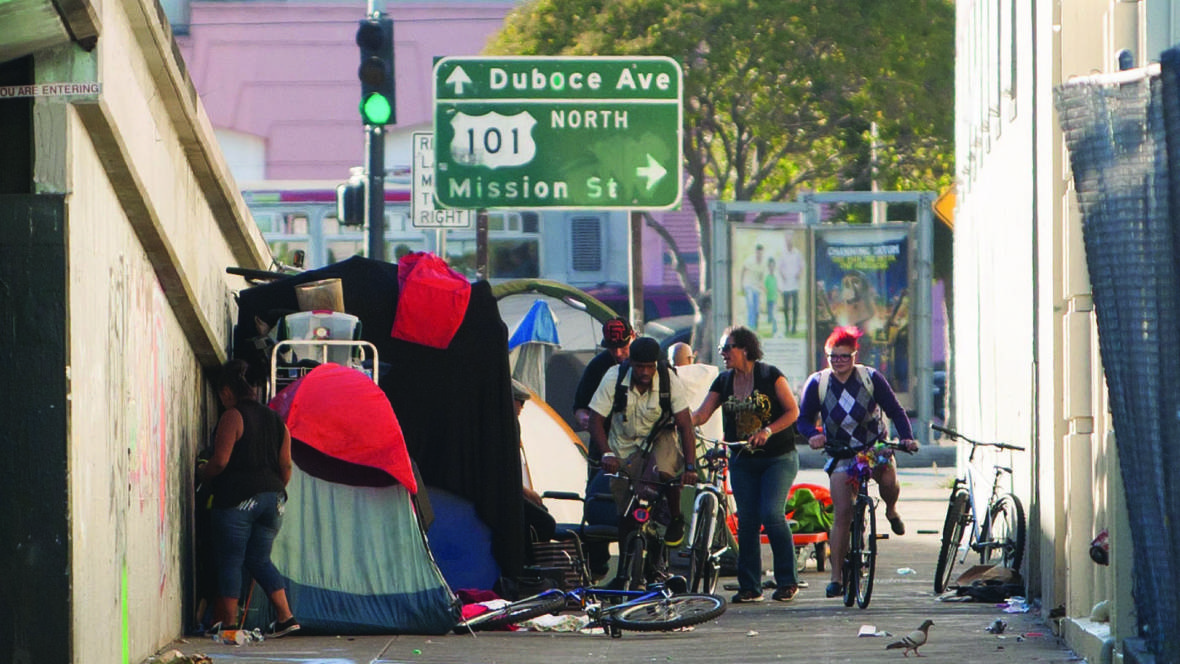
Thousands of people are homeless in San Francisco, and even more throughout the Bay Area. Despite years of concern and millions of dollars of investment, the problem persists.
Who are the people who live on the streets and on the edge of homelessness? Why have we failed to create lasting change? And are there solutions that offer hope for the future? As part of a collaboration with dozens of Bay Area news organizations, KQED is exploring these questions, and more.
Mobile Restrooms Offer Solution for Lower Polk’s Homeless Community
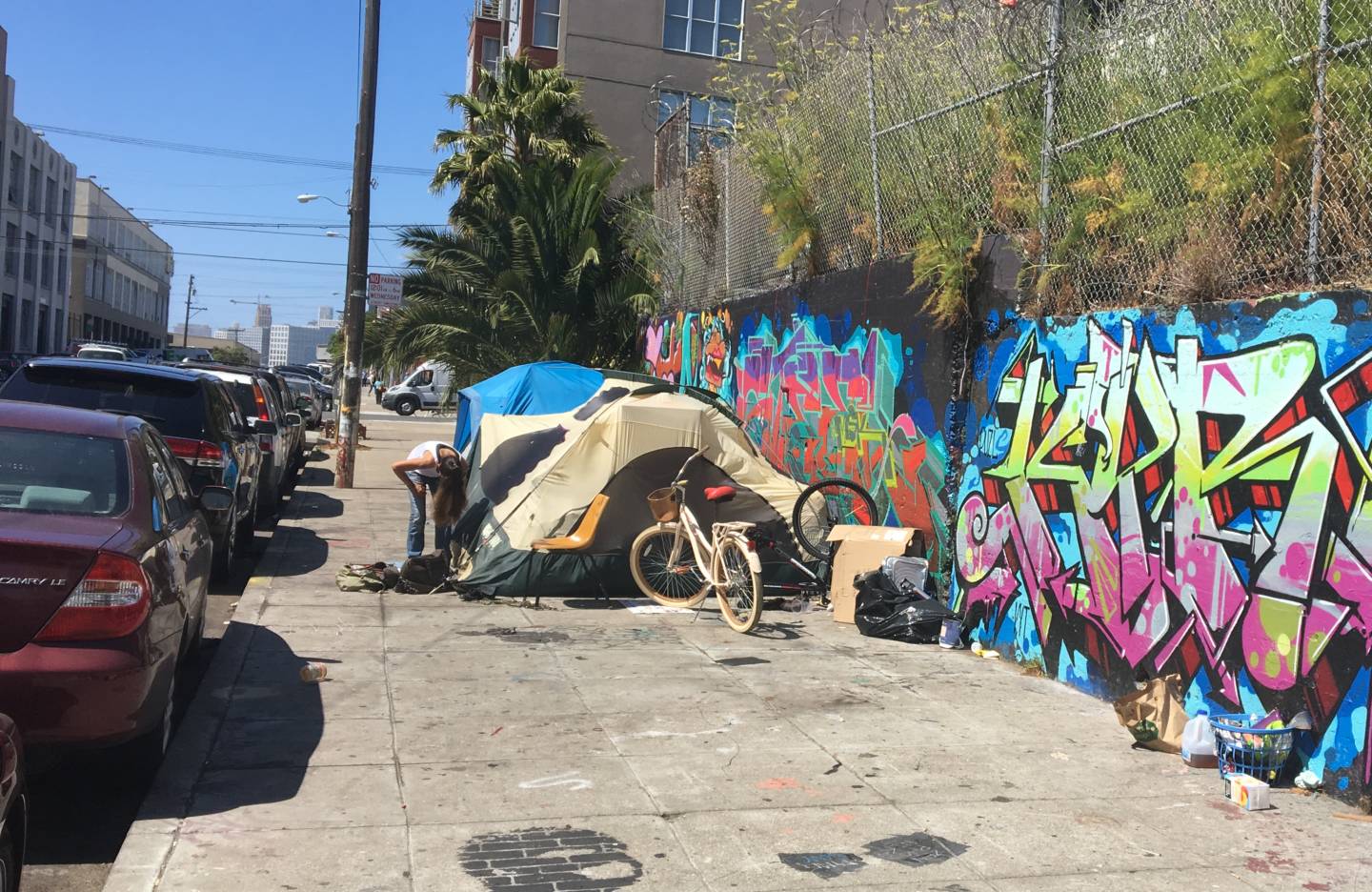
Homelessness in San Francisco's Mission: A Neighborhood View
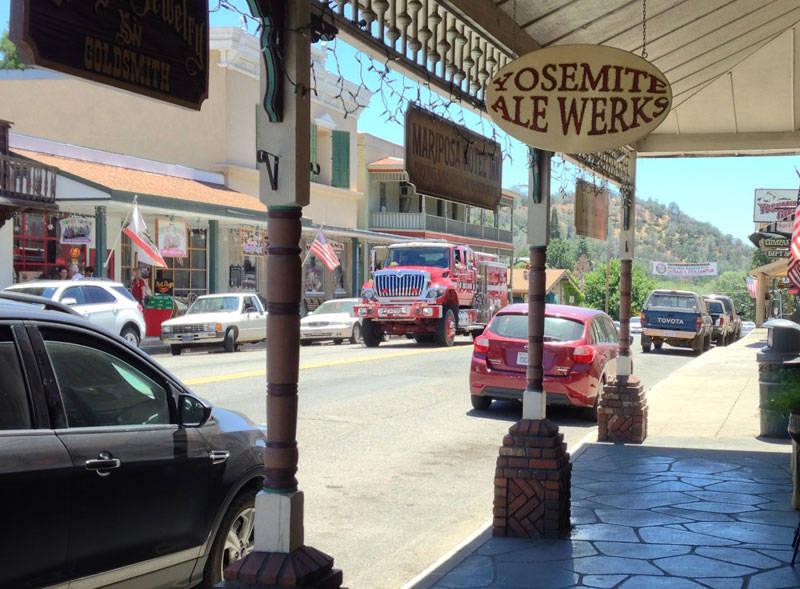
Outside Yosemite, Rural Town Grapples with Homelessness
Start the Conversation: What Are Your Ideas For Addressing Homelessness?
Asking Homeless People for Their Advice
TIMELINE: The Frustrating Political History of Homelessness in San Francisco
What Happens When One Working Family Becomes Homeless
Selling Landlords on Formerly Homeless Tenants
Growing Up Homeless
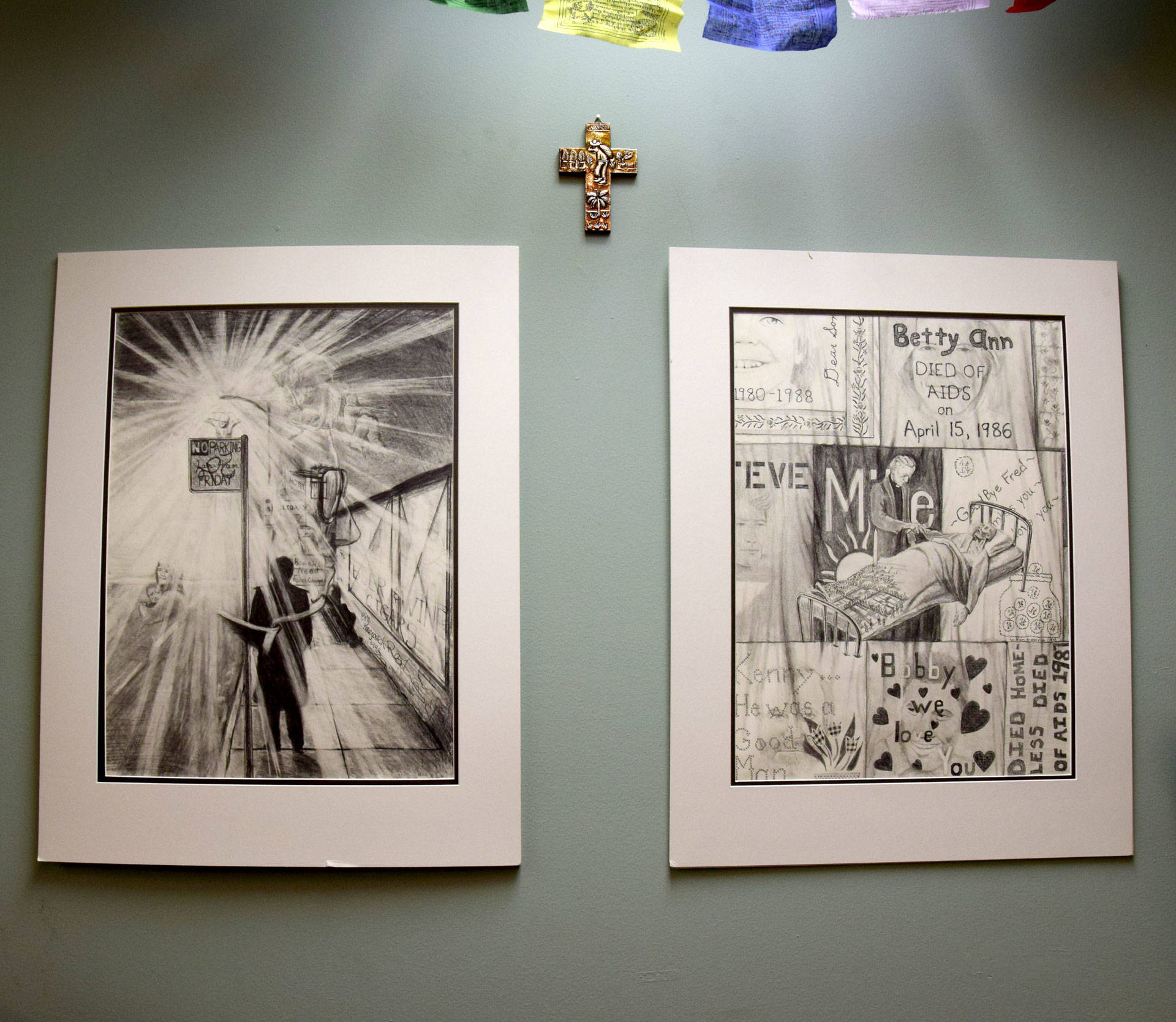
Why Art-Making is Essential to the Tenderloin’s Homeless Population
On the Streets of the Tenderloin, 'a Light in an Unlit World'
window.__IS_SSR__=true
window.__INITIAL_STATE__={
"attachmentsReducer": {
"audio_0": {
"type": "attachments",
"id": "audio_0",
"imgSizes": {
"kqedFullSize": {
"file": "https://ww2.kqed.org/news/wp-content/themes/KQED-unified/img/audio_bgs/background0.jpg"
}
}
},
"audio_1": {
"type": "attachments",
"id": "audio_1",
"imgSizes": {
"kqedFullSize": {
"file": "https://ww2.kqed.org/news/wp-content/themes/KQED-unified/img/audio_bgs/background1.jpg"
}
}
},
"audio_2": {
"type": "attachments",
"id": "audio_2",
"imgSizes": {
"kqedFullSize": {
"file": "https://ww2.kqed.org/news/wp-content/themes/KQED-unified/img/audio_bgs/background2.jpg"
}
}
},
"audio_3": {
"type": "attachments",
"id": "audio_3",
"imgSizes": {
"kqedFullSize": {
"file": "https://ww2.kqed.org/news/wp-content/themes/KQED-unified/img/audio_bgs/background3.jpg"
}
}
},
"audio_4": {
"type": "attachments",
"id": "audio_4",
"imgSizes": {
"kqedFullSize": {
"file": "https://ww2.kqed.org/news/wp-content/themes/KQED-unified/img/audio_bgs/background4.jpg"
}
}
},
"placeholder": {
"type": "attachments",
"id": "placeholder",
"imgSizes": {
"thumbnail": {
"file": "https://cdn.kqed.org/wp-content/uploads/2024/12/KQED-Default-Image-816638274-2000x1333-1-160x107.jpg",
"width": 160,
"height": 107,
"mimeType": "image/jpeg"
},
"medium": {
"file": "https://cdn.kqed.org/wp-content/uploads/2024/12/KQED-Default-Image-816638274-2000x1333-1-800x533.jpg",
"width": 800,
"height": 533,
"mimeType": "image/jpeg"
},
"medium_large": {
"file": "https://cdn.kqed.org/wp-content/uploads/2024/12/KQED-Default-Image-816638274-2000x1333-1-768x512.jpg",
"width": 768,
"height": 512,
"mimeType": "image/jpeg"
},
"large": {
"file": "https://cdn.kqed.org/wp-content/uploads/2024/12/KQED-Default-Image-816638274-2000x1333-1-1020x680.jpg",
"width": 1020,
"height": 680,
"mimeType": "image/jpeg"
},
"1536x1536": {
"file": "https://cdn.kqed.org/wp-content/uploads/2024/12/KQED-Default-Image-816638274-2000x1333-1-1536x1024.jpg",
"width": 1536,
"height": 1024,
"mimeType": "image/jpeg"
},
"fd-lrg": {
"file": "https://cdn.kqed.org/wp-content/uploads/2024/12/KQED-Default-Image-816638274-2000x1333-1-1536x1024.jpg",
"width": 1536,
"height": 1024,
"mimeType": "image/jpeg"
},
"fd-med": {
"file": "https://cdn.kqed.org/wp-content/uploads/2024/12/KQED-Default-Image-816638274-2000x1333-1-1020x680.jpg",
"width": 1020,
"height": 680,
"mimeType": "image/jpeg"
},
"fd-sm": {
"file": "https://cdn.kqed.org/wp-content/uploads/2024/12/KQED-Default-Image-816638274-2000x1333-1-800x533.jpg",
"width": 800,
"height": 533,
"mimeType": "image/jpeg"
},
"post-thumbnail": {
"file": "https://cdn.kqed.org/wp-content/uploads/2024/12/KQED-Default-Image-816638274-2000x1333-1-672x372.jpg",
"width": 672,
"height": 372,
"mimeType": "image/jpeg"
},
"twentyfourteen-full-width": {
"file": "https://cdn.kqed.org/wp-content/uploads/2024/12/KQED-Default-Image-816638274-2000x1333-1-1038x576.jpg",
"width": 1038,
"height": 576,
"mimeType": "image/jpeg"
},
"xxsmall": {
"file": "https://cdn.kqed.org/wp-content/uploads/2024/12/KQED-Default-Image-816638274-2000x1333-1-160x107.jpg",
"width": 160,
"height": 107,
"mimeType": "image/jpeg"
},
"xsmall": {
"file": "https://cdn.kqed.org/wp-content/uploads/2024/12/KQED-Default-Image-816638274-2000x1333-1-672x372.jpg",
"width": 672,
"height": 372,
"mimeType": "image/jpeg"
},
"small": {
"file": "https://cdn.kqed.org/wp-content/uploads/2024/12/KQED-Default-Image-816638274-2000x1333-1-672x372.jpg",
"width": 672,
"height": 372,
"mimeType": "image/jpeg"
},
"xlarge": {
"file": "https://cdn.kqed.org/wp-content/uploads/2024/12/KQED-Default-Image-816638274-2000x1333-1-1020x680.jpg",
"width": 1020,
"height": 680,
"mimeType": "image/jpeg"
},
"full-width": {
"file": "https://cdn.kqed.org/wp-content/uploads/2024/12/KQED-Default-Image-816638274-2000x1333-1-1920x1280.jpg",
"width": 1920,
"height": 1280,
"mimeType": "image/jpeg"
},
"guest-author-32": {
"file": "https://cdn.kqed.org/wp-content/uploads/2025/01/KQED-Default-Image-816638274-1333x1333-1-160x160.jpg",
"width": 32,
"height": 32,
"mimeType": "image/jpeg"
},
"guest-author-50": {
"file": "https://cdn.kqed.org/wp-content/uploads/2025/01/KQED-Default-Image-816638274-1333x1333-1-160x160.jpg",
"width": 50,
"height": 50,
"mimeType": "image/jpeg"
},
"guest-author-64": {
"file": "https://cdn.kqed.org/wp-content/uploads/2025/01/KQED-Default-Image-816638274-1333x1333-1-160x160.jpg",
"width": 64,
"height": 64,
"mimeType": "image/jpeg"
},
"guest-author-96": {
"file": "https://cdn.kqed.org/wp-content/uploads/2025/01/KQED-Default-Image-816638274-1333x1333-1-160x160.jpg",
"width": 96,
"height": 96,
"mimeType": "image/jpeg"
},
"guest-author-128": {
"file": "https://cdn.kqed.org/wp-content/uploads/2025/01/KQED-Default-Image-816638274-1333x1333-1-160x160.jpg",
"width": 128,
"height": 128,
"mimeType": "image/jpeg"
},
"detail": {
"file": "https://cdn.kqed.org/wp-content/uploads/2025/01/KQED-Default-Image-816638274-1333x1333-1-160x160.jpg",
"width": 160,
"height": 160,
"mimeType": "image/jpeg"
},
"kqedFullSize": {
"file": "https://cdn.kqed.org/wp-content/uploads/2024/12/KQED-Default-Image-816638274-2000x1333-1.jpg",
"width": 2000,
"height": 1333
}
}
},
"news_11024916": {
"type": "attachments",
"id": "news_11024916",
"meta": {
"index": "attachments_1716263798",
"site": "news",
"id": "11024916",
"found": true
},
"parent": 11024871,
"imgSizes": {
"twentyfourteen-full-width": {
"file": "https://ww2.kqed.org/app/uploads/sites/10/2016/07/160629_reliefcenter_bhs01-1038x576.jpg",
"width": 1038,
"mimeType": "image/jpeg",
"height": 576
},
"thumbnail": {
"file": "https://ww2.kqed.org/app/uploads/sites/10/2016/07/160629_reliefcenter_bhs01-400x267.jpg",
"width": 400,
"mimeType": "image/jpeg",
"height": 267
},
"fd-sm": {
"file": "https://ww2.kqed.org/app/uploads/sites/10/2016/07/160629_reliefcenter_bhs01-960x640.jpg",
"width": 960,
"mimeType": "image/jpeg",
"height": 640
},
"post-thumbnail": {
"file": "https://ww2.kqed.org/app/uploads/sites/10/2016/07/160629_reliefcenter_bhs01-672x372.jpg",
"width": 672,
"mimeType": "image/jpeg",
"height": 372
},
"kqedFullSize": {
"file": "https://ww2.kqed.org/app/uploads/sites/10/2016/07/160629_reliefcenter_bhs01.jpg",
"width": 1920,
"height": 1280
},
"large": {
"file": "https://ww2.kqed.org/app/uploads/sites/10/2016/07/160629_reliefcenter_bhs01-1920x1280.jpg",
"width": 1920,
"mimeType": "image/jpeg",
"height": 1280
},
"guest-author-50": {
"file": "https://ww2.kqed.org/app/uploads/sites/10/2016/07/160629_reliefcenter_bhs01-50x50.jpg",
"width": 50,
"mimeType": "image/jpeg",
"height": 50
},
"guest-author-96": {
"file": "https://ww2.kqed.org/app/uploads/sites/10/2016/07/160629_reliefcenter_bhs01-96x96.jpg",
"width": 96,
"mimeType": "image/jpeg",
"height": 96
},
"medium": {
"file": "https://ww2.kqed.org/app/uploads/sites/10/2016/07/160629_reliefcenter_bhs01-800x533.jpg",
"width": 800,
"mimeType": "image/jpeg",
"height": 533
},
"guest-author-64": {
"file": "https://ww2.kqed.org/app/uploads/sites/10/2016/07/160629_reliefcenter_bhs01-64x64.jpg",
"width": 64,
"mimeType": "image/jpeg",
"height": 64
},
"guest-author-32": {
"file": "https://ww2.kqed.org/app/uploads/sites/10/2016/07/160629_reliefcenter_bhs01-32x32.jpg",
"width": 32,
"mimeType": "image/jpeg",
"height": 32
},
"jmtc-small-thumb": {
"file": "https://ww2.kqed.org/app/uploads/sites/10/2016/07/160629_reliefcenter_bhs01-280x150.jpg",
"width": 280,
"mimeType": "image/jpeg",
"height": 150
},
"fd-lrg": {
"file": "https://ww2.kqed.org/app/uploads/sites/10/2016/07/160629_reliefcenter_bhs01-1920x1280.jpg",
"width": 1920,
"mimeType": "image/jpeg",
"height": 1280
},
"fd-med": {
"file": "https://ww2.kqed.org/app/uploads/sites/10/2016/07/160629_reliefcenter_bhs01-1180x787.jpg",
"width": 1180,
"mimeType": "image/jpeg",
"height": 787
},
"detail": {
"file": "https://ww2.kqed.org/app/uploads/sites/10/2016/07/160629_reliefcenter_bhs01-150x150.jpg",
"width": 150,
"mimeType": "image/jpeg",
"height": 150
},
"guest-author-128": {
"file": "https://ww2.kqed.org/app/uploads/sites/10/2016/07/160629_reliefcenter_bhs01-128x128.jpg",
"width": 128,
"mimeType": "image/jpeg",
"height": 128
}
},
"publishDate": 1468951507,
"modified": 1468961718,
"caption": "Portable toilets mounted to a trailer bed are moved throughout the Lower Polk neighborhood each night.",
"description": "Portable toilets mounted to a trailer bed are moved throughout the Lower Polk neighborhood each night.",
"title": "160629_reliefcenter_bhs01",
"credit": "Brittany Hosea-Small/KQED",
"status": "inherit",
"isLoading": false,
"fetchFailed": false
},
"news_11004555": {
"type": "attachments",
"id": "news_11004555",
"meta": {
"index": "attachments_1716263798",
"site": "news",
"id": "11004555",
"found": true
},
"parent": 11004551,
"imgSizes": {
"twentyfourteen-full-width": {
"file": "https://ww2.kqed.org/app/uploads/sites/10/2016/06/RS19958_160623_Florida-St-Encampment_bhs01-qut-1038x576.jpg",
"width": 1038,
"mimeType": "image/jpeg",
"height": 576
},
"thumbnail": {
"file": "https://ww2.kqed.org/app/uploads/sites/10/2016/06/RS19958_160623_Florida-St-Encampment_bhs01-qut-400x267.jpg",
"width": 400,
"mimeType": "image/jpeg",
"height": 267
},
"fd-sm": {
"file": "https://ww2.kqed.org/app/uploads/sites/10/2016/06/RS19958_160623_Florida-St-Encampment_bhs01-qut-960x640.jpg",
"width": 960,
"mimeType": "image/jpeg",
"height": 640
},
"post-thumbnail": {
"file": "https://ww2.kqed.org/app/uploads/sites/10/2016/06/RS19958_160623_Florida-St-Encampment_bhs01-qut-672x372.jpg",
"width": 672,
"mimeType": "image/jpeg",
"height": 372
},
"kqedFullSize": {
"file": "https://ww2.kqed.org/app/uploads/sites/10/2016/06/RS19958_160623_Florida-St-Encampment_bhs01-qut.jpg",
"width": 1920,
"height": 1280
},
"large": {
"file": "https://ww2.kqed.org/app/uploads/sites/10/2016/06/RS19958_160623_Florida-St-Encampment_bhs01-qut-1920x1280.jpg",
"width": 1920,
"mimeType": "image/jpeg",
"height": 1280
},
"guest-author-50": {
"file": "https://ww2.kqed.org/app/uploads/sites/10/2016/06/RS19958_160623_Florida-St-Encampment_bhs01-qut-50x50.jpg",
"width": 50,
"mimeType": "image/jpeg",
"height": 50
},
"guest-author-96": {
"file": "https://ww2.kqed.org/app/uploads/sites/10/2016/06/RS19958_160623_Florida-St-Encampment_bhs01-qut-96x96.jpg",
"width": 96,
"mimeType": "image/jpeg",
"height": 96
},
"medium": {
"file": "https://ww2.kqed.org/app/uploads/sites/10/2016/06/RS19958_160623_Florida-St-Encampment_bhs01-qut-800x533.jpg",
"width": 800,
"mimeType": "image/jpeg",
"height": 533
},
"guest-author-64": {
"file": "https://ww2.kqed.org/app/uploads/sites/10/2016/06/RS19958_160623_Florida-St-Encampment_bhs01-qut-64x64.jpg",
"width": 64,
"mimeType": "image/jpeg",
"height": 64
},
"guest-author-32": {
"file": "https://ww2.kqed.org/app/uploads/sites/10/2016/06/RS19958_160623_Florida-St-Encampment_bhs01-qut-32x32.jpg",
"width": 32,
"mimeType": "image/jpeg",
"height": 32
},
"jmtc-small-thumb": {
"file": "https://ww2.kqed.org/app/uploads/sites/10/2016/06/RS19958_160623_Florida-St-Encampment_bhs01-qut-280x150.jpg",
"width": 280,
"mimeType": "image/jpeg",
"height": 150
},
"fd-lrg": {
"file": "https://ww2.kqed.org/app/uploads/sites/10/2016/06/RS19958_160623_Florida-St-Encampment_bhs01-qut-1920x1280.jpg",
"width": 1920,
"mimeType": "image/jpeg",
"height": 1280
},
"fd-med": {
"file": "https://ww2.kqed.org/app/uploads/sites/10/2016/06/RS19958_160623_Florida-St-Encampment_bhs01-qut-1180x787.jpg",
"width": 1180,
"mimeType": "image/jpeg",
"height": 787
},
"detail": {
"file": "https://ww2.kqed.org/app/uploads/sites/10/2016/06/RS19958_160623_Florida-St-Encampment_bhs01-qut-150x150.jpg",
"width": 150,
"mimeType": "image/jpeg",
"height": 150
},
"guest-author-128": {
"file": "https://ww2.kqed.org/app/uploads/sites/10/2016/06/RS19958_160623_Florida-St-Encampment_bhs01-qut-128x128.jpg",
"width": 128,
"mimeType": "image/jpeg",
"height": 128
}
},
"publishDate": 1467222776,
"modified": 1468282849,
"caption": "A homeless encampment located on Florida Street in the Mission District of San Francisco on June 23, 2016.",
"description": "A homeless encampment located on Florida St in the Mission District of San Francisco, Calif. on Thursday, June 23, 2016.",
"title": "RS19958_160623_Florida St Encampment_bhs01-qut",
"credit": "Brittany Hosea-Small/KQED",
"status": "inherit",
"isLoading": false,
"fetchFailed": false
},
"news_11010302": {
"type": "attachments",
"id": "news_11010302",
"meta": {
"index": "attachments_1716263798",
"site": "news",
"id": "11010302",
"found": true
},
"parent": 11006063,
"imgSizes": {
"twentyfourteen-full-width": {
"file": "https://ww2.kqed.org/app/uploads/sites/10/2016/07/yosemite-800x576.jpg",
"width": 800,
"mimeType": "image/jpeg",
"height": 576
},
"jmtc-small-thumb": {
"file": "https://ww2.kqed.org/app/uploads/sites/10/2016/07/yosemite-280x150.jpg",
"width": 280,
"mimeType": "image/jpeg",
"height": 150
},
"thumbnail": {
"file": "https://ww2.kqed.org/app/uploads/sites/10/2016/07/yosemite-400x295.jpg",
"width": 400,
"mimeType": "image/jpeg",
"height": 295
},
"post-thumbnail": {
"file": "https://ww2.kqed.org/app/uploads/sites/10/2016/07/yosemite-672x372.jpg",
"width": 672,
"mimeType": "image/jpeg",
"height": 372
},
"kqedFullSize": {
"file": "https://ww2.kqed.org/app/uploads/sites/10/2016/07/yosemite.jpg",
"width": 800,
"height": 589
},
"guest-author-50": {
"file": "https://ww2.kqed.org/app/uploads/sites/10/2016/07/yosemite-50x50.jpg",
"width": 50,
"mimeType": "image/jpeg",
"height": 50
},
"guest-author-96": {
"file": "https://ww2.kqed.org/app/uploads/sites/10/2016/07/yosemite-96x96.jpg",
"width": 96,
"mimeType": "image/jpeg",
"height": 96
},
"medium": {
"file": "https://ww2.kqed.org/app/uploads/sites/10/2016/07/yosemite-800x589.jpg",
"width": 800,
"mimeType": "image/jpeg",
"height": 589
},
"guest-author-64": {
"file": "https://ww2.kqed.org/app/uploads/sites/10/2016/07/yosemite-64x64.jpg",
"width": 64,
"mimeType": "image/jpeg",
"height": 64
},
"detail": {
"file": "https://ww2.kqed.org/app/uploads/sites/10/2016/07/yosemite-150x150.jpg",
"width": 150,
"mimeType": "image/jpeg",
"height": 150
},
"guest-author-32": {
"file": "https://ww2.kqed.org/app/uploads/sites/10/2016/07/yosemite-32x32.jpg",
"width": 32,
"mimeType": "image/jpeg",
"height": 32
},
"guest-author-128": {
"file": "https://ww2.kqed.org/app/uploads/sites/10/2016/07/yosemite-128x128.jpg",
"width": 128,
"mimeType": "image/jpeg",
"height": 128
}
},
"publishDate": 1467740209,
"modified": 1467740245,
"caption": "Mariposa",
"description": null,
"title": "yosemite",
"credit": "Alice Daniel/KQED",
"status": "inherit",
"isLoading": false,
"fetchFailed": false
},
"news_10999322": {
"type": "attachments",
"id": "news_10999322",
"meta": {
"index": "attachments_1716263798",
"site": "news",
"id": "10999322",
"found": true
},
"parent": 10999317,
"imgSizes": {
"twentyfourteen-full-width": {
"file": "https://ww2.kqed.org/app/uploads/sites/10/2016/06/RS19838__MG_0890-qut-1038x576.jpg",
"width": 1038,
"mimeType": "image/jpeg",
"height": 576
},
"thumbnail": {
"file": "https://ww2.kqed.org/app/uploads/sites/10/2016/06/RS19838__MG_0890-qut-400x267.jpg",
"width": 400,
"mimeType": "image/jpeg",
"height": 267
},
"fd-sm": {
"file": "https://ww2.kqed.org/app/uploads/sites/10/2016/06/RS19838__MG_0890-qut-960x640.jpg",
"width": 960,
"mimeType": "image/jpeg",
"height": 640
},
"post-thumbnail": {
"file": "https://ww2.kqed.org/app/uploads/sites/10/2016/06/RS19838__MG_0890-qut-672x372.jpg",
"width": 672,
"mimeType": "image/jpeg",
"height": 372
},
"kqedFullSize": {
"file": "https://ww2.kqed.org/app/uploads/sites/10/2016/06/RS19838__MG_0890-qut.jpg",
"width": 1920,
"height": 1280
},
"large": {
"file": "https://ww2.kqed.org/app/uploads/sites/10/2016/06/RS19838__MG_0890-qut-1920x1280.jpg",
"width": 1920,
"mimeType": "image/jpeg",
"height": 1280
},
"guest-author-50": {
"file": "https://ww2.kqed.org/app/uploads/sites/10/2016/06/RS19838__MG_0890-qut-50x50.jpg",
"width": 50,
"mimeType": "image/jpeg",
"height": 50
},
"guest-author-96": {
"file": "https://ww2.kqed.org/app/uploads/sites/10/2016/06/RS19838__MG_0890-qut-96x96.jpg",
"width": 96,
"mimeType": "image/jpeg",
"height": 96
},
"medium": {
"file": "https://ww2.kqed.org/app/uploads/sites/10/2016/06/RS19838__MG_0890-qut-800x533.jpg",
"width": 800,
"mimeType": "image/jpeg",
"height": 533
},
"guest-author-64": {
"file": "https://ww2.kqed.org/app/uploads/sites/10/2016/06/RS19838__MG_0890-qut-64x64.jpg",
"width": 64,
"mimeType": "image/jpeg",
"height": 64
},
"guest-author-32": {
"file": "https://ww2.kqed.org/app/uploads/sites/10/2016/06/RS19838__MG_0890-qut-32x32.jpg",
"width": 32,
"mimeType": "image/jpeg",
"height": 32
},
"jmtc-small-thumb": {
"file": "https://ww2.kqed.org/app/uploads/sites/10/2016/06/RS19838__MG_0890-qut-280x150.jpg",
"width": 280,
"mimeType": "image/jpeg",
"height": 150
},
"fd-lrg": {
"file": "https://ww2.kqed.org/app/uploads/sites/10/2016/06/RS19838__MG_0890-qut-1920x1280.jpg",
"width": 1920,
"mimeType": "image/jpeg",
"height": 1280
},
"fd-med": {
"file": "https://ww2.kqed.org/app/uploads/sites/10/2016/06/RS19838__MG_0890-qut-1180x787.jpg",
"width": 1180,
"mimeType": "image/jpeg",
"height": 787
},
"detail": {
"file": "https://ww2.kqed.org/app/uploads/sites/10/2016/06/RS19838__MG_0890-qut-150x150.jpg",
"width": 150,
"mimeType": "image/jpeg",
"height": 150
},
"guest-author-128": {
"file": "https://ww2.kqed.org/app/uploads/sites/10/2016/06/RS19838__MG_0890-qut-128x128.jpg",
"width": 128,
"mimeType": "image/jpeg",
"height": 128
}
},
"publishDate": 1466728598,
"modified": 1467067860,
"caption": "Harold Pyne has lived at the Navigation Center on Mission Street for a year. The Navigation Center is one way that San Francisco is trying to help homeless people get into more stable housing. The city plans to open six more in the next two years. ",
"description": null,
"title": "RS19838__MG_0890-qut",
"credit": "Deborah Svoboda/KQED",
"status": "inherit",
"isLoading": false,
"fetchFailed": false
},
"news_11006768": {
"type": "attachments",
"id": "news_11006768",
"meta": {
"index": "attachments_1716263798",
"site": "news",
"id": "11006768",
"found": true
},
"parent": 11004645,
"imgSizes": {
"twentyfourteen-full-width": {
"file": "https://ww2.kqed.org/app/uploads/sites/10/2016/06/Letter-FB-Link-1038x576.png",
"width": 1038,
"mimeType": "image/png",
"height": 576
},
"thumbnail": {
"file": "https://ww2.kqed.org/app/uploads/sites/10/2016/06/Letter-FB-Link-400x210.png",
"width": 400,
"mimeType": "image/png",
"height": 210
},
"fd-sm": {
"file": "https://ww2.kqed.org/app/uploads/sites/10/2016/06/Letter-FB-Link-960x504.png",
"width": 960,
"mimeType": "image/png",
"height": 504
},
"post-thumbnail": {
"file": "https://ww2.kqed.org/app/uploads/sites/10/2016/06/Letter-FB-Link-672x372.png",
"width": 672,
"mimeType": "image/png",
"height": 372
},
"kqedFullSize": {
"file": "https://ww2.kqed.org/app/uploads/sites/10/2016/06/Letter-FB-Link.png",
"width": 1200,
"height": 630
},
"guest-author-50": {
"file": "https://ww2.kqed.org/app/uploads/sites/10/2016/06/Letter-FB-Link-50x50.png",
"width": 50,
"mimeType": "image/png",
"height": 50
},
"guest-author-96": {
"file": "https://ww2.kqed.org/app/uploads/sites/10/2016/06/Letter-FB-Link-96x96.png",
"width": 96,
"mimeType": "image/png",
"height": 96
},
"medium": {
"file": "https://ww2.kqed.org/app/uploads/sites/10/2016/06/Letter-FB-Link-800x420.png",
"width": 800,
"mimeType": "image/png",
"height": 420
},
"guest-author-64": {
"file": "https://ww2.kqed.org/app/uploads/sites/10/2016/06/Letter-FB-Link-64x64.png",
"width": 64,
"mimeType": "image/png",
"height": 64
},
"guest-author-32": {
"file": "https://ww2.kqed.org/app/uploads/sites/10/2016/06/Letter-FB-Link-32x32.png",
"width": 32,
"mimeType": "image/png",
"height": 32
},
"jmtc-small-thumb": {
"file": "https://ww2.kqed.org/app/uploads/sites/10/2016/06/Letter-FB-Link-280x150.png",
"width": 280,
"mimeType": "image/png",
"height": 150
},
"fd-med": {
"file": "https://ww2.kqed.org/app/uploads/sites/10/2016/06/Letter-FB-Link-1180x620.png",
"width": 1180,
"mimeType": "image/png",
"height": 620
},
"detail": {
"file": "https://ww2.kqed.org/app/uploads/sites/10/2016/06/Letter-FB-Link-150x150.png",
"width": 150,
"mimeType": "image/png",
"height": 150
},
"guest-author-128": {
"file": "https://ww2.kqed.org/app/uploads/sites/10/2016/06/Letter-FB-Link-128x128.png",
"width": 128,
"mimeType": "image/png",
"height": 128
}
},
"publishDate": 1467393167,
"modified": 1467393248,
"caption": "A homeless encampment on Florida St. ",
"description": null,
"title": "Letter-FB-Link",
"credit": "Brittany Hosea-Small/KQED",
"status": "inherit",
"isLoading": false,
"fetchFailed": false
},
"lowdown_22670": {
"type": "attachments",
"id": "lowdown_22670",
"meta": {
"index": "attachments_1716263798",
"site": "lowdown",
"id": "22670",
"found": true
},
"parent": 22644,
"imgSizes": {
"twentyfourteen-full-width": {
"file": "https://ww2.kqed.org/app/uploads/sites/26/2016/06/IMG_1743-e1467396983840-1038x576.jpg",
"width": 1038,
"mimeType": "image/jpeg",
"height": 576
},
"thumbnail": {
"file": "https://ww2.kqed.org/app/uploads/sites/26/2016/06/IMG_1743-e1467396983840-400x260.jpg",
"width": 400,
"mimeType": "image/jpeg",
"height": 260
},
"fd-sm": {
"file": "https://ww2.kqed.org/app/uploads/sites/26/2016/06/IMG_1743-e1467396983840-960x624.jpg",
"width": 960,
"mimeType": "image/jpeg",
"height": 624
},
"post-thumbnail": {
"file": "https://ww2.kqed.org/app/uploads/sites/26/2016/06/IMG_1743-e1467396983840-672x372.jpg",
"width": 672,
"mimeType": "image/jpeg",
"height": 372
},
"kqedFullSize": {
"file": "https://ww2.kqed.org/app/uploads/sites/26/2016/06/IMG_1743-e1467396983840.jpg",
"width": 3084,
"height": 2005
},
"large": {
"file": "https://ww2.kqed.org/app/uploads/sites/26/2016/06/IMG_1743-e1467396983840-1440x936.jpg",
"width": 1440,
"mimeType": "image/jpeg",
"height": 936
},
"guest-author-50": {
"file": "https://ww2.kqed.org/app/uploads/sites/26/2016/06/IMG_1743-e1467396983840-50x50.jpg",
"width": 50,
"mimeType": "image/jpeg",
"height": 50
},
"guest-author-96": {
"file": "https://ww2.kqed.org/app/uploads/sites/26/2016/06/IMG_1743-e1467396983840-96x96.jpg",
"width": 96,
"mimeType": "image/jpeg",
"height": 96
},
"medium": {
"file": "https://ww2.kqed.org/app/uploads/sites/26/2016/06/IMG_1743-e1467396983840-800x520.jpg",
"width": 800,
"mimeType": "image/jpeg",
"height": 520
},
"guest-author-64": {
"file": "https://ww2.kqed.org/app/uploads/sites/26/2016/06/IMG_1743-e1467396983840-64x64.jpg",
"width": 64,
"mimeType": "image/jpeg",
"height": 64
},
"guest-author-32": {
"file": "https://ww2.kqed.org/app/uploads/sites/26/2016/06/IMG_1743-e1467396983840-32x32.jpg",
"width": 32,
"mimeType": "image/jpeg",
"height": 32
},
"fd-lrg": {
"file": "https://ww2.kqed.org/app/uploads/sites/26/2016/06/IMG_1743-e1467396983840-1920x1248.jpg",
"width": 1920,
"mimeType": "image/jpeg",
"height": 1248
},
"fd-med": {
"file": "https://ww2.kqed.org/app/uploads/sites/26/2016/06/IMG_1743-e1467396983840-1180x767.jpg",
"width": 1180,
"mimeType": "image/jpeg",
"height": 767
},
"detail": {
"file": "https://ww2.kqed.org/app/uploads/sites/26/2016/06/IMG_1743-e1467396983840-150x150.jpg",
"width": 150,
"mimeType": "image/jpeg",
"height": 150
},
"medium_large": {
"file": "https://ww2.kqed.org/app/uploads/sites/26/2016/06/IMG_1743-e1467396983840-768x499.jpg",
"width": 768,
"mimeType": "image/jpeg",
"height": 499
},
"guest-author-128": {
"file": "https://ww2.kqed.org/app/uploads/sites/26/2016/06/IMG_1743-e1467396983840-128x128.jpg",
"width": 128,
"mimeType": "image/jpeg",
"height": 128
}
},
"publishDate": 1467396906,
"modified": 1558130886,
"caption": "A small homeless in the Mission.",
"description": null,
"title": "IMG_1743",
"credit": "Matthew Green/KQED",
"status": "inherit",
"isLoading": false,
"fetchFailed": false
},
"news_11004440": {
"type": "attachments",
"id": "news_11004440",
"meta": {
"index": "attachments_1716263798",
"site": "news",
"id": "11004440",
"found": true
},
"parent": 11004435,
"imgSizes": {
"twentyfourteen-full-width": {
"file": "https://ww2.kqed.org/app/uploads/sites/10/2016/06/RS19953_FullSizeRender-qut-1038x576.jpg",
"width": 1038,
"mimeType": "image/jpeg",
"height": 576
},
"thumbnail": {
"file": "https://ww2.kqed.org/app/uploads/sites/10/2016/06/RS19953_FullSizeRender-qut-400x300.jpg",
"width": 400,
"mimeType": "image/jpeg",
"height": 300
},
"fd-sm": {
"file": "https://ww2.kqed.org/app/uploads/sites/10/2016/06/RS19953_FullSizeRender-qut-960x720.jpg",
"width": 960,
"mimeType": "image/jpeg",
"height": 720
},
"post-thumbnail": {
"file": "https://ww2.kqed.org/app/uploads/sites/10/2016/06/RS19953_FullSizeRender-qut-672x372.jpg",
"width": 672,
"mimeType": "image/jpeg",
"height": 372
},
"kqedFullSize": {
"file": "https://ww2.kqed.org/app/uploads/sites/10/2016/06/RS19953_FullSizeRender-qut.jpg",
"width": 1920,
"height": 1440
},
"large": {
"file": "https://ww2.kqed.org/app/uploads/sites/10/2016/06/RS19953_FullSizeRender-qut-1920x1440.jpg",
"width": 1920,
"mimeType": "image/jpeg",
"height": 1440
},
"guest-author-50": {
"file": "https://ww2.kqed.org/app/uploads/sites/10/2016/06/RS19953_FullSizeRender-qut-50x50.jpg",
"width": 50,
"mimeType": "image/jpeg",
"height": 50
},
"guest-author-96": {
"file": "https://ww2.kqed.org/app/uploads/sites/10/2016/06/RS19953_FullSizeRender-qut-96x96.jpg",
"width": 96,
"mimeType": "image/jpeg",
"height": 96
},
"medium": {
"file": "https://ww2.kqed.org/app/uploads/sites/10/2016/06/RS19953_FullSizeRender-qut-800x600.jpg",
"width": 800,
"mimeType": "image/jpeg",
"height": 600
},
"guest-author-64": {
"file": "https://ww2.kqed.org/app/uploads/sites/10/2016/06/RS19953_FullSizeRender-qut-64x64.jpg",
"width": 64,
"mimeType": "image/jpeg",
"height": 64
},
"guest-author-32": {
"file": "https://ww2.kqed.org/app/uploads/sites/10/2016/06/RS19953_FullSizeRender-qut-32x32.jpg",
"width": 32,
"mimeType": "image/jpeg",
"height": 32
},
"jmtc-small-thumb": {
"file": "https://ww2.kqed.org/app/uploads/sites/10/2016/06/RS19953_FullSizeRender-qut-280x150.jpg",
"width": 280,
"mimeType": "image/jpeg",
"height": 150
},
"fd-lrg": {
"file": "https://ww2.kqed.org/app/uploads/sites/10/2016/06/RS19953_FullSizeRender-qut-1920x1440.jpg",
"width": 1920,
"mimeType": "image/jpeg",
"height": 1440
},
"fd-med": {
"file": "https://ww2.kqed.org/app/uploads/sites/10/2016/06/RS19953_FullSizeRender-qut-1180x885.jpg",
"width": 1180,
"mimeType": "image/jpeg",
"height": 885
},
"detail": {
"file": "https://ww2.kqed.org/app/uploads/sites/10/2016/06/RS19953_FullSizeRender-qut-150x150.jpg",
"width": 150,
"mimeType": "image/jpeg",
"height": 150
},
"guest-author-128": {
"file": "https://ww2.kqed.org/app/uploads/sites/10/2016/06/RS19953_FullSizeRender-qut-128x128.jpg",
"width": 128,
"mimeType": "image/jpeg",
"height": 128
}
},
"publishDate": 1467214426,
"modified": 1467243369,
"caption": "The Aucar family gets a slice of normalcy in temporary housing in San Mateo after sleeping in their van and on a garage floor.",
"description": "The Acur family gets a slice of normalcy in temporary housing in San Mateo after sleeping in their van and on a garage floor.",
"title": "Living on the Edge",
"credit": "Beth Willon/KQED",
"status": "inherit",
"isLoading": false,
"fetchFailed": false
},
"news_11005872": {
"type": "attachments",
"id": "news_11005872",
"meta": {
"index": "attachments_1716263798",
"site": "news",
"id": "11005872",
"found": true
},
"parent": 11005735,
"imgSizes": {
"twentyfourteen-full-width": {
"file": "https://ww2.kqed.org/app/uploads/sites/10/2016/06/bradschwartz-desk-copy-1038x576.jpg",
"width": 1038,
"mimeType": "image/jpeg",
"height": 576
},
"thumbnail": {
"file": "https://ww2.kqed.org/app/uploads/sites/10/2016/06/bradschwartz-desk-copy-400x218.jpg",
"width": 400,
"mimeType": "image/jpeg",
"height": 218
},
"fd-sm": {
"file": "https://ww2.kqed.org/app/uploads/sites/10/2016/06/bradschwartz-desk-copy-960x523.jpg",
"width": 960,
"mimeType": "image/jpeg",
"height": 523
},
"post-thumbnail": {
"file": "https://ww2.kqed.org/app/uploads/sites/10/2016/06/bradschwartz-desk-copy-672x372.jpg",
"width": 672,
"mimeType": "image/jpeg",
"height": 372
},
"kqedFullSize": {
"file": "https://ww2.kqed.org/app/uploads/sites/10/2016/06/bradschwartz-desk-copy.jpg",
"width": 1920,
"height": 1045
},
"large": {
"file": "https://ww2.kqed.org/app/uploads/sites/10/2016/06/bradschwartz-desk-copy-1920x1045.jpg",
"width": 1920,
"mimeType": "image/jpeg",
"height": 1045
},
"guest-author-50": {
"file": "https://ww2.kqed.org/app/uploads/sites/10/2016/06/bradschwartz-desk-copy-50x50.jpg",
"width": 50,
"mimeType": "image/jpeg",
"height": 50
},
"guest-author-96": {
"file": "https://ww2.kqed.org/app/uploads/sites/10/2016/06/bradschwartz-desk-copy-96x96.jpg",
"width": 96,
"mimeType": "image/jpeg",
"height": 96
},
"medium": {
"file": "https://ww2.kqed.org/app/uploads/sites/10/2016/06/bradschwartz-desk-copy-800x435.jpg",
"width": 800,
"mimeType": "image/jpeg",
"height": 435
},
"guest-author-64": {
"file": "https://ww2.kqed.org/app/uploads/sites/10/2016/06/bradschwartz-desk-copy-64x64.jpg",
"width": 64,
"mimeType": "image/jpeg",
"height": 64
},
"guest-author-32": {
"file": "https://ww2.kqed.org/app/uploads/sites/10/2016/06/bradschwartz-desk-copy-32x32.jpg",
"width": 32,
"mimeType": "image/jpeg",
"height": 32
},
"jmtc-small-thumb": {
"file": "https://ww2.kqed.org/app/uploads/sites/10/2016/06/bradschwartz-desk-copy-280x150.jpg",
"width": 280,
"mimeType": "image/jpeg",
"height": 150
},
"fd-lrg": {
"file": "https://ww2.kqed.org/app/uploads/sites/10/2016/06/bradschwartz-desk-copy-1920x1045.jpg",
"width": 1920,
"mimeType": "image/jpeg",
"height": 1045
},
"fd-med": {
"file": "https://ww2.kqed.org/app/uploads/sites/10/2016/06/bradschwartz-desk-copy-1180x642.jpg",
"width": 1180,
"mimeType": "image/jpeg",
"height": 642
},
"detail": {
"file": "https://ww2.kqed.org/app/uploads/sites/10/2016/06/bradschwartz-desk-copy-150x150.jpg",
"width": 150,
"mimeType": "image/jpeg",
"height": 150
},
"guest-author-128": {
"file": "https://ww2.kqed.org/app/uploads/sites/10/2016/06/bradschwartz-desk-copy-128x128.jpg",
"width": 128,
"mimeType": "image/jpeg",
"height": 128
}
},
"publishDate": 1467320038,
"modified": 1467320439,
"caption": "Brad Schwartz sits at his desk at home. After decades of homelessness it took half a year to find a landlord willing to rent to him.",
"description": null,
"title": "bradschwartz-desk-copy",
"credit": "J.D. Hillard/KQED",
"status": "inherit",
"isLoading": false,
"fetchFailed": false
},
"perspectives_201601134657": {
"type": "attachments",
"id": "perspectives_201601134657",
"meta": {
"index": "attachments_1716263798",
"site": "perspectives",
"id": "201601134657",
"found": true
},
"parent": 201601134655,
"imgSizes": {
"twentyfourteen-full-width": {
"file": "https://ww2.kqed.org/app/uploads/sites/44/2016/06/Vrndavana-Hines-1038x576.jpg",
"width": 1038,
"mimeType": "image/jpeg",
"height": 576
},
"thumbnail": {
"file": "https://ww2.kqed.org/app/uploads/sites/44/2016/06/Vrndavana-Hines-400x400.jpg",
"width": 400,
"mimeType": "image/jpeg",
"height": 400
},
"fd-sm": {
"file": "https://ww2.kqed.org/app/uploads/sites/44/2016/06/Vrndavana-Hines-960x960.jpg",
"width": 960,
"mimeType": "image/jpeg",
"height": 960
},
"post-thumbnail": {
"file": "https://ww2.kqed.org/app/uploads/sites/44/2016/06/Vrndavana-Hines-672x372.jpg",
"width": 672,
"mimeType": "image/jpeg",
"height": 372
},
"kqedFullSize": {
"file": "https://ww2.kqed.org/app/uploads/sites/44/2016/06/Vrndavana-Hines.jpg",
"width": 1920,
"height": 1920
},
"large": {
"file": "https://ww2.kqed.org/app/uploads/sites/44/2016/06/Vrndavana-Hines-1180x1180.jpg",
"width": 1180,
"mimeType": "image/jpeg",
"height": 1180
},
"guest-author-50": {
"file": "https://ww2.kqed.org/app/uploads/sites/44/2016/06/Vrndavana-Hines-50x50.jpg",
"width": 50,
"mimeType": "image/jpeg",
"height": 50
},
"guest-author-96": {
"file": "https://ww2.kqed.org/app/uploads/sites/44/2016/06/Vrndavana-Hines-96x96.jpg",
"width": 96,
"mimeType": "image/jpeg",
"height": 96
},
"medium": {
"file": "https://ww2.kqed.org/app/uploads/sites/44/2016/06/Vrndavana-Hines-600x600.jpg",
"width": 600,
"mimeType": "image/jpeg",
"height": 600
},
"guest-author-64": {
"file": "https://ww2.kqed.org/app/uploads/sites/44/2016/06/Vrndavana-Hines-64x64.jpg",
"width": 64,
"mimeType": "image/jpeg",
"height": 64
},
"guest-author-32": {
"file": "https://ww2.kqed.org/app/uploads/sites/44/2016/06/Vrndavana-Hines-32x32.jpg",
"width": 32,
"mimeType": "image/jpeg",
"height": 32
},
"fd-lrg": {
"file": "https://ww2.kqed.org/app/uploads/sites/44/2016/06/Vrndavana-Hines-1920x1920.jpg",
"width": 1920,
"mimeType": "image/jpeg",
"height": 1920
},
"fd-med": {
"file": "https://ww2.kqed.org/app/uploads/sites/44/2016/06/Vrndavana-Hines-1180x1180.jpg",
"width": 1180,
"mimeType": "image/jpeg",
"height": 1180
},
"detail": {
"file": "https://ww2.kqed.org/app/uploads/sites/44/2016/06/Vrndavana-Hines-150x150.jpg",
"width": 150,
"mimeType": "image/jpeg",
"height": 150
},
"medium_large": {
"file": "https://ww2.kqed.org/app/uploads/sites/44/2016/06/Vrndavana-Hines-768x768.jpg",
"width": 768,
"mimeType": "image/jpeg",
"height": 768
},
"guest-author-128": {
"file": "https://ww2.kqed.org/app/uploads/sites/44/2016/06/Vrndavana-Hines-128x128.jpg",
"width": 128,
"mimeType": "image/jpeg",
"height": 128
}
},
"publishDate": 1467141757,
"modified": 1467141757,
"caption": null,
"description": null,
"title": "Vrndavana Hines",
"credit": null,
"status": "inherit",
"isLoading": false,
"fetchFailed": false
},
"arts_11746042": {
"type": "attachments",
"id": "arts_11746042",
"meta": {
"index": "attachments_1716263798",
"site": "arts",
"id": "11746042",
"found": true
},
"parent": 11745874,
"imgSizes": {
"twentyfourteen-full-width": {
"file": "https://ww2.kqed.org/app/uploads/sites/2/2016/06/IMG_3326-e1467618676976-1038x576.jpg",
"width": 1038,
"mimeType": "image/jpeg",
"height": 576
},
"thumbnail": {
"file": "https://ww2.kqed.org/app/uploads/sites/2/2016/06/IMG_3326-e1467618676976-400x225.jpg",
"width": 400,
"mimeType": "image/jpeg",
"height": 225
},
"fd-sm": {
"file": "https://ww2.kqed.org/app/uploads/sites/2/2016/06/IMG_3326-e1467618676976-960x540.jpg",
"width": 960,
"mimeType": "image/jpeg",
"height": 540
},
"post-thumbnail": {
"file": "https://ww2.kqed.org/app/uploads/sites/2/2016/06/IMG_3326-e1467618676976-672x372.jpg",
"width": 672,
"mimeType": "image/jpeg",
"height": 372
},
"kqedFullSize": {
"file": "https://ww2.kqed.org/app/uploads/sites/2/2016/06/IMG_3326-e1467618676976.jpg",
"width": 3264,
"height": 1836
},
"large": {
"file": "https://ww2.kqed.org/app/uploads/sites/2/2016/06/IMG_3326-e1467618676976-1180x664.jpg",
"width": 1180,
"mimeType": "image/jpeg",
"height": 664
},
"guest-author-50": {
"file": "https://ww2.kqed.org/app/uploads/sites/2/2016/06/IMG_3326-e1467618676976-50x50.jpg",
"width": 50,
"mimeType": "image/jpeg",
"height": 50
},
"guest-author-96": {
"file": "https://ww2.kqed.org/app/uploads/sites/2/2016/06/IMG_3326-e1467618676976-96x96.jpg",
"width": 96,
"mimeType": "image/jpeg",
"height": 96
},
"medium": {
"file": "https://ww2.kqed.org/app/uploads/sites/2/2016/06/IMG_3326-e1467618676976-800x450.jpg",
"width": 800,
"mimeType": "image/jpeg",
"height": 450
},
"guest-author-64": {
"file": "https://ww2.kqed.org/app/uploads/sites/2/2016/06/IMG_3326-e1467618676976-64x64.jpg",
"width": 64,
"mimeType": "image/jpeg",
"height": 64
},
"guest-author-32": {
"file": "https://ww2.kqed.org/app/uploads/sites/2/2016/06/IMG_3326-e1467618676976-32x32.jpg",
"width": 32,
"mimeType": "image/jpeg",
"height": 32
},
"fd-lrg": {
"file": "https://ww2.kqed.org/app/uploads/sites/2/2016/06/IMG_3326-e1467618676976-1920x1080.jpg",
"width": 1920,
"mimeType": "image/jpeg",
"height": 1080
},
"fd-med": {
"file": "https://ww2.kqed.org/app/uploads/sites/2/2016/06/IMG_3326-e1467618676976-1180x664.jpg",
"width": 1180,
"mimeType": "image/jpeg",
"height": 664
},
"detail": {
"file": "https://ww2.kqed.org/app/uploads/sites/2/2016/06/IMG_3326-e1467618676976-150x150.jpg",
"width": 150,
"mimeType": "image/jpeg",
"height": 150
},
"medium_large": {
"file": "https://ww2.kqed.org/app/uploads/sites/2/2016/06/IMG_3326-e1467618676976-768x432.jpg",
"width": 768,
"mimeType": "image/jpeg",
"height": 432
},
"guest-author-128": {
"file": "https://ww2.kqed.org/app/uploads/sites/2/2016/06/IMG_3326-e1467618676976-128x128.jpg",
"width": 128,
"mimeType": "image/jpeg",
"height": 128
}
},
"publishDate": 1467081623,
"modified": 1467132989,
"caption": "Hospitality House's community arts center at Market and 6th Street in San Francisco's Mid-Market neighborhood offers art classes to people who are homeless",
"description": "Hospitality House's community arts center at Market and 6th Street in San Francisco's Mid-Market neighborhood offers art classes to people who are homeless",
"title": "Hospitality House's community arts center at Market and Sixth Streets.",
"credit": "Photo: Cy Musiker/KQED",
"status": "inherit",
"isLoading": false,
"fetchFailed": false
},
"news_11005103": {
"type": "attachments",
"id": "news_11005103",
"meta": {
"index": "attachments_1716263798",
"site": "news",
"id": "11005103",
"found": true
},
"parent": 10996895,
"imgSizes": {
"twentyfourteen-full-width": {
"file": "https://ww2.kqed.org/app/uploads/sites/10/2016/06/Pastor_prayer-1038x576.jpg",
"width": 1038,
"mimeType": "image/jpeg",
"height": 576
},
"thumbnail": {
"file": "https://ww2.kqed.org/app/uploads/sites/10/2016/06/Pastor_prayer-400x348.jpg",
"width": 400,
"mimeType": "image/jpeg",
"height": 348
},
"fd-sm": {
"file": "https://ww2.kqed.org/app/uploads/sites/10/2016/06/Pastor_prayer-960x834.jpg",
"width": 960,
"mimeType": "image/jpeg",
"height": 834
},
"post-thumbnail": {
"file": "https://ww2.kqed.org/app/uploads/sites/10/2016/06/Pastor_prayer-672x372.jpg",
"width": 672,
"mimeType": "image/jpeg",
"height": 372
},
"kqedFullSize": {
"file": "https://ww2.kqed.org/app/uploads/sites/10/2016/06/Pastor_prayer.jpg",
"width": 1920,
"height": 1668
},
"large": {
"file": "https://ww2.kqed.org/app/uploads/sites/10/2016/06/Pastor_prayer-1920x1668.jpg",
"width": 1920,
"mimeType": "image/jpeg",
"height": 1668
},
"guest-author-50": {
"file": "https://ww2.kqed.org/app/uploads/sites/10/2016/06/Pastor_prayer-50x50.jpg",
"width": 50,
"mimeType": "image/jpeg",
"height": 50
},
"guest-author-96": {
"file": "https://ww2.kqed.org/app/uploads/sites/10/2016/06/Pastor_prayer-96x96.jpg",
"width": 96,
"mimeType": "image/jpeg",
"height": 96
},
"medium": {
"file": "https://ww2.kqed.org/app/uploads/sites/10/2016/06/Pastor_prayer-800x695.jpg",
"width": 800,
"mimeType": "image/jpeg",
"height": 695
},
"guest-author-64": {
"file": "https://ww2.kqed.org/app/uploads/sites/10/2016/06/Pastor_prayer-64x64.jpg",
"width": 64,
"mimeType": "image/jpeg",
"height": 64
},
"guest-author-32": {
"file": "https://ww2.kqed.org/app/uploads/sites/10/2016/06/Pastor_prayer-32x32.jpg",
"width": 32,
"mimeType": "image/jpeg",
"height": 32
},
"jmtc-small-thumb": {
"file": "https://ww2.kqed.org/app/uploads/sites/10/2016/06/Pastor_prayer-280x150.jpg",
"width": 280,
"mimeType": "image/jpeg",
"height": 150
},
"fd-lrg": {
"file": "https://ww2.kqed.org/app/uploads/sites/10/2016/06/Pastor_prayer-1920x1668.jpg",
"width": 1920,
"mimeType": "image/jpeg",
"height": 1668
},
"fd-med": {
"file": "https://ww2.kqed.org/app/uploads/sites/10/2016/06/Pastor_prayer-1180x1025.jpg",
"width": 1180,
"mimeType": "image/jpeg",
"height": 1025
},
"detail": {
"file": "https://ww2.kqed.org/app/uploads/sites/10/2016/06/Pastor_prayer-150x150.jpg",
"width": 150,
"mimeType": "image/jpeg",
"height": 150
},
"guest-author-128": {
"file": "https://ww2.kqed.org/app/uploads/sites/10/2016/06/Pastor_prayer-128x128.jpg",
"width": 128,
"mimeType": "image/jpeg",
"height": 128
}
},
"publishDate": 1467248614,
"modified": 1467325850,
"caption": "Two drawings hang at the San Francisco Night Ministry's headquarters, where head minister Lyle Beckman led volunteers in prayer before the night's crisis line opened and before he hit the streets. ",
"description": null,
"title": "Pastor_prayer",
"credit": "Natalie Yemenidjian/KQED",
"status": "inherit",
"isLoading": false,
"fetchFailed": false
},
"forum_2010101855432": {
"type": "attachments",
"id": "forum_2010101855432",
"meta": {
"index": "attachments_1716263798",
"site": "forum",
"id": "2010101855432",
"found": true
},
"parent": 2010101855431,
"imgSizes": {
"twentyfourteen-full-width": {
"file": "https://ww2.kqed.org/app/uploads/sites/43/2016/06/mission_camp_for_web-cropped-1038x576.jpg",
"width": 1038,
"mimeType": "image/jpeg",
"height": 576
},
"thumbnail": {
"file": "https://ww2.kqed.org/app/uploads/sites/43/2016/06/mission_camp_for_web-cropped-400x225.jpg",
"width": 400,
"mimeType": "image/jpeg",
"height": 225
},
"fd-sm": {
"file": "https://ww2.kqed.org/app/uploads/sites/43/2016/06/mission_camp_for_web-cropped-960x540.jpg",
"width": 960,
"mimeType": "image/jpeg",
"height": 540
},
"post-thumbnail": {
"file": "https://ww2.kqed.org/app/uploads/sites/43/2016/06/mission_camp_for_web-cropped-672x372.jpg",
"width": 672,
"mimeType": "image/jpeg",
"height": 372
},
"kqedFullSize": {
"file": "https://ww2.kqed.org/app/uploads/sites/43/2016/06/mission_camp_for_web-cropped-e1467244655334.jpg",
"width": 1910,
"height": 1074
},
"large": {
"file": "https://ww2.kqed.org/app/uploads/sites/43/2016/06/mission_camp_for_web-cropped-1180x664.jpg",
"width": 1180,
"mimeType": "image/jpeg",
"height": 664
},
"guest-author-50": {
"file": "https://ww2.kqed.org/app/uploads/sites/43/2016/06/mission_camp_for_web-cropped-50x50.jpg",
"width": 50,
"mimeType": "image/jpeg",
"height": 50
},
"guest-author-96": {
"file": "https://ww2.kqed.org/app/uploads/sites/43/2016/06/mission_camp_for_web-cropped-96x96.jpg",
"width": 96,
"mimeType": "image/jpeg",
"height": 96
},
"medium": {
"file": "https://ww2.kqed.org/app/uploads/sites/43/2016/06/mission_camp_for_web-cropped-800x450.jpg",
"width": 800,
"mimeType": "image/jpeg",
"height": 450
},
"guest-author-64": {
"file": "https://ww2.kqed.org/app/uploads/sites/43/2016/06/mission_camp_for_web-cropped-64x64.jpg",
"width": 64,
"mimeType": "image/jpeg",
"height": 64
},
"guest-author-32": {
"file": "https://ww2.kqed.org/app/uploads/sites/43/2016/06/mission_camp_for_web-cropped-32x32.jpg",
"width": 32,
"mimeType": "image/jpeg",
"height": 32
},
"fd-lrg": {
"file": "https://ww2.kqed.org/app/uploads/sites/43/2016/06/mission_camp_for_web-cropped-1920x1080.jpg",
"width": 1920,
"mimeType": "image/jpeg",
"height": 1080
},
"fd-med": {
"file": "https://ww2.kqed.org/app/uploads/sites/43/2016/06/mission_camp_for_web-cropped-1180x664.jpg",
"width": 1180,
"mimeType": "image/jpeg",
"height": 664
},
"detail": {
"file": "https://ww2.kqed.org/app/uploads/sites/43/2016/06/mission_camp_for_web-cropped-150x150.jpg",
"width": 150,
"mimeType": "image/jpeg",
"height": 150
},
"medium_large": {
"file": "https://ww2.kqed.org/app/uploads/sites/43/2016/06/mission_camp_for_web-cropped-768x432.jpg",
"width": 768,
"mimeType": "image/jpeg",
"height": 432
},
"guest-author-128": {
"file": "https://ww2.kqed.org/app/uploads/sites/43/2016/06/mission_camp_for_web-cropped-128x128.jpg",
"width": 128,
"mimeType": "image/jpeg",
"height": 128
}
},
"publishDate": 1467159601,
"modified": 1467244666,
"caption": "A homeless encampment in San Francisco's Mission District.",
"description": "A homeless encampment in San Francisco's Mission District.",
"title": "mission_camp_for_web cropped",
"credit": "Photo: Eric Lawson/San Francisco Public Press",
"status": "inherit",
"isLoading": false,
"fetchFailed": false
}
},
"audioPlayerReducer": {
"postId": "stream_live",
"isPaused": true,
"isPlaying": false,
"pfsActive": false,
"pledgeModalIsOpen": true,
"playerDrawerIsOpen": false,
"liveAudioPlayStartedAt": 0,
"liveAudioPlayContext": ""
},
"authorsReducer": {
"byline_news_11005735": {
"type": "authors",
"id": "byline_news_11005735",
"meta": {
"override": true
},
"slug": "byline_news_11005735",
"name": "\u003cstrong>J.D. Hillard\u003c/strong>",
"isLoading": false
},
"201601134656": {
"type": "authors",
"id": "201601134656",
"meta": {
"override": true
},
"slug": "201601134656",
"name": "Vrndavana Hines",
"firstName": "Vrndavana",
"lastName": "Hines",
"bio": "",
"email": "",
"isLoading": false
},
"cmusiker": {
"type": "authors",
"id": "32",
"meta": {
"index": "authors_1716337520",
"id": "32",
"found": true
},
"name": "Cy Musiker",
"firstName": "Cy",
"lastName": "Musiker",
"slug": "cmusiker",
"email": "cmusiker@kqed.org",
"display_author_email": false,
"staff_mastheads": [],
"title": "KQED Contributor",
"bio": "Cy Musiker is a former co-host of The Do List and a former reporter covering the arts for KQED News and The California Report. He loves live performance, especially great theater, jazz, roots music, anything by Mahler. Cy has an MJ from UC Berkeley's School of Journalism, and got his BA from Hampshire College. His work has been recognized by the Society for Professional Journalists with their Sigma Delta Chi Award for Public Service in Journalism. When he can, Cy likes to swim in Tomales Bay, run with his dog in the East Bay Hills, and hike the Sierra.",
"avatar": "https://secure.gravatar.com/avatar/05eaba5c5696ce8f062e4ea2df428a43?s=600&d=blank&r=g",
"twitter": null,
"facebook": null,
"instagram": null,
"linkedin": null,
"sites": [
{
"site": "arts",
"roles": [
"Contributor",
"subscriber"
]
},
{
"site": "news",
"roles": [
"author"
]
},
{
"site": "bayareabites",
"roles": [
"contributor"
]
}
],
"headData": {
"title": "Cy Musiker | KQED",
"description": "KQED Contributor",
"ogImgSrc": "https://secure.gravatar.com/avatar/05eaba5c5696ce8f062e4ea2df428a43?s=600&d=blank&r=g",
"twImgSrc": "https://secure.gravatar.com/avatar/05eaba5c5696ce8f062e4ea2df428a43?s=600&d=blank&r=g"
},
"isLoading": false,
"link": "/author/cmusiker"
},
"aliceldaniel": {
"type": "authors",
"id": "208",
"meta": {
"index": "authors_1716337520",
"id": "208",
"found": true
},
"name": "Alice Daniel",
"firstName": "Alice",
"lastName": "Daniel",
"slug": "aliceldaniel",
"email": "adaniel@kqed.org",
"display_author_email": false,
"staff_mastheads": [],
"title": null,
"bio": "Alice Daniel loves the listening aspect of reporting because she gets to briefly walk in other people’s shoes. She has rappelled down into caves and gone up in helicopters for KQED’s The California Report but her favorite place to pursue a story is the High Sierra or any family-run bakery, of course. Alice has a masters in journalism from Columbia University and teaches at Fresno State. She is a California Healthline Regional Correspondent and a frequent contributor to Success magazine. In her free time, she skis and hikes, throws pottery, practices piano and looks out the window.",
"avatar": "https://secure.gravatar.com/avatar/e611aa06593b114a67f9f123a8e875ad?s=600&d=blank&r=g",
"twitter": null,
"facebook": null,
"instagram": null,
"linkedin": null,
"sites": [
{
"site": "news",
"roles": [
"author"
]
},
{
"site": "stateofhealth",
"roles": [
"author"
]
}
],
"headData": {
"title": "Alice Daniel | KQED",
"description": null,
"ogImgSrc": "https://secure.gravatar.com/avatar/e611aa06593b114a67f9f123a8e875ad?s=600&d=blank&r=g",
"twImgSrc": "https://secure.gravatar.com/avatar/e611aa06593b114a67f9f123a8e875ad?s=600&d=blank&r=g"
},
"isLoading": false,
"link": "/author/aliceldaniel"
},
"kqed": {
"type": "authors",
"id": "236",
"meta": {
"index": "authors_1716337520",
"id": "236",
"found": true
},
"name": "KQED News Staff",
"firstName": "KQED News Staff",
"lastName": null,
"slug": "kqed",
"email": "faq@kqed.org",
"display_author_email": false,
"staff_mastheads": [],
"title": null,
"bio": null,
"avatar": "https://secure.gravatar.com/avatar/ef0e801a68c4c54afa9180db14084167?s=600&d=blank&r=g",
"twitter": null,
"facebook": null,
"instagram": null,
"linkedin": null,
"sites": [
{
"site": "arts",
"roles": [
"contributor"
]
},
{
"site": "news",
"roles": [
"editor"
]
},
{
"site": "futureofyou",
"roles": [
"author"
]
}
],
"headData": {
"title": "KQED News Staff | KQED",
"description": null,
"ogImgSrc": "https://secure.gravatar.com/avatar/ef0e801a68c4c54afa9180db14084167?s=600&d=blank&r=g",
"twImgSrc": "https://secure.gravatar.com/avatar/ef0e801a68c4c54afa9180db14084167?s=600&d=blank&r=g"
},
"isLoading": false,
"link": "/author/kqed"
},
"kqednewsstaffandwires": {
"type": "authors",
"id": "237",
"meta": {
"index": "authors_1716337520",
"id": "237",
"found": true
},
"name": "KQED News Staff and Wires",
"firstName": "KQED News Staff and Wires",
"lastName": null,
"slug": "kqednewsstaffandwires",
"email": "onlinenewsstaff@kqed.org",
"display_author_email": false,
"staff_mastheads": [],
"title": null,
"bio": null,
"avatar": "https://secure.gravatar.com/avatar/72295af8ebbfbd19a4948f5271285664?s=600&d=blank&r=g",
"twitter": null,
"facebook": null,
"instagram": null,
"linkedin": null,
"sites": [
{
"site": "arts",
"roles": [
"contributor"
]
},
{
"site": "news",
"roles": [
"contributor"
]
},
{
"site": "lowdown",
"roles": [
"author"
]
},
{
"site": "stateofhealth",
"roles": [
"contributor"
]
},
{
"site": "food",
"roles": [
"author"
]
}
],
"headData": {
"title": "KQED News Staff and Wires | KQED",
"description": null,
"ogImgSrc": "https://secure.gravatar.com/avatar/72295af8ebbfbd19a4948f5271285664?s=600&d=blank&r=g",
"twImgSrc": "https://secure.gravatar.com/avatar/72295af8ebbfbd19a4948f5271285664?s=600&d=blank&r=g"
},
"isLoading": false,
"link": "/author/kqednewsstaffandwires"
},
"matthewgreen": {
"type": "authors",
"id": "1263",
"meta": {
"index": "authors_1716337520",
"id": "1263",
"found": true
},
"name": "Matthew Green",
"firstName": "Matthew",
"lastName": "Green",
"slug": "matthewgreen",
"email": "mgreen@kqed.org",
"display_author_email": false,
"staff_mastheads": [],
"title": "KQED Editor/Reporter",
"bio": "Matthew Green is a digital media producer for KQED News. He previously produced \u003ca href=\"http://www.kqed.org/lowdown\">The Lowdown\u003c/a>, KQED’s multimedia news education blog. Matthew's written for numerous Bay Area publications, including the Oakland Tribune and San Francisco Chronicle. He also taught journalism classes at Fremont High School in East Oakland.\r\n\r\nEmail: mgreen@kqed.org; Twitter: @MGreenKQED",
"avatar": "https://secure.gravatar.com/avatar/3bf498d1267ca02c8494f33d8cfc575e?s=600&d=blank&r=g",
"twitter": "MGreenKQED",
"facebook": null,
"instagram": null,
"linkedin": null,
"sites": [
{
"site": "news",
"roles": []
},
{
"site": "lowdown",
"roles": []
},
{
"site": "science",
"roles": []
},
{
"site": "education",
"roles": []
},
{
"site": "quest",
"roles": []
},
{
"site": "liveblog",
"roles": []
}
],
"headData": {
"title": "Matthew Green | KQED",
"description": "KQED Editor/Reporter",
"ogImgSrc": "https://secure.gravatar.com/avatar/3bf498d1267ca02c8494f33d8cfc575e?s=600&d=blank&r=g",
"twImgSrc": "https://secure.gravatar.com/avatar/3bf498d1267ca02c8494f33d8cfc575e?s=600&d=blank&r=g"
},
"isLoading": false,
"link": "/author/matthewgreen"
},
"bwillon": {
"type": "authors",
"id": "3207",
"meta": {
"index": "authors_1716337520",
"id": "3207",
"found": true
},
"name": "Beth Willon",
"firstName": "Beth",
"lastName": "Willon",
"slug": "bwillon",
"email": "bwillon@kqed.org",
"display_author_email": false,
"staff_mastheads": [],
"title": "KQED Contributor",
"bio": "Beth Willon is a former senior reporter for KQED's Silicon Valley News Desk in San Jose. (@KQEDNews )\r\n\r\n@BethWillon",
"avatar": "https://secure.gravatar.com/avatar/3533b741c785d6a97e8b283e7f65606d?s=600&d=blank&r=g",
"twitter": null,
"facebook": null,
"instagram": null,
"linkedin": null,
"sites": [
{
"site": "news",
"roles": [
"subscriber"
]
}
],
"headData": {
"title": "Beth Willon | KQED",
"description": "KQED Contributor",
"ogImgSrc": "https://secure.gravatar.com/avatar/3533b741c785d6a97e8b283e7f65606d?s=600&d=blank&r=g",
"twImgSrc": "https://secure.gravatar.com/avatar/3533b741c785d6a97e8b283e7f65606d?s=600&d=blank&r=g"
},
"isLoading": false,
"link": "/author/bwillon"
},
"slewis": {
"type": "authors",
"id": "8676",
"meta": {
"index": "authors_1716337520",
"id": "8676",
"found": true
},
"name": "Sukey Lewis",
"firstName": "Sukey",
"lastName": "Lewis",
"slug": "slewis",
"email": "slewis@kqed.org",
"display_author_email": true,
"staff_mastheads": [
"news"
],
"title": "KQED Contributor",
"bio": "Sukey Lewis is a criminal justice reporter and host of \u003cem>On Our Watch\u003c/em>, a new podcast from NPR and KQED about the shadow world of police discipline. In 2018, she co-founded the California Reporting Project, a coalition of newsrooms across the state focused on obtaining previously sealed internal affairs records from law enforcement. In addition to her reporting on police accountability, Sukey has investigated the bail bonds industry, California's wildfires and the high cost of prison phone calls. Sukey earned a master's degree in journalism from the University of California at Berkeley. Send news tips to slewis@kqed.org.",
"avatar": "https://secure.gravatar.com/avatar/03fd6b21024f99d8b0a1966654586de7?s=600&d=blank&r=g",
"twitter": "SukeyLewis",
"facebook": null,
"instagram": null,
"linkedin": null,
"sites": [
{
"site": "news",
"roles": [
"author",
"edit_others_posts"
]
}
],
"headData": {
"title": "Sukey Lewis | KQED",
"description": "KQED Contributor",
"ogImgSrc": "https://secure.gravatar.com/avatar/03fd6b21024f99d8b0a1966654586de7?s=600&d=blank&r=g",
"twImgSrc": "https://secure.gravatar.com/avatar/03fd6b21024f99d8b0a1966654586de7?s=600&d=blank&r=g"
},
"isLoading": false,
"link": "/author/slewis"
},
"nyemenidjian": {
"type": "authors",
"id": "11098",
"meta": {
"index": "authors_1716337520",
"id": "11098",
"found": true
},
"name": "Natalie Yemenidjian",
"firstName": "Natalie",
"lastName": "Yemenidjian",
"slug": "nyemenidjian",
"email": "nyemenidjian@KQED.org",
"display_author_email": false,
"staff_mastheads": [],
"title": null,
"bio": "Natalie Yemenidjian is an on-call producer for KQED and multimedia reporter. She studied journalism and urban planning and studies at San Francisco State University.",
"avatar": "https://secure.gravatar.com/avatar/7b4c8b4ce15f66ed6ec9c6cec6be3fee?s=600&d=blank&r=g",
"twitter": null,
"facebook": null,
"instagram": null,
"linkedin": null,
"sites": [
{
"site": "arts",
"roles": [
"subscriber"
]
},
{
"site": "news",
"roles": [
"subscriber"
]
},
{
"site": "stateofhealth",
"roles": [
"subscriber"
]
},
{
"site": "science",
"roles": [
"subscriber"
]
},
{
"site": "forum",
"roles": [
"subscriber"
]
},
{
"site": "perspectives",
"roles": [
"administrator"
]
}
],
"headData": {
"title": "Natalie Yemenidjian | KQED",
"description": null,
"ogImgSrc": "https://secure.gravatar.com/avatar/7b4c8b4ce15f66ed6ec9c6cec6be3fee?s=600&d=blank&r=g",
"twImgSrc": "https://secure.gravatar.com/avatar/7b4c8b4ce15f66ed6ec9c6cec6be3fee?s=600&d=blank&r=g"
},
"isLoading": false,
"link": "/author/nyemenidjian"
},
"mkrasny": {
"type": "authors",
"id": "11247",
"meta": {
"index": "authors_1716337520",
"id": "11247",
"found": true
},
"name": "Michael Krasny",
"firstName": "Michael",
"lastName": "Krasny",
"slug": "mkrasny",
"email": "mkrasny@kqed.org",
"display_author_email": false,
"staff_mastheads": [],
"title": "KQED Contributor",
"bio": "Michael Krasny was the former host of the program, Forum. He was with ABC in both radio and television and migrated to public broadcasting in 1993. He was a Professor of English at San Francisco State University and also taught at Stanford, the University of San Francisco and the University of California, as well as in the Fulbright International Institutes. A veteran interviewer for the nationally broadcast City Arts and Lectures, he is the author of a number of books, including “Off Mike: A Memoir of Talk Radio and Literary Life” (Stanford University Press) “Spiritual Envy” (New World); “Sound Ideas” (with M.E. Sokolik/ McGraw-Hill); “Let There Be Laughter” (Harper-Collins) as well as the twenty-four lecture series in DVD, audio and book, “Short Story Masterpieces” (The Teaching Company). He has interviewed many of the world’s leading political, cultural, literary, science and technology figures, as well as major figures from the world of entertainment. He is the recipient of many awards and honors including the S.Y. Agnon Medal for Intellectual Achievement; The Eugene Block Award for Human Rights Journalism; the James Madison Freedom of Information Award; the Excellence in Journalism Award from the National Lesbian and Gay Journalists Association; Career Achievement Award from the Society of Professional Journalists and an award from the Radio and Television News Directors Association. He holds a B.A. (cum laude) and M.A. from Ohio University and a PhD from the University of Wisconsin.",
"avatar": "https://secure.gravatar.com/avatar/243c9ef51f3b90a42850d3a766d24865?s=600&d=blank&r=g",
"twitter": null,
"facebook": null,
"instagram": null,
"linkedin": null,
"sites": [
{
"site": "forum",
"roles": [
"subscriber"
]
}
],
"headData": {
"title": "Michael Krasny | KQED",
"description": "KQED Contributor",
"ogImgSrc": "https://secure.gravatar.com/avatar/243c9ef51f3b90a42850d3a766d24865?s=600&d=blank&r=g",
"twImgSrc": "https://secure.gravatar.com/avatar/243c9ef51f3b90a42850d3a766d24865?s=600&d=blank&r=g"
},
"isLoading": false,
"link": "/author/mkrasny"
},
"lleyden": {
"type": "authors",
"id": "11270",
"meta": {
"index": "authors_1716337520",
"id": "11270",
"found": true
},
"name": "Libby Leyden",
"firstName": "Libby",
"lastName": "Leyden",
"slug": "lleyden",
"email": "lleyden@KQED.org",
"display_author_email": false,
"staff_mastheads": [],
"title": null,
"bio": "Libby Leyden is currently working at KQED as a radio news intern. Libby started her journalism career at Northeastern University in Boston, Massachusetts where she holds a BA in Journalism and Political Science. She is currently a student at UC Berkeley’s Graduate school of Journalism, where she is specializing in narrative journalism and will be graduating in May of 2017. Her work has been published in \u003cem>The Boston Globe, World Policy Journal, Africa Media and 7x7 Magazine. \u003c/em>You can reach her by email at lleyden@kqed.org or follow her on Instragram (@libby_leyden) and Twitter (@libby_leyden).",
"avatar": "https://secure.gravatar.com/avatar/ac286c64ae21304401df571d4ba70feb?s=600&d=blank&r=g",
"twitter": null,
"facebook": null,
"instagram": null,
"linkedin": null,
"sites": [
{
"site": "arts",
"roles": [
"author"
]
},
{
"site": "news",
"roles": [
"contributor"
]
}
],
"headData": {
"title": "Libby Leyden | KQED",
"description": null,
"ogImgSrc": "https://secure.gravatar.com/avatar/ac286c64ae21304401df571d4ba70feb?s=600&d=blank&r=g",
"twImgSrc": "https://secure.gravatar.com/avatar/ac286c64ae21304401df571d4ba70feb?s=600&d=blank&r=g"
},
"isLoading": false,
"link": "/author/lleyden"
}
},
"pagesReducer": {
"news_series_sf-homeless-project": {
"type": "terms",
"id": "news_19491",
"meta": {
"index": "terms_1716263798",
"site": "news",
"id": "19491",
"score": 14.283614
},
"featImg": "https://ww2.kqed.org/app/uploads/sites/10/2016/06/SFHomeless_long_Horizontal-02-e1467163328567.png",
"name": "SF Homeless Project",
"description": "Thousands of people are homeless in San Francisco, and even more throughout the Bay Area. Despite years of concern and millions of dollars of investment, the problem persists.\r\n\r\nWho are the people who live on the streets and on the edge of homelessness? Why have we failed to create lasting change? And are there solutions that offer hope for the future? \u003cstrong>As part of a collaboration with dozens of Bay Area news organizations, KQED is exploring these questions, and more.\u003c/strong>",
"taxonomy": "series",
"headData": {
"twImgId": null,
"twTitle": null,
"ogTitle": null,
"ogImgId": null,
"twDescription": null,
"description": "KQED's SF Homeless Project is an in-depth look at homelessness in SF. We explore the causes, the challenges, and the efforts being made to address this crisis.",
"title": "SF Homeless Project: Diving into Homelessness in SF | KQED",
"ogDescription": null
},
"ttid": 19508,
"slug": "sf-homeless-project",
"isLoading": false,
"title": "SF Homeless Project",
"pageMeta": {
"site": "news",
"WpPageTemplate": "page-topic-editorial",
"currentPage": 5
},
"blocks": [
{
"blockName": "kqed/company-paragraph",
"content": "Thousands of people are homeless in San Francisco, and even more throughout the Bay Area. Despite years of concern and millions of dollars of investment, the problem persists.\r\n\r\nWho are the people who live on the streets and on the edge of homelessness? Why have we failed to create lasting change? And are there solutions that offer hope for the future? \u003cstrong>As part of a collaboration with dozens of Bay Area news organizations, KQED is exploring these questions, and more.\u003c/strong>"
},
{
"blockName": "kqed/post-list",
"attrs": {
"layout": "cardArticle2",
"query": "posts/news?series=sf-homeless-project",
"seeMore": false,
"paginated": true,
"page": 5
}
},
{
"blockName": "kqed/ad"
}
]
}
},
"pfsSessionReducer": {},
"postsReducer": {
"stream_live": {
"type": "live",
"id": "stream_live",
"audioUrl": "https://streams.kqed.org/kqedradio",
"title": "Live Stream",
"excerpt": "Live Stream information currently unavailable.",
"link": "/radio",
"featImg": "",
"label": {
"name": "KQED Live",
"link": "/"
}
},
"stream_kqedNewscast": {
"type": "posts",
"id": "stream_kqedNewscast",
"audioUrl": "https://www.kqed.org/.stream/anon/radio/RDnews/newscast.mp3?_=1",
"title": "KQED Newscast",
"featImg": "",
"label": {
"name": "88.5 FM",
"link": "/"
}
},
"news_11024871": {
"type": "posts",
"id": "news_11024871",
"meta": {
"index": "posts_1716263798",
"site": "news",
"id": "11024871",
"score": null,
"sort": [
1469051305000
]
},
"guestAuthors": [],
"slug": "mobile-bathrooms-offer-solution-for-lower-polks-homeless-community",
"title": "Mobile Restrooms Offer Solution for Lower Polk’s Homeless Community",
"publishDate": 1469051305,
"format": "standard",
"headTitle": "Mobile Restrooms Offer Solution for Lower Polk’s Homeless Community | KQED",
"labelTerm": {
"term": 6944,
"site": "news"
},
"content": "\u003cp>\u003cspan style=\"font-weight: 400\">Two portable bathrooms stand surrounded by flower pots and a white picket fence in one of the dirty and run-down alleys in San Francisco’s Tenderloin neighborhood. A large van decorated with LED lights is parked nearby, stocked with clothes, home-cooked food and hot coffee.\u003c/span>\u003c/p>\n\u003cp>\u003cspan style=\"font-weight: 400\">This is the mobile City Resource Relief Center. Seven days a week it moves through the side streets in the Lower Polk section of the Tenderloin, assisting the homeless that live here, often because it’s close to services. Starting last week, the center evolved from being just a nocturnal operation to one that provides 24/7 access to a clean and safe public restroom — a basic need that has been hard to satisfy in this neighborhood.\u003c/span>\u003c/p>\n\u003cp>\u003cspan style=\"font-weight: 400\">“The Lower Polk Community Benefit District was looking for a way to be proactive about cleaning up the alleys from human waste,” says Christian Martin, the district’s executive director, who agreed to partly fund the project. “We decided to deploy this pilot program, and since its launch there has been a documented 40-50 uses of the bathrooms each night, creating a dramatic reduction of human waste in the area.”\u003c/span>\u003c/p>\n\u003cfigure id=\"attachment_11024873\" class=\"wp-caption aligncenter\" style=\"max-width: 800px\">\u003cimg loading=\"lazy\" decoding=\"async\" class=\"wp-image-11024873 size-medium\" src=\"http://ww2.kqed.org/news/wp-content/uploads/sites/10/2016/07/160629_reliefcenter_bhs03-800x533.jpg\" alt=\"Ashley Blair Thomas, serves the night’s dinner to the local homeless that come to the relief center.\" width=\"800\" height=\"533\" srcset=\"https://cdn.kqed.org/wp-content/uploads/sites/10/2016/07/160629_reliefcenter_bhs03-800x533.jpg 800w, https://cdn.kqed.org/wp-content/uploads/sites/10/2016/07/160629_reliefcenter_bhs03-400x267.jpg 400w, https://cdn.kqed.org/wp-content/uploads/sites/10/2016/07/160629_reliefcenter_bhs03.jpg 1920w, https://cdn.kqed.org/wp-content/uploads/sites/10/2016/07/160629_reliefcenter_bhs03-1180x787.jpg 1180w, https://cdn.kqed.org/wp-content/uploads/sites/10/2016/07/160629_reliefcenter_bhs03-960x640.jpg 960w\" sizes=\"(max-width: 800px) 100vw, 800px\">\u003cfigcaption class=\"wp-caption-text\">Ashley Blair Thomas serves the night’s dinner to local homeless people who come to the relief center. \u003ccite>(Brittany Hosea-Small/KQED)\u003c/cite>\u003c/figcaption>\u003c/figure>\n\u003cp>\u003cspan style=\"font-weight: 400\">The idea for the mobile center came from local residents David Hato and Ashley Blair Thomas, who both have experience with homeless outreach. They approached Martin with their plan to find a different way to tackle one aspect of the homeless problem in the city, and are funding the majority of the project out of their own pockets. \u003c/span>\u003c/p>\n\u003cp>\u003cspan style=\"font-weight: 400\">“I am trying to promote human dignity by ensuring human decency,” says Hato. “It is amazing how thankful these people are just to have a clean place to go the bathroom.” \u003c/span>\u003c/p>\n\u003cp>[ad fullwidth]\u003c/p>\n\u003cp>\u003cspan style=\"font-weight: 400\">Hato and Thomas launched the center on June 15, and it’s already being well received.\u003c/span>\u003c/p>\n\u003cfigure id=\"attachment_11024874\" class=\"wp-caption aligncenter\" style=\"max-width: 800px\">\u003cimg loading=\"lazy\" decoding=\"async\" class=\"wp-image-11024874 size-medium\" src=\"http://ww2.kqed.org/news/wp-content/uploads/sites/10/2016/07/160629_reliefcenter_bhs07-800x533.jpg\" alt=\"David Hato (right) takes his Relief Center mobile and drives through the streets of the Tenderloin district. \" width=\"800\" height=\"533\" srcset=\"https://cdn.kqed.org/wp-content/uploads/sites/10/2016/07/160629_reliefcenter_bhs07-800x533.jpg 800w, https://cdn.kqed.org/wp-content/uploads/sites/10/2016/07/160629_reliefcenter_bhs07-400x267.jpg 400w, https://cdn.kqed.org/wp-content/uploads/sites/10/2016/07/160629_reliefcenter_bhs07.jpg 1920w, https://cdn.kqed.org/wp-content/uploads/sites/10/2016/07/160629_reliefcenter_bhs07-1180x787.jpg 1180w, https://cdn.kqed.org/wp-content/uploads/sites/10/2016/07/160629_reliefcenter_bhs07-960x640.jpg 960w\" sizes=\"(max-width: 800px) 100vw, 800px\">\u003cfigcaption class=\"wp-caption-text\">David Hato (right) takes his van through the streets of the Lower Polk neighborhood. \u003ccite>(Brittany Hosea-Small/KQED)\u003c/cite>\u003c/figcaption>\u003c/figure>\n\u003cp>\u003cspan style=\"font-weight: 400\">Tristan Greystone lives in the Next Door Shelter on the corner of Cedar Alley and Polk Street, but says he spends evenings in the alley because he doesn’t feel safe in the shelter at night. He says he’s thankful for the services of Hato and Thomas. “It’s like a little safe haven for even five minutes. David is so welcoming and friendly,” says Greystone. “I’ve lived in San Francisco for 25 years now. It is my home.”\u003c/span>\u003c/p>\n\u003cfigure id=\"attachment_11024910\" class=\"wp-caption aligncenter\" style=\"max-width: 800px\">\u003cimg loading=\"lazy\" decoding=\"async\" class=\"wp-image-11024910 size-medium\" src=\"http://ww2.kqed.org/news/wp-content/uploads/sites/10/2016/07/160629_reliefcenter_bhs02-800x533.jpg\" alt=\"Tristan Greystone frequents the City Resource’s Relief Center and applauds Hato’s new initiative. \" width=\"800\" height=\"533\" srcset=\"https://cdn.kqed.org/wp-content/uploads/sites/10/2016/07/160629_reliefcenter_bhs02-800x533.jpg 800w, https://cdn.kqed.org/wp-content/uploads/sites/10/2016/07/160629_reliefcenter_bhs02-400x267.jpg 400w, https://cdn.kqed.org/wp-content/uploads/sites/10/2016/07/160629_reliefcenter_bhs02.jpg 1920w, https://cdn.kqed.org/wp-content/uploads/sites/10/2016/07/160629_reliefcenter_bhs02-1180x787.jpg 1180w, https://cdn.kqed.org/wp-content/uploads/sites/10/2016/07/160629_reliefcenter_bhs02-960x640.jpg 960w\" sizes=\"(max-width: 800px) 100vw, 800px\">\u003cfigcaption class=\"wp-caption-text\">Tristan Greystone frequents the City Resource Relief Center and applauds Hato’s and Thomas’ new initiative. \u003ccite>(Brittany Hosea-Small/KQED)\u003c/cite>\u003c/figcaption>\u003c/figure>\n\u003cp>\u003cspan style=\"font-weight: 400\">Besides providing an accessible bathroom, the center offers hygiene kits, a safe place to dispose of used needles and access to donated clothes. Thomas, who used to be an emergency medical technician and is now a student at San Francisco State, offers foot care and blood pressure checks. \u003c/span>\u003c/p>\n\u003cp>Hato and Thomas begin each shift around 6 p.m. and they park the van — and the bathrooms it tows — in an alley for an hour, serving hot food, usually cooked by Thomas. Then they pack up and begin driving through all the alleys in the Lower Polk, stopping and checking in on anyone they think needs assistance.\u003c/p>\n\u003cp>“The reason mobility is so amazing is because so many people won’t go into a shelter, so we bring the services to them,” says Hato.\u003c/p>\n\u003cfigure id=\"attachment_11024912\" class=\"wp-caption aligncenter\" style=\"max-width: 800px\">\u003cimg loading=\"lazy\" decoding=\"async\" class=\"wp-image-11024912 size-medium\" src=\"http://ww2.kqed.org/news/wp-content/uploads/sites/10/2016/07/160629_reliefcenter_bhs06-800x533.jpg\" alt=\"David Hato (right) retrieves equipment including hygiene kits and spare clothes that are given out to those that visit the relief center through out the night. David Hato (right) retrieves equipment including hygiene kits and spare clothes that are given out to those that visit the relief center through out the night. \" width=\"800\" height=\"533\" srcset=\"https://cdn.kqed.org/wp-content/uploads/sites/10/2016/07/160629_reliefcenter_bhs06-800x533.jpg 800w, https://cdn.kqed.org/wp-content/uploads/sites/10/2016/07/160629_reliefcenter_bhs06-400x267.jpg 400w, https://cdn.kqed.org/wp-content/uploads/sites/10/2016/07/160629_reliefcenter_bhs06.jpg 1920w, https://cdn.kqed.org/wp-content/uploads/sites/10/2016/07/160629_reliefcenter_bhs06-1180x787.jpg 1180w, https://cdn.kqed.org/wp-content/uploads/sites/10/2016/07/160629_reliefcenter_bhs06-960x640.jpg 960w\" sizes=\"(max-width: 800px) 100vw, 800px\">\u003cfigcaption class=\"wp-caption-text\">David Hato (right) prepares to hand out hygiene kits and spare clothes to people that visit the relief center during the night. \u003ccite>(Brittany Hosea-Small/KQED)\u003c/cite>\u003c/figcaption>\u003c/figure>\n\u003cp>\u003cspan style=\"font-weight: 400\">Hato and Thomas are quickly expanding their services, with a plan to provide showers and lease a solar-powered trailer to provide more health care services. Local community members are also pitching in to volunteer their time, and Hato hopes to expand their team as the program continues. \u003c/span>\u003c/p>\n\u003cp>\u003cspan style=\"font-weight: 400\">“I think we might have a shot at setting a new standard throughout the entire city and maybe one day beyond,” says Hato, before he slides the door open to his van and hands a man a clean shirt.\u003c/span>\u003c/p>\n\u003cp>He paid $42,000 for the van and $5,000 for the bathrooms, and he and Thomas provided several thousand more dollars for additional equipment. The rest of the money for the program comes from donations. The Lower Polk Community Benefit District pays Hato $7,200 a month.\u003c/p>\n\u003cp>\u003c/p>\n\u003cp>San Francisco Public Works offers a similar bathroom solution, the Pit Stop program. It began in July 2014 and operates at 11 locations throughout the city, including the Tenderloin, Castro and \u003ca href=\"http://ww2.kqed.org/news/2015/06/30/if-you-build-it-they-will-go-a-sparkling-new-street-toilet-arrives-in-the-mission\">Mission\u003c/a>. All the Pit Stop facilities are staffed by paid attendants who help ensure that the toilets are well maintained and used for their intended purpose. However, the bathrooms are only accessible during the daytime.\u003c/p>\n\n",
"blocks": [],
"excerpt": "A new mobile resource center offers a practical approach to the lack of public restrooms in the Tenderloin. ",
"status": "publish",
"parent": 0,
"modified": 1721151272,
"stats": {
"hasAudio": false,
"hasVideo": false,
"hasChartOrMap": false,
"iframeSrcs": [],
"hasGoogleForm": false,
"hasGallery": false,
"hasHearkenModule": false,
"hasPolis": false,
"paragraphCount": 16,
"wordCount": 856
},
"headData": {
"title": "Mobile Restrooms Offer Solution for Lower Polk’s Homeless Community | KQED",
"description": "A new mobile resource center offers a practical approach to the lack of public restrooms in the Tenderloin. ",
"ogTitle": "",
"ogDescription": "",
"ogImgId": "",
"twTitle": "",
"twDescription": "",
"twImgId": "",
"schema": {
"@context": "https://schema.org",
"@type": "NewsArticle",
"headline": "Mobile Restrooms Offer Solution for Lower Polk’s Homeless Community",
"datePublished": "2016-07-20T14:48:25-07:00",
"dateModified": "2024-07-16T10:34:32-07:00",
"image": "https://cdn.kqed.org/wp-content/uploads/2020/02/KQED-OG-Image@1x.png",
"isAccessibleForFree": "True",
"publisher": {
"@type": "NewsMediaOrganization",
"@id": "https://www.kqed.org/#organization",
"name": "KQED",
"logo": "https://cdn.kqed.org/wp-content/uploads/2020/02/KQED-OG-Image@1x.png",
"url": "https://www.kqed.org",
"sameAs": [
"https://www.facebook.com/KQED",
"https://twitter.com/KQED",
"https://www.instagram.com/kqed/",
"https://www.tiktok.com/@kqedofficial",
"https://www.linkedin.com/company/kqed",
"https://www.youtube.com/channel/UCeC0IOo7i1P_61zVUWbJ4nw"
]
}
}
},
"sticky": false,
"path": "/news/11024871/mobile-bathrooms-offer-solution-for-lower-polks-homeless-community",
"audioTrackLength": null,
"parsedContent": [
{
"type": "contentString",
"content": "\u003cdiv class=\"post-body\">\u003cp>\u003cp>\u003cspan style=\"font-weight: 400\">Two portable bathrooms stand surrounded by flower pots and a white picket fence in one of the dirty and run-down alleys in San Francisco’s Tenderloin neighborhood. A large van decorated with LED lights is parked nearby, stocked with clothes, home-cooked food and hot coffee.\u003c/span>\u003c/p>\n\u003cp>\u003cspan style=\"font-weight: 400\">This is the mobile City Resource Relief Center. Seven days a week it moves through the side streets in the Lower Polk section of the Tenderloin, assisting the homeless that live here, often because it’s close to services. Starting last week, the center evolved from being just a nocturnal operation to one that provides 24/7 access to a clean and safe public restroom — a basic need that has been hard to satisfy in this neighborhood.\u003c/span>\u003c/p>\n\u003cp>\u003cspan style=\"font-weight: 400\">“The Lower Polk Community Benefit District was looking for a way to be proactive about cleaning up the alleys from human waste,” says Christian Martin, the district’s executive director, who agreed to partly fund the project. “We decided to deploy this pilot program, and since its launch there has been a documented 40-50 uses of the bathrooms each night, creating a dramatic reduction of human waste in the area.”\u003c/span>\u003c/p>\n\u003cfigure id=\"attachment_11024873\" class=\"wp-caption aligncenter\" style=\"max-width: 800px\">\u003cimg loading=\"lazy\" decoding=\"async\" class=\"wp-image-11024873 size-medium\" src=\"http://ww2.kqed.org/news/wp-content/uploads/sites/10/2016/07/160629_reliefcenter_bhs03-800x533.jpg\" alt=\"Ashley Blair Thomas, serves the night’s dinner to the local homeless that come to the relief center.\" width=\"800\" height=\"533\" srcset=\"https://cdn.kqed.org/wp-content/uploads/sites/10/2016/07/160629_reliefcenter_bhs03-800x533.jpg 800w, https://cdn.kqed.org/wp-content/uploads/sites/10/2016/07/160629_reliefcenter_bhs03-400x267.jpg 400w, https://cdn.kqed.org/wp-content/uploads/sites/10/2016/07/160629_reliefcenter_bhs03.jpg 1920w, https://cdn.kqed.org/wp-content/uploads/sites/10/2016/07/160629_reliefcenter_bhs03-1180x787.jpg 1180w, https://cdn.kqed.org/wp-content/uploads/sites/10/2016/07/160629_reliefcenter_bhs03-960x640.jpg 960w\" sizes=\"(max-width: 800px) 100vw, 800px\">\u003cfigcaption class=\"wp-caption-text\">Ashley Blair Thomas serves the night’s dinner to local homeless people who come to the relief center. \u003ccite>(Brittany Hosea-Small/KQED)\u003c/cite>\u003c/figcaption>\u003c/figure>\n\u003cp>\u003cspan style=\"font-weight: 400\">The idea for the mobile center came from local residents David Hato and Ashley Blair Thomas, who both have experience with homeless outreach. They approached Martin with their plan to find a different way to tackle one aspect of the homeless problem in the city, and are funding the majority of the project out of their own pockets. \u003c/span>\u003c/p>\n\u003cp>\u003cspan style=\"font-weight: 400\">“I am trying to promote human dignity by ensuring human decency,” says Hato. “It is amazing how thankful these people are just to have a clean place to go the bathroom.” \u003c/span>\u003c/p>\n\u003cp>\u003c/p>\u003c/div>",
"attributes": {
"named": {},
"numeric": []
}
},
{
"type": "component",
"content": "",
"name": "ad",
"attributes": {
"named": {
"label": "fullwidth"
},
"numeric": [
"fullwidth"
]
}
},
{
"type": "contentString",
"content": "\u003cdiv class=\"post-body\">\u003cp>\u003c/p>\n\u003cp>\u003cspan style=\"font-weight: 400\">Hato and Thomas launched the center on June 15, and it’s already being well received.\u003c/span>\u003c/p>\n\u003cfigure id=\"attachment_11024874\" class=\"wp-caption aligncenter\" style=\"max-width: 800px\">\u003cimg loading=\"lazy\" decoding=\"async\" class=\"wp-image-11024874 size-medium\" src=\"http://ww2.kqed.org/news/wp-content/uploads/sites/10/2016/07/160629_reliefcenter_bhs07-800x533.jpg\" alt=\"David Hato (right) takes his Relief Center mobile and drives through the streets of the Tenderloin district. \" width=\"800\" height=\"533\" srcset=\"https://cdn.kqed.org/wp-content/uploads/sites/10/2016/07/160629_reliefcenter_bhs07-800x533.jpg 800w, https://cdn.kqed.org/wp-content/uploads/sites/10/2016/07/160629_reliefcenter_bhs07-400x267.jpg 400w, https://cdn.kqed.org/wp-content/uploads/sites/10/2016/07/160629_reliefcenter_bhs07.jpg 1920w, https://cdn.kqed.org/wp-content/uploads/sites/10/2016/07/160629_reliefcenter_bhs07-1180x787.jpg 1180w, https://cdn.kqed.org/wp-content/uploads/sites/10/2016/07/160629_reliefcenter_bhs07-960x640.jpg 960w\" sizes=\"(max-width: 800px) 100vw, 800px\">\u003cfigcaption class=\"wp-caption-text\">David Hato (right) takes his van through the streets of the Lower Polk neighborhood. \u003ccite>(Brittany Hosea-Small/KQED)\u003c/cite>\u003c/figcaption>\u003c/figure>\n\u003cp>\u003cspan style=\"font-weight: 400\">Tristan Greystone lives in the Next Door Shelter on the corner of Cedar Alley and Polk Street, but says he spends evenings in the alley because he doesn’t feel safe in the shelter at night. He says he’s thankful for the services of Hato and Thomas. “It’s like a little safe haven for even five minutes. David is so welcoming and friendly,” says Greystone. “I’ve lived in San Francisco for 25 years now. It is my home.”\u003c/span>\u003c/p>\n\u003cfigure id=\"attachment_11024910\" class=\"wp-caption aligncenter\" style=\"max-width: 800px\">\u003cimg loading=\"lazy\" decoding=\"async\" class=\"wp-image-11024910 size-medium\" src=\"http://ww2.kqed.org/news/wp-content/uploads/sites/10/2016/07/160629_reliefcenter_bhs02-800x533.jpg\" alt=\"Tristan Greystone frequents the City Resource’s Relief Center and applauds Hato’s new initiative. \" width=\"800\" height=\"533\" srcset=\"https://cdn.kqed.org/wp-content/uploads/sites/10/2016/07/160629_reliefcenter_bhs02-800x533.jpg 800w, https://cdn.kqed.org/wp-content/uploads/sites/10/2016/07/160629_reliefcenter_bhs02-400x267.jpg 400w, https://cdn.kqed.org/wp-content/uploads/sites/10/2016/07/160629_reliefcenter_bhs02.jpg 1920w, https://cdn.kqed.org/wp-content/uploads/sites/10/2016/07/160629_reliefcenter_bhs02-1180x787.jpg 1180w, https://cdn.kqed.org/wp-content/uploads/sites/10/2016/07/160629_reliefcenter_bhs02-960x640.jpg 960w\" sizes=\"(max-width: 800px) 100vw, 800px\">\u003cfigcaption class=\"wp-caption-text\">Tristan Greystone frequents the City Resource Relief Center and applauds Hato’s and Thomas’ new initiative. \u003ccite>(Brittany Hosea-Small/KQED)\u003c/cite>\u003c/figcaption>\u003c/figure>\n\u003cp>\u003cspan style=\"font-weight: 400\">Besides providing an accessible bathroom, the center offers hygiene kits, a safe place to dispose of used needles and access to donated clothes. Thomas, who used to be an emergency medical technician and is now a student at San Francisco State, offers foot care and blood pressure checks. \u003c/span>\u003c/p>\n\u003cp>Hato and Thomas begin each shift around 6 p.m. and they park the van — and the bathrooms it tows — in an alley for an hour, serving hot food, usually cooked by Thomas. Then they pack up and begin driving through all the alleys in the Lower Polk, stopping and checking in on anyone they think needs assistance.\u003c/p>\n\u003cp>“The reason mobility is so amazing is because so many people won’t go into a shelter, so we bring the services to them,” says Hato.\u003c/p>\n\u003cfigure id=\"attachment_11024912\" class=\"wp-caption aligncenter\" style=\"max-width: 800px\">\u003cimg loading=\"lazy\" decoding=\"async\" class=\"wp-image-11024912 size-medium\" src=\"http://ww2.kqed.org/news/wp-content/uploads/sites/10/2016/07/160629_reliefcenter_bhs06-800x533.jpg\" alt=\"David Hato (right) retrieves equipment including hygiene kits and spare clothes that are given out to those that visit the relief center through out the night. David Hato (right) retrieves equipment including hygiene kits and spare clothes that are given out to those that visit the relief center through out the night. \" width=\"800\" height=\"533\" srcset=\"https://cdn.kqed.org/wp-content/uploads/sites/10/2016/07/160629_reliefcenter_bhs06-800x533.jpg 800w, https://cdn.kqed.org/wp-content/uploads/sites/10/2016/07/160629_reliefcenter_bhs06-400x267.jpg 400w, https://cdn.kqed.org/wp-content/uploads/sites/10/2016/07/160629_reliefcenter_bhs06.jpg 1920w, https://cdn.kqed.org/wp-content/uploads/sites/10/2016/07/160629_reliefcenter_bhs06-1180x787.jpg 1180w, https://cdn.kqed.org/wp-content/uploads/sites/10/2016/07/160629_reliefcenter_bhs06-960x640.jpg 960w\" sizes=\"(max-width: 800px) 100vw, 800px\">\u003cfigcaption class=\"wp-caption-text\">David Hato (right) prepares to hand out hygiene kits and spare clothes to people that visit the relief center during the night. \u003ccite>(Brittany Hosea-Small/KQED)\u003c/cite>\u003c/figcaption>\u003c/figure>\n\u003cp>\u003cspan style=\"font-weight: 400\">Hato and Thomas are quickly expanding their services, with a plan to provide showers and lease a solar-powered trailer to provide more health care services. Local community members are also pitching in to volunteer their time, and Hato hopes to expand their team as the program continues. \u003c/span>\u003c/p>\n\u003cp>\u003cspan style=\"font-weight: 400\">“I think we might have a shot at setting a new standard throughout the entire city and maybe one day beyond,” says Hato, before he slides the door open to his van and hands a man a clean shirt.\u003c/span>\u003c/p>\n\u003cp>He paid $42,000 for the van and $5,000 for the bathrooms, and he and Thomas provided several thousand more dollars for additional equipment. The rest of the money for the program comes from donations. The Lower Polk Community Benefit District pays Hato $7,200 a month.\u003c/p>\n\u003cp>\u003c/p>\n\u003cp>San Francisco Public Works offers a similar bathroom solution, the Pit Stop program. It began in July 2014 and operates at 11 locations throughout the city, including the Tenderloin, Castro and \u003ca href=\"http://ww2.kqed.org/news/2015/06/30/if-you-build-it-they-will-go-a-sparkling-new-street-toilet-arrives-in-the-mission\">Mission\u003c/a>. All the Pit Stop facilities are staffed by paid attendants who help ensure that the toilets are well maintained and used for their intended purpose. However, the bathrooms are only accessible during the daytime.\u003c/p>\n\n\u003c/div>\u003c/p>",
"attributes": {
"named": {},
"numeric": []
}
}
],
"link": "/news/11024871/mobile-bathrooms-offer-solution-for-lower-polks-homeless-community",
"authors": [
"11270"
],
"programs": [
"news_6944"
],
"series": [
"news_19491"
],
"categories": [
"news_457",
"news_6266",
"news_8"
],
"tags": [
"news_4020",
"news_3181"
],
"featImg": "news_11024916",
"label": "news_6944"
},
"news_11004551": {
"type": "posts",
"id": "news_11004551",
"meta": {
"index": "posts_1716263798",
"site": "news",
"id": "11004551",
"score": null,
"sort": [
1468335600000
]
},
"parent": 0,
"labelTerm": {
"site": "news",
"term": 6944
},
"blocks": [],
"publishDate": 1468335600,
"format": "standard",
"disqusTitle": "Homelessness in San Francisco's Mission: A Neighborhood View",
"title": "Homelessness in San Francisco's Mission: A Neighborhood View",
"headTitle": "SF Homeless Project | News Fix | KQED News",
"content": "\u003cp>A man’s weathered face peers out from inside a green-and-gray tent on Treat Avenue in San Francisco’s Mission District. Pop tunes pour out of a portable radio next to him, as I introduce myself and shake his hand. He tells me his name: Willy Colon. He says he’s been living on the street for about 15 years.\u003c/p>\n\u003cp>[soundcloud url=\"https://api.soundcloud.com/tracks/273232668\" params=\"color=ff5500&auto_play=false&hide_related=false&show_comments=true&show_user=true&show_reposts=false\" width=\"100%\" height=\"166\" iframe=\"true\" /]\u003c/p>\n\u003cp>Colon is tired and recovering from a stroke and a broken hip. He is 69 years old.\u003c/p>\n\u003cp>\u003cstrong> \u003c/strong>“I can’t do this no more,” he says. “I don’t want to die out here. I want to die at home in a bed, you know, in my own apartment.”\u003c/p>\n\u003cp>Colon says he has been on the city’s public housing waitlist for a decade. So, for now, this is home. On either side of his tent sit two shopping carts, neatly stacked with belongings. Colon points to a broom, which he uses to sweep the sidewalk from the corner store down to the park.\u003c/p>\n\u003caside class=\"aligncenter\">\u003cstrong>Homelessness is a complex issue. \u003ca href=\"http://ww2.kqed.org/news/series/sf-homeless-project\" target=\"_blank\">Learn more >>\u003c/a>\u003c/strong>\u003ca href=\"http://ww2.kqed.org/news/series/sf-homeless-project\" target=\"_blank\">\u003cimg class=\"aligncenter size-medium wp-image-11004769\" src=\"http://ww2.kqed.org/news/wp-content/uploads/sites/10/2016/06/sfproject3-800x240.jpg\" alt=\"sfproject3\" width=\"800\" height=\"240\" srcset=\"https://ww2.kqed.org/app/uploads/sites/10/2016/06/sfproject3.jpg 800w, https://ww2.kqed.org/app/uploads/sites/10/2016/06/sfproject3-400x120.jpg 400w\" sizes=\"(max-width: 800px) 100vw, 800px\">\u003c/a>\u003c/aside>\n\u003cp>He sticks to this block because this is where he grew up. When his Social Security check runs out, the guys at the corner store give him credit. And he says he knows everyone in the neighborhood. Or he used to.\u003c/p>\n\u003cp>[ad fullwidth]\u003c/p>\n\u003cp>“But now we have a lot of white people so they don’t know me. But I tell them, ‘You’ll know me.’ I’m a good person. I’m a very good person. I don’t touch nothing. I don’t steal. I don’t do bad things,\" he says, and then pauses. \"Only I mean the drugs. I don’t sell, but I’m using.”\u003c/p>\n\u003cp>I ask him how he is doing emotionally.\u003c/p>\n\u003cp>“Emotionally, it’s like being lonely and very, very, very sad.” He sighs deeply, and his eyes fill with tears. He lies back in his tent. “That’s it.”\u003c/p>\n\u003cp>Officer Patrick Garrens, who’s been a homeless outreach officer for the San Francisco Police Department’s Mission Station for the past year, knows Colon by name.\u003c/p>\n\u003cp>“He really, really, really wants to get indoors,” Garrens says. “But there’s a lot of people that want to get indoors, and unfortunately everybody’s on the same list.”\u003c/p>\n\u003cp>But it’s Garrens' job to try and get Colon to move. A neighbor called the police.\u003c/p>\n\u003cp>“So on this call, they talk about the encampment close to the playground. The neighbor wants them moved along because it's an ongoing problem. But the neighbor doesn’t say what the problems are, though,\" Garrens said. \"I don’t know if the ongoing problem is the mere existence of the tent here, or if there’s other things they didn’t state.”\u003c/p>\n\u003cp>Garrens squats down to eye level with Colon. He asks him about his medical condition and tells Colon there’s been a complaint because he’s near the playground. After talking for a few minutes, Garrens tells Colon he’ll send the city’s homeless outreach team to help move him to a temporary shelter in the Bayview.\u003c/p>\n\u003cp>From 4 a.m. to 2 p.m., Garrens responds to “homeless-related calls for service.” He says there is rarely a day when his shift ends and he's been able to answer all of the calls. Some are about a specific activity, such as drug use, alcohol use or public urination, but he says most are pretty generic.\u003c/p>\n\u003cfigure id=\"attachment_11004554\" class=\"wp-caption alignright\" style=\"max-width: 800px\">\u003cimg class=\"wp-image-11004554 size-medium\" src=\"http://ww2.kqed.org/news/wp-content/uploads/sites/10/2016/06/RS19965_160623_Florida-St-Encampment_bhs08-qut-800x533.jpg\" alt=\"Chase (left) and Monique (right) talk in their tent on Florida St. that is part of a homeless encampment in the Mission District of San Francisco, Calif. on Thursday, June 23, 2016.\" width=\"800\" height=\"533\" srcset=\"https://ww2.kqed.org/app/uploads/sites/10/2016/06/RS19965_160623_Florida-St-Encampment_bhs08-qut-800x533.jpg 800w, https://ww2.kqed.org/app/uploads/sites/10/2016/06/RS19965_160623_Florida-St-Encampment_bhs08-qut-400x267.jpg 400w, https://ww2.kqed.org/app/uploads/sites/10/2016/06/RS19965_160623_Florida-St-Encampment_bhs08-qut.jpg 1920w, https://ww2.kqed.org/app/uploads/sites/10/2016/06/RS19965_160623_Florida-St-Encampment_bhs08-qut-1180x787.jpg 1180w, https://ww2.kqed.org/app/uploads/sites/10/2016/06/RS19965_160623_Florida-St-Encampment_bhs08-qut-960x640.jpg 960w\" sizes=\"(max-width: 800px) 100vw, 800px\">\u003cfigcaption class=\"wp-caption-text\">Chase (left) and Monique (right) talk in their tent on Florida Street that is part of a homeless encampment in the Mission District of San Francisco on June 23, 2016. \u003ccite>(Brittany Hosea-Small/KQED)\u003c/cite>\u003c/figcaption>\u003c/figure>\n\u003cp>“A male with a tent blocking the sidewalk,” he read off the dispatch screen in front of him.\u003c/p>\n\u003cp>People who call the police usually want the homeless person “moved along,” but Garrens says he just doesn’t have the authority to force people off the street. He can arrest someone if he sees a felony being committed, but he says that is very rare. Usually, all he can do is write a homeless person a ticket or ask them to move.\u003c/p>\n\u003cp>If he’s successful in getting someone to move, he says they usually pack up their tent and relocate to another spot in the city. When someone in that area calls to complain, the police go out and ask the person to move again.\u003c/p>\n\u003cp>I asked Garrens if he ever feels like his job is pointless.\u003c/p>\n\u003cp>“A lot of the time you do feel like you’re failing the public and the complaints that they have,” he says. “And the homeless population still exists. It’s probably gotten bigger since the year I’ve been on, so I guess we haven’t helped much there. And we really try. And we really honestly try to help both sides. Both the people who are homeless and the people who are calling in.”\u003c/p>\n\u003cp>Homeless complaints across the city are way up. Over the past three years, citywide complaints about encampments have increased by 1,000 percent. Part of the reason is it’s now easier to call, text or even tweet complaints to the city. But Garrens says residents are also more on edge.\u003c/p>\n\u003cp>“You can see it just when you talk to them,” he says. “You can hear it when you talk to 'em, but you can see it -- they actually are really scared.”\u003c/p>\n\u003cp>Candace Combs owns a spa in the Mission, and she says she is on high alert when she walks to work.\u003c/p>\n\u003cfigure id=\"attachment_11004557\" class=\"wp-caption alignright\" style=\"max-width: 800px\">\u003cimg class=\"wp-image-11004557 size-medium\" src=\"http://ww2.kqed.org/news/wp-content/uploads/sites/10/2016/06/Combs-800x554.jpg\" alt=\"Candice Combs runs the Mission Creek Merchants Association. She said homeless encampments in the Mission are impacting businesses like hers, InSymmetry spa.\" width=\"800\" height=\"554\" srcset=\"https://ww2.kqed.org/app/uploads/sites/10/2016/06/Combs-800x554.jpg 800w, https://ww2.kqed.org/app/uploads/sites/10/2016/06/Combs-400x277.jpg 400w, https://ww2.kqed.org/app/uploads/sites/10/2016/06/Combs-1920x1331.jpg 1920w, https://ww2.kqed.org/app/uploads/sites/10/2016/06/Combs-1180x818.jpg 1180w, https://ww2.kqed.org/app/uploads/sites/10/2016/06/Combs-960x665.jpg 960w\" sizes=\"(max-width: 800px) 100vw, 800px\">\u003cfigcaption class=\"wp-caption-text\">Candice Combs runs the Mission Creek Merchants Association. She said homeless encampments in the Mission are impacting businesses like hers, In-Symmetry Spa. \u003ccite>(Sukey Lewis/KQED)\u003c/cite>\u003c/figcaption>\u003c/figure>\n\u003cp>“As a woman, walking around San Francisco, it’s frightening,” she says. “I’m not even going to lie.”\u003c/p>\n\u003cp>Combs says she’s lived in San Francisco for 26 years, and homelessness — especially encampments — is the worst she’s ever seen it. As the head of the \u003ca href=\"http://mcma-sf.org/\">Mission Creek Merchants Association\u003c/a>, Combs says she regularly gets calls and emails from business owners and neighbors who say they are losing customers because of the encampments. And they’re afraid, too.\u003c/p>\n\u003cp>“Oh my God, it makes you want to cry,” she said. “We have a mother who owns a house on Treat Street who was coming out strolling her kid. And the homeless man just starts screaming at her and was like, 'I’m going to murder both you and your child.' ”\u003c/p>\n\u003cp>Combs says every day on her way to work she sees illegal activity going on in homeless encampments, from people smoking crack, to sawing up stolen bikes to resell for parts. And she thinks the city needs to take more responsibility for treating and housing homeless people — because it’s not safe for anyone.\u003cstrong> \u003c/strong>\u003c/p>\n\u003cp>“You can’t leave people in tents on the sidewalk. You just can’t.”\u003c/p>\n\u003cfigure id=\"attachment_11006070\" class=\"wp-caption alignright\" style=\"max-width: 800px\">\u003cimg class=\"size-medium wp-image-11006070\" src=\"http://ww2.kqed.org/news/wp-content/uploads/sites/10/2016/06/RS19840__MG_0893-qut-800x533.jpg\" alt=\"A couple people sleep in a dormatory at the Navigation Center. Unlike other centers, couples are allowed to push their beds together here, and dogs sleep with their people. San Francisco. June 10, 2016.\" width=\"800\" height=\"533\" srcset=\"https://ww2.kqed.org/app/uploads/sites/10/2016/06/RS19840__MG_0893-qut-800x533.jpg 800w, https://ww2.kqed.org/app/uploads/sites/10/2016/06/RS19840__MG_0893-qut-400x267.jpg 400w, https://ww2.kqed.org/app/uploads/sites/10/2016/06/RS19840__MG_0893-qut.jpg 1920w, https://ww2.kqed.org/app/uploads/sites/10/2016/06/RS19840__MG_0893-qut-1180x787.jpg 1180w, https://ww2.kqed.org/app/uploads/sites/10/2016/06/RS19840__MG_0893-qut-960x640.jpg 960w\" sizes=\"(max-width: 800px) 100vw, 800px\">\u003cfigcaption class=\"wp-caption-text\">A couple of people sleep in a dormitory at the Navigation Center. Unlike other centers, couples are allowed to push their beds together here, and dogs sleep with their people. San Francisco. June 10, 2016. \u003ccite>(Deborah Svoboda/KQED)\u003c/cite>\u003c/figcaption>\u003c/figure>\n\u003cp>\u003ca href=\"http://www.sfbos.org/index.aspx?page=2129\">Supervisor David Campos\u003c/a>, whose district includes the Inner Mission, said the solution ultimately is more housing. And while that’s a long-term goal, he says the city is also starting to move in the right direction short term.\u003c/p>\n\u003cp>San Francisco supervisors and Mayor Ed Lee have approved a plan to build six more \u003ca href=\"http://www.ecs-sf.org/programs/navcenter.html\">Navigation Centers\u003c/a> in the city over the next two years.\u003c/p>\n\u003cp>Navigation Centers provide room and board to homeless people, but they are a little different from ordinary shelters. For one, they have fewer rules and restrictions. At the Navigation Center, people can stay with their pets and their partners, and they can come and go freely.\u003c/p>\n\u003cp>On a sunny Wednesday afternoon, Campos, sporting a yellow bow tie and matching pocket square, shows me around the first Navigation Center, which was opened a year ago in his district at 16th and Mission streets. Four guys greet Campos warmly as we wander through one of the communal rooms where they are watching the Giants game.\u003c/p>\n\u003cp>Campos led the push to build these centers across the city after seeing the successes at this pilot site. Most importantly, it promises case management to connect homeless people to permanent housing.\u003c/p>\n\u003cp>“They may not know how to get out of being homeless, and that’s where we come in,” Campos says. “How do we break that cycle?”\u003c/p>\n\u003cfigure id=\"attachment_11004553\" class=\"wp-caption alignright\" style=\"max-width: 800px\">\u003cimg class=\"wp-image-11004553 size-medium\" src=\"http://ww2.kqed.org/news/wp-content/uploads/sites/10/2016/06/File_000-1-800x600.jpeg\" alt=\"Angela Clifton-Flax stands in the distance outside her tent on Shotwell in the Mission. She said people need housing not shelters.\" width=\"800\" height=\"600\" srcset=\"https://ww2.kqed.org/app/uploads/sites/10/2016/06/File_000-1-800x600.jpeg 800w, https://ww2.kqed.org/app/uploads/sites/10/2016/06/File_000-1-400x300.jpeg 400w, https://ww2.kqed.org/app/uploads/sites/10/2016/06/File_000-1-1920x1440.jpeg 1920w, https://ww2.kqed.org/app/uploads/sites/10/2016/06/File_000-1-1180x885.jpeg 1180w, https://ww2.kqed.org/app/uploads/sites/10/2016/06/File_000-1-960x720.jpeg 960w\" sizes=\"(max-width: 800px) 100vw, 800px\">\u003cfigcaption class=\"wp-caption-text\">Angela Clifton-Flax stands in the distance outside her tent on Shotwell in the Mission. She said people need housing, not shelters. \u003ccite>(Sukey Lewis/KQED)\u003c/cite>\u003c/figcaption>\u003c/figure>\n\u003cp>But with more than \u003ca href=\"http://sfgov.org/lhcb/2015-san-francisco-point-time-homeless-count-0\">6,000\u003c/a> people homeless in the city, even six more Navigation Centers aren’t going to fix the problem. People need homes, says Angela Clifton-Flax, who’s living in a tent on Shotwell.\u003c/p>\n\u003cp>“When you playing with people like you’re playing with them, that’s not going to help anybody,” she says. “It’s not helping. You’re just putting a Band-Aid over a bullet wound.”\u003c/p>\n\u003cp>[ad floatright]\u003c/p>\n\u003cp>The city is building more low-income housing and working to get homeless people into single-room-occupancy hotels. But Campos says it’s a difficult problem to solve. There aren’t even enough homes in San Francisco for those who do have money. While there’s no single solution to this crisis, Campos says the city has to keep looking for answers.\u003c/p>\n\n",
"disqusIdentifier": "11004551 http://ww2.kqed.org/news/?p=11004551",
"disqusUrl": "https://ww2.kqed.org/news/2016/07/12/homelessness-in-san-franciscos-mission-a-neighborhood-view/",
"stats": {
"hasVideo": false,
"hasChartOrMap": false,
"hasAudio": false,
"hasPolis": false,
"wordCount": 1743,
"hasGoogleForm": false,
"hasGallery": false,
"hasHearkenModule": false,
"iframeSrcs": [],
"paragraphCount": 38
},
"modified": 1468443188,
"excerpt": "'I don’t want to die out here. I want to die at home in a bed, you know, in my own apartment.'",
"headData": {
"twImgId": "",
"twTitle": "",
"ogTitle": "",
"ogImgId": "",
"twDescription": "",
"description": "'I don’t want to die out here. I want to die at home in a bed, you know, in my own apartment.'",
"title": "Homelessness in San Francisco's Mission: A Neighborhood View | KQED",
"ogDescription": "",
"schema": {
"@context": "https://schema.org",
"@type": "NewsArticle",
"headline": "Homelessness in San Francisco's Mission: A Neighborhood View",
"datePublished": "2016-07-12T08:00:00-07:00",
"dateModified": "2016-07-13T13:53:08-07:00",
"image": "https://cdn.kqed.org/wp-content/uploads/2020/02/KQED-OG-Image@1x.png",
"isAccessibleForFree": "True",
"publisher": {
"@type": "NewsMediaOrganization",
"@id": "https://www.kqed.org/#organization",
"name": "KQED",
"logo": "https://cdn.kqed.org/wp-content/uploads/2020/02/KQED-OG-Image@1x.png",
"url": "https://www.kqed.org",
"sameAs": [
"https://www.facebook.com/KQED",
"https://twitter.com/KQED",
"https://www.instagram.com/kqed/",
"https://www.tiktok.com/@kqedofficial",
"https://www.linkedin.com/company/kqed",
"https://www.youtube.com/channel/UCeC0IOo7i1P_61zVUWbJ4nw"
]
}
}
},
"guestAuthors": [],
"slug": "homelessness-in-san-franciscos-mission-a-neighborhood-view",
"status": "publish",
"path": "/news/11004551/homelessness-in-san-franciscos-mission-a-neighborhood-view",
"audioTrackLength": null,
"parsedContent": [
{
"type": "contentString",
"content": "\u003cdiv class=\"post-body\">\u003cp>\u003cp>A man’s weathered face peers out from inside a green-and-gray tent on Treat Avenue in San Francisco’s Mission District. Pop tunes pour out of a portable radio next to him, as I introduce myself and shake his hand. He tells me his name: Willy Colon. He says he’s been living on the street for about 15 years.\u003c/p>\n\u003cp>\u003c/p>\u003cp>\u003cdiv class='utils-parseShortcode-shortcodes-__shortcodes__shortcodeWrapper'>\n \u003ciframe width='100%' height='166'\n scrolling='no' frameborder='no'\n src='https://w.soundcloud.com/player/?url=https://api.soundcloud.com/tracks/273232668&visual=true&color=ff5500&auto_play=false&hide_related=false&show_comments=true&show_user=true&show_reposts=false'\n title='https://api.soundcloud.com/tracks/273232668'>\n \u003c/iframe>\n \u003c/div>\u003c/p>\u003cp>\u003c/p>\n\u003cp>Colon is tired and recovering from a stroke and a broken hip. He is 69 years old.\u003c/p>\n\u003cp>\u003cstrong> \u003c/strong>“I can’t do this no more,” he says. “I don’t want to die out here. I want to die at home in a bed, you know, in my own apartment.”\u003c/p>\n\u003cp>Colon says he has been on the city’s public housing waitlist for a decade. So, for now, this is home. On either side of his tent sit two shopping carts, neatly stacked with belongings. Colon points to a broom, which he uses to sweep the sidewalk from the corner store down to the park.\u003c/p>\n\u003caside class=\"aligncenter\">\u003cstrong>Homelessness is a complex issue. \u003ca href=\"http://ww2.kqed.org/news/series/sf-homeless-project\" target=\"_blank\">Learn more >>\u003c/a>\u003c/strong>\u003ca href=\"http://ww2.kqed.org/news/series/sf-homeless-project\" target=\"_blank\">\u003cimg class=\"aligncenter size-medium wp-image-11004769\" src=\"http://ww2.kqed.org/news/wp-content/uploads/sites/10/2016/06/sfproject3-800x240.jpg\" alt=\"sfproject3\" width=\"800\" height=\"240\" srcset=\"https://ww2.kqed.org/app/uploads/sites/10/2016/06/sfproject3.jpg 800w, https://ww2.kqed.org/app/uploads/sites/10/2016/06/sfproject3-400x120.jpg 400w\" sizes=\"(max-width: 800px) 100vw, 800px\">\u003c/a>\u003c/aside>\n\u003cp>He sticks to this block because this is where he grew up. When his Social Security check runs out, the guys at the corner store give him credit. And he says he knows everyone in the neighborhood. Or he used to.\u003c/p>\n\u003cp>\u003c/p>\u003c/div>",
"attributes": {
"named": {},
"numeric": []
}
},
{
"type": "component",
"content": "",
"name": "ad",
"attributes": {
"named": {
"label": "fullwidth"
},
"numeric": [
"fullwidth"
]
}
},
{
"type": "contentString",
"content": "\u003cdiv class=\"post-body\">\u003cp>\u003c/p>\n\u003cp>“But now we have a lot of white people so they don’t know me. But I tell them, ‘You’ll know me.’ I’m a good person. I’m a very good person. I don’t touch nothing. I don’t steal. I don’t do bad things,\" he says, and then pauses. \"Only I mean the drugs. I don’t sell, but I’m using.”\u003c/p>\n\u003cp>I ask him how he is doing emotionally.\u003c/p>\n\u003cp>“Emotionally, it’s like being lonely and very, very, very sad.” He sighs deeply, and his eyes fill with tears. He lies back in his tent. “That’s it.”\u003c/p>\n\u003cp>Officer Patrick Garrens, who’s been a homeless outreach officer for the San Francisco Police Department’s Mission Station for the past year, knows Colon by name.\u003c/p>\n\u003cp>“He really, really, really wants to get indoors,” Garrens says. “But there’s a lot of people that want to get indoors, and unfortunately everybody’s on the same list.”\u003c/p>\n\u003cp>But it’s Garrens' job to try and get Colon to move. A neighbor called the police.\u003c/p>\n\u003cp>“So on this call, they talk about the encampment close to the playground. The neighbor wants them moved along because it's an ongoing problem. But the neighbor doesn’t say what the problems are, though,\" Garrens said. \"I don’t know if the ongoing problem is the mere existence of the tent here, or if there’s other things they didn’t state.”\u003c/p>\n\u003cp>Garrens squats down to eye level with Colon. He asks him about his medical condition and tells Colon there’s been a complaint because he’s near the playground. After talking for a few minutes, Garrens tells Colon he’ll send the city’s homeless outreach team to help move him to a temporary shelter in the Bayview.\u003c/p>\n\u003cp>From 4 a.m. to 2 p.m., Garrens responds to “homeless-related calls for service.” He says there is rarely a day when his shift ends and he's been able to answer all of the calls. Some are about a specific activity, such as drug use, alcohol use or public urination, but he says most are pretty generic.\u003c/p>\n\u003cfigure id=\"attachment_11004554\" class=\"wp-caption alignright\" style=\"max-width: 800px\">\u003cimg class=\"wp-image-11004554 size-medium\" src=\"http://ww2.kqed.org/news/wp-content/uploads/sites/10/2016/06/RS19965_160623_Florida-St-Encampment_bhs08-qut-800x533.jpg\" alt=\"Chase (left) and Monique (right) talk in their tent on Florida St. that is part of a homeless encampment in the Mission District of San Francisco, Calif. on Thursday, June 23, 2016.\" width=\"800\" height=\"533\" srcset=\"https://ww2.kqed.org/app/uploads/sites/10/2016/06/RS19965_160623_Florida-St-Encampment_bhs08-qut-800x533.jpg 800w, https://ww2.kqed.org/app/uploads/sites/10/2016/06/RS19965_160623_Florida-St-Encampment_bhs08-qut-400x267.jpg 400w, https://ww2.kqed.org/app/uploads/sites/10/2016/06/RS19965_160623_Florida-St-Encampment_bhs08-qut.jpg 1920w, https://ww2.kqed.org/app/uploads/sites/10/2016/06/RS19965_160623_Florida-St-Encampment_bhs08-qut-1180x787.jpg 1180w, https://ww2.kqed.org/app/uploads/sites/10/2016/06/RS19965_160623_Florida-St-Encampment_bhs08-qut-960x640.jpg 960w\" sizes=\"(max-width: 800px) 100vw, 800px\">\u003cfigcaption class=\"wp-caption-text\">Chase (left) and Monique (right) talk in their tent on Florida Street that is part of a homeless encampment in the Mission District of San Francisco on June 23, 2016. \u003ccite>(Brittany Hosea-Small/KQED)\u003c/cite>\u003c/figcaption>\u003c/figure>\n\u003cp>“A male with a tent blocking the sidewalk,” he read off the dispatch screen in front of him.\u003c/p>\n\u003cp>People who call the police usually want the homeless person “moved along,” but Garrens says he just doesn’t have the authority to force people off the street. He can arrest someone if he sees a felony being committed, but he says that is very rare. Usually, all he can do is write a homeless person a ticket or ask them to move.\u003c/p>\n\u003cp>If he’s successful in getting someone to move, he says they usually pack up their tent and relocate to another spot in the city. When someone in that area calls to complain, the police go out and ask the person to move again.\u003c/p>\n\u003cp>I asked Garrens if he ever feels like his job is pointless.\u003c/p>\n\u003cp>“A lot of the time you do feel like you’re failing the public and the complaints that they have,” he says. “And the homeless population still exists. It’s probably gotten bigger since the year I’ve been on, so I guess we haven’t helped much there. And we really try. And we really honestly try to help both sides. Both the people who are homeless and the people who are calling in.”\u003c/p>\n\u003cp>Homeless complaints across the city are way up. Over the past three years, citywide complaints about encampments have increased by 1,000 percent. Part of the reason is it’s now easier to call, text or even tweet complaints to the city. But Garrens says residents are also more on edge.\u003c/p>\n\u003cp>“You can see it just when you talk to them,” he says. “You can hear it when you talk to 'em, but you can see it -- they actually are really scared.”\u003c/p>\n\u003cp>Candace Combs owns a spa in the Mission, and she says she is on high alert when she walks to work.\u003c/p>\n\u003cfigure id=\"attachment_11004557\" class=\"wp-caption alignright\" style=\"max-width: 800px\">\u003cimg class=\"wp-image-11004557 size-medium\" src=\"http://ww2.kqed.org/news/wp-content/uploads/sites/10/2016/06/Combs-800x554.jpg\" alt=\"Candice Combs runs the Mission Creek Merchants Association. She said homeless encampments in the Mission are impacting businesses like hers, InSymmetry spa.\" width=\"800\" height=\"554\" srcset=\"https://ww2.kqed.org/app/uploads/sites/10/2016/06/Combs-800x554.jpg 800w, https://ww2.kqed.org/app/uploads/sites/10/2016/06/Combs-400x277.jpg 400w, https://ww2.kqed.org/app/uploads/sites/10/2016/06/Combs-1920x1331.jpg 1920w, https://ww2.kqed.org/app/uploads/sites/10/2016/06/Combs-1180x818.jpg 1180w, https://ww2.kqed.org/app/uploads/sites/10/2016/06/Combs-960x665.jpg 960w\" sizes=\"(max-width: 800px) 100vw, 800px\">\u003cfigcaption class=\"wp-caption-text\">Candice Combs runs the Mission Creek Merchants Association. She said homeless encampments in the Mission are impacting businesses like hers, In-Symmetry Spa. \u003ccite>(Sukey Lewis/KQED)\u003c/cite>\u003c/figcaption>\u003c/figure>\n\u003cp>“As a woman, walking around San Francisco, it’s frightening,” she says. “I’m not even going to lie.”\u003c/p>\n\u003cp>Combs says she’s lived in San Francisco for 26 years, and homelessness — especially encampments — is the worst she’s ever seen it. As the head of the \u003ca href=\"http://mcma-sf.org/\">Mission Creek Merchants Association\u003c/a>, Combs says she regularly gets calls and emails from business owners and neighbors who say they are losing customers because of the encampments. And they’re afraid, too.\u003c/p>\n\u003cp>“Oh my God, it makes you want to cry,” she said. “We have a mother who owns a house on Treat Street who was coming out strolling her kid. And the homeless man just starts screaming at her and was like, 'I’m going to murder both you and your child.' ”\u003c/p>\n\u003cp>Combs says every day on her way to work she sees illegal activity going on in homeless encampments, from people smoking crack, to sawing up stolen bikes to resell for parts. And she thinks the city needs to take more responsibility for treating and housing homeless people — because it’s not safe for anyone.\u003cstrong> \u003c/strong>\u003c/p>\n\u003cp>“You can’t leave people in tents on the sidewalk. You just can’t.”\u003c/p>\n\u003cfigure id=\"attachment_11006070\" class=\"wp-caption alignright\" style=\"max-width: 800px\">\u003cimg class=\"size-medium wp-image-11006070\" src=\"http://ww2.kqed.org/news/wp-content/uploads/sites/10/2016/06/RS19840__MG_0893-qut-800x533.jpg\" alt=\"A couple people sleep in a dormatory at the Navigation Center. Unlike other centers, couples are allowed to push their beds together here, and dogs sleep with their people. San Francisco. June 10, 2016.\" width=\"800\" height=\"533\" srcset=\"https://ww2.kqed.org/app/uploads/sites/10/2016/06/RS19840__MG_0893-qut-800x533.jpg 800w, https://ww2.kqed.org/app/uploads/sites/10/2016/06/RS19840__MG_0893-qut-400x267.jpg 400w, https://ww2.kqed.org/app/uploads/sites/10/2016/06/RS19840__MG_0893-qut.jpg 1920w, https://ww2.kqed.org/app/uploads/sites/10/2016/06/RS19840__MG_0893-qut-1180x787.jpg 1180w, https://ww2.kqed.org/app/uploads/sites/10/2016/06/RS19840__MG_0893-qut-960x640.jpg 960w\" sizes=\"(max-width: 800px) 100vw, 800px\">\u003cfigcaption class=\"wp-caption-text\">A couple of people sleep in a dormitory at the Navigation Center. Unlike other centers, couples are allowed to push their beds together here, and dogs sleep with their people. San Francisco. June 10, 2016. \u003ccite>(Deborah Svoboda/KQED)\u003c/cite>\u003c/figcaption>\u003c/figure>\n\u003cp>\u003ca href=\"http://www.sfbos.org/index.aspx?page=2129\">Supervisor David Campos\u003c/a>, whose district includes the Inner Mission, said the solution ultimately is more housing. And while that’s a long-term goal, he says the city is also starting to move in the right direction short term.\u003c/p>\n\u003cp>San Francisco supervisors and Mayor Ed Lee have approved a plan to build six more \u003ca href=\"http://www.ecs-sf.org/programs/navcenter.html\">Navigation Centers\u003c/a> in the city over the next two years.\u003c/p>\n\u003cp>Navigation Centers provide room and board to homeless people, but they are a little different from ordinary shelters. For one, they have fewer rules and restrictions. At the Navigation Center, people can stay with their pets and their partners, and they can come and go freely.\u003c/p>\n\u003cp>On a sunny Wednesday afternoon, Campos, sporting a yellow bow tie and matching pocket square, shows me around the first Navigation Center, which was opened a year ago in his district at 16th and Mission streets. Four guys greet Campos warmly as we wander through one of the communal rooms where they are watching the Giants game.\u003c/p>\n\u003cp>Campos led the push to build these centers across the city after seeing the successes at this pilot site. Most importantly, it promises case management to connect homeless people to permanent housing.\u003c/p>\n\u003cp>“They may not know how to get out of being homeless, and that’s where we come in,” Campos says. “How do we break that cycle?”\u003c/p>\n\u003cfigure id=\"attachment_11004553\" class=\"wp-caption alignright\" style=\"max-width: 800px\">\u003cimg class=\"wp-image-11004553 size-medium\" src=\"http://ww2.kqed.org/news/wp-content/uploads/sites/10/2016/06/File_000-1-800x600.jpeg\" alt=\"Angela Clifton-Flax stands in the distance outside her tent on Shotwell in the Mission. She said people need housing not shelters.\" width=\"800\" height=\"600\" srcset=\"https://ww2.kqed.org/app/uploads/sites/10/2016/06/File_000-1-800x600.jpeg 800w, https://ww2.kqed.org/app/uploads/sites/10/2016/06/File_000-1-400x300.jpeg 400w, https://ww2.kqed.org/app/uploads/sites/10/2016/06/File_000-1-1920x1440.jpeg 1920w, https://ww2.kqed.org/app/uploads/sites/10/2016/06/File_000-1-1180x885.jpeg 1180w, https://ww2.kqed.org/app/uploads/sites/10/2016/06/File_000-1-960x720.jpeg 960w\" sizes=\"(max-width: 800px) 100vw, 800px\">\u003cfigcaption class=\"wp-caption-text\">Angela Clifton-Flax stands in the distance outside her tent on Shotwell in the Mission. She said people need housing, not shelters. \u003ccite>(Sukey Lewis/KQED)\u003c/cite>\u003c/figcaption>\u003c/figure>\n\u003cp>But with more than \u003ca href=\"http://sfgov.org/lhcb/2015-san-francisco-point-time-homeless-count-0\">6,000\u003c/a> people homeless in the city, even six more Navigation Centers aren’t going to fix the problem. People need homes, says Angela Clifton-Flax, who’s living in a tent on Shotwell.\u003c/p>\n\u003cp>“When you playing with people like you’re playing with them, that’s not going to help anybody,” she says. “It’s not helping. You’re just putting a Band-Aid over a bullet wound.”\u003c/p>\n\u003cp>\u003c/p>\u003c/div>",
"attributes": {
"named": {},
"numeric": []
}
},
{
"type": "component",
"content": "",
"name": "ad",
"attributes": {
"named": {
"label": "floatright"
},
"numeric": [
"floatright"
]
}
},
{
"type": "contentString",
"content": "\u003cdiv class=\"post-body\">\u003cp>\u003c/p>\n\u003cp>The city is building more low-income housing and working to get homeless people into single-room-occupancy hotels. But Campos says it’s a difficult problem to solve. There aren’t even enough homes in San Francisco for those who do have money. While there’s no single solution to this crisis, Campos says the city has to keep looking for answers.\u003c/p>\n\n\u003c/div>\u003c/p>",
"attributes": {
"named": {},
"numeric": []
}
}
],
"link": "/news/11004551/homelessness-in-san-franciscos-mission-a-neighborhood-view",
"authors": [
"8676"
],
"programs": [
"news_6944"
],
"series": [
"news_19491"
],
"categories": [
"news_6266",
"news_8"
],
"featImg": "news_11004555",
"label": "news_6944"
},
"news_11006063": {
"type": "posts",
"id": "news_11006063",
"meta": {
"index": "posts_1716263798",
"site": "news",
"id": "11006063",
"score": null,
"sort": [
1467723659000
]
},
"parent": 0,
"labelTerm": {
"site": "news",
"term": 72
},
"blocks": [],
"publishDate": 1467723659,
"format": "standard",
"disqusTitle": "Outside Yosemite, Rural Town Grapples with Homelessness",
"title": "Outside Yosemite, Rural Town Grapples with Homelessness",
"headTitle": "SF Homeless Project | The California Report | KQED News",
"content": "\u003cp>If you mention homelessness to anyone in the mountain town of Mariposa near Yosemite National Park, you’ll hear the same name over and over again.\u003c/p>\n\u003cp>Walter.\u003c/p>\n\u003cp>For decades, Walter Brooks was considered Mariposa’s one and only homeless person.\u003c/p>\n\u003cp>“I was born here in 1948 and this is my home turf,” he says.\u003c/p>\n\u003cp>“Walter is iconic in this community,” says Doug Binnewies, sheriff of Mariposa County. But these days the myth of the one homeless person is gone. Mariposa, like many rural towns in California, has seen a big spike in homelessness.\u003c/p>\n\u003cp>[ad fullwidth]\u003c/p>\n\u003cp>[soundcloud url=\"https://api.soundcloud.com/tracks/272286361\" params=\"color=ff5500&auto_play=false&hide_related=false&show_comments=true&show_user=true&show_reposts=false\" width=\"100%\" height=\"166\" iframe=\"true\" /]\u003c/p>\n\u003cp>“I think AB109, combined with the recession, really fueled this issue,” says Binnewies.\u003c/p>\n\u003cp>Under AB109, parolees who committed non-serious crimes like theft or drug possession are sent back to the county where they were charged, even if it isn’t their hometown.\u003c/p>\n\u003cp>And, Binnewies says, it’s safer to be homeless in a rural area than in a city, especially a place like Mariposa where the people are friendly and the weather is great. “The homeless are often victimized in other jurisdictions,” he says. “They’re a preyed-upon population.”\u003c/p>\n\u003cp>Ron Iudice, a commercial real estate owner, says downtown business owners were initially riled by the increase in people living on the streets.\u003c/p>\n\u003cp>“We didn’t know who these people were that were in town,” he says. “At the time there was urinating in public doorways of businesses, just sleeping out in public areas. We were afraid transients were going to scare the tourists away, and so the businesses got up in arms about it.”\u003c/p>\n\u003cfigure id=\"attachment_11006775\" class=\"wp-caption alignright\" style=\"max-width: 800px\">\u003cimg class=\"size-medium wp-image-11006775\" src=\"http://ww2.kqed.org/news/wp-content/uploads/sites/10/2016/07/mariposa-5-800x1067.jpg\" alt=\"Tourism fuels Mariposa's economy. \" width=\"800\" height=\"1067\" srcset=\"https://ww2.kqed.org/app/uploads/sites/10/2016/07/mariposa-5-800x1067.jpg 800w, https://ww2.kqed.org/app/uploads/sites/10/2016/07/mariposa-5-400x533.jpg 400w, https://ww2.kqed.org/app/uploads/sites/10/2016/07/mariposa-5-1920x2560.jpg 1920w, https://ww2.kqed.org/app/uploads/sites/10/2016/07/mariposa-5-1180x1573.jpg 1180w, https://ww2.kqed.org/app/uploads/sites/10/2016/07/mariposa-5-960x1280.jpg 960w\" sizes=\"(max-width: 800px) 100vw, 800px\">\u003cfigcaption class=\"wp-caption-text\">Tourism fuels Mariposa's economy. \u003ccite>(Alice Daniel/KQED)\u003c/cite>\u003c/figcaption>\u003c/figure>\n\u003cp>The homeless issue stirs up a lot of feelings, says the Rev. Ginger Foster, pastor of Mariposa United Methodist Church. The town had to have some hard conversations about how to handle this new reality. But Foster doesn’t buy the idea that Walter Brooks was the only homeless person before the recession.\u003c/p>\n\u003cp>“I’m pretty sure we’ve had homelessness all the way back to the Gold Rush,” she says. Especially in a rural, forested area where people can camp out for months undetected.\u003c/p>\n\u003cp>Mariposa United Methodist opens its doors five nights a week for those who need dinner and a place to sleep. St. Joseph’s Catholic Church down the street handles the other two nights.\u003c/p>\n\u003cp>“We have very stringent rules,” says the Rev. Steve Bulfer. “No drugs, no drinking. We’re doing what we can, but it’s not the long-term answer and we know it.” For one, it’s a drain on his small church community, where most of the members are geriatric.\u003c/p>\n\u003cp>And the shelter has caused a little controversy. Both Foster and Bulfer have been told their efforts are attracting homeless people to Mariposa.\u003c/p>\n\u003cp>“I mean people have actually said to me, ‘Because you have this program, people come here.’ And that’s a little true but hello, we’ve got a huge magnet in our county. It’s called Yosemite National Park. People come for seasonal employment. They come just to sightsee, you know, with their thumb,” Foster says.\u003c/p>\n\u003cp>The instability of seasonal work is just one factor, Foster says. There are other issues: mental health, substance abuse, lack of transportation. And decent affordable housing in Mariposa is almost impossible to find.\u003c/p>\n\u003cp>“For every person that’s sitting in this room right now, there’s a different combination of things that brought them to this point,” Foster says one night at mealtime.\u003c/p>\n\u003cfigure id=\"attachment_11006773\" class=\"wp-caption alignleft\" style=\"max-width: 800px\">\u003cimg class=\"wp-image-11006773 size-medium\" src=\"http://ww2.kqed.org/news/wp-content/uploads/sites/10/2016/07/ginger-foster-800x1067.jpg\" alt=\" \" width=\"800\" height=\"1067\" srcset=\"https://ww2.kqed.org/app/uploads/sites/10/2016/07/ginger-foster-800x1067.jpg 800w, https://ww2.kqed.org/app/uploads/sites/10/2016/07/ginger-foster-400x533.jpg 400w, https://ww2.kqed.org/app/uploads/sites/10/2016/07/ginger-foster-1920x2560.jpg 1920w, https://ww2.kqed.org/app/uploads/sites/10/2016/07/ginger-foster-1180x1573.jpg 1180w, https://ww2.kqed.org/app/uploads/sites/10/2016/07/ginger-foster-960x1280.jpg 960w\" sizes=\"(max-width: 800px) 100vw, 800px\">\u003cfigcaption class=\"wp-caption-text\">The Rev. Ginger Foster (left) appreciates the help she gets from shelter volunteer Linda Campbell. \u003ccite>(Alice Daniel/KQED)\u003c/cite>\u003c/figcaption>\u003c/figure>\n\u003cp>Linda Campbell says she came to Mariposa after working in Yosemite. She had a job here until she lost her 17-year-old son -- and not long after, her sobriety. Grief and alcohol ran her life. But she stopped drinking five years ago and is now working on her GED. She says church leaders and the many local volunteers who bring in dinner almost every night have been life savers.\u003c/p>\n\u003cp>“They don’t put us down,” Campbell says. “And this is hope for us. We see people on a daily basis that say, ‘Hey, how are you doing today? What can I pray with you about today?’ And it encourages us a lot.\"\u003c/p>\n\u003cp>Mariposa County Supervisor Marshall Long says there have always been homeless people in Mariposa County. “My family moved here in 1951, and there were homeless people living on our ranch,” he says.\u003c/p>\n\u003cp>And there still are. Long pays them to cut firewood. “It helps to clear the land, and they make a little extra money,” he says.\u003c/p>\n\u003cp>Long says people aren’t taking care of each other like they used to, and they’re relying on the government to do that job. “I hope there are more people like me who take these folks and actually give them something to do because they want to work.”\u003c/p>\n\u003cp>Take Blair Chenoweth. He was homeless for a year and a half, living in his car. He says he came to Mariposa to be near his kids, who live here with his ex-wife.\u003c/p>\n\u003cp>“I was kind of the person who said, ‘OK look, I’m homeless. I’m here, I’m looking for a job.’ So I sort of called people out on that thing about like the homeless never want to get a job, the homeless never want to do anything.”\u003c/p>\n\u003cfigure id=\"attachment_11006776\" class=\"wp-caption aligncenter\" style=\"max-width: 800px\">\u003cimg class=\"size-medium wp-image-11006776\" src=\"http://ww2.kqed.org/news/wp-content/uploads/sites/10/2016/07/mariposa-800x1067.jpg\" alt=\"Blair Chenoweth plays the piano at Mariposa United Methodist Church where he now volunteers. \" width=\"800\" height=\"1067\" srcset=\"https://ww2.kqed.org/app/uploads/sites/10/2016/07/mariposa-800x1067.jpg 800w, https://ww2.kqed.org/app/uploads/sites/10/2016/07/mariposa-400x533.jpg 400w, https://ww2.kqed.org/app/uploads/sites/10/2016/07/mariposa-1920x2560.jpg 1920w, https://ww2.kqed.org/app/uploads/sites/10/2016/07/mariposa-1180x1573.jpg 1180w, https://ww2.kqed.org/app/uploads/sites/10/2016/07/mariposa-960x1280.jpg 960w\" sizes=\"(max-width: 800px) 100vw, 800px\">\u003cfigcaption class=\"wp-caption-text\">Blair Chenoweth plays the piano at Mariposa United Methodist Church, where he now volunteers. \u003ccite>(Alice Daniel/KQED)\u003c/cite>\u003c/figcaption>\u003c/figure>\n\u003cp>Chenoweth found a job at a local nonprofit. He got some encouragement from Chevon Kothari. She’s the county’s director for Human Services. Kothari says helping people in a smaller town is sometimes easier.\u003c/p>\n\u003cp>“I kind of look at Mariposa sometimes like a Petri dish,” she says. “We can actually visibly see the results of our work, and I think that keeps us all motivated.”\u003c/p>\n\u003cp>And people are motivated to help. County leaders have worked hard to come up with a plan to help the estimated 40 homeless people in the town.\u003c/p>\n\u003cp>Kothari points to a local park and says many of them used to gather here. Then county organizations pooled their resources and created a wellness center away from the business district.\u003c/p>\n\u003cp>“A place where people could gather during the day, connect with services they may need, have a hot meal in the winter and lunch in the summer,” she says.\u003c/p>\n\u003cp>So far, the county has housed 13 people who were homeless, including Walter Brooks. But his story has been a little more complicated. His landlord asked him to leave because he and his friends were too loud. The county recently found him another place.\u003c/p>\n\u003cp>That might make some business owners happy, but he says he’d rather live the way he always has: hanging out downtown where things are happening and finding a warm porch to sleep on.\u003c/p>\n\u003cfigure id=\"attachment_11006777\" class=\"wp-caption alignleft\" style=\"max-width: 800px\">\u003cimg class=\"wp-image-11006777 size-medium\" src=\"http://ww2.kqed.org/news/wp-content/uploads/sites/10/2016/07/mariposa-6-800x1151.jpg\" alt=\"mariposa-6\" width=\"800\" height=\"1151\" srcset=\"https://ww2.kqed.org/app/uploads/sites/10/2016/07/mariposa-6-800x1151.jpg 800w, https://ww2.kqed.org/app/uploads/sites/10/2016/07/mariposa-6-400x575.jpg 400w, https://ww2.kqed.org/app/uploads/sites/10/2016/07/mariposa-6-1180x1697.jpg 1180w, https://ww2.kqed.org/app/uploads/sites/10/2016/07/mariposa-6-960x1381.jpg 960w, https://ww2.kqed.org/app/uploads/sites/10/2016/07/mariposa-6.jpg 1535w\" sizes=\"(max-width: 800px) 100vw, 800px\">\u003cfigcaption class=\"wp-caption-text\">Walter Brooks now has a place to live, but for a long time, he was considered Mariposa's one homeless person. \u003ccite>(Alice Daniel/KQED)\u003c/cite>\u003c/figcaption>\u003c/figure>\n\u003cp>Even his caseworker, Bobbi DePuertis, is conflicted. When he was on the street, “he was walking and he was up more,” she says. “Now since we’ve moved him into this house, he doesn’t want to get up and walk. He doesn’t want to go out.”\u003c/p>\n\u003cp>[ad floatright]\u003c/p>\n\u003cp>And yet, she says, Brooks is ultimately safer. “I’ve seen him in the ER,” she says. “There were times when he was much worse off than he is now.”\u003c/p>\n\n",
"disqusIdentifier": "11006063 http://ww2.kqed.org/news/?p=11006063",
"disqusUrl": "https://ww2.kqed.org/news/2016/07/05/outside-yosemite-rural-town-grapples-with-homelessness/",
"stats": {
"hasVideo": false,
"hasChartOrMap": false,
"hasAudio": false,
"hasPolis": false,
"wordCount": 1374,
"hasGoogleForm": false,
"hasGallery": false,
"hasHearkenModule": false,
"iframeSrcs": [],
"paragraphCount": 37
},
"modified": 1467744513,
"excerpt": "Mariposa has seen a big spike in the number of people who have no place to live.",
"headData": {
"twImgId": "",
"twTitle": "",
"ogTitle": "",
"ogImgId": "",
"twDescription": "",
"description": "Mariposa has seen a big spike in the number of people who have no place to live.",
"title": "Outside Yosemite, Rural Town Grapples with Homelessness | KQED",
"ogDescription": "",
"schema": {
"@context": "https://schema.org",
"@type": "NewsArticle",
"headline": "Outside Yosemite, Rural Town Grapples with Homelessness",
"datePublished": "2016-07-05T06:00:59-07:00",
"dateModified": "2016-07-05T11:48:33-07:00",
"image": "https://cdn.kqed.org/wp-content/uploads/2020/02/KQED-OG-Image@1x.png",
"isAccessibleForFree": "True",
"publisher": {
"@type": "NewsMediaOrganization",
"@id": "https://www.kqed.org/#organization",
"name": "KQED",
"logo": "https://cdn.kqed.org/wp-content/uploads/2020/02/KQED-OG-Image@1x.png",
"url": "https://www.kqed.org",
"sameAs": [
"https://www.facebook.com/KQED",
"https://twitter.com/KQED",
"https://www.instagram.com/kqed/",
"https://www.tiktok.com/@kqedofficial",
"https://www.linkedin.com/company/kqed",
"https://www.youtube.com/channel/UCeC0IOo7i1P_61zVUWbJ4nw"
]
}
}
},
"guestAuthors": [],
"slug": "outside-yosemite-rural-town-grapples-with-homelessness",
"status": "publish",
"path": "/news/11006063/outside-yosemite-rural-town-grapples-with-homelessness",
"audioTrackLength": null,
"parsedContent": [
{
"type": "contentString",
"content": "\u003cdiv class=\"post-body\">\u003cp>\u003cp>If you mention homelessness to anyone in the mountain town of Mariposa near Yosemite National Park, you’ll hear the same name over and over again.\u003c/p>\n\u003cp>Walter.\u003c/p>\n\u003cp>For decades, Walter Brooks was considered Mariposa’s one and only homeless person.\u003c/p>\n\u003cp>“I was born here in 1948 and this is my home turf,” he says.\u003c/p>\n\u003cp>“Walter is iconic in this community,” says Doug Binnewies, sheriff of Mariposa County. But these days the myth of the one homeless person is gone. Mariposa, like many rural towns in California, has seen a big spike in homelessness.\u003c/p>\n\u003cp>\u003c/p>\u003c/div>",
"attributes": {
"named": {},
"numeric": []
}
},
{
"type": "component",
"content": "",
"name": "ad",
"attributes": {
"named": {
"label": "fullwidth"
},
"numeric": [
"fullwidth"
]
}
},
{
"type": "contentString",
"content": "\u003cdiv class=\"post-body\">\u003cp>\u003c/p>\n\u003cp>\u003c/p>\u003cp>\u003cdiv class='utils-parseShortcode-shortcodes-__shortcodes__shortcodeWrapper'>\n \u003ciframe width='100%' height='166'\n scrolling='no' frameborder='no'\n src='https://w.soundcloud.com/player/?url=https://api.soundcloud.com/tracks/272286361&visual=true&color=ff5500&auto_play=false&hide_related=false&show_comments=true&show_user=true&show_reposts=false'\n title='https://api.soundcloud.com/tracks/272286361'>\n \u003c/iframe>\n \u003c/div>\u003c/p>\u003cp>\u003c/p>\n\u003cp>“I think AB109, combined with the recession, really fueled this issue,” says Binnewies.\u003c/p>\n\u003cp>Under AB109, parolees who committed non-serious crimes like theft or drug possession are sent back to the county where they were charged, even if it isn’t their hometown.\u003c/p>\n\u003cp>And, Binnewies says, it’s safer to be homeless in a rural area than in a city, especially a place like Mariposa where the people are friendly and the weather is great. “The homeless are often victimized in other jurisdictions,” he says. “They’re a preyed-upon population.”\u003c/p>\n\u003cp>Ron Iudice, a commercial real estate owner, says downtown business owners were initially riled by the increase in people living on the streets.\u003c/p>\n\u003cp>“We didn’t know who these people were that were in town,” he says. “At the time there was urinating in public doorways of businesses, just sleeping out in public areas. We were afraid transients were going to scare the tourists away, and so the businesses got up in arms about it.”\u003c/p>\n\u003cfigure id=\"attachment_11006775\" class=\"wp-caption alignright\" style=\"max-width: 800px\">\u003cimg class=\"size-medium wp-image-11006775\" src=\"http://ww2.kqed.org/news/wp-content/uploads/sites/10/2016/07/mariposa-5-800x1067.jpg\" alt=\"Tourism fuels Mariposa's economy. \" width=\"800\" height=\"1067\" srcset=\"https://ww2.kqed.org/app/uploads/sites/10/2016/07/mariposa-5-800x1067.jpg 800w, https://ww2.kqed.org/app/uploads/sites/10/2016/07/mariposa-5-400x533.jpg 400w, https://ww2.kqed.org/app/uploads/sites/10/2016/07/mariposa-5-1920x2560.jpg 1920w, https://ww2.kqed.org/app/uploads/sites/10/2016/07/mariposa-5-1180x1573.jpg 1180w, https://ww2.kqed.org/app/uploads/sites/10/2016/07/mariposa-5-960x1280.jpg 960w\" sizes=\"(max-width: 800px) 100vw, 800px\">\u003cfigcaption class=\"wp-caption-text\">Tourism fuels Mariposa's economy. \u003ccite>(Alice Daniel/KQED)\u003c/cite>\u003c/figcaption>\u003c/figure>\n\u003cp>The homeless issue stirs up a lot of feelings, says the Rev. Ginger Foster, pastor of Mariposa United Methodist Church. The town had to have some hard conversations about how to handle this new reality. But Foster doesn’t buy the idea that Walter Brooks was the only homeless person before the recession.\u003c/p>\n\u003cp>“I’m pretty sure we’ve had homelessness all the way back to the Gold Rush,” she says. Especially in a rural, forested area where people can camp out for months undetected.\u003c/p>\n\u003cp>Mariposa United Methodist opens its doors five nights a week for those who need dinner and a place to sleep. St. Joseph’s Catholic Church down the street handles the other two nights.\u003c/p>\n\u003cp>“We have very stringent rules,” says the Rev. Steve Bulfer. “No drugs, no drinking. We’re doing what we can, but it’s not the long-term answer and we know it.” For one, it’s a drain on his small church community, where most of the members are geriatric.\u003c/p>\n\u003cp>And the shelter has caused a little controversy. Both Foster and Bulfer have been told their efforts are attracting homeless people to Mariposa.\u003c/p>\n\u003cp>“I mean people have actually said to me, ‘Because you have this program, people come here.’ And that’s a little true but hello, we’ve got a huge magnet in our county. It’s called Yosemite National Park. People come for seasonal employment. They come just to sightsee, you know, with their thumb,” Foster says.\u003c/p>\n\u003cp>The instability of seasonal work is just one factor, Foster says. There are other issues: mental health, substance abuse, lack of transportation. And decent affordable housing in Mariposa is almost impossible to find.\u003c/p>\n\u003cp>“For every person that’s sitting in this room right now, there’s a different combination of things that brought them to this point,” Foster says one night at mealtime.\u003c/p>\n\u003cfigure id=\"attachment_11006773\" class=\"wp-caption alignleft\" style=\"max-width: 800px\">\u003cimg class=\"wp-image-11006773 size-medium\" src=\"http://ww2.kqed.org/news/wp-content/uploads/sites/10/2016/07/ginger-foster-800x1067.jpg\" alt=\" \" width=\"800\" height=\"1067\" srcset=\"https://ww2.kqed.org/app/uploads/sites/10/2016/07/ginger-foster-800x1067.jpg 800w, https://ww2.kqed.org/app/uploads/sites/10/2016/07/ginger-foster-400x533.jpg 400w, https://ww2.kqed.org/app/uploads/sites/10/2016/07/ginger-foster-1920x2560.jpg 1920w, https://ww2.kqed.org/app/uploads/sites/10/2016/07/ginger-foster-1180x1573.jpg 1180w, https://ww2.kqed.org/app/uploads/sites/10/2016/07/ginger-foster-960x1280.jpg 960w\" sizes=\"(max-width: 800px) 100vw, 800px\">\u003cfigcaption class=\"wp-caption-text\">The Rev. Ginger Foster (left) appreciates the help she gets from shelter volunteer Linda Campbell. \u003ccite>(Alice Daniel/KQED)\u003c/cite>\u003c/figcaption>\u003c/figure>\n\u003cp>Linda Campbell says she came to Mariposa after working in Yosemite. She had a job here until she lost her 17-year-old son -- and not long after, her sobriety. Grief and alcohol ran her life. But she stopped drinking five years ago and is now working on her GED. She says church leaders and the many local volunteers who bring in dinner almost every night have been life savers.\u003c/p>\n\u003cp>“They don’t put us down,” Campbell says. “And this is hope for us. We see people on a daily basis that say, ‘Hey, how are you doing today? What can I pray with you about today?’ And it encourages us a lot.\"\u003c/p>\n\u003cp>Mariposa County Supervisor Marshall Long says there have always been homeless people in Mariposa County. “My family moved here in 1951, and there were homeless people living on our ranch,” he says.\u003c/p>\n\u003cp>And there still are. Long pays them to cut firewood. “It helps to clear the land, and they make a little extra money,” he says.\u003c/p>\n\u003cp>Long says people aren’t taking care of each other like they used to, and they’re relying on the government to do that job. “I hope there are more people like me who take these folks and actually give them something to do because they want to work.”\u003c/p>\n\u003cp>Take Blair Chenoweth. He was homeless for a year and a half, living in his car. He says he came to Mariposa to be near his kids, who live here with his ex-wife.\u003c/p>\n\u003cp>“I was kind of the person who said, ‘OK look, I’m homeless. I’m here, I’m looking for a job.’ So I sort of called people out on that thing about like the homeless never want to get a job, the homeless never want to do anything.”\u003c/p>\n\u003cfigure id=\"attachment_11006776\" class=\"wp-caption aligncenter\" style=\"max-width: 800px\">\u003cimg class=\"size-medium wp-image-11006776\" src=\"http://ww2.kqed.org/news/wp-content/uploads/sites/10/2016/07/mariposa-800x1067.jpg\" alt=\"Blair Chenoweth plays the piano at Mariposa United Methodist Church where he now volunteers. \" width=\"800\" height=\"1067\" srcset=\"https://ww2.kqed.org/app/uploads/sites/10/2016/07/mariposa-800x1067.jpg 800w, https://ww2.kqed.org/app/uploads/sites/10/2016/07/mariposa-400x533.jpg 400w, https://ww2.kqed.org/app/uploads/sites/10/2016/07/mariposa-1920x2560.jpg 1920w, https://ww2.kqed.org/app/uploads/sites/10/2016/07/mariposa-1180x1573.jpg 1180w, https://ww2.kqed.org/app/uploads/sites/10/2016/07/mariposa-960x1280.jpg 960w\" sizes=\"(max-width: 800px) 100vw, 800px\">\u003cfigcaption class=\"wp-caption-text\">Blair Chenoweth plays the piano at Mariposa United Methodist Church, where he now volunteers. \u003ccite>(Alice Daniel/KQED)\u003c/cite>\u003c/figcaption>\u003c/figure>\n\u003cp>Chenoweth found a job at a local nonprofit. He got some encouragement from Chevon Kothari. She’s the county’s director for Human Services. Kothari says helping people in a smaller town is sometimes easier.\u003c/p>\n\u003cp>“I kind of look at Mariposa sometimes like a Petri dish,” she says. “We can actually visibly see the results of our work, and I think that keeps us all motivated.”\u003c/p>\n\u003cp>And people are motivated to help. County leaders have worked hard to come up with a plan to help the estimated 40 homeless people in the town.\u003c/p>\n\u003cp>Kothari points to a local park and says many of them used to gather here. Then county organizations pooled their resources and created a wellness center away from the business district.\u003c/p>\n\u003cp>“A place where people could gather during the day, connect with services they may need, have a hot meal in the winter and lunch in the summer,” she says.\u003c/p>\n\u003cp>So far, the county has housed 13 people who were homeless, including Walter Brooks. But his story has been a little more complicated. His landlord asked him to leave because he and his friends were too loud. The county recently found him another place.\u003c/p>\n\u003cp>That might make some business owners happy, but he says he’d rather live the way he always has: hanging out downtown where things are happening and finding a warm porch to sleep on.\u003c/p>\n\u003cfigure id=\"attachment_11006777\" class=\"wp-caption alignleft\" style=\"max-width: 800px\">\u003cimg class=\"wp-image-11006777 size-medium\" src=\"http://ww2.kqed.org/news/wp-content/uploads/sites/10/2016/07/mariposa-6-800x1151.jpg\" alt=\"mariposa-6\" width=\"800\" height=\"1151\" srcset=\"https://ww2.kqed.org/app/uploads/sites/10/2016/07/mariposa-6-800x1151.jpg 800w, https://ww2.kqed.org/app/uploads/sites/10/2016/07/mariposa-6-400x575.jpg 400w, https://ww2.kqed.org/app/uploads/sites/10/2016/07/mariposa-6-1180x1697.jpg 1180w, https://ww2.kqed.org/app/uploads/sites/10/2016/07/mariposa-6-960x1381.jpg 960w, https://ww2.kqed.org/app/uploads/sites/10/2016/07/mariposa-6.jpg 1535w\" sizes=\"(max-width: 800px) 100vw, 800px\">\u003cfigcaption class=\"wp-caption-text\">Walter Brooks now has a place to live, but for a long time, he was considered Mariposa's one homeless person. \u003ccite>(Alice Daniel/KQED)\u003c/cite>\u003c/figcaption>\u003c/figure>\n\u003cp>Even his caseworker, Bobbi DePuertis, is conflicted. When he was on the street, “he was walking and he was up more,” she says. “Now since we’ve moved him into this house, he doesn’t want to get up and walk. He doesn’t want to go out.”\u003c/p>\n\u003cp>\u003c/p>\u003c/div>",
"attributes": {
"named": {},
"numeric": []
}
},
{
"type": "component",
"content": "",
"name": "ad",
"attributes": {
"named": {
"label": "floatright"
},
"numeric": [
"floatright"
]
}
},
{
"type": "contentString",
"content": "\u003cdiv class=\"post-body\">\u003cp>\u003c/p>\n\u003cp>And yet, she says, Brooks is ultimately safer. “I’ve seen him in the ER,” she says. “There were times when he was much worse off than he is now.”\u003c/p>\n\n\u003c/div>\u003c/p>",
"attributes": {
"named": {},
"numeric": []
}
}
],
"link": "/news/11006063/outside-yosemite-rural-town-grapples-with-homelessness",
"authors": [
"208"
],
"programs": [
"news_72"
],
"series": [
"news_19491"
],
"categories": [
"news_1758",
"news_6266",
"news_6188"
],
"tags": [
"news_19542",
"news_17286",
"news_17041"
],
"featImg": "news_11010302",
"label": "news_72"
},
"news_11007116": {
"type": "posts",
"id": "news_11007116",
"meta": {
"index": "posts_1716263798",
"site": "news",
"id": "11007116",
"score": null,
"sort": [
1467417638000
]
},
"parent": 0,
"labelTerm": {
"site": "news",
"term": 19491
},
"blocks": [],
"publishDate": 1467417638,
"format": "standard",
"disqusTitle": "Start the Conversation: What Are Your Ideas For Addressing Homelessness?",
"title": "Start the Conversation: What Are Your Ideas For Addressing Homelessness?",
"headTitle": "SF Homeless Project | KQED News",
"content": "\u003cp>This week KQED is sharing stories of homelessness, and efforts to help ease the problem.\u003c/p>\n\u003cp>We want to hear from you.\u003c/p>\n\u003cp>What ideas do YOU have for addressing homelessness and the housing availability crisis in the Bay Area?\u003c/p>\n\u003cp>What’s happening in your community?\u003c/p>\n\u003cp>Share your ideas and stories with us by clicking on the Comments button below.\u003c/p>\n\u003caside class=\"aligncenter\">\u003cstrong>Homelessness is a complex issue. \u003ca href=\"http://ww2.kqed.org/news/series/sf-homeless-project\" target=\"_blank\">Learn more >>\u003c/a>\u003c/strong>\u003ca href=\"http://ww2.kqed.org/news/series/sf-homeless-project\" target=\"_blank\">\u003cimg class=\"aligncenter size-medium wp-image-11004769\" src=\"http://ww2.kqed.org/news/wp-content/uploads/sites/10/2016/06/sfproject3-800x240.jpg\" alt=\"sfproject3\" width=\"800\" height=\"240\" srcset=\"https://ww2.kqed.org/app/uploads/sites/10/2016/06/sfproject3.jpg 800w, https://ww2.kqed.org/app/uploads/sites/10/2016/06/sfproject3-400x120.jpg 400w\" sizes=\"(max-width: 800px) 100vw, 800px\">\u003c/a>\n\u003c/aside>\n\u003cp>[ad fullwidth]\u003c/p>\u003cp>\u003c/p>\n",
"disqusIdentifier": "11007116 http://ww2.kqed.org/news/?p=11007116",
"disqusUrl": "https://ww2.kqed.org/news/2016/07/01/start-the-conversation-what-are-your-ideas-for-addressing-homelessness-2/",
"stats": {
"hasVideo": false,
"hasChartOrMap": false,
"hasAudio": false,
"hasPolis": false,
"wordCount": 70,
"hasGoogleForm": false,
"hasGallery": false,
"hasHearkenModule": false,
"iframeSrcs": [],
"paragraphCount": 7
},
"modified": 1467418459,
"excerpt": "This week KQED is sharing stories of homelessness, and efforts to help ease the problem.",
"headData": {
"twImgId": "",
"twTitle": "",
"ogTitle": "",
"ogImgId": "",
"twDescription": "",
"description": "This week KQED is sharing stories of homelessness, and efforts to help ease the problem.",
"title": "Start the Conversation: What Are Your Ideas For Addressing Homelessness? | KQED",
"ogDescription": "",
"schema": {
"@context": "https://schema.org",
"@type": "NewsArticle",
"headline": "Start the Conversation: What Are Your Ideas For Addressing Homelessness?",
"datePublished": "2016-07-01T17:00:38-07:00",
"dateModified": "2016-07-01T17:14:19-07:00",
"image": "https://cdn.kqed.org/wp-content/uploads/2020/02/KQED-OG-Image@1x.png",
"isAccessibleForFree": "True",
"publisher": {
"@type": "NewsMediaOrganization",
"@id": "https://www.kqed.org/#organization",
"name": "KQED",
"logo": "https://cdn.kqed.org/wp-content/uploads/2020/02/KQED-OG-Image@1x.png",
"url": "https://www.kqed.org",
"sameAs": [
"https://www.facebook.com/KQED",
"https://twitter.com/KQED",
"https://www.instagram.com/kqed/",
"https://www.tiktok.com/@kqedofficial",
"https://www.linkedin.com/company/kqed",
"https://www.youtube.com/channel/UCeC0IOo7i1P_61zVUWbJ4nw"
]
}
}
},
"guestAuthors": [],
"slug": "start-the-conversation-what-are-your-ideas-for-addressing-homelessness-2",
"status": "publish",
"customPermalink": "2016/06/24/start-the-conversation-what-are-your-ideas-for-addressing-homelessness/",
"path": "/news/11007116/start-the-conversation-what-are-your-ideas-for-addressing-homelessness-2",
"audioTrackLength": null,
"parsedContent": [
{
"type": "contentString",
"content": "\u003cdiv class=\"post-body\">\u003cp>\u003cp>This week KQED is sharing stories of homelessness, and efforts to help ease the problem.\u003c/p>\n\u003cp>We want to hear from you.\u003c/p>\n\u003cp>What ideas do YOU have for addressing homelessness and the housing availability crisis in the Bay Area?\u003c/p>\n\u003cp>What’s happening in your community?\u003c/p>\n\u003cp>Share your ideas and stories with us by clicking on the Comments button below.\u003c/p>\n\u003caside class=\"aligncenter\">\u003cstrong>Homelessness is a complex issue. \u003ca href=\"http://ww2.kqed.org/news/series/sf-homeless-project\" target=\"_blank\">Learn more >>\u003c/a>\u003c/strong>\u003ca href=\"http://ww2.kqed.org/news/series/sf-homeless-project\" target=\"_blank\">\u003cimg class=\"aligncenter size-medium wp-image-11004769\" src=\"http://ww2.kqed.org/news/wp-content/uploads/sites/10/2016/06/sfproject3-800x240.jpg\" alt=\"sfproject3\" width=\"800\" height=\"240\" srcset=\"https://ww2.kqed.org/app/uploads/sites/10/2016/06/sfproject3.jpg 800w, https://ww2.kqed.org/app/uploads/sites/10/2016/06/sfproject3-400x120.jpg 400w\" sizes=\"(max-width: 800px) 100vw, 800px\">\u003c/a>\n\u003c/aside>\n\u003cp>\u003c/p>\u003c/div>",
"attributes": {
"named": {},
"numeric": []
}
},
{
"type": "component",
"content": "",
"name": "ad",
"attributes": {
"named": {
"label": "fullwidth"
},
"numeric": [
"fullwidth"
]
}
},
{
"type": "contentString",
"content": "\u003cdiv class=\"post-body\">\u003cp>\u003c/p>\u003cp>\u003c/p>\n\u003c/div>\u003c/p>",
"attributes": {
"named": {},
"numeric": []
}
}
],
"link": "/news/11007116/start-the-conversation-what-are-your-ideas-for-addressing-homelessness-2",
"authors": [
"236"
],
"series": [
"news_19491"
],
"categories": [
"news_8"
],
"featImg": "news_10999322",
"label": "news_19491"
},
"news_11004645": {
"type": "posts",
"id": "news_11004645",
"meta": {
"index": "posts_1716263798",
"site": "news",
"id": "11004645",
"score": null,
"sort": [
1467393408000
]
},
"parent": 0,
"labelTerm": {
"site": "news",
"term": 6944
},
"blocks": [],
"publishDate": 1467393408,
"format": "standard",
"disqusTitle": "Asking Homeless People for Their Advice",
"title": "Asking Homeless People for Their Advice",
"headTitle": "SF Homeless Project | News Fix | KQED News",
"content": "\u003cp>As part of KQED's coverage of homelessness this week, Pulitzer-Prize winning cartoonist Mark Fiore interviewed a number of homeless people in San Francisco and produced a series of five cartoons based on what they told him.\u003c/p>\n\u003cp>\"With these cartoons, I want to give people who are living on the streets a chance to be heard, said Fiore. \"It's vitally important to discuss solutions to the homelessness crisis. I think it's also valuable to understand what homeless people are going through every day. \"\u003c/p>\n\u003caside class=\"aligncenter\">\u003cstrong>Homelessness is a complex issue. \u003ca href=\"http://ww2.kqed.org/news/series/sf-homeless-project\" target=\"_blank\">Learn more >>\u003c/a>\u003c/strong>\u003ca href=\"http://ww2.kqed.org/news/series/sf-homeless-project\" target=\"_blank\">\u003cimg class=\"aligncenter size-medium wp-image-11004769\" src=\"http://ww2.kqed.org/news/wp-content/uploads/sites/10/2016/06/sfproject3-800x240.jpg\" alt=\"sfproject3\" width=\"800\" height=\"240\" srcset=\"https://ww2.kqed.org/app/uploads/sites/10/2016/06/sfproject3.jpg 800w, https://ww2.kqed.org/app/uploads/sites/10/2016/06/sfproject3-400x120.jpg 400w\" sizes=\"(max-width: 800px) 100vw, 800px\">\u003c/a>\u003c/aside>\n\u003cp>\"I asked people who have been homeless or are going through it currently, 'What advice would you give someone who was newly-homeless?'\"\u003c/p>\n\u003cp>These conversations took place on sidewalks, street corners and benches from Union Square to South of Market.\u003c/p>\n\u003cp>\u003ca href=\"http://ww2.kqed.org/news/wp-content/uploads/sites/10/2016/06/advice05_070116_final.png\">\u003cimg class=\"aligncenter size-full wp-image-11006767\" src=\"http://ww2.kqed.org/news/wp-content/uploads/sites/10/2016/06/advice05_070116_final-800x800.png\" alt=\"FioreAdvice4\" width=\"1920\" height=\"1920\" srcset=\"https://ww2.kqed.org/app/uploads/sites/10/2016/06/advice05_070116_final-800x800.png 800w, https://ww2.kqed.org/app/uploads/sites/10/2016/06/advice05_070116_final-400x400.png 400w, https://ww2.kqed.org/app/uploads/sites/10/2016/06/advice05_070116_final-1920x1920.png 1920w, https://ww2.kqed.org/app/uploads/sites/10/2016/06/advice05_070116_final-1180x1180.png 1180w, https://ww2.kqed.org/app/uploads/sites/10/2016/06/advice05_070116_final-960x960.png 960w, https://ww2.kqed.org/app/uploads/sites/10/2016/06/advice05_070116_final-32x32.png 32w, https://ww2.kqed.org/app/uploads/sites/10/2016/06/advice05_070116_final-50x50.png 50w, https://ww2.kqed.org/app/uploads/sites/10/2016/06/advice05_070116_final-64x64.png 64w, https://ww2.kqed.org/app/uploads/sites/10/2016/06/advice05_070116_final-96x96.png 96w, https://ww2.kqed.org/app/uploads/sites/10/2016/06/advice05_070116_final-128x128.png 128w, https://ww2.kqed.org/app/uploads/sites/10/2016/06/advice05_070116_final-150x150.png 150w\" sizes=\"(max-width: 1920px) 100vw, 1920px\">\u003c/a>\u003c/p>\n\u003cp>[ad fullwidth]\u003c/p>\n\u003cp>\u003ca href=\"http://ww2.kqed.org/news/wp-content/uploads/sites/10/2016/06/advice04_063016_final.png\">\u003cimg class=\"aligncenter size-full wp-image-11006766\" src=\"http://ww2.kqed.org/news/wp-content/uploads/sites/10/2016/06/advice04_063016_final.png\" alt=\"advice04_063016_final\" width=\"1920\" height=\"1920\" srcset=\"https://ww2.kqed.org/app/uploads/sites/10/2016/06/advice04_063016_final.png 2100w, https://ww2.kqed.org/app/uploads/sites/10/2016/06/advice04_063016_final-400x400.png 400w, https://ww2.kqed.org/app/uploads/sites/10/2016/06/advice04_063016_final-800x800.png 800w, https://ww2.kqed.org/app/uploads/sites/10/2016/06/advice04_063016_final-1920x1920.png 1920w, https://ww2.kqed.org/app/uploads/sites/10/2016/06/advice04_063016_final-1180x1180.png 1180w, https://ww2.kqed.org/app/uploads/sites/10/2016/06/advice04_063016_final-960x960.png 960w, https://ww2.kqed.org/app/uploads/sites/10/2016/06/advice04_063016_final-32x32.png 32w, https://ww2.kqed.org/app/uploads/sites/10/2016/06/advice04_063016_final-50x50.png 50w, https://ww2.kqed.org/app/uploads/sites/10/2016/06/advice04_063016_final-64x64.png 64w, https://ww2.kqed.org/app/uploads/sites/10/2016/06/advice04_063016_final-96x96.png 96w, https://ww2.kqed.org/app/uploads/sites/10/2016/06/advice04_063016_final-128x128.png 128w, https://ww2.kqed.org/app/uploads/sites/10/2016/06/advice04_063016_final-150x150.png 150w\" sizes=\"(max-width: 1920px) 100vw, 1920px\">\u003c/a>\u003c/p>\n\u003cp>\u003ca href=\"http://ww2.kqed.org/news/wp-content/uploads/sites/10/2016/06/FioreAdvice3.jpg\">\u003cimg class=\"aligncenter size-full wp-image-11004642\" src=\"http://ww2.kqed.org/news/wp-content/uploads/sites/10/2016/06/FioreAdvice3.jpg\" alt=\"FioreAdvice3\" width=\"1920\" height=\"1920\" srcset=\"https://ww2.kqed.org/app/uploads/sites/10/2016/06/FioreAdvice3.jpg 1920w, https://ww2.kqed.org/app/uploads/sites/10/2016/06/FioreAdvice3-400x400.jpg 400w, https://ww2.kqed.org/app/uploads/sites/10/2016/06/FioreAdvice3-800x800.jpg 800w, https://ww2.kqed.org/app/uploads/sites/10/2016/06/FioreAdvice3-1180x1180.jpg 1180w, https://ww2.kqed.org/app/uploads/sites/10/2016/06/FioreAdvice3-960x960.jpg 960w, https://ww2.kqed.org/app/uploads/sites/10/2016/06/FioreAdvice3-32x32.jpg 32w, https://ww2.kqed.org/app/uploads/sites/10/2016/06/FioreAdvice3-50x50.jpg 50w, https://ww2.kqed.org/app/uploads/sites/10/2016/06/FioreAdvice3-64x64.jpg 64w, https://ww2.kqed.org/app/uploads/sites/10/2016/06/FioreAdvice3-96x96.jpg 96w, https://ww2.kqed.org/app/uploads/sites/10/2016/06/FioreAdvice3-128x128.jpg 128w, https://ww2.kqed.org/app/uploads/sites/10/2016/06/FioreAdvice3-150x150.jpg 150w\" sizes=\"(max-width: 1920px) 100vw, 1920px\">\u003c/a>\u003c/p>\n\u003cp>\u003ca href=\"http://ww2.kqed.org/news/wp-content/uploads/sites/10/2016/06/FioreAdvice2.jpg\">\u003cimg class=\"aligncenter size-full wp-image-11003546\" src=\"http://ww2.kqed.org/news/wp-content/uploads/sites/10/2016/06/FioreAdvice2.jpg\" alt=\"FioreAdvice2\" width=\"1920\" height=\"1920\" srcset=\"https://ww2.kqed.org/app/uploads/sites/10/2016/06/FioreAdvice2.jpg 1920w, https://ww2.kqed.org/app/uploads/sites/10/2016/06/FioreAdvice2-400x400.jpg 400w, https://ww2.kqed.org/app/uploads/sites/10/2016/06/FioreAdvice2-800x800.jpg 800w, https://ww2.kqed.org/app/uploads/sites/10/2016/06/FioreAdvice2-1180x1180.jpg 1180w, https://ww2.kqed.org/app/uploads/sites/10/2016/06/FioreAdvice2-960x960.jpg 960w, https://ww2.kqed.org/app/uploads/sites/10/2016/06/FioreAdvice2-32x32.jpg 32w, https://ww2.kqed.org/app/uploads/sites/10/2016/06/FioreAdvice2-50x50.jpg 50w, https://ww2.kqed.org/app/uploads/sites/10/2016/06/FioreAdvice2-64x64.jpg 64w, https://ww2.kqed.org/app/uploads/sites/10/2016/06/FioreAdvice2-96x96.jpg 96w, https://ww2.kqed.org/app/uploads/sites/10/2016/06/FioreAdvice2-128x128.jpg 128w, https://ww2.kqed.org/app/uploads/sites/10/2016/06/FioreAdvice2-150x150.jpg 150w\" sizes=\"(max-width: 1920px) 100vw, 1920px\">\u003c/a>\u003c/p>\n\u003cp>\u003ca href=\"http://ww2.kqed.org/news/wp-content/uploads/sites/10/2016/06/FioreAdvice1920.jpg\">\u003cimg class=\"aligncenter size-full wp-image-11002597\" src=\"http://ww2.kqed.org/news/wp-content/uploads/sites/10/2016/06/FioreAdvice1920.jpg\" alt=\"\" width=\"1920\" height=\"1920\" srcset=\"https://ww2.kqed.org/app/uploads/sites/10/2016/06/FioreAdvice1920.jpg 1920w, https://ww2.kqed.org/app/uploads/sites/10/2016/06/FioreAdvice1920-400x400.jpg 400w, https://ww2.kqed.org/app/uploads/sites/10/2016/06/FioreAdvice1920-800x800.jpg 800w, https://ww2.kqed.org/app/uploads/sites/10/2016/06/FioreAdvice1920-1180x1180.jpg 1180w, https://ww2.kqed.org/app/uploads/sites/10/2016/06/FioreAdvice1920-960x960.jpg 960w, https://ww2.kqed.org/app/uploads/sites/10/2016/06/FioreAdvice1920-32x32.jpg 32w, https://ww2.kqed.org/app/uploads/sites/10/2016/06/FioreAdvice1920-50x50.jpg 50w, https://ww2.kqed.org/app/uploads/sites/10/2016/06/FioreAdvice1920-64x64.jpg 64w, https://ww2.kqed.org/app/uploads/sites/10/2016/06/FioreAdvice1920-96x96.jpg 96w, https://ww2.kqed.org/app/uploads/sites/10/2016/06/FioreAdvice1920-128x128.jpg 128w, https://ww2.kqed.org/app/uploads/sites/10/2016/06/FioreAdvice1920-150x150.jpg 150w\" sizes=\"(max-width: 1920px) 100vw, 1920px\">\u003c/a>\u003c/p>\n\u003cp> \u003c/p>\n\u003cp>\u003c/p>\n\u003cp>\u003cem>Each week, Fiore creates KQED's '\u003ca href=\"https://ww2.kqed.org/news/series/mark-fiore-drawn-to-the-bay\">Drawn to the Bay\u003c/a>.'\u003c/em>\u003c/p>\n\n",
"disqusIdentifier": "11004645 http://ww2.kqed.org/news/?p=11004645",
"disqusUrl": "https://ww2.kqed.org/news/2016/07/01/asking-homeless-people-for-their-advice/",
"stats": {
"hasVideo": false,
"hasChartOrMap": false,
"hasAudio": false,
"hasPolis": false,
"wordCount": 149,
"hasGoogleForm": false,
"hasGallery": false,
"hasHearkenModule": false,
"iframeSrcs": [],
"paragraphCount": 12
},
"modified": 1467746395,
"excerpt": "Mark Fiore asked homeless people what they would say to anyone who has become newly homeless.",
"headData": {
"twImgId": "",
"twTitle": "",
"ogTitle": "",
"ogImgId": "",
"twDescription": "",
"description": "Mark Fiore asked homeless people what they would say to anyone who has become newly homeless.",
"title": "Asking Homeless People for Their Advice | KQED",
"ogDescription": "",
"schema": {
"@context": "https://schema.org",
"@type": "NewsArticle",
"headline": "Asking Homeless People for Their Advice",
"datePublished": "2016-07-01T10:16:48-07:00",
"dateModified": "2016-07-05T12:19:55-07:00",
"image": "https://cdn.kqed.org/wp-content/uploads/2020/02/KQED-OG-Image@1x.png",
"isAccessibleForFree": "True",
"publisher": {
"@type": "NewsMediaOrganization",
"@id": "https://www.kqed.org/#organization",
"name": "KQED",
"logo": "https://cdn.kqed.org/wp-content/uploads/2020/02/KQED-OG-Image@1x.png",
"url": "https://www.kqed.org",
"sameAs": [
"https://www.facebook.com/KQED",
"https://twitter.com/KQED",
"https://www.instagram.com/kqed/",
"https://www.tiktok.com/@kqedofficial",
"https://www.linkedin.com/company/kqed",
"https://www.youtube.com/channel/UCeC0IOo7i1P_61zVUWbJ4nw"
]
}
}
},
"guestAuthors": [],
"slug": "asking-homeless-people-for-their-advice",
"status": "publish",
"path": "/news/11004645/asking-homeless-people-for-their-advice",
"audioTrackLength": null,
"parsedContent": [
{
"type": "contentString",
"content": "\u003cdiv class=\"post-body\">\u003cp>\u003cp>As part of KQED's coverage of homelessness this week, Pulitzer-Prize winning cartoonist Mark Fiore interviewed a number of homeless people in San Francisco and produced a series of five cartoons based on what they told him.\u003c/p>\n\u003cp>\"With these cartoons, I want to give people who are living on the streets a chance to be heard, said Fiore. \"It's vitally important to discuss solutions to the homelessness crisis. I think it's also valuable to understand what homeless people are going through every day. \"\u003c/p>\n\u003caside class=\"aligncenter\">\u003cstrong>Homelessness is a complex issue. \u003ca href=\"http://ww2.kqed.org/news/series/sf-homeless-project\" target=\"_blank\">Learn more >>\u003c/a>\u003c/strong>\u003ca href=\"http://ww2.kqed.org/news/series/sf-homeless-project\" target=\"_blank\">\u003cimg class=\"aligncenter size-medium wp-image-11004769\" src=\"http://ww2.kqed.org/news/wp-content/uploads/sites/10/2016/06/sfproject3-800x240.jpg\" alt=\"sfproject3\" width=\"800\" height=\"240\" srcset=\"https://ww2.kqed.org/app/uploads/sites/10/2016/06/sfproject3.jpg 800w, https://ww2.kqed.org/app/uploads/sites/10/2016/06/sfproject3-400x120.jpg 400w\" sizes=\"(max-width: 800px) 100vw, 800px\">\u003c/a>\u003c/aside>\n\u003cp>\"I asked people who have been homeless or are going through it currently, 'What advice would you give someone who was newly-homeless?'\"\u003c/p>\n\u003cp>These conversations took place on sidewalks, street corners and benches from Union Square to South of Market.\u003c/p>\n\u003cp>\u003ca href=\"http://ww2.kqed.org/news/wp-content/uploads/sites/10/2016/06/advice05_070116_final.png\">\u003cimg class=\"aligncenter size-full wp-image-11006767\" src=\"http://ww2.kqed.org/news/wp-content/uploads/sites/10/2016/06/advice05_070116_final-800x800.png\" alt=\"FioreAdvice4\" width=\"1920\" height=\"1920\" srcset=\"https://ww2.kqed.org/app/uploads/sites/10/2016/06/advice05_070116_final-800x800.png 800w, https://ww2.kqed.org/app/uploads/sites/10/2016/06/advice05_070116_final-400x400.png 400w, https://ww2.kqed.org/app/uploads/sites/10/2016/06/advice05_070116_final-1920x1920.png 1920w, https://ww2.kqed.org/app/uploads/sites/10/2016/06/advice05_070116_final-1180x1180.png 1180w, https://ww2.kqed.org/app/uploads/sites/10/2016/06/advice05_070116_final-960x960.png 960w, https://ww2.kqed.org/app/uploads/sites/10/2016/06/advice05_070116_final-32x32.png 32w, https://ww2.kqed.org/app/uploads/sites/10/2016/06/advice05_070116_final-50x50.png 50w, https://ww2.kqed.org/app/uploads/sites/10/2016/06/advice05_070116_final-64x64.png 64w, https://ww2.kqed.org/app/uploads/sites/10/2016/06/advice05_070116_final-96x96.png 96w, https://ww2.kqed.org/app/uploads/sites/10/2016/06/advice05_070116_final-128x128.png 128w, https://ww2.kqed.org/app/uploads/sites/10/2016/06/advice05_070116_final-150x150.png 150w\" sizes=\"(max-width: 1920px) 100vw, 1920px\">\u003c/a>\u003c/p>\n\u003cp>\u003c/p>\u003c/div>",
"attributes": {
"named": {},
"numeric": []
}
},
{
"type": "component",
"content": "",
"name": "ad",
"attributes": {
"named": {
"label": "fullwidth"
},
"numeric": [
"fullwidth"
]
}
},
{
"type": "contentString",
"content": "\u003cdiv class=\"post-body\">\u003cp>\u003c/p>\n\u003cp>\u003ca href=\"http://ww2.kqed.org/news/wp-content/uploads/sites/10/2016/06/advice04_063016_final.png\">\u003cimg class=\"aligncenter size-full wp-image-11006766\" src=\"http://ww2.kqed.org/news/wp-content/uploads/sites/10/2016/06/advice04_063016_final.png\" alt=\"advice04_063016_final\" width=\"1920\" height=\"1920\" srcset=\"https://ww2.kqed.org/app/uploads/sites/10/2016/06/advice04_063016_final.png 2100w, https://ww2.kqed.org/app/uploads/sites/10/2016/06/advice04_063016_final-400x400.png 400w, https://ww2.kqed.org/app/uploads/sites/10/2016/06/advice04_063016_final-800x800.png 800w, https://ww2.kqed.org/app/uploads/sites/10/2016/06/advice04_063016_final-1920x1920.png 1920w, https://ww2.kqed.org/app/uploads/sites/10/2016/06/advice04_063016_final-1180x1180.png 1180w, https://ww2.kqed.org/app/uploads/sites/10/2016/06/advice04_063016_final-960x960.png 960w, https://ww2.kqed.org/app/uploads/sites/10/2016/06/advice04_063016_final-32x32.png 32w, https://ww2.kqed.org/app/uploads/sites/10/2016/06/advice04_063016_final-50x50.png 50w, https://ww2.kqed.org/app/uploads/sites/10/2016/06/advice04_063016_final-64x64.png 64w, https://ww2.kqed.org/app/uploads/sites/10/2016/06/advice04_063016_final-96x96.png 96w, https://ww2.kqed.org/app/uploads/sites/10/2016/06/advice04_063016_final-128x128.png 128w, https://ww2.kqed.org/app/uploads/sites/10/2016/06/advice04_063016_final-150x150.png 150w\" sizes=\"(max-width: 1920px) 100vw, 1920px\">\u003c/a>\u003c/p>\n\u003cp>\u003ca href=\"http://ww2.kqed.org/news/wp-content/uploads/sites/10/2016/06/FioreAdvice3.jpg\">\u003cimg class=\"aligncenter size-full wp-image-11004642\" src=\"http://ww2.kqed.org/news/wp-content/uploads/sites/10/2016/06/FioreAdvice3.jpg\" alt=\"FioreAdvice3\" width=\"1920\" height=\"1920\" srcset=\"https://ww2.kqed.org/app/uploads/sites/10/2016/06/FioreAdvice3.jpg 1920w, https://ww2.kqed.org/app/uploads/sites/10/2016/06/FioreAdvice3-400x400.jpg 400w, https://ww2.kqed.org/app/uploads/sites/10/2016/06/FioreAdvice3-800x800.jpg 800w, https://ww2.kqed.org/app/uploads/sites/10/2016/06/FioreAdvice3-1180x1180.jpg 1180w, https://ww2.kqed.org/app/uploads/sites/10/2016/06/FioreAdvice3-960x960.jpg 960w, https://ww2.kqed.org/app/uploads/sites/10/2016/06/FioreAdvice3-32x32.jpg 32w, https://ww2.kqed.org/app/uploads/sites/10/2016/06/FioreAdvice3-50x50.jpg 50w, https://ww2.kqed.org/app/uploads/sites/10/2016/06/FioreAdvice3-64x64.jpg 64w, https://ww2.kqed.org/app/uploads/sites/10/2016/06/FioreAdvice3-96x96.jpg 96w, https://ww2.kqed.org/app/uploads/sites/10/2016/06/FioreAdvice3-128x128.jpg 128w, https://ww2.kqed.org/app/uploads/sites/10/2016/06/FioreAdvice3-150x150.jpg 150w\" sizes=\"(max-width: 1920px) 100vw, 1920px\">\u003c/a>\u003c/p>\n\u003cp>\u003ca href=\"http://ww2.kqed.org/news/wp-content/uploads/sites/10/2016/06/FioreAdvice2.jpg\">\u003cimg class=\"aligncenter size-full wp-image-11003546\" src=\"http://ww2.kqed.org/news/wp-content/uploads/sites/10/2016/06/FioreAdvice2.jpg\" alt=\"FioreAdvice2\" width=\"1920\" height=\"1920\" srcset=\"https://ww2.kqed.org/app/uploads/sites/10/2016/06/FioreAdvice2.jpg 1920w, https://ww2.kqed.org/app/uploads/sites/10/2016/06/FioreAdvice2-400x400.jpg 400w, https://ww2.kqed.org/app/uploads/sites/10/2016/06/FioreAdvice2-800x800.jpg 800w, https://ww2.kqed.org/app/uploads/sites/10/2016/06/FioreAdvice2-1180x1180.jpg 1180w, https://ww2.kqed.org/app/uploads/sites/10/2016/06/FioreAdvice2-960x960.jpg 960w, https://ww2.kqed.org/app/uploads/sites/10/2016/06/FioreAdvice2-32x32.jpg 32w, https://ww2.kqed.org/app/uploads/sites/10/2016/06/FioreAdvice2-50x50.jpg 50w, https://ww2.kqed.org/app/uploads/sites/10/2016/06/FioreAdvice2-64x64.jpg 64w, https://ww2.kqed.org/app/uploads/sites/10/2016/06/FioreAdvice2-96x96.jpg 96w, https://ww2.kqed.org/app/uploads/sites/10/2016/06/FioreAdvice2-128x128.jpg 128w, https://ww2.kqed.org/app/uploads/sites/10/2016/06/FioreAdvice2-150x150.jpg 150w\" sizes=\"(max-width: 1920px) 100vw, 1920px\">\u003c/a>\u003c/p>\n\u003cp>\u003ca href=\"http://ww2.kqed.org/news/wp-content/uploads/sites/10/2016/06/FioreAdvice1920.jpg\">\u003cimg class=\"aligncenter size-full wp-image-11002597\" src=\"http://ww2.kqed.org/news/wp-content/uploads/sites/10/2016/06/FioreAdvice1920.jpg\" alt=\"\" width=\"1920\" height=\"1920\" srcset=\"https://ww2.kqed.org/app/uploads/sites/10/2016/06/FioreAdvice1920.jpg 1920w, https://ww2.kqed.org/app/uploads/sites/10/2016/06/FioreAdvice1920-400x400.jpg 400w, https://ww2.kqed.org/app/uploads/sites/10/2016/06/FioreAdvice1920-800x800.jpg 800w, https://ww2.kqed.org/app/uploads/sites/10/2016/06/FioreAdvice1920-1180x1180.jpg 1180w, https://ww2.kqed.org/app/uploads/sites/10/2016/06/FioreAdvice1920-960x960.jpg 960w, https://ww2.kqed.org/app/uploads/sites/10/2016/06/FioreAdvice1920-32x32.jpg 32w, https://ww2.kqed.org/app/uploads/sites/10/2016/06/FioreAdvice1920-50x50.jpg 50w, https://ww2.kqed.org/app/uploads/sites/10/2016/06/FioreAdvice1920-64x64.jpg 64w, https://ww2.kqed.org/app/uploads/sites/10/2016/06/FioreAdvice1920-96x96.jpg 96w, https://ww2.kqed.org/app/uploads/sites/10/2016/06/FioreAdvice1920-128x128.jpg 128w, https://ww2.kqed.org/app/uploads/sites/10/2016/06/FioreAdvice1920-150x150.jpg 150w\" sizes=\"(max-width: 1920px) 100vw, 1920px\">\u003c/a>\u003c/p>\n\u003cp> \u003c/p>\n\u003cp>\u003c/p>\n\u003cp>\u003cem>Each week, Fiore creates KQED's '\u003ca href=\"https://ww2.kqed.org/news/series/mark-fiore-drawn-to-the-bay\">Drawn to the Bay\u003c/a>.'\u003c/em>\u003c/p>\n\n\u003c/div>\u003c/p>",
"attributes": {
"named": {},
"numeric": []
}
}
],
"link": "/news/11004645/asking-homeless-people-for-their-advice",
"authors": [
"237"
],
"programs": [
"news_6944"
],
"series": [
"news_19491"
],
"categories": [
"news_457",
"news_6266",
"news_8"
],
"tags": [
"news_4020"
],
"featImg": "news_11006768",
"label": "news_6944"
},
"lowdown_22644": {
"type": "posts",
"id": "lowdown_22644",
"meta": {
"index": "posts_1716263798",
"site": "lowdown",
"id": "22644",
"score": null,
"sort": [
1498510822000
]
},
"parent": 0,
"labelTerm": {
"site": "lowdown"
},
"blocks": [],
"publishDate": 1498510822,
"format": "aside",
"disqusTitle": "TIMELINE: The Frustrating Political History of Homelessness in San Francisco",
"title": "TIMELINE: The Frustrating Political History of Homelessness in San Francisco",
"headTitle": "The Lowdown | KQED News",
"content": "\u003cp>https://youtu.be/2uzZpHc9cME\u003c/p>\n\u003cp>It's vexed San Francisco's leaders for more than three decades.\u003c/p>\n\u003cp>The last seven mayors have all tried to tackle the city's persistent homeless problem, introducing scores of different plans and task forces, each of which ultimately failed to markedly reduce the sheer number of people living on the streets. Consistently ranked among the most pressing concerns among the city's residents, the issue has proven a political lightning rod in a city known for its liberal views, innovative spirit and wide income gap.\u003c/p>\n\u003cp>There have, of course, been some successes along the way, though progress is often hard to notice. Over the last decade, the city has cumulatively moved about 20,000 people off its streets. But that's come at a cost of about a quarter billion dollars a year, and the day-to-day population hasn't budged -- it's actually risen slightly, to almost 6,700, \u003ca href=\"http://sfgov.org/lhcb/2015-san-francisco-point-time-homeless-count-0\">according to a 2015 count\u003c/a> -- even as the city now spends nearly a quarter-billion dollars a year on homeless services. The following timeline describes the different ways each of the the city's last six mayors tried to tackle the issue. Photos used with permission from the \u003ca href=\"http://projects.sfchronicle.com/sf-homeless/\" target=\"_blank\" rel=\"noopener noreferrer\">San Francisco Chronicle\u003c/a>.\u003c/p>\n\u003cdiv style=\"width: 100%\">\n\u003c!-- iframe plugin v.4.3 wordpress.org/plugins/iframe/ -->\u003cbr>\n\u003ciframe src=\"https://cdn.knightlab.com/libs/timeline3/latest/embed/index.html?source=1LbAvhax2McC2llFgIX7zWBHbX2rVDBhPITnNCUhuSBQ&font=Default&lang=en&initial_zoom=2&height=750\" width=\"1300\" height=\"750\" frameborder=\"0\" scrolling=\"yes\" class=\"iframe-class\">\u003c/iframe>\n\u003c/div>\n\u003cp>[ad fullwidth]\u003c/p>\u003cp>\u003c/p>\n",
"disqusIdentifier": "22644 http://ww2.kqed.org/lowdown/?p=22644",
"disqusUrl": "https://ww2.kqed.org/lowdown/2017/06/26/interactive-timeline-a-history-of-homelessness-in-san-francisco/",
"stats": {
"hasVideo": false,
"hasChartOrMap": true,
"hasAudio": false,
"hasPolis": false,
"wordCount": 209,
"hasGoogleForm": false,
"hasGallery": false,
"hasHearkenModule": false,
"iframeSrcs": [
"https://cdn.knightlab.com/libs/timeline3/latest/embed/index.html"
],
"paragraphCount": 5
},
"modified": 1564695122,
"excerpt": null,
"headData": {
"twImgId": "",
"twTitle": "",
"ogTitle": "",
"ogImgId": "",
"twDescription": "",
"description": "https://youtu.be/2uzZpHc9cME It's vexed San Francisco's leaders for more than three decades. The last seven mayors have all tried to tackle the city's persistent homeless problem, introducing scores of different plans and task forces, each of which ultimately failed to markedly reduce the sheer number of people living on the streets. Consistently ranked among the most",
"title": "TIMELINE: The Frustrating Political History of Homelessness in San Francisco | KQED",
"ogDescription": "",
"schema": {
"@context": "https://schema.org",
"@type": "Article",
"headline": "TIMELINE: The Frustrating Political History of Homelessness in San Francisco",
"datePublished": "2017-06-26T14:00:22-07:00",
"dateModified": "2019-08-01T14:32:02-07:00",
"image": "https://cdn.kqed.org/wp-content/uploads/2020/02/KQED-OG-Image@1x.png"
}
},
"guestAuthors": [],
"slug": "interactive-timeline-a-history-of-homelessness-in-san-francisco",
"status": "publish",
"path": "/lowdown/22644/interactive-timeline-a-history-of-homelessness-in-san-francisco",
"audioTrackLength": null,
"parsedContent": [
{
"type": "contentString",
"content": "\u003cdiv class=\"post-body\">\u003cp>\u003c/p>\u003cp>\u003cspan class='utils-parseShortcode-shortcodes-__youtubeShortcode__embedYoutube'>\n \u003cspan class='utils-parseShortcode-shortcodes-__youtubeShortcode__embedYoutubeInside'>\n \u003ciframe\n loading='lazy'\n class='utils-parseShortcode-shortcodes-__youtubeShortcode__youtubePlayer'\n type='text/html'\n src='//www.youtube.com/embed/2uzZpHc9cME'\n title='//www.youtube.com/embed/2uzZpHc9cME'\n allowfullscreen='true'\n style='border:0;'>\u003c/iframe>\n \u003c/span>\n \u003c/span>\u003c/p>\u003cp>\u003cp>It's vexed San Francisco's leaders for more than three decades.\u003c/p>\n\u003cp>The last seven mayors have all tried to tackle the city's persistent homeless problem, introducing scores of different plans and task forces, each of which ultimately failed to markedly reduce the sheer number of people living on the streets. Consistently ranked among the most pressing concerns among the city's residents, the issue has proven a political lightning rod in a city known for its liberal views, innovative spirit and wide income gap.\u003c/p>\n\u003cp>There have, of course, been some successes along the way, though progress is often hard to notice. Over the last decade, the city has cumulatively moved about 20,000 people off its streets. But that's come at a cost of about a quarter billion dollars a year, and the day-to-day population hasn't budged -- it's actually risen slightly, to almost 6,700, \u003ca href=\"http://sfgov.org/lhcb/2015-san-francisco-point-time-homeless-count-0\">according to a 2015 count\u003c/a> -- even as the city now spends nearly a quarter-billion dollars a year on homeless services. The following timeline describes the different ways each of the the city's last six mayors tried to tackle the issue. Photos used with permission from the \u003ca href=\"http://projects.sfchronicle.com/sf-homeless/\" target=\"_blank\" rel=\"noopener noreferrer\">San Francisco Chronicle\u003c/a>.\u003c/p>\n\u003cdiv style=\"width: 100%\">\n\u003c!-- iframe plugin v.4.3 wordpress.org/plugins/iframe/ -->\u003cbr>\n\u003ciframe src=\"https://cdn.knightlab.com/libs/timeline3/latest/embed/index.html?source=1LbAvhax2McC2llFgIX7zWBHbX2rVDBhPITnNCUhuSBQ&font=Default&lang=en&initial_zoom=2&height=750\" width=\"1300\" height=\"750\" frameborder=\"0\" scrolling=\"yes\" class=\"iframe-class\">\u003c/iframe>\n\u003c/div>\n\u003cp>\u003c/p>\u003c/div>",
"attributes": {
"named": {},
"numeric": []
}
},
{
"type": "component",
"content": "",
"name": "ad",
"attributes": {
"named": {
"label": "fullwidth"
},
"numeric": [
"fullwidth"
]
}
},
{
"type": "contentString",
"content": "\u003cdiv class=\"post-body\">\u003cp>\u003c/p>\u003cp>\u003c/p>\n\u003c/div>\u003c/p>",
"attributes": {
"named": {},
"numeric": []
}
}
],
"link": "/lowdown/22644/interactive-timeline-a-history-of-homelessness-in-san-francisco",
"authors": [
"1263"
],
"categories": [
"lowdown_243"
],
"tags": [
"lowdown_2337",
"lowdown_2607",
"lowdown_20",
"lowdown_346"
],
"featImg": "lowdown_22670",
"label": "lowdown"
},
"news_11004435": {
"type": "posts",
"id": "news_11004435",
"meta": {
"index": "posts_1716263798",
"site": "news",
"id": "11004435",
"score": null,
"sort": [
1467313998000
]
},
"parent": 0,
"labelTerm": {
"site": "news",
"term": 6944
},
"blocks": [],
"publishDate": 1467313998,
"format": "standard",
"disqusTitle": "What Happens When One Working Family Becomes Homeless",
"title": "What Happens When One Working Family Becomes Homeless",
"headTitle": "SF Homeless Project | News Fix | KQED News",
"content": "\u003cp>Karima Aucar is getting her hands dirty at a summer camp in San Mateo. She dips them in a vat of clay and begins pounding. As she starts to shape the clay into a turtle, her dad, Shauky Aucar, hovers over her before leaving for work at UCSF Medical Center.\u003c/p>\n\u003cp>[soundcloud url=\"https://api.soundcloud.com/tracks/271589182\" params=\"color=ff5500&auto_play=false&hide_related=false&show_comments=true&show_user=true&show_reposts=false\" width=\"100%\" height=\"166\" iframe=\"true\" /]\u003c/p>\n\u003cp>On the surface this could be any day camp in the Bay Area. It's full of giggling kids dressed in Warriors T-shirts and sneakers. But the reality is that Karima and the other kids here aren't your typical carefree campers. They live just a few feet away in transitional housing provided by \u003ca href=\"http://lifemoves.org/\">LifeMoves \u003c/a> for mostly low-income working families.\u003c/p>\n\u003cp>The apartment and day camp are a slice of normalcy for Karima, who was sleeping on a garage floor with her family just a few months ago.\u003c/p>\n\u003caside class=\"aligncenter\">\u003cstrong>Homelessness is a complex issue. \u003ca href=\"http://ww2.kqed.org/news/series/sf-homeless-project\" target=\"_blank\">Learn more >>\u003c/a>\u003c/strong>\u003ca href=\"http://ww2.kqed.org/news/series/sf-homeless-project\" target=\"_blank\">\u003cimg class=\"aligncenter size-medium wp-image-11004769\" src=\"http://ww2.kqed.org/news/wp-content/uploads/sites/10/2016/06/sfproject3-800x240.jpg\" alt=\"sfproject3\" width=\"800\" height=\"240\" srcset=\"https://ww2.kqed.org/app/uploads/sites/10/2016/06/sfproject3.jpg 800w, https://ww2.kqed.org/app/uploads/sites/10/2016/06/sfproject3-400x120.jpg 400w\" sizes=\"(max-width: 800px) 100vw, 800px\">\u003c/a>\u003c/aside>\n\u003cp>\"Well, it's like better than sleeping on a cold floor,\" says the 13-year-old. \"I had to wake up on my birthday sleeping on the floor, and I didn't get to celebrate it because my parents didn't have any money. It was hard.\"\u003c/p>\n\u003cp>[ad fullwidth]\u003c/p>\n\u003cp>The Aucar family still feels raw after abruptly losing their stable home. In December 2015, Aucar says they got pushed out their $2,400-a-month rental.\u003c/p>\n\u003cp>\"Everything started when we were living in Daly City for 10 years and the landlord went to sell the house,\" says Shauky Aucar.\u003c/p>\n\u003cp>Aucar, his wife and seven children moved into his mother-in-law's studio apartment nearby but the neighbors quickly complained. They then slept in the family's large van until it got so cold they ended up back at his mother-in-law's place. This time they were sleeping in the garage. They had to hide like outlaws, getting up early and returning late at night so the neighbors didn't complain.\u003c/p>\n\u003cp>\"I don't think this is the American Dream,\" says Aucar. \"I saw my kids on the ground and I said, 'I don't want this future for them.' \"\u003c/p>\n\u003cp>Aucar coped with the upheaval by keeping his routine, going to work every day. He says he has worked full time at UCSF for 23 years, taking people in and out of surgery.\u003c/p>\n\u003cp>He also continued taking his 20-year-old daughter, Anshi Aucar, to community college so she can be the first family member to graduate from college. She has aspirations of going to medical school after she gets her degree in respiratory therapy. But there's little doubt that being homeless has taken its toll on her.\u003c/p>\n\u003cp>\"There are some people who were like, 'Oh wow, you're homeless,' and there's always that one person who's going to be like judgeful,\" says Anshi. \"It's life. Life happens and even though I didn't want this to happen to my family, I didn't wish it to anyone else neither.\"\u003c/p>\n\u003cp>But homeless outreach advocates say more and more people are having the same experience -- which is why cities in San Mateo and Santa Clara counties are launching new efforts to find, count and help people they call the hidden homeless.\u003c/p>\n\u003cfigure id=\"attachment_11004970\" class=\"wp-caption alignleft\" style=\"max-width: 400px\">\u003cimg class=\"wp-image-11004970 size-thumbnail\" src=\"http://ww2.kqed.org/news/wp-content/uploads/sites/10/2016/06/RS19996_FullSizeRender-qut1-400x300.jpg\" alt=\"Sabrina Delgado - a homeless outreach team leader is helping a woman living out of her car in Redwood City get temporary housing in San Jose.\" width=\"400\" height=\"300\" srcset=\"https://ww2.kqed.org/app/uploads/sites/10/2016/06/RS19996_FullSizeRender-qut1-400x300.jpg 400w, https://ww2.kqed.org/app/uploads/sites/10/2016/06/RS19996_FullSizeRender-qut1-800x600.jpg 800w, https://ww2.kqed.org/app/uploads/sites/10/2016/06/RS19996_FullSizeRender-qut1.jpg 1920w, https://ww2.kqed.org/app/uploads/sites/10/2016/06/RS19996_FullSizeRender-qut1-1180x885.jpg 1180w, https://ww2.kqed.org/app/uploads/sites/10/2016/06/RS19996_FullSizeRender-qut1-960x720.jpg 960w\" sizes=\"(max-width: 400px) 100vw, 400px\">\u003cfigcaption class=\"wp-caption-text\">Sabrina Delgado, a homeless outreach team leader, is helping a woman living out of her car in Redwood City get temporary housing in San Jose. \u003ccite>(Beth Willon/KQED)\u003c/cite>\u003c/figcaption>\u003c/figure>\n\u003cp>Sabrina Delgado walks the streets in San Mateo County as a Homeless Outreach Team leader for LifeMoves, the organization that found temporary housing for the Aucars. She says it's not easy to find the people they are trying to count.\u003c/p>\n\u003cp>\"Because they're at work,\" says Delgado. \"So we can have a couple, and both are working minimum wage jobs. And so, even combining the two incomes together, they can't make the rents in the Bay area.\"\u003c/p>\n\u003cp>Teachers, police or neighbors often refer people to groups like LifeMoves, says Brian Greenberg, vice president of programs and services for the nonprofit.\u003c/p>\n\u003cp>\"A second- or third-grader will go to their teacher because they have no ego and say, 'We're homeless, we're living in a car,' \" says Greenberg.\u003c/p>\n\u003cp>Greenberg says there are more than 8,000 homeless people in Santa Clara and \u003ca href=\"https://hsa.smcgov.org/sites/hsa.smcgov.org/files/2015%20SMC%20Homeless%20Count%20%20Final%20Report.pdf\">San Mateo \u003c/a>counties, with \u003ca href=\"http://www.mercurynews.com/bay-area-news/ci_30070297/san-jose-council-oks-controversial-homeless-housing-project\">San Jose \u003c/a>having the largest homeless population. He expects the number of working homeless people to grow.\u003c/p>\n\u003cp>\"Service-sector jobs on the Peninsula and in Silicon Valley don't pay that much more than other parts of the country, but the price of housing obviously is outstanding here,\" says Greenberg.\u003c/p>\n\u003cp>Aucar says that after working his entire adult life, he never thought he would wind up in temporary housing -- much less sleeping in the family van or on a garage floor -- with no guarantee of finding affordable housing again. LifeMoves is doing everything possible to place the family in permanent housing, but Aucar knows the family has a limited amount of time before they have to move on.\u003c/p>\n\u003cp>\"A little scared about what happens after we finish the program here. Where we are going to go?\" says Aucar. \"Are we going to end up in the car again?\"\u003c/p>\n\u003cp>\u003c/p>\n\u003cp>For a man who tries to do everything right for his family, Aucar now knows how quickly the bottom can drop out.\u003c/p>\n\n",
"disqusIdentifier": "11004435 http://ww2.kqed.org/news/?p=11004435",
"disqusUrl": "https://ww2.kqed.org/news/2016/06/30/what-happens-when-one-working-family-becomes-homeless/",
"stats": {
"hasVideo": false,
"hasChartOrMap": false,
"hasAudio": false,
"hasPolis": false,
"wordCount": 929,
"hasGoogleForm": false,
"hasGallery": false,
"hasHearkenModule": false,
"iframeSrcs": [],
"paragraphCount": 24
},
"modified": 1467321960,
"excerpt": "\"I don't think this is the American Dream. I saw my kids on the ground and I said, 'I don't want this future for them.' \"\r\n\r\n\r\n\"I don't think this is the American Dream,\" said Acur. \"I saw my kids on the ground and I said I don't want this future for them.\"\r\n\r\n\r\n",
"headData": {
"twImgId": "",
"twTitle": "",
"ogTitle": "",
"ogImgId": "",
"twDescription": "",
"description": ""I don't think this is the American Dream. I saw my kids on the ground and I said, 'I don't want this future for them.' "\r\n\r\n\r\n"I don't think this is the American Dream," said Acur. "I saw my kids on the ground and I said I don't want this future for them."\r\n\r\n\r\n",
"title": "What Happens When One Working Family Becomes Homeless | KQED",
"ogDescription": "",
"schema": {
"@context": "https://schema.org",
"@type": "NewsArticle",
"headline": "What Happens When One Working Family Becomes Homeless",
"datePublished": "2016-06-30T12:13:18-07:00",
"dateModified": "2016-06-30T14:26:00-07:00",
"image": "https://cdn.kqed.org/wp-content/uploads/2020/02/KQED-OG-Image@1x.png",
"isAccessibleForFree": "True",
"publisher": {
"@type": "NewsMediaOrganization",
"@id": "https://www.kqed.org/#organization",
"name": "KQED",
"logo": "https://cdn.kqed.org/wp-content/uploads/2020/02/KQED-OG-Image@1x.png",
"url": "https://www.kqed.org",
"sameAs": [
"https://www.facebook.com/KQED",
"https://twitter.com/KQED",
"https://www.instagram.com/kqed/",
"https://www.tiktok.com/@kqedofficial",
"https://www.linkedin.com/company/kqed",
"https://www.youtube.com/channel/UCeC0IOo7i1P_61zVUWbJ4nw"
]
}
}
},
"guestAuthors": [],
"slug": "what-happens-when-one-working-family-becomes-homeless",
"status": "publish",
"path": "/news/11004435/what-happens-when-one-working-family-becomes-homeless",
"audioTrackLength": null,
"parsedContent": [
{
"type": "contentString",
"content": "\u003cdiv class=\"post-body\">\u003cp>\u003cp>Karima Aucar is getting her hands dirty at a summer camp in San Mateo. She dips them in a vat of clay and begins pounding. As she starts to shape the clay into a turtle, her dad, Shauky Aucar, hovers over her before leaving for work at UCSF Medical Center.\u003c/p>\n\u003cp>\u003c/p>\u003cp>\u003cdiv class='utils-parseShortcode-shortcodes-__shortcodes__shortcodeWrapper'>\n \u003ciframe width='100%' height='166'\n scrolling='no' frameborder='no'\n src='https://w.soundcloud.com/player/?url=https://api.soundcloud.com/tracks/271589182&visual=true&color=ff5500&auto_play=false&hide_related=false&show_comments=true&show_user=true&show_reposts=false'\n title='https://api.soundcloud.com/tracks/271589182'>\n \u003c/iframe>\n \u003c/div>\u003c/p>\u003cp>\u003c/p>\n\u003cp>On the surface this could be any day camp in the Bay Area. It's full of giggling kids dressed in Warriors T-shirts and sneakers. But the reality is that Karima and the other kids here aren't your typical carefree campers. They live just a few feet away in transitional housing provided by \u003ca href=\"http://lifemoves.org/\">LifeMoves \u003c/a> for mostly low-income working families.\u003c/p>\n\u003cp>The apartment and day camp are a slice of normalcy for Karima, who was sleeping on a garage floor with her family just a few months ago.\u003c/p>\n\u003caside class=\"aligncenter\">\u003cstrong>Homelessness is a complex issue. \u003ca href=\"http://ww2.kqed.org/news/series/sf-homeless-project\" target=\"_blank\">Learn more >>\u003c/a>\u003c/strong>\u003ca href=\"http://ww2.kqed.org/news/series/sf-homeless-project\" target=\"_blank\">\u003cimg class=\"aligncenter size-medium wp-image-11004769\" src=\"http://ww2.kqed.org/news/wp-content/uploads/sites/10/2016/06/sfproject3-800x240.jpg\" alt=\"sfproject3\" width=\"800\" height=\"240\" srcset=\"https://ww2.kqed.org/app/uploads/sites/10/2016/06/sfproject3.jpg 800w, https://ww2.kqed.org/app/uploads/sites/10/2016/06/sfproject3-400x120.jpg 400w\" sizes=\"(max-width: 800px) 100vw, 800px\">\u003c/a>\u003c/aside>\n\u003cp>\"Well, it's like better than sleeping on a cold floor,\" says the 13-year-old. \"I had to wake up on my birthday sleeping on the floor, and I didn't get to celebrate it because my parents didn't have any money. It was hard.\"\u003c/p>\n\u003cp>\u003c/p>\u003c/div>",
"attributes": {
"named": {},
"numeric": []
}
},
{
"type": "component",
"content": "",
"name": "ad",
"attributes": {
"named": {
"label": "fullwidth"
},
"numeric": [
"fullwidth"
]
}
},
{
"type": "contentString",
"content": "\u003cdiv class=\"post-body\">\u003cp>\u003c/p>\n\u003cp>The Aucar family still feels raw after abruptly losing their stable home. In December 2015, Aucar says they got pushed out their $2,400-a-month rental.\u003c/p>\n\u003cp>\"Everything started when we were living in Daly City for 10 years and the landlord went to sell the house,\" says Shauky Aucar.\u003c/p>\n\u003cp>Aucar, his wife and seven children moved into his mother-in-law's studio apartment nearby but the neighbors quickly complained. They then slept in the family's large van until it got so cold they ended up back at his mother-in-law's place. This time they were sleeping in the garage. They had to hide like outlaws, getting up early and returning late at night so the neighbors didn't complain.\u003c/p>\n\u003cp>\"I don't think this is the American Dream,\" says Aucar. \"I saw my kids on the ground and I said, 'I don't want this future for them.' \"\u003c/p>\n\u003cp>Aucar coped with the upheaval by keeping his routine, going to work every day. He says he has worked full time at UCSF for 23 years, taking people in and out of surgery.\u003c/p>\n\u003cp>He also continued taking his 20-year-old daughter, Anshi Aucar, to community college so she can be the first family member to graduate from college. She has aspirations of going to medical school after she gets her degree in respiratory therapy. But there's little doubt that being homeless has taken its toll on her.\u003c/p>\n\u003cp>\"There are some people who were like, 'Oh wow, you're homeless,' and there's always that one person who's going to be like judgeful,\" says Anshi. \"It's life. Life happens and even though I didn't want this to happen to my family, I didn't wish it to anyone else neither.\"\u003c/p>\n\u003cp>But homeless outreach advocates say more and more people are having the same experience -- which is why cities in San Mateo and Santa Clara counties are launching new efforts to find, count and help people they call the hidden homeless.\u003c/p>\n\u003cfigure id=\"attachment_11004970\" class=\"wp-caption alignleft\" style=\"max-width: 400px\">\u003cimg class=\"wp-image-11004970 size-thumbnail\" src=\"http://ww2.kqed.org/news/wp-content/uploads/sites/10/2016/06/RS19996_FullSizeRender-qut1-400x300.jpg\" alt=\"Sabrina Delgado - a homeless outreach team leader is helping a woman living out of her car in Redwood City get temporary housing in San Jose.\" width=\"400\" height=\"300\" srcset=\"https://ww2.kqed.org/app/uploads/sites/10/2016/06/RS19996_FullSizeRender-qut1-400x300.jpg 400w, https://ww2.kqed.org/app/uploads/sites/10/2016/06/RS19996_FullSizeRender-qut1-800x600.jpg 800w, https://ww2.kqed.org/app/uploads/sites/10/2016/06/RS19996_FullSizeRender-qut1.jpg 1920w, https://ww2.kqed.org/app/uploads/sites/10/2016/06/RS19996_FullSizeRender-qut1-1180x885.jpg 1180w, https://ww2.kqed.org/app/uploads/sites/10/2016/06/RS19996_FullSizeRender-qut1-960x720.jpg 960w\" sizes=\"(max-width: 400px) 100vw, 400px\">\u003cfigcaption class=\"wp-caption-text\">Sabrina Delgado, a homeless outreach team leader, is helping a woman living out of her car in Redwood City get temporary housing in San Jose. \u003ccite>(Beth Willon/KQED)\u003c/cite>\u003c/figcaption>\u003c/figure>\n\u003cp>Sabrina Delgado walks the streets in San Mateo County as a Homeless Outreach Team leader for LifeMoves, the organization that found temporary housing for the Aucars. She says it's not easy to find the people they are trying to count.\u003c/p>\n\u003cp>\"Because they're at work,\" says Delgado. \"So we can have a couple, and both are working minimum wage jobs. And so, even combining the two incomes together, they can't make the rents in the Bay area.\"\u003c/p>\n\u003cp>Teachers, police or neighbors often refer people to groups like LifeMoves, says Brian Greenberg, vice president of programs and services for the nonprofit.\u003c/p>\n\u003cp>\"A second- or third-grader will go to their teacher because they have no ego and say, 'We're homeless, we're living in a car,' \" says Greenberg.\u003c/p>\n\u003cp>Greenberg says there are more than 8,000 homeless people in Santa Clara and \u003ca href=\"https://hsa.smcgov.org/sites/hsa.smcgov.org/files/2015%20SMC%20Homeless%20Count%20%20Final%20Report.pdf\">San Mateo \u003c/a>counties, with \u003ca href=\"http://www.mercurynews.com/bay-area-news/ci_30070297/san-jose-council-oks-controversial-homeless-housing-project\">San Jose \u003c/a>having the largest homeless population. He expects the number of working homeless people to grow.\u003c/p>\n\u003cp>\"Service-sector jobs on the Peninsula and in Silicon Valley don't pay that much more than other parts of the country, but the price of housing obviously is outstanding here,\" says Greenberg.\u003c/p>\n\u003cp>Aucar says that after working his entire adult life, he never thought he would wind up in temporary housing -- much less sleeping in the family van or on a garage floor -- with no guarantee of finding affordable housing again. LifeMoves is doing everything possible to place the family in permanent housing, but Aucar knows the family has a limited amount of time before they have to move on.\u003c/p>\n\u003cp>\"A little scared about what happens after we finish the program here. Where we are going to go?\" says Aucar. \"Are we going to end up in the car again?\"\u003c/p>\n\u003cp>\u003c/p>\n\u003cp>For a man who tries to do everything right for his family, Aucar now knows how quickly the bottom can drop out.\u003c/p>\n\n\u003c/div>\u003c/p>",
"attributes": {
"named": {},
"numeric": []
}
}
],
"link": "/news/11004435/what-happens-when-one-working-family-becomes-homeless",
"authors": [
"3207"
],
"programs": [
"news_6944"
],
"series": [
"news_19491"
],
"categories": [
"news_6266",
"news_8"
],
"tags": [
"news_551",
"news_18188"
],
"featImg": "news_11004440",
"label": "news_6944"
},
"news_11005735": {
"type": "posts",
"id": "news_11005735",
"meta": {
"index": "posts_1716263798",
"site": "news",
"id": "11005735",
"score": null,
"sort": [
1467313393000
]
},
"parent": 0,
"labelTerm": {
"site": "news",
"term": 72
},
"blocks": [],
"publishDate": 1467313393,
"format": "standard",
"disqusTitle": "Selling Landlords on Formerly Homeless Tenants",
"title": "Selling Landlords on Formerly Homeless Tenants",
"headTitle": "SF Homeless Project | The California Report | KQED News",
"content": "\u003cp>One of the key tools in the effort to end homelessness has a weakness. The “housing first” approach adopted by communities across the country involves helping people find housing and, in many cases, subsidizing their rent. Facing a shortage of rental housing, Santa Cruz County has set out to recruit landlords to rent to people who have been homeless.\u003c/p>\n\u003cp>In Brad Schwartz’s case, finding a landlord who would rent to him took about six months.\u003c/p>\n\u003cp>Sitting on his couch sipping a beer, he explains that in 2007 or 2008, after two decades of homelessness, he applied for a Section 8 voucher -- a federally funded rental subsidy for people with very low incomes or disabilities.\u003c/p>\n\u003cp>[soundcloud url=\"https://api.soundcloud.com/tracks/271555780\" params=\"color=ff5500&auto_play=false&hide_related=false&show_comments=true&show_user=true&show_reposts=false\" width=\"100%\" height=\"166\" iframe=\"true\" /]\u003c/p>\n\u003cp>“I got tired of being on the streets,” he says. “I decided I’d done everything I’d wanted to do while I was out there and that I wanted to tie up all my loose ends.”\u003c/p>\n\u003cp>[ad fullwidth]\u003c/p>\n\u003cp>He continued sleeping in the woods for about five more years until county staff called and told him his name had come up on the waiting list.\u003c/p>\n\u003cp>“ ‘Now go get your voucher and look for a place. You have two months to find one.’ It was like a game show thing and I couldn’t find one.”\u003c/p>\n\u003cp>The 60-day time limit is supposed to keep vouchers from going unused. But for Schwartz it wasn’t enough time to find a landlord who would take his voucher. He’s not alone, says Santa Cruz County Housing Manager Julie Conway.\u003c/p>\n\u003cp>\u003cstrong>Model Tenants\u003c/strong>\u003c/p>\n\u003cp>“We’ve got a number of property managers whose approach with the properties they manage is to just not even consider tenant-based subsidies,” she says.\u003c/p>\n\u003cp>One landlord recently told her he was afraid: “‘I’m just going to have this person in here who’s got major substance abuse issues and so do all of their friends. He’s just going to come in and trash the unit and cost me lots of money and why would I do that.’”\u003c/p>\n\u003cp>In Conway’s account, the landlord ended up renting to someone he had known previously who had become homeless as the result of a health issue. The person became a model tenant.\u003c/p>\n\u003cp>“That person was so relieved to have a housing unit that the last thing they were going to do was blow it.” she says.\u003c/p>\n\u003cp>This is a theme in the campaign Conway is launching to encourage landlords to take tenants who have been homeless. The campaign is part of the county’s “\u003ca href=\"http://www.unitedwaysc.org/news/new-countywide-strategic-plan-end-homelessness-approved\">All-In Strategic Plan to End Homelessness\u003c/a>.” Counter to stereotypes, people who have been homeless are often quiet, reliable tenants.\u003c/p>\n\u003cp>\u003ca href=\"http://ww2.kqed.org/news/series/sf-homeless-project\" target=\"_blank\">\u003cimg class=\"aligncenter size-medium wp-image-11004769\" src=\"http://ww2.kqed.org/news/wp-content/uploads/sites/10/2016/06/sfproject3-800x240.jpg\" alt=\"sfproject3\" width=\"800\" height=\"240\" srcset=\"https://ww2.kqed.org/app/uploads/sites/10/2016/06/sfproject3.jpg 800w, https://ww2.kqed.org/app/uploads/sites/10/2016/06/sfproject3-400x120.jpg 400w\" sizes=\"(max-width: 800px) 100vw, 800px\">\u003c/a>\u003c/p>\n\u003cp>\u003cstrong>A Business Based on Renting to the Formerly Homeless\u003c/strong>\u003c/p>\n\u003cp>A video she plans to show to the local Rotary Club and other civic groups opens with the slogan “Landlords: You are the key to ending homelessness in Santa Cruz County.” The video includes testimonials from landlords. One of them, Jack Cross, owns about 40 small units. He says renting to subsidized tenants is good business.\u003c/p>\n\u003cp>“I don’t like turnover, because turnover or vacancies is a headache of cleaning and advertising again and screening tenants,” Cross says. “Whereas these tenants stay for a long periods of time. The cash flow’s good and you don’t have any down time.”\u003c/p>\n\u003cp>As an incentive, the county will cover rent, if a tenant fails to pay. Conway says that’s unlikely because rent subsidies already automatically deposit into property owners’ accounts. The county will also pay a limited amount on top of the security deposit if a property gets damaged. These financial bonuses follow a model the county tried in a small program years ago. In that experience, Conway says only two small damage claims were filed.\u003c/p>\n\u003cp>\u003cstrong>Finally Home\u003c/strong>\u003c/p>\n\u003cp>In his search, Brad Schwartz had to request two extensions on the deadline for his voucher. He eventually got some help finding a place from John Dietz, a volunteer with 180/2020. That’s Santa Cruz County’s program that aims to make a 180-degree turnaround for the homelessness problem by the year 2020.\u003c/p>\n\u003cp>“John called me one day -- Saturday or something like 8 in the morning,” Schwartz says. “And he calls me and goes, ‘I just talked to a lady and she wants us there 2 o’clock for an interview. Got a place near the beach that you’d like where you can smoke tobacco.’ ”\u003c/p>\n\u003cp>His house has just two rooms. It’s in a part of Santa Cruz dominated by apartment buildings. The ivy and blackberry in the yard require regular trimming. Schwartz thinks his enthusiasm for yard work might have persuaded his landlord to pick him.\u003c/p>\n\u003cp>“I help out with the ladies in front, I help with the front yard and do a lot of raking. And do little things that help me feel like I’m being responsible,” he says. “It’s the place I live, it’s not just this box I’m renting and they can do what they want with it.”\u003c/p>\n\u003cp>\u003c/p>\n\u003cp>Conway says getting more landlords to take formerly homeless tenants is just part of the answer to the homelessness problem. Ultimately, the county needs more affordable housing.\u003c/p>\n\n",
"disqusIdentifier": "11005735 http://ww2.kqed.org/news/?p=11005735",
"disqusUrl": "https://ww2.kqed.org/news/2016/06/30/selling-landlords-on-formerly-homeless-tenants/",
"stats": {
"hasVideo": false,
"hasChartOrMap": false,
"hasAudio": false,
"hasPolis": false,
"wordCount": 958,
"hasGoogleForm": false,
"hasGallery": false,
"hasHearkenModule": false,
"iframeSrcs": [],
"paragraphCount": 27
},
"modified": 1467387230,
"excerpt": "Facing a shortage of rental housing, Santa Cruz County has set out to recruit landlords to rent to people who have been homeless.",
"headData": {
"twImgId": "",
"twTitle": "",
"ogTitle": "",
"ogImgId": "",
"twDescription": "",
"description": "Facing a shortage of rental housing, Santa Cruz County has set out to recruit landlords to rent to people who have been homeless.",
"title": "Selling Landlords on Formerly Homeless Tenants | KQED",
"ogDescription": "",
"schema": {
"@context": "https://schema.org",
"@type": "NewsArticle",
"headline": "Selling Landlords on Formerly Homeless Tenants",
"datePublished": "2016-06-30T12:03:13-07:00",
"dateModified": "2016-07-01T08:33:50-07:00",
"image": "https://cdn.kqed.org/wp-content/uploads/2020/02/KQED-OG-Image@1x.png",
"isAccessibleForFree": "True",
"publisher": {
"@type": "NewsMediaOrganization",
"@id": "https://www.kqed.org/#organization",
"name": "KQED",
"logo": "https://cdn.kqed.org/wp-content/uploads/2020/02/KQED-OG-Image@1x.png",
"url": "https://www.kqed.org",
"sameAs": [
"https://www.facebook.com/KQED",
"https://twitter.com/KQED",
"https://www.instagram.com/kqed/",
"https://www.tiktok.com/@kqedofficial",
"https://www.linkedin.com/company/kqed",
"https://www.youtube.com/channel/UCeC0IOo7i1P_61zVUWbJ4nw"
]
}
}
},
"guestAuthors": [],
"slug": "selling-landlords-on-formerly-homeless-tenants",
"status": "publish",
"nprByline": "\u003cstrong>J.D. Hillard\u003c/strong>",
"path": "/news/11005735/selling-landlords-on-formerly-homeless-tenants",
"audioTrackLength": null,
"parsedContent": [
{
"type": "contentString",
"content": "\u003cdiv class=\"post-body\">\u003cp>\u003cp>One of the key tools in the effort to end homelessness has a weakness. The “housing first” approach adopted by communities across the country involves helping people find housing and, in many cases, subsidizing their rent. Facing a shortage of rental housing, Santa Cruz County has set out to recruit landlords to rent to people who have been homeless.\u003c/p>\n\u003cp>In Brad Schwartz’s case, finding a landlord who would rent to him took about six months.\u003c/p>\n\u003cp>Sitting on his couch sipping a beer, he explains that in 2007 or 2008, after two decades of homelessness, he applied for a Section 8 voucher -- a federally funded rental subsidy for people with very low incomes or disabilities.\u003c/p>\n\u003cp>\u003c/p>\u003cp>\u003cdiv class='utils-parseShortcode-shortcodes-__shortcodes__shortcodeWrapper'>\n \u003ciframe width='100%' height='166'\n scrolling='no' frameborder='no'\n src='https://w.soundcloud.com/player/?url=https://api.soundcloud.com/tracks/271555780&visual=true&color=ff5500&auto_play=false&hide_related=false&show_comments=true&show_user=true&show_reposts=false'\n title='https://api.soundcloud.com/tracks/271555780'>\n \u003c/iframe>\n \u003c/div>\u003c/p>\u003cp>\u003c/p>\n\u003cp>“I got tired of being on the streets,” he says. “I decided I’d done everything I’d wanted to do while I was out there and that I wanted to tie up all my loose ends.”\u003c/p>\n\u003cp>\u003c/p>\u003c/div>",
"attributes": {
"named": {},
"numeric": []
}
},
{
"type": "component",
"content": "",
"name": "ad",
"attributes": {
"named": {
"label": "fullwidth"
},
"numeric": [
"fullwidth"
]
}
},
{
"type": "contentString",
"content": "\u003cdiv class=\"post-body\">\u003cp>\u003c/p>\n\u003cp>He continued sleeping in the woods for about five more years until county staff called and told him his name had come up on the waiting list.\u003c/p>\n\u003cp>“ ‘Now go get your voucher and look for a place. You have two months to find one.’ It was like a game show thing and I couldn’t find one.”\u003c/p>\n\u003cp>The 60-day time limit is supposed to keep vouchers from going unused. But for Schwartz it wasn’t enough time to find a landlord who would take his voucher. He’s not alone, says Santa Cruz County Housing Manager Julie Conway.\u003c/p>\n\u003cp>\u003cstrong>Model Tenants\u003c/strong>\u003c/p>\n\u003cp>“We’ve got a number of property managers whose approach with the properties they manage is to just not even consider tenant-based subsidies,” she says.\u003c/p>\n\u003cp>One landlord recently told her he was afraid: “‘I’m just going to have this person in here who’s got major substance abuse issues and so do all of their friends. He’s just going to come in and trash the unit and cost me lots of money and why would I do that.’”\u003c/p>\n\u003cp>In Conway’s account, the landlord ended up renting to someone he had known previously who had become homeless as the result of a health issue. The person became a model tenant.\u003c/p>\n\u003cp>“That person was so relieved to have a housing unit that the last thing they were going to do was blow it.” she says.\u003c/p>\n\u003cp>This is a theme in the campaign Conway is launching to encourage landlords to take tenants who have been homeless. The campaign is part of the county’s “\u003ca href=\"http://www.unitedwaysc.org/news/new-countywide-strategic-plan-end-homelessness-approved\">All-In Strategic Plan to End Homelessness\u003c/a>.” Counter to stereotypes, people who have been homeless are often quiet, reliable tenants.\u003c/p>\n\u003cp>\u003ca href=\"http://ww2.kqed.org/news/series/sf-homeless-project\" target=\"_blank\">\u003cimg class=\"aligncenter size-medium wp-image-11004769\" src=\"http://ww2.kqed.org/news/wp-content/uploads/sites/10/2016/06/sfproject3-800x240.jpg\" alt=\"sfproject3\" width=\"800\" height=\"240\" srcset=\"https://ww2.kqed.org/app/uploads/sites/10/2016/06/sfproject3.jpg 800w, https://ww2.kqed.org/app/uploads/sites/10/2016/06/sfproject3-400x120.jpg 400w\" sizes=\"(max-width: 800px) 100vw, 800px\">\u003c/a>\u003c/p>\n\u003cp>\u003cstrong>A Business Based on Renting to the Formerly Homeless\u003c/strong>\u003c/p>\n\u003cp>A video she plans to show to the local Rotary Club and other civic groups opens with the slogan “Landlords: You are the key to ending homelessness in Santa Cruz County.” The video includes testimonials from landlords. One of them, Jack Cross, owns about 40 small units. He says renting to subsidized tenants is good business.\u003c/p>\n\u003cp>“I don’t like turnover, because turnover or vacancies is a headache of cleaning and advertising again and screening tenants,” Cross says. “Whereas these tenants stay for a long periods of time. The cash flow’s good and you don’t have any down time.”\u003c/p>\n\u003cp>As an incentive, the county will cover rent, if a tenant fails to pay. Conway says that’s unlikely because rent subsidies already automatically deposit into property owners’ accounts. The county will also pay a limited amount on top of the security deposit if a property gets damaged. These financial bonuses follow a model the county tried in a small program years ago. In that experience, Conway says only two small damage claims were filed.\u003c/p>\n\u003cp>\u003cstrong>Finally Home\u003c/strong>\u003c/p>\n\u003cp>In his search, Brad Schwartz had to request two extensions on the deadline for his voucher. He eventually got some help finding a place from John Dietz, a volunteer with 180/2020. That’s Santa Cruz County’s program that aims to make a 180-degree turnaround for the homelessness problem by the year 2020.\u003c/p>\n\u003cp>“John called me one day -- Saturday or something like 8 in the morning,” Schwartz says. “And he calls me and goes, ‘I just talked to a lady and she wants us there 2 o’clock for an interview. Got a place near the beach that you’d like where you can smoke tobacco.’ ”\u003c/p>\n\u003cp>His house has just two rooms. It’s in a part of Santa Cruz dominated by apartment buildings. The ivy and blackberry in the yard require regular trimming. Schwartz thinks his enthusiasm for yard work might have persuaded his landlord to pick him.\u003c/p>\n\u003cp>“I help out with the ladies in front, I help with the front yard and do a lot of raking. And do little things that help me feel like I’m being responsible,” he says. “It’s the place I live, it’s not just this box I’m renting and they can do what they want with it.”\u003c/p>\n\u003cp>\u003c/p>\n\u003cp>Conway says getting more landlords to take formerly homeless tenants is just part of the answer to the homelessness problem. Ultimately, the county needs more affordable housing.\u003c/p>\n\n\u003c/div>\u003c/p>",
"attributes": {
"named": {},
"numeric": []
}
}
],
"link": "/news/11005735/selling-landlords-on-formerly-homeless-tenants",
"authors": [
"byline_news_11005735"
],
"programs": [
"news_6944",
"news_72"
],
"series": [
"news_19491"
],
"categories": [
"news_6266",
"news_8"
],
"tags": [
"news_4020",
"news_17286"
],
"featImg": "news_11005872",
"label": "news_72"
},
"perspectives_201601134655": {
"type": "posts",
"id": "perspectives_201601134655",
"meta": {
"index": "posts_1716263798",
"site": "perspectives",
"id": "201601134655",
"score": null,
"sort": [
1467141902000
]
},
"parent": 0,
"labelTerm": {
"site": "perspectives",
"term": 3
},
"blocks": [],
"publishDate": 1467141902,
"format": "audio",
"disqusTitle": "Growing Up Homeless",
"title": "Growing Up Homeless",
"headTitle": "Perspectives | Perspectives | KQED",
"content": "\u003cp>I was 13 years old the night I became homeless. I was fighting with family -- that happened a lot -- and my mom finally told me to get out. I could tell it was serious this time. So I did. I just folded my social security card and my birth certificate into my wallet, and headed to the railroad tracks\u003c/p>\n\u003cp>The first night I spent outside, it was raining. I leaned up against a broken down truck with no doors. It was like a little music video in my head. I was so depressed. I remember thinking, why is my life this way when I'm so young?\u003c/p>\n\u003cp>Later, when I talked to my friends about it, they were like, why didn't you hit me up? But I didn't want to feel like I was in the way. That's what my family put on me. I felt like I was in the way all the time.\u003c/p>\n\u003cp>As a teen, I hid my homelessness from most people. If I was talking to a school counselor especially, I'd tell them. \"You know, everything at home is going good.\" I would just make up stuff because I wasn't sure what would happen. Like maybe they'd bring in Child Protective Services or try to put me on foster care or take me out of this town where all my friends lived. I was afraid of that. So I didn't tell anyone.\u003c/p>\n\u003cp>For a few years, I moved around a lot, staying on couches or shelters or outside, being nomadic. Eventually, I got old enough to start working to save up money to get myself off the streets. Now I'm 20 years old. I have a stable place to live, I recently got my GED.\u003c/p>\n\u003cp>[ad fullwidth]\u003c/p>\n\u003cp>When I tell my old teachers and coworkers that I was homeless, they're always so surprised. \"But you were so well kept,\" they say. \"You couldn't tell looking at you.\" That was the point, though. Many homeless teens don't want anyone to know. Not because we don't need help, but because we have too much to lose.\u003c/p>\n\u003cp>With a Perspective, I'm Vrndavana Hines.\u003c/p>\n\u003cp>\u003cem>Vrndavana Hines is 20 years old and lives in San Francisco. His commentary was produced for the SF Homeless Project by Youth Radio.\u003c/em>\u003c/p>\n\u003cp>Hear more of Vrndavana's story:\u003c/p>\n\u003cp>\u003c/p>\n\u003cp>[youtube https://www.youtube.com/watch?v=PWgiPezy9fw]\u003c/p>\n\n",
"disqusIdentifier": "201601134655 http://ww2.kqed.org/perspectives/?p=201601134655",
"disqusUrl": "https://ww2.kqed.org/perspectives/2016/06/28/teen-homelessness/",
"stats": {
"hasVideo": true,
"hasChartOrMap": false,
"hasAudio": false,
"hasPolis": false,
"wordCount": 404,
"hasGoogleForm": false,
"hasGallery": false,
"hasHearkenModule": false,
"iframeSrcs": [],
"paragraphCount": 12
},
"modified": 1467247606,
"excerpt": "Youth Radio’s Vrndavana Hines was a homeless teen, but he managed to keep it secret from the adult world.",
"headData": {
"twImgId": "",
"twTitle": "",
"ogTitle": "",
"ogImgId": "",
"twDescription": "",
"description": "Youth Radio’s Vrndavana Hines was a homeless teen, but he managed to keep it secret from the adult world.",
"title": "Growing Up Homeless | KQED",
"ogDescription": "",
"schema": {
"@context": "https://schema.org",
"@type": "Article",
"headline": "Growing Up Homeless",
"datePublished": "2016-06-28T12:25:02-07:00",
"dateModified": "2016-06-29T17:46:46-07:00",
"image": "https://cdn.kqed.org/wp-content/uploads/2020/02/KQED-OG-Image@1x.png"
}
},
"guestAuthors": [
{
"lastName": "Hines",
"yahooim": "",
"website": "",
"jabber": "",
"aim": "",
"displayName": "Vrndavana Hines",
"linkedAccount": "",
"description": "",
"type": "guest-author",
"userNicename": "vrndavana-hines",
"userLogin": "vrndavana-hines",
"firstName": "Vrndavana",
"userEmail": "",
"ID": "201601134656"
}
],
"slug": "teen-homelessness",
"status": "publish",
"audioUrl": "https://www.kqed.org/.stream/mp3splice/radio/perspectives/2016/06/PerspHomeless.mp3",
"airdate": "1467182580",
"path": "/perspectives/201601134655/teen-homelessness",
"audioDuration": 130000,
"audioTrackLength": null,
"parsedContent": [
{
"type": "contentString",
"content": "\u003cdiv class=\"post-body\">\u003cp>\u003cp>I was 13 years old the night I became homeless. I was fighting with family -- that happened a lot -- and my mom finally told me to get out. I could tell it was serious this time. So I did. I just folded my social security card and my birth certificate into my wallet, and headed to the railroad tracks\u003c/p>\n\u003cp>The first night I spent outside, it was raining. I leaned up against a broken down truck with no doors. It was like a little music video in my head. I was so depressed. I remember thinking, why is my life this way when I'm so young?\u003c/p>\n\u003cp>Later, when I talked to my friends about it, they were like, why didn't you hit me up? But I didn't want to feel like I was in the way. That's what my family put on me. I felt like I was in the way all the time.\u003c/p>\n\u003cp>As a teen, I hid my homelessness from most people. If I was talking to a school counselor especially, I'd tell them. \"You know, everything at home is going good.\" I would just make up stuff because I wasn't sure what would happen. Like maybe they'd bring in Child Protective Services or try to put me on foster care or take me out of this town where all my friends lived. I was afraid of that. So I didn't tell anyone.\u003c/p>\n\u003cp>For a few years, I moved around a lot, staying on couches or shelters or outside, being nomadic. Eventually, I got old enough to start working to save up money to get myself off the streets. Now I'm 20 years old. I have a stable place to live, I recently got my GED.\u003c/p>\n\u003cp>\u003c/p>\u003c/div>",
"attributes": {
"named": {},
"numeric": []
}
},
{
"type": "component",
"content": "",
"name": "ad",
"attributes": {
"named": {
"label": "fullwidth"
},
"numeric": [
"fullwidth"
]
}
},
{
"type": "contentString",
"content": "\u003cdiv class=\"post-body\">\u003cp>\u003c/p>\n\u003cp>When I tell my old teachers and coworkers that I was homeless, they're always so surprised. \"But you were so well kept,\" they say. \"You couldn't tell looking at you.\" That was the point, though. Many homeless teens don't want anyone to know. Not because we don't need help, but because we have too much to lose.\u003c/p>\n\u003cp>With a Perspective, I'm Vrndavana Hines.\u003c/p>\n\u003cp>\u003cem>Vrndavana Hines is 20 years old and lives in San Francisco. His commentary was produced for the SF Homeless Project by Youth Radio.\u003c/em>\u003c/p>\n\u003cp>Hear more of Vrndavana's story:\u003c/p>\n\u003cp>\u003c/p>\n\u003cp>\u003c/p>\u003cp>\u003cspan class='utils-parseShortcode-shortcodes-__youtubeShortcode__embedYoutube'>\n \u003cspan class='utils-parseShortcode-shortcodes-__youtubeShortcode__embedYoutubeInside'>\n \u003ciframe\n loading='lazy'\n class='utils-parseShortcode-shortcodes-__youtubeShortcode__youtubePlayer'\n type='text/html'\n src='//www.youtube.com/embed/PWgiPezy9fw'\n title='//www.youtube.com/embed/PWgiPezy9fw'\n allowfullscreen='true'\n style='border:0;'>\u003c/iframe>\n \u003c/span>\n \u003c/span>\u003c/p>\u003cp>\u003c/p>\n\n\u003c/div>\u003c/p>",
"attributes": {
"named": {},
"numeric": []
}
}
],
"link": "/perspectives/201601134655/teen-homelessness",
"authors": [
"201601134656"
],
"programs": [
"perspectives_3"
],
"categories": [
"perspectives_2"
],
"tags": [
"perspectives_5"
],
"featImg": "perspectives_201601134657",
"label": "perspectives_3"
},
"arts_11745874": {
"type": "posts",
"id": "arts_11745874",
"meta": {
"index": "posts_1716263798",
"site": "arts",
"id": "11745874",
"score": null,
"sort": [
1467237628000
]
},
"guestAuthors": [],
"slug": "why-art-making-is-essential-to-the-tenderloins-homeless-population",
"title": "Why Art-Making is Essential to the Tenderloin’s Homeless Population",
"publishDate": 1467237628,
"format": "audio",
"headTitle": "Why Art-Making is Essential to the Tenderloin’s Homeless Population | KQED",
"labelTerm": {
"site": "arts"
},
"content": "\u003cp>[soundcloud url=”https://api.soundcloud.com/tracks/271470763″ params=”color=ff5500&auto_play=false&hide_related=false&show_comments=true&show_user=true&show_reposts=false” width=”100%” height=”166″ iframe=”true” /]\u003c/p>\n\u003cp>\u003ca href=\"http://www.artlifting.com/collections/jo-jackson\" target=\"_blank\" rel=\"noopener\">Jo Jackson\u003c/a> is working this sunny late spring afternoon on a series of small watercolors. “I like to build colors,” Jackson says. “I’m making a sun shape first, so that’s just an easy circular motion that’s so relaxing for me, then I get very bold and add a bright red.”\u003c/p>\n\u003cp>Jackson is a thin white woman, often bundled in a sweater and scarf. For years, she taught dance in Bolivia and Venezuela. But a series of personal setbacks over the past few years left her living in a San Francisco single room occupancy hotel (SRO), and then in a numbered bunk bed in a Tenderloin women’s shelter.\u003c/p>\n\u003cp>Jackson especially likes making collages and working with paints. Art, Jackson says, is both a form of expression and a kind of therapy. “Art for me is like water, like a river,” she says. “And water is very life giving and healing.”\u003c/p>\n\u003cfigure id=\"attachment_11746044\" class=\"wp-caption aligncenter\" style=\"max-width: 800px\">\u003cimg loading=\"lazy\" decoding=\"async\" class=\"wp-image-11746044 size-medium\" src=\"http://ww2.kqed.org/arts/wp-content/uploads/sites/2/2016/06/IMG_3328-e1467130940216-800x515.jpg\" alt=\"Jo Jackson is currently homeless. She finds solace and inspiration at the fine art classes she takes at Hospitality House in the Tenderloin\" width=\"800\" height=\"515\" srcset=\"https://cdn.kqed.org/wp-content/uploads/sites/2/2016/06/IMG_3328-e1467130940216-800x515.jpg 800w, https://cdn.kqed.org/wp-content/uploads/sites/2/2016/06/IMG_3328-e1467130940216-400x258.jpg 400w, https://cdn.kqed.org/wp-content/uploads/sites/2/2016/06/IMG_3328-e1467130940216-768x495.jpg 768w, https://cdn.kqed.org/wp-content/uploads/sites/2/2016/06/IMG_3328-e1467130940216-1180x760.jpg 1180w, https://cdn.kqed.org/wp-content/uploads/sites/2/2016/06/IMG_3328-e1467130940216-1920x1237.jpg 1920w, https://cdn.kqed.org/wp-content/uploads/sites/2/2016/06/IMG_3328-e1467130940216-960x618.jpg 960w\" sizes=\"(max-width: 800px) 100vw, 800px\">\u003cfigcaption class=\"wp-caption-text\">Jo Jackson is currently homeless. She finds solace and inspiration at the fine art classes she takes at Hospitality House in the Tenderloin \u003ccite>(Photo: Cy Musiker/KQED)\u003c/cite>\u003c/figcaption>\u003c/figure>\n\u003cp>Jackson values the free art studio provided by \u003ca href=\"http://hospitalityhouse.org/\" target=\"_blank\" rel=\"noopener\">Hospitality House\u003c/a>. The homeless services provider is located in the mid-Market neighborhood near 6th Street, a fast gentrifying part of the city.\u003c/p>\n\u003cp>[ad fullwidth]\u003c/p>\n\u003cp>It’s a busy place. As Jackson works on her painting, more than dozen artists, most in living situations like Jackson’s, sketch with pastels or paint with acrylics. A pottery wheel sits against a wall in the studio, next to racks of paper and other supplies.\u003c/p>\n\u003cp>\u003ca href=\"http://hospitalityhouse.org/\" target=\"_blank\" rel=\"noopener\">Hospitality House\u003c/a> has served the homeless for nearly 50 years. The facility offers a men’s shelter, leadership development workshops, and job training programs. It also offers the only fine arts studio for the homeless in San Francisco, with more than 3,500 people using the space each year.\u003c/p>\n\u003cp>\u003cstrong>How art helps homeless people\u003c/strong>\u003c/p>\n\u003cp>When you’re lacking the basics of food and shelter, art might not seem like a priority. Yet visitors to Hospitality House consider the creative offerings essential to their existence. “The opportunity to create should be open to everyone, whether you have a home or not,” says Hospitality House executive director Jackie Jenks.\u003c/p>\n\u003cfigure id=\"attachment_11746046\" class=\"wp-caption alignright\" style=\"max-width: 320px\">\u003cimg loading=\"lazy\" decoding=\"async\" class=\"size-full wp-image-11746046\" src=\"http://ww2.kqed.org/arts/wp-content/uploads/sites/2/2016/06/Jo-Jackson-Collage-e1467131532796.jpg\" alt=\"A collage Jo Jackson sold at silent auction at Hospitality house\" width=\"320\" height=\"180\">\u003cfigcaption class=\"wp-caption-text\">A collage Jo Jackson sold at silent auction at Hospitality house \u003ccite>(Photo: Courtesy Jo Jackson)\u003c/cite>\u003c/figcaption>\u003c/figure>\n\u003cp>Jackson, together with fellow Hospitality House artist Billy Crawford, recently had an art opening at the space. They’re showing their work at Hospitality House through Friday, Jul. 22. Jackson has sold a few paintings, she says. And all the artists gets 100 percent of the proceeds from sales of their work. Jenks says Hospitality House artists made $16,000 last year.\u003c/p>\n\u003cp>Art has been an essential service for Hospitality House since 1969, two years after its founding. “The walls can really seem to close in on you in an SRO or a shelter,” Jenks says. “But here, they’re sharing the beauty of what they can create and what’s in their hearts.”\u003c/p>\n\u003cp>\u003cstrong>A common vision\u003c/strong>\u003c/p>\n\u003cp>Hospitality House isn’t the only organization in the neighborhood that offers opportunities for homeless people to tap into their creative selves. Jackson is also a frequent visitor at The Healing Well, an offshoot of the street ministry called \u003ca href=\"http://www.faithfulfools.org/\" target=\"_blank\" rel=\"noopener\">Faithful Fools\u003c/a>. The two organizations share a narrow and cozy building on Hyde Street on the edge of the Tenderloin, where they offer free poetry, yoga, meditation, and clowning classes.\u003c/p>\n\u003cp>“When I first got involved in this work, I thought, you’ve got to be kidding,” says Kathy Curran, Healing Well’s founder and director.\u003cbr>\n“We’re offering classes like yoga and meditation, and art and poetry. Shouldn’t we be helping these people find housing and get jobs?”\u003c/p>\n\u003cp>But Curran soon saw the value of Healing Well’s offerings. “I quickly realized how important it is for people to have a place where they can develop a sense of calm and confidence in coping with the trials of the past and the opportunities of the future,” she says.\u003c/p>\n\u003cfigure id=\"attachment_11746043\" class=\"wp-caption aligncenter\" style=\"max-width: 800px\">\u003cimg loading=\"lazy\" decoding=\"async\" class=\"size-medium wp-image-11746043\" src=\"http://ww2.kqed.org/arts/wp-content/uploads/sites/2/2016/06/IMG_3327-800x495.jpg\" alt=\"An art show in the window of the Community Arts Center at Hospitaity House\" width=\"800\" height=\"495\" srcset=\"https://cdn.kqed.org/wp-content/uploads/sites/2/2016/06/IMG_3327-800x495.jpg 800w, https://cdn.kqed.org/wp-content/uploads/sites/2/2016/06/IMG_3327-400x247.jpg 400w, https://cdn.kqed.org/wp-content/uploads/sites/2/2016/06/IMG_3327-768x475.jpg 768w, https://cdn.kqed.org/wp-content/uploads/sites/2/2016/06/IMG_3327-1180x730.jpg 1180w, https://cdn.kqed.org/wp-content/uploads/sites/2/2016/06/IMG_3327-1920x1188.jpg 1920w, https://cdn.kqed.org/wp-content/uploads/sites/2/2016/06/IMG_3327-960x594.jpg 960w\" sizes=\"(max-width: 800px) 100vw, 800px\">\u003cfigcaption class=\"wp-caption-text\">An art show in the window of the Community Arts Center at Hospitality House \u003ccite>(Photo: Cy Musiker/KQED)\u003c/cite>\u003c/figcaption>\u003c/figure>\n\u003cp>\u003c/p>\n\u003cp>Back at Hospitality House, Jackson puts her paintbrush in a cup of water. Jackson has found temporary housing for the next three months. She says should be okay, as long as she can continue to make art. “Homelessness isn’t who I am,” Jackson says. “It happens to be something I’m going through right now.”\u003c/p>\n\n",
"blocks": [],
"excerpt": "For the homeless people who visit Hospitality House and The Healing Well, art is a ‘need-to-have,’ not a ‘nice-to-have’",
"status": "publish",
"parent": 0,
"modified": 1726700093,
"stats": {
"hasAudio": false,
"hasVideo": false,
"hasChartOrMap": false,
"iframeSrcs": [],
"hasGoogleForm": false,
"hasGallery": false,
"hasHearkenModule": false,
"hasPolis": false,
"paragraphCount": 18,
"wordCount": 847
},
"headData": {
"title": "Why Art-Making is Essential to the Tenderloin’s Homeless Population | KQED",
"description": "For the homeless people who visit Hospitality House and The Healing Well, art is a ‘need-to-have,’ not a ‘nice-to-have’",
"ogTitle": "",
"ogDescription": "",
"ogImgId": "",
"twTitle": "",
"twDescription": "",
"twImgId": "",
"schema": {
"@context": "https://schema.org",
"@type": "Article",
"headline": "Why Art-Making is Essential to the Tenderloin’s Homeless Population",
"datePublished": "2016-06-29T15:00:28-07:00",
"dateModified": "2024-09-18T15:54:53-07:00",
"image": "https://cdn.kqed.org/wp-content/uploads/2020/02/KQED-OG-Image@1x.png"
}
},
"sticky": false,
"path": "/arts/11745874/why-art-making-is-essential-to-the-tenderloins-homeless-population",
"audioTrackLength": null,
"parsedContent": [
{
"type": "contentString",
"content": "\u003cdiv class=\"post-body\">\u003cp>\u003cp>\u003c/p>\u003cp>\u003cdiv class='utils-parseShortcode-shortcodes-__shortcodes__shortcodeWrapper'>\n \u003ciframe width='”100%”' height='”166″'\n scrolling='no' frameborder='no'\n src='https://w.soundcloud.com/player/?url=”https://api.soundcloud.com/tracks/271470763″&visual=true&”color=ff5500&auto_play=false&hide_related=false&show_comments=true&show_user=true&show_reposts=false”'\n title='”https://api.soundcloud.com/tracks/271470763″'>\n \u003c/iframe>\n \u003c/div>\u003c/p>\u003cp>\u003c/p>\n\u003cp>\u003ca href=\"http://www.artlifting.com/collections/jo-jackson\" target=\"_blank\" rel=\"noopener\">Jo Jackson\u003c/a> is working this sunny late spring afternoon on a series of small watercolors. “I like to build colors,” Jackson says. “I’m making a sun shape first, so that’s just an easy circular motion that’s so relaxing for me, then I get very bold and add a bright red.”\u003c/p>\n\u003cp>Jackson is a thin white woman, often bundled in a sweater and scarf. For years, she taught dance in Bolivia and Venezuela. But a series of personal setbacks over the past few years left her living in a San Francisco single room occupancy hotel (SRO), and then in a numbered bunk bed in a Tenderloin women’s shelter.\u003c/p>\n\u003cp>Jackson especially likes making collages and working with paints. Art, Jackson says, is both a form of expression and a kind of therapy. “Art for me is like water, like a river,” she says. “And water is very life giving and healing.”\u003c/p>\n\u003cfigure id=\"attachment_11746044\" class=\"wp-caption aligncenter\" style=\"max-width: 800px\">\u003cimg loading=\"lazy\" decoding=\"async\" class=\"wp-image-11746044 size-medium\" src=\"http://ww2.kqed.org/arts/wp-content/uploads/sites/2/2016/06/IMG_3328-e1467130940216-800x515.jpg\" alt=\"Jo Jackson is currently homeless. She finds solace and inspiration at the fine art classes she takes at Hospitality House in the Tenderloin\" width=\"800\" height=\"515\" srcset=\"https://cdn.kqed.org/wp-content/uploads/sites/2/2016/06/IMG_3328-e1467130940216-800x515.jpg 800w, https://cdn.kqed.org/wp-content/uploads/sites/2/2016/06/IMG_3328-e1467130940216-400x258.jpg 400w, https://cdn.kqed.org/wp-content/uploads/sites/2/2016/06/IMG_3328-e1467130940216-768x495.jpg 768w, https://cdn.kqed.org/wp-content/uploads/sites/2/2016/06/IMG_3328-e1467130940216-1180x760.jpg 1180w, https://cdn.kqed.org/wp-content/uploads/sites/2/2016/06/IMG_3328-e1467130940216-1920x1237.jpg 1920w, https://cdn.kqed.org/wp-content/uploads/sites/2/2016/06/IMG_3328-e1467130940216-960x618.jpg 960w\" sizes=\"(max-width: 800px) 100vw, 800px\">\u003cfigcaption class=\"wp-caption-text\">Jo Jackson is currently homeless. She finds solace and inspiration at the fine art classes she takes at Hospitality House in the Tenderloin \u003ccite>(Photo: Cy Musiker/KQED)\u003c/cite>\u003c/figcaption>\u003c/figure>\n\u003cp>Jackson values the free art studio provided by \u003ca href=\"http://hospitalityhouse.org/\" target=\"_blank\" rel=\"noopener\">Hospitality House\u003c/a>. The homeless services provider is located in the mid-Market neighborhood near 6th Street, a fast gentrifying part of the city.\u003c/p>\n\u003cp>\u003c/p>\u003c/div>",
"attributes": {
"named": {},
"numeric": []
}
},
{
"type": "component",
"content": "",
"name": "ad",
"attributes": {
"named": {
"label": "fullwidth"
},
"numeric": [
"fullwidth"
]
}
},
{
"type": "contentString",
"content": "\u003cdiv class=\"post-body\">\u003cp>\u003c/p>\n\u003cp>It’s a busy place. As Jackson works on her painting, more than dozen artists, most in living situations like Jackson’s, sketch with pastels or paint with acrylics. A pottery wheel sits against a wall in the studio, next to racks of paper and other supplies.\u003c/p>\n\u003cp>\u003ca href=\"http://hospitalityhouse.org/\" target=\"_blank\" rel=\"noopener\">Hospitality House\u003c/a> has served the homeless for nearly 50 years. The facility offers a men’s shelter, leadership development workshops, and job training programs. It also offers the only fine arts studio for the homeless in San Francisco, with more than 3,500 people using the space each year.\u003c/p>\n\u003cp>\u003cstrong>How art helps homeless people\u003c/strong>\u003c/p>\n\u003cp>When you’re lacking the basics of food and shelter, art might not seem like a priority. Yet visitors to Hospitality House consider the creative offerings essential to their existence. “The opportunity to create should be open to everyone, whether you have a home or not,” says Hospitality House executive director Jackie Jenks.\u003c/p>\n\u003cfigure id=\"attachment_11746046\" class=\"wp-caption alignright\" style=\"max-width: 320px\">\u003cimg loading=\"lazy\" decoding=\"async\" class=\"size-full wp-image-11746046\" src=\"http://ww2.kqed.org/arts/wp-content/uploads/sites/2/2016/06/Jo-Jackson-Collage-e1467131532796.jpg\" alt=\"A collage Jo Jackson sold at silent auction at Hospitality house\" width=\"320\" height=\"180\">\u003cfigcaption class=\"wp-caption-text\">A collage Jo Jackson sold at silent auction at Hospitality house \u003ccite>(Photo: Courtesy Jo Jackson)\u003c/cite>\u003c/figcaption>\u003c/figure>\n\u003cp>Jackson, together with fellow Hospitality House artist Billy Crawford, recently had an art opening at the space. They’re showing their work at Hospitality House through Friday, Jul. 22. Jackson has sold a few paintings, she says. And all the artists gets 100 percent of the proceeds from sales of their work. Jenks says Hospitality House artists made $16,000 last year.\u003c/p>\n\u003cp>Art has been an essential service for Hospitality House since 1969, two years after its founding. “The walls can really seem to close in on you in an SRO or a shelter,” Jenks says. “But here, they’re sharing the beauty of what they can create and what’s in their hearts.”\u003c/p>\n\u003cp>\u003cstrong>A common vision\u003c/strong>\u003c/p>\n\u003cp>Hospitality House isn’t the only organization in the neighborhood that offers opportunities for homeless people to tap into their creative selves. Jackson is also a frequent visitor at The Healing Well, an offshoot of the street ministry called \u003ca href=\"http://www.faithfulfools.org/\" target=\"_blank\" rel=\"noopener\">Faithful Fools\u003c/a>. The two organizations share a narrow and cozy building on Hyde Street on the edge of the Tenderloin, where they offer free poetry, yoga, meditation, and clowning classes.\u003c/p>\n\u003cp>“When I first got involved in this work, I thought, you’ve got to be kidding,” says Kathy Curran, Healing Well’s founder and director.\u003cbr>\n“We’re offering classes like yoga and meditation, and art and poetry. Shouldn’t we be helping these people find housing and get jobs?”\u003c/p>\n\u003cp>But Curran soon saw the value of Healing Well’s offerings. “I quickly realized how important it is for people to have a place where they can develop a sense of calm and confidence in coping with the trials of the past and the opportunities of the future,” she says.\u003c/p>\n\u003cfigure id=\"attachment_11746043\" class=\"wp-caption aligncenter\" style=\"max-width: 800px\">\u003cimg loading=\"lazy\" decoding=\"async\" class=\"size-medium wp-image-11746043\" src=\"http://ww2.kqed.org/arts/wp-content/uploads/sites/2/2016/06/IMG_3327-800x495.jpg\" alt=\"An art show in the window of the Community Arts Center at Hospitaity House\" width=\"800\" height=\"495\" srcset=\"https://cdn.kqed.org/wp-content/uploads/sites/2/2016/06/IMG_3327-800x495.jpg 800w, https://cdn.kqed.org/wp-content/uploads/sites/2/2016/06/IMG_3327-400x247.jpg 400w, https://cdn.kqed.org/wp-content/uploads/sites/2/2016/06/IMG_3327-768x475.jpg 768w, https://cdn.kqed.org/wp-content/uploads/sites/2/2016/06/IMG_3327-1180x730.jpg 1180w, https://cdn.kqed.org/wp-content/uploads/sites/2/2016/06/IMG_3327-1920x1188.jpg 1920w, https://cdn.kqed.org/wp-content/uploads/sites/2/2016/06/IMG_3327-960x594.jpg 960w\" sizes=\"(max-width: 800px) 100vw, 800px\">\u003cfigcaption class=\"wp-caption-text\">An art show in the window of the Community Arts Center at Hospitality House \u003ccite>(Photo: Cy Musiker/KQED)\u003c/cite>\u003c/figcaption>\u003c/figure>\n\u003cp>\u003c/p>\n\u003cp>Back at Hospitality House, Jackson puts her paintbrush in a cup of water. Jackson has found temporary housing for the next three months. She says should be okay, as long as she can continue to make art. “Homelessness isn’t who I am,” Jackson says. “It happens to be something I’m going through right now.”\u003c/p>\n\n\u003c/div>\u003c/p>",
"attributes": {
"named": {},
"numeric": []
}
}
],
"link": "/arts/11745874/why-art-making-is-essential-to-the-tenderloins-homeless-population",
"authors": [
"32"
],
"categories": [
"arts_1",
"arts_235"
],
"tags": [
"arts_1037",
"arts_1119",
"arts_1118",
"arts_596",
"arts_5183"
],
"featImg": "arts_11746042",
"label": "arts"
},
"news_10996895": {
"type": "posts",
"id": "news_10996895",
"meta": {
"index": "posts_1716263798",
"site": "news",
"id": "10996895",
"score": null,
"sort": [
1467251304000
]
},
"guestAuthors": [],
"slug": "on-the-streets-of-the-tenderloin-a-light-in-an-unlit-world",
"title": "On the Streets of the Tenderloin, 'a Light in an Unlit World'",
"publishDate": 1467251304,
"format": "image",
"headTitle": "On the Streets of the Tenderloin, ‘a Light in an Unlit World’ | KQED",
"labelTerm": {
"term": 6944,
"site": "news"
},
"content": "\u003cp>\u003cem>Follow \u003ca href=\"https://www.instagram.com/p/BHP180pDRFn/\">a night in the life \u003c/a>of S.F. Night Minister Lyle Beckman on KQED News’s Instagram. \u003c/em>\u003c/p>\n\u003cp>\u003cspan style=\"font-size: 4.6875em;float: left;line-height: 0.5em;padding: 0.05em 0.1em 0 0;font-family: times, serif, georgia\">S\u003c/span>an Francisco Night Minister Lyle Beckman is sitting across from me at a saloon on Mission Street in San Francisco’s Bernal Heights. He sips on a club soda while we wait for drag king Kit Tapata to finish hosting the bar’s trivia night.\u003c/p>\n\u003cp>Tapata, who’s dressed like Westley from “\u003ca href=\"http://princessbrideforever.com/\" target=\"_blank\" rel=\"noopener\">The Princess Bride\u003c/a>,” points out Beckman to the crowd.\u003c/p>\n\u003cp>“Behave,” Tapata orders. “There’s a father in the house.”\u003c/p>\n\u003cp>As the bar’s attention turns his way, a woman sitting nearby draws closer to Beckman and he leans in. They talk about her late husband, a topic that punctuates their conversation about baseball, the differences between the West Coast and East Coast, and her past as a devout Catholic.\u003c/p>\n\u003cp>[ad fullwidth]\u003c/p>\n\u003cp>“Oftentimes it’s under the influence of alcohol that I hear the stories of people that really want to share,” Beckman says.\u003c/p>\n\u003cfigure id=\"attachment_11005107\" class=\"wp-caption aligncenter\" style=\"max-width: 800px\">\u003cimg loading=\"lazy\" decoding=\"async\" class=\"wp-image-11005107 size-medium\" src=\"http://ww2.kqed.org/news/wp-content/uploads/sites/10/2016/06/Pastor_dragking-800x496.jpg\" alt=\"10:30 p.m.: Pastor Lyle Beckman, the SF Night Minister waits for drag king, Kit Tapata, to finish her trivia hosting duties at the 3300 Club to talk about flyers for an upcoming fundraising. Helping others costs money and the Night Ministry relies on folks like Tapata. As Pastor Lyle Beckman waits, bar goers approach him with stories of their childhood trauma, grief and faith. "Some people are so lonely and isolated that it's usually under the influence that I hear the stories that people really want to share," Beckman said. Beckman orders club sodas, but enjoys the community in local bars. As more neighborhood bars are priced out, he says the only people who talk to him at the new "sterile" spots are the bartenders. More than 70 percent of San Francisco's homeless lived in the city before they were homeless, according to the 2015 Homeless Count.\" width=\"800\" height=\"496\" srcset=\"https://cdn.kqed.org/wp-content/uploads/sites/10/2016/06/Pastor_dragking-800x496.jpg 800w, https://cdn.kqed.org/wp-content/uploads/sites/10/2016/06/Pastor_dragking-400x248.jpg 400w, https://cdn.kqed.org/wp-content/uploads/sites/10/2016/06/Pastor_dragking.jpg 1920w, https://cdn.kqed.org/wp-content/uploads/sites/10/2016/06/Pastor_dragking-1180x731.jpg 1180w, https://cdn.kqed.org/wp-content/uploads/sites/10/2016/06/Pastor_dragking-960x595.jpg 960w\" sizes=\"(max-width: 800px) 100vw, 800px\">\u003cfigcaption class=\"wp-caption-text\">10:30 p.m.: Pastor Lyle Beckman, the S.F. Night Minister, waits for drag king Kit Tapata to finish her trivia hosting duties to talk about fliers for an upcoming fundraising. Helping others costs money and the Night Ministry relies on folks like Tapata. Beckman orders club sodas, but enjoys the community in local bars. As more neighborhood bars are priced out, he says the only people who talk to him at the new ‘sterile’ spots are the bartenders. \u003ccite>(Natalie Yemenidjian/KQED)\u003c/cite>\u003c/figcaption>\u003c/figure>\n\u003cp>\u003cspan style=\"font-size: 4.6875em;float: left;line-height: 0.5em;padding: 0.05em 0.1em 0 0;font-family: times, serif, georgia\">T\u003c/span>he Bay Area is one of the least churchgoing metro regions in the United States, according to a \u003ca href=\"http://cities.barna.org/barna-cities-the-top-churchless-metro-areas/\">survey by the Barna Group\u003c/a>, with 48 percent reporting they don’t attend church anymore and 14 percent saying they’ve never gone to church at all.\u003c/p>\n\u003cp>But Beckman, an ordained Lutheran minister, says church and religion aren’t about regular attendance at service.\u003c/p>\n\u003caside class=\"pullquote alignright\">‘We could change this. But everybody waits for the city to do something. If we put our heads and hearts together, we can do something for these people sleeping on the streets.’ \u003ccite>The Rev. Lyle Beckman,\u003cbr>\nSan Francisco Night Ministry\u003c/cite>\u003c/aside>\n\u003cp>The S.F. Night Ministry holds what it calls \u003ca href=\"http://www.sfnightministry.org/joomla30/index.php/programs/open-cathedral\">open cathedrals\u003c/a> — outdoor services. Beckman says some of the people most in need of comfort are those who cannot stand in a room or be silent for an hour.\u003c/p>\n\u003cp>“The real work of the church isn’t about what comes out of the archbishop’s office,” Beckman says. “It’s about what the church does feeding the hungry, sheltering the homeless, giving access to social services.”\u003c/p>\n\u003cfigure id=\"attachment_11005110\" class=\"wp-caption aligncenter\" style=\"max-width: 800px\">\u003cimg loading=\"lazy\" decoding=\"async\" class=\"wp-image-11005110 size-medium\" src=\"http://ww2.kqed.org/news/wp-content/uploads/sites/10/2016/06/Pastor_mural-800x522.jpg\" alt=\"Minister Lyle Beckman points out where we are on an intricate mural depicting the ghosts of churches leaving the Tenderloin. With them often go services rendered to the poor and homeless in the area. \" width=\"800\" height=\"522\" srcset=\"https://cdn.kqed.org/wp-content/uploads/sites/10/2016/06/Pastor_mural-800x522.jpg 800w, https://cdn.kqed.org/wp-content/uploads/sites/10/2016/06/Pastor_mural-400x261.jpg 400w, https://cdn.kqed.org/wp-content/uploads/sites/10/2016/06/Pastor_mural.jpg 1920w, https://cdn.kqed.org/wp-content/uploads/sites/10/2016/06/Pastor_mural-1180x769.jpg 1180w, https://cdn.kqed.org/wp-content/uploads/sites/10/2016/06/Pastor_mural-960x626.jpg 960w\" sizes=\"(max-width: 800px) 100vw, 800px\">\u003cfigcaption class=\"wp-caption-text\">Minister Lyle Beckman points out where we are on an intricate mural depicting the ghosts of churches leaving the Tenderloin. With them often go services rendered to the poor and homeless in the area. \u003ccite>(Natalie Yemenidjian/KQED)\u003c/cite>\u003c/figcaption>\u003c/figure>\n\u003cp>\u003cspan style=\"font-size: 4.6875em;float: left;line-height: 0.5em;padding: 0.05em 0.1em 0 0;font-family: times, serif, georgia\">I\u003c/span>n the Tenderloin, Beckman has noticed that at the beginning of each month, when folks get their Social Security or other assistance payments, there are fewer people on the streets than usual. But he is sure that he’s needed anyway. While other institutions may provide shelter, food and services, Beckman and the other night ministers may be out in the neighborhood all night, listening to, hugging and praying with the homeless and most vulnerable residents.\u003c/p>\n\u003cp>“We could change this,” Beckman says, pointing down Turk Street. “But everybody waits for the city to do something. If we put our heads and hearts together, we can do something for these people sleeping on the streets.”\u003c/p>\n\u003cp>Homelessness is part of the landscape, with a 2015 city count showing that 60 percent of those living without shelter in the city were found in the Tenderloin and South of Market.\u003c/p>\n\u003caside class=\"aligncenter\">\u003cstrong>Homelessness is a complex issue. \u003ca href=\"http://ww2.kqed.org/news/series/sf-homeless-project\" target=\"_blank\" rel=\"noopener\">Learn more >>\u003c/a>\u003c/strong>\u003ca href=\"http://ww2.kqed.org/news/series/sf-homeless-project\" target=\"_blank\" rel=\"noopener\">\u003cimg loading=\"lazy\" decoding=\"async\" class=\"aligncenter size-medium wp-image-11004769\" src=\"http://ww2.kqed.org/news/wp-content/uploads/sites/10/2016/06/sfproject3-800x240.jpg\" alt=\"sfproject3\" width=\"800\" height=\"240\" srcset=\"https://cdn.kqed.org/wp-content/uploads/sites/10/2016/06/sfproject3.jpg 800w, https://cdn.kqed.org/wp-content/uploads/sites/10/2016/06/sfproject3-400x120.jpg 400w\" sizes=\"(max-width: 800px) 100vw, 800px\">\u003c/a>\u003c/aside>\n\u003cp>Beckman ponders what change will bring to the neighborhood.\u003c/p>\n\u003cp>“I wonder often, what’s the future of the Tenderloin? Will it lose its character?” said Beckman.\u003c/p>\n\u003cp>There is no shortage of character in front of Aunt Charlie’s Lounge, a gay bar on Turk. Outside on the sidewalk, a local named Tim Haley has set up a grill and the aroma of barbecue permeates the air. He sells sausage links, ribs, chicken and other favorites to bar patrons and his Tenderloin regulars.\u003c/p>\n\u003cfigure id=\"attachment_11005112\" class=\"wp-caption aligncenter\" style=\"max-width: 800px\">\u003cimg loading=\"lazy\" decoding=\"async\" class=\"wp-image-11005112 size-medium\" src=\"http://ww2.kqed.org/news/wp-content/uploads/sites/10/2016/06/Pastor_BBQ-800x571.jpg\" width=\"800\" height=\"571\" srcset=\"https://cdn.kqed.org/wp-content/uploads/sites/10/2016/06/Pastor_BBQ-800x571.jpg 800w, https://cdn.kqed.org/wp-content/uploads/sites/10/2016/06/Pastor_BBQ-400x285.jpg 400w, https://cdn.kqed.org/wp-content/uploads/sites/10/2016/06/Pastor_BBQ.jpg 1920w, https://cdn.kqed.org/wp-content/uploads/sites/10/2016/06/Pastor_BBQ-1180x842.jpg 1180w, https://cdn.kqed.org/wp-content/uploads/sites/10/2016/06/Pastor_BBQ-960x685.jpg 960w\" sizes=\"(max-width: 800px) 100vw, 800px\">\u003cfigcaption class=\"wp-caption-text\">After popping in to the Tenderloin’s legendary Aunt Charlie’s on the corner of Turk Street and Taylor Street, a woman asks the pastor: “He has a purple aura, doesn’t he?” referring to Tim Haley (right) who barbecues and sells sausage links, ribs, chicken and other meats for bar patrons and Tenderloin regulars. For $6, Haley gave her enough meat for her and her friends to have a good dinner. \u003ccite>(Natalie Yemenidjian/KQED)\u003c/cite>\u003c/figcaption>\u003c/figure>\n\u003cp>\u003cspan style=\"font-size: 4.6875em;float: left;line-height: 0.5em;padding: 0.05em 0.1em 0 0;font-family: times, serif, georgia\">‘H\u003c/span>e has a purple aura, doesn’t he?” a woman asks, referring to Haley.\u003c/p>\n\u003cp>Beckman stops to check out the aura and waves his hands in the air as if to outline the purple glow.\u003c/p>\n\u003cp>The woman looks at Beckman for a moment, realizing he’s a man of the cloth. She asks him if people who kill themselves go to hell. She explains her brother had taken his own life. Beckman softly explains that his God is one of forgiveness and compassion.\u003c/p>\n\u003cp>“No one is going to hell tonight,” he says.\u003c/p>\n\u003cfigure id=\"attachment_11005117\" class=\"wp-caption aligncenter\" style=\"max-width: 800px\">\u003cimg loading=\"lazy\" decoding=\"async\" class=\"wp-image-11005117 size-medium\" src=\"http://ww2.kqed.org/news/wp-content/uploads/sites/10/2016/06/Pastor_Help-1-800x558.jpg\" width=\"800\" height=\"558\" srcset=\"https://cdn.kqed.org/wp-content/uploads/sites/10/2016/06/Pastor_Help-1-800x558.jpg 800w, https://cdn.kqed.org/wp-content/uploads/sites/10/2016/06/Pastor_Help-1-400x279.jpg 400w, https://cdn.kqed.org/wp-content/uploads/sites/10/2016/06/Pastor_Help-1.jpg 1920w, https://cdn.kqed.org/wp-content/uploads/sites/10/2016/06/Pastor_Help-1-1180x822.jpg 1180w, https://cdn.kqed.org/wp-content/uploads/sites/10/2016/06/Pastor_Help-1-960x669.jpg 960w\" sizes=\"(max-width: 800px) 100vw, 800px\">\u003cfigcaption class=\"wp-caption-text\">A homeless woman asks the pastor to pray for her husband and dog, who she says had both been stabbed a few days earlier. He comforts her and says he’ll pray for all of them. For Pastor Beckman, this corner is ground zero.\u003c/figcaption>\u003c/figure>\n\u003cp> \u003c/p>\n\u003cp>\u003cspan style=\"font-size: 4.6875em;float: left;line-height: 0.5em;padding: 0.05em 0.1em 0 0;font-family: times, serif, georgia\">T\u003c/span>im Haley says he’s a recovering addict who used to be homeless.\u003c/p>\n\u003cp>“I fell a long way back,” Haley says. He used to work at an apartment building around the corner. When they fired everyone, he went on a downward spiral, but found his way back.\u003c/p>\n\u003cp>“I thought I never would get out of that stuff,” he says.\u003c/p>\n\u003cfigure id=\"attachment_11005113\" class=\"wp-caption aligncenter\" style=\"max-width: 800px\">\u003cimg loading=\"lazy\" decoding=\"async\" class=\"wp-image-11005113 size-medium\" src=\"http://ww2.kqed.org/news/wp-content/uploads/sites/10/2016/06/NM_TimHaley-800x521.jpg\" alt=\"Tim Haley who used to be homeless and addicted to drugs, but turned his life around and now hands out food to folks who needs it and takes donations to pay for more meat. \" width=\"800\" height=\"521\" srcset=\"https://cdn.kqed.org/wp-content/uploads/sites/10/2016/06/NM_TimHaley-800x521.jpg 800w, https://cdn.kqed.org/wp-content/uploads/sites/10/2016/06/NM_TimHaley-400x261.jpg 400w, https://cdn.kqed.org/wp-content/uploads/sites/10/2016/06/NM_TimHaley.jpg 1920w, https://cdn.kqed.org/wp-content/uploads/sites/10/2016/06/NM_TimHaley-1180x769.jpg 1180w, https://cdn.kqed.org/wp-content/uploads/sites/10/2016/06/NM_TimHaley-960x626.jpg 960w\" sizes=\"(max-width: 800px) 100vw, 800px\">\u003cfigcaption class=\"wp-caption-text\">Tim Haley, who used to be homeless and addicted to drugs, turned his life around and now hands out food to folks who needs it and takes donations to pay for more meat. \u003ccite>(Natalie Yemenidjian/KQED)\u003c/cite>\u003c/figcaption>\u003c/figure>\n\u003cp>\u003cspan style=\"font-size: 4.6875em;float: left;line-height: 0.5em;padding: 0.05em 0.1em 0 0;font-family: times, serif, georgia\">B\u003c/span>eckman has a striking presence as he walks through the Tenderloin. While most of us, conditioned by “mean world syndrome” and a thousand other anxieties, might put on some kind of psychic armor, Beckman seems unguarded in his exchanges with people on the street. He’s affectionate, but not overbearing. His 6-foot-4-inch frame, draped in black, is somehow more comforting than intimidating.\u003c/p>\n\u003cp>As we walk down Turk Street, there is no one that Beckman will not stop for.\u003c/p>\n\u003cp>[ad floatright]\u003c/p>\n\u003cp>A man calls out to him from his seat on the pavement: “You’re the light in this unlit world. Thanks for being out here.”\u003c/p>\n\n",
"blocks": [],
"excerpt": "The Rev. Lyle Beckman, minister with the San Francisco Night Ministry, watches out for a neighborhood's most vulnerable residents.",
"status": "publish",
"parent": 0,
"modified": 1725926608,
"stats": {
"hasAudio": false,
"hasVideo": false,
"hasChartOrMap": false,
"iframeSrcs": [],
"hasGoogleForm": false,
"hasGallery": false,
"hasHearkenModule": false,
"hasPolis": false,
"paragraphCount": 28,
"wordCount": 1179
},
"headData": {
"title": "On the Streets of the Tenderloin, 'a Light in an Unlit World' | KQED",
"description": "The Rev. Lyle Beckman, minister with the San Francisco Night Ministry, watches out for a neighborhood's most vulnerable residents.",
"ogTitle": "",
"ogDescription": "",
"ogImgId": "",
"twTitle": "",
"twDescription": "",
"twImgId": "",
"schema": {
"@context": "https://schema.org",
"@type": "NewsArticle",
"headline": "On the Streets of the Tenderloin, 'a Light in an Unlit World'",
"datePublished": "2016-06-29T18:48:24-07:00",
"dateModified": "2024-09-09T17:03:28-07:00",
"image": "https://cdn.kqed.org/wp-content/uploads/2020/02/KQED-OG-Image@1x.png",
"isAccessibleForFree": "True",
"publisher": {
"@type": "NewsMediaOrganization",
"@id": "https://www.kqed.org/#organization",
"name": "KQED",
"logo": "https://cdn.kqed.org/wp-content/uploads/2020/02/KQED-OG-Image@1x.png",
"url": "https://www.kqed.org",
"sameAs": [
"https://www.facebook.com/KQED",
"https://twitter.com/KQED",
"https://www.instagram.com/kqed/",
"https://www.tiktok.com/@kqedofficial",
"https://www.linkedin.com/company/kqed",
"https://www.youtube.com/channel/UCeC0IOo7i1P_61zVUWbJ4nw"
]
}
}
},
"sticky": false,
"path": "/news/10996895/on-the-streets-of-the-tenderloin-a-light-in-an-unlit-world",
"audioTrackLength": null,
"parsedContent": [
{
"type": "contentString",
"content": "\u003cdiv class=\"post-body\">\u003cp>\u003cp>\u003cem>Follow \u003ca href=\"https://www.instagram.com/p/BHP180pDRFn/\">a night in the life \u003c/a>of S.F. Night Minister Lyle Beckman on KQED News’s Instagram. \u003c/em>\u003c/p>\n\u003cp>\u003cspan style=\"font-size: 4.6875em;float: left;line-height: 0.5em;padding: 0.05em 0.1em 0 0;font-family: times, serif, georgia\">S\u003c/span>an Francisco Night Minister Lyle Beckman is sitting across from me at a saloon on Mission Street in San Francisco’s Bernal Heights. He sips on a club soda while we wait for drag king Kit Tapata to finish hosting the bar’s trivia night.\u003c/p>\n\u003cp>Tapata, who’s dressed like Westley from “\u003ca href=\"http://princessbrideforever.com/\" target=\"_blank\" rel=\"noopener\">The Princess Bride\u003c/a>,” points out Beckman to the crowd.\u003c/p>\n\u003cp>“Behave,” Tapata orders. “There’s a father in the house.”\u003c/p>\n\u003cp>As the bar’s attention turns his way, a woman sitting nearby draws closer to Beckman and he leans in. They talk about her late husband, a topic that punctuates their conversation about baseball, the differences between the West Coast and East Coast, and her past as a devout Catholic.\u003c/p>\n\u003cp>\u003c/p>\u003c/div>",
"attributes": {
"named": {},
"numeric": []
}
},
{
"type": "component",
"content": "",
"name": "ad",
"attributes": {
"named": {
"label": "fullwidth"
},
"numeric": [
"fullwidth"
]
}
},
{
"type": "contentString",
"content": "\u003cdiv class=\"post-body\">\u003cp>\u003c/p>\n\u003cp>“Oftentimes it’s under the influence of alcohol that I hear the stories of people that really want to share,” Beckman says.\u003c/p>\n\u003cfigure id=\"attachment_11005107\" class=\"wp-caption aligncenter\" style=\"max-width: 800px\">\u003cimg loading=\"lazy\" decoding=\"async\" class=\"wp-image-11005107 size-medium\" src=\"http://ww2.kqed.org/news/wp-content/uploads/sites/10/2016/06/Pastor_dragking-800x496.jpg\" alt=\"10:30 p.m.: Pastor Lyle Beckman, the SF Night Minister waits for drag king, Kit Tapata, to finish her trivia hosting duties at the 3300 Club to talk about flyers for an upcoming fundraising. Helping others costs money and the Night Ministry relies on folks like Tapata. As Pastor Lyle Beckman waits, bar goers approach him with stories of their childhood trauma, grief and faith. "Some people are so lonely and isolated that it's usually under the influence that I hear the stories that people really want to share," Beckman said. Beckman orders club sodas, but enjoys the community in local bars. As more neighborhood bars are priced out, he says the only people who talk to him at the new "sterile" spots are the bartenders. More than 70 percent of San Francisco's homeless lived in the city before they were homeless, according to the 2015 Homeless Count.\" width=\"800\" height=\"496\" srcset=\"https://cdn.kqed.org/wp-content/uploads/sites/10/2016/06/Pastor_dragking-800x496.jpg 800w, https://cdn.kqed.org/wp-content/uploads/sites/10/2016/06/Pastor_dragking-400x248.jpg 400w, https://cdn.kqed.org/wp-content/uploads/sites/10/2016/06/Pastor_dragking.jpg 1920w, https://cdn.kqed.org/wp-content/uploads/sites/10/2016/06/Pastor_dragking-1180x731.jpg 1180w, https://cdn.kqed.org/wp-content/uploads/sites/10/2016/06/Pastor_dragking-960x595.jpg 960w\" sizes=\"(max-width: 800px) 100vw, 800px\">\u003cfigcaption class=\"wp-caption-text\">10:30 p.m.: Pastor Lyle Beckman, the S.F. Night Minister, waits for drag king Kit Tapata to finish her trivia hosting duties to talk about fliers for an upcoming fundraising. Helping others costs money and the Night Ministry relies on folks like Tapata. Beckman orders club sodas, but enjoys the community in local bars. As more neighborhood bars are priced out, he says the only people who talk to him at the new ‘sterile’ spots are the bartenders. \u003ccite>(Natalie Yemenidjian/KQED)\u003c/cite>\u003c/figcaption>\u003c/figure>\n\u003cp>\u003cspan style=\"font-size: 4.6875em;float: left;line-height: 0.5em;padding: 0.05em 0.1em 0 0;font-family: times, serif, georgia\">T\u003c/span>he Bay Area is one of the least churchgoing metro regions in the United States, according to a \u003ca href=\"http://cities.barna.org/barna-cities-the-top-churchless-metro-areas/\">survey by the Barna Group\u003c/a>, with 48 percent reporting they don’t attend church anymore and 14 percent saying they’ve never gone to church at all.\u003c/p>\n\u003cp>But Beckman, an ordained Lutheran minister, says church and religion aren’t about regular attendance at service.\u003c/p>\n\u003caside class=\"pullquote alignright\">‘We could change this. But everybody waits for the city to do something. If we put our heads and hearts together, we can do something for these people sleeping on the streets.’ \u003ccite>The Rev. Lyle Beckman,\u003cbr>\nSan Francisco Night Ministry\u003c/cite>\u003c/aside>\n\u003cp>The S.F. Night Ministry holds what it calls \u003ca href=\"http://www.sfnightministry.org/joomla30/index.php/programs/open-cathedral\">open cathedrals\u003c/a> — outdoor services. Beckman says some of the people most in need of comfort are those who cannot stand in a room or be silent for an hour.\u003c/p>\n\u003cp>“The real work of the church isn’t about what comes out of the archbishop’s office,” Beckman says. “It’s about what the church does feeding the hungry, sheltering the homeless, giving access to social services.”\u003c/p>\n\u003cfigure id=\"attachment_11005110\" class=\"wp-caption aligncenter\" style=\"max-width: 800px\">\u003cimg loading=\"lazy\" decoding=\"async\" class=\"wp-image-11005110 size-medium\" src=\"http://ww2.kqed.org/news/wp-content/uploads/sites/10/2016/06/Pastor_mural-800x522.jpg\" alt=\"Minister Lyle Beckman points out where we are on an intricate mural depicting the ghosts of churches leaving the Tenderloin. With them often go services rendered to the poor and homeless in the area. \" width=\"800\" height=\"522\" srcset=\"https://cdn.kqed.org/wp-content/uploads/sites/10/2016/06/Pastor_mural-800x522.jpg 800w, https://cdn.kqed.org/wp-content/uploads/sites/10/2016/06/Pastor_mural-400x261.jpg 400w, https://cdn.kqed.org/wp-content/uploads/sites/10/2016/06/Pastor_mural.jpg 1920w, https://cdn.kqed.org/wp-content/uploads/sites/10/2016/06/Pastor_mural-1180x769.jpg 1180w, https://cdn.kqed.org/wp-content/uploads/sites/10/2016/06/Pastor_mural-960x626.jpg 960w\" sizes=\"(max-width: 800px) 100vw, 800px\">\u003cfigcaption class=\"wp-caption-text\">Minister Lyle Beckman points out where we are on an intricate mural depicting the ghosts of churches leaving the Tenderloin. With them often go services rendered to the poor and homeless in the area. \u003ccite>(Natalie Yemenidjian/KQED)\u003c/cite>\u003c/figcaption>\u003c/figure>\n\u003cp>\u003cspan style=\"font-size: 4.6875em;float: left;line-height: 0.5em;padding: 0.05em 0.1em 0 0;font-family: times, serif, georgia\">I\u003c/span>n the Tenderloin, Beckman has noticed that at the beginning of each month, when folks get their Social Security or other assistance payments, there are fewer people on the streets than usual. But he is sure that he’s needed anyway. While other institutions may provide shelter, food and services, Beckman and the other night ministers may be out in the neighborhood all night, listening to, hugging and praying with the homeless and most vulnerable residents.\u003c/p>\n\u003cp>“We could change this,” Beckman says, pointing down Turk Street. “But everybody waits for the city to do something. If we put our heads and hearts together, we can do something for these people sleeping on the streets.”\u003c/p>\n\u003cp>Homelessness is part of the landscape, with a 2015 city count showing that 60 percent of those living without shelter in the city were found in the Tenderloin and South of Market.\u003c/p>\n\u003caside class=\"aligncenter\">\u003cstrong>Homelessness is a complex issue. \u003ca href=\"http://ww2.kqed.org/news/series/sf-homeless-project\" target=\"_blank\" rel=\"noopener\">Learn more >>\u003c/a>\u003c/strong>\u003ca href=\"http://ww2.kqed.org/news/series/sf-homeless-project\" target=\"_blank\" rel=\"noopener\">\u003cimg loading=\"lazy\" decoding=\"async\" class=\"aligncenter size-medium wp-image-11004769\" src=\"http://ww2.kqed.org/news/wp-content/uploads/sites/10/2016/06/sfproject3-800x240.jpg\" alt=\"sfproject3\" width=\"800\" height=\"240\" srcset=\"https://cdn.kqed.org/wp-content/uploads/sites/10/2016/06/sfproject3.jpg 800w, https://cdn.kqed.org/wp-content/uploads/sites/10/2016/06/sfproject3-400x120.jpg 400w\" sizes=\"(max-width: 800px) 100vw, 800px\">\u003c/a>\u003c/aside>\n\u003cp>Beckman ponders what change will bring to the neighborhood.\u003c/p>\n\u003cp>“I wonder often, what’s the future of the Tenderloin? Will it lose its character?” said Beckman.\u003c/p>\n\u003cp>There is no shortage of character in front of Aunt Charlie’s Lounge, a gay bar on Turk. Outside on the sidewalk, a local named Tim Haley has set up a grill and the aroma of barbecue permeates the air. He sells sausage links, ribs, chicken and other favorites to bar patrons and his Tenderloin regulars.\u003c/p>\n\u003cfigure id=\"attachment_11005112\" class=\"wp-caption aligncenter\" style=\"max-width: 800px\">\u003cimg loading=\"lazy\" decoding=\"async\" class=\"wp-image-11005112 size-medium\" src=\"http://ww2.kqed.org/news/wp-content/uploads/sites/10/2016/06/Pastor_BBQ-800x571.jpg\" width=\"800\" height=\"571\" srcset=\"https://cdn.kqed.org/wp-content/uploads/sites/10/2016/06/Pastor_BBQ-800x571.jpg 800w, https://cdn.kqed.org/wp-content/uploads/sites/10/2016/06/Pastor_BBQ-400x285.jpg 400w, https://cdn.kqed.org/wp-content/uploads/sites/10/2016/06/Pastor_BBQ.jpg 1920w, https://cdn.kqed.org/wp-content/uploads/sites/10/2016/06/Pastor_BBQ-1180x842.jpg 1180w, https://cdn.kqed.org/wp-content/uploads/sites/10/2016/06/Pastor_BBQ-960x685.jpg 960w\" sizes=\"(max-width: 800px) 100vw, 800px\">\u003cfigcaption class=\"wp-caption-text\">After popping in to the Tenderloin’s legendary Aunt Charlie’s on the corner of Turk Street and Taylor Street, a woman asks the pastor: “He has a purple aura, doesn’t he?” referring to Tim Haley (right) who barbecues and sells sausage links, ribs, chicken and other meats for bar patrons and Tenderloin regulars. For $6, Haley gave her enough meat for her and her friends to have a good dinner. \u003ccite>(Natalie Yemenidjian/KQED)\u003c/cite>\u003c/figcaption>\u003c/figure>\n\u003cp>\u003cspan style=\"font-size: 4.6875em;float: left;line-height: 0.5em;padding: 0.05em 0.1em 0 0;font-family: times, serif, georgia\">‘H\u003c/span>e has a purple aura, doesn’t he?” a woman asks, referring to Haley.\u003c/p>\n\u003cp>Beckman stops to check out the aura and waves his hands in the air as if to outline the purple glow.\u003c/p>\n\u003cp>The woman looks at Beckman for a moment, realizing he’s a man of the cloth. She asks him if people who kill themselves go to hell. She explains her brother had taken his own life. Beckman softly explains that his God is one of forgiveness and compassion.\u003c/p>\n\u003cp>“No one is going to hell tonight,” he says.\u003c/p>\n\u003cfigure id=\"attachment_11005117\" class=\"wp-caption aligncenter\" style=\"max-width: 800px\">\u003cimg loading=\"lazy\" decoding=\"async\" class=\"wp-image-11005117 size-medium\" src=\"http://ww2.kqed.org/news/wp-content/uploads/sites/10/2016/06/Pastor_Help-1-800x558.jpg\" width=\"800\" height=\"558\" srcset=\"https://cdn.kqed.org/wp-content/uploads/sites/10/2016/06/Pastor_Help-1-800x558.jpg 800w, https://cdn.kqed.org/wp-content/uploads/sites/10/2016/06/Pastor_Help-1-400x279.jpg 400w, https://cdn.kqed.org/wp-content/uploads/sites/10/2016/06/Pastor_Help-1.jpg 1920w, https://cdn.kqed.org/wp-content/uploads/sites/10/2016/06/Pastor_Help-1-1180x822.jpg 1180w, https://cdn.kqed.org/wp-content/uploads/sites/10/2016/06/Pastor_Help-1-960x669.jpg 960w\" sizes=\"(max-width: 800px) 100vw, 800px\">\u003cfigcaption class=\"wp-caption-text\">A homeless woman asks the pastor to pray for her husband and dog, who she says had both been stabbed a few days earlier. He comforts her and says he’ll pray for all of them. For Pastor Beckman, this corner is ground zero.\u003c/figcaption>\u003c/figure>\n\u003cp> \u003c/p>\n\u003cp>\u003cspan style=\"font-size: 4.6875em;float: left;line-height: 0.5em;padding: 0.05em 0.1em 0 0;font-family: times, serif, georgia\">T\u003c/span>im Haley says he’s a recovering addict who used to be homeless.\u003c/p>\n\u003cp>“I fell a long way back,” Haley says. He used to work at an apartment building around the corner. When they fired everyone, he went on a downward spiral, but found his way back.\u003c/p>\n\u003cp>“I thought I never would get out of that stuff,” he says.\u003c/p>\n\u003cfigure id=\"attachment_11005113\" class=\"wp-caption aligncenter\" style=\"max-width: 800px\">\u003cimg loading=\"lazy\" decoding=\"async\" class=\"wp-image-11005113 size-medium\" src=\"http://ww2.kqed.org/news/wp-content/uploads/sites/10/2016/06/NM_TimHaley-800x521.jpg\" alt=\"Tim Haley who used to be homeless and addicted to drugs, but turned his life around and now hands out food to folks who needs it and takes donations to pay for more meat. \" width=\"800\" height=\"521\" srcset=\"https://cdn.kqed.org/wp-content/uploads/sites/10/2016/06/NM_TimHaley-800x521.jpg 800w, https://cdn.kqed.org/wp-content/uploads/sites/10/2016/06/NM_TimHaley-400x261.jpg 400w, https://cdn.kqed.org/wp-content/uploads/sites/10/2016/06/NM_TimHaley.jpg 1920w, https://cdn.kqed.org/wp-content/uploads/sites/10/2016/06/NM_TimHaley-1180x769.jpg 1180w, https://cdn.kqed.org/wp-content/uploads/sites/10/2016/06/NM_TimHaley-960x626.jpg 960w\" sizes=\"(max-width: 800px) 100vw, 800px\">\u003cfigcaption class=\"wp-caption-text\">Tim Haley, who used to be homeless and addicted to drugs, turned his life around and now hands out food to folks who needs it and takes donations to pay for more meat. \u003ccite>(Natalie Yemenidjian/KQED)\u003c/cite>\u003c/figcaption>\u003c/figure>\n\u003cp>\u003cspan style=\"font-size: 4.6875em;float: left;line-height: 0.5em;padding: 0.05em 0.1em 0 0;font-family: times, serif, georgia\">B\u003c/span>eckman has a striking presence as he walks through the Tenderloin. While most of us, conditioned by “mean world syndrome” and a thousand other anxieties, might put on some kind of psychic armor, Beckman seems unguarded in his exchanges with people on the street. He’s affectionate, but not overbearing. His 6-foot-4-inch frame, draped in black, is somehow more comforting than intimidating.\u003c/p>\n\u003cp>As we walk down Turk Street, there is no one that Beckman will not stop for.\u003c/p>\n\u003cp>\u003c/p>\u003c/div>",
"attributes": {
"named": {},
"numeric": []
}
},
{
"type": "component",
"content": "",
"name": "ad",
"attributes": {
"named": {
"label": "floatright"
},
"numeric": [
"floatright"
]
}
},
{
"type": "contentString",
"content": "\u003cdiv class=\"post-body\">\u003cp>\u003c/p>\n\u003cp>A man calls out to him from his seat on the pavement: “You’re the light in this unlit world. Thanks for being out here.”\u003c/p>\n\n\u003c/div>\u003c/p>",
"attributes": {
"named": {},
"numeric": []
}
}
],
"link": "/news/10996895/on-the-streets-of-the-tenderloin-a-light-in-an-unlit-world",
"authors": [
"11098"
],
"programs": [
"news_6944"
],
"series": [
"news_19491"
],
"categories": [
"news_6266",
"news_8"
],
"tags": [
"news_4020",
"news_2451"
],
"featImg": "news_11005103",
"label": "news_6944"
},
"forum_2010101855431": {
"type": "posts",
"id": "forum_2010101855431",
"meta": {
"index": "posts_1716263798",
"site": "forum",
"id": "2010101855431",
"score": null,
"sort": [
1467219600000
]
},
"parent": 0,
"labelTerm": {
"site": "forum",
"term": 3
},
"blocks": [],
"publishDate": 1467159877,
"format": "audio",
"title": "In My Experience: Homeless in the Bay Area",
"headTitle": "In My Experience: Homeless in the Bay Area | KQED",
"content": "\u003cp>Over 6,600 people are homeless in San Francisco, according to a 2015 count by the city. That includes not just people living on the streets, but those residing in shelters, cars, and other temporary locations. As part of Forum’s “In My Experience” series, and as part of the SF Homeless Project media collaboration, homeless Bay Area residents take us inside their day-to-day lives and share some of the personal stories behind the statistics.\u003c/p>\n\u003cfigure id=\"attachment_2010101855465\" class=\"wp-caption aligncenter\" style=\"max-width: 640px\">\u003ca href=\"http://ww2.kqed.org/forum/wp-content/uploads/sites/43/2016/06/use-group.jpg\">\u003cimg loading=\"lazy\" decoding=\"async\" src=\"http://ww2.kqed.org/forum/wp-content/uploads/sites/43/2016/06/use-group-1180x787.jpg\" alt=\"Left to right: Jackie Juarez, Pastor Elaine Amos, Harmonie Taylor, and Mark\" width=\"640\" height=\"427\" class=\"size-large wp-image-2010101855465\" srcset=\"https://cdn.kqed.org/wp-content/uploads/sites/43/2016/06/use-group-1180x787.jpg 1180w, https://cdn.kqed.org/wp-content/uploads/sites/43/2016/06/use-group-400x267.jpg 400w, https://cdn.kqed.org/wp-content/uploads/sites/43/2016/06/use-group-800x533.jpg 800w, https://cdn.kqed.org/wp-content/uploads/sites/43/2016/06/use-group-768x512.jpg 768w, https://cdn.kqed.org/wp-content/uploads/sites/43/2016/06/use-group-1920x1280.jpg 1920w, https://cdn.kqed.org/wp-content/uploads/sites/43/2016/06/use-group-960x640.jpg 960w\" sizes=\"(max-width: 640px) 100vw, 640px\">\u003c/a>\u003cfigcaption class=\"wp-caption-text\">Left to right: Jackie Juarez, Pastor Elaine Amos, Harmonie Taylor, and Mark \u003ccite>(Amanda Stupi/KQED)\u003c/cite>\u003c/figcaption>\u003c/figure>\n\u003ch3>Interview Highlights\u003c/h3>\n\u003cp>\u003cstrong>On Moving Somewhere More Affordable\u003c/strong>\u003c/p>\n\u003cp>“We tried to get out of San Francisco. I would love to get out of San Francisco. But outside of San Francisco, the places are starting to get expensive too. Because they know people are trying to leave San Francisco to find affordable housing, so for them to make money they’re raising their prices.” — Pastor Elaine Amos\u003c/p>\n\u003cp>\u003cstrong>On the Stress of Being Homeless\u003c/strong>\u003c/p>\n\u003cp>“Are we going to wake up in the morning? Are we going to get shot through our tent for being homeless? Are we going to wake up in the morning and have to move our stuff? It’s very, very stressful every single day, every minute being out there.” — Jackie Juarez\u003c/p>\n\u003cp>[ad fullwidth]\u003c/p>\n\u003cp>“I cry every night. It stresses me. I deal with a lot of pregnant girls and I cry to see them out there and to see people getting killed, the homeless dying. I talk with them constantly and it’s overwhelming. I cry myself to sleep wishing there was just something that would fall out of the sky where I could just help everyone.” — Pastor Elaine Amos\u003c/p>\n\u003cp>\u003cstrong>On What Services Should be Provided\u003c/strong>\u003c/p>\n\u003cp>“Psychological services and the opportunity to be able to make money, and if they could somehow lend money to get a deposit down on an apartment.” — Mark\u003c/p>\n\u003cp>“They definitely need more transitional housing, for youth, coming basically out of the system or foster care or whatever the situation is. They hit 18 and basically the only option they have is homelessness.” — Harmonie Taylor\u003c/p>\n\u003cp>“When they come out and try to get you to move, have a solution, a place for you to go.” — Jackie Juarez\u003c/p>\n\u003cp>\u003cstrong>On Police and City Officials\u003c/strong>\u003c/p>\n\u003cp>“Being homeless with the police was horrible, it was very, very horrible. I would have nightmares worrying about the police, about taking my things. They would come hit on your tent.” — Pastor Elaine Amos\u003c/p>\n\u003cp>“It was DPW. Them and the San Francisco Police Department had taken everything we own… from our medications to our clothes to our cooking, our food. Everything. We were left with nothing. … An officer the next morning, after they came and realized we had slept on the street, with no covers, no blanket, nothing, an officer did give us $20 and told us to get something to eat.” — Jackie Juarez\u003c/p>\n\u003cfigure id=\"attachment_2010101855467\" class=\"wp-caption alignright\" style=\"max-width: 400px\">\u003ca href=\"http://ww2.kqed.org/forum/wp-content/uploads/sites/43/2016/06/IMG_0563.jpg\">\u003cimg loading=\"lazy\" decoding=\"async\" src=\"http://ww2.kqed.org/forum/wp-content/uploads/sites/43/2016/06/IMG_0563-400x600.jpg\" alt=\"Harmonie Taylor\" width=\"400\" height=\"600\" class=\"size-medium wp-image-2010101855467\" srcset=\"https://cdn.kqed.org/wp-content/uploads/sites/43/2016/06/IMG_0563-400x600.jpg 400w, https://cdn.kqed.org/wp-content/uploads/sites/43/2016/06/IMG_0563-768x1152.jpg 768w, https://cdn.kqed.org/wp-content/uploads/sites/43/2016/06/IMG_0563-787x1180.jpg 787w, https://cdn.kqed.org/wp-content/uploads/sites/43/2016/06/IMG_0563-1920x2880.jpg 1920w, https://cdn.kqed.org/wp-content/uploads/sites/43/2016/06/IMG_0563-1180x1770.jpg 1180w, https://cdn.kqed.org/wp-content/uploads/sites/43/2016/06/IMG_0563-960x1440.jpg 960w\" sizes=\"(max-width: 400px) 100vw, 400px\">\u003c/a>\u003cfigcaption class=\"wp-caption-text\">Harmonie Taylor \u003ccite>(Amanda Stupi/KQED)\u003c/cite>\u003c/figcaption>\u003c/figure>\n\u003cp>\u003cstrong>On Talking to Kids About Homelessness:\u003c/strong>\u003c/p>\n\u003cp>“Yesterday, there were five little boys and they were staring at us and their mom told them, ‘Don’t look at them, they’re homeless; don’t talk to them.’ And I spoke up and told them, ‘Yes, I am homeless, but we will not hurt you.’ And the little boy started talking to me, asking me how I ate and how I did it, and I started showing them my stove, little things that I do.” — Jackie Juarez\u003c/p>\n\u003cp>“Let them know we’re people too. We have children too.” — Pastor Elaine Amos\u003c/p>\n\u003cp>\u003cstrong>On What People Should Know About Homelessness\u003c/strong>\u003c/p>\n\u003cp>“You don’t have to look a certain way or be a certain age or be on drugs to be homeless. Homelessness can happen to anyone.” — Harmonie Taylor\u003c/p>\n\u003cp>“They need to come out and see what’s really going on, instead of sitting in their big glass houses and labeling us all as drug addicts. Come out there and spend time with us, really talk to us, see what’s going on, see the kind of hardship we’re having. Stop trying to put us down, because you never know. You can have all this one day and anything can happen where you can lose it all. It will be gone and you will be right down there with us and we will be the people who are going to help you.” — Pastor Elaine Amos\u003c/p>\n\u003cp>\u003cstrong>Related Coverage\u003c/strong>\u003c/p>\n\u003cp>\u003c/p>\n\u003cp>[youtube https://www.youtube.com/watch?v=Cr_Y3ZGSwfE]\u003c/p>\n\u003cul>\n\u003cli>\u003ca href=\"http://ww2.kqed.org/news/series/sf-homeless-project\">SF Homeless Project\u003c/a>\u003c/li>\n\u003cli>\u003ca href=\"http://ww2.kqed.org/forum/2016/06/27/san-francisco-creates-new-department-to-address-homelessness/\">San Francisco Creates New Department to Address Homelessness\u003c/a>\u003c/li>\n\u003cli>\u003ca href=\"http://ww2.kqed.org/forum/2016/06/21/forum-on-the-road-san-rafael-s-homeless-plan-stirs-debate/\">Forum on the Road: San Rafael’s Homeless Plan Stirs Debate\u003c/a> (Forum archives)\u003c/li>\n\u003c/ul>\n\n",
"stats": {
"hasVideo": true,
"hasChartOrMap": false,
"hasAudio": false,
"hasPolis": false,
"wordCount": 821,
"hasGoogleForm": false,
"hasGallery": false,
"hasHearkenModule": false,
"iframeSrcs": [],
"paragraphCount": 23
},
"modified": 1704435592,
"excerpt": "Over 6,600 people are homeless in San Francisco, according to a 2015 count by the city. That includes not just people living on the streets, but those residing in shelters, cars, and other temporary locations. As part of Forum's \"In My Experience\" series, and as part of the SF Homeless Project media collaboration, homeless Bay Area residents take us inside their day-to-day lives and share some of the personal stories behind the statistics.",
"headData": {
"twImgId": "",
"twTitle": "",
"ogTitle": "",
"ogImgId": "",
"twDescription": "",
"description": "Over 6,600 people are homeless in San Francisco, according to a 2015 count by the city. That includes not just people living on the streets, but those residing in shelters, cars, and other temporary locations. As part of Forum's "In My Experience" series, and as part of the SF Homeless Project media collaboration, homeless Bay Area residents take us inside their day-to-day lives and share some of the personal stories behind the statistics.",
"title": "In My Experience: Homeless in the Bay Area | KQED",
"ogDescription": "",
"schema": {
"@context": "https://schema.org",
"@type": "Article",
"headline": "In My Experience: Homeless in the Bay Area",
"datePublished": "2016-06-28T17:24:37-07:00",
"dateModified": "2024-01-04T22:19:52-08:00",
"image": "https://cdn.kqed.org/wp-content/uploads/2020/02/KQED-OG-Image@1x.png"
}
},
"guestAuthors": [],
"slug": "in-my-experience-homeless-in-the-bay-area",
"status": "publish",
"audioUrl": "https://www.kqed.org/.stream/mp3splice/radio/forum/2016/06/Forum20160629B.mp3",
"forumGuests": [
{
"name": "Mark",
"bio": "has been homeless for about a year; currently lives in his car"
},
{
"name": "Jackie Juarez",
"bio": "homeless; currently lives in a tent"
},
{
"name": "Pastor Elaine Amos",
"bio": "homeless; currently lives in the San Francisco's Navigation Center"
},
{
"name": "Harmonie Taylor",
"bio": "homeless student; currently sleeps on friends' and acquaintances' couches"
}
],
"airdate": 1467219600,
"sticky": false,
"path": "/forum/2010101855431/in-my-experience-homeless-in-the-bay-area",
"audioDuration": 3160000,
"audioTrackLength": null,
"parsedContent": [
{
"type": "contentString",
"content": "\u003cdiv class=\"post-body\">\u003cp>\u003cp>Over 6,600 people are homeless in San Francisco, according to a 2015 count by the city. That includes not just people living on the streets, but those residing in shelters, cars, and other temporary locations. As part of Forum’s “In My Experience” series, and as part of the SF Homeless Project media collaboration, homeless Bay Area residents take us inside their day-to-day lives and share some of the personal stories behind the statistics.\u003c/p>\n\u003cfigure id=\"attachment_2010101855465\" class=\"wp-caption aligncenter\" style=\"max-width: 640px\">\u003ca href=\"http://ww2.kqed.org/forum/wp-content/uploads/sites/43/2016/06/use-group.jpg\">\u003cimg loading=\"lazy\" decoding=\"async\" src=\"http://ww2.kqed.org/forum/wp-content/uploads/sites/43/2016/06/use-group-1180x787.jpg\" alt=\"Left to right: Jackie Juarez, Pastor Elaine Amos, Harmonie Taylor, and Mark\" width=\"640\" height=\"427\" class=\"size-large wp-image-2010101855465\" srcset=\"https://cdn.kqed.org/wp-content/uploads/sites/43/2016/06/use-group-1180x787.jpg 1180w, https://cdn.kqed.org/wp-content/uploads/sites/43/2016/06/use-group-400x267.jpg 400w, https://cdn.kqed.org/wp-content/uploads/sites/43/2016/06/use-group-800x533.jpg 800w, https://cdn.kqed.org/wp-content/uploads/sites/43/2016/06/use-group-768x512.jpg 768w, https://cdn.kqed.org/wp-content/uploads/sites/43/2016/06/use-group-1920x1280.jpg 1920w, https://cdn.kqed.org/wp-content/uploads/sites/43/2016/06/use-group-960x640.jpg 960w\" sizes=\"(max-width: 640px) 100vw, 640px\">\u003c/a>\u003cfigcaption class=\"wp-caption-text\">Left to right: Jackie Juarez, Pastor Elaine Amos, Harmonie Taylor, and Mark \u003ccite>(Amanda Stupi/KQED)\u003c/cite>\u003c/figcaption>\u003c/figure>\n\u003ch3>Interview Highlights\u003c/h3>\n\u003cp>\u003cstrong>On Moving Somewhere More Affordable\u003c/strong>\u003c/p>\n\u003cp>“We tried to get out of San Francisco. I would love to get out of San Francisco. But outside of San Francisco, the places are starting to get expensive too. Because they know people are trying to leave San Francisco to find affordable housing, so for them to make money they’re raising their prices.” — Pastor Elaine Amos\u003c/p>\n\u003cp>\u003cstrong>On the Stress of Being Homeless\u003c/strong>\u003c/p>\n\u003cp>“Are we going to wake up in the morning? Are we going to get shot through our tent for being homeless? Are we going to wake up in the morning and have to move our stuff? It’s very, very stressful every single day, every minute being out there.” — Jackie Juarez\u003c/p>\n\u003cp>\u003c/p>\u003c/div>",
"attributes": {
"named": {},
"numeric": []
}
},
{
"type": "component",
"content": "",
"name": "ad",
"attributes": {
"named": {
"label": "fullwidth"
},
"numeric": [
"fullwidth"
]
}
},
{
"type": "contentString",
"content": "\u003cdiv class=\"post-body\">\u003cp>\u003c/p>\n\u003cp>“I cry every night. It stresses me. I deal with a lot of pregnant girls and I cry to see them out there and to see people getting killed, the homeless dying. I talk with them constantly and it’s overwhelming. I cry myself to sleep wishing there was just something that would fall out of the sky where I could just help everyone.” — Pastor Elaine Amos\u003c/p>\n\u003cp>\u003cstrong>On What Services Should be Provided\u003c/strong>\u003c/p>\n\u003cp>“Psychological services and the opportunity to be able to make money, and if they could somehow lend money to get a deposit down on an apartment.” — Mark\u003c/p>\n\u003cp>“They definitely need more transitional housing, for youth, coming basically out of the system or foster care or whatever the situation is. They hit 18 and basically the only option they have is homelessness.” — Harmonie Taylor\u003c/p>\n\u003cp>“When they come out and try to get you to move, have a solution, a place for you to go.” — Jackie Juarez\u003c/p>\n\u003cp>\u003cstrong>On Police and City Officials\u003c/strong>\u003c/p>\n\u003cp>“Being homeless with the police was horrible, it was very, very horrible. I would have nightmares worrying about the police, about taking my things. They would come hit on your tent.” — Pastor Elaine Amos\u003c/p>\n\u003cp>“It was DPW. Them and the San Francisco Police Department had taken everything we own… from our medications to our clothes to our cooking, our food. Everything. We were left with nothing. … An officer the next morning, after they came and realized we had slept on the street, with no covers, no blanket, nothing, an officer did give us $20 and told us to get something to eat.” — Jackie Juarez\u003c/p>\n\u003cfigure id=\"attachment_2010101855467\" class=\"wp-caption alignright\" style=\"max-width: 400px\">\u003ca href=\"http://ww2.kqed.org/forum/wp-content/uploads/sites/43/2016/06/IMG_0563.jpg\">\u003cimg loading=\"lazy\" decoding=\"async\" src=\"http://ww2.kqed.org/forum/wp-content/uploads/sites/43/2016/06/IMG_0563-400x600.jpg\" alt=\"Harmonie Taylor\" width=\"400\" height=\"600\" class=\"size-medium wp-image-2010101855467\" srcset=\"https://cdn.kqed.org/wp-content/uploads/sites/43/2016/06/IMG_0563-400x600.jpg 400w, https://cdn.kqed.org/wp-content/uploads/sites/43/2016/06/IMG_0563-768x1152.jpg 768w, https://cdn.kqed.org/wp-content/uploads/sites/43/2016/06/IMG_0563-787x1180.jpg 787w, https://cdn.kqed.org/wp-content/uploads/sites/43/2016/06/IMG_0563-1920x2880.jpg 1920w, https://cdn.kqed.org/wp-content/uploads/sites/43/2016/06/IMG_0563-1180x1770.jpg 1180w, https://cdn.kqed.org/wp-content/uploads/sites/43/2016/06/IMG_0563-960x1440.jpg 960w\" sizes=\"(max-width: 400px) 100vw, 400px\">\u003c/a>\u003cfigcaption class=\"wp-caption-text\">Harmonie Taylor \u003ccite>(Amanda Stupi/KQED)\u003c/cite>\u003c/figcaption>\u003c/figure>\n\u003cp>\u003cstrong>On Talking to Kids About Homelessness:\u003c/strong>\u003c/p>\n\u003cp>“Yesterday, there were five little boys and they were staring at us and their mom told them, ‘Don’t look at them, they’re homeless; don’t talk to them.’ And I spoke up and told them, ‘Yes, I am homeless, but we will not hurt you.’ And the little boy started talking to me, asking me how I ate and how I did it, and I started showing them my stove, little things that I do.” — Jackie Juarez\u003c/p>\n\u003cp>“Let them know we’re people too. We have children too.” — Pastor Elaine Amos\u003c/p>\n\u003cp>\u003cstrong>On What People Should Know About Homelessness\u003c/strong>\u003c/p>\n\u003cp>“You don’t have to look a certain way or be a certain age or be on drugs to be homeless. Homelessness can happen to anyone.” — Harmonie Taylor\u003c/p>\n\u003cp>“They need to come out and see what’s really going on, instead of sitting in their big glass houses and labeling us all as drug addicts. Come out there and spend time with us, really talk to us, see what’s going on, see the kind of hardship we’re having. Stop trying to put us down, because you never know. You can have all this one day and anything can happen where you can lose it all. It will be gone and you will be right down there with us and we will be the people who are going to help you.” — Pastor Elaine Amos\u003c/p>\n\u003cp>\u003cstrong>Related Coverage\u003c/strong>\u003c/p>\n\u003cp>\u003c/p>\n\u003cp>\u003c/p>\u003cp>\u003cspan class='utils-parseShortcode-shortcodes-__youtubeShortcode__embedYoutube'>\n \u003cspan class='utils-parseShortcode-shortcodes-__youtubeShortcode__embedYoutubeInside'>\n \u003ciframe\n loading='lazy'\n class='utils-parseShortcode-shortcodes-__youtubeShortcode__youtubePlayer'\n type='text/html'\n src='//www.youtube.com/embed/Cr_Y3ZGSwfE'\n title='//www.youtube.com/embed/Cr_Y3ZGSwfE'\n allowfullscreen='true'\n style='border:0;'>\u003c/iframe>\n \u003c/span>\n \u003c/span>\u003c/p>\u003cp>\u003c/p>\n\u003cul>\n\u003cli>\u003ca href=\"http://ww2.kqed.org/news/series/sf-homeless-project\">SF Homeless Project\u003c/a>\u003c/li>\n\u003cli>\u003ca href=\"http://ww2.kqed.org/forum/2016/06/27/san-francisco-creates-new-department-to-address-homelessness/\">San Francisco Creates New Department to Address Homelessness\u003c/a>\u003c/li>\n\u003cli>\u003ca href=\"http://ww2.kqed.org/forum/2016/06/21/forum-on-the-road-san-rafael-s-homeless-plan-stirs-debate/\">Forum on the Road: San Rafael’s Homeless Plan Stirs Debate\u003c/a> (Forum archives)\u003c/li>\n\u003c/ul>\n\n\u003c/div>\u003c/p>",
"attributes": {
"named": {},
"numeric": []
}
}
],
"link": "/forum/2010101855431/in-my-experience-homeless-in-the-bay-area",
"authors": [
"11247"
],
"programs": [
"forum_3"
],
"series": [
"forum_211"
],
"categories": [
"forum_1623"
],
"tags": [
"forum_213",
"forum_168",
"forum_212"
],
"featImg": "forum_2010101855432",
"label": "forum_3"
}
},
"podcastsReducer": {
"isFetching": false,
"fetchFailed": false,
"hasFetched": false,
"podcasts": {}
},
"radioProgramsReducer": {
"isFetching": false,
"fetchFailed": false,
"hasFetched": false,
"radioPrograms": {}
},
"radioSearchSegmentsReducer": {},
"programsReducer": {
"all-things-considered": {
"id": "all-things-considered",
"title": "All Things Considered",
"info": "Every weekday, \u003cem>All Things Considered\u003c/em> hosts Robert Siegel, Audie Cornish, Ari Shapiro, and Kelly McEvers present the program's trademark mix of news, interviews, commentaries, reviews, and offbeat features. Michel Martin hosts on the weekends.",
"airtime": "MON-FRI 1pm-2pm, 4:30pm-6:30pm\u003cbr />SAT-SUN 5pm-6pm",
"imageSrc": "https://cdn.kqed.org/wp-content/uploads/2024/04/All-Things-Considered-Podcast-Tile-360x360-1.jpg",
"officialWebsiteLink": "https://www.npr.org/programs/all-things-considered/",
"meta": {
"site": "news",
"source": "npr"
},
"link": "/radio/program/all-things-considered"
},
"american-suburb-podcast": {
"id": "american-suburb-podcast",
"title": "American Suburb: The Podcast",
"tagline": "The flip side of gentrification, told through one town",
"info": "Gentrification is changing cities across America, forcing people from neighborhoods they have long called home. Call them the displaced. Now those priced out of the Bay Area are looking for a better life in an unlikely place. American Suburb follows this migration to one California town along the Delta, 45 miles from San Francisco. But is this once sleepy suburb ready for them?",
"imageSrc": "https://cdn.kqed.org/wp-content/uploads/2024/04/American-Suburb-Podcast-Tile-703x703-1.jpg",
"officialWebsiteLink": "/news/series/american-suburb-podcast",
"meta": {
"site": "news",
"source": "kqed",
"order": 19
},
"link": "/news/series/american-suburb-podcast/",
"subscribe": {
"npr": "https://rpb3r.app.goo.gl/RBrW",
"apple": "https://itunes.apple.com/WebObjects/MZStore.woa/wa/viewPodcast?mt=2&id=1287748328",
"tuneIn": "https://tunein.com/radio/American-Suburb-p1086805/",
"rss": "https://ww2.kqed.org/news/series/american-suburb-podcast/feed/podcast",
"google": "https://podcasts.google.com/feed/aHR0cHM6Ly9mZWVkcy5tZWdhcGhvbmUuZm0vS1FJTkMzMDExODgxNjA5"
}
},
"baycurious": {
"id": "baycurious",
"title": "Bay Curious",
"tagline": "Exploring the Bay Area, one question at a time",
"info": "KQED’s new podcast, Bay Curious, gets to the bottom of the mysteries — both profound and peculiar — that give the Bay Area its unique identity. And we’ll do it with your help! You ask the questions. You decide what Bay Curious investigates. And you join us on the journey to find the answers.",
"imageSrc": "https://cdn.kqed.org/wp-content/uploads/2024/04/Bay-Curious-Podcast-Tile-703x703-1.jpg",
"imageAlt": "KQED Bay Curious",
"officialWebsiteLink": "/news/series/baycurious",
"meta": {
"site": "news",
"source": "kqed",
"order": 3
},
"link": "/podcasts/baycurious",
"subscribe": {
"apple": "https://podcasts.apple.com/us/podcast/bay-curious/id1172473406",
"npr": "https://www.npr.org/podcasts/500557090/bay-curious",
"rss": "https://ww2.kqed.org/news/category/bay-curious-podcast/feed/podcast",
"amazon": "https://music.amazon.com/podcasts/9a90d476-aa04-455d-9a4c-0871ed6216d4/bay-curious",
"stitcher": "https://www.stitcher.com/podcast/kqed/bay-curious",
"spotify": "https://open.spotify.com/show/6O76IdmhixfijmhTZLIJ8k"
}
},
"bbc-world-service": {
"id": "bbc-world-service",
"title": "BBC World Service",
"info": "The day's top stories from BBC News compiled twice daily in the week, once at weekends.",
"airtime": "MON-FRI 9pm-10pm, TUE-FRI 1am-2am",
"imageSrc": "https://cdn.kqed.org/wp-content/uploads/2024/04/BBC-World-Service-Podcast-Tile-360x360-1.jpg",
"officialWebsiteLink": "https://www.bbc.co.uk/sounds/play/live:bbc_world_service",
"meta": {
"site": "news",
"source": "BBC World Service"
},
"link": "/radio/program/bbc-world-service",
"subscribe": {
"apple": "https://itunes.apple.com/us/podcast/global-news-podcast/id135067274?mt=2",
"tuneIn": "https://tunein.com/radio/BBC-World-Service-p455581/",
"rss": "https://podcasts.files.bbci.co.uk/p02nq0gn.rss"
}
},
"californiareport": {
"id": "californiareport",
"title": "The California Report",
"tagline": "California, day by day",
"info": "KQED’s statewide radio news program providing daily coverage of issues, trends and public policy decisions.",
"imageSrc": "https://cdn.kqed.org/wp-content/uploads/2024/04/The-California-Report-Podcast-Tile-703x703-1.jpg",
"imageAlt": "KQED The California Report",
"officialWebsiteLink": "/californiareport",
"meta": {
"site": "news",
"source": "kqed",
"order": 8
},
"link": "/californiareport",
"subscribe": {
"apple": "https://podcasts.apple.com/us/podcast/kqeds-the-california-report/id79681292",
"amazon": "https://music.amazon.com/podcasts/26099305-72af-4542-9dde-ac1807fe36d5/kqed-s-the-california-report",
"npr": "https://www.npr.org/podcasts/432285393/the-california-report",
"stitcher": "https://www.stitcher.com/podcast/kqedfm-kqeds-the-california-report-podcast-8838",
"rss": "https://ww2.kqed.org/news/tag/tcram/feed/podcast"
}
},
"californiareportmagazine": {
"id": "californiareportmagazine",
"title": "The California Report Magazine",
"tagline": "Your state, your stories",
"info": "Every week, The California Report Magazine takes you on a road trip for the ears: to visit the places and meet the people who make California unique. The in-depth storytelling podcast from the California Report.",
"airtime": "FRI 4:30pm-5pm, 6:30pm-7pm, 11pm-11:30pm",
"imageSrc": "https://cdn.kqed.org/wp-content/uploads/2024/04/The-California-Report-Magazine-Podcast-Tile-703x703-1.jpg",
"imageAlt": "KQED The California Report Magazine",
"officialWebsiteLink": "/californiareportmagazine",
"meta": {
"site": "news",
"source": "kqed",
"order": 10
},
"link": "/californiareportmagazine",
"subscribe": {
"apple": "https://podcasts.apple.com/us/podcast/the-california-report-magazine/id1314750545",
"google": "https://podcasts.google.com/feed/aHR0cHM6Ly9mZWVkcy5tZWdhcGhvbmUuZm0vS1FJTkM3NjkwNjk1OTAz",
"npr": "https://www.npr.org/podcasts/564733126/the-california-report-magazine",
"stitcher": "https://www.stitcher.com/podcast/kqed/the-california-report-magazine",
"rss": "https://ww2.kqed.org/news/tag/tcrmag/feed/podcast"
}
},
"city-arts": {
"id": "city-arts",
"title": "City Arts & Lectures",
"info": "A one-hour radio program to hear celebrated writers, artists and thinkers address contemporary ideas and values, often discussing the creative process. Please note: tapes or transcripts are not available",
"imageSrc": "https://ww2.kqed.org/radio/wp-content/uploads/sites/50/2018/05/cityartsandlecture-300x300.jpg",
"officialWebsiteLink": "https://www.cityarts.net/",
"airtime": "SUN 1pm-2pm, TUE 10pm, WED 1am",
"meta": {
"site": "news",
"source": "City Arts & Lectures"
},
"link": "https://www.cityarts.net",
"subscribe": {
"tuneIn": "https://tunein.com/radio/City-Arts-and-Lectures-p692/",
"rss": "https://www.cityarts.net/feed/"
}
},
"closealltabs": {
"id": "closealltabs",
"title": "Close All Tabs",
"tagline": "Your irreverent guide to the trends redefining our world",
"info": "Close All Tabs breaks down how digital culture shapes our world through thoughtful insights and irreverent humor.",
"imageSrc": "https://cdn.kqed.org/wp-content/uploads/2025/02/CAT_2_Tile-scaled.jpg",
"imageAlt": "KQED Close All Tabs",
"officialWebsiteLink": "/podcasts/closealltabs",
"meta": {
"site": "news",
"source": "kqed",
"order": 1
},
"link": "/podcasts/closealltabs",
"subscribe": {
"apple": "https://podcasts.apple.com/us/podcast/close-all-tabs/id214663465",
"rss": "https://feeds.megaphone.fm/KQINC6993880386",
"amazon": "https://music.amazon.com/podcasts/92d9d4ac-67a3-4eed-b10a-fb45d45b1ef2/close-all-tabs",
"spotify": "https://open.spotify.com/show/6LAJFHnGK1pYXYzv6SIol6?si=deb0cae19813417c"
}
},
"code-switch-life-kit": {
"id": "code-switch-life-kit",
"title": "Code Switch / Life Kit",
"info": "\u003cem>Code Switch\u003c/em>, which listeners will hear in the first part of the hour, has fearless and much-needed conversations about race. Hosted by journalists of color, the show tackles the subject of race head-on, exploring how it impacts every part of society — from politics and pop culture to history, sports and more.\u003cbr />\u003cbr />\u003cem>Life Kit\u003c/em>, which will be in the second part of the hour, guides you through spaces and feelings no one prepares you for — from finances to mental health, from workplace microaggressions to imposter syndrome, from relationships to parenting. The show features experts with real world experience and shares their knowledge. Because everyone needs a little help being human.\u003cbr />\u003cbr />\u003ca href=\"https://www.npr.org/podcasts/510312/codeswitch\">\u003cem>Code Switch\u003c/em> offical site and podcast\u003c/a>\u003cbr />\u003ca href=\"https://www.npr.org/lifekit\">\u003cem>Life Kit\u003c/em> offical site and podcast\u003c/a>\u003cbr />",
"airtime": "SUN 9pm-10pm",
"imageSrc": "https://cdn.kqed.org/wp-content/uploads/2024/04/Code-Switch-Life-Kit-Podcast-Tile-360x360-1.jpg",
"meta": {
"site": "radio",
"source": "npr"
},
"link": "/radio/program/code-switch-life-kit",
"subscribe": {
"apple": "https://podcasts.apple.com/podcast/1112190608?mt=2&at=11l79Y&ct=nprdirectory",
"google": "https://podcasts.google.com/feed/aHR0cHM6Ly93d3cubnByLm9yZy9yc3MvcG9kY2FzdC5waHA_aWQ9NTEwMzEy",
"spotify": "https://open.spotify.com/show/3bExJ9JQpkwNhoHvaIIuyV",
"rss": "https://feeds.npr.org/510312/podcast.xml"
}
},
"commonwealth-club": {
"id": "commonwealth-club",
"title": "Commonwealth Club of California Podcast",
"info": "The Commonwealth Club of California is the nation's oldest and largest public affairs forum. As a non-partisan forum, The Club brings to the public airwaves diverse viewpoints on important topics. The Club's weekly radio broadcast - the oldest in the U.S., dating back to 1924 - is carried across the nation on public radio stations and is now podcasting. Our website archive features audio of our recent programs, as well as selected speeches from our long and distinguished history. This podcast feed is usually updated twice a week and is always un-edited.",
"airtime": "THU 10pm, FRI 1am",
"imageSrc": "https://cdn.kqed.org/wp-content/uploads/2024/04/Commonwealth-Club-Podcast-Tile-360x360-1.jpg",
"officialWebsiteLink": "https://www.commonwealthclub.org/podcasts",
"meta": {
"site": "news",
"source": "Commonwealth Club of California"
},
"link": "/radio/program/commonwealth-club",
"subscribe": {
"apple": "https://itunes.apple.com/us/podcast/commonwealth-club-of-california-podcast/id976334034?mt=2",
"google": "https://podcasts.google.com/feed/aHR0cDovL3d3dy5jb21tb253ZWFsdGhjbHViLm9yZy9hdWRpby9wb2RjYXN0L3dlZWtseS54bWw",
"tuneIn": "https://tunein.com/radio/Commonwealth-Club-of-California-p1060/"
}
},
"forum": {
"id": "forum",
"title": "Forum",
"tagline": "The conversation starts here",
"info": "KQED’s live call-in program discussing local, state, national and international issues, as well as in-depth interviews.",
"airtime": "MON-FRI 9am-11am, 10pm-11pm",
"imageSrc": "https://cdn.kqed.org/wp-content/uploads/2024/04/Forum-Podcast-Tile-703x703-1.jpg",
"imageAlt": "KQED Forum with Mina Kim and Alexis Madrigal",
"officialWebsiteLink": "/forum",
"meta": {
"site": "news",
"source": "kqed",
"order": 9
},
"link": "/forum",
"subscribe": {
"apple": "https://podcasts.apple.com/us/podcast/kqeds-forum/id73329719",
"google": "https://podcasts.google.com/feed/aHR0cHM6Ly9mZWVkcy5tZWdhcGhvbmUuZm0vS1FJTkM5NTU3MzgxNjMz",
"npr": "https://www.npr.org/podcasts/432307980/forum",
"stitcher": "https://www.stitcher.com/podcast/kqedfm-kqeds-forum-podcast",
"rss": "https://feeds.megaphone.fm/KQINC9557381633"
}
},
"freakonomics-radio": {
"id": "freakonomics-radio",
"title": "Freakonomics Radio",
"info": "Freakonomics Radio is a one-hour award-winning podcast and public-radio project hosted by Stephen Dubner, with co-author Steve Levitt as a regular guest. It is produced in partnership with WNYC.",
"imageSrc": "https://ww2.kqed.org/news/wp-content/uploads/sites/10/2018/05/freakonomicsRadio.png",
"officialWebsiteLink": "http://freakonomics.com/",
"airtime": "SUN 1am-2am, SAT 3pm-4pm",
"meta": {
"site": "radio",
"source": "WNYC"
},
"link": "/radio/program/freakonomics-radio",
"subscribe": {
"npr": "https://rpb3r.app.goo.gl/4s8b",
"apple": "https://itunes.apple.com/us/podcast/freakonomics-radio/id354668519",
"tuneIn": "https://tunein.com/podcasts/WNYC-Podcasts/Freakonomics-Radio-p272293/",
"rss": "https://feeds.feedburner.com/freakonomicsradio"
}
},
"fresh-air": {
"id": "fresh-air",
"title": "Fresh Air",
"info": "Hosted by Terry Gross, \u003cem>Fresh Air from WHYY\u003c/em> is the Peabody Award-winning weekday magazine of contemporary arts and issues. One of public radio's most popular programs, Fresh Air features intimate conversations with today's biggest luminaries.",
"airtime": "MON-FRI 7pm-8pm",
"imageSrc": "https://cdn.kqed.org/wp-content/uploads/2024/04/Fresh-Air-Podcast-Tile-360x360-1.jpg",
"officialWebsiteLink": "https://www.npr.org/programs/fresh-air/",
"meta": {
"site": "radio",
"source": "npr"
},
"link": "/radio/program/fresh-air",
"subscribe": {
"npr": "https://rpb3r.app.goo.gl/4s8b",
"apple": "https://itunes.apple.com/WebObjects/MZStore.woa/wa/viewPodcast?s=143441&mt=2&id=214089682&at=11l79Y&ct=nprdirectory",
"tuneIn": "https://tunein.com/radio/Fresh-Air-p17/",
"rss": "https://feeds.npr.org/381444908/podcast.xml"
}
},
"here-and-now": {
"id": "here-and-now",
"title": "Here & Now",
"info": "A live production of NPR and WBUR Boston, in collaboration with stations across the country, Here & Now reflects the fluid world of news as it's happening in the middle of the day, with timely, in-depth news, interviews and conversation. Hosted by Robin Young, Jeremy Hobson and Tonya Mosley.",
"airtime": "MON-THU 11am-12pm",
"imageSrc": "https://cdn.kqed.org/wp-content/uploads/2024/04/Here-And-Now-Podcast-Tile-360x360-1.jpg",
"officialWebsiteLink": "http://www.wbur.org/hereandnow",
"meta": {
"site": "news",
"source": "npr"
},
"link": "/radio/program/here-and-now",
"subsdcribe": {
"apple": "https://itunes.apple.com/WebObjects/MZStore.woa/wa/viewPodcast?mt=2&id=426698661",
"tuneIn": "https://tunein.com/radio/Here--Now-p211/",
"rss": "https://feeds.npr.org/510051/podcast.xml"
}
},
"hidden-brain": {
"id": "hidden-brain",
"title": "Hidden Brain",
"info": "Shankar Vedantam uses science and storytelling to reveal the unconscious patterns that drive human behavior, shape our choices and direct our relationships.",
"imageSrc": "https://ww2.kqed.org/radio/wp-content/uploads/sites/50/2018/05/hiddenbrain.jpg",
"officialWebsiteLink": "https://www.npr.org/series/423302056/hidden-brain",
"airtime": "SUN 7pm-8pm",
"meta": {
"site": "news",
"source": "NPR"
},
"link": "/radio/program/hidden-brain",
"subscribe": {
"apple": "https://itunes.apple.com/us/podcast/hidden-brain/id1028908750?mt=2",
"tuneIn": "https://tunein.com/podcasts/Science-Podcasts/Hidden-Brain-p787503/",
"rss": "https://feeds.npr.org/510308/podcast.xml"
}
},
"how-i-built-this": {
"id": "how-i-built-this",
"title": "How I Built This with Guy Raz",
"info": "Guy Raz dives into the stories behind some of the world's best known companies. How I Built This weaves a narrative journey about innovators, entrepreneurs and idealists—and the movements they built.",
"imageSrc": "https://ww2.kqed.org/news/wp-content/uploads/sites/10/2018/05/howIBuiltThis.png",
"officialWebsiteLink": "https://www.npr.org/podcasts/510313/how-i-built-this",
"airtime": "SUN 7:30pm-8pm",
"meta": {
"site": "news",
"source": "npr"
},
"link": "/radio/program/how-i-built-this",
"subscribe": {
"npr": "https://rpb3r.app.goo.gl/3zxy",
"apple": "https://itunes.apple.com/us/podcast/how-i-built-this-with-guy-raz/id1150510297?mt=2",
"tuneIn": "https://tunein.com/podcasts/Arts--Culture-Podcasts/How-I-Built-This-p910896/",
"rss": "https://feeds.npr.org/510313/podcast.xml"
}
},
"hyphenacion": {
"id": "hyphenacion",
"title": "Hyphenación",
"tagline": "Where conversation and cultura meet",
"info": "What kind of no sabo word is Hyphenación? For us, it’s about living within a hyphenation. Like being a third-gen Mexican-American from the Texas border now living that Bay Area Chicano life. Like Xorje! Each week we bring together a couple of hyphenated Latinos to talk all about personal life choices: family, careers, relationships, belonging … everything is on the table. ",
"imageSrc": "https://cdn.kqed.org/wp-content/uploads/2025/03/Hyphenacion_FinalAssets_PodcastTile.png",
"imageAlt": "KQED Hyphenación",
"officialWebsiteLink": "/podcasts/hyphenacion",
"meta": {
"site": "news",
"source": "kqed",
"order": 15
},
"link": "/podcasts/hyphenacion",
"subscribe": {
"apple": "https://podcasts.apple.com/us/podcast/hyphenaci%C3%B3n/id1191591838",
"spotify": "https://open.spotify.com/show/2p3Fifq96nw9BPcmFdIq0o?si=39209f7b25774f38",
"youtube": "https://www.youtube.com/c/kqedarts",
"amazon": "https://music.amazon.com/podcasts/6c3dd23c-93fb-4aab-97ba-1725fa6315f1/hyphenaci%C3%B3n",
"rss": "https://feeds.megaphone.fm/KQINC2275451163"
}
},
"jerrybrown": {
"id": "jerrybrown",
"title": "The Political Mind of Jerry Brown",
"tagline": "Lessons from a lifetime in politics",
"info": "The Political Mind of Jerry Brown brings listeners the wisdom of the former Governor, Mayor, and presidential candidate. Scott Shafer interviewed Brown for more than 40 hours, covering the former governor's life and half-century in the political game – and Brown has some lessons he'd like to share. ",
"imageSrc": "https://cdn.kqed.org/wp-content/uploads/2024/04/The-Political-Mind-of-Jerry-Brown-Podcast-Tile-703x703-1.jpg",
"imageAlt": "KQED The Political Mind of Jerry Brown",
"officialWebsiteLink": "/podcasts/jerrybrown",
"meta": {
"site": "news",
"source": "kqed",
"order": 18
},
"link": "/podcasts/jerrybrown",
"subscribe": {
"npr": "https://www.npr.org/podcasts/790253322/the-political-mind-of-jerry-brown",
"apple": "https://itunes.apple.com/us/podcast/id1492194549",
"rss": "https://ww2.kqed.org/news/series/jerrybrown/feed/podcast/",
"tuneIn": "http://tun.in/pjGcK",
"stitcher": "https://www.stitcher.com/podcast/kqed/the-political-mind-of-jerry-brown",
"spotify": "https://open.spotify.com/show/54C1dmuyFyKMFttY6X2j6r?si=K8SgRCoISNK6ZbjpXrX5-w",
"amazon": "https://music.amazon.com/podcasts/44420f75-3b0e-4301-ab3b-16da6b09e543/the-political-mind-of-jerry-brown"
}
},
"latino-usa": {
"id": "latino-usa",
"title": "Latino USA",
"airtime": "MON 1am-2am, SUN 6pm-7pm",
"info": "Latino USA, the radio journal of news and culture, is the only national, English-language radio program produced from a Latino perspective.",
"imageSrc": "https://ww2.kqed.org/radio/wp-content/uploads/sites/50/2018/04/latinoUsa.jpg",
"officialWebsiteLink": "http://latinousa.org/",
"meta": {
"site": "news",
"source": "npr"
},
"link": "/radio/program/latino-usa",
"subscribe": {
"npr": "https://rpb3r.app.goo.gl/xtTd",
"apple": "https://itunes.apple.com/WebObjects/MZStore.woa/wa/viewPodcast?s=143441&mt=2&id=79681317&at=11l79Y&ct=nprdirectory",
"tuneIn": "https://tunein.com/radio/Latino-USA-p621/",
"rss": "https://feeds.npr.org/510016/podcast.xml"
}
},
"marketplace": {
"id": "marketplace",
"title": "Marketplace",
"info": "Our flagship program, helmed by Kai Ryssdal, examines what the day in money delivered, through stories, conversations, newsworthy numbers and more. Updated Monday through Friday at about 3:30 p.m. PT.",
"airtime": "MON-FRI 4pm-4:30pm, MON-WED 6:30pm-7pm",
"imageSrc": "https://cdn.kqed.org/wp-content/uploads/2024/04/Marketplace-Podcast-Tile-360x360-1.jpg",
"officialWebsiteLink": "https://www.marketplace.org/",
"meta": {
"site": "news",
"source": "American Public Media"
},
"link": "/radio/program/marketplace",
"subscribe": {
"apple": "https://itunes.apple.com/WebObjects/MZStore.woa/wa/viewPodcast?s=143441&mt=2&id=201853034&at=11l79Y&ct=nprdirectory",
"tuneIn": "https://tunein.com/radio/APM-Marketplace-p88/",
"rss": "https://feeds.publicradio.org/public_feeds/marketplace-pm/rss/rss"
}
},
"masters-of-scale": {
"id": "masters-of-scale",
"title": "Masters of Scale",
"info": "Masters of Scale is an original podcast in which LinkedIn co-founder and Greylock Partner Reid Hoffman sets out to describe and prove theories that explain how great entrepreneurs take their companies from zero to a gazillion in ingenious fashion.",
"airtime": "Every other Wednesday June 12 through October 16 at 8pm (repeats Thursdays at 2am)",
"imageSrc": "https://cdn.kqed.org/wp-content/uploads/2024/04/Masters-of-Scale-Podcast-Tile-360x360-1.jpg",
"officialWebsiteLink": "https://mastersofscale.com/",
"meta": {
"site": "radio",
"source": "WaitWhat"
},
"link": "/radio/program/masters-of-scale",
"subscribe": {
"apple": "http://mastersofscale.app.link/",
"rss": "https://rss.art19.com/masters-of-scale"
}
},
"mindshift": {
"id": "mindshift",
"title": "MindShift",
"tagline": "A podcast about the future of learning and how we raise our kids",
"info": "The MindShift podcast explores the innovations in education that are shaping how kids learn. Hosts Ki Sung and Katrina Schwartz introduce listeners to educators, researchers, parents and students who are developing effective ways to improve how kids learn. We cover topics like how fed-up administrators are developing surprising tactics to deal with classroom disruptions; how listening to podcasts are helping kids develop reading skills; the consequences of overparenting; and why interdisciplinary learning can engage students on all ends of the traditional achievement spectrum. This podcast is part of the MindShift education site, a division of KQED News. KQED is an NPR/PBS member station based in San Francisco. You can also visit the MindShift website for episodes and supplemental blog posts or tweet us \u003ca href=\"https://twitter.com/MindShiftKQED\">@MindShiftKQED\u003c/a> or visit us at \u003ca href=\"/mindshift\">MindShift.KQED.org\u003c/a>",
"imageSrc": "https://cdn.kqed.org/wp-content/uploads/2024/04/Mindshift-Podcast-Tile-703x703-1.jpg",
"imageAlt": "KQED MindShift: How We Will Learn",
"officialWebsiteLink": "/mindshift/",
"meta": {
"site": "news",
"source": "kqed",
"order": 12
},
"link": "/podcasts/mindshift",
"subscribe": {
"apple": "https://podcasts.apple.com/us/podcast/mindshift-podcast/id1078765985",
"google": "https://podcasts.google.com/feed/aHR0cHM6Ly9mZWVkcy5tZWdhcGhvbmUuZm0vS1FJTkM1NzY0NjAwNDI5",
"npr": "https://www.npr.org/podcasts/464615685/mind-shift-podcast",
"stitcher": "https://www.stitcher.com/podcast/kqed/stories-teachers-share",
"spotify": "https://open.spotify.com/show/0MxSpNYZKNprFLCl7eEtyx"
}
},
"morning-edition": {
"id": "morning-edition",
"title": "Morning Edition",
"info": "\u003cem>Morning Edition\u003c/em> takes listeners around the country and the world with multi-faceted stories and commentaries every weekday. Hosts Steve Inskeep, David Greene and Rachel Martin bring you the latest breaking news and features to prepare you for the day.",
"airtime": "MON-FRI 3am-9am",
"imageSrc": "https://cdn.kqed.org/wp-content/uploads/2024/04/Morning-Edition-Podcast-Tile-360x360-1.jpg",
"officialWebsiteLink": "https://www.npr.org/programs/morning-edition/",
"meta": {
"site": "news",
"source": "npr"
},
"link": "/radio/program/morning-edition"
},
"onourwatch": {
"id": "onourwatch",
"title": "On Our Watch",
"tagline": "Deeply-reported investigative journalism",
"info": "For decades, the process for how police police themselves has been inconsistent – if not opaque. In some states, like California, these proceedings were completely hidden. After a new police transparency law unsealed scores of internal affairs files, our reporters set out to examine these cases and the shadow world of police discipline. On Our Watch brings listeners into the rooms where officers are questioned and witnesses are interrogated to find out who this system is really protecting. Is it the officers, or the public they've sworn to serve?",
"imageSrc": "https://cdn.kqed.org/wp-content/uploads/2024/04/On-Our-Watch-Podcast-Tile-703x703-1.jpg",
"imageAlt": "On Our Watch from NPR and KQED",
"officialWebsiteLink": "/podcasts/onourwatch",
"meta": {
"site": "news",
"source": "kqed",
"order": 11
},
"link": "/podcasts/onourwatch",
"subscribe": {
"apple": "https://podcasts.apple.com/podcast/id1567098962",
"google": "https://podcasts.google.com/feed/aHR0cHM6Ly9mZWVkcy5ucHIub3JnLzUxMDM2MC9wb2RjYXN0LnhtbD9zYz1nb29nbGVwb2RjYXN0cw",
"npr": "https://rpb3r.app.goo.gl/onourwatch",
"spotify": "https://open.spotify.com/show/0OLWoyizopu6tY1XiuX70x",
"tuneIn": "https://tunein.com/radio/On-Our-Watch-p1436229/",
"stitcher": "https://www.stitcher.com/show/on-our-watch",
"rss": "https://feeds.npr.org/510360/podcast.xml"
}
},
"on-the-media": {
"id": "on-the-media",
"title": "On The Media",
"info": "Our weekly podcast explores how the media 'sausage' is made, casts an incisive eye on fluctuations in the marketplace of ideas, and examines threats to the freedom of information and expression in America and abroad. For one hour a week, the show tries to lift the veil from the process of \"making media,\" especially news media, because it's through that lens that we see the world and the world sees us",
"airtime": "SUN 2pm-3pm, MON 12am-1am",
"imageSrc": "https://ww2.kqed.org/radio/wp-content/uploads/sites/50/2018/04/onTheMedia.png",
"officialWebsiteLink": "https://www.wnycstudios.org/shows/otm",
"meta": {
"site": "news",
"source": "wnyc"
},
"link": "/radio/program/on-the-media",
"subscribe": {
"apple": "https://itunes.apple.com/us/podcast/on-the-media/id73330715?mt=2",
"tuneIn": "https://tunein.com/radio/On-the-Media-p69/",
"rss": "http://feeds.wnyc.org/onthemedia"
}
},
"pbs-newshour": {
"id": "pbs-newshour",
"title": "PBS NewsHour",
"info": "Analysis, background reports and updates from the PBS NewsHour putting today's news in context.",
"airtime": "MON-FRI 3pm-4pm",
"imageSrc": "https://cdn.kqed.org/wp-content/uploads/2024/04/PBS-News-Hour-Podcast-Tile-360x360-1.jpg",
"officialWebsiteLink": "https://www.pbs.org/newshour/",
"meta": {
"site": "news",
"source": "pbs"
},
"link": "/radio/program/pbs-newshour",
"subscribe": {
"apple": "https://itunes.apple.com/us/podcast/pbs-newshour-full-show/id394432287?mt=2",
"tuneIn": "https://tunein.com/radio/PBS-NewsHour---Full-Show-p425698/",
"rss": "https://www.pbs.org/newshour/feeds/rss/podcasts/show"
}
},
"perspectives": {
"id": "perspectives",
"title": "Perspectives",
"tagline": "KQED's series of daily listener commentaries since 1991",
"info": "KQED's series of daily listener commentaries since 1991.",
"imageSrc": "https://cdn.kqed.org/wp-content/uploads/2025/01/Perspectives_Tile_Final.jpg",
"imageAlt": "KQED Perspectives",
"officialWebsiteLink": "/perspectives/",
"meta": {
"site": "radio",
"source": "kqed",
"order": 14
},
"link": "/perspectives",
"subscribe": {
"apple": "https://podcasts.apple.com/us/podcast/id73801135",
"npr": "https://www.npr.org/podcasts/432309616/perspectives",
"rss": "https://ww2.kqed.org/perspectives/category/perspectives/feed/",
"google": "https://podcasts.google.com/feed/aHR0cHM6Ly93dzIua3FlZC5vcmcvcGVyc3BlY3RpdmVzL2NhdGVnb3J5L3BlcnNwZWN0aXZlcy9mZWVkLw"
}
},
"planet-money": {
"id": "planet-money",
"title": "Planet Money",
"info": "The economy explained. Imagine you could call up a friend and say, Meet me at the bar and tell me what's going on with the economy. Now imagine that's actually a fun evening.",
"airtime": "SUN 3pm-4pm",
"imageSrc": "https://ww2.kqed.org/radio/wp-content/uploads/sites/50/2018/04/planetmoney.jpg",
"officialWebsiteLink": "https://www.npr.org/sections/money/",
"meta": {
"site": "news",
"source": "npr"
},
"link": "/radio/program/planet-money",
"subscribe": {
"npr": "https://rpb3r.app.goo.gl/M4f5",
"apple": "https://itunes.apple.com/us/podcast/planet-money/id290783428?mt=2",
"tuneIn": "https://tunein.com/podcasts/Business--Economics-Podcasts/Planet-Money-p164680/",
"rss": "https://feeds.npr.org/510289/podcast.xml"
}
},
"politicalbreakdown": {
"id": "politicalbreakdown",
"title": "Political Breakdown",
"tagline": "Politics from a personal perspective",
"info": "Political Breakdown is a new series that explores the political intersection of California and the nation. Each week hosts Scott Shafer and Marisa Lagos are joined with a new special guest to unpack politics -- with personality — and offer an insider’s glimpse at how politics happens.",
"airtime": "THU 6:30pm-7pm",
"imageSrc": "https://cdn.kqed.org/wp-content/uploads/2024/04/Political-Breakdown-2024-Podcast-Tile-703x703-1.jpg",
"imageAlt": "KQED Political Breakdown",
"officialWebsiteLink": "/podcasts/politicalbreakdown",
"meta": {
"site": "radio",
"source": "kqed",
"order": 5
},
"link": "/podcasts/politicalbreakdown",
"subscribe": {
"apple": "https://podcasts.apple.com/us/podcast/political-breakdown/id1327641087",
"amazon": "https://music.amazon.com/podcasts/e0c2d153-ad36-4c8d-901d-f1da6a724824/political-breakdown",
"npr": "https://www.npr.org/podcasts/572155894/political-breakdown",
"stitcher": "https://www.stitcher.com/podcast/kqed/political-breakdown",
"spotify": "https://open.spotify.com/show/07RVyIjIdk2WDuVehvBMoN",
"rss": "https://ww2.kqed.org/news/tag/political-breakdown/feed/podcast"
}
},
"possible": {
"id": "possible",
"title": "Possible",
"info": "Possible is hosted by entrepreneur Reid Hoffman and writer Aria Finger. Together in Possible, Hoffman and Finger lead enlightening discussions about building a brighter collective future. The show features interviews with visionary guests like Trevor Noah, Sam Altman and Janette Sadik-Khan. Possible paints an optimistic portrait of the world we can create through science, policy, business, art and our shared humanity. It asks: What if everything goes right for once? How can we get there? Each episode also includes a short fiction story generated by advanced AI GPT-4, serving as a thought-provoking springboard to speculate how humanity could leverage technology for good.",
"airtime": "SUN 2pm",
"imageSrc": "https://cdn.kqed.org/wp-content/uploads/2024/04/Possible-Podcast-Tile-360x360-1.jpg",
"officialWebsiteLink": "https://www.possible.fm/",
"meta": {
"site": "news",
"source": "Possible"
},
"link": "/radio/program/possible",
"subscribe": {
"apple": "https://podcasts.apple.com/us/podcast/possible/id1677184070",
"spotify": "https://open.spotify.com/show/730YpdUSNlMyPQwNnyjp4k"
}
},
"pri-the-world": {
"id": "pri-the-world",
"title": "PRI's The World: Latest Edition",
"info": "Each weekday, host Marco Werman and his team of producers bring you the world's most interesting stories in an hour of radio that reminds us just how small our planet really is.",
"airtime": "MON-FRI 2pm-3pm",
"imageSrc": "https://cdn.kqed.org/wp-content/uploads/2024/04/The-World-Podcast-Tile-360x360-1.jpg",
"officialWebsiteLink": "https://www.pri.org/programs/the-world",
"meta": {
"site": "news",
"source": "PRI"
},
"link": "/radio/program/pri-the-world",
"subscribe": {
"apple": "https://itunes.apple.com/us/podcast/pris-the-world-latest-edition/id278196007?mt=2",
"tuneIn": "https://tunein.com/podcasts/News--Politics-Podcasts/PRIs-The-World-p24/",
"rss": "http://feeds.feedburner.com/pri/theworld"
}
},
"radiolab": {
"id": "radiolab",
"title": "Radiolab",
"info": "A two-time Peabody Award-winner, Radiolab is an investigation told through sounds and stories, and centered around one big idea. In the Radiolab world, information sounds like music and science and culture collide. Hosted by Jad Abumrad and Robert Krulwich, the show is designed for listeners who demand skepticism, but appreciate wonder. WNYC Studios is the producer of other leading podcasts including Freakonomics Radio, Death, Sex & Money, On the Media and many more.",
"airtime": "SUN 12am-1am, SAT 2pm-3pm",
"imageSrc": "https://ww2.kqed.org/radio/wp-content/uploads/sites/50/2018/04/radiolab1400.png",
"officialWebsiteLink": "https://www.wnycstudios.org/shows/radiolab/",
"meta": {
"site": "science",
"source": "WNYC"
},
"link": "/radio/program/radiolab",
"subscribe": {
"apple": "https://itunes.apple.com/us/podcast/radiolab/id152249110?mt=2",
"tuneIn": "https://tunein.com/radio/RadioLab-p68032/",
"rss": "https://feeds.wnyc.org/radiolab"
}
},
"reveal": {
"id": "reveal",
"title": "Reveal",
"info": "Created by The Center for Investigative Reporting and PRX, Reveal is public radios first one-hour weekly radio show and podcast dedicated to investigative reporting. Credible, fact based and without a partisan agenda, Reveal combines the power and artistry of driveway moment storytelling with data-rich reporting on critically important issues. The result is stories that inform and inspire, arming our listeners with information to right injustices, hold the powerful accountable and improve lives.Reveal is hosted by Al Letson and showcases the award-winning work of CIR and newsrooms large and small across the nation. In a radio and podcast market crowded with choices, Reveal focuses on important and often surprising stories that illuminate the world for our listeners.",
"airtime": "SAT 4pm-5pm",
"imageSrc": "https://ww2.kqed.org/radio/wp-content/uploads/sites/50/2018/04/reveal300px.png",
"officialWebsiteLink": "https://www.revealnews.org/episodes/",
"meta": {
"site": "news",
"source": "npr"
},
"link": "/radio/program/reveal",
"subscribe": {
"apple": "https://itunes.apple.com/us/podcast/reveal/id886009669",
"tuneIn": "https://tunein.com/radio/Reveal-p679597/",
"rss": "http://feeds.revealradio.org/revealpodcast"
}
},
"rightnowish": {
"id": "rightnowish",
"title": "Rightnowish",
"tagline": "Art is where you find it",
"info": "Rightnowish digs into life in the Bay Area right now… ish. Journalist Pendarvis Harshaw takes us to galleries painted on the sides of liquor stores in West Oakland. We'll dance in warehouses in the Bayview, make smoothies with kids in South Berkeley, and listen to classical music in a 1984 Cutlass Supreme in Richmond. Every week, Pen talks to movers and shakers about how the Bay Area shapes what they create, and how they shape the place we call home.",
"imageSrc": "https://cdn.kqed.org/wp-content/uploads/2024/04/Rightnowish-Podcast-Tile-500x500-1.jpg",
"imageAlt": "KQED Rightnowish with Pendarvis Harshaw",
"officialWebsiteLink": "/podcasts/rightnowish",
"meta": {
"site": "arts",
"source": "kqed",
"order": 16
},
"link": "/podcasts/rightnowish",
"subscribe": {
"npr": "https://www.npr.org/podcasts/721590300/rightnowish",
"rss": "https://ww2.kqed.org/arts/programs/rightnowish/feed/podcast",
"apple": "https://podcasts.apple.com/us/podcast/rightnowish/id1482187648",
"stitcher": "https://www.stitcher.com/podcast/kqed/rightnowish",
"google": "https://podcasts.google.com/feed/aHR0cHM6Ly9mZWVkcy5tZWdhcGhvbmUuZm0vS1FJTkMxMjU5MTY3NDc4",
"spotify": "https://open.spotify.com/show/7kEJuafTzTVan7B78ttz1I"
}
},
"science-friday": {
"id": "science-friday",
"title": "Science Friday",
"info": "Science Friday is a weekly science talk show, broadcast live over public radio stations nationwide. Each week, the show focuses on science topics that are in the news and tries to bring an educated, balanced discussion to bear on the scientific issues at hand. Panels of expert guests join host Ira Flatow, a veteran science journalist, to discuss science and to take questions from listeners during the call-in portion of the program.",
"airtime": "FRI 11am-1pm",
"imageSrc": "https://cdn.kqed.org/wp-content/uploads/2024/04/Science-Friday-Podcast-Tile-360x360-1.jpg",
"officialWebsiteLink": "https://www.wnycstudios.org/shows/science-friday",
"meta": {
"site": "news",
"source": "npr"
},
"link": "/radio/program/science-friday",
"subscribe": {
"apple": "https://itunes.apple.com/WebObjects/MZStore.woa/wa/viewPodcast?s=143441&mt=2&id=73329284&at=11l79Y&ct=nprdirectory",
"tuneIn": "https://tunein.com/radio/Science-Friday-p394/",
"rss": "http://feeds.wnyc.org/science-friday"
}
},
"snap-judgment": {
"id": "snap-judgment",
"title": "Snap Judgment",
"tagline": "Real stories with killer beats",
"info": "The Snap Judgment radio show and podcast mixes real stories with killer beats to produce cinematic, dramatic radio. Snap's musical brand of storytelling dares listeners to see the world through the eyes of another. This is storytelling... with a BEAT!! Snap first aired on public radio stations nationwide in July 2010. Today, Snap Judgment airs on over 450 public radio stations and is brought to the airwaves by KQED & PRX.",
"airtime": "SAT 1pm-2pm, 9pm-10pm",
"imageSrc": "https://cdn.kqed.org/wp-content/uploads/2024/05/Snap-Judgment-Podcast-Tile-703x703-1.jpg",
"imageAlt": "KQED Snap Judgment",
"officialWebsiteLink": "https://snapjudgment.org",
"meta": {
"site": "arts",
"source": "kqed",
"order": 4
},
"link": "https://snapjudgment.org",
"subscribe": {
"apple": "https://podcasts.apple.com/us/podcast/snap-judgment/id283657561",
"npr": "https://www.npr.org/podcasts/449018144/snap-judgment",
"stitcher": "https://www.pandora.com/podcast/snap-judgment/PC:241?source=stitcher-sunset",
"spotify": "https://open.spotify.com/show/3Cct7ZWmxHNAtLgBTqjC5v",
"rss": "https://snap.feed.snapjudgment.org/"
}
},
"soldout": {
"id": "soldout",
"title": "SOLD OUT: Rethinking Housing in America",
"tagline": "A new future for housing",
"info": "Sold Out: Rethinking Housing in America",
"imageSrc": "https://cdn.kqed.org/wp-content/uploads/2024/04/Sold-Out-Podcast-Tile-703x703-1.jpg",
"imageAlt": "KQED Sold Out: Rethinking Housing in America",
"officialWebsiteLink": "/podcasts/soldout",
"meta": {
"site": "news",
"source": "kqed",
"order": 13
},
"link": "/podcasts/soldout",
"subscribe": {
"npr": "https://www.npr.org/podcasts/911586047/s-o-l-d-o-u-t-a-new-future-for-housing",
"apple": "https://podcasts.apple.com/us/podcast/introducing-sold-out-rethinking-housing-in-america/id1531354937",
"rss": "https://feeds.megaphone.fm/soldout",
"spotify": "https://open.spotify.com/show/38dTBSk2ISFoPiyYNoKn1X",
"stitcher": "https://www.stitcher.com/podcast/kqed/sold-out-rethinking-housing-in-america",
"tunein": "https://tunein.com/radio/SOLD-OUT-Rethinking-Housing-in-America-p1365871/"
}
},
"spooked": {
"id": "spooked",
"title": "Spooked",
"tagline": "True-life supernatural stories",
"info": "",
"imageSrc": "https://cdn.kqed.org/wp-content/uploads/2024/10/Spooked-Podcast-Tile-703x703-1.jpg",
"imageAlt": "KQED Spooked",
"officialWebsiteLink": "https://spookedpodcast.org/",
"meta": {
"site": "news",
"source": "kqed",
"order": 7
},
"link": "https://spookedpodcast.org/",
"subscribe": {
"apple": "https://podcasts.apple.com/us/podcast/spooked/id1279361017",
"npr": "https://www.npr.org/podcasts/549547848/snap-judgment-presents-spooked",
"spotify": "https://open.spotify.com/show/76571Rfl3m7PLJQZKQIGCT",
"rss": "https://feeds.simplecast.com/TBotaapn"
}
},
"tech-nation": {
"id": "tech-nation",
"title": "Tech Nation Radio Podcast",
"info": "Tech Nation is a weekly public radio program, hosted by Dr. Moira Gunn. Founded in 1993, it has grown from a simple interview show to a multi-faceted production, featuring conversations with noted technology and science leaders, and a weekly science and technology-related commentary.",
"airtime": "FRI 10pm",
"imageSrc": "https://cdn.kqed.org/wp-content/uploads/2024/04/Tech-Nation-Radio-Podcast-Tile-360x360-1.jpg",
"officialWebsiteLink": "http://technation.podomatic.com/",
"meta": {
"site": "science",
"source": "Tech Nation Media"
},
"link": "/radio/program/tech-nation",
"subscribe": {
"rss": "https://technation.podomatic.com/rss2.xml"
}
},
"ted-radio-hour": {
"id": "ted-radio-hour",
"title": "TED Radio Hour",
"info": "The TED Radio Hour is a journey through fascinating ideas, astonishing inventions, fresh approaches to old problems, and new ways to think and create.",
"airtime": "SUN 3pm-4pm, SAT 10pm-11pm",
"imageSrc": "https://ww2.kqed.org/radio/wp-content/uploads/sites/50/2018/04/tedRadioHour.jpg",
"officialWebsiteLink": "https://www.npr.org/programs/ted-radio-hour/?showDate=2018-06-22",
"meta": {
"site": "news",
"source": "npr"
},
"link": "/radio/program/ted-radio-hour",
"subscribe": {
"npr": "https://rpb3r.app.goo.gl/8vsS",
"apple": "https://itunes.apple.com/WebObjects/MZStore.woa/wa/viewPodcast?s=143441&mt=2&id=523121474&at=11l79Y&ct=nprdirectory",
"tuneIn": "https://tunein.com/radio/TED-Radio-Hour-p418021/",
"rss": "https://feeds.npr.org/510298/podcast.xml"
}
},
"thebay": {
"id": "thebay",
"title": "The Bay",
"tagline": "Local news to keep you rooted",
"info": "Host Devin Katayama walks you through the biggest story of the day with reporters and newsmakers.",
"imageSrc": "https://cdn.kqed.org/wp-content/uploads/2024/04/The-Bay-Podcast-Tile-703x703-1.jpg",
"imageAlt": "KQED The Bay",
"officialWebsiteLink": "/podcasts/thebay",
"meta": {
"site": "radio",
"source": "kqed",
"order": 2
},
"link": "/podcasts/thebay",
"subscribe": {
"apple": "https://podcasts.apple.com/us/podcast/the-bay/id1350043452",
"amazon": "https://music.amazon.com/podcasts/d800ea4c-7a2c-42f2-b861-edaf78a5db0b/the-bay",
"npr": "https://www.npr.org/podcasts/586725995/the-bay",
"stitcher": "https://www.stitcher.com/podcast/kqed/the-bay",
"spotify": "https://open.spotify.com/show/4BIKBKIujizLHlIlBNaAqQ",
"rss": "https://feeds.megaphone.fm/KQINC8259786327"
}
},
"thelatest": {
"id": "thelatest",
"title": "The Latest",
"tagline": "Trusted local news in real time",
"info": "",
"imageSrc": "https://cdn.kqed.org/wp-content/uploads/2025/05/The-Latest-2025-Podcast-Tile-703x703-1.jpg",
"imageAlt": "KQED The Latest",
"officialWebsiteLink": "/thelatest",
"meta": {
"site": "news",
"source": "kqed",
"order": 6
},
"link": "/thelatest",
"subscribe": {
"apple": "https://podcasts.apple.com/us/podcast/the-latest-from-kqed/id1197721799",
"npr": "https://www.npr.org/podcasts/1257949365/the-latest-from-k-q-e-d",
"spotify": "https://open.spotify.com/show/5KIIXMgM9GTi5AepwOYvIZ?si=bd3053fec7244dba",
"rss": "https://feeds.megaphone.fm/KQINC9137121918"
}
},
"theleap": {
"id": "theleap",
"title": "The Leap",
"tagline": "What if you closed your eyes, and jumped?",
"info": "Stories about people making dramatic, risky changes, told by award-winning public radio reporter Judy Campbell.",
"imageSrc": "https://cdn.kqed.org/wp-content/uploads/2024/04/The-Leap-Podcast-Tile-703x703-1.jpg",
"imageAlt": "KQED The Leap",
"officialWebsiteLink": "/podcasts/theleap",
"meta": {
"site": "news",
"source": "kqed",
"order": 17
},
"link": "/podcasts/theleap",
"subscribe": {
"apple": "https://podcasts.apple.com/us/podcast/the-leap/id1046668171",
"npr": "https://www.npr.org/podcasts/447248267/the-leap",
"stitcher": "https://www.stitcher.com/podcast/kqed/the-leap",
"spotify": "https://open.spotify.com/show/3sSlVHHzU0ytLwuGs1SD1U",
"rss": "https://ww2.kqed.org/news/programs/the-leap/feed/podcast"
}
},
"the-moth-radio-hour": {
"id": "the-moth-radio-hour",
"title": "The Moth Radio Hour",
"info": "Since its launch in 1997, The Moth has presented thousands of true stories, told live and without notes, to standing-room-only crowds worldwide. Moth storytellers stand alone, under a spotlight, with only a microphone and a roomful of strangers. The storyteller and the audience embark on a high-wire act of shared experience which is both terrifying and exhilarating. Since 2008, The Moth podcast has featured many of our favorite stories told live on Moth stages around the country. For information on all of our programs and live events, visit themoth.org.",
"airtime": "SAT 8pm-9pm and SUN 11am-12pm",
"imageSrc": "https://ww2.kqed.org/radio/wp-content/uploads/sites/50/2018/04/theMoth.jpg",
"officialWebsiteLink": "https://themoth.org/",
"meta": {
"site": "arts",
"source": "prx"
},
"link": "/radio/program/the-moth-radio-hour",
"subscribe": {
"apple": "https://itunes.apple.com/us/podcast/the-moth-podcast/id275699983?mt=2",
"tuneIn": "https://tunein.com/radio/The-Moth-p273888/",
"rss": "http://feeds.themoth.org/themothpodcast"
}
},
"the-new-yorker-radio-hour": {
"id": "the-new-yorker-radio-hour",
"title": "The New Yorker Radio Hour",
"info": "The New Yorker Radio Hour is a weekly program presented by the magazine's editor, David Remnick, and produced by WNYC Studios and The New Yorker. Each episode features a diverse mix of interviews, profiles, storytelling, and an occasional burst of humor inspired by the magazine, and shaped by its writers, artists, and editors. This isn't a radio version of a magazine, but something all its own, reflecting the rich possibilities of audio storytelling and conversation. Theme music for the show was composed and performed by Merrill Garbus of tUnE-YArDs.",
"airtime": "SAT 10am-11am",
"imageSrc": "https://cdn.kqed.org/wp-content/uploads/2024/04/The-New-Yorker-Podcast-Tile-360x360-1.jpg",
"officialWebsiteLink": "https://www.wnycstudios.org/shows/tnyradiohour",
"meta": {
"site": "arts",
"source": "WNYC"
},
"link": "/radio/program/the-new-yorker-radio-hour",
"subscribe": {
"apple": "https://itunes.apple.com/us/podcast/id1050430296",
"tuneIn": "https://tunein.com/podcasts/WNYC-Podcasts/New-Yorker-Radio-Hour-p803804/",
"rss": "https://feeds.feedburner.com/newyorkerradiohour"
}
},
"the-sam-sanders-show": {
"id": "the-sam-sanders-show",
"title": "The Sam Sanders Show",
"info": "One of public radio's most dynamic voices, Sam Sanders helped launch The NPR Politics Podcast and hosted NPR's hit show It's Been A Minute. Now, the award-winning host returns with something brand new, The Sam Sanders Show. Every week, Sam Sanders and friends dig into the culture that shapes our lives: what's driving the biggest trends, how artists really think, and even the memes you can't stop scrolling past. Sam is beloved for his way of unpacking the world and bringing you up close to fresh currents and engaging conversations. The Sam Sanders Show is smart, funny and always a good time.",
"airtime": "FRI 12-1pm AND SAT 11am-12pm",
"imageSrc": "https://cdn.kqed.org/wp-content/uploads/2025/11/The-Sam-Sanders-Show-Podcast-Tile-400x400-1.jpg",
"officialWebsiteLink": "https://www.kcrw.com/shows/the-sam-sanders-show/latest",
"meta": {
"site": "arts",
"source": "KCRW"
},
"link": "https://www.kcrw.com/shows/the-sam-sanders-show/latest",
"subscribe": {
"rss": "https://feed.cdnstream1.com/zjb/feed/download/ac/28/59/ac28594c-e1d0-4231-8728-61865cdc80e8.xml"
}
},
"the-splendid-table": {
"id": "the-splendid-table",
"title": "The Splendid Table",
"info": "\u003cem>The Splendid Table\u003c/em> hosts our nation's conversations about cooking, sustainability and food culture.",
"imageSrc": "https://cdn.kqed.org/wp-content/uploads/2024/04/The-Splendid-Table-Podcast-Tile-360x360-1.jpg",
"officialWebsiteLink": "https://www.splendidtable.org/",
"airtime": "SUN 10-11 pm",
"meta": {
"site": "radio",
"source": "npr"
},
"link": "/radio/program/the-splendid-table"
},
"this-american-life": {
"id": "this-american-life",
"title": "This American Life",
"info": "This American Life is a weekly public radio show, heard by 2.2 million people on more than 500 stations. Another 2.5 million people download the weekly podcast. It is hosted by Ira Glass, produced in collaboration with Chicago Public Media, delivered to stations by PRX The Public Radio Exchange, and has won all of the major broadcasting awards.",
"airtime": "SAT 12pm-1pm, 7pm-8pm",
"imageSrc": "https://ww2.kqed.org/radio/wp-content/uploads/sites/50/2018/04/thisAmericanLife.png",
"officialWebsiteLink": "https://www.thisamericanlife.org/",
"meta": {
"site": "news",
"source": "wbez"
},
"link": "/radio/program/this-american-life",
"subscribe": {
"apple": "https://itunes.apple.com/WebObjects/MZStore.woa/wa/viewPodcast?s=143441&mt=2&id=201671138&at=11l79Y&ct=nprdirectory",
"rss": "https://www.thisamericanlife.org/podcast/rss.xml"
}
},
"tinydeskradio": {
"id": "tinydeskradio",
"title": "Tiny Desk Radio",
"info": "We're bringing the best of Tiny Desk to the airwaves, only on public radio.",
"airtime": "SUN 8pm and SAT 9pm",
"imageSrc": "https://cdn.kqed.org/wp-content/uploads/2025/04/300x300-For-Member-Station-Logo-Tiny-Desk-Radio-@2x.png",
"officialWebsiteLink": "https://www.npr.org/series/g-s1-52030/tiny-desk-radio",
"meta": {
"site": "news",
"source": "npr"
},
"link": "/radio/program/tinydeskradio",
"subscribe": {
"rss": "https://feeds.npr.org/g-s1-52030/rss.xml"
}
},
"wait-wait-dont-tell-me": {
"id": "wait-wait-dont-tell-me",
"title": "Wait Wait... Don't Tell Me!",
"info": "Peter Sagal and Bill Kurtis host the weekly NPR News quiz show alongside some of the best and brightest news and entertainment personalities.",
"airtime": "SUN 10am-11am, SAT 11am-12pm, SAT 6pm-7pm",
"imageSrc": "https://cdn.kqed.org/wp-content/uploads/2024/04/Wait-Wait-Podcast-Tile-300x300-1.jpg",
"officialWebsiteLink": "https://www.npr.org/programs/wait-wait-dont-tell-me/",
"meta": {
"site": "news",
"source": "npr"
},
"link": "/radio/program/wait-wait-dont-tell-me",
"subscribe": {
"npr": "https://rpb3r.app.goo.gl/Xogv",
"apple": "https://itunes.apple.com/WebObjects/MZStore.woa/wa/viewPodcast?s=143441&mt=2&id=121493804&at=11l79Y&ct=nprdirectory",
"tuneIn": "https://tunein.com/radio/Wait-Wait-Dont-Tell-Me-p46/",
"rss": "https://feeds.npr.org/344098539/podcast.xml"
}
},
"weekend-edition-saturday": {
"id": "weekend-edition-saturday",
"title": "Weekend Edition Saturday",
"info": "Weekend Edition Saturday wraps up the week's news and offers a mix of analysis and features on a wide range of topics, including arts, sports, entertainment, and human interest stories. The two-hour program is hosted by NPR's Peabody Award-winning Scott Simon.",
"airtime": "SAT 5am-10am",
"imageSrc": "https://cdn.kqed.org/wp-content/uploads/2024/04/Weekend-Edition-Podcast-Tile-360x360-1.jpg",
"officialWebsiteLink": "https://www.npr.org/programs/weekend-edition-saturday/",
"meta": {
"site": "news",
"source": "npr"
},
"link": "/radio/program/weekend-edition-saturday"
},
"weekend-edition-sunday": {
"id": "weekend-edition-sunday",
"title": "Weekend Edition Sunday",
"info": "Weekend Edition Sunday features interviews with newsmakers, artists, scientists, politicians, musicians, writers, theologians and historians. The program has covered news events from Nelson Mandela's 1990 release from a South African prison to the capture of Saddam Hussein.",
"airtime": "SUN 5am-10am",
"imageSrc": "https://cdn.kqed.org/wp-content/uploads/2024/04/Weekend-Edition-Podcast-Tile-360x360-1.jpg",
"officialWebsiteLink": "https://www.npr.org/programs/weekend-edition-sunday/",
"meta": {
"site": "news",
"source": "npr"
},
"link": "/radio/program/weekend-edition-sunday"
}
},
"racesReducer": {},
"racesGenElectionReducer": {},
"racesGenElection2026Reducer": {},
"racesGenElection2026PresidentialReducer": {},
"radioSchedulesReducer": {},
"listsReducer": {
"posts/news?series=sf-homeless-project": {
"isFetching": false,
"latestQuery": {
"from": 48,
"size": 12
},
"vitalsOnly": false,
"totalRequested": 12,
"isLoading": false,
"isLoadingMore": true,
"total": {
"value": 115,
"relation": "eq"
},
"items": [
"news_11024871",
"news_11004551",
"news_11006063",
"news_11007116",
"news_11004645",
"lowdown_22644",
"news_11004435",
"news_11005735",
"perspectives_201601134655",
"arts_11745874",
"news_10996895",
"forum_2010101855431"
],
"complete": true
}
},
"recallGuideReducer": {
"intros": {},
"policy": {},
"candidates": {}
},
"savedArticleReducer": {
"articles": [],
"status": {}
},
"newslettersReducer": {
"isFetching": false,
"fetchFailed": false,
"hasFetched": false,
"newsletters": {},
"isSubscribing": false,
"isUnsubscribing": false,
"subscribedNewsletters": {}
},
"termsReducer": {
"about": {
"name": "About",
"type": "terms",
"id": "about",
"slug": "about",
"link": "/about",
"taxonomy": "site"
},
"arts": {
"name": "Arts & Culture",
"grouping": [
"arts",
"pop",
"trulyca"
],
"description": "KQED Arts provides daily in-depth coverage of the Bay Area's music, art, film, performing arts, literature and arts news, as well as cultural commentary and criticism.",
"type": "terms",
"id": "arts",
"slug": "arts",
"link": "/arts",
"taxonomy": "site"
},
"artschool": {
"name": "Art School",
"parent": "arts",
"type": "terms",
"id": "artschool",
"slug": "artschool",
"link": "/artschool",
"taxonomy": "site"
},
"bayareabites": {
"name": "KQED food",
"grouping": [
"food",
"bayareabites",
"checkplease"
],
"parent": "food",
"type": "terms",
"id": "bayareabites",
"slug": "bayareabites",
"link": "/food",
"taxonomy": "site"
},
"bayareahiphop": {
"name": "Bay Area Hiphop",
"type": "terms",
"id": "bayareahiphop",
"slug": "bayareahiphop",
"link": "/bayareahiphop",
"taxonomy": "site"
},
"campaign21": {
"name": "Campaign 21",
"type": "terms",
"id": "campaign21",
"slug": "campaign21",
"link": "/campaign21",
"taxonomy": "site"
},
"careers": {
"name": "Careers",
"type": "terms",
"id": "careers",
"slug": "careers",
"link": "/careers",
"taxonomy": "site"
},
"checkplease": {
"name": "KQED food",
"grouping": [
"food",
"bayareabites",
"checkplease"
],
"parent": "food",
"type": "terms",
"id": "checkplease",
"slug": "checkplease",
"link": "/food",
"taxonomy": "site"
},
"education": {
"name": "Education",
"grouping": [
"education"
],
"type": "terms",
"id": "education",
"slug": "education",
"link": "/education",
"taxonomy": "site"
},
"elections": {
"name": "Elections",
"type": "terms",
"id": "elections",
"slug": "elections",
"link": "/elections",
"taxonomy": "site"
},
"events": {
"name": "Events",
"type": "terms",
"id": "events",
"slug": "events",
"link": "/events",
"taxonomy": "site"
},
"event": {
"name": "Event",
"alias": "events",
"type": "terms",
"id": "event",
"slug": "event",
"link": "/event",
"taxonomy": "site"
},
"filmschoolshorts": {
"name": "Film School Shorts",
"type": "terms",
"id": "filmschoolshorts",
"slug": "filmschoolshorts",
"link": "/filmschoolshorts",
"taxonomy": "site"
},
"food": {
"name": "KQED food",
"grouping": [
"food",
"bayareabites",
"checkplease"
],
"type": "terms",
"id": "food",
"slug": "food",
"link": "/food",
"taxonomy": "site"
},
"forum": {
"name": "Forum",
"relatedContentQuery": "posts/forum?",
"parent": "news",
"type": "terms",
"id": "forum",
"slug": "forum",
"link": "/forum",
"taxonomy": "site"
},
"futureofyou": {
"name": "Future of You",
"grouping": [
"science",
"futureofyou"
],
"parent": "science",
"type": "terms",
"id": "futureofyou",
"slug": "futureofyou",
"link": "/futureofyou",
"taxonomy": "site"
},
"jpepinheart": {
"name": "KQED food",
"relatedContentQuery": "posts/food,bayareabites,checkplease",
"parent": "food",
"type": "terms",
"id": "jpepinheart",
"slug": "jpepinheart",
"link": "/food",
"taxonomy": "site"
},
"liveblog": {
"name": "Live Blog",
"type": "terms",
"id": "liveblog",
"slug": "liveblog",
"link": "/liveblog",
"taxonomy": "site"
},
"livetv": {
"name": "Live TV",
"parent": "tv",
"type": "terms",
"id": "livetv",
"slug": "livetv",
"link": "/livetv",
"taxonomy": "site"
},
"lowdown": {
"name": "The Lowdown",
"relatedContentQuery": "posts/lowdown?",
"parent": "news",
"type": "terms",
"id": "lowdown",
"slug": "lowdown",
"link": "/lowdown",
"taxonomy": "site"
},
"mindshift": {
"name": "Mindshift",
"parent": "news",
"description": "MindShift explores the future of education by highlighting the innovative – and sometimes counterintuitive – ways educators and parents are helping all children succeed.",
"type": "terms",
"id": "mindshift",
"slug": "mindshift",
"link": "/mindshift",
"taxonomy": "site"
},
"news": {
"name": "News",
"grouping": [
"news",
"forum"
],
"type": "terms",
"id": "news",
"slug": "news",
"link": "/news",
"taxonomy": "site"
},
"newsletters": {
"name": "newsletters",
"type": "terms",
"id": "newsletters",
"slug": "newsletters",
"link": "/newsletters",
"taxonomy": "site"
},
"perspectives": {
"name": "Perspectives",
"parent": "radio",
"type": "terms",
"id": "perspectives",
"slug": "perspectives",
"link": "/perspectives",
"taxonomy": "site"
},
"podcasts": {
"name": "Podcasts",
"type": "terms",
"id": "podcasts",
"slug": "podcasts",
"link": "/podcasts",
"taxonomy": "site"
},
"pop": {
"name": "Pop",
"parent": "arts",
"type": "terms",
"id": "pop",
"slug": "pop",
"link": "/pop",
"taxonomy": "site"
},
"pressroom": {
"name": "Pressroom",
"type": "terms",
"id": "pressroom",
"slug": "pressroom",
"link": "/pressroom",
"taxonomy": "site"
},
"quest": {
"name": "Quest",
"parent": "science",
"type": "terms",
"id": "quest",
"slug": "quest",
"link": "/quest",
"taxonomy": "site"
},
"radio": {
"name": "Radio",
"grouping": [
"forum",
"perspectives"
],
"description": "Listen to KQED Public Radio – home of Forum and The California Report – on 88.5 FM in San Francisco, 89.3 FM in Sacramento, 88.3 FM in Santa Rosa and 88.1 FM in Martinez.",
"type": "terms",
"id": "radio",
"slug": "radio",
"link": "/radio",
"taxonomy": "site"
},
"root": {
"name": "KQED",
"image": "https://ww2.kqed.org/app/uploads/2020/02/KQED-OG-Image@1x.png",
"imageWidth": 1200,
"imageHeight": 630,
"headData": {
"title": "KQED | News, Radio, Podcasts, TV | Public Media for Northern California",
"description": "KQED provides public radio, television, and independent reporting on issues that matter to the Bay Area. We’re the NPR and PBS member station for Northern California."
},
"type": "terms",
"id": "root",
"slug": "root",
"link": "/root",
"taxonomy": "site"
},
"science": {
"name": "Science",
"grouping": [
"science",
"futureofyou"
],
"description": "KQED Science brings you award-winning science and environment coverage from the Bay Area and beyond.",
"type": "terms",
"id": "science",
"slug": "science",
"link": "/science",
"taxonomy": "site"
},
"stateofhealth": {
"name": "State of Health",
"parent": "science",
"type": "terms",
"id": "stateofhealth",
"slug": "stateofhealth",
"link": "/stateofhealth",
"taxonomy": "site"
},
"support": {
"name": "Support",
"type": "terms",
"id": "support",
"slug": "support",
"link": "/support",
"taxonomy": "site"
},
"thedolist": {
"name": "The Do List",
"parent": "arts",
"type": "terms",
"id": "thedolist",
"slug": "thedolist",
"link": "/thedolist",
"taxonomy": "site"
},
"trulyca": {
"name": "Truly CA",
"grouping": [
"arts",
"pop",
"trulyca"
],
"parent": "arts",
"type": "terms",
"id": "trulyca",
"slug": "trulyca",
"link": "/trulyca",
"taxonomy": "site"
},
"tv": {
"name": "TV",
"type": "terms",
"id": "tv",
"slug": "tv",
"link": "/tv",
"taxonomy": "site"
},
"voterguide": {
"name": "Voter Guide",
"parent": "elections",
"alias": "elections",
"type": "terms",
"id": "voterguide",
"slug": "voterguide",
"link": "/voterguide",
"taxonomy": "site"
},
"guiaelectoral": {
"name": "Guia Electoral",
"parent": "elections",
"alias": "elections",
"type": "terms",
"id": "guiaelectoral",
"slug": "guiaelectoral",
"link": "/guiaelectoral",
"taxonomy": "site"
},
"news_series_sf-homeless-project": {
"isLoading": true
},
"news_19491": {
"type": "terms",
"id": "news_19491",
"meta": {
"index": "terms_1716263798",
"site": "news",
"id": "19491",
"found": true
},
"relationships": {},
"featImg": "https://ww2.kqed.org/app/uploads/sites/10/2016/06/SFHomeless_long_Horizontal-02-e1467163328567.png",
"name": "SF Homeless Project",
"description": "Thousands of people are homeless in San Francisco, and even more throughout the Bay Area. Despite years of concern and millions of dollars of investment, the problem persists.\r\n\r\nWho are the people who live on the streets and on the edge of homelessness? Why have we failed to create lasting change? And are there solutions that offer hope for the future? \u003cstrong>As part of a collaboration with dozens of Bay Area news organizations, KQED is exploring these questions, and more.\u003c/strong>",
"taxonomy": "series",
"headData": {
"twImgId": null,
"twTitle": null,
"ogTitle": null,
"ogImgId": null,
"twDescription": null,
"description": "KQED's SF Homeless Project is an in-depth look at homelessness in SF. We explore the causes, the challenges, and the efforts being made to address this crisis.",
"title": "SF Homeless Project: Diving into Homelessness in SF | KQED",
"ogDescription": null
},
"ttid": 19508,
"slug": "sf-homeless-project",
"isLoading": false,
"link": "/news/series/sf-homeless-project"
},
"news_6944": {
"type": "terms",
"id": "news_6944",
"meta": {
"index": "terms_1716263798",
"site": "news",
"id": "6944",
"found": true
},
"relationships": {},
"featImg": "https://ww2.kqed.org/app/uploads/sites/10/2014/10/News-Fix-Logo-Web-Banners-04.png",
"name": "News Fix",
"description": null,
"taxonomy": "program",
"headData": {
"twImgId": null,
"twTitle": null,
"ogTitle": null,
"ogImgId": null,
"twDescription": null,
"description": "The News Fix is a daily news podcast from KQED that breaks down the latest headlines and provides in-depth analysis of the stories that matter to the Bay Area.",
"title": "News Fix - Daily Dose of Bay Area News | KQED",
"ogDescription": null
},
"ttid": 6968,
"slug": "news-fix",
"isLoading": false,
"link": "/news/program/news-fix"
},
"news_457": {
"type": "terms",
"id": "news_457",
"meta": {
"index": "terms_1716263798",
"site": "news",
"id": "457",
"found": true
},
"relationships": {},
"featImg": null,
"name": "Health",
"description": null,
"taxonomy": "category",
"headData": {
"twImgId": null,
"twTitle": null,
"ogTitle": null,
"ogImgId": null,
"twDescription": null,
"description": null,
"title": "Health Archives | KQED News",
"ogDescription": null
},
"ttid": 16998,
"slug": "health",
"isLoading": false,
"link": "/news/category/health"
},
"news_6266": {
"type": "terms",
"id": "news_6266",
"meta": {
"index": "terms_1716263798",
"site": "news",
"id": "6266",
"found": true
},
"relationships": {},
"featImg": null,
"name": "Housing",
"description": null,
"taxonomy": "category",
"headData": {
"twImgId": null,
"twTitle": null,
"ogTitle": null,
"ogImgId": null,
"twDescription": null,
"description": null,
"title": "Housing Archives | KQED News",
"ogDescription": null
},
"ttid": 6290,
"slug": "housing",
"isLoading": false,
"link": "/news/category/housing"
},
"news_8": {
"type": "terms",
"id": "news_8",
"meta": {
"index": "terms_1716263798",
"site": "news",
"id": "8",
"found": true
},
"relationships": {},
"featImg": null,
"name": "News",
"description": null,
"taxonomy": "category",
"headData": {
"twImgId": null,
"twTitle": null,
"ogTitle": null,
"ogImgId": null,
"twDescription": null,
"description": null,
"title": "News Archives | KQED News",
"ogDescription": null
},
"ttid": 8,
"slug": "news",
"isLoading": false,
"link": "/news/category/news"
},
"news_4020": {
"type": "terms",
"id": "news_4020",
"meta": {
"index": "terms_1716263798",
"site": "news",
"id": "4020",
"found": true
},
"relationships": {},
"name": "Homelessness",
"slug": "homelessness",
"taxonomy": "tag",
"description": null,
"featImg": null,
"headData": {
"title": "Homelessness | KQED News",
"description": null,
"ogTitle": null,
"ogDescription": null,
"ogImgId": null,
"twTitle": null,
"twDescription": null,
"twImgId": null,
"metaRobotsNoIndex": "index"
},
"ttid": 4039,
"isLoading": false,
"link": "/news/tag/homelessness"
},
"news_3181": {
"type": "terms",
"id": "news_3181",
"meta": {
"index": "terms_1716263798",
"site": "news",
"id": "3181",
"found": true
},
"relationships": {},
"featImg": null,
"name": "Tenderloin",
"description": null,
"taxonomy": "tag",
"headData": {
"twImgId": null,
"twTitle": null,
"ogTitle": null,
"ogImgId": null,
"twDescription": null,
"description": null,
"title": "Tenderloin Archives | KQED News",
"ogDescription": null
},
"ttid": 3199,
"slug": "tenderloin",
"isLoading": false,
"link": "/news/tag/tenderloin"
},
"news_72": {
"type": "terms",
"id": "news_72",
"meta": {
"index": "terms_1716263798",
"site": "news",
"id": "72",
"found": true
},
"relationships": {},
"featImg": "https://ww2.kqed.org/app/uploads/sites/10/2014/10/TCR-2-Logo-Web-Banners-03.png",
"name": "The California Report",
"description": null,
"taxonomy": "program",
"headData": {
"twImgId": null,
"twTitle": null,
"ogTitle": null,
"ogImgId": null,
"twDescription": null,
"description": null,
"title": "The California Report Archives | KQED News",
"ogDescription": null
},
"ttid": 6969,
"slug": "the-california-report",
"isLoading": false,
"link": "/news/program/the-california-report"
},
"news_1758": {
"type": "terms",
"id": "news_1758",
"meta": {
"index": "terms_1716263798",
"site": "news",
"id": "1758",
"found": true
},
"relationships": {},
"featImg": null,
"name": "Economy",
"description": null,
"taxonomy": "category",
"headData": {
"twImgId": null,
"twTitle": null,
"ogTitle": null,
"ogImgId": null,
"twDescription": null,
"description": "Full coverage of the economy",
"title": "Economy Archives | KQED News",
"ogDescription": null
},
"ttid": 2648,
"slug": "economy",
"isLoading": false,
"link": "/news/category/economy"
},
"news_6188": {
"type": "terms",
"id": "news_6188",
"meta": {
"index": "terms_1716263798",
"site": "news",
"id": "6188",
"found": true
},
"relationships": {},
"featImg": null,
"name": "Law and Justice",
"description": null,
"taxonomy": "category",
"headData": {
"twImgId": null,
"twTitle": null,
"ogTitle": null,
"ogImgId": null,
"twDescription": null,
"description": null,
"title": "Law and Justice Archives | KQED News",
"ogDescription": null
},
"ttid": 6212,
"slug": "law-and-justice",
"isLoading": false,
"link": "/news/category/law-and-justice"
},
"news_19542": {
"type": "terms",
"id": "news_19542",
"meta": {
"index": "terms_1716263798",
"site": "news",
"id": "19542",
"found": true
},
"relationships": {},
"featImg": null,
"name": "featured",
"description": null,
"taxonomy": "tag",
"headData": {
"twImgId": null,
"twTitle": null,
"ogTitle": null,
"ogImgId": null,
"twDescription": null,
"description": null,
"title": "featured Archives | KQED News",
"ogDescription": null
},
"ttid": 19559,
"slug": "featured",
"isLoading": false,
"link": "/news/tag/featured"
},
"news_17286": {
"type": "terms",
"id": "news_17286",
"meta": {
"index": "terms_1716263798",
"site": "news",
"id": "17286",
"found": true
},
"relationships": {},
"featImg": null,
"name": "tcr",
"description": null,
"taxonomy": "tag",
"headData": {
"twImgId": null,
"twTitle": null,
"ogTitle": null,
"ogImgId": null,
"twDescription": null,
"description": null,
"title": "tcr Archives | KQED News",
"ogDescription": null
},
"ttid": 17318,
"slug": "tcr",
"isLoading": false,
"link": "/news/tag/tcr"
},
"news_17041": {
"type": "terms",
"id": "news_17041",
"meta": {
"index": "terms_1716263798",
"site": "news",
"id": "17041",
"found": true
},
"relationships": {},
"featImg": null,
"name": "the-california-report-featured",
"description": null,
"taxonomy": "tag",
"headData": {
"twImgId": null,
"twTitle": null,
"ogTitle": null,
"ogImgId": null,
"twDescription": null,
"description": null,
"title": "the-california-report-featured Archives | KQED News",
"ogDescription": null
},
"ttid": 17067,
"slug": "the-california-report-featured",
"isLoading": false,
"link": "/news/tag/the-california-report-featured"
},
"lowdown_243": {
"type": "terms",
"id": "lowdown_243",
"meta": {
"index": "terms_1716263798",
"site": "lowdown",
"id": "243",
"found": true
},
"relationships": {},
"featImg": null,
"name": "Timelines & Visualizations",
"description": "Includes multimedia timelines, Prezis, and additional exploratory presentation formats",
"taxonomy": "category",
"headData": {
"twImgId": null,
"twTitle": null,
"ogTitle": null,
"ogImgId": null,
"twDescription": null,
"description": "Includes multimedia timelines, Prezis, and additional exploratory presentation formats",
"title": "Timelines & Visualizations Archives | KQED Arts",
"ogDescription": null
},
"ttid": 245,
"slug": "multimedia-presentations",
"isLoading": false,
"link": "/lowdown/category/multimedia-presentations"
},
"lowdown_2337": {
"type": "terms",
"id": "lowdown_2337",
"meta": {
"index": "terms_1716263798",
"site": "lowdown",
"id": "2337",
"found": true
},
"relationships": {},
"featImg": null,
"name": "featured",
"description": null,
"taxonomy": "tag",
"headData": {
"twImgId": null,
"twTitle": null,
"ogTitle": null,
"ogImgId": null,
"twDescription": null,
"description": null,
"title": "featured Archives | KQED Arts",
"ogDescription": null
},
"ttid": 2349,
"slug": "featured",
"isLoading": false,
"link": "/lowdown/tag/featured"
},
"lowdown_2607": {
"type": "terms",
"id": "lowdown_2607",
"meta": {
"index": "terms_1716263798",
"site": "lowdown",
"id": "2607",
"found": true
},
"relationships": {},
"featImg": null,
"name": "homelessness",
"description": null,
"taxonomy": "tag",
"headData": {
"twImgId": null,
"twTitle": null,
"ogTitle": null,
"ogImgId": null,
"twDescription": null,
"description": null,
"title": "homelessness Archives | KQED Arts",
"ogDescription": null
},
"ttid": 2617,
"slug": "homelessness",
"isLoading": false,
"link": "/lowdown/tag/homelessness"
},
"lowdown_20": {
"type": "terms",
"id": "lowdown_20",
"meta": {
"index": "terms_1716263798",
"site": "lowdown",
"id": "20",
"found": true
},
"relationships": {},
"featImg": null,
"name": "housing",
"description": null,
"taxonomy": "tag",
"headData": {
"twImgId": null,
"twTitle": null,
"ogTitle": null,
"ogImgId": null,
"twDescription": null,
"description": null,
"title": "housing Archives | KQED Arts",
"ogDescription": null
},
"ttid": 20,
"slug": "housing",
"isLoading": false,
"link": "/lowdown/tag/housing"
},
"lowdown_346": {
"type": "terms",
"id": "lowdown_346",
"meta": {
"index": "terms_1716263798",
"site": "lowdown",
"id": "346",
"found": true
},
"relationships": {},
"featImg": null,
"name": "San Francisco",
"description": null,
"taxonomy": "tag",
"headData": {
"twImgId": null,
"twTitle": null,
"ogTitle": null,
"ogImgId": null,
"twDescription": null,
"description": null,
"title": "San Francisco Archives | KQED Arts",
"ogDescription": null
},
"ttid": 349,
"slug": "san-francisco",
"isLoading": false,
"link": "/lowdown/tag/san-francisco"
},
"news_551": {
"type": "terms",
"id": "news_551",
"meta": {
"index": "terms_1716263798",
"site": "news",
"id": "551",
"found": true
},
"relationships": {},
"featImg": null,
"name": "San Mateo County",
"description": null,
"taxonomy": "tag",
"headData": {
"twImgId": null,
"twTitle": null,
"ogTitle": null,
"ogImgId": null,
"twDescription": null,
"description": null,
"title": "San Mateo County Archives | KQED News",
"ogDescription": null
},
"ttid": 560,
"slug": "san-mateo-county",
"isLoading": false,
"link": "/news/tag/san-mateo-county"
},
"news_18188": {
"type": "terms",
"id": "news_18188",
"meta": {
"index": "terms_1716263798",
"site": "news",
"id": "18188",
"found": true
},
"relationships": {},
"featImg": null,
"name": "Santa Clara County",
"description": null,
"taxonomy": "tag",
"headData": {
"twImgId": null,
"twTitle": null,
"ogTitle": null,
"ogImgId": null,
"twDescription": null,
"description": null,
"title": "Santa Clara County Archives | KQED News",
"ogDescription": null
},
"ttid": 18222,
"slug": "santa-clara-county",
"isLoading": false,
"link": "/news/tag/santa-clara-county"
},
"perspectives_3": {
"type": "terms",
"id": "perspectives_3",
"meta": {
"index": "terms_1716263798",
"site": "perspectives",
"id": "3",
"found": true
},
"relationships": {},
"featImg": null,
"name": "Perspectives",
"description": null,
"taxonomy": "program",
"headData": {
"twImgId": null,
"twTitle": null,
"ogTitle": null,
"ogImgId": null,
"twDescription": null,
"description": "Read through KQED's Perspectives archives of essays, interviews, and videos from people from all walks of life, as we explore the different ways that people see the world.",
"title": "Perspectives - Archive | KQED",
"ogDescription": null
},
"ttid": 3,
"slug": "perspectives",
"isLoading": false,
"link": "/perspectives/program/perspectives"
},
"perspectives_2": {
"type": "terms",
"id": "perspectives_2",
"meta": {
"index": "terms_1716263798",
"site": "perspectives",
"id": "2",
"found": true
},
"relationships": {},
"featImg": null,
"name": "Perspectives",
"description": null,
"taxonomy": "category",
"headData": {
"twImgId": null,
"twTitle": null,
"ogTitle": null,
"ogImgId": null,
"twDescription": null,
"description": null,
"title": "Perspectives Archives | KQED Arts",
"ogDescription": null
},
"ttid": 2,
"slug": "perspectives",
"isLoading": false,
"link": "/perspectives/category/perspectives"
},
"perspectives_5": {
"type": "terms",
"id": "perspectives_5",
"meta": {
"index": "terms_1716263798",
"site": "perspectives",
"id": "5",
"found": true
},
"relationships": {},
"featImg": null,
"name": "Youth Issues/Children",
"description": null,
"taxonomy": "tag",
"headData": {
"twImgId": null,
"twTitle": null,
"ogTitle": null,
"ogImgId": null,
"twDescription": null,
"description": null,
"title": "Youth Issues/Children Archives | KQED Arts",
"ogDescription": null
},
"ttid": 5,
"slug": "youth-issueschildren",
"isLoading": false,
"link": "/perspectives/tag/youth-issueschildren"
},
"arts_1": {
"type": "terms",
"id": "arts_1",
"meta": {
"index": "terms_1716263798",
"site": "arts",
"id": "1",
"found": true
},
"relationships": {},
"featImg": null,
"name": "Arts",
"description": null,
"taxonomy": "category",
"headData": {
"twImgId": null,
"twTitle": null,
"ogTitle": null,
"ogImgId": null,
"twDescription": null,
"description": null,
"title": "Arts Archives | KQED Arts",
"ogDescription": null
},
"ttid": 1,
"slug": "arts",
"isLoading": false,
"link": "/arts/category/arts"
},
"arts_235": {
"type": "terms",
"id": "arts_235",
"meta": {
"index": "terms_1716263798",
"site": "arts",
"id": "235",
"found": true
},
"relationships": {},
"featImg": null,
"name": "News",
"description": null,
"taxonomy": "category",
"headData": {
"twImgId": null,
"twTitle": null,
"ogTitle": null,
"ogImgId": null,
"twDescription": null,
"description": null,
"title": "News Archives | KQED Arts",
"ogDescription": null
},
"ttid": 236,
"slug": "news",
"isLoading": false,
"link": "/arts/category/news"
},
"arts_1037": {
"type": "terms",
"id": "arts_1037",
"meta": {
"index": "terms_1716263798",
"site": "arts",
"id": "1037",
"found": true
},
"relationships": {},
"featImg": null,
"name": "audio",
"description": null,
"taxonomy": "tag",
"headData": {
"twImgId": null,
"twTitle": null,
"ogTitle": null,
"ogImgId": null,
"twDescription": null,
"description": null,
"title": "audio Archives | KQED Arts",
"ogDescription": null
},
"ttid": 1054,
"slug": "audio",
"isLoading": false,
"link": "/arts/tag/audio"
},
"arts_1119": {
"type": "terms",
"id": "arts_1119",
"meta": {
"index": "terms_1716263798",
"site": "arts",
"id": "1119",
"found": true
},
"relationships": {},
"featImg": null,
"name": "feature",
"description": null,
"taxonomy": "tag",
"headData": {
"twImgId": null,
"twTitle": null,
"ogTitle": null,
"ogImgId": null,
"twDescription": null,
"description": null,
"title": "feature Archives | KQED Arts",
"ogDescription": null
},
"ttid": 1136,
"slug": "feature",
"isLoading": false,
"link": "/arts/tag/feature"
},
"arts_1118": {
"type": "terms",
"id": "arts_1118",
"meta": {
"index": "terms_1716263798",
"site": "arts",
"id": "1118",
"found": true
},
"relationships": {},
"featImg": null,
"name": "featured",
"description": null,
"taxonomy": "tag",
"headData": {
"twImgId": null,
"twTitle": null,
"ogTitle": null,
"ogImgId": null,
"twDescription": null,
"description": null,
"title": "featured Archives | KQED Arts",
"ogDescription": null
},
"ttid": 1135,
"slug": "featured",
"isLoading": false,
"link": "/arts/tag/featured"
},
"arts_596": {
"type": "terms",
"id": "arts_596",
"meta": {
"index": "terms_1716263798",
"site": "arts",
"id": "596",
"found": true
},
"relationships": {},
"featImg": null,
"name": "ntv",
"description": null,
"taxonomy": "tag",
"headData": {
"twImgId": null,
"twTitle": null,
"ogTitle": null,
"ogImgId": null,
"twDescription": null,
"description": null,
"title": "ntv Archives | KQED Arts",
"ogDescription": null
},
"ttid": 602,
"slug": "ntv",
"isLoading": false,
"link": "/arts/tag/ntv"
},
"arts_5183": {
"type": "terms",
"id": "arts_5183",
"meta": {
"index": "terms_1716263798",
"site": "arts",
"id": "5183",
"found": true
},
"relationships": {},
"featImg": null,
"name": "SF Homeless Project",
"description": null,
"taxonomy": "tag",
"headData": {
"twImgId": null,
"twTitle": null,
"ogTitle": null,
"ogImgId": null,
"twDescription": null,
"description": null,
"title": "SF Homeless Project Archives | KQED Arts",
"ogDescription": null
},
"ttid": 5195,
"slug": "sf-homeless-project",
"isLoading": false,
"link": "/arts/tag/sf-homeless-project"
},
"news_2451": {
"type": "terms",
"id": "news_2451",
"meta": {
"index": "terms_1716263798",
"site": "news",
"id": "2451",
"found": true
},
"relationships": {},
"featImg": null,
"name": "Instagram",
"description": null,
"taxonomy": "tag",
"headData": {
"twImgId": null,
"twTitle": null,
"ogTitle": null,
"ogImgId": null,
"twDescription": null,
"description": null,
"title": "Instagram Archives | KQED News",
"ogDescription": null
},
"ttid": 2466,
"slug": "instagram",
"isLoading": false,
"link": "/news/tag/instagram"
},
"forum_3": {
"type": "terms",
"id": "forum_3",
"meta": {
"index": "terms_1716263798",
"site": "forum",
"id": "3",
"found": true
},
"relationships": {},
"name": "Forum",
"slug": "forum",
"taxonomy": "program",
"description": "\u003cem>Forum\u003c/em> finds the most interesting stories about where we live and who we are, and charts where our region and world are headed. Hosts Mina Kim and Alexis Madrigal invite communities in the Bay Area and California to engage in meaningful conversation in a two-hour live show that informs and challenges listeners with big ideas and different viewpoints.\r\n\r\nAt 9 a.m., Alexis gives the mic to the Bay Area, from San Rafael to San Jose, and at 10 a.m. with Mina, the perspective widens to all of California.Want to call/submit your comments during our live \u003cem>Forum\u003c/em> program Mon-Fri, 9am-11am? We'd love to hear from you! Please dial 866.SF.FORUM or \u003cstrong>(866) 733-6786\u003c/strong>, email \u003ca href=\"mailto:forum@kqed.org\" target=\"_blank\" rel=\"noreferrer noopener\">forum@kqed.org\u003c/a>, \u003ca href=\"https://twitter.com/search?q=%40kqedforum\" target=\"_blank\" rel=\"noreferrer noopener\">tweet\u003c/a>, or post on \u003ca href=\"https://www.facebook.com/KQEDForum/\" target=\"_blank\" rel=\"noreferrer noopener\">Facebook\u003c/a>.",
"featImg": null,
"headData": {
"title": "Forum - Forum",
"description": "Forum finds the most interesting stories about where we live and who we are, and charts where our region and world are headed. Hosts Mina Kim and Alexis Madrigal invite communities in the Bay Area and California to engage in meaningful conversation in a two-hour live show that informs and challenges listeners with big ideas and different viewpoints. At 9 a.m., Alexis gives the mic to the Bay Area, from San Rafael to San Jose, and at 10 a.m. with Mina, the perspective widens to all of California.Want to call/submit your comments during our live Forum program Mon-Fri, 9am-11am? We'd love to hear from you! Please dial 866.SF.FORUM or (866) 733-6786, email forum@kqed.org, tweet, or post on Facebook.",
"ogTitle": null,
"ogDescription": null,
"ogImgId": null,
"twTitle": null,
"twDescription": null,
"twImgId": null
},
"ttid": 3,
"isLoading": false,
"link": "/forum/program/forum"
},
"forum_211": {
"type": "terms",
"id": "forum_211",
"meta": {
"index": "terms_1716263798",
"site": "forum",
"id": "211",
"found": true
},
"relationships": {},
"featImg": null,
"name": "SF Homeless Project",
"description": null,
"taxonomy": "series",
"headData": {
"twImgId": null,
"twTitle": null,
"ogTitle": null,
"ogImgId": null,
"twDescription": null,
"description": null,
"title": "SF Homeless Project Archives | KQED Arts",
"ogDescription": null
},
"ttid": 211,
"slug": "sf-homeless-project",
"isLoading": false,
"link": "/forum/series/sf-homeless-project"
},
"forum_1623": {
"type": "terms",
"id": "forum_1623",
"meta": {
"index": "terms_1716263798",
"site": "forum",
"id": "1623",
"found": true
},
"relationships": {},
"featImg": null,
"name": "Podcast",
"description": null,
"taxonomy": "category",
"headData": {
"twImgId": null,
"twTitle": null,
"ogTitle": null,
"ogImgId": null,
"twDescription": null,
"description": null,
"title": "Podcast Archives - KQED Forum",
"ogDescription": null
},
"ttid": 1623,
"slug": "podcast",
"isLoading": false,
"link": "/forum/category/podcast"
},
"forum_213": {
"type": "terms",
"id": "forum_213",
"meta": {
"index": "terms_1716263798",
"site": "forum",
"id": "213",
"found": true
},
"relationships": {},
"featImg": null,
"name": "homelessness",
"description": null,
"taxonomy": "tag",
"headData": {
"twImgId": null,
"twTitle": null,
"ogTitle": null,
"ogImgId": null,
"twDescription": null,
"description": null,
"title": "homelessness Archives | KQED Forum",
"ogDescription": null
},
"ttid": 213,
"slug": "homelessness",
"isLoading": false,
"link": "/forum/tag/homelessness"
},
"forum_168": {
"type": "terms",
"id": "forum_168",
"meta": {
"index": "terms_1716263798",
"site": "forum",
"id": "168",
"found": true
},
"relationships": {},
"featImg": null,
"name": "housing",
"description": null,
"taxonomy": "tag",
"headData": {
"twImgId": null,
"twTitle": null,
"ogTitle": null,
"ogImgId": null,
"twDescription": null,
"description": null,
"title": "housing Archives | KQED Forum",
"ogDescription": null
},
"ttid": 168,
"slug": "housing",
"isLoading": false,
"link": "/forum/tag/housing"
},
"forum_212": {
"type": "terms",
"id": "forum_212",
"meta": {
"index": "terms_1716263798",
"site": "forum",
"id": "212",
"found": true
},
"relationships": {},
"featImg": null,
"name": "In My Experience",
"description": null,
"taxonomy": "tag",
"headData": {
"twImgId": null,
"twTitle": null,
"ogTitle": null,
"ogImgId": null,
"twDescription": null,
"description": null,
"title": "In My Experience Archives | KQED Forum",
"ogDescription": null
},
"ttid": 212,
"slug": "in-my-experience",
"isLoading": false,
"link": "/forum/tag/in-my-experience"
}
},
"userPermissionsReducer": {
"wpLoggedIn": false
},
"eventsReducer": {},
"fssReducer": {},
"tvDailyScheduleReducer": {},
"tvWeeklyScheduleReducer": {},
"tvPrimetimeScheduleReducer": {},
"tvMonthlyScheduleReducer": {},
"userAccountReducer": {
"user": {
"email": null,
"emailStatus": "EMAIL_UNVALIDATED",
"loggedStatus": "LOGGED_OUT",
"loggingChecked": false,
"articles": [],
"firstName": null,
"lastName": null,
"phoneNumber": null,
"fetchingMembership": false,
"membershipError": false,
"memberships": [
{
"id": null,
"startDate": null,
"firstName": null,
"lastName": null,
"familyNumber": null,
"memberNumber": null,
"memberSince": null,
"expirationDate": null,
"pfsEligible": false,
"isSustaining": false,
"membershipLevel": "Prospect",
"membershipStatus": "Non Member",
"lastGiftDate": null,
"renewalDate": null,
"lastDonationAmount": null
}
]
},
"authModal": {
"isOpen": false,
"view": "LANDING_VIEW"
},
"error": null
},
"youthMediaReducer": {},
"checkPleaseReducer": {
"filterData": {
"region": {
"key": "Restaurant Region",
"filters": [
"Any Region"
]
},
"cuisine": {
"key": "Restaurant Cuisine",
"filters": [
"Any Cuisine"
]
}
},
"restaurantDataById": {},
"restaurantIdsSorted": [],
"error": null
},
"userAgentReducer": {
"userAgent": "Mozilla/5.0 AppleWebKit/537.36 (KHTML, like Gecko; compatible; ClaudeBot/1.0; +claudebot@anthropic.com)",
"isBot": true
},
"requestOutcomesReducer": {
"notFound": []
}
}