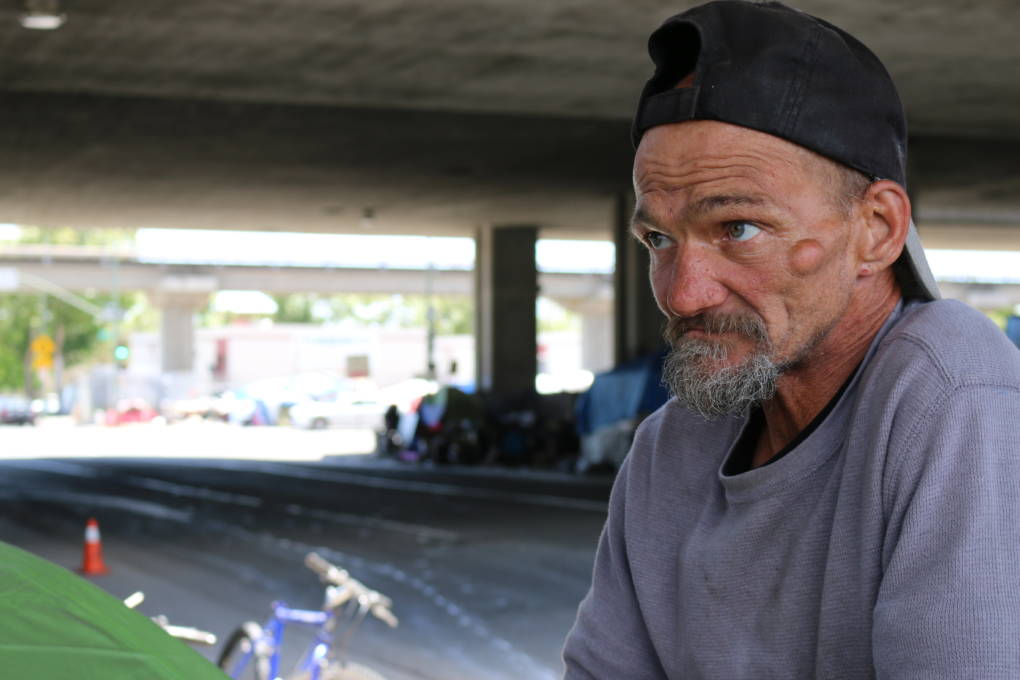
Thousands of people are homeless in San Francisco, and even more throughout the Bay Area. Despite years of concern and millions of dollars of investment, the problem persists.
Who are the people who live on the streets and on the edge of homelessness? Why have we failed to create lasting change? And are there solutions that offer hope for the future? As part of a collaboration with dozens of Bay Area news organizations, KQED is exploring these questions, and more.
Is Rent Control Working and Should We Have More or Less of It?
Former Cal Grad Student Finds Home and Community on Four Wheels
Berkeley Marina RV Community Seeks Safe and Sanctioned Place to Park
At L.A. Clinic, Free Showers Can Get Homeless People in to See the Doctor
Santa Rosa Charity Forced to Cut Homeless Safe Parking Program
Fresno Woman Dedicates Herself to Helping City's Homeless
California Taps Health Care Money to Pay for Homeless Services
These Students Were Homeless 6 Months Ago. Where Are They Now?
Oakland Homeless Encampments: Too Big to Ignore
New Law Could Speed Up Help for L.A.'s Homeless
The Suburbs: The New Face of Bay Area Homelessness
window.__IS_SSR__=true
window.__INITIAL_STATE__={
"attachmentsReducer": {
"audio_0": {
"type": "attachments",
"id": "audio_0",
"imgSizes": {
"kqedFullSize": {
"file": "https://ww2.kqed.org/news/wp-content/themes/KQED-unified/img/audio_bgs/background0.jpg"
}
}
},
"audio_1": {
"type": "attachments",
"id": "audio_1",
"imgSizes": {
"kqedFullSize": {
"file": "https://ww2.kqed.org/news/wp-content/themes/KQED-unified/img/audio_bgs/background1.jpg"
}
}
},
"audio_2": {
"type": "attachments",
"id": "audio_2",
"imgSizes": {
"kqedFullSize": {
"file": "https://ww2.kqed.org/news/wp-content/themes/KQED-unified/img/audio_bgs/background2.jpg"
}
}
},
"audio_3": {
"type": "attachments",
"id": "audio_3",
"imgSizes": {
"kqedFullSize": {
"file": "https://ww2.kqed.org/news/wp-content/themes/KQED-unified/img/audio_bgs/background3.jpg"
}
}
},
"audio_4": {
"type": "attachments",
"id": "audio_4",
"imgSizes": {
"kqedFullSize": {
"file": "https://ww2.kqed.org/news/wp-content/themes/KQED-unified/img/audio_bgs/background4.jpg"
}
}
},
"placeholder": {
"type": "attachments",
"id": "placeholder",
"imgSizes": {
"thumbnail": {
"file": "https://cdn.kqed.org/wp-content/uploads/2024/12/KQED-Default-Image-816638274-2000x1333-1-160x107.jpg",
"width": 160,
"height": 107,
"mimeType": "image/jpeg"
},
"medium": {
"file": "https://cdn.kqed.org/wp-content/uploads/2024/12/KQED-Default-Image-816638274-2000x1333-1-800x533.jpg",
"width": 800,
"height": 533,
"mimeType": "image/jpeg"
},
"medium_large": {
"file": "https://cdn.kqed.org/wp-content/uploads/2024/12/KQED-Default-Image-816638274-2000x1333-1-768x512.jpg",
"width": 768,
"height": 512,
"mimeType": "image/jpeg"
},
"large": {
"file": "https://cdn.kqed.org/wp-content/uploads/2024/12/KQED-Default-Image-816638274-2000x1333-1-1020x680.jpg",
"width": 1020,
"height": 680,
"mimeType": "image/jpeg"
},
"1536x1536": {
"file": "https://cdn.kqed.org/wp-content/uploads/2024/12/KQED-Default-Image-816638274-2000x1333-1-1536x1024.jpg",
"width": 1536,
"height": 1024,
"mimeType": "image/jpeg"
},
"fd-lrg": {
"file": "https://cdn.kqed.org/wp-content/uploads/2024/12/KQED-Default-Image-816638274-2000x1333-1-1536x1024.jpg",
"width": 1536,
"height": 1024,
"mimeType": "image/jpeg"
},
"fd-med": {
"file": "https://cdn.kqed.org/wp-content/uploads/2024/12/KQED-Default-Image-816638274-2000x1333-1-1020x680.jpg",
"width": 1020,
"height": 680,
"mimeType": "image/jpeg"
},
"fd-sm": {
"file": "https://cdn.kqed.org/wp-content/uploads/2024/12/KQED-Default-Image-816638274-2000x1333-1-800x533.jpg",
"width": 800,
"height": 533,
"mimeType": "image/jpeg"
},
"post-thumbnail": {
"file": "https://cdn.kqed.org/wp-content/uploads/2024/12/KQED-Default-Image-816638274-2000x1333-1-672x372.jpg",
"width": 672,
"height": 372,
"mimeType": "image/jpeg"
},
"twentyfourteen-full-width": {
"file": "https://cdn.kqed.org/wp-content/uploads/2024/12/KQED-Default-Image-816638274-2000x1333-1-1038x576.jpg",
"width": 1038,
"height": 576,
"mimeType": "image/jpeg"
},
"xxsmall": {
"file": "https://cdn.kqed.org/wp-content/uploads/2024/12/KQED-Default-Image-816638274-2000x1333-1-160x107.jpg",
"width": 160,
"height": 107,
"mimeType": "image/jpeg"
},
"xsmall": {
"file": "https://cdn.kqed.org/wp-content/uploads/2024/12/KQED-Default-Image-816638274-2000x1333-1-672x372.jpg",
"width": 672,
"height": 372,
"mimeType": "image/jpeg"
},
"small": {
"file": "https://cdn.kqed.org/wp-content/uploads/2024/12/KQED-Default-Image-816638274-2000x1333-1-672x372.jpg",
"width": 672,
"height": 372,
"mimeType": "image/jpeg"
},
"xlarge": {
"file": "https://cdn.kqed.org/wp-content/uploads/2024/12/KQED-Default-Image-816638274-2000x1333-1-1020x680.jpg",
"width": 1020,
"height": 680,
"mimeType": "image/jpeg"
},
"full-width": {
"file": "https://cdn.kqed.org/wp-content/uploads/2024/12/KQED-Default-Image-816638274-2000x1333-1-1920x1280.jpg",
"width": 1920,
"height": 1280,
"mimeType": "image/jpeg"
},
"guest-author-32": {
"file": "https://cdn.kqed.org/wp-content/uploads/2025/01/KQED-Default-Image-816638274-1333x1333-1-160x160.jpg",
"width": 32,
"height": 32,
"mimeType": "image/jpeg"
},
"guest-author-50": {
"file": "https://cdn.kqed.org/wp-content/uploads/2025/01/KQED-Default-Image-816638274-1333x1333-1-160x160.jpg",
"width": 50,
"height": 50,
"mimeType": "image/jpeg"
},
"guest-author-64": {
"file": "https://cdn.kqed.org/wp-content/uploads/2025/01/KQED-Default-Image-816638274-1333x1333-1-160x160.jpg",
"width": 64,
"height": 64,
"mimeType": "image/jpeg"
},
"guest-author-96": {
"file": "https://cdn.kqed.org/wp-content/uploads/2025/01/KQED-Default-Image-816638274-1333x1333-1-160x160.jpg",
"width": 96,
"height": 96,
"mimeType": "image/jpeg"
},
"guest-author-128": {
"file": "https://cdn.kqed.org/wp-content/uploads/2025/01/KQED-Default-Image-816638274-1333x1333-1-160x160.jpg",
"width": 128,
"height": 128,
"mimeType": "image/jpeg"
},
"detail": {
"file": "https://cdn.kqed.org/wp-content/uploads/2025/01/KQED-Default-Image-816638274-1333x1333-1-160x160.jpg",
"width": 160,
"height": 160,
"mimeType": "image/jpeg"
},
"kqedFullSize": {
"file": "https://cdn.kqed.org/wp-content/uploads/2024/12/KQED-Default-Image-816638274-2000x1333-1.jpg",
"width": 2000,
"height": 1333
}
}
},
"news_11677399": {
"type": "attachments",
"id": "news_11677399",
"meta": {
"index": "attachments_1716263798",
"site": "news",
"id": "11677399",
"found": true
},
"parent": 11677380,
"imgSizes": {
"small": {
"file": "https://ww2.kqed.org/app/uploads/sites/10/2018/06/25267941258_635ff7d26e_k-520x347.jpg",
"width": 520,
"mimeType": "image/jpeg",
"height": 347
},
"twentyfourteen-full-width": {
"file": "https://ww2.kqed.org/app/uploads/sites/10/2018/06/25267941258_635ff7d26e_k-1038x576.jpg",
"width": 1038,
"mimeType": "image/jpeg",
"height": 576
},
"thumbnail": {
"file": "https://ww2.kqed.org/app/uploads/sites/10/2018/06/25267941258_635ff7d26e_k-160x107.jpg",
"width": 160,
"mimeType": "image/jpeg",
"height": 107
},
"fd-sm": {
"file": "https://ww2.kqed.org/app/uploads/sites/10/2018/06/25267941258_635ff7d26e_k-960x640.jpg",
"width": 960,
"mimeType": "image/jpeg",
"height": 640
},
"post-thumbnail": {
"file": "https://ww2.kqed.org/app/uploads/sites/10/2018/06/25267941258_635ff7d26e_k-672x372.jpg",
"width": 672,
"mimeType": "image/jpeg",
"height": 372
},
"xsmall": {
"file": "https://ww2.kqed.org/app/uploads/sites/10/2018/06/25267941258_635ff7d26e_k-375x250.jpg",
"width": 375,
"mimeType": "image/jpeg",
"height": 250
},
"kqedFullSize": {
"file": "https://ww2.kqed.org/app/uploads/sites/10/2018/06/25267941258_635ff7d26e_k.jpg",
"width": 2048,
"height": 1365
},
"large": {
"file": "https://ww2.kqed.org/app/uploads/sites/10/2018/06/25267941258_635ff7d26e_k-1020x680.jpg",
"width": 1020,
"mimeType": "image/jpeg",
"height": 680
},
"xlarge": {
"file": "https://ww2.kqed.org/app/uploads/sites/10/2018/06/25267941258_635ff7d26e_k-1180x786.jpg",
"width": 1180,
"mimeType": "image/jpeg",
"height": 786
},
"complete_open_graph": {
"file": "https://ww2.kqed.org/app/uploads/sites/10/2018/06/25267941258_635ff7d26e_k-1200x800.jpg",
"width": 1200,
"mimeType": "image/jpeg",
"height": 800
},
"guest-author-50": {
"file": "https://ww2.kqed.org/app/uploads/sites/10/2018/06/25267941258_635ff7d26e_k-50x50.jpg",
"width": 50,
"mimeType": "image/jpeg",
"height": 50
},
"guest-author-96": {
"file": "https://ww2.kqed.org/app/uploads/sites/10/2018/06/25267941258_635ff7d26e_k-96x96.jpg",
"width": 96,
"mimeType": "image/jpeg",
"height": 96
},
"medium": {
"file": "https://ww2.kqed.org/app/uploads/sites/10/2018/06/25267941258_635ff7d26e_k-800x533.jpg",
"width": 800,
"mimeType": "image/jpeg",
"height": 533
},
"guest-author-64": {
"file": "https://ww2.kqed.org/app/uploads/sites/10/2018/06/25267941258_635ff7d26e_k-64x64.jpg",
"width": 64,
"mimeType": "image/jpeg",
"height": 64
},
"guest-author-32": {
"file": "https://ww2.kqed.org/app/uploads/sites/10/2018/06/25267941258_635ff7d26e_k-32x32.jpg",
"width": 32,
"mimeType": "image/jpeg",
"height": 32
},
"fd-lrg": {
"file": "https://ww2.kqed.org/app/uploads/sites/10/2018/06/25267941258_635ff7d26e_k-1920x1280.jpg",
"width": 1920,
"mimeType": "image/jpeg",
"height": 1280
},
"fd-med": {
"file": "https://ww2.kqed.org/app/uploads/sites/10/2018/06/25267941258_635ff7d26e_k-1180x786.jpg",
"width": 1180,
"mimeType": "image/jpeg",
"height": 786
},
"full-width": {
"file": "https://ww2.kqed.org/app/uploads/sites/10/2018/06/25267941258_635ff7d26e_k-1920x1280.jpg",
"width": 1920,
"mimeType": "image/jpeg",
"height": 1280
},
"detail": {
"file": "https://ww2.kqed.org/app/uploads/sites/10/2018/06/25267941258_635ff7d26e_k-150x150.jpg",
"width": 150,
"mimeType": "image/jpeg",
"height": 150
},
"guest-author-128": {
"file": "https://ww2.kqed.org/app/uploads/sites/10/2018/06/25267941258_635ff7d26e_k-128x128.jpg",
"width": 128,
"mimeType": "image/jpeg",
"height": 128
},
"xxsmall": {
"file": "https://ww2.kqed.org/app/uploads/sites/10/2018/06/25267941258_635ff7d26e_k-240x160.jpg",
"width": 240,
"mimeType": "image/jpeg",
"height": 160
}
},
"publishDate": 1530043643,
"modified": 1530423616,
"caption": "The Painted Ladies in San Francisco.",
"description": "The Painted Ladies in San Francisco.",
"title": "The Painted Ladies in San Francisco",
"credit": "soomness/flickr",
"status": "inherit",
"isLoading": false,
"fetchFailed": false
},
"news_11677605": {
"type": "attachments",
"id": "news_11677605",
"meta": {
"index": "attachments_1716263798",
"site": "news",
"id": "11677605",
"found": true
},
"parent": 11677438,
"imgSizes": {
"small": {
"file": "https://ww2.kqed.org/app/uploads/sites/10/2018/06/RS31589_Marina_Friends007-520x347.jpg",
"width": 520,
"mimeType": "image/jpeg",
"height": 347
},
"twentyfourteen-full-width": {
"file": "https://ww2.kqed.org/app/uploads/sites/10/2018/06/RS31589_Marina_Friends007-1038x576.jpg",
"width": 1038,
"mimeType": "image/jpeg",
"height": 576
},
"thumbnail": {
"file": "https://ww2.kqed.org/app/uploads/sites/10/2018/06/RS31589_Marina_Friends007-160x107.jpg",
"width": 160,
"mimeType": "image/jpeg",
"height": 107
},
"fd-sm": {
"file": "https://ww2.kqed.org/app/uploads/sites/10/2018/06/RS31589_Marina_Friends007-960x640.jpg",
"width": 960,
"mimeType": "image/jpeg",
"height": 640
},
"post-thumbnail": {
"file": "https://ww2.kqed.org/app/uploads/sites/10/2018/06/RS31589_Marina_Friends007-672x372.jpg",
"width": 672,
"mimeType": "image/jpeg",
"height": 372
},
"xsmall": {
"file": "https://ww2.kqed.org/app/uploads/sites/10/2018/06/RS31589_Marina_Friends007-375x250.jpg",
"width": 375,
"mimeType": "image/jpeg",
"height": 250
},
"kqedFullSize": {
"file": "https://ww2.kqed.org/app/uploads/sites/10/2018/06/RS31589_Marina_Friends007.jpg",
"width": 1600,
"height": 1067
},
"large": {
"file": "https://ww2.kqed.org/app/uploads/sites/10/2018/06/RS31589_Marina_Friends007-1020x680.jpg",
"width": 1020,
"mimeType": "image/jpeg",
"height": 680
},
"xlarge": {
"file": "https://ww2.kqed.org/app/uploads/sites/10/2018/06/RS31589_Marina_Friends007-1180x787.jpg",
"width": 1180,
"mimeType": "image/jpeg",
"height": 787
},
"complete_open_graph": {
"file": "https://ww2.kqed.org/app/uploads/sites/10/2018/06/RS31589_Marina_Friends007-1200x800.jpg",
"width": 1200,
"mimeType": "image/jpeg",
"height": 800
},
"guest-author-50": {
"file": "https://ww2.kqed.org/app/uploads/sites/10/2018/06/RS31589_Marina_Friends007-50x50.jpg",
"width": 50,
"mimeType": "image/jpeg",
"height": 50
},
"guest-author-96": {
"file": "https://ww2.kqed.org/app/uploads/sites/10/2018/06/RS31589_Marina_Friends007-96x96.jpg",
"width": 96,
"mimeType": "image/jpeg",
"height": 96
},
"medium": {
"file": "https://ww2.kqed.org/app/uploads/sites/10/2018/06/RS31589_Marina_Friends007-800x534.jpg",
"width": 800,
"mimeType": "image/jpeg",
"height": 534
},
"guest-author-64": {
"file": "https://ww2.kqed.org/app/uploads/sites/10/2018/06/RS31589_Marina_Friends007-64x64.jpg",
"width": 64,
"mimeType": "image/jpeg",
"height": 64
},
"guest-author-32": {
"file": "https://ww2.kqed.org/app/uploads/sites/10/2018/06/RS31589_Marina_Friends007-32x32.jpg",
"width": 32,
"mimeType": "image/jpeg",
"height": 32
},
"fd-med": {
"file": "https://ww2.kqed.org/app/uploads/sites/10/2018/06/RS31589_Marina_Friends007-1180x787.jpg",
"width": 1180,
"mimeType": "image/jpeg",
"height": 787
},
"detail": {
"file": "https://ww2.kqed.org/app/uploads/sites/10/2018/06/RS31589_Marina_Friends007-150x150.jpg",
"width": 150,
"mimeType": "image/jpeg",
"height": 150
},
"guest-author-128": {
"file": "https://ww2.kqed.org/app/uploads/sites/10/2018/06/RS31589_Marina_Friends007-128x128.jpg",
"width": 128,
"mimeType": "image/jpeg",
"height": 128
},
"xxsmall": {
"file": "https://ww2.kqed.org/app/uploads/sites/10/2018/06/RS31589_Marina_Friends007-240x160.jpg",
"width": 240,
"mimeType": "image/jpeg",
"height": 160
}
},
"publishDate": 1530119955,
"modified": 1530133347,
"caption": "A portrait of Yesica Prado holding her Yashica Electro 35 analog camera. ",
"description": null,
"title": "RS31589_Marina_Friends007",
"credit": "Christian Torres",
"status": "inherit",
"isLoading": false,
"fetchFailed": false
},
"news_11677194": {
"type": "attachments",
"id": "news_11677194",
"meta": {
"index": "attachments_1716263798",
"site": "news",
"id": "11677194",
"found": true
},
"parent": 11676978,
"imgSizes": {
"small": {
"file": "https://ww2.kqed.org/app/uploads/sites/10/2018/06/Marina_Friends002-520x293.jpg",
"width": 520,
"mimeType": "image/jpeg",
"height": 293
},
"twentyfourteen-full-width": {
"file": "https://ww2.kqed.org/app/uploads/sites/10/2018/06/Marina_Friends002-1038x576.jpg",
"width": 1038,
"mimeType": "image/jpeg",
"height": 576
},
"thumbnail": {
"file": "https://ww2.kqed.org/app/uploads/sites/10/2018/06/Marina_Friends002-160x90.jpg",
"width": 160,
"mimeType": "image/jpeg",
"height": 90
},
"fd-sm": {
"file": "https://ww2.kqed.org/app/uploads/sites/10/2018/06/Marina_Friends002-960x540.jpg",
"width": 960,
"mimeType": "image/jpeg",
"height": 540
},
"post-thumbnail": {
"file": "https://ww2.kqed.org/app/uploads/sites/10/2018/06/Marina_Friends002-672x372.jpg",
"width": 672,
"mimeType": "image/jpeg",
"height": 372
},
"xsmall": {
"file": "https://ww2.kqed.org/app/uploads/sites/10/2018/06/Marina_Friends002-375x211.jpg",
"width": 375,
"mimeType": "image/jpeg",
"height": 211
},
"kqedFullSize": {
"file": "https://ww2.kqed.org/app/uploads/sites/10/2018/06/Marina_Friends002.jpg",
"width": 1600,
"height": 900
},
"large": {
"file": "https://ww2.kqed.org/app/uploads/sites/10/2018/06/Marina_Friends002-1020x574.jpg",
"width": 1020,
"mimeType": "image/jpeg",
"height": 574
},
"xlarge": {
"file": "https://ww2.kqed.org/app/uploads/sites/10/2018/06/Marina_Friends002-1180x664.jpg",
"width": 1180,
"mimeType": "image/jpeg",
"height": 664
},
"complete_open_graph": {
"file": "https://ww2.kqed.org/app/uploads/sites/10/2018/06/Marina_Friends002-1200x675.jpg",
"width": 1200,
"mimeType": "image/jpeg",
"height": 675
},
"guest-author-50": {
"file": "https://ww2.kqed.org/app/uploads/sites/10/2018/06/Marina_Friends002-50x50.jpg",
"width": 50,
"mimeType": "image/jpeg",
"height": 50
},
"guest-author-96": {
"file": "https://ww2.kqed.org/app/uploads/sites/10/2018/06/Marina_Friends002-96x96.jpg",
"width": 96,
"mimeType": "image/jpeg",
"height": 96
},
"medium": {
"file": "https://ww2.kqed.org/app/uploads/sites/10/2018/06/Marina_Friends002-800x450.jpg",
"width": 800,
"mimeType": "image/jpeg",
"height": 450
},
"guest-author-64": {
"file": "https://ww2.kqed.org/app/uploads/sites/10/2018/06/Marina_Friends002-64x64.jpg",
"width": 64,
"mimeType": "image/jpeg",
"height": 64
},
"guest-author-32": {
"file": "https://ww2.kqed.org/app/uploads/sites/10/2018/06/Marina_Friends002-32x32.jpg",
"width": 32,
"mimeType": "image/jpeg",
"height": 32
},
"fd-med": {
"file": "https://ww2.kqed.org/app/uploads/sites/10/2018/06/Marina_Friends002-1180x664.jpg",
"width": 1180,
"mimeType": "image/jpeg",
"height": 664
},
"detail": {
"file": "https://ww2.kqed.org/app/uploads/sites/10/2018/06/Marina_Friends002-150x150.jpg",
"width": 150,
"mimeType": "image/jpeg",
"height": 150
},
"guest-author-128": {
"file": "https://ww2.kqed.org/app/uploads/sites/10/2018/06/Marina_Friends002-128x128.jpg",
"width": 128,
"mimeType": "image/jpeg",
"height": 128
},
"xxsmall": {
"file": "https://ww2.kqed.org/app/uploads/sites/10/2018/06/Marina_Friends002-240x135.jpg",
"width": 240,
"mimeType": "image/jpeg",
"height": 135
}
},
"publishDate": 1529966409,
"modified": 1530061058,
"caption": "Amber Whitson and Pamela Benfante stand on the dirt lot next to Marina Boulevard on Memorial Day, waiting for Berkeley police to evict the vehicle community. Before 6 a.m. on that morning, a group of activists came to support the RV encampment and used their own vehicles to block the eight RVs still parked on the dirt lot. ",
"description": "Pamela Benfante (l) and Amber Whitson (r) stand on the dirt lot next to the Marina Boulevard on Memorial Day, waiting for Berkeley Police to evict the vehicle community. Before 6 a.m. on that morning, a group of activists came to support the RV encampment and used their own vehicles to block the eight RVs still parked on the dirt lot. ",
"title": "Marina_Friends002",
"credit": "Christian Torres/KQED",
"status": "inherit",
"isLoading": false,
"fetchFailed": false
},
"news_11676498": {
"type": "attachments",
"id": "news_11676498",
"meta": {
"index": "attachments_1716263798",
"site": "news",
"id": "11676498",
"found": true
},
"parent": 11676494,
"imgSizes": {
"small": {
"file": "https://ww2.kqed.org/app/uploads/sites/10/2018/06/RS31529_alt_749-520x346.jpg",
"width": 520,
"mimeType": "image/jpeg",
"height": 346
},
"twentyfourteen-full-width": {
"file": "https://ww2.kqed.org/app/uploads/sites/10/2018/06/RS31529_alt_749-1038x576.jpg",
"width": 1038,
"mimeType": "image/jpeg",
"height": 576
},
"thumbnail": {
"file": "https://ww2.kqed.org/app/uploads/sites/10/2018/06/RS31529_alt_749-160x106.jpg",
"width": 160,
"mimeType": "image/jpeg",
"height": 106
},
"fd-sm": {
"file": "https://ww2.kqed.org/app/uploads/sites/10/2018/06/RS31529_alt_749-960x639.jpg",
"width": 960,
"mimeType": "image/jpeg",
"height": 639
},
"post-thumbnail": {
"file": "https://ww2.kqed.org/app/uploads/sites/10/2018/06/RS31529_alt_749-672x372.jpg",
"width": 672,
"mimeType": "image/jpeg",
"height": 372
},
"xsmall": {
"file": "https://ww2.kqed.org/app/uploads/sites/10/2018/06/RS31529_alt_749-375x250.jpg",
"width": 375,
"mimeType": "image/jpeg",
"height": 250
},
"kqedFullSize": {
"file": "https://ww2.kqed.org/app/uploads/sites/10/2018/06/RS31529_alt_749.jpg",
"width": 3185,
"height": 2120
},
"large": {
"file": "https://ww2.kqed.org/app/uploads/sites/10/2018/06/RS31529_alt_749-1020x679.jpg",
"width": 1020,
"mimeType": "image/jpeg",
"height": 679
},
"xlarge": {
"file": "https://ww2.kqed.org/app/uploads/sites/10/2018/06/RS31529_alt_749-1180x785.jpg",
"width": 1180,
"mimeType": "image/jpeg",
"height": 785
},
"complete_open_graph": {
"file": "https://ww2.kqed.org/app/uploads/sites/10/2018/06/RS31529_alt_749-1200x799.jpg",
"width": 1200,
"mimeType": "image/jpeg",
"height": 799
},
"guest-author-50": {
"file": "https://ww2.kqed.org/app/uploads/sites/10/2018/06/RS31529_alt_749-50x50.jpg",
"width": 50,
"mimeType": "image/jpeg",
"height": 50
},
"guest-author-96": {
"file": "https://ww2.kqed.org/app/uploads/sites/10/2018/06/RS31529_alt_749-96x96.jpg",
"width": 96,
"mimeType": "image/jpeg",
"height": 96
},
"medium": {
"file": "https://ww2.kqed.org/app/uploads/sites/10/2018/06/RS31529_alt_749-800x532.jpg",
"width": 800,
"mimeType": "image/jpeg",
"height": 532
},
"guest-author-64": {
"file": "https://ww2.kqed.org/app/uploads/sites/10/2018/06/RS31529_alt_749-64x64.jpg",
"width": 64,
"mimeType": "image/jpeg",
"height": 64
},
"guest-author-32": {
"file": "https://ww2.kqed.org/app/uploads/sites/10/2018/06/RS31529_alt_749-32x32.jpg",
"width": 32,
"mimeType": "image/jpeg",
"height": 32
},
"fd-lrg": {
"file": "https://ww2.kqed.org/app/uploads/sites/10/2018/06/RS31529_alt_749-1920x1278.jpg",
"width": 1920,
"mimeType": "image/jpeg",
"height": 1278
},
"fd-med": {
"file": "https://ww2.kqed.org/app/uploads/sites/10/2018/06/RS31529_alt_749-1180x785.jpg",
"width": 1180,
"mimeType": "image/jpeg",
"height": 785
},
"full-width": {
"file": "https://ww2.kqed.org/app/uploads/sites/10/2018/06/RS31529_alt_749-1920x1278.jpg",
"width": 1920,
"mimeType": "image/jpeg",
"height": 1278
},
"detail": {
"file": "https://ww2.kqed.org/app/uploads/sites/10/2018/06/RS31529_alt_749-150x150.jpg",
"width": 150,
"mimeType": "image/jpeg",
"height": 150
},
"guest-author-128": {
"file": "https://ww2.kqed.org/app/uploads/sites/10/2018/06/RS31529_alt_749-128x128.jpg",
"width": 128,
"mimeType": "image/jpeg",
"height": 128
},
"xxsmall": {
"file": "https://ww2.kqed.org/app/uploads/sites/10/2018/06/RS31529_alt_749-240x160.jpg",
"width": 240,
"mimeType": "image/jpeg",
"height": 160
}
},
"publishDate": 1529690888,
"modified": 1529691131,
"caption": "Gregory Andrews says that aside from finding something healthy to eat, a shower is the next most important thing. “It keeps your self-esteem up,” he says. ",
"description": null,
"title": "RS31529_alt_749",
"credit": "Anna Gorman/Kaiser Health News",
"status": "inherit",
"isLoading": false,
"fetchFailed": false
},
"news_11559552": {
"type": "attachments",
"id": "news_11559552",
"meta": {
"index": "attachments_1716263798",
"site": "news",
"id": "11559552",
"found": true
},
"parent": 11553696,
"imgSizes": {
"small": {
"file": "https://ww2.kqed.org/app/uploads/sites/10/2017/07/nikki-parking1920-520x292.jpg",
"width": 520,
"mimeType": "image/jpeg",
"height": 292
},
"twentyfourteen-full-width": {
"file": "https://ww2.kqed.org/app/uploads/sites/10/2017/07/nikki-parking1920-1038x576.jpg",
"width": 1038,
"mimeType": "image/jpeg",
"height": 576
},
"thumbnail": {
"file": "https://ww2.kqed.org/app/uploads/sites/10/2017/07/nikki-parking1920-160x90.jpg",
"width": 160,
"mimeType": "image/jpeg",
"height": 90
},
"fd-sm": {
"file": "https://ww2.kqed.org/app/uploads/sites/10/2017/07/nikki-parking1920-960x539.jpg",
"width": 960,
"mimeType": "image/jpeg",
"height": 539
},
"post-thumbnail": {
"file": "https://ww2.kqed.org/app/uploads/sites/10/2017/07/nikki-parking1920-672x372.jpg",
"width": 672,
"mimeType": "image/jpeg",
"height": 372
},
"xsmall": {
"file": "https://ww2.kqed.org/app/uploads/sites/10/2017/07/nikki-parking1920-375x210.jpg",
"width": 375,
"mimeType": "image/jpeg",
"height": 210
},
"kqedFullSize": {
"file": "https://ww2.kqed.org/app/uploads/sites/10/2017/07/nikki-parking1920.jpg",
"width": 1920,
"height": 1077
},
"large": {
"file": "https://ww2.kqed.org/app/uploads/sites/10/2017/07/nikki-parking1920-1020x572.jpg",
"width": 1020,
"mimeType": "image/jpeg",
"height": 572
},
"xlarge": {
"file": "https://ww2.kqed.org/app/uploads/sites/10/2017/07/nikki-parking1920-1180x662.jpg",
"width": 1180,
"mimeType": "image/jpeg",
"height": 662
},
"guest-author-50": {
"file": "https://ww2.kqed.org/app/uploads/sites/10/2017/07/nikki-parking1920-50x50.jpg",
"width": 50,
"mimeType": "image/jpeg",
"height": 50
},
"guest-author-96": {
"file": "https://ww2.kqed.org/app/uploads/sites/10/2017/07/nikki-parking1920-96x96.jpg",
"width": 96,
"mimeType": "image/jpeg",
"height": 96
},
"medium": {
"file": "https://ww2.kqed.org/app/uploads/sites/10/2017/07/nikki-parking1920-800x449.jpg",
"width": 800,
"mimeType": "image/jpeg",
"height": 449
},
"guest-author-64": {
"file": "https://ww2.kqed.org/app/uploads/sites/10/2017/07/nikki-parking1920-64x64.jpg",
"width": 64,
"mimeType": "image/jpeg",
"height": 64
},
"guest-author-32": {
"file": "https://ww2.kqed.org/app/uploads/sites/10/2017/07/nikki-parking1920-32x32.jpg",
"width": 32,
"mimeType": "image/jpeg",
"height": 32
},
"fd-lrg": {
"file": "https://ww2.kqed.org/app/uploads/sites/10/2017/07/nikki-parking1920-1920x1077.jpg",
"width": 1920,
"mimeType": "image/jpeg",
"height": 1077
},
"fd-med": {
"file": "https://ww2.kqed.org/app/uploads/sites/10/2017/07/nikki-parking1920-1180x662.jpg",
"width": 1180,
"mimeType": "image/jpeg",
"height": 662
},
"full-width": {
"file": "https://ww2.kqed.org/app/uploads/sites/10/2017/07/nikki-parking1920-1920x1077.jpg",
"width": 1920,
"mimeType": "image/jpeg",
"height": 1077
},
"detail": {
"file": "https://ww2.kqed.org/app/uploads/sites/10/2017/07/nikki-parking1920-150x150.jpg",
"width": 150,
"mimeType": "image/jpeg",
"height": 150
},
"guest-author-128": {
"file": "https://ww2.kqed.org/app/uploads/sites/10/2017/07/nikki-parking1920-128x128.jpg",
"width": 128,
"mimeType": "image/jpeg",
"height": 128
},
"xxsmall": {
"file": "https://ww2.kqed.org/app/uploads/sites/10/2017/07/nikki-parking1920-240x135.jpg",
"width": 240,
"mimeType": "image/jpeg",
"height": 135
}
},
"publishDate": 1499705926,
"modified": 1499705989,
"caption": "Nikki and her boyfriend in her car, which she calls home.",
"description": null,
"title": "nikki-parking1920",
"credit": "Serginho Roosblad/KQED",
"status": "inherit",
"isLoading": false,
"fetchFailed": false
},
"news_11548022": {
"type": "attachments",
"id": "news_11548022",
"meta": {
"index": "attachments_1716263798",
"site": "news",
"id": "11548022",
"found": true
},
"parent": 11548018,
"imgSizes": {
"small": {
"file": "https://ww2.kqed.org/app/uploads/sites/10/2017/07/H2O_FRESNO-2-520x347.jpg",
"width": 520,
"mimeType": "image/jpeg",
"height": 347
},
"twentyfourteen-full-width": {
"file": "https://ww2.kqed.org/app/uploads/sites/10/2017/07/H2O_FRESNO-2-1038x576.jpg",
"width": 1038,
"mimeType": "image/jpeg",
"height": 576
},
"thumbnail": {
"file": "https://ww2.kqed.org/app/uploads/sites/10/2017/07/H2O_FRESNO-2-160x107.jpg",
"width": 160,
"mimeType": "image/jpeg",
"height": 107
},
"fd-sm": {
"file": "https://ww2.kqed.org/app/uploads/sites/10/2017/07/H2O_FRESNO-2-960x640.jpg",
"width": 960,
"mimeType": "image/jpeg",
"height": 640
},
"post-thumbnail": {
"file": "https://ww2.kqed.org/app/uploads/sites/10/2017/07/H2O_FRESNO-2-672x372.jpg",
"width": 672,
"mimeType": "image/jpeg",
"height": 372
},
"xsmall": {
"file": "https://ww2.kqed.org/app/uploads/sites/10/2017/07/H2O_FRESNO-2-375x250.jpg",
"width": 375,
"mimeType": "image/jpeg",
"height": 250
},
"kqedFullSize": {
"file": "https://ww2.kqed.org/app/uploads/sites/10/2017/07/H2O_FRESNO-2-e1499294146762.jpg",
"width": 1920,
"height": 1280
},
"large": {
"file": "https://ww2.kqed.org/app/uploads/sites/10/2017/07/H2O_FRESNO-2-1020x680.jpg",
"width": 1020,
"mimeType": "image/jpeg",
"height": 680
},
"xlarge": {
"file": "https://ww2.kqed.org/app/uploads/sites/10/2017/07/H2O_FRESNO-2-1180x787.jpg",
"width": 1180,
"mimeType": "image/jpeg",
"height": 787
},
"guest-author-50": {
"file": "https://ww2.kqed.org/app/uploads/sites/10/2017/07/H2O_FRESNO-2-50x50.jpg",
"width": 50,
"mimeType": "image/jpeg",
"height": 50
},
"guest-author-96": {
"file": "https://ww2.kqed.org/app/uploads/sites/10/2017/07/H2O_FRESNO-2-96x96.jpg",
"width": 96,
"mimeType": "image/jpeg",
"height": 96
},
"medium": {
"file": "https://ww2.kqed.org/app/uploads/sites/10/2017/07/H2O_FRESNO-2-800x533.jpg",
"width": 800,
"mimeType": "image/jpeg",
"height": 533
},
"guest-author-64": {
"file": "https://ww2.kqed.org/app/uploads/sites/10/2017/07/H2O_FRESNO-2-64x64.jpg",
"width": 64,
"mimeType": "image/jpeg",
"height": 64
},
"guest-author-32": {
"file": "https://ww2.kqed.org/app/uploads/sites/10/2017/07/H2O_FRESNO-2-32x32.jpg",
"width": 32,
"mimeType": "image/jpeg",
"height": 32
},
"fd-lrg": {
"file": "https://ww2.kqed.org/app/uploads/sites/10/2017/07/H2O_FRESNO-2-1920x1280.jpg",
"width": 1920,
"mimeType": "image/jpeg",
"height": 1280
},
"fd-med": {
"file": "https://ww2.kqed.org/app/uploads/sites/10/2017/07/H2O_FRESNO-2-1180x787.jpg",
"width": 1180,
"mimeType": "image/jpeg",
"height": 787
},
"full-width": {
"file": "https://ww2.kqed.org/app/uploads/sites/10/2017/07/H2O_FRESNO-2-1920x1280.jpg",
"width": 1920,
"mimeType": "image/jpeg",
"height": 1280
},
"detail": {
"file": "https://ww2.kqed.org/app/uploads/sites/10/2017/07/H2O_FRESNO-2-150x150.jpg",
"width": 150,
"mimeType": "image/jpeg",
"height": 150
},
"guest-author-128": {
"file": "https://ww2.kqed.org/app/uploads/sites/10/2017/07/H2O_FRESNO-2-128x128.jpg",
"width": 128,
"mimeType": "image/jpeg",
"height": 128
},
"xxsmall": {
"file": "https://ww2.kqed.org/app/uploads/sites/10/2017/07/H2O_FRESNO-2-240x160.jpg",
"width": 240,
"mimeType": "image/jpeg",
"height": 160
}
},
"publishDate": 1499212383,
"modified": 1499294139,
"caption": "Desiree Martinez hands William Gilligan a water bottle at Roeding Park in Fresno. ",
"description": "Desiree Martinez hands William Gilligan a water bottle at Roeding Park in Fresno. ",
"title": "H2O_FRESNO-2",
"credit": "Sean Havey/KQED",
"status": "inherit",
"isLoading": false,
"fetchFailed": false
},
"news_11540909": {
"type": "attachments",
"id": "news_11540909",
"meta": {
"index": "attachments_1716263798",
"site": "news",
"id": "11540909",
"found": true
},
"parent": 11538907,
"imgSizes": {
"small": {
"file": "https://ww2.kqed.org/app/uploads/sites/10/2017/06/Daniel-Yapo-520x390.jpg",
"width": 520,
"mimeType": "image/jpeg",
"height": 390
},
"twentyfourteen-full-width": {
"file": "https://ww2.kqed.org/app/uploads/sites/10/2017/06/Daniel-Yapo-1038x576.jpg",
"width": 1038,
"mimeType": "image/jpeg",
"height": 576
},
"thumbnail": {
"file": "https://ww2.kqed.org/app/uploads/sites/10/2017/06/Daniel-Yapo-160x120.jpg",
"width": 160,
"mimeType": "image/jpeg",
"height": 120
},
"fd-sm": {
"file": "https://ww2.kqed.org/app/uploads/sites/10/2017/06/Daniel-Yapo-960x720.jpg",
"width": 960,
"mimeType": "image/jpeg",
"height": 720
},
"post-thumbnail": {
"file": "https://ww2.kqed.org/app/uploads/sites/10/2017/06/Daniel-Yapo-672x372.jpg",
"width": 672,
"mimeType": "image/jpeg",
"height": 372
},
"xsmall": {
"file": "https://ww2.kqed.org/app/uploads/sites/10/2017/06/Daniel-Yapo-375x281.jpg",
"width": 375,
"mimeType": "image/jpeg",
"height": 281
},
"kqedFullSize": {
"file": "https://ww2.kqed.org/app/uploads/sites/10/2017/06/Daniel-Yapo.jpg",
"width": 4032,
"height": 3024
},
"large": {
"file": "https://ww2.kqed.org/app/uploads/sites/10/2017/06/Daniel-Yapo-1020x765.jpg",
"width": 1020,
"mimeType": "image/jpeg",
"height": 765
},
"xlarge": {
"file": "https://ww2.kqed.org/app/uploads/sites/10/2017/06/Daniel-Yapo-1180x885.jpg",
"width": 1180,
"mimeType": "image/jpeg",
"height": 885
},
"guest-author-50": {
"file": "https://ww2.kqed.org/app/uploads/sites/10/2017/06/Daniel-Yapo-50x50.jpg",
"width": 50,
"mimeType": "image/jpeg",
"height": 50
},
"guest-author-96": {
"file": "https://ww2.kqed.org/app/uploads/sites/10/2017/06/Daniel-Yapo-96x96.jpg",
"width": 96,
"mimeType": "image/jpeg",
"height": 96
},
"medium": {
"file": "https://ww2.kqed.org/app/uploads/sites/10/2017/06/Daniel-Yapo-800x600.jpg",
"width": 800,
"mimeType": "image/jpeg",
"height": 600
},
"guest-author-64": {
"file": "https://ww2.kqed.org/app/uploads/sites/10/2017/06/Daniel-Yapo-64x64.jpg",
"width": 64,
"mimeType": "image/jpeg",
"height": 64
},
"guest-author-32": {
"file": "https://ww2.kqed.org/app/uploads/sites/10/2017/06/Daniel-Yapo-32x32.jpg",
"width": 32,
"mimeType": "image/jpeg",
"height": 32
},
"fd-lrg": {
"file": "https://ww2.kqed.org/app/uploads/sites/10/2017/06/Daniel-Yapo-1920x1440.jpg",
"width": 1920,
"mimeType": "image/jpeg",
"height": 1440
},
"fd-med": {
"file": "https://ww2.kqed.org/app/uploads/sites/10/2017/06/Daniel-Yapo-1180x885.jpg",
"width": 1180,
"mimeType": "image/jpeg",
"height": 885
},
"full-width": {
"file": "https://ww2.kqed.org/app/uploads/sites/10/2017/06/Daniel-Yapo-1920x1440.jpg",
"width": 1920,
"mimeType": "image/jpeg",
"height": 1440
},
"detail": {
"file": "https://ww2.kqed.org/app/uploads/sites/10/2017/06/Daniel-Yapo-150x150.jpg",
"width": 150,
"mimeType": "image/jpeg",
"height": 150
},
"guest-author-128": {
"file": "https://ww2.kqed.org/app/uploads/sites/10/2017/06/Daniel-Yapo-128x128.jpg",
"width": 128,
"mimeType": "image/jpeg",
"height": 128
},
"xxsmall": {
"file": "https://ww2.kqed.org/app/uploads/sites/10/2017/06/Daniel-Yapo-240x180.jpg",
"width": 240,
"mimeType": "image/jpeg",
"height": 180
}
},
"publishDate": 1498847294,
"modified": 1498847338,
"caption": "Daniel Yapo, in the backyard of his new home in Oakland. ",
"description": null,
"title": "Daniel Yapo",
"credit": "Guy Marzorati/KQED",
"status": "inherit",
"isLoading": false,
"fetchFailed": false
},
"news_11538894": {
"type": "attachments",
"id": "news_11538894",
"meta": {
"index": "attachments_1716263798",
"site": "news",
"id": "11538894",
"found": true
},
"parent": 11508496,
"imgSizes": {
"small": {
"file": "https://ww2.kqed.org/app/uploads/sites/10/2017/06/RS22968_161118_BrittanyJones_bhs06-qut-1-520x347.jpg",
"width": 520,
"mimeType": "image/jpeg",
"height": 347
},
"twentyfourteen-full-width": {
"file": "https://ww2.kqed.org/app/uploads/sites/10/2017/06/RS22968_161118_BrittanyJones_bhs06-qut-1-1038x576.jpg",
"width": 1038,
"mimeType": "image/jpeg",
"height": 576
},
"thumbnail": {
"file": "https://ww2.kqed.org/app/uploads/sites/10/2017/06/RS22968_161118_BrittanyJones_bhs06-qut-1-160x107.jpg",
"width": 160,
"mimeType": "image/jpeg",
"height": 107
},
"fd-sm": {
"file": "https://ww2.kqed.org/app/uploads/sites/10/2017/06/RS22968_161118_BrittanyJones_bhs06-qut-1-960x640.jpg",
"width": 960,
"mimeType": "image/jpeg",
"height": 640
},
"post-thumbnail": {
"file": "https://ww2.kqed.org/app/uploads/sites/10/2017/06/RS22968_161118_BrittanyJones_bhs06-qut-1-672x372.jpg",
"width": 672,
"mimeType": "image/jpeg",
"height": 372
},
"xsmall": {
"file": "https://ww2.kqed.org/app/uploads/sites/10/2017/06/RS22968_161118_BrittanyJones_bhs06-qut-1-375x250.jpg",
"width": 375,
"mimeType": "image/jpeg",
"height": 250
},
"kqedFullSize": {
"file": "https://ww2.kqed.org/app/uploads/sites/10/2017/06/RS22968_161118_BrittanyJones_bhs06-qut-1.jpg",
"width": 1920,
"height": 1280
},
"large": {
"file": "https://ww2.kqed.org/app/uploads/sites/10/2017/06/RS22968_161118_BrittanyJones_bhs06-qut-1-1020x680.jpg",
"width": 1020,
"mimeType": "image/jpeg",
"height": 680
},
"xlarge": {
"file": "https://ww2.kqed.org/app/uploads/sites/10/2017/06/RS22968_161118_BrittanyJones_bhs06-qut-1-1180x787.jpg",
"width": 1180,
"mimeType": "image/jpeg",
"height": 787
},
"guest-author-50": {
"file": "https://ww2.kqed.org/app/uploads/sites/10/2017/06/RS22968_161118_BrittanyJones_bhs06-qut-1-50x50.jpg",
"width": 50,
"mimeType": "image/jpeg",
"height": 50
},
"guest-author-96": {
"file": "https://ww2.kqed.org/app/uploads/sites/10/2017/06/RS22968_161118_BrittanyJones_bhs06-qut-1-96x96.jpg",
"width": 96,
"mimeType": "image/jpeg",
"height": 96
},
"medium": {
"file": "https://ww2.kqed.org/app/uploads/sites/10/2017/06/RS22968_161118_BrittanyJones_bhs06-qut-1-800x533.jpg",
"width": 800,
"mimeType": "image/jpeg",
"height": 533
},
"guest-author-64": {
"file": "https://ww2.kqed.org/app/uploads/sites/10/2017/06/RS22968_161118_BrittanyJones_bhs06-qut-1-64x64.jpg",
"width": 64,
"mimeType": "image/jpeg",
"height": 64
},
"guest-author-32": {
"file": "https://ww2.kqed.org/app/uploads/sites/10/2017/06/RS22968_161118_BrittanyJones_bhs06-qut-1-32x32.jpg",
"width": 32,
"mimeType": "image/jpeg",
"height": 32
},
"fd-lrg": {
"file": "https://ww2.kqed.org/app/uploads/sites/10/2017/06/RS22968_161118_BrittanyJones_bhs06-qut-1-1920x1280.jpg",
"width": 1920,
"mimeType": "image/jpeg",
"height": 1280
},
"fd-med": {
"file": "https://ww2.kqed.org/app/uploads/sites/10/2017/06/RS22968_161118_BrittanyJones_bhs06-qut-1-1180x787.jpg",
"width": 1180,
"mimeType": "image/jpeg",
"height": 787
},
"full-width": {
"file": "https://ww2.kqed.org/app/uploads/sites/10/2017/06/RS22968_161118_BrittanyJones_bhs06-qut-1-1920x1280.jpg",
"width": 1920,
"mimeType": "image/jpeg",
"height": 1280
},
"detail": {
"file": "https://ww2.kqed.org/app/uploads/sites/10/2017/06/RS22968_161118_BrittanyJones_bhs06-qut-1-150x150.jpg",
"width": 150,
"mimeType": "image/jpeg",
"height": 150
},
"guest-author-128": {
"file": "https://ww2.kqed.org/app/uploads/sites/10/2017/06/RS22968_161118_BrittanyJones_bhs06-qut-1-128x128.jpg",
"width": 128,
"mimeType": "image/jpeg",
"height": 128
},
"xxsmall": {
"file": "https://ww2.kqed.org/app/uploads/sites/10/2017/06/RS22968_161118_BrittanyJones_bhs06-qut-1-240x160.jpg",
"width": 240,
"mimeType": "image/jpeg",
"height": 160
}
},
"publishDate": 1498759361,
"modified": 1498773408,
"caption": "Brittany Jones is one of the college students KQED reporters followed over the past several months. When we first met her in the fall, she was homeless. But since sharing her story, her life has changed dramatically.",
"description": "Brittany Jones is one of the college students KQED reporters followed over the past several months. When we first met her in the fall, she was homeless. But since sharing her story, her life has changed dramatically.",
"title": "RS22968_161118_BrittanyJones_bhs06-qut (1)",
"credit": "Brittany Hosea-Small/KQED",
"status": "inherit",
"isLoading": false,
"fetchFailed": false
},
"news_11535097": {
"type": "attachments",
"id": "news_11535097",
"meta": {
"index": "attachments_1716263798",
"site": "news",
"id": "11535097",
"found": true
},
"parent": 11534977,
"imgSizes": {
"small": {
"file": "https://ww2.kqed.org/app/uploads/sites/10/2017/06/IMG_2771-520x347.jpg",
"width": 520,
"mimeType": "image/jpeg",
"height": 347
},
"twentyfourteen-full-width": {
"file": "https://ww2.kqed.org/app/uploads/sites/10/2017/06/IMG_2771-1038x576.jpg",
"width": 1038,
"mimeType": "image/jpeg",
"height": 576
},
"thumbnail": {
"file": "https://ww2.kqed.org/app/uploads/sites/10/2017/06/IMG_2771-160x107.jpg",
"width": 160,
"mimeType": "image/jpeg",
"height": 107
},
"fd-sm": {
"file": "https://ww2.kqed.org/app/uploads/sites/10/2017/06/IMG_2771-960x640.jpg",
"width": 960,
"mimeType": "image/jpeg",
"height": 640
},
"post-thumbnail": {
"file": "https://ww2.kqed.org/app/uploads/sites/10/2017/06/IMG_2771-672x372.jpg",
"width": 672,
"mimeType": "image/jpeg",
"height": 372
},
"xsmall": {
"file": "https://ww2.kqed.org/app/uploads/sites/10/2017/06/IMG_2771-375x250.jpg",
"width": 375,
"mimeType": "image/jpeg",
"height": 250
},
"kqedFullSize": {
"file": "https://ww2.kqed.org/app/uploads/sites/10/2017/06/IMG_2771-e1498602562976.jpg",
"width": 1920,
"height": 1280
},
"large": {
"file": "https://ww2.kqed.org/app/uploads/sites/10/2017/06/IMG_2771-1020x680.jpg",
"width": 1020,
"mimeType": "image/jpeg",
"height": 680
},
"xlarge": {
"file": "https://ww2.kqed.org/app/uploads/sites/10/2017/06/IMG_2771-1180x787.jpg",
"width": 1180,
"mimeType": "image/jpeg",
"height": 787
},
"guest-author-50": {
"file": "https://ww2.kqed.org/app/uploads/sites/10/2017/06/IMG_2771-50x50.jpg",
"width": 50,
"mimeType": "image/jpeg",
"height": 50
},
"guest-author-96": {
"file": "https://ww2.kqed.org/app/uploads/sites/10/2017/06/IMG_2771-96x96.jpg",
"width": 96,
"mimeType": "image/jpeg",
"height": 96
},
"medium": {
"file": "https://ww2.kqed.org/app/uploads/sites/10/2017/06/IMG_2771-800x533.jpg",
"width": 800,
"mimeType": "image/jpeg",
"height": 533
},
"guest-author-64": {
"file": "https://ww2.kqed.org/app/uploads/sites/10/2017/06/IMG_2771-64x64.jpg",
"width": 64,
"mimeType": "image/jpeg",
"height": 64
},
"guest-author-32": {
"file": "https://ww2.kqed.org/app/uploads/sites/10/2017/06/IMG_2771-32x32.jpg",
"width": 32,
"mimeType": "image/jpeg",
"height": 32
},
"fd-lrg": {
"file": "https://ww2.kqed.org/app/uploads/sites/10/2017/06/IMG_2771-1920x1280.jpg",
"width": 1920,
"mimeType": "image/jpeg",
"height": 1280
},
"fd-med": {
"file": "https://ww2.kqed.org/app/uploads/sites/10/2017/06/IMG_2771-1180x787.jpg",
"width": 1180,
"mimeType": "image/jpeg",
"height": 787
},
"full-width": {
"file": "https://ww2.kqed.org/app/uploads/sites/10/2017/06/IMG_2771-1920x1280.jpg",
"width": 1920,
"mimeType": "image/jpeg",
"height": 1280
},
"detail": {
"file": "https://ww2.kqed.org/app/uploads/sites/10/2017/06/IMG_2771-150x150.jpg",
"width": 150,
"mimeType": "image/jpeg",
"height": 150
},
"guest-author-128": {
"file": "https://ww2.kqed.org/app/uploads/sites/10/2017/06/IMG_2771-128x128.jpg",
"width": 128,
"mimeType": "image/jpeg",
"height": 128
},
"xxsmall": {
"file": "https://ww2.kqed.org/app/uploads/sites/10/2017/06/IMG_2771-240x160.jpg",
"width": 240,
"mimeType": "image/jpeg",
"height": 160
}
},
"publishDate": 1498582583,
"modified": 1498606740,
"caption": "Jeffrey Hill's tent burned down in an encampment fire in late May 2017. The cause of the fire is not known. Hill calls his encampment at Fifth and Brush streets a 'family,' but also says it has become harder to maintain order as the encampment has grown in size.",
"description": "Jeffrey Hill's tent burned down in an encampment fire in late May 2017. The cause of the fire is not known. Hill calls his encampment at 5th and Brush streets a 'family,' but also says it has become harder to maintain order as the encampment has grown in size.",
"title": "IMG_2771",
"credit": "Devin Katayama/KQED",
"status": "inherit",
"isLoading": false,
"fetchFailed": false
},
"news_11535401": {
"type": "attachments",
"id": "news_11535401",
"meta": {
"index": "attachments_1716263798",
"site": "news",
"id": "11535401",
"found": true
},
"parent": 11535399,
"imgSizes": {
"small": {
"file": "https://ww2.kqed.org/app/uploads/sites/10/2017/06/GarciaHomeless-520x347.jpg",
"width": 520,
"mimeType": "image/jpeg",
"height": 347
},
"twentyfourteen-full-width": {
"file": "https://ww2.kqed.org/app/uploads/sites/10/2017/06/GarciaHomeless-1038x576.jpg",
"width": 1038,
"mimeType": "image/jpeg",
"height": 576
},
"thumbnail": {
"file": "https://ww2.kqed.org/app/uploads/sites/10/2017/06/GarciaHomeless-160x107.jpg",
"width": 160,
"mimeType": "image/jpeg",
"height": 107
},
"fd-sm": {
"file": "https://ww2.kqed.org/app/uploads/sites/10/2017/06/GarciaHomeless-960x641.jpg",
"width": 960,
"mimeType": "image/jpeg",
"height": 641
},
"post-thumbnail": {
"file": "https://ww2.kqed.org/app/uploads/sites/10/2017/06/GarciaHomeless-672x372.jpg",
"width": 672,
"mimeType": "image/jpeg",
"height": 372
},
"xsmall": {
"file": "https://ww2.kqed.org/app/uploads/sites/10/2017/06/GarciaHomeless-375x250.jpg",
"width": 375,
"mimeType": "image/jpeg",
"height": 250
},
"kqedFullSize": {
"file": "https://ww2.kqed.org/app/uploads/sites/10/2017/06/GarciaHomeless.jpg",
"width": 1920,
"height": 1281
},
"large": {
"file": "https://ww2.kqed.org/app/uploads/sites/10/2017/06/GarciaHomeless-1020x681.jpg",
"width": 1020,
"mimeType": "image/jpeg",
"height": 681
},
"xlarge": {
"file": "https://ww2.kqed.org/app/uploads/sites/10/2017/06/GarciaHomeless-1180x787.jpg",
"width": 1180,
"mimeType": "image/jpeg",
"height": 787
},
"guest-author-50": {
"file": "https://ww2.kqed.org/app/uploads/sites/10/2017/06/GarciaHomeless-50x50.jpg",
"width": 50,
"mimeType": "image/jpeg",
"height": 50
},
"guest-author-96": {
"file": "https://ww2.kqed.org/app/uploads/sites/10/2017/06/GarciaHomeless-96x96.jpg",
"width": 96,
"mimeType": "image/jpeg",
"height": 96
},
"medium": {
"file": "https://ww2.kqed.org/app/uploads/sites/10/2017/06/GarciaHomeless-800x534.jpg",
"width": 800,
"mimeType": "image/jpeg",
"height": 534
},
"guest-author-64": {
"file": "https://ww2.kqed.org/app/uploads/sites/10/2017/06/GarciaHomeless-64x64.jpg",
"width": 64,
"mimeType": "image/jpeg",
"height": 64
},
"guest-author-32": {
"file": "https://ww2.kqed.org/app/uploads/sites/10/2017/06/GarciaHomeless-32x32.jpg",
"width": 32,
"mimeType": "image/jpeg",
"height": 32
},
"fd-lrg": {
"file": "https://ww2.kqed.org/app/uploads/sites/10/2017/06/GarciaHomeless-1920x1281.jpg",
"width": 1920,
"mimeType": "image/jpeg",
"height": 1281
},
"fd-med": {
"file": "https://ww2.kqed.org/app/uploads/sites/10/2017/06/GarciaHomeless-1180x787.jpg",
"width": 1180,
"mimeType": "image/jpeg",
"height": 787
},
"full-width": {
"file": "https://ww2.kqed.org/app/uploads/sites/10/2017/06/GarciaHomeless-1920x1281.jpg",
"width": 1920,
"mimeType": "image/jpeg",
"height": 1281
},
"detail": {
"file": "https://ww2.kqed.org/app/uploads/sites/10/2017/06/GarciaHomeless-150x150.jpg",
"width": 150,
"mimeType": "image/jpeg",
"height": 150
},
"guest-author-128": {
"file": "https://ww2.kqed.org/app/uploads/sites/10/2017/06/GarciaHomeless-128x128.jpg",
"width": 128,
"mimeType": "image/jpeg",
"height": 128
},
"xxsmall": {
"file": "https://ww2.kqed.org/app/uploads/sites/10/2017/06/GarciaHomeless-240x160.jpg",
"width": 240,
"mimeType": "image/jpeg",
"height": 160
}
},
"publishDate": 1498593216,
"modified": 1498593255,
"caption": "Antonio Garcia, 27, has been homeless in Van Nuys for about two years. 'I'm trying to hang in here,' Garcia says. He's focused on teaching and helping homeless youth struggling with addiction.",
"description": "Antonio Garcia, 27, has been homeless in Van Nuys for about two years. 'I'm trying to hang in here,' Garcia says. He's focused on teaching and helping homeless youth struggling with addiction.",
"title": "GarciaHomeless",
"credit": "Maya Sugarman/KPCC",
"status": "inherit",
"isLoading": false,
"fetchFailed": false
},
"news_11533800": {
"type": "attachments",
"id": "news_11533800",
"meta": {
"index": "attachments_1716263798",
"site": "news",
"id": "11533800",
"found": true
},
"parent": 11533683,
"imgSizes": {
"small": {
"file": "https://ww2.kqed.org/app/uploads/sites/10/2017/06/IMG_2447-520x390.jpg",
"width": 520,
"mimeType": "image/jpeg",
"height": 390
},
"twentyfourteen-full-width": {
"file": "https://ww2.kqed.org/app/uploads/sites/10/2017/06/IMG_2447-1038x576.jpg",
"width": 1038,
"mimeType": "image/jpeg",
"height": 576
},
"thumbnail": {
"file": "https://ww2.kqed.org/app/uploads/sites/10/2017/06/IMG_2447-160x120.jpg",
"width": 160,
"mimeType": "image/jpeg",
"height": 120
},
"fd-sm": {
"file": "https://ww2.kqed.org/app/uploads/sites/10/2017/06/IMG_2447-960x720.jpg",
"width": 960,
"mimeType": "image/jpeg",
"height": 720
},
"post-thumbnail": {
"file": "https://ww2.kqed.org/app/uploads/sites/10/2017/06/IMG_2447-672x372.jpg",
"width": 672,
"mimeType": "image/jpeg",
"height": 372
},
"xsmall": {
"file": "https://ww2.kqed.org/app/uploads/sites/10/2017/06/IMG_2447-375x281.jpg",
"width": 375,
"mimeType": "image/jpeg",
"height": 281
},
"kqedFullSize": {
"file": "https://ww2.kqed.org/app/uploads/sites/10/2017/06/IMG_2447.jpg",
"width": 3264,
"height": 2448
},
"large": {
"file": "https://ww2.kqed.org/app/uploads/sites/10/2017/06/IMG_2447-1020x765.jpg",
"width": 1020,
"mimeType": "image/jpeg",
"height": 765
},
"xlarge": {
"file": "https://ww2.kqed.org/app/uploads/sites/10/2017/06/IMG_2447-1180x885.jpg",
"width": 1180,
"mimeType": "image/jpeg",
"height": 885
},
"guest-author-50": {
"file": "https://ww2.kqed.org/app/uploads/sites/10/2017/06/IMG_2447-50x50.jpg",
"width": 50,
"mimeType": "image/jpeg",
"height": 50
},
"guest-author-96": {
"file": "https://ww2.kqed.org/app/uploads/sites/10/2017/06/IMG_2447-96x96.jpg",
"width": 96,
"mimeType": "image/jpeg",
"height": 96
},
"medium": {
"file": "https://ww2.kqed.org/app/uploads/sites/10/2017/06/IMG_2447-800x600.jpg",
"width": 800,
"mimeType": "image/jpeg",
"height": 600
},
"guest-author-64": {
"file": "https://ww2.kqed.org/app/uploads/sites/10/2017/06/IMG_2447-64x64.jpg",
"width": 64,
"mimeType": "image/jpeg",
"height": 64
},
"guest-author-32": {
"file": "https://ww2.kqed.org/app/uploads/sites/10/2017/06/IMG_2447-32x32.jpg",
"width": 32,
"mimeType": "image/jpeg",
"height": 32
},
"fd-lrg": {
"file": "https://ww2.kqed.org/app/uploads/sites/10/2017/06/IMG_2447-1920x1440.jpg",
"width": 1920,
"mimeType": "image/jpeg",
"height": 1440
},
"fd-med": {
"file": "https://ww2.kqed.org/app/uploads/sites/10/2017/06/IMG_2447-1180x885.jpg",
"width": 1180,
"mimeType": "image/jpeg",
"height": 885
},
"full-width": {
"file": "https://ww2.kqed.org/app/uploads/sites/10/2017/06/IMG_2447-1920x1440.jpg",
"width": 1920,
"mimeType": "image/jpeg",
"height": 1440
},
"detail": {
"file": "https://ww2.kqed.org/app/uploads/sites/10/2017/06/IMG_2447-150x150.jpg",
"width": 150,
"mimeType": "image/jpeg",
"height": 150
},
"guest-author-128": {
"file": "https://ww2.kqed.org/app/uploads/sites/10/2017/06/IMG_2447-128x128.jpg",
"width": 128,
"mimeType": "image/jpeg",
"height": 128
},
"xxsmall": {
"file": "https://ww2.kqed.org/app/uploads/sites/10/2017/06/IMG_2447-240x180.jpg",
"width": 240,
"mimeType": "image/jpeg",
"height": 180
}
},
"publishDate": 1498516469,
"modified": 1498604075,
"caption": "William Ware looks at his reflection in a broken shard of mirrored glass in an empty field near downtown Antioch. Homelessness has grown by about a third in Antioch, according to Contra Costa County Point-in-Time homelessness count in 2016.",
"description": "William Ware looks at his reflection in a broken shard of mirrored glass in an empty field near downtown Antioch. Homelessness has grown by about a third in Antioch, according to Contra Costa County point-in-time homelessness count in 2016.",
"title": "IMG_2447",
"credit": "Devin Katayama/KQED",
"status": "inherit",
"isLoading": false,
"fetchFailed": false
},
"news_11002526": {
"type": "attachments",
"id": "news_11002526",
"meta": {
"index": "attachments_1716263798",
"site": "news",
"id": "11002526",
"found": true
},
"parent": 11001829,
"imgSizes": {
"twentyfourteen-full-width": {
"file": "https://ww2.kqed.org/app/uploads/sites/10/2016/09/RS16522_GettyImages-73453883-qut-1038x576.jpg",
"width": 1038,
"mimeType": "image/jpeg",
"height": 576
},
"thumbnail": {
"file": "https://ww2.kqed.org/app/uploads/sites/10/2016/09/RS16522_GettyImages-73453883-qut-400x267.jpg",
"width": 400,
"mimeType": "image/jpeg",
"height": 267
},
"fd-sm": {
"file": "https://ww2.kqed.org/app/uploads/sites/10/2016/09/RS16522_GettyImages-73453883-qut-960x642.jpg",
"width": 960,
"mimeType": "image/jpeg",
"height": 642
},
"post-thumbnail": {
"file": "https://ww2.kqed.org/app/uploads/sites/10/2016/09/RS16522_GettyImages-73453883-qut-672x372.jpg",
"width": 672,
"mimeType": "image/jpeg",
"height": 372
},
"kqedFullSize": {
"file": "https://ww2.kqed.org/app/uploads/sites/10/2016/09/RS16522_GettyImages-73453883-qut.jpg",
"width": 1920,
"height": 1283
},
"large": {
"file": "https://ww2.kqed.org/app/uploads/sites/10/2016/09/RS16522_GettyImages-73453883-qut-1920x1283.jpg",
"width": 1920,
"mimeType": "image/jpeg",
"height": 1283
},
"guest-author-50": {
"file": "https://ww2.kqed.org/app/uploads/sites/10/2016/09/RS16522_GettyImages-73453883-qut-50x50.jpg",
"width": 50,
"mimeType": "image/jpeg",
"height": 50
},
"guest-author-96": {
"file": "https://ww2.kqed.org/app/uploads/sites/10/2016/09/RS16522_GettyImages-73453883-qut-96x96.jpg",
"width": 96,
"mimeType": "image/jpeg",
"height": 96
},
"medium": {
"file": "https://ww2.kqed.org/app/uploads/sites/10/2016/09/RS16522_GettyImages-73453883-qut-800x535.jpg",
"width": 800,
"mimeType": "image/jpeg",
"height": 535
},
"guest-author-64": {
"file": "https://ww2.kqed.org/app/uploads/sites/10/2016/09/RS16522_GettyImages-73453883-qut-64x64.jpg",
"width": 64,
"mimeType": "image/jpeg",
"height": 64
},
"guest-author-32": {
"file": "https://ww2.kqed.org/app/uploads/sites/10/2016/09/RS16522_GettyImages-73453883-qut-32x32.jpg",
"width": 32,
"mimeType": "image/jpeg",
"height": 32
},
"jmtc-small-thumb": {
"file": "https://ww2.kqed.org/app/uploads/sites/10/2016/09/RS16522_GettyImages-73453883-qut-280x150.jpg",
"width": 280,
"mimeType": "image/jpeg",
"height": 150
},
"fd-lrg": {
"file": "https://ww2.kqed.org/app/uploads/sites/10/2016/09/RS16522_GettyImages-73453883-qut-1920x1283.jpg",
"width": 1920,
"mimeType": "image/jpeg",
"height": 1283
},
"fd-med": {
"file": "https://ww2.kqed.org/app/uploads/sites/10/2016/09/RS16522_GettyImages-73453883-qut-1180x789.jpg",
"width": 1180,
"mimeType": "image/jpeg",
"height": 789
},
"detail": {
"file": "https://ww2.kqed.org/app/uploads/sites/10/2016/09/RS16522_GettyImages-73453883-qut-150x150.jpg",
"width": 150,
"mimeType": "image/jpeg",
"height": 150
},
"guest-author-128": {
"file": "https://ww2.kqed.org/app/uploads/sites/10/2016/09/RS16522_GettyImages-73453883-qut-128x128.jpg",
"width": 128,
"mimeType": "image/jpeg",
"height": 128
}
},
"publishDate": 1467054201,
"modified": 1467159362,
"caption": "A man walks by two homeless people sleeping outside in San Francisco's Civic Center.",
"description": null,
"title": "RS16522_GettyImages-73453883-qut",
"credit": "David Marks/KQED",
"status": "inherit",
"isLoading": false,
"fetchFailed": false
}
},
"audioPlayerReducer": {
"postId": "stream_live",
"isPaused": true,
"isPlaying": false,
"pfsActive": false,
"pledgeModalIsOpen": true,
"playerDrawerIsOpen": false,
"liveAudioPlayStartedAt": 0,
"liveAudioPlayContext": ""
},
"authorsReducer": {
"byline_news_11677438": {
"type": "authors",
"id": "byline_news_11677438",
"meta": {
"override": true
},
"slug": "byline_news_11677438",
"name": "Yesica Prado",
"isLoading": false
},
"byline_news_11676978": {
"type": "authors",
"id": "byline_news_11676978",
"meta": {
"override": true
},
"slug": "byline_news_11676978",
"name": "Shia Levitt",
"isLoading": false
},
"byline_news_11676494": {
"type": "authors",
"id": "byline_news_11676494",
"meta": {
"override": true
},
"slug": "byline_news_11676494",
"name": "\u003ca href=\"http://agorman@kff.org\" rel=\"noopener\" target=\"_blank\">Anna Gorman,\u003c/a> Kaiser Health News",
"isLoading": false
},
"byline_news_11553696": {
"type": "authors",
"id": "byline_news_11553696",
"meta": {
"override": true
},
"slug": "byline_news_11553696",
"name": "\u003cstrong>\u003ca href=\"https://ww2.kqed.org/news/author/parcuni/\">Peter Arcuni\u003c/a>\u003c/strong> and \u003cstrong>Serginho Roosblad\u003c/strong>",
"isLoading": false
},
"byline_news_11535399": {
"type": "authors",
"id": "byline_news_11535399",
"meta": {
"override": true
},
"slug": "byline_news_11535399",
"name": "\u003cstrong>\u003ca href=\"http://www.scpr.org/about/people/staff/rina-palta\">Rina Palta\u003c/a>\u003c/strong>",
"isLoading": false
},
"anatintocalis": {
"type": "authors",
"id": "211",
"meta": {
"index": "authors_1716337520",
"id": "211",
"found": true
},
"name": "Ana Tintocalis",
"firstName": "Ana",
"lastName": "Tintocalis",
"slug": "anatintocalis",
"email": "atintocalis@kqed.org",
"display_author_email": false,
"staff_mastheads": [],
"title": null,
"bio": null,
"avatar": "https://secure.gravatar.com/avatar/722c50f51f04eff38fa0e5a3f1d29450?s=600&d=blank&r=g",
"twitter": null,
"facebook": null,
"instagram": null,
"linkedin": null,
"sites": [
{
"site": "news",
"roles": [
"subscriber"
]
},
{
"site": "stateofhealth",
"roles": [
"subscriber"
]
}
],
"headData": {
"title": "Ana Tintocalis | KQED",
"description": null,
"ogImgSrc": "https://secure.gravatar.com/avatar/722c50f51f04eff38fa0e5a3f1d29450?s=600&d=blank&r=g",
"twImgSrc": "https://secure.gravatar.com/avatar/722c50f51f04eff38fa0e5a3f1d29450?s=600&d=blank&r=g"
},
"isLoading": false,
"link": "/author/anatintocalis"
},
"gmarzorati": {
"type": "authors",
"id": "227",
"meta": {
"index": "authors_1716337520",
"id": "227",
"found": true
},
"name": "Guy Marzorati",
"firstName": "Guy",
"lastName": "Marzorati",
"slug": "gmarzorati",
"email": "gmarzorati@KQED.org",
"display_author_email": true,
"staff_mastheads": [
"news"
],
"title": "Correspondent",
"bio": "Guy Marzorati is a correspondent on KQED's California Politics and Government Desk, based in San Jose. A graduate of Santa Clara University, Guy joined KQED in 2013. He reports on state and local politics and produces KQED's digital voter guide.",
"avatar": "https://secure.gravatar.com/avatar/e7038b8dbfd55b104369b76b1cd0b9de?s=600&d=blank&r=g",
"twitter": "guymarzorati",
"facebook": null,
"instagram": null,
"linkedin": null,
"sites": [
{
"site": "",
"roles": [
"editor"
]
},
{
"site": "news",
"roles": [
"editor"
]
},
{
"site": "science",
"roles": [
"editor"
]
},
{
"site": "forum",
"roles": [
"editor"
]
},
{
"site": "elections",
"roles": [
"editor"
]
},
{
"site": "liveblog",
"roles": [
"editor"
]
}
],
"headData": {
"title": "Guy Marzorati | KQED",
"description": "Correspondent",
"ogImgSrc": "https://secure.gravatar.com/avatar/e7038b8dbfd55b104369b76b1cd0b9de?s=600&d=blank&r=g",
"twImgSrc": "https://secure.gravatar.com/avatar/e7038b8dbfd55b104369b76b1cd0b9de?s=600&d=blank&r=g"
},
"isLoading": false,
"link": "/author/gmarzorati"
},
"adembosky": {
"type": "authors",
"id": "3205",
"meta": {
"index": "authors_1716337520",
"id": "3205",
"found": true
},
"name": "April Dembosky",
"firstName": "April",
"lastName": "Dembosky",
"slug": "adembosky",
"email": "adembosky@kqed.org",
"display_author_email": false,
"staff_mastheads": [
"news",
"science"
],
"title": "KQED Health Correspondent",
"bio": "April Dembosky is the health correspondent for KQED News and a regular contributor to NPR. She specializes in covering altered states of mind, from postpartum depression to methamphetamine-induced psychosis to the insanity defense. Her investigative series on insurance companies sidestepping mental health laws won multiple awards, including first place in beat reporting from the national Association of Health Care Journalists. She is the recipient of numerous other prizes and fellowships, including a national Edward R. Murrow award for investigative reporting, a Society of Professional Journalists award for long-form storytelling, and a Carter Center Fellowship for Mental Health Journalism.\r\n\r\nDembosky reported and produced \u003cem>Soundtrack of Silence\u003c/em>, an audio documentary about music and memory that is currently being made into a feature film by Paramount Pictures.\r\n\r\nBefore joining KQED in 2013, Dembosky covered technology and Silicon Valley for \u003cem>The Financial Times of London,\u003c/em> and contributed business and arts stories to \u003cem>Marketplace \u003c/em>and \u003cem>The New York Times.\u003c/em> She got her undergraduate degree in philosophy from Smith College and her master's in journalism from the University of California, Berkeley. She is a classically trained violinist and proud alum of the first symphony orchestra at Burning Man.",
"avatar": "https://secure.gravatar.com/avatar/d6593cd737b732102fe0b6250b5351c2d3bc9b2987566514aa3c9a106494d684?s=600&d=blank&r=g",
"twitter": "adembosky",
"bluesky": null,
"facebook": null,
"instagram": null,
"linkedin": null,
"sites": [
{
"site": "arts",
"roles": [
"author"
]
},
{
"site": "news",
"roles": [
"editor"
]
},
{
"site": "futureofyou",
"roles": [
"author"
]
},
{
"site": "stateofhealth",
"roles": [
"editor"
]
},
{
"site": "science",
"roles": [
"editor"
]
},
{
"site": "forum",
"roles": [
"editor"
]
}
],
"headData": {
"title": "April Dembosky | KQED",
"description": "KQED Health Correspondent",
"ogImgSrc": "https://secure.gravatar.com/avatar/d6593cd737b732102fe0b6250b5351c2d3bc9b2987566514aa3c9a106494d684?s=600&d=blank&r=g",
"twImgSrc": "https://secure.gravatar.com/avatar/d6593cd737b732102fe0b6250b5351c2d3bc9b2987566514aa3c9a106494d684?s=600&d=blank&r=g"
},
"isLoading": false,
"link": "/author/adembosky"
},
"dkatayama": {
"type": "authors",
"id": "7240",
"meta": {
"index": "authors_1716337520",
"id": "7240",
"found": true
},
"name": "Devin Katayama",
"firstName": "Devin",
"lastName": "Katayama",
"slug": "dkatayama",
"email": "dkatayama@kqed.org",
"display_author_email": true,
"staff_mastheads": [
"news"
],
"title": "Editor of Talent and Development",
"bio": "Devin Katayama is former Editor of Talent and Development for KQED. He supported our internship program and on-call staff by looking for equitable opportunities to improve the newsroom.\r\n\r\nHe previously hosted The Bay and American Suburb podcasts from KQED News. Prior to returning to the Bay Area in 2015, Devin was the education reporter for WFPL in Louisville and worked as a producer with radio stations in Chicago and Portland, OR. His work has appeared on NPR’s \u003cem>Morning Edition, All Things Considered, The Takeaway\u003c/em> and \u003cem>Here and Now.\u003c/em>\r\n\r\nDevin earned his MA in Journalism from Columbia College Chicago, where he was a Follett Fellow and the recipient of the 2011 Studs Terkel Community Media Workshop Scholarship for his story on Chicago's homeless youth. He won WBUR's 2014 Daniel Schorr award and a regional RTNDA Edward R. Murrow Award for his documentary \"At Risk\" that looked at issues facing some of Louisville's students. Devin has also received numerous local awards from the Associated Press and the Society of Professional Journalists.",
"avatar": "https://secure.gravatar.com/avatar/d0d2978a31002fb2de107921a8e18405?s=600&d=blank&r=g",
"twitter": "RadioDevin",
"facebook": null,
"instagram": null,
"linkedin": null,
"sites": [
{
"site": "arts",
"roles": []
},
{
"site": "news",
"roles": [
"author"
]
},
{
"site": "stateofhealth",
"roles": [
"author"
]
},
{
"site": "forum",
"roles": [
"editor"
]
},
{
"site": "perspectives",
"roles": [
"editor"
]
}
],
"headData": {
"title": "Devin Katayama | KQED",
"description": "Editor of Talent and Development",
"ogImgSrc": "https://secure.gravatar.com/avatar/d0d2978a31002fb2de107921a8e18405?s=600&d=blank&r=g",
"twImgSrc": "https://secure.gravatar.com/avatar/d0d2978a31002fb2de107921a8e18405?s=600&d=blank&r=g"
},
"isLoading": false,
"link": "/author/dkatayama"
},
"jplaczek": {
"type": "authors",
"id": "8606",
"meta": {
"index": "authors_1716337520",
"id": "8606",
"found": true
},
"name": "Jessica Placzek",
"firstName": "Jessica",
"lastName": "Placzek",
"slug": "jplaczek",
"email": "jessicalplaczek@gmail.com",
"display_author_email": false,
"staff_mastheads": [
"news"
],
"title": "KQED Contributor",
"bio": "Jessica Placzek is a former senior editor of podcasts at KQED where she served as the editorial lead of the podcast department. She worked with shows like MindShift, Rightnowish, Consider This, SOLD OUT, Bay Curious and The Bay. She’s also been a reporter and audio producer at KQED, KPFA, and KALW. She taught audio production to men incarcerated at California State Prison Solano and edited pieces they produced for the Uncuffed podcast through KALW. In 2018 she co-hosted and produced the third season of Raw Material for SFMOMA. In New Orleans she wrote for the Nola Defender. Her work has also appeared on Marketplace, All Things Considered, The California Report, and Vice. You can find more at jessicaplaczek.com",
"avatar": "https://secure.gravatar.com/avatar/5ead103b5880f672eceb84ce75eecd1b4b6f74a47edc457684a73ad5b8b158e9?s=600&d=blank&r=g",
"twitter": null,
"bluesky": null,
"facebook": null,
"instagram": null,
"linkedin": null,
"sites": [
{
"site": "arts",
"roles": [
"subscriber"
]
},
{
"site": "news",
"roles": [
"subscriber"
]
},
{
"site": "stateofhealth",
"roles": [
"editor"
]
},
{
"site": "forum",
"roles": [
"editor"
]
}
],
"headData": {
"title": "Jessica Placzek | KQED",
"description": "KQED Contributor",
"ogImgSrc": "https://secure.gravatar.com/avatar/5ead103b5880f672eceb84ce75eecd1b4b6f74a47edc457684a73ad5b8b158e9?s=600&d=blank&r=g",
"twImgSrc": "https://secure.gravatar.com/avatar/5ead103b5880f672eceb84ce75eecd1b4b6f74a47edc457684a73ad5b8b158e9?s=600&d=blank&r=g"
},
"isLoading": false,
"link": "/author/jplaczek"
},
"lklivans": {
"type": "authors",
"id": "8648",
"meta": {
"index": "authors_1716337520",
"id": "8648",
"found": true
},
"name": "Laura Klivans",
"firstName": "Laura",
"lastName": "Klivans",
"slug": "lklivans",
"email": "lklivans@kqed.org",
"display_author_email": true,
"staff_mastheads": [
"news",
"science"
],
"title": "Reporter",
"bio": "Laura Klivans is an award-winning science reporter for KQED News, where she covers climate change with an eye on both groundbreaking progress and gaps in action. She is the former host of KQED's blockbuster video series about tiny, amazing animals, \u003cem>Deep Look\u003c/em>. Her work reaches national audiences through NPR, \u003cem>Here & Now, \u003c/em>PRI, and other major outlets. \r\n\r\nLaura’s won five Northern California Area Emmy Awards for Deep Look and First Place in the Greater Bay Area Journalism Awards for a podcast exploring how one Oakland neighborhood teamed up to reduce planet-heating pollution.\r\n\r\nBeyond her reporting, she hosts and moderates events. In the past, she taught audio storytelling at the UC Berkeley Graduate School of Journalism, led international education programs, worked with immigrants and refugees along the Thai-Burmese border, taught high schoolers sex ed, and was an actress. \r\n\r\nShe's a former UC Berkeley Human Rights Fellow, USC Center for Health Journalism's California Fellow and Coro Fellow in Public Affairs. Laura has a master’s in journalism from UC Berkeley, a master’s in education from Harvard, and an undergraduate degree from Northwestern University.\r\n\r\nShe loves trying to riddle the meaning out of vanity license plates.",
"avatar": "https://secure.gravatar.com/avatar/2d2ecd1550a494cc10ad4a503406965585902124739e775a9b3817eebf1d88be?s=600&d=blank&r=g",
"twitter": "lauraklivans",
"bluesky": null,
"facebook": null,
"instagram": null,
"linkedin": null,
"sites": [
{
"site": "news",
"roles": [
"editor"
]
},
{
"site": "stateofhealth",
"roles": [
"contributor",
"editor"
]
},
{
"site": "science",
"roles": [
"editor"
]
},
{
"site": "forum",
"roles": [
"editor"
]
}
],
"headData": {
"title": "Laura Klivans | KQED",
"description": "Reporter",
"ogImgSrc": "https://secure.gravatar.com/avatar/2d2ecd1550a494cc10ad4a503406965585902124739e775a9b3817eebf1d88be?s=600&d=blank&r=g",
"twImgSrc": "https://secure.gravatar.com/avatar/2d2ecd1550a494cc10ad4a503406965585902124739e775a9b3817eebf1d88be?s=600&d=blank&r=g"
},
"isLoading": false,
"link": "/author/lklivans"
},
"vrancano": {
"type": "authors",
"id": "11276",
"meta": {
"index": "authors_1716337520",
"id": "11276",
"found": true
},
"name": "Vanessa Rancaño",
"firstName": "Vanessa",
"lastName": "Rancaño",
"slug": "vrancano",
"email": "vrancano@kqed.org",
"display_author_email": false,
"staff_mastheads": [
"news"
],
"title": "Reporter",
"bio": "Vanessa Rancaño is a features reporter for KQED. She’s also covered homelessness and education for the station and reported from the Central Valley. Her work has aired across public radio, from flagship national news shows to longform narrative podcasts. Before taking up a mic, she worked as a freelance print journalist. She’s been recognized with a number of national and regional awards. Vanessa grew up in California's Central Valley. She's a former NPR Kroc Fellow, and a graduate of the UC Berkeley Graduate School of Journalism.",
"avatar": "https://secure.gravatar.com/avatar/b3a383dfb0e7ee1c17568f2cf067904ab654d6e3de9743fc661f3c788ade1bed?s=600&d=blank&r=g",
"twitter": "vanessarancano",
"bluesky": null,
"facebook": null,
"instagram": null,
"linkedin": null,
"sites": [
{
"site": "arts",
"roles": [
"editor"
]
},
{
"site": "news",
"roles": [
"editor"
]
},
{
"site": "liveblog",
"roles": [
"contributor"
]
}
],
"headData": {
"title": "Vanessa Rancaño | KQED",
"description": "Reporter",
"ogImgSrc": "https://secure.gravatar.com/avatar/b3a383dfb0e7ee1c17568f2cf067904ab654d6e3de9743fc661f3c788ade1bed?s=600&d=blank&r=g",
"twImgSrc": "https://secure.gravatar.com/avatar/b3a383dfb0e7ee1c17568f2cf067904ab654d6e3de9743fc661f3c788ade1bed?s=600&d=blank&r=g"
},
"isLoading": false,
"link": "/author/vrancano"
}
},
"pagesReducer": {
"news_series_sf-homeless-project": {
"type": "terms",
"id": "news_19491",
"meta": {
"index": "terms_1716263798",
"site": "news",
"id": "19491",
"score": 14.283614
},
"featImg": "https://ww2.kqed.org/app/uploads/sites/10/2016/06/SFHomeless_long_Horizontal-02-e1467163328567.png",
"name": "SF Homeless Project",
"description": "Thousands of people are homeless in San Francisco, and even more throughout the Bay Area. Despite years of concern and millions of dollars of investment, the problem persists.\r\n\r\nWho are the people who live on the streets and on the edge of homelessness? Why have we failed to create lasting change? And are there solutions that offer hope for the future? \u003cstrong>As part of a collaboration with dozens of Bay Area news organizations, KQED is exploring these questions, and more.\u003c/strong>",
"taxonomy": "series",
"headData": {
"twImgId": null,
"twTitle": null,
"ogTitle": null,
"ogImgId": null,
"twDescription": null,
"description": "KQED's SF Homeless Project is an in-depth look at homelessness in SF. We explore the causes, the challenges, and the efforts being made to address this crisis.",
"title": "SF Homeless Project: Diving into Homelessness in SF | KQED",
"ogDescription": null
},
"ttid": 19508,
"slug": "sf-homeless-project",
"isLoading": false,
"title": "SF Homeless Project",
"pageMeta": {
"site": "news",
"WpPageTemplate": "page-topic-editorial",
"currentPage": 2
},
"blocks": [
{
"blockName": "kqed/company-paragraph",
"content": "Thousands of people are homeless in San Francisco, and even more throughout the Bay Area. Despite years of concern and millions of dollars of investment, the problem persists.\r\n\r\nWho are the people who live on the streets and on the edge of homelessness? Why have we failed to create lasting change? And are there solutions that offer hope for the future? \u003cstrong>As part of a collaboration with dozens of Bay Area news organizations, KQED is exploring these questions, and more.\u003c/strong>"
},
{
"blockName": "kqed/post-list",
"attrs": {
"layout": "cardArticle2",
"query": "posts/news?series=sf-homeless-project",
"seeMore": false,
"paginated": true,
"page": 2
}
},
{
"blockName": "kqed/ad"
}
]
}
},
"pfsSessionReducer": {},
"postsReducer": {
"stream_live": {
"type": "live",
"id": "stream_live",
"audioUrl": "https://streams.kqed.org/kqedradio",
"title": "Live Stream",
"excerpt": "Live Stream information currently unavailable.",
"link": "/radio",
"featImg": "",
"label": {
"name": "KQED Live",
"link": "/"
}
},
"stream_kqedNewscast": {
"type": "posts",
"id": "stream_kqedNewscast",
"audioUrl": "https://www.kqed.org/.stream/anon/radio/RDnews/newscast.mp3?_=1",
"title": "KQED Newscast",
"featImg": "",
"label": {
"name": "88.5 FM",
"link": "/"
}
},
"news_11677380": {
"type": "posts",
"id": "news_11677380",
"meta": {
"index": "posts_1716263798",
"site": "news",
"id": "11677380",
"score": null,
"sort": [
1530180006000
]
},
"parent": 0,
"labelTerm": {},
"blocks": [],
"publishDate": 1530180006,
"format": "audio",
"title": "Is Rent Control Working and Should We Have More or Less of It?",
"headTitle": "Is Rent Control Working and Should We Have More or Less of It? | KQED",
"content": "\u003cp>We all know the refrain: “The rent is too damn high.”\u003c/p>\n\u003cp>[baycuriouspodcastinfo]\u003c/p>\n\u003cp>In San Francisco, the average rent for a one-bedroom apartment is more than $3,000.\u003c/p>\n\u003cp>But some living in rent-controlled apartments pay \u003cem>way less\u003c/em> than that. That’s because their landlords are limited in how much they can raise rental prices each year.\u003c/p>\n\u003cp>As California’s housing crisis continues to roar on, some wonder if expanding rent control could help.\u003c/p>\n\u003cp>[ad fullwidth]\u003c/p>\n\u003cp>But how exactly does it work? And is it effective?\u003c/p>\n\u003ch3>Where You Can Find Rent Control\u003c/h3>\n\u003cp>Right now at least 15 cities in California have some form of rent control. Most of them also have rent control laws that limit when landlords can force tenants to leave.\u003c/p>\n\u003cp>In the Bay Area, San Francisco, San Jose, Oakland and Berkeley have had rent control for decades. But even in those cities, not every home is under rent control because there is this law that limits the reach of rent control.\u003c/p>\n\u003ch3>The Costa-Hawkins Rental Housing Act\u003c/h3>\n\u003cp>In the mid-’90s, California was going through an affordable housing crisis. To encourage more housing development, two politicians, Democratic Sen. Jim Costa of Fresno and Republican Assemblyman Phil Hawkins of Bellflower, wanted to curb rent control.\u003c/p>\n\u003caside class=\"alignright\">\n\u003ch4 style=\"text-align: center\">\u003ca href=\"https://www.kqed.org/news/series/sf-homeless-project\" target=\"_blank\" rel=\"noopener\">\u003cspan style=\"color: #000000\">Read More of KQED’s Coverage for the SF Homeless Project\u003c/span>\u003c/a>\u003c/h4>\n\u003cfigure>\u003ca href=\"https://www.kqed.org/news/series/sf-homeless-project\" target=\"_blank\" rel=\"noopener\">\u003cimg decoding=\"async\" src=\"https://ww2.kqed.org/news/wp-content/uploads/sites/10/2016/06/SFHomeless_long_Horizontal-02-e1467163328567.png\" alt=\"\">\u003c/a>\u003c/figure>\n\u003c/aside>\n\u003cp>They drafted\u003ca href=\"https://leginfo.legislature.ca.gov/faces/codes_displayText.xhtml?lawCode=CIV&division=3.&title=5.&part=4.&chapter=2.7.&article\"> the Costa-Hawkins Rental Housing Act\u003c/a>, and in 1995 it passed by one vote.\u003c/p>\n\u003cp>Costa-Hawkins shaped rent control across the state in two big ways.\u003c/p>\n\u003cp>First, it allowed landlords to raise the rent to whatever they want after a tenant moves out of a rent-controlled apartment. This is called vacancy decontrol.\u003c/p>\n\u003cp>“I see apartments all the time, they’re total pieces of crap. And they’re charging like a bazillion dollars, right? But once you get into that apartment, they’re limited in how much more they can raise it. Every time a person moves out they can reset it,” says Matt Levin, a data reporter for \u003ca href=\"https://calmatters.org/\">CALmatters\u003c/a> and co-host of the housing podcast “\u003ca href=\"https://calmatters.org/articles/category/podcasts/gimme-shelter/\">Gimme Shelter\u003c/a>.”\u003c/p>\n\u003cfigure id=\"attachment_11677412\" class=\"wp-caption alignleft\" style=\"max-width: 640px\">\u003cimg decoding=\"async\" loading=\"lazy\" class=\"wp-image-11677412 size-large\" src=\"https://ww2.kqed.org/news/wp-content/uploads/sites/10/2018/06/FioreBeardoRents-1920x1920-1020x1020.jpg\" alt=\"\" width=\"640\" height=\"640\" srcset=\"https://ww2.kqed.org/app/uploads/sites/10/2018/06/FioreBeardoRents-1920x1920-1020x1020.jpg 1020w, https://ww2.kqed.org/app/uploads/sites/10/2018/06/FioreBeardoRents-1920x1920-160x160.jpg 160w, https://ww2.kqed.org/app/uploads/sites/10/2018/06/FioreBeardoRents-1920x1920-800x800.jpg 800w, https://ww2.kqed.org/app/uploads/sites/10/2018/06/FioreBeardoRents-1920x1920-1200x1200.jpg 1200w, https://ww2.kqed.org/app/uploads/sites/10/2018/06/FioreBeardoRents-1920x1920.jpg 1920w, https://ww2.kqed.org/app/uploads/sites/10/2018/06/FioreBeardoRents-1920x1920-1180x1180.jpg 1180w, https://ww2.kqed.org/app/uploads/sites/10/2018/06/FioreBeardoRents-1920x1920-960x960.jpg 960w, https://ww2.kqed.org/app/uploads/sites/10/2018/06/FioreBeardoRents-1920x1920-240x240.jpg 240w, https://ww2.kqed.org/app/uploads/sites/10/2018/06/FioreBeardoRents-1920x1920-375x375.jpg 375w, https://ww2.kqed.org/app/uploads/sites/10/2018/06/FioreBeardoRents-1920x1920-520x520.jpg 520w, https://ww2.kqed.org/app/uploads/sites/10/2018/06/FioreBeardoRents-1920x1920-32x32.jpg 32w, https://ww2.kqed.org/app/uploads/sites/10/2018/06/FioreBeardoRents-1920x1920-50x50.jpg 50w, https://ww2.kqed.org/app/uploads/sites/10/2018/06/FioreBeardoRents-1920x1920-64x64.jpg 64w, https://ww2.kqed.org/app/uploads/sites/10/2018/06/FioreBeardoRents-1920x1920-96x96.jpg 96w, https://ww2.kqed.org/app/uploads/sites/10/2018/06/FioreBeardoRents-1920x1920-128x128.jpg 128w, https://ww2.kqed.org/app/uploads/sites/10/2018/06/FioreBeardoRents-1920x1920-150x150.jpg 150w\" sizes=\"(max-width: 640px) 100vw, 640px\">\u003cfigcaption class=\"wp-caption-text\">March 25, 2016\u003c/figcaption>\u003c/figure>\n\u003cp>Before Costa-Hawkins was adopted, some cities had vacancy control, which caps the rent on a unit even after a tenant moves out.\u003c/p>\n\u003cp>Second, Costa-Hawkins barred certain kinds of housing, like most single-family homes and condos, from being rent-controlled. It also doesn’t allow rent control on buildings built after Feb. 1, 1995.\u003c/p>\n\u003cp>For the cities that already had rent control on the books, Costa-Hawkins froze their construction cutoff dates where they stood. In Oakland nothing built after 1983 can have rent control, Berkeley is 1980, and in San Jose and San Francisco it’s 1979.\u003c/p>\n\u003cp>“So anything new and nice-looking in San Francisco is not going to have rent control on it,” says Levin.\u003c/p>\n\u003cfigure id=\"attachment_11677426\" class=\"wp-caption aligncenter\" style=\"max-width: 800px\">\u003cimg decoding=\"async\" loading=\"lazy\" class=\"wp-image-11677426 size-medium\" src=\"https://ww2.kqed.org/news/wp-content/uploads/sites/10/2018/06/AptForRent-1020x647-800x507.jpg\" alt=\"\" width=\"800\" height=\"507\" srcset=\"https://ww2.kqed.org/app/uploads/sites/10/2018/06/AptForRent-1020x647-800x507.jpg 800w, https://ww2.kqed.org/app/uploads/sites/10/2018/06/AptForRent-1020x647-160x101.jpg 160w, https://ww2.kqed.org/app/uploads/sites/10/2018/06/AptForRent-1020x647.jpg 1020w, https://ww2.kqed.org/app/uploads/sites/10/2018/06/AptForRent-1020x647-960x609.jpg 960w, https://ww2.kqed.org/app/uploads/sites/10/2018/06/AptForRent-1020x647-240x152.jpg 240w, https://ww2.kqed.org/app/uploads/sites/10/2018/06/AptForRent-1020x647-375x238.jpg 375w, https://ww2.kqed.org/app/uploads/sites/10/2018/06/AptForRent-1020x647-520x330.jpg 520w\" sizes=\"(max-width: 800px) 100vw, 800px\">\u003cfigcaption class=\"wp-caption-text\">Justin Sullivan/Getty Images\u003c/figcaption>\u003c/figure>\n\u003ch3>Studying Rent Control\u003c/h3>\n\u003cp>“There is not as much really great research on the effects of rent control as you might think,” Levin says. “One of the best studies that has been done in my opinion, and in the opinion of a lot of people who research this topic, is a \u003ca href=\"http://conference.nber.org/confer//2017/PEf17/Diamond_McQuade_Qian.pdf\">Stanford University study.”\u003c/a>\u003c/p>\n\u003cp>The study is by Rebecca Diamond, Tim McQuade and Franklin Qian.\u003c/p>\n\u003cp>Diamond says that many arguments for or against rent control are theoretical, but reality doesn’t always match the theory. Diamond, McQuade and Qian got data showing the address changes of San Franciscans over about 18 years, starting in 1994 when rent control expanded to small multifamily housing.\u003c/p>\n\u003ch3>Who Benefits?\u003c/h3>\n\u003cp>“We find for the tenants that were living in San Francisco at the time of the law change, [that became covered by rent control,] they benefit dramatically,” says Diamond.\u003c/p>\n\u003cp>People who ended up in rent-controlled apartments at the time of the law change saved $7 billion over 18 years.\u003c/p>\n\u003cp>People over 40 saved the most, and saw three times the benefit of younger people — probably because young people can’t stay put in the same way. They need to leave those rent-controlled apartments because of new jobs, marriages and growing families.\u003c/p>\n\u003cp>“[Rent control] can create big distortions of forcing people to stay in the ‘wrong’ apartment. You can imagine an old lady living in a four- bedroom apartment because it’s so much cheaper than a one bedroom, and on the flip side you can imagine a young person who has kids staying in a studio because they can’t pay super expensive rent elsewhere,” says Diamond.\u003c/p>\n\u003ch3>Who Does Not Benefit\u003c/h3>\n\u003cp>“Landlords really, really dislike rent control,” says Diamond. “This is a very costly policy for them. It forces them to provide these subsidies.”\u003c/p>\n\u003caside class=\"alignright\">\n\u003ch5>While the price ceiling of rent control limits earnings, rent control cannot impede landlords’ ability to get a “fair market return” on their property. If landlords who own rent controlled properties want to charge tenants more, they need to present reasoning. For example, if the landlord adds a pool and sauna to an apartment building in Berkeley, that landlord could petition the rent board to increase the rent ceiling.\u003c/h5>\n\u003c/aside>\n\u003cp>With their earnings capped, some landlords decided to leave the rental business altogether by selling or converting their apartments. In 18 years of the study, Diamond found that 15 percent of those newly rent-controlled apartments had been taken off the rental market entirely.\u003c/p>\n\u003cp>“That decreases the supply of rental housing,” Diamond says, creating a new group of people who don’t benefit — other renters. “If supply goes down, prices have to go up for supply to equal demand.”\u003c/p>\n\u003cp>With more people trying to get into fewer apartments, landlords can charge more for those apartments. Diamond’s study found that across the city rent went up by 7 percent and cost $5 billion.\u003c/p>\n\u003cp>Meaning newcomers and renters without rent control end up paying more.\u003c/p>\n\u003ch3>Should We Get Rid of Rent Control?\u003c/h3>\n\u003cp>Because our form of rent control can create market distortions and drive costs up for many people, Diamond and her colleagues think it needs to change. They propose that the state find another way to provide cost stability to renters without placing the burden on landlords.\u003c/p>\n\u003cp>Many economists believe rent control should be eliminated, because developers would build more and that new housing would reduce demand and lower prices.\u003c/p>\n\u003cp>\u003cspan style=\"font-weight: 400\">While rent control may worsen affordability in the long term, some say we are in a crisis and low-income renters need these kinds of protections. \u003c/span>\u003c/p>\n\u003cp>[baycuriouspodcastinfo]\u003c/p>\n\u003cp>“The Bay Area Economic Institute — which is not a bastion of socialism but it is more aligned with the business interests of the Bay Area — did a simulation of all these different types of housing policies and what it would do to San Franciscans,” says Levin. “They found if you did away with rent control, that is the worst thing you could do if you wanted to preserve the affordability of the people currently in the city.”\u003c/p>\n\u003cp>The simulation found that getting rid of rent control would mean more than \u003ca href=\"http://www.bayareaeconomy.org/report/solving-the-housing-affordability-crisis-san-francisco/\">16,000 households\u003c/a> would find themselves in unaffordable housing overnight.\u003c/p>\n\u003cp>Tenant advocates say that rent control is important for preserving diversity in cities by protecting vulnerable populations.\u003c/p>\n\u003cp>Tony Samara of the advocacy group Urban Habitat says this is a civil rights issue and that rent control is a frontline defense against resegregation in the Bay Area. “When you look at where the impact [of displacement] is most heavy, it’s disproportionately on black and brown communities,” says Samara.\u003c/p>\n\u003cp>“Renters are generally lower-income than homeowners, so rent control targets the appropriate demographic,” says Leslie Gordon of Urban Habitat. “That said, all renters regardless of income are deserving of stable rents.”\u003c/p>\n\u003ch3>Should We Expand Rent Control?\u003c/h3>\n\u003cp>Samara argues that the problem with rent control causing market rate rents to get more expensive isn’t the result of too much rent control, but not enough.\u003c/p>\n\u003cp>“If you have a city that passes controls on pollution and then the polluting industries pick up and move to the next city, do you blame the regulation against pollution or do you blame the polluter who’s trying to get around the regulation?” Samara asks.\u003c/p>\n\u003cfigure id=\"attachment_11159628\" class=\"wp-caption aligncenter\" style=\"max-width: 640px\">\u003cimg decoding=\"async\" loading=\"lazy\" class=\"size-large wp-image-11159628\" src=\"https://ww2.kqed.org/news/wp-content/uploads/sites/10/2016/11/rent-control-1920a-1020x680.jpg\" alt=\"Giselle Penuela, 10, and Alexander Penuela, 6 attend an October 2015 vigil in Redwood City outside the City Council chamber calling for rent control and other renter protections.\" width=\"640\" height=\"427\" srcset=\"https://ww2.kqed.org/app/uploads/sites/10/2016/11/rent-control-1920a-1020x680.jpg 1020w, https://ww2.kqed.org/app/uploads/sites/10/2016/11/rent-control-1920a-160x107.jpg 160w, https://ww2.kqed.org/app/uploads/sites/10/2016/11/rent-control-1920a-800x533.jpg 800w, https://ww2.kqed.org/app/uploads/sites/10/2016/11/rent-control-1920a.jpg 1920w, https://ww2.kqed.org/app/uploads/sites/10/2016/11/rent-control-1920a-1180x787.jpg 1180w, https://ww2.kqed.org/app/uploads/sites/10/2016/11/rent-control-1920a-960x640.jpg 960w, https://ww2.kqed.org/app/uploads/sites/10/2016/11/rent-control-1920a-240x160.jpg 240w, https://ww2.kqed.org/app/uploads/sites/10/2016/11/rent-control-1920a-375x250.jpg 375w, https://ww2.kqed.org/app/uploads/sites/10/2016/11/rent-control-1920a-520x347.jpg 520w\" sizes=\"(max-width: 640px) 100vw, 640px\">\u003cfigcaption class=\"wp-caption-text\">Giselle Penuela, 10, and Alexander Penuela, 6, attend an October 2015 vigil in Redwood City outside the City Council chamber calling for rent control and other renter protections. \u003ccite>(Farida Jhabvala Romero/KQED)\u003c/cite>\u003c/figcaption>\u003c/figure>\n\u003cp>While landlords of rent controlled apartments don’t earn the maximum possible profit, Gordon believes they are making enough.\u003c/p>\n\u003cp>“In a scarcity rent situation landlords can make tons of money simply because they own a property. It’s not because they’re investing in it or providing a better good to their tenants, it’s because they own property in a period where urban land values are rising rapidly,” says Gordon.\u003c/p>\n\u003cp>Some groups are working to expand rent control. A measure to overturn Costa-Hawkins will be on the November ballot in 2018. If passed, it opens the door for cities to expand rent control to every single unit, if they elect to do so.\u003c/p>\n\u003ch3>Potential Consequences of Expansion\u003c/h3>\n\u003cp>Landlords, developers and their representatives are deeply opposed to the expansion of rent control.\u003c/p>\n\u003cp>“Developers already face a number of hurdles when building, like nimbyism, environmental restrictions and the soaring costs of land and labor,” says Tom Bannon, CEO of the California Apartment Association.\u003c/p>\n\u003caside class=\"pullquote alignright\">\n\u003ch5>Tenant advocates say just building isn’t enough. New luxury housing depreciates too slowly to adequately alleviate the housing burden of low-income people. Some say cities should focus on building low-income housing while preserving and protecting affordable housing that already exists.\u003c/h5>\n\u003c/aside>\n\u003cp>California’s high costs of building disincentivize developers, and Bannon worries that if rent control expands to new construction, investors might leave the state entirely.\u003c/p>\n\u003cp>“You would have a serious reduction in the construction of any new apartments because builders and banks and individuals would not be willing to take the risk,” he says.\u003c/p>\n\u003cp>That’s housing we really need.\u003c/p>\n\u003cp>Just to keep up with population growth California needs 180,000 new homes each year. And California has been averaging less than 80,000 new homes.\u003c/p>\n\u003cfigure id=\"attachment_11677409\" class=\"wp-caption aligncenter\" style=\"max-width: 640px\">\u003cimg decoding=\"async\" loading=\"lazy\" class=\"size-large wp-image-11677409\" src=\"https://ww2.kqed.org/news/wp-content/uploads/sites/10/2018/06/HousingConstruction-1020x642-1020x642.jpg\" alt=\"A construction worker builds a home in Petaluma in March, 2017.\" width=\"640\" height=\"403\" srcset=\"https://ww2.kqed.org/app/uploads/sites/10/2018/06/HousingConstruction-1020x642.jpg 1020w, https://ww2.kqed.org/app/uploads/sites/10/2018/06/HousingConstruction-1020x642-160x101.jpg 160w, https://ww2.kqed.org/app/uploads/sites/10/2018/06/HousingConstruction-1020x642-800x504.jpg 800w, https://ww2.kqed.org/app/uploads/sites/10/2018/06/HousingConstruction-1020x642-960x604.jpg 960w, https://ww2.kqed.org/app/uploads/sites/10/2018/06/HousingConstruction-1020x642-240x151.jpg 240w, https://ww2.kqed.org/app/uploads/sites/10/2018/06/HousingConstruction-1020x642-375x236.jpg 375w, https://ww2.kqed.org/app/uploads/sites/10/2018/06/HousingConstruction-1020x642-520x327.jpg 520w\" sizes=\"(max-width: 640px) 100vw, 640px\">\u003cfigcaption class=\"wp-caption-text\">A construction worker builds a home in Petaluma in March, 2017. \u003ccite>(Justin Sullivan/Getty Images)\u003c/cite>\u003c/figcaption>\u003c/figure>\n\u003cp>[ad floatright]\u003c/p>\n\u003cp>\u003c!-- iframe plugin v.4.3 wordpress.org/plugins/iframe/ -->\u003cbr>\n\u003ciframe loading=\"lazy\" id=\"mv-widget-dFk0bqki2Z8cQ8A86QZvW2Mv7ma\" style=\"width:100%; min-width:280px; height:750px;\" frameborder=\"0\" border=\"none\" src=\"https://api.qzzr.com/widget/poll/dFk0bqki2Z8cQ8A86QZvW2Mv7ma\" width=\"100%\" height=\"500\" scrolling=\"yes\" class=\"iframe-class\">\u003c/iframe>\u003c/p>\n\n",
"stats": {
"hasVideo": false,
"hasChartOrMap": true,
"hasAudio": false,
"hasPolis": false,
"wordCount": 1760,
"hasGoogleForm": false,
"hasGallery": false,
"hasHearkenModule": false,
"iframeSrcs": [
"https://api.qzzr.com/widget/poll/dFk0bqki2Z8cQ8A86QZvW2Mv7ma"
],
"paragraphCount": 52
},
"modified": 1700596795,
"excerpt": "Rent control is in at least 15 California cities, but even in those cities there are many limits on what can be rent controlled. A proposition on the November ballot could get rid of those limits, but should it?",
"headData": {
"twImgId": "",
"twTitle": "",
"ogTitle": "",
"ogImgId": "",
"twDescription": "",
"description": "Rent control is in at least 15 California cities, but even in those cities there are many limits on what can be rent controlled. A proposition on the November ballot could get rid of those limits, but should it?",
"title": "Is Rent Control Working and Should We Have More or Less of It? | KQED",
"ogDescription": "",
"schema": {
"@context": "https://schema.org",
"@type": "NewsArticle",
"headline": "Is Rent Control Working and Should We Have More or Less of It?",
"datePublished": "2018-06-28T03:00:06-07:00",
"dateModified": "2023-11-21T11:59:55-08:00",
"image": "https://cdn.kqed.org/wp-content/uploads/2020/02/KQED-OG-Image@1x.png",
"isAccessibleForFree": "True",
"publisher": {
"@type": "NewsMediaOrganization",
"@id": "https://www.kqed.org/#organization",
"name": "KQED",
"logo": "https://cdn.kqed.org/wp-content/uploads/2020/02/KQED-OG-Image@1x.png",
"url": "https://www.kqed.org",
"sameAs": [
"https://www.facebook.com/KQED",
"https://twitter.com/KQED",
"https://www.instagram.com/kqed/",
"https://www.tiktok.com/@kqedofficial",
"https://www.linkedin.com/company/kqed",
"https://www.youtube.com/channel/UCeC0IOo7i1P_61zVUWbJ4nw"
]
}
}
},
"guestAuthors": [],
"slug": "is-rent-control-working-and-should-we-have-more-or-less-of-it",
"status": "publish",
"sourceUrl": "https://www.kqed.org/news/series/baycurious",
"audioTrackLength": 589,
"source": "Bay Curious",
"path": "/news/11677380/is-rent-control-working-and-should-we-have-more-or-less-of-it",
"audioUrl": "https://www.kqed.org/.stream/anon/radio/new-bay-curious/2018/06/RentControl.mp3",
"audioDuration": 591000,
"parsedContent": [
{
"type": "contentString",
"content": "\u003cdiv class=\"post-body\">\u003cp>\u003cp>We all know the refrain: “The rent is too damn high.”\u003c/p>\n\u003cp>\u003c/p>\u003cp>\u003caside class=\"alignleft utils-parseShortcode-shortcodes-__bayCuriousPodcastShortcode__bayCurious\">\u003cimg src=https://cdn.kqed.org/wp-content/uploads/2023/02/bayCuriousLogo.png alt=\"Bay Curious Podcast\" loading=\"lazy\" />\n \u003ca href=\"/news/series/baycurious\">Bay Curious\u003c/a> is a podcast that answers your questions about the Bay Area.\n Subscribe on \u003ca href=\"https://itunes.apple.com/us/podcast/bay-curious/id1172473406\" target=\"_blank\" rel=\"noopener noreferrer\">Apple Podcasts\u003c/a>,\n \u003ca href=\"http://www.npr.org/podcasts/500557090/bay-curious\" target=\"_blank\" rel=\"noopener noreferrer\">NPR One\u003c/a> or your favorite podcast platform.\u003c/aside>\u003c/p>\u003cp>\u003c/p>\n\u003cp>In San Francisco, the average rent for a one-bedroom apartment is more than $3,000.\u003c/p>\n\u003cp>But some living in rent-controlled apartments pay \u003cem>way less\u003c/em> than that. That’s because their landlords are limited in how much they can raise rental prices each year.\u003c/p>\n\u003cp>As California’s housing crisis continues to roar on, some wonder if expanding rent control could help.\u003c/p>\n\u003cp>\u003c/p>\u003c/div>",
"attributes": {
"named": {},
"numeric": []
}
},
{
"type": "component",
"content": "",
"name": "ad",
"attributes": {
"named": {
"label": "fullwidth"
},
"numeric": [
"fullwidth"
]
}
},
{
"type": "contentString",
"content": "\u003cdiv class=\"post-body\">\u003cp>\u003c/p>\n\u003cp>But how exactly does it work? And is it effective?\u003c/p>\n\u003ch3>Where You Can Find Rent Control\u003c/h3>\n\u003cp>Right now at least 15 cities in California have some form of rent control. Most of them also have rent control laws that limit when landlords can force tenants to leave.\u003c/p>\n\u003cp>In the Bay Area, San Francisco, San Jose, Oakland and Berkeley have had rent control for decades. But even in those cities, not every home is under rent control because there is this law that limits the reach of rent control.\u003c/p>\n\u003ch3>The Costa-Hawkins Rental Housing Act\u003c/h3>\n\u003cp>In the mid-’90s, California was going through an affordable housing crisis. To encourage more housing development, two politicians, Democratic Sen. Jim Costa of Fresno and Republican Assemblyman Phil Hawkins of Bellflower, wanted to curb rent control.\u003c/p>\n\u003caside class=\"alignright\">\n\u003ch4 style=\"text-align: center\">\u003ca href=\"https://www.kqed.org/news/series/sf-homeless-project\" target=\"_blank\" rel=\"noopener\">\u003cspan style=\"color: #000000\">Read More of KQED’s Coverage for the SF Homeless Project\u003c/span>\u003c/a>\u003c/h4>\n\u003cfigure>\u003ca href=\"https://www.kqed.org/news/series/sf-homeless-project\" target=\"_blank\" rel=\"noopener\">\u003cimg decoding=\"async\" src=\"https://ww2.kqed.org/news/wp-content/uploads/sites/10/2016/06/SFHomeless_long_Horizontal-02-e1467163328567.png\" alt=\"\">\u003c/a>\u003c/figure>\n\u003c/aside>\n\u003cp>They drafted\u003ca href=\"https://leginfo.legislature.ca.gov/faces/codes_displayText.xhtml?lawCode=CIV&division=3.&title=5.&part=4.&chapter=2.7.&article\"> the Costa-Hawkins Rental Housing Act\u003c/a>, and in 1995 it passed by one vote.\u003c/p>\n\u003cp>Costa-Hawkins shaped rent control across the state in two big ways.\u003c/p>\n\u003cp>First, it allowed landlords to raise the rent to whatever they want after a tenant moves out of a rent-controlled apartment. This is called vacancy decontrol.\u003c/p>\n\u003cp>“I see apartments all the time, they’re total pieces of crap. And they’re charging like a bazillion dollars, right? But once you get into that apartment, they’re limited in how much more they can raise it. Every time a person moves out they can reset it,” says Matt Levin, a data reporter for \u003ca href=\"https://calmatters.org/\">CALmatters\u003c/a> and co-host of the housing podcast “\u003ca href=\"https://calmatters.org/articles/category/podcasts/gimme-shelter/\">Gimme Shelter\u003c/a>.”\u003c/p>\n\u003cfigure id=\"attachment_11677412\" class=\"wp-caption alignleft\" style=\"max-width: 640px\">\u003cimg decoding=\"async\" loading=\"lazy\" class=\"wp-image-11677412 size-large\" src=\"https://ww2.kqed.org/news/wp-content/uploads/sites/10/2018/06/FioreBeardoRents-1920x1920-1020x1020.jpg\" alt=\"\" width=\"640\" height=\"640\" srcset=\"https://ww2.kqed.org/app/uploads/sites/10/2018/06/FioreBeardoRents-1920x1920-1020x1020.jpg 1020w, https://ww2.kqed.org/app/uploads/sites/10/2018/06/FioreBeardoRents-1920x1920-160x160.jpg 160w, https://ww2.kqed.org/app/uploads/sites/10/2018/06/FioreBeardoRents-1920x1920-800x800.jpg 800w, https://ww2.kqed.org/app/uploads/sites/10/2018/06/FioreBeardoRents-1920x1920-1200x1200.jpg 1200w, https://ww2.kqed.org/app/uploads/sites/10/2018/06/FioreBeardoRents-1920x1920.jpg 1920w, https://ww2.kqed.org/app/uploads/sites/10/2018/06/FioreBeardoRents-1920x1920-1180x1180.jpg 1180w, https://ww2.kqed.org/app/uploads/sites/10/2018/06/FioreBeardoRents-1920x1920-960x960.jpg 960w, https://ww2.kqed.org/app/uploads/sites/10/2018/06/FioreBeardoRents-1920x1920-240x240.jpg 240w, https://ww2.kqed.org/app/uploads/sites/10/2018/06/FioreBeardoRents-1920x1920-375x375.jpg 375w, https://ww2.kqed.org/app/uploads/sites/10/2018/06/FioreBeardoRents-1920x1920-520x520.jpg 520w, https://ww2.kqed.org/app/uploads/sites/10/2018/06/FioreBeardoRents-1920x1920-32x32.jpg 32w, https://ww2.kqed.org/app/uploads/sites/10/2018/06/FioreBeardoRents-1920x1920-50x50.jpg 50w, https://ww2.kqed.org/app/uploads/sites/10/2018/06/FioreBeardoRents-1920x1920-64x64.jpg 64w, https://ww2.kqed.org/app/uploads/sites/10/2018/06/FioreBeardoRents-1920x1920-96x96.jpg 96w, https://ww2.kqed.org/app/uploads/sites/10/2018/06/FioreBeardoRents-1920x1920-128x128.jpg 128w, https://ww2.kqed.org/app/uploads/sites/10/2018/06/FioreBeardoRents-1920x1920-150x150.jpg 150w\" sizes=\"(max-width: 640px) 100vw, 640px\">\u003cfigcaption class=\"wp-caption-text\">March 25, 2016\u003c/figcaption>\u003c/figure>\n\u003cp>Before Costa-Hawkins was adopted, some cities had vacancy control, which caps the rent on a unit even after a tenant moves out.\u003c/p>\n\u003cp>Second, Costa-Hawkins barred certain kinds of housing, like most single-family homes and condos, from being rent-controlled. It also doesn’t allow rent control on buildings built after Feb. 1, 1995.\u003c/p>\n\u003cp>For the cities that already had rent control on the books, Costa-Hawkins froze their construction cutoff dates where they stood. In Oakland nothing built after 1983 can have rent control, Berkeley is 1980, and in San Jose and San Francisco it’s 1979.\u003c/p>\n\u003cp>“So anything new and nice-looking in San Francisco is not going to have rent control on it,” says Levin.\u003c/p>\n\u003cfigure id=\"attachment_11677426\" class=\"wp-caption aligncenter\" style=\"max-width: 800px\">\u003cimg decoding=\"async\" loading=\"lazy\" class=\"wp-image-11677426 size-medium\" src=\"https://ww2.kqed.org/news/wp-content/uploads/sites/10/2018/06/AptForRent-1020x647-800x507.jpg\" alt=\"\" width=\"800\" height=\"507\" srcset=\"https://ww2.kqed.org/app/uploads/sites/10/2018/06/AptForRent-1020x647-800x507.jpg 800w, https://ww2.kqed.org/app/uploads/sites/10/2018/06/AptForRent-1020x647-160x101.jpg 160w, https://ww2.kqed.org/app/uploads/sites/10/2018/06/AptForRent-1020x647.jpg 1020w, https://ww2.kqed.org/app/uploads/sites/10/2018/06/AptForRent-1020x647-960x609.jpg 960w, https://ww2.kqed.org/app/uploads/sites/10/2018/06/AptForRent-1020x647-240x152.jpg 240w, https://ww2.kqed.org/app/uploads/sites/10/2018/06/AptForRent-1020x647-375x238.jpg 375w, https://ww2.kqed.org/app/uploads/sites/10/2018/06/AptForRent-1020x647-520x330.jpg 520w\" sizes=\"(max-width: 800px) 100vw, 800px\">\u003cfigcaption class=\"wp-caption-text\">Justin Sullivan/Getty Images\u003c/figcaption>\u003c/figure>\n\u003ch3>Studying Rent Control\u003c/h3>\n\u003cp>“There is not as much really great research on the effects of rent control as you might think,” Levin says. “One of the best studies that has been done in my opinion, and in the opinion of a lot of people who research this topic, is a \u003ca href=\"http://conference.nber.org/confer//2017/PEf17/Diamond_McQuade_Qian.pdf\">Stanford University study.”\u003c/a>\u003c/p>\n\u003cp>The study is by Rebecca Diamond, Tim McQuade and Franklin Qian.\u003c/p>\n\u003cp>Diamond says that many arguments for or against rent control are theoretical, but reality doesn’t always match the theory. Diamond, McQuade and Qian got data showing the address changes of San Franciscans over about 18 years, starting in 1994 when rent control expanded to small multifamily housing.\u003c/p>\n\u003ch3>Who Benefits?\u003c/h3>\n\u003cp>“We find for the tenants that were living in San Francisco at the time of the law change, [that became covered by rent control,] they benefit dramatically,” says Diamond.\u003c/p>\n\u003cp>People who ended up in rent-controlled apartments at the time of the law change saved $7 billion over 18 years.\u003c/p>\n\u003cp>People over 40 saved the most, and saw three times the benefit of younger people — probably because young people can’t stay put in the same way. They need to leave those rent-controlled apartments because of new jobs, marriages and growing families.\u003c/p>\n\u003cp>“[Rent control] can create big distortions of forcing people to stay in the ‘wrong’ apartment. You can imagine an old lady living in a four- bedroom apartment because it’s so much cheaper than a one bedroom, and on the flip side you can imagine a young person who has kids staying in a studio because they can’t pay super expensive rent elsewhere,” says Diamond.\u003c/p>\n\u003ch3>Who Does Not Benefit\u003c/h3>\n\u003cp>“Landlords really, really dislike rent control,” says Diamond. “This is a very costly policy for them. It forces them to provide these subsidies.”\u003c/p>\n\u003caside class=\"alignright\">\n\u003ch5>While the price ceiling of rent control limits earnings, rent control cannot impede landlords’ ability to get a “fair market return” on their property. If landlords who own rent controlled properties want to charge tenants more, they need to present reasoning. For example, if the landlord adds a pool and sauna to an apartment building in Berkeley, that landlord could petition the rent board to increase the rent ceiling.\u003c/h5>\n\u003c/aside>\n\u003cp>With their earnings capped, some landlords decided to leave the rental business altogether by selling or converting their apartments. In 18 years of the study, Diamond found that 15 percent of those newly rent-controlled apartments had been taken off the rental market entirely.\u003c/p>\n\u003cp>“That decreases the supply of rental housing,” Diamond says, creating a new group of people who don’t benefit — other renters. “If supply goes down, prices have to go up for supply to equal demand.”\u003c/p>\n\u003cp>With more people trying to get into fewer apartments, landlords can charge more for those apartments. Diamond’s study found that across the city rent went up by 7 percent and cost $5 billion.\u003c/p>\n\u003cp>Meaning newcomers and renters without rent control end up paying more.\u003c/p>\n\u003ch3>Should We Get Rid of Rent Control?\u003c/h3>\n\u003cp>Because our form of rent control can create market distortions and drive costs up for many people, Diamond and her colleagues think it needs to change. They propose that the state find another way to provide cost stability to renters without placing the burden on landlords.\u003c/p>\n\u003cp>Many economists believe rent control should be eliminated, because developers would build more and that new housing would reduce demand and lower prices.\u003c/p>\n\u003cp>\u003cspan style=\"font-weight: 400\">While rent control may worsen affordability in the long term, some say we are in a crisis and low-income renters need these kinds of protections. \u003c/span>\u003c/p>\n\u003cp>\u003c/p>\u003cp>\u003caside class=\"alignleft utils-parseShortcode-shortcodes-__bayCuriousPodcastShortcode__bayCurious\">\u003cimg src=https://cdn.kqed.org/wp-content/uploads/2023/02/bayCuriousLogo.png alt=\"Bay Curious Podcast\" loading=\"lazy\" />\n \u003ca href=\"/news/series/baycurious\">Bay Curious\u003c/a> is a podcast that answers your questions about the Bay Area.\n Subscribe on \u003ca href=\"https://itunes.apple.com/us/podcast/bay-curious/id1172473406\" target=\"_blank\" rel=\"noopener noreferrer\">Apple Podcasts\u003c/a>,\n \u003ca href=\"http://www.npr.org/podcasts/500557090/bay-curious\" target=\"_blank\" rel=\"noopener noreferrer\">NPR One\u003c/a> or your favorite podcast platform.\u003c/aside>\u003c/p>\u003cp>\u003c/p>\n\u003cp>“The Bay Area Economic Institute — which is not a bastion of socialism but it is more aligned with the business interests of the Bay Area — did a simulation of all these different types of housing policies and what it would do to San Franciscans,” says Levin. “They found if you did away with rent control, that is the worst thing you could do if you wanted to preserve the affordability of the people currently in the city.”\u003c/p>\n\u003cp>The simulation found that getting rid of rent control would mean more than \u003ca href=\"http://www.bayareaeconomy.org/report/solving-the-housing-affordability-crisis-san-francisco/\">16,000 households\u003c/a> would find themselves in unaffordable housing overnight.\u003c/p>\n\u003cp>Tenant advocates say that rent control is important for preserving diversity in cities by protecting vulnerable populations.\u003c/p>\n\u003cp>Tony Samara of the advocacy group Urban Habitat says this is a civil rights issue and that rent control is a frontline defense against resegregation in the Bay Area. “When you look at where the impact [of displacement] is most heavy, it’s disproportionately on black and brown communities,” says Samara.\u003c/p>\n\u003cp>“Renters are generally lower-income than homeowners, so rent control targets the appropriate demographic,” says Leslie Gordon of Urban Habitat. “That said, all renters regardless of income are deserving of stable rents.”\u003c/p>\n\u003ch3>Should We Expand Rent Control?\u003c/h3>\n\u003cp>Samara argues that the problem with rent control causing market rate rents to get more expensive isn’t the result of too much rent control, but not enough.\u003c/p>\n\u003cp>“If you have a city that passes controls on pollution and then the polluting industries pick up and move to the next city, do you blame the regulation against pollution or do you blame the polluter who’s trying to get around the regulation?” Samara asks.\u003c/p>\n\u003cfigure id=\"attachment_11159628\" class=\"wp-caption aligncenter\" style=\"max-width: 640px\">\u003cimg decoding=\"async\" loading=\"lazy\" class=\"size-large wp-image-11159628\" src=\"https://ww2.kqed.org/news/wp-content/uploads/sites/10/2016/11/rent-control-1920a-1020x680.jpg\" alt=\"Giselle Penuela, 10, and Alexander Penuela, 6 attend an October 2015 vigil in Redwood City outside the City Council chamber calling for rent control and other renter protections.\" width=\"640\" height=\"427\" srcset=\"https://ww2.kqed.org/app/uploads/sites/10/2016/11/rent-control-1920a-1020x680.jpg 1020w, https://ww2.kqed.org/app/uploads/sites/10/2016/11/rent-control-1920a-160x107.jpg 160w, https://ww2.kqed.org/app/uploads/sites/10/2016/11/rent-control-1920a-800x533.jpg 800w, https://ww2.kqed.org/app/uploads/sites/10/2016/11/rent-control-1920a.jpg 1920w, https://ww2.kqed.org/app/uploads/sites/10/2016/11/rent-control-1920a-1180x787.jpg 1180w, https://ww2.kqed.org/app/uploads/sites/10/2016/11/rent-control-1920a-960x640.jpg 960w, https://ww2.kqed.org/app/uploads/sites/10/2016/11/rent-control-1920a-240x160.jpg 240w, https://ww2.kqed.org/app/uploads/sites/10/2016/11/rent-control-1920a-375x250.jpg 375w, https://ww2.kqed.org/app/uploads/sites/10/2016/11/rent-control-1920a-520x347.jpg 520w\" sizes=\"(max-width: 640px) 100vw, 640px\">\u003cfigcaption class=\"wp-caption-text\">Giselle Penuela, 10, and Alexander Penuela, 6, attend an October 2015 vigil in Redwood City outside the City Council chamber calling for rent control and other renter protections. \u003ccite>(Farida Jhabvala Romero/KQED)\u003c/cite>\u003c/figcaption>\u003c/figure>\n\u003cp>While landlords of rent controlled apartments don’t earn the maximum possible profit, Gordon believes they are making enough.\u003c/p>\n\u003cp>“In a scarcity rent situation landlords can make tons of money simply because they own a property. It’s not because they’re investing in it or providing a better good to their tenants, it’s because they own property in a period where urban land values are rising rapidly,” says Gordon.\u003c/p>\n\u003cp>Some groups are working to expand rent control. A measure to overturn Costa-Hawkins will be on the November ballot in 2018. If passed, it opens the door for cities to expand rent control to every single unit, if they elect to do so.\u003c/p>\n\u003ch3>Potential Consequences of Expansion\u003c/h3>\n\u003cp>Landlords, developers and their representatives are deeply opposed to the expansion of rent control.\u003c/p>\n\u003cp>“Developers already face a number of hurdles when building, like nimbyism, environmental restrictions and the soaring costs of land and labor,” says Tom Bannon, CEO of the California Apartment Association.\u003c/p>\n\u003caside class=\"pullquote alignright\">\n\u003ch5>Tenant advocates say just building isn’t enough. New luxury housing depreciates too slowly to adequately alleviate the housing burden of low-income people. Some say cities should focus on building low-income housing while preserving and protecting affordable housing that already exists.\u003c/h5>\n\u003c/aside>\n\u003cp>California’s high costs of building disincentivize developers, and Bannon worries that if rent control expands to new construction, investors might leave the state entirely.\u003c/p>\n\u003cp>“You would have a serious reduction in the construction of any new apartments because builders and banks and individuals would not be willing to take the risk,” he says.\u003c/p>\n\u003cp>That’s housing we really need.\u003c/p>\n\u003cp>Just to keep up with population growth California needs 180,000 new homes each year. And California has been averaging less than 80,000 new homes.\u003c/p>\n\u003cfigure id=\"attachment_11677409\" class=\"wp-caption aligncenter\" style=\"max-width: 640px\">\u003cimg decoding=\"async\" loading=\"lazy\" class=\"size-large wp-image-11677409\" src=\"https://ww2.kqed.org/news/wp-content/uploads/sites/10/2018/06/HousingConstruction-1020x642-1020x642.jpg\" alt=\"A construction worker builds a home in Petaluma in March, 2017.\" width=\"640\" height=\"403\" srcset=\"https://ww2.kqed.org/app/uploads/sites/10/2018/06/HousingConstruction-1020x642.jpg 1020w, https://ww2.kqed.org/app/uploads/sites/10/2018/06/HousingConstruction-1020x642-160x101.jpg 160w, https://ww2.kqed.org/app/uploads/sites/10/2018/06/HousingConstruction-1020x642-800x504.jpg 800w, https://ww2.kqed.org/app/uploads/sites/10/2018/06/HousingConstruction-1020x642-960x604.jpg 960w, https://ww2.kqed.org/app/uploads/sites/10/2018/06/HousingConstruction-1020x642-240x151.jpg 240w, https://ww2.kqed.org/app/uploads/sites/10/2018/06/HousingConstruction-1020x642-375x236.jpg 375w, https://ww2.kqed.org/app/uploads/sites/10/2018/06/HousingConstruction-1020x642-520x327.jpg 520w\" sizes=\"(max-width: 640px) 100vw, 640px\">\u003cfigcaption class=\"wp-caption-text\">A construction worker builds a home in Petaluma in March, 2017. \u003ccite>(Justin Sullivan/Getty Images)\u003c/cite>\u003c/figcaption>\u003c/figure>\n\u003cp>\u003c/p>\u003c/div>",
"attributes": {
"named": {},
"numeric": []
}
},
{
"type": "component",
"content": "",
"name": "ad",
"attributes": {
"named": {
"label": "floatright"
},
"numeric": [
"floatright"
]
}
},
{
"type": "contentString",
"content": "\u003cdiv class=\"post-body\">\u003cp>\u003c/p>\n\u003cp>\u003c!-- iframe plugin v.4.3 wordpress.org/plugins/iframe/ -->\u003cbr>\n\u003ciframe loading=\"lazy\" id=\"mv-widget-dFk0bqki2Z8cQ8A86QZvW2Mv7ma\" style=\"width:100%; min-width:280px; height:750px;\" frameborder=\"0\" border=\"none\" src=\"https://api.qzzr.com/widget/poll/dFk0bqki2Z8cQ8A86QZvW2Mv7ma\" width=\"100%\" height=\"500\" scrolling=\"yes\" class=\"iframe-class\">\u003c/iframe>\u003c/p>\n\n\u003c/div>\u003c/p>",
"attributes": {
"named": {},
"numeric": []
}
}
],
"link": "/news/11677380/is-rent-control-working-and-should-we-have-more-or-less-of-it",
"authors": [
"8606"
],
"programs": [
"news_72",
"news_33523"
],
"series": [
"news_17986",
"news_19491"
],
"categories": [
"news_6266",
"news_8",
"news_33520"
],
"tags": [
"news_18426",
"news_23068",
"news_23547",
"news_19542",
"news_1775",
"news_3924",
"news_17041"
],
"featImg": "news_11677399",
"label": "source_news_11677380"
},
"news_11677438": {
"type": "posts",
"id": "news_11677438",
"meta": {
"index": "posts_1716263798",
"site": "news",
"id": "11677438",
"score": null,
"sort": [
1530136238000
]
},
"guestAuthors": [],
"slug": "berkeley-grad-student-finds-home-and-community-on-four-wheels",
"title": "Former Cal Grad Student Finds Home and Community on Four Wheels",
"publishDate": 1530136238,
"format": "standard",
"headTitle": "Former Cal Grad Student Finds Home and Community on Four Wheels | KQED",
"labelTerm": {
"term": 72,
"site": "news"
},
"content": "\u003cp>\u003cem>As part of \u003ca href=\"https://www.kqed.org/news/series/sf-homeless-project\" target=\"_blank\" rel=\"noopener\">the SF Homeless Project\u003c/a> we’re once again concentrating coverage around housing affordability this June. Here’s a first-person account of what it’s like to be a grad student and live in an RV in the Berkeley Marina.\u003c/em>\u003c/p>\n\u003cp>My name is Yesica Prado and I am 26 years old. I moved to the Bay Area four years ago from the South Side of Chicago, but I was born in Mexico City. I came to live at the Berkeley Marina after my second semester of graduate school.\u003c/p>\n\u003caside class=\"alignright\">\n\u003ch4 style=\"text-align: center\">\u003ca href=\"https://www.kqed.org/news/series/sf-homeless-project\" target=\"_blank\" rel=\"noopener\">\u003cspan style=\"color: #000000\">Read More of KQED’s Coverage for the SF Homeless Project\u003c/span>\u003c/a>\u003c/h4>\n\u003cfigure>\u003ca href=\"https://www.kqed.org/news/series/sf-homeless-project\" target=\"_blank\" rel=\"noopener\">\u003cimg decoding=\"async\" src=\"https://ww2.kqed.org/news/wp-content/uploads/sites/10/2016/06/SFHomeless_long_Horizontal-02-e1467163328567.png\" alt=\"\">\u003c/a>\u003c/figure>\n\u003c/aside>\n\u003cp>I had bounced around the bay, chasing stories while studying at the \u003ca href=\"https://journalism.berkeley.edu/\" target=\"_blank\" rel=\"noopener\">UC Berkeley Graduate School of Journalism. \u003c/a>I worked the night shift at Whole Foods in San Francisco, and went to school during the day for a year before deciding to quit the job, the rent and the long commute, and buy an RV last summer.\u003c/p>\n\u003cp>I lost my housing in San Francisco more than a year ago after not keeping up with rent, but I never considered myself homeless. Being on the streets gave me a mission. It helped me stay alert about what really happens in our cities.\u003c/p>\n\u003cp>I would get shamed at school sometimes for not reading the news, but living from phone charge to phone charge forces compromises. I used the power on my cellphone to navigate the cities, hunting for story sources, food, restrooms and gyms to complete daily tasks and homework.\u003c/p>\n\u003cp>[ad fullwidth]\u003c/p>\n\u003cp>Today I’m part of a community of four families, including nine children, living out of eight vehicles in a parking lot at the marina.\u003c/p>\n\u003cp>As humans, we all want to be directors of our own dream. Our relationships with one another help us grow: financially, physically, spiritually and morally.\u003c/p>\n\u003cp>\u003c/p>\n\u003cp>We have created a network of neighbors, family, friends, comrades. The Berkeley Marina Friends on Wheels is an example of how poverty is a shared experience in the world, regardless of education, color or nationality.\u003c/p>\n\u003cfigure id=\"attachment_11677599\" class=\"wp-caption alignnone\" style=\"max-width: 640px\">\u003cimg loading=\"lazy\" decoding=\"async\" class=\"size-large wp-image-11677599\" src=\"https://ww2.kqed.org/news/wp-content/uploads/sites/10/2018/06/RS31591_Marina_Friends027-copy-1020x681.jpg\" alt=\"\" width=\"640\" height=\"427\" srcset=\"https://cdn.kqed.org/wp-content/uploads/sites/10/2018/06/RS31591_Marina_Friends027-copy-1020x681.jpg 1020w, https://cdn.kqed.org/wp-content/uploads/sites/10/2018/06/RS31591_Marina_Friends027-copy-160x107.jpg 160w, https://cdn.kqed.org/wp-content/uploads/sites/10/2018/06/RS31591_Marina_Friends027-copy-800x534.jpg 800w, https://cdn.kqed.org/wp-content/uploads/sites/10/2018/06/RS31591_Marina_Friends027-copy-1200x801.jpg 1200w, https://cdn.kqed.org/wp-content/uploads/sites/10/2018/06/RS31591_Marina_Friends027-copy-1180x788.jpg 1180w, https://cdn.kqed.org/wp-content/uploads/sites/10/2018/06/RS31591_Marina_Friends027-copy-960x641.jpg 960w, https://cdn.kqed.org/wp-content/uploads/sites/10/2018/06/RS31591_Marina_Friends027-copy-240x160.jpg 240w, https://cdn.kqed.org/wp-content/uploads/sites/10/2018/06/RS31591_Marina_Friends027-copy-375x250.jpg 375w, https://cdn.kqed.org/wp-content/uploads/sites/10/2018/06/RS31591_Marina_Friends027-copy-520x347.jpg 520w, https://cdn.kqed.org/wp-content/uploads/sites/10/2018/06/RS31591_Marina_Friends027-copy.jpg 1600w\" sizes=\"auto, (max-width: 640px) 100vw, 640px\">\u003cfigcaption class=\"wp-caption-text\">Community meetings are held weekly, and neighbors gather to share concerns and issues that happened throughout the week. Amber leads the discussions, encouraging neighbors to know their rights on the street. \u003ccite>(Christian Torres)\u003c/cite>\u003c/figcaption>\u003c/figure>\n\u003cfigure id=\"attachment_11677601\" class=\"wp-caption alignnone\" style=\"max-width: 640px\">\u003cimg loading=\"lazy\" decoding=\"async\" class=\"size-large wp-image-11677601\" src=\"https://ww2.kqed.org/news/wp-content/uploads/sites/10/2018/06/RS31593_Marina_Friends033-1020x680.jpg\" alt=\"\" width=\"640\" height=\"427\" srcset=\"https://cdn.kqed.org/wp-content/uploads/sites/10/2018/06/RS31593_Marina_Friends033-1020x680.jpg 1020w, https://cdn.kqed.org/wp-content/uploads/sites/10/2018/06/RS31593_Marina_Friends033-160x107.jpg 160w, https://cdn.kqed.org/wp-content/uploads/sites/10/2018/06/RS31593_Marina_Friends033-800x533.jpg 800w, https://cdn.kqed.org/wp-content/uploads/sites/10/2018/06/RS31593_Marina_Friends033-1200x800.jpg 1200w, https://cdn.kqed.org/wp-content/uploads/sites/10/2018/06/RS31593_Marina_Friends033-1180x786.jpg 1180w, https://cdn.kqed.org/wp-content/uploads/sites/10/2018/06/RS31593_Marina_Friends033-960x640.jpg 960w, https://cdn.kqed.org/wp-content/uploads/sites/10/2018/06/RS31593_Marina_Friends033-240x160.jpg 240w, https://cdn.kqed.org/wp-content/uploads/sites/10/2018/06/RS31593_Marina_Friends033-375x250.jpg 375w, https://cdn.kqed.org/wp-content/uploads/sites/10/2018/06/RS31593_Marina_Friends033-520x346.jpg 520w, https://cdn.kqed.org/wp-content/uploads/sites/10/2018/06/RS31593_Marina_Friends033.jpg 1600w\" sizes=\"auto, (max-width: 640px) 100vw, 640px\">\u003cfigcaption class=\"wp-caption-text\">Kevin Sweeney, the grandfather in the Bockover family, prepares and eats a ribeye steak from Whole Foods Market. He enjoys the small pleasures of life: good food and dancing. He works with his son-in-law in San Francisco. \u003ccite>(Yesica Prado)\u003c/cite>\u003c/figcaption>\u003c/figure>\n\u003cfigure id=\"attachment_11677603\" class=\"wp-caption alignnone\" style=\"max-width: 640px\">\u003cimg loading=\"lazy\" decoding=\"async\" class=\"size-large wp-image-11677603\" src=\"https://ww2.kqed.org/news/wp-content/uploads/sites/10/2018/06/RS31595_Marina_Friends008-copy-1020x680.jpg\" alt=\"\" width=\"640\" height=\"427\" srcset=\"https://cdn.kqed.org/wp-content/uploads/sites/10/2018/06/RS31595_Marina_Friends008-copy-1020x680.jpg 1020w, https://cdn.kqed.org/wp-content/uploads/sites/10/2018/06/RS31595_Marina_Friends008-copy-160x107.jpg 160w, https://cdn.kqed.org/wp-content/uploads/sites/10/2018/06/RS31595_Marina_Friends008-copy-800x534.jpg 800w, https://cdn.kqed.org/wp-content/uploads/sites/10/2018/06/RS31595_Marina_Friends008-copy-1200x800.jpg 1200w, https://cdn.kqed.org/wp-content/uploads/sites/10/2018/06/RS31595_Marina_Friends008-copy-1180x787.jpg 1180w, https://cdn.kqed.org/wp-content/uploads/sites/10/2018/06/RS31595_Marina_Friends008-copy-960x640.jpg 960w, https://cdn.kqed.org/wp-content/uploads/sites/10/2018/06/RS31595_Marina_Friends008-copy-240x160.jpg 240w, https://cdn.kqed.org/wp-content/uploads/sites/10/2018/06/RS31595_Marina_Friends008-copy-375x250.jpg 375w, https://cdn.kqed.org/wp-content/uploads/sites/10/2018/06/RS31595_Marina_Friends008-copy-520x347.jpg 520w, https://cdn.kqed.org/wp-content/uploads/sites/10/2018/06/RS31595_Marina_Friends008-copy.jpg 1600w\" sizes=\"auto, (max-width: 640px) 100vw, 640px\">\u003cfigcaption class=\"wp-caption-text\">Christian Torres, Prado’s friend, smiles for a portrait inside her RV at the Berkeley Marina. Their daily routine is to make breakfast with their camping stove, hit the gym, shower, commute around the city for food, and linger at coffee shops or libraries to charge up battery packs and electronics for the day. \u003ccite>(Yesica Prado)\u003c/cite>\u003c/figcaption>\u003c/figure>\n\u003cfigure id=\"attachment_11677607\" class=\"wp-caption alignnone\" style=\"max-width: 640px\">\u003cimg loading=\"lazy\" decoding=\"async\" class=\"size-large wp-image-11677607\" src=\"https://ww2.kqed.org/news/wp-content/uploads/sites/10/2018/06/RS31596_RS31596_Prado_MarinaFriends010-1020x681.jpg\" alt=\"\" width=\"640\" height=\"427\">\u003cfigcaption class=\"wp-caption-text\">Paul Schrager Jr., age 5, plays inside an inflatable ball outside his motorhome at the Hs Lordships parking lot. Paul was the first child in the Berkeley Marina Friends on Wheels. He attends pre-kindergarten at the Berkeley Technology Academy. \u003ccite>(Yesica Prado)\u003c/cite>\u003c/figcaption>\u003c/figure>\n\u003cfigure id=\"attachment_11677600\" class=\"wp-caption alignnone\" style=\"max-width: 640px\">\u003cimg loading=\"lazy\" decoding=\"async\" class=\"size-large wp-image-11677600\" src=\"https://ww2.kqed.org/news/wp-content/uploads/sites/10/2018/06/RS31592_RS31592_Marina_Friends028-copy-1020x680.jpg\" alt=\"\" width=\"640\" height=\"427\" srcset=\"https://cdn.kqed.org/wp-content/uploads/sites/10/2018/06/RS31592_RS31592_Marina_Friends028-copy-1020x680.jpg 1020w, https://cdn.kqed.org/wp-content/uploads/sites/10/2018/06/RS31592_RS31592_Marina_Friends028-copy-160x107.jpg 160w, https://cdn.kqed.org/wp-content/uploads/sites/10/2018/06/RS31592_RS31592_Marina_Friends028-copy-800x533.jpg 800w, https://cdn.kqed.org/wp-content/uploads/sites/10/2018/06/RS31592_RS31592_Marina_Friends028-copy-1200x800.jpg 1200w, https://cdn.kqed.org/wp-content/uploads/sites/10/2018/06/RS31592_RS31592_Marina_Friends028-copy-1180x786.jpg 1180w, https://cdn.kqed.org/wp-content/uploads/sites/10/2018/06/RS31592_RS31592_Marina_Friends028-copy-960x640.jpg 960w, https://cdn.kqed.org/wp-content/uploads/sites/10/2018/06/RS31592_RS31592_Marina_Friends028-copy-240x160.jpg 240w, https://cdn.kqed.org/wp-content/uploads/sites/10/2018/06/RS31592_RS31592_Marina_Friends028-copy-375x250.jpg 375w, https://cdn.kqed.org/wp-content/uploads/sites/10/2018/06/RS31592_RS31592_Marina_Friends028-copy-520x346.jpg 520w, https://cdn.kqed.org/wp-content/uploads/sites/10/2018/06/RS31592_RS31592_Marina_Friends028-copy.jpg 1600w\" sizes=\"auto, (max-width: 640px) 100vw, 640px\">\u003cfigcaption class=\"wp-caption-text\">Christian and Jim Hauso prepare hamburgers and hot dogs at a community barbecue on Sunday afternoon at Hs Lordships. \u003ccite>(Yesica Prado)\u003c/cite>\u003c/figcaption>\u003c/figure>\n\u003cfigure id=\"attachment_11677606\" class=\"wp-caption alignnone\" style=\"max-width: 640px\">\u003cimg loading=\"lazy\" decoding=\"async\" class=\"size-large wp-image-11677606\" src=\"https://ww2.kqed.org/news/wp-content/uploads/sites/10/2018/06/RS31590_Marina_Friends025-1020x681.jpg\" alt=\"\" width=\"640\" height=\"427\" srcset=\"https://cdn.kqed.org/wp-content/uploads/sites/10/2018/06/RS31590_Marina_Friends025-1020x681.jpg 1020w, https://cdn.kqed.org/wp-content/uploads/sites/10/2018/06/RS31590_Marina_Friends025-160x107.jpg 160w, https://cdn.kqed.org/wp-content/uploads/sites/10/2018/06/RS31590_Marina_Friends025-800x534.jpg 800w, https://cdn.kqed.org/wp-content/uploads/sites/10/2018/06/RS31590_Marina_Friends025-1200x801.jpg 1200w, https://cdn.kqed.org/wp-content/uploads/sites/10/2018/06/RS31590_Marina_Friends025-1180x788.jpg 1180w, https://cdn.kqed.org/wp-content/uploads/sites/10/2018/06/RS31590_Marina_Friends025-960x641.jpg 960w, https://cdn.kqed.org/wp-content/uploads/sites/10/2018/06/RS31590_Marina_Friends025-240x160.jpg 240w, https://cdn.kqed.org/wp-content/uploads/sites/10/2018/06/RS31590_Marina_Friends025-375x250.jpg 375w, https://cdn.kqed.org/wp-content/uploads/sites/10/2018/06/RS31590_Marina_Friends025-520x347.jpg 520w, https://cdn.kqed.org/wp-content/uploads/sites/10/2018/06/RS31590_Marina_Friends025.jpg 1600w\" sizes=\"auto, (max-width: 640px) 100vw, 640px\">\u003cfigcaption class=\"wp-caption-text\">The Hs Lordships parking lot is a popular spot to come race and make car doughnuts. \u003ccite>(Yesica Prado)\u003c/cite>\u003c/figcaption>\u003c/figure>\n\u003cfigure id=\"attachment_11677602\" class=\"wp-caption alignnone\" style=\"max-width: 640px\">\u003cimg loading=\"lazy\" decoding=\"async\" class=\"size-large wp-image-11677602\" src=\"https://ww2.kqed.org/news/wp-content/uploads/sites/10/2018/06/RS31594_Marina_Friends036edit-1020x680.jpg\" alt=\"\" width=\"640\" height=\"427\" srcset=\"https://cdn.kqed.org/wp-content/uploads/sites/10/2018/06/RS31594_Marina_Friends036edit-1020x680.jpg 1020w, https://cdn.kqed.org/wp-content/uploads/sites/10/2018/06/RS31594_Marina_Friends036edit-160x107.jpg 160w, https://cdn.kqed.org/wp-content/uploads/sites/10/2018/06/RS31594_Marina_Friends036edit-800x534.jpg 800w, https://cdn.kqed.org/wp-content/uploads/sites/10/2018/06/RS31594_Marina_Friends036edit-1200x800.jpg 1200w, https://cdn.kqed.org/wp-content/uploads/sites/10/2018/06/RS31594_Marina_Friends036edit-1180x787.jpg 1180w, https://cdn.kqed.org/wp-content/uploads/sites/10/2018/06/RS31594_Marina_Friends036edit-960x640.jpg 960w, https://cdn.kqed.org/wp-content/uploads/sites/10/2018/06/RS31594_Marina_Friends036edit-240x160.jpg 240w, https://cdn.kqed.org/wp-content/uploads/sites/10/2018/06/RS31594_Marina_Friends036edit-375x250.jpg 375w, https://cdn.kqed.org/wp-content/uploads/sites/10/2018/06/RS31594_Marina_Friends036edit-520x347.jpg 520w, https://cdn.kqed.org/wp-content/uploads/sites/10/2018/06/RS31594_Marina_Friends036edit.jpg 1600w\" sizes=\"auto, (max-width: 640px) 100vw, 640px\">\u003cfigcaption class=\"wp-caption-text\">Paul reads an encyclopedia about animals before going to bed. While living at the marina, Paul has learned about the animals, plants and geology you can find here. \u003ccite>(Yesica Prado)\u003c/cite>\u003c/figcaption>\u003c/figure>\n\n",
"blocks": [],
"excerpt": "Photographer Yesica Prado says people in the vehicle community at the Berkeley Marina look out for each other.",
"status": "publish",
"parent": 0,
"modified": 1740611975,
"stats": {
"hasAudio": false,
"hasVideo": false,
"hasChartOrMap": false,
"iframeSrcs": [],
"hasGoogleForm": false,
"hasGallery": false,
"hasHearkenModule": false,
"hasPolis": false,
"paragraphCount": 10,
"wordCount": 589
},
"headData": {
"title": "Former Cal Grad Student Finds Home and Community on Four Wheels | KQED",
"description": "Photographer Yesica Prado says people in the vehicle community at the Berkeley Marina look out for each other.",
"ogTitle": "",
"ogDescription": "",
"ogImgId": "",
"twTitle": "",
"twDescription": "",
"twImgId": "",
"schema": {
"@context": "https://schema.org",
"@type": "NewsArticle",
"headline": "Former Cal Grad Student Finds Home and Community on Four Wheels",
"datePublished": "2018-06-27T14:50:38-07:00",
"dateModified": "2025-02-26T15:19:35-08:00",
"image": "https://cdn.kqed.org/wp-content/uploads/2020/02/KQED-OG-Image@1x.png",
"isAccessibleForFree": "True",
"publisher": {
"@type": "NewsMediaOrganization",
"@id": "https://www.kqed.org/#organization",
"name": "KQED",
"logo": "https://cdn.kqed.org/wp-content/uploads/2020/02/KQED-OG-Image@1x.png",
"url": "https://www.kqed.org",
"sameAs": [
"https://www.facebook.com/KQED",
"https://twitter.com/KQED",
"https://www.instagram.com/kqed/",
"https://www.tiktok.com/@kqedofficial",
"https://www.linkedin.com/company/kqed",
"https://www.youtube.com/channel/UCeC0IOo7i1P_61zVUWbJ4nw"
]
}
}
},
"sticky": false,
"nprByline": "Yesica Prado",
"path": "/news/11677438/berkeley-grad-student-finds-home-and-community-on-four-wheels",
"audioTrackLength": null,
"parsedContent": [
{
"type": "contentString",
"content": "\u003cdiv class=\"post-body\">\u003cp>\u003cp>\u003cem>As part of \u003ca href=\"https://www.kqed.org/news/series/sf-homeless-project\" target=\"_blank\" rel=\"noopener\">the SF Homeless Project\u003c/a> we’re once again concentrating coverage around housing affordability this June. Here’s a first-person account of what it’s like to be a grad student and live in an RV in the Berkeley Marina.\u003c/em>\u003c/p>\n\u003cp>My name is Yesica Prado and I am 26 years old. I moved to the Bay Area four years ago from the South Side of Chicago, but I was born in Mexico City. I came to live at the Berkeley Marina after my second semester of graduate school.\u003c/p>\n\u003caside class=\"alignright\">\n\u003ch4 style=\"text-align: center\">\u003ca href=\"https://www.kqed.org/news/series/sf-homeless-project\" target=\"_blank\" rel=\"noopener\">\u003cspan style=\"color: #000000\">Read More of KQED’s Coverage for the SF Homeless Project\u003c/span>\u003c/a>\u003c/h4>\n\u003cfigure>\u003ca href=\"https://www.kqed.org/news/series/sf-homeless-project\" target=\"_blank\" rel=\"noopener\">\u003cimg decoding=\"async\" src=\"https://ww2.kqed.org/news/wp-content/uploads/sites/10/2016/06/SFHomeless_long_Horizontal-02-e1467163328567.png\" alt=\"\">\u003c/a>\u003c/figure>\n\u003c/aside>\n\u003cp>I had bounced around the bay, chasing stories while studying at the \u003ca href=\"https://journalism.berkeley.edu/\" target=\"_blank\" rel=\"noopener\">UC Berkeley Graduate School of Journalism. \u003c/a>I worked the night shift at Whole Foods in San Francisco, and went to school during the day for a year before deciding to quit the job, the rent and the long commute, and buy an RV last summer.\u003c/p>\n\u003cp>I lost my housing in San Francisco more than a year ago after not keeping up with rent, but I never considered myself homeless. Being on the streets gave me a mission. It helped me stay alert about what really happens in our cities.\u003c/p>\n\u003cp>I would get shamed at school sometimes for not reading the news, but living from phone charge to phone charge forces compromises. I used the power on my cellphone to navigate the cities, hunting for story sources, food, restrooms and gyms to complete daily tasks and homework.\u003c/p>\n\u003cp>\u003c/p>\u003c/div>",
"attributes": {
"named": {},
"numeric": []
}
},
{
"type": "component",
"content": "",
"name": "ad",
"attributes": {
"named": {
"label": "fullwidth"
},
"numeric": [
"fullwidth"
]
}
},
{
"type": "contentString",
"content": "\u003cdiv class=\"post-body\">\u003cp>\u003c/p>\n\u003cp>Today I’m part of a community of four families, including nine children, living out of eight vehicles in a parking lot at the marina.\u003c/p>\n\u003cp>As humans, we all want to be directors of our own dream. Our relationships with one another help us grow: financially, physically, spiritually and morally.\u003c/p>\n\u003cp>\u003c/p>\n\u003cp>We have created a network of neighbors, family, friends, comrades. The Berkeley Marina Friends on Wheels is an example of how poverty is a shared experience in the world, regardless of education, color or nationality.\u003c/p>\n\u003cfigure id=\"attachment_11677599\" class=\"wp-caption alignnone\" style=\"max-width: 640px\">\u003cimg loading=\"lazy\" decoding=\"async\" class=\"size-large wp-image-11677599\" src=\"https://ww2.kqed.org/news/wp-content/uploads/sites/10/2018/06/RS31591_Marina_Friends027-copy-1020x681.jpg\" alt=\"\" width=\"640\" height=\"427\" srcset=\"https://cdn.kqed.org/wp-content/uploads/sites/10/2018/06/RS31591_Marina_Friends027-copy-1020x681.jpg 1020w, https://cdn.kqed.org/wp-content/uploads/sites/10/2018/06/RS31591_Marina_Friends027-copy-160x107.jpg 160w, https://cdn.kqed.org/wp-content/uploads/sites/10/2018/06/RS31591_Marina_Friends027-copy-800x534.jpg 800w, https://cdn.kqed.org/wp-content/uploads/sites/10/2018/06/RS31591_Marina_Friends027-copy-1200x801.jpg 1200w, https://cdn.kqed.org/wp-content/uploads/sites/10/2018/06/RS31591_Marina_Friends027-copy-1180x788.jpg 1180w, https://cdn.kqed.org/wp-content/uploads/sites/10/2018/06/RS31591_Marina_Friends027-copy-960x641.jpg 960w, https://cdn.kqed.org/wp-content/uploads/sites/10/2018/06/RS31591_Marina_Friends027-copy-240x160.jpg 240w, https://cdn.kqed.org/wp-content/uploads/sites/10/2018/06/RS31591_Marina_Friends027-copy-375x250.jpg 375w, https://cdn.kqed.org/wp-content/uploads/sites/10/2018/06/RS31591_Marina_Friends027-copy-520x347.jpg 520w, https://cdn.kqed.org/wp-content/uploads/sites/10/2018/06/RS31591_Marina_Friends027-copy.jpg 1600w\" sizes=\"auto, (max-width: 640px) 100vw, 640px\">\u003cfigcaption class=\"wp-caption-text\">Community meetings are held weekly, and neighbors gather to share concerns and issues that happened throughout the week. Amber leads the discussions, encouraging neighbors to know their rights on the street. \u003ccite>(Christian Torres)\u003c/cite>\u003c/figcaption>\u003c/figure>\n\u003cfigure id=\"attachment_11677601\" class=\"wp-caption alignnone\" style=\"max-width: 640px\">\u003cimg loading=\"lazy\" decoding=\"async\" class=\"size-large wp-image-11677601\" src=\"https://ww2.kqed.org/news/wp-content/uploads/sites/10/2018/06/RS31593_Marina_Friends033-1020x680.jpg\" alt=\"\" width=\"640\" height=\"427\" srcset=\"https://cdn.kqed.org/wp-content/uploads/sites/10/2018/06/RS31593_Marina_Friends033-1020x680.jpg 1020w, https://cdn.kqed.org/wp-content/uploads/sites/10/2018/06/RS31593_Marina_Friends033-160x107.jpg 160w, https://cdn.kqed.org/wp-content/uploads/sites/10/2018/06/RS31593_Marina_Friends033-800x533.jpg 800w, https://cdn.kqed.org/wp-content/uploads/sites/10/2018/06/RS31593_Marina_Friends033-1200x800.jpg 1200w, https://cdn.kqed.org/wp-content/uploads/sites/10/2018/06/RS31593_Marina_Friends033-1180x786.jpg 1180w, https://cdn.kqed.org/wp-content/uploads/sites/10/2018/06/RS31593_Marina_Friends033-960x640.jpg 960w, https://cdn.kqed.org/wp-content/uploads/sites/10/2018/06/RS31593_Marina_Friends033-240x160.jpg 240w, https://cdn.kqed.org/wp-content/uploads/sites/10/2018/06/RS31593_Marina_Friends033-375x250.jpg 375w, https://cdn.kqed.org/wp-content/uploads/sites/10/2018/06/RS31593_Marina_Friends033-520x346.jpg 520w, https://cdn.kqed.org/wp-content/uploads/sites/10/2018/06/RS31593_Marina_Friends033.jpg 1600w\" sizes=\"auto, (max-width: 640px) 100vw, 640px\">\u003cfigcaption class=\"wp-caption-text\">Kevin Sweeney, the grandfather in the Bockover family, prepares and eats a ribeye steak from Whole Foods Market. He enjoys the small pleasures of life: good food and dancing. He works with his son-in-law in San Francisco. \u003ccite>(Yesica Prado)\u003c/cite>\u003c/figcaption>\u003c/figure>\n\u003cfigure id=\"attachment_11677603\" class=\"wp-caption alignnone\" style=\"max-width: 640px\">\u003cimg loading=\"lazy\" decoding=\"async\" class=\"size-large wp-image-11677603\" src=\"https://ww2.kqed.org/news/wp-content/uploads/sites/10/2018/06/RS31595_Marina_Friends008-copy-1020x680.jpg\" alt=\"\" width=\"640\" height=\"427\" srcset=\"https://cdn.kqed.org/wp-content/uploads/sites/10/2018/06/RS31595_Marina_Friends008-copy-1020x680.jpg 1020w, https://cdn.kqed.org/wp-content/uploads/sites/10/2018/06/RS31595_Marina_Friends008-copy-160x107.jpg 160w, https://cdn.kqed.org/wp-content/uploads/sites/10/2018/06/RS31595_Marina_Friends008-copy-800x534.jpg 800w, https://cdn.kqed.org/wp-content/uploads/sites/10/2018/06/RS31595_Marina_Friends008-copy-1200x800.jpg 1200w, https://cdn.kqed.org/wp-content/uploads/sites/10/2018/06/RS31595_Marina_Friends008-copy-1180x787.jpg 1180w, https://cdn.kqed.org/wp-content/uploads/sites/10/2018/06/RS31595_Marina_Friends008-copy-960x640.jpg 960w, https://cdn.kqed.org/wp-content/uploads/sites/10/2018/06/RS31595_Marina_Friends008-copy-240x160.jpg 240w, https://cdn.kqed.org/wp-content/uploads/sites/10/2018/06/RS31595_Marina_Friends008-copy-375x250.jpg 375w, https://cdn.kqed.org/wp-content/uploads/sites/10/2018/06/RS31595_Marina_Friends008-copy-520x347.jpg 520w, https://cdn.kqed.org/wp-content/uploads/sites/10/2018/06/RS31595_Marina_Friends008-copy.jpg 1600w\" sizes=\"auto, (max-width: 640px) 100vw, 640px\">\u003cfigcaption class=\"wp-caption-text\">Christian Torres, Prado’s friend, smiles for a portrait inside her RV at the Berkeley Marina. Their daily routine is to make breakfast with their camping stove, hit the gym, shower, commute around the city for food, and linger at coffee shops or libraries to charge up battery packs and electronics for the day. \u003ccite>(Yesica Prado)\u003c/cite>\u003c/figcaption>\u003c/figure>\n\u003cfigure id=\"attachment_11677607\" class=\"wp-caption alignnone\" style=\"max-width: 640px\">\u003cimg loading=\"lazy\" decoding=\"async\" class=\"size-large wp-image-11677607\" src=\"https://ww2.kqed.org/news/wp-content/uploads/sites/10/2018/06/RS31596_RS31596_Prado_MarinaFriends010-1020x681.jpg\" alt=\"\" width=\"640\" height=\"427\">\u003cfigcaption class=\"wp-caption-text\">Paul Schrager Jr., age 5, plays inside an inflatable ball outside his motorhome at the Hs Lordships parking lot. Paul was the first child in the Berkeley Marina Friends on Wheels. He attends pre-kindergarten at the Berkeley Technology Academy. \u003ccite>(Yesica Prado)\u003c/cite>\u003c/figcaption>\u003c/figure>\n\u003cfigure id=\"attachment_11677600\" class=\"wp-caption alignnone\" style=\"max-width: 640px\">\u003cimg loading=\"lazy\" decoding=\"async\" class=\"size-large wp-image-11677600\" src=\"https://ww2.kqed.org/news/wp-content/uploads/sites/10/2018/06/RS31592_RS31592_Marina_Friends028-copy-1020x680.jpg\" alt=\"\" width=\"640\" height=\"427\" srcset=\"https://cdn.kqed.org/wp-content/uploads/sites/10/2018/06/RS31592_RS31592_Marina_Friends028-copy-1020x680.jpg 1020w, https://cdn.kqed.org/wp-content/uploads/sites/10/2018/06/RS31592_RS31592_Marina_Friends028-copy-160x107.jpg 160w, https://cdn.kqed.org/wp-content/uploads/sites/10/2018/06/RS31592_RS31592_Marina_Friends028-copy-800x533.jpg 800w, https://cdn.kqed.org/wp-content/uploads/sites/10/2018/06/RS31592_RS31592_Marina_Friends028-copy-1200x800.jpg 1200w, https://cdn.kqed.org/wp-content/uploads/sites/10/2018/06/RS31592_RS31592_Marina_Friends028-copy-1180x786.jpg 1180w, https://cdn.kqed.org/wp-content/uploads/sites/10/2018/06/RS31592_RS31592_Marina_Friends028-copy-960x640.jpg 960w, https://cdn.kqed.org/wp-content/uploads/sites/10/2018/06/RS31592_RS31592_Marina_Friends028-copy-240x160.jpg 240w, https://cdn.kqed.org/wp-content/uploads/sites/10/2018/06/RS31592_RS31592_Marina_Friends028-copy-375x250.jpg 375w, https://cdn.kqed.org/wp-content/uploads/sites/10/2018/06/RS31592_RS31592_Marina_Friends028-copy-520x346.jpg 520w, https://cdn.kqed.org/wp-content/uploads/sites/10/2018/06/RS31592_RS31592_Marina_Friends028-copy.jpg 1600w\" sizes=\"auto, (max-width: 640px) 100vw, 640px\">\u003cfigcaption class=\"wp-caption-text\">Christian and Jim Hauso prepare hamburgers and hot dogs at a community barbecue on Sunday afternoon at Hs Lordships. \u003ccite>(Yesica Prado)\u003c/cite>\u003c/figcaption>\u003c/figure>\n\u003cfigure id=\"attachment_11677606\" class=\"wp-caption alignnone\" style=\"max-width: 640px\">\u003cimg loading=\"lazy\" decoding=\"async\" class=\"size-large wp-image-11677606\" src=\"https://ww2.kqed.org/news/wp-content/uploads/sites/10/2018/06/RS31590_Marina_Friends025-1020x681.jpg\" alt=\"\" width=\"640\" height=\"427\" srcset=\"https://cdn.kqed.org/wp-content/uploads/sites/10/2018/06/RS31590_Marina_Friends025-1020x681.jpg 1020w, https://cdn.kqed.org/wp-content/uploads/sites/10/2018/06/RS31590_Marina_Friends025-160x107.jpg 160w, https://cdn.kqed.org/wp-content/uploads/sites/10/2018/06/RS31590_Marina_Friends025-800x534.jpg 800w, https://cdn.kqed.org/wp-content/uploads/sites/10/2018/06/RS31590_Marina_Friends025-1200x801.jpg 1200w, https://cdn.kqed.org/wp-content/uploads/sites/10/2018/06/RS31590_Marina_Friends025-1180x788.jpg 1180w, https://cdn.kqed.org/wp-content/uploads/sites/10/2018/06/RS31590_Marina_Friends025-960x641.jpg 960w, https://cdn.kqed.org/wp-content/uploads/sites/10/2018/06/RS31590_Marina_Friends025-240x160.jpg 240w, https://cdn.kqed.org/wp-content/uploads/sites/10/2018/06/RS31590_Marina_Friends025-375x250.jpg 375w, https://cdn.kqed.org/wp-content/uploads/sites/10/2018/06/RS31590_Marina_Friends025-520x347.jpg 520w, https://cdn.kqed.org/wp-content/uploads/sites/10/2018/06/RS31590_Marina_Friends025.jpg 1600w\" sizes=\"auto, (max-width: 640px) 100vw, 640px\">\u003cfigcaption class=\"wp-caption-text\">The Hs Lordships parking lot is a popular spot to come race and make car doughnuts. \u003ccite>(Yesica Prado)\u003c/cite>\u003c/figcaption>\u003c/figure>\n\u003cfigure id=\"attachment_11677602\" class=\"wp-caption alignnone\" style=\"max-width: 640px\">\u003cimg loading=\"lazy\" decoding=\"async\" class=\"size-large wp-image-11677602\" src=\"https://ww2.kqed.org/news/wp-content/uploads/sites/10/2018/06/RS31594_Marina_Friends036edit-1020x680.jpg\" alt=\"\" width=\"640\" height=\"427\" srcset=\"https://cdn.kqed.org/wp-content/uploads/sites/10/2018/06/RS31594_Marina_Friends036edit-1020x680.jpg 1020w, https://cdn.kqed.org/wp-content/uploads/sites/10/2018/06/RS31594_Marina_Friends036edit-160x107.jpg 160w, https://cdn.kqed.org/wp-content/uploads/sites/10/2018/06/RS31594_Marina_Friends036edit-800x534.jpg 800w, https://cdn.kqed.org/wp-content/uploads/sites/10/2018/06/RS31594_Marina_Friends036edit-1200x800.jpg 1200w, https://cdn.kqed.org/wp-content/uploads/sites/10/2018/06/RS31594_Marina_Friends036edit-1180x787.jpg 1180w, https://cdn.kqed.org/wp-content/uploads/sites/10/2018/06/RS31594_Marina_Friends036edit-960x640.jpg 960w, https://cdn.kqed.org/wp-content/uploads/sites/10/2018/06/RS31594_Marina_Friends036edit-240x160.jpg 240w, https://cdn.kqed.org/wp-content/uploads/sites/10/2018/06/RS31594_Marina_Friends036edit-375x250.jpg 375w, https://cdn.kqed.org/wp-content/uploads/sites/10/2018/06/RS31594_Marina_Friends036edit-520x347.jpg 520w, https://cdn.kqed.org/wp-content/uploads/sites/10/2018/06/RS31594_Marina_Friends036edit.jpg 1600w\" sizes=\"auto, (max-width: 640px) 100vw, 640px\">\u003cfigcaption class=\"wp-caption-text\">Paul reads an encyclopedia about animals before going to bed. While living at the marina, Paul has learned about the animals, plants and geology you can find here. \u003ccite>(Yesica Prado)\u003c/cite>\u003c/figcaption>\u003c/figure>\n\n\u003c/div>\u003c/p>",
"attributes": {
"named": {},
"numeric": []
}
}
],
"link": "/news/11677438/berkeley-grad-student-finds-home-and-community-on-four-wheels",
"authors": [
"byline_news_11677438"
],
"programs": [
"news_72"
],
"series": [
"news_19491"
],
"categories": [
"news_6266",
"news_8",
"news_33520"
],
"tags": [
"news_3921",
"news_129",
"news_4020",
"news_3457"
],
"featImg": "news_11677605",
"label": "news_72"
},
"news_11676978": {
"type": "posts",
"id": "news_11676978",
"meta": {
"index": "posts_1716263798",
"site": "news",
"id": "11676978",
"score": null,
"sort": [
1530018004000
]
},
"guestAuthors": [],
"slug": "berkeley-marina-rv-community-seeks-safe-and-sanctioned-place-to-park",
"title": "Berkeley Marina RV Community Seeks Safe and Sanctioned Place to Park",
"publishDate": 1530018004,
"format": "image",
"headTitle": "Berkeley Marina RV Community Seeks Safe and Sanctioned Place to Park | KQED",
"labelTerm": {
"term": 72,
"site": "news"
},
"content": "\u003cp>After a fire burned down her home, Dorothy Nolan began living in an RV. One of the biggest challenges she has found as an RV dweller? Being told to move — constantly — by law enforcement.\u003c/p>\n\u003cp>“We just could not park,” Nolan said. “We’d park to even just cook or take our dogs out for a walk. And, ‘What are you doing here? How long are you gonna be here? There’s no camping. Move it; you’ve got an hour.’ ”\u003c/p>\n\u003cp>Nolan recently found a parking lot at the edge of the Berkeley Marina where, so far, no one has ticketed or towed her RV.\u003c/p>\n\u003cp>“We’ve been sleeping for two days,” she said. “After not sleeping for six months, we were dead tired.”\u003c/p>\n\u003cfigure id=\"attachment_11677200\" class=\"wp-caption aligncenter\" style=\"max-width: 1600px\">\u003ca href=\"https://ww2.kqed.org/news/wp-content/uploads/sites/10/2018/06/Marina_Friends022-1.jpg\">\u003cimg loading=\"lazy\" decoding=\"async\" class=\"size-full wp-image-11677200\" src=\"https://ww2.kqed.org/news/wp-content/uploads/sites/10/2018/06/Marina_Friends022-1.jpg\" alt=\"\" width=\"1600\" height=\"1068\" srcset=\"https://cdn.kqed.org/wp-content/uploads/sites/10/2018/06/Marina_Friends022-1.jpg 1600w, https://cdn.kqed.org/wp-content/uploads/sites/10/2018/06/Marina_Friends022-1-160x107.jpg 160w, https://cdn.kqed.org/wp-content/uploads/sites/10/2018/06/Marina_Friends022-1-800x534.jpg 800w, https://cdn.kqed.org/wp-content/uploads/sites/10/2018/06/Marina_Friends022-1-1020x681.jpg 1020w, https://cdn.kqed.org/wp-content/uploads/sites/10/2018/06/Marina_Friends022-1-1200x801.jpg 1200w, https://cdn.kqed.org/wp-content/uploads/sites/10/2018/06/Marina_Friends022-1-1180x788.jpg 1180w, https://cdn.kqed.org/wp-content/uploads/sites/10/2018/06/Marina_Friends022-1-960x641.jpg 960w, https://cdn.kqed.org/wp-content/uploads/sites/10/2018/06/Marina_Friends022-1-240x160.jpg 240w, https://cdn.kqed.org/wp-content/uploads/sites/10/2018/06/Marina_Friends022-1-375x250.jpg 375w, https://cdn.kqed.org/wp-content/uploads/sites/10/2018/06/Marina_Friends022-1-520x347.jpg 520w\" sizes=\"auto, (max-width: 1600px) 100vw, 1600px\">\u003c/a>\u003cfigcaption class=\"wp-caption-text\">Dorothy Nolan smiles for a portrait outside her trailer, which is pulled by another friend with his motor home. Nolan lived in San Pablo, and became homeless after her house burned down. Nolan is a former veterinary technician and lives in the trailer with her seven dogs and boyfriend. \u003ccite>(Christian Torres/KQED)\u003c/cite>\u003c/figcaption>\u003c/figure>\n\u003cp>By the \u003ca href=\"http://everyonehome.org/wp-content/uploads/2017/11/2017HIRDReport-Berkeley-1.pdf\">latest count\u003c/a>, the city of Berkeley has nearly 1,000 homeless people, many living in tented encampments along roads and underpasses. But in the past year, a group of people living in their vehicles — mostly RVs — have been living at the \u003ca href=\"https://www.cityofberkeley.info/Marina_Home/\" target=\"_blank\" rel=\"noopener\">Berkeley Marina. \u003c/a> Now the city is considering whether to create a sanctioned area for them.\u003c/p>\n\u003cp>[ad fullwidth]\u003c/p>\n\u003cp>Parked near Nolan is Berkeley native Paul Schrager, who grew up just off of University Avenue, right up the road from the Berkeley Marina. He’s on disability and can’t work right now. Schrager left the Bay Area for a year, and then moved back to his hometown, closer to a support network of relatives and friends. But rents were so high, he was unable to find a place his family could afford. When he bought the RV for $300, he thought of it as a temporary home while he searched for housing. It’s been three years.\u003c/p>\n\u003cp>“I didn’t think we’d be in this thing this long,” Schrager said.\u003c/p>\n\u003caside class=\"alignright\">\n\u003ch4 style=\"text-align: center\">\u003ca href=\"https://www.kqed.org/news/series/sf-homeless-project\" target=\"_blank\" rel=\"noopener\">\u003cspan style=\"color: #000000\">Read More of KQED’s Coverage for the SF Homeless Project\u003c/span>\u003c/a>\u003c/h4>\n\u003cfigure>\u003ca href=\"https://www.kqed.org/news/series/sf-homeless-project\" target=\"_blank\" rel=\"noopener\">\u003cimg decoding=\"async\" src=\"https://ww2.kqed.org/news/wp-content/uploads/sites/10/2016/06/SFHomeless_long_Horizontal-02-e1467163328567.png\" alt=\"\">\u003c/a>\u003c/figure>\n\u003c/aside>\n\u003cp>Schrager’s 5-year-old attends a public school in Berkeley and often plays outdoors near the bay. Schrager doesn’t want to leave his friends and family in the area.\u003c/p>\n\u003cp>“It’s been hard raising a child here in this environment,” he said.\u003c/p>\n\u003cp>Schrager’s RV has electricity now, so his son can watch TV, but it lacks proper facilities. Some of his neighbors pay for gym memberships in order to shower — much easier to afford than local rent. Schrager and his son are able to bathe at his dad’s house nearby.\u003c/p>\n\u003cp>“We have a bathroom, but we have no shower or bathtub or running water right now,” he said.\u003c/p>\n\u003cfigure id=\"attachment_11677203\" class=\"wp-caption aligncenter\" style=\"max-width: 1600px\">\u003ca href=\"https://ww2.kqed.org/news/wp-content/uploads/sites/10/2018/06/Marina_Friends015.jpg\">\u003cimg loading=\"lazy\" decoding=\"async\" class=\"size-full wp-image-11677203\" src=\"https://ww2.kqed.org/news/wp-content/uploads/sites/10/2018/06/Marina_Friends015.jpg\" alt=\"\" width=\"1600\" height=\"1067\" srcset=\"https://cdn.kqed.org/wp-content/uploads/sites/10/2018/06/Marina_Friends015.jpg 1600w, https://cdn.kqed.org/wp-content/uploads/sites/10/2018/06/Marina_Friends015-160x107.jpg 160w, https://cdn.kqed.org/wp-content/uploads/sites/10/2018/06/Marina_Friends015-800x534.jpg 800w, https://cdn.kqed.org/wp-content/uploads/sites/10/2018/06/Marina_Friends015-1020x680.jpg 1020w, https://cdn.kqed.org/wp-content/uploads/sites/10/2018/06/Marina_Friends015-1200x800.jpg 1200w, https://cdn.kqed.org/wp-content/uploads/sites/10/2018/06/Marina_Friends015-1180x787.jpg 1180w, https://cdn.kqed.org/wp-content/uploads/sites/10/2018/06/Marina_Friends015-960x640.jpg 960w, https://cdn.kqed.org/wp-content/uploads/sites/10/2018/06/Marina_Friends015-240x160.jpg 240w, https://cdn.kqed.org/wp-content/uploads/sites/10/2018/06/Marina_Friends015-375x250.jpg 375w, https://cdn.kqed.org/wp-content/uploads/sites/10/2018/06/Marina_Friends015-520x347.jpg 520w\" sizes=\"auto, (max-width: 1600px) 100vw, 1600px\">\u003c/a>\u003cfigcaption class=\"wp-caption-text\">Paul Schrager Jr. and his dad fly a kite in a parking lot at the Berkeley Marina, where they are part of a community of people living in vehicles. Paul’s favorite color is “the whole rainbow,” he says, and he enjoys flying colorful kites at the marina. He shares his toys with the other children. \u003ccite>(Yesica Prado/KQED)\u003c/cite>\u003c/figcaption>\u003c/figure>\n\u003cp>Schrager and Nolan are part of a fluctuating group of RV dwellers who have formed a community here over the past year. There are retired seniors, several people on disability, and many working adults: a barista, a security guard and a delivery driver for Amazon, to name a few. One woman earned her master’s degree at UC Berkeley while living here.\u003c/p>\n\u003cp>On a recent weekday, there were about 16 live-in vehicles mostly in a row. They are in the parking lot of a marina restaurant that leases the land from the city. The restaurant is shutting down in a few days, and the city does not yet have a plan for what will happen to the land.\u003c/p>\n\u003cp>Technically, Berkeley doesn’t allow vehicular camping, though the city sometimes looks the other way. The core RV dwellers here have become a tight-knit group. Last April, when the city made everyone leave an area near a local hotel, they voted to all move to a new part of the marina — together.\u003c/p>\n\u003cp>Amber Whitson lived for seven years at an encampment on nearby Albany Bulb park, before it was forcibly disbanded. Now living in a RV in the marina, Whitson still worries that she and her neighbors could be towed or forced to move at any moment.\u003c/p>\n\u003cp>“We’re still in an unsure place here as far as the legality of our being here. It isn’t technically sanctioned for us to be here,” said Whitson.\u003c/p>\n\u003cfigure id=\"attachment_11677221\" class=\"wp-caption aligncenter\" style=\"max-width: 1600px\">\u003ca href=\"https://ww2.kqed.org/news/wp-content/uploads/sites/10/2018/06/Marina_Friends022.jpg\">\u003cimg loading=\"lazy\" decoding=\"async\" class=\"size-full wp-image-11677221\" src=\"https://ww2.kqed.org/news/wp-content/uploads/sites/10/2018/06/Marina_Friends022.jpg\" alt=\"\" width=\"1600\" height=\"1067\" srcset=\"https://cdn.kqed.org/wp-content/uploads/sites/10/2018/06/Marina_Friends022.jpg 1600w, https://cdn.kqed.org/wp-content/uploads/sites/10/2018/06/Marina_Friends022-160x107.jpg 160w, https://cdn.kqed.org/wp-content/uploads/sites/10/2018/06/Marina_Friends022-800x534.jpg 800w, https://cdn.kqed.org/wp-content/uploads/sites/10/2018/06/Marina_Friends022-1020x680.jpg 1020w, https://cdn.kqed.org/wp-content/uploads/sites/10/2018/06/Marina_Friends022-1200x800.jpg 1200w, https://cdn.kqed.org/wp-content/uploads/sites/10/2018/06/Marina_Friends022-1180x787.jpg 1180w, https://cdn.kqed.org/wp-content/uploads/sites/10/2018/06/Marina_Friends022-960x640.jpg 960w, https://cdn.kqed.org/wp-content/uploads/sites/10/2018/06/Marina_Friends022-240x160.jpg 240w, https://cdn.kqed.org/wp-content/uploads/sites/10/2018/06/Marina_Friends022-375x250.jpg 375w, https://cdn.kqed.org/wp-content/uploads/sites/10/2018/06/Marina_Friends022-520x347.jpg 520w\" sizes=\"auto, (max-width: 1600px) 100vw, 1600px\">\u003c/a>\u003cfigcaption class=\"wp-caption-text\">Amber Whitson rakes weeds off the parking lot at Hs Lordships on the Berkeley Marina. She is getting rid of the spiky weeds hidden in the patches of overgrown grass for the safety of the kids and pets playing in the parking lot. \u003ccite>(Yesica Prado/KQED)\u003c/cite>\u003c/figcaption>\u003c/figure>\n\u003cp>So Whitson has been pushing her neighbors to organize and advocate on their own behalf, including bringing their concerns to people who have the political power to make changes.\u003c/p>\n\u003cp>They’ve started showing up at City Council meetings. And they’re asking for a longer-term fix — a sanctioned area, like an RV park, with running water and septic tank disposal.\u003c/p>\n\u003cp>“All that we ask for in order to ensure that we have the most basic human amenities is a parking lot with a single shower and a porta-potty,” Whitson said at a recent City Council meeting.\u003c/p>\n\u003cp>And they are willing to pay for it.\u003c/p>\n\u003caside class=\"pullquote alignright\">\u003cspan style=\"font-size: x-large\">‘\u003cstrong>All that we ask for in order to ensure that we have the most basic human amenities\u003c/strong> is a parking lot with a single shower and a porta-potty.’\u003c/span>\u003ccite>Amber Whitson\u003c/cite>\u003c/aside>\n\u003cp>Some in the marina have been supportive, but there has also been some pushback. There have been complaints about sanitation and safety.\u003c/p>\n\u003cp>That’s part of why Whitson and others have also been working to establish rules for those seeking to live here, to help maintain order and safety and avoid negative attention.\u003c/p>\n\u003cp>Standing in between a row of RVs, Whitson reads from a draft of their proposed community rules of conduct.\u003c/p>\n\u003cp>“No street drugs and/or alcohol. No rowdy behavior. 10 p.m. to 7 a.m. noise curfew. All holding tanks must be proper and legal working order,” she said.\u003c/p>\n\u003cfigure id=\"attachment_11677222\" class=\"wp-caption aligncenter\" style=\"max-width: 1600px\">\u003ca href=\"https://ww2.kqed.org/news/wp-content/uploads/sites/10/2018/06/Marina_Friends029.jpg\">\u003cimg loading=\"lazy\" decoding=\"async\" class=\"size-full wp-image-11677222\" src=\"https://ww2.kqed.org/news/wp-content/uploads/sites/10/2018/06/Marina_Friends029.jpg\" alt=\"\" width=\"1600\" height=\"1067\" srcset=\"https://cdn.kqed.org/wp-content/uploads/sites/10/2018/06/Marina_Friends029.jpg 1600w, https://cdn.kqed.org/wp-content/uploads/sites/10/2018/06/Marina_Friends029-160x107.jpg 160w, https://cdn.kqed.org/wp-content/uploads/sites/10/2018/06/Marina_Friends029-800x534.jpg 800w, https://cdn.kqed.org/wp-content/uploads/sites/10/2018/06/Marina_Friends029-1020x680.jpg 1020w, https://cdn.kqed.org/wp-content/uploads/sites/10/2018/06/Marina_Friends029-1200x800.jpg 1200w, https://cdn.kqed.org/wp-content/uploads/sites/10/2018/06/Marina_Friends029-1180x787.jpg 1180w, https://cdn.kqed.org/wp-content/uploads/sites/10/2018/06/Marina_Friends029-960x640.jpg 960w, https://cdn.kqed.org/wp-content/uploads/sites/10/2018/06/Marina_Friends029-240x160.jpg 240w, https://cdn.kqed.org/wp-content/uploads/sites/10/2018/06/Marina_Friends029-375x250.jpg 375w, https://cdn.kqed.org/wp-content/uploads/sites/10/2018/06/Marina_Friends029-520x347.jpg 520w\" sizes=\"auto, (max-width: 1600px) 100vw, 1600px\">\u003c/a>\u003cfigcaption class=\"wp-caption-text\">A van at the marina. \u003ccite>(Yesica Prado/KQED)\u003c/cite>\u003c/figcaption>\u003c/figure>\n\u003cp>Berkeley Mayor Jesse Arreguin and City Council members Cheryl Davila and Kate Harrison are trying to find an answer. They are introducing \u003ca href=\"https://www.cityofberkeley.info/Clerk/City_Council/2018/06_June/City_Council__06-26-2018_-_Regular_Meeting_Agenda.aspx\" target=\"_blank\" rel=\"noopener\">a proposal\u003c/a> for the city manager to develop a local vehicle-dweller park. It would have toilets, garbage service, showers and potable water. There would also be access to social services. The city would issue permits, and collect a fee of somewhere between $60 to $150 per month, far less than most RV parks. The local RV-dwelling community could live there without fear of harassment or citation, if they abide by some rules.\u003c/p>\n\u003cp>If it’s approved, Arreguin said there would have to be limits to how many people could stay there.\u003c/p>\n\u003cp>“There’s also going to be people that are going to want to come, that are going to want to live there, that either won’t be able to live there because of space or are not going to be able to conform to those rules,” said Arreguin.\u003c/p>\n\u003cp>[ad floatright]\u003c/p>\n\u003cp>Whitson is hopeful the city’s proposal could lead to a longer-term solution for the community, even if it’s not in the marina. For now, she’s helping the community organize so they can stay in the minds — and good graces — of the city.\u003c/p>\n\n",
"blocks": [],
"excerpt": "A group of people living in vans and RVs want the city to create a permitted place to park.",
"status": "publish",
"parent": 0,
"modified": 1740611982,
"stats": {
"hasAudio": false,
"hasVideo": false,
"hasChartOrMap": false,
"iframeSrcs": [],
"hasGoogleForm": false,
"hasGallery": false,
"hasHearkenModule": false,
"hasPolis": false,
"paragraphCount": 30,
"wordCount": 1356
},
"headData": {
"title": "Berkeley Marina RV Community Seeks Safe and Sanctioned Place to Park | KQED",
"description": "A group of people living in vans and RVs want the city to create a permitted place to park.",
"ogTitle": "",
"ogDescription": "",
"ogImgId": "",
"twTitle": "",
"twDescription": "",
"twImgId": "",
"schema": {
"@context": "https://schema.org",
"@type": "NewsArticle",
"headline": "Berkeley Marina RV Community Seeks Safe and Sanctioned Place to Park",
"datePublished": "2018-06-26T06:00:04-07:00",
"dateModified": "2025-02-26T15:19:42-08:00",
"image": "https://cdn.kqed.org/wp-content/uploads/2020/02/KQED-OG-Image@1x.png",
"isAccessibleForFree": "True",
"publisher": {
"@type": "NewsMediaOrganization",
"@id": "https://www.kqed.org/#organization",
"name": "KQED",
"logo": "https://cdn.kqed.org/wp-content/uploads/2020/02/KQED-OG-Image@1x.png",
"url": "https://www.kqed.org",
"sameAs": [
"https://www.facebook.com/KQED",
"https://twitter.com/KQED",
"https://www.instagram.com/kqed/",
"https://www.tiktok.com/@kqedofficial",
"https://www.linkedin.com/company/kqed",
"https://www.youtube.com/channel/UCeC0IOo7i1P_61zVUWbJ4nw"
]
}
}
},
"sticky": false,
"nprByline": "Shia Levitt",
"path": "/news/11676978/berkeley-marina-rv-community-seeks-safe-and-sanctioned-place-to-park",
"audioTrackLength": null,
"parsedContent": [
{
"type": "contentString",
"content": "\u003cdiv class=\"post-body\">\u003cp>\u003cp>After a fire burned down her home, Dorothy Nolan began living in an RV. One of the biggest challenges she has found as an RV dweller? Being told to move — constantly — by law enforcement.\u003c/p>\n\u003cp>“We just could not park,” Nolan said. “We’d park to even just cook or take our dogs out for a walk. And, ‘What are you doing here? How long are you gonna be here? There’s no camping. Move it; you’ve got an hour.’ ”\u003c/p>\n\u003cp>Nolan recently found a parking lot at the edge of the Berkeley Marina where, so far, no one has ticketed or towed her RV.\u003c/p>\n\u003cp>“We’ve been sleeping for two days,” she said. “After not sleeping for six months, we were dead tired.”\u003c/p>\n\u003cfigure id=\"attachment_11677200\" class=\"wp-caption aligncenter\" style=\"max-width: 1600px\">\u003ca href=\"https://ww2.kqed.org/news/wp-content/uploads/sites/10/2018/06/Marina_Friends022-1.jpg\">\u003cimg loading=\"lazy\" decoding=\"async\" class=\"size-full wp-image-11677200\" src=\"https://ww2.kqed.org/news/wp-content/uploads/sites/10/2018/06/Marina_Friends022-1.jpg\" alt=\"\" width=\"1600\" height=\"1068\" srcset=\"https://cdn.kqed.org/wp-content/uploads/sites/10/2018/06/Marina_Friends022-1.jpg 1600w, https://cdn.kqed.org/wp-content/uploads/sites/10/2018/06/Marina_Friends022-1-160x107.jpg 160w, https://cdn.kqed.org/wp-content/uploads/sites/10/2018/06/Marina_Friends022-1-800x534.jpg 800w, https://cdn.kqed.org/wp-content/uploads/sites/10/2018/06/Marina_Friends022-1-1020x681.jpg 1020w, https://cdn.kqed.org/wp-content/uploads/sites/10/2018/06/Marina_Friends022-1-1200x801.jpg 1200w, https://cdn.kqed.org/wp-content/uploads/sites/10/2018/06/Marina_Friends022-1-1180x788.jpg 1180w, https://cdn.kqed.org/wp-content/uploads/sites/10/2018/06/Marina_Friends022-1-960x641.jpg 960w, https://cdn.kqed.org/wp-content/uploads/sites/10/2018/06/Marina_Friends022-1-240x160.jpg 240w, https://cdn.kqed.org/wp-content/uploads/sites/10/2018/06/Marina_Friends022-1-375x250.jpg 375w, https://cdn.kqed.org/wp-content/uploads/sites/10/2018/06/Marina_Friends022-1-520x347.jpg 520w\" sizes=\"auto, (max-width: 1600px) 100vw, 1600px\">\u003c/a>\u003cfigcaption class=\"wp-caption-text\">Dorothy Nolan smiles for a portrait outside her trailer, which is pulled by another friend with his motor home. Nolan lived in San Pablo, and became homeless after her house burned down. Nolan is a former veterinary technician and lives in the trailer with her seven dogs and boyfriend. \u003ccite>(Christian Torres/KQED)\u003c/cite>\u003c/figcaption>\u003c/figure>\n\u003cp>By the \u003ca href=\"http://everyonehome.org/wp-content/uploads/2017/11/2017HIRDReport-Berkeley-1.pdf\">latest count\u003c/a>, the city of Berkeley has nearly 1,000 homeless people, many living in tented encampments along roads and underpasses. But in the past year, a group of people living in their vehicles — mostly RVs — have been living at the \u003ca href=\"https://www.cityofberkeley.info/Marina_Home/\" target=\"_blank\" rel=\"noopener\">Berkeley Marina. \u003c/a> Now the city is considering whether to create a sanctioned area for them.\u003c/p>\n\u003cp>\u003c/p>\u003c/div>",
"attributes": {
"named": {},
"numeric": []
}
},
{
"type": "component",
"content": "",
"name": "ad",
"attributes": {
"named": {
"label": "fullwidth"
},
"numeric": [
"fullwidth"
]
}
},
{
"type": "contentString",
"content": "\u003cdiv class=\"post-body\">\u003cp>\u003c/p>\n\u003cp>Parked near Nolan is Berkeley native Paul Schrager, who grew up just off of University Avenue, right up the road from the Berkeley Marina. He’s on disability and can’t work right now. Schrager left the Bay Area for a year, and then moved back to his hometown, closer to a support network of relatives and friends. But rents were so high, he was unable to find a place his family could afford. When he bought the RV for $300, he thought of it as a temporary home while he searched for housing. It’s been three years.\u003c/p>\n\u003cp>“I didn’t think we’d be in this thing this long,” Schrager said.\u003c/p>\n\u003caside class=\"alignright\">\n\u003ch4 style=\"text-align: center\">\u003ca href=\"https://www.kqed.org/news/series/sf-homeless-project\" target=\"_blank\" rel=\"noopener\">\u003cspan style=\"color: #000000\">Read More of KQED’s Coverage for the SF Homeless Project\u003c/span>\u003c/a>\u003c/h4>\n\u003cfigure>\u003ca href=\"https://www.kqed.org/news/series/sf-homeless-project\" target=\"_blank\" rel=\"noopener\">\u003cimg decoding=\"async\" src=\"https://ww2.kqed.org/news/wp-content/uploads/sites/10/2016/06/SFHomeless_long_Horizontal-02-e1467163328567.png\" alt=\"\">\u003c/a>\u003c/figure>\n\u003c/aside>\n\u003cp>Schrager’s 5-year-old attends a public school in Berkeley and often plays outdoors near the bay. Schrager doesn’t want to leave his friends and family in the area.\u003c/p>\n\u003cp>“It’s been hard raising a child here in this environment,” he said.\u003c/p>\n\u003cp>Schrager’s RV has electricity now, so his son can watch TV, but it lacks proper facilities. Some of his neighbors pay for gym memberships in order to shower — much easier to afford than local rent. Schrager and his son are able to bathe at his dad’s house nearby.\u003c/p>\n\u003cp>“We have a bathroom, but we have no shower or bathtub or running water right now,” he said.\u003c/p>\n\u003cfigure id=\"attachment_11677203\" class=\"wp-caption aligncenter\" style=\"max-width: 1600px\">\u003ca href=\"https://ww2.kqed.org/news/wp-content/uploads/sites/10/2018/06/Marina_Friends015.jpg\">\u003cimg loading=\"lazy\" decoding=\"async\" class=\"size-full wp-image-11677203\" src=\"https://ww2.kqed.org/news/wp-content/uploads/sites/10/2018/06/Marina_Friends015.jpg\" alt=\"\" width=\"1600\" height=\"1067\" srcset=\"https://cdn.kqed.org/wp-content/uploads/sites/10/2018/06/Marina_Friends015.jpg 1600w, https://cdn.kqed.org/wp-content/uploads/sites/10/2018/06/Marina_Friends015-160x107.jpg 160w, https://cdn.kqed.org/wp-content/uploads/sites/10/2018/06/Marina_Friends015-800x534.jpg 800w, https://cdn.kqed.org/wp-content/uploads/sites/10/2018/06/Marina_Friends015-1020x680.jpg 1020w, https://cdn.kqed.org/wp-content/uploads/sites/10/2018/06/Marina_Friends015-1200x800.jpg 1200w, https://cdn.kqed.org/wp-content/uploads/sites/10/2018/06/Marina_Friends015-1180x787.jpg 1180w, https://cdn.kqed.org/wp-content/uploads/sites/10/2018/06/Marina_Friends015-960x640.jpg 960w, https://cdn.kqed.org/wp-content/uploads/sites/10/2018/06/Marina_Friends015-240x160.jpg 240w, https://cdn.kqed.org/wp-content/uploads/sites/10/2018/06/Marina_Friends015-375x250.jpg 375w, https://cdn.kqed.org/wp-content/uploads/sites/10/2018/06/Marina_Friends015-520x347.jpg 520w\" sizes=\"auto, (max-width: 1600px) 100vw, 1600px\">\u003c/a>\u003cfigcaption class=\"wp-caption-text\">Paul Schrager Jr. and his dad fly a kite in a parking lot at the Berkeley Marina, where they are part of a community of people living in vehicles. Paul’s favorite color is “the whole rainbow,” he says, and he enjoys flying colorful kites at the marina. He shares his toys with the other children. \u003ccite>(Yesica Prado/KQED)\u003c/cite>\u003c/figcaption>\u003c/figure>\n\u003cp>Schrager and Nolan are part of a fluctuating group of RV dwellers who have formed a community here over the past year. There are retired seniors, several people on disability, and many working adults: a barista, a security guard and a delivery driver for Amazon, to name a few. One woman earned her master’s degree at UC Berkeley while living here.\u003c/p>\n\u003cp>On a recent weekday, there were about 16 live-in vehicles mostly in a row. They are in the parking lot of a marina restaurant that leases the land from the city. The restaurant is shutting down in a few days, and the city does not yet have a plan for what will happen to the land.\u003c/p>\n\u003cp>Technically, Berkeley doesn’t allow vehicular camping, though the city sometimes looks the other way. The core RV dwellers here have become a tight-knit group. Last April, when the city made everyone leave an area near a local hotel, they voted to all move to a new part of the marina — together.\u003c/p>\n\u003cp>Amber Whitson lived for seven years at an encampment on nearby Albany Bulb park, before it was forcibly disbanded. Now living in a RV in the marina, Whitson still worries that she and her neighbors could be towed or forced to move at any moment.\u003c/p>\n\u003cp>“We’re still in an unsure place here as far as the legality of our being here. It isn’t technically sanctioned for us to be here,” said Whitson.\u003c/p>\n\u003cfigure id=\"attachment_11677221\" class=\"wp-caption aligncenter\" style=\"max-width: 1600px\">\u003ca href=\"https://ww2.kqed.org/news/wp-content/uploads/sites/10/2018/06/Marina_Friends022.jpg\">\u003cimg loading=\"lazy\" decoding=\"async\" class=\"size-full wp-image-11677221\" src=\"https://ww2.kqed.org/news/wp-content/uploads/sites/10/2018/06/Marina_Friends022.jpg\" alt=\"\" width=\"1600\" height=\"1067\" srcset=\"https://cdn.kqed.org/wp-content/uploads/sites/10/2018/06/Marina_Friends022.jpg 1600w, https://cdn.kqed.org/wp-content/uploads/sites/10/2018/06/Marina_Friends022-160x107.jpg 160w, https://cdn.kqed.org/wp-content/uploads/sites/10/2018/06/Marina_Friends022-800x534.jpg 800w, https://cdn.kqed.org/wp-content/uploads/sites/10/2018/06/Marina_Friends022-1020x680.jpg 1020w, https://cdn.kqed.org/wp-content/uploads/sites/10/2018/06/Marina_Friends022-1200x800.jpg 1200w, https://cdn.kqed.org/wp-content/uploads/sites/10/2018/06/Marina_Friends022-1180x787.jpg 1180w, https://cdn.kqed.org/wp-content/uploads/sites/10/2018/06/Marina_Friends022-960x640.jpg 960w, https://cdn.kqed.org/wp-content/uploads/sites/10/2018/06/Marina_Friends022-240x160.jpg 240w, https://cdn.kqed.org/wp-content/uploads/sites/10/2018/06/Marina_Friends022-375x250.jpg 375w, https://cdn.kqed.org/wp-content/uploads/sites/10/2018/06/Marina_Friends022-520x347.jpg 520w\" sizes=\"auto, (max-width: 1600px) 100vw, 1600px\">\u003c/a>\u003cfigcaption class=\"wp-caption-text\">Amber Whitson rakes weeds off the parking lot at Hs Lordships on the Berkeley Marina. She is getting rid of the spiky weeds hidden in the patches of overgrown grass for the safety of the kids and pets playing in the parking lot. \u003ccite>(Yesica Prado/KQED)\u003c/cite>\u003c/figcaption>\u003c/figure>\n\u003cp>So Whitson has been pushing her neighbors to organize and advocate on their own behalf, including bringing their concerns to people who have the political power to make changes.\u003c/p>\n\u003cp>They’ve started showing up at City Council meetings. And they’re asking for a longer-term fix — a sanctioned area, like an RV park, with running water and septic tank disposal.\u003c/p>\n\u003cp>“All that we ask for in order to ensure that we have the most basic human amenities is a parking lot with a single shower and a porta-potty,” Whitson said at a recent City Council meeting.\u003c/p>\n\u003cp>And they are willing to pay for it.\u003c/p>\n\u003caside class=\"pullquote alignright\">\u003cspan style=\"font-size: x-large\">‘\u003cstrong>All that we ask for in order to ensure that we have the most basic human amenities\u003c/strong> is a parking lot with a single shower and a porta-potty.’\u003c/span>\u003ccite>Amber Whitson\u003c/cite>\u003c/aside>\n\u003cp>Some in the marina have been supportive, but there has also been some pushback. There have been complaints about sanitation and safety.\u003c/p>\n\u003cp>That’s part of why Whitson and others have also been working to establish rules for those seeking to live here, to help maintain order and safety and avoid negative attention.\u003c/p>\n\u003cp>Standing in between a row of RVs, Whitson reads from a draft of their proposed community rules of conduct.\u003c/p>\n\u003cp>“No street drugs and/or alcohol. No rowdy behavior. 10 p.m. to 7 a.m. noise curfew. All holding tanks must be proper and legal working order,” she said.\u003c/p>\n\u003cfigure id=\"attachment_11677222\" class=\"wp-caption aligncenter\" style=\"max-width: 1600px\">\u003ca href=\"https://ww2.kqed.org/news/wp-content/uploads/sites/10/2018/06/Marina_Friends029.jpg\">\u003cimg loading=\"lazy\" decoding=\"async\" class=\"size-full wp-image-11677222\" src=\"https://ww2.kqed.org/news/wp-content/uploads/sites/10/2018/06/Marina_Friends029.jpg\" alt=\"\" width=\"1600\" height=\"1067\" srcset=\"https://cdn.kqed.org/wp-content/uploads/sites/10/2018/06/Marina_Friends029.jpg 1600w, https://cdn.kqed.org/wp-content/uploads/sites/10/2018/06/Marina_Friends029-160x107.jpg 160w, https://cdn.kqed.org/wp-content/uploads/sites/10/2018/06/Marina_Friends029-800x534.jpg 800w, https://cdn.kqed.org/wp-content/uploads/sites/10/2018/06/Marina_Friends029-1020x680.jpg 1020w, https://cdn.kqed.org/wp-content/uploads/sites/10/2018/06/Marina_Friends029-1200x800.jpg 1200w, https://cdn.kqed.org/wp-content/uploads/sites/10/2018/06/Marina_Friends029-1180x787.jpg 1180w, https://cdn.kqed.org/wp-content/uploads/sites/10/2018/06/Marina_Friends029-960x640.jpg 960w, https://cdn.kqed.org/wp-content/uploads/sites/10/2018/06/Marina_Friends029-240x160.jpg 240w, https://cdn.kqed.org/wp-content/uploads/sites/10/2018/06/Marina_Friends029-375x250.jpg 375w, https://cdn.kqed.org/wp-content/uploads/sites/10/2018/06/Marina_Friends029-520x347.jpg 520w\" sizes=\"auto, (max-width: 1600px) 100vw, 1600px\">\u003c/a>\u003cfigcaption class=\"wp-caption-text\">A van at the marina. \u003ccite>(Yesica Prado/KQED)\u003c/cite>\u003c/figcaption>\u003c/figure>\n\u003cp>Berkeley Mayor Jesse Arreguin and City Council members Cheryl Davila and Kate Harrison are trying to find an answer. They are introducing \u003ca href=\"https://www.cityofberkeley.info/Clerk/City_Council/2018/06_June/City_Council__06-26-2018_-_Regular_Meeting_Agenda.aspx\" target=\"_blank\" rel=\"noopener\">a proposal\u003c/a> for the city manager to develop a local vehicle-dweller park. It would have toilets, garbage service, showers and potable water. There would also be access to social services. The city would issue permits, and collect a fee of somewhere between $60 to $150 per month, far less than most RV parks. The local RV-dwelling community could live there without fear of harassment or citation, if they abide by some rules.\u003c/p>\n\u003cp>If it’s approved, Arreguin said there would have to be limits to how many people could stay there.\u003c/p>\n\u003cp>“There’s also going to be people that are going to want to come, that are going to want to live there, that either won’t be able to live there because of space or are not going to be able to conform to those rules,” said Arreguin.\u003c/p>\n\u003cp>\u003c/p>\u003c/div>",
"attributes": {
"named": {},
"numeric": []
}
},
{
"type": "component",
"content": "",
"name": "ad",
"attributes": {
"named": {
"label": "floatright"
},
"numeric": [
"floatright"
]
}
},
{
"type": "contentString",
"content": "\u003cdiv class=\"post-body\">\u003cp>\u003c/p>\n\u003cp>Whitson is hopeful the city’s proposal could lead to a longer-term solution for the community, even if it’s not in the marina. For now, she’s helping the community organize so they can stay in the minds — and good graces — of the city.\u003c/p>\n\n\u003c/div>\u003c/p>",
"attributes": {
"named": {},
"numeric": []
}
}
],
"link": "/news/11676978/berkeley-marina-rv-community-seeks-safe-and-sanctioned-place-to-park",
"authors": [
"byline_news_11676978"
],
"programs": [
"news_72"
],
"series": [
"news_19491"
],
"categories": [
"news_6266",
"news_8",
"news_33520",
"news_13"
],
"tags": [
"news_129",
"news_4020"
],
"featImg": "news_11677194",
"label": "news_72"
},
"news_11676494": {
"type": "posts",
"id": "news_11676494",
"meta": {
"index": "posts_1716263798",
"site": "news",
"id": "11676494",
"score": null,
"sort": [
1529928035000
]
},
"guestAuthors": [],
"slug": "at-l-a-clinic-free-showers-can-get-homeless-people-in-to-see-the-doctor",
"title": "At L.A. Clinic, Free Showers Can Get Homeless People in to See the Doctor",
"publishDate": 1529928035,
"format": "audio",
"headTitle": "At L.A. Clinic, Free Showers Can Get Homeless People in to See the Doctor | KQED",
"labelTerm": {
"term": 20286,
"site": "news"
},
"content": "\u003cp>Gregory Andrews, 60, sleeps in his Chevy Malibu just outside a health clinic on the west side of Los Angeles. In the morning, he lines up there for a free shower.\u003c/p>\n\u003cp>“Besides trying to find something healthy to eat, the next most important thing is to take a shower,” Andrews said. “It keeps your self-esteem up.”\u003c/p>\n\u003caside class=\"alignright\">\n\u003ch4 style=\"text-align: center\">\u003ca href=\"https://www.kqed.org/news/series/sf-homeless-project\" target=\"_blank\" rel=\"noopener\">\u003cspan style=\"color: #000000\">Read More of KQED’s Coverage for the SF Homeless Project\u003c/span>\u003c/a>\u003c/h4>\n\u003cfigure>\u003ca href=\"https://www.kqed.org/news/series/sf-homeless-project\" target=\"_blank\" rel=\"noopener\">\u003cimg decoding=\"async\" src=\"https://ww2.kqed.org/news/wp-content/uploads/sites/10/2016/06/SFHomeless_long_Horizontal-02-e1467163328567.png\" alt=\"\">\u003c/a>\u003c/figure>\n\u003c/aside>\n\u003cp>Not many health clinics offer showers, but Saban Community Clinic, where Andrews goes, has been doing it for about three decades. The clinic serves an urgent need, given L.A. County’s growing homeless population, which is up almost 50 percent in the past six years to roughly 53,000, though it dipped slightly this year, according to the annual \u003ca href=\"https://www.lahsa.org/news?article=410-2018-homeless-count-results\">homeless count.\u003c/a>\u003c/p>\n\u003cp>About two dozen people line up at the Saban clinic each weekday morning, waiting for the showers. They come with backpacks, shopping carts and folded-up tents.\u003c/p>\n\u003cp>Clinic staff also help them find temporary lodging and get health insurance, as they did for Andrews.\u003c/p>\n\u003cp>[ad fullwidth]\u003c/p>\n\u003cp>“They just told me at the front desk, ‘Do you know you qualify for Medi-Cal?’ ” Andrews said. “I went upstairs, talked to one person, and within 30 days I had Medi-Cal.”\u003c/p>\n\u003cfigure id=\"attachment_11676515\" class=\"wp-caption alignnone\" style=\"max-width: 4608px\">\u003cimg loading=\"lazy\" decoding=\"async\" class=\"size-full wp-image-11676515\" src=\"https://ww2.kqed.org/news/wp-content/uploads/sites/10/2018/06/Shower2.jpg\" alt=\"\" width=\"4608\" height=\"2592\" srcset=\"https://cdn.kqed.org/wp-content/uploads/sites/10/2018/06/Shower2.jpg 4608w, https://cdn.kqed.org/wp-content/uploads/sites/10/2018/06/Shower2-160x90.jpg 160w, https://cdn.kqed.org/wp-content/uploads/sites/10/2018/06/Shower2-800x450.jpg 800w, https://cdn.kqed.org/wp-content/uploads/sites/10/2018/06/Shower2-1020x574.jpg 1020w, https://cdn.kqed.org/wp-content/uploads/sites/10/2018/06/Shower2-1200x675.jpg 1200w, https://cdn.kqed.org/wp-content/uploads/sites/10/2018/06/Shower2-1920x1080.jpg 1920w, https://cdn.kqed.org/wp-content/uploads/sites/10/2018/06/Shower2-1180x664.jpg 1180w, https://cdn.kqed.org/wp-content/uploads/sites/10/2018/06/Shower2-960x540.jpg 960w, https://cdn.kqed.org/wp-content/uploads/sites/10/2018/06/Shower2-240x135.jpg 240w, https://cdn.kqed.org/wp-content/uploads/sites/10/2018/06/Shower2-375x211.jpg 375w, https://cdn.kqed.org/wp-content/uploads/sites/10/2018/06/Shower2-520x293.jpg 520w\" sizes=\"auto, (max-width: 4608px) 100vw, 4608px\">\u003cfigcaption class=\"wp-caption-text\">Adam Henderson has been homeless for more than a decade. He uses the showers and has been cared for by the dentist at Saban Community Clinic but says he’s reluctant to see the doctor. His basketball injuries are nothing “ibuprofen can’t take care of,” he says. \u003ccite>(Anna Gorman/Kaiser Health News)\u003c/cite>\u003c/figcaption>\u003c/figure>\n\u003cfigure id=\"attachment_11676528\" class=\"wp-caption alignnone\" style=\"max-width: 4608px\">\u003cimg loading=\"lazy\" decoding=\"async\" class=\"size-full wp-image-11676528\" src=\"https://ww2.kqed.org/news/wp-content/uploads/sites/10/2018/06/Shower1.jpg\" alt=\"\" width=\"4608\" height=\"2592\" srcset=\"https://cdn.kqed.org/wp-content/uploads/sites/10/2018/06/Shower1.jpg 4608w, https://cdn.kqed.org/wp-content/uploads/sites/10/2018/06/Shower1-160x90.jpg 160w, https://cdn.kqed.org/wp-content/uploads/sites/10/2018/06/Shower1-800x450.jpg 800w, https://cdn.kqed.org/wp-content/uploads/sites/10/2018/06/Shower1-1020x574.jpg 1020w, https://cdn.kqed.org/wp-content/uploads/sites/10/2018/06/Shower1-1200x675.jpg 1200w, https://cdn.kqed.org/wp-content/uploads/sites/10/2018/06/Shower1-1920x1080.jpg 1920w, https://cdn.kqed.org/wp-content/uploads/sites/10/2018/06/Shower1-1180x664.jpg 1180w, https://cdn.kqed.org/wp-content/uploads/sites/10/2018/06/Shower1-960x540.jpg 960w, https://cdn.kqed.org/wp-content/uploads/sites/10/2018/06/Shower1-240x135.jpg 240w, https://cdn.kqed.org/wp-content/uploads/sites/10/2018/06/Shower1-375x211.jpg 375w, https://cdn.kqed.org/wp-content/uploads/sites/10/2018/06/Shower1-520x293.jpg 520w\" sizes=\"auto, (max-width: 4608px) 100vw, 4608px\">\u003cfigcaption class=\"wp-caption-text\">Kevin Bloom packs up his tent after spending the night just outside the Saban Community Clinic in Los Angeles. Bloom takes showers at the clinic on weekday mornings and meets with doctors and mental health counselors there. \u003ccite>( Anna Gorman/Kaiser Health News)\u003c/cite>\u003c/figcaption>\u003c/figure>\n\u003cp>Saban’s free showers are a gateway to other services it offers homeless people, who sometimes resist seeking medical care, said Adam Friedman, the clinic’s chief marketing officer. About a third of the people who take showers at Saban also see doctors there. Some of the patients have untreated mental illnesses and chronic diseases. Others have injuries from living on the street.\u003c/p>\n\u003cp>“The whole goal is to build trust so … they will be open to seeing a therapist, going to the dentist, getting their medical needs taken care of,” Friedman said.\u003c/p>\n\u003cp>Adam Henderson, a 46-year-old who has been homeless for more than a decade, said finding a shower on this relatively affluent side of town wasn’t easy. It is easier to find one in downtown L.A. or other parts of the city, he said. “In other areas, like the beach, there’s not only a shelter shower but … also the showers on the sand.”\u003c/p>\n\u003cp>Henderson said he was glad to find the showers at Saban and to see the dentist upstairs. But he generally avoids the doctor. “I’m reluctant,” he said. “If I’m in pain I’ll go see the doctor, but normally the pains that I have are from basketball injuries so I know how to deal with those.”\u003c/p>\n\u003cp>Andrews, who stands over 6 feet tall and walks with a cane — started seeing the doctor and the dentist soon after going to Saban for a shower.\u003c/p>\n\u003cfigure id=\"attachment_11676523\" class=\"wp-caption alignnone\" style=\"max-width: 4608px\">\u003cimg loading=\"lazy\" decoding=\"async\" class=\"size-full wp-image-11676523\" src=\"https://ww2.kqed.org/news/wp-content/uploads/sites/10/2018/06/Shower7.jpg\" alt=\"\" width=\"4608\" height=\"2592\" srcset=\"https://cdn.kqed.org/wp-content/uploads/sites/10/2018/06/Shower7.jpg 4608w, https://cdn.kqed.org/wp-content/uploads/sites/10/2018/06/Shower7-160x90.jpg 160w, https://cdn.kqed.org/wp-content/uploads/sites/10/2018/06/Shower7-800x450.jpg 800w, https://cdn.kqed.org/wp-content/uploads/sites/10/2018/06/Shower7-1020x574.jpg 1020w, https://cdn.kqed.org/wp-content/uploads/sites/10/2018/06/Shower7-1200x675.jpg 1200w, https://cdn.kqed.org/wp-content/uploads/sites/10/2018/06/Shower7-1920x1080.jpg 1920w, https://cdn.kqed.org/wp-content/uploads/sites/10/2018/06/Shower7-1180x664.jpg 1180w, https://cdn.kqed.org/wp-content/uploads/sites/10/2018/06/Shower7-960x540.jpg 960w, https://cdn.kqed.org/wp-content/uploads/sites/10/2018/06/Shower7-240x135.jpg 240w, https://cdn.kqed.org/wp-content/uploads/sites/10/2018/06/Shower7-375x211.jpg 375w, https://cdn.kqed.org/wp-content/uploads/sites/10/2018/06/Shower7-520x293.jpg 520w\" sizes=\"auto, (max-width: 4608px) 100vw, 4608px\">\u003cfigcaption class=\"wp-caption-text\">Gregory Andrews takes showers at the clinic and has seen doctors and dentists there. The clinic also helped him get temporary shelter and health insurance. \u003ccite>(Anna Gorman/Kaiser Health News)\u003c/cite>\u003c/figcaption>\u003c/figure>\n\u003cp>Friedman said that with the growth of the homeless population, he expects even more people will need a place to shower. The clinic also offers showers at its Hollywood location three days a week.\u003c/p>\n\u003cp>Even for those who don’t seek medical care, showering itself has health benefits, such as keeping wounds clean and avoiding infections.\u003c/p>\n\u003cp>At precisely 7:30 a.m., the doors open. Caseworker Chenelle Groomes greets people by name and hands out towels and soap. If anyone needs socks or underwear, she has a closet filled with donations. Groomes keeps track of who is next with a sign-up sheet and a clipboard. And she helps schedule same-day medical appointments for those who want them.\u003c/p>\n\u003cfigure id=\"attachment_11676521\" class=\"wp-caption alignnone\" style=\"max-width: 4608px\">\u003cimg loading=\"lazy\" decoding=\"async\" class=\"size-full wp-image-11676521\" src=\"https://ww2.kqed.org/news/wp-content/uploads/sites/10/2018/06/Shower5.jpg\" alt=\"\" width=\"4608\" height=\"2592\" srcset=\"https://cdn.kqed.org/wp-content/uploads/sites/10/2018/06/Shower5.jpg 4608w, https://cdn.kqed.org/wp-content/uploads/sites/10/2018/06/Shower5-160x90.jpg 160w, https://cdn.kqed.org/wp-content/uploads/sites/10/2018/06/Shower5-800x450.jpg 800w, https://cdn.kqed.org/wp-content/uploads/sites/10/2018/06/Shower5-1020x574.jpg 1020w, https://cdn.kqed.org/wp-content/uploads/sites/10/2018/06/Shower5-1200x675.jpg 1200w, https://cdn.kqed.org/wp-content/uploads/sites/10/2018/06/Shower5-1920x1080.jpg 1920w, https://cdn.kqed.org/wp-content/uploads/sites/10/2018/06/Shower5-1180x664.jpg 1180w, https://cdn.kqed.org/wp-content/uploads/sites/10/2018/06/Shower5-960x540.jpg 960w, https://cdn.kqed.org/wp-content/uploads/sites/10/2018/06/Shower5-240x135.jpg 240w, https://cdn.kqed.org/wp-content/uploads/sites/10/2018/06/Shower5-375x211.jpg 375w, https://cdn.kqed.org/wp-content/uploads/sites/10/2018/06/Shower5-520x293.jpg 520w\" sizes=\"auto, (max-width: 4608px) 100vw, 4608px\">\u003cfigcaption class=\"wp-caption-text\">Staff at the clinic hand out towels to participants. Soap and shampoo are also available. \u003ccite>(Anna Gorman/Kaiser Health News)\u003c/cite>\u003c/figcaption>\u003c/figure>\n\u003cp>Some of the regulars said they take showers at the clinic because they don’t want to look homeless. Kevin Bloom, 30, said he wouldn’t know what to do without the showers. He sleeps in a tent near the front door of the Saban clinic, and he also sees doctors and mental health counselors there.\u003c/p>\n\u003cp>While they wait their turn in the shower, participants pass the time reading books or looking at their phones. A few close their eyes. Sometimes, arguments break out, and there’s rarely a dull moment for Groomes.\u003c/p>\n\u003cp>“We keep her busy,” Andrews said. “She keeps us out of trouble. Some of us.”\u003c/p>\n\u003cp>He said taking a shower is just a good way to start the day.\u003c/p>\n\u003cp>“A nice warm shower? Makes anybody feel good.”\u003c/p>\n\u003cp>\u003c/p>\n\u003cp>\u003cem>This story was produced by \u003c/em>\u003ca href=\"http://khn.org/\">\u003cem>Kaiser Health News\u003c/em>\u003c/a>\u003cem> (KHN), which publishes \u003c/em>\u003ca href=\"http://californiahealthline.org/\">\u003cem>California Healthline\u003c/em>\u003c/a>\u003cem>, an editorially independent service of the \u003c/em>\u003ca href=\"https://www.chcf.org/\">\u003cem>California Health Care Foundation\u003c/em>\u003c/a>\u003cem>. KHN is not affiliated with Kaiser Permanente.\u003c/em>\u003c/p>\n\n",
"blocks": [],
"excerpt": "The showers at Saban Community Clinic can be a gateway to other services, including health care, insurance sign-ups and housing referrals. ",
"status": "publish",
"parent": 0,
"modified": 1740611985,
"stats": {
"hasAudio": false,
"hasVideo": false,
"hasChartOrMap": false,
"iframeSrcs": [],
"hasGoogleForm": false,
"hasGallery": false,
"hasHearkenModule": false,
"hasPolis": false,
"paragraphCount": 22,
"wordCount": 921
},
"headData": {
"title": "At L.A. Clinic, Free Showers Can Get Homeless People in to See the Doctor | KQED",
"description": "The showers at Saban Community Clinic can be a gateway to other services, including health care, insurance sign-ups and housing referrals. ",
"ogTitle": "",
"ogDescription": "",
"ogImgId": "",
"twTitle": "",
"twDescription": "",
"twImgId": "",
"schema": {
"@context": "https://schema.org",
"@type": "NewsArticle",
"headline": "At L.A. Clinic, Free Showers Can Get Homeless People in to See the Doctor",
"datePublished": "2018-06-25T05:00:35-07:00",
"dateModified": "2025-02-26T15:19:45-08:00",
"image": "https://cdn.kqed.org/wp-content/uploads/2020/02/KQED-OG-Image@1x.png",
"isAccessibleForFree": "True",
"publisher": {
"@type": "NewsMediaOrganization",
"@id": "https://www.kqed.org/#organization",
"name": "KQED",
"logo": "https://cdn.kqed.org/wp-content/uploads/2020/02/KQED-OG-Image@1x.png",
"url": "https://www.kqed.org",
"sameAs": [
"https://www.facebook.com/KQED",
"https://twitter.com/KQED",
"https://www.instagram.com/kqed/",
"https://www.tiktok.com/@kqedofficial",
"https://www.linkedin.com/company/kqed",
"https://www.youtube.com/channel/UCeC0IOo7i1P_61zVUWbJ4nw"
]
}
}
},
"audioUrl": "https://www.kqed.org/.stream/anon/radio/tcr/2018/06/HomelessShowersGorman180625.mp3",
"sticky": false,
"nprByline": "\u003ca href=\"http://agorman@kff.org\" rel=\"noopener\" target=\"_blank\">Anna Gorman,\u003c/a> Kaiser Health News",
"path": "/news/11676494/at-l-a-clinic-free-showers-can-get-homeless-people-in-to-see-the-doctor",
"audioTrackLength": null,
"parsedContent": [
{
"type": "contentString",
"content": "\u003cdiv class=\"post-body\">\u003cp>\u003cp>Gregory Andrews, 60, sleeps in his Chevy Malibu just outside a health clinic on the west side of Los Angeles. In the morning, he lines up there for a free shower.\u003c/p>\n\u003cp>“Besides trying to find something healthy to eat, the next most important thing is to take a shower,” Andrews said. “It keeps your self-esteem up.”\u003c/p>\n\u003caside class=\"alignright\">\n\u003ch4 style=\"text-align: center\">\u003ca href=\"https://www.kqed.org/news/series/sf-homeless-project\" target=\"_blank\" rel=\"noopener\">\u003cspan style=\"color: #000000\">Read More of KQED’s Coverage for the SF Homeless Project\u003c/span>\u003c/a>\u003c/h4>\n\u003cfigure>\u003ca href=\"https://www.kqed.org/news/series/sf-homeless-project\" target=\"_blank\" rel=\"noopener\">\u003cimg decoding=\"async\" src=\"https://ww2.kqed.org/news/wp-content/uploads/sites/10/2016/06/SFHomeless_long_Horizontal-02-e1467163328567.png\" alt=\"\">\u003c/a>\u003c/figure>\n\u003c/aside>\n\u003cp>Not many health clinics offer showers, but Saban Community Clinic, where Andrews goes, has been doing it for about three decades. The clinic serves an urgent need, given L.A. County’s growing homeless population, which is up almost 50 percent in the past six years to roughly 53,000, though it dipped slightly this year, according to the annual \u003ca href=\"https://www.lahsa.org/news?article=410-2018-homeless-count-results\">homeless count.\u003c/a>\u003c/p>\n\u003cp>About two dozen people line up at the Saban clinic each weekday morning, waiting for the showers. They come with backpacks, shopping carts and folded-up tents.\u003c/p>\n\u003cp>Clinic staff also help them find temporary lodging and get health insurance, as they did for Andrews.\u003c/p>\n\u003cp>\u003c/p>\u003c/div>",
"attributes": {
"named": {},
"numeric": []
}
},
{
"type": "component",
"content": "",
"name": "ad",
"attributes": {
"named": {
"label": "fullwidth"
},
"numeric": [
"fullwidth"
]
}
},
{
"type": "contentString",
"content": "\u003cdiv class=\"post-body\">\u003cp>\u003c/p>\n\u003cp>“They just told me at the front desk, ‘Do you know you qualify for Medi-Cal?’ ” Andrews said. “I went upstairs, talked to one person, and within 30 days I had Medi-Cal.”\u003c/p>\n\u003cfigure id=\"attachment_11676515\" class=\"wp-caption alignnone\" style=\"max-width: 4608px\">\u003cimg loading=\"lazy\" decoding=\"async\" class=\"size-full wp-image-11676515\" src=\"https://ww2.kqed.org/news/wp-content/uploads/sites/10/2018/06/Shower2.jpg\" alt=\"\" width=\"4608\" height=\"2592\" srcset=\"https://cdn.kqed.org/wp-content/uploads/sites/10/2018/06/Shower2.jpg 4608w, https://cdn.kqed.org/wp-content/uploads/sites/10/2018/06/Shower2-160x90.jpg 160w, https://cdn.kqed.org/wp-content/uploads/sites/10/2018/06/Shower2-800x450.jpg 800w, https://cdn.kqed.org/wp-content/uploads/sites/10/2018/06/Shower2-1020x574.jpg 1020w, https://cdn.kqed.org/wp-content/uploads/sites/10/2018/06/Shower2-1200x675.jpg 1200w, https://cdn.kqed.org/wp-content/uploads/sites/10/2018/06/Shower2-1920x1080.jpg 1920w, https://cdn.kqed.org/wp-content/uploads/sites/10/2018/06/Shower2-1180x664.jpg 1180w, https://cdn.kqed.org/wp-content/uploads/sites/10/2018/06/Shower2-960x540.jpg 960w, https://cdn.kqed.org/wp-content/uploads/sites/10/2018/06/Shower2-240x135.jpg 240w, https://cdn.kqed.org/wp-content/uploads/sites/10/2018/06/Shower2-375x211.jpg 375w, https://cdn.kqed.org/wp-content/uploads/sites/10/2018/06/Shower2-520x293.jpg 520w\" sizes=\"auto, (max-width: 4608px) 100vw, 4608px\">\u003cfigcaption class=\"wp-caption-text\">Adam Henderson has been homeless for more than a decade. He uses the showers and has been cared for by the dentist at Saban Community Clinic but says he’s reluctant to see the doctor. His basketball injuries are nothing “ibuprofen can’t take care of,” he says. \u003ccite>(Anna Gorman/Kaiser Health News)\u003c/cite>\u003c/figcaption>\u003c/figure>\n\u003cfigure id=\"attachment_11676528\" class=\"wp-caption alignnone\" style=\"max-width: 4608px\">\u003cimg loading=\"lazy\" decoding=\"async\" class=\"size-full wp-image-11676528\" src=\"https://ww2.kqed.org/news/wp-content/uploads/sites/10/2018/06/Shower1.jpg\" alt=\"\" width=\"4608\" height=\"2592\" srcset=\"https://cdn.kqed.org/wp-content/uploads/sites/10/2018/06/Shower1.jpg 4608w, https://cdn.kqed.org/wp-content/uploads/sites/10/2018/06/Shower1-160x90.jpg 160w, https://cdn.kqed.org/wp-content/uploads/sites/10/2018/06/Shower1-800x450.jpg 800w, https://cdn.kqed.org/wp-content/uploads/sites/10/2018/06/Shower1-1020x574.jpg 1020w, https://cdn.kqed.org/wp-content/uploads/sites/10/2018/06/Shower1-1200x675.jpg 1200w, https://cdn.kqed.org/wp-content/uploads/sites/10/2018/06/Shower1-1920x1080.jpg 1920w, https://cdn.kqed.org/wp-content/uploads/sites/10/2018/06/Shower1-1180x664.jpg 1180w, https://cdn.kqed.org/wp-content/uploads/sites/10/2018/06/Shower1-960x540.jpg 960w, https://cdn.kqed.org/wp-content/uploads/sites/10/2018/06/Shower1-240x135.jpg 240w, https://cdn.kqed.org/wp-content/uploads/sites/10/2018/06/Shower1-375x211.jpg 375w, https://cdn.kqed.org/wp-content/uploads/sites/10/2018/06/Shower1-520x293.jpg 520w\" sizes=\"auto, (max-width: 4608px) 100vw, 4608px\">\u003cfigcaption class=\"wp-caption-text\">Kevin Bloom packs up his tent after spending the night just outside the Saban Community Clinic in Los Angeles. Bloom takes showers at the clinic on weekday mornings and meets with doctors and mental health counselors there. \u003ccite>( Anna Gorman/Kaiser Health News)\u003c/cite>\u003c/figcaption>\u003c/figure>\n\u003cp>Saban’s free showers are a gateway to other services it offers homeless people, who sometimes resist seeking medical care, said Adam Friedman, the clinic’s chief marketing officer. About a third of the people who take showers at Saban also see doctors there. Some of the patients have untreated mental illnesses and chronic diseases. Others have injuries from living on the street.\u003c/p>\n\u003cp>“The whole goal is to build trust so … they will be open to seeing a therapist, going to the dentist, getting their medical needs taken care of,” Friedman said.\u003c/p>\n\u003cp>Adam Henderson, a 46-year-old who has been homeless for more than a decade, said finding a shower on this relatively affluent side of town wasn’t easy. It is easier to find one in downtown L.A. or other parts of the city, he said. “In other areas, like the beach, there’s not only a shelter shower but … also the showers on the sand.”\u003c/p>\n\u003cp>Henderson said he was glad to find the showers at Saban and to see the dentist upstairs. But he generally avoids the doctor. “I’m reluctant,” he said. “If I’m in pain I’ll go see the doctor, but normally the pains that I have are from basketball injuries so I know how to deal with those.”\u003c/p>\n\u003cp>Andrews, who stands over 6 feet tall and walks with a cane — started seeing the doctor and the dentist soon after going to Saban for a shower.\u003c/p>\n\u003cfigure id=\"attachment_11676523\" class=\"wp-caption alignnone\" style=\"max-width: 4608px\">\u003cimg loading=\"lazy\" decoding=\"async\" class=\"size-full wp-image-11676523\" src=\"https://ww2.kqed.org/news/wp-content/uploads/sites/10/2018/06/Shower7.jpg\" alt=\"\" width=\"4608\" height=\"2592\" srcset=\"https://cdn.kqed.org/wp-content/uploads/sites/10/2018/06/Shower7.jpg 4608w, https://cdn.kqed.org/wp-content/uploads/sites/10/2018/06/Shower7-160x90.jpg 160w, https://cdn.kqed.org/wp-content/uploads/sites/10/2018/06/Shower7-800x450.jpg 800w, https://cdn.kqed.org/wp-content/uploads/sites/10/2018/06/Shower7-1020x574.jpg 1020w, https://cdn.kqed.org/wp-content/uploads/sites/10/2018/06/Shower7-1200x675.jpg 1200w, https://cdn.kqed.org/wp-content/uploads/sites/10/2018/06/Shower7-1920x1080.jpg 1920w, https://cdn.kqed.org/wp-content/uploads/sites/10/2018/06/Shower7-1180x664.jpg 1180w, https://cdn.kqed.org/wp-content/uploads/sites/10/2018/06/Shower7-960x540.jpg 960w, https://cdn.kqed.org/wp-content/uploads/sites/10/2018/06/Shower7-240x135.jpg 240w, https://cdn.kqed.org/wp-content/uploads/sites/10/2018/06/Shower7-375x211.jpg 375w, https://cdn.kqed.org/wp-content/uploads/sites/10/2018/06/Shower7-520x293.jpg 520w\" sizes=\"auto, (max-width: 4608px) 100vw, 4608px\">\u003cfigcaption class=\"wp-caption-text\">Gregory Andrews takes showers at the clinic and has seen doctors and dentists there. The clinic also helped him get temporary shelter and health insurance. \u003ccite>(Anna Gorman/Kaiser Health News)\u003c/cite>\u003c/figcaption>\u003c/figure>\n\u003cp>Friedman said that with the growth of the homeless population, he expects even more people will need a place to shower. The clinic also offers showers at its Hollywood location three days a week.\u003c/p>\n\u003cp>Even for those who don’t seek medical care, showering itself has health benefits, such as keeping wounds clean and avoiding infections.\u003c/p>\n\u003cp>At precisely 7:30 a.m., the doors open. Caseworker Chenelle Groomes greets people by name and hands out towels and soap. If anyone needs socks or underwear, she has a closet filled with donations. Groomes keeps track of who is next with a sign-up sheet and a clipboard. And she helps schedule same-day medical appointments for those who want them.\u003c/p>\n\u003cfigure id=\"attachment_11676521\" class=\"wp-caption alignnone\" style=\"max-width: 4608px\">\u003cimg loading=\"lazy\" decoding=\"async\" class=\"size-full wp-image-11676521\" src=\"https://ww2.kqed.org/news/wp-content/uploads/sites/10/2018/06/Shower5.jpg\" alt=\"\" width=\"4608\" height=\"2592\" srcset=\"https://cdn.kqed.org/wp-content/uploads/sites/10/2018/06/Shower5.jpg 4608w, https://cdn.kqed.org/wp-content/uploads/sites/10/2018/06/Shower5-160x90.jpg 160w, https://cdn.kqed.org/wp-content/uploads/sites/10/2018/06/Shower5-800x450.jpg 800w, https://cdn.kqed.org/wp-content/uploads/sites/10/2018/06/Shower5-1020x574.jpg 1020w, https://cdn.kqed.org/wp-content/uploads/sites/10/2018/06/Shower5-1200x675.jpg 1200w, https://cdn.kqed.org/wp-content/uploads/sites/10/2018/06/Shower5-1920x1080.jpg 1920w, https://cdn.kqed.org/wp-content/uploads/sites/10/2018/06/Shower5-1180x664.jpg 1180w, https://cdn.kqed.org/wp-content/uploads/sites/10/2018/06/Shower5-960x540.jpg 960w, https://cdn.kqed.org/wp-content/uploads/sites/10/2018/06/Shower5-240x135.jpg 240w, https://cdn.kqed.org/wp-content/uploads/sites/10/2018/06/Shower5-375x211.jpg 375w, https://cdn.kqed.org/wp-content/uploads/sites/10/2018/06/Shower5-520x293.jpg 520w\" sizes=\"auto, (max-width: 4608px) 100vw, 4608px\">\u003cfigcaption class=\"wp-caption-text\">Staff at the clinic hand out towels to participants. Soap and shampoo are also available. \u003ccite>(Anna Gorman/Kaiser Health News)\u003c/cite>\u003c/figcaption>\u003c/figure>\n\u003cp>Some of the regulars said they take showers at the clinic because they don’t want to look homeless. Kevin Bloom, 30, said he wouldn’t know what to do without the showers. He sleeps in a tent near the front door of the Saban clinic, and he also sees doctors and mental health counselors there.\u003c/p>\n\u003cp>While they wait their turn in the shower, participants pass the time reading books or looking at their phones. A few close their eyes. Sometimes, arguments break out, and there’s rarely a dull moment for Groomes.\u003c/p>\n\u003cp>“We keep her busy,” Andrews said. “She keeps us out of trouble. Some of us.”\u003c/p>\n\u003cp>He said taking a shower is just a good way to start the day.\u003c/p>\n\u003cp>“A nice warm shower? Makes anybody feel good.”\u003c/p>\n\u003cp>\u003c/p>\n\u003cp>\u003cem>This story was produced by \u003c/em>\u003ca href=\"http://khn.org/\">\u003cem>Kaiser Health News\u003c/em>\u003c/a>\u003cem> (KHN), which publishes \u003c/em>\u003ca href=\"http://californiahealthline.org/\">\u003cem>California Healthline\u003c/em>\u003c/a>\u003cem>, an editorially independent service of the \u003c/em>\u003ca href=\"https://www.chcf.org/\">\u003cem>California Health Care Foundation\u003c/em>\u003c/a>\u003cem>. KHN is not affiliated with Kaiser Permanente.\u003c/em>\u003c/p>\n\n\u003c/div>\u003c/p>",
"attributes": {
"named": {},
"numeric": []
}
}
],
"link": "/news/11676494/at-l-a-clinic-free-showers-can-get-homeless-people-in-to-see-the-doctor",
"authors": [
"byline_news_11676494"
],
"series": [
"news_19491"
],
"categories": [
"news_457",
"news_6266",
"news_8"
],
"tags": [
"news_4020"
],
"affiliates": [
"news_20286"
],
"featImg": "news_11676498",
"label": "news_20286"
},
"news_11553696": {
"type": "posts",
"id": "news_11553696",
"meta": {
"index": "posts_1716263798",
"site": "news",
"id": "11553696",
"score": null,
"sort": [
1499707968000
]
},
"guestAuthors": [],
"slug": "santa-rosa-charity-forced-to-cut-homeless-safe-parking-program",
"title": "Santa Rosa Charity Forced to Cut Homeless Safe Parking Program",
"publishDate": 1499707968,
"format": "standard",
"headTitle": "Santa Rosa Charity Forced to Cut Homeless Safe Parking Program | KQED",
"labelTerm": {
"term": 72,
"site": "news"
},
"content": "\u003cp>A Sonoma County program that offers safe overnight parking to homeless adults and families will have to cut its services nearly in half later this month. Catholic Charities of Santa Rosa, which runs the program, lost $400,000 from its annual budget when California redistributed its Emergency Solutions Grants funds for homeless services in 2016.\u003c/p>\n\u003cp>The nonprofit has kept the safe parking program going with county support and private donations, but can no longer bridge the funding gap. Starting July 17, the number of parking spots offered will be reduced from 78 to 40.\u003c/p>\n\u003cp>“It’s been really hard. It’s been hard on the program participants, and it’s been hard on those of us who really care and love this program,” said Jennielynn Holmes, who directs safe parking for Catholic Charities.\u003c/p>\n\u003cp>[audio src=\"http://www.kqed.org/.stream/anon/radio/tcr/2017/07/2017-07-14f-tcr.mp3\" Image=\"https://ww2.kqed.org/news/wp-content/uploads/sites/10/2017/07/nikki-parking1920-800x449.jpg\" Title=\"Santa Rosa Charity Forced to Cut Homeless Safe Parking Program\" program=\"The California Report\"]\u003c/p>\n\u003cp>The project was launched four years ago when Sonoma County was experiencing an unprecedented cold snap, according to Holmes. The freezing temperatures hit the homeless community hard. In response, Catholic Charities partnered with the community to find sanctioned places for homeless folks to sleep in their vehicles. City ordinances outlaw people from sleeping in the vehicles on public land.\u003c/p>\n\u003cp>[ad fullwidth]\u003c/p>\n\u003cp>The parking spaces were donated to the program by local churches and businesses that don’t use them at night. Catholic Charities provides portable bathrooms and safety patrol in the parking lots. There’s an added bonus: Social workers know where to reach participants when housing and other opportunities become available.\u003c/p>\n\u003cp>Holmes says she still remembers the night the program opened. A teenage girl sprinted by her on the way to the toilet. When Holmes tracked her down later, she learned it was the first time the young woman had been able to use a real bathroom all day.\u003c/p>\n\u003cp>“I was just thinking this 16-year-old girl was trying to stay in school and do everything she was trying to do as a 16-year-old, but out of her vehicle with her mom and her dad,” Holmes says.\u003c/p>\n\u003cp>The goal of the safe parking program is to offer people stability while they work toward getting back into housing.\u003c/p>\n\u003cp>“If you’re just trying to stay alive, you’re not going to be able to get to the place where you start thinking about how you get out of homelessness,” Holmes points out.\u003c/p>\n\u003cp>Nikki, a 24-year-old homeless woman, who does not want us to use her last name, enrolled in the program in May after run-ins with police, neighbors and a man harassing her from the bushes left her fearful of parking alone on the streets at night.\u003c/p>\n\u003cp>“I was always kind of jumping at the slightest bit of noise,” Nikki says. “I just felt really unsafe and paranoid.”\u003c/p>\n\u003cp>Nikki had to leave her job at a local Whole Foods, where she’d recently been promoted to a supervisor role, because the lack of sleep and stress of being homeless had grown out of control.\u003c/p>\n\u003cp>Nikki says the safe parking program has given her back some of the peace of mind she lost when she became homeless nearly a year ago. “This is a spot we call our home right now, and just knowing that we could come here at night without feeling like we’re bothering anybody, it’s definitely a lot less stress,” she says.\u003c/p>\n\u003cp>She’s been grateful to have that safe and “guaranteed” place to return to each night after her waitressing shifts. And since Nikki’s partner joined the program, she no longer has to sleep in her car alone.\u003c/p>\n\u003cp>In recent years, safe parking programs started by other nonprofits have emerged across the state in cities like Santa Barbara, San Diego and, more recently, Los Angeles. Because participants typically are required to move their cars during the day, there’s less fear from communities that the lots will become homeless encampments.\u003c/p>\n\u003cp>Holmes says that initially some Santa Rosa locals voiced concerns about people like Nikki parking in lots across the city. But after about three months, according to Holmes, many of these fears were put to rest. “They saw that it wasn’t the big concern or misconception that they had in their mind.”\u003c/p>\n\u003cp>Recently Holmes has been contacted by nonprofits in Santa Clara and Marin counties that are thinking about starting their own safe parking programs.\u003c/p>\n\u003cp>“Of all the programs I run, this has probably been the one I’ve gotten the most outside questions about,” Holmes says.\u003c/p>\n\u003cp>Since 2011, Sonoma County has seen a reduction of more than 35 percent reduction in homelessness. Catholic Charities worries that cutting back programs like safe parking will undo some of this progress. Anticipated reductions to federal funding for homeless services has Holmes worried that they are facing yet another round of budget cuts.\u003c/p>\n\u003cp>She says it’s time for communities to band together at the local level to support programs that offer vital help to the state’s homeless population, which numbers close to 120,000.\u003c/p>\n\u003cp>In the meantime, Catholic Charities is scrambling to find other parking spaces or shelter beds for people like Nikki, who are losing their spots.\u003c/p>\n\u003cp>\u003c/p>\n\u003cp>Nikki hopes that she’ll be able to continue being part of the program. “But beggars can’t be choosers,” she says. “We’ll take what’s offered, and they’re really working hard for us getting into a shelter, which I appreciate.”\u003c/p>\n\n",
"blocks": [],
"excerpt": "Starting July 17, the number of parking spots offered will be reduced from 78 to 40.",
"status": "publish",
"parent": 0,
"modified": 1740517774,
"stats": {
"hasAudio": true,
"hasVideo": false,
"hasChartOrMap": false,
"iframeSrcs": [],
"hasGoogleForm": false,
"hasGallery": false,
"hasHearkenModule": false,
"hasPolis": false,
"paragraphCount": 24,
"wordCount": 990
},
"headData": {
"title": "Santa Rosa Charity Forced to Cut Homeless Safe Parking Program | KQED",
"description": "Starting July 17, the number of parking spots offered will be reduced from 78 to 40.",
"ogTitle": "",
"ogDescription": "",
"ogImgId": "",
"twTitle": "",
"twDescription": "",
"twImgId": "",
"schema": {
"@context": "https://schema.org",
"@type": "NewsArticle",
"headline": "Santa Rosa Charity Forced to Cut Homeless Safe Parking Program",
"datePublished": "2017-07-10T10:32:48-07:00",
"dateModified": "2025-02-25T13:09:34-08:00",
"image": "https://cdn.kqed.org/wp-content/uploads/2020/02/KQED-OG-Image@1x.png",
"isAccessibleForFree": "True",
"publisher": {
"@type": "NewsMediaOrganization",
"@id": "https://www.kqed.org/#organization",
"name": "KQED",
"logo": "https://cdn.kqed.org/wp-content/uploads/2020/02/KQED-OG-Image@1x.png",
"url": "https://www.kqed.org",
"sameAs": [
"https://www.facebook.com/KQED",
"https://twitter.com/KQED",
"https://www.instagram.com/kqed/",
"https://www.tiktok.com/@kqedofficial",
"https://www.linkedin.com/company/kqed",
"https://www.youtube.com/channel/UCeC0IOo7i1P_61zVUWbJ4nw"
]
}
}
},
"sticky": false,
"nprByline": "\u003cstrong>\u003ca href=\"https://ww2.kqed.org/news/author/parcuni/\">Peter Arcuni\u003c/a>\u003c/strong> and \u003cstrong>Serginho Roosblad\u003c/strong>",
"path": "/news/11553696/santa-rosa-charity-forced-to-cut-homeless-safe-parking-program",
"audioTrackLength": null,
"parsedContent": [
{
"type": "contentString",
"content": "\u003cdiv class=\"post-body\">\u003cp>\u003cp>A Sonoma County program that offers safe overnight parking to homeless adults and families will have to cut its services nearly in half later this month. Catholic Charities of Santa Rosa, which runs the program, lost $400,000 from its annual budget when California redistributed its Emergency Solutions Grants funds for homeless services in 2016.\u003c/p>\n\u003cp>The nonprofit has kept the safe parking program going with county support and private donations, but can no longer bridge the funding gap. Starting July 17, the number of parking spots offered will be reduced from 78 to 40.\u003c/p>\n\u003cp>“It’s been really hard. It’s been hard on the program participants, and it’s been hard on those of us who really care and love this program,” said Jennielynn Holmes, who directs safe parking for Catholic Charities.\u003c/p>\n\u003cp>\u003c/p>\u003c/div>",
"attributes": {
"named": {},
"numeric": []
}
},
{
"type": "component",
"content": "",
"name": "audio",
"attributes": {
"named": {
"src": "http://www.kqed.org/.stream/anon/radio/tcr/2017/07/2017-07-14f-tcr.mp3",
"image": "https://ww2.kqed.org/news/wp-content/uploads/sites/10/2017/07/nikki-parking1920-800x449.jpg",
"title": "Santa Rosa Charity Forced to Cut Homeless Safe Parking Program",
"program": "The California Report",
"label": ""
},
"numeric": []
}
},
{
"type": "contentString",
"content": "\u003cdiv class=\"post-body\">\u003cp>\u003c/p>\n\u003cp>The project was launched four years ago when Sonoma County was experiencing an unprecedented cold snap, according to Holmes. The freezing temperatures hit the homeless community hard. In response, Catholic Charities partnered with the community to find sanctioned places for homeless folks to sleep in their vehicles. City ordinances outlaw people from sleeping in the vehicles on public land.\u003c/p>\n\u003cp>\u003c/p>\u003c/div>",
"attributes": {
"named": {},
"numeric": []
}
},
{
"type": "component",
"content": "",
"name": "ad",
"attributes": {
"named": {
"label": "fullwidth"
},
"numeric": [
"fullwidth"
]
}
},
{
"type": "contentString",
"content": "\u003cdiv class=\"post-body\">\u003cp>\u003c/p>\n\u003cp>The parking spaces were donated to the program by local churches and businesses that don’t use them at night. Catholic Charities provides portable bathrooms and safety patrol in the parking lots. There’s an added bonus: Social workers know where to reach participants when housing and other opportunities become available.\u003c/p>\n\u003cp>Holmes says she still remembers the night the program opened. A teenage girl sprinted by her on the way to the toilet. When Holmes tracked her down later, she learned it was the first time the young woman had been able to use a real bathroom all day.\u003c/p>\n\u003cp>“I was just thinking this 16-year-old girl was trying to stay in school and do everything she was trying to do as a 16-year-old, but out of her vehicle with her mom and her dad,” Holmes says.\u003c/p>\n\u003cp>The goal of the safe parking program is to offer people stability while they work toward getting back into housing.\u003c/p>\n\u003cp>“If you’re just trying to stay alive, you’re not going to be able to get to the place where you start thinking about how you get out of homelessness,” Holmes points out.\u003c/p>\n\u003cp>Nikki, a 24-year-old homeless woman, who does not want us to use her last name, enrolled in the program in May after run-ins with police, neighbors and a man harassing her from the bushes left her fearful of parking alone on the streets at night.\u003c/p>\n\u003cp>“I was always kind of jumping at the slightest bit of noise,” Nikki says. “I just felt really unsafe and paranoid.”\u003c/p>\n\u003cp>Nikki had to leave her job at a local Whole Foods, where she’d recently been promoted to a supervisor role, because the lack of sleep and stress of being homeless had grown out of control.\u003c/p>\n\u003cp>Nikki says the safe parking program has given her back some of the peace of mind she lost when she became homeless nearly a year ago. “This is a spot we call our home right now, and just knowing that we could come here at night without feeling like we’re bothering anybody, it’s definitely a lot less stress,” she says.\u003c/p>\n\u003cp>She’s been grateful to have that safe and “guaranteed” place to return to each night after her waitressing shifts. And since Nikki’s partner joined the program, she no longer has to sleep in her car alone.\u003c/p>\n\u003cp>In recent years, safe parking programs started by other nonprofits have emerged across the state in cities like Santa Barbara, San Diego and, more recently, Los Angeles. Because participants typically are required to move their cars during the day, there’s less fear from communities that the lots will become homeless encampments.\u003c/p>\n\u003cp>Holmes says that initially some Santa Rosa locals voiced concerns about people like Nikki parking in lots across the city. But after about three months, according to Holmes, many of these fears were put to rest. “They saw that it wasn’t the big concern or misconception that they had in their mind.”\u003c/p>\n\u003cp>Recently Holmes has been contacted by nonprofits in Santa Clara and Marin counties that are thinking about starting their own safe parking programs.\u003c/p>\n\u003cp>“Of all the programs I run, this has probably been the one I’ve gotten the most outside questions about,” Holmes says.\u003c/p>\n\u003cp>Since 2011, Sonoma County has seen a reduction of more than 35 percent reduction in homelessness. Catholic Charities worries that cutting back programs like safe parking will undo some of this progress. Anticipated reductions to federal funding for homeless services has Holmes worried that they are facing yet another round of budget cuts.\u003c/p>\n\u003cp>She says it’s time for communities to band together at the local level to support programs that offer vital help to the state’s homeless population, which numbers close to 120,000.\u003c/p>\n\u003cp>In the meantime, Catholic Charities is scrambling to find other parking spaces or shelter beds for people like Nikki, who are losing their spots.\u003c/p>\n\u003cp>\u003c/p>\n\u003cp>Nikki hopes that she’ll be able to continue being part of the program. “But beggars can’t be choosers,” she says. “We’ll take what’s offered, and they’re really working hard for us getting into a shelter, which I appreciate.”\u003c/p>\n\n\u003c/div>\u003c/p>",
"attributes": {
"named": {},
"numeric": []
}
}
],
"link": "/news/11553696/santa-rosa-charity-forced-to-cut-homeless-safe-parking-program",
"authors": [
"byline_news_11553696"
],
"programs": [
"news_72"
],
"series": [
"news_19491"
],
"categories": [
"news_1758",
"news_6266",
"news_8",
"news_33520"
],
"tags": [
"news_4020",
"news_474"
],
"featImg": "news_11559552",
"label": "news_72"
},
"news_11548018": {
"type": "posts",
"id": "news_11548018",
"meta": {
"index": "posts_1716263798",
"site": "news",
"id": "11548018",
"score": null,
"sort": [
1499295478000
]
},
"guestAuthors": [],
"slug": "fresno-woman-dedicates-herself-to-helping-citys-homeless",
"title": "Fresno Woman Dedicates Herself to Helping City's Homeless",
"publishDate": 1499295478,
"format": "audio",
"headTitle": "Fresno Woman Dedicates Herself to Helping City’s Homeless | KQED",
"labelTerm": {
"term": 72,
"site": "news"
},
"content": "\u003cp>Desiree Martinez is busy in her kitchen preparing for her day helping Fresno’s homeless. One task: checking the local weather forecast.\u003c/p>\n\u003cp>“Ow! Triple digits all week!” she exclaims.\u003c/p>\n\u003cp>Realizing that this day will be a hot one, she pulls case after case of bottled water from her refrigerator, then stacks them in her vehicle outside.\u003c/p>\n\u003cp>“The water is really important,” she says. “The worst feeling in the world is having somebody come up to your car and ask for a bottle of water ’cause they’re sweating to death and you don’t have no more.”\u003c/p>\n\u003cfigure id=\"attachment_11548044\" class=\"wp-caption aligncenter\" style=\"max-width: 800px\">\u003cimg loading=\"lazy\" decoding=\"async\" class=\"size-medium wp-image-11548044\" src=\"https://ww2.kqed.org/news/wp-content/uploads/sites/10/2017/07/H2O_FRESNO-3-800x533.jpg\" alt=\"\" width=\"800\" height=\"533\" srcset=\"https://cdn.kqed.org/wp-content/uploads/sites/10/2017/07/H2O_FRESNO-3-800x533.jpg 800w, https://cdn.kqed.org/wp-content/uploads/sites/10/2017/07/H2O_FRESNO-3-160x107.jpg 160w, https://cdn.kqed.org/wp-content/uploads/sites/10/2017/07/H2O_FRESNO-3-1020x680.jpg 1020w, https://cdn.kqed.org/wp-content/uploads/sites/10/2017/07/H2O_FRESNO-3-1920x1280.jpg 1920w, https://cdn.kqed.org/wp-content/uploads/sites/10/2017/07/H2O_FRESNO-3-1180x787.jpg 1180w, https://cdn.kqed.org/wp-content/uploads/sites/10/2017/07/H2O_FRESNO-3-960x640.jpg 960w, https://cdn.kqed.org/wp-content/uploads/sites/10/2017/07/H2O_FRESNO-3-240x160.jpg 240w, https://cdn.kqed.org/wp-content/uploads/sites/10/2017/07/H2O_FRESNO-3-375x250.jpg 375w, https://cdn.kqed.org/wp-content/uploads/sites/10/2017/07/H2O_FRESNO-3-520x347.jpg 520w\" sizes=\"auto, (max-width: 800px) 100vw, 800px\">\u003cfigcaption class=\"wp-caption-text\">Desiree Martinez at home making burritos to hand out to the homeless \u003ccite>(Sean Havey)\u003c/cite>\u003c/figcaption>\u003c/figure>\n\u003cp>On days when it’s this hot, Martinez spends hours driving around Fresno handing out bottled water to the homeless.\u003c/p>\n\u003cp>[ad fullwidth]\u003c/p>\n\u003cp>“I’ve been doing it for so long that I kinda get a feel for how many people are going to be at each place,” she says.\u003c/p>\n\u003cp>Fresno’s homeless used to be a lot more visible when they lived in large encampments. Fresno had a lot of these semi-permanent shantytowns located beneath the overpasses. In some areas the tent cities grew so large they filled up sidewalks and spilled into the roadway.\u003c/p>\n\u003cp>But things have changed. In \u003ca href=\"http://www.npr.org/2013/09/26/226497851/fresno-officials-dismantle-homeless-encampments\" target=\"_blank\" rel=\"noopener noreferrer\"> 2011 and 2013 the city cleared out these encampments\u003c/a> and has mostly kept them from cropping up again. Officials say 150 people got help finding housing, but hundreds of people are still without permanent shelter.\u003c/p>\n\u003cp>Martinez knows where to find them — she used to be homeless herself.\u003c/p>\n\u003caside class=\"pullquote alignright\">‘By us just sitting around accepting each other and not judging each other, it was empowering me.’\u003ccite>Desiree Martinez, volunteer helping the homeless\u003c/cite>\u003c/aside>\n\u003cp>After driving around in her beat-up SUV for a few minutes, scanning the streets, she turns onto a side road and pulls up to a makeshift tent of tarps and blankets.\u003c/p>\n\u003cp>“Hey, you guys!” she yells as she steps out of the vehicle. “You want some waters?”\u003c/p>\n\u003cp>Wanda Morgan stays here with her husband and her adult daughter. She’s 57 and has been living on the streets off and on for about three years.\u003c/p>\n\u003cp>“How you doing?” Martinez asks.\u003c/p>\n\u003cp>“Well, I got sunburned real bad,” Morgan says. “I got blisters. It itches like crazy.”\u003c/p>\n\u003cp>Morgan turns to show her. Her back is raw and the skin is peeling.\u003c/p>\n\u003cp>Across the street there’s a lush lawn in the shade of big trees. But Morgan’s family doesn’t dare venture over. “We can’t be on that side because that’s state property,” Morgan says.\u003c/p>\n\u003cfigure id=\"attachment_11548120\" class=\"wp-caption aligncenter\" style=\"max-width: 800px\">\u003cimg loading=\"lazy\" decoding=\"async\" class=\"size-medium wp-image-11548120\" src=\"https://ww2.kqed.org/news/wp-content/uploads/sites/10/2017/07/H2O_FRESNO-800x533.jpg\" alt=\"\" width=\"800\" height=\"533\" srcset=\"https://cdn.kqed.org/wp-content/uploads/sites/10/2017/07/H2O_FRESNO-800x533.jpg 800w, https://cdn.kqed.org/wp-content/uploads/sites/10/2017/07/H2O_FRESNO-160x107.jpg 160w, https://cdn.kqed.org/wp-content/uploads/sites/10/2017/07/H2O_FRESNO-1020x680.jpg 1020w, https://cdn.kqed.org/wp-content/uploads/sites/10/2017/07/H2O_FRESNO-1920x1280.jpg 1920w, https://cdn.kqed.org/wp-content/uploads/sites/10/2017/07/H2O_FRESNO-1180x787.jpg 1180w, https://cdn.kqed.org/wp-content/uploads/sites/10/2017/07/H2O_FRESNO-960x640.jpg 960w, https://cdn.kqed.org/wp-content/uploads/sites/10/2017/07/H2O_FRESNO-240x160.jpg 240w, https://cdn.kqed.org/wp-content/uploads/sites/10/2017/07/H2O_FRESNO-375x250.jpg 375w, https://cdn.kqed.org/wp-content/uploads/sites/10/2017/07/H2O_FRESNO-520x347.jpg 520w\" sizes=\"auto, (max-width: 800px) 100vw, 800px\">\u003cfigcaption class=\"wp-caption-text\">Vietnam veteran William Gilligan fills a cup with water for his Chihuahua, Booty Call. \u003ccite>(Sean Havey)\u003c/cite>\u003c/figcaption>\u003c/figure>\n\u003cp>The homeless here say life’s gotten harder since the city’s crackdown on tent cities. They have to keep on the move to avoid getting in trouble with police.\u003c/p>\n\u003cp>\u003ca href=\"http://www.fresnobee.com/news/local/article97467837.html\" target=\"_blank\" rel=\"noopener noreferrer\">Now that the big encampments are gone, the county has focused on quashing small camps\u003c/a> — often in more rural parts of the county — as they pop up. The county’s already spent over $100,000 clearing encampments this year.\u003c/p>\n\u003cp>Martinez’s next stop is a nearby park. People aren’t allowed to sleep here, and they worry their shopping carts will be impounded by police if they hang out too long. Still, it’s one of the few places the homeless can get out of the sun.\u003c/p>\n\u003cp>Martinez has been doing this kind of outreach to the homeless so long that everyone recognizes her SUV. As she unloads water, people wander up from around the park.\u003c/p>\n\u003cp>A woman who goes by Chuy is one of them. She used to live in one of the big encampments. Now she says she moves around the city, finding ways to dodge police scrutiny. “I stay everywhere,” she says.\u003c/p>\n\u003cp>[contextly_sidebar id=”1zTdIt5vhtolx0j1ePx1cOWTFztni3GC”]\u003c/p>\n\u003cp>For the moment she’s got a good thing going. “An abando — an abandoned house, kinda like on the side, incognito,” she says. “The owner of the house came and caught us in the backyard, but he’s letting us stay while they remodel.”\u003c/p>\n\u003cp>Local officials say the homeless population has been cut in half to about 1,500 on any given day. That number is for both Fresno and Madera counties. Officials say it’s because they’ve \u003ca href=\"https://fresnofirststepshome.org/the-plan/\" target=\"_blank\" rel=\"noopener noreferrer\">added more housing\u003c/a> and \u003ca href=\"http://www.fresnobee.com/news/local/article19534665.html\" target=\"_blank\" rel=\"noopener noreferrer\">streamlined services\u003c/a>. But advocates for the homeless suspect the people living on the streets are just harder to find now that they are working to stay out of sight.\u003c/p>\n\u003cp>It takes people like Martinez, who know where to look and have earned trust.\u003c/p>\n\u003cp>She sends the homeless men and women she finds in in the park away with their arms full of supplies — water bottles, tampons, deodorant, toothbrushes, toothpaste and foil-wrapped burritos handmade by Martinez.\u003c/p>\n\u003cp>“I’ll see you tomorrow, I’m gonna bring water and clothes,” Martinez says as she gets back in the SUV. “Love you guys!”\u003c/p>\n\u003cfigure id=\"attachment_11548117\" class=\"wp-caption aligncenter\" style=\"max-width: 800px\">\u003cimg loading=\"lazy\" decoding=\"async\" class=\"wp-image-11548117 size-medium\" src=\"https://ww2.kqed.org/news/wp-content/uploads/sites/10/2017/07/H2O_FRESNO-4-800x533.jpg\" alt=\"\" width=\"800\" height=\"533\" srcset=\"https://cdn.kqed.org/wp-content/uploads/sites/10/2017/07/H2O_FRESNO-4-800x533.jpg 800w, https://cdn.kqed.org/wp-content/uploads/sites/10/2017/07/H2O_FRESNO-4-160x107.jpg 160w, https://cdn.kqed.org/wp-content/uploads/sites/10/2017/07/H2O_FRESNO-4-1020x680.jpg 1020w, https://cdn.kqed.org/wp-content/uploads/sites/10/2017/07/H2O_FRESNO-4-1920x1280.jpg 1920w, https://cdn.kqed.org/wp-content/uploads/sites/10/2017/07/H2O_FRESNO-4-1180x787.jpg 1180w, https://cdn.kqed.org/wp-content/uploads/sites/10/2017/07/H2O_FRESNO-4-960x640.jpg 960w, https://cdn.kqed.org/wp-content/uploads/sites/10/2017/07/H2O_FRESNO-4-240x160.jpg 240w, https://cdn.kqed.org/wp-content/uploads/sites/10/2017/07/H2O_FRESNO-4-375x250.jpg 375w, https://cdn.kqed.org/wp-content/uploads/sites/10/2017/07/H2O_FRESNO-4-520x347.jpg 520w\" sizes=\"auto, (max-width: 800px) 100vw, 800px\">\u003cfigcaption class=\"wp-caption-text\">Desiree Martinez with Jershonda Mayberry and other “street family” at a Fresno park \u003ccite>(Sean Havey)\u003c/cite>\u003c/figcaption>\u003c/figure>\n\u003cp>Martinez has dedicated herself full time to helping the homeless in the city of Fresno. She says the work helps her deal with painful parts of her own past — the very things that led to her homelessness.\u003c/p>\n\u003cp>“Here’s a totally different group of people, all different races and cultures and we all have similar stories — about domestic abuse, or family violence, or abuse in the home at young ages,” she says. “By us just sitting around accepting each other and not judging each other, it was empowering me.”\u003c/p>\n\u003cp>Martinez spends most days handing out water and food. But she also launched a social media campaign and collects donations. She successfully applied for nonprofit status, and she has big plans.\u003c/p>\n\u003cfigure id=\"attachment_11548119\" class=\"wp-caption aligncenter\" style=\"max-width: 800px\">\u003cimg loading=\"lazy\" decoding=\"async\" class=\"wp-image-11548119 size-medium\" src=\"https://ww2.kqed.org/news/wp-content/uploads/sites/10/2017/07/Martinez1-800x533.jpg\" alt=\"\" width=\"800\" height=\"533\" srcset=\"https://cdn.kqed.org/wp-content/uploads/sites/10/2017/07/Martinez1-800x533.jpg 800w, https://cdn.kqed.org/wp-content/uploads/sites/10/2017/07/Martinez1-160x107.jpg 160w, https://cdn.kqed.org/wp-content/uploads/sites/10/2017/07/Martinez1-1020x680.jpg 1020w, https://cdn.kqed.org/wp-content/uploads/sites/10/2017/07/Martinez1-1920x1280.jpg 1920w, https://cdn.kqed.org/wp-content/uploads/sites/10/2017/07/Martinez1-1180x787.jpg 1180w, https://cdn.kqed.org/wp-content/uploads/sites/10/2017/07/Martinez1-960x640.jpg 960w, https://cdn.kqed.org/wp-content/uploads/sites/10/2017/07/Martinez1-240x160.jpg 240w, https://cdn.kqed.org/wp-content/uploads/sites/10/2017/07/Martinez1-375x250.jpg 375w, https://cdn.kqed.org/wp-content/uploads/sites/10/2017/07/Martinez1-520x347.jpg 520w\" sizes=\"auto, (max-width: 800px) 100vw, 800px\">\u003cfigcaption class=\"wp-caption-text\">Desiree Martinez shows off the home she’s creating where she’ll provide a safe space for homeless people to get back on their feet. She’s calling it a “sanctuary space” and is collecting donations to support the effort. \u003ccite>(Vanessa Rancaño/KQED)\u003c/cite>\u003c/figcaption>\u003c/figure>\n\u003cp>She partnered with a local philanthropist to create what Martinez calls a “sanctuary.” A private home where she’ll care for a few people at a time, helping them get into permanent housing. She’ll drive them to appointments and help them navigate the state programs in place to help.\u003c/p>\n\u003cp>Most important for Martinez is for it to feel like home. “Something that just inspires you to say, ‘OK, I want to get better,’ ” she says.\u003c/p>\n\u003cp>[ad floatright]\u003c/p>\n\u003cp>Eventually she’s hoping to expand so she can reach more people.\u003c/p>\n\n",
"blocks": [],
"excerpt": "Officials say Fresno’s homeless population has been cut in half. But advocates suspect they’re just harder to find, unless, like Desiree Martinez, you know where to look.",
"status": "publish",
"parent": 0,
"modified": 1740611998,
"stats": {
"hasAudio": false,
"hasVideo": false,
"hasChartOrMap": false,
"iframeSrcs": [],
"hasGoogleForm": false,
"hasGallery": false,
"hasHearkenModule": false,
"hasPolis": false,
"paragraphCount": 35,
"wordCount": 1194
},
"headData": {
"title": "Fresno Woman Dedicates Herself to Helping City's Homeless | KQED",
"description": "Officials say Fresno’s homeless population has been cut in half. But advocates suspect they’re just harder to find, unless, like Desiree Martinez, you know where to look.",
"ogTitle": "",
"ogDescription": "",
"ogImgId": "",
"twTitle": "",
"twDescription": "",
"twImgId": "",
"schema": {
"@context": "https://schema.org",
"@type": "NewsArticle",
"headline": "Fresno Woman Dedicates Herself to Helping City's Homeless",
"datePublished": "2017-07-05T15:57:58-07:00",
"dateModified": "2025-02-26T15:19:58-08:00",
"image": "https://cdn.kqed.org/wp-content/uploads/2020/02/KQED-OG-Image@1x.png",
"isAccessibleForFree": "True",
"publisher": {
"@type": "NewsMediaOrganization",
"@id": "https://www.kqed.org/#organization",
"name": "KQED",
"logo": "https://cdn.kqed.org/wp-content/uploads/2020/02/KQED-OG-Image@1x.png",
"url": "https://www.kqed.org",
"sameAs": [
"https://www.facebook.com/KQED",
"https://twitter.com/KQED",
"https://www.instagram.com/kqed/",
"https://www.tiktok.com/@kqedofficial",
"https://www.linkedin.com/company/kqed",
"https://www.youtube.com/channel/UCeC0IOo7i1P_61zVUWbJ4nw"
]
}
}
},
"audioUrl": "http://www.kqed.org/.stream/anon/radio/tcr/2017/07/2017-07-05b-tcr.mp3",
"guestFields": "0",
"sticky": false,
"path": "/news/11548018/fresno-woman-dedicates-herself-to-helping-citys-homeless",
"audioTrackLength": null,
"parsedContent": [
{
"type": "contentString",
"content": "\u003cdiv class=\"post-body\">\u003cp>\u003cp>Desiree Martinez is busy in her kitchen preparing for her day helping Fresno’s homeless. One task: checking the local weather forecast.\u003c/p>\n\u003cp>“Ow! Triple digits all week!” she exclaims.\u003c/p>\n\u003cp>Realizing that this day will be a hot one, she pulls case after case of bottled water from her refrigerator, then stacks them in her vehicle outside.\u003c/p>\n\u003cp>“The water is really important,” she says. “The worst feeling in the world is having somebody come up to your car and ask for a bottle of water ’cause they’re sweating to death and you don’t have no more.”\u003c/p>\n\u003cfigure id=\"attachment_11548044\" class=\"wp-caption aligncenter\" style=\"max-width: 800px\">\u003cimg loading=\"lazy\" decoding=\"async\" class=\"size-medium wp-image-11548044\" src=\"https://ww2.kqed.org/news/wp-content/uploads/sites/10/2017/07/H2O_FRESNO-3-800x533.jpg\" alt=\"\" width=\"800\" height=\"533\" srcset=\"https://cdn.kqed.org/wp-content/uploads/sites/10/2017/07/H2O_FRESNO-3-800x533.jpg 800w, https://cdn.kqed.org/wp-content/uploads/sites/10/2017/07/H2O_FRESNO-3-160x107.jpg 160w, https://cdn.kqed.org/wp-content/uploads/sites/10/2017/07/H2O_FRESNO-3-1020x680.jpg 1020w, https://cdn.kqed.org/wp-content/uploads/sites/10/2017/07/H2O_FRESNO-3-1920x1280.jpg 1920w, https://cdn.kqed.org/wp-content/uploads/sites/10/2017/07/H2O_FRESNO-3-1180x787.jpg 1180w, https://cdn.kqed.org/wp-content/uploads/sites/10/2017/07/H2O_FRESNO-3-960x640.jpg 960w, https://cdn.kqed.org/wp-content/uploads/sites/10/2017/07/H2O_FRESNO-3-240x160.jpg 240w, https://cdn.kqed.org/wp-content/uploads/sites/10/2017/07/H2O_FRESNO-3-375x250.jpg 375w, https://cdn.kqed.org/wp-content/uploads/sites/10/2017/07/H2O_FRESNO-3-520x347.jpg 520w\" sizes=\"auto, (max-width: 800px) 100vw, 800px\">\u003cfigcaption class=\"wp-caption-text\">Desiree Martinez at home making burritos to hand out to the homeless \u003ccite>(Sean Havey)\u003c/cite>\u003c/figcaption>\u003c/figure>\n\u003cp>On days when it’s this hot, Martinez spends hours driving around Fresno handing out bottled water to the homeless.\u003c/p>\n\u003cp>\u003c/p>\u003c/div>",
"attributes": {
"named": {},
"numeric": []
}
},
{
"type": "component",
"content": "",
"name": "ad",
"attributes": {
"named": {
"label": "fullwidth"
},
"numeric": [
"fullwidth"
]
}
},
{
"type": "contentString",
"content": "\u003cdiv class=\"post-body\">\u003cp>\u003c/p>\n\u003cp>“I’ve been doing it for so long that I kinda get a feel for how many people are going to be at each place,” she says.\u003c/p>\n\u003cp>Fresno’s homeless used to be a lot more visible when they lived in large encampments. Fresno had a lot of these semi-permanent shantytowns located beneath the overpasses. In some areas the tent cities grew so large they filled up sidewalks and spilled into the roadway.\u003c/p>\n\u003cp>But things have changed. In \u003ca href=\"http://www.npr.org/2013/09/26/226497851/fresno-officials-dismantle-homeless-encampments\" target=\"_blank\" rel=\"noopener noreferrer\"> 2011 and 2013 the city cleared out these encampments\u003c/a> and has mostly kept them from cropping up again. Officials say 150 people got help finding housing, but hundreds of people are still without permanent shelter.\u003c/p>\n\u003cp>Martinez knows where to find them — she used to be homeless herself.\u003c/p>\n\u003caside class=\"pullquote alignright\">‘By us just sitting around accepting each other and not judging each other, it was empowering me.’\u003ccite>Desiree Martinez, volunteer helping the homeless\u003c/cite>\u003c/aside>\n\u003cp>After driving around in her beat-up SUV for a few minutes, scanning the streets, she turns onto a side road and pulls up to a makeshift tent of tarps and blankets.\u003c/p>\n\u003cp>“Hey, you guys!” she yells as she steps out of the vehicle. “You want some waters?”\u003c/p>\n\u003cp>Wanda Morgan stays here with her husband and her adult daughter. She’s 57 and has been living on the streets off and on for about three years.\u003c/p>\n\u003cp>“How you doing?” Martinez asks.\u003c/p>\n\u003cp>“Well, I got sunburned real bad,” Morgan says. “I got blisters. It itches like crazy.”\u003c/p>\n\u003cp>Morgan turns to show her. Her back is raw and the skin is peeling.\u003c/p>\n\u003cp>Across the street there’s a lush lawn in the shade of big trees. But Morgan’s family doesn’t dare venture over. “We can’t be on that side because that’s state property,” Morgan says.\u003c/p>\n\u003cfigure id=\"attachment_11548120\" class=\"wp-caption aligncenter\" style=\"max-width: 800px\">\u003cimg loading=\"lazy\" decoding=\"async\" class=\"size-medium wp-image-11548120\" src=\"https://ww2.kqed.org/news/wp-content/uploads/sites/10/2017/07/H2O_FRESNO-800x533.jpg\" alt=\"\" width=\"800\" height=\"533\" srcset=\"https://cdn.kqed.org/wp-content/uploads/sites/10/2017/07/H2O_FRESNO-800x533.jpg 800w, https://cdn.kqed.org/wp-content/uploads/sites/10/2017/07/H2O_FRESNO-160x107.jpg 160w, https://cdn.kqed.org/wp-content/uploads/sites/10/2017/07/H2O_FRESNO-1020x680.jpg 1020w, https://cdn.kqed.org/wp-content/uploads/sites/10/2017/07/H2O_FRESNO-1920x1280.jpg 1920w, https://cdn.kqed.org/wp-content/uploads/sites/10/2017/07/H2O_FRESNO-1180x787.jpg 1180w, https://cdn.kqed.org/wp-content/uploads/sites/10/2017/07/H2O_FRESNO-960x640.jpg 960w, https://cdn.kqed.org/wp-content/uploads/sites/10/2017/07/H2O_FRESNO-240x160.jpg 240w, https://cdn.kqed.org/wp-content/uploads/sites/10/2017/07/H2O_FRESNO-375x250.jpg 375w, https://cdn.kqed.org/wp-content/uploads/sites/10/2017/07/H2O_FRESNO-520x347.jpg 520w\" sizes=\"auto, (max-width: 800px) 100vw, 800px\">\u003cfigcaption class=\"wp-caption-text\">Vietnam veteran William Gilligan fills a cup with water for his Chihuahua, Booty Call. \u003ccite>(Sean Havey)\u003c/cite>\u003c/figcaption>\u003c/figure>\n\u003cp>The homeless here say life’s gotten harder since the city’s crackdown on tent cities. They have to keep on the move to avoid getting in trouble with police.\u003c/p>\n\u003cp>\u003ca href=\"http://www.fresnobee.com/news/local/article97467837.html\" target=\"_blank\" rel=\"noopener noreferrer\">Now that the big encampments are gone, the county has focused on quashing small camps\u003c/a> — often in more rural parts of the county — as they pop up. The county’s already spent over $100,000 clearing encampments this year.\u003c/p>\n\u003cp>Martinez’s next stop is a nearby park. People aren’t allowed to sleep here, and they worry their shopping carts will be impounded by police if they hang out too long. Still, it’s one of the few places the homeless can get out of the sun.\u003c/p>\n\u003cp>Martinez has been doing this kind of outreach to the homeless so long that everyone recognizes her SUV. As she unloads water, people wander up from around the park.\u003c/p>\n\u003cp>A woman who goes by Chuy is one of them. She used to live in one of the big encampments. Now she says she moves around the city, finding ways to dodge police scrutiny. “I stay everywhere,” she says.\u003c/p>\n\u003cp>\u003c/p>\u003cp>\u003c/p>\u003cp>\u003c/p>\n\u003cp>For the moment she’s got a good thing going. “An abando — an abandoned house, kinda like on the side, incognito,” she says. “The owner of the house came and caught us in the backyard, but he’s letting us stay while they remodel.”\u003c/p>\n\u003cp>Local officials say the homeless population has been cut in half to about 1,500 on any given day. That number is for both Fresno and Madera counties. Officials say it’s because they’ve \u003ca href=\"https://fresnofirststepshome.org/the-plan/\" target=\"_blank\" rel=\"noopener noreferrer\">added more housing\u003c/a> and \u003ca href=\"http://www.fresnobee.com/news/local/article19534665.html\" target=\"_blank\" rel=\"noopener noreferrer\">streamlined services\u003c/a>. But advocates for the homeless suspect the people living on the streets are just harder to find now that they are working to stay out of sight.\u003c/p>\n\u003cp>It takes people like Martinez, who know where to look and have earned trust.\u003c/p>\n\u003cp>She sends the homeless men and women she finds in in the park away with their arms full of supplies — water bottles, tampons, deodorant, toothbrushes, toothpaste and foil-wrapped burritos handmade by Martinez.\u003c/p>\n\u003cp>“I’ll see you tomorrow, I’m gonna bring water and clothes,” Martinez says as she gets back in the SUV. “Love you guys!”\u003c/p>\n\u003cfigure id=\"attachment_11548117\" class=\"wp-caption aligncenter\" style=\"max-width: 800px\">\u003cimg loading=\"lazy\" decoding=\"async\" class=\"wp-image-11548117 size-medium\" src=\"https://ww2.kqed.org/news/wp-content/uploads/sites/10/2017/07/H2O_FRESNO-4-800x533.jpg\" alt=\"\" width=\"800\" height=\"533\" srcset=\"https://cdn.kqed.org/wp-content/uploads/sites/10/2017/07/H2O_FRESNO-4-800x533.jpg 800w, https://cdn.kqed.org/wp-content/uploads/sites/10/2017/07/H2O_FRESNO-4-160x107.jpg 160w, https://cdn.kqed.org/wp-content/uploads/sites/10/2017/07/H2O_FRESNO-4-1020x680.jpg 1020w, https://cdn.kqed.org/wp-content/uploads/sites/10/2017/07/H2O_FRESNO-4-1920x1280.jpg 1920w, https://cdn.kqed.org/wp-content/uploads/sites/10/2017/07/H2O_FRESNO-4-1180x787.jpg 1180w, https://cdn.kqed.org/wp-content/uploads/sites/10/2017/07/H2O_FRESNO-4-960x640.jpg 960w, https://cdn.kqed.org/wp-content/uploads/sites/10/2017/07/H2O_FRESNO-4-240x160.jpg 240w, https://cdn.kqed.org/wp-content/uploads/sites/10/2017/07/H2O_FRESNO-4-375x250.jpg 375w, https://cdn.kqed.org/wp-content/uploads/sites/10/2017/07/H2O_FRESNO-4-520x347.jpg 520w\" sizes=\"auto, (max-width: 800px) 100vw, 800px\">\u003cfigcaption class=\"wp-caption-text\">Desiree Martinez with Jershonda Mayberry and other “street family” at a Fresno park \u003ccite>(Sean Havey)\u003c/cite>\u003c/figcaption>\u003c/figure>\n\u003cp>Martinez has dedicated herself full time to helping the homeless in the city of Fresno. She says the work helps her deal with painful parts of her own past — the very things that led to her homelessness.\u003c/p>\n\u003cp>“Here’s a totally different group of people, all different races and cultures and we all have similar stories — about domestic abuse, or family violence, or abuse in the home at young ages,” she says. “By us just sitting around accepting each other and not judging each other, it was empowering me.”\u003c/p>\n\u003cp>Martinez spends most days handing out water and food. But she also launched a social media campaign and collects donations. She successfully applied for nonprofit status, and she has big plans.\u003c/p>\n\u003cfigure id=\"attachment_11548119\" class=\"wp-caption aligncenter\" style=\"max-width: 800px\">\u003cimg loading=\"lazy\" decoding=\"async\" class=\"wp-image-11548119 size-medium\" src=\"https://ww2.kqed.org/news/wp-content/uploads/sites/10/2017/07/Martinez1-800x533.jpg\" alt=\"\" width=\"800\" height=\"533\" srcset=\"https://cdn.kqed.org/wp-content/uploads/sites/10/2017/07/Martinez1-800x533.jpg 800w, https://cdn.kqed.org/wp-content/uploads/sites/10/2017/07/Martinez1-160x107.jpg 160w, https://cdn.kqed.org/wp-content/uploads/sites/10/2017/07/Martinez1-1020x680.jpg 1020w, https://cdn.kqed.org/wp-content/uploads/sites/10/2017/07/Martinez1-1920x1280.jpg 1920w, https://cdn.kqed.org/wp-content/uploads/sites/10/2017/07/Martinez1-1180x787.jpg 1180w, https://cdn.kqed.org/wp-content/uploads/sites/10/2017/07/Martinez1-960x640.jpg 960w, https://cdn.kqed.org/wp-content/uploads/sites/10/2017/07/Martinez1-240x160.jpg 240w, https://cdn.kqed.org/wp-content/uploads/sites/10/2017/07/Martinez1-375x250.jpg 375w, https://cdn.kqed.org/wp-content/uploads/sites/10/2017/07/Martinez1-520x347.jpg 520w\" sizes=\"auto, (max-width: 800px) 100vw, 800px\">\u003cfigcaption class=\"wp-caption-text\">Desiree Martinez shows off the home she’s creating where she’ll provide a safe space for homeless people to get back on their feet. She’s calling it a “sanctuary space” and is collecting donations to support the effort. \u003ccite>(Vanessa Rancaño/KQED)\u003c/cite>\u003c/figcaption>\u003c/figure>\n\u003cp>She partnered with a local philanthropist to create what Martinez calls a “sanctuary.” A private home where she’ll care for a few people at a time, helping them get into permanent housing. She’ll drive them to appointments and help them navigate the state programs in place to help.\u003c/p>\n\u003cp>Most important for Martinez is for it to feel like home. “Something that just inspires you to say, ‘OK, I want to get better,’ ” she says.\u003c/p>\n\u003cp>\u003c/p>\u003c/div>",
"attributes": {
"named": {},
"numeric": []
}
},
{
"type": "component",
"content": "",
"name": "ad",
"attributes": {
"named": {
"label": "floatright"
},
"numeric": [
"floatright"
]
}
},
{
"type": "contentString",
"content": "\u003cdiv class=\"post-body\">\u003cp>\u003c/p>\n\u003cp>Eventually she’s hoping to expand so she can reach more people.\u003c/p>\n\n\u003c/div>\u003c/p>",
"attributes": {
"named": {},
"numeric": []
}
}
],
"link": "/news/11548018/fresno-woman-dedicates-herself-to-helping-citys-homeless",
"authors": [
"11276"
],
"programs": [
"news_72"
],
"series": [
"news_19491"
],
"categories": [
"news_6266",
"news_8",
"news_33520"
],
"tags": [
"news_3921",
"news_37",
"news_4020",
"news_17286",
"news_17041"
],
"featImg": "news_11548022",
"label": "news_72"
},
"news_11538907": {
"type": "posts",
"id": "news_11538907",
"meta": {
"index": "posts_1716263798",
"site": "news",
"id": "11538907",
"score": null,
"sort": [
1499066119000
]
},
"guestAuthors": [],
"slug": "california-taps-health-care-money-to-pay-for-homeless-services",
"title": "California Taps Health Care Money to Pay for Homeless Services",
"publishDate": 1499066119,
"format": "audio",
"headTitle": "California Taps Health Care Money to Pay for Homeless Services | KQED",
"labelTerm": {
"term": 72,
"site": "news"
},
"content": "\u003cp>Standing in his new apartment, on the top of a two-level building in Oakland, Daniel Yapo admits his journey from homelessness to housing took a lot of help.\u003c/p>\n\u003cp>Yapo spent years bouncing between temporary homes and jail, even spending time living on a roof in nearby Hayward. Service providers helped him find a place of his own, navigate treatment for mental illness and handle the tasks that come with independent living.\u003c/p>\n\u003cp>“Whatever problem I had, whether it be courts, or my license, or anything that I had a problem with, they assigned somebody to help me with that,” Yapo said. “They just keep on helping me!”\u003c/p>\n\u003caside class=\"pullquote alignright\">‘We really think that housing is health care.’\u003ccite>Maria X. Martinez, Whole Person Care\u003c/cite>\u003c/aside>\n\u003cp>A new program \u003ca href=\"https://ww2.kqed.org/stateofhealth/2016/12/23/california-hopes-3-billion-experiment-will-improve-health-of-neediest/\">launching\u003c/a> around the state this summer aims to help more Medi-Cal recipients like Yapo by using federal health dollars to pay for supportive housing services.\u003c/p>\n\u003cp>The \u003ca href=\"http://www.dhcs.ca.gov/services/Pages/WholePersonCarePilots.aspx\">Whole Person Care\u003c/a> program represents a breakthrough in using health care money for housing services, which the federal government had long been wary of doing. The five-year pilot program allows local governments to pay for support services, but not actual rental costs, through a matching grant from Medicaid.\u003c/p>\n\u003cp>[ad fullwidth]\u003c/p>\n\u003cp>State lawmakers are now hoping to take the program a step further, and fund rental assistance for vulnerable Medi-Cal recipients.\u003c/p>\n\u003cp>“We really think that housing is health care,” said Maria X. Martinez, who is running the Whole Person Care pilot in San Francisco. “There’s a small number of homeless folks who are not only very poor, they’re very sick, either from living on the streets for so long or maybe their illness precipitated their homelessness.”\u003cbr>\n[contextly_sidebar id=”OJIO66ohKoFH8HlklOnc7mRoHCaUe7dk”]\u003cbr>\nThe program could save taxpayers money by treating people early on, so they won’t end up requiring expensive emergency room care.\u003c/p>\n\u003cp>Counties and cities are planning to use the $1.5 billion of matching funds in a variety of ways — from creating a tool to evaluate the health of residents on the street and share that data among service providers, to boosting services to help the homeless find and stay in housing, In Alameda County, the grant will bring the total supportive housing slots in the county from 2,000 to 3,000.\u003c/p>\n\u003cp>It means that the newly housed homeless like Daniel Yapo can get help from local providers such as \u003ca href=\"http://www.abodeservices.org/\">Abode Services\u003c/a> that extend beyond traditional medical care.\u003c/p>\n\u003cp>“I feel like they enveloped me and took care of me,” Yapo says. “They took me to a lot of activities that I might of missed when I was a child. Simple things like movies, beach, plays, creative writing classes.”\u003c/p>\n\u003cp>The latter seems to have paid dividends for Yapo, who eagerly recited a poem he wrote entitled “Careful What You Wish For” about his journey out of homelessness.\u003c/p>\n\u003cp>[audio src=\"https://ww2.kqed.org/news/wp-content/uploads/sites/10/2017/06/Yapo-Poem.mp3\" Image=\"https://ww2.kqed.org/news/wp-content/uploads/sites/10/2017/06/Daniel-Yapo-800x600.jpg\" Title=\"Daniel Yapo Reads ‘Careful What You Wish For’\" program=\"The California Report\"]\u003c/p>\n\u003cp>Services around supportive housing aren’t new, but the idea of paying for them with health care dollars had traditionally been rejected by the federal government. That changed when the federal Centers for Medicare & Medicaid Services approved California’s waiver to create the program in 2015. Other states, including New York and Washington, are taking a similar approach with federal waivers.\u003c/p>\n\u003cp>“Homelessness is considered a social determinant. It’s not really health related,” said Sharon Rapport, associate director for California policy with the Corporation for Supportive Housing. “But it is health related in that when somebody is homeless, they are going to experience health conditions, even if they were healthy before.”\u003c/p>\n\u003cp>Rapport said that state health officials were unable to convince the Obama administration to use Medicaid dollars to actually pay the rent of homeless Medi-Cal recipients.\u003c/p>\n\u003cp>“The federal government was really nervous about doing that,” she said.\u003c/p>\n\u003cp>As a result, participants in Whole Person Care will have to rely on a variety of categorical funding sources to pay rent, from the federal Department of Housing and Urban Development, to state sources like the Mental Health Services Act.\u003c/p>\n\u003cp>“It’s a doughnut,” said Dr. Kathleen Clanon, who is leading the Whole Person Care pilot in Alameda County, adding there’s a need to fill the “hole in the middle of our doughnut.”\u003c/p>\n\u003cfigure id=\"attachment_11540913\" class=\"wp-caption alignnone\" style=\"max-width: 800px\">\u003cimg loading=\"lazy\" decoding=\"async\" class=\"wp-image-11540913 size-medium\" src=\"https://ww2.kqed.org/news/wp-content/uploads/sites/10/2017/06/RS25439_20170515_StateCapitol_Assemblymember_DavidChiu_credit_BertJohnson-1-qut-1-1-800x533.jpg\" alt=\"\" width=\"800\" height=\"533\" srcset=\"https://cdn.kqed.org/wp-content/uploads/sites/10/2017/06/RS25439_20170515_StateCapitol_Assemblymember_DavidChiu_credit_BertJohnson-1-qut-1-1-800x533.jpg 800w, https://cdn.kqed.org/wp-content/uploads/sites/10/2017/06/RS25439_20170515_StateCapitol_Assemblymember_DavidChiu_credit_BertJohnson-1-qut-1-1-160x107.jpg 160w, https://cdn.kqed.org/wp-content/uploads/sites/10/2017/06/RS25439_20170515_StateCapitol_Assemblymember_DavidChiu_credit_BertJohnson-1-qut-1-1-1020x680.jpg 1020w, https://cdn.kqed.org/wp-content/uploads/sites/10/2017/06/RS25439_20170515_StateCapitol_Assemblymember_DavidChiu_credit_BertJohnson-1-qut-1-1.jpg 1920w, https://cdn.kqed.org/wp-content/uploads/sites/10/2017/06/RS25439_20170515_StateCapitol_Assemblymember_DavidChiu_credit_BertJohnson-1-qut-1-1-1180x787.jpg 1180w, https://cdn.kqed.org/wp-content/uploads/sites/10/2017/06/RS25439_20170515_StateCapitol_Assemblymember_DavidChiu_credit_BertJohnson-1-qut-1-1-960x640.jpg 960w, https://cdn.kqed.org/wp-content/uploads/sites/10/2017/06/RS25439_20170515_StateCapitol_Assemblymember_DavidChiu_credit_BertJohnson-1-qut-1-1-240x160.jpg 240w, https://cdn.kqed.org/wp-content/uploads/sites/10/2017/06/RS25439_20170515_StateCapitol_Assemblymember_DavidChiu_credit_BertJohnson-1-qut-1-1-375x250.jpg 375w, https://cdn.kqed.org/wp-content/uploads/sites/10/2017/06/RS25439_20170515_StateCapitol_Assemblymember_DavidChiu_credit_BertJohnson-1-qut-1-1-520x347.jpg 520w\" sizes=\"auto, (max-width: 800px) 100vw, 800px\">\u003cfigcaption class=\"wp-caption-text\">Asm. David Chiu (D-San Francisco) is hoping to fund rental assistance for homeless Californians on Medi-Cal. \u003ccite>(Guy Marzorati/KQED)\u003c/cite>\u003c/figcaption>\u003c/figure>\n\u003cp>The effort to fill the funding doughnut has been adopted in the state Legislature by Assemblyman David Chiu (D-San Francisco). His \u003ca href=\"https://leginfo.legislature.ca.gov/faces/billTextClient.xhtml?bill_id=201720180AB74\">Assembly Bill 74\u003c/a> would use general fund money to pay for rental assistance for Whole Person Care recipients.\u003c/p>\n\u003cp>An identical bill passed the Legislature last year, but was \u003ca href=\"https://www.gov.ca.gov/docs/AB_2821_Veto_Message.pdf\">vetoed\u003c/a> by Gov. Jerry Brown.\u003c/p>\n\u003cp>“While the goal of this bill is laudable and the policy could lead to savings in the health care system, codifying a program without an identified funding source raises false expectations,” the governor wrote in his veto message. “This grant program, like any new expenditure, is best left to budget discussions.”\u003c/p>\n\u003cp>The $90 million that Chiu and Assembly Democrats pushed for in this year’s budget was dropped in negotiations. Chiu is hopeful that the plan can be included in a larger legislative deal around housing that legislators are currently discussing with the governor’s office.\u003c/p>\n\u003cp>\u003c/p>\n\u003cp>“If we make an investment in rental assistance and housing for these folks, in the long run that is far cheaper, more effective, and more humane for those individuals than what we are currently doing today,” Chiu said.\u003c/p>\n\n",
"blocks": [],
"excerpt": "AB 74 from San Francisco Assemblyman David Chiu would fund rental assistance through the Whole Person Care pilot.",
"status": "publish",
"parent": 0,
"modified": 1738187105,
"stats": {
"hasAudio": true,
"hasVideo": false,
"hasChartOrMap": false,
"iframeSrcs": [],
"hasGoogleForm": false,
"hasGallery": false,
"hasHearkenModule": false,
"hasPolis": false,
"paragraphCount": 24,
"wordCount": 1012
},
"headData": {
"title": "California Taps Health Care Money to Pay for Homeless Services | KQED",
"description": "AB 74 from San Francisco Assemblyman David Chiu would fund rental assistance through the Whole Person Care pilot.",
"ogTitle": "",
"ogDescription": "",
"ogImgId": "",
"twTitle": "",
"twDescription": "",
"twImgId": "",
"schema": {
"@context": "https://schema.org",
"@type": "NewsArticle",
"headline": "California Taps Health Care Money to Pay for Homeless Services",
"datePublished": "2017-07-03T00:15:19-07:00",
"dateModified": "2025-01-29T13:45:05-08:00",
"image": "https://cdn.kqed.org/wp-content/uploads/2020/02/KQED-OG-Image@1x.png",
"isAccessibleForFree": "True",
"publisher": {
"@type": "NewsMediaOrganization",
"@id": "https://www.kqed.org/#organization",
"name": "KQED",
"logo": "https://cdn.kqed.org/wp-content/uploads/2020/02/KQED-OG-Image@1x.png",
"url": "https://www.kqed.org",
"sameAs": [
"https://www.facebook.com/KQED",
"https://twitter.com/KQED",
"https://www.instagram.com/kqed/",
"https://www.tiktok.com/@kqedofficial",
"https://www.linkedin.com/company/kqed",
"https://www.youtube.com/channel/UCeC0IOo7i1P_61zVUWbJ4nw"
]
}
}
},
"audioUrl": "https://ww2.kqed.org/news/wp-content/uploads/sites/10/2017/06/Yapo-Poem.mp3",
"guestFields": "0",
"sticky": false,
"path": "/news/11538907/california-taps-health-care-money-to-pay-for-homeless-services",
"audioDuration": null,
"audioTrackLength": null,
"parsedContent": [
{
"type": "contentString",
"content": "\u003cdiv class=\"post-body\">\u003cp>\u003cp>Standing in his new apartment, on the top of a two-level building in Oakland, Daniel Yapo admits his journey from homelessness to housing took a lot of help.\u003c/p>\n\u003cp>Yapo spent years bouncing between temporary homes and jail, even spending time living on a roof in nearby Hayward. Service providers helped him find a place of his own, navigate treatment for mental illness and handle the tasks that come with independent living.\u003c/p>\n\u003cp>“Whatever problem I had, whether it be courts, or my license, or anything that I had a problem with, they assigned somebody to help me with that,” Yapo said. “They just keep on helping me!”\u003c/p>\n\u003caside class=\"pullquote alignright\">‘We really think that housing is health care.’\u003ccite>Maria X. Martinez, Whole Person Care\u003c/cite>\u003c/aside>\n\u003cp>A new program \u003ca href=\"https://ww2.kqed.org/stateofhealth/2016/12/23/california-hopes-3-billion-experiment-will-improve-health-of-neediest/\">launching\u003c/a> around the state this summer aims to help more Medi-Cal recipients like Yapo by using federal health dollars to pay for supportive housing services.\u003c/p>\n\u003cp>The \u003ca href=\"http://www.dhcs.ca.gov/services/Pages/WholePersonCarePilots.aspx\">Whole Person Care\u003c/a> program represents a breakthrough in using health care money for housing services, which the federal government had long been wary of doing. The five-year pilot program allows local governments to pay for support services, but not actual rental costs, through a matching grant from Medicaid.\u003c/p>\n\u003cp>\u003c/p>\u003c/div>",
"attributes": {
"named": {},
"numeric": []
}
},
{
"type": "component",
"content": "",
"name": "ad",
"attributes": {
"named": {
"label": "fullwidth"
},
"numeric": [
"fullwidth"
]
}
},
{
"type": "contentString",
"content": "\u003cdiv class=\"post-body\">\u003cp>\u003c/p>\n\u003cp>State lawmakers are now hoping to take the program a step further, and fund rental assistance for vulnerable Medi-Cal recipients.\u003c/p>\n\u003cp>“We really think that housing is health care,” said Maria X. Martinez, who is running the Whole Person Care pilot in San Francisco. “There’s a small number of homeless folks who are not only very poor, they’re very sick, either from living on the streets for so long or maybe their illness precipitated their homelessness.”\u003cbr>\n\u003c/p>\u003cp>\u003c/p>\u003cp>\u003cbr>\nThe program could save taxpayers money by treating people early on, so they won’t end up requiring expensive emergency room care.\u003c/p>\n\u003cp>Counties and cities are planning to use the $1.5 billion of matching funds in a variety of ways — from creating a tool to evaluate the health of residents on the street and share that data among service providers, to boosting services to help the homeless find and stay in housing, In Alameda County, the grant will bring the total supportive housing slots in the county from 2,000 to 3,000.\u003c/p>\n\u003cp>It means that the newly housed homeless like Daniel Yapo can get help from local providers such as \u003ca href=\"http://www.abodeservices.org/\">Abode Services\u003c/a> that extend beyond traditional medical care.\u003c/p>\n\u003cp>“I feel like they enveloped me and took care of me,” Yapo says. “They took me to a lot of activities that I might of missed when I was a child. Simple things like movies, beach, plays, creative writing classes.”\u003c/p>\n\u003cp>The latter seems to have paid dividends for Yapo, who eagerly recited a poem he wrote entitled “Careful What You Wish For” about his journey out of homelessness.\u003c/p>\n\u003cp>\u003c/p>\u003c/div>",
"attributes": {
"named": {},
"numeric": []
}
},
{
"type": "component",
"content": "",
"name": "audio",
"attributes": {
"named": {
"src": "https://ww2.kqed.org/news/wp-content/uploads/sites/10/2017/06/Yapo-Poem.mp3",
"image": "https://ww2.kqed.org/news/wp-content/uploads/sites/10/2017/06/Daniel-Yapo-800x600.jpg",
"title": "Daniel Yapo Reads ‘Careful What You Wish For’",
"program": "The California Report",
"label": ""
},
"numeric": []
}
},
{
"type": "contentString",
"content": "\u003cdiv class=\"post-body\">\u003cp>\u003c/p>\n\u003cp>Services around supportive housing aren’t new, but the idea of paying for them with health care dollars had traditionally been rejected by the federal government. That changed when the federal Centers for Medicare & Medicaid Services approved California’s waiver to create the program in 2015. Other states, including New York and Washington, are taking a similar approach with federal waivers.\u003c/p>\n\u003cp>“Homelessness is considered a social determinant. It’s not really health related,” said Sharon Rapport, associate director for California policy with the Corporation for Supportive Housing. “But it is health related in that when somebody is homeless, they are going to experience health conditions, even if they were healthy before.”\u003c/p>\n\u003cp>Rapport said that state health officials were unable to convince the Obama administration to use Medicaid dollars to actually pay the rent of homeless Medi-Cal recipients.\u003c/p>\n\u003cp>“The federal government was really nervous about doing that,” she said.\u003c/p>\n\u003cp>As a result, participants in Whole Person Care will have to rely on a variety of categorical funding sources to pay rent, from the federal Department of Housing and Urban Development, to state sources like the Mental Health Services Act.\u003c/p>\n\u003cp>“It’s a doughnut,” said Dr. Kathleen Clanon, who is leading the Whole Person Care pilot in Alameda County, adding there’s a need to fill the “hole in the middle of our doughnut.”\u003c/p>\n\u003cfigure id=\"attachment_11540913\" class=\"wp-caption alignnone\" style=\"max-width: 800px\">\u003cimg loading=\"lazy\" decoding=\"async\" class=\"wp-image-11540913 size-medium\" src=\"https://ww2.kqed.org/news/wp-content/uploads/sites/10/2017/06/RS25439_20170515_StateCapitol_Assemblymember_DavidChiu_credit_BertJohnson-1-qut-1-1-800x533.jpg\" alt=\"\" width=\"800\" height=\"533\" srcset=\"https://cdn.kqed.org/wp-content/uploads/sites/10/2017/06/RS25439_20170515_StateCapitol_Assemblymember_DavidChiu_credit_BertJohnson-1-qut-1-1-800x533.jpg 800w, https://cdn.kqed.org/wp-content/uploads/sites/10/2017/06/RS25439_20170515_StateCapitol_Assemblymember_DavidChiu_credit_BertJohnson-1-qut-1-1-160x107.jpg 160w, https://cdn.kqed.org/wp-content/uploads/sites/10/2017/06/RS25439_20170515_StateCapitol_Assemblymember_DavidChiu_credit_BertJohnson-1-qut-1-1-1020x680.jpg 1020w, https://cdn.kqed.org/wp-content/uploads/sites/10/2017/06/RS25439_20170515_StateCapitol_Assemblymember_DavidChiu_credit_BertJohnson-1-qut-1-1.jpg 1920w, https://cdn.kqed.org/wp-content/uploads/sites/10/2017/06/RS25439_20170515_StateCapitol_Assemblymember_DavidChiu_credit_BertJohnson-1-qut-1-1-1180x787.jpg 1180w, https://cdn.kqed.org/wp-content/uploads/sites/10/2017/06/RS25439_20170515_StateCapitol_Assemblymember_DavidChiu_credit_BertJohnson-1-qut-1-1-960x640.jpg 960w, https://cdn.kqed.org/wp-content/uploads/sites/10/2017/06/RS25439_20170515_StateCapitol_Assemblymember_DavidChiu_credit_BertJohnson-1-qut-1-1-240x160.jpg 240w, https://cdn.kqed.org/wp-content/uploads/sites/10/2017/06/RS25439_20170515_StateCapitol_Assemblymember_DavidChiu_credit_BertJohnson-1-qut-1-1-375x250.jpg 375w, https://cdn.kqed.org/wp-content/uploads/sites/10/2017/06/RS25439_20170515_StateCapitol_Assemblymember_DavidChiu_credit_BertJohnson-1-qut-1-1-520x347.jpg 520w\" sizes=\"auto, (max-width: 800px) 100vw, 800px\">\u003cfigcaption class=\"wp-caption-text\">Asm. David Chiu (D-San Francisco) is hoping to fund rental assistance for homeless Californians on Medi-Cal. \u003ccite>(Guy Marzorati/KQED)\u003c/cite>\u003c/figcaption>\u003c/figure>\n\u003cp>The effort to fill the funding doughnut has been adopted in the state Legislature by Assemblyman David Chiu (D-San Francisco). His \u003ca href=\"https://leginfo.legislature.ca.gov/faces/billTextClient.xhtml?bill_id=201720180AB74\">Assembly Bill 74\u003c/a> would use general fund money to pay for rental assistance for Whole Person Care recipients.\u003c/p>\n\u003cp>An identical bill passed the Legislature last year, but was \u003ca href=\"https://www.gov.ca.gov/docs/AB_2821_Veto_Message.pdf\">vetoed\u003c/a> by Gov. Jerry Brown.\u003c/p>\n\u003cp>“While the goal of this bill is laudable and the policy could lead to savings in the health care system, codifying a program without an identified funding source raises false expectations,” the governor wrote in his veto message. “This grant program, like any new expenditure, is best left to budget discussions.”\u003c/p>\n\u003cp>The $90 million that Chiu and Assembly Democrats pushed for in this year’s budget was dropped in negotiations. Chiu is hopeful that the plan can be included in a larger legislative deal around housing that legislators are currently discussing with the governor’s office.\u003c/p>\n\u003cp>\u003c/p>\n\u003cp>“If we make an investment in rental assistance and housing for these folks, in the long run that is far cheaper, more effective, and more humane for those individuals than what we are currently doing today,” Chiu said.\u003c/p>\n\n\u003c/div>\u003c/p>",
"attributes": {
"named": {},
"numeric": []
}
}
],
"link": "/news/11538907/california-taps-health-care-money-to-pay-for-homeless-services",
"authors": [
"227"
],
"programs": [
"news_72"
],
"series": [
"news_19491"
],
"categories": [
"news_457",
"news_6266",
"news_8",
"news_33520",
"news_13"
],
"tags": [
"news_19542",
"news_18543",
"news_4020",
"news_1775",
"news_17286",
"news_17041"
],
"featImg": "news_11540909",
"label": "news_72"
},
"news_11508496": {
"type": "posts",
"id": "news_11508496",
"meta": {
"index": "posts_1716263798",
"site": "news",
"id": "11508496",
"score": null,
"sort": [
1498850635000
]
},
"guestAuthors": [],
"slug": "these-students-were-homeless-6-months-ago-where-are-they-now",
"title": "These Students Were Homeless 6 Months Ago. Where Are They Now?",
"publishDate": 1498850635,
"format": "image",
"headTitle": "These Students Were Homeless 6 Months Ago. Where Are They Now? | KQED",
"labelTerm": {
"term": 72,
"site": "news"
},
"content": "\u003cp>Late last fall, KQED reporters profiled three college students navigating class, work and finances. Also on their to-do list? Finding a place to sleep at night. These students were all homeless.\u003c/p>\n\u003cp>For them, not having a home meant crashing on friends’ couches, sleeping in cars, working overnight jobs or staying in shelters.\u003c/p>\n\u003cp>To hear, read and see more about their lives six months ago, you can \u003ca href=\"https://ww2.kqed.org/news/series/homelessu/\" target=\"_blank\" rel=\"noopener noreferrer\">find their stories here\u003c/a>.\u003c/p>\n\u003cp>What’s happened since then? We caught up with all three students and found that for each of them, things have changed.\u003c/p>\n\u003cp>[audio src=\"http://www.kqed.org/.stream/anon/radio/tcrmag/2017/06/TCRMag20170630.mp3\" Image=\"https://u.s.kqed.net/2017/06/30/BrittanyCrop2.jpg\" Title=\"These Students Were Homeless 6 Months Ago. Where Are They Now?\" program=\"The California Report\"]\u003c/p>\n\u003ch3>Brittany Jones\u003c/h3>\n\u003cp>Brittany Jones is a 25-year-old student who attends Laney College, a community college in downtown Oakland.\u003c/p>\n\u003cp>[ad fullwidth]\u003c/p>\n\u003cp>Brittany wasn’t interested in going to college when she was younger, but she came around to the idea later on. She found that working the jobs available to her — overnight security, stocking grocery shelves, retail — wasn’t advancing her life the way she had hoped. Brittany realized she liked being a student, and when she didn’t have a home, going to school was the most normal, consistent activity in her life. She would take one class a semester.\u003c/p>\n\u003cp>[contextly_sidebar id=”cUS4K7AtoOmIeIOo7AbK8H4cOoBW5YCn”]\u003c/p>\n\u003cp>Both Brittany’s parents died when she was a child. Her father was shot and killed when she was a baby. Brittany lived a few more years with her mother until she died of what Brittany suspects was a drug overdose, but she’s never gotten the full story.\u003c/p>\n\u003cp>After her mother’s death, Brittany became a foster kid. She spent her childhood moving between foster families, relatives and group homes. When she turned 19, she aged out of the foster care system. Since then, Brittany went in and out of homelessness.\u003c/p>\n\u003cp>\u003c!-- iframe plugin v.4.3 wordpress.org/plugins/iframe/ -->\u003cbr>\n\u003ciframe loading=\"lazy\" width=\"800\" height=\"450\" src=\"https://www.youtube.com/embed/o_Aek4zk2OQ\" frameborder=\"0\" scrolling=\"yes\" class=\"iframe-class\">\u003c/iframe>\u003c/p>\n\u003cp>When Brittany didn’t have a place of her own, she slept on the floors and couches of friends’ and families’ apartments, caught sleep on public transportation and, as a last resort, stayed up all night at 24-hour restaurants.\u003c/p>\n\u003cp>Throughout this routine, she hid the fact that she didn’t have a home. She did this through the stylish clothes she bought at thrift stores, avoiding making new friends and saying she had an apartment in Oakland or Richmond.\u003c/p>\n\u003cp>We followed Brittany for eight months, from October 2016 until May 2017. Below are images of her life over this time, changed dramatically by an outpouring of support from some of our listeners.\u003c/p>\n\u003ch3>November 2016\u003c/h3>\n\u003cp>In the fall of 2016, Brittany was homeless. She’d spend her time on public transit, at school or work if she had a job, with friends or family members, or at a Storage Mart where she rented a unit.\u003c/p>\n\u003cp>Click on the below photos and read the captions to learn more about her life back then:\u003c/p>\n\u003cp>[gallery size=\"large\" type=\"rectangular\" ids=\"11535960,11535957,11535961,11539317,11539261,11539534\"]\u003c/p>\n\u003ch3>December 2016\u003c/h3>\n\u003cp>After hiding the fact that she was homeless for months, Brittany’s story \u003ca href=\"https://ww2.kqed.org/news/2016/12/08/homelessu-a-college-students-life-without-shelter/\" target=\"_blank\" rel=\"noopener noreferrer\">aired on KQED in December\u003c/a>.\u003c/p>\n\u003cp>Immediately, there was a huge response. Old foster families reached out to have Brittany over for a meal, teachers thanked her for sharing her story and KQED audience members created streams of support. One listener created a fundraising website, which raised over $5,000 for Brittany, and a generous family from Oakland offered to help find an apartment for Brittany. Their plan was to pay the rent for at least a year.\u003c/p>\n\u003cp>Just two weeks after Brittany’s story aired, she got the keys to her new studio apartment, just a short walk from Laney College.\u003c/p>\n\u003cp>The photos below were taken the day she moved into her apartment:\u003c/p>\n\u003cp>[gallery size=\"large\" type=\"rectangular\" ids=\"11536417,11536420,11539619,11539542,11536418\"]\u003c/p>\n\u003ch3>May 2017\u003c/h3>\n\u003cp>With the foundation of an apartment and donations and emotional support from strangers, family and friends, Brittany took on a load of three courses at Laney College in the spring semester. She’s found she loves being a student, loves working on her English and math skills and grappling with new concepts.\u003c/p>\n\u003cp>Now that Brittany has a space of her own, she’s been able to better get to know herself, and be a more typical young adult in her 20s.\u003c/p>\n\u003cp>[contextly_sidebar id=”k96GHcQ7jrtHLSae1Sju1G5qVINcA0P6″]\u003c/p>\n\u003cp>She’s opening herself up to new experiences like meditation, and enjoying the things she was too exhausted to do before, like going out dancing with friends. Having an apartment has also created the mental space for Brittany to begin processing the challenges of her childhood and her time without shelter.\u003c/p>\n\u003cp>There are still big questions in Brittany’s life. How long will it take to finish school? Will the degree be all Brittany hopes for? What about housing? Brittany isn’t actually sure how long the family from Oakland is planning to pay her rent. It’s a hard conversation to have.\u003c/p>\n\u003cp>Click on the photos and captions below for a view of Brittany’s life recently:\u003c/p>\n\u003cp>[gallery type=\"rectangular\" size=\"large\" ids=\"11539620,11539598,11539621,11539623,11539618,11539617\"]\u003c/p>\n\u003cp>Since these last photos were taken, Brittany completed her semester at Laney College and passed all of her classes. She volunteered to speak at an end-of-school celebration, and has scheduled a time to talk about next steps with the family who helps her rent an apartment.\u003c/p>\n\u003ch3>Ebony Ortega\u003c/h3>\n\u003cp>When we first met her, Ebony Ortega was a full-time student at San Francisco State University. She worked at Starbucks to put herself through school. She spent her nights sleeping on friends’ couches or in her car.\u003c/p>\n\u003cp>Ebony’s plan was to graduate this spring, but she failed two of her classes and received an incomplete in another. Now she’s on academic probation.\u003c/p>\n\u003cp>“It’s a tough pill to swallow,” Ebony says. “You feel like you can handle so much. But at the end of the day, it’s not enough. Whatever is in you is not enough.”\u003c/p>\n\u003cp>But it’s not all bad news for Ebony.\u003c/p>\n\u003cfigure id=\"attachment_11211331\" class=\"wp-caption aligncenter\" style=\"max-width: 800px\">\u003cimg loading=\"lazy\" decoding=\"async\" class=\"size-medium wp-image-11211331\" src=\"https://ww2.kqed.org/news/wp-content/uploads/sites/10/2016/12/RS23167_161201_EbonyOrtega_bhs02-qut-800x533.jpg\" alt=\"\" width=\"800\" height=\"533\" srcset=\"https://cdn.kqed.org/wp-content/uploads/sites/10/2016/12/RS23167_161201_EbonyOrtega_bhs02-qut-800x533.jpg 800w, https://cdn.kqed.org/wp-content/uploads/sites/10/2016/12/RS23167_161201_EbonyOrtega_bhs02-qut-160x107.jpg 160w, https://cdn.kqed.org/wp-content/uploads/sites/10/2016/12/RS23167_161201_EbonyOrtega_bhs02-qut-1020x680.jpg 1020w, https://cdn.kqed.org/wp-content/uploads/sites/10/2016/12/RS23167_161201_EbonyOrtega_bhs02-qut.jpg 1920w, https://cdn.kqed.org/wp-content/uploads/sites/10/2016/12/RS23167_161201_EbonyOrtega_bhs02-qut-1180x787.jpg 1180w, https://cdn.kqed.org/wp-content/uploads/sites/10/2016/12/RS23167_161201_EbonyOrtega_bhs02-qut-960x640.jpg 960w, https://cdn.kqed.org/wp-content/uploads/sites/10/2016/12/RS23167_161201_EbonyOrtega_bhs02-qut-240x160.jpg 240w, https://cdn.kqed.org/wp-content/uploads/sites/10/2016/12/RS23167_161201_EbonyOrtega_bhs02-qut-375x250.jpg 375w, https://cdn.kqed.org/wp-content/uploads/sites/10/2016/12/RS23167_161201_EbonyOrtega_bhs02-qut-520x347.jpg 520w\" sizes=\"auto, (max-width: 800px) 100vw, 800px\">\u003cfigcaption class=\"wp-caption-text\">Ebony Ortega, a college student at San Francisco State University experiencing housing insecurity, studies on her computer during her work breaks. Ortega currently works at a Starbucks in San Francisco. \u003ccite>(Brittany Hosea-Small/KQED)\u003c/cite>\u003c/figcaption>\u003c/figure>\n\u003cp>After our original story aired, our listeners organized a Go Fund Me account for Ebony, which raised around $2,800. She’s using the funds to help pay her bills and not have to work so many Starbucks shifts.\u003c/p>\n\u003cp>She’s also found a permanent place to live. Her 21-year-old sister moved from Palmdale, and the two now share a $600/month room in an East Oakland apartment they share with a large family.\u003c/p>\n\u003cp>“She knows how to put me in check,” Ebony says of her sister. “She’s like my little big sister because she’s two years younger than me, but she acts like an older sister.”\u003c/p>\n\u003cp>Armed with a stable place to live, Ebony has dived into her coursework with a renewed sense of purpose. She needs to retake at least five classes so she can boost her GPA and get off academic probation. This time next year, she hopes to graduate.\u003c/p>\n\u003ch3>James de la Nueve\u003c/h3>\n\u003cp>Last December, James was attending Santa Monica College, trying to restart his life after getting kicked out of his last school. That’s not his real name. He came up with a new name to signal his new beginning, a new James. And he was determined to get it right this time, despite being homeless.\u003c/p>\n\u003cp>[contextly_sidebar id=”Qt7y7wnSQePpnR1tAEFt7OHBET73Ycfz”]\u003c/p>\n\u003cp>“Every day is a constant reminder like the world is just hammering at you. You don’t have a place to stay,” he said. “It’s like you’re in class and it’s the only thing you’re thinking about. It’s hard to focus on the chalkboard.”\u003c/p>\n\u003cp>When we met him, James was \u003ca href=\"https://ww2.kqed.org/news/2016/12/09/homeless-u-first-shelter-just-for-college-students-opens-its-doors/\" target=\"_blank\" rel=\"noopener noreferrer\">living in a shelter\u003c/a> specifically for college students, run by other college students. But he was going to have to move out by the end of the spring semester, and the deadline was paralyzing.\u003c/p>\n\u003cp>James started skipping class. He got in trouble with shelter staff. After our special aired last year, James stopped returning emails, then shut down his email address altogether. The shelter said he had “transitioned out,” which most likely means James did not survive his last disciplinary warning.\u003c/p>\n\u003cp>[ad floatright]\u003c/p>\n\u003cp>We looked for James, but then stopped. James had failed at his fresh start, he failed at becoming the new James. We figured it’s best to leave him alone to give him a chance to try again.\u003c/p>\n\n",
"blocks": [],
"excerpt": "Late last fall, KQED profiled three students navigating college while having to find a place to sleep each night. Six months later, what’s changed?",
"status": "publish",
"parent": 0,
"modified": 1740529909,
"stats": {
"hasAudio": true,
"hasVideo": true,
"hasChartOrMap": false,
"iframeSrcs": [],
"hasGoogleForm": false,
"hasGallery": true,
"hasHearkenModule": false,
"hasPolis": false,
"paragraphCount": 45,
"wordCount": 1550
},
"headData": {
"title": "These Students Were Homeless 6 Months Ago. Where Are They Now? | KQED",
"description": "Late last fall, KQED profiled three students navigating college while having to find a place to sleep each night. Six months later, what’s changed?",
"ogTitle": "",
"ogDescription": "",
"ogImgId": "",
"twTitle": "",
"twDescription": "",
"twImgId": "",
"schema": {
"@context": "https://schema.org",
"@type": "NewsArticle",
"headline": "These Students Were Homeless 6 Months Ago. Where Are They Now?",
"datePublished": "2017-06-30T12:23:55-07:00",
"dateModified": "2025-02-25T16:31:49-08:00",
"image": "https://cdn.kqed.org/wp-content/uploads/2020/02/KQED-OG-Image@1x.png",
"isAccessibleForFree": "True",
"publisher": {
"@type": "NewsMediaOrganization",
"@id": "https://www.kqed.org/#organization",
"name": "KQED",
"logo": "https://cdn.kqed.org/wp-content/uploads/2020/02/KQED-OG-Image@1x.png",
"url": "https://www.kqed.org",
"sameAs": [
"https://www.facebook.com/KQED",
"https://twitter.com/KQED",
"https://www.instagram.com/kqed/",
"https://www.tiktok.com/@kqedofficial",
"https://www.linkedin.com/company/kqed",
"https://www.youtube.com/channel/UCeC0IOo7i1P_61zVUWbJ4nw"
]
}
}
},
"sticky": false,
"path": "/news/11508496/these-students-were-homeless-6-months-ago-where-are-they-now",
"audioTrackLength": null,
"parsedContent": [
{
"type": "contentString",
"content": "\u003cdiv class=\"post-body\">\u003cp>\u003cp>Late last fall, KQED reporters profiled three college students navigating class, work and finances. Also on their to-do list? Finding a place to sleep at night. These students were all homeless.\u003c/p>\n\u003cp>For them, not having a home meant crashing on friends’ couches, sleeping in cars, working overnight jobs or staying in shelters.\u003c/p>\n\u003cp>To hear, read and see more about their lives six months ago, you can \u003ca href=\"https://ww2.kqed.org/news/series/homelessu/\" target=\"_blank\" rel=\"noopener noreferrer\">find their stories here\u003c/a>.\u003c/p>\n\u003cp>What’s happened since then? We caught up with all three students and found that for each of them, things have changed.\u003c/p>\n\u003cp>\u003c/p>\u003c/div>",
"attributes": {
"named": {},
"numeric": []
}
},
{
"type": "component",
"content": "",
"name": "audio",
"attributes": {
"named": {
"src": "http://www.kqed.org/.stream/anon/radio/tcrmag/2017/06/TCRMag20170630.mp3",
"image": "https://u.s.kqed.net/2017/06/30/BrittanyCrop2.jpg",
"title": "These Students Were Homeless 6 Months Ago. Where Are They Now?",
"program": "The California Report",
"label": ""
},
"numeric": []
}
},
{
"type": "contentString",
"content": "\u003cdiv class=\"post-body\">\u003cp>\u003c/p>\n\u003ch3>Brittany Jones\u003c/h3>\n\u003cp>Brittany Jones is a 25-year-old student who attends Laney College, a community college in downtown Oakland.\u003c/p>\n\u003cp>\u003c/p>\u003c/div>",
"attributes": {
"named": {},
"numeric": []
}
},
{
"type": "component",
"content": "",
"name": "ad",
"attributes": {
"named": {
"label": "fullwidth"
},
"numeric": [
"fullwidth"
]
}
},
{
"type": "contentString",
"content": "\u003cdiv class=\"post-body\">\u003cp>\u003c/p>\n\u003cp>Brittany wasn’t interested in going to college when she was younger, but she came around to the idea later on. She found that working the jobs available to her — overnight security, stocking grocery shelves, retail — wasn’t advancing her life the way she had hoped. Brittany realized she liked being a student, and when she didn’t have a home, going to school was the most normal, consistent activity in her life. She would take one class a semester.\u003c/p>\n\u003cp>\u003c/p>\u003cp>\u003c/p>\u003cp>\u003c/p>\n\u003cp>Both Brittany’s parents died when she was a child. Her father was shot and killed when she was a baby. Brittany lived a few more years with her mother until she died of what Brittany suspects was a drug overdose, but she’s never gotten the full story.\u003c/p>\n\u003cp>After her mother’s death, Brittany became a foster kid. She spent her childhood moving between foster families, relatives and group homes. When she turned 19, she aged out of the foster care system. Since then, Brittany went in and out of homelessness.\u003c/p>\n\u003cp>\u003c!-- iframe plugin v.4.3 wordpress.org/plugins/iframe/ -->\u003cbr>\n\u003ciframe loading=\"lazy\" width=\"800\" height=\"450\" src=\"https://www.youtube.com/embed/o_Aek4zk2OQ\" frameborder=\"0\" scrolling=\"yes\" class=\"iframe-class\">\u003c/iframe>\u003c/p>\n\u003cp>When Brittany didn’t have a place of her own, she slept on the floors and couches of friends’ and families’ apartments, caught sleep on public transportation and, as a last resort, stayed up all night at 24-hour restaurants.\u003c/p>\n\u003cp>Throughout this routine, she hid the fact that she didn’t have a home. She did this through the stylish clothes she bought at thrift stores, avoiding making new friends and saying she had an apartment in Oakland or Richmond.\u003c/p>\n\u003cp>We followed Brittany for eight months, from October 2016 until May 2017. Below are images of her life over this time, changed dramatically by an outpouring of support from some of our listeners.\u003c/p>\n\u003ch3>November 2016\u003c/h3>\n\u003cp>In the fall of 2016, Brittany was homeless. She’d spend her time on public transit, at school or work if she had a job, with friends or family members, or at a Storage Mart where she rented a unit.\u003c/p>\n\u003cp>Click on the below photos and read the captions to learn more about her life back then:\u003c/p>\n\u003cp>\u003c/p>\u003c/div>",
"attributes": {
"named": {},
"numeric": []
}
},
{
"type": "component",
"content": "",
"name": "gallery",
"attributes": {
"named": {
"size": "large",
"type": "rectangular",
"ids": "11535960,11535957,11535961,11539317,11539261,11539534",
"label": ""
},
"numeric": []
}
},
{
"type": "contentString",
"content": "\u003cdiv class=\"post-body\">\u003cp>\u003c/p>\n\u003ch3>December 2016\u003c/h3>\n\u003cp>After hiding the fact that she was homeless for months, Brittany’s story \u003ca href=\"https://ww2.kqed.org/news/2016/12/08/homelessu-a-college-students-life-without-shelter/\" target=\"_blank\" rel=\"noopener noreferrer\">aired on KQED in December\u003c/a>.\u003c/p>\n\u003cp>Immediately, there was a huge response. Old foster families reached out to have Brittany over for a meal, teachers thanked her for sharing her story and KQED audience members created streams of support. One listener created a fundraising website, which raised over $5,000 for Brittany, and a generous family from Oakland offered to help find an apartment for Brittany. Their plan was to pay the rent for at least a year.\u003c/p>\n\u003cp>Just two weeks after Brittany’s story aired, she got the keys to her new studio apartment, just a short walk from Laney College.\u003c/p>\n\u003cp>The photos below were taken the day she moved into her apartment:\u003c/p>\n\u003cp>\u003c/p>\u003c/div>",
"attributes": {
"named": {},
"numeric": []
}
},
{
"type": "component",
"content": "",
"name": "gallery",
"attributes": {
"named": {
"size": "large",
"type": "rectangular",
"ids": "11536417,11536420,11539619,11539542,11536418",
"label": ""
},
"numeric": []
}
},
{
"type": "contentString",
"content": "\u003cdiv class=\"post-body\">\u003cp>\u003c/p>\n\u003ch3>May 2017\u003c/h3>\n\u003cp>With the foundation of an apartment and donations and emotional support from strangers, family and friends, Brittany took on a load of three courses at Laney College in the spring semester. She’s found she loves being a student, loves working on her English and math skills and grappling with new concepts.\u003c/p>\n\u003cp>Now that Brittany has a space of her own, she’s been able to better get to know herself, and be a more typical young adult in her 20s.\u003c/p>\n\u003cp>\u003c/p>\u003cp>\u003c/p>\u003cp>\u003c/p>\n\u003cp>She’s opening herself up to new experiences like meditation, and enjoying the things she was too exhausted to do before, like going out dancing with friends. Having an apartment has also created the mental space for Brittany to begin processing the challenges of her childhood and her time without shelter.\u003c/p>\n\u003cp>There are still big questions in Brittany’s life. How long will it take to finish school? Will the degree be all Brittany hopes for? What about housing? Brittany isn’t actually sure how long the family from Oakland is planning to pay her rent. It’s a hard conversation to have.\u003c/p>\n\u003cp>Click on the photos and captions below for a view of Brittany’s life recently:\u003c/p>\n\u003cp>\u003c/p>\u003c/div>",
"attributes": {
"named": {},
"numeric": []
}
},
{
"type": "component",
"content": "",
"name": "gallery",
"attributes": {
"named": {
"type": "rectangular",
"size": "large",
"ids": "11539620,11539598,11539621,11539623,11539618,11539617",
"label": ""
},
"numeric": []
}
},
{
"type": "contentString",
"content": "\u003cdiv class=\"post-body\">\u003cp>\u003c/p>\n\u003cp>Since these last photos were taken, Brittany completed her semester at Laney College and passed all of her classes. She volunteered to speak at an end-of-school celebration, and has scheduled a time to talk about next steps with the family who helps her rent an apartment.\u003c/p>\n\u003ch3>Ebony Ortega\u003c/h3>\n\u003cp>When we first met her, Ebony Ortega was a full-time student at San Francisco State University. She worked at Starbucks to put herself through school. She spent her nights sleeping on friends’ couches or in her car.\u003c/p>\n\u003cp>Ebony’s plan was to graduate this spring, but she failed two of her classes and received an incomplete in another. Now she’s on academic probation.\u003c/p>\n\u003cp>“It’s a tough pill to swallow,” Ebony says. “You feel like you can handle so much. But at the end of the day, it’s not enough. Whatever is in you is not enough.”\u003c/p>\n\u003cp>But it’s not all bad news for Ebony.\u003c/p>\n\u003cfigure id=\"attachment_11211331\" class=\"wp-caption aligncenter\" style=\"max-width: 800px\">\u003cimg loading=\"lazy\" decoding=\"async\" class=\"size-medium wp-image-11211331\" src=\"https://ww2.kqed.org/news/wp-content/uploads/sites/10/2016/12/RS23167_161201_EbonyOrtega_bhs02-qut-800x533.jpg\" alt=\"\" width=\"800\" height=\"533\" srcset=\"https://cdn.kqed.org/wp-content/uploads/sites/10/2016/12/RS23167_161201_EbonyOrtega_bhs02-qut-800x533.jpg 800w, https://cdn.kqed.org/wp-content/uploads/sites/10/2016/12/RS23167_161201_EbonyOrtega_bhs02-qut-160x107.jpg 160w, https://cdn.kqed.org/wp-content/uploads/sites/10/2016/12/RS23167_161201_EbonyOrtega_bhs02-qut-1020x680.jpg 1020w, https://cdn.kqed.org/wp-content/uploads/sites/10/2016/12/RS23167_161201_EbonyOrtega_bhs02-qut.jpg 1920w, https://cdn.kqed.org/wp-content/uploads/sites/10/2016/12/RS23167_161201_EbonyOrtega_bhs02-qut-1180x787.jpg 1180w, https://cdn.kqed.org/wp-content/uploads/sites/10/2016/12/RS23167_161201_EbonyOrtega_bhs02-qut-960x640.jpg 960w, https://cdn.kqed.org/wp-content/uploads/sites/10/2016/12/RS23167_161201_EbonyOrtega_bhs02-qut-240x160.jpg 240w, https://cdn.kqed.org/wp-content/uploads/sites/10/2016/12/RS23167_161201_EbonyOrtega_bhs02-qut-375x250.jpg 375w, https://cdn.kqed.org/wp-content/uploads/sites/10/2016/12/RS23167_161201_EbonyOrtega_bhs02-qut-520x347.jpg 520w\" sizes=\"auto, (max-width: 800px) 100vw, 800px\">\u003cfigcaption class=\"wp-caption-text\">Ebony Ortega, a college student at San Francisco State University experiencing housing insecurity, studies on her computer during her work breaks. Ortega currently works at a Starbucks in San Francisco. \u003ccite>(Brittany Hosea-Small/KQED)\u003c/cite>\u003c/figcaption>\u003c/figure>\n\u003cp>After our original story aired, our listeners organized a Go Fund Me account for Ebony, which raised around $2,800. She’s using the funds to help pay her bills and not have to work so many Starbucks shifts.\u003c/p>\n\u003cp>She’s also found a permanent place to live. Her 21-year-old sister moved from Palmdale, and the two now share a $600/month room in an East Oakland apartment they share with a large family.\u003c/p>\n\u003cp>“She knows how to put me in check,” Ebony says of her sister. “She’s like my little big sister because she’s two years younger than me, but she acts like an older sister.”\u003c/p>\n\u003cp>Armed with a stable place to live, Ebony has dived into her coursework with a renewed sense of purpose. She needs to retake at least five classes so she can boost her GPA and get off academic probation. This time next year, she hopes to graduate.\u003c/p>\n\u003ch3>James de la Nueve\u003c/h3>\n\u003cp>Last December, James was attending Santa Monica College, trying to restart his life after getting kicked out of his last school. That’s not his real name. He came up with a new name to signal his new beginning, a new James. And he was determined to get it right this time, despite being homeless.\u003c/p>\n\u003cp>\u003c/p>\u003cp>\u003c/p>\u003cp>\u003c/p>\n\u003cp>“Every day is a constant reminder like the world is just hammering at you. You don’t have a place to stay,” he said. “It’s like you’re in class and it’s the only thing you’re thinking about. It’s hard to focus on the chalkboard.”\u003c/p>\n\u003cp>When we met him, James was \u003ca href=\"https://ww2.kqed.org/news/2016/12/09/homeless-u-first-shelter-just-for-college-students-opens-its-doors/\" target=\"_blank\" rel=\"noopener noreferrer\">living in a shelter\u003c/a> specifically for college students, run by other college students. But he was going to have to move out by the end of the spring semester, and the deadline was paralyzing.\u003c/p>\n\u003cp>James started skipping class. He got in trouble with shelter staff. After our special aired last year, James stopped returning emails, then shut down his email address altogether. The shelter said he had “transitioned out,” which most likely means James did not survive his last disciplinary warning.\u003c/p>\n\u003cp>\u003c/p>\u003c/div>",
"attributes": {
"named": {},
"numeric": []
}
},
{
"type": "component",
"content": "",
"name": "ad",
"attributes": {
"named": {
"label": "floatright"
},
"numeric": [
"floatright"
]
}
},
{
"type": "contentString",
"content": "\u003cdiv class=\"post-body\">\u003cp>\u003c/p>\n\u003cp>We looked for James, but then stopped. James had failed at his fresh start, he failed at becoming the new James. We figured it’s best to leave him alone to give him a chance to try again.\u003c/p>\n\n\u003c/div>\u003c/p>",
"attributes": {
"named": {},
"numeric": []
}
}
],
"link": "/news/11508496/these-students-were-homeless-6-months-ago-where-are-they-now",
"authors": [
"3205",
"211",
"8648"
],
"programs": [
"news_6944",
"news_72"
],
"series": [
"news_20295",
"news_19491"
],
"categories": [
"news_1758",
"news_18540",
"news_6266",
"news_8",
"news_33520"
],
"tags": [
"news_19542",
"news_4020",
"news_17286",
"news_17041"
],
"featImg": "news_11538894",
"label": "news_72"
},
"news_11534977": {
"type": "posts",
"id": "news_11534977",
"meta": {
"index": "posts_1716263798",
"site": "news",
"id": "11534977",
"score": null,
"sort": [
1498636834000
]
},
"parent": 0,
"labelTerm": {
"site": "news",
"term": 72
},
"blocks": [],
"publishDate": 1498636834,
"format": "standard",
"title": "Oakland Homeless Encampments: Too Big to Ignore",
"headTitle": "Oakland Homeless Encampments: Too Big to Ignore | KQED",
"content": "\u003cp>Tootsie Tages was shaken. Her tent, tucked in an encampment near Fifth and Brush streets in West Oakland, burned to the ground in late May. The fire allegedly happened because of a “miscommunication” over a cellphone, she said. The tent next to hers was the target. But Tages lost most of her belongings — including a TV and refrigerator — and two puppies died.\u003c/p>\n\u003cp>“I went from all that to just this,” an emotional Tages said, pointing to a small basket of things.\u003c/p>\n\u003cp>Several fires at tent encampments in Oakland have raised the already high profile of homelessness in a city that has experienced a \u003ca href=\"http://everyonehome.org/wp-content/uploads/2017/06/ALAEMDA_7-1.pdf\">37 percent\u003c/a> increase in the unsheltered population over the last two years. Even though Oakland is planning to invest tens of millions of dollars more in short- and long-term solutions, local leaders and advocates say it won’t be nearly enough to make a sizable dent in the city’s homeless crisis.\u003c/p>\n\u003cp>“I think it’s just the beginning,” said Michele Byrd, Oakland’s housing and community development director. “Everything’s on the table.”\u003c/p>\n\u003ch3>Balancing Immediate and Short-Term Solutions\u003c/h3>\n\u003cp>One estimate by homeless outreach provider \u003ca href=\"http://operationdignity.org/\">Operation Dignity\u003c/a> puts the number of Oakland homeless encampments as high as 200. Some encampments block sidewalks and spill into streets. The number of complaints the city has received about encampments grew by about 600 percent between 2011 and 2016.\u003c/p>\n\u003cp>[ad fullwidth]\u003c/p>\n\u003cp>Encampment residents like Jeffrey Hill, who said his tent was the target of the fire that also destroyed Tages’, thinks the city has been “fair” to his encampment in West Oakland, occasionally providing trash collection.\u003c/p>\n\u003cp>“They haven’t been bothering us as much,” he said.\u003c/p>\n\u003cp>But encampments like this one need more help than occasional trash removal. If the city provided bathrooms and places to clean up — like it has in other parts of the city — “it would save a lot of lives,” said Hill.\u003c/p>\n\u003cp>“A lot of us are getting sick out here,” he said. “It’s hard to go out here in the streets and go to the bathroom. You’re disrespecting other people, but that’s sometimes how it has to go because we don’t have a bathroom. This is our home.”\u003c/p>\n\u003cp>Some suspect that as the city gentrifies, development is pushing people from once unused and invisible spaces out into the open. Local leaders say they want to find compassionate solutions for homelessness, but critics say the city isn’t working fast enough. City officials have also taken heat for clearing encampments and moving people from sidewalks only for them to move back days later. These abatements are costly and ineffective, according to \u003ca href=\"https://gspp.berkeley.edu/assets/uploads/page/15-13160_-_Goldman_Student_Report_-_Final_Draft_-_May_11_2015_reduced_size.pdf.pdf\">a UC Berkeley report\u003c/a>.\u003c/p>\n\u003cfigure id=\"attachment_11535394\" class=\"wp-caption aligncenter\" style=\"max-width: 800px\">\u003cimg decoding=\"async\" loading=\"lazy\" class=\"size-medium wp-image-11535394\" src=\"https://ww2.kqed.org/news/wp-content/uploads/sites/10/2017/06/IMG_2773-800x533.jpg\" alt=\"\" width=\"800\" height=\"533\" srcset=\"https://ww2.kqed.org/app/uploads/sites/10/2017/06/IMG_2773-800x533.jpg 800w, https://ww2.kqed.org/app/uploads/sites/10/2017/06/IMG_2773-160x107.jpg 160w, https://ww2.kqed.org/app/uploads/sites/10/2017/06/IMG_2773-1020x680.jpg 1020w, https://ww2.kqed.org/app/uploads/sites/10/2017/06/IMG_2773-1920x1280.jpg 1920w, https://ww2.kqed.org/app/uploads/sites/10/2017/06/IMG_2773-1180x787.jpg 1180w, https://ww2.kqed.org/app/uploads/sites/10/2017/06/IMG_2773-960x640.jpg 960w, https://ww2.kqed.org/app/uploads/sites/10/2017/06/IMG_2773-240x160.jpg 240w, https://ww2.kqed.org/app/uploads/sites/10/2017/06/IMG_2773-375x250.jpg 375w, https://ww2.kqed.org/app/uploads/sites/10/2017/06/IMG_2773-520x347.jpg 520w\" sizes=\"(max-width: 800px) 100vw, 800px\">\u003cfigcaption class=\"wp-caption-text\">Jeffrey Hill lives in a tent encampment near Fifth and Brush streets in West Oakland. He says he knows other people living on the streets who have died from infection. Hill wants the city to provide bathrooms and sanitary stations to his encampment. \u003ccite>(Devin Katayama/KQED)\u003c/cite>\u003c/figcaption>\u003c/figure>\n\u003cp>The City Council is scheduled to pass a budget Thursday that is likely to include several short-term responses that deal specifically with homeless encampments. Among those responses: providing health and hygiene services at some encampments; creating an on-site navigation center where counseling and housing services can help find people permanent homes.\u003c/p>\n\u003cp>Homeless and housing advocates – including\u003ca href=\"http://www.ebho.org/\"> East Bay Housing Organizations\u003c/a> – support some level of immediate spending on keeping encampments safe and clean. But Oakland officials need to strike a balance between short- and long-term solutions, they say.\u003c/p>\n\u003cp>“Absolutely, I think we need some resources set aside for making sure the encampments are compassionate,” said Gloria Bruce, executive director of EBHO, the top local affordable housing advocate. “We’re just really concerned that it’s shortsighted for the City Council to say we’re going to show that we’re addressing homelessness by putting money into these short-term services because affordable housing is the solution to homelessness,” said\u003c/p>\n\u003ch3>Two Bond Measures Aren’t Enough\u003c/h3>\n\u003cp>If housing is the solution, Oakland is in a hole. State and federal governments have been cutting funds that cities were using for affordable housing over the years. Alameda County has lost about 74 percent of its state and federal affordable housing funding since 2008, according to the \u003ca href=\"http://1p08d91kd0c03rlxhmhtydpr.wpengine.netdna-cdn.com/wp-content/uploads/2017/05/Alameda-County-2017.pdf\">California Housing Partnership Corp\u003c/a>.\u003c/p>\n\u003cp>Voters in Alameda County passed a $580 million affordable housing bond measure last fall, while Oakland voters also passed a measure that included $100 million for affordable housing. At least 20 percent of both bonds have to go to housing for extremely low-income households. These are the dollars that will serve the homeless population.\u003c/p>\n\u003cp>“They are not enough, but they are an excellent start,” said Elaine de Coligny, executive director of EveryOne Home, which manages Alameda County’s homeless care system.\u003c/p>\n\u003cp>The amount of housing the bonds will generate is difficult to estimate, depending on land prices and project negotiations. But in general, lower-income housing costs more to build and often requires subsidies like government vouchers.\u003c/p>\n\u003cp>Housing experts estimate the county bond could create hundreds of units, maybe more than a thousand, for homeless residents. But the need is likely more than 10 times that amount, said de Coligny.\u003c/p>\n\u003cp>“It is shocking and disheartening — but not unbelievable — that after 20-plus years of spending increasingly less on housing, we are that far behind,” she said.\u003c/p>\n\u003cp>Oakland also needs to create more affordable housing where residents also receive social service supports. Permanent supportive housing is often touted by advocates as being the answer to solving homelessness, but it’s expensive. It costs thousands of dollars per person annually to maintain, although there are cost savings from fewer emergency room visits and reduced incarceration that more than make up those costs.\u003c/p>\n\u003cp>Lataisha Cork, who uses a wheelchair to get around her encampment underneath Interstate 580 in West Oakland, said she needs these kinds of supports and was getting them in a rehab program she was in for a couple of years.\u003c/p>\n\u003cp>“Your medications come on time, you eat there, you’ve got different friends, you go on trips, outings,” she said. “I miss it so much. I regret it. I left because I thought I could make it on my own.”\u003c/p>\n\u003ch3>Oakland’s First Priority Is to Get People Off Streets, Temporarily\u003c/h3>\n\u003cp>The Oakland City Council has committed $14 million to purchase at least one building to create a temporary residence for about 300 people annually who will receive counseling and housing services to get them into permanent homes.\u003c/p>\n\u003cp>A similar “navigation center” program exists in Oakland. It’s run by Bay Area Community Services through the downtown Henry Robinson facility and had more than an 80 percent success rate at finding housing solutions for those it served last year. In many cases, people didn’t have housing vouchers or program subsidies to help them pay rent, said Daniel Cooperman, program director.\u003c/p>\n\u003cp>“It’s about finding unique solutions,” he said. “A lot of it is a single room in a single-family residence, or matching people up with roommates,” he said.\u003c/p>\n\u003cp>Cooperman said if BACS was able to operate a second Henry Robinson facility he’s confident the program would be just as successful. But he acknowledges that finding people permanent homes is more difficult when more people are searching.\u003c/p>\n\u003ch3>How Encampments Are Trying to Survive\u003c/h3>\n\u003cp>In the meantime, tension around encampments is growing. In data provided to KQED, the Oakland Fire Department reports there were 58 fires related to homeless encampments in 2016. Through mid-June 2017, there have already been 50 incidents.\u003c/p>\n\u003cfigure id=\"attachment_11442422\" class=\"wp-caption aligncenter\" style=\"max-width: 800px\">\u003cimg decoding=\"async\" loading=\"lazy\" class=\"size-medium wp-image-11442422\" src=\"https://ww2.kqed.org/news/wp-content/uploads/sites/10/2017/05/IMG_1634-800x600.jpg\" alt=\"\" width=\"800\" height=\"600\" srcset=\"https://ww2.kqed.org/app/uploads/sites/10/2017/05/IMG_1634-800x600.jpg 800w, https://ww2.kqed.org/app/uploads/sites/10/2017/05/IMG_1634-160x120.jpg 160w, https://ww2.kqed.org/app/uploads/sites/10/2017/05/IMG_1634-1020x765.jpg 1020w, https://ww2.kqed.org/app/uploads/sites/10/2017/05/IMG_1634-1920x1440.jpg 1920w, https://ww2.kqed.org/app/uploads/sites/10/2017/05/IMG_1634-1180x885.jpg 1180w, https://ww2.kqed.org/app/uploads/sites/10/2017/05/IMG_1634-960x720.jpg 960w, https://ww2.kqed.org/app/uploads/sites/10/2017/05/IMG_1634-240x180.jpg 240w, https://ww2.kqed.org/app/uploads/sites/10/2017/05/IMG_1634-375x281.jpg 375w, https://ww2.kqed.org/app/uploads/sites/10/2017/05/IMG_1634-520x390.jpg 520w, https://ww2.kqed.org/app/uploads/sites/10/2017/05/IMG_1634.jpg 2048w\" sizes=\"(max-width: 800px) 100vw, 800px\">\u003cfigcaption class=\"wp-caption-text\">Oakland city crews asked residents at the sanctioned homeless encampment at 35th and Peralta streets to clear their belongings on May 5, 2017, after a fire broke out on the evening of May 1. \u003ccite>(Devin Katayama/KQED)\u003c/cite>\u003c/figcaption>\u003c/figure>\n\u003cp>Most of these incidents aren’t burning tents — rather, firefighters could be responding to an open flame or a trashcan fire, a fire spokesman said. The data show about three dozen fires have been flagged as possible arson, without any details about who might have started the flame.\u003c/p>\n\u003cp>The Red Cross says it has begun a yearlong partnership with Oakland and will respond to certain emergencies, like the fire last month that claimed the tents of Tages, Hill and one of their neighbors.\u003c/p>\n\u003cp>Hill doesn’t give many details about the incident that led to the fire. He has lived here for a few years, watching the encampment grow from a few tents to a few dozen.\u003c/p>\n\u003cp>He said there is still stealing and drug use, and fighting goes on, too. Respecting people’s personal space has gotten harder.\u003c/p>\n\u003cp>“Too many people living too close together,” he said.\u003c/p>\n\u003cp>“There are a lot of people who are new to the way we run things. The stumble, they trip and they fall. If they’re good people, if they’re worthy enough, we try to save them. If not, we kick them to the curb.”\u003c/p>\n\u003cp>In a study from \u003ca href=\"http://everyonehome.org/wp-content/uploads/2017/06/ALAEMDA_7-1.pdf\">EveryOne Home\u003c/a>, 98 percent of respondents said they would take housing if it existed. But Hill said he hasn’t tried to get off the streets — rents are way too high and his chances don’t look good.\u003c/p>\n\u003cp>[ad floatright]\u003c/p>\n\u003cp>He’s been on the streets so long that he has earned some respect out here. But that doesn’t mean he’s living a comfortable life.\u003c/p>\n\n",
"stats": {
"hasVideo": false,
"hasChartOrMap": false,
"hasAudio": false,
"hasPolis": false,
"wordCount": 1657,
"hasGoogleForm": false,
"hasGallery": false,
"hasHearkenModule": false,
"iframeSrcs": [],
"paragraphCount": 37
},
"modified": 1687380478,
"excerpt": "Although Oakland will invest tens of millions of dollars more in housing solutions, critics say it won’t make a sizable dent in the homeless crisis.",
"headData": {
"twImgId": "",
"twTitle": "",
"ogTitle": "",
"ogImgId": "",
"twDescription": "",
"description": "Although Oakland will invest tens of millions of dollars more in housing solutions, critics say it won’t make a sizable dent in the homeless crisis.",
"title": "Oakland Homeless Encampments: Too Big to Ignore | KQED",
"ogDescription": "",
"schema": {
"@context": "https://schema.org",
"@type": "NewsArticle",
"headline": "Oakland Homeless Encampments: Too Big to Ignore",
"datePublished": "2017-06-28T01:00:34-07:00",
"dateModified": "2023-06-21T13:47:58-07:00",
"image": "https://cdn.kqed.org/wp-content/uploads/2020/02/KQED-OG-Image@1x.png",
"isAccessibleForFree": "True",
"publisher": {
"@type": "NewsMediaOrganization",
"@id": "https://www.kqed.org/#organization",
"name": "KQED",
"logo": "https://cdn.kqed.org/wp-content/uploads/2020/02/KQED-OG-Image@1x.png",
"url": "https://www.kqed.org",
"sameAs": [
"https://www.facebook.com/KQED",
"https://twitter.com/KQED",
"https://www.instagram.com/kqed/",
"https://www.tiktok.com/@kqedofficial",
"https://www.linkedin.com/company/kqed",
"https://www.youtube.com/channel/UCeC0IOo7i1P_61zVUWbJ4nw"
]
}
}
},
"guestAuthors": [],
"slug": "fires-at-oaklands-homeless-camps-point-to-growing-homelessness-crisis",
"status": "publish",
"excludeFromSiteSearch": "Include",
"articleAge": "0",
"path": "/news/11534977/fires-at-oaklands-homeless-camps-point-to-growing-homelessness-crisis",
"audioTrackLength": null,
"parsedContent": [
{
"type": "contentString",
"content": "\u003cdiv class=\"post-body\">\u003cp>\u003cp>Tootsie Tages was shaken. Her tent, tucked in an encampment near Fifth and Brush streets in West Oakland, burned to the ground in late May. The fire allegedly happened because of a “miscommunication” over a cellphone, she said. The tent next to hers was the target. But Tages lost most of her belongings — including a TV and refrigerator — and two puppies died.\u003c/p>\n\u003cp>“I went from all that to just this,” an emotional Tages said, pointing to a small basket of things.\u003c/p>\n\u003cp>Several fires at tent encampments in Oakland have raised the already high profile of homelessness in a city that has experienced a \u003ca href=\"http://everyonehome.org/wp-content/uploads/2017/06/ALAEMDA_7-1.pdf\">37 percent\u003c/a> increase in the unsheltered population over the last two years. Even though Oakland is planning to invest tens of millions of dollars more in short- and long-term solutions, local leaders and advocates say it won’t be nearly enough to make a sizable dent in the city’s homeless crisis.\u003c/p>\n\u003cp>“I think it’s just the beginning,” said Michele Byrd, Oakland’s housing and community development director. “Everything’s on the table.”\u003c/p>\n\u003ch3>Balancing Immediate and Short-Term Solutions\u003c/h3>\n\u003cp>One estimate by homeless outreach provider \u003ca href=\"http://operationdignity.org/\">Operation Dignity\u003c/a> puts the number of Oakland homeless encampments as high as 200. Some encampments block sidewalks and spill into streets. The number of complaints the city has received about encampments grew by about 600 percent between 2011 and 2016.\u003c/p>\n\u003cp>\u003c/p>\u003c/div>",
"attributes": {
"named": {},
"numeric": []
}
},
{
"type": "component",
"content": "",
"name": "ad",
"attributes": {
"named": {
"label": "fullwidth"
},
"numeric": [
"fullwidth"
]
}
},
{
"type": "contentString",
"content": "\u003cdiv class=\"post-body\">\u003cp>\u003c/p>\n\u003cp>Encampment residents like Jeffrey Hill, who said his tent was the target of the fire that also destroyed Tages’, thinks the city has been “fair” to his encampment in West Oakland, occasionally providing trash collection.\u003c/p>\n\u003cp>“They haven’t been bothering us as much,” he said.\u003c/p>\n\u003cp>But encampments like this one need more help than occasional trash removal. If the city provided bathrooms and places to clean up — like it has in other parts of the city — “it would save a lot of lives,” said Hill.\u003c/p>\n\u003cp>“A lot of us are getting sick out here,” he said. “It’s hard to go out here in the streets and go to the bathroom. You’re disrespecting other people, but that’s sometimes how it has to go because we don’t have a bathroom. This is our home.”\u003c/p>\n\u003cp>Some suspect that as the city gentrifies, development is pushing people from once unused and invisible spaces out into the open. Local leaders say they want to find compassionate solutions for homelessness, but critics say the city isn’t working fast enough. City officials have also taken heat for clearing encampments and moving people from sidewalks only for them to move back days later. These abatements are costly and ineffective, according to \u003ca href=\"https://gspp.berkeley.edu/assets/uploads/page/15-13160_-_Goldman_Student_Report_-_Final_Draft_-_May_11_2015_reduced_size.pdf.pdf\">a UC Berkeley report\u003c/a>.\u003c/p>\n\u003cfigure id=\"attachment_11535394\" class=\"wp-caption aligncenter\" style=\"max-width: 800px\">\u003cimg decoding=\"async\" loading=\"lazy\" class=\"size-medium wp-image-11535394\" src=\"https://ww2.kqed.org/news/wp-content/uploads/sites/10/2017/06/IMG_2773-800x533.jpg\" alt=\"\" width=\"800\" height=\"533\" srcset=\"https://ww2.kqed.org/app/uploads/sites/10/2017/06/IMG_2773-800x533.jpg 800w, https://ww2.kqed.org/app/uploads/sites/10/2017/06/IMG_2773-160x107.jpg 160w, https://ww2.kqed.org/app/uploads/sites/10/2017/06/IMG_2773-1020x680.jpg 1020w, https://ww2.kqed.org/app/uploads/sites/10/2017/06/IMG_2773-1920x1280.jpg 1920w, https://ww2.kqed.org/app/uploads/sites/10/2017/06/IMG_2773-1180x787.jpg 1180w, https://ww2.kqed.org/app/uploads/sites/10/2017/06/IMG_2773-960x640.jpg 960w, https://ww2.kqed.org/app/uploads/sites/10/2017/06/IMG_2773-240x160.jpg 240w, https://ww2.kqed.org/app/uploads/sites/10/2017/06/IMG_2773-375x250.jpg 375w, https://ww2.kqed.org/app/uploads/sites/10/2017/06/IMG_2773-520x347.jpg 520w\" sizes=\"(max-width: 800px) 100vw, 800px\">\u003cfigcaption class=\"wp-caption-text\">Jeffrey Hill lives in a tent encampment near Fifth and Brush streets in West Oakland. He says he knows other people living on the streets who have died from infection. Hill wants the city to provide bathrooms and sanitary stations to his encampment. \u003ccite>(Devin Katayama/KQED)\u003c/cite>\u003c/figcaption>\u003c/figure>\n\u003cp>The City Council is scheduled to pass a budget Thursday that is likely to include several short-term responses that deal specifically with homeless encampments. Among those responses: providing health and hygiene services at some encampments; creating an on-site navigation center where counseling and housing services can help find people permanent homes.\u003c/p>\n\u003cp>Homeless and housing advocates – including\u003ca href=\"http://www.ebho.org/\"> East Bay Housing Organizations\u003c/a> – support some level of immediate spending on keeping encampments safe and clean. But Oakland officials need to strike a balance between short- and long-term solutions, they say.\u003c/p>\n\u003cp>“Absolutely, I think we need some resources set aside for making sure the encampments are compassionate,” said Gloria Bruce, executive director of EBHO, the top local affordable housing advocate. “We’re just really concerned that it’s shortsighted for the City Council to say we’re going to show that we’re addressing homelessness by putting money into these short-term services because affordable housing is the solution to homelessness,” said\u003c/p>\n\u003ch3>Two Bond Measures Aren’t Enough\u003c/h3>\n\u003cp>If housing is the solution, Oakland is in a hole. State and federal governments have been cutting funds that cities were using for affordable housing over the years. Alameda County has lost about 74 percent of its state and federal affordable housing funding since 2008, according to the \u003ca href=\"http://1p08d91kd0c03rlxhmhtydpr.wpengine.netdna-cdn.com/wp-content/uploads/2017/05/Alameda-County-2017.pdf\">California Housing Partnership Corp\u003c/a>.\u003c/p>\n\u003cp>Voters in Alameda County passed a $580 million affordable housing bond measure last fall, while Oakland voters also passed a measure that included $100 million for affordable housing. At least 20 percent of both bonds have to go to housing for extremely low-income households. These are the dollars that will serve the homeless population.\u003c/p>\n\u003cp>“They are not enough, but they are an excellent start,” said Elaine de Coligny, executive director of EveryOne Home, which manages Alameda County’s homeless care system.\u003c/p>\n\u003cp>The amount of housing the bonds will generate is difficult to estimate, depending on land prices and project negotiations. But in general, lower-income housing costs more to build and often requires subsidies like government vouchers.\u003c/p>\n\u003cp>Housing experts estimate the county bond could create hundreds of units, maybe more than a thousand, for homeless residents. But the need is likely more than 10 times that amount, said de Coligny.\u003c/p>\n\u003cp>“It is shocking and disheartening — but not unbelievable — that after 20-plus years of spending increasingly less on housing, we are that far behind,” she said.\u003c/p>\n\u003cp>Oakland also needs to create more affordable housing where residents also receive social service supports. Permanent supportive housing is often touted by advocates as being the answer to solving homelessness, but it’s expensive. It costs thousands of dollars per person annually to maintain, although there are cost savings from fewer emergency room visits and reduced incarceration that more than make up those costs.\u003c/p>\n\u003cp>Lataisha Cork, who uses a wheelchair to get around her encampment underneath Interstate 580 in West Oakland, said she needs these kinds of supports and was getting them in a rehab program she was in for a couple of years.\u003c/p>\n\u003cp>“Your medications come on time, you eat there, you’ve got different friends, you go on trips, outings,” she said. “I miss it so much. I regret it. I left because I thought I could make it on my own.”\u003c/p>\n\u003ch3>Oakland’s First Priority Is to Get People Off Streets, Temporarily\u003c/h3>\n\u003cp>The Oakland City Council has committed $14 million to purchase at least one building to create a temporary residence for about 300 people annually who will receive counseling and housing services to get them into permanent homes.\u003c/p>\n\u003cp>A similar “navigation center” program exists in Oakland. It’s run by Bay Area Community Services through the downtown Henry Robinson facility and had more than an 80 percent success rate at finding housing solutions for those it served last year. In many cases, people didn’t have housing vouchers or program subsidies to help them pay rent, said Daniel Cooperman, program director.\u003c/p>\n\u003cp>“It’s about finding unique solutions,” he said. “A lot of it is a single room in a single-family residence, or matching people up with roommates,” he said.\u003c/p>\n\u003cp>Cooperman said if BACS was able to operate a second Henry Robinson facility he’s confident the program would be just as successful. But he acknowledges that finding people permanent homes is more difficult when more people are searching.\u003c/p>\n\u003ch3>How Encampments Are Trying to Survive\u003c/h3>\n\u003cp>In the meantime, tension around encampments is growing. In data provided to KQED, the Oakland Fire Department reports there were 58 fires related to homeless encampments in 2016. Through mid-June 2017, there have already been 50 incidents.\u003c/p>\n\u003cfigure id=\"attachment_11442422\" class=\"wp-caption aligncenter\" style=\"max-width: 800px\">\u003cimg decoding=\"async\" loading=\"lazy\" class=\"size-medium wp-image-11442422\" src=\"https://ww2.kqed.org/news/wp-content/uploads/sites/10/2017/05/IMG_1634-800x600.jpg\" alt=\"\" width=\"800\" height=\"600\" srcset=\"https://ww2.kqed.org/app/uploads/sites/10/2017/05/IMG_1634-800x600.jpg 800w, https://ww2.kqed.org/app/uploads/sites/10/2017/05/IMG_1634-160x120.jpg 160w, https://ww2.kqed.org/app/uploads/sites/10/2017/05/IMG_1634-1020x765.jpg 1020w, https://ww2.kqed.org/app/uploads/sites/10/2017/05/IMG_1634-1920x1440.jpg 1920w, https://ww2.kqed.org/app/uploads/sites/10/2017/05/IMG_1634-1180x885.jpg 1180w, https://ww2.kqed.org/app/uploads/sites/10/2017/05/IMG_1634-960x720.jpg 960w, https://ww2.kqed.org/app/uploads/sites/10/2017/05/IMG_1634-240x180.jpg 240w, https://ww2.kqed.org/app/uploads/sites/10/2017/05/IMG_1634-375x281.jpg 375w, https://ww2.kqed.org/app/uploads/sites/10/2017/05/IMG_1634-520x390.jpg 520w, https://ww2.kqed.org/app/uploads/sites/10/2017/05/IMG_1634.jpg 2048w\" sizes=\"(max-width: 800px) 100vw, 800px\">\u003cfigcaption class=\"wp-caption-text\">Oakland city crews asked residents at the sanctioned homeless encampment at 35th and Peralta streets to clear their belongings on May 5, 2017, after a fire broke out on the evening of May 1. \u003ccite>(Devin Katayama/KQED)\u003c/cite>\u003c/figcaption>\u003c/figure>\n\u003cp>Most of these incidents aren’t burning tents — rather, firefighters could be responding to an open flame or a trashcan fire, a fire spokesman said. The data show about three dozen fires have been flagged as possible arson, without any details about who might have started the flame.\u003c/p>\n\u003cp>The Red Cross says it has begun a yearlong partnership with Oakland and will respond to certain emergencies, like the fire last month that claimed the tents of Tages, Hill and one of their neighbors.\u003c/p>\n\u003cp>Hill doesn’t give many details about the incident that led to the fire. He has lived here for a few years, watching the encampment grow from a few tents to a few dozen.\u003c/p>\n\u003cp>He said there is still stealing and drug use, and fighting goes on, too. Respecting people’s personal space has gotten harder.\u003c/p>\n\u003cp>“Too many people living too close together,” he said.\u003c/p>\n\u003cp>“There are a lot of people who are new to the way we run things. The stumble, they trip and they fall. If they’re good people, if they’re worthy enough, we try to save them. If not, we kick them to the curb.”\u003c/p>\n\u003cp>In a study from \u003ca href=\"http://everyonehome.org/wp-content/uploads/2017/06/ALAEMDA_7-1.pdf\">EveryOne Home\u003c/a>, 98 percent of respondents said they would take housing if it existed. But Hill said he hasn’t tried to get off the streets — rents are way too high and his chances don’t look good.\u003c/p>\n\u003cp>\u003c/p>\u003c/div>",
"attributes": {
"named": {},
"numeric": []
}
},
{
"type": "component",
"content": "",
"name": "ad",
"attributes": {
"named": {
"label": "floatright"
},
"numeric": [
"floatright"
]
}
},
{
"type": "contentString",
"content": "\u003cdiv class=\"post-body\">\u003cp>\u003c/p>\n\u003cp>He’s been on the streets so long that he has earned some respect out here. But that doesn’t mean he’s living a comfortable life.\u003c/p>\n\n\u003c/div>\u003c/p>",
"attributes": {
"named": {},
"numeric": []
}
}
],
"link": "/news/11534977/fires-at-oaklands-homeless-camps-point-to-growing-homelessness-crisis",
"authors": [
"7240"
],
"programs": [
"news_6944",
"news_72"
],
"series": [
"news_19491"
],
"categories": [
"news_457",
"news_6266",
"news_8"
],
"tags": [
"news_19542",
"news_4020",
"news_18"
],
"featImg": "news_11535097",
"label": "news_72"
},
"news_11535399": {
"type": "posts",
"id": "news_11535399",
"meta": {
"index": "posts_1716263798",
"site": "news",
"id": "11535399",
"score": null,
"sort": [
1498593437000
]
},
"parent": 0,
"labelTerm": {},
"blocks": [],
"publishDate": 1498593437,
"format": "standard",
"disqusTitle": "New Law Could Speed Up Help for L.A.'s Homeless",
"title": "New Law Could Speed Up Help for L.A.'s Homeless",
"headTitle": "SF Homeless Project | The California Report | KQED News",
"content": "\u003cp>A bill making its way through the California Legislature would eliminate what L.A. County officials call a \"major barrier\" to helping the homeless quickly and effectively.\u003c/p>\n\u003cp>Assembly Bill 210, written by Assemblyman Miguel Santiago of Los Angeles, would allow county agencies to share some information about homeless clients with each other. It would also allow workers in various agencies to collaborate to get a person housed. The bill, which unanimously passed the California State Assembly last month, heads to the Senate on Tuesday for its first hearing.\u003c/p>\n\u003cp>Currently, said Phil Ansell, head of L.A. County's homeless initiative, state law goes well beyond federal privacy protections when it comes to sharing information.\u003c/p>\n\u003cp>\"The current restrictions are a major barrier,\" Ansell said.\u003c/p>\n\u003cp>For instance, the county's Chief Executive Office has compiled information on homeless individuals who are incurring high costs by using public hospital emergency rooms and other county services at high rates.\u003c/p>\n\u003cp>[ad fullwidth]\u003c/p>\n\u003cp>\"But we're not allowed to share the information that we have about those people with the various agencies that are engaged with them,\" Ansell said. \"They impede our ability to maximize collaboration.\"\u003c/p>\n\u003cp>[contextly_sidebar id=\"jnvIlh87e9IaglF9N6cJtuBH7Mk8Xfl6\"]\u003c/p>\n\u003cp>If the law passes, a homeless service provider who encounters a person on the street could quickly learn whether the person already has a mental health provider, is on probation, or is involved with the child welfare agency. That, in turn, would mean being able to quickly identify the appropriate supports for that person -- such as housing programs available only to probationers or mental health clients.\u003c/p>\n\u003cp>Similarly, county workers, encountering an individual who is homeless, could reach out to service providers for help with housing.\u003c/p>\n\u003cp>Santiago said the bill is a must-pass as L.A. County dramatically ramps up its resources for fighting homelessness. Measure H, a quarter-cent sales tax for homeless services, kicks in Oct. 1, though the county will begin spending its projected revenues in July. Proposition HHH, a city bond measure, will also provide $120 million annually for constructing homeless housing over the next decade.\u003c/p>\n\u003cp>\"So as all these resources are coming online, the county has the inability to coordinate between departments and agencies on the issue of homelessness,\" he said.\u003c/p>\n\u003cp>\u003c/p>\n\u003cp>Asked about privacy protections for the homeless individuals, Ansell said the same confidentiality and privacy protections would apply to their health and welfare information, but more individuals would have access to the information. The county would also still be bound by any federal privacy protections on health information.\u003c/p>\n\n",
"disqusIdentifier": "11535399 https://ww2.kqed.org/news/?p=11535399",
"disqusUrl": "https://ww2.kqed.org/news/2017/06/27/new-law-could-speed-up-help-for-l-a-s-homeless/",
"stats": {
"hasVideo": false,
"hasChartOrMap": false,
"hasAudio": false,
"hasPolis": false,
"wordCount": 417,
"hasGoogleForm": false,
"hasGallery": false,
"hasHearkenModule": false,
"iframeSrcs": [],
"paragraphCount": 14
},
"modified": 1498658681,
"excerpt": "A bill making its way through the Legislature would eliminate what L.A. officials call a 'major barrier' to helping the homeless quickly and effectively.",
"headData": {
"twImgId": "",
"twTitle": "",
"ogTitle": "",
"ogImgId": "",
"twDescription": "",
"description": "A bill making its way through the Legislature would eliminate what L.A. officials call a 'major barrier' to helping the homeless quickly and effectively.",
"title": "New Law Could Speed Up Help for L.A.'s Homeless | KQED",
"ogDescription": "",
"schema": {
"@context": "https://schema.org",
"@type": "NewsArticle",
"headline": "New Law Could Speed Up Help for L.A.'s Homeless",
"datePublished": "2017-06-27T12:57:17-07:00",
"dateModified": "2017-06-28T07:04:41-07:00",
"image": "https://cdn.kqed.org/wp-content/uploads/2020/02/KQED-OG-Image@1x.png",
"isAccessibleForFree": "True",
"publisher": {
"@type": "NewsMediaOrganization",
"@id": "https://www.kqed.org/#organization",
"name": "KQED",
"logo": "https://cdn.kqed.org/wp-content/uploads/2020/02/KQED-OG-Image@1x.png",
"url": "https://www.kqed.org",
"sameAs": [
"https://www.facebook.com/KQED",
"https://twitter.com/KQED",
"https://www.instagram.com/kqed/",
"https://www.tiktok.com/@kqedofficial",
"https://www.linkedin.com/company/kqed",
"https://www.youtube.com/channel/UCeC0IOo7i1P_61zVUWbJ4nw"
]
}
}
},
"guestAuthors": [],
"slug": "new-law-could-speed-up-help-for-l-a-s-homeless",
"status": "publish",
"sourceUrl": "http://www.scpr.org/",
"nprByline": "\u003cstrong>\u003ca href=\"http://www.scpr.org/about/people/staff/rina-palta\">Rina Palta\u003c/a>\u003c/strong>",
"source": "KPCC",
"path": "/news/11535399/new-law-could-speed-up-help-for-l-a-s-homeless",
"audioTrackLength": null,
"parsedContent": [
{
"type": "contentString",
"content": "\u003cdiv class=\"post-body\">\u003cp>\u003cp>A bill making its way through the California Legislature would eliminate what L.A. County officials call a \"major barrier\" to helping the homeless quickly and effectively.\u003c/p>\n\u003cp>Assembly Bill 210, written by Assemblyman Miguel Santiago of Los Angeles, would allow county agencies to share some information about homeless clients with each other. It would also allow workers in various agencies to collaborate to get a person housed. The bill, which unanimously passed the California State Assembly last month, heads to the Senate on Tuesday for its first hearing.\u003c/p>\n\u003cp>Currently, said Phil Ansell, head of L.A. County's homeless initiative, state law goes well beyond federal privacy protections when it comes to sharing information.\u003c/p>\n\u003cp>\"The current restrictions are a major barrier,\" Ansell said.\u003c/p>\n\u003cp>For instance, the county's Chief Executive Office has compiled information on homeless individuals who are incurring high costs by using public hospital emergency rooms and other county services at high rates.\u003c/p>\n\u003cp>\u003c/p>\u003c/div>",
"attributes": {
"named": {},
"numeric": []
}
},
{
"type": "component",
"content": "",
"name": "ad",
"attributes": {
"named": {
"label": "fullwidth"
},
"numeric": [
"fullwidth"
]
}
},
{
"type": "contentString",
"content": "\u003cdiv class=\"post-body\">\u003cp>\u003c/p>\n\u003cp>\"But we're not allowed to share the information that we have about those people with the various agencies that are engaged with them,\" Ansell said. \"They impede our ability to maximize collaboration.\"\u003c/p>\n\u003cp>\u003c/p>\u003cp>\u003c/p>\u003cp>\u003c/p>\n\u003cp>If the law passes, a homeless service provider who encounters a person on the street could quickly learn whether the person already has a mental health provider, is on probation, or is involved with the child welfare agency. That, in turn, would mean being able to quickly identify the appropriate supports for that person -- such as housing programs available only to probationers or mental health clients.\u003c/p>\n\u003cp>Similarly, county workers, encountering an individual who is homeless, could reach out to service providers for help with housing.\u003c/p>\n\u003cp>Santiago said the bill is a must-pass as L.A. County dramatically ramps up its resources for fighting homelessness. Measure H, a quarter-cent sales tax for homeless services, kicks in Oct. 1, though the county will begin spending its projected revenues in July. Proposition HHH, a city bond measure, will also provide $120 million annually for constructing homeless housing over the next decade.\u003c/p>\n\u003cp>\"So as all these resources are coming online, the county has the inability to coordinate between departments and agencies on the issue of homelessness,\" he said.\u003c/p>\n\u003cp>\u003c/p>\n\u003cp>Asked about privacy protections for the homeless individuals, Ansell said the same confidentiality and privacy protections would apply to their health and welfare information, but more individuals would have access to the information. The county would also still be bound by any federal privacy protections on health information.\u003c/p>\n\n\u003c/div>\u003c/p>",
"attributes": {
"named": {},
"numeric": []
}
}
],
"link": "/news/11535399/new-law-could-speed-up-help-for-l-a-s-homeless",
"authors": [
"byline_news_11535399"
],
"programs": [
"news_72"
],
"series": [
"news_19491"
],
"categories": [
"news_457",
"news_6266",
"news_8",
"news_13"
],
"tags": [
"news_4020",
"news_4",
"news_17286"
],
"featImg": "news_11535401",
"label": "source_news_11535399"
},
"news_11533683": {
"type": "posts",
"id": "news_11533683",
"meta": {
"index": "posts_1716263798",
"site": "news",
"id": "11533683",
"score": null,
"sort": [
1498526375000
]
},
"guestAuthors": [],
"slug": "the-suburbs-the-new-face-of-bay-area-homelessness",
"title": "The Suburbs: The New Face of Bay Area Homelessness",
"publishDate": 1498526375,
"format": "standard",
"headTitle": "The Suburbs: The New Face of Bay Area Homelessness | KQED",
"labelTerm": {
"term": 72,
"site": "news"
},
"content": "\u003cp>William Ware sits in a large empty field along the Sacramento-San Joaquin Delta, shaving his face using a broken mirror. He found himself here after a waterskiing accident in 2009 led to painkiller addiction, and a downward spiral ensued.\u003c/p>\n\u003cp>Ware lost his five-bedroom house in Brentwood, the cars and the boat. Losing his family hurt the most, he said. The names of his two kids — Michael and Alyssa — are tattooed on his arms. They no longer talk to him. His wife left him. Ware has been homeless in Antioch for about two years.\u003c/p>\n\u003cp>“It’s my choice to be out here,” Ware said. “What do I do every day? I go fishing. I golf in this field.” He works odd jobs to get by and proudly notes that he doesn’t get any government assistance.\u003c/p>\n\u003cfigure id=\"attachment_11533887\" class=\"wp-caption alignright\" style=\"max-width: 800px\">\u003cimg loading=\"lazy\" decoding=\"async\" class=\"wp-image-11533887 size-medium\" src=\"https://ww2.kqed.org/news/wp-content/uploads/sites/10/2017/06/IMG_2687-800x600.jpg\" alt=\"\" width=\"800\" height=\"600\" srcset=\"https://cdn.kqed.org/wp-content/uploads/sites/10/2017/06/IMG_2687-800x600.jpg 800w, https://cdn.kqed.org/wp-content/uploads/sites/10/2017/06/IMG_2687-160x120.jpg 160w, https://cdn.kqed.org/wp-content/uploads/sites/10/2017/06/IMG_2687-1020x765.jpg 1020w, https://cdn.kqed.org/wp-content/uploads/sites/10/2017/06/IMG_2687-1920x1440.jpg 1920w, https://cdn.kqed.org/wp-content/uploads/sites/10/2017/06/IMG_2687-1180x885.jpg 1180w, https://cdn.kqed.org/wp-content/uploads/sites/10/2017/06/IMG_2687-960x720.jpg 960w, https://cdn.kqed.org/wp-content/uploads/sites/10/2017/06/IMG_2687-240x180.jpg 240w, https://cdn.kqed.org/wp-content/uploads/sites/10/2017/06/IMG_2687-375x281.jpg 375w, https://cdn.kqed.org/wp-content/uploads/sites/10/2017/06/IMG_2687-520x390.jpg 520w\" sizes=\"auto, (max-width: 800px) 100vw, 800px\">\u003cfigcaption class=\"wp-caption-text\">A field near downtown Antioch has a plaque with names of deceased homeless people — a remembrance. New people currently live along the borders of this empty lot. \u003ccite>(Devin Katayama/KQED)\u003c/cite>\u003c/figcaption>\u003c/figure>\n\u003cp>“Out here” is the Bay Area suburb of Antioch, in eastern Contra Costa County, where homelessness has spiked in recent years.\u003c/p>\n\u003cp>It tracks a national trend: In suburbs across the U.S., poverty has been \u003ca href=\"http://confrontingsuburbanpoverty.org/wp-content/uploads/2014/05/Chart-The-Rapid-Rise-of-Suburban-Poverty.png\" target=\"_blank\" rel=\"noopener noreferrer\">growing faster\u003c/a> than in cities, and communities like Antioch haven’t been prepared to handle what’s often referred to as a shift of “urban” issues into suburban spaces.\u003c/p>\n\u003ch3>Homelessness Increases in the Eastern Suburbs\u003c/h3>\n\u003cp>Some people living on the streets of Antioch migrated to the city for various reasons. Some were evicted from pricier parts of the Bay Area. Some came to avoid being targeted by police in other areas that don’t tolerate people living on the streets. Some just drifted here, haphazardly.\u003c/p>\n\u003cp>[ad fullwidth]\u003c/p>\n\u003cp>Many of those living homeless in Antioch are from these same neighboring eastern suburbs. While the number of people sleeping outside across Contra Costa County saw a \u003ca href=\"http://cchealth.org/homeless/council/pdf/2016-PIT-report.pdf\" target=\"_blank\" rel=\"noopener noreferrer\">26 percent decrease\u003c/a> from 2011 to 2016, there has been a 30 percent increase in the county’s eastern flank, which includes Antioch. Officials expect the trend to continue.\u003c/p>\n\u003cp>\u003cspan style=\"font-weight: 400\">\u003cimg loading=\"lazy\" decoding=\"async\" class=\"aligncenter size-full wp-image-11533890\" src=\"https://ww2.kqed.org/news/wp-content/uploads/sites/10/2017/06/Capture.jpg\" alt=\"\" width=\"471\" height=\"187\" srcset=\"https://cdn.kqed.org/wp-content/uploads/sites/10/2017/06/Capture.jpg 471w, https://cdn.kqed.org/wp-content/uploads/sites/10/2017/06/Capture-160x64.jpg 160w, https://cdn.kqed.org/wp-content/uploads/sites/10/2017/06/Capture-240x95.jpg 240w, https://cdn.kqed.org/wp-content/uploads/sites/10/2017/06/Capture-375x149.jpg 375w\" sizes=\"auto, (max-width: 471px) 100vw, 471px\">“Our topography looks very different than it does in more urban cities like San Francisco,” said Lavonna Martin, the county’s homeless services chief. That topography is sprawling cities, with a lack of public transportation and fast-growing populations.\u003c/span>\u003c/p>\n\u003cp>In a \u003ca href=\"http://ci.antioch.ca.us/CityGov/reports/Updates/092116.pdf\" target=\"_blank\" rel=\"noopener noreferrer\">survey last year\u003c/a>, Antioch residents said homelessness was a top issue after crime and violence. Between 2000 and 2011, suburban poverty across the country grew at more than twice the rate than in cities, according to the \u003ca href=\"http://confrontingsuburbanpoverty.org/about/faqs/\" target=\"_blank\" rel=\"noopener noreferrer\">Brookings Institution\u003c/a>.\u003c/p>\n\u003cp>Rena Frantz, a friend of Ware’s who also lives in the field, said she migrated here — sharing a tent with her current boyfriend — after she had a falling out with her ex-boyfriend over drugs in Concord, a larger suburb closer to San Francisco.\u003c/p>\n\u003cp>“I was going to move to South Carolina and get clean and leave the state. I ended up not having a way to get out there and I got stuck in Antioch,” she said.\u003c/p>\n\u003cp>What are the reasons for the surge in homelessness? Antioch residents often talk about the lack of jobs and public transportation, but the absence of sufficient social services is a big problem, too. A \u003ca href=\"http://www.frbsf.org/community-development/files/wp2012-03.pdf\" target=\"_blank\" rel=\"noopener noreferrer\">study from 2012\u003c/a> says that “for every $8 in social services that a poor person in [Contra Costa’s] West County has access to, there is $1 available for a poor person in East County.” This number does not include government services or outside agencies, but it offers a glimpse into the gap that exists.\u003c/p>\n\u003cp>For Frantz, it’s the day-to-day things that make it even harder for her to get back on her feet.\u003c/p>\n\u003cp>“You can’t apply for jobs when you haven’t showered in two weeks,” she said.\u003c/p>\n\u003cp>There was a homeless service center in Antioch that was open daily, which offered showers, laundry, counseling, mail service, phone calls and food. Frantz said most of the homeless people she knows were using these services.\u003c/p>\n\u003cp>But in 2016, the same year that Antioch released data showing a spike in homelessness, the center shut down.\u003c/p>\n\u003ch3>While Homelessness Increases, Services Center Closes\u003c/h3>\n\u003cp>The once-bustling multiservice center is quiet now. Before it closed in March 2016, the rooms were loud and crowded. During the last three years of operation, Anka Behavioral Health — the nonprofit that ran the day center — roughly tripled the number of people served there.\u003c/p>\n\u003cfigure id=\"attachment_11533893\" class=\"wp-caption alignleft\" style=\"max-width: 400px\">\u003cimg loading=\"lazy\" decoding=\"async\" class=\"size-full wp-image-11533893\" src=\"https://ww2.kqed.org/news/wp-content/uploads/sites/10/2017/06/sanders.jpg\" alt=\"\" width=\"400\" height=\"267\" srcset=\"https://cdn.kqed.org/wp-content/uploads/sites/10/2017/06/sanders.jpg 400w, https://cdn.kqed.org/wp-content/uploads/sites/10/2017/06/sanders-160x107.jpg 160w, https://cdn.kqed.org/wp-content/uploads/sites/10/2017/06/sanders-240x160.jpg 240w, https://cdn.kqed.org/wp-content/uploads/sites/10/2017/06/sanders-375x250.jpg 375w\" sizes=\"auto, (max-width: 400px) 100vw, 400px\">\u003cfigcaption class=\"wp-caption-text\">Rebecca Sanders, program manager at Anka Behavioral Health’s Antioch shelter, said when the multiservice center closed in March 2016 it was an emotional day. Antioch has struggled to meet the needs of its growing homeless population. \u003ccite>(Devin Katayama/KQED News)\u003c/cite>\u003c/figcaption>\u003c/figure>\n\u003cp>“A lot of times, people would come in just to talk to staff and let them know what’s going on because they were treated like family here,” said Rebecca Sanders, program manager.\u003c/p>\n\u003cp>Anka still operates a small 20-bed shelter on-site, but the nonprofit had to shut down its day center because the staff couldn’t handle the large number of people needing help, Sanders said.\u003c/p>\n\u003cp>Businesses nearby were complaining, too, she said. Plus, the U.S. Department of Housing and Urban Development cut funding for multiservice centers a couple of years ago, which meant Anka was losing money. On the final day of the center’s operation, more than 100 people were served.\u003c/p>\n\u003cp>“It was really emotional,” Sanders said. “Everybody was really upset. The clients were really sad.”\u003c/p>\n\u003cp>There are churches in Antioch offering free meals and other help, but the city lacks comprehensive homeless services in these farthest eastern suburbs, said Sanders. Often homeless people go to Concord for help, she said.\u003c/p>\n\u003cp>The county recently upgraded its two homeless resource centers in Richmond (in the west) and Concord (in the center), adding staff who will help people find housing, but it wasn’t able to open a center in the eastern suburbs.\u003c/p>\n\u003cp>“We have some challenges. There aren’t many providers in east Contra Costa County, where the demand is really high,” said Martin.\u003c/p>\n\u003cp>Larger cities like Richmond, Oakland or San Francisco are historically where nonprofit providers and philanthropic dollars have created a safety net. But in Antioch, there is a lack of basic infrastructure to serve the poorest residents, said Martin.\u003c/p>\n\u003cp>Over the next year, county officials will try to create a homeless service center in Antioch, she said. Contra Costa receives federal grants to improve coordination between homeless services across the county. Some homelessness service providers say it’s helping, while others are coming up with their own solutions.\u003c/p>\n\u003cp>In Antioch, one group is getting city support to build a 50-bed shelter for women and children. Police have also started \u003ca href=\"http://eastcountytoday.net/antioch-police-launch-community-engagement-team/\" target=\"_blank\" rel=\"noopener noreferrer\">a new unit\u003c/a> that attempts to partner cops and homeless outreach. But almost everyone acknowledges that the suburbs weren’t prepared for the changes they’re seeing.\u003c/p>\n\u003cfigure id=\"attachment_11533898\" class=\"wp-caption alignright\" style=\"max-width: 800px\">\u003cimg loading=\"lazy\" decoding=\"async\" class=\"size-medium wp-image-11533898\" src=\"https://ww2.kqed.org/news/wp-content/uploads/sites/10/2017/06/RS24053__MG_6798-1-800x533.jpg\" alt=\"\" width=\"800\" height=\"533\" srcset=\"https://cdn.kqed.org/wp-content/uploads/sites/10/2017/06/RS24053__MG_6798-1-800x533.jpg 800w, https://cdn.kqed.org/wp-content/uploads/sites/10/2017/06/RS24053__MG_6798-1-160x107.jpg 160w, https://cdn.kqed.org/wp-content/uploads/sites/10/2017/06/RS24053__MG_6798-1-1020x680.jpg 1020w, https://cdn.kqed.org/wp-content/uploads/sites/10/2017/06/RS24053__MG_6798-1-1920x1280.jpg 1920w, https://cdn.kqed.org/wp-content/uploads/sites/10/2017/06/RS24053__MG_6798-1-1180x787.jpg 1180w, https://cdn.kqed.org/wp-content/uploads/sites/10/2017/06/RS24053__MG_6798-1-960x640.jpg 960w, https://cdn.kqed.org/wp-content/uploads/sites/10/2017/06/RS24053__MG_6798-1-240x160.jpg 240w, https://cdn.kqed.org/wp-content/uploads/sites/10/2017/06/RS24053__MG_6798-1-375x250.jpg 375w, https://cdn.kqed.org/wp-content/uploads/sites/10/2017/06/RS24053__MG_6798-1-520x347.jpg 520w\" sizes=\"auto, (max-width: 800px) 100vw, 800px\">\u003cfigcaption class=\"wp-caption-text\">Rena Frantz lives along the shoreline in a field near downtown Antioch.\u003c/figcaption>\u003c/figure>\n\u003cp>In the meantime, Frantz and the others continue to call the field home and make do.\u003c/p>\n\u003cp>[ad floatright]\u003c/p>\n\u003cp>“Every night we’d go to bed going, ‘God, there are so many people who would love to be where we’re at right now.’ I mean it sucks because you stink and you’re hungry, but at least where we live, it could be worse,” she said.\u003c/p>\n\n",
"blocks": [],
"excerpt": "Poverty has been surging in suburbs nationwide -- and communities haven’t been prepared for the accompanying rise in homelessness.",
"status": "publish",
"parent": 0,
"modified": 1740517790,
"stats": {
"hasAudio": false,
"hasVideo": false,
"hasChartOrMap": false,
"iframeSrcs": [],
"hasGoogleForm": false,
"hasGallery": false,
"hasHearkenModule": false,
"hasPolis": false,
"paragraphCount": 31,
"wordCount": 1286
},
"headData": {
"title": "The Suburbs: The New Face of Bay Area Homelessness | KQED",
"description": "Poverty has been surging in suburbs nationwide -- and communities haven’t been prepared for the accompanying rise in homelessness.",
"ogTitle": "",
"ogDescription": "",
"ogImgId": "",
"twTitle": "",
"twDescription": "",
"twImgId": "",
"schema": {
"@context": "https://schema.org",
"@type": "NewsArticle",
"headline": "The Suburbs: The New Face of Bay Area Homelessness",
"datePublished": "2017-06-26T18:19:35-07:00",
"dateModified": "2025-02-25T13:09:50-08:00",
"image": "https://cdn.kqed.org/wp-content/uploads/2020/02/KQED-OG-Image@1x.png",
"isAccessibleForFree": "True",
"publisher": {
"@type": "NewsMediaOrganization",
"@id": "https://www.kqed.org/#organization",
"name": "KQED",
"logo": "https://cdn.kqed.org/wp-content/uploads/2020/02/KQED-OG-Image@1x.png",
"url": "https://www.kqed.org",
"sameAs": [
"https://www.facebook.com/KQED",
"https://twitter.com/KQED",
"https://www.instagram.com/kqed/",
"https://www.tiktok.com/@kqedofficial",
"https://www.linkedin.com/company/kqed",
"https://www.youtube.com/channel/UCeC0IOo7i1P_61zVUWbJ4nw"
]
}
}
},
"sticky": false,
"path": "/news/11533683/the-suburbs-the-new-face-of-bay-area-homelessness",
"audioTrackLength": null,
"parsedContent": [
{
"type": "contentString",
"content": "\u003cdiv class=\"post-body\">\u003cp>\u003cp>William Ware sits in a large empty field along the Sacramento-San Joaquin Delta, shaving his face using a broken mirror. He found himself here after a waterskiing accident in 2009 led to painkiller addiction, and a downward spiral ensued.\u003c/p>\n\u003cp>Ware lost his five-bedroom house in Brentwood, the cars and the boat. Losing his family hurt the most, he said. The names of his two kids — Michael and Alyssa — are tattooed on his arms. They no longer talk to him. His wife left him. Ware has been homeless in Antioch for about two years.\u003c/p>\n\u003cp>“It’s my choice to be out here,” Ware said. “What do I do every day? I go fishing. I golf in this field.” He works odd jobs to get by and proudly notes that he doesn’t get any government assistance.\u003c/p>\n\u003cfigure id=\"attachment_11533887\" class=\"wp-caption alignright\" style=\"max-width: 800px\">\u003cimg loading=\"lazy\" decoding=\"async\" class=\"wp-image-11533887 size-medium\" src=\"https://ww2.kqed.org/news/wp-content/uploads/sites/10/2017/06/IMG_2687-800x600.jpg\" alt=\"\" width=\"800\" height=\"600\" srcset=\"https://cdn.kqed.org/wp-content/uploads/sites/10/2017/06/IMG_2687-800x600.jpg 800w, https://cdn.kqed.org/wp-content/uploads/sites/10/2017/06/IMG_2687-160x120.jpg 160w, https://cdn.kqed.org/wp-content/uploads/sites/10/2017/06/IMG_2687-1020x765.jpg 1020w, https://cdn.kqed.org/wp-content/uploads/sites/10/2017/06/IMG_2687-1920x1440.jpg 1920w, https://cdn.kqed.org/wp-content/uploads/sites/10/2017/06/IMG_2687-1180x885.jpg 1180w, https://cdn.kqed.org/wp-content/uploads/sites/10/2017/06/IMG_2687-960x720.jpg 960w, https://cdn.kqed.org/wp-content/uploads/sites/10/2017/06/IMG_2687-240x180.jpg 240w, https://cdn.kqed.org/wp-content/uploads/sites/10/2017/06/IMG_2687-375x281.jpg 375w, https://cdn.kqed.org/wp-content/uploads/sites/10/2017/06/IMG_2687-520x390.jpg 520w\" sizes=\"auto, (max-width: 800px) 100vw, 800px\">\u003cfigcaption class=\"wp-caption-text\">A field near downtown Antioch has a plaque with names of deceased homeless people — a remembrance. New people currently live along the borders of this empty lot. \u003ccite>(Devin Katayama/KQED)\u003c/cite>\u003c/figcaption>\u003c/figure>\n\u003cp>“Out here” is the Bay Area suburb of Antioch, in eastern Contra Costa County, where homelessness has spiked in recent years.\u003c/p>\n\u003cp>It tracks a national trend: In suburbs across the U.S., poverty has been \u003ca href=\"http://confrontingsuburbanpoverty.org/wp-content/uploads/2014/05/Chart-The-Rapid-Rise-of-Suburban-Poverty.png\" target=\"_blank\" rel=\"noopener noreferrer\">growing faster\u003c/a> than in cities, and communities like Antioch haven’t been prepared to handle what’s often referred to as a shift of “urban” issues into suburban spaces.\u003c/p>\n\u003ch3>Homelessness Increases in the Eastern Suburbs\u003c/h3>\n\u003cp>Some people living on the streets of Antioch migrated to the city for various reasons. Some were evicted from pricier parts of the Bay Area. Some came to avoid being targeted by police in other areas that don’t tolerate people living on the streets. Some just drifted here, haphazardly.\u003c/p>\n\u003cp>\u003c/p>\u003c/div>",
"attributes": {
"named": {},
"numeric": []
}
},
{
"type": "component",
"content": "",
"name": "ad",
"attributes": {
"named": {
"label": "fullwidth"
},
"numeric": [
"fullwidth"
]
}
},
{
"type": "contentString",
"content": "\u003cdiv class=\"post-body\">\u003cp>\u003c/p>\n\u003cp>Many of those living homeless in Antioch are from these same neighboring eastern suburbs. While the number of people sleeping outside across Contra Costa County saw a \u003ca href=\"http://cchealth.org/homeless/council/pdf/2016-PIT-report.pdf\" target=\"_blank\" rel=\"noopener noreferrer\">26 percent decrease\u003c/a> from 2011 to 2016, there has been a 30 percent increase in the county’s eastern flank, which includes Antioch. Officials expect the trend to continue.\u003c/p>\n\u003cp>\u003cspan style=\"font-weight: 400\">\u003cimg loading=\"lazy\" decoding=\"async\" class=\"aligncenter size-full wp-image-11533890\" src=\"https://ww2.kqed.org/news/wp-content/uploads/sites/10/2017/06/Capture.jpg\" alt=\"\" width=\"471\" height=\"187\" srcset=\"https://cdn.kqed.org/wp-content/uploads/sites/10/2017/06/Capture.jpg 471w, https://cdn.kqed.org/wp-content/uploads/sites/10/2017/06/Capture-160x64.jpg 160w, https://cdn.kqed.org/wp-content/uploads/sites/10/2017/06/Capture-240x95.jpg 240w, https://cdn.kqed.org/wp-content/uploads/sites/10/2017/06/Capture-375x149.jpg 375w\" sizes=\"auto, (max-width: 471px) 100vw, 471px\">“Our topography looks very different than it does in more urban cities like San Francisco,” said Lavonna Martin, the county’s homeless services chief. That topography is sprawling cities, with a lack of public transportation and fast-growing populations.\u003c/span>\u003c/p>\n\u003cp>In a \u003ca href=\"http://ci.antioch.ca.us/CityGov/reports/Updates/092116.pdf\" target=\"_blank\" rel=\"noopener noreferrer\">survey last year\u003c/a>, Antioch residents said homelessness was a top issue after crime and violence. Between 2000 and 2011, suburban poverty across the country grew at more than twice the rate than in cities, according to the \u003ca href=\"http://confrontingsuburbanpoverty.org/about/faqs/\" target=\"_blank\" rel=\"noopener noreferrer\">Brookings Institution\u003c/a>.\u003c/p>\n\u003cp>Rena Frantz, a friend of Ware’s who also lives in the field, said she migrated here — sharing a tent with her current boyfriend — after she had a falling out with her ex-boyfriend over drugs in Concord, a larger suburb closer to San Francisco.\u003c/p>\n\u003cp>“I was going to move to South Carolina and get clean and leave the state. I ended up not having a way to get out there and I got stuck in Antioch,” she said.\u003c/p>\n\u003cp>What are the reasons for the surge in homelessness? Antioch residents often talk about the lack of jobs and public transportation, but the absence of sufficient social services is a big problem, too. A \u003ca href=\"http://www.frbsf.org/community-development/files/wp2012-03.pdf\" target=\"_blank\" rel=\"noopener noreferrer\">study from 2012\u003c/a> says that “for every $8 in social services that a poor person in [Contra Costa’s] West County has access to, there is $1 available for a poor person in East County.” This number does not include government services or outside agencies, but it offers a glimpse into the gap that exists.\u003c/p>\n\u003cp>For Frantz, it’s the day-to-day things that make it even harder for her to get back on her feet.\u003c/p>\n\u003cp>“You can’t apply for jobs when you haven’t showered in two weeks,” she said.\u003c/p>\n\u003cp>There was a homeless service center in Antioch that was open daily, which offered showers, laundry, counseling, mail service, phone calls and food. Frantz said most of the homeless people she knows were using these services.\u003c/p>\n\u003cp>But in 2016, the same year that Antioch released data showing a spike in homelessness, the center shut down.\u003c/p>\n\u003ch3>While Homelessness Increases, Services Center Closes\u003c/h3>\n\u003cp>The once-bustling multiservice center is quiet now. Before it closed in March 2016, the rooms were loud and crowded. During the last three years of operation, Anka Behavioral Health — the nonprofit that ran the day center — roughly tripled the number of people served there.\u003c/p>\n\u003cfigure id=\"attachment_11533893\" class=\"wp-caption alignleft\" style=\"max-width: 400px\">\u003cimg loading=\"lazy\" decoding=\"async\" class=\"size-full wp-image-11533893\" src=\"https://ww2.kqed.org/news/wp-content/uploads/sites/10/2017/06/sanders.jpg\" alt=\"\" width=\"400\" height=\"267\" srcset=\"https://cdn.kqed.org/wp-content/uploads/sites/10/2017/06/sanders.jpg 400w, https://cdn.kqed.org/wp-content/uploads/sites/10/2017/06/sanders-160x107.jpg 160w, https://cdn.kqed.org/wp-content/uploads/sites/10/2017/06/sanders-240x160.jpg 240w, https://cdn.kqed.org/wp-content/uploads/sites/10/2017/06/sanders-375x250.jpg 375w\" sizes=\"auto, (max-width: 400px) 100vw, 400px\">\u003cfigcaption class=\"wp-caption-text\">Rebecca Sanders, program manager at Anka Behavioral Health’s Antioch shelter, said when the multiservice center closed in March 2016 it was an emotional day. Antioch has struggled to meet the needs of its growing homeless population. \u003ccite>(Devin Katayama/KQED News)\u003c/cite>\u003c/figcaption>\u003c/figure>\n\u003cp>“A lot of times, people would come in just to talk to staff and let them know what’s going on because they were treated like family here,” said Rebecca Sanders, program manager.\u003c/p>\n\u003cp>Anka still operates a small 20-bed shelter on-site, but the nonprofit had to shut down its day center because the staff couldn’t handle the large number of people needing help, Sanders said.\u003c/p>\n\u003cp>Businesses nearby were complaining, too, she said. Plus, the U.S. Department of Housing and Urban Development cut funding for multiservice centers a couple of years ago, which meant Anka was losing money. On the final day of the center’s operation, more than 100 people were served.\u003c/p>\n\u003cp>“It was really emotional,” Sanders said. “Everybody was really upset. The clients were really sad.”\u003c/p>\n\u003cp>There are churches in Antioch offering free meals and other help, but the city lacks comprehensive homeless services in these farthest eastern suburbs, said Sanders. Often homeless people go to Concord for help, she said.\u003c/p>\n\u003cp>The county recently upgraded its two homeless resource centers in Richmond (in the west) and Concord (in the center), adding staff who will help people find housing, but it wasn’t able to open a center in the eastern suburbs.\u003c/p>\n\u003cp>“We have some challenges. There aren’t many providers in east Contra Costa County, where the demand is really high,” said Martin.\u003c/p>\n\u003cp>Larger cities like Richmond, Oakland or San Francisco are historically where nonprofit providers and philanthropic dollars have created a safety net. But in Antioch, there is a lack of basic infrastructure to serve the poorest residents, said Martin.\u003c/p>\n\u003cp>Over the next year, county officials will try to create a homeless service center in Antioch, she said. Contra Costa receives federal grants to improve coordination between homeless services across the county. Some homelessness service providers say it’s helping, while others are coming up with their own solutions.\u003c/p>\n\u003cp>In Antioch, one group is getting city support to build a 50-bed shelter for women and children. Police have also started \u003ca href=\"http://eastcountytoday.net/antioch-police-launch-community-engagement-team/\" target=\"_blank\" rel=\"noopener noreferrer\">a new unit\u003c/a> that attempts to partner cops and homeless outreach. But almost everyone acknowledges that the suburbs weren’t prepared for the changes they’re seeing.\u003c/p>\n\u003cfigure id=\"attachment_11533898\" class=\"wp-caption alignright\" style=\"max-width: 800px\">\u003cimg loading=\"lazy\" decoding=\"async\" class=\"size-medium wp-image-11533898\" src=\"https://ww2.kqed.org/news/wp-content/uploads/sites/10/2017/06/RS24053__MG_6798-1-800x533.jpg\" alt=\"\" width=\"800\" height=\"533\" srcset=\"https://cdn.kqed.org/wp-content/uploads/sites/10/2017/06/RS24053__MG_6798-1-800x533.jpg 800w, https://cdn.kqed.org/wp-content/uploads/sites/10/2017/06/RS24053__MG_6798-1-160x107.jpg 160w, https://cdn.kqed.org/wp-content/uploads/sites/10/2017/06/RS24053__MG_6798-1-1020x680.jpg 1020w, https://cdn.kqed.org/wp-content/uploads/sites/10/2017/06/RS24053__MG_6798-1-1920x1280.jpg 1920w, https://cdn.kqed.org/wp-content/uploads/sites/10/2017/06/RS24053__MG_6798-1-1180x787.jpg 1180w, https://cdn.kqed.org/wp-content/uploads/sites/10/2017/06/RS24053__MG_6798-1-960x640.jpg 960w, https://cdn.kqed.org/wp-content/uploads/sites/10/2017/06/RS24053__MG_6798-1-240x160.jpg 240w, https://cdn.kqed.org/wp-content/uploads/sites/10/2017/06/RS24053__MG_6798-1-375x250.jpg 375w, https://cdn.kqed.org/wp-content/uploads/sites/10/2017/06/RS24053__MG_6798-1-520x347.jpg 520w\" sizes=\"auto, (max-width: 800px) 100vw, 800px\">\u003cfigcaption class=\"wp-caption-text\">Rena Frantz lives along the shoreline in a field near downtown Antioch.\u003c/figcaption>\u003c/figure>\n\u003cp>In the meantime, Frantz and the others continue to call the field home and make do.\u003c/p>\n\u003cp>\u003c/p>\u003c/div>",
"attributes": {
"named": {},
"numeric": []
}
},
{
"type": "component",
"content": "",
"name": "ad",
"attributes": {
"named": {
"label": "floatright"
},
"numeric": [
"floatright"
]
}
},
{
"type": "contentString",
"content": "\u003cdiv class=\"post-body\">\u003cp>\u003c/p>\n\u003cp>“Every night we’d go to bed going, ‘God, there are so many people who would love to be where we’re at right now.’ I mean it sucks because you stink and you’re hungry, but at least where we live, it could be worse,” she said.\u003c/p>\n\n\u003c/div>\u003c/p>",
"attributes": {
"named": {},
"numeric": []
}
}
],
"link": "/news/11533683/the-suburbs-the-new-face-of-bay-area-homelessness",
"authors": [
"7240"
],
"programs": [
"news_6944",
"news_72"
],
"series": [
"news_19491"
],
"categories": [
"news_6266",
"news_8",
"news_33520",
"news_13"
],
"tags": [
"news_19122",
"news_19542",
"news_4020",
"news_1585",
"news_17041"
],
"featImg": "news_11533800",
"label": "news_72"
},
"news_11001829": {
"type": "posts",
"id": "news_11001829",
"meta": {
"index": "posts_1716263798",
"site": "news",
"id": "11001829",
"score": null,
"sort": [
1498176051000
]
},
"parent": 0,
"labelTerm": {
"site": "news",
"term": 33523
},
"blocks": [],
"publishDate": 1498176051,
"format": "audio",
"title": "Homelessness: You've Got Questions, We've Got Answers",
"headTitle": "Homelessness: You’ve Got Questions, We’ve Got Answers | KQED",
"content": "\u003cp>\u003ci>For KQED’s week of homelessness coverage, we asked you to submit your questions on homelessness. We received over 1,300 submissions. This week, Bay Curious answers some of the most frequently asked.\u003c/i>\u003c/p>\n\u003cp>\u003cb>What are the most common causes of homelessness?\u003c/b>\u003c/p>\n\u003cp>\u003cspan style=\"font-weight: 400\">Homelessness mostly arises from poverty and a lack of affordable housing. In the Bay Area, the cost of housing is outpacing what people making minimum wage can afford. When they lose their jobs, or their housing, they are at risk for becoming homeless. \u003c/span>\u003c/p>\n\u003cp>In San Francisco during the \u003ca href=\"http://hsh.sfgov.org/wp-content/uploads/2017/06/2017SanFrancisco-PIT-FINAL.pdf\">2017 Homeless Count\u003c/a>, 22 percent of the respondents reported job loss as the primary cause for their homelessness. Eviction accounted for 12 percent of responses.\u003c/p>\n\u003cp>[baycuriouspodcastinfo]\u003c/p>\n\u003cp>\u003cspan style=\"font-weight: 400\">Other people were forced out of their homes due to interpersonal tensions: arguments with family (13 percent), and breakups and divorce (10 percent). These things alone do not cause homelessness. It’s a systemic issue involving poverty, inadequate safety nets, lack of opportunity and an increasingly expensive housing market.\u003c/span>\u003c/p>\n\u003cp>[ad fullwidth]\u003c/p>\n\u003cp>The second most self-reported cause of homelessness was alcohol or substance abuse (15 percent).\u003c/p>\n\u003cp>Outside of San Francisco, causes homeless people cite shift slightly. Read the full report for your county for more details.\u003c/p>\n\u003cul>\n\u003cli>\u003ca href=\"https://www.sccgov.org/sites/oah/coc/census/Documents/SantaClaraCounty_HomelessReport_2015_FINAL.pdf\" target=\"_blank\" rel=\"noopener noreferrer\">Santa Clara County 2015\u003c/a> (2017 report expected later this month)\u003c/li>\n\u003cli>\u003ca href=\"http://everyonehome.org/wp-content/uploads/2017/06/ALAEMDA_7-1.pdf\" target=\"_blank\" rel=\"noopener noreferrer\">Alameda County 2017\u003c/a>\u003c/li>\n\u003cli>\u003ca href=\"http://hsa.smcgov.org/sites/hsa.smcgov.org/files/OneDayHomelessCount_ExecSummary_FINAL.pdf\" target=\"_blank\" rel=\"noopener noreferrer\">San Mateo County 2017\u003c/a>\u003c/li>\n\u003cli>\u003ca href=\"https://www.marinhhs.org/sites/default/files/files/servicepages/2015_06/executivesummary_marincounty_final.pdf\" target=\"_blank\" rel=\"noopener noreferrer\">Marin County 2015\u003c/a>\u003c/li>\n\u003cli>\u003ca href=\"http:///hsh.sfgov.org/wp-content/uploads/2017/06/2017SanFrancisco-PIT-FINAL.pdf\">San Francisco 2017\u003c/a>\u003c/li>\n\u003c/ul>\n\u003caside class=\"aligncenter\">\u003cstrong>Homelessness is a complex issue. \u003ca href=\"http://ww2.kqed.org/news/series/sf-homeless-project\" target=\"_blank\" rel=\"noopener noreferrer\">Learn more >>\u003c/a>\u003c/strong>\u003ca href=\"http://ww2.kqed.org/news/series/sf-homeless-project\" target=\"_blank\" rel=\"noopener noreferrer\">\u003cimg decoding=\"async\" loading=\"lazy\" class=\"aligncenter size-medium wp-image-11004769\" src=\"http://ww2.kqed.org/news/wp-content/uploads/sites/10/2016/06/sfproject3-800x240.jpg\" alt=\"sfproject3\" width=\"800\" height=\"240\" srcset=\"https://ww2.kqed.org/app/uploads/sites/10/2016/06/sfproject3.jpg 800w, https://ww2.kqed.org/app/uploads/sites/10/2016/06/sfproject3-400x120.jpg 400w\" sizes=\"(max-width: 800px) 100vw, 800px\">\u003c/a>\u003c/aside>\n\u003cp>It’s important to note that two-thirds of the respondents cited one or more health conditions. These include physical illness, physical disabilities, chronic substance abuse and severe mental health conditions.\u003c/p>\n\u003cp>“We know that having mental health problems increases your risk of homelessness and that homelessness worsens mental health problems,” says Dr. Margot Kushel, a professor at UCSF who specializes in homeless issues.\u003c/p>\n\u003cfigure id=\"attachment_11002390\" class=\"wp-caption alignnone\" style=\"max-width: 800px\">\u003cimg decoding=\"async\" loading=\"lazy\" class=\"wp-image-11002390 size-medium\" src=\"http://ww2.kqed.org/news/wp-content/uploads/sites/10/2016/09/Screen-Shot-2016-06-27-at-9.27.12-AM-e1467045025630-800x423.png\" alt=\"Source: The San Francisco 2015 Homeless Count\" width=\"800\" height=\"423\" srcset=\"https://ww2.kqed.org/app/uploads/sites/10/2016/09/Screen-Shot-2016-06-27-at-9.27.12-AM-e1467045025630-800x423.png 800w, https://ww2.kqed.org/app/uploads/sites/10/2016/09/Screen-Shot-2016-06-27-at-9.27.12-AM-e1467045025630-400x212.png 400w, https://ww2.kqed.org/app/uploads/sites/10/2016/09/Screen-Shot-2016-06-27-at-9.27.12-AM-e1467045025630-1180x624.png 1180w, https://ww2.kqed.org/app/uploads/sites/10/2016/09/Screen-Shot-2016-06-27-at-9.27.12-AM-e1467045025630-960x508.png 960w, https://ww2.kqed.org/app/uploads/sites/10/2016/09/Screen-Shot-2016-06-27-at-9.27.12-AM-e1467045025630.png 1202w\" sizes=\"(max-width: 800px) 100vw, 800px\">\u003cfigcaption class=\"wp-caption-text\">San Francisco 2015 Homeless Count\u003c/figcaption>\u003c/figure>\n\u003cp>\u003cspan style=\"font-weight: 400\">“The most common mental health problem among people who are homeless is severe depression, followed by bipolar disease, followed by schizophrenia. People have this view that everyone has a thought disorder and that’s just not true,” says Kushel. \u003c/span>\u003c/p>\n\u003cp>\u003cspan style=\"font-weight: 400\">Kushel also wants to point out that some of the people you see on the street acting erratically are actually housed and in treatment programs.\u003c/span>\u003c/p>\n\u003cp>\u003cspan style=\"font-weight: 400\">“People who are housed may still be out on the street engaging in behaviors that might look like they are homeless,” says Kushel. “In fact, many of the people who don’t have housing in this city are invisible to the general public. You’d never guess that they don’t have a home,”\u003c/span>\u003c/p>\n\u003cfigure id=\"attachment_11002523\" class=\"wp-caption alignnone\" style=\"max-width: 800px\">\u003cimg decoding=\"async\" loading=\"lazy\" class=\"wp-image-11002523 size-medium\" src=\"http://ww2.kqed.org/news/wp-content/uploads/sites/10/2016/09/RS18252_IMG_3524.JPG-qut-800x600.jpg\" alt=\"A homeless man sleeping in a doorway in San Francisco.\" width=\"800\" height=\"600\" srcset=\"https://ww2.kqed.org/app/uploads/sites/10/2016/09/RS18252_IMG_3524.JPG-qut-800x600.jpg 800w, https://ww2.kqed.org/app/uploads/sites/10/2016/09/RS18252_IMG_3524.JPG-qut-400x300.jpg 400w, https://ww2.kqed.org/app/uploads/sites/10/2016/09/RS18252_IMG_3524.JPG-qut.jpg 1920w, https://ww2.kqed.org/app/uploads/sites/10/2016/09/RS18252_IMG_3524.JPG-qut-1180x885.jpg 1180w, https://ww2.kqed.org/app/uploads/sites/10/2016/09/RS18252_IMG_3524.JPG-qut-960x720.jpg 960w\" sizes=\"(max-width: 800px) 100vw, 800px\">\u003cfigcaption class=\"wp-caption-text\">A homeless man sleeping in a doorway in San Francisco. \u003ccite>(Henry Rubin)\u003c/cite>\u003c/figcaption>\u003c/figure>\n\u003cp>\u003cb>What do I do if I think someone needs help?\u003c/b>\u003c/p>\n\u003cp>\u003cspan style=\"font-weight: 400\">Like most cities, San Francisco has a a 311 number to call if outreach or other resources are needed. \u003c/span>\u003c/p>\n\u003cp>\u003cspan style=\"font-weight: 400\">In fact, there are multiple outreach groups that aid homeless people, such as the San Francisco Homeless Outreach Team (415-734-4233) or the San Francisco Mobile Crisis Treatment Team (415-970-4000)\u003c/span>\u003c/p>\n\u003cp>\u003cspan style=\"font-weight: 400\">For more information, KQED published \u003c/span>\u003ca href=\"http://ww2.kqed.org/news/2014/07/help-homeless-san-francisco/\">\u003cspan style=\"font-weight: 400\">a story\u003c/span>\u003c/a>\u003cspan style=\"font-weight: 400\"> on this three years ago or you can check out the San Francisco Coalition on Homelessness’ \u003c/span>\u003ca href=\"http://www.cohsf.org/wp-content/uploads/2014/08/WHAT-TO-DO.pdf\">\u003cspan style=\"font-weight: 400\">10 Things To Do When You See Homeless People\u003c/span>\u003c/a>\u003cspan style=\"font-weight: 400\">.\u003c/span>\u003c/p>\n\u003cfigure id=\"attachment_11002537\" class=\"wp-caption alignright\" style=\"max-width: 540px\">\u003cimg decoding=\"async\" loading=\"lazy\" class=\"size-full wp-image-11002537\" src=\"http://ww2.kqed.org/news/wp-content/uploads/sites/10/2016/09/RS7933_freezing_temps_10dec2013_0244_web-sfi.jpg\" alt=\"Volunteers with a church group serve free meals to people at U.N. Plaza in San Francisco.\" width=\"540\" height=\"360\" srcset=\"https://ww2.kqed.org/app/uploads/sites/10/2016/09/RS7933_freezing_temps_10dec2013_0244_web-sfi.jpg 540w, https://ww2.kqed.org/app/uploads/sites/10/2016/09/RS7933_freezing_temps_10dec2013_0244_web-sfi-400x267.jpg 400w\" sizes=\"(max-width: 540px) 100vw, 540px\">\u003cfigcaption class=\"wp-caption-text\">Volunteers with a church group serve free meals to people at U.N. Plaza in San Francisco. \u003ccite>(Sara Bloomberg/KQED)\u003c/cite>\u003c/figcaption>\u003c/figure>\n\u003cp>\u003cb>Are other cities sending their homeless to San Francisco with one-way bus tickets?\u003c/b>\u003c/p>\n\u003cp>\u003cspan style=\"font-weight: 400\">Yes, people are being sent here, but it doesn’t work the way you think it might. Most cities have programs that put homeless people on buses. These buses bring homeless people to friends and family where they can find support and a stable living situation. Some people arrive here using such programs.\u003c/span>\u003c/p>\n\u003cp>\u003cspan style=\"font-weight: 400\">San Francisco also has one of these programs, it’s called \u003c/span>\u003cspan style=\"font-weight: 400\">\u003ca href=\"http://www.sfhsa.org/79.htm\">Homeward Bound\u003c/a>. It provides a \u003c/span>\u003cspan style=\"font-weight: 400\">ticket, travel aid and an escort to the bus for people who have confirmed housing and support in another city. Since 2005, \u003c/span>\u003cspan style=\"font-weight: 400\">over \u003ca href=\"http://www.sfexaminer.com/sf-expanding-program-bused-10k-homeless-residents-town-past-decade/\">10,000\u003c/a>\u003c/span>\u003cspan style=\"font-weight: 400\"> people have gotten bus tickets through the Homeward Bound program.\u003c/span>\u003c/p>\n\u003cp>\u003cspan style=\"font-weight: 400\">Yet, while reuniting people with friends and families can be a good thing, homeless advocates worry that the bus ticket programs are abused and don’t help people \u003c/span>\u003ca href=\"http://www.npr.org/templates/story/story.php?storyId=5221311\">\u003cspan style=\"font-weight: 400\">but simply export people and their problems elsewhere\u003c/span>\u003c/a>\u003cspan style=\"font-weight: 400\">. Some participants in the program are not even going home but simply to other areas that might have an open bed. Critics claim that these programs don’t do enough to ensure that people’s needs will be met at their destination.\u003c/span>\u003c/p>\n\u003cp>\u003cspan style=\"font-weight: 400\">But cities have an economic incentive to keep the program running. San Francisco’s Homeward Bound program spends an average of $185 per ticket, whereas housing and caring for people without shelter can cost thousands of dollars.\u003c/span>\u003c/p>\n\u003cp>\u003cspan style=\"font-weight: 400\">That said, there have been examples of bus tickets being used illegally. A few years ago, a Las Vegas hospital was found to be systematically putting mentally ill patients on Greyhound buses out of town. It was estimated that about 500 patients had destinations in California. Last year, San Francisco won a \u003c/span>\u003ca href=\"http://www.sfexaminer.com/sf-reaches-400k-settlement-proposal-in-nevada-patient-dumping-case/\">\u003cspan style=\"font-weight: 400\">$400,000 settlement\u003c/span>\u003c/a>\u003cspan style=\"font-weight: 400\"> from the state of Nevada to cover the medical costs of some 24 patients who arrived in the city with one-way tickets.\u003c/span>\u003c/p>\n\u003cfigure id=\"attachment_11002489\" class=\"wp-caption alignnone\" style=\"max-width: 800px\">\u003cimg decoding=\"async\" loading=\"lazy\" class=\"wp-image-11002489 size-medium\" src=\"http://ww2.kqed.org/news/wp-content/uploads/sites/10/2016/09/RS19951_160621_HomelessThumper_bhs04-qut-800x533.jpg\" alt=\""Thumper" sits for a portrait in the People's Park in Berkeley, Calif. where he is currently homeless and plays guitar to earn money for food.\" width=\"800\" height=\"533\" srcset=\"https://ww2.kqed.org/app/uploads/sites/10/2016/09/RS19951_160621_HomelessThumper_bhs04-qut-800x533.jpg 800w, https://ww2.kqed.org/app/uploads/sites/10/2016/09/RS19951_160621_HomelessThumper_bhs04-qut-400x267.jpg 400w, https://ww2.kqed.org/app/uploads/sites/10/2016/09/RS19951_160621_HomelessThumper_bhs04-qut.jpg 1920w, https://ww2.kqed.org/app/uploads/sites/10/2016/09/RS19951_160621_HomelessThumper_bhs04-qut-1180x787.jpg 1180w, https://ww2.kqed.org/app/uploads/sites/10/2016/09/RS19951_160621_HomelessThumper_bhs04-qut-960x640.jpg 960w\" sizes=\"(max-width: 800px) 100vw, 800px\">\u003cfigcaption class=\"wp-caption-text\">‘Thumper’ sits for a portrait in People’s Park in Berkeley, California, where he is currently homeless and plays guitar to earn money for food. \u003ccite>(Brittany Hosea-Small/KQED)\u003c/cite>\u003c/figcaption>\u003c/figure>\n\u003cp>\u003cb>Do any of the homeless choose life on the street? \u003c/b>\u003c/p>\n\u003cp>\u003cspan style=\"font-weight: 400\">“When people who are homeless are offered a safe and decent place to call home, we find they always say yes,” says Jennifer Friedenbach, the director of San Francisco’s Coalition on Homelessness. \u003c/span>\u003c/p>\n\u003cp>\u003cspan style=\"font-weight: 400\">“People often mistake turning down one night in a shelter as choosing to be homeless. They don’t understand that you have to lose all your belongings, separate from your pet, separate from your partner and wait in line for hours on end, only to get five hours of sleep and get kicked out in the next day without your property and survival gear,” says Friedenbach. \u003c/span>\u003c/p>\n\u003cp>\u003cspan style=\"font-weight: 400\">Other reasons people cite for opting out of shelters include violence, racism, homophobia and transphobia. There are others who decide to sleep on the streets because they want to avoid the bureaucracy and restrictions that come with living in supportive housing. “After going through the merry-go-round of social services … people might not be interested in a sheltered treatment-type program for long periods of time. They want to be more independent and off on their own,” says Eduardo Vega, a past director of the Mental Health Association of San Francisco .\u003c/span>\u003c/p>\n\u003cp>\u003cspan style=\"font-weight: 400\">In regard to long-term housing, the director of Hospitality House, told \u003c/span>\u003ca href=\"http://www.sfchronicle.com/bayarea/article/What-San-Franciscans-know-about-homeless-isn-t-7224018.php\">\u003cspan style=\"font-weight: 400\">the San Francisco Chronicle\u003c/span>\u003c/a>\u003cspan style=\"font-weight: 400\"> that there’s more to a person’s refusal of housing. “A lot of times people have been traumatized and re-traumatized and they don’t think [their lives will change]. They might need a little bit more work in order to be able to make that leap.”\u003c/span>\u003c/p>\n\u003cfigure id=\"attachment_11002522\" class=\"wp-caption alignnone\" style=\"max-width: 800px\">\u003cimg decoding=\"async\" loading=\"lazy\" class=\"size-medium wp-image-11002522\" src=\"http://ww2.kqed.org/news/wp-content/uploads/sites/10/2016/09/RS19840__MG_0893-qut-800x533.jpg\" alt=\"A couple people sleep in a dormitory at a Navigation Center in San Francisco. Unlike other centers, couples are allowed to push their beds together here, and dogs sleep with their people. \" width=\"800\" height=\"533\" srcset=\"https://ww2.kqed.org/app/uploads/sites/10/2016/09/RS19840__MG_0893-qut-800x533.jpg 800w, https://ww2.kqed.org/app/uploads/sites/10/2016/09/RS19840__MG_0893-qut-400x267.jpg 400w, https://ww2.kqed.org/app/uploads/sites/10/2016/09/RS19840__MG_0893-qut.jpg 1920w, https://ww2.kqed.org/app/uploads/sites/10/2016/09/RS19840__MG_0893-qut-1180x787.jpg 1180w, https://ww2.kqed.org/app/uploads/sites/10/2016/09/RS19840__MG_0893-qut-960x640.jpg 960w\" sizes=\"(max-width: 800px) 100vw, 800px\">\u003cfigcaption class=\"wp-caption-text\">A couple people sleep in a dormitory at the Navigation Center in San Francisco’s Mission District. Unlike other centers, couples are allowed to push their beds together here, and dogs sleep with their people. \u003ccite>(Deborah Svoboda)\u003c/cite>\u003c/figcaption>\u003c/figure>\n\u003cp>\u003cb>What happens to all the money that San Francisco spends on the homeless?\u003c/b>\u003c/p>\n\u003cp>\u003cspan style=\"font-weight: 400\">San Francisco allocated over $241 million on homelessness for the 2015-2016 fiscal year. \u003c/span>\u003c/p>\n\u003cfigure id=\"attachment_11002393\" class=\"wp-caption alignnone\" style=\"max-width: 800px\">\u003cimg decoding=\"async\" loading=\"lazy\" class=\"size-medium wp-image-11002393\" src=\"http://ww2.kqed.org/news/wp-content/uploads/sites/10/2016/09/Screen-Shot-2016-06-27-at-9.31.32-AM-e1467045166822-800x582.png\" alt=\"Courtesy of The Chronicle\" width=\"800\" height=\"582\" srcset=\"https://ww2.kqed.org/app/uploads/sites/10/2016/09/Screen-Shot-2016-06-27-at-9.31.32-AM-e1467045166822-800x582.png 800w, https://ww2.kqed.org/app/uploads/sites/10/2016/09/Screen-Shot-2016-06-27-at-9.31.32-AM-e1467045166822-400x291.png 400w, https://ww2.kqed.org/app/uploads/sites/10/2016/09/Screen-Shot-2016-06-27-at-9.31.32-AM-e1467045166822-1180x858.png 1180w, https://ww2.kqed.org/app/uploads/sites/10/2016/09/Screen-Shot-2016-06-27-at-9.31.32-AM-e1467045166822-960x698.png 960w, https://ww2.kqed.org/app/uploads/sites/10/2016/09/Screen-Shot-2016-06-27-at-9.31.32-AM-e1467045166822.png 1879w\" sizes=\"(max-width: 800px) 100vw, 800px\">\u003cfigcaption class=\"wp-caption-text\">The San Francisco Chronicle\u003c/figcaption>\u003c/figure>\n\u003cp>The proposed budget for the 2017-2018 fiscal year includes $245.5 million to address homelessness and supportive housing. \u003ca href=\"http://sfmayor.org/sites/default/files/CSF_Budget_Book_2017_Final_CMYK_LowRes.pdf\">The plan\u003c/a> allocates over $11 million for outreach and prevention and over $203 million towards shelter and housing.\u003c/p>\n\u003cp>\u003cb>Why are there so many homeless people in San Francisco, and why are they so visible?\u003c/b>\u003c/p>\n\u003cp>“It’s because of the high housing costs. San Francisco has a huge homeless population because it’s one of the most expensive cities,” says Kushel, the UCSF professor who specializes in homeless issues. “There is a myth that homeless people are drawn to San Francisco because it’s such a great place to be homeless. But research doesn’t hold that up.”\u003c/p>\n\u003cfigure id=\"attachment_11002482\" class=\"wp-caption alignright\" style=\"max-width: 540px\">\u003cimg decoding=\"async\" loading=\"lazy\" class=\"size-full wp-image-11002482\" src=\"http://ww2.kqed.org/news/wp-content/uploads/sites/10/2016/09/RS4660_homeless-sfi.jpg\" alt=\"A homeless man waiting in line outside of Glide uses a box for warmth and tries to get some sleep.\" width=\"540\" height=\"360\" srcset=\"https://ww2.kqed.org/app/uploads/sites/10/2016/09/RS4660_homeless-sfi.jpg 540w, https://ww2.kqed.org/app/uploads/sites/10/2016/09/RS4660_homeless-sfi-400x267.jpg 400w\" sizes=\"(max-width: 540px) 100vw, 540px\">\u003cfigcaption class=\"wp-caption-text\">A homeless man waiting for homeless services uses a box for warmth and tries to get some sleep. \u003ccite>(Deborah Svoboda/KQED)\u003c/cite>\u003c/figcaption>\u003c/figure>\n\u003cp>“The draw of a milder climate only has a marginal effect,” says Eduardo Vega, the previous director of the Mental Health Association of San Francisco.\u003c/p>\n\u003cp>\u003cspan style=\"font-weight: 400\">According to the 2015 San Francisco Homeless Count, of the 7,539 people counted, 71 percent lived in the city before they lost housing. Only 10 percent came from outside the state and the remaining 19 percent came from elsewhere in California. \u003c/span>\u003c/p>\n\u003cp>\u003cspan style=\"font-weight: 400\">“We do know that across the country, when people become homeless, they tend to migrate to a city. That’s because it’s hard to experience homelessness in a suburban area. You might have to walk 4, 10, or 20 miles to the nearest service agency. So, people tend to move to cities, but there’s nothing about San Francisco in particular,” says Kushel.\u003c/span>\u003c/p>\n\u003cp>According to Vega, the ratio of housed to unhoused people in San Francisco is unremarkable for a city of its size.\u003c/p>\n\u003cp>\u003cspan style=\"font-weight: 400\">“Because we have a small dense metropolitan area and a lot of people are crowded into the same 4 square miles downtown, there is a perception that the problem is somehow much worse in San Francisco,” says Vega.\u003c/span>\u003c/p>\n\u003cp>\u003cspan style=\"font-weight: 400\">In the 2015 \u003c/span>\u003ca style=\"line-height: 1.5\" href=\"https://www.hudexchange.info/resources/documents/2015-AHAR-Part-1.pdf\">report\u003c/a>\u003cspan style=\"font-weight: 400\"> by U.S. Housing and Urban Development, San Francisco’s homeless population, in sheer numbers, is smaller than New York, Los Angeles, Seattle, San Diego, Las Vegas, D.C. and Chicago. \u003c/span>\u003c/p>\n\u003cp>\u003cspan style=\"font-weight: 400\">“The problem is that homelessness is a big problem across the country. But here people are seeing lots of homelessness and getting sensitized to it, which is good,” says Vega. \u003c/span>\u003c/p>\n\u003cdiv class=\"mceTemp\">\u003c/div>\n\u003cfigure id=\"attachment_11002487\" class=\"wp-caption alignnone\" style=\"max-width: 800px\">\u003cimg decoding=\"async\" loading=\"lazy\" class=\"size-medium wp-image-11002487\" src=\"http://ww2.kqed.org/news/wp-content/uploads/sites/10/2016/09/RS19965_160623_Florida-St-Encampment_bhs08-qut-800x533.jpg\" alt=\"Chase and Monique talk in their tent on Florida St. that is part of a homeless encampment in the Mission District of San Francisco.\" width=\"800\" height=\"533\" srcset=\"https://ww2.kqed.org/app/uploads/sites/10/2016/09/RS19965_160623_Florida-St-Encampment_bhs08-qut-800x533.jpg 800w, https://ww2.kqed.org/app/uploads/sites/10/2016/09/RS19965_160623_Florida-St-Encampment_bhs08-qut-400x267.jpg 400w, https://ww2.kqed.org/app/uploads/sites/10/2016/09/RS19965_160623_Florida-St-Encampment_bhs08-qut.jpg 1920w, https://ww2.kqed.org/app/uploads/sites/10/2016/09/RS19965_160623_Florida-St-Encampment_bhs08-qut-1180x787.jpg 1180w, https://ww2.kqed.org/app/uploads/sites/10/2016/09/RS19965_160623_Florida-St-Encampment_bhs08-qut-960x640.jpg 960w\" sizes=\"(max-width: 800px) 100vw, 800px\">\u003cfigcaption class=\"wp-caption-text\">Chase (left) and Monique (right) in their tent on Florida Street that is part of a homeless encampment in the Mission District. \u003ccite>(Brittany Hosea-Small/KQED)\u003c/cite>\u003c/figcaption>\u003c/figure>\n\u003cp>\u003cb>Why are there so many \u003c/b>\u003cb>\u003ci>young\u003c/i>\u003c/b>\u003cb> homeless people in San Francisco than other places?\u003c/b>\u003c/p>\n\u003cp>\u003cspan style=\"font-weight: 400\">“More and more, we are seeing Bay Area youth becoming homeless,” says Mary Howe, director of the Homeless Youth Alliance. The organization provides a safe space for homeless youth in the Haight neighborhood and focuses on providing harm reduction services. The Haight is one neighborhood where young people living on the street are highly visible. \u003c/span>\u003c/p>\n\u003cp>\u003cspan style=\"font-weight: 400\">Many young people become homeless after aging out of the foster care system. Some were homeless with their families but left because they don’t want to be a burden. Some leave abusive, traumatic or neglectful homes. Others are kicked out after coming out as LGBTQ. In San Francisco, 48 percent of the young respondents in the 2015 homeless count identified as LGBTQ. \u003c/span>\u003c/p>\n\u003cfigure id=\"attachment_11002471\" class=\"wp-caption alignright\" style=\"max-width: 540px\">\u003cimg decoding=\"async\" loading=\"lazy\" class=\"size-full wp-image-11002471\" src=\"http://ww2.kqed.org/news/wp-content/uploads/sites/10/2016/09/RS7974_homeless_youth_alliance_dec2013_0335_web-sfi.jpg\" alt=\"Mary Howe is the executive director of the Homeless Youth Alliance on Haight Street in San Francisco. The organization provides a safe space for homeless youth in the Haight neighborhood and focuses on providing harm reduction services.\" width=\"540\" height=\"360\" srcset=\"https://ww2.kqed.org/app/uploads/sites/10/2016/09/RS7974_homeless_youth_alliance_dec2013_0335_web-sfi.jpg 540w, https://ww2.kqed.org/app/uploads/sites/10/2016/09/RS7974_homeless_youth_alliance_dec2013_0335_web-sfi-400x267.jpg 400w\" sizes=\"(max-width: 540px) 100vw, 540px\">\u003cfigcaption class=\"wp-caption-text\">Mary Howe of the Homeless Youth Alliance \u003ccite>(Sara Bloomberg/KQED)\u003c/cite>\u003c/figcaption>\u003c/figure>\n\u003cp>\u003cspan style=\"font-weight: 400\">Similar to the adults, many of the homeless youth lived here before becoming homeless. According to the \u003c/span>\u003ca href=\"http://sfgov.org/lhcb/sites/default/files/Youth_SanFrancisco_HomelessReport_2015_FINAL_2.pdf\">\u003cspan style=\"font-weight: 400\">Homeless Youth Count\u003c/span>\u003c/a>\u003cspan style=\"font-weight: 400\">, 56 percent of the homeless youth population was living in San Francisco prior to becoming homeless. Another 25 percent came from another county in California and 19 percent came from out of state. Many of the newcomers head to the Haight. \u003c/span>\u003c/p>\n\u003cp>\u003cspan style=\"font-weight: 400\">“I do think the Haight in particular is an international destination for young people. It will always draw people in, as it did in the ’60s. People still view it as something better than what they are leaving,” says Howe. \u003c/span>\u003cspan style=\"font-weight: 400\">“I also want to point out that many of the people paying rent in San Francisco are actually not from here either.”\u003c/span>\u003c/p>\n\u003cp>\u003cb>Are there any plans for adopting a “Housing First” program similar to that in Salt Lake City?\u003c/b>\u003c/p>\n\u003cp>\u003cspan style=\"font-weight: 400\">According to Kevin Fagen, Salt Lake City has “all but ended chronic homelessness.” The city accomplished this through an aggressive “Housing First” program, which quickly puts people into permanent housing. There are no requirements for eligibility, such as sobriety, treatment or service participation. Over 2,000 people who were formerly chronically homeless are housed in what is described as “showpieces of modern architecture.”\u003c/span>\u003c/p>\n\u003cp>\u003cspan style=\"font-weight: 400\">So why can’t San Francisco do this? Well, the city actually \u003c/span>\u003ci>\u003cspan style=\"font-weight: 400\">does\u003c/span>\u003c/i>\u003cspan style=\"font-weight: 400\"> have a Housing First program. According to \u003c/span>\u003ca href=\"http://www.sfchronicle.com/nation/article/Salt-Lake-City-a-model-for-S-F-on-homeless-5587357.php?t=edc865e5e805236f26&cmpid=twitter-premium\">\u003cspan style=\"font-weight: 400\">the San Francisco Chronicle\u003c/span>\u003c/a>\u003cspan style=\"font-weight: 400\">, it includes about 5,000 units of supportive housing in the Tenderloin neighborhood. But why hasn’t the program seen the same success as Salt Lake City? \u003c/span>\u003c/p>\n\u003cp>\u003cspan style=\"font-weight: 400\">According to Chronicle reporter \u003ca href=\"http://www.sfchronicle.com/author/kevin-fagan/\">Kevin Fagan\u003c/a>, Salt Lake City has more data on its homeless population, enabling the program to target the most at-risk people on the street. These are the people who use emergency services most. By identifying these folks, government and nonprofit agencies can quickly house and begin supportive services catered to the individual’s needs. \u003c/span>\u003c/p>\n\u003cp>\u003cspan style=\"font-weight: 400\">San Francisco has no single information network that tracks homeless people and the services they use. This hinders the city’s ability to help people who need it most. \u003c/span>\u003c/p>\n\u003cp>\u003cspan style=\"font-weight: 400\">Fagan says that another reason San Francisco’s program isn’t as successful is because it’s harder to cultivate a culture of self-improvement in the Tenderloin. Residents with substance abuse issues have a difficult time breaking old habits. Counselors in the Tenderloin are spread too thin and can have up to 100 clients each. By comparison, the Salt Lake City program has one counselor for every 15 residents.\u003c/span>\u003c/p>\n\u003cp>\u003cspan style=\"font-weight: 400\">“We provide a fair number of [Housing First units], but we need a lot more,” says Vega, the director of the Mental Health Association of San Francisco. \u003c/span>\u003c/p>\n\u003cp>\u003cspan style=\"font-weight: 400\">Today, San Francisco still has 1,745 chronically homeless individuals and 18 chronically homeless families. To provide more supportive housing similar to the Salt Lake City model, the main obstacle will be the cost. Building housing in the country’s most expensive real estate market costs heaps more than in Utah. \u003c/span>\u003c/p>\n\u003cp>\u003cspan style=\"font-weight: 400\">Furthermore, the high prices both cause homelessness and create barriers to finding a home outside of government support. In Salt Lake City, the program has a 15 percent turnover each year as people are able to transition out and support themselves. In San Francisco, less than 5 percent of the residents leave the program each year. They stay longer because they cannot afford to leave. \u003c/span>\u003c/p>\n\u003cfigure id=\"attachment_11002473\" class=\"wp-caption alignnone\" style=\"max-width: 800px\">\u003cimg decoding=\"async\" loading=\"lazy\" class=\"size-medium wp-image-11002473\" src=\"http://ww2.kqed.org/news/wp-content/uploads/sites/10/2016/09/RS18599_IMAG2728-qut-800x450.jpg\" alt=\"Division Street homeless encampments\" width=\"800\" height=\"450\" srcset=\"https://ww2.kqed.org/app/uploads/sites/10/2016/09/RS18599_IMAG2728-qut-800x450.jpg 800w, https://ww2.kqed.org/app/uploads/sites/10/2016/09/RS18599_IMAG2728-qut-400x225.jpg 400w, https://ww2.kqed.org/app/uploads/sites/10/2016/09/RS18599_IMAG2728-qut.jpg 1920w, https://ww2.kqed.org/app/uploads/sites/10/2016/09/RS18599_IMAG2728-qut-1180x664.jpg 1180w, https://ww2.kqed.org/app/uploads/sites/10/2016/09/RS18599_IMAG2728-qut-960x540.jpg 960w\" sizes=\"(max-width: 800px) 100vw, 800px\">\u003cfigcaption class=\"wp-caption-text\">Division Street homeless encampments. \u003ccite>(Amy Mostafa/KQED)\u003c/cite>\u003c/figcaption>\u003c/figure>\n\u003cp>[ad floatright]\u003c/p>\n\u003cp>\u003cem>This story was originally published on June 21st 2016. It was updated on June 23rd 2017. \u003c/em>\u003c/p>\n\n",
"stats": {
"hasVideo": false,
"hasChartOrMap": false,
"hasAudio": false,
"hasPolis": false,
"wordCount": 2504,
"hasGoogleForm": false,
"hasGallery": false,
"hasHearkenModule": false,
"iframeSrcs": [],
"paragraphCount": 57
},
"modified": 1700597579,
"excerpt": "What causes homelessness? Are people getting bused to San Francisco? Can we build tiny homes here? Answers to these questions and more. ",
"headData": {
"twImgId": "",
"twTitle": "",
"ogTitle": "",
"ogImgId": "",
"twDescription": "",
"description": "What causes homelessness? Are people getting bused to San Francisco? Can we build tiny homes here? Answers to these questions and more. ",
"title": "Homelessness: You've Got Questions, We've Got Answers | KQED",
"ogDescription": "",
"schema": {
"@context": "https://schema.org",
"@type": "NewsArticle",
"headline": "Homelessness: You've Got Questions, We've Got Answers",
"datePublished": "2017-06-22T17:00:51-07:00",
"dateModified": "2023-11-21T12:12:59-08:00",
"image": "https://cdn.kqed.org/wp-content/uploads/2020/02/KQED-OG-Image@1x.png",
"isAccessibleForFree": "True",
"publisher": {
"@type": "NewsMediaOrganization",
"@id": "https://www.kqed.org/#organization",
"name": "KQED",
"logo": "https://cdn.kqed.org/wp-content/uploads/2020/02/KQED-OG-Image@1x.png",
"url": "https://www.kqed.org",
"sameAs": [
"https://www.facebook.com/KQED",
"https://twitter.com/KQED",
"https://www.instagram.com/kqed/",
"https://www.tiktok.com/@kqedofficial",
"https://www.linkedin.com/company/kqed",
"https://www.youtube.com/channel/UCeC0IOo7i1P_61zVUWbJ4nw"
]
}
}
},
"guestAuthors": [],
"slug": "homelessness-youve-got-questions-weve-got-answers",
"status": "publish",
"customPermalink": "2016/06/28/homelessness-youve-got-questions-weve-got-answers/",
"audioUrl": "https://www.kqed.org/.stream/anon/radio/bay-curious/2017/06/Homelessness_BayCurious.mp3",
"path": "/news/11001829/homelessness-youve-got-questions-weve-got-answers",
"audioDuration": 994000,
"audioTrackLength": null,
"parsedContent": [
{
"type": "contentString",
"content": "\u003cdiv class=\"post-body\">\u003cp>\u003cp>\u003ci>For KQED’s week of homelessness coverage, we asked you to submit your questions on homelessness. We received over 1,300 submissions. This week, Bay Curious answers some of the most frequently asked.\u003c/i>\u003c/p>\n\u003cp>\u003cb>What are the most common causes of homelessness?\u003c/b>\u003c/p>\n\u003cp>\u003cspan style=\"font-weight: 400\">Homelessness mostly arises from poverty and a lack of affordable housing. In the Bay Area, the cost of housing is outpacing what people making minimum wage can afford. When they lose their jobs, or their housing, they are at risk for becoming homeless. \u003c/span>\u003c/p>\n\u003cp>In San Francisco during the \u003ca href=\"http://hsh.sfgov.org/wp-content/uploads/2017/06/2017SanFrancisco-PIT-FINAL.pdf\">2017 Homeless Count\u003c/a>, 22 percent of the respondents reported job loss as the primary cause for their homelessness. Eviction accounted for 12 percent of responses.\u003c/p>\n\u003cp>\u003c/p>\u003cp>\u003caside class=\"alignleft utils-parseShortcode-shortcodes-__bayCuriousPodcastShortcode__bayCurious\">\u003cimg src=https://cdn.kqed.org/wp-content/uploads/2023/02/bayCuriousLogo.png alt=\"Bay Curious Podcast\" loading=\"lazy\" />\n \u003ca href=\"/news/series/baycurious\">Bay Curious\u003c/a> is a podcast that answers your questions about the Bay Area.\n Subscribe on \u003ca href=\"https://itunes.apple.com/us/podcast/bay-curious/id1172473406\" target=\"_blank\" rel=\"noopener noreferrer\">Apple Podcasts\u003c/a>,\n \u003ca href=\"http://www.npr.org/podcasts/500557090/bay-curious\" target=\"_blank\" rel=\"noopener noreferrer\">NPR One\u003c/a> or your favorite podcast platform.\u003c/aside>\u003c/p>\u003cp>\u003c/p>\n\u003cp>\u003cspan style=\"font-weight: 400\">Other people were forced out of their homes due to interpersonal tensions: arguments with family (13 percent), and breakups and divorce (10 percent). These things alone do not cause homelessness. It’s a systemic issue involving poverty, inadequate safety nets, lack of opportunity and an increasingly expensive housing market.\u003c/span>\u003c/p>\n\u003cp>\u003c/p>\u003c/div>",
"attributes": {
"named": {},
"numeric": []
}
},
{
"type": "component",
"content": "",
"name": "ad",
"attributes": {
"named": {
"label": "fullwidth"
},
"numeric": [
"fullwidth"
]
}
},
{
"type": "contentString",
"content": "\u003cdiv class=\"post-body\">\u003cp>\u003c/p>\n\u003cp>The second most self-reported cause of homelessness was alcohol or substance abuse (15 percent).\u003c/p>\n\u003cp>Outside of San Francisco, causes homeless people cite shift slightly. Read the full report for your county for more details.\u003c/p>\n\u003cul>\n\u003cli>\u003ca href=\"https://www.sccgov.org/sites/oah/coc/census/Documents/SantaClaraCounty_HomelessReport_2015_FINAL.pdf\" target=\"_blank\" rel=\"noopener noreferrer\">Santa Clara County 2015\u003c/a> (2017 report expected later this month)\u003c/li>\n\u003cli>\u003ca href=\"http://everyonehome.org/wp-content/uploads/2017/06/ALAEMDA_7-1.pdf\" target=\"_blank\" rel=\"noopener noreferrer\">Alameda County 2017\u003c/a>\u003c/li>\n\u003cli>\u003ca href=\"http://hsa.smcgov.org/sites/hsa.smcgov.org/files/OneDayHomelessCount_ExecSummary_FINAL.pdf\" target=\"_blank\" rel=\"noopener noreferrer\">San Mateo County 2017\u003c/a>\u003c/li>\n\u003cli>\u003ca href=\"https://www.marinhhs.org/sites/default/files/files/servicepages/2015_06/executivesummary_marincounty_final.pdf\" target=\"_blank\" rel=\"noopener noreferrer\">Marin County 2015\u003c/a>\u003c/li>\n\u003cli>\u003ca href=\"http:///hsh.sfgov.org/wp-content/uploads/2017/06/2017SanFrancisco-PIT-FINAL.pdf\">San Francisco 2017\u003c/a>\u003c/li>\n\u003c/ul>\n\u003caside class=\"aligncenter\">\u003cstrong>Homelessness is a complex issue. \u003ca href=\"http://ww2.kqed.org/news/series/sf-homeless-project\" target=\"_blank\" rel=\"noopener noreferrer\">Learn more >>\u003c/a>\u003c/strong>\u003ca href=\"http://ww2.kqed.org/news/series/sf-homeless-project\" target=\"_blank\" rel=\"noopener noreferrer\">\u003cimg decoding=\"async\" loading=\"lazy\" class=\"aligncenter size-medium wp-image-11004769\" src=\"http://ww2.kqed.org/news/wp-content/uploads/sites/10/2016/06/sfproject3-800x240.jpg\" alt=\"sfproject3\" width=\"800\" height=\"240\" srcset=\"https://ww2.kqed.org/app/uploads/sites/10/2016/06/sfproject3.jpg 800w, https://ww2.kqed.org/app/uploads/sites/10/2016/06/sfproject3-400x120.jpg 400w\" sizes=\"(max-width: 800px) 100vw, 800px\">\u003c/a>\u003c/aside>\n\u003cp>It’s important to note that two-thirds of the respondents cited one or more health conditions. These include physical illness, physical disabilities, chronic substance abuse and severe mental health conditions.\u003c/p>\n\u003cp>“We know that having mental health problems increases your risk of homelessness and that homelessness worsens mental health problems,” says Dr. Margot Kushel, a professor at UCSF who specializes in homeless issues.\u003c/p>\n\u003cfigure id=\"attachment_11002390\" class=\"wp-caption alignnone\" style=\"max-width: 800px\">\u003cimg decoding=\"async\" loading=\"lazy\" class=\"wp-image-11002390 size-medium\" src=\"http://ww2.kqed.org/news/wp-content/uploads/sites/10/2016/09/Screen-Shot-2016-06-27-at-9.27.12-AM-e1467045025630-800x423.png\" alt=\"Source: The San Francisco 2015 Homeless Count\" width=\"800\" height=\"423\" srcset=\"https://ww2.kqed.org/app/uploads/sites/10/2016/09/Screen-Shot-2016-06-27-at-9.27.12-AM-e1467045025630-800x423.png 800w, https://ww2.kqed.org/app/uploads/sites/10/2016/09/Screen-Shot-2016-06-27-at-9.27.12-AM-e1467045025630-400x212.png 400w, https://ww2.kqed.org/app/uploads/sites/10/2016/09/Screen-Shot-2016-06-27-at-9.27.12-AM-e1467045025630-1180x624.png 1180w, https://ww2.kqed.org/app/uploads/sites/10/2016/09/Screen-Shot-2016-06-27-at-9.27.12-AM-e1467045025630-960x508.png 960w, https://ww2.kqed.org/app/uploads/sites/10/2016/09/Screen-Shot-2016-06-27-at-9.27.12-AM-e1467045025630.png 1202w\" sizes=\"(max-width: 800px) 100vw, 800px\">\u003cfigcaption class=\"wp-caption-text\">San Francisco 2015 Homeless Count\u003c/figcaption>\u003c/figure>\n\u003cp>\u003cspan style=\"font-weight: 400\">“The most common mental health problem among people who are homeless is severe depression, followed by bipolar disease, followed by schizophrenia. People have this view that everyone has a thought disorder and that’s just not true,” says Kushel. \u003c/span>\u003c/p>\n\u003cp>\u003cspan style=\"font-weight: 400\">Kushel also wants to point out that some of the people you see on the street acting erratically are actually housed and in treatment programs.\u003c/span>\u003c/p>\n\u003cp>\u003cspan style=\"font-weight: 400\">“People who are housed may still be out on the street engaging in behaviors that might look like they are homeless,” says Kushel. “In fact, many of the people who don’t have housing in this city are invisible to the general public. You’d never guess that they don’t have a home,”\u003c/span>\u003c/p>\n\u003cfigure id=\"attachment_11002523\" class=\"wp-caption alignnone\" style=\"max-width: 800px\">\u003cimg decoding=\"async\" loading=\"lazy\" class=\"wp-image-11002523 size-medium\" src=\"http://ww2.kqed.org/news/wp-content/uploads/sites/10/2016/09/RS18252_IMG_3524.JPG-qut-800x600.jpg\" alt=\"A homeless man sleeping in a doorway in San Francisco.\" width=\"800\" height=\"600\" srcset=\"https://ww2.kqed.org/app/uploads/sites/10/2016/09/RS18252_IMG_3524.JPG-qut-800x600.jpg 800w, https://ww2.kqed.org/app/uploads/sites/10/2016/09/RS18252_IMG_3524.JPG-qut-400x300.jpg 400w, https://ww2.kqed.org/app/uploads/sites/10/2016/09/RS18252_IMG_3524.JPG-qut.jpg 1920w, https://ww2.kqed.org/app/uploads/sites/10/2016/09/RS18252_IMG_3524.JPG-qut-1180x885.jpg 1180w, https://ww2.kqed.org/app/uploads/sites/10/2016/09/RS18252_IMG_3524.JPG-qut-960x720.jpg 960w\" sizes=\"(max-width: 800px) 100vw, 800px\">\u003cfigcaption class=\"wp-caption-text\">A homeless man sleeping in a doorway in San Francisco. \u003ccite>(Henry Rubin)\u003c/cite>\u003c/figcaption>\u003c/figure>\n\u003cp>\u003cb>What do I do if I think someone needs help?\u003c/b>\u003c/p>\n\u003cp>\u003cspan style=\"font-weight: 400\">Like most cities, San Francisco has a a 311 number to call if outreach or other resources are needed. \u003c/span>\u003c/p>\n\u003cp>\u003cspan style=\"font-weight: 400\">In fact, there are multiple outreach groups that aid homeless people, such as the San Francisco Homeless Outreach Team (415-734-4233) or the San Francisco Mobile Crisis Treatment Team (415-970-4000)\u003c/span>\u003c/p>\n\u003cp>\u003cspan style=\"font-weight: 400\">For more information, KQED published \u003c/span>\u003ca href=\"http://ww2.kqed.org/news/2014/07/help-homeless-san-francisco/\">\u003cspan style=\"font-weight: 400\">a story\u003c/span>\u003c/a>\u003cspan style=\"font-weight: 400\"> on this three years ago or you can check out the San Francisco Coalition on Homelessness’ \u003c/span>\u003ca href=\"http://www.cohsf.org/wp-content/uploads/2014/08/WHAT-TO-DO.pdf\">\u003cspan style=\"font-weight: 400\">10 Things To Do When You See Homeless People\u003c/span>\u003c/a>\u003cspan style=\"font-weight: 400\">.\u003c/span>\u003c/p>\n\u003cfigure id=\"attachment_11002537\" class=\"wp-caption alignright\" style=\"max-width: 540px\">\u003cimg decoding=\"async\" loading=\"lazy\" class=\"size-full wp-image-11002537\" src=\"http://ww2.kqed.org/news/wp-content/uploads/sites/10/2016/09/RS7933_freezing_temps_10dec2013_0244_web-sfi.jpg\" alt=\"Volunteers with a church group serve free meals to people at U.N. Plaza in San Francisco.\" width=\"540\" height=\"360\" srcset=\"https://ww2.kqed.org/app/uploads/sites/10/2016/09/RS7933_freezing_temps_10dec2013_0244_web-sfi.jpg 540w, https://ww2.kqed.org/app/uploads/sites/10/2016/09/RS7933_freezing_temps_10dec2013_0244_web-sfi-400x267.jpg 400w\" sizes=\"(max-width: 540px) 100vw, 540px\">\u003cfigcaption class=\"wp-caption-text\">Volunteers with a church group serve free meals to people at U.N. Plaza in San Francisco. \u003ccite>(Sara Bloomberg/KQED)\u003c/cite>\u003c/figcaption>\u003c/figure>\n\u003cp>\u003cb>Are other cities sending their homeless to San Francisco with one-way bus tickets?\u003c/b>\u003c/p>\n\u003cp>\u003cspan style=\"font-weight: 400\">Yes, people are being sent here, but it doesn’t work the way you think it might. Most cities have programs that put homeless people on buses. These buses bring homeless people to friends and family where they can find support and a stable living situation. Some people arrive here using such programs.\u003c/span>\u003c/p>\n\u003cp>\u003cspan style=\"font-weight: 400\">San Francisco also has one of these programs, it’s called \u003c/span>\u003cspan style=\"font-weight: 400\">\u003ca href=\"http://www.sfhsa.org/79.htm\">Homeward Bound\u003c/a>. It provides a \u003c/span>\u003cspan style=\"font-weight: 400\">ticket, travel aid and an escort to the bus for people who have confirmed housing and support in another city. Since 2005, \u003c/span>\u003cspan style=\"font-weight: 400\">over \u003ca href=\"http://www.sfexaminer.com/sf-expanding-program-bused-10k-homeless-residents-town-past-decade/\">10,000\u003c/a>\u003c/span>\u003cspan style=\"font-weight: 400\"> people have gotten bus tickets through the Homeward Bound program.\u003c/span>\u003c/p>\n\u003cp>\u003cspan style=\"font-weight: 400\">Yet, while reuniting people with friends and families can be a good thing, homeless advocates worry that the bus ticket programs are abused and don’t help people \u003c/span>\u003ca href=\"http://www.npr.org/templates/story/story.php?storyId=5221311\">\u003cspan style=\"font-weight: 400\">but simply export people and their problems elsewhere\u003c/span>\u003c/a>\u003cspan style=\"font-weight: 400\">. Some participants in the program are not even going home but simply to other areas that might have an open bed. Critics claim that these programs don’t do enough to ensure that people’s needs will be met at their destination.\u003c/span>\u003c/p>\n\u003cp>\u003cspan style=\"font-weight: 400\">But cities have an economic incentive to keep the program running. San Francisco’s Homeward Bound program spends an average of $185 per ticket, whereas housing and caring for people without shelter can cost thousands of dollars.\u003c/span>\u003c/p>\n\u003cp>\u003cspan style=\"font-weight: 400\">That said, there have been examples of bus tickets being used illegally. A few years ago, a Las Vegas hospital was found to be systematically putting mentally ill patients on Greyhound buses out of town. It was estimated that about 500 patients had destinations in California. Last year, San Francisco won a \u003c/span>\u003ca href=\"http://www.sfexaminer.com/sf-reaches-400k-settlement-proposal-in-nevada-patient-dumping-case/\">\u003cspan style=\"font-weight: 400\">$400,000 settlement\u003c/span>\u003c/a>\u003cspan style=\"font-weight: 400\"> from the state of Nevada to cover the medical costs of some 24 patients who arrived in the city with one-way tickets.\u003c/span>\u003c/p>\n\u003cfigure id=\"attachment_11002489\" class=\"wp-caption alignnone\" style=\"max-width: 800px\">\u003cimg decoding=\"async\" loading=\"lazy\" class=\"wp-image-11002489 size-medium\" src=\"http://ww2.kqed.org/news/wp-content/uploads/sites/10/2016/09/RS19951_160621_HomelessThumper_bhs04-qut-800x533.jpg\" alt=\""Thumper" sits for a portrait in the People's Park in Berkeley, Calif. where he is currently homeless and plays guitar to earn money for food.\" width=\"800\" height=\"533\" srcset=\"https://ww2.kqed.org/app/uploads/sites/10/2016/09/RS19951_160621_HomelessThumper_bhs04-qut-800x533.jpg 800w, https://ww2.kqed.org/app/uploads/sites/10/2016/09/RS19951_160621_HomelessThumper_bhs04-qut-400x267.jpg 400w, https://ww2.kqed.org/app/uploads/sites/10/2016/09/RS19951_160621_HomelessThumper_bhs04-qut.jpg 1920w, https://ww2.kqed.org/app/uploads/sites/10/2016/09/RS19951_160621_HomelessThumper_bhs04-qut-1180x787.jpg 1180w, https://ww2.kqed.org/app/uploads/sites/10/2016/09/RS19951_160621_HomelessThumper_bhs04-qut-960x640.jpg 960w\" sizes=\"(max-width: 800px) 100vw, 800px\">\u003cfigcaption class=\"wp-caption-text\">‘Thumper’ sits for a portrait in People’s Park in Berkeley, California, where he is currently homeless and plays guitar to earn money for food. \u003ccite>(Brittany Hosea-Small/KQED)\u003c/cite>\u003c/figcaption>\u003c/figure>\n\u003cp>\u003cb>Do any of the homeless choose life on the street? \u003c/b>\u003c/p>\n\u003cp>\u003cspan style=\"font-weight: 400\">“When people who are homeless are offered a safe and decent place to call home, we find they always say yes,” says Jennifer Friedenbach, the director of San Francisco’s Coalition on Homelessness. \u003c/span>\u003c/p>\n\u003cp>\u003cspan style=\"font-weight: 400\">“People often mistake turning down one night in a shelter as choosing to be homeless. They don’t understand that you have to lose all your belongings, separate from your pet, separate from your partner and wait in line for hours on end, only to get five hours of sleep and get kicked out in the next day without your property and survival gear,” says Friedenbach. \u003c/span>\u003c/p>\n\u003cp>\u003cspan style=\"font-weight: 400\">Other reasons people cite for opting out of shelters include violence, racism, homophobia and transphobia. There are others who decide to sleep on the streets because they want to avoid the bureaucracy and restrictions that come with living in supportive housing. “After going through the merry-go-round of social services … people might not be interested in a sheltered treatment-type program for long periods of time. They want to be more independent and off on their own,” says Eduardo Vega, a past director of the Mental Health Association of San Francisco .\u003c/span>\u003c/p>\n\u003cp>\u003cspan style=\"font-weight: 400\">In regard to long-term housing, the director of Hospitality House, told \u003c/span>\u003ca href=\"http://www.sfchronicle.com/bayarea/article/What-San-Franciscans-know-about-homeless-isn-t-7224018.php\">\u003cspan style=\"font-weight: 400\">the San Francisco Chronicle\u003c/span>\u003c/a>\u003cspan style=\"font-weight: 400\"> that there’s more to a person’s refusal of housing. “A lot of times people have been traumatized and re-traumatized and they don’t think [their lives will change]. They might need a little bit more work in order to be able to make that leap.”\u003c/span>\u003c/p>\n\u003cfigure id=\"attachment_11002522\" class=\"wp-caption alignnone\" style=\"max-width: 800px\">\u003cimg decoding=\"async\" loading=\"lazy\" class=\"size-medium wp-image-11002522\" src=\"http://ww2.kqed.org/news/wp-content/uploads/sites/10/2016/09/RS19840__MG_0893-qut-800x533.jpg\" alt=\"A couple people sleep in a dormitory at a Navigation Center in San Francisco. Unlike other centers, couples are allowed to push their beds together here, and dogs sleep with their people. \" width=\"800\" height=\"533\" srcset=\"https://ww2.kqed.org/app/uploads/sites/10/2016/09/RS19840__MG_0893-qut-800x533.jpg 800w, https://ww2.kqed.org/app/uploads/sites/10/2016/09/RS19840__MG_0893-qut-400x267.jpg 400w, https://ww2.kqed.org/app/uploads/sites/10/2016/09/RS19840__MG_0893-qut.jpg 1920w, https://ww2.kqed.org/app/uploads/sites/10/2016/09/RS19840__MG_0893-qut-1180x787.jpg 1180w, https://ww2.kqed.org/app/uploads/sites/10/2016/09/RS19840__MG_0893-qut-960x640.jpg 960w\" sizes=\"(max-width: 800px) 100vw, 800px\">\u003cfigcaption class=\"wp-caption-text\">A couple people sleep in a dormitory at the Navigation Center in San Francisco’s Mission District. Unlike other centers, couples are allowed to push their beds together here, and dogs sleep with their people. \u003ccite>(Deborah Svoboda)\u003c/cite>\u003c/figcaption>\u003c/figure>\n\u003cp>\u003cb>What happens to all the money that San Francisco spends on the homeless?\u003c/b>\u003c/p>\n\u003cp>\u003cspan style=\"font-weight: 400\">San Francisco allocated over $241 million on homelessness for the 2015-2016 fiscal year. \u003c/span>\u003c/p>\n\u003cfigure id=\"attachment_11002393\" class=\"wp-caption alignnone\" style=\"max-width: 800px\">\u003cimg decoding=\"async\" loading=\"lazy\" class=\"size-medium wp-image-11002393\" src=\"http://ww2.kqed.org/news/wp-content/uploads/sites/10/2016/09/Screen-Shot-2016-06-27-at-9.31.32-AM-e1467045166822-800x582.png\" alt=\"Courtesy of The Chronicle\" width=\"800\" height=\"582\" srcset=\"https://ww2.kqed.org/app/uploads/sites/10/2016/09/Screen-Shot-2016-06-27-at-9.31.32-AM-e1467045166822-800x582.png 800w, https://ww2.kqed.org/app/uploads/sites/10/2016/09/Screen-Shot-2016-06-27-at-9.31.32-AM-e1467045166822-400x291.png 400w, https://ww2.kqed.org/app/uploads/sites/10/2016/09/Screen-Shot-2016-06-27-at-9.31.32-AM-e1467045166822-1180x858.png 1180w, https://ww2.kqed.org/app/uploads/sites/10/2016/09/Screen-Shot-2016-06-27-at-9.31.32-AM-e1467045166822-960x698.png 960w, https://ww2.kqed.org/app/uploads/sites/10/2016/09/Screen-Shot-2016-06-27-at-9.31.32-AM-e1467045166822.png 1879w\" sizes=\"(max-width: 800px) 100vw, 800px\">\u003cfigcaption class=\"wp-caption-text\">The San Francisco Chronicle\u003c/figcaption>\u003c/figure>\n\u003cp>The proposed budget for the 2017-2018 fiscal year includes $245.5 million to address homelessness and supportive housing. \u003ca href=\"http://sfmayor.org/sites/default/files/CSF_Budget_Book_2017_Final_CMYK_LowRes.pdf\">The plan\u003c/a> allocates over $11 million for outreach and prevention and over $203 million towards shelter and housing.\u003c/p>\n\u003cp>\u003cb>Why are there so many homeless people in San Francisco, and why are they so visible?\u003c/b>\u003c/p>\n\u003cp>“It’s because of the high housing costs. San Francisco has a huge homeless population because it’s one of the most expensive cities,” says Kushel, the UCSF professor who specializes in homeless issues. “There is a myth that homeless people are drawn to San Francisco because it’s such a great place to be homeless. But research doesn’t hold that up.”\u003c/p>\n\u003cfigure id=\"attachment_11002482\" class=\"wp-caption alignright\" style=\"max-width: 540px\">\u003cimg decoding=\"async\" loading=\"lazy\" class=\"size-full wp-image-11002482\" src=\"http://ww2.kqed.org/news/wp-content/uploads/sites/10/2016/09/RS4660_homeless-sfi.jpg\" alt=\"A homeless man waiting in line outside of Glide uses a box for warmth and tries to get some sleep.\" width=\"540\" height=\"360\" srcset=\"https://ww2.kqed.org/app/uploads/sites/10/2016/09/RS4660_homeless-sfi.jpg 540w, https://ww2.kqed.org/app/uploads/sites/10/2016/09/RS4660_homeless-sfi-400x267.jpg 400w\" sizes=\"(max-width: 540px) 100vw, 540px\">\u003cfigcaption class=\"wp-caption-text\">A homeless man waiting for homeless services uses a box for warmth and tries to get some sleep. \u003ccite>(Deborah Svoboda/KQED)\u003c/cite>\u003c/figcaption>\u003c/figure>\n\u003cp>“The draw of a milder climate only has a marginal effect,” says Eduardo Vega, the previous director of the Mental Health Association of San Francisco.\u003c/p>\n\u003cp>\u003cspan style=\"font-weight: 400\">According to the 2015 San Francisco Homeless Count, of the 7,539 people counted, 71 percent lived in the city before they lost housing. Only 10 percent came from outside the state and the remaining 19 percent came from elsewhere in California. \u003c/span>\u003c/p>\n\u003cp>\u003cspan style=\"font-weight: 400\">“We do know that across the country, when people become homeless, they tend to migrate to a city. That’s because it’s hard to experience homelessness in a suburban area. You might have to walk 4, 10, or 20 miles to the nearest service agency. So, people tend to move to cities, but there’s nothing about San Francisco in particular,” says Kushel.\u003c/span>\u003c/p>\n\u003cp>According to Vega, the ratio of housed to unhoused people in San Francisco is unremarkable for a city of its size.\u003c/p>\n\u003cp>\u003cspan style=\"font-weight: 400\">“Because we have a small dense metropolitan area and a lot of people are crowded into the same 4 square miles downtown, there is a perception that the problem is somehow much worse in San Francisco,” says Vega.\u003c/span>\u003c/p>\n\u003cp>\u003cspan style=\"font-weight: 400\">In the 2015 \u003c/span>\u003ca style=\"line-height: 1.5\" href=\"https://www.hudexchange.info/resources/documents/2015-AHAR-Part-1.pdf\">report\u003c/a>\u003cspan style=\"font-weight: 400\"> by U.S. Housing and Urban Development, San Francisco’s homeless population, in sheer numbers, is smaller than New York, Los Angeles, Seattle, San Diego, Las Vegas, D.C. and Chicago. \u003c/span>\u003c/p>\n\u003cp>\u003cspan style=\"font-weight: 400\">“The problem is that homelessness is a big problem across the country. But here people are seeing lots of homelessness and getting sensitized to it, which is good,” says Vega. \u003c/span>\u003c/p>\n\u003cdiv class=\"mceTemp\">\u003c/div>\n\u003cfigure id=\"attachment_11002487\" class=\"wp-caption alignnone\" style=\"max-width: 800px\">\u003cimg decoding=\"async\" loading=\"lazy\" class=\"size-medium wp-image-11002487\" src=\"http://ww2.kqed.org/news/wp-content/uploads/sites/10/2016/09/RS19965_160623_Florida-St-Encampment_bhs08-qut-800x533.jpg\" alt=\"Chase and Monique talk in their tent on Florida St. that is part of a homeless encampment in the Mission District of San Francisco.\" width=\"800\" height=\"533\" srcset=\"https://ww2.kqed.org/app/uploads/sites/10/2016/09/RS19965_160623_Florida-St-Encampment_bhs08-qut-800x533.jpg 800w, https://ww2.kqed.org/app/uploads/sites/10/2016/09/RS19965_160623_Florida-St-Encampment_bhs08-qut-400x267.jpg 400w, https://ww2.kqed.org/app/uploads/sites/10/2016/09/RS19965_160623_Florida-St-Encampment_bhs08-qut.jpg 1920w, https://ww2.kqed.org/app/uploads/sites/10/2016/09/RS19965_160623_Florida-St-Encampment_bhs08-qut-1180x787.jpg 1180w, https://ww2.kqed.org/app/uploads/sites/10/2016/09/RS19965_160623_Florida-St-Encampment_bhs08-qut-960x640.jpg 960w\" sizes=\"(max-width: 800px) 100vw, 800px\">\u003cfigcaption class=\"wp-caption-text\">Chase (left) and Monique (right) in their tent on Florida Street that is part of a homeless encampment in the Mission District. \u003ccite>(Brittany Hosea-Small/KQED)\u003c/cite>\u003c/figcaption>\u003c/figure>\n\u003cp>\u003cb>Why are there so many \u003c/b>\u003cb>\u003ci>young\u003c/i>\u003c/b>\u003cb> homeless people in San Francisco than other places?\u003c/b>\u003c/p>\n\u003cp>\u003cspan style=\"font-weight: 400\">“More and more, we are seeing Bay Area youth becoming homeless,” says Mary Howe, director of the Homeless Youth Alliance. The organization provides a safe space for homeless youth in the Haight neighborhood and focuses on providing harm reduction services. The Haight is one neighborhood where young people living on the street are highly visible. \u003c/span>\u003c/p>\n\u003cp>\u003cspan style=\"font-weight: 400\">Many young people become homeless after aging out of the foster care system. Some were homeless with their families but left because they don’t want to be a burden. Some leave abusive, traumatic or neglectful homes. Others are kicked out after coming out as LGBTQ. In San Francisco, 48 percent of the young respondents in the 2015 homeless count identified as LGBTQ. \u003c/span>\u003c/p>\n\u003cfigure id=\"attachment_11002471\" class=\"wp-caption alignright\" style=\"max-width: 540px\">\u003cimg decoding=\"async\" loading=\"lazy\" class=\"size-full wp-image-11002471\" src=\"http://ww2.kqed.org/news/wp-content/uploads/sites/10/2016/09/RS7974_homeless_youth_alliance_dec2013_0335_web-sfi.jpg\" alt=\"Mary Howe is the executive director of the Homeless Youth Alliance on Haight Street in San Francisco. The organization provides a safe space for homeless youth in the Haight neighborhood and focuses on providing harm reduction services.\" width=\"540\" height=\"360\" srcset=\"https://ww2.kqed.org/app/uploads/sites/10/2016/09/RS7974_homeless_youth_alliance_dec2013_0335_web-sfi.jpg 540w, https://ww2.kqed.org/app/uploads/sites/10/2016/09/RS7974_homeless_youth_alliance_dec2013_0335_web-sfi-400x267.jpg 400w\" sizes=\"(max-width: 540px) 100vw, 540px\">\u003cfigcaption class=\"wp-caption-text\">Mary Howe of the Homeless Youth Alliance \u003ccite>(Sara Bloomberg/KQED)\u003c/cite>\u003c/figcaption>\u003c/figure>\n\u003cp>\u003cspan style=\"font-weight: 400\">Similar to the adults, many of the homeless youth lived here before becoming homeless. According to the \u003c/span>\u003ca href=\"http://sfgov.org/lhcb/sites/default/files/Youth_SanFrancisco_HomelessReport_2015_FINAL_2.pdf\">\u003cspan style=\"font-weight: 400\">Homeless Youth Count\u003c/span>\u003c/a>\u003cspan style=\"font-weight: 400\">, 56 percent of the homeless youth population was living in San Francisco prior to becoming homeless. Another 25 percent came from another county in California and 19 percent came from out of state. Many of the newcomers head to the Haight. \u003c/span>\u003c/p>\n\u003cp>\u003cspan style=\"font-weight: 400\">“I do think the Haight in particular is an international destination for young people. It will always draw people in, as it did in the ’60s. People still view it as something better than what they are leaving,” says Howe. \u003c/span>\u003cspan style=\"font-weight: 400\">“I also want to point out that many of the people paying rent in San Francisco are actually not from here either.”\u003c/span>\u003c/p>\n\u003cp>\u003cb>Are there any plans for adopting a “Housing First” program similar to that in Salt Lake City?\u003c/b>\u003c/p>\n\u003cp>\u003cspan style=\"font-weight: 400\">According to Kevin Fagen, Salt Lake City has “all but ended chronic homelessness.” The city accomplished this through an aggressive “Housing First” program, which quickly puts people into permanent housing. There are no requirements for eligibility, such as sobriety, treatment or service participation. Over 2,000 people who were formerly chronically homeless are housed in what is described as “showpieces of modern architecture.”\u003c/span>\u003c/p>\n\u003cp>\u003cspan style=\"font-weight: 400\">So why can’t San Francisco do this? Well, the city actually \u003c/span>\u003ci>\u003cspan style=\"font-weight: 400\">does\u003c/span>\u003c/i>\u003cspan style=\"font-weight: 400\"> have a Housing First program. According to \u003c/span>\u003ca href=\"http://www.sfchronicle.com/nation/article/Salt-Lake-City-a-model-for-S-F-on-homeless-5587357.php?t=edc865e5e805236f26&cmpid=twitter-premium\">\u003cspan style=\"font-weight: 400\">the San Francisco Chronicle\u003c/span>\u003c/a>\u003cspan style=\"font-weight: 400\">, it includes about 5,000 units of supportive housing in the Tenderloin neighborhood. But why hasn’t the program seen the same success as Salt Lake City? \u003c/span>\u003c/p>\n\u003cp>\u003cspan style=\"font-weight: 400\">According to Chronicle reporter \u003ca href=\"http://www.sfchronicle.com/author/kevin-fagan/\">Kevin Fagan\u003c/a>, Salt Lake City has more data on its homeless population, enabling the program to target the most at-risk people on the street. These are the people who use emergency services most. By identifying these folks, government and nonprofit agencies can quickly house and begin supportive services catered to the individual’s needs. \u003c/span>\u003c/p>\n\u003cp>\u003cspan style=\"font-weight: 400\">San Francisco has no single information network that tracks homeless people and the services they use. This hinders the city’s ability to help people who need it most. \u003c/span>\u003c/p>\n\u003cp>\u003cspan style=\"font-weight: 400\">Fagan says that another reason San Francisco’s program isn’t as successful is because it’s harder to cultivate a culture of self-improvement in the Tenderloin. Residents with substance abuse issues have a difficult time breaking old habits. Counselors in the Tenderloin are spread too thin and can have up to 100 clients each. By comparison, the Salt Lake City program has one counselor for every 15 residents.\u003c/span>\u003c/p>\n\u003cp>\u003cspan style=\"font-weight: 400\">“We provide a fair number of [Housing First units], but we need a lot more,” says Vega, the director of the Mental Health Association of San Francisco. \u003c/span>\u003c/p>\n\u003cp>\u003cspan style=\"font-weight: 400\">Today, San Francisco still has 1,745 chronically homeless individuals and 18 chronically homeless families. To provide more supportive housing similar to the Salt Lake City model, the main obstacle will be the cost. Building housing in the country’s most expensive real estate market costs heaps more than in Utah. \u003c/span>\u003c/p>\n\u003cp>\u003cspan style=\"font-weight: 400\">Furthermore, the high prices both cause homelessness and create barriers to finding a home outside of government support. In Salt Lake City, the program has a 15 percent turnover each year as people are able to transition out and support themselves. In San Francisco, less than 5 percent of the residents leave the program each year. They stay longer because they cannot afford to leave. \u003c/span>\u003c/p>\n\u003cfigure id=\"attachment_11002473\" class=\"wp-caption alignnone\" style=\"max-width: 800px\">\u003cimg decoding=\"async\" loading=\"lazy\" class=\"size-medium wp-image-11002473\" src=\"http://ww2.kqed.org/news/wp-content/uploads/sites/10/2016/09/RS18599_IMAG2728-qut-800x450.jpg\" alt=\"Division Street homeless encampments\" width=\"800\" height=\"450\" srcset=\"https://ww2.kqed.org/app/uploads/sites/10/2016/09/RS18599_IMAG2728-qut-800x450.jpg 800w, https://ww2.kqed.org/app/uploads/sites/10/2016/09/RS18599_IMAG2728-qut-400x225.jpg 400w, https://ww2.kqed.org/app/uploads/sites/10/2016/09/RS18599_IMAG2728-qut.jpg 1920w, https://ww2.kqed.org/app/uploads/sites/10/2016/09/RS18599_IMAG2728-qut-1180x664.jpg 1180w, https://ww2.kqed.org/app/uploads/sites/10/2016/09/RS18599_IMAG2728-qut-960x540.jpg 960w\" sizes=\"(max-width: 800px) 100vw, 800px\">\u003cfigcaption class=\"wp-caption-text\">Division Street homeless encampments. \u003ccite>(Amy Mostafa/KQED)\u003c/cite>\u003c/figcaption>\u003c/figure>\n\u003cp>\u003c/p>\u003c/div>",
"attributes": {
"named": {},
"numeric": []
}
},
{
"type": "component",
"content": "",
"name": "ad",
"attributes": {
"named": {
"label": "floatright"
},
"numeric": [
"floatright"
]
}
},
{
"type": "contentString",
"content": "\u003cdiv class=\"post-body\">\u003cp>\u003c/p>\n\u003cp>\u003cem>This story was originally published on June 21st 2016. It was updated on June 23rd 2017. \u003c/em>\u003c/p>\n\n\u003c/div>\u003c/p>",
"attributes": {
"named": {},
"numeric": []
}
}
],
"link": "/news/11001829/homelessness-youve-got-questions-weve-got-answers",
"authors": [
"8606"
],
"programs": [
"news_6944",
"news_33523"
],
"series": [
"news_17986",
"news_19491"
],
"categories": [
"news_6266",
"news_8",
"news_33520"
],
"tags": [
"news_4020",
"news_38"
],
"featImg": "news_11002526",
"label": "news_33523"
}
},
"podcastsReducer": {
"isFetching": false,
"fetchFailed": false,
"hasFetched": false,
"podcasts": {}
},
"radioProgramsReducer": {
"isFetching": false,
"fetchFailed": false,
"hasFetched": false,
"radioPrograms": {}
},
"radioSearchSegmentsReducer": {},
"programsReducer": {
"all-things-considered": {
"id": "all-things-considered",
"title": "All Things Considered",
"info": "Every weekday, \u003cem>All Things Considered\u003c/em> hosts Robert Siegel, Audie Cornish, Ari Shapiro, and Kelly McEvers present the program's trademark mix of news, interviews, commentaries, reviews, and offbeat features. Michel Martin hosts on the weekends.",
"airtime": "MON-FRI 1pm-2pm, 4:30pm-6:30pm\u003cbr />SAT-SUN 5pm-6pm",
"imageSrc": "https://cdn.kqed.org/wp-content/uploads/2024/04/All-Things-Considered-Podcast-Tile-360x360-1.jpg",
"officialWebsiteLink": "https://www.npr.org/programs/all-things-considered/",
"meta": {
"site": "news",
"source": "npr"
},
"link": "/radio/program/all-things-considered"
},
"american-suburb-podcast": {
"id": "american-suburb-podcast",
"title": "American Suburb: The Podcast",
"tagline": "The flip side of gentrification, told through one town",
"info": "Gentrification is changing cities across America, forcing people from neighborhoods they have long called home. Call them the displaced. Now those priced out of the Bay Area are looking for a better life in an unlikely place. American Suburb follows this migration to one California town along the Delta, 45 miles from San Francisco. But is this once sleepy suburb ready for them?",
"imageSrc": "https://cdn.kqed.org/wp-content/uploads/2024/04/American-Suburb-Podcast-Tile-703x703-1.jpg",
"officialWebsiteLink": "/news/series/american-suburb-podcast",
"meta": {
"site": "news",
"source": "kqed",
"order": 19
},
"link": "/news/series/american-suburb-podcast/",
"subscribe": {
"npr": "https://rpb3r.app.goo.gl/RBrW",
"apple": "https://itunes.apple.com/WebObjects/MZStore.woa/wa/viewPodcast?mt=2&id=1287748328",
"tuneIn": "https://tunein.com/radio/American-Suburb-p1086805/",
"rss": "https://ww2.kqed.org/news/series/american-suburb-podcast/feed/podcast",
"google": "https://podcasts.google.com/feed/aHR0cHM6Ly9mZWVkcy5tZWdhcGhvbmUuZm0vS1FJTkMzMDExODgxNjA5"
}
},
"baycurious": {
"id": "baycurious",
"title": "Bay Curious",
"tagline": "Exploring the Bay Area, one question at a time",
"info": "KQED’s new podcast, Bay Curious, gets to the bottom of the mysteries — both profound and peculiar — that give the Bay Area its unique identity. And we’ll do it with your help! You ask the questions. You decide what Bay Curious investigates. And you join us on the journey to find the answers.",
"imageSrc": "https://cdn.kqed.org/wp-content/uploads/2024/04/Bay-Curious-Podcast-Tile-703x703-1.jpg",
"imageAlt": "KQED Bay Curious",
"officialWebsiteLink": "/news/series/baycurious",
"meta": {
"site": "news",
"source": "kqed",
"order": 3
},
"link": "/podcasts/baycurious",
"subscribe": {
"apple": "https://podcasts.apple.com/us/podcast/bay-curious/id1172473406",
"npr": "https://www.npr.org/podcasts/500557090/bay-curious",
"rss": "https://ww2.kqed.org/news/category/bay-curious-podcast/feed/podcast",
"amazon": "https://music.amazon.com/podcasts/9a90d476-aa04-455d-9a4c-0871ed6216d4/bay-curious",
"stitcher": "https://www.stitcher.com/podcast/kqed/bay-curious",
"spotify": "https://open.spotify.com/show/6O76IdmhixfijmhTZLIJ8k"
}
},
"bbc-world-service": {
"id": "bbc-world-service",
"title": "BBC World Service",
"info": "The day's top stories from BBC News compiled twice daily in the week, once at weekends.",
"airtime": "MON-FRI 9pm-10pm, TUE-FRI 1am-2am",
"imageSrc": "https://cdn.kqed.org/wp-content/uploads/2024/04/BBC-World-Service-Podcast-Tile-360x360-1.jpg",
"officialWebsiteLink": "https://www.bbc.co.uk/sounds/play/live:bbc_world_service",
"meta": {
"site": "news",
"source": "BBC World Service"
},
"link": "/radio/program/bbc-world-service",
"subscribe": {
"apple": "https://itunes.apple.com/us/podcast/global-news-podcast/id135067274?mt=2",
"tuneIn": "https://tunein.com/radio/BBC-World-Service-p455581/",
"rss": "https://podcasts.files.bbci.co.uk/p02nq0gn.rss"
}
},
"californiareport": {
"id": "californiareport",
"title": "The California Report",
"tagline": "California, day by day",
"info": "KQED’s statewide radio news program providing daily coverage of issues, trends and public policy decisions.",
"imageSrc": "https://cdn.kqed.org/wp-content/uploads/2024/04/The-California-Report-Podcast-Tile-703x703-1.jpg",
"imageAlt": "KQED The California Report",
"officialWebsiteLink": "/californiareport",
"meta": {
"site": "news",
"source": "kqed",
"order": 8
},
"link": "/californiareport",
"subscribe": {
"apple": "https://podcasts.apple.com/us/podcast/kqeds-the-california-report/id79681292",
"amazon": "https://music.amazon.com/podcasts/26099305-72af-4542-9dde-ac1807fe36d5/kqed-s-the-california-report",
"npr": "https://www.npr.org/podcasts/432285393/the-california-report",
"stitcher": "https://www.stitcher.com/podcast/kqedfm-kqeds-the-california-report-podcast-8838",
"rss": "https://ww2.kqed.org/news/tag/tcram/feed/podcast"
}
},
"californiareportmagazine": {
"id": "californiareportmagazine",
"title": "The California Report Magazine",
"tagline": "Your state, your stories",
"info": "Every week, The California Report Magazine takes you on a road trip for the ears: to visit the places and meet the people who make California unique. The in-depth storytelling podcast from the California Report.",
"airtime": "FRI 4:30pm-5pm, 6:30pm-7pm, 11pm-11:30pm",
"imageSrc": "https://cdn.kqed.org/wp-content/uploads/2024/04/The-California-Report-Magazine-Podcast-Tile-703x703-1.jpg",
"imageAlt": "KQED The California Report Magazine",
"officialWebsiteLink": "/californiareportmagazine",
"meta": {
"site": "news",
"source": "kqed",
"order": 10
},
"link": "/californiareportmagazine",
"subscribe": {
"apple": "https://podcasts.apple.com/us/podcast/the-california-report-magazine/id1314750545",
"google": "https://podcasts.google.com/feed/aHR0cHM6Ly9mZWVkcy5tZWdhcGhvbmUuZm0vS1FJTkM3NjkwNjk1OTAz",
"npr": "https://www.npr.org/podcasts/564733126/the-california-report-magazine",
"stitcher": "https://www.stitcher.com/podcast/kqed/the-california-report-magazine",
"rss": "https://ww2.kqed.org/news/tag/tcrmag/feed/podcast"
}
},
"city-arts": {
"id": "city-arts",
"title": "City Arts & Lectures",
"info": "A one-hour radio program to hear celebrated writers, artists and thinkers address contemporary ideas and values, often discussing the creative process. Please note: tapes or transcripts are not available",
"imageSrc": "https://ww2.kqed.org/radio/wp-content/uploads/sites/50/2018/05/cityartsandlecture-300x300.jpg",
"officialWebsiteLink": "https://www.cityarts.net/",
"airtime": "SUN 1pm-2pm, TUE 10pm, WED 1am",
"meta": {
"site": "news",
"source": "City Arts & Lectures"
},
"link": "https://www.cityarts.net",
"subscribe": {
"tuneIn": "https://tunein.com/radio/City-Arts-and-Lectures-p692/",
"rss": "https://www.cityarts.net/feed/"
}
},
"closealltabs": {
"id": "closealltabs",
"title": "Close All Tabs",
"tagline": "Your irreverent guide to the trends redefining our world",
"info": "Close All Tabs breaks down how digital culture shapes our world through thoughtful insights and irreverent humor.",
"imageSrc": "https://cdn.kqed.org/wp-content/uploads/2025/02/CAT_2_Tile-scaled.jpg",
"imageAlt": "KQED Close All Tabs",
"officialWebsiteLink": "/podcasts/closealltabs",
"meta": {
"site": "news",
"source": "kqed",
"order": 1
},
"link": "/podcasts/closealltabs",
"subscribe": {
"apple": "https://podcasts.apple.com/us/podcast/close-all-tabs/id214663465",
"rss": "https://feeds.megaphone.fm/KQINC6993880386",
"amazon": "https://music.amazon.com/podcasts/92d9d4ac-67a3-4eed-b10a-fb45d45b1ef2/close-all-tabs",
"spotify": "https://open.spotify.com/show/6LAJFHnGK1pYXYzv6SIol6?si=deb0cae19813417c"
}
},
"code-switch-life-kit": {
"id": "code-switch-life-kit",
"title": "Code Switch / Life Kit",
"info": "\u003cem>Code Switch\u003c/em>, which listeners will hear in the first part of the hour, has fearless and much-needed conversations about race. Hosted by journalists of color, the show tackles the subject of race head-on, exploring how it impacts every part of society — from politics and pop culture to history, sports and more.\u003cbr />\u003cbr />\u003cem>Life Kit\u003c/em>, which will be in the second part of the hour, guides you through spaces and feelings no one prepares you for — from finances to mental health, from workplace microaggressions to imposter syndrome, from relationships to parenting. The show features experts with real world experience and shares their knowledge. Because everyone needs a little help being human.\u003cbr />\u003cbr />\u003ca href=\"https://www.npr.org/podcasts/510312/codeswitch\">\u003cem>Code Switch\u003c/em> offical site and podcast\u003c/a>\u003cbr />\u003ca href=\"https://www.npr.org/lifekit\">\u003cem>Life Kit\u003c/em> offical site and podcast\u003c/a>\u003cbr />",
"airtime": "SUN 9pm-10pm",
"imageSrc": "https://cdn.kqed.org/wp-content/uploads/2024/04/Code-Switch-Life-Kit-Podcast-Tile-360x360-1.jpg",
"meta": {
"site": "radio",
"source": "npr"
},
"link": "/radio/program/code-switch-life-kit",
"subscribe": {
"apple": "https://podcasts.apple.com/podcast/1112190608?mt=2&at=11l79Y&ct=nprdirectory",
"google": "https://podcasts.google.com/feed/aHR0cHM6Ly93d3cubnByLm9yZy9yc3MvcG9kY2FzdC5waHA_aWQ9NTEwMzEy",
"spotify": "https://open.spotify.com/show/3bExJ9JQpkwNhoHvaIIuyV",
"rss": "https://feeds.npr.org/510312/podcast.xml"
}
},
"commonwealth-club": {
"id": "commonwealth-club",
"title": "Commonwealth Club of California Podcast",
"info": "The Commonwealth Club of California is the nation's oldest and largest public affairs forum. As a non-partisan forum, The Club brings to the public airwaves diverse viewpoints on important topics. The Club's weekly radio broadcast - the oldest in the U.S., dating back to 1924 - is carried across the nation on public radio stations and is now podcasting. Our website archive features audio of our recent programs, as well as selected speeches from our long and distinguished history. This podcast feed is usually updated twice a week and is always un-edited.",
"airtime": "THU 10pm, FRI 1am",
"imageSrc": "https://cdn.kqed.org/wp-content/uploads/2024/04/Commonwealth-Club-Podcast-Tile-360x360-1.jpg",
"officialWebsiteLink": "https://www.commonwealthclub.org/podcasts",
"meta": {
"site": "news",
"source": "Commonwealth Club of California"
},
"link": "/radio/program/commonwealth-club",
"subscribe": {
"apple": "https://itunes.apple.com/us/podcast/commonwealth-club-of-california-podcast/id976334034?mt=2",
"google": "https://podcasts.google.com/feed/aHR0cDovL3d3dy5jb21tb253ZWFsdGhjbHViLm9yZy9hdWRpby9wb2RjYXN0L3dlZWtseS54bWw",
"tuneIn": "https://tunein.com/radio/Commonwealth-Club-of-California-p1060/"
}
},
"forum": {
"id": "forum",
"title": "Forum",
"tagline": "The conversation starts here",
"info": "KQED’s live call-in program discussing local, state, national and international issues, as well as in-depth interviews.",
"airtime": "MON-FRI 9am-11am, 10pm-11pm",
"imageSrc": "https://cdn.kqed.org/wp-content/uploads/2024/04/Forum-Podcast-Tile-703x703-1.jpg",
"imageAlt": "KQED Forum with Mina Kim and Alexis Madrigal",
"officialWebsiteLink": "/forum",
"meta": {
"site": "news",
"source": "kqed",
"order": 9
},
"link": "/forum",
"subscribe": {
"apple": "https://podcasts.apple.com/us/podcast/kqeds-forum/id73329719",
"google": "https://podcasts.google.com/feed/aHR0cHM6Ly9mZWVkcy5tZWdhcGhvbmUuZm0vS1FJTkM5NTU3MzgxNjMz",
"npr": "https://www.npr.org/podcasts/432307980/forum",
"stitcher": "https://www.stitcher.com/podcast/kqedfm-kqeds-forum-podcast",
"rss": "https://feeds.megaphone.fm/KQINC9557381633"
}
},
"freakonomics-radio": {
"id": "freakonomics-radio",
"title": "Freakonomics Radio",
"info": "Freakonomics Radio is a one-hour award-winning podcast and public-radio project hosted by Stephen Dubner, with co-author Steve Levitt as a regular guest. It is produced in partnership with WNYC.",
"imageSrc": "https://ww2.kqed.org/news/wp-content/uploads/sites/10/2018/05/freakonomicsRadio.png",
"officialWebsiteLink": "http://freakonomics.com/",
"airtime": "SUN 1am-2am, SAT 3pm-4pm",
"meta": {
"site": "radio",
"source": "WNYC"
},
"link": "/radio/program/freakonomics-radio",
"subscribe": {
"npr": "https://rpb3r.app.goo.gl/4s8b",
"apple": "https://itunes.apple.com/us/podcast/freakonomics-radio/id354668519",
"tuneIn": "https://tunein.com/podcasts/WNYC-Podcasts/Freakonomics-Radio-p272293/",
"rss": "https://feeds.feedburner.com/freakonomicsradio"
}
},
"fresh-air": {
"id": "fresh-air",
"title": "Fresh Air",
"info": "Hosted by Terry Gross, \u003cem>Fresh Air from WHYY\u003c/em> is the Peabody Award-winning weekday magazine of contemporary arts and issues. One of public radio's most popular programs, Fresh Air features intimate conversations with today's biggest luminaries.",
"airtime": "MON-FRI 7pm-8pm",
"imageSrc": "https://cdn.kqed.org/wp-content/uploads/2024/04/Fresh-Air-Podcast-Tile-360x360-1.jpg",
"officialWebsiteLink": "https://www.npr.org/programs/fresh-air/",
"meta": {
"site": "radio",
"source": "npr"
},
"link": "/radio/program/fresh-air",
"subscribe": {
"npr": "https://rpb3r.app.goo.gl/4s8b",
"apple": "https://itunes.apple.com/WebObjects/MZStore.woa/wa/viewPodcast?s=143441&mt=2&id=214089682&at=11l79Y&ct=nprdirectory",
"tuneIn": "https://tunein.com/radio/Fresh-Air-p17/",
"rss": "https://feeds.npr.org/381444908/podcast.xml"
}
},
"here-and-now": {
"id": "here-and-now",
"title": "Here & Now",
"info": "A live production of NPR and WBUR Boston, in collaboration with stations across the country, Here & Now reflects the fluid world of news as it's happening in the middle of the day, with timely, in-depth news, interviews and conversation. Hosted by Robin Young, Jeremy Hobson and Tonya Mosley.",
"airtime": "MON-THU 11am-12pm",
"imageSrc": "https://cdn.kqed.org/wp-content/uploads/2024/04/Here-And-Now-Podcast-Tile-360x360-1.jpg",
"officialWebsiteLink": "http://www.wbur.org/hereandnow",
"meta": {
"site": "news",
"source": "npr"
},
"link": "/radio/program/here-and-now",
"subsdcribe": {
"apple": "https://itunes.apple.com/WebObjects/MZStore.woa/wa/viewPodcast?mt=2&id=426698661",
"tuneIn": "https://tunein.com/radio/Here--Now-p211/",
"rss": "https://feeds.npr.org/510051/podcast.xml"
}
},
"hidden-brain": {
"id": "hidden-brain",
"title": "Hidden Brain",
"info": "Shankar Vedantam uses science and storytelling to reveal the unconscious patterns that drive human behavior, shape our choices and direct our relationships.",
"imageSrc": "https://ww2.kqed.org/radio/wp-content/uploads/sites/50/2018/05/hiddenbrain.jpg",
"officialWebsiteLink": "https://www.npr.org/series/423302056/hidden-brain",
"airtime": "SUN 7pm-8pm",
"meta": {
"site": "news",
"source": "NPR"
},
"link": "/radio/program/hidden-brain",
"subscribe": {
"apple": "https://itunes.apple.com/us/podcast/hidden-brain/id1028908750?mt=2",
"tuneIn": "https://tunein.com/podcasts/Science-Podcasts/Hidden-Brain-p787503/",
"rss": "https://feeds.npr.org/510308/podcast.xml"
}
},
"how-i-built-this": {
"id": "how-i-built-this",
"title": "How I Built This with Guy Raz",
"info": "Guy Raz dives into the stories behind some of the world's best known companies. How I Built This weaves a narrative journey about innovators, entrepreneurs and idealists—and the movements they built.",
"imageSrc": "https://ww2.kqed.org/news/wp-content/uploads/sites/10/2018/05/howIBuiltThis.png",
"officialWebsiteLink": "https://www.npr.org/podcasts/510313/how-i-built-this",
"airtime": "SUN 7:30pm-8pm",
"meta": {
"site": "news",
"source": "npr"
},
"link": "/radio/program/how-i-built-this",
"subscribe": {
"npr": "https://rpb3r.app.goo.gl/3zxy",
"apple": "https://itunes.apple.com/us/podcast/how-i-built-this-with-guy-raz/id1150510297?mt=2",
"tuneIn": "https://tunein.com/podcasts/Arts--Culture-Podcasts/How-I-Built-This-p910896/",
"rss": "https://feeds.npr.org/510313/podcast.xml"
}
},
"hyphenacion": {
"id": "hyphenacion",
"title": "Hyphenación",
"tagline": "Where conversation and cultura meet",
"info": "What kind of no sabo word is Hyphenación? For us, it’s about living within a hyphenation. Like being a third-gen Mexican-American from the Texas border now living that Bay Area Chicano life. Like Xorje! Each week we bring together a couple of hyphenated Latinos to talk all about personal life choices: family, careers, relationships, belonging … everything is on the table. ",
"imageSrc": "https://cdn.kqed.org/wp-content/uploads/2025/03/Hyphenacion_FinalAssets_PodcastTile.png",
"imageAlt": "KQED Hyphenación",
"officialWebsiteLink": "/podcasts/hyphenacion",
"meta": {
"site": "news",
"source": "kqed",
"order": 15
},
"link": "/podcasts/hyphenacion",
"subscribe": {
"apple": "https://podcasts.apple.com/us/podcast/hyphenaci%C3%B3n/id1191591838",
"spotify": "https://open.spotify.com/show/2p3Fifq96nw9BPcmFdIq0o?si=39209f7b25774f38",
"youtube": "https://www.youtube.com/c/kqedarts",
"amazon": "https://music.amazon.com/podcasts/6c3dd23c-93fb-4aab-97ba-1725fa6315f1/hyphenaci%C3%B3n",
"rss": "https://feeds.megaphone.fm/KQINC2275451163"
}
},
"jerrybrown": {
"id": "jerrybrown",
"title": "The Political Mind of Jerry Brown",
"tagline": "Lessons from a lifetime in politics",
"info": "The Political Mind of Jerry Brown brings listeners the wisdom of the former Governor, Mayor, and presidential candidate. Scott Shafer interviewed Brown for more than 40 hours, covering the former governor's life and half-century in the political game – and Brown has some lessons he'd like to share. ",
"imageSrc": "https://cdn.kqed.org/wp-content/uploads/2024/04/The-Political-Mind-of-Jerry-Brown-Podcast-Tile-703x703-1.jpg",
"imageAlt": "KQED The Political Mind of Jerry Brown",
"officialWebsiteLink": "/podcasts/jerrybrown",
"meta": {
"site": "news",
"source": "kqed",
"order": 18
},
"link": "/podcasts/jerrybrown",
"subscribe": {
"npr": "https://www.npr.org/podcasts/790253322/the-political-mind-of-jerry-brown",
"apple": "https://itunes.apple.com/us/podcast/id1492194549",
"rss": "https://ww2.kqed.org/news/series/jerrybrown/feed/podcast/",
"tuneIn": "http://tun.in/pjGcK",
"stitcher": "https://www.stitcher.com/podcast/kqed/the-political-mind-of-jerry-brown",
"spotify": "https://open.spotify.com/show/54C1dmuyFyKMFttY6X2j6r?si=K8SgRCoISNK6ZbjpXrX5-w",
"amazon": "https://music.amazon.com/podcasts/44420f75-3b0e-4301-ab3b-16da6b09e543/the-political-mind-of-jerry-brown"
}
},
"latino-usa": {
"id": "latino-usa",
"title": "Latino USA",
"airtime": "MON 1am-2am, SUN 6pm-7pm",
"info": "Latino USA, the radio journal of news and culture, is the only national, English-language radio program produced from a Latino perspective.",
"imageSrc": "https://ww2.kqed.org/radio/wp-content/uploads/sites/50/2018/04/latinoUsa.jpg",
"officialWebsiteLink": "http://latinousa.org/",
"meta": {
"site": "news",
"source": "npr"
},
"link": "/radio/program/latino-usa",
"subscribe": {
"npr": "https://rpb3r.app.goo.gl/xtTd",
"apple": "https://itunes.apple.com/WebObjects/MZStore.woa/wa/viewPodcast?s=143441&mt=2&id=79681317&at=11l79Y&ct=nprdirectory",
"tuneIn": "https://tunein.com/radio/Latino-USA-p621/",
"rss": "https://feeds.npr.org/510016/podcast.xml"
}
},
"marketplace": {
"id": "marketplace",
"title": "Marketplace",
"info": "Our flagship program, helmed by Kai Ryssdal, examines what the day in money delivered, through stories, conversations, newsworthy numbers and more. Updated Monday through Friday at about 3:30 p.m. PT.",
"airtime": "MON-FRI 4pm-4:30pm, MON-WED 6:30pm-7pm",
"imageSrc": "https://cdn.kqed.org/wp-content/uploads/2024/04/Marketplace-Podcast-Tile-360x360-1.jpg",
"officialWebsiteLink": "https://www.marketplace.org/",
"meta": {
"site": "news",
"source": "American Public Media"
},
"link": "/radio/program/marketplace",
"subscribe": {
"apple": "https://itunes.apple.com/WebObjects/MZStore.woa/wa/viewPodcast?s=143441&mt=2&id=201853034&at=11l79Y&ct=nprdirectory",
"tuneIn": "https://tunein.com/radio/APM-Marketplace-p88/",
"rss": "https://feeds.publicradio.org/public_feeds/marketplace-pm/rss/rss"
}
},
"masters-of-scale": {
"id": "masters-of-scale",
"title": "Masters of Scale",
"info": "Masters of Scale is an original podcast in which LinkedIn co-founder and Greylock Partner Reid Hoffman sets out to describe and prove theories that explain how great entrepreneurs take their companies from zero to a gazillion in ingenious fashion.",
"airtime": "Every other Wednesday June 12 through October 16 at 8pm (repeats Thursdays at 2am)",
"imageSrc": "https://cdn.kqed.org/wp-content/uploads/2024/04/Masters-of-Scale-Podcast-Tile-360x360-1.jpg",
"officialWebsiteLink": "https://mastersofscale.com/",
"meta": {
"site": "radio",
"source": "WaitWhat"
},
"link": "/radio/program/masters-of-scale",
"subscribe": {
"apple": "http://mastersofscale.app.link/",
"rss": "https://rss.art19.com/masters-of-scale"
}
},
"mindshift": {
"id": "mindshift",
"title": "MindShift",
"tagline": "A podcast about the future of learning and how we raise our kids",
"info": "The MindShift podcast explores the innovations in education that are shaping how kids learn. Hosts Ki Sung and Katrina Schwartz introduce listeners to educators, researchers, parents and students who are developing effective ways to improve how kids learn. We cover topics like how fed-up administrators are developing surprising tactics to deal with classroom disruptions; how listening to podcasts are helping kids develop reading skills; the consequences of overparenting; and why interdisciplinary learning can engage students on all ends of the traditional achievement spectrum. This podcast is part of the MindShift education site, a division of KQED News. KQED is an NPR/PBS member station based in San Francisco. You can also visit the MindShift website for episodes and supplemental blog posts or tweet us \u003ca href=\"https://twitter.com/MindShiftKQED\">@MindShiftKQED\u003c/a> or visit us at \u003ca href=\"/mindshift\">MindShift.KQED.org\u003c/a>",
"imageSrc": "https://cdn.kqed.org/wp-content/uploads/2024/04/Mindshift-Podcast-Tile-703x703-1.jpg",
"imageAlt": "KQED MindShift: How We Will Learn",
"officialWebsiteLink": "/mindshift/",
"meta": {
"site": "news",
"source": "kqed",
"order": 12
},
"link": "/podcasts/mindshift",
"subscribe": {
"apple": "https://podcasts.apple.com/us/podcast/mindshift-podcast/id1078765985",
"google": "https://podcasts.google.com/feed/aHR0cHM6Ly9mZWVkcy5tZWdhcGhvbmUuZm0vS1FJTkM1NzY0NjAwNDI5",
"npr": "https://www.npr.org/podcasts/464615685/mind-shift-podcast",
"stitcher": "https://www.stitcher.com/podcast/kqed/stories-teachers-share",
"spotify": "https://open.spotify.com/show/0MxSpNYZKNprFLCl7eEtyx"
}
},
"morning-edition": {
"id": "morning-edition",
"title": "Morning Edition",
"info": "\u003cem>Morning Edition\u003c/em> takes listeners around the country and the world with multi-faceted stories and commentaries every weekday. Hosts Steve Inskeep, David Greene and Rachel Martin bring you the latest breaking news and features to prepare you for the day.",
"airtime": "MON-FRI 3am-9am",
"imageSrc": "https://cdn.kqed.org/wp-content/uploads/2024/04/Morning-Edition-Podcast-Tile-360x360-1.jpg",
"officialWebsiteLink": "https://www.npr.org/programs/morning-edition/",
"meta": {
"site": "news",
"source": "npr"
},
"link": "/radio/program/morning-edition"
},
"onourwatch": {
"id": "onourwatch",
"title": "On Our Watch",
"tagline": "Deeply-reported investigative journalism",
"info": "For decades, the process for how police police themselves has been inconsistent – if not opaque. In some states, like California, these proceedings were completely hidden. After a new police transparency law unsealed scores of internal affairs files, our reporters set out to examine these cases and the shadow world of police discipline. On Our Watch brings listeners into the rooms where officers are questioned and witnesses are interrogated to find out who this system is really protecting. Is it the officers, or the public they've sworn to serve?",
"imageSrc": "https://cdn.kqed.org/wp-content/uploads/2024/04/On-Our-Watch-Podcast-Tile-703x703-1.jpg",
"imageAlt": "On Our Watch from NPR and KQED",
"officialWebsiteLink": "/podcasts/onourwatch",
"meta": {
"site": "news",
"source": "kqed",
"order": 11
},
"link": "/podcasts/onourwatch",
"subscribe": {
"apple": "https://podcasts.apple.com/podcast/id1567098962",
"google": "https://podcasts.google.com/feed/aHR0cHM6Ly9mZWVkcy5ucHIub3JnLzUxMDM2MC9wb2RjYXN0LnhtbD9zYz1nb29nbGVwb2RjYXN0cw",
"npr": "https://rpb3r.app.goo.gl/onourwatch",
"spotify": "https://open.spotify.com/show/0OLWoyizopu6tY1XiuX70x",
"tuneIn": "https://tunein.com/radio/On-Our-Watch-p1436229/",
"stitcher": "https://www.stitcher.com/show/on-our-watch",
"rss": "https://feeds.npr.org/510360/podcast.xml"
}
},
"on-the-media": {
"id": "on-the-media",
"title": "On The Media",
"info": "Our weekly podcast explores how the media 'sausage' is made, casts an incisive eye on fluctuations in the marketplace of ideas, and examines threats to the freedom of information and expression in America and abroad. For one hour a week, the show tries to lift the veil from the process of \"making media,\" especially news media, because it's through that lens that we see the world and the world sees us",
"airtime": "SUN 2pm-3pm, MON 12am-1am",
"imageSrc": "https://ww2.kqed.org/radio/wp-content/uploads/sites/50/2018/04/onTheMedia.png",
"officialWebsiteLink": "https://www.wnycstudios.org/shows/otm",
"meta": {
"site": "news",
"source": "wnyc"
},
"link": "/radio/program/on-the-media",
"subscribe": {
"apple": "https://itunes.apple.com/us/podcast/on-the-media/id73330715?mt=2",
"tuneIn": "https://tunein.com/radio/On-the-Media-p69/",
"rss": "http://feeds.wnyc.org/onthemedia"
}
},
"pbs-newshour": {
"id": "pbs-newshour",
"title": "PBS NewsHour",
"info": "Analysis, background reports and updates from the PBS NewsHour putting today's news in context.",
"airtime": "MON-FRI 3pm-4pm",
"imageSrc": "https://cdn.kqed.org/wp-content/uploads/2024/04/PBS-News-Hour-Podcast-Tile-360x360-1.jpg",
"officialWebsiteLink": "https://www.pbs.org/newshour/",
"meta": {
"site": "news",
"source": "pbs"
},
"link": "/radio/program/pbs-newshour",
"subscribe": {
"apple": "https://itunes.apple.com/us/podcast/pbs-newshour-full-show/id394432287?mt=2",
"tuneIn": "https://tunein.com/radio/PBS-NewsHour---Full-Show-p425698/",
"rss": "https://www.pbs.org/newshour/feeds/rss/podcasts/show"
}
},
"perspectives": {
"id": "perspectives",
"title": "Perspectives",
"tagline": "KQED's series of daily listener commentaries since 1991",
"info": "KQED's series of daily listener commentaries since 1991.",
"imageSrc": "https://cdn.kqed.org/wp-content/uploads/2025/01/Perspectives_Tile_Final.jpg",
"imageAlt": "KQED Perspectives",
"officialWebsiteLink": "/perspectives/",
"meta": {
"site": "radio",
"source": "kqed",
"order": 14
},
"link": "/perspectives",
"subscribe": {
"apple": "https://podcasts.apple.com/us/podcast/id73801135",
"npr": "https://www.npr.org/podcasts/432309616/perspectives",
"rss": "https://ww2.kqed.org/perspectives/category/perspectives/feed/",
"google": "https://podcasts.google.com/feed/aHR0cHM6Ly93dzIua3FlZC5vcmcvcGVyc3BlY3RpdmVzL2NhdGVnb3J5L3BlcnNwZWN0aXZlcy9mZWVkLw"
}
},
"planet-money": {
"id": "planet-money",
"title": "Planet Money",
"info": "The economy explained. Imagine you could call up a friend and say, Meet me at the bar and tell me what's going on with the economy. Now imagine that's actually a fun evening.",
"airtime": "SUN 3pm-4pm",
"imageSrc": "https://ww2.kqed.org/radio/wp-content/uploads/sites/50/2018/04/planetmoney.jpg",
"officialWebsiteLink": "https://www.npr.org/sections/money/",
"meta": {
"site": "news",
"source": "npr"
},
"link": "/radio/program/planet-money",
"subscribe": {
"npr": "https://rpb3r.app.goo.gl/M4f5",
"apple": "https://itunes.apple.com/us/podcast/planet-money/id290783428?mt=2",
"tuneIn": "https://tunein.com/podcasts/Business--Economics-Podcasts/Planet-Money-p164680/",
"rss": "https://feeds.npr.org/510289/podcast.xml"
}
},
"politicalbreakdown": {
"id": "politicalbreakdown",
"title": "Political Breakdown",
"tagline": "Politics from a personal perspective",
"info": "Political Breakdown is a new series that explores the political intersection of California and the nation. Each week hosts Scott Shafer and Marisa Lagos are joined with a new special guest to unpack politics -- with personality — and offer an insider’s glimpse at how politics happens.",
"airtime": "THU 6:30pm-7pm",
"imageSrc": "https://cdn.kqed.org/wp-content/uploads/2024/04/Political-Breakdown-2024-Podcast-Tile-703x703-1.jpg",
"imageAlt": "KQED Political Breakdown",
"officialWebsiteLink": "/podcasts/politicalbreakdown",
"meta": {
"site": "radio",
"source": "kqed",
"order": 5
},
"link": "/podcasts/politicalbreakdown",
"subscribe": {
"apple": "https://podcasts.apple.com/us/podcast/political-breakdown/id1327641087",
"amazon": "https://music.amazon.com/podcasts/e0c2d153-ad36-4c8d-901d-f1da6a724824/political-breakdown",
"npr": "https://www.npr.org/podcasts/572155894/political-breakdown",
"stitcher": "https://www.stitcher.com/podcast/kqed/political-breakdown",
"spotify": "https://open.spotify.com/show/07RVyIjIdk2WDuVehvBMoN",
"rss": "https://ww2.kqed.org/news/tag/political-breakdown/feed/podcast"
}
},
"possible": {
"id": "possible",
"title": "Possible",
"info": "Possible is hosted by entrepreneur Reid Hoffman and writer Aria Finger. Together in Possible, Hoffman and Finger lead enlightening discussions about building a brighter collective future. The show features interviews with visionary guests like Trevor Noah, Sam Altman and Janette Sadik-Khan. Possible paints an optimistic portrait of the world we can create through science, policy, business, art and our shared humanity. It asks: What if everything goes right for once? How can we get there? Each episode also includes a short fiction story generated by advanced AI GPT-4, serving as a thought-provoking springboard to speculate how humanity could leverage technology for good.",
"airtime": "SUN 2pm",
"imageSrc": "https://cdn.kqed.org/wp-content/uploads/2024/04/Possible-Podcast-Tile-360x360-1.jpg",
"officialWebsiteLink": "https://www.possible.fm/",
"meta": {
"site": "news",
"source": "Possible"
},
"link": "/radio/program/possible",
"subscribe": {
"apple": "https://podcasts.apple.com/us/podcast/possible/id1677184070",
"spotify": "https://open.spotify.com/show/730YpdUSNlMyPQwNnyjp4k"
}
},
"pri-the-world": {
"id": "pri-the-world",
"title": "PRI's The World: Latest Edition",
"info": "Each weekday, host Marco Werman and his team of producers bring you the world's most interesting stories in an hour of radio that reminds us just how small our planet really is.",
"airtime": "MON-FRI 2pm-3pm",
"imageSrc": "https://cdn.kqed.org/wp-content/uploads/2024/04/The-World-Podcast-Tile-360x360-1.jpg",
"officialWebsiteLink": "https://www.pri.org/programs/the-world",
"meta": {
"site": "news",
"source": "PRI"
},
"link": "/radio/program/pri-the-world",
"subscribe": {
"apple": "https://itunes.apple.com/us/podcast/pris-the-world-latest-edition/id278196007?mt=2",
"tuneIn": "https://tunein.com/podcasts/News--Politics-Podcasts/PRIs-The-World-p24/",
"rss": "http://feeds.feedburner.com/pri/theworld"
}
},
"radiolab": {
"id": "radiolab",
"title": "Radiolab",
"info": "A two-time Peabody Award-winner, Radiolab is an investigation told through sounds and stories, and centered around one big idea. In the Radiolab world, information sounds like music and science and culture collide. Hosted by Jad Abumrad and Robert Krulwich, the show is designed for listeners who demand skepticism, but appreciate wonder. WNYC Studios is the producer of other leading podcasts including Freakonomics Radio, Death, Sex & Money, On the Media and many more.",
"airtime": "SUN 12am-1am, SAT 2pm-3pm",
"imageSrc": "https://ww2.kqed.org/radio/wp-content/uploads/sites/50/2018/04/radiolab1400.png",
"officialWebsiteLink": "https://www.wnycstudios.org/shows/radiolab/",
"meta": {
"site": "science",
"source": "WNYC"
},
"link": "/radio/program/radiolab",
"subscribe": {
"apple": "https://itunes.apple.com/us/podcast/radiolab/id152249110?mt=2",
"tuneIn": "https://tunein.com/radio/RadioLab-p68032/",
"rss": "https://feeds.wnyc.org/radiolab"
}
},
"reveal": {
"id": "reveal",
"title": "Reveal",
"info": "Created by The Center for Investigative Reporting and PRX, Reveal is public radios first one-hour weekly radio show and podcast dedicated to investigative reporting. Credible, fact based and without a partisan agenda, Reveal combines the power and artistry of driveway moment storytelling with data-rich reporting on critically important issues. The result is stories that inform and inspire, arming our listeners with information to right injustices, hold the powerful accountable and improve lives.Reveal is hosted by Al Letson and showcases the award-winning work of CIR and newsrooms large and small across the nation. In a radio and podcast market crowded with choices, Reveal focuses on important and often surprising stories that illuminate the world for our listeners.",
"airtime": "SAT 4pm-5pm",
"imageSrc": "https://ww2.kqed.org/radio/wp-content/uploads/sites/50/2018/04/reveal300px.png",
"officialWebsiteLink": "https://www.revealnews.org/episodes/",
"meta": {
"site": "news",
"source": "npr"
},
"link": "/radio/program/reveal",
"subscribe": {
"apple": "https://itunes.apple.com/us/podcast/reveal/id886009669",
"tuneIn": "https://tunein.com/radio/Reveal-p679597/",
"rss": "http://feeds.revealradio.org/revealpodcast"
}
},
"rightnowish": {
"id": "rightnowish",
"title": "Rightnowish",
"tagline": "Art is where you find it",
"info": "Rightnowish digs into life in the Bay Area right now… ish. Journalist Pendarvis Harshaw takes us to galleries painted on the sides of liquor stores in West Oakland. We'll dance in warehouses in the Bayview, make smoothies with kids in South Berkeley, and listen to classical music in a 1984 Cutlass Supreme in Richmond. Every week, Pen talks to movers and shakers about how the Bay Area shapes what they create, and how they shape the place we call home.",
"imageSrc": "https://cdn.kqed.org/wp-content/uploads/2024/04/Rightnowish-Podcast-Tile-500x500-1.jpg",
"imageAlt": "KQED Rightnowish with Pendarvis Harshaw",
"officialWebsiteLink": "/podcasts/rightnowish",
"meta": {
"site": "arts",
"source": "kqed",
"order": 16
},
"link": "/podcasts/rightnowish",
"subscribe": {
"npr": "https://www.npr.org/podcasts/721590300/rightnowish",
"rss": "https://ww2.kqed.org/arts/programs/rightnowish/feed/podcast",
"apple": "https://podcasts.apple.com/us/podcast/rightnowish/id1482187648",
"stitcher": "https://www.stitcher.com/podcast/kqed/rightnowish",
"google": "https://podcasts.google.com/feed/aHR0cHM6Ly9mZWVkcy5tZWdhcGhvbmUuZm0vS1FJTkMxMjU5MTY3NDc4",
"spotify": "https://open.spotify.com/show/7kEJuafTzTVan7B78ttz1I"
}
},
"science-friday": {
"id": "science-friday",
"title": "Science Friday",
"info": "Science Friday is a weekly science talk show, broadcast live over public radio stations nationwide. Each week, the show focuses on science topics that are in the news and tries to bring an educated, balanced discussion to bear on the scientific issues at hand. Panels of expert guests join host Ira Flatow, a veteran science journalist, to discuss science and to take questions from listeners during the call-in portion of the program.",
"airtime": "FRI 11am-1pm",
"imageSrc": "https://cdn.kqed.org/wp-content/uploads/2024/04/Science-Friday-Podcast-Tile-360x360-1.jpg",
"officialWebsiteLink": "https://www.wnycstudios.org/shows/science-friday",
"meta": {
"site": "news",
"source": "npr"
},
"link": "/radio/program/science-friday",
"subscribe": {
"apple": "https://itunes.apple.com/WebObjects/MZStore.woa/wa/viewPodcast?s=143441&mt=2&id=73329284&at=11l79Y&ct=nprdirectory",
"tuneIn": "https://tunein.com/radio/Science-Friday-p394/",
"rss": "http://feeds.wnyc.org/science-friday"
}
},
"snap-judgment": {
"id": "snap-judgment",
"title": "Snap Judgment",
"tagline": "Real stories with killer beats",
"info": "The Snap Judgment radio show and podcast mixes real stories with killer beats to produce cinematic, dramatic radio. Snap's musical brand of storytelling dares listeners to see the world through the eyes of another. This is storytelling... with a BEAT!! Snap first aired on public radio stations nationwide in July 2010. Today, Snap Judgment airs on over 450 public radio stations and is brought to the airwaves by KQED & PRX.",
"airtime": "SAT 1pm-2pm, 9pm-10pm",
"imageSrc": "https://cdn.kqed.org/wp-content/uploads/2024/05/Snap-Judgment-Podcast-Tile-703x703-1.jpg",
"imageAlt": "KQED Snap Judgment",
"officialWebsiteLink": "https://snapjudgment.org",
"meta": {
"site": "arts",
"source": "kqed",
"order": 4
},
"link": "https://snapjudgment.org",
"subscribe": {
"apple": "https://podcasts.apple.com/us/podcast/snap-judgment/id283657561",
"npr": "https://www.npr.org/podcasts/449018144/snap-judgment",
"stitcher": "https://www.pandora.com/podcast/snap-judgment/PC:241?source=stitcher-sunset",
"spotify": "https://open.spotify.com/show/3Cct7ZWmxHNAtLgBTqjC5v",
"rss": "https://snap.feed.snapjudgment.org/"
}
},
"soldout": {
"id": "soldout",
"title": "SOLD OUT: Rethinking Housing in America",
"tagline": "A new future for housing",
"info": "Sold Out: Rethinking Housing in America",
"imageSrc": "https://cdn.kqed.org/wp-content/uploads/2024/04/Sold-Out-Podcast-Tile-703x703-1.jpg",
"imageAlt": "KQED Sold Out: Rethinking Housing in America",
"officialWebsiteLink": "/podcasts/soldout",
"meta": {
"site": "news",
"source": "kqed",
"order": 13
},
"link": "/podcasts/soldout",
"subscribe": {
"npr": "https://www.npr.org/podcasts/911586047/s-o-l-d-o-u-t-a-new-future-for-housing",
"apple": "https://podcasts.apple.com/us/podcast/introducing-sold-out-rethinking-housing-in-america/id1531354937",
"rss": "https://feeds.megaphone.fm/soldout",
"spotify": "https://open.spotify.com/show/38dTBSk2ISFoPiyYNoKn1X",
"stitcher": "https://www.stitcher.com/podcast/kqed/sold-out-rethinking-housing-in-america",
"tunein": "https://tunein.com/radio/SOLD-OUT-Rethinking-Housing-in-America-p1365871/"
}
},
"spooked": {
"id": "spooked",
"title": "Spooked",
"tagline": "True-life supernatural stories",
"info": "",
"imageSrc": "https://cdn.kqed.org/wp-content/uploads/2024/10/Spooked-Podcast-Tile-703x703-1.jpg",
"imageAlt": "KQED Spooked",
"officialWebsiteLink": "https://spookedpodcast.org/",
"meta": {
"site": "news",
"source": "kqed",
"order": 7
},
"link": "https://spookedpodcast.org/",
"subscribe": {
"apple": "https://podcasts.apple.com/us/podcast/spooked/id1279361017",
"npr": "https://www.npr.org/podcasts/549547848/snap-judgment-presents-spooked",
"spotify": "https://open.spotify.com/show/76571Rfl3m7PLJQZKQIGCT",
"rss": "https://feeds.simplecast.com/TBotaapn"
}
},
"tech-nation": {
"id": "tech-nation",
"title": "Tech Nation Radio Podcast",
"info": "Tech Nation is a weekly public radio program, hosted by Dr. Moira Gunn. Founded in 1993, it has grown from a simple interview show to a multi-faceted production, featuring conversations with noted technology and science leaders, and a weekly science and technology-related commentary.",
"airtime": "FRI 10pm",
"imageSrc": "https://cdn.kqed.org/wp-content/uploads/2024/04/Tech-Nation-Radio-Podcast-Tile-360x360-1.jpg",
"officialWebsiteLink": "http://technation.podomatic.com/",
"meta": {
"site": "science",
"source": "Tech Nation Media"
},
"link": "/radio/program/tech-nation",
"subscribe": {
"rss": "https://technation.podomatic.com/rss2.xml"
}
},
"ted-radio-hour": {
"id": "ted-radio-hour",
"title": "TED Radio Hour",
"info": "The TED Radio Hour is a journey through fascinating ideas, astonishing inventions, fresh approaches to old problems, and new ways to think and create.",
"airtime": "SUN 3pm-4pm, SAT 10pm-11pm",
"imageSrc": "https://ww2.kqed.org/radio/wp-content/uploads/sites/50/2018/04/tedRadioHour.jpg",
"officialWebsiteLink": "https://www.npr.org/programs/ted-radio-hour/?showDate=2018-06-22",
"meta": {
"site": "news",
"source": "npr"
},
"link": "/radio/program/ted-radio-hour",
"subscribe": {
"npr": "https://rpb3r.app.goo.gl/8vsS",
"apple": "https://itunes.apple.com/WebObjects/MZStore.woa/wa/viewPodcast?s=143441&mt=2&id=523121474&at=11l79Y&ct=nprdirectory",
"tuneIn": "https://tunein.com/radio/TED-Radio-Hour-p418021/",
"rss": "https://feeds.npr.org/510298/podcast.xml"
}
},
"thebay": {
"id": "thebay",
"title": "The Bay",
"tagline": "Local news to keep you rooted",
"info": "Host Devin Katayama walks you through the biggest story of the day with reporters and newsmakers.",
"imageSrc": "https://cdn.kqed.org/wp-content/uploads/2024/04/The-Bay-Podcast-Tile-703x703-1.jpg",
"imageAlt": "KQED The Bay",
"officialWebsiteLink": "/podcasts/thebay",
"meta": {
"site": "radio",
"source": "kqed",
"order": 2
},
"link": "/podcasts/thebay",
"subscribe": {
"apple": "https://podcasts.apple.com/us/podcast/the-bay/id1350043452",
"amazon": "https://music.amazon.com/podcasts/d800ea4c-7a2c-42f2-b861-edaf78a5db0b/the-bay",
"npr": "https://www.npr.org/podcasts/586725995/the-bay",
"stitcher": "https://www.stitcher.com/podcast/kqed/the-bay",
"spotify": "https://open.spotify.com/show/4BIKBKIujizLHlIlBNaAqQ",
"rss": "https://feeds.megaphone.fm/KQINC8259786327"
}
},
"thelatest": {
"id": "thelatest",
"title": "The Latest",
"tagline": "Trusted local news in real time",
"info": "",
"imageSrc": "https://cdn.kqed.org/wp-content/uploads/2025/05/The-Latest-2025-Podcast-Tile-703x703-1.jpg",
"imageAlt": "KQED The Latest",
"officialWebsiteLink": "/thelatest",
"meta": {
"site": "news",
"source": "kqed",
"order": 6
},
"link": "/thelatest",
"subscribe": {
"apple": "https://podcasts.apple.com/us/podcast/the-latest-from-kqed/id1197721799",
"npr": "https://www.npr.org/podcasts/1257949365/the-latest-from-k-q-e-d",
"spotify": "https://open.spotify.com/show/5KIIXMgM9GTi5AepwOYvIZ?si=bd3053fec7244dba",
"rss": "https://feeds.megaphone.fm/KQINC9137121918"
}
},
"theleap": {
"id": "theleap",
"title": "The Leap",
"tagline": "What if you closed your eyes, and jumped?",
"info": "Stories about people making dramatic, risky changes, told by award-winning public radio reporter Judy Campbell.",
"imageSrc": "https://cdn.kqed.org/wp-content/uploads/2024/04/The-Leap-Podcast-Tile-703x703-1.jpg",
"imageAlt": "KQED The Leap",
"officialWebsiteLink": "/podcasts/theleap",
"meta": {
"site": "news",
"source": "kqed",
"order": 17
},
"link": "/podcasts/theleap",
"subscribe": {
"apple": "https://podcasts.apple.com/us/podcast/the-leap/id1046668171",
"npr": "https://www.npr.org/podcasts/447248267/the-leap",
"stitcher": "https://www.stitcher.com/podcast/kqed/the-leap",
"spotify": "https://open.spotify.com/show/3sSlVHHzU0ytLwuGs1SD1U",
"rss": "https://ww2.kqed.org/news/programs/the-leap/feed/podcast"
}
},
"the-moth-radio-hour": {
"id": "the-moth-radio-hour",
"title": "The Moth Radio Hour",
"info": "Since its launch in 1997, The Moth has presented thousands of true stories, told live and without notes, to standing-room-only crowds worldwide. Moth storytellers stand alone, under a spotlight, with only a microphone and a roomful of strangers. The storyteller and the audience embark on a high-wire act of shared experience which is both terrifying and exhilarating. Since 2008, The Moth podcast has featured many of our favorite stories told live on Moth stages around the country. For information on all of our programs and live events, visit themoth.org.",
"airtime": "SAT 8pm-9pm and SUN 11am-12pm",
"imageSrc": "https://ww2.kqed.org/radio/wp-content/uploads/sites/50/2018/04/theMoth.jpg",
"officialWebsiteLink": "https://themoth.org/",
"meta": {
"site": "arts",
"source": "prx"
},
"link": "/radio/program/the-moth-radio-hour",
"subscribe": {
"apple": "https://itunes.apple.com/us/podcast/the-moth-podcast/id275699983?mt=2",
"tuneIn": "https://tunein.com/radio/The-Moth-p273888/",
"rss": "http://feeds.themoth.org/themothpodcast"
}
},
"the-new-yorker-radio-hour": {
"id": "the-new-yorker-radio-hour",
"title": "The New Yorker Radio Hour",
"info": "The New Yorker Radio Hour is a weekly program presented by the magazine's editor, David Remnick, and produced by WNYC Studios and The New Yorker. Each episode features a diverse mix of interviews, profiles, storytelling, and an occasional burst of humor inspired by the magazine, and shaped by its writers, artists, and editors. This isn't a radio version of a magazine, but something all its own, reflecting the rich possibilities of audio storytelling and conversation. Theme music for the show was composed and performed by Merrill Garbus of tUnE-YArDs.",
"airtime": "SAT 10am-11am",
"imageSrc": "https://cdn.kqed.org/wp-content/uploads/2024/04/The-New-Yorker-Podcast-Tile-360x360-1.jpg",
"officialWebsiteLink": "https://www.wnycstudios.org/shows/tnyradiohour",
"meta": {
"site": "arts",
"source": "WNYC"
},
"link": "/radio/program/the-new-yorker-radio-hour",
"subscribe": {
"apple": "https://itunes.apple.com/us/podcast/id1050430296",
"tuneIn": "https://tunein.com/podcasts/WNYC-Podcasts/New-Yorker-Radio-Hour-p803804/",
"rss": "https://feeds.feedburner.com/newyorkerradiohour"
}
},
"the-sam-sanders-show": {
"id": "the-sam-sanders-show",
"title": "The Sam Sanders Show",
"info": "One of public radio's most dynamic voices, Sam Sanders helped launch The NPR Politics Podcast and hosted NPR's hit show It's Been A Minute. Now, the award-winning host returns with something brand new, The Sam Sanders Show. Every week, Sam Sanders and friends dig into the culture that shapes our lives: what's driving the biggest trends, how artists really think, and even the memes you can't stop scrolling past. Sam is beloved for his way of unpacking the world and bringing you up close to fresh currents and engaging conversations. The Sam Sanders Show is smart, funny and always a good time.",
"airtime": "FRI 12-1pm AND SAT 11am-12pm",
"imageSrc": "https://cdn.kqed.org/wp-content/uploads/2025/11/The-Sam-Sanders-Show-Podcast-Tile-400x400-1.jpg",
"officialWebsiteLink": "https://www.kcrw.com/shows/the-sam-sanders-show/latest",
"meta": {
"site": "arts",
"source": "KCRW"
},
"link": "https://www.kcrw.com/shows/the-sam-sanders-show/latest",
"subscribe": {
"rss": "https://feed.cdnstream1.com/zjb/feed/download/ac/28/59/ac28594c-e1d0-4231-8728-61865cdc80e8.xml"
}
},
"the-splendid-table": {
"id": "the-splendid-table",
"title": "The Splendid Table",
"info": "\u003cem>The Splendid Table\u003c/em> hosts our nation's conversations about cooking, sustainability and food culture.",
"imageSrc": "https://cdn.kqed.org/wp-content/uploads/2024/04/The-Splendid-Table-Podcast-Tile-360x360-1.jpg",
"officialWebsiteLink": "https://www.splendidtable.org/",
"airtime": "SUN 10-11 pm",
"meta": {
"site": "radio",
"source": "npr"
},
"link": "/radio/program/the-splendid-table"
},
"this-american-life": {
"id": "this-american-life",
"title": "This American Life",
"info": "This American Life is a weekly public radio show, heard by 2.2 million people on more than 500 stations. Another 2.5 million people download the weekly podcast. It is hosted by Ira Glass, produced in collaboration with Chicago Public Media, delivered to stations by PRX The Public Radio Exchange, and has won all of the major broadcasting awards.",
"airtime": "SAT 12pm-1pm, 7pm-8pm",
"imageSrc": "https://ww2.kqed.org/radio/wp-content/uploads/sites/50/2018/04/thisAmericanLife.png",
"officialWebsiteLink": "https://www.thisamericanlife.org/",
"meta": {
"site": "news",
"source": "wbez"
},
"link": "/radio/program/this-american-life",
"subscribe": {
"apple": "https://itunes.apple.com/WebObjects/MZStore.woa/wa/viewPodcast?s=143441&mt=2&id=201671138&at=11l79Y&ct=nprdirectory",
"rss": "https://www.thisamericanlife.org/podcast/rss.xml"
}
},
"tinydeskradio": {
"id": "tinydeskradio",
"title": "Tiny Desk Radio",
"info": "We're bringing the best of Tiny Desk to the airwaves, only on public radio.",
"airtime": "SUN 8pm and SAT 9pm",
"imageSrc": "https://cdn.kqed.org/wp-content/uploads/2025/04/300x300-For-Member-Station-Logo-Tiny-Desk-Radio-@2x.png",
"officialWebsiteLink": "https://www.npr.org/series/g-s1-52030/tiny-desk-radio",
"meta": {
"site": "news",
"source": "npr"
},
"link": "/radio/program/tinydeskradio",
"subscribe": {
"rss": "https://feeds.npr.org/g-s1-52030/rss.xml"
}
},
"wait-wait-dont-tell-me": {
"id": "wait-wait-dont-tell-me",
"title": "Wait Wait... Don't Tell Me!",
"info": "Peter Sagal and Bill Kurtis host the weekly NPR News quiz show alongside some of the best and brightest news and entertainment personalities.",
"airtime": "SUN 10am-11am, SAT 11am-12pm, SAT 6pm-7pm",
"imageSrc": "https://cdn.kqed.org/wp-content/uploads/2024/04/Wait-Wait-Podcast-Tile-300x300-1.jpg",
"officialWebsiteLink": "https://www.npr.org/programs/wait-wait-dont-tell-me/",
"meta": {
"site": "news",
"source": "npr"
},
"link": "/radio/program/wait-wait-dont-tell-me",
"subscribe": {
"npr": "https://rpb3r.app.goo.gl/Xogv",
"apple": "https://itunes.apple.com/WebObjects/MZStore.woa/wa/viewPodcast?s=143441&mt=2&id=121493804&at=11l79Y&ct=nprdirectory",
"tuneIn": "https://tunein.com/radio/Wait-Wait-Dont-Tell-Me-p46/",
"rss": "https://feeds.npr.org/344098539/podcast.xml"
}
},
"weekend-edition-saturday": {
"id": "weekend-edition-saturday",
"title": "Weekend Edition Saturday",
"info": "Weekend Edition Saturday wraps up the week's news and offers a mix of analysis and features on a wide range of topics, including arts, sports, entertainment, and human interest stories. The two-hour program is hosted by NPR's Peabody Award-winning Scott Simon.",
"airtime": "SAT 5am-10am",
"imageSrc": "https://cdn.kqed.org/wp-content/uploads/2024/04/Weekend-Edition-Podcast-Tile-360x360-1.jpg",
"officialWebsiteLink": "https://www.npr.org/programs/weekend-edition-saturday/",
"meta": {
"site": "news",
"source": "npr"
},
"link": "/radio/program/weekend-edition-saturday"
},
"weekend-edition-sunday": {
"id": "weekend-edition-sunday",
"title": "Weekend Edition Sunday",
"info": "Weekend Edition Sunday features interviews with newsmakers, artists, scientists, politicians, musicians, writers, theologians and historians. The program has covered news events from Nelson Mandela's 1990 release from a South African prison to the capture of Saddam Hussein.",
"airtime": "SUN 5am-10am",
"imageSrc": "https://cdn.kqed.org/wp-content/uploads/2024/04/Weekend-Edition-Podcast-Tile-360x360-1.jpg",
"officialWebsiteLink": "https://www.npr.org/programs/weekend-edition-sunday/",
"meta": {
"site": "news",
"source": "npr"
},
"link": "/radio/program/weekend-edition-sunday"
}
},
"racesReducer": {},
"racesGenElectionReducer": {},
"racesGenElection2026Reducer": {},
"racesGenElection2026PresidentialReducer": {},
"radioSchedulesReducer": {},
"listsReducer": {
"posts/news?series=sf-homeless-project": {
"isFetching": false,
"latestQuery": {
"from": 12,
"size": 12
},
"vitalsOnly": false,
"totalRequested": 12,
"isLoading": false,
"isLoadingMore": true,
"total": {
"value": 115,
"relation": "eq"
},
"items": [
"news_11677380",
"news_11677438",
"news_11676978",
"news_11676494",
"news_11553696",
"news_11548018",
"news_11538907",
"news_11508496",
"news_11534977",
"news_11535399",
"news_11533683",
"news_11001829"
],
"complete": true
}
},
"recallGuideReducer": {
"intros": {},
"policy": {},
"candidates": {}
},
"savedArticleReducer": {
"articles": [],
"status": {}
},
"newslettersReducer": {
"isFetching": false,
"fetchFailed": false,
"hasFetched": false,
"newsletters": {},
"isSubscribing": false,
"isUnsubscribing": false,
"subscribedNewsletters": {}
},
"termsReducer": {
"about": {
"name": "About",
"type": "terms",
"id": "about",
"slug": "about",
"link": "/about",
"taxonomy": "site"
},
"arts": {
"name": "Arts & Culture",
"grouping": [
"arts",
"pop",
"trulyca"
],
"description": "KQED Arts provides daily in-depth coverage of the Bay Area's music, art, film, performing arts, literature and arts news, as well as cultural commentary and criticism.",
"type": "terms",
"id": "arts",
"slug": "arts",
"link": "/arts",
"taxonomy": "site"
},
"artschool": {
"name": "Art School",
"parent": "arts",
"type": "terms",
"id": "artschool",
"slug": "artschool",
"link": "/artschool",
"taxonomy": "site"
},
"bayareabites": {
"name": "KQED food",
"grouping": [
"food",
"bayareabites",
"checkplease"
],
"parent": "food",
"type": "terms",
"id": "bayareabites",
"slug": "bayareabites",
"link": "/food",
"taxonomy": "site"
},
"bayareahiphop": {
"name": "Bay Area Hiphop",
"type": "terms",
"id": "bayareahiphop",
"slug": "bayareahiphop",
"link": "/bayareahiphop",
"taxonomy": "site"
},
"campaign21": {
"name": "Campaign 21",
"type": "terms",
"id": "campaign21",
"slug": "campaign21",
"link": "/campaign21",
"taxonomy": "site"
},
"careers": {
"name": "Careers",
"type": "terms",
"id": "careers",
"slug": "careers",
"link": "/careers",
"taxonomy": "site"
},
"checkplease": {
"name": "KQED food",
"grouping": [
"food",
"bayareabites",
"checkplease"
],
"parent": "food",
"type": "terms",
"id": "checkplease",
"slug": "checkplease",
"link": "/food",
"taxonomy": "site"
},
"education": {
"name": "Education",
"grouping": [
"education"
],
"type": "terms",
"id": "education",
"slug": "education",
"link": "/education",
"taxonomy": "site"
},
"elections": {
"name": "Elections",
"type": "terms",
"id": "elections",
"slug": "elections",
"link": "/elections",
"taxonomy": "site"
},
"events": {
"name": "Events",
"type": "terms",
"id": "events",
"slug": "events",
"link": "/events",
"taxonomy": "site"
},
"event": {
"name": "Event",
"alias": "events",
"type": "terms",
"id": "event",
"slug": "event",
"link": "/event",
"taxonomy": "site"
},
"filmschoolshorts": {
"name": "Film School Shorts",
"type": "terms",
"id": "filmschoolshorts",
"slug": "filmschoolshorts",
"link": "/filmschoolshorts",
"taxonomy": "site"
},
"food": {
"name": "KQED food",
"grouping": [
"food",
"bayareabites",
"checkplease"
],
"type": "terms",
"id": "food",
"slug": "food",
"link": "/food",
"taxonomy": "site"
},
"forum": {
"name": "Forum",
"relatedContentQuery": "posts/forum?",
"parent": "news",
"type": "terms",
"id": "forum",
"slug": "forum",
"link": "/forum",
"taxonomy": "site"
},
"futureofyou": {
"name": "Future of You",
"grouping": [
"science",
"futureofyou"
],
"parent": "science",
"type": "terms",
"id": "futureofyou",
"slug": "futureofyou",
"link": "/futureofyou",
"taxonomy": "site"
},
"jpepinheart": {
"name": "KQED food",
"relatedContentQuery": "posts/food,bayareabites,checkplease",
"parent": "food",
"type": "terms",
"id": "jpepinheart",
"slug": "jpepinheart",
"link": "/food",
"taxonomy": "site"
},
"liveblog": {
"name": "Live Blog",
"type": "terms",
"id": "liveblog",
"slug": "liveblog",
"link": "/liveblog",
"taxonomy": "site"
},
"livetv": {
"name": "Live TV",
"parent": "tv",
"type": "terms",
"id": "livetv",
"slug": "livetv",
"link": "/livetv",
"taxonomy": "site"
},
"lowdown": {
"name": "The Lowdown",
"relatedContentQuery": "posts/lowdown?",
"parent": "news",
"type": "terms",
"id": "lowdown",
"slug": "lowdown",
"link": "/lowdown",
"taxonomy": "site"
},
"mindshift": {
"name": "Mindshift",
"parent": "news",
"description": "MindShift explores the future of education by highlighting the innovative – and sometimes counterintuitive – ways educators and parents are helping all children succeed.",
"type": "terms",
"id": "mindshift",
"slug": "mindshift",
"link": "/mindshift",
"taxonomy": "site"
},
"news": {
"name": "News",
"grouping": [
"news",
"forum"
],
"type": "terms",
"id": "news",
"slug": "news",
"link": "/news",
"taxonomy": "site"
},
"newsletters": {
"name": "newsletters",
"type": "terms",
"id": "newsletters",
"slug": "newsletters",
"link": "/newsletters",
"taxonomy": "site"
},
"perspectives": {
"name": "Perspectives",
"parent": "radio",
"type": "terms",
"id": "perspectives",
"slug": "perspectives",
"link": "/perspectives",
"taxonomy": "site"
},
"podcasts": {
"name": "Podcasts",
"type": "terms",
"id": "podcasts",
"slug": "podcasts",
"link": "/podcasts",
"taxonomy": "site"
},
"pop": {
"name": "Pop",
"parent": "arts",
"type": "terms",
"id": "pop",
"slug": "pop",
"link": "/pop",
"taxonomy": "site"
},
"pressroom": {
"name": "Pressroom",
"type": "terms",
"id": "pressroom",
"slug": "pressroom",
"link": "/pressroom",
"taxonomy": "site"
},
"quest": {
"name": "Quest",
"parent": "science",
"type": "terms",
"id": "quest",
"slug": "quest",
"link": "/quest",
"taxonomy": "site"
},
"radio": {
"name": "Radio",
"grouping": [
"forum",
"perspectives"
],
"description": "Listen to KQED Public Radio – home of Forum and The California Report – on 88.5 FM in San Francisco, 89.3 FM in Sacramento, 88.3 FM in Santa Rosa and 88.1 FM in Martinez.",
"type": "terms",
"id": "radio",
"slug": "radio",
"link": "/radio",
"taxonomy": "site"
},
"root": {
"name": "KQED",
"image": "https://ww2.kqed.org/app/uploads/2020/02/KQED-OG-Image@1x.png",
"imageWidth": 1200,
"imageHeight": 630,
"headData": {
"title": "KQED | News, Radio, Podcasts, TV | Public Media for Northern California",
"description": "KQED provides public radio, television, and independent reporting on issues that matter to the Bay Area. We’re the NPR and PBS member station for Northern California."
},
"type": "terms",
"id": "root",
"slug": "root",
"link": "/root",
"taxonomy": "site"
},
"science": {
"name": "Science",
"grouping": [
"science",
"futureofyou"
],
"description": "KQED Science brings you award-winning science and environment coverage from the Bay Area and beyond.",
"type": "terms",
"id": "science",
"slug": "science",
"link": "/science",
"taxonomy": "site"
},
"stateofhealth": {
"name": "State of Health",
"parent": "science",
"type": "terms",
"id": "stateofhealth",
"slug": "stateofhealth",
"link": "/stateofhealth",
"taxonomy": "site"
},
"support": {
"name": "Support",
"type": "terms",
"id": "support",
"slug": "support",
"link": "/support",
"taxonomy": "site"
},
"thedolist": {
"name": "The Do List",
"parent": "arts",
"type": "terms",
"id": "thedolist",
"slug": "thedolist",
"link": "/thedolist",
"taxonomy": "site"
},
"trulyca": {
"name": "Truly CA",
"grouping": [
"arts",
"pop",
"trulyca"
],
"parent": "arts",
"type": "terms",
"id": "trulyca",
"slug": "trulyca",
"link": "/trulyca",
"taxonomy": "site"
},
"tv": {
"name": "TV",
"type": "terms",
"id": "tv",
"slug": "tv",
"link": "/tv",
"taxonomy": "site"
},
"voterguide": {
"name": "Voter Guide",
"parent": "elections",
"alias": "elections",
"type": "terms",
"id": "voterguide",
"slug": "voterguide",
"link": "/voterguide",
"taxonomy": "site"
},
"guiaelectoral": {
"name": "Guia Electoral",
"parent": "elections",
"alias": "elections",
"type": "terms",
"id": "guiaelectoral",
"slug": "guiaelectoral",
"link": "/guiaelectoral",
"taxonomy": "site"
},
"news_series_sf-homeless-project": {
"isLoading": true
},
"news_19491": {
"type": "terms",
"id": "news_19491",
"meta": {
"index": "terms_1716263798",
"site": "news",
"id": "19491",
"found": true
},
"relationships": {},
"featImg": "https://ww2.kqed.org/app/uploads/sites/10/2016/06/SFHomeless_long_Horizontal-02-e1467163328567.png",
"name": "SF Homeless Project",
"description": "Thousands of people are homeless in San Francisco, and even more throughout the Bay Area. Despite years of concern and millions of dollars of investment, the problem persists.\r\n\r\nWho are the people who live on the streets and on the edge of homelessness? Why have we failed to create lasting change? And are there solutions that offer hope for the future? \u003cstrong>As part of a collaboration with dozens of Bay Area news organizations, KQED is exploring these questions, and more.\u003c/strong>",
"taxonomy": "series",
"headData": {
"twImgId": null,
"twTitle": null,
"ogTitle": null,
"ogImgId": null,
"twDescription": null,
"description": "KQED's SF Homeless Project is an in-depth look at homelessness in SF. We explore the causes, the challenges, and the efforts being made to address this crisis.",
"title": "SF Homeless Project: Diving into Homelessness in SF | KQED",
"ogDescription": null
},
"ttid": 19508,
"slug": "sf-homeless-project",
"isLoading": false,
"link": "/news/series/sf-homeless-project"
},
"source_news_11677380": {
"type": "terms",
"id": "source_news_11677380",
"meta": {
"override": true
},
"name": "Bay Curious",
"link": "https://www.kqed.org/news/series/baycurious",
"isLoading": false
},
"source_news_11535399": {
"type": "terms",
"id": "source_news_11535399",
"meta": {
"override": true
},
"name": "KPCC",
"link": "http://www.scpr.org/",
"isLoading": false
},
"news_72": {
"type": "terms",
"id": "news_72",
"meta": {
"index": "terms_1716263798",
"site": "news",
"id": "72",
"found": true
},
"relationships": {},
"featImg": "https://ww2.kqed.org/app/uploads/sites/10/2014/10/TCR-2-Logo-Web-Banners-03.png",
"name": "The California Report",
"description": null,
"taxonomy": "program",
"headData": {
"twImgId": null,
"twTitle": null,
"ogTitle": null,
"ogImgId": null,
"twDescription": null,
"description": null,
"title": "The California Report Archives | KQED News",
"ogDescription": null
},
"ttid": 6969,
"slug": "the-california-report",
"isLoading": false,
"link": "/news/program/the-california-report"
},
"news_33523": {
"type": "terms",
"id": "news_33523",
"meta": {
"index": "terms_1716263798",
"site": "news",
"id": "33523",
"found": true
},
"relationships": {},
"featImg": null,
"name": "Bay Curious",
"description": null,
"taxonomy": "program",
"headData": {
"twImgId": null,
"twTitle": null,
"ogTitle": null,
"ogImgId": null,
"twDescription": null,
"description": null,
"title": "Bay Curious Archives | KQED News",
"ogDescription": null
},
"ttid": 33540,
"slug": "bay-curious",
"isLoading": false,
"link": "/news/program/bay-curious"
},
"news_17986": {
"type": "terms",
"id": "news_17986",
"meta": {
"index": "terms_1716263798",
"site": "news",
"id": "17986",
"found": true
},
"relationships": {},
"featImg": "https://ww2.kqed.org/app/uploads/sites/10/2016/11/BayCuriousLogoFinal01-e1493662037229.png",
"name": "Bay Curious",
"description": "\u003ch2>A podcast exploring the Bay Area one question at a time\u003c/h2>\r\n\r\n\u003caside>\r\n\u003cdiv style=\"width: 100%; padding-right: 20px;\">\r\n\r\nKQED’s \u003cstrong>Bay Curious\u003c/strong> gets to the bottom of the mysteries — both profound and peculiar — that give the Bay Area its unique identity. And we’ll do it with your help! You ask the questions. You decide what Bay Curious investigates. And you join us on the journey to find the answers.\r\n\u003cbr />\r\n\u003cspan class=\"alignleft\">\u003ca href=\"https://itunes.apple.com/us/podcast/id1172473406\">\u003cimg width=\"75px\" src=\"https://ww2.kqed.org/news/wp-content/uploads/sites/10/2016/11/DownloadOniTunes_100x100.png\">\u003c/a> \u003ca href=\"https://goo.gl/app/playmusic?ibi=com.google.PlayMusic&isi=691797987&ius=googleplaymusic&link=https://play.google.com/music/m/Ipi2mc5aqfen4nr2daayiziiyuy?t%3DBay_Curious\">\u003cimg width=\"75px\" src=\"https://ww2.kqed.org/news/wp-content/uploads/sites/10/2016/11/Google_Play_100x100.png\">\u003c/a>\u003c/span>\u003c/div>\r\n\u003c/aside> \r\n\u003ch2>What's your question?\u003c/h2>\r\n\u003cdiv id=\"huxq6\" class=\"curiosity-module\" data-pym-src=\"//modules.wearehearken.com/kqed/curiosity_modules/133\">\u003c/div>\r\n\u003cscript src=\"//assets.wearehearken.com/production/thirdparty/p.m.js\">\u003c/script>\r\n\u003ch2>Bay Curious monthly newsletter\u003c/h2>\r\nWe're launching it soon! \u003ca href=\"https://docs.google.com/forms/d/e/1FAIpQLSdEtzbyNbSQkRHCCAkKhoGiAl3Bd0zWxhk0ZseJ1KH_o_ZDjQ/viewform\" target=\"_blank\">Sign up\u003c/a> so you don't miss it when it drops.\r\n",
"taxonomy": "series",
"headData": {
"twImgId": null,
"twTitle": null,
"ogTitle": null,
"ogImgId": null,
"twDescription": null,
"description": "A podcast exploring the Bay Area one question at a time KQED’s Bay Curious gets to the bottom of the mysteries — both profound and peculiar — that give the Bay Area its unique identity. And we’ll do it with your help! You ask the questions. You decide what Bay Curious investigates. And you join us on the journey to find the answers. What's your question? Bay Curious monthly newsletter We're launching it soon! Sign up so you don't miss it when it drops.",
"title": "Bay Curious Archives | KQED News",
"ogDescription": null
},
"ttid": 18020,
"slug": "baycurious",
"isLoading": false,
"link": "/news/series/baycurious"
},
"news_6266": {
"type": "terms",
"id": "news_6266",
"meta": {
"index": "terms_1716263798",
"site": "news",
"id": "6266",
"found": true
},
"relationships": {},
"featImg": null,
"name": "Housing",
"description": null,
"taxonomy": "category",
"headData": {
"twImgId": null,
"twTitle": null,
"ogTitle": null,
"ogImgId": null,
"twDescription": null,
"description": null,
"title": "Housing Archives | KQED News",
"ogDescription": null
},
"ttid": 6290,
"slug": "housing",
"isLoading": false,
"link": "/news/category/housing"
},
"news_8": {
"type": "terms",
"id": "news_8",
"meta": {
"index": "terms_1716263798",
"site": "news",
"id": "8",
"found": true
},
"relationships": {},
"featImg": null,
"name": "News",
"description": null,
"taxonomy": "category",
"headData": {
"twImgId": null,
"twTitle": null,
"ogTitle": null,
"ogImgId": null,
"twDescription": null,
"description": null,
"title": "News Archives | KQED News",
"ogDescription": null
},
"ttid": 8,
"slug": "news",
"isLoading": false,
"link": "/news/category/news"
},
"news_33520": {
"type": "terms",
"id": "news_33520",
"meta": {
"index": "terms_1716263798",
"site": "news",
"id": "33520",
"found": true
},
"relationships": {},
"featImg": null,
"name": "Podcast",
"description": null,
"taxonomy": "category",
"headData": {
"twImgId": null,
"twTitle": null,
"ogTitle": null,
"ogImgId": null,
"twDescription": null,
"description": null,
"title": "Podcast Archives | KQED News",
"ogDescription": null
},
"ttid": 33537,
"slug": "podcast",
"isLoading": false,
"link": "/news/category/podcast"
},
"news_18426": {
"type": "terms",
"id": "news_18426",
"meta": {
"index": "terms_1716263798",
"site": "news",
"id": "18426",
"found": true
},
"relationships": {},
"featImg": null,
"name": "Bay Curious",
"description": null,
"taxonomy": "tag",
"headData": {
"twImgId": null,
"twTitle": null,
"ogTitle": null,
"ogImgId": null,
"twDescription": null,
"description": null,
"title": "Bay Curious Archives | KQED News",
"ogDescription": null
},
"ttid": 18460,
"slug": "bay-curious",
"isLoading": false,
"link": "/news/tag/bay-curious"
},
"news_23068": {
"type": "terms",
"id": "news_23068",
"meta": {
"index": "terms_1716263798",
"site": "news",
"id": "23068",
"found": true
},
"relationships": {},
"featImg": null,
"name": "Costa-Hawkins",
"description": null,
"taxonomy": "tag",
"headData": {
"twImgId": null,
"twTitle": null,
"ogTitle": null,
"ogImgId": null,
"twDescription": null,
"description": null,
"title": "Costa-Hawkins Archives | KQED News",
"ogDescription": null
},
"ttid": 23085,
"slug": "costa-hawkins",
"isLoading": false,
"link": "/news/tag/costa-hawkins"
},
"news_23547": {
"type": "terms",
"id": "news_23547",
"meta": {
"index": "terms_1716263798",
"site": "news",
"id": "23547",
"found": true
},
"relationships": {},
"featImg": null,
"name": "Costa-Hawkins Rental Housing Act",
"description": null,
"taxonomy": "tag",
"headData": {
"twImgId": null,
"twTitle": null,
"ogTitle": null,
"ogImgId": null,
"twDescription": null,
"description": null,
"title": "Costa-Hawkins Rental Housing Act Archives | KQED News",
"ogDescription": null
},
"ttid": 23564,
"slug": "costa-hawkins-rental-housing-act",
"isLoading": false,
"link": "/news/tag/costa-hawkins-rental-housing-act"
},
"news_19542": {
"type": "terms",
"id": "news_19542",
"meta": {
"index": "terms_1716263798",
"site": "news",
"id": "19542",
"found": true
},
"relationships": {},
"featImg": null,
"name": "featured",
"description": null,
"taxonomy": "tag",
"headData": {
"twImgId": null,
"twTitle": null,
"ogTitle": null,
"ogImgId": null,
"twDescription": null,
"description": null,
"title": "featured Archives | KQED News",
"ogDescription": null
},
"ttid": 19559,
"slug": "featured",
"isLoading": false,
"link": "/news/tag/featured"
},
"news_1775": {
"type": "terms",
"id": "news_1775",
"meta": {
"index": "terms_1716263798",
"site": "news",
"id": "1775",
"found": true
},
"relationships": {},
"featImg": null,
"name": "housing",
"description": null,
"taxonomy": "tag",
"headData": {
"twImgId": null,
"twTitle": null,
"ogTitle": null,
"ogImgId": null,
"twDescription": null,
"description": null,
"title": "housing Archives | KQED News",
"ogDescription": null
},
"ttid": 1790,
"slug": "housing",
"isLoading": false,
"link": "/news/tag/housing"
},
"news_3924": {
"type": "terms",
"id": "news_3924",
"meta": {
"index": "terms_1716263798",
"site": "news",
"id": "3924",
"found": true
},
"relationships": {},
"name": "Rent Control",
"slug": "rent-control",
"taxonomy": "tag",
"description": null,
"featImg": null,
"headData": {
"title": "Rent Control | KQED News",
"description": null,
"ogTitle": null,
"ogDescription": null,
"ogImgId": null,
"twTitle": null,
"twDescription": null,
"twImgId": null
},
"ttid": 3943,
"isLoading": false,
"link": "/news/tag/rent-control"
},
"news_17041": {
"type": "terms",
"id": "news_17041",
"meta": {
"index": "terms_1716263798",
"site": "news",
"id": "17041",
"found": true
},
"relationships": {},
"featImg": null,
"name": "the-california-report-featured",
"description": null,
"taxonomy": "tag",
"headData": {
"twImgId": null,
"twTitle": null,
"ogTitle": null,
"ogImgId": null,
"twDescription": null,
"description": null,
"title": "the-california-report-featured Archives | KQED News",
"ogDescription": null
},
"ttid": 17067,
"slug": "the-california-report-featured",
"isLoading": false,
"link": "/news/tag/the-california-report-featured"
},
"news_3921": {
"type": "terms",
"id": "news_3921",
"meta": {
"index": "terms_1716263798",
"site": "news",
"id": "3921",
"found": true
},
"relationships": {},
"featImg": null,
"name": "affordable housing",
"description": null,
"taxonomy": "tag",
"headData": {
"twImgId": null,
"twTitle": null,
"ogTitle": null,
"ogImgId": null,
"twDescription": null,
"description": null,
"title": "affordable housing Archives | KQED News",
"ogDescription": null
},
"ttid": 3940,
"slug": "affordable-housing",
"isLoading": false,
"link": "/news/tag/affordable-housing"
},
"news_129": {
"type": "terms",
"id": "news_129",
"meta": {
"index": "terms_1716263798",
"site": "news",
"id": "129",
"found": true
},
"relationships": {},
"featImg": null,
"name": "Berkeley",
"description": null,
"taxonomy": "tag",
"headData": {
"twImgId": null,
"twTitle": null,
"ogTitle": null,
"ogImgId": null,
"twDescription": null,
"description": null,
"title": "Berkeley Archives | KQED News",
"ogDescription": null
},
"ttid": 133,
"slug": "berkeley",
"isLoading": false,
"link": "/news/tag/berkeley"
},
"news_4020": {
"type": "terms",
"id": "news_4020",
"meta": {
"index": "terms_1716263798",
"site": "news",
"id": "4020",
"found": true
},
"relationships": {},
"name": "Homelessness",
"slug": "homelessness",
"taxonomy": "tag",
"description": null,
"featImg": null,
"headData": {
"title": "Homelessness | KQED News",
"description": null,
"ogTitle": null,
"ogDescription": null,
"ogImgId": null,
"twTitle": null,
"twDescription": null,
"twImgId": null,
"metaRobotsNoIndex": "index"
},
"ttid": 4039,
"isLoading": false,
"link": "/news/tag/homelessness"
},
"news_3457": {
"type": "terms",
"id": "news_3457",
"meta": {
"index": "terms_1716263798",
"site": "news",
"id": "3457",
"found": true
},
"relationships": {},
"name": "Students",
"slug": "students",
"taxonomy": "tag",
"description": null,
"featImg": null,
"headData": {
"title": "Students | KQED News",
"description": null,
"ogTitle": null,
"ogDescription": null,
"ogImgId": null,
"twTitle": null,
"twDescription": null,
"twImgId": null
},
"ttid": 3475,
"isLoading": false,
"link": "/news/tag/students"
},
"news_13": {
"type": "terms",
"id": "news_13",
"meta": {
"index": "terms_1716263798",
"site": "news",
"id": "13",
"found": true
},
"relationships": {},
"name": "Politics",
"slug": "politics",
"taxonomy": "category",
"description": null,
"featImg": null,
"headData": {
"title": "Politics | KQED News",
"description": null,
"ogTitle": null,
"ogDescription": null,
"ogImgId": null,
"twTitle": null,
"twDescription": null,
"twImgId": null
},
"ttid": 13,
"isLoading": false,
"link": "/news/category/politics"
},
"news_457": {
"type": "terms",
"id": "news_457",
"meta": {
"index": "terms_1716263798",
"site": "news",
"id": "457",
"found": true
},
"relationships": {},
"featImg": null,
"name": "Health",
"description": null,
"taxonomy": "category",
"headData": {
"twImgId": null,
"twTitle": null,
"ogTitle": null,
"ogImgId": null,
"twDescription": null,
"description": null,
"title": "Health Archives | KQED News",
"ogDescription": null
},
"ttid": 16998,
"slug": "health",
"isLoading": false,
"link": "/news/category/health"
},
"news_20286": {
"type": "terms",
"id": "news_20286",
"meta": {
"index": "terms_1716263798",
"site": "news",
"id": "20286",
"found": true
},
"relationships": {},
"featImg": null,
"name": "California Healthline",
"description": null,
"taxonomy": "affiliate",
"headData": {
"twImgId": null,
"twTitle": null,
"ogTitle": null,
"ogImgId": null,
"twDescription": null,
"description": null,
"title": "California Healthline Archives | KQED Arts",
"ogDescription": null
},
"ttid": 20303,
"slug": "california-healthline",
"isLoading": false,
"link": "/news/affiliate/california-healthline"
},
"news_1758": {
"type": "terms",
"id": "news_1758",
"meta": {
"index": "terms_1716263798",
"site": "news",
"id": "1758",
"found": true
},
"relationships": {},
"featImg": null,
"name": "Economy",
"description": null,
"taxonomy": "category",
"headData": {
"twImgId": null,
"twTitle": null,
"ogTitle": null,
"ogImgId": null,
"twDescription": null,
"description": "Full coverage of the economy",
"title": "Economy Archives | KQED News",
"ogDescription": null
},
"ttid": 2648,
"slug": "economy",
"isLoading": false,
"link": "/news/category/economy"
},
"news_474": {
"type": "terms",
"id": "news_474",
"meta": {
"index": "terms_1716263798",
"site": "news",
"id": "474",
"found": true
},
"relationships": {},
"featImg": null,
"name": "Santa Rosa",
"description": null,
"taxonomy": "tag",
"headData": {
"twImgId": null,
"twTitle": null,
"ogTitle": null,
"ogImgId": null,
"twDescription": null,
"description": null,
"title": "Santa Rosa Archives | KQED News",
"ogDescription": null
},
"ttid": 483,
"slug": "santa-rosa",
"isLoading": false,
"link": "/news/tag/santa-rosa"
},
"news_37": {
"type": "terms",
"id": "news_37",
"meta": {
"index": "terms_1716263798",
"site": "news",
"id": "37",
"found": true
},
"relationships": {},
"featImg": null,
"name": "Fresno",
"description": null,
"taxonomy": "tag",
"headData": {
"twImgId": null,
"twTitle": null,
"ogTitle": null,
"ogImgId": null,
"twDescription": null,
"description": null,
"title": "Fresno Archives | KQED News",
"ogDescription": null
},
"ttid": 37,
"slug": "fresno",
"isLoading": false,
"link": "/news/tag/fresno"
},
"news_17286": {
"type": "terms",
"id": "news_17286",
"meta": {
"index": "terms_1716263798",
"site": "news",
"id": "17286",
"found": true
},
"relationships": {},
"featImg": null,
"name": "tcr",
"description": null,
"taxonomy": "tag",
"headData": {
"twImgId": null,
"twTitle": null,
"ogTitle": null,
"ogImgId": null,
"twDescription": null,
"description": null,
"title": "tcr Archives | KQED News",
"ogDescription": null
},
"ttid": 17318,
"slug": "tcr",
"isLoading": false,
"link": "/news/tag/tcr"
},
"news_18543": {
"type": "terms",
"id": "news_18543",
"meta": {
"index": "terms_1716263798",
"site": "news",
"id": "18543",
"found": true
},
"relationships": {},
"featImg": null,
"name": "Health",
"description": null,
"taxonomy": "tag",
"headData": {
"twImgId": null,
"twTitle": null,
"ogTitle": null,
"ogImgId": null,
"twDescription": null,
"description": null,
"title": "Health Archives | KQED News",
"ogDescription": null
},
"ttid": 466,
"slug": "health",
"isLoading": false,
"link": "/news/tag/health"
},
"news_6944": {
"type": "terms",
"id": "news_6944",
"meta": {
"index": "terms_1716263798",
"site": "news",
"id": "6944",
"found": true
},
"relationships": {},
"featImg": "https://ww2.kqed.org/app/uploads/sites/10/2014/10/News-Fix-Logo-Web-Banners-04.png",
"name": "News Fix",
"description": null,
"taxonomy": "program",
"headData": {
"twImgId": null,
"twTitle": null,
"ogTitle": null,
"ogImgId": null,
"twDescription": null,
"description": "The News Fix is a daily news podcast from KQED that breaks down the latest headlines and provides in-depth analysis of the stories that matter to the Bay Area.",
"title": "News Fix - Daily Dose of Bay Area News | KQED",
"ogDescription": null
},
"ttid": 6968,
"slug": "news-fix",
"isLoading": false,
"link": "/news/program/news-fix"
},
"news_20295": {
"type": "terms",
"id": "news_20295",
"meta": {
"index": "terms_1716263798",
"site": "news",
"id": "20295",
"found": true
},
"relationships": {},
"featImg": "https://ww2.kqed.org/app/uploads/sites/10/2016/12/homelessU_final.png",
"name": "Homeless U",
"description": "Homeless college students. We follow their stories, their struggles and the nascent solutions to helping out this frequently invisible part of the homeless population. Watch the videos, listen to the radio pieces and read their stories.",
"taxonomy": "series",
"headData": {
"twImgId": null,
"twTitle": null,
"ogTitle": null,
"ogImgId": null,
"twDescription": null,
"description": "Homeless college students. We follow their stories, their struggles and the nascent solutions to helping out this frequently invisible part of the homeless population. Watch the videos, listen to the radio pieces and read their stories.",
"title": "Homeless U Archives | KQED News",
"ogDescription": null
},
"ttid": 20312,
"slug": "homelessu",
"isLoading": false,
"link": "/news/series/homelessu"
},
"news_18540": {
"type": "terms",
"id": "news_18540",
"meta": {
"index": "terms_1716263798",
"site": "news",
"id": "18540",
"found": true
},
"relationships": {},
"featImg": null,
"name": "Education",
"description": null,
"taxonomy": "category",
"headData": {
"twImgId": null,
"twTitle": null,
"ogTitle": null,
"ogImgId": null,
"twDescription": null,
"description": null,
"title": "Education Archives | KQED News",
"ogDescription": null
},
"ttid": 2595,
"slug": "education",
"isLoading": false,
"link": "/news/category/education"
},
"news_4": {
"type": "terms",
"id": "news_4",
"meta": {
"index": "terms_1716263798",
"site": "news",
"id": "4",
"found": true
},
"relationships": {},
"featImg": null,
"name": "los angeles",
"description": null,
"taxonomy": "tag",
"headData": {
"twImgId": null,
"twTitle": null,
"ogTitle": null,
"ogImgId": null,
"twDescription": null,
"description": null,
"title": "los angeles Archives | KQED News",
"ogDescription": null
},
"ttid": 4,
"slug": "los-angeles",
"isLoading": false,
"link": "/news/tag/los-angeles"
},
"news_19122": {
"type": "terms",
"id": "news_19122",
"meta": {
"index": "terms_1716263798",
"site": "news",
"id": "19122",
"found": true
},
"relationships": {},
"featImg": null,
"name": "Antioch",
"description": null,
"taxonomy": "tag",
"headData": {
"twImgId": null,
"twTitle": null,
"ogTitle": null,
"ogImgId": null,
"twDescription": null,
"description": null,
"title": "Antioch Archives | KQED News",
"ogDescription": null
},
"ttid": 19139,
"slug": "antioch",
"isLoading": false,
"link": "/news/tag/antioch"
},
"news_1585": {
"type": "terms",
"id": "news_1585",
"meta": {
"index": "terms_1716263798",
"site": "news",
"id": "1585",
"found": true
},
"relationships": {},
"featImg": null,
"name": "poverty",
"description": null,
"taxonomy": "tag",
"headData": {
"twImgId": null,
"twTitle": null,
"ogTitle": null,
"ogImgId": null,
"twDescription": null,
"description": null,
"title": "poverty Archives | KQED News",
"ogDescription": null
},
"ttid": 1597,
"slug": "poverty",
"isLoading": false,
"link": "/news/tag/poverty"
},
"news_38": {
"type": "terms",
"id": "news_38",
"meta": {
"index": "terms_1716263798",
"site": "news",
"id": "38",
"found": true
},
"relationships": {},
"featImg": null,
"name": "San Francisco",
"description": null,
"taxonomy": "tag",
"headData": {
"twImgId": null,
"twTitle": null,
"ogTitle": null,
"ogImgId": null,
"twDescription": null,
"description": null,
"title": "San Francisco Archives | KQED News",
"ogDescription": null
},
"ttid": 58,
"slug": "san-francisco",
"isLoading": false,
"link": "/news/tag/san-francisco"
}
},
"userPermissionsReducer": {
"wpLoggedIn": false
},
"eventsReducer": {},
"fssReducer": {},
"tvDailyScheduleReducer": {},
"tvWeeklyScheduleReducer": {},
"tvPrimetimeScheduleReducer": {},
"tvMonthlyScheduleReducer": {},
"userAccountReducer": {
"user": {
"email": null,
"emailStatus": "EMAIL_UNVALIDATED",
"loggedStatus": "LOGGED_OUT",
"loggingChecked": false,
"articles": [],
"firstName": null,
"lastName": null,
"phoneNumber": null,
"fetchingMembership": false,
"membershipError": false,
"memberships": [
{
"id": null,
"startDate": null,
"firstName": null,
"lastName": null,
"familyNumber": null,
"memberNumber": null,
"memberSince": null,
"expirationDate": null,
"pfsEligible": false,
"isSustaining": false,
"membershipLevel": "Prospect",
"membershipStatus": "Non Member",
"lastGiftDate": null,
"renewalDate": null,
"lastDonationAmount": null
}
]
},
"authModal": {
"isOpen": false,
"view": "LANDING_VIEW"
},
"error": null
},
"youthMediaReducer": {},
"checkPleaseReducer": {
"filterData": {
"region": {
"key": "Restaurant Region",
"filters": [
"Any Region"
]
},
"cuisine": {
"key": "Restaurant Cuisine",
"filters": [
"Any Cuisine"
]
}
},
"restaurantDataById": {},
"restaurantIdsSorted": [],
"error": null
},
"userAgentReducer": {
"userAgent": "Mozilla/5.0 AppleWebKit/537.36 (KHTML, like Gecko; compatible; ClaudeBot/1.0; +claudebot@anthropic.com)",
"isBot": true
},
"requestOutcomesReducer": {
"notFound": []
}
}