window.__IS_SSR__=true
window.__INITIAL_STATE__={
"attachmentsReducer": {
"audio_0": {
"type": "attachments",
"id": "audio_0",
"imgSizes": {
"kqedFullSize": {
"file": "https://ww2.kqed.org/news/wp-content/themes/KQED-unified/img/audio_bgs/background0.jpg"
}
}
},
"audio_1": {
"type": "attachments",
"id": "audio_1",
"imgSizes": {
"kqedFullSize": {
"file": "https://ww2.kqed.org/news/wp-content/themes/KQED-unified/img/audio_bgs/background1.jpg"
}
}
},
"audio_2": {
"type": "attachments",
"id": "audio_2",
"imgSizes": {
"kqedFullSize": {
"file": "https://ww2.kqed.org/news/wp-content/themes/KQED-unified/img/audio_bgs/background2.jpg"
}
}
},
"audio_3": {
"type": "attachments",
"id": "audio_3",
"imgSizes": {
"kqedFullSize": {
"file": "https://ww2.kqed.org/news/wp-content/themes/KQED-unified/img/audio_bgs/background3.jpg"
}
}
},
"audio_4": {
"type": "attachments",
"id": "audio_4",
"imgSizes": {
"kqedFullSize": {
"file": "https://ww2.kqed.org/news/wp-content/themes/KQED-unified/img/audio_bgs/background4.jpg"
}
}
},
"placeholder": {
"type": "attachments",
"id": "placeholder",
"imgSizes": {
"thumbnail": {
"file": "https://cdn.kqed.org/wp-content/uploads/2024/12/KQED-Default-Image-816638274-2000x1333-1-160x107.jpg",
"width": 160,
"height": 107,
"mimeType": "image/jpeg"
},
"medium": {
"file": "https://cdn.kqed.org/wp-content/uploads/2024/12/KQED-Default-Image-816638274-2000x1333-1-800x533.jpg",
"width": 800,
"height": 533,
"mimeType": "image/jpeg"
},
"medium_large": {
"file": "https://cdn.kqed.org/wp-content/uploads/2024/12/KQED-Default-Image-816638274-2000x1333-1-768x512.jpg",
"width": 768,
"height": 512,
"mimeType": "image/jpeg"
},
"large": {
"file": "https://cdn.kqed.org/wp-content/uploads/2024/12/KQED-Default-Image-816638274-2000x1333-1-1020x680.jpg",
"width": 1020,
"height": 680,
"mimeType": "image/jpeg"
},
"1536x1536": {
"file": "https://cdn.kqed.org/wp-content/uploads/2024/12/KQED-Default-Image-816638274-2000x1333-1-1536x1024.jpg",
"width": 1536,
"height": 1024,
"mimeType": "image/jpeg"
},
"fd-lrg": {
"file": "https://cdn.kqed.org/wp-content/uploads/2024/12/KQED-Default-Image-816638274-2000x1333-1-1536x1024.jpg",
"width": 1536,
"height": 1024,
"mimeType": "image/jpeg"
},
"fd-med": {
"file": "https://cdn.kqed.org/wp-content/uploads/2024/12/KQED-Default-Image-816638274-2000x1333-1-1020x680.jpg",
"width": 1020,
"height": 680,
"mimeType": "image/jpeg"
},
"fd-sm": {
"file": "https://cdn.kqed.org/wp-content/uploads/2024/12/KQED-Default-Image-816638274-2000x1333-1-800x533.jpg",
"width": 800,
"height": 533,
"mimeType": "image/jpeg"
},
"post-thumbnail": {
"file": "https://cdn.kqed.org/wp-content/uploads/2024/12/KQED-Default-Image-816638274-2000x1333-1-672x372.jpg",
"width": 672,
"height": 372,
"mimeType": "image/jpeg"
},
"twentyfourteen-full-width": {
"file": "https://cdn.kqed.org/wp-content/uploads/2024/12/KQED-Default-Image-816638274-2000x1333-1-1038x576.jpg",
"width": 1038,
"height": 576,
"mimeType": "image/jpeg"
},
"xxsmall": {
"file": "https://cdn.kqed.org/wp-content/uploads/2024/12/KQED-Default-Image-816638274-2000x1333-1-160x107.jpg",
"width": 160,
"height": 107,
"mimeType": "image/jpeg"
},
"xsmall": {
"file": "https://cdn.kqed.org/wp-content/uploads/2024/12/KQED-Default-Image-816638274-2000x1333-1-672x372.jpg",
"width": 672,
"height": 372,
"mimeType": "image/jpeg"
},
"small": {
"file": "https://cdn.kqed.org/wp-content/uploads/2024/12/KQED-Default-Image-816638274-2000x1333-1-672x372.jpg",
"width": 672,
"height": 372,
"mimeType": "image/jpeg"
},
"xlarge": {
"file": "https://cdn.kqed.org/wp-content/uploads/2024/12/KQED-Default-Image-816638274-2000x1333-1-1020x680.jpg",
"width": 1020,
"height": 680,
"mimeType": "image/jpeg"
},
"full-width": {
"file": "https://cdn.kqed.org/wp-content/uploads/2024/12/KQED-Default-Image-816638274-2000x1333-1-1920x1280.jpg",
"width": 1920,
"height": 1280,
"mimeType": "image/jpeg"
},
"guest-author-32": {
"file": "https://cdn.kqed.org/wp-content/uploads/2025/01/KQED-Default-Image-816638274-1333x1333-1-160x160.jpg",
"width": 32,
"height": 32,
"mimeType": "image/jpeg"
},
"guest-author-50": {
"file": "https://cdn.kqed.org/wp-content/uploads/2025/01/KQED-Default-Image-816638274-1333x1333-1-160x160.jpg",
"width": 50,
"height": 50,
"mimeType": "image/jpeg"
},
"guest-author-64": {
"file": "https://cdn.kqed.org/wp-content/uploads/2025/01/KQED-Default-Image-816638274-1333x1333-1-160x160.jpg",
"width": 64,
"height": 64,
"mimeType": "image/jpeg"
},
"guest-author-96": {
"file": "https://cdn.kqed.org/wp-content/uploads/2025/01/KQED-Default-Image-816638274-1333x1333-1-160x160.jpg",
"width": 96,
"height": 96,
"mimeType": "image/jpeg"
},
"guest-author-128": {
"file": "https://cdn.kqed.org/wp-content/uploads/2025/01/KQED-Default-Image-816638274-1333x1333-1-160x160.jpg",
"width": 128,
"height": 128,
"mimeType": "image/jpeg"
},
"detail": {
"file": "https://cdn.kqed.org/wp-content/uploads/2025/01/KQED-Default-Image-816638274-1333x1333-1-160x160.jpg",
"width": 160,
"height": 160,
"mimeType": "image/jpeg"
},
"kqedFullSize": {
"file": "https://cdn.kqed.org/wp-content/uploads/2024/12/KQED-Default-Image-816638274-2000x1333-1.jpg",
"width": 2000,
"height": 1333
}
}
},
"news_145141": {
"type": "attachments",
"id": "news_145141",
"meta": {
"index": "attachments_1716263798",
"site": "news",
"id": "145141",
"found": true
},
"parent": 145136,
"imgSizes": {
"kqedFullSize": {
"file": "https://ww2.kqed.org/app/uploads/sites/10/2014/08/krasnyvr.jpg",
"width": 636,
"height": 350
}
},
"publishDate": 1408471834,
"modified": 1408471834,
"caption": null,
"description": "Screen grab from video of Michael Krasny experiencing the Oculus headset. ",
"title": "Krasny-Forum-Virtual Reality",
"credit": null,
"status": "inherit",
"isLoading": false,
"fetchFailed": false
},
"news_143508": {
"type": "attachments",
"id": "news_143508",
"meta": {
"index": "attachments_1716263798",
"site": "news",
"id": "143508",
"found": true
},
"parent": 143474,
"imgSizes": {
"kqedFullSize": {
"file": "https://ww2.kqed.org/app/uploads/sites/10/2014/07/176645523.jpg",
"width": 3000,
"height": 1924
}
},
"publishDate": 1406845231,
"modified": 1406845231,
"caption": "Vehicle charging stations at Tesla Motors plant in Fremont. (Justin Sullivan/Getty Images)",
"description": "Vehicle charging stations at Tesla Motors plant in Fremont. (Justin Sullivan/Getty Images)",
"title": "Tesla Motors",
"credit": null,
"status": "inherit",
"isLoading": false,
"fetchFailed": false
},
"news_142705": {
"type": "attachments",
"id": "news_142705",
"meta": {
"index": "attachments_1716263798",
"site": "news",
"id": "142705",
"found": true
},
"parent": 142702,
"imgSizes": {
"kqedFullSize": {
"file": "https://ww2.kqed.org/app/uploads/sites/10/2014/07/twitterdiversity2.png",
"width": 1154,
"height": 570
}
},
"publishDate": 1406154420,
"modified": 1406154420,
"caption": null,
"description": null,
"title": "twitterdiversity2",
"credit": null,
"status": "inherit",
"isLoading": false,
"fetchFailed": false
},
"news_142306": {
"type": "attachments",
"id": "news_142306",
"meta": {
"index": "attachments_1716263798",
"site": "news",
"id": "142306",
"found": true
},
"parent": 142275,
"imgSizes": {
"kqedFullSize": {
"file": "https://ww2.kqed.org/app/uploads/sites/10/2014/07/RS11243_450934974.jpg",
"width": 2000,
"height": 3000
}
},
"publishDate": 1405733160,
"modified": 1405733160,
"caption": "Rand Paul is one of the keynote speakers at the 2014 LincolnLabs Reboot conference in San Francisco this weekend. (Chip Somodevilla/Getty Images)",
"description": "Rand Paul is one of the keynote speakers at the 2014 LincolnLabs Reboot conference in San Francisco this weekend. (Chip Somodevilla/Getty Images)",
"title": "Rand Paul is one of the keynote speakers at the 2014 LincolnLabs Reboot conference in San Francisco this weekend. (Chip Somodevilla/Getty Images)",
"credit": null,
"status": "inherit",
"isLoading": false,
"fetchFailed": false
},
"news_142190": {
"type": "attachments",
"id": "news_142190",
"meta": {
"index": "attachments_1716263798",
"site": "news",
"id": "142190",
"found": true
},
"parent": 142178,
"imgSizes": {
"kqedFullSize": {
"file": "https://ww2.kqed.org/app/uploads/sites/10/2014/07/flag-football-1.jpg",
"width": 1280,
"height": 899
}
},
"publishDate": 1405705517,
"modified": 1405705517,
"caption": "John Barberini of Hayward watches the Legends of Candlestick flag football game, an event featuring former San Francisco 49ers greats against a team of retired NFL stars. It was billed as the final football game at the stadium, now slated for demolition next year. (Dan Brekke/KQED)",
"description": "John Barberini of Hayward watches the Legends of Candlestick flag football game, an event featuring former San Francisco 49ers greats against a team of retired NFL stars. It was billed as the final football game at the stadium, now slated for demolition next year.\n(Dan Brekke/KQED)",
"title": "flag football (1)",
"credit": null,
"status": "inherit",
"isLoading": false,
"fetchFailed": false
},
"news_142052": {
"type": "attachments",
"id": "news_142052",
"meta": {
"index": "attachments_1716263798",
"site": "news",
"id": "142052",
"found": true
},
"parent": 142044,
"imgSizes": {
"kqedFullSize": {
"file": "https://ww2.kqed.org/app/uploads/sites/10/2014/07/sanleandrotech-1-of-1.jpg",
"width": 2131,
"height": 1650
}
},
"publishDate": 1405623474,
"modified": 1405623474,
"caption": "Figurines of the god Neptune made in Type A Machines' production space in San Leandro. (Aaron Mendelson/KQED)",
"description": "Figurines of the god Neptune made in Type A Machines' production space in San Leandro. (Aaron Mendelson/KQED)",
"title": "San Leandro Tech-3D Printers",
"credit": null,
"status": "inherit",
"isLoading": false,
"fetchFailed": false
},
"news_141905": {
"type": "attachments",
"id": "news_141905",
"meta": {
"index": "attachments_1716263798",
"site": "news",
"id": "141905",
"found": true
},
"parent": 141894,
"imgSizes": {
"kqedFullSize": {
"file": "https://ww2.kqed.org/app/uploads/sites/10/2015/07/Impact-Hub-e1405463126937.jpg",
"width": 640,
"height": 480
}
},
"publishDate": 1405463105,
"modified": 1405463105,
"caption": "Impact Hub Oakland, a new downtown tech-centric co-working and event space. (Sam Harnett/KQED)",
"description": "Impact Hub Oakland, a new downtown tech-centric co-working and event space. (Sam Harnett/KQED)",
"title": "Impact Hub",
"credit": null,
"status": "inherit",
"isLoading": false,
"fetchFailed": false
},
"news_141852": {
"type": "attachments",
"id": "news_141852",
"meta": {
"index": "attachments_1716263798",
"site": "news",
"id": "141852",
"found": true
},
"parent": 141740,
"imgSizes": {
"kqedFullSize": {
"file": "https://ww2.kqed.org/app/uploads/sites/10/2015/07/OaklandGentrification-e1405452226686.jpg",
"width": 640,
"height": 480
}
},
"publishDate": 1405452057,
"modified": 1405452057,
"caption": "Zephyr Gate, a new condo complex several blocks from the West Oakland BART station. (Sam Harnett/KQED)",
"description": null,
"title": "OaklandGentrification",
"credit": null,
"status": "inherit",
"isLoading": false,
"fetchFailed": false
},
"news_138706": {
"type": "attachments",
"id": "news_138706",
"meta": {
"index": "attachments_1716263798",
"site": "news",
"id": "138706",
"found": true
},
"parent": 138693,
"imgSizes": {
"kqedFullSize": {
"file": "https://ww2.kqed.org/app/uploads/sites/10/2014/06/Mission-street.jpg",
"width": 640,
"height": 360
}
},
"publishDate": 1402430660,
"modified": 1402430660,
"caption": "The Mission District is ground zero for tough parking and an incubator for many start-up solutions (Shawn Hoke/Flickr)",
"description": null,
"title": "Mission-street",
"credit": null,
"status": "inherit",
"isLoading": false,
"fetchFailed": false
},
"news_140445": {
"type": "attachments",
"id": "news_140445",
"meta": {
"index": "attachments_1716263798",
"site": "news",
"id": "140445",
"found": true
},
"parent": 140429,
"imgSizes": {
"kqedFullSize": {
"file": "https://ww2.kqed.org/app/uploads/sites/10/2014/06/RS4734_8018354805_34f007d510_k-lpr.jpg",
"width": 2000,
"height": 1333
}
},
"publishDate": 1403896304,
"modified": 1403896304,
"caption": "Who owns these spots? (Panchenks/Flickr)",
"description": null,
"title": "RS4734_8018354805_34f007d510_k-lpr",
"credit": null,
"status": "inherit",
"isLoading": false,
"fetchFailed": false
},
"news_140202": {
"type": "attachments",
"id": "news_140202",
"meta": {
"index": "attachments_1716263798",
"site": "news",
"id": "140202",
"found": true
},
"parent": 140192,
"imgSizes": {
"kqedFullSize": {
"file": "https://ww2.kqed.org/app/uploads/sites/10/2014/06/MonkeyParking.jpg",
"width": 296,
"height": 297
}
},
"publishDate": 1403728175,
"modified": 1403728175,
"caption": null,
"description": null,
"title": "MonkeyParking",
"credit": null,
"status": "inherit",
"isLoading": false,
"fetchFailed": false
},
"news_102863": {
"type": "attachments",
"id": "news_102863",
"meta": {
"index": "attachments_1716263798",
"site": "news",
"id": "102863",
"found": true
},
"parent": 102859,
"imgSizes": {
"kqedFullSize": {
"file": "https://ww2.kqed.org/app/uploads/sites/10/2013/07/AsianaAirlines.jpg-e1379870341279.jpg",
"width": 640,
"height": 457
}
},
"publishDate": 1373296723,
"modified": 1373296723,
"caption": "Asiana Airlines Flight 214 lies burned on the runway after it crashed at San Francisco International Airport in July. (Ezra Shaw/Getty Images)",
"description": null,
"title": "AsianaAirlines.jpg",
"credit": null,
"status": "inherit",
"isLoading": false,
"fetchFailed": false
}
},
"audioPlayerReducer": {
"postId": "stream_live",
"isPaused": true,
"isPlaying": false,
"pfsActive": false,
"pledgeModalIsOpen": true,
"playerDrawerIsOpen": false,
"liveAudioPlayStartedAt": 0,
"liveAudioPlayContext": ""
},
"authorsReducer": {
"jbrooks": {
"type": "authors",
"id": "80",
"meta": {
"index": "authors_1716337520",
"id": "80",
"found": true
},
"name": "Jon Brooks",
"firstName": "Jon",
"lastName": "Brooks",
"slug": "jbrooks",
"email": "jbrooks@kqed.org",
"display_author_email": true,
"staff_mastheads": [
"science"
],
"title": "Digital Editor",
"bio": "Jon Brooks is a former Digital Editor for KQED Science. He is the former editor of KQED’s daily news blog, News Fix. In 2014, he won a California Journalism Award for his coverage of ride services like Uber and Lyft and the taxi industry. A veteran blogger, he previously worked for Yahoo! in various news writing and editing roles. Jon is also a playwright whose work has been produced in San Francisco, New York, Italy, and around the U.S. He has written about film for his own blog and studied film at Boston University.",
"avatar": "https://secure.gravatar.com/avatar/98887f7ed1c876ed414d4c915e969584?s=600&d=blank&r=g",
"twitter": "jbrooksfoy",
"facebook": null,
"instagram": null,
"linkedin": null,
"sites": [
{
"site": "arts",
"roles": [
"Contributor",
"editor"
]
},
{
"site": "news",
"roles": [
"author"
]
},
{
"site": "futureofyou",
"roles": [
"administrator"
]
},
{
"site": "mindshift",
"roles": [
"editor"
]
},
{
"site": "stateofhealth",
"roles": [
"editor"
]
},
{
"site": "science",
"roles": [
"administrator"
]
},
{
"site": "quest",
"roles": [
"editor"
]
}
],
"headData": {
"title": "Jon Brooks | KQED",
"description": "Digital Editor",
"ogImgSrc": "https://secure.gravatar.com/avatar/98887f7ed1c876ed414d4c915e969584?s=600&d=blank&r=g",
"twImgSrc": "https://secure.gravatar.com/avatar/98887f7ed1c876ed414d4c915e969584?s=600&d=blank&r=g"
},
"isLoading": false,
"link": "/author/jbrooks"
},
"lisapickoffwhite-2": {
"type": "authors",
"id": "199",
"meta": {
"index": "authors_1716337520",
"id": "199",
"found": true
},
"name": "Lisa Pickoff-White",
"firstName": "Lisa",
"lastName": "Pickoff-White",
"slug": "lisapickoffwhite-2",
"email": "lpickoffwhite@kqed.org",
"display_author_email": false,
"staff_mastheads": [
"news"
],
"title": "Data Journalist, Senior Producer",
"bio": "Lisa Pickoff-White is KQED's data reporter. Lisa specializes in simplifying complex topics and bringing them to life through compelling visuals, including photography and data visualizations. She previously has worked at the Center for Investigative Reporting and other national outlets. Her work has been honored with awards from the Online News Association, Investigative Reporters and Editors, the Society of Professional Journalists and SXSW Interactive. \u003cstrong> \u003c/strong>",
"avatar": "https://secure.gravatar.com/avatar/5513c5f3967df792aa65bee2501e84d6?s=600&d=blank&r=g",
"twitter": "pickoffwhite",
"facebook": null,
"instagram": null,
"linkedin": null,
"sites": [
{
"site": "",
"roles": [
"editor"
]
},
{
"site": "arts",
"roles": []
},
{
"site": "news",
"roles": [
"administrator"
]
},
{
"site": "about",
"roles": [
"editor"
]
},
{
"site": "stateofhealth",
"roles": [
"administrator"
]
},
{
"site": "science",
"roles": [
"editor"
]
},
{
"site": "quest",
"roles": [
"editor"
]
},
{
"site": "forum",
"roles": [
"editor"
]
}
],
"headData": {
"title": "Lisa Pickoff-White | KQED",
"description": "Data Journalist, Senior Producer",
"ogImgSrc": "https://secure.gravatar.com/avatar/5513c5f3967df792aa65bee2501e84d6?s=600&d=blank&r=g",
"twImgSrc": "https://secure.gravatar.com/avatar/5513c5f3967df792aa65bee2501e84d6?s=600&d=blank&r=g"
},
"isLoading": false,
"link": "/author/lisapickoffwhite-2"
},
"danbrekke": {
"type": "authors",
"id": "222",
"meta": {
"index": "authors_1716337520",
"id": "222",
"found": true
},
"name": "Dan Brekke",
"firstName": "Dan",
"lastName": "Brekke",
"slug": "danbrekke",
"email": "dbrekke@kqed.org",
"display_author_email": true,
"staff_mastheads": [
"news",
"science"
],
"title": "KQED Editor and Reporter",
"bio": "Dan Brekke is a reporter and editor for KQED News, responsible for coverage of topics ranging from California water issues to the Bay Area's transportation challenges. In a newsroom career that began in Chicago in 1972, Dan has worked for \u003cem>The San Francisco Examiner,\u003c/em> Wired and TechTV and has been published in The New York Times, The New York Times Magazine, Business 2.0, Salon and elsewhere.\r\n\r\nSince joining KQED in 2007, Dan has reported, edited and produced both radio and online features and breaking news pieces. He has shared as both editor and reporter in four Society of Professional Journalists Norcal Excellence in Journalism awards and one Edward R. Murrow regional award. He was chosen for a spring 2017 residency at the Mesa Refuge to advance his research on California salmon.\r\n\r\nEmail Dan at: \u003ca href=\"mailto:dbrekke@kqed.org\">dbrekke@kqed.org\u003c/a>\r\n\r\n\u003cstrong>Twitter:\u003c/strong> \u003ca href=\"https://twitter.com/danbrekke\" rel=\"noopener noreferrer\">twitter.com/danbrekke\u003c/a>\r\n\u003cstrong>Facebook:\u003c/strong> \u003ca href=\"https://www.facebook.com/danbrekke\" rel=\"noopener noreferrer\">www.facebook.com/danbrekke\u003c/a>\r\n\u003cstrong>LinkedIn:\u003c/strong> \u003ca href=\"https://www.linkedin.com/in/danbrekke\" rel=\"noopener noreferrer\">www.linkedin.com/in/danbrekke\u003c/a>",
"avatar": "https://secure.gravatar.com/avatar/8f1f0d2a978fb3b23426c922c7e2af558fa36905b49c4ce76a97dc3c72d27226?s=600&d=mm&r=g",
"twitter": "danbrekke",
"bluesky": null,
"facebook": null,
"instagram": "https://www.instagram.com/dan.brekke/",
"linkedin": "https://www.linkedin.com/in/danbrekke/",
"sites": [
{
"site": "news",
"roles": [
"administrator",
"create_posts"
]
},
{
"site": "stateofhealth",
"roles": [
"editor"
]
},
{
"site": "science",
"roles": [
"editor"
]
},
{
"site": "quest",
"roles": [
"contributor"
]
},
{
"site": "food",
"roles": [
"contributor"
]
},
{
"site": "forum",
"roles": [
"contributor"
]
},
{
"site": "elections",
"roles": [
"editor"
]
},
{
"site": "liveblog",
"roles": [
"editor"
]
}
],
"headData": {
"title": "Dan Brekke | KQED",
"description": "KQED Editor and Reporter",
"ogImgSrc": "https://secure.gravatar.com/avatar/8f1f0d2a978fb3b23426c922c7e2af558fa36905b49c4ce76a97dc3c72d27226?s=600&d=mm&r=g",
"twImgSrc": "https://secure.gravatar.com/avatar/8f1f0d2a978fb3b23426c922c7e2af558fa36905b49c4ce76a97dc3c72d27226?s=600&d=mm&r=g"
},
"isLoading": false,
"link": "/author/danbrekke"
},
"katrinaschwartz": {
"type": "authors",
"id": "234",
"meta": {
"index": "authors_1716337520",
"id": "234",
"found": true
},
"name": "Katrina Schwartz",
"firstName": "Katrina",
"lastName": "Schwartz",
"slug": "katrinaschwartz",
"email": "kschwartz@kqed.org",
"display_author_email": false,
"staff_mastheads": [
"news"
],
"title": "Producer",
"bio": "Katrina Schwartz is a journalist based in San Francisco. She's worked at KPCC public radio in LA and has reported on air and online for KQED since 2010. She covered how teaching and learning is changing for MindShift between 2012 and 2020. She is the co-host of the MindShift podcast and now produces KQED's Bay Curious podcast.",
"avatar": "https://secure.gravatar.com/avatar/edb4ee79070447a018538c9aae6eeecf28786515b8a0c30e43b6b7dce5aa44c8?s=600&d=blank&r=g",
"twitter": "kschwart",
"bluesky": null,
"facebook": null,
"instagram": null,
"linkedin": null,
"sites": [
{
"site": "",
"roles": [
"editor"
]
},
{
"site": "news",
"roles": [
"editor"
]
},
{
"site": "mindshift",
"roles": [
"administrator"
]
},
{
"site": "stateofhealth",
"roles": [
"author"
]
},
{
"site": "science",
"roles": [
"editor"
]
}
],
"headData": {
"title": "Katrina Schwartz | KQED",
"description": "Producer",
"ogImgSrc": "https://secure.gravatar.com/avatar/edb4ee79070447a018538c9aae6eeecf28786515b8a0c30e43b6b7dce5aa44c8?s=600&d=blank&r=g",
"twImgSrc": "https://secure.gravatar.com/avatar/edb4ee79070447a018538c9aae6eeecf28786515b8a0c30e43b6b7dce5aa44c8?s=600&d=blank&r=g"
},
"isLoading": false,
"link": "/author/katrinaschwartz"
},
"kqed": {
"type": "authors",
"id": "236",
"meta": {
"index": "authors_1716337520",
"id": "236",
"found": true
},
"name": "KQED News Staff",
"firstName": "KQED News Staff",
"lastName": null,
"slug": "kqed",
"email": "faq@kqed.org",
"display_author_email": false,
"staff_mastheads": [],
"title": null,
"bio": null,
"avatar": "https://secure.gravatar.com/avatar/ef0e801a68c4c54afa9180db14084167?s=600&d=blank&r=g",
"twitter": null,
"facebook": null,
"instagram": null,
"linkedin": null,
"sites": [
{
"site": "arts",
"roles": [
"contributor"
]
},
{
"site": "news",
"roles": [
"editor"
]
},
{
"site": "futureofyou",
"roles": [
"author"
]
}
],
"headData": {
"title": "KQED News Staff | KQED",
"description": null,
"ogImgSrc": "https://secure.gravatar.com/avatar/ef0e801a68c4c54afa9180db14084167?s=600&d=blank&r=g",
"twImgSrc": "https://secure.gravatar.com/avatar/ef0e801a68c4c54afa9180db14084167?s=600&d=blank&r=g"
},
"isLoading": false,
"link": "/author/kqed"
},
"kqednewsstaffandwires": {
"type": "authors",
"id": "237",
"meta": {
"index": "authors_1716337520",
"id": "237",
"found": true
},
"name": "KQED News Staff and Wires",
"firstName": "KQED News Staff and Wires",
"lastName": null,
"slug": "kqednewsstaffandwires",
"email": "onlinenewsstaff@kqed.org",
"display_author_email": false,
"staff_mastheads": [],
"title": null,
"bio": null,
"avatar": "https://secure.gravatar.com/avatar/72295af8ebbfbd19a4948f5271285664?s=600&d=blank&r=g",
"twitter": null,
"facebook": null,
"instagram": null,
"linkedin": null,
"sites": [
{
"site": "arts",
"roles": [
"contributor"
]
},
{
"site": "news",
"roles": [
"contributor"
]
},
{
"site": "lowdown",
"roles": [
"author"
]
},
{
"site": "stateofhealth",
"roles": [
"contributor"
]
},
{
"site": "food",
"roles": [
"author"
]
}
],
"headData": {
"title": "KQED News Staff and Wires | KQED",
"description": null,
"ogImgSrc": "https://secure.gravatar.com/avatar/72295af8ebbfbd19a4948f5271285664?s=600&d=blank&r=g",
"twImgSrc": "https://secure.gravatar.com/avatar/72295af8ebbfbd19a4948f5271285664?s=600&d=blank&r=g"
},
"isLoading": false,
"link": "/author/kqednewsstaffandwires"
},
"samharnett": {
"type": "authors",
"id": "253",
"meta": {
"index": "authors_1716337520",
"id": "253",
"found": true
},
"name": "Sam Harnett",
"firstName": "Sam",
"lastName": "Harnett",
"slug": "samharnett",
"email": "samharnett@gmail.com",
"display_author_email": false,
"staff_mastheads": [],
"title": "KQED Contributor",
"bio": "Sam Harnett covered tech and work at KQED. He is the co-creator of \u003cem>\u003ca href=\"http://www.theworldaccordingtosound.org\">The World According to Sound\u003c/a>,\u003c/em> a 90-second podcast that features different sounds and the stories behind them.\r\n\r\nBefore coming to KQED, Sam worked as an independent reporter who contributed regularly to \u003cem>The California Report, Marketplace,\u003c/em> \u003cem>The World \u003c/em>and NPR.",
"avatar": "https://secure.gravatar.com/avatar/2538b972ac02f2b9546c7a6c59a0f3d0?s=600&d=blank&r=g",
"twitter": "Samwharnett",
"facebook": null,
"instagram": null,
"linkedin": null,
"sites": [
{
"site": "news",
"roles": [
"edit_others_posts",
"subscriber"
]
},
{
"site": "stateofhealth",
"roles": [
"author"
]
},
{
"site": "science",
"roles": [
"editor"
]
},
{
"site": "quest",
"roles": [
"subscriber"
]
}
],
"headData": {
"title": "Sam Harnett | KQED",
"description": "KQED Contributor",
"ogImgSrc": "https://secure.gravatar.com/avatar/2538b972ac02f2b9546c7a6c59a0f3d0?s=600&d=blank&r=g",
"twImgSrc": "https://secure.gravatar.com/avatar/2538b972ac02f2b9546c7a6c59a0f3d0?s=600&d=blank&r=g"
},
"isLoading": false,
"link": "/author/samharnett"
}
},
"pagesReducer": {
"news_category_technology": {
"type": "terms",
"id": "news_248",
"meta": {
"index": "terms_1716263798",
"site": "news",
"id": "248",
"score": 10.931152
},
"featImg": null,
"name": "Technology",
"description": null,
"taxonomy": "category",
"headData": {
"twImgId": null,
"twTitle": null,
"ogTitle": null,
"ogImgId": null,
"twDescription": null,
"description": null,
"title": "Technology Archives | KQED News",
"ogDescription": null
},
"ttid": 256,
"slug": "technology",
"isLoading": false,
"title": "Technology",
"pageMeta": {
"site": "news",
"WpPageTemplate": "page-topic-editorial",
"currentPage": 152
},
"blocks": [
{
"blockName": "kqed/post-list",
"attrs": {
"layout": "cardArticle2",
"query": "posts/news?category=technology",
"seeMore": false,
"paginated": true,
"page": 152
}
},
{
"blockName": "kqed/ad"
}
]
}
},
"pfsSessionReducer": {},
"postsReducer": {
"stream_live": {
"type": "live",
"id": "stream_live",
"audioUrl": "https://streams.kqed.org/kqedradio",
"title": "Live Stream",
"excerpt": "Live Stream information currently unavailable.",
"link": "/radio",
"featImg": "",
"label": {
"name": "KQED Live",
"link": "/"
}
},
"stream_kqedNewscast": {
"type": "posts",
"id": "stream_kqedNewscast",
"audioUrl": "https://www.kqed.org/.stream/anon/radio/RDnews/newscast.mp3?_=1",
"title": "KQED Newscast",
"featImg": "",
"label": {
"name": "88.5 FM",
"link": "/"
}
},
"news_145136": {
"type": "posts",
"id": "news_145136",
"meta": {
"index": "posts_1716263798",
"site": "news",
"id": "145136",
"score": null,
"sort": [
1408471977000
]
},
"guestAuthors": [],
"slug": "kqed-forum-michael-krasny-ventures-into-virtual-reality",
"title": "KQED 'Forum': Michael Krasny Ventures Into Virtual Reality",
"publishDate": 1408471977,
"format": "aside",
"headTitle": "KQED ‘Forum’: Michael Krasny Ventures Into Virtual Reality | KQED",
"labelTerm": {
"term": 6944,
"site": "news"
},
"content": "\u003cp>[youtube http://www.youtube.com/watch?v=fZLebD23Hl0?list=UU0FISFbEaHFc5ccrIgkZ3mg&w=640&h=360]\u003c/p>\n\u003cp>Tuesday’s \u003ca href=\"http://www.kqed.org/a/forum/R201408191000\" target=\"_blank\" rel=\"noopener\">10 a.m. \u003cem>Forum\u003c/em> hour\u003c/a> focused on the future of virtual reality in the wake of Facebook’s $2 billion purchase earlier this year of \u003ca href=\"http://www.oculusvr.com/\" target=\"_blank\" rel=\"noopener\">Oculus VR\u003c/a>.\u003c/p>\n\u003cp>To prepare for the segment, host Michael Krasny donned an Oculus headset for virtual immersion into several scenes, including a BMX park and the Golden Gate Bridge.\u003c/p>\n\u003cp>So, the experience wasn’t exactly reminiscent of Michael Douglas’ trip through a virtual filing system in “Disclosure” (and that’s probably a good thing — no Demi Moore avatars stalked Krasny). But our intrepid virtual traveler appeared, from the outside, to be fully engaged in his projected surroundings.\u003c/p>\n\u003cp>Check out Krasny’s reaction in the video above. The VR scene from “Disclosure” is below.\u003c/p>\n\u003cp>[ad fullwidth]\u003c/p>\n\u003cp>\u003c/p>\n\u003cp>\u003ciframe loading=\"lazy\" src=\"http://www.criticalcommons.org/Members/ironman28/clips/disclosureVRclip.mp4/embed_view\" width=\"630\" height=\"460\" frameborder=\"0\">\u003c/iframe>\u003c/p>\n\n",
"blocks": [],
"excerpt": "Our man immerses himself in a digitally rendered world. Demi Moore does not make an appearance.",
"status": "publish",
"parent": 0,
"modified": 1721150200,
"stats": {
"hasAudio": false,
"hasVideo": true,
"hasChartOrMap": true,
"iframeSrcs": [
"http://www.criticalcommons.org/Members/ironman28/clips/disclosureVRclip.mp4/embed_view"
],
"hasGoogleForm": false,
"hasGallery": false,
"hasHearkenModule": false,
"hasPolis": false,
"paragraphCount": 8,
"wordCount": 149
},
"headData": {
"title": "KQED 'Forum': Michael Krasny Ventures Into Virtual Reality | KQED",
"description": "Our man immerses himself in a digitally rendered world. Demi Moore does not make an appearance.",
"ogTitle": "",
"ogDescription": "",
"ogImgId": "",
"twTitle": "",
"twDescription": "",
"twImgId": "",
"schema": {
"@context": "https://schema.org",
"@type": "NewsArticle",
"headline": "KQED 'Forum': Michael Krasny Ventures Into Virtual Reality",
"datePublished": "2014-08-19T11:12:57-07:00",
"dateModified": "2024-07-16T10:16:40-07:00",
"image": "https://cdn.kqed.org/wp-content/uploads/2020/02/KQED-OG-Image@1x.png",
"isAccessibleForFree": "True",
"publisher": {
"@type": "NewsMediaOrganization",
"@id": "https://www.kqed.org/#organization",
"name": "KQED",
"logo": "https://cdn.kqed.org/wp-content/uploads/2020/02/KQED-OG-Image@1x.png",
"url": "https://www.kqed.org",
"sameAs": [
"https://www.facebook.com/KQED",
"https://twitter.com/KQED",
"https://www.instagram.com/kqed/",
"https://www.tiktok.com/@kqedofficial",
"https://www.linkedin.com/company/kqed",
"https://www.youtube.com/channel/UCeC0IOo7i1P_61zVUWbJ4nw"
]
}
}
},
"sticky": false,
"path": "/news/145136/kqed-forum-michael-krasny-ventures-into-virtual-reality",
"audioTrackLength": null,
"parsedContent": [
{
"type": "contentString",
"content": "\u003cdiv class=\"post-body\">\u003cp>\u003cp>\u003c/p>\u003cp>\u003cspan class='utils-parseShortcode-shortcodes-__youtubeShortcode__embedYoutube'>\n \u003cspan class='utils-parseShortcode-shortcodes-__youtubeShortcode__embedYoutubeInside'>\n \u003ciframe\n loading='lazy'\n class='utils-parseShortcode-shortcodes-__youtubeShortcode__youtubePlayer'\n type='text/html'\n src='//www.youtube.com/embed/fZLebD23Hl0?list=UU0FISFbEaHFc5ccrIgkZ3mg'\n title='//www.youtube.com/embed/fZLebD23Hl0?list=UU0FISFbEaHFc5ccrIgkZ3mg'\n allowfullscreen='true'\n style='border:0;'>\u003c/iframe>\n \u003c/span>\n \u003c/span>\u003c/p>\u003cp>\u003c/p>\n\u003cp>Tuesday’s \u003ca href=\"http://www.kqed.org/a/forum/R201408191000\" target=\"_blank\" rel=\"noopener\">10 a.m. \u003cem>Forum\u003c/em> hour\u003c/a> focused on the future of virtual reality in the wake of Facebook’s $2 billion purchase earlier this year of \u003ca href=\"http://www.oculusvr.com/\" target=\"_blank\" rel=\"noopener\">Oculus VR\u003c/a>.\u003c/p>\n\u003cp>To prepare for the segment, host Michael Krasny donned an Oculus headset for virtual immersion into several scenes, including a BMX park and the Golden Gate Bridge.\u003c/p>\n\u003cp>So, the experience wasn’t exactly reminiscent of Michael Douglas’ trip through a virtual filing system in “Disclosure” (and that’s probably a good thing — no Demi Moore avatars stalked Krasny). But our intrepid virtual traveler appeared, from the outside, to be fully engaged in his projected surroundings.\u003c/p>\n\u003cp>Check out Krasny’s reaction in the video above. The VR scene from “Disclosure” is below.\u003c/p>\n\u003cp>\u003c/p>\u003c/div>",
"attributes": {
"named": {},
"numeric": []
}
},
{
"type": "component",
"content": "",
"name": "ad",
"attributes": {
"named": {
"label": "fullwidth"
},
"numeric": [
"fullwidth"
]
}
},
{
"type": "contentString",
"content": "\u003cdiv class=\"post-body\">\u003cp>\u003c/p>\n\u003cp>\u003c/p>\n\u003cp>\u003ciframe loading=\"lazy\" src=\"http://www.criticalcommons.org/Members/ironman28/clips/disclosureVRclip.mp4/embed_view\" width=\"630\" height=\"460\" frameborder=\"0\">\u003c/iframe>\u003c/p>\n\n\u003c/div>\u003c/p>",
"attributes": {
"named": {},
"numeric": []
}
}
],
"link": "/news/145136/kqed-forum-michael-krasny-ventures-into-virtual-reality",
"authors": [
"222"
],
"programs": [
"news_6944"
],
"categories": [
"news_248"
],
"tags": [
"news_6816",
"news_249",
"news_5946",
"news_6814",
"news_3627",
"news_6812",
"news_6813"
],
"featImg": "news_145141",
"label": "news_6944"
},
"news_143474": {
"type": "posts",
"id": "news_143474",
"meta": {
"index": "posts_1716263798",
"site": "news",
"id": "143474",
"score": null,
"sort": [
1406845528000
]
},
"guestAuthors": [],
"slug": "tesla-breaks-ground-on-potential-nevada-site-for-battery-factory",
"title": "Tesla Breaks Ground on 'Potential' Nevada Site for Battery Factory",
"publishDate": 1406845528,
"format": "aside",
"headTitle": "Tesla Breaks Ground on ‘Potential’ Nevada Site for Battery Factory | KQED",
"labelTerm": {
"term": 6944,
"site": "news"
},
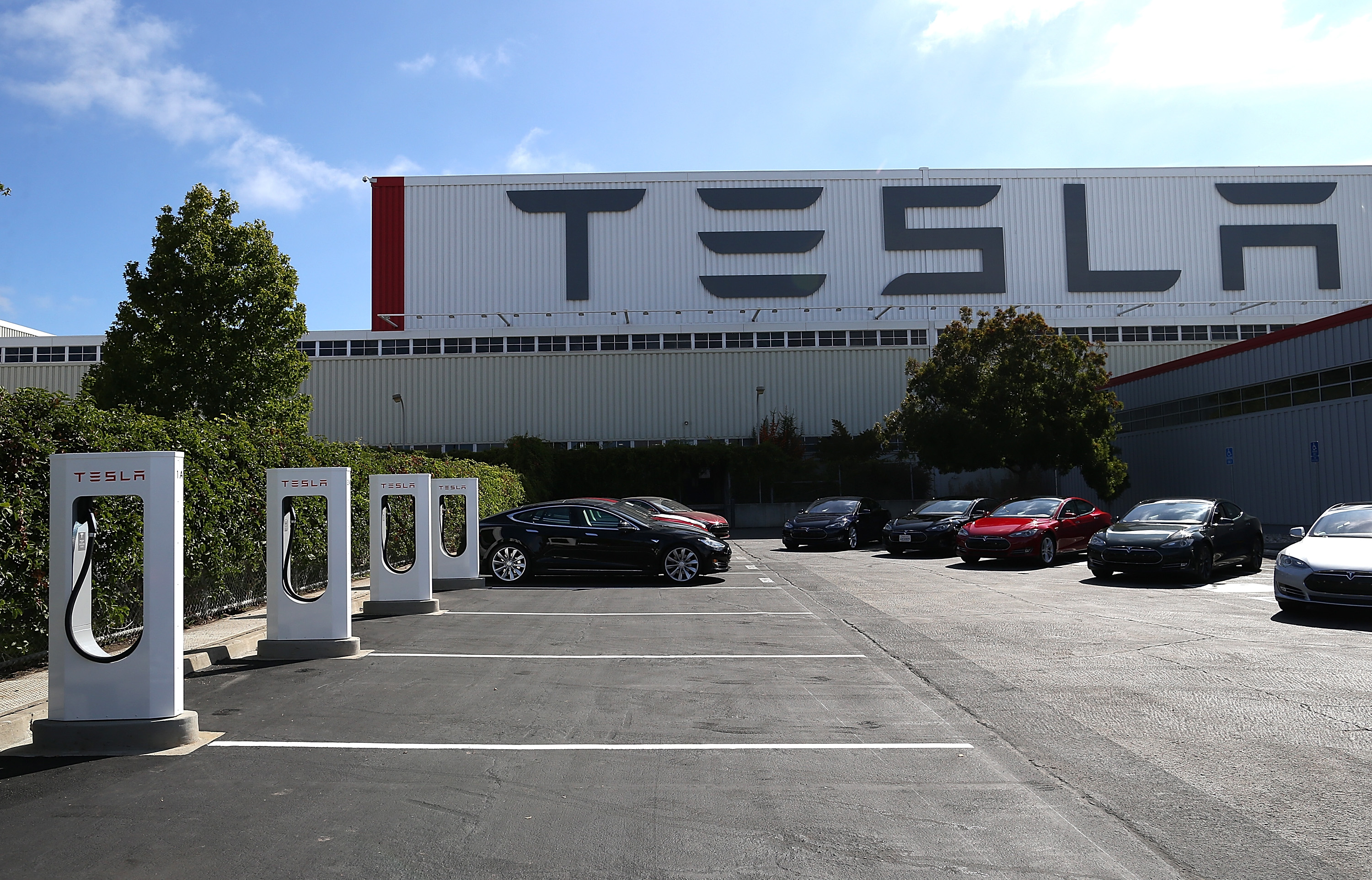
"content": "\u003cfigure id=\"attachment_143508\" class=\"wp-caption aligncenter\" style=\"max-width: 640px\">\u003ca href=\"http://ww2.kqed.org/news/wp-content/uploads/sites/10/2014/07/176645523.jpg\">\u003cimg loading=\"lazy\" decoding=\"async\" class=\"size-medium wp-image-143508\" src=\"http://ww2.kqed.org/news/wp-content/uploads/sites/10/2014/07/176645523-640x410.jpg\" alt=\"Vehicle charging stations at Tesla Motors plant in Fremont. (Justin Sullivan/Getty Images)\" width=\"640\" height=\"410\">\u003c/a>\u003cfigcaption class=\"wp-caption-text\">Vehicle charging stations at Tesla Motors plant in Fremont. (Justin Sullivan/Getty Images)\u003c/figcaption>\u003c/figure>\n\u003cp>From the “You Never Know When You Might Need a Nice Hole in the Ground” Department:\u003c/p>\n\u003cp>Palo Alto’s Tesla Motors has created a stir with two announcements today: First, it will \u003ca href=\"http://asia.nikkei.com/Business/Deals/With-Tesla-deal-Panasonic-sees-risk-and-reward\" target=\"_blank\" rel=\"noopener\">partner with Japan’s Panasonic\u003c/a> on battery production at its much anticipated Gigafactory. And second, it has broken ground on a Gigafactory site outside Reno.\u003c/p>\n\u003cp>Normally, news of a factory groundbreaking might suggest a factory will actually be built at the site where ground has been broken. But Tesla is quick to say that the Nevada site is only “potentially” the location of the $5 billion Gigafactory. That’s because the facility is still the focus of a bidding war among several states. Here’s how Tesla explains the situation in \u003ca href=\"http://ir.teslamotors.com/secfiling.cfm?filingID=1193125-14-289598&CIK=1318605\" target=\"_blank\" rel=\"noopener\"> its Form 8-K report on current activities released today\u003c/a>:\u003c/p>\n\u003cblockquote>\u003cp>Consistent with our strategy to identify and break ground on multiple sites, we continue to evaluate other locations in Arizona, California, New Mexico and Texas. The final site for the first Gigafactory will be determined in the next few months, once we have full visibility and agreement on the relevant incentives and processes for enabling the Gigafactory to be fully operational to meet the timing for Model 3. We see these concurrent efforts as prudent. This vehicle will be our third-generation product and will substantially broaden the addressable market for Tesla, helping to accelerate the transition towards sustainable transportation. Any potentially duplicative investments are minor compared to the revenue that could be lost if the launch of Model 3 were affected by any delays at our primary Gigafactory site.\u003c/p>\u003c/blockquote>\n\u003cp>Tesla’s statement doesn’t really help you visualize the scale of the Nevada site, on Interstate 80 about 25 miles east of downtown Reno. \u003ca href=\"http://www.rgj.com/story/money/business/2014/07/31/tesla-confirms-reno-is-a-finalist-for-gigafactory-site/13424581/\" target=\"_blank\" rel=\"noopener\">The Reno Gazette-Journal’s story on the development\u003c/a> does:\u003c/p>\n\u003cblockquote>\u003cp>Lance Gilman, the developer of the industrial center where Tesla is doing work, told the RGJ Thursday the project is one of the largest grading projects ever in the United States.\u003c/p>\n\u003cp>“We have finished a superpad to accommodate 5 million square feet,” Gilman said. “We moved several million cubic yards of material.”\u003c/p>\n\u003cp>He added Tesla is still working on other sites.\u003c/p>\n\u003cp>“Speed is critical to them. We finished this in 3 1/2 weeks,” he said. “There’s nowhere else in world you can get a project up as fast as here. Tesla can start pouring concrete next week if they desire.”\u003c/p>\n\u003cp>Gilman said reports of Tesla stopping work at the Northern Nevada industrial center are partially true.\u003c/p>\n\u003cp>“They have reached transition point that they’re going to add square feet,” he said.\u003c/p>\u003c/blockquote>\n\u003cp>The guy is saying they’ve excavated a 5-million-square-foot site? That’s roughly the size of 80 football fields. And they’ve moved “several million” cubic yards of material? Assuming conservatively they mean 3 million cubic yards, that would be the volume of 1,200 Olympic swimming pools.\u003c/p>\n\u003cp>[ad fullwidth]\u003c/p>\n\u003cp>But the numbers that really count are the ones attached to dollar signs. As part of its deal with Tesla, Panasonic is expected to invest about $1 billion, mostly in battery-making equipment at the new plant. Tesla has said it will spend up to $5 billion on the facility, which is expected to employ about 6,500 people. Wherever it’s built.\u003c/p>\n\u003cp>The magnitude of the investment, the jobs and the prestige that would go along with winning a high-profile competition for a cutting-edge manufacturing facility have fueled the competition for the plant. City officials in Tucson, Arizona, \u003ca href=\"http://tucson.com/business/local/tucson-to-tesla-motors-your-building-permit-is-ready/article_c705ad7a-10b2-579e-9b4c-35e03fd54676.html\" target=\"_blank\" rel=\"noopener\">have approved a building permit\u003c/a> for the plant without waiting for an application from the company.\u003c/p>\n\u003cp>\u003c/p>\n\u003cp>For its part, \u003ca href=\"http://www.mercurynews.com/business/ci_26126667/new-california-tax-credit-would-benefit-tesla-gigafactory\" target=\"_blank\" rel=\"noopener\">California has enacted a massive industrial tax credit\u003c/a> that apparently would benefit Tesla if it decides to build the Gigafactory here.\u003c/p>\n\n",
"blocks": [],
"excerpt": "Company prepares site near Reno as five states continue to compete for cutting-edge facility.",
"status": "publish",
"parent": 0,
"modified": 1721107560,
"stats": {
"hasAudio": false,
"hasVideo": false,
"hasChartOrMap": false,
"iframeSrcs": [],
"hasGoogleForm": false,
"hasGallery": false,
"hasHearkenModule": false,
"hasPolis": false,
"paragraphCount": 17,
"wordCount": 667
},
"headData": {
"title": "Tesla Breaks Ground on 'Potential' Nevada Site for Battery Factory | KQED",
"description": "Company prepares site near Reno as five states continue to compete for cutting-edge facility.",
"ogTitle": "",
"ogDescription": "",
"ogImgId": "",
"twTitle": "",
"twDescription": "",
"twImgId": "",
"schema": {
"@context": "https://schema.org",
"@type": "NewsArticle",
"headline": "Tesla Breaks Ground on 'Potential' Nevada Site for Battery Factory",
"datePublished": "2014-07-31T15:25:28-07:00",
"dateModified": "2024-07-15T22:26:00-07:00",
"image": "https://cdn.kqed.org/wp-content/uploads/2020/02/KQED-OG-Image@1x.png",
"isAccessibleForFree": "True",
"publisher": {
"@type": "NewsMediaOrganization",
"@id": "https://www.kqed.org/#organization",
"name": "KQED",
"logo": "https://cdn.kqed.org/wp-content/uploads/2020/02/KQED-OG-Image@1x.png",
"url": "https://www.kqed.org",
"sameAs": [
"https://www.facebook.com/KQED",
"https://twitter.com/KQED",
"https://www.instagram.com/kqed/",
"https://www.tiktok.com/@kqedofficial",
"https://www.linkedin.com/company/kqed",
"https://www.youtube.com/channel/UCeC0IOo7i1P_61zVUWbJ4nw"
]
}
}
},
"sticky": false,
"path": "/news/143474/tesla-breaks-ground-on-potential-nevada-site-for-battery-factory",
"audioTrackLength": null,
"parsedContent": [
{
"type": "contentString",
"content": "\u003cdiv class=\"post-body\">\u003cp>\u003cfigure id=\"attachment_143508\" class=\"wp-caption aligncenter\" style=\"max-width: 640px\">\u003ca href=\"http://ww2.kqed.org/news/wp-content/uploads/sites/10/2014/07/176645523.jpg\">\u003cimg loading=\"lazy\" decoding=\"async\" class=\"size-medium wp-image-143508\" src=\"http://ww2.kqed.org/news/wp-content/uploads/sites/10/2014/07/176645523-640x410.jpg\" alt=\"Vehicle charging stations at Tesla Motors plant in Fremont. (Justin Sullivan/Getty Images)\" width=\"640\" height=\"410\">\u003c/a>\u003cfigcaption class=\"wp-caption-text\">Vehicle charging stations at Tesla Motors plant in Fremont. (Justin Sullivan/Getty Images)\u003c/figcaption>\u003c/figure>\n\u003cp>From the “You Never Know When You Might Need a Nice Hole in the Ground” Department:\u003c/p>\n\u003cp>Palo Alto’s Tesla Motors has created a stir with two announcements today: First, it will \u003ca href=\"http://asia.nikkei.com/Business/Deals/With-Tesla-deal-Panasonic-sees-risk-and-reward\" target=\"_blank\" rel=\"noopener\">partner with Japan’s Panasonic\u003c/a> on battery production at its much anticipated Gigafactory. And second, it has broken ground on a Gigafactory site outside Reno.\u003c/p>\n\u003cp>Normally, news of a factory groundbreaking might suggest a factory will actually be built at the site where ground has been broken. But Tesla is quick to say that the Nevada site is only “potentially” the location of the $5 billion Gigafactory. That’s because the facility is still the focus of a bidding war among several states. Here’s how Tesla explains the situation in \u003ca href=\"http://ir.teslamotors.com/secfiling.cfm?filingID=1193125-14-289598&CIK=1318605\" target=\"_blank\" rel=\"noopener\"> its Form 8-K report on current activities released today\u003c/a>:\u003c/p>\n\u003cblockquote>\u003cp>Consistent with our strategy to identify and break ground on multiple sites, we continue to evaluate other locations in Arizona, California, New Mexico and Texas. The final site for the first Gigafactory will be determined in the next few months, once we have full visibility and agreement on the relevant incentives and processes for enabling the Gigafactory to be fully operational to meet the timing for Model 3. We see these concurrent efforts as prudent. This vehicle will be our third-generation product and will substantially broaden the addressable market for Tesla, helping to accelerate the transition towards sustainable transportation. Any potentially duplicative investments are minor compared to the revenue that could be lost if the launch of Model 3 were affected by any delays at our primary Gigafactory site.\u003c/p>\u003c/blockquote>\n\u003cp>Tesla’s statement doesn’t really help you visualize the scale of the Nevada site, on Interstate 80 about 25 miles east of downtown Reno. \u003ca href=\"http://www.rgj.com/story/money/business/2014/07/31/tesla-confirms-reno-is-a-finalist-for-gigafactory-site/13424581/\" target=\"_blank\" rel=\"noopener\">The Reno Gazette-Journal’s story on the development\u003c/a> does:\u003c/p>\n\u003cblockquote>\u003cp>Lance Gilman, the developer of the industrial center where Tesla is doing work, told the RGJ Thursday the project is one of the largest grading projects ever in the United States.\u003c/p>\n\u003cp>“We have finished a superpad to accommodate 5 million square feet,” Gilman said. “We moved several million cubic yards of material.”\u003c/p>\n\u003cp>He added Tesla is still working on other sites.\u003c/p>\n\u003cp>“Speed is critical to them. We finished this in 3 1/2 weeks,” he said. “There’s nowhere else in world you can get a project up as fast as here. Tesla can start pouring concrete next week if they desire.”\u003c/p>\n\u003cp>Gilman said reports of Tesla stopping work at the Northern Nevada industrial center are partially true.\u003c/p>\n\u003cp>“They have reached transition point that they’re going to add square feet,” he said.\u003c/p>\u003c/blockquote>\n\u003cp>The guy is saying they’ve excavated a 5-million-square-foot site? That’s roughly the size of 80 football fields. And they’ve moved “several million” cubic yards of material? Assuming conservatively they mean 3 million cubic yards, that would be the volume of 1,200 Olympic swimming pools.\u003c/p>\n\u003cp>\u003c/p>\u003c/div>",
"attributes": {
"named": {},
"numeric": []
}
},
{
"type": "component",
"content": "",
"name": "ad",
"attributes": {
"named": {
"label": "fullwidth"
},
"numeric": [
"fullwidth"
]
}
},
{
"type": "contentString",
"content": "\u003cdiv class=\"post-body\">\u003cp>\u003c/p>\n\u003cp>But the numbers that really count are the ones attached to dollar signs. As part of its deal with Tesla, Panasonic is expected to invest about $1 billion, mostly in battery-making equipment at the new plant. Tesla has said it will spend up to $5 billion on the facility, which is expected to employ about 6,500 people. Wherever it’s built.\u003c/p>\n\u003cp>The magnitude of the investment, the jobs and the prestige that would go along with winning a high-profile competition for a cutting-edge manufacturing facility have fueled the competition for the plant. City officials in Tucson, Arizona, \u003ca href=\"http://tucson.com/business/local/tucson-to-tesla-motors-your-building-permit-is-ready/article_c705ad7a-10b2-579e-9b4c-35e03fd54676.html\" target=\"_blank\" rel=\"noopener\">have approved a building permit\u003c/a> for the plant without waiting for an application from the company.\u003c/p>\n\u003cp>\u003c/p>\n\u003cp>For its part, \u003ca href=\"http://www.mercurynews.com/business/ci_26126667/new-california-tax-credit-would-benefit-tesla-gigafactory\" target=\"_blank\" rel=\"noopener\">California has enacted a massive industrial tax credit\u003c/a> that apparently would benefit Tesla if it decides to build the Gigafactory here.\u003c/p>\n\n\u003c/div>\u003c/p>",
"attributes": {
"named": {},
"numeric": []
}
}
],
"link": "/news/143474/tesla-breaks-ground-on-potential-nevada-site-for-battery-factory",
"authors": [
"222"
],
"programs": [
"news_6944"
],
"categories": [
"news_248",
"news_1397"
],
"tags": [
"news_3897",
"news_4753",
"news_57"
],
"featImg": "news_143508",
"label": "news_6944"
},
"news_142702": {
"type": "posts",
"id": "news_142702",
"meta": {
"index": "posts_1716263798",
"site": "news",
"id": "142702",
"score": null,
"sort": [
1406210441000
]
},
"parent": 0,
"labelTerm": {
"site": "news",
"term": 6944
},
"blocks": [],
"publishDate": 1406210441,
"format": "aside",
"disqusTitle": "Twitter Diversity Data Show Company Is Not Very Diverse",
"title": "Twitter Diversity Data Show Company Is Not Very Diverse",
"headTitle": "News Fix | KQED News",
"content": "\u003cp>Twitter says it has \"a lot of work to do\" in diversifying its workforce.\u003c/p>\n\u003cp>That statement comes in a \u003ca href=\"https://blog.twitter.com/2014/building-a-twitter-we-can-be-proud-of\" target=\"_blank\">company blog post\u003c/a> by \u003cspan class=\"name\">Janet Van Huysse, Twitter's vice president of diversity and inclusion. After presenting employee demographic data in two charts, Van Huysse writes: \"We are keenly aware that Twitter is part of an industry that is marked by dramatic imbalances in diversity — and we are no exception.\"\u003cbr>\n\u003c/span>\u003c/p>\n\u003cp>What she is referring to are the following two sets of data, one that shows 70 percent of the company's roughly 3,000 employees are male and the other showing 59 percent are white.\u003c/p>\n\u003cp> \u003c/p>\n\u003cp>\u003cimg class=\"aligncenter size-medium wp-image-142704\" src=\"http://ww2.kqed.org/news/wp-content/uploads/sites/10/2014/07/twitterdiversity-640x430.png\" alt=\"twitterdiversity\" width=\"640\" height=\"430\">\u003c/p>\n\u003cp>[ad fullwidth]\u003c/p>\n\u003cp> \u003c/p>\n\u003cp>\u003cimg class=\"aligncenter size-medium wp-image-142705\" src=\"http://ww2.kqed.org/news/wp-content/uploads/sites/10/2014/07/twitterdiversity2-640x316.png\" alt=\"twitterdiversity2\" width=\"640\" height=\"316\">\u003c/p>\n\u003cp>In terms of race and ethnicity, Asians are the second-most represented group, making up 29 percent of the workforce. Combining the percentage of white and Asian workers, that leaves just 12 percent representation for every other group.\u003c/p>\n\u003cp>And when it comes to tech jobs, the gender gap is even more exaggerated, with 90 percent of those jobs filled by males.\u003c/p>\n\u003cp>Jesse Jackson, quoted in the \u003ca href=\"http://blog.sfgate.com/techchron/2014/07/23/twitters-workforce-is-largely-white-and-male/\" target=\"_blank\">San Francisco Chronicle\u003c/a>, called Twitter's numbers “pathetic.”\u003c/p>\n\u003cp>“It does not reflect the nature of California or Twitter’s users,” he said. “To be fair, Twitter users deserve more than tweets. They deserve jobs.”\u003c/p>\n\u003cp>Twitter is not alone among big-name tech companies with a lack of diversity. Facebook, Yahoo, Google and LinkedIn have all released roughly similar numbers. You can see those compared in this \u003ca href=\"http://techcrunch.com/2014/06/25/facebook-diversity/\" target=\"_blank\">chart from TechCrunch\u003c/a>.\u003c/p>\n\u003cp>\u003c/p>\n\u003cp>One thing that none of these diversity reports mentions is age. You can read one take on that in this New Republic article called \u003ca href=\"http://www.newrepublic.com/article/117088/silicons-valleys-brutal-ageism\" target=\"_blank\">Silicon Valley's Brutal Ageism\u003c/a>. From the article:\u003c/p>\n\u003cblockquote>\u003cp>Silicon Valley has become one of the most ageist places in America. Tech luminaries who otherwise pride themselves on their dedication to meritocracy don’t think twice about deriding the not-actually-old. “Young people are just smarter,” Facebook CEO Mark Zuckerberg told an audience at Stanford back in 2007. As I write, the website of ServiceNow, a large Santa Clara–based I.T. services company, features the following advisory in large letters atop its “careers” page: “We Want People Who Have Their Best Work Ahead of Them, Not Behind Them.”\u003c/p>\n\u003cp>And that’s just what gets said in public. An engineer in his forties recently told me about meeting a tech CEO who was trying to acquire his company. “You must be the token graybeard,” said the CEO, who was in his late twenties or early thirties. “I looked at him and said, ‘No, I’m the token grown-up.’ ”\u003c/p>\n\u003cp>In talking to dozens of people around Silicon Valley over the past eight months—engineers, entrepreneurs, moneymen, uncomfortably inquisitive cosmetic surgeons—I got the distinct sense that it’s better to be perceived as naïve and immature than to have voted in the 1980s. \u003ca href=\"http://www.newrepublic.com/article/117088/silicons-valleys-brutal-ageism\" target=\"_blank\">Full article\u003c/a>\u003c/p>\u003c/blockquote>\n\n",
"disqusIdentifier": "142702 http://ww2.kqed.org/news/?p=142702",
"disqusUrl": "https://ww2.kqed.org/news/2014/07/24/twitter-diversity-data-show-company-is-not-very-diverse/",
"stats": {
"hasVideo": false,
"hasChartOrMap": false,
"hasAudio": false,
"hasPolis": false,
"wordCount": 502,
"hasGoogleForm": false,
"hasGallery": false,
"hasHearkenModule": false,
"iframeSrcs": [],
"paragraphCount": 16
},
"modified": 1406164539,
"excerpt": "Overall, 70 percent of tech firm's 3,000 employees are male and 59 percent are white.",
"headData": {
"twImgId": "",
"twTitle": "",
"ogTitle": "",
"ogImgId": "",
"twDescription": "",
"description": "Overall, 70 percent of tech firm's 3,000 employees are male and 59 percent are white.",
"title": "Twitter Diversity Data Show Company Is Not Very Diverse | KQED",
"ogDescription": "",
"schema": {
"@context": "https://schema.org",
"@type": "NewsArticle",
"headline": "Twitter Diversity Data Show Company Is Not Very Diverse",
"datePublished": "2014-07-24T07:00:41-07:00",
"dateModified": "2014-07-23T18:15:39-07:00",
"image": "https://cdn.kqed.org/wp-content/uploads/2020/02/KQED-OG-Image@1x.png",
"isAccessibleForFree": "True",
"publisher": {
"@type": "NewsMediaOrganization",
"@id": "https://www.kqed.org/#organization",
"name": "KQED",
"logo": "https://cdn.kqed.org/wp-content/uploads/2020/02/KQED-OG-Image@1x.png",
"url": "https://www.kqed.org",
"sameAs": [
"https://www.facebook.com/KQED",
"https://twitter.com/KQED",
"https://www.instagram.com/kqed/",
"https://www.tiktok.com/@kqedofficial",
"https://www.linkedin.com/company/kqed",
"https://www.youtube.com/channel/UCeC0IOo7i1P_61zVUWbJ4nw"
]
}
}
},
"guestAuthors": [],
"slug": "twitter-diversity-data-show-company-is-not-very-diverse",
"status": "publish",
"path": "/news/142702/twitter-diversity-data-show-company-is-not-very-diverse",
"audioTrackLength": null,
"parsedContent": [
{
"type": "contentString",
"content": "\u003cdiv class=\"post-body\">\u003cp>\u003cp>Twitter says it has \"a lot of work to do\" in diversifying its workforce.\u003c/p>\n\u003cp>That statement comes in a \u003ca href=\"https://blog.twitter.com/2014/building-a-twitter-we-can-be-proud-of\" target=\"_blank\">company blog post\u003c/a> by \u003cspan class=\"name\">Janet Van Huysse, Twitter's vice president of diversity and inclusion. After presenting employee demographic data in two charts, Van Huysse writes: \"We are keenly aware that Twitter is part of an industry that is marked by dramatic imbalances in diversity — and we are no exception.\"\u003cbr>\n\u003c/span>\u003c/p>\n\u003cp>What she is referring to are the following two sets of data, one that shows 70 percent of the company's roughly 3,000 employees are male and the other showing 59 percent are white.\u003c/p>\n\u003cp> \u003c/p>\n\u003cp>\u003cimg class=\"aligncenter size-medium wp-image-142704\" src=\"http://ww2.kqed.org/news/wp-content/uploads/sites/10/2014/07/twitterdiversity-640x430.png\" alt=\"twitterdiversity\" width=\"640\" height=\"430\">\u003c/p>\n\u003cp>\u003c/p>\u003c/div>",
"attributes": {
"named": {},
"numeric": []
}
},
{
"type": "component",
"content": "",
"name": "ad",
"attributes": {
"named": {
"label": "fullwidth"
},
"numeric": [
"fullwidth"
]
}
},
{
"type": "contentString",
"content": "\u003cdiv class=\"post-body\">\u003cp>\u003c/p>\n\u003cp> \u003c/p>\n\u003cp>\u003cimg class=\"aligncenter size-medium wp-image-142705\" src=\"http://ww2.kqed.org/news/wp-content/uploads/sites/10/2014/07/twitterdiversity2-640x316.png\" alt=\"twitterdiversity2\" width=\"640\" height=\"316\">\u003c/p>\n\u003cp>In terms of race and ethnicity, Asians are the second-most represented group, making up 29 percent of the workforce. Combining the percentage of white and Asian workers, that leaves just 12 percent representation for every other group.\u003c/p>\n\u003cp>And when it comes to tech jobs, the gender gap is even more exaggerated, with 90 percent of those jobs filled by males.\u003c/p>\n\u003cp>Jesse Jackson, quoted in the \u003ca href=\"http://blog.sfgate.com/techchron/2014/07/23/twitters-workforce-is-largely-white-and-male/\" target=\"_blank\">San Francisco Chronicle\u003c/a>, called Twitter's numbers “pathetic.”\u003c/p>\n\u003cp>“It does not reflect the nature of California or Twitter’s users,” he said. “To be fair, Twitter users deserve more than tweets. They deserve jobs.”\u003c/p>\n\u003cp>Twitter is not alone among big-name tech companies with a lack of diversity. Facebook, Yahoo, Google and LinkedIn have all released roughly similar numbers. You can see those compared in this \u003ca href=\"http://techcrunch.com/2014/06/25/facebook-diversity/\" target=\"_blank\">chart from TechCrunch\u003c/a>.\u003c/p>\n\u003cp>\u003c/p>\n\u003cp>One thing that none of these diversity reports mentions is age. You can read one take on that in this New Republic article called \u003ca href=\"http://www.newrepublic.com/article/117088/silicons-valleys-brutal-ageism\" target=\"_blank\">Silicon Valley's Brutal Ageism\u003c/a>. From the article:\u003c/p>\n\u003cblockquote>\u003cp>Silicon Valley has become one of the most ageist places in America. Tech luminaries who otherwise pride themselves on their dedication to meritocracy don’t think twice about deriding the not-actually-old. “Young people are just smarter,” Facebook CEO Mark Zuckerberg told an audience at Stanford back in 2007. As I write, the website of ServiceNow, a large Santa Clara–based I.T. services company, features the following advisory in large letters atop its “careers” page: “We Want People Who Have Their Best Work Ahead of Them, Not Behind Them.”\u003c/p>\n\u003cp>And that’s just what gets said in public. An engineer in his forties recently told me about meeting a tech CEO who was trying to acquire his company. “You must be the token graybeard,” said the CEO, who was in his late twenties or early thirties. “I looked at him and said, ‘No, I’m the token grown-up.’ ”\u003c/p>\n\u003cp>In talking to dozens of people around Silicon Valley over the past eight months—engineers, entrepreneurs, moneymen, uncomfortably inquisitive cosmetic surgeons—I got the distinct sense that it’s better to be perceived as naïve and immature than to have voted in the 1980s. \u003ca href=\"http://www.newrepublic.com/article/117088/silicons-valleys-brutal-ageism\" target=\"_blank\">Full article\u003c/a>\u003c/p>\u003c/blockquote>\n\n\u003c/div>\u003c/p>",
"attributes": {
"named": {},
"numeric": []
}
}
],
"link": "/news/142702/twitter-diversity-data-show-company-is-not-very-diverse",
"authors": [
"80"
],
"programs": [
"news_6944"
],
"categories": [
"news_8",
"news_248"
],
"featImg": "news_142705",
"label": "news_6944"
},
"news_142275": {
"type": "posts",
"id": "news_142275",
"meta": {
"index": "posts_1716263798",
"site": "news",
"id": "142275",
"score": null,
"sort": [
1405733755000
]
},
"guestAuthors": [],
"slug": "rise-of-the-conservatarian-hits-s-f-this-weekend",
"title": "Rise of the 'Conservatarian' Hits S.F. this Weekend",
"publishDate": 1405733755,
"format": "aside",
"headTitle": "Rise of the ‘Conservatarian’ Hits S.F. this Weekend | KQED",
"labelTerm": {
"term": 6944,
"site": "news"
},
"content": "\u003cp>\u003cstrong>By Cy Musiker and Alex Emslie\u003c/strong>\u003c/p>\n\u003cfigure id=\"attachment_142305\" class=\"wp-caption alignnone\" style=\"max-width: 640px\">\u003ca href=\"http://ww2.kqed.org/news/wp-content/uploads/sites/10/2014/07/Rand-Paul.jpg\">\u003cimg loading=\"lazy\" decoding=\"async\" class=\"size-medium wp-image-142305\" src=\"http://ww2.kqed.org/news/wp-content/uploads/sites/10/2014/07/Rand-Paul-640x426.jpg\" alt=\"Rand Paul is one of the keynote speakers at the 2014 LincolnLabs Reboot conference in San Francisco this weekend. (Chip Somodevilla/Getty Images)\" width=\"640\" height=\"426\">\u003c/a>\u003cfigcaption class=\"wp-caption-text\">Rand Paul is one of the keynote speakers at the 2014 LincolnLabs Reboot conference in San Francisco this weekend. (Chip Somodevilla/Getty Images)\u003c/figcaption>\u003c/figure>\n\u003cp>A conference kicking off in San Francisco tonight is catering to a political animal you may not have heard of: “The Conservatarian.”\u003c/p>\n\u003cp>\u003ca href=\"http://lincolnlabs.com/conferences/reboot/\" target=\"_blank\" rel=\"noopener\">Reboot, the 2014 LincolnLabs conference\u003c/a>, is seeking to bring the power of tech to Republican campaigns, and mesh the Valley’s brand of libertarianism with the Grand Old Party’s fiscal conservatism.\u003c/p>\n\u003cp>As a technology attorney and vice-chair of the California Republican Party, Hameet Dhillon seems to embody the political juxtaposition.\u003c/p>\n\u003cp>She told KQED (\u003ca href=\"#audio\">audio below\u003c/a>) that tech libertarians “stand for less intervention by the government, less regulation by the government, support for entrepreneurs, support for creations of jobs. These are all common facets of the technology industry in Silicon Valley.”\u003c/p>\n\u003cp>[ad fullwidth]\u003c/p>\n\u003cp>Sen. Rand Paul, R-Kentucky, stands out as a libertarian and possible Republican presidential candidate in 2016. He’s a keynote speaker at Reboot, which seeks to harness tech-savvy millennials to supercharge upcoming GOP causes and campaigns.\u003c/p>\n\u003cp>Dhillon says Republican tech savvy, or lack thereof, played a critical role in the 2012 presidential race.\u003c/p>\n\u003cp>“We’ve been working to close that divide since we took a drubbing in the polls in 2012 nationally,” she said. “I do admit that the Obama campaign specifically, more so than the Democratic Party, had an outstanding presence and definitely did better than us.”\u003c/p>\n\u003cp>Statisticians agree. Nate Silver of \u003ca href=\"http://fivethirtyeight.com/\" target=\"_blank\" rel=\"noopener\">FiveThirtyEight.com\u003c/a> was still working for the \u003cem>New York Times\u003c/em> in 2012, when, after noting Obama’s huge Silicon Valley fundraising advantages over Mitt Romney, \u003ca href=\"http://fivethirtyeight.blogs.nytimes.com/2012/11/28/in-silicon-valley-technology-talent-gap-threatens-g-o-p-campaigns/?_php=true&_type=blogs&_r=0\" target=\"_blank\" rel=\"noopener\">he wrote this\u003c/a>:\u003c/p>\n\u003cblockquote>\u003cp>Since Democrats had the support of 80 percent or 90 percent of the best and brightest minds in the information technology field, it shouldn’t be surprising that Mr. Obama’s information technology infrastructure was viewed as state-of-the-art exemplary, whereas everyone from Republican volunteers to Silicon Valley journalists have criticized Mr. Romney’s systems. Mr. Romney’s get-out-the-vote application, Project Orca, is widely viewed as having failed on Election Day, perhaps contributing to a disappointing Republican turnout.\u003c/p>\u003c/blockquote>\n\u003cp>But, Dhillon said, Republicans are working to turn that around.\u003c/p>\n\u003cp>“We do have quite a bit of depth in our research team here in Silicon Valley, we’re developing apps, we know what our needs are, and we expect to outperform the Democrats in 2016.”\u003c/p>\n\u003cp>She cautions against throwing baby kissing out with the bathwater, though.\u003c/p>\n\u003cp>“It’s really taking that high-level data and translating it down to the street level and the shoe leather, which is still the best way to communicate with voters,” she said.\u003c/p>\n\u003cp>The Reboot conference lasts through Sunday at the W Hotel in San Francisco.\u003c/p>\n\u003cp>\u003ca id=\"audio\">\u003c/a>Listen to Cy Musiker’s interview with Hameet Dhillon below:\u003c/p>\n\u003cp>\u003c/p>\n\u003cp>\u003ciframe loading=\"lazy\" src=\"https://w.soundcloud.com/player/?url=https%3A//api.soundcloud.com/tracks/159324901&color=ff5500&auto_play=false&hide_related=false&show_comments=true&show_user=true&show_reposts=false\" width=\"100%\" height=\"166\" frameborder=\"no\" scrolling=\"no\">\u003c/iframe>\u003c/p>\n\n",
"blocks": [],
"excerpt": "Reboot seeks to mesh Silicon Valley's brand of libertarianism with the Grand Old Party's fiscal conservatism.",
"status": "publish",
"parent": 0,
"modified": 1729029849,
"stats": {
"hasAudio": true,
"hasVideo": false,
"hasChartOrMap": false,
"iframeSrcs": [],
"hasGoogleForm": false,
"hasGallery": false,
"hasHearkenModule": false,
"hasPolis": false,
"paragraphCount": 19,
"wordCount": 498
},
"headData": {
"title": "Rise of the 'Conservatarian' Hits S.F. this Weekend | KQED",
"description": "Reboot seeks to mesh Silicon Valley's brand of libertarianism with the Grand Old Party's fiscal conservatism.",
"ogTitle": "",
"ogDescription": "",
"ogImgId": "",
"twTitle": "",
"twDescription": "",
"twImgId": "",
"schema": {
"@context": "https://schema.org",
"@type": "NewsArticle",
"headline": "Rise of the 'Conservatarian' Hits S.F. this Weekend",
"datePublished": "2014-07-18T18:35:55-07:00",
"dateModified": "2024-10-15T15:04:09-07:00",
"image": "https://cdn.kqed.org/wp-content/uploads/2020/02/KQED-OG-Image@1x.png",
"isAccessibleForFree": "True",
"publisher": {
"@type": "NewsMediaOrganization",
"@id": "https://www.kqed.org/#organization",
"name": "KQED",
"logo": "https://cdn.kqed.org/wp-content/uploads/2020/02/KQED-OG-Image@1x.png",
"url": "https://www.kqed.org",
"sameAs": [
"https://www.facebook.com/KQED",
"https://twitter.com/KQED",
"https://www.instagram.com/kqed/",
"https://www.tiktok.com/@kqedofficial",
"https://www.linkedin.com/company/kqed",
"https://www.youtube.com/channel/UCeC0IOo7i1P_61zVUWbJ4nw"
]
}
}
},
"sticky": false,
"customPermalink": "2014/07/18/conservative-tech-conference-sf/",
"path": "/news/142275/rise-of-the-conservatarian-hits-s-f-this-weekend",
"audioTrackLength": null,
"parsedContent": [
{
"type": "contentString",
"content": "\u003cdiv class=\"post-body\">\u003cp>\u003cp>\u003cstrong>By Cy Musiker and Alex Emslie\u003c/strong>\u003c/p>\n\u003cfigure id=\"attachment_142305\" class=\"wp-caption alignnone\" style=\"max-width: 640px\">\u003ca href=\"http://ww2.kqed.org/news/wp-content/uploads/sites/10/2014/07/Rand-Paul.jpg\">\u003cimg loading=\"lazy\" decoding=\"async\" class=\"size-medium wp-image-142305\" src=\"http://ww2.kqed.org/news/wp-content/uploads/sites/10/2014/07/Rand-Paul-640x426.jpg\" alt=\"Rand Paul is one of the keynote speakers at the 2014 LincolnLabs Reboot conference in San Francisco this weekend. (Chip Somodevilla/Getty Images)\" width=\"640\" height=\"426\">\u003c/a>\u003cfigcaption class=\"wp-caption-text\">Rand Paul is one of the keynote speakers at the 2014 LincolnLabs Reboot conference in San Francisco this weekend. (Chip Somodevilla/Getty Images)\u003c/figcaption>\u003c/figure>\n\u003cp>A conference kicking off in San Francisco tonight is catering to a political animal you may not have heard of: “The Conservatarian.”\u003c/p>\n\u003cp>\u003ca href=\"http://lincolnlabs.com/conferences/reboot/\" target=\"_blank\" rel=\"noopener\">Reboot, the 2014 LincolnLabs conference\u003c/a>, is seeking to bring the power of tech to Republican campaigns, and mesh the Valley’s brand of libertarianism with the Grand Old Party’s fiscal conservatism.\u003c/p>\n\u003cp>As a technology attorney and vice-chair of the California Republican Party, Hameet Dhillon seems to embody the political juxtaposition.\u003c/p>\n\u003cp>She told KQED (\u003ca href=\"#audio\">audio below\u003c/a>) that tech libertarians “stand for less intervention by the government, less regulation by the government, support for entrepreneurs, support for creations of jobs. These are all common facets of the technology industry in Silicon Valley.”\u003c/p>\n\u003cp>\u003c/p>\u003c/div>",
"attributes": {
"named": {},
"numeric": []
}
},
{
"type": "component",
"content": "",
"name": "ad",
"attributes": {
"named": {
"label": "fullwidth"
},
"numeric": [
"fullwidth"
]
}
},
{
"type": "contentString",
"content": "\u003cdiv class=\"post-body\">\u003cp>\u003c/p>\n\u003cp>Sen. Rand Paul, R-Kentucky, stands out as a libertarian and possible Republican presidential candidate in 2016. He’s a keynote speaker at Reboot, which seeks to harness tech-savvy millennials to supercharge upcoming GOP causes and campaigns.\u003c/p>\n\u003cp>Dhillon says Republican tech savvy, or lack thereof, played a critical role in the 2012 presidential race.\u003c/p>\n\u003cp>“We’ve been working to close that divide since we took a drubbing in the polls in 2012 nationally,” she said. “I do admit that the Obama campaign specifically, more so than the Democratic Party, had an outstanding presence and definitely did better than us.”\u003c/p>\n\u003cp>Statisticians agree. Nate Silver of \u003ca href=\"http://fivethirtyeight.com/\" target=\"_blank\" rel=\"noopener\">FiveThirtyEight.com\u003c/a> was still working for the \u003cem>New York Times\u003c/em> in 2012, when, after noting Obama’s huge Silicon Valley fundraising advantages over Mitt Romney, \u003ca href=\"http://fivethirtyeight.blogs.nytimes.com/2012/11/28/in-silicon-valley-technology-talent-gap-threatens-g-o-p-campaigns/?_php=true&_type=blogs&_r=0\" target=\"_blank\" rel=\"noopener\">he wrote this\u003c/a>:\u003c/p>\n\u003cblockquote>\u003cp>Since Democrats had the support of 80 percent or 90 percent of the best and brightest minds in the information technology field, it shouldn’t be surprising that Mr. Obama’s information technology infrastructure was viewed as state-of-the-art exemplary, whereas everyone from Republican volunteers to Silicon Valley journalists have criticized Mr. Romney’s systems. Mr. Romney’s get-out-the-vote application, Project Orca, is widely viewed as having failed on Election Day, perhaps contributing to a disappointing Republican turnout.\u003c/p>\u003c/blockquote>\n\u003cp>But, Dhillon said, Republicans are working to turn that around.\u003c/p>\n\u003cp>“We do have quite a bit of depth in our research team here in Silicon Valley, we’re developing apps, we know what our needs are, and we expect to outperform the Democrats in 2016.”\u003c/p>\n\u003cp>She cautions against throwing baby kissing out with the bathwater, though.\u003c/p>\n\u003cp>“It’s really taking that high-level data and translating it down to the street level and the shoe leather, which is still the best way to communicate with voters,” she said.\u003c/p>\n\u003cp>The Reboot conference lasts through Sunday at the W Hotel in San Francisco.\u003c/p>\n\u003cp>\u003ca id=\"audio\">\u003c/a>Listen to Cy Musiker’s interview with Hameet Dhillon below:\u003c/p>\n\u003cp>\u003c/p>\n\u003cp>\u003ciframe loading=\"lazy\" src=\"https://w.soundcloud.com/player/?url=https%3A//api.soundcloud.com/tracks/159324901&color=ff5500&auto_play=false&hide_related=false&show_comments=true&show_user=true&show_reposts=false\" width=\"100%\" height=\"166\" frameborder=\"no\" scrolling=\"no\">\u003c/iframe>\u003c/p>\n\n\u003c/div>\u003c/p>",
"attributes": {
"named": {},
"numeric": []
}
}
],
"link": "/news/142275/rise-of-the-conservatarian-hits-s-f-this-weekend",
"authors": [
"236"
],
"programs": [
"news_6944"
],
"categories": [
"news_8",
"news_13",
"news_248"
],
"tags": [
"news_1631"
],
"featImg": "news_142306",
"label": "news_6944"
},
"news_142178": {
"type": "posts",
"id": "news_142178",
"meta": {
"index": "posts_1716263798",
"site": "news",
"id": "142178",
"score": null,
"sort": [
1405704418000
]
},
"parent": 0,
"labelTerm": {
"site": "news",
"term": 6944
},
"blocks": [],
"publishDate": 1405704418,
"format": "aside",
"disqusTitle": "News Pix: Drakes Bay Closing, Water Fines, A's Coliseum Complications",
"title": "News Pix: Drakes Bay Closing, Water Fines, A's Coliseum Complications",
"headTitle": "News Fix | KQED News",
"content": "\u003cp>\u003ca href=\"http://ww2.kqed.org/news/wp-content/uploads/sites/10/2014/07/drakesbay.jpg\">\u003cimg class=\"aligncenter size-medium wp-image-142179\" src=\"http://ww2.kqed.org/news/wp-content/uploads/sites/10/2014/07/drakesbay-640x450.jpg\" alt=\"Oyster Fisherman Battles National Park Service Over Harvest Rights\" width=\"640\" height=\"450\">\u003c/a>\u003cbr>\nAfter nearly two years of legal battles and the U.S. Supreme Court's declining to hear the case, the federal government has given the owner of the Drakes Bay Oyster Company until the \u003ca href=\"http://ww2.kqed.org/news/07/14/2014/Drakes_Bay_Oysters\" target=\"_blank\">end of July to shut down its retail and canning operation\u003c/a>. \"We can't stop the federal government,\" owner Kevin Lunny told the Marin Independent Journal last week. \"That's the way it is.\" (Justin Sullivan/Getty Images)\u003c/p>\n\u003cp>\u003ca href=\"http://ww2.kqed.org/news/wp-content/uploads/sites/10/2014/07/As-stadium.jpg\">\u003cimg class=\"aligncenter size-medium wp-image-142180\" src=\"http://ww2.kqed.org/news/wp-content/uploads/sites/10/2014/07/As-stadium-640x450.jpg\" alt=\"Boston Red Sox v Oakland Athletics\" width=\"640\" height=\"450\">\u003c/a>\u003cbr>\nThe Oakland City Council voted to \u003ca href=\"http://ww2.kqed.org/news/2014/07/17/oakland-a-future-uncertain-after-city-council-amends-deal/\" target=\"_blank\">make changes to a proposed deal that would keep the A's at the Coliseum\u003c/a> for the next 10 years. Despite previous warnings that the deal, negotiated over 14 months, must remain as is, A's co-owner Lew Wolff said the team is considering the changes.\u003cspan style=\"color: #000000\"> \u003c/span>(Jason O. Watson/Getty Images)\u003c/p>\n\u003cp>\u003ca href=\"http://ww2.kqed.org/news/wp-content/uploads/sites/10/2014/07/shuttle-stops.jpg\">\u003cimg class=\"aligncenter size-medium wp-image-142181\" src=\"http://ww2.kqed.org/news/wp-content/uploads/sites/10/2014/07/shuttle-stops-640x450.jpg\" alt=\"shuttle stops\" width=\"640\" height=\"450\">\u003c/a>\u003cbr>\nThe San Francisco Municipal Transportation Agency board of directors voted to \u003ca href=\"http://ww2.kqed.org/news/2014/07/15/sfmta-to-vote-on-higher-fees-for-google-tech-buses/\" target=\"_blank\">approve a fee increase from $1 to $3.55 per stop per day\u003c/a>, after fewer shuttle providers than expected signed up for an 18-month pilot program. The new fee would take effect later this year and rise to $3.67 next year. (Mark Andrew Boyer/KQED)\u003c/p>\n\u003cp>\u003ca href=\"http://ww2.kqed.org/news/wp-content/uploads/sites/10/2014/07/flag-football-1.jpg\">\u003cimg class=\"aligncenter size-medium wp-image-142190\" src=\"http://ww2.kqed.org/news/wp-content/uploads/sites/10/2014/07/flag-football-1-640x449.jpg\" alt=\"flag football (1)\" width=\"640\" height=\"449\">\u003c/a>\u003cbr>\nJohn Barberini of Hayward watches the Legends of Candlestick flag football game, an event featuring former San Francisco 49ers' greats against a team of retired NFL stars. It was billed as the final football game at the stadium, now slated for demolition next year. (Dan Brekke/KQED)\u003c/p>\n\u003cp>\u003ca href=\"http://ww2.kqed.org/news/wp-content/uploads/sites/10/2014/07/water-fines.jpg\">\u003cimg class=\"aligncenter size-medium wp-image-142182\" src=\"http://ww2.kqed.org/news/wp-content/uploads/sites/10/2014/07/water-fines-640x449.jpg\" alt=\"water fines\" width=\"640\" height=\"449\">\u003c/a>\u003cbr>\nAfter largely ignoring a conservation law passed during the last drought, some of California’s \u003ca href=\"http://blogs.kqed.org/science/2014/07/17/california-water-districts-face-suit-for-ignoring-conservation-law/\" target=\"_blank\">largest agricultural water districts are facing a lawsuit\u003c/a> that would force them to measure how much water farmers use. The 2009 law was designed to push the state’s biggest water users to conserve by closely monitoring their consumption. But more than 20 water districts haven't turned in their water management plans and may face fines. (Craig Miller/KQED)\u003c/p>\n\u003cp>[ad fullwidth]\u003c/p>\n\u003cp>\u003c/p>\n\u003cp>\u003ca href=\"http://ww2.kqed.org/news/wp-content/uploads/sites/10/2014/07/lawn-watering.jpg\">\u003cimg class=\"aligncenter size-medium wp-image-142183\" src=\"http://ww2.kqed.org/news/wp-content/uploads/sites/10/2014/07/lawn-watering-640x450.jpg\" alt=\"lawn watering\" width=\"640\" height=\"450\">\u003c/a>\u003cbr>\nState regulators have \u003ca href=\"http://blogs.kqed.org/science/2014/07/15/california-regulators-approve-fines-for-wasting-water/\" target=\"_blank\">approved new fines aimed at water wasters\u003c/a>, hoping the penalties will lead to a reduction in water use amid one of the severest droughts in California history. \u003ca href=\"http://www.swrcb.ca.gov/board_info/agendas/2014/jul/071514_10_staffpres.pdf\" target=\"_blank\">New data shows\u003c/a> that even though Gov. Jerry Brown asked Californians to cut back on water by 20 percent earlier this year, overall consumption actually edged up in May 2014 compared to the previous three Mays.\u003c/p>\n\n",
"disqusIdentifier": "142178 http://ww2.kqed.org/news/?p=142178",
"disqusUrl": "https://ww2.kqed.org/news/2014/07/18/news-pix-drakes-bay-shut-down-water-fines-and-as-fate-up-in-the-air/",
"stats": {
"hasVideo": false,
"hasChartOrMap": false,
"hasAudio": false,
"hasPolis": false,
"wordCount": 384,
"hasGoogleForm": false,
"hasGallery": false,
"hasHearkenModule": false,
"iframeSrcs": [],
"paragraphCount": 8
},
"modified": 1405725085,
"excerpt": "The week's news in photos from around the Bay Area.",
"headData": {
"twImgId": "",
"twTitle": "",
"ogTitle": "",
"ogImgId": "",
"twDescription": "",
"description": "The week's news in photos from around the Bay Area.",
"title": "News Pix: Drakes Bay Closing, Water Fines, A's Coliseum Complications | KQED",
"ogDescription": "",
"schema": {
"@context": "https://schema.org",
"@type": "NewsArticle",
"headline": "News Pix: Drakes Bay Closing, Water Fines, A's Coliseum Complications",
"datePublished": "2014-07-18T10:26:58-07:00",
"dateModified": "2014-07-18T16:11:25-07:00",
"image": "https://cdn.kqed.org/wp-content/uploads/2020/02/KQED-OG-Image@1x.png",
"isAccessibleForFree": "True",
"publisher": {
"@type": "NewsMediaOrganization",
"@id": "https://www.kqed.org/#organization",
"name": "KQED",
"logo": "https://cdn.kqed.org/wp-content/uploads/2020/02/KQED-OG-Image@1x.png",
"url": "https://www.kqed.org",
"sameAs": [
"https://www.facebook.com/KQED",
"https://twitter.com/KQED",
"https://www.instagram.com/kqed/",
"https://www.tiktok.com/@kqedofficial",
"https://www.linkedin.com/company/kqed",
"https://www.youtube.com/channel/UCeC0IOo7i1P_61zVUWbJ4nw"
]
}
}
},
"guestAuthors": [],
"slug": "news-pix-drakes-bay-shut-down-water-fines-and-as-fate-up-in-the-air",
"status": "publish",
"customPermalink": "2014/07/18/drakes-bay-oysters-coliseum-water-fines/",
"path": "/news/142178/news-pix-drakes-bay-shut-down-water-fines-and-as-fate-up-in-the-air",
"audioTrackLength": null,
"parsedContent": [
{
"type": "contentString",
"content": "\u003cdiv class=\"post-body\">\u003cp>\u003cp>\u003ca href=\"http://ww2.kqed.org/news/wp-content/uploads/sites/10/2014/07/drakesbay.jpg\">\u003cimg class=\"aligncenter size-medium wp-image-142179\" src=\"http://ww2.kqed.org/news/wp-content/uploads/sites/10/2014/07/drakesbay-640x450.jpg\" alt=\"Oyster Fisherman Battles National Park Service Over Harvest Rights\" width=\"640\" height=\"450\">\u003c/a>\u003cbr>\nAfter nearly two years of legal battles and the U.S. Supreme Court's declining to hear the case, the federal government has given the owner of the Drakes Bay Oyster Company until the \u003ca href=\"http://ww2.kqed.org/news/07/14/2014/Drakes_Bay_Oysters\" target=\"_blank\">end of July to shut down its retail and canning operation\u003c/a>. \"We can't stop the federal government,\" owner Kevin Lunny told the Marin Independent Journal last week. \"That's the way it is.\" (Justin Sullivan/Getty Images)\u003c/p>\n\u003cp>\u003ca href=\"http://ww2.kqed.org/news/wp-content/uploads/sites/10/2014/07/As-stadium.jpg\">\u003cimg class=\"aligncenter size-medium wp-image-142180\" src=\"http://ww2.kqed.org/news/wp-content/uploads/sites/10/2014/07/As-stadium-640x450.jpg\" alt=\"Boston Red Sox v Oakland Athletics\" width=\"640\" height=\"450\">\u003c/a>\u003cbr>\nThe Oakland City Council voted to \u003ca href=\"http://ww2.kqed.org/news/2014/07/17/oakland-a-future-uncertain-after-city-council-amends-deal/\" target=\"_blank\">make changes to a proposed deal that would keep the A's at the Coliseum\u003c/a> for the next 10 years. Despite previous warnings that the deal, negotiated over 14 months, must remain as is, A's co-owner Lew Wolff said the team is considering the changes.\u003cspan style=\"color: #000000\"> \u003c/span>(Jason O. Watson/Getty Images)\u003c/p>\n\u003cp>\u003ca href=\"http://ww2.kqed.org/news/wp-content/uploads/sites/10/2014/07/shuttle-stops.jpg\">\u003cimg class=\"aligncenter size-medium wp-image-142181\" src=\"http://ww2.kqed.org/news/wp-content/uploads/sites/10/2014/07/shuttle-stops-640x450.jpg\" alt=\"shuttle stops\" width=\"640\" height=\"450\">\u003c/a>\u003cbr>\nThe San Francisco Municipal Transportation Agency board of directors voted to \u003ca href=\"http://ww2.kqed.org/news/2014/07/15/sfmta-to-vote-on-higher-fees-for-google-tech-buses/\" target=\"_blank\">approve a fee increase from $1 to $3.55 per stop per day\u003c/a>, after fewer shuttle providers than expected signed up for an 18-month pilot program. The new fee would take effect later this year and rise to $3.67 next year. (Mark Andrew Boyer/KQED)\u003c/p>\n\u003cp>\u003ca href=\"http://ww2.kqed.org/news/wp-content/uploads/sites/10/2014/07/flag-football-1.jpg\">\u003cimg class=\"aligncenter size-medium wp-image-142190\" src=\"http://ww2.kqed.org/news/wp-content/uploads/sites/10/2014/07/flag-football-1-640x449.jpg\" alt=\"flag football (1)\" width=\"640\" height=\"449\">\u003c/a>\u003cbr>\nJohn Barberini of Hayward watches the Legends of Candlestick flag football game, an event featuring former San Francisco 49ers' greats against a team of retired NFL stars. It was billed as the final football game at the stadium, now slated for demolition next year. (Dan Brekke/KQED)\u003c/p>\n\u003cp>\u003ca href=\"http://ww2.kqed.org/news/wp-content/uploads/sites/10/2014/07/water-fines.jpg\">\u003cimg class=\"aligncenter size-medium wp-image-142182\" src=\"http://ww2.kqed.org/news/wp-content/uploads/sites/10/2014/07/water-fines-640x449.jpg\" alt=\"water fines\" width=\"640\" height=\"449\">\u003c/a>\u003cbr>\nAfter largely ignoring a conservation law passed during the last drought, some of California’s \u003ca href=\"http://blogs.kqed.org/science/2014/07/17/california-water-districts-face-suit-for-ignoring-conservation-law/\" target=\"_blank\">largest agricultural water districts are facing a lawsuit\u003c/a> that would force them to measure how much water farmers use. The 2009 law was designed to push the state’s biggest water users to conserve by closely monitoring their consumption. But more than 20 water districts haven't turned in their water management plans and may face fines. (Craig Miller/KQED)\u003c/p>\n\u003cp>\u003c/p>\u003c/div>",
"attributes": {
"named": {},
"numeric": []
}
},
{
"type": "component",
"content": "",
"name": "ad",
"attributes": {
"named": {
"label": "fullwidth"
},
"numeric": [
"fullwidth"
]
}
},
{
"type": "contentString",
"content": "\u003cdiv class=\"post-body\">\u003cp>\u003c/p>\n\u003cp>\u003c/p>\n\u003cp>\u003ca href=\"http://ww2.kqed.org/news/wp-content/uploads/sites/10/2014/07/lawn-watering.jpg\">\u003cimg class=\"aligncenter size-medium wp-image-142183\" src=\"http://ww2.kqed.org/news/wp-content/uploads/sites/10/2014/07/lawn-watering-640x450.jpg\" alt=\"lawn watering\" width=\"640\" height=\"450\">\u003c/a>\u003cbr>\nState regulators have \u003ca href=\"http://blogs.kqed.org/science/2014/07/15/california-regulators-approve-fines-for-wasting-water/\" target=\"_blank\">approved new fines aimed at water wasters\u003c/a>, hoping the penalties will lead to a reduction in water use amid one of the severest droughts in California history. \u003ca href=\"http://www.swrcb.ca.gov/board_info/agendas/2014/jul/071514_10_staffpres.pdf\" target=\"_blank\">New data shows\u003c/a> that even though Gov. Jerry Brown asked Californians to cut back on water by 20 percent earlier this year, overall consumption actually edged up in May 2014 compared to the previous three Mays.\u003c/p>\n\n\u003c/div>\u003c/p>",
"attributes": {
"named": {},
"numeric": []
}
}
],
"link": "/news/142178/news-pix-drakes-bay-shut-down-water-fines-and-as-fate-up-in-the-air",
"authors": [
"234"
],
"programs": [
"news_6944"
],
"categories": [
"news_19906",
"news_8",
"news_10",
"news_248",
"news_1397"
],
"tags": [
"news_3094"
],
"featImg": "news_142190",
"label": "news_6944"
},
"news_142044": {
"type": "posts",
"id": "news_142044",
"meta": {
"index": "posts_1716263798",
"site": "news",
"id": "142044",
"score": null,
"sort": [
1405627824000
]
},
"guestAuthors": [],
"slug": "san-leandro-makes-bid-to-become-east-bay-tech-hub",
"title": "San Leandro Makes Bid to Become East Bay Tech Hub",
"publishDate": 1405627824,
"format": "aside",
"headTitle": "San Leandro Makes Bid to Become East Bay Tech Hub | KQED",
"labelTerm": {
"term": 6944,
"site": "news"
},
"content": "\u003cp>\u003cstrong>By Aaron Mendelson\u003c/strong>\u003c/p>\n\u003cfigure id=\"attachment_142052\" class=\"wp-caption alignright\" style=\"max-width: 640px\">\u003ca href=\"http://ww2.kqed.org/news/wp-content/uploads/sites/10/2014/07/sanleandrotech-1-of-1.jpg\">\u003cimg loading=\"lazy\" decoding=\"async\" class=\"size-medium wp-image-142052\" src=\"http://ww2.kqed.org/news/wp-content/uploads/sites/10/2014/07/sanleandrotech-1-of-1-640x495.jpg\" alt=\"Figurines of the Roman god Neptune made in Type A Machines' production space in San Leandro. (Aaron Mendelson/KQED)\" width=\"640\" height=\"495\">\u003c/a>\u003cfigcaption class=\"wp-caption-text\">Figurines of the Roman god Neptune made in Type A Machines’ production space in San Leandro. (Aaron Mendelson/KQED)\u003c/figcaption>\u003c/figure>\n\u003cp>\u003ciframe loading=\"lazy\" src=\"https://w.soundcloud.com/player/?url=https%3A//api.soundcloud.com/tracks/159168386&color=ff5500&inverse=false&auto_play=false\" width=\"100%\" height=\"20\" frameborder=\"no\" scrolling=\"no\">\u003c/iframe>\u003c/p>\n\u003cp>\u003cspan style=\"font-size: 4.6875em;float: left;line-height: 0.733em;padding: 0.05em 0.1em 0 0;font-family: times, serif, georgia\">L\u003c/span>ike many towns on the periphery of the tech boom, San Leandro wants a piece of the action. But this former industrial city has a unique asset: a loop of fiber optic cable running below the ground. The city touts broadband connections to the loop as 2,000 times faster than typical Internet hookups.\u003c/p>\n\u003cp>The loop, called \u003ca href=\"http://litsanleandro.com/\" target=\"_blank\" rel=\"noopener\">Lit San Leandro\u003c/a>, grew out of a 2011 meeting when Pat Kennedy, who founded the San Leandro-based software firm \u003ca href=\"http://www.osisoft.com/\" target=\"_blank\" rel=\"noopener\">OSIsoft\u003c/a>, \u003cspan style=\"color: #000000\">approached the city and offered to \u003c/span>put\u003cspan style=\"color: #000000\"> $3 million of his own money toward ultrafast broadband. \u003c/span>The city has contributed its own resources, and received a US Ignite grant to expand the loop in 2013. Broadband kept OSIsoft and its more than 320 employees in San Leandro, which both parties wanted. Kennedy figured his contribution was a way to give back to his city.\u003c/p>\n\u003cp>\u003ca href=\"http://litsanleandro.com/\" target=\"_blank\" rel=\"noopener\">[contextly_sidebar id=”YqOCLvbClRgenP1yUjWpv2IXnV7svZzb”]\u003c/a>\u003c/p>\n\u003cp>“I’ve actually been a 35, 40-year resident of San Leandro,” Kennedy says. “And it became clear that these industrial cities — that are really not going to be (the first) on the list, of course, for the broadband, the fiber — we’re really going to suffer as a result.”\u003c/p>\n\u003cp>[ad fullwidth]\u003c/p>\n\u003cp>Today, about 140 businesses connect to that fiber. They range from tech startups sharing rooms to solar and video companies.\u003c/p>\n\u003cp>Many of the businesses were already based in San Leandro. But Kennedy, as well as the city, hope that broadband draws new companies. “If your ideas revolve at all around manufacturing,” Kennedy says, “then San Leandro is a good place to look.”\u003c/p>\n\u003cp>He pitches the East Bay suburb as centrally located and accessible, with two BART stations and Interstate 580 and 880 running through it.\u003c/p>\n\u003cp>And San Leandro has something that’s at a premium in the Bay Area: space. When many of San Leandro’s factories shut down in the ’70s and ’80s, they left behind underused space. Places like \u003ca href=\"http://www.westgatesanleandro.com/\" target=\"_blank\" rel=\"noopener\">West Gate\u003c/a>, a former Dodge auto plant that’s now a shopping mall.\u003c/p>\n\u003cp>\u003cspan style=\"color: #4d4d4d\">Now, where cars were once built, the second story of the former plant houses more than 100 offices that can be connected to the fiber loop. This part of the building is known as The Gate\u003c/span>.\u003c/p>\n\u003caside class=\"pullquote alignleft\">‘If your ideas revolve at all around manufacturing, then San Leandro is a good place to look.’\u003ccite>— Pat Kennedy,\u003cbr>\nCreator of Lit San Leandro\u003c/cite>\u003c/aside>\n\u003cp>\u003ca href=\"http://www.typeamachines.com/\" target=\"_blank\" rel=\"noopener\">Type A Machines\u003c/a> moved into The Gate in January. The San Francisco-based company designs its 3-D printers in the city but builds them in San Leandro. Company officials say they were enticed by the broadband connection and the opportunity to grow in The Gate, and the company began renting three offices.\u003c/p>\n\u003cp>“As we expand, we’ll actually add additional lines in this space,” says Type A founder Andrew Rutter as he stands on the company’s production floor. “And so the idea is that we’ll be able to expand and fill this and really turn it into a really high-volume production space.”\u003c/p>\n\u003cp>If all goes well, Type A could more than double its workforce in San Leandro, to around 60. And they’ll be looking for more space. “It’s really hard to find a space where you can expand that rapidly and by such a big margin,” says Rutter. “Because most places, they just don’t have the additional space lying around.”\u003c/p>\n\u003cp>San Leandro has that space. At one time, there were more than 20,000 manufacturing jobs here. In 2013, only about 6,800 of those jobs remained. Industrial-zoned land makes up nearly a quarter of the city, much of that space now used for storage, which doesn’t provide much employment. \u003ca href=\"http://www.sanleandro2035.org/wp-content/uploads/2014/05/2013-10-02_NextGenerationWorkplacDistrict_Complete-Report.pdf\" target=\"_blank\" rel=\"noopener\">A 2013 report\u003c/a> calls these areas “neither memorable nor particularly pleasant to get around.”\u003c/p>\n\u003cp>On the other hand, \u003ca href=\"http://www.sanleandro.org/civicax/filebank/blobdload.aspx?blobid=13963\" target=\"_blank\" rel=\"noopener\">a presentation by City Manager Chris Zapata\u003c/a> calls broadband “a laser cheetah with explosive power accelerating economic growth.” San Leandro’s new chief innovation officer, Deborah Acosta, frames the issue another way: “how do we reenergize this industrial space to actually become alive again?”\u003c/p>\n\u003cp>Acosta tries to convince businesses like Type A to set up shop here. She’s probably the only city employee with bright red streaks running through in her hair, and she says that touch puts people on notice.\u003c/p>\n\u003cp>“When they see my red hair, they’re going, ‘Holy smokes, something’s different here. I think I need to pay attention,’” Acosta says.\u003c/p>\n\u003cp>She notes that San Leandro’s economic development plan has included language about becoming a tech hub since the late ’90s. But that dream “sat there as words on the page until Lit San Leandro came along. Suddenly they realized, ‘Wait a minute, we don’t have to talk about this anymore. We’re actually there, we’re actually part of it. I mean, we have to do something with it now. But we can’t complain that we don’t have the infrastructure,’” Acosta says.\u003c/p>\n\u003cp>And that infrastructure, San Leandro hopes, can bring back jobs and reorient the city’s economy. The city, Pat Kennedy and the federal government have invested more than $13 million trying to create a tech hub in San Leandro. And Acosta says about 90 jobs have been created by Lit San Leandro since it launched in March 2012.\u003c/p>\n\u003cp>\u003c/p>\n\u003cp>That might seem like a modest return. But Acosta and Kennedy think they’re on to something. Next up in San Leandro are three brand new office buildings next to BART — more than half a million square feet — with those ultrafast connections. Kennedy’s company, OSIsoft, will move in as the anchor tenant, and Acosta says that investment in the project will exceed $200 million and create 2,000 new jobs. The city is convinced it will fill up with tech startups priced out of San Francisco and Silicon Valley.\u003c/p>\n\n",
"blocks": [],
"excerpt": "City boasts fast fiber network and a resource in short supply elsewhere: room for companies to grow.",
"status": "publish",
"parent": 0,
"modified": 1721150107,
"stats": {
"hasAudio": true,
"hasVideo": false,
"hasChartOrMap": false,
"iframeSrcs": [],
"hasGoogleForm": false,
"hasGallery": false,
"hasHearkenModule": false,
"hasPolis": false,
"paragraphCount": 23,
"wordCount": 1068
},
"headData": {
"title": "San Leandro Makes Bid to Become East Bay Tech Hub | KQED",
"description": "City boasts fast fiber network and a resource in short supply elsewhere: room for companies to grow.",
"ogTitle": "",
"ogDescription": "",
"ogImgId": "",
"twTitle": "",
"twDescription": "",
"twImgId": "",
"schema": {
"@context": "https://schema.org",
"@type": "NewsArticle",
"headline": "San Leandro Makes Bid to Become East Bay Tech Hub",
"datePublished": "2014-07-17T13:10:24-07:00",
"dateModified": "2024-07-16T10:15:07-07:00",
"image": "https://cdn.kqed.org/wp-content/uploads/2020/02/KQED-OG-Image@1x.png",
"isAccessibleForFree": "True",
"publisher": {
"@type": "NewsMediaOrganization",
"@id": "https://www.kqed.org/#organization",
"name": "KQED",
"logo": "https://cdn.kqed.org/wp-content/uploads/2020/02/KQED-OG-Image@1x.png",
"url": "https://www.kqed.org",
"sameAs": [
"https://www.facebook.com/KQED",
"https://twitter.com/KQED",
"https://www.instagram.com/kqed/",
"https://www.tiktok.com/@kqedofficial",
"https://www.linkedin.com/company/kqed",
"https://www.youtube.com/channel/UCeC0IOo7i1P_61zVUWbJ4nw"
]
}
}
},
"sticky": false,
"path": "/news/142044/san-leandro-makes-bid-to-become-east-bay-tech-hub",
"audioTrackLength": null,
"parsedContent": [
{
"type": "contentString",
"content": "\u003cdiv class=\"post-body\">\u003cp>\u003cp>\u003cstrong>By Aaron Mendelson\u003c/strong>\u003c/p>\n\u003cfigure id=\"attachment_142052\" class=\"wp-caption alignright\" style=\"max-width: 640px\">\u003ca href=\"http://ww2.kqed.org/news/wp-content/uploads/sites/10/2014/07/sanleandrotech-1-of-1.jpg\">\u003cimg loading=\"lazy\" decoding=\"async\" class=\"size-medium wp-image-142052\" src=\"http://ww2.kqed.org/news/wp-content/uploads/sites/10/2014/07/sanleandrotech-1-of-1-640x495.jpg\" alt=\"Figurines of the Roman god Neptune made in Type A Machines' production space in San Leandro. (Aaron Mendelson/KQED)\" width=\"640\" height=\"495\">\u003c/a>\u003cfigcaption class=\"wp-caption-text\">Figurines of the Roman god Neptune made in Type A Machines’ production space in San Leandro. (Aaron Mendelson/KQED)\u003c/figcaption>\u003c/figure>\n\u003cp>\u003ciframe loading=\"lazy\" src=\"https://w.soundcloud.com/player/?url=https%3A//api.soundcloud.com/tracks/159168386&color=ff5500&inverse=false&auto_play=false\" width=\"100%\" height=\"20\" frameborder=\"no\" scrolling=\"no\">\u003c/iframe>\u003c/p>\n\u003cp>\u003cspan style=\"font-size: 4.6875em;float: left;line-height: 0.733em;padding: 0.05em 0.1em 0 0;font-family: times, serif, georgia\">L\u003c/span>ike many towns on the periphery of the tech boom, San Leandro wants a piece of the action. But this former industrial city has a unique asset: a loop of fiber optic cable running below the ground. The city touts broadband connections to the loop as 2,000 times faster than typical Internet hookups.\u003c/p>\n\u003cp>The loop, called \u003ca href=\"http://litsanleandro.com/\" target=\"_blank\" rel=\"noopener\">Lit San Leandro\u003c/a>, grew out of a 2011 meeting when Pat Kennedy, who founded the San Leandro-based software firm \u003ca href=\"http://www.osisoft.com/\" target=\"_blank\" rel=\"noopener\">OSIsoft\u003c/a>, \u003cspan style=\"color: #000000\">approached the city and offered to \u003c/span>put\u003cspan style=\"color: #000000\"> $3 million of his own money toward ultrafast broadband. \u003c/span>The city has contributed its own resources, and received a US Ignite grant to expand the loop in 2013. Broadband kept OSIsoft and its more than 320 employees in San Leandro, which both parties wanted. Kennedy figured his contribution was a way to give back to his city.\u003c/p>\n\u003cp>\u003ca href=\"http://litsanleandro.com/\" target=\"_blank\" rel=\"noopener\">\u003c/p>\u003cp>\u003c/p>\u003cp>\u003c/a>\u003c/p>\n\u003cp>“I’ve actually been a 35, 40-year resident of San Leandro,” Kennedy says. “And it became clear that these industrial cities — that are really not going to be (the first) on the list, of course, for the broadband, the fiber — we’re really going to suffer as a result.”\u003c/p>\n\u003cp>\u003c/p>\u003c/div>",
"attributes": {
"named": {},
"numeric": []
}
},
{
"type": "component",
"content": "",
"name": "ad",
"attributes": {
"named": {
"label": "fullwidth"
},
"numeric": [
"fullwidth"
]
}
},
{
"type": "contentString",
"content": "\u003cdiv class=\"post-body\">\u003cp>\u003c/p>\n\u003cp>Today, about 140 businesses connect to that fiber. They range from tech startups sharing rooms to solar and video companies.\u003c/p>\n\u003cp>Many of the businesses were already based in San Leandro. But Kennedy, as well as the city, hope that broadband draws new companies. “If your ideas revolve at all around manufacturing,” Kennedy says, “then San Leandro is a good place to look.”\u003c/p>\n\u003cp>He pitches the East Bay suburb as centrally located and accessible, with two BART stations and Interstate 580 and 880 running through it.\u003c/p>\n\u003cp>And San Leandro has something that’s at a premium in the Bay Area: space. When many of San Leandro’s factories shut down in the ’70s and ’80s, they left behind underused space. Places like \u003ca href=\"http://www.westgatesanleandro.com/\" target=\"_blank\" rel=\"noopener\">West Gate\u003c/a>, a former Dodge auto plant that’s now a shopping mall.\u003c/p>\n\u003cp>\u003cspan style=\"color: #4d4d4d\">Now, where cars were once built, the second story of the former plant houses more than 100 offices that can be connected to the fiber loop. This part of the building is known as The Gate\u003c/span>.\u003c/p>\n\u003caside class=\"pullquote alignleft\">‘If your ideas revolve at all around manufacturing, then San Leandro is a good place to look.’\u003ccite>— Pat Kennedy,\u003cbr>\nCreator of Lit San Leandro\u003c/cite>\u003c/aside>\n\u003cp>\u003ca href=\"http://www.typeamachines.com/\" target=\"_blank\" rel=\"noopener\">Type A Machines\u003c/a> moved into The Gate in January. The San Francisco-based company designs its 3-D printers in the city but builds them in San Leandro. Company officials say they were enticed by the broadband connection and the opportunity to grow in The Gate, and the company began renting three offices.\u003c/p>\n\u003cp>“As we expand, we’ll actually add additional lines in this space,” says Type A founder Andrew Rutter as he stands on the company’s production floor. “And so the idea is that we’ll be able to expand and fill this and really turn it into a really high-volume production space.”\u003c/p>\n\u003cp>If all goes well, Type A could more than double its workforce in San Leandro, to around 60. And they’ll be looking for more space. “It’s really hard to find a space where you can expand that rapidly and by such a big margin,” says Rutter. “Because most places, they just don’t have the additional space lying around.”\u003c/p>\n\u003cp>San Leandro has that space. At one time, there were more than 20,000 manufacturing jobs here. In 2013, only about 6,800 of those jobs remained. Industrial-zoned land makes up nearly a quarter of the city, much of that space now used for storage, which doesn’t provide much employment. \u003ca href=\"http://www.sanleandro2035.org/wp-content/uploads/2014/05/2013-10-02_NextGenerationWorkplacDistrict_Complete-Report.pdf\" target=\"_blank\" rel=\"noopener\">A 2013 report\u003c/a> calls these areas “neither memorable nor particularly pleasant to get around.”\u003c/p>\n\u003cp>On the other hand, \u003ca href=\"http://www.sanleandro.org/civicax/filebank/blobdload.aspx?blobid=13963\" target=\"_blank\" rel=\"noopener\">a presentation by City Manager Chris Zapata\u003c/a> calls broadband “a laser cheetah with explosive power accelerating economic growth.” San Leandro’s new chief innovation officer, Deborah Acosta, frames the issue another way: “how do we reenergize this industrial space to actually become alive again?”\u003c/p>\n\u003cp>Acosta tries to convince businesses like Type A to set up shop here. She’s probably the only city employee with bright red streaks running through in her hair, and she says that touch puts people on notice.\u003c/p>\n\u003cp>“When they see my red hair, they’re going, ‘Holy smokes, something’s different here. I think I need to pay attention,’” Acosta says.\u003c/p>\n\u003cp>She notes that San Leandro’s economic development plan has included language about becoming a tech hub since the late ’90s. But that dream “sat there as words on the page until Lit San Leandro came along. Suddenly they realized, ‘Wait a minute, we don’t have to talk about this anymore. We’re actually there, we’re actually part of it. I mean, we have to do something with it now. But we can’t complain that we don’t have the infrastructure,’” Acosta says.\u003c/p>\n\u003cp>And that infrastructure, San Leandro hopes, can bring back jobs and reorient the city’s economy. The city, Pat Kennedy and the federal government have invested more than $13 million trying to create a tech hub in San Leandro. And Acosta says about 90 jobs have been created by Lit San Leandro since it launched in March 2012.\u003c/p>\n\u003cp>\u003c/p>\n\u003cp>That might seem like a modest return. But Acosta and Kennedy think they’re on to something. Next up in San Leandro are three brand new office buildings next to BART — more than half a million square feet — with those ultrafast connections. Kennedy’s company, OSIsoft, will move in as the anchor tenant, and Acosta says that investment in the project will exceed $200 million and create 2,000 new jobs. The city is convinced it will fill up with tech startups priced out of San Francisco and Silicon Valley.\u003c/p>\n\n\u003c/div>\u003c/p>",
"attributes": {
"named": {},
"numeric": []
}
}
],
"link": "/news/142044/san-leandro-makes-bid-to-become-east-bay-tech-hub",
"authors": [
"236"
],
"programs": [
"news_6944"
],
"series": [
"news_18549"
],
"categories": [
"news_1758",
"news_248"
],
"tags": [
"news_20013",
"news_6619"
],
"featImg": "news_142052",
"label": "news_6944"
},
"news_141894": {
"type": "posts",
"id": "news_141894",
"meta": {
"index": "posts_1716263798",
"site": "news",
"id": "141894",
"score": null,
"sort": [
1405528227000
]
},
"guestAuthors": [],
"slug": "can-oakland-avoid-tech-conflicts-as-startups-move-in",
"title": "Can Oakland Avoid Tech Conflicts as Startups Move In?",
"publishDate": 1405528227,
"format": "aside",
"headTitle": "Can Oakland Avoid Tech Conflicts as Startups Move In? | KQED",
"labelTerm": {
"term": 6944,
"site": "news"
},
"content": "\u003cfigure id=\"attachment_141905\" class=\"wp-caption aligncenter\" style=\"max-width: 640px\">\u003ca href=\"http://ww2.kqed.org/news/wp-content/uploads/sites/10/2015/07/Impact-Hub-e1405463126937.jpg\">\u003cimg loading=\"lazy\" decoding=\"async\" class=\"size-medium wp-image-141905\" src=\"http://ww2.kqed.org/news/wp-content/uploads/sites/10/2015/07/Impact-Hub-640x480.jpg\" alt=\"Impact Hub Oakland, a new downtown tech-centric co-working and event space. (Sam Harnett/KQED)\" width=\"640\" height=\"480\">\u003c/a>\u003cfigcaption class=\"wp-caption-text\">Impact Hub Oakland, a new downtown tech-centric co-working and event space. (Sam Harnett/KQED)\u003c/figcaption>\u003c/figure>\n\u003cp>\u003cspan style=\"font-size: 4.6875em;float: left;line-height: 0.733em;padding: 0.05em 0.1em 0 0;font-family: times, serif, georgia\">T\u003c/span>he start-up scene has spilled over from San Francisco into Oakland. The blog \u003ca href=\"http://liveworkoakland.com/\" target=\"_blank\" rel=\"noopener\">Live Work Oakland\u003c/a> has created a map showing where all these new tech companies are popping up in the city. The city’s emerging tech industry is trying to cultivate a new brand — one that’s more diverse and has a better relationship with the community. Entrepreneurs, investors and activists are hoping to avoid the “pricing out” of locals and cultural displacement happening in parts of San Francisco.\u003c/p>\n\u003cp>Like most of the new start-up founders in Oakland, Daniel Rodriguez and his business partner aren’t originally from the city. They came to the Bay Area from Colombia, and they expected to end up in San Francisco.\u003c/p>\n\u003caside class=\"pullquote alignleft\">‘We are already off to a different start here in Oakland, and that bodes well.’\u003ccite>Mitchell Kapor,\u003cbr>\nVenture capitalist\u003c/cite>\u003c/aside>\n\u003cp>“When we thought about the U.S., we thought about San Francisco, like the mecca of the Silicon Valley,” he says. “But when we got there, the price of the rent was so high. Even sharing a room was high.”\u003c/p>\n\u003cp>So instead, the pair moved into West Oakland, a place they had heard about from others in the tech world. Now, they run their start-up out of Impact Hub Oakland. It’s a new shared co-working and event space at Grand and Broadway that’s buzzing with people trying to create the next big thing.\u003c/p>\n\u003cp>Mitchell Kapor, a venture capitalist also based in Oakland, thinks some of them will succeed.\u003c/p>\n\u003cp>[ad fullwidth]\u003c/p>\n\u003cp>Kapor, whose \u003ca href=\"http://kaporcenter.org/\" target=\"_blank\" rel=\"noopener\">Kapor Center for Social Impact\u003c/a> is just down the street from Impact Hub, says tech can have a different culture here than it does in San Francisco. He thinks it can be more diverse, socially aware and connected to the community.\u003c/p>\n\u003cp>“I do not want to be a Pollyanna. I think change is always a challenging process,” Kapor says, then adds: “We are already off to a different start here in Oakland, and that bodes well.”\u003c/p>\n\u003cp>[contextly_sidebar id=”5tqal8nysLGHFvvZWZptXWpSCNlQZUcE”]\u003c/p>\n\u003cp>Entrepreneurs and investors like Kapor are trying to grow local talent. The Hidden Genius Project and \u003ca href=\"http://www.blackgirlscode.com/\" target=\"_blank\" rel=\"noopener\">Black Girls Code\u003c/a> are initiatives in Oakland that help African American youth get involved in tech. Google just gave $500,000 to a charity that teaches low-income kids coding and business skills.\u003c/p>\n\u003cp>Community organizer Olis Simmons says it’s nice if a few local kids get to learn coding, but that’s not nearly enough if Oakland wants to head off the kind of displacement happening in San Francisco.\u003c/p>\n\u003cp>“It’s tokenism,” she says. “It’s marketing. It’s public relations.”\u003c/p>\n\u003cp>Simmons heads \u003ca href=\"http://www.youthuprising.org/\" target=\"_blank\" rel=\"noopener\">Youth Uprising\u003c/a>, a neighborhood center in East Oakland, far from downtown. Unemployment there hovers around 20 percent, and the school next door doesn’t have reliable high-speed internet. In order for real change to happen, she says, Oakland needs money for social programs and improving public schools—real investments that would help stabilize her neighborhood. She points out that Google and other big tech companies send billions of dollars in profits overseas to avoid taxes that fund services and education.\u003c/p>\n\u003cp>“The truth is, if you don’t invest, then over the long haul what you do is you transfer ownership of the city to someone new,” Simmons says.\u003c/p>\n\u003cp>And she says if that happens in Oakland, there will be conflict, and it will be more severe than the clash over tech in San Francisco.\u003c/p>\n\u003cp>“I hate to say this. It breaks my heart to say this,” Simmons says. “San Francisco had a very long ramp of displacement and gentrification, that by the time things exploded, the vast majority of the poor people and the people of color were long gone. That’s not true in Oakland. It will happen much more rapidly and it will be a much grittier experience.”\u003c/p>\n\u003caside class=\"pullquote alignleft\">‘If you don’t invest, then over the long haul what you do is you transfer ownership of the city to someone new.’\u003ccite>Ollis Simmons,\u003cbr>\nYouth Uprisings\u003c/cite>\u003c/aside>\n\u003cp>Economist Carol Zabin thinks that distributing the wealth generated by tech could ease the tensions. Zabin is the research director at the \u003ca href=\"http://laborcenter.berkeley.edu/index.shtml\" target=\"_blank\" rel=\"noopener\">UC Berkeley Labor Center\u003c/a>. One of the quickest ways to do that, she says, would be raising minimum wage. Higher pay would ensure that when the cost of living increases, regular folks could afford to stay.\u003c/p>\n\u003cp>“It’s not just about getting into the tech jobs.” Zabin says. “It’s also about improving the jobs that tech creates.”\u003c/p>\n\u003cp>Zabin’s colleague Enrico Moretti calculates that each tech job eventually creates five additional jobs outside of the innovation sector. The wealth that tech generates leads to the employment of more people in areas like food service and construction. That’s why Zabin says other tech hubs should follow Seattle’s lead.\u003c/p>\n\u003cp>Seattle is increasing minimum wage to $15 an hour. San Francisco has a similar measure on this November’s ballot.\u003c/p>\n\u003cp>“What are the economic costs of that?” Zabin asks. “It means those wealthy tech workers have to pay more for their restaurant meals and their retail expenditures, and their services, and not very much more — 1 or 2 or 3 percentage points more when we get a wage jump of 50 or 60 percent.”\u003c/p>\n\u003cp>The start-up scene is relatively new in Oakland, but the city is already grappling with wage inequality.\u003c/p>\n\u003cp>\u003c/p>\n\u003cp>In November, Oakland will ask voters to decide whether to increase minimum wage to $12.25 an hour, and in West Oakland, there are protests against two new redevelopment zones that community members fear will speed up gentrification. As more start-ups move in, locals are wondering what roll tech companies will play in these issues.\u003c/p>\n\n",
"blocks": [],
"excerpt": "Entrepreneurs, investors and activists look to avoid tensions that have beset San Francisco's boom.",
"status": "publish",
"parent": 0,
"modified": 1729029852,
"stats": {
"hasAudio": false,
"hasVideo": false,
"hasChartOrMap": false,
"iframeSrcs": [],
"hasGoogleForm": false,
"hasGallery": false,
"hasHearkenModule": false,
"hasPolis": false,
"paragraphCount": 24,
"wordCount": 1016
},
"headData": {
"title": "Can Oakland Avoid Tech Conflicts as Startups Move In? | KQED",
"description": "Entrepreneurs, investors and activists look to avoid tensions that have beset San Francisco's boom.",
"ogTitle": "",
"ogDescription": "",
"ogImgId": "",
"twTitle": "",
"twDescription": "",
"twImgId": "",
"schema": {
"@context": "https://schema.org",
"@type": "NewsArticle",
"headline": "Can Oakland Avoid Tech Conflicts as Startups Move In?",
"datePublished": "2014-07-16T09:30:27-07:00",
"dateModified": "2024-10-15T15:04:12-07:00",
"image": "https://cdn.kqed.org/wp-content/uploads/2020/02/KQED-OG-Image@1x.png",
"isAccessibleForFree": "True",
"publisher": {
"@type": "NewsMediaOrganization",
"@id": "https://www.kqed.org/#organization",
"name": "KQED",
"logo": "https://cdn.kqed.org/wp-content/uploads/2020/02/KQED-OG-Image@1x.png",
"url": "https://www.kqed.org",
"sameAs": [
"https://www.facebook.com/KQED",
"https://twitter.com/KQED",
"https://www.instagram.com/kqed/",
"https://www.tiktok.com/@kqedofficial",
"https://www.linkedin.com/company/kqed",
"https://www.youtube.com/channel/UCeC0IOo7i1P_61zVUWbJ4nw"
]
}
}
},
"sticky": false,
"customPermalink": "2014/07/16/oakland-tech-startups-innovation-gentrification/",
"path": "/news/141894/can-oakland-avoid-tech-conflicts-as-startups-move-in",
"audioTrackLength": null,
"parsedContent": [
{
"type": "contentString",
"content": "\u003cdiv class=\"post-body\">\u003cp>\u003cfigure id=\"attachment_141905\" class=\"wp-caption aligncenter\" style=\"max-width: 640px\">\u003ca href=\"http://ww2.kqed.org/news/wp-content/uploads/sites/10/2015/07/Impact-Hub-e1405463126937.jpg\">\u003cimg loading=\"lazy\" decoding=\"async\" class=\"size-medium wp-image-141905\" src=\"http://ww2.kqed.org/news/wp-content/uploads/sites/10/2015/07/Impact-Hub-640x480.jpg\" alt=\"Impact Hub Oakland, a new downtown tech-centric co-working and event space. (Sam Harnett/KQED)\" width=\"640\" height=\"480\">\u003c/a>\u003cfigcaption class=\"wp-caption-text\">Impact Hub Oakland, a new downtown tech-centric co-working and event space. (Sam Harnett/KQED)\u003c/figcaption>\u003c/figure>\n\u003cp>\u003cspan style=\"font-size: 4.6875em;float: left;line-height: 0.733em;padding: 0.05em 0.1em 0 0;font-family: times, serif, georgia\">T\u003c/span>he start-up scene has spilled over from San Francisco into Oakland. The blog \u003ca href=\"http://liveworkoakland.com/\" target=\"_blank\" rel=\"noopener\">Live Work Oakland\u003c/a> has created a map showing where all these new tech companies are popping up in the city. The city’s emerging tech industry is trying to cultivate a new brand — one that’s more diverse and has a better relationship with the community. Entrepreneurs, investors and activists are hoping to avoid the “pricing out” of locals and cultural displacement happening in parts of San Francisco.\u003c/p>\n\u003cp>Like most of the new start-up founders in Oakland, Daniel Rodriguez and his business partner aren’t originally from the city. They came to the Bay Area from Colombia, and they expected to end up in San Francisco.\u003c/p>\n\u003caside class=\"pullquote alignleft\">‘We are already off to a different start here in Oakland, and that bodes well.’\u003ccite>Mitchell Kapor,\u003cbr>\nVenture capitalist\u003c/cite>\u003c/aside>\n\u003cp>“When we thought about the U.S., we thought about San Francisco, like the mecca of the Silicon Valley,” he says. “But when we got there, the price of the rent was so high. Even sharing a room was high.”\u003c/p>\n\u003cp>So instead, the pair moved into West Oakland, a place they had heard about from others in the tech world. Now, they run their start-up out of Impact Hub Oakland. It’s a new shared co-working and event space at Grand and Broadway that’s buzzing with people trying to create the next big thing.\u003c/p>\n\u003cp>Mitchell Kapor, a venture capitalist also based in Oakland, thinks some of them will succeed.\u003c/p>\n\u003cp>\u003c/p>\u003c/div>",
"attributes": {
"named": {},
"numeric": []
}
},
{
"type": "component",
"content": "",
"name": "ad",
"attributes": {
"named": {
"label": "fullwidth"
},
"numeric": [
"fullwidth"
]
}
},
{
"type": "contentString",
"content": "\u003cdiv class=\"post-body\">\u003cp>\u003c/p>\n\u003cp>Kapor, whose \u003ca href=\"http://kaporcenter.org/\" target=\"_blank\" rel=\"noopener\">Kapor Center for Social Impact\u003c/a> is just down the street from Impact Hub, says tech can have a different culture here than it does in San Francisco. He thinks it can be more diverse, socially aware and connected to the community.\u003c/p>\n\u003cp>“I do not want to be a Pollyanna. I think change is always a challenging process,” Kapor says, then adds: “We are already off to a different start here in Oakland, and that bodes well.”\u003c/p>\n\u003cp>\u003c/p>\u003cp>\u003c/p>\u003cp>\u003c/p>\n\u003cp>Entrepreneurs and investors like Kapor are trying to grow local talent. The Hidden Genius Project and \u003ca href=\"http://www.blackgirlscode.com/\" target=\"_blank\" rel=\"noopener\">Black Girls Code\u003c/a> are initiatives in Oakland that help African American youth get involved in tech. Google just gave $500,000 to a charity that teaches low-income kids coding and business skills.\u003c/p>\n\u003cp>Community organizer Olis Simmons says it’s nice if a few local kids get to learn coding, but that’s not nearly enough if Oakland wants to head off the kind of displacement happening in San Francisco.\u003c/p>\n\u003cp>“It’s tokenism,” she says. “It’s marketing. It’s public relations.”\u003c/p>\n\u003cp>Simmons heads \u003ca href=\"http://www.youthuprising.org/\" target=\"_blank\" rel=\"noopener\">Youth Uprising\u003c/a>, a neighborhood center in East Oakland, far from downtown. Unemployment there hovers around 20 percent, and the school next door doesn’t have reliable high-speed internet. In order for real change to happen, she says, Oakland needs money for social programs and improving public schools—real investments that would help stabilize her neighborhood. She points out that Google and other big tech companies send billions of dollars in profits overseas to avoid taxes that fund services and education.\u003c/p>\n\u003cp>“The truth is, if you don’t invest, then over the long haul what you do is you transfer ownership of the city to someone new,” Simmons says.\u003c/p>\n\u003cp>And she says if that happens in Oakland, there will be conflict, and it will be more severe than the clash over tech in San Francisco.\u003c/p>\n\u003cp>“I hate to say this. It breaks my heart to say this,” Simmons says. “San Francisco had a very long ramp of displacement and gentrification, that by the time things exploded, the vast majority of the poor people and the people of color were long gone. That’s not true in Oakland. It will happen much more rapidly and it will be a much grittier experience.”\u003c/p>\n\u003caside class=\"pullquote alignleft\">‘If you don’t invest, then over the long haul what you do is you transfer ownership of the city to someone new.’\u003ccite>Ollis Simmons,\u003cbr>\nYouth Uprisings\u003c/cite>\u003c/aside>\n\u003cp>Economist Carol Zabin thinks that distributing the wealth generated by tech could ease the tensions. Zabin is the research director at the \u003ca href=\"http://laborcenter.berkeley.edu/index.shtml\" target=\"_blank\" rel=\"noopener\">UC Berkeley Labor Center\u003c/a>. One of the quickest ways to do that, she says, would be raising minimum wage. Higher pay would ensure that when the cost of living increases, regular folks could afford to stay.\u003c/p>\n\u003cp>“It’s not just about getting into the tech jobs.” Zabin says. “It’s also about improving the jobs that tech creates.”\u003c/p>\n\u003cp>Zabin’s colleague Enrico Moretti calculates that each tech job eventually creates five additional jobs outside of the innovation sector. The wealth that tech generates leads to the employment of more people in areas like food service and construction. That’s why Zabin says other tech hubs should follow Seattle’s lead.\u003c/p>\n\u003cp>Seattle is increasing minimum wage to $15 an hour. San Francisco has a similar measure on this November’s ballot.\u003c/p>\n\u003cp>“What are the economic costs of that?” Zabin asks. “It means those wealthy tech workers have to pay more for their restaurant meals and their retail expenditures, and their services, and not very much more — 1 or 2 or 3 percentage points more when we get a wage jump of 50 or 60 percent.”\u003c/p>\n\u003cp>The start-up scene is relatively new in Oakland, but the city is already grappling with wage inequality.\u003c/p>\n\u003cp>\u003c/p>\n\u003cp>In November, Oakland will ask voters to decide whether to increase minimum wage to $12.25 an hour, and in West Oakland, there are protests against two new redevelopment zones that community members fear will speed up gentrification. As more start-ups move in, locals are wondering what roll tech companies will play in these issues.\u003c/p>\n\n\u003c/div>\u003c/p>",
"attributes": {
"named": {},
"numeric": []
}
}
],
"link": "/news/141894/can-oakland-avoid-tech-conflicts-as-startups-move-in",
"authors": [
"253"
],
"programs": [
"news_6944"
],
"series": [
"news_18549"
],
"categories": [
"news_18540",
"news_248"
],
"tags": [
"news_20013",
"news_4613",
"news_2141",
"news_23370",
"news_1631"
],
"featImg": "news_141905",
"label": "news_6944"
},
"news_141740": {
"type": "posts",
"id": "news_141740",
"meta": {
"index": "posts_1716263798",
"site": "news",
"id": "141740",
"score": null,
"sort": [
1405461653000
]
},
"guestAuthors": [],
"slug": "tech-boom-spurs-changes-in-west-oakland",
"title": "Tech Boom Spurs Changes in West Oakland",
"publishDate": 1405461653,
"format": "aside",
"headTitle": "Tech Boom Spurs Changes in West Oakland | KQED",
"labelTerm": {
"term": 6944,
"site": "news"
},
"content": "\u003cfigure id=\"attachment_141852\" class=\"wp-caption aligncenter\" style=\"max-width: 640px\">\u003cimg loading=\"lazy\" decoding=\"async\" class=\"size-medium wp-image-141852\" src=\"http://ww2.kqed.org/news/wp-content/uploads/sites/10/2015/07/OaklandGentrification-640x480.jpg\" alt=\"Zephyr Gate, a new condo complex several blocks from the West Oakland BART station. (Sam Harnett/KQED)\" width=\"640\" height=\"480\">\u003cfigcaption class=\"wp-caption-text\">A new condo complex several blocks from the West Oakland BART station. (Sam Harnett/KQED)\u003c/figcaption>\u003c/figure>\n\u003cp>[soundcloud url=”https://api.soundcloud.com/tracks/158872548″ params=”color=ff5500&inverse=false&auto_play=false” width=”100%” height=”20″ iframe=”true” /]\u003c/p>\n\u003cp>Once, you may have gone to West Oakland to hear James Brown or Aretha Franklin play the clubs on Seventh Street. The street was the center of a neighborhood rich in African-American history. NBA legend Bill Russell lived in West Oakland, and the Black Panthers had an office on Peralta Street.\u003c/p>\n\u003cp>But the clubs closed decades ago and Bill Russell is long gone. In their wake, a new wave of residents are sweeping into the neighborhood — many of them white, and many of them coming from San Francisco because of the tech boom.\u003c/p>\n\u003cp>According to the 2010 census, Oakland has more white inhabitants than black residents for the first time since the 1970s. Neighborhoods have been changing for decades, but the expanding tech industry is speeding up the process.\u003c/p>\n\u003cp>Meanwhile, sky-high rents are pushing people out of San Francisco, with many ending up in West Oakland, the first BART stop on the east side of the bay.\u003c/p>\n\u003cp>[ad fullwidth]\u003c/p>\n\u003cp>Over the last few decades, West Oakland has seen an increase of abandoned factories and shuttered businesses. Danita Robinson, a member of the Center Street Baptist Church on Tenth Street, says for a long time nobody would invest in West Oakland. But she says there is now more development in the neighborhood.\u003c/p>\n\u003cfigure id=\"attachment_141920\" class=\"wp-caption alignright\" style=\"max-width: 378px\">\u003cimg loading=\"lazy\" decoding=\"async\" class=\"wp-image-141920\" src=\"http://ww2.kqed.org/news/wp-content/uploads/sites/10/2014/07/EsthersOrbitRoom-640x593.jpg\" alt=\"Esther's Orbit Room\" width=\"378\" height=\"351\">\u003cfigcaption class=\"wp-caption-text\">The now-defunct Esther’s Orbit Room on Seventh Street in West Oakland. The unassuming club played host to many greats of jazz, blues and R&B, including Etta James, Al Green, B.B. King and Tina Turner. (Photo: RadioNicole/Flickr)\u003c/figcaption>\u003c/figure>\n\u003cp>For instance, developers recently built a high-end condo complex in West Oakland called Zephyr Gate. It’s a couple of blocks long and within walking distance from the West Oakland BART stop.\u003c/p>\n\u003cp>“That was so abandoned for such a long time,” Robinson says. “Now it is all nice over there and Mr. Google and Mr. Doctor are living there.”\u003c/p>\n\u003cp>Referring to to an old nickname for one section of the neighborhood, she asks, “What could we have put back there outside of these condos that would have been beneficial to the West Oakland area, especially what we call the lower bottoms down here?”\u003c/p>\n\u003cp>Kenna Stormwell-Gougis lives in a Victorian across from the Center Street Baptist Church. She bought the house a decade ago.\u003c/p>\n\u003cp>“I was the only white person on this block 10 years ago,” she says, “and now, I would say the block is 40 percent white.” She says lots of new people are riding by on bikes and popping in and out of old Victorian houses.\u003c/p>\n\u003cp>Danita Robinson doesn’t think of the newcomers as West Oaklanders.\u003c/p>\n\u003cp>“I call them San Franciscans,” she says. “Why else would you be moving to this area and not another area of Oakland? Because it’s three blocks from the BART station.”\u003c/p>\n\u003cp>[contextly_sidebar id=”jYESxOMr9ASis6f6knorcmBnwUnzx4Ye”]\u003c/p>\n\u003cp>Dawn Phillips is the program co-director at Causa Justa::Just Cause. His organization published a report that shows some market-rate rents in West Oakland to be higher than in Rockridge and the Oakland Hills — two of the most affluent areas in the city.\u003c/p>\n\u003cp>“When we looked at that data it blew us away,” Phillips says. “We did not know that.”\u003c/p>\n\u003cp>Rent is rising throughout Oakland. The real estate company Trulia says rents increased 10.8 percent in May from the year before. That is the third highest rent hike in the country behind San Diego and San Francisco. The median price for a two-bedroom is now $2,450 a month.\u003c/p>\n\u003cp>“This is a regional pressure that is being created,” Phillips says. “It is rippling out from San Francisco.” Soon he says, it will hit neighborhoods farther out in the Bay Area.\u003c/p>\n\u003cp>In gathering data for their report, Causa Justa::Just Cause found an increase in the eviction and displacement of Africans-Americans from Oakland. Phillips says the current demographic change is just the final stage after decades of disinvestment in the area: “We understand gentrification to be pretty long-term, long-evolving historic process that is actually very systematic in nature.”\u003c/p>\n\u003cfigure id=\"attachment_141922\" class=\"wp-caption alignright\" style=\"max-width: 340px\">\u003cimg loading=\"lazy\" decoding=\"async\" class=\"wp-image-141922\" src=\"http://ww2.kqed.org/news/wp-content/uploads/sites/10/2014/07/10thWood-640x570.jpg\" alt=\"10th and Wood\" width=\"340\" height=\"302\">\u003cfigcaption class=\"wp-caption-text\">10th and Wood, a new sandwich shop near the Zephyr Gate condo complex. (Photo: Sam Harnett/KQED)\u003c/figcaption>\u003c/figure>\n\u003cp>Ron Lindsey can tell you first-hand how the long-term process played out in West Oakland, where he grew up. His father and uncle worked at the Navy shipyard. He saw that get shut down and the factory jobs shipped overseas. Then the businesses on Seventh Street started closing. He can still point out where they all were — a clothing store, a shoe shine parlor, barber shops, candy shops and night clubs. “All of these were black businesses,” Lindsey says.\u003c/p>\n\u003cp>After companies outsourced the neighborhood’s factory jobs, the tax base eroded and social services were cut. Unemployment and violence spiked. Lindsey watched as highways and train lines carved up the neighborhood. The elevated BART rails got built right over Seventh Street. Now where there was once music, there is the screech of trains, drowning out everything below. People left. Eventually, so did Lindsey.\u003c/p>\n\u003cp>Phillips says gentrification is this whole progression, from job loss to neighborhood decay to redevelopment.\u003c/p>\n\u003cp>Danita Robinson says even though things are changing, there is no way for her to move up.\u003c/p>\n\u003cp>“I don’t want to be low-rent,” Robinson says. “I don’t want to be low-income. I would like to move up. I can’t afford that condo. It looks nice. I want to be in that condo. But you killed all my jobs, so how am I gonna get in that condo?”\u003c/p>\n\u003cp>Robinson cleans houses for a living, and her husband works two jobs. The couple is expecting a baby, so she hopes they can find better employment soon.\u003c/p>\n\u003cp>[ad floatright]\u003c/p>\n\u003cp>\u003cem>Note: The caption for the top photo in this post has been updated. The original caption identified the condo displayed as part of Zephyr Gate, which KQED has not been able to confirm.\u003c/em>\u003c/p>\n\n",
"blocks": [],
"excerpt": "Sky-high rents are pushing people out of San Francisco, with many ending up in West Oakland.",
"status": "publish",
"parent": 0,
"modified": 1729029855,
"stats": {
"hasAudio": false,
"hasVideo": false,
"hasChartOrMap": false,
"iframeSrcs": [],
"hasGoogleForm": false,
"hasGallery": false,
"hasHearkenModule": false,
"hasPolis": false,
"paragraphCount": 28,
"wordCount": 1077
},
"headData": {
"title": "Tech Boom Spurs Changes in West Oakland | KQED",
"description": "Sky-high rents are pushing people out of San Francisco, with many ending up in West Oakland.",
"ogTitle": "",
"ogDescription": "",
"ogImgId": "",
"twTitle": "",
"twDescription": "",
"twImgId": "",
"schema": {
"@context": "https://schema.org",
"@type": "NewsArticle",
"headline": "Tech Boom Spurs Changes in West Oakland",
"datePublished": "2014-07-15T15:00:53-07:00",
"dateModified": "2024-10-15T15:04:15-07:00",
"image": "https://cdn.kqed.org/wp-content/uploads/2020/02/KQED-OG-Image@1x.png",
"isAccessibleForFree": "True",
"publisher": {
"@type": "NewsMediaOrganization",
"@id": "https://www.kqed.org/#organization",
"name": "KQED",
"logo": "https://cdn.kqed.org/wp-content/uploads/2020/02/KQED-OG-Image@1x.png",
"url": "https://www.kqed.org",
"sameAs": [
"https://www.facebook.com/KQED",
"https://twitter.com/KQED",
"https://www.instagram.com/kqed/",
"https://www.tiktok.com/@kqedofficial",
"https://www.linkedin.com/company/kqed",
"https://www.youtube.com/channel/UCeC0IOo7i1P_61zVUWbJ4nw"
]
}
}
},
"sticky": false,
"customPermalink": "2014/07/15/tech-boom-west-oakland/",
"path": "/news/141740/tech-boom-spurs-changes-in-west-oakland",
"audioTrackLength": null,
"parsedContent": [
{
"type": "contentString",
"content": "\u003cdiv class=\"post-body\">\u003cp>\u003cfigure id=\"attachment_141852\" class=\"wp-caption aligncenter\" style=\"max-width: 640px\">\u003cimg loading=\"lazy\" decoding=\"async\" class=\"size-medium wp-image-141852\" src=\"http://ww2.kqed.org/news/wp-content/uploads/sites/10/2015/07/OaklandGentrification-640x480.jpg\" alt=\"Zephyr Gate, a new condo complex several blocks from the West Oakland BART station. (Sam Harnett/KQED)\" width=\"640\" height=\"480\">\u003cfigcaption class=\"wp-caption-text\">A new condo complex several blocks from the West Oakland BART station. (Sam Harnett/KQED)\u003c/figcaption>\u003c/figure>\n\u003cp>\u003c/p>\u003cp>\u003cdiv class='utils-parseShortcode-shortcodes-__shortcodes__shortcodeWrapper'>\n \u003ciframe width='”100%”' height='”20″'\n scrolling='no' frameborder='no'\n src='https://w.soundcloud.com/player/?url=”https://api.soundcloud.com/tracks/158872548″&visual=true&”color=ff5500&inverse=false&auto_play=false”'\n title='”https://api.soundcloud.com/tracks/158872548″'>\n \u003c/iframe>\n \u003c/div>\u003c/p>\u003cp>\u003c/p>\n\u003cp>Once, you may have gone to West Oakland to hear James Brown or Aretha Franklin play the clubs on Seventh Street. The street was the center of a neighborhood rich in African-American history. NBA legend Bill Russell lived in West Oakland, and the Black Panthers had an office on Peralta Street.\u003c/p>\n\u003cp>But the clubs closed decades ago and Bill Russell is long gone. In their wake, a new wave of residents are sweeping into the neighborhood — many of them white, and many of them coming from San Francisco because of the tech boom.\u003c/p>\n\u003cp>According to the 2010 census, Oakland has more white inhabitants than black residents for the first time since the 1970s. Neighborhoods have been changing for decades, but the expanding tech industry is speeding up the process.\u003c/p>\n\u003cp>Meanwhile, sky-high rents are pushing people out of San Francisco, with many ending up in West Oakland, the first BART stop on the east side of the bay.\u003c/p>\n\u003cp>\u003c/p>\u003c/div>",
"attributes": {
"named": {},
"numeric": []
}
},
{
"type": "component",
"content": "",
"name": "ad",
"attributes": {
"named": {
"label": "fullwidth"
},
"numeric": [
"fullwidth"
]
}
},
{
"type": "contentString",
"content": "\u003cdiv class=\"post-body\">\u003cp>\u003c/p>\n\u003cp>Over the last few decades, West Oakland has seen an increase of abandoned factories and shuttered businesses. Danita Robinson, a member of the Center Street Baptist Church on Tenth Street, says for a long time nobody would invest in West Oakland. But she says there is now more development in the neighborhood.\u003c/p>\n\u003cfigure id=\"attachment_141920\" class=\"wp-caption alignright\" style=\"max-width: 378px\">\u003cimg loading=\"lazy\" decoding=\"async\" class=\"wp-image-141920\" src=\"http://ww2.kqed.org/news/wp-content/uploads/sites/10/2014/07/EsthersOrbitRoom-640x593.jpg\" alt=\"Esther's Orbit Room\" width=\"378\" height=\"351\">\u003cfigcaption class=\"wp-caption-text\">The now-defunct Esther’s Orbit Room on Seventh Street in West Oakland. The unassuming club played host to many greats of jazz, blues and R&B, including Etta James, Al Green, B.B. King and Tina Turner. (Photo: RadioNicole/Flickr)\u003c/figcaption>\u003c/figure>\n\u003cp>For instance, developers recently built a high-end condo complex in West Oakland called Zephyr Gate. It’s a couple of blocks long and within walking distance from the West Oakland BART stop.\u003c/p>\n\u003cp>“That was so abandoned for such a long time,” Robinson says. “Now it is all nice over there and Mr. Google and Mr. Doctor are living there.”\u003c/p>\n\u003cp>Referring to to an old nickname for one section of the neighborhood, she asks, “What could we have put back there outside of these condos that would have been beneficial to the West Oakland area, especially what we call the lower bottoms down here?”\u003c/p>\n\u003cp>Kenna Stormwell-Gougis lives in a Victorian across from the Center Street Baptist Church. She bought the house a decade ago.\u003c/p>\n\u003cp>“I was the only white person on this block 10 years ago,” she says, “and now, I would say the block is 40 percent white.” She says lots of new people are riding by on bikes and popping in and out of old Victorian houses.\u003c/p>\n\u003cp>Danita Robinson doesn’t think of the newcomers as West Oaklanders.\u003c/p>\n\u003cp>“I call them San Franciscans,” she says. “Why else would you be moving to this area and not another area of Oakland? Because it’s three blocks from the BART station.”\u003c/p>\n\u003cp>\u003c/p>\u003cp>\u003c/p>\u003cp>\u003c/p>\n\u003cp>Dawn Phillips is the program co-director at Causa Justa::Just Cause. His organization published a report that shows some market-rate rents in West Oakland to be higher than in Rockridge and the Oakland Hills — two of the most affluent areas in the city.\u003c/p>\n\u003cp>“When we looked at that data it blew us away,” Phillips says. “We did not know that.”\u003c/p>\n\u003cp>Rent is rising throughout Oakland. The real estate company Trulia says rents increased 10.8 percent in May from the year before. That is the third highest rent hike in the country behind San Diego and San Francisco. The median price for a two-bedroom is now $2,450 a month.\u003c/p>\n\u003cp>“This is a regional pressure that is being created,” Phillips says. “It is rippling out from San Francisco.” Soon he says, it will hit neighborhoods farther out in the Bay Area.\u003c/p>\n\u003cp>In gathering data for their report, Causa Justa::Just Cause found an increase in the eviction and displacement of Africans-Americans from Oakland. Phillips says the current demographic change is just the final stage after decades of disinvestment in the area: “We understand gentrification to be pretty long-term, long-evolving historic process that is actually very systematic in nature.”\u003c/p>\n\u003cfigure id=\"attachment_141922\" class=\"wp-caption alignright\" style=\"max-width: 340px\">\u003cimg loading=\"lazy\" decoding=\"async\" class=\"wp-image-141922\" src=\"http://ww2.kqed.org/news/wp-content/uploads/sites/10/2014/07/10thWood-640x570.jpg\" alt=\"10th and Wood\" width=\"340\" height=\"302\">\u003cfigcaption class=\"wp-caption-text\">10th and Wood, a new sandwich shop near the Zephyr Gate condo complex. (Photo: Sam Harnett/KQED)\u003c/figcaption>\u003c/figure>\n\u003cp>Ron Lindsey can tell you first-hand how the long-term process played out in West Oakland, where he grew up. His father and uncle worked at the Navy shipyard. He saw that get shut down and the factory jobs shipped overseas. Then the businesses on Seventh Street started closing. He can still point out where they all were — a clothing store, a shoe shine parlor, barber shops, candy shops and night clubs. “All of these were black businesses,” Lindsey says.\u003c/p>\n\u003cp>After companies outsourced the neighborhood’s factory jobs, the tax base eroded and social services were cut. Unemployment and violence spiked. Lindsey watched as highways and train lines carved up the neighborhood. The elevated BART rails got built right over Seventh Street. Now where there was once music, there is the screech of trains, drowning out everything below. People left. Eventually, so did Lindsey.\u003c/p>\n\u003cp>Phillips says gentrification is this whole progression, from job loss to neighborhood decay to redevelopment.\u003c/p>\n\u003cp>Danita Robinson says even though things are changing, there is no way for her to move up.\u003c/p>\n\u003cp>“I don’t want to be low-rent,” Robinson says. “I don’t want to be low-income. I would like to move up. I can’t afford that condo. It looks nice. I want to be in that condo. But you killed all my jobs, so how am I gonna get in that condo?”\u003c/p>\n\u003cp>Robinson cleans houses for a living, and her husband works two jobs. The couple is expecting a baby, so she hopes they can find better employment soon.\u003c/p>\n\u003cp>\u003c/p>\u003c/div>",
"attributes": {
"named": {},
"numeric": []
}
},
{
"type": "component",
"content": "",
"name": "ad",
"attributes": {
"named": {
"label": "floatright"
},
"numeric": [
"floatright"
]
}
},
{
"type": "contentString",
"content": "\u003cdiv class=\"post-body\">\u003cp>\u003c/p>\n\u003cp>\u003cem>Note: The caption for the top photo in this post has been updated. The original caption identified the condo displayed as part of Zephyr Gate, which KQED has not been able to confirm.\u003c/em>\u003c/p>\n\n\u003c/div>\u003c/p>",
"attributes": {
"named": {},
"numeric": []
}
}
],
"link": "/news/141740/tech-boom-spurs-changes-in-west-oakland",
"authors": [
"253"
],
"programs": [
"news_6944"
],
"categories": [
"news_18540",
"news_6266",
"news_248"
],
"tags": [
"news_20013",
"news_5008",
"news_23370",
"news_1631",
"news_2318"
],
"featImg": "news_141852",
"label": "news_6944"
},
"news_141550": {
"type": "posts",
"id": "news_141550",
"meta": {
"index": "posts_1716263798",
"site": "news",
"id": "141550",
"score": null,
"sort": [
1405038375000
]
},
"guestAuthors": [],
"slug": "parking-apps-switch-off-in-san-francisco-before-city-deadline",
"title": "Parking Apps Switch Off in San Francisco Before City Deadline",
"publishDate": 1405038375,
"format": "aside",
"headTitle": "Parking Apps Switch Off in San Francisco Before City Deadline | KQED",
"labelTerm": {
"term": 6944,
"site": "news"
},
"content": "\u003cp>\u003ca href=\"http://ww2.kqed.org/news/wp-content/uploads/sites/10/2014/07/monkeyparking.jpg\">\u003cimg loading=\"lazy\" decoding=\"async\" class=\"aligncenter wp-image-141559 size-full\" src=\"http://ww2.kqed.org/news/wp-content/uploads/sites/10/2014/07/monkeyparking.jpg\" alt=\"monkeyparking\" width=\"640\" height=\"360\">\u003c/a>\u003c/p>\n\u003cp>MonkeyParking, an application that allows motorists to auction off parking spots for money, has been “temporarily disabled” in San Francisco following a June cease-and-desist order by the city attorney, the \u003ca href=\"http://monkeyparking.tumblr.com/post/91356119958/the-bidding-service-has-been-temporary-disabled-in-sf\" target=\"_blank\" rel=\"noopener\">company blogged\u003c/a> today.\u003c/p>\n\u003cblockquote>\u003cp>In light of the cease and desist letter that we received from the City of San Francisco, we are currently reviewing our service to clarify our value proposition and avoid any future misunderstandings.\u003c/p>\n\u003cp>Street parking is currently not a first-come-first-served process, but still a random-served one. You can go in circles for hours while a lucky driver can find a spot in a minute, right in front of you. It is an old and painful problem, and we believe that drivers deserve a better solution.\u003c/p>\u003c/blockquote>\n\u003cp>Earlier the company had \u003ca href=\"http://ww2.kqed.org/news/2014/06/27/monkeyparking-san-francisco-cease-and-desist\" target=\"_blank\" rel=\"noopener\">argued that it was selling “information”\u003c/a> about parking spaces rather than the spaces themselves.\u003c/p>\n\u003cp>On June 23, San Francisco City Attorney Dennis Herrera sent a letter to MonkeyParking threatening to sue the company if the app wasn’t removed by the close of business this Friday, July 11. Herrera wrote that the app violates a San Francisco ordinance that forbids renting, leasing or selling street or sidewalk space. MonkeyParking would have been subject to penalties of up to $300 per violation and potentially liable for $2,500 per violation in civil penalties under California’s Unfair Competition Law.\u003c/p>\n\u003cp>The MonkeyParking app, as downloaded from the iTunes App Store in June, was explicit about what users were buying and selling. A setup screen says, “Make up to $150/month by selling your on-street parking spots.”\u003c/p>\n\u003cp>[ad fullwidth]\u003c/p>\n\u003cp>“You couldn’t decide that you were going to park a car at the end of your street and charge people a toll, you couldn’t take orange cones before the Internet and block off parking spaces and decide to sell them. It’s not your property to make a profit off of,” said Matt Dorsey, a spokesman for Herrera.\u003c/p>\n\u003cp>\u003c/p>\n\u003cp>Two other parking applications have also stopped serving San Francisco. \u003ca href=\"http://www.parkmodo.com/\" target=\"_blank\" rel=\"noopener\">ParkModo\u003c/a> also disabled its app in San Francisco and \u003ca href=\"http://techcrunch.com/2014/06/27/sf-parking-app-warned-by-sf-city-attorney-open-sources-its-code/\" target=\"_blank\" rel=\"noopener\">Sweetch open-sourced its code\u003c/a>, now calling itself \u003ca href=\"http://site86220-4624-1835.strikingly.com/\" target=\"_blank\" rel=\"noopener\">Freetch\u003c/a>.\u003c/p>\n\n",
"blocks": [],
"excerpt": "San Francisco city attorney argued that buying and selling public parking spaces is illegal.",
"status": "publish",
"parent": 0,
"modified": 1721107365,
"stats": {
"hasAudio": false,
"hasVideo": false,
"hasChartOrMap": false,
"iframeSrcs": [],
"hasGoogleForm": false,
"hasGallery": false,
"hasHearkenModule": false,
"hasPolis": false,
"paragraphCount": 11,
"wordCount": 367
},
"headData": {
"title": "Parking Apps Switch Off in San Francisco Before City Deadline | KQED",
"description": "San Francisco city attorney argued that buying and selling public parking spaces is illegal.",
"ogTitle": "",
"ogDescription": "",
"ogImgId": "",
"twTitle": "",
"twDescription": "",
"twImgId": "",
"schema": {
"@context": "https://schema.org",
"@type": "NewsArticle",
"headline": "Parking Apps Switch Off in San Francisco Before City Deadline",
"datePublished": "2014-07-10T17:26:15-07:00",
"dateModified": "2024-07-15T22:22:45-07:00",
"image": "https://cdn.kqed.org/wp-content/uploads/2020/02/KQED-OG-Image@1x.png",
"isAccessibleForFree": "True",
"publisher": {
"@type": "NewsMediaOrganization",
"@id": "https://www.kqed.org/#organization",
"name": "KQED",
"logo": "https://cdn.kqed.org/wp-content/uploads/2020/02/KQED-OG-Image@1x.png",
"url": "https://www.kqed.org",
"sameAs": [
"https://www.facebook.com/KQED",
"https://twitter.com/KQED",
"https://www.instagram.com/kqed/",
"https://www.tiktok.com/@kqedofficial",
"https://www.linkedin.com/company/kqed",
"https://www.youtube.com/channel/UCeC0IOo7i1P_61zVUWbJ4nw"
]
}
}
},
"sticky": false,
"customPermalink": "2014/07/10/money-parking-disables-service/",
"path": "/news/141550/parking-apps-switch-off-in-san-francisco-before-city-deadline",
"audioTrackLength": null,
"parsedContent": [
{
"type": "contentString",
"content": "\u003cdiv class=\"post-body\">\u003cp>\u003cp>\u003ca href=\"http://ww2.kqed.org/news/wp-content/uploads/sites/10/2014/07/monkeyparking.jpg\">\u003cimg loading=\"lazy\" decoding=\"async\" class=\"aligncenter wp-image-141559 size-full\" src=\"http://ww2.kqed.org/news/wp-content/uploads/sites/10/2014/07/monkeyparking.jpg\" alt=\"monkeyparking\" width=\"640\" height=\"360\">\u003c/a>\u003c/p>\n\u003cp>MonkeyParking, an application that allows motorists to auction off parking spots for money, has been “temporarily disabled” in San Francisco following a June cease-and-desist order by the city attorney, the \u003ca href=\"http://monkeyparking.tumblr.com/post/91356119958/the-bidding-service-has-been-temporary-disabled-in-sf\" target=\"_blank\" rel=\"noopener\">company blogged\u003c/a> today.\u003c/p>\n\u003cblockquote>\u003cp>In light of the cease and desist letter that we received from the City of San Francisco, we are currently reviewing our service to clarify our value proposition and avoid any future misunderstandings.\u003c/p>\n\u003cp>Street parking is currently not a first-come-first-served process, but still a random-served one. You can go in circles for hours while a lucky driver can find a spot in a minute, right in front of you. It is an old and painful problem, and we believe that drivers deserve a better solution.\u003c/p>\u003c/blockquote>\n\u003cp>Earlier the company had \u003ca href=\"http://ww2.kqed.org/news/2014/06/27/monkeyparking-san-francisco-cease-and-desist\" target=\"_blank\" rel=\"noopener\">argued that it was selling “information”\u003c/a> about parking spaces rather than the spaces themselves.\u003c/p>\n\u003cp>On June 23, San Francisco City Attorney Dennis Herrera sent a letter to MonkeyParking threatening to sue the company if the app wasn’t removed by the close of business this Friday, July 11. Herrera wrote that the app violates a San Francisco ordinance that forbids renting, leasing or selling street or sidewalk space. MonkeyParking would have been subject to penalties of up to $300 per violation and potentially liable for $2,500 per violation in civil penalties under California’s Unfair Competition Law.\u003c/p>\n\u003cp>The MonkeyParking app, as downloaded from the iTunes App Store in June, was explicit about what users were buying and selling. A setup screen says, “Make up to $150/month by selling your on-street parking spots.”\u003c/p>\n\u003cp>\u003c/p>\u003c/div>",
"attributes": {
"named": {},
"numeric": []
}
},
{
"type": "component",
"content": "",
"name": "ad",
"attributes": {
"named": {
"label": "fullwidth"
},
"numeric": [
"fullwidth"
]
}
},
{
"type": "contentString",
"content": "\u003cdiv class=\"post-body\">\u003cp>\u003c/p>\n\u003cp>“You couldn’t decide that you were going to park a car at the end of your street and charge people a toll, you couldn’t take orange cones before the Internet and block off parking spaces and decide to sell them. It’s not your property to make a profit off of,” said Matt Dorsey, a spokesman for Herrera.\u003c/p>\n\u003cp>\u003c/p>\n\u003cp>Two other parking applications have also stopped serving San Francisco. \u003ca href=\"http://www.parkmodo.com/\" target=\"_blank\" rel=\"noopener\">ParkModo\u003c/a> also disabled its app in San Francisco and \u003ca href=\"http://techcrunch.com/2014/06/27/sf-parking-app-warned-by-sf-city-attorney-open-sources-its-code/\" target=\"_blank\" rel=\"noopener\">Sweetch open-sourced its code\u003c/a>, now calling itself \u003ca href=\"http://site86220-4624-1835.strikingly.com/\" target=\"_blank\" rel=\"noopener\">Freetch\u003c/a>.\u003c/p>\n\n\u003c/div>\u003c/p>",
"attributes": {
"named": {},
"numeric": []
}
}
],
"link": "/news/141550/parking-apps-switch-off-in-san-francisco-before-city-deadline",
"authors": [
"199"
],
"programs": [
"news_6944"
],
"categories": [
"news_8",
"news_248",
"news_1397"
],
"tags": [
"news_6536",
"news_1159",
"news_38"
],
"featImg": "news_138706",
"label": "news_6944"
},
"news_140429": {
"type": "posts",
"id": "news_140429",
"meta": {
"index": "posts_1716263798",
"site": "news",
"id": "140429",
"score": null,
"sort": [
1403906271000
]
},
"parent": 0,
"labelTerm": {
"site": "news",
"term": 6944
},
"blocks": [],
"publishDate": 1403906271,
"format": "aside",
"disqusTitle": "What's MonkeyParking Really Selling? ",
"title": "What's MonkeyParking Really Selling? ",
"headTitle": "News Fix | KQED News",
"content": "\u003cp>\u003cstrong>By Lisa Pickoff-White and Dan Brekke\u003c/strong>\u003c/p>\n\u003cfigure id=\"attachment_140445\" class=\"wp-caption aligncenter\" style=\"max-width: 640px\">\u003ca href=\"http://ww2.kqed.org/news/wp-content/uploads/sites/10/2014/06/RS4734_8018354805_34f007d510_k-lpr.jpg\">\u003cimg class=\"size-medium wp-image-140445\" src=\"http://ww2.kqed.org/news/wp-content/uploads/sites/10/2014/06/RS4734_8018354805_34f007d510_k-lpr-640x426.jpg\" alt=\"Who owns these spots? (Panchenks/Flickr)\" width=\"640\" height=\"426\">\u003c/a>\u003cfigcaption class=\"wp-caption-text\">MonkeyParking says it's not selling these parking spaces, just information about when they're available. (Panchenks/Flickr)\u003c/figcaption>\u003c/figure>\n\u003cp>\u003cem>Note: Post updated Saturday, June 28. \u003c/em>\u003c/p>\n\u003cp>No, \u003ca href=\"http://ww2.kqed.org/news/san-francisco-monkeyparking-cease-and-desist/\" target=\"_blank\">it's not a complete surprise\u003c/a> that MonkeyParking, the smartphone app that appears to facilitate buying and selling of public parking spaces, \u003ca href=\"http://blog.sfgate.com/cityinsider/2014/06/26/monkeyparking-tells-sf-its-not-going-to-kill-its-parking-app/\" target=\"_blank\">is now telling the city of San Francisco\u003c/a>, \"Whoa — that's not what we're doing at all.\"\u003c/p>\n\u003caside class=\"pullquote alignleft\">'It’s like a prostitute saying she’s not selling sex — she’s only selling information about her willingness to have sex with you.'\u003ccite>— Matt Dorsey,\u003cbr>\nCity attorney's spokesman\u003c/cite>\u003c/aside>\n\u003cp>City Attorney Dennis Herrera told the Rome-based firm the other day that the app violates an ordinance that forbids renting, leasing or selling street or sidewalk space. Herrera gave the company until July 11 to shut down. MonkeyParking has responded with \u003ca href=\"http://monkeyparkingapp.strikingly.com/\">an online declaration\u003c/a> that it's not about to cease operations.\u003c/p>\n\u003cp>\"MonkeyParking is an innovative social sharing app that lets registered users communicate with each other when a parking spot becomes available,\" the statement says. \"Users have the opportunity to be paid for the information communicated based on whether or not the communication successfully identifies a parking spot that is available. MP is not in the business of selling or auctioning parking spots.\"\u003c/p>\n\u003cp>[ad fullwidth]\u003c/p>\n\u003cp>The MonkeyParking statement also decries the way the city is trampling on fundamental freedoms:\u003c/p>\n\u003cblockquote>\u003cp>The shared economy trades on information, not on goods or services or other commodities. We are very surprised that the City of San Francisco, which prides itself of being a liberal and tolerating city, does not see that their cease and desist letter is an open violation of free speech, contrary to the First Amendment of the US Constitution (“I have the right to tell people if I am about to leave a parking spot and they have the right to pay me for such information”).\u003c/p>\u003c/blockquote>\n\u003cp>Herrera spokesman Matt Dorsey told \u003ca href=\"http://blog.sfgate.com/cityinsider/2014/06/26/monkeyparking-tells-sf-its-not-going-to-kill-its-parking-app/\" target=\"_blank\">the \u003cem>San Francisco Chronicle\u003c/em>\u003c/a> that's \"wildly inventive verbal gymnastics.\"\u003c/p>\n\u003cp>“Let’s be honest,\" Dorsey told the Chron. \"It’s like a prostitute saying she’s not selling sex — she’s only selling information about her willingness to have sex with you. It’s semantic hair-splitting, and it’s absurd.”\u003c/p>\n\u003cp>MonkeyParking's statement also appears to fly in the face of the way it has pitched its service, both on its website and in its app. Just a couple of days ago, a sample app screen on the MonkeyParking site included this dialogue: \"John will pay $10 for your current parking spot. Are you in?\"\u003c/p>\n\u003cp>That sure sounds like a parking spot, not just the information about it, is up for sale. We note that the sample screen displayed on MonkeyParking's site has changed in the last 48 hours. It now says, \"Maggie will pay $10 to find a parking spot. Can you help her?\" (And yes, that sounds like Maggie is willing to pay \u003ca href=\"http://boards.straightdope.com/sdmb/showthread.php?t=7323\" target=\"_blank\">a sawbuck\u003c/a> just to have someone tell her where she can find parking.)\u003c/p>\n\u003cfigure id=\"attachment_140491\" class=\"wp-caption alignright\" style=\"max-width: 315px\">\u003ca href=\"http://ww2.kqed.org/news/wp-content/uploads/sites/10/2014/06/monkeyparking5.png\">\u003cimg class=\"size-medium wp-image-140491\" src=\"http://ww2.kqed.org/news/wp-content/uploads/sites/10/2014/06/monkeyparking5-360x640.png\" alt=\"A screenshot of the MonkeyParking app, informing users they can make $150 a month by selling on-street parking spots. \" width=\"315\" height=\"560\">\u003c/a>\u003cfigcaption class=\"wp-caption-text\">A screenshot of the MonkeyParking app, informing users they can make $150 a month by selling on-street parking spots.\u003c/figcaption>\u003c/figure>\n\u003cp>The MonkeyParking app, as downloaded from the iTunes App Store Friday afternoon, seems more explicit about what you're buying and selling. A setup screen says, \"Make up to $150/month by selling your on-street parking spots.\"\u003c/p>\n\u003cp>Another screen in the app describes the MonkeyParking process:\u003c/p>\n\u003cul>\n\u003cli>Whenever you park your car, publish your parking spot.\u003c/li>\n\u003cli>Get notified about drivers willing to pay for it.\u003c/li>\n\u003cli>Leave your spot to a driver and get paid for the effort.\u003c/li>\n\u003c/ul>\n\u003cp>Similarly, MonkeyParking's sample screens in the App Store say the program allows you to \"broadcast your price for a parking spot,\" \"request a parking spot\" and \"let the highest bidder park at your place.\"\u003c/p>\n\u003cp>Though we don't claim to be doctors of jurisprudence or Nobel economics laureates, MonkeyParking's pitch doesn't seem real subtle: While the app furnishes information about parking, what users are paying for, and getting paid for, is concrete real estate.\u003c/p>\n\u003cp>\u003c/p>\n\u003cp>\u003cstrong>Update:\u003c/strong> Saturday morning (June 28), we got an email from MonkeyParking CEO Paolo Dobrowolny, based in Rome, responding to our questions about the wording on the MonkeyParking site and app. He says:\u003c/p>\n\u003cblockquote>\u003cp>Regarding your statements on our initial pitch, I can confirm we recently worked on the wording on our website (and on our app) to clarify what is our business model. We used a lot of very controversial and straightforward communication messages in the last months. That was a marketing strategy (and it worked!) but we are now focusing more on our value proposition.\u003c/p>\n\u003cp>The process behind the app and the mission to get rid of circling the block are still the same since the very first version of MonkeyParking.\u003c/p>\u003c/blockquote>\n\n",
"disqusIdentifier": "140429 http://ww2.kqed.org/news/?p=140429",
"disqusUrl": "https://ww2.kqed.org/news/2014/06/27/whats-monkeyparking-really-selling/",
"stats": {
"hasVideo": false,
"hasChartOrMap": false,
"hasAudio": false,
"hasPolis": false,
"wordCount": 816,
"hasGoogleForm": false,
"hasGallery": false,
"hasHearkenModule": false,
"iframeSrcs": [],
"paragraphCount": 20
},
"modified": 1403983524,
"excerpt": "Firm says app offers information, not parking spaces. But the app itself seems to say otherwise.",
"headData": {
"twImgId": "",
"twTitle": "",
"ogTitle": "",
"ogImgId": "",
"twDescription": "",
"description": "Firm says app offers information, not parking spaces. But the app itself seems to say otherwise.",
"title": "What's MonkeyParking Really Selling? | KQED",
"ogDescription": "",
"schema": {
"@context": "https://schema.org",
"@type": "NewsArticle",
"headline": "What's MonkeyParking Really Selling? ",
"datePublished": "2014-06-27T14:57:51-07:00",
"dateModified": "2014-06-28T12:25:24-07:00",
"image": "https://cdn.kqed.org/wp-content/uploads/2020/02/KQED-OG-Image@1x.png",
"isAccessibleForFree": "True",
"publisher": {
"@type": "NewsMediaOrganization",
"@id": "https://www.kqed.org/#organization",
"name": "KQED",
"logo": "https://cdn.kqed.org/wp-content/uploads/2020/02/KQED-OG-Image@1x.png",
"url": "https://www.kqed.org",
"sameAs": [
"https://www.facebook.com/KQED",
"https://twitter.com/KQED",
"https://www.instagram.com/kqed/",
"https://www.tiktok.com/@kqedofficial",
"https://www.linkedin.com/company/kqed",
"https://www.youtube.com/channel/UCeC0IOo7i1P_61zVUWbJ4nw"
]
}
}
},
"guestAuthors": [],
"slug": "whats-monkeyparking-really-selling",
"status": "publish",
"customPermalink": "2014/06/27/monkeyparking-san-francisco-cease-and-desist/",
"path": "/news/140429/whats-monkeyparking-really-selling",
"audioTrackLength": null,
"parsedContent": [
{
"type": "contentString",
"content": "\u003cdiv class=\"post-body\">\u003cp>\u003cp>\u003cstrong>By Lisa Pickoff-White and Dan Brekke\u003c/strong>\u003c/p>\n\u003cfigure id=\"attachment_140445\" class=\"wp-caption aligncenter\" style=\"max-width: 640px\">\u003ca href=\"http://ww2.kqed.org/news/wp-content/uploads/sites/10/2014/06/RS4734_8018354805_34f007d510_k-lpr.jpg\">\u003cimg class=\"size-medium wp-image-140445\" src=\"http://ww2.kqed.org/news/wp-content/uploads/sites/10/2014/06/RS4734_8018354805_34f007d510_k-lpr-640x426.jpg\" alt=\"Who owns these spots? (Panchenks/Flickr)\" width=\"640\" height=\"426\">\u003c/a>\u003cfigcaption class=\"wp-caption-text\">MonkeyParking says it's not selling these parking spaces, just information about when they're available. (Panchenks/Flickr)\u003c/figcaption>\u003c/figure>\n\u003cp>\u003cem>Note: Post updated Saturday, June 28. \u003c/em>\u003c/p>\n\u003cp>No, \u003ca href=\"http://ww2.kqed.org/news/san-francisco-monkeyparking-cease-and-desist/\" target=\"_blank\">it's not a complete surprise\u003c/a> that MonkeyParking, the smartphone app that appears to facilitate buying and selling of public parking spaces, \u003ca href=\"http://blog.sfgate.com/cityinsider/2014/06/26/monkeyparking-tells-sf-its-not-going-to-kill-its-parking-app/\" target=\"_blank\">is now telling the city of San Francisco\u003c/a>, \"Whoa — that's not what we're doing at all.\"\u003c/p>\n\u003caside class=\"pullquote alignleft\">'It’s like a prostitute saying she’s not selling sex — she’s only selling information about her willingness to have sex with you.'\u003ccite>— Matt Dorsey,\u003cbr>\nCity attorney's spokesman\u003c/cite>\u003c/aside>\n\u003cp>City Attorney Dennis Herrera told the Rome-based firm the other day that the app violates an ordinance that forbids renting, leasing or selling street or sidewalk space. Herrera gave the company until July 11 to shut down. MonkeyParking has responded with \u003ca href=\"http://monkeyparkingapp.strikingly.com/\">an online declaration\u003c/a> that it's not about to cease operations.\u003c/p>\n\u003cp>\"MonkeyParking is an innovative social sharing app that lets registered users communicate with each other when a parking spot becomes available,\" the statement says. \"Users have the opportunity to be paid for the information communicated based on whether or not the communication successfully identifies a parking spot that is available. MP is not in the business of selling or auctioning parking spots.\"\u003c/p>\n\u003cp>\u003c/p>\u003c/div>",
"attributes": {
"named": {},
"numeric": []
}
},
{
"type": "component",
"content": "",
"name": "ad",
"attributes": {
"named": {
"label": "fullwidth"
},
"numeric": [
"fullwidth"
]
}
},
{
"type": "contentString",
"content": "\u003cdiv class=\"post-body\">\u003cp>\u003c/p>\n\u003cp>The MonkeyParking statement also decries the way the city is trampling on fundamental freedoms:\u003c/p>\n\u003cblockquote>\u003cp>The shared economy trades on information, not on goods or services or other commodities. We are very surprised that the City of San Francisco, which prides itself of being a liberal and tolerating city, does not see that their cease and desist letter is an open violation of free speech, contrary to the First Amendment of the US Constitution (“I have the right to tell people if I am about to leave a parking spot and they have the right to pay me for such information”).\u003c/p>\u003c/blockquote>\n\u003cp>Herrera spokesman Matt Dorsey told \u003ca href=\"http://blog.sfgate.com/cityinsider/2014/06/26/monkeyparking-tells-sf-its-not-going-to-kill-its-parking-app/\" target=\"_blank\">the \u003cem>San Francisco Chronicle\u003c/em>\u003c/a> that's \"wildly inventive verbal gymnastics.\"\u003c/p>\n\u003cp>“Let’s be honest,\" Dorsey told the Chron. \"It’s like a prostitute saying she’s not selling sex — she’s only selling information about her willingness to have sex with you. It’s semantic hair-splitting, and it’s absurd.”\u003c/p>\n\u003cp>MonkeyParking's statement also appears to fly in the face of the way it has pitched its service, both on its website and in its app. Just a couple of days ago, a sample app screen on the MonkeyParking site included this dialogue: \"John will pay $10 for your current parking spot. Are you in?\"\u003c/p>\n\u003cp>That sure sounds like a parking spot, not just the information about it, is up for sale. We note that the sample screen displayed on MonkeyParking's site has changed in the last 48 hours. It now says, \"Maggie will pay $10 to find a parking spot. Can you help her?\" (And yes, that sounds like Maggie is willing to pay \u003ca href=\"http://boards.straightdope.com/sdmb/showthread.php?t=7323\" target=\"_blank\">a sawbuck\u003c/a> just to have someone tell her where she can find parking.)\u003c/p>\n\u003cfigure id=\"attachment_140491\" class=\"wp-caption alignright\" style=\"max-width: 315px\">\u003ca href=\"http://ww2.kqed.org/news/wp-content/uploads/sites/10/2014/06/monkeyparking5.png\">\u003cimg class=\"size-medium wp-image-140491\" src=\"http://ww2.kqed.org/news/wp-content/uploads/sites/10/2014/06/monkeyparking5-360x640.png\" alt=\"A screenshot of the MonkeyParking app, informing users they can make $150 a month by selling on-street parking spots. \" width=\"315\" height=\"560\">\u003c/a>\u003cfigcaption class=\"wp-caption-text\">A screenshot of the MonkeyParking app, informing users they can make $150 a month by selling on-street parking spots.\u003c/figcaption>\u003c/figure>\n\u003cp>The MonkeyParking app, as downloaded from the iTunes App Store Friday afternoon, seems more explicit about what you're buying and selling. A setup screen says, \"Make up to $150/month by selling your on-street parking spots.\"\u003c/p>\n\u003cp>Another screen in the app describes the MonkeyParking process:\u003c/p>\n\u003cul>\n\u003cli>Whenever you park your car, publish your parking spot.\u003c/li>\n\u003cli>Get notified about drivers willing to pay for it.\u003c/li>\n\u003cli>Leave your spot to a driver and get paid for the effort.\u003c/li>\n\u003c/ul>\n\u003cp>Similarly, MonkeyParking's sample screens in the App Store say the program allows you to \"broadcast your price for a parking spot,\" \"request a parking spot\" and \"let the highest bidder park at your place.\"\u003c/p>\n\u003cp>Though we don't claim to be doctors of jurisprudence or Nobel economics laureates, MonkeyParking's pitch doesn't seem real subtle: While the app furnishes information about parking, what users are paying for, and getting paid for, is concrete real estate.\u003c/p>\n\u003cp>\u003c/p>\n\u003cp>\u003cstrong>Update:\u003c/strong> Saturday morning (June 28), we got an email from MonkeyParking CEO Paolo Dobrowolny, based in Rome, responding to our questions about the wording on the MonkeyParking site and app. He says:\u003c/p>\n\u003cblockquote>\u003cp>Regarding your statements on our initial pitch, I can confirm we recently worked on the wording on our website (and on our app) to clarify what is our business model. We used a lot of very controversial and straightforward communication messages in the last months. That was a marketing strategy (and it worked!) but we are now focusing more on our value proposition.\u003c/p>\n\u003cp>The process behind the app and the mission to get rid of circling the block are still the same since the very first version of MonkeyParking.\u003c/p>\u003c/blockquote>\n\n\u003c/div>\u003c/p>",
"attributes": {
"named": {},
"numeric": []
}
}
],
"link": "/news/140429/whats-monkeyparking-really-selling",
"authors": [
"236"
],
"programs": [
"news_6944"
],
"categories": [
"news_248",
"news_1397"
],
"tags": [
"news_1692",
"news_6553",
"news_6536",
"news_38"
],
"featImg": "news_140445",
"label": "news_6944"
},
"news_140192": {
"type": "posts",
"id": "news_140192",
"meta": {
"index": "posts_1716263798",
"site": "news",
"id": "140192",
"score": null,
"sort": [
1403734224000
]
},
"guestAuthors": [],
"slug": "the-share-for-pay-economy-just-grabbed-your-parking-space",
"title": "The Sharing Economy Just Grabbed Your Parking Spot",
"publishDate": 1403734224,
"format": "aside",
"headTitle": "The Sharing Economy Just Grabbed Your Parking Spot | KQED",
"labelTerm": {
"term": 6944,
"site": "news"
},
"content": "\u003cp>\u003ca href=\"http://ww2.kqed.org/news/wp-content/uploads/sites/10/2014/06/MonkeyParking.jpg\">\u003cimg loading=\"lazy\" decoding=\"async\" class=\"alignright size-full wp-image-140202\" src=\"http://ww2.kqed.org/news/wp-content/uploads/sites/10/2014/06/MonkeyParking.jpg\" alt=\"MonkeyParking\" width=\"296\" height=\"297\">\u003c/a>Earlier this week, San Francisco City Attorney Dennis Herrera sent a letter to a group of young guys working mostly, it seems, in Rome. The guys in question have developed an app called \u003ca href=\"http://monkeyparking.strikingly.com/\" target=\"_blank\" rel=\"noopener\">MonkeyParking\u003c/a> that, in essence, allows drivers who have been lucky enough to find a parking space on the car-choked streets of San Francisco to sell that spot to other drivers.\u003c/p>\n\u003cp>Herrera’s letter said you can’t do that — a city ordinance forbids it:\u003c/p>\n\u003cblockquote>\u003cp>San Francisco Police Code Section 63(b) specifically prohibits the buying and selling of public street parking spaces. The San Francisco Police Code provides: “It shall be unlawful for any person, firm or corporation to enter into a lease, rental agreement or contract of any kind, written or oral, with or without compensation, for the use of any street or sidewalk.”\u003c/p>\u003c/blockquote>\n\u003cp>The city attorney added that another provision of the code could make parking app users liable to fines of up to $300.\u003c/p>\n\u003cp>Paolo Dobrowolny, one of the Rome-based MonkeyParking guys and the firm’s CEO,\u003ca href=\"http://www.sfbg.com/politics/2014/06/23/city-attorney-throws-monkey-wrench-parking-space-auction-app\" target=\"_blank\" rel=\"noopener\"> told the San Francisco Bay Guardian\u003c/a> in response:\u003c/p>\n\u003cblockquote>\u003cp>“As a general principle we believe that a new company providing value to people should be regulated and not banned,” Dobrowolny wrote in an email. “Regulation is fundamental in driving innovation, while banning is just stopping it.”\u003c/p>\u003c/blockquote>\n\u003cp>Herrera’s letter warned Dobrowolny that unless MonkeyParking shuts down by July 11, it will face legal action. The city attorney also served notice that two firms that have produced similar parking apps, Sweetch and ParkModo, will also be served with cease-and-desist demands.\u003c/p>\n\u003cp>[ad fullwidth]\u003c/p>\n\u003cp>[contextly_sidebar id=”a1a943f6ea820e35bb2990e9bf1302d7″]\u003c/p>\n\u003cp>We’ll see what happens next, but it seems like we’ve seen this movie before: Some new company, announcing it’s the advance guard of “the sharing economy,” appears in town with a great idea. It introduces a brilliant app-based service that will disrupt a musty, old, inefficient marketplace to the benefit of humankind in general. Sure, there might be a small fee involved, and our beneficent entrepreneurs might rake off a percentage for themselves, but it will be worth the cost for the rest of us. Our lives will be so much better.\u003c/p>\n\u003cp>Then someone comes along to spoil the party — some agent of the regulatory state wielding a book of antiquated laws and rules and a stack of cease-and-desist orders. The share-for-pay services say, “We’ll think about it.” Then they get to work lobbying the public, lawmakers and regulators to make them see how wrong the existing rules are, how punitive they are to the spirit of innovation and individual empowerment the companies say they represent.\u003c/p>\n\u003cp>This is pretty much the story for Airbnb, which has \u003ca href=\"http://www.sfchronicle.com/business/item/window-into-airbnb-s-hidden-impact-on-s-f-30110.php\" target=\"_blank\" rel=\"noopener\">transformed the short-term rental market in San Francisco\u003c/a> and elsewhere. It has grown into a worldwide business \u003ca href=\"http://venturebeat.com/2014/06/19/uber-and-airbnbs-incredible-growth-in-4-charts/\" target=\"_blank\" rel=\"noopener\">said to be valued at $10 billion\u003c/a> even though its rentals are illegal in many cities. That includes San Francisco, which \u003cspan style=\"color: #000000\">bans renting residential spaces for fewer than 30 days. \u003c/span>Airbnb, which \u003ca href=\"http://www.sfchronicle.com/bayarea/matier-ross/article/Activists-seek-to-get-anti-Airbnb-measure-on-5571321.php#/0\" target=\"_blank\" rel=\"noopener\">could be the target\u003c/a> of a San Francisco ballot measure seeking to rein it in, has tried to salve municipal feelings here and elsewhere by \u003ca href=\"http://www.npr.org/blogs/alltechconsidered/2014/04/18/304564169/airbnb-to-start-charging-hotel-taxes-in-a-handful-of-cities\" target=\"_blank\" rel=\"noopener\">agreeing to collect hotel taxes\u003c/a>.\u003c/p>\n\u003cp>The regulatory saga of ride-service companies, such as Uber, Lyft and Sidecar, follows much the same arc. When the California Public Utilities Commission told the companies in 2012 \u003ca href=\"http://www.cpuc.ca.gov/NR/rdonlyres/03851232-DD84-47C1-B134-D90C8D15D3B7/0/CeaseandDesistLetters.pdf\" target=\"_blank\" rel=\"noopener\">they were breaking the law\u003c/a> by carrying passengers without the required state permits, the companies simply shrugged and told the CPUC, “You just don’t get what we do.” Although the firms were hit with fines of $20,000 each for flouting the law, eventually the CPUC adopted a set of rules that has allowed them to operate pretty much as they please. Uber is valued at $17 billion, though \u003ca href=\"http://ww2.kqed.org/news/06/17/2014/Uber-Lyft-Insurance-crack-down\" target=\"_blank\" rel=\"noopener\">in California\u003c/a> (and \u003ca href=\"http://ww2.kqed.org/news/06/19/2014/uber-lyft-regulations\" target=\"_blank\" rel=\"noopener\">elsewhere\u003c/a>) it and the other ride companies remain under scrutiny by regulators and lawmakers over a variety of issues, including whether they provide sufficient insurance coverage.\u003c/p>\n\u003cp>So, will MonkeyParking and its cousins survive? Will they convince regulators that they’ve figured out a way of making the on-street parking market more rational and efficient?\u003c/p>\n\u003cp>Here’s one big difference between Airbnb and the Ubers of the world and MonkeyParking and its ilk: When it comes to facilitating a temporary apartment rental or a ride in someone’s car, those pay-to-share services are dealing with access to private property. Yes, state and local governments long ago decided the public has an interest in regulating how that property is used in some circumstances. But still, when you rent your place on Airbnb or put a pink mustache on your car to take strangers from Point A to Point B, you’re using \u003cem>your\u003c/em> house and \u003cem>your\u003c/em> car.\u003c/p>\n\u003cp>On the other hand, the new parking apps are attempting to traffic in public property — something paid for, built and maintained by public taxes and fees. It’s my property, and yours too, and everyone, in theory, enjoys equal access. Honestly, it seems more than a little presumptuous to think you can grant a select group of drivers the privilege to buy and sell the public’s street parking. Not all drivers have a smartphone that would enable them to access such a service, and not all have the same ability to pay under such a scheme — depending on the app, drivers would pay between $5 and $20 on each space or bid for it in an auction. One other detail: It’s against state law and recklessly unsafe to be fiddling with smartphone apps while operating a car.\u003c/p>\n\u003cp>But of course, parking’s a mess in San Francisco. People in our oh-so-highly-innovative, environmentally conscious region really like driving and are willing to put up with 17 kinds of hell to keep doing it, including circling the block time after time to find that elusive free parking space.\u003c/p>\n\u003cp>If you listen to ParkModo founder Daniel Shifrin, \u003ca href=\"http://www.kqed.org/a/forum/R201406250930\" target=\"_blank\" rel=\"noopener\">a guest on KQED’s \u003cem>Forum\u003c/em> on Wednesday\u003c/a>, his service is all about reducing the negative environmental, safety and economic impacts of that endless circling. He said city officials “categorically don’t understand what this business is” and reminded the audience, “I’m the gentleman who founded Zipcar in San Francisco. I’m personally responsible for removing more cars from the streets of San Francisco and more carbon emissions and congestion than anybody in this city ever.”\u003c/p>\n\u003cp>He said ParkModo, which doesn’t appear to have a working website as of Wednesday afternoon, “is not trying to privatize public parking spots at all.” Instead, he said, the company is simply facilitating an exchange of information, for a fee.\u003c/p>\n\u003cp>“If you know when I am leaving a spot, and you’re privy to that information, then you can easily go to that location and avoid the parking search,” Shifrin said. The fee users pay is simply an incentive for drivers to participate in a solution to an inefficient parking market.\u003c/p>\n\u003cp>Eric Goldman, a Santa Clara University law professor and co-director of the school’s High Tech Law Institute, said in an interview with KQED’s Mina Kim that MonkeyParking and similar apps are “a logical extension of the sharing economy. … In the end, I think the underlying problem is too few parking spots, too many cars in San Francisco. I do think we’re going to see constant innovation in that area, where people are going to try to find fixes to the problem because the supply-and-demand imbalance is just overwhelming.”\u003c/p>\n\u003cp>If you’re looking for a more down-to-earth take on where “sharing” parking spaces for pay might lead, a \u003cem>Forum\u003c/em> listener named Christine had this thought. A longtime resident of North Beach, she recounted a confrontation with a driver who pulled a gun during a dispute over a parking space in the neighborhood.\u003c/p>\n\u003cp>“People will be incandescent with rage when someone comes in and snakes a spot” using one of the apps, she predicted.\u003c/p>\n\u003cp>Here’s the full \u003cem>Forum\u003c/em> segment:\u003c/p>\n\u003cp>[ad floatright]\u003c/p>\n\u003cp>\u003ciframe loading=\"lazy\" src=\"https://w.soundcloud.com/player/?url=https%3A//api.soundcloud.com/tracks/156011571&color=ff5500&auto_play=false&hide_related=false&show_comments=true&show_user=true&show_reposts=false\" width=\"100%\" height=\"166\" frameborder=\"no\" scrolling=\"no\">\u003c/iframe>\u003c/p>\n\n",
"blocks": [],
"excerpt": "San Francisco tries to rein in apps that allow drivers to buy and sell public parking spaces.",
"status": "publish",
"parent": 0,
"modified": 1721107369,
"stats": {
"hasAudio": true,
"hasVideo": false,
"hasChartOrMap": false,
"iframeSrcs": [],
"hasGoogleForm": false,
"hasGallery": false,
"hasHearkenModule": false,
"hasPolis": false,
"paragraphCount": 26,
"wordCount": 1408
},
"headData": {
"title": "The Sharing Economy Just Grabbed Your Parking Spot | KQED",
"description": "San Francisco tries to rein in apps that allow drivers to buy and sell public parking spaces.",
"ogTitle": "",
"ogDescription": "",
"ogImgId": "",
"twTitle": "",
"twDescription": "",
"twImgId": "",
"schema": {
"@context": "https://schema.org",
"@type": "NewsArticle",
"headline": "The Sharing Economy Just Grabbed Your Parking Spot",
"datePublished": "2014-06-25T15:10:24-07:00",
"dateModified": "2024-07-15T22:22:49-07:00",
"image": "https://cdn.kqed.org/wp-content/uploads/2020/02/KQED-OG-Image@1x.png",
"isAccessibleForFree": "True",
"publisher": {
"@type": "NewsMediaOrganization",
"@id": "https://www.kqed.org/#organization",
"name": "KQED",
"logo": "https://cdn.kqed.org/wp-content/uploads/2020/02/KQED-OG-Image@1x.png",
"url": "https://www.kqed.org",
"sameAs": [
"https://www.facebook.com/KQED",
"https://twitter.com/KQED",
"https://www.instagram.com/kqed/",
"https://www.tiktok.com/@kqedofficial",
"https://www.linkedin.com/company/kqed",
"https://www.youtube.com/channel/UCeC0IOo7i1P_61zVUWbJ4nw"
]
}
}
},
"sticky": false,
"customPermalink": "san-francisco-monkeyparking-cease-and-desist/",
"path": "/news/140192/the-share-for-pay-economy-just-grabbed-your-parking-space",
"audioTrackLength": null,
"parsedContent": [
{
"type": "contentString",
"content": "\u003cdiv class=\"post-body\">\u003cp>\u003cp>\u003ca href=\"http://ww2.kqed.org/news/wp-content/uploads/sites/10/2014/06/MonkeyParking.jpg\">\u003cimg loading=\"lazy\" decoding=\"async\" class=\"alignright size-full wp-image-140202\" src=\"http://ww2.kqed.org/news/wp-content/uploads/sites/10/2014/06/MonkeyParking.jpg\" alt=\"MonkeyParking\" width=\"296\" height=\"297\">\u003c/a>Earlier this week, San Francisco City Attorney Dennis Herrera sent a letter to a group of young guys working mostly, it seems, in Rome. The guys in question have developed an app called \u003ca href=\"http://monkeyparking.strikingly.com/\" target=\"_blank\" rel=\"noopener\">MonkeyParking\u003c/a> that, in essence, allows drivers who have been lucky enough to find a parking space on the car-choked streets of San Francisco to sell that spot to other drivers.\u003c/p>\n\u003cp>Herrera’s letter said you can’t do that — a city ordinance forbids it:\u003c/p>\n\u003cblockquote>\u003cp>San Francisco Police Code Section 63(b) specifically prohibits the buying and selling of public street parking spaces. The San Francisco Police Code provides: “It shall be unlawful for any person, firm or corporation to enter into a lease, rental agreement or contract of any kind, written or oral, with or without compensation, for the use of any street or sidewalk.”\u003c/p>\u003c/blockquote>\n\u003cp>The city attorney added that another provision of the code could make parking app users liable to fines of up to $300.\u003c/p>\n\u003cp>Paolo Dobrowolny, one of the Rome-based MonkeyParking guys and the firm’s CEO,\u003ca href=\"http://www.sfbg.com/politics/2014/06/23/city-attorney-throws-monkey-wrench-parking-space-auction-app\" target=\"_blank\" rel=\"noopener\"> told the San Francisco Bay Guardian\u003c/a> in response:\u003c/p>\n\u003cblockquote>\u003cp>“As a general principle we believe that a new company providing value to people should be regulated and not banned,” Dobrowolny wrote in an email. “Regulation is fundamental in driving innovation, while banning is just stopping it.”\u003c/p>\u003c/blockquote>\n\u003cp>Herrera’s letter warned Dobrowolny that unless MonkeyParking shuts down by July 11, it will face legal action. The city attorney also served notice that two firms that have produced similar parking apps, Sweetch and ParkModo, will also be served with cease-and-desist demands.\u003c/p>\n\u003cp>\u003c/p>\u003c/div>",
"attributes": {
"named": {},
"numeric": []
}
},
{
"type": "component",
"content": "",
"name": "ad",
"attributes": {
"named": {
"label": "fullwidth"
},
"numeric": [
"fullwidth"
]
}
},
{
"type": "contentString",
"content": "\u003cdiv class=\"post-body\">\u003cp>\u003c/p>\n\u003cp>\u003c/p>\u003cp>\u003c/p>\u003cp>\u003c/p>\n\u003cp>We’ll see what happens next, but it seems like we’ve seen this movie before: Some new company, announcing it’s the advance guard of “the sharing economy,” appears in town with a great idea. It introduces a brilliant app-based service that will disrupt a musty, old, inefficient marketplace to the benefit of humankind in general. Sure, there might be a small fee involved, and our beneficent entrepreneurs might rake off a percentage for themselves, but it will be worth the cost for the rest of us. Our lives will be so much better.\u003c/p>\n\u003cp>Then someone comes along to spoil the party — some agent of the regulatory state wielding a book of antiquated laws and rules and a stack of cease-and-desist orders. The share-for-pay services say, “We’ll think about it.” Then they get to work lobbying the public, lawmakers and regulators to make them see how wrong the existing rules are, how punitive they are to the spirit of innovation and individual empowerment the companies say they represent.\u003c/p>\n\u003cp>This is pretty much the story for Airbnb, which has \u003ca href=\"http://www.sfchronicle.com/business/item/window-into-airbnb-s-hidden-impact-on-s-f-30110.php\" target=\"_blank\" rel=\"noopener\">transformed the short-term rental market in San Francisco\u003c/a> and elsewhere. It has grown into a worldwide business \u003ca href=\"http://venturebeat.com/2014/06/19/uber-and-airbnbs-incredible-growth-in-4-charts/\" target=\"_blank\" rel=\"noopener\">said to be valued at $10 billion\u003c/a> even though its rentals are illegal in many cities. That includes San Francisco, which \u003cspan style=\"color: #000000\">bans renting residential spaces for fewer than 30 days. \u003c/span>Airbnb, which \u003ca href=\"http://www.sfchronicle.com/bayarea/matier-ross/article/Activists-seek-to-get-anti-Airbnb-measure-on-5571321.php#/0\" target=\"_blank\" rel=\"noopener\">could be the target\u003c/a> of a San Francisco ballot measure seeking to rein it in, has tried to salve municipal feelings here and elsewhere by \u003ca href=\"http://www.npr.org/blogs/alltechconsidered/2014/04/18/304564169/airbnb-to-start-charging-hotel-taxes-in-a-handful-of-cities\" target=\"_blank\" rel=\"noopener\">agreeing to collect hotel taxes\u003c/a>.\u003c/p>\n\u003cp>The regulatory saga of ride-service companies, such as Uber, Lyft and Sidecar, follows much the same arc. When the California Public Utilities Commission told the companies in 2012 \u003ca href=\"http://www.cpuc.ca.gov/NR/rdonlyres/03851232-DD84-47C1-B134-D90C8D15D3B7/0/CeaseandDesistLetters.pdf\" target=\"_blank\" rel=\"noopener\">they were breaking the law\u003c/a> by carrying passengers without the required state permits, the companies simply shrugged and told the CPUC, “You just don’t get what we do.” Although the firms were hit with fines of $20,000 each for flouting the law, eventually the CPUC adopted a set of rules that has allowed them to operate pretty much as they please. Uber is valued at $17 billion, though \u003ca href=\"http://ww2.kqed.org/news/06/17/2014/Uber-Lyft-Insurance-crack-down\" target=\"_blank\" rel=\"noopener\">in California\u003c/a> (and \u003ca href=\"http://ww2.kqed.org/news/06/19/2014/uber-lyft-regulations\" target=\"_blank\" rel=\"noopener\">elsewhere\u003c/a>) it and the other ride companies remain under scrutiny by regulators and lawmakers over a variety of issues, including whether they provide sufficient insurance coverage.\u003c/p>\n\u003cp>So, will MonkeyParking and its cousins survive? Will they convince regulators that they’ve figured out a way of making the on-street parking market more rational and efficient?\u003c/p>\n\u003cp>Here’s one big difference between Airbnb and the Ubers of the world and MonkeyParking and its ilk: When it comes to facilitating a temporary apartment rental or a ride in someone’s car, those pay-to-share services are dealing with access to private property. Yes, state and local governments long ago decided the public has an interest in regulating how that property is used in some circumstances. But still, when you rent your place on Airbnb or put a pink mustache on your car to take strangers from Point A to Point B, you’re using \u003cem>your\u003c/em> house and \u003cem>your\u003c/em> car.\u003c/p>\n\u003cp>On the other hand, the new parking apps are attempting to traffic in public property — something paid for, built and maintained by public taxes and fees. It’s my property, and yours too, and everyone, in theory, enjoys equal access. Honestly, it seems more than a little presumptuous to think you can grant a select group of drivers the privilege to buy and sell the public’s street parking. Not all drivers have a smartphone that would enable them to access such a service, and not all have the same ability to pay under such a scheme — depending on the app, drivers would pay between $5 and $20 on each space or bid for it in an auction. One other detail: It’s against state law and recklessly unsafe to be fiddling with smartphone apps while operating a car.\u003c/p>\n\u003cp>But of course, parking’s a mess in San Francisco. People in our oh-so-highly-innovative, environmentally conscious region really like driving and are willing to put up with 17 kinds of hell to keep doing it, including circling the block time after time to find that elusive free parking space.\u003c/p>\n\u003cp>If you listen to ParkModo founder Daniel Shifrin, \u003ca href=\"http://www.kqed.org/a/forum/R201406250930\" target=\"_blank\" rel=\"noopener\">a guest on KQED’s \u003cem>Forum\u003c/em> on Wednesday\u003c/a>, his service is all about reducing the negative environmental, safety and economic impacts of that endless circling. He said city officials “categorically don’t understand what this business is” and reminded the audience, “I’m the gentleman who founded Zipcar in San Francisco. I’m personally responsible for removing more cars from the streets of San Francisco and more carbon emissions and congestion than anybody in this city ever.”\u003c/p>\n\u003cp>He said ParkModo, which doesn’t appear to have a working website as of Wednesday afternoon, “is not trying to privatize public parking spots at all.” Instead, he said, the company is simply facilitating an exchange of information, for a fee.\u003c/p>\n\u003cp>“If you know when I am leaving a spot, and you’re privy to that information, then you can easily go to that location and avoid the parking search,” Shifrin said. The fee users pay is simply an incentive for drivers to participate in a solution to an inefficient parking market.\u003c/p>\n\u003cp>Eric Goldman, a Santa Clara University law professor and co-director of the school’s High Tech Law Institute, said in an interview with KQED’s Mina Kim that MonkeyParking and similar apps are “a logical extension of the sharing economy. … In the end, I think the underlying problem is too few parking spots, too many cars in San Francisco. I do think we’re going to see constant innovation in that area, where people are going to try to find fixes to the problem because the supply-and-demand imbalance is just overwhelming.”\u003c/p>\n\u003cp>If you’re looking for a more down-to-earth take on where “sharing” parking spaces for pay might lead, a \u003cem>Forum\u003c/em> listener named Christine had this thought. A longtime resident of North Beach, she recounted a confrontation with a driver who pulled a gun during a dispute over a parking space in the neighborhood.\u003c/p>\n\u003cp>“People will be incandescent with rage when someone comes in and snakes a spot” using one of the apps, she predicted.\u003c/p>\n\u003cp>Here’s the full \u003cem>Forum\u003c/em> segment:\u003c/p>\n\u003cp>\u003c/p>\u003c/div>",
"attributes": {
"named": {},
"numeric": []
}
},
{
"type": "component",
"content": "",
"name": "ad",
"attributes": {
"named": {
"label": "floatright"
},
"numeric": [
"floatright"
]
}
},
{
"type": "contentString",
"content": "\u003cdiv class=\"post-body\">\u003cp>\u003c/p>\n\u003cp>\u003ciframe loading=\"lazy\" src=\"https://w.soundcloud.com/player/?url=https%3A//api.soundcloud.com/tracks/156011571&color=ff5500&auto_play=false&hide_related=false&show_comments=true&show_user=true&show_reposts=false\" width=\"100%\" height=\"166\" frameborder=\"no\" scrolling=\"no\">\u003c/iframe>\u003c/p>\n\n\u003c/div>\u003c/p>",
"attributes": {
"named": {},
"numeric": []
}
}
],
"link": "/news/140192/the-share-for-pay-economy-just-grabbed-your-parking-space",
"authors": [
"222"
],
"programs": [
"news_6944"
],
"categories": [
"news_248",
"news_1397"
],
"tags": [
"news_1692",
"news_6536",
"news_6538",
"news_6537"
],
"featImg": "news_140202",
"label": "news_6944"
},
"news_140110": {
"type": "posts",
"id": "news_140110",
"meta": {
"index": "posts_1716263798",
"site": "news",
"id": "140110",
"score": null,
"sort": [
1403634023000
]
},
"parent": 0,
"labelTerm": {
"site": "news",
"term": 6944
},
"blocks": [],
"publishDate": 1403634023,
"format": "aside",
"disqusTitle": "Asiana Crash Investigators Point to Pilot Mismanagement, Confusion in SFO Incident ",
"title": "Asiana Crash Investigators Point to Pilot Mismanagement, Confusion in SFO Incident ",
"headTitle": "News Fix | KQED News",
"content": "\u003cp>\u003cstrong>Joan Lowy and Martha Mendoza\u003cbr>\nAssociated Press\u003c/strong>\u003c/p>\n\u003cfigure id=\"attachment_127607\" class=\"wp-caption aligncenter\" style=\"max-width: 640px\">\u003ca href=\"http://ww2.kqed.org/news/wp-content/uploads/sites/10/2014/02/RS5446_asianasfocrash20130706-lpr.jpg\">\u003cimg class=\"size-medium wp-image-127607\" src=\"http://ww2.kqed.org/news/wp-content/uploads/sites/10/2014/02/RS5446_asianasfocrash20130706-lpr-640x409.jpg\" alt=\"(Josh Edelson/AFP/Getty Images)\" width=\"640\" height=\"409\">\u003c/a>\u003cfigcaption class=\"wp-caption-text\">An Asiana Airlines Boeing 777 is seen on the runway at San Francisco International Airport after crash landing on July 6, 2013. (Josh Edelson/AFP/Getty Images)\u003c/figcaption>\u003c/figure>\n\u003cp>\u003cstrong>Update, 11:20 a.m.: \u003c/strong>The latest AP writethrough on the National Transportation Safety Board's findings in last year's Asiana Airlines crash at SFO:\u003c/p>\n\u003cp>WASHINGTON — Pilot mismanagement and confusion caused Asiana Flight 214 to crash at San Francisco International Airport last July, federal accident investigators concluded Tuesday.\u003c/p>\n\u003cp>The National Transportation Safety Board said there was confusion over whether one of the airliner's key controls was maintaining speed.\u003c/p>\n\u003cp>The agency also cited the complexity of the Boeing 777's autothrottle and pilot training by the South Korea-based airline as contributing to the crash, which killed three passengers and injured more than 200.\u003c/p>\n\u003cp>[ad fullwidth]\u003c/p>\n\u003cp>The plane, with 307 people on board, was too low and too slow during the landing attempt. Its tail struck a seawall and was ripped off. The rest of the plane went spinning and sliding down the runway. The crash was the only fatal passenger airline accident in the U.S. in the last five years.\u003c/p>\n\u003cp>Before the vote, Chris Hart, the NTSB's acting chairman, said that increasingly complex automated aircraft controls designed to improve safety are instead creating new opportunities for error.\u003c/p>\n\u003cp>The Asiana flight crew \"over-relied on automated systems that they did not fully understand,\" he said.\u003c/p>\n\u003cp>Among the other issues raised by the investigation are some that long have concerned aviation officials, including hesitancy by some pilots to abort a landing when things go awry or to challenge a captain's actions.\u003c/p>\n\u003cp>The irony of the accident is that it occurred at all. Three experienced pilots were in the cockpit on July 6, 2013. The plane, a Boeing 777, had one of the industry's best safety records. And weather conditions that day were near-perfect.\u003c/p>\n\u003cp>But the wide-bodied jetliner with 307 people on board was too low and too slow during the landing. It struck a seawall just short of the runway, ripping off the tail and sending the rest of the plane spinning and skidding down the runway. When the shattered plane came to rest, a fire erupted.\u003c/p>\n\u003caside class=\"pullquote alignleft\"> The irony of the accident is that it occurred at all, as three experienced pilots were in the cockpit. \u003c/aside>\n\u003cp>Despite the violence of the crash, only three people were killed — Chinese teens seated in the back who may not have been wearing their seat belts and were thrown from the plane. One of the teenage girls survived the crash but was run over by two rescue vehicles in the chaos afterward. Nearly 200 people were injured.\u003c/p>\n\u003cp>In documents made public by the safety board, Asiana acknowledged the likely cause of the accident was the crew's failure to monitor and maintain the plane's airspeed, and its failure to abort the landing when in trouble. The South Korea-based airline said the pilot and co-pilot reasonably believed the automatic throttle would keep the plane flying fast enough to land safely, when in fact the auto throttle was effectively shut off after the pilot idled it to correct an unexplained climb earlier in the landing.\u003c/p>\n\u003cp>Asiana said the plane should have been designed so that the autothrottle would maintain the proper speed after the pilot put it in \"hold mode.\"\u003c/p>\n\u003cp>Boeing had been warned about the problem by U.S. and European aviation regulators. Asiana urged the safety board to recommend that the aircraft maker be required to include an audible warning to alert pilots when the throttle changes to a setting in which it no longer is maintaining speed.\u003c/p>\n\u003cp>\"Asiana has a point,\" said John Cox, a former airline pilot and aviation safety consultant, \"but this is not the first time it has happened. Any of these highly automated airplanes have these conditions that require special training and pilot awareness. ... This is something that has been known for many years and trained for many years.\"\u003c/p>\n\u003cp>\u003ciframe width=\"100%\" height=\"166\" scrolling=\"no\" frameborder=\"no\" src=\"https://w.soundcloud.com/player/?url=https%3A//api.soundcloud.com/tracks/155890838&color=ff5500&auto_play=false&hide_related=false&show_artwork=true&show_comments=true&show_user=true&show_reposts=false\">\u003c/iframe>\u003c/p>\n\u003cp>Boeing told the board there was nothing wrong with the plane, and the crash was caused by the failure of the pilots to maintain speed and to abort the landing when the approach had become unstable, as required by their company's policies. An unstable approach occurs when a plane's speed or rate of descent is too fast or to slow, or the plane isn't properly aligned for landing.\u003c/p>\n\u003cp>Captain Lee Kang Kuk, 45, a veteran pilot who was new to the 777, was flying the plane. Because an airport navigational aid that helps planes land wasn't working that day, Kuk was flying a visual approach that involves lining up the jet for landing by looking through the windshield and using numerous other cues, rather than relying on a radio-based system called a glide-slope that guides aircraft to the runway. A training captain was sitting next to him in the right seat watching his performance.\u003c/p>\n\u003cp>\u003c/p>\n\u003cp>Kuk told transportation accident investigators that he did not immediately move to abort the landing after it became unstable because he felt only the instructor pilot had that authority. Cockpit culture, in which the senior captain is viewed as supreme, was identified as a factor in several South Korean airliner crashes in the 1980s and '90s. Afterward, procedures and hierarchies were overhauled in Korea and elsewhere, including the U.S.\u003c/p>\n\n",
"disqusIdentifier": "140110 http://ww2.kqed.org/news/?p=140110",
"disqusUrl": "https://ww2.kqed.org/news/2014/06/24/asiana-crash-investigators-point-to-technologys-role-in-sfo-incident/",
"stats": {
"hasVideo": false,
"hasChartOrMap": false,
"hasAudio": true,
"hasPolis": false,
"wordCount": 905,
"hasGoogleForm": false,
"hasGallery": false,
"hasHearkenModule": false,
"iframeSrcs": [],
"paragraphCount": 22
},
"modified": 1403657252,
"excerpt": "Safety board also says airliner's pilots relied too much on automated systems they didn't understand.",
"headData": {
"twImgId": "",
"twTitle": "",
"ogTitle": "",
"ogImgId": "",
"twDescription": "",
"description": "Safety board also says airliner's pilots relied too much on automated systems they didn't understand.",
"title": "Asiana Crash Investigators Point to Pilot Mismanagement, Confusion in SFO Incident | KQED",
"ogDescription": "",
"schema": {
"@context": "https://schema.org",
"@type": "NewsArticle",
"headline": "Asiana Crash Investigators Point to Pilot Mismanagement, Confusion in SFO Incident ",
"datePublished": "2014-06-24T11:20:23-07:00",
"dateModified": "2014-06-24T17:47:32-07:00",
"image": "https://cdn.kqed.org/wp-content/uploads/2020/02/KQED-OG-Image@1x.png",
"isAccessibleForFree": "True",
"publisher": {
"@type": "NewsMediaOrganization",
"@id": "https://www.kqed.org/#organization",
"name": "KQED",
"logo": "https://cdn.kqed.org/wp-content/uploads/2020/02/KQED-OG-Image@1x.png",
"url": "https://www.kqed.org",
"sameAs": [
"https://www.facebook.com/KQED",
"https://twitter.com/KQED",
"https://www.instagram.com/kqed/",
"https://www.tiktok.com/@kqedofficial",
"https://www.linkedin.com/company/kqed",
"https://www.youtube.com/channel/UCeC0IOo7i1P_61zVUWbJ4nw"
]
}
}
},
"guestAuthors": [],
"slug": "asiana-crash-investigators-point-to-technologys-role-in-sfo-incident",
"status": "publish",
"customPermalink": "2014/06/24/asiana-airlines-crash-sfo-ntsb-investigation/",
"path": "/news/140110/asiana-crash-investigators-point-to-technologys-role-in-sfo-incident",
"audioTrackLength": null,
"parsedContent": [
{
"type": "contentString",
"content": "\u003cdiv class=\"post-body\">\u003cp>\u003cp>\u003cstrong>Joan Lowy and Martha Mendoza\u003cbr>\nAssociated Press\u003c/strong>\u003c/p>\n\u003cfigure id=\"attachment_127607\" class=\"wp-caption aligncenter\" style=\"max-width: 640px\">\u003ca href=\"http://ww2.kqed.org/news/wp-content/uploads/sites/10/2014/02/RS5446_asianasfocrash20130706-lpr.jpg\">\u003cimg class=\"size-medium wp-image-127607\" src=\"http://ww2.kqed.org/news/wp-content/uploads/sites/10/2014/02/RS5446_asianasfocrash20130706-lpr-640x409.jpg\" alt=\"(Josh Edelson/AFP/Getty Images)\" width=\"640\" height=\"409\">\u003c/a>\u003cfigcaption class=\"wp-caption-text\">An Asiana Airlines Boeing 777 is seen on the runway at San Francisco International Airport after crash landing on July 6, 2013. (Josh Edelson/AFP/Getty Images)\u003c/figcaption>\u003c/figure>\n\u003cp>\u003cstrong>Update, 11:20 a.m.: \u003c/strong>The latest AP writethrough on the National Transportation Safety Board's findings in last year's Asiana Airlines crash at SFO:\u003c/p>\n\u003cp>WASHINGTON — Pilot mismanagement and confusion caused Asiana Flight 214 to crash at San Francisco International Airport last July, federal accident investigators concluded Tuesday.\u003c/p>\n\u003cp>The National Transportation Safety Board said there was confusion over whether one of the airliner's key controls was maintaining speed.\u003c/p>\n\u003cp>The agency also cited the complexity of the Boeing 777's autothrottle and pilot training by the South Korea-based airline as contributing to the crash, which killed three passengers and injured more than 200.\u003c/p>\n\u003cp>\u003c/p>\u003c/div>",
"attributes": {
"named": {},
"numeric": []
}
},
{
"type": "component",
"content": "",
"name": "ad",
"attributes": {
"named": {
"label": "fullwidth"
},
"numeric": [
"fullwidth"
]
}
},
{
"type": "contentString",
"content": "\u003cdiv class=\"post-body\">\u003cp>\u003c/p>\n\u003cp>The plane, with 307 people on board, was too low and too slow during the landing attempt. Its tail struck a seawall and was ripped off. The rest of the plane went spinning and sliding down the runway. The crash was the only fatal passenger airline accident in the U.S. in the last five years.\u003c/p>\n\u003cp>Before the vote, Chris Hart, the NTSB's acting chairman, said that increasingly complex automated aircraft controls designed to improve safety are instead creating new opportunities for error.\u003c/p>\n\u003cp>The Asiana flight crew \"over-relied on automated systems that they did not fully understand,\" he said.\u003c/p>\n\u003cp>Among the other issues raised by the investigation are some that long have concerned aviation officials, including hesitancy by some pilots to abort a landing when things go awry or to challenge a captain's actions.\u003c/p>\n\u003cp>The irony of the accident is that it occurred at all. Three experienced pilots were in the cockpit on July 6, 2013. The plane, a Boeing 777, had one of the industry's best safety records. And weather conditions that day were near-perfect.\u003c/p>\n\u003cp>But the wide-bodied jetliner with 307 people on board was too low and too slow during the landing. It struck a seawall just short of the runway, ripping off the tail and sending the rest of the plane spinning and skidding down the runway. When the shattered plane came to rest, a fire erupted.\u003c/p>\n\u003caside class=\"pullquote alignleft\"> The irony of the accident is that it occurred at all, as three experienced pilots were in the cockpit. \u003c/aside>\n\u003cp>Despite the violence of the crash, only three people were killed — Chinese teens seated in the back who may not have been wearing their seat belts and were thrown from the plane. One of the teenage girls survived the crash but was run over by two rescue vehicles in the chaos afterward. Nearly 200 people were injured.\u003c/p>\n\u003cp>In documents made public by the safety board, Asiana acknowledged the likely cause of the accident was the crew's failure to monitor and maintain the plane's airspeed, and its failure to abort the landing when in trouble. The South Korea-based airline said the pilot and co-pilot reasonably believed the automatic throttle would keep the plane flying fast enough to land safely, when in fact the auto throttle was effectively shut off after the pilot idled it to correct an unexplained climb earlier in the landing.\u003c/p>\n\u003cp>Asiana said the plane should have been designed so that the autothrottle would maintain the proper speed after the pilot put it in \"hold mode.\"\u003c/p>\n\u003cp>Boeing had been warned about the problem by U.S. and European aviation regulators. Asiana urged the safety board to recommend that the aircraft maker be required to include an audible warning to alert pilots when the throttle changes to a setting in which it no longer is maintaining speed.\u003c/p>\n\u003cp>\"Asiana has a point,\" said John Cox, a former airline pilot and aviation safety consultant, \"but this is not the first time it has happened. Any of these highly automated airplanes have these conditions that require special training and pilot awareness. ... This is something that has been known for many years and trained for many years.\"\u003c/p>\n\u003cp>\u003ciframe width=\"100%\" height=\"166\" scrolling=\"no\" frameborder=\"no\" src=\"https://w.soundcloud.com/player/?url=https%3A//api.soundcloud.com/tracks/155890838&color=ff5500&auto_play=false&hide_related=false&show_artwork=true&show_comments=true&show_user=true&show_reposts=false\">\u003c/iframe>\u003c/p>\n\u003cp>Boeing told the board there was nothing wrong with the plane, and the crash was caused by the failure of the pilots to maintain speed and to abort the landing when the approach had become unstable, as required by their company's policies. An unstable approach occurs when a plane's speed or rate of descent is too fast or to slow, or the plane isn't properly aligned for landing.\u003c/p>\n\u003cp>Captain Lee Kang Kuk, 45, a veteran pilot who was new to the 777, was flying the plane. Because an airport navigational aid that helps planes land wasn't working that day, Kuk was flying a visual approach that involves lining up the jet for landing by looking through the windshield and using numerous other cues, rather than relying on a radio-based system called a glide-slope that guides aircraft to the runway. A training captain was sitting next to him in the right seat watching his performance.\u003c/p>\n\u003cp>\u003c/p>\n\u003cp>Kuk told transportation accident investigators that he did not immediately move to abort the landing after it became unstable because he felt only the instructor pilot had that authority. Cockpit culture, in which the senior captain is viewed as supreme, was identified as a factor in several South Korean airliner crashes in the 1980s and '90s. Afterward, procedures and hierarchies were overhauled in Korea and elsewhere, including the U.S.\u003c/p>\n\n\u003c/div>\u003c/p>",
"attributes": {
"named": {},
"numeric": []
}
}
],
"link": "/news/140110/asiana-crash-investigators-point-to-technologys-role-in-sfo-incident",
"authors": [
"237"
],
"programs": [
"news_6944"
],
"categories": [
"news_248",
"news_1397"
],
"tags": [
"news_17600",
"news_2767",
"news_451"
],
"featImg": "news_102863",
"label": "news_6944"
}
},
"podcastsReducer": {
"isFetching": false,
"fetchFailed": false,
"hasFetched": false,
"podcasts": {}
},
"radioProgramsReducer": {
"isFetching": false,
"fetchFailed": false,
"hasFetched": false,
"radioPrograms": {}
},
"radioSearchSegmentsReducer": {},
"programsReducer": {
"all-things-considered": {
"id": "all-things-considered",
"title": "All Things Considered",
"info": "Every weekday, \u003cem>All Things Considered\u003c/em> hosts Robert Siegel, Audie Cornish, Ari Shapiro, and Kelly McEvers present the program's trademark mix of news, interviews, commentaries, reviews, and offbeat features. Michel Martin hosts on the weekends.",
"airtime": "MON-FRI 1pm-2pm, 4:30pm-6:30pm\u003cbr />SAT-SUN 5pm-6pm",
"imageSrc": "https://cdn.kqed.org/wp-content/uploads/2024/04/All-Things-Considered-Podcast-Tile-360x360-1.jpg",
"officialWebsiteLink": "https://www.npr.org/programs/all-things-considered/",
"meta": {
"site": "news",
"source": "npr"
},
"link": "/radio/program/all-things-considered"
},
"american-suburb-podcast": {
"id": "american-suburb-podcast",
"title": "American Suburb: The Podcast",
"tagline": "The flip side of gentrification, told through one town",
"info": "Gentrification is changing cities across America, forcing people from neighborhoods they have long called home. Call them the displaced. Now those priced out of the Bay Area are looking for a better life in an unlikely place. American Suburb follows this migration to one California town along the Delta, 45 miles from San Francisco. But is this once sleepy suburb ready for them?",
"imageSrc": "https://cdn.kqed.org/wp-content/uploads/2024/04/American-Suburb-Podcast-Tile-703x703-1.jpg",
"officialWebsiteLink": "/news/series/american-suburb-podcast",
"meta": {
"site": "news",
"source": "kqed",
"order": 19
},
"link": "/news/series/american-suburb-podcast/",
"subscribe": {
"npr": "https://rpb3r.app.goo.gl/RBrW",
"apple": "https://itunes.apple.com/WebObjects/MZStore.woa/wa/viewPodcast?mt=2&id=1287748328",
"tuneIn": "https://tunein.com/radio/American-Suburb-p1086805/",
"rss": "https://ww2.kqed.org/news/series/american-suburb-podcast/feed/podcast",
"google": "https://podcasts.google.com/feed/aHR0cHM6Ly9mZWVkcy5tZWdhcGhvbmUuZm0vS1FJTkMzMDExODgxNjA5"
}
},
"baycurious": {
"id": "baycurious",
"title": "Bay Curious",
"tagline": "Exploring the Bay Area, one question at a time",
"info": "KQED’s new podcast, Bay Curious, gets to the bottom of the mysteries — both profound and peculiar — that give the Bay Area its unique identity. And we’ll do it with your help! You ask the questions. You decide what Bay Curious investigates. And you join us on the journey to find the answers.",
"imageSrc": "https://cdn.kqed.org/wp-content/uploads/2024/04/Bay-Curious-Podcast-Tile-703x703-1.jpg",
"imageAlt": "KQED Bay Curious",
"officialWebsiteLink": "/news/series/baycurious",
"meta": {
"site": "news",
"source": "kqed",
"order": 3
},
"link": "/podcasts/baycurious",
"subscribe": {
"apple": "https://podcasts.apple.com/us/podcast/bay-curious/id1172473406",
"npr": "https://www.npr.org/podcasts/500557090/bay-curious",
"rss": "https://ww2.kqed.org/news/category/bay-curious-podcast/feed/podcast",
"amazon": "https://music.amazon.com/podcasts/9a90d476-aa04-455d-9a4c-0871ed6216d4/bay-curious",
"stitcher": "https://www.stitcher.com/podcast/kqed/bay-curious",
"spotify": "https://open.spotify.com/show/6O76IdmhixfijmhTZLIJ8k"
}
},
"bbc-world-service": {
"id": "bbc-world-service",
"title": "BBC World Service",
"info": "The day's top stories from BBC News compiled twice daily in the week, once at weekends.",
"airtime": "MON-FRI 9pm-10pm, TUE-FRI 1am-2am",
"imageSrc": "https://cdn.kqed.org/wp-content/uploads/2024/04/BBC-World-Service-Podcast-Tile-360x360-1.jpg",
"officialWebsiteLink": "https://www.bbc.co.uk/sounds/play/live:bbc_world_service",
"meta": {
"site": "news",
"source": "BBC World Service"
},
"link": "/radio/program/bbc-world-service",
"subscribe": {
"apple": "https://itunes.apple.com/us/podcast/global-news-podcast/id135067274?mt=2",
"tuneIn": "https://tunein.com/radio/BBC-World-Service-p455581/",
"rss": "https://podcasts.files.bbci.co.uk/p02nq0gn.rss"
}
},
"californiareport": {
"id": "californiareport",
"title": "The California Report",
"tagline": "California, day by day",
"info": "KQED’s statewide radio news program providing daily coverage of issues, trends and public policy decisions.",
"imageSrc": "https://cdn.kqed.org/wp-content/uploads/2024/04/The-California-Report-Podcast-Tile-703x703-1.jpg",
"imageAlt": "KQED The California Report",
"officialWebsiteLink": "/californiareport",
"meta": {
"site": "news",
"source": "kqed",
"order": 8
},
"link": "/californiareport",
"subscribe": {
"apple": "https://podcasts.apple.com/us/podcast/kqeds-the-california-report/id79681292",
"amazon": "https://music.amazon.com/podcasts/26099305-72af-4542-9dde-ac1807fe36d5/kqed-s-the-california-report",
"npr": "https://www.npr.org/podcasts/432285393/the-california-report",
"stitcher": "https://www.stitcher.com/podcast/kqedfm-kqeds-the-california-report-podcast-8838",
"rss": "https://ww2.kqed.org/news/tag/tcram/feed/podcast"
}
},
"californiareportmagazine": {
"id": "californiareportmagazine",
"title": "The California Report Magazine",
"tagline": "Your state, your stories",
"info": "Every week, The California Report Magazine takes you on a road trip for the ears: to visit the places and meet the people who make California unique. The in-depth storytelling podcast from the California Report.",
"airtime": "FRI 4:30pm-5pm, 6:30pm-7pm, 11pm-11:30pm",
"imageSrc": "https://cdn.kqed.org/wp-content/uploads/2024/04/The-California-Report-Magazine-Podcast-Tile-703x703-1.jpg",
"imageAlt": "KQED The California Report Magazine",
"officialWebsiteLink": "/californiareportmagazine",
"meta": {
"site": "news",
"source": "kqed",
"order": 10
},
"link": "/californiareportmagazine",
"subscribe": {
"apple": "https://podcasts.apple.com/us/podcast/the-california-report-magazine/id1314750545",
"google": "https://podcasts.google.com/feed/aHR0cHM6Ly9mZWVkcy5tZWdhcGhvbmUuZm0vS1FJTkM3NjkwNjk1OTAz",
"npr": "https://www.npr.org/podcasts/564733126/the-california-report-magazine",
"stitcher": "https://www.stitcher.com/podcast/kqed/the-california-report-magazine",
"rss": "https://ww2.kqed.org/news/tag/tcrmag/feed/podcast"
}
},
"city-arts": {
"id": "city-arts",
"title": "City Arts & Lectures",
"info": "A one-hour radio program to hear celebrated writers, artists and thinkers address contemporary ideas and values, often discussing the creative process. Please note: tapes or transcripts are not available",
"imageSrc": "https://ww2.kqed.org/radio/wp-content/uploads/sites/50/2018/05/cityartsandlecture-300x300.jpg",
"officialWebsiteLink": "https://www.cityarts.net/",
"airtime": "SUN 1pm-2pm, TUE 10pm, WED 1am",
"meta": {
"site": "news",
"source": "City Arts & Lectures"
},
"link": "https://www.cityarts.net",
"subscribe": {
"tuneIn": "https://tunein.com/radio/City-Arts-and-Lectures-p692/",
"rss": "https://www.cityarts.net/feed/"
}
},
"closealltabs": {
"id": "closealltabs",
"title": "Close All Tabs",
"tagline": "Your irreverent guide to the trends redefining our world",
"info": "Close All Tabs breaks down how digital culture shapes our world through thoughtful insights and irreverent humor.",
"imageSrc": "https://cdn.kqed.org/wp-content/uploads/2025/02/CAT_2_Tile-scaled.jpg",
"imageAlt": "KQED Close All Tabs",
"officialWebsiteLink": "/podcasts/closealltabs",
"meta": {
"site": "news",
"source": "kqed",
"order": 1
},
"link": "/podcasts/closealltabs",
"subscribe": {
"apple": "https://podcasts.apple.com/us/podcast/close-all-tabs/id214663465",
"rss": "https://feeds.megaphone.fm/KQINC6993880386",
"amazon": "https://music.amazon.com/podcasts/92d9d4ac-67a3-4eed-b10a-fb45d45b1ef2/close-all-tabs",
"spotify": "https://open.spotify.com/show/6LAJFHnGK1pYXYzv6SIol6?si=deb0cae19813417c"
}
},
"code-switch-life-kit": {
"id": "code-switch-life-kit",
"title": "Code Switch / Life Kit",
"info": "\u003cem>Code Switch\u003c/em>, which listeners will hear in the first part of the hour, has fearless and much-needed conversations about race. Hosted by journalists of color, the show tackles the subject of race head-on, exploring how it impacts every part of society — from politics and pop culture to history, sports and more.\u003cbr />\u003cbr />\u003cem>Life Kit\u003c/em>, which will be in the second part of the hour, guides you through spaces and feelings no one prepares you for — from finances to mental health, from workplace microaggressions to imposter syndrome, from relationships to parenting. The show features experts with real world experience and shares their knowledge. Because everyone needs a little help being human.\u003cbr />\u003cbr />\u003ca href=\"https://www.npr.org/podcasts/510312/codeswitch\">\u003cem>Code Switch\u003c/em> offical site and podcast\u003c/a>\u003cbr />\u003ca href=\"https://www.npr.org/lifekit\">\u003cem>Life Kit\u003c/em> offical site and podcast\u003c/a>\u003cbr />",
"airtime": "SUN 9pm-10pm",
"imageSrc": "https://cdn.kqed.org/wp-content/uploads/2024/04/Code-Switch-Life-Kit-Podcast-Tile-360x360-1.jpg",
"meta": {
"site": "radio",
"source": "npr"
},
"link": "/radio/program/code-switch-life-kit",
"subscribe": {
"apple": "https://podcasts.apple.com/podcast/1112190608?mt=2&at=11l79Y&ct=nprdirectory",
"google": "https://podcasts.google.com/feed/aHR0cHM6Ly93d3cubnByLm9yZy9yc3MvcG9kY2FzdC5waHA_aWQ9NTEwMzEy",
"spotify": "https://open.spotify.com/show/3bExJ9JQpkwNhoHvaIIuyV",
"rss": "https://feeds.npr.org/510312/podcast.xml"
}
},
"commonwealth-club": {
"id": "commonwealth-club",
"title": "Commonwealth Club of California Podcast",
"info": "The Commonwealth Club of California is the nation's oldest and largest public affairs forum. As a non-partisan forum, The Club brings to the public airwaves diverse viewpoints on important topics. The Club's weekly radio broadcast - the oldest in the U.S., dating back to 1924 - is carried across the nation on public radio stations and is now podcasting. Our website archive features audio of our recent programs, as well as selected speeches from our long and distinguished history. This podcast feed is usually updated twice a week and is always un-edited.",
"airtime": "THU 10pm, FRI 1am",
"imageSrc": "https://cdn.kqed.org/wp-content/uploads/2024/04/Commonwealth-Club-Podcast-Tile-360x360-1.jpg",
"officialWebsiteLink": "https://www.commonwealthclub.org/podcasts",
"meta": {
"site": "news",
"source": "Commonwealth Club of California"
},
"link": "/radio/program/commonwealth-club",
"subscribe": {
"apple": "https://itunes.apple.com/us/podcast/commonwealth-club-of-california-podcast/id976334034?mt=2",
"google": "https://podcasts.google.com/feed/aHR0cDovL3d3dy5jb21tb253ZWFsdGhjbHViLm9yZy9hdWRpby9wb2RjYXN0L3dlZWtseS54bWw",
"tuneIn": "https://tunein.com/radio/Commonwealth-Club-of-California-p1060/"
}
},
"forum": {
"id": "forum",
"title": "Forum",
"tagline": "The conversation starts here",
"info": "KQED’s live call-in program discussing local, state, national and international issues, as well as in-depth interviews.",
"airtime": "MON-FRI 9am-11am, 10pm-11pm",
"imageSrc": "https://cdn.kqed.org/wp-content/uploads/2024/04/Forum-Podcast-Tile-703x703-1.jpg",
"imageAlt": "KQED Forum with Mina Kim and Alexis Madrigal",
"officialWebsiteLink": "/forum",
"meta": {
"site": "news",
"source": "kqed",
"order": 9
},
"link": "/forum",
"subscribe": {
"apple": "https://podcasts.apple.com/us/podcast/kqeds-forum/id73329719",
"google": "https://podcasts.google.com/feed/aHR0cHM6Ly9mZWVkcy5tZWdhcGhvbmUuZm0vS1FJTkM5NTU3MzgxNjMz",
"npr": "https://www.npr.org/podcasts/432307980/forum",
"stitcher": "https://www.stitcher.com/podcast/kqedfm-kqeds-forum-podcast",
"rss": "https://feeds.megaphone.fm/KQINC9557381633"
}
},
"freakonomics-radio": {
"id": "freakonomics-radio",
"title": "Freakonomics Radio",
"info": "Freakonomics Radio is a one-hour award-winning podcast and public-radio project hosted by Stephen Dubner, with co-author Steve Levitt as a regular guest. It is produced in partnership with WNYC.",
"imageSrc": "https://ww2.kqed.org/news/wp-content/uploads/sites/10/2018/05/freakonomicsRadio.png",
"officialWebsiteLink": "http://freakonomics.com/",
"airtime": "SUN 1am-2am, SAT 3pm-4pm",
"meta": {
"site": "radio",
"source": "WNYC"
},
"link": "/radio/program/freakonomics-radio",
"subscribe": {
"npr": "https://rpb3r.app.goo.gl/4s8b",
"apple": "https://itunes.apple.com/us/podcast/freakonomics-radio/id354668519",
"tuneIn": "https://tunein.com/podcasts/WNYC-Podcasts/Freakonomics-Radio-p272293/",
"rss": "https://feeds.feedburner.com/freakonomicsradio"
}
},
"fresh-air": {
"id": "fresh-air",
"title": "Fresh Air",
"info": "Hosted by Terry Gross, \u003cem>Fresh Air from WHYY\u003c/em> is the Peabody Award-winning weekday magazine of contemporary arts and issues. One of public radio's most popular programs, Fresh Air features intimate conversations with today's biggest luminaries.",
"airtime": "MON-FRI 7pm-8pm",
"imageSrc": "https://cdn.kqed.org/wp-content/uploads/2024/04/Fresh-Air-Podcast-Tile-360x360-1.jpg",
"officialWebsiteLink": "https://www.npr.org/programs/fresh-air/",
"meta": {
"site": "radio",
"source": "npr"
},
"link": "/radio/program/fresh-air",
"subscribe": {
"npr": "https://rpb3r.app.goo.gl/4s8b",
"apple": "https://itunes.apple.com/WebObjects/MZStore.woa/wa/viewPodcast?s=143441&mt=2&id=214089682&at=11l79Y&ct=nprdirectory",
"tuneIn": "https://tunein.com/radio/Fresh-Air-p17/",
"rss": "https://feeds.npr.org/381444908/podcast.xml"
}
},
"here-and-now": {
"id": "here-and-now",
"title": "Here & Now",
"info": "A live production of NPR and WBUR Boston, in collaboration with stations across the country, Here & Now reflects the fluid world of news as it's happening in the middle of the day, with timely, in-depth news, interviews and conversation. Hosted by Robin Young, Jeremy Hobson and Tonya Mosley.",
"airtime": "MON-THU 11am-12pm",
"imageSrc": "https://cdn.kqed.org/wp-content/uploads/2024/04/Here-And-Now-Podcast-Tile-360x360-1.jpg",
"officialWebsiteLink": "http://www.wbur.org/hereandnow",
"meta": {
"site": "news",
"source": "npr"
},
"link": "/radio/program/here-and-now",
"subsdcribe": {
"apple": "https://itunes.apple.com/WebObjects/MZStore.woa/wa/viewPodcast?mt=2&id=426698661",
"tuneIn": "https://tunein.com/radio/Here--Now-p211/",
"rss": "https://feeds.npr.org/510051/podcast.xml"
}
},
"hidden-brain": {
"id": "hidden-brain",
"title": "Hidden Brain",
"info": "Shankar Vedantam uses science and storytelling to reveal the unconscious patterns that drive human behavior, shape our choices and direct our relationships.",
"imageSrc": "https://ww2.kqed.org/radio/wp-content/uploads/sites/50/2018/05/hiddenbrain.jpg",
"officialWebsiteLink": "https://www.npr.org/series/423302056/hidden-brain",
"airtime": "SUN 7pm-8pm",
"meta": {
"site": "news",
"source": "NPR"
},
"link": "/radio/program/hidden-brain",
"subscribe": {
"apple": "https://itunes.apple.com/us/podcast/hidden-brain/id1028908750?mt=2",
"tuneIn": "https://tunein.com/podcasts/Science-Podcasts/Hidden-Brain-p787503/",
"rss": "https://feeds.npr.org/510308/podcast.xml"
}
},
"how-i-built-this": {
"id": "how-i-built-this",
"title": "How I Built This with Guy Raz",
"info": "Guy Raz dives into the stories behind some of the world's best known companies. How I Built This weaves a narrative journey about innovators, entrepreneurs and idealists—and the movements they built.",
"imageSrc": "https://ww2.kqed.org/news/wp-content/uploads/sites/10/2018/05/howIBuiltThis.png",
"officialWebsiteLink": "https://www.npr.org/podcasts/510313/how-i-built-this",
"airtime": "SUN 7:30pm-8pm",
"meta": {
"site": "news",
"source": "npr"
},
"link": "/radio/program/how-i-built-this",
"subscribe": {
"npr": "https://rpb3r.app.goo.gl/3zxy",
"apple": "https://itunes.apple.com/us/podcast/how-i-built-this-with-guy-raz/id1150510297?mt=2",
"tuneIn": "https://tunein.com/podcasts/Arts--Culture-Podcasts/How-I-Built-This-p910896/",
"rss": "https://feeds.npr.org/510313/podcast.xml"
}
},
"hyphenacion": {
"id": "hyphenacion",
"title": "Hyphenación",
"tagline": "Where conversation and cultura meet",
"info": "What kind of no sabo word is Hyphenación? For us, it’s about living within a hyphenation. Like being a third-gen Mexican-American from the Texas border now living that Bay Area Chicano life. Like Xorje! Each week we bring together a couple of hyphenated Latinos to talk all about personal life choices: family, careers, relationships, belonging … everything is on the table. ",
"imageSrc": "https://cdn.kqed.org/wp-content/uploads/2025/03/Hyphenacion_FinalAssets_PodcastTile.png",
"imageAlt": "KQED Hyphenación",
"officialWebsiteLink": "/podcasts/hyphenacion",
"meta": {
"site": "news",
"source": "kqed",
"order": 15
},
"link": "/podcasts/hyphenacion",
"subscribe": {
"apple": "https://podcasts.apple.com/us/podcast/hyphenaci%C3%B3n/id1191591838",
"spotify": "https://open.spotify.com/show/2p3Fifq96nw9BPcmFdIq0o?si=39209f7b25774f38",
"youtube": "https://www.youtube.com/c/kqedarts",
"amazon": "https://music.amazon.com/podcasts/6c3dd23c-93fb-4aab-97ba-1725fa6315f1/hyphenaci%C3%B3n",
"rss": "https://feeds.megaphone.fm/KQINC2275451163"
}
},
"jerrybrown": {
"id": "jerrybrown",
"title": "The Political Mind of Jerry Brown",
"tagline": "Lessons from a lifetime in politics",
"info": "The Political Mind of Jerry Brown brings listeners the wisdom of the former Governor, Mayor, and presidential candidate. Scott Shafer interviewed Brown for more than 40 hours, covering the former governor's life and half-century in the political game – and Brown has some lessons he'd like to share. ",
"imageSrc": "https://cdn.kqed.org/wp-content/uploads/2024/04/The-Political-Mind-of-Jerry-Brown-Podcast-Tile-703x703-1.jpg",
"imageAlt": "KQED The Political Mind of Jerry Brown",
"officialWebsiteLink": "/podcasts/jerrybrown",
"meta": {
"site": "news",
"source": "kqed",
"order": 18
},
"link": "/podcasts/jerrybrown",
"subscribe": {
"npr": "https://www.npr.org/podcasts/790253322/the-political-mind-of-jerry-brown",
"apple": "https://itunes.apple.com/us/podcast/id1492194549",
"rss": "https://ww2.kqed.org/news/series/jerrybrown/feed/podcast/",
"tuneIn": "http://tun.in/pjGcK",
"stitcher": "https://www.stitcher.com/podcast/kqed/the-political-mind-of-jerry-brown",
"spotify": "https://open.spotify.com/show/54C1dmuyFyKMFttY6X2j6r?si=K8SgRCoISNK6ZbjpXrX5-w",
"amazon": "https://music.amazon.com/podcasts/44420f75-3b0e-4301-ab3b-16da6b09e543/the-political-mind-of-jerry-brown"
}
},
"latino-usa": {
"id": "latino-usa",
"title": "Latino USA",
"airtime": "MON 1am-2am, SUN 6pm-7pm",
"info": "Latino USA, the radio journal of news and culture, is the only national, English-language radio program produced from a Latino perspective.",
"imageSrc": "https://ww2.kqed.org/radio/wp-content/uploads/sites/50/2018/04/latinoUsa.jpg",
"officialWebsiteLink": "http://latinousa.org/",
"meta": {
"site": "news",
"source": "npr"
},
"link": "/radio/program/latino-usa",
"subscribe": {
"npr": "https://rpb3r.app.goo.gl/xtTd",
"apple": "https://itunes.apple.com/WebObjects/MZStore.woa/wa/viewPodcast?s=143441&mt=2&id=79681317&at=11l79Y&ct=nprdirectory",
"tuneIn": "https://tunein.com/radio/Latino-USA-p621/",
"rss": "https://feeds.npr.org/510016/podcast.xml"
}
},
"marketplace": {
"id": "marketplace",
"title": "Marketplace",
"info": "Our flagship program, helmed by Kai Ryssdal, examines what the day in money delivered, through stories, conversations, newsworthy numbers and more. Updated Monday through Friday at about 3:30 p.m. PT.",
"airtime": "MON-FRI 4pm-4:30pm, MON-WED 6:30pm-7pm",
"imageSrc": "https://cdn.kqed.org/wp-content/uploads/2024/04/Marketplace-Podcast-Tile-360x360-1.jpg",
"officialWebsiteLink": "https://www.marketplace.org/",
"meta": {
"site": "news",
"source": "American Public Media"
},
"link": "/radio/program/marketplace",
"subscribe": {
"apple": "https://itunes.apple.com/WebObjects/MZStore.woa/wa/viewPodcast?s=143441&mt=2&id=201853034&at=11l79Y&ct=nprdirectory",
"tuneIn": "https://tunein.com/radio/APM-Marketplace-p88/",
"rss": "https://feeds.publicradio.org/public_feeds/marketplace-pm/rss/rss"
}
},
"masters-of-scale": {
"id": "masters-of-scale",
"title": "Masters of Scale",
"info": "Masters of Scale is an original podcast in which LinkedIn co-founder and Greylock Partner Reid Hoffman sets out to describe and prove theories that explain how great entrepreneurs take their companies from zero to a gazillion in ingenious fashion.",
"airtime": "Every other Wednesday June 12 through October 16 at 8pm (repeats Thursdays at 2am)",
"imageSrc": "https://cdn.kqed.org/wp-content/uploads/2024/04/Masters-of-Scale-Podcast-Tile-360x360-1.jpg",
"officialWebsiteLink": "https://mastersofscale.com/",
"meta": {
"site": "radio",
"source": "WaitWhat"
},
"link": "/radio/program/masters-of-scale",
"subscribe": {
"apple": "http://mastersofscale.app.link/",
"rss": "https://rss.art19.com/masters-of-scale"
}
},
"mindshift": {
"id": "mindshift",
"title": "MindShift",
"tagline": "A podcast about the future of learning and how we raise our kids",
"info": "The MindShift podcast explores the innovations in education that are shaping how kids learn. Hosts Ki Sung and Katrina Schwartz introduce listeners to educators, researchers, parents and students who are developing effective ways to improve how kids learn. We cover topics like how fed-up administrators are developing surprising tactics to deal with classroom disruptions; how listening to podcasts are helping kids develop reading skills; the consequences of overparenting; and why interdisciplinary learning can engage students on all ends of the traditional achievement spectrum. This podcast is part of the MindShift education site, a division of KQED News. KQED is an NPR/PBS member station based in San Francisco. You can also visit the MindShift website for episodes and supplemental blog posts or tweet us \u003ca href=\"https://twitter.com/MindShiftKQED\">@MindShiftKQED\u003c/a> or visit us at \u003ca href=\"/mindshift\">MindShift.KQED.org\u003c/a>",
"imageSrc": "https://cdn.kqed.org/wp-content/uploads/2024/04/Mindshift-Podcast-Tile-703x703-1.jpg",
"imageAlt": "KQED MindShift: How We Will Learn",
"officialWebsiteLink": "/mindshift/",
"meta": {
"site": "news",
"source": "kqed",
"order": 12
},
"link": "/podcasts/mindshift",
"subscribe": {
"apple": "https://podcasts.apple.com/us/podcast/mindshift-podcast/id1078765985",
"google": "https://podcasts.google.com/feed/aHR0cHM6Ly9mZWVkcy5tZWdhcGhvbmUuZm0vS1FJTkM1NzY0NjAwNDI5",
"npr": "https://www.npr.org/podcasts/464615685/mind-shift-podcast",
"stitcher": "https://www.stitcher.com/podcast/kqed/stories-teachers-share",
"spotify": "https://open.spotify.com/show/0MxSpNYZKNprFLCl7eEtyx"
}
},
"morning-edition": {
"id": "morning-edition",
"title": "Morning Edition",
"info": "\u003cem>Morning Edition\u003c/em> takes listeners around the country and the world with multi-faceted stories and commentaries every weekday. Hosts Steve Inskeep, David Greene and Rachel Martin bring you the latest breaking news and features to prepare you for the day.",
"airtime": "MON-FRI 3am-9am",
"imageSrc": "https://cdn.kqed.org/wp-content/uploads/2024/04/Morning-Edition-Podcast-Tile-360x360-1.jpg",
"officialWebsiteLink": "https://www.npr.org/programs/morning-edition/",
"meta": {
"site": "news",
"source": "npr"
},
"link": "/radio/program/morning-edition"
},
"onourwatch": {
"id": "onourwatch",
"title": "On Our Watch",
"tagline": "Deeply-reported investigative journalism",
"info": "For decades, the process for how police police themselves has been inconsistent – if not opaque. In some states, like California, these proceedings were completely hidden. After a new police transparency law unsealed scores of internal affairs files, our reporters set out to examine these cases and the shadow world of police discipline. On Our Watch brings listeners into the rooms where officers are questioned and witnesses are interrogated to find out who this system is really protecting. Is it the officers, or the public they've sworn to serve?",
"imageSrc": "https://cdn.kqed.org/wp-content/uploads/2024/04/On-Our-Watch-Podcast-Tile-703x703-1.jpg",
"imageAlt": "On Our Watch from NPR and KQED",
"officialWebsiteLink": "/podcasts/onourwatch",
"meta": {
"site": "news",
"source": "kqed",
"order": 11
},
"link": "/podcasts/onourwatch",
"subscribe": {
"apple": "https://podcasts.apple.com/podcast/id1567098962",
"google": "https://podcasts.google.com/feed/aHR0cHM6Ly9mZWVkcy5ucHIub3JnLzUxMDM2MC9wb2RjYXN0LnhtbD9zYz1nb29nbGVwb2RjYXN0cw",
"npr": "https://rpb3r.app.goo.gl/onourwatch",
"spotify": "https://open.spotify.com/show/0OLWoyizopu6tY1XiuX70x",
"tuneIn": "https://tunein.com/radio/On-Our-Watch-p1436229/",
"stitcher": "https://www.stitcher.com/show/on-our-watch",
"rss": "https://feeds.npr.org/510360/podcast.xml"
}
},
"on-the-media": {
"id": "on-the-media",
"title": "On The Media",
"info": "Our weekly podcast explores how the media 'sausage' is made, casts an incisive eye on fluctuations in the marketplace of ideas, and examines threats to the freedom of information and expression in America and abroad. For one hour a week, the show tries to lift the veil from the process of \"making media,\" especially news media, because it's through that lens that we see the world and the world sees us",
"airtime": "SUN 2pm-3pm, MON 12am-1am",
"imageSrc": "https://ww2.kqed.org/radio/wp-content/uploads/sites/50/2018/04/onTheMedia.png",
"officialWebsiteLink": "https://www.wnycstudios.org/shows/otm",
"meta": {
"site": "news",
"source": "wnyc"
},
"link": "/radio/program/on-the-media",
"subscribe": {
"apple": "https://itunes.apple.com/us/podcast/on-the-media/id73330715?mt=2",
"tuneIn": "https://tunein.com/radio/On-the-Media-p69/",
"rss": "http://feeds.wnyc.org/onthemedia"
}
},
"pbs-newshour": {
"id": "pbs-newshour",
"title": "PBS NewsHour",
"info": "Analysis, background reports and updates from the PBS NewsHour putting today's news in context.",
"airtime": "MON-FRI 3pm-4pm",
"imageSrc": "https://cdn.kqed.org/wp-content/uploads/2024/04/PBS-News-Hour-Podcast-Tile-360x360-1.jpg",
"officialWebsiteLink": "https://www.pbs.org/newshour/",
"meta": {
"site": "news",
"source": "pbs"
},
"link": "/radio/program/pbs-newshour",
"subscribe": {
"apple": "https://itunes.apple.com/us/podcast/pbs-newshour-full-show/id394432287?mt=2",
"tuneIn": "https://tunein.com/radio/PBS-NewsHour---Full-Show-p425698/",
"rss": "https://www.pbs.org/newshour/feeds/rss/podcasts/show"
}
},
"perspectives": {
"id": "perspectives",
"title": "Perspectives",
"tagline": "KQED's series of daily listener commentaries since 1991",
"info": "KQED's series of daily listener commentaries since 1991.",
"imageSrc": "https://cdn.kqed.org/wp-content/uploads/2025/01/Perspectives_Tile_Final.jpg",
"imageAlt": "KQED Perspectives",
"officialWebsiteLink": "/perspectives/",
"meta": {
"site": "radio",
"source": "kqed",
"order": 14
},
"link": "/perspectives",
"subscribe": {
"apple": "https://podcasts.apple.com/us/podcast/id73801135",
"npr": "https://www.npr.org/podcasts/432309616/perspectives",
"rss": "https://ww2.kqed.org/perspectives/category/perspectives/feed/",
"google": "https://podcasts.google.com/feed/aHR0cHM6Ly93dzIua3FlZC5vcmcvcGVyc3BlY3RpdmVzL2NhdGVnb3J5L3BlcnNwZWN0aXZlcy9mZWVkLw"
}
},
"planet-money": {
"id": "planet-money",
"title": "Planet Money",
"info": "The economy explained. Imagine you could call up a friend and say, Meet me at the bar and tell me what's going on with the economy. Now imagine that's actually a fun evening.",
"airtime": "SUN 3pm-4pm",
"imageSrc": "https://ww2.kqed.org/radio/wp-content/uploads/sites/50/2018/04/planetmoney.jpg",
"officialWebsiteLink": "https://www.npr.org/sections/money/",
"meta": {
"site": "news",
"source": "npr"
},
"link": "/radio/program/planet-money",
"subscribe": {
"npr": "https://rpb3r.app.goo.gl/M4f5",
"apple": "https://itunes.apple.com/us/podcast/planet-money/id290783428?mt=2",
"tuneIn": "https://tunein.com/podcasts/Business--Economics-Podcasts/Planet-Money-p164680/",
"rss": "https://feeds.npr.org/510289/podcast.xml"
}
},
"politicalbreakdown": {
"id": "politicalbreakdown",
"title": "Political Breakdown",
"tagline": "Politics from a personal perspective",
"info": "Political Breakdown is a new series that explores the political intersection of California and the nation. Each week hosts Scott Shafer and Marisa Lagos are joined with a new special guest to unpack politics -- with personality — and offer an insider’s glimpse at how politics happens.",
"airtime": "THU 6:30pm-7pm",
"imageSrc": "https://cdn.kqed.org/wp-content/uploads/2024/04/Political-Breakdown-2024-Podcast-Tile-703x703-1.jpg",
"imageAlt": "KQED Political Breakdown",
"officialWebsiteLink": "/podcasts/politicalbreakdown",
"meta": {
"site": "radio",
"source": "kqed",
"order": 5
},
"link": "/podcasts/politicalbreakdown",
"subscribe": {
"apple": "https://podcasts.apple.com/us/podcast/political-breakdown/id1327641087",
"amazon": "https://music.amazon.com/podcasts/e0c2d153-ad36-4c8d-901d-f1da6a724824/political-breakdown",
"npr": "https://www.npr.org/podcasts/572155894/political-breakdown",
"stitcher": "https://www.stitcher.com/podcast/kqed/political-breakdown",
"spotify": "https://open.spotify.com/show/07RVyIjIdk2WDuVehvBMoN",
"rss": "https://ww2.kqed.org/news/tag/political-breakdown/feed/podcast"
}
},
"possible": {
"id": "possible",
"title": "Possible",
"info": "Possible is hosted by entrepreneur Reid Hoffman and writer Aria Finger. Together in Possible, Hoffman and Finger lead enlightening discussions about building a brighter collective future. The show features interviews with visionary guests like Trevor Noah, Sam Altman and Janette Sadik-Khan. Possible paints an optimistic portrait of the world we can create through science, policy, business, art and our shared humanity. It asks: What if everything goes right for once? How can we get there? Each episode also includes a short fiction story generated by advanced AI GPT-4, serving as a thought-provoking springboard to speculate how humanity could leverage technology for good.",
"airtime": "SUN 2pm",
"imageSrc": "https://cdn.kqed.org/wp-content/uploads/2024/04/Possible-Podcast-Tile-360x360-1.jpg",
"officialWebsiteLink": "https://www.possible.fm/",
"meta": {
"site": "news",
"source": "Possible"
},
"link": "/radio/program/possible",
"subscribe": {
"apple": "https://podcasts.apple.com/us/podcast/possible/id1677184070",
"spotify": "https://open.spotify.com/show/730YpdUSNlMyPQwNnyjp4k"
}
},
"pri-the-world": {
"id": "pri-the-world",
"title": "PRI's The World: Latest Edition",
"info": "Each weekday, host Marco Werman and his team of producers bring you the world's most interesting stories in an hour of radio that reminds us just how small our planet really is.",
"airtime": "MON-FRI 2pm-3pm",
"imageSrc": "https://cdn.kqed.org/wp-content/uploads/2024/04/The-World-Podcast-Tile-360x360-1.jpg",
"officialWebsiteLink": "https://www.pri.org/programs/the-world",
"meta": {
"site": "news",
"source": "PRI"
},
"link": "/radio/program/pri-the-world",
"subscribe": {
"apple": "https://itunes.apple.com/us/podcast/pris-the-world-latest-edition/id278196007?mt=2",
"tuneIn": "https://tunein.com/podcasts/News--Politics-Podcasts/PRIs-The-World-p24/",
"rss": "http://feeds.feedburner.com/pri/theworld"
}
},
"radiolab": {
"id": "radiolab",
"title": "Radiolab",
"info": "A two-time Peabody Award-winner, Radiolab is an investigation told through sounds and stories, and centered around one big idea. In the Radiolab world, information sounds like music and science and culture collide. Hosted by Jad Abumrad and Robert Krulwich, the show is designed for listeners who demand skepticism, but appreciate wonder. WNYC Studios is the producer of other leading podcasts including Freakonomics Radio, Death, Sex & Money, On the Media and many more.",
"airtime": "SUN 12am-1am, SAT 2pm-3pm",
"imageSrc": "https://ww2.kqed.org/radio/wp-content/uploads/sites/50/2018/04/radiolab1400.png",
"officialWebsiteLink": "https://www.wnycstudios.org/shows/radiolab/",
"meta": {
"site": "science",
"source": "WNYC"
},
"link": "/radio/program/radiolab",
"subscribe": {
"apple": "https://itunes.apple.com/us/podcast/radiolab/id152249110?mt=2",
"tuneIn": "https://tunein.com/radio/RadioLab-p68032/",
"rss": "https://feeds.wnyc.org/radiolab"
}
},
"reveal": {
"id": "reveal",
"title": "Reveal",
"info": "Created by The Center for Investigative Reporting and PRX, Reveal is public radios first one-hour weekly radio show and podcast dedicated to investigative reporting. Credible, fact based and without a partisan agenda, Reveal combines the power and artistry of driveway moment storytelling with data-rich reporting on critically important issues. The result is stories that inform and inspire, arming our listeners with information to right injustices, hold the powerful accountable and improve lives.Reveal is hosted by Al Letson and showcases the award-winning work of CIR and newsrooms large and small across the nation. In a radio and podcast market crowded with choices, Reveal focuses on important and often surprising stories that illuminate the world for our listeners.",
"airtime": "SAT 4pm-5pm",
"imageSrc": "https://ww2.kqed.org/radio/wp-content/uploads/sites/50/2018/04/reveal300px.png",
"officialWebsiteLink": "https://www.revealnews.org/episodes/",
"meta": {
"site": "news",
"source": "npr"
},
"link": "/radio/program/reveal",
"subscribe": {
"apple": "https://itunes.apple.com/us/podcast/reveal/id886009669",
"tuneIn": "https://tunein.com/radio/Reveal-p679597/",
"rss": "http://feeds.revealradio.org/revealpodcast"
}
},
"rightnowish": {
"id": "rightnowish",
"title": "Rightnowish",
"tagline": "Art is where you find it",
"info": "Rightnowish digs into life in the Bay Area right now… ish. Journalist Pendarvis Harshaw takes us to galleries painted on the sides of liquor stores in West Oakland. We'll dance in warehouses in the Bayview, make smoothies with kids in South Berkeley, and listen to classical music in a 1984 Cutlass Supreme in Richmond. Every week, Pen talks to movers and shakers about how the Bay Area shapes what they create, and how they shape the place we call home.",
"imageSrc": "https://cdn.kqed.org/wp-content/uploads/2024/04/Rightnowish-Podcast-Tile-500x500-1.jpg",
"imageAlt": "KQED Rightnowish with Pendarvis Harshaw",
"officialWebsiteLink": "/podcasts/rightnowish",
"meta": {
"site": "arts",
"source": "kqed",
"order": 16
},
"link": "/podcasts/rightnowish",
"subscribe": {
"npr": "https://www.npr.org/podcasts/721590300/rightnowish",
"rss": "https://ww2.kqed.org/arts/programs/rightnowish/feed/podcast",
"apple": "https://podcasts.apple.com/us/podcast/rightnowish/id1482187648",
"stitcher": "https://www.stitcher.com/podcast/kqed/rightnowish",
"google": "https://podcasts.google.com/feed/aHR0cHM6Ly9mZWVkcy5tZWdhcGhvbmUuZm0vS1FJTkMxMjU5MTY3NDc4",
"spotify": "https://open.spotify.com/show/7kEJuafTzTVan7B78ttz1I"
}
},
"science-friday": {
"id": "science-friday",
"title": "Science Friday",
"info": "Science Friday is a weekly science talk show, broadcast live over public radio stations nationwide. Each week, the show focuses on science topics that are in the news and tries to bring an educated, balanced discussion to bear on the scientific issues at hand. Panels of expert guests join host Ira Flatow, a veteran science journalist, to discuss science and to take questions from listeners during the call-in portion of the program.",
"airtime": "FRI 11am-1pm",
"imageSrc": "https://cdn.kqed.org/wp-content/uploads/2024/04/Science-Friday-Podcast-Tile-360x360-1.jpg",
"officialWebsiteLink": "https://www.wnycstudios.org/shows/science-friday",
"meta": {
"site": "news",
"source": "npr"
},
"link": "/radio/program/science-friday",
"subscribe": {
"apple": "https://itunes.apple.com/WebObjects/MZStore.woa/wa/viewPodcast?s=143441&mt=2&id=73329284&at=11l79Y&ct=nprdirectory",
"tuneIn": "https://tunein.com/radio/Science-Friday-p394/",
"rss": "http://feeds.wnyc.org/science-friday"
}
},
"snap-judgment": {
"id": "snap-judgment",
"title": "Snap Judgment",
"tagline": "Real stories with killer beats",
"info": "The Snap Judgment radio show and podcast mixes real stories with killer beats to produce cinematic, dramatic radio. Snap's musical brand of storytelling dares listeners to see the world through the eyes of another. This is storytelling... with a BEAT!! Snap first aired on public radio stations nationwide in July 2010. Today, Snap Judgment airs on over 450 public radio stations and is brought to the airwaves by KQED & PRX.",
"airtime": "SAT 1pm-2pm, 9pm-10pm",
"imageSrc": "https://cdn.kqed.org/wp-content/uploads/2024/05/Snap-Judgment-Podcast-Tile-703x703-1.jpg",
"imageAlt": "KQED Snap Judgment",
"officialWebsiteLink": "https://snapjudgment.org",
"meta": {
"site": "arts",
"source": "kqed",
"order": 4
},
"link": "https://snapjudgment.org",
"subscribe": {
"apple": "https://podcasts.apple.com/us/podcast/snap-judgment/id283657561",
"npr": "https://www.npr.org/podcasts/449018144/snap-judgment",
"stitcher": "https://www.pandora.com/podcast/snap-judgment/PC:241?source=stitcher-sunset",
"spotify": "https://open.spotify.com/show/3Cct7ZWmxHNAtLgBTqjC5v",
"rss": "https://snap.feed.snapjudgment.org/"
}
},
"soldout": {
"id": "soldout",
"title": "SOLD OUT: Rethinking Housing in America",
"tagline": "A new future for housing",
"info": "Sold Out: Rethinking Housing in America",
"imageSrc": "https://cdn.kqed.org/wp-content/uploads/2024/04/Sold-Out-Podcast-Tile-703x703-1.jpg",
"imageAlt": "KQED Sold Out: Rethinking Housing in America",
"officialWebsiteLink": "/podcasts/soldout",
"meta": {
"site": "news",
"source": "kqed",
"order": 13
},
"link": "/podcasts/soldout",
"subscribe": {
"npr": "https://www.npr.org/podcasts/911586047/s-o-l-d-o-u-t-a-new-future-for-housing",
"apple": "https://podcasts.apple.com/us/podcast/introducing-sold-out-rethinking-housing-in-america/id1531354937",
"rss": "https://feeds.megaphone.fm/soldout",
"spotify": "https://open.spotify.com/show/38dTBSk2ISFoPiyYNoKn1X",
"stitcher": "https://www.stitcher.com/podcast/kqed/sold-out-rethinking-housing-in-america",
"tunein": "https://tunein.com/radio/SOLD-OUT-Rethinking-Housing-in-America-p1365871/"
}
},
"spooked": {
"id": "spooked",
"title": "Spooked",
"tagline": "True-life supernatural stories",
"info": "",
"imageSrc": "https://cdn.kqed.org/wp-content/uploads/2024/10/Spooked-Podcast-Tile-703x703-1.jpg",
"imageAlt": "KQED Spooked",
"officialWebsiteLink": "https://spookedpodcast.org/",
"meta": {
"site": "news",
"source": "kqed",
"order": 7
},
"link": "https://spookedpodcast.org/",
"subscribe": {
"apple": "https://podcasts.apple.com/us/podcast/spooked/id1279361017",
"npr": "https://www.npr.org/podcasts/549547848/snap-judgment-presents-spooked",
"spotify": "https://open.spotify.com/show/76571Rfl3m7PLJQZKQIGCT",
"rss": "https://feeds.simplecast.com/TBotaapn"
}
},
"tech-nation": {
"id": "tech-nation",
"title": "Tech Nation Radio Podcast",
"info": "Tech Nation is a weekly public radio program, hosted by Dr. Moira Gunn. Founded in 1993, it has grown from a simple interview show to a multi-faceted production, featuring conversations with noted technology and science leaders, and a weekly science and technology-related commentary.",
"airtime": "FRI 10pm",
"imageSrc": "https://cdn.kqed.org/wp-content/uploads/2024/04/Tech-Nation-Radio-Podcast-Tile-360x360-1.jpg",
"officialWebsiteLink": "http://technation.podomatic.com/",
"meta": {
"site": "science",
"source": "Tech Nation Media"
},
"link": "/radio/program/tech-nation",
"subscribe": {
"rss": "https://technation.podomatic.com/rss2.xml"
}
},
"ted-radio-hour": {
"id": "ted-radio-hour",
"title": "TED Radio Hour",
"info": "The TED Radio Hour is a journey through fascinating ideas, astonishing inventions, fresh approaches to old problems, and new ways to think and create.",
"airtime": "SUN 3pm-4pm, SAT 10pm-11pm",
"imageSrc": "https://ww2.kqed.org/radio/wp-content/uploads/sites/50/2018/04/tedRadioHour.jpg",
"officialWebsiteLink": "https://www.npr.org/programs/ted-radio-hour/?showDate=2018-06-22",
"meta": {
"site": "news",
"source": "npr"
},
"link": "/radio/program/ted-radio-hour",
"subscribe": {
"npr": "https://rpb3r.app.goo.gl/8vsS",
"apple": "https://itunes.apple.com/WebObjects/MZStore.woa/wa/viewPodcast?s=143441&mt=2&id=523121474&at=11l79Y&ct=nprdirectory",
"tuneIn": "https://tunein.com/radio/TED-Radio-Hour-p418021/",
"rss": "https://feeds.npr.org/510298/podcast.xml"
}
},
"thebay": {
"id": "thebay",
"title": "The Bay",
"tagline": "Local news to keep you rooted",
"info": "Host Devin Katayama walks you through the biggest story of the day with reporters and newsmakers.",
"imageSrc": "https://cdn.kqed.org/wp-content/uploads/2024/04/The-Bay-Podcast-Tile-703x703-1.jpg",
"imageAlt": "KQED The Bay",
"officialWebsiteLink": "/podcasts/thebay",
"meta": {
"site": "radio",
"source": "kqed",
"order": 2
},
"link": "/podcasts/thebay",
"subscribe": {
"apple": "https://podcasts.apple.com/us/podcast/the-bay/id1350043452",
"amazon": "https://music.amazon.com/podcasts/d800ea4c-7a2c-42f2-b861-edaf78a5db0b/the-bay",
"npr": "https://www.npr.org/podcasts/586725995/the-bay",
"stitcher": "https://www.stitcher.com/podcast/kqed/the-bay",
"spotify": "https://open.spotify.com/show/4BIKBKIujizLHlIlBNaAqQ",
"rss": "https://feeds.megaphone.fm/KQINC8259786327"
}
},
"thelatest": {
"id": "thelatest",
"title": "The Latest",
"tagline": "Trusted local news in real time",
"info": "",
"imageSrc": "https://cdn.kqed.org/wp-content/uploads/2025/05/The-Latest-2025-Podcast-Tile-703x703-1.jpg",
"imageAlt": "KQED The Latest",
"officialWebsiteLink": "/thelatest",
"meta": {
"site": "news",
"source": "kqed",
"order": 6
},
"link": "/thelatest",
"subscribe": {
"apple": "https://podcasts.apple.com/us/podcast/the-latest-from-kqed/id1197721799",
"npr": "https://www.npr.org/podcasts/1257949365/the-latest-from-k-q-e-d",
"spotify": "https://open.spotify.com/show/5KIIXMgM9GTi5AepwOYvIZ?si=bd3053fec7244dba",
"rss": "https://feeds.megaphone.fm/KQINC9137121918"
}
},
"theleap": {
"id": "theleap",
"title": "The Leap",
"tagline": "What if you closed your eyes, and jumped?",
"info": "Stories about people making dramatic, risky changes, told by award-winning public radio reporter Judy Campbell.",
"imageSrc": "https://cdn.kqed.org/wp-content/uploads/2024/04/The-Leap-Podcast-Tile-703x703-1.jpg",
"imageAlt": "KQED The Leap",
"officialWebsiteLink": "/podcasts/theleap",
"meta": {
"site": "news",
"source": "kqed",
"order": 17
},
"link": "/podcasts/theleap",
"subscribe": {
"apple": "https://podcasts.apple.com/us/podcast/the-leap/id1046668171",
"npr": "https://www.npr.org/podcasts/447248267/the-leap",
"stitcher": "https://www.stitcher.com/podcast/kqed/the-leap",
"spotify": "https://open.spotify.com/show/3sSlVHHzU0ytLwuGs1SD1U",
"rss": "https://ww2.kqed.org/news/programs/the-leap/feed/podcast"
}
},
"the-moth-radio-hour": {
"id": "the-moth-radio-hour",
"title": "The Moth Radio Hour",
"info": "Since its launch in 1997, The Moth has presented thousands of true stories, told live and without notes, to standing-room-only crowds worldwide. Moth storytellers stand alone, under a spotlight, with only a microphone and a roomful of strangers. The storyteller and the audience embark on a high-wire act of shared experience which is both terrifying and exhilarating. Since 2008, The Moth podcast has featured many of our favorite stories told live on Moth stages around the country. For information on all of our programs and live events, visit themoth.org.",
"airtime": "SAT 8pm-9pm and SUN 11am-12pm",
"imageSrc": "https://ww2.kqed.org/radio/wp-content/uploads/sites/50/2018/04/theMoth.jpg",
"officialWebsiteLink": "https://themoth.org/",
"meta": {
"site": "arts",
"source": "prx"
},
"link": "/radio/program/the-moth-radio-hour",
"subscribe": {
"apple": "https://itunes.apple.com/us/podcast/the-moth-podcast/id275699983?mt=2",
"tuneIn": "https://tunein.com/radio/The-Moth-p273888/",
"rss": "http://feeds.themoth.org/themothpodcast"
}
},
"the-new-yorker-radio-hour": {
"id": "the-new-yorker-radio-hour",
"title": "The New Yorker Radio Hour",
"info": "The New Yorker Radio Hour is a weekly program presented by the magazine's editor, David Remnick, and produced by WNYC Studios and The New Yorker. Each episode features a diverse mix of interviews, profiles, storytelling, and an occasional burst of humor inspired by the magazine, and shaped by its writers, artists, and editors. This isn't a radio version of a magazine, but something all its own, reflecting the rich possibilities of audio storytelling and conversation. Theme music for the show was composed and performed by Merrill Garbus of tUnE-YArDs.",
"airtime": "SAT 10am-11am",
"imageSrc": "https://cdn.kqed.org/wp-content/uploads/2024/04/The-New-Yorker-Podcast-Tile-360x360-1.jpg",
"officialWebsiteLink": "https://www.wnycstudios.org/shows/tnyradiohour",
"meta": {
"site": "arts",
"source": "WNYC"
},
"link": "/radio/program/the-new-yorker-radio-hour",
"subscribe": {
"apple": "https://itunes.apple.com/us/podcast/id1050430296",
"tuneIn": "https://tunein.com/podcasts/WNYC-Podcasts/New-Yorker-Radio-Hour-p803804/",
"rss": "https://feeds.feedburner.com/newyorkerradiohour"
}
},
"the-sam-sanders-show": {
"id": "the-sam-sanders-show",
"title": "The Sam Sanders Show",
"info": "One of public radio's most dynamic voices, Sam Sanders helped launch The NPR Politics Podcast and hosted NPR's hit show It's Been A Minute. Now, the award-winning host returns with something brand new, The Sam Sanders Show. Every week, Sam Sanders and friends dig into the culture that shapes our lives: what's driving the biggest trends, how artists really think, and even the memes you can't stop scrolling past. Sam is beloved for his way of unpacking the world and bringing you up close to fresh currents and engaging conversations. The Sam Sanders Show is smart, funny and always a good time.",
"airtime": "FRI 12-1pm AND SAT 11am-12pm",
"imageSrc": "https://cdn.kqed.org/wp-content/uploads/2025/11/The-Sam-Sanders-Show-Podcast-Tile-400x400-1.jpg",
"officialWebsiteLink": "https://www.kcrw.com/shows/the-sam-sanders-show/latest",
"meta": {
"site": "arts",
"source": "KCRW"
},
"link": "https://www.kcrw.com/shows/the-sam-sanders-show/latest",
"subscribe": {
"rss": "https://feed.cdnstream1.com/zjb/feed/download/ac/28/59/ac28594c-e1d0-4231-8728-61865cdc80e8.xml"
}
},
"the-splendid-table": {
"id": "the-splendid-table",
"title": "The Splendid Table",
"info": "\u003cem>The Splendid Table\u003c/em> hosts our nation's conversations about cooking, sustainability and food culture.",
"imageSrc": "https://cdn.kqed.org/wp-content/uploads/2024/04/The-Splendid-Table-Podcast-Tile-360x360-1.jpg",
"officialWebsiteLink": "https://www.splendidtable.org/",
"airtime": "SUN 10-11 pm",
"meta": {
"site": "radio",
"source": "npr"
},
"link": "/radio/program/the-splendid-table"
},
"this-american-life": {
"id": "this-american-life",
"title": "This American Life",
"info": "This American Life is a weekly public radio show, heard by 2.2 million people on more than 500 stations. Another 2.5 million people download the weekly podcast. It is hosted by Ira Glass, produced in collaboration with Chicago Public Media, delivered to stations by PRX The Public Radio Exchange, and has won all of the major broadcasting awards.",
"airtime": "SAT 12pm-1pm, 7pm-8pm",
"imageSrc": "https://ww2.kqed.org/radio/wp-content/uploads/sites/50/2018/04/thisAmericanLife.png",
"officialWebsiteLink": "https://www.thisamericanlife.org/",
"meta": {
"site": "news",
"source": "wbez"
},
"link": "/radio/program/this-american-life",
"subscribe": {
"apple": "https://itunes.apple.com/WebObjects/MZStore.woa/wa/viewPodcast?s=143441&mt=2&id=201671138&at=11l79Y&ct=nprdirectory",
"rss": "https://www.thisamericanlife.org/podcast/rss.xml"
}
},
"tinydeskradio": {
"id": "tinydeskradio",
"title": "Tiny Desk Radio",
"info": "We're bringing the best of Tiny Desk to the airwaves, only on public radio.",
"airtime": "SUN 8pm and SAT 9pm",
"imageSrc": "https://cdn.kqed.org/wp-content/uploads/2025/04/300x300-For-Member-Station-Logo-Tiny-Desk-Radio-@2x.png",
"officialWebsiteLink": "https://www.npr.org/series/g-s1-52030/tiny-desk-radio",
"meta": {
"site": "news",
"source": "npr"
},
"link": "/radio/program/tinydeskradio",
"subscribe": {
"rss": "https://feeds.npr.org/g-s1-52030/rss.xml"
}
},
"wait-wait-dont-tell-me": {
"id": "wait-wait-dont-tell-me",
"title": "Wait Wait... Don't Tell Me!",
"info": "Peter Sagal and Bill Kurtis host the weekly NPR News quiz show alongside some of the best and brightest news and entertainment personalities.",
"airtime": "SUN 10am-11am, SAT 11am-12pm, SAT 6pm-7pm",
"imageSrc": "https://cdn.kqed.org/wp-content/uploads/2024/04/Wait-Wait-Podcast-Tile-300x300-1.jpg",
"officialWebsiteLink": "https://www.npr.org/programs/wait-wait-dont-tell-me/",
"meta": {
"site": "news",
"source": "npr"
},
"link": "/radio/program/wait-wait-dont-tell-me",
"subscribe": {
"npr": "https://rpb3r.app.goo.gl/Xogv",
"apple": "https://itunes.apple.com/WebObjects/MZStore.woa/wa/viewPodcast?s=143441&mt=2&id=121493804&at=11l79Y&ct=nprdirectory",
"tuneIn": "https://tunein.com/radio/Wait-Wait-Dont-Tell-Me-p46/",
"rss": "https://feeds.npr.org/344098539/podcast.xml"
}
},
"weekend-edition-saturday": {
"id": "weekend-edition-saturday",
"title": "Weekend Edition Saturday",
"info": "Weekend Edition Saturday wraps up the week's news and offers a mix of analysis and features on a wide range of topics, including arts, sports, entertainment, and human interest stories. The two-hour program is hosted by NPR's Peabody Award-winning Scott Simon.",
"airtime": "SAT 5am-10am",
"imageSrc": "https://cdn.kqed.org/wp-content/uploads/2024/04/Weekend-Edition-Podcast-Tile-360x360-1.jpg",
"officialWebsiteLink": "https://www.npr.org/programs/weekend-edition-saturday/",
"meta": {
"site": "news",
"source": "npr"
},
"link": "/radio/program/weekend-edition-saturday"
},
"weekend-edition-sunday": {
"id": "weekend-edition-sunday",
"title": "Weekend Edition Sunday",
"info": "Weekend Edition Sunday features interviews with newsmakers, artists, scientists, politicians, musicians, writers, theologians and historians. The program has covered news events from Nelson Mandela's 1990 release from a South African prison to the capture of Saddam Hussein.",
"airtime": "SUN 5am-10am",
"imageSrc": "https://cdn.kqed.org/wp-content/uploads/2024/04/Weekend-Edition-Podcast-Tile-360x360-1.jpg",
"officialWebsiteLink": "https://www.npr.org/programs/weekend-edition-sunday/",
"meta": {
"site": "news",
"source": "npr"
},
"link": "/radio/program/weekend-edition-sunday"
}
},
"racesReducer": {},
"racesGenElectionReducer": {},
"racesGenElection2026Reducer": {},
"racesGenElection2026PresidentialReducer": {},
"radioSchedulesReducer": {},
"listsReducer": {
"posts/news?category=technology": {
"isFetching": false,
"latestQuery": {
"from": 1812,
"size": 12
},
"vitalsOnly": false,
"totalRequested": 12,
"isLoading": false,
"isLoadingMore": true,
"total": {
"value": 2461,
"relation": "eq"
},
"items": [
"news_145136",
"news_143474",
"news_142702",
"news_142275",
"news_142178",
"news_142044",
"news_141894",
"news_141740",
"news_141550",
"news_140429",
"news_140192",
"news_140110"
],
"complete": true
}
},
"recallGuideReducer": {
"intros": {},
"policy": {},
"candidates": {}
},
"savedArticleReducer": {
"articles": [],
"status": {}
},
"newslettersReducer": {
"isFetching": false,
"fetchFailed": false,
"hasFetched": false,
"newsletters": {},
"isSubscribing": false,
"isUnsubscribing": false,
"subscribedNewsletters": {}
},
"termsReducer": {
"about": {
"name": "About",
"type": "terms",
"id": "about",
"slug": "about",
"link": "/about",
"taxonomy": "site"
},
"arts": {
"name": "Arts & Culture",
"grouping": [
"arts",
"pop",
"trulyca"
],
"description": "KQED Arts provides daily in-depth coverage of the Bay Area's music, art, film, performing arts, literature and arts news, as well as cultural commentary and criticism.",
"type": "terms",
"id": "arts",
"slug": "arts",
"link": "/arts",
"taxonomy": "site"
},
"artschool": {
"name": "Art School",
"parent": "arts",
"type": "terms",
"id": "artschool",
"slug": "artschool",
"link": "/artschool",
"taxonomy": "site"
},
"bayareabites": {
"name": "KQED food",
"grouping": [
"food",
"bayareabites",
"checkplease"
],
"parent": "food",
"type": "terms",
"id": "bayareabites",
"slug": "bayareabites",
"link": "/food",
"taxonomy": "site"
},
"bayareahiphop": {
"name": "Bay Area Hiphop",
"type": "terms",
"id": "bayareahiphop",
"slug": "bayareahiphop",
"link": "/bayareahiphop",
"taxonomy": "site"
},
"campaign21": {
"name": "Campaign 21",
"type": "terms",
"id": "campaign21",
"slug": "campaign21",
"link": "/campaign21",
"taxonomy": "site"
},
"careers": {
"name": "Careers",
"type": "terms",
"id": "careers",
"slug": "careers",
"link": "/careers",
"taxonomy": "site"
},
"checkplease": {
"name": "KQED food",
"grouping": [
"food",
"bayareabites",
"checkplease"
],
"parent": "food",
"type": "terms",
"id": "checkplease",
"slug": "checkplease",
"link": "/food",
"taxonomy": "site"
},
"education": {
"name": "Education",
"grouping": [
"education"
],
"type": "terms",
"id": "education",
"slug": "education",
"link": "/education",
"taxonomy": "site"
},
"elections": {
"name": "Elections",
"type": "terms",
"id": "elections",
"slug": "elections",
"link": "/elections",
"taxonomy": "site"
},
"events": {
"name": "Events",
"type": "terms",
"id": "events",
"slug": "events",
"link": "/events",
"taxonomy": "site"
},
"event": {
"name": "Event",
"alias": "events",
"type": "terms",
"id": "event",
"slug": "event",
"link": "/event",
"taxonomy": "site"
},
"filmschoolshorts": {
"name": "Film School Shorts",
"type": "terms",
"id": "filmschoolshorts",
"slug": "filmschoolshorts",
"link": "/filmschoolshorts",
"taxonomy": "site"
},
"food": {
"name": "KQED food",
"grouping": [
"food",
"bayareabites",
"checkplease"
],
"type": "terms",
"id": "food",
"slug": "food",
"link": "/food",
"taxonomy": "site"
},
"forum": {
"name": "Forum",
"relatedContentQuery": "posts/forum?",
"parent": "news",
"type": "terms",
"id": "forum",
"slug": "forum",
"link": "/forum",
"taxonomy": "site"
},
"futureofyou": {
"name": "Future of You",
"grouping": [
"science",
"futureofyou"
],
"parent": "science",
"type": "terms",
"id": "futureofyou",
"slug": "futureofyou",
"link": "/futureofyou",
"taxonomy": "site"
},
"jpepinheart": {
"name": "KQED food",
"relatedContentQuery": "posts/food,bayareabites,checkplease",
"parent": "food",
"type": "terms",
"id": "jpepinheart",
"slug": "jpepinheart",
"link": "/food",
"taxonomy": "site"
},
"liveblog": {
"name": "Live Blog",
"type": "terms",
"id": "liveblog",
"slug": "liveblog",
"link": "/liveblog",
"taxonomy": "site"
},
"livetv": {
"name": "Live TV",
"parent": "tv",
"type": "terms",
"id": "livetv",
"slug": "livetv",
"link": "/livetv",
"taxonomy": "site"
},
"lowdown": {
"name": "The Lowdown",
"relatedContentQuery": "posts/lowdown?",
"parent": "news",
"type": "terms",
"id": "lowdown",
"slug": "lowdown",
"link": "/lowdown",
"taxonomy": "site"
},
"mindshift": {
"name": "Mindshift",
"parent": "news",
"description": "MindShift explores the future of education by highlighting the innovative – and sometimes counterintuitive – ways educators and parents are helping all children succeed.",
"type": "terms",
"id": "mindshift",
"slug": "mindshift",
"link": "/mindshift",
"taxonomy": "site"
},
"news": {
"name": "News",
"grouping": [
"news",
"forum"
],
"type": "terms",
"id": "news",
"slug": "news",
"link": "/news",
"taxonomy": "site"
},
"newsletters": {
"name": "newsletters",
"type": "terms",
"id": "newsletters",
"slug": "newsletters",
"link": "/newsletters",
"taxonomy": "site"
},
"perspectives": {
"name": "Perspectives",
"parent": "radio",
"type": "terms",
"id": "perspectives",
"slug": "perspectives",
"link": "/perspectives",
"taxonomy": "site"
},
"podcasts": {
"name": "Podcasts",
"type": "terms",
"id": "podcasts",
"slug": "podcasts",
"link": "/podcasts",
"taxonomy": "site"
},
"pop": {
"name": "Pop",
"parent": "arts",
"type": "terms",
"id": "pop",
"slug": "pop",
"link": "/pop",
"taxonomy": "site"
},
"pressroom": {
"name": "Pressroom",
"type": "terms",
"id": "pressroom",
"slug": "pressroom",
"link": "/pressroom",
"taxonomy": "site"
},
"quest": {
"name": "Quest",
"parent": "science",
"type": "terms",
"id": "quest",
"slug": "quest",
"link": "/quest",
"taxonomy": "site"
},
"radio": {
"name": "Radio",
"grouping": [
"forum",
"perspectives"
],
"description": "Listen to KQED Public Radio – home of Forum and The California Report – on 88.5 FM in San Francisco, 89.3 FM in Sacramento, 88.3 FM in Santa Rosa and 88.1 FM in Martinez.",
"type": "terms",
"id": "radio",
"slug": "radio",
"link": "/radio",
"taxonomy": "site"
},
"root": {
"name": "KQED",
"image": "https://ww2.kqed.org/app/uploads/2020/02/KQED-OG-Image@1x.png",
"imageWidth": 1200,
"imageHeight": 630,
"headData": {
"title": "KQED | News, Radio, Podcasts, TV | Public Media for Northern California",
"description": "KQED provides public radio, television, and independent reporting on issues that matter to the Bay Area. We’re the NPR and PBS member station for Northern California."
},
"type": "terms",
"id": "root",
"slug": "root",
"link": "/root",
"taxonomy": "site"
},
"science": {
"name": "Science",
"grouping": [
"science",
"futureofyou"
],
"description": "KQED Science brings you award-winning science and environment coverage from the Bay Area and beyond.",
"type": "terms",
"id": "science",
"slug": "science",
"link": "/science",
"taxonomy": "site"
},
"stateofhealth": {
"name": "State of Health",
"parent": "science",
"type": "terms",
"id": "stateofhealth",
"slug": "stateofhealth",
"link": "/stateofhealth",
"taxonomy": "site"
},
"support": {
"name": "Support",
"type": "terms",
"id": "support",
"slug": "support",
"link": "/support",
"taxonomy": "site"
},
"thedolist": {
"name": "The Do List",
"parent": "arts",
"type": "terms",
"id": "thedolist",
"slug": "thedolist",
"link": "/thedolist",
"taxonomy": "site"
},
"trulyca": {
"name": "Truly CA",
"grouping": [
"arts",
"pop",
"trulyca"
],
"parent": "arts",
"type": "terms",
"id": "trulyca",
"slug": "trulyca",
"link": "/trulyca",
"taxonomy": "site"
},
"tv": {
"name": "TV",
"type": "terms",
"id": "tv",
"slug": "tv",
"link": "/tv",
"taxonomy": "site"
},
"voterguide": {
"name": "Voter Guide",
"parent": "elections",
"alias": "elections",
"type": "terms",
"id": "voterguide",
"slug": "voterguide",
"link": "/voterguide",
"taxonomy": "site"
},
"guiaelectoral": {
"name": "Guia Electoral",
"parent": "elections",
"alias": "elections",
"type": "terms",
"id": "guiaelectoral",
"slug": "guiaelectoral",
"link": "/guiaelectoral",
"taxonomy": "site"
},
"news_category_technology": {
"isLoading": true
},
"news_248": {
"type": "terms",
"id": "news_248",
"meta": {
"index": "terms_1716263798",
"site": "news",
"id": "248",
"found": true
},
"relationships": {},
"featImg": null,
"name": "Technology",
"description": null,
"taxonomy": "category",
"headData": {
"twImgId": null,
"twTitle": null,
"ogTitle": null,
"ogImgId": null,
"twDescription": null,
"description": null,
"title": "Technology Archives | KQED News",
"ogDescription": null
},
"ttid": 256,
"slug": "technology",
"isLoading": false,
"link": "/news/category/technology"
},
"news_6944": {
"type": "terms",
"id": "news_6944",
"meta": {
"index": "terms_1716263798",
"site": "news",
"id": "6944",
"found": true
},
"relationships": {},
"featImg": "https://ww2.kqed.org/app/uploads/sites/10/2014/10/News-Fix-Logo-Web-Banners-04.png",
"name": "News Fix",
"description": null,
"taxonomy": "program",
"headData": {
"twImgId": null,
"twTitle": null,
"ogTitle": null,
"ogImgId": null,
"twDescription": null,
"description": "The News Fix is a daily news podcast from KQED that breaks down the latest headlines and provides in-depth analysis of the stories that matter to the Bay Area.",
"title": "News Fix - Daily Dose of Bay Area News | KQED",
"ogDescription": null
},
"ttid": 6968,
"slug": "news-fix",
"isLoading": false,
"link": "/news/program/news-fix"
},
"news_6816": {
"type": "terms",
"id": "news_6816",
"meta": {
"index": "terms_1716263798",
"site": "news",
"id": "6816",
"found": true
},
"relationships": {},
"name": "Demi Moore",
"slug": "demi-moore",
"taxonomy": "tag",
"description": null,
"featImg": null,
"headData": {
"title": "Demi Moore | KQED News",
"description": null,
"ogTitle": null,
"ogDescription": null,
"ogImgId": null,
"twTitle": null,
"twDescription": null,
"twImgId": null,
"metaRobotsNoIndex": "noindex"
},
"ttid": 6840,
"isLoading": false,
"link": "/news/tag/demi-moore"
},
"news_249": {
"type": "terms",
"id": "news_249",
"meta": {
"index": "terms_1716263798",
"site": "news",
"id": "249",
"found": true
},
"relationships": {},
"featImg": null,
"name": "Facebook",
"description": null,
"taxonomy": "tag",
"headData": {
"twImgId": null,
"twTitle": null,
"ogTitle": null,
"ogImgId": null,
"twDescription": null,
"description": null,
"title": "Facebook Archives | KQED News",
"ogDescription": null
},
"ttid": 257,
"slug": "facebook",
"isLoading": false,
"link": "/news/tag/facebook"
},
"news_5946": {
"type": "terms",
"id": "news_5946",
"meta": {
"index": "terms_1716263798",
"site": "news",
"id": "5946",
"found": true
},
"relationships": {},
"featImg": null,
"name": "KQED Forum",
"description": null,
"taxonomy": "tag",
"headData": {
"twImgId": null,
"twTitle": null,
"ogTitle": null,
"ogImgId": null,
"twDescription": null,
"description": null,
"title": "KQED Forum Archives | KQED News",
"ogDescription": null
},
"ttid": 5970,
"slug": "kqed-forum",
"isLoading": false,
"link": "/news/tag/kqed-forum"
},
"news_6814": {
"type": "terms",
"id": "news_6814",
"meta": {
"index": "terms_1716263798",
"site": "news",
"id": "6814",
"found": true
},
"relationships": {},
"name": "Michael Douglas",
"slug": "michael-douglas",
"taxonomy": "tag",
"description": null,
"featImg": null,
"headData": {
"title": "Michael Douglas | KQED News",
"description": null,
"ogTitle": null,
"ogDescription": null,
"ogImgId": null,
"twTitle": null,
"twDescription": null,
"twImgId": null,
"metaRobotsNoIndex": "noindex"
},
"ttid": 6838,
"isLoading": false,
"link": "/news/tag/michael-douglas"
},
"news_3627": {
"type": "terms",
"id": "news_3627",
"meta": {
"index": "terms_1716263798",
"site": "news",
"id": "3627",
"found": true
},
"relationships": {},
"featImg": null,
"name": "Michael Krasny",
"description": null,
"taxonomy": "tag",
"headData": {
"twImgId": null,
"twTitle": null,
"ogTitle": null,
"ogImgId": null,
"twDescription": null,
"description": null,
"title": "Michael Krasny Archives | KQED News",
"ogDescription": null
},
"ttid": 3645,
"slug": "michael-krasny",
"isLoading": false,
"link": "/news/tag/michael-krasny"
},
"news_6812": {
"type": "terms",
"id": "news_6812",
"meta": {
"index": "terms_1716263798",
"site": "news",
"id": "6812",
"found": true
},
"relationships": {},
"name": "Oculus",
"slug": "oculus",
"taxonomy": "tag",
"description": null,
"featImg": null,
"headData": {
"title": "Oculus | KQED News",
"description": null,
"ogTitle": null,
"ogDescription": null,
"ogImgId": null,
"twTitle": null,
"twDescription": null,
"twImgId": null,
"metaRobotsNoIndex": "noindex"
},
"ttid": 6836,
"isLoading": false,
"link": "/news/tag/oculus"
},
"news_6813": {
"type": "terms",
"id": "news_6813",
"meta": {
"index": "terms_1716263798",
"site": "news",
"id": "6813",
"found": true
},
"relationships": {},
"featImg": null,
"name": "virtual reality",
"description": null,
"taxonomy": "tag",
"headData": {
"twImgId": null,
"twTitle": null,
"ogTitle": null,
"ogImgId": null,
"twDescription": null,
"description": null,
"title": "virtual reality Archives | KQED News",
"ogDescription": null
},
"ttid": 6837,
"slug": "virtual-reality",
"isLoading": false,
"link": "/news/tag/virtual-reality"
},
"news_1397": {
"type": "terms",
"id": "news_1397",
"meta": {
"index": "terms_1716263798",
"site": "news",
"id": "1397",
"found": true
},
"relationships": {},
"featImg": null,
"name": "Transportation",
"description": null,
"taxonomy": "category",
"headData": {
"twImgId": null,
"twTitle": null,
"ogTitle": null,
"ogImgId": null,
"twDescription": null,
"description": null,
"title": "Transportation Archives | KQED News",
"ogDescription": null
},
"ttid": 1409,
"slug": "transportation",
"isLoading": false,
"link": "/news/category/transportation"
},
"news_3897": {
"type": "terms",
"id": "news_3897",
"meta": {
"index": "terms_1716263798",
"site": "news",
"id": "3897",
"found": true
},
"relationships": {},
"featImg": null,
"name": "Elon Musk",
"description": null,
"taxonomy": "tag",
"headData": {
"twImgId": null,
"twTitle": null,
"ogTitle": null,
"ogImgId": null,
"twDescription": null,
"description": null,
"title": "Elon Musk Archives | KQED News",
"ogDescription": null
},
"ttid": 3916,
"slug": "elon-musk",
"isLoading": false,
"link": "/news/tag/elon-musk"
},
"news_4753": {
"type": "terms",
"id": "news_4753",
"meta": {
"index": "terms_1716263798",
"site": "news",
"id": "4753",
"found": true
},
"relationships": {},
"name": "Reno",
"slug": "reno",
"taxonomy": "tag",
"description": null,
"featImg": null,
"headData": {
"title": "Reno | KQED News",
"description": null,
"ogTitle": null,
"ogDescription": null,
"ogImgId": null,
"twTitle": null,
"twDescription": null,
"twImgId": null,
"metaRobotsNoIndex": "noindex"
},
"ttid": 4772,
"isLoading": false,
"link": "/news/tag/reno"
},
"news_57": {
"type": "terms",
"id": "news_57",
"meta": {
"index": "terms_1716263798",
"site": "news",
"id": "57",
"found": true
},
"relationships": {},
"featImg": null,
"name": "Tesla",
"description": null,
"taxonomy": "tag",
"headData": {
"twImgId": null,
"twTitle": null,
"ogTitle": null,
"ogImgId": null,
"twDescription": null,
"description": null,
"title": "Tesla Archives | KQED News",
"ogDescription": null
},
"ttid": 57,
"slug": "tesla",
"isLoading": false,
"link": "/news/tag/tesla"
},
"news_8": {
"type": "terms",
"id": "news_8",
"meta": {
"index": "terms_1716263798",
"site": "news",
"id": "8",
"found": true
},
"relationships": {},
"featImg": null,
"name": "News",
"description": null,
"taxonomy": "category",
"headData": {
"twImgId": null,
"twTitle": null,
"ogTitle": null,
"ogImgId": null,
"twDescription": null,
"description": null,
"title": "News Archives | KQED News",
"ogDescription": null
},
"ttid": 8,
"slug": "news",
"isLoading": false,
"link": "/news/category/news"
},
"news_13": {
"type": "terms",
"id": "news_13",
"meta": {
"index": "terms_1716263798",
"site": "news",
"id": "13",
"found": true
},
"relationships": {},
"name": "Politics",
"slug": "politics",
"taxonomy": "category",
"description": null,
"featImg": null,
"headData": {
"title": "Politics | KQED News",
"description": null,
"ogTitle": null,
"ogDescription": null,
"ogImgId": null,
"twTitle": null,
"twDescription": null,
"twImgId": null
},
"ttid": 13,
"isLoading": false,
"link": "/news/category/politics"
},
"news_1631": {
"type": "terms",
"id": "news_1631",
"meta": {
"index": "terms_1716263798",
"site": "news",
"id": "1631",
"found": true
},
"relationships": {},
"name": "Technology",
"slug": "technology",
"taxonomy": "tag",
"description": null,
"featImg": null,
"headData": {
"title": "Technology | KQED News",
"description": null,
"ogTitle": null,
"ogDescription": null,
"ogImgId": null,
"twTitle": null,
"twDescription": null,
"twImgId": null
},
"ttid": 1643,
"isLoading": false,
"link": "/news/tag/technology"
},
"news_19906": {
"type": "terms",
"id": "news_19906",
"meta": {
"index": "terms_1716263798",
"site": "news",
"id": "19906",
"found": true
},
"relationships": {},
"featImg": null,
"name": "Environment",
"description": null,
"taxonomy": "category",
"headData": {
"twImgId": null,
"twTitle": null,
"ogTitle": null,
"ogImgId": null,
"twDescription": null,
"description": null,
"title": "Environment Archives | KQED News",
"ogDescription": null
},
"ttid": 19923,
"slug": "environment",
"isLoading": false,
"link": "/news/category/environment"
},
"news_10": {
"type": "terms",
"id": "news_10",
"meta": {
"index": "terms_1716263798",
"site": "news",
"id": "10",
"found": true
},
"relationships": {},
"featImg": null,
"name": "Sports",
"description": null,
"taxonomy": "category",
"headData": {
"twImgId": null,
"twTitle": null,
"ogTitle": null,
"ogImgId": null,
"twDescription": null,
"description": null,
"title": "Sports Archives | KQED News",
"ogDescription": null
},
"ttid": 10,
"slug": "sports",
"isLoading": false,
"link": "/news/category/sports"
},
"news_3094": {
"type": "terms",
"id": "news_3094",
"meta": {
"index": "terms_1716263798",
"site": "news",
"id": "3094",
"found": true
},
"relationships": {},
"featImg": null,
"name": "News Pix",
"description": null,
"taxonomy": "tag",
"headData": {
"twImgId": null,
"twTitle": null,
"ogTitle": null,
"ogImgId": null,
"twDescription": null,
"description": null,
"title": "News Pix Archives | KQED News",
"ogDescription": null
},
"ttid": 3112,
"slug": "news-pix",
"isLoading": false,
"link": "/news/tag/news-pix"
},
"news_18549": {
"type": "terms",
"id": "news_18549",
"meta": {
"index": "terms_1716263798",
"site": "news",
"id": "18549",
"found": true
},
"relationships": {},
"featImg": null,
"name": "Priced Out",
"description": "It seems that almost everyone in the Bay Area has a housing horror story to tell. Anecdotes abound of renters spending months looking for a new place, and the pound of flesh extracted when they do find one. Equally scary are the stories from aspiring, seemingly qualified homeowners who are turned away by banks. \r\n \r\nThroughout 2014, KQED brought out the facts and stories behind the Bay Area housing crisis as part of our series called ‘Priced Out.’ We told the stories of people struggling and surviving amidst the increasing cost of living. We examined the changing neighborhoods and cities in the Bay Area, looked at who is getting evicted and why, as well as the potential solutions that have emerged.",
"taxonomy": "series",
"headData": {
"twImgId": null,
"twTitle": null,
"ogTitle": null,
"ogImgId": null,
"twDescription": null,
"description": "It seems that almost everyone in the Bay Area has a housing horror story to tell. Anecdotes abound of renters spending months looking for a new place, and the pound of flesh extracted when they do find one. Equally scary are the stories from aspiring, seemingly qualified homeowners who are turned away by banks. Throughout 2014, KQED brought out the facts and stories behind the Bay Area housing crisis as part of our series called ‘Priced Out.’ We told the stories of people struggling and surviving amidst the increasing cost of living. We examined the changing neighborhoods and cities in the Bay Area, looked at who is getting evicted and why, as well as the potential solutions that have emerged.",
"title": "Priced Out Archives | KQED News",
"ogDescription": null
},
"ttid": 5066,
"slug": "priced-out",
"isLoading": false,
"link": "/news/series/priced-out"
},
"news_1758": {
"type": "terms",
"id": "news_1758",
"meta": {
"index": "terms_1716263798",
"site": "news",
"id": "1758",
"found": true
},
"relationships": {},
"featImg": null,
"name": "Economy",
"description": null,
"taxonomy": "category",
"headData": {
"twImgId": null,
"twTitle": null,
"ogTitle": null,
"ogImgId": null,
"twDescription": null,
"description": "Full coverage of the economy",
"title": "Economy Archives | KQED News",
"ogDescription": null
},
"ttid": 2648,
"slug": "economy",
"isLoading": false,
"link": "/news/category/economy"
},
"news_20013": {
"type": "terms",
"id": "news_20013",
"meta": {
"index": "terms_1716263798",
"site": "news",
"id": "20013",
"found": true
},
"relationships": {},
"featImg": null,
"name": "education",
"description": null,
"taxonomy": "tag",
"headData": {
"twImgId": null,
"twTitle": null,
"ogTitle": null,
"ogImgId": null,
"twDescription": null,
"description": null,
"title": "education Archives | KQED News",
"ogDescription": null
},
"ttid": 20030,
"slug": "education",
"isLoading": false,
"link": "/news/tag/education"
},
"news_6619": {
"type": "terms",
"id": "news_6619",
"meta": {
"index": "terms_1716263798",
"site": "news",
"id": "6619",
"found": true
},
"relationships": {},
"name": "Pat Kennedy",
"slug": "pat-kennedy",
"taxonomy": "tag",
"description": null,
"featImg": null,
"headData": {
"title": "Pat Kennedy | KQED News",
"description": null,
"ogTitle": null,
"ogDescription": null,
"ogImgId": null,
"twTitle": null,
"twDescription": null,
"twImgId": null,
"metaRobotsNoIndex": "noindex"
},
"ttid": 6643,
"isLoading": false,
"link": "/news/tag/pat-kennedy"
},
"news_18540": {
"type": "terms",
"id": "news_18540",
"meta": {
"index": "terms_1716263798",
"site": "news",
"id": "18540",
"found": true
},
"relationships": {},
"featImg": null,
"name": "Education",
"description": null,
"taxonomy": "category",
"headData": {
"twImgId": null,
"twTitle": null,
"ogTitle": null,
"ogImgId": null,
"twDescription": null,
"description": null,
"title": "Education Archives | KQED News",
"ogDescription": null
},
"ttid": 2595,
"slug": "education",
"isLoading": false,
"link": "/news/category/education"
},
"news_4613": {
"type": "terms",
"id": "news_4613",
"meta": {
"index": "terms_1716263798",
"site": "news",
"id": "4613",
"found": true
},
"relationships": {},
"featImg": null,
"name": "gentrification",
"description": null,
"taxonomy": "tag",
"headData": {
"twImgId": null,
"twTitle": null,
"ogTitle": null,
"ogImgId": null,
"twDescription": null,
"description": null,
"title": "gentrification Archives | KQED News",
"ogDescription": null
},
"ttid": 4632,
"slug": "gentrification",
"isLoading": false,
"link": "/news/tag/gentrification"
},
"news_2141": {
"type": "terms",
"id": "news_2141",
"meta": {
"index": "terms_1716263798",
"site": "news",
"id": "2141",
"found": true
},
"relationships": {},
"featImg": null,
"name": "minimum wage",
"description": null,
"taxonomy": "tag",
"headData": {
"twImgId": null,
"twTitle": null,
"ogTitle": null,
"ogImgId": null,
"twDescription": null,
"description": null,
"title": "minimum wage Archives | KQED News",
"ogDescription": null
},
"ttid": 2156,
"slug": "minimum-wage",
"isLoading": false,
"link": "/news/tag/minimum-wage"
},
"news_23370": {
"type": "terms",
"id": "news_23370",
"meta": {
"index": "terms_1716263798",
"site": "news",
"id": "23370",
"found": true
},
"relationships": {},
"featImg": null,
"name": "SVidentity",
"description": null,
"taxonomy": "tag",
"headData": {
"twImgId": null,
"twTitle": null,
"ogTitle": null,
"ogImgId": null,
"twDescription": null,
"description": null,
"title": "SVidentity Archives | KQED News",
"ogDescription": null
},
"ttid": 23387,
"slug": "svidentity",
"isLoading": false,
"link": "/news/tag/svidentity"
},
"news_6266": {
"type": "terms",
"id": "news_6266",
"meta": {
"index": "terms_1716263798",
"site": "news",
"id": "6266",
"found": true
},
"relationships": {},
"featImg": null,
"name": "Housing",
"description": null,
"taxonomy": "category",
"headData": {
"twImgId": null,
"twTitle": null,
"ogTitle": null,
"ogImgId": null,
"twDescription": null,
"description": null,
"title": "Housing Archives | KQED News",
"ogDescription": null
},
"ttid": 6290,
"slug": "housing",
"isLoading": false,
"link": "/news/category/housing"
},
"news_5008": {
"type": "terms",
"id": "news_5008",
"meta": {
"index": "terms_1716263798",
"site": "news",
"id": "5008",
"found": true
},
"relationships": {},
"featImg": null,
"name": "Priced Out",
"description": "\u003cimg src=\"http://u.s.kqed.net/2013/10/30/pricedoutlogo.jpg\" width=\"640\" height=\"200\" alt=\" Priced Out logo\" border=\"0\">\r\n\r\n\u003cp>It seems that almost everyone in the Bay Area has a housing horror story to tell. Anecdotes abound of renters spending months looking for a new place, and the pound of flesh extracted when they do find one. Equally scary are the stories from aspiring, seemingly qualified homeowners who are turned away by banks.\u003c/p>\r\n\r\n\u003cp>Over the coming months KQED will bring you the facts and stories of the Bay Area housing crisis. We'll tell the stories of people struggling and surviving amidst the increasing cost of living. We'll take you into changing neighborhoods and cities, look at who is getting evicted and why, as well as show you what possible solutions look like.\u003c/p>",
"taxonomy": "tag",
"headData": {
"twImgId": null,
"twTitle": null,
"ogTitle": null,
"ogImgId": null,
"twDescription": null,
"description": "It seems that almost everyone in the Bay Area has a housing horror story to tell. Anecdotes abound of renters spending months looking for a new place, and the pound of flesh extracted when they do find one. Equally scary are the stories from aspiring, seemingly qualified homeowners who are turned away by banks. Over the coming months KQED will bring you the facts and stories of the Bay Area housing crisis. We'll tell the stories of people struggling and surviving amidst the increasing cost of living. We'll take you into changing neighborhoods and cities, look at who is getting evicted and why, as well as show you what possible solutions look like.",
"title": "Priced Out Archives | KQED News",
"ogDescription": null
},
"ttid": 5027,
"slug": "priced-out",
"isLoading": false,
"link": "/news/tag/priced-out"
},
"news_2318": {
"type": "terms",
"id": "news_2318",
"meta": {
"index": "terms_1716263798",
"site": "news",
"id": "2318",
"found": true
},
"relationships": {},
"featImg": null,
"name": "West Oakland",
"description": null,
"taxonomy": "tag",
"headData": {
"twImgId": null,
"twTitle": null,
"ogTitle": null,
"ogImgId": null,
"twDescription": null,
"description": null,
"title": "West Oakland Archives | KQED News",
"ogDescription": null
},
"ttid": 2333,
"slug": "west-oakland",
"isLoading": false,
"link": "/news/tag/west-oakland"
},
"news_6536": {
"type": "terms",
"id": "news_6536",
"meta": {
"index": "terms_1716263798",
"site": "news",
"id": "6536",
"found": true
},
"relationships": {},
"name": "MonkeyParking",
"slug": "monkeyparking",
"taxonomy": "tag",
"description": null,
"featImg": null,
"headData": {
"title": "MonkeyParking | KQED News",
"description": null,
"ogTitle": null,
"ogDescription": null,
"ogImgId": null,
"twTitle": null,
"twDescription": null,
"twImgId": null,
"metaRobotsNoIndex": "noindex"
},
"ttid": 6560,
"isLoading": false,
"link": "/news/tag/monkeyparking"
},
"news_1159": {
"type": "terms",
"id": "news_1159",
"meta": {
"index": "terms_1716263798",
"site": "news",
"id": "1159",
"found": true
},
"relationships": {},
"featImg": null,
"name": "Parking",
"description": null,
"taxonomy": "tag",
"headData": {
"twImgId": null,
"twTitle": null,
"ogTitle": null,
"ogImgId": null,
"twDescription": null,
"description": null,
"title": "Parking Archives | KQED News",
"ogDescription": null
},
"ttid": 1170,
"slug": "parking",
"isLoading": false,
"link": "/news/tag/parking"
},
"news_38": {
"type": "terms",
"id": "news_38",
"meta": {
"index": "terms_1716263798",
"site": "news",
"id": "38",
"found": true
},
"relationships": {},
"featImg": null,
"name": "San Francisco",
"description": null,
"taxonomy": "tag",
"headData": {
"twImgId": null,
"twTitle": null,
"ogTitle": null,
"ogImgId": null,
"twDescription": null,
"description": null,
"title": "San Francisco Archives | KQED News",
"ogDescription": null
},
"ttid": 58,
"slug": "san-francisco",
"isLoading": false,
"link": "/news/tag/san-francisco"
},
"news_1692": {
"type": "terms",
"id": "news_1692",
"meta": {
"index": "terms_1716263798",
"site": "news",
"id": "1692",
"found": true
},
"relationships": {},
"featImg": null,
"name": "Dennis Herrera",
"description": null,
"taxonomy": "tag",
"headData": {
"twImgId": null,
"twTitle": null,
"ogTitle": null,
"ogImgId": null,
"twDescription": null,
"description": null,
"title": "Dennis Herrera Archives | KQED News",
"ogDescription": null
},
"ttid": 1704,
"slug": "dennis-herrera",
"isLoading": false,
"link": "/news/tag/dennis-herrera"
},
"news_6553": {
"type": "terms",
"id": "news_6553",
"meta": {
"index": "terms_1716263798",
"site": "news",
"id": "6553",
"found": true
},
"relationships": {},
"featImg": null,
"name": "Matt Dorsey",
"description": null,
"taxonomy": "tag",
"headData": {
"twImgId": null,
"twTitle": null,
"ogTitle": null,
"ogImgId": null,
"twDescription": null,
"description": null,
"title": "Matt Dorsey Archives | KQED News",
"ogDescription": null
},
"ttid": 6577,
"slug": "matt-dorsey",
"isLoading": false,
"link": "/news/tag/matt-dorsey"
},
"news_6538": {
"type": "terms",
"id": "news_6538",
"meta": {
"index": "terms_1716263798",
"site": "news",
"id": "6538",
"found": true
},
"relationships": {},
"name": "ParkModo",
"slug": "parkmodo",
"taxonomy": "tag",
"description": null,
"featImg": null,
"headData": {
"title": "ParkModo | KQED News",
"description": null,
"ogTitle": null,
"ogDescription": null,
"ogImgId": null,
"twTitle": null,
"twDescription": null,
"twImgId": null,
"metaRobotsNoIndex": "noindex"
},
"ttid": 6562,
"isLoading": false,
"link": "/news/tag/parkmodo"
},
"news_6537": {
"type": "terms",
"id": "news_6537",
"meta": {
"index": "terms_1716263798",
"site": "news",
"id": "6537",
"found": true
},
"relationships": {},
"name": "Sweetch",
"slug": "sweetch",
"taxonomy": "tag",
"description": null,
"featImg": null,
"headData": {
"title": "Sweetch | KQED News",
"description": null,
"ogTitle": null,
"ogDescription": null,
"ogImgId": null,
"twTitle": null,
"twDescription": null,
"twImgId": null,
"metaRobotsNoIndex": "noindex"
},
"ttid": 6561,
"isLoading": false,
"link": "/news/tag/sweetch"
},
"news_17600": {
"type": "terms",
"id": "news_17600",
"meta": {
"index": "terms_1716263798",
"site": "news",
"id": "17600",
"found": true
},
"relationships": {},
"featImg": null,
"name": "Asiana Airlines Flight 214 Crash",
"description": null,
"taxonomy": "tag",
"headData": {
"twImgId": null,
"twTitle": null,
"ogTitle": null,
"ogImgId": null,
"twDescription": null,
"description": null,
"title": "Asiana Airlines Flight 214 Crash Archives | KQED News",
"ogDescription": null
},
"ttid": 17634,
"slug": "asiana-airlines-flight-214-crash",
"isLoading": false,
"link": "/news/tag/asiana-airlines-flight-214-crash"
},
"news_2767": {
"type": "terms",
"id": "news_2767",
"meta": {
"index": "terms_1716263798",
"site": "news",
"id": "2767",
"found": true
},
"relationships": {},
"featImg": null,
"name": "San Francisco international Airport",
"description": null,
"taxonomy": "tag",
"headData": {
"twImgId": null,
"twTitle": null,
"ogTitle": null,
"ogImgId": null,
"twDescription": null,
"description": null,
"title": "San Francisco international Airport Archives | KQED News",
"ogDescription": null
},
"ttid": 2785,
"slug": "san-francisco-international-airport",
"isLoading": false,
"link": "/news/tag/san-francisco-international-airport"
},
"news_451": {
"type": "terms",
"id": "news_451",
"meta": {
"index": "terms_1716263798",
"site": "news",
"id": "451",
"found": true
},
"relationships": {},
"featImg": null,
"name": "SFO",
"description": null,
"taxonomy": "tag",
"headData": {
"twImgId": null,
"twTitle": null,
"ogTitle": null,
"ogImgId": null,
"twDescription": null,
"description": null,
"title": "SFO Archives | KQED News",
"ogDescription": null
},
"ttid": 460,
"slug": "sfo",
"isLoading": false,
"link": "/news/tag/sfo"
}
},
"userPermissionsReducer": {
"wpLoggedIn": false
},
"eventsReducer": {},
"fssReducer": {},
"tvDailyScheduleReducer": {},
"tvWeeklyScheduleReducer": {},
"tvPrimetimeScheduleReducer": {},
"tvMonthlyScheduleReducer": {},
"userAccountReducer": {
"user": {
"email": null,
"emailStatus": "EMAIL_UNVALIDATED",
"loggedStatus": "LOGGED_OUT",
"loggingChecked": false,
"articles": [],
"firstName": null,
"lastName": null,
"phoneNumber": null,
"fetchingMembership": false,
"membershipError": false,
"memberships": [
{
"id": null,
"startDate": null,
"firstName": null,
"lastName": null,
"familyNumber": null,
"memberNumber": null,
"memberSince": null,
"expirationDate": null,
"pfsEligible": false,
"isSustaining": false,
"membershipLevel": "Prospect",
"membershipStatus": "Non Member",
"lastGiftDate": null,
"renewalDate": null,
"lastDonationAmount": null
}
]
},
"authModal": {
"isOpen": false,
"view": "LANDING_VIEW"
},
"error": null
},
"youthMediaReducer": {},
"checkPleaseReducer": {
"filterData": {
"region": {
"key": "Restaurant Region",
"filters": [
"Any Region"
]
},
"cuisine": {
"key": "Restaurant Cuisine",
"filters": [
"Any Cuisine"
]
}
},
"restaurantDataById": {},
"restaurantIdsSorted": [],
"error": null
},
"userAgentReducer": {
"userAgent": "Mozilla/5.0 AppleWebKit/537.36 (KHTML, like Gecko; compatible; ClaudeBot/1.0; +claudebot@anthropic.com)",
"isBot": true
},
"requestOutcomesReducer": {
"notFound": []
}
}