window.__IS_SSR__=true
window.__INITIAL_STATE__={
"attachmentsReducer": {
"audio_0": {
"type": "attachments",
"id": "audio_0",
"imgSizes": {
"kqedFullSize": {
"file": "https://ww2.kqed.org/news/wp-content/themes/KQED-unified/img/audio_bgs/background0.jpg"
}
}
},
"audio_1": {
"type": "attachments",
"id": "audio_1",
"imgSizes": {
"kqedFullSize": {
"file": "https://ww2.kqed.org/news/wp-content/themes/KQED-unified/img/audio_bgs/background1.jpg"
}
}
},
"audio_2": {
"type": "attachments",
"id": "audio_2",
"imgSizes": {
"kqedFullSize": {
"file": "https://ww2.kqed.org/news/wp-content/themes/KQED-unified/img/audio_bgs/background2.jpg"
}
}
},
"audio_3": {
"type": "attachments",
"id": "audio_3",
"imgSizes": {
"kqedFullSize": {
"file": "https://ww2.kqed.org/news/wp-content/themes/KQED-unified/img/audio_bgs/background3.jpg"
}
}
},
"audio_4": {
"type": "attachments",
"id": "audio_4",
"imgSizes": {
"kqedFullSize": {
"file": "https://ww2.kqed.org/news/wp-content/themes/KQED-unified/img/audio_bgs/background4.jpg"
}
}
},
"placeholder": {
"type": "attachments",
"id": "placeholder",
"imgSizes": {
"thumbnail": {
"file": "https://cdn.kqed.org/wp-content/uploads/2024/12/KQED-Default-Image-816638274-2000x1333-1-160x107.jpg",
"width": 160,
"height": 107,
"mimeType": "image/jpeg"
},
"medium": {
"file": "https://cdn.kqed.org/wp-content/uploads/2024/12/KQED-Default-Image-816638274-2000x1333-1-800x533.jpg",
"width": 800,
"height": 533,
"mimeType": "image/jpeg"
},
"medium_large": {
"file": "https://cdn.kqed.org/wp-content/uploads/2024/12/KQED-Default-Image-816638274-2000x1333-1-768x512.jpg",
"width": 768,
"height": 512,
"mimeType": "image/jpeg"
},
"large": {
"file": "https://cdn.kqed.org/wp-content/uploads/2024/12/KQED-Default-Image-816638274-2000x1333-1-1020x680.jpg",
"width": 1020,
"height": 680,
"mimeType": "image/jpeg"
},
"1536x1536": {
"file": "https://cdn.kqed.org/wp-content/uploads/2024/12/KQED-Default-Image-816638274-2000x1333-1-1536x1024.jpg",
"width": 1536,
"height": 1024,
"mimeType": "image/jpeg"
},
"fd-lrg": {
"file": "https://cdn.kqed.org/wp-content/uploads/2024/12/KQED-Default-Image-816638274-2000x1333-1-1536x1024.jpg",
"width": 1536,
"height": 1024,
"mimeType": "image/jpeg"
},
"fd-med": {
"file": "https://cdn.kqed.org/wp-content/uploads/2024/12/KQED-Default-Image-816638274-2000x1333-1-1020x680.jpg",
"width": 1020,
"height": 680,
"mimeType": "image/jpeg"
},
"fd-sm": {
"file": "https://cdn.kqed.org/wp-content/uploads/2024/12/KQED-Default-Image-816638274-2000x1333-1-800x533.jpg",
"width": 800,
"height": 533,
"mimeType": "image/jpeg"
},
"post-thumbnail": {
"file": "https://cdn.kqed.org/wp-content/uploads/2024/12/KQED-Default-Image-816638274-2000x1333-1-672x372.jpg",
"width": 672,
"height": 372,
"mimeType": "image/jpeg"
},
"twentyfourteen-full-width": {
"file": "https://cdn.kqed.org/wp-content/uploads/2024/12/KQED-Default-Image-816638274-2000x1333-1-1038x576.jpg",
"width": 1038,
"height": 576,
"mimeType": "image/jpeg"
},
"xxsmall": {
"file": "https://cdn.kqed.org/wp-content/uploads/2024/12/KQED-Default-Image-816638274-2000x1333-1-160x107.jpg",
"width": 160,
"height": 107,
"mimeType": "image/jpeg"
},
"xsmall": {
"file": "https://cdn.kqed.org/wp-content/uploads/2024/12/KQED-Default-Image-816638274-2000x1333-1-672x372.jpg",
"width": 672,
"height": 372,
"mimeType": "image/jpeg"
},
"small": {
"file": "https://cdn.kqed.org/wp-content/uploads/2024/12/KQED-Default-Image-816638274-2000x1333-1-672x372.jpg",
"width": 672,
"height": 372,
"mimeType": "image/jpeg"
},
"xlarge": {
"file": "https://cdn.kqed.org/wp-content/uploads/2024/12/KQED-Default-Image-816638274-2000x1333-1-1020x680.jpg",
"width": 1020,
"height": 680,
"mimeType": "image/jpeg"
},
"full-width": {
"file": "https://cdn.kqed.org/wp-content/uploads/2024/12/KQED-Default-Image-816638274-2000x1333-1-1920x1280.jpg",
"width": 1920,
"height": 1280,
"mimeType": "image/jpeg"
},
"guest-author-32": {
"file": "https://cdn.kqed.org/wp-content/uploads/2025/01/KQED-Default-Image-816638274-1333x1333-1-160x160.jpg",
"width": 32,
"height": 32,
"mimeType": "image/jpeg"
},
"guest-author-50": {
"file": "https://cdn.kqed.org/wp-content/uploads/2025/01/KQED-Default-Image-816638274-1333x1333-1-160x160.jpg",
"width": 50,
"height": 50,
"mimeType": "image/jpeg"
},
"guest-author-64": {
"file": "https://cdn.kqed.org/wp-content/uploads/2025/01/KQED-Default-Image-816638274-1333x1333-1-160x160.jpg",
"width": 64,
"height": 64,
"mimeType": "image/jpeg"
},
"guest-author-96": {
"file": "https://cdn.kqed.org/wp-content/uploads/2025/01/KQED-Default-Image-816638274-1333x1333-1-160x160.jpg",
"width": 96,
"height": 96,
"mimeType": "image/jpeg"
},
"guest-author-128": {
"file": "https://cdn.kqed.org/wp-content/uploads/2025/01/KQED-Default-Image-816638274-1333x1333-1-160x160.jpg",
"width": 128,
"height": 128,
"mimeType": "image/jpeg"
},
"detail": {
"file": "https://cdn.kqed.org/wp-content/uploads/2025/01/KQED-Default-Image-816638274-1333x1333-1-160x160.jpg",
"width": 160,
"height": 160,
"mimeType": "image/jpeg"
},
"kqedFullSize": {
"file": "https://cdn.kqed.org/wp-content/uploads/2024/12/KQED-Default-Image-816638274-2000x1333-1.jpg",
"width": 2000,
"height": 1333
}
}
},
"news_12051437": {
"type": "attachments",
"id": "news_12051437",
"meta": {
"index": "attachments_1716263798",
"site": "news",
"id": "12051437",
"found": true
},
"title": "GavinNewsomAISF1",
"publishDate": 1754670249,
"status": "inherit",
"parent": 12051433,
"modified": 1754670737,
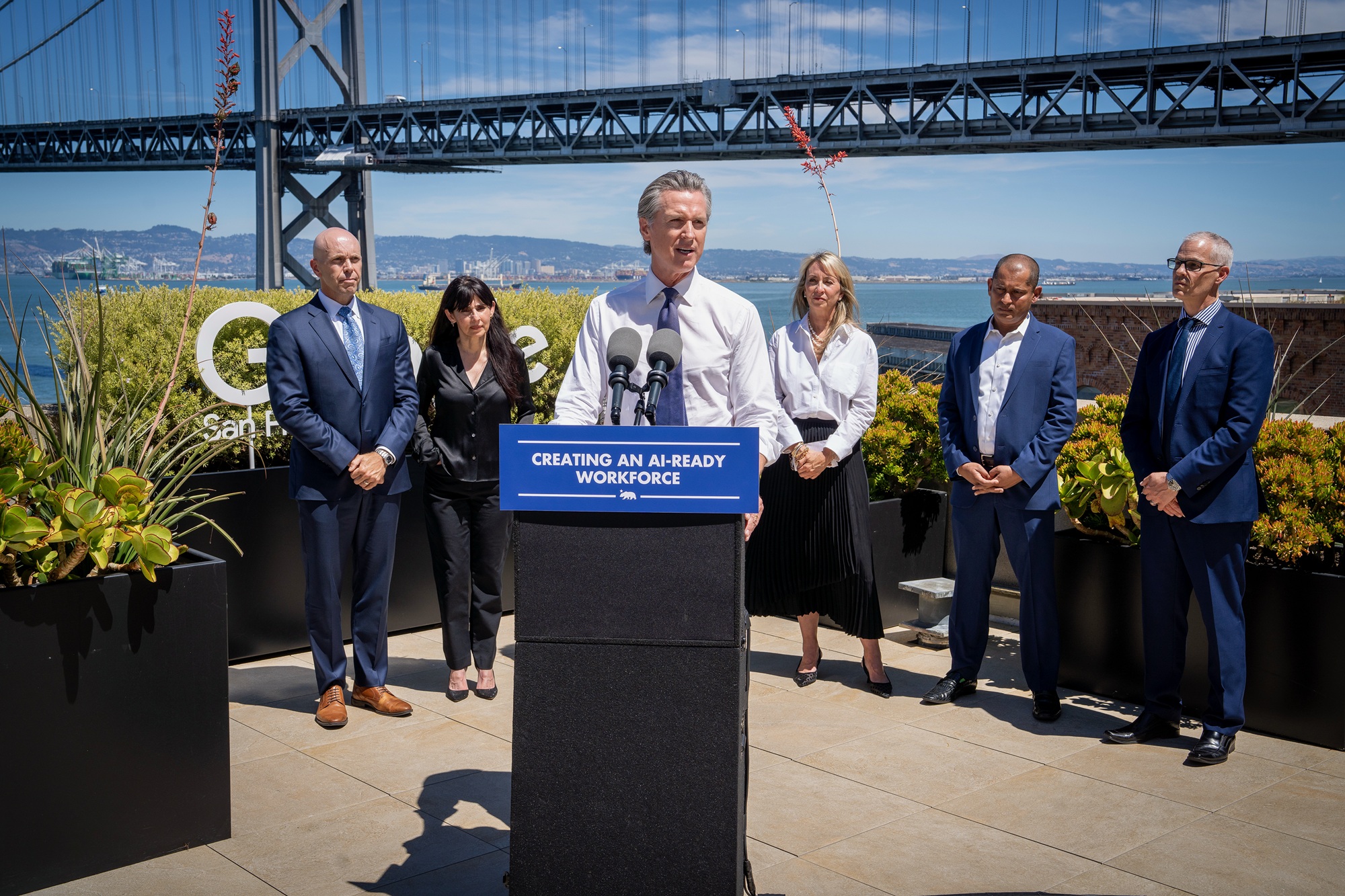
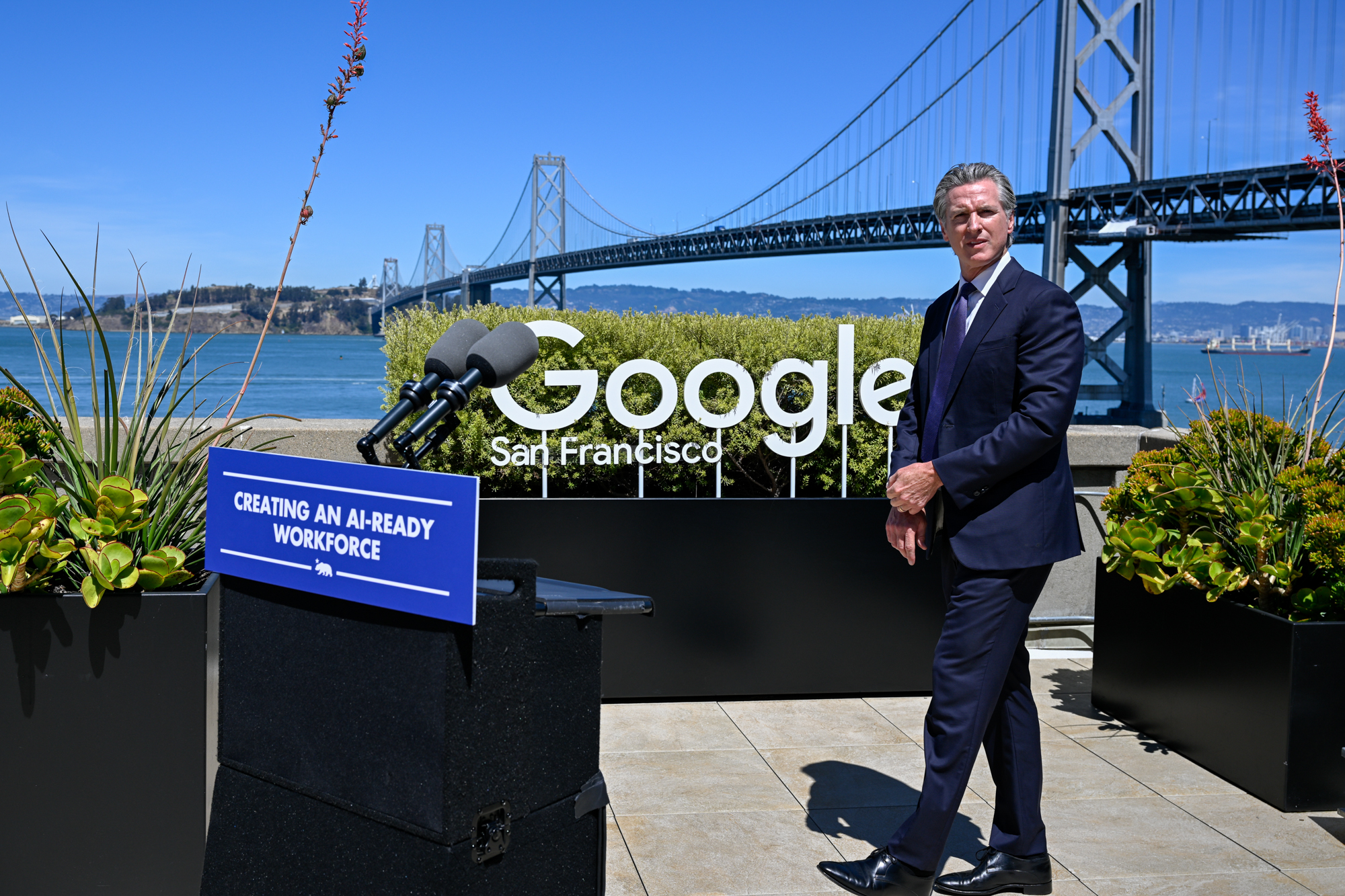
"caption": "On the rooftop of Google’s San Francisco offices on Aug. 7, 2025, Gov. California Gov. Gavin Newsom vetoed a bill that would have restricted children's access to AI chatbots, siding with the tech industry and saying it could have led to a total ban on some tools for teens.",
"credit": "Courtesy of the Office of the Governor",
"altTag": null,
"description": null,
"imgSizes": {
"thumbnail": {
"file": "https://cdn.kqed.org/wp-content/uploads/sites/10/2025/08/GavinNewsomAISF1-160x107.jpg",
"width": 160,
"height": 107,
"mimeType": "image/jpeg"
},
"1536x1536": {
"file": "https://cdn.kqed.org/wp-content/uploads/sites/10/2025/08/GavinNewsomAISF1-1536x1024.jpg",
"width": 1536,
"height": 1024,
"mimeType": "image/jpeg"
},
"post-thumbnail": {
"file": "https://cdn.kqed.org/wp-content/uploads/sites/10/2025/08/GavinNewsomAISF1-672x372.jpg",
"width": 672,
"height": 372,
"mimeType": "image/jpeg"
},
"twentyfourteen-full-width": {
"file": "https://cdn.kqed.org/wp-content/uploads/sites/10/2025/08/GavinNewsomAISF1-1038x576.jpg",
"width": 1038,
"height": 576,
"mimeType": "image/jpeg"
},
"kqedFullSize": {
"file": "https://cdn.kqed.org/wp-content/uploads/sites/10/2025/08/GavinNewsomAISF1.jpg",
"width": 2000,
"height": 1333
}
},
"isLoading": false,
"fetchFailed": false
},
"news_12059629": {
"type": "attachments",
"id": "news_12059629",
"meta": {
"index": "attachments_1716263798",
"site": "news",
"id": "12059629",
"found": true
},
"title": "251008_ENDOF10_-9-KQED",
"publishDate": 1760356671,
"status": "inherit",
"parent": 0,
"modified": 1760356793,
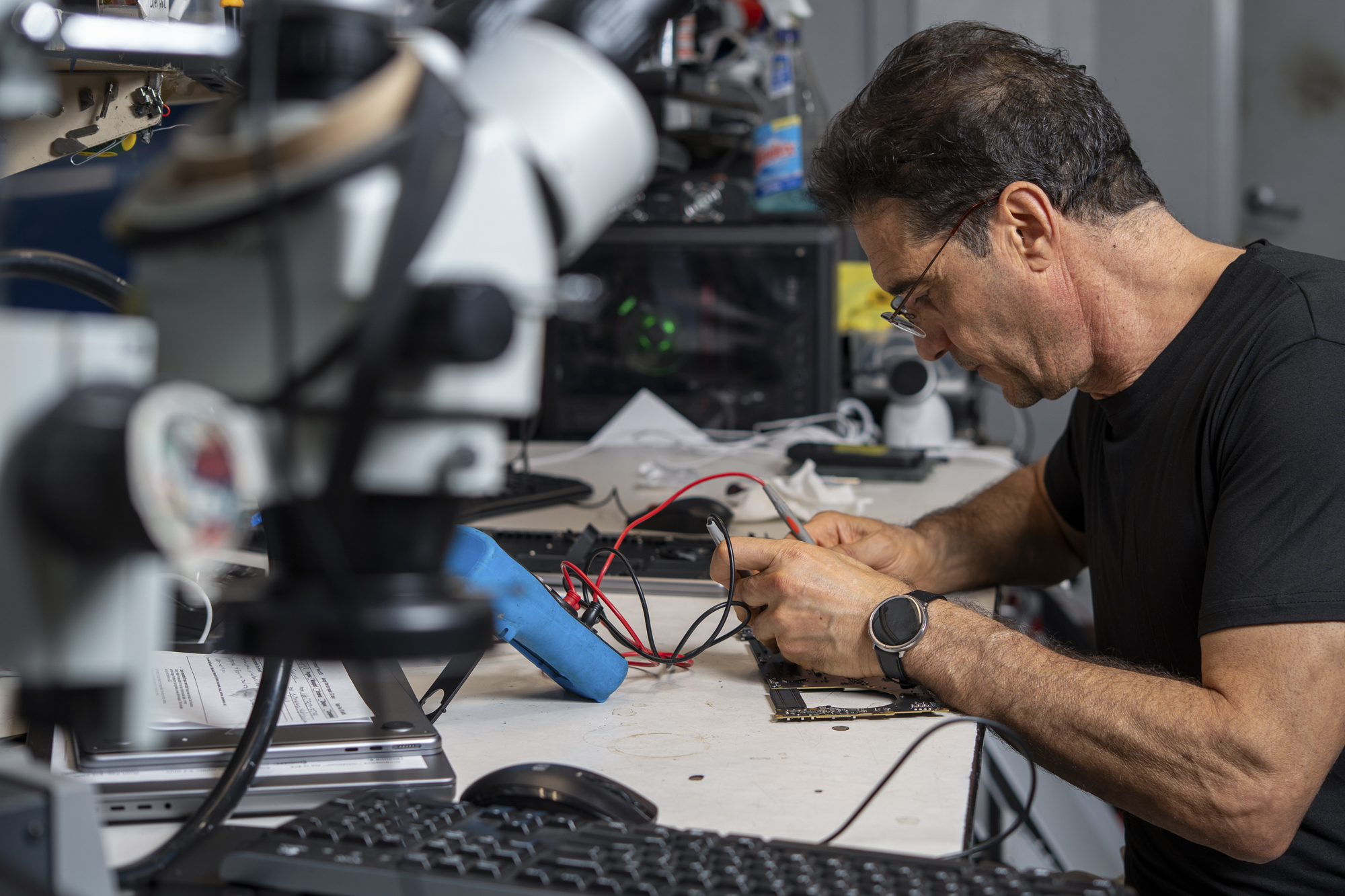
"caption": "Del Jaljaa works on a laptop motherboard at his repair bench in San Francisco on Oct. 8, 2025. Right to Repair advocates warn that Microsoft’s move away from Windows 10 could create mountains of electronic waste.",
"credit": "Gustavo Hernandez/KQED",
"altTag": null,
"description": null,
"imgSizes": {
"thumbnail": {
"file": "https://cdn.kqed.org/wp-content/uploads/sites/10/2025/10/251008_ENDOF10_-9-KQED-160x107.jpg",
"width": 160,
"height": 107,
"mimeType": "image/jpeg"
},
"1536x1536": {
"file": "https://cdn.kqed.org/wp-content/uploads/sites/10/2025/10/251008_ENDOF10_-9-KQED-1536x1024.jpg",
"width": 1536,
"height": 1024,
"mimeType": "image/jpeg"
},
"post-thumbnail": {
"file": "https://cdn.kqed.org/wp-content/uploads/sites/10/2025/10/251008_ENDOF10_-9-KQED-672x372.jpg",
"width": 672,
"height": 372,
"mimeType": "image/jpeg"
},
"twentyfourteen-full-width": {
"file": "https://cdn.kqed.org/wp-content/uploads/sites/10/2025/10/251008_ENDOF10_-9-KQED-1038x576.jpg",
"width": 1038,
"height": 576,
"mimeType": "image/jpeg"
},
"kqedFullSize": {
"file": "https://cdn.kqed.org/wp-content/uploads/sites/10/2025/10/251008_ENDOF10_-9-KQED.jpg",
"width": 2000,
"height": 1333
}
},
"isLoading": false,
"fetchFailed": false
},
"news_12058999": {
"type": "attachments",
"id": "news_12058999",
"meta": {
"index": "attachments_1716263798",
"site": "news",
"id": "12058999",
"found": true
},
"title": "TOPSHOT-SWEDEN-NOBEL-PRIZE-PHYSICS",
"publishDate": 1759871306,
"status": "inherit",
"parent": 12058994,
"modified": 1759871409,
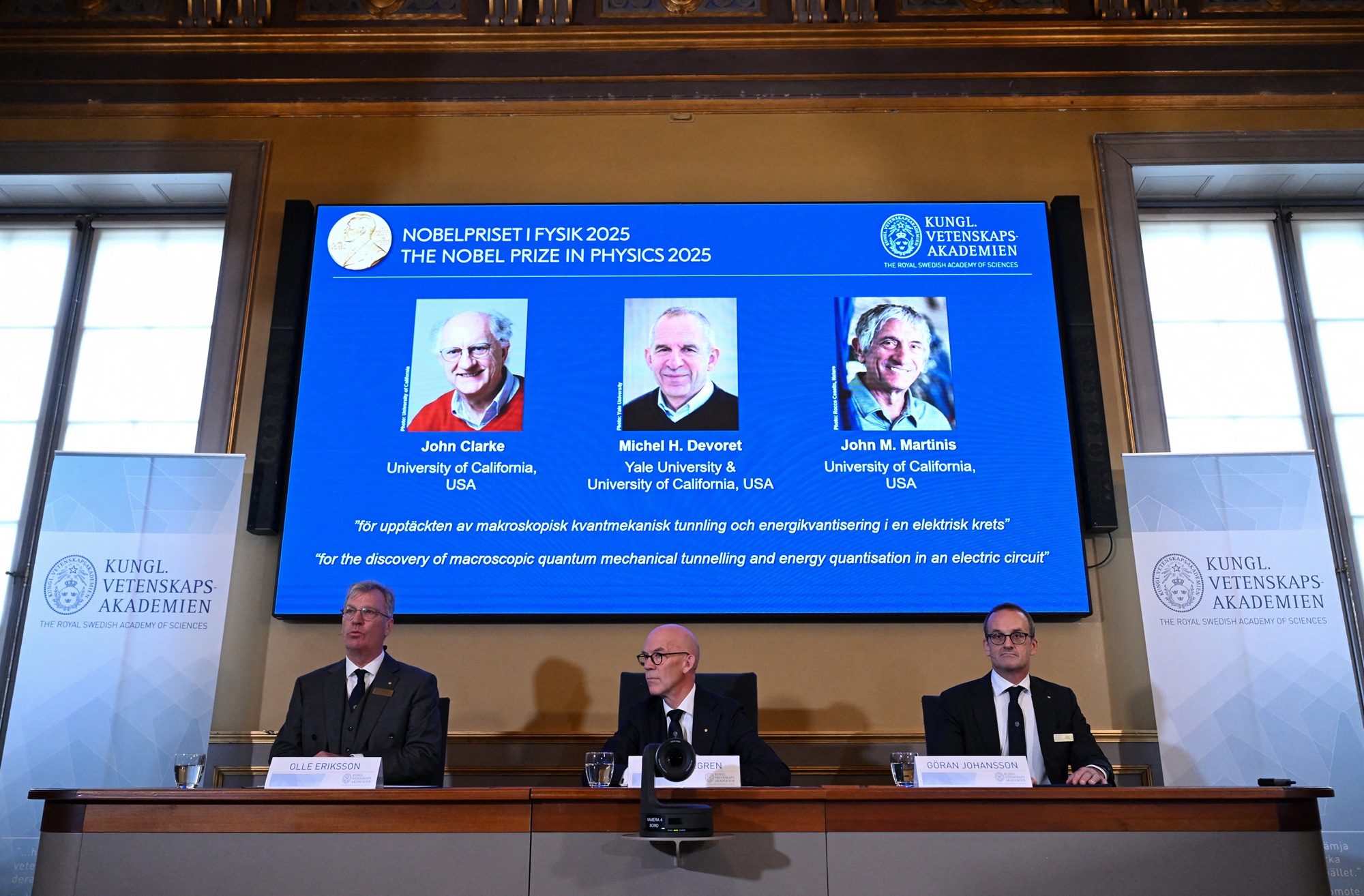
"caption": "Left to right: Olle Eriksson, Chair of the Nobel Committee for Physics, Hans Ellegren, Secretary General of The Royal Swedish Academy of Sciences, and Goeran Johansson, Member of the Nobel Committe for Physics, address a press conference to announce the winners of the 2025 Nobel Prize in Physics at the Royal Swedish Academy of Sciences in Stockholm, Sweden, on Oct. 7, 2025. John Clarke (UK), Michel H. Devoret (France) and John M. Martinis (US) win the Nobel Prize in Physics 2025, \"for the discovery of macroscopic quatum mechanical tunnelling and energy quantisation in an electric circuit.\"",
"credit": "Jonathan Nackstrand/AFP via Getty Images",
"altTag": null,
"description": null,
"imgSizes": {
"thumbnail": {
"file": "https://cdn.kqed.org/wp-content/uploads/sites/10/2025/10/NobelPrizePhysicsGetty1-160x105.jpg",
"width": 160,
"height": 105,
"mimeType": "image/jpeg"
},
"1536x1536": {
"file": "https://cdn.kqed.org/wp-content/uploads/sites/10/2025/10/NobelPrizePhysicsGetty1-1536x1009.jpg",
"width": 1536,
"height": 1009,
"mimeType": "image/jpeg"
},
"post-thumbnail": {
"file": "https://cdn.kqed.org/wp-content/uploads/sites/10/2025/10/NobelPrizePhysicsGetty1-672x372.jpg",
"width": 672,
"height": 372,
"mimeType": "image/jpeg"
},
"twentyfourteen-full-width": {
"file": "https://cdn.kqed.org/wp-content/uploads/sites/10/2025/10/NobelPrizePhysicsGetty1-1038x576.jpg",
"width": 1038,
"height": 576,
"mimeType": "image/jpeg"
},
"kqedFullSize": {
"file": "https://cdn.kqed.org/wp-content/uploads/sites/10/2025/10/NobelPrizePhysicsGetty1.jpg",
"width": 2000,
"height": 1314
}
},
"isLoading": false,
"fetchFailed": false
},
"news_12051438": {
"type": "attachments",
"id": "news_12051438",
"meta": {
"index": "attachments_1716263798",
"site": "news",
"id": "12051438",
"found": true
},
"title": "GavinNewsomAISF2",
"publishDate": 1754670252,
"status": "inherit",
"parent": 12051433,
"modified": 1754670418,
"caption": "On the rooftop of Google’s San Francisco Embarcadero offices on Aug. 7, 2025, Gov. Gavin Newsom announced a major statewide partnership with Google, Microsoft, IBM and Adobe to expand generative AI education — including training programs, certifications, and internships — across California’s high schools, community colleges and Cal State universities.",
"credit": "Courtesy of the Office of the Governor",
"altTag": null,
"description": null,
"imgSizes": {
"thumbnail": {
"file": "https://cdn.kqed.org/wp-content/uploads/sites/10/2025/08/GavinNewsomAISF2-160x107.jpg",
"width": 160,
"height": 107,
"mimeType": "image/jpeg"
},
"1536x1536": {
"file": "https://cdn.kqed.org/wp-content/uploads/sites/10/2025/08/GavinNewsomAISF2-1536x1024.jpg",
"width": 1536,
"height": 1024,
"mimeType": "image/jpeg"
},
"post-thumbnail": {
"file": "https://cdn.kqed.org/wp-content/uploads/sites/10/2025/08/GavinNewsomAISF2-672x372.jpg",
"width": 672,
"height": 372,
"mimeType": "image/jpeg"
},
"twentyfourteen-full-width": {
"file": "https://cdn.kqed.org/wp-content/uploads/sites/10/2025/08/GavinNewsomAISF2-1038x576.jpg",
"width": 1038,
"height": 576,
"mimeType": "image/jpeg"
},
"kqedFullSize": {
"file": "https://cdn.kqed.org/wp-content/uploads/sites/10/2025/08/GavinNewsomAISF2.jpg",
"width": 2000,
"height": 1333
}
},
"isLoading": false,
"fetchFailed": false
},
"news_12057971": {
"type": "attachments",
"id": "news_12057971",
"meta": {
"index": "attachments_1716263798",
"site": "news",
"id": "12057971",
"found": true
},
"title": "Electronic Arts-Buyout",
"publishDate": 1759166947,
"status": "inherit",
"parent": 12057966,
"modified": 1759168795,
"caption": "The logo for Electronic Arts is displayed during the Electronic Entertainment Expo in Los Angeles on June 12, 2013. ",
"credit": "Jae C. Hong/AP Photo",
"altTag": null,
"description": null,
"imgSizes": {
"medium": {
"file": "https://cdn.kqed.org/wp-content/uploads/sites/10/2025/09/AP25272445694578-2000x1334.jpg",
"width": 2000,
"height": 1334,
"mimeType": "image/jpeg"
},
"large": {
"file": "https://cdn.kqed.org/wp-content/uploads/sites/10/2025/09/AP25272445694578-2000x1334.jpg",
"width": 2000,
"height": 1334,
"mimeType": "image/jpeg"
},
"thumbnail": {
"file": "https://cdn.kqed.org/wp-content/uploads/sites/10/2025/09/AP25272445694578-160x107.jpg",
"width": 160,
"height": 107,
"mimeType": "image/jpeg"
},
"1536x1536": {
"file": "https://cdn.kqed.org/wp-content/uploads/sites/10/2025/09/AP25272445694578-1536x1024.jpg",
"width": 1536,
"height": 1024,
"mimeType": "image/jpeg"
},
"2048x2048": {
"file": "https://cdn.kqed.org/wp-content/uploads/sites/10/2025/09/AP25272445694578-2048x1366.jpg",
"width": 2048,
"height": 1366,
"mimeType": "image/jpeg"
},
"post-thumbnail": {
"file": "https://cdn.kqed.org/wp-content/uploads/sites/10/2025/09/AP25272445694578-672x372.jpg",
"width": 672,
"height": 372,
"mimeType": "image/jpeg"
},
"twentyfourteen-full-width": {
"file": "https://cdn.kqed.org/wp-content/uploads/sites/10/2025/09/AP25272445694578-1038x576.jpg",
"width": 1038,
"height": 576,
"mimeType": "image/jpeg"
},
"full-width": {
"file": "https://cdn.kqed.org/wp-content/uploads/sites/10/2025/09/AP25272445694578-2000x1334.jpg",
"width": 2000,
"height": 1334,
"mimeType": "image/jpeg"
},
"kqedFullSize": {
"file": "https://cdn.kqed.org/wp-content/uploads/sites/10/2025/09/AP25272445694578-scaled.jpg",
"width": 2560,
"height": 1707
}
},
"isLoading": false,
"fetchFailed": false
},
"news_12040902": {
"type": "attachments",
"id": "news_12040902",
"meta": {
"index": "attachments_1716263798",
"site": "news",
"id": "12040902",
"found": true
},
"title": "US-AUTOMOBILE-LIFESTYLE-WAYMO",
"publishDate": 1747762015,
"status": "inherit",
"parent": 12074861,
"modified": 1772219111,
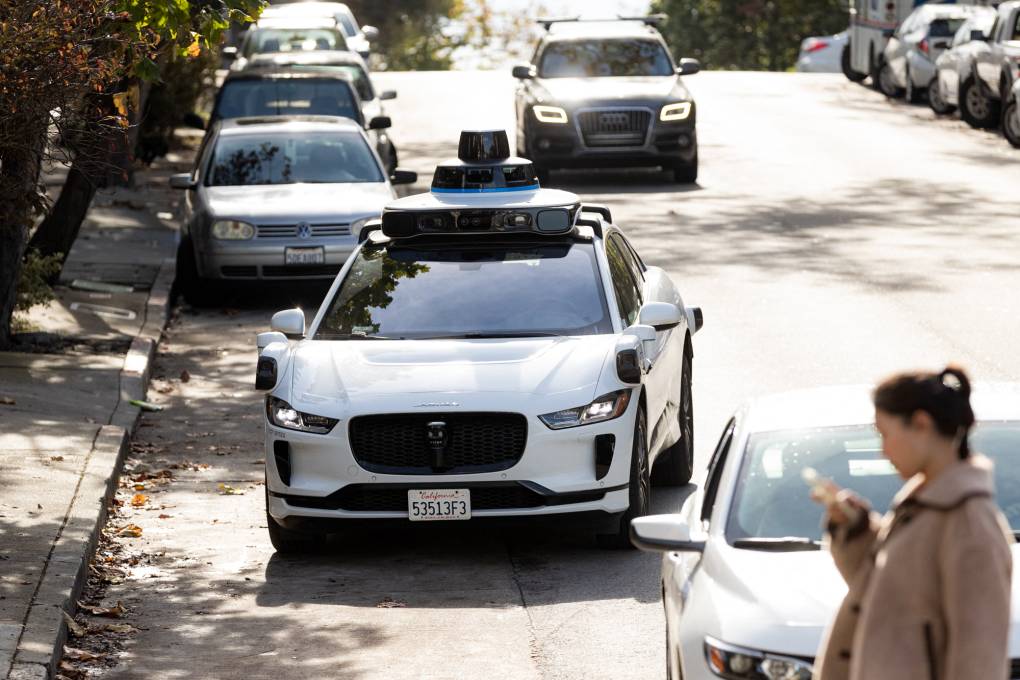
"caption": "A Waymo autonomous vehicle on Steiner Street in San Francisco on Nov. 17, 2023. ",
"credit": "Jason Henry/AFP via Getty Images",
"altTag": null,
"description": null,
"imgSizes": {
"medium": {
"file": "https://cdn.kqed.org/wp-content/uploads/sites/10/2025/05/GETTYIMAGES-1788126569-KQED-800x533.jpg",
"width": 800,
"height": 533,
"mimeType": "image/jpeg"
},
"large": {
"file": "https://cdn.kqed.org/wp-content/uploads/sites/10/2025/05/GETTYIMAGES-1788126569-KQED-1020x680.jpg",
"width": 1020,
"height": 680,
"mimeType": "image/jpeg"
},
"thumbnail": {
"file": "https://cdn.kqed.org/wp-content/uploads/sites/10/2025/05/GETTYIMAGES-1788126569-KQED-160x107.jpg",
"width": 160,
"height": 107,
"mimeType": "image/jpeg"
},
"1536x1536": {
"file": "https://cdn.kqed.org/wp-content/uploads/sites/10/2025/05/GETTYIMAGES-1788126569-KQED-1536x1024.jpg",
"width": 1536,
"height": 1024,
"mimeType": "image/jpeg"
},
"post-thumbnail": {
"file": "https://cdn.kqed.org/wp-content/uploads/sites/10/2025/05/GETTYIMAGES-1788126569-KQED-672x372.jpg",
"width": 672,
"height": 372,
"mimeType": "image/jpeg"
},
"twentyfourteen-full-width": {
"file": "https://cdn.kqed.org/wp-content/uploads/sites/10/2025/05/GETTYIMAGES-1788126569-KQED-1038x576.jpg",
"width": 1038,
"height": 576,
"mimeType": "image/jpeg"
},
"full-width": {
"file": "https://cdn.kqed.org/wp-content/uploads/sites/10/2025/05/GETTYIMAGES-1788126569-KQED-1920x1280.jpg",
"width": 1920,
"height": 1280,
"mimeType": "image/jpeg"
},
"kqedFullSize": {
"file": "https://cdn.kqed.org/wp-content/uploads/sites/10/2025/05/GETTYIMAGES-1788126569-KQED.jpg",
"width": 2000,
"height": 1333
}
},
"isLoading": false,
"fetchFailed": false
},
"news_12055857": {
"type": "attachments",
"id": "news_12055857",
"meta": {
"index": "attachments_1716263798",
"site": "news",
"id": "12055857",
"found": true
},
"title": "111215_Google-Campus_AP_CM_01",
"publishDate": 1757719431,
"status": "inherit",
"parent": 12055854,
"modified": 1757787966,
"caption": "Mountain View tech giant Google asked small business owners to sign a petition opposing new rules for web browsers. Its Chrome browser leads the market. \n",
"credit": "Jeff Chiu/AP Photo",
"altTag": null,
"description": null,
"imgSizes": {
"thumbnail": {
"file": "https://cdn.kqed.org/wp-content/uploads/sites/10/2025/09/111215_Google-Campus_AP_CM_01-160x107.jpg",
"width": 160,
"height": 107,
"mimeType": "image/jpeg"
},
"1536x1536": {
"file": "https://cdn.kqed.org/wp-content/uploads/sites/10/2025/09/111215_Google-Campus_AP_CM_01-1536x1024.jpg",
"width": 1536,
"height": 1024,
"mimeType": "image/jpeg"
},
"post-thumbnail": {
"file": "https://cdn.kqed.org/wp-content/uploads/sites/10/2025/09/111215_Google-Campus_AP_CM_01-672x372.jpg",
"width": 672,
"height": 372,
"mimeType": "image/jpeg"
},
"twentyfourteen-full-width": {
"file": "https://cdn.kqed.org/wp-content/uploads/sites/10/2025/09/111215_Google-Campus_AP_CM_01-1038x576.jpg",
"width": 1038,
"height": 576,
"mimeType": "image/jpeg"
},
"kqedFullSize": {
"file": "https://cdn.kqed.org/wp-content/uploads/sites/10/2025/09/111215_Google-Campus_AP_CM_01.jpg",
"width": 2000,
"height": 1333
}
},
"isLoading": false,
"fetchFailed": false
},
"news_12055396": {
"type": "attachments",
"id": "news_12055396",
"meta": {
"index": "attachments_1716263798",
"site": "news",
"id": "12055396",
"found": true
},
"title": "MahanNewsom1",
"publishDate": 1757461383,
"status": "inherit",
"parent": 12055284,
"modified": 1757461543,
"caption": "Gov. Gavin Newsom’s popularity has surged as he has battled with President Donald Trump. But San José Mayor Matt Mahan (left) says \"trolling Trump\" won’t be key to success for Democrats. ",
"credit": "Joseph Geha/KQED; Rich Pedroncelli/AP Photo",
"altTag": null,
"description": null,
"imgSizes": {
"thumbnail": {
"file": "https://cdn.kqed.org/wp-content/uploads/sites/10/2025/09/MahanNewsom1-160x107.jpg",
"width": 160,
"height": 107,
"mimeType": "image/jpeg"
},
"1536x1536": {
"file": "https://cdn.kqed.org/wp-content/uploads/sites/10/2025/09/MahanNewsom1-1536x1024.jpg",
"width": 1536,
"height": 1024,
"mimeType": "image/jpeg"
},
"post-thumbnail": {
"file": "https://cdn.kqed.org/wp-content/uploads/sites/10/2025/09/MahanNewsom1-672x372.jpg",
"width": 672,
"height": 372,
"mimeType": "image/jpeg"
},
"twentyfourteen-full-width": {
"file": "https://cdn.kqed.org/wp-content/uploads/sites/10/2025/09/MahanNewsom1-1038x576.jpg",
"width": 1038,
"height": 576,
"mimeType": "image/jpeg"
},
"kqedFullSize": {
"file": "https://cdn.kqed.org/wp-content/uploads/sites/10/2025/09/MahanNewsom1.jpg",
"width": 2000,
"height": 1333
}
},
"isLoading": false,
"fetchFailed": false
},
"news_12055158": {
"type": "attachments",
"id": "news_12055158",
"meta": {
"index": "attachments_1716263798",
"site": "news",
"id": "12055158",
"found": true
},
"title": "US-TECHNOLOGY-COMPUTERS-INTERNET-AI-ANTHROPIC",
"publishDate": 1757358511,
"status": "inherit",
"parent": 12055125,
"modified": 1757358578,
"caption": "From left to right: Anthropic CEO Dario Amodei, Chief Product Officer Mike Krieger and Head of Communications Sasha de Marigny give a press conference during Anthropic's first developer conference in San Francisco, California, on May 22, 2025. ",
"credit": "Julie Jammot/AFP via Getty Images",
"altTag": null,
"description": null,
"imgSizes": {
"thumbnail": {
"file": "https://cdn.kqed.org/wp-content/uploads/sites/10/2025/09/AnthropicAIGetty-160x107.jpg",
"width": 160,
"height": 107,
"mimeType": "image/jpeg"
},
"1536x1536": {
"file": "https://cdn.kqed.org/wp-content/uploads/sites/10/2025/09/AnthropicAIGetty-1536x1024.jpg",
"width": 1536,
"height": 1024,
"mimeType": "image/jpeg"
},
"post-thumbnail": {
"file": "https://cdn.kqed.org/wp-content/uploads/sites/10/2025/09/AnthropicAIGetty-672x372.jpg",
"width": 672,
"height": 372,
"mimeType": "image/jpeg"
},
"twentyfourteen-full-width": {
"file": "https://cdn.kqed.org/wp-content/uploads/sites/10/2025/09/AnthropicAIGetty-1038x576.jpg",
"width": 1038,
"height": 576,
"mimeType": "image/jpeg"
},
"kqedFullSize": {
"file": "https://cdn.kqed.org/wp-content/uploads/sites/10/2025/09/AnthropicAIGetty.jpg",
"width": 2000,
"height": 1333
}
},
"isLoading": false,
"fetchFailed": false
},
"news_11998856": {
"type": "attachments",
"id": "news_11998856",
"meta": {
"index": "attachments_1716263798",
"site": "news",
"id": "11998856",
"found": true
},
"title": "In this photo illustration, the ChatGPT logo is displayed on",
"publishDate": 1722890738,
"status": "inherit",
"parent": 11998817,
"modified": 1722890828,
"caption": "Several bills addressing generative artificial intelligence are moving through the state Legislature in California’s piecemeal approach to regulation.",
"credit": "Jaque Silva/SOPA Images/LightRocket via Getty Images",
"altTag": null,
"description": null,
"imgSizes": {
"medium": {
"file": "https://cdn.kqed.org/wp-content/uploads/sites/10/2024/08/ChatGPTGetty-800x533.jpg",
"width": 800,
"height": 533,
"mimeType": "image/jpeg"
},
"large": {
"file": "https://cdn.kqed.org/wp-content/uploads/sites/10/2024/08/ChatGPTGetty-1020x680.jpg",
"width": 1020,
"height": 680,
"mimeType": "image/jpeg"
},
"thumbnail": {
"file": "https://cdn.kqed.org/wp-content/uploads/sites/10/2024/08/ChatGPTGetty-160x107.jpg",
"width": 160,
"height": 107,
"mimeType": "image/jpeg"
},
"1536x1536": {
"file": "https://cdn.kqed.org/wp-content/uploads/sites/10/2024/08/ChatGPTGetty-1536x1024.jpg",
"width": 1536,
"height": 1024,
"mimeType": "image/jpeg"
},
"post-thumbnail": {
"file": "https://cdn.kqed.org/wp-content/uploads/sites/10/2024/08/ChatGPTGetty-672x372.jpg",
"width": 672,
"height": 372,
"mimeType": "image/jpeg"
},
"twentyfourteen-full-width": {
"file": "https://cdn.kqed.org/wp-content/uploads/sites/10/2024/08/ChatGPTGetty-1038x576.jpg",
"width": 1038,
"height": 576,
"mimeType": "image/jpeg"
},
"full-width": {
"file": "https://cdn.kqed.org/wp-content/uploads/sites/10/2024/08/ChatGPTGetty-1920x1280.jpg",
"width": 1920,
"height": 1280,
"mimeType": "image/jpeg"
},
"kqedFullSize": {
"file": "https://cdn.kqed.org/wp-content/uploads/sites/10/2024/08/ChatGPTGetty.jpg",
"width": 2000,
"height": 1333
}
},
"isLoading": false,
"fetchFailed": false
},
"news_11997842": {
"type": "attachments",
"id": "news_11997842",
"meta": {
"index": "attachments_1716263798",
"site": "news",
"id": "11997842",
"found": true
},
"title": "GettyImages-2158244120",
"publishDate": 1722279466,
"status": "inherit",
"parent": 11997819,
"modified": 1722281528,
"caption": "Elon Musk at an event on June 19, 2024, in Cannes, France. ",
"credit": "Marc Piasecki/Getty Images",
"altTag": null,
"description": null,
"imgSizes": {
"medium": {
"file": "https://cdn.kqed.org/wp-content/uploads/sites/10/2024/07/GettyImages-2158244120-800x534.jpg",
"width": 800,
"height": 534,
"mimeType": "image/jpeg"
},
"large": {
"file": "https://cdn.kqed.org/wp-content/uploads/sites/10/2024/07/GettyImages-2158244120-1020x681.jpg",
"width": 1020,
"height": 681,
"mimeType": "image/jpeg"
},
"thumbnail": {
"file": "https://cdn.kqed.org/wp-content/uploads/sites/10/2024/07/GettyImages-2158244120-160x107.jpg",
"width": 160,
"height": 107,
"mimeType": "image/jpeg"
},
"1536x1536": {
"file": "https://cdn.kqed.org/wp-content/uploads/sites/10/2024/07/GettyImages-2158244120-1536x1025.jpg",
"width": 1536,
"height": 1025,
"mimeType": "image/jpeg"
},
"post-thumbnail": {
"file": "https://cdn.kqed.org/wp-content/uploads/sites/10/2024/07/GettyImages-2158244120-672x372.jpg",
"width": 672,
"height": 372,
"mimeType": "image/jpeg"
},
"twentyfourteen-full-width": {
"file": "https://cdn.kqed.org/wp-content/uploads/sites/10/2024/07/GettyImages-2158244120-1038x576.jpg",
"width": 1038,
"height": 576,
"mimeType": "image/jpeg"
},
"kqedFullSize": {
"file": "https://cdn.kqed.org/wp-content/uploads/sites/10/2024/07/GettyImages-2158244120.jpg",
"width": 1920,
"height": 1281
}
},
"isLoading": false,
"fetchFailed": false
},
"news_12052766": {
"type": "attachments",
"id": "news_12052766",
"meta": {
"index": "attachments_1716263798",
"site": "news",
"id": "12052766",
"found": true
},
"title": "Governor Newsom partners with world's leading tech companies to prepare Californians for AI future",
"publishDate": 1755621883,
"status": "inherit",
"parent": 12052617,
"modified": 1755625492,
"caption": "Gov. Gavin Newsom speaks at the Google office in San Francisco on Aug. 7, 2025.",
"credit": "Tayfun Coskun/Anadolu via Getty Images",
"altTag": null,
"description": null,
"imgSizes": {
"thumbnail": {
"file": "https://cdn.kqed.org/wp-content/uploads/sites/10/2025/08/GETTYIMAGES-2228237489-KQED-160x107.jpg",
"width": 160,
"height": 107,
"mimeType": "image/jpeg"
},
"1536x1536": {
"file": "https://cdn.kqed.org/wp-content/uploads/sites/10/2025/08/GETTYIMAGES-2228237489-KQED-1536x1024.jpg",
"width": 1536,
"height": 1024,
"mimeType": "image/jpeg"
},
"post-thumbnail": {
"file": "https://cdn.kqed.org/wp-content/uploads/sites/10/2025/08/GETTYIMAGES-2228237489-KQED-672x372.jpg",
"width": 672,
"height": 372,
"mimeType": "image/jpeg"
},
"twentyfourteen-full-width": {
"file": "https://cdn.kqed.org/wp-content/uploads/sites/10/2025/08/GETTYIMAGES-2228237489-KQED-1038x576.jpg",
"width": 1038,
"height": 576,
"mimeType": "image/jpeg"
},
"kqedFullSize": {
"file": "https://cdn.kqed.org/wp-content/uploads/sites/10/2025/08/GETTYIMAGES-2228237489-KQED.jpg",
"width": 2000,
"height": 1333
}
},
"isLoading": false,
"fetchFailed": false
}
},
"audioPlayerReducer": {
"postId": "stream_live",
"isPaused": true,
"isPlaying": false,
"pfsActive": false,
"pledgeModalIsOpen": true,
"playerDrawerIsOpen": false,
"liveAudioPlayStartedAt": 0,
"liveAudioPlayContext": ""
},
"authorsReducer": {
"byline_news_12057966": {
"type": "authors",
"id": "byline_news_12057966",
"meta": {
"override": true
},
"slug": "byline_news_12057966",
"name": "Michael Liedtke and Michelle Chapman, Associated Press",
"isLoading": false
},
"byline_news_12055854": {
"type": "authors",
"id": "byline_news_12055854",
"meta": {
"override": true
},
"slug": "byline_news_12055854",
"name": "Khari Johnson and Yue Stella Yu, CalMatters",
"isLoading": false
},
"danbrekke": {
"type": "authors",
"id": "222",
"meta": {
"index": "authors_1716337520",
"id": "222",
"found": true
},
"name": "Dan Brekke",
"firstName": "Dan",
"lastName": "Brekke",
"slug": "danbrekke",
"email": "dbrekke@kqed.org",
"display_author_email": true,
"staff_mastheads": [
"news",
"science"
],
"title": "KQED Editor and Reporter",
"bio": "Dan Brekke is a reporter and editor for KQED News, responsible for coverage of topics ranging from California water issues to the Bay Area's transportation challenges. In a newsroom career that began in Chicago in 1972, Dan has worked for \u003cem>The San Francisco Examiner,\u003c/em> Wired and TechTV and has been published in The New York Times, The New York Times Magazine, Business 2.0, Salon and elsewhere.\r\n\r\nSince joining KQED in 2007, Dan has reported, edited and produced both radio and online features and breaking news pieces. He has shared as both editor and reporter in four Society of Professional Journalists Norcal Excellence in Journalism awards and one Edward R. Murrow regional award. He was chosen for a spring 2017 residency at the Mesa Refuge to advance his research on California salmon.\r\n\r\nEmail Dan at: \u003ca href=\"mailto:dbrekke@kqed.org\">dbrekke@kqed.org\u003c/a>\r\n\r\n\u003cstrong>Twitter:\u003c/strong> \u003ca href=\"https://twitter.com/danbrekke\" rel=\"noopener noreferrer\">twitter.com/danbrekke\u003c/a>\r\n\u003cstrong>Facebook:\u003c/strong> \u003ca href=\"https://www.facebook.com/danbrekke\" rel=\"noopener noreferrer\">www.facebook.com/danbrekke\u003c/a>\r\n\u003cstrong>LinkedIn:\u003c/strong> \u003ca href=\"https://www.linkedin.com/in/danbrekke\" rel=\"noopener noreferrer\">www.linkedin.com/in/danbrekke\u003c/a>",
"avatar": "https://secure.gravatar.com/avatar/8f1f0d2a978fb3b23426c922c7e2af558fa36905b49c4ce76a97dc3c72d27226?s=600&d=mm&r=g",
"twitter": "danbrekke",
"bluesky": null,
"facebook": null,
"instagram": "https://www.instagram.com/dan.brekke/",
"linkedin": "https://www.linkedin.com/in/danbrekke/",
"sites": [
{
"site": "news",
"roles": [
"administrator",
"create_posts"
]
},
{
"site": "stateofhealth",
"roles": [
"editor"
]
},
{
"site": "science",
"roles": [
"editor"
]
},
{
"site": "quest",
"roles": [
"contributor"
]
},
{
"site": "food",
"roles": [
"contributor"
]
},
{
"site": "forum",
"roles": [
"contributor"
]
},
{
"site": "elections",
"roles": [
"editor"
]
},
{
"site": "liveblog",
"roles": [
"editor"
]
}
],
"headData": {
"title": "Dan Brekke | KQED",
"description": "KQED Editor and Reporter",
"ogImgSrc": "https://secure.gravatar.com/avatar/8f1f0d2a978fb3b23426c922c7e2af558fa36905b49c4ce76a97dc3c72d27226?s=600&d=mm&r=g",
"twImgSrc": "https://secure.gravatar.com/avatar/8f1f0d2a978fb3b23426c922c7e2af558fa36905b49c4ce76a97dc3c72d27226?s=600&d=mm&r=g"
},
"isLoading": false,
"link": "/author/danbrekke"
},
"gmarzorati": {
"type": "authors",
"id": "227",
"meta": {
"index": "authors_1716337520",
"id": "227",
"found": true
},
"name": "Guy Marzorati",
"firstName": "Guy",
"lastName": "Marzorati",
"slug": "gmarzorati",
"email": "gmarzorati@KQED.org",
"display_author_email": true,
"staff_mastheads": [
"news"
],
"title": "Correspondent",
"bio": "Guy Marzorati is a correspondent on KQED's California Politics and Government Desk, based in San Jose. A graduate of Santa Clara University, Guy joined KQED in 2013. He reports on state and local politics and produces KQED's digital voter guide.",
"avatar": "https://secure.gravatar.com/avatar/e7038b8dbfd55b104369b76b1cd0b9de?s=600&d=blank&r=g",
"twitter": "guymarzorati",
"facebook": null,
"instagram": null,
"linkedin": null,
"sites": [
{
"site": "",
"roles": [
"editor"
]
},
{
"site": "news",
"roles": [
"editor"
]
},
{
"site": "science",
"roles": [
"editor"
]
},
{
"site": "forum",
"roles": [
"editor"
]
},
{
"site": "elections",
"roles": [
"editor"
]
},
{
"site": "liveblog",
"roles": [
"editor"
]
}
],
"headData": {
"title": "Guy Marzorati | KQED",
"description": "Correspondent",
"ogImgSrc": "https://secure.gravatar.com/avatar/e7038b8dbfd55b104369b76b1cd0b9de?s=600&d=blank&r=g",
"twImgSrc": "https://secure.gravatar.com/avatar/e7038b8dbfd55b104369b76b1cd0b9de?s=600&d=blank&r=g"
},
"isLoading": false,
"link": "/author/gmarzorati"
},
"rachael-myrow": {
"type": "authors",
"id": "251",
"meta": {
"index": "authors_1716337520",
"id": "251",
"found": true
},
"name": "Rachael Myrow",
"firstName": "Rachael",
"lastName": "Myrow",
"slug": "rachael-myrow",
"email": "rmyrow@kqed.org",
"display_author_email": true,
"staff_mastheads": [
"news"
],
"title": "Senior Editor of KQED's Silicon Valley News Desk",
"bio": "• I write and edit stories about how Silicon Valley power and policies shape everyday life in California. I’m also passionate about making Bay Area history and culture more accessible to a broad public. • I’ve been a journalist for most of my life, starting in high school with The Franklin Press in Los Angeles, where I grew up. While earning my first degree in English at UC Berkeley, I got my start in public radio at KALX-FM. After completing a second degree in journalism at Cal, I landed my first professional job at Marketplace, then moved on to KPCC (now LAist), and then KQED, where I hosted The California Report for more than seven years. • My reporting has appeared on NPR, The World, WBUR’s \u003ci>Here & Now\u003c/i>, and the BBC. I also guest host for KQED’s \u003ci>Forum\u003c/i>, as well as the Commonwealth Club in San Francisco. • I speak periodically on media, democracy and technology issues, and do voiceover work for documentaries and educational video projects. • Outside of the studio, you'll find me hiking Bay Area trails and whipping up Insta-ready meals in my kitchen. • I do not accept gifts, money, or favors from anyone connected to my reporting, I don't pay people for information, and I do not support or donate to political causes. • I strive to treat the people I report on with fairness, honesty, and respect. I also recognize there are often multiple sides to a story and work to verify information through multiple sources and documentation. If I get something wrong, I correct it.",
"avatar": "https://secure.gravatar.com/avatar/3ed8a3c5f26025e4a805ba634cda8cd764906b97438a6d9ce216b044e340da4e?s=600&d=blank&r=g",
"twitter": "rachaelmyrow",
"bluesky": null,
"facebook": null,
"instagram": null,
"linkedin": "https://www.linkedin.com/in/rachaelmyrow/",
"sites": [
{
"site": "arts",
"roles": [
"administrator"
]
},
{
"site": "news",
"roles": [
"edit_others_posts",
"editor"
]
},
{
"site": "futureofyou",
"roles": [
"editor"
]
},
{
"site": "bayareabites",
"roles": [
"editor"
]
},
{
"site": "stateofhealth",
"roles": [
"editor"
]
},
{
"site": "science",
"roles": [
"editor"
]
},
{
"site": "food",
"roles": [
"editor"
]
},
{
"site": "forum",
"roles": [
"editor"
]
},
{
"site": "liveblog",
"roles": [
"author"
]
}
],
"headData": {
"title": "Rachael Myrow | KQED",
"description": "Senior Editor of KQED's Silicon Valley News Desk",
"ogImgSrc": "https://secure.gravatar.com/avatar/3ed8a3c5f26025e4a805ba634cda8cd764906b97438a6d9ce216b044e340da4e?s=600&d=blank&r=g",
"twImgSrc": "https://secure.gravatar.com/avatar/3ed8a3c5f26025e4a805ba634cda8cd764906b97438a6d9ce216b044e340da4e?s=600&d=blank&r=g"
},
"isLoading": false,
"link": "/author/rachael-myrow"
},
"mlagos": {
"type": "authors",
"id": "3239",
"meta": {
"index": "authors_1716337520",
"id": "3239",
"found": true
},
"name": "Marisa Lagos",
"firstName": "Marisa",
"lastName": "Lagos",
"slug": "mlagos",
"email": "mlagos@kqed.org",
"display_author_email": false,
"staff_mastheads": [
"news"
],
"title": "KQED Contributor",
"bio": "Marisa Lagos is a correspondent for KQED’s California Politics and Government Desk and co-hosts the award-winning show and podcast, Political Breakdown. At KQED, Lagos also conducts reporting, analysis and investigations into state, local and national politics for radio, TV, online and onstage. In 2022, she and co-host, Scott Shafer, moderated the only gubernatorial debate in California. In 2020, the \u003ci>Washington Post\u003c/i> named her one of the top political journalists in California; she was nominated for a Peabody and won several other awards for her work investigating the 2017 California wildfires. She has worked at the \u003ci>San Francisco Chronicle\u003c/i>, \u003ci>San Francisco Examiner\u003c/i> and \u003ci>Los Angeles Times\u003c/i>. A UC Santa Barbara graduate, she lives in San Francisco with her two sons and husband.",
"avatar": "https://secure.gravatar.com/avatar/a261a0d3696fc066871ef96b85b5e7d2?s=600&d=blank&r=g",
"twitter": "@mlagos",
"facebook": null,
"instagram": null,
"linkedin": null,
"sites": [
{
"site": "arts",
"roles": [
"author"
]
},
{
"site": "news",
"roles": [
"editor"
]
},
{
"site": "science",
"roles": [
"editor"
]
},
{
"site": "forum",
"roles": [
"author"
]
},
{
"site": "liveblog",
"roles": [
"author"
]
}
],
"headData": {
"title": "Marisa Lagos | KQED",
"description": "KQED Contributor",
"ogImgSrc": "https://secure.gravatar.com/avatar/a261a0d3696fc066871ef96b85b5e7d2?s=600&d=blank&r=g",
"twImgSrc": "https://secure.gravatar.com/avatar/a261a0d3696fc066871ef96b85b5e7d2?s=600&d=blank&r=g"
},
"isLoading": false,
"link": "/author/mlagos"
},
"adahlstromeckman": {
"type": "authors",
"id": "11785",
"meta": {
"index": "authors_1716337520",
"id": "11785",
"found": true
},
"name": "Azul Dahlstrom-Eckman",
"firstName": "Azul",
"lastName": "Dahlstrom-Eckman",
"slug": "adahlstromeckman",
"email": "adahlstrom-eckman@kqed.org",
"display_author_email": true,
"staff_mastheads": [],
"title": "Reporter",
"bio": "Azul is a reporter for KQED focusing on transportation and features. He joined KQED in 2021 as an alumna of KALW's Audio Academy radio journalism training program.",
"avatar": "https://secure.gravatar.com/avatar/9cb750298435add7815a777f55bf1f46845c1386bb8452555c60a7b820b5aba3?s=600&d=blank&r=g",
"twitter": "@zuliemann",
"bluesky": "@azul415.bsky.social",
"facebook": null,
"instagram": null,
"linkedin": null,
"sites": [
{
"site": "arts",
"roles": [
"editor"
]
},
{
"site": "news",
"roles": [
"editor"
]
},
{
"site": "science",
"roles": [
"editor"
]
},
{
"site": "liveblog",
"roles": [
"author"
]
}
],
"headData": {
"title": "Azul Dahlstrom-Eckman | KQED",
"description": "Reporter",
"ogImgSrc": "https://secure.gravatar.com/avatar/9cb750298435add7815a777f55bf1f46845c1386bb8452555c60a7b820b5aba3?s=600&d=blank&r=g",
"twImgSrc": "https://secure.gravatar.com/avatar/9cb750298435add7815a777f55bf1f46845c1386bb8452555c60a7b820b5aba3?s=600&d=blank&r=g"
},
"isLoading": false,
"link": "/author/adahlstromeckman"
},
"kdebenedetti": {
"type": "authors",
"id": "11913",
"meta": {
"index": "authors_1716337520",
"id": "11913",
"found": true
},
"name": "Katie DeBenedetti",
"firstName": "Katie",
"lastName": "DeBenedetti",
"slug": "kdebenedetti",
"email": "kdebenedetti@kqed.org",
"display_author_email": false,
"staff_mastheads": [
"news",
"science"
],
"title": "KQED Contributor",
"bio": "Katie DeBenedetti is a digital reporter covering daily news for the Express Desk. Prior to joining KQED as a culture reporting intern in January 2024, she covered education and city government for the Napa Valley Register.",
"avatar": "https://secure.gravatar.com/avatar/6e31073cb8f7e4214ab03f42771d0f45?s=600&d=blank&r=g",
"twitter": null,
"facebook": null,
"instagram": null,
"linkedin": null,
"sites": [
{
"site": "news",
"roles": [
"author"
]
},
{
"site": "science",
"roles": [
"author"
]
},
{
"site": "liveblog",
"roles": [
"author"
]
}
],
"headData": {
"title": "Katie DeBenedetti | KQED",
"description": "KQED Contributor",
"ogImgSrc": "https://secure.gravatar.com/avatar/6e31073cb8f7e4214ab03f42771d0f45?s=600&d=blank&r=g",
"twImgSrc": "https://secure.gravatar.com/avatar/6e31073cb8f7e4214ab03f42771d0f45?s=600&d=blank&r=g"
},
"isLoading": false,
"link": "/author/kdebenedetti"
},
"emanoukian": {
"type": "authors",
"id": "11925",
"meta": {
"index": "authors_1716337520",
"id": "11925",
"found": true
},
"name": "Elize Manoukian",
"firstName": "Elize",
"lastName": "Manoukian",
"slug": "emanoukian",
"email": "emanoukian@KQED.org",
"display_author_email": false,
"staff_mastheads": [
"news"
],
"title": "Digital News Editor",
"bio": "Elize Manoukian is an award-winning audio producer and Senior Editor on the Express Desk, KQED's digital news platform. Her work has appeared on KPFA, Interlochen Public Radio, Oregon Public Broadcast, the New York Daily News, LA Times and the San Diego Union-Tribune.",
"avatar": "https://secure.gravatar.com/avatar/4525f1a8e46ccb30933b32653d9772064cfefe3fa655eb45b3b3a80341f6bdad?s=600&d=blank&r=g",
"twitter": null,
"bluesky": null,
"facebook": null,
"instagram": null,
"linkedin": null,
"sites": [
{
"site": "arts",
"roles": [
"editor"
]
},
{
"site": "news",
"roles": [
"editor"
]
},
{
"site": "science",
"roles": [
"editor"
]
}
],
"headData": {
"title": "Elize Manoukian | KQED",
"description": "Digital News Editor",
"ogImgSrc": "https://secure.gravatar.com/avatar/4525f1a8e46ccb30933b32653d9772064cfefe3fa655eb45b3b3a80341f6bdad?s=600&d=blank&r=g",
"twImgSrc": "https://secure.gravatar.com/avatar/4525f1a8e46ccb30933b32653d9772064cfefe3fa655eb45b3b3a80341f6bdad?s=600&d=blank&r=g"
},
"isLoading": false,
"link": "/author/emanoukian"
},
"mbernal": {
"type": "authors",
"id": "11977",
"meta": {
"index": "authors_1716337520",
"id": "11977",
"found": true
},
"name": "María Fernanda Bernal",
"firstName": "María Fernanda",
"lastName": "Bernal",
"slug": "mbernal",
"email": "mbernal@kqed.org",
"display_author_email": false,
"staff_mastheads": [
"news"
],
"title": "KQED Contributor",
"bio": "Maria Fernanda is a UC Berkeley J-School alum and was named Innovation Fellow in 2023. She was the 2022 White House Correspondents' Fellow and Cokie Roberts Scholar. In her time at the Investigative Reporting Program, she led an investigative team and received a National Press Award in 2025 for the story on Chevron's Manipulation of Media. She is most proud of her international recognition with the first place podcast award from the Insituto Mexicano de la radio in 2021. Maria Fernanda is a Bay Area-based journalist who is currently working as a general assignment reporter, weekend host and producer at KQED.",
"avatar": "https://secure.gravatar.com/avatar/f44c9ad4bd3426006b0def803428a08a?s=600&d=blank&r=g",
"twitter": null,
"facebook": null,
"instagram": null,
"linkedin": null,
"sites": [
{
"site": "arts",
"roles": [
"editor"
]
},
{
"site": "news",
"roles": [
"editor",
"author"
]
},
{
"site": "science",
"roles": [
"editor"
]
}
],
"headData": {
"title": "María Fernanda Bernal | KQED",
"description": "KQED Contributor",
"ogImgSrc": "https://secure.gravatar.com/avatar/f44c9ad4bd3426006b0def803428a08a?s=600&d=blank&r=g",
"twImgSrc": "https://secure.gravatar.com/avatar/f44c9ad4bd3426006b0def803428a08a?s=600&d=blank&r=g"
},
"isLoading": false,
"link": "/author/mbernal"
}
},
"pagesReducer": {
"news_category_technology": {
"type": "terms",
"id": "news_248",
"meta": {
"index": "terms_1716263798",
"site": "news",
"id": "248",
"score": 10.93111
},
"featImg": null,
"name": "Technology",
"description": null,
"taxonomy": "category",
"headData": {
"twImgId": null,
"twTitle": null,
"ogTitle": null,
"ogImgId": null,
"twDescription": null,
"description": null,
"title": "Technology Archives | KQED News",
"ogDescription": null
},
"ttid": 256,
"slug": "technology",
"isLoading": false,
"title": "Technology",
"pageMeta": {
"site": "news",
"WpPageTemplate": "page-topic-editorial",
"currentPage": 14
},
"blocks": [
{
"blockName": "kqed/post-list",
"attrs": {
"layout": "cardArticle2",
"query": "posts/news?category=technology",
"seeMore": false,
"paginated": true,
"page": 14
}
},
{
"blockName": "kqed/ad"
}
]
}
},
"pfsSessionReducer": {},
"postsReducer": {
"stream_live": {
"type": "live",
"id": "stream_live",
"audioUrl": "https://streams.kqed.org/kqedradio",
"title": "Live Stream",
"excerpt": "Live Stream information currently unavailable.",
"link": "/radio",
"featImg": "",
"label": {
"name": "KQED Live",
"link": "/"
}
},
"stream_kqedNewscast": {
"type": "posts",
"id": "stream_kqedNewscast",
"audioUrl": "https://www.kqed.org/.stream/anon/radio/RDnews/newscast.mp3?_=1",
"title": "KQED Newscast",
"featImg": "",
"label": {
"name": "88.5 FM",
"link": "/"
}
},
"news_12059714": {
"type": "posts",
"id": "news_12059714",
"meta": {
"index": "posts_1716263798",
"site": "news",
"id": "12059714",
"score": null,
"sort": [
1760460055000
]
},
"guestAuthors": [],
"slug": "newsom-vetoes-most-watched-childrens-ai-bill-signs-16-others-targeting-tech",
"title": "Newsom Vetoes Most-Watched Children's AI Bill, Signs 16 Others Targeting Tech",
"publishDate": 1760460055,
"format": "audio",
"headTitle": "Newsom Vetoes Most-Watched Children’s AI Bill, Signs 16 Others Targeting Tech | KQED",
"labelTerm": {
"site": "news"
},
"content": "\u003cp>California Gov. \u003ca href=\"https://www.kqed.org/news/tag/gavin-newsom\">Gavin Newsom\u003c/a> vetoed legislation that would have prohibited developers from offering companion AI chatbots for children unless the companies can promise the software won’t encourage harmful behavior.\u003c/p>\n\u003cp>Sacramento players across the political spectrum watched the legislation closely, with advocates issuing press releases, open letters and \u003ca href=\"https://www.kqed.org/news/12038154/kids-talking-ai-companion-chatbots-stanford-researchers-say-thats-bad-idea\">research reports\u003c/a> in hopes of swaying California’s tech-friendly governor.\u003c/p>\n\u003cp>In his \u003ca href=\"https://www.gov.ca.gov/wp-content/uploads/2025/10/AB-1064-Veto.pdf\">veto message\u003c/a> published Monday, Newsom wrote that AB-1064 could lead to a total ban on minors using conversational AI tools. “AI is already shaping the world, and it is imperative that adolescents learn how to safely interact with AI systems,” Newsom wrote.\u003c/p>\n\u003cp>[ad fullwidth]\u003c/p>\n\u003cp>“We’re sorely disappointed to see Governor Newsom side with Big Tech over the more than 150 families who have suffered the most unimaginable loss: the passing of their child, encouraged by companion AI,” Assemblymember Rebecca Bauer-Kahan of Orinda, the bill’s author, wrote in a statement, noting the bill was sponsored by Common Sense Media, California Attorney General Rob Bonta, and more than 20 organizations.\u003c/p>\n\u003cp>“These AI companies know the risks their products pose. They’ve made purposeful design decisions that put kids in harm’s way, creating chatbots that form dangerous emotional bonds with vulnerable young people,” she added.\u003c/p>\n\u003cfigure id=\"attachment_11917730\" class=\"wp-caption aligncenter\" style=\"max-width: 1920px\">\u003cimg loading=\"lazy\" decoding=\"async\" class=\"size-full wp-image-11917730\" src=\"https://cdn.kqed.org/wp-content/uploads/sites/10/2022/06/RS56739_IMG_4228-qut.jpg\" alt=\"\" width=\"1920\" height=\"1440\" srcset=\"https://cdn.kqed.org/wp-content/uploads/sites/10/2022/06/RS56739_IMG_4228-qut.jpg 1920w, https://cdn.kqed.org/wp-content/uploads/sites/10/2022/06/RS56739_IMG_4228-qut-800x600.jpg 800w, https://cdn.kqed.org/wp-content/uploads/sites/10/2022/06/RS56739_IMG_4228-qut-1020x765.jpg 1020w, https://cdn.kqed.org/wp-content/uploads/sites/10/2022/06/RS56739_IMG_4228-qut-160x120.jpg 160w, https://cdn.kqed.org/wp-content/uploads/sites/10/2022/06/RS56739_IMG_4228-qut-1536x1152.jpg 1536w\" sizes=\"auto, (max-width: 1920px) 100vw, 1920px\">\u003cfigcaption class=\"wp-caption-text\">Assemblywoman Rebecca Bauer-Kahan, D-Orinda, on Political Breakdown. \u003ccite>(Guy Marzorati/KQED)\u003c/cite>\u003c/figcaption>\u003c/figure>\n\u003cp>“We’ve seen suicides lately. We’ve seen all sorts of mental health disruptions caused by AI companions. That said, the fight is just beginning,” Common Sense Media CEO Jim Steyer told KQED. “California is clearly leading the way in the United States and globally on these issues, and the next year or two are going to be absolutely critical in defining regulations, guardrails and a common sense future for the big tech industry.”\u003c/p>\n\u003cp>The trade group TechNet lobbied heavily against the bill, \u003ca href=\"https://www.technet.org/the-impact-of-ca-ab-1064/\">running ads\u003c/a> that warned that Bauer-Kahan’s bill could deny children access to critical tools they need to succeed.\u003c/p>\n\u003cp>“We appreciate Governor Newsom’s thoughtful consideration and ultimate veto of this proposed legislation,” wrote Robert Boykin, TechNet’s Executive Director for California and the Southwest. “While TechNet shares the goal of AB 1064, the bill fails to meet its stated objectives while threatening students’ access to valuable AI-driven learning tools, potentially life-saving medical treatments, crisis response interventions, safety mechanisms, and other valuable AI technologies.”[aside postID=news_12059209 hero='https://cdn.kqed.org/wp-content/uploads/sites/10/2025/10/251008_ENDOF10_-9-KQED.jpg']The host of AI-related bills that made it to Newsom’s desk this legislative session presented him with a political \u003ca href=\"https://www.kqed.org/news/12052617/newsoms-tightrope-walk-between-ai-regulation-and-silicon-valley-cash\">balancing act\u003c/a>, as he eyes a \u003ca href=\"https://www.kqed.org/news/12043766/newsom-tries-to-find-political-footing-in-clash-with-trump\">run for the White House\u003c/a>. Many of the bills were opposed by trade associations heavily bankrolled by Silicon Valley, and California is home to \u003ca href=\"https://www.forbes.com/lists/ai50/\">32 of the 50 top AI companies\u003c/a> worldwide.\u003c/p>\n\u003cp>As if anticipating the blowback from child safety advocates, Newsom’s office released \u003ca href=\"https://www.gov.ca.gov/2025/10/13/governor-newsom-signs-bills-to-further-strengthen-californias-leadership-in-protecting-children-online/\">a list of 16 AI bills\u003c/a> he approved this session, some focused on children. “California has long stood as a bold leader in protecting children from the danger of emerging technology,” the statement read.\u003c/p>\n\u003cp>On the list: SB 243 by Sen. Steve Padilla, D-San Diego, which placed softer limits on AI chatbots for kids. Advocacy groups, including Common Sense Media and \u003ca href=\"https://techoversight.org/wp-content/uploads/2025/09/SB-243-Remove-Support.pdf\">Tech Oversight California\u003c/a>, pulled their support from the bill in mid-September, arguing industry-friendly amendments weakened it and could establish a “dangerous” precedent for other states and countries taking California’s lead on AI regulation.\u003c/p>\n\u003cp>In a similar vein, Newsom signed an \u003ca href=\"https://www.kqed.org/news/12058013/newsom-signs-california-ai-transparency-bill-tailored-to-meet-tech-industry-tastes\">industry-friendly version\u003c/a> of SB-53 by Sen. Scott Wiener (D-San Francisco), after his original effort became target No. 1 for Silicon Valley lobbyists\u003ca href=\"https://www.kqed.org/news/12007323/can-california-still-lead-on-ai-regulation-following-newsoms-veto-of-ai-safety-bill\"> last legislative session\u003c/a> and died on Newsom’s desk.\u003c/p>\n\u003cp>But not all the bills Newsom signed this legislation session lack teeth.\u003c/p>\n\u003cp>AB 621, for instance, expands the ability of deepfake pornography victims to sue anyone who creates, digitally alters, or distributes a sexually explicit image or video in which they appear to engage in sexual conduct without their consent. The expanded private right of action is considered a notable strength when most other AI bills rely on regulatory enforcement, penalties, or agency reporting to sway business practices.\u003c/p>\n\u003cp>Steyer said he was happy to see Newsom’s signature on AB 56, which supporters say will require first-in-the-nation warning labels on social media, similar to what California has mandated on packaging for alcohol and cigarettes.\u003c/p>\n\u003cp>“It’s clear that Gov. Newsom, and also the first partner, Jennifer Siebel Newsom, who’s heavily involved in all this legislation, have listened to parents, and advocacy groups around the state,” Steyer said.\u003c/p>\n\u003cp>\u003c/p>\n",
"blocks": [],
"excerpt": "The legislation would have restricted children’s access to AI chatbots, but Newsom sided with the tech industry, saying it would have led to a total ban on some AI tools for adolescents.",
"status": "publish",
"parent": 0,
"modified": 1760654510,
"stats": {
"hasAudio": false,
"hasVideo": false,
"hasChartOrMap": false,
"iframeSrcs": [],
"hasGoogleForm": false,
"hasGallery": false,
"hasHearkenModule": false,
"hasPolis": false,
"paragraphCount": 17,
"wordCount": 810
},
"headData": {
"title": "Newsom Vetoes Most-Watched Children's AI Bill, Signs 16 Others Targeting Tech | KQED",
"description": "The legislation would have restricted children’s access to AI chatbots, but Newsom sided with the tech industry, saying it would have led to a total ban on some AI tools for adolescents.",
"ogTitle": "",
"ogDescription": "",
"ogImgId": "",
"twTitle": "",
"twDescription": "",
"twImgId": "",
"schema": {
"@context": "https://schema.org",
"@type": "NewsArticle",
"headline": "Newsom Vetoes Most-Watched Children's AI Bill, Signs 16 Others Targeting Tech",
"datePublished": "2025-10-14T09:40:55-07:00",
"dateModified": "2025-10-16T15:41:50-07:00",
"image": "https://cdn.kqed.org/wp-content/uploads/2020/02/KQED-OG-Image@1x.png",
"isAccessibleForFree": "True",
"publisher": {
"@type": "NewsMediaOrganization",
"@id": "https://www.kqed.org/#organization",
"name": "KQED",
"logo": "https://cdn.kqed.org/wp-content/uploads/2020/02/KQED-OG-Image@1x.png",
"url": "https://www.kqed.org",
"sameAs": [
"https://www.facebook.com/KQED",
"https://twitter.com/KQED",
"https://www.instagram.com/kqed/",
"https://www.tiktok.com/@kqedofficial",
"https://www.linkedin.com/company/kqed",
"https://www.youtube.com/channel/UCeC0IOo7i1P_61zVUWbJ4nw"
]
}
}
},
"primaryCategory": {
"termId": 13,
"slug": "politics",
"name": "Politics"
},
"audioUrl": "https://traffic.omny.fm/d/clips/0af137ef-751e-4b19-a055-aaef00d2d578/ffca7e9f-6831-4[…]f-aaef00f5a073/0c260676-5389-476a-a2ae-b377000ac4db/audio.mp3",
"sticky": false,
"nprStoryId": "kqed-12059714",
"templateType": "standard",
"featuredImageType": "standard",
"excludeFromSiteSearch": "Include",
"articleAge": "0",
"path": "/news/12059714/newsom-vetoes-most-watched-childrens-ai-bill-signs-16-others-targeting-tech",
"audioTrackLength": null,
"parsedContent": [
{
"type": "contentString",
"content": "\u003cdiv class=\"post-body\">\u003cp>\u003cp>California Gov. \u003ca href=\"https://www.kqed.org/news/tag/gavin-newsom\">Gavin Newsom\u003c/a> vetoed legislation that would have prohibited developers from offering companion AI chatbots for children unless the companies can promise the software won’t encourage harmful behavior.\u003c/p>\n\u003cp>Sacramento players across the political spectrum watched the legislation closely, with advocates issuing press releases, open letters and \u003ca href=\"https://www.kqed.org/news/12038154/kids-talking-ai-companion-chatbots-stanford-researchers-say-thats-bad-idea\">research reports\u003c/a> in hopes of swaying California’s tech-friendly governor.\u003c/p>\n\u003cp>In his \u003ca href=\"https://www.gov.ca.gov/wp-content/uploads/2025/10/AB-1064-Veto.pdf\">veto message\u003c/a> published Monday, Newsom wrote that AB-1064 could lead to a total ban on minors using conversational AI tools. “AI is already shaping the world, and it is imperative that adolescents learn how to safely interact with AI systems,” Newsom wrote.\u003c/p>\n\u003cp>\u003c/p>\u003c/div>",
"attributes": {
"named": {},
"numeric": []
}
},
{
"type": "component",
"content": "",
"name": "ad",
"attributes": {
"named": {
"label": "fullwidth"
},
"numeric": [
"fullwidth"
]
}
},
{
"type": "contentString",
"content": "\u003cdiv class=\"post-body\">\u003cp>\u003c/p>\n\u003cp>“We’re sorely disappointed to see Governor Newsom side with Big Tech over the more than 150 families who have suffered the most unimaginable loss: the passing of their child, encouraged by companion AI,” Assemblymember Rebecca Bauer-Kahan of Orinda, the bill’s author, wrote in a statement, noting the bill was sponsored by Common Sense Media, California Attorney General Rob Bonta, and more than 20 organizations.\u003c/p>\n\u003cp>“These AI companies know the risks their products pose. They’ve made purposeful design decisions that put kids in harm’s way, creating chatbots that form dangerous emotional bonds with vulnerable young people,” she added.\u003c/p>\n\u003cfigure id=\"attachment_11917730\" class=\"wp-caption aligncenter\" style=\"max-width: 1920px\">\u003cimg loading=\"lazy\" decoding=\"async\" class=\"size-full wp-image-11917730\" src=\"https://cdn.kqed.org/wp-content/uploads/sites/10/2022/06/RS56739_IMG_4228-qut.jpg\" alt=\"\" width=\"1920\" height=\"1440\" srcset=\"https://cdn.kqed.org/wp-content/uploads/sites/10/2022/06/RS56739_IMG_4228-qut.jpg 1920w, https://cdn.kqed.org/wp-content/uploads/sites/10/2022/06/RS56739_IMG_4228-qut-800x600.jpg 800w, https://cdn.kqed.org/wp-content/uploads/sites/10/2022/06/RS56739_IMG_4228-qut-1020x765.jpg 1020w, https://cdn.kqed.org/wp-content/uploads/sites/10/2022/06/RS56739_IMG_4228-qut-160x120.jpg 160w, https://cdn.kqed.org/wp-content/uploads/sites/10/2022/06/RS56739_IMG_4228-qut-1536x1152.jpg 1536w\" sizes=\"auto, (max-width: 1920px) 100vw, 1920px\">\u003cfigcaption class=\"wp-caption-text\">Assemblywoman Rebecca Bauer-Kahan, D-Orinda, on Political Breakdown. \u003ccite>(Guy Marzorati/KQED)\u003c/cite>\u003c/figcaption>\u003c/figure>\n\u003cp>“We’ve seen suicides lately. We’ve seen all sorts of mental health disruptions caused by AI companions. That said, the fight is just beginning,” Common Sense Media CEO Jim Steyer told KQED. “California is clearly leading the way in the United States and globally on these issues, and the next year or two are going to be absolutely critical in defining regulations, guardrails and a common sense future for the big tech industry.”\u003c/p>\n\u003cp>The trade group TechNet lobbied heavily against the bill, \u003ca href=\"https://www.technet.org/the-impact-of-ca-ab-1064/\">running ads\u003c/a> that warned that Bauer-Kahan’s bill could deny children access to critical tools they need to succeed.\u003c/p>\n\u003cp>“We appreciate Governor Newsom’s thoughtful consideration and ultimate veto of this proposed legislation,” wrote Robert Boykin, TechNet’s Executive Director for California and the Southwest. “While TechNet shares the goal of AB 1064, the bill fails to meet its stated objectives while threatening students’ access to valuable AI-driven learning tools, potentially life-saving medical treatments, crisis response interventions, safety mechanisms, and other valuable AI technologies.”\u003c/p>\u003c/div>",
"attributes": {
"named": {},
"numeric": []
}
},
{
"type": "component",
"content": "",
"name": "aside",
"attributes": {
"named": {
"postid": "news_12059209",
"hero": "https://cdn.kqed.org/wp-content/uploads/sites/10/2025/10/251008_ENDOF10_-9-KQED.jpg",
"label": ""
},
"numeric": []
}
},
{
"type": "contentString",
"content": "\u003cdiv class=\"post-body\">\u003cp>The host of AI-related bills that made it to Newsom’s desk this legislative session presented him with a political \u003ca href=\"https://www.kqed.org/news/12052617/newsoms-tightrope-walk-between-ai-regulation-and-silicon-valley-cash\">balancing act\u003c/a>, as he eyes a \u003ca href=\"https://www.kqed.org/news/12043766/newsom-tries-to-find-political-footing-in-clash-with-trump\">run for the White House\u003c/a>. Many of the bills were opposed by trade associations heavily bankrolled by Silicon Valley, and California is home to \u003ca href=\"https://www.forbes.com/lists/ai50/\">32 of the 50 top AI companies\u003c/a> worldwide.\u003c/p>\n\u003cp>As if anticipating the blowback from child safety advocates, Newsom’s office released \u003ca href=\"https://www.gov.ca.gov/2025/10/13/governor-newsom-signs-bills-to-further-strengthen-californias-leadership-in-protecting-children-online/\">a list of 16 AI bills\u003c/a> he approved this session, some focused on children. “California has long stood as a bold leader in protecting children from the danger of emerging technology,” the statement read.\u003c/p>\n\u003cp>On the list: SB 243 by Sen. Steve Padilla, D-San Diego, which placed softer limits on AI chatbots for kids. Advocacy groups, including Common Sense Media and \u003ca href=\"https://techoversight.org/wp-content/uploads/2025/09/SB-243-Remove-Support.pdf\">Tech Oversight California\u003c/a>, pulled their support from the bill in mid-September, arguing industry-friendly amendments weakened it and could establish a “dangerous” precedent for other states and countries taking California’s lead on AI regulation.\u003c/p>\n\u003cp>In a similar vein, Newsom signed an \u003ca href=\"https://www.kqed.org/news/12058013/newsom-signs-california-ai-transparency-bill-tailored-to-meet-tech-industry-tastes\">industry-friendly version\u003c/a> of SB-53 by Sen. Scott Wiener (D-San Francisco), after his original effort became target No. 1 for Silicon Valley lobbyists\u003ca href=\"https://www.kqed.org/news/12007323/can-california-still-lead-on-ai-regulation-following-newsoms-veto-of-ai-safety-bill\"> last legislative session\u003c/a> and died on Newsom’s desk.\u003c/p>\n\u003cp>But not all the bills Newsom signed this legislation session lack teeth.\u003c/p>\n\u003cp>AB 621, for instance, expands the ability of deepfake pornography victims to sue anyone who creates, digitally alters, or distributes a sexually explicit image or video in which they appear to engage in sexual conduct without their consent. The expanded private right of action is considered a notable strength when most other AI bills rely on regulatory enforcement, penalties, or agency reporting to sway business practices.\u003c/p>\n\u003cp>Steyer said he was happy to see Newsom’s signature on AB 56, which supporters say will require first-in-the-nation warning labels on social media, similar to what California has mandated on packaging for alcohol and cigarettes.\u003c/p>\n\u003cp>“It’s clear that Gov. Newsom, and also the first partner, Jennifer Siebel Newsom, who’s heavily involved in all this legislation, have listened to parents, and advocacy groups around the state,” Steyer said.\u003c/p>\n\u003cp>\u003c/p>\n\u003c/div>\u003c/p>",
"attributes": {
"named": {},
"numeric": []
}
}
],
"link": "/news/12059714/newsom-vetoes-most-watched-childrens-ai-bill-signs-16-others-targeting-tech",
"authors": [
"251"
],
"categories": [
"news_31795",
"news_8",
"news_13",
"news_248"
],
"tags": [
"news_25184",
"news_32664",
"news_34755",
"news_18538",
"news_22307",
"news_32668",
"news_30826",
"news_16",
"news_34532",
"news_34586",
"news_21285",
"news_1631",
"news_20385"
],
"featImg": "news_12051437",
"label": "news"
},
"news_12059209": {
"type": "posts",
"id": "news_12059209",
"meta": {
"index": "posts_1716263798",
"site": "news",
"id": "12059209",
"score": null,
"sort": [
1760380882000
]
},
"guestAuthors": [],
"slug": "repair-advocates-tell-microsoft-stop-the-end-of-windows-10",
"title": "Repair Advocates Tell Microsoft: Stop the ‘End of Windows 10’",
"publishDate": 1760380882,
"format": "standard",
"headTitle": "Repair Advocates Tell Microsoft: Stop the ‘End of Windows 10’ | KQED",
"labelTerm": {
"site": "news"
},
"content": "\u003cp>Earlier this year, Peter Volin, 78, logged onto his computer at his home in Albany to find an \u003ca href=\"https://support.microsoft.com/en-us/windows/windows-10-support-ends-on-october-14-2025-2ca8b313-1946-43d3-b55c-2b95b107f281\">email\u003c/a> from \u003ca href=\"https://www.kqed.org/news/tag/microsoft\">Microsoft\u003c/a> that he described as “irritating.”\u003c/p>\n\u003cp>It informed him that his trusty personal computer, which he used for word processing, editing photos and keeping in touch with friends, would soon no longer receive free, automatic updates from Microsoft. His computer’s operating system was running Windows 10, and he needed to upgrade to the new version, Windows 11, to continue receiving support.\u003c/p>\n\u003cp>Volin asked his local computer repair service to help with the upgrade, and that’s when he got the bad news. His computer didn’t meet the hardware requirements to upgrade to Windows 11, and he would have to get a new computer.\u003c/p>\n\u003cp>[ad fullwidth]\u003c/p>\n\u003cp>Volin said he spent around $1,500 to purchase a new machine and hire a repair service to transfer over his files and install his preferred programs.\u003c/p>\n\u003cp>“That’s an expense I could have put off for another couple of years,” he said. “ I had a computer that was really filling all my needs.”\u003c/p>\n\u003cp>As Microsoft is set to end free, automatic updates for Windows 10 on Tuesday, consumer advocacy organizations expect hundreds of millions of computer users, like Volin, will ditch their old machines in order to stay current with Microsoft’s latest software.\u003c/p>\n\u003cfigure id=\"attachment_12059631\" class=\"wp-caption aligncenter\" style=\"max-width: 2000px\">\u003cimg loading=\"lazy\" decoding=\"async\" class=\"size-full wp-image-12059631\" src=\"https://cdn.kqed.org/wp-content/uploads/sites/10/2025/10/251010_ENDOF10_-7-KQED.jpg\" alt=\"\" width=\"2000\" height=\"1333\" srcset=\"https://cdn.kqed.org/wp-content/uploads/sites/10/2025/10/251010_ENDOF10_-7-KQED.jpg 2000w, https://cdn.kqed.org/wp-content/uploads/sites/10/2025/10/251010_ENDOF10_-7-KQED-160x107.jpg 160w, https://cdn.kqed.org/wp-content/uploads/sites/10/2025/10/251010_ENDOF10_-7-KQED-1536x1024.jpg 1536w\" sizes=\"auto, (max-width: 2000px) 100vw, 2000px\">\u003cfigcaption class=\"wp-caption-text\">Peter Volin in his home office in Albany on Oct. 10, 2025. \u003ccite>(Gustavo Hernandez/KQED)\u003c/cite>\u003c/figcaption>\u003c/figure>\n\u003cp>\u003ca href=\"https://www.kqed.org/news/11976367/bay-areas-fix-it-culture-thrives-as-right-to-repair-law-takes-effect-soon\">Right to repair\u003c/a> advocates, however, are calling on the company to reverse the move, saying it will lead to millions of computers being thrown away and leave those who don’t upgrade vulnerable to security threats.\u003c/p>\n\u003cp>Microsoft rolled out Windows 10 over 10 years ago, and it’s still widely popular, with around 35% of all Windows users still running the operating system, according to \u003ca href=\"https://gs.statcounter.com/windows-version-market-share/desktop/worldwide\">StatCounter\u003c/a>, a web analytics service. Still, the company announced in 2023 that Windows 10’s days were numbered.\u003c/p>\n\u003cp>End of support means that while Windows 10 computers will continue to function, Microsoft will no longer offer free technical support, software updates or security fixes to its users.[aside postID=news_12049605 hero='https://cdn.kqed.org/wp-content/uploads/sites/10/2025/07/240202-FixitClinic-KSM-07_qed.jpg']Microsoft \u003ca href=\"https://support.microsoft.com/en-us/windows/windows-10-support-ends-on-october-14-2025-2ca8b313-1946-43d3-b55c-2b95b107f281\">calls \u003c/a>Windows 11 “a more modern, secure, and highly efficient computing experience,” and users have reported 62% fewer security incidents with Windows 11 than Windows 10.\u003c/p>\n\u003cp>Those with computers that meet hardware eligibility requirements can upgrade to Windows 11 for free. Microsoft is also offering an “extended security update” program, where Windows 10 users can purchase continued support through Oct.13, 2026.\u003c/p>\n\u003cp>Jenn Engstrom, the state director of the California Public Interest Research Group, called the “end of 10” a “lose-lose-lose” situation.\u003c/p>\n\u003cp>“It’s bad for consumers. It’s bad for security, and it’s bad for the environment,” she said.\u003c/p>\n\u003cp>According to Engstrom, it’s estimated that up to 400 million Windows 10 users worldwide have computers that lack the hardware to upgrade to Windows 11. In a letter to Microsoft CEO Satya Nadella calling on the company to continue free, automatic updates for Windows 10, CALPIRG and other organizations warned this could be the “single biggest jump in junked computers ever.”\u003c/p>\n\u003cfigure id=\"attachment_12059630\" class=\"wp-caption aligncenter\" style=\"max-width: 2000px\">\u003cimg loading=\"lazy\" decoding=\"async\" class=\"size-full wp-image-12059630\" src=\"https://cdn.kqed.org/wp-content/uploads/sites/10/2025/10/251008_ENDOF10_-11-KQED.jpg\" alt=\"\" width=\"2000\" height=\"1331\" srcset=\"https://cdn.kqed.org/wp-content/uploads/sites/10/2025/10/251008_ENDOF10_-11-KQED.jpg 2000w, https://cdn.kqed.org/wp-content/uploads/sites/10/2025/10/251008_ENDOF10_-11-KQED-160x106.jpg 160w, https://cdn.kqed.org/wp-content/uploads/sites/10/2025/10/251008_ENDOF10_-11-KQED-1536x1022.jpg 1536w\" sizes=\"auto, (max-width: 2000px) 100vw, 2000px\">\u003cfigcaption class=\"wp-caption-text\">Del Jaljaa works on a laptop motherboard at his repair bench in San Francisco on Oct. 8, 2025. Right to Repair advocates warn that Microsoft’s move away from Windows 10 could create mountains of electronic waste. \u003ccite>(Gustavo Hernandez/KQED)\u003c/cite>\u003c/figcaption>\u003c/figure>\n\u003cp>“When Microsoft stops providing security updates for Windows 10, those computers will either be insecure and unsafe to keep using, or else turn into junk and get thrown out. Less than a \u003ca href=\"https://www.who.int/news-room/fact-sheets/detail/electronic-waste-(e-waste)\">quarter \u003c/a>of electronic waste is recycled, so most of those computers will end up in landfills,” the \u003ca href=\"https://pirg.org/take-action/tell-microsoft-to-extend-free-support-for-windows-10/\">letter\u003c/a> stated.\u003c/p>\n\u003cp>Past campaigns to pressure Microsoft into continuing support have been successful. In 2024, Microsoft extended Windows 10 security updates to schools in the United States for three years after a \u003ca href=\"https://pirg.org/articles/why-microsoft-extended-windows-10-support-for-schools-for-1/\">campaign \u003c/a>by consumer advocates. Pressure from a \u003ca href=\"https://www.euroconsumers.org/wp-content/uploads/2025/09/Euroconsumers_vs_Microsoft_092025.pdf\">European consumer advocacy group\u003c/a> has also led Microsoft to offer free automatic updates for the next year to Windows 10 users in the \u003ca href=\"https://ec.europa.eu/eurostat/statistics-explained/index.php?title=Glossary:European_Economic_Area_(EEA)\">European Economic Area\u003c/a>.\u003c/p>\n\u003cp>“ We think that when people buy a device, they should be able to use it as long as they possibly can,” Engstrom said.\u003c/p>\n\u003cp>KQED reached out to Microsoft, but a spokesperson declined to comment. The company has also not responded to calls by CALPIRG and other organizations to extend free, automatic Windows 10 support in the United States.\u003c/p>\n\u003cp>Del Jaljaa, the owner of San Francisco Computer Repair on the edge of the city’s Mission District, said he has seen a steady drumbeat of clients over the past few months coming in seeking help with their upgrade.\u003c/p>\n\u003cfigure id=\"attachment_12059693\" class=\"wp-caption aligncenter\" style=\"max-width: 2000px\">\u003cimg loading=\"lazy\" decoding=\"async\" class=\"size-full wp-image-12059693\" src=\"https://cdn.kqed.org/wp-content/uploads/sites/10/2025/10/251008_Endof10_-6_qed.jpg\" alt=\"\" width=\"2000\" height=\"1333\" srcset=\"https://cdn.kqed.org/wp-content/uploads/sites/10/2025/10/251008_Endof10_-6_qed.jpg 2000w, https://cdn.kqed.org/wp-content/uploads/sites/10/2025/10/251008_Endof10_-6_qed-160x107.jpg 160w, https://cdn.kqed.org/wp-content/uploads/sites/10/2025/10/251008_Endof10_-6_qed-1536x1024.jpg 1536w\" sizes=\"auto, (max-width: 2000px) 100vw, 2000px\">\u003cfigcaption class=\"wp-caption-text\">Computer hardware boxes line the wall of San Francisco Computer Repair as owner Del Jaljaa poses for a portrait in his shop on Oct. 8, 2025. \u003ccite>(Gustavo Hernandez/KQED)\u003c/cite>\u003c/figcaption>\u003c/figure>\n\u003cp>“ I don’t know why they’re ending [Windows 10],” Jaljaa said. “It seems from the working perspective that it does the same thing [as Windows 11].”\u003c/p>\n\u003cp>Jaljaa said he has been telling his customers not to panic, and that if they want to keep using Windows 10, they can get by with a good antivirus software.\u003c/p>\n\u003cp>“ But those computers, they’re getting old too. They might just be forced to get a new computer,” Jaljaa said.\u003c/p>\n\u003cp>Other groups in the right to repair movement have started an End of 10 initiative, which provides tools and help to Windows 10 users to convert their computer to a \u003ca href=\"https://endof10.org/\">Linux operating system\u003c/a> to keep it working securely.\u003c/p>\n\u003cp>But some information technology professionals, like Vladimir Galant, see the “end of 10” as a normal part of the technology lifecycle.\u003c/p>\n\u003cp>”Sometimes you have to replace outdated hardware. I don’t see a real concern here,” said Galant, owner of 911 PC Help in San Francisco, which provides outsourced IT departments for small businesses in the Bay Area. “The majority of our clients understand the necessity to upgrade, because if something happens security-wise, they can go down for a long time, and that’s what we’re trying to avoid.”\u003c/p>\n\u003cp>\u003c/p>\n",
"blocks": [],
"excerpt": "Microsoft is set to end automatic, free updates for Windows 10 users on Tuesday, potentially rendering millions of computers increasingly obsolete. ",
"status": "publish",
"parent": 0,
"modified": 1760382827,
"stats": {
"hasAudio": false,
"hasVideo": false,
"hasChartOrMap": false,
"iframeSrcs": [],
"hasGoogleForm": false,
"hasGallery": false,
"hasHearkenModule": false,
"hasPolis": false,
"paragraphCount": 26,
"wordCount": 1079
},
"headData": {
"title": "Repair Advocates Tell Microsoft: Stop the ‘End of Windows 10’ | KQED",
"description": "Microsoft is set to end automatic, free updates for Windows 10 users on Tuesday, potentially rendering millions of computers increasingly obsolete. ",
"ogTitle": "",
"ogDescription": "",
"ogImgId": "",
"twTitle": "",
"twDescription": "",
"twImgId": "",
"schema": {
"@context": "https://schema.org",
"@type": "NewsArticle",
"headline": "Repair Advocates Tell Microsoft: Stop the ‘End of Windows 10’",
"datePublished": "2025-10-13T11:41:22-07:00",
"dateModified": "2025-10-13T12:13:47-07:00",
"image": "https://cdn.kqed.org/wp-content/uploads/2020/02/KQED-OG-Image@1x.png",
"isAccessibleForFree": "True",
"publisher": {
"@type": "NewsMediaOrganization",
"@id": "https://www.kqed.org/#organization",
"name": "KQED",
"logo": "https://cdn.kqed.org/wp-content/uploads/2020/02/KQED-OG-Image@1x.png",
"url": "https://www.kqed.org",
"sameAs": [
"https://www.facebook.com/KQED",
"https://twitter.com/KQED",
"https://www.instagram.com/kqed/",
"https://www.tiktok.com/@kqedofficial",
"https://www.linkedin.com/company/kqed",
"https://www.youtube.com/channel/UCeC0IOo7i1P_61zVUWbJ4nw"
]
}
}
},
"primaryCategory": {
"termId": 248,
"slug": "technology",
"name": "Technology"
},
"audioUrl": "https://traffic.omny.fm/d/clips/0af137ef-751e-4b19-a055-aaef00d2d578/ffca7e9f-6831-41c5-bcaf-aaef00f5a073/615ecd39-25f4-4904-9df2-b3750114709f/audio.mp3",
"sticky": false,
"nprStoryId": "kqed-12059209",
"templateType": "standard",
"featuredImageType": "standard",
"excludeFromSiteSearch": "Include",
"articleAge": "0",
"path": "/news/12059209/repair-advocates-tell-microsoft-stop-the-end-of-windows-10",
"audioTrackLength": null,
"parsedContent": [
{
"type": "contentString",
"content": "\u003cdiv class=\"post-body\">\u003cp>\u003cp>Earlier this year, Peter Volin, 78, logged onto his computer at his home in Albany to find an \u003ca href=\"https://support.microsoft.com/en-us/windows/windows-10-support-ends-on-october-14-2025-2ca8b313-1946-43d3-b55c-2b95b107f281\">email\u003c/a> from \u003ca href=\"https://www.kqed.org/news/tag/microsoft\">Microsoft\u003c/a> that he described as “irritating.”\u003c/p>\n\u003cp>It informed him that his trusty personal computer, which he used for word processing, editing photos and keeping in touch with friends, would soon no longer receive free, automatic updates from Microsoft. His computer’s operating system was running Windows 10, and he needed to upgrade to the new version, Windows 11, to continue receiving support.\u003c/p>\n\u003cp>Volin asked his local computer repair service to help with the upgrade, and that’s when he got the bad news. His computer didn’t meet the hardware requirements to upgrade to Windows 11, and he would have to get a new computer.\u003c/p>\n\u003cp>\u003c/p>\u003c/div>",
"attributes": {
"named": {},
"numeric": []
}
},
{
"type": "component",
"content": "",
"name": "ad",
"attributes": {
"named": {
"label": "fullwidth"
},
"numeric": [
"fullwidth"
]
}
},
{
"type": "contentString",
"content": "\u003cdiv class=\"post-body\">\u003cp>\u003c/p>\n\u003cp>Volin said he spent around $1,500 to purchase a new machine and hire a repair service to transfer over his files and install his preferred programs.\u003c/p>\n\u003cp>“That’s an expense I could have put off for another couple of years,” he said. “ I had a computer that was really filling all my needs.”\u003c/p>\n\u003cp>As Microsoft is set to end free, automatic updates for Windows 10 on Tuesday, consumer advocacy organizations expect hundreds of millions of computer users, like Volin, will ditch their old machines in order to stay current with Microsoft’s latest software.\u003c/p>\n\u003cfigure id=\"attachment_12059631\" class=\"wp-caption aligncenter\" style=\"max-width: 2000px\">\u003cimg loading=\"lazy\" decoding=\"async\" class=\"size-full wp-image-12059631\" src=\"https://cdn.kqed.org/wp-content/uploads/sites/10/2025/10/251010_ENDOF10_-7-KQED.jpg\" alt=\"\" width=\"2000\" height=\"1333\" srcset=\"https://cdn.kqed.org/wp-content/uploads/sites/10/2025/10/251010_ENDOF10_-7-KQED.jpg 2000w, https://cdn.kqed.org/wp-content/uploads/sites/10/2025/10/251010_ENDOF10_-7-KQED-160x107.jpg 160w, https://cdn.kqed.org/wp-content/uploads/sites/10/2025/10/251010_ENDOF10_-7-KQED-1536x1024.jpg 1536w\" sizes=\"auto, (max-width: 2000px) 100vw, 2000px\">\u003cfigcaption class=\"wp-caption-text\">Peter Volin in his home office in Albany on Oct. 10, 2025. \u003ccite>(Gustavo Hernandez/KQED)\u003c/cite>\u003c/figcaption>\u003c/figure>\n\u003cp>\u003ca href=\"https://www.kqed.org/news/11976367/bay-areas-fix-it-culture-thrives-as-right-to-repair-law-takes-effect-soon\">Right to repair\u003c/a> advocates, however, are calling on the company to reverse the move, saying it will lead to millions of computers being thrown away and leave those who don’t upgrade vulnerable to security threats.\u003c/p>\n\u003cp>Microsoft rolled out Windows 10 over 10 years ago, and it’s still widely popular, with around 35% of all Windows users still running the operating system, according to \u003ca href=\"https://gs.statcounter.com/windows-version-market-share/desktop/worldwide\">StatCounter\u003c/a>, a web analytics service. Still, the company announced in 2023 that Windows 10’s days were numbered.\u003c/p>\n\u003cp>End of support means that while Windows 10 computers will continue to function, Microsoft will no longer offer free technical support, software updates or security fixes to its users.\u003c/p>\u003c/div>",
"attributes": {
"named": {},
"numeric": []
}
},
{
"type": "component",
"content": "",
"name": "aside",
"attributes": {
"named": {
"postid": "news_12049605",
"hero": "https://cdn.kqed.org/wp-content/uploads/sites/10/2025/07/240202-FixitClinic-KSM-07_qed.jpg",
"label": ""
},
"numeric": []
}
},
{
"type": "contentString",
"content": "\u003cdiv class=\"post-body\">\u003cp>Microsoft \u003ca href=\"https://support.microsoft.com/en-us/windows/windows-10-support-ends-on-october-14-2025-2ca8b313-1946-43d3-b55c-2b95b107f281\">calls \u003c/a>Windows 11 “a more modern, secure, and highly efficient computing experience,” and users have reported 62% fewer security incidents with Windows 11 than Windows 10.\u003c/p>\n\u003cp>Those with computers that meet hardware eligibility requirements can upgrade to Windows 11 for free. Microsoft is also offering an “extended security update” program, where Windows 10 users can purchase continued support through Oct.13, 2026.\u003c/p>\n\u003cp>Jenn Engstrom, the state director of the California Public Interest Research Group, called the “end of 10” a “lose-lose-lose” situation.\u003c/p>\n\u003cp>“It’s bad for consumers. It’s bad for security, and it’s bad for the environment,” she said.\u003c/p>\n\u003cp>According to Engstrom, it’s estimated that up to 400 million Windows 10 users worldwide have computers that lack the hardware to upgrade to Windows 11. In a letter to Microsoft CEO Satya Nadella calling on the company to continue free, automatic updates for Windows 10, CALPIRG and other organizations warned this could be the “single biggest jump in junked computers ever.”\u003c/p>\n\u003cfigure id=\"attachment_12059630\" class=\"wp-caption aligncenter\" style=\"max-width: 2000px\">\u003cimg loading=\"lazy\" decoding=\"async\" class=\"size-full wp-image-12059630\" src=\"https://cdn.kqed.org/wp-content/uploads/sites/10/2025/10/251008_ENDOF10_-11-KQED.jpg\" alt=\"\" width=\"2000\" height=\"1331\" srcset=\"https://cdn.kqed.org/wp-content/uploads/sites/10/2025/10/251008_ENDOF10_-11-KQED.jpg 2000w, https://cdn.kqed.org/wp-content/uploads/sites/10/2025/10/251008_ENDOF10_-11-KQED-160x106.jpg 160w, https://cdn.kqed.org/wp-content/uploads/sites/10/2025/10/251008_ENDOF10_-11-KQED-1536x1022.jpg 1536w\" sizes=\"auto, (max-width: 2000px) 100vw, 2000px\">\u003cfigcaption class=\"wp-caption-text\">Del Jaljaa works on a laptop motherboard at his repair bench in San Francisco on Oct. 8, 2025. Right to Repair advocates warn that Microsoft’s move away from Windows 10 could create mountains of electronic waste. \u003ccite>(Gustavo Hernandez/KQED)\u003c/cite>\u003c/figcaption>\u003c/figure>\n\u003cp>“When Microsoft stops providing security updates for Windows 10, those computers will either be insecure and unsafe to keep using, or else turn into junk and get thrown out. Less than a \u003ca href=\"https://www.who.int/news-room/fact-sheets/detail/electronic-waste-(e-waste)\">quarter \u003c/a>of electronic waste is recycled, so most of those computers will end up in landfills,” the \u003ca href=\"https://pirg.org/take-action/tell-microsoft-to-extend-free-support-for-windows-10/\">letter\u003c/a> stated.\u003c/p>\n\u003cp>Past campaigns to pressure Microsoft into continuing support have been successful. In 2024, Microsoft extended Windows 10 security updates to schools in the United States for three years after a \u003ca href=\"https://pirg.org/articles/why-microsoft-extended-windows-10-support-for-schools-for-1/\">campaign \u003c/a>by consumer advocates. Pressure from a \u003ca href=\"https://www.euroconsumers.org/wp-content/uploads/2025/09/Euroconsumers_vs_Microsoft_092025.pdf\">European consumer advocacy group\u003c/a> has also led Microsoft to offer free automatic updates for the next year to Windows 10 users in the \u003ca href=\"https://ec.europa.eu/eurostat/statistics-explained/index.php?title=Glossary:European_Economic_Area_(EEA)\">European Economic Area\u003c/a>.\u003c/p>\n\u003cp>“ We think that when people buy a device, they should be able to use it as long as they possibly can,” Engstrom said.\u003c/p>\n\u003cp>KQED reached out to Microsoft, but a spokesperson declined to comment. The company has also not responded to calls by CALPIRG and other organizations to extend free, automatic Windows 10 support in the United States.\u003c/p>\n\u003cp>Del Jaljaa, the owner of San Francisco Computer Repair on the edge of the city’s Mission District, said he has seen a steady drumbeat of clients over the past few months coming in seeking help with their upgrade.\u003c/p>\n\u003cfigure id=\"attachment_12059693\" class=\"wp-caption aligncenter\" style=\"max-width: 2000px\">\u003cimg loading=\"lazy\" decoding=\"async\" class=\"size-full wp-image-12059693\" src=\"https://cdn.kqed.org/wp-content/uploads/sites/10/2025/10/251008_Endof10_-6_qed.jpg\" alt=\"\" width=\"2000\" height=\"1333\" srcset=\"https://cdn.kqed.org/wp-content/uploads/sites/10/2025/10/251008_Endof10_-6_qed.jpg 2000w, https://cdn.kqed.org/wp-content/uploads/sites/10/2025/10/251008_Endof10_-6_qed-160x107.jpg 160w, https://cdn.kqed.org/wp-content/uploads/sites/10/2025/10/251008_Endof10_-6_qed-1536x1024.jpg 1536w\" sizes=\"auto, (max-width: 2000px) 100vw, 2000px\">\u003cfigcaption class=\"wp-caption-text\">Computer hardware boxes line the wall of San Francisco Computer Repair as owner Del Jaljaa poses for a portrait in his shop on Oct. 8, 2025. \u003ccite>(Gustavo Hernandez/KQED)\u003c/cite>\u003c/figcaption>\u003c/figure>\n\u003cp>“ I don’t know why they’re ending [Windows 10],” Jaljaa said. “It seems from the working perspective that it does the same thing [as Windows 11].”\u003c/p>\n\u003cp>Jaljaa said he has been telling his customers not to panic, and that if they want to keep using Windows 10, they can get by with a good antivirus software.\u003c/p>\n\u003cp>“ But those computers, they’re getting old too. They might just be forced to get a new computer,” Jaljaa said.\u003c/p>\n\u003cp>Other groups in the right to repair movement have started an End of 10 initiative, which provides tools and help to Windows 10 users to convert their computer to a \u003ca href=\"https://endof10.org/\">Linux operating system\u003c/a> to keep it working securely.\u003c/p>\n\u003cp>But some information technology professionals, like Vladimir Galant, see the “end of 10” as a normal part of the technology lifecycle.\u003c/p>\n\u003cp>”Sometimes you have to replace outdated hardware. I don’t see a real concern here,” said Galant, owner of 911 PC Help in San Francisco, which provides outsourced IT departments for small businesses in the Bay Area. “The majority of our clients understand the necessity to upgrade, because if something happens security-wise, they can go down for a long time, and that’s what we’re trying to avoid.”\u003c/p>\n\u003cp>\u003c/p>\n\u003c/div>\u003c/p>",
"attributes": {
"named": {},
"numeric": []
}
}
],
"link": "/news/12059209/repair-advocates-tell-microsoft-stop-the-end-of-windows-10",
"authors": [
"11785"
],
"categories": [
"news_31795",
"news_8",
"news_248"
],
"tags": [
"news_1386",
"news_18538",
"news_27626",
"news_3952",
"news_34506",
"news_38",
"news_1631"
],
"featImg": "news_12059629",
"label": "news"
},
"news_12058994": {
"type": "posts",
"id": "news_12058994",
"meta": {
"index": "posts_1716263798",
"site": "news",
"id": "12058994",
"score": null,
"sort": [
1759871759000
]
},
"guestAuthors": [],
"slug": "uc-scientists-win-nobel-prize-for-showing-bizarre-workings-of-quantum-world",
"title": "UC Scientists Win Nobel Prize for Showing ‘Bizarre’ Workings of Quantum World",
"publishDate": 1759871759,
"format": "standard",
"headTitle": "UC Scientists Win Nobel Prize for Showing ‘Bizarre’ Workings of Quantum World | KQED",
"labelTerm": {
"site": "news"
},
"content": "\u003cp>Three \u003ca href=\"https://www.kqed.org/news/tag/university-of-california\">University of California\u003c/a> scientists were awarded the 2025 Nobel Prize in physics for a series of experiments they conducted in the 1980s that laid the groundwork for modern quantum computing.\u003c/p>\n\u003cp>John Clarke of UC Berkeley and Michel H. Devoret and John M. Martinis of UC Santa Barbara were honored Tuesday for their work demonstrating some of the “bizarre” — and traditionally microscopic — properties of the quantum world at the macroscopic level for the first time.\u003c/p>\n\u003cp>“It had never occurred to me in any way that this might be the basis of a Nobel Prize,” Clarke, who served as the principal of the group, said while \u003ca href=\"https://www.youtube.com/watch?v=m9FUkAis62s&t=1151s\">accepting the prize\u003c/a> on the scientists’ behalf. “To put it mildly, it was the surprise of my life.”\u003c/p>\n\u003cp>[ad fullwidth]\u003c/p>\n\u003cp>Clarke, who has been a part of Berkeley’s physics faculty since 1969, led multiple efforts to try to demonstrate quantum tunneling — the phenomenon that some particles can move through barriers classical physics would assume can’t be breached — at a macro level in the 1980s.\u003c/p>\n\u003cp>Scientists had previously proved that while a ball thrown against a wall, for example, always bounces back, a single particle thrown against an equivalent barrier in its microscopic world sometimes passes through.\u003c/p>\n\u003cfigure id=\"attachment_12059002\" class=\"wp-caption aligncenter\" style=\"max-width: 2000px\">\u003cimg loading=\"lazy\" decoding=\"async\" class=\"size-full wp-image-12059002\" src=\"https://cdn.kqed.org/wp-content/uploads/sites/10/2025/10/NobelPrizePhysicsAP1.jpg\" alt=\"\" width=\"2000\" height=\"1333\" srcset=\"https://cdn.kqed.org/wp-content/uploads/sites/10/2025/10/NobelPrizePhysicsAP1.jpg 2000w, https://cdn.kqed.org/wp-content/uploads/sites/10/2025/10/NobelPrizePhysicsAP1-160x107.jpg 160w, https://cdn.kqed.org/wp-content/uploads/sites/10/2025/10/NobelPrizePhysicsAP1-1536x1024.jpg 1536w\" sizes=\"auto, (max-width: 2000px) 100vw, 2000px\">\u003cfigcaption class=\"wp-caption-text\">John Martinis stands with his wife Jean in their living room after winning the Nobel Prize in Physics for his work on quantum tunneling on Tuesday, Oct. 7, 2025, in Santa Barbara, California. \u003ccite>(Mark J. Terrill/AP Photo)\u003c/cite>\u003c/figcaption>\u003c/figure>\n\u003cp>In 1984 and 1985, Clarke, along with Martinis, who was a graduate student at the time, and Devoret, then a postdoctoral fellow, developed a model that showed the phenomenon in a way visible to the naked eye.\u003c/p>\n\u003cp>They designed an electrical circuit featuring two semiconductors that was able to conduct an electrical current without electrical resistance.\u003c/p>\n\u003cp>“The system [they created] shows its quantum character by using tunnelling to escape the zero-voltage state, generating an electrical voltage,” the Nobel committee wrote about the work.[aside postID=science_1998619 hero='https://cdn.kqed.org/wp-content/uploads/sites/35/2025/09/20250925_MARSSATELLITE_GC-3-KQED.jpg']The committee explained that quantum mechanics can be challenging to study, since it describes properties that are significant on the scale of single particles, which are sometimes smaller than can be seen using an optical microscope.\u003c/p>\n\u003cp>The scientists’ demonstration of the strange quantum tunneling process at a more visible scale “laid the foundation for exploring macroscopic quantum physics in superconducting circuits,” the Nobel committee wrote in its announcement of the award on Tuesday.\u003c/p>\n\u003cp>“A major question in physics is the maximum size of a system that can demonstrate quantum mechanical effects,” the announcement said. “This year’s Nobel Prize laureates conducted experiments with an electrical circuit in which they demonstrated both quantum mechanical tunnelling and quantised energy levels in a system big enough to be held in the hand.”\u003c/p>\n\u003cp>According to the committee, the scientists’ experiments provided opportunities for further developments in quantum technology, including in quantum cryptography, which is a method of data encryption and secure communication, and quantum computers and sensors, which can perform calculations that are impossible on traditional computers and have been \u003ca href=\"https://www.youtube.com/watch?v=B3U1NDUiwSA&t=259s\">used to make advances\u003c/a> in artificial intelligence, cybersecurity and new drug design.\u003c/p>\n\u003cp>Olle Eriksson, the chair of the Nobel Committee for Physics, called their work “enormously useful, as quantum mechanics is the foundation of all digital technology.”\u003c/p>\n\u003cp>\u003c/p>\n",
"blocks": [],
"excerpt": "John Clarke of UC Berkeley and Michel H. Devoret and John M. Martinis of UC Santa Barbara won the Nobel Prize in physics for their experiments in the 1980s.",
"status": "publish",
"parent": 0,
"modified": 1759874147,
"stats": {
"hasAudio": false,
"hasVideo": false,
"hasChartOrMap": false,
"iframeSrcs": [],
"hasGoogleForm": false,
"hasGallery": false,
"hasHearkenModule": false,
"hasPolis": false,
"paragraphCount": 14,
"wordCount": 583
},
"headData": {
"title": "UC Scientists Win Nobel Prize for Showing ‘Bizarre’ Workings of Quantum World | KQED",
"description": "John Clarke of UC Berkeley and Michel H. Devoret and John M. Martinis of UC Santa Barbara won the Nobel Prize in physics for their experiments in the 1980s.",
"ogTitle": "",
"ogDescription": "",
"ogImgId": "",
"twTitle": "",
"twDescription": "",
"twImgId": "",
"schema": {
"@context": "https://schema.org",
"@type": "NewsArticle",
"headline": "UC Scientists Win Nobel Prize for Showing ‘Bizarre’ Workings of Quantum World",
"datePublished": "2025-10-07T14:15:59-07:00",
"dateModified": "2025-10-07T14:55:47-07:00",
"image": "https://cdn.kqed.org/wp-content/uploads/2020/02/KQED-OG-Image@1x.png",
"isAccessibleForFree": "True",
"publisher": {
"@type": "NewsMediaOrganization",
"@id": "https://www.kqed.org/#organization",
"name": "KQED",
"logo": "https://cdn.kqed.org/wp-content/uploads/2020/02/KQED-OG-Image@1x.png",
"url": "https://www.kqed.org",
"sameAs": [
"https://www.facebook.com/KQED",
"https://twitter.com/KQED",
"https://www.instagram.com/kqed/",
"https://www.tiktok.com/@kqedofficial",
"https://www.linkedin.com/company/kqed",
"https://www.youtube.com/channel/UCeC0IOo7i1P_61zVUWbJ4nw"
]
}
}
},
"primaryCategory": {
"termId": 18540,
"slug": "education",
"name": "Education"
},
"sticky": false,
"nprStoryId": "kqed-12058994",
"templateType": "standard",
"featuredImageType": "standard",
"excludeFromSiteSearch": "Include",
"articleAge": "0",
"path": "/news/12058994/uc-scientists-win-nobel-prize-for-showing-bizarre-workings-of-quantum-world",
"audioTrackLength": null,
"parsedContent": [
{
"type": "contentString",
"content": "\u003cdiv class=\"post-body\">\u003cp>\u003cp>Three \u003ca href=\"https://www.kqed.org/news/tag/university-of-california\">University of California\u003c/a> scientists were awarded the 2025 Nobel Prize in physics for a series of experiments they conducted in the 1980s that laid the groundwork for modern quantum computing.\u003c/p>\n\u003cp>John Clarke of UC Berkeley and Michel H. Devoret and John M. Martinis of UC Santa Barbara were honored Tuesday for their work demonstrating some of the “bizarre” — and traditionally microscopic — properties of the quantum world at the macroscopic level for the first time.\u003c/p>\n\u003cp>“It had never occurred to me in any way that this might be the basis of a Nobel Prize,” Clarke, who served as the principal of the group, said while \u003ca href=\"https://www.youtube.com/watch?v=m9FUkAis62s&t=1151s\">accepting the prize\u003c/a> on the scientists’ behalf. “To put it mildly, it was the surprise of my life.”\u003c/p>\n\u003cp>\u003c/p>\u003c/div>",
"attributes": {
"named": {},
"numeric": []
}
},
{
"type": "component",
"content": "",
"name": "ad",
"attributes": {
"named": {
"label": "fullwidth"
},
"numeric": [
"fullwidth"
]
}
},
{
"type": "contentString",
"content": "\u003cdiv class=\"post-body\">\u003cp>\u003c/p>\n\u003cp>Clarke, who has been a part of Berkeley’s physics faculty since 1969, led multiple efforts to try to demonstrate quantum tunneling — the phenomenon that some particles can move through barriers classical physics would assume can’t be breached — at a macro level in the 1980s.\u003c/p>\n\u003cp>Scientists had previously proved that while a ball thrown against a wall, for example, always bounces back, a single particle thrown against an equivalent barrier in its microscopic world sometimes passes through.\u003c/p>\n\u003cfigure id=\"attachment_12059002\" class=\"wp-caption aligncenter\" style=\"max-width: 2000px\">\u003cimg loading=\"lazy\" decoding=\"async\" class=\"size-full wp-image-12059002\" src=\"https://cdn.kqed.org/wp-content/uploads/sites/10/2025/10/NobelPrizePhysicsAP1.jpg\" alt=\"\" width=\"2000\" height=\"1333\" srcset=\"https://cdn.kqed.org/wp-content/uploads/sites/10/2025/10/NobelPrizePhysicsAP1.jpg 2000w, https://cdn.kqed.org/wp-content/uploads/sites/10/2025/10/NobelPrizePhysicsAP1-160x107.jpg 160w, https://cdn.kqed.org/wp-content/uploads/sites/10/2025/10/NobelPrizePhysicsAP1-1536x1024.jpg 1536w\" sizes=\"auto, (max-width: 2000px) 100vw, 2000px\">\u003cfigcaption class=\"wp-caption-text\">John Martinis stands with his wife Jean in their living room after winning the Nobel Prize in Physics for his work on quantum tunneling on Tuesday, Oct. 7, 2025, in Santa Barbara, California. \u003ccite>(Mark J. Terrill/AP Photo)\u003c/cite>\u003c/figcaption>\u003c/figure>\n\u003cp>In 1984 and 1985, Clarke, along with Martinis, who was a graduate student at the time, and Devoret, then a postdoctoral fellow, developed a model that showed the phenomenon in a way visible to the naked eye.\u003c/p>\n\u003cp>They designed an electrical circuit featuring two semiconductors that was able to conduct an electrical current without electrical resistance.\u003c/p>\n\u003cp>“The system [they created] shows its quantum character by using tunnelling to escape the zero-voltage state, generating an electrical voltage,” the Nobel committee wrote about the work.\u003c/p>\u003c/div>",
"attributes": {
"named": {},
"numeric": []
}
},
{
"type": "component",
"content": "",
"name": "aside",
"attributes": {
"named": {
"postid": "science_1998619",
"hero": "https://cdn.kqed.org/wp-content/uploads/sites/35/2025/09/20250925_MARSSATELLITE_GC-3-KQED.jpg",
"label": ""
},
"numeric": []
}
},
{
"type": "contentString",
"content": "\u003cdiv class=\"post-body\">\u003cp>The committee explained that quantum mechanics can be challenging to study, since it describes properties that are significant on the scale of single particles, which are sometimes smaller than can be seen using an optical microscope.\u003c/p>\n\u003cp>The scientists’ demonstration of the strange quantum tunneling process at a more visible scale “laid the foundation for exploring macroscopic quantum physics in superconducting circuits,” the Nobel committee wrote in its announcement of the award on Tuesday.\u003c/p>\n\u003cp>“A major question in physics is the maximum size of a system that can demonstrate quantum mechanical effects,” the announcement said. “This year’s Nobel Prize laureates conducted experiments with an electrical circuit in which they demonstrated both quantum mechanical tunnelling and quantised energy levels in a system big enough to be held in the hand.”\u003c/p>\n\u003cp>According to the committee, the scientists’ experiments provided opportunities for further developments in quantum technology, including in quantum cryptography, which is a method of data encryption and secure communication, and quantum computers and sensors, which can perform calculations that are impossible on traditional computers and have been \u003ca href=\"https://www.youtube.com/watch?v=B3U1NDUiwSA&t=259s\">used to make advances\u003c/a> in artificial intelligence, cybersecurity and new drug design.\u003c/p>\n\u003cp>Olle Eriksson, the chair of the Nobel Committee for Physics, called their work “enormously useful, as quantum mechanics is the foundation of all digital technology.”\u003c/p>\n\u003cp>\u003c/p>\n\u003c/div>\u003c/p>",
"attributes": {
"named": {},
"numeric": []
}
}
],
"link": "/news/12058994/uc-scientists-win-nobel-prize-for-showing-bizarre-workings-of-quantum-world",
"authors": [
"11913"
],
"categories": [
"news_31795",
"news_18540",
"news_28250",
"news_8",
"news_356",
"news_248"
],
"tags": [
"news_18538",
"news_20013",
"news_28199",
"news_3332",
"news_1631",
"news_17597"
],
"featImg": "news_12058999",
"label": "news"
},
"news_12058013": {
"type": "posts",
"id": "news_12058013",
"meta": {
"index": "posts_1716263798",
"site": "news",
"id": "12058013",
"score": null,
"sort": [
1759183178000
]
},
"guestAuthors": [],
"slug": "newsom-signs-california-ai-transparency-bill-tailored-to-meet-tech-industry-tastes",
"title": "Newsom Signs California AI Transparency Bill Tailored to Meet Tech Industry Tastes",
"publishDate": 1759183178,
"format": "standard",
"headTitle": "Newsom Signs California AI Transparency Bill Tailored to Meet Tech Industry Tastes | KQED",
"labelTerm": {
"site": "news"
},
"content": "\u003cp>Gov. Gavin Newsom today \u003ca href=\"https://www.gov.ca.gov/2025/09/29/governor-newsom-signs-sb-53-advancing-californias-world-leading-artificial-intelligence-industry/\">signed\u003c/a> into law\u003ca href=\"https://leginfo.legislature.ca.gov/faces/billNavClient.xhtml?bill_id=202520260SB53\"> Senate Bill 53\u003c/a>, which would require large model developers like Anthropic and Open AI to be transparent about safety measures they put in place to prevent catastrophic events. The legislation would also create CalCompute, a public cloud infrastructure that expands access to AI resources for researchers, startups and public institutions.\u003c/p>\n\u003cp>In announcing his decision, Newsom wrote, “California has proven that we can establish regulations to protect our communities while also ensuring that the growing AI industry continues to thrive. This legislation strikes that balance.”\u003c/p>\n\u003cp>Senator Scott Wiener (D-San Francisco) authored the bill, after his original effort became target No. 1 for Silicon Valley lobbyists\u003ca href=\"https://www.kqed.org/news/12007323/can-california-still-lead-on-ai-regulation-following-newsoms-veto-of-ai-safety-bill\"> last legislative session\u003c/a> and died on Newsom’s desk. That bill spooked high-profile California politicians, including\u003ca href=\"https://www.kqed.org/news/12002254/california-bill-to-regulate-catastrophic-effects-of-ai-heads-to-newsoms-desk\"> Nancy Pelosi,\u003c/a> nervous about getting on the wrong side of Big Tech. In last year’s veto message for SB 1047, Newsom announced a working group on AI, which helped lay the groundwork for \u003ca href=\"https://www.kqed.org/news/12020857/california-lawmaker-ready-revive-fight-regulating-ai\">SB 53\u003c/a>.\u003c/p>\n\u003cp>[ad fullwidth]\u003c/p>\n\u003cp>“With a technology as transformative as AI, we have a responsibility to support that innovation while putting in place commonsense guardrails to understand and reduce risk,” \u003ca href=\"https://sd11.senate.ca.gov/news/governor-newsom-signs-senator-wieners-landmark-ai-law-set-commonsense-guardrails-boost\">wrote\u003c/a> Wiener. “I’m grateful to the Governor for his leadership in convening the Joint California AI Policy Working Group, working with us to refine the legislation, and now signing it into law.”\u003c/p>\n\u003cp>The working group issued its\u003ca href=\"https://www.gov.ca.gov/wp-content/uploads/2025/06/June-17-2025-%E2%80%93-The-California-Report-on-Frontier-AI-Policy.pdf\"> report\u003c/a> in June, calling on lawmakers to pass transparency requirements and whistleblower protections, declaring that California has the “responsibility” to ensure the safety of generative artificial intelligence software, “so that their benefit to society can be realized.”\u003c/p>\n\u003cfigure id=\"attachment_12058035\" class=\"wp-caption aligncenter\" style=\"max-width: 2560px\">\u003ca href=\"https://cdn.kqed.org/wp-content/uploads/sites/10/2025/09/GettyImages-2159671948-scaled.jpg\">\u003cimg loading=\"lazy\" decoding=\"async\" class=\"size-full wp-image-12058035\" src=\"https://cdn.kqed.org/wp-content/uploads/sites/10/2025/09/GettyImages-2159671948-scaled.jpg\" alt=\"\" width=\"2560\" height=\"1707\" srcset=\"https://cdn.kqed.org/wp-content/uploads/sites/10/2025/09/GettyImages-2159671948-scaled.jpg 2560w, https://cdn.kqed.org/wp-content/uploads/sites/10/2025/09/GettyImages-2159671948-2000x1333.jpg 2000w, https://cdn.kqed.org/wp-content/uploads/sites/10/2025/09/GettyImages-2159671948-160x107.jpg 160w, https://cdn.kqed.org/wp-content/uploads/sites/10/2025/09/GettyImages-2159671948-1536x1024.jpg 1536w, https://cdn.kqed.org/wp-content/uploads/sites/10/2025/09/GettyImages-2159671948-2048x1365.jpg 2048w\" sizes=\"auto, (max-width: 2560px) 100vw, 2560px\">\u003c/a>\u003cfigcaption class=\"wp-caption-text\">Close-up of phone screen displaying Anthropic Claude, a Large Language Model (LLM) powered generative artificial intelligence chatbot, in Lafayette, California, June 27, 2024. \u003ccite>(Photo by Smith Collection/Gado/Getty Images)\u003c/cite>\u003c/figcaption>\u003c/figure>\n\u003cp>The report noted that AI systems have been observed finding loopholes that allow them to behave in ways their programmers did not intend. Also, that competitive pressures are undermining safety, and policy intervention is needed to prevent a race to the bottom.\u003c/p>\n\u003cp>Anthropic, which makes the chatbot Claude, was the first major AI developer to endorse SB 53, having offered more cautious support for SB 1047. “We’re proud to have worked with Senator Wiener to help bring industry to the table and develop practical safeguards that create real accountability for how powerful AI systems are developed and deployed, which will in turn keep everyone safer as the rapid acceleration of AI capabilities continues,” wrote Jack Clark, co-founder and head of policy for Anthropic.[aside postID=news_12052617 hero='https://cdn.kqed.org/wp-content/uploads/sites/10/2025/08/GETTYIMAGES-2228237489-KQED.jpg']Federal lawmakers on both sides of the aisle have historically taken a relatively\u003ca href=\"https://www.kqed.org/news/11905230/do-federal-lawmakers-have-the-stomach-to-rein-in-big-tech\"> light touch\u003c/a> toward regulating the technology industry. Despite high-drama hearings about troubling trends in social media and now AI, few bills make it out of their respective committees, let alone to a floor vote. “While federal standards remain essential to avoid a patchwork of state regulations, California has created a strong framework that balances public safety with continued innovation,” Clark added.\u003c/p>\n\u003cp>This time around, other AI developers got behind Wiener’s effort. “Meta supports balanced AI regulation and the California Frontier AI law is a positive step in that direction,” a spokesperson for Meta wrote in a statement.\u003c/p>\n\u003cp>Earlier this year, a coalition of more than 20 tech and youth safety advocacy organizations\u003ca href=\"https://encodeai.org/wp-content/uploads/2025/09/SB-53-Coalition-Letter-9_24_2025.pdf\"> sent a letter\u003c/a> to Gov. Newsom in support of SB 53. “If basic guardrails like this had existed at the inception of social media, our children could be living in a safer, healthier world,” the letter said.\u003c/p>\n\u003cp>“We are incredibly proud to have worked with Senator Wiener and Governor Newsom on this AI safety legislation,” wrote Sneha Revanur, founder of Encode AI, a youth-led nonprofit that pushes for responsible AI through policy. The group was one of the primary drivers behind that coalition. “Frontier AI models have immense potential but without proper oversight, they can create real risks and harms. California has shown it’s possible to lead on AI safety without stifling progress.”\u003c/p>\n\u003cp>The bill was opposed by business and industry representatives, including the California Chamber of Commerce, TechNet and Silicon Valley Leadership Group and TechNet.\u003c/p>\n\u003cp>“It’s vital that we strengthen California’s role as the global leader in AI and the epicenter of innovation. SVLG is committed to advocating for policies that seek to responsibly scale this transformative technology at this pivotal juncture and to unleash a new wave of innovation and growth,” Ahmad Thomas, CEO of Silicon Valley Leadership Group, wrote in a statement. “We will continue to work with the Governor and leaders in the Legislature to ensure that new laws and regulations don’t impose undue burdens on the most innovative companies in the world.”\u003c/p>\n\u003cp> \u003c/p>\n\u003cp>\u003c/p>\n",
"blocks": [],
"excerpt": "Gov. Gavin Newsom signed State Senator Scott Wiener’s SB 53, which aims to put safety guardrails on AI development while not squashing the growing AI industry. ",
"status": "publish",
"parent": 0,
"modified": 1759246357,
"stats": {
"hasAudio": false,
"hasVideo": false,
"hasChartOrMap": false,
"iframeSrcs": [],
"hasGoogleForm": false,
"hasGallery": false,
"hasHearkenModule": false,
"hasPolis": false,
"paragraphCount": 14,
"wordCount": 838
},
"headData": {
"title": "Newsom Signs California AI Transparency Bill Tailored to Meet Tech Industry Tastes | KQED",
"description": "Gov. Gavin Newsom signed State Senator Scott Wiener’s SB 53, which aims to put safety guardrails on AI development while not squashing the growing AI industry. ",
"ogTitle": "",
"ogDescription": "",
"ogImgId": "",
"twTitle": "",
"twDescription": "",
"twImgId": "",
"schema": {
"@context": "https://schema.org",
"@type": "NewsArticle",
"headline": "Newsom Signs California AI Transparency Bill Tailored to Meet Tech Industry Tastes",
"datePublished": "2025-09-29T14:59:38-07:00",
"dateModified": "2025-09-30T08:32:37-07:00",
"image": "https://cdn.kqed.org/wp-content/uploads/2020/02/KQED-OG-Image@1x.png",
"isAccessibleForFree": "True",
"publisher": {
"@type": "NewsMediaOrganization",
"@id": "https://www.kqed.org/#organization",
"name": "KQED",
"logo": "https://cdn.kqed.org/wp-content/uploads/2020/02/KQED-OG-Image@1x.png",
"url": "https://www.kqed.org",
"sameAs": [
"https://www.facebook.com/KQED",
"https://twitter.com/KQED",
"https://www.instagram.com/kqed/",
"https://www.tiktok.com/@kqedofficial",
"https://www.linkedin.com/company/kqed",
"https://www.youtube.com/channel/UCeC0IOo7i1P_61zVUWbJ4nw"
]
}
}
},
"primaryCategory": {
"termId": 8,
"slug": "news",
"name": "News"
},
"sticky": false,
"nprStoryId": "kqed-12058013",
"templateType": "standard",
"featuredImageType": "standard",
"excludeFromSiteSearch": "Include",
"articleAge": "0",
"path": "/news/12058013/newsom-signs-california-ai-transparency-bill-tailored-to-meet-tech-industry-tastes",
"audioTrackLength": null,
"parsedContent": [
{
"type": "contentString",
"content": "\u003cdiv class=\"post-body\">\u003cp>\u003cp>Gov. Gavin Newsom today \u003ca href=\"https://www.gov.ca.gov/2025/09/29/governor-newsom-signs-sb-53-advancing-californias-world-leading-artificial-intelligence-industry/\">signed\u003c/a> into law\u003ca href=\"https://leginfo.legislature.ca.gov/faces/billNavClient.xhtml?bill_id=202520260SB53\"> Senate Bill 53\u003c/a>, which would require large model developers like Anthropic and Open AI to be transparent about safety measures they put in place to prevent catastrophic events. The legislation would also create CalCompute, a public cloud infrastructure that expands access to AI resources for researchers, startups and public institutions.\u003c/p>\n\u003cp>In announcing his decision, Newsom wrote, “California has proven that we can establish regulations to protect our communities while also ensuring that the growing AI industry continues to thrive. This legislation strikes that balance.”\u003c/p>\n\u003cp>Senator Scott Wiener (D-San Francisco) authored the bill, after his original effort became target No. 1 for Silicon Valley lobbyists\u003ca href=\"https://www.kqed.org/news/12007323/can-california-still-lead-on-ai-regulation-following-newsoms-veto-of-ai-safety-bill\"> last legislative session\u003c/a> and died on Newsom’s desk. That bill spooked high-profile California politicians, including\u003ca href=\"https://www.kqed.org/news/12002254/california-bill-to-regulate-catastrophic-effects-of-ai-heads-to-newsoms-desk\"> Nancy Pelosi,\u003c/a> nervous about getting on the wrong side of Big Tech. In last year’s veto message for SB 1047, Newsom announced a working group on AI, which helped lay the groundwork for \u003ca href=\"https://www.kqed.org/news/12020857/california-lawmaker-ready-revive-fight-regulating-ai\">SB 53\u003c/a>.\u003c/p>\n\u003cp>\u003c/p>\u003c/div>",
"attributes": {
"named": {},
"numeric": []
}
},
{
"type": "component",
"content": "",
"name": "ad",
"attributes": {
"named": {
"label": "fullwidth"
},
"numeric": [
"fullwidth"
]
}
},
{
"type": "contentString",
"content": "\u003cdiv class=\"post-body\">\u003cp>\u003c/p>\n\u003cp>“With a technology as transformative as AI, we have a responsibility to support that innovation while putting in place commonsense guardrails to understand and reduce risk,” \u003ca href=\"https://sd11.senate.ca.gov/news/governor-newsom-signs-senator-wieners-landmark-ai-law-set-commonsense-guardrails-boost\">wrote\u003c/a> Wiener. “I’m grateful to the Governor for his leadership in convening the Joint California AI Policy Working Group, working with us to refine the legislation, and now signing it into law.”\u003c/p>\n\u003cp>The working group issued its\u003ca href=\"https://www.gov.ca.gov/wp-content/uploads/2025/06/June-17-2025-%E2%80%93-The-California-Report-on-Frontier-AI-Policy.pdf\"> report\u003c/a> in June, calling on lawmakers to pass transparency requirements and whistleblower protections, declaring that California has the “responsibility” to ensure the safety of generative artificial intelligence software, “so that their benefit to society can be realized.”\u003c/p>\n\u003cfigure id=\"attachment_12058035\" class=\"wp-caption aligncenter\" style=\"max-width: 2560px\">\u003ca href=\"https://cdn.kqed.org/wp-content/uploads/sites/10/2025/09/GettyImages-2159671948-scaled.jpg\">\u003cimg loading=\"lazy\" decoding=\"async\" class=\"size-full wp-image-12058035\" src=\"https://cdn.kqed.org/wp-content/uploads/sites/10/2025/09/GettyImages-2159671948-scaled.jpg\" alt=\"\" width=\"2560\" height=\"1707\" srcset=\"https://cdn.kqed.org/wp-content/uploads/sites/10/2025/09/GettyImages-2159671948-scaled.jpg 2560w, https://cdn.kqed.org/wp-content/uploads/sites/10/2025/09/GettyImages-2159671948-2000x1333.jpg 2000w, https://cdn.kqed.org/wp-content/uploads/sites/10/2025/09/GettyImages-2159671948-160x107.jpg 160w, https://cdn.kqed.org/wp-content/uploads/sites/10/2025/09/GettyImages-2159671948-1536x1024.jpg 1536w, https://cdn.kqed.org/wp-content/uploads/sites/10/2025/09/GettyImages-2159671948-2048x1365.jpg 2048w\" sizes=\"auto, (max-width: 2560px) 100vw, 2560px\">\u003c/a>\u003cfigcaption class=\"wp-caption-text\">Close-up of phone screen displaying Anthropic Claude, a Large Language Model (LLM) powered generative artificial intelligence chatbot, in Lafayette, California, June 27, 2024. \u003ccite>(Photo by Smith Collection/Gado/Getty Images)\u003c/cite>\u003c/figcaption>\u003c/figure>\n\u003cp>The report noted that AI systems have been observed finding loopholes that allow them to behave in ways their programmers did not intend. Also, that competitive pressures are undermining safety, and policy intervention is needed to prevent a race to the bottom.\u003c/p>\n\u003cp>Anthropic, which makes the chatbot Claude, was the first major AI developer to endorse SB 53, having offered more cautious support for SB 1047. “We’re proud to have worked with Senator Wiener to help bring industry to the table and develop practical safeguards that create real accountability for how powerful AI systems are developed and deployed, which will in turn keep everyone safer as the rapid acceleration of AI capabilities continues,” wrote Jack Clark, co-founder and head of policy for Anthropic.\u003c/p>\u003c/div>",
"attributes": {
"named": {},
"numeric": []
}
},
{
"type": "component",
"content": "",
"name": "aside",
"attributes": {
"named": {
"postid": "news_12052617",
"hero": "https://cdn.kqed.org/wp-content/uploads/sites/10/2025/08/GETTYIMAGES-2228237489-KQED.jpg",
"label": ""
},
"numeric": []
}
},
{
"type": "contentString",
"content": "\u003cdiv class=\"post-body\">\u003cp>Federal lawmakers on both sides of the aisle have historically taken a relatively\u003ca href=\"https://www.kqed.org/news/11905230/do-federal-lawmakers-have-the-stomach-to-rein-in-big-tech\"> light touch\u003c/a> toward regulating the technology industry. Despite high-drama hearings about troubling trends in social media and now AI, few bills make it out of their respective committees, let alone to a floor vote. “While federal standards remain essential to avoid a patchwork of state regulations, California has created a strong framework that balances public safety with continued innovation,” Clark added.\u003c/p>\n\u003cp>This time around, other AI developers got behind Wiener’s effort. “Meta supports balanced AI regulation and the California Frontier AI law is a positive step in that direction,” a spokesperson for Meta wrote in a statement.\u003c/p>\n\u003cp>Earlier this year, a coalition of more than 20 tech and youth safety advocacy organizations\u003ca href=\"https://encodeai.org/wp-content/uploads/2025/09/SB-53-Coalition-Letter-9_24_2025.pdf\"> sent a letter\u003c/a> to Gov. Newsom in support of SB 53. “If basic guardrails like this had existed at the inception of social media, our children could be living in a safer, healthier world,” the letter said.\u003c/p>\n\u003cp>“We are incredibly proud to have worked with Senator Wiener and Governor Newsom on this AI safety legislation,” wrote Sneha Revanur, founder of Encode AI, a youth-led nonprofit that pushes for responsible AI through policy. The group was one of the primary drivers behind that coalition. “Frontier AI models have immense potential but without proper oversight, they can create real risks and harms. California has shown it’s possible to lead on AI safety without stifling progress.”\u003c/p>\n\u003cp>The bill was opposed by business and industry representatives, including the California Chamber of Commerce, TechNet and Silicon Valley Leadership Group and TechNet.\u003c/p>\n\u003cp>“It’s vital that we strengthen California’s role as the global leader in AI and the epicenter of innovation. SVLG is committed to advocating for policies that seek to responsibly scale this transformative technology at this pivotal juncture and to unleash a new wave of innovation and growth,” Ahmad Thomas, CEO of Silicon Valley Leadership Group, wrote in a statement. “We will continue to work with the Governor and leaders in the Legislature to ensure that new laws and regulations don’t impose undue burdens on the most innovative companies in the world.”\u003c/p>\n\u003cp> \u003c/p>\n\u003cp>\u003c/p>\n\u003c/div>\u003c/p>",
"attributes": {
"named": {},
"numeric": []
}
}
],
"link": "/news/12058013/newsom-signs-california-ai-transparency-bill-tailored-to-meet-tech-industry-tastes",
"authors": [
"251"
],
"categories": [
"news_31795",
"news_28250",
"news_8",
"news_13",
"news_248"
],
"tags": [
"news_25184",
"news_32664",
"news_34755",
"news_18538",
"news_22307",
"news_32668",
"news_27626",
"news_16",
"news_34586",
"news_1631"
],
"featImg": "news_12051438",
"label": "news"
},
"news_12057966": {
"type": "posts",
"id": "news_12057966",
"meta": {
"index": "posts_1716263798",
"site": "news",
"id": "12057966",
"score": null,
"sort": [
1759168842000
]
},
"guestAuthors": [],
"slug": "bay-area-based-ea-to-sell-for-52-5-billion-in-largest-ever-private-equity-buyout",
"title": "Bay Area-Based EA to Sell for $52.5 Billion in Largest-Ever Private Equity Buyout",
"publishDate": 1759168842,
"format": "standard",
"headTitle": "Bay Area-Based EA to Sell for $52.5 Billion in Largest-Ever Private Equity Buyout | KQED",
"labelTerm": {
"site": "news"
},
"content": "\u003cp>Electronic Arts, the Redwood City-based maker of \u003ca href=\"https://www.kqed.org/arts/tag/gaming\">video games\u003c/a> like “Madden NFL,” “Battlefield,” and “The Sims,” is being acquired for $52.5 billion in what could become the largest buyout ever funded by private equity firms.\u003c/p>\n\u003cp>Silver Lake Partners, Saudi Arabia’s sovereign wealth fund PIF, and Affinity Partners will pay EA’s stockholders $210 per share. Affinity Partners is run by \u003ca href=\"https://www.kqed.org/news/tag/donald-trump\">President Donald Trump\u003c/a>’s son-in-law, Jared Kushner.\u003c/p>\n\u003cp>The deal is valued at $55 billion if EA’s debt is included, far exceeding the $32 billion price tag to take Texas utility TXU private in 2007, which had shattered records for leveraged buyouts.\u003c/p>\n\u003cp>[ad fullwidth]\u003c/p>\n\u003cp>PIF, which was currently the largest insider stakeholder in Electronic Arts, will be rolling over its existing 9.9% investment in the company.\u003c/p>\n\u003cp>The commitment to the massive deal is in line with recent activity in the gaming sector by Saudi Arabia’s sovereign wealth fund, wrote Andrew Marok, analyst with private equity researcher Raymond James.[aside postID=arts_13973088 hero='https://cdn.kqed.org/wp-content/uploads/sites/2/2025/03/trishotnew-1020x574.jpeg']“The Saudi PIF has been a very active player in the video gaming market since 2022, taking minority stakes in most scaled public video gaming publishers, and also outright purchases of companies like ESL, FACEIT, and Scopely,” he wrote. “The PIF has made its intentions to scale its gaming arm, Savvy Gaming Group, clear, and the EA deal would represent the biggest such move to date by some distance.”\u003c/p>\n\u003cp>PIF is also a minority investor in Nintendo.\u003c/p>\n\u003cp>If the transaction closes as anticipated, it will end EA’s 36-year history as a publicly traded company that began with its shares ending its first day of trading at a split-adjusted 52 cents.\u003c/p>\n\u003cp>The IPO came seven years after EA was founded by former Apple employee William “Trip” Hawkins, who began playing analog versions of baseball and football made by “Strat-O-Matic” as a teenager during the 1960s.\u003c/p>\n\u003cp>CEO Andrew Wilson has led the company since 2013 and he will remain in that role, the firms said Monday. Electronic Arts would be taken private and its headquarters would remain in Redwood City.\u003c/p>\n\u003cp>“Electronic Arts is an extraordinary company with a world-class management team and a bold vision for the future,” said Kushner, CEO of Affinity Partners. “I’ve admired their ability to create iconic, lasting experiences, and as someone who grew up playing their games — and now enjoys them with his kids — I couldn’t be more excited about what’s ahead.”\u003c/p>\n\u003cp>The size of the video game market has attracted large investors in recent years.[aside postID=news_12057327 hero='https://cdn.kqed.org/wp-content/uploads/sites/10/2025/09/AIandReligion_webimg.png']One of EA’s biggest rivals, Activision Blizzard, was snapped up by technology powerhouse \u003ca href=\"https://apnews.com/article/microsoft-activision-video-game-britain-ed7f6123dd114098fe64c03a88f84327\">Microsoft for nearly $69 billion in 2023,\u003c/a> while the competition from mobile video game makers such as Epic Games has intensified.\u003c/p>\n\u003cp>This marks the second high-profile deal involving Silver Lake and a technology company with a legion of loyal fans in recent weeks. Silver Lake is also part of a newly formed joint venture spearheaded by Oracle involved in a deal to \u003ca href=\"https://apnews.com/article/trump-tiktok-china-d5d8a1d56b5185778536874d7fc1ee62\">take over the U.S. oversight\u003c/a> of TikTok’s social video platform, although all the details of that complex transaction haven’t been divulged yet.\u003c/p>\n\u003cp>Silver Lake also bought out two other well-known technology companies, the now-defunct video calling service \u003ca href=\"https://www.silverlake.com/investor-group-to-acquire-majority-stake-in-skype/\">Skype in a $1.9 billion deal\u003c/a> completed in 2009, and \u003ca href=\"https://www.silverlake.com/dell-completes-go-private-transaction/\">a $24.9 billion buyout\u003c/a> of personal computer maker Dell in 2013. After Dell restructured its operations as a private company, it returned to the stock market with publicly traded shares in 2018.\u003c/p>\n\u003cp>By going private, EA will be able to retool operations without worrying about market reactions. Although its video games still have a fervent following, EA’s annual revenues have been stagnant during the past three fiscal years, hovering from $7.4 billion to $7.6 billion.\u003c/p>\n\u003cp>Mike Hickey of The Benchmark Company thinks the proposed deal’s $210 per share offer price may be falling short of EA’s intrinsic value.\u003c/p>\n\u003cp>“With Battlefield 6 about to launch and a pipeline that could add more than $2B in incremental bookings by FY28, the true earnings power of EA is only beginning to emerge,” he wrote.\u003c/p>\n\u003cp>Hickey is unsure if the transaction is in shareholders’ best interest.\u003c/p>\n\u003cp>“In our view, this transaction is a self-serving, opportunistic move by management and the investor group,” he wrote. “Management has long been rumored to seek a sale around $200 per share, a level that may have been defensible in prior years but not in the current environment where visibility into growth, franchise momentum, and pipeline strength is far more robust. The board’s decision to recommend a sale at $210 per share suggests a prioritization of near-term certainty and legacy over maximizing long-term shareholder value.”\u003c/p>\n\u003cp>But Nick McKay of Freedom Capital Markets believes the offer makes sense for EA because share price appreciation is likely limited given that the success of its sports franchises and various live services streams are already mostly baked into the stock.\u003c/p>\n\u003cp>“The financial backing and resources of the investor consortium should enable EA to increase its focus on long-term growth opportunities that may have been viewed as too risky or expensive as a public company,” he wrote in an analyst note.\u003c/p>\n\u003cp>EA shares, which rose nearly 5% on Monday, had jumped 15% on Friday after rumors of a takeover began to circulate.\u003c/p>\n\u003cp>The deal is expected to close in the first quarter of fiscal 2027. It still needs approval from EA shareholders.\u003c/p>\n\u003cp>\u003c/p>\n",
"blocks": [],
"excerpt": "Electronic Arts, the video game maker of “Madden NFL,” “The Sims,” and other popular titles, is being acquired and taken private for about $52.5 billion in what could become the largest-ever buyout funded by private equity firms.",
"status": "publish",
"parent": 0,
"modified": 1759169306,
"stats": {
"hasAudio": false,
"hasVideo": false,
"hasChartOrMap": false,
"iframeSrcs": [],
"hasGoogleForm": false,
"hasGallery": false,
"hasHearkenModule": false,
"hasPolis": false,
"paragraphCount": 24,
"wordCount": 999
},
"headData": {
"title": "Bay Area-Based EA to Sell for $52.5 Billion in Largest-Ever Private Equity Buyout | KQED",
"description": "Electronic Arts, the video game maker of “Madden NFL,” “The Sims,” and other popular titles, is being acquired and taken private for about $52.5 billion in what could become the largest-ever buyout funded by private equity firms.",
"ogTitle": "",
"ogDescription": "",
"ogImgId": "",
"twTitle": "",
"twDescription": "",
"twImgId": "",
"schema": {
"@context": "https://schema.org",
"@type": "NewsArticle",
"headline": "Bay Area-Based EA to Sell for $52.5 Billion in Largest-Ever Private Equity Buyout",
"datePublished": "2025-09-29T11:00:42-07:00",
"dateModified": "2025-09-29T11:08:26-07:00",
"image": "https://cdn.kqed.org/wp-content/uploads/2020/02/KQED-OG-Image@1x.png",
"isAccessibleForFree": "True",
"publisher": {
"@type": "NewsMediaOrganization",
"@id": "https://www.kqed.org/#organization",
"name": "KQED",
"logo": "https://cdn.kqed.org/wp-content/uploads/2020/02/KQED-OG-Image@1x.png",
"url": "https://www.kqed.org",
"sameAs": [
"https://www.facebook.com/KQED",
"https://twitter.com/KQED",
"https://www.instagram.com/kqed/",
"https://www.tiktok.com/@kqedofficial",
"https://www.linkedin.com/company/kqed",
"https://www.youtube.com/channel/UCeC0IOo7i1P_61zVUWbJ4nw"
]
}
}
},
"primaryCategory": {
"termId": 248,
"slug": "technology",
"name": "Technology"
},
"sticky": false,
"nprByline": "Michael Liedtke and Michelle Chapman, Associated Press",
"nprStoryId": "kqed-12057966",
"templateType": "standard",
"featuredImageType": "standard",
"excludeFromSiteSearch": "Include",
"showOnAuthorArchivePages": "No",
"articleAge": "0",
"path": "/news/12057966/bay-area-based-ea-to-sell-for-52-5-billion-in-largest-ever-private-equity-buyout",
"audioTrackLength": null,
"parsedContent": [
{
"type": "contentString",
"content": "\u003cdiv class=\"post-body\">\u003cp>\u003cp>Electronic Arts, the Redwood City-based maker of \u003ca href=\"https://www.kqed.org/arts/tag/gaming\">video games\u003c/a> like “Madden NFL,” “Battlefield,” and “The Sims,” is being acquired for $52.5 billion in what could become the largest buyout ever funded by private equity firms.\u003c/p>\n\u003cp>Silver Lake Partners, Saudi Arabia’s sovereign wealth fund PIF, and Affinity Partners will pay EA’s stockholders $210 per share. Affinity Partners is run by \u003ca href=\"https://www.kqed.org/news/tag/donald-trump\">President Donald Trump\u003c/a>’s son-in-law, Jared Kushner.\u003c/p>\n\u003cp>The deal is valued at $55 billion if EA’s debt is included, far exceeding the $32 billion price tag to take Texas utility TXU private in 2007, which had shattered records for leveraged buyouts.\u003c/p>\n\u003cp>\u003c/p>\u003c/div>",
"attributes": {
"named": {},
"numeric": []
}
},
{
"type": "component",
"content": "",
"name": "ad",
"attributes": {
"named": {
"label": "fullwidth"
},
"numeric": [
"fullwidth"
]
}
},
{
"type": "contentString",
"content": "\u003cdiv class=\"post-body\">\u003cp>\u003c/p>\n\u003cp>PIF, which was currently the largest insider stakeholder in Electronic Arts, will be rolling over its existing 9.9% investment in the company.\u003c/p>\n\u003cp>The commitment to the massive deal is in line with recent activity in the gaming sector by Saudi Arabia’s sovereign wealth fund, wrote Andrew Marok, analyst with private equity researcher Raymond James.\u003c/p>\u003c/div>",
"attributes": {
"named": {},
"numeric": []
}
},
{
"type": "component",
"content": "",
"name": "aside",
"attributes": {
"named": {
"postid": "arts_13973088",
"hero": "https://cdn.kqed.org/wp-content/uploads/sites/2/2025/03/trishotnew-1020x574.jpeg",
"label": ""
},
"numeric": []
}
},
{
"type": "contentString",
"content": "\u003cdiv class=\"post-body\">\u003cp>“The Saudi PIF has been a very active player in the video gaming market since 2022, taking minority stakes in most scaled public video gaming publishers, and also outright purchases of companies like ESL, FACEIT, and Scopely,” he wrote. “The PIF has made its intentions to scale its gaming arm, Savvy Gaming Group, clear, and the EA deal would represent the biggest such move to date by some distance.”\u003c/p>\n\u003cp>PIF is also a minority investor in Nintendo.\u003c/p>\n\u003cp>If the transaction closes as anticipated, it will end EA’s 36-year history as a publicly traded company that began with its shares ending its first day of trading at a split-adjusted 52 cents.\u003c/p>\n\u003cp>The IPO came seven years after EA was founded by former Apple employee William “Trip” Hawkins, who began playing analog versions of baseball and football made by “Strat-O-Matic” as a teenager during the 1960s.\u003c/p>\n\u003cp>CEO Andrew Wilson has led the company since 2013 and he will remain in that role, the firms said Monday. Electronic Arts would be taken private and its headquarters would remain in Redwood City.\u003c/p>\n\u003cp>“Electronic Arts is an extraordinary company with a world-class management team and a bold vision for the future,” said Kushner, CEO of Affinity Partners. “I’ve admired their ability to create iconic, lasting experiences, and as someone who grew up playing their games — and now enjoys them with his kids — I couldn’t be more excited about what’s ahead.”\u003c/p>\n\u003cp>The size of the video game market has attracted large investors in recent years.\u003c/p>\u003c/div>",
"attributes": {
"named": {},
"numeric": []
}
},
{
"type": "component",
"content": "",
"name": "aside",
"attributes": {
"named": {
"postid": "news_12057327",
"hero": "https://cdn.kqed.org/wp-content/uploads/sites/10/2025/09/AIandReligion_webimg.png",
"label": ""
},
"numeric": []
}
},
{
"type": "contentString",
"content": "\u003cdiv class=\"post-body\">\u003cp>One of EA’s biggest rivals, Activision Blizzard, was snapped up by technology powerhouse \u003ca href=\"https://apnews.com/article/microsoft-activision-video-game-britain-ed7f6123dd114098fe64c03a88f84327\">Microsoft for nearly $69 billion in 2023,\u003c/a> while the competition from mobile video game makers such as Epic Games has intensified.\u003c/p>\n\u003cp>This marks the second high-profile deal involving Silver Lake and a technology company with a legion of loyal fans in recent weeks. Silver Lake is also part of a newly formed joint venture spearheaded by Oracle involved in a deal to \u003ca href=\"https://apnews.com/article/trump-tiktok-china-d5d8a1d56b5185778536874d7fc1ee62\">take over the U.S. oversight\u003c/a> of TikTok’s social video platform, although all the details of that complex transaction haven’t been divulged yet.\u003c/p>\n\u003cp>Silver Lake also bought out two other well-known technology companies, the now-defunct video calling service \u003ca href=\"https://www.silverlake.com/investor-group-to-acquire-majority-stake-in-skype/\">Skype in a $1.9 billion deal\u003c/a> completed in 2009, and \u003ca href=\"https://www.silverlake.com/dell-completes-go-private-transaction/\">a $24.9 billion buyout\u003c/a> of personal computer maker Dell in 2013. After Dell restructured its operations as a private company, it returned to the stock market with publicly traded shares in 2018.\u003c/p>\n\u003cp>By going private, EA will be able to retool operations without worrying about market reactions. Although its video games still have a fervent following, EA’s annual revenues have been stagnant during the past three fiscal years, hovering from $7.4 billion to $7.6 billion.\u003c/p>\n\u003cp>Mike Hickey of The Benchmark Company thinks the proposed deal’s $210 per share offer price may be falling short of EA’s intrinsic value.\u003c/p>\n\u003cp>“With Battlefield 6 about to launch and a pipeline that could add more than $2B in incremental bookings by FY28, the true earnings power of EA is only beginning to emerge,” he wrote.\u003c/p>\n\u003cp>Hickey is unsure if the transaction is in shareholders’ best interest.\u003c/p>\n\u003cp>“In our view, this transaction is a self-serving, opportunistic move by management and the investor group,” he wrote. “Management has long been rumored to seek a sale around $200 per share, a level that may have been defensible in prior years but not in the current environment where visibility into growth, franchise momentum, and pipeline strength is far more robust. The board’s decision to recommend a sale at $210 per share suggests a prioritization of near-term certainty and legacy over maximizing long-term shareholder value.”\u003c/p>\n\u003cp>But Nick McKay of Freedom Capital Markets believes the offer makes sense for EA because share price appreciation is likely limited given that the success of its sports franchises and various live services streams are already mostly baked into the stock.\u003c/p>\n\u003cp>“The financial backing and resources of the investor consortium should enable EA to increase its focus on long-term growth opportunities that may have been viewed as too risky or expensive as a public company,” he wrote in an analyst note.\u003c/p>\n\u003cp>EA shares, which rose nearly 5% on Monday, had jumped 15% on Friday after rumors of a takeover began to circulate.\u003c/p>\n\u003cp>The deal is expected to close in the first quarter of fiscal 2027. It still needs approval from EA shareholders.\u003c/p>\n\u003cp>\u003c/p>\n\u003c/div>\u003c/p>",
"attributes": {
"named": {},
"numeric": []
}
}
],
"link": "/news/12057966/bay-area-based-ea-to-sell-for-52-5-billion-in-largest-ever-private-equity-buyout",
"authors": [
"byline_news_12057966"
],
"categories": [
"news_31795",
"news_8",
"news_248"
],
"tags": [
"news_2619",
"news_17996",
"news_34586",
"news_1631",
"news_5702"
],
"featImg": "news_12057971",
"label": "news"
},
"news_12056134": {
"type": "posts",
"id": "news_12056134",
"meta": {
"index": "posts_1716263798",
"site": "news",
"id": "12056134",
"score": null,
"sort": [
1758063674000
]
},
"guestAuthors": [],
"slug": "lurie-gives-waymo-green-light-to-prepare-for-service-to-sfo",
"title": "Lurie Gives Waymo Green Light to Prepare for Service to SFO",
"publishDate": 1758063674,
"format": "standard",
"headTitle": "Lurie Gives Waymo Green Light to Prepare for Service to SFO | KQED",
"labelTerm": {
"site": "news"
},
"content": "\u003cp>San Francisco Mayor \u003ca href=\"https://www.kqed.org/news/tag/daniel-lurie\">Daniel Lurie\u003c/a> and \u003ca href=\"https://www.kqed.org/news/tag/waymo\">Waymo\u003c/a> announced Tuesday the company would begin a testing process that would soon lead to a fully autonomous taxi service at San Francisco International Airport.\u003c/p>\n\u003cp>In the announcement, Lurie hailed the move as the city’s latest step to boost its tourist industry and bolster its economic recovery.\u003c/p>\n\u003cp>Waymo already operates at the main airport in Phoenix and announced earlier this month \u003ca href=\"https://www.kqed.org/news/12054705/waymo-knows-the-way-to-san-jose-airport\">it would soon begin\u003c/a> fully autonomous operations at San José Mineta International Airport. The company, owned by Google parent Alphabet, said its SFO service would provide “a safe, reliable, magical way for Bay Area residents and global visitors to connect” with the city.\u003c/p>\n\u003cp>[ad fullwidth]\u003c/p>\n\u003cp>Under the newly granted testing and operations permit, the robotaxi company will prepare for service to SFO in three steps, with human safety drivers behind the wheel at first.\u003c/p>\n\u003cp>Fully autonomous operations will begin with only Waymo and airport staff as passengers, eventually leading to paid autonomous service for the general public.\u003c/p>\n\u003cp>Exactly when airport customers might get to experience this “magical” service is unclear. In an email response to KQED’s questions about when public service will roll out, Waymo declined to offer a timeline, saying only that its initial testing phase will begin soon.[aside postID=news_12054705 hero='https://cdn.kqed.org/wp-content/uploads/sites/10/2021/11/Waymo-car-1020x574.jpg']The company said in \u003ca href=\"https://waymo.com/blog?modal=short-waymo-at-sjc#short-all-systems-go-at-sfo-waymo-has-received-our-pilot-permit\">a statement\u003c/a> that when public service begins, it will make pickups and dropoffs at SFO’s Kiss & Fly area adjacent to the airport’s rental car center. From there, passengers can ride SFO’s AirTrain to terminals. The company said it will explore other locations at the airport in the future.\u003c/p>\n\u003cp>The mayor’s office said the SFO permit will require Waymo to operate within strict safety and reporting conditions “to ensure dependable service for trips to and from SFO.” Among other things, \u003ca href=\"https://www.documentcloud.org/documents/26099418-waymo-sfo-av-testing-and-operating-pilot-permit-final-sept2025/\">the permit\u003c/a> will require Waymo to get a further OK from airport officials before it begins paid service.\u003c/p>\n\u003cp>The move is the latest step Lurie has taken to help Waymo expand operations in the city. In March, he granted permission for the company to map SFO.\u003c/p>\n\u003cp>In April, he announced his intention to allow Waymo’s autonomous Jaguar SUVs to \u003ca href=\"https://www.kqed.org/news/12035348/mayor-lurie-allows-waymo-on-sfs-car-free-market-street\">use a portion of Market Street\u003c/a> that had been off-limits to private vehicles since 2020. \u003ca href=\"https://www.kqed.org/news/12053305/advocates-warn-of-dangerous-and-chaotic-market-st-as-it-reopens-to-some-cars\">Waymo launched service\u003c/a> on the city’s principal commercial boulevard last month.\u003c/p>\n\u003cp>\u003c/p>\n",
"blocks": [],
"excerpt": "Under new city permit, the Alphabet-owned robotaxi operator will begin testing ahead of service from San Francisco International Airport. ",
"status": "publish",
"parent": 0,
"modified": 1758072011,
"stats": {
"hasAudio": false,
"hasVideo": false,
"hasChartOrMap": false,
"iframeSrcs": [],
"hasGoogleForm": false,
"hasGallery": false,
"hasHearkenModule": false,
"hasPolis": false,
"paragraphCount": 11,
"wordCount": 419
},
"headData": {
"title": "Lurie Gives Waymo Green Light to Prepare for Service to SFO | KQED",
"description": "Under new city permit, the Alphabet-owned robotaxi operator will begin testing ahead of service from San Francisco International Airport. ",
"ogTitle": "",
"ogDescription": "",
"ogImgId": "",
"twTitle": "",
"twDescription": "",
"twImgId": "",
"schema": {
"@context": "https://schema.org",
"@type": "NewsArticle",
"headline": "Lurie Gives Waymo Green Light to Prepare for Service to SFO",
"datePublished": "2025-09-16T16:01:14-07:00",
"dateModified": "2025-09-16T18:20:11-07:00",
"image": "https://cdn.kqed.org/wp-content/uploads/2020/02/KQED-OG-Image@1x.png",
"isAccessibleForFree": "True",
"publisher": {
"@type": "NewsMediaOrganization",
"@id": "https://www.kqed.org/#organization",
"name": "KQED",
"logo": "https://cdn.kqed.org/wp-content/uploads/2020/02/KQED-OG-Image@1x.png",
"url": "https://www.kqed.org",
"sameAs": [
"https://www.facebook.com/KQED",
"https://twitter.com/KQED",
"https://www.instagram.com/kqed/",
"https://www.tiktok.com/@kqedofficial",
"https://www.linkedin.com/company/kqed",
"https://www.youtube.com/channel/UCeC0IOo7i1P_61zVUWbJ4nw"
]
}
}
},
"primaryCategory": {
"termId": 1397,
"slug": "transportation",
"name": "Transportation"
},
"sticky": false,
"nprStoryId": "kqed-12056134",
"templateType": "standard",
"featuredImageType": "standard",
"excludeFromSiteSearch": "Include",
"articleAge": "0",
"path": "/news/12056134/lurie-gives-waymo-green-light-to-prepare-for-service-to-sfo",
"audioTrackLength": null,
"parsedContent": [
{
"type": "contentString",
"content": "\u003cdiv class=\"post-body\">\u003cp>\u003cp>San Francisco Mayor \u003ca href=\"https://www.kqed.org/news/tag/daniel-lurie\">Daniel Lurie\u003c/a> and \u003ca href=\"https://www.kqed.org/news/tag/waymo\">Waymo\u003c/a> announced Tuesday the company would begin a testing process that would soon lead to a fully autonomous taxi service at San Francisco International Airport.\u003c/p>\n\u003cp>In the announcement, Lurie hailed the move as the city’s latest step to boost its tourist industry and bolster its economic recovery.\u003c/p>\n\u003cp>Waymo already operates at the main airport in Phoenix and announced earlier this month \u003ca href=\"https://www.kqed.org/news/12054705/waymo-knows-the-way-to-san-jose-airport\">it would soon begin\u003c/a> fully autonomous operations at San José Mineta International Airport. The company, owned by Google parent Alphabet, said its SFO service would provide “a safe, reliable, magical way for Bay Area residents and global visitors to connect” with the city.\u003c/p>\n\u003cp>\u003c/p>\u003c/div>",
"attributes": {
"named": {},
"numeric": []
}
},
{
"type": "component",
"content": "",
"name": "ad",
"attributes": {
"named": {
"label": "fullwidth"
},
"numeric": [
"fullwidth"
]
}
},
{
"type": "contentString",
"content": "\u003cdiv class=\"post-body\">\u003cp>\u003c/p>\n\u003cp>Under the newly granted testing and operations permit, the robotaxi company will prepare for service to SFO in three steps, with human safety drivers behind the wheel at first.\u003c/p>\n\u003cp>Fully autonomous operations will begin with only Waymo and airport staff as passengers, eventually leading to paid autonomous service for the general public.\u003c/p>\n\u003cp>Exactly when airport customers might get to experience this “magical” service is unclear. In an email response to KQED’s questions about when public service will roll out, Waymo declined to offer a timeline, saying only that its initial testing phase will begin soon.\u003c/p>\u003c/div>",
"attributes": {
"named": {},
"numeric": []
}
},
{
"type": "component",
"content": "",
"name": "aside",
"attributes": {
"named": {
"postid": "news_12054705",
"hero": "https://cdn.kqed.org/wp-content/uploads/sites/10/2021/11/Waymo-car-1020x574.jpg",
"label": ""
},
"numeric": []
}
},
{
"type": "contentString",
"content": "\u003cdiv class=\"post-body\">\u003cp>The company said in \u003ca href=\"https://waymo.com/blog?modal=short-waymo-at-sjc#short-all-systems-go-at-sfo-waymo-has-received-our-pilot-permit\">a statement\u003c/a> that when public service begins, it will make pickups and dropoffs at SFO’s Kiss & Fly area adjacent to the airport’s rental car center. From there, passengers can ride SFO’s AirTrain to terminals. The company said it will explore other locations at the airport in the future.\u003c/p>\n\u003cp>The mayor’s office said the SFO permit will require Waymo to operate within strict safety and reporting conditions “to ensure dependable service for trips to and from SFO.” Among other things, \u003ca href=\"https://www.documentcloud.org/documents/26099418-waymo-sfo-av-testing-and-operating-pilot-permit-final-sept2025/\">the permit\u003c/a> will require Waymo to get a further OK from airport officials before it begins paid service.\u003c/p>\n\u003cp>The move is the latest step Lurie has taken to help Waymo expand operations in the city. In March, he granted permission for the company to map SFO.\u003c/p>\n\u003cp>In April, he announced his intention to allow Waymo’s autonomous Jaguar SUVs to \u003ca href=\"https://www.kqed.org/news/12035348/mayor-lurie-allows-waymo-on-sfs-car-free-market-street\">use a portion of Market Street\u003c/a> that had been off-limits to private vehicles since 2020. \u003ca href=\"https://www.kqed.org/news/12053305/advocates-warn-of-dangerous-and-chaotic-market-st-as-it-reopens-to-some-cars\">Waymo launched service\u003c/a> on the city’s principal commercial boulevard last month.\u003c/p>\n\u003cp>\u003c/p>\n\u003c/div>\u003c/p>",
"attributes": {
"named": {},
"numeric": []
}
}
],
"link": "/news/12056134/lurie-gives-waymo-green-light-to-prepare-for-service-to-sfo",
"authors": [
"222"
],
"categories": [
"news_28250",
"news_8",
"news_248",
"news_1397"
],
"tags": [
"news_34043",
"news_1386",
"news_38",
"news_2767",
"news_18078",
"news_451",
"news_1631",
"news_20517",
"news_20576"
],
"featImg": "news_12040902",
"label": "news"
},
"news_12055854": {
"type": "posts",
"id": "news_12055854",
"meta": {
"index": "posts_1716263798",
"site": "news",
"id": "12055854",
"score": null,
"sort": [
1757854807000
]
},
"guestAuthors": [],
"slug": "how-google-organized-opposition-to-a-california-privacy-proposal",
"title": "How Google Organized Opposition to a California Privacy Proposal",
"publishDate": 1757854807,
"format": "standard",
"headTitle": "How Google Organized Opposition to a California Privacy Proposal | KQED",
"labelTerm": {},
"content": "\u003cp>\u003cem>This story was originally published by \u003ca href=\"https://calmatters.org/\">CalMatters\u003c/a>. \u003ca href=\"https://calmatters.org/subscribe-to-calmatters/\">Sign up\u003c/a> for their newsletters.\u003c/em>\u003c/p>\n\u003cp>In April, Rhode Island resident Navah Hopkins received a plea for her help to defeat legislation thousands of miles away in California.\u003c/p>\n\u003cp>The ask came from Google, maker of the world’s most used web browser, Chrome. The tech giant sent a message to an email list that Hopkins and other small business owners were subscribed to. Google’s request: To sign a petition opposing \u003ca href=\"https://calmatters.digitaldemocracy.org/bills/ca_202520260ab566\">Assembly Bill 566\u003c/a>, which would require browsers to provide users with a way to automatically tell websites not to share their personal information with third parties. The measure is sponsored by the California Privacy Protection Agency, which enforces state regulations on such sharing.\u003c/p>\n\u003cp>In its email to Hopkins, Google claimed that the legislation would “hurt your ability to use online ads to reach customers.”\u003c/p>\n\u003cp>“It was intentionally misleading people that by this bill passing, they were going to lose out on all of these tools within Google (to advertise),” she told CalMatters.\u003c/p>\n\u003cp>[ad fullwidth]\u003c/p>\n\u003cp>The outreach was particularly noteworthy because Google had not itself taken a public position on the bill. The tech giant was so quiet about its opposition that Assemblymember \u003ca href=\"https://calmatters.digitaldemocracy.org/legislators/josh-lowenthal-164206\">Josh Lowenthal\u003c/a>, the author of AB 566, did not know about Google’s email push until a CalMatters reporter asked. Lowenthal also said his office did not receive small business owners’ signatures or outreach.\u003c/p>\n\u003cp>Google’s name wasn’t on the petition either; instead, the document was officially from the “Connected Commerce Council,” which the tech giant backs financially.\u003c/p>\n\u003cfigure id=\"attachment_12036476\" class=\"wp-caption aligncenter\" style=\"max-width: 1024px\">\u003ca href=\"https://cdn.kqed.org/wp-content/uploads/sites/10/2025/04/GettyImages-2166671481.jpg\">\u003cimg loading=\"lazy\" decoding=\"async\" class=\"size-full wp-image-12036476\" src=\"https://cdn.kqed.org/wp-content/uploads/sites/10/2025/04/GettyImages-2166671481.jpg\" alt=\"\" width=\"1024\" height=\"706\" srcset=\"https://cdn.kqed.org/wp-content/uploads/sites/10/2025/04/GettyImages-2166671481.jpg 1024w, https://cdn.kqed.org/wp-content/uploads/sites/10/2025/04/GettyImages-2166671481-800x552.jpg 800w, https://cdn.kqed.org/wp-content/uploads/sites/10/2025/04/GettyImages-2166671481-1020x703.jpg 1020w, https://cdn.kqed.org/wp-content/uploads/sites/10/2025/04/GettyImages-2166671481-160x110.jpg 160w\" sizes=\"auto, (max-width: 1024px) 100vw, 1024px\">\u003c/a>\u003cfigcaption class=\"wp-caption-text\">The Google logo is displayed in front of company headquarters during the Made By Google event on August 13, 2024 in Mountain View, California. Google announced new Pixel phones, watches and AI features at the event. \u003ccite>(Justin Sullivan/Getty Images)\u003c/cite>\u003c/figcaption>\u003c/figure>\n\u003cp>The largely behind-the-scenes campaign offers a glimpse into how the tech giant is working to preserve its grip on the online advertising market and how it attempts, without being seen, to shape policies in a state with one of the nation’s strictest privacy protection laws.\u003c/p>\n\u003cp>Recruiting small businesses to represent the policy interests of a tech giant isn’t new. Last year, Google successfully blocked \u003ca href=\"https://calmatters.digitaldemocracy.org/bills/ca_202320240ab3048\">a similar bill\u003c/a> — ultimately vetoed by Gov. Gavin Newsom — by adopting the same tactic, reaching out to small businesses via email lists, according to a message obtained by CalMatters.\u003c/p>\n\u003cp>There’s no telling how effective Google’s lobbying on the measure has been this year, or how many people it successfully mobilized. Experts warn that the strategy could backfire if the people it reaches out to, like the small business owners, aren’t buying what the company is selling.\u003c/p>\n\u003cp>But before the browser bill reached its final floor vote, Lowenthal amended it to delay the effective date until 2027 and to add liability protections for browser companies like Google.\u003c/p>\n\u003cp>[aside postID=news_12054490 hero='https://cdn.kqed.org/wp-content/uploads/sites/10/2024/08/ChatGPTGetty-1020x680.jpg']\u003c/p>\n\u003cp>When asked who advocated for that language, Lowenthal said he’d taken input from “colleagues and stakeholders” to shape up the “strongest possible bill.”\u003c/p>\n\u003cp>“With any bill that’s been vetoed before, it takes some give-and-take to get it across the finish line,” he said.\u003c/p>\n\u003cp>The bill cleared the Legislature and headed to the governor’s desk Thursday after this story was published.\u003c/p>\n\u003cp>Google did not respond to multiple requests for comment.\u003c/p>\n\u003cp>Google ranked among the \u003ca href=\"https://calmatters.org/data/2025/04/california-lobbying-spending-2024/\">most active lobbyists in California\u003c/a> last year, spending more to influence the opinions of elected officials \u003ca href=\"https://calmatters.org/politics/capitol/2024/11/google-lobbying-california/\">than it had in the previous 20 years combined\u003c/a>. The lobbying was aimed at battling AI regulation, local news funding requirements, and a prior version of the browser bill.\u003c/p>\n\u003cp>This year, it has disclosed pouring nearly $700,000 into lobbying state leaders on bills including AB 566. Google has also increased lobbying spending in many \u003ca href=\"https://www.openmarketsinstitute.org/publications/google-refines-50-state-lobby-strategy-austin-ahlman\">other statehouses\u003c/a>, according to the Open Markets Institute. With inaction in Congress, states have led the way in tech regulation in recent years.\u003c/p>\n\u003cp>But it’s hard to trace Google’s full influence when the company does not publicly share its position on bills like AB 566, instead paying groups like the California Chamber of Commerce and Connected Commerce Council to influence legislators on its behalf.\u003c/p>\n\u003cfigure>\u003cimg decoding=\"async\" src=\"https://calmatters.org/wp-content/uploads/2025/09/082125_CA-Legislature_FG_CM_37-1024x682.jpg\" alt=\"A person, with white hair and wearing a gray suit, stands in front of a podium with a microphone on it while they speak.\">\u003cfigcaption>Assemblymember Josh Lowenthal at the dais during an Assembly floor session at the state Capitol in Sacramento on Aug. 21, 2025. \u003cem>(Fred Greaves for CalMatters)\u003c/em>\u003c/figcaption>\u003c/figure>\n\u003cp>Google registered to lobby 17 bills this year that sought to do things like place \u003ca href=\"https://calmatters.digitaldemocracy.org/bills/ca_202520260ab56\">warning labels on social media\u003c/a> or protect people from \u003ca href=\"https://calmatters.digitaldemocracy.org/bills/ca_202520260sb503\">algorithms that make health care decisions\u003c/a>, but the company only publicly stated its position on one bill that sought to require\u003ca href=\"https://calmatters.digitaldemocracy.org/bills/ca_202520260ab1043\"> online age verification\u003c/a>, according to\u003ca href=\"https://calmatters.digitaldemocracy.org/\"> state filings and Digital Democracy\u003c/a>.\u003c/p>\n\u003cp>Google’s lobbying tactics, while not illegal, demonstrate the sway money has over policies, said Sean McMorris, the transparency, ethics, and accountability program manager at California Common Cause.\u003c/p>\n\u003cp>“This type of activity … exemplifies the skewed playing field that we have to play on,” he said. “It’s important to report on and to point out these strategies and loopholes that money can afford you the privilege to engage in, and the public has every right to scrutinize whether that is just or not.”\u003c/p>\n\u003cp>If Google really believes this bill shouldn’t become a law, its lobbyists should show up to testify at a public hearing, not behave in shadowy ways that undercut democracy, said Brandon Forester, an organizer for MediaJustice, a nonprofit that has been critical of the influence of of Big Tech companies and internet service providers.\u003c/p>\n\u003cfigure id=\"attachment_12001241\" class=\"wp-caption aligncenter\" style=\"max-width: 2000px\">\u003ca href=\"https://cdn.kqed.org/wp-content/uploads/sites/10/2024/08/GETTYIMAGES-1411232503-KQED.jpg\">\u003cimg loading=\"lazy\" decoding=\"async\" class=\"size-full wp-image-12001241\" src=\"https://cdn.kqed.org/wp-content/uploads/sites/10/2024/08/GETTYIMAGES-1411232503-KQED.jpg\" alt=\"\" width=\"2000\" height=\"1333\" srcset=\"https://cdn.kqed.org/wp-content/uploads/sites/10/2024/08/GETTYIMAGES-1411232503-KQED.jpg 2000w, https://cdn.kqed.org/wp-content/uploads/sites/10/2024/08/GETTYIMAGES-1411232503-KQED-800x533.jpg 800w, https://cdn.kqed.org/wp-content/uploads/sites/10/2024/08/GETTYIMAGES-1411232503-KQED-1020x680.jpg 1020w, https://cdn.kqed.org/wp-content/uploads/sites/10/2024/08/GETTYIMAGES-1411232503-KQED-160x107.jpg 160w, https://cdn.kqed.org/wp-content/uploads/sites/10/2024/08/GETTYIMAGES-1411232503-KQED-1536x1024.jpg 1536w, https://cdn.kqed.org/wp-content/uploads/sites/10/2024/08/GETTYIMAGES-1411232503-KQED-1920x1280.jpg 1920w\" sizes=\"auto, (max-width: 2000px) 100vw, 2000px\">\u003c/a>\u003cfigcaption class=\"wp-caption-text\">Google’s Bay View campus in Mountain View on June 16, 2022. \u003ccite>(Zhang Yi/VCG via Getty Images)\u003c/cite>\u003c/figcaption>\u003c/figure>\n\u003cp>“None of us wants to enter a surveillance marketplace every time that we go on the internet,” he said. “Part of the reason they need to do the shadow lobbying is because the things that they want to do to achieve their infinite growth model is not good for the public.”\u003c/p>\n\u003cp>AB 566 is not the only threat Google faces to its grip on how people surf the web. A \u003ca href=\"https://www.latimes.com/business/story/2025-09-02/google-chrome-decision\">judge ruled\u003c/a> last month that the company may no longer enter into exclusive distribution deals for Chrome or Google search. And Chrome faces new competition from a \u003ca href=\"https://www.platformer.news/ai-web-browsers-openai-perplexity-opera/?ref=platformer-newsletter\">number of AI-powered browsers entering the market\u003c/a>, reportedly to \u003ca href=\"https://www.reuters.com/business/media-telecom/openai-release-web-browser-challenge-google-chrome-2025-07-09/\">soon include\u003c/a> one from ChatGPT maker OpenAI.\u003c/p>\n\u003ch2>Onerous mandate or consumer convenience?\u003c/h2>\n\u003cp>Under a 2018 state law, California businesses \u003ca href=\"https://calmatters.org/economy/technology/2025/08/companies-make-it-hard-to-delete-personal-data/\">must provide customers\u003c/a> with a way to forbid the sharing or sale of their personal information to businesses. AB 566 seeks to streamline that process.\u003c/p>\n\u003cp>Browsers such as DuckDuckGo, Brave, and Firefox already have privacy features that, once enabled, \u003ca href=\"https://support.mozilla.org/en-US/kb/global-privacy-control\">automatically send an opt-out signal\u003c/a> to each website the user goes to.[aside postID=forum_2010101911184 hero='https://cdn.kqed.org/wp-content/uploads/sites/43/2025/09/GettyImages-2204906139-2000x1335.jpg']The California Chamber of Commerce opposes AB 566, arguing it represents an onerous mandate. The measure lacks clarity, regulates browsers that aren’t “consumer-facing” and is hard to implement, the trade association argued in a letter to lawmakers.\u003c/p>\n\u003cp>“Browsers and devices already compete to offer clear, effective privacy controls,” Ronak Dalami, a lobbyist for the chamber, told lawmakers in July.\u003c/p>\n\u003cp>A similar bill the Legislature passed last year would have required both web browsers and mobile operating systems to offer ways to automatically prohibit the sharing of a user’s personal information, but Gov. Gavin Newsom \u003ca href=\"https://www.gov.ca.gov/wp-content/uploads/2024/09/AB-3048-Veto-Message.pdf\">vetoed\u003c/a> the bill because no major mobile operating system includes such an option.\u003c/p>\n\u003cp>“To ensure the ongoing usability of mobile devices, it’s best if design questions are first addressed by developers, rather than by regulators,” Newsom said \u003ca href=\"https://www.gov.ca.gov/wp-content/uploads/2024/09/AB-3048-Veto-Message.pdf\">in a veto message\u003c/a>.\u003c/p>\n\u003cp>Bianca Blomquist, California director of nonprofit Small Business Majority, which represents 85,000 small businesses nationwide, was among the business owners who received an email last year from Google, on a mailing list of businesses that participated in the company’s training program, Grow with Google. The letter argued that allowing people to easily stop companies from sharing their personal information would make it more expensive for small businesses to sell their products.\u003c/p>\n\u003cp>But Blomquist was skeptical. And while Newsom’s veto message spoke of design risks, she said that most people she talks to “are more concerned about their data being shared than they are too many buttons flashing on a screen.”\u003c/p>\n\u003cp>To Blomquist, the email is clear evidence that Google was “leveraging” the data it collected from partners for advocacy.\u003c/p>\n\u003cp>“What we find is that small business owners … and partner organizations oftentimes sign on to support or oppose legislation without having an understanding of what it does.”\u003c/p>\n\u003ch2>Connected Commerce Council\u003c/h2>\n\u003cp>The petition Google circulated this year was authored by \u003ca href=\"https://www.politico.com/news/2022/03/30/connected-commerce-council-amazon-google-lobbying-00021801\">Connected Commerce Council\u003c/a>, or 3C, a lobbying group that in 2022 \u003ca href=\"https://connectedcouncil.org/statement-from-the-connected-commerce-council-on-behalf-of-15000-small-business-members-criticizing-the-senate-judiciarys-passage-of-the-american-innovation-and-choice-online-act/\">claimed to represent 15,000 small businesses\u003c/a> but lists Google and Amazon as \u003ca href=\"https://connectedcouncil.org/partners/\">funders and partners\u003c/a>. In 2022, Google and Amazon mobilized their users to fight anti-trust bills in Congress by encouraging them to sign a model online petition the council drafted. That year, the nonprofit published and later removed a membership directory of 5,000 small businesses, many of which told Politico \u003ca href=\"https://www.politico.com/news/2022/03/30/connected-commerce-council-amazon-google-lobbying-00021801\">they were not members of the organization\u003c/a>.[aside postID=news_12049301 hero='https://cdn.kqed.org/wp-content/uploads/sites/10/2025/07/CAT-%E2%80%94-OG-of-Tech.png']This spring, the group sent a letter to California state lawmakers, arguing that the requirements proposed in AB 566 would cause small businesses to lose out on customer data and make their websites more expensive to operate.\u003c/p>\n\u003cp>“Implementing a sweeping experiment that would jeopardize small businesses’ success, limit Californians’ access to relevant products and services, and potentially disrupt access to free web content, is not a sensible way forward,” wrote Rob Retzlaff, executive director of the group.\u003c/p>\n\u003cp>In a virtual press conference last month, the organization put forward two California online business owners who oppose the legislation. The owners argued that the browser feature mandated in the bill could inadvertently drive away customers, would block them from sending targeted ads to users who opt out of having their personal information shared, and would make it impossible for customers who opted out to opt back in.\u003c/p>\n\u003cp>“If they opt out of one thing — maybe they just didn’t want … my weekly emails about moms connecting, but they want to have discounts — how are we going to segment that?” said Michelle Mak, owner of baby product store Mewl Baby.\u003c/p>\n\u003cp>Google did not report paying the commerce council any money to lobby on its behalf to the California secretary of state. But Google reported paying the California Chamber of Commerce, the face of its opposition, almost $100,000 to lobby this year. It also reported paying TechNet, which also registered its opposition, $2,500.\u003c/p>\n\u003cp>Connected Commerce Council spokesperson Jennifer Hodgkins declined to answer a list of questions from CalMatters, instead providing a statement pointing to the organization’s letters to the Legislature, press releases and statements from small business owners featured in its press conference.\u003c/p>\n\u003cp>“Small business owners are deeply concerned about the impact AB 566 will have on their ability to advertise online, find new customers, and grow,” Hodgkins said.\u003c/p>\n\u003cfigure id=\"attachment_12052593\" class=\"wp-caption aligncenter\" style=\"max-width: 2000px\">\u003ca href=\"https://cdn.kqed.org/wp-content/uploads/sites/10/2025/08/CA-state-capitol.jpg\">\u003cimg loading=\"lazy\" decoding=\"async\" class=\"size-full wp-image-12052593\" src=\"https://cdn.kqed.org/wp-content/uploads/sites/10/2025/08/CA-state-capitol.jpg\" alt=\"\" width=\"2000\" height=\"1333\" srcset=\"https://cdn.kqed.org/wp-content/uploads/sites/10/2025/08/CA-state-capitol.jpg 2000w, https://cdn.kqed.org/wp-content/uploads/sites/10/2025/08/CA-state-capitol-160x107.jpg 160w, https://cdn.kqed.org/wp-content/uploads/sites/10/2025/08/CA-state-capitol-1536x1024.jpg 1536w\" sizes=\"auto, (max-width: 2000px) 100vw, 2000px\">\u003c/a>\u003cfigcaption class=\"wp-caption-text\">The State Capitol of California in Sacramento, May 6, 2025. \u003ccite>(Beth LaBerge/KQE)\u003c/cite>\u003c/figcaption>\u003c/figure>\n\u003cp>John Myers, a spokesperson for the California Chamber of Commerce, declined to answer a CalMatters question about the payments it received from Google.\u003c/p>\n\u003cp>But McMorris of Common Cause said Google’s payments to the chamber for lobbying should be “closely scrutinized.”\u003c/p>\n\u003cp>“If it’s not for (AB566), then what was it for?” he said. “That’s where the law gets murky, and you have these wink and nod relationships where both sides know how to play the game without explicitly saying, ‘This is how we are going to play the game.’”\u003c/p>\n\u003ch2>Mobilizing users a unique tactic\u003c/h2>\n\u003cp>It tracks that Google turned to small business owners to protect the company’s business model, said Jeremy Mack, director of the\u003ca href=\"http://phoenixprojectnow.com/\"> Phoenix Project\u003c/a>, a group that tries to draw attention to San Francisco Bay Area front organizations secretly funded by tech billionaires.\u003c/p>\n\u003cp>Mack said the practice is reminiscent of how Uber and Lyft mobilized people who use ride-hailing apps to \u003ca href=\"https://calmatters.org/economy/2024/07/prop-22-california-gig-work-law-upheld/\">support Proposition 22\u003c/a> and keep gig workers from being defined as employees instead of contractors, and tactics embraced by apartment landlords and realtor groups.[aside postID=news_12052617 hero='https://cdn.kqed.org/wp-content/uploads/sites/10/2025/08/GETTYIMAGES-2228237489-KQED.jpg']“It’s not surprising that Google would do this, but it’s definitely good to be able to flag this for people and put it on their radar,” he said.\u003c/p>\n\u003cp>Unlike other industries seeking to influence policy, tech companies can mobilize users through their online platforms, said Austin Ahlman, a researcher who tracks Google lobbying efforts in state capitals for the Open Markets Institute. It’s part of a long pattern of tech companies using small businesses that rely on their platforms to preempt regulation.\u003c/p>\n\u003cp>Meta also has a history of recruiting small businesses to represent its interests, and Google and Meta threatened or prevented people in \u003ca href=\"https://www.theguardian.com/technology/2021/feb/18/time-to-reactivate-myspace-the-day-australia-woke-up-to-a-facebook-news-blackout\">Australia\u003c/a>, \u003ca href=\"https://www.cbc.ca/radio/frontburner/how-the-google-news-blackout-was-avoided-1.7045601\">Canada\u003c/a>, and \u003ca href=\"https://blog.google/products/news/california-journalism-preservation-act-puts-news-ecosystem-at-risk/\">California\u003c/a> from seeing the news to oppose a demand that the companies pay to \u003ca href=\"https://calmatters.org/politics/2025/05/google-california-local-news/\">link to news websites\u003c/a>. An earlier, prominent instance of tech companies using their platforms to influence legislation came around the Stop Online Piracy Act and the PROTECT IP Act when major companies, including Google, organized to shut down their websites for a day in September 2012 to oppose those laws.\u003c/p>\n\u003cp>Mack thinks mobilizing users has been devastatingly effective, but companies probably do it sparingly because if they do it too often people will be more aware of how much control large tech companies have over people’s information.\u003c/p>\n\u003cp>“I’d call it anti-democratic, but I wouldn’t call it desperate, because, frankly, it mostly works,” he said.\u003c/p>\n\u003cp>Powerful companies typically combine traditional lobbying and strategies used by civil society organizations when regulatory pressures threaten their core business model, according to a \u003ca href=\"https://academic.oup.com/ser/article/21/4/1917/7202313\">2023 research paper\u003c/a> about corporate lobbying campaigns. Those tactics were historically associated with the fossil fuel, pharmaceutical and tobacco industries, but tech companies have innovated on and rejuvenated the lobbying form. They can do so more effectively because they can tap into user data and their platforms give them unmediated communication with customers.\u003c/p>\n\u003cp>Companies typically recruit users to advance their policy initiatives when they sense a threat to their business and no longer believe conventional lobbying will be sufficient, said UCLA sociology professor Edward Walker, who studies how companies mobilize customers to speak out about legislation.\u003c/p>\n\u003cp>But it only works if users are motivated to speak out, such as when video game players fought efforts to regulate in-game violence, or when for-profit college students opposed a push by the Obama administration to keep them from receiving federal student aid.\u003c/p>\n\u003cp>“It’s important to know that these kinds of grassroots lobbying strategies, or user mobilization strategies, are a double-edged sword. It’s not a given that they’re always going to work in your favor,” he said. “If you do this in a scattershot way, you really increase the risk it’s going to backfire on you.”\u003c/p>\n\u003cp>\u003cem>\u003cstrong>For the record\u003c/strong>: An earlier version of this post misstated Uber and Lyft’s position on Prop. 22.\u003c/em>\u003c/p>\n\u003cp>\u003cem>This article was \u003ca href=\"https://calmatters.org/politics/2025/09/google-lobbying/\">originally published on CalMatters\u003c/a> and was republished under the \u003ca href=\"https://creativecommons.org/licenses/by-nc-nd/4.0/\">Creative Commons Attribution-NonCommercial-NoDerivatives\u003c/a> license.\u003c/em>\u003c/p>\n\u003cp>[ad floatright]\u003c/p>\n",
"blocks": [],
"excerpt": "Google organized business owners against California legislation to force its Chrome web browser to safeguard personal data.",
"status": "publish",
"parent": 0,
"modified": 1757788156,
"stats": {
"hasAudio": false,
"hasVideo": false,
"hasChartOrMap": false,
"iframeSrcs": [],
"hasGoogleForm": false,
"hasGallery": false,
"hasHearkenModule": false,
"hasPolis": false,
"paragraphCount": 58,
"wordCount": 2680
},
"headData": {
"title": "How Google Organized Opposition to a California Privacy Proposal | KQED",
"description": "Google organized business owners against California legislation to force its Chrome web browser to safeguard personal data.",
"ogTitle": "",
"ogDescription": "",
"ogImgId": "",
"twTitle": "",
"twDescription": "",
"twImgId": "",
"schema": {
"@context": "https://schema.org",
"@type": "NewsArticle",
"headline": "How Google Organized Opposition to a California Privacy Proposal",
"datePublished": "2025-09-14T06:00:07-07:00",
"dateModified": "2025-09-13T11:29:16-07:00",
"image": "https://cdn.kqed.org/wp-content/uploads/2020/02/KQED-OG-Image@1x.png",
"isAccessibleForFree": "True",
"publisher": {
"@type": "NewsMediaOrganization",
"@id": "https://www.kqed.org/#organization",
"name": "KQED",
"logo": "https://cdn.kqed.org/wp-content/uploads/2020/02/KQED-OG-Image@1x.png",
"url": "https://www.kqed.org",
"sameAs": [
"https://www.facebook.com/KQED",
"https://twitter.com/KQED",
"https://www.instagram.com/kqed/",
"https://www.tiktok.com/@kqedofficial",
"https://www.linkedin.com/company/kqed",
"https://www.youtube.com/channel/UCeC0IOo7i1P_61zVUWbJ4nw"
]
}
}
},
"primaryCategory": {
"termId": 248,
"slug": "technology",
"name": "Technology"
},
"source": "CalMatters",
"sourceUrl": "https://calmatters.org/",
"sticky": false,
"nprByline": "Khari Johnson and Yue Stella Yu, CalMatters",
"templateType": "standard",
"featuredImageType": "standard",
"excludeFromSiteSearch": "Include",
"showOnAuthorArchivePages": "No",
"articleAge": "0",
"path": "/news/12055854/how-google-organized-opposition-to-a-california-privacy-proposal",
"audioTrackLength": null,
"parsedContent": [
{
"type": "contentString",
"content": "\u003cdiv class=\"post-body\">\u003cp>\u003cp>\u003cem>This story was originally published by \u003ca href=\"https://calmatters.org/\">CalMatters\u003c/a>. \u003ca href=\"https://calmatters.org/subscribe-to-calmatters/\">Sign up\u003c/a> for their newsletters.\u003c/em>\u003c/p>\n\u003cp>In April, Rhode Island resident Navah Hopkins received a plea for her help to defeat legislation thousands of miles away in California.\u003c/p>\n\u003cp>The ask came from Google, maker of the world’s most used web browser, Chrome. The tech giant sent a message to an email list that Hopkins and other small business owners were subscribed to. Google’s request: To sign a petition opposing \u003ca href=\"https://calmatters.digitaldemocracy.org/bills/ca_202520260ab566\">Assembly Bill 566\u003c/a>, which would require browsers to provide users with a way to automatically tell websites not to share their personal information with third parties. The measure is sponsored by the California Privacy Protection Agency, which enforces state regulations on such sharing.\u003c/p>\n\u003cp>In its email to Hopkins, Google claimed that the legislation would “hurt your ability to use online ads to reach customers.”\u003c/p>\n\u003cp>“It was intentionally misleading people that by this bill passing, they were going to lose out on all of these tools within Google (to advertise),” she told CalMatters.\u003c/p>\n\u003cp>\u003c/p>\u003c/div>",
"attributes": {
"named": {},
"numeric": []
}
},
{
"type": "component",
"content": "",
"name": "ad",
"attributes": {
"named": {
"label": "fullwidth"
},
"numeric": [
"fullwidth"
]
}
},
{
"type": "contentString",
"content": "\u003cdiv class=\"post-body\">\u003cp>\u003c/p>\n\u003cp>The outreach was particularly noteworthy because Google had not itself taken a public position on the bill. The tech giant was so quiet about its opposition that Assemblymember \u003ca href=\"https://calmatters.digitaldemocracy.org/legislators/josh-lowenthal-164206\">Josh Lowenthal\u003c/a>, the author of AB 566, did not know about Google’s email push until a CalMatters reporter asked. Lowenthal also said his office did not receive small business owners’ signatures or outreach.\u003c/p>\n\u003cp>Google’s name wasn’t on the petition either; instead, the document was officially from the “Connected Commerce Council,” which the tech giant backs financially.\u003c/p>\n\u003cfigure id=\"attachment_12036476\" class=\"wp-caption aligncenter\" style=\"max-width: 1024px\">\u003ca href=\"https://cdn.kqed.org/wp-content/uploads/sites/10/2025/04/GettyImages-2166671481.jpg\">\u003cimg loading=\"lazy\" decoding=\"async\" class=\"size-full wp-image-12036476\" src=\"https://cdn.kqed.org/wp-content/uploads/sites/10/2025/04/GettyImages-2166671481.jpg\" alt=\"\" width=\"1024\" height=\"706\" srcset=\"https://cdn.kqed.org/wp-content/uploads/sites/10/2025/04/GettyImages-2166671481.jpg 1024w, https://cdn.kqed.org/wp-content/uploads/sites/10/2025/04/GettyImages-2166671481-800x552.jpg 800w, https://cdn.kqed.org/wp-content/uploads/sites/10/2025/04/GettyImages-2166671481-1020x703.jpg 1020w, https://cdn.kqed.org/wp-content/uploads/sites/10/2025/04/GettyImages-2166671481-160x110.jpg 160w\" sizes=\"auto, (max-width: 1024px) 100vw, 1024px\">\u003c/a>\u003cfigcaption class=\"wp-caption-text\">The Google logo is displayed in front of company headquarters during the Made By Google event on August 13, 2024 in Mountain View, California. Google announced new Pixel phones, watches and AI features at the event. \u003ccite>(Justin Sullivan/Getty Images)\u003c/cite>\u003c/figcaption>\u003c/figure>\n\u003cp>The largely behind-the-scenes campaign offers a glimpse into how the tech giant is working to preserve its grip on the online advertising market and how it attempts, without being seen, to shape policies in a state with one of the nation’s strictest privacy protection laws.\u003c/p>\n\u003cp>Recruiting small businesses to represent the policy interests of a tech giant isn’t new. Last year, Google successfully blocked \u003ca href=\"https://calmatters.digitaldemocracy.org/bills/ca_202320240ab3048\">a similar bill\u003c/a> — ultimately vetoed by Gov. Gavin Newsom — by adopting the same tactic, reaching out to small businesses via email lists, according to a message obtained by CalMatters.\u003c/p>\n\u003cp>There’s no telling how effective Google’s lobbying on the measure has been this year, or how many people it successfully mobilized. Experts warn that the strategy could backfire if the people it reaches out to, like the small business owners, aren’t buying what the company is selling.\u003c/p>\n\u003cp>But before the browser bill reached its final floor vote, Lowenthal amended it to delay the effective date until 2027 and to add liability protections for browser companies like Google.\u003c/p>\n\u003cp>\u003c/p>\u003c/div>",
"attributes": {
"named": {},
"numeric": []
}
},
{
"type": "component",
"content": "",
"name": "aside",
"attributes": {
"named": {
"postid": "news_12054490",
"hero": "https://cdn.kqed.org/wp-content/uploads/sites/10/2024/08/ChatGPTGetty-1020x680.jpg",
"label": ""
},
"numeric": []
}
},
{
"type": "contentString",
"content": "\u003cdiv class=\"post-body\">\u003cp>\u003c/p>\n\u003cp>When asked who advocated for that language, Lowenthal said he’d taken input from “colleagues and stakeholders” to shape up the “strongest possible bill.”\u003c/p>\n\u003cp>“With any bill that’s been vetoed before, it takes some give-and-take to get it across the finish line,” he said.\u003c/p>\n\u003cp>The bill cleared the Legislature and headed to the governor’s desk Thursday after this story was published.\u003c/p>\n\u003cp>Google did not respond to multiple requests for comment.\u003c/p>\n\u003cp>Google ranked among the \u003ca href=\"https://calmatters.org/data/2025/04/california-lobbying-spending-2024/\">most active lobbyists in California\u003c/a> last year, spending more to influence the opinions of elected officials \u003ca href=\"https://calmatters.org/politics/capitol/2024/11/google-lobbying-california/\">than it had in the previous 20 years combined\u003c/a>. The lobbying was aimed at battling AI regulation, local news funding requirements, and a prior version of the browser bill.\u003c/p>\n\u003cp>This year, it has disclosed pouring nearly $700,000 into lobbying state leaders on bills including AB 566. Google has also increased lobbying spending in many \u003ca href=\"https://www.openmarketsinstitute.org/publications/google-refines-50-state-lobby-strategy-austin-ahlman\">other statehouses\u003c/a>, according to the Open Markets Institute. With inaction in Congress, states have led the way in tech regulation in recent years.\u003c/p>\n\u003cp>But it’s hard to trace Google’s full influence when the company does not publicly share its position on bills like AB 566, instead paying groups like the California Chamber of Commerce and Connected Commerce Council to influence legislators on its behalf.\u003c/p>\n\u003cfigure>\u003cimg decoding=\"async\" src=\"https://calmatters.org/wp-content/uploads/2025/09/082125_CA-Legislature_FG_CM_37-1024x682.jpg\" alt=\"A person, with white hair and wearing a gray suit, stands in front of a podium with a microphone on it while they speak.\">\u003cfigcaption>Assemblymember Josh Lowenthal at the dais during an Assembly floor session at the state Capitol in Sacramento on Aug. 21, 2025. \u003cem>(Fred Greaves for CalMatters)\u003c/em>\u003c/figcaption>\u003c/figure>\n\u003cp>Google registered to lobby 17 bills this year that sought to do things like place \u003ca href=\"https://calmatters.digitaldemocracy.org/bills/ca_202520260ab56\">warning labels on social media\u003c/a> or protect people from \u003ca href=\"https://calmatters.digitaldemocracy.org/bills/ca_202520260sb503\">algorithms that make health care decisions\u003c/a>, but the company only publicly stated its position on one bill that sought to require\u003ca href=\"https://calmatters.digitaldemocracy.org/bills/ca_202520260ab1043\"> online age verification\u003c/a>, according to\u003ca href=\"https://calmatters.digitaldemocracy.org/\"> state filings and Digital Democracy\u003c/a>.\u003c/p>\n\u003cp>Google’s lobbying tactics, while not illegal, demonstrate the sway money has over policies, said Sean McMorris, the transparency, ethics, and accountability program manager at California Common Cause.\u003c/p>\n\u003cp>“This type of activity … exemplifies the skewed playing field that we have to play on,” he said. “It’s important to report on and to point out these strategies and loopholes that money can afford you the privilege to engage in, and the public has every right to scrutinize whether that is just or not.”\u003c/p>\n\u003cp>If Google really believes this bill shouldn’t become a law, its lobbyists should show up to testify at a public hearing, not behave in shadowy ways that undercut democracy, said Brandon Forester, an organizer for MediaJustice, a nonprofit that has been critical of the influence of of Big Tech companies and internet service providers.\u003c/p>\n\u003cfigure id=\"attachment_12001241\" class=\"wp-caption aligncenter\" style=\"max-width: 2000px\">\u003ca href=\"https://cdn.kqed.org/wp-content/uploads/sites/10/2024/08/GETTYIMAGES-1411232503-KQED.jpg\">\u003cimg loading=\"lazy\" decoding=\"async\" class=\"size-full wp-image-12001241\" src=\"https://cdn.kqed.org/wp-content/uploads/sites/10/2024/08/GETTYIMAGES-1411232503-KQED.jpg\" alt=\"\" width=\"2000\" height=\"1333\" srcset=\"https://cdn.kqed.org/wp-content/uploads/sites/10/2024/08/GETTYIMAGES-1411232503-KQED.jpg 2000w, https://cdn.kqed.org/wp-content/uploads/sites/10/2024/08/GETTYIMAGES-1411232503-KQED-800x533.jpg 800w, https://cdn.kqed.org/wp-content/uploads/sites/10/2024/08/GETTYIMAGES-1411232503-KQED-1020x680.jpg 1020w, https://cdn.kqed.org/wp-content/uploads/sites/10/2024/08/GETTYIMAGES-1411232503-KQED-160x107.jpg 160w, https://cdn.kqed.org/wp-content/uploads/sites/10/2024/08/GETTYIMAGES-1411232503-KQED-1536x1024.jpg 1536w, https://cdn.kqed.org/wp-content/uploads/sites/10/2024/08/GETTYIMAGES-1411232503-KQED-1920x1280.jpg 1920w\" sizes=\"auto, (max-width: 2000px) 100vw, 2000px\">\u003c/a>\u003cfigcaption class=\"wp-caption-text\">Google’s Bay View campus in Mountain View on June 16, 2022. \u003ccite>(Zhang Yi/VCG via Getty Images)\u003c/cite>\u003c/figcaption>\u003c/figure>\n\u003cp>“None of us wants to enter a surveillance marketplace every time that we go on the internet,” he said. “Part of the reason they need to do the shadow lobbying is because the things that they want to do to achieve their infinite growth model is not good for the public.”\u003c/p>\n\u003cp>AB 566 is not the only threat Google faces to its grip on how people surf the web. A \u003ca href=\"https://www.latimes.com/business/story/2025-09-02/google-chrome-decision\">judge ruled\u003c/a> last month that the company may no longer enter into exclusive distribution deals for Chrome or Google search. And Chrome faces new competition from a \u003ca href=\"https://www.platformer.news/ai-web-browsers-openai-perplexity-opera/?ref=platformer-newsletter\">number of AI-powered browsers entering the market\u003c/a>, reportedly to \u003ca href=\"https://www.reuters.com/business/media-telecom/openai-release-web-browser-challenge-google-chrome-2025-07-09/\">soon include\u003c/a> one from ChatGPT maker OpenAI.\u003c/p>\n\u003ch2>Onerous mandate or consumer convenience?\u003c/h2>\n\u003cp>Under a 2018 state law, California businesses \u003ca href=\"https://calmatters.org/economy/technology/2025/08/companies-make-it-hard-to-delete-personal-data/\">must provide customers\u003c/a> with a way to forbid the sharing or sale of their personal information to businesses. AB 566 seeks to streamline that process.\u003c/p>\n\u003cp>Browsers such as DuckDuckGo, Brave, and Firefox already have privacy features that, once enabled, \u003ca href=\"https://support.mozilla.org/en-US/kb/global-privacy-control\">automatically send an opt-out signal\u003c/a> to each website the user goes to.\u003c/p>\u003c/div>",
"attributes": {
"named": {},
"numeric": []
}
},
{
"type": "component",
"content": "",
"name": "aside",
"attributes": {
"named": {
"postid": "forum_2010101911184",
"hero": "https://cdn.kqed.org/wp-content/uploads/sites/43/2025/09/GettyImages-2204906139-2000x1335.jpg",
"label": ""
},
"numeric": []
}
},
{
"type": "contentString",
"content": "\u003cdiv class=\"post-body\">\u003cp>The California Chamber of Commerce opposes AB 566, arguing it represents an onerous mandate. The measure lacks clarity, regulates browsers that aren’t “consumer-facing” and is hard to implement, the trade association argued in a letter to lawmakers.\u003c/p>\n\u003cp>“Browsers and devices already compete to offer clear, effective privacy controls,” Ronak Dalami, a lobbyist for the chamber, told lawmakers in July.\u003c/p>\n\u003cp>A similar bill the Legislature passed last year would have required both web browsers and mobile operating systems to offer ways to automatically prohibit the sharing of a user’s personal information, but Gov. Gavin Newsom \u003ca href=\"https://www.gov.ca.gov/wp-content/uploads/2024/09/AB-3048-Veto-Message.pdf\">vetoed\u003c/a> the bill because no major mobile operating system includes such an option.\u003c/p>\n\u003cp>“To ensure the ongoing usability of mobile devices, it’s best if design questions are first addressed by developers, rather than by regulators,” Newsom said \u003ca href=\"https://www.gov.ca.gov/wp-content/uploads/2024/09/AB-3048-Veto-Message.pdf\">in a veto message\u003c/a>.\u003c/p>\n\u003cp>Bianca Blomquist, California director of nonprofit Small Business Majority, which represents 85,000 small businesses nationwide, was among the business owners who received an email last year from Google, on a mailing list of businesses that participated in the company’s training program, Grow with Google. The letter argued that allowing people to easily stop companies from sharing their personal information would make it more expensive for small businesses to sell their products.\u003c/p>\n\u003cp>But Blomquist was skeptical. And while Newsom’s veto message spoke of design risks, she said that most people she talks to “are more concerned about their data being shared than they are too many buttons flashing on a screen.”\u003c/p>\n\u003cp>To Blomquist, the email is clear evidence that Google was “leveraging” the data it collected from partners for advocacy.\u003c/p>\n\u003cp>“What we find is that small business owners … and partner organizations oftentimes sign on to support or oppose legislation without having an understanding of what it does.”\u003c/p>\n\u003ch2>Connected Commerce Council\u003c/h2>\n\u003cp>The petition Google circulated this year was authored by \u003ca href=\"https://www.politico.com/news/2022/03/30/connected-commerce-council-amazon-google-lobbying-00021801\">Connected Commerce Council\u003c/a>, or 3C, a lobbying group that in 2022 \u003ca href=\"https://connectedcouncil.org/statement-from-the-connected-commerce-council-on-behalf-of-15000-small-business-members-criticizing-the-senate-judiciarys-passage-of-the-american-innovation-and-choice-online-act/\">claimed to represent 15,000 small businesses\u003c/a> but lists Google and Amazon as \u003ca href=\"https://connectedcouncil.org/partners/\">funders and partners\u003c/a>. In 2022, Google and Amazon mobilized their users to fight anti-trust bills in Congress by encouraging them to sign a model online petition the council drafted. That year, the nonprofit published and later removed a membership directory of 5,000 small businesses, many of which told Politico \u003ca href=\"https://www.politico.com/news/2022/03/30/connected-commerce-council-amazon-google-lobbying-00021801\">they were not members of the organization\u003c/a>.\u003c/p>\u003c/div>",
"attributes": {
"named": {},
"numeric": []
}
},
{
"type": "component",
"content": "",
"name": "aside",
"attributes": {
"named": {
"postid": "news_12049301",
"hero": "https://cdn.kqed.org/wp-content/uploads/sites/10/2025/07/CAT-%E2%80%94-OG-of-Tech.png",
"label": ""
},
"numeric": []
}
},
{
"type": "contentString",
"content": "\u003cdiv class=\"post-body\">\u003cp>This spring, the group sent a letter to California state lawmakers, arguing that the requirements proposed in AB 566 would cause small businesses to lose out on customer data and make their websites more expensive to operate.\u003c/p>\n\u003cp>“Implementing a sweeping experiment that would jeopardize small businesses’ success, limit Californians’ access to relevant products and services, and potentially disrupt access to free web content, is not a sensible way forward,” wrote Rob Retzlaff, executive director of the group.\u003c/p>\n\u003cp>In a virtual press conference last month, the organization put forward two California online business owners who oppose the legislation. The owners argued that the browser feature mandated in the bill could inadvertently drive away customers, would block them from sending targeted ads to users who opt out of having their personal information shared, and would make it impossible for customers who opted out to opt back in.\u003c/p>\n\u003cp>“If they opt out of one thing — maybe they just didn’t want … my weekly emails about moms connecting, but they want to have discounts — how are we going to segment that?” said Michelle Mak, owner of baby product store Mewl Baby.\u003c/p>\n\u003cp>Google did not report paying the commerce council any money to lobby on its behalf to the California secretary of state. But Google reported paying the California Chamber of Commerce, the face of its opposition, almost $100,000 to lobby this year. It also reported paying TechNet, which also registered its opposition, $2,500.\u003c/p>\n\u003cp>Connected Commerce Council spokesperson Jennifer Hodgkins declined to answer a list of questions from CalMatters, instead providing a statement pointing to the organization’s letters to the Legislature, press releases and statements from small business owners featured in its press conference.\u003c/p>\n\u003cp>“Small business owners are deeply concerned about the impact AB 566 will have on their ability to advertise online, find new customers, and grow,” Hodgkins said.\u003c/p>\n\u003cfigure id=\"attachment_12052593\" class=\"wp-caption aligncenter\" style=\"max-width: 2000px\">\u003ca href=\"https://cdn.kqed.org/wp-content/uploads/sites/10/2025/08/CA-state-capitol.jpg\">\u003cimg loading=\"lazy\" decoding=\"async\" class=\"size-full wp-image-12052593\" src=\"https://cdn.kqed.org/wp-content/uploads/sites/10/2025/08/CA-state-capitol.jpg\" alt=\"\" width=\"2000\" height=\"1333\" srcset=\"https://cdn.kqed.org/wp-content/uploads/sites/10/2025/08/CA-state-capitol.jpg 2000w, https://cdn.kqed.org/wp-content/uploads/sites/10/2025/08/CA-state-capitol-160x107.jpg 160w, https://cdn.kqed.org/wp-content/uploads/sites/10/2025/08/CA-state-capitol-1536x1024.jpg 1536w\" sizes=\"auto, (max-width: 2000px) 100vw, 2000px\">\u003c/a>\u003cfigcaption class=\"wp-caption-text\">The State Capitol of California in Sacramento, May 6, 2025. \u003ccite>(Beth LaBerge/KQE)\u003c/cite>\u003c/figcaption>\u003c/figure>\n\u003cp>John Myers, a spokesperson for the California Chamber of Commerce, declined to answer a CalMatters question about the payments it received from Google.\u003c/p>\n\u003cp>But McMorris of Common Cause said Google’s payments to the chamber for lobbying should be “closely scrutinized.”\u003c/p>\n\u003cp>“If it’s not for (AB566), then what was it for?” he said. “That’s where the law gets murky, and you have these wink and nod relationships where both sides know how to play the game without explicitly saying, ‘This is how we are going to play the game.’”\u003c/p>\n\u003ch2>Mobilizing users a unique tactic\u003c/h2>\n\u003cp>It tracks that Google turned to small business owners to protect the company’s business model, said Jeremy Mack, director of the\u003ca href=\"http://phoenixprojectnow.com/\"> Phoenix Project\u003c/a>, a group that tries to draw attention to San Francisco Bay Area front organizations secretly funded by tech billionaires.\u003c/p>\n\u003cp>Mack said the practice is reminiscent of how Uber and Lyft mobilized people who use ride-hailing apps to \u003ca href=\"https://calmatters.org/economy/2024/07/prop-22-california-gig-work-law-upheld/\">support Proposition 22\u003c/a> and keep gig workers from being defined as employees instead of contractors, and tactics embraced by apartment landlords and realtor groups.\u003c/p>\u003c/div>",
"attributes": {
"named": {},
"numeric": []
}
},
{
"type": "component",
"content": "",
"name": "aside",
"attributes": {
"named": {
"postid": "news_12052617",
"hero": "https://cdn.kqed.org/wp-content/uploads/sites/10/2025/08/GETTYIMAGES-2228237489-KQED.jpg",
"label": ""
},
"numeric": []
}
},
{
"type": "contentString",
"content": "\u003cdiv class=\"post-body\">\u003cp>“It’s not surprising that Google would do this, but it’s definitely good to be able to flag this for people and put it on their radar,” he said.\u003c/p>\n\u003cp>Unlike other industries seeking to influence policy, tech companies can mobilize users through their online platforms, said Austin Ahlman, a researcher who tracks Google lobbying efforts in state capitals for the Open Markets Institute. It’s part of a long pattern of tech companies using small businesses that rely on their platforms to preempt regulation.\u003c/p>\n\u003cp>Meta also has a history of recruiting small businesses to represent its interests, and Google and Meta threatened or prevented people in \u003ca href=\"https://www.theguardian.com/technology/2021/feb/18/time-to-reactivate-myspace-the-day-australia-woke-up-to-a-facebook-news-blackout\">Australia\u003c/a>, \u003ca href=\"https://www.cbc.ca/radio/frontburner/how-the-google-news-blackout-was-avoided-1.7045601\">Canada\u003c/a>, and \u003ca href=\"https://blog.google/products/news/california-journalism-preservation-act-puts-news-ecosystem-at-risk/\">California\u003c/a> from seeing the news to oppose a demand that the companies pay to \u003ca href=\"https://calmatters.org/politics/2025/05/google-california-local-news/\">link to news websites\u003c/a>. An earlier, prominent instance of tech companies using their platforms to influence legislation came around the Stop Online Piracy Act and the PROTECT IP Act when major companies, including Google, organized to shut down their websites for a day in September 2012 to oppose those laws.\u003c/p>\n\u003cp>Mack thinks mobilizing users has been devastatingly effective, but companies probably do it sparingly because if they do it too often people will be more aware of how much control large tech companies have over people’s information.\u003c/p>\n\u003cp>“I’d call it anti-democratic, but I wouldn’t call it desperate, because, frankly, it mostly works,” he said.\u003c/p>\n\u003cp>Powerful companies typically combine traditional lobbying and strategies used by civil society organizations when regulatory pressures threaten their core business model, according to a \u003ca href=\"https://academic.oup.com/ser/article/21/4/1917/7202313\">2023 research paper\u003c/a> about corporate lobbying campaigns. Those tactics were historically associated with the fossil fuel, pharmaceutical and tobacco industries, but tech companies have innovated on and rejuvenated the lobbying form. They can do so more effectively because they can tap into user data and their platforms give them unmediated communication with customers.\u003c/p>\n\u003cp>Companies typically recruit users to advance their policy initiatives when they sense a threat to their business and no longer believe conventional lobbying will be sufficient, said UCLA sociology professor Edward Walker, who studies how companies mobilize customers to speak out about legislation.\u003c/p>\n\u003cp>But it only works if users are motivated to speak out, such as when video game players fought efforts to regulate in-game violence, or when for-profit college students opposed a push by the Obama administration to keep them from receiving federal student aid.\u003c/p>\n\u003cp>“It’s important to know that these kinds of grassroots lobbying strategies, or user mobilization strategies, are a double-edged sword. It’s not a given that they’re always going to work in your favor,” he said. “If you do this in a scattershot way, you really increase the risk it’s going to backfire on you.”\u003c/p>\n\u003cp>\u003cem>\u003cstrong>For the record\u003c/strong>: An earlier version of this post misstated Uber and Lyft’s position on Prop. 22.\u003c/em>\u003c/p>\n\u003cp>\u003cem>This article was \u003ca href=\"https://calmatters.org/politics/2025/09/google-lobbying/\">originally published on CalMatters\u003c/a> and was republished under the \u003ca href=\"https://creativecommons.org/licenses/by-nc-nd/4.0/\">Creative Commons Attribution-NonCommercial-NoDerivatives\u003c/a> license.\u003c/em>\u003c/p>\n\u003cp>\u003c/p>\u003c/div>",
"attributes": {
"named": {},
"numeric": []
}
},
{
"type": "component",
"content": "",
"name": "ad",
"attributes": {
"named": {
"label": "floatright"
},
"numeric": [
"floatright"
]
}
},
{
"type": "contentString",
"content": "\u003cdiv class=\"post-body\">\u003cp>\u003c/p>\n\u003c/div>\u003c/p>",
"attributes": {
"named": {},
"numeric": []
}
}
],
"link": "/news/12055854/how-google-organized-opposition-to-a-california-privacy-proposal",
"authors": [
"byline_news_12055854"
],
"categories": [
"news_31795",
"news_8",
"news_13",
"news_248"
],
"tags": [
"news_18538",
"news_16",
"news_93",
"news_34586",
"news_1631"
],
"affiliates": [
"news_18481"
],
"featImg": "news_12055857",
"label": "source_news_12055854"
},
"news_12055284": {
"type": "posts",
"id": "news_12055284",
"meta": {
"index": "posts_1716263798",
"site": "news",
"id": "12055284",
"score": null,
"sort": [
1757512827000
]
},
"guestAuthors": [],
"slug": "fight-or-fix-mahan-gives-rare-rebuke-of-newsoms-combative-tactics",
"title": "Fight or Fix? Mahan Gives Rare Rebuke of Newsom’s Combative Tactics",
"publishDate": 1757512827,
"format": "standard",
"headTitle": "Fight or Fix? Mahan Gives Rare Rebuke of Newsom’s Combative Tactics | KQED",
"labelTerm": {
"site": "news"
},
"content": "\u003cp>San José Mayor Matt Mahan’s public rebuke of Gov. Gavin Newsom for his combative, \u003ca href=\"https://www.kqed.org/news/12054858/newsom-trump-and-how-trolling-got-co-opted-by-the-powerful\">Trump-trolling\u003c/a> social media strategy has exposed a key fault line between California Democrats as they navigate Trump’s second term.\u003c/p>\n\u003cp>Should the party’s leaders \u003ca href=\"https://www.kqed.org/news/12054630/in-picking-a-fight-with-trump-newsom-gambles-on-his-own-political-future\">focus on fighting\u003c/a> President Donald Trump and his attempts to undermine the state’s values, rules and institutions? Or should they tune out the White House and prioritize fixing pressing issues such as affordability and public safety? The choice to fight or fix could not only divide California’s current crop of Democratic leaders but also animate \u003ca href=\"https://www.kqed.org/news/12054200/top-challengers-for-californias-gubernatorial-race\">future campaigns\u003c/a> for governor in 2026 and the presidency in 2028.\u003c/p>\n\u003cp>“Democrats have to be really clear-eyed about where restraint is necessary and where we need leaders who are willing to sharpen their knives to confront Trump and his administration head-on,” Democratic strategist Trishala Vinnakota said.\u003c/p>\n\u003cp>[ad fullwidth]\u003c/p>\n\u003cp>Newsom has won praise from Democrats across the country for standing up to Trump — through lawsuits, a \u003ca href=\"https://www.kqed.org/news/12053249/california-approves-redistricting-plan-now-its-up-to-voters\">campaign to redraw\u003c/a> California’s congressional districts and viral social media posts imitating the president. Mahan, like fellow Democratic mayor Daniel Lurie in San Francisco, has doubled down on a pragmatic approach centered on reducing street homelessness and crime — and \u003ca href=\"https://www.kqed.org/news/12023569/lurie-tiptoes-around-trump-as-sf-leaders-challenge-executive-orders\">avoiding partisan clashes over national issues\u003c/a>.\u003c/p>\n\u003cp>But Mahan went further recently, becoming one of the few Democrats to criticize Newsom’s social media approach. In an op-ed in the \u003cem>\u003ca href=\"https://sfstandard.com/opinion/2025/08/30/matt-mahan-gavin-newsom-trump-social/\">San Francisco Standard\u003c/a>\u003c/em>, Mahan took issue with a \u003ca href=\"https://x.com/govpressoffice/status/1958226910661767657?s=46\">post on social media platform X\u003c/a> from Newsom’s office that mocked Bed, Bath & Beyond after the retailer’s executive chairman criticized California. In an interview with KQED, Mahan called the online battles a “sugar high” that leaves voters hungry for improvements on kitchen-table issues.\u003c/p>\n\u003cfigure id=\"attachment_12031248\" class=\"wp-caption aligncenter\" style=\"max-width: 2000px\">\u003cimg loading=\"lazy\" decoding=\"async\" class=\"size-full wp-image-12031248\" src=\"https://cdn.kqed.org/wp-content/uploads/sites/10/2025/03/250312-MATT-MAHAN-ON-PB-MD-04-KQED.jpg\" alt=\"\" width=\"2000\" height=\"1333\" srcset=\"https://cdn.kqed.org/wp-content/uploads/sites/10/2025/03/250312-MATT-MAHAN-ON-PB-MD-04-KQED.jpg 2000w, https://cdn.kqed.org/wp-content/uploads/sites/10/2025/03/250312-MATT-MAHAN-ON-PB-MD-04-KQED-800x533.jpg 800w, https://cdn.kqed.org/wp-content/uploads/sites/10/2025/03/250312-MATT-MAHAN-ON-PB-MD-04-KQED-1020x680.jpg 1020w, https://cdn.kqed.org/wp-content/uploads/sites/10/2025/03/250312-MATT-MAHAN-ON-PB-MD-04-KQED-160x107.jpg 160w, https://cdn.kqed.org/wp-content/uploads/sites/10/2025/03/250312-MATT-MAHAN-ON-PB-MD-04-KQED-1536x1024.jpg 1536w, https://cdn.kqed.org/wp-content/uploads/sites/10/2025/03/250312-MATT-MAHAN-ON-PB-MD-04-KQED-1920x1280.jpg 1920w\" sizes=\"auto, (max-width: 2000px) 100vw, 2000px\">\u003cfigcaption class=\"wp-caption-text\">San José Mayor Matt Mahan is interviewed for Political Breakdown at the KQED offices in San Francisco on March 13, 2025. \u003ccite>(Martin do Nascimento/KQED)\u003c/cite>\u003c/figcaption>\u003c/figure>\n\u003cp>“I think if Democrats believe that we’re going to retake the White House through internet memes and trolling, we’ve got another thing coming,” Mahan told KQED. “People want to know what concrete actions we are going to take that will improve their lives, particularly by making their lives safer and more affordable.”\u003c/p>\n\u003cp>In a statement, Newsom spokesperson Tara Gallegos said, “There is no tension between good policy and effective communications strategies, including social media that speaks to the moment.”\u003c/p>\n\u003cp>“We’d ask Mayor Matt to spend his time less focused on the governor’s social media and his efforts to defend democracy, and instead focus on San José,” Gallegos said. “In the meantime, the governor will continue fighting for California.”[aside postID=news_12043418 hero='https://cdn.kqed.org/wp-content/uploads/sites/10/2025/06/250529-SJARRESTSHELTERVOTE-22-BL-KQED-1020x680.jpg']Throughout the summer, Newsom has escalated his political, legal and rhetorical fight against Trump and the Republican Party.\u003c/p>\n\u003cp>California has filed dozens of lawsuits against the administration and recently won a \u003ca href=\"https://www.kqed.org/news/12054322/judge-rules-trump-violated-law-by-sending-troops-to-los-angeles\">lower court decision\u003c/a> against Trump’s use of the National Guard in Los Angeles. Newsom has championed a November ballot measure, \u003ca href=\"https://www.kqed.org/news/12053140/california-lawmakers-pass-redistricting-plan-now-it-heads-to-voters\">Proposition 50\u003c/a>, to redraw congressional lines to benefit Democrats, a direct response to Republican gerrymandering in Texas. And his office has posted a daily barrage of all-caps posts and AI-generated memes on X that parody Trump’s posts on Truth Social.\u003c/p>\n\u003cp>Newsom’s actions appear to have fulfilled a \u003ca href=\"https://www.kqed.org/news/12050346/will-newsoms-maps-bring-the-fight-democrats-desire\">desire\u003c/a> among Democratic voters for a more confrontational response to Trump. An \u003ca href=\"https://escholarship.org/uc/item/9f06d6p8\">August survey\u003c/a> from the UC Berkeley Institute of Governmental Studies found Newsom’s approval rating has increased among California voters, who also approve of his role as a leading critic of Trump. And the governor has surged to the top of the 2028 Democratic primary field in recent polls from \u003ca href=\"https://www.yahoo.com/news/politics/article/poll-gavin-newsom-leads-2028-democratic-primary-field-edges-out-trump-in-head-to-head-matchup-180307176.html?guccounter=1&guce_referrer=aHR0cHM6Ly93d3cuZ29vZ2xlLmNvbS8&guce_referrer_sig=AQAAABOoeUxwleIU0-E0DFPvoOrp1peJWO1U1tsq4PnZ_loLGY4Ew0vRveRL2mq756aFhWVQ_e7wDgPS7Q_0-iQvd6vdLYNcgknsU4K1GsWTZbFGetBFLiK6NFPXlPVB2f2kZR32tX9UqrcFzFAqdJMY_OiekqmS9VMdK9Xp7Bo0D2kD\">Yahoo/YouGov\u003c/a> and \u003ca href=\"https://emersoncollegepolling.com/august-2025-national/\">Emerson College\u003c/a>.\u003c/p>\n\u003cp>A former mayor who long argued that “localism is determinative” in realizing policy goals, Newsom said that his thinking on the political center of gravity shifted during the 2021 recall campaign. National conservative media outlets amplified the effort to \u003ca href=\"https://www.kqed.org/news/11888259/newsom-prevails-in-california-recall-election-holds-onto-job-as-governor\">remove him\u003c/a> from office, and Newsom beat back the recall by painting it as a Trump-led takeover of the state.\u003c/p>\n\u003cp>“I came into that recall campaign still arguing that ‘all politics is local,’ I still had a romantic notion of that,” \u003ca href=\"https://www.youtube.com/watch?v=MtQql1L7ZII\">Newsom said\u003c/a> last month at POLITICO’s California Policy Summit. “I didn’t fully appreciate how nationalized our politics had become. In so many ways, that shape-shifted a lot of what we’re doing and who I am today.”\u003c/p>\n\u003cfigure id=\"attachment_12052449\" class=\"wp-caption aligncenter\" style=\"max-width: 2000px\">\u003cimg loading=\"lazy\" decoding=\"async\" class=\"size-full wp-image-12052449\" src=\"https://cdn.kqed.org/wp-content/uploads/sites/10/2025/08/GavinNewsomSpeechGetty.jpg\" alt=\"\" width=\"2000\" height=\"1333\" srcset=\"https://cdn.kqed.org/wp-content/uploads/sites/10/2025/08/GavinNewsomSpeechGetty.jpg 2000w, https://cdn.kqed.org/wp-content/uploads/sites/10/2025/08/GavinNewsomSpeechGetty-160x107.jpg 160w, https://cdn.kqed.org/wp-content/uploads/sites/10/2025/08/GavinNewsomSpeechGetty-1536x1024.jpg 1536w\" sizes=\"auto, (max-width: 2000px) 100vw, 2000px\">\u003cfigcaption class=\"wp-caption-text\">Gov. Gavin Newsom departs after speaking about the “Election Rigging Response Act” at a press conference at the Democracy Center, Japanese American National Museum on Aug. 14, 2025, in Los Angeles, California. Newsom spoke about a possible California referendum on redistricting to counter the legislative effort to add five Republican House seats in the state of Texas. \u003ccite>(Mario Tama/Getty Images)\u003c/cite>\u003c/figcaption>\u003c/figure>\n\u003cp>The notion that all politics are no longer local is what Mahan called “the respectful, philosophic disagreement that the governor and I have.\u003c/p>\n\u003cp>“It is certainly true that we are now in a national media environment and that our national politics and the polarization that we’re seeing nationally has trickled down to the local level,” Mahan said. “While that is true and while one’s poll numbers can certainly be boosted in a blue state like California by trolling Trump all day online, I have to question where that leaves us as a country, and I think that ultimately the way to save our democracy is to make our government work.”\u003c/p>\n\u003cp>Next year’s race for governor could be framed by voters’ preference for a fighter or a fixer. When \u003ca href=\"https://www.kqed.org/forum/2010101910873/california-governors-race-shifts-as-harris-kounalakis-say-theyre-not-running\">\u003cem>KQED Forum\u003c/em>\u003c/a> asked listeners last month what they wanted in the next leader of the state, most responses split neatly along those lines.\u003c/p>\n\u003cp>“Whoever succeeds in the CA Governors race will need to use the term ‘California Republic’ to express the sanctuary of democracy we are, and wield power at the level Governor Newsom has hinted at, but even more, to establish California as the bulwark against anti-democratic authoritarianism,” Michael Kowalczyk wrote. “Next California Governor requirement in this era: Newsom-and-then-some.”[aside postID=news_12053249 hero='https://cdn.kqed.org/wp-content/uploads/sites/10/2025/08/Redistricting-Battle_CalMatters_jpg.jpg']Anthony Sacco said that approach was not appealing to him.\u003c/p>\n\u003cp>“I don’t want a ‘fighter’ for governor,” he wrote. “As Gavin Newsom’s conduct demonstrates, too often being a ‘fighter’ means seeking media coverage only for the purpose of advancing their political careers.”\u003c/p>\n\u003cp>To be sure, Newsom \u003ca href=\"https://www.kqed.org/news/11993611/newsom-to-quadruple-chp-deployment-in-oakland-ramping-up-states-policing-role\">has deployed\u003c/a> California Highway Patrol officers to reduce street crime and signed a landmark reform of the state’s environmental law in June to spur more housing production. Likewise, the city of San José has joined lawsuits against the Trump administration, and Mahan has \u003ca href=\"https://www.mercurynews.com/2025/07/18/opinion-deporting-the-parents-of-young-citizens-kills-their-dreams-and-our-future/\">openly criticized\u003c/a> the president’s deportation policy.\u003c/p>\n\u003cp>But Mahan’s tenure as mayor has been defined by centrist pragmatism. He cruised to re-election last year by touting a focus on reducing unsheltered homelessness and crime and cleaning the streets of the state’s third-largest city. While Mahan has sparred often with local progressives (and Newsom, during last year’s campaign over tough-on-crime \u003ca href=\"https://www.kqed.org/news/12012656/proposition-36-californias-newest-tough-on-crime-measure-appears-headed-for-victory\">Proposition 36\u003c/a>), he has largely avoided partisan fights and rarely comments on headlines from Washington.\u003c/p>\n\u003cp>His platform of “common-sense” politics was echoed by Daniel Lurie, who won San Francisco’s mayoral race in 2024 and has received \u003ca href=\"https://www.kqed.org/news/12049764/voters-approve-of-mayor-lurie-but-what-about-his-social-media\">approval ratings\u003c/a> over 70% months in the job. Lurie, too, has steered clear of talking about Trump and \u003ca href=\"https://www.kqed.org/news/12048631/san-francisco-mayor-daniel-lurie-is-all-over-instagram-is-he-saying-enough\">instead\u003c/a> has trumpeted business openings and economic recovery.\u003c/p>\n\u003cp>Vinnakota, who ran mayoral campaigns for Lurie in San Francisco and Loren Taylor in Oakland, said the limits of a mayor’s power, the nonpartisan nature of their role and the consequences of incurring Trump’s wrath can partially explain why Lurie and Mahan have not adopted Newsom’s strategy of confrontation with the president.\u003c/p>\n\u003cp>“Mayors are incentivized to be more pragmatic, even cautious, like Lurie and Mahan have been in their rhetoric,” Vinnakota said. “But the challenge for these mayors is that pragmatism in this moment, for a lot of Democrats, can look like appeasement.”\u003c/p>\n\u003cfigure id=\"attachment_12036986\" class=\"wp-caption aligncenter\" style=\"max-width: 2000px\">\u003cimg loading=\"lazy\" decoding=\"async\" class=\"size-full wp-image-12036986\" src=\"https://cdn.kqed.org/wp-content/uploads/sites/10/2025/04/250421-BARBARA-LEE-PRESSER-MD-04-KQED.jpg\" alt=\"\" width=\"2000\" height=\"1333\" srcset=\"https://cdn.kqed.org/wp-content/uploads/sites/10/2025/04/250421-BARBARA-LEE-PRESSER-MD-04-KQED.jpg 2000w, https://cdn.kqed.org/wp-content/uploads/sites/10/2025/04/250421-BARBARA-LEE-PRESSER-MD-04-KQED-800x533.jpg 800w, https://cdn.kqed.org/wp-content/uploads/sites/10/2025/04/250421-BARBARA-LEE-PRESSER-MD-04-KQED-1020x680.jpg 1020w, https://cdn.kqed.org/wp-content/uploads/sites/10/2025/04/250421-BARBARA-LEE-PRESSER-MD-04-KQED-160x107.jpg 160w, https://cdn.kqed.org/wp-content/uploads/sites/10/2025/04/250421-BARBARA-LEE-PRESSER-MD-04-KQED-1536x1024.jpg 1536w, https://cdn.kqed.org/wp-content/uploads/sites/10/2025/04/250421-BARBARA-LEE-PRESSER-MD-04-KQED-1920x1280.jpg 1920w\" sizes=\"auto, (max-width: 2000px) 100vw, 2000px\">\u003cfigcaption class=\"wp-caption-text\">Oakland Mayor-elect Barbara Lee holds a press conference in Oakland on April 21, 2025. \u003ccite>(Martin do Nascimento/KQED)\u003c/cite>\u003c/figcaption>\u003c/figure>\n\u003cp>But in Oakland, newly elected Mayor Barbara Lee has \u003ca href=\"https://www.kqed.org/news/12055131/oakland-officials-are-preparing-for-trumps-possible-national-guard-deployment\">charted\u003c/a> a slightly different path. While Lee has focused much of her early work on homelessness and blight, she held a press conference last month to respond to \u003ca href=\"https://www.kqed.org/news/12052249/amid-trumps-dc-takeover-oakland-and-other-very-bad-cities-push-back-on-threats\">Trump’s bashing\u003c/a> of Oakland as he hinted at deploying National Guard troops to cities beyond Los Angeles and Washington, D.C.\u003c/p>\n\u003cp>“Right now we have to maintain our unified posture and make sure we protect everybody — safe, secure — keep the peace, and push back and resist what is taking place,” Lee told \u003ca href=\"https://www.kqed.org/forum/2010101911163/ask-your-mayor-oaklands-barbara-lee\">KQED Forum\u003c/a> this week. “We have to continue, though, at the same time, work on making our city better.”\u003c/p>\n\u003cp>The November election will bring new tests for the Democratic pragmatists and pugilists.\u003c/p>\n\u003cp>Newsom is building his Proposition 50 campaign to mirror his successful anti-recall effort, with the hope that Democratic voters will prioritize breaking GOP control in the House of Representatives over keeping independently-drawn congressional lines.\u003c/p>\n\u003cfigure id=\"attachment_12035111\" class=\"wp-caption aligncenter\" style=\"max-width: 2000px\">\u003cimg loading=\"lazy\" decoding=\"async\" class=\"size-full wp-image-12035111\" src=\"https://cdn.kqed.org/wp-content/uploads/sites/10/2025/04/250408-SanJoseSpecialElection-17-BL.jpg\" alt=\"\" width=\"2000\" height=\"1333\" srcset=\"https://cdn.kqed.org/wp-content/uploads/sites/10/2025/04/250408-SanJoseSpecialElection-17-BL.jpg 2000w, https://cdn.kqed.org/wp-content/uploads/sites/10/2025/04/250408-SanJoseSpecialElection-17-BL-800x533.jpg 800w, https://cdn.kqed.org/wp-content/uploads/sites/10/2025/04/250408-SanJoseSpecialElection-17-BL-1020x680.jpg 1020w, https://cdn.kqed.org/wp-content/uploads/sites/10/2025/04/250408-SanJoseSpecialElection-17-BL-160x107.jpg 160w, https://cdn.kqed.org/wp-content/uploads/sites/10/2025/04/250408-SanJoseSpecialElection-17-BL-1536x1024.jpg 1536w, https://cdn.kqed.org/wp-content/uploads/sites/10/2025/04/250408-SanJoseSpecialElection-17-BL-1920x1280.jpg 1920w\" sizes=\"auto, (max-width: 2000px) 100vw, 2000px\">\u003cfigcaption class=\"wp-caption-text\">Mayor Matt Mahan speaks with a reporter during an election night party for Matthew Quevedo, San José Council District 3 candidate, in San José on April 8, 2025. \u003ccite>(Beth LaBerge/KQED)\u003c/cite>\u003c/figcaption>\u003c/figure>\n\u003cp>Meanwhile, in Mahan’s backyard, Santa Clara County voters will decide on \u003ca href=\"https://www.kqed.org/news/12051250/santa-clara-county-voters-could-pay-more-sales-tax-due-to-trump-cuts\">Measure A\u003c/a>, a sales tax increase that supporters are billing as an opportunity to push back against Trump for his social safety net cuts that will slice $500 million from the county budget next year.\u003c/p>\n\u003cp>Mahan said he’ll vote for Proposition 50 but won’t campaign for it. He is undecided on Measure A, explaining his support would be contingent on the county promising to fund more of his priorities — including supportive services for people in homeless shelters and inpatient treatment facilities.\u003c/p>\n\u003cp>Asked about the anti-Trump messaging likely to propel the two November measures, Mahan said he understood “the cathartic value of pushing back against an administration that is making certain policy decisions that fly in the face of what I think are pretty dominant values in California.”\u003c/p>\n\u003cp>“At the same time … we need to get beyond the performative and the symbolic and what may feel cathartic to the thing that I actually hear every day from residents, which is ‘I want government to make my life better,’” he said.\u003c/p>\n\u003cp>[ad floatright]\u003c/p>\n",
"blocks": [],
"excerpt": "Newsom’s popularity has surged as he has battled with President Donald Trump. But San José Mayor says ‘trolling Trump’ won’t be key to success for Democrats.",
"status": "publish",
"parent": 0,
"modified": 1757541467,
"stats": {
"hasAudio": false,
"hasVideo": false,
"hasChartOrMap": false,
"iframeSrcs": [],
"hasGoogleForm": false,
"hasGallery": false,
"hasHearkenModule": false,
"hasPolis": false,
"paragraphCount": 32,
"wordCount": 1868
},
"headData": {
"title": "Fight or Fix? Mahan Gives Rare Rebuke of Newsom’s Combative Tactics | KQED",
"description": "Newsom’s popularity has surged as he has battled with President Donald Trump. But San José Mayor says ‘trolling Trump’ won’t be key to success for Democrats.",
"ogTitle": "",
"ogDescription": "",
"ogImgId": "",
"twTitle": "",
"twDescription": "",
"twImgId": "",
"schema": {
"@context": "https://schema.org",
"@type": "NewsArticle",
"headline": "Fight or Fix? Mahan Gives Rare Rebuke of Newsom’s Combative Tactics",
"datePublished": "2025-09-10T07:00:27-07:00",
"dateModified": "2025-09-10T14:57:47-07:00",
"image": "https://cdn.kqed.org/wp-content/uploads/2020/02/KQED-OG-Image@1x.png",
"isAccessibleForFree": "True",
"publisher": {
"@type": "NewsMediaOrganization",
"@id": "https://www.kqed.org/#organization",
"name": "KQED",
"logo": "https://cdn.kqed.org/wp-content/uploads/2020/02/KQED-OG-Image@1x.png",
"url": "https://www.kqed.org",
"sameAs": [
"https://www.facebook.com/KQED",
"https://twitter.com/KQED",
"https://www.instagram.com/kqed/",
"https://www.tiktok.com/@kqedofficial",
"https://www.linkedin.com/company/kqed",
"https://www.youtube.com/channel/UCeC0IOo7i1P_61zVUWbJ4nw"
]
}
}
},
"primaryCategory": {
"termId": 13,
"slug": "politics",
"name": "Politics"
},
"audioUrl": "https://traffic.omny.fm/d/clips/0af137ef-751e-4b19-a055-aaef00d2d578/ffca7e9f-6831-41c5-bcaf-aaef00f5a073/2bf57876-b12f-4c00-a865-b3540111204f/audio.mp3",
"sticky": false,
"nprStoryId": "kqed-12055284",
"templateType": "standard",
"featuredImageType": "standard",
"excludeFromSiteSearch": "Include",
"articleAge": "0",
"path": "/news/12055284/fight-or-fix-mahan-gives-rare-rebuke-of-newsoms-combative-tactics",
"audioTrackLength": null,
"parsedContent": [
{
"type": "contentString",
"content": "\u003cdiv class=\"post-body\">\u003cp>\u003cp>San José Mayor Matt Mahan’s public rebuke of Gov. Gavin Newsom for his combative, \u003ca href=\"https://www.kqed.org/news/12054858/newsom-trump-and-how-trolling-got-co-opted-by-the-powerful\">Trump-trolling\u003c/a> social media strategy has exposed a key fault line between California Democrats as they navigate Trump’s second term.\u003c/p>\n\u003cp>Should the party’s leaders \u003ca href=\"https://www.kqed.org/news/12054630/in-picking-a-fight-with-trump-newsom-gambles-on-his-own-political-future\">focus on fighting\u003c/a> President Donald Trump and his attempts to undermine the state’s values, rules and institutions? Or should they tune out the White House and prioritize fixing pressing issues such as affordability and public safety? The choice to fight or fix could not only divide California’s current crop of Democratic leaders but also animate \u003ca href=\"https://www.kqed.org/news/12054200/top-challengers-for-californias-gubernatorial-race\">future campaigns\u003c/a> for governor in 2026 and the presidency in 2028.\u003c/p>\n\u003cp>“Democrats have to be really clear-eyed about where restraint is necessary and where we need leaders who are willing to sharpen their knives to confront Trump and his administration head-on,” Democratic strategist Trishala Vinnakota said.\u003c/p>\n\u003cp>\u003c/p>\u003c/div>",
"attributes": {
"named": {},
"numeric": []
}
},
{
"type": "component",
"content": "",
"name": "ad",
"attributes": {
"named": {
"label": "fullwidth"
},
"numeric": [
"fullwidth"
]
}
},
{
"type": "contentString",
"content": "\u003cdiv class=\"post-body\">\u003cp>\u003c/p>\n\u003cp>Newsom has won praise from Democrats across the country for standing up to Trump — through lawsuits, a \u003ca href=\"https://www.kqed.org/news/12053249/california-approves-redistricting-plan-now-its-up-to-voters\">campaign to redraw\u003c/a> California’s congressional districts and viral social media posts imitating the president. Mahan, like fellow Democratic mayor Daniel Lurie in San Francisco, has doubled down on a pragmatic approach centered on reducing street homelessness and crime — and \u003ca href=\"https://www.kqed.org/news/12023569/lurie-tiptoes-around-trump-as-sf-leaders-challenge-executive-orders\">avoiding partisan clashes over national issues\u003c/a>.\u003c/p>\n\u003cp>But Mahan went further recently, becoming one of the few Democrats to criticize Newsom’s social media approach. In an op-ed in the \u003cem>\u003ca href=\"https://sfstandard.com/opinion/2025/08/30/matt-mahan-gavin-newsom-trump-social/\">San Francisco Standard\u003c/a>\u003c/em>, Mahan took issue with a \u003ca href=\"https://x.com/govpressoffice/status/1958226910661767657?s=46\">post on social media platform X\u003c/a> from Newsom’s office that mocked Bed, Bath & Beyond after the retailer’s executive chairman criticized California. In an interview with KQED, Mahan called the online battles a “sugar high” that leaves voters hungry for improvements on kitchen-table issues.\u003c/p>\n\u003cfigure id=\"attachment_12031248\" class=\"wp-caption aligncenter\" style=\"max-width: 2000px\">\u003cimg loading=\"lazy\" decoding=\"async\" class=\"size-full wp-image-12031248\" src=\"https://cdn.kqed.org/wp-content/uploads/sites/10/2025/03/250312-MATT-MAHAN-ON-PB-MD-04-KQED.jpg\" alt=\"\" width=\"2000\" height=\"1333\" srcset=\"https://cdn.kqed.org/wp-content/uploads/sites/10/2025/03/250312-MATT-MAHAN-ON-PB-MD-04-KQED.jpg 2000w, https://cdn.kqed.org/wp-content/uploads/sites/10/2025/03/250312-MATT-MAHAN-ON-PB-MD-04-KQED-800x533.jpg 800w, https://cdn.kqed.org/wp-content/uploads/sites/10/2025/03/250312-MATT-MAHAN-ON-PB-MD-04-KQED-1020x680.jpg 1020w, https://cdn.kqed.org/wp-content/uploads/sites/10/2025/03/250312-MATT-MAHAN-ON-PB-MD-04-KQED-160x107.jpg 160w, https://cdn.kqed.org/wp-content/uploads/sites/10/2025/03/250312-MATT-MAHAN-ON-PB-MD-04-KQED-1536x1024.jpg 1536w, https://cdn.kqed.org/wp-content/uploads/sites/10/2025/03/250312-MATT-MAHAN-ON-PB-MD-04-KQED-1920x1280.jpg 1920w\" sizes=\"auto, (max-width: 2000px) 100vw, 2000px\">\u003cfigcaption class=\"wp-caption-text\">San José Mayor Matt Mahan is interviewed for Political Breakdown at the KQED offices in San Francisco on March 13, 2025. \u003ccite>(Martin do Nascimento/KQED)\u003c/cite>\u003c/figcaption>\u003c/figure>\n\u003cp>“I think if Democrats believe that we’re going to retake the White House through internet memes and trolling, we’ve got another thing coming,” Mahan told KQED. “People want to know what concrete actions we are going to take that will improve their lives, particularly by making their lives safer and more affordable.”\u003c/p>\n\u003cp>In a statement, Newsom spokesperson Tara Gallegos said, “There is no tension between good policy and effective communications strategies, including social media that speaks to the moment.”\u003c/p>\n\u003cp>“We’d ask Mayor Matt to spend his time less focused on the governor’s social media and his efforts to defend democracy, and instead focus on San José,” Gallegos said. “In the meantime, the governor will continue fighting for California.”\u003c/p>\u003c/div>",
"attributes": {
"named": {},
"numeric": []
}
},
{
"type": "component",
"content": "",
"name": "aside",
"attributes": {
"named": {
"postid": "news_12043418",
"hero": "https://cdn.kqed.org/wp-content/uploads/sites/10/2025/06/250529-SJARRESTSHELTERVOTE-22-BL-KQED-1020x680.jpg",
"label": ""
},
"numeric": []
}
},
{
"type": "contentString",
"content": "\u003cdiv class=\"post-body\">\u003cp>Throughout the summer, Newsom has escalated his political, legal and rhetorical fight against Trump and the Republican Party.\u003c/p>\n\u003cp>California has filed dozens of lawsuits against the administration and recently won a \u003ca href=\"https://www.kqed.org/news/12054322/judge-rules-trump-violated-law-by-sending-troops-to-los-angeles\">lower court decision\u003c/a> against Trump’s use of the National Guard in Los Angeles. Newsom has championed a November ballot measure, \u003ca href=\"https://www.kqed.org/news/12053140/california-lawmakers-pass-redistricting-plan-now-it-heads-to-voters\">Proposition 50\u003c/a>, to redraw congressional lines to benefit Democrats, a direct response to Republican gerrymandering in Texas. And his office has posted a daily barrage of all-caps posts and AI-generated memes on X that parody Trump’s posts on Truth Social.\u003c/p>\n\u003cp>Newsom’s actions appear to have fulfilled a \u003ca href=\"https://www.kqed.org/news/12050346/will-newsoms-maps-bring-the-fight-democrats-desire\">desire\u003c/a> among Democratic voters for a more confrontational response to Trump. An \u003ca href=\"https://escholarship.org/uc/item/9f06d6p8\">August survey\u003c/a> from the UC Berkeley Institute of Governmental Studies found Newsom’s approval rating has increased among California voters, who also approve of his role as a leading critic of Trump. And the governor has surged to the top of the 2028 Democratic primary field in recent polls from \u003ca href=\"https://www.yahoo.com/news/politics/article/poll-gavin-newsom-leads-2028-democratic-primary-field-edges-out-trump-in-head-to-head-matchup-180307176.html?guccounter=1&guce_referrer=aHR0cHM6Ly93d3cuZ29vZ2xlLmNvbS8&guce_referrer_sig=AQAAABOoeUxwleIU0-E0DFPvoOrp1peJWO1U1tsq4PnZ_loLGY4Ew0vRveRL2mq756aFhWVQ_e7wDgPS7Q_0-iQvd6vdLYNcgknsU4K1GsWTZbFGetBFLiK6NFPXlPVB2f2kZR32tX9UqrcFzFAqdJMY_OiekqmS9VMdK9Xp7Bo0D2kD\">Yahoo/YouGov\u003c/a> and \u003ca href=\"https://emersoncollegepolling.com/august-2025-national/\">Emerson College\u003c/a>.\u003c/p>\n\u003cp>A former mayor who long argued that “localism is determinative” in realizing policy goals, Newsom said that his thinking on the political center of gravity shifted during the 2021 recall campaign. National conservative media outlets amplified the effort to \u003ca href=\"https://www.kqed.org/news/11888259/newsom-prevails-in-california-recall-election-holds-onto-job-as-governor\">remove him\u003c/a> from office, and Newsom beat back the recall by painting it as a Trump-led takeover of the state.\u003c/p>\n\u003cp>“I came into that recall campaign still arguing that ‘all politics is local,’ I still had a romantic notion of that,” \u003ca href=\"https://www.youtube.com/watch?v=MtQql1L7ZII\">Newsom said\u003c/a> last month at POLITICO’s California Policy Summit. “I didn’t fully appreciate how nationalized our politics had become. In so many ways, that shape-shifted a lot of what we’re doing and who I am today.”\u003c/p>\n\u003cfigure id=\"attachment_12052449\" class=\"wp-caption aligncenter\" style=\"max-width: 2000px\">\u003cimg loading=\"lazy\" decoding=\"async\" class=\"size-full wp-image-12052449\" src=\"https://cdn.kqed.org/wp-content/uploads/sites/10/2025/08/GavinNewsomSpeechGetty.jpg\" alt=\"\" width=\"2000\" height=\"1333\" srcset=\"https://cdn.kqed.org/wp-content/uploads/sites/10/2025/08/GavinNewsomSpeechGetty.jpg 2000w, https://cdn.kqed.org/wp-content/uploads/sites/10/2025/08/GavinNewsomSpeechGetty-160x107.jpg 160w, https://cdn.kqed.org/wp-content/uploads/sites/10/2025/08/GavinNewsomSpeechGetty-1536x1024.jpg 1536w\" sizes=\"auto, (max-width: 2000px) 100vw, 2000px\">\u003cfigcaption class=\"wp-caption-text\">Gov. Gavin Newsom departs after speaking about the “Election Rigging Response Act” at a press conference at the Democracy Center, Japanese American National Museum on Aug. 14, 2025, in Los Angeles, California. Newsom spoke about a possible California referendum on redistricting to counter the legislative effort to add five Republican House seats in the state of Texas. \u003ccite>(Mario Tama/Getty Images)\u003c/cite>\u003c/figcaption>\u003c/figure>\n\u003cp>The notion that all politics are no longer local is what Mahan called “the respectful, philosophic disagreement that the governor and I have.\u003c/p>\n\u003cp>“It is certainly true that we are now in a national media environment and that our national politics and the polarization that we’re seeing nationally has trickled down to the local level,” Mahan said. “While that is true and while one’s poll numbers can certainly be boosted in a blue state like California by trolling Trump all day online, I have to question where that leaves us as a country, and I think that ultimately the way to save our democracy is to make our government work.”\u003c/p>\n\u003cp>Next year’s race for governor could be framed by voters’ preference for a fighter or a fixer. When \u003ca href=\"https://www.kqed.org/forum/2010101910873/california-governors-race-shifts-as-harris-kounalakis-say-theyre-not-running\">\u003cem>KQED Forum\u003c/em>\u003c/a> asked listeners last month what they wanted in the next leader of the state, most responses split neatly along those lines.\u003c/p>\n\u003cp>“Whoever succeeds in the CA Governors race will need to use the term ‘California Republic’ to express the sanctuary of democracy we are, and wield power at the level Governor Newsom has hinted at, but even more, to establish California as the bulwark against anti-democratic authoritarianism,” Michael Kowalczyk wrote. “Next California Governor requirement in this era: Newsom-and-then-some.”\u003c/p>\u003c/div>",
"attributes": {
"named": {},
"numeric": []
}
},
{
"type": "component",
"content": "",
"name": "aside",
"attributes": {
"named": {
"postid": "news_12053249",
"hero": "https://cdn.kqed.org/wp-content/uploads/sites/10/2025/08/Redistricting-Battle_CalMatters_jpg.jpg",
"label": ""
},
"numeric": []
}
},
{
"type": "contentString",
"content": "\u003cdiv class=\"post-body\">\u003cp>Anthony Sacco said that approach was not appealing to him.\u003c/p>\n\u003cp>“I don’t want a ‘fighter’ for governor,” he wrote. “As Gavin Newsom’s conduct demonstrates, too often being a ‘fighter’ means seeking media coverage only for the purpose of advancing their political careers.”\u003c/p>\n\u003cp>To be sure, Newsom \u003ca href=\"https://www.kqed.org/news/11993611/newsom-to-quadruple-chp-deployment-in-oakland-ramping-up-states-policing-role\">has deployed\u003c/a> California Highway Patrol officers to reduce street crime and signed a landmark reform of the state’s environmental law in June to spur more housing production. Likewise, the city of San José has joined lawsuits against the Trump administration, and Mahan has \u003ca href=\"https://www.mercurynews.com/2025/07/18/opinion-deporting-the-parents-of-young-citizens-kills-their-dreams-and-our-future/\">openly criticized\u003c/a> the president’s deportation policy.\u003c/p>\n\u003cp>But Mahan’s tenure as mayor has been defined by centrist pragmatism. He cruised to re-election last year by touting a focus on reducing unsheltered homelessness and crime and cleaning the streets of the state’s third-largest city. While Mahan has sparred often with local progressives (and Newsom, during last year’s campaign over tough-on-crime \u003ca href=\"https://www.kqed.org/news/12012656/proposition-36-californias-newest-tough-on-crime-measure-appears-headed-for-victory\">Proposition 36\u003c/a>), he has largely avoided partisan fights and rarely comments on headlines from Washington.\u003c/p>\n\u003cp>His platform of “common-sense” politics was echoed by Daniel Lurie, who won San Francisco’s mayoral race in 2024 and has received \u003ca href=\"https://www.kqed.org/news/12049764/voters-approve-of-mayor-lurie-but-what-about-his-social-media\">approval ratings\u003c/a> over 70% months in the job. Lurie, too, has steered clear of talking about Trump and \u003ca href=\"https://www.kqed.org/news/12048631/san-francisco-mayor-daniel-lurie-is-all-over-instagram-is-he-saying-enough\">instead\u003c/a> has trumpeted business openings and economic recovery.\u003c/p>\n\u003cp>Vinnakota, who ran mayoral campaigns for Lurie in San Francisco and Loren Taylor in Oakland, said the limits of a mayor’s power, the nonpartisan nature of their role and the consequences of incurring Trump’s wrath can partially explain why Lurie and Mahan have not adopted Newsom’s strategy of confrontation with the president.\u003c/p>\n\u003cp>“Mayors are incentivized to be more pragmatic, even cautious, like Lurie and Mahan have been in their rhetoric,” Vinnakota said. “But the challenge for these mayors is that pragmatism in this moment, for a lot of Democrats, can look like appeasement.”\u003c/p>\n\u003cfigure id=\"attachment_12036986\" class=\"wp-caption aligncenter\" style=\"max-width: 2000px\">\u003cimg loading=\"lazy\" decoding=\"async\" class=\"size-full wp-image-12036986\" src=\"https://cdn.kqed.org/wp-content/uploads/sites/10/2025/04/250421-BARBARA-LEE-PRESSER-MD-04-KQED.jpg\" alt=\"\" width=\"2000\" height=\"1333\" srcset=\"https://cdn.kqed.org/wp-content/uploads/sites/10/2025/04/250421-BARBARA-LEE-PRESSER-MD-04-KQED.jpg 2000w, https://cdn.kqed.org/wp-content/uploads/sites/10/2025/04/250421-BARBARA-LEE-PRESSER-MD-04-KQED-800x533.jpg 800w, https://cdn.kqed.org/wp-content/uploads/sites/10/2025/04/250421-BARBARA-LEE-PRESSER-MD-04-KQED-1020x680.jpg 1020w, https://cdn.kqed.org/wp-content/uploads/sites/10/2025/04/250421-BARBARA-LEE-PRESSER-MD-04-KQED-160x107.jpg 160w, https://cdn.kqed.org/wp-content/uploads/sites/10/2025/04/250421-BARBARA-LEE-PRESSER-MD-04-KQED-1536x1024.jpg 1536w, https://cdn.kqed.org/wp-content/uploads/sites/10/2025/04/250421-BARBARA-LEE-PRESSER-MD-04-KQED-1920x1280.jpg 1920w\" sizes=\"auto, (max-width: 2000px) 100vw, 2000px\">\u003cfigcaption class=\"wp-caption-text\">Oakland Mayor-elect Barbara Lee holds a press conference in Oakland on April 21, 2025. \u003ccite>(Martin do Nascimento/KQED)\u003c/cite>\u003c/figcaption>\u003c/figure>\n\u003cp>But in Oakland, newly elected Mayor Barbara Lee has \u003ca href=\"https://www.kqed.org/news/12055131/oakland-officials-are-preparing-for-trumps-possible-national-guard-deployment\">charted\u003c/a> a slightly different path. While Lee has focused much of her early work on homelessness and blight, she held a press conference last month to respond to \u003ca href=\"https://www.kqed.org/news/12052249/amid-trumps-dc-takeover-oakland-and-other-very-bad-cities-push-back-on-threats\">Trump’s bashing\u003c/a> of Oakland as he hinted at deploying National Guard troops to cities beyond Los Angeles and Washington, D.C.\u003c/p>\n\u003cp>“Right now we have to maintain our unified posture and make sure we protect everybody — safe, secure — keep the peace, and push back and resist what is taking place,” Lee told \u003ca href=\"https://www.kqed.org/forum/2010101911163/ask-your-mayor-oaklands-barbara-lee\">KQED Forum\u003c/a> this week. “We have to continue, though, at the same time, work on making our city better.”\u003c/p>\n\u003cp>The November election will bring new tests for the Democratic pragmatists and pugilists.\u003c/p>\n\u003cp>Newsom is building his Proposition 50 campaign to mirror his successful anti-recall effort, with the hope that Democratic voters will prioritize breaking GOP control in the House of Representatives over keeping independently-drawn congressional lines.\u003c/p>\n\u003cfigure id=\"attachment_12035111\" class=\"wp-caption aligncenter\" style=\"max-width: 2000px\">\u003cimg loading=\"lazy\" decoding=\"async\" class=\"size-full wp-image-12035111\" src=\"https://cdn.kqed.org/wp-content/uploads/sites/10/2025/04/250408-SanJoseSpecialElection-17-BL.jpg\" alt=\"\" width=\"2000\" height=\"1333\" srcset=\"https://cdn.kqed.org/wp-content/uploads/sites/10/2025/04/250408-SanJoseSpecialElection-17-BL.jpg 2000w, https://cdn.kqed.org/wp-content/uploads/sites/10/2025/04/250408-SanJoseSpecialElection-17-BL-800x533.jpg 800w, https://cdn.kqed.org/wp-content/uploads/sites/10/2025/04/250408-SanJoseSpecialElection-17-BL-1020x680.jpg 1020w, https://cdn.kqed.org/wp-content/uploads/sites/10/2025/04/250408-SanJoseSpecialElection-17-BL-160x107.jpg 160w, https://cdn.kqed.org/wp-content/uploads/sites/10/2025/04/250408-SanJoseSpecialElection-17-BL-1536x1024.jpg 1536w, https://cdn.kqed.org/wp-content/uploads/sites/10/2025/04/250408-SanJoseSpecialElection-17-BL-1920x1280.jpg 1920w\" sizes=\"auto, (max-width: 2000px) 100vw, 2000px\">\u003cfigcaption class=\"wp-caption-text\">Mayor Matt Mahan speaks with a reporter during an election night party for Matthew Quevedo, San José Council District 3 candidate, in San José on April 8, 2025. \u003ccite>(Beth LaBerge/KQED)\u003c/cite>\u003c/figcaption>\u003c/figure>\n\u003cp>Meanwhile, in Mahan’s backyard, Santa Clara County voters will decide on \u003ca href=\"https://www.kqed.org/news/12051250/santa-clara-county-voters-could-pay-more-sales-tax-due-to-trump-cuts\">Measure A\u003c/a>, a sales tax increase that supporters are billing as an opportunity to push back against Trump for his social safety net cuts that will slice $500 million from the county budget next year.\u003c/p>\n\u003cp>Mahan said he’ll vote for Proposition 50 but won’t campaign for it. He is undecided on Measure A, explaining his support would be contingent on the county promising to fund more of his priorities — including supportive services for people in homeless shelters and inpatient treatment facilities.\u003c/p>\n\u003cp>Asked about the anti-Trump messaging likely to propel the two November measures, Mahan said he understood “the cathartic value of pushing back against an administration that is making certain policy decisions that fly in the face of what I think are pretty dominant values in California.”\u003c/p>\n\u003cp>“At the same time … we need to get beyond the performative and the symbolic and what may feel cathartic to the thing that I actually hear every day from residents, which is ‘I want government to make my life better,’” he said.\u003c/p>\n\u003cp>\u003c/p>\u003c/div>",
"attributes": {
"named": {},
"numeric": []
}
},
{
"type": "component",
"content": "",
"name": "ad",
"attributes": {
"named": {
"label": "floatright"
},
"numeric": [
"floatright"
]
}
},
{
"type": "contentString",
"content": "\u003cdiv class=\"post-body\">\u003cp>\u003c/p>\n\u003c/div>\u003c/p>",
"attributes": {
"named": {},
"numeric": []
}
}
],
"link": "/news/12055284/fight-or-fix-mahan-gives-rare-rebuke-of-newsoms-combative-tactics",
"authors": [
"227"
],
"categories": [
"news_31795",
"news_28250",
"news_8",
"news_13",
"news_248"
],
"tags": [
"news_20251",
"news_1323",
"news_27626",
"news_34377",
"news_16",
"news_1775",
"news_31197",
"news_17968"
],
"featImg": "news_12055396",
"label": "news"
},
"news_12055125": {
"type": "posts",
"id": "news_12055125",
"meta": {
"index": "posts_1716263798",
"site": "news",
"id": "12055125",
"score": null,
"sort": [
1757358890000
]
},
"guestAuthors": [],
"slug": "sfs-anthropic-backs-california-ai-safety-bill-after-newsom-vetoed-1st-attempt",
"title": "SF’s Anthropic Backs California AI Safety Bill After Newsom Vetoed 1st Attempt",
"publishDate": 1757358890,
"format": "standard",
"headTitle": "SF’s Anthropic Backs California AI Safety Bill After Newsom Vetoed 1st Attempt | KQED",
"labelTerm": {
"site": "news"
},
"content": "\u003cp>San Francisco-based chatbot maker Anthropic said Monday that it is backing\u003ca href=\"https://leginfo.legislature.ca.gov/faces/billTextClient.xhtml?bill_id=202520260SB53\"> landmark artificial intelligence \u003c/a>legislation in California, one year after the first attempt to regulate the burgeoning industry \u003ca href=\"https://www.kqed.org/news/12007087/california-blinks-governor-newsom-vetoes-ai-bill-aimed-at-catastrophic-harms\">ended in a veto\u003c/a> by Gov. Gavin Newsom.\u003c/p>\n\u003cp>The endorsement makes \u003ca href=\"https://www.anthropic.com/\">Anthropic\u003c/a> the first large AI company to back SB 53 by Sen. Scott Wiener (D-San Francisco), which would require the biggest AI companies to disclose their safety and security protocols and report critical safety incidents to the governor’s office within 15 days. It would also offer protections to whistleblowers at AI companies of any size who call out risky or dangerous behavior.\u003c/p>\n\u003cp>Anthropic’s support is a big win for Wiener, but the bill still faces opposition from large business and tech groups. Still, the company’s support could help Wiener get the bill over the finish line — and may help convince Newsom, who, after vetoing last year’s bill, created a \u003ca href=\"https://www.cafrontieraigov.org/\">working group to develop recommendations for AI regulation\u003c/a>. Wiener said he crafted SB 53 to align with that group’s findings.\u003c/p>\n\u003cp>[ad fullwidth]\u003c/p>\n\u003cp>In an interview with KQED, Anthropic CEO Dario Amodei said Wiener’s bill, which was \u003ca href=\"https://subscriber.politicopro.com/article/2025/09/scott-wiener-significantly-amends-ai-transparency-bill-with-apparent-input-from-openai-others-00548813\">narrowed last week\u003c/a> to apply only to large AI programs, strikes a balance between safety and progress.\u003c/p>\n\u003cp>“SB 53 focuses on a particular subset of the risks, what we call catastrophic risks, which are some of the kinds of the largest things that can go wrong — things like large-scale cyberattacks,” he said. “It forces companies to be transparent about how they measure these risks, about the safety and security testing that they do in order to quantify these risks. This is something that Anthropic actually already does.”\u003c/p>\n\u003cfigure id=\"attachment_12039671\" class=\"wp-caption aligncenter\" style=\"max-width: 2000px\">\u003cimg loading=\"lazy\" decoding=\"async\" class=\"size-full wp-image-12039671\" src=\"https://cdn.kqed.org/wp-content/uploads/sites/10/2025/05/250218-SFDowntown-03-BL_qed.jpg\" alt=\"\" width=\"2000\" height=\"1333\" srcset=\"https://cdn.kqed.org/wp-content/uploads/sites/10/2025/05/250218-SFDowntown-03-BL_qed.jpg 2000w, https://cdn.kqed.org/wp-content/uploads/sites/10/2025/05/250218-SFDowntown-03-BL_qed-800x533.jpg 800w, https://cdn.kqed.org/wp-content/uploads/sites/10/2025/05/250218-SFDowntown-03-BL_qed-1020x680.jpg 1020w, https://cdn.kqed.org/wp-content/uploads/sites/10/2025/05/250218-SFDowntown-03-BL_qed-160x107.jpg 160w, https://cdn.kqed.org/wp-content/uploads/sites/10/2025/05/250218-SFDowntown-03-BL_qed-1536x1024.jpg 1536w, https://cdn.kqed.org/wp-content/uploads/sites/10/2025/05/250218-SFDowntown-03-BL_qed-1920x1280.jpg 1920w\" sizes=\"auto, (max-width: 2000px) 100vw, 2000px\">\u003cfigcaption class=\"wp-caption-text\">Sen. Scott Wiener speaks during a press conference in Union Square, San Francisco, on Feb. 18, 2025. \u003ccite>(Beth LaBerge/KQED)\u003c/cite>\u003c/figcaption>\u003c/figure>\n\u003cp>Amodei noted that when Anthropic tested its latest AI model, Claude 4, earlier this year, researchers \u003ca href=\"https://www.axios.com/2025/05/23/anthropic-ai-deception-risk\">found some concerning responses\u003c/a>, like “resisting being shut down or blackmailing employees.” That testing, he said, is being conducted even as Anthropic continues to grow.\u003c/p>\n\u003cp>“We’ve managed to do that while being a profitable and fast-growing company. And so our thinking is that if we can do that, the other large companies in the space can do that as well,” he said.\u003c/p>\n\u003cp>Congress has so far failed to enact any sort of national AI regulations. Wiener’s first attempt last year, praised as “a promising first step” by Anthropic co-founder Jack Clark, drew criticism from Newsom in his veto message over its limited focus on the largest models.[aside postID=news_12052617 hero='https://cdn.kqed.org/wp-content/uploads/sites/10/2025/08/GETTYIMAGES-2228237489-KQED.jpg']Amodei said he thinks SB 53 could go even further, but he did have concerns about how prescriptive last year’s legislation was.\u003c/p>\n\u003cp>“We saw a good idea at the heart of it, but we were concerned, actually, that with the field moving so fast, having to comply with all these precise tests would be too rigid and they would kind of quickly become out of date,” Amodei said. “So I would say we had mixed feelings about it.”\u003c/p>\n\u003cp>SB 53, he said, strikes a good balance — in part because it does distinguish between large and small AI companies.\u003c/p>\n\u003cp>“We don’t want to stifle competition or even just be accused of stifling competition,” he said.\u003c/p>\n\u003cp>In a written statement, Wiener praised Amodei, saying that under his leadership, “Anthropic has been a courageous and steadfast champion for innovating safely and responsibly.”\u003c/p>\n\u003cp>“It can be difficult to tell where many AI companies will come down on safety issues. Never Anthropic,” he added. “I’m grateful to have support from a homegrown San Francisco company that’s shown the world it’s possible to lead on both responsible practices and product performance. The two aren’t mutually exclusive.”\u003c/p>\n\u003cp>The legislation must pass both houses and be sent to Newsom by Friday. He will have a month to decide whether to sign or veto the bill.\u003c/p>\n\u003cp>\u003c/p>\n",
"blocks": [],
"excerpt": "The endorsement makes Anthropic the first large AI company to back the landmark artificial intelligence legislation by state Sen. Scott Wiener.",
"status": "publish",
"parent": 0,
"modified": 1757358890,
"stats": {
"hasAudio": false,
"hasVideo": false,
"hasChartOrMap": false,
"iframeSrcs": [],
"hasGoogleForm": false,
"hasGallery": false,
"hasHearkenModule": false,
"hasPolis": false,
"paragraphCount": 16,
"wordCount": 708
},
"headData": {
"title": "SF’s Anthropic Backs California AI Safety Bill After Newsom Vetoed 1st Attempt | KQED",
"description": "The endorsement makes Anthropic the first large AI company to back the landmark artificial intelligence legislation by state Sen. Scott Wiener.",
"ogTitle": "",
"ogDescription": "",
"ogImgId": "",
"twTitle": "",
"twDescription": "",
"twImgId": "",
"schema": {
"@context": "https://schema.org",
"@type": "NewsArticle",
"headline": "SF’s Anthropic Backs California AI Safety Bill After Newsom Vetoed 1st Attempt",
"datePublished": "2025-09-08T12:14:50-07:00",
"dateModified": "2025-09-08T12:14:50-07:00",
"image": "https://cdn.kqed.org/wp-content/uploads/2020/02/KQED-OG-Image@1x.png",
"isAccessibleForFree": "True",
"publisher": {
"@type": "NewsMediaOrganization",
"@id": "https://www.kqed.org/#organization",
"name": "KQED",
"logo": "https://cdn.kqed.org/wp-content/uploads/2020/02/KQED-OG-Image@1x.png",
"url": "https://www.kqed.org",
"sameAs": [
"https://www.facebook.com/KQED",
"https://twitter.com/KQED",
"https://www.instagram.com/kqed/",
"https://www.tiktok.com/@kqedofficial",
"https://www.linkedin.com/company/kqed",
"https://www.youtube.com/channel/UCeC0IOo7i1P_61zVUWbJ4nw"
]
}
}
},
"primaryCategory": {
"termId": 248,
"slug": "technology",
"name": "Technology"
},
"sticky": false,
"nprStoryId": "kqed-12055125",
"templateType": "standard",
"featuredImageType": "standard",
"excludeFromSiteSearch": "Include",
"articleAge": "0",
"path": "/news/12055125/sfs-anthropic-backs-california-ai-safety-bill-after-newsom-vetoed-1st-attempt",
"audioTrackLength": null,
"parsedContent": [
{
"type": "contentString",
"content": "\u003cdiv class=\"post-body\">\u003cp>\u003cp>San Francisco-based chatbot maker Anthropic said Monday that it is backing\u003ca href=\"https://leginfo.legislature.ca.gov/faces/billTextClient.xhtml?bill_id=202520260SB53\"> landmark artificial intelligence \u003c/a>legislation in California, one year after the first attempt to regulate the burgeoning industry \u003ca href=\"https://www.kqed.org/news/12007087/california-blinks-governor-newsom-vetoes-ai-bill-aimed-at-catastrophic-harms\">ended in a veto\u003c/a> by Gov. Gavin Newsom.\u003c/p>\n\u003cp>The endorsement makes \u003ca href=\"https://www.anthropic.com/\">Anthropic\u003c/a> the first large AI company to back SB 53 by Sen. Scott Wiener (D-San Francisco), which would require the biggest AI companies to disclose their safety and security protocols and report critical safety incidents to the governor’s office within 15 days. It would also offer protections to whistleblowers at AI companies of any size who call out risky or dangerous behavior.\u003c/p>\n\u003cp>Anthropic’s support is a big win for Wiener, but the bill still faces opposition from large business and tech groups. Still, the company’s support could help Wiener get the bill over the finish line — and may help convince Newsom, who, after vetoing last year’s bill, created a \u003ca href=\"https://www.cafrontieraigov.org/\">working group to develop recommendations for AI regulation\u003c/a>. Wiener said he crafted SB 53 to align with that group’s findings.\u003c/p>\n\u003cp>\u003c/p>\u003c/div>",
"attributes": {
"named": {},
"numeric": []
}
},
{
"type": "component",
"content": "",
"name": "ad",
"attributes": {
"named": {
"label": "fullwidth"
},
"numeric": [
"fullwidth"
]
}
},
{
"type": "contentString",
"content": "\u003cdiv class=\"post-body\">\u003cp>\u003c/p>\n\u003cp>In an interview with KQED, Anthropic CEO Dario Amodei said Wiener’s bill, which was \u003ca href=\"https://subscriber.politicopro.com/article/2025/09/scott-wiener-significantly-amends-ai-transparency-bill-with-apparent-input-from-openai-others-00548813\">narrowed last week\u003c/a> to apply only to large AI programs, strikes a balance between safety and progress.\u003c/p>\n\u003cp>“SB 53 focuses on a particular subset of the risks, what we call catastrophic risks, which are some of the kinds of the largest things that can go wrong — things like large-scale cyberattacks,” he said. “It forces companies to be transparent about how they measure these risks, about the safety and security testing that they do in order to quantify these risks. This is something that Anthropic actually already does.”\u003c/p>\n\u003cfigure id=\"attachment_12039671\" class=\"wp-caption aligncenter\" style=\"max-width: 2000px\">\u003cimg loading=\"lazy\" decoding=\"async\" class=\"size-full wp-image-12039671\" src=\"https://cdn.kqed.org/wp-content/uploads/sites/10/2025/05/250218-SFDowntown-03-BL_qed.jpg\" alt=\"\" width=\"2000\" height=\"1333\" srcset=\"https://cdn.kqed.org/wp-content/uploads/sites/10/2025/05/250218-SFDowntown-03-BL_qed.jpg 2000w, https://cdn.kqed.org/wp-content/uploads/sites/10/2025/05/250218-SFDowntown-03-BL_qed-800x533.jpg 800w, https://cdn.kqed.org/wp-content/uploads/sites/10/2025/05/250218-SFDowntown-03-BL_qed-1020x680.jpg 1020w, https://cdn.kqed.org/wp-content/uploads/sites/10/2025/05/250218-SFDowntown-03-BL_qed-160x107.jpg 160w, https://cdn.kqed.org/wp-content/uploads/sites/10/2025/05/250218-SFDowntown-03-BL_qed-1536x1024.jpg 1536w, https://cdn.kqed.org/wp-content/uploads/sites/10/2025/05/250218-SFDowntown-03-BL_qed-1920x1280.jpg 1920w\" sizes=\"auto, (max-width: 2000px) 100vw, 2000px\">\u003cfigcaption class=\"wp-caption-text\">Sen. Scott Wiener speaks during a press conference in Union Square, San Francisco, on Feb. 18, 2025. \u003ccite>(Beth LaBerge/KQED)\u003c/cite>\u003c/figcaption>\u003c/figure>\n\u003cp>Amodei noted that when Anthropic tested its latest AI model, Claude 4, earlier this year, researchers \u003ca href=\"https://www.axios.com/2025/05/23/anthropic-ai-deception-risk\">found some concerning responses\u003c/a>, like “resisting being shut down or blackmailing employees.” That testing, he said, is being conducted even as Anthropic continues to grow.\u003c/p>\n\u003cp>“We’ve managed to do that while being a profitable and fast-growing company. And so our thinking is that if we can do that, the other large companies in the space can do that as well,” he said.\u003c/p>\n\u003cp>Congress has so far failed to enact any sort of national AI regulations. Wiener’s first attempt last year, praised as “a promising first step” by Anthropic co-founder Jack Clark, drew criticism from Newsom in his veto message over its limited focus on the largest models.\u003c/p>\u003c/div>",
"attributes": {
"named": {},
"numeric": []
}
},
{
"type": "component",
"content": "",
"name": "aside",
"attributes": {
"named": {
"postid": "news_12052617",
"hero": "https://cdn.kqed.org/wp-content/uploads/sites/10/2025/08/GETTYIMAGES-2228237489-KQED.jpg",
"label": ""
},
"numeric": []
}
},
{
"type": "contentString",
"content": "\u003cdiv class=\"post-body\">\u003cp>Amodei said he thinks SB 53 could go even further, but he did have concerns about how prescriptive last year’s legislation was.\u003c/p>\n\u003cp>“We saw a good idea at the heart of it, but we were concerned, actually, that with the field moving so fast, having to comply with all these precise tests would be too rigid and they would kind of quickly become out of date,” Amodei said. “So I would say we had mixed feelings about it.”\u003c/p>\n\u003cp>SB 53, he said, strikes a good balance — in part because it does distinguish between large and small AI companies.\u003c/p>\n\u003cp>“We don’t want to stifle competition or even just be accused of stifling competition,” he said.\u003c/p>\n\u003cp>In a written statement, Wiener praised Amodei, saying that under his leadership, “Anthropic has been a courageous and steadfast champion for innovating safely and responsibly.”\u003c/p>\n\u003cp>“It can be difficult to tell where many AI companies will come down on safety issues. Never Anthropic,” he added. “I’m grateful to have support from a homegrown San Francisco company that’s shown the world it’s possible to lead on both responsible practices and product performance. The two aren’t mutually exclusive.”\u003c/p>\n\u003cp>The legislation must pass both houses and be sent to Newsom by Friday. He will have a month to decide whether to sign or veto the bill.\u003c/p>\n\u003cp>\u003c/p>\n\u003c/div>\u003c/p>",
"attributes": {
"named": {},
"numeric": []
}
}
],
"link": "/news/12055125/sfs-anthropic-backs-california-ai-safety-bill-after-newsom-vetoed-1st-attempt",
"authors": [
"3239"
],
"categories": [
"news_31795",
"news_8",
"news_13",
"news_248"
],
"tags": [
"news_25184",
"news_32664",
"news_34755",
"news_34377",
"news_35758",
"news_17968",
"news_34586",
"news_1631"
],
"featImg": "news_12055158",
"label": "news"
},
"news_12054490": {
"type": "posts",
"id": "news_12054490",
"meta": {
"index": "posts_1716263798",
"site": "news",
"id": "12054490",
"score": null,
"sort": [
1756983611000
]
},
"guestAuthors": [],
"slug": "child-safety-groups-demand-mental-health-guardrails-after-california-teens-suicide-using-chatgpt",
"title": "Child Safety Groups Demand Mental Health Guardrails, After California Teen’s Suicide Using ChatGPT",
"publishDate": 1756983611,
"format": "standard",
"headTitle": "Child Safety Groups Demand Mental Health Guardrails, After California Teen’s Suicide Using ChatGPT | KQED",
"labelTerm": {
"site": "news"
},
"content": "\u003cp>\u003cem>If you or someone you know is struggling with thoughts of suicide, you can dial or text 988 and be connected to help.\u003cbr>\n\u003c/em>\u003cbr>\nWith its quick, often personable responses, \u003ca href=\"https://www.kqed.org/news/tag/chatgpt\">ChatGPT\u003c/a> can feel to some children more like an available friend than a language model engineered to guess its next word.\u003c/p>\n\u003cp>These blurred lines allow kids to go down “roads they should never go,” warn child safety advocates and tech policy groups, who have called for companies that design chatbots and artificial intelligence companions to take more responsibility for their program’s influence on youth.\u003c/p>\n\u003cp>This week, tech giant \u003ca href=\"https://openai.com/index/building-more-helpful-chatgpt-experiences-for-everyone/\">OpenAI\u003c/a> announced new safety measures for kids. The post didn’t mention 16-year-old Adam Raine, who, according to his parents, killed himself after discussing both his loneliness and plans to harm himself with ChatGPT.\u003c/p>\n\u003cp>[ad fullwidth]\u003c/p>\n\u003cp>According to a lawsuit filed in San Francisco on Aug. 26, Maria and Matt Raine allege that ChatGPT-4o cultivated a psychological dependence in their son by continually encouraging and validating “whatever [he] expressed, including his most harmful and self-destructive thoughts.”\u003c/p>\n\u003cp>“This is an area that calls out for thoughtful common-sense regulation and guardrails. And quite frankly, that the leaders of all the major AI companies need to address,” said Jim Steyer, founder and CEO of Common Sense Media, which advocates safe media use for children.\u003c/p>\n\u003cp>With more than \u003ca href=\"https://mashable.com/article/openai-how-many-people-use-chatgpt\">500 million\u003c/a> weekly ChatGPT users and more than 2.5 billion prompts per day, users are increasingly turning to the large language model for \u003ca href=\"https://www.kqed.org/news/12049674/from-god-to-grief-people-are-asking-ai-the-big-questions-once-reserved-for-clergy\">emotional support.\u003c/a>\u003c/p>\n\u003cp>Both digital assistants like ChatGPT, as well as AI companions like Character.Ai and Replika, told researchers posing as 13-year-olds about drinking and drug use, instructed them on how to conceal eating disorders and even composed a suicide letter to their parents if asked, according to \u003ca href=\"https://www.kqed.org/news/12038154/kids-talking-ai-companion-chatbots-stanford-researchers-say-thats-bad-idea\">research from Stanford University\u003c/a>.[aside postID=news_12053799 hero='https://cdn.kqed.org/wp-content/uploads/sites/10/2024/10/241009-OAKLAND-YOUTH-VOTE-MD-08-KQED-1020x680.jpg']Steyer said OpenAI has partnered with Common Sense Media and has taken the issue more seriously than Meta AI or X’s Grok. But he still recommended that young people under 18 — “AI natives” — be restricted from using chatbots for companionship or therapy, suggesting that enhanced controls may not go far enough.\u003c/p>\n\u003cp>“You can’t just think that parental controls are a be-all end-all solution. They’re hard to use, very easy to bypass for young people, and they put the burden on parents when, honestly, it should be on the tech companies to prevent these kinds of tragic situations,” Steyer said. “It’s more like a bandaid when what we need is a long-term cure.”\u003c/p>\n\u003cp>In a blog post on Tuesday, the company shared plans to make the chatbot safer for young people to use in recognition of the fact that “people turn to it in the most difficult of moments.” The changes are set to roll out within the next month, OpenAI said.\u003c/p>\n\u003cp>OpenAI did not immediately respond to a request for comment. But the planned updates promise to link parents’ and teens’ accounts, reroute sensitive conversations with youth and alert parents “when the system detects their teen is in a moment of acute distress.”\u003c/p>\n\u003cp>If a user expresses suicidal ideation, ChatGPT is trained to direct people to seek professional help, OpenAI stated in a\u003ca href=\"https://openai.com/index/helping-people-when-they-need-it-most/\"> post\u003c/a> last week. ChatGPT refers people to 988, the suicide and crisis hotline.\u003c/p>\n\u003cp>The program does not escalate reports of self-harm to law enforcement, “given the uniquely private nature of ChatGPT interactions.” Licensed psychotherapists aren’t universally mandated to report self-harm either, but they must intervene if the client is at immediate risk.\u003c/p>\n\u003cp>Common Sense Media is supporting legislation in California that would establish limits protecting children from AI and social media abuse. AB 56 would implement \u003ca href=\"https://www.kqed.org/news/12017249/california-bill-would-put-tobacco-like-warnings-social-media-apps\">social media warning labels \u003c/a>that clearly state the risks to children, not unlike the labels pasted on tobacco products.\u003c/p>\n\u003cfigure id=\"attachment_12054564\" class=\"wp-caption aligncenter\" style=\"max-width: 2000px\">\u003cimg loading=\"lazy\" decoding=\"async\" class=\"wp-image-12054564 size-full\" src=\"https://cdn.kqed.org/wp-content/uploads/sites/10/2025/09/Sam-Altman_chatpgt.jpg\" alt=\"\" width=\"2000\" height=\"1333\" srcset=\"https://cdn.kqed.org/wp-content/uploads/sites/10/2025/09/Sam-Altman_chatpgt.jpg 2000w, https://cdn.kqed.org/wp-content/uploads/sites/10/2025/09/Sam-Altman_chatpgt-160x107.jpg 160w, https://cdn.kqed.org/wp-content/uploads/sites/10/2025/09/Sam-Altman_chatpgt-1536x1024.jpg 1536w\" sizes=\"auto, (max-width: 2000px) 100vw, 2000px\">\u003cfigcaption class=\"wp-caption-text\">Samuel Altman, CEO of OpenAI, testifies before the Senate Judiciary Subcommittee on Privacy, Technology, and the Law May 16, 2023 in Washington, DC. \u003ccite>(Win McNamee/Getty Images)\u003c/cite>\u003c/figcaption>\u003c/figure>\n\u003cp>The bill was proposed by Attorney General Rob Bonta and Orinda Assemblymember Rebecca Bauer-Kahan, and is headed to Gov. Gavin Newsom’s desk for signing.\u003c/p>\n\u003cp>A second bill, AB1064, would ban AI chatbots from manipulating children into forming emotional attachments or harvesting their personal and biometric data.\u003c/p>\n\u003cp>State Sen. Josh Becker (D-Menlo Park) also introduced an AI bill to protect vulnerable users from chatbots’ harmful effects: \u003ca href=\"https://leginfo.legislature.ca.gov/faces/billNavClient.xhtml?bill_id=202520260SB243&firstNav=tracking\">SB 243\u003c/a> would require companion chatbots to frequently remind users that it isn’t a person, in order to reduce the risk of emotional manipulation or \u003ca href=\"https://www.kqed.org/news/12038154/kids-talking-ai-companion-chatbots-stanford-researchers-say-thats-bad-idea\">unhealthy attachment\u003c/a>.\u003c/p>\n\u003cp>Whether Newsom will support the bills, along with a flurry of other proposed AI-safety laws in Sacramento, remains to be seen. The governor told reporters in early August that he is trying to establish a middle ground that provides public safety guardrails without suppressing business: “We’ve led in AI innovation, and we’ve led in AI regulation, but we’re trying to find a balance.”\u003c/p>\n\u003cp>As Newsom eyes higher office, and the California governor’s race heats up, there’s been a surge in AI lobbying and political action committees from the industry, with a \u003ca href=\"https://www.wsj.com/politics/silicon-valley-launches-pro-ai-pacs-to-defend-industry-in-midterm-elections-287905b3?gaa_at=eafs&gaa_n=ASWzDAjaxxFIzEaiCnLuxtt5FYul1NMFgXzDPGeVaH0VKZedvoSLexjk_j2Gr_Q0ZKQ%3D&gaa_ts=68b063e0&gaa_sig=V93Si4VVkqKsN1H-aEXHbbUoyVrGdS9GECVqYESgBE7WTq_dVBNLHw5VIyH41lRNW0pQQRB3N7d0mV9v_EaR4Q%3D%3D\">report \u003c/a>last week from the \u003cem>Wall Street Journal\u003c/em> that Silicon Valley plans to pour $100 million into a network of organizations opposing AI regulation ahead of next year’s midterm elections.\u003c/p>\n\u003cp>But it may take more to convince Californians: seven in 10 state residents favor “strong laws to make AI fair” and believe voluntary rules “simply don’t go far enough,” according to recent\u003ca href=\"https://url.us.m.mimecastprotect.com/s/o-vjCADmygFVBPLwtGfgtGPCKp?domain=email.commoncause.org\"> polling by Tech Equity\u003c/a>. Meanwhile, 59% think “AI will most likely benefit the wealthiest households and corporations, not working people and the middle class.”\u003c/p>\n\u003cp>\u003cem>KQED’s \u003ca href=\"https://www.kqed.org/author/rachael-myrow\">Rachael Myrow\u003c/a> contributed to this report. \u003c/em>\u003c/p>\n\u003cp>\u003c/p>\n",
"blocks": [],
"excerpt": "Media safety advocates say minors shouldn’t be allowed to use artificial intelligence for companionship, and call for increased regulations in California. ",
"status": "publish",
"parent": 0,
"modified": 1757610610,
"stats": {
"hasAudio": false,
"hasVideo": false,
"hasChartOrMap": false,
"iframeSrcs": [],
"hasGoogleForm": false,
"hasGallery": false,
"hasHearkenModule": false,
"hasPolis": false,
"paragraphCount": 22,
"wordCount": 1021
},
"headData": {
"title": "Child Safety Groups Demand Mental Health Guardrails, After California Teen’s Suicide Using ChatGPT | KQED",
"description": "Media safety advocates say minors shouldn’t be allowed to use artificial intelligence for companionship, and call for increased regulations in California. ",
"ogTitle": "",
"ogDescription": "",
"ogImgId": "",
"twTitle": "",
"twDescription": "",
"twImgId": "",
"schema": {
"@context": "https://schema.org",
"@type": "NewsArticle",
"headline": "Child Safety Groups Demand Mental Health Guardrails, After California Teen’s Suicide Using ChatGPT",
"datePublished": "2025-09-04T04:00:11-07:00",
"dateModified": "2025-09-11T10:10:10-07:00",
"image": "https://cdn.kqed.org/wp-content/uploads/2020/02/KQED-OG-Image@1x.png",
"isAccessibleForFree": "True",
"publisher": {
"@type": "NewsMediaOrganization",
"@id": "https://www.kqed.org/#organization",
"name": "KQED",
"logo": "https://cdn.kqed.org/wp-content/uploads/2020/02/KQED-OG-Image@1x.png",
"url": "https://www.kqed.org",
"sameAs": [
"https://www.facebook.com/KQED",
"https://twitter.com/KQED",
"https://www.instagram.com/kqed/",
"https://www.tiktok.com/@kqedofficial",
"https://www.linkedin.com/company/kqed",
"https://www.youtube.com/channel/UCeC0IOo7i1P_61zVUWbJ4nw"
]
}
}
},
"primaryCategory": {
"termId": 248,
"slug": "technology",
"name": "Technology"
},
"audioUrl": "https://traffic.omny.fm/d/clips/0af137ef-751e-4b19-a055-aaef00d2d578/ffca7e9f-6831-41c5-bcaf-aaef00f5a073/ddeeed47-ed37-4e45-865e-b355010c5c6c/audio.mp3",
"sticky": false,
"nprStoryId": "kqed-12054490",
"templateType": "standard",
"featuredImageType": "standard",
"excludeFromSiteSearch": "Include",
"articleAge": "0",
"path": "/news/12054490/child-safety-groups-demand-mental-health-guardrails-after-california-teens-suicide-using-chatgpt",
"audioTrackLength": null,
"parsedContent": [
{
"type": "contentString",
"content": "\u003cdiv class=\"post-body\">\u003cp>\u003cp>\u003cem>If you or someone you know is struggling with thoughts of suicide, you can dial or text 988 and be connected to help.\u003cbr>\n\u003c/em>\u003cbr>\nWith its quick, often personable responses, \u003ca href=\"https://www.kqed.org/news/tag/chatgpt\">ChatGPT\u003c/a> can feel to some children more like an available friend than a language model engineered to guess its next word.\u003c/p>\n\u003cp>These blurred lines allow kids to go down “roads they should never go,” warn child safety advocates and tech policy groups, who have called for companies that design chatbots and artificial intelligence companions to take more responsibility for their program’s influence on youth.\u003c/p>\n\u003cp>This week, tech giant \u003ca href=\"https://openai.com/index/building-more-helpful-chatgpt-experiences-for-everyone/\">OpenAI\u003c/a> announced new safety measures for kids. The post didn’t mention 16-year-old Adam Raine, who, according to his parents, killed himself after discussing both his loneliness and plans to harm himself with ChatGPT.\u003c/p>\n\u003cp>\u003c/p>\u003c/div>",
"attributes": {
"named": {},
"numeric": []
}
},
{
"type": "component",
"content": "",
"name": "ad",
"attributes": {
"named": {
"label": "fullwidth"
},
"numeric": [
"fullwidth"
]
}
},
{
"type": "contentString",
"content": "\u003cdiv class=\"post-body\">\u003cp>\u003c/p>\n\u003cp>According to a lawsuit filed in San Francisco on Aug. 26, Maria and Matt Raine allege that ChatGPT-4o cultivated a psychological dependence in their son by continually encouraging and validating “whatever [he] expressed, including his most harmful and self-destructive thoughts.”\u003c/p>\n\u003cp>“This is an area that calls out for thoughtful common-sense regulation and guardrails. And quite frankly, that the leaders of all the major AI companies need to address,” said Jim Steyer, founder and CEO of Common Sense Media, which advocates safe media use for children.\u003c/p>\n\u003cp>With more than \u003ca href=\"https://mashable.com/article/openai-how-many-people-use-chatgpt\">500 million\u003c/a> weekly ChatGPT users and more than 2.5 billion prompts per day, users are increasingly turning to the large language model for \u003ca href=\"https://www.kqed.org/news/12049674/from-god-to-grief-people-are-asking-ai-the-big-questions-once-reserved-for-clergy\">emotional support.\u003c/a>\u003c/p>\n\u003cp>Both digital assistants like ChatGPT, as well as AI companions like Character.Ai and Replika, told researchers posing as 13-year-olds about drinking and drug use, instructed them on how to conceal eating disorders and even composed a suicide letter to their parents if asked, according to \u003ca href=\"https://www.kqed.org/news/12038154/kids-talking-ai-companion-chatbots-stanford-researchers-say-thats-bad-idea\">research from Stanford University\u003c/a>.\u003c/p>\u003c/div>",
"attributes": {
"named": {},
"numeric": []
}
},
{
"type": "component",
"content": "",
"name": "aside",
"attributes": {
"named": {
"postid": "news_12053799",
"hero": "https://cdn.kqed.org/wp-content/uploads/sites/10/2024/10/241009-OAKLAND-YOUTH-VOTE-MD-08-KQED-1020x680.jpg",
"label": ""
},
"numeric": []
}
},
{
"type": "contentString",
"content": "\u003cdiv class=\"post-body\">\u003cp>Steyer said OpenAI has partnered with Common Sense Media and has taken the issue more seriously than Meta AI or X’s Grok. But he still recommended that young people under 18 — “AI natives” — be restricted from using chatbots for companionship or therapy, suggesting that enhanced controls may not go far enough.\u003c/p>\n\u003cp>“You can’t just think that parental controls are a be-all end-all solution. They’re hard to use, very easy to bypass for young people, and they put the burden on parents when, honestly, it should be on the tech companies to prevent these kinds of tragic situations,” Steyer said. “It’s more like a bandaid when what we need is a long-term cure.”\u003c/p>\n\u003cp>In a blog post on Tuesday, the company shared plans to make the chatbot safer for young people to use in recognition of the fact that “people turn to it in the most difficult of moments.” The changes are set to roll out within the next month, OpenAI said.\u003c/p>\n\u003cp>OpenAI did not immediately respond to a request for comment. But the planned updates promise to link parents’ and teens’ accounts, reroute sensitive conversations with youth and alert parents “when the system detects their teen is in a moment of acute distress.”\u003c/p>\n\u003cp>If a user expresses suicidal ideation, ChatGPT is trained to direct people to seek professional help, OpenAI stated in a\u003ca href=\"https://openai.com/index/helping-people-when-they-need-it-most/\"> post\u003c/a> last week. ChatGPT refers people to 988, the suicide and crisis hotline.\u003c/p>\n\u003cp>The program does not escalate reports of self-harm to law enforcement, “given the uniquely private nature of ChatGPT interactions.” Licensed psychotherapists aren’t universally mandated to report self-harm either, but they must intervene if the client is at immediate risk.\u003c/p>\n\u003cp>Common Sense Media is supporting legislation in California that would establish limits protecting children from AI and social media abuse. AB 56 would implement \u003ca href=\"https://www.kqed.org/news/12017249/california-bill-would-put-tobacco-like-warnings-social-media-apps\">social media warning labels \u003c/a>that clearly state the risks to children, not unlike the labels pasted on tobacco products.\u003c/p>\n\u003cfigure id=\"attachment_12054564\" class=\"wp-caption aligncenter\" style=\"max-width: 2000px\">\u003cimg loading=\"lazy\" decoding=\"async\" class=\"wp-image-12054564 size-full\" src=\"https://cdn.kqed.org/wp-content/uploads/sites/10/2025/09/Sam-Altman_chatpgt.jpg\" alt=\"\" width=\"2000\" height=\"1333\" srcset=\"https://cdn.kqed.org/wp-content/uploads/sites/10/2025/09/Sam-Altman_chatpgt.jpg 2000w, https://cdn.kqed.org/wp-content/uploads/sites/10/2025/09/Sam-Altman_chatpgt-160x107.jpg 160w, https://cdn.kqed.org/wp-content/uploads/sites/10/2025/09/Sam-Altman_chatpgt-1536x1024.jpg 1536w\" sizes=\"auto, (max-width: 2000px) 100vw, 2000px\">\u003cfigcaption class=\"wp-caption-text\">Samuel Altman, CEO of OpenAI, testifies before the Senate Judiciary Subcommittee on Privacy, Technology, and the Law May 16, 2023 in Washington, DC. \u003ccite>(Win McNamee/Getty Images)\u003c/cite>\u003c/figcaption>\u003c/figure>\n\u003cp>The bill was proposed by Attorney General Rob Bonta and Orinda Assemblymember Rebecca Bauer-Kahan, and is headed to Gov. Gavin Newsom’s desk for signing.\u003c/p>\n\u003cp>A second bill, AB1064, would ban AI chatbots from manipulating children into forming emotional attachments or harvesting their personal and biometric data.\u003c/p>\n\u003cp>State Sen. Josh Becker (D-Menlo Park) also introduced an AI bill to protect vulnerable users from chatbots’ harmful effects: \u003ca href=\"https://leginfo.legislature.ca.gov/faces/billNavClient.xhtml?bill_id=202520260SB243&firstNav=tracking\">SB 243\u003c/a> would require companion chatbots to frequently remind users that it isn’t a person, in order to reduce the risk of emotional manipulation or \u003ca href=\"https://www.kqed.org/news/12038154/kids-talking-ai-companion-chatbots-stanford-researchers-say-thats-bad-idea\">unhealthy attachment\u003c/a>.\u003c/p>\n\u003cp>Whether Newsom will support the bills, along with a flurry of other proposed AI-safety laws in Sacramento, remains to be seen. The governor told reporters in early August that he is trying to establish a middle ground that provides public safety guardrails without suppressing business: “We’ve led in AI innovation, and we’ve led in AI regulation, but we’re trying to find a balance.”\u003c/p>\n\u003cp>As Newsom eyes higher office, and the California governor’s race heats up, there’s been a surge in AI lobbying and political action committees from the industry, with a \u003ca href=\"https://www.wsj.com/politics/silicon-valley-launches-pro-ai-pacs-to-defend-industry-in-midterm-elections-287905b3?gaa_at=eafs&gaa_n=ASWzDAjaxxFIzEaiCnLuxtt5FYul1NMFgXzDPGeVaH0VKZedvoSLexjk_j2Gr_Q0ZKQ%3D&gaa_ts=68b063e0&gaa_sig=V93Si4VVkqKsN1H-aEXHbbUoyVrGdS9GECVqYESgBE7WTq_dVBNLHw5VIyH41lRNW0pQQRB3N7d0mV9v_EaR4Q%3D%3D\">report \u003c/a>last week from the \u003cem>Wall Street Journal\u003c/em> that Silicon Valley plans to pour $100 million into a network of organizations opposing AI regulation ahead of next year’s midterm elections.\u003c/p>\n\u003cp>But it may take more to convince Californians: seven in 10 state residents favor “strong laws to make AI fair” and believe voluntary rules “simply don’t go far enough,” according to recent\u003ca href=\"https://url.us.m.mimecastprotect.com/s/o-vjCADmygFVBPLwtGfgtGPCKp?domain=email.commoncause.org\"> polling by Tech Equity\u003c/a>. Meanwhile, 59% think “AI will most likely benefit the wealthiest households and corporations, not working people and the middle class.”\u003c/p>\n\u003cp>\u003cem>KQED’s \u003ca href=\"https://www.kqed.org/author/rachael-myrow\">Rachael Myrow\u003c/a> contributed to this report. \u003c/em>\u003c/p>\n\u003cp>\u003c/p>\n\u003c/div>\u003c/p>",
"attributes": {
"named": {},
"numeric": []
}
}
],
"link": "/news/12054490/child-safety-groups-demand-mental-health-guardrails-after-california-teens-suicide-using-chatgpt",
"authors": [
"11925"
],
"categories": [
"news_31795",
"news_8",
"news_248"
],
"tags": [
"news_25184",
"news_32664",
"news_32668",
"news_27626",
"news_33542",
"news_689",
"news_38",
"news_34586",
"news_1631"
],
"featImg": "news_11998856",
"label": "news"
},
"news_12053310": {
"type": "posts",
"id": "news_12053310",
"meta": {
"index": "posts_1716263798",
"site": "news",
"id": "12053310",
"score": null,
"sort": [
1755895820000
]
},
"guestAuthors": [],
"slug": "elon-musk-reaches-a-tentative-settlement-with-former-twitter-employees",
"title": "Elon Musk Reaches a Tentative Settlement with Former Twitter Employees",
"publishDate": 1755895820,
"format": "standard",
"headTitle": "Elon Musk Reaches a Tentative Settlement with Former Twitter Employees | KQED",
"labelTerm": {
"site": "news"
},
"content": "\u003cp>Elon Musk and X Corp., formally known as Twitter, reached \u003ca href=\"https://www.kqed.org/news/12025826/what-happens-after-the-fork-in-the-road-a-lawyer-for-ex-twitter-employees-weighs-in\">a settlement with former employees\u003c/a> in a San Francisco court on Wednesday.\u003c/p>\n\u003cp>A court filing released Wednesday shows both parties reached an agreement for an undisclosed amount in principle, and requested that a Sept. 17 hearing be postponed while they worked out a deal.\u003c/p>\n\u003cp>The class-action lawsuit was led by two former Twitter employees, Courtney McMillian and Ronald Cooper, who requested $500 million on behalf of their colleagues.\u003c/p>\n\u003cp>[ad fullwidth]\u003c/p>\n\u003cp>When Musk \u003ca href=\"https://www.kqed.org/news/11930570/he-wants-attention-as-elon-musk-takes-over-twitter-this-tech-insider-has-some-thoughts\">bought Twitter\u003c/a> for $44 billion in 2002, he fired 6,000 employees.\u003c/p>\n\u003cp>The class-action lawsuit stems from that turnover, after former Twitter employees say they did not receive their severance benefits or information about their severance package.\u003c/p>\n\u003cp>Twitter’s \u003ca href=\"https://www.sec.gov/Archives/edgar/data/1418091/000119312522120474/d310843ddefa14a.htm\">merger agreement\u003c/a> states that severance, among other former employee benefits, would be honored for up to a year after the merger. The lawsuit claims that those promises were made to prevent a mass resignation that would threaten the merger deal.\u003c/p>\n\u003cfigure id=\"attachment_11998863\" class=\"wp-caption aligncenter\" style=\"max-width: 2000px\">\u003cimg loading=\"lazy\" decoding=\"async\" class=\"size-full wp-image-11998863\" src=\"https://cdn.kqed.org/wp-content/uploads/sites/10/2024/08/XSFGetty.jpg\" alt=\"\" width=\"2000\" height=\"1172\" srcset=\"https://cdn.kqed.org/wp-content/uploads/sites/10/2024/08/XSFGetty.jpg 2000w, https://cdn.kqed.org/wp-content/uploads/sites/10/2024/08/XSFGetty-800x469.jpg 800w, https://cdn.kqed.org/wp-content/uploads/sites/10/2024/08/XSFGetty-1020x598.jpg 1020w, https://cdn.kqed.org/wp-content/uploads/sites/10/2024/08/XSFGetty-160x94.jpg 160w, https://cdn.kqed.org/wp-content/uploads/sites/10/2024/08/XSFGetty-1536x900.jpg 1536w, https://cdn.kqed.org/wp-content/uploads/sites/10/2024/08/XSFGetty-1920x1125.jpg 1920w\" sizes=\"auto, (max-width: 2000px) 100vw, 2000px\">\u003cfigcaption class=\"wp-caption-text\">An aerial view of X headquarters is seen on July 28, 2023, in San Francisco, California. \u003ccite>(Justin Sullivan/Getty Images)\u003c/cite>\u003c/figcaption>\u003c/figure>\n\u003cp>The severance package included at least two months’ salary, six months’ pay plus one week for each year of service for senior employees and a cash contribution for continued health care, according to the suit.\u003c/p>\n\u003cp>McMillian’s severance package included six-and-a-half months’ pay, six months of continued health insurance coverage and any bonuses. She was offered severance equal to one month’s pay, according to the suit.\u003c/p>\n\u003cp>Copper’s severance allegedly included six months and one week of pay, six months of health insurance coverage, and any bonuses. He was also offered severance equal to one month’s pay.[aside postID=news_12018617 hero='https://cdn.kqed.org/wp-content/uploads/sites/10/2024/12/NedSegalGetty-1020x680.jpg']Some employees received nothing, the suit said.\u003c/p>\n\u003cp>McMillian said in the suit that she was informed that Musk and the company decided to deny employees their severance after reviewing how much it would cost the company.\u003c/p>\n\u003cp>The suit also stated that after the merger, Twitter would shut down Slack and emails to prevent employees from seeking information or communicating amongst themselves about their benefits.\u003c/p>\n\u003cp>When employees asked about the severance plan or other work policies, the company would refer them to view Musk’s personal X account and listen to the “All In” podcast, hosted by his friends Jason Calacanis and David Sacks.\u003c/p>\n\u003cp>The lawsuit claimed the fired employees were entitled to no less than $500 million.\u003c/p>\n\u003cp>A federal judge dismissed the class action lawsuit in 2024, but McMillian and Cooper appealed.\u003c/p>\n\u003cp>Attorneys representing the former employees and Elon Musk did not yet respond to a request for comment about the settlement. The CEO has yet to post about the settlement on X.\u003c/p>\n\u003cp>\u003c/p>\n",
"blocks": [],
"excerpt": "Former Twitter employees dismissed by Musk requested $500 million in a class action lawsuit.",
"status": "publish",
"parent": 0,
"modified": 1755895820,
"stats": {
"hasAudio": false,
"hasVideo": false,
"hasChartOrMap": false,
"iframeSrcs": [],
"hasGoogleForm": false,
"hasGallery": false,
"hasHearkenModule": false,
"hasPolis": false,
"paragraphCount": 17,
"wordCount": 477
},
"headData": {
"title": "Elon Musk Reaches a Tentative Settlement with Former Twitter Employees | KQED",
"description": "Former Twitter employees dismissed by Musk requested $500 million in a class action lawsuit.",
"ogTitle": "",
"ogDescription": "",
"ogImgId": "",
"twTitle": "",
"twDescription": "",
"twImgId": "",
"schema": {
"@context": "https://schema.org",
"@type": "NewsArticle",
"headline": "Elon Musk Reaches a Tentative Settlement with Former Twitter Employees",
"datePublished": "2025-08-22T13:50:20-07:00",
"dateModified": "2025-08-22T13:50:20-07:00",
"image": "https://cdn.kqed.org/wp-content/uploads/2020/02/KQED-OG-Image@1x.png",
"isAccessibleForFree": "True",
"publisher": {
"@type": "NewsMediaOrganization",
"@id": "https://www.kqed.org/#organization",
"name": "KQED",
"logo": "https://cdn.kqed.org/wp-content/uploads/2020/02/KQED-OG-Image@1x.png",
"url": "https://www.kqed.org",
"sameAs": [
"https://www.facebook.com/KQED",
"https://twitter.com/KQED",
"https://www.instagram.com/kqed/",
"https://www.tiktok.com/@kqedofficial",
"https://www.linkedin.com/company/kqed",
"https://www.youtube.com/channel/UCeC0IOo7i1P_61zVUWbJ4nw"
]
}
}
},
"primaryCategory": {
"termId": 8,
"slug": "news",
"name": "News"
},
"sticky": false,
"nprStoryId": "kqed-12053310",
"templateType": "standard",
"featuredImageType": "standard",
"excludeFromSiteSearch": "Include",
"articleAge": "0",
"path": "/news/12053310/elon-musk-reaches-a-tentative-settlement-with-former-twitter-employees",
"audioTrackLength": null,
"parsedContent": [
{
"type": "contentString",
"content": "\u003cdiv class=\"post-body\">\u003cp>\u003cp>Elon Musk and X Corp., formally known as Twitter, reached \u003ca href=\"https://www.kqed.org/news/12025826/what-happens-after-the-fork-in-the-road-a-lawyer-for-ex-twitter-employees-weighs-in\">a settlement with former employees\u003c/a> in a San Francisco court on Wednesday.\u003c/p>\n\u003cp>A court filing released Wednesday shows both parties reached an agreement for an undisclosed amount in principle, and requested that a Sept. 17 hearing be postponed while they worked out a deal.\u003c/p>\n\u003cp>The class-action lawsuit was led by two former Twitter employees, Courtney McMillian and Ronald Cooper, who requested $500 million on behalf of their colleagues.\u003c/p>\n\u003cp>\u003c/p>\u003c/div>",
"attributes": {
"named": {},
"numeric": []
}
},
{
"type": "component",
"content": "",
"name": "ad",
"attributes": {
"named": {
"label": "fullwidth"
},
"numeric": [
"fullwidth"
]
}
},
{
"type": "contentString",
"content": "\u003cdiv class=\"post-body\">\u003cp>\u003c/p>\n\u003cp>When Musk \u003ca href=\"https://www.kqed.org/news/11930570/he-wants-attention-as-elon-musk-takes-over-twitter-this-tech-insider-has-some-thoughts\">bought Twitter\u003c/a> for $44 billion in 2002, he fired 6,000 employees.\u003c/p>\n\u003cp>The class-action lawsuit stems from that turnover, after former Twitter employees say they did not receive their severance benefits or information about their severance package.\u003c/p>\n\u003cp>Twitter’s \u003ca href=\"https://www.sec.gov/Archives/edgar/data/1418091/000119312522120474/d310843ddefa14a.htm\">merger agreement\u003c/a> states that severance, among other former employee benefits, would be honored for up to a year after the merger. The lawsuit claims that those promises were made to prevent a mass resignation that would threaten the merger deal.\u003c/p>\n\u003cfigure id=\"attachment_11998863\" class=\"wp-caption aligncenter\" style=\"max-width: 2000px\">\u003cimg loading=\"lazy\" decoding=\"async\" class=\"size-full wp-image-11998863\" src=\"https://cdn.kqed.org/wp-content/uploads/sites/10/2024/08/XSFGetty.jpg\" alt=\"\" width=\"2000\" height=\"1172\" srcset=\"https://cdn.kqed.org/wp-content/uploads/sites/10/2024/08/XSFGetty.jpg 2000w, https://cdn.kqed.org/wp-content/uploads/sites/10/2024/08/XSFGetty-800x469.jpg 800w, https://cdn.kqed.org/wp-content/uploads/sites/10/2024/08/XSFGetty-1020x598.jpg 1020w, https://cdn.kqed.org/wp-content/uploads/sites/10/2024/08/XSFGetty-160x94.jpg 160w, https://cdn.kqed.org/wp-content/uploads/sites/10/2024/08/XSFGetty-1536x900.jpg 1536w, https://cdn.kqed.org/wp-content/uploads/sites/10/2024/08/XSFGetty-1920x1125.jpg 1920w\" sizes=\"auto, (max-width: 2000px) 100vw, 2000px\">\u003cfigcaption class=\"wp-caption-text\">An aerial view of X headquarters is seen on July 28, 2023, in San Francisco, California. \u003ccite>(Justin Sullivan/Getty Images)\u003c/cite>\u003c/figcaption>\u003c/figure>\n\u003cp>The severance package included at least two months’ salary, six months’ pay plus one week for each year of service for senior employees and a cash contribution for continued health care, according to the suit.\u003c/p>\n\u003cp>McMillian’s severance package included six-and-a-half months’ pay, six months of continued health insurance coverage and any bonuses. She was offered severance equal to one month’s pay, according to the suit.\u003c/p>\n\u003cp>Copper’s severance allegedly included six months and one week of pay, six months of health insurance coverage, and any bonuses. He was also offered severance equal to one month’s pay.\u003c/p>\u003c/div>",
"attributes": {
"named": {},
"numeric": []
}
},
{
"type": "component",
"content": "",
"name": "aside",
"attributes": {
"named": {
"postid": "news_12018617",
"hero": "https://cdn.kqed.org/wp-content/uploads/sites/10/2024/12/NedSegalGetty-1020x680.jpg",
"label": ""
},
"numeric": []
}
},
{
"type": "contentString",
"content": "\u003cdiv class=\"post-body\">\u003cp>Some employees received nothing, the suit said.\u003c/p>\n\u003cp>McMillian said in the suit that she was informed that Musk and the company decided to deny employees their severance after reviewing how much it would cost the company.\u003c/p>\n\u003cp>The suit also stated that after the merger, Twitter would shut down Slack and emails to prevent employees from seeking information or communicating amongst themselves about their benefits.\u003c/p>\n\u003cp>When employees asked about the severance plan or other work policies, the company would refer them to view Musk’s personal X account and listen to the “All In” podcast, hosted by his friends Jason Calacanis and David Sacks.\u003c/p>\n\u003cp>The lawsuit claimed the fired employees were entitled to no less than $500 million.\u003c/p>\n\u003cp>A federal judge dismissed the class action lawsuit in 2024, but McMillian and Cooper appealed.\u003c/p>\n\u003cp>Attorneys representing the former employees and Elon Musk did not yet respond to a request for comment about the settlement. The CEO has yet to post about the settlement on X.\u003c/p>\n\u003cp>\u003c/p>\n\u003c/div>\u003c/p>",
"attributes": {
"named": {},
"numeric": []
}
}
],
"link": "/news/12053310/elon-musk-reaches-a-tentative-settlement-with-former-twitter-employees",
"authors": [
"11977"
],
"categories": [
"news_31795",
"news_28250",
"news_8",
"news_248"
],
"tags": [
"news_34061",
"news_18538",
"news_3897",
"news_19904",
"news_21891",
"news_352",
"news_3064",
"news_34586",
"news_1089",
"news_1631",
"news_346"
],
"featImg": "news_11997842",
"label": "news"
},
"news_12052617": {
"type": "posts",
"id": "news_12052617",
"meta": {
"index": "posts_1716263798",
"site": "news",
"id": "12052617",
"score": null,
"sort": [
1755612009000
]
},
"guestAuthors": [],
"slug": "newsoms-tightrope-walk-between-ai-regulation-and-silicon-valley-cash",
"title": "Newsom’s Tightrope Walk Between AI Regulation and Silicon Valley Cash",
"publishDate": 1755612009,
"format": "standard",
"headTitle": "Newsom’s Tightrope Walk Between AI Regulation and Silicon Valley Cash | KQED",
"labelTerm": {
"site": "news"
},
"content": "\u003cp>As Gov. Gavin Newsom eyes a \u003ca href=\"https://www.kqed.org/news/12043766/newsom-tries-to-find-political-footing-in-clash-with-trump\">potential run for the White House\u003c/a>, he faces a political challenge on the homefront. Roughly 30 AI-related bills are moving through the state Legislature in the last weeks of this legislative session, and it’s estimated a dozen or so will land on Newsom’s desk.\u003c/p>\n\u003cp>Does he veto all or most of them to mollify Silicon Valley donors? Or does he defy President Donald Trump’s industry-friendly light touch and model a tougher state stance on regulation?\u003c/p>\n\u003cp>At an Aug. 7 event announcing \u003ca href=\"https://www.kqed.org/news/12051433/california-teams-with-google-microsoft-ibm-adobe-to-prepare-students-for-ai-era\">AI training partnerships\u003c/a> with Adobe, Google, IBM and Microsoft, Newsom told reporters he is trying to establish a middle ground that provides guardrails for public safety without squelching innovation: “We’ve led in AI innovation, and we’ve led in AI regulation, but we’re trying to find a balance.”\u003c/p>\n\u003cp>[ad fullwidth]\u003c/p>\n\u003cp>Newsom noted that, even though he vetoed the most \u003ca href=\"https://www.kqed.org/news/12000892/ai-safety-testing-bill-heads-for-a-floor-vote-in-sacramento-taking-heavy-fire-from-silicon-valley\">controversial bill\u003c/a> of the last legislative session, he ultimately signed 18 AI-related bills into law, addressing everything from training data transparency to deepfakes.\u003c/p>\n\u003cp>Industry voices, chief among them OpenAI’s Chief Global Affairs Officer Chris Lehane, continue to lobby against binding regulation at all levels of government. Lehane often appears to be speaking to California in his public posts.\u003c/p>\n\u003cfigure id=\"attachment_11802216\" class=\"wp-caption aligncenter\" style=\"max-width: 1920px\">\u003cimg loading=\"lazy\" decoding=\"async\" class=\"size-full wp-image-11802216\" src=\"https://cdn.kqed.org/wp-content/uploads/sites/10/2020/02/RS41373_IMG_0396-qut.jpg\" alt=\"Assemblymember Rebecca Bauer-Kahan says local jurisdictions need the power to stop a wildfire disaster before it starts. The assemblymember and other state lawmakers announced a bill to expand enforcement actions against PG&E and other utilities on February, 18, 2020.\" width=\"1920\" height=\"1440\" srcset=\"https://cdn.kqed.org/wp-content/uploads/sites/10/2020/02/RS41373_IMG_0396-qut.jpg 1920w, https://cdn.kqed.org/wp-content/uploads/sites/10/2020/02/RS41373_IMG_0396-qut-160x120.jpg 160w, https://cdn.kqed.org/wp-content/uploads/sites/10/2020/02/RS41373_IMG_0396-qut-800x600.jpg 800w, https://cdn.kqed.org/wp-content/uploads/sites/10/2020/02/RS41373_IMG_0396-qut-1020x765.jpg 1020w, https://cdn.kqed.org/wp-content/uploads/sites/10/2020/02/RS41373_IMG_0396-qut-1832x1374.jpg 1832w, https://cdn.kqed.org/wp-content/uploads/sites/10/2020/02/RS41373_IMG_0396-qut-1376x1032.jpg 1376w, https://cdn.kqed.org/wp-content/uploads/sites/10/2020/02/RS41373_IMG_0396-qut-1044x783.jpg 1044w, https://cdn.kqed.org/wp-content/uploads/sites/10/2020/02/RS41373_IMG_0396-qut-632x474.jpg 632w, https://cdn.kqed.org/wp-content/uploads/sites/10/2020/02/RS41373_IMG_0396-qut-536x402.jpg 536w\" sizes=\"auto, (max-width: 1920px) 100vw, 1920px\">\u003cfigcaption class=\"wp-caption-text\">Assemblymember Rebecca Bauer-Kahan on Feb. 18, 2020. \u003ccite>(Eli Walsh/Bay City News)\u003c/cite>\u003c/figcaption>\u003c/figure>\n\u003cp>“Imagine how hard it would have been for the US to win the Space Race if California’s aerospace and tech industries got tangled up in state-by-state regulations impeding the innovation of transistor technology,” Lehane wrote pointedly on \u003ca href=\"https://www.linkedin.com/feed/update/urn:li:activity:7361704760334274560/\">LinkedIn\u003c/a> last week.\u003c/p>\n\u003cp>But if Silicon Valley lobbyists see the industry in a “space race” against foreign adversaries, it’s not clear whether the general public shares that sense of urgency for technological advancement at any cost. An \u003ca href=\"https://www.axios.com/newsletters/axios-ai-plus-62025700-399b-11f0-b37f-b73dfdd12f1d\">Axios/Harris poll\u003c/a> released in early June 2025 showed strong majorities of Americans across all age groups want companies to take AI development slowly to “get it right the first time, even if that delays breakthroughs.”\u003c/p>\n\u003cp>Signing some of the AI bills that make it to his desk could also provide Newsom with an opportunity to stick a thumb in the eye of Trump. The challenge for Newsom is choosing which of the roughly 30 bills making their way through Sacramento are least likely to upset his supporters in Silicon Valley.\u003c/p>\n\u003cp>Assemblymember \u003ca href=\"https://www.kqed.org/news/11998817/ai-regulation-still-in-the-mix-as-california-legislature-returns-to-session\">Rebecca Bauer-Kahan, \u003c/a>D-Orinda, could be considered the foremost advocate for AI regulation this legislative session, having authored six still in play:\u003c/p>\n\u003cul>\n\u003cli>\u003cstrong>AB 222\u003c/strong> — Would require data centers that power AI to disclose how much water and electricity they use, so the public can see their environmental footprint.\u003c/li>\n\u003cli>\u003cstrong>AB 412\u003c/strong> — Would require AI developers to disclose when copyrighted works were used to train their models and give rights holders a way to check and challenge that use.\u003c/li>\n\u003cli>\u003cstrong>AB 621\u003c/strong> — Would let victims, including minors, sue creators and facilitators of non-consensual deepfake sexual material and increase the damages they can collect.\u003c/li>\n\u003cli>\u003cstrong>AB 1018\u003c/strong> — Would regulate how AI-driven decision systems are developed, tested, disclosed, audited, and appealed when used to make consequential decisions about people.\u003c/li>\n\u003cli>\u003cstrong>AB 1064\u003c/strong> — Would ban AI chatbots from manipulating children into forming emotional attachments or harvesting their personal and biometric data.\u003c/li>\n\u003cli>\u003cstrong>AB 1405\u003c/strong> — Would require AI auditors to enroll with the state, follow conflict-of-interest and reporting rules, and create a system for the public to report auditor misconduct starting in 2027.\u003c/li>\n\u003c/ul>\n\u003cp>When pressed to pick a personal favorite on the list, Bauer-Kahan chose \u003ca href=\"https://leginfo.legislature.ca.gov/faces/billTextClient.xhtml?bill_id=202520260AB1064\">AB 1064\u003c/a>, the Leading Ethical AI Development for Kids Act.\u003c/p>\n\u003cp>“I have teenage children. You know, I live it every day,” Bauer-Kahan said. “We have to step in and make sure these companies are doing right by our children.\u003c/p>\n\u003cp>“I’m driven mostly as a mother, and I think that Gov. Newsom is driven as a father,” she said. “You know, his children are going to grow up in the AI age, as are mine. And I think he wants a safe environment, and I’m hopeful that will lead him to find balance between what industry needs and what the public needs.”\u003c/p>\n\u003cfigure id=\"attachment_12005278\" class=\"wp-caption aligncenter\" style=\"max-width: 2121px\">\u003cimg loading=\"lazy\" decoding=\"async\" class=\"size-full wp-image-12005278\" src=\"https://cdn.kqed.org/wp-content/uploads/sites/10/2024/09/GettyImages-1460098524.jpg\" alt=\"Close-up female hands with a blue manicure using pink smartphone outdoors.\" width=\"2121\" height=\"1414\" srcset=\"https://cdn.kqed.org/wp-content/uploads/sites/10/2024/09/GettyImages-1460098524.jpg 2121w, https://cdn.kqed.org/wp-content/uploads/sites/10/2024/09/GettyImages-1460098524-800x533.jpg 800w, https://cdn.kqed.org/wp-content/uploads/sites/10/2024/09/GettyImages-1460098524-1020x680.jpg 1020w, https://cdn.kqed.org/wp-content/uploads/sites/10/2024/09/GettyImages-1460098524-160x107.jpg 160w, https://cdn.kqed.org/wp-content/uploads/sites/10/2024/09/GettyImages-1460098524-1536x1024.jpg 1536w, https://cdn.kqed.org/wp-content/uploads/sites/10/2024/09/GettyImages-1460098524-2048x1365.jpg 2048w, https://cdn.kqed.org/wp-content/uploads/sites/10/2024/09/GettyImages-1460098524-1920x1280.jpg 1920w\" sizes=\"auto, (max-width: 2121px) 100vw, 2121px\">\u003cfigcaption class=\"wp-caption-text\">Research shows that about 70% of teens use at least one kind of AI tool. \u003ccite>(Tatiana Meteleva/Getty Images)\u003c/cite>\u003c/figcaption>\u003c/figure>\n\u003cp>Bauer-Kahan said the long game for AI legislation requires a careful effort to define terms so it’s not easy for companies to sidestep the mandate, and to protect mechanisms of enforcement so the law has teeth. For instance, if a child suffers actual harm as a result of the use of a covered product, AB 1064 allows that child, or a parent or guardian, to sue.\u003c/p>\n\u003cp>But industry critics say the bill is misguided and full of issues that could lead to unintended consequences.\u003c/p>\n\u003cp>“AB 1064’s definitions are drafted so broadly that they could unintentionally capture almost all chatbot tools, even basic customer service functions, and would require invasive age-verification to maintain functionality … It risks limiting minors’ access to lawful and beneficial AI tools — raising significant First Amendment concerns,” Robert Boykin, executive director of California and the Southwest for the trade group TechNet, wrote in an email to KQED.\u003c/p>\n\u003cp>The bill could also spur costly litigation and create substantial regulatory uncertainty, Boykin said.[aside postID=news_12051433 hero='https://cdn.kqed.org/wp-content/uploads/sites/10/2025/08/GavinNewsomAISF1.jpg']But a bill that provides no capacity for individuals to sue is a bill without teeth, according to many who watch Sacramento politics. That is to say, the State Attorney General’s Office has limited budget, people and attention to carry the entire burden of enforcement on its proverbial shoulders, especially when it’s busy pursuing \u003ca href=\"https://oag.ca.gov/news/press-releases/six-months-second-trump-administration-attorney-general-bonta-reports-california\">more than 37 lawsuits\u003c/a> against the second Trump administration.\u003c/p>\n\u003cp>After congressional Republicans rejected a push to ban states from regulating artificial intelligence for a decade in the One Big Beautiful Bill Act, Trump appears to have signaled his intent to roll out a backdoor ban with his \u003ca href=\"https://www.whitehouse.gov/wp-content/uploads/2025/07/Americas-AI-Action-Plan.pdf\">AI Action Plan\u003c/a>. The executive orders include language like, “AI is far too important to smother in bureaucracy at this early stage, whether at the state or Federal level.”\u003c/p>\n\u003cp>The implied threat: leave off AI regulation or federal funding could be reduced.\u003c/p>\n\u003cp>“It seemed to be using money as a cudgel, but I’m not sure that will be effective here, or that’s something that really, would bother us, or prevent us in California from moving forward,” state Sen. Josh Becker, D-Menlo Park, said.\u003c/p>\n\u003cp>Becker has introduced two AI bills this session. \u003ca href=\"https://leginfo.legislature.ca.gov/faces/billNavClient.xhtml?bill_id=202520260SB243&firstNav=tracking\">SB 243\u003c/a> would require companion chatbots to frequently remind users that it isn’t a person, in order to reduce the risk of emotional manipulation or \u003ca href=\"https://www.kqed.org/news/12038154/kids-talking-ai-companion-chatbots-stanford-researchers-say-thats-bad-idea\">unhealthy attachment\u003c/a>. \u003ca href=\"https://leginfo.legislature.ca.gov/faces/billNavClient.xhtml?bill_id=202520260SB468&firstNav=tracking\">SB 468\u003c/a> requires AI developers to design and disclose their own security measures to protect personal data, subject to state oversight.\u003c/p>\n\u003cp>Becker, a former businessman, said he works with industry lobbyists to hash out language companies consider feasible, if not unobjectionable. In the case of SB 243, Boykin of TechNet acknowledged Becker’s constructive engagement, adding, “Our goal has always been to narrow some of the sweeping provisions — particularly around the definition of companion chatbots, reporting obligations, and costly third-party audits.”\u003c/p>\n\u003cp>But Becker said California lawmakers are also well practiced in battling Silicon Valley lobbyists intent on killing or neutering legislation. “Even before Trump, there [was] a bipartisan effort to preempt our privacy laws here in California. So that’s gonna be a constant fight,” Becker said.\u003c/p>\n\u003cp>He added that he speaks with people who work in Silicon Valley who tell him they want regulation.\u003c/p>\n\u003cp>“My anecdotal experience is that there’s much more conversation by the people who work at these companies offline, about the potential impact of these technologies, than you’ll hear out of the communications people,” Becker said.\u003c/p>\n\u003cp>[ad floatright]\u003c/p>\n",
"blocks": [],
"excerpt": "President Donald Trump’s calls for a light regulatory touch on AI don’t appear to be intimidating California lawmakers as they push a flurry of bills. ",
"status": "publish",
"parent": 0,
"modified": 1755792055,
"stats": {
"hasAudio": false,
"hasVideo": false,
"hasChartOrMap": false,
"iframeSrcs": [],
"hasGoogleForm": false,
"hasGallery": false,
"hasHearkenModule": false,
"hasPolis": false,
"paragraphCount": 26,
"wordCount": 1363
},
"headData": {
"title": "Newsom’s Tightrope Walk Between AI Regulation and Silicon Valley Cash | KQED",
"description": "President Donald Trump’s calls for a light regulatory touch on AI don’t appear to be intimidating California lawmakers as they push a flurry of bills. ",
"ogTitle": "",
"ogDescription": "",
"ogImgId": "",
"twTitle": "",
"twDescription": "",
"twImgId": "",
"schema": {
"@context": "https://schema.org",
"@type": "NewsArticle",
"headline": "Newsom’s Tightrope Walk Between AI Regulation and Silicon Valley Cash",
"datePublished": "2025-08-19T07:00:09-07:00",
"dateModified": "2025-08-21T09:00:55-07:00",
"image": "https://cdn.kqed.org/wp-content/uploads/2020/02/KQED-OG-Image@1x.png",
"isAccessibleForFree": "True",
"publisher": {
"@type": "NewsMediaOrganization",
"@id": "https://www.kqed.org/#organization",
"name": "KQED",
"logo": "https://cdn.kqed.org/wp-content/uploads/2020/02/KQED-OG-Image@1x.png",
"url": "https://www.kqed.org",
"sameAs": [
"https://www.facebook.com/KQED",
"https://twitter.com/KQED",
"https://www.instagram.com/kqed/",
"https://www.tiktok.com/@kqedofficial",
"https://www.linkedin.com/company/kqed",
"https://www.youtube.com/channel/UCeC0IOo7i1P_61zVUWbJ4nw"
]
}
}
},
"primaryCategory": {
"termId": 8,
"slug": "news",
"name": "News"
},
"audioUrl": "https://traffic.omny.fm/d/clips/0af137ef-751e-4b19-a055-aaef00d2d578/ffca7e9f-6831-41c5-bcaf-aaef00f5a073/1ed81c39-73f0-4cd1-9dc9-b33e0113e8fd/audio.mp3",
"sticky": false,
"nprStoryId": "kqed-12052617",
"templateType": "standard",
"featuredImageType": "standard",
"excludeFromSiteSearch": "Include",
"articleAge": "0",
"path": "/news/12052617/newsoms-tightrope-walk-between-ai-regulation-and-silicon-valley-cash",
"audioTrackLength": null,
"parsedContent": [
{
"type": "contentString",
"content": "\u003cdiv class=\"post-body\">\u003cp>\u003cp>As Gov. Gavin Newsom eyes a \u003ca href=\"https://www.kqed.org/news/12043766/newsom-tries-to-find-political-footing-in-clash-with-trump\">potential run for the White House\u003c/a>, he faces a political challenge on the homefront. Roughly 30 AI-related bills are moving through the state Legislature in the last weeks of this legislative session, and it’s estimated a dozen or so will land on Newsom’s desk.\u003c/p>\n\u003cp>Does he veto all or most of them to mollify Silicon Valley donors? Or does he defy President Donald Trump’s industry-friendly light touch and model a tougher state stance on regulation?\u003c/p>\n\u003cp>At an Aug. 7 event announcing \u003ca href=\"https://www.kqed.org/news/12051433/california-teams-with-google-microsoft-ibm-adobe-to-prepare-students-for-ai-era\">AI training partnerships\u003c/a> with Adobe, Google, IBM and Microsoft, Newsom told reporters he is trying to establish a middle ground that provides guardrails for public safety without squelching innovation: “We’ve led in AI innovation, and we’ve led in AI regulation, but we’re trying to find a balance.”\u003c/p>\n\u003cp>\u003c/p>\u003c/div>",
"attributes": {
"named": {},
"numeric": []
}
},
{
"type": "component",
"content": "",
"name": "ad",
"attributes": {
"named": {
"label": "fullwidth"
},
"numeric": [
"fullwidth"
]
}
},
{
"type": "contentString",
"content": "\u003cdiv class=\"post-body\">\u003cp>\u003c/p>\n\u003cp>Newsom noted that, even though he vetoed the most \u003ca href=\"https://www.kqed.org/news/12000892/ai-safety-testing-bill-heads-for-a-floor-vote-in-sacramento-taking-heavy-fire-from-silicon-valley\">controversial bill\u003c/a> of the last legislative session, he ultimately signed 18 AI-related bills into law, addressing everything from training data transparency to deepfakes.\u003c/p>\n\u003cp>Industry voices, chief among them OpenAI’s Chief Global Affairs Officer Chris Lehane, continue to lobby against binding regulation at all levels of government. Lehane often appears to be speaking to California in his public posts.\u003c/p>\n\u003cfigure id=\"attachment_11802216\" class=\"wp-caption aligncenter\" style=\"max-width: 1920px\">\u003cimg loading=\"lazy\" decoding=\"async\" class=\"size-full wp-image-11802216\" src=\"https://cdn.kqed.org/wp-content/uploads/sites/10/2020/02/RS41373_IMG_0396-qut.jpg\" alt=\"Assemblymember Rebecca Bauer-Kahan says local jurisdictions need the power to stop a wildfire disaster before it starts. The assemblymember and other state lawmakers announced a bill to expand enforcement actions against PG&E and other utilities on February, 18, 2020.\" width=\"1920\" height=\"1440\" srcset=\"https://cdn.kqed.org/wp-content/uploads/sites/10/2020/02/RS41373_IMG_0396-qut.jpg 1920w, https://cdn.kqed.org/wp-content/uploads/sites/10/2020/02/RS41373_IMG_0396-qut-160x120.jpg 160w, https://cdn.kqed.org/wp-content/uploads/sites/10/2020/02/RS41373_IMG_0396-qut-800x600.jpg 800w, https://cdn.kqed.org/wp-content/uploads/sites/10/2020/02/RS41373_IMG_0396-qut-1020x765.jpg 1020w, https://cdn.kqed.org/wp-content/uploads/sites/10/2020/02/RS41373_IMG_0396-qut-1832x1374.jpg 1832w, https://cdn.kqed.org/wp-content/uploads/sites/10/2020/02/RS41373_IMG_0396-qut-1376x1032.jpg 1376w, https://cdn.kqed.org/wp-content/uploads/sites/10/2020/02/RS41373_IMG_0396-qut-1044x783.jpg 1044w, https://cdn.kqed.org/wp-content/uploads/sites/10/2020/02/RS41373_IMG_0396-qut-632x474.jpg 632w, https://cdn.kqed.org/wp-content/uploads/sites/10/2020/02/RS41373_IMG_0396-qut-536x402.jpg 536w\" sizes=\"auto, (max-width: 1920px) 100vw, 1920px\">\u003cfigcaption class=\"wp-caption-text\">Assemblymember Rebecca Bauer-Kahan on Feb. 18, 2020. \u003ccite>(Eli Walsh/Bay City News)\u003c/cite>\u003c/figcaption>\u003c/figure>\n\u003cp>“Imagine how hard it would have been for the US to win the Space Race if California’s aerospace and tech industries got tangled up in state-by-state regulations impeding the innovation of transistor technology,” Lehane wrote pointedly on \u003ca href=\"https://www.linkedin.com/feed/update/urn:li:activity:7361704760334274560/\">LinkedIn\u003c/a> last week.\u003c/p>\n\u003cp>But if Silicon Valley lobbyists see the industry in a “space race” against foreign adversaries, it’s not clear whether the general public shares that sense of urgency for technological advancement at any cost. An \u003ca href=\"https://www.axios.com/newsletters/axios-ai-plus-62025700-399b-11f0-b37f-b73dfdd12f1d\">Axios/Harris poll\u003c/a> released in early June 2025 showed strong majorities of Americans across all age groups want companies to take AI development slowly to “get it right the first time, even if that delays breakthroughs.”\u003c/p>\n\u003cp>Signing some of the AI bills that make it to his desk could also provide Newsom with an opportunity to stick a thumb in the eye of Trump. The challenge for Newsom is choosing which of the roughly 30 bills making their way through Sacramento are least likely to upset his supporters in Silicon Valley.\u003c/p>\n\u003cp>Assemblymember \u003ca href=\"https://www.kqed.org/news/11998817/ai-regulation-still-in-the-mix-as-california-legislature-returns-to-session\">Rebecca Bauer-Kahan, \u003c/a>D-Orinda, could be considered the foremost advocate for AI regulation this legislative session, having authored six still in play:\u003c/p>\n\u003cul>\n\u003cli>\u003cstrong>AB 222\u003c/strong> — Would require data centers that power AI to disclose how much water and electricity they use, so the public can see their environmental footprint.\u003c/li>\n\u003cli>\u003cstrong>AB 412\u003c/strong> — Would require AI developers to disclose when copyrighted works were used to train their models and give rights holders a way to check and challenge that use.\u003c/li>\n\u003cli>\u003cstrong>AB 621\u003c/strong> — Would let victims, including minors, sue creators and facilitators of non-consensual deepfake sexual material and increase the damages they can collect.\u003c/li>\n\u003cli>\u003cstrong>AB 1018\u003c/strong> — Would regulate how AI-driven decision systems are developed, tested, disclosed, audited, and appealed when used to make consequential decisions about people.\u003c/li>\n\u003cli>\u003cstrong>AB 1064\u003c/strong> — Would ban AI chatbots from manipulating children into forming emotional attachments or harvesting their personal and biometric data.\u003c/li>\n\u003cli>\u003cstrong>AB 1405\u003c/strong> — Would require AI auditors to enroll with the state, follow conflict-of-interest and reporting rules, and create a system for the public to report auditor misconduct starting in 2027.\u003c/li>\n\u003c/ul>\n\u003cp>When pressed to pick a personal favorite on the list, Bauer-Kahan chose \u003ca href=\"https://leginfo.legislature.ca.gov/faces/billTextClient.xhtml?bill_id=202520260AB1064\">AB 1064\u003c/a>, the Leading Ethical AI Development for Kids Act.\u003c/p>\n\u003cp>“I have teenage children. You know, I live it every day,” Bauer-Kahan said. “We have to step in and make sure these companies are doing right by our children.\u003c/p>\n\u003cp>“I’m driven mostly as a mother, and I think that Gov. Newsom is driven as a father,” she said. “You know, his children are going to grow up in the AI age, as are mine. And I think he wants a safe environment, and I’m hopeful that will lead him to find balance between what industry needs and what the public needs.”\u003c/p>\n\u003cfigure id=\"attachment_12005278\" class=\"wp-caption aligncenter\" style=\"max-width: 2121px\">\u003cimg loading=\"lazy\" decoding=\"async\" class=\"size-full wp-image-12005278\" src=\"https://cdn.kqed.org/wp-content/uploads/sites/10/2024/09/GettyImages-1460098524.jpg\" alt=\"Close-up female hands with a blue manicure using pink smartphone outdoors.\" width=\"2121\" height=\"1414\" srcset=\"https://cdn.kqed.org/wp-content/uploads/sites/10/2024/09/GettyImages-1460098524.jpg 2121w, https://cdn.kqed.org/wp-content/uploads/sites/10/2024/09/GettyImages-1460098524-800x533.jpg 800w, https://cdn.kqed.org/wp-content/uploads/sites/10/2024/09/GettyImages-1460098524-1020x680.jpg 1020w, https://cdn.kqed.org/wp-content/uploads/sites/10/2024/09/GettyImages-1460098524-160x107.jpg 160w, https://cdn.kqed.org/wp-content/uploads/sites/10/2024/09/GettyImages-1460098524-1536x1024.jpg 1536w, https://cdn.kqed.org/wp-content/uploads/sites/10/2024/09/GettyImages-1460098524-2048x1365.jpg 2048w, https://cdn.kqed.org/wp-content/uploads/sites/10/2024/09/GettyImages-1460098524-1920x1280.jpg 1920w\" sizes=\"auto, (max-width: 2121px) 100vw, 2121px\">\u003cfigcaption class=\"wp-caption-text\">Research shows that about 70% of teens use at least one kind of AI tool. \u003ccite>(Tatiana Meteleva/Getty Images)\u003c/cite>\u003c/figcaption>\u003c/figure>\n\u003cp>Bauer-Kahan said the long game for AI legislation requires a careful effort to define terms so it’s not easy for companies to sidestep the mandate, and to protect mechanisms of enforcement so the law has teeth. For instance, if a child suffers actual harm as a result of the use of a covered product, AB 1064 allows that child, or a parent or guardian, to sue.\u003c/p>\n\u003cp>But industry critics say the bill is misguided and full of issues that could lead to unintended consequences.\u003c/p>\n\u003cp>“AB 1064’s definitions are drafted so broadly that they could unintentionally capture almost all chatbot tools, even basic customer service functions, and would require invasive age-verification to maintain functionality … It risks limiting minors’ access to lawful and beneficial AI tools — raising significant First Amendment concerns,” Robert Boykin, executive director of California and the Southwest for the trade group TechNet, wrote in an email to KQED.\u003c/p>\n\u003cp>The bill could also spur costly litigation and create substantial regulatory uncertainty, Boykin said.\u003c/p>\u003c/div>",
"attributes": {
"named": {},
"numeric": []
}
},
{
"type": "component",
"content": "",
"name": "aside",
"attributes": {
"named": {
"postid": "news_12051433",
"hero": "https://cdn.kqed.org/wp-content/uploads/sites/10/2025/08/GavinNewsomAISF1.jpg",
"label": ""
},
"numeric": []
}
},
{
"type": "contentString",
"content": "\u003cdiv class=\"post-body\">\u003cp>But a bill that provides no capacity for individuals to sue is a bill without teeth, according to many who watch Sacramento politics. That is to say, the State Attorney General’s Office has limited budget, people and attention to carry the entire burden of enforcement on its proverbial shoulders, especially when it’s busy pursuing \u003ca href=\"https://oag.ca.gov/news/press-releases/six-months-second-trump-administration-attorney-general-bonta-reports-california\">more than 37 lawsuits\u003c/a> against the second Trump administration.\u003c/p>\n\u003cp>After congressional Republicans rejected a push to ban states from regulating artificial intelligence for a decade in the One Big Beautiful Bill Act, Trump appears to have signaled his intent to roll out a backdoor ban with his \u003ca href=\"https://www.whitehouse.gov/wp-content/uploads/2025/07/Americas-AI-Action-Plan.pdf\">AI Action Plan\u003c/a>. The executive orders include language like, “AI is far too important to smother in bureaucracy at this early stage, whether at the state or Federal level.”\u003c/p>\n\u003cp>The implied threat: leave off AI regulation or federal funding could be reduced.\u003c/p>\n\u003cp>“It seemed to be using money as a cudgel, but I’m not sure that will be effective here, or that’s something that really, would bother us, or prevent us in California from moving forward,” state Sen. Josh Becker, D-Menlo Park, said.\u003c/p>\n\u003cp>Becker has introduced two AI bills this session. \u003ca href=\"https://leginfo.legislature.ca.gov/faces/billNavClient.xhtml?bill_id=202520260SB243&firstNav=tracking\">SB 243\u003c/a> would require companion chatbots to frequently remind users that it isn’t a person, in order to reduce the risk of emotional manipulation or \u003ca href=\"https://www.kqed.org/news/12038154/kids-talking-ai-companion-chatbots-stanford-researchers-say-thats-bad-idea\">unhealthy attachment\u003c/a>. \u003ca href=\"https://leginfo.legislature.ca.gov/faces/billNavClient.xhtml?bill_id=202520260SB468&firstNav=tracking\">SB 468\u003c/a> requires AI developers to design and disclose their own security measures to protect personal data, subject to state oversight.\u003c/p>\n\u003cp>Becker, a former businessman, said he works with industry lobbyists to hash out language companies consider feasible, if not unobjectionable. In the case of SB 243, Boykin of TechNet acknowledged Becker’s constructive engagement, adding, “Our goal has always been to narrow some of the sweeping provisions — particularly around the definition of companion chatbots, reporting obligations, and costly third-party audits.”\u003c/p>\n\u003cp>But Becker said California lawmakers are also well practiced in battling Silicon Valley lobbyists intent on killing or neutering legislation. “Even before Trump, there [was] a bipartisan effort to preempt our privacy laws here in California. So that’s gonna be a constant fight,” Becker said.\u003c/p>\n\u003cp>He added that he speaks with people who work in Silicon Valley who tell him they want regulation.\u003c/p>\n\u003cp>“My anecdotal experience is that there’s much more conversation by the people who work at these companies offline, about the potential impact of these technologies, than you’ll hear out of the communications people,” Becker said.\u003c/p>\n\u003cp>\u003c/p>\u003c/div>",
"attributes": {
"named": {},
"numeric": []
}
},
{
"type": "component",
"content": "",
"name": "ad",
"attributes": {
"named": {
"label": "floatright"
},
"numeric": [
"floatright"
]
}
},
{
"type": "contentString",
"content": "\u003cdiv class=\"post-body\">\u003cp>\u003c/p>\n\u003c/div>\u003c/p>",
"attributes": {
"named": {},
"numeric": []
}
}
],
"link": "/news/12052617/newsoms-tightrope-walk-between-ai-regulation-and-silicon-valley-cash",
"authors": [
"251"
],
"categories": [
"news_31795",
"news_28250",
"news_8",
"news_13",
"news_248"
],
"tags": [
"news_25184",
"news_32664",
"news_34755",
"news_18538",
"news_22307",
"news_32668",
"news_27626",
"news_34586",
"news_1631"
],
"featImg": "news_12052766",
"label": "news"
}
},
"podcastsReducer": {
"isFetching": false,
"fetchFailed": false,
"hasFetched": false,
"podcasts": {}
},
"radioProgramsReducer": {
"isFetching": false,
"fetchFailed": false,
"hasFetched": false,
"radioPrograms": {}
},
"radioSearchSegmentsReducer": {},
"programsReducer": {
"all-things-considered": {
"id": "all-things-considered",
"title": "All Things Considered",
"info": "Every weekday, \u003cem>All Things Considered\u003c/em> hosts Robert Siegel, Audie Cornish, Ari Shapiro, and Kelly McEvers present the program's trademark mix of news, interviews, commentaries, reviews, and offbeat features. Michel Martin hosts on the weekends.",
"airtime": "MON-FRI 1pm-2pm, 4:30pm-6:30pm\u003cbr />SAT-SUN 5pm-6pm",
"imageSrc": "https://cdn.kqed.org/wp-content/uploads/2024/04/All-Things-Considered-Podcast-Tile-360x360-1.jpg",
"officialWebsiteLink": "https://www.npr.org/programs/all-things-considered/",
"meta": {
"site": "news",
"source": "npr"
},
"link": "/radio/program/all-things-considered"
},
"american-suburb-podcast": {
"id": "american-suburb-podcast",
"title": "American Suburb: The Podcast",
"tagline": "The flip side of gentrification, told through one town",
"info": "Gentrification is changing cities across America, forcing people from neighborhoods they have long called home. Call them the displaced. Now those priced out of the Bay Area are looking for a better life in an unlikely place. American Suburb follows this migration to one California town along the Delta, 45 miles from San Francisco. But is this once sleepy suburb ready for them?",
"imageSrc": "https://cdn.kqed.org/wp-content/uploads/2024/04/American-Suburb-Podcast-Tile-703x703-1.jpg",
"officialWebsiteLink": "/news/series/american-suburb-podcast",
"meta": {
"site": "news",
"source": "kqed",
"order": 19
},
"link": "/news/series/american-suburb-podcast/",
"subscribe": {
"npr": "https://rpb3r.app.goo.gl/RBrW",
"apple": "https://itunes.apple.com/WebObjects/MZStore.woa/wa/viewPodcast?mt=2&id=1287748328",
"tuneIn": "https://tunein.com/radio/American-Suburb-p1086805/",
"rss": "https://ww2.kqed.org/news/series/american-suburb-podcast/feed/podcast",
"google": "https://podcasts.google.com/feed/aHR0cHM6Ly9mZWVkcy5tZWdhcGhvbmUuZm0vS1FJTkMzMDExODgxNjA5"
}
},
"baycurious": {
"id": "baycurious",
"title": "Bay Curious",
"tagline": "Exploring the Bay Area, one question at a time",
"info": "KQED’s new podcast, Bay Curious, gets to the bottom of the mysteries — both profound and peculiar — that give the Bay Area its unique identity. And we’ll do it with your help! You ask the questions. You decide what Bay Curious investigates. And you join us on the journey to find the answers.",
"imageSrc": "https://cdn.kqed.org/wp-content/uploads/2024/04/Bay-Curious-Podcast-Tile-703x703-1.jpg",
"imageAlt": "KQED Bay Curious",
"officialWebsiteLink": "/news/series/baycurious",
"meta": {
"site": "news",
"source": "kqed",
"order": 3
},
"link": "/podcasts/baycurious",
"subscribe": {
"apple": "https://podcasts.apple.com/us/podcast/bay-curious/id1172473406",
"npr": "https://www.npr.org/podcasts/500557090/bay-curious",
"rss": "https://ww2.kqed.org/news/category/bay-curious-podcast/feed/podcast",
"amazon": "https://music.amazon.com/podcasts/9a90d476-aa04-455d-9a4c-0871ed6216d4/bay-curious",
"stitcher": "https://www.stitcher.com/podcast/kqed/bay-curious",
"spotify": "https://open.spotify.com/show/6O76IdmhixfijmhTZLIJ8k"
}
},
"bbc-world-service": {
"id": "bbc-world-service",
"title": "BBC World Service",
"info": "The day's top stories from BBC News compiled twice daily in the week, once at weekends.",
"airtime": "MON-FRI 9pm-10pm, TUE-FRI 1am-2am",
"imageSrc": "https://cdn.kqed.org/wp-content/uploads/2024/04/BBC-World-Service-Podcast-Tile-360x360-1.jpg",
"officialWebsiteLink": "https://www.bbc.co.uk/sounds/play/live:bbc_world_service",
"meta": {
"site": "news",
"source": "BBC World Service"
},
"link": "/radio/program/bbc-world-service",
"subscribe": {
"apple": "https://itunes.apple.com/us/podcast/global-news-podcast/id135067274?mt=2",
"tuneIn": "https://tunein.com/radio/BBC-World-Service-p455581/",
"rss": "https://podcasts.files.bbci.co.uk/p02nq0gn.rss"
}
},
"californiareport": {
"id": "californiareport",
"title": "The California Report",
"tagline": "California, day by day",
"info": "KQED’s statewide radio news program providing daily coverage of issues, trends and public policy decisions.",
"imageSrc": "https://cdn.kqed.org/wp-content/uploads/2024/04/The-California-Report-Podcast-Tile-703x703-1.jpg",
"imageAlt": "KQED The California Report",
"officialWebsiteLink": "/californiareport",
"meta": {
"site": "news",
"source": "kqed",
"order": 8
},
"link": "/californiareport",
"subscribe": {
"apple": "https://podcasts.apple.com/us/podcast/kqeds-the-california-report/id79681292",
"amazon": "https://music.amazon.com/podcasts/26099305-72af-4542-9dde-ac1807fe36d5/kqed-s-the-california-report",
"npr": "https://www.npr.org/podcasts/432285393/the-california-report",
"stitcher": "https://www.stitcher.com/podcast/kqedfm-kqeds-the-california-report-podcast-8838",
"rss": "https://ww2.kqed.org/news/tag/tcram/feed/podcast"
}
},
"californiareportmagazine": {
"id": "californiareportmagazine",
"title": "The California Report Magazine",
"tagline": "Your state, your stories",
"info": "Every week, The California Report Magazine takes you on a road trip for the ears: to visit the places and meet the people who make California unique. The in-depth storytelling podcast from the California Report.",
"airtime": "FRI 4:30pm-5pm, 6:30pm-7pm, 11pm-11:30pm",
"imageSrc": "https://cdn.kqed.org/wp-content/uploads/2024/04/The-California-Report-Magazine-Podcast-Tile-703x703-1.jpg",
"imageAlt": "KQED The California Report Magazine",
"officialWebsiteLink": "/californiareportmagazine",
"meta": {
"site": "news",
"source": "kqed",
"order": 10
},
"link": "/californiareportmagazine",
"subscribe": {
"apple": "https://podcasts.apple.com/us/podcast/the-california-report-magazine/id1314750545",
"google": "https://podcasts.google.com/feed/aHR0cHM6Ly9mZWVkcy5tZWdhcGhvbmUuZm0vS1FJTkM3NjkwNjk1OTAz",
"npr": "https://www.npr.org/podcasts/564733126/the-california-report-magazine",
"stitcher": "https://www.stitcher.com/podcast/kqed/the-california-report-magazine",
"rss": "https://ww2.kqed.org/news/tag/tcrmag/feed/podcast"
}
},
"city-arts": {
"id": "city-arts",
"title": "City Arts & Lectures",
"info": "A one-hour radio program to hear celebrated writers, artists and thinkers address contemporary ideas and values, often discussing the creative process. Please note: tapes or transcripts are not available",
"imageSrc": "https://ww2.kqed.org/radio/wp-content/uploads/sites/50/2018/05/cityartsandlecture-300x300.jpg",
"officialWebsiteLink": "https://www.cityarts.net/",
"airtime": "SUN 1pm-2pm, TUE 10pm, WED 1am",
"meta": {
"site": "news",
"source": "City Arts & Lectures"
},
"link": "https://www.cityarts.net",
"subscribe": {
"tuneIn": "https://tunein.com/radio/City-Arts-and-Lectures-p692/",
"rss": "https://www.cityarts.net/feed/"
}
},
"closealltabs": {
"id": "closealltabs",
"title": "Close All Tabs",
"tagline": "Your irreverent guide to the trends redefining our world",
"info": "Close All Tabs breaks down how digital culture shapes our world through thoughtful insights and irreverent humor.",
"imageSrc": "https://cdn.kqed.org/wp-content/uploads/2025/02/CAT_2_Tile-scaled.jpg",
"imageAlt": "KQED Close All Tabs",
"officialWebsiteLink": "/podcasts/closealltabs",
"meta": {
"site": "news",
"source": "kqed",
"order": 1
},
"link": "/podcasts/closealltabs",
"subscribe": {
"apple": "https://podcasts.apple.com/us/podcast/close-all-tabs/id214663465",
"rss": "https://feeds.megaphone.fm/KQINC6993880386",
"amazon": "https://music.amazon.com/podcasts/92d9d4ac-67a3-4eed-b10a-fb45d45b1ef2/close-all-tabs",
"spotify": "https://open.spotify.com/show/6LAJFHnGK1pYXYzv6SIol6?si=deb0cae19813417c"
}
},
"code-switch-life-kit": {
"id": "code-switch-life-kit",
"title": "Code Switch / Life Kit",
"info": "\u003cem>Code Switch\u003c/em>, which listeners will hear in the first part of the hour, has fearless and much-needed conversations about race. Hosted by journalists of color, the show tackles the subject of race head-on, exploring how it impacts every part of society — from politics and pop culture to history, sports and more.\u003cbr />\u003cbr />\u003cem>Life Kit\u003c/em>, which will be in the second part of the hour, guides you through spaces and feelings no one prepares you for — from finances to mental health, from workplace microaggressions to imposter syndrome, from relationships to parenting. The show features experts with real world experience and shares their knowledge. Because everyone needs a little help being human.\u003cbr />\u003cbr />\u003ca href=\"https://www.npr.org/podcasts/510312/codeswitch\">\u003cem>Code Switch\u003c/em> offical site and podcast\u003c/a>\u003cbr />\u003ca href=\"https://www.npr.org/lifekit\">\u003cem>Life Kit\u003c/em> offical site and podcast\u003c/a>\u003cbr />",
"airtime": "SUN 9pm-10pm",
"imageSrc": "https://cdn.kqed.org/wp-content/uploads/2024/04/Code-Switch-Life-Kit-Podcast-Tile-360x360-1.jpg",
"meta": {
"site": "radio",
"source": "npr"
},
"link": "/radio/program/code-switch-life-kit",
"subscribe": {
"apple": "https://podcasts.apple.com/podcast/1112190608?mt=2&at=11l79Y&ct=nprdirectory",
"google": "https://podcasts.google.com/feed/aHR0cHM6Ly93d3cubnByLm9yZy9yc3MvcG9kY2FzdC5waHA_aWQ9NTEwMzEy",
"spotify": "https://open.spotify.com/show/3bExJ9JQpkwNhoHvaIIuyV",
"rss": "https://feeds.npr.org/510312/podcast.xml"
}
},
"commonwealth-club": {
"id": "commonwealth-club",
"title": "Commonwealth Club of California Podcast",
"info": "The Commonwealth Club of California is the nation's oldest and largest public affairs forum. As a non-partisan forum, The Club brings to the public airwaves diverse viewpoints on important topics. The Club's weekly radio broadcast - the oldest in the U.S., dating back to 1924 - is carried across the nation on public radio stations and is now podcasting. Our website archive features audio of our recent programs, as well as selected speeches from our long and distinguished history. This podcast feed is usually updated twice a week and is always un-edited.",
"airtime": "THU 10pm, FRI 1am",
"imageSrc": "https://cdn.kqed.org/wp-content/uploads/2024/04/Commonwealth-Club-Podcast-Tile-360x360-1.jpg",
"officialWebsiteLink": "https://www.commonwealthclub.org/podcasts",
"meta": {
"site": "news",
"source": "Commonwealth Club of California"
},
"link": "/radio/program/commonwealth-club",
"subscribe": {
"apple": "https://itunes.apple.com/us/podcast/commonwealth-club-of-california-podcast/id976334034?mt=2",
"google": "https://podcasts.google.com/feed/aHR0cDovL3d3dy5jb21tb253ZWFsdGhjbHViLm9yZy9hdWRpby9wb2RjYXN0L3dlZWtseS54bWw",
"tuneIn": "https://tunein.com/radio/Commonwealth-Club-of-California-p1060/"
}
},
"forum": {
"id": "forum",
"title": "Forum",
"tagline": "The conversation starts here",
"info": "KQED’s live call-in program discussing local, state, national and international issues, as well as in-depth interviews.",
"airtime": "MON-FRI 9am-11am, 10pm-11pm",
"imageSrc": "https://cdn.kqed.org/wp-content/uploads/2024/04/Forum-Podcast-Tile-703x703-1.jpg",
"imageAlt": "KQED Forum with Mina Kim and Alexis Madrigal",
"officialWebsiteLink": "/forum",
"meta": {
"site": "news",
"source": "kqed",
"order": 9
},
"link": "/forum",
"subscribe": {
"apple": "https://podcasts.apple.com/us/podcast/kqeds-forum/id73329719",
"google": "https://podcasts.google.com/feed/aHR0cHM6Ly9mZWVkcy5tZWdhcGhvbmUuZm0vS1FJTkM5NTU3MzgxNjMz",
"npr": "https://www.npr.org/podcasts/432307980/forum",
"stitcher": "https://www.stitcher.com/podcast/kqedfm-kqeds-forum-podcast",
"rss": "https://feeds.megaphone.fm/KQINC9557381633"
}
},
"freakonomics-radio": {
"id": "freakonomics-radio",
"title": "Freakonomics Radio",
"info": "Freakonomics Radio is a one-hour award-winning podcast and public-radio project hosted by Stephen Dubner, with co-author Steve Levitt as a regular guest. It is produced in partnership with WNYC.",
"imageSrc": "https://ww2.kqed.org/news/wp-content/uploads/sites/10/2018/05/freakonomicsRadio.png",
"officialWebsiteLink": "http://freakonomics.com/",
"airtime": "SUN 1am-2am, SAT 3pm-4pm",
"meta": {
"site": "radio",
"source": "WNYC"
},
"link": "/radio/program/freakonomics-radio",
"subscribe": {
"npr": "https://rpb3r.app.goo.gl/4s8b",
"apple": "https://itunes.apple.com/us/podcast/freakonomics-radio/id354668519",
"tuneIn": "https://tunein.com/podcasts/WNYC-Podcasts/Freakonomics-Radio-p272293/",
"rss": "https://feeds.feedburner.com/freakonomicsradio"
}
},
"fresh-air": {
"id": "fresh-air",
"title": "Fresh Air",
"info": "Hosted by Terry Gross, \u003cem>Fresh Air from WHYY\u003c/em> is the Peabody Award-winning weekday magazine of contemporary arts and issues. One of public radio's most popular programs, Fresh Air features intimate conversations with today's biggest luminaries.",
"airtime": "MON-FRI 7pm-8pm",
"imageSrc": "https://cdn.kqed.org/wp-content/uploads/2024/04/Fresh-Air-Podcast-Tile-360x360-1.jpg",
"officialWebsiteLink": "https://www.npr.org/programs/fresh-air/",
"meta": {
"site": "radio",
"source": "npr"
},
"link": "/radio/program/fresh-air",
"subscribe": {
"npr": "https://rpb3r.app.goo.gl/4s8b",
"apple": "https://itunes.apple.com/WebObjects/MZStore.woa/wa/viewPodcast?s=143441&mt=2&id=214089682&at=11l79Y&ct=nprdirectory",
"tuneIn": "https://tunein.com/radio/Fresh-Air-p17/",
"rss": "https://feeds.npr.org/381444908/podcast.xml"
}
},
"here-and-now": {
"id": "here-and-now",
"title": "Here & Now",
"info": "A live production of NPR and WBUR Boston, in collaboration with stations across the country, Here & Now reflects the fluid world of news as it's happening in the middle of the day, with timely, in-depth news, interviews and conversation. Hosted by Robin Young, Jeremy Hobson and Tonya Mosley.",
"airtime": "MON-THU 11am-12pm",
"imageSrc": "https://cdn.kqed.org/wp-content/uploads/2024/04/Here-And-Now-Podcast-Tile-360x360-1.jpg",
"officialWebsiteLink": "http://www.wbur.org/hereandnow",
"meta": {
"site": "news",
"source": "npr"
},
"link": "/radio/program/here-and-now",
"subsdcribe": {
"apple": "https://itunes.apple.com/WebObjects/MZStore.woa/wa/viewPodcast?mt=2&id=426698661",
"tuneIn": "https://tunein.com/radio/Here--Now-p211/",
"rss": "https://feeds.npr.org/510051/podcast.xml"
}
},
"hidden-brain": {
"id": "hidden-brain",
"title": "Hidden Brain",
"info": "Shankar Vedantam uses science and storytelling to reveal the unconscious patterns that drive human behavior, shape our choices and direct our relationships.",
"imageSrc": "https://ww2.kqed.org/radio/wp-content/uploads/sites/50/2018/05/hiddenbrain.jpg",
"officialWebsiteLink": "https://www.npr.org/series/423302056/hidden-brain",
"airtime": "SUN 7pm-8pm",
"meta": {
"site": "news",
"source": "NPR"
},
"link": "/radio/program/hidden-brain",
"subscribe": {
"apple": "https://itunes.apple.com/us/podcast/hidden-brain/id1028908750?mt=2",
"tuneIn": "https://tunein.com/podcasts/Science-Podcasts/Hidden-Brain-p787503/",
"rss": "https://feeds.npr.org/510308/podcast.xml"
}
},
"how-i-built-this": {
"id": "how-i-built-this",
"title": "How I Built This with Guy Raz",
"info": "Guy Raz dives into the stories behind some of the world's best known companies. How I Built This weaves a narrative journey about innovators, entrepreneurs and idealists—and the movements they built.",
"imageSrc": "https://ww2.kqed.org/news/wp-content/uploads/sites/10/2018/05/howIBuiltThis.png",
"officialWebsiteLink": "https://www.npr.org/podcasts/510313/how-i-built-this",
"airtime": "SUN 7:30pm-8pm",
"meta": {
"site": "news",
"source": "npr"
},
"link": "/radio/program/how-i-built-this",
"subscribe": {
"npr": "https://rpb3r.app.goo.gl/3zxy",
"apple": "https://itunes.apple.com/us/podcast/how-i-built-this-with-guy-raz/id1150510297?mt=2",
"tuneIn": "https://tunein.com/podcasts/Arts--Culture-Podcasts/How-I-Built-This-p910896/",
"rss": "https://feeds.npr.org/510313/podcast.xml"
}
},
"hyphenacion": {
"id": "hyphenacion",
"title": "Hyphenación",
"tagline": "Where conversation and cultura meet",
"info": "What kind of no sabo word is Hyphenación? For us, it’s about living within a hyphenation. Like being a third-gen Mexican-American from the Texas border now living that Bay Area Chicano life. Like Xorje! Each week we bring together a couple of hyphenated Latinos to talk all about personal life choices: family, careers, relationships, belonging … everything is on the table. ",
"imageSrc": "https://cdn.kqed.org/wp-content/uploads/2025/03/Hyphenacion_FinalAssets_PodcastTile.png",
"imageAlt": "KQED Hyphenación",
"officialWebsiteLink": "/podcasts/hyphenacion",
"meta": {
"site": "news",
"source": "kqed",
"order": 15
},
"link": "/podcasts/hyphenacion",
"subscribe": {
"apple": "https://podcasts.apple.com/us/podcast/hyphenaci%C3%B3n/id1191591838",
"spotify": "https://open.spotify.com/show/2p3Fifq96nw9BPcmFdIq0o?si=39209f7b25774f38",
"youtube": "https://www.youtube.com/c/kqedarts",
"amazon": "https://music.amazon.com/podcasts/6c3dd23c-93fb-4aab-97ba-1725fa6315f1/hyphenaci%C3%B3n",
"rss": "https://feeds.megaphone.fm/KQINC2275451163"
}
},
"jerrybrown": {
"id": "jerrybrown",
"title": "The Political Mind of Jerry Brown",
"tagline": "Lessons from a lifetime in politics",
"info": "The Political Mind of Jerry Brown brings listeners the wisdom of the former Governor, Mayor, and presidential candidate. Scott Shafer interviewed Brown for more than 40 hours, covering the former governor's life and half-century in the political game – and Brown has some lessons he'd like to share. ",
"imageSrc": "https://cdn.kqed.org/wp-content/uploads/2024/04/The-Political-Mind-of-Jerry-Brown-Podcast-Tile-703x703-1.jpg",
"imageAlt": "KQED The Political Mind of Jerry Brown",
"officialWebsiteLink": "/podcasts/jerrybrown",
"meta": {
"site": "news",
"source": "kqed",
"order": 18
},
"link": "/podcasts/jerrybrown",
"subscribe": {
"npr": "https://www.npr.org/podcasts/790253322/the-political-mind-of-jerry-brown",
"apple": "https://itunes.apple.com/us/podcast/id1492194549",
"rss": "https://ww2.kqed.org/news/series/jerrybrown/feed/podcast/",
"tuneIn": "http://tun.in/pjGcK",
"stitcher": "https://www.stitcher.com/podcast/kqed/the-political-mind-of-jerry-brown",
"spotify": "https://open.spotify.com/show/54C1dmuyFyKMFttY6X2j6r?si=K8SgRCoISNK6ZbjpXrX5-w",
"amazon": "https://music.amazon.com/podcasts/44420f75-3b0e-4301-ab3b-16da6b09e543/the-political-mind-of-jerry-brown"
}
},
"latino-usa": {
"id": "latino-usa",
"title": "Latino USA",
"airtime": "MON 1am-2am, SUN 6pm-7pm",
"info": "Latino USA, the radio journal of news and culture, is the only national, English-language radio program produced from a Latino perspective.",
"imageSrc": "https://ww2.kqed.org/radio/wp-content/uploads/sites/50/2018/04/latinoUsa.jpg",
"officialWebsiteLink": "http://latinousa.org/",
"meta": {
"site": "news",
"source": "npr"
},
"link": "/radio/program/latino-usa",
"subscribe": {
"npr": "https://rpb3r.app.goo.gl/xtTd",
"apple": "https://itunes.apple.com/WebObjects/MZStore.woa/wa/viewPodcast?s=143441&mt=2&id=79681317&at=11l79Y&ct=nprdirectory",
"tuneIn": "https://tunein.com/radio/Latino-USA-p621/",
"rss": "https://feeds.npr.org/510016/podcast.xml"
}
},
"marketplace": {
"id": "marketplace",
"title": "Marketplace",
"info": "Our flagship program, helmed by Kai Ryssdal, examines what the day in money delivered, through stories, conversations, newsworthy numbers and more. Updated Monday through Friday at about 3:30 p.m. PT.",
"airtime": "MON-FRI 4pm-4:30pm, MON-WED 6:30pm-7pm",
"imageSrc": "https://cdn.kqed.org/wp-content/uploads/2024/04/Marketplace-Podcast-Tile-360x360-1.jpg",
"officialWebsiteLink": "https://www.marketplace.org/",
"meta": {
"site": "news",
"source": "American Public Media"
},
"link": "/radio/program/marketplace",
"subscribe": {
"apple": "https://itunes.apple.com/WebObjects/MZStore.woa/wa/viewPodcast?s=143441&mt=2&id=201853034&at=11l79Y&ct=nprdirectory",
"tuneIn": "https://tunein.com/radio/APM-Marketplace-p88/",
"rss": "https://feeds.publicradio.org/public_feeds/marketplace-pm/rss/rss"
}
},
"masters-of-scale": {
"id": "masters-of-scale",
"title": "Masters of Scale",
"info": "Masters of Scale is an original podcast in which LinkedIn co-founder and Greylock Partner Reid Hoffman sets out to describe and prove theories that explain how great entrepreneurs take their companies from zero to a gazillion in ingenious fashion.",
"airtime": "Every other Wednesday June 12 through October 16 at 8pm (repeats Thursdays at 2am)",
"imageSrc": "https://cdn.kqed.org/wp-content/uploads/2024/04/Masters-of-Scale-Podcast-Tile-360x360-1.jpg",
"officialWebsiteLink": "https://mastersofscale.com/",
"meta": {
"site": "radio",
"source": "WaitWhat"
},
"link": "/radio/program/masters-of-scale",
"subscribe": {
"apple": "http://mastersofscale.app.link/",
"rss": "https://rss.art19.com/masters-of-scale"
}
},
"mindshift": {
"id": "mindshift",
"title": "MindShift",
"tagline": "A podcast about the future of learning and how we raise our kids",
"info": "The MindShift podcast explores the innovations in education that are shaping how kids learn. Hosts Ki Sung and Katrina Schwartz introduce listeners to educators, researchers, parents and students who are developing effective ways to improve how kids learn. We cover topics like how fed-up administrators are developing surprising tactics to deal with classroom disruptions; how listening to podcasts are helping kids develop reading skills; the consequences of overparenting; and why interdisciplinary learning can engage students on all ends of the traditional achievement spectrum. This podcast is part of the MindShift education site, a division of KQED News. KQED is an NPR/PBS member station based in San Francisco. You can also visit the MindShift website for episodes and supplemental blog posts or tweet us \u003ca href=\"https://twitter.com/MindShiftKQED\">@MindShiftKQED\u003c/a> or visit us at \u003ca href=\"/mindshift\">MindShift.KQED.org\u003c/a>",
"imageSrc": "https://cdn.kqed.org/wp-content/uploads/2024/04/Mindshift-Podcast-Tile-703x703-1.jpg",
"imageAlt": "KQED MindShift: How We Will Learn",
"officialWebsiteLink": "/mindshift/",
"meta": {
"site": "news",
"source": "kqed",
"order": 12
},
"link": "/podcasts/mindshift",
"subscribe": {
"apple": "https://podcasts.apple.com/us/podcast/mindshift-podcast/id1078765985",
"google": "https://podcasts.google.com/feed/aHR0cHM6Ly9mZWVkcy5tZWdhcGhvbmUuZm0vS1FJTkM1NzY0NjAwNDI5",
"npr": "https://www.npr.org/podcasts/464615685/mind-shift-podcast",
"stitcher": "https://www.stitcher.com/podcast/kqed/stories-teachers-share",
"spotify": "https://open.spotify.com/show/0MxSpNYZKNprFLCl7eEtyx"
}
},
"morning-edition": {
"id": "morning-edition",
"title": "Morning Edition",
"info": "\u003cem>Morning Edition\u003c/em> takes listeners around the country and the world with multi-faceted stories and commentaries every weekday. Hosts Steve Inskeep, David Greene and Rachel Martin bring you the latest breaking news and features to prepare you for the day.",
"airtime": "MON-FRI 3am-9am",
"imageSrc": "https://cdn.kqed.org/wp-content/uploads/2024/04/Morning-Edition-Podcast-Tile-360x360-1.jpg",
"officialWebsiteLink": "https://www.npr.org/programs/morning-edition/",
"meta": {
"site": "news",
"source": "npr"
},
"link": "/radio/program/morning-edition"
},
"onourwatch": {
"id": "onourwatch",
"title": "On Our Watch",
"tagline": "Deeply-reported investigative journalism",
"info": "For decades, the process for how police police themselves has been inconsistent – if not opaque. In some states, like California, these proceedings were completely hidden. After a new police transparency law unsealed scores of internal affairs files, our reporters set out to examine these cases and the shadow world of police discipline. On Our Watch brings listeners into the rooms where officers are questioned and witnesses are interrogated to find out who this system is really protecting. Is it the officers, or the public they've sworn to serve?",
"imageSrc": "https://cdn.kqed.org/wp-content/uploads/2024/04/On-Our-Watch-Podcast-Tile-703x703-1.jpg",
"imageAlt": "On Our Watch from NPR and KQED",
"officialWebsiteLink": "/podcasts/onourwatch",
"meta": {
"site": "news",
"source": "kqed",
"order": 11
},
"link": "/podcasts/onourwatch",
"subscribe": {
"apple": "https://podcasts.apple.com/podcast/id1567098962",
"google": "https://podcasts.google.com/feed/aHR0cHM6Ly9mZWVkcy5ucHIub3JnLzUxMDM2MC9wb2RjYXN0LnhtbD9zYz1nb29nbGVwb2RjYXN0cw",
"npr": "https://rpb3r.app.goo.gl/onourwatch",
"spotify": "https://open.spotify.com/show/0OLWoyizopu6tY1XiuX70x",
"tuneIn": "https://tunein.com/radio/On-Our-Watch-p1436229/",
"stitcher": "https://www.stitcher.com/show/on-our-watch",
"rss": "https://feeds.npr.org/510360/podcast.xml"
}
},
"on-the-media": {
"id": "on-the-media",
"title": "On The Media",
"info": "Our weekly podcast explores how the media 'sausage' is made, casts an incisive eye on fluctuations in the marketplace of ideas, and examines threats to the freedom of information and expression in America and abroad. For one hour a week, the show tries to lift the veil from the process of \"making media,\" especially news media, because it's through that lens that we see the world and the world sees us",
"airtime": "SUN 2pm-3pm, MON 12am-1am",
"imageSrc": "https://ww2.kqed.org/radio/wp-content/uploads/sites/50/2018/04/onTheMedia.png",
"officialWebsiteLink": "https://www.wnycstudios.org/shows/otm",
"meta": {
"site": "news",
"source": "wnyc"
},
"link": "/radio/program/on-the-media",
"subscribe": {
"apple": "https://itunes.apple.com/us/podcast/on-the-media/id73330715?mt=2",
"tuneIn": "https://tunein.com/radio/On-the-Media-p69/",
"rss": "http://feeds.wnyc.org/onthemedia"
}
},
"pbs-newshour": {
"id": "pbs-newshour",
"title": "PBS NewsHour",
"info": "Analysis, background reports and updates from the PBS NewsHour putting today's news in context.",
"airtime": "MON-FRI 3pm-4pm",
"imageSrc": "https://cdn.kqed.org/wp-content/uploads/2024/04/PBS-News-Hour-Podcast-Tile-360x360-1.jpg",
"officialWebsiteLink": "https://www.pbs.org/newshour/",
"meta": {
"site": "news",
"source": "pbs"
},
"link": "/radio/program/pbs-newshour",
"subscribe": {
"apple": "https://itunes.apple.com/us/podcast/pbs-newshour-full-show/id394432287?mt=2",
"tuneIn": "https://tunein.com/radio/PBS-NewsHour---Full-Show-p425698/",
"rss": "https://www.pbs.org/newshour/feeds/rss/podcasts/show"
}
},
"perspectives": {
"id": "perspectives",
"title": "Perspectives",
"tagline": "KQED's series of daily listener commentaries since 1991",
"info": "KQED's series of daily listener commentaries since 1991.",
"imageSrc": "https://cdn.kqed.org/wp-content/uploads/2025/01/Perspectives_Tile_Final.jpg",
"imageAlt": "KQED Perspectives",
"officialWebsiteLink": "/perspectives/",
"meta": {
"site": "radio",
"source": "kqed",
"order": 14
},
"link": "/perspectives",
"subscribe": {
"apple": "https://podcasts.apple.com/us/podcast/id73801135",
"npr": "https://www.npr.org/podcasts/432309616/perspectives",
"rss": "https://ww2.kqed.org/perspectives/category/perspectives/feed/",
"google": "https://podcasts.google.com/feed/aHR0cHM6Ly93dzIua3FlZC5vcmcvcGVyc3BlY3RpdmVzL2NhdGVnb3J5L3BlcnNwZWN0aXZlcy9mZWVkLw"
}
},
"planet-money": {
"id": "planet-money",
"title": "Planet Money",
"info": "The economy explained. Imagine you could call up a friend and say, Meet me at the bar and tell me what's going on with the economy. Now imagine that's actually a fun evening.",
"airtime": "SUN 3pm-4pm",
"imageSrc": "https://ww2.kqed.org/radio/wp-content/uploads/sites/50/2018/04/planetmoney.jpg",
"officialWebsiteLink": "https://www.npr.org/sections/money/",
"meta": {
"site": "news",
"source": "npr"
},
"link": "/radio/program/planet-money",
"subscribe": {
"npr": "https://rpb3r.app.goo.gl/M4f5",
"apple": "https://itunes.apple.com/us/podcast/planet-money/id290783428?mt=2",
"tuneIn": "https://tunein.com/podcasts/Business--Economics-Podcasts/Planet-Money-p164680/",
"rss": "https://feeds.npr.org/510289/podcast.xml"
}
},
"politicalbreakdown": {
"id": "politicalbreakdown",
"title": "Political Breakdown",
"tagline": "Politics from a personal perspective",
"info": "Political Breakdown is a new series that explores the political intersection of California and the nation. Each week hosts Scott Shafer and Marisa Lagos are joined with a new special guest to unpack politics -- with personality — and offer an insider’s glimpse at how politics happens.",
"airtime": "THU 6:30pm-7pm",
"imageSrc": "https://cdn.kqed.org/wp-content/uploads/2024/04/Political-Breakdown-2024-Podcast-Tile-703x703-1.jpg",
"imageAlt": "KQED Political Breakdown",
"officialWebsiteLink": "/podcasts/politicalbreakdown",
"meta": {
"site": "radio",
"source": "kqed",
"order": 5
},
"link": "/podcasts/politicalbreakdown",
"subscribe": {
"apple": "https://podcasts.apple.com/us/podcast/political-breakdown/id1327641087",
"amazon": "https://music.amazon.com/podcasts/e0c2d153-ad36-4c8d-901d-f1da6a724824/political-breakdown",
"npr": "https://www.npr.org/podcasts/572155894/political-breakdown",
"stitcher": "https://www.stitcher.com/podcast/kqed/political-breakdown",
"spotify": "https://open.spotify.com/show/07RVyIjIdk2WDuVehvBMoN",
"rss": "https://ww2.kqed.org/news/tag/political-breakdown/feed/podcast"
}
},
"possible": {
"id": "possible",
"title": "Possible",
"info": "Possible is hosted by entrepreneur Reid Hoffman and writer Aria Finger. Together in Possible, Hoffman and Finger lead enlightening discussions about building a brighter collective future. The show features interviews with visionary guests like Trevor Noah, Sam Altman and Janette Sadik-Khan. Possible paints an optimistic portrait of the world we can create through science, policy, business, art and our shared humanity. It asks: What if everything goes right for once? How can we get there? Each episode also includes a short fiction story generated by advanced AI GPT-4, serving as a thought-provoking springboard to speculate how humanity could leverage technology for good.",
"airtime": "SUN 2pm",
"imageSrc": "https://cdn.kqed.org/wp-content/uploads/2024/04/Possible-Podcast-Tile-360x360-1.jpg",
"officialWebsiteLink": "https://www.possible.fm/",
"meta": {
"site": "news",
"source": "Possible"
},
"link": "/radio/program/possible",
"subscribe": {
"apple": "https://podcasts.apple.com/us/podcast/possible/id1677184070",
"spotify": "https://open.spotify.com/show/730YpdUSNlMyPQwNnyjp4k"
}
},
"pri-the-world": {
"id": "pri-the-world",
"title": "PRI's The World: Latest Edition",
"info": "Each weekday, host Marco Werman and his team of producers bring you the world's most interesting stories in an hour of radio that reminds us just how small our planet really is.",
"airtime": "MON-FRI 2pm-3pm",
"imageSrc": "https://cdn.kqed.org/wp-content/uploads/2024/04/The-World-Podcast-Tile-360x360-1.jpg",
"officialWebsiteLink": "https://www.pri.org/programs/the-world",
"meta": {
"site": "news",
"source": "PRI"
},
"link": "/radio/program/pri-the-world",
"subscribe": {
"apple": "https://itunes.apple.com/us/podcast/pris-the-world-latest-edition/id278196007?mt=2",
"tuneIn": "https://tunein.com/podcasts/News--Politics-Podcasts/PRIs-The-World-p24/",
"rss": "http://feeds.feedburner.com/pri/theworld"
}
},
"radiolab": {
"id": "radiolab",
"title": "Radiolab",
"info": "A two-time Peabody Award-winner, Radiolab is an investigation told through sounds and stories, and centered around one big idea. In the Radiolab world, information sounds like music and science and culture collide. Hosted by Jad Abumrad and Robert Krulwich, the show is designed for listeners who demand skepticism, but appreciate wonder. WNYC Studios is the producer of other leading podcasts including Freakonomics Radio, Death, Sex & Money, On the Media and many more.",
"airtime": "SUN 12am-1am, SAT 2pm-3pm",
"imageSrc": "https://ww2.kqed.org/radio/wp-content/uploads/sites/50/2018/04/radiolab1400.png",
"officialWebsiteLink": "https://www.wnycstudios.org/shows/radiolab/",
"meta": {
"site": "science",
"source": "WNYC"
},
"link": "/radio/program/radiolab",
"subscribe": {
"apple": "https://itunes.apple.com/us/podcast/radiolab/id152249110?mt=2",
"tuneIn": "https://tunein.com/radio/RadioLab-p68032/",
"rss": "https://feeds.wnyc.org/radiolab"
}
},
"reveal": {
"id": "reveal",
"title": "Reveal",
"info": "Created by The Center for Investigative Reporting and PRX, Reveal is public radios first one-hour weekly radio show and podcast dedicated to investigative reporting. Credible, fact based and without a partisan agenda, Reveal combines the power and artistry of driveway moment storytelling with data-rich reporting on critically important issues. The result is stories that inform and inspire, arming our listeners with information to right injustices, hold the powerful accountable and improve lives.Reveal is hosted by Al Letson and showcases the award-winning work of CIR and newsrooms large and small across the nation. In a radio and podcast market crowded with choices, Reveal focuses on important and often surprising stories that illuminate the world for our listeners.",
"airtime": "SAT 4pm-5pm",
"imageSrc": "https://ww2.kqed.org/radio/wp-content/uploads/sites/50/2018/04/reveal300px.png",
"officialWebsiteLink": "https://www.revealnews.org/episodes/",
"meta": {
"site": "news",
"source": "npr"
},
"link": "/radio/program/reveal",
"subscribe": {
"apple": "https://itunes.apple.com/us/podcast/reveal/id886009669",
"tuneIn": "https://tunein.com/radio/Reveal-p679597/",
"rss": "http://feeds.revealradio.org/revealpodcast"
}
},
"rightnowish": {
"id": "rightnowish",
"title": "Rightnowish",
"tagline": "Art is where you find it",
"info": "Rightnowish digs into life in the Bay Area right now… ish. Journalist Pendarvis Harshaw takes us to galleries painted on the sides of liquor stores in West Oakland. We'll dance in warehouses in the Bayview, make smoothies with kids in South Berkeley, and listen to classical music in a 1984 Cutlass Supreme in Richmond. Every week, Pen talks to movers and shakers about how the Bay Area shapes what they create, and how they shape the place we call home.",
"imageSrc": "https://cdn.kqed.org/wp-content/uploads/2024/04/Rightnowish-Podcast-Tile-500x500-1.jpg",
"imageAlt": "KQED Rightnowish with Pendarvis Harshaw",
"officialWebsiteLink": "/podcasts/rightnowish",
"meta": {
"site": "arts",
"source": "kqed",
"order": 16
},
"link": "/podcasts/rightnowish",
"subscribe": {
"npr": "https://www.npr.org/podcasts/721590300/rightnowish",
"rss": "https://ww2.kqed.org/arts/programs/rightnowish/feed/podcast",
"apple": "https://podcasts.apple.com/us/podcast/rightnowish/id1482187648",
"stitcher": "https://www.stitcher.com/podcast/kqed/rightnowish",
"google": "https://podcasts.google.com/feed/aHR0cHM6Ly9mZWVkcy5tZWdhcGhvbmUuZm0vS1FJTkMxMjU5MTY3NDc4",
"spotify": "https://open.spotify.com/show/7kEJuafTzTVan7B78ttz1I"
}
},
"science-friday": {
"id": "science-friday",
"title": "Science Friday",
"info": "Science Friday is a weekly science talk show, broadcast live over public radio stations nationwide. Each week, the show focuses on science topics that are in the news and tries to bring an educated, balanced discussion to bear on the scientific issues at hand. Panels of expert guests join host Ira Flatow, a veteran science journalist, to discuss science and to take questions from listeners during the call-in portion of the program.",
"airtime": "FRI 11am-1pm",
"imageSrc": "https://cdn.kqed.org/wp-content/uploads/2024/04/Science-Friday-Podcast-Tile-360x360-1.jpg",
"officialWebsiteLink": "https://www.wnycstudios.org/shows/science-friday",
"meta": {
"site": "news",
"source": "npr"
},
"link": "/radio/program/science-friday",
"subscribe": {
"apple": "https://itunes.apple.com/WebObjects/MZStore.woa/wa/viewPodcast?s=143441&mt=2&id=73329284&at=11l79Y&ct=nprdirectory",
"tuneIn": "https://tunein.com/radio/Science-Friday-p394/",
"rss": "http://feeds.wnyc.org/science-friday"
}
},
"snap-judgment": {
"id": "snap-judgment",
"title": "Snap Judgment",
"tagline": "Real stories with killer beats",
"info": "The Snap Judgment radio show and podcast mixes real stories with killer beats to produce cinematic, dramatic radio. Snap's musical brand of storytelling dares listeners to see the world through the eyes of another. This is storytelling... with a BEAT!! Snap first aired on public radio stations nationwide in July 2010. Today, Snap Judgment airs on over 450 public radio stations and is brought to the airwaves by KQED & PRX.",
"airtime": "SAT 1pm-2pm, 9pm-10pm",
"imageSrc": "https://cdn.kqed.org/wp-content/uploads/2024/05/Snap-Judgment-Podcast-Tile-703x703-1.jpg",
"imageAlt": "KQED Snap Judgment",
"officialWebsiteLink": "https://snapjudgment.org",
"meta": {
"site": "arts",
"source": "kqed",
"order": 4
},
"link": "https://snapjudgment.org",
"subscribe": {
"apple": "https://podcasts.apple.com/us/podcast/snap-judgment/id283657561",
"npr": "https://www.npr.org/podcasts/449018144/snap-judgment",
"stitcher": "https://www.pandora.com/podcast/snap-judgment/PC:241?source=stitcher-sunset",
"spotify": "https://open.spotify.com/show/3Cct7ZWmxHNAtLgBTqjC5v",
"rss": "https://snap.feed.snapjudgment.org/"
}
},
"soldout": {
"id": "soldout",
"title": "SOLD OUT: Rethinking Housing in America",
"tagline": "A new future for housing",
"info": "Sold Out: Rethinking Housing in America",
"imageSrc": "https://cdn.kqed.org/wp-content/uploads/2024/04/Sold-Out-Podcast-Tile-703x703-1.jpg",
"imageAlt": "KQED Sold Out: Rethinking Housing in America",
"officialWebsiteLink": "/podcasts/soldout",
"meta": {
"site": "news",
"source": "kqed",
"order": 13
},
"link": "/podcasts/soldout",
"subscribe": {
"npr": "https://www.npr.org/podcasts/911586047/s-o-l-d-o-u-t-a-new-future-for-housing",
"apple": "https://podcasts.apple.com/us/podcast/introducing-sold-out-rethinking-housing-in-america/id1531354937",
"rss": "https://feeds.megaphone.fm/soldout",
"spotify": "https://open.spotify.com/show/38dTBSk2ISFoPiyYNoKn1X",
"stitcher": "https://www.stitcher.com/podcast/kqed/sold-out-rethinking-housing-in-america",
"tunein": "https://tunein.com/radio/SOLD-OUT-Rethinking-Housing-in-America-p1365871/"
}
},
"spooked": {
"id": "spooked",
"title": "Spooked",
"tagline": "True-life supernatural stories",
"info": "",
"imageSrc": "https://cdn.kqed.org/wp-content/uploads/2024/10/Spooked-Podcast-Tile-703x703-1.jpg",
"imageAlt": "KQED Spooked",
"officialWebsiteLink": "https://spookedpodcast.org/",
"meta": {
"site": "news",
"source": "kqed",
"order": 7
},
"link": "https://spookedpodcast.org/",
"subscribe": {
"apple": "https://podcasts.apple.com/us/podcast/spooked/id1279361017",
"npr": "https://www.npr.org/podcasts/549547848/snap-judgment-presents-spooked",
"spotify": "https://open.spotify.com/show/76571Rfl3m7PLJQZKQIGCT",
"rss": "https://feeds.simplecast.com/TBotaapn"
}
},
"tech-nation": {
"id": "tech-nation",
"title": "Tech Nation Radio Podcast",
"info": "Tech Nation is a weekly public radio program, hosted by Dr. Moira Gunn. Founded in 1993, it has grown from a simple interview show to a multi-faceted production, featuring conversations with noted technology and science leaders, and a weekly science and technology-related commentary.",
"airtime": "FRI 10pm",
"imageSrc": "https://cdn.kqed.org/wp-content/uploads/2024/04/Tech-Nation-Radio-Podcast-Tile-360x360-1.jpg",
"officialWebsiteLink": "http://technation.podomatic.com/",
"meta": {
"site": "science",
"source": "Tech Nation Media"
},
"link": "/radio/program/tech-nation",
"subscribe": {
"rss": "https://technation.podomatic.com/rss2.xml"
}
},
"ted-radio-hour": {
"id": "ted-radio-hour",
"title": "TED Radio Hour",
"info": "The TED Radio Hour is a journey through fascinating ideas, astonishing inventions, fresh approaches to old problems, and new ways to think and create.",
"airtime": "SUN 3pm-4pm, SAT 10pm-11pm",
"imageSrc": "https://ww2.kqed.org/radio/wp-content/uploads/sites/50/2018/04/tedRadioHour.jpg",
"officialWebsiteLink": "https://www.npr.org/programs/ted-radio-hour/?showDate=2018-06-22",
"meta": {
"site": "news",
"source": "npr"
},
"link": "/radio/program/ted-radio-hour",
"subscribe": {
"npr": "https://rpb3r.app.goo.gl/8vsS",
"apple": "https://itunes.apple.com/WebObjects/MZStore.woa/wa/viewPodcast?s=143441&mt=2&id=523121474&at=11l79Y&ct=nprdirectory",
"tuneIn": "https://tunein.com/radio/TED-Radio-Hour-p418021/",
"rss": "https://feeds.npr.org/510298/podcast.xml"
}
},
"thebay": {
"id": "thebay",
"title": "The Bay",
"tagline": "Local news to keep you rooted",
"info": "Host Devin Katayama walks you through the biggest story of the day with reporters and newsmakers.",
"imageSrc": "https://cdn.kqed.org/wp-content/uploads/2024/04/The-Bay-Podcast-Tile-703x703-1.jpg",
"imageAlt": "KQED The Bay",
"officialWebsiteLink": "/podcasts/thebay",
"meta": {
"site": "radio",
"source": "kqed",
"order": 2
},
"link": "/podcasts/thebay",
"subscribe": {
"apple": "https://podcasts.apple.com/us/podcast/the-bay/id1350043452",
"amazon": "https://music.amazon.com/podcasts/d800ea4c-7a2c-42f2-b861-edaf78a5db0b/the-bay",
"npr": "https://www.npr.org/podcasts/586725995/the-bay",
"stitcher": "https://www.stitcher.com/podcast/kqed/the-bay",
"spotify": "https://open.spotify.com/show/4BIKBKIujizLHlIlBNaAqQ",
"rss": "https://feeds.megaphone.fm/KQINC8259786327"
}
},
"thelatest": {
"id": "thelatest",
"title": "The Latest",
"tagline": "Trusted local news in real time",
"info": "",
"imageSrc": "https://cdn.kqed.org/wp-content/uploads/2025/05/The-Latest-2025-Podcast-Tile-703x703-1.jpg",
"imageAlt": "KQED The Latest",
"officialWebsiteLink": "/thelatest",
"meta": {
"site": "news",
"source": "kqed",
"order": 6
},
"link": "/thelatest",
"subscribe": {
"apple": "https://podcasts.apple.com/us/podcast/the-latest-from-kqed/id1197721799",
"npr": "https://www.npr.org/podcasts/1257949365/the-latest-from-k-q-e-d",
"spotify": "https://open.spotify.com/show/5KIIXMgM9GTi5AepwOYvIZ?si=bd3053fec7244dba",
"rss": "https://feeds.megaphone.fm/KQINC9137121918"
}
},
"theleap": {
"id": "theleap",
"title": "The Leap",
"tagline": "What if you closed your eyes, and jumped?",
"info": "Stories about people making dramatic, risky changes, told by award-winning public radio reporter Judy Campbell.",
"imageSrc": "https://cdn.kqed.org/wp-content/uploads/2024/04/The-Leap-Podcast-Tile-703x703-1.jpg",
"imageAlt": "KQED The Leap",
"officialWebsiteLink": "/podcasts/theleap",
"meta": {
"site": "news",
"source": "kqed",
"order": 17
},
"link": "/podcasts/theleap",
"subscribe": {
"apple": "https://podcasts.apple.com/us/podcast/the-leap/id1046668171",
"npr": "https://www.npr.org/podcasts/447248267/the-leap",
"stitcher": "https://www.stitcher.com/podcast/kqed/the-leap",
"spotify": "https://open.spotify.com/show/3sSlVHHzU0ytLwuGs1SD1U",
"rss": "https://ww2.kqed.org/news/programs/the-leap/feed/podcast"
}
},
"the-moth-radio-hour": {
"id": "the-moth-radio-hour",
"title": "The Moth Radio Hour",
"info": "Since its launch in 1997, The Moth has presented thousands of true stories, told live and without notes, to standing-room-only crowds worldwide. Moth storytellers stand alone, under a spotlight, with only a microphone and a roomful of strangers. The storyteller and the audience embark on a high-wire act of shared experience which is both terrifying and exhilarating. Since 2008, The Moth podcast has featured many of our favorite stories told live on Moth stages around the country. For information on all of our programs and live events, visit themoth.org.",
"airtime": "SAT 8pm-9pm and SUN 11am-12pm",
"imageSrc": "https://ww2.kqed.org/radio/wp-content/uploads/sites/50/2018/04/theMoth.jpg",
"officialWebsiteLink": "https://themoth.org/",
"meta": {
"site": "arts",
"source": "prx"
},
"link": "/radio/program/the-moth-radio-hour",
"subscribe": {
"apple": "https://itunes.apple.com/us/podcast/the-moth-podcast/id275699983?mt=2",
"tuneIn": "https://tunein.com/radio/The-Moth-p273888/",
"rss": "http://feeds.themoth.org/themothpodcast"
}
},
"the-new-yorker-radio-hour": {
"id": "the-new-yorker-radio-hour",
"title": "The New Yorker Radio Hour",
"info": "The New Yorker Radio Hour is a weekly program presented by the magazine's editor, David Remnick, and produced by WNYC Studios and The New Yorker. Each episode features a diverse mix of interviews, profiles, storytelling, and an occasional burst of humor inspired by the magazine, and shaped by its writers, artists, and editors. This isn't a radio version of a magazine, but something all its own, reflecting the rich possibilities of audio storytelling and conversation. Theme music for the show was composed and performed by Merrill Garbus of tUnE-YArDs.",
"airtime": "SAT 10am-11am",
"imageSrc": "https://cdn.kqed.org/wp-content/uploads/2024/04/The-New-Yorker-Podcast-Tile-360x360-1.jpg",
"officialWebsiteLink": "https://www.wnycstudios.org/shows/tnyradiohour",
"meta": {
"site": "arts",
"source": "WNYC"
},
"link": "/radio/program/the-new-yorker-radio-hour",
"subscribe": {
"apple": "https://itunes.apple.com/us/podcast/id1050430296",
"tuneIn": "https://tunein.com/podcasts/WNYC-Podcasts/New-Yorker-Radio-Hour-p803804/",
"rss": "https://feeds.feedburner.com/newyorkerradiohour"
}
},
"the-sam-sanders-show": {
"id": "the-sam-sanders-show",
"title": "The Sam Sanders Show",
"info": "One of public radio's most dynamic voices, Sam Sanders helped launch The NPR Politics Podcast and hosted NPR's hit show It's Been A Minute. Now, the award-winning host returns with something brand new, The Sam Sanders Show. Every week, Sam Sanders and friends dig into the culture that shapes our lives: what's driving the biggest trends, how artists really think, and even the memes you can't stop scrolling past. Sam is beloved for his way of unpacking the world and bringing you up close to fresh currents and engaging conversations. The Sam Sanders Show is smart, funny and always a good time.",
"airtime": "FRI 12-1pm AND SAT 11am-12pm",
"imageSrc": "https://cdn.kqed.org/wp-content/uploads/2025/11/The-Sam-Sanders-Show-Podcast-Tile-400x400-1.jpg",
"officialWebsiteLink": "https://www.kcrw.com/shows/the-sam-sanders-show/latest",
"meta": {
"site": "arts",
"source": "KCRW"
},
"link": "https://www.kcrw.com/shows/the-sam-sanders-show/latest",
"subscribe": {
"rss": "https://feed.cdnstream1.com/zjb/feed/download/ac/28/59/ac28594c-e1d0-4231-8728-61865cdc80e8.xml"
}
},
"the-splendid-table": {
"id": "the-splendid-table",
"title": "The Splendid Table",
"info": "\u003cem>The Splendid Table\u003c/em> hosts our nation's conversations about cooking, sustainability and food culture.",
"imageSrc": "https://cdn.kqed.org/wp-content/uploads/2024/04/The-Splendid-Table-Podcast-Tile-360x360-1.jpg",
"officialWebsiteLink": "https://www.splendidtable.org/",
"airtime": "SUN 10-11 pm",
"meta": {
"site": "radio",
"source": "npr"
},
"link": "/radio/program/the-splendid-table"
},
"this-american-life": {
"id": "this-american-life",
"title": "This American Life",
"info": "This American Life is a weekly public radio show, heard by 2.2 million people on more than 500 stations. Another 2.5 million people download the weekly podcast. It is hosted by Ira Glass, produced in collaboration with Chicago Public Media, delivered to stations by PRX The Public Radio Exchange, and has won all of the major broadcasting awards.",
"airtime": "SAT 12pm-1pm, 7pm-8pm",
"imageSrc": "https://ww2.kqed.org/radio/wp-content/uploads/sites/50/2018/04/thisAmericanLife.png",
"officialWebsiteLink": "https://www.thisamericanlife.org/",
"meta": {
"site": "news",
"source": "wbez"
},
"link": "/radio/program/this-american-life",
"subscribe": {
"apple": "https://itunes.apple.com/WebObjects/MZStore.woa/wa/viewPodcast?s=143441&mt=2&id=201671138&at=11l79Y&ct=nprdirectory",
"rss": "https://www.thisamericanlife.org/podcast/rss.xml"
}
},
"tinydeskradio": {
"id": "tinydeskradio",
"title": "Tiny Desk Radio",
"info": "We're bringing the best of Tiny Desk to the airwaves, only on public radio.",
"airtime": "SUN 8pm and SAT 9pm",
"imageSrc": "https://cdn.kqed.org/wp-content/uploads/2025/04/300x300-For-Member-Station-Logo-Tiny-Desk-Radio-@2x.png",
"officialWebsiteLink": "https://www.npr.org/series/g-s1-52030/tiny-desk-radio",
"meta": {
"site": "news",
"source": "npr"
},
"link": "/radio/program/tinydeskradio",
"subscribe": {
"rss": "https://feeds.npr.org/g-s1-52030/rss.xml"
}
},
"wait-wait-dont-tell-me": {
"id": "wait-wait-dont-tell-me",
"title": "Wait Wait... Don't Tell Me!",
"info": "Peter Sagal and Bill Kurtis host the weekly NPR News quiz show alongside some of the best and brightest news and entertainment personalities.",
"airtime": "SUN 10am-11am, SAT 11am-12pm, SAT 6pm-7pm",
"imageSrc": "https://cdn.kqed.org/wp-content/uploads/2024/04/Wait-Wait-Podcast-Tile-300x300-1.jpg",
"officialWebsiteLink": "https://www.npr.org/programs/wait-wait-dont-tell-me/",
"meta": {
"site": "news",
"source": "npr"
},
"link": "/radio/program/wait-wait-dont-tell-me",
"subscribe": {
"npr": "https://rpb3r.app.goo.gl/Xogv",
"apple": "https://itunes.apple.com/WebObjects/MZStore.woa/wa/viewPodcast?s=143441&mt=2&id=121493804&at=11l79Y&ct=nprdirectory",
"tuneIn": "https://tunein.com/radio/Wait-Wait-Dont-Tell-Me-p46/",
"rss": "https://feeds.npr.org/344098539/podcast.xml"
}
},
"weekend-edition-saturday": {
"id": "weekend-edition-saturday",
"title": "Weekend Edition Saturday",
"info": "Weekend Edition Saturday wraps up the week's news and offers a mix of analysis and features on a wide range of topics, including arts, sports, entertainment, and human interest stories. The two-hour program is hosted by NPR's Peabody Award-winning Scott Simon.",
"airtime": "SAT 5am-10am",
"imageSrc": "https://cdn.kqed.org/wp-content/uploads/2024/04/Weekend-Edition-Podcast-Tile-360x360-1.jpg",
"officialWebsiteLink": "https://www.npr.org/programs/weekend-edition-saturday/",
"meta": {
"site": "news",
"source": "npr"
},
"link": "/radio/program/weekend-edition-saturday"
},
"weekend-edition-sunday": {
"id": "weekend-edition-sunday",
"title": "Weekend Edition Sunday",
"info": "Weekend Edition Sunday features interviews with newsmakers, artists, scientists, politicians, musicians, writers, theologians and historians. The program has covered news events from Nelson Mandela's 1990 release from a South African prison to the capture of Saddam Hussein.",
"airtime": "SUN 5am-10am",
"imageSrc": "https://cdn.kqed.org/wp-content/uploads/2024/04/Weekend-Edition-Podcast-Tile-360x360-1.jpg",
"officialWebsiteLink": "https://www.npr.org/programs/weekend-edition-sunday/",
"meta": {
"site": "news",
"source": "npr"
},
"link": "/radio/program/weekend-edition-sunday"
}
},
"racesReducer": {},
"racesGenElectionReducer": {},
"racesGenElection2026Reducer": {},
"racesGenElection2026PresidentialReducer": {},
"radioSchedulesReducer": {},
"listsReducer": {
"posts/news?category=technology": {
"isFetching": false,
"latestQuery": {
"from": 156,
"size": 12
},
"vitalsOnly": false,
"totalRequested": 12,
"isLoading": false,
"isLoadingMore": true,
"total": {
"value": 2460,
"relation": "eq"
},
"items": [
"news_12059714",
"news_12059209",
"news_12058994",
"news_12058013",
"news_12057966",
"news_12056134",
"news_12055854",
"news_12055284",
"news_12055125",
"news_12054490",
"news_12053310",
"news_12052617"
],
"complete": true
}
},
"recallGuideReducer": {
"intros": {},
"policy": {},
"candidates": {}
},
"savedArticleReducer": {
"articles": [],
"status": {}
},
"newslettersReducer": {
"isFetching": false,
"fetchFailed": false,
"hasFetched": false,
"newsletters": {},
"isSubscribing": false,
"isUnsubscribing": false,
"subscribedNewsletters": {}
},
"termsReducer": {
"about": {
"name": "About",
"type": "terms",
"id": "about",
"slug": "about",
"link": "/about",
"taxonomy": "site"
},
"arts": {
"name": "Arts & Culture",
"grouping": [
"arts",
"pop",
"trulyca"
],
"description": "KQED Arts provides daily in-depth coverage of the Bay Area's music, art, film, performing arts, literature and arts news, as well as cultural commentary and criticism.",
"type": "terms",
"id": "arts",
"slug": "arts",
"link": "/arts",
"taxonomy": "site"
},
"artschool": {
"name": "Art School",
"parent": "arts",
"type": "terms",
"id": "artschool",
"slug": "artschool",
"link": "/artschool",
"taxonomy": "site"
},
"bayareabites": {
"name": "KQED food",
"grouping": [
"food",
"bayareabites",
"checkplease"
],
"parent": "food",
"type": "terms",
"id": "bayareabites",
"slug": "bayareabites",
"link": "/food",
"taxonomy": "site"
},
"bayareahiphop": {
"name": "Bay Area Hiphop",
"type": "terms",
"id": "bayareahiphop",
"slug": "bayareahiphop",
"link": "/bayareahiphop",
"taxonomy": "site"
},
"campaign21": {
"name": "Campaign 21",
"type": "terms",
"id": "campaign21",
"slug": "campaign21",
"link": "/campaign21",
"taxonomy": "site"
},
"careers": {
"name": "Careers",
"type": "terms",
"id": "careers",
"slug": "careers",
"link": "/careers",
"taxonomy": "site"
},
"checkplease": {
"name": "KQED food",
"grouping": [
"food",
"bayareabites",
"checkplease"
],
"parent": "food",
"type": "terms",
"id": "checkplease",
"slug": "checkplease",
"link": "/food",
"taxonomy": "site"
},
"education": {
"name": "Education",
"grouping": [
"education"
],
"type": "terms",
"id": "education",
"slug": "education",
"link": "/education",
"taxonomy": "site"
},
"elections": {
"name": "Elections",
"type": "terms",
"id": "elections",
"slug": "elections",
"link": "/elections",
"taxonomy": "site"
},
"events": {
"name": "Events",
"type": "terms",
"id": "events",
"slug": "events",
"link": "/events",
"taxonomy": "site"
},
"event": {
"name": "Event",
"alias": "events",
"type": "terms",
"id": "event",
"slug": "event",
"link": "/event",
"taxonomy": "site"
},
"filmschoolshorts": {
"name": "Film School Shorts",
"type": "terms",
"id": "filmschoolshorts",
"slug": "filmschoolshorts",
"link": "/filmschoolshorts",
"taxonomy": "site"
},
"food": {
"name": "KQED food",
"grouping": [
"food",
"bayareabites",
"checkplease"
],
"type": "terms",
"id": "food",
"slug": "food",
"link": "/food",
"taxonomy": "site"
},
"forum": {
"name": "Forum",
"relatedContentQuery": "posts/forum?",
"parent": "news",
"type": "terms",
"id": "forum",
"slug": "forum",
"link": "/forum",
"taxonomy": "site"
},
"futureofyou": {
"name": "Future of You",
"grouping": [
"science",
"futureofyou"
],
"parent": "science",
"type": "terms",
"id": "futureofyou",
"slug": "futureofyou",
"link": "/futureofyou",
"taxonomy": "site"
},
"jpepinheart": {
"name": "KQED food",
"relatedContentQuery": "posts/food,bayareabites,checkplease",
"parent": "food",
"type": "terms",
"id": "jpepinheart",
"slug": "jpepinheart",
"link": "/food",
"taxonomy": "site"
},
"liveblog": {
"name": "Live Blog",
"type": "terms",
"id": "liveblog",
"slug": "liveblog",
"link": "/liveblog",
"taxonomy": "site"
},
"livetv": {
"name": "Live TV",
"parent": "tv",
"type": "terms",
"id": "livetv",
"slug": "livetv",
"link": "/livetv",
"taxonomy": "site"
},
"lowdown": {
"name": "The Lowdown",
"relatedContentQuery": "posts/lowdown?",
"parent": "news",
"type": "terms",
"id": "lowdown",
"slug": "lowdown",
"link": "/lowdown",
"taxonomy": "site"
},
"mindshift": {
"name": "Mindshift",
"parent": "news",
"description": "MindShift explores the future of education by highlighting the innovative – and sometimes counterintuitive – ways educators and parents are helping all children succeed.",
"type": "terms",
"id": "mindshift",
"slug": "mindshift",
"link": "/mindshift",
"taxonomy": "site"
},
"news": {
"name": "News",
"grouping": [
"news",
"forum"
],
"type": "terms",
"id": "news",
"slug": "news",
"link": "/news",
"taxonomy": "site"
},
"newsletters": {
"name": "newsletters",
"type": "terms",
"id": "newsletters",
"slug": "newsletters",
"link": "/newsletters",
"taxonomy": "site"
},
"perspectives": {
"name": "Perspectives",
"parent": "radio",
"type": "terms",
"id": "perspectives",
"slug": "perspectives",
"link": "/perspectives",
"taxonomy": "site"
},
"podcasts": {
"name": "Podcasts",
"type": "terms",
"id": "podcasts",
"slug": "podcasts",
"link": "/podcasts",
"taxonomy": "site"
},
"pop": {
"name": "Pop",
"parent": "arts",
"type": "terms",
"id": "pop",
"slug": "pop",
"link": "/pop",
"taxonomy": "site"
},
"pressroom": {
"name": "Pressroom",
"type": "terms",
"id": "pressroom",
"slug": "pressroom",
"link": "/pressroom",
"taxonomy": "site"
},
"quest": {
"name": "Quest",
"parent": "science",
"type": "terms",
"id": "quest",
"slug": "quest",
"link": "/quest",
"taxonomy": "site"
},
"radio": {
"name": "Radio",
"grouping": [
"forum",
"perspectives"
],
"description": "Listen to KQED Public Radio – home of Forum and The California Report – on 88.5 FM in San Francisco, 89.3 FM in Sacramento, 88.3 FM in Santa Rosa and 88.1 FM in Martinez.",
"type": "terms",
"id": "radio",
"slug": "radio",
"link": "/radio",
"taxonomy": "site"
},
"root": {
"name": "KQED",
"image": "https://ww2.kqed.org/app/uploads/2020/02/KQED-OG-Image@1x.png",
"imageWidth": 1200,
"imageHeight": 630,
"headData": {
"title": "KQED | News, Radio, Podcasts, TV | Public Media for Northern California",
"description": "KQED provides public radio, television, and independent reporting on issues that matter to the Bay Area. We’re the NPR and PBS member station for Northern California."
},
"type": "terms",
"id": "root",
"slug": "root",
"link": "/root",
"taxonomy": "site"
},
"science": {
"name": "Science",
"grouping": [
"science",
"futureofyou"
],
"description": "KQED Science brings you award-winning science and environment coverage from the Bay Area and beyond.",
"type": "terms",
"id": "science",
"slug": "science",
"link": "/science",
"taxonomy": "site"
},
"stateofhealth": {
"name": "State of Health",
"parent": "science",
"type": "terms",
"id": "stateofhealth",
"slug": "stateofhealth",
"link": "/stateofhealth",
"taxonomy": "site"
},
"support": {
"name": "Support",
"type": "terms",
"id": "support",
"slug": "support",
"link": "/support",
"taxonomy": "site"
},
"thedolist": {
"name": "The Do List",
"parent": "arts",
"type": "terms",
"id": "thedolist",
"slug": "thedolist",
"link": "/thedolist",
"taxonomy": "site"
},
"trulyca": {
"name": "Truly CA",
"grouping": [
"arts",
"pop",
"trulyca"
],
"parent": "arts",
"type": "terms",
"id": "trulyca",
"slug": "trulyca",
"link": "/trulyca",
"taxonomy": "site"
},
"tv": {
"name": "TV",
"type": "terms",
"id": "tv",
"slug": "tv",
"link": "/tv",
"taxonomy": "site"
},
"voterguide": {
"name": "Voter Guide",
"parent": "elections",
"alias": "elections",
"type": "terms",
"id": "voterguide",
"slug": "voterguide",
"link": "/voterguide",
"taxonomy": "site"
},
"guiaelectoral": {
"name": "Guia Electoral",
"parent": "elections",
"alias": "elections",
"type": "terms",
"id": "guiaelectoral",
"slug": "guiaelectoral",
"link": "/guiaelectoral",
"taxonomy": "site"
},
"news_category_technology": {
"isLoading": true
},
"news_248": {
"type": "terms",
"id": "news_248",
"meta": {
"index": "terms_1716263798",
"site": "news",
"id": "248",
"found": true
},
"relationships": {},
"featImg": null,
"name": "Technology",
"description": null,
"taxonomy": "category",
"headData": {
"twImgId": null,
"twTitle": null,
"ogTitle": null,
"ogImgId": null,
"twDescription": null,
"description": null,
"title": "Technology Archives | KQED News",
"ogDescription": null
},
"ttid": 256,
"slug": "technology",
"isLoading": false,
"link": "/news/category/technology"
},
"source_news_12055854": {
"type": "terms",
"id": "source_news_12055854",
"meta": {
"override": true
},
"name": "CalMatters",
"link": "https://calmatters.org/",
"isLoading": false
},
"news_31795": {
"type": "terms",
"id": "news_31795",
"meta": {
"index": "terms_1716263798",
"site": "news",
"id": "31795",
"found": true
},
"relationships": {},
"featImg": null,
"name": "California",
"description": null,
"taxonomy": "category",
"headData": {
"twImgId": null,
"twTitle": null,
"ogTitle": null,
"ogImgId": null,
"twDescription": null,
"description": null,
"title": "California Archives | KQED News",
"ogDescription": null
},
"ttid": 31812,
"slug": "california",
"isLoading": false,
"link": "/news/category/california"
},
"news_8": {
"type": "terms",
"id": "news_8",
"meta": {
"index": "terms_1716263798",
"site": "news",
"id": "8",
"found": true
},
"relationships": {},
"featImg": null,
"name": "News",
"description": null,
"taxonomy": "category",
"headData": {
"twImgId": null,
"twTitle": null,
"ogTitle": null,
"ogImgId": null,
"twDescription": null,
"description": null,
"title": "News Archives | KQED News",
"ogDescription": null
},
"ttid": 8,
"slug": "news",
"isLoading": false,
"link": "/news/category/news"
},
"news_13": {
"type": "terms",
"id": "news_13",
"meta": {
"index": "terms_1716263798",
"site": "news",
"id": "13",
"found": true
},
"relationships": {},
"name": "Politics",
"slug": "politics",
"taxonomy": "category",
"description": null,
"featImg": null,
"headData": {
"title": "Politics | KQED News",
"description": null,
"ogTitle": null,
"ogDescription": null,
"ogImgId": null,
"twTitle": null,
"twDescription": null,
"twImgId": null
},
"ttid": 13,
"isLoading": false,
"link": "/news/category/politics"
},
"news_25184": {
"type": "terms",
"id": "news_25184",
"meta": {
"index": "terms_1716263798",
"site": "news",
"id": "25184",
"found": true
},
"relationships": {},
"featImg": null,
"name": "AI",
"description": null,
"taxonomy": "tag",
"headData": {
"twImgId": null,
"twTitle": null,
"ogTitle": null,
"ogImgId": null,
"twDescription": null,
"description": null,
"title": "AI Archives | KQED News",
"ogDescription": null
},
"ttid": 25201,
"slug": "ai",
"isLoading": false,
"link": "/news/tag/ai"
},
"news_32664": {
"type": "terms",
"id": "news_32664",
"meta": {
"index": "terms_1716263798",
"site": "news",
"id": "32664",
"found": true
},
"relationships": {},
"name": "AI software",
"slug": "ai-software",
"taxonomy": "tag",
"description": null,
"featImg": null,
"headData": {
"title": "AI software | KQED News",
"description": null,
"ogTitle": null,
"ogDescription": null,
"ogImgId": null,
"twTitle": null,
"twDescription": null,
"twImgId": null
},
"ttid": 32681,
"isLoading": false,
"link": "/news/tag/ai-software"
},
"news_34755": {
"type": "terms",
"id": "news_34755",
"meta": {
"index": "terms_1716263798",
"site": "news",
"id": "34755",
"found": true
},
"relationships": {},
"name": "artificial intelligence",
"slug": "artificial-intelligence",
"taxonomy": "tag",
"description": null,
"featImg": null,
"headData": {
"title": "artificial intelligence | KQED News",
"description": null,
"ogTitle": null,
"ogDescription": null,
"ogImgId": null,
"twTitle": null,
"twDescription": null,
"twImgId": null
},
"ttid": 34772,
"isLoading": false,
"link": "/news/tag/artificial-intelligence"
},
"news_18538": {
"type": "terms",
"id": "news_18538",
"meta": {
"index": "terms_1716263798",
"site": "news",
"id": "18538",
"found": true
},
"relationships": {},
"featImg": null,
"name": "California",
"description": null,
"taxonomy": "tag",
"headData": {
"twImgId": null,
"twTitle": null,
"ogTitle": null,
"ogImgId": null,
"twDescription": null,
"description": null,
"title": "California Archives | KQED News",
"ogDescription": null
},
"ttid": 31,
"slug": "california",
"isLoading": false,
"link": "/news/tag/california"
},
"news_22307": {
"type": "terms",
"id": "news_22307",
"meta": {
"index": "terms_1716263798",
"site": "news",
"id": "22307",
"found": true
},
"relationships": {},
"featImg": null,
"name": "california laws",
"description": null,
"taxonomy": "tag",
"headData": {
"twImgId": null,
"twTitle": null,
"ogTitle": null,
"ogImgId": null,
"twDescription": null,
"description": null,
"title": "california laws Archives | KQED News",
"ogDescription": null
},
"ttid": 22324,
"slug": "california-laws",
"isLoading": false,
"link": "/news/tag/california-laws"
},
"news_32668": {
"type": "terms",
"id": "news_32668",
"meta": {
"index": "terms_1716263798",
"site": "news",
"id": "32668",
"found": true
},
"relationships": {},
"featImg": null,
"name": "ChatGPT",
"description": null,
"taxonomy": "tag",
"headData": {
"twImgId": null,
"twTitle": null,
"ogTitle": null,
"ogImgId": null,
"twDescription": null,
"description": null,
"title": "ChatGPT Archives | KQED News",
"ogDescription": null
},
"ttid": 32685,
"slug": "chatgpt",
"isLoading": false,
"link": "/news/tag/chatgpt"
},
"news_30826": {
"type": "terms",
"id": "news_30826",
"meta": {
"index": "terms_1716263798",
"site": "news",
"id": "30826",
"found": true
},
"relationships": {},
"featImg": null,
"name": "children's mental health",
"description": null,
"taxonomy": "tag",
"headData": {
"twImgId": null,
"twTitle": null,
"ogTitle": null,
"ogImgId": null,
"twDescription": null,
"description": null,
"title": "children's mental health Archives | KQED News",
"ogDescription": null
},
"ttid": 30843,
"slug": "childrens-mental-health",
"isLoading": false,
"link": "/news/tag/childrens-mental-health"
},
"news_16": {
"type": "terms",
"id": "news_16",
"meta": {
"index": "terms_1716263798",
"site": "news",
"id": "16",
"found": true
},
"relationships": {},
"featImg": null,
"name": "Gavin Newsom",
"description": null,
"taxonomy": "tag",
"headData": {
"twImgId": null,
"twTitle": null,
"ogTitle": null,
"ogImgId": null,
"twDescription": null,
"description": null,
"title": "Gavin Newsom Archives | KQED News",
"ogDescription": null
},
"ttid": 16,
"slug": "gavin-newsom",
"isLoading": false,
"link": "/news/tag/gavin-newsom"
},
"news_34532": {
"type": "terms",
"id": "news_34532",
"meta": {
"index": "terms_1716263798",
"site": "news",
"id": "34532",
"found": true
},
"relationships": {},
"name": "new bills",
"slug": "new-bills",
"taxonomy": "tag",
"description": null,
"featImg": null,
"headData": {
"title": "new bills | KQED News",
"description": null,
"ogTitle": null,
"ogDescription": null,
"ogImgId": null,
"twTitle": null,
"twDescription": null,
"twImgId": null,
"metaRobotsNoIndex": "noindex"
},
"ttid": 34549,
"isLoading": false,
"link": "/news/tag/new-bills"
},
"news_34586": {
"type": "terms",
"id": "news_34586",
"meta": {
"index": "terms_1716263798",
"site": "news",
"id": "34586",
"found": true
},
"relationships": {},
"name": "Silicon Valley",
"slug": "silicon-valley",
"taxonomy": "tag",
"description": null,
"featImg": null,
"headData": {
"title": "Silicon Valley | KQED News",
"description": null,
"ogTitle": null,
"ogDescription": null,
"ogImgId": null,
"twTitle": null,
"twDescription": null,
"twImgId": null
},
"ttid": 34603,
"isLoading": false,
"link": "/news/tag/silicon-valley"
},
"news_21285": {
"type": "terms",
"id": "news_21285",
"meta": {
"index": "terms_1716263798",
"site": "news",
"id": "21285",
"found": true
},
"relationships": {},
"featImg": null,
"name": "South Bay",
"description": null,
"taxonomy": "tag",
"headData": {
"twImgId": null,
"twTitle": null,
"ogTitle": null,
"ogImgId": null,
"twDescription": null,
"description": null,
"title": "South Bay Archives | KQED News",
"ogDescription": null
},
"ttid": 21302,
"slug": "south-bay",
"isLoading": false,
"link": "/news/tag/south-bay"
},
"news_1631": {
"type": "terms",
"id": "news_1631",
"meta": {
"index": "terms_1716263798",
"site": "news",
"id": "1631",
"found": true
},
"relationships": {},
"name": "Technology",
"slug": "technology",
"taxonomy": "tag",
"description": null,
"featImg": null,
"headData": {
"title": "Technology | KQED News",
"description": null,
"ogTitle": null,
"ogDescription": null,
"ogImgId": null,
"twTitle": null,
"twDescription": null,
"twImgId": null
},
"ttid": 1643,
"isLoading": false,
"link": "/news/tag/technology"
},
"news_20385": {
"type": "terms",
"id": "news_20385",
"meta": {
"index": "terms_1716263798",
"site": "news",
"id": "20385",
"found": true
},
"relationships": {},
"featImg": null,
"name": "teens",
"description": null,
"taxonomy": "tag",
"headData": {
"twImgId": null,
"twTitle": null,
"ogTitle": null,
"ogImgId": null,
"twDescription": null,
"description": null,
"title": "teens Archives | KQED News",
"ogDescription": null
},
"ttid": 20402,
"slug": "teens",
"isLoading": false,
"link": "/news/tag/teens"
},
"news_33733": {
"type": "terms",
"id": "news_33733",
"meta": {
"index": "terms_1716263798",
"site": "news",
"id": "33733",
"found": true
},
"relationships": {},
"featImg": null,
"name": "News",
"description": null,
"taxonomy": "interest",
"headData": {
"twImgId": null,
"twTitle": null,
"ogTitle": null,
"ogImgId": null,
"twDescription": null,
"description": null,
"title": "News Archives | KQED News",
"ogDescription": null
},
"ttid": 33750,
"slug": "news",
"isLoading": false,
"link": "/news/interest/news"
},
"news_33731": {
"type": "terms",
"id": "news_33731",
"meta": {
"index": "terms_1716263798",
"site": "news",
"id": "33731",
"found": true
},
"relationships": {},
"featImg": null,
"name": "South Bay",
"description": null,
"taxonomy": "interest",
"headData": {
"twImgId": null,
"twTitle": null,
"ogTitle": null,
"ogImgId": null,
"twDescription": null,
"description": null,
"title": "South Bay Archives | KQED News",
"ogDescription": null
},
"ttid": 33748,
"slug": "south-bay",
"isLoading": false,
"link": "/news/interest/south-bay"
},
"news_33732": {
"type": "terms",
"id": "news_33732",
"meta": {
"index": "terms_1716263798",
"site": "news",
"id": "33732",
"found": true
},
"relationships": {},
"featImg": null,
"name": "Technology",
"description": null,
"taxonomy": "interest",
"headData": {
"twImgId": null,
"twTitle": null,
"ogTitle": null,
"ogImgId": null,
"twDescription": null,
"description": null,
"title": "Technology Archives | KQED News",
"ogDescription": null
},
"ttid": 33749,
"slug": "technology",
"isLoading": false,
"link": "/news/interest/technology"
},
"news_1386": {
"type": "terms",
"id": "news_1386",
"meta": {
"index": "terms_1716263798",
"site": "news",
"id": "1386",
"found": true
},
"relationships": {},
"featImg": null,
"name": "Bay Area",
"description": null,
"taxonomy": "tag",
"headData": {
"twImgId": null,
"twTitle": null,
"ogTitle": null,
"ogImgId": null,
"twDescription": null,
"description": null,
"title": "Bay Area Archives | KQED News",
"ogDescription": null
},
"ttid": 1398,
"slug": "bay-area",
"isLoading": false,
"link": "/news/tag/bay-area"
},
"news_27626": {
"type": "terms",
"id": "news_27626",
"meta": {
"index": "terms_1716263798",
"site": "news",
"id": "27626",
"found": true
},
"relationships": {},
"featImg": null,
"name": "featured-news",
"description": null,
"taxonomy": "tag",
"headData": {
"twImgId": null,
"twTitle": null,
"ogTitle": null,
"ogImgId": null,
"twDescription": null,
"description": null,
"title": "featured-news Archives | KQED News",
"ogDescription": null
},
"ttid": 27643,
"slug": "featured-news",
"isLoading": false,
"link": "/news/tag/featured-news"
},
"news_3952": {
"type": "terms",
"id": "news_3952",
"meta": {
"index": "terms_1716263798",
"site": "news",
"id": "3952",
"found": true
},
"relationships": {},
"featImg": null,
"name": "Microsoft",
"description": null,
"taxonomy": "tag",
"headData": {
"twImgId": null,
"twTitle": null,
"ogTitle": null,
"ogImgId": null,
"twDescription": null,
"description": null,
"title": "Microsoft Archives | KQED News",
"ogDescription": null
},
"ttid": 3971,
"slug": "microsoft",
"isLoading": false,
"link": "/news/tag/microsoft"
},
"news_34506": {
"type": "terms",
"id": "news_34506",
"meta": {
"index": "terms_1716263798",
"site": "news",
"id": "34506",
"found": true
},
"relationships": {},
"name": "right to repair",
"slug": "right-to-repair",
"taxonomy": "tag",
"description": null,
"featImg": null,
"headData": {
"title": "right to repair | KQED News",
"description": null,
"ogTitle": null,
"ogDescription": null,
"ogImgId": null,
"twTitle": null,
"twDescription": null,
"twImgId": null,
"metaRobotsNoIndex": "noindex"
},
"ttid": 34523,
"isLoading": false,
"link": "/news/tag/right-to-repair"
},
"news_38": {
"type": "terms",
"id": "news_38",
"meta": {
"index": "terms_1716263798",
"site": "news",
"id": "38",
"found": true
},
"relationships": {},
"featImg": null,
"name": "San Francisco",
"description": null,
"taxonomy": "tag",
"headData": {
"twImgId": null,
"twTitle": null,
"ogTitle": null,
"ogImgId": null,
"twDescription": null,
"description": null,
"title": "San Francisco Archives | KQED News",
"ogDescription": null
},
"ttid": 58,
"slug": "san-francisco",
"isLoading": false,
"link": "/news/tag/san-francisco"
},
"news_33738": {
"type": "terms",
"id": "news_33738",
"meta": {
"index": "terms_1716263798",
"site": "news",
"id": "33738",
"found": true
},
"relationships": {},
"featImg": null,
"name": "California",
"description": null,
"taxonomy": "interest",
"headData": {
"twImgId": null,
"twTitle": null,
"ogTitle": null,
"ogImgId": null,
"twDescription": null,
"description": null,
"title": "California Archives | KQED News",
"ogDescription": null
},
"ttid": 33755,
"slug": "california",
"isLoading": false,
"link": "/news/interest/california"
},
"news_18540": {
"type": "terms",
"id": "news_18540",
"meta": {
"index": "terms_1716263798",
"site": "news",
"id": "18540",
"found": true
},
"relationships": {},
"featImg": null,
"name": "Education",
"description": null,
"taxonomy": "category",
"headData": {
"twImgId": null,
"twTitle": null,
"ogTitle": null,
"ogImgId": null,
"twDescription": null,
"description": null,
"title": "Education Archives | KQED News",
"ogDescription": null
},
"ttid": 2595,
"slug": "education",
"isLoading": false,
"link": "/news/category/education"
},
"news_28250": {
"type": "terms",
"id": "news_28250",
"meta": {
"index": "terms_1716263798",
"site": "news",
"id": "28250",
"found": true
},
"relationships": {},
"featImg": null,
"name": "Local",
"description": null,
"taxonomy": "category",
"headData": {
"twImgId": null,
"twTitle": null,
"ogTitle": null,
"ogImgId": null,
"twDescription": null,
"description": null,
"title": "Local Archives | KQED News",
"ogDescription": null
},
"ttid": 28267,
"slug": "local",
"isLoading": false,
"link": "/news/category/local"
},
"news_356": {
"type": "terms",
"id": "news_356",
"meta": {
"index": "terms_1716263798",
"site": "news",
"id": "356",
"found": true
},
"relationships": {},
"featImg": null,
"name": "Science",
"description": null,
"taxonomy": "category",
"headData": {
"twImgId": null,
"twTitle": null,
"ogTitle": null,
"ogImgId": null,
"twDescription": null,
"description": null,
"title": "Science Archives | KQED News",
"ogDescription": null
},
"ttid": 364,
"slug": "science",
"isLoading": false,
"link": "/news/category/science"
},
"news_20013": {
"type": "terms",
"id": "news_20013",
"meta": {
"index": "terms_1716263798",
"site": "news",
"id": "20013",
"found": true
},
"relationships": {},
"featImg": null,
"name": "education",
"description": null,
"taxonomy": "tag",
"headData": {
"twImgId": null,
"twTitle": null,
"ogTitle": null,
"ogImgId": null,
"twDescription": null,
"description": null,
"title": "education Archives | KQED News",
"ogDescription": null
},
"ttid": 20030,
"slug": "education",
"isLoading": false,
"link": "/news/tag/education"
},
"news_28199": {
"type": "terms",
"id": "news_28199",
"meta": {
"index": "terms_1716263798",
"site": "news",
"id": "28199",
"found": true
},
"relationships": {},
"featImg": null,
"name": "featured-science",
"description": null,
"taxonomy": "tag",
"headData": {
"twImgId": null,
"twTitle": null,
"ogTitle": null,
"ogImgId": null,
"twDescription": null,
"description": null,
"title": "featured-science Archives | KQED News",
"ogDescription": null
},
"ttid": 28216,
"slug": "featured-science",
"isLoading": false,
"link": "/news/tag/featured-science"
},
"news_3332": {
"type": "terms",
"id": "news_3332",
"meta": {
"index": "terms_1716263798",
"site": "news",
"id": "3332",
"found": true
},
"relationships": {},
"featImg": null,
"name": "Nobel Prize",
"description": null,
"taxonomy": "tag",
"headData": {
"twImgId": null,
"twTitle": null,
"ogTitle": null,
"ogImgId": null,
"twDescription": null,
"description": null,
"title": "Nobel Prize Archives | KQED News",
"ogDescription": null
},
"ttid": 3350,
"slug": "nobel-prize",
"isLoading": false,
"link": "/news/tag/nobel-prize"
},
"news_17597": {
"type": "terms",
"id": "news_17597",
"meta": {
"index": "terms_1716263798",
"site": "news",
"id": "17597",
"found": true
},
"relationships": {},
"featImg": null,
"name": "UC Berkeley",
"description": null,
"taxonomy": "tag",
"headData": {
"twImgId": null,
"twTitle": null,
"ogTitle": null,
"ogImgId": null,
"twDescription": null,
"description": null,
"title": "UC Berkeley Archives | KQED News",
"ogDescription": null
},
"ttid": 17631,
"slug": "uc-berkeley",
"isLoading": false,
"link": "/news/tag/uc-berkeley"
},
"news_33742": {
"type": "terms",
"id": "news_33742",
"meta": {
"index": "terms_1716263798",
"site": "news",
"id": "33742",
"found": true
},
"relationships": {},
"featImg": null,
"name": "Berkeley",
"description": null,
"taxonomy": "interest",
"headData": {
"twImgId": null,
"twTitle": null,
"ogTitle": null,
"ogImgId": null,
"twDescription": null,
"description": null,
"title": "Berkeley Archives | KQED News",
"ogDescription": null
},
"ttid": 33759,
"slug": "berkeley",
"isLoading": false,
"link": "/news/interest/berkeley"
},
"news_33737": {
"type": "terms",
"id": "news_33737",
"meta": {
"index": "terms_1716263798",
"site": "news",
"id": "33737",
"found": true
},
"relationships": {},
"featImg": null,
"name": "Science",
"description": null,
"taxonomy": "interest",
"headData": {
"twImgId": null,
"twTitle": null,
"ogTitle": null,
"ogImgId": null,
"twDescription": null,
"description": null,
"title": "Science Archives | KQED News",
"ogDescription": null
},
"ttid": 33754,
"slug": "science",
"isLoading": false,
"link": "/news/interest/science"
},
"news_2619": {
"type": "terms",
"id": "news_2619",
"meta": {
"index": "terms_1716263798",
"site": "news",
"id": "2619",
"found": true
},
"relationships": {},
"featImg": null,
"name": "finance",
"description": null,
"taxonomy": "tag",
"headData": {
"twImgId": null,
"twTitle": null,
"ogTitle": null,
"ogImgId": null,
"twDescription": null,
"description": null,
"title": "finance Archives | KQED News",
"ogDescription": null
},
"ttid": 2635,
"slug": "finance",
"isLoading": false,
"link": "/news/tag/finance"
},
"news_17996": {
"type": "terms",
"id": "news_17996",
"meta": {
"index": "terms_1716263798",
"site": "news",
"id": "17996",
"found": true
},
"relationships": {},
"featImg": null,
"name": "News",
"description": null,
"taxonomy": "tag",
"headData": {
"twImgId": null,
"twTitle": null,
"ogTitle": null,
"ogImgId": null,
"twDescription": null,
"description": null,
"title": "News Archives | KQED News",
"ogDescription": null
},
"ttid": 18030,
"slug": "news",
"isLoading": false,
"link": "/news/tag/news"
},
"news_5702": {
"type": "terms",
"id": "news_5702",
"meta": {
"index": "terms_1716263798",
"site": "news",
"id": "5702",
"found": true
},
"relationships": {},
"featImg": null,
"name": "video games",
"description": null,
"taxonomy": "tag",
"headData": {
"twImgId": null,
"twTitle": null,
"ogTitle": null,
"ogImgId": null,
"twDescription": null,
"description": null,
"title": "video games Archives | KQED News",
"ogDescription": null
},
"ttid": 5726,
"slug": "video-games",
"isLoading": false,
"link": "/news/tag/video-games"
},
"news_1397": {
"type": "terms",
"id": "news_1397",
"meta": {
"index": "terms_1716263798",
"site": "news",
"id": "1397",
"found": true
},
"relationships": {},
"featImg": null,
"name": "Transportation",
"description": null,
"taxonomy": "category",
"headData": {
"twImgId": null,
"twTitle": null,
"ogTitle": null,
"ogImgId": null,
"twDescription": null,
"description": null,
"title": "Transportation Archives | KQED News",
"ogDescription": null
},
"ttid": 1409,
"slug": "transportation",
"isLoading": false,
"link": "/news/category/transportation"
},
"news_34043": {
"type": "terms",
"id": "news_34043",
"meta": {
"index": "terms_1716263798",
"site": "news",
"id": "34043",
"found": true
},
"relationships": {},
"featImg": null,
"name": "autonomous vehicles",
"description": null,
"taxonomy": "tag",
"headData": {
"twImgId": null,
"twTitle": null,
"ogTitle": null,
"ogImgId": null,
"twDescription": null,
"description": null,
"title": "autonomous vehicles Archives | KQED News",
"ogDescription": null
},
"ttid": 34060,
"slug": "autonomous-vehicles",
"isLoading": false,
"link": "/news/tag/autonomous-vehicles"
},
"news_2767": {
"type": "terms",
"id": "news_2767",
"meta": {
"index": "terms_1716263798",
"site": "news",
"id": "2767",
"found": true
},
"relationships": {},
"featImg": null,
"name": "San Francisco international Airport",
"description": null,
"taxonomy": "tag",
"headData": {
"twImgId": null,
"twTitle": null,
"ogTitle": null,
"ogImgId": null,
"twDescription": null,
"description": null,
"title": "San Francisco international Airport Archives | KQED News",
"ogDescription": null
},
"ttid": 2785,
"slug": "san-francisco-international-airport",
"isLoading": false,
"link": "/news/tag/san-francisco-international-airport"
},
"news_18078": {
"type": "terms",
"id": "news_18078",
"meta": {
"index": "terms_1716263798",
"site": "news",
"id": "18078",
"found": true
},
"relationships": {},
"featImg": null,
"name": "self-driving cars",
"description": null,
"taxonomy": "tag",
"headData": {
"twImgId": null,
"twTitle": null,
"ogTitle": null,
"ogImgId": null,
"twDescription": null,
"description": null,
"title": "self-driving cars Archives | KQED News",
"ogDescription": null
},
"ttid": 18112,
"slug": "self-driving-cars",
"isLoading": false,
"link": "/news/tag/self-driving-cars"
},
"news_451": {
"type": "terms",
"id": "news_451",
"meta": {
"index": "terms_1716263798",
"site": "news",
"id": "451",
"found": true
},
"relationships": {},
"featImg": null,
"name": "SFO",
"description": null,
"taxonomy": "tag",
"headData": {
"twImgId": null,
"twTitle": null,
"ogTitle": null,
"ogImgId": null,
"twDescription": null,
"description": null,
"title": "SFO Archives | KQED News",
"ogDescription": null
},
"ttid": 460,
"slug": "sfo",
"isLoading": false,
"link": "/news/tag/sfo"
},
"news_20517": {
"type": "terms",
"id": "news_20517",
"meta": {
"index": "terms_1716263798",
"site": "news",
"id": "20517",
"found": true
},
"relationships": {},
"featImg": null,
"name": "transportation",
"description": null,
"taxonomy": "tag",
"headData": {
"twImgId": null,
"twTitle": null,
"ogTitle": null,
"ogImgId": null,
"twDescription": null,
"description": null,
"title": "transportation Archives | KQED News",
"ogDescription": null
},
"ttid": 20534,
"slug": "transportation",
"isLoading": false,
"link": "/news/tag/transportation"
},
"news_20576": {
"type": "terms",
"id": "news_20576",
"meta": {
"index": "terms_1716263798",
"site": "news",
"id": "20576",
"found": true
},
"relationships": {},
"featImg": null,
"name": "Waymo",
"description": null,
"taxonomy": "tag",
"headData": {
"twImgId": null,
"twTitle": null,
"ogTitle": null,
"ogImgId": null,
"twDescription": null,
"description": null,
"title": "Waymo Archives | KQED News",
"ogDescription": null
},
"ttid": 20593,
"slug": "waymo",
"isLoading": false,
"link": "/news/tag/waymo"
},
"news_33729": {
"type": "terms",
"id": "news_33729",
"meta": {
"index": "terms_1716263798",
"site": "news",
"id": "33729",
"found": true
},
"relationships": {},
"featImg": null,
"name": "San Francisco",
"description": null,
"taxonomy": "interest",
"headData": {
"twImgId": null,
"twTitle": null,
"ogTitle": null,
"ogImgId": null,
"twDescription": null,
"description": null,
"title": "San Francisco Archives | KQED News",
"ogDescription": null
},
"ttid": 33746,
"slug": "san-francisco",
"isLoading": false,
"link": "/news/interest/san-francisco"
},
"news_93": {
"type": "terms",
"id": "news_93",
"meta": {
"index": "terms_1716263798",
"site": "news",
"id": "93",
"found": true
},
"relationships": {},
"featImg": null,
"name": "Google",
"description": null,
"taxonomy": "tag",
"headData": {
"twImgId": null,
"twTitle": null,
"ogTitle": null,
"ogImgId": null,
"twDescription": null,
"description": null,
"title": "Google Archives | KQED News",
"ogDescription": null
},
"ttid": 96,
"slug": "google",
"isLoading": false,
"link": "/news/tag/google"
},
"news_18481": {
"type": "terms",
"id": "news_18481",
"meta": {
"index": "terms_1716263798",
"site": "news",
"id": "18481",
"found": true
},
"relationships": {},
"featImg": null,
"name": "CALmatters",
"description": null,
"taxonomy": "affiliate",
"headData": {
"twImgId": null,
"twTitle": null,
"ogTitle": null,
"ogImgId": null,
"twDescription": null,
"description": null,
"title": "CALmatters Archives | KQED Arts",
"ogDescription": null
},
"ttid": 18515,
"slug": "calmatters",
"isLoading": false,
"link": "/news/affiliate/calmatters"
},
"news_20251": {
"type": "terms",
"id": "news_20251",
"meta": {
"index": "terms_1716263798",
"site": "news",
"id": "20251",
"found": true
},
"relationships": {},
"featImg": null,
"name": "California Democrats",
"description": null,
"taxonomy": "tag",
"headData": {
"twImgId": null,
"twTitle": null,
"ogTitle": null,
"ogImgId": null,
"twDescription": null,
"description": null,
"title": "California Democrats Archives | KQED News",
"ogDescription": null
},
"ttid": 20268,
"slug": "california-democrats",
"isLoading": false,
"link": "/news/tag/california-democrats"
},
"news_1323": {
"type": "terms",
"id": "news_1323",
"meta": {
"index": "terms_1716263798",
"site": "news",
"id": "1323",
"found": true
},
"relationships": {},
"featImg": null,
"name": "Donald Trump",
"description": null,
"taxonomy": "tag",
"headData": {
"twImgId": null,
"twTitle": null,
"ogTitle": null,
"ogImgId": null,
"twDescription": null,
"description": null,
"title": "Donald Trump Archives | KQED News",
"ogDescription": null
},
"ttid": 1335,
"slug": "donald-trump",
"isLoading": false,
"link": "/news/tag/donald-trump"
},
"news_34377": {
"type": "terms",
"id": "news_34377",
"meta": {
"index": "terms_1716263798",
"site": "news",
"id": "34377",
"found": true
},
"relationships": {},
"name": "featured-politics",
"slug": "featured-politics",
"taxonomy": "tag",
"description": null,
"featImg": null,
"headData": {
"title": "featured-politics Archives | KQED News",
"description": null,
"ogTitle": null,
"ogDescription": null,
"ogImgId": null,
"twTitle": null,
"twDescription": null,
"twImgId": null
},
"ttid": 34394,
"isLoading": false,
"link": "/news/tag/featured-politics"
},
"news_1775": {
"type": "terms",
"id": "news_1775",
"meta": {
"index": "terms_1716263798",
"site": "news",
"id": "1775",
"found": true
},
"relationships": {},
"featImg": null,
"name": "housing",
"description": null,
"taxonomy": "tag",
"headData": {
"twImgId": null,
"twTitle": null,
"ogTitle": null,
"ogImgId": null,
"twDescription": null,
"description": null,
"title": "housing Archives | KQED News",
"ogDescription": null
},
"ttid": 1790,
"slug": "housing",
"isLoading": false,
"link": "/news/tag/housing"
},
"news_31197": {
"type": "terms",
"id": "news_31197",
"meta": {
"index": "terms_1716263798",
"site": "news",
"id": "31197",
"found": true
},
"relationships": {},
"name": "Matt Mahan",
"slug": "matt-mahan",
"taxonomy": "tag",
"description": null,
"featImg": null,
"headData": {
"title": "Matt Mahan | KQED News",
"description": null,
"ogTitle": null,
"ogDescription": null,
"ogImgId": null,
"twTitle": null,
"twDescription": null,
"twImgId": null
},
"ttid": 31214,
"isLoading": false,
"link": "/news/tag/matt-mahan"
},
"news_17968": {
"type": "terms",
"id": "news_17968",
"meta": {
"index": "terms_1716263798",
"site": "news",
"id": "17968",
"found": true
},
"relationships": {},
"name": "Politics",
"slug": "politics",
"taxonomy": "tag",
"description": null,
"featImg": null,
"headData": {
"title": "Politics | KQED News",
"description": null,
"ogTitle": null,
"ogDescription": null,
"ogImgId": null,
"twTitle": null,
"twDescription": null,
"twImgId": null
},
"ttid": 18002,
"isLoading": false,
"link": "/news/tag/politics"
},
"news_33734": {
"type": "terms",
"id": "news_33734",
"meta": {
"index": "terms_1716263798",
"site": "news",
"id": "33734",
"found": true
},
"relationships": {},
"featImg": null,
"name": "Local Politics",
"description": null,
"taxonomy": "interest",
"headData": {
"twImgId": null,
"twTitle": null,
"ogTitle": null,
"ogImgId": null,
"twDescription": null,
"description": null,
"title": "Local Politics Archives | KQED News",
"ogDescription": null
},
"ttid": 33751,
"slug": "local-politics",
"isLoading": false,
"link": "/news/interest/local-politics"
},
"news_35758": {
"type": "terms",
"id": "news_35758",
"meta": {
"index": "terms_1716263798",
"site": "news",
"id": "35758",
"found": true
},
"relationships": {},
"name": "Open AI",
"slug": "open-ai",
"taxonomy": "tag",
"description": null,
"featImg": null,
"headData": {
"title": "Open AI | KQED News",
"description": null,
"ogTitle": null,
"ogDescription": null,
"ogImgId": null,
"twTitle": null,
"twDescription": null,
"twImgId": null
},
"ttid": 35775,
"isLoading": false,
"link": "/news/tag/open-ai"
},
"news_33542": {
"type": "terms",
"id": "news_33542",
"meta": {
"index": "terms_1716263798",
"site": "news",
"id": "33542",
"found": true
},
"relationships": {},
"featImg": null,
"name": "OpenAI",
"description": null,
"taxonomy": "tag",
"headData": {
"twImgId": null,
"twTitle": null,
"ogTitle": null,
"ogImgId": null,
"twDescription": null,
"description": null,
"title": "OpenAI Archives | KQED News",
"ogDescription": null
},
"ttid": 33559,
"slug": "openai",
"isLoading": false,
"link": "/news/tag/openai"
},
"news_689": {
"type": "terms",
"id": "news_689",
"meta": {
"index": "terms_1716263798",
"site": "news",
"id": "689",
"found": true
},
"relationships": {},
"featImg": null,
"name": "Parenting",
"description": null,
"taxonomy": "tag",
"headData": {
"twImgId": null,
"twTitle": null,
"ogTitle": null,
"ogImgId": null,
"twDescription": null,
"description": null,
"title": "Parenting Archives | KQED News",
"ogDescription": null
},
"ttid": 698,
"slug": "parenting",
"isLoading": false,
"link": "/news/tag/parenting"
},
"news_34061": {
"type": "terms",
"id": "news_34061",
"meta": {
"index": "terms_1716263798",
"site": "news",
"id": "34061",
"found": true
},
"relationships": {},
"featImg": null,
"name": "billionaires",
"description": null,
"taxonomy": "tag",
"headData": {
"twImgId": null,
"twTitle": null,
"ogTitle": null,
"ogImgId": null,
"twDescription": null,
"description": null,
"title": "billionaires Archives | KQED News",
"ogDescription": null
},
"ttid": 34078,
"slug": "billionaires",
"isLoading": false,
"link": "/news/tag/billionaires"
},
"news_3897": {
"type": "terms",
"id": "news_3897",
"meta": {
"index": "terms_1716263798",
"site": "news",
"id": "3897",
"found": true
},
"relationships": {},
"featImg": null,
"name": "Elon Musk",
"description": null,
"taxonomy": "tag",
"headData": {
"twImgId": null,
"twTitle": null,
"ogTitle": null,
"ogImgId": null,
"twDescription": null,
"description": null,
"title": "Elon Musk Archives | KQED News",
"ogDescription": null
},
"ttid": 3916,
"slug": "elon-musk",
"isLoading": false,
"link": "/news/tag/elon-musk"
},
"news_19904": {
"type": "terms",
"id": "news_19904",
"meta": {
"index": "terms_1716263798",
"site": "news",
"id": "19904",
"found": true
},
"relationships": {},
"name": "Labor",
"slug": "labor",
"taxonomy": "tag",
"description": null,
"featImg": null,
"headData": {
"title": "Labor | KQED News",
"description": null,
"ogTitle": null,
"ogDescription": null,
"ogImgId": null,
"twTitle": null,
"twDescription": null,
"twImgId": null
},
"ttid": 19921,
"isLoading": false,
"link": "/news/tag/labor"
},
"news_21891": {
"type": "terms",
"id": "news_21891",
"meta": {
"index": "terms_1716263798",
"site": "news",
"id": "21891",
"found": true
},
"relationships": {},
"featImg": null,
"name": "lawsuits",
"description": null,
"taxonomy": "tag",
"headData": {
"twImgId": null,
"twTitle": null,
"ogTitle": null,
"ogImgId": null,
"twDescription": null,
"description": null,
"title": "lawsuits Archives | KQED News",
"ogDescription": null
},
"ttid": 21908,
"slug": "lawsuits",
"isLoading": false,
"link": "/news/tag/lawsuits"
},
"news_352": {
"type": "terms",
"id": "news_352",
"meta": {
"index": "terms_1716263798",
"site": "news",
"id": "352",
"found": true
},
"relationships": {},
"featImg": null,
"name": "layoffs",
"description": null,
"taxonomy": "tag",
"headData": {
"twImgId": null,
"twTitle": null,
"ogTitle": null,
"ogImgId": null,
"twDescription": null,
"description": null,
"title": "layoffs Archives | KQED News",
"ogDescription": null
},
"ttid": 360,
"slug": "layoffs",
"isLoading": false,
"link": "/news/tag/layoffs"
},
"news_3064": {
"type": "terms",
"id": "news_3064",
"meta": {
"index": "terms_1716263798",
"site": "news",
"id": "3064",
"found": true
},
"relationships": {},
"featImg": null,
"name": "settlement",
"description": null,
"taxonomy": "tag",
"headData": {
"twImgId": null,
"twTitle": null,
"ogTitle": null,
"ogImgId": null,
"twDescription": null,
"description": null,
"title": "settlement Archives | KQED News",
"ogDescription": null
},
"ttid": 3082,
"slug": "settlement",
"isLoading": false,
"link": "/news/tag/settlement"
},
"news_1089": {
"type": "terms",
"id": "news_1089",
"meta": {
"index": "terms_1716263798",
"site": "news",
"id": "1089",
"found": true
},
"relationships": {},
"featImg": null,
"name": "social media",
"description": null,
"taxonomy": "tag",
"headData": {
"twImgId": null,
"twTitle": null,
"ogTitle": null,
"ogImgId": null,
"twDescription": null,
"description": null,
"title": "social media Archives | KQED News",
"ogDescription": null
},
"ttid": 1100,
"slug": "social-media",
"isLoading": false,
"link": "/news/tag/social-media"
},
"news_346": {
"type": "terms",
"id": "news_346",
"meta": {
"index": "terms_1716263798",
"site": "news",
"id": "346",
"found": true
},
"relationships": {},
"featImg": null,
"name": "Twitter",
"description": null,
"taxonomy": "tag",
"headData": {
"twImgId": null,
"twTitle": null,
"ogTitle": null,
"ogImgId": null,
"twDescription": null,
"description": null,
"title": "Twitter Archives | KQED News",
"ogDescription": null
},
"ttid": 354,
"slug": "twitter",
"isLoading": false,
"link": "/news/tag/twitter"
}
},
"userPermissionsReducer": {
"wpLoggedIn": false
},
"eventsReducer": {},
"fssReducer": {},
"tvDailyScheduleReducer": {},
"tvWeeklyScheduleReducer": {},
"tvPrimetimeScheduleReducer": {},
"tvMonthlyScheduleReducer": {},
"userAccountReducer": {
"user": {
"email": null,
"emailStatus": "EMAIL_UNVALIDATED",
"loggedStatus": "LOGGED_OUT",
"loggingChecked": false,
"articles": [],
"firstName": null,
"lastName": null,
"phoneNumber": null,
"fetchingMembership": false,
"membershipError": false,
"memberships": [
{
"id": null,
"startDate": null,
"firstName": null,
"lastName": null,
"familyNumber": null,
"memberNumber": null,
"memberSince": null,
"expirationDate": null,
"pfsEligible": false,
"isSustaining": false,
"membershipLevel": "Prospect",
"membershipStatus": "Non Member",
"lastGiftDate": null,
"renewalDate": null,
"lastDonationAmount": null
}
]
},
"authModal": {
"isOpen": false,
"view": "LANDING_VIEW"
},
"error": null
},
"youthMediaReducer": {},
"checkPleaseReducer": {
"filterData": {
"region": {
"key": "Restaurant Region",
"filters": [
"Any Region"
]
},
"cuisine": {
"key": "Restaurant Cuisine",
"filters": [
"Any Cuisine"
]
}
},
"restaurantDataById": {},
"restaurantIdsSorted": [],
"error": null
},
"userAgentReducer": {
"userAgent": "Mozilla/5.0 AppleWebKit/537.36 (KHTML, like Gecko; compatible; ClaudeBot/1.0; +claudebot@anthropic.com)",
"isBot": true
},
"requestOutcomesReducer": {
"notFound": []
}
}