window.__IS_SSR__=true
window.__INITIAL_STATE__={
"attachmentsReducer": {
"audio_0": {
"type": "attachments",
"id": "audio_0",
"imgSizes": {
"kqedFullSize": {
"file": "https://ww2.kqed.org/news/wp-content/themes/KQED-unified/img/audio_bgs/background0.jpg"
}
}
},
"audio_1": {
"type": "attachments",
"id": "audio_1",
"imgSizes": {
"kqedFullSize": {
"file": "https://ww2.kqed.org/news/wp-content/themes/KQED-unified/img/audio_bgs/background1.jpg"
}
}
},
"audio_2": {
"type": "attachments",
"id": "audio_2",
"imgSizes": {
"kqedFullSize": {
"file": "https://ww2.kqed.org/news/wp-content/themes/KQED-unified/img/audio_bgs/background2.jpg"
}
}
},
"audio_3": {
"type": "attachments",
"id": "audio_3",
"imgSizes": {
"kqedFullSize": {
"file": "https://ww2.kqed.org/news/wp-content/themes/KQED-unified/img/audio_bgs/background3.jpg"
}
}
},
"audio_4": {
"type": "attachments",
"id": "audio_4",
"imgSizes": {
"kqedFullSize": {
"file": "https://ww2.kqed.org/news/wp-content/themes/KQED-unified/img/audio_bgs/background4.jpg"
}
}
},
"placeholder": {
"type": "attachments",
"id": "placeholder",
"imgSizes": {
"thumbnail": {
"file": "https://cdn.kqed.org/wp-content/uploads/2024/12/KQED-Default-Image-816638274-2000x1333-1-160x107.jpg",
"width": 160,
"height": 107,
"mimeType": "image/jpeg"
},
"medium": {
"file": "https://cdn.kqed.org/wp-content/uploads/2024/12/KQED-Default-Image-816638274-2000x1333-1-800x533.jpg",
"width": 800,
"height": 533,
"mimeType": "image/jpeg"
},
"medium_large": {
"file": "https://cdn.kqed.org/wp-content/uploads/2024/12/KQED-Default-Image-816638274-2000x1333-1-768x512.jpg",
"width": 768,
"height": 512,
"mimeType": "image/jpeg"
},
"large": {
"file": "https://cdn.kqed.org/wp-content/uploads/2024/12/KQED-Default-Image-816638274-2000x1333-1-1020x680.jpg",
"width": 1020,
"height": 680,
"mimeType": "image/jpeg"
},
"1536x1536": {
"file": "https://cdn.kqed.org/wp-content/uploads/2024/12/KQED-Default-Image-816638274-2000x1333-1-1536x1024.jpg",
"width": 1536,
"height": 1024,
"mimeType": "image/jpeg"
},
"fd-lrg": {
"file": "https://cdn.kqed.org/wp-content/uploads/2024/12/KQED-Default-Image-816638274-2000x1333-1-1536x1024.jpg",
"width": 1536,
"height": 1024,
"mimeType": "image/jpeg"
},
"fd-med": {
"file": "https://cdn.kqed.org/wp-content/uploads/2024/12/KQED-Default-Image-816638274-2000x1333-1-1020x680.jpg",
"width": 1020,
"height": 680,
"mimeType": "image/jpeg"
},
"fd-sm": {
"file": "https://cdn.kqed.org/wp-content/uploads/2024/12/KQED-Default-Image-816638274-2000x1333-1-800x533.jpg",
"width": 800,
"height": 533,
"mimeType": "image/jpeg"
},
"post-thumbnail": {
"file": "https://cdn.kqed.org/wp-content/uploads/2024/12/KQED-Default-Image-816638274-2000x1333-1-672x372.jpg",
"width": 672,
"height": 372,
"mimeType": "image/jpeg"
},
"twentyfourteen-full-width": {
"file": "https://cdn.kqed.org/wp-content/uploads/2024/12/KQED-Default-Image-816638274-2000x1333-1-1038x576.jpg",
"width": 1038,
"height": 576,
"mimeType": "image/jpeg"
},
"xxsmall": {
"file": "https://cdn.kqed.org/wp-content/uploads/2024/12/KQED-Default-Image-816638274-2000x1333-1-160x107.jpg",
"width": 160,
"height": 107,
"mimeType": "image/jpeg"
},
"xsmall": {
"file": "https://cdn.kqed.org/wp-content/uploads/2024/12/KQED-Default-Image-816638274-2000x1333-1-672x372.jpg",
"width": 672,
"height": 372,
"mimeType": "image/jpeg"
},
"small": {
"file": "https://cdn.kqed.org/wp-content/uploads/2024/12/KQED-Default-Image-816638274-2000x1333-1-672x372.jpg",
"width": 672,
"height": 372,
"mimeType": "image/jpeg"
},
"xlarge": {
"file": "https://cdn.kqed.org/wp-content/uploads/2024/12/KQED-Default-Image-816638274-2000x1333-1-1020x680.jpg",
"width": 1020,
"height": 680,
"mimeType": "image/jpeg"
},
"full-width": {
"file": "https://cdn.kqed.org/wp-content/uploads/2024/12/KQED-Default-Image-816638274-2000x1333-1-1920x1280.jpg",
"width": 1920,
"height": 1280,
"mimeType": "image/jpeg"
},
"guest-author-32": {
"file": "https://cdn.kqed.org/wp-content/uploads/2025/01/KQED-Default-Image-816638274-1333x1333-1-160x160.jpg",
"width": 32,
"height": 32,
"mimeType": "image/jpeg"
},
"guest-author-50": {
"file": "https://cdn.kqed.org/wp-content/uploads/2025/01/KQED-Default-Image-816638274-1333x1333-1-160x160.jpg",
"width": 50,
"height": 50,
"mimeType": "image/jpeg"
},
"guest-author-64": {
"file": "https://cdn.kqed.org/wp-content/uploads/2025/01/KQED-Default-Image-816638274-1333x1333-1-160x160.jpg",
"width": 64,
"height": 64,
"mimeType": "image/jpeg"
},
"guest-author-96": {
"file": "https://cdn.kqed.org/wp-content/uploads/2025/01/KQED-Default-Image-816638274-1333x1333-1-160x160.jpg",
"width": 96,
"height": 96,
"mimeType": "image/jpeg"
},
"guest-author-128": {
"file": "https://cdn.kqed.org/wp-content/uploads/2025/01/KQED-Default-Image-816638274-1333x1333-1-160x160.jpg",
"width": 128,
"height": 128,
"mimeType": "image/jpeg"
},
"detail": {
"file": "https://cdn.kqed.org/wp-content/uploads/2025/01/KQED-Default-Image-816638274-1333x1333-1-160x160.jpg",
"width": 160,
"height": 160,
"mimeType": "image/jpeg"
},
"kqedFullSize": {
"file": "https://cdn.kqed.org/wp-content/uploads/2024/12/KQED-Default-Image-816638274-2000x1333-1.jpg",
"width": 2000,
"height": 1333
}
}
},
"news_12066210": {
"type": "attachments",
"id": "news_12066210",
"meta": {
"index": "attachments_1716263798",
"site": "news",
"id": "12066210",
"found": true
},
"title": "251113-SFHOMECOMINGPROJECT-19-BL-KQED",
"publishDate": 1764890927,
"status": "inherit",
"parent": 0,
"modified": 1764890953,
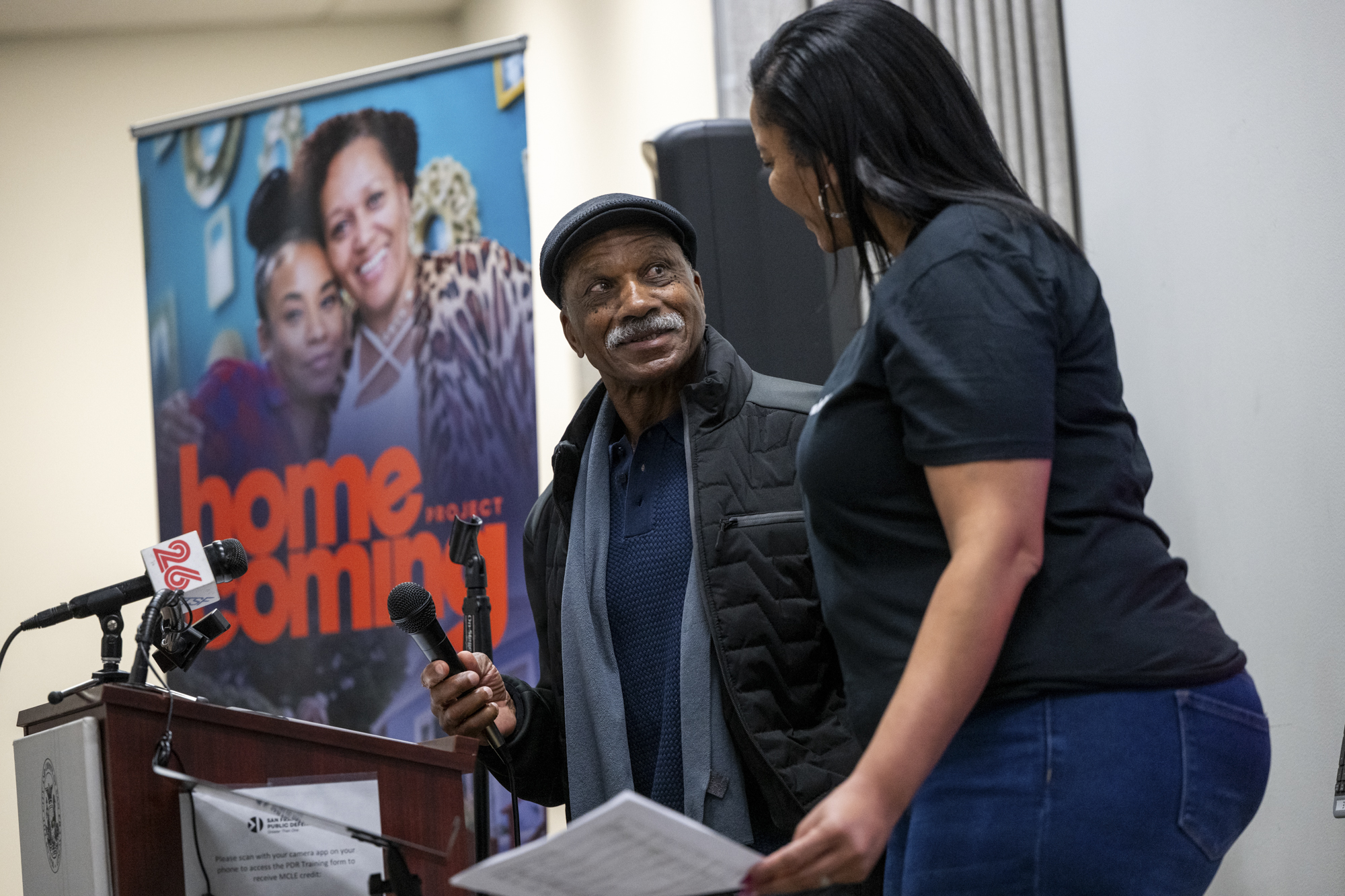
"caption": "Memi Vaughn (right), a Homecoming Project host, and Marcelino Clemente, a program participant, speak during a press conference about the launch of the Homecoming Project in San Francisco at the San Francisco Public Defender’s office on Nov. 13, 2025. The program pairs people recently released from prison with community members who have a spare room in their homes for a six-month stay.",
"credit": "Beth LaBerge/KQED",
"altTag": null,
"description": null,
"imgSizes": {
"thumbnail": {
"file": "https://cdn.kqed.org/wp-content/uploads/sites/10/2025/12/251113-SFHOMECOMINGPROJECT-19-BL-KQED-160x107.jpg",
"width": 160,
"height": 107,
"mimeType": "image/jpeg"
},
"1536x1536": {
"file": "https://cdn.kqed.org/wp-content/uploads/sites/10/2025/12/251113-SFHOMECOMINGPROJECT-19-BL-KQED-1536x1024.jpg",
"width": 1536,
"height": 1024,
"mimeType": "image/jpeg"
},
"post-thumbnail": {
"file": "https://cdn.kqed.org/wp-content/uploads/sites/10/2025/12/251113-SFHOMECOMINGPROJECT-19-BL-KQED-672x372.jpg",
"width": 672,
"height": 372,
"mimeType": "image/jpeg"
},
"twentyfourteen-full-width": {
"file": "https://cdn.kqed.org/wp-content/uploads/sites/10/2025/12/251113-SFHOMECOMINGPROJECT-19-BL-KQED-1038x576.jpg",
"width": 1038,
"height": 576,
"mimeType": "image/jpeg"
},
"npr-cds-wide": {
"file": "https://cdn.kqed.org/wp-content/uploads/sites/10/2025/12/251113-SFHOMECOMINGPROJECT-19-BL-KQED-1200x675.jpg",
"width": 1200,
"height": 675,
"mimeType": "image/jpeg"
},
"kqedFullSize": {
"file": "https://cdn.kqed.org/wp-content/uploads/sites/10/2025/12/251113-SFHOMECOMINGPROJECT-19-BL-KQED.jpg",
"width": 2000,
"height": 1333
}
},
"isLoading": false,
"fetchFailed": false
},
"news_12066517": {
"type": "attachments",
"id": "news_12066517",
"meta": {
"index": "attachments_1716263798",
"site": "news",
"id": "12066517",
"found": true
},
"title": "BilalMahmoodKQED1",
"publishDate": 1765323538,
"status": "inherit",
"parent": 12066486,
"modified": 1765323820,
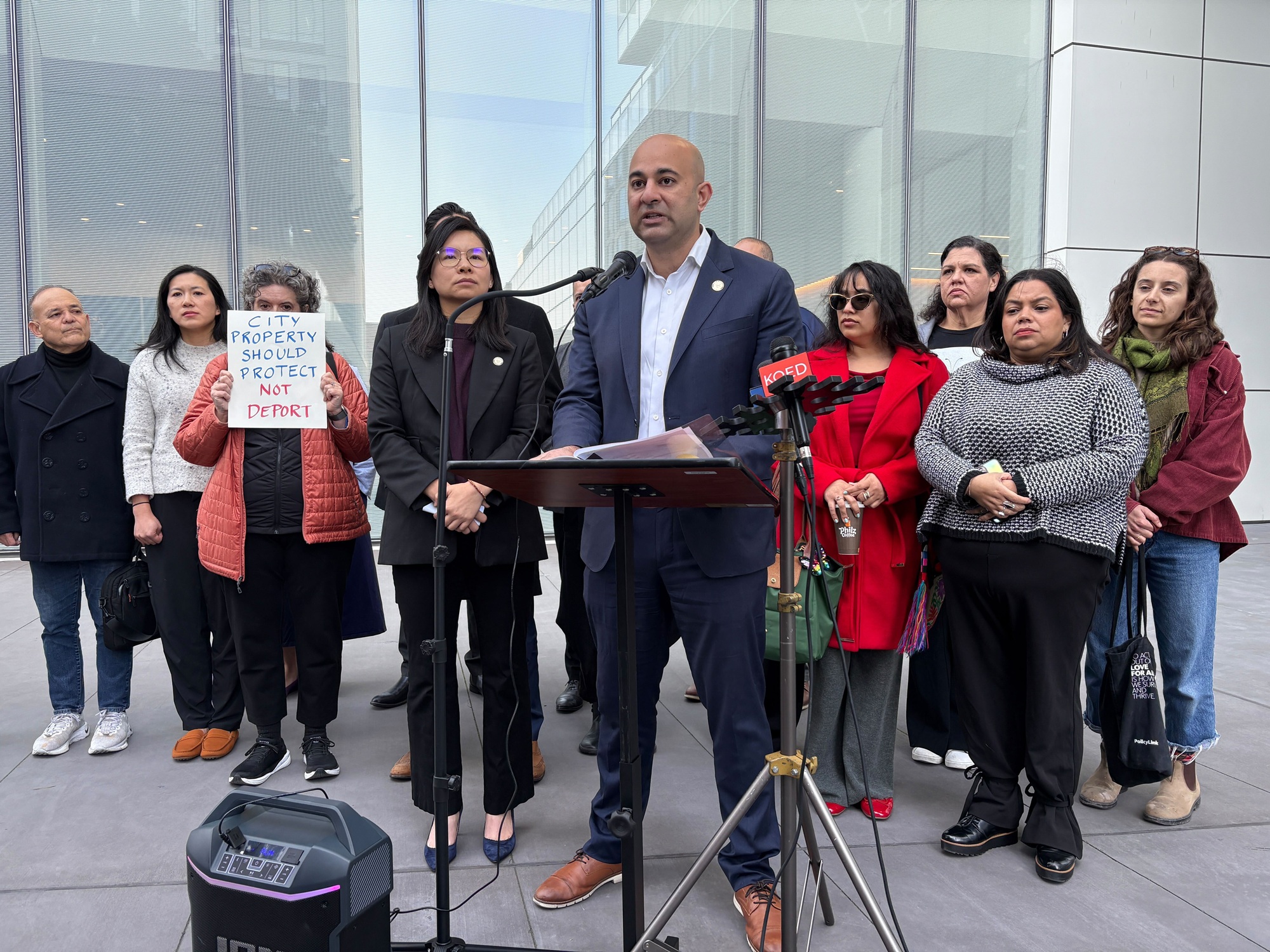
"caption": "Supervisors Bilal Mahmood and Chyanne Chen are proposing to block federal immigration activity from city-owned spaces.",
"credit": "Sydney Johnson/KQED",
"altTag": null,
"description": null,
"imgSizes": {
"thumbnail": {
"file": "https://cdn.kqed.org/wp-content/uploads/sites/10/2025/12/BilalMahmoodKQED1-160x120.jpg",
"width": 160,
"height": 120,
"mimeType": "image/jpeg"
},
"1536x1536": {
"file": "https://cdn.kqed.org/wp-content/uploads/sites/10/2025/12/BilalMahmoodKQED1-1536x1152.jpg",
"width": 1536,
"height": 1152,
"mimeType": "image/jpeg"
},
"post-thumbnail": {
"file": "https://cdn.kqed.org/wp-content/uploads/sites/10/2025/12/BilalMahmoodKQED1-672x372.jpg",
"width": 672,
"height": 372,
"mimeType": "image/jpeg"
},
"twentyfourteen-full-width": {
"file": "https://cdn.kqed.org/wp-content/uploads/sites/10/2025/12/BilalMahmoodKQED1-1038x576.jpg",
"width": 1038,
"height": 576,
"mimeType": "image/jpeg"
},
"npr-cds-wide": {
"file": "https://cdn.kqed.org/wp-content/uploads/sites/10/2025/12/BilalMahmoodKQED1-1200x675.jpg",
"width": 1200,
"height": 675,
"mimeType": "image/jpeg"
},
"kqedFullSize": {
"file": "https://cdn.kqed.org/wp-content/uploads/sites/10/2025/12/BilalMahmoodKQED1.jpg",
"width": 2000,
"height": 1500
}
},
"isLoading": false,
"fetchFailed": false
},
"news_12065011": {
"type": "attachments",
"id": "news_12065011",
"meta": {
"index": "attachments_1716263798",
"site": "news",
"id": "12065011",
"found": true
},
"title": "251120-KEVIN EPPS TRIAL-ADE-02-KQED",
"publishDate": 1763685261,
"status": "inherit",
"parent": 12064918,
"modified": 1763748493,
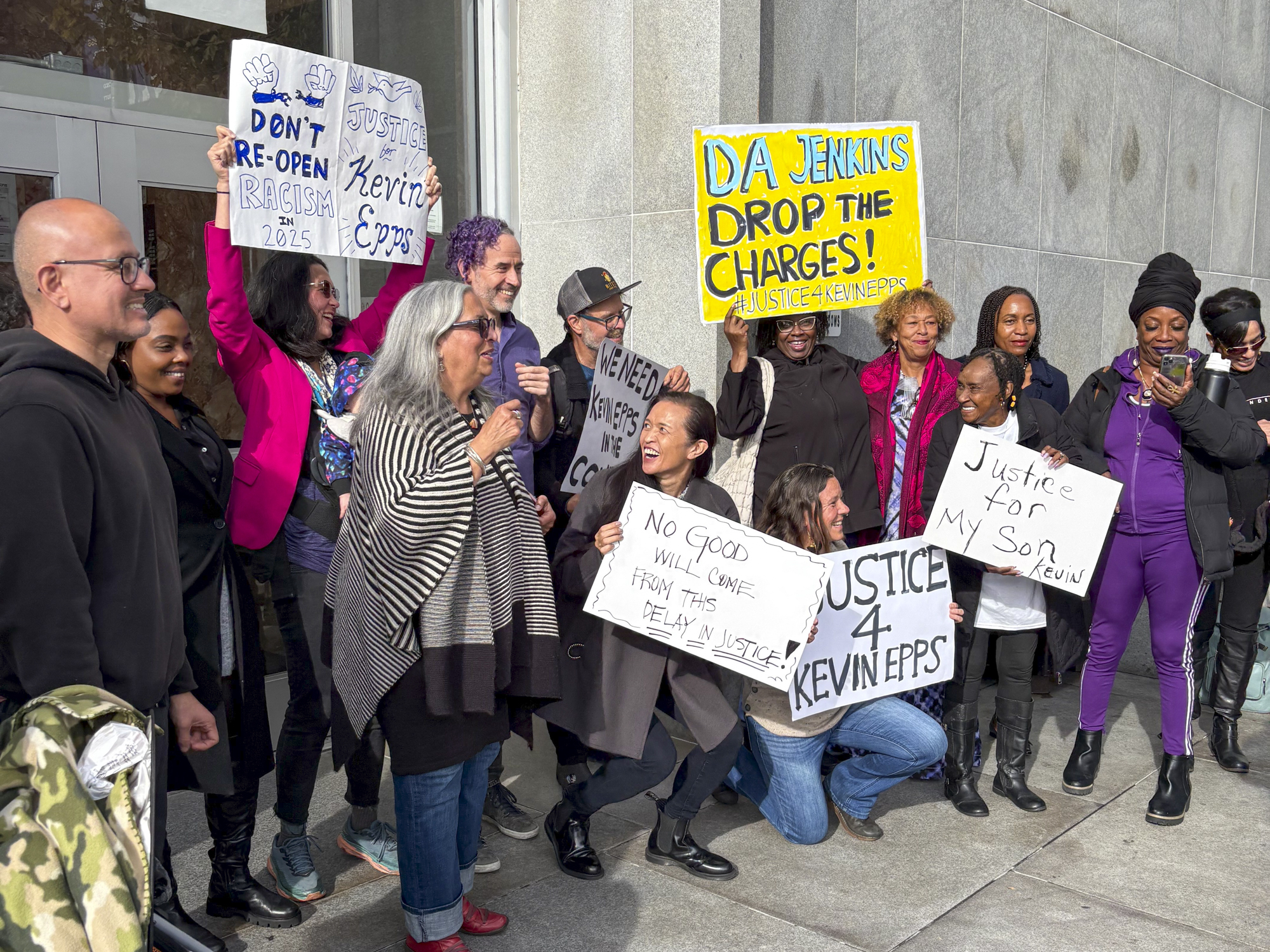
"caption": "Supporters of Kevin Epps rally outside of the Hall of Justice in San Francisco on Nov. 20, 2025.",
"credit": "Azul Dahlstrom-Eckman/KQED",
"altTag": null,
"description": null,
"imgSizes": {
"thumbnail": {
"file": "https://cdn.kqed.org/wp-content/uploads/sites/10/2025/11/251120-KEVIN-EPPS-TRIAL-ADE-02-KQED-160x120.jpg",
"width": 160,
"height": 120,
"mimeType": "image/jpeg"
},
"1536x1536": {
"file": "https://cdn.kqed.org/wp-content/uploads/sites/10/2025/11/251120-KEVIN-EPPS-TRIAL-ADE-02-KQED-1536x1152.jpg",
"width": 1536,
"height": 1152,
"mimeType": "image/jpeg"
},
"post-thumbnail": {
"file": "https://cdn.kqed.org/wp-content/uploads/sites/10/2025/11/251120-KEVIN-EPPS-TRIAL-ADE-02-KQED-672x372.jpg",
"width": 672,
"height": 372,
"mimeType": "image/jpeg"
},
"twentyfourteen-full-width": {
"file": "https://cdn.kqed.org/wp-content/uploads/sites/10/2025/11/251120-KEVIN-EPPS-TRIAL-ADE-02-KQED-1038x576.jpg",
"width": 1038,
"height": 576,
"mimeType": "image/jpeg"
},
"npr-cds-wide": {
"file": "https://cdn.kqed.org/wp-content/uploads/sites/10/2025/11/251120-KEVIN-EPPS-TRIAL-ADE-02-KQED-1200x675.jpg",
"width": 1200,
"height": 675,
"mimeType": "image/jpeg"
},
"kqedFullSize": {
"file": "https://cdn.kqed.org/wp-content/uploads/sites/10/2025/11/251120-KEVIN-EPPS-TRIAL-ADE-02-KQED.jpg",
"width": 2000,
"height": 1500
}
},
"isLoading": false,
"fetchFailed": false
},
"news_12066307": {
"type": "attachments",
"id": "news_12066307",
"meta": {
"index": "attachments_1716263798",
"site": "news",
"id": "12066307",
"found": true
},
"title": "251205-WCCUSDSTRIKERALLY00616_TV-KQED",
"publishDate": 1764976010,
"status": "inherit",
"parent": 12066054,
"modified": 1764979984,
"caption": "West Contra Costa Unified School District teachers and families continue their strike at Marina Bay Park in Richmond on Dec. 5, 2025.",
"credit": "Tâm Vũ/KQED",
"altTag": null,
"description": null,
"imgSizes": {
"thumbnail": {
"file": "https://cdn.kqed.org/wp-content/uploads/sites/10/2025/12/251205-WCCUSDSTRIKERALLY00616_TV-KQED-160x107.jpg",
"width": 160,
"height": 107,
"mimeType": "image/jpeg"
},
"1536x1536": {
"file": "https://cdn.kqed.org/wp-content/uploads/sites/10/2025/12/251205-WCCUSDSTRIKERALLY00616_TV-KQED-1536x1024.jpg",
"width": 1536,
"height": 1024,
"mimeType": "image/jpeg"
},
"post-thumbnail": {
"file": "https://cdn.kqed.org/wp-content/uploads/sites/10/2025/12/251205-WCCUSDSTRIKERALLY00616_TV-KQED-672x372.jpg",
"width": 672,
"height": 372,
"mimeType": "image/jpeg"
},
"twentyfourteen-full-width": {
"file": "https://cdn.kqed.org/wp-content/uploads/sites/10/2025/12/251205-WCCUSDSTRIKERALLY00616_TV-KQED-1038x576.jpg",
"width": 1038,
"height": 576,
"mimeType": "image/jpeg"
},
"npr-cds-wide": {
"file": "https://cdn.kqed.org/wp-content/uploads/sites/10/2025/12/251205-WCCUSDSTRIKERALLY00616_TV-KQED-1200x675.jpg",
"width": 1200,
"height": 675,
"mimeType": "image/jpeg"
},
"kqedFullSize": {
"file": "https://cdn.kqed.org/wp-content/uploads/sites/10/2025/12/251205-WCCUSDSTRIKERALLY00616_TV-KQED.jpg",
"width": 2000,
"height": 1333
}
},
"isLoading": false,
"fetchFailed": false
},
"news_12066399": {
"type": "attachments",
"id": "news_12066399",
"meta": {
"index": "attachments_1716263798",
"site": "news",
"id": "12066399",
"found": true
},
"title": "SF General Hospital Vigil For Slain Social Worker In San Francisco",
"publishDate": 1765237584,
"status": "inherit",
"parent": 12066395,
"modified": 1765239811,
"caption": "Carly Jones adorns a memorial as SF General Hospital union members hold a vigil for their slain colleague outside the hospital in San Francisco on Sunday, Dec. 7, 2025. The social worker died a week ago, Saturday, from wounds sustained in a knife attack.",
"credit": "Scott Strazzante/San Francisco Chronicle via Getty Images",
"altTag": null,
"description": null,
"imgSizes": {
"thumbnail": {
"file": "https://cdn.kqed.org/wp-content/uploads/sites/10/2025/12/San-Francisco-General-Hospital-Getty-160x107.jpg",
"width": 160,
"height": 107,
"mimeType": "image/jpeg"
},
"1536x1536": {
"file": "https://cdn.kqed.org/wp-content/uploads/sites/10/2025/12/San-Francisco-General-Hospital-Getty-1536x1025.jpg",
"width": 1536,
"height": 1025,
"mimeType": "image/jpeg"
},
"post-thumbnail": {
"file": "https://cdn.kqed.org/wp-content/uploads/sites/10/2025/12/San-Francisco-General-Hospital-Getty-672x372.jpg",
"width": 672,
"height": 372,
"mimeType": "image/jpeg"
},
"twentyfourteen-full-width": {
"file": "https://cdn.kqed.org/wp-content/uploads/sites/10/2025/12/San-Francisco-General-Hospital-Getty-1038x576.jpg",
"width": 1038,
"height": 576,
"mimeType": "image/jpeg"
},
"npr-cds-wide": {
"file": "https://cdn.kqed.org/wp-content/uploads/sites/10/2025/12/San-Francisco-General-Hospital-Getty-1200x675.jpg",
"width": 1200,
"height": 675,
"mimeType": "image/jpeg"
},
"kqedFullSize": {
"file": "https://cdn.kqed.org/wp-content/uploads/sites/10/2025/12/San-Francisco-General-Hospital-Getty.jpg",
"width": 2000,
"height": 1334
}
},
"isLoading": false,
"fetchFailed": false
},
"news_12023482": {
"type": "attachments",
"id": "news_12023482",
"meta": {
"index": "attachments_1716263798",
"site": "news",
"id": "12023482",
"found": true
},
"title": "Two people wait for a train at BART Powell Street station in San Francisco, Calif., on Tuesday, February 11, 2020.",
"publishDate": 1737574272,
"status": "inherit",
"parent": 12023463,
"modified": 1737588181,
"caption": "Two people wait for a train at BART Powell Street station in San Francisco, California, on Tuesday, Feb. 11, 2020. ",
"credit": "Scott Strazzante/San Francisco Chronicle via Getty Images",
"altTag": null,
"description": null,
"imgSizes": {
"medium": {
"file": "https://cdn.kqed.org/wp-content/uploads/sites/10/2025/01/PowellStationSanFranciscoGetty-800x534.jpg",
"width": 800,
"height": 534,
"mimeType": "image/jpeg"
},
"large": {
"file": "https://cdn.kqed.org/wp-content/uploads/sites/10/2025/01/PowellStationSanFranciscoGetty-1020x680.jpg",
"width": 1020,
"height": 680,
"mimeType": "image/jpeg"
},
"thumbnail": {
"file": "https://cdn.kqed.org/wp-content/uploads/sites/10/2025/01/PowellStationSanFranciscoGetty-160x107.jpg",
"width": 160,
"height": 107,
"mimeType": "image/jpeg"
},
"1536x1536": {
"file": "https://cdn.kqed.org/wp-content/uploads/sites/10/2025/01/PowellStationSanFranciscoGetty-1536x1025.jpg",
"width": 1536,
"height": 1025,
"mimeType": "image/jpeg"
},
"post-thumbnail": {
"file": "https://cdn.kqed.org/wp-content/uploads/sites/10/2025/01/PowellStationSanFranciscoGetty-672x372.jpg",
"width": 672,
"height": 372,
"mimeType": "image/jpeg"
},
"twentyfourteen-full-width": {
"file": "https://cdn.kqed.org/wp-content/uploads/sites/10/2025/01/PowellStationSanFranciscoGetty-1038x576.jpg",
"width": 1038,
"height": 576,
"mimeType": "image/jpeg"
},
"full-width": {
"file": "https://cdn.kqed.org/wp-content/uploads/sites/10/2025/01/PowellStationSanFranciscoGetty-1920x1281.jpg",
"width": 1920,
"height": 1281,
"mimeType": "image/jpeg"
},
"kqedFullSize": {
"file": "https://cdn.kqed.org/wp-content/uploads/sites/10/2025/01/PowellStationSanFranciscoGetty.jpg",
"width": 2000,
"height": 1334
}
},
"isLoading": false,
"fetchFailed": false
},
"news_12065499": {
"type": "attachments",
"id": "news_12065499",
"meta": {
"index": "attachments_1716263798",
"site": "news",
"id": "12065499",
"found": true
},
"title": "251124-DISABILITYJUSTICELEADERS00314_TV-KQED",
"publishDate": 1764191449,
"status": "inherit",
"parent": 0,
"modified": 1764883872,
"caption": "Brittanie Hernandez-Wilson, a disability justice activist, poses for a portrait at Lake Merritt in Oakland on Nov. 24, 2025. Hernandez-Wilson worked closely with Alice Wong, a disability justice leader who died in November.",
"credit": "Tâm Vũ/KQED",
"altTag": null,
"description": null,
"imgSizes": {
"thumbnail": {
"file": "https://cdn.kqed.org/wp-content/uploads/sites/10/2025/11/251124-DISABILITYJUSTICELEADERS00314_TV-KQED-160x107.jpg",
"width": 160,
"height": 107,
"mimeType": "image/jpeg"
},
"1536x1536": {
"file": "https://cdn.kqed.org/wp-content/uploads/sites/10/2025/11/251124-DISABILITYJUSTICELEADERS00314_TV-KQED-1536x1024.jpg",
"width": 1536,
"height": 1024,
"mimeType": "image/jpeg"
},
"post-thumbnail": {
"file": "https://cdn.kqed.org/wp-content/uploads/sites/10/2025/11/251124-DISABILITYJUSTICELEADERS00314_TV-KQED-672x372.jpg",
"width": 672,
"height": 372,
"mimeType": "image/jpeg"
},
"twentyfourteen-full-width": {
"file": "https://cdn.kqed.org/wp-content/uploads/sites/10/2025/11/251124-DISABILITYJUSTICELEADERS00314_TV-KQED-1038x576.jpg",
"width": 1038,
"height": 576,
"mimeType": "image/jpeg"
},
"npr-cds-wide": {
"file": "https://cdn.kqed.org/wp-content/uploads/sites/10/2025/11/251124-DISABILITYJUSTICELEADERS00314_TV-KQED-1200x675.jpg",
"width": 1200,
"height": 675,
"mimeType": "image/jpeg"
},
"kqedFullSize": {
"file": "https://cdn.kqed.org/wp-content/uploads/sites/10/2025/11/251124-DISABILITYJUSTICELEADERS00314_TV-KQED.jpg",
"width": 2000,
"height": 1333
}
},
"isLoading": false,
"fetchFailed": false
},
"news_12066309": {
"type": "attachments",
"id": "news_12066309",
"meta": {
"index": "attachments_1716263798",
"site": "news",
"id": "12066309",
"found": true
},
"title": "251205-WCCUSDSTRIKERALLY01085_TV-KQED",
"publishDate": 1764976018,
"status": "inherit",
"parent": 0,
"modified": 1764976079,
"caption": "West Contra Costa Unified School District teachers and families continue their strike at Marina Bay Park in Richmond on December 5, 2025.",
"credit": "Tâm Vũ/KQED",
"altTag": null,
"description": null,
"imgSizes": {
"thumbnail": {
"file": "https://cdn.kqed.org/wp-content/uploads/sites/10/2025/12/251205-WCCUSDSTRIKERALLY01085_TV-KQED-160x107.jpg",
"width": 160,
"height": 107,
"mimeType": "image/jpeg"
},
"1536x1536": {
"file": "https://cdn.kqed.org/wp-content/uploads/sites/10/2025/12/251205-WCCUSDSTRIKERALLY01085_TV-KQED-1536x1024.jpg",
"width": 1536,
"height": 1024,
"mimeType": "image/jpeg"
},
"post-thumbnail": {
"file": "https://cdn.kqed.org/wp-content/uploads/sites/10/2025/12/251205-WCCUSDSTRIKERALLY01085_TV-KQED-672x372.jpg",
"width": 672,
"height": 372,
"mimeType": "image/jpeg"
},
"twentyfourteen-full-width": {
"file": "https://cdn.kqed.org/wp-content/uploads/sites/10/2025/12/251205-WCCUSDSTRIKERALLY01085_TV-KQED-1038x576.jpg",
"width": 1038,
"height": 576,
"mimeType": "image/jpeg"
},
"npr-cds-wide": {
"file": "https://cdn.kqed.org/wp-content/uploads/sites/10/2025/12/251205-WCCUSDSTRIKERALLY01085_TV-KQED-1200x675.jpg",
"width": 1200,
"height": 675,
"mimeType": "image/jpeg"
},
"kqedFullSize": {
"file": "https://cdn.kqed.org/wp-content/uploads/sites/10/2025/12/251205-WCCUSDSTRIKERALLY01085_TV-KQED.jpg",
"width": 2000,
"height": 1333
}
},
"isLoading": false,
"fetchFailed": false
},
"news_12046361": {
"type": "attachments",
"id": "news_12046361",
"meta": {
"index": "attachments_1716263798",
"site": "news",
"id": "12046361",
"found": true
},
"title": "250421-SFUSDCentralCuts-06-BL_qed (1)",
"publishDate": 1751052877,
"status": "inherit",
"parent": 12046122,
"modified": 1751052886,
"caption": "San Francisco Unified School District Superintendent Dr. Maria Su speaks during a press conference at the school district offices in San Francisco on April 21, 2025.",
"credit": "Beth LaBerge/KQED",
"altTag": null,
"description": null,
"imgSizes": {
"thumbnail": {
"file": "https://cdn.kqed.org/wp-content/uploads/sites/10/2025/06/250421-SFUSDCentralCuts-06-BL_qed-1-160x107.jpg",
"width": 160,
"height": 107,
"mimeType": "image/jpeg"
},
"1536x1536": {
"file": "https://cdn.kqed.org/wp-content/uploads/sites/10/2025/06/250421-SFUSDCentralCuts-06-BL_qed-1-1536x1024.jpg",
"width": 1536,
"height": 1024,
"mimeType": "image/jpeg"
},
"post-thumbnail": {
"file": "https://cdn.kqed.org/wp-content/uploads/sites/10/2025/06/250421-SFUSDCentralCuts-06-BL_qed-1-672x372.jpg",
"width": 672,
"height": 372,
"mimeType": "image/jpeg"
},
"twentyfourteen-full-width": {
"file": "https://cdn.kqed.org/wp-content/uploads/sites/10/2025/06/250421-SFUSDCentralCuts-06-BL_qed-1-1038x576.jpg",
"width": 1038,
"height": 576,
"mimeType": "image/jpeg"
},
"kqedFullSize": {
"file": "https://cdn.kqed.org/wp-content/uploads/sites/10/2025/06/250421-SFUSDCentralCuts-06-BL_qed-1.jpg",
"width": 1999,
"height": 1333
}
},
"isLoading": false,
"fetchFailed": false
},
"news_12066268": {
"type": "attachments",
"id": "news_12066268",
"meta": {
"index": "attachments_1716263798",
"site": "news",
"id": "12066268",
"found": true
},
"title": "OpenAIProtestKQED2",
"publishDate": 1764962340,
"status": "inherit",
"parent": 12066171,
"modified": 1764969095,
"caption": "San Francisco police command protestors and reporters to stand back as they detain members of Stop AI after they chained shut the front doors of OpenAI's San Francisco headquarters on Feb. 22, 2025. Several of the group members are awaiting trial on trespassing and disrupting a business.",
"credit": "Brian Krans/KQED",
"altTag": null,
"description": null,
"imgSizes": {
"thumbnail": {
"file": "https://cdn.kqed.org/wp-content/uploads/sites/10/2025/12/OpenAIProtestKQED2-160x107.jpg",
"width": 160,
"height": 107,
"mimeType": "image/jpeg"
},
"1536x1536": {
"file": "https://cdn.kqed.org/wp-content/uploads/sites/10/2025/12/OpenAIProtestKQED2-1536x1024.jpg",
"width": 1536,
"height": 1024,
"mimeType": "image/jpeg"
},
"post-thumbnail": {
"file": "https://cdn.kqed.org/wp-content/uploads/sites/10/2025/12/OpenAIProtestKQED2-672x372.jpg",
"width": 672,
"height": 372,
"mimeType": "image/jpeg"
},
"twentyfourteen-full-width": {
"file": "https://cdn.kqed.org/wp-content/uploads/sites/10/2025/12/OpenAIProtestKQED2-1038x576.jpg",
"width": 1038,
"height": 576,
"mimeType": "image/jpeg"
},
"npr-cds-wide": {
"file": "https://cdn.kqed.org/wp-content/uploads/sites/10/2025/12/OpenAIProtestKQED2-1200x675.jpg",
"width": 1200,
"height": 675,
"mimeType": "image/jpeg"
},
"kqedFullSize": {
"file": "https://cdn.kqed.org/wp-content/uploads/sites/10/2025/12/OpenAIProtestKQED2.jpg",
"width": 2000,
"height": 1333
}
},
"isLoading": false,
"fetchFailed": false
},
"news_11935568": {
"type": "attachments",
"id": "news_11935568",
"meta": {
"index": "attachments_1716263798",
"site": "news",
"id": "11935568",
"found": true
},
"parent": 11935500,
"imgSizes": {
"twentyfourteen-full-width": {
"file": "https://cdn.kqed.org/wp-content/uploads/sites/10/2022/12/RS46625_009_SanFrancisco_Hospital_01142021-qut-1038x576.jpg",
"width": 1038,
"mimeType": "image/jpeg",
"height": 576
},
"thumbnail": {
"file": "https://cdn.kqed.org/wp-content/uploads/sites/10/2022/12/RS46625_009_SanFrancisco_Hospital_01142021-qut-160x107.jpg",
"width": 160,
"mimeType": "image/jpeg",
"height": 107
},
"post-thumbnail": {
"file": "https://cdn.kqed.org/wp-content/uploads/sites/10/2022/12/RS46625_009_SanFrancisco_Hospital_01142021-qut-672x372.jpg",
"width": 672,
"mimeType": "image/jpeg",
"height": 372
},
"kqedFullSize": {
"file": "https://cdn.kqed.org/wp-content/uploads/sites/10/2022/12/RS46625_009_SanFrancisco_Hospital_01142021-qut.jpg",
"width": 1920,
"height": 1280
},
"large": {
"file": "https://cdn.kqed.org/wp-content/uploads/sites/10/2022/12/RS46625_009_SanFrancisco_Hospital_01142021-qut-1020x680.jpg",
"width": 1020,
"mimeType": "image/jpeg",
"height": 680
},
"1536x1536": {
"file": "https://cdn.kqed.org/wp-content/uploads/sites/10/2022/12/RS46625_009_SanFrancisco_Hospital_01142021-qut-1536x1024.jpg",
"width": 1536,
"mimeType": "image/jpeg",
"height": 1024
},
"medium": {
"file": "https://cdn.kqed.org/wp-content/uploads/sites/10/2022/12/RS46625_009_SanFrancisco_Hospital_01142021-qut-800x533.jpg",
"width": 800,
"mimeType": "image/jpeg",
"height": 533
}
},
"publishDate": 1671224046,
"modified": 1703727902,
"caption": "A San Francisco Fire Department ambulance leaves the Zuckerberg San Francisco General Hospital on Jan. 14, 2021. ",
"description": null,
"title": "RS46625_009_SanFrancisco_Hospital_01142021-qut",
"credit": "Beth LaBerge/KQED",
"status": "inherit",
"altTag": "An ambulance outside of a hospital.",
"isLoading": false,
"fetchFailed": false
},
"news_12065985": {
"type": "attachments",
"id": "news_12065985",
"meta": {
"index": "attachments_1716263798",
"site": "news",
"id": "12065985",
"found": true
},
"title": "IMG_1280",
"publishDate": 1764804943,
"status": "inherit",
"parent": 12065967,
"modified": 1764804975,
"caption": "What to know if you're a borrower in the process of paying off student debt — from the changes to federal loan forgiveness and income-driven repayment plans to the latest legal proceedings and how they might affect you.",
"credit": "Anna Vignet/KQED",
"altTag": null,
"description": null,
"imgSizes": {
"medium": {
"file": "https://cdn.kqed.org/wp-content/uploads/sites/10/2025/12/IMG_1280-2000x1500.jpg",
"width": 2000,
"height": 1500,
"mimeType": "image/jpeg"
},
"large": {
"file": "https://cdn.kqed.org/wp-content/uploads/sites/10/2025/12/IMG_1280-2000x1500.jpg",
"width": 2000,
"height": 1500,
"mimeType": "image/jpeg"
},
"thumbnail": {
"file": "https://cdn.kqed.org/wp-content/uploads/sites/10/2025/12/IMG_1280-160x120.jpg",
"width": 160,
"height": 120,
"mimeType": "image/jpeg"
},
"1536x1536": {
"file": "https://cdn.kqed.org/wp-content/uploads/sites/10/2025/12/IMG_1280-1536x1152.jpg",
"width": 1536,
"height": 1152,
"mimeType": "image/jpeg"
},
"2048x2048": {
"file": "https://cdn.kqed.org/wp-content/uploads/sites/10/2025/12/IMG_1280-2048x1536.jpg",
"width": 2048,
"height": 1536,
"mimeType": "image/jpeg"
},
"post-thumbnail": {
"file": "https://cdn.kqed.org/wp-content/uploads/sites/10/2025/12/IMG_1280-672x372.jpg",
"width": 672,
"height": 372,
"mimeType": "image/jpeg"
},
"twentyfourteen-full-width": {
"file": "https://cdn.kqed.org/wp-content/uploads/sites/10/2025/12/IMG_1280-1038x576.jpg",
"width": 1038,
"height": 576,
"mimeType": "image/jpeg"
},
"full-width": {
"file": "https://cdn.kqed.org/wp-content/uploads/sites/10/2025/12/IMG_1280-2000x1500.jpg",
"width": 2000,
"height": 1500,
"mimeType": "image/jpeg"
},
"npr-cds-wide": {
"file": "https://cdn.kqed.org/wp-content/uploads/sites/10/2025/12/IMG_1280-1200x675.jpg",
"width": 1200,
"height": 675,
"mimeType": "image/jpeg"
},
"kqedFullSize": {
"file": "https://cdn.kqed.org/wp-content/uploads/sites/10/2025/12/IMG_1280.jpg",
"width": 2560,
"height": 1920
}
},
"isLoading": false,
"fetchFailed": false
}
},
"audioPlayerReducer": {
"postId": "stream_live",
"isPaused": true,
"isPlaying": false,
"pfsActive": false,
"pledgeModalIsOpen": true,
"playerDrawerIsOpen": false,
"liveAudioPlayStartedAt": 0,
"liveAudioPlayContext": ""
},
"authorsReducer": {
"byline_news_12066054": {
"type": "authors",
"id": "byline_news_12066054",
"meta": {
"override": true
},
"slug": "byline_news_12066054",
"name": "Meghan Crebbin-Coates and Juan Carlos Lara",
"isLoading": false
},
"shossaini": {
"type": "authors",
"id": "3214",
"meta": {
"index": "authors_1716337520",
"id": "3214",
"found": true
},
"name": "Sara Hossaini",
"firstName": "Sara",
"lastName": "Hossaini",
"slug": "shossaini",
"email": "shossaini@kqed.org",
"display_author_email": true,
"staff_mastheads": [
"news"
],
"title": "KQED Reporter",
"bio": "Sara Hossaini came to general assignment reporting at KQED in 2013 after two winters reporting at Wyoming Public Radio. She holds a bachelor's degree in broadcast journalism from the University of Nebraska-Lincoln. Her radio romance began after a bitter breakup with documentary film (Ok, maybe it's still complicated). Her first simultaneous jobs in San Francisco were as Associate Producer on a PBS film series through the Center for Asian American Media and as a butler. She likes to trot, plot and make things with her hands.",
"avatar": "https://secure.gravatar.com/avatar/060e9f56b9554e17942e89f413242774?s=600&d=blank&r=g",
"twitter": "mshossaini",
"facebook": null,
"instagram": null,
"linkedin": null,
"sites": [
{
"site": "news",
"roles": [
"author"
]
},
{
"site": "stateofhealth",
"roles": [
"author"
]
}
],
"headData": {
"title": "Sara Hossaini | KQED",
"description": "KQED Reporter",
"ogImgSrc": "https://secure.gravatar.com/avatar/060e9f56b9554e17942e89f413242774?s=600&d=blank&r=g",
"twImgSrc": "https://secure.gravatar.com/avatar/060e9f56b9554e17942e89f413242774?s=600&d=blank&r=g"
},
"isLoading": false,
"link": "/author/shossaini"
},
"mlagos": {
"type": "authors",
"id": "3239",
"meta": {
"index": "authors_1716337520",
"id": "3239",
"found": true
},
"name": "Marisa Lagos",
"firstName": "Marisa",
"lastName": "Lagos",
"slug": "mlagos",
"email": "mlagos@kqed.org",
"display_author_email": false,
"staff_mastheads": [
"news"
],
"title": "KQED Contributor",
"bio": "Marisa Lagos is a correspondent for KQED’s California Politics and Government Desk and co-hosts the award-winning show and podcast, Political Breakdown. At KQED, Lagos also conducts reporting, analysis and investigations into state, local and national politics for radio, TV, online and onstage. In 2022, she and co-host, Scott Shafer, moderated the only gubernatorial debate in California. In 2020, the \u003ci>Washington Post\u003c/i> named her one of the top political journalists in California; she was nominated for a Peabody and won several other awards for her work investigating the 2017 California wildfires. She has worked at the \u003ci>San Francisco Chronicle\u003c/i>, \u003ci>San Francisco Examiner\u003c/i> and \u003ci>Los Angeles Times\u003c/i>. A UC Santa Barbara graduate, she lives in San Francisco with her two sons and husband.",
"avatar": "https://secure.gravatar.com/avatar/a261a0d3696fc066871ef96b85b5e7d2?s=600&d=blank&r=g",
"twitter": "@mlagos",
"facebook": null,
"instagram": null,
"linkedin": null,
"sites": [
{
"site": "arts",
"roles": [
"author"
]
},
{
"site": "news",
"roles": [
"editor"
]
},
{
"site": "science",
"roles": [
"editor"
]
},
{
"site": "forum",
"roles": [
"author"
]
},
{
"site": "liveblog",
"roles": [
"author"
]
}
],
"headData": {
"title": "Marisa Lagos | KQED",
"description": "KQED Contributor",
"ogImgSrc": "https://secure.gravatar.com/avatar/a261a0d3696fc066871ef96b85b5e7d2?s=600&d=blank&r=g",
"twImgSrc": "https://secure.gravatar.com/avatar/a261a0d3696fc066871ef96b85b5e7d2?s=600&d=blank&r=g"
},
"isLoading": false,
"link": "/author/mlagos"
},
"ccabreralomeli": {
"type": "authors",
"id": "11708",
"meta": {
"index": "authors_1716337520",
"id": "11708",
"found": true
},
"name": "Carlos Cabrera-Lomelí",
"firstName": "Carlos",
"lastName": "Cabrera-Lomelí",
"slug": "ccabreralomeli",
"email": "ccabreralomeli@KQED.org",
"display_author_email": true,
"staff_mastheads": [
"news"
],
"title": "Community Reporter",
"bio": "Carlos Cabrera-Lomelí is a community reporter with KQED's digital engagement team. He also reports and co-produces for KQED's bilingual news hub KQED en Español. He grew up in San Francisco's Mission District and has previously worked with Univision, 48 Hills and REFORMA in Mexico City.",
"avatar": "https://secure.gravatar.com/avatar/c309be9665e484f887b818c89e273ecc673004f426f36b24d00a4d813a2e0518?s=600&d=blank&r=g",
"twitter": "@LomeliCabrera",
"bluesky": null,
"facebook": null,
"instagram": null,
"linkedin": null,
"sites": [
{
"site": "arts",
"roles": [
"editor"
]
},
{
"site": "news",
"roles": [
"editor"
]
},
{
"site": "about",
"roles": [
"editor"
]
},
{
"site": "science",
"roles": [
"editor"
]
},
{
"site": "perspectives",
"roles": [
"editor"
]
},
{
"site": "elections",
"roles": [
"editor"
]
},
{
"site": "liveblog",
"roles": [
"contributor"
]
}
],
"headData": {
"title": "Carlos Cabrera-Lomelí | KQED",
"description": "Community Reporter",
"ogImgSrc": "https://secure.gravatar.com/avatar/c309be9665e484f887b818c89e273ecc673004f426f36b24d00a4d813a2e0518?s=600&d=blank&r=g",
"twImgSrc": "https://secure.gravatar.com/avatar/c309be9665e484f887b818c89e273ecc673004f426f36b24d00a4d813a2e0518?s=600&d=blank&r=g"
},
"isLoading": false,
"link": "/author/ccabreralomeli"
},
"adahlstromeckman": {
"type": "authors",
"id": "11785",
"meta": {
"index": "authors_1716337520",
"id": "11785",
"found": true
},
"name": "Azul Dahlstrom-Eckman",
"firstName": "Azul",
"lastName": "Dahlstrom-Eckman",
"slug": "adahlstromeckman",
"email": "adahlstrom-eckman@kqed.org",
"display_author_email": true,
"staff_mastheads": [],
"title": "Reporter",
"bio": "Azul is a reporter for KQED focusing on transportation and features. He joined KQED in 2021 as an alumnus of KALW's Audio Academy radio journalism training program.",
"avatar": "https://secure.gravatar.com/avatar/9cb750298435add7815a777f55bf1f46845c1386bb8452555c60a7b820b5aba3?s=600&d=blank&r=g",
"twitter": "@zuliemann",
"bluesky": "@azul415.bsky.social",
"facebook": null,
"instagram": null,
"linkedin": null,
"sites": [
{
"site": "arts",
"roles": [
"editor"
]
},
{
"site": "news",
"roles": [
"editor"
]
},
{
"site": "science",
"roles": [
"editor"
]
},
{
"site": "liveblog",
"roles": [
"author"
]
}
],
"headData": {
"title": "Azul Dahlstrom-Eckman | KQED",
"description": "Reporter",
"ogImgSrc": "https://secure.gravatar.com/avatar/9cb750298435add7815a777f55bf1f46845c1386bb8452555c60a7b820b5aba3?s=600&d=blank&r=g",
"twImgSrc": "https://secure.gravatar.com/avatar/9cb750298435add7815a777f55bf1f46845c1386bb8452555c60a7b820b5aba3?s=600&d=blank&r=g"
},
"isLoading": false,
"link": "/author/adahlstromeckman"
},
"sjohnson": {
"type": "authors",
"id": "11840",
"meta": {
"index": "authors_1716337520",
"id": "11840",
"found": true
},
"name": "Sydney Johnson",
"firstName": "Sydney",
"lastName": "Johnson",
"slug": "sjohnson",
"email": "sjohnson@kqed.org",
"display_author_email": false,
"staff_mastheads": [
"news"
],
"title": "KQED Reporter",
"bio": "Sydney Johnson is a general assignment reporter at KQED. She previously reported on public health and city government at the San Francisco Examiner, and before that, she covered statewide education policy for EdSource. Her reporting has won multiple local, state and national awards. Sydney is a graduate of the University of California, Berkeley and lives in San Francisco.",
"avatar": "https://secure.gravatar.com/avatar/97855f2719b72ad6190b7c535fe642c8?s=600&d=blank&r=g",
"twitter": "sydneyfjohnson",
"facebook": null,
"instagram": null,
"linkedin": null,
"sites": [
{
"site": "news",
"roles": [
"editor"
]
}
],
"headData": {
"title": "Sydney Johnson | KQED",
"description": "KQED Reporter",
"ogImgSrc": "https://secure.gravatar.com/avatar/97855f2719b72ad6190b7c535fe642c8?s=600&d=blank&r=g",
"twImgSrc": "https://secure.gravatar.com/avatar/97855f2719b72ad6190b7c535fe642c8?s=600&d=blank&r=g"
},
"isLoading": false,
"link": "/author/sjohnson"
},
"kdebenedetti": {
"type": "authors",
"id": "11913",
"meta": {
"index": "authors_1716337520",
"id": "11913",
"found": true
},
"name": "Katie DeBenedetti",
"firstName": "Katie",
"lastName": "DeBenedetti",
"slug": "kdebenedetti",
"email": "kdebenedetti@kqed.org",
"display_author_email": false,
"staff_mastheads": [
"news",
"science"
],
"title": "KQED Contributor",
"bio": "Katie DeBenedetti is a digital reporter covering daily news for the Express Desk. Prior to joining KQED as a culture reporting intern in January 2024, she covered education and city government for the Napa Valley Register.",
"avatar": "https://secure.gravatar.com/avatar/6e31073cb8f7e4214ab03f42771d0f45?s=600&d=blank&r=g",
"twitter": null,
"facebook": null,
"instagram": null,
"linkedin": null,
"sites": [
{
"site": "news",
"roles": [
"author"
]
},
{
"site": "science",
"roles": [
"author"
]
},
{
"site": "liveblog",
"roles": [
"author"
]
}
],
"headData": {
"title": "Katie DeBenedetti | KQED",
"description": "KQED Contributor",
"ogImgSrc": "https://secure.gravatar.com/avatar/6e31073cb8f7e4214ab03f42771d0f45?s=600&d=blank&r=g",
"twImgSrc": "https://secure.gravatar.com/avatar/6e31073cb8f7e4214ab03f42771d0f45?s=600&d=blank&r=g"
},
"isLoading": false,
"link": "/author/kdebenedetti"
},
"bkrans": {
"type": "authors",
"id": "11923",
"meta": {
"index": "authors_1716337520",
"id": "11923",
"found": true
},
"name": "Brian Krans",
"firstName": "Brian",
"lastName": "Krans",
"slug": "bkrans",
"email": "bkrans@kqed.org",
"display_author_email": false,
"staff_mastheads": [
"news"
],
"title": "KQED Contributing Reporter",
"bio": "Brian Krans is an award-winning local news and investigative reporter who has been proudly working as a general assignment reporter for KQED since August 2023. He lives in Richmond, where he also reports on air pollution for Richmondside. He is also a founding member of the Vallejo Sun.",
"avatar": "https://secure.gravatar.com/avatar/71fa91f931774612559f7640390b53d9c2840ff72b20f195a25239aab2d9fbb9?s=600&d=blank&r=g",
"twitter": "citizenkrans",
"bluesky": null,
"facebook": null,
"instagram": null,
"linkedin": null,
"sites": [
{
"site": "news",
"roles": [
"editor"
]
}
],
"headData": {
"title": "Brian Krans | KQED",
"description": "KQED Contributing Reporter",
"ogImgSrc": "https://secure.gravatar.com/avatar/71fa91f931774612559f7640390b53d9c2840ff72b20f195a25239aab2d9fbb9?s=600&d=blank&r=g",
"twImgSrc": "https://secure.gravatar.com/avatar/71fa91f931774612559f7640390b53d9c2840ff72b20f195a25239aab2d9fbb9?s=600&d=blank&r=g"
},
"isLoading": false,
"link": "/author/bkrans"
},
"ffenzi": {
"type": "authors",
"id": "11926",
"meta": {
"index": "authors_1716337520",
"id": "11926",
"found": true
},
"name": "Francesca Fenzi",
"firstName": "Francesca",
"lastName": "Fenzi",
"slug": "ffenzi",
"email": "ffenzi@kqed.org",
"display_author_email": false,
"staff_mastheads": [
"news"
],
"title": "On-Call Reporter, Producer & Host",
"bio": "Francesca Fenzi is an on-call reporter, producer and host at KQED. Her reporting has been featured on \u003ca href=\"https://www.kqed.org/californiareportmagazine\">The California Report Magazine\u003c/a> and several KQED podcasts, including \u003ca href=\"https://www.kqed.org/podcasts/baycurious\">Bay Curious\u003c/a> and \u003ca href=\"https://www.kqed.org/podcasts/closealltabs\">Close All Tabs\u003c/a>. She first joined the \u003ca href=\"https://www.kqed.org/forum\">Forum\u003c/a> team in 2022, producing for both local and statewide hours of the live public affairs show. Now she's a producer-at-large, contributing to radio, podcast and \u003ca href=\"https://www.kqed.org/explainers\">digital content\u003c/a> across the newsroom. You can occasionally hear her hosting KQED's morning weekend newscasts or joining the daily news podcast, \u003ca href=\"https://www.kqed.org/podcasts/thebay\">The Bay\u003c/a>, as a guest.",
"avatar": "https://secure.gravatar.com/avatar/ee77ef428c83307d7264619607140c84dd260b93748a969ce2d97016025feef3?s=600&d=blank&r=g",
"twitter": null,
"bluesky": null,
"facebook": null,
"instagram": null,
"linkedin": null,
"sites": [
{
"site": "",
"roles": [
"editor"
]
},
{
"site": "news",
"roles": [
"editor"
]
},
{
"site": "about",
"roles": [
"editor"
]
},
{
"site": "forum",
"roles": [
"editor"
]
}
],
"headData": {
"title": "Francesca Fenzi | KQED",
"description": "On-Call Reporter, Producer & Host",
"ogImgSrc": "https://secure.gravatar.com/avatar/ee77ef428c83307d7264619607140c84dd260b93748a969ce2d97016025feef3?s=600&d=blank&r=g",
"twImgSrc": "https://secure.gravatar.com/avatar/ee77ef428c83307d7264619607140c84dd260b93748a969ce2d97016025feef3?s=600&d=blank&r=g"
},
"isLoading": false,
"link": "/author/ffenzi"
},
"aaliahmad": {
"type": "authors",
"id": "11986",
"meta": {
"index": "authors_1716337520",
"id": "11986",
"found": true
},
"name": "Ayah Ali-Ahmad",
"firstName": "Ayah",
"lastName": "Ali-Ahmad",
"slug": "aaliahmad",
"email": "aaliahmad@KQED.org",
"display_author_email": false,
"staff_mastheads": [],
"title": "KQED Contributor",
"bio": null,
"avatar": "https://secure.gravatar.com/avatar/1cf54f187a5e1064b2cfef3f3d2f1e4f93e453395d56912aca6382a6071ec3ed?s=600&d=blank&r=g",
"twitter": "ayahaliahmad",
"bluesky": null,
"facebook": null,
"instagram": null,
"linkedin": null,
"sites": [
{
"site": "news",
"roles": [
"subscriber"
]
}
],
"headData": {
"title": "Ayah Ali-Ahmad | KQED",
"description": "KQED Contributor",
"ogImgSrc": "https://secure.gravatar.com/avatar/1cf54f187a5e1064b2cfef3f3d2f1e4f93e453395d56912aca6382a6071ec3ed?s=600&d=blank&r=g",
"twImgSrc": "https://secure.gravatar.com/avatar/1cf54f187a5e1064b2cfef3f3d2f1e4f93e453395d56912aca6382a6071ec3ed?s=600&d=blank&r=g"
},
"isLoading": false,
"link": "/author/aaliahmad"
}
},
"pagesReducer": {
"news_category_local": {
"type": "terms",
"id": "news_28250",
"meta": {
"index": "terms_1716263798",
"site": "news",
"id": "28250",
"score": 12.795576
},
"featImg": null,
"name": "Local",
"description": null,
"taxonomy": "category",
"headData": {
"twImgId": null,
"twTitle": null,
"ogTitle": null,
"ogImgId": null,
"twDescription": null,
"description": null,
"title": "Local Archives | KQED News",
"ogDescription": null
},
"ttid": 28267,
"slug": "local",
"isLoading": false,
"title": "Local",
"pageMeta": {
"site": "news",
"WpPageTemplate": "page-topic-editorial",
"currentPage": 90
},
"blocks": [
{
"blockName": "kqed/post-list",
"attrs": {
"layout": "cardArticle2",
"query": "posts/news?category=local",
"seeMore": false,
"paginated": true,
"page": 90
}
},
{
"blockName": "kqed/ad"
}
]
}
},
"pfsSessionReducer": {},
"postsReducer": {
"stream_live": {
"type": "live",
"id": "stream_live",
"audioUrl": "https://hls.kqed.org/hls/kqed_app/playlist.m3u8",
"title": "Live Stream",
"excerpt": "Live Stream information currently unavailable.",
"link": "/radio",
"featImg": "",
"label": {
"name": "KQED Live",
"link": "/"
}
},
"stream_kqedNewscast": {
"type": "posts",
"id": "stream_kqedNewscast",
"audioUrl": "https://www.kqed.org/.stream/anon/radio/RDnews/newscast.mp3?_=1",
"title": "KQED Newscast",
"featImg": "",
"label": {
"name": "88.5 FM",
"link": "/"
}
},
"news_12066539": {
"type": "posts",
"id": "news_12066539",
"meta": {
"index": "posts_1716263798",
"site": "news",
"id": "12066539",
"score": null,
"sort": [
1765378814000
]
},
"guestAuthors": [],
"slug": "sf-welcomes-spare-room-program-to-help-formerly-incarcerated-people-find-housing",
"title": "SF Welcomes ‘Spare Room’ Program to Help Formerly Incarcerated People Find Housing",
"publishDate": 1765378814,
"format": "standard",
"headTitle": "SF Welcomes ‘Spare Room’ Program to Help Formerly Incarcerated People Find Housing | KQED",
"labelTerm": {
"site": "news"
},
"content": "\u003cp>Surmiche “Memi” Vaughn had doubts about opening up her home to a stranger who had been \u003ca href=\"https://www.kqed.org/news/tag/formerly-incarcerated\">formerly incarcerated\u003c/a>.\u003c/p>\n\u003cp>“ I was super skeptical,” she said.\u003c/p>\n\u003cp>At the time, Vaughn was a single mother of twins who were headed to college, and wanted her kids to graduate with no student debt. She said her father suggested she sign up for The Homecoming Project, which offers $50 a day to people who are willing to rent out a room to someone who has recently been released from prison.\u003c/p>\n\u003cp>[ad fullwidth]\u003c/p>\n\u003cp>That was three years ago. Since then, Vaughn said she and her husband have hosted 19 formerly incarcerated participants between her two homes in Oakland, and her kids, now in their third year of college, haven’t had to take out any loans. Vaughn said the partnership is a two-way street.\u003c/p>\n\u003cp>“ It’s funny because they always say that they learn a lot from me, and I say that I’ve learned a lot from them,” Vaughn said.\u003c/p>\n\u003cfigure id=\"attachment_12066212\" class=\"wp-caption aligncenter\" style=\"max-width: 2000px\">\u003cimg loading=\"lazy\" decoding=\"async\" class=\"size-full wp-image-12066212\" src=\"https://cdn.kqed.org/wp-content/uploads/sites/10/2025/12/251113-SFHOMECOMINGPROJECT-24-BL-KQED.jpg\" alt=\"\" width=\"2000\" height=\"1333\" srcset=\"https://cdn.kqed.org/wp-content/uploads/sites/10/2025/12/251113-SFHOMECOMINGPROJECT-24-BL-KQED.jpg 2000w, https://cdn.kqed.org/wp-content/uploads/sites/10/2025/12/251113-SFHOMECOMINGPROJECT-24-BL-KQED-160x107.jpg 160w, https://cdn.kqed.org/wp-content/uploads/sites/10/2025/12/251113-SFHOMECOMINGPROJECT-24-BL-KQED-1536x1024.jpg 1536w\" sizes=\"auto, (max-width: 2000px) 100vw, 2000px\">\u003cfigcaption class=\"wp-caption-text\">Memi Vaughn (center), a Homecoming Project host, listens to speakers during a press conference about the launch of the Homecoming Project in San Francisco at the San Francisco Public Defender’s office on Nov. 13, 2025. \u003ccite>(Beth LaBerge/KQED)\u003c/cite>\u003c/figcaption>\u003c/figure>\n\u003cp>The Homecoming Project launched in Alameda County in 2018 and has since expanded into Contra Costa and Los Angeles counties. Its growing footprint now includes San Francisco — thanks to new funding from the state of California, the Charles and Helen Schwab Foundation and the Menorah Park Community Impact Fund, according to Bernadette Butler, director of the Housing Lab at Impact Justice, the nonprofit that runs The Homecoming Project.\u003c/p>\n\u003cp>In the past, the San Francisco Public Defender’s Office partnered with The Homecoming Project to find housing for formerly incarcerated people. Until now, this meant they could only place people with hosts in other counties.\u003c/p>\n\u003cp>“We don’t ever, as San Franciscans want to say, ‘we are looking to other counties for services that our families here in San Francisco need,” said Danielle Harris, an attorney with the city’s Public Defender’s Office.[aside postID=news_12055960 hero='https://cdn.kqed.org/wp-content/uploads/sites/10/2025/09/250909-UCBINCARCERATED-01-BL-KQED.jpg']During the program, participants receive case management to help them find a job and a more permanent place of their own.\u003c/p>\n\u003cp>“This is at the heart a way to address homelessness, and homelessness and reentry are overlapping issues,” Butler said.\u003c/p>\n\u003cp>She cited a grim statistic from a \u003ca href=\"https://www.prisonpolicy.org/reports/housing.html\">2018 report\u003c/a> by the Prison Policy Initiative: Formerly incarcerated people are nearly ten times more likely to experience homelessness than the general population.\u003c/p>\n\u003cp>“This is a real way for community members to help solve this issue by opening up their homes, and they’re also able to do something, and that’s transformative and really help someone,” Butler said.\u003c/p>\n\u003cp>Over 200 people have graduated from the Homecoming Project since its inception, and the program claims that 98% of participants have graduated with either a job or an “education opportunity” and that none have returned to prison while in the program.\u003c/p>\n\u003cp>The Homecoming Project is now looking for hosts in San Francisco. The organization said no one living in the city has signed up yet.\u003c/p>\n\u003cfigure id=\"attachment_12066211\" class=\"wp-caption aligncenter\" style=\"max-width: 2000px\">\u003cimg loading=\"lazy\" decoding=\"async\" class=\"wp-image-12066211 size-full\" src=\"https://cdn.kqed.org/wp-content/uploads/sites/10/2025/12/251113-SFHOMECOMINGPROJECT-21-BL-KQED.jpg\" alt=\"\" width=\"2000\" height=\"1333\" srcset=\"https://cdn.kqed.org/wp-content/uploads/sites/10/2025/12/251113-SFHOMECOMINGPROJECT-21-BL-KQED.jpg 2000w, https://cdn.kqed.org/wp-content/uploads/sites/10/2025/12/251113-SFHOMECOMINGPROJECT-21-BL-KQED-160x107.jpg 160w, https://cdn.kqed.org/wp-content/uploads/sites/10/2025/12/251113-SFHOMECOMINGPROJECT-21-BL-KQED-1536x1024.jpg 1536w\" sizes=\"auto, (max-width: 2000px) 100vw, 2000px\">\u003cfigcaption class=\"wp-caption-text\">Philippe Kelly, a Homecoming Project participant, speaks during a press conference about the launch of the Homecoming Project in San Francisco at the San Francisco Public Defender’s office on Nov. 13, 2025. \u003ccite>(Beth LaBerge/KQED)\u003c/cite>\u003c/figcaption>\u003c/figure>\n\u003cp>Philippe Kelly, who was incarcerated for six years at San Quentin Rehabilitation Center, was placed in transitional housing in Oakland after release. He said he wasn’t happy with that living arrangement, so he’s grateful he was able to find housing through The Homecoming Project.\u003c/p>\n\u003cp>Kelly said the first step involved touring potential homes and meeting the hosts. He recalled being pleasantly surprised that he would actually get a say in where he might live.\u003c/p>\n\u003cp>“It gives you an opportunity to engage with the host to see if it’s gonna be a good fit or not, versus, we’ll just stick you here without another option, because if it doesn’t work out, what happens then?” Kelly said.\u003c/p>\n\u003cp>After touring a house that wasn’t a good fit, he met Vaughn and her husband. He told the couple he was an aspiring audio engineer and producer — a craft he hoped to pursue during the homestay — and he found the couple to be supportive.\u003c/p>\n\u003cfigure id=\"attachment_12066207\" class=\"wp-caption aligncenter\" style=\"max-width: 2000px\">\u003cimg loading=\"lazy\" decoding=\"async\" class=\"size-full wp-image-12066207\" src=\"https://cdn.kqed.org/wp-content/uploads/sites/10/2025/12/251113-SFHOMECOMINGPROJECT-02-BL-KQED.jpg\" alt=\"\" width=\"2000\" height=\"1333\" srcset=\"https://cdn.kqed.org/wp-content/uploads/sites/10/2025/12/251113-SFHOMECOMINGPROJECT-02-BL-KQED.jpg 2000w, https://cdn.kqed.org/wp-content/uploads/sites/10/2025/12/251113-SFHOMECOMINGPROJECT-02-BL-KQED-160x107.jpg 160w, https://cdn.kqed.org/wp-content/uploads/sites/10/2025/12/251113-SFHOMECOMINGPROJECT-02-BL-KQED-1536x1024.jpg 1536w\" sizes=\"auto, (max-width: 2000px) 100vw, 2000px\">\u003cfigcaption class=\"wp-caption-text\">Attendees listen during a press conference about the launch of the Homecoming Project in San Francisco at the San Francisco Public Defender’s office on Nov. 13, 2025. \u003ccite>(Beth LaBerge/KQED)\u003c/cite>\u003c/figcaption>\u003c/figure>\n\u003cp>“ I thought, this is where I want to be, because they understood the needs that I had at the time, and were going to allow me to explore those things and make my situation in their home that much easier,” Kelly said.\u003c/p>\n\u003cp>Kelly now lives in a separate house owned by Vaughn.\u003c/p>\n\u003cp>“Unfortunately, I pay rent now,” he said, laughing.\u003c/p>\n\u003cp>Kelly said he has a job, and he’s still pursuing audio engineering on the side. He credits his success to the work he’s done on himself and having a welcoming home to help his transition back into society after incarceration.\u003c/p>\n\u003cp>“To be able to live in a place where you can walk outside your door and just breathe the fresh air, you can look around, feel safe, comfortable and happy means a lot,” he said.\u003c/p>\n\u003cp>\u003c/p>\n",
"blocks": [],
"excerpt": "The Homecoming Project, which connects homeowners with formerly incarcerated people in the Bay Area seeking housing, grows its reach in the Bay Area. ",
"status": "publish",
"parent": 0,
"modified": 1765404022,
"stats": {
"hasAudio": false,
"hasVideo": false,
"hasChartOrMap": false,
"iframeSrcs": [],
"hasGoogleForm": false,
"hasGallery": false,
"hasHearkenModule": false,
"hasPolis": false,
"paragraphCount": 24,
"wordCount": 959
},
"headData": {
"title": "SF Welcomes ‘Spare Room’ Program to Help Formerly Incarcerated People Find Housing | KQED",
"description": "The Homecoming Project, which connects homeowners with formerly incarcerated people in the Bay Area seeking housing, grows its reach in the Bay Area. ",
"ogTitle": "",
"ogDescription": "",
"ogImgId": "",
"twTitle": "",
"twDescription": "",
"twImgId": "",
"schema": {
"@context": "https://schema.org",
"@type": "NewsArticle",
"headline": "SF Welcomes ‘Spare Room’ Program to Help Formerly Incarcerated People Find Housing",
"datePublished": "2025-12-10T07:00:14-08:00",
"dateModified": "2025-12-10T14:00:22-08:00",
"image": "https://cdn.kqed.org/wp-content/uploads/2020/02/KQED-OG-Image@1x.png",
"isAccessibleForFree": "True",
"publisher": {
"@type": "NewsMediaOrganization",
"@id": "https://www.kqed.org/#organization",
"name": "KQED",
"logo": "https://cdn.kqed.org/wp-content/uploads/2020/02/KQED-OG-Image@1x.png",
"url": "https://www.kqed.org",
"sameAs": [
"https://www.facebook.com/KQED",
"https://twitter.com/KQED",
"https://www.instagram.com/kqed/",
"https://www.tiktok.com/@kqedofficial",
"https://www.linkedin.com/company/kqed",
"https://www.youtube.com/channel/UCeC0IOo7i1P_61zVUWbJ4nw"
]
}
}
},
"primaryCategory": {
"termId": 6266,
"slug": "housing",
"name": "Housing"
},
"audioUrl": "https://traffic.omny.fm/d/clips/0af137ef-751e-4b19-a055-aaef00d2d578/ffca7e9f-6831-41c5-bcaf-aaef00f5a073/17fe16c4-2905-4928-bab6-b3af011f4669/audio.mp3",
"sticky": false,
"nprStoryId": "kqed-12066539",
"templateType": "standard",
"featuredImageType": "standard",
"excludeFromSiteSearch": "Include",
"articleAge": "0",
"path": "/news/12066539/sf-welcomes-spare-room-program-to-help-formerly-incarcerated-people-find-housing",
"audioTrackLength": null,
"parsedContent": [
{
"type": "contentString",
"content": "\u003cdiv class=\"post-body\">\u003cp>\u003cp>Surmiche “Memi” Vaughn had doubts about opening up her home to a stranger who had been \u003ca href=\"https://www.kqed.org/news/tag/formerly-incarcerated\">formerly incarcerated\u003c/a>.\u003c/p>\n\u003cp>“ I was super skeptical,” she said.\u003c/p>\n\u003cp>At the time, Vaughn was a single mother of twins who were headed to college, and wanted her kids to graduate with no student debt. She said her father suggested she sign up for The Homecoming Project, which offers $50 a day to people who are willing to rent out a room to someone who has recently been released from prison.\u003c/p>\n\u003cp>\u003c/p>\u003c/div>",
"attributes": {
"named": {},
"numeric": []
}
},
{
"type": "component",
"content": "",
"name": "ad",
"attributes": {
"named": {
"label": "fullwidth"
},
"numeric": [
"fullwidth"
]
}
},
{
"type": "contentString",
"content": "\u003cdiv class=\"post-body\">\u003cp>\u003c/p>\n\u003cp>That was three years ago. Since then, Vaughn said she and her husband have hosted 19 formerly incarcerated participants between her two homes in Oakland, and her kids, now in their third year of college, haven’t had to take out any loans. Vaughn said the partnership is a two-way street.\u003c/p>\n\u003cp>“ It’s funny because they always say that they learn a lot from me, and I say that I’ve learned a lot from them,” Vaughn said.\u003c/p>\n\u003cfigure id=\"attachment_12066212\" class=\"wp-caption aligncenter\" style=\"max-width: 2000px\">\u003cimg loading=\"lazy\" decoding=\"async\" class=\"size-full wp-image-12066212\" src=\"https://cdn.kqed.org/wp-content/uploads/sites/10/2025/12/251113-SFHOMECOMINGPROJECT-24-BL-KQED.jpg\" alt=\"\" width=\"2000\" height=\"1333\" srcset=\"https://cdn.kqed.org/wp-content/uploads/sites/10/2025/12/251113-SFHOMECOMINGPROJECT-24-BL-KQED.jpg 2000w, https://cdn.kqed.org/wp-content/uploads/sites/10/2025/12/251113-SFHOMECOMINGPROJECT-24-BL-KQED-160x107.jpg 160w, https://cdn.kqed.org/wp-content/uploads/sites/10/2025/12/251113-SFHOMECOMINGPROJECT-24-BL-KQED-1536x1024.jpg 1536w\" sizes=\"auto, (max-width: 2000px) 100vw, 2000px\">\u003cfigcaption class=\"wp-caption-text\">Memi Vaughn (center), a Homecoming Project host, listens to speakers during a press conference about the launch of the Homecoming Project in San Francisco at the San Francisco Public Defender’s office on Nov. 13, 2025. \u003ccite>(Beth LaBerge/KQED)\u003c/cite>\u003c/figcaption>\u003c/figure>\n\u003cp>The Homecoming Project launched in Alameda County in 2018 and has since expanded into Contra Costa and Los Angeles counties. Its growing footprint now includes San Francisco — thanks to new funding from the state of California, the Charles and Helen Schwab Foundation and the Menorah Park Community Impact Fund, according to Bernadette Butler, director of the Housing Lab at Impact Justice, the nonprofit that runs The Homecoming Project.\u003c/p>\n\u003cp>In the past, the San Francisco Public Defender’s Office partnered with The Homecoming Project to find housing for formerly incarcerated people. Until now, this meant they could only place people with hosts in other counties.\u003c/p>\n\u003cp>“We don’t ever, as San Franciscans want to say, ‘we are looking to other counties for services that our families here in San Francisco need,” said Danielle Harris, an attorney with the city’s Public Defender’s Office.\u003c/p>\u003c/div>",
"attributes": {
"named": {},
"numeric": []
}
},
{
"type": "component",
"content": "",
"name": "aside",
"attributes": {
"named": {
"postid": "news_12055960",
"hero": "https://cdn.kqed.org/wp-content/uploads/sites/10/2025/09/250909-UCBINCARCERATED-01-BL-KQED.jpg",
"label": ""
},
"numeric": []
}
},
{
"type": "contentString",
"content": "\u003cdiv class=\"post-body\">\u003cp>During the program, participants receive case management to help them find a job and a more permanent place of their own.\u003c/p>\n\u003cp>“This is at the heart a way to address homelessness, and homelessness and reentry are overlapping issues,” Butler said.\u003c/p>\n\u003cp>She cited a grim statistic from a \u003ca href=\"https://www.prisonpolicy.org/reports/housing.html\">2018 report\u003c/a> by the Prison Policy Initiative: Formerly incarcerated people are nearly ten times more likely to experience homelessness than the general population.\u003c/p>\n\u003cp>“This is a real way for community members to help solve this issue by opening up their homes, and they’re also able to do something, and that’s transformative and really help someone,” Butler said.\u003c/p>\n\u003cp>Over 200 people have graduated from the Homecoming Project since its inception, and the program claims that 98% of participants have graduated with either a job or an “education opportunity” and that none have returned to prison while in the program.\u003c/p>\n\u003cp>The Homecoming Project is now looking for hosts in San Francisco. The organization said no one living in the city has signed up yet.\u003c/p>\n\u003cfigure id=\"attachment_12066211\" class=\"wp-caption aligncenter\" style=\"max-width: 2000px\">\u003cimg loading=\"lazy\" decoding=\"async\" class=\"wp-image-12066211 size-full\" src=\"https://cdn.kqed.org/wp-content/uploads/sites/10/2025/12/251113-SFHOMECOMINGPROJECT-21-BL-KQED.jpg\" alt=\"\" width=\"2000\" height=\"1333\" srcset=\"https://cdn.kqed.org/wp-content/uploads/sites/10/2025/12/251113-SFHOMECOMINGPROJECT-21-BL-KQED.jpg 2000w, https://cdn.kqed.org/wp-content/uploads/sites/10/2025/12/251113-SFHOMECOMINGPROJECT-21-BL-KQED-160x107.jpg 160w, https://cdn.kqed.org/wp-content/uploads/sites/10/2025/12/251113-SFHOMECOMINGPROJECT-21-BL-KQED-1536x1024.jpg 1536w\" sizes=\"auto, (max-width: 2000px) 100vw, 2000px\">\u003cfigcaption class=\"wp-caption-text\">Philippe Kelly, a Homecoming Project participant, speaks during a press conference about the launch of the Homecoming Project in San Francisco at the San Francisco Public Defender’s office on Nov. 13, 2025. \u003ccite>(Beth LaBerge/KQED)\u003c/cite>\u003c/figcaption>\u003c/figure>\n\u003cp>Philippe Kelly, who was incarcerated for six years at San Quentin Rehabilitation Center, was placed in transitional housing in Oakland after release. He said he wasn’t happy with that living arrangement, so he’s grateful he was able to find housing through The Homecoming Project.\u003c/p>\n\u003cp>Kelly said the first step involved touring potential homes and meeting the hosts. He recalled being pleasantly surprised that he would actually get a say in where he might live.\u003c/p>\n\u003cp>“It gives you an opportunity to engage with the host to see if it’s gonna be a good fit or not, versus, we’ll just stick you here without another option, because if it doesn’t work out, what happens then?” Kelly said.\u003c/p>\n\u003cp>After touring a house that wasn’t a good fit, he met Vaughn and her husband. He told the couple he was an aspiring audio engineer and producer — a craft he hoped to pursue during the homestay — and he found the couple to be supportive.\u003c/p>\n\u003cfigure id=\"attachment_12066207\" class=\"wp-caption aligncenter\" style=\"max-width: 2000px\">\u003cimg loading=\"lazy\" decoding=\"async\" class=\"size-full wp-image-12066207\" src=\"https://cdn.kqed.org/wp-content/uploads/sites/10/2025/12/251113-SFHOMECOMINGPROJECT-02-BL-KQED.jpg\" alt=\"\" width=\"2000\" height=\"1333\" srcset=\"https://cdn.kqed.org/wp-content/uploads/sites/10/2025/12/251113-SFHOMECOMINGPROJECT-02-BL-KQED.jpg 2000w, https://cdn.kqed.org/wp-content/uploads/sites/10/2025/12/251113-SFHOMECOMINGPROJECT-02-BL-KQED-160x107.jpg 160w, https://cdn.kqed.org/wp-content/uploads/sites/10/2025/12/251113-SFHOMECOMINGPROJECT-02-BL-KQED-1536x1024.jpg 1536w\" sizes=\"auto, (max-width: 2000px) 100vw, 2000px\">\u003cfigcaption class=\"wp-caption-text\">Attendees listen during a press conference about the launch of the Homecoming Project in San Francisco at the San Francisco Public Defender’s office on Nov. 13, 2025. \u003ccite>(Beth LaBerge/KQED)\u003c/cite>\u003c/figcaption>\u003c/figure>\n\u003cp>“ I thought, this is where I want to be, because they understood the needs that I had at the time, and were going to allow me to explore those things and make my situation in their home that much easier,” Kelly said.\u003c/p>\n\u003cp>Kelly now lives in a separate house owned by Vaughn.\u003c/p>\n\u003cp>“Unfortunately, I pay rent now,” he said, laughing.\u003c/p>\n\u003cp>Kelly said he has a job, and he’s still pursuing audio engineering on the side. He credits his success to the work he’s done on himself and having a welcoming home to help his transition back into society after incarceration.\u003c/p>\n\u003cp>“To be able to live in a place where you can walk outside your door and just breathe the fresh air, you can look around, feel safe, comfortable and happy means a lot,” he said.\u003c/p>\n\u003cp>\u003c/p>\n\u003c/div>\u003c/p>",
"attributes": {
"named": {},
"numeric": []
}
}
],
"link": "/news/12066539/sf-welcomes-spare-room-program-to-help-formerly-incarcerated-people-find-housing",
"authors": [
"11785"
],
"categories": [
"news_6266",
"news_28250",
"news_8"
],
"tags": [
"news_3921",
"news_1386",
"news_27626",
"news_32212",
"news_1775",
"news_35718",
"news_3424",
"news_38"
],
"featImg": "news_12066210",
"label": "news"
},
"news_12066486": {
"type": "posts",
"id": "news_12066486",
"meta": {
"index": "posts_1716263798",
"site": "news",
"id": "12066486",
"score": null,
"sort": [
1765324437000
]
},
"guestAuthors": [],
"slug": "san-francisco-supervisors-look-to-block-ice-from-city-property",
"title": "San Francisco Supervisors Look to Block ICE From City Property",
"publishDate": 1765324437,
"format": "standard",
"headTitle": "San Francisco Supervisors Look to Block ICE From City Property | KQED",
"labelTerm": {
"site": "news"
},
"content": "\u003cp>San Francisco is looking to strengthen its \u003ca href=\"https://www.kqed.org/news/12027607/sfs-long-history-as-sanctuary-city-faces-renewed-challenges-under-trump\">sanctuary city status\u003c/a> by prohibiting federal law enforcement agencies from using city-owned properties for immigration enforcement.\u003c/p>\n\u003cp>The new proposal from Supervisor Bilal Mahmood comes amid an uptick in U.S. Immigration and Customs Enforcement (ICE) activity both locally and around the country, and just weeks after San Francisco narrowly averted President Donald Trump’s call for a federal immigration surge in the city.\u003c/p>\n\u003cp>“We can’t blur the lines between local government and federal immigration enforcement,” Mahmood, who is the son of immigrants, said at a press conference on Tuesday. “It is our job to deliver services. It is our job to make residents feel they can trust us. And it is our job to make sure that this city works for everyone.”\u003c/p>\n\u003cp>[ad fullwidth]\u003c/p>\n\u003cp>The proposed legislation would block agencies like ICE from using city-owned buildings, parks and even parking lots for anything that could disrupt public services.\u003c/p>\n\u003cp>It would also amend San Francisco’s Administrative Code to clarify that federal immigration enforcement is not a city purpose, and allow the city attorney to take legal action for unauthorized use of city property.\u003c/p>\n\u003cp>Other cities with dense immigrant populations, like San José, have similarly sought to create so-called “\u003ca href=\"https://www.kqed.org/news/12060893/south-bay-leaders-aim-to-create-ice-free-zones\">ICE-free zones\u003c/a>” in the wake of rising deportations and increased immigration raids across the country.\u003c/p>\n\u003cfigure id=\"attachment_12066528\" class=\"wp-caption aligncenter\" style=\"max-width: 2000px\">\u003cimg loading=\"lazy\" decoding=\"async\" class=\"size-full wp-image-12066528\" src=\"https://cdn.kqed.org/wp-content/uploads/sites/10/2025/12/ChyanneChenKQED1.jpg\" alt=\"\" width=\"2000\" height=\"1500\" srcset=\"https://cdn.kqed.org/wp-content/uploads/sites/10/2025/12/ChyanneChenKQED1.jpg 2000w, https://cdn.kqed.org/wp-content/uploads/sites/10/2025/12/ChyanneChenKQED1-160x120.jpg 160w, https://cdn.kqed.org/wp-content/uploads/sites/10/2025/12/ChyanneChenKQED1-1536x1152.jpg 1536w\" sizes=\"auto, (max-width: 2000px) 100vw, 2000px\">\u003cfigcaption class=\"wp-caption-text\">A proposal co-sponsored by Supervisor Chyanne Chen and written by City Attorney David Chiu goes to the Board of Supervisors in January. It would let the city attorney take legal action if federal agents use city property for unauthorized purposes, including immigration enforcement. \u003ccite>(Sydney Johnson/KQED)\u003c/cite>\u003c/figcaption>\u003c/figure>\n\u003cp>San Francisco would be among the first cities in the nation to codify what federal law enforcement can and cannot do on city properties, which Mahmood said gives the proposal stronger teeth than some approaches other cities are taking.\u003c/p>\n\u003cp>“Other actions that we’ve heard about across the country that we learned from were non-binding resolutions, or they were executive orders by the respective mayor,” Mahmood said. “Here, as a legislative body, we are taking action to make this into law.”\u003c/p>\n\u003cp>California also recently moved to bar law enforcement, including ICE agents, from \u003ca href=\"https://www.kqed.org/news/12059088/masking-law-just-part-of-bigger-fight-over-immigration-enforcement\">wearing masks during operations\u003c/a>; however, the Trump administration is fighting the ban in court.\u003c/p>\n\u003cp>“Our immigration unit sees the human costs of detention and deportation every single day. People are taken from their families with little warning, held in remote facilities, and forced to navigate a system where due process is far from assured,” said San Francisco Public Defender Mano Raju, who is supporting the legislation.[aside postID=news_12065708 hero='https://cdn.kqed.org/wp-content/uploads/sites/10/2025/04/250325-ApartmentsonWestside-06-BL_qed-1020x680.jpg']Mayor Daniel Lurie, who has refrained from mentioning Trump by name, recently helped the city navigate the president’s threats to send in the National Guard and other federal agencies to carry out a large-scale federal immigration crackdown.\u003c/p>\n\u003cp>Lurie, along with wealthy billionaires like Salesforce CEO Marc Benioff and Nvidia CEO Jensen Huang, managed to convince the president to \u003ca href=\"https://www.kqed.org/news/12061209/lurie-trump-is-calling-off-plans-to-send-federal-troops-to-san-francisco\">hold off on sending troops\u003c/a> directly to the city.\u003c/p>\n\u003cp>But federal immigration enforcement has increased overall this year. Arrests outside the city’s immigration court and high-profile incidents, like when a \u003ca href=\"https://www.kqed.org/news/12047397/ice-officers-drive-through-protesters-trying-to-stop-arrest-at-sf-immigration-court\">van drove through a group\u003c/a> of anti-ICE protestors, have all led to rising tensions.\u003c/p>\n\u003cp>At Tuesday’s press conference, Mahmood and other immigrant advocates said many of the communities they serve are fearful of escalating ICE arrests and other demonstrations of force.\u003c/p>\n\u003cp>Mahmood, whose district includes the Tenderloin, where many immigrant families live, explained how undocumented families have stayed home from school, work, medical appointments or other public services to avoid encountering immigration officials.\u003c/p>\n\u003cfigure id=\"attachment_12028393\" class=\"wp-caption aligncenter\" style=\"max-width: 2000px\">\u003cimg loading=\"lazy\" decoding=\"async\" class=\"size-full wp-image-12028393\" src=\"https://cdn.kqed.org/wp-content/uploads/sites/10/2025/02/250224-SFPD-POLICE-COMMISSIONER-PROTEST-MD-23.jpg\" alt=\"\" width=\"2000\" height=\"1333\" srcset=\"https://cdn.kqed.org/wp-content/uploads/sites/10/2025/02/250224-SFPD-POLICE-COMMISSIONER-PROTEST-MD-23.jpg 2000w, https://cdn.kqed.org/wp-content/uploads/sites/10/2025/02/250224-SFPD-POLICE-COMMISSIONER-PROTEST-MD-23-800x533.jpg 800w, https://cdn.kqed.org/wp-content/uploads/sites/10/2025/02/250224-SFPD-POLICE-COMMISSIONER-PROTEST-MD-23-1020x680.jpg 1020w, https://cdn.kqed.org/wp-content/uploads/sites/10/2025/02/250224-SFPD-POLICE-COMMISSIONER-PROTEST-MD-23-160x107.jpg 160w, https://cdn.kqed.org/wp-content/uploads/sites/10/2025/02/250224-SFPD-POLICE-COMMISSIONER-PROTEST-MD-23-1536x1024.jpg 1536w, https://cdn.kqed.org/wp-content/uploads/sites/10/2025/02/250224-SFPD-POLICE-COMMISSIONER-PROTEST-MD-23-1920x1280.jpg 1920w\" sizes=\"auto, (max-width: 2000px) 100vw, 2000px\">\u003cfigcaption class=\"wp-caption-text\">San Francisco Public Defender Mano Raju speaks at a rally protesting Mayor Daniel Lurie’s attempt to remove Max Carter-Oberstone from the Police Commission on the steps of San Francisco City Hall, on Feb. 24, 2025. \u003ccite>(Martin do Nascimento/KQED)\u003c/cite>\u003c/figcaption>\u003c/figure>\n\u003cp>“San Francisco works best when people can move through our city without fear,” Raju said. “The ICE-free zones ordinance reinforces that vision by making clear that city property cannot be repurposed in ways that create fear or that undermine the trust our communities place in public institutions.”\u003c/p>\n\u003cp>Nearly four in five Chinatown residents are also immigrants, according to Annie Lee, managing director for policy at Chinese for Affirmative Action, which is based in the neighborhood.\u003c/p>\n\u003cp>“Immigrant safety must be paramount for San Francisco because immigrants are our neighbors, they are our friends, they are our students. They drive our buses, deliver mail, they open the shops and the restaurants that we love,” Lee said at the press conference. “They make up the very fabric of this city, which has long been a beacon around the world as a place of opportunity, freedom and inclusion.”\u003c/p>\n\u003cp>The proposal, which was co-sponsored by Supervisor Chyanne Chen and written by City Attorney David Chiu, is expected to go before the full Board of Supervisors for a vote in January.\u003c/p>\n\u003cp>\u003c/p>\n",
"blocks": [],
"excerpt": "The plan would allow the city attorney to take legal action if federal law enforcement uses city property for unauthorized means, including immigration enforcement.",
"status": "publish",
"parent": 0,
"modified": 1765403974,
"stats": {
"hasAudio": false,
"hasVideo": false,
"hasChartOrMap": false,
"iframeSrcs": [],
"hasGoogleForm": false,
"hasGallery": false,
"hasHearkenModule": false,
"hasPolis": false,
"paragraphCount": 20,
"wordCount": 867
},
"headData": {
"title": "San Francisco Supervisors Look to Block ICE From City Property | KQED",
"description": "The plan would allow the city attorney to take legal action if federal law enforcement uses city property for unauthorized means, including immigration enforcement.",
"ogTitle": "",
"ogDescription": "",
"ogImgId": "",
"twTitle": "",
"twDescription": "",
"twImgId": "",
"schema": {
"@context": "https://schema.org",
"@type": "NewsArticle",
"headline": "San Francisco Supervisors Look to Block ICE From City Property",
"datePublished": "2025-12-09T15:53:57-08:00",
"dateModified": "2025-12-10T13:59:34-08:00",
"image": "https://cdn.kqed.org/wp-content/uploads/2020/02/KQED-OG-Image@1x.png",
"isAccessibleForFree": "True",
"publisher": {
"@type": "NewsMediaOrganization",
"@id": "https://www.kqed.org/#organization",
"name": "KQED",
"logo": "https://cdn.kqed.org/wp-content/uploads/2020/02/KQED-OG-Image@1x.png",
"url": "https://www.kqed.org",
"sameAs": [
"https://www.facebook.com/KQED",
"https://twitter.com/KQED",
"https://www.instagram.com/kqed/",
"https://www.tiktok.com/@kqedofficial",
"https://www.linkedin.com/company/kqed",
"https://www.youtube.com/channel/UCeC0IOo7i1P_61zVUWbJ4nw"
]
}
}
},
"primaryCategory": {
"termId": 1169,
"slug": "immigration",
"name": "Immigration"
},
"sticky": false,
"nprStoryId": "kqed-12066486",
"templateType": "standard",
"featuredImageType": "standard",
"excludeFromSiteSearch": "Include",
"articleAge": "0",
"path": "/news/12066486/san-francisco-supervisors-look-to-block-ice-from-city-property",
"audioTrackLength": null,
"parsedContent": [
{
"type": "contentString",
"content": "\u003cdiv class=\"post-body\">\u003cp>\u003cp>San Francisco is looking to strengthen its \u003ca href=\"https://www.kqed.org/news/12027607/sfs-long-history-as-sanctuary-city-faces-renewed-challenges-under-trump\">sanctuary city status\u003c/a> by prohibiting federal law enforcement agencies from using city-owned properties for immigration enforcement.\u003c/p>\n\u003cp>The new proposal from Supervisor Bilal Mahmood comes amid an uptick in U.S. Immigration and Customs Enforcement (ICE) activity both locally and around the country, and just weeks after San Francisco narrowly averted President Donald Trump’s call for a federal immigration surge in the city.\u003c/p>\n\u003cp>“We can’t blur the lines between local government and federal immigration enforcement,” Mahmood, who is the son of immigrants, said at a press conference on Tuesday. “It is our job to deliver services. It is our job to make residents feel they can trust us. And it is our job to make sure that this city works for everyone.”\u003c/p>\n\u003cp>\u003c/p>\u003c/div>",
"attributes": {
"named": {},
"numeric": []
}
},
{
"type": "component",
"content": "",
"name": "ad",
"attributes": {
"named": {
"label": "fullwidth"
},
"numeric": [
"fullwidth"
]
}
},
{
"type": "contentString",
"content": "\u003cdiv class=\"post-body\">\u003cp>\u003c/p>\n\u003cp>The proposed legislation would block agencies like ICE from using city-owned buildings, parks and even parking lots for anything that could disrupt public services.\u003c/p>\n\u003cp>It would also amend San Francisco’s Administrative Code to clarify that federal immigration enforcement is not a city purpose, and allow the city attorney to take legal action for unauthorized use of city property.\u003c/p>\n\u003cp>Other cities with dense immigrant populations, like San José, have similarly sought to create so-called “\u003ca href=\"https://www.kqed.org/news/12060893/south-bay-leaders-aim-to-create-ice-free-zones\">ICE-free zones\u003c/a>” in the wake of rising deportations and increased immigration raids across the country.\u003c/p>\n\u003cfigure id=\"attachment_12066528\" class=\"wp-caption aligncenter\" style=\"max-width: 2000px\">\u003cimg loading=\"lazy\" decoding=\"async\" class=\"size-full wp-image-12066528\" src=\"https://cdn.kqed.org/wp-content/uploads/sites/10/2025/12/ChyanneChenKQED1.jpg\" alt=\"\" width=\"2000\" height=\"1500\" srcset=\"https://cdn.kqed.org/wp-content/uploads/sites/10/2025/12/ChyanneChenKQED1.jpg 2000w, https://cdn.kqed.org/wp-content/uploads/sites/10/2025/12/ChyanneChenKQED1-160x120.jpg 160w, https://cdn.kqed.org/wp-content/uploads/sites/10/2025/12/ChyanneChenKQED1-1536x1152.jpg 1536w\" sizes=\"auto, (max-width: 2000px) 100vw, 2000px\">\u003cfigcaption class=\"wp-caption-text\">A proposal co-sponsored by Supervisor Chyanne Chen and written by City Attorney David Chiu goes to the Board of Supervisors in January. It would let the city attorney take legal action if federal agents use city property for unauthorized purposes, including immigration enforcement. \u003ccite>(Sydney Johnson/KQED)\u003c/cite>\u003c/figcaption>\u003c/figure>\n\u003cp>San Francisco would be among the first cities in the nation to codify what federal law enforcement can and cannot do on city properties, which Mahmood said gives the proposal stronger teeth than some approaches other cities are taking.\u003c/p>\n\u003cp>“Other actions that we’ve heard about across the country that we learned from were non-binding resolutions, or they were executive orders by the respective mayor,” Mahmood said. “Here, as a legislative body, we are taking action to make this into law.”\u003c/p>\n\u003cp>California also recently moved to bar law enforcement, including ICE agents, from \u003ca href=\"https://www.kqed.org/news/12059088/masking-law-just-part-of-bigger-fight-over-immigration-enforcement\">wearing masks during operations\u003c/a>; however, the Trump administration is fighting the ban in court.\u003c/p>\n\u003cp>“Our immigration unit sees the human costs of detention and deportation every single day. People are taken from their families with little warning, held in remote facilities, and forced to navigate a system where due process is far from assured,” said San Francisco Public Defender Mano Raju, who is supporting the legislation.\u003c/p>\u003c/div>",
"attributes": {
"named": {},
"numeric": []
}
},
{
"type": "component",
"content": "",
"name": "aside",
"attributes": {
"named": {
"postid": "news_12065708",
"hero": "https://cdn.kqed.org/wp-content/uploads/sites/10/2025/04/250325-ApartmentsonWestside-06-BL_qed-1020x680.jpg",
"label": ""
},
"numeric": []
}
},
{
"type": "contentString",
"content": "\u003cdiv class=\"post-body\">\u003cp>Mayor Daniel Lurie, who has refrained from mentioning Trump by name, recently helped the city navigate the president’s threats to send in the National Guard and other federal agencies to carry out a large-scale federal immigration crackdown.\u003c/p>\n\u003cp>Lurie, along with wealthy billionaires like Salesforce CEO Marc Benioff and Nvidia CEO Jensen Huang, managed to convince the president to \u003ca href=\"https://www.kqed.org/news/12061209/lurie-trump-is-calling-off-plans-to-send-federal-troops-to-san-francisco\">hold off on sending troops\u003c/a> directly to the city.\u003c/p>\n\u003cp>But federal immigration enforcement has increased overall this year. Arrests outside the city’s immigration court and high-profile incidents, like when a \u003ca href=\"https://www.kqed.org/news/12047397/ice-officers-drive-through-protesters-trying-to-stop-arrest-at-sf-immigration-court\">van drove through a group\u003c/a> of anti-ICE protestors, have all led to rising tensions.\u003c/p>\n\u003cp>At Tuesday’s press conference, Mahmood and other immigrant advocates said many of the communities they serve are fearful of escalating ICE arrests and other demonstrations of force.\u003c/p>\n\u003cp>Mahmood, whose district includes the Tenderloin, where many immigrant families live, explained how undocumented families have stayed home from school, work, medical appointments or other public services to avoid encountering immigration officials.\u003c/p>\n\u003cfigure id=\"attachment_12028393\" class=\"wp-caption aligncenter\" style=\"max-width: 2000px\">\u003cimg loading=\"lazy\" decoding=\"async\" class=\"size-full wp-image-12028393\" src=\"https://cdn.kqed.org/wp-content/uploads/sites/10/2025/02/250224-SFPD-POLICE-COMMISSIONER-PROTEST-MD-23.jpg\" alt=\"\" width=\"2000\" height=\"1333\" srcset=\"https://cdn.kqed.org/wp-content/uploads/sites/10/2025/02/250224-SFPD-POLICE-COMMISSIONER-PROTEST-MD-23.jpg 2000w, https://cdn.kqed.org/wp-content/uploads/sites/10/2025/02/250224-SFPD-POLICE-COMMISSIONER-PROTEST-MD-23-800x533.jpg 800w, https://cdn.kqed.org/wp-content/uploads/sites/10/2025/02/250224-SFPD-POLICE-COMMISSIONER-PROTEST-MD-23-1020x680.jpg 1020w, https://cdn.kqed.org/wp-content/uploads/sites/10/2025/02/250224-SFPD-POLICE-COMMISSIONER-PROTEST-MD-23-160x107.jpg 160w, https://cdn.kqed.org/wp-content/uploads/sites/10/2025/02/250224-SFPD-POLICE-COMMISSIONER-PROTEST-MD-23-1536x1024.jpg 1536w, https://cdn.kqed.org/wp-content/uploads/sites/10/2025/02/250224-SFPD-POLICE-COMMISSIONER-PROTEST-MD-23-1920x1280.jpg 1920w\" sizes=\"auto, (max-width: 2000px) 100vw, 2000px\">\u003cfigcaption class=\"wp-caption-text\">San Francisco Public Defender Mano Raju speaks at a rally protesting Mayor Daniel Lurie’s attempt to remove Max Carter-Oberstone from the Police Commission on the steps of San Francisco City Hall, on Feb. 24, 2025. \u003ccite>(Martin do Nascimento/KQED)\u003c/cite>\u003c/figcaption>\u003c/figure>\n\u003cp>“San Francisco works best when people can move through our city without fear,” Raju said. “The ICE-free zones ordinance reinforces that vision by making clear that city property cannot be repurposed in ways that create fear or that undermine the trust our communities place in public institutions.”\u003c/p>\n\u003cp>Nearly four in five Chinatown residents are also immigrants, according to Annie Lee, managing director for policy at Chinese for Affirmative Action, which is based in the neighborhood.\u003c/p>\n\u003cp>“Immigrant safety must be paramount for San Francisco because immigrants are our neighbors, they are our friends, they are our students. They drive our buses, deliver mail, they open the shops and the restaurants that we love,” Lee said at the press conference. “They make up the very fabric of this city, which has long been a beacon around the world as a place of opportunity, freedom and inclusion.”\u003c/p>\n\u003cp>The proposal, which was co-sponsored by Supervisor Chyanne Chen and written by City Attorney David Chiu, is expected to go before the full Board of Supervisors for a vote in January.\u003c/p>\n\u003cp>\u003c/p>\n\u003c/div>\u003c/p>",
"attributes": {
"named": {},
"numeric": []
}
}
],
"link": "/news/12066486/san-francisco-supervisors-look-to-block-ice-from-city-property",
"authors": [
"11840"
],
"categories": [
"news_1169",
"news_28250",
"news_8",
"news_13"
],
"tags": [
"news_1386",
"news_35666",
"news_167",
"news_1323",
"news_35606",
"news_20202",
"news_17968",
"news_38",
"news_196",
"news_18541",
"news_18775",
"news_20529"
],
"featImg": "news_12066517",
"label": "news"
},
"news_12066373": {
"type": "posts",
"id": "news_12066373",
"meta": {
"index": "posts_1716263798",
"site": "news",
"id": "12066373",
"score": null,
"sort": [
1765322909000
]
},
"guestAuthors": [],
"slug": "murder-trial-of-sf-filmmaker-kevin-epps-will-swing-on-question-of-self-defense",
"title": "Murder Trial of SF Filmmaker Kevin Epps Will Swing on Question of Self-Defense",
"publishDate": 1765322909,
"format": "standard",
"headTitle": "Murder Trial of SF Filmmaker Kevin Epps Will Swing on Question of Self-Defense | KQED",
"labelTerm": {
"site": "news"
},
"content": "\u003cp>Nine years after filmmaker and journalist \u003ca href=\"https://www.kqed.org/arts/12255111/kevin-epps-documentary-filmmaker-arrested-in-glen-park-homicide\">Kevin Epps\u003c/a> shot and killed a man in his San Francisco home, it is now up to a jury to decide whether the act was \u003ca href=\"https://www.kqed.org/news/12064918/supporters-rally-for-sf-filmmaker-kevin-epps-on-trial-for-murder-after-2016-shooting\">self-defense or murder\u003c/a>.\u003c/p>\n\u003cp>Most of the events that took place before Epps fatally shot Marcus Polk, his sister-in-law’s ex-husband, on Oct. 24, 2016, aren’t in question. Polk, who was unhoused and frequently visited his ex-wife, Starr Gul, and her kids at the house, was turned away at the door the night before the shooting. He returned the next day, inebriated, and entered the home despite being told again to leave. Moments later, Epps shot him twice, and he died.\u003c/p>\n\u003cp>Instead, jurors will have to determine why Epps fired a gun at Polk that day. Over the monthlong trial, defense attorneys argued that Epps feared for his life and those of the four other people in the house, while the district attorney’s office has posited that Epps was motivated by growing tension over Polk’s frequent visits to the family’s Glen Park home.\u003c/p>\n\u003cp>[ad fullwidth]\u003c/p>\n\u003cp>During closing statements on Monday, Epps’ attorney, Darlene Comstedt, told jurors that he was legally justified to act in self-defense after Polk entered the house, threatening him and neighborhood maintenance workers he’d just gotten into a spat with outside.\u003c/p>\n\u003cp>“Marcus Polk came at Kevin Epps in Kevin Epps’ home, and he shot in self-defense. He’s not guilty,” she said.\u003c/p>\n\u003cp>That narrative was widely accepted in the years after the shooting. Epps’ supporters say he is being targeted because of his race and background.\u003c/p>\n\u003cfigure id=\"attachment_11996169\" class=\"wp-caption aligncenter\" style=\"max-width: 1920px\">\u003cimg loading=\"lazy\" decoding=\"async\" class=\"size-full wp-image-11996169\" src=\"https://cdn.kqed.org/wp-content/uploads/sites/10/2024/07/Looking_West_from_UC_Hastings_City_Hall_and_CA_State_Courts_San_Francisco.jpg\" alt=\"\" width=\"1920\" height=\"1207\" srcset=\"https://cdn.kqed.org/wp-content/uploads/sites/10/2024/07/Looking_West_from_UC_Hastings_City_Hall_and_CA_State_Courts_San_Francisco.jpg 1920w, https://cdn.kqed.org/wp-content/uploads/sites/10/2024/07/Looking_West_from_UC_Hastings_City_Hall_and_CA_State_Courts_San_Francisco-800x503.jpg 800w, https://cdn.kqed.org/wp-content/uploads/sites/10/2024/07/Looking_West_from_UC_Hastings_City_Hall_and_CA_State_Courts_San_Francisco-1020x641.jpg 1020w, https://cdn.kqed.org/wp-content/uploads/sites/10/2024/07/Looking_West_from_UC_Hastings_City_Hall_and_CA_State_Courts_San_Francisco-160x101.jpg 160w, https://cdn.kqed.org/wp-content/uploads/sites/10/2024/07/Looking_West_from_UC_Hastings_City_Hall_and_CA_State_Courts_San_Francisco-1536x966.jpg 1536w\" sizes=\"auto, (max-width: 1920px) 100vw, 1920px\">\u003cfigcaption class=\"wp-caption-text\">The Superior Court of California and San Francisco City Hall. \u003ccite>(Lisa Pickoff-White/KQED)\u003c/cite>\u003c/figcaption>\u003c/figure>\n\u003cp>Though Epps was briefly arrested after the shooting, then-District Attorney George Gascón did not charge him, citing a lack of evidence. He wasn’t charged until three years later, after controversial 3D-generated images that recreated the shooting raised questions about the validity of Epps’ self-defense claim.\u003c/p>\n\u003cp>Prosecutors now allege that Epps’ use of force wasn’t justifiable. Polk was unarmed, hadn’t been physically violent and was allegedly faced away from Epps when he was struck, Assistant District Attorney Jonathan Schmidt said in his closing argument.\u003c/p>\n\u003cp>“In a word, it just wasn’t necessary,” Schmidt said. He has posited that instead, Epps was motivated by malice. “Shooting over a verbal argument about when is a good time to visit is like amputating … for a paper cut.”\u003c/p>\n\u003ch2>Self-defense or malice?\u003c/h2>\n\u003cp>The night before the shooting, on Oct. 23, 2016, witnesses say that Polk came to the house late after recently being jailed on a parole violation. After banging on the door, he was turned away by Epps.\u003c/p>\n\u003cp>He came back the following day under the influence of methamphetamine and cannabis, according to a toxicology report conducted after his death. He was again told to leave and appeared to comply.\u003c/p>\n\u003cp>Shortly after, though, Maryam Jhan, Epps’ partner, was alerted that Polk had gotten into an argument with two housing authority maintenance workers outside the home. They accused him of putting trash in another resident’s bin and told him to leave.[aside postID=news_12064918 hero='https://cdn.kqed.org/wp-content/uploads/sites/10/2025/11/251120-KEVIN-EPPS-TRIAL-ADE-01-KQED.jpg']The argument drew Epps, Jhan and Gul outside. Jhan told the workers that Polk wasn’t her guest, and Epps and Gul again told Polk to leave, according to court documents. Then, Polk barged into the home and became “erratic,” threatening to “air out” Epps.\u003c/p>\n\u003cp>The defense said Jhan went downstairs to call her neighbor for help while “the situation upstairs escalated, and Mr. Epps, believing his life and others’ lives to be in danger, fired two shots.”\u003c/p>\n\u003cp>Polk was shot from at least two feet away and struck in the left arm and left side of his torso, according to court filings. The prosecution said he was attempting to turn on the TV at the time.\u003c/p>\n\u003cp>Epps has maintained that he shot in self-defense, and a witness testified that he said Polk “came at” him. California law allows people to use force intended to cause death against a person who unlawfully or forcefully enters their residence if they fear imminent danger.\u003c/p>\n\u003cp>But in May 2019, San Francisco police arrested Epps based on new evidence that suggested Polk was facing away when he was shot, throwing into question whether his self-defense claim was justified. Epps was charged with murder and illegal possession of a firearm as a felon. He had had multiple run-ins with law enforcement in his younger years and a prior nonviolent felony conviction from 2001, 15 years before the shooting.\u003c/p>\n\u003cp>Prosecutors said three-dimensional computer-generated images revealed multiple scenarios that could have led up to the shooting, including one that showed Polk’s back to Epps.\u003c/p>\n\u003cp>That narrative was corroborated by Gul, the shooting’s sole witness, who said in a 2019 preliminary hearing and again on the stand last month that Polk was standing in the living room facing the television when Epps shot from behind.\u003c/p>\n\u003cp>The 3D image evidence was ultimately withdrawn over objections by the defense, and court records state that SFPD investigators determined that it wasn’t possible to trace the trajectory of the bullets, but Gul’s testimony has been key to the prosecution’s case.\u003c/p>\n\u003ch2>Competing narratives\u003c/h2>\n\u003cp>Throughout the trial, Schmidt argued that the shooting was motivated by the “simmering dispute” between Epps and Polk over his frequent presence.\u003c/p>\n\u003cp>Texts between Epps and Jhan appeared to highlight his dislike for the arrangement, and Polk’s daughter Melina, who was 17 at the time of the shooting, testified last month that Epps often seemed frustrated with his presence and complained that he didn’t “have any responsibilities.”\u003c/p>\n\u003cp>“He was an irritant, but being an irritant doesn’t justify [deadly force],” Schmidt said during closing arguments.\u003c/p>\n\u003cfigure id=\"attachment_11145474\" class=\"wp-caption alignleft\" style=\"max-width: 800px\">\u003cimg loading=\"lazy\" decoding=\"async\" class=\"wp-image-11145474 size-full\" src=\"https://cdn.kqed.org/wp-content/uploads/sites/10/2016/10/11145473-thumb.jpg\" alt=\"San Francisco filmmaker Kevin Epps was arrested in connection to a homicide in Glen Park.\" width=\"800\" height=\"450\" srcset=\"https://cdn.kqed.org/wp-content/uploads/sites/10/2016/10/11145473-thumb.jpg 800w, https://cdn.kqed.org/wp-content/uploads/sites/10/2016/10/11145473-thumb-160x90.jpg 160w, https://cdn.kqed.org/wp-content/uploads/sites/10/2016/10/11145473-thumb-240x135.jpg 240w, https://cdn.kqed.org/wp-content/uploads/sites/10/2016/10/11145473-thumb-375x211.jpg 375w, https://cdn.kqed.org/wp-content/uploads/sites/10/2016/10/11145473-thumb-520x293.jpg 520w\" sizes=\"auto, (max-width: 800px) 100vw, 800px\">\u003cfigcaption class=\"wp-caption-text\">San Francisco filmmaker Kevin Epps. \u003ccite>(Kevin Epps/Facebook)\u003c/cite>\u003c/figcaption>\u003c/figure>\n\u003cp>Schmidt described Polk as a regular at the Glen Park residence, where he often came to shower and hang out, since Gul and their children were often over at her sister’s home. He said he was familial with Jhan and Gul, and helped around the house, cleaning bathrooms and pitching in with housework.\u003c/p>\n\u003cp>In closing statements, Schmidt said in the months before the shooting, Polk was visiting even more regularly. He alleged that Epps, on the other hand, had moved out of the home.\u003c/p>\n\u003cp>In her closing statement, though, Comstedt insisted that Epps did live at the residence and highlighted more complicated family dynamics.\u003c/p>\n\u003cp>She said the description of Polk as a “family man who’s present at Christmas celebrations … or births of kids … might have been true at one time, but not in 2016.”\u003c/p>\n\u003cp>Polk was a methamphetamine user, and it wasn’t uncommon for him to be turned away from the house, Melina testified.\u003c/p>\n\u003cp>He has prior convictions for domestic abuse against Gul, as well as for lewd acts with a child, second-degree robbery and drug possession, according to court documents published by Mission Local. He is a registered sex offender. His criminal history was not permitted to be revealed to the jury.\u003c/p>\n\u003cp>Comstedt also said Gul was contradicted by evidence and by her own previous statements on the events that led to the shooting.\u003c/p>\n\u003cp>Throughout the course of her multi-day testimony, Gul changed her description of how Epps and Polk were standing when Epps fired the gun. She first indicated that the men were facing each other head-on after the first shot was fired, but after repeated questioning, she told prosecutors that Polk was angled slightly away, \u003ca href=\"https://missionlocal.org/2025/11/sf-kevin-epps-murder-eyewitness-starr-gul/\">\u003cem>Mission Local \u003c/em>reported\u003c/a>.\u003c/p>\n\u003cp>Gul also offered a different description of how she acted when Polk came into the house. In prior interviews, she said she had told Polk to leave, but on the stand, she said she was silent when he came inside.\u003c/p>\n\u003cp>And, in one of the biggest revelations of her testimony, Gul alleged for the first time publicly that during the altercation the night before the shooting, Epps pulled a gun on Polk.\u003c/p>\n\u003cp>“That was new,” Comstedt said.\u003c/p>\n\u003cp>Comstedt closed by reiterating that Epps was reasonably afraid of death or bodily injury when he shot.\u003c/p>\n\u003ch2>Community calls for justice\u003c/h2>\n\u003cp>In the years since his arrest and throughout the trial, Epps has garnered strong community support.\u003c/p>\n\u003cp>Before the shooting, he’d risen to local fame for his series of documentaries about the experience of Black San Franciscans, including \u003cem>Straight Outta Hunters Point \u003c/em>(2003), which highlighted the poverty, violence and struggles of the neighborhood where he grew up.[aside postID=news_12065877 hero='https://cdn.kqed.org/wp-content/uploads/sites/10/2025/12/251203-VALLEYFAIRCHARGE-JG-3_qed.jpg']In 2020, more than 600 people signed a petition urging a judge to allow him bail, and dozens of letters, including from Supervisor Matt Haney and Jhan, requested the same. When Judge Christine Van Aken granted that request, which is highly unusual in a murder case, supporters helped raise $250,000 for his release.\u003c/p>\n\u003cp>Just last month, Epps received the Northern California Society of Professional Journalists’ Silver Heart award, and during his trial, supporters have rallied outside the courthouse on his behalf.\u003c/p>\n\u003cp>“ I know that Kevin is a very honorable man,” Carol McGruder, a longtime friend, said during a rally on Nov. 20. “I don’t think that he’s just shooting and killing people for no good reason at all. It’s a tragic event, but I’m here to support him. He is a valued community member, a father and we want to get this behind us, have justice and have him be exonerated.”\u003c/p>\n\u003cp>“ I think we really need to question when prosecutors decide to bring someone like Kevin Epps to trial, if they have a problem accepting that somebody with his background, with his color skin from the neighborhood that he’s from, acted in self-defense instead of malice,” said Julian Davis, a spokesperson for Epps.\u003c/p>\n\u003cp>During prosecutors’ final statements before the jury on Tuesday, more than a dozen supporters gathered in the courtroom. Throughout the proceedings, a few got up and left the courtroom while yelling out in protest, alleging “prosecutorial misconduct” and “lies.”\u003c/p>\n\u003cp>\u003cem>KQED’s \u003c/em>\u003ca href=\"https://www.kqed.org/author/adahlstromeckman\">\u003cem>Azul Dahlstrom-Eckman\u003c/em>\u003c/a>\u003cem> contributed to this report.\u003c/em>\u003c/p>\n\u003cp>[ad floatright]\u003c/p>\n",
"blocks": [],
"excerpt": "Nine years after filmmaker and journalist Kevin Epps shot and killed a man in his San Francisco home, it is now up to a jury to decide whether the act was self-defense or murder.\r\n",
"status": "publish",
"parent": 0,
"modified": 1765393041,
"stats": {
"hasAudio": false,
"hasVideo": false,
"hasChartOrMap": false,
"iframeSrcs": [],
"hasGoogleForm": false,
"hasGallery": false,
"hasHearkenModule": false,
"hasPolis": false,
"paragraphCount": 43,
"wordCount": 1799
},
"headData": {
"title": "Murder Trial of SF Filmmaker Kevin Epps Will Swing on Question of Self-Defense | KQED",
"description": "Nine years after filmmaker and journalist Kevin Epps shot and killed a man in his San Francisco home, it is now up to a jury to decide whether the act was self-defense or murder.\r\n",
"ogTitle": "",
"ogDescription": "",
"ogImgId": "",
"twTitle": "",
"twDescription": "",
"twImgId": "",
"schema": {
"@context": "https://schema.org",
"@type": "NewsArticle",
"headline": "Murder Trial of SF Filmmaker Kevin Epps Will Swing on Question of Self-Defense",
"datePublished": "2025-12-09T15:28:29-08:00",
"dateModified": "2025-12-10T10:57:21-08:00",
"image": "https://cdn.kqed.org/wp-content/uploads/2020/02/KQED-OG-Image@1x.png",
"isAccessibleForFree": "True",
"publisher": {
"@type": "NewsMediaOrganization",
"@id": "https://www.kqed.org/#organization",
"name": "KQED",
"logo": "https://cdn.kqed.org/wp-content/uploads/2020/02/KQED-OG-Image@1x.png",
"url": "https://www.kqed.org",
"sameAs": [
"https://www.facebook.com/KQED",
"https://twitter.com/KQED",
"https://www.instagram.com/kqed/",
"https://www.tiktok.com/@kqedofficial",
"https://www.linkedin.com/company/kqed",
"https://www.youtube.com/channel/UCeC0IOo7i1P_61zVUWbJ4nw"
]
}
}
},
"primaryCategory": {
"termId": 34167,
"slug": "criminal-justice",
"name": "Criminal Justice"
},
"sticky": false,
"nprStoryId": "kqed-12066373",
"templateType": "standard",
"featuredImageType": "standard",
"excludeFromSiteSearch": "Include",
"articleAge": "0",
"path": "/news/12066373/murder-trial-of-sf-filmmaker-kevin-epps-will-swing-on-question-of-self-defense",
"audioTrackLength": null,
"parsedContent": [
{
"type": "contentString",
"content": "\u003cdiv class=\"post-body\">\u003cp>\u003cp>Nine years after filmmaker and journalist \u003ca href=\"https://www.kqed.org/arts/12255111/kevin-epps-documentary-filmmaker-arrested-in-glen-park-homicide\">Kevin Epps\u003c/a> shot and killed a man in his San Francisco home, it is now up to a jury to decide whether the act was \u003ca href=\"https://www.kqed.org/news/12064918/supporters-rally-for-sf-filmmaker-kevin-epps-on-trial-for-murder-after-2016-shooting\">self-defense or murder\u003c/a>.\u003c/p>\n\u003cp>Most of the events that took place before Epps fatally shot Marcus Polk, his sister-in-law’s ex-husband, on Oct. 24, 2016, aren’t in question. Polk, who was unhoused and frequently visited his ex-wife, Starr Gul, and her kids at the house, was turned away at the door the night before the shooting. He returned the next day, inebriated, and entered the home despite being told again to leave. Moments later, Epps shot him twice, and he died.\u003c/p>\n\u003cp>Instead, jurors will have to determine why Epps fired a gun at Polk that day. Over the monthlong trial, defense attorneys argued that Epps feared for his life and those of the four other people in the house, while the district attorney’s office has posited that Epps was motivated by growing tension over Polk’s frequent visits to the family’s Glen Park home.\u003c/p>\n\u003cp>\u003c/p>\u003c/div>",
"attributes": {
"named": {},
"numeric": []
}
},
{
"type": "component",
"content": "",
"name": "ad",
"attributes": {
"named": {
"label": "fullwidth"
},
"numeric": [
"fullwidth"
]
}
},
{
"type": "contentString",
"content": "\u003cdiv class=\"post-body\">\u003cp>\u003c/p>\n\u003cp>During closing statements on Monday, Epps’ attorney, Darlene Comstedt, told jurors that he was legally justified to act in self-defense after Polk entered the house, threatening him and neighborhood maintenance workers he’d just gotten into a spat with outside.\u003c/p>\n\u003cp>“Marcus Polk came at Kevin Epps in Kevin Epps’ home, and he shot in self-defense. He’s not guilty,” she said.\u003c/p>\n\u003cp>That narrative was widely accepted in the years after the shooting. Epps’ supporters say he is being targeted because of his race and background.\u003c/p>\n\u003cfigure id=\"attachment_11996169\" class=\"wp-caption aligncenter\" style=\"max-width: 1920px\">\u003cimg loading=\"lazy\" decoding=\"async\" class=\"size-full wp-image-11996169\" src=\"https://cdn.kqed.org/wp-content/uploads/sites/10/2024/07/Looking_West_from_UC_Hastings_City_Hall_and_CA_State_Courts_San_Francisco.jpg\" alt=\"\" width=\"1920\" height=\"1207\" srcset=\"https://cdn.kqed.org/wp-content/uploads/sites/10/2024/07/Looking_West_from_UC_Hastings_City_Hall_and_CA_State_Courts_San_Francisco.jpg 1920w, https://cdn.kqed.org/wp-content/uploads/sites/10/2024/07/Looking_West_from_UC_Hastings_City_Hall_and_CA_State_Courts_San_Francisco-800x503.jpg 800w, https://cdn.kqed.org/wp-content/uploads/sites/10/2024/07/Looking_West_from_UC_Hastings_City_Hall_and_CA_State_Courts_San_Francisco-1020x641.jpg 1020w, https://cdn.kqed.org/wp-content/uploads/sites/10/2024/07/Looking_West_from_UC_Hastings_City_Hall_and_CA_State_Courts_San_Francisco-160x101.jpg 160w, https://cdn.kqed.org/wp-content/uploads/sites/10/2024/07/Looking_West_from_UC_Hastings_City_Hall_and_CA_State_Courts_San_Francisco-1536x966.jpg 1536w\" sizes=\"auto, (max-width: 1920px) 100vw, 1920px\">\u003cfigcaption class=\"wp-caption-text\">The Superior Court of California and San Francisco City Hall. \u003ccite>(Lisa Pickoff-White/KQED)\u003c/cite>\u003c/figcaption>\u003c/figure>\n\u003cp>Though Epps was briefly arrested after the shooting, then-District Attorney George Gascón did not charge him, citing a lack of evidence. He wasn’t charged until three years later, after controversial 3D-generated images that recreated the shooting raised questions about the validity of Epps’ self-defense claim.\u003c/p>\n\u003cp>Prosecutors now allege that Epps’ use of force wasn’t justifiable. Polk was unarmed, hadn’t been physically violent and was allegedly faced away from Epps when he was struck, Assistant District Attorney Jonathan Schmidt said in his closing argument.\u003c/p>\n\u003cp>“In a word, it just wasn’t necessary,” Schmidt said. He has posited that instead, Epps was motivated by malice. “Shooting over a verbal argument about when is a good time to visit is like amputating … for a paper cut.”\u003c/p>\n\u003ch2>Self-defense or malice?\u003c/h2>\n\u003cp>The night before the shooting, on Oct. 23, 2016, witnesses say that Polk came to the house late after recently being jailed on a parole violation. After banging on the door, he was turned away by Epps.\u003c/p>\n\u003cp>He came back the following day under the influence of methamphetamine and cannabis, according to a toxicology report conducted after his death. He was again told to leave and appeared to comply.\u003c/p>\n\u003cp>Shortly after, though, Maryam Jhan, Epps’ partner, was alerted that Polk had gotten into an argument with two housing authority maintenance workers outside the home. They accused him of putting trash in another resident’s bin and told him to leave.\u003c/p>\u003c/div>",
"attributes": {
"named": {},
"numeric": []
}
},
{
"type": "component",
"content": "",
"name": "aside",
"attributes": {
"named": {
"postid": "news_12064918",
"hero": "https://cdn.kqed.org/wp-content/uploads/sites/10/2025/11/251120-KEVIN-EPPS-TRIAL-ADE-01-KQED.jpg",
"label": ""
},
"numeric": []
}
},
{
"type": "contentString",
"content": "\u003cdiv class=\"post-body\">\u003cp>The argument drew Epps, Jhan and Gul outside. Jhan told the workers that Polk wasn’t her guest, and Epps and Gul again told Polk to leave, according to court documents. Then, Polk barged into the home and became “erratic,” threatening to “air out” Epps.\u003c/p>\n\u003cp>The defense said Jhan went downstairs to call her neighbor for help while “the situation upstairs escalated, and Mr. Epps, believing his life and others’ lives to be in danger, fired two shots.”\u003c/p>\n\u003cp>Polk was shot from at least two feet away and struck in the left arm and left side of his torso, according to court filings. The prosecution said he was attempting to turn on the TV at the time.\u003c/p>\n\u003cp>Epps has maintained that he shot in self-defense, and a witness testified that he said Polk “came at” him. California law allows people to use force intended to cause death against a person who unlawfully or forcefully enters their residence if they fear imminent danger.\u003c/p>\n\u003cp>But in May 2019, San Francisco police arrested Epps based on new evidence that suggested Polk was facing away when he was shot, throwing into question whether his self-defense claim was justified. Epps was charged with murder and illegal possession of a firearm as a felon. He had had multiple run-ins with law enforcement in his younger years and a prior nonviolent felony conviction from 2001, 15 years before the shooting.\u003c/p>\n\u003cp>Prosecutors said three-dimensional computer-generated images revealed multiple scenarios that could have led up to the shooting, including one that showed Polk’s back to Epps.\u003c/p>\n\u003cp>That narrative was corroborated by Gul, the shooting’s sole witness, who said in a 2019 preliminary hearing and again on the stand last month that Polk was standing in the living room facing the television when Epps shot from behind.\u003c/p>\n\u003cp>The 3D image evidence was ultimately withdrawn over objections by the defense, and court records state that SFPD investigators determined that it wasn’t possible to trace the trajectory of the bullets, but Gul’s testimony has been key to the prosecution’s case.\u003c/p>\n\u003ch2>Competing narratives\u003c/h2>\n\u003cp>Throughout the trial, Schmidt argued that the shooting was motivated by the “simmering dispute” between Epps and Polk over his frequent presence.\u003c/p>\n\u003cp>Texts between Epps and Jhan appeared to highlight his dislike for the arrangement, and Polk’s daughter Melina, who was 17 at the time of the shooting, testified last month that Epps often seemed frustrated with his presence and complained that he didn’t “have any responsibilities.”\u003c/p>\n\u003cp>“He was an irritant, but being an irritant doesn’t justify [deadly force],” Schmidt said during closing arguments.\u003c/p>\n\u003cfigure id=\"attachment_11145474\" class=\"wp-caption alignleft\" style=\"max-width: 800px\">\u003cimg loading=\"lazy\" decoding=\"async\" class=\"wp-image-11145474 size-full\" src=\"https://cdn.kqed.org/wp-content/uploads/sites/10/2016/10/11145473-thumb.jpg\" alt=\"San Francisco filmmaker Kevin Epps was arrested in connection to a homicide in Glen Park.\" width=\"800\" height=\"450\" srcset=\"https://cdn.kqed.org/wp-content/uploads/sites/10/2016/10/11145473-thumb.jpg 800w, https://cdn.kqed.org/wp-content/uploads/sites/10/2016/10/11145473-thumb-160x90.jpg 160w, https://cdn.kqed.org/wp-content/uploads/sites/10/2016/10/11145473-thumb-240x135.jpg 240w, https://cdn.kqed.org/wp-content/uploads/sites/10/2016/10/11145473-thumb-375x211.jpg 375w, https://cdn.kqed.org/wp-content/uploads/sites/10/2016/10/11145473-thumb-520x293.jpg 520w\" sizes=\"auto, (max-width: 800px) 100vw, 800px\">\u003cfigcaption class=\"wp-caption-text\">San Francisco filmmaker Kevin Epps. \u003ccite>(Kevin Epps/Facebook)\u003c/cite>\u003c/figcaption>\u003c/figure>\n\u003cp>Schmidt described Polk as a regular at the Glen Park residence, where he often came to shower and hang out, since Gul and their children were often over at her sister’s home. He said he was familial with Jhan and Gul, and helped around the house, cleaning bathrooms and pitching in with housework.\u003c/p>\n\u003cp>In closing statements, Schmidt said in the months before the shooting, Polk was visiting even more regularly. He alleged that Epps, on the other hand, had moved out of the home.\u003c/p>\n\u003cp>In her closing statement, though, Comstedt insisted that Epps did live at the residence and highlighted more complicated family dynamics.\u003c/p>\n\u003cp>She said the description of Polk as a “family man who’s present at Christmas celebrations … or births of kids … might have been true at one time, but not in 2016.”\u003c/p>\n\u003cp>Polk was a methamphetamine user, and it wasn’t uncommon for him to be turned away from the house, Melina testified.\u003c/p>\n\u003cp>He has prior convictions for domestic abuse against Gul, as well as for lewd acts with a child, second-degree robbery and drug possession, according to court documents published by Mission Local. He is a registered sex offender. His criminal history was not permitted to be revealed to the jury.\u003c/p>\n\u003cp>Comstedt also said Gul was contradicted by evidence and by her own previous statements on the events that led to the shooting.\u003c/p>\n\u003cp>Throughout the course of her multi-day testimony, Gul changed her description of how Epps and Polk were standing when Epps fired the gun. She first indicated that the men were facing each other head-on after the first shot was fired, but after repeated questioning, she told prosecutors that Polk was angled slightly away, \u003ca href=\"https://missionlocal.org/2025/11/sf-kevin-epps-murder-eyewitness-starr-gul/\">\u003cem>Mission Local \u003c/em>reported\u003c/a>.\u003c/p>\n\u003cp>Gul also offered a different description of how she acted when Polk came into the house. In prior interviews, she said she had told Polk to leave, but on the stand, she said she was silent when he came inside.\u003c/p>\n\u003cp>And, in one of the biggest revelations of her testimony, Gul alleged for the first time publicly that during the altercation the night before the shooting, Epps pulled a gun on Polk.\u003c/p>\n\u003cp>“That was new,” Comstedt said.\u003c/p>\n\u003cp>Comstedt closed by reiterating that Epps was reasonably afraid of death or bodily injury when he shot.\u003c/p>\n\u003ch2>Community calls for justice\u003c/h2>\n\u003cp>In the years since his arrest and throughout the trial, Epps has garnered strong community support.\u003c/p>\n\u003cp>Before the shooting, he’d risen to local fame for his series of documentaries about the experience of Black San Franciscans, including \u003cem>Straight Outta Hunters Point \u003c/em>(2003), which highlighted the poverty, violence and struggles of the neighborhood where he grew up.\u003c/p>\u003c/div>",
"attributes": {
"named": {},
"numeric": []
}
},
{
"type": "component",
"content": "",
"name": "aside",
"attributes": {
"named": {
"postid": "news_12065877",
"hero": "https://cdn.kqed.org/wp-content/uploads/sites/10/2025/12/251203-VALLEYFAIRCHARGE-JG-3_qed.jpg",
"label": ""
},
"numeric": []
}
},
{
"type": "contentString",
"content": "\u003cdiv class=\"post-body\">\u003cp>In 2020, more than 600 people signed a petition urging a judge to allow him bail, and dozens of letters, including from Supervisor Matt Haney and Jhan, requested the same. When Judge Christine Van Aken granted that request, which is highly unusual in a murder case, supporters helped raise $250,000 for his release.\u003c/p>\n\u003cp>Just last month, Epps received the Northern California Society of Professional Journalists’ Silver Heart award, and during his trial, supporters have rallied outside the courthouse on his behalf.\u003c/p>\n\u003cp>“ I know that Kevin is a very honorable man,” Carol McGruder, a longtime friend, said during a rally on Nov. 20. “I don’t think that he’s just shooting and killing people for no good reason at all. It’s a tragic event, but I’m here to support him. He is a valued community member, a father and we want to get this behind us, have justice and have him be exonerated.”\u003c/p>\n\u003cp>“ I think we really need to question when prosecutors decide to bring someone like Kevin Epps to trial, if they have a problem accepting that somebody with his background, with his color skin from the neighborhood that he’s from, acted in self-defense instead of malice,” said Julian Davis, a spokesperson for Epps.\u003c/p>\n\u003cp>During prosecutors’ final statements before the jury on Tuesday, more than a dozen supporters gathered in the courtroom. Throughout the proceedings, a few got up and left the courtroom while yelling out in protest, alleging “prosecutorial misconduct” and “lies.”\u003c/p>\n\u003cp>\u003cem>KQED’s \u003c/em>\u003ca href=\"https://www.kqed.org/author/adahlstromeckman\">\u003cem>Azul Dahlstrom-Eckman\u003c/em>\u003c/a>\u003cem> contributed to this report.\u003c/em>\u003c/p>\n\u003cp>\u003c/p>\u003c/div>",
"attributes": {
"named": {},
"numeric": []
}
},
{
"type": "component",
"content": "",
"name": "ad",
"attributes": {
"named": {
"label": "floatright"
},
"numeric": [
"floatright"
]
}
},
{
"type": "contentString",
"content": "\u003cdiv class=\"post-body\">\u003cp>\u003c/p>\n\u003c/div>\u003c/p>",
"attributes": {
"named": {},
"numeric": []
}
}
],
"link": "/news/12066373/murder-trial-of-sf-filmmaker-kevin-epps-will-swing-on-question-of-self-defense",
"authors": [
"11913",
"3214"
],
"categories": [
"news_34167",
"news_28250",
"news_8"
],
"tags": [
"news_17725",
"news_22434",
"news_35784",
"news_19954",
"news_38"
],
"featImg": "news_12065011",
"label": "news"
},
"news_12066401": {
"type": "posts",
"id": "news_12066401",
"meta": {
"index": "posts_1716263798",
"site": "news",
"id": "12066401",
"score": null,
"sort": [
1765242765000
]
},
"guestAuthors": [],
"slug": "west-contra-costa-teachers-strike-continues-as-support-staff-return-to-work",
"title": "West Contra Costa Teachers Strike Continues as Support Staff Return to Work",
"publishDate": 1765242765,
"format": "standard",
"headTitle": "West Contra Costa Teachers Strike Continues as Support Staff Return to Work | KQED",
"labelTerm": {
"site": "news"
},
"content": "\u003cp>Teachers in the \u003ca href=\"https://www.kqed.org/news/tag/west-contra-costa-unified-school-district\">West Contra Costa Unified School District\u003c/a> entered their third day of a strike on Monday, with some maintenance and service workers returning to work.\u003c/p>\n\u003cp>While teachers rallied at the Richmond Civic Center, calling for higher wages, smaller class sizes and better benefit coverage, the union representing custodians, food service workers and bus drivers reached a tentative agreement with the district over the weekend.\u003c/p>\n\u003cp>The split marked a significant development in the 10-month-long labor dispute simmering in the district’s 56 school sites. Teamsters Local 856 \u003ca href=\"https://teamsters856.org/wccusd/\">announced\u003c/a> Sunday evening that they had secured a three-year contract that includes a 3% retroactive raise for 2025, a 4% raise for 2026, and fully paid medical benefits starting in January 2026.\u003c/p>\n\u003cp>[ad fullwidth]\u003c/p>\n\u003cp>With support staff back on the job, some school operations resumed Monday, even as instruction remained disrupted by the absence of the United Teachers of Richmond, which represents roughly 1,500 educators.\u003c/p>\n\u003cp>At the community rally, Christina Baronian, a teacher at Lake Elementary and a member of the bargaining team, told the crowd that UTR worked late into Saturday night to provide a comprehensive counterproposal, only to be met with silence.\u003c/p>\n\u003cp>“We should be back in our classrooms right now,” Baronian said. “But because the district decided that they didn’t need to show up yesterday and continue negotiating with us, here we are.”\u003c/p>\n\u003cfigure id=\"attachment_12066308\" class=\"wp-caption aligncenter\" style=\"max-width: 2000px\">\u003cimg loading=\"lazy\" decoding=\"async\" class=\"size-full wp-image-12066308\" src=\"https://cdn.kqed.org/wp-content/uploads/sites/10/2025/12/251205-WCCUSDSTRIKERALLY00960_TV-KQED.jpg\" alt=\"\" width=\"2000\" height=\"1333\" srcset=\"https://cdn.kqed.org/wp-content/uploads/sites/10/2025/12/251205-WCCUSDSTRIKERALLY00960_TV-KQED.jpg 2000w, https://cdn.kqed.org/wp-content/uploads/sites/10/2025/12/251205-WCCUSDSTRIKERALLY00960_TV-KQED-160x107.jpg 160w, https://cdn.kqed.org/wp-content/uploads/sites/10/2025/12/251205-WCCUSDSTRIKERALLY00960_TV-KQED-1536x1024.jpg 1536w\" sizes=\"auto, (max-width: 2000px) 100vw, 2000px\">\u003cfigcaption class=\"wp-caption-text\">West Contra Costa Unified School District teachers and families continue their strike at Marina Bay Park in Richmond on Dec. 5, 2025. \u003ccite>(Tâm Vũ/KQED)\u003c/cite>\u003c/figcaption>\u003c/figure>\n\u003cp>In particular, staff expressed frustrations over the timeline of negotiations, with both sides offering conflicting narratives about the schedule. In a statement issued Monday morning, UTR leadership claimed they were notified that the district was “refusing to return to the bargaining table until sometime next week.”\u003c/p>\n\u003cp>“The District’s lack of urgency and refusal to bargain in good faith is the wrong message to send to our community,” the union said in a statement.\u003c/p>\n\u003cp>However, WCCUSD officials said the district had explicitly invited the union to continue negotiations on Dec. 9.\u003c/p>\n\u003cp>“The District’s fiscal team, with the assistance of statewide fiscal experts, are thoroughly yet promptly evaluating the counterproposal,” the district said in a statement. “We are making some progress toward resolution and hope to return to regular school operations this week.”[aside postID=news_12066054 hero='https://cdn.kqed.org/wp-content/uploads/sites/10/2025/12/251205-WCCUSDSTRIKERALLY01085_TV-KQED.jpg']The district has argued it is facing tight budget constraints and must ensure it can meet long-term financial obligations while maintaining core services. But the union said the district can afford its ask.\u003c/p>\n\u003cp>At Richmond’s Civic Center, educators and students spoke passionately about the daily realities of the classroom, describing a “staffing crisis” caused by low retention. They argued this has resulted in overcrowded classes, a reliance on long-term substitutes and poor facilities.\u003c/p>\n\u003cp>Students described having to sometimes sit on classroom floors due to a lack of desks or endure classrooms that are freezing cold or overheating due to crumbling infrastructure.\u003c/p>\n\u003cp>“We’re here one more day because the district has failed to provide our teachers with an offer that respects their work,” said Sasha Hahn, a student at El Cerrito High School and the student member of the Board of Education. “Every day that the district doesn’t negotiate with our teachers is another day that us as students are being neglected.”\u003c/p>\n\u003cp>The rally drew support from local politicians and labor leaders from across the state. Cecily Myart-Cruz, president of United Teachers Los Angeles, told the crowd that districts rely on “fear, uncertainty and doubt” to break strikes.\u003c/p>\n\u003cfigure id=\"attachment_12066164\" class=\"wp-caption aligncenter\" style=\"max-width: 2000px\">\u003cimg loading=\"lazy\" decoding=\"async\" class=\"size-full wp-image-12066164\" src=\"https://cdn.kqed.org/wp-content/uploads/sites/10/2025/12/20251204_RT_STRIKE_XZ_09-KQED.jpg\" alt=\"\" width=\"2000\" height=\"1333\" srcset=\"https://cdn.kqed.org/wp-content/uploads/sites/10/2025/12/20251204_RT_STRIKE_XZ_09-KQED.jpg 2000w, https://cdn.kqed.org/wp-content/uploads/sites/10/2025/12/20251204_RT_STRIKE_XZ_09-KQED-160x107.jpg 160w, https://cdn.kqed.org/wp-content/uploads/sites/10/2025/12/20251204_RT_STRIKE_XZ_09-KQED-1536x1024.jpg 1536w\" sizes=\"auto, (max-width: 2000px) 100vw, 2000px\">\u003cfigcaption class=\"wp-caption-text\">Teacher Jackie Reyes and her daughter Adelina join other West Contra Costa Unified School District teachers on strike at El Cerrito High School in Richmond on Dec. 4, 2025. \u003ccite>(Xavier Zamora for KQED)\u003c/cite>\u003c/figcaption>\u003c/figure>\n\u003cp>Local officials, including Richmond City Councilmember Soheila Bana and Contra Costa County Supervisor John Gioia, also urged the district and WCCUSD Superintendent Cheryl Cotton to act faster to work out a solution.\u003c/p>\n\u003cp>“I had a chance this morning to reach out and communicate with the superintendent to encourage her to encourage the district bargaining team to get back to the table today,” Gioia said. “There is nothing more important than getting schools back.”\u003c/p>\n\u003cp>Eryka Cheval, a parent of two daughters at Montalvin Manor Elementary, questioned the district’s budgeting priorities and echoed the union’s sentiment that money is being mismanaged.\u003c/p>\n\u003cp>“Our teachers want to be back with our students. And the district is the only thing getting in the way,” Cheval said to the crowd. “Enough is enough.”\u003c/p>\n\u003cp>State Superintendent of Public Instruction Tony Thurmond said he is monitoring the situation. According to the district, Thurmond has “urged the Parties to continue working toward a resolution that will end the strike.”\u003c/p>\n\u003cp>\u003c/p>\n",
"blocks": [],
"excerpt": "School district officials and United Teachers of Richmond representatives are expected to return to the negotiating table on Tuesday. ",
"status": "publish",
"parent": 0,
"modified": 1765244245,
"stats": {
"hasAudio": false,
"hasVideo": false,
"hasChartOrMap": false,
"iframeSrcs": [],
"hasGoogleForm": false,
"hasGallery": false,
"hasHearkenModule": false,
"hasPolis": false,
"paragraphCount": 21,
"wordCount": 846
},
"headData": {
"title": "West Contra Costa Teachers Strike Continues as Support Staff Return to Work | KQED",
"description": "School district officials and United Teachers of Richmond representatives are expected to return to the negotiating table on Tuesday. ",
"ogTitle": "",
"ogDescription": "",
"ogImgId": "",
"twTitle": "",
"twDescription": "",
"twImgId": "",
"schema": {
"@context": "https://schema.org",
"@type": "NewsArticle",
"headline": "West Contra Costa Teachers Strike Continues as Support Staff Return to Work",
"datePublished": "2025-12-08T17:12:45-08:00",
"dateModified": "2025-12-08T17:37:25-08:00",
"image": "https://cdn.kqed.org/wp-content/uploads/2020/02/KQED-OG-Image@1x.png",
"isAccessibleForFree": "True",
"publisher": {
"@type": "NewsMediaOrganization",
"@id": "https://www.kqed.org/#organization",
"name": "KQED",
"logo": "https://cdn.kqed.org/wp-content/uploads/2020/02/KQED-OG-Image@1x.png",
"url": "https://www.kqed.org",
"sameAs": [
"https://www.facebook.com/KQED",
"https://twitter.com/KQED",
"https://www.instagram.com/kqed/",
"https://www.tiktok.com/@kqedofficial",
"https://www.linkedin.com/company/kqed",
"https://www.youtube.com/channel/UCeC0IOo7i1P_61zVUWbJ4nw"
]
}
}
},
"primaryCategory": {
"termId": 34551,
"slug": "labor",
"name": "Labor"
},
"sticky": false,
"nprStoryId": "kqed-12066401",
"templateType": "standard",
"featuredImageType": "standard",
"excludeFromSiteSearch": "Include",
"articleAge": "0",
"path": "/news/12066401/west-contra-costa-teachers-strike-continues-as-support-staff-return-to-work",
"audioTrackLength": null,
"parsedContent": [
{
"type": "contentString",
"content": "\u003cdiv class=\"post-body\">\u003cp>\u003cp>Teachers in the \u003ca href=\"https://www.kqed.org/news/tag/west-contra-costa-unified-school-district\">West Contra Costa Unified School District\u003c/a> entered their third day of a strike on Monday, with some maintenance and service workers returning to work.\u003c/p>\n\u003cp>While teachers rallied at the Richmond Civic Center, calling for higher wages, smaller class sizes and better benefit coverage, the union representing custodians, food service workers and bus drivers reached a tentative agreement with the district over the weekend.\u003c/p>\n\u003cp>The split marked a significant development in the 10-month-long labor dispute simmering in the district’s 56 school sites. Teamsters Local 856 \u003ca href=\"https://teamsters856.org/wccusd/\">announced\u003c/a> Sunday evening that they had secured a three-year contract that includes a 3% retroactive raise for 2025, a 4% raise for 2026, and fully paid medical benefits starting in January 2026.\u003c/p>\n\u003cp>\u003c/p>\u003c/div>",
"attributes": {
"named": {},
"numeric": []
}
},
{
"type": "component",
"content": "",
"name": "ad",
"attributes": {
"named": {
"label": "fullwidth"
},
"numeric": [
"fullwidth"
]
}
},
{
"type": "contentString",
"content": "\u003cdiv class=\"post-body\">\u003cp>\u003c/p>\n\u003cp>With support staff back on the job, some school operations resumed Monday, even as instruction remained disrupted by the absence of the United Teachers of Richmond, which represents roughly 1,500 educators.\u003c/p>\n\u003cp>At the community rally, Christina Baronian, a teacher at Lake Elementary and a member of the bargaining team, told the crowd that UTR worked late into Saturday night to provide a comprehensive counterproposal, only to be met with silence.\u003c/p>\n\u003cp>“We should be back in our classrooms right now,” Baronian said. “But because the district decided that they didn’t need to show up yesterday and continue negotiating with us, here we are.”\u003c/p>\n\u003cfigure id=\"attachment_12066308\" class=\"wp-caption aligncenter\" style=\"max-width: 2000px\">\u003cimg loading=\"lazy\" decoding=\"async\" class=\"size-full wp-image-12066308\" src=\"https://cdn.kqed.org/wp-content/uploads/sites/10/2025/12/251205-WCCUSDSTRIKERALLY00960_TV-KQED.jpg\" alt=\"\" width=\"2000\" height=\"1333\" srcset=\"https://cdn.kqed.org/wp-content/uploads/sites/10/2025/12/251205-WCCUSDSTRIKERALLY00960_TV-KQED.jpg 2000w, https://cdn.kqed.org/wp-content/uploads/sites/10/2025/12/251205-WCCUSDSTRIKERALLY00960_TV-KQED-160x107.jpg 160w, https://cdn.kqed.org/wp-content/uploads/sites/10/2025/12/251205-WCCUSDSTRIKERALLY00960_TV-KQED-1536x1024.jpg 1536w\" sizes=\"auto, (max-width: 2000px) 100vw, 2000px\">\u003cfigcaption class=\"wp-caption-text\">West Contra Costa Unified School District teachers and families continue their strike at Marina Bay Park in Richmond on Dec. 5, 2025. \u003ccite>(Tâm Vũ/KQED)\u003c/cite>\u003c/figcaption>\u003c/figure>\n\u003cp>In particular, staff expressed frustrations over the timeline of negotiations, with both sides offering conflicting narratives about the schedule. In a statement issued Monday morning, UTR leadership claimed they were notified that the district was “refusing to return to the bargaining table until sometime next week.”\u003c/p>\n\u003cp>“The District’s lack of urgency and refusal to bargain in good faith is the wrong message to send to our community,” the union said in a statement.\u003c/p>\n\u003cp>However, WCCUSD officials said the district had explicitly invited the union to continue negotiations on Dec. 9.\u003c/p>\n\u003cp>“The District’s fiscal team, with the assistance of statewide fiscal experts, are thoroughly yet promptly evaluating the counterproposal,” the district said in a statement. “We are making some progress toward resolution and hope to return to regular school operations this week.”\u003c/p>\u003c/div>",
"attributes": {
"named": {},
"numeric": []
}
},
{
"type": "component",
"content": "",
"name": "aside",
"attributes": {
"named": {
"postid": "news_12066054",
"hero": "https://cdn.kqed.org/wp-content/uploads/sites/10/2025/12/251205-WCCUSDSTRIKERALLY01085_TV-KQED.jpg",
"label": ""
},
"numeric": []
}
},
{
"type": "contentString",
"content": "\u003cdiv class=\"post-body\">\u003cp>The district has argued it is facing tight budget constraints and must ensure it can meet long-term financial obligations while maintaining core services. But the union said the district can afford its ask.\u003c/p>\n\u003cp>At Richmond’s Civic Center, educators and students spoke passionately about the daily realities of the classroom, describing a “staffing crisis” caused by low retention. They argued this has resulted in overcrowded classes, a reliance on long-term substitutes and poor facilities.\u003c/p>\n\u003cp>Students described having to sometimes sit on classroom floors due to a lack of desks or endure classrooms that are freezing cold or overheating due to crumbling infrastructure.\u003c/p>\n\u003cp>“We’re here one more day because the district has failed to provide our teachers with an offer that respects their work,” said Sasha Hahn, a student at El Cerrito High School and the student member of the Board of Education. “Every day that the district doesn’t negotiate with our teachers is another day that us as students are being neglected.”\u003c/p>\n\u003cp>The rally drew support from local politicians and labor leaders from across the state. Cecily Myart-Cruz, president of United Teachers Los Angeles, told the crowd that districts rely on “fear, uncertainty and doubt” to break strikes.\u003c/p>\n\u003cfigure id=\"attachment_12066164\" class=\"wp-caption aligncenter\" style=\"max-width: 2000px\">\u003cimg loading=\"lazy\" decoding=\"async\" class=\"size-full wp-image-12066164\" src=\"https://cdn.kqed.org/wp-content/uploads/sites/10/2025/12/20251204_RT_STRIKE_XZ_09-KQED.jpg\" alt=\"\" width=\"2000\" height=\"1333\" srcset=\"https://cdn.kqed.org/wp-content/uploads/sites/10/2025/12/20251204_RT_STRIKE_XZ_09-KQED.jpg 2000w, https://cdn.kqed.org/wp-content/uploads/sites/10/2025/12/20251204_RT_STRIKE_XZ_09-KQED-160x107.jpg 160w, https://cdn.kqed.org/wp-content/uploads/sites/10/2025/12/20251204_RT_STRIKE_XZ_09-KQED-1536x1024.jpg 1536w\" sizes=\"auto, (max-width: 2000px) 100vw, 2000px\">\u003cfigcaption class=\"wp-caption-text\">Teacher Jackie Reyes and her daughter Adelina join other West Contra Costa Unified School District teachers on strike at El Cerrito High School in Richmond on Dec. 4, 2025. \u003ccite>(Xavier Zamora for KQED)\u003c/cite>\u003c/figcaption>\u003c/figure>\n\u003cp>Local officials, including Richmond City Councilmember Soheila Bana and Contra Costa County Supervisor John Gioia, also urged the district and WCCUSD Superintendent Cheryl Cotton to act faster to work out a solution.\u003c/p>\n\u003cp>“I had a chance this morning to reach out and communicate with the superintendent to encourage her to encourage the district bargaining team to get back to the table today,” Gioia said. “There is nothing more important than getting schools back.”\u003c/p>\n\u003cp>Eryka Cheval, a parent of two daughters at Montalvin Manor Elementary, questioned the district’s budgeting priorities and echoed the union’s sentiment that money is being mismanaged.\u003c/p>\n\u003cp>“Our teachers want to be back with our students. And the district is the only thing getting in the way,” Cheval said to the crowd. “Enough is enough.”\u003c/p>\n\u003cp>State Superintendent of Public Instruction Tony Thurmond said he is monitoring the situation. According to the district, Thurmond has “urged the Parties to continue working toward a resolution that will end the strike.”\u003c/p>\n\u003cp>\u003c/p>\n\u003c/div>\u003c/p>",
"attributes": {
"named": {},
"numeric": []
}
}
],
"link": "/news/12066401/west-contra-costa-teachers-strike-continues-as-support-staff-return-to-work",
"authors": [
"11986"
],
"categories": [
"news_18540",
"news_34551",
"news_28250",
"news_8"
],
"tags": [
"news_1386",
"news_20013",
"news_32885",
"news_19904",
"news_579",
"news_24807",
"news_31988",
"news_3733",
"news_27458"
],
"featImg": "news_12066307",
"label": "news"
},
"news_12066395": {
"type": "posts",
"id": "news_12066395",
"meta": {
"index": "posts_1716263798",
"site": "news",
"id": "12066395",
"score": null,
"sort": [
1765238764000
]
},
"guestAuthors": [],
"slug": "san-francisco-supervisor-calls-for-changes-at-general-hospital-after-killing-of-social-worker",
"title": "San Francisco Supervisor Calls for Changes at General Hospital After Killing of Social Worker",
"publishDate": 1765238764,
"format": "standard",
"headTitle": "San Francisco Supervisor Calls for Changes at General Hospital After Killing of Social Worker | KQED",
"labelTerm": {
"site": "news"
},
"content": "\u003cp>A \u003ca href=\"https://www.kqed.org/news/tag/san-francisco\">San Francisco\u003c/a> supervisor is calling for better security at San Francisco General Hospital after a patient there allegedly \u003ca href=\"https://www.kqed.org/news/12066248/stabbing-at-san-francisco-general-hospital-leaves-social-worker-in-critical-condition\">stabbed and killed a social worker\u003c/a>.\u003c/p>\n\u003cp>Supervisor Shamann Walton’s district includes the hospital, where 51-year-old Alberto Rangel was attacked Friday in the long-term HIV clinic. Wilfredo Tortolero Arriechi, 34, was arrested at the hospital and charged with murder by San Francisco prosecutors on Monday.\u003c/p>\n\u003cp>Rangel died Saturday.\u003c/p>\n\u003cp>[ad fullwidth]\u003c/p>\n\u003cp>Walton called the incident a “devastating tragedy” that never should have occurred. He said he’s asking the two city agencies responsible for hospital safety — the San Francisco Sheriff’s Office and Department of Public Health — for detailed information on current safety protocols for the hospital and what changes will happen after the stabbing.\u003c/p>\n\u003cp>“I am waiting to see what happens as a result of investigations in terms of what actually took place,” he said. “After we see the investigation … we have to come up with policies and the protocols that are going to protect employees.”\u003c/p>\n\u003cfigure id=\"attachment_11927447\" class=\"wp-caption aligncenter\" style=\"max-width: 1920px\">\u003cimg loading=\"lazy\" decoding=\"async\" class=\"wp-image-11927447 size-full\" src=\"https://cdn.kqed.org/wp-content/uploads/sites/10/2022/10/RS50006_047_SanFrancisco_JuneteenthKickoffRally_06172021-qut.jpg\" alt=\"A man in a suit with a blue tie speaks at a rally in front of a microphone.\" width=\"1920\" height=\"1278\" srcset=\"https://cdn.kqed.org/wp-content/uploads/sites/10/2022/10/RS50006_047_SanFrancisco_JuneteenthKickoffRally_06172021-qut.jpg 1920w, https://cdn.kqed.org/wp-content/uploads/sites/10/2022/10/RS50006_047_SanFrancisco_JuneteenthKickoffRally_06172021-qut-800x533.jpg 800w, https://cdn.kqed.org/wp-content/uploads/sites/10/2022/10/RS50006_047_SanFrancisco_JuneteenthKickoffRally_06172021-qut-1020x679.jpg 1020w, https://cdn.kqed.org/wp-content/uploads/sites/10/2022/10/RS50006_047_SanFrancisco_JuneteenthKickoffRally_06172021-qut-160x107.jpg 160w, https://cdn.kqed.org/wp-content/uploads/sites/10/2022/10/RS50006_047_SanFrancisco_JuneteenthKickoffRally_06172021-qut-1536x1022.jpg 1536w\" sizes=\"auto, (max-width: 1920px) 100vw, 1920px\">\u003cfigcaption class=\"wp-caption-text\">District 10 Supervisor, Shamann Walton, at San Francisco City Hall on June 17, 2021. \u003ccite>(Beth LaBerge/KQED)\u003c/cite>\u003c/figcaption>\u003c/figure>\n\u003cp>Walton said those policies could include ensuring there are metal detectors and other security protocols to prevent people from getting inside the facility with a weapon. He noted that he’s heard complaints from hospital staff about safety issues at San Francisco General.\u003c/p>\n\u003cp>Sheriff’s officials said that Arreichi had threatened a doctor who works at the HIV clinic before the attack.\u003c/p>\n\u003cp>“I want to make sure that every single employee and every single city and county facility is protected regardless of what your position is or what your profession is,” Walton said. “Our responsibility is to protect everyone at the hospital. And that goes for the employees, patients, and everyone who comes through the door. So that’s my focus.”[aside postID=science_1996726 hero='https://cdn.kqed.org/wp-content/uploads/sites/35/2025/03/20250310_DANI-GOLOMB_DMB_00070-KQED-1020x680.jpg']In a statement, the Department of Public Health thanked the staff who “acted bravely” during the attack and said the entire community is mourning this “devastating loss.”\u003c/p>\n\u003cp>“This tragedy has deeply impacted our workforce. We have witnessed an extraordinary outpouring of love and kindness from staff, patients, and community members. Hundreds of people have come forward over the past several days to offer support, reflecting the profound impact our colleague had as a caregiver, friend, family member, and human being. Their dedication to serving others was evident in every aspect of their work, and they will be deeply missed,” the statement read.\u003c/p>\n\u003cp>Prosecutors charged Arriechi on Monday with one count of murder, with an allegation that he used a deadly weapon in the commission of the murder. He will be arraigned on Tuesday.\u003c/p>\n\u003cp>Investigators are asking for the public’s help — anyone with information can call the San Francisco Police Department Tip Line at 1-415-575-4444 or Text a Tip to TIP411 and begin the text message with SFPD.\u003c/p>\n\u003cp>\u003c/p>\n",
"blocks": [],
"excerpt": "The suspect in the fatal stabbing was charged with murder on Monday. ",
"status": "publish",
"parent": 0,
"modified": 1765239821,
"stats": {
"hasAudio": false,
"hasVideo": false,
"hasChartOrMap": false,
"iframeSrcs": [],
"hasGoogleForm": false,
"hasGallery": false,
"hasHearkenModule": false,
"hasPolis": false,
"paragraphCount": 13,
"wordCount": 524
},
"headData": {
"title": "San Francisco Supervisor Calls for Changes at General Hospital After Killing of Social Worker | KQED",
"description": "The suspect in the fatal stabbing was charged with murder on Monday. ",
"ogTitle": "",
"ogDescription": "",
"ogImgId": "",
"twTitle": "",
"twDescription": "",
"twImgId": "",
"schema": {
"@context": "https://schema.org",
"@type": "NewsArticle",
"headline": "San Francisco Supervisor Calls for Changes at General Hospital After Killing of Social Worker",
"datePublished": "2025-12-08T16:06:04-08:00",
"dateModified": "2025-12-08T16:23:41-08:00",
"image": "https://cdn.kqed.org/wp-content/uploads/2020/02/KQED-OG-Image@1x.png",
"isAccessibleForFree": "True",
"publisher": {
"@type": "NewsMediaOrganization",
"@id": "https://www.kqed.org/#organization",
"name": "KQED",
"logo": "https://cdn.kqed.org/wp-content/uploads/2020/02/KQED-OG-Image@1x.png",
"url": "https://www.kqed.org",
"sameAs": [
"https://www.facebook.com/KQED",
"https://twitter.com/KQED",
"https://www.instagram.com/kqed/",
"https://www.tiktok.com/@kqedofficial",
"https://www.linkedin.com/company/kqed",
"https://www.youtube.com/channel/UCeC0IOo7i1P_61zVUWbJ4nw"
]
}
}
},
"primaryCategory": {
"termId": 34167,
"slug": "criminal-justice",
"name": "Criminal Justice"
},
"sticky": false,
"nprStoryId": "kqed-12066395",
"templateType": "standard",
"featuredImageType": "standard",
"excludeFromSiteSearch": "Include",
"articleAge": "0",
"path": "/news/12066395/san-francisco-supervisor-calls-for-changes-at-general-hospital-after-killing-of-social-worker",
"audioTrackLength": null,
"parsedContent": [
{
"type": "contentString",
"content": "\u003cdiv class=\"post-body\">\u003cp>\u003cp>A \u003ca href=\"https://www.kqed.org/news/tag/san-francisco\">San Francisco\u003c/a> supervisor is calling for better security at San Francisco General Hospital after a patient there allegedly \u003ca href=\"https://www.kqed.org/news/12066248/stabbing-at-san-francisco-general-hospital-leaves-social-worker-in-critical-condition\">stabbed and killed a social worker\u003c/a>.\u003c/p>\n\u003cp>Supervisor Shamann Walton’s district includes the hospital, where 51-year-old Alberto Rangel was attacked Friday in the long-term HIV clinic. Wilfredo Tortolero Arriechi, 34, was arrested at the hospital and charged with murder by San Francisco prosecutors on Monday.\u003c/p>\n\u003cp>Rangel died Saturday.\u003c/p>\n\u003cp>\u003c/p>\u003c/div>",
"attributes": {
"named": {},
"numeric": []
}
},
{
"type": "component",
"content": "",
"name": "ad",
"attributes": {
"named": {
"label": "fullwidth"
},
"numeric": [
"fullwidth"
]
}
},
{
"type": "contentString",
"content": "\u003cdiv class=\"post-body\">\u003cp>\u003c/p>\n\u003cp>Walton called the incident a “devastating tragedy” that never should have occurred. He said he’s asking the two city agencies responsible for hospital safety — the San Francisco Sheriff’s Office and Department of Public Health — for detailed information on current safety protocols for the hospital and what changes will happen after the stabbing.\u003c/p>\n\u003cp>“I am waiting to see what happens as a result of investigations in terms of what actually took place,” he said. “After we see the investigation … we have to come up with policies and the protocols that are going to protect employees.”\u003c/p>\n\u003cfigure id=\"attachment_11927447\" class=\"wp-caption aligncenter\" style=\"max-width: 1920px\">\u003cimg loading=\"lazy\" decoding=\"async\" class=\"wp-image-11927447 size-full\" src=\"https://cdn.kqed.org/wp-content/uploads/sites/10/2022/10/RS50006_047_SanFrancisco_JuneteenthKickoffRally_06172021-qut.jpg\" alt=\"A man in a suit with a blue tie speaks at a rally in front of a microphone.\" width=\"1920\" height=\"1278\" srcset=\"https://cdn.kqed.org/wp-content/uploads/sites/10/2022/10/RS50006_047_SanFrancisco_JuneteenthKickoffRally_06172021-qut.jpg 1920w, https://cdn.kqed.org/wp-content/uploads/sites/10/2022/10/RS50006_047_SanFrancisco_JuneteenthKickoffRally_06172021-qut-800x533.jpg 800w, https://cdn.kqed.org/wp-content/uploads/sites/10/2022/10/RS50006_047_SanFrancisco_JuneteenthKickoffRally_06172021-qut-1020x679.jpg 1020w, https://cdn.kqed.org/wp-content/uploads/sites/10/2022/10/RS50006_047_SanFrancisco_JuneteenthKickoffRally_06172021-qut-160x107.jpg 160w, https://cdn.kqed.org/wp-content/uploads/sites/10/2022/10/RS50006_047_SanFrancisco_JuneteenthKickoffRally_06172021-qut-1536x1022.jpg 1536w\" sizes=\"auto, (max-width: 1920px) 100vw, 1920px\">\u003cfigcaption class=\"wp-caption-text\">District 10 Supervisor, Shamann Walton, at San Francisco City Hall on June 17, 2021. \u003ccite>(Beth LaBerge/KQED)\u003c/cite>\u003c/figcaption>\u003c/figure>\n\u003cp>Walton said those policies could include ensuring there are metal detectors and other security protocols to prevent people from getting inside the facility with a weapon. He noted that he’s heard complaints from hospital staff about safety issues at San Francisco General.\u003c/p>\n\u003cp>Sheriff’s officials said that Arreichi had threatened a doctor who works at the HIV clinic before the attack.\u003c/p>\n\u003cp>“I want to make sure that every single employee and every single city and county facility is protected regardless of what your position is or what your profession is,” Walton said. “Our responsibility is to protect everyone at the hospital. And that goes for the employees, patients, and everyone who comes through the door. So that’s my focus.”\u003c/p>\u003c/div>",
"attributes": {
"named": {},
"numeric": []
}
},
{
"type": "component",
"content": "",
"name": "aside",
"attributes": {
"named": {
"postid": "science_1996726",
"hero": "https://cdn.kqed.org/wp-content/uploads/sites/35/2025/03/20250310_DANI-GOLOMB_DMB_00070-KQED-1020x680.jpg",
"label": ""
},
"numeric": []
}
},
{
"type": "contentString",
"content": "\u003cdiv class=\"post-body\">\u003cp>In a statement, the Department of Public Health thanked the staff who “acted bravely” during the attack and said the entire community is mourning this “devastating loss.”\u003c/p>\n\u003cp>“This tragedy has deeply impacted our workforce. We have witnessed an extraordinary outpouring of love and kindness from staff, patients, and community members. Hundreds of people have come forward over the past several days to offer support, reflecting the profound impact our colleague had as a caregiver, friend, family member, and human being. Their dedication to serving others was evident in every aspect of their work, and they will be deeply missed,” the statement read.\u003c/p>\n\u003cp>Prosecutors charged Arriechi on Monday with one count of murder, with an allegation that he used a deadly weapon in the commission of the murder. He will be arraigned on Tuesday.\u003c/p>\n\u003cp>Investigators are asking for the public’s help — anyone with information can call the San Francisco Police Department Tip Line at 1-415-575-4444 or Text a Tip to TIP411 and begin the text message with SFPD.\u003c/p>\n\u003cp>\u003c/p>\n\u003c/div>\u003c/p>",
"attributes": {
"named": {},
"numeric": []
}
}
],
"link": "/news/12066395/san-francisco-supervisor-calls-for-changes-at-general-hospital-after-killing-of-social-worker",
"authors": [
"3239"
],
"categories": [
"news_34167",
"news_457",
"news_34551",
"news_28250",
"news_8"
],
"tags": [
"news_17725",
"news_22434",
"news_27626",
"news_35118",
"news_24939",
"news_19954",
"news_2109",
"news_35994",
"news_22456",
"news_20220",
"news_23007",
"news_23063"
],
"featImg": "news_12066399",
"label": "news"
},
"news_12066354": {
"type": "posts",
"id": "news_12066354",
"meta": {
"index": "posts_1716263798",
"site": "news",
"id": "12066354",
"score": null,
"sort": [
1765220752000
]
},
"guestAuthors": [],
"slug": "bart-service-disrupted-again-after-significant-power-issue",
"title": "BART Service Disrupted Again After Significant Power Issue",
"publishDate": 1765220752,
"format": "standard",
"headTitle": "BART Service Disrupted Again After Significant Power Issue | KQED",
"labelTerm": {
"site": "news"
},
"content": "\u003cp>\u003ca href=\"https://www.kqed.org/news/tag/bart\">BART\u003c/a> experienced major disruptions on Monday morning, with service halted on multiple lines and limited on others, according to the agency.\u003c/p>\n\u003cp>Just after 9 a.m., BART said the major delays, which were prompted by a power issue between San Francisco’s Powell and Embarcadero stations, had been resolved. The agency warned riders that residual delays could continue.\u003c/p>\n\u003cp>During peak commute hours from about 7:30 a.m. to 9 a.m., BART’s Green and Red Line trains, which run from Berryessa to Daly City and Richmond to San Francisco International Airport, were suspended. Service on the Blue Line was limited to the East Bay stations between Dublin/Pleasanton and San Leandro, and all travel through San Francisco was limited during the same time.\u003c/p>\n\u003cp>[ad fullwidth]\u003c/p>\n\u003cp>It wasn’t immediately clear what caused the power issue.\u003c/p>\n\u003cp>On dispatch audio, a train operator reported “a small explosion … and a lot of smoke” along the tracks when his train was approaching Montgomery Street around 6:52 a.m.\u003c/p>\n\u003cp>The disruption is the latest in a series of BART service meltdowns — \u003ca href=\"https://www.kqed.org/news/12039472/bart-shuts-down-entire-train-service-due-to-computer-networking-problem\">since May\u003c/a>, it has experienced \u003ca href=\"https://www.kqed.org/news/12065063/bart-service-halted-from-hayward-to-north-san-jose-by-apparent-vandalism\">at least five\u003c/a> major outages. Over the summer, \u003ca href=\"https://www.kqed.org/news/12046678/bay-area-transit-agencies-open-fare-gates-after-total-clipper-system-outage\">trains ran fare-free\u003c/a> for hours due to a separate Clipper card issue.\u003c/p>\n\u003cp>It also comes as the agency \u003ca href=\"https://www.kqed.org/news/12055129/riders-rally-to-keep-bay-area-transit-loan-running-on-time\">faces a fiscal cliff\u003c/a> and warns that without \u003ca href=\"https://www.bart.gov/about/financials/crisis\">new revenue streams\u003c/a>, it could move to reduce or cut services as soon as next year. Transit advocates are lobbying to put a sales tax on the November 2026 ballot that would generate revenue for BART and other regional transit agencies also on the verge of major budget deficits.\u003c/p>\n\u003cp>\u003c/p>\n",
"blocks": [],
"excerpt": "Major delays were resolved Monday morning after a power issue between San Francisco’s Powell and Embarcadero stations. An operator reported “a small explosion … and a lot of smoke.”",
"status": "publish",
"parent": 0,
"modified": 1765223377,
"stats": {
"hasAudio": false,
"hasVideo": false,
"hasChartOrMap": false,
"iframeSrcs": [],
"hasGoogleForm": false,
"hasGallery": false,
"hasHearkenModule": false,
"hasPolis": false,
"paragraphCount": 9,
"wordCount": 275
},
"headData": {
"title": "BART Service Disrupted Again After Significant Power Issue | KQED",
"description": "Major delays were resolved Monday morning after a power issue between San Francisco’s Powell and Embarcadero stations. An operator reported “a small explosion … and a lot of smoke.”",
"ogTitle": "",
"ogDescription": "",
"ogImgId": "",
"twTitle": "",
"twDescription": "",
"twImgId": "",
"schema": {
"@context": "https://schema.org",
"@type": "NewsArticle",
"headline": "BART Service Disrupted Again After Significant Power Issue",
"datePublished": "2025-12-08T11:05:52-08:00",
"dateModified": "2025-12-08T11:49:37-08:00",
"image": "https://cdn.kqed.org/wp-content/uploads/2020/02/KQED-OG-Image@1x.png",
"isAccessibleForFree": "True",
"publisher": {
"@type": "NewsMediaOrganization",
"@id": "https://www.kqed.org/#organization",
"name": "KQED",
"logo": "https://cdn.kqed.org/wp-content/uploads/2020/02/KQED-OG-Image@1x.png",
"url": "https://www.kqed.org",
"sameAs": [
"https://www.facebook.com/KQED",
"https://twitter.com/KQED",
"https://www.instagram.com/kqed/",
"https://www.tiktok.com/@kqedofficial",
"https://www.linkedin.com/company/kqed",
"https://www.youtube.com/channel/UCeC0IOo7i1P_61zVUWbJ4nw"
]
}
}
},
"primaryCategory": {
"termId": 1397,
"slug": "transportation",
"name": "Transportation"
},
"sticky": false,
"nprStoryId": "kqed-12066354",
"templateType": "standard",
"featuredImageType": "standard",
"excludeFromSiteSearch": "Include",
"articleAge": "0",
"path": "/news/12066354/bart-service-disrupted-again-after-significant-power-issue",
"audioTrackLength": null,
"parsedContent": [
{
"type": "contentString",
"content": "\u003cdiv class=\"post-body\">\u003cp>\u003cp>\u003ca href=\"https://www.kqed.org/news/tag/bart\">BART\u003c/a> experienced major disruptions on Monday morning, with service halted on multiple lines and limited on others, according to the agency.\u003c/p>\n\u003cp>Just after 9 a.m., BART said the major delays, which were prompted by a power issue between San Francisco’s Powell and Embarcadero stations, had been resolved. The agency warned riders that residual delays could continue.\u003c/p>\n\u003cp>During peak commute hours from about 7:30 a.m. to 9 a.m., BART’s Green and Red Line trains, which run from Berryessa to Daly City and Richmond to San Francisco International Airport, were suspended. Service on the Blue Line was limited to the East Bay stations between Dublin/Pleasanton and San Leandro, and all travel through San Francisco was limited during the same time.\u003c/p>\n\u003cp>\u003c/p>\u003c/div>",
"attributes": {
"named": {},
"numeric": []
}
},
{
"type": "component",
"content": "",
"name": "ad",
"attributes": {
"named": {
"label": "fullwidth"
},
"numeric": [
"fullwidth"
]
}
},
{
"type": "contentString",
"content": "\u003cdiv class=\"post-body\">\u003cp>\u003c/p>\n\u003cp>It wasn’t immediately clear what caused the power issue.\u003c/p>\n\u003cp>On dispatch audio, a train operator reported “a small explosion … and a lot of smoke” along the tracks when his train was approaching Montgomery Street around 6:52 a.m.\u003c/p>\n\u003cp>The disruption is the latest in a series of BART service meltdowns — \u003ca href=\"https://www.kqed.org/news/12039472/bart-shuts-down-entire-train-service-due-to-computer-networking-problem\">since May\u003c/a>, it has experienced \u003ca href=\"https://www.kqed.org/news/12065063/bart-service-halted-from-hayward-to-north-san-jose-by-apparent-vandalism\">at least five\u003c/a> major outages. Over the summer, \u003ca href=\"https://www.kqed.org/news/12046678/bay-area-transit-agencies-open-fare-gates-after-total-clipper-system-outage\">trains ran fare-free\u003c/a> for hours due to a separate Clipper card issue.\u003c/p>\n\u003cp>It also comes as the agency \u003ca href=\"https://www.kqed.org/news/12055129/riders-rally-to-keep-bay-area-transit-loan-running-on-time\">faces a fiscal cliff\u003c/a> and warns that without \u003ca href=\"https://www.bart.gov/about/financials/crisis\">new revenue streams\u003c/a>, it could move to reduce or cut services as soon as next year. Transit advocates are lobbying to put a sales tax on the November 2026 ballot that would generate revenue for BART and other regional transit agencies also on the verge of major budget deficits.\u003c/p>\n\u003cp>\u003c/p>\n\u003c/div>\u003c/p>",
"attributes": {
"named": {},
"numeric": []
}
}
],
"link": "/news/12066354/bart-service-disrupted-again-after-significant-power-issue",
"authors": [
"11913"
],
"categories": [
"news_28250",
"news_8",
"news_1397"
],
"tags": [
"news_269",
"news_5226",
"news_1386",
"news_2674",
"news_4080",
"news_1533",
"news_38",
"news_20517"
],
"featImg": "news_12023482",
"label": "news"
},
"news_12065192": {
"type": "posts",
"id": "news_12065192",
"meta": {
"index": "posts_1716263798",
"site": "news",
"id": "12065192",
"score": null,
"sort": [
1765206048000
]
},
"guestAuthors": [],
"slug": "friends-honor-alice-wong-as-disabled-advocates-brace-for-deep-medicaid-cuts",
"title": "After Alice Wong’s Death, Her Friends Vow to Keep Fighting for Disability Justice",
"publishDate": 1765206048,
"format": "standard",
"headTitle": "After Alice Wong’s Death, Her Friends Vow to Keep Fighting for Disability Justice | KQED",
"labelTerm": {
"site": "news"
},
"content": "\u003cp>With a smile, Brittanie Hernandez-Wilson, 38, closes her eyes when she says her friend’s name. She pauses. A tear rolls down her cheek.\u003c/p>\n\u003cp>“There’s a real level of rage that I feel around Alice’s death,” she said.\u003c/p>\n\u003cp>It’s been \u003ca href=\"https://www.kqed.org/arts/13983848/alice-wong-disability-rights-activist-obituary\"> a month\u003c/a> since disability activist and author \u003ca href=\"https://www.kqed.org/forum/2010101912041/remembering-disability-activist-alice-wong\">Alice Wong\u003c/a> died in San Francisco. Since her passing, KQED has spoken with many of Wong’s friends and collaborators in the Bay Area to better understand what motivated her decades of organizing.\u003c/p>\n\u003cp>In her writings and public appearances, Wong spoke of the need for disabled people to advocate loudly for their health needs. This mission brought together a bold and effective network of advocates living with different disabilities. But now, folks are preparing for the biggest challenge yet: more than a trillion dollars in cuts to Medicaid and other social services in the coming decade, \u003ca href=\"https://www.kqed.org/news/12058930/medicaid-cuts-could-put-services-for-disabled-californians-at-risk\">slashing a lifeline\u003c/a> for disabled people nationwide.\u003c/p>\n\u003cp>[ad fullwidth]\u003c/p>\n\u003cp>“Alice fought like hell to exist in her body and mind every day,” said Hernandez-Wilson, who works for a nonprofit that advocates for domestic workers and caretakers. “There is a larger system at play that dictates if we are worthy enough of getting care.”\u003c/p>\n\u003cp>Raised in rural Minnesota, Hernandez-Wilson was the only student with a disability in her class and one of the few students of color in her entire school. “I was afraid that if I was labeled as a certain type of disabled person, I would be locked away in a classroom … that deep internalized ableism can really mess with your mind,” she said.\u003c/p>\n\u003cp>As an adult, she picked up \u003ca href=\"https://www.penguinrandomhouse.com/books/617802/disability-visibility-by-alice-wong/\">\u003cem>Disability Visibility: First-Person Stories from the Twenty-First Century\u003c/em>\u003c/a>, an anthology edited by Wong.\u003c/p>\n\u003cfigure id=\"attachment_12065500\" class=\"wp-caption aligncenter\" style=\"max-width: 2000px\">\u003cimg loading=\"lazy\" decoding=\"async\" class=\"size-full wp-image-12065500\" src=\"https://cdn.kqed.org/wp-content/uploads/sites/10/2025/11/251124-DISABILITYJUSTICELEADERS00424_TV-KQED.jpg\" alt=\"\" width=\"2000\" height=\"1333\" srcset=\"https://cdn.kqed.org/wp-content/uploads/sites/10/2025/11/251124-DISABILITYJUSTICELEADERS00424_TV-KQED.jpg 2000w, https://cdn.kqed.org/wp-content/uploads/sites/10/2025/11/251124-DISABILITYJUSTICELEADERS00424_TV-KQED-160x107.jpg 160w, https://cdn.kqed.org/wp-content/uploads/sites/10/2025/11/251124-DISABILITYJUSTICELEADERS00424_TV-KQED-1536x1024.jpg 1536w\" sizes=\"auto, (max-width: 2000px) 100vw, 2000px\">\u003cfigcaption class=\"wp-caption-text\">Sandy Ho, left, and Brittanie Hernandez-Wilson, right, hold hands at Lake Merritt in Oakland on Nov. 24, 2025. Hernandez-Wilson and Ho, who both worked closely with disability justice leader Alice Wong, are mourning their loss, yet continuing their fight for disability justice. \u003ccite>(Tâm Vũ/KQED)\u003c/cite>\u003c/figcaption>\u003c/figure>\n\u003cp>“It was the first time in my entire life that I really saw disabled people who looked like me embody self-love, embracing their body and mind,” she said. “It was like a hug from the universe.”\u003c/p>\n\u003cp>After Hernandez-Wilson moved to the Bay Area last year, Wong became her mentor and friend. They shared jokes, stories of old crushes and how each managed their health. Born with spinal muscular atrophy, Wong dealt with chronic health issues throughout her life. After a series of medical emergencies in 2022, she began communicating \u003ca href=\"https://www.kqed.org/perspectives/201601143471/alice-wong-i-still-have-a-voice-2\">through text-to-speech technology\u003c/a> and her family confirmed that her death was due to an infection.\u003c/p>\n\u003cp>“If the systems weren’t the way they are, many of our people would still be here,” said Hernandez-Wilson. But even after Wong’s passing, she said, a generation of activists mentored by her is ready to push forward a bolder vision of liberation for all disabled people.\u003c/p>\n\u003ch2>Centering the most marginalized\u003c/h2>\n\u003cp>Gifted with radiant charm and a disarming sense of humor, Wong, who was 51, built coalitions between different disabled communities. Cross-disability solidarity is \u003ca href=\"https://sinsinvalid.org/10-principles-of-disability-justice/\">a core principle of disability justice\u003c/a>, a framework developed over the last decade by queer and trans disabled activists of color in California.\u003c/p>\n\u003cp>In the 20th century, the primary objective for many disabled activists was securing equal employment, political participation and economic self-sufficiency — as outlined in the Americans with Disabilities Act of 1980.\u003c/p>\n\u003cfigure id=\"attachment_12065194\" class=\"wp-caption aligncenter\" style=\"max-width: 2000px\">\u003cimg loading=\"lazy\" decoding=\"async\" class=\"size-full wp-image-12065194\" src=\"https://cdn.kqed.org/wp-content/uploads/sites/10/2025/11/250813-DisabilityCulturalCenter-10_qed.jpg\" alt=\"\" width=\"2000\" height=\"1333\" srcset=\"https://cdn.kqed.org/wp-content/uploads/sites/10/2025/11/250813-DisabilityCulturalCenter-10_qed.jpg 2000w, https://cdn.kqed.org/wp-content/uploads/sites/10/2025/11/250813-DisabilityCulturalCenter-10_qed-160x107.jpg 160w, https://cdn.kqed.org/wp-content/uploads/sites/10/2025/11/250813-DisabilityCulturalCenter-10_qed-1536x1024.jpg 1536w\" sizes=\"auto, (max-width: 2000px) 100vw, 2000px\">\u003cfigcaption class=\"wp-caption-text\">Alice Wong, a disability rights activist and founder of the Disability Visibility Project, sits in the courtyard at the Disability Cultural Center on Aug. 13, 2025. \u003ccite>(Beth LaBerge/KQED)\u003c/cite>\u003c/figcaption>\u003c/figure>\n\u003cp>This organizing was rooted in the Bay Area: the independent living movement \u003ca href=\"https://www.kalw.org/news/2017-04-05/berkeley-disability-activists-took-cues-from-the-civil-rights-era-and-sparked-a-national-movement\">took off here in the 1970s\u003c/a>; activists in Berkeley created the state’s \u003ca href=\"https://www.pbs.org/wgbh/americanexperience/features/they-took-sledgehammers-sidewalks-heres-why-curb-cut-effect/\">first sidewalk curb cuts\u003c/a>; and in 1977, \u003ca href=\"https://www.kqed.org/arts/13966861/judith-heumann-disability-rights-uc-berkeley-center-independent-living\">more than 100 disabled protesters\u003c/a> occupied the San Francisco Federal Building to demand implementation of the rule that prohibited discrimination based on disability in federally funded programs.\u003c/p>\n\u003cp>Proponents of disability justice maintain that ableism affects everyone — particularly those living with disabilities — and call for a future free of all systems that oppress disabled people. This fight, Wong said in \u003ca href=\"https://www.buzzsprout.com/2003809/episodes/10799918-making-the-world-brighter-sassier-and-more-colorful-alice-wong-on-disability-justice\">a 2022 podcast\u003c/a>, “must center on the most marginalized.” Nowhere is this more necessary, she added, than in a post-COVID world.\u003c/p>\n\u003cp>While cities and states rushed to loosen pandemic restrictions, Wong pushed back and demanded hospitals — including her own care provider, UCSF — continue \u003ca href=\"https://disabilityvisibilityproject.com/2024/01/25/n95s4ucsf-call-to-action/\">requiring face masks\u003c/a> and expand \u003ca href=\"https://nursing.ucsf.edu/news/disability-and-health-care-conversation-activist-alice-wong\">research into treatments\u003c/a> for those living with long COVID.[aside postID=news_11984990 hero='https://cdn.kqed.org/wp-content/uploads/sites/10/2023/12/Featured-photo-horizontal-Alice-Wong-1020x574.png']That’s how she met Charlie McCone.\u003c/p>\n\u003cp>Before contracting COVID in 2020, McCone, 35, said he had never experienced a serious health problem before.\u003c/p>\n\u003cp>“When you go from biking 10 miles a day to work to being housebound indefinitely, losing your job and not having any answers from the medical system, it is absolutely devastating,” he said.\u003c/p>\n\u003cp>\u003ca href=\"https://www.kqed.org/news/tag/long-covid\">Long COVID\u003c/a> — a chronic condition that follows many coronavirus infections and still confounds researchers — permanently altered McCone’s life.\u003c/p>\n\u003cp>Searching for answers to his condition, he joined Twitter (now known as X). From his San Francisco home, he shared his experiences online, hoping more people would take long COVID seriously. But after two years, “I came to the realization that otherwise good and reasonable people are still completely unfazed by the fact that their next COVID infection could cause extreme harm to them or their family,” he said.\u003c/p>\n\u003cp>He started to feel rage at the injustices he saw.\u003c/p>\n\u003cp>“People disabled by this virus and those already disabled prior to the pandemic are being completely disregarded and considered disposable by the general public,” he said.\u003c/p>\n\u003ch2>Preparing for cuts\u003c/h2>\n\u003cp>While others recommended he temper his emotions online, Wong encouraged McCone to lean into them. They met in person for the first time in 2023 over tea and soon got to work: over the next year, their online network launched \u003ca href=\"https://disabilityvisibilityproject.com/2024/01/02/disabled-outrage-and-podsavejon/\">a massive social media campaign\u003c/a> to pressure federal lawmakers to address the needs of those with long COVID.\u003c/p>\n\u003cp>Their efforts would bear fruit in January 2024 when Sen. Bernie Sanders (I-Vermont) held the \u003ca href=\"https://www.npr.org/2024/01/20/1225862790/advocates-push-for-greater-investment-in-long-covid-research-at-senate-hearing\">first Congressional hearing\u003c/a> on long COVID. Patients and doctors testified and called for long-term investments in research. Democrats \u003ca href=\"https://www.kqed.org/news/12006894/bay-areas-long-covid-community-celebrates-moonshot-bill-for-10-billion-in-funding\">later proposed $10 billion\u003c/a> in funding for research, treatment and education.\u003c/p>\n\u003cfigure id=\"attachment_12052187\" class=\"wp-caption aligncenter\" style=\"max-width: 2000px\">\u003cimg loading=\"lazy\" decoding=\"async\" class=\"size-full wp-image-12052187\" src=\"https://cdn.kqed.org/wp-content/uploads/sites/10/2025/08/250813-DISABILITYCULTURALCENTER-05-KQED.jpg\" alt=\"\" width=\"2000\" height=\"1333\" srcset=\"https://cdn.kqed.org/wp-content/uploads/sites/10/2025/08/250813-DISABILITYCULTURALCENTER-05-KQED.jpg 2000w, https://cdn.kqed.org/wp-content/uploads/sites/10/2025/08/250813-DISABILITYCULTURALCENTER-05-KQED-160x107.jpg 160w, https://cdn.kqed.org/wp-content/uploads/sites/10/2025/08/250813-DISABILITYCULTURALCENTER-05-KQED-1536x1024.jpg 1536w\" sizes=\"auto, (max-width: 2000px) 100vw, 2000px\">\u003cfigcaption class=\"wp-caption-text\">(From left) Eli Gelardin, Director of the Mayor’s Office on Disability, speaks with Alice Wong, a disability rights activist, and Debbie Kaplan, Deputy Director of Programmatic Access, at the Disability Cultural Center on Aug. 13, 2025. \u003ccite>(Beth LaBerge/KQED)\u003c/cite>\u003c/figcaption>\u003c/figure>\n\u003cp>“Alice could make incredibly meaningful change through media,” McCone said, adding that folks living with long COVID need to keep sharing their stories — now more than ever.\u003c/p>\n\u003cp>Legislation to fund long COVID research has stalled since Republicans took control of Congress, but the Trump administration is moving quickly to implement \u003ca href=\"https://www.kqed.org/science/1997707/how-will-trumps-mega-bill-impact-health-care-in-california\">major health care reforms\u003c/a> outlined in the sweeping legislation known as the One Big Beautiful Bill.\u003c/p>\n\u003cp>The bill establishes \u003ca href=\"https://www.kqed.org/news/12047647/trumps-health-law-spurs-big-medi-cal-changes-what-californians-need-to-know\">new eligibility rules for Medi-Cal\u003c/a>, the state’s Medicaid program that covers over 15 million low-income Californians. State health officials predict that up to 3.4 million Medi-Cal recipients could lose their coverage in the coming years under new rules that include more frequent eligibility screenings and work requirements for certain groups. While the White House \u003ca href=\"https://www.whitehouse.gov/articles/2025/06/myth-vs-fact-the-one-big-beautiful-bill/\">insists\u003c/a> that the bill will not take coverage away from Americans with disabilities, \u003ca href=\"https://www.kqed.org/news/12058930/medicaid-cuts-could-put-services-for-disabled-californians-at-risk\">independent policy experts note\u003c/a> that California will lose matching federal funds as residents lose their Medi-Cal coverage.\u003c/p>\n\u003cp>State lawmakers could respond by \u003ca href=\"https://www.healthaffairs.org/content/forefront/history-repeats-faced-medicaid-cuts-states-reduced-support-older-adults-and-disabled\">cutting home and community-based services\u003c/a>, which allow people with disabilities to receive treatment, care and job training in their own communities rather than in institutions like nursing homes.\u003c/p>\n\u003cp>“If you really want people with disabilities to get jobs, then you don’t cut the health care that allows people to stay well enough to work,” said Silvia Yee, public policy director at the Berkeley-based Disability Rights Education and Defense Fund. “You don’t cut the services that help people with disabilities navigate hiring and settling into a job.”\u003c/p>\n\u003cp>Besides Medicaid changes, Yee noted that the One Big Beautiful Bill also failed to extend subsidies for people who bought health insurance through Affordable Care Act marketplaces like Covered California. Many people with a disability or chronic illness have an ACA insurance plan and will have to pay more to receive necessary care.\u003c/p>\n\u003cp>“These all seem like different cuts, but they affect the same pool of people,” Yee said. “All of this together makes it incredibly hard for people with disabilities to participate and live as part of the community.”\u003c/p>\n\u003ch2>‘The weight of carrying out disability justice’\u003c/h2>\n\u003cp>The future can quite often feel precarious when you’re disabled, said Sandy Ho, one of Wong’s closest friends and executive director of the Disability and Philanthropy Forum. Ho, originally from Boston, met Wong 15 years ago online. They didn’t meet in person until Ho moved to Oakland, but the bond of their friendship endured.\u003c/p>\n\u003cp>“There are always forces trying to take away our health care, and Alice understood that on a level that emboldened her to just say, ‘F— it all, either you’re with me, or you’re not,’” said Ho, who Wong tasked with carrying forward some of her unfinished projects, including her next book.\u003c/p>\n\u003cfigure id=\"attachment_12065498\" class=\"wp-caption aligncenter\" style=\"max-width: 2000px\">\u003cimg loading=\"lazy\" decoding=\"async\" class=\"size-full wp-image-12065498\" src=\"https://cdn.kqed.org/wp-content/uploads/sites/10/2025/11/251124-DISABILITYJUSTICELEADERS00080_TV-KQED.jpg\" alt=\"\" width=\"2000\" height=\"1333\" srcset=\"https://cdn.kqed.org/wp-content/uploads/sites/10/2025/11/251124-DISABILITYJUSTICELEADERS00080_TV-KQED.jpg 2000w, https://cdn.kqed.org/wp-content/uploads/sites/10/2025/11/251124-DISABILITYJUSTICELEADERS00080_TV-KQED-160x107.jpg 160w, https://cdn.kqed.org/wp-content/uploads/sites/10/2025/11/251124-DISABILITYJUSTICELEADERS00080_TV-KQED-1536x1024.jpg 1536w\" sizes=\"auto, (max-width: 2000px) 100vw, 2000px\">\u003cfigcaption class=\"wp-caption-text\">Sandy Ho, a disability justice activist, poses for a portrait at Lake Merritt in Oakland on Nov. 24, 2025. Ho worked closely with Alice Wong, a disability justice leader who died in November. \u003ccite>(Tâm Vũ/KQED)\u003c/cite>\u003c/figcaption>\u003c/figure>\n\u003cp>“So many of us got to witness her life and be a part of it on so many different levels,” she said, adding that Wong loved organizing dinner parties for her friends, bringing together artists, organizers, researchers and health care workers. “She is our future — the future looks like getting fed really well because disabled people deserve delicious things. Disabled people deserve joy, to have fun and create.”\u003c/p>\n\u003cp>This year also saw the death of another leader in the disabled community: Patty Berne — co-founder of the Bay Area-based performance group \u003ca href=\"https://sinsinvalid.org/about-sins/\">Sins Invalid\u003c/a> and one of the minds behind the disability justice framework — \u003ca href=\"https://19thnews.org/2025/08/patty-berne-obituary-disability-justice-movement/\">died last May in Berkeley\u003c/a>.\u003c/p>\n\u003cp>“One of the things that I have unfortunately experienced a lot in the disability community is grief,” said Rosemary McDonnell-Horita, a Berkeley-based writer who was a friend to Wong and Berne. “The depths of love also come with the depths of grief.”\u003c/p>\n\u003cp>Campaigns both online and in Sacramento \u003ca href=\"https://dredf.org/oppose-cuts-to-medi-cal/\">are already underway\u003c/a> to protect Medi-Cal funding that serves disabled Californians. Other friends of Wong are \u003ca href=\"https://llps.substack.com/p/alice-wong-was-crips-for-esims-for\">continuing her call\u003c/a> to help provide disabled Palestinians in Gaza with cellular data. And McDonnell-Horita plans to keep working on a project that Wong loudly cheered: a cookbook for disabled people by disabled people.\u003c/p>\n\u003cp>“We all now bear the weight of carrying out disability justice to the best of our ability,” she said.\u003c/p>\n\u003cp>[ad floatright]\u003c/p>\n",
"blocks": [],
"excerpt": "Friends, activists and policy experts reflect on Alice Wong’s legacy as looming Medicaid cuts threaten critical services for disabled people in California and nationwide.",
"status": "publish",
"parent": 0,
"modified": 1765247568,
"stats": {
"hasAudio": false,
"hasVideo": false,
"hasChartOrMap": false,
"iframeSrcs": [],
"hasGoogleForm": false,
"hasGallery": false,
"hasHearkenModule": false,
"hasPolis": false,
"paragraphCount": 39,
"wordCount": 1914
},
"headData": {
"title": "After Alice Wong’s Death, Her Friends Vow to Keep Fighting for Disability Justice | KQED",
"description": "Friends, activists and policy experts reflect on Alice Wong’s legacy as looming Medicaid cuts threaten critical services for disabled people in California and nationwide.",
"ogTitle": "",
"ogDescription": "",
"ogImgId": "",
"twTitle": "",
"twDescription": "",
"twImgId": "",
"schema": {
"@context": "https://schema.org",
"@type": "NewsArticle",
"headline": "After Alice Wong’s Death, Her Friends Vow to Keep Fighting for Disability Justice",
"datePublished": "2025-12-08T07:00:48-08:00",
"dateModified": "2025-12-08T18:32:48-08:00",
"image": "https://cdn.kqed.org/wp-content/uploads/2020/02/KQED-OG-Image@1x.png",
"isAccessibleForFree": "True",
"publisher": {
"@type": "NewsMediaOrganization",
"@id": "https://www.kqed.org/#organization",
"name": "KQED",
"logo": "https://cdn.kqed.org/wp-content/uploads/2020/02/KQED-OG-Image@1x.png",
"url": "https://www.kqed.org",
"sameAs": [
"https://www.facebook.com/KQED",
"https://twitter.com/KQED",
"https://www.instagram.com/kqed/",
"https://www.tiktok.com/@kqedofficial",
"https://www.linkedin.com/company/kqed",
"https://www.youtube.com/channel/UCeC0IOo7i1P_61zVUWbJ4nw"
]
}
}
},
"primaryCategory": {
"termId": 457,
"slug": "health",
"name": "Health"
},
"sticky": false,
"nprStoryId": "kqed-12065192",
"templateType": "standard",
"featuredImageType": "standard",
"excludeFromSiteSearch": "Include",
"articleAge": "0",
"path": "/news/12065192/friends-honor-alice-wong-as-disabled-advocates-brace-for-deep-medicaid-cuts",
"audioTrackLength": null,
"parsedContent": [
{
"type": "contentString",
"content": "\u003cdiv class=\"post-body\">\u003cp>\u003cp>With a smile, Brittanie Hernandez-Wilson, 38, closes her eyes when she says her friend’s name. She pauses. A tear rolls down her cheek.\u003c/p>\n\u003cp>“There’s a real level of rage that I feel around Alice’s death,” she said.\u003c/p>\n\u003cp>It’s been \u003ca href=\"https://www.kqed.org/arts/13983848/alice-wong-disability-rights-activist-obituary\"> a month\u003c/a> since disability activist and author \u003ca href=\"https://www.kqed.org/forum/2010101912041/remembering-disability-activist-alice-wong\">Alice Wong\u003c/a> died in San Francisco. Since her passing, KQED has spoken with many of Wong’s friends and collaborators in the Bay Area to better understand what motivated her decades of organizing.\u003c/p>\n\u003cp>In her writings and public appearances, Wong spoke of the need for disabled people to advocate loudly for their health needs. This mission brought together a bold and effective network of advocates living with different disabilities. But now, folks are preparing for the biggest challenge yet: more than a trillion dollars in cuts to Medicaid and other social services in the coming decade, \u003ca href=\"https://www.kqed.org/news/12058930/medicaid-cuts-could-put-services-for-disabled-californians-at-risk\">slashing a lifeline\u003c/a> for disabled people nationwide.\u003c/p>\n\u003cp>\u003c/p>\u003c/div>",
"attributes": {
"named": {},
"numeric": []
}
},
{
"type": "component",
"content": "",
"name": "ad",
"attributes": {
"named": {
"label": "fullwidth"
},
"numeric": [
"fullwidth"
]
}
},
{
"type": "contentString",
"content": "\u003cdiv class=\"post-body\">\u003cp>\u003c/p>\n\u003cp>“Alice fought like hell to exist in her body and mind every day,” said Hernandez-Wilson, who works for a nonprofit that advocates for domestic workers and caretakers. “There is a larger system at play that dictates if we are worthy enough of getting care.”\u003c/p>\n\u003cp>Raised in rural Minnesota, Hernandez-Wilson was the only student with a disability in her class and one of the few students of color in her entire school. “I was afraid that if I was labeled as a certain type of disabled person, I would be locked away in a classroom … that deep internalized ableism can really mess with your mind,” she said.\u003c/p>\n\u003cp>As an adult, she picked up \u003ca href=\"https://www.penguinrandomhouse.com/books/617802/disability-visibility-by-alice-wong/\">\u003cem>Disability Visibility: First-Person Stories from the Twenty-First Century\u003c/em>\u003c/a>, an anthology edited by Wong.\u003c/p>\n\u003cfigure id=\"attachment_12065500\" class=\"wp-caption aligncenter\" style=\"max-width: 2000px\">\u003cimg loading=\"lazy\" decoding=\"async\" class=\"size-full wp-image-12065500\" src=\"https://cdn.kqed.org/wp-content/uploads/sites/10/2025/11/251124-DISABILITYJUSTICELEADERS00424_TV-KQED.jpg\" alt=\"\" width=\"2000\" height=\"1333\" srcset=\"https://cdn.kqed.org/wp-content/uploads/sites/10/2025/11/251124-DISABILITYJUSTICELEADERS00424_TV-KQED.jpg 2000w, https://cdn.kqed.org/wp-content/uploads/sites/10/2025/11/251124-DISABILITYJUSTICELEADERS00424_TV-KQED-160x107.jpg 160w, https://cdn.kqed.org/wp-content/uploads/sites/10/2025/11/251124-DISABILITYJUSTICELEADERS00424_TV-KQED-1536x1024.jpg 1536w\" sizes=\"auto, (max-width: 2000px) 100vw, 2000px\">\u003cfigcaption class=\"wp-caption-text\">Sandy Ho, left, and Brittanie Hernandez-Wilson, right, hold hands at Lake Merritt in Oakland on Nov. 24, 2025. Hernandez-Wilson and Ho, who both worked closely with disability justice leader Alice Wong, are mourning their loss, yet continuing their fight for disability justice. \u003ccite>(Tâm Vũ/KQED)\u003c/cite>\u003c/figcaption>\u003c/figure>\n\u003cp>“It was the first time in my entire life that I really saw disabled people who looked like me embody self-love, embracing their body and mind,” she said. “It was like a hug from the universe.”\u003c/p>\n\u003cp>After Hernandez-Wilson moved to the Bay Area last year, Wong became her mentor and friend. They shared jokes, stories of old crushes and how each managed their health. Born with spinal muscular atrophy, Wong dealt with chronic health issues throughout her life. After a series of medical emergencies in 2022, she began communicating \u003ca href=\"https://www.kqed.org/perspectives/201601143471/alice-wong-i-still-have-a-voice-2\">through text-to-speech technology\u003c/a> and her family confirmed that her death was due to an infection.\u003c/p>\n\u003cp>“If the systems weren’t the way they are, many of our people would still be here,” said Hernandez-Wilson. But even after Wong’s passing, she said, a generation of activists mentored by her is ready to push forward a bolder vision of liberation for all disabled people.\u003c/p>\n\u003ch2>Centering the most marginalized\u003c/h2>\n\u003cp>Gifted with radiant charm and a disarming sense of humor, Wong, who was 51, built coalitions between different disabled communities. Cross-disability solidarity is \u003ca href=\"https://sinsinvalid.org/10-principles-of-disability-justice/\">a core principle of disability justice\u003c/a>, a framework developed over the last decade by queer and trans disabled activists of color in California.\u003c/p>\n\u003cp>In the 20th century, the primary objective for many disabled activists was securing equal employment, political participation and economic self-sufficiency — as outlined in the Americans with Disabilities Act of 1980.\u003c/p>\n\u003cfigure id=\"attachment_12065194\" class=\"wp-caption aligncenter\" style=\"max-width: 2000px\">\u003cimg loading=\"lazy\" decoding=\"async\" class=\"size-full wp-image-12065194\" src=\"https://cdn.kqed.org/wp-content/uploads/sites/10/2025/11/250813-DisabilityCulturalCenter-10_qed.jpg\" alt=\"\" width=\"2000\" height=\"1333\" srcset=\"https://cdn.kqed.org/wp-content/uploads/sites/10/2025/11/250813-DisabilityCulturalCenter-10_qed.jpg 2000w, https://cdn.kqed.org/wp-content/uploads/sites/10/2025/11/250813-DisabilityCulturalCenter-10_qed-160x107.jpg 160w, https://cdn.kqed.org/wp-content/uploads/sites/10/2025/11/250813-DisabilityCulturalCenter-10_qed-1536x1024.jpg 1536w\" sizes=\"auto, (max-width: 2000px) 100vw, 2000px\">\u003cfigcaption class=\"wp-caption-text\">Alice Wong, a disability rights activist and founder of the Disability Visibility Project, sits in the courtyard at the Disability Cultural Center on Aug. 13, 2025. \u003ccite>(Beth LaBerge/KQED)\u003c/cite>\u003c/figcaption>\u003c/figure>\n\u003cp>This organizing was rooted in the Bay Area: the independent living movement \u003ca href=\"https://www.kalw.org/news/2017-04-05/berkeley-disability-activists-took-cues-from-the-civil-rights-era-and-sparked-a-national-movement\">took off here in the 1970s\u003c/a>; activists in Berkeley created the state’s \u003ca href=\"https://www.pbs.org/wgbh/americanexperience/features/they-took-sledgehammers-sidewalks-heres-why-curb-cut-effect/\">first sidewalk curb cuts\u003c/a>; and in 1977, \u003ca href=\"https://www.kqed.org/arts/13966861/judith-heumann-disability-rights-uc-berkeley-center-independent-living\">more than 100 disabled protesters\u003c/a> occupied the San Francisco Federal Building to demand implementation of the rule that prohibited discrimination based on disability in federally funded programs.\u003c/p>\n\u003cp>Proponents of disability justice maintain that ableism affects everyone — particularly those living with disabilities — and call for a future free of all systems that oppress disabled people. This fight, Wong said in \u003ca href=\"https://www.buzzsprout.com/2003809/episodes/10799918-making-the-world-brighter-sassier-and-more-colorful-alice-wong-on-disability-justice\">a 2022 podcast\u003c/a>, “must center on the most marginalized.” Nowhere is this more necessary, she added, than in a post-COVID world.\u003c/p>\n\u003cp>While cities and states rushed to loosen pandemic restrictions, Wong pushed back and demanded hospitals — including her own care provider, UCSF — continue \u003ca href=\"https://disabilityvisibilityproject.com/2024/01/25/n95s4ucsf-call-to-action/\">requiring face masks\u003c/a> and expand \u003ca href=\"https://nursing.ucsf.edu/news/disability-and-health-care-conversation-activist-alice-wong\">research into treatments\u003c/a> for those living with long COVID.\u003c/p>\u003c/div>",
"attributes": {
"named": {},
"numeric": []
}
},
{
"type": "component",
"content": "",
"name": "aside",
"attributes": {
"named": {
"postid": "news_11984990",
"hero": "https://cdn.kqed.org/wp-content/uploads/sites/10/2023/12/Featured-photo-horizontal-Alice-Wong-1020x574.png",
"label": ""
},
"numeric": []
}
},
{
"type": "contentString",
"content": "\u003cdiv class=\"post-body\">\u003cp>That’s how she met Charlie McCone.\u003c/p>\n\u003cp>Before contracting COVID in 2020, McCone, 35, said he had never experienced a serious health problem before.\u003c/p>\n\u003cp>“When you go from biking 10 miles a day to work to being housebound indefinitely, losing your job and not having any answers from the medical system, it is absolutely devastating,” he said.\u003c/p>\n\u003cp>\u003ca href=\"https://www.kqed.org/news/tag/long-covid\">Long COVID\u003c/a> — a chronic condition that follows many coronavirus infections and still confounds researchers — permanently altered McCone’s life.\u003c/p>\n\u003cp>Searching for answers to his condition, he joined Twitter (now known as X). From his San Francisco home, he shared his experiences online, hoping more people would take long COVID seriously. But after two years, “I came to the realization that otherwise good and reasonable people are still completely unfazed by the fact that their next COVID infection could cause extreme harm to them or their family,” he said.\u003c/p>\n\u003cp>He started to feel rage at the injustices he saw.\u003c/p>\n\u003cp>“People disabled by this virus and those already disabled prior to the pandemic are being completely disregarded and considered disposable by the general public,” he said.\u003c/p>\n\u003ch2>Preparing for cuts\u003c/h2>\n\u003cp>While others recommended he temper his emotions online, Wong encouraged McCone to lean into them. They met in person for the first time in 2023 over tea and soon got to work: over the next year, their online network launched \u003ca href=\"https://disabilityvisibilityproject.com/2024/01/02/disabled-outrage-and-podsavejon/\">a massive social media campaign\u003c/a> to pressure federal lawmakers to address the needs of those with long COVID.\u003c/p>\n\u003cp>Their efforts would bear fruit in January 2024 when Sen. Bernie Sanders (I-Vermont) held the \u003ca href=\"https://www.npr.org/2024/01/20/1225862790/advocates-push-for-greater-investment-in-long-covid-research-at-senate-hearing\">first Congressional hearing\u003c/a> on long COVID. Patients and doctors testified and called for long-term investments in research. Democrats \u003ca href=\"https://www.kqed.org/news/12006894/bay-areas-long-covid-community-celebrates-moonshot-bill-for-10-billion-in-funding\">later proposed $10 billion\u003c/a> in funding for research, treatment and education.\u003c/p>\n\u003cfigure id=\"attachment_12052187\" class=\"wp-caption aligncenter\" style=\"max-width: 2000px\">\u003cimg loading=\"lazy\" decoding=\"async\" class=\"size-full wp-image-12052187\" src=\"https://cdn.kqed.org/wp-content/uploads/sites/10/2025/08/250813-DISABILITYCULTURALCENTER-05-KQED.jpg\" alt=\"\" width=\"2000\" height=\"1333\" srcset=\"https://cdn.kqed.org/wp-content/uploads/sites/10/2025/08/250813-DISABILITYCULTURALCENTER-05-KQED.jpg 2000w, https://cdn.kqed.org/wp-content/uploads/sites/10/2025/08/250813-DISABILITYCULTURALCENTER-05-KQED-160x107.jpg 160w, https://cdn.kqed.org/wp-content/uploads/sites/10/2025/08/250813-DISABILITYCULTURALCENTER-05-KQED-1536x1024.jpg 1536w\" sizes=\"auto, (max-width: 2000px) 100vw, 2000px\">\u003cfigcaption class=\"wp-caption-text\">(From left) Eli Gelardin, Director of the Mayor’s Office on Disability, speaks with Alice Wong, a disability rights activist, and Debbie Kaplan, Deputy Director of Programmatic Access, at the Disability Cultural Center on Aug. 13, 2025. \u003ccite>(Beth LaBerge/KQED)\u003c/cite>\u003c/figcaption>\u003c/figure>\n\u003cp>“Alice could make incredibly meaningful change through media,” McCone said, adding that folks living with long COVID need to keep sharing their stories — now more than ever.\u003c/p>\n\u003cp>Legislation to fund long COVID research has stalled since Republicans took control of Congress, but the Trump administration is moving quickly to implement \u003ca href=\"https://www.kqed.org/science/1997707/how-will-trumps-mega-bill-impact-health-care-in-california\">major health care reforms\u003c/a> outlined in the sweeping legislation known as the One Big Beautiful Bill.\u003c/p>\n\u003cp>The bill establishes \u003ca href=\"https://www.kqed.org/news/12047647/trumps-health-law-spurs-big-medi-cal-changes-what-californians-need-to-know\">new eligibility rules for Medi-Cal\u003c/a>, the state’s Medicaid program that covers over 15 million low-income Californians. State health officials predict that up to 3.4 million Medi-Cal recipients could lose their coverage in the coming years under new rules that include more frequent eligibility screenings and work requirements for certain groups. While the White House \u003ca href=\"https://www.whitehouse.gov/articles/2025/06/myth-vs-fact-the-one-big-beautiful-bill/\">insists\u003c/a> that the bill will not take coverage away from Americans with disabilities, \u003ca href=\"https://www.kqed.org/news/12058930/medicaid-cuts-could-put-services-for-disabled-californians-at-risk\">independent policy experts note\u003c/a> that California will lose matching federal funds as residents lose their Medi-Cal coverage.\u003c/p>\n\u003cp>State lawmakers could respond by \u003ca href=\"https://www.healthaffairs.org/content/forefront/history-repeats-faced-medicaid-cuts-states-reduced-support-older-adults-and-disabled\">cutting home and community-based services\u003c/a>, which allow people with disabilities to receive treatment, care and job training in their own communities rather than in institutions like nursing homes.\u003c/p>\n\u003cp>“If you really want people with disabilities to get jobs, then you don’t cut the health care that allows people to stay well enough to work,” said Silvia Yee, public policy director at the Berkeley-based Disability Rights Education and Defense Fund. “You don’t cut the services that help people with disabilities navigate hiring and settling into a job.”\u003c/p>\n\u003cp>Besides Medicaid changes, Yee noted that the One Big Beautiful Bill also failed to extend subsidies for people who bought health insurance through Affordable Care Act marketplaces like Covered California. Many people with a disability or chronic illness have an ACA insurance plan and will have to pay more to receive necessary care.\u003c/p>\n\u003cp>“These all seem like different cuts, but they affect the same pool of people,” Yee said. “All of this together makes it incredibly hard for people with disabilities to participate and live as part of the community.”\u003c/p>\n\u003ch2>‘The weight of carrying out disability justice’\u003c/h2>\n\u003cp>The future can quite often feel precarious when you’re disabled, said Sandy Ho, one of Wong’s closest friends and executive director of the Disability and Philanthropy Forum. Ho, originally from Boston, met Wong 15 years ago online. They didn’t meet in person until Ho moved to Oakland, but the bond of their friendship endured.\u003c/p>\n\u003cp>“There are always forces trying to take away our health care, and Alice understood that on a level that emboldened her to just say, ‘F— it all, either you’re with me, or you’re not,’” said Ho, who Wong tasked with carrying forward some of her unfinished projects, including her next book.\u003c/p>\n\u003cfigure id=\"attachment_12065498\" class=\"wp-caption aligncenter\" style=\"max-width: 2000px\">\u003cimg loading=\"lazy\" decoding=\"async\" class=\"size-full wp-image-12065498\" src=\"https://cdn.kqed.org/wp-content/uploads/sites/10/2025/11/251124-DISABILITYJUSTICELEADERS00080_TV-KQED.jpg\" alt=\"\" width=\"2000\" height=\"1333\" srcset=\"https://cdn.kqed.org/wp-content/uploads/sites/10/2025/11/251124-DISABILITYJUSTICELEADERS00080_TV-KQED.jpg 2000w, https://cdn.kqed.org/wp-content/uploads/sites/10/2025/11/251124-DISABILITYJUSTICELEADERS00080_TV-KQED-160x107.jpg 160w, https://cdn.kqed.org/wp-content/uploads/sites/10/2025/11/251124-DISABILITYJUSTICELEADERS00080_TV-KQED-1536x1024.jpg 1536w\" sizes=\"auto, (max-width: 2000px) 100vw, 2000px\">\u003cfigcaption class=\"wp-caption-text\">Sandy Ho, a disability justice activist, poses for a portrait at Lake Merritt in Oakland on Nov. 24, 2025. Ho worked closely with Alice Wong, a disability justice leader who died in November. \u003ccite>(Tâm Vũ/KQED)\u003c/cite>\u003c/figcaption>\u003c/figure>\n\u003cp>“So many of us got to witness her life and be a part of it on so many different levels,” she said, adding that Wong loved organizing dinner parties for her friends, bringing together artists, organizers, researchers and health care workers. “She is our future — the future looks like getting fed really well because disabled people deserve delicious things. Disabled people deserve joy, to have fun and create.”\u003c/p>\n\u003cp>This year also saw the death of another leader in the disabled community: Patty Berne — co-founder of the Bay Area-based performance group \u003ca href=\"https://sinsinvalid.org/about-sins/\">Sins Invalid\u003c/a> and one of the minds behind the disability justice framework — \u003ca href=\"https://19thnews.org/2025/08/patty-berne-obituary-disability-justice-movement/\">died last May in Berkeley\u003c/a>.\u003c/p>\n\u003cp>“One of the things that I have unfortunately experienced a lot in the disability community is grief,” said Rosemary McDonnell-Horita, a Berkeley-based writer who was a friend to Wong and Berne. “The depths of love also come with the depths of grief.”\u003c/p>\n\u003cp>Campaigns both online and in Sacramento \u003ca href=\"https://dredf.org/oppose-cuts-to-medi-cal/\">are already underway\u003c/a> to protect Medi-Cal funding that serves disabled Californians. Other friends of Wong are \u003ca href=\"https://llps.substack.com/p/alice-wong-was-crips-for-esims-for\">continuing her call\u003c/a> to help provide disabled Palestinians in Gaza with cellular data. And McDonnell-Horita plans to keep working on a project that Wong loudly cheered: a cookbook for disabled people by disabled people.\u003c/p>\n\u003cp>“We all now bear the weight of carrying out disability justice to the best of our ability,” she said.\u003c/p>\n\u003cp>\u003c/p>\u003c/div>",
"attributes": {
"named": {},
"numeric": []
}
},
{
"type": "component",
"content": "",
"name": "ad",
"attributes": {
"named": {
"label": "floatright"
},
"numeric": [
"floatright"
]
}
},
{
"type": "contentString",
"content": "\u003cdiv class=\"post-body\">\u003cp>\u003c/p>\n\u003c/div>\u003c/p>",
"attributes": {
"named": {},
"numeric": []
}
}
],
"link": "/news/12065192/friends-honor-alice-wong-as-disabled-advocates-brace-for-deep-medicaid-cuts",
"authors": [
"11708"
],
"categories": [
"news_457",
"news_28250",
"news_8",
"news_13"
],
"tags": [
"news_28001",
"news_32707",
"news_29228",
"news_25262",
"news_1323",
"news_35888",
"news_27626",
"news_18543",
"news_35118",
"news_2605",
"news_20666",
"news_17968",
"news_38"
],
"featImg": "news_12065499",
"label": "news"
},
"news_12066054": {
"type": "posts",
"id": "news_12066054",
"meta": {
"index": "posts_1716263798",
"site": "news",
"id": "12066054",
"score": null,
"sort": [
1764980175000
]
},
"guestAuthors": [],
"slug": "after-west-contra-costa-teachers-launch-strike-both-sides-will-return-to-the-table",
"title": "As West Contra Costa Teachers Strike, Negotiations Seem to Show Little Progress",
"publishDate": 1764980175,
"format": "standard",
"headTitle": "As West Contra Costa Teachers Strike, Negotiations Seem to Show Little Progress | KQED",
"labelTerm": {
"site": "news"
},
"content": "\u003cp>\u003cstrong>Update, Dec. 5:\u003c/strong> Striking teachers and West Contra Costa Unified School District officials reunited for bargaining Thursday afternoon after the first day of the walkout, but the two sides came away with strikingly contradictory descriptions of the meeting.\u003c/p>\n\u003cp>“I am pleased to share that the district and UTR negotiations teams met this afternoon, and we are making progress on our negotiations,” Superintendent Cheryl Cotton said in a video message Thursday night. “It was a productive discussion, and we are making our way forward.”\u003c/p>\n\u003cp>Meanwhile, during a Friday morning rally, union president Francisco Ortiz said the meeting was brief, district officials were 30 minutes late and they had no written proposals to offer.\u003c/p>\n\u003cp>[ad fullwidth]\u003c/p>\n\u003cp>“We let them know that we’re prepared to negotiate with them when they have something written down that we can consider,” Ortiz said. “Right now, there doesn’t seem to be any urgency regarding the settling of the contract.”\u003c/p>\n\u003cp>The district did not respond to questions about the conflicting messaging or attendance figures for the first day of the strike.\u003c/p>\n\u003cp>Both sides have said they’re open to continued negotiations in the hopes of reaching a deal and ending the strike.\u003c/p>\n\u003cfigure id=\"attachment_12066311\" class=\"wp-caption aligncenter\" style=\"max-width: 2000px\">\u003cimg loading=\"lazy\" decoding=\"async\" class=\"size-full wp-image-12066311\" src=\"https://cdn.kqed.org/wp-content/uploads/sites/10/2025/12/251205-WCCUSDSTRIKERALLY01296_TV-KQED.jpg\" alt=\"\" width=\"2000\" height=\"1333\" srcset=\"https://cdn.kqed.org/wp-content/uploads/sites/10/2025/12/251205-WCCUSDSTRIKERALLY01296_TV-KQED.jpg 2000w, https://cdn.kqed.org/wp-content/uploads/sites/10/2025/12/251205-WCCUSDSTRIKERALLY01296_TV-KQED-160x107.jpg 160w, https://cdn.kqed.org/wp-content/uploads/sites/10/2025/12/251205-WCCUSDSTRIKERALLY01296_TV-KQED-1536x1024.jpg 1536w\" sizes=\"auto, (max-width: 2000px) 100vw, 2000px\">\u003cfigcaption class=\"wp-caption-text\">Francisco Ortiz speaks at a rally during the West Contra Costa United School District rally at Marina Bay Park in Richmond on Dec. 5, 2025. \u003ccite>(Tâm Vũ/KQED)\u003c/cite>\u003c/figcaption>\u003c/figure>\n\u003cp>\u003cstrong>Original story, Dec. 4 \u003c/strong>\u003c/p>\n\u003cp>Bundled against the morning cold, teachers marched outside the Nystrom Elementary School entrance in \u003ca href=\"https://www.kqed.org/news/tag/richmond\">Richmond\u003c/a> early Thursday, cheering as passing cars honked, and carrying yellow and red picket signs reading “We Can’t Wait.”\u003c/p>\n\u003cp>Educators at all 56 West Contra Costa Unified School District sites picketed before and during school drop-off on the first day of \u003ca href=\"https://www.kqed.org/news/12065732/west-contra-costa-teachers-are-set-to-strike-across-the-bay-area-more-could-follow\">an open-ended strike\u003c/a>, marching for higher pay, smaller class sizes and a reduction of the use of long-term substitute teachers and outside contractors.\u003c/p>\n\u003cp>Months of negotiations and a mediation process have \u003ca href=\"https://www.kqed.org/news/12065486/west-contra-costa-teachers-are-near-a-pivotal-moment-in-their-potential-strike\">failed to yield an agreement\u003c/a> on a new three-year teaching contract. But Thursday afternoon, Superintendent Cheryl Cotton announced that the district and union had agreed to renegotiate and would meet at 4 p.m.\u003c/p>\n\u003cfigure id=\"attachment_12066164\" class=\"wp-caption aligncenter\" style=\"max-width: 2000px\">\u003cimg loading=\"lazy\" decoding=\"async\" class=\"size-full wp-image-12066164\" src=\"https://cdn.kqed.org/wp-content/uploads/sites/10/2025/12/20251204_RT_STRIKE_XZ_09-KQED.jpg\" alt=\"\" width=\"2000\" height=\"1333\" srcset=\"https://cdn.kqed.org/wp-content/uploads/sites/10/2025/12/20251204_RT_STRIKE_XZ_09-KQED.jpg 2000w, https://cdn.kqed.org/wp-content/uploads/sites/10/2025/12/20251204_RT_STRIKE_XZ_09-KQED-160x107.jpg 160w, https://cdn.kqed.org/wp-content/uploads/sites/10/2025/12/20251204_RT_STRIKE_XZ_09-KQED-1536x1024.jpg 1536w\" sizes=\"auto, (max-width: 2000px) 100vw, 2000px\">\u003cfigcaption class=\"wp-caption-text\">Teacher Jackie Reyes and her daughter Adelina join other West Contra Costa Unified School District teachers on strike at El Cerrito High School in Richmond on Dec. 4, 2025. \u003ccite>(Xavier Zamora for KQED)\u003c/cite>\u003c/figcaption>\u003c/figure>\n\u003cp>“My hope is that we can reach agreement on salary and benefits and then turn our attention to collaboratively outline an action plan to address the deep-rooted, systemic issues that exist in our organization,” Cotton said.\u003c/p>\n\u003cp>The district is facing a projected deficit and has maintained that its budget cannot support additional raises for teachers without risking a state takeover. Union members have argued that the district overspends on outside contractors rather than investing in district educators.\u003c/p>\n\u003cp>Outside Nystrom Elementary on Thursday morning, striking teachers chanted slogans such as “Education is a right, that is why we have to fight.”[aside postID=news_12065732 hero='https://cdn.kqed.org/wp-content/uploads/sites/10/2025/07/250723-WEST-CO-CO-ICE-MD-04-KQED.jpg']“I’ve been here for 13 years and seen a lot of teachers come and go and the impact that has on our kids,” said Jocelyn Rohan, a sixth-grade teacher at Nystrom Elementary. “It’s hard to want to stay somewhere when you’re not being paid.”\u003c/p>\n\u003cp>Many families chose to keep their children home as the strike began. Of about 440 students enrolled at Nystrom Elementary, just 87 attended class on Thursday, according to the district.\u003c/p>\n\u003cp>Missing school to support the strike is not considered an excused absence by the district. For families that did not want to come to school, the district offered an alternative independent study curriculum that students could do at home and still receive school attendance credit. About 1,300 students registered for the curriculum out of the 28,000 in the district.\u003c/p>\n\u003cp>“When people work, they ask for raises so they can support their families,” Nystrom Elementary parent Nidia Lopez said in Spanish, through a teacher interpreter. “If they don’t get a raise, they’ll find work somewhere else.”\u003c/p>\n\u003cp>Lopez brought her children to school, but she decided to take them home once she realized there was a strike, saying that there wasn’t a point to having her children in school if the teachers weren’t there.\u003c/p>\n\u003cfigure id=\"attachment_12066163\" class=\"wp-caption aligncenter\" style=\"max-width: 2000px\">\u003cimg loading=\"lazy\" decoding=\"async\" class=\"size-full wp-image-12066163\" src=\"https://cdn.kqed.org/wp-content/uploads/sites/10/2025/12/20251204_RT_STRIKE_XZ_05-KQED.jpg\" alt=\"\" width=\"2000\" height=\"1333\" srcset=\"https://cdn.kqed.org/wp-content/uploads/sites/10/2025/12/20251204_RT_STRIKE_XZ_05-KQED.jpg 2000w, https://cdn.kqed.org/wp-content/uploads/sites/10/2025/12/20251204_RT_STRIKE_XZ_05-KQED-160x107.jpg 160w, https://cdn.kqed.org/wp-content/uploads/sites/10/2025/12/20251204_RT_STRIKE_XZ_05-KQED-1536x1024.jpg 1536w\" sizes=\"auto, (max-width: 2000px) 100vw, 2000px\">\u003cfigcaption class=\"wp-caption-text\">Nedea Lopez walks her children to school as West Contra Costa Unified School District teachers strike outside Nystrom Elementary School in Richmond on Dec. 4, 2025. \u003ccite>(Xavier Zamora for KQED)\u003c/cite>\u003c/figcaption>\u003c/figure>\n\u003cp>Other parents brought their children to school.\u003c/p>\n\u003cp>Harrishiana Lee, parent of three children in the district, told KQED over a phone call as her children were being dropped off by their father that she supported the union but was frustrated with the strike. All of her children have special needs, she said, and she didn’t have an alternative for the services they needed.\u003c/p>\n\u003cp>“With the strike, my baby can’t go to school,” Lee said.\u003c/p>\n\u003cp>For weeks, the district has been planning to keep schools open in the case of a strike. In October, the school board voted to pay up to $550 per day for substitute teachers during the strike period, up from the regular day rate of up to $280.\u003c/p>\n\u003cfigure id=\"attachment_12066306\" class=\"wp-caption aligncenter\" style=\"max-width: 2000px\">\u003cimg loading=\"lazy\" decoding=\"async\" class=\"size-full wp-image-12066306\" src=\"https://cdn.kqed.org/wp-content/uploads/sites/10/2025/12/251205-WCCUSDSTRIKERALLY00410_TV-KQED.jpg\" alt=\"\" width=\"2000\" height=\"1333\" srcset=\"https://cdn.kqed.org/wp-content/uploads/sites/10/2025/12/251205-WCCUSDSTRIKERALLY00410_TV-KQED.jpg 2000w, https://cdn.kqed.org/wp-content/uploads/sites/10/2025/12/251205-WCCUSDSTRIKERALLY00410_TV-KQED-160x107.jpg 160w, https://cdn.kqed.org/wp-content/uploads/sites/10/2025/12/251205-WCCUSDSTRIKERALLY00410_TV-KQED-1536x1024.jpg 1536w\" sizes=\"auto, (max-width: 2000px) 100vw, 2000px\">\u003cfigcaption class=\"wp-caption-text\">West Contra Costa Unified School District teachers and families play with a parachute as children run under during a strike rally at Marina Bay Park in Richmond on December 5, 2025. \u003ccite>(Tâm Vũ/KQED)\u003c/cite>\u003c/figcaption>\u003c/figure>\n\u003cp>In an email to parents and the school community on Wednesday, Superintendent Cotton said that schools would “provide safe and supportive classrooms and learning activities” and that meals would continue to be served to students.\u003c/p>\n\u003cp>Cotton has expressed empathy for the union’s demands, but she has maintained that the district’s budget cannot afford them and that the strike is harmful to students.\u003c/p>\n\u003cp>“The strike will not fix these problems,” Cotton said in an email statement on Wednesday. “A strike takes teachers out of classrooms, harms relationships, and makes it harder to recruit and retain strong educators. … We are heartbroken for our students. They deserve stability, care, and a learning environment where adults work together.”\u003c/p>\n\u003cp>\u003cem>Meghan Crebbin-Coates is a student at the UC Berkeley Graduate School of Journalism and a contributor to KQED.\u003c/em>\u003c/p>\n\u003cp>[ad floatright]\u003c/p>\n",
"blocks": [],
"excerpt": "After teachers from all of the district’s 56 school sites picketed on Thursday, the district and the teachers' union gave strikingly contradictory descriptions of a meeting between negotiating teams.",
"status": "publish",
"parent": 0,
"modified": 1764980200,
"stats": {
"hasAudio": false,
"hasVideo": false,
"hasChartOrMap": false,
"iframeSrcs": [],
"hasGoogleForm": false,
"hasGallery": false,
"hasHearkenModule": false,
"hasPolis": false,
"paragraphCount": 27,
"wordCount": 1104
},
"headData": {
"title": "As West Contra Costa Teachers Strike, Negotiations Seem to Show Little Progress | KQED",
"description": "After teachers from all of the district’s 56 school sites picketed on Thursday, the district and the teachers' union gave strikingly contradictory descriptions of a meeting between negotiating teams.",
"ogTitle": "",
"ogDescription": "",
"ogImgId": "",
"twTitle": "",
"twDescription": "",
"twImgId": "",
"schema": {
"@context": "https://schema.org",
"@type": "NewsArticle",
"headline": "As West Contra Costa Teachers Strike, Negotiations Seem to Show Little Progress",
"datePublished": "2025-12-05T16:16:15-08:00",
"dateModified": "2025-12-05T16:16:40-08:00",
"image": "https://cdn.kqed.org/wp-content/uploads/2020/02/KQED-OG-Image@1x.png",
"isAccessibleForFree": "True",
"publisher": {
"@type": "NewsMediaOrganization",
"@id": "https://www.kqed.org/#organization",
"name": "KQED",
"logo": "https://cdn.kqed.org/wp-content/uploads/2020/02/KQED-OG-Image@1x.png",
"url": "https://www.kqed.org",
"sameAs": [
"https://www.facebook.com/KQED",
"https://twitter.com/KQED",
"https://www.instagram.com/kqed/",
"https://www.tiktok.com/@kqedofficial",
"https://www.linkedin.com/company/kqed",
"https://www.youtube.com/channel/UCeC0IOo7i1P_61zVUWbJ4nw"
]
}
}
},
"primaryCategory": {
"termId": 34551,
"slug": "labor",
"name": "Labor"
},
"sticky": false,
"nprByline": "Meghan Crebbin-Coates and Juan Carlos Lara",
"nprStoryId": "kqed-12066054",
"templateType": "standard",
"featuredImageType": "standard",
"excludeFromSiteSearch": "Include",
"showOnAuthorArchivePages": "No",
"articleAge": "0",
"path": "/news/12066054/after-west-contra-costa-teachers-launch-strike-both-sides-will-return-to-the-table",
"audioTrackLength": null,
"parsedContent": [
{
"type": "contentString",
"content": "\u003cdiv class=\"post-body\">\u003cp>\u003cp>\u003cstrong>Update, Dec. 5:\u003c/strong> Striking teachers and West Contra Costa Unified School District officials reunited for bargaining Thursday afternoon after the first day of the walkout, but the two sides came away with strikingly contradictory descriptions of the meeting.\u003c/p>\n\u003cp>“I am pleased to share that the district and UTR negotiations teams met this afternoon, and we are making progress on our negotiations,” Superintendent Cheryl Cotton said in a video message Thursday night. “It was a productive discussion, and we are making our way forward.”\u003c/p>\n\u003cp>Meanwhile, during a Friday morning rally, union president Francisco Ortiz said the meeting was brief, district officials were 30 minutes late and they had no written proposals to offer.\u003c/p>\n\u003cp>\u003c/p>\u003c/div>",
"attributes": {
"named": {},
"numeric": []
}
},
{
"type": "component",
"content": "",
"name": "ad",
"attributes": {
"named": {
"label": "fullwidth"
},
"numeric": [
"fullwidth"
]
}
},
{
"type": "contentString",
"content": "\u003cdiv class=\"post-body\">\u003cp>\u003c/p>\n\u003cp>“We let them know that we’re prepared to negotiate with them when they have something written down that we can consider,” Ortiz said. “Right now, there doesn’t seem to be any urgency regarding the settling of the contract.”\u003c/p>\n\u003cp>The district did not respond to questions about the conflicting messaging or attendance figures for the first day of the strike.\u003c/p>\n\u003cp>Both sides have said they’re open to continued negotiations in the hopes of reaching a deal and ending the strike.\u003c/p>\n\u003cfigure id=\"attachment_12066311\" class=\"wp-caption aligncenter\" style=\"max-width: 2000px\">\u003cimg loading=\"lazy\" decoding=\"async\" class=\"size-full wp-image-12066311\" src=\"https://cdn.kqed.org/wp-content/uploads/sites/10/2025/12/251205-WCCUSDSTRIKERALLY01296_TV-KQED.jpg\" alt=\"\" width=\"2000\" height=\"1333\" srcset=\"https://cdn.kqed.org/wp-content/uploads/sites/10/2025/12/251205-WCCUSDSTRIKERALLY01296_TV-KQED.jpg 2000w, https://cdn.kqed.org/wp-content/uploads/sites/10/2025/12/251205-WCCUSDSTRIKERALLY01296_TV-KQED-160x107.jpg 160w, https://cdn.kqed.org/wp-content/uploads/sites/10/2025/12/251205-WCCUSDSTRIKERALLY01296_TV-KQED-1536x1024.jpg 1536w\" sizes=\"auto, (max-width: 2000px) 100vw, 2000px\">\u003cfigcaption class=\"wp-caption-text\">Francisco Ortiz speaks at a rally during the West Contra Costa United School District rally at Marina Bay Park in Richmond on Dec. 5, 2025. \u003ccite>(Tâm Vũ/KQED)\u003c/cite>\u003c/figcaption>\u003c/figure>\n\u003cp>\u003cstrong>Original story, Dec. 4 \u003c/strong>\u003c/p>\n\u003cp>Bundled against the morning cold, teachers marched outside the Nystrom Elementary School entrance in \u003ca href=\"https://www.kqed.org/news/tag/richmond\">Richmond\u003c/a> early Thursday, cheering as passing cars honked, and carrying yellow and red picket signs reading “We Can’t Wait.”\u003c/p>\n\u003cp>Educators at all 56 West Contra Costa Unified School District sites picketed before and during school drop-off on the first day of \u003ca href=\"https://www.kqed.org/news/12065732/west-contra-costa-teachers-are-set-to-strike-across-the-bay-area-more-could-follow\">an open-ended strike\u003c/a>, marching for higher pay, smaller class sizes and a reduction of the use of long-term substitute teachers and outside contractors.\u003c/p>\n\u003cp>Months of negotiations and a mediation process have \u003ca href=\"https://www.kqed.org/news/12065486/west-contra-costa-teachers-are-near-a-pivotal-moment-in-their-potential-strike\">failed to yield an agreement\u003c/a> on a new three-year teaching contract. But Thursday afternoon, Superintendent Cheryl Cotton announced that the district and union had agreed to renegotiate and would meet at 4 p.m.\u003c/p>\n\u003cfigure id=\"attachment_12066164\" class=\"wp-caption aligncenter\" style=\"max-width: 2000px\">\u003cimg loading=\"lazy\" decoding=\"async\" class=\"size-full wp-image-12066164\" src=\"https://cdn.kqed.org/wp-content/uploads/sites/10/2025/12/20251204_RT_STRIKE_XZ_09-KQED.jpg\" alt=\"\" width=\"2000\" height=\"1333\" srcset=\"https://cdn.kqed.org/wp-content/uploads/sites/10/2025/12/20251204_RT_STRIKE_XZ_09-KQED.jpg 2000w, https://cdn.kqed.org/wp-content/uploads/sites/10/2025/12/20251204_RT_STRIKE_XZ_09-KQED-160x107.jpg 160w, https://cdn.kqed.org/wp-content/uploads/sites/10/2025/12/20251204_RT_STRIKE_XZ_09-KQED-1536x1024.jpg 1536w\" sizes=\"auto, (max-width: 2000px) 100vw, 2000px\">\u003cfigcaption class=\"wp-caption-text\">Teacher Jackie Reyes and her daughter Adelina join other West Contra Costa Unified School District teachers on strike at El Cerrito High School in Richmond on Dec. 4, 2025. \u003ccite>(Xavier Zamora for KQED)\u003c/cite>\u003c/figcaption>\u003c/figure>\n\u003cp>“My hope is that we can reach agreement on salary and benefits and then turn our attention to collaboratively outline an action plan to address the deep-rooted, systemic issues that exist in our organization,” Cotton said.\u003c/p>\n\u003cp>The district is facing a projected deficit and has maintained that its budget cannot support additional raises for teachers without risking a state takeover. Union members have argued that the district overspends on outside contractors rather than investing in district educators.\u003c/p>\n\u003cp>Outside Nystrom Elementary on Thursday morning, striking teachers chanted slogans such as “Education is a right, that is why we have to fight.”\u003c/p>\u003c/div>",
"attributes": {
"named": {},
"numeric": []
}
},
{
"type": "component",
"content": "",
"name": "aside",
"attributes": {
"named": {
"postid": "news_12065732",
"hero": "https://cdn.kqed.org/wp-content/uploads/sites/10/2025/07/250723-WEST-CO-CO-ICE-MD-04-KQED.jpg",
"label": ""
},
"numeric": []
}
},
{
"type": "contentString",
"content": "\u003cdiv class=\"post-body\">\u003cp>“I’ve been here for 13 years and seen a lot of teachers come and go and the impact that has on our kids,” said Jocelyn Rohan, a sixth-grade teacher at Nystrom Elementary. “It’s hard to want to stay somewhere when you’re not being paid.”\u003c/p>\n\u003cp>Many families chose to keep their children home as the strike began. Of about 440 students enrolled at Nystrom Elementary, just 87 attended class on Thursday, according to the district.\u003c/p>\n\u003cp>Missing school to support the strike is not considered an excused absence by the district. For families that did not want to come to school, the district offered an alternative independent study curriculum that students could do at home and still receive school attendance credit. About 1,300 students registered for the curriculum out of the 28,000 in the district.\u003c/p>\n\u003cp>“When people work, they ask for raises so they can support their families,” Nystrom Elementary parent Nidia Lopez said in Spanish, through a teacher interpreter. “If they don’t get a raise, they’ll find work somewhere else.”\u003c/p>\n\u003cp>Lopez brought her children to school, but she decided to take them home once she realized there was a strike, saying that there wasn’t a point to having her children in school if the teachers weren’t there.\u003c/p>\n\u003cfigure id=\"attachment_12066163\" class=\"wp-caption aligncenter\" style=\"max-width: 2000px\">\u003cimg loading=\"lazy\" decoding=\"async\" class=\"size-full wp-image-12066163\" src=\"https://cdn.kqed.org/wp-content/uploads/sites/10/2025/12/20251204_RT_STRIKE_XZ_05-KQED.jpg\" alt=\"\" width=\"2000\" height=\"1333\" srcset=\"https://cdn.kqed.org/wp-content/uploads/sites/10/2025/12/20251204_RT_STRIKE_XZ_05-KQED.jpg 2000w, https://cdn.kqed.org/wp-content/uploads/sites/10/2025/12/20251204_RT_STRIKE_XZ_05-KQED-160x107.jpg 160w, https://cdn.kqed.org/wp-content/uploads/sites/10/2025/12/20251204_RT_STRIKE_XZ_05-KQED-1536x1024.jpg 1536w\" sizes=\"auto, (max-width: 2000px) 100vw, 2000px\">\u003cfigcaption class=\"wp-caption-text\">Nedea Lopez walks her children to school as West Contra Costa Unified School District teachers strike outside Nystrom Elementary School in Richmond on Dec. 4, 2025. \u003ccite>(Xavier Zamora for KQED)\u003c/cite>\u003c/figcaption>\u003c/figure>\n\u003cp>Other parents brought their children to school.\u003c/p>\n\u003cp>Harrishiana Lee, parent of three children in the district, told KQED over a phone call as her children were being dropped off by their father that she supported the union but was frustrated with the strike. All of her children have special needs, she said, and she didn’t have an alternative for the services they needed.\u003c/p>\n\u003cp>“With the strike, my baby can’t go to school,” Lee said.\u003c/p>\n\u003cp>For weeks, the district has been planning to keep schools open in the case of a strike. In October, the school board voted to pay up to $550 per day for substitute teachers during the strike period, up from the regular day rate of up to $280.\u003c/p>\n\u003cfigure id=\"attachment_12066306\" class=\"wp-caption aligncenter\" style=\"max-width: 2000px\">\u003cimg loading=\"lazy\" decoding=\"async\" class=\"size-full wp-image-12066306\" src=\"https://cdn.kqed.org/wp-content/uploads/sites/10/2025/12/251205-WCCUSDSTRIKERALLY00410_TV-KQED.jpg\" alt=\"\" width=\"2000\" height=\"1333\" srcset=\"https://cdn.kqed.org/wp-content/uploads/sites/10/2025/12/251205-WCCUSDSTRIKERALLY00410_TV-KQED.jpg 2000w, https://cdn.kqed.org/wp-content/uploads/sites/10/2025/12/251205-WCCUSDSTRIKERALLY00410_TV-KQED-160x107.jpg 160w, https://cdn.kqed.org/wp-content/uploads/sites/10/2025/12/251205-WCCUSDSTRIKERALLY00410_TV-KQED-1536x1024.jpg 1536w\" sizes=\"auto, (max-width: 2000px) 100vw, 2000px\">\u003cfigcaption class=\"wp-caption-text\">West Contra Costa Unified School District teachers and families play with a parachute as children run under during a strike rally at Marina Bay Park in Richmond on December 5, 2025. \u003ccite>(Tâm Vũ/KQED)\u003c/cite>\u003c/figcaption>\u003c/figure>\n\u003cp>In an email to parents and the school community on Wednesday, Superintendent Cotton said that schools would “provide safe and supportive classrooms and learning activities” and that meals would continue to be served to students.\u003c/p>\n\u003cp>Cotton has expressed empathy for the union’s demands, but she has maintained that the district’s budget cannot afford them and that the strike is harmful to students.\u003c/p>\n\u003cp>“The strike will not fix these problems,” Cotton said in an email statement on Wednesday. “A strike takes teachers out of classrooms, harms relationships, and makes it harder to recruit and retain strong educators. … We are heartbroken for our students. They deserve stability, care, and a learning environment where adults work together.”\u003c/p>\n\u003cp>\u003cem>Meghan Crebbin-Coates is a student at the UC Berkeley Graduate School of Journalism and a contributor to KQED.\u003c/em>\u003c/p>\n\u003cp>\u003c/p>\u003c/div>",
"attributes": {
"named": {},
"numeric": []
}
},
{
"type": "component",
"content": "",
"name": "ad",
"attributes": {
"named": {
"label": "floatright"
},
"numeric": [
"floatright"
]
}
},
{
"type": "contentString",
"content": "\u003cdiv class=\"post-body\">\u003cp>\u003c/p>\n\u003c/div>\u003c/p>",
"attributes": {
"named": {},
"numeric": []
}
}
],
"link": "/news/12066054/after-west-contra-costa-teachers-launch-strike-both-sides-will-return-to-the-table",
"authors": [
"byline_news_12066054"
],
"categories": [
"news_18540",
"news_34551",
"news_28250",
"news_8"
],
"tags": [
"news_1386",
"news_18352",
"news_20013",
"news_19904",
"news_579",
"news_24807",
"news_31988",
"news_27458"
],
"featImg": "news_12066309",
"label": "news"
},
"news_12066271": {
"type": "posts",
"id": "news_12066271",
"meta": {
"index": "posts_1716263798",
"site": "news",
"id": "12066271",
"score": null,
"sort": [
1764978950000
]
},
"guestAuthors": [],
"slug": "sfusd-has-overspent-for-years-major-cuts-could-have-it-on-the-path-to-stability",
"title": "SFUSD Has Overspent for Years. Major Cuts Could Have It on the Path to Stability",
"publishDate": 1764978950,
"format": "standard",
"headTitle": "SFUSD Has Overspent for Years. Major Cuts Could Have It on the Path to Stability | KQED",
"labelTerm": {
"site": "news"
},
"content": "\u003cp>San Francisco’s school district plans to make \u003ca href=\"https://www.kqed.org/news/12044768/sf-school-district-unveils-balanced-budget-after-cutting-over-110-million-in-spending\">more than $100 million in budget cuts\u003c/a> for the second year in a row to stave off a \u003ca href=\"https://www.kqed.org/news/12059537/as-deficit-looms-sf-public-school-teachers-threaten-strike-over-fair-contracts\">massive deficit\u003c/a> and aim to end a yearslong pattern of overspending, district officials said Friday.\u003c/p>\n\u003cp>The move, however, won’t come without pain for families and staff, and it could be threatened by ongoing labor negotiations with district teachers, who \u003ca href=\"https://www.kqed.org/news/12066097/sfusd-teachers-overwhelmingly-vote-to-authorize-the-first-strike-in-49-years\">escalated their threat to strike\u003c/a> this week.\u003c/p>\n\u003cp>“Our fiscal stabilization plan is working, and we are moving towards stability for our school district,” Superintendent Maria Su said Friday. “However, we are still struggling in really tough times. We still need to make additional reductions.\u003c/p>\n\u003cp>[ad fullwidth]\u003c/p>\n\u003cp>“These reductions will not be taken lightly,” she continued.\u003c/p>\n\u003cp>The San Francisco Unified School District plans to present $102 million in budget cuts this year, as it faces projected funding shortfalls of $51 million for next year, and $32 million and $19 million for the following two years, Su said. Insight into where those cuts will focus could come as soon as Dec. 16, when staff will present an update to their multi-year fiscal stabilization plan to the school board.\u003c/p>\n\u003cp>The first year of the plan, which was implemented for the current school year, included $114 million in ongoing expenditure reductions through an employee buyout initiative for hundreds of late-career educators, a strict campus staffing model and layoffs of administrative employees in the central office.\u003c/p>\n\u003cfigure id=\"attachment_12053776\" class=\"wp-caption aligncenter\" style=\"max-width: 1999px\">\u003cimg loading=\"lazy\" decoding=\"async\" class=\"size-full wp-image-12053776\" src=\"https://cdn.kqed.org/wp-content/uploads/sites/10/2025/08/250818-SFUSDFirstDay-01_qed.jpg\" alt=\"\" width=\"1999\" height=\"1333\" srcset=\"https://cdn.kqed.org/wp-content/uploads/sites/10/2025/08/250818-SFUSDFirstDay-01_qed.jpg 1999w, https://cdn.kqed.org/wp-content/uploads/sites/10/2025/08/250818-SFUSDFirstDay-01_qed-160x107.jpg 160w, https://cdn.kqed.org/wp-content/uploads/sites/10/2025/08/250818-SFUSDFirstDay-01_qed-1536x1024.jpg 1536w\" sizes=\"auto, (max-width: 1999px) 100vw, 1999px\">\u003cfigcaption class=\"wp-caption-text\">Students at Sanchez Elementary School in San Francisco arrive for their first day of the school year on Aug. 18, 2025. \u003ccite>(Beth LaBerge/KQED)\u003c/cite>\u003c/figcaption>\u003c/figure>\n\u003cp>Su has warned that making more cuts on top of those could be harder, but she said her team heard a resounding message from families at town halls across the district this fall: End the cycle of cutting services year after year.\u003c/p>\n\u003cp>“There’s a strong desire for us to be stable,” Su told KQED. “It’s not fair to students, it’s not fair to parents, [and] certainly not fair to our staff, where we cannot even guarantee the basic stability of a job or the basic stability of a student knowing that their teacher is going to be in their school.”\u003c/p>\n\u003cp>Making these budget reductions, she said, is necessary to achieve stability.\u003c/p>\n\u003cp>The district’s cuts last year put it in a position to move out of a “negative” budget certification from the state, which indicates that financial advisors don’t believe it will be able to pay its bills over the coming two years. Now, the district expects a “qualified” certification, which indicates that it might be able to meet its financial obligations.[aside postID=news_12066097 hero='https://cdn.kqed.org/wp-content/uploads/sites/10/2025/10/20240827_SFUSDProtest_GC-5_qed.jpg']“Today is good news. Achieving qualified certification is a critical step towards exiting state oversight and fully regaining local control,” school board president Phil Kim said.\u003c/p>\n\u003cp>Under that certification, the district would still be subject to financial oversight, but Su said it’s a step toward a “positive” certification, which would allow it to operate independent of the state for the \u003ca href=\"https://go.boarddocs.com/ca/sfusd/Board.nsf/files/C7JF2N82A0CD/%24file/21%20-%2009.15%20CDE%20Letter%20re%20San%20Francisco%20COE%20%26%20USD%202021-22%20Budget.pdf\">first time since 2021\u003c/a>.\u003c/p>\n\u003cp>Su said the district hopes to reach that level as soon as March, but by the end of the academic year at the latest.\u003c/p>\n\u003cp>That plan could be threatened, though, by ongoing labor tensions between SFUSD and United Educators of San Francisco, which represents 6,500 district educators.\u003c/p>\n\u003cp>A strike authorization vote held by UESF overwhelmingly passed on Wednesday, the first of two votes needed to authorize a work stoppage, after nine months of unfruitful negotiations over their 2025-2027 contract.\u003c/p>\n\u003cp>The union can now call for a strike vote at any time, but it will have to complete a two-step mediation process before teachers are legally allowed to walk off the job.\u003c/p>\n\u003cp>The parties declared an impasse in October and are now in the second mediated negotiation phase, called “fact-finding.” They’ll present arguments to a panel of state-appointed mediators later this month, and that panel will issue non-binding compromise recommendations. SFUSD will be able to make a final offer to the union before educators can legally go on strike.\u003c/p>\n\u003cfigure id=\"attachment_12051869\" class=\"wp-caption aligncenter\" style=\"max-width: 2000px\">\u003cimg loading=\"lazy\" decoding=\"async\" class=\"size-full wp-image-12051869\" src=\"https://cdn.kqed.org/wp-content/uploads/sites/10/2025/08/250418-SFUSD-04-BL_qed.jpg\" alt=\"\" width=\"2000\" height=\"1333\" srcset=\"https://cdn.kqed.org/wp-content/uploads/sites/10/2025/08/250418-SFUSD-04-BL_qed.jpg 2000w, https://cdn.kqed.org/wp-content/uploads/sites/10/2025/08/250418-SFUSD-04-BL_qed-160x107.jpg 160w, https://cdn.kqed.org/wp-content/uploads/sites/10/2025/08/250418-SFUSD-04-BL_qed-1536x1024.jpg 1536w\" sizes=\"auto, (max-width: 2000px) 100vw, 2000px\">\u003cfigcaption class=\"wp-caption-text\">The San Francisco Unified School District Administrative Offices in San Francisco on April 18, 2025. \u003ccite>(Beth LaBerge/KQED)\u003c/cite>\u003c/figcaption>\u003c/figure>\n\u003cp>While the union is demanding a raise, fully paid health care coverage for dependents and a new special education staffing model, the board said it isn’t in a position to offer the union more money.\u003c/p>\n\u003cp>“The board truly wants to honor all of the hard work and meaningful work that our educators are doing to serve our students every single day. We just cannot give them money that we do not have,” school board vice president Jaime Huling said.\u003c/p>\n\u003cp>“We will and have offered them everything that we can afford,” she continued.\u003c/p>\n\u003cp>In October, SFUSD offered UESF a 2% raise in exchange for concessions on its other demands, and at the expense of some existing contract provisions, including a sabbatical program for veteran educators and extra preparation periods for advanced placement teachers.\u003c/p>\n\u003cp>Union leaders said the results of this week’s vote — which was passed by 99.3% of members who voted — indicate that they’re willing to strike if their demands aren’t met.\u003c/p>\n\u003cp>If teachers strike, it would be the first in nearly 50 years in the city.\u003c/p>\n\u003cp>“Right now, we hope district management is really looking at where they’re at in negotiations and preparing to bring us things that could be a potential agreement,” said Nathalie Hrizi, one of UESF’s bargaining coordinators. “No one wants to strike, but we are willing to.”\u003c/p>\n\u003cp>\u003c/p>\n",
"blocks": [],
"excerpt": "The San Francisco school district plans to make more than $100 million in budget cuts for the second year in a row, but the move could be threatened by ongoing labor negotiations.",
"status": "publish",
"parent": 0,
"modified": 1764979233,
"stats": {
"hasAudio": false,
"hasVideo": false,
"hasChartOrMap": false,
"iframeSrcs": [],
"hasGoogleForm": false,
"hasGallery": false,
"hasHearkenModule": false,
"hasPolis": false,
"paragraphCount": 25,
"wordCount": 987
},
"headData": {
"title": "SFUSD Has Overspent for Years. Major Cuts Could Have It on the Path to Stability | KQED",
"description": "The San Francisco school district plans to make more than $100 million in budget cuts for the second year in a row, but the move could be threatened by ongoing labor negotiations.",
"ogTitle": "",
"ogDescription": "",
"ogImgId": "",
"twTitle": "",
"twDescription": "",
"twImgId": "",
"schema": {
"@context": "https://schema.org",
"@type": "NewsArticle",
"headline": "SFUSD Has Overspent for Years. Major Cuts Could Have It on the Path to Stability",
"datePublished": "2025-12-05T15:55:50-08:00",
"dateModified": "2025-12-05T16:00:33-08:00",
"image": "https://cdn.kqed.org/wp-content/uploads/2020/02/KQED-OG-Image@1x.png",
"isAccessibleForFree": "True",
"publisher": {
"@type": "NewsMediaOrganization",
"@id": "https://www.kqed.org/#organization",
"name": "KQED",
"logo": "https://cdn.kqed.org/wp-content/uploads/2020/02/KQED-OG-Image@1x.png",
"url": "https://www.kqed.org",
"sameAs": [
"https://www.facebook.com/KQED",
"https://twitter.com/KQED",
"https://www.instagram.com/kqed/",
"https://www.tiktok.com/@kqedofficial",
"https://www.linkedin.com/company/kqed",
"https://www.youtube.com/channel/UCeC0IOo7i1P_61zVUWbJ4nw"
]
}
}
},
"primaryCategory": {
"termId": 18540,
"slug": "education",
"name": "Education"
},
"sticky": false,
"nprStoryId": "kqed-12066271",
"templateType": "standard",
"featuredImageType": "standard",
"excludeFromSiteSearch": "Include",
"articleAge": "0",
"path": "/news/12066271/sfusd-has-overspent-for-years-major-cuts-could-have-it-on-the-path-to-stability",
"audioTrackLength": null,
"parsedContent": [
{
"type": "contentString",
"content": "\u003cdiv class=\"post-body\">\u003cp>\u003cp>San Francisco’s school district plans to make \u003ca href=\"https://www.kqed.org/news/12044768/sf-school-district-unveils-balanced-budget-after-cutting-over-110-million-in-spending\">more than $100 million in budget cuts\u003c/a> for the second year in a row to stave off a \u003ca href=\"https://www.kqed.org/news/12059537/as-deficit-looms-sf-public-school-teachers-threaten-strike-over-fair-contracts\">massive deficit\u003c/a> and aim to end a yearslong pattern of overspending, district officials said Friday.\u003c/p>\n\u003cp>The move, however, won’t come without pain for families and staff, and it could be threatened by ongoing labor negotiations with district teachers, who \u003ca href=\"https://www.kqed.org/news/12066097/sfusd-teachers-overwhelmingly-vote-to-authorize-the-first-strike-in-49-years\">escalated their threat to strike\u003c/a> this week.\u003c/p>\n\u003cp>“Our fiscal stabilization plan is working, and we are moving towards stability for our school district,” Superintendent Maria Su said Friday. “However, we are still struggling in really tough times. We still need to make additional reductions.\u003c/p>\n\u003cp>\u003c/p>\u003c/div>",
"attributes": {
"named": {},
"numeric": []
}
},
{
"type": "component",
"content": "",
"name": "ad",
"attributes": {
"named": {
"label": "fullwidth"
},
"numeric": [
"fullwidth"
]
}
},
{
"type": "contentString",
"content": "\u003cdiv class=\"post-body\">\u003cp>\u003c/p>\n\u003cp>“These reductions will not be taken lightly,” she continued.\u003c/p>\n\u003cp>The San Francisco Unified School District plans to present $102 million in budget cuts this year, as it faces projected funding shortfalls of $51 million for next year, and $32 million and $19 million for the following two years, Su said. Insight into where those cuts will focus could come as soon as Dec. 16, when staff will present an update to their multi-year fiscal stabilization plan to the school board.\u003c/p>\n\u003cp>The first year of the plan, which was implemented for the current school year, included $114 million in ongoing expenditure reductions through an employee buyout initiative for hundreds of late-career educators, a strict campus staffing model and layoffs of administrative employees in the central office.\u003c/p>\n\u003cfigure id=\"attachment_12053776\" class=\"wp-caption aligncenter\" style=\"max-width: 1999px\">\u003cimg loading=\"lazy\" decoding=\"async\" class=\"size-full wp-image-12053776\" src=\"https://cdn.kqed.org/wp-content/uploads/sites/10/2025/08/250818-SFUSDFirstDay-01_qed.jpg\" alt=\"\" width=\"1999\" height=\"1333\" srcset=\"https://cdn.kqed.org/wp-content/uploads/sites/10/2025/08/250818-SFUSDFirstDay-01_qed.jpg 1999w, https://cdn.kqed.org/wp-content/uploads/sites/10/2025/08/250818-SFUSDFirstDay-01_qed-160x107.jpg 160w, https://cdn.kqed.org/wp-content/uploads/sites/10/2025/08/250818-SFUSDFirstDay-01_qed-1536x1024.jpg 1536w\" sizes=\"auto, (max-width: 1999px) 100vw, 1999px\">\u003cfigcaption class=\"wp-caption-text\">Students at Sanchez Elementary School in San Francisco arrive for their first day of the school year on Aug. 18, 2025. \u003ccite>(Beth LaBerge/KQED)\u003c/cite>\u003c/figcaption>\u003c/figure>\n\u003cp>Su has warned that making more cuts on top of those could be harder, but she said her team heard a resounding message from families at town halls across the district this fall: End the cycle of cutting services year after year.\u003c/p>\n\u003cp>“There’s a strong desire for us to be stable,” Su told KQED. “It’s not fair to students, it’s not fair to parents, [and] certainly not fair to our staff, where we cannot even guarantee the basic stability of a job or the basic stability of a student knowing that their teacher is going to be in their school.”\u003c/p>\n\u003cp>Making these budget reductions, she said, is necessary to achieve stability.\u003c/p>\n\u003cp>The district’s cuts last year put it in a position to move out of a “negative” budget certification from the state, which indicates that financial advisors don’t believe it will be able to pay its bills over the coming two years. Now, the district expects a “qualified” certification, which indicates that it might be able to meet its financial obligations.\u003c/p>\u003c/div>",
"attributes": {
"named": {},
"numeric": []
}
},
{
"type": "component",
"content": "",
"name": "aside",
"attributes": {
"named": {
"postid": "news_12066097",
"hero": "https://cdn.kqed.org/wp-content/uploads/sites/10/2025/10/20240827_SFUSDProtest_GC-5_qed.jpg",
"label": ""
},
"numeric": []
}
},
{
"type": "contentString",
"content": "\u003cdiv class=\"post-body\">\u003cp>“Today is good news. Achieving qualified certification is a critical step towards exiting state oversight and fully regaining local control,” school board president Phil Kim said.\u003c/p>\n\u003cp>Under that certification, the district would still be subject to financial oversight, but Su said it’s a step toward a “positive” certification, which would allow it to operate independent of the state for the \u003ca href=\"https://go.boarddocs.com/ca/sfusd/Board.nsf/files/C7JF2N82A0CD/%24file/21%20-%2009.15%20CDE%20Letter%20re%20San%20Francisco%20COE%20%26%20USD%202021-22%20Budget.pdf\">first time since 2021\u003c/a>.\u003c/p>\n\u003cp>Su said the district hopes to reach that level as soon as March, but by the end of the academic year at the latest.\u003c/p>\n\u003cp>That plan could be threatened, though, by ongoing labor tensions between SFUSD and United Educators of San Francisco, which represents 6,500 district educators.\u003c/p>\n\u003cp>A strike authorization vote held by UESF overwhelmingly passed on Wednesday, the first of two votes needed to authorize a work stoppage, after nine months of unfruitful negotiations over their 2025-2027 contract.\u003c/p>\n\u003cp>The union can now call for a strike vote at any time, but it will have to complete a two-step mediation process before teachers are legally allowed to walk off the job.\u003c/p>\n\u003cp>The parties declared an impasse in October and are now in the second mediated negotiation phase, called “fact-finding.” They’ll present arguments to a panel of state-appointed mediators later this month, and that panel will issue non-binding compromise recommendations. SFUSD will be able to make a final offer to the union before educators can legally go on strike.\u003c/p>\n\u003cfigure id=\"attachment_12051869\" class=\"wp-caption aligncenter\" style=\"max-width: 2000px\">\u003cimg loading=\"lazy\" decoding=\"async\" class=\"size-full wp-image-12051869\" src=\"https://cdn.kqed.org/wp-content/uploads/sites/10/2025/08/250418-SFUSD-04-BL_qed.jpg\" alt=\"\" width=\"2000\" height=\"1333\" srcset=\"https://cdn.kqed.org/wp-content/uploads/sites/10/2025/08/250418-SFUSD-04-BL_qed.jpg 2000w, https://cdn.kqed.org/wp-content/uploads/sites/10/2025/08/250418-SFUSD-04-BL_qed-160x107.jpg 160w, https://cdn.kqed.org/wp-content/uploads/sites/10/2025/08/250418-SFUSD-04-BL_qed-1536x1024.jpg 1536w\" sizes=\"auto, (max-width: 2000px) 100vw, 2000px\">\u003cfigcaption class=\"wp-caption-text\">The San Francisco Unified School District Administrative Offices in San Francisco on April 18, 2025. \u003ccite>(Beth LaBerge/KQED)\u003c/cite>\u003c/figcaption>\u003c/figure>\n\u003cp>While the union is demanding a raise, fully paid health care coverage for dependents and a new special education staffing model, the board said it isn’t in a position to offer the union more money.\u003c/p>\n\u003cp>“The board truly wants to honor all of the hard work and meaningful work that our educators are doing to serve our students every single day. We just cannot give them money that we do not have,” school board vice president Jaime Huling said.\u003c/p>\n\u003cp>“We will and have offered them everything that we can afford,” she continued.\u003c/p>\n\u003cp>In October, SFUSD offered UESF a 2% raise in exchange for concessions on its other demands, and at the expense of some existing contract provisions, including a sabbatical program for veteran educators and extra preparation periods for advanced placement teachers.\u003c/p>\n\u003cp>Union leaders said the results of this week’s vote — which was passed by 99.3% of members who voted — indicate that they’re willing to strike if their demands aren’t met.\u003c/p>\n\u003cp>If teachers strike, it would be the first in nearly 50 years in the city.\u003c/p>\n\u003cp>“Right now, we hope district management is really looking at where they’re at in negotiations and preparing to bring us things that could be a potential agreement,” said Nathalie Hrizi, one of UESF’s bargaining coordinators. “No one wants to strike, but we are willing to.”\u003c/p>\n\u003cp>\u003c/p>\n\u003c/div>\u003c/p>",
"attributes": {
"named": {},
"numeric": []
}
}
],
"link": "/news/12066271/sfusd-has-overspent-for-years-major-cuts-could-have-it-on-the-path-to-stability",
"authors": [
"11913"
],
"categories": [
"news_18540",
"news_28250",
"news_8"
],
"tags": [
"news_3854",
"news_20013",
"news_38",
"news_29330",
"news_3946",
"news_1290"
],
"featImg": "news_12046361",
"label": "news"
},
"news_12066171": {
"type": "posts",
"id": "news_12066171",
"meta": {
"index": "posts_1716263798",
"site": "news",
"id": "12066171",
"score": null,
"sort": [
1764973629000
]
},
"guestAuthors": [],
"slug": "openai-critic-arrested-for-sf-protest-ahead-of-activist-groups-criminal-trial",
"title": "OpenAI Critic Arrested for SF Protest Ahead of Activist Group’s Criminal Trial",
"publishDate": 1764973629,
"format": "standard",
"headTitle": "OpenAI Critic Arrested for SF Protest Ahead of Activist Group’s Criminal Trial | KQED",
"labelTerm": {
"site": "news"
},
"content": "\u003cp>A member of a Bay Area group that says they are trying to prevent artificial intelligence from ending humanity was again arrested while protesting outside \u003ca href=\"https://www.kqed.org/news/tag/openai\">OpenAI\u003c/a>’s San Francisco headquarters Thursday in apparent violation of a court order.\u003c/p>\n\u003cp>Guido Reichstadter was booked into San Francisco County Jail on Thursday evening, records show, for allegedly violating a judge’s order that barred him from the premises following his previous arrest with members of Stop AI. The group \u003ca href=\"https://www.yahoo.com/news/articles/openais-sam-altman-served-subpoena-141003524.html\">made national headlines\u003c/a> last month when a member of their defense team served a subpoena to OpenAI CEO Sam Altman while he was onstage at San Francisco’s Sydney Goldstein Theater with Golden State Warriors head coach Steve Kerr.\u003c/p>\n\u003cp>“Every day is an opportunity to collectively reclaim our integrity and our sanity — to draw the line which says this far and no farther, to end the race to superintelligence — but these days are dwindling rapidly and we do not know which day will be the last before that opportunity is lost to us forever,” Reichstadter \u003ca href=\"https://x.com/wolflovesmelon/status/1996584982396211543\">posted on X\u003c/a> Wednesday while announcing he was planning to continue to protest OpenAI.\u003c/p>\n\u003cp>[ad fullwidth]\u003c/p>\n\u003cp>Reichstadter and Stop AI co-founder Sam Kirchner — along with co-defendant Wynd Kaufmyn — are awaiting trial for trespassing and other charges related to their continued protests outside OpenAI’s offices starting last year.\u003c/p>\n\u003cp>Attorneys for Altman have attempted to have his subpoena to testify at the criminal trial thrown out, but on Nov. 21, Judge Maria E. Evangelista ruled that that decision should be made by the judge who will be presiding over the trial.\u003c/p>\n\u003cp>Although the trial was set to start Friday, it was pushed back to Jan. 29. Records show Reichstadter remained in San Francisco County Jail without bond as of Friday.\u003c/p>\n\u003cfigure id=\"attachment_12066267\" class=\"wp-caption aligncenter\" style=\"max-width: 2560px\">\u003cimg loading=\"lazy\" decoding=\"async\" class=\"size-full wp-image-12066267\" src=\"https://cdn.kqed.org/wp-content/uploads/sites/10/2025/12/IMG_1391-scaled.jpg\" alt=\"\" width=\"2560\" height=\"1707\" srcset=\"https://cdn.kqed.org/wp-content/uploads/sites/10/2025/12/IMG_1391-scaled.jpg 2560w, https://cdn.kqed.org/wp-content/uploads/sites/10/2025/12/IMG_1391-2000x1333.jpg 2000w, https://cdn.kqed.org/wp-content/uploads/sites/10/2025/12/IMG_1391-160x107.jpg 160w, https://cdn.kqed.org/wp-content/uploads/sites/10/2025/12/IMG_1391-1536x1024.jpg 1536w, https://cdn.kqed.org/wp-content/uploads/sites/10/2025/12/IMG_1391-2048x1365.jpg 2048w\" sizes=\"auto, (max-width: 2560px) 100vw, 2560px\">\u003cfigcaption class=\"wp-caption-text\">Stop AI co-founder Sam Kirchner speaks into a bullhorn outside OpenAI’s headquarters in San Francisco on Feb. 22, 2025. A bench warrant has been issued for Kirchner, who did not appear for a court appearance for trespassing and other charges late last month. Kirchner recently separated from the group. \u003ccite>(Brian Krans/KQED)\u003c/cite>\u003c/figcaption>\u003c/figure>\n\u003cp>Also on Nov. 21, Evangelista issued a bench warrant for Kirchner’s arrest when he failed to show for a court hearing. That same day, OpenAI’s offices were locked down following threats authorities believed to have come from Kirchner, as \u003ca href=\"https://www.wired.com/story/openai-office-lockdown-threat-san-francisco/?_sp=8f666012-7ff2-4d29-8dc9-047bbae3c137.1764640349753\">first reported by Wired\u003c/a>.\u003c/p>\n\u003cp>On Nov. 22, Stop AI \u003ca href=\"https://x.com/StopAI_Info/status/1992286218802073981\">posted on social media\u003c/a> that Kirchner assaulted a fellow member of the group. The attack and statements he made caused them to “fear that he might procure a weapon that he could use against employees of companies pursuing artificial superintelligence,” the post said, adding they still care about Kirchner.\u003c/p>\n\u003cp>Kirchner has since \u003ca href=\"https://x.com/No_AGI_/status/1991833980795326712\">posted on social media\u003c/a> that he is no longer associated with Stop AI.\u003c/p>\n\u003cp>The three co-defendants readily admit they prevented business operations at OpenAI as charged. Rather than setting out to prove their innocence, they said they were taking their misdemeanor charges to court to further raise awareness of their cause. They, among others who express extreme caution around the current development of AI, say there could soon be a point of no return between human intelligence and the artificial intelligence it is rapidly developing and deploying.[aside postID=news_12058013 hero='https://cdn.kqed.org/wp-content/uploads/sites/10/2025/08/GavinNewsomAISF2.jpg']“The actions that we took from October to February – nonviolently blocking the doors of OpenAI — have gotten attention around the world,” Reichstadter said. “They are the reason why Sam Altman was served a subpoena to appear to testify to the fact that he is consciously endangering the existence of humanity.”\u003c/p>\n\u003cp>OpenAI did not respond to requests for comment. An attorney representing Altman, Gabriel Bronshteyn, declined to comment.\u003c/p>\n\u003cp>In a statement, Stop AI said the trial “will be the first time in human history where a jury of normal people are asked about the extinction threat that AI poses to humanity.”\u003c/p>\n\u003cp>Stop AI consists mostly of a small group of people who once lived together in a house in West Oakland. Reichstadter said he left his two teenage children in Miami to move to Oakland to join the fight against the development of potentially harmful AI, while Kirchner — a former electrical engineering tech and neuroscience student — moved from Seattle to found Stop AI in the Bay Area last year. Kaufmyn spent more than 40 years teaching computer sciences at City College of San Francisco.\u003c/p>\n\u003cp>Stop AI members often cite Nobel laureate and “godfather of AI” Geoffrey Hinton, who has said there’s a 20% chance that forms of AI currently being developed could “\u003ca href=\"https://www.cnbc.com/2025/06/17/ai-godfather-geoffrey-hinton-theres-a-chance-that-ai-could-displace-humans.html\">wipe us out\u003c/a>.”\u003c/p>\n\u003cp>Of specific concern is artificial general intelligence, which OpenAI is trying to develop and defines as “AI systems that are generally smarter than humans.” \u003ca href=\"https://www.ibm.com/think/topics/artificial-general-intelligence\">Other definitions\u003c/a> suggest it applies to the moment when AI learns to solve problems beyond the limitations it has today.\u003c/p>\n\u003cfigure id=\"attachment_12066178\" class=\"wp-caption aligncenter\" style=\"max-width: 2000px\">\u003cimg loading=\"lazy\" decoding=\"async\" class=\"size-full wp-image-12066178\" src=\"https://cdn.kqed.org/wp-content/uploads/sites/10/2025/12/250310-TRUMP-SF-MD-05_qed.jpg\" alt=\"\" width=\"2000\" height=\"1333\" srcset=\"https://cdn.kqed.org/wp-content/uploads/sites/10/2025/12/250310-TRUMP-SF-MD-05_qed.jpg 2000w, https://cdn.kqed.org/wp-content/uploads/sites/10/2025/12/250310-TRUMP-SF-MD-05_qed-160x107.jpg 160w, https://cdn.kqed.org/wp-content/uploads/sites/10/2025/12/250310-TRUMP-SF-MD-05_qed-1536x1024.jpg 1536w\" sizes=\"auto, (max-width: 2000px) 100vw, 2000px\">\u003cfigcaption class=\"wp-caption-text\">San Francisco Mayor Daniel Lurie speaks at the opening of the new OpenAI headquarters in Mission Bay in San Francisco on March 10, 2025. \u003ccite>(Martin do Nascimento/KQED)\u003c/cite>\u003c/figcaption>\u003c/figure>\n\u003cp>While OpenAI says it is developing AGI so it “benefits all of humanity,” Stop AI wants the government to shut it down immediately.\u003c/p>\n\u003cp>“There is no way to prove that something smarter than us will stay safe forever and won’t eventually want something that will lead to our extinction, similar to how we’ve caused the extinction of many less intelligent species, and that’s the risk here,” Kirchner said in an interview at a protest outside OpenAI in February. “They don’t have proof that it will stay safe forever. They’re literally building Skynet in there.”\u003c/p>\n\u003cp>Even while already facing charges from protests in 2024, Stop AI members continued to protest OpenAI, including in February when they chained the doors to the company’s headquarters on 3rd Street near Chase Center and sat in front of the doors until police removed some of them from the premises.\u003c/p>\n\u003cp>“We’re gonna lock the doors now to this company,” Kirchner said through a bullhorn. “This company should not exist if it’s trying to build something that they admit could kill us all. So we’re gonna put our bodies on the line and try to prevent them from building that AGI system. And we invite everyone who thinks that what they’re doing is not OK to join us in this act of civil disobedience.”\u003c/p>\n\u003cp>The protest occurred on a Saturday, when OpenAI’s offices were closed.[aside postID=news_12063401 hero='https://cdn.kqed.org/wp-content/uploads/sites/10/2025/11/OpenAiLawsuitsGetty.jpg']“What’s going on in this business is not a legitimate business. It’s a threat to all of us. We have a right to protect the ones we love. We have a right to protect our own lives. We have the right of necessity to take nonviolent direct action to stop an imminent threat to our lives,” Reichstadter said before putting a steel chain through the handles of the front door of the OpenAI offices and locking it.\u003c/p>\n\u003cp>Soon, he and others sat in front of the door as San Francisco police arrived and detained several people, including Reichstadter and Kaufmyn.\u003c/p>\n\u003cp>Ahead of the court hearing on Nov. 21, Kaufmyn and Reichstadter spoke at a press conference about their concerns around AI, its use in war and its potential dangers to future generations.\u003c/p>\n\u003cp>“There’s so many reasons to be concerned about AI, but when I went to these presentations, I learned that the fate of humanity, the existence of every human life on Earth, is at stake, and the time frame is much closer than you would think,” Kaufmyn said.\u003c/p>\n\u003cp>Kaufmyn said she’s not afraid to go to jail for protesting OpenAI if it benefits humanity.\u003c/p>\n\u003cp>“We fully believe there is a credible risk of human extinction within the next one to three years,” Kaufmyn said. “Imagine if you believed that, as I do, as my co-defendants do, what would you do? We — with heavy hearts and fear — decided that we need to do everything we can to stop this.”\u003c/p>\n\u003cp>Reichstadter said he’s away from his children because he wants to guarantee them a future.\u003c/p>\n\u003cp>“We are being pushed towards the edge of a cliff by the reckless actions of these companies, and no one knows how close that edge is,” he said. “It’s our responsibility — everyone who understands this threat — to take direct nonviolent action immediately to end the race to super intelligence, the suicide race, which these companies are leading humanity to.”\u003c/p>\n\u003cp>[ad floatright]\u003c/p>\n",
"blocks": [],
"excerpt": "Guido Reichstadter was booked into jail for allegedly violating a judge’s order that barred him from OpenAI’s premises. He and other members of Stop AI are awaiting trial for their repeated protests.",
"status": "publish",
"parent": 0,
"modified": 1764974683,
"stats": {
"hasAudio": false,
"hasVideo": false,
"hasChartOrMap": false,
"iframeSrcs": [],
"hasGoogleForm": false,
"hasGallery": false,
"hasHearkenModule": false,
"hasPolis": false,
"paragraphCount": 29,
"wordCount": 1504
},
"headData": {
"title": "OpenAI Critic Arrested for SF Protest Ahead of Activist Group’s Criminal Trial | KQED",
"description": "Guido Reichstadter was booked into jail for allegedly violating a judge’s order that barred him from OpenAI’s premises. He and other members of Stop AI are awaiting trial for their repeated protests.",
"ogTitle": "",
"ogDescription": "",
"ogImgId": "",
"twTitle": "",
"twDescription": "",
"twImgId": "",
"schema": {
"@context": "https://schema.org",
"@type": "NewsArticle",
"headline": "OpenAI Critic Arrested for SF Protest Ahead of Activist Group’s Criminal Trial",
"datePublished": "2025-12-05T14:27:09-08:00",
"dateModified": "2025-12-05T14:44:43-08:00",
"image": "https://cdn.kqed.org/wp-content/uploads/2020/02/KQED-OG-Image@1x.png",
"isAccessibleForFree": "True",
"publisher": {
"@type": "NewsMediaOrganization",
"@id": "https://www.kqed.org/#organization",
"name": "KQED",
"logo": "https://cdn.kqed.org/wp-content/uploads/2020/02/KQED-OG-Image@1x.png",
"url": "https://www.kqed.org",
"sameAs": [
"https://www.facebook.com/KQED",
"https://twitter.com/KQED",
"https://www.instagram.com/kqed/",
"https://www.tiktok.com/@kqedofficial",
"https://www.linkedin.com/company/kqed",
"https://www.youtube.com/channel/UCeC0IOo7i1P_61zVUWbJ4nw"
]
}
}
},
"primaryCategory": {
"termId": 34167,
"slug": "criminal-justice",
"name": "Criminal Justice"
},
"sticky": false,
"nprStoryId": "kqed-12066171",
"templateType": "standard",
"featuredImageType": "standard",
"excludeFromSiteSearch": "Include",
"articleAge": "0",
"path": "/news/12066171/openai-critic-arrested-for-sf-protest-ahead-of-activist-groups-criminal-trial",
"audioTrackLength": null,
"parsedContent": [
{
"type": "contentString",
"content": "\u003cdiv class=\"post-body\">\u003cp>\u003cp>A member of a Bay Area group that says they are trying to prevent artificial intelligence from ending humanity was again arrested while protesting outside \u003ca href=\"https://www.kqed.org/news/tag/openai\">OpenAI\u003c/a>’s San Francisco headquarters Thursday in apparent violation of a court order.\u003c/p>\n\u003cp>Guido Reichstadter was booked into San Francisco County Jail on Thursday evening, records show, for allegedly violating a judge’s order that barred him from the premises following his previous arrest with members of Stop AI. The group \u003ca href=\"https://www.yahoo.com/news/articles/openais-sam-altman-served-subpoena-141003524.html\">made national headlines\u003c/a> last month when a member of their defense team served a subpoena to OpenAI CEO Sam Altman while he was onstage at San Francisco’s Sydney Goldstein Theater with Golden State Warriors head coach Steve Kerr.\u003c/p>\n\u003cp>“Every day is an opportunity to collectively reclaim our integrity and our sanity — to draw the line which says this far and no farther, to end the race to superintelligence — but these days are dwindling rapidly and we do not know which day will be the last before that opportunity is lost to us forever,” Reichstadter \u003ca href=\"https://x.com/wolflovesmelon/status/1996584982396211543\">posted on X\u003c/a> Wednesday while announcing he was planning to continue to protest OpenAI.\u003c/p>\n\u003cp>\u003c/p>\u003c/div>",
"attributes": {
"named": {},
"numeric": []
}
},
{
"type": "component",
"content": "",
"name": "ad",
"attributes": {
"named": {
"label": "fullwidth"
},
"numeric": [
"fullwidth"
]
}
},
{
"type": "contentString",
"content": "\u003cdiv class=\"post-body\">\u003cp>\u003c/p>\n\u003cp>Reichstadter and Stop AI co-founder Sam Kirchner — along with co-defendant Wynd Kaufmyn — are awaiting trial for trespassing and other charges related to their continued protests outside OpenAI’s offices starting last year.\u003c/p>\n\u003cp>Attorneys for Altman have attempted to have his subpoena to testify at the criminal trial thrown out, but on Nov. 21, Judge Maria E. Evangelista ruled that that decision should be made by the judge who will be presiding over the trial.\u003c/p>\n\u003cp>Although the trial was set to start Friday, it was pushed back to Jan. 29. Records show Reichstadter remained in San Francisco County Jail without bond as of Friday.\u003c/p>\n\u003cfigure id=\"attachment_12066267\" class=\"wp-caption aligncenter\" style=\"max-width: 2560px\">\u003cimg loading=\"lazy\" decoding=\"async\" class=\"size-full wp-image-12066267\" src=\"https://cdn.kqed.org/wp-content/uploads/sites/10/2025/12/IMG_1391-scaled.jpg\" alt=\"\" width=\"2560\" height=\"1707\" srcset=\"https://cdn.kqed.org/wp-content/uploads/sites/10/2025/12/IMG_1391-scaled.jpg 2560w, https://cdn.kqed.org/wp-content/uploads/sites/10/2025/12/IMG_1391-2000x1333.jpg 2000w, https://cdn.kqed.org/wp-content/uploads/sites/10/2025/12/IMG_1391-160x107.jpg 160w, https://cdn.kqed.org/wp-content/uploads/sites/10/2025/12/IMG_1391-1536x1024.jpg 1536w, https://cdn.kqed.org/wp-content/uploads/sites/10/2025/12/IMG_1391-2048x1365.jpg 2048w\" sizes=\"auto, (max-width: 2560px) 100vw, 2560px\">\u003cfigcaption class=\"wp-caption-text\">Stop AI co-founder Sam Kirchner speaks into a bullhorn outside OpenAI’s headquarters in San Francisco on Feb. 22, 2025. A bench warrant has been issued for Kirchner, who did not appear for a court appearance for trespassing and other charges late last month. Kirchner recently separated from the group. \u003ccite>(Brian Krans/KQED)\u003c/cite>\u003c/figcaption>\u003c/figure>\n\u003cp>Also on Nov. 21, Evangelista issued a bench warrant for Kirchner’s arrest when he failed to show for a court hearing. That same day, OpenAI’s offices were locked down following threats authorities believed to have come from Kirchner, as \u003ca href=\"https://www.wired.com/story/openai-office-lockdown-threat-san-francisco/?_sp=8f666012-7ff2-4d29-8dc9-047bbae3c137.1764640349753\">first reported by Wired\u003c/a>.\u003c/p>\n\u003cp>On Nov. 22, Stop AI \u003ca href=\"https://x.com/StopAI_Info/status/1992286218802073981\">posted on social media\u003c/a> that Kirchner assaulted a fellow member of the group. The attack and statements he made caused them to “fear that he might procure a weapon that he could use against employees of companies pursuing artificial superintelligence,” the post said, adding they still care about Kirchner.\u003c/p>\n\u003cp>Kirchner has since \u003ca href=\"https://x.com/No_AGI_/status/1991833980795326712\">posted on social media\u003c/a> that he is no longer associated with Stop AI.\u003c/p>\n\u003cp>The three co-defendants readily admit they prevented business operations at OpenAI as charged. Rather than setting out to prove their innocence, they said they were taking their misdemeanor charges to court to further raise awareness of their cause. They, among others who express extreme caution around the current development of AI, say there could soon be a point of no return between human intelligence and the artificial intelligence it is rapidly developing and deploying.\u003c/p>\u003c/div>",
"attributes": {
"named": {},
"numeric": []
}
},
{
"type": "component",
"content": "",
"name": "aside",
"attributes": {
"named": {
"postid": "news_12058013",
"hero": "https://cdn.kqed.org/wp-content/uploads/sites/10/2025/08/GavinNewsomAISF2.jpg",
"label": ""
},
"numeric": []
}
},
{
"type": "contentString",
"content": "\u003cdiv class=\"post-body\">\u003cp>“The actions that we took from October to February – nonviolently blocking the doors of OpenAI — have gotten attention around the world,” Reichstadter said. “They are the reason why Sam Altman was served a subpoena to appear to testify to the fact that he is consciously endangering the existence of humanity.”\u003c/p>\n\u003cp>OpenAI did not respond to requests for comment. An attorney representing Altman, Gabriel Bronshteyn, declined to comment.\u003c/p>\n\u003cp>In a statement, Stop AI said the trial “will be the first time in human history where a jury of normal people are asked about the extinction threat that AI poses to humanity.”\u003c/p>\n\u003cp>Stop AI consists mostly of a small group of people who once lived together in a house in West Oakland. Reichstadter said he left his two teenage children in Miami to move to Oakland to join the fight against the development of potentially harmful AI, while Kirchner — a former electrical engineering tech and neuroscience student — moved from Seattle to found Stop AI in the Bay Area last year. Kaufmyn spent more than 40 years teaching computer sciences at City College of San Francisco.\u003c/p>\n\u003cp>Stop AI members often cite Nobel laureate and “godfather of AI” Geoffrey Hinton, who has said there’s a 20% chance that forms of AI currently being developed could “\u003ca href=\"https://www.cnbc.com/2025/06/17/ai-godfather-geoffrey-hinton-theres-a-chance-that-ai-could-displace-humans.html\">wipe us out\u003c/a>.”\u003c/p>\n\u003cp>Of specific concern is artificial general intelligence, which OpenAI is trying to develop and defines as “AI systems that are generally smarter than humans.” \u003ca href=\"https://www.ibm.com/think/topics/artificial-general-intelligence\">Other definitions\u003c/a> suggest it applies to the moment when AI learns to solve problems beyond the limitations it has today.\u003c/p>\n\u003cfigure id=\"attachment_12066178\" class=\"wp-caption aligncenter\" style=\"max-width: 2000px\">\u003cimg loading=\"lazy\" decoding=\"async\" class=\"size-full wp-image-12066178\" src=\"https://cdn.kqed.org/wp-content/uploads/sites/10/2025/12/250310-TRUMP-SF-MD-05_qed.jpg\" alt=\"\" width=\"2000\" height=\"1333\" srcset=\"https://cdn.kqed.org/wp-content/uploads/sites/10/2025/12/250310-TRUMP-SF-MD-05_qed.jpg 2000w, https://cdn.kqed.org/wp-content/uploads/sites/10/2025/12/250310-TRUMP-SF-MD-05_qed-160x107.jpg 160w, https://cdn.kqed.org/wp-content/uploads/sites/10/2025/12/250310-TRUMP-SF-MD-05_qed-1536x1024.jpg 1536w\" sizes=\"auto, (max-width: 2000px) 100vw, 2000px\">\u003cfigcaption class=\"wp-caption-text\">San Francisco Mayor Daniel Lurie speaks at the opening of the new OpenAI headquarters in Mission Bay in San Francisco on March 10, 2025. \u003ccite>(Martin do Nascimento/KQED)\u003c/cite>\u003c/figcaption>\u003c/figure>\n\u003cp>While OpenAI says it is developing AGI so it “benefits all of humanity,” Stop AI wants the government to shut it down immediately.\u003c/p>\n\u003cp>“There is no way to prove that something smarter than us will stay safe forever and won’t eventually want something that will lead to our extinction, similar to how we’ve caused the extinction of many less intelligent species, and that’s the risk here,” Kirchner said in an interview at a protest outside OpenAI in February. “They don’t have proof that it will stay safe forever. They’re literally building Skynet in there.”\u003c/p>\n\u003cp>Even while already facing charges from protests in 2024, Stop AI members continued to protest OpenAI, including in February when they chained the doors to the company’s headquarters on 3rd Street near Chase Center and sat in front of the doors until police removed some of them from the premises.\u003c/p>\n\u003cp>“We’re gonna lock the doors now to this company,” Kirchner said through a bullhorn. “This company should not exist if it’s trying to build something that they admit could kill us all. So we’re gonna put our bodies on the line and try to prevent them from building that AGI system. And we invite everyone who thinks that what they’re doing is not OK to join us in this act of civil disobedience.”\u003c/p>\n\u003cp>The protest occurred on a Saturday, when OpenAI’s offices were closed.\u003c/p>\u003c/div>",
"attributes": {
"named": {},
"numeric": []
}
},
{
"type": "component",
"content": "",
"name": "aside",
"attributes": {
"named": {
"postid": "news_12063401",
"hero": "https://cdn.kqed.org/wp-content/uploads/sites/10/2025/11/OpenAiLawsuitsGetty.jpg",
"label": ""
},
"numeric": []
}
},
{
"type": "contentString",
"content": "\u003cdiv class=\"post-body\">\u003cp>“What’s going on in this business is not a legitimate business. It’s a threat to all of us. We have a right to protect the ones we love. We have a right to protect our own lives. We have the right of necessity to take nonviolent direct action to stop an imminent threat to our lives,” Reichstadter said before putting a steel chain through the handles of the front door of the OpenAI offices and locking it.\u003c/p>\n\u003cp>Soon, he and others sat in front of the door as San Francisco police arrived and detained several people, including Reichstadter and Kaufmyn.\u003c/p>\n\u003cp>Ahead of the court hearing on Nov. 21, Kaufmyn and Reichstadter spoke at a press conference about their concerns around AI, its use in war and its potential dangers to future generations.\u003c/p>\n\u003cp>“There’s so many reasons to be concerned about AI, but when I went to these presentations, I learned that the fate of humanity, the existence of every human life on Earth, is at stake, and the time frame is much closer than you would think,” Kaufmyn said.\u003c/p>\n\u003cp>Kaufmyn said she’s not afraid to go to jail for protesting OpenAI if it benefits humanity.\u003c/p>\n\u003cp>“We fully believe there is a credible risk of human extinction within the next one to three years,” Kaufmyn said. “Imagine if you believed that, as I do, as my co-defendants do, what would you do? We — with heavy hearts and fear — decided that we need to do everything we can to stop this.”\u003c/p>\n\u003cp>Reichstadter said he’s away from his children because he wants to guarantee them a future.\u003c/p>\n\u003cp>“We are being pushed towards the edge of a cliff by the reckless actions of these companies, and no one knows how close that edge is,” he said. “It’s our responsibility — everyone who understands this threat — to take direct nonviolent action immediately to end the race to super intelligence, the suicide race, which these companies are leading humanity to.”\u003c/p>\n\u003cp>\u003c/p>\u003c/div>",
"attributes": {
"named": {},
"numeric": []
}
},
{
"type": "component",
"content": "",
"name": "ad",
"attributes": {
"named": {
"label": "floatright"
},
"numeric": [
"floatright"
]
}
},
{
"type": "contentString",
"content": "\u003cdiv class=\"post-body\">\u003cp>\u003c/p>\n\u003c/div>\u003c/p>",
"attributes": {
"named": {},
"numeric": []
}
}
],
"link": "/news/12066171/openai-critic-arrested-for-sf-protest-ahead-of-activist-groups-criminal-trial",
"authors": [
"11923"
],
"categories": [
"news_31795",
"news_34167",
"news_6188",
"news_28250",
"news_8",
"news_248"
],
"tags": [
"news_25184",
"news_32664",
"news_34755",
"news_18538",
"news_32668",
"news_19954",
"news_35758",
"news_33542",
"news_38",
"news_34586",
"news_1631"
],
"featImg": "news_12066268",
"label": "news"
},
"news_12066248": {
"type": "posts",
"id": "news_12066248",
"meta": {
"index": "posts_1716263798",
"site": "news",
"id": "12066248",
"score": null,
"sort": [
1764956699000
]
},
"guestAuthors": [],
"slug": "stabbing-at-san-francisco-general-hospital-leaves-social-worker-in-critical-condition",
"title": "Stabbing at San Francisco General Hospital Leaves Social Worker in Critical Condition",
"publishDate": 1764956699,
"format": "standard",
"headTitle": "Stabbing at San Francisco General Hospital Leaves Social Worker in Critical Condition | KQED",
"labelTerm": {
"site": "news"
},
"content": "\u003cp>A social worker at \u003ca href=\"https://www.kqed.org/news/tag/san-francisco-general-hospital\">San Francisco General Hospital\u003c/a> is in critical condition after being stabbed repeatedly by a patient Thursday afternoon, according to the San Francisco Sheriff’s Department.\u003c/p>\n\u003cp>A 35-year-old patient who was at the medical center for an appointment had reportedly threatened a doctor before stabbing the 31-year-old social worker multiple times in the neck and shoulder, sheriff’s officials said.\u003c/p>\n\u003cp>[ad fullwidth]\u003c/p>\n\u003cp>He was arrested at the scene and taken into custody. Deputies recovered a five-inch kitchen knife they believe he used in the attack.\u003c/p>\n\u003cp>The Sheriff’s Department said additional security personnel were called around 1:30 p.m. to the sixth floor of San Francisco General Hospital after a doctor received threats from a patient in Ward 86, an HIV resource and treatment center.[aside postID=science_1996726 hero='https://cdn.kqed.org/wp-content/uploads/sites/35/2025/03/20250310_DANI-GOLOMB_DMB_00070-KQED-1020x680.jpg']Officials said they were providing security at the door when they heard a disturbance in the hallway. A deputy found the suspect attacking the social worker, intervened and restrained the man.\u003c/p>\n\u003cp>Medical staff on site performed CPR and lifesaving care to the social worker before they were taken to an operating room. As of Thursday evening, the victim was still receiving care.\u003c/p>\n\u003cp>Their condition as of Friday is unknown. UCSF, which is a partner at Ward 86 and San Francisco General, did not immediately respond to a request for comment.\u003c/p>\n\u003cp>“It’s deeply upsetting to have a frontline worker injured while doing their job serving our city,” Mayor Daniel Lurie said in a statement. “Our social workers spend every day helping struggling San Franciscans — they should never have to fear for their safety while doing that work.\u003c/p>\n\u003cp>“We will stay vigilant and ensure our hospitals are safe for everyone,” he continued.\u003c/p>\n\u003cp>\u003cem>This is a developing story, and it will be updated.\u003c/em>\u003c/p>\n\u003cp>\u003c/p>\n",
"blocks": [],
"excerpt": "A patient who was at the hospital for an appointment had reportedly threatened a doctor before stabbing the social worker repeatedly in the neck, according to the San Francisco Sheriff’s Department.",
"status": "publish",
"parent": 0,
"modified": 1764957713,
"stats": {
"hasAudio": false,
"hasVideo": false,
"hasChartOrMap": false,
"iframeSrcs": [],
"hasGoogleForm": false,
"hasGallery": false,
"hasHearkenModule": false,
"hasPolis": false,
"paragraphCount": 11,
"wordCount": 325
},
"headData": {
"title": "Stabbing at San Francisco General Hospital Leaves Social Worker in Critical Condition | KQED",
"description": "A patient who was at the hospital for an appointment had reportedly threatened a doctor before stabbing the social worker repeatedly in the neck, according to the San Francisco Sheriff’s Department.",
"ogTitle": "",
"ogDescription": "",
"ogImgId": "",
"twTitle": "",
"twDescription": "",
"twImgId": "",
"schema": {
"@context": "https://schema.org",
"@type": "NewsArticle",
"headline": "Stabbing at San Francisco General Hospital Leaves Social Worker in Critical Condition",
"datePublished": "2025-12-05T09:44:59-08:00",
"dateModified": "2025-12-05T10:01:53-08:00",
"image": "https://cdn.kqed.org/wp-content/uploads/2020/02/KQED-OG-Image@1x.png",
"isAccessibleForFree": "True",
"publisher": {
"@type": "NewsMediaOrganization",
"@id": "https://www.kqed.org/#organization",
"name": "KQED",
"logo": "https://cdn.kqed.org/wp-content/uploads/2020/02/KQED-OG-Image@1x.png",
"url": "https://www.kqed.org",
"sameAs": [
"https://www.facebook.com/KQED",
"https://twitter.com/KQED",
"https://www.instagram.com/kqed/",
"https://www.tiktok.com/@kqedofficial",
"https://www.linkedin.com/company/kqed",
"https://www.youtube.com/channel/UCeC0IOo7i1P_61zVUWbJ4nw"
]
}
}
},
"primaryCategory": {
"termId": 34167,
"slug": "criminal-justice",
"name": "Criminal Justice"
},
"sticky": false,
"nprStoryId": "kqed-12066248",
"templateType": "standard",
"featuredImageType": "standard",
"excludeFromSiteSearch": "Include",
"articleAge": "0",
"path": "/news/12066248/stabbing-at-san-francisco-general-hospital-leaves-social-worker-in-critical-condition",
"audioTrackLength": null,
"parsedContent": [
{
"type": "contentString",
"content": "\u003cdiv class=\"post-body\">\u003cp>\u003cp>A social worker at \u003ca href=\"https://www.kqed.org/news/tag/san-francisco-general-hospital\">San Francisco General Hospital\u003c/a> is in critical condition after being stabbed repeatedly by a patient Thursday afternoon, according to the San Francisco Sheriff’s Department.\u003c/p>\n\u003cp>A 35-year-old patient who was at the medical center for an appointment had reportedly threatened a doctor before stabbing the 31-year-old social worker multiple times in the neck and shoulder, sheriff’s officials said.\u003c/p>\n\u003cp>\u003c/p>\u003c/div>",
"attributes": {
"named": {},
"numeric": []
}
},
{
"type": "component",
"content": "",
"name": "ad",
"attributes": {
"named": {
"label": "fullwidth"
},
"numeric": [
"fullwidth"
]
}
},
{
"type": "contentString",
"content": "\u003cdiv class=\"post-body\">\u003cp>\u003c/p>\n\u003cp>He was arrested at the scene and taken into custody. Deputies recovered a five-inch kitchen knife they believe he used in the attack.\u003c/p>\n\u003cp>The Sheriff’s Department said additional security personnel were called around 1:30 p.m. to the sixth floor of San Francisco General Hospital after a doctor received threats from a patient in Ward 86, an HIV resource and treatment center.\u003c/p>\u003c/div>",
"attributes": {
"named": {},
"numeric": []
}
},
{
"type": "component",
"content": "",
"name": "aside",
"attributes": {
"named": {
"postid": "science_1996726",
"hero": "https://cdn.kqed.org/wp-content/uploads/sites/35/2025/03/20250310_DANI-GOLOMB_DMB_00070-KQED-1020x680.jpg",
"label": ""
},
"numeric": []
}
},
{
"type": "contentString",
"content": "\u003cdiv class=\"post-body\">\u003cp>Officials said they were providing security at the door when they heard a disturbance in the hallway. A deputy found the suspect attacking the social worker, intervened and restrained the man.\u003c/p>\n\u003cp>Medical staff on site performed CPR and lifesaving care to the social worker before they were taken to an operating room. As of Thursday evening, the victim was still receiving care.\u003c/p>\n\u003cp>Their condition as of Friday is unknown. UCSF, which is a partner at Ward 86 and San Francisco General, did not immediately respond to a request for comment.\u003c/p>\n\u003cp>“It’s deeply upsetting to have a frontline worker injured while doing their job serving our city,” Mayor Daniel Lurie said in a statement. “Our social workers spend every day helping struggling San Franciscans — they should never have to fear for their safety while doing that work.\u003c/p>\n\u003cp>“We will stay vigilant and ensure our hospitals are safe for everyone,” he continued.\u003c/p>\n\u003cp>\u003cem>This is a developing story, and it will be updated.\u003c/em>\u003c/p>\n\u003cp>\u003c/p>\n\u003c/div>\u003c/p>",
"attributes": {
"named": {},
"numeric": []
}
}
],
"link": "/news/12066248/stabbing-at-san-francisco-general-hospital-leaves-social-worker-in-critical-condition",
"authors": [
"11913"
],
"categories": [
"news_34167",
"news_34551",
"news_28250",
"news_8"
],
"tags": [
"news_17725",
"news_24939",
"news_19904",
"news_22456",
"news_38",
"news_20220"
],
"featImg": "news_11935568",
"label": "news"
},
"news_12065967": {
"type": "posts",
"id": "news_12065967",
"meta": {
"index": "posts_1716263798",
"site": "news",
"id": "12065967",
"score": null,
"sort": [
1764946814000
]
},
"guestAuthors": [],
"slug": "student-loan-repayment-changes-save-plan-repayments-income-driven-default-trump-administration",
"title": "What to Know About Repaying Student Loans, as Delinquency in California Skyrockets",
"publishDate": 1764946814,
"format": "standard",
"headTitle": "What to Know About Repaying Student Loans, as Delinquency in California Skyrockets | KQED",
"labelTerm": {
"site": "news"
},
"content": "\u003cp>More than 350,000 Californians are now behind on their student loan payments — the highest delinquency rate for any type of debt in over two decades, according to the \u003ca href=\"https://capolicylab.org/news/student-loan-delinquencies-surging-especially-for-older-borrowers/\">California Policy Lab\u003c/a>.\u003c/p>\n\u003cp>It’s also the highest rate of delinquencies that UC Berkeley California Policy Lab executive director Evan White said he’s seen in the data “for any credit product, including student loans, auto loans, mortgage loans, credit cards” since 2004.\u003c/p>\n\u003cp>The missed payments are a symptom of a financial safety net that was already frayed before the COVID-19 pandemic greatly disrupted loan repayments. And now, that safety net is unravelling as \u003ca href=\"https://protectborrowers.org/resource/obbba-increased-costs-fact-sheet/\">borrowers face higher bills\u003c/a>, \u003ca href=\"https://studentaid.gov/announcements-events/idr-court-actions\">fewer repayment options\u003c/a> and \u003ca href=\"https://www.federalregister.gov/documents/2025/10/31/2025-19729/william-d-ford-federal-direct-loan-direct-loan-program\">limited eligibility for loan forgiveness programs\u003c/a> amid a system that even experts call confusing.\u003c/p>\n\u003cp>[ad fullwidth]\u003c/p>\n\u003cp>“The federal student loan system is broken,” said Mike Pierce, Executive Director and co-founder of the legal advocacy group \u003ca href=\"https://protectborrowers.org/\">Protect Borrowers\u003c/a>. “It’s been broken for decades, and lawmakers have failed to deal with that.”\u003c/p>\n\u003cp>Amid this uncertainty, here’s what to know if you’re a borrower in the process of paying off student debt — from the changes to federal loan forgiveness and income-driven repayment plans to the latest legal proceedings and how they might affect you.\u003c/p>\n\u003cp>\u003cstrong>Jump straight to:\u003c/strong>\u003c/p>\n\u003cul>\n\u003cli>\u003cstrong>\u003ca href=\"#Whataremyoptionsforincomedrivenrepayment\">What are my options for income-driven repayment?\u003c/a>\u003c/strong>\u003c/li>\n\u003cli>\u003cstrong>\u003ca href=\"#IworkforanonprofitorganizationCanIstillqualifyforPublicServiceLoanForgivenessPSLF\">I work for a nonprofit organization. Can I still qualify for Public Service Loan Forgiveness (PSLF)?\u003c/a>\u003c/strong>\u003c/li>\n\u003cli>\u003cstrong>\u003ca href=\"#ImenrolledintheSAVEplanWhatshouldIbedoing\">I’m enrolled in the SAVE plan. What should I be doing?\u003c/a> \u003c/strong>\u003c/li>\n\u003cli>\u003cstrong>\u003ca href=\"#HowwilltheOneBigBeautifulBillimpactmyloans\">How will the ‘One Big Beautiful Bill’ impact my loans?\u003c/a>\u003c/strong>\u003c/li>\n\u003cli>\u003cstrong>\u003ca href=\"#IthinkmyloanservicermadeamistakeWhatshouldIdo\">I think my loan servicer made a mistake. What should I do?\u003c/a>\u003c/strong>\u003c/li>\n\u003c/ul>\n\u003ch2>How did my student loans get so complicated?\u003c/h2>\n\u003cp>When the COVID-19 pandemic hit in 2020, \u003ca href=\"https://www.nytimes.com/2020/03/20/us/politics/coronavirus-student-loans-education-testing.html\">the federal government paused student loan payments and interest\u003c/a>, giving borrowers an unprecedented break that lasted over three years. Many Californians used that breathing room to pay down credit card debt, build up savings, and even open new lines of credit. Financial wellness metrics improved across the board, according to White and the California Policy Lab.\u003c/p>\n\u003cp>But as pandemic-era supports ended and loan payments restarted, that relief has now given way to widespread confusion. Borrowers faced mixed messages about repayment deadlines, forgiveness options and which income-driven plans they could actually enroll in. \u003ca href=\"https://www.nytimes.com/2020/11/13/business/biden-student-loans.html\">Federal loan forgiveness became a political hot potato during and after the 2020 election\u003c/a>, with \u003ca href=\"https://www.nytimes.com/2022/04/05/business/student-loan-pause-pandemic.html\">repayment deadlines rescheduled under President Donald Trump’s first term … and again\u003c/a> under President Joe Biden. And each delay created more uncertainty about when payments would resume and whether borrowers might qualify for relief, said Mike Pierce.\u003c/p>\n\u003cfigure id=\"attachment_12061284\" class=\"wp-caption aligncenter\" style=\"max-width: 1999px\">\u003cimg loading=\"lazy\" decoding=\"async\" class=\"size-full wp-image-12061284\" src=\"https://cdn.kqed.org/wp-content/uploads/sites/10/2025/10/033_KQED_SanFrancisco_SFSU_03112020_6923_qed.jpg\" alt=\"\" width=\"1999\" height=\"1333\" srcset=\"https://cdn.kqed.org/wp-content/uploads/sites/10/2025/10/033_KQED_SanFrancisco_SFSU_03112020_6923_qed.jpg 1999w, https://cdn.kqed.org/wp-content/uploads/sites/10/2025/10/033_KQED_SanFrancisco_SFSU_03112020_6923_qed-160x107.jpg 160w, https://cdn.kqed.org/wp-content/uploads/sites/10/2025/10/033_KQED_SanFrancisco_SFSU_03112020_6923_qed-1536x1024.jpg 1536w\" sizes=\"auto, (max-width: 1999px) 100vw, 1999px\">\u003cfigcaption class=\"wp-caption-text\">San Francisco State University on March 11, 2020. \u003ccite>(Beth LaBerge/KQED)\u003c/cite>\u003c/figcaption>\u003c/figure>\n\u003cp>Then the legal battles began. The SAVE plan used by millions of student loan borrowers — along with several income-driven repayment options that predated this Biden-era plan — became embroiled in court challenges that have continued to drag on for months.\u003c/p>\n\u003cp>Now, student loan borrowers have found themselves stuck in limbo for most of 2025: unable to enroll in affordable repayment plans, unsure whether they qualify for loan forgiveness and unclear about the latest and most accurate guidance.\u003c/p>\n\u003cp>The result is a system where even borrowers who \u003cem>want \u003c/em>to pay are struggling to get a handle on their loans, according to Jonathan Glater, a law professor at the University of California, Berkeley, and co-founder of the \u003ca href=\"https://www.slli.org/\">Student Loan Law Initiative\u003c/a>.\u003c/p>\n\u003cp>“One of the criticisms of this whole complicated edifice that we’ve got is that it’s very, very difficult for borrowers to navigate,” said Glater. “It is way too complicated.”\u003c/p>\n\u003ch2>Which borrowers are most affected right now?\u003c/h2>\n\u003cp>Lower-income student loan borrowers are “mostly worse off than they were before the pandemic happened,” said the California Policy Lab’s White, who’s also a member of the research team that created and maintains the \u003ca href=\"https://capolicylab.org/california-credit-dashboard/\">California Credit Dashboard\u003c/a>.\u003c/p>\n\u003cp>Older borrowers are the most likely to be impacted in California, White added. According to the California Policy Lab. \u003ca href=\"https://capolicylab.org/wp-content/uploads/2025/09/Student-Loan-Delinquencies-Surging.pdf\">One possible reason for higher delinquency rates among older borrowers is that they typically owe a larger monthly payment\u003c/a> on their student loans. [aside postID=mindshift_65377 hero='https://cdn.kqed.org/wp-content/uploads/sites/23/2025/03/capossela-npr-book-education-v2-final-1020x680.jpeg']The average Boomer with student debt owes $150 per month in student loan payments — 2.4 times that of the average Millennial ($62/month) and 5.8 times that of the average Gen Zer ($26/month). These loans may have been used to pay for their own education, one or more children’s education — or a combination.\u003c/p>\n\u003cp>The financial burden hitting older borrowers might also be attributed in part to the way the federal loan repayment system works, said White.\u003c/p>\n\u003cp>Loan repayment plans are designed to limit the amount of payments borrowers make to a fixed period of time. But after a long pandemic pause, borrowers may be resuming their payments with fewer monthly payments remaining — and a balance that hasn’t diminished, or has actually grown from interest.\u003c/p>\n\u003cp>The result: higher monthly payments than what borrowers may have been paying even prior to pandemic assistance.\u003c/p>\n\u003ch2>\u003ca id=\"Whataremyoptionsforincomedrivenrepayment\">\u003c/a>What are my options for income-driven repayment?\u003c/h2>\n\u003cp>After a two-month freeze, \u003ca href=\"https://studentloanborrowerassistance.org/idr-application-is-back-up/#2\">the Department of Education is now processing applications for income-driven repayment (IDR) plans again\u003c/a>.\u003c/p>\n\u003cp>There are currently four IDR plans available to borrowers with federal student loans. (Federal loans generally include “direct” or “federal” in the title, but you can find \u003ca href=\"https://studentaid.gov/manage-loans/repayment/plans/income-driven#eligibility\">a complete list of eligible loan types here\u003c/a>, to make sure yours qualifies.)\u003c/p>\n\u003cfigure id=\"attachment_12047499\" class=\"wp-caption aligncenter\" style=\"max-width: 2000px\">\u003cimg loading=\"lazy\" decoding=\"async\" class=\"wp-image-12047499 size-full\" src=\"https://cdn.kqed.org/wp-content/uploads/sites/10/2025/07/DepartofEducation.jpg\" alt=\"\" width=\"2000\" height=\"1333\" srcset=\"https://cdn.kqed.org/wp-content/uploads/sites/10/2025/07/DepartofEducation.jpg 2000w, https://cdn.kqed.org/wp-content/uploads/sites/10/2025/07/DepartofEducation-160x107.jpg 160w, https://cdn.kqed.org/wp-content/uploads/sites/10/2025/07/DepartofEducation-1536x1024.jpg 1536w\" sizes=\"auto, (max-width: 2000px) 100vw, 2000px\">\u003cfigcaption class=\"wp-caption-text\">The U.S. Department of Education is seen before the Safeguard Students, Empower Education Rally & Press Conference on April 29, 2025, in Washington, D.C. \u003ccite>(Pete Kiehart for The Washington Post via Getty Images)\u003c/cite>\u003c/figcaption>\u003c/figure>\n\u003cp>It’s important to carefully compare plans, as each borrower’s situation is different. You can use this \u003ca href=\"https://studentaid.gov/loan-simulator/\">Federal Student Loan Simulator\u003c/a> to calculate and compare your monthly payments under each of the available federal IDR plans.\u003c/p>\n\u003cp>All IDR plans base your monthly loan payment on a percentage of your discretionary income, in combination with your family size. The exact percentage of your income and how long you will have to repay varies by plan.\u003c/p>\n\u003cp>You can find \u003ca href=\"https://studentaid.gov/manage-loans/repayment/plans/income-driven#repayment-period\">detailed information about all federal IDR plans here\u003c/a>, but here are the highlights at a glance:\u003c/p>\n\u003cul>\n\u003cli>\u003cstrong>Pay As You Earn (PAYE) Repayment Plan\u003c/strong>\n\u003cul>\n\u003cli>Capped at 10% of discretionary income, repaid over 20 years\u003c/li>\n\u003c/ul>\n\u003c/li>\n\u003cli>\u003cstrong>New Income-Based Repayment (IBR) Plan\u003c/strong>\n\u003cul>\n\u003cli>For eligible loans borrowed \u003cem>after \u003c/em>July 1, 2014\u003c/li>\n\u003cli>Capped at 10% of discretionary income, repaid over 20 years\u003c/li>\n\u003c/ul>\n\u003c/li>\n\u003cli>\u003cstrong>Old Income-Based Repayment (IBR) Plan\u003c/strong>\n\u003cul>\n\u003cli>For eligible loans borrowed \u003cem>before \u003c/em>July 1, 2014\u003c/li>\n\u003cli>Capped at 15% of discretionary income, repaid over 25 years\u003c/li>\n\u003c/ul>\n\u003c/li>\n\u003cli>\u003cstrong>Income-Contingent Repayment (ICR) Plan\u003c/strong>\n\u003cul>\n\u003cli>Capped at 20% of discretionary income, repaid over 25 years\u003c/li>\n\u003c/ul>\n\u003c/li>\n\u003c/ul>\n\u003cp>\u003ca href=\"https://studentaid.gov/idr/\">Apply for an income-driven plan for the first time, or switch between plans, here\u003c/a>.\u003c/p>\n\u003ch2>The benefits of income-driven repayment plans\u003c/h2>\n\u003cp>For some people, payments on an IDR plan can be as low as $0 per month. Others may be able to take advantage of another perk — exemption from interest on their loans — if their income-adjusted payments wouldn’t cover the interest accruing on their student loans each month.\u003c/p>\n\u003cp>IDR plans also operate on a fixed schedule, meaning you’re committed to repaying them over a period of 20 or 25 years — \u003ca href=\"https://www.kqed.org/mindshift/65643/how-is-your-student-loan-repayment-affected-by-the-one-big-beautiful-bill\">although the new Repayment Assistance Plan (RAP) will offer a 30-year repayment period \u003c/a>beginning in 2028. While paying several decades of loan payments may not sound like your idea of a great time, any remaining loan balance could be forgiven outright if your federal student loans aren’t fully repaid by the end of this period.\u003c/p>\n\u003ch2>The drawbacks of income-driven repayment plans\u003c/h2>\n\u003cp>Before you celebrate loan forgiveness, be sure to read the fine print. Loan balances forgiven at the end of an IDR repayment period are actually subject to income tax — leading savvy borrowers to save for the \u003ca href=\"https://tax.thomsonreuters.com/news/changes-ahead-for-taxpayers-with-discharged-student-loan-debt/\">“tax bomb” that will accompany their emancipation from student debt\u003c/a>.\u003c/p>\n\u003cp>Once you enroll in an IDR plan, you should also set a reminder to update, or “recertify,” your income and family size every year, even if there has been no change.\u003c/p>\n\u003cfigure id=\"attachment_12049948\" class=\"wp-caption aligncenter\" style=\"max-width: 2000px\">\u003cimg loading=\"lazy\" decoding=\"async\" class=\"size-full wp-image-12049948\" src=\"https://cdn.kqed.org/wp-content/uploads/sites/10/2025/07/AP25195724697543-scaled-e1764803931499.jpg\" alt=\"\" width=\"2000\" height=\"1333\">\u003cfigcaption class=\"wp-caption-text\">Education Secretary Linda McMahon speaks during a Senate Appropriations hearing, Tuesday, June 3, 2025, on Capitol Hill in Washington. \u003ccite>(Julia Demaree Nikhinson/AP Photo)\u003c/cite>\u003c/figcaption>\u003c/figure>\n\u003cp>The consequences for borrowers on IDR plans who don’t recertify their incomes are strict, as you could be removed from your plan and placed on an alternative plan where monthly payments are \u003cem>not \u003c/em>based on income, leading to higher monthly payments and resumed interest.\u003c/p>\n\u003cp>And while you can reapply for your preferred IDR plan, recertification issues can cause delays in loan forgiveness, not to mention financial stress. The Department of Education warns that \u003ca href=\"https://studentaid.gov/help-center/answers/article/status-of-idr-plan-application\">new applications for IDR plans typically take 30 days to process\u003c/a> – leaving you on the hook for any student loan payments and interest accrued in the meantime.\u003c/p>\n\u003cp>\u003ca href=\"https://studentaid.gov/idr/\">Apply for an income-driven plan for the first time, or switch between plans, here\u003c/a>.\u003c/p>\n\u003ch2>\u003ca id=\"IworkforanonprofitorganizationCanIstillqualifyforPublicServiceLoanForgivenessPSLF\">\u003c/a>I work for a nonprofit organization. Can I still qualify for Public Service Loan Forgiveness (PSLF)?\u003c/h2>\n\u003cp>If you work for a nonprofit or government employer, Public Service Loan Forgiveness (PSLF) can be a powerful tool for managing your student debt.\u003c/p>\n\u003cp>Here’s how it works: make 120 qualifying monthly payments over a 10-year period while working full-time for a qualifying employer, and any remaining federal student loan debt gets forgiven — without that “tax bomb” of income-driven repayment plans.\u003c/p>\n\u003cp>PSLF was created by Congress in 2007 specifically to help recruit and retain talented people in public service jobs that often pay less than private sector positions. More than 1 million public servants, from teachers, nurses and social workers to librarians and public defenders, had their loans forgiven through this program under the Biden administration. [aside postID=news_11963857 hero='https://ww2.kqed.org/app/uploads/sites/10/2023/10/GettyImages-1364803352-qut-1020x680.jpg']Now, \u003ca href=\"https://www.nytimes.com/2025/03/07/us/politics/trump-executive-order-student-loan-forgiveness.html\">President Donald Trump’s second administration is seeking to change who qualifies\u003c/a>. An executive order signed by Trump in March and set to take effect July 1, 2026, would allow the education secretary — not the courts or Congress — to deny loan forgiveness to workers whose employers engage in activities deemed to have a “substantial illegal purpose.”\u003c/p>\n\u003cp>The \u003ca href=\"https://www.federalregister.gov/documents/2025/10/31/2025-19729/william-d-ford-federal-direct-loan-direct-loan-program\">examples listed in the rule include\u003c/a> “aiding and abetting violations of Federal immigration laws” and providing certain types of gender-affirming care. San Francisco and several other cities are suing to block this rule.\u003c/p>\n\u003cp>Protect Borrowers has been involved in filing several of these lawsuits, claiming that restricting public service loan forgiveness is “an attempt to target organizations and jurisdictions whose missions and policies do not align with [the Trump administration’s] political positions on immigration, race, gender, free speech, and public protest.”\u003c/p>\n\u003cp>“The Trump administration recognized that there’s real power in the federal government, because it is the creditor for 40 million people,” Pierce said. He is concerned that public service workers could lose access to loan forgiveness simply because their employer resisted federal immigration enforcement or maintained diversity, equity and inclusion programs — even though those local policies may be perfectly legal.\u003c/p>\n\u003cp>So amid this legal action, what should you do if you’re working toward PSLF forgiveness?\u003c/p>\n\u003col>\n\u003cli>\u003cstrong> Don’t wait\u003c/strong>\u003c/li>\n\u003c/ol>\n\u003cp>Submit your employment certification forms now to get credit for the payments you’ve already made.\u003c/p>\n\u003col start=\"2\">\n\u003cli>\u003cstrong> Keep meticulous records \u003c/strong>\u003c/li>\n\u003c/ol>\n\u003cp>Your employment, every loan payment you’ve made — collect screenshots, confirmation emails, everything.\u003c/p>\n\u003col start=\"3\">\n\u003cli>\u003cstrong> Work extra-fast if you’re close to hitting that 120-payment mark\u003c/strong>\u003c/li>\n\u003c/ol>\n\u003cp>Prioritize reaching that threshold before the July 2026 deadline when this rule takes effect.\u003c/p>\n\u003cp>And if you’re currently enrolled in SAVE, consider switching to another income-driven repayment plan to resume qualifying PSLF payments.\u003c/p>\n\u003cp>You should also pay attention to how this lawsuit unfolds, said Pierce. \u003ca href=\"https://protectborrowers.org/litigation/pslf-lawsuit/\">The plaintiffs argue the Education Department is overstepping its authority and rewriting what Congress clearly defined as “public service” — any government job or 501(c)(3) nonprofit\u003c/a>. The courts will ultimately decide whether the secretary has the power to add political litmus tests to a program Congress designed to support all public service workers.\u003c/p>\n\u003cp>In the meantime, protect yourself by documenting everything and staying informed about your rights.\u003c/p>\n\u003ch2>\u003ca id=\"ImenrolledintheSAVEplanWhatshouldIbedoing\">\u003c/a>I’m enrolled in the SAVE plan. Should I switch to another income-driven repayment option?\u003c/h2>\n\u003cp>The SAVE plan was designed to be a lifeline — the most affordable income-driven repayment option the federal government had offered to date.\u003c/p>\n\u003cp>Promising shorter repayment periods, more generous income calculations that would lower monthly payments and a faster path to loan forgiveness for low-income borrowers, \u003ca href=\"https://protectborrowers.org/new-court-filing-reveals-backlog-of-2-million-borrower-payment-plan-applications/#:~:text=Background,district%20court%20for%20further%20proceedings.\">the SAVE plan had eight million enrollees\u003c/a> as of May 2025.\u003c/p>\n\u003cfigure id=\"attachment_11955722\" class=\"wp-caption aligncenter\" style=\"max-width: 2000px\">\u003cimg loading=\"lazy\" decoding=\"async\" class=\"size-full wp-image-11955722\" src=\"https://cdn.kqed.org/wp-content/uploads/sites/10/2023/07/230714-SUPREME-COURT-STUDENT-DEBT-Getty-KD-KQED.jpg\" alt='People hold signs reading \"Cancel Student Debt Now!\" in front of the columned facade of the supreme court.' width=\"2000\" height=\"1302\" srcset=\"https://cdn.kqed.org/wp-content/uploads/sites/10/2023/07/230714-SUPREME-COURT-STUDENT-DEBT-Getty-KD-KQED.jpg 2000w, https://cdn.kqed.org/wp-content/uploads/sites/10/2023/07/230714-SUPREME-COURT-STUDENT-DEBT-Getty-KD-KQED-800x521.jpg 800w, https://cdn.kqed.org/wp-content/uploads/sites/10/2023/07/230714-SUPREME-COURT-STUDENT-DEBT-Getty-KD-KQED-1020x664.jpg 1020w, https://cdn.kqed.org/wp-content/uploads/sites/10/2023/07/230714-SUPREME-COURT-STUDENT-DEBT-Getty-KD-KQED-160x104.jpg 160w, https://cdn.kqed.org/wp-content/uploads/sites/10/2023/07/230714-SUPREME-COURT-STUDENT-DEBT-Getty-KD-KQED-1536x1000.jpg 1536w, https://cdn.kqed.org/wp-content/uploads/sites/10/2023/07/230714-SUPREME-COURT-STUDENT-DEBT-Getty-KD-KQED-1920x1250.jpg 1920w\" sizes=\"auto, (max-width: 2000px) 100vw, 2000px\">\u003cfigcaption class=\"wp-caption-text\">Student debt relief activists participate in a rally at the U.S. Supreme Court on June 30, 2023, in Washington, D.C. \u003ccite>(Kevin Dietsch/Getty Images)\u003c/cite>\u003c/figcaption>\u003c/figure>\n\u003cp>But Missouri and several other Republican-led states filed lawsuits challenging the SAVE repayment plan and arguing that the Biden administration had overstepped its authority beginning in spring 2024 — and \u003ca href=\"https://studentloanborrowerassistance.org/part-2-the-current-impact-on-borrowers-of-lawsuits-challenging-the-save-plan-and-the-removal-of-idr-applications/\">SAVE has been frozen in legal limbo ever since\u003c/a>.\u003c/p>\n\u003cp>If you’re enrolled in SAVE, here’s what’s happening with your loans right now: You haven’t been required to make payments since last summer while the case winds through the courts.\u003c/p>\n\u003cp>You’re in what’s known as “forbearance,” and while those months do count toward eventual income-driven repayment forgiveness (typically after 20 to 25 years), they don’t count as qualifying payments toward Public Service Loan Forgiveness.\u003c/p>\n\u003cp>And as of August, interest has resumed accruing — which means your balance will continue to grow each month, unless you make payments to offset the interest.\u003c/p>\n\u003cp>For borrowers working toward PSLF who are close to the 120-payment finish line, staying in SAVE means you’re losing time: those paused months won’t count, and \u003ca href=\"https://studentaid.gov/manage-loans/forgiveness-cancellation/public-service/public-service-loan-forgiveness-buyback\">you may need to use a “buy back” option later to pay for these months retroactively\u003c/a>.\u003c/p>\n\u003cp>The good news? You have options. Applications for other income-driven repayment plans — Income-Based Repayment, Pay as You Earn, and Income-Contingent Repayment — are now open again after a months-long delay. If you’re pursuing Public Service Loan Forgiveness, switching to one of these plans means your payments will start counting toward that 120-payment requirement again.\u003c/p>\n\u003cp>And if you’re simply trying to stop your balance from ballooning, moving to an active repayment plan gives you more control. The application process may take a few weeks, but for many borrowers — especially those close to PSLF eligibility or watching their interest pile up — making the switch may be worth it to get back on track.\u003c/p>\n\u003ch2>\u003ca id=\"HowwilltheOneBigBeautifulBillimpactmyloans\">\u003c/a>How will the ‘One Big Beautiful Bill’ impact my loans?\u003c/h2>\n\u003cp>If you’re a federal student loan borrower, the \u003ca href=\"https://www.congress.gov/bill/119th-congress/house-bill/1/text\">H.R.1 budget, known as the One Big Beautiful Bill Act\u003c/a>, that passed in July, included changes to the federal loan system that could impact you.\u003c/p>\n\u003cp>The SAVE plan is being shut down by July 1, 2028 — but so are two other income-driven repayment plans: Pay as You Earn (PAYE) and Income-Contingent Repayment (ICR). If you’re currently enrolled in either of these plans, you’ll need to switch before that deadline.\u003c/p>\n\u003cfigure id=\"attachment_12047827\" class=\"wp-caption aligncenter\" style=\"max-width: 1800px\">\u003cimg loading=\"lazy\" decoding=\"async\" class=\"size-full wp-image-12047827\" src=\"https://cdn.kqed.org/wp-content/uploads/sites/10/2025/07/npr.brightspotcdn-copy-7.jpg\" alt=\"\" width=\"1800\" height=\"1200\" srcset=\"https://cdn.kqed.org/wp-content/uploads/sites/10/2025/07/npr.brightspotcdn-copy-7.jpg 1800w, https://cdn.kqed.org/wp-content/uploads/sites/10/2025/07/npr.brightspotcdn-copy-7-160x107.jpg 160w, https://cdn.kqed.org/wp-content/uploads/sites/10/2025/07/npr.brightspotcdn-copy-7-1536x1024.jpg 1536w\" sizes=\"auto, (max-width: 1800px) 100vw, 1800px\">\u003cfigcaption class=\"wp-caption-text\">President Trump bangs a gavel after signing the One Big Beautiful Bill Act at the White House on July 4. \u003ccite>(Brendan Smialowski/Pool/AFP via Getty Images)\u003c/cite>\u003c/figcaption>\u003c/figure>\n\u003cp>The Income-Based Repayment (IBR) plan, a Reagan-era program that was implemented by Congress, will remain available for current borrowers. Pierce said it’s worth considering now, especially since it offers loan forgiveness after 20 or 25 years instead of the 30 years required under the Trump administration’s proposed replacement plan.\u003c/p>\n\u003cp>That new Repayment Assistance Plan (RAP) won’t be ready until next year, and key details haven’t been revealed yet — leaving borrowers with limited information to plan ahead.\u003c/p>\n\u003cp>The spending bill includes provisions that also affect future students: new borrowers taking out loans after July 1, 2026, will not have access to traditional income-driven repayment plans at all. They’ll be limited to the new RAP or a standard fixed-payment plan, both with far less flexibility than previous options. [aside postID=mindshift_65643 hero='https://cdn.kqed.org/wp-content/uploads/sites/23/2025/07/gettyimages-1676464096-2000x1220.jpeg']The law also introduces borrowing caps for graduate and professional degree students ($20,500 annually, $100,000 lifetime) and parents taking out loans to assist with a child’s education ($20,000 per year, $65,000 per child).\u003c/p>\n\u003cp>Student loan experts worry these caps will push more borrowers toward private lenders, which charge higher interest rates, offer less favorable terms and don’t qualify for any income-driven repayment or forgiveness programs.\u003c/p>\n\u003cp>“You’re pushing people into the private student loan market and away from safe federal student loans with good consumer protections,” said Pierce.\u003c/p>\n\u003cp>According to Jonathan Glater, H.R.1 does nothing to address why student debt became a crisis in the first place: skyrocketing college tuition costs. By capping federal borrowing without tackling affordability, the law may simply shift the burden from federal loans to private debt, he warned — or price students out of higher education entirely.\u003c/p>\n\u003cp>“My fear is that what we are seeing is a lifting of the ladder of higher ed opportunity higher, so it’ll be out of reach for more people,” said Glater.\u003c/p>\n\u003cp>If you’re planning for graduate school or helping a child pay for college, factor these new limits into your timeline and consider whether starting \u003cem>before \u003c/em>July 2026 would give you access to more generous borrowing options.\u003c/p>\n\u003cp>And document everything — experts caution that, considering the sheer volume of changes, and the Education Department operating with reduced staff, keeping detailed records of your loans, payments, and applications is more important than ever.\u003c/p>\n\u003ch2>\u003ca id=\"IthinkmyloanservicermadeamistakeWhatshouldIdo\">\u003c/a>I think my loan servicer made a mistake. What should I do?\u003c/h2>\n\u003cp>Your federal student loans might be owned by the government, but they’re managed by private loan servicing companies.\u003c/p>\n\u003cp>“It is a black mark on the student loan system that people need to know what a student loan servicer is,” Pierce said. These are companies contracted to administer and collect your loans, handle your payments, process paperwork for income-driven repayment plans and answer your questions.\u003c/p>\n\u003cfigure id=\"attachment_11955727\" class=\"wp-caption aligncenter\" style=\"max-width: 2000px\">\u003cimg loading=\"lazy\" decoding=\"async\" class=\"wp-image-11955727 size-full\" src=\"https://cdn.kqed.org/wp-content/uploads/sites/10/2023/07/230714-SUPREME-COURT-STUDENT-DEBT-Getty-KN-KQED.jpg\" alt='A person with long hair and a black t-shirt holds up a bright yellow sign reading \"Cancel Student Debt\" amidst others doing similar.' width=\"2000\" height=\"1333\" srcset=\"https://cdn.kqed.org/wp-content/uploads/sites/10/2023/07/230714-SUPREME-COURT-STUDENT-DEBT-Getty-KN-KQED.jpg 2000w, https://cdn.kqed.org/wp-content/uploads/sites/10/2023/07/230714-SUPREME-COURT-STUDENT-DEBT-Getty-KN-KQED-800x533.jpg 800w, https://cdn.kqed.org/wp-content/uploads/sites/10/2023/07/230714-SUPREME-COURT-STUDENT-DEBT-Getty-KN-KQED-1020x680.jpg 1020w, https://cdn.kqed.org/wp-content/uploads/sites/10/2023/07/230714-SUPREME-COURT-STUDENT-DEBT-Getty-KN-KQED-160x107.jpg 160w, https://cdn.kqed.org/wp-content/uploads/sites/10/2023/07/230714-SUPREME-COURT-STUDENT-DEBT-Getty-KN-KQED-1536x1024.jpg 1536w, https://cdn.kqed.org/wp-content/uploads/sites/10/2023/07/230714-SUPREME-COURT-STUDENT-DEBT-Getty-KN-KQED-1920x1280.jpg 1920w\" sizes=\"auto, (max-width: 2000px) 100vw, 2000px\">\u003cfigcaption class=\"wp-caption-text\">A demonstrator holds a “Cancel Student Debt” sign outside of the Supreme Court of the United States after the nation’s high court stuck down President Biden’s student debt relief program in Washington, D.C. on June 30, 2023. \u003ccite>(Kent Nishimura/Los Angeles Times via Getty Images)\u003c/cite>\u003c/figcaption>\u003c/figure>\n\u003cp>The problem? In their role as the middleman between you and the Department of Education, several \u003ca href=\"https://www.consumerfinance.gov/about-us/newsroom/cfpb-bans-navient-from-federal-student-loan-servicing-and-orders-the-company-to-pay-120-million-for-wide-ranging-student-lending-failures/\">loan servicers have made serious administrative errors\u003c/a> and \u003ca href=\"https://www.aft.org/sites/default/files/media/documents/2024/AFT%20v.%20MOHELA_Complaint%2007.22.2024.pdf\">have been targets of class action lawsuits for mishandling borrower accounts\u003c/a>.\u003c/p>\n\u003cp>“We hear the worst stories about lost paperwork, changing balances, the rules being rewritten for people right in the middle of paying their loans back when those loan companies change,” said Pierce.\u003c/p>\n\u003cp>If you’ve been repaying loans for a while, you’ve probably experienced at least one transfer of your debt from one servicer to another. According to Pierce, each transfer creates an opportunity for information to get lost, payment counts to be recorded incorrectly or for the servicer to lose contact with you entirely.\u003c/p>\n\u003cp>If you think your loan servicer made a mistake — whether it’s incorrect payment counts, wrong balance information, or problems with your repayment plan — don’t just accept it, urged Pierce.\u003c/p>\n\u003cp>Protect Borrowers has detailed resources on their website explaining what steps to take when your servicer gets it wrong, which include:\u003c/p>\n\u003cp>\u003cstrong>Start by documenting everything\u003c/strong>\u003c/p>\n\u003cp>Take screenshots of your account, save emails and letters, and keep records of every phone call, said Pierce — including the date, time, and name of the representative.\u003c/p>\n\u003cp>\u003cstrong>File a formal complaint with your servicer first\u003c/strong>\u003c/p>\n\u003cp>…but be ready to escalate to the \u003ca href=\"https://studentaid.gov/feedback-ombudsman\">Federal Student Aid Ombudsman\u003c/a> if the issue isn’t resolved.\u003c/p>\n\u003cp>California borrowers have an additional resource: the state’s dedicated \u003ca href=\"https://dfpi.ca.gov/consumers/student-loans/contact-us/\">Student Loan Ombudsman\u003c/a>, who can help navigate disputes and advocate on your behalf.\u003c/p>\n\u003cp>\u003cstrong>Be proactive and persistent\u003c/strong>\u003c/p>\n\u003cp>Loan servicers handle millions of accounts, and mistakes happen — but those mistakes can cost you thousands of dollars or years of progress toward forgiveness if they’re not caught and corrected, said Pierce.\u003c/p>\n\u003cp>\u003cstrong>Don’t assume your servicer has correct information for you\u003c/strong>\u003c/p>\n\u003cp>…especially after a transfer. Regularly check your account, verify your payment counts match your records, and if something looks off, speak up immediately. The more documentation you have, the easier it will be to prove an error and get it fixed, said Pierce.\u003c/p>\n\u003cp>His advice for borrowers “that are just stuck” is to go to your lawmaker and \u003ca href=\"https://protectborrowers.org/resource/protect-borrowers-congressional-casework-tool/\">open up a case with your local member of Congress or your state senator\u003c/a>.\u003c/p>\n\u003cp>“There’s only so much you can do with the current law, but for people that are stuck waiting on hold … or feel like they’ve been lied to by a student loan company, often going to your member of congress and opening up a case with them is the best way forward here,” he said, adding that Congressional casework can cut through red tape when the Education Department is overwhelmed or unresponsive.\u003c/p>\n\u003ch2>I need help navigating my student loans, but I’m not hearing back. Why?\u003c/h2>\n\u003cp>\u003ca href=\"https://www.kqed.org/news/12031831/i-have-student-loans-what-should-i-do-during-these-department-of-education-cuts\">The Department of Education has been hit hard by cuts under the Trump administration;\u003c/a> its workforce was slashed in half earlier this year, \u003ca href=\"https://www.ed.gov/about/news/press-release/us-department-of-education-initiates-reduction-force\">dropping from about 4,100 employees to roughly 2,200\u003c/a>.\u003c/p>\n\u003cp>Many of the dismissed employees worked within the Federal Student Aid department and assisted with the technical administration of student loans, including handling disputes between borrowers and loan servicers and answering FAFSA questions.\u003c/p>\n\u003cfigure id=\"attachment_12058099\" class=\"wp-caption aligncenter\" style=\"max-width: 2000px\">\u003cimg loading=\"lazy\" decoding=\"async\" class=\"size-full wp-image-12058099\" src=\"https://cdn.kqed.org/wp-content/uploads/sites/10/2025/09/20250929_UCBERKELEY_GC-1-KQED.jpg\" alt=\"\" width=\"2000\" height=\"1333\" srcset=\"https://cdn.kqed.org/wp-content/uploads/sites/10/2025/09/20250929_UCBERKELEY_GC-1-KQED.jpg 2000w, https://cdn.kqed.org/wp-content/uploads/sites/10/2025/09/20250929_UCBERKELEY_GC-1-KQED-160x107.jpg 160w, https://cdn.kqed.org/wp-content/uploads/sites/10/2025/09/20250929_UCBERKELEY_GC-1-KQED-1536x1024.jpg 1536w\" sizes=\"auto, (max-width: 2000px) 100vw, 2000px\">\u003cfigcaption class=\"wp-caption-text\">Students walk on campus at UC Berkeley in Berkeley on Sept. 29, 2025. \u003ccite>(Gina Castro/KQED)\u003c/cite>\u003c/figcaption>\u003c/figure>\n\u003cp>The recent government shutdown has only made things worse, \u003ca href=\"https://www.kqed.org/news/12058230/government-shutdown-affect-student-loans-fafsa-education-department-2025\">furloughing about 87% of the department’s remaining workforce\u003c/a>.\u003c/p>\n\u003cp>The practical impact? Expect longer wait times for processing income-driven repayment applications, employment certification for PSLF and responses to borrower disputes.\u003c/p>\n\u003cp>The good news is you’re not on your own. While the federal government has scaled back support, there are still nonprofit organizations and state resources available to help you navigate your loans.\u003c/p>\n\u003cp>The National Consumer Law Center offers \u003ca href=\"https://www.nclc.org/issue/student-loans/\">Student Loan Borrower Assistance\u003c/a>, providing free information for people struggling with payments or dealing with default. Protect Borrowers focuses on existing pathways to debt cancellation through the \u003ca href=\"https://www.cancelmystudentdebt.org/\">Cancel My Student Debt campaign\u003c/a>. And California borrowers have access to the state’s dedicated \u003ca href=\"https://dfpi.ca.gov/consumers/student-loans/contact-us/\">Student Loan Ombudsman\u003c/a>, who can help resolve disputes with loan servicers.\u003c/p>\n\u003cp>“These big structural problems, the fact that [borrowers] can’t afford their loan payment or that nobody will return their phone calls, this isn’t because they did something wrong,” Pierce added. “It’s scary for people that are staring down a bill they can’t afford. But this is a function of public policy. It’s not an individual failing.”\u003c/p>\n\u003cp>[ad floatright]\u003c/p>\n",
"blocks": [],
"excerpt": "More than 350,000 Californians are now behind on their student loan payments. Here's what to know if you're paying off student debt, from changes to income-driven repayment plans to the latest legal proceedings.",
"status": "publish",
"parent": 0,
"modified": 1764964948,
"stats": {
"hasAudio": false,
"hasVideo": false,
"hasChartOrMap": false,
"iframeSrcs": [],
"hasGoogleForm": false,
"hasGallery": false,
"hasHearkenModule": false,
"hasPolis": false,
"paragraphCount": 90,
"wordCount": 4000
},
"headData": {
"title": "What to Know About Repaying Student Loans, as Delinquency in California Skyrockets | KQED",
"description": "More than 350,000 Californians are now behind on their student loan payments. Here's what to know if you're paying off student debt, from changes to income-driven repayment plans to the latest legal proceedings.",
"ogTitle": "",
"ogDescription": "",
"ogImgId": "",
"twTitle": "",
"twDescription": "",
"twImgId": "",
"schema": {
"@context": "https://schema.org",
"@type": "NewsArticle",
"headline": "What to Know About Repaying Student Loans, as Delinquency in California Skyrockets",
"datePublished": "2025-12-05T07:00:14-08:00",
"dateModified": "2025-12-05T12:02:28-08:00",
"image": "https://cdn.kqed.org/wp-content/uploads/2020/02/KQED-OG-Image@1x.png",
"isAccessibleForFree": "True",
"publisher": {
"@type": "NewsMediaOrganization",
"@id": "https://www.kqed.org/#organization",
"name": "KQED",
"logo": "https://cdn.kqed.org/wp-content/uploads/2020/02/KQED-OG-Image@1x.png",
"url": "https://www.kqed.org",
"sameAs": [
"https://www.facebook.com/KQED",
"https://twitter.com/KQED",
"https://www.instagram.com/kqed/",
"https://www.tiktok.com/@kqedofficial",
"https://www.linkedin.com/company/kqed",
"https://www.youtube.com/channel/UCeC0IOo7i1P_61zVUWbJ4nw"
]
}
}
},
"primaryCategory": {
"termId": 18540,
"slug": "education",
"name": "Education"
},
"sticky": false,
"nprStoryId": "kqed-12065967",
"templateType": "standard",
"featuredImageType": "standard",
"excludeFromSiteSearch": "Include",
"articleAge": "0",
"path": "/news/12065967/student-loan-repayment-changes-save-plan-repayments-income-driven-default-trump-administration",
"audioTrackLength": null,
"parsedContent": [
{
"type": "contentString",
"content": "\u003cdiv class=\"post-body\">\u003cp>\u003cp>More than 350,000 Californians are now behind on their student loan payments — the highest delinquency rate for any type of debt in over two decades, according to the \u003ca href=\"https://capolicylab.org/news/student-loan-delinquencies-surging-especially-for-older-borrowers/\">California Policy Lab\u003c/a>.\u003c/p>\n\u003cp>It’s also the highest rate of delinquencies that UC Berkeley California Policy Lab executive director Evan White said he’s seen in the data “for any credit product, including student loans, auto loans, mortgage loans, credit cards” since 2004.\u003c/p>\n\u003cp>The missed payments are a symptom of a financial safety net that was already frayed before the COVID-19 pandemic greatly disrupted loan repayments. And now, that safety net is unravelling as \u003ca href=\"https://protectborrowers.org/resource/obbba-increased-costs-fact-sheet/\">borrowers face higher bills\u003c/a>, \u003ca href=\"https://studentaid.gov/announcements-events/idr-court-actions\">fewer repayment options\u003c/a> and \u003ca href=\"https://www.federalregister.gov/documents/2025/10/31/2025-19729/william-d-ford-federal-direct-loan-direct-loan-program\">limited eligibility for loan forgiveness programs\u003c/a> amid a system that even experts call confusing.\u003c/p>\n\u003cp>\u003c/p>\u003c/div>",
"attributes": {
"named": {},
"numeric": []
}
},
{
"type": "component",
"content": "",
"name": "ad",
"attributes": {
"named": {
"label": "fullwidth"
},
"numeric": [
"fullwidth"
]
}
},
{
"type": "contentString",
"content": "\u003cdiv class=\"post-body\">\u003cp>\u003c/p>\n\u003cp>“The federal student loan system is broken,” said Mike Pierce, Executive Director and co-founder of the legal advocacy group \u003ca href=\"https://protectborrowers.org/\">Protect Borrowers\u003c/a>. “It’s been broken for decades, and lawmakers have failed to deal with that.”\u003c/p>\n\u003cp>Amid this uncertainty, here’s what to know if you’re a borrower in the process of paying off student debt — from the changes to federal loan forgiveness and income-driven repayment plans to the latest legal proceedings and how they might affect you.\u003c/p>\n\u003cp>\u003cstrong>Jump straight to:\u003c/strong>\u003c/p>\n\u003cul>\n\u003cli>\u003cstrong>\u003ca href=\"#Whataremyoptionsforincomedrivenrepayment\">What are my options for income-driven repayment?\u003c/a>\u003c/strong>\u003c/li>\n\u003cli>\u003cstrong>\u003ca href=\"#IworkforanonprofitorganizationCanIstillqualifyforPublicServiceLoanForgivenessPSLF\">I work for a nonprofit organization. Can I still qualify for Public Service Loan Forgiveness (PSLF)?\u003c/a>\u003c/strong>\u003c/li>\n\u003cli>\u003cstrong>\u003ca href=\"#ImenrolledintheSAVEplanWhatshouldIbedoing\">I’m enrolled in the SAVE plan. What should I be doing?\u003c/a> \u003c/strong>\u003c/li>\n\u003cli>\u003cstrong>\u003ca href=\"#HowwilltheOneBigBeautifulBillimpactmyloans\">How will the ‘One Big Beautiful Bill’ impact my loans?\u003c/a>\u003c/strong>\u003c/li>\n\u003cli>\u003cstrong>\u003ca href=\"#IthinkmyloanservicermadeamistakeWhatshouldIdo\">I think my loan servicer made a mistake. What should I do?\u003c/a>\u003c/strong>\u003c/li>\n\u003c/ul>\n\u003ch2>How did my student loans get so complicated?\u003c/h2>\n\u003cp>When the COVID-19 pandemic hit in 2020, \u003ca href=\"https://www.nytimes.com/2020/03/20/us/politics/coronavirus-student-loans-education-testing.html\">the federal government paused student loan payments and interest\u003c/a>, giving borrowers an unprecedented break that lasted over three years. Many Californians used that breathing room to pay down credit card debt, build up savings, and even open new lines of credit. Financial wellness metrics improved across the board, according to White and the California Policy Lab.\u003c/p>\n\u003cp>But as pandemic-era supports ended and loan payments restarted, that relief has now given way to widespread confusion. Borrowers faced mixed messages about repayment deadlines, forgiveness options and which income-driven plans they could actually enroll in. \u003ca href=\"https://www.nytimes.com/2020/11/13/business/biden-student-loans.html\">Federal loan forgiveness became a political hot potato during and after the 2020 election\u003c/a>, with \u003ca href=\"https://www.nytimes.com/2022/04/05/business/student-loan-pause-pandemic.html\">repayment deadlines rescheduled under President Donald Trump’s first term … and again\u003c/a> under President Joe Biden. And each delay created more uncertainty about when payments would resume and whether borrowers might qualify for relief, said Mike Pierce.\u003c/p>\n\u003cfigure id=\"attachment_12061284\" class=\"wp-caption aligncenter\" style=\"max-width: 1999px\">\u003cimg loading=\"lazy\" decoding=\"async\" class=\"size-full wp-image-12061284\" src=\"https://cdn.kqed.org/wp-content/uploads/sites/10/2025/10/033_KQED_SanFrancisco_SFSU_03112020_6923_qed.jpg\" alt=\"\" width=\"1999\" height=\"1333\" srcset=\"https://cdn.kqed.org/wp-content/uploads/sites/10/2025/10/033_KQED_SanFrancisco_SFSU_03112020_6923_qed.jpg 1999w, https://cdn.kqed.org/wp-content/uploads/sites/10/2025/10/033_KQED_SanFrancisco_SFSU_03112020_6923_qed-160x107.jpg 160w, https://cdn.kqed.org/wp-content/uploads/sites/10/2025/10/033_KQED_SanFrancisco_SFSU_03112020_6923_qed-1536x1024.jpg 1536w\" sizes=\"auto, (max-width: 1999px) 100vw, 1999px\">\u003cfigcaption class=\"wp-caption-text\">San Francisco State University on March 11, 2020. \u003ccite>(Beth LaBerge/KQED)\u003c/cite>\u003c/figcaption>\u003c/figure>\n\u003cp>Then the legal battles began. The SAVE plan used by millions of student loan borrowers — along with several income-driven repayment options that predated this Biden-era plan — became embroiled in court challenges that have continued to drag on for months.\u003c/p>\n\u003cp>Now, student loan borrowers have found themselves stuck in limbo for most of 2025: unable to enroll in affordable repayment plans, unsure whether they qualify for loan forgiveness and unclear about the latest and most accurate guidance.\u003c/p>\n\u003cp>The result is a system where even borrowers who \u003cem>want \u003c/em>to pay are struggling to get a handle on their loans, according to Jonathan Glater, a law professor at the University of California, Berkeley, and co-founder of the \u003ca href=\"https://www.slli.org/\">Student Loan Law Initiative\u003c/a>.\u003c/p>\n\u003cp>“One of the criticisms of this whole complicated edifice that we’ve got is that it’s very, very difficult for borrowers to navigate,” said Glater. “It is way too complicated.”\u003c/p>\n\u003ch2>Which borrowers are most affected right now?\u003c/h2>\n\u003cp>Lower-income student loan borrowers are “mostly worse off than they were before the pandemic happened,” said the California Policy Lab’s White, who’s also a member of the research team that created and maintains the \u003ca href=\"https://capolicylab.org/california-credit-dashboard/\">California Credit Dashboard\u003c/a>.\u003c/p>\n\u003cp>Older borrowers are the most likely to be impacted in California, White added. According to the California Policy Lab. \u003ca href=\"https://capolicylab.org/wp-content/uploads/2025/09/Student-Loan-Delinquencies-Surging.pdf\">One possible reason for higher delinquency rates among older borrowers is that they typically owe a larger monthly payment\u003c/a> on their student loans. \u003c/p>\u003c/div>",
"attributes": {
"named": {},
"numeric": []
}
},
{
"type": "component",
"content": "",
"name": "aside",
"attributes": {
"named": {
"postid": "mindshift_65377",
"hero": "https://cdn.kqed.org/wp-content/uploads/sites/23/2025/03/capossela-npr-book-education-v2-final-1020x680.jpeg",
"label": ""
},
"numeric": []
}
},
{
"type": "contentString",
"content": "\u003cdiv class=\"post-body\">\u003cp>The average Boomer with student debt owes $150 per month in student loan payments — 2.4 times that of the average Millennial ($62/month) and 5.8 times that of the average Gen Zer ($26/month). These loans may have been used to pay for their own education, one or more children’s education — or a combination.\u003c/p>\n\u003cp>The financial burden hitting older borrowers might also be attributed in part to the way the federal loan repayment system works, said White.\u003c/p>\n\u003cp>Loan repayment plans are designed to limit the amount of payments borrowers make to a fixed period of time. But after a long pandemic pause, borrowers may be resuming their payments with fewer monthly payments remaining — and a balance that hasn’t diminished, or has actually grown from interest.\u003c/p>\n\u003cp>The result: higher monthly payments than what borrowers may have been paying even prior to pandemic assistance.\u003c/p>\n\u003ch2>\u003ca id=\"Whataremyoptionsforincomedrivenrepayment\">\u003c/a>What are my options for income-driven repayment?\u003c/h2>\n\u003cp>After a two-month freeze, \u003ca href=\"https://studentloanborrowerassistance.org/idr-application-is-back-up/#2\">the Department of Education is now processing applications for income-driven repayment (IDR) plans again\u003c/a>.\u003c/p>\n\u003cp>There are currently four IDR plans available to borrowers with federal student loans. (Federal loans generally include “direct” or “federal” in the title, but you can find \u003ca href=\"https://studentaid.gov/manage-loans/repayment/plans/income-driven#eligibility\">a complete list of eligible loan types here\u003c/a>, to make sure yours qualifies.)\u003c/p>\n\u003cfigure id=\"attachment_12047499\" class=\"wp-caption aligncenter\" style=\"max-width: 2000px\">\u003cimg loading=\"lazy\" decoding=\"async\" class=\"wp-image-12047499 size-full\" src=\"https://cdn.kqed.org/wp-content/uploads/sites/10/2025/07/DepartofEducation.jpg\" alt=\"\" width=\"2000\" height=\"1333\" srcset=\"https://cdn.kqed.org/wp-content/uploads/sites/10/2025/07/DepartofEducation.jpg 2000w, https://cdn.kqed.org/wp-content/uploads/sites/10/2025/07/DepartofEducation-160x107.jpg 160w, https://cdn.kqed.org/wp-content/uploads/sites/10/2025/07/DepartofEducation-1536x1024.jpg 1536w\" sizes=\"auto, (max-width: 2000px) 100vw, 2000px\">\u003cfigcaption class=\"wp-caption-text\">The U.S. Department of Education is seen before the Safeguard Students, Empower Education Rally & Press Conference on April 29, 2025, in Washington, D.C. \u003ccite>(Pete Kiehart for The Washington Post via Getty Images)\u003c/cite>\u003c/figcaption>\u003c/figure>\n\u003cp>It’s important to carefully compare plans, as each borrower’s situation is different. You can use this \u003ca href=\"https://studentaid.gov/loan-simulator/\">Federal Student Loan Simulator\u003c/a> to calculate and compare your monthly payments under each of the available federal IDR plans.\u003c/p>\n\u003cp>All IDR plans base your monthly loan payment on a percentage of your discretionary income, in combination with your family size. The exact percentage of your income and how long you will have to repay varies by plan.\u003c/p>\n\u003cp>You can find \u003ca href=\"https://studentaid.gov/manage-loans/repayment/plans/income-driven#repayment-period\">detailed information about all federal IDR plans here\u003c/a>, but here are the highlights at a glance:\u003c/p>\n\u003cul>\n\u003cli>\u003cstrong>Pay As You Earn (PAYE) Repayment Plan\u003c/strong>\n\u003cul>\n\u003cli>Capped at 10% of discretionary income, repaid over 20 years\u003c/li>\n\u003c/ul>\n\u003c/li>\n\u003cli>\u003cstrong>New Income-Based Repayment (IBR) Plan\u003c/strong>\n\u003cul>\n\u003cli>For eligible loans borrowed \u003cem>after \u003c/em>July 1, 2014\u003c/li>\n\u003cli>Capped at 10% of discretionary income, repaid over 20 years\u003c/li>\n\u003c/ul>\n\u003c/li>\n\u003cli>\u003cstrong>Old Income-Based Repayment (IBR) Plan\u003c/strong>\n\u003cul>\n\u003cli>For eligible loans borrowed \u003cem>before \u003c/em>July 1, 2014\u003c/li>\n\u003cli>Capped at 15% of discretionary income, repaid over 25 years\u003c/li>\n\u003c/ul>\n\u003c/li>\n\u003cli>\u003cstrong>Income-Contingent Repayment (ICR) Plan\u003c/strong>\n\u003cul>\n\u003cli>Capped at 20% of discretionary income, repaid over 25 years\u003c/li>\n\u003c/ul>\n\u003c/li>\n\u003c/ul>\n\u003cp>\u003ca href=\"https://studentaid.gov/idr/\">Apply for an income-driven plan for the first time, or switch between plans, here\u003c/a>.\u003c/p>\n\u003ch2>The benefits of income-driven repayment plans\u003c/h2>\n\u003cp>For some people, payments on an IDR plan can be as low as $0 per month. Others may be able to take advantage of another perk — exemption from interest on their loans — if their income-adjusted payments wouldn’t cover the interest accruing on their student loans each month.\u003c/p>\n\u003cp>IDR plans also operate on a fixed schedule, meaning you’re committed to repaying them over a period of 20 or 25 years — \u003ca href=\"https://www.kqed.org/mindshift/65643/how-is-your-student-loan-repayment-affected-by-the-one-big-beautiful-bill\">although the new Repayment Assistance Plan (RAP) will offer a 30-year repayment period \u003c/a>beginning in 2028. While paying several decades of loan payments may not sound like your idea of a great time, any remaining loan balance could be forgiven outright if your federal student loans aren’t fully repaid by the end of this period.\u003c/p>\n\u003ch2>The drawbacks of income-driven repayment plans\u003c/h2>\n\u003cp>Before you celebrate loan forgiveness, be sure to read the fine print. Loan balances forgiven at the end of an IDR repayment period are actually subject to income tax — leading savvy borrowers to save for the \u003ca href=\"https://tax.thomsonreuters.com/news/changes-ahead-for-taxpayers-with-discharged-student-loan-debt/\">“tax bomb” that will accompany their emancipation from student debt\u003c/a>.\u003c/p>\n\u003cp>Once you enroll in an IDR plan, you should also set a reminder to update, or “recertify,” your income and family size every year, even if there has been no change.\u003c/p>\n\u003cfigure id=\"attachment_12049948\" class=\"wp-caption aligncenter\" style=\"max-width: 2000px\">\u003cimg loading=\"lazy\" decoding=\"async\" class=\"size-full wp-image-12049948\" src=\"https://cdn.kqed.org/wp-content/uploads/sites/10/2025/07/AP25195724697543-scaled-e1764803931499.jpg\" alt=\"\" width=\"2000\" height=\"1333\">\u003cfigcaption class=\"wp-caption-text\">Education Secretary Linda McMahon speaks during a Senate Appropriations hearing, Tuesday, June 3, 2025, on Capitol Hill in Washington. \u003ccite>(Julia Demaree Nikhinson/AP Photo)\u003c/cite>\u003c/figcaption>\u003c/figure>\n\u003cp>The consequences for borrowers on IDR plans who don’t recertify their incomes are strict, as you could be removed from your plan and placed on an alternative plan where monthly payments are \u003cem>not \u003c/em>based on income, leading to higher monthly payments and resumed interest.\u003c/p>\n\u003cp>And while you can reapply for your preferred IDR plan, recertification issues can cause delays in loan forgiveness, not to mention financial stress. The Department of Education warns that \u003ca href=\"https://studentaid.gov/help-center/answers/article/status-of-idr-plan-application\">new applications for IDR plans typically take 30 days to process\u003c/a> – leaving you on the hook for any student loan payments and interest accrued in the meantime.\u003c/p>\n\u003cp>\u003ca href=\"https://studentaid.gov/idr/\">Apply for an income-driven plan for the first time, or switch between plans, here\u003c/a>.\u003c/p>\n\u003ch2>\u003ca id=\"IworkforanonprofitorganizationCanIstillqualifyforPublicServiceLoanForgivenessPSLF\">\u003c/a>I work for a nonprofit organization. Can I still qualify for Public Service Loan Forgiveness (PSLF)?\u003c/h2>\n\u003cp>If you work for a nonprofit or government employer, Public Service Loan Forgiveness (PSLF) can be a powerful tool for managing your student debt.\u003c/p>\n\u003cp>Here’s how it works: make 120 qualifying monthly payments over a 10-year period while working full-time for a qualifying employer, and any remaining federal student loan debt gets forgiven — without that “tax bomb” of income-driven repayment plans.\u003c/p>\n\u003cp>PSLF was created by Congress in 2007 specifically to help recruit and retain talented people in public service jobs that often pay less than private sector positions. More than 1 million public servants, from teachers, nurses and social workers to librarians and public defenders, had their loans forgiven through this program under the Biden administration. \u003c/p>\u003c/div>",
"attributes": {
"named": {},
"numeric": []
}
},
{
"type": "component",
"content": "",
"name": "aside",
"attributes": {
"named": {
"postid": "news_11963857",
"hero": "https://ww2.kqed.org/app/uploads/sites/10/2023/10/GettyImages-1364803352-qut-1020x680.jpg",
"label": ""
},
"numeric": []
}
},
{
"type": "contentString",
"content": "\u003cdiv class=\"post-body\">\u003cp>Now, \u003ca href=\"https://www.nytimes.com/2025/03/07/us/politics/trump-executive-order-student-loan-forgiveness.html\">President Donald Trump’s second administration is seeking to change who qualifies\u003c/a>. An executive order signed by Trump in March and set to take effect July 1, 2026, would allow the education secretary — not the courts or Congress — to deny loan forgiveness to workers whose employers engage in activities deemed to have a “substantial illegal purpose.”\u003c/p>\n\u003cp>The \u003ca href=\"https://www.federalregister.gov/documents/2025/10/31/2025-19729/william-d-ford-federal-direct-loan-direct-loan-program\">examples listed in the rule include\u003c/a> “aiding and abetting violations of Federal immigration laws” and providing certain types of gender-affirming care. San Francisco and several other cities are suing to block this rule.\u003c/p>\n\u003cp>Protect Borrowers has been involved in filing several of these lawsuits, claiming that restricting public service loan forgiveness is “an attempt to target organizations and jurisdictions whose missions and policies do not align with [the Trump administration’s] political positions on immigration, race, gender, free speech, and public protest.”\u003c/p>\n\u003cp>“The Trump administration recognized that there’s real power in the federal government, because it is the creditor for 40 million people,” Pierce said. He is concerned that public service workers could lose access to loan forgiveness simply because their employer resisted federal immigration enforcement or maintained diversity, equity and inclusion programs — even though those local policies may be perfectly legal.\u003c/p>\n\u003cp>So amid this legal action, what should you do if you’re working toward PSLF forgiveness?\u003c/p>\n\u003col>\n\u003cli>\u003cstrong> Don’t wait\u003c/strong>\u003c/li>\n\u003c/ol>\n\u003cp>Submit your employment certification forms now to get credit for the payments you’ve already made.\u003c/p>\n\u003col start=\"2\">\n\u003cli>\u003cstrong> Keep meticulous records \u003c/strong>\u003c/li>\n\u003c/ol>\n\u003cp>Your employment, every loan payment you’ve made — collect screenshots, confirmation emails, everything.\u003c/p>\n\u003col start=\"3\">\n\u003cli>\u003cstrong> Work extra-fast if you’re close to hitting that 120-payment mark\u003c/strong>\u003c/li>\n\u003c/ol>\n\u003cp>Prioritize reaching that threshold before the July 2026 deadline when this rule takes effect.\u003c/p>\n\u003cp>And if you’re currently enrolled in SAVE, consider switching to another income-driven repayment plan to resume qualifying PSLF payments.\u003c/p>\n\u003cp>You should also pay attention to how this lawsuit unfolds, said Pierce. \u003ca href=\"https://protectborrowers.org/litigation/pslf-lawsuit/\">The plaintiffs argue the Education Department is overstepping its authority and rewriting what Congress clearly defined as “public service” — any government job or 501(c)(3) nonprofit\u003c/a>. The courts will ultimately decide whether the secretary has the power to add political litmus tests to a program Congress designed to support all public service workers.\u003c/p>\n\u003cp>In the meantime, protect yourself by documenting everything and staying informed about your rights.\u003c/p>\n\u003ch2>\u003ca id=\"ImenrolledintheSAVEplanWhatshouldIbedoing\">\u003c/a>I’m enrolled in the SAVE plan. Should I switch to another income-driven repayment option?\u003c/h2>\n\u003cp>The SAVE plan was designed to be a lifeline — the most affordable income-driven repayment option the federal government had offered to date.\u003c/p>\n\u003cp>Promising shorter repayment periods, more generous income calculations that would lower monthly payments and a faster path to loan forgiveness for low-income borrowers, \u003ca href=\"https://protectborrowers.org/new-court-filing-reveals-backlog-of-2-million-borrower-payment-plan-applications/#:~:text=Background,district%20court%20for%20further%20proceedings.\">the SAVE plan had eight million enrollees\u003c/a> as of May 2025.\u003c/p>\n\u003cfigure id=\"attachment_11955722\" class=\"wp-caption aligncenter\" style=\"max-width: 2000px\">\u003cimg loading=\"lazy\" decoding=\"async\" class=\"size-full wp-image-11955722\" src=\"https://cdn.kqed.org/wp-content/uploads/sites/10/2023/07/230714-SUPREME-COURT-STUDENT-DEBT-Getty-KD-KQED.jpg\" alt='People hold signs reading \"Cancel Student Debt Now!\" in front of the columned facade of the supreme court.' width=\"2000\" height=\"1302\" srcset=\"https://cdn.kqed.org/wp-content/uploads/sites/10/2023/07/230714-SUPREME-COURT-STUDENT-DEBT-Getty-KD-KQED.jpg 2000w, https://cdn.kqed.org/wp-content/uploads/sites/10/2023/07/230714-SUPREME-COURT-STUDENT-DEBT-Getty-KD-KQED-800x521.jpg 800w, https://cdn.kqed.org/wp-content/uploads/sites/10/2023/07/230714-SUPREME-COURT-STUDENT-DEBT-Getty-KD-KQED-1020x664.jpg 1020w, https://cdn.kqed.org/wp-content/uploads/sites/10/2023/07/230714-SUPREME-COURT-STUDENT-DEBT-Getty-KD-KQED-160x104.jpg 160w, https://cdn.kqed.org/wp-content/uploads/sites/10/2023/07/230714-SUPREME-COURT-STUDENT-DEBT-Getty-KD-KQED-1536x1000.jpg 1536w, https://cdn.kqed.org/wp-content/uploads/sites/10/2023/07/230714-SUPREME-COURT-STUDENT-DEBT-Getty-KD-KQED-1920x1250.jpg 1920w\" sizes=\"auto, (max-width: 2000px) 100vw, 2000px\">\u003cfigcaption class=\"wp-caption-text\">Student debt relief activists participate in a rally at the U.S. Supreme Court on June 30, 2023, in Washington, D.C. \u003ccite>(Kevin Dietsch/Getty Images)\u003c/cite>\u003c/figcaption>\u003c/figure>\n\u003cp>But Missouri and several other Republican-led states filed lawsuits challenging the SAVE repayment plan and arguing that the Biden administration had overstepped its authority beginning in spring 2024 — and \u003ca href=\"https://studentloanborrowerassistance.org/part-2-the-current-impact-on-borrowers-of-lawsuits-challenging-the-save-plan-and-the-removal-of-idr-applications/\">SAVE has been frozen in legal limbo ever since\u003c/a>.\u003c/p>\n\u003cp>If you’re enrolled in SAVE, here’s what’s happening with your loans right now: You haven’t been required to make payments since last summer while the case winds through the courts.\u003c/p>\n\u003cp>You’re in what’s known as “forbearance,” and while those months do count toward eventual income-driven repayment forgiveness (typically after 20 to 25 years), they don’t count as qualifying payments toward Public Service Loan Forgiveness.\u003c/p>\n\u003cp>And as of August, interest has resumed accruing — which means your balance will continue to grow each month, unless you make payments to offset the interest.\u003c/p>\n\u003cp>For borrowers working toward PSLF who are close to the 120-payment finish line, staying in SAVE means you’re losing time: those paused months won’t count, and \u003ca href=\"https://studentaid.gov/manage-loans/forgiveness-cancellation/public-service/public-service-loan-forgiveness-buyback\">you may need to use a “buy back” option later to pay for these months retroactively\u003c/a>.\u003c/p>\n\u003cp>The good news? You have options. Applications for other income-driven repayment plans — Income-Based Repayment, Pay as You Earn, and Income-Contingent Repayment — are now open again after a months-long delay. If you’re pursuing Public Service Loan Forgiveness, switching to one of these plans means your payments will start counting toward that 120-payment requirement again.\u003c/p>\n\u003cp>And if you’re simply trying to stop your balance from ballooning, moving to an active repayment plan gives you more control. The application process may take a few weeks, but for many borrowers — especially those close to PSLF eligibility or watching their interest pile up — making the switch may be worth it to get back on track.\u003c/p>\n\u003ch2>\u003ca id=\"HowwilltheOneBigBeautifulBillimpactmyloans\">\u003c/a>How will the ‘One Big Beautiful Bill’ impact my loans?\u003c/h2>\n\u003cp>If you’re a federal student loan borrower, the \u003ca href=\"https://www.congress.gov/bill/119th-congress/house-bill/1/text\">H.R.1 budget, known as the One Big Beautiful Bill Act\u003c/a>, that passed in July, included changes to the federal loan system that could impact you.\u003c/p>\n\u003cp>The SAVE plan is being shut down by July 1, 2028 — but so are two other income-driven repayment plans: Pay as You Earn (PAYE) and Income-Contingent Repayment (ICR). If you’re currently enrolled in either of these plans, you’ll need to switch before that deadline.\u003c/p>\n\u003cfigure id=\"attachment_12047827\" class=\"wp-caption aligncenter\" style=\"max-width: 1800px\">\u003cimg loading=\"lazy\" decoding=\"async\" class=\"size-full wp-image-12047827\" src=\"https://cdn.kqed.org/wp-content/uploads/sites/10/2025/07/npr.brightspotcdn-copy-7.jpg\" alt=\"\" width=\"1800\" height=\"1200\" srcset=\"https://cdn.kqed.org/wp-content/uploads/sites/10/2025/07/npr.brightspotcdn-copy-7.jpg 1800w, https://cdn.kqed.org/wp-content/uploads/sites/10/2025/07/npr.brightspotcdn-copy-7-160x107.jpg 160w, https://cdn.kqed.org/wp-content/uploads/sites/10/2025/07/npr.brightspotcdn-copy-7-1536x1024.jpg 1536w\" sizes=\"auto, (max-width: 1800px) 100vw, 1800px\">\u003cfigcaption class=\"wp-caption-text\">President Trump bangs a gavel after signing the One Big Beautiful Bill Act at the White House on July 4. \u003ccite>(Brendan Smialowski/Pool/AFP via Getty Images)\u003c/cite>\u003c/figcaption>\u003c/figure>\n\u003cp>The Income-Based Repayment (IBR) plan, a Reagan-era program that was implemented by Congress, will remain available for current borrowers. Pierce said it’s worth considering now, especially since it offers loan forgiveness after 20 or 25 years instead of the 30 years required under the Trump administration’s proposed replacement plan.\u003c/p>\n\u003cp>That new Repayment Assistance Plan (RAP) won’t be ready until next year, and key details haven’t been revealed yet — leaving borrowers with limited information to plan ahead.\u003c/p>\n\u003cp>The spending bill includes provisions that also affect future students: new borrowers taking out loans after July 1, 2026, will not have access to traditional income-driven repayment plans at all. They’ll be limited to the new RAP or a standard fixed-payment plan, both with far less flexibility than previous options. \u003c/p>\u003c/div>",
"attributes": {
"named": {},
"numeric": []
}
},
{
"type": "component",
"content": "",
"name": "aside",
"attributes": {
"named": {
"postid": "mindshift_65643",
"hero": "https://cdn.kqed.org/wp-content/uploads/sites/23/2025/07/gettyimages-1676464096-2000x1220.jpeg",
"label": ""
},
"numeric": []
}
},
{
"type": "contentString",
"content": "\u003cdiv class=\"post-body\">\u003cp>The law also introduces borrowing caps for graduate and professional degree students ($20,500 annually, $100,000 lifetime) and parents taking out loans to assist with a child’s education ($20,000 per year, $65,000 per child).\u003c/p>\n\u003cp>Student loan experts worry these caps will push more borrowers toward private lenders, which charge higher interest rates, offer less favorable terms and don’t qualify for any income-driven repayment or forgiveness programs.\u003c/p>\n\u003cp>“You’re pushing people into the private student loan market and away from safe federal student loans with good consumer protections,” said Pierce.\u003c/p>\n\u003cp>According to Jonathan Glater, H.R.1 does nothing to address why student debt became a crisis in the first place: skyrocketing college tuition costs. By capping federal borrowing without tackling affordability, the law may simply shift the burden from federal loans to private debt, he warned — or price students out of higher education entirely.\u003c/p>\n\u003cp>“My fear is that what we are seeing is a lifting of the ladder of higher ed opportunity higher, so it’ll be out of reach for more people,” said Glater.\u003c/p>\n\u003cp>If you’re planning for graduate school or helping a child pay for college, factor these new limits into your timeline and consider whether starting \u003cem>before \u003c/em>July 2026 would give you access to more generous borrowing options.\u003c/p>\n\u003cp>And document everything — experts caution that, considering the sheer volume of changes, and the Education Department operating with reduced staff, keeping detailed records of your loans, payments, and applications is more important than ever.\u003c/p>\n\u003ch2>\u003ca id=\"IthinkmyloanservicermadeamistakeWhatshouldIdo\">\u003c/a>I think my loan servicer made a mistake. What should I do?\u003c/h2>\n\u003cp>Your federal student loans might be owned by the government, but they’re managed by private loan servicing companies.\u003c/p>\n\u003cp>“It is a black mark on the student loan system that people need to know what a student loan servicer is,” Pierce said. These are companies contracted to administer and collect your loans, handle your payments, process paperwork for income-driven repayment plans and answer your questions.\u003c/p>\n\u003cfigure id=\"attachment_11955727\" class=\"wp-caption aligncenter\" style=\"max-width: 2000px\">\u003cimg loading=\"lazy\" decoding=\"async\" class=\"wp-image-11955727 size-full\" src=\"https://cdn.kqed.org/wp-content/uploads/sites/10/2023/07/230714-SUPREME-COURT-STUDENT-DEBT-Getty-KN-KQED.jpg\" alt='A person with long hair and a black t-shirt holds up a bright yellow sign reading \"Cancel Student Debt\" amidst others doing similar.' width=\"2000\" height=\"1333\" srcset=\"https://cdn.kqed.org/wp-content/uploads/sites/10/2023/07/230714-SUPREME-COURT-STUDENT-DEBT-Getty-KN-KQED.jpg 2000w, https://cdn.kqed.org/wp-content/uploads/sites/10/2023/07/230714-SUPREME-COURT-STUDENT-DEBT-Getty-KN-KQED-800x533.jpg 800w, https://cdn.kqed.org/wp-content/uploads/sites/10/2023/07/230714-SUPREME-COURT-STUDENT-DEBT-Getty-KN-KQED-1020x680.jpg 1020w, https://cdn.kqed.org/wp-content/uploads/sites/10/2023/07/230714-SUPREME-COURT-STUDENT-DEBT-Getty-KN-KQED-160x107.jpg 160w, https://cdn.kqed.org/wp-content/uploads/sites/10/2023/07/230714-SUPREME-COURT-STUDENT-DEBT-Getty-KN-KQED-1536x1024.jpg 1536w, https://cdn.kqed.org/wp-content/uploads/sites/10/2023/07/230714-SUPREME-COURT-STUDENT-DEBT-Getty-KN-KQED-1920x1280.jpg 1920w\" sizes=\"auto, (max-width: 2000px) 100vw, 2000px\">\u003cfigcaption class=\"wp-caption-text\">A demonstrator holds a “Cancel Student Debt” sign outside of the Supreme Court of the United States after the nation’s high court stuck down President Biden’s student debt relief program in Washington, D.C. on June 30, 2023. \u003ccite>(Kent Nishimura/Los Angeles Times via Getty Images)\u003c/cite>\u003c/figcaption>\u003c/figure>\n\u003cp>The problem? In their role as the middleman between you and the Department of Education, several \u003ca href=\"https://www.consumerfinance.gov/about-us/newsroom/cfpb-bans-navient-from-federal-student-loan-servicing-and-orders-the-company-to-pay-120-million-for-wide-ranging-student-lending-failures/\">loan servicers have made serious administrative errors\u003c/a> and \u003ca href=\"https://www.aft.org/sites/default/files/media/documents/2024/AFT%20v.%20MOHELA_Complaint%2007.22.2024.pdf\">have been targets of class action lawsuits for mishandling borrower accounts\u003c/a>.\u003c/p>\n\u003cp>“We hear the worst stories about lost paperwork, changing balances, the rules being rewritten for people right in the middle of paying their loans back when those loan companies change,” said Pierce.\u003c/p>\n\u003cp>If you’ve been repaying loans for a while, you’ve probably experienced at least one transfer of your debt from one servicer to another. According to Pierce, each transfer creates an opportunity for information to get lost, payment counts to be recorded incorrectly or for the servicer to lose contact with you entirely.\u003c/p>\n\u003cp>If you think your loan servicer made a mistake — whether it’s incorrect payment counts, wrong balance information, or problems with your repayment plan — don’t just accept it, urged Pierce.\u003c/p>\n\u003cp>Protect Borrowers has detailed resources on their website explaining what steps to take when your servicer gets it wrong, which include:\u003c/p>\n\u003cp>\u003cstrong>Start by documenting everything\u003c/strong>\u003c/p>\n\u003cp>Take screenshots of your account, save emails and letters, and keep records of every phone call, said Pierce — including the date, time, and name of the representative.\u003c/p>\n\u003cp>\u003cstrong>File a formal complaint with your servicer first\u003c/strong>\u003c/p>\n\u003cp>…but be ready to escalate to the \u003ca href=\"https://studentaid.gov/feedback-ombudsman\">Federal Student Aid Ombudsman\u003c/a> if the issue isn’t resolved.\u003c/p>\n\u003cp>California borrowers have an additional resource: the state’s dedicated \u003ca href=\"https://dfpi.ca.gov/consumers/student-loans/contact-us/\">Student Loan Ombudsman\u003c/a>, who can help navigate disputes and advocate on your behalf.\u003c/p>\n\u003cp>\u003cstrong>Be proactive and persistent\u003c/strong>\u003c/p>\n\u003cp>Loan servicers handle millions of accounts, and mistakes happen — but those mistakes can cost you thousands of dollars or years of progress toward forgiveness if they’re not caught and corrected, said Pierce.\u003c/p>\n\u003cp>\u003cstrong>Don’t assume your servicer has correct information for you\u003c/strong>\u003c/p>\n\u003cp>…especially after a transfer. Regularly check your account, verify your payment counts match your records, and if something looks off, speak up immediately. The more documentation you have, the easier it will be to prove an error and get it fixed, said Pierce.\u003c/p>\n\u003cp>His advice for borrowers “that are just stuck” is to go to your lawmaker and \u003ca href=\"https://protectborrowers.org/resource/protect-borrowers-congressional-casework-tool/\">open up a case with your local member of Congress or your state senator\u003c/a>.\u003c/p>\n\u003cp>“There’s only so much you can do with the current law, but for people that are stuck waiting on hold … or feel like they’ve been lied to by a student loan company, often going to your member of congress and opening up a case with them is the best way forward here,” he said, adding that Congressional casework can cut through red tape when the Education Department is overwhelmed or unresponsive.\u003c/p>\n\u003ch2>I need help navigating my student loans, but I’m not hearing back. Why?\u003c/h2>\n\u003cp>\u003ca href=\"https://www.kqed.org/news/12031831/i-have-student-loans-what-should-i-do-during-these-department-of-education-cuts\">The Department of Education has been hit hard by cuts under the Trump administration;\u003c/a> its workforce was slashed in half earlier this year, \u003ca href=\"https://www.ed.gov/about/news/press-release/us-department-of-education-initiates-reduction-force\">dropping from about 4,100 employees to roughly 2,200\u003c/a>.\u003c/p>\n\u003cp>Many of the dismissed employees worked within the Federal Student Aid department and assisted with the technical administration of student loans, including handling disputes between borrowers and loan servicers and answering FAFSA questions.\u003c/p>\n\u003cfigure id=\"attachment_12058099\" class=\"wp-caption aligncenter\" style=\"max-width: 2000px\">\u003cimg loading=\"lazy\" decoding=\"async\" class=\"size-full wp-image-12058099\" src=\"https://cdn.kqed.org/wp-content/uploads/sites/10/2025/09/20250929_UCBERKELEY_GC-1-KQED.jpg\" alt=\"\" width=\"2000\" height=\"1333\" srcset=\"https://cdn.kqed.org/wp-content/uploads/sites/10/2025/09/20250929_UCBERKELEY_GC-1-KQED.jpg 2000w, https://cdn.kqed.org/wp-content/uploads/sites/10/2025/09/20250929_UCBERKELEY_GC-1-KQED-160x107.jpg 160w, https://cdn.kqed.org/wp-content/uploads/sites/10/2025/09/20250929_UCBERKELEY_GC-1-KQED-1536x1024.jpg 1536w\" sizes=\"auto, (max-width: 2000px) 100vw, 2000px\">\u003cfigcaption class=\"wp-caption-text\">Students walk on campus at UC Berkeley in Berkeley on Sept. 29, 2025. \u003ccite>(Gina Castro/KQED)\u003c/cite>\u003c/figcaption>\u003c/figure>\n\u003cp>The recent government shutdown has only made things worse, \u003ca href=\"https://www.kqed.org/news/12058230/government-shutdown-affect-student-loans-fafsa-education-department-2025\">furloughing about 87% of the department’s remaining workforce\u003c/a>.\u003c/p>\n\u003cp>The practical impact? Expect longer wait times for processing income-driven repayment applications, employment certification for PSLF and responses to borrower disputes.\u003c/p>\n\u003cp>The good news is you’re not on your own. While the federal government has scaled back support, there are still nonprofit organizations and state resources available to help you navigate your loans.\u003c/p>\n\u003cp>The National Consumer Law Center offers \u003ca href=\"https://www.nclc.org/issue/student-loans/\">Student Loan Borrower Assistance\u003c/a>, providing free information for people struggling with payments or dealing with default. Protect Borrowers focuses on existing pathways to debt cancellation through the \u003ca href=\"https://www.cancelmystudentdebt.org/\">Cancel My Student Debt campaign\u003c/a>. And California borrowers have access to the state’s dedicated \u003ca href=\"https://dfpi.ca.gov/consumers/student-loans/contact-us/\">Student Loan Ombudsman\u003c/a>, who can help resolve disputes with loan servicers.\u003c/p>\n\u003cp>“These big structural problems, the fact that [borrowers] can’t afford their loan payment or that nobody will return their phone calls, this isn’t because they did something wrong,” Pierce added. “It’s scary for people that are staring down a bill they can’t afford. But this is a function of public policy. It’s not an individual failing.”\u003c/p>\n\u003cp>\u003c/p>\u003c/div>",
"attributes": {
"named": {},
"numeric": []
}
},
{
"type": "component",
"content": "",
"name": "ad",
"attributes": {
"named": {
"label": "floatright"
},
"numeric": [
"floatright"
]
}
},
{
"type": "contentString",
"content": "\u003cdiv class=\"post-body\">\u003cp>\u003c/p>\n\u003c/div>\u003c/p>",
"attributes": {
"named": {},
"numeric": []
}
}
],
"link": "/news/12065967/student-loan-repayment-changes-save-plan-repayments-income-driven-default-trump-administration",
"authors": [
"11926"
],
"categories": [
"news_31795",
"news_18540",
"news_28250",
"news_8",
"news_13"
],
"tags": [
"news_32707",
"news_18538",
"news_20382",
"news_35652",
"news_1323",
"news_18545",
"news_20013",
"news_31715",
"news_35888",
"news_17968",
"news_25523",
"news_21567"
],
"featImg": "news_12065985",
"label": "news"
}
},
"podcastsReducer": {
"isFetching": false,
"fetchFailed": false,
"hasFetched": false,
"podcasts": {}
},
"radioProgramsReducer": {
"isFetching": false,
"fetchFailed": false,
"hasFetched": false,
"radioPrograms": {}
},
"radioSearchSegmentsReducer": {},
"programsReducer": {
"all-things-considered": {
"id": "all-things-considered",
"title": "All Things Considered",
"info": "Every weekday, \u003cem>All Things Considered\u003c/em> hosts Robert Siegel, Audie Cornish, Ari Shapiro, and Kelly McEvers present the program's trademark mix of news, interviews, commentaries, reviews, and offbeat features. Michel Martin hosts on the weekends.",
"airtime": "MON-FRI 1pm-2pm, 4:30pm-6:30pm\u003cbr />SAT-SUN 5pm-6pm",
"imageSrc": "https://cdn.kqed.org/wp-content/uploads/2024/04/All-Things-Considered-Podcast-Tile-360x360-1.jpg",
"officialWebsiteLink": "https://www.npr.org/programs/all-things-considered/",
"meta": {
"site": "news",
"source": "npr"
},
"link": "/radio/program/all-things-considered"
},
"american-suburb-podcast": {
"id": "american-suburb-podcast",
"title": "American Suburb: The Podcast",
"tagline": "The flip side of gentrification, told through one town",
"info": "Gentrification is changing cities across America, forcing people from neighborhoods they have long called home. Call them the displaced. Now those priced out of the Bay Area are looking for a better life in an unlikely place. American Suburb follows this migration to one California town along the Delta, 45 miles from San Francisco. But is this once sleepy suburb ready for them?",
"imageSrc": "https://cdn.kqed.org/wp-content/uploads/2024/04/American-Suburb-Podcast-Tile-703x703-1.jpg",
"officialWebsiteLink": "/news/series/american-suburb-podcast",
"meta": {
"site": "news",
"source": "kqed",
"order": 19
},
"link": "/news/series/american-suburb-podcast/",
"subscribe": {
"npr": "https://rpb3r.app.goo.gl/RBrW",
"apple": "https://itunes.apple.com/WebObjects/MZStore.woa/wa/viewPodcast?mt=2&id=1287748328",
"tuneIn": "https://tunein.com/radio/American-Suburb-p1086805/",
"rss": "https://ww2.kqed.org/news/series/american-suburb-podcast/feed/podcast",
"google": "https://podcasts.google.com/feed/aHR0cHM6Ly9mZWVkcy5tZWdhcGhvbmUuZm0vS1FJTkMzMDExODgxNjA5"
}
},
"baycurious": {
"id": "baycurious",
"title": "Bay Curious",
"tagline": "Exploring the Bay Area, one question at a time",
"info": "KQED’s new podcast, Bay Curious, gets to the bottom of the mysteries — both profound and peculiar — that give the Bay Area its unique identity. And we’ll do it with your help! You ask the questions. You decide what Bay Curious investigates. And you join us on the journey to find the answers.",
"imageSrc": "https://cdn.kqed.org/wp-content/uploads/2024/04/Bay-Curious-Podcast-Tile-703x703-1.jpg",
"imageAlt": "KQED Bay Curious",
"officialWebsiteLink": "/news/series/baycurious",
"meta": {
"site": "news",
"source": "kqed",
"order": 3
},
"link": "/podcasts/baycurious",
"subscribe": {
"apple": "https://podcasts.apple.com/us/podcast/bay-curious/id1172473406",
"npr": "https://www.npr.org/podcasts/500557090/bay-curious",
"rss": "https://ww2.kqed.org/news/category/bay-curious-podcast/feed/podcast",
"amazon": "https://music.amazon.com/podcasts/9a90d476-aa04-455d-9a4c-0871ed6216d4/bay-curious",
"stitcher": "https://www.stitcher.com/podcast/kqed/bay-curious",
"spotify": "https://open.spotify.com/show/6O76IdmhixfijmhTZLIJ8k"
}
},
"bbc-world-service": {
"id": "bbc-world-service",
"title": "BBC World Service",
"info": "The day's top stories from BBC News compiled twice daily in the week, once at weekends.",
"airtime": "MON-FRI 9pm-10pm, TUE-FRI 1am-2am",
"imageSrc": "https://cdn.kqed.org/wp-content/uploads/2024/04/BBC-World-Service-Podcast-Tile-360x360-1.jpg",
"officialWebsiteLink": "https://www.bbc.co.uk/sounds/play/live:bbc_world_service",
"meta": {
"site": "news",
"source": "BBC World Service"
},
"link": "/radio/program/bbc-world-service",
"subscribe": {
"apple": "https://itunes.apple.com/us/podcast/global-news-podcast/id135067274?mt=2",
"tuneIn": "https://tunein.com/radio/BBC-World-Service-p455581/",
"rss": "https://podcasts.files.bbci.co.uk/p02nq0gn.rss"
}
},
"californiareport": {
"id": "californiareport",
"title": "The California Report",
"tagline": "California, day by day",
"info": "KQED’s statewide radio news program providing daily coverage of issues, trends and public policy decisions.",
"imageSrc": "https://cdn.kqed.org/wp-content/uploads/2024/04/The-California-Report-Podcast-Tile-703x703-1.jpg",
"imageAlt": "KQED The California Report",
"officialWebsiteLink": "/californiareport",
"meta": {
"site": "news",
"source": "kqed",
"order": 8
},
"link": "/californiareport",
"subscribe": {
"apple": "https://podcasts.apple.com/us/podcast/kqeds-the-california-report/id79681292",
"amazon": "https://music.amazon.com/podcasts/26099305-72af-4542-9dde-ac1807fe36d5/kqed-s-the-california-report",
"npr": "https://www.npr.org/podcasts/432285393/the-california-report",
"stitcher": "https://www.stitcher.com/podcast/kqedfm-kqeds-the-california-report-podcast-8838",
"rss": "https://ww2.kqed.org/news/tag/tcram/feed/podcast"
}
},
"californiareportmagazine": {
"id": "californiareportmagazine",
"title": "The California Report Magazine",
"tagline": "Your state, your stories",
"info": "Every week, The California Report Magazine takes you on a road trip for the ears: to visit the places and meet the people who make California unique. The in-depth storytelling podcast from the California Report.",
"airtime": "FRI 4:30pm-5pm, 6:30pm-7pm, 11pm-11:30pm",
"imageSrc": "https://cdn.kqed.org/wp-content/uploads/2024/04/The-California-Report-Magazine-Podcast-Tile-703x703-1.jpg",
"imageAlt": "KQED The California Report Magazine",
"officialWebsiteLink": "/californiareportmagazine",
"meta": {
"site": "news",
"source": "kqed",
"order": 10
},
"link": "/californiareportmagazine",
"subscribe": {
"apple": "https://podcasts.apple.com/us/podcast/the-california-report-magazine/id1314750545",
"google": "https://podcasts.google.com/feed/aHR0cHM6Ly9mZWVkcy5tZWdhcGhvbmUuZm0vS1FJTkM3NjkwNjk1OTAz",
"npr": "https://www.npr.org/podcasts/564733126/the-california-report-magazine",
"stitcher": "https://www.stitcher.com/podcast/kqed/the-california-report-magazine",
"rss": "https://ww2.kqed.org/news/tag/tcrmag/feed/podcast"
}
},
"city-arts": {
"id": "city-arts",
"title": "City Arts & Lectures",
"info": "A one-hour radio program to hear celebrated writers, artists and thinkers address contemporary ideas and values, often discussing the creative process. Please note: tapes or transcripts are not available",
"imageSrc": "https://ww2.kqed.org/radio/wp-content/uploads/sites/50/2018/05/cityartsandlecture-300x300.jpg",
"officialWebsiteLink": "https://www.cityarts.net/",
"airtime": "SUN 1pm-2pm, TUE 10pm, WED 1am",
"meta": {
"site": "news",
"source": "City Arts & Lectures"
},
"link": "https://www.cityarts.net",
"subscribe": {
"tuneIn": "https://tunein.com/radio/City-Arts-and-Lectures-p692/",
"rss": "https://www.cityarts.net/feed/"
}
},
"closealltabs": {
"id": "closealltabs",
"title": "Close All Tabs",
"tagline": "Your irreverent guide to the trends redefining our world",
"info": "Close All Tabs breaks down how digital culture shapes our world through thoughtful insights and irreverent humor.",
"imageSrc": "https://cdn.kqed.org/wp-content/uploads/2025/02/CAT_2_Tile-scaled.jpg",
"imageAlt": "KQED Close All Tabs",
"officialWebsiteLink": "/podcasts/closealltabs",
"meta": {
"site": "news",
"source": "kqed",
"order": 1
},
"link": "/podcasts/closealltabs",
"subscribe": {
"apple": "https://podcasts.apple.com/us/podcast/close-all-tabs/id214663465",
"rss": "https://feeds.megaphone.fm/KQINC6993880386",
"amazon": "https://music.amazon.com/podcasts/92d9d4ac-67a3-4eed-b10a-fb45d45b1ef2/close-all-tabs",
"spotify": "https://open.spotify.com/show/6LAJFHnGK1pYXYzv6SIol6?si=deb0cae19813417c"
}
},
"code-switch-life-kit": {
"id": "code-switch-life-kit",
"title": "Code Switch / Life Kit",
"info": "\u003cem>Code Switch\u003c/em>, which listeners will hear in the first part of the hour, has fearless and much-needed conversations about race. Hosted by journalists of color, the show tackles the subject of race head-on, exploring how it impacts every part of society — from politics and pop culture to history, sports and more.\u003cbr />\u003cbr />\u003cem>Life Kit\u003c/em>, which will be in the second part of the hour, guides you through spaces and feelings no one prepares you for — from finances to mental health, from workplace microaggressions to imposter syndrome, from relationships to parenting. The show features experts with real world experience and shares their knowledge. Because everyone needs a little help being human.\u003cbr />\u003cbr />\u003ca href=\"https://www.npr.org/podcasts/510312/codeswitch\">\u003cem>Code Switch\u003c/em> offical site and podcast\u003c/a>\u003cbr />\u003ca href=\"https://www.npr.org/lifekit\">\u003cem>Life Kit\u003c/em> offical site and podcast\u003c/a>\u003cbr />",
"airtime": "SUN 9pm-10pm",
"imageSrc": "https://cdn.kqed.org/wp-content/uploads/2024/04/Code-Switch-Life-Kit-Podcast-Tile-360x360-1.jpg",
"meta": {
"site": "radio",
"source": "npr"
},
"link": "/radio/program/code-switch-life-kit",
"subscribe": {
"apple": "https://podcasts.apple.com/podcast/1112190608?mt=2&at=11l79Y&ct=nprdirectory",
"google": "https://podcasts.google.com/feed/aHR0cHM6Ly93d3cubnByLm9yZy9yc3MvcG9kY2FzdC5waHA_aWQ9NTEwMzEy",
"spotify": "https://open.spotify.com/show/3bExJ9JQpkwNhoHvaIIuyV",
"rss": "https://feeds.npr.org/510312/podcast.xml"
}
},
"commonwealth-club": {
"id": "commonwealth-club",
"title": "Commonwealth Club of California Podcast",
"info": "The Commonwealth Club of California is the nation's oldest and largest public affairs forum. As a non-partisan forum, The Club brings to the public airwaves diverse viewpoints on important topics. The Club's weekly radio broadcast - the oldest in the U.S., dating back to 1924 - is carried across the nation on public radio stations and is now podcasting. Our website archive features audio of our recent programs, as well as selected speeches from our long and distinguished history. This podcast feed is usually updated twice a week and is always un-edited.",
"airtime": "THU 10pm, FRI 1am",
"imageSrc": "https://cdn.kqed.org/wp-content/uploads/2024/04/Commonwealth-Club-Podcast-Tile-360x360-1.jpg",
"officialWebsiteLink": "https://www.commonwealthclub.org/podcasts",
"meta": {
"site": "news",
"source": "Commonwealth Club of California"
},
"link": "/radio/program/commonwealth-club",
"subscribe": {
"apple": "https://itunes.apple.com/us/podcast/commonwealth-club-of-california-podcast/id976334034?mt=2",
"google": "https://podcasts.google.com/feed/aHR0cDovL3d3dy5jb21tb253ZWFsdGhjbHViLm9yZy9hdWRpby9wb2RjYXN0L3dlZWtseS54bWw",
"tuneIn": "https://tunein.com/radio/Commonwealth-Club-of-California-p1060/"
}
},
"forum": {
"id": "forum",
"title": "Forum",
"tagline": "The conversation starts here",
"info": "KQED’s live call-in program discussing local, state, national and international issues, as well as in-depth interviews.",
"airtime": "MON-FRI 9am-11am, 10pm-11pm",
"imageSrc": "https://cdn.kqed.org/wp-content/uploads/2024/04/Forum-Podcast-Tile-703x703-1.jpg",
"imageAlt": "KQED Forum with Mina Kim and Alexis Madrigal",
"officialWebsiteLink": "/forum",
"meta": {
"site": "news",
"source": "kqed",
"order": 9
},
"link": "/forum",
"subscribe": {
"apple": "https://podcasts.apple.com/us/podcast/kqeds-forum/id73329719",
"google": "https://podcasts.google.com/feed/aHR0cHM6Ly9mZWVkcy5tZWdhcGhvbmUuZm0vS1FJTkM5NTU3MzgxNjMz",
"npr": "https://www.npr.org/podcasts/432307980/forum",
"stitcher": "https://www.stitcher.com/podcast/kqedfm-kqeds-forum-podcast",
"rss": "https://feeds.megaphone.fm/KQINC9557381633"
}
},
"freakonomics-radio": {
"id": "freakonomics-radio",
"title": "Freakonomics Radio",
"info": "Freakonomics Radio is a one-hour award-winning podcast and public-radio project hosted by Stephen Dubner, with co-author Steve Levitt as a regular guest. It is produced in partnership with WNYC.",
"imageSrc": "https://ww2.kqed.org/news/wp-content/uploads/sites/10/2018/05/freakonomicsRadio.png",
"officialWebsiteLink": "http://freakonomics.com/",
"airtime": "SUN 1am-2am, SAT 3pm-4pm",
"meta": {
"site": "radio",
"source": "WNYC"
},
"link": "/radio/program/freakonomics-radio",
"subscribe": {
"npr": "https://rpb3r.app.goo.gl/4s8b",
"apple": "https://itunes.apple.com/us/podcast/freakonomics-radio/id354668519",
"tuneIn": "https://tunein.com/podcasts/WNYC-Podcasts/Freakonomics-Radio-p272293/",
"rss": "https://feeds.feedburner.com/freakonomicsradio"
}
},
"fresh-air": {
"id": "fresh-air",
"title": "Fresh Air",
"info": "Hosted by Terry Gross, \u003cem>Fresh Air from WHYY\u003c/em> is the Peabody Award-winning weekday magazine of contemporary arts and issues. One of public radio's most popular programs, Fresh Air features intimate conversations with today's biggest luminaries.",
"airtime": "MON-FRI 7pm-8pm",
"imageSrc": "https://cdn.kqed.org/wp-content/uploads/2024/04/Fresh-Air-Podcast-Tile-360x360-1.jpg",
"officialWebsiteLink": "https://www.npr.org/programs/fresh-air/",
"meta": {
"site": "radio",
"source": "npr"
},
"link": "/radio/program/fresh-air",
"subscribe": {
"npr": "https://rpb3r.app.goo.gl/4s8b",
"apple": "https://itunes.apple.com/WebObjects/MZStore.woa/wa/viewPodcast?s=143441&mt=2&id=214089682&at=11l79Y&ct=nprdirectory",
"tuneIn": "https://tunein.com/radio/Fresh-Air-p17/",
"rss": "https://feeds.npr.org/381444908/podcast.xml"
}
},
"here-and-now": {
"id": "here-and-now",
"title": "Here & Now",
"info": "A live production of NPR and WBUR Boston, in collaboration with stations across the country, Here & Now reflects the fluid world of news as it's happening in the middle of the day, with timely, in-depth news, interviews and conversation. Hosted by Robin Young, Jeremy Hobson and Tonya Mosley.",
"airtime": "MON-THU 11am-12pm",
"imageSrc": "https://cdn.kqed.org/wp-content/uploads/2024/04/Here-And-Now-Podcast-Tile-360x360-1.jpg",
"officialWebsiteLink": "http://www.wbur.org/hereandnow",
"meta": {
"site": "news",
"source": "npr"
},
"link": "/radio/program/here-and-now",
"subsdcribe": {
"apple": "https://itunes.apple.com/WebObjects/MZStore.woa/wa/viewPodcast?mt=2&id=426698661",
"tuneIn": "https://tunein.com/radio/Here--Now-p211/",
"rss": "https://feeds.npr.org/510051/podcast.xml"
}
},
"hidden-brain": {
"id": "hidden-brain",
"title": "Hidden Brain",
"info": "Shankar Vedantam uses science and storytelling to reveal the unconscious patterns that drive human behavior, shape our choices and direct our relationships.",
"imageSrc": "https://ww2.kqed.org/radio/wp-content/uploads/sites/50/2018/05/hiddenbrain.jpg",
"officialWebsiteLink": "https://www.npr.org/series/423302056/hidden-brain",
"airtime": "SUN 7pm-8pm",
"meta": {
"site": "news",
"source": "NPR"
},
"link": "/radio/program/hidden-brain",
"subscribe": {
"apple": "https://itunes.apple.com/us/podcast/hidden-brain/id1028908750?mt=2",
"tuneIn": "https://tunein.com/podcasts/Science-Podcasts/Hidden-Brain-p787503/",
"rss": "https://feeds.npr.org/510308/podcast.xml"
}
},
"how-i-built-this": {
"id": "how-i-built-this",
"title": "How I Built This with Guy Raz",
"info": "Guy Raz dives into the stories behind some of the world's best known companies. How I Built This weaves a narrative journey about innovators, entrepreneurs and idealists—and the movements they built.",
"imageSrc": "https://ww2.kqed.org/news/wp-content/uploads/sites/10/2018/05/howIBuiltThis.png",
"officialWebsiteLink": "https://www.npr.org/podcasts/510313/how-i-built-this",
"airtime": "SUN 7:30pm-8pm",
"meta": {
"site": "news",
"source": "npr"
},
"link": "/radio/program/how-i-built-this",
"subscribe": {
"npr": "https://rpb3r.app.goo.gl/3zxy",
"apple": "https://itunes.apple.com/us/podcast/how-i-built-this-with-guy-raz/id1150510297?mt=2",
"tuneIn": "https://tunein.com/podcasts/Arts--Culture-Podcasts/How-I-Built-This-p910896/",
"rss": "https://feeds.npr.org/510313/podcast.xml"
}
},
"hyphenacion": {
"id": "hyphenacion",
"title": "Hyphenación",
"tagline": "Where conversation and cultura meet",
"info": "What kind of no sabo word is Hyphenación? For us, it’s about living within a hyphenation. Like being a third-gen Mexican-American from the Texas border now living that Bay Area Chicano life. Like Xorje! Each week we bring together a couple of hyphenated Latinos to talk all about personal life choices: family, careers, relationships, belonging … everything is on the table. ",
"imageSrc": "https://cdn.kqed.org/wp-content/uploads/2025/03/Hyphenacion_FinalAssets_PodcastTile.png",
"imageAlt": "KQED Hyphenación",
"officialWebsiteLink": "/podcasts/hyphenacion",
"meta": {
"site": "news",
"source": "kqed",
"order": 15
},
"link": "/podcasts/hyphenacion",
"subscribe": {
"apple": "https://podcasts.apple.com/us/podcast/hyphenaci%C3%B3n/id1191591838",
"spotify": "https://open.spotify.com/show/2p3Fifq96nw9BPcmFdIq0o?si=39209f7b25774f38",
"youtube": "https://www.youtube.com/c/kqedarts",
"amazon": "https://music.amazon.com/podcasts/6c3dd23c-93fb-4aab-97ba-1725fa6315f1/hyphenaci%C3%B3n",
"rss": "https://feeds.megaphone.fm/KQINC2275451163"
}
},
"jerrybrown": {
"id": "jerrybrown",
"title": "The Political Mind of Jerry Brown",
"tagline": "Lessons from a lifetime in politics",
"info": "The Political Mind of Jerry Brown brings listeners the wisdom of the former Governor, Mayor, and presidential candidate. Scott Shafer interviewed Brown for more than 40 hours, covering the former governor's life and half-century in the political game – and Brown has some lessons he'd like to share. ",
"imageSrc": "https://cdn.kqed.org/wp-content/uploads/2024/04/The-Political-Mind-of-Jerry-Brown-Podcast-Tile-703x703-1.jpg",
"imageAlt": "KQED The Political Mind of Jerry Brown",
"officialWebsiteLink": "/podcasts/jerrybrown",
"meta": {
"site": "news",
"source": "kqed",
"order": 18
},
"link": "/podcasts/jerrybrown",
"subscribe": {
"npr": "https://www.npr.org/podcasts/790253322/the-political-mind-of-jerry-brown",
"apple": "https://itunes.apple.com/us/podcast/id1492194549",
"rss": "https://ww2.kqed.org/news/series/jerrybrown/feed/podcast/",
"tuneIn": "http://tun.in/pjGcK",
"stitcher": "https://www.stitcher.com/podcast/kqed/the-political-mind-of-jerry-brown",
"spotify": "https://open.spotify.com/show/54C1dmuyFyKMFttY6X2j6r?si=K8SgRCoISNK6ZbjpXrX5-w",
"amazon": "https://music.amazon.com/podcasts/44420f75-3b0e-4301-ab3b-16da6b09e543/the-political-mind-of-jerry-brown"
}
},
"latino-usa": {
"id": "latino-usa",
"title": "Latino USA",
"airtime": "MON 1am-2am, SUN 6pm-7pm",
"info": "Latino USA, the radio journal of news and culture, is the only national, English-language radio program produced from a Latino perspective.",
"imageSrc": "https://ww2.kqed.org/radio/wp-content/uploads/sites/50/2018/04/latinoUsa.jpg",
"officialWebsiteLink": "http://latinousa.org/",
"meta": {
"site": "news",
"source": "npr"
},
"link": "/radio/program/latino-usa",
"subscribe": {
"npr": "https://rpb3r.app.goo.gl/xtTd",
"apple": "https://itunes.apple.com/WebObjects/MZStore.woa/wa/viewPodcast?s=143441&mt=2&id=79681317&at=11l79Y&ct=nprdirectory",
"tuneIn": "https://tunein.com/radio/Latino-USA-p621/",
"rss": "https://feeds.npr.org/510016/podcast.xml"
}
},
"marketplace": {
"id": "marketplace",
"title": "Marketplace",
"info": "Our flagship program, helmed by Kai Ryssdal, examines what the day in money delivered, through stories, conversations, newsworthy numbers and more. Updated Monday through Friday at about 3:30 p.m. PT.",
"airtime": "MON-FRI 4pm-4:30pm, MON-WED 6:30pm-7pm",
"imageSrc": "https://cdn.kqed.org/wp-content/uploads/2024/04/Marketplace-Podcast-Tile-360x360-1.jpg",
"officialWebsiteLink": "https://www.marketplace.org/",
"meta": {
"site": "news",
"source": "American Public Media"
},
"link": "/radio/program/marketplace",
"subscribe": {
"apple": "https://itunes.apple.com/WebObjects/MZStore.woa/wa/viewPodcast?s=143441&mt=2&id=201853034&at=11l79Y&ct=nprdirectory",
"tuneIn": "https://tunein.com/radio/APM-Marketplace-p88/",
"rss": "https://feeds.publicradio.org/public_feeds/marketplace-pm/rss/rss"
}
},
"masters-of-scale": {
"id": "masters-of-scale",
"title": "Masters of Scale",
"info": "Masters of Scale is an original podcast in which LinkedIn co-founder and Greylock Partner Reid Hoffman sets out to describe and prove theories that explain how great entrepreneurs take their companies from zero to a gazillion in ingenious fashion.",
"airtime": "Every other Wednesday June 12 through October 16 at 8pm (repeats Thursdays at 2am)",
"imageSrc": "https://cdn.kqed.org/wp-content/uploads/2024/04/Masters-of-Scale-Podcast-Tile-360x360-1.jpg",
"officialWebsiteLink": "https://mastersofscale.com/",
"meta": {
"site": "radio",
"source": "WaitWhat"
},
"link": "/radio/program/masters-of-scale",
"subscribe": {
"apple": "http://mastersofscale.app.link/",
"rss": "https://rss.art19.com/masters-of-scale"
}
},
"mindshift": {
"id": "mindshift",
"title": "MindShift",
"tagline": "A podcast about the future of learning and how we raise our kids",
"info": "The MindShift podcast explores the innovations in education that are shaping how kids learn. Hosts Ki Sung and Katrina Schwartz introduce listeners to educators, researchers, parents and students who are developing effective ways to improve how kids learn. We cover topics like how fed-up administrators are developing surprising tactics to deal with classroom disruptions; how listening to podcasts are helping kids develop reading skills; the consequences of overparenting; and why interdisciplinary learning can engage students on all ends of the traditional achievement spectrum. This podcast is part of the MindShift education site, a division of KQED News. KQED is an NPR/PBS member station based in San Francisco. You can also visit the MindShift website for episodes and supplemental blog posts or tweet us \u003ca href=\"https://twitter.com/MindShiftKQED\">@MindShiftKQED\u003c/a> or visit us at \u003ca href=\"/mindshift\">MindShift.KQED.org\u003c/a>",
"imageSrc": "https://cdn.kqed.org/wp-content/uploads/2024/04/Mindshift-Podcast-Tile-703x703-1.jpg",
"imageAlt": "KQED MindShift: How We Will Learn",
"officialWebsiteLink": "/mindshift/",
"meta": {
"site": "news",
"source": "kqed",
"order": 12
},
"link": "/podcasts/mindshift",
"subscribe": {
"apple": "https://podcasts.apple.com/us/podcast/mindshift-podcast/id1078765985",
"google": "https://podcasts.google.com/feed/aHR0cHM6Ly9mZWVkcy5tZWdhcGhvbmUuZm0vS1FJTkM1NzY0NjAwNDI5",
"npr": "https://www.npr.org/podcasts/464615685/mind-shift-podcast",
"stitcher": "https://www.stitcher.com/podcast/kqed/stories-teachers-share",
"spotify": "https://open.spotify.com/show/0MxSpNYZKNprFLCl7eEtyx"
}
},
"morning-edition": {
"id": "morning-edition",
"title": "Morning Edition",
"info": "\u003cem>Morning Edition\u003c/em> takes listeners around the country and the world with multi-faceted stories and commentaries every weekday. Hosts Steve Inskeep, David Greene and Rachel Martin bring you the latest breaking news and features to prepare you for the day.",
"airtime": "MON-FRI 3am-9am",
"imageSrc": "https://cdn.kqed.org/wp-content/uploads/2024/04/Morning-Edition-Podcast-Tile-360x360-1.jpg",
"officialWebsiteLink": "https://www.npr.org/programs/morning-edition/",
"meta": {
"site": "news",
"source": "npr"
},
"link": "/radio/program/morning-edition"
},
"onourwatch": {
"id": "onourwatch",
"title": "On Our Watch",
"tagline": "Deeply-reported investigative journalism",
"info": "For decades, the process for how police police themselves has been inconsistent – if not opaque. In some states, like California, these proceedings were completely hidden. After a new police transparency law unsealed scores of internal affairs files, our reporters set out to examine these cases and the shadow world of police discipline. On Our Watch brings listeners into the rooms where officers are questioned and witnesses are interrogated to find out who this system is really protecting. Is it the officers, or the public they've sworn to serve?",
"imageSrc": "https://cdn.kqed.org/wp-content/uploads/2024/04/On-Our-Watch-Podcast-Tile-703x703-1.jpg",
"imageAlt": "On Our Watch from NPR and KQED",
"officialWebsiteLink": "/podcasts/onourwatch",
"meta": {
"site": "news",
"source": "kqed",
"order": 11
},
"link": "/podcasts/onourwatch",
"subscribe": {
"apple": "https://podcasts.apple.com/podcast/id1567098962",
"google": "https://podcasts.google.com/feed/aHR0cHM6Ly9mZWVkcy5ucHIub3JnLzUxMDM2MC9wb2RjYXN0LnhtbD9zYz1nb29nbGVwb2RjYXN0cw",
"npr": "https://rpb3r.app.goo.gl/onourwatch",
"spotify": "https://open.spotify.com/show/0OLWoyizopu6tY1XiuX70x",
"tuneIn": "https://tunein.com/radio/On-Our-Watch-p1436229/",
"stitcher": "https://www.stitcher.com/show/on-our-watch",
"rss": "https://feeds.npr.org/510360/podcast.xml"
}
},
"on-the-media": {
"id": "on-the-media",
"title": "On The Media",
"info": "Our weekly podcast explores how the media 'sausage' is made, casts an incisive eye on fluctuations in the marketplace of ideas, and examines threats to the freedom of information and expression in America and abroad. For one hour a week, the show tries to lift the veil from the process of \"making media,\" especially news media, because it's through that lens that we see the world and the world sees us",
"airtime": "SUN 2pm-3pm, MON 12am-1am",
"imageSrc": "https://ww2.kqed.org/radio/wp-content/uploads/sites/50/2018/04/onTheMedia.png",
"officialWebsiteLink": "https://www.wnycstudios.org/shows/otm",
"meta": {
"site": "news",
"source": "wnyc"
},
"link": "/radio/program/on-the-media",
"subscribe": {
"apple": "https://itunes.apple.com/us/podcast/on-the-media/id73330715?mt=2",
"tuneIn": "https://tunein.com/radio/On-the-Media-p69/",
"rss": "http://feeds.wnyc.org/onthemedia"
}
},
"pbs-newshour": {
"id": "pbs-newshour",
"title": "PBS NewsHour",
"info": "Analysis, background reports and updates from the PBS NewsHour putting today's news in context.",
"airtime": "MON-FRI 3pm-4pm",
"imageSrc": "https://cdn.kqed.org/wp-content/uploads/2024/04/PBS-News-Hour-Podcast-Tile-360x360-1.jpg",
"officialWebsiteLink": "https://www.pbs.org/newshour/",
"meta": {
"site": "news",
"source": "pbs"
},
"link": "/radio/program/pbs-newshour",
"subscribe": {
"apple": "https://itunes.apple.com/us/podcast/pbs-newshour-full-show/id394432287?mt=2",
"tuneIn": "https://tunein.com/radio/PBS-NewsHour---Full-Show-p425698/",
"rss": "https://www.pbs.org/newshour/feeds/rss/podcasts/show"
}
},
"perspectives": {
"id": "perspectives",
"title": "Perspectives",
"tagline": "KQED's series of daily listener commentaries since 1991",
"info": "KQED's series of daily listener commentaries since 1991.",
"imageSrc": "https://cdn.kqed.org/wp-content/uploads/2025/01/Perspectives_Tile_Final.jpg",
"imageAlt": "KQED Perspectives",
"officialWebsiteLink": "/perspectives/",
"meta": {
"site": "radio",
"source": "kqed",
"order": 14
},
"link": "/perspectives",
"subscribe": {
"apple": "https://podcasts.apple.com/us/podcast/id73801135",
"npr": "https://www.npr.org/podcasts/432309616/perspectives",
"rss": "https://ww2.kqed.org/perspectives/category/perspectives/feed/",
"google": "https://podcasts.google.com/feed/aHR0cHM6Ly93dzIua3FlZC5vcmcvcGVyc3BlY3RpdmVzL2NhdGVnb3J5L3BlcnNwZWN0aXZlcy9mZWVkLw"
}
},
"planet-money": {
"id": "planet-money",
"title": "Planet Money",
"info": "The economy explained. Imagine you could call up a friend and say, Meet me at the bar and tell me what's going on with the economy. Now imagine that's actually a fun evening.",
"airtime": "SUN 3pm-4pm",
"imageSrc": "https://ww2.kqed.org/radio/wp-content/uploads/sites/50/2018/04/planetmoney.jpg",
"officialWebsiteLink": "https://www.npr.org/sections/money/",
"meta": {
"site": "news",
"source": "npr"
},
"link": "/radio/program/planet-money",
"subscribe": {
"npr": "https://rpb3r.app.goo.gl/M4f5",
"apple": "https://itunes.apple.com/us/podcast/planet-money/id290783428?mt=2",
"tuneIn": "https://tunein.com/podcasts/Business--Economics-Podcasts/Planet-Money-p164680/",
"rss": "https://feeds.npr.org/510289/podcast.xml"
}
},
"politicalbreakdown": {
"id": "politicalbreakdown",
"title": "Political Breakdown",
"tagline": "Politics from a personal perspective",
"info": "Political Breakdown is a new series that explores the political intersection of California and the nation. Each week hosts Scott Shafer and Marisa Lagos are joined with a new special guest to unpack politics -- with personality — and offer an insider’s glimpse at how politics happens.",
"airtime": "THU 6:30pm-7pm",
"imageSrc": "https://cdn.kqed.org/wp-content/uploads/2024/04/Political-Breakdown-2024-Podcast-Tile-703x703-1.jpg",
"imageAlt": "KQED Political Breakdown",
"officialWebsiteLink": "/podcasts/politicalbreakdown",
"meta": {
"site": "radio",
"source": "kqed",
"order": 5
},
"link": "/podcasts/politicalbreakdown",
"subscribe": {
"apple": "https://podcasts.apple.com/us/podcast/political-breakdown/id1327641087",
"amazon": "https://music.amazon.com/podcasts/e0c2d153-ad36-4c8d-901d-f1da6a724824/political-breakdown",
"npr": "https://www.npr.org/podcasts/572155894/political-breakdown",
"stitcher": "https://www.stitcher.com/podcast/kqed/political-breakdown",
"spotify": "https://open.spotify.com/show/07RVyIjIdk2WDuVehvBMoN",
"rss": "https://ww2.kqed.org/news/tag/political-breakdown/feed/podcast"
}
},
"possible": {
"id": "possible",
"title": "Possible",
"info": "Possible is hosted by entrepreneur Reid Hoffman and writer Aria Finger. Together in Possible, Hoffman and Finger lead enlightening discussions about building a brighter collective future. The show features interviews with visionary guests like Trevor Noah, Sam Altman and Janette Sadik-Khan. Possible paints an optimistic portrait of the world we can create through science, policy, business, art and our shared humanity. It asks: What if everything goes right for once? How can we get there? Each episode also includes a short fiction story generated by advanced AI GPT-4, serving as a thought-provoking springboard to speculate how humanity could leverage technology for good.",
"airtime": "SUN 2pm",
"imageSrc": "https://cdn.kqed.org/wp-content/uploads/2024/04/Possible-Podcast-Tile-360x360-1.jpg",
"officialWebsiteLink": "https://www.possible.fm/",
"meta": {
"site": "news",
"source": "Possible"
},
"link": "/radio/program/possible",
"subscribe": {
"apple": "https://podcasts.apple.com/us/podcast/possible/id1677184070",
"spotify": "https://open.spotify.com/show/730YpdUSNlMyPQwNnyjp4k"
}
},
"pri-the-world": {
"id": "pri-the-world",
"title": "PRI's The World: Latest Edition",
"info": "Each weekday, host Marco Werman and his team of producers bring you the world's most interesting stories in an hour of radio that reminds us just how small our planet really is.",
"airtime": "MON-FRI 2pm-3pm",
"imageSrc": "https://cdn.kqed.org/wp-content/uploads/2024/04/The-World-Podcast-Tile-360x360-1.jpg",
"officialWebsiteLink": "https://www.pri.org/programs/the-world",
"meta": {
"site": "news",
"source": "PRI"
},
"link": "/radio/program/pri-the-world",
"subscribe": {
"apple": "https://itunes.apple.com/us/podcast/pris-the-world-latest-edition/id278196007?mt=2",
"tuneIn": "https://tunein.com/podcasts/News--Politics-Podcasts/PRIs-The-World-p24/",
"rss": "http://feeds.feedburner.com/pri/theworld"
}
},
"radiolab": {
"id": "radiolab",
"title": "Radiolab",
"info": "A two-time Peabody Award-winner, Radiolab is an investigation told through sounds and stories, and centered around one big idea. In the Radiolab world, information sounds like music and science and culture collide. Hosted by Jad Abumrad and Robert Krulwich, the show is designed for listeners who demand skepticism, but appreciate wonder. WNYC Studios is the producer of other leading podcasts including Freakonomics Radio, Death, Sex & Money, On the Media and many more.",
"airtime": "SUN 12am-1am, SAT 2pm-3pm",
"imageSrc": "https://ww2.kqed.org/radio/wp-content/uploads/sites/50/2018/04/radiolab1400.png",
"officialWebsiteLink": "https://www.wnycstudios.org/shows/radiolab/",
"meta": {
"site": "science",
"source": "WNYC"
},
"link": "/radio/program/radiolab",
"subscribe": {
"apple": "https://itunes.apple.com/us/podcast/radiolab/id152249110?mt=2",
"tuneIn": "https://tunein.com/radio/RadioLab-p68032/",
"rss": "https://feeds.wnyc.org/radiolab"
}
},
"reveal": {
"id": "reveal",
"title": "Reveal",
"info": "Created by The Center for Investigative Reporting and PRX, Reveal is public radios first one-hour weekly radio show and podcast dedicated to investigative reporting. Credible, fact based and without a partisan agenda, Reveal combines the power and artistry of driveway moment storytelling with data-rich reporting on critically important issues. The result is stories that inform and inspire, arming our listeners with information to right injustices, hold the powerful accountable and improve lives.Reveal is hosted by Al Letson and showcases the award-winning work of CIR and newsrooms large and small across the nation. In a radio and podcast market crowded with choices, Reveal focuses on important and often surprising stories that illuminate the world for our listeners.",
"airtime": "SAT 4pm-5pm",
"imageSrc": "https://ww2.kqed.org/radio/wp-content/uploads/sites/50/2018/04/reveal300px.png",
"officialWebsiteLink": "https://www.revealnews.org/episodes/",
"meta": {
"site": "news",
"source": "npr"
},
"link": "/radio/program/reveal",
"subscribe": {
"apple": "https://itunes.apple.com/us/podcast/reveal/id886009669",
"tuneIn": "https://tunein.com/radio/Reveal-p679597/",
"rss": "http://feeds.revealradio.org/revealpodcast"
}
},
"rightnowish": {
"id": "rightnowish",
"title": "Rightnowish",
"tagline": "Art is where you find it",
"info": "Rightnowish digs into life in the Bay Area right now… ish. Journalist Pendarvis Harshaw takes us to galleries painted on the sides of liquor stores in West Oakland. We'll dance in warehouses in the Bayview, make smoothies with kids in South Berkeley, and listen to classical music in a 1984 Cutlass Supreme in Richmond. Every week, Pen talks to movers and shakers about how the Bay Area shapes what they create, and how they shape the place we call home.",
"imageSrc": "https://cdn.kqed.org/wp-content/uploads/2024/04/Rightnowish-Podcast-Tile-500x500-1.jpg",
"imageAlt": "KQED Rightnowish with Pendarvis Harshaw",
"officialWebsiteLink": "/podcasts/rightnowish",
"meta": {
"site": "arts",
"source": "kqed",
"order": 16
},
"link": "/podcasts/rightnowish",
"subscribe": {
"npr": "https://www.npr.org/podcasts/721590300/rightnowish",
"rss": "https://ww2.kqed.org/arts/programs/rightnowish/feed/podcast",
"apple": "https://podcasts.apple.com/us/podcast/rightnowish/id1482187648",
"stitcher": "https://www.stitcher.com/podcast/kqed/rightnowish",
"google": "https://podcasts.google.com/feed/aHR0cHM6Ly9mZWVkcy5tZWdhcGhvbmUuZm0vS1FJTkMxMjU5MTY3NDc4",
"spotify": "https://open.spotify.com/show/7kEJuafTzTVan7B78ttz1I"
}
},
"science-friday": {
"id": "science-friday",
"title": "Science Friday",
"info": "Science Friday is a weekly science talk show, broadcast live over public radio stations nationwide. Each week, the show focuses on science topics that are in the news and tries to bring an educated, balanced discussion to bear on the scientific issues at hand. Panels of expert guests join host Ira Flatow, a veteran science journalist, to discuss science and to take questions from listeners during the call-in portion of the program.",
"airtime": "FRI 11am-1pm",
"imageSrc": "https://cdn.kqed.org/wp-content/uploads/2024/04/Science-Friday-Podcast-Tile-360x360-1.jpg",
"officialWebsiteLink": "https://www.wnycstudios.org/shows/science-friday",
"meta": {
"site": "news",
"source": "npr"
},
"link": "/radio/program/science-friday",
"subscribe": {
"apple": "https://itunes.apple.com/WebObjects/MZStore.woa/wa/viewPodcast?s=143441&mt=2&id=73329284&at=11l79Y&ct=nprdirectory",
"tuneIn": "https://tunein.com/radio/Science-Friday-p394/",
"rss": "http://feeds.wnyc.org/science-friday"
}
},
"snap-judgment": {
"id": "snap-judgment",
"title": "Snap Judgment",
"tagline": "Real stories with killer beats",
"info": "The Snap Judgment radio show and podcast mixes real stories with killer beats to produce cinematic, dramatic radio. Snap's musical brand of storytelling dares listeners to see the world through the eyes of another. This is storytelling... with a BEAT!! Snap first aired on public radio stations nationwide in July 2010. Today, Snap Judgment airs on over 450 public radio stations and is brought to the airwaves by KQED & PRX.",
"airtime": "SAT 1pm-2pm, 9pm-10pm",
"imageSrc": "https://cdn.kqed.org/wp-content/uploads/2024/05/Snap-Judgment-Podcast-Tile-703x703-1.jpg",
"imageAlt": "KQED Snap Judgment",
"officialWebsiteLink": "https://snapjudgment.org",
"meta": {
"site": "arts",
"source": "kqed",
"order": 4
},
"link": "https://snapjudgment.org",
"subscribe": {
"apple": "https://podcasts.apple.com/us/podcast/snap-judgment/id283657561",
"npr": "https://www.npr.org/podcasts/449018144/snap-judgment",
"stitcher": "https://www.pandora.com/podcast/snap-judgment/PC:241?source=stitcher-sunset",
"spotify": "https://open.spotify.com/show/3Cct7ZWmxHNAtLgBTqjC5v",
"rss": "https://snap.feed.snapjudgment.org/"
}
},
"soldout": {
"id": "soldout",
"title": "SOLD OUT: Rethinking Housing in America",
"tagline": "A new future for housing",
"info": "Sold Out: Rethinking Housing in America",
"imageSrc": "https://cdn.kqed.org/wp-content/uploads/2024/04/Sold-Out-Podcast-Tile-703x703-1.jpg",
"imageAlt": "KQED Sold Out: Rethinking Housing in America",
"officialWebsiteLink": "/podcasts/soldout",
"meta": {
"site": "news",
"source": "kqed",
"order": 13
},
"link": "/podcasts/soldout",
"subscribe": {
"npr": "https://www.npr.org/podcasts/911586047/s-o-l-d-o-u-t-a-new-future-for-housing",
"apple": "https://podcasts.apple.com/us/podcast/introducing-sold-out-rethinking-housing-in-america/id1531354937",
"rss": "https://feeds.megaphone.fm/soldout",
"spotify": "https://open.spotify.com/show/38dTBSk2ISFoPiyYNoKn1X",
"stitcher": "https://www.stitcher.com/podcast/kqed/sold-out-rethinking-housing-in-america",
"tunein": "https://tunein.com/radio/SOLD-OUT-Rethinking-Housing-in-America-p1365871/"
}
},
"spooked": {
"id": "spooked",
"title": "Spooked",
"tagline": "True-life supernatural stories",
"info": "",
"imageSrc": "https://cdn.kqed.org/wp-content/uploads/2024/10/Spooked-Podcast-Tile-703x703-1.jpg",
"imageAlt": "KQED Spooked",
"officialWebsiteLink": "https://spookedpodcast.org/",
"meta": {
"site": "news",
"source": "kqed",
"order": 7
},
"link": "https://spookedpodcast.org/",
"subscribe": {
"apple": "https://podcasts.apple.com/us/podcast/spooked/id1279361017",
"npr": "https://www.npr.org/podcasts/549547848/snap-judgment-presents-spooked",
"spotify": "https://open.spotify.com/show/76571Rfl3m7PLJQZKQIGCT",
"rss": "https://feeds.simplecast.com/TBotaapn"
}
},
"tech-nation": {
"id": "tech-nation",
"title": "Tech Nation Radio Podcast",
"info": "Tech Nation is a weekly public radio program, hosted by Dr. Moira Gunn. Founded in 1993, it has grown from a simple interview show to a multi-faceted production, featuring conversations with noted technology and science leaders, and a weekly science and technology-related commentary.",
"airtime": "FRI 10pm",
"imageSrc": "https://cdn.kqed.org/wp-content/uploads/2024/04/Tech-Nation-Radio-Podcast-Tile-360x360-1.jpg",
"officialWebsiteLink": "http://technation.podomatic.com/",
"meta": {
"site": "science",
"source": "Tech Nation Media"
},
"link": "/radio/program/tech-nation",
"subscribe": {
"rss": "https://technation.podomatic.com/rss2.xml"
}
},
"ted-radio-hour": {
"id": "ted-radio-hour",
"title": "TED Radio Hour",
"info": "The TED Radio Hour is a journey through fascinating ideas, astonishing inventions, fresh approaches to old problems, and new ways to think and create.",
"airtime": "SUN 3pm-4pm, SAT 10pm-11pm",
"imageSrc": "https://ww2.kqed.org/radio/wp-content/uploads/sites/50/2018/04/tedRadioHour.jpg",
"officialWebsiteLink": "https://www.npr.org/programs/ted-radio-hour/?showDate=2018-06-22",
"meta": {
"site": "news",
"source": "npr"
},
"link": "/radio/program/ted-radio-hour",
"subscribe": {
"npr": "https://rpb3r.app.goo.gl/8vsS",
"apple": "https://itunes.apple.com/WebObjects/MZStore.woa/wa/viewPodcast?s=143441&mt=2&id=523121474&at=11l79Y&ct=nprdirectory",
"tuneIn": "https://tunein.com/radio/TED-Radio-Hour-p418021/",
"rss": "https://feeds.npr.org/510298/podcast.xml"
}
},
"thebay": {
"id": "thebay",
"title": "The Bay",
"tagline": "Local news to keep you rooted",
"info": "Host Devin Katayama walks you through the biggest story of the day with reporters and newsmakers.",
"imageSrc": "https://cdn.kqed.org/wp-content/uploads/2024/04/The-Bay-Podcast-Tile-703x703-1.jpg",
"imageAlt": "KQED The Bay",
"officialWebsiteLink": "/podcasts/thebay",
"meta": {
"site": "radio",
"source": "kqed",
"order": 2
},
"link": "/podcasts/thebay",
"subscribe": {
"apple": "https://podcasts.apple.com/us/podcast/the-bay/id1350043452",
"amazon": "https://music.amazon.com/podcasts/d800ea4c-7a2c-42f2-b861-edaf78a5db0b/the-bay",
"npr": "https://www.npr.org/podcasts/586725995/the-bay",
"stitcher": "https://www.stitcher.com/podcast/kqed/the-bay",
"spotify": "https://open.spotify.com/show/4BIKBKIujizLHlIlBNaAqQ",
"rss": "https://feeds.megaphone.fm/KQINC8259786327"
}
},
"thelatest": {
"id": "thelatest",
"title": "The Latest",
"tagline": "Trusted local news in real time",
"info": "",
"imageSrc": "https://cdn.kqed.org/wp-content/uploads/2025/05/The-Latest-2025-Podcast-Tile-703x703-1.jpg",
"imageAlt": "KQED The Latest",
"officialWebsiteLink": "/thelatest",
"meta": {
"site": "news",
"source": "kqed",
"order": 6
},
"link": "/thelatest",
"subscribe": {
"apple": "https://podcasts.apple.com/us/podcast/the-latest-from-kqed/id1197721799",
"npr": "https://www.npr.org/podcasts/1257949365/the-latest-from-k-q-e-d",
"spotify": "https://open.spotify.com/show/5KIIXMgM9GTi5AepwOYvIZ?si=bd3053fec7244dba",
"rss": "https://feeds.megaphone.fm/KQINC9137121918"
}
},
"theleap": {
"id": "theleap",
"title": "The Leap",
"tagline": "What if you closed your eyes, and jumped?",
"info": "Stories about people making dramatic, risky changes, told by award-winning public radio reporter Judy Campbell.",
"imageSrc": "https://cdn.kqed.org/wp-content/uploads/2024/04/The-Leap-Podcast-Tile-703x703-1.jpg",
"imageAlt": "KQED The Leap",
"officialWebsiteLink": "/podcasts/theleap",
"meta": {
"site": "news",
"source": "kqed",
"order": 17
},
"link": "/podcasts/theleap",
"subscribe": {
"apple": "https://podcasts.apple.com/us/podcast/the-leap/id1046668171",
"npr": "https://www.npr.org/podcasts/447248267/the-leap",
"stitcher": "https://www.stitcher.com/podcast/kqed/the-leap",
"spotify": "https://open.spotify.com/show/3sSlVHHzU0ytLwuGs1SD1U",
"rss": "https://ww2.kqed.org/news/programs/the-leap/feed/podcast"
}
},
"the-moth-radio-hour": {
"id": "the-moth-radio-hour",
"title": "The Moth Radio Hour",
"info": "Since its launch in 1997, The Moth has presented thousands of true stories, told live and without notes, to standing-room-only crowds worldwide. Moth storytellers stand alone, under a spotlight, with only a microphone and a roomful of strangers. The storyteller and the audience embark on a high-wire act of shared experience which is both terrifying and exhilarating. Since 2008, The Moth podcast has featured many of our favorite stories told live on Moth stages around the country. For information on all of our programs and live events, visit themoth.org.",
"airtime": "SAT 8pm-9pm and SUN 11am-12pm",
"imageSrc": "https://ww2.kqed.org/radio/wp-content/uploads/sites/50/2018/04/theMoth.jpg",
"officialWebsiteLink": "https://themoth.org/",
"meta": {
"site": "arts",
"source": "prx"
},
"link": "/radio/program/the-moth-radio-hour",
"subscribe": {
"apple": "https://itunes.apple.com/us/podcast/the-moth-podcast/id275699983?mt=2",
"tuneIn": "https://tunein.com/radio/The-Moth-p273888/",
"rss": "http://feeds.themoth.org/themothpodcast"
}
},
"the-new-yorker-radio-hour": {
"id": "the-new-yorker-radio-hour",
"title": "The New Yorker Radio Hour",
"info": "The New Yorker Radio Hour is a weekly program presented by the magazine's editor, David Remnick, and produced by WNYC Studios and The New Yorker. Each episode features a diverse mix of interviews, profiles, storytelling, and an occasional burst of humor inspired by the magazine, and shaped by its writers, artists, and editors. This isn't a radio version of a magazine, but something all its own, reflecting the rich possibilities of audio storytelling and conversation. Theme music for the show was composed and performed by Merrill Garbus of tUnE-YArDs.",
"airtime": "SAT 10am-11am",
"imageSrc": "https://cdn.kqed.org/wp-content/uploads/2024/04/The-New-Yorker-Podcast-Tile-360x360-1.jpg",
"officialWebsiteLink": "https://www.wnycstudios.org/shows/tnyradiohour",
"meta": {
"site": "arts",
"source": "WNYC"
},
"link": "/radio/program/the-new-yorker-radio-hour",
"subscribe": {
"apple": "https://itunes.apple.com/us/podcast/id1050430296",
"tuneIn": "https://tunein.com/podcasts/WNYC-Podcasts/New-Yorker-Radio-Hour-p803804/",
"rss": "https://feeds.feedburner.com/newyorkerradiohour"
}
},
"the-sam-sanders-show": {
"id": "the-sam-sanders-show",
"title": "The Sam Sanders Show",
"info": "One of public radio's most dynamic voices, Sam Sanders helped launch The NPR Politics Podcast and hosted NPR's hit show It's Been A Minute. Now, the award-winning host returns with something brand new, The Sam Sanders Show. Every week, Sam Sanders and friends dig into the culture that shapes our lives: what's driving the biggest trends, how artists really think, and even the memes you can't stop scrolling past. Sam is beloved for his way of unpacking the world and bringing you up close to fresh currents and engaging conversations. The Sam Sanders Show is smart, funny and always a good time.",
"airtime": "FRI 12-1pm AND SAT 11am-12pm",
"imageSrc": "https://cdn.kqed.org/wp-content/uploads/2025/11/The-Sam-Sanders-Show-Podcast-Tile-400x400-1.jpg",
"officialWebsiteLink": "https://www.kcrw.com/shows/the-sam-sanders-show/latest",
"meta": {
"site": "arts",
"source": "KCRW"
},
"link": "https://www.kcrw.com/shows/the-sam-sanders-show/latest",
"subscribe": {
"rss": "https://feed.cdnstream1.com/zjb/feed/download/ac/28/59/ac28594c-e1d0-4231-8728-61865cdc80e8.xml"
}
},
"the-splendid-table": {
"id": "the-splendid-table",
"title": "The Splendid Table",
"info": "\u003cem>The Splendid Table\u003c/em> hosts our nation's conversations about cooking, sustainability and food culture.",
"imageSrc": "https://cdn.kqed.org/wp-content/uploads/2024/04/The-Splendid-Table-Podcast-Tile-360x360-1.jpg",
"officialWebsiteLink": "https://www.splendidtable.org/",
"airtime": "SUN 10-11 pm",
"meta": {
"site": "radio",
"source": "npr"
},
"link": "/radio/program/the-splendid-table"
},
"this-american-life": {
"id": "this-american-life",
"title": "This American Life",
"info": "This American Life is a weekly public radio show, heard by 2.2 million people on more than 500 stations. Another 2.5 million people download the weekly podcast. It is hosted by Ira Glass, produced in collaboration with Chicago Public Media, delivered to stations by PRX The Public Radio Exchange, and has won all of the major broadcasting awards.",
"airtime": "SAT 12pm-1pm, 7pm-8pm",
"imageSrc": "https://ww2.kqed.org/radio/wp-content/uploads/sites/50/2018/04/thisAmericanLife.png",
"officialWebsiteLink": "https://www.thisamericanlife.org/",
"meta": {
"site": "news",
"source": "wbez"
},
"link": "/radio/program/this-american-life",
"subscribe": {
"apple": "https://itunes.apple.com/WebObjects/MZStore.woa/wa/viewPodcast?s=143441&mt=2&id=201671138&at=11l79Y&ct=nprdirectory",
"rss": "https://www.thisamericanlife.org/podcast/rss.xml"
}
},
"tinydeskradio": {
"id": "tinydeskradio",
"title": "Tiny Desk Radio",
"info": "We're bringing the best of Tiny Desk to the airwaves, only on public radio.",
"airtime": "SUN 8pm and SAT 9pm",
"imageSrc": "https://cdn.kqed.org/wp-content/uploads/2025/04/300x300-For-Member-Station-Logo-Tiny-Desk-Radio-@2x.png",
"officialWebsiteLink": "https://www.npr.org/series/g-s1-52030/tiny-desk-radio",
"meta": {
"site": "news",
"source": "npr"
},
"link": "/radio/program/tinydeskradio",
"subscribe": {
"rss": "https://feeds.npr.org/g-s1-52030/rss.xml"
}
},
"wait-wait-dont-tell-me": {
"id": "wait-wait-dont-tell-me",
"title": "Wait Wait... Don't Tell Me!",
"info": "Peter Sagal and Bill Kurtis host the weekly NPR News quiz show alongside some of the best and brightest news and entertainment personalities.",
"airtime": "SUN 10am-11am, SAT 11am-12pm, SAT 6pm-7pm",
"imageSrc": "https://cdn.kqed.org/wp-content/uploads/2024/04/Wait-Wait-Podcast-Tile-300x300-1.jpg",
"officialWebsiteLink": "https://www.npr.org/programs/wait-wait-dont-tell-me/",
"meta": {
"site": "news",
"source": "npr"
},
"link": "/radio/program/wait-wait-dont-tell-me",
"subscribe": {
"npr": "https://rpb3r.app.goo.gl/Xogv",
"apple": "https://itunes.apple.com/WebObjects/MZStore.woa/wa/viewPodcast?s=143441&mt=2&id=121493804&at=11l79Y&ct=nprdirectory",
"tuneIn": "https://tunein.com/radio/Wait-Wait-Dont-Tell-Me-p46/",
"rss": "https://feeds.npr.org/344098539/podcast.xml"
}
},
"weekend-edition-saturday": {
"id": "weekend-edition-saturday",
"title": "Weekend Edition Saturday",
"info": "Weekend Edition Saturday wraps up the week's news and offers a mix of analysis and features on a wide range of topics, including arts, sports, entertainment, and human interest stories. The two-hour program is hosted by NPR's Peabody Award-winning Scott Simon.",
"airtime": "SAT 5am-10am",
"imageSrc": "https://cdn.kqed.org/wp-content/uploads/2024/04/Weekend-Edition-Podcast-Tile-360x360-1.jpg",
"officialWebsiteLink": "https://www.npr.org/programs/weekend-edition-saturday/",
"meta": {
"site": "news",
"source": "npr"
},
"link": "/radio/program/weekend-edition-saturday"
},
"weekend-edition-sunday": {
"id": "weekend-edition-sunday",
"title": "Weekend Edition Sunday",
"info": "Weekend Edition Sunday features interviews with newsmakers, artists, scientists, politicians, musicians, writers, theologians and historians. The program has covered news events from Nelson Mandela's 1990 release from a South African prison to the capture of Saddam Hussein.",
"airtime": "SUN 5am-10am",
"imageSrc": "https://cdn.kqed.org/wp-content/uploads/2024/04/Weekend-Edition-Podcast-Tile-360x360-1.jpg",
"officialWebsiteLink": "https://www.npr.org/programs/weekend-edition-sunday/",
"meta": {
"site": "news",
"source": "npr"
},
"link": "/radio/program/weekend-edition-sunday"
}
},
"racesReducer": {},
"racesGenElectionReducer": {},
"racesGenElection2026Reducer": {},
"racesGeneralEl2026Reducer": {},
"radioSchedulesReducer": {},
"listsReducer": {
"posts/news?category=local": {
"isFetching": false,
"latestQuery": {
"from": 1068,
"size": 12
},
"vitalsOnly": false,
"totalRequested": 12,
"isLoading": false,
"isLoadingMore": true,
"total": {
"value": 2253,
"relation": "eq"
},
"items": [
"news_12066539",
"news_12066486",
"news_12066373",
"news_12066401",
"news_12066395",
"news_12066354",
"news_12065192",
"news_12066054",
"news_12066271",
"news_12066171",
"news_12066248",
"news_12065967"
],
"complete": true
}
},
"recallGuideReducer": {
"intros": {},
"policy": {},
"candidates": {}
},
"savedArticleReducer": {
"articles": [],
"status": {}
},
"newslettersReducer": {
"isFetching": false,
"fetchFailed": false,
"hasFetched": false,
"newsletters": {},
"isSubscribing": false,
"isUnsubscribing": false,
"subscribedNewsletters": {}
},
"termsReducer": {
"about": {
"name": "About",
"type": "terms",
"id": "about",
"slug": "about",
"link": "/about",
"taxonomy": "site"
},
"arts": {
"name": "Arts & Culture",
"grouping": [
"arts",
"pop",
"trulyca"
],
"description": "KQED Arts provides daily in-depth coverage of the Bay Area's music, art, film, performing arts, literature and arts news, as well as cultural commentary and criticism.",
"type": "terms",
"id": "arts",
"slug": "arts",
"link": "/arts",
"taxonomy": "site"
},
"artschool": {
"name": "Art School",
"parent": "arts",
"type": "terms",
"id": "artschool",
"slug": "artschool",
"link": "/artschool",
"taxonomy": "site"
},
"bayareabites": {
"name": "KQED food",
"grouping": [
"food",
"bayareabites",
"checkplease"
],
"parent": "food",
"type": "terms",
"id": "bayareabites",
"slug": "bayareabites",
"link": "/food",
"taxonomy": "site"
},
"bayareahiphop": {
"name": "Bay Area Hiphop",
"type": "terms",
"id": "bayareahiphop",
"slug": "bayareahiphop",
"link": "/bayareahiphop",
"taxonomy": "site"
},
"campaign21": {
"name": "Campaign 21",
"type": "terms",
"id": "campaign21",
"slug": "campaign21",
"link": "/campaign21",
"taxonomy": "site"
},
"careers": {
"name": "Careers",
"type": "terms",
"id": "careers",
"slug": "careers",
"link": "/careers",
"taxonomy": "site"
},
"checkplease": {
"name": "KQED food",
"grouping": [
"food",
"bayareabites",
"checkplease"
],
"parent": "food",
"type": "terms",
"id": "checkplease",
"slug": "checkplease",
"link": "/food",
"taxonomy": "site"
},
"education": {
"name": "Education",
"grouping": [
"education"
],
"type": "terms",
"id": "education",
"slug": "education",
"link": "/education",
"taxonomy": "site"
},
"elections": {
"name": "Elections",
"type": "terms",
"id": "elections",
"slug": "elections",
"link": "/elections",
"taxonomy": "site"
},
"events": {
"name": "Events",
"type": "terms",
"id": "events",
"slug": "events",
"link": "/events",
"taxonomy": "site"
},
"event": {
"name": "Event",
"alias": "events",
"type": "terms",
"id": "event",
"slug": "event",
"link": "/event",
"taxonomy": "site"
},
"filmschoolshorts": {
"name": "Film School Shorts",
"type": "terms",
"id": "filmschoolshorts",
"slug": "filmschoolshorts",
"link": "/filmschoolshorts",
"taxonomy": "site"
},
"food": {
"name": "KQED food",
"grouping": [
"food",
"bayareabites",
"checkplease"
],
"type": "terms",
"id": "food",
"slug": "food",
"link": "/food",
"taxonomy": "site"
},
"forum": {
"name": "Forum",
"relatedContentQuery": "posts/forum?",
"parent": "news",
"type": "terms",
"id": "forum",
"slug": "forum",
"link": "/forum",
"taxonomy": "site"
},
"futureofyou": {
"name": "Future of You",
"grouping": [
"science",
"futureofyou"
],
"parent": "science",
"type": "terms",
"id": "futureofyou",
"slug": "futureofyou",
"link": "/futureofyou",
"taxonomy": "site"
},
"jpepinheart": {
"name": "KQED food",
"relatedContentQuery": "posts/food,bayareabites,checkplease",
"parent": "food",
"type": "terms",
"id": "jpepinheart",
"slug": "jpepinheart",
"link": "/food",
"taxonomy": "site"
},
"liveblog": {
"name": "Live Blog",
"type": "terms",
"id": "liveblog",
"slug": "liveblog",
"link": "/liveblog",
"taxonomy": "site"
},
"livetv": {
"name": "Live TV",
"parent": "tv",
"type": "terms",
"id": "livetv",
"slug": "livetv",
"link": "/livetv",
"taxonomy": "site"
},
"lowdown": {
"name": "The Lowdown",
"relatedContentQuery": "posts/lowdown?",
"parent": "news",
"type": "terms",
"id": "lowdown",
"slug": "lowdown",
"link": "/lowdown",
"taxonomy": "site"
},
"mindshift": {
"name": "Mindshift",
"parent": "news",
"description": "MindShift explores the future of education by highlighting the innovative – and sometimes counterintuitive – ways educators and parents are helping all children succeed.",
"type": "terms",
"id": "mindshift",
"slug": "mindshift",
"link": "/mindshift",
"taxonomy": "site"
},
"news": {
"name": "News",
"grouping": [
"news",
"forum"
],
"type": "terms",
"id": "news",
"slug": "news",
"link": "/news",
"taxonomy": "site"
},
"newsletters": {
"name": "newsletters",
"type": "terms",
"id": "newsletters",
"slug": "newsletters",
"link": "/newsletters",
"taxonomy": "site"
},
"perspectives": {
"name": "Perspectives",
"parent": "radio",
"type": "terms",
"id": "perspectives",
"slug": "perspectives",
"link": "/perspectives",
"taxonomy": "site"
},
"podcasts": {
"name": "Podcasts",
"type": "terms",
"id": "podcasts",
"slug": "podcasts",
"link": "/podcasts",
"taxonomy": "site"
},
"pop": {
"name": "Pop",
"parent": "arts",
"type": "terms",
"id": "pop",
"slug": "pop",
"link": "/pop",
"taxonomy": "site"
},
"pressroom": {
"name": "Pressroom",
"type": "terms",
"id": "pressroom",
"slug": "pressroom",
"link": "/pressroom",
"taxonomy": "site"
},
"quest": {
"name": "Quest",
"parent": "science",
"type": "terms",
"id": "quest",
"slug": "quest",
"link": "/quest",
"taxonomy": "site"
},
"radio": {
"name": "Radio",
"grouping": [
"forum",
"perspectives"
],
"description": "Listen to KQED Public Radio – home of Forum and The California Report – on 88.5 FM in San Francisco, 89.3 FM in Sacramento, 88.3 FM in Santa Rosa and 88.1 FM in Martinez.",
"type": "terms",
"id": "radio",
"slug": "radio",
"link": "/radio",
"taxonomy": "site"
},
"root": {
"name": "KQED",
"image": "https://ww2.kqed.org/app/uploads/2020/02/KQED-OG-Image@1x.png",
"imageWidth": 1200,
"imageHeight": 630,
"headData": {
"title": "KQED | News, Radio, Podcasts, TV | Public Media for Northern California",
"description": "KQED provides public radio, television, and independent reporting on issues that matter to the Bay Area. We’re the NPR and PBS member station for Northern California."
},
"type": "terms",
"id": "root",
"slug": "root",
"link": "/root",
"taxonomy": "site"
},
"science": {
"name": "Science",
"grouping": [
"science",
"futureofyou"
],
"description": "KQED Science brings you award-winning science and environment coverage from the Bay Area and beyond.",
"type": "terms",
"id": "science",
"slug": "science",
"link": "/science",
"taxonomy": "site"
},
"stateofhealth": {
"name": "State of Health",
"parent": "science",
"type": "terms",
"id": "stateofhealth",
"slug": "stateofhealth",
"link": "/stateofhealth",
"taxonomy": "site"
},
"support": {
"name": "Support",
"type": "terms",
"id": "support",
"slug": "support",
"link": "/support",
"taxonomy": "site"
},
"thedolist": {
"name": "The Do List",
"parent": "arts",
"type": "terms",
"id": "thedolist",
"slug": "thedolist",
"link": "/thedolist",
"taxonomy": "site"
},
"trulyca": {
"name": "Truly CA",
"grouping": [
"arts",
"pop",
"trulyca"
],
"parent": "arts",
"type": "terms",
"id": "trulyca",
"slug": "trulyca",
"link": "/trulyca",
"taxonomy": "site"
},
"tv": {
"name": "TV",
"type": "terms",
"id": "tv",
"slug": "tv",
"link": "/tv",
"taxonomy": "site"
},
"voterguide": {
"name": "Voter Guide",
"parent": "elections",
"alias": "elections",
"type": "terms",
"id": "voterguide",
"slug": "voterguide",
"link": "/voterguide",
"taxonomy": "site"
},
"guiaelectoral": {
"name": "Guia Electoral",
"parent": "elections",
"alias": "elections",
"type": "terms",
"id": "guiaelectoral",
"slug": "guiaelectoral",
"link": "/guiaelectoral",
"taxonomy": "site"
},
"news_category_local": {
"isLoading": true
},
"news_28250": {
"type": "terms",
"id": "news_28250",
"meta": {
"index": "terms_1716263798",
"site": "news",
"id": "28250",
"found": true
},
"relationships": {},
"featImg": null,
"name": "Local",
"description": null,
"taxonomy": "category",
"headData": {
"twImgId": null,
"twTitle": null,
"ogTitle": null,
"ogImgId": null,
"twDescription": null,
"description": null,
"title": "Local Archives | KQED News",
"ogDescription": null
},
"ttid": 28267,
"slug": "local",
"isLoading": false,
"link": "/news/category/local"
},
"news_6266": {
"type": "terms",
"id": "news_6266",
"meta": {
"index": "terms_1716263798",
"site": "news",
"id": "6266",
"found": true
},
"relationships": {},
"featImg": null,
"name": "Housing",
"description": null,
"taxonomy": "category",
"headData": {
"twImgId": null,
"twTitle": null,
"ogTitle": null,
"ogImgId": null,
"twDescription": null,
"description": null,
"title": "Housing Archives | KQED News",
"ogDescription": null
},
"ttid": 6290,
"slug": "housing",
"isLoading": false,
"link": "/news/category/housing"
},
"news_8": {
"type": "terms",
"id": "news_8",
"meta": {
"index": "terms_1716263798",
"site": "news",
"id": "8",
"found": true
},
"relationships": {},
"featImg": null,
"name": "News",
"description": null,
"taxonomy": "category",
"headData": {
"twImgId": null,
"twTitle": null,
"ogTitle": null,
"ogImgId": null,
"twDescription": null,
"description": null,
"title": "News Archives | KQED News",
"ogDescription": null
},
"ttid": 8,
"slug": "news",
"isLoading": false,
"link": "/news/category/news"
},
"news_3921": {
"type": "terms",
"id": "news_3921",
"meta": {
"index": "terms_1716263798",
"site": "news",
"id": "3921",
"found": true
},
"relationships": {},
"featImg": null,
"name": "affordable housing",
"description": null,
"taxonomy": "tag",
"headData": {
"twImgId": null,
"twTitle": null,
"ogTitle": null,
"ogImgId": null,
"twDescription": null,
"description": null,
"title": "affordable housing Archives | KQED News",
"ogDescription": null
},
"ttid": 3940,
"slug": "affordable-housing",
"isLoading": false,
"link": "/news/tag/affordable-housing"
},
"news_1386": {
"type": "terms",
"id": "news_1386",
"meta": {
"index": "terms_1716263798",
"site": "news",
"id": "1386",
"found": true
},
"relationships": {},
"featImg": null,
"name": "Bay Area",
"description": null,
"taxonomy": "tag",
"headData": {
"twImgId": null,
"twTitle": null,
"ogTitle": null,
"ogImgId": null,
"twDescription": null,
"description": null,
"title": "Bay Area Archives | KQED News",
"ogDescription": null
},
"ttid": 1398,
"slug": "bay-area",
"isLoading": false,
"link": "/news/tag/bay-area"
},
"news_27626": {
"type": "terms",
"id": "news_27626",
"meta": {
"index": "terms_1716263798",
"site": "news",
"id": "27626",
"found": true
},
"relationships": {},
"featImg": null,
"name": "featured-news",
"description": null,
"taxonomy": "tag",
"headData": {
"twImgId": null,
"twTitle": null,
"ogTitle": null,
"ogImgId": null,
"twDescription": null,
"description": null,
"title": "featured-news Archives | KQED News",
"ogDescription": null
},
"ttid": 27643,
"slug": "featured-news",
"isLoading": false,
"link": "/news/tag/featured-news"
},
"news_32212": {
"type": "terms",
"id": "news_32212",
"meta": {
"index": "terms_1716263798",
"site": "news",
"id": "32212",
"found": true
},
"relationships": {},
"featImg": null,
"name": "formerly incarcerated",
"description": null,
"taxonomy": "tag",
"headData": {
"twImgId": null,
"twTitle": null,
"ogTitle": null,
"ogImgId": null,
"twDescription": null,
"description": null,
"title": "formerly incarcerated Archives | KQED News",
"ogDescription": null
},
"ttid": 32229,
"slug": "formerly-incarcerated",
"isLoading": false,
"link": "/news/tag/formerly-incarcerated"
},
"news_1775": {
"type": "terms",
"id": "news_1775",
"meta": {
"index": "terms_1716263798",
"site": "news",
"id": "1775",
"found": true
},
"relationships": {},
"featImg": null,
"name": "housing",
"description": null,
"taxonomy": "tag",
"headData": {
"twImgId": null,
"twTitle": null,
"ogTitle": null,
"ogImgId": null,
"twDescription": null,
"description": null,
"title": "housing Archives | KQED News",
"ogDescription": null
},
"ttid": 1790,
"slug": "housing",
"isLoading": false,
"link": "/news/tag/housing"
},
"news_35718": {
"type": "terms",
"id": "news_35718",
"meta": {
"index": "terms_1716263798",
"site": "news",
"id": "35718",
"found": true
},
"relationships": {},
"name": "housing assistance",
"slug": "housing-assistance",
"taxonomy": "tag",
"description": null,
"featImg": null,
"headData": {
"title": "housing assistance | KQED News",
"description": null,
"ogTitle": null,
"ogDescription": null,
"ogImgId": null,
"twTitle": null,
"twDescription": null,
"twImgId": null
},
"ttid": 35735,
"isLoading": false,
"link": "/news/tag/housing-assistance"
},
"news_3424": {
"type": "terms",
"id": "news_3424",
"meta": {
"index": "terms_1716263798",
"site": "news",
"id": "3424",
"found": true
},
"relationships": {},
"featImg": null,
"name": "nonprofits",
"description": null,
"taxonomy": "tag",
"headData": {
"twImgId": null,
"twTitle": null,
"ogTitle": null,
"ogImgId": null,
"twDescription": null,
"description": null,
"title": "nonprofits Archives | KQED News",
"ogDescription": null
},
"ttid": 3442,
"slug": "nonprofits",
"isLoading": false,
"link": "/news/tag/nonprofits"
},
"news_38": {
"type": "terms",
"id": "news_38",
"meta": {
"index": "terms_1716263798",
"site": "news",
"id": "38",
"found": true
},
"relationships": {},
"featImg": null,
"name": "San Francisco",
"description": null,
"taxonomy": "tag",
"headData": {
"twImgId": null,
"twTitle": null,
"ogTitle": null,
"ogImgId": null,
"twDescription": null,
"description": null,
"title": "San Francisco Archives | KQED News",
"ogDescription": null
},
"ttid": 58,
"slug": "san-francisco",
"isLoading": false,
"link": "/news/tag/san-francisco"
},
"news_33739": {
"type": "terms",
"id": "news_33739",
"meta": {
"index": "terms_1716263798",
"site": "news",
"id": "33739",
"found": true
},
"relationships": {},
"featImg": null,
"name": "Housing",
"description": null,
"taxonomy": "interest",
"headData": {
"twImgId": null,
"twTitle": null,
"ogTitle": null,
"ogImgId": null,
"twDescription": null,
"description": null,
"title": "Housing Archives | KQED News",
"ogDescription": null
},
"ttid": 33756,
"slug": "housing",
"isLoading": false,
"link": "/news/interest/housing"
},
"news_33733": {
"type": "terms",
"id": "news_33733",
"meta": {
"index": "terms_1716263798",
"site": "news",
"id": "33733",
"found": true
},
"relationships": {},
"featImg": null,
"name": "News",
"description": null,
"taxonomy": "interest",
"headData": {
"twImgId": null,
"twTitle": null,
"ogTitle": null,
"ogImgId": null,
"twDescription": null,
"description": null,
"title": "News Archives | KQED News",
"ogDescription": null
},
"ttid": 33750,
"slug": "news",
"isLoading": false,
"link": "/news/interest/news"
},
"news_33729": {
"type": "terms",
"id": "news_33729",
"meta": {
"index": "terms_1716263798",
"site": "news",
"id": "33729",
"found": true
},
"relationships": {},
"featImg": null,
"name": "San Francisco",
"description": null,
"taxonomy": "interest",
"headData": {
"twImgId": null,
"twTitle": null,
"ogTitle": null,
"ogImgId": null,
"twDescription": null,
"description": null,
"title": "San Francisco Archives | KQED News",
"ogDescription": null
},
"ttid": 33746,
"slug": "san-francisco",
"isLoading": false,
"link": "/news/interest/san-francisco"
},
"news_1169": {
"type": "terms",
"id": "news_1169",
"meta": {
"index": "terms_1716263798",
"site": "news",
"id": "1169",
"found": true
},
"relationships": {},
"featImg": null,
"name": "Immigration",
"description": null,
"taxonomy": "category",
"headData": {
"twImgId": null,
"twTitle": null,
"ogTitle": null,
"ogImgId": null,
"twDescription": null,
"description": null,
"title": "Immigration Archives | KQED News",
"ogDescription": null
},
"ttid": 1180,
"slug": "immigration",
"isLoading": false,
"link": "/news/category/immigration"
},
"news_13": {
"type": "terms",
"id": "news_13",
"meta": {
"index": "terms_1716263798",
"site": "news",
"id": "13",
"found": true
},
"relationships": {},
"name": "Politics",
"slug": "politics",
"taxonomy": "category",
"description": null,
"featImg": null,
"headData": {
"title": "Politics | KQED News",
"description": null,
"ogTitle": null,
"ogDescription": null,
"ogImgId": null,
"twTitle": null,
"twDescription": null,
"twImgId": null
},
"ttid": 13,
"isLoading": false,
"link": "/news/category/politics"
},
"news_35666": {
"type": "terms",
"id": "news_35666",
"meta": {
"index": "terms_1716263798",
"site": "news",
"id": "35666",
"found": true
},
"relationships": {},
"name": "bilal mahmood",
"slug": "bilal-mahmood",
"taxonomy": "tag",
"description": null,
"featImg": null,
"headData": {
"title": "bilal mahmood | KQED News",
"description": null,
"ogTitle": null,
"ogDescription": null,
"ogImgId": null,
"twTitle": null,
"twDescription": null,
"twImgId": null
},
"ttid": 35683,
"isLoading": false,
"link": "/news/tag/bilal-mahmood"
},
"news_167": {
"type": "terms",
"id": "news_167",
"meta": {
"index": "terms_1716263798",
"site": "news",
"id": "167",
"found": true
},
"relationships": {},
"featImg": null,
"name": "David Chiu",
"description": null,
"taxonomy": "tag",
"headData": {
"twImgId": null,
"twTitle": null,
"ogTitle": null,
"ogImgId": null,
"twDescription": null,
"description": null,
"title": "David Chiu Archives | KQED News",
"ogDescription": null
},
"ttid": 174,
"slug": "david-chiu",
"isLoading": false,
"link": "/news/tag/david-chiu"
},
"news_1323": {
"type": "terms",
"id": "news_1323",
"meta": {
"index": "terms_1716263798",
"site": "news",
"id": "1323",
"found": true
},
"relationships": {},
"featImg": null,
"name": "Donald Trump",
"description": null,
"taxonomy": "tag",
"headData": {
"twImgId": null,
"twTitle": null,
"ogTitle": null,
"ogImgId": null,
"twDescription": null,
"description": null,
"title": "Donald Trump Archives | KQED News",
"ogDescription": null
},
"ttid": 1335,
"slug": "donald-trump",
"isLoading": false,
"link": "/news/tag/donald-trump"
},
"news_35606": {
"type": "terms",
"id": "news_35606",
"meta": {
"index": "terms_1716263798",
"site": "news",
"id": "35606",
"found": true
},
"relationships": {},
"name": "ICE raids",
"slug": "ice-raids",
"taxonomy": "tag",
"description": null,
"featImg": null,
"headData": {
"title": "ICE raids | KQED News",
"description": null,
"ogTitle": null,
"ogDescription": null,
"ogImgId": null,
"twTitle": null,
"twDescription": null,
"twImgId": null
},
"ttid": 35623,
"isLoading": false,
"link": "/news/tag/ice-raids"
},
"news_20202": {
"type": "terms",
"id": "news_20202",
"meta": {
"index": "terms_1716263798",
"site": "news",
"id": "20202",
"found": true
},
"relationships": {},
"featImg": null,
"name": "immigration",
"description": null,
"taxonomy": "tag",
"headData": {
"twImgId": null,
"twTitle": null,
"ogTitle": null,
"ogImgId": null,
"twDescription": null,
"description": null,
"title": "immigration Archives | KQED News",
"ogDescription": null
},
"ttid": 20219,
"slug": "immigration",
"isLoading": false,
"link": "/news/tag/immigration"
},
"news_17968": {
"type": "terms",
"id": "news_17968",
"meta": {
"index": "terms_1716263798",
"site": "news",
"id": "17968",
"found": true
},
"relationships": {},
"name": "Politics",
"slug": "politics",
"taxonomy": "tag",
"description": null,
"featImg": null,
"headData": {
"title": "Politics | KQED News",
"description": null,
"ogTitle": null,
"ogDescription": null,
"ogImgId": null,
"twTitle": null,
"twDescription": null,
"twImgId": null
},
"ttid": 18002,
"isLoading": false,
"link": "/news/tag/politics"
},
"news_196": {
"type": "terms",
"id": "news_196",
"meta": {
"index": "terms_1716263798",
"site": "news",
"id": "196",
"found": true
},
"relationships": {},
"featImg": null,
"name": "San Francisco Board of Supervisors",
"description": null,
"taxonomy": "tag",
"headData": {
"twImgId": null,
"twTitle": null,
"ogTitle": null,
"ogImgId": null,
"twDescription": null,
"description": null,
"title": "San Francisco Board of Supervisors Archives | KQED News",
"ogDescription": null
},
"ttid": 204,
"slug": "san-francisco-board-of-supervisors",
"isLoading": false,
"link": "/news/tag/san-francisco-board-of-supervisors"
},
"news_18541": {
"type": "terms",
"id": "news_18541",
"meta": {
"index": "terms_1716263798",
"site": "news",
"id": "18541",
"found": true
},
"relationships": {},
"featImg": null,
"name": "San Jose",
"description": null,
"taxonomy": "tag",
"headData": {
"twImgId": null,
"twTitle": null,
"ogTitle": null,
"ogImgId": null,
"twDescription": null,
"description": null,
"title": "San Jose Archives | KQED News",
"ogDescription": null
},
"ttid": 91,
"slug": "san-jose",
"isLoading": false,
"link": "/news/tag/san-jose"
},
"news_18775": {
"type": "terms",
"id": "news_18775",
"meta": {
"index": "terms_1716263798",
"site": "news",
"id": "18775",
"found": true
},
"relationships": {},
"featImg": null,
"name": "sanctuary city",
"description": null,
"taxonomy": "tag",
"headData": {
"twImgId": null,
"twTitle": null,
"ogTitle": null,
"ogImgId": null,
"twDescription": null,
"description": null,
"title": "sanctuary city Archives | KQED News",
"ogDescription": null
},
"ttid": 18792,
"slug": "sanctuary-city",
"isLoading": false,
"link": "/news/tag/sanctuary-city"
},
"news_20529": {
"type": "terms",
"id": "news_20529",
"meta": {
"index": "terms_1716263798",
"site": "news",
"id": "20529",
"found": true
},
"relationships": {},
"featImg": null,
"name": "U.S. Immigration and Customs Enforcement",
"description": null,
"taxonomy": "tag",
"headData": {
"twImgId": null,
"twTitle": null,
"ogTitle": null,
"ogImgId": null,
"twDescription": null,
"description": null,
"title": "U.S. Immigration and Customs Enforcement Archives | KQED News",
"ogDescription": null
},
"ttid": 20546,
"slug": "u-s-immigration-and-customs-enforcement",
"isLoading": false,
"link": "/news/tag/u-s-immigration-and-customs-enforcement"
},
"news_33748": {
"type": "terms",
"id": "news_33748",
"meta": {
"index": "terms_1716263798",
"site": "news",
"id": "33748",
"found": true
},
"relationships": {},
"featImg": null,
"name": "Immigration",
"description": null,
"taxonomy": "interest",
"headData": {
"twImgId": null,
"twTitle": null,
"ogTitle": null,
"ogImgId": null,
"twDescription": null,
"description": null,
"title": "Immigration Archives | KQED News",
"ogDescription": null
},
"ttid": 33765,
"slug": "immigration",
"isLoading": false,
"link": "/news/interest/immigration"
},
"news_34167": {
"type": "terms",
"id": "news_34167",
"meta": {
"index": "terms_1716263798",
"site": "news",
"id": "34167",
"found": true
},
"relationships": {},
"name": "Criminal Justice",
"slug": "criminal-justice",
"taxonomy": "category",
"description": null,
"featImg": null,
"headData": {
"title": "Criminal Justice Archives | KQED News",
"description": null,
"ogTitle": null,
"ogDescription": null,
"ogImgId": null,
"twTitle": null,
"twDescription": null,
"twImgId": null
},
"ttid": 34184,
"isLoading": false,
"link": "/news/category/criminal-justice"
},
"news_17725": {
"type": "terms",
"id": "news_17725",
"meta": {
"index": "terms_1716263798",
"site": "news",
"id": "17725",
"found": true
},
"relationships": {},
"featImg": null,
"name": "criminal justice",
"description": null,
"taxonomy": "tag",
"headData": {
"twImgId": null,
"twTitle": null,
"ogTitle": null,
"ogImgId": null,
"twDescription": null,
"description": null,
"title": "criminal justice Archives | KQED News",
"ogDescription": null
},
"ttid": 17759,
"slug": "criminal-justice",
"isLoading": false,
"link": "/news/tag/criminal-justice"
},
"news_22434": {
"type": "terms",
"id": "news_22434",
"meta": {
"index": "terms_1716263798",
"site": "news",
"id": "22434",
"found": true
},
"relationships": {},
"featImg": null,
"name": "death",
"description": null,
"taxonomy": "tag",
"headData": {
"twImgId": null,
"twTitle": null,
"ogTitle": null,
"ogImgId": null,
"twDescription": null,
"description": null,
"title": "death Archives | KQED News",
"ogDescription": null
},
"ttid": 22451,
"slug": "death",
"isLoading": false,
"link": "/news/tag/death"
},
"news_35784": {
"type": "terms",
"id": "news_35784",
"meta": {
"index": "terms_1716263798",
"site": "news",
"id": "35784",
"found": true
},
"relationships": {},
"name": "gun violence",
"slug": "gun-violence",
"taxonomy": "tag",
"description": null,
"featImg": null,
"headData": {
"title": "gun violence | KQED News",
"description": null,
"ogTitle": null,
"ogDescription": null,
"ogImgId": null,
"twTitle": null,
"twDescription": null,
"twImgId": null
},
"ttid": 35801,
"isLoading": false,
"link": "/news/tag/gun-violence"
},
"news_19954": {
"type": "terms",
"id": "news_19954",
"meta": {
"index": "terms_1716263798",
"site": "news",
"id": "19954",
"found": true
},
"relationships": {},
"featImg": null,
"name": "Law and Justice",
"description": null,
"taxonomy": "tag",
"headData": {
"twImgId": null,
"twTitle": null,
"ogTitle": null,
"ogImgId": null,
"twDescription": null,
"description": null,
"title": "Law and Justice Archives | KQED News",
"ogDescription": null
},
"ttid": 19971,
"slug": "law-and-justice",
"isLoading": false,
"link": "/news/tag/law-and-justice"
},
"news_33745": {
"type": "terms",
"id": "news_33745",
"meta": {
"index": "terms_1716263798",
"site": "news",
"id": "33745",
"found": true
},
"relationships": {},
"featImg": null,
"name": "Criminal Justice",
"description": null,
"taxonomy": "interest",
"headData": {
"twImgId": null,
"twTitle": null,
"ogTitle": null,
"ogImgId": null,
"twDescription": null,
"description": null,
"title": "Criminal Justice Archives | KQED News",
"ogDescription": null
},
"ttid": 33762,
"slug": "criminal-justice",
"isLoading": false,
"link": "/news/interest/criminal-justice"
},
"news_18540": {
"type": "terms",
"id": "news_18540",
"meta": {
"index": "terms_1716263798",
"site": "news",
"id": "18540",
"found": true
},
"relationships": {},
"featImg": null,
"name": "Education",
"description": null,
"taxonomy": "category",
"headData": {
"twImgId": null,
"twTitle": null,
"ogTitle": null,
"ogImgId": null,
"twDescription": null,
"description": null,
"title": "Education Archives | KQED News",
"ogDescription": null
},
"ttid": 2595,
"slug": "education",
"isLoading": false,
"link": "/news/category/education"
},
"news_34551": {
"type": "terms",
"id": "news_34551",
"meta": {
"index": "terms_1716263798",
"site": "news",
"id": "34551",
"found": true
},
"relationships": {},
"name": "Labor",
"slug": "labor",
"taxonomy": "category",
"description": "We examine worker safety, workplace regulation, employment trends and union organizing.",
"featImg": null,
"headData": {
"title": "Labor | KQED News",
"description": "We examine worker safety, workplace regulation, employment trends and union organizing.",
"ogTitle": null,
"ogDescription": null,
"ogImgId": null,
"twTitle": null,
"twDescription": null,
"twImgId": null
},
"ttid": 34568,
"isLoading": false,
"link": "/news/category/labor"
},
"news_20013": {
"type": "terms",
"id": "news_20013",
"meta": {
"index": "terms_1716263798",
"site": "news",
"id": "20013",
"found": true
},
"relationships": {},
"featImg": null,
"name": "education",
"description": null,
"taxonomy": "tag",
"headData": {
"twImgId": null,
"twTitle": null,
"ogTitle": null,
"ogImgId": null,
"twDescription": null,
"description": null,
"title": "education Archives | KQED News",
"ogDescription": null
},
"ttid": 20030,
"slug": "education",
"isLoading": false,
"link": "/news/tag/education"
},
"news_32885": {
"type": "terms",
"id": "news_32885",
"meta": {
"index": "terms_1716263798",
"site": "news",
"id": "32885",
"found": true
},
"relationships": {},
"featImg": null,
"name": "higher wages",
"description": null,
"taxonomy": "tag",
"headData": {
"twImgId": null,
"twTitle": null,
"ogTitle": null,
"ogImgId": null,
"twDescription": null,
"description": null,
"title": "higher wages Archives | KQED News",
"ogDescription": null
},
"ttid": 32902,
"slug": "higher-wages",
"isLoading": false,
"link": "/news/tag/higher-wages"
},
"news_19904": {
"type": "terms",
"id": "news_19904",
"meta": {
"index": "terms_1716263798",
"site": "news",
"id": "19904",
"found": true
},
"relationships": {},
"name": "Labor",
"slug": "labor",
"taxonomy": "tag",
"description": null,
"featImg": null,
"headData": {
"title": "Labor | KQED News",
"description": null,
"ogTitle": null,
"ogDescription": null,
"ogImgId": null,
"twTitle": null,
"twDescription": null,
"twImgId": null
},
"ttid": 19921,
"isLoading": false,
"link": "/news/tag/labor"
},
"news_579": {
"type": "terms",
"id": "news_579",
"meta": {
"index": "terms_1716263798",
"site": "news",
"id": "579",
"found": true
},
"relationships": {},
"featImg": null,
"name": "Richmond",
"description": null,
"taxonomy": "tag",
"headData": {
"twImgId": null,
"twTitle": null,
"ogTitle": null,
"ogImgId": null,
"twDescription": null,
"description": null,
"title": "Richmond Archives | KQED News",
"ogDescription": null
},
"ttid": 2717,
"slug": "richmond",
"isLoading": false,
"link": "/news/tag/richmond"
},
"news_24807": {
"type": "terms",
"id": "news_24807",
"meta": {
"index": "terms_1716263798",
"site": "news",
"id": "24807",
"found": true
},
"relationships": {},
"featImg": null,
"name": "teachers strike",
"description": null,
"taxonomy": "tag",
"headData": {
"twImgId": null,
"twTitle": null,
"ogTitle": null,
"ogImgId": null,
"twDescription": null,
"description": null,
"title": "teachers strike Archives | KQED News",
"ogDescription": null
},
"ttid": 24824,
"slug": "teachers-strike",
"isLoading": false,
"link": "/news/tag/teachers-strike"
},
"news_31988": {
"type": "terms",
"id": "news_31988",
"meta": {
"index": "terms_1716263798",
"site": "news",
"id": "31988",
"found": true
},
"relationships": {},
"featImg": null,
"name": "teachers union",
"description": null,
"taxonomy": "tag",
"headData": {
"twImgId": null,
"twTitle": null,
"ogTitle": null,
"ogImgId": null,
"twDescription": null,
"description": null,
"title": "teachers union Archives | KQED News",
"ogDescription": null
},
"ttid": 32005,
"slug": "teachers-union",
"isLoading": false,
"link": "/news/tag/teachers-union"
},
"news_3733": {
"type": "terms",
"id": "news_3733",
"meta": {
"index": "terms_1716263798",
"site": "news",
"id": "3733",
"found": true
},
"relationships": {},
"featImg": null,
"name": "wages",
"description": null,
"taxonomy": "tag",
"headData": {
"twImgId": null,
"twTitle": null,
"ogTitle": null,
"ogImgId": null,
"twDescription": null,
"description": null,
"title": "wages Archives | KQED News",
"ogDescription": null
},
"ttid": 3751,
"slug": "wages",
"isLoading": false,
"link": "/news/tag/wages"
},
"news_27458": {
"type": "terms",
"id": "news_27458",
"meta": {
"index": "terms_1716263798",
"site": "news",
"id": "27458",
"found": true
},
"relationships": {},
"featImg": null,
"name": "West Contra Costa Unified School District",
"description": null,
"taxonomy": "tag",
"headData": {
"twImgId": null,
"twTitle": null,
"ogTitle": null,
"ogImgId": null,
"twDescription": null,
"description": null,
"title": "West Contra Costa Unified School District Archives | KQED News",
"ogDescription": null
},
"ttid": 27475,
"slug": "west-contra-costa-unified-school-district",
"isLoading": false,
"link": "/news/tag/west-contra-costa-unified-school-district"
},
"news_33741": {
"type": "terms",
"id": "news_33741",
"meta": {
"index": "terms_1716263798",
"site": "news",
"id": "33741",
"found": true
},
"relationships": {},
"featImg": null,
"name": "East Bay",
"description": null,
"taxonomy": "interest",
"headData": {
"twImgId": null,
"twTitle": null,
"ogTitle": null,
"ogImgId": null,
"twDescription": null,
"description": null,
"title": "East Bay Archives | KQED News",
"ogDescription": null
},
"ttid": 33758,
"slug": "east-bay",
"isLoading": false,
"link": "/news/interest/east-bay"
},
"news_33746": {
"type": "terms",
"id": "news_33746",
"meta": {
"index": "terms_1716263798",
"site": "news",
"id": "33746",
"found": true
},
"relationships": {},
"featImg": null,
"name": "Education",
"description": null,
"taxonomy": "interest",
"headData": {
"twImgId": null,
"twTitle": null,
"ogTitle": null,
"ogImgId": null,
"twDescription": null,
"description": null,
"title": "Education Archives | KQED News",
"ogDescription": null
},
"ttid": 33763,
"slug": "education",
"isLoading": false,
"link": "/news/interest/education"
},
"news_457": {
"type": "terms",
"id": "news_457",
"meta": {
"index": "terms_1716263798",
"site": "news",
"id": "457",
"found": true
},
"relationships": {},
"featImg": null,
"name": "Health",
"description": null,
"taxonomy": "category",
"headData": {
"twImgId": null,
"twTitle": null,
"ogTitle": null,
"ogImgId": null,
"twDescription": null,
"description": null,
"title": "Health Archives | KQED News",
"ogDescription": null
},
"ttid": 16998,
"slug": "health",
"isLoading": false,
"link": "/news/category/health"
},
"news_35118": {
"type": "terms",
"id": "news_35118",
"meta": {
"index": "terms_1716263798",
"site": "news",
"id": "35118",
"found": true
},
"relationships": {},
"name": "health care",
"slug": "health-care",
"taxonomy": "tag",
"description": null,
"featImg": null,
"headData": {
"title": "health care | KQED News",
"description": null,
"ogTitle": null,
"ogDescription": null,
"ogImgId": null,
"twTitle": null,
"twDescription": null,
"twImgId": null
},
"ttid": 35135,
"isLoading": false,
"link": "/news/tag/health-care"
},
"news_24939": {
"type": "terms",
"id": "news_24939",
"meta": {
"index": "terms_1716263798",
"site": "news",
"id": "24939",
"found": true
},
"relationships": {},
"featImg": null,
"name": "health care workers",
"description": null,
"taxonomy": "tag",
"headData": {
"twImgId": null,
"twTitle": null,
"ogTitle": null,
"ogImgId": null,
"twDescription": null,
"description": null,
"title": "health care workers Archives | KQED News",
"ogDescription": null
},
"ttid": 24956,
"slug": "health-care-workers",
"isLoading": false,
"link": "/news/tag/health-care-workers"
},
"news_2109": {
"type": "terms",
"id": "news_2109",
"meta": {
"index": "terms_1716263798",
"site": "news",
"id": "2109",
"found": true
},
"relationships": {},
"featImg": null,
"name": "mental health",
"description": null,
"taxonomy": "tag",
"headData": {
"twImgId": null,
"twTitle": null,
"ogTitle": null,
"ogImgId": null,
"twDescription": null,
"description": null,
"title": "mental health Archives | KQED News",
"ogDescription": null
},
"ttid": 2124,
"slug": "mental-health",
"isLoading": false,
"link": "/news/tag/mental-health"
},
"news_35994": {
"type": "terms",
"id": "news_35994",
"meta": {
"index": "terms_1716263798",
"site": "news",
"id": "35994",
"found": true
},
"relationships": {},
"name": "mental health care",
"slug": "mental-health-care",
"taxonomy": "tag",
"description": null,
"featImg": null,
"headData": {
"title": "mental health care | KQED News",
"description": null,
"ogTitle": null,
"ogDescription": null,
"ogImgId": null,
"twTitle": null,
"twDescription": null,
"twImgId": null
},
"ttid": 36011,
"isLoading": false,
"link": "/news/tag/mental-health-care"
},
"news_22456": {
"type": "terms",
"id": "news_22456",
"meta": {
"index": "terms_1716263798",
"site": "news",
"id": "22456",
"found": true
},
"relationships": {},
"featImg": null,
"name": "public safety",
"description": null,
"taxonomy": "tag",
"headData": {
"twImgId": null,
"twTitle": null,
"ogTitle": null,
"ogImgId": null,
"twDescription": null,
"description": null,
"title": "public safety Archives | KQED News",
"ogDescription": null
},
"ttid": 22473,
"slug": "public-safety",
"isLoading": false,
"link": "/news/tag/public-safety"
},
"news_20220": {
"type": "terms",
"id": "news_20220",
"meta": {
"index": "terms_1716263798",
"site": "news",
"id": "20220",
"found": true
},
"relationships": {},
"featImg": null,
"name": "San Francisco General Hospital",
"description": null,
"taxonomy": "tag",
"headData": {
"twImgId": null,
"twTitle": null,
"ogTitle": null,
"ogImgId": null,
"twDescription": null,
"description": null,
"title": "San Francisco General Hospital Archives | KQED News",
"ogDescription": null
},
"ttid": 20237,
"slug": "san-francisco-general-hospital",
"isLoading": false,
"link": "/news/tag/san-francisco-general-hospital"
},
"news_23007": {
"type": "terms",
"id": "news_23007",
"meta": {
"index": "terms_1716263798",
"site": "news",
"id": "23007",
"found": true
},
"relationships": {},
"featImg": null,
"name": "worker safety",
"description": null,
"taxonomy": "tag",
"headData": {
"twImgId": null,
"twTitle": null,
"ogTitle": null,
"ogImgId": null,
"twDescription": null,
"description": null,
"title": "worker safety Archives | KQED News",
"ogDescription": null
},
"ttid": 23024,
"slug": "worker-safety",
"isLoading": false,
"link": "/news/tag/worker-safety"
},
"news_23063": {
"type": "terms",
"id": "news_23063",
"meta": {
"index": "terms_1716263798",
"site": "news",
"id": "23063",
"found": true
},
"relationships": {},
"featImg": null,
"name": "workplace safety",
"description": null,
"taxonomy": "tag",
"headData": {
"twImgId": null,
"twTitle": null,
"ogTitle": null,
"ogImgId": null,
"twDescription": null,
"description": null,
"title": "workplace safety Archives | KQED News",
"ogDescription": null
},
"ttid": 23080,
"slug": "workplace-safety",
"isLoading": false,
"link": "/news/tag/workplace-safety"
},
"news_33747": {
"type": "terms",
"id": "news_33747",
"meta": {
"index": "terms_1716263798",
"site": "news",
"id": "33747",
"found": true
},
"relationships": {},
"featImg": null,
"name": "Health",
"description": null,
"taxonomy": "interest",
"headData": {
"twImgId": null,
"twTitle": null,
"ogTitle": null,
"ogImgId": null,
"twDescription": null,
"description": null,
"title": "Health Archives | KQED News",
"ogDescription": null
},
"ttid": 33764,
"slug": "health",
"isLoading": false,
"link": "/news/interest/health"
},
"news_1397": {
"type": "terms",
"id": "news_1397",
"meta": {
"index": "terms_1716263798",
"site": "news",
"id": "1397",
"found": true
},
"relationships": {},
"featImg": null,
"name": "Transportation",
"description": null,
"taxonomy": "category",
"headData": {
"twImgId": null,
"twTitle": null,
"ogTitle": null,
"ogImgId": null,
"twDescription": null,
"description": null,
"title": "Transportation Archives | KQED News",
"ogDescription": null
},
"ttid": 1409,
"slug": "transportation",
"isLoading": false,
"link": "/news/category/transportation"
},
"news_269": {
"type": "terms",
"id": "news_269",
"meta": {
"index": "terms_1716263798",
"site": "news",
"id": "269",
"found": true
},
"relationships": {},
"featImg": null,
"name": "BART",
"description": null,
"taxonomy": "tag",
"headData": {
"twImgId": null,
"twTitle": null,
"ogTitle": null,
"ogImgId": null,
"twDescription": null,
"description": null,
"title": "BART Archives | KQED News",
"ogDescription": null
},
"ttid": 277,
"slug": "bart",
"isLoading": false,
"link": "/news/tag/bart"
},
"news_5226": {
"type": "terms",
"id": "news_5226",
"meta": {
"index": "terms_1716263798",
"site": "news",
"id": "5226",
"found": true
},
"relationships": {},
"featImg": null,
"name": "BART delays",
"description": null,
"taxonomy": "tag",
"headData": {
"twImgId": null,
"twTitle": null,
"ogTitle": null,
"ogImgId": null,
"twDescription": null,
"description": null,
"title": "BART delays Archives | KQED News",
"ogDescription": null
},
"ttid": 5247,
"slug": "bart-delays",
"isLoading": false,
"link": "/news/tag/bart-delays"
},
"news_2674": {
"type": "terms",
"id": "news_2674",
"meta": {
"index": "terms_1716263798",
"site": "news",
"id": "2674",
"found": true
},
"relationships": {},
"featImg": null,
"name": "Embarcadero",
"description": null,
"taxonomy": "tag",
"headData": {
"twImgId": null,
"twTitle": null,
"ogTitle": null,
"ogImgId": null,
"twDescription": null,
"description": null,
"title": "Embarcadero Archives | KQED News",
"ogDescription": null
},
"ttid": 2691,
"slug": "embarcadero",
"isLoading": false,
"link": "/news/tag/embarcadero"
},
"news_4080": {
"type": "terms",
"id": "news_4080",
"meta": {
"index": "terms_1716263798",
"site": "news",
"id": "4080",
"found": true
},
"relationships": {},
"featImg": null,
"name": "Powell",
"description": null,
"taxonomy": "tag",
"headData": {
"twImgId": null,
"twTitle": null,
"ogTitle": null,
"ogImgId": null,
"twDescription": null,
"description": null,
"title": "Powell Archives | KQED News",
"ogDescription": null
},
"ttid": 4099,
"slug": "powell",
"isLoading": false,
"link": "/news/tag/powell"
},
"news_1533": {
"type": "terms",
"id": "news_1533",
"meta": {
"index": "terms_1716263798",
"site": "news",
"id": "1533",
"found": true
},
"relationships": {},
"featImg": null,
"name": "public transportation",
"description": null,
"taxonomy": "tag",
"headData": {
"twImgId": null,
"twTitle": null,
"ogTitle": null,
"ogImgId": null,
"twDescription": null,
"description": null,
"title": "public transportation Archives | KQED News",
"ogDescription": null
},
"ttid": 1545,
"slug": "public-transportation",
"isLoading": false,
"link": "/news/tag/public-transportation"
},
"news_20517": {
"type": "terms",
"id": "news_20517",
"meta": {
"index": "terms_1716263798",
"site": "news",
"id": "20517",
"found": true
},
"relationships": {},
"featImg": null,
"name": "transportation",
"description": null,
"taxonomy": "tag",
"headData": {
"twImgId": null,
"twTitle": null,
"ogTitle": null,
"ogImgId": null,
"twDescription": null,
"description": null,
"title": "transportation Archives | KQED News",
"ogDescription": null
},
"ttid": 20534,
"slug": "transportation",
"isLoading": false,
"link": "/news/tag/transportation"
},
"news_28001": {
"type": "terms",
"id": "news_28001",
"meta": {
"index": "terms_1716263798",
"site": "news",
"id": "28001",
"found": true
},
"relationships": {},
"name": "Alice Wong",
"slug": "alice-wong",
"taxonomy": "tag",
"description": null,
"featImg": null,
"headData": {
"title": "Alice Wong | KQED News",
"description": null,
"ogTitle": null,
"ogDescription": null,
"ogImgId": null,
"twTitle": null,
"twDescription": null,
"twImgId": null,
"metaRobotsNoIndex": "noindex"
},
"ttid": 28018,
"isLoading": false,
"link": "/news/tag/alice-wong"
},
"news_32707": {
"type": "terms",
"id": "news_32707",
"meta": {
"index": "terms_1716263798",
"site": "news",
"id": "32707",
"found": true
},
"relationships": {},
"featImg": null,
"name": "audience-news",
"description": null,
"taxonomy": "tag",
"headData": {
"twImgId": null,
"twTitle": null,
"ogTitle": null,
"ogImgId": null,
"twDescription": null,
"description": null,
"title": "audience-news Archives | KQED News",
"ogDescription": null
},
"ttid": 32724,
"slug": "audience-news",
"isLoading": false,
"link": "/news/tag/audience-news"
},
"news_29228": {
"type": "terms",
"id": "news_29228",
"meta": {
"index": "terms_1716263798",
"site": "news",
"id": "29228",
"found": true
},
"relationships": {},
"featImg": null,
"name": "disability community",
"description": null,
"taxonomy": "tag",
"headData": {
"twImgId": null,
"twTitle": null,
"ogTitle": null,
"ogImgId": null,
"twDescription": null,
"description": null,
"title": "disability community Archives | KQED News",
"ogDescription": null
},
"ttid": 29245,
"slug": "disability-community",
"isLoading": false,
"link": "/news/tag/disability-community"
},
"news_25262": {
"type": "terms",
"id": "news_25262",
"meta": {
"index": "terms_1716263798",
"site": "news",
"id": "25262",
"found": true
},
"relationships": {},
"featImg": null,
"name": "disability rights",
"description": null,
"taxonomy": "tag",
"headData": {
"twImgId": null,
"twTitle": null,
"ogTitle": null,
"ogImgId": null,
"twDescription": null,
"description": null,
"title": "disability rights Archives | KQED News",
"ogDescription": null
},
"ttid": 25279,
"slug": "disability-rights",
"isLoading": false,
"link": "/news/tag/disability-rights"
},
"news_35888": {
"type": "terms",
"id": "news_35888",
"meta": {
"index": "terms_1716263798",
"site": "news",
"id": "35888",
"found": true
},
"relationships": {},
"name": "featured-audience-news",
"slug": "featured-audience-news",
"taxonomy": "tag",
"description": null,
"featImg": null,
"headData": {
"title": "featured-audience-news | KQED News",
"description": null,
"ogTitle": null,
"ogDescription": null,
"ogImgId": null,
"twTitle": null,
"twDescription": null,
"twImgId": null
},
"ttid": 35905,
"isLoading": false,
"link": "/news/tag/featured-audience-news"
},
"news_18543": {
"type": "terms",
"id": "news_18543",
"meta": {
"index": "terms_1716263798",
"site": "news",
"id": "18543",
"found": true
},
"relationships": {},
"featImg": null,
"name": "Health",
"description": null,
"taxonomy": "tag",
"headData": {
"twImgId": null,
"twTitle": null,
"ogTitle": null,
"ogImgId": null,
"twDescription": null,
"description": null,
"title": "Health Archives | KQED News",
"ogDescription": null
},
"ttid": 466,
"slug": "health",
"isLoading": false,
"link": "/news/tag/health"
},
"news_2605": {
"type": "terms",
"id": "news_2605",
"meta": {
"index": "terms_1716263798",
"site": "news",
"id": "2605",
"found": true
},
"relationships": {},
"featImg": null,
"name": "Medi-Cal",
"description": null,
"taxonomy": "tag",
"headData": {
"twImgId": null,
"twTitle": null,
"ogTitle": null,
"ogImgId": null,
"twDescription": null,
"description": null,
"title": "Medi-Cal Archives | KQED News",
"ogDescription": null
},
"ttid": 2621,
"slug": "medi-cal",
"isLoading": false,
"link": "/news/tag/medi-cal"
},
"news_20666": {
"type": "terms",
"id": "news_20666",
"meta": {
"index": "terms_1716263798",
"site": "news",
"id": "20666",
"found": true
},
"relationships": {},
"featImg": null,
"name": "Medicaid",
"description": null,
"taxonomy": "tag",
"headData": {
"twImgId": null,
"twTitle": null,
"ogTitle": null,
"ogImgId": null,
"twDescription": null,
"description": null,
"title": "Medicaid Archives | KQED News",
"ogDescription": null
},
"ttid": 20683,
"slug": "medicaid",
"isLoading": false,
"link": "/news/tag/medicaid"
},
"news_18352": {
"type": "terms",
"id": "news_18352",
"meta": {
"index": "terms_1716263798",
"site": "news",
"id": "18352",
"found": true
},
"relationships": {},
"featImg": null,
"name": "East Bay",
"description": null,
"taxonomy": "tag",
"headData": {
"twImgId": null,
"twTitle": null,
"ogTitle": null,
"ogImgId": null,
"twDescription": null,
"description": null,
"title": "East Bay Archives | KQED News",
"ogDescription": null
},
"ttid": 18386,
"slug": "east-bay",
"isLoading": false,
"link": "/news/tag/east-bay"
},
"news_3854": {
"type": "terms",
"id": "news_3854",
"meta": {
"index": "terms_1716263798",
"site": "news",
"id": "3854",
"found": true
},
"relationships": {},
"featImg": null,
"name": "budget cuts",
"description": null,
"taxonomy": "tag",
"headData": {
"twImgId": null,
"twTitle": null,
"ogTitle": null,
"ogImgId": null,
"twDescription": null,
"description": null,
"title": "budget cuts Archives | KQED News",
"ogDescription": null
},
"ttid": 3873,
"slug": "budget-cuts",
"isLoading": false,
"link": "/news/tag/budget-cuts"
},
"news_29330": {
"type": "terms",
"id": "news_29330",
"meta": {
"index": "terms_1716263798",
"site": "news",
"id": "29330",
"found": true
},
"relationships": {},
"featImg": null,
"name": "San Francisco Board of Education",
"description": null,
"taxonomy": "tag",
"headData": {
"twImgId": null,
"twTitle": null,
"ogTitle": null,
"ogImgId": null,
"twDescription": null,
"description": null,
"title": "San Francisco Board of Education Archives | KQED News",
"ogDescription": null
},
"ttid": 29347,
"slug": "san-francisco-board-of-education",
"isLoading": false,
"link": "/news/tag/san-francisco-board-of-education"
},
"news_3946": {
"type": "terms",
"id": "news_3946",
"meta": {
"index": "terms_1716263798",
"site": "news",
"id": "3946",
"found": true
},
"relationships": {},
"featImg": null,
"name": "San Francisco Unified School District",
"description": null,
"taxonomy": "tag",
"headData": {
"twImgId": null,
"twTitle": null,
"ogTitle": null,
"ogImgId": null,
"twDescription": null,
"description": null,
"title": "San Francisco Unified School District Archives | KQED News",
"ogDescription": null
},
"ttid": 3965,
"slug": "san-francisco-unified-school-district",
"isLoading": false,
"link": "/news/tag/san-francisco-unified-school-district"
},
"news_1290": {
"type": "terms",
"id": "news_1290",
"meta": {
"index": "terms_1716263798",
"site": "news",
"id": "1290",
"found": true
},
"relationships": {},
"featImg": null,
"name": "SFUSD",
"description": null,
"taxonomy": "tag",
"headData": {
"twImgId": null,
"twTitle": null,
"ogTitle": null,
"ogImgId": null,
"twDescription": null,
"description": null,
"title": "SFUSD Archives | KQED News",
"ogDescription": null
},
"ttid": 1302,
"slug": "sfusd",
"isLoading": false,
"link": "/news/tag/sfusd"
},
"news_31795": {
"type": "terms",
"id": "news_31795",
"meta": {
"index": "terms_1716263798",
"site": "news",
"id": "31795",
"found": true
},
"relationships": {},
"featImg": null,
"name": "California",
"description": null,
"taxonomy": "category",
"headData": {
"twImgId": null,
"twTitle": null,
"ogTitle": null,
"ogImgId": null,
"twDescription": null,
"description": null,
"title": "California Archives | KQED News",
"ogDescription": null
},
"ttid": 31812,
"slug": "california",
"isLoading": false,
"link": "/news/category/california"
},
"news_6188": {
"type": "terms",
"id": "news_6188",
"meta": {
"index": "terms_1716263798",
"site": "news",
"id": "6188",
"found": true
},
"relationships": {},
"featImg": null,
"name": "Law and Justice",
"description": null,
"taxonomy": "category",
"headData": {
"twImgId": null,
"twTitle": null,
"ogTitle": null,
"ogImgId": null,
"twDescription": null,
"description": null,
"title": "Law and Justice Archives | KQED News",
"ogDescription": null
},
"ttid": 6212,
"slug": "law-and-justice",
"isLoading": false,
"link": "/news/category/law-and-justice"
},
"news_248": {
"type": "terms",
"id": "news_248",
"meta": {
"index": "terms_1716263798",
"site": "news",
"id": "248",
"found": true
},
"relationships": {},
"featImg": null,
"name": "Technology",
"description": null,
"taxonomy": "category",
"headData": {
"twImgId": null,
"twTitle": null,
"ogTitle": null,
"ogImgId": null,
"twDescription": null,
"description": null,
"title": "Technology Archives | KQED News",
"ogDescription": null
},
"ttid": 256,
"slug": "technology",
"isLoading": false,
"link": "/news/category/technology"
},
"news_25184": {
"type": "terms",
"id": "news_25184",
"meta": {
"index": "terms_1716263798",
"site": "news",
"id": "25184",
"found": true
},
"relationships": {},
"featImg": null,
"name": "AI",
"description": null,
"taxonomy": "tag",
"headData": {
"twImgId": null,
"twTitle": null,
"ogTitle": null,
"ogImgId": null,
"twDescription": null,
"description": null,
"title": "AI Archives | KQED News",
"ogDescription": null
},
"ttid": 25201,
"slug": "ai",
"isLoading": false,
"link": "/news/tag/ai"
},
"news_32664": {
"type": "terms",
"id": "news_32664",
"meta": {
"index": "terms_1716263798",
"site": "news",
"id": "32664",
"found": true
},
"relationships": {},
"name": "AI software",
"slug": "ai-software",
"taxonomy": "tag",
"description": null,
"featImg": null,
"headData": {
"title": "AI software | KQED News",
"description": null,
"ogTitle": null,
"ogDescription": null,
"ogImgId": null,
"twTitle": null,
"twDescription": null,
"twImgId": null
},
"ttid": 32681,
"isLoading": false,
"link": "/news/tag/ai-software"
},
"news_34755": {
"type": "terms",
"id": "news_34755",
"meta": {
"index": "terms_1716263798",
"site": "news",
"id": "34755",
"found": true
},
"relationships": {},
"name": "artificial intelligence",
"slug": "artificial-intelligence",
"taxonomy": "tag",
"description": null,
"featImg": null,
"headData": {
"title": "artificial intelligence | KQED News",
"description": null,
"ogTitle": null,
"ogDescription": null,
"ogImgId": null,
"twTitle": null,
"twDescription": null,
"twImgId": null
},
"ttid": 34772,
"isLoading": false,
"link": "/news/tag/artificial-intelligence"
},
"news_18538": {
"type": "terms",
"id": "news_18538",
"meta": {
"index": "terms_1716263798",
"site": "news",
"id": "18538",
"found": true
},
"relationships": {},
"featImg": null,
"name": "California",
"description": null,
"taxonomy": "tag",
"headData": {
"twImgId": null,
"twTitle": null,
"ogTitle": null,
"ogImgId": null,
"twDescription": null,
"description": null,
"title": "California Archives | KQED News",
"ogDescription": null
},
"ttid": 31,
"slug": "california",
"isLoading": false,
"link": "/news/tag/california"
},
"news_32668": {
"type": "terms",
"id": "news_32668",
"meta": {
"index": "terms_1716263798",
"site": "news",
"id": "32668",
"found": true
},
"relationships": {},
"featImg": null,
"name": "ChatGPT",
"description": null,
"taxonomy": "tag",
"headData": {
"twImgId": null,
"twTitle": null,
"ogTitle": null,
"ogImgId": null,
"twDescription": null,
"description": null,
"title": "ChatGPT Archives | KQED News",
"ogDescription": null
},
"ttid": 32685,
"slug": "chatgpt",
"isLoading": false,
"link": "/news/tag/chatgpt"
},
"news_35758": {
"type": "terms",
"id": "news_35758",
"meta": {
"index": "terms_1716263798",
"site": "news",
"id": "35758",
"found": true
},
"relationships": {},
"name": "Open AI",
"slug": "open-ai",
"taxonomy": "tag",
"description": null,
"featImg": null,
"headData": {
"title": "Open AI | KQED News",
"description": null,
"ogTitle": null,
"ogDescription": null,
"ogImgId": null,
"twTitle": null,
"twDescription": null,
"twImgId": null
},
"ttid": 35775,
"isLoading": false,
"link": "/news/tag/open-ai"
},
"news_33542": {
"type": "terms",
"id": "news_33542",
"meta": {
"index": "terms_1716263798",
"site": "news",
"id": "33542",
"found": true
},
"relationships": {},
"featImg": null,
"name": "OpenAI",
"description": null,
"taxonomy": "tag",
"headData": {
"twImgId": null,
"twTitle": null,
"ogTitle": null,
"ogImgId": null,
"twDescription": null,
"description": null,
"title": "OpenAI Archives | KQED News",
"ogDescription": null
},
"ttid": 33559,
"slug": "openai",
"isLoading": false,
"link": "/news/tag/openai"
},
"news_34586": {
"type": "terms",
"id": "news_34586",
"meta": {
"index": "terms_1716263798",
"site": "news",
"id": "34586",
"found": true
},
"relationships": {},
"name": "Silicon Valley",
"slug": "silicon-valley",
"taxonomy": "tag",
"description": null,
"featImg": null,
"headData": {
"title": "Silicon Valley | KQED News",
"description": null,
"ogTitle": null,
"ogDescription": null,
"ogImgId": null,
"twTitle": null,
"twDescription": null,
"twImgId": null
},
"ttid": 34603,
"isLoading": false,
"link": "/news/tag/silicon-valley"
},
"news_1631": {
"type": "terms",
"id": "news_1631",
"meta": {
"index": "terms_1716263798",
"site": "news",
"id": "1631",
"found": true
},
"relationships": {},
"name": "Technology",
"slug": "technology",
"taxonomy": "tag",
"description": null,
"featImg": null,
"headData": {
"title": "Technology | KQED News",
"description": null,
"ogTitle": null,
"ogDescription": null,
"ogImgId": null,
"twTitle": null,
"twDescription": null,
"twImgId": null
},
"ttid": 1643,
"isLoading": false,
"link": "/news/tag/technology"
},
"news_33732": {
"type": "terms",
"id": "news_33732",
"meta": {
"index": "terms_1716263798",
"site": "news",
"id": "33732",
"found": true
},
"relationships": {},
"featImg": null,
"name": "Technology",
"description": null,
"taxonomy": "interest",
"headData": {
"twImgId": null,
"twTitle": null,
"ogTitle": null,
"ogImgId": null,
"twDescription": null,
"description": null,
"title": "Technology Archives | KQED News",
"ogDescription": null
},
"ttid": 33749,
"slug": "technology",
"isLoading": false,
"link": "/news/interest/technology"
},
"news_20382": {
"type": "terms",
"id": "news_20382",
"meta": {
"index": "terms_1716263798",
"site": "news",
"id": "20382",
"found": true
},
"relationships": {},
"featImg": null,
"name": "debt",
"description": null,
"taxonomy": "tag",
"headData": {
"twImgId": null,
"twTitle": null,
"ogTitle": null,
"ogImgId": null,
"twDescription": null,
"description": null,
"title": "debt Archives | KQED News",
"ogDescription": null
},
"ttid": 20399,
"slug": "debt",
"isLoading": false,
"link": "/news/tag/debt"
},
"news_35652": {
"type": "terms",
"id": "news_35652",
"meta": {
"index": "terms_1716263798",
"site": "news",
"id": "35652",
"found": true
},
"relationships": {},
"name": "department of education",
"slug": "department-of-education",
"taxonomy": "tag",
"description": null,
"featImg": null,
"headData": {
"title": "department of education | KQED News",
"description": null,
"ogTitle": null,
"ogDescription": null,
"ogImgId": null,
"twTitle": null,
"twDescription": null,
"twImgId": null
},
"ttid": 35669,
"isLoading": false,
"link": "/news/tag/department-of-education"
},
"news_18545": {
"type": "terms",
"id": "news_18545",
"meta": {
"index": "terms_1716263798",
"site": "news",
"id": "18545",
"found": true
},
"relationships": {},
"featImg": null,
"name": "Economy",
"description": null,
"taxonomy": "tag",
"headData": {
"twImgId": null,
"twTitle": null,
"ogTitle": null,
"ogImgId": null,
"twDescription": null,
"description": null,
"title": "Economy Archives | KQED News",
"ogDescription": null
},
"ttid": 1771,
"slug": "economy",
"isLoading": false,
"link": "/news/tag/economy"
},
"news_31715": {
"type": "terms",
"id": "news_31715",
"meta": {
"index": "terms_1716263798",
"site": "news",
"id": "31715",
"found": true
},
"relationships": {},
"featImg": null,
"name": "FAFSA",
"description": null,
"taxonomy": "tag",
"headData": {
"twImgId": null,
"twTitle": null,
"ogTitle": null,
"ogImgId": null,
"twDescription": null,
"description": null,
"title": "FAFSA Archives | KQED News",
"ogDescription": null
},
"ttid": 31732,
"slug": "fafsa",
"isLoading": false,
"link": "/news/tag/fafsa"
},
"news_25523": {
"type": "terms",
"id": "news_25523",
"meta": {
"index": "terms_1716263798",
"site": "news",
"id": "25523",
"found": true
},
"relationships": {},
"featImg": null,
"name": "student loans",
"description": null,
"taxonomy": "tag",
"headData": {
"twImgId": null,
"twTitle": null,
"ogTitle": null,
"ogImgId": null,
"twDescription": null,
"description": null,
"title": "student loans Archives | KQED News",
"ogDescription": null
},
"ttid": 25540,
"slug": "student-loans",
"isLoading": false,
"link": "/news/tag/student-loans"
},
"news_21567": {
"type": "terms",
"id": "news_21567",
"meta": {
"index": "terms_1716263798",
"site": "news",
"id": "21567",
"found": true
},
"relationships": {},
"featImg": null,
"name": "U.S. Department of Education",
"description": null,
"taxonomy": "tag",
"headData": {
"twImgId": null,
"twTitle": null,
"ogTitle": null,
"ogImgId": null,
"twDescription": null,
"description": null,
"title": "U.S. Department of Education Archives | KQED News",
"ogDescription": null
},
"ttid": 21584,
"slug": "u-s-department-of-education",
"isLoading": false,
"link": "/news/tag/u-s-department-of-education"
},
"news_33734": {
"type": "terms",
"id": "news_33734",
"meta": {
"index": "terms_1716263798",
"site": "news",
"id": "33734",
"found": true
},
"relationships": {},
"featImg": null,
"name": "Local Politics",
"description": null,
"taxonomy": "interest",
"headData": {
"twImgId": null,
"twTitle": null,
"ogTitle": null,
"ogImgId": null,
"twDescription": null,
"description": null,
"title": "Local Politics Archives | KQED News",
"ogDescription": null
},
"ttid": 33751,
"slug": "local-politics",
"isLoading": false,
"link": "/news/interest/local-politics"
}
},
"userPermissionsReducer": {
"wpLoggedIn": false
},
"eventsReducer": {},
"fssReducer": {},
"tvDailyScheduleReducer": {},
"tvWeeklyScheduleReducer": {},
"tvPrimetimeScheduleReducer": {},
"tvMonthlyScheduleReducer": {},
"userAccountReducer": {
"user": {
"email": null,
"emailStatus": "EMAIL_UNVALIDATED",
"loggedStatus": "LOGGED_OUT",
"loggingChecked": false,
"articles": [],
"firstName": null,
"lastName": null,
"phoneNumber": null,
"fetchingMembership": false,
"membershipError": false,
"memberships": [
{
"id": null,
"startDate": null,
"firstName": null,
"lastName": null,
"familyNumber": null,
"memberNumber": null,
"memberSince": null,
"expirationDate": null,
"pfsEligible": false,
"isSustaining": false,
"membershipLevel": "Prospect",
"membershipStatus": "Non Member",
"lastGiftDate": null,
"renewalDate": null,
"lastDonationAmount": null
}
]
},
"authModal": {
"isOpen": false,
"view": "LANDING_VIEW"
},
"error": null
},
"youthMediaReducer": {},
"checkPleaseReducer": {
"filterData": {
"region": {
"key": "Restaurant Region",
"filters": [
"Any Region"
]
},
"cuisine": {
"key": "Restaurant Cuisine",
"filters": [
"Any Cuisine"
]
}
},
"restaurantDataById": {},
"restaurantIdsSorted": [],
"error": null
},
"userAgentReducer": {
"userAgent": "Mozilla/5.0 AppleWebKit/537.36 (KHTML, like Gecko; compatible; ClaudeBot/1.0; +claudebot@anthropic.com)",
"isBot": true
},
"requestOutcomesReducer": {
"notFound": []
},
"navPromosReducer": {
"isFetching": false,
"fetchFailed": false,
"hasFetched": true,
"promos": {
"news": {},
"podcasts-radio": {},
"video-tv": {},
"events": {},
"support": {
"name": "Shop exclusive Bay Area offers",
"link": "https://shop.kqed.org/",
"imageURL": "https://cdn.kqed.org/wp-content/uploads/2026/11/Nav-Support-KQED-Marketplace@2x-e29b8111.png",
"description": "100% of net proceeds go to support KQED’s mission."
}
}
}
}